THE spring is the best period at which to commence
an apiary, and swarming time is a good
starting-point for the new bee-keeper. The
period known as the swarming season is during the
months of May and June. With a very forward stock,
and in exceedingly fine weather, bees do occasionally
swarm in April. The earlier the swarm the greater is its
value. If bees swarm in July they seldom gather sufficient
to sustain themselves through the winter, though
by careful feeding they may easily be kept alive if hived
early in the month.
The cause of a swarm leaving the stock hive is that
the population has grown too large for it. Swarming is a
provision, of Nature for remedying the inconvenience of
overcrowding, and is the method whereby the bees seek
for space in which to increase their stores. By putting
on "super hives" the required relief may, in many cases,
be given to them; but should the multiplication of stocks
be desired, the bee-keeper will defer increasing the space
until the swarm has issued forth.
In many country districts it is a time-honoured custom
for the good folks of the village to commence on such
occasions a terrible noise of tanging and ringing with
frying-pan and key. This is done with the absurd notion
that the bees are charmed with the clangorous din, and
may by it be induced to settle as near as possible to the
source of such sweet sounds. This is, however, quite a
mistake: there are other and better means for the purpose.
The practice of ringing was originally adopted
for a different and far more sensible object—viz., for the
purpose of giving notice that a swarm had issued forth,
and that the owner was anxious to claim the right of
following, even though it should alight on a neighbour's
premises. It would be curious to trace how this ancient
ceremony has thus got corrupted from the original
design.
In case the bees do not speedily after swarming manifest
signs of settling, a few handfuls of sand or loose
mould may be thrown up into the air so as to fall among
the winged throng; they mistake this for rain, and then
very quickly determine upon settling. Some persons
squirt a little water from a garden engine with the same
object. There are, indeed, many ingenious devices used
by apiarians for decoying the swarms. Mr. Langstroth
mentions a plan of stringing dead bees together, and
tying a bunch of them on any shrub or low tree upon
which it is desirable that they should alight; another
plan is to hang some black woven material near the
hive, so that the swarming bees may be led to suppose
they see another colony, to which they will hasten to
attach themselves. Swarms have a great affinity for each
other when they are adrift in the air; but, of course,
when the union has been effected, one of the rival queens
has to be disposed of. A more ingenious device than
any of the above is by means of a mirror to flash a
reflection of the sun's rays amongst a swarm, which bewilders
the bees and checks their flight. It is manifestly
often desirable to use some of these endeavours to induce
early settlement, and to prevent, if possible, the bees
from clustering in high trees or under the eaves of houses,
where it may be difficult to hive them.
Should prompt measures not be taken to hive the bees
as soon as the cluster is well formed, there is danger that
within one or two hours they may start on a second
flight; and this is what the apiarian has so much to
dread. If the bees set off a second time it is generally
for a long flight, often for miles, so that in such a case it
is usually impossible to follow them, and consequently a
valuable colony may be irretrievably lost.
Too much care cannot be exercised to keep off the sun
from a swarm when it has once settled. If exposed to
heat in this way, bees are very likely to decamp. We
have frequently stretched matting or sheeting on poles so
as to intercept the glare, and thus render their temporary
position cool and comfortable. For the same reason the
hive used to take them in should not have been standing
in the sun.
Two swarms sometimes depart at the same time, and
join together; in such a case we recommend that they
be treated as one, by putting them into a hive as before
described, taking care to give abundant room and not
to delay affording access to the super hive or glasses.
They will settle their own notions of sovereignty by one
queen being destroyed. There are means of separating
two swarms, but the operation is a formidable one, and
does not always repay even those most accustomed to
such manipulation. If after one swarm has started
there are signs of another setting out which might mix
with it, means may be taken for securing the queen of
the second, or sheets may be thrown over the hive.
With regard to preparations for taking a swarm, our
advice to the bee-keeper must be the reverse of Mrs.
Glass's notable injunction as to the cooking of a hare.
Some time before you expect to take a swarm, be sure
to have a suitable hive in which to take it, and also every
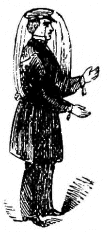
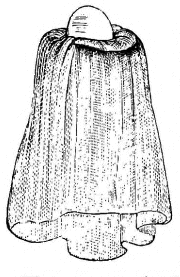
other requisite properly ready. A bee veil or dress will
preserve the most sensitive from the possibility of being
stung. This article is fully described on page 209. But
bees when swarming are in an eminently peaceful frame
of mind; having dined sumptuously, they require to be
strongly provoked before they will sting. Yet there may
be one or two foolish bees who, having neglected to fill
their honey-bags, are inclined to vent their ill-humour
on the apiarian; or, what is far more likely, the bees
of neighbouring hives may be incensed if they see him
manifesting unusual excitement. When all is ready the
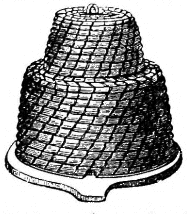
new hive (a straw skep is the most convenient in the
first instance, but if that is not at hand a box or anything
else will serve as a substitute) is held or placed in
an inverted position under the cluster of bees, which the
operator detaches from their perch with one or two quick
shakes; the floor-board is next placed on the hive, which
is then slowly turned up on to its base, and it is well to
leave it a short time in the same place, in order to allow
of stragglers joining their companions. The operator
should make sure that he has not left the queen behind
on the branch, as in that case the bees would return to
her.
Sometimes swarms alight on trunks of trees or on
walls, where it may be difficult to shake or brush them off.
The late Mr. Woodbury mentioned an instance of this
kind. A swarm clustered among the large branches of
a pear tree, just at their point of union with the trunk.
In this case he merely supported a straw hive just over
the swarm with the left hand, whilst he struck the trunk
of the tree with the open palm of the right. The vibration
thus produced sent the bees up into the hive with great
rapidity, and the entire swarm was speedily hived in the
most satisfactory manner. Mr. Langstroth in a similar
case fastened a leafy branch above the bees with a gimlet,
and then smoked them upwards till clustered upon it. It
should be borne in mind that they have always a readier
tendency to ascend than to descend. A feather dipped
in carbolic acid will very promptly move them, and as
they can readily escape from its fumes there is no objection
in this case to its use. Another case of settling in
an awkward spot is mentioned above (page 78).
If the new swarm is intended for transportation to a
distance, it is as well for it to be left at the same spot
until evening, provided the sun is shaded from it; but if
the hive is meant to stand in or near the same garden,
it is better to remove it within half an hour to its permanent
position, because so eager are newly swarmed bees
for pushing forward the work of furnishing their empty
house that they sally forth at once in search of materials.
If the removal has been made after they have gone forth
they will be unable to find their home in its altered
position, in which case they will circle about for hours
till they fall and die from exhaustion. But by prompt
transference, only the first despatch of scouts will be
lost, and these are a good loss, as they might entice the
whole colony to desert.
The bee-master should always seek to prevent his
labourers from swarming more than once; his policy is
rather to encourage the industrious gathering of honey,
by keeping a sufficient supply of supers on the hives.
Sometimes, however, he may err in putting on the supers
too early or unduly late, and the bees will then swarm a
second time, instead of making use of the storerooms
thus provided. In such a case the clever apiarian, having
spread the swarm on the ground, will select the queen,
and cause the bees to go back to the hive from whence
they came. But this operation requires an amount of
apiarian skill which, though it may easily be attained, is
greater than is usually possessed.
For a description of the theory and phenomena of
swarming, with the signs by which its imminence may
be gathered, and a variety of information referring chiefly
to the habits and life of the insect, the reader is referred
to an earlier article in this work (Chap. I. § xi.).
Where the permanent hive is of the skep description
the swarm may of course be hived into it at once. But
with many of the hives now in approved use a process of
transference will be necessary. To effect this, place the
straw hive, into which we will suppose the bees have
been shaken, on the ground, propped up on one side
with a brick or a flower-pot, or anything of the sort that
may be handy, in order that straggler bees may join the
swarm. The spot selected for this should be as shady a
one as can be found, near to the place where the swarm
settled; or it may be shaded from the rays of the sun by
fixing matting on two poles, so as to prevent the heat
falling on the hive. Spread a sheet or cloth on the
ground where an even surface can be obtained; stake
this sheet down at the four corners, to prevent ruts and
inequalities, which are great hindrances to the bees going
into the hive (Mr. Cheshire's swarming-board, which is
simply a large square board to rest on the hive-stand,
has its advantages); place the frame hive upon the sheet,
without its floor-board, having its front raised on blocks
or sticks rather more than an inch long—not more, otherwise
the bees will cluster, and attach themselves to the
lower part of the frames, instead of going up between.
These preparations will perhaps occupy ten minutes, by
which time the swarm will have become settled and
tolerably quiet. Then, with a sharp rap, precipitate the
bees out of the straw hive on to the sheet immediately
in front of the frame hive; give the straw hive another
knock, so as to dislodge all the bees, and then take it
quite away, otherwise they may, if it be left near, perversely
choose to go into that, instead of the one desired.
In an hour or so, more or less, the whole swarm will
have clustered within the frames.
In some cases, as when the swarm has to be brought
from a distance and procured from a cottager about
whose skill in carrying out these directions there may be
misgivings, it is best to give instructions that the swarm
be brought home after sunset, and then the foregoing
directions for inducing the bees to tenant the frame hive
may be better carried out. For ourselves, we much prefer
the evening for the purpose. Not after dusk however—in
fact no operation of the kind ought to be attempted
when it is so dark that the bees, if they should fly, are
unable to see where to fly to, for in that case they will
be sure to settle upon the operator. A little water
sprinkled over them from a watering-pot is likely to induce
them to quit the ground and go up into the hive
more quickly; a little smoke, or a touch with a twig
or feather, may answer the same purpose, and if the
feather be dipped in diluted carbolic acid it will more
speedily do its work. With a goose wing they may conveniently
be swept up. The operator should be protected
with the bee dress and other precautions described on
page 209.
Mr. Langstroth writes: "If they seem at all reluctant
to enter [the new hive], gently scoop up a few of them with
a large spoon and shake them close to its entrance. As
they go in with fanning wings, they will raise a peculiar
note, which communicates to their companions the joyful
news that they have found a home; and in a short time
the whole swarm will enter, without injury to a single bee."
On catching the note the queen speedily follows, and,
being longer in limb, she outstrips the others in the
race.
In the Journal of Horticulture, Mr. Woodbury says: "If
combs be fixed in the frames, the crown-board may be
removed and the cluster knocked out of the straw hive
on to the top of the exposed frames. The bees will
disappear between them with the utmost alacrity, delighted
to have met with a ready-furnished dwelling, and the top,
or crown-board, having been replaced, the hive should at
once be removed to the position it is intended to permanently occupy."
Bees occasionally manifest a dislike to their new hive.
The operator will, however, in a very short time be able
to ascertain their intentions. If on putting his ear to the
hive he catches sounds like gnawing or rubbing, he may
be sure that they have commenced work; but if all is still,
or they go listlessly about, and hang, as Langstroth puts,
it, "with a sort of dogged or supercilious air," it may be
gathered that they intend to be off at the first opportunity.
In such case, either catch the queen and put her in a
cage (page 198), or keep the whole hive in darkness for
three days, supplying food, water, and ventilation the
while.
If the weather be wet the next day or so after hiving,
it will be well to give a little assistance to the new colony
in the shape of food, for although, when a swarm leaves
a hive, almost every bee composing it has filled itself with
honey, we have known not a few instances, in case of very
wet weather, in which the whole swarm has been starved
for the want of this small but most timely help. A little
should be given the first night even in fine weather. Of
course, the first work of the bees is to build themselves
combs, and these combs being produced by the secretion
of wax from honey, a great drain upon their resources
immediately begins, and any little outlay at this juncture
is therefore abundantly compensated.
We frequently find that the possessor of a stock of
bees in a cottager's common straw hive is desirous of removing
the whole stock, with brood and comb, into one of
our improved hives, in which the honey may be obtained
without the destruction of the bees. We mostly discourage
such a transfer, attended as it is with much
labour, and requiring a considerable amount of apiarian
skill. An old-fashioned hive may very readily be turned
into a humane one, simply by cutting out the middle of
the top of the hive with a sharp-pointed knife; a piece
may thus easily be taken out, so as to leave a round hole
two or three inches in diameter, taking care that the knife
does not penetrate much below the straw, lest it reach
the comb or the bees. There should be ready a round
adapting-board, with a corresponding hole, which may
be secured on the top by putting four long nails through
the same number of holes in the board; then a cap-hive
or a glass may be placed on the top, for the purpose of
admitting the bees, who will soon crowd therein to work.
This hive or glass will form a super or depriving-hive,
and can be worked as profitably as most of the improved
hives. For the sake of more sightly appearance, an
outside case, either of zinc, straw, or wood, may now be
dropped over all, and then, if well painted, the whole
will form no disfigurement to any flower-garden.
This is, beyond doubt, the easiest way of overcoming
the difficulty, but as it may not satisfy all, we will now
proceed to describe how a complete transfer of colonies
may be effected. No hive offers such facilities for the
placing of the combs in a perfectly upright position as
does the frame hive. As before remarked, we should be
slow to recommend any one to attempt the operation
who is not already pretty well accustomed to the handling
of bees and acquainted with their habits; but by
carefully carrying out the following directions an apt bee-keeper
may successfully perform the feat. The first
thing is to get the bees away from the combs: there are
two ways of doing this—one is by fumigation (see page 207),
the other by driving (page 226). Whichever plan
may be resorted to, place the bees in the temporary
hive on their old stand until you are quite ready to admit
them into the frame hive. Have in readiness all the
necessary appliances. These consist of a large knife for
cutting the hive, a good-sized table on which to lay the
brood combs, a basin of water—for washing off honey
which may besmear the hands—tape or string to fasten
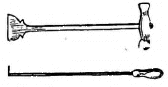
the combs in their frames, a pair of honey-cutters (page 193)
for cutting out the combs, jars to hold the honey
that runs out, and a feather for brushing off any bees
that may remain. It is necessary that the operator
should have on his bee dress and india-rubber gloves.
If the old skep is not valued the operation will be
facilitated by cutting it in half vertically between the
two middle combs; but the honey-cutters will accomplish
the object without this destruction if it is not desired.
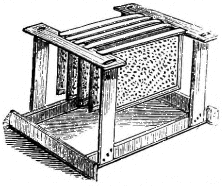
Mr. Cheshire's transferring board (page 192) comes
in useful here. If one is possessed the frames may be
laid upon it, and the combs, which should be cut as
large as possible, must then be placed within these. Of
course they will not exactly fit, but they must be adjusted,
piece by piece, till they bind each other together; the
few interstices the bees will soon fill up. If in any of
the frames there is not sufficient comb, supply empty
comb if it is to hand, and in default of such, fix an
additional bottom bar inside the frame—a false bottom
as it may be called—at whatever height the supply of
comb requires. Drone comb, however, should be used
very sparingly, and this only for the outside frames, in
which it is not likely to be selected by the queen for
breeding purposes, but left for storage of honey. Both
filled and partly filled frames must now be made secure
by tying pieces of tape or pliable wire (even string will
answer) round the whole from top bar to bottom or false
bottom; there should be two of these to a frame, or
perhaps three if the pieces of comb are small. In two
days or so the bees will have made all firm enough for
the tape to be dispensed with, which should accordingly
be done, as it is in the bees' way. To effect this, dismember
first the cells from the tape by means of a sharp
knife, and then cut the tape and draw it out. Care
should be taken that the combs occupy the same position
in the frames as in the hive from which they were
extracted, for the cells are not exactly horizontal, but
inclined slightly upwards. Supply guide-comb or wax
strips to any frames that are wholly unoccupied.
The frames now filled are placed in the hive, when
the bees may be let into it in the manner Mr. Woodbury
recommends for a swarm (see page 220). It may be as
well to keep them confined a few hours, giving them
water at the top, by means of a soaked sponge laid on
perforated zinc, until they make the combs secure; the
object of this being to exclude the bees from other hives,
who, if feloniously inclined, might come to rob. For the
same reason the operation of adjusting the combs should
not be performed in the open air, or the bees from
surrounding hives will be sure to come in great numbers
to obtain a share of the honey necessarily exposed. It
should be done inside a room with the temperature at
about 70 degrees—not cold enough to chill the brood,
nor yet hot enough to soften the combs. An expert
apiarian could perform the operation in less than three-quarters
of an hour, and with little loss. A week or so
after a swarm has left the old stock is perhaps the very
best time for such a removal. In some instances a routing
of this kind has a beneficial effect; old stocks of
hives that have previously appeared to be dwindling are
often aroused to activity by their removal into a fresh
domicile. After the winter's doze this is especially the
case, say if done on a warm day early in April. We
have ourselves frequently shifted the stock from a well-occupied
frame hive to a fresh one, in which the bees
find a clean floor-board and walls, as well as freedom
from insects that may have harboured in crevices during
the winter.
Driving is an operation by which bees are induced to
vacate an, old settled hive and to enter an empty one.
Many apiarians prefer this mode of effecting an exchange
of hives to the plan of fumigating the bees. The greatest
success attending such a transfer will be in the case of
hives well filled with combs that are worked nearly to
the floor-board; and it may be remarked that bees are
generally so far provident that they leave an open space
in which to pass underneath their combs over all the
floor of the hive. When the old hive is inverted the
bees crawl up the combs, and thus more easily pass up
into the new hive, which the operator places over the
old one with the intent that they should enter it.
The best time for performing this operation is about
the middle of the day, and when the weather is warm:
It is essential that the operator be protected with a bee
dress and gloves, as before described; and previous to
commencing his task he must provide all necessary implements.
These are—a couple of hives, both of which
should correspond in shape and size with the hive from
which the bees are to be driven; a cloth to tie round at
the juncture when the new hive is placed on the old one;
some string to keep the cloth in its place; an empty pail
to receive the top of the old hive, if one of the old
conical shape, but if the stock of bees is in a square box-hive
with a flat top, a firm stool will be the best; and a
tube fumigator with some fungus, which will complete
the material of war. The bucket or stool must be placed
securely on the ground, about a yard from the place
where the full hive stands; then a few puffs of smoke,
blown in amongst the bees, will cause them to retreat up
amongst the combs. The bee-master must now turn the
hive[25] upside down very gently, letting it rest in the pail
or on the stool; he then quickly places the empty hive
over the full one, and ties the cloth round it, to prevent
any escape of the bees. If the cloth be damped it will
cling the closer to the hives. The third hive, which
should resemble the old one even in colour, is intended
to be placed on the stand formerly occupied by the
stock, so as to retain the few returning bees which had
been absent in the fields. Care must be taken that all
crevices through which it is possible for the bees to
escape from the united hives should be effectually closed.
When the two are fairly united, the operator will proceed
by rapping the full hive gently with the hands or a couple
of sticks, more particularly on that side where the combs
are the most thickly placed—that is, if the hive be not
equally filled on all sides. A stock is in the best condition
for driving twenty-one days, or thereabouts, after a
first swarm has issued; the brood will then have hatched
out, the bees will quit more readily, and there will be no
loss of larvæ in the cells.
It generally happens that in ten or fifteen minutes the
bees regularly commence the ascent; their exodus will
be known by the distinct rushing sound which is always
noticed when a colony of bees is on the move. The
first thing bees do when disturbed is to fill their honey-bags,
as they invariably do at swarming time; consequently,
after the first rush into the new hive is over, as
in the case of a swarm, the "flitting" bees are not much
disposed to take wing. When the noise made by the
ascending bees has been heard, and has in a great degree
subsided, the cloth may be removed, and the old hive,
now deserted, may be taken indoors; and if a few bees
yet remain they may be brushed off with a feather. An
experienced apiarian, on first hearing the rushing noise
before mentioned, will not hesitate to tilt the top hive
over a little on one side, so that he may watch the bees
during the ascent; the queen maybe seen passing up, and
if the operator desires to take her away he can secure
her by gently taking her between thumb and finger. Those
who have become experienced in this operation find that
it can safely be performed with the hives fixed open from
the first. This is called "open driving," and can be
effected with increased facility by sticking two skewers
through the ruin of the lower hive in such manner that
they shall act as props to keep the upper in a fixed
position. Mr. Hunter has, however, devised an improvement
upon this, consisting in a wire hinge to connect
the two hives, and wire rods to prop them open. The
operator thus has both his hands at liberty for other
parts of the work.
If the taking of the honey be, the object of the bee-master,
then "driving" is manifestly a better plan than
resorting to the fumes of sulphur for the purpose; for
the bees from whom the store is taken can be joined to
stocks that are weak in numbers, with considerable advantage
to the future prosperity of the apiary (see next
section).
A weak colony may frequently with advantage be added
to another, or three may be made into two. And not
only may this be done with new swarms, but in autumn,
when there is no brood in the combs, it may be carried
out also with stocks, the combs that are extracted being
taken care of for use when required. After working hours
is the best time for this operation. It is not, however,
altogether a simple one, as strange bees will not intermix
unless measures are taken to overcome their natural
hostility to each other. Whatever be the number of
hives in an apiary, the bees of each know the smell of
their own companions. A single bee that enters the
wrong hive will be stung to death, unless possessed of a
good booty wherewith to disarm animosity. Similarly
on the admixture of entire colonies, if one has some
distinct ground of advantage over the other, there must
be a method hit upon to deprive it of this or else to
purchase its goodwill, for otherwise there will ensue a
ferocious and disastrous slaughter. If both are alike
frightened all will go well, and the same if both are
upon the wing in search of a home; but quite otherwise
if one is self-possessed and active in its own abode, while
the others are frightened strangers and gorged, and it
may be still further demoralised by having lived under
an unfertile queen, or with none at all. But if both are
cowed alike by a good drumming on the hives, they may
be sprinkled so as to possess the same scent, and then
taken to a third position and shaken out on to a sheet
together, when they will enter the offered hive in harmony.
If each colony has a queen, one of them may
be searched for and removed.
A slight variation upon this method consists in driving
the bees of the one hive (see last section) straightway
into the other, having first terrified the bees of the latter
by drumming until by their changed note they may be
concluded to be thoroughly subdued, and as a consequence
gorged with honey; then, before their equanimity
is recovered, the others must be joined to them. A third
plan is the one usually practised with the Stewarton hive
(page 151), and which can be imitated with other hives,
by means of ekes or nadirs; this is usually carried out
in the evening, when the quietude appears efficacious
in settling all differences without the necessity of any
other precautions. A fourth is as follows: At dusk,
dislodge the bees on to a cloth, sprinkle them with
sweet syrup scented with essence of peppermint (as a
means of bribing their new hosts to receive them), and
place the hive to which it is intended to join them over
the mass; they will gradually ascend into the hive placed
for them, and early next morning the hive, with its
slender stock thus augmented, may be removed to its
stand. Should the operator not have been successful in
gaining possession of the queen, he may leave it to the
bees themselves to decide which queen they will have.
Many persons feel more secure from stinging if they
first stupefy the bees by fumigation. These should
proceed as follows: Having used the fumigator upon
the bees in one hive, as described under that article
(page 207), place a sheet on the ground and spread the
bees on it; then, with a feather, sort them over, in order
to pick out the queen. As soon as she is found, pour
the rest of the lethargic swarm from off the sheet back
into the inverted hive again. The stupefied bees must
now be sprinkled freely with a syrup made of honey and
water, or sugar and ale boiled together. Some apiarians
recommend a few drops of peppermint to be mixed with
the syrup, in order to drown the peculiar odour which is
special to each hive of bees; this is more necessary when
both hives are fumigated, and whilst under the influence
of smoke are well mixed together upon the sheet or board.
Such course can be adopted if preferred, and no further
instructions will be needed than what are here given; but
we will suppose as before that only one is thus operated
upon. The hive containing the non-stupefied bees must
now be placed on the top of the inverted one, just as the
hive was from which the bees in the latter have come.
A wet cloth must be fastened round the two hives, so as
to prevent any of the bees from escaping. The hives in
this position must be placed where they are not likely to
be knocked down or meddled with. The fresh bees in
the upper hive, attracted by the scent of the bees besmeared
with honey, go down and commence licking off
the sweets from the sleepy ones. The latter gradually
revive, when all get mingled together and ascend in
company to the upper hive, where they live as if they
had not been separate families. The two hives should
be left undisturbed for twenty-four hours, when the upper
hive may be removed and placed immediately on the
spot from whence it was brought.
The removed queen should be kept alive and fed as
long as she will live, in case any harm should befall the
sovereign of the other community. If three hives are to
be incorporated in two, the only difference will be that
the stupefied colony upon the sheet is divided into two
empty skeps, the one being covered securely over till the
other is adjusted.
Every bee-keeper knows the anxiety he feels in watching
and expecting a swarm to come forth, fearful lest
his favourites should, "like riches, take wing and fly
away"—a mischance that it is desirable to prevent. In
our description of natural swarming this will be found
fully treated of; we propose here merely to point out
how, especially with movable frames, this work of Nature
may be assisted. We call it assisted, because artificial
swarming should, as nearly as possible, resemble natural
swarming; that is, it should be performed at the same
time of the year, and when the populous state of the
hive makes a division desirable. This is easily known
to be the case when bees hang out in clusters at the
entrance, wasting their time in enforced idleness instead
of being abroad gathering honey. It is also necessary
that there should be drones about at the date chosen.
When such is the state of the hive, the advantages of
movable-frame hives are strikingly manifested. With
the others the bees will often persist in wasting their
time as just stated when a swarm would put all to rights;
while they are often just as awkward the other way and
will send out swarm after swarm which the strength of
the hive cannot spare and which in themselves are unable
to form colonies capable of self-support and of repelling
robber bees. The great expenditure of time and labour
by the bee-keeper, with the fear that after all the swarm
may come off at a time when he is absent, and thus be
perhaps lost, are additional objections to depending upon
the natural process. An apiarian may if he pleases give
the bees their chance, and then if they do not swarm
readily he may resort to artificial means. But if he
wishes to dispense with the former altogether he will
have to adopt measures of prevention against it, as his
forced colony must not be procured till the proper time
of natural swarming. Some clip the wings of the queen,
which seems a clumsy proceeding at the best—though recommended
by high authorities from Virgil to Langstroth—as
the royal mother may still wander forth and thus
fall to the ground and be lost. Others block the entrance
of the hive with some obstruction which only
workers can pass, by which means the drones will also
be kept at home. If this be the method pursued care
must be taken that the obstructions are removed both
after sunset and before sunrise to permit of the dragging
out of the bodies of such as have fallen among the
hourly victims of the gathering season.
The best time for performing the operation is about
ten o'clock in the morning of a fine summer's day. The
following directions should be carried out: Place ready
a counter or bench that is firm and strong, and which
has space on it for the inhabited—or, rather, the over-inhabited—frame
hive, and the empty one, which is about
to be made the receptacle of a separate stock. The
operator, attired in his bee dress, and having the other
appliances ready, may now open the hive[26] (as described
at page 270), and proceed to take out the frames, carefully
examining both sides of each comb to find the queen:[27]
she is generally in the centre of the hive, so that it is not
always needful to take out every one of the frames. As
these are examined they may be put into the empty hive,
and when the object of the bee-master's search is found
he must carefully remove the frame containing her
majesty, and may place it temporarily in the empty hive,
at one end by itself, or he may make use of the bar-frame
holder (Chap. IV. § xi.). Next he must proceed
to put the frames back into the old hive, closing up the
vacancy caused by the removal of the comb with the
queen on it, and leave the empty frame at the end.
Then he may place the frame containing the queen, with
the few bees that may be upon it, in the centre of the
empty hive; and, finally, putting all the other empty
frames in, and replacing the lid, he will place this hive
in the exact position occupied by the old stock. The
bees that are on the' wing will go to the old spot, and,
finding the queen there, they will rally round her, and
if a time is chosen when a large number are abroad, they
will on their return very soon form a sufficient number to
constitute a swarm; comb-building will at once begin, the
frames will, in a week or so, be filled, and a satisfactory
stock will thus be established.
This operation we once performed—exactly as described
above except that there was no frame-extracting—with
one of our improved cottage hives. Whilst inspecting
our bees we caught sight of the queen on the comb in
one of the bell glasses. This was a chance not to be
missed, and we immediately resolved to form an artificial
swarm, for the hive was very full of bees. Besides, being
obliged to be away from the apiary most of the week,
we were glad of the opportunity of so easily establishing
a colony without the uncertainty and trouble of hiving a
natural swarm. In the first place we slid a tin under
the bell glass, and, removing the stock hive from underneath,
we took it a few feet away; then we placed an
empty improved cottage hive where the old stock had
stood, and put the glass of comb containing the queen
and a few bees over one of the holes in the crown of
this new empty hive. The bees that were left abroad
belonging to the old stock returned as usual to their old
entrance as they supposed; soon a sufficient number
formed a large cluster in the hive and began comb-building,
the queen remaining in the glass until the cells
below were sufficiently numerous for her to deposit her
eggs in them. The experiment answered exceedingly
well. Both hives prospered: the old hive either had
some princesses coming forward to supply the loss of the
queen, or the bees used the power that they possess of
raising a queen from worker brood in the manner we
have previously described (page 16).
The foregoing account illustrates the successful formation
of an artificial swarm; but, with a cottage hive,
gaining possession of the queen is on this method quite
a matter of chance. With a movable-frame hive she can
at any suitable time be found.
Precisely the same plan is to be adopted with the
old stock in the frame hive as we have described in the
case of the cottage, that is, to remove it some few paces
off: when the hives are in a bee-house a similar result
may be obtained by placing the new swarm for a day or
two so as to be reached by the same entrance as the old
stock, and the latter may be removed to one close by.
Some apiarians recommend that a space be left between
the two hives, by arranging them on the right and left
of the old entrance, in order that too large a proportion
of bees should not enter the new hive at the old position,
to the impoverishment of the other. But we have found
the mode adopted with the cottage hive answer so well
that we see no reason for recommending any different
plan.
It is the office of the bee-master to assist, not in the
least degree to oppose, Nature. We know that when a
natural swarm issues forth it has its queen, and when
located in a new abode it commences building worker
combs, leaving the building of the few requisite drone
combs to a later period. But if a division of the hive
should be made, by putting half the combs in one hive
and half in another, the hive that is either queenless or
contains an embryo queen will busy itself with building
only drone comb (see page 17); thus a number of receptacles
for useless bees are provided, while all the time
the colony is rapidly dying off from the wear-and-tear of
the working season.
In the plan we have recommended for forming two
separate families we nearly follow the natural course of
things; the comb that the queen is upon is the only one
that is taken from the hive, and this vacancy should be
filled in by moving the frames together, so as to leave the
empty frame at the end. The swarm under the government
of the queen construct the combs, and furnish
their new abode, as before stated, with worker cells. By
adopting the plan above described, the movable-frame
hive will prove far superior to any of the dividing-hives,
which provide for equal division of the combs.
There are, however, quite a host of other modes of
procedure more or less varied from the above, and their
number is doubtless capable of almost unlimited extension.
Mr. Langstroth, in the tenth chapter of his "Honey
Bee," describes a considerable variety of them, nearly all
of which are accomplished wholly or in part by the
process of driving. The following he particularly recommends
as approaching nearest of any to natural
swarming. Two hives exactly alike are placed one above
the other with their entrances different ways; they have
holes made through their floor-boards to allow of communication
from the crown-board of whichever for the
time occupies the lower position. Free passage being
thus given from one to the other, a number of the young
bees will use the upper entrance. After some ten days
a swarm is driven from the lower and received into the
upper, upon which the positions of the hives are reversed,
the forced swarm being put below. Most of the mature
bees will unite with the swarm from association with the
lower entrance; but the young ones which have habituated
themselves to the upper one will now cling to the parent
stock and form a sufficient strength to keep it properly
going. In the course of a few days the upper hive may
be placed by the side of the lower, and then, by successive
short steps, removed to any other part of the
apiary. If it was found that either hive was too weak
the positions should be again reversed.
When driving is the method resorted to, it becomes
absolutely essential, in forcing a swarm, that the queen
should go with the new colony; but on the other hand
it is not in this case the object to drive all the bees
from the parent stock, but to leave, say, a quarter
to preserve warmth for the brood and to raise a new
queen. If therefore the queen is not observed in the
ascent of the bees after the drumming, those in the
swarm must be turned and shaken over in the skep in
order to find her (they will not attempt to fly, but only
crawl). An inexperienced eye may still fail to detect her,
and in that case it will be best to set both hives upon
stands for a short time—the new one on the old stand
and the old on some other—when within half an hour the
one which is fairly quiet may be judged to be possessed
of the royal presence. Should this be the old hive it
must be again drummed, or the swarm may be returned
to it and the operation renewed on a following day. It
is, however, only with skep hives that any difficulty of
this kind need be apprehended—there is always the power
of capturing and transferring the queen from movable
frames. When at last she is in the desired hive the
swarm is secured, and the after measures depend on the
number of bees that have accompanied her. If the
stock retains one-half it may be moved to a new position
and the swarm take its place upon the old stand. Whichever
occupies this latter post will detach largely from the
strength of the other, so that the reduction undergone
by the parent stock will not be more than it will probably
be able to sustain.
As detailed in the above article on "Driving" (page 226),
there is a third hive made use of in this case,
which has received the bees that returned home during
the operation, and these are now added to whichever hive
may most require them. Should too many have gone
over with the swarm, this latter may be taken away and
set in a cool airy place, while the old hive is carefully
restored to its old stand, when the bees which were distractedly
flitting in and out of the third hive will at once
rush into it, and the impression made upon them by the
occurrence will be such that they will now cling to it
wherever it is placed. It must be forthwith removed to
its intended permanent position, but if still short of bees
this must be close at hand, so that if the forced swarm
is kept where it is for a day or two a good number may
desert to the old stock; its entrance should be closed
until sunset as a precaution against robbers, but not so
as to stop ventilation. The forced swarm, if not in
their permanent hive, must now be treated as an
ordinary transfer, and their fixed abode be brought in
the evening to the old stand. Some additional covering
may be needed at first, and in very cool weather the
operation should not be attempted at all. There is no
fear of all the bees deserting in the arrangement just
suggested, and if inconvenient to complete the operation
at once the swarm may be so left, even if there appears
no need on account of the old stock.
The process of driving is the only method of obtaining
artificial swarms from cottage hives, except in such
rare cases of good fortune as the one mentioned on
page 236; but even with frame hives it is often practised
for the sake of its rapidity. But with an experienced
operator the same result can be achieved by simply taking
out the frames one by one and jerking off the bees on to
the sheet in front of the new permanent hive; that on
which the queen is found will be inserted therein just as
it is—queen, brood, and workers. If the swarm is being
collected in a skep the queen must be taken with the
fingers and deposited therein, while the bees from as
many frames as are needful must be shaken in after her.
There is sometimes a doubt whether a hive is strong
enough to yield a swarm, though apparently overstocked.
In such cases there is an excellent plan, devised by Mr.
Langstroth and strongly approved by Mr. Cheshire, for
obtaining a single swarm out of two hives. On a suitable
morning, when large numbers are upon the wing,
drum a strong stock till every bee has left it. Place the
forced swarm on the old stand: this of course consists of
bees in an unfurnished hive, while the old hive has lost all
its bees, but retains its brood. Remove this hive to the
stand of another strong stock, the hive of which goes to
a third spot with the bees inside it at the time. Those
of this last which were upon the wing will enter and
remain with the first hive and raise a new queen; while
sufficient will be transferred with the second stock hive
to protect its brood also. Thus the first stock gives no
bees to the swarm, but the whole of its brood; the second
gives the larger half of its bees. If frame hives are the
ones used, the shaking process of the last paragraph may
be substituted for drumming; but as it may not be possible
to shake off every bee without damaging the combs, a
goose wing should be employed to brush off the more
tenacious of the occupants.
Other modifications consist in either obtaining one
swarm out of four or five hives, or else one less than their
own number out of the same. For the former (frame
hives) two combs may be taken from each and placed in
a new hive, which is then set upon the stand of some
strong stock. For the latter, a swarm is forced, after or
before working hours, from each of these hives, while
another swarm, that has been procured from some bee-keeper
a mile or two off, and has been kept in a cool
place, is now shaken on to a sheet, sprinkled to keep it
from taking wing, and softly scooped up with a saucer
and divided equally or as required among the hives that
have yielded the swarms. The distance that these bees
have come will prevent them from returning to their own
home.
Perhaps the greatest advantage the movable-frame
hive possesses is, that a full knowledge, can be attained
of its exact state as regards the queen, the population,
and the quantity of food in stock. During weather of
a genial temperature the combs may on any fine day
be inspected, and thus, a knowledge being gained of the
deficiency existing in a hive, the necessary means may
be adopted for supplying the want. Sometimes such an
examination will verify the fears of the bee-keeper,
when, having observed that his bees have ceased to
carry in pollen, he has thereby received warning that
the queen has been lost at some juncture when no successor
to the throne could be provided. Such a hive
has entered on a downward course and will dwindle
away entirely, unless a queen should be given to it, or
else some combs containing young brood not many days
old (see page 16). By the latter method the bee-keeper
will gain an opportunity of seeing the bees set about
their wonderful process of raising a queen from the
brood thus provided for them. If neither means is
practicable the colony must be united to some other hive.
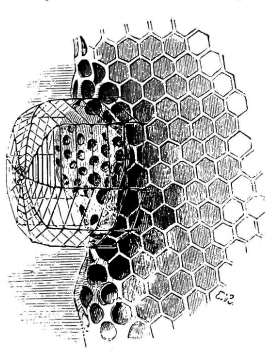
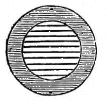
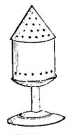
An ingenious little contrivance has been brought into
use by continental bee-keepers, especially by Herr
Kleine, a German
pastor, to prevent the
destruction alluded
to. It consists of a
small wire cage (in
fact, a pipe cover), as
represented in the
annexed illustration,
placed over a queen
cell to protect it from
the mother bee's animosity.
It also serves
to prevent the young
queen, when hatched,
from escaping; for she will have the same jealous feeling
towards her sister princesses, should there be more in the
hive. The bee-master may thus carefully remove and
appropriate her.
Particular attention will have to be exercised to affix
the cage into the comb by pressure, as far as the middle
wall, but at no point must it touch the royal cell itself.
As the cage will probably project so as to touch the
adjoining comb, a little incision and removal of a portion
may be necessary to allow space for it.
This covering need not be put over the cell until the
egg is a little more than a week old. The animosity of
the reigning queen does not generally manifest itself
until the royal brood approaches maturity. These cells
are unmolested on the tenth day, but on the eleventh
day they may be found tenantless. Notwithstanding the
apiarian's care and skill, many disappointments are
frequently experienced in endeavouring to establish
fertile young queens at the head of colonies.
Hives found to be queenless may be supplied either
with matured queens or with queen cells. If the latter
are sufficiently numerous, their introduction may easily
be effected by exchanging a comb in each hive; if they
have to be cut out and placed loosely in the new hive, a
triangular piece of comb should then be removed with
them, to be used as a block in preventing any pressure
coming on them. A space must be cut out of the
middle in the centre combs of the hive into which they
are to be introduced. They must not be so loose as to
be in danger of falling out, but if such seems likely a
little melted wax should be applied with a feather.
Special care must be exercised not to bruise the royal
embryos, as a very slight pressure is likely to be fatal.
It is important not to perform the operation till they are
within three or four days of coming forth, which may be
known to be the case from the brown look of the tops
of the cells, the wax having been removed.
It is always easier to introduce royal brood into queenless
hives than matured queens, because bees are reluctant
to receive stranger queens, whilst they will tolerate
one hatched in the hive, who will speedily depart to seek
a drone. Bee-masters mostly use small hives for queen-rearing,
as explained in the section on "Nucleus Hives"
(page 197). It is not however indispensable to use other
than the ordinary hives, and Mr. Langstroth gives the
following as the very best mode of procedure. Place an
empty hive on the top of a well-filled one, giving communication
through crown and floor boards and turning
their entrances opposite ways (one of his plans, by the
bye, for procuring an artificial swarm). The young bees
will many of them take to the upper hive—if not they
must be enticed into it by food—and when there are
sufficient of them, a brood comb with adhering bees must
be inserted and the connection closed. After a few days
this nucleus hive may be removed, a few steps at a time,
and another, if desired, take its place and be raised in
the same way. Queen-rearing operations must be confined
to warm weather and when drones are abundant.
Royal cells are often built so close together that it is
difficult to remove one without injuring another. As a
remedy for this Dr. Dzierzon has made the important
discovery that any convenient worker cell may be made
to produce a queen by the removal to it of some of the
royal jelly from an unsealed cell; by placing this on the
inner margin of the cell selected, the bees will adopt and
rear the larva as desired.
This is an operation that is continually being practised
for the purpose of Italianising a colony, though there are
other occasions for its adoption, as on the loss or the
superannuation of the old queen. We will in the first
place describe the mode of procedure with a frame hive.
Should the old queen be remaining in the hive, she has
first to be removed. Having discovered her, by lifting
out and examining the frames (see page 271), place a
wineglass over her whilst on the comb, and, with a card
passed very carefully underneath, she may, with a few
of her subjects, be made a prisoner and easily removed.
She should be preserved in a small box till the success
of the new introduction is ascertained. Then, having
enclosed the new queen, with such of her retinue if any
as are with her, in the domed wire cage described at
page 199, place this cage upon the comb in a spot where
there is a little honey, so that she may be independent
of the bees for food, and as near the brood as may be;
press it into the comb as far as the middle, and close the
hive and leave the bees undisturbed for three days—less
will mostly suffice, but it is best to be on the safe side.
The royal cells that are sure to have been commenced
should now be cut away with a penknife, and then the
new queen may be carefully released. If the hive is
one that permits it, her reception should be watched. If
the bees make way for her and caress her with their
antennæ, all will be well, and the comb may be gently
restored to its position and the hive shut up. But if
they cluster in a ball around her, her death is intended;
and if they cannot readily be induced to separate they
should be taken out and dropped into lukewarm water
(which will hurt none of them), and the queen re-encaged
for another day or so—that is, if she has not
already met her doom, which is all uncertain: Mr.
Langstroth says he has had several queens stung to
death before they had quitted his fingers! We prefer
effecting her release, then shutting up the hive and leaving
the bees quietly to themselves.
We may remark here with regard to these acts of
surrounding a new queen, that they evidently arise from
a great number rushing upon her at once for the purpose
of stinging her, but that very frequently such purpose is
frustrated by the immovable position in which the inner
bees are held. Suffocation however will soon effect the
same end if the ball be not dispersed. There are cases,
on the contrary, in which friendly bees surround a queen
to protect her from others, and sometimes the knot is
made up of members of both parties, perhaps without
enclosing the queen at all. The hissing note will at
once distinguish a hostile onset from a protecting rally.
With the Renfrewshire cage (page 199 as above) all the
variation needed is to place the cage between instead of
within the combs, so as to permit of the queen's release
at the bottom. The inventor considers that this gives
an advantage in introducing her majesty in the first
place to those bees that have been engaged in feeding
her; but, as already noticed, it is not the feeding, but the
familiarising with her presence, which is the great point,
and that is surely quite as well accomplished with the
other cage as this. There is also here no opportunity,
as in the other case, of being certain whether she is well
received or not, so that we always put a good-sized
board under the entrance, and examine the next day
whether she has been thrown out dead or not.
In effecting the exchange with cottage hives, the bees
must first be driven out into another hive (as described
at page 226), and after the old queen is removed they
must be sprinkled with a little water flavoured with a drop
of extract of peppermint (to be obtained of any chemist),
which overcomes the particular hive-scent, and makes
all smell alike; then throw the new queen in among
them and place the mass of them back in the hive. If
preferred, an eke (page 186) may be placed on the stand,
the bees precipitated into it, and the hive of combs
placed above, when the bees will ascend. If this is
done in the evening the queen will in most cases be
well received. As there is no opportunity of excising
queen cells, the process should be performed, say, in the
middle of October, when breeding has ceased. Stupefying
the bees with fungus is a method devised by Huber
as applicable in any kind of hive, and it has been highly
approved of and declared to be infallible.
A strange queen is generally well received by young
bees, whether she be Italian or English—for we have
never found the slightest difference in reception, though
Mr. Wagner (Langstroth's "Honey Bee," page 325) was
of opinion that there is more opposition in the case of the
foreigner. The difficulty is to have a sufficient number
of such young bees. In the middle of a hot summer's
day a stock may be divided and the part with the old
queen left in its former position, while the other part,
with as many brood combs as it is prudent to take, may
be removed a few yards off. The old bees that have
been brought with the latter will in three or four hours
have most of them returned to their former abode, and
the new queen may then with safety be given to the
remainder without caging, taking care to introduce her
to the young bees on the combs. This task must only
be attempted on a warm midsummer day and when the
night temperature need not be feared for the young
brood in its deserted condition. Stocks may be divided
and artificial swarms formed in this way--from the end
of May to the beginning of July—if the apiarian has
queens in readiness.
It requires a considerable amount of apiarian skill to
accomplish the union of Italian with common bees, so
that we find by experience it is best to send out complete
stocks or swarms of the former. This is particularly
desirable now that the packing of whole hives is so easily
accomplished by us with the aid of bars and frames. We
have sent a great number of stocks to all parts by rail.
Still, as the introduction of fertile Italian queens is a
frequent practice, and we are ourselves large importers of
the same, it is only right to add some directions as to
the course to be pursued where such union is resolved
upon. These queens come over during the summer
months, from May to October. They are packed in
wooden boxes about five inches square, with a comb of
sealed honey in a frame in the centre to feed the queen
and the few workers that accompany her on the journey.
The old queen should first be removed from the hive,
but carefully preserved till it is ascertained whether all
goes well with the stranger. The box containing the
latter must now be prised open, and this should be done
within doors, lest the queen should fly and be lost. On
discovering her she must be placed in a queen-cage and
gradually introduced to her new subjects in the manner
explained under that article (pages 198 and 247).
If this is successfully accomplished all is right so far;
but unless considerable pains be taken the off-coming
swarms will certainly produce mongrel bees. If none of
the neighbouring residents are bee-keepers, the risk may
be considerably narrowed by destroying the drones and
drone comb in the other hives and rearing Italian queens
to place at the head of each of these as speedily as
possible. Every one of these queens, even if impregnated
from an undesired source, will still produce drones as
purely Italian as herself (see page 64), and thus in another
year the chance of Italian mates being found for the
queens will be further increased: indeed the peculiarity
of Italian queens in laying drone eggs in there first year
will probably produce this result more speedily. But
should some hybrids be the result, as in all probability
will be the case, even these are much to be preferred to
the common black bee—some say (see page 53) that
they are even better than pure Italians for honey-gathering,
but they are more irascible.
This course is undoubtedly in opposition to the design
of Nature to avoid interbreeding, but we find even Mr.
Hunter recommending it, though showing in another
place that he perceives it to be a violation of his "law."
By commencing with two Italian queens there might be
more chance given of escape from the evil—if it really is
an evil when not several times repeated. Von Berlepsch,
however, informs us of the following method, devised by
Dathe and others, by which even this objection may be
avoided:—
"When the young queen has left the cell, she is transferred
after forty-eight hours, or even earlier, into a cellar
or some other dark and cool place. If the drones, by
one of which the impregnation is to be accomplished, are
not among the colony of the queen, they also must of
course be inserted. We now wait for a sunny day free
from wind, when the thermometer in the shade is at least
17° above zero [70° Fahr.]; the bees in question, towards
five in the afternoon, when drones have completely ceased
from flight, are fetched out of their prison, and set up in
any spot, if possible where isolated and with the flight-hole
exposed to the sun; then, by means of a small
syringe or in any other way, direct some liquid honey
into the flight-hole. In a minute or two the bees will
sport in numbers in the front, and it will not be long
before the queen and drones also fly out. At evening
the colony is brought back into custody, and the manœuvre
is repeated till the young queen has commenced
laying, or till her accomplished fructification is made sure
by expansion of the abdomen, or, upon return from a
flight, by having the more or less torn-off drone penis
upon her extremity." Some essential particulars are not
here specified, but we interpret the instructions to refer
to a nucleus hive in which the queen is hatched with
several workers, but with no drones present except those
specially introduced. By choosing these, also from their
birth, from the progeny of a different queen from the
mother of the one in the nucleus, all may apparently be
made as straightforward as could be desired. Even Von
Berlepsch, who is no friend to the Italians, praises this
method as a "beautiful discovery:" it dates only from
1867.
It may not unnaturally be asked by some, Why all this
trouble about frame hives? No one, however, who has
carefully read the previous sections of this chapter, and
especially those on "Artificial Swarming" and "Queen-Rearing,"
can require any further answer to such question.
Briefly, frame hives stand immeasurably above others
from the full command over the bees which they afford.
The facility of inspection for ascertaining the strength of
the colony or the stock of its honey, or for incidental
purposes, such as the detection of disease and the extirpation
of enemies such as the bee-moth, and again the
facilities provided for giving ventilation or for contracting
the dimensions to suit a small population, are among the
minor but still great advantages which the use of these
hives secures. In skilful hands these advantages may be
used successfully; though in the hands of the unpractised
and unskilful the contrary may be the result.
It is a great desideratum that all the bars and frames
in an apiary should be of precisely the same dimensions,
so as to fit every hive. A hive that is weakly may often
be advantageously strengthened by having put into it a
comb of brood from a populous stock, to which an empty
frame from the weak one may be given; no bees must
be on the brood-comb—these should be shaken off or
gently dislodged with a feather into the hive from which
the comb is taken. The frames of combs should then
be, one by one, placed so as to fill in the vacancy, leaving,
the empty frame nearest the side.
In the British Bee Journal of March 1875, Mr.
Cowan gives the following excellent description of his
system of working frame hives. He says: "The method
is very simple, but is one that requires much attention,
which is, however, well repaid by the extra quantity of
honey obtained. The hives I use are the ten-frame
Woodbury, and thirteen-frame on the Woodbury plan,
only longer. In the autumn I transfer the bees into
clean hives and leave them seven or eight frames, and
should they be short of food or of bees I add those I
may take from the cottagers in the neighbourhood. I
feed with sugar and water of the strength of two pounds
of sugar to a pint of water boiled a few minutes. They
are fed up to a weight of thirty pounds. During winter
they have ample ventilation—the hives being raised about
one-eighth of an inch from the floor-board, and the top
board is also raised about the same height, so that there
is a constant current of air through the hive. While I
am on the subject of wintering I may mention that I
have tried several plans. With the above I have always
been free from mouldy combs. I have also tried wintering
without crown-boards, by merely placing an empty
super on the top, and I have done so successfully—in
fact, the hive which produced the largest quantity of
honey last year was wintered in this way. Condensers I
have tried, but give the preference to crown-boards without
them. I am trying the quilts on some of my hives,
but must reserve my opinion about them until later on.
"I generally supply my bees with plenty of food in the
autumn, so that they require no further attention until
about the end of February, when, if the weather is fine,
the bees are all thoroughly roused into activity and
induced to commence and continue breeding until the
honey-gathering season commences, by which time every
frame in the hive is filled with brood, and the hives are
so strong that it is easy to make an artificial swarm and
to ensure a good supply of honey besides. If the weather
is fine, about the end of February (or if cold, then I
defer a little longer) the bees are transferred into clean
hives; and in this way I get to know the exact state of
the community. Now suppose it is a ten-frame Woodbury
hive. I do not return the whole of the eight frames
which the bees had for wintering on, but only from five
to six of the centre ones, and contract the size of the
hive to the six frames. I then unseal the honey-cells of
two of the frames, and allow the honey to run down
inside the hive. This thoroughly rouses the bees; and
the queen at once begins to lay. The running honey is
very soon collected and stored; and in a few days I do
the same with a couple more frames, and so on until all
the frames have been unsealed. I find this a great
advantage, as much of the honey that has granulated,
and which the bees will not touch, is removed by them
out of the hive, and gives them increased space.
"I now commence very gentle feeding, for which purpose
I use the very fine strainers found in Loysell's coffee-percolators,
and allow each hive from a quarter to half a
pint of food a day, of the strength of about three pounds
of sugar to a quart of water. When there is sealed brood
in three or four of the frames I add two more—making
eight—and serve them in the same manner as the rest;
then when there are six with sealed brood, the colony
will be sufficiently strong to have the remaining frames
added. The same plan is adopted with the thirteen-frame
hive. They must be constantly watched so as not
to allow them to store too much food, which would
diminish the space for egg-laying; and if such is found
to be the case, food should be withheld for a day or two,
or until they are getting short of it. In this way I keep
them going from day to day; watch them carefully, or it
might happen that a hive full of bees—and at swarming
point—might, if not watched and supplied with requisite
food for existence, swarm or decamp. So by the time
there is an abundance of honey abroad the hives are
completely filled with bees and contain brood in every
frame hive; and then it is that I put on my supers and
discontinue stimulative feeding.
"In the place of the crown-board I place a sheet of
five-thirty-second perforated zinc, and supers same size as
hive and five inches deep. The supers are provided with
bars which are sawn down the centre, enabling me to fix
a strip of impressed wax sheet without any difficulty. The
bees generally take to these supers at once; and in a day
or two the crown-board of super is removed, and I place
a second super without top board between the first one
and stock hive. The supers are also provided with traps
[page 201] to enable bees to leave after they have deposited
their load, instead of passing through the stock hive. Now
it sometimes happens that for some days the weather is
fine and the bees begin storing a large quantity of honey
in the supers (as they have no room in the stock hive),
when suddenly the weather changes and cold sets in. As
soon as this happens I remove the supers and watch the
bees, and if they require small quantities of food I give
it them, and when the fine weather returns they go again
into the supers when replaced on top. In this way it sometimes
takes only a week to fill a thirty-eight or forty pound
super with some of the best honey that can be obtained
in this part of the country [Horsham]. I discard old
queens and generally select young and prolific egg-layers."
Agreeing as we do very much with the hints Mr.
Cowan gives, we commend them to the careful carrying
out of intelligent and painstaking apiarians.
A very great advantage that frame hives afford is the
safety and convenience with which a stock of bees can be
transported in them to any part of the kingdom or abroad:
by a few additional arrangements stocks have even been
sent in them to distant countries. In many districts
hives are removed to moors and heaths in autumn, for
the purpose of gathering heather honey. In this operation
the frames are a great support to the combs, very
much lessening the risk of a break-down and consequent
loss.
The proper course to pursue in this case is to remove
the crown-board, and nail across from side to side two
strips of wood with smaller pieces fastened on them so
as to secure each frame in position. Then nail a sheet
of perforated zinc over the top; or in default of that the
crown-board may be screwed down, when, if the two
strips are not over an eighth Of an inch in thickness,
they will secure ventilation without allowing the bees to
escape. The combs must be scrupulously carried lengthways,
or they will break; and if they are new and the
weather is warm, even with that precaution any but the
most careful hand carriage is nearly certain to ruin them.
If not going far it is best for the hive to be borne
between two; but if this is impracticable the vehicle
used must at any rate have springs.
It is most urgent in making such a transfer that the
most ample ventilation should be allowed. The bees
are of course gorged at the time, and in that condition
they are most particularly in need of air; while on the
other hand the fact of their imprisonment, together with
the shaking attendant on carriage, irritates them and
causes them to make such a commotion, that without
stringent precautions they would very probably be stifled,
and of course the finer the colony the greater is the danger.
With an ordinary skep this supply of air cannot be
ensured at the top, so that it becomes necessary, if the
journey is to last longer than an hour or two, to invert
the hive. This must be done with great caution and
always in the direction in which the combs run. A sheet
of perforated zinc on a board, or a piece of coarse canvas
or cheese-cloth, may then be nailed or otherwise fastened
with string over the base, thus taking the place of the
floor-board, and it is needless to say that this should be
done in such a manner that not a single bee can escape.
If the journey is likely to be one of more than a few hours
it will not do to employ any soft material, as it would
in that time be gnawed through; but wire-cloth would
answer as well as perforated zinc.
As a preliminary to any remove, smoke should be
blown in at the entrance repeatedly during half an hour,
after which it may be judged that all on the wing will
have returned. For carrying a swarm, either a skep or
box or anything will serve, and it must be secured and
carried mouth upwards in the same way.
We have spoken above (page 187) of the great value
of sheets or strips of wax for assisting the bees in the
building of their combs. But when, through another
hive having lost its bees at an early stage, the combs
themselves can be supplied them in good and clean condition,
the advantage is very much greater. Such combs
may be fixed in frame hives exactly in the same plan as
is adopted on transferring full honeycomb (page 224).
Generally speaking the bee-keeper may be satisfied if
he can simply insert pure white guide-comb with which
to start the bees. Every bar, or if the comb is not
plentiful, every other bar, should have a piece fixed to it
in the following manner: Cut a piece of clean empty
comb of the required size, say two inches square, not
less; heat a common flat iron, with which slightly warm
the bar; then melt a little bees'-wax upon it; draw the
comb quickly over the heated iron, hold it down on the
centre of the bar, giving a very slight movement backwards
and forwards; then leave the wax to grow cold,
and, if cleverly managed, the guide will be found firmly
attached. Care must be taken that the pitch or inclination
of the comb is the same as it is in the hives—upwards
from the centre of each comb.
When a hive has been in use many years the combs
become very black, and every bee that is bred in a cell
leaves a film behind. It may be understood how in this
way the cells become contracted, and the bees that are
bred in them correspondingly reduced in size. After the
lapse of, say, five years it may be necessary to begin
removing the old combs. This may be done by cutting
away the combs, or by substituting an empty frame for
one with old black comb, gradually moving the frames
towards each other. By taking two away in this manner
in the spring or summer of every season, the combs in
course of five years may all be reconstructed, and fresh
clean ones be secured for breeding in, instead of the old
black ones that otherwise would remain as long as the
stock could live in the hive.
Guide-combs can also be used with glasses. These
may be filled, with great regularity, by adopting the following
directions, which, we believe, have never before
appeared in print:—
Procure a piece of clean, new, empty, worker honeycomb,
which has not had honey in it (because honey
will prevent adhesion to the glass); cut it into pieces of
about three-quarters of an inch square. Gently warm
the exterior of the glass (this we find is best done by
holding the glass horizontally for a short time over the
flame of a candle); then apply one of the pieces of
empty comb inside at the part warmed, taking care, in
fixing it, that the pitch or inclination of the cells is
upwards—in fact, place the guide-comb in the same
relative position that it occupied in the hive or glass
from which it was taken. There is some danger of
making the glass too warm, which will cause the wax
to melt and run down the side, leaving an unsightly
appearance on the glass; but a little experience will
enable the operator to determine the degree of warmth
sufficient to make the comb adhere without any of it
being melted. It is hardly necessary to state that only
the very whitest combs ought to be used. A short time
should be allowed before changing the position of the
glass, so that it may cool sufficiently to hold the comb
in its place. Six or eight pieces may thus be fixed, so
that, when the glass is filled, it will present a star shape,
all the combs radiating from the centre.
The annexed illustration shows the appearance
of a glass as worked by the bees, in
which guide-combs were fixed in the manner
described above. The drawing was taken from a glass
of our own, filled after being thus furnished. In the
Old Museum at the Royal Gardens, Kew, may be seen
a Taylor's glass, presented by us, some of the combs
in which are elongated on the outside to the breadth of
six inches.
We believe that not only does a glass present a much
handsomer appearance when thus worked—and will, on
that account, most fully reward the trouble of fixing
guide-comb—but that more honey is stored in the same
space and in less time than if the glass be merely placed
on the hive in a naked condition for the bees to follow
their own course. This mode of fixing guide-comb
does not solely apply to the above-shaped glass, but is
equally useful for all kinds of glasses. It is introduced
in connection with this glass because, from its having
a flat top and no knob, the regularity is more clearly
apparent.
The working of bees in the bell glasses illustrates
how tractable their disposition really is if only scope is
allowed for the due exercise of their natural instinct.
They have no secrets in their economy, and they do not
shrink from our constant observation as they daily pursue
their simple policy of continuous thrift and persevering
accumulation. Yet it is only owing to the labours
of successive inventors that we are now enabled to
watch "the very pulse of the machine" of the bee
commonwealth.
"Long from the eye of man and face of day,
Involved in darkness all their customs lay,
Until a sage well versed in Nature's lore,
A genius formed all science to explore,
Hives well contrived in crystal frames disposed,
And there the busy citizens disclosed."
Murphy's Vanière.
Supposing the hive to be a stock (page 81), the super
should be applied at the early part of the season, say, if
fine and warm, at the latter end of April or beginning
of May; but if the weather is then unfavourable it is
better to delay doing so until a more genial temperature.
If the colony is a swarm of the present year, two or
three weeks should be allowed to elapse from the time
of tenanting a hive before putting on the super; this
delay is necessary to give the bees the opportunity of
building combs in their new domicile, and of getting a
store of honey for themselves before working for their
master. The exact time[28] will, however, depend much
upon the weather, and the same applies to the subsequent
time occupied by the bees in filling the super.
They will be the more incited to commence their work,
and having commenced to continue it, if some warm
covering is placed over the glass; at night, when much
comb-building goes on, it is important to wrap it in
flannel or worsted, or some warm material (a baize bag
is convenient for bell glasses). A further inducement
will be offered by the fixing of a piece of comb to the
bars or ventilating tube, as the case may be. The cells
on the outside or by the window are always the last to
be filled, so that when these are sealed over it is safe
to conclude that the rest are also complete.
When it is wished to use a super with a frame hive,
the crown-board or roof of the stock hive must be taken
away, the thin adapting or honey board, or perforated zinc
adapter, taking its place—excepting of course where the
crown-board is provided with openings for the purpose.
The two long slits at the sides are to give admission to
the super. The bees will begin sooner, and work faster,
if the bars are each furnished with guide-comb (as described
in the previous section). Combs that have
been left unfilled may be fixed to the bars, but these must
be white and clean, as dark comb should not be used for
super hives.
The operation of taking honey is best performed on a
fine sunny day. The combs may be extracted singly, if
wished, for consumption, substituting an empty bar or
comb; or, should the bee-keeper desire to see a handsome
super, he must wait until the bees have filled and
sealed up all the combs, and then he may proceed to
disconnect the super. If a bell glass, he will first pass a
table-knife round it underneath the rim; then with a
piece of string or fine wire, one end in each hand, he will
very slowly sever the remaining connection with the
board, so as to allow of the bees getting out of the way.
Wait an hour or so for the commotion to subside and to
give the bees time to repair broken cells and suck up
spilt honey. Then raise the glass and blow in a little
smoke, after which the slide that closes the roof of the
hive may be inserted, and above it another piece of zinc
that will cover the base of the super and hold the bees
in it close prisoners. After having confined them in
the glass for a short time you must see whether they
manifest symptoms of uneasiness, because, if they do
not, it may be concluded that the queen is among them.
In such a case, replace the glass, and recommence the
operation on a future day. It is not often that her
majesty is in the depriving-hive or glass; but, this circumstance
does sometimes happen, and the removal at
such a time must be avoided. When the bees that are
prisoners run about in great confusion and restlessness,
the operator may conclude that the queen is absent, and
that all is right. The glass may be taken away a little
distance off, and placed in a flower-pot or other receptacle,
where it will be safe when inverted and the tin
taken away; the bees will then be glad to make their
escape back to their hive. A little tapping at the sides
of the glass will render their tarriance uncomfortable,
and the glass may then be taken into a darkened room
or outhouse, with only a small aperture admitting light,
which must be open; the bees, like all insects, make
towards the light, and so escape (see description of
"Bee-Traps," Chap. IV. § xviii.). The bee-master should
brush them off with a feather from the comb as they can
be reached; but on no account should the glass or other
super be left exposed and unwatched, because the bees
that have the opportunity will gorge themselves to their
full, and speedily bring a host of others from the adjacent
hives, who, in a very little time, would leave only the
empty combs. It is truly marvellous how soon they will
carry all the store back again, if allowed to do so. Unless
the honey season is over, an empty glass should be put on
to the hive in place of the full one, as it will attract the
bees up, thereby preventing the too close crowding of the
hive, and starting them to work more honeycomb.
If a bar or frame super, the first process is with a
spatula to loosen the adapting-board from the stock hive
after which the string is passed between them as above,
putting in wedges on each side to follow the string. The
smoking and expulsion of the bees follow as before.
Another super will take the place of the one removed, or
else the crown-board must be replaced.
Some apiarians, however, are of opinion that deprivation
is more easily accomplished by disconnecting the
super over night. In this case, after smoking the bees,
wedge the super up all round about an inch from the
board. Do this just before dusk, and leave it so for the
night. The opening in the board remains unclosed, to
allow of the bees joining the stock hive below, which
they will naturally do for warmth. The super should
receive its usual cover, and quite early in the morning,
before the bees are much about, it will be ready for
removal. The few bees that remain within may be
speedily induced to quit. With a super that has an
opening at the top it will be worth while to insert the
nozzle of a pair of bellows, when a few puffs will be very
efficacious in driving the occupants out.
It is well for a beginner to practise the directions for
opening and shutting up hives, by using an empty hive
until he becomes familiar with the handling of the frames.
The first thing to do is to loosen the crown-board, or lid,
with a knife, drawing a piece of string underneath it, to
divide the wax or cement with which the bees make all
secure. All this should be done very slowly, so as not
to irritate the bees. In hot weather the crown-board
may be loosened by a lateral movement; but sometimes,
for want of care, this loosening of the lid disturbs the
bees, and, as soon as it is removed, a number of them,
enraged thereby, rush out and attack the operator.
Especial care should be taken not to prise the lid upwards,
by way of wrenching it off, for the frames and
combs are generally secured thereto, and there is a
liability of rending the combs with it; this will greatly
irritate the bees, and be otherwise injurious. When a
hive of bees is really enraged there is little chance of
pacifying them; if the first tokens of anger cannot be
appeased it is best to "give in" at once, and not attempt
to perform any operation, but to shut the hive up and
beat a retreat, benefiting by the experience in order to
do better a day or so afterwards. There are various
devices for intimidating or conciliating the bees, and one
of these, already spoken of, is smoke. So next time the
experimenter makes his attempt let him raise the lid an
inch or so, and blow a few puffs of smoke into the hive,
which will cause the bees to retreat. Previous to this he
may give a puff or two at the entrance, which will help
to produce the quieting effect. This is best done by
using our tube fumigator, with a little of the prepared
fungus lighted. Pipes or cigars are not convenient to
use for this purpose when the head is enveloped in the
dress. As soon as the lid is removed a few bees will fly
out to learn the cause of such an interference. Conciliation
should then be offered by having at hand a
little sweetened water, which may be sprinkled, or rather
let drop, from a feather or a brush.[29] The sudden motion
of the hand required in the act of sprinkling irritates the
bees, so that, instead of making them our friends, they
may become our foes. Mr. Langstroth recommends that
a fine watering-pot, containing sweetened water, be used
for the purpose. Care must be taken not to drench the
bees; only just sufficient should be given to run down
the sides of the combs, as well as sprinkle the top. As
soon as the insects really understand that syrup is being
given them, they feast upon it, instead of angrily attacking
the operator. Thus pacified, and with gentle treatment,
but little difficulty will be found in proceeding
with the work required. But the unskilled operator
should on no account neglect to put on a bee dress and
gloves, as described above. We would err on the side
of caution, although there is an old saying that "a cat in
gloves catches no mice;" and the apiarian will find that
his fingers are not so free to work as he would like, for
gloves make them rather clumsy in drawing up the frames.
These must now be gently prised up from front to
rear; this may be done with a small screw-driver or
other stout instrument with a wedged end to go into the
notches. They fit loosely so as to permit of a slight
movement from back to front; a lateral or sideway
movement might kill the queen, or, if not so fatal as
that, might crush some of the bees and injure the brood
combs, which must be carefully avoided. Of course
much depends upon the nature of the operation that
has to be performed, whether or no all the frames should
be thus loosened. If it be for making artificial swarms,
or for any purpose that requires an interview with her
majesty, the whole of them must be loosened, because
it may happen that all the combs have to be examined,
sometimes twice over, before she can be discovered.
Bees are very apt to build their combs in a slightly
waving form, and in extracting one it will be needful
to make room both for the comb and bees upon it to
pass without scraping the next comb, and there will be
a difficulty if the apiarian attempts to draw out one
comb whilst the other frames are located in their appropriate
places. Where a dummy frame is provided the
operation becomes simple; but if there is none, let the
operator gently proceed to lift, say, the third frame
slightly nearer to the fourth frame (allowing it to lodge
on the little block that divides the notches),[30] and the
second nearer the third, so as to admit of sufficient space
to lift out the end one. Very carefully and slowly he
should lift the frame by taking hold, with thumb and
finger, of the projecting shoulders that rest in the
notch; and he must not let it touch or scrape the
next frame or the sides of the hive, so as to crush, or
irritate any bees.
After the end comb is thus removed it will be easy
to extract the others, as there will now be plenty of room
for drawing them out. If the bar-frame holder (page 192)
is not at hand an empty hive of the same size will serve;
and care should be taken that each comb occupies the
same relative position that it did in the hive so that the
same order may be afterwards retained when they are
replaced.
In handling the frames it should be borne in mind
that they are to be held perpendicularly. To gain a
view of both sides of the comb when searching for the
queen, or for any purpose requiring full inspection, the
reverse side may, with a little dexterity in twirling the
frame round, be brought to face the operator, without
letting the comb break away by its own weight and so
fall out of the frame, which it may do if allowed to
deviate from its upright or downright position. If the
beginner could see an experienced person perform the
operation he would quickly understand how combs may
thus be handled without any risk of a smash.
The bee-keeper should be on his guard not to tempt
the avarice of bees by exposing honey, either in the
comb or liquid, and also to be very tardy of opening
frame hives in the spring or autumn. If needful to do
so, soon after sunrise is the safest, because there will be
few bees about, and the hive should be taken, if convenient,
to a quiet corner of the garden, many yards away
from the other hives, and what is requisite done speedily,
so as not to expose the honey to the scent of a host of
robbers, who will most unceremoniously pillage and cause
a terrible commotion.
When replacing frames in the hive, care must be taken
not to crush a bee, and on no account must the frame
be let down with a jerk, or the insects will become exceedingly
fierce; it should be so slowly deposited in its
place that a bee on feeling the slightest pressure may
be able to escape unhurt. The crown-board should be
replaced by first resting its front edge along the back,
and then sliding it forward, so that any bee upon it is
pushed away instead of being crushed. Should the hive
have its super on, the same directions may be followed.
The super with its honey-board may be bodily taken
away, and so placed and confined for a time that robber
bees cannot find an entrance, and also be far enough
from the apiarian to be out of danger of being broken or
overturned by him.
It will be sometimes found, in cases in which the bees
have not had sufficient storage-room, that they have
carried their building operations outside and above the
frames, or across from comb to comb. Such cells must
be severed and the materials melted down for wax.
There are also cases in which fine white combs of honey
can be taken from the end frames of the stock hive;
but probably not more than one comb could be removed
in a season without impoverishing the bees.
Those of our readers who prefer eating "run honey"
to honey in the comb may be glad of some instruction
as to the best method of separating the two. Beyond
all question they will find this in the use of the honey-extractor
(page 193), but in default of such, and for
extracting honey from combs made in supers, the following
should be the course pursued:—
Take a sharp knife, and slice the combs on both sides,
keeping the knife parallel with the partition wall, so that
every cell may be laid open. Place these broken combs
in a sieve, or on a piece of muslin stretched across and
tied round the opening of a pan or large-mouthed jar.
Allow the honey to flow out of the combs spontaneously,
and reserve the squeezing process for a separate jar, so
that the honey of the first-drained jar may be perfectly
pure, both in appearance and flavour. That which has
pressure put on it will be waxy in flavour and thick.
Some persons recommend that the opened combs be
placed in the sun, as the heat will cause the honey to
run more freely. The great disadvantage of this is the
temptation the honey offers to bees, who will be eager
to gain a share. Honey, whilst in the combs, keeps
remarkably well when left in the supers; if cut out, the
combs should be folded in writing paper, and sealed up,
so as to effectually prevent the free entrance of air; they
should then be placed in a warm dry closet.
Comb for which there is no use as such should be
melted down into cake wax. Brood comb which has
undergone its five years or so of service will probably not
repay the trouble, and should therefore be thrown away.
But if in good condition it should be put into a clean
saucepan with plenty of soft water, and gently boiled or
simmered over a clear fire till it is melted, when, the
wax will rise to the top. It must then be run through
a strainer (never mind a little water going with it) into a
stoneware or earthen pan, the sides of which have beep
greased to prevent adhesion. The refuse is then collected
in a coarse bag and boiled again, a flat iron or other
heavy weight being placed upon it to hold it down, and
a plate or other false bottom beneath it to prevent its
burning. By working this about with a rod or ladle a
quantity more of wax will be brought out from it, and
more still by applying to the bag a wet rolling-pin
upon a board also wet; the additional wax thus obtained
may be added to the other, and the whole boiled again
with a very little clean water and over a slow fire. Skim
off the dross as fast as it appears, and then pour the
whole again into the greased pan, and, after letting it
cool slowly, scrape off the settlings. The above is in
the main Mr. Cheshire's method. Another is that of
Mr. Payne, who would pour the original boil into a
canvas bag of about a quart, which should be laid on an
inclined board in a tub, with cold water in it below the
reach of the bag; then, applying the roller, the wax is
all expressed at one process, and may be collected on
the water and boiled again as before. The operation
must be carried on where the bees will not be able to
get admittance, or the odour will bring them in great
numbers.
Virgin comb, being free from cocoons or other rubbish,
will not require the squeezing process, but may simply
be melted into the pan, gradually cooled, and melted
again. If the cooling is artificially delayed the wax will
be all the clearer. If bleaching is desired, melt it again
and pour it out so as to form thin streams or plates, and
then lay these for a few days in the sun; take care
however that they are not melted.
One of the most effectual modes of ascertaining the
condition of a hive is by weighing it. Such knowledge
is most important at the close of the gathering season,
in order that the bee-keeper may determine whether he
ought to give his bees artificial food to enable them to
live through the dreary winter. A knowledge of the
numerical strength of the colony is also useful in enabling
the bee-keeper to decide which hives will be benefited
by being joined together, on the method explained in
the article on "Uniting
Hives."
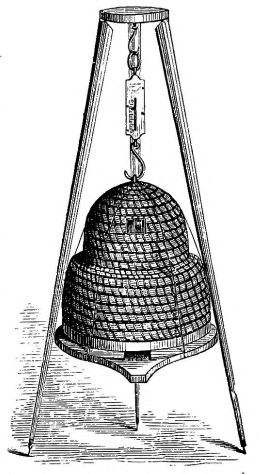
A hive can very easily
be weighed if a Salter's
spring balance be suspended
near the apiary.
The hive, having a strap
or cord passed under and
over it, crossing at right
angles on the top, may be
hooked on to the balance,
so that the weight will be
indicated on the dial.
The annexed illustration
represents a tripod stand,
with a weighing-machine
of the above-named construction,
to which a hive
with a super is attached.
Such an arrangement will be found convenient for those
bee-keepers who may not possess suitable sheds in their
gardens where a hive could be thus suspended from a
beam. To prevent the hive being swayed to and fro
by the wind, three cords (gear ropes) might be attached
therefrom to the three legs of the stand. The height of
such a stand need not exceed four feet.
This contrivance is both portable and simple, and can
be used from time to time; or, if the apiarian desires to
have the hive constantly suspended, a water-proof covering
might easily be made to drop over, and adapted so
as to admit of being raised occasionally for ascertaining
the weight shown on the dial. Much interest might be
derived by watching the daily or hourly increasing store
brought into a hive during the gathering season. Mr.
George Fox, of Kingsbridge, and Mr. S. Bevan Fox, of
Exeter, have for some years each kept one stock attached
to a "Salter's Circular Spring Balance," suspended from
a beam under a shed, and, from experience, found that
from a hive so balanced a criterion may be formed of
what other hives in the apiary are doing through the
day.
Some interesting observations have been made upon
this point. Baron von Berlepsch has had stocks which
brought in twelve pounds of honey in a day; Kader in
Mentz had days when one stock brought twenty-one
pounds; Pastor Stein in Mentz had days when one stock
brought twenty-eight pounds. The sap which a bee's
honey-bag holds weighs but a grain, so that the bees, in
this last case, must have made in one day over 160,000
journeys.
Many ingenious contrivances will, no doubt, suggest
themselves for the observation of hives in this manner.
For instance, instead of the cord being tied round the
hive, three or four strong irons, with a screw at one end
and a ring at the other (known by ironmongers as "eyes"),
could be screwed into the floor-boards, to which the
attachments might be made fast. It will scarcely be
necessary to hint that great care is necessary that full
provision should be made securely to support the increasing
weight; a fall would be most ruinous, and terribly
enrage the bees.
The weight of the hive should be marked on it when
empty, so that the exact amount of its contents may at
any time be ascertained. Experienced apiarians are able
to judge of the weight of a hive by lifting it a few inches
from the stand; or by looking in at the window of a
stock hive a conclusive opinion may be formed as to the
state of the colony. If the combs within view be well
filled and sealed, it will be safe to consider that the hive
contains sufficient stores to carry the bees through the
winter.
The bee-keeper, after the honey harvest, should ascertain
the state of the stock hive, because it sometimes
happens that hives which were very strong and productive
during summer have been left poorly off for the winter.
The bees, no doubt under the impression that those
nicely filled supers would prove to them an ample sustenance,
have given up the whole stock hive to the queen
for breeding. If this be not looked after and rectified
the colony will starve off; or possibly on some mild day
in winter—even before all is exhausted—they will decamp
as if for a swarm.
The apiarian must therefore ascertain the state of
the stock hive at Michaelmas by means of a weighing
machine. The weight, exclusive of the hive, ought to
be from twenty to twenty-four pounds, and if not so, the
bees must be fed till that weight is reached. This is
done by the feeders above described (page 202), from
which they suck the syrup as if honey-gathering, and
then store it away, a quart in a day or so. The time of
doing this should not be deferred later, as it is important
that the food should be placed in the cells and sealed
up, and they cannot secrete the wax for this purpose without
a warm temperature; if it remained unsealed it would
be liable to turn sour and cause disease. Again, at
mid-winter and in very cold weather, bees, though they
never become torpid like wasps, are in a state of dormant
inactivity from which it is better not to arouse
them.
On the return of spring it will again be essential to
attend to feeding the bees, and this precaution must be
exercised till May, when they will be able to take care of
themselves. A little food in the spring, even when the
store is not all expended, is of value as stimulating the
queen to lay more abundantly, for bees are provident
and do not rear the young rapidly when supplies are
short. In this particular their intelligence is very striking;
they have needed no Malthus to teach them that
the means of subsistence must regulate the increase of
population.
"Part of the wondrous whole by Heaven designed,
Blest with some portion of ethereal mind,
[31]The prescient female rears her tender brood
In strict proportion to the hoarded food."
Evans.
Judgment has, however, to be exercised to avoid over-feeding,
or else so many cells will be filled with honey
that the queen can find none in which to deposit her
eggs, and thus the progress of the hive will be seriously
interfered with. It may also lead to the formation of
drone cells—a thing to be avoided under any circumstances.
But if the hive is thoroughly impoverished a
more rapid process of feeding becomes necessary, and
the honey should be poured between the combs. The
bees will lick each other clean after this.
A very good syrup can be made by boiling three
pounds of loaf sugar with nearly two pints of water.
Sugar-candy and barley-sugar have also been each highly
recommended for winter and early spring feeding, when
small pieces can easily be pushed in at the top of the
stock hive a little at a time. They have the advantage
of being unlikely to turn sour or to cause dysentery, as
liquid food does when the bees are confined by bad
weather.
It is of the most urgent importance that the bees
should have water supplied them as soon as laying recommences,
which should be early in January; if the
weather is such as to prevent their leaving the hive, they
must have it given them within. "For preparing the
nourishment for the brood," says Dzierzon, "water is to
the bees indispensable. Sooner could they dispense for
a considerable time with pollen." It is also needful to
them for the preparation of wax, and, adds the same
writer, "when the egg-laying commences, some amount
of wax is usually produced equally soon, the bees requiring
it for the covering of the brood cells." For a double
reason therefore water must be supplied them; but in
their eagerness to obtain it they are often drowned, so
that It is well to give it them in shallow vessels containing
pebbles for them to alight on. Salt also, says Dr. Bevan,
is eagerly partaken of during the early part of the breeding
season till the beginning of May, after which they
seem wholly indifferent to it.
Such are the instructions for the regular process of
feeding, though even this, with good management, should
not be needed unless in exceptional circumstances. It
has been remarked in the section on "Swarming" that a
supply of food is advisable at such occasions also, but
this is but an incidental trifle as compared with the other.
The task of bringing a hive safely through the winter
will undoubtedly dismay some of the inexperienced, and
perhaps incline them to a preference for the fire-and-brimstone
quieters. But a little attention to directions
at the first will soon make the process tolerably simple;
while as to the relative profits of the two methods, it
must be recollected that the honey left in the stock hive
for winter sustenance is not much of it of a saleable
quality, and the value of it and of any extra syrup supplied
will be far more than made up when in May a swarm
comes off, and two colonies are possessed where on the
old system there would have been none at all.
The most important of these is the one discussed in
the preceding section. There are, however, several other
points which it is of consequence for the apiarian to
observe.
First of all the hive itself must be suitably protected
against climate, and if it be not of a description adapted
to preserve warmth, a transfer must be made to one that
is. Matting or other fencework may be erected to keep
off piercing winds, and hay bands may be wound around
the hives. Some hives constructed Of glass are unsuited
for winter occupation—even when kept within
doors success is difficult and doubtful. They must be
well wrapped up and covered in, and yet ventilation be
allowed, for unless the moisture can pass off it will condense
upon the inside of the glass, thus causing the
combs to grow mouldy and directly interfering with the
health of the bees. The use of such hives as the unicomb
is best restricted to four months in the year, when bees
are most active and interesting in their operations. An
artificial swarm should be put into such a hive in May
or June, and taken out again in September—never later,
for there are often cold nights in October, when, the bees
and brood being in near contact with the glass, and not
being able to cluster as is their natural wont, they suffer
greatly from the variations of temperature.
The population of each hive must also be well looked
to, and if needful the uniting processes (page 229) must
be carried out before the Michaelmas feeding. Hives
that are to be so united should be gradually brought near
together, if not so already.
The innermost combs, having been the ones most employed
for breeding, will now be the ones least occupied
with honey. It is therefore advisable to transpose them
with fuller ones, in order to keep the bees clustered in
the centre. They must not, however, have drone comb
thus given them. In order to give them communication
through the combs, "the apiarian should," says Langstroth,
" late in the fall, cut with a penknife a hole an
inch in diameter in the centre of each comb, about one-third
from the top." This is for the purpose of allowing
the bees in cold weather to move in a body, without
going outside the frames, from combs where they have
consumed the food to others that have honey within
reach.
Ventilation is of great moment, but if the hive allows
of its being given at the top, the entrance may then be
narrowed so as only just to give free passage to the bees.
Holes the size of a pin's head will allow the moisture to
escape, and these must be reopened as fast as they are
propolised by the bees. The occurrence of a thaw is
the time when ventilation is needed in its highest degree.
It is a good plan to place a bell glass over the hole in
the crown-board of a wooden hive, with a zinc trough
round it to receive the condensed moisture. It is also
requisite to clean the floor-board, say in February; but in
this and other operations the bees should not be disturbed,
for if they leave the hive when they are unable
to fly properly, as is the case in very cold weather, they
are likely to be lost.
What further directions belong to this head will be
found in the next chapter under "Diseases" and
"Enemies."' Mr. Langstroth has this comprehensive
sentence, the italics in which are his own. "If the
colonies are strong in numbers and stores, have upward
ventilation, easy communication from comb to comb, and
water when needed, and the hive entrances are sheltered
from piercing winds, they have all the conditions essential
to wintering successfully in the open air."
CHAPTER VI. MISCELLANEOUS INFORMATION. — § I. STINGS: THEIR PREVENTION AND CURE. — § II. POSITION OF HIVES. — § III. PASTURAGE FOR BEES. — § IV. HONEY. — §. V. POLLEN, OR BEE-BREAD. — §. VI. PROPOLIS, OR BEES' CEMENT. — § VII. SECRETION OF WAX. — § VIII. ROBBING. — § IX. DISEASES OF BEES. — § X. BEE ENEMIES. — § XI. BEE-KEEPING IN LONDON. — § XII. GENERAL REMARKS.

SOME of our readers may deem us neglectful in
having, as it were, left them to struggle through
their bee-keeping novitiate without informing
them how to avoid the annoyance of stinging from their
docile but well-armed flock. Of course, having described
the bee dress, we have supposed that the apiarian was clad,
if not "in complete steel," at least in the head-gear and
gloves, which will render him invulnerable. The best
safeguard from the anger of bees—as, indeed, from the
malice of men—is a quiet and peaceable spirit. Never
strike at a single one. The apiarian will learn to handle
his bees not only as "if he loved them"—as the quaint
angler says—but as if he fully believes that the bees love
him. This they will do whenever he approaches and treats
them gently. There are some cases of exception to this
generally peaceable disposition of the bee; perchance a
few bees are dyspeptic, and refuse to be pacified, let
their master seek to bribe them never so wisely. Then,
too, sometimes the bee-master himself may be dyspeptic,
which the unerring olfactory sense of the bees speedily
detects, and their anger is immediately aroused. Some
few persons, owing to constitutional peculiarities in their
breath or insensible perspiration, are objects of constant
animosity with bees, who, by driving them from the
apiary, are giving a physician's advice without charge for
a fee. Some of the choicest perfumes used by ladies are
offensive to bees; and one may feel very certain that
the "fine puss gentleman," who disgusted the brave
Hotspur with his "pouncet-box" and praise of "'parmaceti
for an inward bruise," would have been speedily
driven from an apiary in ignominious flight. For the
same reason they will ferociously, and perhaps fatally,
attack a sweaty horse, while they appear to have an
equal antipathy to dogs. The hand should not be
waved near them in sprinkling, as has already been
remarked; nor should they so much as be pointed at
when disposed to be out of temper. "Above all," says
Mr. Cotton, "never blow at them; they will try to
sting directly if you do." The distinguished success of
Burnens in his examinations was attributed in part by
Huber to his power of repressing his respiration. Confidence
is another important specific: if a person covers
his face with his hands the bees will attack and worry
him at once and persistently; while a bee that is inclined
to sting will often prefer a person who is watching at a
supposed safe distance, judging such person afraid, and
probably also seeing him better.
Again, when once a bee has stung, the scent of the
poison has an infuriating effect upon others; therefore,
says Butler, "you had best be packing as fast as you
can." Höfler, who lived in the same century, gives the
advice, "Never approach the bees with your hat off; for
a bee which may chance to have settled upon the head
becomes easily entangled in the hair, grows angry, stings,
and moreover calls others to its aid by its hissing passionate
note." They have a dislike for woollen gloves, also
to some kinds of leather ones. If used to attendants in
light clothes it is said they will attack a visitor whose dress
is dark. Electricity in the air appears also to ruffle them;
and when kept at home by rain, or at night or early
morning, they will resent any interference. In very hot
weather, too, those inside the hive are sure to be in a
bad humour. Von Berlepsch states that to disturb the
combs at such a time may perhaps, by breaking them,
even cause a civil war in the hive, as once happened
to himself when exhibiting an Italian queen and brood
to some over-curious tyros, and when, out of some
seventy or eighty thousand bees, one-half were slain in
the course of an hour. Lastly, they are in a stinging
mood when they are queenless and before they have got
over the agitation; also when in excitement during her
majesty's nuptial excursion. The best time to choose
for operations is when, with the hive in a normal condition
and the weather agreeable, the great mass of the
older bees are out upon the wing. It is these that there
is the principal occasion to fear.
Occasionally even a skilful aparian may inadvertently,
crush a single bee; such a mischance is detected by the
whole community with much more facility than by any
"crowner's quest," and their prompt verdict decrees the
summary punishment of the offender. There would be
much less fear of stings if it were always remembered
that bees are never aggressive. "Defence, not defiance,"
is their motto. They scarcely ever attempt to
sting when away from the hive, and very seldom indeed
at the time of swarming, for then they are gorged with
honey. When molested by angry bees, do not attempt
to beat them off; the safest and best retreat is a green
bush. Thrust your head into this, or, if no such refuge
is near, in an emergency throw yourself on the ground,
and, with face downwards, the bees will soon leave you.
Yet some people appear to think they must inevitably
be stung if they, meddle with bees, and for their sakes it
is needful to explain why it is that a sting is painful, and
how the wound inflicted by the bee may be cured. The
weapon, as we see it with our naked eye—finer than a
needle's point—is only the sheath, which lengthens or
contracts like the tubes of a telescope (see page 104).
The dart, as before said, is barbed on each side, so that
the bee, when very angry, is scarcely ever able to
withdraw it, but—
"Deems life itself to vengeance well resigned,
Dies on the wound, and leaves the sting behind."
There are, indeed, some happy mortals whose "blood
such an even tenour keeps" that a bee-sting is to them
simply a puncture, and nothing more. But unfortunately,
as Langstroth puts it, "they seem to take a mischievous
pleasure in stinging those upon whom the poison produces
the most virulent effect." Dr. Bevan has suggested
that lovers should subject themselves to the ordeal of a
bee-sting, in order to prove, we suppose, that their
temper is proof against "the stings and arrows" of any
"outrageous fortune" that matrimony can bring.
It is the infinitesimally minute tincture of poison injected
by the bee which causes inflammation. The first
thing to do is to remove the sting, which, even when
detached from the bee, will continue to penetrate still
further into the wound. Next press the hollow point of
a watch-key exactly over the place stung; this will express
a considerable portion of the virus. Then dip the
hand into, or bathe the part with, cold or tepid water,
for the poison is volatile, and will thereby be dissipated,
to a great extent. On no account whatever should the
part affected be rubbed; to do that will diffuse the poison
and increase the inflammation. The specific remedy for
a bee-sting is taught us by chemistry: the venom is an
acid, which an alkali will immediately neutralise when
brought into contact with it. Spirits of hartshorn will
generally be found efficacious, and should therefore
always be kept in an apiary. There are also several
other remedies more or less effectual, according to the
special constitution of the patient. A strong infusion of
tobacco-water applied to the wound after the sting has
been extracted is a specific for many persons; others
find relief from the application of a sliced onion, while
Frau Lieb, of Jassy, declares nothing so efficacious as
one's own saliva. Two preparations may be named as
made especially for the purpose—the "Ledum Palustre,"
and Dr. Pine's "Bee-keeper's Lotion."
We have heard the remark from several who have kept
bees for years, that the poison from a sting has little or
no effect on them; after receiving many inflictions their
flesh appears to become so little affected that the swelling
and pain at one time experienced no longer trouble
them. Herr Kleine recommends bee-keepers to subject
themselves intentionally to stinging, in order that in two
years their system may become insusceptible to the
poison. No doubt those who are, so stoically inclined
will duly appreciate and gratefully acknowledge the
advice.
Boiling water poured on to bees makes a bee tea
which has been highly recommended in bad cases of
strangury. Bee poison itself is a specific with homœopathists,
but one bee-sting is not cured by a second, as Mr.
Langstroth satisfactorily demonstrated at the cost of
much personal pain.
Some writers on bee-culture attach much importance
to the particular position in which an apiary stands and
the aspect towards which it faces. A southern, or rather
a south-eastern aspect, is the one which we recommend.
Our reason for this preference is that we deem it very important
for the bees to have the first of the morning sun.
Bees are early risers, and should have every inducement
given them for the maintenance of so excellent a practice.
A few years since, many strong opinions were expressed
in favour of a northern aspect for hives. The
chief reason given for those opinions, though very
plausible, appears to us to be a very partial and inadequate
one. It was said that, when the hives face
the south, the bees may, like the incautious swallow in
the fable, be tempted to fly abroad in the transient
winter sunshine, and then perish in the freezing atmosphere
when a passing cloud intervenes. But it is a
very easy matter, if considered needful, to screen the
entrance by fixing up matting so as to intercept the rays
of the sun. At our own apiary we make no alteration
in winter, under the belief that the bees will take care of
themselves and that they seldom venture out when the
weather is unsuitable.
Columella gave a number of directions on this point,
the essence of which may be stated as follows. If in a
valley it will be easier for the loaded bees to return
home than if on a hill; it must not be "exposed to
noisome smells, nor to the din of men or cattle;" it
should be near a shallow running stream with pebbles
for the bees to alight on, but not near deep water with
steep banks'; and the trees near should be low, and
convenient for manipulation in swarming.
The vicinity of sugar warehouses, or other places of
temptation of the kind, is certain to prove prejudicial if
not fatal to an apiary. The beeish instinctive love for
sweets, like all other good things, has its bad side, and
here we see it developed into a propensity to acquire on
the shortest and easiest though most suicidal method.
Mr. Langstroth tells us that he once furnished a sweet-shop
will gauze windows and doors, when the bees
"alighted on the wire by thousands, fairly squealing with
vexation," and in desperation they descended the
chimney, which had to be stopped in like manner.
"Bees work for man; and yet they never bruise
Their master's flower, but leave it, having done,
As fair as ever, and as fit for use."
Apiarians generally agree in the opinion that very little
can be done in the way of providing any special forage
for bees. Yet bee-fanciers are always interested in
observing which are the flowers that the bees prefer;
and there are certain well-established conclusions as to
the kind of districts and seasons which are the likeliest
to produce a good honey harvest. There is an old saying,
that a country which produces the finest wool also
yields the best honey; and a pastoral district is decidedly
better than one under tillage. The principle of the
matter is, that the bees are best suited with a long dry
season—an early spring, a hot summer, and a late
autumn. As not one of these blessings can be commanded
by the apiarian, his art must be applied to
providing some mitigation of the injury suffered by the
bees when the season is short or wet. For early springs
the crocus, the blue hepatica, and the violet all afford
good supplies of pollen and honey, and, if cultivated
near the apiary, will be of great service when the wild
flowers are backward. All varieties of the willow and
poplar furnish early supplies of honey, as well as of the
propolis to be presently described; the blossoms of the
gooseberry and currant are very useful for the bees in
May. Wet, when it enters flowers of any kind, prevents,
the tongue of the bee from reaching the secret source of
honey. On this account it is well to know, as does the
bee, that the drooping blossoms of the raspberry escape
the effect of the showers, and honey is gathered from
them when other flowers are drenched within as well as
without. For a similar reason borage (Borago officinalis)
is valuable for bees, and also because that plant continues
to flower until the frosts set in. The honey both
from raspberry blossoms and borage is very superior.
Mr. Langstroth says, that "the precipitous and rocky
lands of New England, which abound with the wild red
raspberry, might be made almost as valuable as some
of the vine-clad terraces of the mountain districts of
Europe." The golden rod and also asters afford superior
honey for autumn gathering. Dzierzon strongly recommends
buckwheat being sown in the winter stubbles on
behalf of the bees, and he tries hard to persuade farmers
that it is to their interest to cultivate it. It should be
named that all the ordinary fruit blossoms, especially that
of the apple, supply abundant store for bees.
It is, however, to wild or field flowers that the bee-master
must chiefly look for the raw material on which
his myriad artisans shall exert their skill. The white
clover of the pasture,[32] the wild thyme on the hill, the
heather on the moors, the furze and the broom on the
sandy waste, offer exhaustless stores for a greater number
of bees than can ever be located near them. Lime
trees, when in blossom, and mignonette are also most
valuable resources; and there are two or three peculiar
sources of honey which one would not have suspected,
as, for instance, the blossoms of the onion plant, of
turnips, and, in still greater degree, the flower of the
mustard plant.
In those districts of England where mustard seed is
cultivated so extensively, it would be well worth while
for the farmers to keep large colonies of bees. Another,
but a very uncertain, source of honey is the "honey-dew,"
which in some seasons appears in large quantities
on the leaves of the oak, the lime, and some other
trees (see below).
All that need be said in this place is a few observations
upon honey considered in itself. Practically, but
not absolutely, it is destitute of nitrogen, which is the
flesh-forming principle in food. It has been much
contended whether or not it undergoes any transformation
by being swallowed by the bee. Dzierzon and
others have maintained that it does; Gundelach and
Dr. Dönhoff have taken the contrary view, and Von
Berlepsch has come round to the same, which it will be
seen is also held by Schmid and Kleine, from whom we
translate the following description of this article:—
"Honey may be of diverse origin: it is either nectar
or bud honey, or leaf honey (the so-called honey-dew),
or aphis honey [another form of honey-dew], or fruit
honey. The sources of honey unfortunately do not flow
with the same strength everywhere and at all times.
"For collecting the honey, bees are provided with
tongues and honey-stomachs.... In the stomach the
honey undergoes no transformation; only by evaporation
in the cells does it receive its subsequent distinctive
character. After sufficient evaporation the cells that
contain it are sealed over with flat wax lids.
"Between different honeys there exists an essential
difference in respect of aroma, taste, colour, and composition.
Whether there is such a thing as poisonous
honey is a question upon which opinions are divided.
"In trade honey is often adulterated with starch,
syrup, sugar, and more pernicious ingredients, which
can easily be detected by chemical and microscopical
analysis. The crystallisation of honey differs essentially
from that of sugar or of a mixture of honey and sugar."
On this matter of adulteration we have been favoured
with some remarks from a well-known apiarian who
writes under the name of "A Lanarkshire Bee-keeper."
He recommends the purchaser to take a common test-tube,
nearly fill it with water, and add about one-twelfth
as much of the honey; when dissolved it will be turbid
if the honey was pure, but clear if sugar had been
mixed with it. Those who wish to proceed further
may add a few drops of concentrated nitric acid, and
then let the tube stand for a week, at the end of which
time the honey will be precipitated, but the sugar remain
in solution, and then by filtration the quantities may be
found.
Honey, like most vegetable products, should be fresh
every year. It may easily be kept from one season to
the next; but after that, unless carefully stored in a warm
temperature, it will crystallise in the comb, or perhaps
ferment if separated therefrom.
Bees will often gather honey from the laurel, ivy, or
other sources more agreeable to themselves than to us,
in which case there is little choice but to leave the
benefit of it to its producers (see page 97). Again, the
fact related by Xenophon in the retreat of the Ten
Thousand, that bees in Asia Minor extracted honey
from plants which had not only a disagreeable but a
poisonous tendency to man, shows that it is quite possible,
where such noxious plants abound, for the bees
to extract the juices without any injury to themselves.
Bees, when fully grown, feed almost wholly on honey;
but the larvæ require for their development a more substantial
kind of nourishment. Such solid fare is found
by the bees in the pollen of flowers, a farina which contains
the nitrogenous element of which honey is nearly
destitute. The body of a worker bee is covered with
hairs, to which the pollen adheres when, by contact with
the bee, it is rubbed from the anthers of flowers (see
page 88). Dewy mornings or humid bowers suit the
bees for the gathering of the pollen. If the atmosphere
be too dry for kneading it into pellets, they roll themselves
in the blossoms, and on their return, with assistance
from others, brush off the farina into the cells intended
for it. A portion of this "bee-bread" is taken at once
by the "nursing bees," who are supposed to subject it to
some change before offering it to the larvæ; but the
greater part of the pollen is stored away and reversed
in the cells for future use. In April and May the bees
are frequently busy "all the day" in gathering pollen,
and often one community of bees will collect about
twenty pounds weight of "bee-bread" in one season.
One of the objects of the apiarian is to assist the bees
in providing for the nurslings of the hive. Dr. Dzierzon
first suggested the plan of providing the bees with "unbolted
rye meal" as a substitute for the farina of flowers.
He had observed that, in early spring, before the flowers
were open, his bees had entered a neighbouring cornmill,
from whence they returned laden with rye flour. Since
his discovery, some keepers, in early spring, have placed
rye or wheat meal near the apiaries; to this artificial
store the bees repair by thousands, and seek to rollick
in the enjoyment of such plenty, many of them returning
to the hive as dusty as millers. The object in thus supplying
them is that the brood may be rapidly brought
forward, and early swarming induced. In this way a few
pounds of rye meal, at one penny per pound, may tend
to the production of very many pounds of honey of
twelve times the price.
In the British Bee Journal there is a recommendation
to sprinkle pea flour amongst deal shavings in any
open vessel, and place this near the hives so that bees
have access to it. We can endorse this recommendation,
for we know that it is freely taken by the bees.
If the bee-keeper ascertains that for some interval no
pollen has been conveyed into any particular hive he
may regard it as a sure sign that no young bees are there
hatching, and consequently that the hive is without a
queen. Mr. Mahan, of Philadelphia, once met with a
hive which no pollen had been seen to enter for twenty-eight
days; he put a queen into it, took out his watch,
and observed in three and a half minutes a bee come in
with pollen on its legs—many more speedily following!
Some remarks on the services which bees render to
flowers will be found in the section upon "Faculties and
Functions" (page 55).
"Propolis" is a Greek word which originally signified
"the outskirts of a city," but was adopted by Latin
writers on bees to denote the sticky substance with
which these city-rearing insects protect their outskirts.
It is "a resinous substance, very tenacious and semi-transparent,"
which is indispensable for the bees as a
cement wherewith to fix their combs and fortify their
hives against intruders.[33] The bees, in working the propolis,
often soften it by blending it with a portion of
wax; but they have to extract it in its natural state
directly from the bark and buds of certain trees. The
bark of the willow, the leaf-buds of the poplar and alder,
and the unopened blossoms of the hollyhock are very
usual sources of propolis. In the case of a new swarm,
as bees must have this glue before they can begin to
build their combs, they will resort to most unlikely places
to obtain it. Sometimes they will enter a paint-shop and
attack the varnish, and it is said they have been seen to
obtain propolis from the pitch and rigging of a ship.
These circumstances afford intelligible hints to the
apiarian, who, if his bees have not easy access to firs,
poplars, or willows, will provide some glutinous or
resinous matter which may serve for a substitute. The
extraction of propolis costs the bees very considerable
labour, which they should be relieved of as much as
possible in order to facilitate their great work of honey-gathering.
Bees choose the warmer part of the day
during which to gather propolis, as then it does not so
rapidly stiffen. Frequently when they arrive at the hive
it has become so hard that the other bees are scarcely
able to gnaw it from their thighs.
With propolis bees fasten down their hives, stop up
crevices, to exclude moths and ants, and sometimes use
it to narrow their doorways against the invasion of wasps.
Extraordinary anecdotes are told of the prompt and
ingenious use they make of this substance. Réaumur
relates that, a snail having been observed by the bees on
the window of the hive, they proceeded to glue the shell
to the glass, and there sealed down the intruder in hopeless
durance. In another case, that of a slug, the bees,
having slain it with their stings, were quite unable to remove
it from the hive. With wonderful foresight they
then proceeded to secure their community from the
noxious effects likely to arise from the decay of the
carcase; and this they did by completely enveloping it
with a coating of impervious varnish. Huish relates a
similar occurrence in the case of a mouse caught in a
hive by bees. Propolis yields benzoic acid, and contains
some aromatic properties.
We have already made some remarks upon wax in the
Chapter on "Anatomy and Physiology." The subject
is one that even yet has not been thoroughly cleared up,
though the discoveries of Hornbostel and Huber have
demonstrated that instead of being a vegetable product
extracted from pollen it is a fatty secretion of the bees
themselves. But later observers have come to the
conclusion that though not obtained direct from pollen,
that food is essential to their power of secreting it.
Cases are certainly recorded in which combs have been
built when the bees had for several days been deprived
of the means of procuring this food, but it has not been
shown that bees which have never had access thereto
have still the power of secreting wax; Langstroth on the
contrary asserts that some pollen is always found in
the stomach of wax-producers. So Dzierzon: "Even
if wax, as a fat, is [like honey] a substance destitute of
nitrogen, and even if feeding upon honey or sugar is
alone sufficient to enable the bees to prepare it, it does
not therefore follow that pollen is not necessary for its
continued production. For, as already remarked, the
bees can prepare food for their young for a considerable
time without pollen, yet no one would assert that this is
unnecessary for the nourishment of the brood. In the
one case as the other the bees are sustained by a certain
store taken into themselves, but which by degrees becomes
exhausted." To yield one pound of wax they
require to consume from thirteen to twenty pounds of
honey; so that it would seem as if honey was the food-forming
principle of the wax, and pollen the stimulant
that imparted to their own organs the capacity for effecting
the transformation.
The bees, it need hardly be stated, elaborate this
secretion by clustering themselves in festoons and curtains,
in which they remain, the fore legs of one clasping
the hind ones of another, perfectly still for some twenty-four
hours, at the end of which time the scales are found
exuding around them, as mentioned in our earlier reference.
The little plates of wax are withdrawn by the bee
itself with its hind feet, and carried to the mouth with its
fore feet, where the wax is made soft and ductile;
vigorous shakes of the body assist in detaching the
plates, and the floor-board is afterwards found covered
with the pieces that have fallen. One by one some of
them then leave the cluster and deposit their burdens in
rough masses, which are subsequently wrought by others
into the hexagonal form. But it seems feasible that the
lower bees pass their secretions up the living ladder to
the uppermost ones to undergo this double process. The
rapidity with which comb-building progresses at such
times would lead to the supposition that there is a
division of labour of this kind among them, just as our
labourers convey building material to the artisans on the
scaffold above. This work of comb-building is carried
forward in warm weather, for a cold temperature interferes
with the secretion of wax. Von Berlepsch declares
that he has known cases in which a hive has built three
hundred square inches of comb in a single night!
The secretion of wax, and the method of its adaptation
by the bees, are thus admirably described by Evans:—
"So, filtered through yon flutterer's folded mail,
Clings the cooled wax, and hardens to a scale.
Swift, at her well-known call, the ready train
(For not a buzz boon Nature breathes in vain)
Spring to each falling flake, and bear along
Their glossy burdens to the builder throng.
These in firm phalanx ply their twinkling feet,
Stretch out the ductile mass, and form the street,
With many a cross-way path and postern gate,
That shorten to their range the spreading state.
Those with sharp sickle, or with sharper tooth,
Pare each excrescence, and each angle smooth,
Till now, in finished pride, two radiant rows
Of snow-white cells one mutual base disclose.
Six shining panels gird each polished round,
The door's fine rim with waxen fillet bound,
While walls so thin, with sister walls combined,
Weak in themselves, a sure dependence find."
We have had many times to allude to the truly sad
character which our little favourites bear in this particular.
Directions as to the precautions necessitated thereby
have been given pretty generally in connection with
operations in which it is to be feared, so that one or two
general remarks are all that need be added here. Von
Berlepsch stoutly maintains that there are no professional
robbers amongst the bees, but that all are ready to lend
a hand in a job of the kind when it is to be had. This
is probably true in great part, but not to the extent that
there exist no individual differences in the strength of
the propensity, and the remark quoted from Dzierzon on
"black" bees (page 72) may be taken as expressive of
the other side of the truth.
It is queenless stocks, nucleus hives, and weak colonies
in general that have most need for protection against
enemies of their own kind. By keeping the entrances
narrowed, and feeding carefully without leaving a trace
of food about, the enticements to plunder may be
kept down as much as possible. It has been recently
recommended in extreme cases to saturate a rag with
carbolic acid diluted with water (fully half); this will
effectually repel all except those who have no other
home to which to betake themselves. But it will be
obnoxious to these latter as well, so should not be lightly
resorted to.
Mr. Langstroth has a capital little bit about a highhanded
piece of audacity that has been occasionally
observed in our insect. House-robbing, it seems, is not
bad enough for them, but they will even go the length
of acting as highwaymen and garotters. For thus runs
the story of their waylaying and despoiling the humble
bee: "Seizing the honest fellow they give him to understand
that they want his honey. If they killed him they
would never be able to extract his spoils from their deep
recesses; they therefore bite and tease him, after their
most approved fashion, all the time singing in his ears,
'Your honey or your life,' until he empties his capacious
receptacle, when they release him and lick up his
sweets."
Dysentery is a disease produced either by long confinement,
by dampness, or by feeding in the winter. The first
thing bees do when disturbed is to fill themselves with
food, so that in winter weather, when they cannot get out
to void their fæces, hives should not be meddled with,
otherwise the complaint may be brought on. It is also
engendered in many instances by the state of the weather
in winter months, and is indicated by the yellow colour
of the excrement, and by its being voided upon the
floors and at the entrance of the hives, which bees in a
healthy state generally keep clean. All that can be
done for them when affected is to see that there is plenty
of wholesome food in the hive, and to well clean or to
change the floor-board, and so produce cleanliness.
The more formidable, but happily less common,
malady of "foul brood" does not attack the bees themselves,
but affects the larvæ, by causing them to putrefy
in the cells, thus destroying all hope of the rising generation.
Bees are exceedingly fond of their young, and
are greatly dispirited when their hives are in this plight.
In common with most pestilential disorders, no satisfactory
cause is assigned for its first appearance. Some
apiarians contend that "foul brood" is another name
for chilled brood; others, that the queen, by a freak of
nature, deposits some of her eggs the wrong way upwards,
and that these putrefy in the cells, and contaminate
the others. Whatever may be the origin, one thing
is very certain—"it is catching:" there is, however, in
the circumstance of the adult bees and of those about
emerging from the cells not being injuriously affected
thereby, a great help to its eradication, as will presently
be shown.
There are two kinds of foul brood—one of which is
dry and not contagious, the brood merely drying up in
the cells; from which partial character it is probably
within the power of the bees themselves to overcome.
In the other kind, instead of drying up, the brood
remains dark and slimy in the cells, and emits a most
unpleasant odour, perceptible at some distance from the
hive.
In the year 1848 Pastor Dzierzon lost a large number
of stocks from this disease; he however was enabled to
banish it from his apiary, and communicated to a
German bee-journal very wholesome advice, which Mr.
Langstroth quotes, and from, which we make an extract;
"When the malady makes its appearance in only two or
three of the colonies, and is discovered early (which may
readily be done in hives having movable combs), it can
be arrested and cured without damage or diminution of
profit. To prevent the disease from spreading in a colony
there is no more reliable and efficient process than to stop
the production of brood; for where no brood exists
none can perish or putrefy. The disease is thus deprived
both of its aliment and its subjects. The healthy brood
will mature and emerge in due time, and the putrid
matter remaining in a few cells will dry up, and be
removed by the workers. All this will certainly result
from a well-timed removal of the queen from such colonies.
If such removal becomes necessary in the spring or early
part of the summer, a supernumerary queen is thereby
obtained, by means of which an artificial colony may be
started, which will certainly be healthy if the bees and
brood used be taken from healthy colonies. Should the
removal be made in the latter part of summer, the useless
production of brood will at once be stopped and an
unnecessary consumption of honey prevented. Thus, in
either case, we are gainers by the operation."
In cases where the disease assumes a more malignant
character—in other words, "has got ahead," through
"not being nipped in the bud"—it will be well to take
notice of another quotation from Mr. Langstroth's book:
"In the spring or summer, when the weather is fine and
pasturage abounds, the following cure is recommended
by a German apiarian: 'Drive out the bees into any
clean hive, and shut them up in a dark place without
food for twenty-four hours; prepare for them a clean
hive, properly fitted up with comb from healthy colonies;
transfer the bees into it, and confine them two days
longer, feeding them with pure honey.'"
The late Mr. Woodbury's apiary was severely attacked
by this disease in the spring and summer of 1863. The
writer happened to be on a visit to him at this juncture,
and witnessed him withdrawing infected combs from
hives that were literally masses of corruption, the brood-cells
of which, on being opened with a pointed instrument,
revealed the dark brown slimy matter before
alluded to, and from which arose a most unpleasant
smell. Mr. Woodbury communicated to the Journal of
Horticulture, of July 21, 1863, an exact and graphic
account of his misfortunes, headed "A Dwindling
Apiary." Finding that the removal of the putrid matter
must be simultaneously effected and the bees driven out
and placed in hives that had undergone a complete
purification, he set about endeavouring to accomplish
his object, and was so far successful that he was able to
furnish an article to the before-named journal of August
4, same year, under the more cheerful title of "Convalescent,"
in which he says: "First, let me endorse the
opinions both of Dzierzon and Rothe, that, except under
very especial circumstances, it is unadvisable to attempt
the cure of a foul-breeding stock: better, far better, to
consign its inhabitants to the brimstone pit; the hive
itself, if a straw one, to the flames; the comb to the
melting-pot; and appropriate the honey to any purpose,
except that of feeding bees."
Mr. Woodbury further says: "Before starting, it was
requisite to ensure the transfer of the bees to unpolluted
hives; and here I found that Dzierzon declares that
every hive that has contained a foul-breeding colony
should be exposed to the sun and air for two years
before being re-stocked. In my own case this was
simply impossible, and I therefore adopted the practice
of another German writer on the subject, viz., to scrape
out the hive very carefully, wash it all over with a
saturated solution of chloride of lime, keeping it closely
shut up for twenty-four hours, and then, after thoroughly
washing it with clean water, exposing it to the sun and
air until the smell of the disinfectant had passed off.
This method has the advantage of enabling one to use a
wooden hive again after a lapse of a couple of days, and
is, I believe, thoroughly effectual."
Mr. Woodbury then captured the queen, secured her
in a cage, and placed her in a clean empty hive; all
her bees were brushed from their combs into it as rapidly
as possible, in order to prevent their carrying much of
the infected honey with them; whilst the combs themselves
were set draining out of the bees' reach, and consigned
as quickly as possible to the melting-pot. After
the lapse of three or four days, the queen (still imprisoned)
and bees were again transferred to another
clean hive, furnished with a few pure combs, and in this
they were suffered to remain, their queen being released
in a day or two, as soon as they appeared contentedly
settled. Mr. Woodbury gives another important hint,
that operations of this kind with tainted combs should
be performed out of reach of robber bees from adjacent
hives, lest they should carry the infection to their respective
houses. By the before-mentioned process, he succeeded
in completely extirpating foul brood from his
apiary in 1863, and had no return of it afterwards.
English apiarian writers have made so little allusion to
this disorder, that some of our older bee-keepers contend
that modern hives and foreign bees have something to
do with bringing it about. To show that the disease
made its appearance in former days, there is a chapter
on this subject in Bonner's "Bee-Keeper's Companion,"
published at Berwick in 1798, entitled "An Uncommon
Disaster which sometimes, though rarely, happens to
Bees." Bonner, after recounting therein his observations
of the dwindling state of his own apiary, for which
he could not account, says: "He saw plainly that the
young were all going backward in the cells, and that he
looked down between the combs, but was unable to
proceed for the stench that the rotten maggots produced."
Mr. Langstroth writes that "Aristotle speaks of a disease
which was accompanied with a disgusting smell, so that
there is reason to believe that foul brood was known two-thousand
years ago."
Our own observation leads us to the belief that foul
brood is caused in many instances by feeding stocks with
fermented honey or with syrup likely to ferment. All
liquid food should be boiled before it is given to the
bees, to destroy any impurity and to make it wholesome,
for in several cases we have found stocks to be infected
that have thus been incautiously fed.
Suspicion may be aroused of the existence of foul
brood in any kind of hive, firstly, by the unproductiveness
of the bees, also by the diminishing number at the
entrance; and if very far advanced the odour will be
very noticeable a few feet from the hive. But in bar-frame
hives an experienced eye will on examination
readily detect the malady if present by the dark unwholesome
appearance of the comb, and by the caps
covering the diseased brood being sunken rather than
raised. Small perforations are noticeable in some, and
in others the grubs may be seen rotting in unsealed cells.
We know of no cure, but some foreign apiarians of
experience recommend injecting a solution of salycilic
acid into every diseased cell; others say that carbolic-acid
will effect a cure; we know that the latter is very
distasteful to the bees and therefore should not be disposed,
to advise its use. The best thing to do is to
break the hive up at once. The bees may be saved by
being put in quarantine a short time, and the hive
cleansed as before mentioned; but if the hive be a
valuable straw one, after cleansing and scraping, the
interior should be coated with shellac dissolved in spirits
of wine. If a frame hive it will be best to have new
frames rather than to attempt to cleanse the old ones.
To allow a hive to die out is very dangerous, because
the bees from other hives will rob and carry the infected
honey to their combs, and thus every colony within bee-flight
is liable to be polluted.
It may be well to give a hint about using old combs.
Any that is very black should be rejected, because the
disease is sometimes present in old hives, and also
because each maggot leaves behind a silken film which
lines the top, sides, and base of the cell, also a slight
deposit of excrement which the bees do not clear away;
thus the cells grow smaller and the bees reared in them
are also diminished in size, although the bees do add a
little to the mouth of the cell. On this account we would
recommend all when purchasing stocks to see that they
are not very old. The combs of a hive may be said to
be the furniture and storehouse of the bees, which in long
service wear out and to some extent become after a lapse
of years unfit tenements for use. To remedy this, Nature,
always true to her laws and careful to make provision for
the perpetuation of the species, may have ordered that
swarming should be the means of establishing fresh
colonies freed from the disadvantages and contamination
of the old. The late Mr. J. H. Payne, of Bury St.
Edmunds, had a straw skep that had had bees in it
without intermission for twenty years, but it is not advisable
to keep them so long, although, with a little
judicious pruning, much may be done to remedy the
defects of old combs. Our own experience for keeping
a stock does not extend beyond ten years.
When we take into consideration how sorely our
farmers are perplexed by the cattle plague, known as
the rinderpest, concerning which so many conflicting
opinions exist (and the same may be said of the recommendations
for its cure), can we wonder that our little
favourites should occasionally be liable to disorders of
this sort which puzzle even experienced bee-keepers?
In the hope of allaying unnecessary alarm, we would
just add that foul brood is not a very general complaint,
and, so far as our observation extends, has been most
fatal in large experimental apiaries, where extensive propagation
has necessarily had to be pushed forward. With
the experience and advice already gained, this disorder
may now be said to be considerably deprived of its terrors.
We find several other complaints described at more or
less length by Von Berlepsch, but to which a very brief
allusion will here suffice. One he speaks of under the
self-explaining title of "thirst-need," as to which he rightly
remarks that it will be the bee-keeper's own fault or inexperience
if his bees are ever allowed to suffer from it.
Then there is "mad sickness," which consists in tumbling
about as if intoxicated, and which Dzierzon says he meets
with nearly every year, and conjectures to arise from
partaking of poisoned honey—he suspects the honey to
be naturally poisonous, since he observes this complaint
almost regularly at the time when the mountain ash is in
bloom. The next is "wing lameness," which the Baron'
conjectures may be the real disorder just spoken of as
madness. Lastly we have the "thread fungus," which is
a growth found by Leuckart and Dönhoff in the stomach
and intestines of several bees, and which they pronounce
contagious. Our author does also include among the
"sicknesses" of bees such irregularities as rising against
and murdering their queen; but one would think that
this was rather a political disorder, or else a case for a
commission of lunacy.
The apparent fungus growths seen occasionally on the
heads and bodies of bees have been found to be nothing
more than the effect of smearing with the gummy pollen
of orchids, or with other glutinous vegetable juices, on
which afterwards ordinary pollen has collected and thus
caused the appearance of tufts or patches.
Bees have few worse enemies than wasps in autumn.
The most effectual method of checking their invasion of
hives is to have as narrow an entrance as the bees can
do with. If a stock is not very weak in numbers the
bees will be well able to guard a small aperture, and can
repel the attacks of these insidious and merciless robbers.
On this account the entrance to our cottage hive,
as described at page 114, may be used.
The bee-keeper is interested in preventing the increase
of wasps; it is therefore a good practice for him
to set a price on queen wasps in the spring, the death of
one of them at that time being equivalent to the destruction
of a whole nest.
Should nests be found in the neighbourhood of an
apiary, their annihilation must be accomplished either
by blowing them up with gunpowder—an operation well
understood by most country lads—or any other effectual
method. The late Mr. Payne recommended that a
small quantity of gas tar should be put into the mouth
of a wasps' nest, and if then covered with earth, the total
destruction of the wasps will be accomplished without
further trouble. But to use blazing straw for the purpose
is always dangerous in country districts. We have lately
heard of a very ingenious and successful mode of entrapping
and killing wasps. Place some sugar or strongly
sweetened compound on the ground in a garden, and
place over it a square hand-glass, wedged up an inch or
so all round. On this glass, which should have an opening
at the apex, lodge another, but a sound one. The
wasps, attracted by the sweets, will soon crowd under
the lower glass, and, when they have well feasted, will
ascend into the upper, one; there, between the two, they
soon become scorched and perish by the heat of the sun
shining on the outer glass.
Some seasons are very productive for the increase of
these prime pests of the apiary, and when this is the case
many hives severely suffer by their depredations. When
once wasps in any number have gained an entrance into a
hive, the bees can seldom eject them, and the invaders
generally remain until they have freely regaled themselves
from the luscious store. They not only consume
the honey, but cause a good deal of worry to the
legitimate inhabitants of the hive, as well as killing the
foremost defenders of it. Wasps being much superior
in strength, it requires at least three bees to master one
of them.
Having suffered loss in our own apiary from the
attacks of wasps, we feel it desirable to give a detailed
account of our troubles from that cause. An Italian
stock was besieged and worried by wasps to such an
extent that in September the bees deserted it in a body.
Fortunately it happened that they chose a time for their
departure just as we visited the apiary. An unusual
turmoil was heard in the hive, such as is experienced at
the time of swarming, and on immediately examining the
entrance we observed that the bees were quitting in
tumultuous haste. The usual methods that induce bees
to settle were tried—amongst others that of throwing
sand up into the air, so that it should fall down amongst
the bees on the wing; but they were dispersed in disorder,
and their flight extended over three adjacent
gardens. We only discovered the clustered bees by
diligent search, as the sequel will show. Permission
being asked of our next-door neighbour, we searched
his garden to see if our bees had alighted there; but
found that they had passed over. Making a similar
application to the owner of the garden adjoining, we
entered, having a straw hive in hand, but no bees were
there. After looking diligently all round, and climbing
the wall, thereby gaining a view of the third garden, we
perceived in it unmistakable signs of an unwonted commotion.
The occupiers of the house were intently
looking at a particular part of the garden, and there was
a dust-pan and a key, with which the master had been
"tanging the bees," to induce them to settle. We
quickly made for the proper entrance to the garden, and
soon discovered our little wanderers clustered to a large
flower-vase. After brushing them into the hive, and
leaving it propped up with a stick, in order that the
stray ones might join, we returned home for an hour or
so, to give them time to settle. Judge of our vexation
when, on returning to fetch the hive home, we found that
the refractory creatures had again taken flight, and that
all the work was to do over again. The wasps were not
to blame for this second flight of the Italians; we judged
that the swarm had been disturbed by visits from a
colony of bees that we discovered were living the life
of outlaws under the roof of an adjoining house. Although
much disheartened and perplexed, we at once
renewed our search, and, upon enquiry, found that the
missing bees had taken a southerly course across the
turnpike road, and it was therefore necessary to ask
permission to search the gardens of the houses opposite.
From one of these we observed, on looking through the
hedge, that the inhabitants of the next house were on the
qui vive. On enquiring whether they had seen a colony
of bees, the wary old dame replied that she "had no
bees but her own," but added that "they were very
much excited." Having asked permission to go through
the hedge to look at her bees, we soon discovered our
Italians on the top of the old lady's bee-house. There
was no difficulty in identifying our own bees; their
yellow rings were as good as a private mark. Quickly
hiving the swarm, we took them home, and replaced them
in the hive they had quitted. It was almost destitute of
honey; but by liberal feeding, and lessening the entrance
so that only one bee at a time could find ingress or egress,
we succeeded in inducing them to rest in their old home.
Thus nearly half a day's exertion was needed to save a
fine colony, which would otherwise have been utterly
lost by the power of the relentless wasps.
Much watchfulness is needed to prevent the loss of
swarms, and the foregoing incident may serve to suggest
the necessity of having hives so located as to be constantly
within view, either from the dining-room, or of
those whose duties oblige them to be near the apiary.
If we had not happened to be at hand at the moment
this colony started, it would have been irretrievably lost to
us, as is the case with many swarms and colonies simply because
the departure takes place without any one to witness.
In the season of 1865 wasps were as few as they were
numerous the preceding year; their paucity was attributable
either to frosts in May or to heavy rains in June,
which destroyed them in their nests. In general wasps
are great depredators of wall-fruit, but in the autumn
before mentioned the bees occupied the wasps' foraging-ground.
Perhaps never in the memory of bee-keepers
did bees feast upon fruit in the same manner. Various
reasons have been assigned for this unusual occurrence;
some thought that as there were so few wasps the bees
were unmolested, and enjoyed the saccharine matter in
the fruit without let or hindrance—for bees are about as
partial to the company of wasps as mice are to that of
rats. Other bee-keepers remarked the sudden and early
termination of the honey-gathering, and conjectured that
the bees, being anxious to make up their winter store,
endeavoured to bring home nectar from the fruit because
the weather was unusually fine. There was one feature
which is worth remarking: as far as our observation
extended, the bees did not, like the wasps, break the
skin of sound fruit, but were satisfied with lapping the
juice of the ripe fruit that had the skin already broken.
There are some birds that are given to preying around
beehives, and if their visits become too systematically
troublesome, it may be worth while to take active measures
for making their presence scarce in order to prevent
these devourers from taking up a position near the
alighting-board and pouncing upon each bee as it makes its
exit. The toad is a less formidable enemy, but if one of
these creatures is found beneath a hive-stand it may fairly
be concluded that he is on the watch for such bees as may
drop to the ground under their loads. Mice, again, will
make their abode in a hive for the winter, and devour the
stores when the bees are too inactive to interfere. Spiders,
ants, and other insects will also have to be guarded against.
Other formidable enemies of bees are moths. These
insects are creatures of the night, as the wasps are of the
day, and they make their way into the hives under cover
of darkness, in spite of the bee sentinels. They deposit
their eggs in any crevices in or near the hive that they
can find. There the warmth of the hive, or of the sheltered
situation, causes the eggs speedily to hatch, and
then the maggots soon work their way to the comb and
larvæ food, which they greedily devour, thereby often
bringing about the gradual but certain destruction of the
whole community of bees. The best method of keeping
moths outside the hives is to lessen the entrance, as
before alluded to. Also, in the early spring, the hives
should be lifted from their floor-boards, which must then
be made thoroughly clean; and all crevices and corners
about the hive and stand should be scraped, so as to get
rid of all eggs of moths and other insects before the
warm weather hatches them or enables them to do
mischief The bee-moth is not so troublesome in England
as it is in America and some parts of Germany;
but still its encroachments should be carefully guarded
against in this country, for if not it may easily increase to
a very serious extent.
There are many persons, now in this noisy city pent,
who frequently remember the days of childhood when,
among pastures of clover or amidst flowery heath and
woodlands, they listened to the cheerful hum of bees.
Partly from a desire to revive these old associations, and
also from a natural liking for the tendance of living
creatures, such persons would be glad to keep bees if
they thought it possible to do so in London or its
suburbs with any chance of success. We do not wonder
that many should doubt even the possibility of bees feeding
themselves amidst such an "endless meal of brick;"
but we can easily prove that bees, if not placed too near
to smoky chimneys, are able to produce honey, both for
themselves and for their masters. To make this plain
we will mention some special instances of metropolitan
bee-keeping.
About a century ago a Mr. Wildman kept a bee-house
and honey warehouse in Holborn, near to where
Middle Row lately stood. He was not only a tradesman,
but was also the apiarian of his day. He kept
hives of thriving bees on the roof of his house in
Holborn, and many of the nobility and gentry used to
mount thither in order to inspect the apiary. At that
period St. Pancras was a "village two miles north-west of
London," and what is now the Regent's Park was open
country. It was then much easier for London bees to
find their favourite forage, but Mr. Wildman believed
that his hives were filled with stores from a considerable
distance. Whilst enjoying his country rambles on
Hampstead Heath, he had a shrewd suspicion that many
of the bees he there observed gathering honey were
labourers from his own apiary. In order to identify his
own flock amongst the rest he hit upon a homely but
very effective expedient. Having borrowed Mrs. Wildman's
"dredging box," he stationed himself near the
entrance of his hives, and gently dusted his bees with flour
as they issued forth. He then betook himself to Hampstead,
where he found his previous surmise confirmed,
for there were numbers of his bees in their livery of white.
Wildman became noted for the remarkable control he
obtained over his bees, many instances of which he exhibited
before the public. Several of his operations with
them were regarded as feats of legerdemain by the uninitiated,
as when he appeared before King George III.,
with a swarm of bees hanging in festoons from his chin,
or suspended in a cluster at arms' length. The Journal
of Horticulture recently, in alluding to Wildman, gives
the following particulars as to his performances:—
"Near the 'Three Hats,' Islington, was a place of popular entertainment
called 'Dobney's Tea Gardens,' kept by Mrs. Ann Dobney.
These gardens occupied the ground between White Lion Street and
Winchester Place, and were established as far back as 1728. In
1771 the house was taken for a short time as a boarding school; but
it was soon changed to its original purpose as a place of amusement,
for in 1772 Daniel Wildman exhibited bees here. This is a copy of
the advertisement:—
"'June 20, 1772. Exhibition of bees on horseback! at the
Jubilee Gardens, Islington (late Dobney's), this and every evening,
until further notice (wet evenings excepted).
"'The celebrated Daniel Wildman will exhibit several new and
amazing experiments, never attempted by any man in this or any
other kingdom before. The rider standing upright, one foot on the
saddle and one on the neck, with a mask of bees on his head and
face. He also rides standing upright on the saddle with the bridle
in his mouth, and, by firing a pistol, makes one part of the bees
march over the table, and the other swarm in the air and return to
their hive again, with other performances too tedious to insert.
The doors open at six; to begin at a quarter before seven. Admittance—Box
and gallery, 2s.; the other seats. 1s.'"
The secret of Wildman's skilful manipulation is well
understood now; it consisted in a careful holding and
disposal of the queen, together with confidence in the
generally inoffensive disposition of bees. Dr. Evans,
whom we have often quoted for his correct information
in apiarian matters, thus speaks of his feats:—
"Such was the spell which round a Wildman's arm
Twined in dark wreaths the fascinated swarm,
Bright o'er his breast the glittering legions led,
Or with a living garland bound his head.
His dextrous hand, with firm, yet hurtless hold,
Could seize the chief, known by her scales of gold,
Amidst the wondering train prune her thin wing.
Or o'er her folds the silken fetter fling."
To recur to our subject. After the days of Wildman
our own establishment in Holborn became widely known
for beehives and honey. Although we never attempted
to start a London apiary at all approaching in extent
that of our predecessor, we have occasionally kept bees
on the house-top, both in Holborn and Regent Street.
At each of those situations we have noticed that the bees
bring pollen as well as honey into their hives. One
summer there was brought under our notice an illustration
of the acuteness of the scent of bees and of their diligent
search for food, proving, too, that if sweets can be obtained,
even from unusual sources, the bees will find
them out. A poor woman, who, at the corner of an adjacent
street, vends "brandy balls," "toffee," "rock,"
and other saccharine compounds—all well known to most
juveniles—used to receive frequent visits from our bees.
Their visits to the old dame's domain were at first rather
interesting, and if the few pioneers who had the sagacity
to find such a store had kept the secret only to themselves,
their company would not have been objected to.
Such selfish policy does not, however, accord with the
social instinct of bees, and these soon informed their
companions of the good fortune provided for them in an
archipelago of sugar islands. Day by day the swarms of
these uninvited visitors increased, until all legitimate customers
were beaten off; and the old dame had to see,
not only her hope of gain destroyed, but her stock of
"goodies" sensibly diminishing by the thefts of these
brigands of the air. She could not, or dared not attempt
to, drive the intruders away, so made diligent enquiry as
to where the robbers were harboured. Having traced
them to our establishment in Regent Street, she came to
implore of us to move the bees if possible, or she would
have to move her stall, and so lose her "connection" in
the "toffee" and "rock" trade. Wishing not to hinder
the poor woman in gaining her livelihood, we decided on
removing our bees into the country.
Another special instance of bees being profitably kept
in proximity to the busy thoroughfares of London is now
before us. Two years ago we supplied a stock of
English bees to a gentleman residing in the Strand, the
back windows of whose house open on the Thames Embankment
and the river. Thus the bees have a fine open
flight, as their hive is placed against the sash on a third
floor (an opening is cut to match the entrance, so that
the bees have a covered way to their hive); from this
they are seen taking their flight across the river Thames,
to what may be thought the unattractive locality of
Lambeth. However, they seem to reach some "green
fields and pastures new," probably in the gardens of the
archbishop's palace, for they return laden with pollen
from flowers, and during the two summers that the
hive has been so located, have yielded nice glasses of
honeycomb as well as afforded a considerable amount of
pleasure to the owner and his friends, with every prospect
of going on flourishing.
It is difficult to assign an exact limit to the distance
that bees will go in search of honey-yielding blossoms.
It has been proved by various experiments that they will
fly, say, five or six miles, if the supplies are scanty within
a shorter radius; but bees well understand that first of
all economies, the saving of time, and if they can find
forage near at hand they prefer it. Hence, other things
being equal, the quantity of honey stored will be in proportion
to the contiguity of good pasturage. In this way
it is that the systematic removal of hives, as practised in
many districts, has such a notable effect on the honey
harvest.
A novel sight for Londoners to witness occurred in
June 1865. A swarm, having been ordered to be sent
into the country the following morning, was temporarily
placed on the leads at the back of our house, 149, Regent
Street. The sun shining hot on the hive, or some other
cause, induced the inmates to decamp. After a time a
passer-by called in to inform us that some bees had arrested
the progress of a cab. We at once conjectured
that they were our missing swarm, the absence of which
had previously puzzled us not a little; so we sent our
man with a straw hive to bring the truants back, which
he succeeded in doing, followed to the door by a crowd,
who were amazed at the sight of the "'oney-bees," as
the Cockney lads called them. Cabby had to be compensated
for the loss of his fare, for the affrighted passengers
had left him in a hurry, so that, altogether, no
little commotion was caused—a crowd so soon collects in
London streets.
During several years we kept bees in the Zoological
Gardens, Regent's Park, and have there frequently taken
full and handsome glasses of honey. The position of our
apiary was on the site now occupied by the new monkey
house. The visitors to the gardens found considerable
interest in watching the bees in our glass hives, and were
afterwards much disappointed at the absence of so entertaining
an exhibition. The writer had the honour of
showing and explaining the working of these hives to
some of the juvenile members of our Royal Family who
had come to the gardens on one of their accustomed
early morning visits with their French governess. Their
conversation was in French; and on entering the bee-room,
"Regardez les abeilles! Voyez done la reine!" was soon
on their lips. The young princesses took special care that
their brother Arthur, as they affectionately called him (now
known by the title of H.R.H. the Duke of Connaught),
should observe the attention paid by the working bees to
their queen, as well as to other points of interest connected
with the busy scene before them, with which they
all expressed themselves much delighted. A collection
of these hives were also exhibited by the Acclimatisation
Society of Great Britain, with living bees in them, at the
Fish Department of the Royal Horticultural Gardens,
South Kensington, and prospered satisfactorily until removed,
the space being required for other objects.
A gentleman residing in St. James's Place has, for some
considerable time past, kept bees in his garden there.
He uses our improved cottage hives, and his bee-keeping
is decidedly successful, as he generally takes some
fine glasses of honey each season, besides leaving sufficient
as winter store for the bees. For a London situation,
St. James's Place is a very favourable one; the gardens
behind the houses pleasantly face the Green Park, so
that the bees have an uninterrupted flight to start with.
They are also within easy range of the richly flowered
gardens of Buckingham Palace and those of the nobility
and gentry who reside around the Parks. To those
gardens the bees of St. James's Place resort, without
waiting for any licence or certificate from the royal and
noble owners of the honey-yielding preserves. Being
within a short distance of our establishment, when this
gentleman's bees swarm he generally sends to us for
assistance in hiving them.
The neighbourhood of St. John's Wood, and, indeed,
almost all the suburbs of London, are favourable for the
production of honey. We mention St. John's Wood
because, from the fact of having kept bees there ourselves,
we are able to prove by experience that they do
well in that locality. We know of several bee-keepers on
nearly all sides of the town who have each had a considerable
surplus of honey in their supers, after leaving
sufficient for the bees themselves in the lower or stock
hives. Whilst referring to this part of the environs of the
metropolis we take the opportunity of explaining that our
own apiary (a coloured view of which forms the frontispiece
of this work) is situated near Hampstead. The spot
is not so easy of access as might be desired, being somewhat
remote from the road, in a portion of a meadow
between West End and Kilburn.
On looking at the picture, it will be seen that there are
a large numbed of hives on separate stands, mostly bar-frame
hives, at some little distance from each other, in
order to prevent confusion when manipulating. At the
back, near the hedge we have some hives on rails, which
like the others are well protected from the weather,
every one having its own covering. Besides these
there are three bee-houses, which are so suitable for preserving
from the weather hives with fixed combs, and
where there is less need for manipulation, such as our
straw cottage hives. One house will contain six hives,
another three, and a third two. These houses are explained
at page 166.
At the back, about the centre of the drawing, is the operating
house, also forming a storehouse or magazine where
apiarian appendages are kept, together with feeding syrup
and combs, etc., so essential for use, and which yet must
be secured from the thievish propensities of the bees, and
access to which, if possible to gain, demoralises them so
much that they make war and attempt to pillage each
other's hives, as elsewhere referred to.
The shallow pans in front (earthen milk pans) have
water in them, and are so placed that the bees may have
access to moisture, which is so essential for them in spring
for comb-building and breeding. Straight straws are
floated on the water so as to admit of the bees imbibing
without the liability of their being drowned.
On this ground we largely cultivate Italian bees, and
unite imported queens to colonies of English bees, to be
ready to supply swarms and stocks therefrom as pure and
genuine as possible.
The district is not so good for bees as if it were farther
in the country and more removed from London smoke;
nevertheless we have had fine supers worked here, and
find it a great convenience to have a bee-farm at so
moderate a distance from' town to carry on this department
of our trade.
Some time ago we exhibited in our window a super
of fine honey from the apiary of Mr. Shirley Hibberd,
the proprietor and editor of the Gardener's Weekly Magazine.
It consisted of a box containing twenty pounds nett
weight of honey, and was produced at Stoke Newington,
only three and a quarter miles from the General Post
Office.
The Times "Bee-Master," whose letters from Tunbridge
Wells awakened so much interest in this pleasing
pursuit, also commissioned us to exhibit a super
produced under his own management in that locality.
Mr. S. B. Fox, at Exeter, had upwards of four hundred
pounds of honey, of excellent quality, though one of his
apiaries is quite within the city.
Book-Keeping.
Every bee-keeper should be a book-keeper, that is so
far as to have a permanent record of the events of the
apiary and the fortunes of his bees. A book similar to a
tradesman's journal would be very suitable for the purpose.
In it he should note down the date of the first
swarm of the season especially, and those of other swarms
also; and in autumn the quantity of honey taken from
each hive should be entered, with remarks on the probable
size and weight of the various stocks. These particulars
will not only be interesting for the bee-keeper to
turn to in winter, but will be of practical service in enabling
him to know the exact age and probable strength of each
stock. The bee-book may also be contrived to show the
total amount of honey that the bees have produced for
their owner, and the nett profits of the apiary. A simple
and clear account like this—provided, by the bye, that it
does show a satisfactory balance—will be very useful for
inducing cottagers and farm-labourers to start bee-keeping.
Nothing like ocular demonstration for this class.
The "humane" apiarian will reason with them in vain
until he shows them a monster skep of honey and mentions
the price that it will fetch in the market. When
convinced that the depriving system will pay, the cottager
will gladly adopt it.
Advice for Cottagers, etc.
A writer in the Quarterly Review (whose article has
since been published by Mr. Murray as a shilling handbook,
"The Honey Bee") gives the following good
advice: "Don't bore the cottager with long lectures;
don't heap upon him many little books; but give him a
hive of the best construction, show him the management,
and then buy his honey; buy all he brings, even though
you should have to give the surplus to some gardenless
widow. But only buy such as comes from an improved
hive—and you cannot easily be deceived in this—one
which preserves the bees and betters the honey. Then,
when you pay him, you may read to him, if you will, the
wise rules of old Butler, exempli gratia:—
"'If thou wilt have the favour of thy bees that they sting thee
not, thou must not be unchaste or uncleanly; thou must not come
among them with a stinking breath, caused either through eating of
leeks, onions, or garlic, or by any other means, the noisomeness
whereof is corrected by a cup of beer; thou must not be given to
surfeiting or drunkenness; thou must not come puffing or blowing
unto them, neither hastily stir among them, nor violently defend
thyself when they seem to threaten thee; but, softly moving by, thy
hand before thy face, gently put them by; and, lastly, thou must be
no stranger to them. In a word (or rather in five words), be chaste,
sweet, sober, quiet, familiar; so they will love thee and know thee
from all others.'"
These "wise rules of old Butler" are, however, in the
main taken from Columella.
Allusion having been made to the profit that may be
gained by the judicious management of bees, we will
illustrate that point by relating an anecdote of a certain
French curé.[34] It is one which may be suggestive to
some of the rural clergy in this country, who might
almost as easily keep an apiary as they do a garden or
an orchard.
A good French bishop, in paying his annual visit to
his clergy, was very much afflicted by the representations
they made to him of their extreme poverty, which, indeed,
the appearance of their houses and families corroborated.
Deploring the sad state of things which had reduced them
to such a condition, he arrived at the house of a curate,
who, living amongst a poorer set of parishioners than
any he had yet visited, would, he feared, be in a still
more woful plight than the rest. Contrary, however, to
his expectations, he found the appearance of this remote
parsonage to be superior to those he had already visited.
Everything about the house wore the aspect of comfort
and plenty. The good bishop was amazed. "How is
this, my friend?" said he; "you are the first pastor I
have met with having a cheerful face and a plentiful
board! Have you any income independent of your
cure?" "Yes, sire," said the pastor, "I have: my
family would starve on the pittance I receive from the
poor people that I instruct. If you will walk into the
garden, I will show you the stock that yields me such
excellent interest." On going into the garden he showed
the bishop a long range of beehives. "There," said he,
"is the bank from which I draw an annual dividend, and
it is one that never stops payment." His harvest of
honey enabled him almost to dispense with the use of
sugar, leaving him a considerable quantity for disposal
in the market; of the coarser portions he made a tolerable
substitute for wine, and the sale of the wax nearly
paid his shoemaker's bill. Ever afterwards, when any of
the clergy complained to the bishop of poverty, he would
say to them, "Keep bees! keep bees!" In this succinct
advice—extending it to laity as well as clergy in
rural districts—we heartily join, believing that in this
country a tenfold greater number of hives might be
successfully kept than are now established.
In a very practical sense the oft-repeated lines of Gray
are strictly true:—
"Full many a flower is born to blush unseen,
And waste its sweetness on the desert air."
An apiary in the garden of every village clergyman
would afford the means of economising this unclaimed
bounty of Providence.
An Old Anecdote.
An amusing instance of the fondness of bears for
honey is related by a Muscovite ambassador to Rome,
in the "Feminine Monarchie; written out of Experience
by Charles Butler. Printed in the Year 1609"—a
quaint, but sensible work:—
"A neighbour of mine (saith he), in searching in the woods for
honey, slipped down into a great hollow tree, and there sunk into a
lake of honey up to the breast; where—when he had stuck fast two
days, calling and crying out in vain for help, because nobody in the
meanwhile came nigh that solitary place—at length, when he was
out of all hope of life, he was strangely delivered by the means of a
great bear, which, coming thither about the same business that he
did, and smelling the honey, stirred with his striving, clambered up
to the top of the tree, and then began to lower himself down backwards
into it. The man bethinking himself, and knowing that the
worst was but death—which in that place he was sure of—beclipt
the bear fast with both his hands about the loins, and withal made
an outcry as loud as he could. The bear being thus suddenly
affrighted, what with the handling and what with the noise, made
up again with all speed possible. The man held, and the bear
pulled, until, with main force, he had drawn him out of the mire;
and then being let go, away he trots, more afeared than hurt, leaving
the smeared swain in joyful fear."
Instructions for New Bee-Keepers.
Bees may be very inexpensively and profitably kept
in the cottager's hive (see page 110), which will be found
a very productive one. It is true that it has not the
appliances of windows and bell glasses; for the cottager
is not supposed so much to care for his hives as a source
of amusement; his object in bee-keeping is simply the
profit it may bring. For those of our readers who wish
to have united the facility of observing the bees with that
of the plentiful production of honey, we would especially
recommend the improved cottager's hive, described at
page 112. If inclined to go to a little further expense, the
hives described at pages 113, 120, 139, and 143, all afford
constant opportunity for inspection of the bees, and allow
of their working freely in the most natural manner. The
Stewarton hive (page 146) is also a favourite with those
who give the preference to honey stored in boxes,
although the opportunities for observation are not so
great as with some others.
Renfrewshire Bee-Keeper's Hints on Supering and
Prevention of Swarming.
The mention again of the Stewarton hive affords us an
opportunity of which we avail ourselves to put before our
readers an extract from a private letter received whilst the
foregoing pages are in type, from that successful and accomplished
apiarian already alluded to, "The Renfrewshire
Bee-keeper," which seems to us to contain a useful hint or
two as regards putting on supers and the prevention of
swarming, which, although practised with our friend's favourite
hive, can be advantageously adopted with other hives.
He says, "In working Stewarton colonies, I am seldom
troubled with swarms, the secret being, in giving super
space at the nick of time, before swarming mania seizes
them; and when once they have taken to supers, I
keep an ample supply of space in advance of their
wants.
"However hot the weather may become, they somehow
retire upstairs to this vacant room, and comb-building
there affords them employment, and they do not readily
think of swarming. For instance, in the beginning of
summer last year (1876), the season was so bad that at first
I gave them little room; suddenly the weather became hot
and favourable, and one strong colony swarmed right off.
I excised the royal cells, and returned the bees; no use—off
they came again in eight or ten days' time; took the
hive to pieces, cut out all royal cells, and in addition, the
thought having occurred to me that maturing drone brood
was an accessory to swarming condition, I excised every
portion of that also. With seven supers (each four inches
deep) they rested content and kept to work most vigorously,
never attempting to swarm again."
From this extract the practical bee-keeper may learn
much; particularly as regards depriving the bees of
the inclination to swarm by cutting away the drone
brood.
Perhaps we may here be allowed to advise the filling
up of vacancies where excision of drone comb is made
(whether with brood or without), by the insertion of clean
worker comb, in order to prevent the construction of the
former.
Bees Working in Supers.
There is a little matter here with regard to bees working
in supers that should be noticed, and that is that when
the ascending hole is round and in the centre of the stock
hives, the bees sometimes start wrong and carry the comb
upwards. This has two objections: the first is that the bees
do not work so quickly as when they begin from the roof
of the super, and the other is that the queen gains an easy
ascent and deposits eggs in cells where honey is wanted.
When this style of comb-building is observed, it is best to
take the super off, cut the comb down, and endeavour to
make it adhere to the crown of the super by using a little
melted wax (page 261, or if a glass, as recommended at
page 262), so that the bees may continue the work, as is
their wont, downwards.
There are few hobbies which cost so little outlay as
the keeping of bees. Once the "plant" of hives is
purchased, there is little, if any, additional expense, and
always a probability of a fair return. If honey be
obtainable the bees will find it; they work for nothing,
and provide themselves with sustenance, requiring only
a very little labour from their keepers, and that labour
of a pleasing and instructive kind.
To the advanced and skilful apiarian we would
especially commend the use of the frame hives. With
these, as we have attempted to show, the bee-keeper
has a full command over his hives and bees. Many
mistakes, it is true, have been made by uninitiated bee-keepers
in using the more elaborate hives. Being struck
with the remarkable facilities afforded by these superior
hives for the extraction of any one comb, and, perhaps,
fascinated with their easy sway over so highly organised
a community, these new-fangled bee-keepers have acquired
a habit of perpetually and incautiously meddling
with the bees. The inevitable results in such cases are,
distress to the bees, impoverishment of the stocks, and
loss and vexation to the over-zealous apiarian. All these
things may be avoided if it is remembered that there are
first steps in bee-keeping, as well as in chemistry, croquet,
or cricket. In bee-keeping, as in floriculture, it is a
great point to know when to "let well alone." There
is no florist, however anxious for a prize, who would be
continually pulling up his plants to see how their roots
were growing. Doubtless the full control which the
bars and frames afford over the inmost recesses of the
hives is a great temptation to the bee-keeper; but if he
yields too readily to it he will imperil his chance of
profit and deprive himself of that continuous source of
interest which a judicious apiarian always enjoys.
Ignorance Concerning Bees.
Many persons who are well-informed on most subjects
are profoundly ignorant on all points of the natural
history of bees; and as with old so with young. As an
amusing illustration of this, we may transcribe an order
we received a few years back from a seminary in the north
of England: "Master presents his compliments to
Messrs. Neighbour, and begs they will send him a swarm
of bees; he encloses six postage stamps, and hopes they
will send him a good swarm." This embryo naturalist
was evidently of a mercantile turn, and had a mind to
buy in the cheapest market, for in a postscript he adds:
"Please let it be fourpence, if you can!" We need
scarcely say that, in reply, we endeavoured to enlighten
our juvenile correspondent as to what constituted a
swarm of bees, and returned the stamps, with our
thanks.
Superstition Respecting Bees.
Much superstition has existed, and, in some quarters,
still exists, among the poor respecting bees. If a death
occurs in the family of the bee-owner, these superstitious
folk consider it needful to make the bees aware of the
bereavement by "waking" them; that is, by giving a
few raps at the entrance, and audibly announcing the
circumstance. If this be not done, "no luck," say they,
will come of the bees the following season. One summer,
even near the metropolis, we heard a cottager
bemoaning to his neighbour "his bad luck with his
bees," when the other replied, "Ah! no wonder; you
never 'waked' your bees when your wife died; what
can you expect if you omit such needful duty?" In
many parts of France, as well as here, it is a custom on
such occasions to put the bees into mourning, by placing
black crape or some such material round the hives.
Bees also receive intelligence when a marriage or a
christening takes place: in these cases the hives are
draped with red cloth. In fact it is considered an
essential element of "good luck" to inform the bees
of any remarkable circumstance that occurs in the
family of the bee-keeper. How would these good
people manage with the newly imported foreign bees,
for they can hardly be expected to have learned our
"lingo"? This difficulty is, however, not likely to
be experienced, for the keeping of superior sorts
implies an intelligence that would be above any such
pitiable nonsense. Fancy a man in this nineteenth
century haranguing his bees after the above-mentioned
fashion! Mr. Langstroth says that "some superstitious
folk in America assert that the bees sometimes
take the loss of their master so much to heart as to
alight upon the coffin whenever it is exposed." A
clergyman told him that he attended a funeral where,
as soon as the coffin was brought from the house, the
bees gathered on it so much as to excite alarm. Some
years after this occurrence, being engaged in varnishing
a table, the bees alighted upon it in such numbers as to
convince the clergyman that love of the varnish on the
outside, rather than any respect for the deceased within,
was the occasion of their conduct at the funeral. Mr.
Langstroth adds: "How many superstitions, believed
even by intelligent persons, might be as easily explained,
if it were possible to ascertain as fully all the facts connected
with them!" Only a short time since an English
clergyman informed us of a severe contest going on in his
garden between Church and Dissent, for he had a hive of
bees from a Nonconformist in his parish, and these dissenting
bees persistently attacked his hives to such an
extent that he really must get rid of them, and thus
liberate his episcopal apiary from such discordant disturbers
of the peace.[35] Another infatuation is, that you
should on no account part with your bees for silver
money—only for gold. This is so far sensible that it
ensures a respectable price. Certain credulous bee-keepers
cannot, on any account, be induced to part
with their bees for money; they will barter, but not sell—to
sell bees is, in their view, to lay themselves open
to evil fortune. If these apprehensions are correct, our
punishment will be a severe one, for we have been
great offenders in that way, and seem likely to go on
sinning.
The culture of bees would be greatly promoted if a
knowledge of it were considered necessary as one of the
regular qualifications of a gardener. So little time is
needed to gain the skill requisite for the tendance of an
apiary, that it seems only reasonable to expect it of a
well-taught gardener, and he should feel a pleasure in
the circumstance of its forming a part of his duties. In
Germany, where a country gentleman's table is kept
constantly supplied with fresh honey, the gardeners are
expected to understand the management of hives; and
in Bavaria modern bee-culture is taught in the colleges
to all the horticultural students. Travellers in Switzerland
will call to mind the almost invariable practice of
placing new honey on the breakfast tables at hotels in
that country. We are told that some of this new honey so
highly approved of is only golden syrup with a portion
of the colour extracted, and possibly otherwise made up to
be palatable; also that there is a factory in Switzerland
doing a profitable business in this way. If such be the
case, tourists are often taken in. Treacle will do no one
any harm, but it is not pleasant to be gulled except for the
reason that "ignorance is bliss."
Caution Respecting Flight Hole.
Fine colonies are sometimes destroyed by the entrance-way
becoming stopped by some impediment or other,
and care is requisite to keep a watch, that so fatal a
catastrophe does not happen, because the bees (unless
where very simple ventilation is given), excited by their
imprisonment, make matters worse, by raising the temperature
of their hive to such a pitch that the combs
melt from their foundations, and the bees themselves are
suffocated, presenting, alas! a most woful spectacle to
witness.
We give this hint because of having ourselves suffered
from a similar cause when workmen have been employed
in the vicinity of hives; these gentlemen, thoughtless of
the welfare of the bees, but most careful of their own
convenience, have placed a piece of wood across, or
otherwise stopped the entrances, to prevent the bees
coming out. In summer weather a very short time of
confinement in a close hive suffices to complete the work
of desolation; but should the bee-keeper's attention be
drawn to such a state of things, he must immediately
raise the hive from the floor-board and let the poor bees,
have all the air possible, leaving them thus exposed for
the purpose of affording them a chance of revival.
When bees are likely to incommode those whose duties
temporarily oblige them to be near the entrances, it is
better to cover the hive over night with net in the
form of an inverted bag tied at the base, so that,
the bees may be able to get air within the net and
not be too closely confined. The objection to this is
that you stop all labour, which of course harasses the
bees for the time, but there will be no other bad results.
The foregoing remarks more particularly apply to the
summer season. In winter or in the spring, when the
weather is cool and the bees are not so numerous, hives
may be shut up even for a day or so without much ventilation,
and but little harm will arise therefrom.
Hive for Swarming Needful.
There is another little matter of detail that should be
named here; that is, the necessity of the bee-keeper
always having a common hive in readiness near the bees,
so as to be able to secure any swarm which may unexpectedly
start.
CONCLUSION.
Here our pleasant task must close. We trust that all
information has been given that is needful to enable the
practical bee-keeper to begin business and the scientific
apiarian to extend his observations. In conclusion, we
would remind all bee-keepers who earnestly desire success,
and who hope to draw pecuniary profit from their
pursuit, of the golden rule in bee-keeping—"Keep your
stocks strong." In exercising the assiduous attention and
persevering effort which that maxim enjoins, they will
not only be regarded as bee-keepers, but, as Mr. Langstroth
says, will acquire a right to the title of bee-masters.
APPENDIX. — BEES AT THE EXHIBITION OF 1862. — CASES OF ACCLIMATISING BEES. — PHILADELPHIA EXHIBITION OF 1876. — CALEDONIAN APIARIAN SOCIETY.
The annexed figure represents our stand in the Agricultural
Department of the International Exhibition of 1862. The space
granted us in the World's Great Fair was somewhat limited; but
we were able to exhibit a tolerably complete stock of apiarian
apparatus, and all the more important beehives. Amongst these
was a unicomb hive stocked with Italian bees. This was an object
of great attention, and daily hundreds of visitors flocked round our
stand in order to watch the movements of the Italian queen with
her gay and busy subjects. The entrance-way for the bees being
in the "Open Court," to which all visitors had access, it was
necessary to place the hive in an elevated position, so that it should
be beyond the reach of incautious passers-by, and to obviate any
chance of annoyance to the vast crowds of people continually
around.
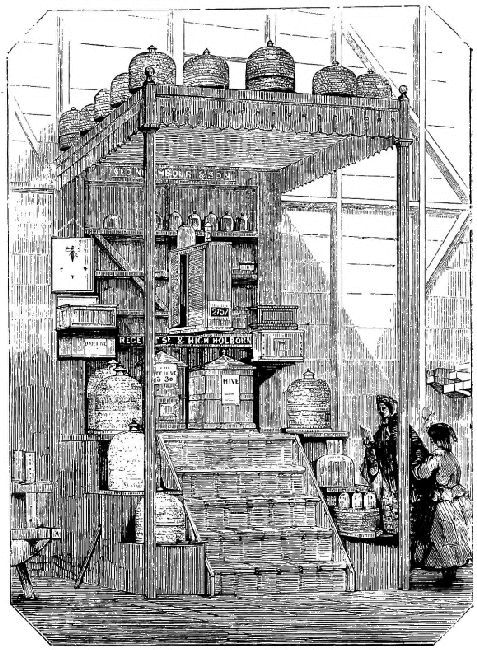
STAND AT THE EXHIBITION OF 1862.
Among others who took a deep interest in the exhibition just
described was Mr. Edward Wilson, President of the Acclimatisation
Society of Victoria. This gentleman requested us to pack four
stocks of the Italian bees for conveyance to Melbourne. With the
assistance of Mr. Woodbury—whose aid was, indeed, essential--these
stocks were sent off on the 25th of September, 1862, by the
steamship "Alhambra," so as to arrive at the colony during the
Austral summer. The hives were Woodbury frame-hives, having
ample space and ventilation, as well as the means of supplying
water to their inmates during the voyage; there was also a sufficient
store of honey to last until the following March. The bees arrived
at Melbourne, where they were released after an imprisonment of
seventy-nine days, and have since rapidly multiplied, the climate
and pasturage of Australia greatly favouring the increase of this
superior variety of the bee.
Mr. Wilson was so well pleased with the careful manner in which
these stocks were fitted out for their voyage across the seas, that he
subsequently instructed us to prepare him three more hives, which
were sent out in a sailing vessel. Owing to the mismanagement of
the water supply during the voyage, only one stock survived in this
instance. Mr. Wilson informs us that one of these hives contained
136lb. of honey on the 25th of December, 1864 (Midsummer in
Australia).
Upwards of twenty years ago we sent a Nutt's hive stocked with
bees to New Zealand. We then adopted the plan of fixing the
hive in a meat safe, so that the bees could fly about a little, and
also cleanse the hive of their dead, they being always very attentive
to sanitary arrangements.
Several more recent exportations of Italian bees have been made
by us. We have sent two stocks to Madras, which arrived safely,
and we hear are doing well, also a stock to South Africa under the
care of the lady who ordered them, and who was herself going
out. We had the satisfaction of receiving the following note:—
"Grahamstown, Nov. 3, 1875.
"Mrs. Mullens is very pleased to inform Messrs. Neighbour and
Sons that the stock of Ligurian bees supplied to her on board the
'Nyanza' at Southampton on July 23rd have arrived quite safely.
Mrs. Mullens thinks they were exceedingly well packed; they had
a trying journey by bullock waggon two days after leaving the sea.
They were released from the hive on September 3rd, and appeared
weak at first, but began to work in less than an hour. A large
number of dead bees were found at the bottom of the hive on opening—most
likely caused by the boat in which the bees were having
water in it."
This report we consider very favourable. There would naturally
be a great mortality during such long confinement, and for the
reasons also which Mrs. Mullens mentions.
Dated Dec. 12th.
Award of Prize Medal to G. Neighbour and Sons,
For a large and varied collection of economical beehives so arranged
that the honey can be taken without the destruction of the bees.
Special attention is directed to the Unicomb Hives with Venetian
blinds to allow the bees to be exposed to light, whilst the sun's rays
are excluded. Also to a Honey Extractor by centrifugal force, which
removes the honey from the combs without injuring the latter, which
can be returned to the hives.
(Signed,) John Coleman,
On behalf of the Judges.
Approved of group of Judges.
[5 names.]
The head-quarters of this Society are at Glasgow; and, taking
example from the British Bee Keepers' Association, shows are held
and prizes given for beehives and their produce; also living bees at
work in glass hives are exhibited. In addition to which, manipulations
connected with bee economy, such as transferring, handling bees
in bar-frame and other hives, are demonstrated to beholders.
The exhibition of this year (1877) was held at Edinburgh, in connection
with the annual gathering of the Highland and Agricultural
Society, and which was very successful.
There was a separate charge for admission to the bee and honey
department, which was visited by great numbers of people. In consequence
of the poor honey harvest, but a small quantity of honeycomb
was sent for competition.
With other beehive makers, we exhibited a large collection of our
hives, also living bees, with all the appliances needed in bee-culture.
The first prize was awarded us for the best and largest display. This
prize consists of a handsome silver cup and 40s.
Amongst our interesting collection were a dozen or so of Italian
Alp queens in small boxes, each within a separate box, with a few
worker bees. These had been sent over expressly for this show, and
would therefore take no harm by being kept a few days, until purchased
by some of the enterprising Scotch bee-keepers, and substituted
for ordinary queens in the manner explained in the body of
this work.
One of the transparent single-comb hives brought from the neighbourhood
of Glasgow and exhibit ed by the indefatigable honorary secretary
of the Society, Mr. Bennett, was thought to possess no queen,
as no brood was to be seen, and there were so many drones present in
the hive. In order to supply what we considered the deficiency, we
appropriated one of the boxes containing a foreign queen, and in the
evening allowed her majesty quietly to pass into the hive through
an opening on top, taking the precaution to cover up the hive.
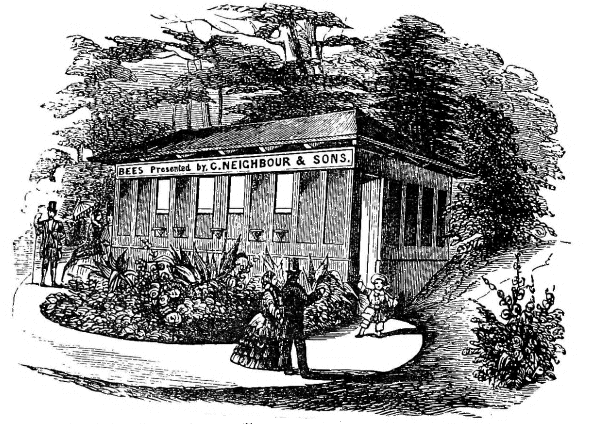
Exterior of Apiary.
As originally erected in the Zoological Gardens, Regent's Park.
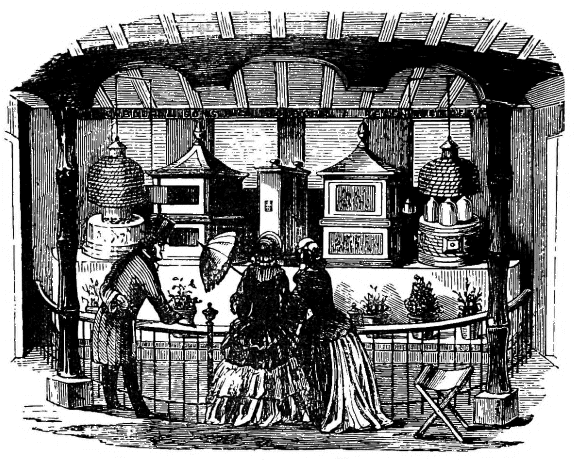
Interior of Apiary.
On making an inspection next morning we were surprised to find
a very dark Italian queen, as we thought. A few hours later we
witnessed an interesting scene, no less than a single combat between
the real Italian queen and the queen of the hive; for although we
had judged the hive to be queenless there was one in the hive all
the time, but she was a virgin. At the moment of our observation
the two queens were engaged in mortal conflict, and we were able
to summon our worthy secretary and a few apiarian friends to
witness the battle. After some few minutes (each being curled
round against the other) the English or rather the Scotch queen
dropped dead to the bottom of the hive and was seen no more.
It would have been interesting to have gained possession of the dead
queen for examination under the microscope, but the construction of
the hive and the position it was in did not allow of searching for her.
The Italian mother, who was for some time after greatly excited and
evidently much discomposed, reigned supreme, the monarch of the
hive; and being already fertilised, the worker bees paid her due
attention, but began worrying and tormenting the drones, because
they were now not wanted.
These assaults of the little active working bees on the burley
drones very much interested the spectators. The queen proceeded
with her duties of egg-laying, and the bees having exit through the
hording, the usual work of the hives was carried on fully exposed to
view. Not the least gratifying feature was the sight of these little
labourers travelling in and out under the glazed covered way.
More active manipulation, such as driving bees from one hive to
another, gaining possession of the queen, and exhibiting her in the
hand, was carried on in another portion of the shed, and became a
source of wonderment to spectators.
Many of the local newspapers had paragraphs descriptive of this
new exhibition in connection with a Scotch agricultural show.
INDEX.
[
A ][
B ][
C ][
D ][
E ][
F ][
G ][
H ]
[
I ][
K ][
L ][
M ][
N ][
O ][
P ][
Q ]
[
R ][
S ][
T ][
U ][
V ][
W ][
Z ]
Abbott, C. N., Frame-hives, 146
Abdomen of bees, 102
Accident at Stafford House, 164
Acclimatising Bees (Appendix), 349
Advice by Butler, 333
American Bee Journal, 190
Anatomy of bees, Plates I. and II., facing pages 34 and 86
Anecdote from Butler, 336
" of French clergyman, 334
" showing provision made for swarming, 78
Antennæ of bees, 94
Apiary, Geo. Neighbour & Sons, (frontispiece)
" description of, 330
Applying supers, 264
Artificial swarming, 233
Asiatic bees, 49
Austrian ditto (Lower), 46
Bar-frame holder, 192
Bar Supers, 183
Bath and West of England Agricultural Association, 42
Bee as an insect, 7
" dress, 208
" feeders, Nutt's, 126
" bottle, 203
" can, 204,
" round, 205; wood, 206
" houses, 166-179
" traps, 201
" veil, 210
Beehives, various, 108 to 165
Bee-keeping in London, 322
" Zoological Gardens, 328
" Horticultural Gardens, 329
" St. John's Wood, 329
" Hampstead, 330
Bees, do they go to sleep? 31
" increase of, 82
" head of, 88
" eye of, 90
" mouth, 91
" tongue, 92
" mandibles, 93
" sense of hearing, 95
" " smell, 96
" antennæ. 96
" thorax and organs of motion, 97
" breathing, 100
" stomach, 102
" honey bag, 102
" produce of wax, 103
" sting, 104
" dislike to hive, 221
" enemies of, 315
" profitably kept, 336
Bell glasses, see glasses
Berlepsch, Baron von, 4, 6, 10, 36, 42, 49, 75, 211
" theory of drone-breeding, 69
" on swarming, 77
" breeding superfluous princesses, 81
Bevan, Dr., 3, 18, 66
Black Bees, 71
Book-keeping recommended, 332
Box Fumigator, 206
British Bee-keepers' Association, 6, 48
Caledonian Apiarian Society (Appendix), 354
Carbolic acid, use of, 208, 220, 305
Carniolan bees, 45, 46, 53, 78
Change of frame-hives beneficial in spring, 223
Cheshire's (F.) frame-hive, 145
" nucleus hive 197
" transferring board, 192
" wax guide-maker, 191
Comb-building in supers, 338
" fixing in ditto, 262
" foundations (American), 190
Combs, placing in frame-hives, 223
Common cottager's hive, 108
Corri, Herr, 47, 78
Cottage hive, improved, 114
Cottager's hive, no
" improved ditto, 112
" improved frame-hive, 142
Cotton, Rev. W. C., 5, 45, 78
Covers, zinc, for hives, 171, 172
" wood, 172, 174, 175, 177, 179
Cowan's (Mr.) plan of working frame-hives, 255
Crystal Palace skep, 109
Cyprian bees, 47
Darwin, Dr. 56, 57
Dathe, 53
" plan of fertilizing queens with Italian drones, 253
Diseases of bees, 306
Dönhoff, Dr. 5, 65, 96
Driving, 226
" best condition for, 228
" useful for taking honey, 229
Drone bee, 19, 62
" " has no father, 64
" eggs, theory of production, 62, 252
" trap, 201
" comb, to be used sparingly, 224
Drone comb, building of, sometimes to be avoided, 238
Dummy frame, 140, 143
Dzierzon, Dr., 4, 10, 36, 42, 44
" description of the round of the bees' concerns, 32
" on swarming, 77
" not a smoker, 210
Egg-laying, 10, 67
Eggs and transformations, 59
Ekes, description of, 186
Epitaph on brimstoned bees, 85
Evans' (Dr.) poem on bees, 3,
quotations from, 59, 75, 76, 107, 165
Extracting honey from comb, 274
Extractor, honey, 193
Eyes of bees, 89
Faculties, and functions, 54
Feeder, Nutt's, 126
Feeders, (various), 202
Feeding, 279
Fertile workers, 62, 67
Fittings and apparatus (outside), 166
Flat-topped glasses, 182
Foul brood, 307
" Langstroth, Woodbury, and Dzierzon on, 308, 312
Fox, Mr. George, 278
" Mr. S. Bevan, 278, 332
Frame-hive, putting swarm into, 219
" facility for placing combs, 223,
" with cover and stand, 175, 177, 179
Frames, removing, 268
French exhibition, 165
Fumigators, 206
Fumigating, description of, 231
General hints on frame-hives, 254
" remarks, 332
Gerstäcker, 54
Glass hives, ladies' observatory, 120
" frame, 138
" with cover and super, 177, 178
Glasses for supers, 180, 181, 182
Guide comb, 188, 261-264
" maker (Cheshire's), description of, 191
Hawkins, Mr. Waterhouse, 50
Head of bee, 88
Hearing of bees, 95
Heath bees, 46
Hints, general, on frame-hives, 254
Hives, modern, 108 to 165
" sometimes destroyed by entrance being stopped, 343
Hiving swarms, 212
Honey bag of bees, 102
" cutters, 193
" description of, 296
" extractor, 193
" test when adulterated, 297
Houses for hives, 166
Hruschka, Von, 193
Huber, 62
Hunter's, Mr., support for hive when driving, 229
Impressed wax sheets, 187
Improved cottage hive, 113
" cottager's hive, 112
" ditto, no windows, 119
Increase of bees, 82
Insects necessary for existence of flowers, 59
Italian bee, 34, 35, 41
Italianising hives, 251
Kerner, 58
Kleine, Herr, 5, 35, 244
Klipstein, Von, anecdotes of queens, 22, 66
Knowledge of bee-keeping necessary for a gardener, 343
Ladies' Observatory Hive, 120
Lanarkshire bee-keeper, 297
Lanarkshire hive, 155
Langstroth, Rev. L. L., 3, 5, 10, 43. 83. 85, 129, 346
Langstroth, Rev. L. L., on transferring swarms, 220
Lee's supers, 145, 146
Legs of bees, 98
Leuckart, Professor, 64, 66
Ligurian bee, 7, 34
London apiaries, 325
Lower Austrian bees, 46
Lubbock, Sir John, 6, 57, 59
Mahan, Mr., 9
Mandibles of bees, 91
Manipulation with bees, 212
" " frame-hives, 269
Mel-extractor, 196
Melting down combs, 275
Mouth of bees, 91
Munn, Major, 129
Nadirs, description of, 186
Neighbours' improved cottager's hive, 113
Neighbours' improved cottage-hive, 114
Neighbours' new frame-hive, 139
New cover and stand for frame-hives, 175, 176, 179
New wood feeder, 206
Nucleus hive, 197
Nutt's hive, 123
Orchard, good place for an apiary, 56
Organs of sensation, 88
" motion, 97
" reproduction, 62
Parthenogenesis, 64
Pasturage for bees, 293
Payne's (I. H.) glass, 182
Perforated zinc adapter, 141, 143, 144, 200
Philadelphia Exhibition, 160;
and Appendix, 350
Philadelphia hive, 143
Pollen basket, 98
" preservation from incursions of ants, 58
" description of, 298
" substitute for, 299
Position of hives, 292
Propolis, 300
Queen, 8
Queen, power of egg-laying, 10
" homage paid to fertile, 12
" no attention bestowed on virgins, 13
" two queens in a hive, 15
" sting of used for depositing eggs, 15
" some queens will not fight, 15
" consternation at loss of, 16
" life of, 19
" fertilisation of, 11, 20, 22, 24
" in relation to sexes, 63
" at swarming time, 73
" and drone preventers, 200
" rearing, 17, 27, 77, 243
" cells, 17, 244
" securing, 228, 240
" introducing stranger, 247
" cages, 198, 244
Quilts, 180
Rationale of swarming, 72
Relation of sex to cells, 67
" plants to insects, 56, 57
Removing bees, 259
" supers, 266
" frames, 268
Reproductive economy, 62
Renfrewshire bee-keeper, 24, 41, 154
" queen cage, 199
" instructions on supering, 337
Robbing, 225, 305
Rorl's (Mr.) way to get quit of fertile workers, 67
Round feeder, 205
Royal cells, 17, 244
" " transferring, 198
" duels, 15, and Appendix
Salt obtained by bees, 30, 97
Samuelson's work,. The Honey Bee, 5, 91, 96
Siebold, Von, on Parthenogenesis, 64
Skep, Crystal Palace, 109
" (old), transferring combs from, 223
Slow feeding, 204
Smelling, sense of, largely possessed by bees, 96
Smith, Mr. J., 48
Smyrnæan bees, 47
Society of Arts, 57
Stands for hives, 118, 170
Stewarton hive, 146 to 155, 337
Sting, 104
" prevention and cure, 286
Stocks (old) transferring, 222
Stomach of bees, 102
Straw frame-hive, 136, 141
" hives, round, 108 to 120
Stupefying bees, 207
Supers, 180, 181, 182, 183, 184, 185
Superstitions about bees, 341
Supplying natural comb, 261
Swammerdam, 63
Swarm, number of bees composing, 79
" second flight disastrous, 214
" often mix, 214
" taking, 214
" sending to a distance, 217
" conveyance of, 217
" transferring, 218
" returning, 218
" brought from a distance, 219
" should be fed, 221
" truant, 78, 317
" artificial, 233
Swarming, rationale of, 72
" provision made for, 74, 78
" signs of, 80
" a provision of Nature, 212
Taylor, the late Mr. H., 37
Taylor's glasses, 181
Thorax of bee, 97
Tongue of bee, 92
Transferring board, 192
" swarms, 218
" old stocks, 222
Tristram, Rev. H. B., extract from his book, 51
Tube fumigator, 207
Unicomb observatory hive, outdoor, 157
Unicomb observatory hive, directions for, 160
Unicomb observatory hive, indoor, 162
Uniting weak colonies, 229
Ventilation performed by bees, 30, 285
Ventilators, 124
Vulcanite for feeding-stage, 203
Wasps, 315
Warder, Dr., experiment with swarm, 77
Water for bees, 30, 331
Wax, how produced, 103
" impressed sheets of, 187
" secretion of, 302
Weighing hives, 276
Wildman's bees, 322
Wings for bees, 97
Winter precautions, 283
Wood cover, 172
" feeder, 206
Woodbury, T. W., 37, 42, 49, 50
" frame-hive, 134
" mode of hiving swarm, 216
" mode of transferring swarm, 220
" hive cover, 174
Xenophon's army poisoned with honey, 298
Zinc covers, ornamental, 171
" " plain, 172
" rests, 140
" adapters, perforated, 141, 143, 144, 200
Hazell, Watson, and Viney, Printers, London and Aylesbury.
PRICE LIST
OF
NEIGHBOUR & SONS'
IMPROVED BEE-HIVES
For taking Honey without the Destruction
of the Bees.
EXHIBITORS AT THE
Great Exhibition, 1851. Dublin Exhibition, 1853.
Exposition Universelle, 1855.
International Exhibition, 1862. Dublin Exhibition, 1866.
Paris Exposition Universelle, 1867.
Annual International Exhibition, 1873.
British Bee-Keepers' Shows, Crystal Palace, 1874, 1875.
Alexandra Palace, 1876.
International Philadelphia Exhibition, 1876.
Caledonian Apiarian Show at Edinburgh, 1877.
List of Prices.
| No. |
|
£ |
s. |
d. |
| 1. |
Nutt's Collateral Bee-Hive |
|
5 |
5 |
0 |
|
Stand for ditto |
0 |
16 |
0 |
| 2. |
Single Box Hive |
3 |
3 |
0 |
| 3. |
Neighbours' New Frame Stock Hive |
1 |
5 |
0 |
|
Super |
|
1 |
5 |
0 |
|
Cover for ditto |
27s. and |
2 |
0 |
0 |
| 4. |
Carr's Bar and Frame Hive |
|
0 |
19 |
6 |
|
Super for ditto |
0 |
19 |
6 |
| 5. |
Neighbours' Improved Cottage Hive |
1 |
15 |
0 |
|
Stand for ditto |
0 |
10 |
0 |
| 6. |
Ditto, without Windows |
1 |
5 |
0 |
| 7. |
Ladies' Observatory Hive |
2 |
5 |
0 |
| 8. |
The Cottager's Hive |
0 |
10 |
6 |
| 9 |
and 10. Bee Feeders |
each 5s. and |
0 |
4 |
0 |
| 11. |
and 12, Fumigators |
" 2s. " |
0 |
2 |
6 |
| 13. |
Honey Cutters |
per pair |
0 |
5 |
0 |
| 14. |
Improved Cottager's Hive |
|
1 |
1 |
0 |
| 15. |
Honey Extractor for hand use |
15s. and |
0 |
17 |
6 |
| 16. |
Woodbury Bar Super |
|
0 |
10 |
6 |
| 17. |
Neighbours' New Supers, Wood and Glass |
|
1 |
1 |
0 |
|
Ditto ditto Straw and Wood |
|
1 |
5 |
0 |
| 18. |
Taylor's Glass, to contain about 8 lb. |
|
0 |
3 |
6 |
| 19. |
Payne's Glass, with hole in centre, to afford additional
space to supers partly filled |
|
0 |
3 |
0 |
| 20. |
Neighbours' Revolving Indoor Unicomb Hive |
|
3 |
10 |
0 |
| 21. |
New Can Feeder, on the principle of a fountain,
adapted for slow, stimulating feeding (3 pints) |
|
0 |
5 |
0 |
| 22. |
New Frame Stand, to be used when manipulating
with movable combs |
|
0 |
5 |
6 |
| 23. |
American Sectional Supers |
per set of 14 |
0 |
3 |
6 |
| 24. |
Taylor's Super Glass |
| 25. |
Bell Glass, to contain about 9 lb |
|
0 |
0 |
0 |
| 26. |
Ditto ditto 5 lb |
|
0 |
4 |
0 |
| 27. |
Ditto ditto 3 lb |
|
0 |
1 |
0 |
| 28. |
New Shape Flat-top Glass, with lid to place on
table inverted |
|
0 |
3 |
6 |
| 30. |
Shallow Glasses, 9½ in. wide by 4 in.-deep |
|
0 |
3 |
0 |
|
Ditto " 13½ in. " 4½ in. " |
|
0 |
5 |
6 |
| 31. |
Bee Dress, with Sleeves (post free, 3d. extra) |
|
0 |
6 |
0 |
| 32. |
India-rubber Gloves (by post, 2d. extra) |
per pair |
0 |
6 |
0 |
| 33. |
Common Straw Hives |
|
0 |
2 |
6 |
| 34. |
Small Straw Super Hives |
0 |
2 |
0 |
| 36. |
Floor Boards, according to description, 2s., 2s. 6d. |
0 |
3 |
0 |
| 37. |
Zinc Cover for Improved Cottage Hive |
0 |
15 |
6 |
| 38. |
Ornamental Zinc Cover |
2 |
2 |
0 |
| 39. |
Bee House, to contain two Improved Cottage' Hives |
4 |
4 |
0 |
| 42. |
Woodbury Bar and Frame Hive
|
0 |
0 |
0 |
|
Ditto ditto with Window |
1 |
1 |
1 |
|
Cover |
1 |
1 |
1 |
|
Stand |
0 |
0 |
0 |
| 44. |
The Bottle Feeder |
0 |
0 |
0 |
| 45. |
Woodbury Straw Bar and Frame Hive, 18s. 6d. and |
1 |
1 |
1 |
| 46. |
Outdoor Unicomb Hive, to take Woodbury Frames |
5 |
5 |
5 |
|
Stand |
0 |
0 |
0 |
| 47. |
Common Cottage Hive, 5s. 6d. each. |
Six for |
1 |
1 |
1 |
| 49. |
Glass Frame Hive |
|
1 |
1 |
1 |
| 51. |
Improved Wax Sheets |
per doz. |
0 |
0 |
0 |
| 52. |
Lee's Octagon Straw Hive |
|
1 |
1 |
1 |
|
Super |
0 |
0 |
0 |
|
Cover and Stand |
1 |
1 |
1 |
| 53. |
Lee's Octagon Hive, in Mahoghany |
0 |
0 |
0 |
| 54. |
Ditto ditto Pine |
0 |
0 |
0 |
| 55. |
Ditto ditto Glass Sides |
0 |
0 |
0 |
| 56. |
Ditto ditto smaller, in Mahoghany |
0 |
0 |
0 |
| 57. |
Ditto ditto Wooden Sides, Glass Top |
0 |
0 |
0 |
| 58. |
Stewarton Hive (3 Stock Boxes, 1 Honey Box) |
1 |
1 |
1 |
| 59. |
New Wood Bee Feeder |
0 |
0 |
0 |
| 60. |
Neighbours' Cottage Frame Hive |
0 |
0 |
0 |
| 61. |
Neighbours' Divisional Super, 3s. 6d. |
per pair |
0 |
0 |
0 |
| 62. |
Cover for Neighbours' Frame Hive |
|
0 |
0 |
0 |
| 63. |
Cottage Frame Hive, Woodbury Frames |
0 |
0 |
0 |
| 64. |
Cheshire's Frame Hive, complete—Stand, Super, and
Cover, the latter painted |
1 |
1 |
1 |
| 65. |
Abbott's ditto ditto |
1 |
1 |
1 |
| 66. |
Lanarkshire Stock Hive |
0 |
0 |
0 |
|
Super |
0 |
0 |
0 |
|
Roof |
0 |
0 |
0 |
| 67. |
Neighbours' New Bee Veil (by post, 2d. extra) |
0 |
0 |
0 |
| 68. |
Flat-top Glass with 3 inch hole in centre (similar to
Payne's), for adding space to Supers |
0 |
0 |
0 |
| 69. |
Same construction as above, 6½ in. wide, 3 in. deep |
0 |
0 |
0 |
| 70. |
Lee's Double Super |
per pair |
0 |
0 |
0 |
| 71. |
Cheshire's Nucleus Hive, for Queen Rearing |
|
0 |
0 |
0 |
| 72. |
Cheshire's Transferring Board |
0 |
0 |
0 |
| 73. |
Cheshire's Prize Smoker |
0 |
0 |
0 |
| 74. |
Cheshire's Drone Trap |
0 |
0 |
0 |
| 75. |
Syrup Can and Shovel |
0 |
0 |
0 |
| 76. |
Vulcanite Feeding Plates |
each 6d. and |
0 |
0 |
0 |
| (Less by the dozen) |
| 77. |
Bligh Bee Quieter |
each |
0 |
0 |
0 |
| 78. |
Queen and Drone Preventers |
1s. and |
0 |
0 |
0 |
| 79. |
Crystal Palace Skep |
|
0 |
0 |
0 |
|
Floor Board |
0 |
0 |
0 |
|
Super |
0 |
0 |
0 |
| 80. |
Neighbours' Straw Frame Hive, with New-shaped
Cover and Stand, grained and varnished |
3 |
3 |
3 |
| 81. |
New Cottage Frame Stock Hive, with Window
|
0 |
0 |
0 |
| 82. |
New Cover and Stand for the above (painted) |
1 |
1 |
1 |
| 83. |
Neighbours' Cylindrical Honey Extractor |
2 |
2 |
2 |
|
Two Wire Cases |
0 |
0 |
0 |
| 84. |
Bee House for One Hive |
2 |
2 |
2 |
| 85. |
Renfrewshire Stewarton Movable Comb Hive, consisting
of 3 Stock Boxes and 1 Honey Box |
1 |
1 |
1 |
| 86. |
Bee Traps, for clearing Bees from Supers |
0 |
0 |
0 |
| 87. |
Philadelphia Hive, with Super, Stand, and Cover |
2 |
2 |
2 |
| 88. |
Sectional Supers |
the set |
0 |
0 |
0 |
| 89. |
New Cover for Cottage Frame Hive (carries its
own Stand) |
|
1 |
1 |
1 |
| 90. |
Quinby Smoker |
0 |
0 |
0 |
PUBLICATIONS ON BEES.
| "The Apiary;" or, Bees, Beehives, and Bee Culture,
by Alfred Neighbour. |
|
0 |
5 |
0 |
| Hive and Honey Bee, by Rev. L. L. Langstroth (American).
A New Edition |
0 |
9 |
6 |
| Quinby's Bee-Keeping (American) |
0 |
8 |
6 |
| Italian Alp Bee, by Hermann |
0 |
1 |
0 |
|
|
PRIZE MEDALS AWARDED AT THE
PHILADELPHIA
AND OTHER EXHIBITIONS. |
|
GEO. NEIGHBOUR & SONS'
PRICE CURRENT OF
Genuine Italian Alp or Ligurian Bees.
An Italian Queen in a small Box, accompanied by a few Worker
Bees, with full directions for uniting to English Stocks, each from April
and May, 12s.; June, 11s.; July, 10s.; August, 9s.; September, 8s.;
October, 7s.
Orders should be given in advance.
For parcels of Six Queens at one time, 1s. each less.
A Stock, with genuine Italian Queen, packed so as to travel by rail
with comparatively no risk of damage, including the Straw Frame Hive
with window, £4; or if in New Cheap Frame Hive, No. 60 or 63,
which has no window, £3 5s.
Swarms and Stocks of English Bees can be obtained.
Transcriber Note
Minor typos corrected. Hyphenation was standardized to the most
frequently used version with the exception of beehive which was used
by the author and bee-hive in quotations from other works.