For more than two hours Thomas Dean and Jane had been vainly circling about
West Point on their motorcycle, striving to pick up some clue that would put
them once more on the trail of the Hoffs’ car. They had not dared to ask too
many questions of any one near the ferry, fearful lest the people they were
pursuing might have a guard posted there to warn them in case of a possible
pursuit, yet cautious inquiries seemed to indicate that all the automobiles on
the ferryboat which had preceded had been headed to the north.
“There’s only one thing we can do,” Dean had said despondently. “We have got to
run out each road we come to until we reach some shop or garage where the
people would be likely to have noticed the Hoffs. They may have stopped
somewhere, or we may meet some one coming toward us who will remember having
passed them.”
“It seems like a wild-goose chase,” said Jane, “but I suppose there is nothing
else to do.”
The strain of their bitter disappointment was telling on both of them. Each
felt inclined to blame the other for their having fallen so far behind. They
rode along in silence, their nerves becoming more and more keyed up as their
hopes grew less. At garage after garage they paused to question the employees.
“Did a big gray car with two men, an old man with a beard and a young man
driving, pass this way about an hour ago?”
“I don’t remember any such car,” was the invariable answer.
Time and time again they repeated their query, wording it always the same,
except for lengthening the interval of time in which the car might have passed,
for the afternoon was rapidly passing. In their circuit they had now reached
the roads pointing to the southward.
“We’ll try this one more garage,” said Dean, as they approached a wayside shed
bearing a large sign “Gasoline.”
“I fear it is only wasting time,” said Jane wearily.
“Don’t you want the Hoffs caught?” snapped her companion.
“Of course I do,” she retorted heatedly, “but I don’t see you catching them.”
“I believe you are half glad of it,” snarled her escort as he brought the
machine to a stop and repeated his usual question.
“Sure there was a car with two men in it like you describe passed here,” the
man replied to their amazement and delight. “They stopped here for gas, as they
generally do. About three hours ago, I guess it musta been.”
Dean shot a triumphant glance at Jane.
“An old man with a gray beard and a smooth-shaven young man driving—does that
describe them?” he repeated.
“That’s them,” said the garage proprietor. “They come through here every few
days, always about the same time.”
“Where do they go?” questioned Dean eagerly, feeling at last that the scent was
growing hot.
The man shook his head in a puzzled way.
“I’ve often wondered about that. They’re always heading south and appear to be
in a powerful hurry, but the funny part of it is I ain’t never seen them coming
back.”
“Do you know their names?”
“No, I can’t say I do, though it seems as if I’d heard one of them called Fred.
I can’t say which it was.”
“Do they always come by on the same day—on Wednesday?” asked Jane, forgetful
once more of Dean’s warning to let him do the talking lest her voice should
betray her sex.
“Come to think of it,” said the man, apparently noticing nothing unusual, “I
guess it always is on a Wednesday they come by.”
“Is the number of their car anything like this?” asked Dean, exhibiting an
entry in his notebook.
“I couldn’t say,” said the man, studying the figures. “I know it is a New York
license, and the number ends with two nines like this one does. What might you
be wanting them for?”
He spoke to a cloud of dust, for Dean had started up the motorcycle before he
finished speaking and already was speeding away.
“Where now?” asked Jane.
“I don’t know,” he answered frankly, “I only know we are going the direction
the Hoffs went, and I want to gain on them before they get too far ahead. The
chap back there had told us all he knew and was beginning to get curious, so I
thought it better to vamoose.”
“It’s funny about his never seeing them coming back.”
“Probably there is nothing mysterious about that. I have a notion they always
come up one side the river and down the other, taking the 125th Street ferry
home. That would not be a bad plan to help them in eluding too curious
observers. All these German spies are trained to leave as blind a trail behind
them as possible. The thing we have got to discover is what brought them up
here. We’ve just got to find out their destination.”
“I am afraid there is little chance of our doing that,” insisted Jane. “We’ve
nothing to go on.”
“We’ve learned something. We know that their destination is somewhere between
here and Fort Lee on this side of the river. That narrows down the search
considerably. That’s more, too, than anybody else that the Chief has had on
their trail has learned. Something tells me that we are getting warm right now.
Obviously the place they come to must be nearer West Point than it is New York.
They would hardly take too roundabout a course, even for the sake of hiding
their tracks. Keep a sharp lookout for tire tracks leaving the main road.”
The route they were following quickly led them into a sparsely inhabited
mountainous district and instead of the concreted state highway they found
themselves on a hilly dirt road, full of ruts and loose stones that made travel
difficult. At times it was all Dean could do to manage the machine, so that he
had to leave most of the task of observing the by-ways to Jane. For more than
two miles they had seen neither house nor barn. Once or twice they came upon
little used lanes leading off through the woods, but none of them showed any
traces of the recent passing of an automobile.
As they came dashing around a curve on a steep down-grade, where hardly more
than the semblance of a road had been cut into the hillside, Jane caught her
breath sharply. Above the roar of their own motor she thought she heard some
other noise, something that sounded like another car near-by; yet neither
behind nor ahead was there another automobile in sight.
“Listen,” she cried sharply.
Dean started to slow down, but it was too late. Out of a cut in the hillside,
half screened by a clump of bushes at the side on which Jane was riding, a
great gray motor shot out just as they were passing. Jane caught just one
glimpse of the man on the driver’s seat. It was Frederic Hoff, frantically
twisting at the wheel in an effort to avert the threatened collision. There
came a thud and a crash as the forward part of the Hoff car struck the
motorcycle a glancing blow, overturning it completely. Too terrified even to
shriek, Jane felt herself being catapulted out of her seat and flung high in
air. Then came a blank.
Her companion did not escape so easily. The heavy machine crashed over on him
and dragged him several yards. His head, as he landed in the roadway, struck a
stone, and the motorcycle itself pinned him to the earth by its weight, one of
his arms doubled up in an alarming fashion, as he lay there completely
senseless.
Jane fortunately had landed on some soft grass, though with sufficient force to
leave her badly stunned. As she lay there, a boyish figure in her disguise, her
senses began gradually to revive, although it was some time before she opened
her eyes.
Vaguely, as from a great distance, she began to hear voices, and it seemed to
her that they were German voices, arguing about something. The voices seemed
angry and excited. At first she did not bother about them. She was wondering
how badly she was hurt. Her arms and limbs had a curious sort of deadness about
them, a detached sensation, as if they belonged to some one else. She wondered
if she was paralyzed and dared not try to move them, fearful lest she might
find that it was the terrible truth.
The voices—the German voices—came nearer, became louder and more strident. She
struggled to collect her thoughts. Where was she? What had happened? Where was
Thomas Dean? Gradually some memory of the accident came to her. They had been
run down by the Hoffs’ car. The voices she kept hearing were those of the two
Hoffs, angrily wrangling about something. As she revived further she became
acutely conscious that her head seemed to be splitting. What was it the Hoffs
were arguing about? Still lying there motionless, with her eyes closed,
endeavoring to collect herself, she tried to listen to what they were saying.
“I tell you there is not time. I must hurry. Every minute is precious. I cannot
delay my work for these swine, no matter if they both are dying or dead,” old
Otto was angrily shouting with many German oaths.
“I tell you,” Frederic was saying,—his voice was calmer but determined,—“we’ve
got to get these people to a doctor. It’s too heartless. I will not leave them
here.”
“And betray us at the last moment, when our plans are all ready,” snarled old
Otto.
“There is less danger if we bundle them into the car and take them with us than
if we leave them here,” protested Frederic. “Two bodies right here at the
entrance would be fine, nicht wahr?”
His last remark appealed to old Otto.
“That is so,” he muttered. “It is not safe. We must hide the bodies, both of
them, yes?”
The bodies! Jane decided that Dean must have been killed and that they thought
that she, too, was dead. As she strove to open her eyes she could hear Frederic
protesting.
“It’s inhuman,” he cried. “They both are hurt, but perhaps still alive. We must
take them to a hospital.”
“And endanger all our plans,” stormed old Otto. “Throw them into the woods.”
“We’ll do nothing of the sort,” Frederic insisted, his voice becoming unusually
stern and severe. “I’m going to get both of these people to a doctor at once, I
tell you.”
With effort Jane opened her eyes and looked cautiously about. Where was Thomas
Dean? How badly had he been hurt? The Hoffs’ automobile was slowly backing up.
As she looked old Otto sprang out of it and righted the motorcycle. As he did
so Jane saw the body of Dean lying senseless beneath it, but to him the old
German paid no attention. He was examining the motorcycle and still sputtering
that the swine should be left to rot.
“We are going to take them with us in the car,” directed Frederic in a voice of
authority. “I command it.”
At the word old Otto’s mutterings ceased, though he shot a black look at the
younger man.
“This machine,” he suggested, “it is not hurt. I will take it and do our work.
There is haste. You remain with the car. Do what you will with these people.”
“Go then,” said his nephew curtly. “You can take the train at the first station
and make time.”
As the old man mounted the motorcycle and sped away Frederic sprang from the
car, and approaching the spot where Dean’s body lay, began making an
examination of his injuries.
“Scalp wound, perhaps fractured skull, broken arm,” Jane heard him saying aloud
to himself. She noted curiously that as soon as he was left to himself he began
speaking in English.
He left Dean and approached her. As he came nearer she closed her eyes again,
trying to plan some course of action. Her head was throbbing so that she found
it impossible to think. She felt toward young Hoff a warmth of gratitude for
not having gone off and left them helpless as his uncle had insisted. Even
though he was an enemy of her country, a man to be hated, a spy, she could not
help being glad for his presence there. What would she have done without him,
with Dean lying there injured and helpless on this lonely mountain road?
“This chap seems only stunned,” she heard him say as he bent over her, then as
he looked closer, she heard him exclaim:
“My God, it’s Jane!”
In an instant he was down at her side on his knees. Tenderly one of his arms
went about her and lifted her head.
“Miss Strong, Jane, Jane,” he implored, “Jane dear, speak to me.”
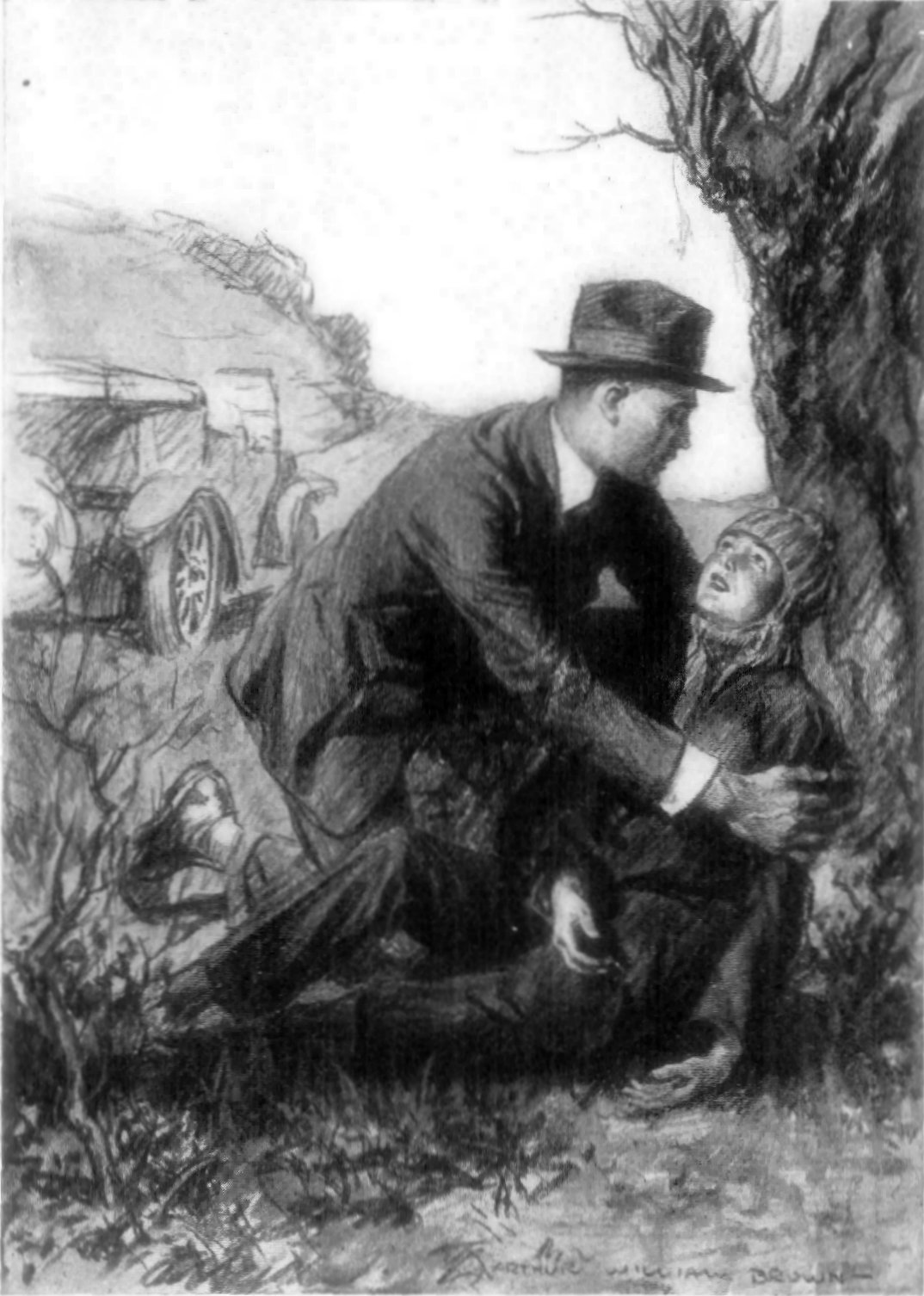
“Thank God,” he cried. “Jane dear, tell me you are not hurt.”
Stunned though she still was a flush crept into Jane’s cheeks at the unexpected
term of endearment, though she still kept her eyes closed. Gently he laid her
back on the turf and hastened to the automobile, returning with a flask which
he held to her lips. Slowly Jane opened her eyes.
“Thank God,” he cried. “Jane dear, tell me you are not hurt.”
For a moment she lay there, staring wonderingly at him as he bent over her
imploringly, the tenderest of anxiety showing in every line of his face.
Unprotestingly she let him slip his strong arm once more under her head. In her
dazed brain there was a strange conflict of peculiar emotions. He was a German,
a spy,—she hated him, and yet it was wonderfully comforting to her to have him
there. Under other circumstances she could have loved him. He was so handsome,
so masterful and so kind, too. He cared for her. Had he not called her “Jane,
dear” in his amazement at finding her lying there? But she must not let herself
think of him in that way. It was her duty, her sacred duty to trap him, to
thwart his nefarious plans against her country. She must do her duty just as
her soldier brother was doing his in far away France.
Still supported by Hoff’s arms she sat up, trying to collect her thoughts and
gingerly testing the movement of her arms and limbs.
“Tell me,” he cried again, “Jane, dear, are you hurt?”
“I don’t think so,” she managed to say.
With his assistance she got up on her feet and walked uncertainly to the car,
shuddering as she looked at Dean’s crumpled senseless body.
“Your friend,” said Hoff, as he placed her in the forward seat and wrapped a
rug about her, “I am afraid, is badly hurt.”
“It’s our chauffeur, Thomas Dean,” she explained confusedly.
She had been wondering what she could say to Frederic to account for her
presence there. It was unconventional at least for a girl to be motorcycling
about the country dressed in man’s clothes with a chauffeur. Hoff must surely
realize now that she had been shadowing him. She felt almost certain that he
had known it from the very first, since that afternoon when he had overheard
her telephoning about the “fifth book.” Yet never by word or manner had he
betrayed the fact that he suspected her. Beyond his customary reserve in
speaking about himself or his activities, there was nothing to indicate that he
knew anything yet. Whatever she told him now she must be careful not to betray
her mission. Perhaps even in spite of all that had happened she still might be
able to aid Chief Fleck in trapping them.
But did she really want to trap Frederic Hoff? Had Thomas Dean’s bitter charge
that she was trying to protect him been true? Frederic Hoff loved her. She,
yes—she had to admit it to herself—she was beginning to love him. Could she go
on with it?
Hoff had been busy lifting the unconscious Dean into the tonneau. As she
watched him as he lifted up the body unaided she was conscious of admiration of
his great strength.
“Will he die?” she whispered.
“I don’t know,” he answered. “He is badly hurt. We must get him to a doctor at
once.”
He stopped a moment longer to examine the car. Fortunately the glancing blow
that it had struck the motorcycle had done no more damage than shatter one of
the lamps and bend the mud guard. Soon they were moving rapidly in the
direction of New York.
“I think,” said Hoff, “we had better leave him in the care of the first doctor
we come to. We can say that he is an injured motorcyclist we found lying in the
road.”
“And me?” asked Jane, almost fearfully.
“I’ll take you back to the city with me.”
“No,” she replied, “that won’t do. I ought to stay by him. Besides, if I return
with you, it will be hard to explain.”
He turned to look inquiringly at her and for a moment drove on in silence.
“There’s nothing more you can do for the man once he is in competent medical
hands, except to notify his people. Is he married?”
“No,” said Jane, “he’s not married. I can tell his friends.”
“Did your parents know about”—he hesitated—“about this trip with the
chauffeur?”
Jane blushed guiltily, wondering what he suspected of her. She hoped that he
did not think she had a habit of going off on such journeys with the chauffeur.
Even though the man at her side was officially her enemy she resented being put
into a position that would cheapen her in his eyes.
“No,” she replied, “they knew nothing about it.”
Hoff drove on in silence. She had feared that he might ask her more
embarrassing questions, might insist on knowing where she had been going when
the accident occurred. A panic seized her. What if he should ask her? What
could she tell him? He had a masterful way about him. If he took it into his
head to make her confess she realized that she would have a struggle to keep
from telling him everything. She made up her mind that she would not, she dare
not answer any more questions.
When he spoke again she was relieved to hear a suggestion instead of a query.
“When we have crossed the ferry,” he said, “you can put on a dust coat to hide
your costume, and I will send you home in a taxi. Will that be all right?”
“That will do nicely,” she replied, gratefully conscious that he was
endeavoring to plan so that her part in the afternoon’s adventures need not
become public.
Nevertheless she waited nervously while Hoff and the doctor carried Dean into
the doctor’s home. What if the doctor’s suspicions should be aroused, and he
should insist on knowing all the details of the accident? To her astonishment
the doctor seemed to accept Hoff’s brief recital of finding an injured
motorcyclist on the road without question. Perhaps if she had seen the amount
of the bills Hoff left to care for the chauffeur’s treatment she might have
understood better.
Yet unconscious though Dean had lain all the way, as they resumed their journey
without him, she felt a sudden sense of dread at being alone in the car with
Frederic Hoff. It was not that she longer feared he would endeavor to make her
tell her reasons for the expedition. She was afraid that with just the two of
them alone in the car he might seize the opportunity to declare his affection
for her.
But, to her amazement, he hardly spoke a word to her on all the rest of the
journey homeward. Once in a while as she ventured a glance in his direction,
annoyed a little perhaps by this neglect of her, she saw only a strong face set
in lines of thought, his brow wrinkled in deep perplexity, and his blue eyes
looking steadily at the road ahead—and at something far, far beyond.
Save for an occasional solicitous question about her comfort he did not speak
again until just after he had put her in a taxi at the ferry. As Jane was
trying to say her thanks he leaned forward unexpectedly, his tall frame
blocking the whole doorway.
“Jane,” he said, his voice vibrant with emotion, “Jane, you must trust me.
Everything must come out all right. Some day—some day soon when we have won—I
am coming to find you and tell you that I love you.”
“When we have won!” Jane shuddered and drew back in the car, aflame with sudden
wrath.
She had read and had heard often of the unspeakable conceit of the Prussians.
She knew that they regarded themselves as supermen who could not be defeated.
Her challenged American pride rose to battle. As she rode home she was sure now
that more than she hated anything else in the world she hated Frederic Hoff,
the spy, the German, who had dared to boast to her that they expected to win.