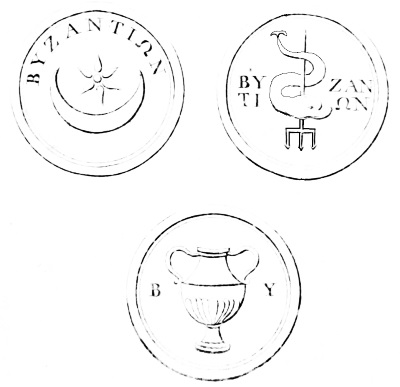
Having describ’d the Figure and Extent of the City, and having
particularized the Situation of the seven Hills, I shall proceed
to consider what Buildings and Monuments Constantinople anciently
had, or now has, and into how many Wards it was divided. For when
I accidentally fell upon this Division of the City into Wards, in
an ancient Manuscript written above one thousand Years ago, by a
Gentleman more noble by his Birth than his Writings, I was in hopes,
with some Ease, to have traced out the ancient City; but the barbarous
Mahometans have either so demolish’d those venerable and truly
heroick Ornaments which distinguish’d it, to adorn their own paultry
Houses, or entirely buried them in their own Ruins, that in very few
Places you shall see any Remains of an old Foundation. I omit to
mention the Fires and other Devastations, committed not only by the
Savages of other Countries, but the great Havock lately made by the
Turks themselves, who for the last hundred Years have incessantly
endeavour’d entirely to deface and destroy it, by building upon it in
so different a Manner, that those who have formerly seen some parts of
it, scarce know its ancient Situation. Consider farther the profound
Ignorance of the Greeks at present. There is scarce a Man of them who
either knows, or has so much as an Inclination to know, where their
Antiquities are. Nay, their Priests are so heedless and negligent
in this Respect, that they will not make the least Enquiry themselves
about those Places, where but a few Years since very magnificent
Temples were standing, and so very censorious are they, as to condemn
those that do. However, that I might not pass away my Time uselessly,
while I was in Expectation of Remittances from my Royal Master, for
purchasing all the ancient Manuscripts I could meet with, I made it
my Business, by all the Marks of Antiquity I was capable of observing,
to make what Discoveries I could. In my Description of the ancient
Monuments, I shall observe the same Method I did in the Description of
the Hills. I shall consider them in the Order the Hills stand, or as I
find them in the different Wards of the City; which, like Old Rome,
was divided into fourteen Wards.
THE first Hill, which Pliny sometimes calls Chrysoceras, and
sometimes Auri Cornu, (though this was a Mistake, as appears from
what I have wrote concerning the Thracian Bosporus) Dionysius
a Byzantian calls the Promontory of the Bosporus. There are
two Reasons assigned, says he, why ’tis call’d the Promontory of
the Bosporus; the one is, as some say, because a Cow stung with
a Gad-Bee forded over it. Others more fabulously report, that Io,
the Daughter of Inachus, being changed into a Cow, swam across
it, when she went into Asia. The same Author, speaking of a Place
call’d Semystra, tells us, that Byzantium had been founded there,
had not a Raven snatched a Part of the Sacrifice, they offer’d upon
their landing, out of the Fire, and carry’d it to the Promontory
of the Bosporus. This they look’d upon as a Token from the Gods,
that they should found their City there. The same Writer, speaking in
another Place of a Promontory call’d Metopum, opposite to the
first Hill of Constantinople, this Promontory, he adds, faces the
City, and lies directly against the Promontory of the Bosporus;
and the same Author informs us, that a little above the Promontory
of the Bosporus, there was an Altar erected to Minerva, who was
call’d Ecbasia, or Egressoria, because those who transplanted the
Colony hither, sally’d out from thence, with a Bravery equal to those,
who fight for their Countrey. We might also call her Ecbateria,
under which Name, as Hesychius reports, Diana was worshipped in
Siphnus. He adds farther, that upon the same Promontory stood
the old Temple of Neptune, and below it, upon the Plain, that the
Byzantian Youth exercised themselves in Horse-racing, driving the
Chariot, Wrestling, and other Martial Sports; and lastly, that at the
Foot of the Promontory stood a Bay call’d Ceras, which had three
Havens, fortify’d with three Cittadels, and high Sand-banks, upon it
stood the Castle of Byzantium, of which Xenophon takes Notice,
when he tells us, that the Men under his Command, having forc’d their
Way into the Town, the Inhabitants fearing they should be put to the
Sword if their City was taken, some fled to the adjoining Promontory,
others to the Sea, and that some of them steering about a long time in
a Fisher-boat, made at last a landing, got into a Tower, from thence
made Signals of Distress, and were assisted at last by the People of
Chalcedon. And not only the Castle of old Byzantium was built
upon the first Hill, but Historians assure us, that the Emperours of
Constantinople likewise continu’d a Fortress there, when they tell
us, that to keep off the Enemy from entring the Port, they laid a Boom
across the River, from the Cittadel to the Castle of Galata: Nay,
even at this Day, the Grand Seignor has a Cittadel there, fortify’d
with thick Walls, which enclose his spacious Gardens on all sides. In
old Byzantium there was a Place call’d the Thracian Field, lying
upon a Level, and not incumber’d with Houses. It was upon this Plain
that Xenophon drew up in Military Order the Grecian Army. He
informs us, in his Book of his Hellenici, that this Field was near
the Thracian Gate; they open’d, says he, the Gates adjoining the
Thracian Field: And in the 7ᵗʰ Book of the Expedition of Cyrus,
speaking of a Place, seated near the Walls of Byzantium, where
he ranged his Army in order of Battle, he tells us, that the most
convenient Place to draw up, or muster an Army is, the Thracian
Field; because, as he goes on, ’tis free of Houses, and upon a Plain.
I observ’d before, that the seven Towers of Byzantium reach’d from
the Thracian Gate to the Sea; Georgius Cedrinus asserts, that
they reach’d to the Northern-Sea, that is, to the Bay call’d Ceras.
Herodotus attests, that in old Byzantium stood an Altar erected
to Diana Orthosia, and a Temple dedicated to Bacchus. Darius,
says he, upon viewing the Black Sea, came back to the Bridge, and
erected upon the Bosporus two Stone Columns, on which he order’d to
be engraven the Assyrian and Greek Alphabets. The Byzantians
afterwards removed them into the City, near to the Altar of Diana
Orthosia. The Greek Alphabet was what they retain’d, and made use
of. The Column with the Assyrian Characters they left remaining
near the Temple of Bacchus, where they had fix’d it. Laurentius
translates the Greek Word Orthosia, Erecta, but he had translated
it more properly, had he call’d her Erectoria, or Erectrix, because
as being the Goddess of Child-birth she raises up, or recovers
Women in Labour. This I collect to be the true Sense of the Word,
not only from several Authors, but from Plutarch, who in his Book
of Rivers, has this Story: Proud Teuthras, King of Mysia, says
he, with his Retinue of Spearmen chas’d a Boar, which fled into the
Temple of Diana Orthosia to implore her Assistance. As they were
all driving furiously into the Temple, the Boar cry’d out with an
audible human Voice, Let your Compassion, Royal Sir, be shewn to
one whom Diana brought into the World. Teuthras enraged at this,
slew the Creature. Diana resenting the Affront, threw the King into
a Phrenzy, and punished him with ulcerous Sores. He could not bear
the Indignity of his Punishment, and so retired to the Mountains.
His Mother Lysippa, immediately, with the Prophet Polyidius, who
inform’d her of the Occasion of her Son’s Sufferings, hastens in Search
of him, and by sacrificing to Diana some Oxen, reconciles her to
him. When she perceiv’d her Son return’d to his Senses, she erected an
Altar to Diana Orthosia, and near it placed a Golden Boar, with a
Man’s Head upon his Shoulders. Before the Destruction of Byzantium
by Severus, both the Altar and the Boar were standing, in the first
Valley of the first Hill. Since Constantine rebuilt the City, the
first Hill included in it the first Ward, which contain’d the House
of Placidia Augusta, that also of the most noble Marina, and
the Baths of Arcadius. I learn this from the ancient Division of
the City into Wards, though I must confess myself at a Loss, to
know in what Part of the City the first Ward began, nor can I make
any such Discovery from the Remains of any ancient Buildings, which
are now entirely destroy’d. However, thus much may be inferr’d from
Procopius, who has it upon Record, that when you sail from the
Propontis to the Eastern Part of the City, there stand the publick
Baths, built by Arcadius. In this Place, says he, Justinian built a
Court, which was encompassed with so calm a Sea, that when you walk’d
in the Galleries, you might discourse audibly with the Sailors. It made
a very beautiful, a very delightful, and most magnificent Prospect:
It was fann’d with gentle Breezes, supported with lofty Columns, and
laid with the most curious Marble, which like the Sun, reflected a
most amazing Lustre: It was also adorn’d with abundance of Marble and
brazen Statues, finish’d to the nicest Perfection; a lovely Scene to
the Spectators! The Reader, had he seen it, would have taken it to
have been the Work of Phidias, Lysippus, or Praxiteles. Upon a
high Pillar of Porphyry Marble, in the same Place, stood the Statue
of the Empress Theodora, addressing herself, as it were, to him for
building so noble a Structure. The Beauty of the Column is exceedingly
surprising, yet does it by no means come up to that inconceivable
inexpressible Gracefulness and Dignity you see in the Statue. From
these Words of Procopius, as I would observe by the By, that that
Pillar now landing upon a Descent, lying Eastward of the Grand
Seignor’s Palace, is not the same with that upon which Theodora
was erected, as some are of Opinion it is; because it is neither of a
Porphyry Colour, and is at too remote a Distance form the Court; so
would I have the Reader understand, that the first Ward contain’d in
it the Length of the first Hill, which is bounded on three Sides by the
Sea. I find not only in many Historians, but also in Suidas the
Grammarian, that the Statue of Arcadia, the second Wife of Zeno,
stood in the Arcadian Baths, near the Places call’d the Bathra,
from the Stairs by which you ascend them. I find also in that Place two
Statues of Verina, the Wife of Leo Magnus, one in the Northern Part
of the City, near the Church of St. Agathonicus beyond the Bathra,
the other on that Side of the City where stands the Church of St.
Barbara: The first was erected by Leo in his Life-time, the second
since his Death; when upon the Flight of Zeno, his Son in Law, his
Brother Basiliscus was crown’d Emperor in his stead. I have reason
to believe, when I consider the natural Situation and Order in which
the Wards stand, that Part of the second Ward was inclos’d in the
Palace: For this Ward, according to the ancient Description of it,
at its first Entrance stood upon a Level; at some Distance it rose by
a gentle Ascent, and at last, with very deep Precipices, fell into the
Sea. I am of Opinion, that these Precipices descended on that Spot
of Ground where the Kitchens, and Bagnio’s of the Grand Seignor
stand at present. But where-ever they might stand in ancient Times,
all the steep Places that were formerly enclosed within the Palace
are now levell’d, where now there stands an old Church commonly call’d
Sophia the Less. Some of the most ancient Inhabitants affirm it to
be the Church of St. Irene, which Socrates tells us was built by
Constantine the Great. I take it to be the same Church which the
People of the second Ward call the Old Church. I have Reason also
to believe, that the other Part of the second Ward stood without
the Palace, from the Situation of the Churches and Bagnio’s,
which the second Ward encloses. For Zonaras and other Historians
assert, that the Church, which formerly went by the Name of the Great
Church, was afterwards call’d the Church of St. Sophia, which every
body knows stood without the Enclosure of the Palace. I have reason to
conjecture also, that the Palace of Maximinus formerly stood within
the Verge of the Court, from the following Inscription made in its
Commendation by Cyrus, once a Consul and Nobleman of Rome.
Great Maximinus rais’d this noble Pile;
From hence to Lengths unmeasurable I view
Unbounded Prospects; for behind me stand
The City, and Bithynia’s beauteous Towns.
The swelling Ocean rolls its Waves before me;
When near my Doors, it moves but slowly on,
Delighted to behold the lovely Landscape
Of blooming Trees, gay Seats, and floating Ships,
The City’s rising Towers, and pleasing Site.
THE modern Writers among the Greeks will have it, that the Church of
St. Sophia was first built by the Emperor Constantius, the Son of
Constantine the Great, and arch’d at Top, not with Brick-work, but
a wooden Roof. In the Time of Theodosius, when the second Synod
was held there, the Arians rising in Sedition, burnt it. It was
after rebuilt by Theodosius the Great, and beautified with Arches
of a cylindrick Form. The same Writer tells us, that it was burnt
a second time in the Reign of Justinian; but Sozomen, an ancient
and creditable Author, records it, that in the Time of Theodosius
the Less, when there were warm Debates in the great Church, about
expelling St. Chrysostom the Synod, it was all on a sudden in
a Blaze, those who adhered to him throwing Fire into it, with an
Intention to burn down the Church, and to destroy all that were in
it. Procopius will have it, that it was first burnt down in the
Reign of Justinian, who rebuilt it in the same Figure it stands at
present; but he does not tell us, whether it stands on the same Spot
of Ground or not; so that it remains doubtful from this Author, who
is not so much to be depended upon, though he has a Catalogue of the
Names of the Persons of whom Justinian purchas’d the Houses where it
stood before the Fire. An Ancient Description of the City, wrote
before Justinian’s Time, seems to fix it in another Place; for the
great Church and the old Church, the Author places in the second
Ward, the Forum of Augustus in the fourth, which I shall make
appear stood near the Church of St. Sophia. Zonaras says, that
Justinian built it much larger from the old Foundation; but ’tis
much to be question’d, whether Justinian purchas’d the neighbouring
Houses for its Enlargement. As to the Forum of Augustus, and the
great Church’s being placed in different Wards, we cannot from
hence conclude, that they did not stand near one another. So that when
Justinian had enlarged and beautify’d it, and adorned it with a great
Variety of Metal-work, when he had built the Walls and Roof with Brick,
and to strengthen them the more, had cramp’d them in many Places with
Iron-work, using no Rafters in the whole Fabrick for fear of Fire;
although it has hitherto escaped the Flames, yet has it been often
damaged and endanger’d by several Accidents, even from the Time of its
Rebuilding. For the Eastern Arch before it was finish’d, bore with its
Weight so hard upon the Pillars, that in all Probability it had fell,
had not the Architect been very expeditious in finishing it; when
bearing upon its own Curvature, it laid less heavy upon the Pillars
which supported it. The two Northern and Southern Arches bore so hard
upon the Pillars and Foundation, that the Tops of the Pillars began
to fly; and had sunk, if the Workmen had not with the greatest Skill
taken them down, and afterwards replaced them, when the Greenness and
Moisture of the Building was somewhat abated. The Church however, at
the Emperor’s great Expence, and by the indefatigable Industry of the
Workmen, was at last finish’d; yet in his own Time it was grievously
shock’d by an Earthquake, by which, as Agathius writes, the Tower
above the Roof was much shatter’d in the Middle of it; so that the
Emperor was obliged to repair and strengthen it, raising it much
higher than it was before. This was done when Anthemius the first
Architect was dead. However young Isidorus, and some other Architects
who succeeded him, notwithstanding the Errors committed in the former
Building, did not judge it necessary to take down the Eastern or
Western Arches, but widen’d the North and South Arches, and so visibly
enlarged them, that the whole Building seem’d more regular and uniform;
so that it was evident to the Eye of the Spectator, that the Sides of
the Church, which terminated with their Arches in the Roof, were of
an equal Dimension; and that the Architects had with so much Skill
contracted the vast Vacuity of the Body of the Church into so narrow a
Compass at the Top, that the whole Structure seem’d very proportionate
and agreeable. Above the Arches, in the Middle of the Church, they
raised a Dome or Cupola to a very great Height, which was regular,
and not so round at Top as usual, but more spiked, and better contrived
for the Security of the Building. Zonaras writes, That the great
Church being finished and consecrated; it happen’d that the Eastern
Arch was thrown down by an Earthquake, which broke the Pulpit and the
Communion-Table, but was afterwards rebuilt by Justinian, who raised
it twenty five Foot higher than it was before. The same Report, almost
Word for Word, is given by Cedrinus. He also built other Pillars
proportionable to the Weight of the Arch which bore upon them. On
the Outside of the Church he built a Pair of Winding-steps against
the Pillars, near to the Church, which rising from the Ground to the
Roof of it, support the Pillars, and the Arches. Other Writers, but
of less Note, will have it, that by the Earth-quake above-mention’d
the Roof of the Church was thrown down, but that the Arches stood
secure, that the Emperor rebuilt the Roof, but lower than before by
twenty five Foot. I could, for my own part, bear with this Relation, if
these Historians would agree with me, that the Church was afterwards
shock’d with other Earth-quakes, and then built lower than it stood
before. For when Evagrius tells us that Justinian raised it to
such an Height, that within side of it you could scarce see the Top,
and that the Descent was so deep, that it was dangerous to look from
the Height of it downwards, it is very probable, that Justinian only
raised it to its former Height. Cedrinus relates, that Basilius
the Emperor gave Orders for repairing, and strengthening the great
Western Arch, which was very much shatter’d by an Earth-quake, and
likely to fall. Nicephorus inveighs bitterly against the Empress
Anna, who in the Reign of Catacosmus, sacrilegiously robb’d the
Church of all its Furniture and Ornaments, and exclaims heavily, that
the Tyranny, Oppression, and the different Sects and Opinions of those
Times, were the chief Occasion of the Destruction of this Church: For,
as he subjoins, one Midnight when the Sky was very clear, one of the
Eastern Arches fell to the Ground, and brought that Part of the Roof,
which it supported, after it, which broke down the Pulpit, the Images
which adorn’d it, and demolished the middle Galleries. He adds farther,
that it was the Opinion of many in those Times, that if Andronicus
the Emperor had not built Buttresses on the East-side of the Church,
it had wholly sunk into Ruines. Evagrius determines the Length of
the Church in the following manner: From the Arch, where the bloodless
Sacrifice is offer’d, to the Gate opposite to it, it is an hundred
and ninety Foot long; from North to South it is a hundred and fifteen
Foot broad; and from the Pavement to the Center of the Roof, it is a
hundred and eighty Foot high. It was dangerous for me to measure its
Length from East to West, so that I was obliged to have the Dimensions
of it taken for me by a Turk, who made his Report, that the Church
was two hundred and thirteen Foot in Breadth, two hundred and forty in
Length, and from the Pavement to the highest Curvature of the Arches,
a hundred and forty two Foot in Height. The Fellow never measured the
Roof; If he had taken the Height of it true, he had found but a small
Difference between his own Account and that of Evagrius. Should the
Reader desire to be inform’d more at large of the Dimensions, and the
Architecture of this Church, as it stood in former Times, let him
consult Procopius, Agathius, Paulus Florus, and Evagrius. What
the Architecture and Dimensions of it are at present, I shall, as far
as my Observations have reach’d, describe more fully in the following
Chapter.
THE Walls and Roof of this Church are built with Brick. The Inside of
the Walls of the Church are incrusted with elegant Marble of several
Kinds. All its Materials are the most valuable Productions of Nature,
so that the Prospect of it employs the Thoughts of the Spectator with
Delight and Admiration. The Roof of it is a surprizing Piece of gilded
Mosaick Work, which reflects such a Lustre upon the Eye, that even
the Barbarians who behold it, are wonderfully taken with the Sight
of it. This Roof is supported with eight Pillars, four of the largest
and tallest of which bear up the four Arches which support the Roof.
Two of these Arches, viz. the Northern and Southern, bear at the
Bottom of their Curvature upon a thin Wall full of Windows, which Wall
is strengthen’d by two Ranges of Pillars standing one above another.
In the lower Range stand eight Pillars, which rise from the Pavement,
the six above them support the thin Wall. The Eastern and Western
Arches have neither a Wall nor a Pillar to support them, but are so
open, that they make the Body of the Church appear more large. For
these Arches projecting beyond the former, bear upon four other Arches,
which are supported by two small and two large Pillars: For the four
large Pillars do not only bear up the four great Arches, but every
one of them does also support two small Arches, one of which extends
itself length-ways, the other cross-ways of the Church; by which
means the Church is lengthen’d and widen’d to a great Distance; for
on the East and West Side of it there are two Semi-domes which are
join’d to the Cupola in such a Manner, that they have the same Roof
within the Church, though without it the Roofs seem to be distinct.
These Semi-domes are a great Ornament to the Cupola, which rises
very highly above them. The Breadth of the Church is widen’d beyond
the Dome with Arches and Pillars, and the Northern and Southern
Wall, which form the three upper and three lower Galleries, which are
incrusted with elegant Marble of different Kinds, the Roof of them
being cover’d with Moresco Mosaick Work, finely gilded. Every Arch
which lies across the Church bears only upon one Pillar, for one End
of their Curvatures is supported by the outward Wall of the Church,
which bears upon large Pillars, from whence there rise four Arches,
which on both Sides of the Church are supported by the Wall. Two of
these Arches bear up the Roof of the three lower Galleries, and the
other two support the Roof of the three upper Galleries, the Sides of
which bear upon Walls, and Arches, and Pillars. Hence it is, that if
we consider the Inside of the Church by itself, as enclosed by its
Pillars and Columns, we discover it to be of an oval Figure; whereas if
we view the whole Space of it without these Pillars, it is a perfect
Square. For the upper and the lower Galleries, which are the Wings of
the Church, adjoin to it in such a Manner, that if we measure it from
the Pavement to the Bottom of the Curvature of the upper Galleries,
’tis of a square Figure, but as contracted within the Enclosure of
the four large and the four smaller Pillars, as far as the Curvature
of the four Arches of the Dome, it is entirely of an oval Form. The
Form of the Galleries is as follows: On three Sides of them they are
built in a square Manner: The fourth Side of them, which looks into
the Church, is of an oval Figure, as is the Church itself. The Roofs
of these Galleries are supported with Arches and Columns. I shall
give the Reader a Description of three of them, by which means he may
easily form a Judgment of the rest, for they are all of one Form.
Those I shall take Notice of, are the three upper Galleries on the
North Side of the Church. The first of these Galleries has two Fronts,
and looks both Eastward and Northward. The two Sides of this Gallery
rise from the Wall of the Church, and end in an Arch. In the Middle
of each Side of it there are three square Columns five Foot and nine
Inches in Circumference, which are made the Jambs of the Windows. These
Pillars support three other square Pillars, which are all made of
blue and white Marble. The Side which faces the Body of the Church is
adorn’d with six Pillars of green Marble, standing below the Arch which
supports an Eastern Semi-dome, whose Shafts at the Bottom of them
are seven Foot and eight Digits in Compass. The Intercolumniations
of these Pillars being little less than seven Foot and eleven Digits
wide, are strengthen’d with Marble Closures which are four Foot
high, so that those who lean upon them, have a full View of all the
upper and lower Part of the Church. That Side which parts the first
and second Gallery, reaching from the outward Wall Northward, to the
great Pillar which supports the Dome, is forty four Foot in Length,
part of which is adorn’d with Pillars, and an Arch which supports the
Dome. You pass through this into the second Gallery, the Breadth of
which is twenty four Foot, and it is made up of the Arch of a Pillar,
and a Wall which is a part of one of the Wings of the Church, and
extends itself as far as the Roof of the Dome. This Gallery, at both
Ends of it, is born up by Arches and Walls. In the Middle of it, it
is supported by four white Pillars speckled with blue, the Shafts of
which are seven Foot in Compass. ’Tis of a square Figure, and, as I
observ’d, bears upon Arches and Walls. These Arches, at one End of
them, rise behind two of the large Pillars which support the Dome;
at the other End they bear upon Pillars which rise within Side of the
Walls, and support the four large Pillars. The outer Side of this
Gallery is supported with eight square Pillars, which are six Foot in
Compass. There rises in the Middle of them a Pillar of a larger Size.
These Pillars are instead of Jambs for the Windows; and above them
there are other Pillars, which are also Jambs to other Windows. These
Windows, which below and above are sixteen in Number, do very much
enlighten this second or Middle Gallery. The Front of this Gallery,
facing the Church, is beautified with six Pillars of green Marble. The
Intercolumniations of them, like those of the first Gallery, have
their Marble Closures at Bottom. From this middle Gallery you pass
through an Arch into the third Gallery, which is much like the first
in its Length, Windows, Jambs and Pillars. The Roof of it is supported
with four Pillars, and the Side of it towards the Church with six green
Pillars. There are also four green Marble Pillars which support one
of the Western Semi-domes which stands between two other Pillars.
These Pillars stand two and two together, and between them are rais’d
two lesser Pillars, made after the Ionic Order. At the Western Door
of the Church there are instead of a Vestibulum, two Portico’s,
the lower of which lies upon a Level with the Church itself. The upper
leads to the Womens Galleries. Both of them in Length the Wideness of
the Church, and twenty eight Foot in Breadth. The Portico over it is
situate between the Pillars which support the Western Semi-dome and
the Windows. For both in the Inside and Outside of it, ’tis supported
with eight Pillars, between which, the Windows both in the upper and
lower Galleries, cast a great Light into the Church. There is nothing
parts this Portico and the Womens Galleries, but the Pillars which
bear up the Roof of the Portico; for the Pavement of the Portico
lies upon the same Level with the Pavement of the Galleries. The Inside
of the lower Portico is enclosed with Walls, which are lined with
a delectable Variety of Marble, and is cover’d at Top with curious
Moresco Mosaick Work, very beautifully gilded. On the East Side
the Portico are Doors which open into the Church; on the West End
of it you go out at five Brass folding Doors into a Portico that
stands without the Church, and from thence you pass into a Court,
where there are several Springs constantly running, to which there is
a very deep Descent by many Steps. At the Ends of these Portico’s
there are two Places of Entrance into the Church, one on the Northern
Side of it, and another with six folding Doors on the South. These
Doors formerly were all of Brass, at present three only of them are
so, but curiously wrought. The Church has also two folding Doors on
the East Side of it. There are also some Doors in the Sides of it,
which were formerly open’d, but are now kept shut. The Inside of the
Church is very light, by reason of the Multitude of Windows about it.
The high Wall, which between the great Arches and the Cupola is of
a circular Figure, let in the Light at forty Windows. The Walls under
the Arches are enlighten’d with twenty six Windows, the Middle of the
Galleries with thirty two, and the Ends of them with more than twenty.
I shall take no Notice of the Lights of the two Western and the four
lower Galleries, nor those of the two Semi-domes, nor those of the
Sanctum Sanctorum, and the upper Portico, which I omitted to count,
by reason of the great Number of them. The largest Entrance into this
Church is on the West Side of it, where you do not ascend the Pavement
as formerly, and as the Romans did their Pantheon, nor do you
descend into it by five Steps. You go up to the Top of the Church by
four Pair of winding Stairs, not winding round in the Manner of a
Cockle-shell, as Cedrinus reports, but turning more upon the Square,
and work’d by the Line. These Stairs rise with a very easy Ascent,
and are cut out of large Marble Tables. Every Turning of these Stairs
is nineteen Foot and a half high, and five Foot broad. Above these
there is another Pair of winding Stairs which reach to the Top of the
Church. You must ascend these when you go to the upper Galleries, and
Portico’s. If the Reader will give himself the Trouble to compare
what I have said of the Church of St. Sophia, with what has been
written by Procopius and Agathius upon that Subject, he may easily
discover, that the Ruins of what was built by Justinian have not been
so great as the Turks pretend, who tell you, that the Church was
formerly much larger, and that several Parts of it have been pull’d
down by the Barbarians, and that there is scarce a tenth Part of it
remaining at this Day. This Story would carry a Face of Probability
in it, if they meant, that the Palaces, the Houses of the Priests and
the Noblemen, which were built about it, had been demolish’d by Fire,
and the Ravage of those People, otherwise I am convinc’d ’tis a gross
Mistake; for I saw every Part of the old Church standing, mention’d
by Procopius, except one Portico. For whereas Procopius writes,
that the Church had two Portico’s at each End of it, there is
none, remaining at present, but only that at the West End. ’Tis very
probable that the other was thrown down by an Earthquake, and that in
the Room of it, the Inhabitants erected a large Lump of Building of
square Stone, which is now standing, to support the East end of the
Church. This Lump of Stone you would take to be a Piece of a craggy
Rock, though it does not seem, by reason of the Earthquakes, to be of
the same Height as it was when it was first built, yet is it as near
as high, as Evagrius mentions it to be. Since which, to fortify the
labouring Pillars, it is lengthen’d with four Walls. These Walls are
more than twenty Foot long and eight Foot broad, rising to the Height
of the great Pillars, and seem, to speak in the Terms of Architecture,
to be Wings to the Church, or rather Buttresses, by which the North
and South Side of it are strengthen’d and supported. Both Ends of the
Church, which project beyond the eight Pillars, extending themselves
each into a Semi-dome, and rising at Top into an arched Form, are
yet remaining. The same lower Galleries for the Men, and the same
upper Galleries for the Women, the whole Roof, the same Walls and
Pillars, the same Dimensions of the Church, as originally beautify’d
and adorn’d, are still in Being. There are indeed some Flaws in the
Building, occasion’d by those who opposed the setting up of Images in
the Church. In short, the whole, and every part of it, is to be seen
at present; and it is despoiled of nothing, except a little of the
Metal-work, which shews itself in great abundance through the whole
Church. The Sanctum Sanctorum, formerly holy and unpolluted, into
which the Priests only were suffer’d to enter, is yet standing, though
there is nothing remaining of the Jewels and precious Stones which
adorn’d it, as having been plunder’d by its sacrilegious Enemies. That
inimitable Table, given to the Church by its Founder Justinian,
made of the different Materials of Gold, Silver, all Kinds of Wood,
costly Stones, which either the Sea or the whole World could produce,
and which was embellish’d and enrich’d with infinite Offerings of
Emperors, Popes, Princes, and Ladies of the first Quality; among whom
was Pulcheria, the Daughter of Arcadius, and Sister of Theodosius
the Less, is at present despoil’d of all its fine Decorations.
Sozomen tells us, that this Table was a very beautiful and surprizing
Ornament to the Church, which was endow’d with very ample Donations,
the Mahometan Priests being now in Possession of them. They have
eleven hundred Shops and publick Houses, situate in the best Markets
of the City, which pay them a constant Revenue or Rent, without any
Deductions, for their Maintenance and Support.
ON the Side of the Church of St. Sophia, says Suidas, were
discovered more than seventy Statues of the Grecian Deities, the
Figures of the twelve Signs of the Zodiack, and no less than eighty
Statues of Christian Princes and Emperors, which, when Justinian
had commanded to be placed in several Parts of the City, he built
the great Church. I could give the Reader an Account of the Names of
these Deities from an unknown Author, who has wrote a Treatise of
Constantinople, and the adjacent Countrey; but I have found him
faulty in so many of his Narrations, that I cannot depend upon his
Authority.
Ammianus Marcellinus writes, that there was built near the Promontory
Ceras, a high Watch-Tower, which was call’d Pharos, and was a Guide
to the Ships at a great Distance. The Situation of this Pharos, in
all Probability, was near the Church of St. Sophia. For from what
Part of the City could it spread a more convenient and diffusive
Light to those who sail’d out of the Bosporus and the Propontis?
Dionysius calls it the Bosporian Promontory, and tells us, that
Io, the Daughter of Inachus, provoked by Juno’s Resentment
against her, passed over from thence into Asia. The Place call’d the
Mangana was their Armoury, where they kept their Ordnance. It stood
in the Imperial Precinct, or by it, near the Chops of the Bosporus.
The Emperor Constantine, Surnamed Monomachus, built a handsome and
large Monastery, which is also call’d Mangana, in Honour of the noble
Martyr St. George. Alexius Comnenus, when he was ill of the Gout,
was carry’d to the great Palace, which stands in the Eastern part of
the City; but when his Physicians judg’d it not to be so wholsome an
Air, he was removed into the Palace of the Mangana.
THESE Bagnio’s were so call’d, as Cedrinus relates, because they
were built in a Place, where formerly had stood the Temple of Jupiter
Zeuxippus. This is said of them by Eusebius, who writes, That there
are some of Opinion, that the fine Bathing-place at Constantinople
took its Name from the famous Painter Zeuxes, whose Pieces adorn’d
it. I collect that it stood near the Church of St. Sophia, not only
from the Treatise of the ancient Description of the City, which
places them both in the same Ward, but also from the Fire which
happen’d in the Reign of Justinian, and burnt down, as Procopius
observes, the Church of St. Sophia, and the adjacent Buildings, as
the Bagnio of Zeuxippus, and the House of Entrance before the
Palace; and Zonaras writes, that Severus the Emperor join’d it
to the Hippodrom, and built it on the same Spot of Ground, where
formerly had stood the Temple of Jupiter. Leontius, a more ancient
and judicious Historian, does not join it to the Hippodrom, but makes
it to stand near it, as appears by his Verses inscrib’d over a Door of
a House, situate between the Zeuxippum and the Hippodrom.
An Inscription of Leontius upon a House call’d the
Zeuxippum and the Hippodrom.
Between Zeuxippus’ cool refreshing Baths,
And the fam’d Hippodrom’s swift Course I stand.
Let the Spectator, when he baths himself,
Or sees the struggling Steed panting for Breath,
Pay a kind Visit, to enhanse his Pleasures;
He’ll find a hearty Wellcome at my Table.
Or if more manly Sports his Mind affects,
Practise the rough Diversions of the Stadia.
Cedrinus relates, that in this Bagnio there was a pleasant Variety
of Prospects of surprizing Art, both in Marble and Stone-work, in
Statues of Brass, and Figures of Persons of Antiquity, who seem’d
to want nothing but a Soul to animate and enliven them. Among these
celebrated Pieces of the most exquisite Workmanship, was the Statue of
old Homer, in a thoughtful Posture, just as he was, his Hands folded
in his Breast, his Beard carelessly hanging down, his Hair very thin
before, his Face wrinkled with Age, and the Cares of the World; his
Nose well proportion’d, his Eyes fix’d in their Sockets, as is usual
with blind Persons, which he was generally look’d upon to be. Over his
close Coat hung a loose Garment, and under his Feet, upon the Pedestal
of the Pillar, was a Bridle in Brass. This Place was also beautify’d
with the brazen Statues of all those renown’d Personages who had
been famous for Wisdom, Poetry, Oratory or Courage, throughout the
World, but were all destroy’d by Fire. Among these were the Statues
of Deiphobus, Æschines, Demosthenes, Aristotle, Euripides,
Hesiod, Theocritus, Simonides, Anaximenes, Calchas,
Pyrrhus, Amymone; of Sappho, Apollo, Venus, Chrysa, Julius
Cæsar, Plato, Hermaphroditus, Herinna, Terpander, Pericles,
Pythagoras, Stesichorus, Democritus; of Hercules, Aurora,
Æneas, Creusa, Helenus, Andromachus, Menelaus, Helena,
Ulysses, Hecuba, Cassandra, Polyxena, Ajax, Paris, and his
Oenone; of Milo, Dares and Entellus, Charidemus, Melampus,
Panthous, Demogeron, Isocrates, Amphiaraus, Sarpedon,
Achilles, Mercury, Apuleius, Diana, Pherecydes, Heraclitus,
Cratinus, Menander, Amphitryon, Thucydides, Herodotus,
Pindar, Xenophon, Alcmæon, Pompey and Virgil. There were also
many other Statues which have been describ’d in Verse by Christodorus
a Poet of Thebes, or, as others report, a Native of Coptos in
Ægypt, which, were it not a Work of Prolixity, I would explain to the
Reader. There stood near the Bagnio call’d Zeuxippum, a small Bath,
taken Notice of by Leontius in the following Lines:
Let not thy stately Walls, O proud Zeuxippum,
Resent the Meanness of this little Bath.
In Heaven’s high Tower, near the Constellation
Of Ursa Major shines the Polar Star.
There is nothing of the Zeuxippum remaining at present, nor of many
other fine Bagnio’s, although we have many Inscriptions relating to
them; as of that famous one celebrated by Agathius, in which Venus
is said to have bathed her self; also of another call’d Didymum,
in which both Sexes used to wash, describ’d in Verse by Paulus
Silentiarius, and a third made memorable by an Inscription of the
learned Leontius. Besides these, there was another named Cupido,
describ’d by the ingenious Marianus; yet are all of them either
entirely ruin’d, or so defaced by the Mahometans, that you cannot
discover who built them, or to whom they belong’d.
THERE was built, as Procopius says, a Hospital for the Relief of
poor and sick People. It was founded in ancient Times by a holy Man,
whose Name was Sampson. But it did not escape the Flames, occasion’d
by a riotous Mob, which burnt down that and the Church of St. Sophia.
It was rebuilt by Julian, who beautify’d and enlarged it with a
Multitude of small handsome Apartments, and afterwards endow’d it with
a yearly Stipend, for the Support and Comfort of the miserable and
distressed. But the good Emperor not being content with this Oblation
he had made to God, with the Co-assistance of his Imperial Consort
Theodora, built over-against it two other Hospitals on the same
Ground, where formerly stood the Houses of Isidorus and Arcadius.
Thus far Procopius. From whence I would observe, that the Hospital
of Sampson was not far from the Church of St. Sophia, and have
read in the History of an unknown Author, that it stood over-against
it. I am confirm’d in this Opinion by the Authority of Zonaras, who
tells us in the like Manner, that there was a Fire occasion’d by a
Faction, which burnt down the great Church, that of St. Irene, the
Hospital of Eubulus, the Chalca, the Bagnio of Severus, call’d
the Zeuxippum, and many other Buildings. This is farther attested
by Cedrinus, who speaking of the same Fire, tells us, That a great
Part of the City, the Churches of St. Sophia and St. Irene, the
Hospitals of Sampson and Eubulus, with the sick People inhabiting
them, as also the Augustean Gate-house of the Basilica, the
Chalca, the two Portico’s, as far as the Forum, the Octogon and
the Bagnio of Zeuxippus, were destroy’d by Fire. After I had made
the former Quotation from the printed Works of Procopius, I lighted
by chance upon a Manuscript of him, wherein I was inform’d, that the
Hospital of Sampson stood between the two Churches of St. Sophia
and St. Irene.
Socrates and Sozomen, Writers of sacred History, tells us,
that a Silver Statue of Eudoxia Augusta was erected upon a Porphyry
Pillar on the South Side of the Church of St. Sophia, though at
some Distance from it, near the Senate-House. The People commonly
paid their Homage and Acclamations to this Statue. There were publick
Entertainments of Dancing, and other mimical Gestures acted before it,
according to a Custom which had long prevail’d, of paying Adoration to
the Images of Princes. St. Chrysostom reflecting upon this Practice,
as contrary to the Precepts of the Christian Religion, publickly
condemn’d it in a Sermon. Eudoxia believing her self to be closely
struck at in that Discourse, banish’d him. I should here take Notice
of the Miliarium and the Basilica, as being near the Church of St.
Sophia, but then I shall invert the Method I proposed to observe.
THE third Ward is discover’d to have been that Space of Ground upon
which stood the Hippodrom, the House of Abraham Bassa, the Gate of
Leo, and the Haven which the Inhabitants call the Caterga Limena,
where the Three-oar’d Galleys used to anchor, and so on to the Top of
the second Hill, as far as the Forum of Constantine. I made this
Observation, not only from the Order the Wards stand in, but also
from the Treatise of the Description of the Wards, which says, that
the third Ward, at the Entrance of it, is a Level Ground, but in the
most remote Part of it, it descends with too great a Declivity into
the Sea, and contains the Tribunal of the Forum of Constantine,
the Circus Maximus, the House of Pulcheria Augusta, the new Port,
and the semicircular Portico, made after the Figure of an old Greek
Sigma.
Modern Historians, as Zonaras and others, write, that the Hippodrom
was built by Severus upon his Reconciliation with the Byzantians.
Zosimus, a more ancient Writer tells us, that it was built, and
curiously beautified by Constantine the Great, part of which he
made the Temple of Castor and Pollux, whose Images remain’d in
the Portico’s of the Hippodrom down to his Time; that is, ’till
the Reign of Theodosius the Less. In the middle of the Circo,
which the Greeks call the Hippodrom, there stood an Obelisk
made of Thebaick Stone; but as the ancient Description of the
Wards takes no Notice of it, tho’ it does of the Square Thebaick
Obelisk in the fifth Ward, I should be inclin’d to believe, that
the Obelisk, I am speaking of, was overturn’d by an Earth-quake, and
remov’d by Theodosius into the Hippodrom, after that Treatise was
wrote, if the Author had not taken notice of many of Theodosius’s
Works, and omitted some Things in the Wards, which he afterwards
mention’d in his General View of the City. ’Tis very probable, that
Constantinople had more Obelisks than one. As to that taken notice
of in the fifth Ward, it is not now remaining. When first I arriv’d
at Constantinople I saw two of them, one in the Circus Maximus,
another in the Imperial Precinct, standing on the North-side of the
first Hill. This last was of a square Figure, and was erected near the
Houses of the Grand Seignor’s Glaziers. A little time after I saw
it lying prostrate without the Precinct, and found it to be thirty
five Foot in Length. Each of its Sides, if I mistake not, was six Foot
broad, and the whole was eight Yards in Compass. It was purchased by
Antonius Priolus, a Nobleman of Venice, who sent it thither, and
placed it in St. Stephen’s Market. The other is standing in the
Hippodrom to this Day. ’Tis supported by four square broad Pieces of
Brass, each a Foot and a half high, with a Base and a Pedestal of the
same Height. From the Ground there rise two Steps against the Pedestal,
the lowermost of which is a Foot high, and of the same Breadth: The
upper Step is two Foot high, and projects four Foot and four Fingers
Breadth beyond the Pedestal. The Steps are not laid within the
Pedestal, but are join’d to it withoutside, as appears by the Cement.
Upon the Steps stands the Pedestal, which is every way twelve Foot
broad, four Foot eight Digits in Height and projects beyond the Base a
Foot and a half: Somewhat above a Foot higher it is more contracted,
and does not project beyond its Base; for from the Top of the Pedestal
there’s a Fluting on the four Sides of the Obelisk which
is cut out of the same Stone of which the Pedestal is made, and is a
Foot and thirteen Digits high. The Corners of the Top of the Pedestal
are worn, and defac’d, but are repair’d by four Stones of Thebaick
Porphyry Marble, each of them a Foot and a half high; for all the
fluted Part of the Pedestal that lies between these four angular
Stones, together with the upper Part of it, support the Base, which is
seven Foot and thirteen Digits high, and projects a Foot and a half
beyond the Bottom of the Shaft of the Obelisk, to the Breadth of
nine Foot, and as many Digits: ’Tis carv’d on all Sides, as is also
the Pedestal, which is covered with curious Statues cut in Basso
Relievo. The Sculptures on the North-side of it, stand in two Ranges,
the lowermost of which contains eighteen Statues, and two Cap-stands,
which are turn’d round with Iron Crows by four Men, and wind the Ropes,
which are drawn through Pullies, round the Cap-stand, and so draw the
Obelisk along the Ground. In the same Range is engraved the Obelisk
in an upright Posture, as it now stands, with three Statues, one of
which, as the Inhabitants tell you, represents the Master, and the
other the Servant, whom he design’d to correct, if a third Person had
not interposed, because he had erected the Obelisk in his Absence.
In the upper Range there are also the Figures of two Cap-stands, with
the same Number of Men working them, and labouring with those below
them, to drag the Obelisk. The Wreaths of the Ropes in particular,
are very nicely cut. If the Reader could apprehend the manner in which
this cumbersome Pillar was erected, I believe he would judge it was
done the way, as Marcellinus describes. There was nothing wanting,
says he, but the Erection of the Obelisk, the Accomplishment of
which, without the greatest Danger, could scarcely be conceiv’d. You
might see, says he, a vast Wood of Scaffolding made of tall Beams: At
the Top of these were fix’d large, and long Ropes, after the manner of
Threads in a Weaver’s Loom; which by their Thickness and Closeness to
one another, darkned the Air. These Ropes at the Bottom were fastned
round the Obelisk, which being leisurely drawn into the Air, many
thousands working at the Cap-stands, was at last fix’d upon its
Basis. I believe there are at present Engineers at Constantinople,
who could do the same thing. I am induc’d to think so, by what I
observ’d of a Pillar on the Side of the fifth Hill, which was almost
equal in Magnitude to this Obelisk. I saw this Pillar taken off its
Basis, and laid upon the Ground in the following manner. Round the
Pillar, though at some Distance from it, they fix’d in the Ground near
to one another large Poles, much taller than the Pillar, at an equal
Distance from each other. At the Top of these Poles, they laid others
across them, which were fasten’d to them in the strongest manner, and
to which were fix’d the Pullies, through which the Ropes slipp’d,
which reach’d from the Bottom of the Shaft of the Pillar to the Top,
and were fasten’d to it: The Ropes were so thick, both length-ways
and cross-ways, that at some Distance the Scaffolding look’d like a
square Tower. There were many Cap-stands on all Sides fix’d in the
Ground, which were turn’d by infinite Numbers of the strongest Youth,
till they had mov’d it from its Basis, and laid it prostrate with
the Earth. They afterwards laid it upon strong Carriages, the Wheels
of which were bound with thick Iron, and brought it safe to the third
Hill, and set it up as an Ornament to the Mosque of Solyman the
Emperor. But to return to the Obelisk; on the West-side of the
Pedestal was the following Inscription in Greek:
To raise this Four-square Pillar to its Height,
And fix it steddy on its solid Base,
Great Theodosius try’d, but try’d d in vain.
In two and thirty Days, by Proclus’ Skill,
The toilsome Work, with great Applause, was finish’d.
And on the other Side was this Inscription in Latin,
which was somewhat defac’d, but I could
read it, and is as follows:
Difficilis quondam dominis parere serenis
Jussus, & extinctis palmam portare Tyrannis.
Omnia Theodosio cedunt, sobolique perenni:
Ter denis sic victus, duobusque diebus,
Judice sub Proclo, sublime elatus ad auras.
On the South Side of it there are two Ranges of Statues, the lowermost
of which has engrav’d upon it four Chariots, two of which are drawn by
a Pair, and the other by four Horses, with a Driver to each of them.
In the upper Range are two Equestrian Statues, three Footmen, three
Togati, two Obelisks, and four square Pillars. On the North Side
of the Basis are engrav’d four Ranges of Figures, which contain
thirty five Statues in Gowns. On the West Side there are two Ranges,
the lowest of which has nine Statues in a suppliant Posture, making
Presents to the Emperor, who stands in the upper Range, with sixteen
Statues about him. The South Side has two Ranges; upon the lowest are
cut ten Statues in Gowns, in a petitioning manner; the upper contains
twenty Statues, all in Gowns, except four in a fighting Posture, arm’d
with Bucklers. The East Side, on the lowest part of it, has three
Ranges; the lowest Range contains sixteen Statues of Men and Women,
dancing and playing upon Instruments of Musick; above which are two
Ranges more, in which appear little more than the Heads, which I look
upon to be the Spectators. The highest Range has twenty Statues, six
of which are divided from the rest by Pillars. The middle Figure
holds a Crown in his Hand. Upon the Basis are four square Pieces
of Brass carv’d, which being plac’d in a quadrilateral Figure, the
whole Obelisk bears upon them. ’Tis engrav’d from Top to Bottom with
Ægyptian Characters.
THERE is yet standing, in the Middle of the Hippodrom, a Colossus
made of square Stones, which was formerly (as an injudicious Author
writes) incrusted with Marble; but, as appears by an Inscription carv’d
upon its Basis, ’twas cover’d with Plates of Brass, cramp’d together
with Iron, as appears not only by the Holes made in the Shaft, but
by those which still remain in the Base; where the Iron Pins were
fasten’d, and strengthen’d with melted Lead. ’Tis now despoil’d of its
outward beauteous Appearance; and discovers only the Workmanship of its
Inside, as having felt the Effects of the Avarice and Rapine of the
Barbarians. This was also the Fate of the Colossus at Rhodes,
which was demolish’d by the Hagarens in the Reign of Constans,
Nephew of Heraclius, thirteen hundred Years after it was erected.
’Twas purchas’d afterwards by one Emesenus a Jew, and the Brass,
when strip’d off, was of so considerable a Weight, that it was carried
off by Nine hundred Camels. Upon the Base of the Colossus at
Constantinople, are inscrib’d the following Verses;
Fam’d Constantine, Romanus’ Princely Son,
(Who wore with Honour the Imperial Crown)
This lofty Pile, by Time decay’d, repair’d;
And join’d fresh Beauty to her Builder’s Art.
This Colossus at the Base of it, has three Steps. The lowest is
two Foot high, the next a Foot and two Digits, and the uppermost of
the same Height. The Basis is a square Marble, seven Foot and three
Digits high, each Side of which is ten Foot and nine Inches broad. This
Colossus is taller than the Obelisk. One Day, being the Festival
of the Circumcision of the Prince of Boldania, I saw an ingenious
Fellow of a Mountebank climb to the Top of it, and come down safe.
The same Attempt was immediately made by another, who made a Shift
to reach the Top of it, but the Height so dazzled and confounded him,
that, despairing of getting down without Hurt, he threw himself, with
all his Might, as far as he could from the Colossus, to avoid the
Danger of being dash’d to pieces upon the Foundation; so that falling
down right upon his Feet, he stuck deep in the Earth, and dy’d upon the
Spot.
ABOUT the Middle of the Hippodrom, among a strait Range of small
Obelisks, there stand seven Pillars. One of which, made of Arabian
Marble, is seventeen Foot and eight Digits in Circumference. There
was erected upon the Top of it, by one Abraham a Basha, the Statue
of Hercules. It was cast in Brass, and made of the Spoils which he
had taken in Hungary; but upon the Death of Abraham, Hercules,
who was reported to have travell’d so many Countries, and tam’d so
many Monsters, was at last forced to submit, and be torn to pieces by
the Turks, the most inveterate Enemies to Statuary, and the whole
Vitruvian Art; so that they treated him in as barbarous a manner as
he was by Diagoras, who going into an Inn, and wanting Wood to boil
his Lentils, finding a wooden Statue of Hercules, well-finish’d,
cut it to pieces, and threw it into the Fire, saying these Words;
O Hercules, who hast pass’d with so much Courage through thy twelve
Labours, try how thou canst struggle with the thirteenth.
In the same Range of Obelisks there stands another Pillar. ’Tis made
of Brass, but not fluted, but wreath’d round with the Foldings of
three Serpents, like those we see in great Ropes. The Heads of these
Serpents are placed in a triangular Form, and rise very high upon the
Shaft of the Pillar. There are many fabulous and trifling Reports
among the Inhabitants, concerning the Erection of this Pillar, which
is occasion’d by their Ignorance of the History of their Ancestors.
Zosimus, among other Historians, writes, that Constantine the
Great plac’d in the Hippodrom the Tripos of Apollo, which was
brought from Delphos, and which had on it the Image of that God.
Sozomen tells us, that Constantine did not only place the Delphick
Tripos in the Hippodrom, but also that celebrated Tripos, which
Pausanias the Lacedæmonian General, and the Cities of Greece,
upon the Conclusion of the War with the Medes, consecrated to
Apollo. Eusebius is more clear upon this Occasion, and says,
that Constantine, in some part of Constantinople, see up the
Image of Sminthius Apollo, which was a Title given to him; but that
in the Hippodrom he placed the Pythian Tripos, round which was
wreathed the Figure of the Serpent Python; so that it seems to me
very probable, that this was the same Tripos which was plac’d upon
the brazen Pillar I am speaking of at Constantinople. Herodotus
writes, that the golden Tripos which was at Delphos, was made
out of a tenth Part of the Spoils taken from the Persians, and
erected upon this Pillar; and adds farther, that when the Persians
were routed at the Battle of Platææ, there was found a golden
Tripos, which was restor’d to Apollo, and set upon a brazen
Pillar, encircled with three Serpents entwin’d, near an Altar. ’Tis a
Mistake in those who imagine, that this Pillar was formerly overlaid
with Gold, but was plunder’d of it by the Turks; since Pausanias
makes it appear, that it was stripp’d of its Gold long before the
Turks took Constantinople. After the Battle of Platææ, says
he, the Greeks made a common Offering to Apollo, which was a
golden Tripos, supported by a brazen Serpent. The Brass, he tells
us, remain’d whole in his Time, but the Gold was carry’d off by the
Phocean Generals. There are five other Pillars in the same Range.
In the Front of the Hippodrom, facing the Propontis, there was
a Range of seventeen Pillars of white Marble standing, when first I
came to Constantinople. They stood on the South-west Side of the
Hippodrom. The Pedestal of each of them is two Foot and ten Digits
high, and are all of them supported by arch’d Foundations, which lye
Level with the Plain of the Hippodrom, but rise above Ground to the
Height of fifty Foot. They are all placed upon a little Wall, which
projects two Steps, or square Plinths, the lowermost of which is a
Foot and a Digit high; the upper is a Foot and six Digits high, and
projects beyond the Pedestal eight Digits. The Pedestals of them are
every way five Feet, and seven Inches broad. The lowest Projectures
of them, which are placed there for Tores and other Modules, are
six Digits and a half high, the upper Projectures of the same Height;
the Plinth of the Cornice is eleven Digits in Thickness; the lower
Tore seven Digits and a half; the Scotia four Digits; the upper
Tore six Digits; the Stone which supports the Shaft is five Digits
high, and the Shafts themselves three Foot five Digits in Diameter,
and twenty eight Foot in Height. These Pillars were lately taken down,
and the Bases of them removed by Order of Solyman the Emperor,
to build an Hospital. I was concern’d to see them thus demolish’d,
not so much for the Use they were intended, but that some of them
were squared out for paving a Bagnio, and that the Capitals, made
after the most exact Plans of ancient Architecture, were cut into
Rude and ill-shapen Models for covering a Bake-house, and that the
Pedestals, and all the Entablature were hewn out, it may be only
to build a Wall. The Shafts of the Pillars stood at eleven Foot
Distance. I observ’d the Capitals were impair’d by reason of the
great Space of Intercolumniation. The Capitals were finish’d after
the Corinthian Order, and the Trabeation was beautifully wrought,
but was not adorn’d with an Ovolo. There were Iron Rings fix’d to the
Architraves, upon which were hung Curtains. Beyond this was another
Range of Pillars, which were remaining some time after the Taking of
the City by the Turks. Before it was taken by the Gauls and the
Venetians, there were in the Hippodrom abundance of Figures of
Horses, both in Stone and Brass. There were four in particular of
surprizing Skill, which were gilded, equal in Beauty and Workmanship to
those which now stand before the Church of St. Marcian at Venice,
which, some say, were brought thither from Constantinople. I shall
omit the Statues of great Numbers of Emperors and Princes, which were
set up in the Circo. Among these stood the Statue of the Emperor
Justinian, which has been celebrated in Verse. There were also the
Statutes of some Eunuchs, who were most in the Interest and Favour
with their Masters. Among others, there was the Statue of Plato the
Eunuch, the Emperor’s Chamberlain, who was burnt to Death in the Reign
of Basiliscus. There was an Inscription, according to Suidas,
fix’d upon the Breast of this Statue, which ran thus; Whosoever
shall remove this Statue into another Place, let him be hang’d.
Yet was it taken out of the Church of Procopius, and carry’d into
the Hippodrom. I have not time to take Notice of the numberless
Statues of all the Combatants, Wrestlers, Charioteers, formerly placed
in the Hippodrom; of which, though there is nothing remaining at
present, yet the Memory of them is still preserved in a small Poem
of three hundred Verses, in which some Chariot-Racers are mention’d
with particular Honours, though no Notice be there taken of a Person
named Thomas, a Man of surprizing Agility and Speed, in that kind of
Exercise. I have seen the Fragment of a Stone at Constantinople with
this Inscription, Θομᾶ Ἡνιόχου. This probably is the same
Person mention’d by the Emperor Theodoric, in a Letter to Faustus
a Roman Prætor, in the following Words: Of our Imperial Bounty
and Consideration we have given and granted to Thomas, the famous
Chariot-Racer, a present Stipend to be continued to him, till we have
farther experienced, and been fully satisfied of his wonderful Skill
in that Exercise; but having now received ample Testimony of his
Superiority in that Performance, and that having left his Countrey, he
hath chosen voluntarily to settle himself within our Dominions, we, out
of our Imperial Munificence, have encouraged him by a monthly Salary
to continue among us. He has, by his frequent Successes, received the
repeated Applauses, and stood high in the Favour of the People, whom he
has sometimes, though unfortunately, vindicated, and at other times has
eminently distinguish’d himself in the Race of the Chariot. Victory so
often attended him, that he was look’d upon as a Sorcerer by a Set of
People, who would have accounted it the highest Commendation to have
been thought so themselves, for the same Reasons. And ’tis no Wonder
that Men should ascribe those Excellencies to the Power of Sorcery
and Enchantment, which they cannot arrive to themselves, the Sight
of a Chariot-Race, in ancient Times, was had in the highest Honour
and Esteem, though at present ’tis little better than the Occasion
of Buffoonry, an Incentive to trifling Disputes, an Encouragement to
Roguery and Sharping, and the constant Source of Broils and Quarrels.
Thus far the Emperor: From whose Words I would observe, that the
Chariot-Racer here mention’d, who had left Constantinople, probably
upon some Party Quarrels among the Chariot-Racers (who were therefore
call’d Factions) was also in Danger at Rome, upon the like
Account. The Commonwealth both of Rome and Constantinople have
not only been often harrass’d with such Commotions, but the Emperors
themselves have often fallen into the greatest Danger of losing their
Government by them. But all the Diversions of the Circo are now
ceased. I was concern’d to see it despoil’d of all its Ornaments,
though the Turks of late have begun to build there again. I was
the more concern’d, because, by looking casually upon a Medal I had
then in my Hand, it put me in mind of Belisarius triumphing in the
Hippodrom, after his Victory over the King of the Vandals, as also
of the Disgrace and Poverty, notwithstanding his Bravery and Courage,
he afterwards fell into by the Jealousy of the Emperor. On one Side of
it was stamp’d the triumphant Reception of Belisarius, and on the
other this Image, with this Inscription, Gloria Romanorum Belisarius.
Procopius writes, That there was a Gate in the Hippodrom call’d
the Cochlia, because it had winding Stairs within it. There was also
a Passage, through which they went to their Burial-Ground. The same
Writer tells us, that in the same Place there was a Portico call’d
Venetia, from the Companies or Factions of Chariot-Racers who
used to assemble there, and who distinguish’d themselves from other
Factions or Companies, by a Sky-colour’d Garment, which was
called so from the Venetians, a People that particularly affected
that Colour. ’Tis very probable, that the Prasin Faction had also
a Portico here. These were another Company of Charioteers, and
distinguish’d themselves by a green Livery. The Word Prasina being
derived from πράσον in the Greek, which signifies a Leek.
Nor is it unlikely, that there were other Companies with Liveries of
other Colours, who were not promiscuously crowded together, but seated
in their own Apartments in the Portico’s, to see the Races.
IT is observable from the Situation of the Church of Bacchus and
Sergius, now standing on the Plain between the Propontis and the
Hippodrom, that the Imperial Palace, and the House Justinian lived
in, before he was Emperor, stood near it. Procopius writes, that
Justinian built a Church, and dedicated it to St. Peter and St.
Paul. It stood near the Imperial Court, where formerly had stood a
Palace built by Hormisda. This, Justinian made a Mansion-house
for himself, that the Beauty and Elegancy of its Building might be an
Ornament to the Palace.
After he had arrived to the Imperial Dignity, he built other fine
Palaces about it, and near it built another Church in honour of two
illustrious Saints, Sergius and Bacchus. These Churches which are
both of them equally beautiful, stood on the same Compass of Ground,
nor is there any material Difference between them. They shine alike
with the most glossy Marble; both are curiously gilded, and adorn’d
with the richest Offerings, nor is there any thing wherein they do not
resemble each other, but that one is built lengthways, and the other
in a semicircular manner. They are both wonderful in their kind, and
are a great Ornament not only to the Palace, but to the whole City:
Procopius adds a little farther, that Justinian chang’d the House,
which was call’d the House of Hormisda, into a more magnificent
Figure, and join’d it to the Palace. I am of Opinion, that this
Hormisda, whom he dignifies with the Title of Prince, was the Son
of a King of Persia, who, as Marcellinus reports, when Constans
the Son of Constantine came to Rome, and glorying how far he would
transcend Hormisda in his immoderate Schemes of Building, being
unable to accomplish his Designs, he was content, he said, in an
humble manner, only to have such another Horse made as stood in the
Forum of Trajan. The Story coming afterwards to Hormisda’s Ear,
he reply’d in a jocular manner, Let him try first, if he can build a
Stable for him. Cedrinus explains more at large how near the House
of Justinian was to the Church of Bacchus: Justinian, says he,
built the Church of Sergius and Bacchus, which on the Sea-side of
it, is near the Palace, and built also another Church by it, on the
same piece of Ground, on which had stood his own House: In building
these two Churches, and in founding a Monastery, which he fill’d with
Men of sound Learning, and exemplary Conversation, he laid out his
whole Estate, and all he was worth, till he arrived to the Imperial
Dignity. There is nothing remaining at present of the Church of St.
Peter and St. Paul, but the Church of Sergius and Bacchus are
yet standing. It goes still under its ancient Name, though the Turks
have changed it into a Mosque. ’Tis covered at top with a Brick Roof,
and bears upon eight Pilasters; between the Pilasters there are two
Ranges of Pillars of the Ionick Order. In the lowest Range, there are
sixteen Pillars which bear upon the Pavement: Six of these Pillars are
of Green Marble, and ten of white streak’d with Red Veins. The upper
Range consists of eighteen Pillars, eight of which are Green, ten White
Marble, and are vein’d as the other. The Capitals of the lower are
adorn’d with Ovolo’s at the Bottom of them. The upper part of them is
cover’d with a Foliage. The Volutæ of the upper Range of Pillars
project from the four Angles of the Capitals, but the Ovolo’s
project from the Sides of them, which are also cover’d with a Foliage
of fine Workmanship. The Architraves over the Capitals of the
lower Range are finished with the nicest Art. There is a noble Piece
of Sculpture in this Church. ’Twas done by Zoophorus, who has carved
round the Church some Greek Verses, in the largest Characters. The
Tops of the Pilasters are shaded with a Vineal Foliage, intermixed
with cluster’d Grapes, which denote, that the Church was dedicated to
Bacchus.
NEAR the Church of Bacchus, stood the Port of Julian. This is plain
from the Account we have of the Fire, which happen’d in the Reign of
Leo the Great, and as Evagrius tells us, began on the North-side
of the City, and destroy’d all before it, from the Bosporian Port,
to the old Temple of Apollo; and that on the South-side of the City,
it made the same Havock from the Port of Julian, to the Houses near
the Temple of Concord. Zonaras writes, who has described the
Devastations of that Fire, that it burnt with great Fury from the
Bosporium to the Church of St. John the Calybite, and on the
South from the Church of St. Thomas to the Church of the renowned
Martyrs, Sergius and Bacchus. The Church of St. Thomas stood near
the Temple of Concord. The Account which Cedrinus gives of this
Fire is, that it took its Course round the City quite from the Northern
to the Southern Shore, as far as the Church of Sergius and Bacchus.
The Emperor Anastasius fortified the Port of Julian, and secured
it by a strong Wall. It was afterwards called the Port of Sophia,
according to Cedrinus, who writes, That Justin the Nephew of
Justinian, built a Palace in the Port of Julian, which he ordered
to be cleansed, and that he commanded his own, and the Statue of
Sophia his Consort to be erected there, and from thence gave it the
Name of the Port of Sophia. The Inscription on the Statue of Justin
placed here is as follows:
I Theodorus, Prefect of the City,
Here, on the Shore, erect this lofty Statue;
It represents the Emperor Justinus.
May his kind Presence guard, and ever shed
Its peaceful Influence o’er the neighbouring Ports.
Procopius writes, that the Church of the Martyr Thecla stood near
this Port. Some modern Historians tell us, that Belisarius set
Sail from this Port, when he went to Battel against the Vandals.
But I cannot conceive what Reason they have for that Opinion, unless
it be from some Words of Procopius, who says, that Justinian
commanded the Ship, in which the General sail’d, to be brought near
the Palace, and that there Epiphanius Bishop of Constantinople, as
was customary upon such Occasions, put up a Prayer for his Success,
and that then Belisarius went off with his Wife Antonina. There
were indeed some Palaces near this Port, but there were also other
Palaces near the Bay, which was full of Havens, from whence, at a
little Distance, stood the House of Belisarius. Suidas confirms
it, that Anastasius fortify’d this Harbour, and made a Pier there;
and Zonaras attests, that Justin built there some Palaces, and
call’d them the Palaces of Sophia, from the Name of his Consort, whom
he passionately loved. Many Historians are of Opinion, that these
Palaces stood near the Port of Sophia; but I am induced to think,
both from Reason and the Authority of learned Men, that it was not so.
For Zonaras, among others, writes, that Justin built these Palaces
against the City, and Agathius, a much ancienter Writer, and who was
living at the Time they were built, wrote the following Inscription,
which was fix’d upon them. From whence the Reader may observe, that
they were not seated near the Propontis, adjoining to which was the
Port of Sophia, but opposite to the City, near the Shore of the
Bosporus, where the Continent is divided into two Parts.
Agathius Scholasticus upon the Palaces of
Sophia.
Where the streight Sea divides the Continents,
These gilded Palaces the Emperor built
For his dear Consort, fair Sophia’s Use.
The Wonders of thy Beauty, potent Rome,
Europe, and Asia, half th’ extended World
With Pleasure view, and silently admire.
The Word which in the Original Inscription is wrote δέρκεαι,
Zonaras writes δέρκεται. ’Tis easy to discover from
these Verses, that the Palace of Sophia was not seated near the
Bosporus, but without the Walls of the City, waich is attested by
Cedrinus, and many other Historians, in their Descriptions of the
hard Frost, which happen’d in the Reign of Leo Copronymus, by which
the Bosporus was frozen so hard, that whosoever had a mind to pass
over from the Palace of Sophia to the City, or from Chrysopolis
to the Church of St. Mamas, or repass to Galata on the Shore of
the Bosporus, might cross over the Ice without the least Danger. The
Port of Sophia, before it was call’d the Port of Julian, seems to
me to be the same, which was formerly called the Neorium, and which
the ancient Description of the Wards places in the same Ward with
the Hippodrom; but whether it be one, or either of these, it is now
fill’d up; or if it was that Port which stands West of the Church
of Bacchus, ’tis now almost demolish’d, and enclosed with a Wall.
There is only a small Part of it remaining, which is a standing Water,
where the Women wash their Linnen. The People tell you, that they have
seen some Three-Oar’d Gallies which have been sunk there. ’Tis call’d
at present by the Inhabitants Caterga limena, or the Port of the
Three-Oar’d Gallies; whether it be the same Port, which is standing on
the East of the Church of Bacchus, near the Gate of the City call’d
Porta Leonis, which Name it took either from a Lion near it, which
was carved in Stone, or from the Emperor Leo, who, they tell you,
had a Palace there, I shall not determine. Nicephorus, an Historian
of modern Date, tells us, that an Emperor of Constantinople, when
besieged by the People of Italy, summoned a Multitude of Smiths into
the Morion, which ran round the Hippodrom. I could never discover
at Constantinople the Place which was called the Pyctacia; yet I
cannot but take Notice from Cedrinus, and other modern Historians,
that in the Place which they called the Pyctacia, there was a
Pillar which supported the Statue of Leo the Emperor, the Consort
of Verina. This Statue, as some write, was erected by his Sister
Euphemia, a Lady of great Wisdom and Continency, near her own
House, where Leo every Week, used to pay her a Visit. All Persons
who laboured under Afflictions of any Kind, laid their Petitions to
the Emperor, upon the Steps of this Pillar. The Apparitors took them
up, and when the Emperor waited upon his Sister, they presented them
to him. Budæus says, that the Pyctacia, or as he calls them, the
Pystacia, were Briefs; though I see no Reason why they may not also
be called Petitions. For as Pyctium signifies a Book, I do not see
why Pyctacium may not signify any smaller Writing. The Greeks at
present generally call their Letters Pyctacia. In an History written
by an unknown Author, I have read, that Eudoxia had set up her own
Statue, made of massy Silver, in a Place called the Pyctacium. If
the Author be not mistaken, I should take this to be the same Statue
which stood near the Church of St. Sophia, by which, as I have shewn
before, stood the Statue of Eudoxia. I have seen a small Treatise
of Constantinople, which says, that Constantine the Great built
a Church to St. Euphemia, near the Hippodrom, which was afterwards
turned into an Armory by Constantine, surnamed Copronymus, a
professed Adversary to Images in Churches, and who cast the Reliques
of St. Euphemia into the Sea. Suidas writes, that the Statue of
Euphemia (the Consort of the Emperor Justin, who was a Thracian)
was placed in the Church of St. Euphemia, which she her self had
built. Some modern Writers say, that in the Time of Basilius the
Emperor, there was a great Earthquake which overturned the Church of
St. Polyclete, and killed all that were in it; and that from that
Time it was called Sigma. I am more inclined to believe, that it took
its Name from a Portico so called, many Ages before this Earthquake,
because it was built after the Similitude of the Letter Sigma, and
is placed in the antient Description of Constantinople, in the
same Ward with the Hippodrom. Cedrinus seems to take Notice
of this Place. They dragged, says he, Michael the Emperor in his
Monks Habit, by the Heels, out of the Monastery of Studius, through
the Market, and leading him beyond the Monastery called Periblepton,
in a Place called Sigma, they put out both his Eyes. The same
Author tells us, that Basilius the Emperor, a Native of Macedon,
rebuilt from the Foundations, a Church to the Honour of the Blessed
Virgin, which was called Sigma. Chrysaphius Zomas, an Eunuch, set
up the Statue of Theodosius the Less, in a Place called Sigma.
Some Writers affirm, that Constantine the Great built a Church to
St. Stephen, in a Place called Sigma. The Sigma therefore here
intended, must needs be another Place in the City, distinct from that
which I observed was in the third Ward, and ought to be written with
the Letter e, as Segma; by Reason, as I hinted just now, that the
Fall of the Church of St. Polyclete by an Earthquake, crushed to
Death all that were in it.
IF the Miliarium Aureum had been now in Being, or the People of
Constantinople had preserved the Memory of its Situation, we might
easily discover, from the antient Description of the Wards, (which
tells us, that the fourth Ward extended it self, the Hills rising
on the Right and Left, from the Miliarium Aureum to a plain level
Ground) that it was in the first Valley, or on the Ridge of the Hill
that arises just above it. Nor could we have failed to make the like
Discovery from the Remains of the Augustæum, the Basilica, the
Nymphæum, and other fine Buildings, had they not been entirely buried
in their own Ruins. But since no Observations at present can be made
that Way, I was in Suspense, whether or no the Valley, where the fourth
Ward stood, was not the same Valley which I had described at the
first; because it is common to other Vales, to have Hills rising on the
right and left. And when I had sufficiently instructed my self from the
Writings and Histories of learned Men, what Monuments of Antiquity had
formerly been in the fourth Ward, and where they had stood, I was
soon sensible that the fourth Ward stood in the first Valley, and on
the Sides of it, and on the Hill near to the Church of St. Sophia, as
the Reader will perceive from the following History.
Procopius writes, that the Forum which was formerly called the
Augustæum, was surrounded with Pillars, and was situate before the
Imperial Palace. Not only the Forum is at present quite defaced,
but the very Name of it is lost, and the whole Ground where it stood
is built upon. The Palace is entirely in Ruines, yet I collect from
the Pedestal of a Pillar of Justinian lately standing, but now
removed by the Turks, which Procopius says was built by Justinian
in the Augustæum, and Zonaras in the Court before the Church of
Sophia, that the Augustæum stood where there is now a Fountain,
at the West End of the Church of St. Sophia. Suidas says, that
Justinian, after he had built the Church of St. Sophia, cleansed
the Court, and paved it with Marble, and that it was formerly called
the Forum Augustæum; and adds, that he erected his own Statue there.
Procopius writes, That there was a certain Forum facing the
Senate House, which was called by the Citizens the Augustæum; where
are seven Stones, so cemented together in a quadrangular Manner,
and are so contracted one within another the upper within the lower
Stone, that a Man may conveniently sit down upon every Projecture of
them. I was more induced to give this Account from Procopius, of
the Pedestal, because I do not find it in his printed Works. Upon
the Top of it, says he, there’s erected a large Pillar, composed of
many Stones covered with Brass, which did at once both strengthen and
adorn them. The Plates of Brass did not reflect so strong a Lustre
as pure Gold, yet was it, in Value, little inferior to Silver. On
the Top of the Statue was set a large Horse in Brass, facing the
East, which indeed afforded a noble Prospect. He seemed to be in a
marching Posture, and struggling for Speed. His near Foot before was
curvated, as though he would paw the Ground; his off Foot was fixed
to the Pedestal, and his hind Feet were so contracted, as though he
was prepared to be gone. Upon the Horse was placed the Statue of the
Emperor. ’Twas made of Brass, large like a Colossus, dress’d in a
warlike Habit like Achilles, with Sandals on his Feet, and armed
with a Coat of Mail, and a shining Helmet. He looked Eastward, and
seemed to be marching against the Persians. In his left Hand he bore
a Globe, devised to signify his universal Power over the whole World.
On the Top of it was fixed a Cross, to which he attributed all his
Successes in War, and his Accession to the Imperial Dignity. His right
Hand was stretched to the East, and by pointing with his Fingers, he
seemed to forbid the barbarous Nations to approach nearer, but to stand
off at their Peril. Tzetzes, in his Various History, describes
what kind of Helmet he had upon his Head. The Persians, says he,
generally wore a Turbant upon the Head. When the Romans obtained
any Victory over them, they plundered them of these Turbants, which
they placed upon their own Heads. They are, says he, of the same
Shape with that, with which the Statue of Justinian, erected upon a
large Pillar, is crowned. Cedrinus relates, that Justinian held
the Globe in his Silver Hand. Zonaras writes, that Justinian, in
the seventeenth Year of his Reign, set up this Pillar, in the same
Place, where formerly had stood another Pillar of Theodosius the
Great, bearing his Statue in Silver, made at the Expence of his Son
Arcadius, which weighed seven Thousand four Hundred Pounds. When
Justinian had demolished the Statue and the Pillar, he stripped it of
a vast Quantity of Lead, of which he made Pipes for Aqueducts, which
brought the Water into the City. This ill Treatment of Theodosius
by Justinian, was revenged upon him by the Barbarians; for they
used his Pillar in the same Manner, and stripped it of the Statue, the
Horse, and the Brass wherewith it was covered, so that it was only a
bare Column for some Years. About thirty Years ago the whole Shaft
was taken down to the Pedestal, and that, about a Year since, was
demolished down to the Basis, from whence I observed a Spring to
spout up with Pipes, into a large Cistern. At present there stands in
the same Place a Water-House, and the Pipes are enlarged. I lately
saw the Equestrian Statue of Justinian, erected upon the Pillar
which stood here, and which had been preserved a long Time in the
Imperial Precinct, carried into the melting Houses, where they cast
their Ordnance. Among the Fragments were the Leg of Justinian, which
exceeded my Height, and his Nose, which was above nine Inches long.
I dared not publickly measure the Horse’s Legs, as they lay upon the
Ground, but privately measured one of the Hoofs, and found it to be
nine Inches in Height. Suidas, and some modern Historians allure us,
that it was called the Forum Augustæum, because the Curatores,
and Sebastophori, on the fifteenth Day of October, used to dance
in the Market Place there, in Honour of Augustus; or because the
Statues of Constantine, and his Mother Helena, were set up in an
arched Gallery which stood here. Zosimus, a more antient Historian
than Procopius, asserts, that Constantine built a round Market,
with four Portico’s, two in a Row, above each other; and that he
roofed two of them with Proconnesian Marble, that you might pass from
them unto the Portico of Severus, and from thence beyond the Bounds
of the antient City; and adds, that this Market stood in a Place, to
which there was a Passage thro’ a Landgate adjacent. This is the same
Market which is intended by the unknown Author of the History of
Constantinople, where he tells us, that Constantine built a Market
in a circular Manner. The same Author tells us in another Place, that
when he was at Constantinople, Constantine had surrounded the great
Forum with four Portico’s and placed at both Ends of one of them,
which you ascend by many Steps, two Statues: At one End was placed
the Statue of Rhea, the Mother of the Gods, (the same Statue, which
those who sailed with Jason, placed on Mount Dindymus) rising above
the City of Cyzicus. They tell you, that for her Neglect in paying
divine Worship to the Gods, the Statue was defaced; and that her Hands,
which before held the Reins of two Lyons which stood before her, were
changed into a petitioning Posture. This Statue at the same Time faced
and adorned the City. At the other End of the Portico he placed the
Fortune of the City, though Suidas relates, that the Fortune
of the City stood in a Nich of the Miliarium. If this Statue was
set up here by Constantine, I should think, that both the Markets
mentioned by Zosimus are one and the same. But to me they seem to be
different; because Zosimus tells us in one Place, that Constantine
built a Market with two Portico’s round it, and afterwards, that
he built a Market with four Portico’s round it; unless he reckons
in the Account, the Portico’s of Severus and Constantine, from
whence there was a free Entrance into other Portico’s. On the East
Side of the Forum Augusteum, Procopius writes, that Justinian
built a large Court, where the Senate used to assemble, and celebrate
an Anniversary Festival every new Year. Before the Senate-House stand
six Columns, two of which support the Western Wall, in the Middle of
it. The other four stand at a little Distance from it. These Pillars
are all of white Marble, and I look upon them to be the largest in
the World. The other six support a Portico, which runs round the
Top of a large Building. The upper Part of the Portico is adorned
with Marble elegantly variegated, and equal to that of the Columns,
and is furnished with an infinite Variety of curious Statues. I am
of Opinion, that Justinian did not build this Senate-House, but
that he rebuilt the old Senate-House, which was burnt down by the
Fire, which consumed the Church of St. Sophia, and the Baths of
Zeuxippus. For Sozomen writes, that Constantine the Great
built the Great Council-Hall, which was called the Senate-House, and
ordered it to be held in equal Dignity, and honoured it with the same
publick Celebration of the Feast of the Calends, with that of antient
Rome. He tells us where this great Court stood, when he writes, that
the silver Statue of Eudoxia Augusta was placed upon a Porphyry
Pillar, on the South Side of the Church of St. Sophia, beyond the
high Pulpit, which faces the Senate-House. Socrates tells us, that
it was neither erected near, nor at any considerable Distance from the
Church of St. Sophia; but beyond the broad Way, as Suidas observes,
which runs between them both. In the Tribunal of the Palace, says he,
stood the Pillar of Eudoxia, the Wife of Theodosius. The Treatise
of the antient Description of the Wards places the Senate-House,
the Tribunal with Porphyry Steps, and the Basilica, all in
the same Ward. Sozomen clearly points out the Situation of the
Senate-House, where he says, that when a Tumult arose concerning the
Expulsion of St. Chrysostom, the great Church was all on a sudden in
a Blaze, which burnt down the Buildings upon the Walks, and the Great
Senate-House, lying to the South of them. There are some Remains of
the Walls of the Senate-House still standing, southerly of the Church
of St. Sophia, beyond the Way that leads from the Imperial Gate to
the Forum of Constantine.
NOT far from the Forum Augusteum, as Procopius writes, stood a
Palace, the Statelyness and Magnificence of which the Reader may
easily guess at from the Description he gives of the Vestibulum,
or the House of Entrance into it. This Vestibulum is call’d the
Chalca, which is made after this Manner. There are four strait Walls
carried up to a great Height in a quadrangular Figure, from each
Angle of which there projects a Stone Building curiously finish’d,
which rises with the Wall from Top to Bottom, no ways intercepting
the beauteous Prospect before you, but seeming rather to add to the
Pleasure and Agreeableness of it. Above this Building are raised
eight Arches, supporting the Roof, which rises into a globular Height
most beautifully adorn’d. The Roof of it is not furnish’d with fine
Paintings, but shines with Mosaick Work of all sorts of Colours,
in the several Figures of Men, and other Kinds of Creatures. The
Historian at large has explain’d the Designs, which are the Scenes
of War, of Battles, and the Surrender of many Towns, both in Africa
and Italy. Among other Curiosities are describ’d the Victories of
Justinian under his General Belisarius, and his triumphant Return
to the Emperor. The Courage and Chearfulness of his Army is expressed
in a lively Manner. The General is figured in an humble Posture, as
making an Offering to him of all the Kings, the Kingdoms, and other
rich Spoils he had taken from the Enemy. In the Middle of the Work
is represented the Emperor and his Empress Theodora in a pleasant
gay Humour, celebrating a Festival in Honour of his Victory over
the Goths and Vandals, and bringing great Numbers of Captives
before him. The whole Senate is described round them, joining in the
Celebration. They all look chearful and merry, smiling, and highly
pleased with the Honour they have to attend the Emperor on so important
an Occasion. I would here observe, that as Papinius in his Sylvæ
calls the Basilica of Paulus, the Palace of Paulus, so the
House, which Procopius calls Βασιλεῖον went by the Name
both of the Basilica and the Palace. And I am confirm’d in this
Opinion from Cedrinus, who says, That the Fire which happen’d in
the Reign of Justinian, burnt down the Porch, or House of Entrance
into the Basilica, the Basilica itself, and the brazen Covering
of the Palace of Constantine the Great, which from that Time to
this Day, is call’d the Chalca, because it is cover’d with Plates
of Brass gilded. What Cedrinus calls the Basilica, Procopius,
in his Book De Ædif. Justiniani, calls τὰ Βασιλεῖα, when
speaking of the Fire above-mention’d, he tells us, That it consumed
the Gate-houses τῶν Βασιλείων, and that in particular which
was call’d Chalca: The same Writer adds a little lower, that the
Emperor commanded Belisarius to go to the Chalca, and the other
Houses of Entrance seated by it. From which Words it is observable,
that Procopius seems to believe, that there were other Houses of
Entrance into the Palace, though in the Beginning of this Chapter he
mentions only the Chalca. It is my Opinion, that the House where
the Emperor dwelt was first call’d the Basilica; that afterwards,
when the great Houses, where the Merchants assembled for Trade and
Commerce, were call’d Basilica, the Emperor’s House was call’d
Βασιλεῖον; and, at last, the Palace. If there was any
Difference between the Basilica and the Palace, yet the Basilica
was either a part of the Palace, or built near to it, as the Reader
may see in the Ancient Description of the Wards, which places the
Augusteum and the Basilica in the same Ward. As this Treatise
takes no Notice in this Ward either of a Palace or a Court, but
only of a Basilica, it seems to intimate, that the Basilica was
the Palace itself. But whether the Basilica was within or without
the Palace, it is certain it was near it, because they were both
destroy’d by Fire, by reason of their Vicinity to one another; and the
Rules of Architecture prescribe, that it be built near a Market,
which is always near the Palace; and that it be built warm, that the
Merchants may manage their Business there in Winter Time, without any
Molestation from the Severity of the Weather. Julius Pollux is of
the same Opinion, who says, That the Stadia, the Hippodrom, the
Senate-House, the Forum, the Court, the Imperial Portico, and the
Tribunal, ought to stand near the Theatre. Cedrinus writes, that
the beautiful Structure of the Chalca was built by one Ætherius a
famous Architect, by the Command of the wife of Emperor Anastasius,
as appears from a Greek Inscription upon it, which runs thus:
Upon a Building in the Palace, call’d Chalca.
I am the Palace of fam’d Anastasius
The Scourge of Tyrants; none surpasses me,
In Beauty, and in wonderful Contrivance.
When the Surveyors view’d my mighty Bulk,
My Height, my Length, and my extensive Breadth;
’Twas thought beyond the Reach of human Power
To roof at Top my widely gaping Walls.
But young Ætherius, ancient in his Art,
This Building finish’d, and an Offering made
To our good Emperor.
Not Italy, with all its Glory shews
A Structure so magnificent and great;
Not the proud Capitol of ancient Rome
With all its gilded Roofs can rival me.
The costly Galleries of Pergamus,
Ruffinus’ Walks, and stately Portico’s
Crowded with Art, and marbled Images
Submit to my superior Workmanship.
Not the fam’d Temple, which at Cyzico,
By Adrian built, stands on a lofty Rock,
Nor Ægypt’s costly Pyramids, nor at Rhodes
The mighty Colosse equal me in Greatness.
When my good Emperor, in hostile Manner,
Quell’d the Isaurian Faction, thus he rais’d me
In Honour of Aurora, and the Winds.
Some modern Historians will have it, that Constantine the Great first
built the Palace of Chalca. I should be inclinable to disbelieve
them, but that I am induced to think it was so, when I observ’d the
brazen Tyles gilded with Gold, resembling those of the Capitol,
and a Forum of Old Rome, whose Buildings Constantine was proud
to imitate, as near as he could. I could never learn, who it was who
remov’d the Tyles of the Chalca; though it is not improbable, but
that they were spoiled by the Fire. ’Tis related by Procopius, that
Genseric plunder’d half the Roman Capitol of the gilded Plates of
Brass that cover’d it, and that Constantine the Third, the Nephew
of Heraclius, carry’d off the Silver Plates which were laid over the
Pantheon. At a small Distance (on the South-west Side of the Church
of St. Sophia) from the Water-Pipes of an Aqueduct running from a
Conduit situate in the Forum Augusteum, where was erected the Pillar
of Justinian, are still remaining seven Corinthian Pillars, on the
Shaft of one of which is cut the Name of Constantine, with the
Signal of the Cross he saw in the Heavens, with this Inscription,
ἐν τούτῳ νίκα. The Basis and Shaft of these Pillars are
buried, at the Bottom of them, under Ground, to the Depth of six Foot,
which I discover’d, when I casually fell into the Foundation of the
Walls, which were built between them. I could not see the Plinth of
the Base of any of them, because it was cover’d with Earth; yet I
perceiv’d the lowermost Tore, which was eight Digits in Thickness,
and seven in Height. The Stone at the Bottom of the Shaft was nine
Inches broad. Every Pillar is thirty Foot and six Digits high: In
short, the whole Pillar, Capital and Pedestal, is about forty six
Foot and a half in Height. The Bottom of the Shaft, which I measured
just above the Stone it bears upon, is eighteen Foot in Circumference.
The Pillars stand at the Distance of twenty Foot and ten Digits from
each other. The Inhabitants say, that these Pillars stood within the
Palace of Constantine; others say, that they formerly supported a
Bridge, over which you passed, as you went from the Palace to the
Church of St. Sophia. But there is nothing of Truth in either of
these Opinions; for ’tis plain from what I observed before, that they
stood in the Forum Augusteum. So that I am inclined to believe, that
they supported the Arches of the Portico’s, in which the Statues of
Constantine the Great, his Mother Helena, and other Statues were
placed. From what I have said, the Reader may trace the Beauty and
Grandeur of the Palaces at Constantinople, as well as from Zosimus,
who says, that Constantine built some Palaces at Constantinople,
little inferior to those of Rome. Eusebius reports, that he
illustrated and adorn’d New Rome, and the Imperial Palace, in other
respects, besides those I have mention’d, but that in the finest
Buildings of his Palace, and in the Middle of all his gilded Roofs, he
fix’d a Cross set with several Kinds of the richest Jewels, shining
with massy Gold; intimating thereby, that he look’d upon the Cross as
the Defence and Bulwark of his Government. St. Jerome tells us, That
he stripp’d almost every City of its Curiosities and Ornaments,
to adorn his New Rome. Eusebius also mentions the Statues of the
Muses, which he caused to be fix’d up in his Palace. Sozomen
writes, that by the Command of Constantine, all that was valuable in
the Temples of the Ancients under his Government, and all the brazen
Statues of the nicest Workmanship were brought to Constantinople, to
beautify the City; which, he tells us, remain’d in the publick Ways,
in the Hippodrom, and in the Palace, down to his Time. But not only
Constantine the Great, but many other Emperors of Constantinople
ravaged the whole World for the Decoration of this City. Among these
was Constantine the Third, the Nephew of Heraclius, who plunder’d
ancient Rome of all its brazen and Marble Statues, ship’d off all
the costly Furniture of their Temples, and made more Havock there in
the Space of seven Days, than the barbarous Nations did in the Space
of two hundred and fifty Years; for so many Years was the Roman
Empire in its Declension before that general Pillage. Iornandes, no
indifferent Writer of the Getick History, reports, That Theodorick
Prefect of Constantinople was adopted, and made Consul by the
Emperor Zeno, who honour’d him with an Equestrian Statue, which was
erected before the Palace. Tzetzes, in his various History, tells
us, that even in his Time, the Head of Apollo, made by Phidias in
the Likeness of the Sun, remain’d in the Palace. Suidas relates, that
the Statue of Pulcheria, the Daughter of Arcadius, was placed in
the Chalca, near the Walks of Ariadne the first Wife of Zeno,
and that the Statues of Zeno himself were set up in the Imperial
Gate-house of Chalca; as were also two other Statues on foot, erected
upon a small Pillar, with Elegies inscrib’d upon them, composed by
Secundus the Philosopher. I have seen in the History of no creditable
Author, tho’ well known to the People of Constantinople, that
Justinian erected on the left Side of the Chalca, seven Statues in
Honour of his Relations, some of Brass, and some of Marble, and that
he had also set up two Horses in the Nich before the Chalca, as also
some gilded Heads of Women, in the frightful Likeness of Medusa; I
could mention others, but that I do not much depend upon the Authority
of the History. Suidas says, that in the Tribunal of the Palace
stood the Statues of Eudoxia, and her Emperor Theodosius; of
Marcian and Constantine, till the Time of Heraclius.
THE Basilica, which, as I observed before, stood in the Forum
Augusteum, had four Arches, as appears from the ancient following
Inscriptions on them.
Upon an Arch in the Basilica of Byzantium.
Great Theodore, who beautify’d the City
With four extensive Arches, highly merits
The Government of four Imperial Cities.
And on another Part of the same Arch:
You, Theodorus, with surprizing Art,
Once Consul, and thrice Prefect of the City,
Adorn’d this shining Fane with lofty Pillars,
Sacred to Fortune, Goddess of the City.
Calliades, General of the Byzantian Army, plac’d
the Statues of Byzas and Phidalia in the Basilica,
with this Inscription upon them:
Calliades erected here the Statues
Of Byzas, and his lov’d Phidalia.
And on the Statue of Phidalia:
This is the Statue of the fair Phidalia
Young Byzas’ Wife, the Work of Bupalus.
Pliny, among other Statuaries, mentions Anthermus of Chios,
and his Sons Biopalus and Anthermus. Dionysius, a Native of
Byzantium writes, that Byzas, from whom Byzantium took its Name,
was the Husband of Phidalia, from whom the Port of the Bosporus
took the Name of the Port of Phidalia, of which I have wrote more
largely in my Treatise of the Bosporus. Suidas, and some modern
Writers say, that in the Basilica, behind the Miliarium Aureum,
there was a gilded Statue in the Likeness of a Man, where was also the
Exammon of Heraclius, and the Statue of Justin the Emperor in
a kneeling Posture. Terbelis is said to have preached in the same
Place. Here was also placed by the Order of Severus, the Figure
of a large Elephant, upon the following Occasion: That an Elephant
being stabled near it, and the House of a Silver-Smith, who worked
in Plate, being robbed, he suspecting the Keeper of the Elephant to
be the Thief, threatned him with Death, unless he would move his
Station; and the Fellow bidding him Defiance, he slew him, and threw
him to the Elephant, at which the Beast being enraged, killed his
Keeper’s Murderer. Severus being acquainted with the Fact, offered
Sacrifices to the Elephant, commanded him and his Keeper to be cast
in Brass, and set up here; where also, as Suidas relates, was the
Statue of Hercules, to which the Byzantians paid divine Adoration,
and offered Sacrifice. Afterwards, in the Consulship of Julian,
it was moved into the Hippodrom; but was originally, with ten other
Statues, brought from Old Rome, partly by Sea, and partly by Land
Carriage. Thus it was that Hercules, living and dead, travelled the
greatest Part of the World. Suidas writes, that in the Imperial
Walks were placed the Equestrian Statues of Trajan, Theodosius,
Valentinian, Gibbus, and Firmillianus the Buffoon. There were
many other Statues of Emperors and Eunuchs set up in this Place, the
most famous of which was the Statue of Eutropius, who was Chamberlain
to the Emperor Arcadius. The Honour and Opulency of this Eunuch
appeared in numberless gilded Statues, erected to him in every Part
of the City, and the Magnificence and Superiority of the Houses he
built, almost in every Street. This so far encouraged and increased the
Number of the Eunuchs, that even the Boys affected to be so, that they
might become as rich and as honourable as Eutropius. The Basilica
was so near to the Miliarium, and the Augusteum, that the Clock
made by the Command of the Emperor Justin, Cedrinus places in
the Miliarium, others in the Forum Augusteum, and others in the
Basilica, as is evident from the following Inscription.
On the Basis of the Dial over the Arch in the Basilica.
This Dial was erected at the Cost
Of Prince Justinus, and the fair Sophia.
The Scourge of execrable Tyrants he,
She the bright Patroness of Liberty.
Behold the Gnomon cast in shining Brass,
The certain Index of the flying Hours.
This was the Invention of the learned Julian
An honest, upright, and impartial Lawyer.
THE Imperial Palace, says Zonaras, stood near the Basilica,
hard by the Brasiers Shops. The Basilica was furnished with many
Volumes, both of human and divine Learning. It was anciently the
Mansion House of some Person of distinguished Knowledge, whom they
called the President or Master. He had under him twelve Assistants,
excellently well skilled in the Art of Reasoning, who were maintained
at the publick Charge. They had each of them several Pupils under
them, who were instructed in the Methods of Argumentation, and were
had in such high Estimation, that upon all important Affairs of State,
the Emperors summoned them to Council. In the Reign of Basilicus,
there happened at Constantinople a great Fire, which begun at, and
consumed the Brasiers Shops, with all the adjacent Buildings, burnt
down whole Streets; and among other fine Edifices, destroyed the famous
Basilica, which contained a Library of six hundred thousand Volumes.
Among other Curiosities of this Place, was the Gut of a Dragon, a
hundred and twenty Foot long, on which were inscribed in Golden
Characters the Iliads and Odysses of Homer. Malchus, a learned
Byzantian, wrote the History of Constantinople, which he brought
down from the Reign of Constantine, to the Time of Anastasius
the Emperor, in which he very passionately laments the burning of
the publick Library, and the Statues of the Forum Augusteum.
Cedrinus speaking of the same Library, gives the same Account of it
with Zonaras, almost word for word, and adds, That this Library
contain’d the Histories of the Atchievements of the greatest Heroes, in
the several Ages of the World. Many Years after this Basilica was
burn’d down, the Emperor Leo Conon, the Students vigorously opposing
his Heresy, order’d the Palace to be fired, and burnt them, and the
Library; which was afterwards rebuilt, and furnished with a most
curious Collection of the best Authors. The Basilicæ at Old Rome,
were the Places where they used to plead, to hold their Councils and
Senates, and to carry on the Business of Merchandize and Commerce: At
Constantinople they were used as Libraries and Schools of Learning,
as appears by what I have already observ’d, as also from the following
Inscription.
Upon the publick School in Byzantium.
This Place was built for all th’ unletter’d Youth
Whose Genius leads ’em to the Roman Law.
In Pleading skill’d, and fraught with Eloquence,
They leave these Walls, and plead their Countrey’s Cause.
Modern Writers tell us, that the Place where the Library stood was of
an Octogonal Figure, where there were arch’d Portico’s, and a large
Room, where the head Master used to converse with his Assistants.
Cedrinus affirms, that the great Church, the Hospital of Sampson,
the Gate-house of the Basilica, the Augusteum, the Chalca, the
two long Portico’s, as far as the Forum of Constantine, the
Octogon, and the Bagnio’s of Zeuxippus, were destroy’d by a
Fire, which happen’d in the Reign of Justinian. I would observe
from this Passage, that there must of Necessity be two Octogons
near one another. For if the Octogon, as Cedrinus reports, had
been the same with that where the Library stood, he would not have
omitted to take Notice that the Library was burnt down also in the
Reign of Justinian. It is my Opinion, that the Place where the
Library stood, was of a quadrangular Figure, and seems to be the
same Building which Procopius says was encompassed with Pillars
erected in a square Manner. Zonaras mentions nothing of the Form of
the Basilica, which contain’d the Library, but only says, that it
adjoin’d to the Chalcopratia, or Braziers Shops. Cedrinus calls
the Basilica, Cisterna, which some Writers erroneously tell us,
was built by Constantine the Great. I am confirm’d in this Opinion
from Procopius, who says, that near the Imperial Portico, where
the Lawyers used to plead, there was a spacious Building of a great
Length and Breadth, encompassed with Pillars in a quadrangular Manner,
situate on a rocky Ground, which was built by Justinian to a great
Height, for preserving the Water in Summer, which was brought into it
by subterraneous Pipes, and in the Winter from the Aqueducts, for
the Use of the Poor. Menander, surnam’d the Protector, says of
himself, that it was once against his Inclinations to enter into the
Litigations of the Law in the Imperial Portico, and by the Force of
Pleading, to attempt to reconcile the Jarrings and Contentions of Men.
Agathius plays handsomly upon one Uranius a Native of Syria,
who set up for a Physician, although he was entirely ignorant of the
Aristotelian Discipline. This Fellow was blustering, noisy, an
impudent Pretender to infallible Cures, and very talkative, among other
Places, in the Imperial Portico; and speaking of himself, he tells
us, that he has often from Morning to Night read over many Law Books,
and Discourses of Trade and Commerce in the Imperial Portico’s. From
these Passages it is observable, that the Imperial Portico, and the
Imperial Cistern, stood in the same Place. The Imperial Portico
is not to be seen, though the Cistern is still remaining. Through
the Carelesness and Contempt of every thing that is curious in the
Inhabitants, it was never discover’d, but by me, who was a Stranger
among them, after a long and diligent Search after it. The whole Ground
was built upon, which made it less suspected there was a Cistern
there. The People had not the least Suspicion of it, although they
daily drew their Water out of the Wells which were sunk into it. I went
by Chance into a House, where there was a Descent into it, and went
aboard a little Skiff. The Master of the House, after having lighted
some Torches, rowing me here and there across, through the Pillars,
which lay very deep in Water, I made a Discovery of it. He was very
intent upon catching his Fish, with which the Cistern abounds, and
spear’d some of them by the Light of the Torches. There is also a small
Light which descends from the Mouth of the Well, and reflects upon the
Water, where the Fish usually come for Air. This Cistern is three
hundred and thirty six Foot long, a hundred and eighty two Foot broad,
and two hundred and twenty four Roman Paces in Compass. The Roof, and
Arches, and Sides, are all Brick-work, and cover’d with Terrass, which
is not the least impair’d by Time. The Roof is supported with three
hundred and thirty six Marble Pillars. The Space of Intercolumniation
is twelve Foot. Each Pillar is above forty Foot nine Inches high.
They stand lengthways in twelve Ranges, broad-ways in twenty eight.
The Capitals of them are partly finish’d after the Corinthian
Model, and part of them not finish’d. Over the Abacus of every Pillar
is placed a large Stone, which seems to be another Abacus, and
supports four Arches. There are abundance of Wells which fall into the
Cistern. I have seen, when it was filling in the Winter-time, a large
Stream of Water falling from a great Pipe with a mighty Noise, till the
Pillars, up to the Middle of the Capitals, have been cover’d with
Water. This Cistern stands Westward of the Church of St. Sophia, at
the Distance of eighty Roman Paces from it.
IT is plain from what has been observed, that the Chalcopratia,
or Places where they work’d their Brass, stood near the Basilica.
Cedrinus reports, That Theodosius the Less built the Church of the
Chalcopratia, and dedicated it to the Virgin Mary. Others say,
that the Jews, who had lived there from the Time of Constantine the
Great, had obliged Theodosius the Less to retire from thence, and
built that Church; and that afterwards, when it had been shatter’d by
an Earthquake, it was rebuilt by Justin Curopalatos, tho’ Zonaras
is of another Opinion. Theodosius the Great, says he, marching into
the Western Parts, the Jews took the Opportunity, and made Honoratus
the Prefect of the City, their Friend, and obtain’d of him the
Freedom to build a Synagogue in the Chalcopratia: The People being
enraged at this, set it on fire, and burnt it down. When Theodosius
was made acquainted with the Fact, he lay’d a Fine upon those who were
concern’d in it, and gave them a fresh Licence to build another. St.
Ambrose, who was then Bishop of Milan, being inform’d of the Matter,
lay’d before Theodosius the Greatness of the Crime, in suffering the
Jews to build a Synagogue in the very Centre of the Queen of Cities,
upon which he remitted the Fine, and stopp’d their Proceedings.
There are no Braziers Shops in this Place at present, they being
removed into another part of the City, tho’ I was inform’d by some
of the Inhabitants, that not many Years since they follow’d their
Trade near the Chalcopratia. The unknown Author of the History of
Constantinople, describing the Boundaries of Old Byzantium, tells
us, That the Chalcopratia were not far from the Miliarium. Others
say, that they were near the Church of St. Sophia. Strabo speaking
of the Palace of Alexandria, relates, that in Conformity to this at
Constantinople, it had a Library, a Portico, a Convocation-House,
or Place of Assembly upon publick Affairs, and a large publick
Foundation for the Encouragement of Persons of Literature and Science.
BESIDES the Imperial Portico, which stood near the Library, there
were also other Portico’s at a little Distance from it, which reach’d
from the Palace to the Forum of Constantine. The first Fire, which
happen’d in the Reign of Justinian, consumed the Palace and the
Church of St. Sophia, both the long Portico’s, as far as the Forum
of Constantine. Cedrinus says, that besides these, it destroy’d also
the Chalca and the Augusteum. The Fire that happen’d afterwards
in the Reign of Basiliscus, began at the Chalcopratia, burnt down
the two adjoining Portico’s, all the neighbouring Buildings, the
Basilica, in which was the Library, two Portico’s which stood
between the Palaces, and all the fine Ornaments of the Lausus. These
Portico’s have been often burnt, and as often rebuilt; first of
all by Justinian, then by others, and last by Domninus, which is
confirm’d by a modern Historian, who says, That when Constantinople
was taken by the Gauls and the Venetians, the cover’d Portico’s
of Domninus reaching on both Sides of the Way, from the Miliarium
to the Forum of Constantine, were burnt to the Ground. Some say,
That in the Time of Constantine the Great, Eubulus built four
double Portico’s, which were arch’d at Top, and reach’d from the
Palace to the Land Wall of the City; one of which stretch’d as far
as the Church of St. Anthony, at the End of the City, another from
the Port of Sophia, to the Church named Rabdon; the other two
extended themselves from the Chalca, and the Miliarium to the
Forum of Constantine, the Street call’d Taurus, and the Brazen
Bull. All of them were paved with square Marble, and adorn’d with
infinite Numbers of Statues. These Relations, though they come from
unknown Authors, who, as I have sometimes observed, have not so
strictly adhered to Truth, yet seem to carry with them a good Face of
Probability, since it is evident from Historians of more Veracity, how
industrious Constantine was in adorning the City; and ’tis no less
evident from the Treatise of the ancient Description of the Wards,
that Constantinople, in the Reigns of Arcadius and Honorius,
had no less than fifty two publick Portico’s, five of which the
Author places in the fourth Ward, in which stood the Basilica,
the Imperial Portico, and the Portico of Fannio; besides which,
he places four large Portico’s in the sixth Ward. In the same
Ward he places another large Portico. He adds, that the seventh
Ward abounds with Portico’s, and that the eighth Ward had six
Portico’s more. In the ninth Ward were two large Portico’s. The
tenth had six, the eleventh four. From which it is credible, that the
Portico’s stood very thick from the Chalca to the Land Wall, but I
cannot say they were contiguous beyond the Taurus.
THE Miliarium Aureum was a gilded Pillar, from whence they used
to adjust the Mensuration of their Miles, and the Distances from
the City. Pliny tells us, that it was set up at Rome in the
highest Ground of the publick Forum; but whether the Miliarium at
Constantinople was like that of Rome, the Greek Historians have
been so far from declaring their Opinions concerning it, that in all
their Writings they have not so much as mention’d the Name of it. Yet
it seems very probable to me, that it was like it, and was also seated
in the Forum, or near it. For the Ancient Description of the Wards
places it in the Ward where the Forum Augusteum and the Basilica
stood, to which it adjoin’d. They who have written the History of
the Atchievements of Alexius Comnenus the Emperor, tell us, that
at Break of Day, the Forces of Alexius, marching out of the great
Palace, under the Command of Sabatius their General, enter’d the
Church of St. John the Divine, and when they had got to the Top of
the Church, they express’d themselves in a provoking manner, so that a
Battle began about three in the Morning, and that many People in the
Forum were wounded, who fought from the Roof of the Miliarium, and
the Top of St. John’s Church. The Inhabitants say, that this was the
Church where the Elephants of the Grand Seignor are now stabled. ’Tis
near the Hippodrom, and the Forum Cupedinis, famous for Niceties,
situate near the Church of St. Sophia, and was formerly called the
Forum Augusteum. But to come closer to the Point: Suidas says,
That in the Basilica, behind the Miliarium, were placed a gilded
Statue of a Man, as also of an Elephant and his Keeper; others, with
more Probability, say, that these Statues were erected behind the
Basilica, near the Miliarium. Suidas adds, that the Statue of
Theodosius was placed in the Miliarium, and that upon the setting
it up, he distributed large Donations of Corn among the People. Upon
the Equestrian Statue of Theodosius, not remaining at present, were
inscrib’d these Verses.
Not the bright Sun, which gilds the Eastern Sky,
With greater Lustre shines, than Theodosius.
See how he sits aloft in radiant Arms,
And with mild Aspect views his loving People!
The fiery Steed, pleas’d with the Royal Burthen,
In warlike Posture seems to move, and live.
Suidas proceeds farther, and tells us, that the Statues of Sophia,
the Consort of Justin the Thracian, of his Daughter Arabia, and
his Niece Helena; as also the Equestrian Statues of Arcadius and
Theodosius his Son, were placed in the Miliarium, near the Statue
of Theodosius the Great. Cedrinus writes, that there stood two
Statues above the Nich of the Miliarium, one of Constantine the
Great, the other of his Mother Helena, with a Cross between them:
Behind them was placed the Statue of Trajan on Horse-back, and that
near him was placed the Statue of Ælius Hadrianus. Suidas adds,
that the Cross which was placed between Constantine and Helena, had
this Inscription; una sancta, & duo celeres Cursores. From whence it
is evident, that the Forum, the Miliarium, and the Basilica stood
so near together, that they are not only placed by different Authors
in different Places, but sometimes by one and the same Historian.
The same Writer says, that there was also in the Miliarium a great
Piece of Antiquity, which was a Chariot drawn by four Fallow Horses,
supported by two square Pillars, in the Place where Constantine
was received by his Army with joyful Congratulations, after he had
conquered Azotium; but originally, because Byzas, the Founder of
Byzantium, had there been highly applauded by the People. The Chariot
of the Sun was carried into the Hippodrom, in which was seated a
small Statue, made by the Order of Constantine. This Statue was the
Fortune of the City, which on great Festivals, and the Day of the
Celebration of the Foundation of the City, was set up with a Cross on
her Head, in the Senate-House. Julian the Apostate demolished it
in the same Place, where Arius died in a miserable Manner, which
was at a small Distance from the Senate-House. In the same Place,
the pious Emperor Theodosius had ordered the Statues of Arius,
Macedonius, Sabellius, and Eunomius, which were cut in Marble,
to be placed in a sitting Posture on the Ground, to be polluted with
the Excrements, and receive the Curses of the People, in Token of
their flagrant Perfidiousness. Other Historians say, that the Statue
of the Fortune of the City was brought from Rome by Constantine
the Great, and placed in a Nich in the Palace. Zosimus writes, that
Constantine placed the Fortune of Rome, on the Side of one of the
four Portico’s that surrounded the great Forum. ’Tis very probable,
that the People of Constantinople celebrated a Festival in Honour of
her, as was customary at Old Rome, both by Natives and Foreigners,
the same Day, in which the Palilia, (the Festivals of Pales) were
celebrated. Socrates tells us, that Julian, when he was publickly
sacrificing to the Fortune of Constantinople, in the Basilica,
where her Statue was set up; Mares, the Bishop of Chalcedon, being
led thither by the Hand, for he was blind with Age, sharply reprimanded
him, and called him an Apostate from the Christian Religion. Julian
in Return, called him a blind old Fellow, adding sarcastically this
Question; Is your God, the Galilean, able to cure you? For thus, by
Way of Contempt, he used to call our Saviour. Upon which the good old
Bishop replied, I thank my God, who has taken my Sight from me, so
that I cannot behold the Man who is fallen into so great an Apostacy;
upon which Julian was silent. Zonaras, and some Historians who
lived before him, have recorded, That in the Time of Anastasius, the
Statue of Fortune, made in Brass, stood with one Foot in a brazen
Ship, and was placed in some Part of the City; but that when this Ship
began to decay with Age, or some Parts of it were stolen, or shattered
by Treachery, it happened, that no Ships of Burthen came into the
Port of Constantinople, but that upon their Arrival near the City,
a Storm prevented their coming into Harbour; and if their Cargo was
taken aboard the Long-boats, and brought into the City, they tell you
it was soon consumed, by Reason of the Scarcity, which then prevailed.
Upon this, the Curatores of the City were obliged to enquire into
the Reason of it. When the Magistrates of the City, upon Information,
began to suspect the Cause, they found, upon Enquiry, the Fragments
of the Ship, which were fitted to their proper Places, when on a
sudden, Navigation was open and free, and the Sea was constantly full
of Vessels sailing into the Port. And that they might fully discover
the real Cause of this Calamity, they repeated the Experiment, by
stripping the Ship again of some Pieces of it, and the Ships coming
into Harbour, were prevented as before; so they repaired the brazen
Vessel she stood in, and took a particular Care of it. Eunapius, who
wrote the History of the Lives of the Philosophers and wise Men,
says, that in the Reign of Constantine, the Inhabitants attributed
this Difficulty of coming into Harbour to another Cause. There was no
entring the Port at Constantinople, says he, unless the Wind stood
full South. When this had frequently happened, the People, oppressed
with Famine, assembled in the Theatre, enraged at Constantine. The
Chief of the Courtiers having conceived a Resentment against Sopatrus
the Philosopher, brought him before the Emperor, and impeached him
in the following Manner: This Sopatrus, Sir, who is so high in your
Favour, has by his excessive Wisdom chained up the Winds, for which
you so far admire him, as to admit him too near your Imperial Person.
Constantine, believing the Allegations, ordered him to be beheaded.
I Cannot omit taking Notice of the Church of St. Mina, because it
shews in what Part of the City the fourth Ward stood, which contained
the Basilica, the Augusteum, and the Church of St. Mina. The
History of an unknown Author reports, that Byzas formerly built a
Temple to Neptune, near the Acropolis, by the Sea, where, he says,
that in his Time stood the Church of St. Mina the Martyr; though he
seems to contradict himself, where he says, that the Church of St.
Mina was formerly the Temple of Jupiter, and that the Roof of it,
which was arched with Marble, was supported with two large Pillars.
So that I can conclude nothing from the Uncertainty of this Writer,
but that it seems more probable to me, that the Church of St. Mina
stood in those Parts of the Acropolis, in which formerly stood the
Temple of Neptune, as appears from Dionysius an antient Writer of
Byzantium, who says, that a little above the Promontory of the
Bosporus, was erected an Altar to Minerva Egressoria, and the
Temple of Neptune; and that below the Temple of Neptune were the
Stadia, and the Gymnasia, where they diverted themselves with
martial Sports and Exercises, as I have shewn more at large in my
Treatise of the Bosporus. I am confirmed in this Opinion from the
Information of some of the Inhabitants now living, who told me, that
within the Imperial Precinct, formerly called the Acropolis, stood
the Church of St. Mina. The Antient Description of the Wards of the
City tells us, that the Church of St. Mina stood in the same Ward
with the Stadia, and the Stairs of Timasius. Procopius writes,
That at the Place called the Stadium, near the Sea, where they
exercised themselves in martial Sports, the Emperor Justinian, and
his Empress Theodora, built some large Inns for the Entertainment of
Strangers.
THE Lausus is a Place celebrated in the Writings of many Historians,
some of whom write, that it was the House of Lausus a Patrician, who
bore many Offices in the Reign of Arcadius, the Son of Theodosius
the Great, and that he adorned his House with many famous Monuments
of Antiquity. There is a Book still extant, under the Title of
Lausaicus, which was wrote by Heraclidas, Bishop of Cappadocia,
and inscribed to Lausus. In what Part of the City this Place was,
no Authors mention; but ’tis very probable that it was between the
Palace, and the Forum of Constantine, from the Authorities both of
Zonaras, and Cedrinus; who having described the Ruines of the Fire,
which happened in the Reign of Leo, both on the North, and South Side
of the City tell us, that in the Middle of the City, it burnt from
the Lausus, to the Street called Taurus. And Evagrius, speaking
of the same Fire, says, that it destroyed all the Buildings from the
Forum of Constantine to the Taurus. The Reader may observe from
hence, that the Lausus was not far from the Forum of Constantine.
Cedrinus also in his Description of that Fire which happened in the
Reign of Basiliscus, makes it plain, that it stood Eastward, between
the Palace, and the Forum of Constantine. This Fire, says he,
consumed the Chalcopratia, the most beautiful Part of the City, the
Basilica, with its eminent Library, and all the surprizing Ornaments
of the Lausus, to the Forum of Constantine. There was in the
Lausus, continues our Historian, an infinite Number of Statues, the
most remarkable of which was, the Statue of Minerva of Lindia,
which was four Cubits long, and made of an Emerald Stone. ’Twas cut
by Scyllis and Dipœnus, two eminent Statuaries, and presented by
Sesostris King of Egypt, to Cleobulus King of Lindia, a Prince
of incomparable Wisdom. From hence it is probable the Place is called
Laousos; for Minerva sometimes goes under the Name of Laossos.
Theophrastus writes, that the Egyptian Commentators mention, that
the King of Babylon made a Present to their King of an Emerald,
which was four Cubits long, and three in Breadth. If Sesostris,
Scyllis, and Dipœnus were living at the same Time, Pliny should
rather have called it the Emerald of Minerva. But these were no
less antient, than eminent Statuaries, born in the Island of Crete,
when under the Government of the Medes, before Cyrus was King of
Persia, that is, about the fifteenth Olympiad. They carved the
Statues of Apollo, Diana, Hercules, as also of Minerva, which
was blasted with Lightning. Pliny takes Notice, that Ambracia,
Argos, and Cleone were full of Statues made by Dipœnus, tho’
he says nothing of the Statue of Minerva of Lindia. Cedrinus
adds, that there was placed in the Lausus, the Statue of Venus of
Cnidos, which was looked upon every where as a celebrated Piece of
Sculpture. It was finished by Praxiteles, is made of white Marble,
and appears in a naked Posture. There is also a Juno of Samos, the
Workmanship of Lysippus and Bupalus, and a winged Cupid, with
his Quiver. This Statue was brought from Myndus. There was also a
Jupiter riding upon an Elephant, which was carved by Phidias, and
placed in his Temple by Pericles. There was also another Statue made
by Lysippus, which was bald behind, tho’ not before, which was taken
for the Statue of Saturn. There were also erected here many Statues
of Unicorns, Tygers, Beasts that were half Camels, and half Panthers;
others that were half Bulls, and half Harts, besides several Statues
of Vultures. The unknown Author of the History of Constantinople
says, That in his Time there were standing in the Lausus some Eagles
that were cut in Stone. I am induced to think, that there were some
Figures of Birds standing there at that Time, but believe them to be
the Vultures mentioned by Cedrinus. This Author tells us, that there
stood in the Lausus several fine Buildings, some Hospitals, a Place
for the Entertainment of Strangers, which had very good Spring-water,
and was call’d Philoxenon. Some Writers affirm, that the
Philoxenon was a Cistern, built by one of that Name. I look upon it
to be the same Cistern, which was situate between the Triclinium
and the Lausiacum, and was filled up by the Order of Heraclius.
Menander, surnamed the Protector, tells us, That Philip of
Macedon cleansed most of the Cisterns of the City, which
Heraclius commanded to be replenished with Earth. If that Prince
gave Orders for the cleansing of that Cistern, among others, ’tis
the same which lies under Ground, on the North Side of Abraham the
Basha’s House, between the Lausiacum, and the Triclinium; whose
Roof is supported with four Hundred and twenty four marble Pillars,
two hundred and twelve supporting the same Number of Pillars above
them. I measured one of them, for they all seem to be of a Bigness,
and I found it to be six Foot and nine Inches in Circumference. There
is another Cistern on the West Side of the same House, whose Arches
are supported with thirty two Corinthian Pillars, standing in four
Ranges, each Range consisting of eight Pillars, whose Shafts are
nine Foot in Compass. As to the Triclinium, between which and the
Lausus was built the Philoxenon; I suppose it to be the same which
Justinian the Third built near the Palace, and called it after his
own Name, the Triclinium of Justinian. ’Tis reported by Cedrinus,
that this Triclinium was finely beautified by the Emperor Tiberius.
The Western Gate of this Triclinium is taken Notice of by Leo the
Fifth, when he foretold that the Head of the Man which should be cut
off in the Hippodrom for his Tyranny, should be brought before him
through the Western Gate of the Triclinium. Frequent Mention is made
of this Chrysotriclinium by Historians, who wrote just before the
taking of Constantinople by the Turks, and all the Inhabitants both
knew the Name, and the Place where it stood. But the People are since
fallen into such an Aversion to Learning, and a Disrelish of what is
ingenious and Polite, that they rather chuse to embrace a voluntary
Ignorance, and treat every Thing that is curious with Indignity and
Contempt.
The End of the Second Book.
THE ANTIQUITIES OF Constantinople . BOOK III. — Chap. I. Of several Places in the fifth Ward, and the second Hill; of the Neorium; of the Port nam’d the Bosporium; of the Strategium, and the Forum of Theodosius. — Chap. II. Of the sixth Ward, and the remaining ancient Buildings of the second Hill. — Chap. III. Of the Porphyry Pillar, the Forum of Constantine, and the Palladium. — Chap. IV. Of the Senate-House; the Nympheum; the Statues of the Forum of Constantine; of the Philadelphium; the Musæum; the Labarum and Syparum; of the Death of Arius; of the Temples of Tellus, Ceres, Persephone; of Juno and Pluto. — Chap. V. Of the Seventh Ward. — Chap. VI. Of the Street called Taurus, the Forum of Theodosius, the Pillar of Theodosius with Winding Stairs, of the Tetrapylum, the Pyramidical Engine of the Winds, the Statues of Arcadius and Honorius, of the Churches of Hirena and Anastasia, and the Rocks called Scyronides. — Chap. VII. Of the eighth Ward, and the Hind-part of the third Hill . — Chap. VIII. Of the ninth Ward; of the Temple of Concord; of the Granaries of Alexandria and Theodosius; of the Baths of Anastasia, of the House of Craterus; of the Modius, and the Temple of the Sun and Moon. — Chap. IX. Of the third Valley, and the tenth Ward; of the House of Placidia, and her Palace; of the Aqueduct of Valentinian, the Bagnio’s of Constantine, and the Nympheum.
IT was impossible for me to discover from the Ancient Description
of the Wards, that the fifth Ward stood on the North Side of the
second Hill, and in a Plain at the Bottom of it, and that it descended
jointly with the fourth Ward from the Ridge of the Promontory to
the Bay call’d Ceras, although the Author takes Notice that a great
part of it fell down in winding Descents into the Bosom of a Plain.
For this Description of it is no less agreeable to other Wards. Nor
could I find out its Situation from any Buildings remaining in it, or
from the Information of the most ancient Inhabitants. All the Light
I could get was from the Situation of the Phosphorian or, as some
call it, the Bosphorian Port, and the Stairs of Chalcedon, which
do not take that Name, because they are built in the Eastern Part of
the City facing Chalcedon, for they stand full North; and so it is
call’d the Bosphorian Port, not from the Sea of Bosporus, but
from a depraved Custom of the People, who pronounce it so; whereas,
according to the Authorities of Stephanus and Eustathius, they
ought to call it the Phosphorian Port. For these Writers assert, that
it took its Name from hence; viz. that when Philip of Macedon
besieged Byzantium, and his Soldiers were digging a Passage under
Ground into the Town, the Moon, which is call’d Phosphora, shone
out in its full Brightness, and discover’d the Stratagem; so that the
Byzantians, the Siege being raised, call’d it the Phosphorium. But
as they give some Reason why it may be thought the same Haven, though
under different Names, yet are they silent as to its Situation, whether
it stood on the Eastern, Northern, or Southern Side of the City; though
it is reasonable to believe, if we consider the Situation of the Stairs
of Chalcedon, which the Ancient Description of the Wards places
in the same Ward with the Bosphorian Haven, that it stood on the
South Side of the City, and not on the East Side, although it directly
faces Chalcedon. For the Force and Rapidity of the Bosporus makes
it very difficult to sail from Chalcedon to the Eastern and Southern
Parts of Constantinople; but ’tis an easy Passage to those who sail
between that and Chalcedon, to go in or out of Port on the North Side
of the City. It is observable farther, that the Ancient Description of
the Wards mentions no Stairs which lie over-against Chalcedon; or
if the Author had taken Notice of any, he had placed them in the first
or second Wards, opposite to Chalcedon, or in the third Ward,
which stands Southward, where the Neorium or the new Dock stood, as I
observ’d before. But it would be of little Significancy to enlarge on
this Matter, since I shall be very particular in naming and producing
such Authorities, as will make it evident, that the Bosphorian
Port, and the Stairs of Chalcedon were not only situate on the
North Side of the City, but shall mention the very Place where they
stood. The first Historian I shall quote is Dionysius, a Native
of the City, who places, just without the Walls of Old Byzantium,
the Temple of Tellus upon the Bay of the Bosporus, and a little
below it the Temple of Ceres and Proserpina, whom he does not call
Proserpina, but only κόρη the Virgin; yet by the Situation
of the Place we may easily understand that Virgin to be Hecate, whose
Tripos Cedrinus mentions to have been in the Strategium, where,
or at least not far from it, as appears from the same Author, stood
the Temple of Proserpina: But Evagrius is more clear upon this
Occasion, who tells us, that in the Reign of Leo there happen’d
a great Fire on the North Side of the City, where the Dock stood,
which consumed all before it, from the Bosphorian Haven, to the old
Temple of Apollo; on the South Side, from the Port of Julian to
the Temple of Concord, in the Middle of the City, from the Forum
of Constantine, to the Taurus; and Zonaras adds, that the same
Fire destroy’d all the Buildings between the North and the South Sea.
Cedrinus reports, that the same Fire began at the Dock, and burnt
down all before it, as far as the Church of St. John; from whence
I observe, that the Bosphorian Port and the Dock were near to one
another, although the Author of the Description of the Wards, places
the former in the fifth, and the latter in the sixth Ward. For since
both these Wards join’d together, and descended from the Ridge of
the Promontory down to the Sea, it is not possible that they should
stand at any great Distance from one another. Zosimus, an ancient
Historian, points out the very Place where the Dock was built in his
Description of Old Byzantium. He tells us, that ’twas situate upon
a Hill, which made part of the Isthmus, which was enclosed by the
Propontis, and the Bay call’d Ceras; and adds, that the Wall of
Byzantium stretch’d it self over a Hill, from the Western Side of
the City to the Temple of Venus, and the Sea facing Chrysopolis;
and that it descended on the North Side of the City to the Neorion,
or New Haven, which I take to stand near the Gate which the Greeks
call Ὡραῖα, and since by a Corruption of Language Porta
Neoria, or at least not far from it. There is at present between
the Seas and the Porta Neoria, a broad Space of Land, a Market
of Merchandize and Sea Goods, which the Turks call Siphont, or
Tsiphont, because the Jews inhabit it. It adjoins to the Stairs
or Landing-place of Chalcedon, from whence they daily sail to
Scutarieum, or Scutaricum, anciently call’d Chrysopolis, a
Mart-Town, and a Port of Chalcedon. Near the Stairs of Chalcedon
is the Ferry, whence you cross the Water to Galata. It was formerly
called the Sycæne Ferry, and is placed in the Description of the
Wards, near the Bosphorian Haven, or Dock. But the Situation of
these Places seems to be somewhat chang’d, by reason of some Granaries
built there, (which are removed farther into the City) or for the
greater Enlargement of the Precinct of the Seraglio, or because they
are fallen to Decay, and filled up with Earth. For at that Time, when
Philip of Macedon undermin’d the Town, ’tis very probable that
there was no Port built in that Place, which by the Byzantians was
afterwards call’d the Phosphorion. There was no building a Haven
there, because of the Rising of the Springs, but the Bosphorian Haven
was built afterwards in another Place. And this is no more than what is
said of the Dock, or the Neorium, which they tell you was enclosed
by Constans, and was made a Market of Merchandize, and other naval
Affairs. This Market was afterwards kept near the Port of Julian.
Some Historians write, that Leontius the Emperor, who reign’d after
Justin, order’d the Dock to be cleansed. Others write, that there
was erected, at the Neorium, the Figure of a large Ox in Brass,
which much resembled the Brazen Bull. This Figure was set up in the
eleventh Ward, which, as some modern Writers would persuade you,
bellow’d once a Year, which portended great Mischief and Detriment to
the City. But this I look upon to be a Fable taken out of Callimachus
and Pindar, who tell you, that upon the Mountain of Artabyris in
Rhodes, there are brazen Bulls that used to bellow upon any Calamity
impending the City. There is nothing remaining of this Haven, where the
Dock was at present. I gather from the Situation of the Bosphorian
Port, and the Stairs of Chalcedon, that the fifth Ward stood on
the Side of the second Hill, and in a Plain below it; where were
also the Bagnio’s of Honorius, the Prytaneum, the Bagnio’s
of Eudoxia, the Granaries of Valentinian and Constantius, the
Thebean Obelisk, the Bosphorian Port, the Stairs of Chalcedon,
the Cistern of Theodosius, and the Strategium, in which was the
Forum of Theodosius. Justinian in his Constitutions takes
Notice of the Bagnio of Achilles in a Letter, thus: Our Imperial
Will and Pleasure is, that the leaden Pipes, conducting the Water to
the Achillean Bagnio’s, contrived by your Wisdom, and purchased by
your Munificence, be under the same Regulation and Management, as has
been appointed by Theodosius and Valentinian in the like Case; and
that the said Pipes shall only supply such Bagnio’s and Nymphæa, as
your Excellency shall think fit, allowing at the same time full Power,
Licence and Authority to the Apparitors of your Excellency, to enter
without Fear or Molestation, such Houses and Bagnio’s in the Suburbs,
as they shall judge convenient, to enquire into all Evasions of this
Order, and to prevent the Stoppage of the Water to the Detriment
of the publick. The Law by which Constantine the Great enacts,
that Constantinople shall be call’d New Rome, is inscrib’d upon a
publick Pillar, near his own Equestrian Statue in the Strategium.
I find in the Ancient Description of the Wards, that there were
three Fora’s in the City, which took their Name from Theodosius.
One was in the fifth Ward, and stood, as I just observ’d, in the
Strategium; another stood in the sixth Ward, and a third in the
twelfth. The two last of them were Markets for Provision, the first
was the Forum Prætorianum, a Court of publick Justice, where the
Prætors presided, and this I gather from the Treatise just
mention’d, and which was call’d, both by the Latins and Greeks,
Prætorium. I am not certain, though it seems very probable to me,
that this great Prætorium was beautifully finish’d at the Expence
and Care of the Emperor Justin and Domninus, as will appear from
the following Verses of Paulus Silentiarius. I shall subjoin them in
order to prove, that the Word Prætorium was used by the Greeks, as
were also very many other Latin Words.
Some Verses of Paulus Silentiarius, upon beautifying
the great Prætorium.
When great Justinus had reform’d the World,
This noble Structure consecrate to Themis
He then repair’d with fresh Increase of Beauty;
And yet some share of Praise to thee is due,
Domninus, skilful Architect, whose Head
Long labour’d nightly in the great Design.
IT had been very difficult to have discover’d, either from the
Situation of the Forum of Constantine, or the Pillar of
Constantine still standing at Constantinople, or the Description
of the Wards (although it takes Notice of the Pillar of Constantine,
and tells us, that the sixth Ward enters upon a short Plain, and
that ’tis afterwards lengthen’d by a long Descent) whether the sixth
Ward had been on the North or the South Side of the City, unless the
Author had added, that it reach’d from the Forum of Constantine
down to Stairs from whence you sail over the Sycæne Ferry. It was
originally call’d the Sycæne Ferry from Syca, but is now call’d
Galata, or Pera, as will appear more fully, when I come to speak
of it in the thirteenth Ward. That the fifth and sixth Wards
join’d together, I observ’d before from the Vicinity of the Dock, the
Stairs of Chalcedon, the Sycæne Stairs, and the Bosphorian Port
to each other. Having therefore discover’d the Situation of Syca,
I take it for granted, that the Dock stood near a Plain on the Sea
Shore, which was below the Foot of the second Hill, and that the Ferry
Place from whence you passed over to Syca, is the same with that
from whence you sail at present to Galata, and that the Porphyry
Pillar now standing, is the same with that mention’d by the Author of
the Description, &c. and placed by him in the sixth Ward; though
he takes no Notice in his Description of the sixth Ward, where he
places the Senate-House, how near it stood to the Forum or Pillar
of Constantine. But I shall make it plain to the Reader from other
Historians, in what follows, that the Senate-House stood on the North
Side of the Forum of Constantine, and that this Ward stood
partly on the Ridge of the second Hill, where the Porphyry Pillar
is now standing, as is also the Poultry Market, which the Turks
call Taubasor, or Taouck Baser, the Dyers Shops, the House of
Ænobarbus, a Turkish Admiral, and the Mosque of Hali-Bassa. Part
of it spreads itself also over the right Side of the second Valley, and
part of it covers a Plain near the Sea, below the Valley, and the Foot
of the second Hill, which is much inhabited by the Jews.
THOSE Historians who have treated of the Actions of Constantine the
Great, report, that he brought the round Porphyry Pillar from
Rome. This Pillar was bound, at the Joints, with circular Wreaths
of Laurel made of Brass, and was placed in the Forum, call’d the
Placoton, because it was paved with smooth broad Stones, which
the Greeks call Placæ. They add farther, that there was erected
upon this Pillar a curious Statue of Brass, surprizing both for its
Workmanship and Size. ’Twas an ancient Piece of Statuary, exquisitely
finish’d, even to the Life. They tell you that ’twas originally the
Image of Apollo of Troy, that the Emperor gave it his own Name,
and commanded to be fix’d in the Head of it, some of those Nails
which fasten’d our Saviour to the Cross. Upon the Statue was cut the
following Inscription:
To thee, O Saviour, Lord of th’ Universe,
Who rulest the unmeasurable Globe
With deepest Knowledge, I this People offer.
May they be thine, I conquer’d them for thee.
I lay m’ Imperial Sceptre at thy Feet,
With all th’ united Force, and Power of Rome.
Let thy good Providence, with watchful Eye,
Look down, and guard the City from all Ills.
Cedrinus relates, that at the Bottom of the Pillar were carved the
twelve Baskets, full of the Fragments which were left, after the
Miracle of the Loaves and Fishes. This Pillar has no Winding
Stairs, but is all solid Marble, and therefore Fulvius, otherwise a
good Antiquary, is visibly in an Error, when he tells us, that it had
an ascent within it. Zonaras says, that the Statue of Constantine
was standing upon the Pillar in his Time, and that in the Spring
Time, in the Reign of Alexius Comnenus, among many other Buildings
which were thrown down by a violent Storm of Wind, the Statue of
Constantine the Great was blown down and demolished, and that by
the Fall of it, several People who were passing by, were dashed to
Pieces. The Author who has wrote the History of Alexius Comnenus,
tells us, that not only the Statue was struck down with Lightning, but
also that three of the Tores, or round Circles of the Pillar, were
also removed. The Pillar is still standing on the Top of the second
Hill; ’tis somewhat impair’d, not so much by Time, altho’ it is very
ancient, as by Fires and Earthquakes, and Tempests. The Statue and the
three upper Wreaths are gone, and in the Room of them there’s a plain
round Superstructure, almost of the same Thickness and Size with the
other Part of the Shaft. The Pedestal of it is made of squar’d Marble,
and is, every Way, eleven Foot nine Inches broad, and eighteen Foot
high. Upon this is placed a Cornice, but after the Doric Manner,
consisting of a Plinth, an upper and a lower Tore, and a Scotia
between them. Upon the Cornice stands the Shaft of the Pillar,
which is about eleven Yards in Circumference. It consists of eight
large Pieces of Marble; each of which is encircled at the Joints, with
a Wreath of Laurel-Work, which covers the Cement of the Fissures. And
if it had not been injured by Time, it would look like one entire Stone
of Marble, and has therefore been thought so by some Historians, who
have handed it down to Posterity, that it consisted only of one Piece
of Marble, and ridicule the Ignorance and Injudiciousness of those,
who, they tell you, have been imposed upon by the Wreaths of Brass,
which were only added for the sake of Ornament. There’s nothing of
these brazen Wreaths or Tores to be seen at present, the Pillar, to
prevent its falling to pieces, being bound round with Iron Hoops. At
the Top of the Pillar is carv’d the Name of the Emperor, who after
the Statue was thrown down, lay’d the uppermost Stone of it. This
Pillar bore some Resemblance to those mention’d by Athenæus, who
writes, that there were some tall round Pillars erected in Ægypt,
made after the same Manner. They were cover’d at the Fissures with
circular Wreaths, alternately white and black, one below another.
Their Capitals were also round, about which was a fine Sculpture of
Roses just opening. There were no Flutings in these Pillars, nor any
coarse Foliage (according to the Grecian Model) which enfolded it;
but it was adorn’d with Dates, and the Fruit of young Lote Trees,
and a Sculpture of all kind of Flowers. Below these, is an Expression
of Ægyptian Beans, intermix’d with Flowers, and a Foliage which
projects beyond the Fissure of the Capital. Thus it is that the
Ægyptians make and adorn their Pillars; and in building their Walls,
it is their constant Practice to lay alternately a Row of white over
a Row of black Bricks. I have seen the same Method in building their
Walls among the Persians and Syrians; the finest of which they
built with Bricks, or Stones naturally variegated, the meaner sort they
colour’d several ways with Paintings, and other Inventions of Art. The
Wreaths or Tores beforemention’d, which were fix’d to the Pillar of
Constantine, were carv’d, as some Writers tell us, to presignify
the many Years Constantine should live, and the many Victories he
should obtain over his Enemies. I believe the Design of the Sculptor
was only to express, that the Laurel was sacred to Apollo, and that
this ancient Pillar supported the Image of him made in a stupendous
Size. However that may be, it is certain that Constantine order’d
it to be call’d his own Statue, whether on the account of his many
Victories, or whether he was better pleased with the Heathen Notion
of that God than any other, so that when he demolish’d other Heathen
Idols, he commanded the Statue of a Delphick Apollo, and his Tripos
to be set up in the Hippodrom, as is observ’d by a German Orator,
who address’d himself in a Panegyrick to Constantine, after the
following Manner: When your Imperial Majesty turn’d down to the Temple
of Apollo, the most stately, the most beautiful Building in the
World, you saw your favourite God offering to you his Crowns, a happy
Presage of Length of Days, and a Life extended beyond that of Nestor.
You saw him, you gazed on his Features, and beheld your own Likeness
in him; who, as the ancient Poets have sung, deserv’d the Empire of
the World. That auspicious Period of Time seems to be now come, since
you, like that God, are gay and youthful; like him salutary; like him a
personable and a beautiful Prince.
If the Turk, whom I employ’d to climb the Pedestal, had follow’d my
Directions, (while I was obliged to appear a mere accidental Spectator)
and held his Pearch true, I had discover’d the lowest Stone of the
Shaft, from a Notch he had cut in it, to have been nine Foot and four
Digits high; and the Tore, which projected six Digits beyond it, to
have been a Foot and a half broad, I mean the Tore at the Foot of the
Shaft, so that every Stone was ten Foot nine Inches high. The Height
therefore of all the eight Stones was about eighty six Foot and nine
Inches. The whole Pillar was lengthen’d besides with an Abacus placed
on the uppermost Stone, and below with a Pedestal and its Cornice,
and four Marble Steps at the Bottom. The lowermost of these Steps is a
Foot and six Digits high; the second of the same Height; the third and
fourth, each of them a Foot and a half. There is no Discovery can be
made, from what has been said, where this prodigious Column, or rather
where this Colossus stood. For since neither Procopius, nor any
other Historian of those Times, takes any Notice of the Forum call’d
Πλακότον, where Zonaras, and other modern Writers say it
was erected, I was in some Suspence, whether or no this was not the
same with the Forum of Constantine. For it seem’d very probable to
me, that Constantine had herein follow’d the Example of Trajan, in
setting up his Statue in the Forum, which went by his own Name. But
I was soon clear’d of this Difficulty, by the Authority of Socrates,
(the Author of the Dissensions among Christians,) who writes, that
they are one and the same Place; and that Arius, when he came near
where the Forum of Constantine stood, expired with the falling of
the Guts. But this is no less evident, if it be consider’d where the
Palladium of Minerva stood; which, as Zonaras says, was convey’d
by the Command of Constantine from Troy to the Placotum, and as
Procopius adds, into the Forum of Constantine. The Hirpines,
says he, report, that Diomedes met Æneas coming out of Troy,
and that in Conformity to the Answer of the Oracle, he gave him the
Image of Minerva, which he, with the Assistance of Ulysses, had
formerly brought from Troy, when they went thither to consult the
Oracle, how Troy might be taken. They add farther, that Diomedes
being indisposed, and consulting the Oracle concerning his Recovery,
it was foretold by it, that he would never be well, till he had given
that Image to Æneas. The Romans pretend that they know nothing of
this Image at present, yet they shew you an Image cut in Stone, which
to this Day stands in the Eastern Part of the Temple of Fortune,
before the Statue of Minerva. The Statue is carv’d in a War-like
Posture, brandishing, as in Battle, a Spear, dress’d in a long Garment,
not representing the Statue of Minerva, as she is figured by the
Greeks, but as described by the Ægyptians. The Inhabitants tell
you, that Constantine order’d this Statue, which was placed in
the Forum, call’d by his own Name, to be bury’d under Ground. The
Authorities that the Placoton and the Forum of Constantine are
the same Place ought to be regarded, because it is impossible to come
to the Knowledge of four of the Wards without them; for the third
Ward contains the Tribunal of the Forum of Constantine; the
sixth reaches from the Forum of Constantine, to the Stairs against
Sycæ, where is erected the Pillar of Constantine. The seventh
extends itself with continual Portico’s from the Right Hand Side of
the Pillar of Constantine to the Forum of Theodosius, and the
eighth contains part of the Forum of Constantine. When I was ask’d
by some Gentlemen who were curious that way, how Constantine came by
that Palladium, I answer’d, that I was at an Uncertainty as to that.
For Zonaras’s Opinion of its being brought from Troy did not look
very probable, since Troy was destroy’d so many Ages before it; and
Strabo is hard put to it to trace out the Place of its Situation. The
Story of its being brought from ancient Rome seems very improbable,
since it was often destroy’d by Fire, and the Inhabitants were entirely
ignorant where it originally stood. Yet the Latin Historians tell
us, that Diomedes presented it to Æneas, that it was kept for some
time at Lavinium, and that it was afterwards removed to Rome, and
set up in the Temple of Vesta. The Greek Historians are of another
Opinion. Among these, Pausanias, who wrote in the Time of Adrian,
tells us, that it was held the most sacred of any Thing in Athens,
that it fell down from Heaven, that it was consecrated by the Advice
of all the Senators, and placed in the Citadel of Athens. There has
been some Dispute, whether it was made of Wood or Brass, and whether it
was a Figure or a Shield. Some say, that it was a sacred Shield, such
as they had at Rome. Dion and Diodorus think otherwise, and tell
us, that it was an Image made of Wood, three Cubits high, that it fell
from Heaven into Pessinus, a City of Phrygia, holding in her right
Hand a Spear, in her left a Spindle and a Distaff. To me it seems to
have been the Image of Pallas, whose Statue, whenever it was placed,
was call’d the Palladium. Procopius asserts, that the Statue which
the Romans shew in the Temple of Minerva, is not cut after the
Grecian Manner. For they carve her, as was mention’d before, in a
fighting Posture, with a Spear in her Hand, denoting by the Spear,
her Courage; by her Shield, her Wisdom, which repels all Attacks: She
is cover’d with a Helmet, to intimate, that the Height of Wisdom is
not to be seen and discover’d: She bears an Olive-Tree as affording
Matter of Light; and upon her Breast is cut a Medusa, to illustrate
the Quickness of Thought, and the surprizing Agility of the Mind. She
had also a Breast-Plate, on which was the Figure of a Night-Owl and
a Gorgon. The Night-Owl was an Emblem of the Depth of Prudence and
Conduct; for Wisdom dives into the Secrets and Darknesses of Nature. I
wish the divine Palladium may guard all those, who shall in future
Times attempt the same Travels as I have done, and pray that they may
be defended, as I have been, by that good Providence, and that heavenly
Wisdom, the Wisdom of the Father, which amidst all the Treacheries
and Insults of a barbarous People, and the almost incredible Dangers of
a long Voyage, did not only support and strengthen, but did animate,
enliven, and refresh me.
THE Porphyry Pillar, and the Senate-House, is placed by the Author
of the Ancient Description of the Wards, in the sixth Ward, and
the Nympheum in the fifth; but he does not tell us, how near they
stood to one another. That they stood at a very little Distance, is
evident both from Zonaras and Cedrinus, who write, that the Fire
which happen’d in the Reign of Leo, burnt down the Senate-House on
the North Side of the Forum of Constantine, which was adorn’d
with Statues of Brass and Porphyry Marble, in which was placed the
Porta of Diana of the Ephesians, a Present of Trajan, taken
from the Scythians, containing a Description of the Wars of the
Giants, a Jupiter arm’d with Thunder, Neptune with his Trident,
Apollo with his Darts and Quiver. In the lower Part of the Porta
were figured the Giants attacking the Dragons, tossing large Clods
of Earth, and looking in a fierce and a stern Manner. Hither it was
that the principal Men of the City usually convened freely to debate
of the important Affairs of the Government, whither also the Emperor
himself came in Procession, when he receiv’d the Consular Robes. It
was a very noble and magnificent Building. The same Authors mention
another spacious Edifice situate against it, which was consumed by
the same Fire, and was call’d the Nympheum, because the Marriage
Rites were perform’d in this Place, as being capacious enough to hold
the numerous Assemblies which attended those Solemnities. They add
farther, that on the West Side of the same Forum was placed a Statue
of Minerva of Lyndus. She had a Helmet on her Head, and a Shield in
her Hand, on which was figured Medusa with Snakes and Adders entwin’d
round her Neck; for in this Manner the ancient Statuaries usually
carv’d Minerva. On the East Side of it was placed the Statue of an
Amphitrite, one of the Syrens, having her Temples encircled with
Crabs Claws. The unknown Author of the History of Constantinople
says, that on the same Side of the Forum were placed the Statues of
several Syrens, which were call’d by some Sea-Horses; three of which,
he tells you, were remaining in his Time, at a Place in the Suburbs
call’d St. Mamas. On the North Side of the Forum was erected upon
a lofty Pillar a Figure of that Cross which Constantine saw in the
Heavens. This is confirm’d by the Authority of most Historians, but
principally by Eusebius, who although he is not express as to his
setting it up in the Forum of Constantine, yet as his Authority is
not to be disputed, when he asserts, that he set it up in Old Rome
in the Heart of the City, ’tis reasonable to believe that he did so at
Constantinople, since the same Writer assures us, that he set up a
true Representation of the same Cross in all his finest buildings, and
in the most remarkable Places of Constantinople. In Memory of which,
as Sozomen writes, Constantine chang’d the most famous and most
honourable War-like Standard among the Romans, which was always bore
before their Princes, and to which the Soldiers were obliged by Law to
pay divine Adoration, into the Ensign of the Cross, to bring them off
from their heathenish Rites, and idolatrous Worship. Prudentius, upon
this Occasion, has the following Lines:
Christ’s radiant Form upon the Standard rose,
Emboss’d with sparkling Gems, and burnish’d Gold,
Which o’er the Purple Ground-work cast a Light.
No dreadful Shields hung on the blazon’d Flag;
Christ’s awful Name alone was there inscrib’d.
While on its Top, sure Sign of Victory,
The Cross triumphant blaz’d in costly Stones.
Eusebius writes, that he saw the same Expression of the Christian
Standard in his Time. There was, says he, a tall Spear which was
transvers’d near the Top with a short piece of Wood, in the Figure of
a Cross at the Top of which was a Crown made of precious Stones, and
curiously wrought with Gold, in the Middle of which were embroider’d
the two initial Letters of Jesus Christ, with the Greek Letter
X, in the Form of a Cross. The Ensign or Standard was fix’d to the
transverse Part of the Spear. From this Description of Eusebius,
the Difference between what was then called the Labarum and
Syparum seems to be this; that the Labarum signifies only a
longer Piece of Wood transversed near the Top with a short Piece, and
that the Syparum is the Veil, or Flag, which falls down from the
transverse Part. The Religion of the old Romans was purely military,
they worshipp’d their Standards, and swore by them; which Custom was
abolish’d, upon the introducing the Christian Standard.
I hope the Reader will pardon me, if I here go a little out of my way,
to vindicate the Story of Constantine’s seeing the Cross in the
Heavens, from the Charge of Fiction and Imposture. There is scarce any
Miracle, in my Opinion, which seems to be better attested than this,
or which is capable of being confirm’d by more Eye-witnesses; for
Eusebius, who lived in those Times, writes, that it was not only seen
by Constantine himself, but also by his whole Army, and that too in
the Middle of the Day; and adds, that the Truth of the Fact was not
only believed by the Christians, but by those who were Enemies to the
Cross of Christ. So prevalent was the Report of this Miracle, that
the Inhabitants testify in the triumphal Arch, which they dedicated
to Constantine, that he conquer’d Maxentius by the immediate
Direction and Assistance of the Divinity, although but a little before
many of them were of Maxentius’s Party, and Enemies to the Christian
Name: So that they did not, in that triumphal Arch, made in Honour of
Constantine, change the Form of the Cross into that of our Saviour’s,
but order’d it to be figur’d with such Sculptures and Expressions, as
were carv’d on the Arches of Trajan, Severus, and other Roman
Emperors, as appears by some such Monuments of Antiquity as are at
present to be seen at Rome. I cannot conclude with so much Certainty,
that Nazarius was a Christian, because his Daughter Euphemia was
such, as I can, from his panegyrical Address to Constantine. ’Tis
the general Discourse among the Gauls, says he, that there was an
Angelick Host seen in the Air, and that they were sent by God; and
although Things of a celestial Nature are imperceptible by human Sight,
because a simple and incompounded Substance is not properly the Object
of our Senses; yet, as he proceeds, these your auxiliary Forces
of Heaven, who are cloath’d with visible Appearances, attended upon
you, as Witnesses of your great Merits, and then withdrew into their
etherial Mansions. But of what Species of the Creation were these
exalted Spirits? Of what Firmness and Vigour of Body; of what Largeness
of Limbs? Their glittering Shields blaz’d in an awful Manner, and the
Splendour of their celestial Armour was terrible: They march’d in such
formidable Array, that they seem’d to wait on you as your Guards. This
was the Language which was heard among them: We are flying to the
Assistance of Constantine. Beings of a heavenly Nature may be allow’d
to triumph, and there’s an Ambition which becomes them. This noble Army
of Spirits who descended from above, were sent down by Omnipotence
itself, and gloried that they fought for you. But I shall add nothing
farther of our Author, and shall only observe, that some Historians
take Notice, that this large Cross was plac’d upon a gilded Column
in the Philadelphium, which was the Poets College, and, as the
following Inscription shews, was built near the Porphyry Pillar.
Upon the Porphyry Pillar in the Philadelphium.
Muselius’ publick Acts aloud proclaim,
A firm Attachment to the Emperor’s Service.
This fam’d Museum, sacred Seat of Learning
He rais’d, and plac’d his Prince’s Picture here.
And another thus.
This Building is an Honour to the Learn’d,
One of the City’s brightest Ornaments,
A Spur to laudable and virtuous Actions,
A great Encouragement to virtuous Men.
And again.
The good Muselius, steddily believing
The heavenly λόγος to be truly God,
This Structure made an Off’ring to his Service.
Julian, the Prefect of the City, set up a gilded Statue of
Anastasius before the College of the Poets, on which was inscribed
a Couple of elegant Verses; yet no Mention is made in them, in what
Part of the City this College was built. When a Report was made to
Manuel the Emperor, that from antient Times, on the West Side of the
Forum of Constantine, there had stood in the Nich of the Wall two
female Statues made of Brass, one a Roman, the other an Hungarian
Woman; and that the Statue of the Roman Woman projected, by Reason of
its Craziness, beyond its Base, and the Statue of the Hungarian Woman
stood fixed in its Station; he sent some Workmen to erect the Roman,
and demolish the Hungarian Statue, thinking by this Means, that the
Affairs of New-Rome would take a new Turn of Prosperity and Success.
In the same Forum, among other elegant Statues of famous Men, was the
Statue of Longinus, who had been Prefect of the City, on which was
cut the following Inscription, made by Arabius.
Iberia, Persis, and the distant Nile,
The Solymæans, Indians, and Armenians,
With all th’ extended Regions of the West,
The Colchi, bordering near to Caucasus,
Which hides its tow’ring Head amongst the Clouds,
And all the flow’ry Plains of fair Arabia,
Longinus’ Expedition can attest;
With what Dispatch he flew to treat of Peace,
And with what Speed successfully return’d.
I shall take no Notice of the Statue of Themistius the Philosopher,
plac’d near the Forum of Constantine, whom Valentinian had
dignified with the Title of Prefect of the City, and to whom the
Emperor Valens had done more Honour by his Writings, than any
Statue or high Station whatsoever. Socrates gives us the following
Account of the Death of Arius, the Ring-leader of the Sect of the
Arians. Arius, says he, when he had made his Appearance before
Constantine the Great, at his coming out of the Palace, attended
by the Life-Guards, of which Eusebius was Commander, and passing
thro’ the City, gaz’d at by Crowds of People; when he came near the
Porphyry Pillar in the Forum of Constantine, and being informed
upon Enquiry, where there was a Privy, he repairs thither under a
strange Terror and Despondency of Mind, where being oppressed with an
uncommon falling of the Bowels, his strait Gut fell from him, which
was followed by a large Effusion of Blood, which brought away his
small Guts, his Liver, and his Spleen, so that he died instantly. The
same Author adds, that this Privy was standing in his Time. There is
nothing however remaining at present in the Forum of Constantine,
but the Porphyry Pillar, for the Ground of it is wholly rebuilt
upon. Near the Pillar there stands a Caravansera, or a Place built
for the Entertainment of Strangers; and near that, a Turkish Mosque,
built by Hali Bassa, the Vestibule or Porch of which is large,
made of Marble, and adorned with six shining Pillars, four of white,
and two of Thebaick Marble; the Shafts of which measure at the
bottom of them seven Foot and four Digits in Circumference. These,
tho’ they are very tall Columns, have each of them, according to the
Turkish Manner, two Bases; the lowermost of which was Marble, and
the other Brass. This Way of Building they learned from the Greeks,
who generally raised their Pedestals with a very high Cornice.
Not far from this Mosque there stands a School, or College, inhabited
by the Professors of the Mahometan Divinity. There’s a quadrangular
Portico runs round it, which is supported with eighteen Pillars,
Part of which consist of green, and Part of white Marble. A little
below that of Ali-Bassa stands another Mosque. ’Tis seated on the
highest Eminence of the second Valley, and has a Marble Vestibule,
adorned with six Columns; two of which are made of Porphyry Marble
variegated, two of white Marble with Sky coloured Streaks, and two of
a dark green Marble stained with White. From some Things, which, as I
remarked before, stood on the second Hill, you discover the Situation
of Part of the third Ward, (in which was built the Tribunal of the
Forum of Constantine) and almost all the fifth and sixth Ward. I
would observe also in this Place, that Dionysius places the Temples
of Tellus, Ceres, Proserpina, Juno and Pluto, partly on
the Eminencies of the second Hill, and partly on the Plain on the
Sea-Shore below it. He places the Temple of Tellus in particular
beyond the Bay, without the Walls of Old Byzantium. He tells us,
That this Temple is open at Top, to shew the Freedom of the Earth in
her Productions, and that the Walls of it are built of a fine polished
Stone. He adds farther, That above the Temple of Tellus, stood
the Temples of Ceres and Proserpina, which were beautified with a
large Collection of fine Paintings, the curious Reliques of preceding
Times, and with Statues no Ways inferior to them, finished in the most
elaborate Manner. The Temples of Juno and Pluto, he tells us, were
situate where the Sea winds off from the Continent; and that nothing
was remaining of them in his Time, but the Names of them only. He
continues, That Cyrus in his Expedition against the Scythians, in
Return of the Preparations made against him by the Byzantians, burnt
down the Temple of Juno; and that Philip of Macedon, when he was
carrying on the Siege of Byzantium, and wanted some Materials for
that Purpose, demolished the Temple of Pluto; and that the Names
of each of these Temples still continued: For the Temple of Pluto
was called Acra Plutonis, as was the Temple of Juno called Acra
Heræa; and lastly, that in these Temples, the Youth constantly at
the Beginning and End of the Year, offered their Sacrifices. It will
appear more probable, that these Acræ were seated on some Eminencies
of the second Hill, rather than in the Plain below it, because there is
not the least Appearance of either of them in that Place: So that when
Dionysius records it, that these Acræ of Pluto and Juno, were
situate very near the Sea-Shore, he must intend only that they were
only the Points of some Dock, or Haven. If this be not his Meaning,
the Acræ here mentioned ought to be interpreted the Sea-Shores;
but I have enlarged more fully on this Matter in my Treatise of the
Bosporus.
THE Antient Description of the Wards tells us, that the Situation
of the seventh Ward, in Comparison with the sixth, is more upon the
Level, altho’ at the Extremity of one of its Sides, it falls with a
greater Declivity into the Sea; and from hence I concluded, that there
could be little Difficulty in discovering where this Ward stood. But
this Description of it is not peculiar to it, but common also to other
Wards. For as to what the Author adds, that this Ward stretches it
self with very long Portico’s from the Right Hand of the Pillar of
Constantine, to the Forum of Theodosius; as it does also on the
other Side of it down to the Sea-Shore, extended in the same Manner: I
could make no more Observations from this Account of it, than I could
from the Buildings which are mentioned to be contained in it, since
the very Remembrance of them is entirely lost. I therefore considered
with my self, what the Author might probably be understood to mean by
the Right Hand of the Pillar of Constantine. In this Difficulty
I had Recourse to Livy, who says, that Romulus has determined
all the Wards, which reach from East to West, to be the Right Hand
Wards, and all the Wards which extended from South to North to be
Left Hand Wards. But I could not explain the Difficulty this Way;
for by this Means I had made this Ward to stretch it self Southward;
whereas I shall shew plainly in another Place, that it extended it self
to the North. Nor could the Geographical Method give me any Light
into this Matter; for when these Gentlemen take the Altitude of the
Pole, they look full North, so that the East lies directly on their
Right Hand. Varro, who has defined to an Exactness the four Parts of
the Heavens, following the Astrological Scheme, has given me some
Insight into this Matter: He tells us, that the South lies directly
before us, and the North behind us, so that the East lies to the left
Hand, and the West to the Right. I judged by this Division of the
Heavens into four Parts, that the seventh Ward was situate Westward
of the Pillar of Constantine; and yet was in Suspence, whether the
Author of the Description followed the Division of Romulus, or
that of the Astrologers. I was therefore under greater Hesitation
than I was before, till after a diligent Enquiry I made a Discovery
where the Column of Theodosius stood, and of some Footsteps of the
Churches of Anastasia and Hirena, by which I perceived that the
seventh Ward descended from the Top of the Promontory down to the
Bay, and that this Author had described its Situation more distinctly,
had he told us, that as you go from East to West, the seventh Ward
extends it self on the right Hand, from the Pillar of Constantine,
to the Forum of Theodosius. In this Ward antiently were erected
several fine Buildings, which stood on the same Ground where the
most famous Place of Merchandize in the City, by the Turks called
Bezestan, or their Exchange, stands at present, and where the most
valuable Goods of all Kinds are kept, as they were in the Reigns of the
Christian Emperors, in the Building called the Lampterum, which
I believe formerly stood in another Place. I am prevailed upon to be
of this Opinion, when I consider the Ruines occasioned by the Fire,
which happened in the Reign of Justinian; and which, as Cedrinus
relates, destroyed, among other Edifices, the Church of St. Sophia,
the Place where they kept the Records of it, the Octogon, the Baths
of Zeuxippus, and the famous Structure of the Lampterum, so called,
by reason of the Lights burning there every Night. This Building was
roofed with Wood, where the most costly Commodities, such as Silks,
Velvets, and the richest Brocades were reposited. In short, this
Fire consumed every Thing, which the former Fire had spar’d. I might
not improperly have called it λαμπτῆρες, which in Latin
signifies Lucernæ, as ’tis confirmed by the Authorities of Livy and
Pliny.
WHEN I was quite out of Heart as to Discovery of the seventh Ward,
and the Taurus, without which no Discovery could be made of the
eighth Ward, I made the best Enquiry I could after some other
Buildings, which might lead me into the Knowledge of them. And after
I had searched for the Situation of the Pillar of Theodosius for a
considerable Time, I was informed by some antient Persons, that it
stood on the Top of the Promontory, where the Plain of the third Hill
extends it self, which is near the New Bagnio built by Bajazet
the Emperor, who had demolished that Pillar above forty Years before
I came to Byzantium, that he might build his Bagnio with more
Convenience. Beyond that Bath, Northward, there is a broad Way, where
there are three Booksellers Shops, and an antient Cistern; more towards
the South is the Seraglio. This broad Way widens Eastward into a
large Area, at the farther End of which is the Sepulchre of Bajazet
the Emperor, with a Mosque, and a Caravansera. Cedrinus relates,
that this Pillar of Theodosius is, in all Parts, like that which was
erected by Arcadius, and is still standing in the Xerolophum, which
I shall have Occasion to describe hereafter. Zonaras writes, that
the Pillar in the Taurus, erected at the Expence of Theodosius,
whereon were expressed the Trophies he took, and his well-fought
Battles with the Scythians, and barbarous Nations, with his own
Statue at the Top of it, was thrown down by an Earthquake, the same
Year that Old Rome was taken. Anastasius the Emperor ordered many
curious Pieces of Brass Workmanship to be demolished, and new cast into
his own Statue. Among these was a famous Statue of Constantine the
Great, which, with other Statues, made a large Equestrian Statue,
which was gilded, dignified with his own Name and Title, and placed on
the same Pillar, where before had stood the Statue of Theodosius.
I would observe here by the By, that the Street called the Taurus
was the same Place, where the Pillar of Theodosius stood; and from
hence I would observe farther, that the seventh Ward stood on the
Top and Sides of the third Hill. And although the seventh Ward does
not contain the Forum of Theodosius, yet it is not improbable
that it was but at a small Distance from it, not only if we consider
how exactly Constantinople emulated Old Rome; but also, if any
Dependence may be had on the Authority of Evagrius, who asserts,
that the Fire which happened in the Reign of Leo, burnt down all
the Edifices from the Forum of Constantine, to the Forum of
Taurus. An antient Native of Constantinople informed me, that in
his Time the Forum of Taurus, and the Pillar of Theodosius stood
in the same Place, and that it was like the Hippodrom, full of wild
and uncultivated Trees. And because it was only a Shelter for Thieves
and Robbers, the Emperor Mahomet, who took the City, voluntarily
bestowed the Ground on those who would build upon it. That the Forum
Pistorium, or Bread-market, stood on Part of the Ground of the Forum
of Theodosius, or at least was very near to it, I conjecture from
Zonaras, who says, that as the Emperor Nicephorus Phocas was
coming out of his Palace, situate at the Golden Fountain, and near
the Porta Aurea, the People pursued him grievously with Railery
and Invective from the Forum Pistorium, as far as the Pillar of
Constantine. The unknown Author of the History of Constantinople
is of the same Opinion, as to the Situation of the Taurus, and the
Pillar, and tells us, That the Pillar stood in a paved Court, near
the Forum Pistorium; and adds, that in the same Place there was
a square Building, with four Gates, and four Portico’s round it,
which he calls the Tetrapylum, which before was called Quatrivium.
Cedrinus places the Tetrapylum not far from the Forum of
Taurus, when he tells us, that the Fire in Leo’s Time, destroyed
two large Churches, adorned with all Kinds of curious Stones; one
not far from the Tetrapylum, the other adjoining to the Forum of
Taurus. The same Author, speaking of another Fire, which happened in
the same Emperor’s Reign, writes, that it consumed all the Buildings
from the Tetrapylum, covered with Plates of Brass, to the Church.
The Author of the Description of the Wards writes, that there was
in Constantinople one gilded Tetrapylum, but does not mention in
what Ward it stood. Johannes the Rhetorician (as he is cited by
Evagrius) tells us, that in the Reign of Zeno the Emperor, one
Mamianus, an eminent Senator, built at Constantinople some handsome
Portico’s, and that between two of them he built a Tetrapylum, as
a Boundary to both, which he splendidly adorned with Brass and Marble
Pillars; and adds, that in his Time the Portico’s bore the Name of
some Emperor, and that large Stones of Proconnesian Marble, the
Reliques of their antient Beauty and Magnificence, lay on the Ground,
but that there was not the least Sign of the Tetrapylum remaining.
The unknown Author abovementioned says, that in this Tetrapylum,
over the Pillars, there was a Chamber, where the Empress, and the
Relations of the Emperor deceased, received the News of his Death; and
having their Faces veiled, bewailed his Departure till six o’ Clock in
the Evening, when meeting the Corpse passing by, they attended it to
the Church of the Apostles, where they usually buried their Emperors.
The Tetrapylum seems to me to have formerly been the Temple of
Janus Quadrifrons, and stood near the Capitol. It had, like that
of Old Rome, four Doors, denoting the four Seasons of the Year. For
Janus takes his Name ab eundo, and therefore all Passages are
said to be sacred to him, and the Doors of all Temples are called
Januæ. Some Authors tell us, that in the Forum Pistorium there
was a quadrilateral Pyramid. Cedrinus defines this Tetrasceles
to be a quadrilateral Engine, invented to shew in what Point of the
Compass the Wind stood, and adds, that Theodosius the Great erected
a Machine in the Form of a Pyramid, adorned with several Figures of
Animals, of Plants, of Fruits, of gilded Bunches of Pomegranates, and
naked Cupids, in Basso Relievo. Some of these Cupids were cut in
a gay smiling Humour, some of the Uppermost were wantoning, and playing
their little Tricks with those who were below them, while others were
dancing. There was carved upon it a Set of young Fellows playing upon
brazen Pipes. On the Top of the Pyramid was a Vane, or Weathercock,
which shewed in what Corner the Wind sat. The Statues of Arcadius and
Honorius were placed near the Statue of Theodosius their Father;
that of Arcadius in an Eastern, and that of Honorius in a Western
Nich. Socrates, who has wrote the History of the Christians, tells
us, that Valens the Emperor built out of the Ruines of Chalcedon,
a large Aqueduct, which he brought into the City, and which supplied
a very capacious Cistern, built by Clearchus, who was Prefect of
Constantinople, and which, in his Time, was called the Cistern, or,
as the original Word in Socrates seems more properly to signifie,
the Lake of Theodosius. Zonaras and Cedrinus call this Lake a
Nympheum, and add to the Authority of Socrates, that the Prefect
of the City celebrated there a great Festival, and very splendidly
entertained all the People. I would remark from these Citations,
that the Place which Socrates calls the Forum of Theodosius,
is called by Zonaras and Cedrinus, the Taurus, and that they
are both the same Forum, and that the Nympheum here mentioned is
different from the Nympheum which is situate near the Forum of
Constantine, over against the Senate-House, and where they usually
solemnized their Weddings, as has been observed before. The Author of
the Antient Description, &c. writes, that the Carosian Bagnio’s
were so called from Carosia, the Daughter of the Emperor Valens;
but he does not tell us in what Part of the third Hill they stood,
nor could I discover when I was at Constantinople, whether they are
entirely in Ruines, and others built in the Room of them, (as there
are very large ones at present on the Top and the Sides of the third
Hill, which the Turks have built) or not. The same Author places the
Churches of St. Hirena and Anastasia in the seventh Ward, but
does not mention in what Part of it. Nor is it possible to find out
their Situation, but from the Historical Accounts we have received of
it, which say, that when the City was taken by the Franks and the
Venetians, a Fire began at the Synagogue of the Saracens, in that
Part of the City which declines towards the Sea Northward, very near to
the Church of St. Hirena. That this Church stood within the Precinct
of the Seraglio, I was first informed by some antient People of the
City; I afterwards took Notice of a lofty Tower which stood without
the Precinct of the Seraglio, which was situate on the East Side
of the third Hill. It was a square Building, and is still called by
the Vulgar Hirene; but whether it was the Church of St. Hirene,
or the Empress Hirena, I cannot tell. I find among the Monuments of
antient Learning, that there were three Churches at Constantinople
dedicated to St. Hirena. The first was called the Old Church of St.
Hirena, which, as Socrates writes, was built by Constantine the
Great, and stood near the Church of St. Sophia. The second, I am now
speaking of, stood on the third Hill; and the third, as Procopius
says, was built by Justinian, at the Mouth of the Bay called Ceras,
or Cornu, and was called the Church of St. Hirena the Martyr. Some
Authors write, that the Church of Anastasia was built in that Place,
where the new Bezestan, or new Basilica now stands: Others that
it was situate near the Cistern, supported with Abundance of Marble
Pillars, and stands between the Basilica’s of the Forum, and the
Tomb, and Caravansera of Bajazet the Emperor. Sozomen writes,
that when St. Gregory went from Nazianzum to Constantinople, he
preached in a small Church built by his Auditors, which was afterwards
very much enlarged by succeeding Emperors, and was also beautified and
adorned in the most expensive Manner, and was called the Church of
St. Anastasia. Whether it was so called, because St. Gregory by
his Sermons preached in this Church had revived the Constitutions
and Decrees of the Council of Nice; or whether, as he adds, it
went by that Name, because a Woman big with Child, falling from the
upper Gallery, and dying upon the Spot, was restored to Life again
by the joint Prayers of the Congregation then present, I shall not
determine. However ’tis plain from this Passage of Sozomen, that
those Historians are grievously in the wrong, who say, that this Church
was built in Memory of St. Anastasia, a Roman Saint. In my Treatise
of the Thracian Bosporus, I have shewn, that on the North Side of
the third Hill there rise some Rocks from the lowermost Eminencies of
it, which were call’d Scironides, by those who first transplanted a
Colony from Megara and Corinth, to Byzantium. These Rocks were so
call’d, because of the Resemblance they bear to the Scironides, which
grow between Corinth and Megara. I shall take the Freedom here just
to mention what’s worth observing on the third Hill. On the Top of it
stands the Tomb of Bajazet the Emperor, near a Caravansera, and a
large Mosque which was built by him, after the Likeness of the Church
of St. Sophia, which is roof’d with Brick-work, and cover’d with
Lead. It has a large Porch or Vestibule, pav’d with white Marble, and
is surrounded with four Portico’s, which are supported with Columns
of the choicest Marble. In the Middle of it is a fine Fountain, which
falls into a large Bason, which emits the falling Water through several
little Cocks. The Mosque and Vestibule is surrounded on three Sides
with a large Area, which is enclosed partly with Walls, and partly
with a Caravansera; and on the fourth Side ’tis encompass’d with a
Garden adjoining, in the Middle of which is the Tomb of Bajazet, in
a small Edifice built in a cylindrick Form. On the Top of the third
Hill stands the Seraglio, where the Emperor’s Concubines constantly
reside; ’tis enclos’d with a high Wall, which, at my first Arrival
at Constantinople, was more than two Miles in Compass. The present
Emperor Solyman has taken up a Place in the Middle of this Precinct,
where he is laying a Foundation for a Caravansera, and his future
Sepulchre, which are now building with the most elegant Marble, brought
from several Parts of the Turkish Dominions, so that you may see
infinite Kinds of it lying about the Building, not lately dug out of
the Quarry, but such as for many Ages has been used in the Palaces
of several Princes and Emperors, not only at Byzantium, but in
Greece, and all Ægypt. In the seventh Ward I saw three ancient
Cisterns, not taken Notice of in the Description of the Wards; one
in the Forum of Taurus, another between the Tomb of Bajazet and
the Bezestan, both of which are supported with Marble Pillars. The
third was built on a Clift of the third Hill, which faced the North,
of which there are yet remaining six Corinthian Pillars, very large
and tall, made of Arabian Marble, and curiously wrought. Below the
Base of the Pedestal was lay’d an Earthen Pipe which convey’d Water
into a Cistern made of Brick, whose Roof also, which is Brick-work, is
supported with twenty square Brick Pillars. A little above the Cistern
there was formerly a Court belonging to a Christian Church, which the
Turks demolish’d, to repair and beautify their own Houses. On that
Side of the Hill which extends itself Westward, there stands a Mosque,
whose Vestibule is supported with twelve Pillars, six of which are
of Arabian Marble. Above this Mosque there stands another, which is
also supported with Pillars, and was formerly a Church dedicated to
St. Theodorus. This however is not the same Church which Procopius
says Justinian built in a Place call’d Rhessium. There is another
Christian Church, now a Mosque, standing between the Seraglio, and
the Tomb which the Emperor Solyman built for his Son Mahomet, which
is incrusted with several Kinds of Marble, curiously variegated.
I Cannot find by the Ancient Description of the Wards, that the
eighth Ward was situate on the South Side of the third Hill, though
it says, that the eighth Ward, on the Side of the Taurus, is not
bounded by the Sea, and may be look’d upon to be rather a narrow
than a broad Piece of Ground, though this Defect is sufficiently
amended by its great Length. For by this Description of it, I am left
altogether in Suspence, whether it lye North or South. But I discover
the Situation of the eighth Ward from hence, that the Author of
the Description tells us, that it contained part of the Forum of
Constantine, and a Portico on the left Side of it, as far as the
Taurus, and that the seventh Ward stretch’d itself from the right
Hand of the Pillar of Constantine, to the Forum of Theodosius. I
observe from these Authorities, that part of the Promontory, which
reaches from Sea to Sea, situate between the Porphyry Pillar and
the Taurus, was divided into the North and South Side, and that
the Portico’s on the right and left extending themselves from the
Pillar of Constantine to the Taurus, parted the seventh and eighth
Ward, the former of which contain’d the right Hand Portico’s, and
the latter, the left. There’s nothing to be seen of these Portico’s
at present, but only the broad Way which runs from the Church of St.
Sophia to the Land-Wall. This Ward contains also the Capitol,
and the Basilica of Theodosius both of which, ’tis very probable,
stood near the Pillar and Forum of Theodosius. It is no less
evident from Zonaras and Cedrinus, that the Fire in Leo’s Time
consumed the Senate-House, built for the Dispatch of publick Business
by the great Council of the Empire, and for the Conveniency of the
Emperor, when Consul, to preside over them. This Senate-House, as
the same Authors add, had twelve Pillars curiously variegated, made of
Trojan Marble, which were twenty five Foot high, the Roof of it being
supported with four Arches. This House, according to these Writers,
was about two hundred and forty Foot long, and a hundred and fifty
Foot broad. I am inclin’d to believe, from what I have mention’d upon
this Occasion, that it was either the Capitol, or the Basilica of
Theodosius. For it is plain from modern Historians, that these
two Structures, by whomsoever they were rebuilt after the Fire, lost
their Names, and they tell us, that in the Taurus there was a Palace,
and a Place for the Entertainment of Strangers. And these Authorities
are strengthen’d by some ancient People of Constantinople, who
attest, that in their Remembrance, near the Mint-House, where they
now coin their Money, there stood a spacious Palace, inhabited, as
some say, by Mahomet who took the City, before he built the great
enclosed Palace which stands upon the first Hill, and that some of the
Sultans have since beautified their Palaces out of the Ruins of the
former. The Place of Entertainment, or rather the Church, which stood
to the South-west of the Taurus, I saw entirely demolish’d, and the
Pillars of it carried off, to build a Caravansera, which the Emperor
Solyman erected in Memory of his Son, whom he dearly lov’d. I leave
it to the Greek Priests to make the Enquiry, whether this was not the
same with the Church of St. Paul, which stood in the seventh Ward,
though I could never yet meet with one of them, who could give me
Insight into this Matter.
THAT the ninth Ward was situate behind the third Hill, partly on
the Clifts which lye under the Ridge of it, and partly on those which
lye at the Bottom of it, and partly on the Shore of the Propontis,
extending itself as far as the Gardens call’d Blanchæ; I am
convinced, among other Authorities, principally by the Author of the
Description, &c. who says, that the ninth Ward is all a Declivity,
and bounded by the Sea, as also from the Account he gives of the eighth
Ward, which as it is not terminated on the Side of the Taurus,
by any Part of the Sea, I have Reason to believe, took up the Plain
on the Top of the third Hill, but not the Descents below it, and
that the ninth Ward lies partly under the eighth, on that Side of
it, which extends from the Taurus Southward towards the Sea of the
Propontis, and was partly situate also on the two Declivities; one of
which descends from the Taurus to South, South-west, the other from
the Houses of the Janizaries to the South. You may also discover
by the Situation of the Temple of Concord, where the ninth Ward
stood, which though it be not expressly declared by the Author of the
Description; yet Reason, and the Authority of other Writers, will
lead us into that Discovery. For Evagrius, describing the Fire which
happen’d in Leo’s Time, says, that it raged in a frightful Manner
on the North Side of the City, from the Bosphorian Haven to the old
Temple of Apollo; on the South, from the Port of Julian, to the
Houses seated at a small Distance from the Temple of Concord; and
in the Middle Part of the City, from the Forum of Constantine to
the Taurus; and farther, that it extended itself in Length to the
Distance of five Furlongs. From hence it is discoverable, that the
Fire destroy’d all that Part of the ninth Ward, through which you
may draw a strait Line from the Taurus to the Propontis. And this
would evidently appear to any one, who would walk the five Furlongs
from the Forum of Constantine to the Forum of Taurus, and
there fix a Mark, and should afterwards walk Westward from the Port of
Julian, through the Plain on the Sea Shore, to the Distance of five
Furlongs more, and should there fix another Mark, and should compare
that Mark with another fix’d at the Taurus, he would vary very little
as to the Situation of the Temple of Concord. But that, and the
Church of St. Thomas the Apostle are now entirely in Ruins. If we
consider the Rules generally observed in Architecture, ’tis reasonable
to believe, that the Granaries of Theodosius stood near the Port of
Theodosius, which was situate in the Gardens now call’d Blanchæ.
There was no Port either in the eighth or ninth Ward, but in that
Part of the twelfth Ward which adjoins to the ninth, is the Port of
Theodosius, of which I shall speak more largely hereafter. Above the
Blanchæ to the North, there stands a Temple upon an Eminence, call’d
Myreleos; in the Inside of which was a Cistern, the Roof of which is
supported with about sixty Marble Pillars. In the Place of this Cistern
there was formerly a Granary, which Suidas, though very improperly,
calls Horeium. The Statue of Maimus, says he, who march’d his Army
against the Scythians, stood in the Horeium, (which was before
the House of Craterus, now of Myreleus) near the Modius, and
the Brazen Hands. This Modius, or Bushel, was a settled Measure,
or Standard, according to which they bought and sold their Corn. The
Emperor Valentinian made a Law, that twelve Bushels should be sold
at such a Sum; a certain Sea-faring Man, acting in Violation of this
Law, forfeited his right Hand. This, they tell you, was the Reason why
Valentinian order’d two brazen Hands to be set up in a Nich of some
Place in the Amastrianum, and the brazen Bushel to be placed between
them. Others say, that Valentinian commanded, that this Bushel should
not be sold by the Strike, but in full Measure; and that a certain
Offender lost both his Hands, for not observing this Order. Cedrinus
writes, that some Places here were call’d the Amastrianum, from a
sorry abandon’d Fellow, a Native of Amastrum, who laying under the
deepest Scandal for cursing the Paphlagonians, and to escape the
Punishment of Homicide, fled for Shelter to Constantinople. The
same Author writes, that in the same Place there was a very large
Temple of the Sun and Moon, where were carved, at the Charge of
Phidalia, the Sun riding in a white Chariot, and the Moon as his
Spouse sitting by him. Below these Figures, near the Ground, was cut a
powerful Prince, prescribing the Rules of Obedience to his People. Near
his Throne was carv’d a Jupiter, in a recumbent Posture, which was
the Work of Phidias. If the House before mention’d was the House of
the learned Craterus a Sophist, there was erected his Suggestum, or
Desk, which has been celebrated in Verse by Julian the Ægyptian.
Besides the Curiosities, the ninth Ward also contain’d the famous
Baths of Anastasia, which took their Name, as Marcellinus says,
from Anastasia the Sister of Constantine. Sozomen writes, that
Marcian the Grammarian was Tutor to the two Daughters of the
Emperor Valens, Anastasia and Carosia; and that the Baths which
went by their Names, were standing in Constantinople in his Time.
THAT the tenth Ward extended itself towards the North, and that it
was situate in the third Valley, and on the East Side of it; as also on
the Top of the Promontory, rising above the third Valley, is evident
from the Author of the Description of the Wards, who writes, that
the tenth Ward is divided from the ninth by a broad Way; that it
lies much more upon the Level; that ’tis in no part of it uneven, but
near the Sea Shore; that ’tis of a proportionable Length and Breadth;
and that it contains the Church of St. Achatius, the Bagnio’s of
Constantine, the House of Placidia Augusta, and many other fine
Buildings. But I could not find, after the utmost Search and Enquiry,
the Situation of any of them; so that I was obliged to have Recourse
to the Authority of Historians who had wrote of these Matters; and in
consulting them, I could not but take Notice of a Mistake in the Author
of the Description, &c. who says, that this Ward contain’d the
Bagnio’s of Constantine, whereas I cannot find, that Constantine
ever had any Bagnio’s at Constantinople, but that Constantius
had. For Sozomen, speaking of those Persons, who, favouring St.
Chrysostom and his Doctrine, were expelled the City, says, That
perceiving the People to be furiously enraged against them, they did
not assemble the next Day in the great Church, but celebrated the Holy
Communion in a Bagnio, which was called the Bagnio of Constantius.
Suidas reports, that Elladius Alexandrinus wrote a Description of
the Bagnio’s of Constantius, in the Time of Theodosius the
Less. Socrates relates, that Valens the Emperor commanded the Walls
of Chalcedon to be taken down, and the Stones to be carried to
Constantinople to build a Bagnio, which was to be called the Bagnio
of Constantius; and adds, That in one of these Stones was cut a
Prophecy, which had been hid for many Ages, but was then explained,
viz. That when the City abounded with Water, a Wall would be of some
Service to a Bagnio, and that numberless Nations of the Barbarians,
should invade the Territories of the Romans, make great Devastations
there, but at last should be overcome. The Prophecy, as described by
Socrates, is as follows:
When tender Virgins shall in Circles dance
Around the publick Cistern, and with Flowers
Dress the capacious Vessel, when the Streets
Shall be with fragrant Sweets, and Garlands crown’d,
When rising Waters shall o’reflow its Top,
And a Stone-Bason made to catch them in;
A mighty Host, in shining Armour clad,
A wild and warlike Race, shall come from far,
And pass the rapid Danube’s silver Streams:
Scythia, and Mæsia’s Lands unmeasurable
Shall be despoiled by their All-conquering Sword:
All Thrace shall fear, the fatal Period’s come.
Zonaras and Cedrinus write this Prophecy the same Way, but differ
in the Greek from Socrates, and put for δροσερὴν, ἱερὴν, for λουτροῖο, λουτροῖσι, for ἄγρια μαρμαίροντα, ἄγρα μαργαίνοντα, for καλιρόοιο,
κιμμερίοιο. This Prophecy is thus interpreted by Socrates,
who tells us, that it was fully accomplished, when Valens built an
Aqueduct, which supplied the City with Plenty of Water, when the
Barbarous Nations invaded the Territories of New Rome. However,
it is capable of being interpreted in another Manner. For after
Valens had brought the Aqueduct into Constantinople, Clearchus,
the Prefect of the City, built a large Cistern in the Forum of
Theodosius, into which the Aqueduct emptied it self, and the People
were there entertained at a jovial Feast, and that therefore it was
called the plentiful Cistern, which they tell you, was foretold
by the Prophecy in the Lines abovementioned. But some Part of this
Prophecy was not fulfilled till some Time after, when the Wall of
Chalcedon was pulling down by the Order of Valens. At this Time
the People of Nicomedia, of Nice, and Bithynia, petitioned the
Emperor against it, who being highly displeased with them for it, could
hardly be prevailed upon to comply with their Petition; and therefore
to disengage himself from an Oath he had made to demolish the Wall,
he ordered other Stones to be placed in their Room, as fast as the
old ones were taken down. So that you may see at present, what a
mean Superstructure is railed upon the Remains of the old Wall, which
consisted of Stones of the largest, and most wonderful Size. Zonaras
and Cedrinus record it also, that Valens to express his Resentment
against the People of Chalcedon, for giving Protection to his Enemy
Procopius, commanded the Walls of their City to be demolished, and
an Aqueduct to be made of their Stones, which the former Historian
sometimes calls the Aqueduct of Valens, and the latter sometimes
the Aqueduct of Valentinian; and adds, among other Passages of
the History before mentioned, that according to the Prophecy, the
Barbarous Nations made their Incursions into Thrace, but were
afterwards defeated. The Aqueduct of Valentinian, which is highly
arched, passing thro’ the tenth Ward, reaches from the Sides of the
fourth, to the Side of the third Hill. I should be much surprized, that
the Author of the Description of the Wards, who has taken Notice of
the Granaries of Valentinian, has not mentioned it; but that I am
sensible he has omitted many other Monuments of Antiquity, which were
in Being in his Time. In the Reign of Constantine, the Son of Leo
the Emperor (who was a declared Enemy to Images in Churches) and in the
Year of our Lord 759, there was so great a Drought at Constantinople,
that the Dew ceas’d to fall from Heaven, and all the Cisterns,
Bagnio’s, and Fountains of the City were dry’d up; which the Emperor
observing, he began to repair the Aqueduct of Valentinian, which
continued in good Order, till the Reign of Heraclius, when it was
demolished by the Avares. Upon this he sent for Workmen from many
Places to rebuild it; from Asia and Pontus he had a Thousand
Builders, and two hundred White-washers; from Greece five hundred
Brick-makers, and from Thrace a Thousand Day-labourers, over whom
there presided a Nobleman, and some of the principal Men of the City,
as Surveyors of the Works. When the Aqueduct was finished, the City
was again supplied with Water, which was conveyed into the Town through
a Passage lying between the ninth and the tenth Ward. There are many
subterraneous Aqueducts which run through six of the Hills, but the
Aqueduct of Valentinian has its Course above Ground, which the
Historians, who have wrote of the Actions of Andronicus tell you,
passed through the Great Forum, that the Water of it was clear and
pleasant, that it was repaired and enlarged by Andronicus himself,
and that he encreased its Current by the River Hydrales. At the
Spring-head, from whence this Aqueduct arose, he built a Tower and a
Palace, where he used to divert himself in the Summer. He also brought
the Water from the same River into the Blachernæ, which is a Part of
the Suburbs. The Tower was ruined by Isacius his Successor, in pure
Resentment to his Memory. We are told by Procopius, that Justinian
repaired the Church of Achatius, when injured by Time; that he placed
white Marble Pillars round it, and that he paved and incrusted the
Sides of it with the same kind of Marble, so that the whole Building
was beautifully white. There were two Portico’s adjoyning to the
Church, one which opening to the Forum, is encompassed with Pillars.
This Passage is not inserted in the printed Edition of Procopius,
which induced me the more to take Notice of it here. Cedrinus
writes, that the Church of St. Achatius stood in a Place called the
Heptascalum; others say, that it stood in the Scala; but no body
at present knows where that Place was. However, if any one hereafter
should have the Curiosity to enquire where this Church stood, I
would advise him to take along with him the following Direction. Let
him enquire where the great House stands, which Historians call the
Carya, because there stands in the Area of it a Nut Tree, upon
which, they tell you, that Achatius was put to Death, and upon
that Occasion, that a Church was built in Memory of him, which some
think, was situate in the Neorium, because they have seen it in some
Authors, that the Image of St. Achatius, made with Glass Stones, and
inlay’d with Gold, was placed in the Church of the Neorium. But the
Person of whom this is spoke was another Achatius, who, not only, as
many Historians, but as Suidas the Grammarian tells us, was Bishop of
Constantinople in the Time of Leo Marcellus, but a Man of so proud
and haughty a Spirit, that he commanded many of his Pictures to be
placed in Churches, while he was yet alive, from whence he was called
Doxomanes. The House of Placidia, I have observed before, stood in
the first Ward, so that it may be questioned, whether it ought to
be read Domus Placidiæ, or Placillæ, or Placidæ; for Agathius
takes Notice of the Palaces of Placidæ or Placidi, in the following
Inscription.
The learned Agathius upon a Picture in the Palace
of Placidia, set up by the Gentlemen of
the LONG ROBE, or new Chancery.
The learned Sages of the Law have plac’d
At their Expence, great Thomas’ Picture here,
Near that which represents his Royal Mistress.
This mighty Honour he’s entitl’d to,
In that he serv’d his Prince with Faithfulness,
And was the constant Guardian of his Throne:
His Prudence fill’d the Royal Treasury,
And rais’d th’ Imperial Family, yet higher.
To celebrate his Worth, for Times to come,
His Picture shines amongst our Emperors.
Beyond the Rocks called Scironides, Dionysius mentions a long Shore
in a Plain of the third Valley, and the fourth Hill, which is looked
upon as a remarkable Place for Fishing; for ’tis a very deep and a very
still Water, which was antiently call’d Cycla, because the Greeks
had formerly hemm’d in there the Barbarians. There is also in the
same Place, an Altar dedicated to Minerva Dissipatoria, which was
erected in Memory of that Action. Beyond Cycla is a Creek called
Melias, another famous Place for Fishing, which is enclosed with
several Rocks, and a Ridge of the Promontory hanging over the Sea.
There is no Creek in this Valley at present. Time has filled it up, as
we learn from Strabo, who writes, that this Creek was called Ceras,
because it had many Inlets into the Shore in the Form of a Deer’s Horn,
but there’s scarce any Appearance of them at present. Zosimus, who
wrote his History in the Reign of Arcadius and Honorius, tells us,
that Constantinople was then so crowded with Inhabitants, that the
Emperors did not only enlarge the Walls beyond those of Constantine,
but that they built upon Timber Foundations over the Sea. This Method
of Building, ’tis probable, very much contributed in Time to incumber
and stop up these Inlets of the Creek. At the End of the Creek called
Melias, is a Place which goes by the Name of Κῆπος,
because ’tis very good Garden Ground. Beyond the Garden is a Place
named Aspasius; but of this I have spoken in my Treatise of the
Bosporus.
The End of the Third Book.
THE ANTIQUITIES OF Constantinople . BOOK IV. — Chap. I. Of the Eleventh Ward, and of the Fourth and Fifth Hills. — Chap. II. Of the Church of the Apostles, the Sepulchre of Constantine the Great, the Cistern of Arcadius and Modestus, of the Palace of Placilla, and the Brazen Bull. — Chap. III. Of the Sixth Hill, and the Fourteenth Ward. — Chap. IV. Of the Hepdomum, a Part of the Suburbs; of the Triclinium of Magnaura; of the Cyclobion; of the Statue of Mauritius, and his Armory; and of the Place called the Cynegium. — Chap. V. Of the Blachernæ, the Triclinium of the Blachernæ, the Palace, the Aqueduct and many other Places of Antiquity . — Chap. VI. Of the Bridge near the Church of St. Mamas; of his Hippodrom; of the Brazen Lyon, and the Sepulchre of the Emperor Mauritius. — Chap. VII. Of the seventh Hill, the twelfth Ward, and of the Pillar of Arcadius. — Chap. VIII. Of the Statues, and the antient Tripos of Apollo, standing in the Xerolophon. — Chap. IX. Of the Columns now remaining on the Seventh Hill. — Chap. X. Of the Thirteenth Ward of the City, call’d the Sycene Ward, of the Town of Galata, sometimes nam’d Pera. — Chap. XI. A Description of Galata; of the Temples of Amphiaraus, Diana, and Venus; of the Theatre of Sycæ, and the Forum of Honorius.
I had been at a Loss to discover the eleventh Ward, (which, tho’ the
ancient Description of the Wards mentions to have been wider in
Compass than the Tenth, and in no Part of it bounded by the Sea; as
also that it partly consisted of a Level, and partly of a rising
Ground) unless the Author had subjoin’d, that it contain’d also
the Church of the Apostles, And tho’ at present there’s nothing
remaining of that Church, yet I was inform’d by some ancient People of
Constantinople, who told me, that they remembred it stood upon the
Back of the fourth Hill; which fell upon a Hill of the third Valley,
near the Sadlers Shops, and the Sepulchre of Mahomet the Emperor.
I observe from hence, that the eleventh Ward was Part on the Top of
the same Hill, and Part on the North Side of it. I shall shew by what
follows, that this Ward reach’d to the Land-Wall of the City, which
divided the Eleventh, from the fourteenth Ward, and which was also
itself divided from the City by an intermediate Space of Land. I shall
convince the Reader presently, that this Ward was situate on the
sixth Hill, without the Walls of the City, and was afterwards wall’d
round by Theodosius the Less. The Walls built by Constantine
are said to have reach’d as far as the Churches of St. Anthony, and
St. Mary, who was call’d Rabdos, and from thence to have risen to
a Land-Wall call’d Exacionion, which took its Name from hence,
viz. That without the Land-Wall there stood a Pillar, on which was
erected the Statue of Constantine the Great. Some modern Writers
will have it, that he built a Church which he dedicated to the Holy
Trinity in a Place call’d the Exacionion, now call’d the Church of
the Apostles; for, if I am not mistaken, the Walls of Constantine
were built upon the Borders of the fourth and fifth Hill, near the
Exacionion, Cedrinus writes, that the Walls of the City, the
beautiful Churches, the fine Houses seated in the Exacionion were
thrown down by a dreadful Earthquake. They tell us in other Places,
tho’ not consistently with themselves, that there were Portico’s
which reach’d from the Miliarium to the Street call’d Taurus, and
to the Gates of St. John the Baptist’s Church near the Hippodrom,
which are more than a thousand Roman Paces distant from the Church of
the Apostles, and as far from the Walls of the City which were built
by Constantine, as may be gather’d from the following Passage of
Sozomen. Theodosius, says this Author, leading his Army against
Eugenius, went a Mile out of the City to the Church of St. John,
which he had built in the Hepdomum. This Hepdomum was a Part of
the Suburbs of the City, but is now enclos’d within the Walls, as
will appear when I come to speak of it. If the Pillar from whence the
Exacionion took its Name, was the same with that high Pillar which
stood on the Top of the fifth Hill, and was seen not long since at a
great Distance from the City, above all the Houses, we might easily
discover, that the Walls built by Constantine did not reach beyond
this Pillar, which stood about half a Mile’s distance from the Church
of the Apostles. I saw this Pillar took to Pieces, and remov’d for
building a Mosque, by Order of Solyman the Emperor. The Base,
the Pedestal and the Foundation of it were of white Marble. The
Foundation-Stone alone was so high, that I could not climb it without
a Ladder. The Pedestal was four Foot and nine Digits high, and the
Plinth one Foot, and six Digits. The Greeks and the Turks, each
in their Dialect, call’d it the Pillar of the Virgin, which I
take to be that celebrated by our modern Writers, which they say was
erected upon a Hill, and supported the Statue of Venus, carv’d in
Stone. When the Ancient Description of the Wards tells us, that the
eleventh Ward is no Ways bounded by the Sea, it must be so understood
as to mean, that the Plain situated between the Bay of Ceras, and
the Foot of the fourth Hill, was not within the Walls, since the same
Treatise mentions, that the City was six thousand one hundred and
fifty Foot broad; that is, a Mile and two hundred and thirty Paces; for
the Latitude of the Isthmus, which stretches itself over the fourth
and seventh Hill, thro’ which the old Wall extended itself, exceeds the
Breadth abovemention’d. But Zosimus, an ancient Historian, says, that
Constantine the Great so wholly surrounded the City with a Wall,
that it cut off the Isthmus from Sea to Sea. So that upon the whole,
there is a Necessity to place the Plain, situate between the Bay, and
the Bottom of the fourth Hill, in the tenth Ward.
’TIS attested by Eusebius, That Constantine the Great built the
Church of the Apostles to a great Heighth, that he incrusted it with
all Sorts of variegated Marble, which cast a beautiful Lustre from Top
to Bottom; that he adorn’d it with small gilded Roofs, and cover’d
it with Plates of Brass deeply gilt, which cast a blazing Reflexion
to a great Distance. The upper Part of this venerable Structure, was
curiously wrought all round it with Brass and Gold, and was enlightned
with Abundance of Lattices and Windows. Round the Church there was
a fine Court lying open to the Air. The Portico’s which enclos’d
it, stood in a Quadrangular Manner. Near the Portico’s stood the
Palace, the Bagnio’s, the Cloysters, and many other Houses and
Buildings belonging to the Ecclesiasticks, and other Ministers of the
Church. These bountiful Benefactions has the pious Emperor handed
down to Posterity in Memory of the Apostles of the blessed Saviour
of Mankind, to whom also he consecrated twelve Purses of Gold. The
Coffin in which he intended to be buried after he was dead, was
plac’d by his Order in the Body of the Church, and guarded with the
twelve Apostles in Effigy. ’Tis added by Socrates, that the Body
of Constantine lying in a golden Coffin, was brought into the City
by his intimate Friends, and buried in the Church of the Apostles.
I am inclin’d to believe, that Zonaras never read Eusebius, when
he tells us, that ’twas buried in the Cloyster of the Church of
the Apostles, which, he says, was built by Constantius for the
Interrment of his Father. Near the broad Way which stretches itself
along the Top of the Promontory, from the Church of St. Sophia,
to the Gate of Adrianople, (hard by the Place where stood the
Church of the Apostles,) there is shewn to this Day, a Coffin made
of Porphyry Marble, empty; and without a Cover, ten Foot long, and
five Foot and a half broad, which the Greeks and Turks say, was
the Coffin of Constantine the Great; but I cannot vouch for the
Truth of it: Yet the Authorities of Socrates and Eusebius seem
to be somewhat doubtful, who tell us, that he was buried in a golden
Coffin, unless perhaps the golden Coffin was inclos’d in that of the
Porphyry Marble. Zonaras is of Opinion, that Theodora, the Wife
of Justinian, built the Church of the Apostles; and adds, that
there was anciently in the same Place a Church of the Apostles,
but much Inferior in Beauty and Magnificence to that which stands at
present, on the same Ground. Procopius says, that there had been
for some Ages, a Church at Constantinople which was much impair’d
by Time, and likely to fall, which Justinian order’d to be taken
down, rebuilt, and enlarg’d, and made in the Figure of a Cross, the
Body of the Church pointing East, and West, and the Part crossing it,
North, and South. This Church is well wall’d, and adorn’d within with
Ranges of Pillars standing one above another: Evagrius therefore
seems to be mistaken, in attributing the Building of this Church to
Justinian, when it is evident it was built by Constantine the
Great; and Procopius too grosly flatters Justinian in ascribing
to him the Building of many fine Structures, whereas, in reality, he
only repair’d them when they were old, or rebuilt them when fall’n too
much to decay, or destroy’d by Fire. There’s nothing remaining of this
Church at present, no, not even of its Foundation. You see only the
Ruines of an old Cistern, which supply’d the Church, and the Clergy
with Water. There are now standing upon the same Spot of Ground about
two hundred Sadlers Shops, and Work-houses, where they make and
sell not only all kinds of Horse-Geer, but also Leathern Bucketts,
Quivers, and Trunks. A little above this Cistern, stands a Mosque,
with a Caravansera adjoining to it, situate on a Plain, which was
built with square Stone, after the Form of the Church of St. Sophia,
out of the Ruins and Sacrilege of the Church of the Apostles, and
other Christian Churches by Mahomet, who took the City. The Roof is
of a Semicircular Figure, made of Brick-Work, and cover’d with Lead,
as are all the publick Buildings of the Turks. ’Tis beautify’d with
a very elegant square Porch as broad as the Church itself, pav’d with
the finest Marble, and adorn’d with square Portico’s. The Arches of
them, which bear up the Roof, are supported with very large Pillars of
Marble, curiously variegated. In the Middle of it is a Fountain with
nine Pipes, whose Waters fall into a great Bason. Round the Mosque is
a spacious Court, Part of which is enclos’d with Walls, and Part with
long kind of Houses, some of which are inhabited by their Priests, and
School-Masters. In the Eastern Part of this Court there’s a Garden,
in the Middle of which stands the Sepulchre of Mahomet, built in a
Cylindric Form of the whitest Marble. ’Tis covered with Lead, lighted
with Windows, and has a Door of Entrance into it. In the Middle of
this Structure is the Coffin of Mahomet, cover’d with Velvet, placed
on the Ground on a rich Carpet. The Ground is wholly covered with the
most costly Carpets, where the Priests continually sit, and guard
the Body Night and Day. A little without the Court are several large
Caravansera’s, built also with square Stone, which have Court-yards
in the Middle of them, and Portico’s surrounded with Marble Pillars.
These Caravansera’s have large Gardens adjoyning to them. In short,
this Mosque, with the adjacent Buildings round the Court, with the
Caravansera’s and Gardens, take up a Space of Ground six Furlongs
in Compass. Mahomet, the same Emperor, built in this Place, where
had formerly been the Old Cistern of Arcadius, or Modestus, the
largest Bagnio’s in all the City. These Baths were of two Kinds,
some for Men, and some for Women. They adjoin to each other, but have
different Entries without any Passage out of one into the other. I
shall only describe the Mens Baths; because the Womens are like them.
The first Place you enter is the Room where they undress. From hence
you pass into the hot, and from thence into the cold Bath. They all
stand in one Range, and are only separated by Walls from each other.
The Room where they undress is a square Structure, built of square
Stone up to the Roof, which is arch’d and built with Brick; the Inside
of which, measuring two hundred and fifty eight Foot in compass, is
surrounded with an Ascent of Stone, above six Foot broad, and three
Foot high. The Wall of this Room, from the Pavement to the Bottom of
the arch’d Roof is thirty seven Foot high. In the Middle of the Floor,
which is pav’d with Marble, there’s a large Marble Bason, which is
thirty seven Foot in compass, and three Foot deep, which is always
supply’d from a Fountain of Spring Water. There are two Doors out of
the stripping Room into the hot Bath. This Apartment is a hundred Foot
in compass in the Inside of it, and is supported with four Arches,
which bear up a Dome at the Top. It contains eight Cells or bathing
Rooms; one of which, not above half so large as the rest, has some
Privies behind it, which are cleans’d by an Efflux of all the Waters
which are turn’d out of the Bath. Six of these Cells have, each of
them, a bathing Cistern, and are built in such a Manner, that two of
these Arches hang each of them over one bathing Room; from whence you
may pass, on the Right and on the Left, into another. The Cells under
the other two Arches are so form’d, that that Arch which is nearest
the Doors which lead out of the stripping Room into the hot Bath, hangs
over a very large bathing Room. ’Tis pav’d with Marble, and the Turks
wash their Linen in this Place. A plain Wall arch’d at top parts the
hot from the cold Bath. In the Middle of the hot Bath there is a Bason
with a Fountain playing. There is but one Door which leads out of the
hot into the cold Bath. This Apartment has eight Arches which support
its Dome, and contains eight bathing Places, which project beyond the
Sphere of its Dome, and encircle the whole Bagnio, which is about
ninety Foot in compass. The whole Pavement of it is lay’d with Marble,
and in the Middle of it is built an Ascent in the Form of an Octagon,
which is fifty seven Foot, and nine Inches in Circumference, and two
Foot and four Digits high. Round the Octagon there runs a Channel of
Water, which is of the same Depth with the Height of the Octagon.
The four inward bathing Rooms are situate in four Angles, and are each
of them every Way eleven Foot and three Digits broad, and these are
call’d the Hot-Houses or Sweating-Bagnio’s. The Dimension of the
two Bathing Rooms, which are situate without the two Arches, is the
same. The other six Bathing Rooms are of a Semicircular Figure, and
stand under six Arches within the Circle of the Dome of the hot Bath.
At the Bottom of the Pillars which support the Arches, they are eleven
Foot in length, and five Foot nine Inches in breadth. Every one of
these Bathing Rooms has a Marble Cistern wherein they bath; and in
one of them above the rest, there is erected a stately Marble Throne.
There are no Lights in the Walls either of the hot or cold Baths, tho’
the Domes of them are wholly illuminated with Glass-Windows. The
Stoke-Hole, which is two Foot and a half in compass, and of the same
height, is built without the Baths. They keep a constant Fire in it,
which heats a Brazen Vessel, whence it emits its warm Steams thro’
Pipes laid in a strait, and an oblique Manner, by that means heating
the Bottom of the Cisterns in which they bath. There is a Rivulet
in a Field of the Suburbs, about six Foot in breadth, which runs near
the Stoke-Hole. There are Pipes laid in this Brook, which convey the
Water thro’ the Walls of these Baths into all Parts of them. One of
these Pipes which passes thro’ a heated Earthen Vessel, upon turning
a Cock, supplies the Cisterns with hot Water; the other Pipe which
rises higher, upon the turning of an other Cock, tempers the hot Water
according to the Pleasure of the Person who baths in it. But I shall
treat of the Use of Bathing, and the Way of building Bagnio’s among
the Turks in another Place. I return now to the eleventh Ward,
which Procopius takes Notice of, when he tells us, that Theodora
the Consort of Justinian address’d herself to him in the following
Manner: We have, may it please your Imperial Majesty, other Palaces
still remaining, which are call’d the Palaces of Helena, as we have
also those of Placilla, the Wife of Theodosius the Great. For as
Justinus honour’d his Empress with several noble Palaces, which,
after her own Name, were call’d the Palaces of Sophia, so it is
highly probable that Theodosius did Placilla the same Honour in
building a Palace for her, which was call’d the Palace of Placilla.
I am induc’d to believe this, because he passionately lov’d her, and
by Reason of that strong Resentment he bore to the People of Antioch,
whom he subjected to the Dominion of the Laodenses, for demolishing
the Statues of Placilla, plac’d in his own Forum, because he lay’d
an additional Tribute upon them. This Palace may not improperly be
call’d also the Palace of Flacilla, of whom Claudian speaks in the
following Lines:
’Tis Spain alone, subject to potent Rome,
Which pays her Tribute in her Emperours.
Provision, Taxes, and Confederate Bands
Rome by her Arms in ev’ry Nation raises,
Which bows its Head to her superiour Greatness.
Spain only furnishes a Race of Princes,
Wise, Bold, and Warlike, form’d for Empire,
And fit to rule the Mistress of the World.
Nor pleas’d alone to send her valiant Sons,
Unless a second Offering she made,
Of princely Mothers, noble Empresses,
Flacilla, Maria, pious, humble, good;
And fair Serena, full of blooming Charms.
The Brazen Bull was plac’d in the eleventh Ward. In what Part of
that Ward it was plac’d might easily be conjectur’d from a large
Cistern, which, the modern Historians write, was built near it by
Nicetas an Eunuch, in the Reign of the Emperor Theophilus, if that
Cistern was now in being. If the Bull itself was remaining, or the
Forum where it stood, I had heard something of it. Tzetzes in his
History writes, that the Forum Bovis was so call’d from the Brazen
Bull. This Bull is more particularly describ’d by Zonaras, who
says, that the Body of the unhappy Tyrant Phocas was burnt at a
Place call’d Bos, where there was a Stove, or Fire-Place set up in
the Form of a Bull, which was brought from Troy. Cedrinus relates,
that Antypas the Martyr was burnt to Death in this Bull. It is a
plain Instance of the Cruelty and Tyranny of some of the Emperors of
Constantinople, that they us’d to punish Malefactors with a Death
so tormenting. The like Example of Barbarity we have in Perillus,
or rather Perilaus, a Brazier of Attica, who made a Brazen Bull
for the Execution of Phalaris, but first suffer’d in it himself.
This Piece of Workmanship, says Pliny, was preserv’d a long Time,
that those, who saw it, might curse the Hand that made it. I am more
inclin’d to believe, that this Bull was brought from Sicily, or
Italy. I enquir’d after it, but could hear nothing of it, altho’ the
Inhabitants are not ignorant, that there was formerly such a Bull at
Constantinople, and are us’d to boast of a Prophecy, which has been
handed down to them from their Ancestors, concerning such a Bull,
and lastly, altho’ they believe their own Interpretation of it to be
more agreeable to Truth than that of Tzetzes, who explain’d it above
three hundred and seventy Years ago in the following Manner. There was
a mighty Talk of a Prophecy at Constantinople some Time ago, which
run in these Words: Βοῦς βοήσει τε, καὶ Ταῦρος δὲ θρηνήσει,
Bos mugiet, Taurus lugebit. The People conjectur’d from hence, says
he, that great Calamities should befall the City, that they should be
perplex’d with amazing Fears, that an innumerable Army of Germans,
and other Nations, should come against the Town; and that they should
be all terrify’d and affrighted with strange Dreams, by Reason of the
Plundering and Destruction of their City. Upon which, the Wife of
the Grand Hetæriarch being in great Consternation, and her Fears
and Fancies being encreas’d by some fabulous Verses made upon the
Occasion, she imagin’d she dream’d of all that had been the Town-Talk
for some Time before. She dream’d that Constantinople was wall’d
round with Brick, that near the Forum Bovis, or the Place call’d
Bos, she saw infinite Numbers of arm’d Forces drawn up in Battle
array, and that hard by the Street call’d Taurus, she saw a Man in
a melancholly Posture expressing his Grief in a mournful Tone, and
beating his Breast. The credulous Woman believing the Destruction of
the City was at hand, told her Dream to Tzetzes, who thus interpreted
it: The Brick Walls, says he, which you saw denote great Plenty of
Provision to Constantinople. You are sensible, Gentlemen, says he,
(speaking to those who stood by him) how wonderfully that Part of
the Prophecy was accomplish’d at that Time. As to that Clause of it,
which mentions that abundance of armed Forces shall stand round the
Bull, and that a Man in a disconsolate and forlorn Condition shall
sit down by the Bull, which is principally intended by the Prophecy,
tho’ not yet fulfill’d; this may prove beneficial, and advantageous
to every Citizen of us. Therefore hear, O Constantinople, and tell
it to others, that this is the Interpretation of Tzetzes. The same
Word, which among us Greeks signifies a Bull, signifies also a Cow,
and sometimes a Heifer, and by the Word Taurus or Bull, the Latins
call the Italian Bull. Our Cow therefore, which is the famous
City of Constantine, and which was built by the Roman Bulls of
Italy, full of Arms, abounding with Forces, and Plenty of Provision,
shall sound an Alarm against our Enemies; and the Italian Bull,
which is the Army of the Latins, shall look Pale with Fear, and
mourn. Tzetzes, without Question, was a very learned Man, and this
Interpretation of the Prophecy was cunning enough; besides that it was
a fine Compliment to the Empress, and at the same Time the Historian
pleas’d his own Humour in it, in interpreting the Prophecy according
to his own Wishes. See how ingenious is the Weakness of Man to impose
upon himself! But at that Time there was another Interpretation of this
Prophecy, which, in the Event, was much more agreeable to Truth, tho’
Tzetzes took a great deal of Pains to confute, and expose it; and it
was the general Opinion of the People of Constantinople, that the
Army of the Latins would besiege their City, as it happen’d a little
Time after, ravaging, burning, destroying every where; throwing some of
the Ring-leaders of an arbitrary Party from the Top of Theodosius’s
Pillar into the Street call’d Taurus, and burning others to Death
in the Brazen Bull. The same Author is no less mistaken in the
Interpretation of another Prophecy, which is as follows: Wo be to
thee, O Constantinople, seated on seven Hills, thou shalt not
continue a thousand Years. His Explanation of it is this: Altho’ it
be not thy Fate, O Constantinople, to endure a thousand Years, but
to be totally demolish’d, yet this ought to be no Occasion of Grief to
thee, but the Cause of Joy; for thou shalt rise again from thy Ruines
more beautiful, and more enlarg’d. For thou shalt be destroyed, ev’n
to the Advantage of those who shall destroy thee. This Interpretation
is a downright Flattery of the principal Leaders of the several
Factions (or Companies of Charioteers) when they were struggling
for the Government. But take this Interpretation which Way you will,
it seems to be a very wild one. For whether the City was demolish’d
by its own Inhabitants, or any foreign Power, it could neither Way be
any reasonable Cause of Joy to them. This Prediction of the Oracle
was seconded by another Prediction of the Astronomers to the same
Purpose. Some Historians have attested, as ’tis confirm’d by Suidas,
that Constantine the Great, after he had finish’d the City, sent
for one Valens an Astronomer of great Skill, and commanded him to
enquire what Star had the Ascendant at the Birth of the City, and by
that means inform him of the Duration of it. Valens predicted that
the City would continue six hundred and ninety Years; but that Time is
past and gone. Therefore, says Zonaras, I must conclude, that this
Prophecy of Valens was erroneous, and that there’s little Dependance
to be had upon the Rules of Astronomy, or otherwise that Valens
only meant the Time of her Prosperity, when the Laws of Polity were
strictly obey’d, when the publick Peace was preserv’d, when their
Senate was in high Estimation among the People, when the Empire
flourish’d and was under a regular Administration, and there was no
such Thing as Tyranny, and Arbitrary Power among them. But to finish
the Oracular Predictions concerning this City, I come now to Zosimus,
a very ancient Historian, if compar’d with Tzetzes, and Zonaras.
This Author writes, that Constantinople was arriv’d to such a State
of Grandeur, and Magnificence, that no City in the World was to be
compar’d with it, in point of Greatness, or Prosperity. And yet, as
he proceeds, when after a long Search I could find no divine Oracle,
or Prophecy presignifying any Increase of Happiness to Constantinople,
I at last accidentally, having read many Historians, and other Authors
for that Purpose, met with an Oracular Prediction of a Sibyl, nam’d
Erythræa Phaelles, or Phaenno of Epirus. This Woman, they tell
you, being inspir’d, utter’d Oracles, to which Nicomedes, the Son of
Prussias, conforming himself, especially in such Predictions as might
be some Advantage to himself, enter’d into a War with his Father. The
Oracle runs thus:
Attend, great King of Thrace, and learn thy Doom;
Thy stately City soon thou must depart,
And thy defenceless Sheep shall follow thee;
The Savage Lion’s irresistless Power
Shall plunder thee, and ravage all thy Stores.
Thou from thy princely Grandeur soon shalt fall;
The Dogs which now in State stand round thy Throne
Shall rouze the sleepy Wolf, bold to assert
His Liberty, nor drag thy servile Chain.
Bithynia’s Realm shall then become a Prey
To fierce devouring Wolves, and Jove’s Decree
Transfer thy Empire hence to fair Byzantium.
Happy, thrice happy Monarch would’st thou be,
Could’st thou repel with Force the rav’nous Wolf,
Thus timely warn’d by me: For I am forc’d
To speak, and tell the Will of Heav’n to Man.
Wide Desolation now attends thee, Thrace;
A heavy Vengeance waits; long hast thou try’d,
And daringly provok’d the Neighbouring States;
And now a Cloud of Woe hangs o’re thy Head,
Which daily swelling to a larger Size,
Shall burst in Blood, and ruine all about thee.
This Oracle or Prophecy, says Zosimus, truly fore-tells, tho’ in
an Ænigmatical Manner, all the Calamities which would befall the
Bythinians, by Reason of an excessive Tribute which had been demanded
of them, and presignifies also their speedy Subjection to the Empire of
Constantinople. And tho’ this did not happen till a long Time after,
yet let no Man from thence infer, that the Time of the Accomplishment
of the Prediction was expired before it came to pass. For all Time is
but for a Moment with God, who is eternal. This Interpretation of the
Oracle, says the Historian, I observed to be true, by comparing the
Event of Things with the Words of the Prophecy; and adds, that if
any other Interpretation seems more agreeable, any one is at his own
Liberty to follow it. And to confirm the more this Explication of it,
he tells us, how Constantine the Great and his Sons, oppress’d not
only Bithynia, but the whole World with severe Exactions, so that
whole Cities, unable to pay the Levies, remained desolate. The learned
Tzetzes before-mentioned, explains this Oracle in another Manner,
and says, that it was delivered by Phaenno. This Sybil, says he,
was long ago famous for her Oracles, and foretold same Things many
Ages since, which were accomplished but a little before the Times we
live in; as the Conquest of Persia over the Empire, the Slavery and
Subjection of the Emperor to them, his Dethronement by his People and
Nobles, the Wars of the Scythians with the Eastern Empire, by whom
she seems to mean the Turks. Thus far Zosimus. This Oracle, tho’ it
be very antient, yet, amidst the present Ruins of Constantinople, it
never appeared so manifest as now.
But to proceed in my Narration of other Monuments of Antiquity; On
the Brow of the fourth Hill, which lies Eastward, you see a Church
built to the Honour of Almighty God, which has been much celebrated
in the Writings of modern Historians. The Walls of it within side
are incrusted with several Kinds of Marble: It has two Porches or
Vestibules, many lesser Cupola’s covered with Lead, the largest of
which is supported with four Pillars of red Marble variegated, each of
which Pillars measures seven Foot in Circumference. There’s another
Cupola which bears upon four Arches, which are supported with four
Pillars of Thebaic Marble. On the South Side of the fourth Hill there
is erected a Pillar, which nearly resembles that, which was lately,
as I observed, standing in the Exacionion, but is now removed into
the Precinct of the Seraglio. Round the Basis of it there runs a
Wreath of Laurel-work, and the Standard of the Cross, curiously cut in
Basso Relievo. At the Foot of the fifth Hill is a double Wall, which
encloses a Street now called Phanarium, because as the Inhabitants
tell you, when the City was formerly besieged, it was built in the
Space of one Night by Candle-light. I am induced from the Authority
of Dionysius to believe, that Mellacopsas stood near this Street;
the Reason why it was so called I have shewn in my Treatise of the
Bosporus. On the Top of the fifth Hill stands the Palace of Selimus
the Grand Signor, with a Caravansera, and his Tomb. Near it is a
very large Cistern, in a pleasant Meadow, which is despoiled of its
Roof and Pillars.
THE Author of the Description of the Wards relates, that the
fourteenth Ward, though it is looked upon as a Part of the City,
yet because it is divided from the other Wards by an intermediate
Space of Land, and enclosed with its own Walls, makes the Figure of a
small City by it self; and adds, among other Particularities, that the
Entrance of it, at the Gate, is somewhat upon the Level; but the right
Side of it, rising into an Ascent, almost to the Middle of the broad
Way, falls into a deep Ascent, and contains a Church, the Palace, &c.
It is very probable, one would think, or at least it looks to be so,
that any one who had never seen Constantinople, could learn from this
Description in what Part of the City stood the fourteenth Ward. But
since, nothing of the antient Buildings are remaining there at present,
no not so much as the Bridge, or the very Channel of the River; there
is some Room for Enquiry, where was the Place of its Situation. For
I am entirely ignorant of the Gate whence its Entrance begins, which
is somewhat upon the Level. It is possible that I might also discover
the Situation of it, if I knew where the right Side of the Ward was,
which rose into an Ascent. ’Tis plain that this Ward did not stand
on the fifth Hill from hence, that the Author tells us, that it was
divided from other Wards by some intermediate Space. Had this Ward
been divided from other Wards by a small Tract of Land only, it had
been very injudicious in the Inhabitants to have enclosed it with a
Wall by it self, when it stood so near the Walls of the City. I would
observe farther, that ’tis inconceivable that there could be any Bridge
on the fifth, sixth, or seventh Hills of the City, or without the Walls
of the City; nor is there any Valley running between the fifth or the
third Hill, where there’s any Bridge, or any Water, unless it can be
imagined that it had any small Creek, which is now filled up, with
a Bridge over it. If it could be supposed that there formerly stood
any Bridge beyond the sixth Hill, in the Street called Avasarius,
we could conclude it to be no other than what was built over the Bay
of Ceras, near which are still seen the Piles of a Bridge. And in
all Probability the sixth Hill was wholly inhabited, by Reason of the
Nearness and Goodness of its Roads from Thrace. This is the more
probable, if it be considered, that the Suburbs called the Hepdomum,
were seated on the sixth Hill, which excited Theodosius the Less,
by Reason of its Nearness to Constantinople to enlarge the Walls of
the City.
THE Suburbs, call’d the Hepdomum, stood upon the third Hill, which
is now enclosed within the Walls of the City. This is plain from the
Situation of the Church of St. John Baptist, whom, even at this
Time, the Greeks call the Πρόδρομος, or Fore-runner of
our Saviour. This Church is seated on the Eastern Side of the City.
’Tis almost entirely demolished by the Mahometans, and nothing of it
remains but a few Marble Pillars, expecting the last Effort of their
Sacrilege. This was a costly and magnificent Building, as appears,
among other Tokens, from the Cistern of Bonus, which was built by
a Nobleman of that Name, and seated a little above it. It was three
hundred Paces long; its Roof and Columns are entirely ruined, and its
Situation at present is turned into a Garden. Sozomen says, that
Theodosius the Great brought over the Head of St. John Baptist,
from a Village call’d Coslaus, near Pantichium, in Chalcedon,
and placed it before Constantinople in the Hepdomum, and there
built a large and handsome Church to the Honour of God. The same
Author attests, that Theodosius, when he marched his Army against
Eugenius, as soon as he came out of the City, offered his Prayers
to God, in St. John Baptist’s Church, which he had built in the
Hepdomum. Procopius pays too great a Compliment to Justinian,
when he reports him to have built this Church in the forementioned
Suburbs. Zonaras tells us, that in the Reign of Constantine
surnamed Pogonatus, the Hagarens besieged the City with a numerous
Fleet, which extended itself from the Promontory situated in the
Hepdomum Westward, as far as the Cyclobion. Other Historians
mention the same Thing; namely, that they had their Station from the
said Promontory, or the Triclinium of Magnaura, as far Easterly
as the Palace call’d Cyclobion. From which Passage I would observe
by the By, that Magnaura was a Place in the Hepdomum. Cedrinus
asserts, that Philip of Macedon, built there a round Solar, and
placed in the Court of it his own Statue, and built an Armory there.
Others write, that Mauritius the Emperor built the Triclinium of
Magnaura, and that he erected his Statue, and built the Armory there.
Over the Triclinium are inscribed these Verses;
Upon the Triclinium of Magnaura.
Heraclius and his Son Constantine,
With Conquest crown’d, and loaden with Success,
Under th’ auspicious Influence of the Cross,
Built, with surprizing Speed, this beauteous Structure.
The Cistern of Magnaura, which stood near the Palace, was
demolished by Heraclius; and, as Cedrinus relates, was afterwards
cleansed, and rebuilt by Order of Philip, King of Macedon. Some
attest, if not consistently with Truth, yet more appositely, that
the Emperor Anastasius, when he was expiring at that Place, by a
terrible Storm of Wind, Lightning and Thunder, cried out with a loud
Voice; Magnâ perimus aurâ. Pulcheria the Sister of Theodosius
the Less, being removed from the Administration of the Government,
retired into the Hepdomum, and lived privately. Zonaras relates,
that Nicephorus the Emperor, surnamed Phocas, as he came near
to the City, was received by the Prasine Faction, with great
Acclamations, and that he was crowned Emperor in the Hepdomum by
the Patriarch of Constantinople. The Reason why those Suburbs are
called the Hepdomum, is taken from the Number Seven, which was
formerly the Number of them. They retained their antient Names, even
after they were inclosed within the City. Procopius has it, that
Justinian, in that Ward, which ought to be called the Second,
built a Church to St. Anne. An unknown Writer of the Empire of
Constantinople gives a Reason why it may be called the Second. In
the Place, says he, called the Second, there stood the Statue
of Justinian Rhinometus. Bardus Cæsar Michael, the Grandfather
of Theophilus, demolished and broke it to Pieces. This Place is
called the Second, because when Justinian was banished by Leo the
Patrician to Cherso, after he had continued there ten Years, he
applied himself to Terbelus, King of the Bulgarians, whose Daughter
Theodora he married. The King gave him an Army, which he marched
against Constantinople to recover his Empire. But the Inhabitants
denying him Entrance, he privately stole into the City through the
Passage of an Aqueduct to a Place where was still remaining the
Foundation of a Pillar he had set up, and which his Adversary had
destroyed. Having recovered his Dominions a second Time, he erected
there a second Pillar, and built in the same Place a Church, which
was dedicated to St. Anne. But, as I observed a little before,
Procopius relates, that Justinian built this Church in the second
Ward, where, I am of Opinion, before the Reign of Theodosius
the Less, who built the Walls of the City, stood the Suburbs of
the seventh Hill, that is, according to Cedrinus and others, in
the twelfth Ward. There were, say these Writers, most dreadful
Earthquakes, which overturned the Wall of the City in the Exacionion,
and levell’d many beautiful Houses and magnificent Churches in the
Porta Aurea of the City; and add that in the second Ward, the Shock
was felt as far as St. Anne’s Church. I mentioned this Observation
to many of mine Acquaintance, lest any one should imagine that the
δεύτερον χώριον was one of the fourteen Wards mentioned in
the Treatise, entitled, an Antient Description of Constantinople.
I am surprized that Procopius, who was so exact in describing so
many Buildings of the City, never mentions them, since they are taken
Notice of by Justinian in his Constitutions. There’s a Church
situate on the seventh Hill, between the Palace of Constantine, and
the Adrianopolitan Gate, which though for many Ages it stood within
the Walls, yet on three Sides of it, it formerly stood without the
Walls of the City, as it was customary to build the Greek Churches.
There’s a Portico runs round it. The Walls of it within are incrusted
with square Pieces of several Kinds of Marble, the Fissures of which
are covered from Top to Bottom with Modules of Astragals, some of
which are adorned with Berries, and others are work’d round without
them. Above these Incrustations rise three Fasciæ, and three
Ornaments resembling an Astragal, two of which are round, and the
uppermost of them is of a square Figure. Higher yet are three Fasciæ,
above these are the Dentils, and over the Dentils, a Corinthian
Foliage. It will evidently appear from what I shall mention hereafter,
that the Suburbs called the Hepdomum, were in the fourteenth Ward
of the City, where also stood a Palace. There remains at present,
out of many antient Palaces, not so much as the Name of one of them,
except that seated on the seventh Hill, which is called the Palace of
Constantine, besides a few Pillars, and a Cistern in which the
Grand Signor’s Elephants are stabled. In the Plain upon the Shore,
situate at the Foot of the sixth Hill Eastward, is the Palatine Gate
called Cynegion. Without the Gate is a fine Growth of Plane-Trees.
Near the Gate, within the Wall, were formerly three large Arches, now
fill’d up, through which the Inhabitants used to sail their Three-oar’d
Galleys, into a Creek built within the City for the Conveniency of the
neighbouring Palace. This Creek is now entirely ruin’d, and turn’d into
a Garden. The Cynegion, according to modern Writers, is a Place of
some Note, so that even Suidas himself thought it not impertinent
to insert in his Lexicon the following Story. Criminals, says he,
condemned to dye were thrown into the Cynegion, which was adorned
with some Statues. Theodorus, the Town-Clerk, going thither with
Imerius Keeper of the Records, saw a short, but a very thick Statue.
Look upon the Man, says Imerius, meaning himself, who built the
Cynegion. I returned in Answer, that Maximinus built it, and that
Aristides measured out the Ground; when immediately one of its Pillars
fell, which crushed Imerius to Pieces, so that he died on the Spot.
Being terrified at the Sight, I hastened to the Church, where I told
what had happened. I attested the Fact with an Oath to those who
questioned the Relation. Some of the Emperor’s Domesticks and Servants,
when their Attendance was over, walked with me to the Place. Being
surprized at the Death of Imerius, and the Fall of the Pillar, a
certain Philosopher named Johannes, told ’em, that he had discovered
from a small Animal, that a Man of some Note should dye. Philip
of Macedon believing him, ordered the little Creature to be bury’d
in the Place, where this Accident happened. Justinus the Third
commanded Tiberius and Leontius, after they had reign’d three
Years, to have their Chains taken off, ty’d Body to Body, dragged thro’
the Forum and the Theatre by Horses; and after he had trampled upon
the Necks of them, he ordered them to be slain in the Cynegion, in
the Sight of the People. I look upon this Theatre to be that which
was called Theatrum Venatorium. For as there was such a Theatre
at Rome, so there was at Constantinople. For Procopius reports,
that the Theatres, Hippodroms, and the Cynegia, were greatly
neglected, and fell to Ruine, thro’ the Avarice of Justinian.
THE Author of the Book entitled, The antient Description of the Wards
attests, that there stood in the fourteenth Ward, a Church, but does
not name it; nor does he take Notice of the Blachernæ, although it
was called so before the taking of Constantinople by Severus, as I
shall immediately make appear. The Blachernæ stood without the Walls,
not only in the Time when that Book was wrote, but even in the Reign
of Justinian, who, as Procopius writes, built a Church, which he
dedicated to the Virgin Mary, before the Walls of the City, in a
Place called the Blachernæ. The Spectator, says he, when he enters
this Church, will admire its large and bulky Building, yet secure
from the Danger of falling by the Strength of its Foundation. You may
behold in it, adds he, a stately Magnificence, without any Mixture of
Gaiety, and too much Embellishment. ’Tis my Opinion, that Justinian
only repaired this Church: For Zonaras reports, that Pulcheria, the
Wife of Marcian, built a Church in the Blachernæ, and dedicated
it to the Virgin Mary. Pomponius Lætus tells us, that this Church
was built by Theodosius. Cedrinus writes, that Justin the Nephew
of Justinian, added two Arches to the Church in the Blachernæ. So
that ’tis plain from what Procopius has wrote upon this Occasion,
that the Blachernæ stood without the Walls of the City, as it is no
less evident from the Testimony of Agathius. When the barbarous
Nations, says he, approached Constantinople, by the Permission
of Justinian, all the Churches situate without the Walls, from the
Blachernæ to the Black-Sea, were stripp’d of their Armaments, which
were kept within the City. There is at present to be seen, near the
Gate called Xylon, and the Western Angle of the City, between the
Foot of the sixth Hill, and the turning of a Mosque, situate within
the City, (which the People say was dedicated to the Virgin Mary) a
Spring now running, which the Greeks tell us was consecrated to her.
The Place, where the Spring is, is call’d the Blachernæ. Upon my
first coming to Constantinople, some Remains of it were to be seen,
but now there nothing appears even of its Ruines. From the Bottom of
the sixth Hill, which rises above the Church in the Blachernæ, there
shoots an Aqueduct with two Pipes; one of which is stopp’d with a
Cock, and the other flows in a constant Stream. I took Notice before,
that Andronicus the Emperor brought this Aqueduct from the River
Hydrales, into the Ward of the Blachernæ, where there was no
River Water till his Time. The Emperor Anastasius built the great
Triclinium in the Blachernæ, which went under his Name, even in the
Time of Suidas. Zonaras, and others assure us, that the Emperor
Tiberius built the publick Bath in the Blachernæ. ’Tis certain
from some modern Histories, that there was in the Time of Zonaras,
even down to the Reign of Manuel the Emperor, an Imperial Palace in
that Place. The Reason why ’tis called the Blachernæ, is mentioned
by Dionysius a Byzantian, in his Navigation of the Bosporus,
from whom I shall just touch upon some Places described by him, which
reach from the Foot of the fifth Hill, to the furthermost Angle of the
City, and the sixth Hill. Beyond Mellacopsas, says he, (this, I took
Notice of before, was at the Foot of the fifth Hill) there are two
Places which afford good Sport in Fishing, all the Year. One upon the
Shallows under the Promontories, the other under the deep hollow Shores
which are never ruffled by the Wind. The first of these is called
Indigenas, from some great Man who was a Native there; the other
Pyracius, from Pyræus, a Port of Athens; or as some believe, from
some antient Inhabitant. There’s a Place between them called Cittos,
from the great Plenty of Ivy it produces. There is also a steep Place
called Camara, which adjoins that of Pyracius. ’Tis much exposed to
the Wind, and therefore often feels the Roughness of the Sea. Thence,
up higher, stands Thalassa, which is the Boundary of the Ceratine
Bay, where the Rivers begin to flow into it. ’Tis thus called, either
by Reason of their Nearness to the Sea, whose Salt Waters they mingle
with their Freshness, or because it stands steddy, and more out of
the Wind; or rather, because the constant Influx of the Rivers into
it, brings down daily a muddy Substance into the Sea, which very much
thickens it; though it serves for Nourishment to the Multitudes of Fish
with which it abounds. The first Place that stands upon this calm Sea
is called Polyrrhetius, from a Man named Polyrrhetus: The next is
Vateiascopia, so called from the deep Sea that is about it; a third
is the Blachernæ, which is a barbarous Word; and the last Place is
the Marshes.
NOT only some Historians, but also Suidas the Grammarian, have
handed it down to us, that near the Church of St. Mamas, there stood
a Bridge, which had twelve Arches; for there was a great Floud of
Waters at that Place. There was also set up at the same Place a brazen
Dragon; because ’twas reported that a Serpent had some Time liv’d
there, which had deflour’d many Virgins. This Story was occasion’d by
the Name of a Man, who was call’d Basiliscus, one of Numerianus
Cæsar’s Life-Guard, who liv’d there, and built a Church, which Zeno
afterwards pull’d down. Constantine, call’d Iconomachus, because
he was a profess’d Enemy to Images, order’d one Andreas a Statuary,
a Man of some Note in the Blachernæ, to be whipt to Death in the
Hippodrom of St. Mamas. Zonaras tells us, that Mauritius the
Emperor was buried in the Church of St. Mamas, which was built
by Pharasmenes, an Eunuch, and Gentleman of the Bed-chamber to
Justinian. Cedrinus writes, that the Church of St. Mamas stood
near the Gate call’d Xylocercon. Others report, That Crunna, King
of the Bulgarians, surrounded Constantinople with an Army from
the Blachernæ to the Porta Aurea, and distrusting the Strength of
his Forces to take the Town, he hasten’d to this Church, set Fire to
a Palace that was near it, and that upon his Retreat, he carry’d off
a Brazen Lyon plac’d in the Hippodrom, a Bear, a Dragon, and some
curious Pieces of Marble. Sozomen speaking of those Persons who were
banish’d on St. Chrysostom’s Account, says, that when they were got
without the Walls they met in a Place situate before the City, which
Constantine order’d to be cleans’d, to be pal’d round, and made it
into a Hippodrom. This, I take it, was the Place which was afterwards
call’d the Hippodrom of St. Mamas. Zonaras adds upon this
Occasion, that Leo the Emperor, scar’d by a Fire, which then rag’d
in the City, flew to the Church of St. Mamas, and continu’d there
for some Time. Cedrinus mentions, that the Emperor diverted himself
with Horse-racing, near the Church of St. Mamas the Martyr, situate
in the Stenon. ’Tis plain from the Authorities abovemention’d,
that this Church was seated in the Blachernæ, and that there was a
Bridge there, as is farther confirm’d by Johannes Tzetzes in his
Variâ Historiâ, where he says, that the Sea extending itself from
the Streights of Abydus, to the Bridge of the Blachernæ, is call’d
the Hellespont. ’Tis also evident, that this Bridge stood, where
the Stone Piles of the old Bridge (when the Water is low, as ’tis in
Summer) are seen at present, and stand between the Suburbs call’d the
Blachernæ, and the Suburbs, which the Turks call the Aibasarium.
This, I am confident, is the same Bridge which the ancient Treatise
of the Wards of the City, calls the Wooden Bridge, and places it in
the fourteenth Ward, in which, as I observ’d, was the Suburbs call’d
the Hepdomum. I desire the Reader to remark one Thing from Suidas,
that St. Mamas Bridge had either twelve Stone Arches, or else, that
he was writing of another Church of St. Mamas, situate in another
Place.
I Take it for granted, from the Situation of the Pillar of Arcadius,
now standing on the seventh Hill, call’d the Xerolophon, (which
is divided from the other six Hills by a broad Valley,) that That
is the twelfth Ward, which lies a great Way upon the Level, from
the Entrance of the City at the Porta Aurea, and is lengthen’d, on
the Left Side of it, by a gentle Descent, and bounded by the Sea. It
contain’d the Porta Aurea, the Trojan Portico’s, the Forum, and
Haven of Theodosius, and a Pillar with winding Steps in the Inside,
built in the Xerolophon by Arcadius. The Hill still preserves
the same Name. Upon this Pillar the Emperor plac’d his Statue, which
was thrown down, in the Reign of Leo Conon by an Earthquake, which
shook the whole City, overturn’d many Churches and Houses, and buried
Multitudes of People under it. Cedrinus assures us, that this
Pillar was in all respects like that of Theodosius erected in the
Taurus. It has a Base, a Pedestal, and a Capital. The Shaft
of the Pillar, with its Pedestal and Capital, consists of twenty
one Stones. Above the Capital are two Stones. The Pedestal alone
is built with five Stones, so closely cemented together, that if the
Pillar had never felt the Shocks of an Earth-quake, or the Decays of
Time, it had appear’d to have been one entire Stone. These Stones are
plac’d one above another, and are hollow in the Inside. Each of them
is the whole Compass of the Pillar, out of which are cut the Steps and
Windows which beautify and enlighten it. I took upon me to measure the
Compass of the Shaft from the Stone which covers it at Top, down to
the lowest Step of the Pedestal. This Stone therefore, thro’ which
there is cut a Door, by which you ascend above the Abacus of the
Capital, is about thirteen Foot nine Inches high, and is itself the
Roof and Arch of the whole Pillar. The Door is six Foot two Digits
high, and three Foot nine Inches broad. The second Stone is six Foot
high, in which is cut the uppermost Step above the Abacus of the
Capital. The third is five Foot and four Digits high, and contains
the Abacus and the whole Capital. The fifth is five Foot in
height, wanting two Digits. The Sixth is four Foot nine Inches high.
The Seventh five Foot and two Digits. The Eighth four Foot and four
Digits. The Ninth is six Foot high. The Tenth five Foot. The Eleventh
four Foot and fourteen Digits. The Twelfth four Foot nine Inches.
The Thirteenth five Foot. The Fourteenth five Foot two Digits. The
fifteenth five Foot and a half. The Sixteenth the same. The Seventeenth
five Foot and ten Digits. The eighteenth six Foot and a half. The
Nineteenth five Foot and four Digits. The Twentieth six Foot and a
half. The Twenty first, where the Shaft of the Pillar begins, six
Foot and four Digits high. The Pedestal consists of six Stones. The
uppermost of which is four Foot nine Inches high. The Second is the
same height. The Third four Foot. The Fourth four Foot six Inches. The
Fifth the same. The Sixth and last is four Foot high. It has in all
fifty six Windows, and two hundred thirty three Steps of two kinds.
For some rise in square, others in circular Windings, after the Manner
of some Shell-Fish. You ascend the Pedestal by five square Winding
Steps. Every Winding has at the Top of it a small Floor, which leads
you from one Winding to another. The first and second Windings have
six Steps each; the third eight; the fourth and fifth, nine each; the
lowest of them all, which lies level with the Threshold of the Door, is
ten Digits high, twelve Inches broad, and two Foot nine Inches long.
The other square Windings are like this, and the Floor at the Top of
each of them is two Foot nine Inches square. Upon the fifth Winding
stands the Shaft of the Pillar, the first Steps of which are ten
Digits high; near the Wall they are a Foot broad, in the Middle a Foot
and nine Inches, and in Length they are two Foot nine Inches. The
Steps above them, are all of them, nine Digits high. The Inside of the
Shaft of the Pillar measures twenty eight Foot in Circumference. The
Wall which encloses the Steps, in the lowest Part of it, is two Foot
and three Digits, in the highest, ’tis one Foot nine Inches thick. If
I should be thought too curious, in taking the Dimensions of every
Stone, this Character with more Justice belongs to that Man, (and yet
Thucydides highly commends him for it) who by counting the Rows of
Bricks of which they were built, took the height of the Enemies Walls.
I was under some Apprehensions from the Savageness of the Inhabitants,
lest they should catch me dropping my Line, had I measur’d it without,
so that I lay under a Necessity of taking the Dimensions within; and by
joining the height of one Stone to the height of another, I discover’d
its Altitude. There are two Steps consisting of many Stones, which
first shew themselves from the Surface of the Earth. Above them is the
third Step, which is cut out of a Stone three Foot and four Digits
high, and thirty three Foot and a half in Circumference. Upon the Stone
which makes the third Step, stands the Pedestal. The first of the
five Stones of which it consists, from the Threshold of the Door, is
five Foot and a half high. Its Ornaments are a plain Plinth three
Foot five Digits high, a small Tore five Digits high, an Apophyge
with a Reglet nine Inches, another Reglet above it two Digits,
and a Cornice engrav’d, which is nine Inches high. The Frieze, on
three Sides, is curiously engrav’d with Trophies; the Northern Side of
it, where the Door is, is not engrav’d at all. The Cornice of the
Pedestal bends downwards. At the bottom of it is a Reglet, above that
an Astragal, adorn’d with Berries; then an Ovolo, and above that
an Astragal wreath’d like a Rope. Higher yet is a Folial Bandage.
There projects beyond the Pedestal a kind of Abacus; on each side
of which there are two Fasces of Laurel-work, the largest of which
is incurvated even to the bottom of the Abacus. On the Sides of this
Abacus there is a Sculpture of seven naked Boys, holding each of them
in his Hand a Laureated Fascis. At every Angle of this Abacus there
stands an Eagle, and above it is the Plinth of the Pillar, adorn’d
with a Foliage, which projects very little. Above the Plinth is
a Tore, adorn’d with Laurel-work, which is filletted with a spiral
Bandage. Above the Tore there rises an Apophyge, upon which Stands
the Shaft of the Pillar, which is carv’d with the Scenes of War, and
of Battles. The Sculpture is much like that which adorns the Pillar of
Trajan in Old Rome. The Trachelium, or Top of the Shaft, is
fluted perpendicularly. The lower part of its Capital is adorn’d with
Apophyges, an Ovolo, and an Abacus, which projects beyond the
Shaft two Foot and fourteen Digits. The Abacus, on all sides of it,
is seventeen Foot, and nine Inches round. Above the Abacus there is a
Door, above which the Pillar rises in the Form of a Cone, where there
is another Door above ten Foot high. We may look upon this Pillar to be
of the Tuscan Order, because both the Base, and the Capital of
it, are finished after the Tuscan manner.
SUIDAS writes, that the Xerolophon was formerly call’d Thema,
because it was a kind of Repository, and contained in it fifteen
winding Apartments, the Statue of Diana, and Severus, who built
it; besides a Thermation, a Tripos from whence many Oracles were
deliver’d. In this Place, the Founder of it us’d to offer Sacrifices;
and among others he sacrificed a Virgin. Priscian, whom I find
mention’d by Benedictus Ægius, indefatigably curious in his Search of
Antiquity, observes, That the Azoles sometimes inserted in a Word the
Letter Ϝ, as I have taken Notice of in some Inscriptions of a
very antient Tripos of Apollo, still remaining in the Xerolophon;
the Words of which are written after this Manner; Δημοφάϝων,
Λαϝονάϝων. He tells us, that ’tis customary in another Place,
meaning among the Æolians, to place an Ϝ between two
Vowels of the same Word; as in ὄϝις, ovis, Δάϝος,
Davus, ὦϝον, ovum. I have seen, says he, the same in some
old Inscriptions, in very antient Characters, on some Tripos’s,
especially on the Tripos of Apollo, which is at Constantinople;
as Δημοφόϝων for Δημοφόων, Λαϝοκόϝων for
Λαοκόων. Others add, that there were the like Insertions
in the Xerolophon, a little above the Basis of the Pillars of
Marcian, Valentinian, and Theodosius the Less. Zonaras tells
us, that Simeon, a Prince of the Bulgarians, a Man of a cruel and
turbulent Spirit, march’d an Army against the Chrobatians; when he
was conquer’d, and lost his Army, partly by the Badness of the Roads,
some Body inform’d the Emperor that the Statue plac’d above the Arch
in the Xerolophon, looking Westward, was carv’d for the Statue of
Simeon of Bulgaria, and that if any one cut off the Head of the
Statue, Simeon should immediately die. The Emperor commands the Head
of the Statue to be chopt off, and soon received the News that Simeon
was dead of a violent Pain of the Stomach. For he watch’d to a Minute
the Time of his Death. As to the Port of Theodosius, that was in the
same Place where the Gardens, which are now call’d the Blancha, stand
at present. These Gardens are enclos’d with a Wall, and are seated in
a Plain, adjoyning to the Shore of the Propontis, at the Foot of the
sixth Hill. The Mouth of the Port stood Eastward, from whence the Pier
extended it self Westward, in a direct Line, where at present stand
the Walls of the City. The Pier was twelve Foot in Thickness; and, as
I found by walking it, ’twas six Hundred of my Paces in length. ’Tis
now entirely ruin’d. The Gardens, which are very spacious, abound with
Sallets and Potherbs, but have very few Fruit-Trees. These Gardens
are water’d with Pools, which they have within them, and which are
the Remains of the old Port. I discover’d by the Pier, and Situation
of the Place, that ’twas above a Mile in compass. In the Mouth of the
Port, not altogether unfit for Ships at present, without the City
Wall, you still see a Fortress in its Ruins, surrounded by the Sea.
The unknown Writer of the Empire of Constantinople asserts, That
it was first called Thema, afterwards the Forum of Theodosius;
tho’ it seems to me rather to be the Forum of Arcadius, by Reason
the Pillar of Arcadius joyns to it. For the Forum of Theodosius,
in all Probability, stood near the Port of Theodosius. This is no
more than what is conformable to the Rules of Architecture, which
prescribe, that a Market should be built near a Port. I am of Opinion,
that it was formerly call’d the Port of Eleutherius, if we may credit
those Writers who affirm, That Constantine the Great built a Wall
from the Ridge of the first Hill to the Port of Sophia, and the Port
of Eleutherius, built by Constantine the Great, to prevent the
Inundations of the Sea. ’Tis called the Port of Eleutherius, because,
when ’twas built, he was Surveyor of the Works. It was for this Reason,
that there was a Marble Statue erected to him in that Port, bearing
on his Shoulders a Basket of Marble, and holding in his Hand a Marble
Spade. They add further, that Irena, and her Son Constantine, built
him a noble Seat; and that from that Seat, as far as the Amastrianum,
reach’d the Hippodrom, which was built by Theodosius the Great,
and was demolish’d by Irena. Zonaras writes, that Irena, after
she was remov’d from the Government by Constantine her Son, liv’d in
a House which she built in the Port of Eleutherius. The Portico’s,
which the ancient Description of the Wards of the City names with
the Epithet Troadeæ, others mention with that of Troadesiæ, and
tell us, that Constantine the Great built the Walls of the City
as far as the Portico’s call’d Porticus Troadesiæ (that is, the
Trojan Portico’s) and the Porta Aurea, which stood in the twelfth
Ward. I am of Opinion, that they were call’d the Trojan Portico’s,
because they contain’d some Things of the like Kind with that which
was called the Porticus Varia. ’Tis reported, says he, that in
the Portico, formerly call’d Plesiactia, and now Pæcilla, or
Porticus Varia, a celebrated Painter drew the Face of Laodice, on
the Picture of Elpinica. I had not known it by the Name it goes at
present, had it not been for a Spring near it which they call Χρυσοπηγὴ, as deriving its Name from the Porta Aurea. This Spring,
to this Day, constantly flows, and is drank with great Devotion by the
Greeks, who hold all Springs, near their Churches, to be sacred.
There’s nothing of the Church remaining at present, tho’ Procopius
takes Notice of it. Justinian, says he, built two Churches to the
Virgin Mary, before the Walls of the City one in the Blachernæ,
the other in a Place call’d Πηγὴ, where there is a large
Wood of Cypresses, a verdant Meadow, and a delightful Garden, which
produces a great Store of fine Fruit, and where there is also a gentle
Spring, which affords very good drinking Water. One of the Churches
stood near the Sea-shore, the other near the Porta Aurea. Both of
them, he adds, were near the end of the City Walls, and were upon
Occasion impregnable Fortresses to it. From hence I would remark,
that in the Time of Justinian, the Angle of the City, which they call
the Angle of the seven Towers, was not within the City; but that the
Land-wall from the Porta Aurea, straitned the Angle of the City into
a more narrow Compass, as appears from the Situation of the Monastery
of Studius, which stood upon a piece of Ground, which was formerly
look’d upon to be in the Suburbs, but now stands further within the
Walls, than the Angle of the seven Towers. He proceeds, and tells us,
that Justinian, at a vast Expence, upon the Entrance of the Porta
Aurea on the right Hand, rebuilt the Temple of Ja, (which Time
had wholly defac’d) for the Service of the True God. The
Observation I would make from hence is, that the Porta Aurea stood
near the seventh Hill, call’d the Xerolophon, which is also confirm’d
by Zonaras, who writes, That in the Time of Leo, many Churches
and Houses, the Statue of Arcadius, plac’d upon a Pillar in the
Xerolophon, and the Statue of Theodosius the Great, placed upon
the Porta Aurea, as also the City Walls, reaching to the Continent on
the Field side, were overthrown by an Earthquake. Cedrinus asserts,
that the Statue of Victory, near the Porta Aurea, was overturn’d
by the same Earthquake. Other Historians mention, that by the same
Earthquake, which happen’d the Vᵗʰ of the Calends of November,
many sacred Buildings, and many others of common Use, with Multitudes
of People, were destroy’d; and that the Statue of Constantine the
Great, which stood upon the Gate of Attalus, with the Gate it self,
was demolish’d by it. It is therefore a great Mistake in those, who
take the Porta Aurea to be the same Gate which is now call’d Oria,
and is seated in the Northern Part of the City, which, as I observ’d
before, was called the Port of Neorius, since ’tis plain from what
I have mentioned, that the Porta Aurea was in the Western Part of
the City. This is also evident from the antient Description of the
Wards of Constantinople, which tells us, that the Length of the
City, from the Porta Aurea to the Sea-shore, in a direct Line, is
fourteen Thousand and seventy five Feet. Cedrinus takes Notice, that
the Elephants stabled in the Porta Aurea, were much of that Kind,
with which Theodosius made his publick Entry into the City. ’Tis
said that Theodosius the Less who built the Walls of the City
as far as the Blachernæ, brought the Statues of those Elephants,
which are plac’d upon the Porta Aurea, from the Temple of Mars at
Athens. Cedrinus asserts, that Philip King of Macedon built
the great Church of Mocius the Martyr, and a Church to St. Anne in
a Place call’d Secundus. Procopius says, that both these Churches
were built by Justinian. I have seen some Remains of the Church of
Mocius, near a large Cistern, built by Justinian, on the Top of
the seventh Hill. All its Pillars are standing, and it goes still under
the Name of Mocius. Some Historians, and Suidas the Grammarian
say, that this Cistern was built by Anastasius Dicorus. It may be
worth Enquiry, whether the Moneta, which the antient Description
of the Wards places in this Ward, was the Temple of Juno Moneta,
or the Treasury. For the Grand Seignor, to this Day, makes use of
the Castle with seven Towers for a Treasury. Suidas writes, that the
Statue of Juno was supported by a Brazen Arch, made somewhat in Form
of a Pair of Barbers Scissars, but takes no Notice where it stood; so
that I desire the Reader would lay no great Stress upon what I have
said of the Moneta.
THE Church standing here is called Studios, because it was built by
one Studius an eminent Citizen of Constantinople. It was he, says
Suidas, who built this Church with a handsome Monastery. Justinian,
in his Constitutions, takes Notice of him, when he says, That there
were two Biers plac’d in the sacred Treasury; one to the Memory of
the Famous Studius, and the other to the Memory of the Magnificent
Stephanus. The Monastery built by Studius was call’d Studium,
which is entirely demolish’d. The Church remains, tho’ converted
into a Mosque. In its Porch are four Pillars with a Trabeation
curiously finish’d. In the Inside of the Mosque, there are on each
side seven green Pillars, streak’d with black Veins, and look as if
they were inlay’d with Pieces of Stone of another kind. Each of them
measures in Circumference six Foot and six Digits. Their Capitals,
and Architraves, are finish’d after the Corinthian Manner, as
are those which stand in the Vestibule. In the upper Part of it
stands another Order of six Pillars. In the Courts of the Mosque is a
Cistern; the Roof of it, which is Brick-work, is supported by twenty
three lofty Corinthian Pillars. The Monastery of Studius is now
within the Walls of the City, tho’ it formerly stood without it, near
the way you go from the Pillar of Arcadius to the Gate of the seven
Towers. The Passage of this Gate is at present fill’d up; the Jambs
of it are two Corinthian Pillars of spotted Marble, streak’d with
green Veins, which sustain eight smaller Pillars, which support three
Arches above. On the left Side of the Gate are six Marble Tables, all
of which are enclos’d, some with round, some with square Pilasters,
upon which are carv’d many fine Statues. They are all of them Naked,
of exquisite Workmanship, in a fighting Posture, with Clubs in their
Hands, the tallest of which have engrav’d over them winged Cupids.
On the right Side of the Gate are six more Tables, enclos’d as the
former. Upon the lowest of these there lies a young Man, with his
Face upwards, and his Legs folded, holding a musical Instrument in
his Hand. There hangs over him a little Figure, in the Likeness of a
Cupid, and above the Cupid there rises a Woman. Upon the highest
Table there’s carved a naked Statue, with a Club in his Hand; his
right Arm is cover’d with a Lyon’s Skin, and with his left Hand he is
leading Dogs. Above him is the Statue of a Lyoness with full Dugs.
Upon another Table are carv’d two Husbandmen carrying Baskets full of
Grapes; and upon another is the Statue of a flying Horse. The Bridle is
held by a Woman, behind whom stand two Women more: At the Top of the
Table there’s another Woman in a recumbent Posture, and opposite to
her a young Man lying on the Ground. I took particular Notice of these
Figures, by Reason of the Antiquity, and the admirable Sculpture of
them. I saw also upon the seventh Hill, among others, four Mosques of
curious Workmanship. Their Vestibules and Pillars were all of Marble.
Three of them stood on the Eastern Side of the Hill, two of whose
Vestibules were adorn’d with six lofty and large Pillars; two of
which were of Thebean Marble, and the other four of different kinds
of Marble, vein’d with a dark green. The other stands near the Pillar
of Arcadius, lately built by the Consort of Solyman the Grand
Seignor, (with a handsome Caravansera, and a College, where the
Turkish and Arabian Learning is profess’d) in which I counted more
than sixty Pillars of different kinds. On the Top of the Hill there are
two other Mosques, one of which has Bagnio’s, and Colleges joyning to
it. The Vestibule of it is beautify’d with six Pillars of Thebean
Marble, which measure each six Foot in Circumference. Their Bases and
Capitals are finish’d after the Turkish Manner. The Shafts of
the Pillars are very ancient, especially of those two which face the
Door of the Mosque, whose Hypotrachelions at Top are more slender
than the Shafts, tho’ in the lower Parts of them, they are equal to
them, as a Man’s Neck is less in Circumference near the Head, than the
Shoulders. ’Tis adorn’d with one Annulet, which rises in the manner
of a Ring. Above it there’s another Annulet, which is broad and flat.
I saw no Hypotrachelion, all the Time I was at Constantinople,
which came so near the Model of Vitruvius, as this; who delivers it
as his Judgment, that the Hypotrachelion ought to be contracted in
the upper Part of it, as you may see in his third Book de Ionicis.
There’s another Mosque on the same Hill, the Vestibule of which is
beautify’d with six very lofty Pillars; in the College Court there are
fourteen, and as many in a Portico adjoyning to it.
THE Antient Description of the Wards of the City takes Notice, that
Galata was formerly a Part of the City. The Thirteenth Ward of New
Rome, says the Author, is the Sycene Ward, which is divided from it
by a narrow Bay, and preserves an Intercourse with it, by Boats and
Shipping. It is seated on the Side of a Hill, except a broad Tract
of Land at the Foot of it, which lies upon the Level. Stephanus
says, that the Town of Sycæ was situated against New Rome, and
that it was call’d in his Time Sycæ Justinianæ, but does not give
the Reason why it was call’d so. Probably it was, because Justinian
either repair’d or rebuilt it; for which Reasons principally Cities
frequently change their Names. I wonder that Procopius never took
Notice of this Place, since he has given us an exact Description of all
the Edifices of the Bay, call’d the Chrysoceras, which were either
built or repair’d by him; unless perhaps the Mistake be in Procopius,
by inserting the Word Jucundianæ instead of Justinianæ, when he
tells us, that Justinian rebuilt the Palaces of the Suburbs in the
Chalcopratia, as also in the Place call’d Sycæ Jucundianæ. If
the Fault be not in Procopius, ’tis an Errour of Stephanus, who
writes Justinianæ for Jucundianæ. But ’tis plain, that Stephanus
wrote long before the Time of Justinian; so that if there be any
Blunder, ’tis none of Stephanus, but Hermolaus, a Grammarian of
Constantinople, who abridg’d the Commentaries of Stephanus, and
dedicated them to Justinian. If I might give my Opinion, I should
rather call it Sycæ Justinianæ, than Jucundianæ, because it
appears to me it should be so, not only by comparing some Books of
Procopius and Justinian which have been publish’d, but also by the
Authorities of several MSS. Justinian asserts in his Constitutions,
That ’tis agreeable to Equity, if a Corpse be carried to the Grave
to a great Distance, that the Deacons attending it, should have some
Acknowledgment. He subjoyns a little after, That he is of the same
Opinion, if the Corpse be bury’d within the new Walls of the City
or this Side of the Sycæ Justinianæ. This is but a small Procession,
and it requires not much Time or Pains to walk thither; but, says
he, if the Body be carried beyond the Walls of this flourishing City,
or beyond any other Stairs, than those which lead to Sycæ——There’s
no Occasion to add what follows. I would only have the Reader observe,
that the Word πέρασμα which the Latins interpret Terminus,
or a Boundary, signifies properly Trajectus, a Ferry, or the Stairs
from whence you sail from one Place to another. ’Tis evident, from what
I have quoted, that the Town call’d Sycæ is on the other side of
the Bay facing Constantinople, altho’ Stephanus has not declar’d
against what Part of the City it lies. I observe notwithstanding from
the Treatise above mention’d, that the sixth Ward reach’d from
the Forum of Constantine to the Ferry against Sycæ, which is
now call’d the Ferry of Pera, or Galata. As I would pay a just
Regard to the Authorities of some more modern Historians, I hall
produce several Testimonies from them. They assert, that Absimarus,
the Commander in Chief of the Forces which besieg’d Constantinople,
harbour’d in the Port of Sycæ against the City. Evagrius writes,
that the Heads of Longinus, and Theodorus, stuck upon Poles,
were sent to Constantinople by Johannes a Scythian, and by the
Emperor’s Command were fix’d upon the Shore of Sycæ, opposite to
Constantinople; a pleasant Spectacle to the Inhabitants of the City!
He adds further, That Vitalianus made an Incursion as far as Sycæ,
and that when he came to an Anchor there, the Emperor Anastasius
sent Marinus an Assyrian Admiral to fight him. Both Fleets prepare
for the Engagement; the one facing Constantinople, the other Sycæ.
For some Time they kept their Stations; after some small Skirmishes,
and Attacks on both Sides, the Fight began near the Places call’d the
Vitharia. Vitalianus having lost most of his Men, was forced to
bear off, so that there was not the least Appearance of an Enemy in all
the Bosporus. Nor am I induc’d to change my Opinion by the Authority
of Strabo, who seems to place Sycæ at some Distance from the Bay.
The Bosporus, says he, straitning it self from the Promontory into
the Measure of five Stadia, or Furlongs, widens at the Harbour plac’d
below Sycæ into thirty Furlongs, and from Sycæ to the Chrysoceras
it contracts it self again into five Furlongs. Nor would this Opinion
any ways contradict what I have said before, if my Author had meant by
the Ceras of the Byzantians, what Pliny ’tis plain did, viz.
the Bosporian Promontory where Byzantium stood. But Strabo
immediately subjoins, that the Ceras was a Bay which was sixty
Furlongs in length; and therefore it appears to me, that the Mistake
lies either in Cod. Strabon. or in the Historian himself, as is fully
evident from the Authority of Dionysius, a very ancient Writer of the
History of Constantinople, which was his Native Place. This Author
has recorded it, that Sycodes, or Sycæ, is the same Place near the
Bay call’d Ceras, where Galata stands at present, as I have more
evidently shewn in my Treatise of the Bosporus. The People of Pera
therefore are grosly in the wrong, when they tell us, that Pera was
first built by the Genoese; when it is plain that Pera was built
long before they were suppos’d either to have purchas’d the Town,
or to have receiv’d it as a Reward of their Sea-Services, from some
Emperor of Constantinople; since Justinian places Sycæ within
the Walls of the City, and Agathius assures us, it was enclosed with
Walls, when he writes, that the People of Constantinople were in
such a Consternation upon the Approach of the Enemy, that the Forces
of Justinian were obliged to climb the Walls of Sycæ, to make a
more vigorous Defence. Sycæ, by Stephanus, is call’d a City, as it
is also by some modern Writers; but more antient Authors, who liv’d
before Galata was taken by the Genoese, call it the Cittadel of
Galata. They tell us farther, that a Fleet of the Saracens was
station’d from the Magnaura to the Cyclobion; and that after it had
continu’d two Days in that Station, Part of it was driven by a Storm to
the Cittadel of Galata, as far as the Clydion, where the Emperor
of Constantinople destroy’d it, from Acropolis, with liquid Fire.
Zonaras writes, that when Michael the Emperor was besieged both by
Sea and Land, he was so terribly distrest, that he was forc’d to lay a
Boom across the Sea from Acropolis, to a small Town on the opposite
Shore. There is at this Day a Gate at Galata, which is call’d the
Boom-Gate. ’Tis however beyond Dispute, that Galata was more than
once enlarg’d by the Genoese: This appears from the Walls, which at
several Times they have built about it, being fortified on the East by
Double, and on the West by Treble Walls, denoting the gradual Increase
of the Town. You may see at present the antient Sycæ, enclos’d in the
middle of Galata, situate against the sixth Ward, and the Sycene
Ferry, all built on the Side of a Hill, just as ’tis represented in
the Antient Description of the Wards, except one broad Piece of
Ground, which lies upon a Level on the Shore at the Foot of the Hill.
This Tract of Land was at least a hundred Roman Paces broad. For at
present, between the Hill and the Bay, there is a Plain to be seen of
an equal, if not of a larger Breadth; because, in such a Length of
Time, it is widen’d, as may be observ’d daily, by the Abundance of
Filth and Nastiness, which is cast about it. To make it subside at the
Bottom, the Inhabitants have fix’d wooden Troughs upon Piles, which
they drive into the Earth by an Engine, much like a Rammer. By this
Means the Plain upon the Shore is enlarg’d, and made more commodious
for Havens. But that the Reader may understand more perfectly where
the Sycene Ward stood formerly, I will describe the Situation of
Galata, as it stands at present.
THE Sycene Ward, which is commonly called Galata, or Pera,
ought more properly to be called the Peræan Ward. Thus it is that
Josephus calls Judæa, because it lay on the other Side of the
River Jordan: And thus it is, that Strabo calls that Part of the
Countrey which lies on the other Side of Euphrates. The Reason
alledg’d by the Inhabitants, why ’tis call’d Galata, is, as they
tell you, (being impos’d upon by the Allusion of the Name) that Milk
was formerly sold there: And I make no Question of it, did they but
know, that Galata was formerly call’d Sycæ, they would derive its
Name from the Word Fig; and pretend to justify their Mistake from
the Authority of Dionysius their Countryman, who says, that it was
originally call’d Sycæ, from the Fairness and Abundance of that
Fruit which grew there. But their Conjectures had been grounded upon a
better Foundation, if they had deriv’d the Name of Galata from the
Galatæ, back’d by the Authority of Johannes Tzetzes (a Citizen of
Constantinople, and a very industrious Grammarian) in his Var.
Hist. written above four hundred Years ago. This Author tells us,
that Brenus a Gaul, and Commander in Chief of the Gauls, whom
the Greeks call Γαλάται, pass’d over the Sea from thence
to a Place of Byzantium, and that this Place for this Reason was
call’d Pera, which was after their Arrival call’d Galata. This
Place is seated partly on a Hill, and partly on a Plain at the Foot of
it. This Hill is enclosed on the East and West by two Valleys, each
of which is about a Mile in length. The Ridge of the Hill shoots from
North to South, and is in no Part of it less than two hundred Paces
broad, and of equal Length with the Valleys that enclose it, and joins
to the Plain upon the Continent. The South Side of this Hill, and the
Plain below it, is bounded by the Bay of Ceras, which makes it almost
a Peninsula of a semicircular Figure, in the Form of a drawn Bow,
with this Difference only, that the Western Point of it is larger by
half; and not quite so long as the Eastern. Galata, as ’tis enclos’d
with a Wall, is four Thousand and four Hundred Paces in Compass. It
varies, in many Places, as to its Breadth. In the middle of the Town
’tis six hundred Paces broad. The Bay and the Walls stand at twenty
Paces Distance. The Plain that runs between the Bay and the Hill, is a
hundred and eighty, and the Hill it self four hundred Paces broad. The
Eastern Side of Galata, at the first Entrance of it, is four hundred
Paces in breadth; after which it contracts it self into the Breadth
of two hundred and sixty Paces only. The Western Side of it, which
stands without Old Galata, rises upon a moderate Ascent, which winds
Southward, and adjoyns to a small Descent, which terminates Westward
near the Walls of Old Galata. The Town therefore of Galata stands
upon a Treble Descent; one of which winds from North to South, another
falls Easterly, and another at West. The Declivity which crosses the
Breadth of it, stretches from North to South; and is so steep, that in
many Places you are forced to climb it by Steps; so that you ascend
the first Floor of the Houses, which stands upon a Level, by Ladders.
The Eastern and Western Side of Galata have a double Declivity; one
from North to South, the other to East and West; so that not only those
Parts of it which lie in a strait Line, but those Ways also which are
winding, or lie Cross-ways, have their Descents; but the Eastern Side
of the Town is more upon the Declivity than the Western Side of it. To
be short, Galata is of such a Steepness, that if all the Houses were
of an equal Height, the upper Rooms would have a full View of the Sea,
and of all the Ships sailing up and down in it. And not only Galata,
but almost the whole City of Constantinople would have the same
Privilege, if that Law, which was first made by Zeno, and afterwards
ratify’d by Justinian, was in full Force. This Law expressly forbids
any Man to hinder or obstruct an open and entire View of the Sea, or
indeed a Side Prospect of it, and enjoyns the Inhabitants to build at
least at a hundred Paces Distance from it. The Level Part of the Town,
which runs between the Bottom of the Hill and Bay, is, in no Place of
it, less than two hundred Paces broad. Towards the Ends of it ’tis
much broader; and, in some Places, it widens to the Length of five
hundred Paces. The Town is thrice as long as it is broad. It extends
it self in Breadth from North to South, in Length from East to West.
The Western Side of it is broader than the Eastern, and almost of an
equal Breadth with the middle of the City. For in a Length of five
hundred Paces, ’tis no less than five hundred Paces broad. The Eastern
Side of Galata is more narrow, where it is no more than two hundred
and sixty Paces broad. The Shore round the Town is full of Havens.
Between the Walls and the Bay is a Piece of Ground, where are Abundance
of Taverns, Shops, Victualing-houses, besides several Wharfs,
where they unlade their Shipping. It has six Gates, at three of which
there are Stairs, from whence you sail over to Constantinople.
Galata is so situate to the North of Constantinople, that it faces
the first, second, and third Hills, and the first and second Valley of
that City; having in Front the Bay of Ceras, and Constantinople,
and behind it some Buildings of the Suburbs. For many of these
Buildings stand partly on the Top of the Hill, and partly on the Sides
of it. The Town, it self does not rise to the Ridge of the Hill. Where
Galata rises highest, there is yet standing a very lofty Tower, where
there is an Ascent of about three hundred Paces, full of Buildings,
and beyond that is the Ridge of the Hill upon a Level, about two
hundred Paces broad, and two thousand Paces long. Thro’ the middle of
it runs a broad Way full of Houses, Gardens, and Vineyards. This is
the most pleasant Part of the Town; from hence, and from the Sides of
the Hill, you have a full View of the Bay of Ceras, the Bosporus,
the Propontis, the seven Hills of Constantinople, the Countrey of
Bithynia, and the Mountain Olympus, always cover’d with Snow. And
besides these, there are many other additional Buildings, which adorn
the Hills, and Vales adjoining to this Town. It has the same Number of
Hills and Vales as Constantinople it self; so that the Inhabitants,
whenever they please, can make the Town one third larger than it is
at present; and if the Grandeur of the Byzantian Empire continues a
hundred Years longer, Galata, it is not improbable, may seem to rival
Constantinople it self. They who write that Byzas, the Founder of
Byzantium, built the Temple of Amphiaraus in Sycæ, are somewhat
in the wrong, tho’ not grosly mistaken. For Dionysius a Byzantian
tells us, that behind Sycæ stood the Temple of Amphiaraus, which
was built by those who transplanted a Colony to Constantinople, under
the Command of Byzas. Both the Grecians, and the Megarians,
honour’d Amphiaraus as a God. But altho’ the Temple of Amphiaraus
did not stand in the Place which Dionysius calls Sycæ; yet the
Word Sycæ signified a larger Tract of Ground, after it was made a
City; so that the Temples of Amphiaraus, of Diana Lucifera, and of
Venus Placida, all stood within the Limits of it, as I have fully
made it appear in my Treatise of the Bosporus. But there are no
Remains of these Buildings at present, nor of those Edifices, which,
the Antient Description of the City tells you, were in the Sycene
Ward. The oldest Man now living cannot so much as tell where those
Temples antiently stood, nor ever read or heard, whether there was
ever such a Place as the Sycene Ward. Thus far only we can guess
from the Rules and Usuage of Architecture, that the Theatre, and
Forum of Honorius, stood at the Bottom of the Hill upon a Plain,
where Theatres are generally built, as I frequently observ’d in
my Travels thro’ Greece. There was standing a Forum, in a Level
Ground, (near to the Haven, where is now built a Caravansera, in
the Ruines of a Church dedicated to St. Michael) when first I came
to Constantinople. This Forum was well supply’d with Water by an
ancient subterraneous Aqueduct. In short, there is nothing to be seen
at present of old Sycæ. Those antient Pillars we see in some Mosques
at Galata, are said to have been imported by the Genoese: Some of
them are of very antient Workmanship, and well finish’d. The Cistern
of St. Benedict, now despoil’d of its Roof, and three hundred
Pillars, which supported it, (now turn’d into a Cistern for watering
the Priest’s Gardens) shews it to be a very antique and expensive Work.
From what has been wrote upon this Subject, the Reader may learn how
renown’d Constantinople has been for its Monuments of Antiquity. It
would take up another Volume, to enlarge upon the Publick Buildings
of the Mahometans at present, and to explain for what Uses they
were intended. I shall just touch upon a few Things, which are the
most remarkable. The City, as it now stands, contains more than
three hundred Mosques, the most magnificent of which were built by
their Emperors and Basha’s, and are all cover’d at Top with Lead
and Marble, adorn’d with Marble Columns, the Plunder and Sacrilege of
Christian Churches, as these were before beautify’d with the Spoils
of the Heathen Temples. It has above a hundred publick and private
Bagnio’s, fifty of which are very spatious, and of two Lengths, much
like those I have describ’d, built by their Emperour Mahomet. Their
Caravansera’s, and publick Inns, are much above a Hundred; the most
famous of which, in the Middle of their Court-yard, are furnish’d
with Fountains of Water, brought from the Fields adjoyning to the
City. Their Emperors have peculiarly distinguish’d themselves in this
Respect. Thus does Eusebius enlarge in the Praise of Constantine:
In the middle of their Fora, says he, you may see their Fountains
adorn’d with the Emblems of a good Pastor, well known to those who
understand the Sacred Writings; namely, the History of Daniel and the
Lyons figur’d in Brass, and shining with Plates of Gold. Valens,
and Andronicus, at a vast Expence made Rivers, at a remote Distance,
tributary to the Town; partly by directing their Courses under Arches,
at this Time appearing above Ground, and partly by Channels dug
under it. Several other Emperors, with no less Cost, made themselves
Fish-ponds, and subterraneous Lakes, by after Ages call’d Cisterns,
in every Ward of the City, and that principally to supply them with
Water in Case of a Siege. But the Enemies of Constantinople lie at
present at such a Distance from them, that they have either entirely
ruin’d their Cisterns, or converted them to another Use. I shall take
no Notice of the stately Houses of their Noblemen and Basha’s, nor
of the Grand Signor’s Palace, which spreading it self all over old
Byzantium, is constantly supply’d with Rivers, which flow in upon
it, from distant Parts of the Neighbouring Countrey. I pass by their
Lakes and Conduits, seated in every Part of the City, which serve them
not only with Water to drink, but likewise carry off the Filth of it
into the Sea, and wash away those Impurities of the Town, which clog
and encumber the Air, and for which great Cities are generally look’d
upon as unwholsome. I shall not mention at present, that almost all
the Buildings of Constantinople are low, and made out of the Ruines,
which the Fire and Earthquakes had spar’d; that many of them are not
two Story high, rebuilt with rough Stones, or with burnt, and sometimes
unburnt Bricks. I omit also the Houses of Galata, built by the
Genoese. The Greeks who profess Christianity, have lost their six
hundred Churches, and have not one left, of any Note, except the Church
belonging to the Monastery, where their Patriarch dwells. The rest
are either entirely ruin’d, or prostituted to the Mahometan Worship.
The Francks have about Ten, the Armenians only Seven. The Jews
have upwards of Thirty Synagogues, which are scarce sufficient to hold
the numerous Congregations of that populous Nation. The Reader will
view in a better Light the antient Monuments of Constantinople,
when he shall peruse the Antient Description of the Wards of the
City, finished before the Time of Justinian, and annex’d at the End
of this Book. When this Treatise was first wrote, Constantinople
was so fully peopled, that those who inhabited the Fora, and the
broad Ways were very straitly pent up; nay, their Buildings were so
closely joyn’d to one another, that the Sky, at the Tops of them,
was scarce discernible. And as to the Buildings in the Suburbs, they
were very thickly crowded together, as far as Selymbria, and the
Black Sea; and indeed some Part even of the neighbouring Sea, was
cover’d with Houses supported by Props under them. For these, and
many other Monuments, was Constantinople antiently renown’d; none
of which are remaining at present, except the Porphyry Pillar of
Constantine, the Pillar of Arcadius, the Church of St. Sophia,
the Hippodrom now in Ruines, and a few Cisterns. No Historian has
recorded the Antiquities of Old Byzantium, before it was destroy’d
by Severus; altho’ it is reasonable to believe, there were very
many of them, especially if it be consider’d, that it long flourish’d
in those Times of Heroism, when Art and Ingenuity were in high
Estimation, and when Rhodes, no ways preferable to Byzantium, was
beautify’d with no less than three thousand Monuments. ’Tis easy
to form a Judgment, from the Strength and Proportion of its outside
Walls, what beauteous Scenes of Cost, and Workmanship were contain’d
within. This we know however for a Certainty, that Darius, Philip
of Macedon, and Severus, demolish’d many of their Antiquities,
and when they had ravag’d the whole City, that the Byzantians made
a noble Stand against the Forces of Severus, with Statues, and
other Materials, which were Part of the Ruines of the City. I have
already in Part accounted for the Ruines of these Curiosities; I
shall at present briefly mention some other Causes which contributed
thereto; the Principal of which was the Division of their Emperors
amongst themselves; frequent Fires, sometimes accidentally, sometimes
designedly occasion’d, not only by their Enemies from abroad, but by
their own Factions, and civil Dissensions among themselves; some of
which burnt with a constant Flame three or four Days together. These
Fires were so raging and terrible, that they did not only consume what
was purely combustible, but they wasted the Marble Statues and Images,
and Buildings made of the most tough and solid Materials whatsoever;
nay, so fierce were they, that they devour’d their own Ruines, and
laid the most mountainous Heaps of Rubbish even with the Ground. Nor
were the antient Monuments of Old Byzantium demolish’d only by
their Enemies, but even by those Emperors who had the greatest Regard
and Affection for the City; the Chief of whom was Constantine the
Great, who, as Eusebius reports, spoil’d the Temples of the Heathen
Gods, laid waste their fine Porches, entirely unroofed them, and took
away their Statues of Brass, of Gold and Silver, in which they glory’d
for many Ages. And to add to the Infamy, that he expos’d them by way
of Mockery and Ridicule, in all the most publick Places of the City.
To disgrace them the more, he tells us, that he fill’d it with his
own Statues of Brass, exquisitely finish’d; and then concludes, that
he was so far incensed against the Heathen Monuments, that he made
a Law for the utter Abolishment of them, and the entire Destruction
of their Temples. How far Eusebius himself, and other Christian
Authors were provoked against them, is plainly discernible in their
Writings; namely, that they inveigh’d with the same Severity against
the Images of their Gods, as they do at present against our Statues.
The Emperors Basilius and Gregorius, were bitterly enrag’d not only
against the Images themselves, but against those who wrote too freely
in Justification of them. I shall not mention many other Emperors,
Successors of Constantine, who were so much exasperated even with
the Images of the Christians, that they not only destroy’d them, but
proceeded with such Rigour against those who devis’d, or painted, or
engrav’d them, that they were entitled the Iconomachi, or Champions
that fought against them. I shall say nothing of the Earthquakes,
mention’d in History, which happen’d in the Reigns of Zeno,
Justinian, Leo Conon, Alexius Comnenus, whereby not only the most
considerable Buildings of Constantinople, but almost the whole City
with its Walls were demolish’d, so that they could scarce discover
its antient Foundation, had it not been for the Bosporus, and
Propontis, the eternal Boundaries of Constantinople, which enclose
it. I pass by the large Wards of the City, which through the Poverty
of the Inhabitants, after frequent Fires, and the Ravage of War, lay
a long Time in Ruins, but were at last rebuilt; tho’ the Streets are
promiscuously huddled up without Regularity, or Order. These were the
Causes, as Livy relates of Old Rome, after it was burnt down, that
not only the antient common Shores, but the Aquæducts and Cisterns,
formerly running in the open Streets, now have their Courses under
private Houses, and the City looks rather like one solid Lump of
Building, than divided into Streets and Lanes. I shall not mention how
the large Palaces of their Emperors, seated in the middle of the City,
nor the Seats of the Nobility enclosing great Tracts of Land, nor how
the old Foundations still appearing above Ground, nor the Remains of
Buildings, discover’d by the nicest Discernment under it, are almost
entirely defac’d. Had I not seen, the Time I liv’d at Constantinople,
so many ruinated Churches and Palaces, and their Foundations, since
fill’d with Mahometan Buildings, so that I could hardly discover
their former Situation, I had not so easily conjectured, what
Destruction the Turks had made, since they took the City. And tho’
they are always contriving to beautify it with publick Buildings, yet
at present it looks more obscurely in the Day, than it did formerly in
the Night; when, as Marcellinus tells us, the Brightness of their
Lights, resembling a Meridian Sun-shine, reflected a Lustre from their
Houses. The Clearness of the Day now only serves to shew the Meanness
and Poverty of their Buildings; so that was Constantine himself
alive, who rebuilt and beautify’d it, or others who enlarg’d it, they
could not discover the Situation of their antient Structures. The
Difficulties I labour’d under in the Search of Antiquity here were very
great. I was a Stranger in the Countrey, had very little Assistance
from any Inscriptions, none from Coins, none from the People of the
Place. They, as having a natural Aversion to any thing that’s valuable
in Antiquity, did rather prevent me in my Enquiries, so that I scarce
dar’d to take the Dimensions of any Thing, being menac’d, and curs’d
if I did, by the Greeks themselves. A Foreigner has no way to allay
the Heat and Fury of these People, but by a large Dose of Wine. If
you don’t often invite them, and tell them you’ll be as drunk as
a Greek, they’ll use you in a very coarse manner. Their whole
Conversation is frothy and insipid, as retaining no Custom of the old
Byzantians, but a Habit of fuddling. It is not the least, among these
Inconveniencies, that I could not have Recourse to so many Authors in
describing Constantinople, as a Writer may have in describing Old
Rome. They are so fond of Change and Novelty, that any Thing may be
called Antique among them, which is beyond the Memory of them, or
was transacted in the first Stages of Humane Life. And not only the
magnificent Structures of antient Times have been demolish’d by them,
but the very Names of them are quite lost, and a more than Scythian
Barbarity prevails among them. The Turks are so tenacious of their
own Language, that they give a new Name to all Places, which are
forc’d to submit to their Power, tho’ it be never so impertinent and
improper. They have such an Abhorrence of Greek and Latin, that
they look upon both these Tongues to be Sorcery and Witchcraft. All the
Assistance I had was my own Observation, the Memory, and Recollection
of others, and some Insight into antient History. By these Assistances
principally I discovered the Situation of the fourteen Wards of the
City. The Inhabitants are daily demolishing, effacing, and utterly
destroying the small Remains of Antiquity; so that whosoever shall
engage himself in the same Enquiries after me, though they may far
exceed me in Industry and Application, yet they will not be able to
make any farther Discoveries of the Monuments of the fourteen Wards.
But it is not my Intention to prefer my self above other Writers; if I
can any way be assistant to future Times, my End is answered. I hope I
need make no Apology for recording in History such Monuments as are
falling into Ruines; and if my Stay at Constantinople was somewhat
longer than I intended, I hope it will not be any Imputation upon me,
as it was occasioned by the Death of my Royal Master. It was by his
Command that I travelled into Greece, not with any Design of staying
long at Constantinople, but to make a Collection of the antient
Greek MSS. Not with any Intention of describing only that City; but
as a farther Improvement of Human Knowledge, that I might delineate
the Situation of several other Places and Cities. Upon the Death of my
King, (not having Remittances sufficient) I was forc’d, with a small
Competency, to travel thro’ Asia, and Greece, to this Purpose; and
I can assure the Reader, that I did not undertake this Voyage upon
any Prospect of sensual Pleasure, any View of worldly Interest, or any
Affectation of popular Applause; no, I could have liv’d in Ease, more
to my own Advantage; and in a much better State of Health, as to all
Appearance, in my own Countrey. Not all the Dangers and Inconveniencies
of a long and a laborious Voyage could ever move me to a speedy Return.
How I came to engage my self in such unfortunate Travels I know not.
I was very apprehensive of the Troubles and Dangers, which I must
necessarily undergo, and which indeed have befallen me, before I
ventur’d upon such an Undertaking; yet I would willingly persuade my
self, that my Resolutions herein were Good, and my Design Honourable;
being confirm’d in the Opinion of the Platonists, That we ought to
be indefatigable in the Search of Truth; and, That ’tis beneath a Man
to give over, when his Enquiries are Useful, and Becoming.
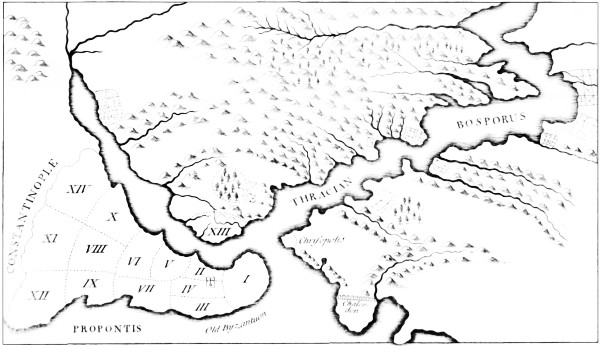
The Thracian Bosporus with Constantinople divided into Wards.
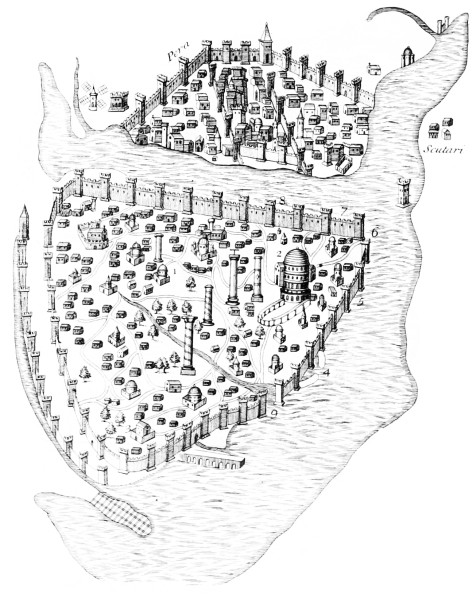
Constantinopolis
The Delineation of Constantinople as it
stood in the Year 1422 before it fell under
the Dominion of the Turks
From Du Fresne Lib. 1. p. 1.
- 1. Ecclesia Apostolorum.
- 2. Ecclesia Sanctæ Sophiæ.
- 3. S. Joh. de Studio.
- 4. Portus Palatii.
- 5. Hodegetria.
- 6. S. Demetrius.
- 7. Porta Iudæa.
- 8. Porta Piscaria.
- 9. Contoscalium.
J. Tinney Sculp.
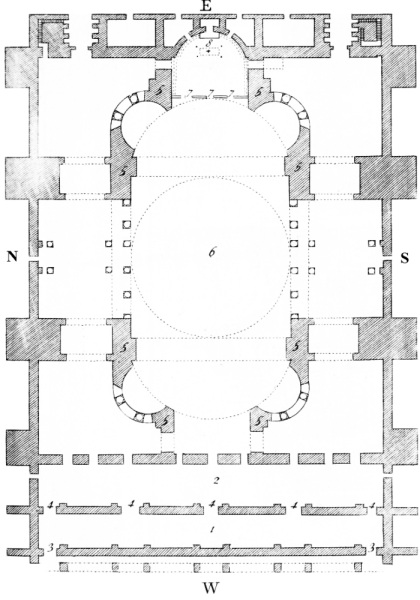
The Ichnography or Groundplot of the
Church of Sancta Sophia from Du Fresne.
- 1 The outward Porch.
- 2 The inward Porch.
- 3 The 2 Doors of the outward Porch.
- 4 The 5 Doors of the inward Porch.
- 5 The 8 principal Pillars.
- 6 The Centre.
- 7 The Holy Doors.
- 8 The Holy Table.
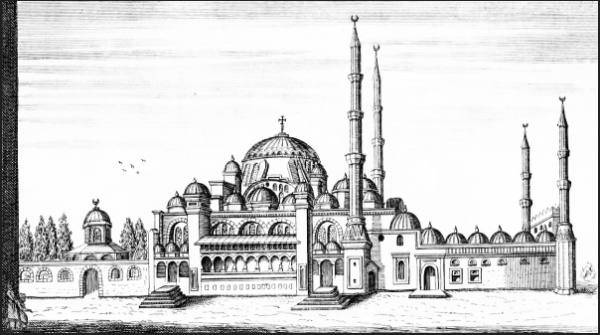
The whole view of the Church of Sancta Sophia from Du Fresne Lib. 3. Pag. 5.
J. Tinney Sculp.
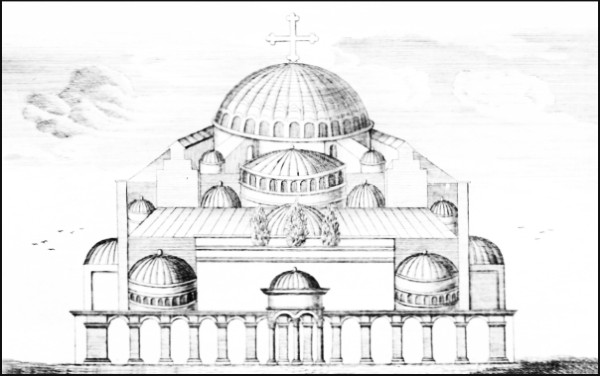
The outside Prospect of the Church of Sancta Sophia from Du Fresne Lib. 3. Pag. 1.
J. Tinney Sculp.
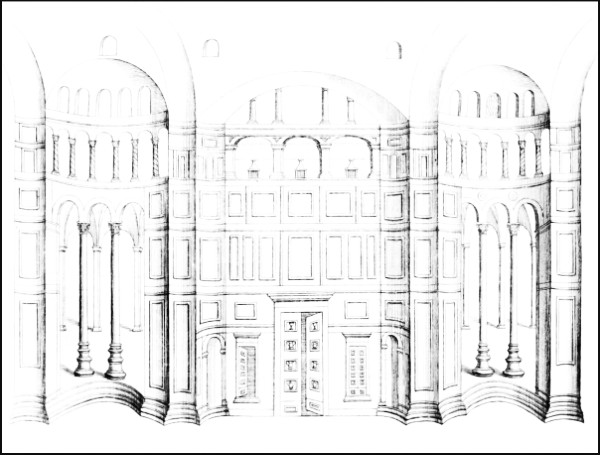
The inside Prospect of the Church of Sancta Sophia from Du Fresne Lib. 3. Pag. 1.
J. Tinney Sculp.
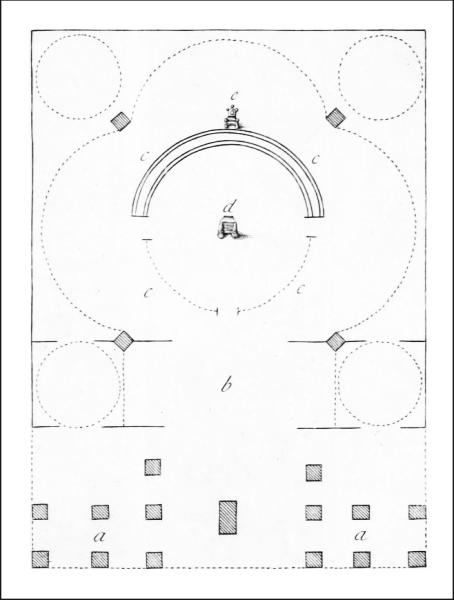
The Plan of the Church of the
Apostles. Lib. 4. Cap. 2.
- aa. Propilæum or Church porch.
- b. The Nave, or body of the Church.
- cccc. The circuit of the Chancel.
- d. The holy Table.
- e. The holy Chair.
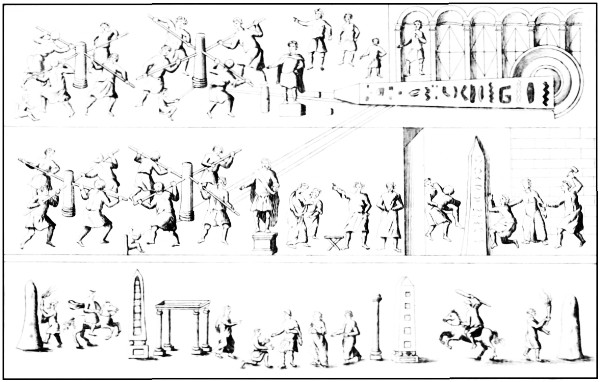
The Hippodrom with the Thebean Obelisk and Engines by which it was erected.
From Sʳ. G. Wheler.
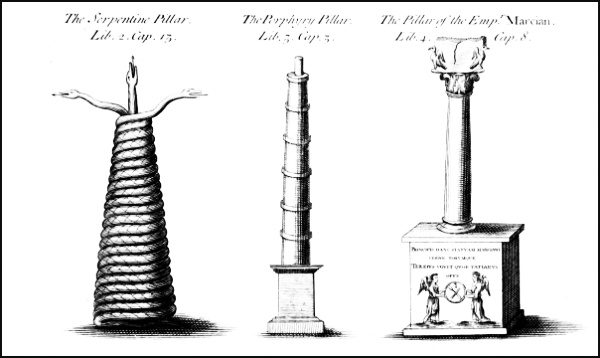
The Serpentine Pillar.
Lib. 2. Cap. 13. |
The Porphyry Pillar.
Lib. 3. Cap. 3. |
The Pillar of the Empʳ. Marcian.
Lib. 4. Cap. 8. |
From Sʳ. G. Wheler.
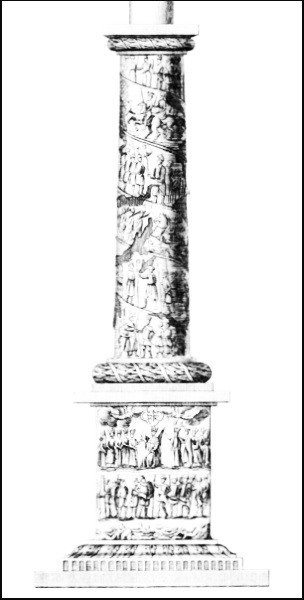
The Historical Pillar
from Du Fresne Lib. 1 Pag. 79.
J. Tinney Sculp.
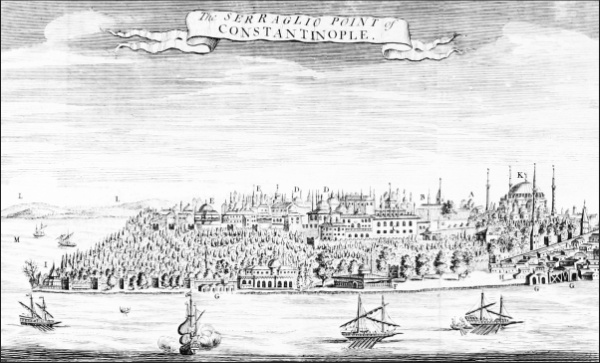
The SERRAGLIO POINT of
CONSTANTINOPLE.
- A The Entrance into yᵉ. Serraglio from yᵉ. City.
- B Lodging for the Guards.
- C The great Hall for publick Audience.
- D The Grand Signors Lodgings.
- E The Womens Lodgings.
- F Pleasure Houses.
- G The Grand Signors Barge-houses.
- H Part of Constantinople called Balat.
- I The Entrance into the Serraglio from Sea.
- K Sancta Sophia now yᵉ. Grand Signors Mosque.
- L Part of Asia Shoar.
- M The Bosporus wᶜʰ. divides Europe from Asia.
From B. Randolph.
APPENDIX.
The following Piece was communicated to me by a Gentleman of the
University of Oxford, who had copy’d it from the latter End of
the Second Book of Nicetas Choniat, Concerning the Destruction of
Constantinople. I had no sooner perus’d it, but I found it so curious
in it self, and so well suited to the Subject of my Author, that I
perceiv’d the Obligations I was under for that Favour; and judg’d it
worthy of a Translation. I would only farther advertise the Reader,
that the following Passage is not to be met with in any of the Printed
Copies of Choniat, but is a Transcript from him in that Part of his
Book, where he writes, concerning the Statues of Constantinople,
which the Romans, when they took that City, caused to be melted
down, and coyn’d. The Passage may be found in a MS. Cod. Bodl. fol.
447. l. 25. and runs thus:
The Roman Conquerours, who were of an with avaritious Temper, even
to a Proverb, practis’d a new Method of Rapine and Plunder, entirely
unknown to those who had taken the City before them. For breaking open
by Night the Royal Sepulchres in the great Grove of the Heroum, they
sacrilegiously rifled the Corps of those Blessed Disciples of Jesus
Christ, and carry’d off whatsoever was valuable in Gold, Rings, and
Jewels, which they could find in these Repositories of the Dead. But
coming to the Body of the Emperor Justinian, and finding his Coffin
untouch’d, tho’ it was publickly known for some Years that it was
nobly enrich’d, aw’d with in Fear and Admiration, they forbore to
disturb the Imperial Ashes. And as they express’d no Reverence and
Regard to the Dead, so were they equally Savage and Inhuman in their
Treatment of the Living; even to those who were their own Countreymen.
They spar’d neither the House of God, nor his Ministers, but
stripped the great Church (Sancta Sophia) of all its fine Ornaments
and Hangings, made of the richest Brocades, of inestimable Value: But
still continuing unsatiable in their Avarice, they no sooner cast their
Eyes upon the brazen Statues, than they order’d them to be melted down.
The fine Statue of Juno in Brass, which stood in the Forum of
Constantine, they chopt in Pieces, and threw it into the Forge. The
Head of this Statue was so large, that four Yoke of Oxen could scarce
drag it into the Palace. Upon the Base of it was cut, in Basso
Relievo, the Figure of Paris, Venus standing by him, presenting
her with the Apple of Discord. The noble Quadrilateral Pillar,
supported with several Ranges of Pillars, and which by its Height
overlook’d the whole City, and was both the Wonder and the Delight of
the curious Spectator, shared the same Fate. This lofty Column was
adorn’d with rural Representations of all kinds of singing Birds, Folds
of Cattle, milking Pails, of Sheep bleating, and of Lambs frisking and
playing, &c. There was also engrav’d upon it a View of the Sea and
Sea-Gods; some of whom were catching Fish with their Hands; others
ordering their Nets, then diving to the Bottom; whilst some in a wanton
Manner, were throwing Balls at one another. This Pillar supported a
Pyramid at the Top of it, upon which was plac’d the Statue of a
Woman, which turn’d about with the Wind, and was therefore called
Anemodes. This excellent Piece was also melted down for Coinage, as
was also an Equestrian Statue, fixed upon a Quadrilateral Pedestal
in the Taurus. This was a bold Figure, of an heroic Countenance,
and surprizing Stature. It was reported by some, that he was one
of the Spies, who was sent by Joshua the Son of Nun. With one
Hand he pointed Eastward, with the other to the West, and the Coast
of Gabeon. But this Statue was generally believed to represent
Bellerophon, (born and brought up at Peloponnesus) sitting upon
Pegasus; for the Horse was without a Bridle, as Pegasus is mostly
figur’d, scouring the Plain, despising a Rider, flying and driving
about in a headstrong manner. There is an old Report, which at this
Day is in every Body’s Mouth, that there was stampt in the Breast-Plate
of this Horse, with great Skill, the Figure of a Man, which appear’d
outwardly; this Image was either one of the Venetici, the
Epizophurii, or the Bulgari, who were not, at that Time, conquer’d
by the Romans. This Horse and his Rider were also melted down. In the
Accoutrements of this Horse was likewise found a small brazen Image,
wrapp’d up as it were in Wool, which the Romans look’d upon to be
of little or no Value, and therefore threw that also into the Fire.
Neither did the Resentment of the barbarous and unpolite Soldiers stop
here, but they expressed the utmost Fury against the finest Statues,
and most curious Pieces of Workmanship in the Hippocum, cutting
the largest of them, which cost immense Sums, into small Coins of
little Value. The great Statue of Hesperian Hercules, fix’d upon a
magnificent Pedestal, clothed in a Lyon’s Skin, which seem’d to live,
and affright the Spectators with his tremendous Voice, felt the Marks
of military Power. He was not here arm’d with his Quiver, his Bow, or
his Club, but stretching out his right Leg and Arm, he kneeled upon
his left Knee, and leaning upon his left Elbow, with his Hand open, he
supported his Head in a thoughtful Manner, and seem’d to lament his
Misfortunes; uneasy above all at those which Eurystheus out of mere
Envy had impos’d upon him. This Figure was broad-chested, the Shoulders
were large, his Hair long, curl’d, and reaching to his Waste; his Arms
were brawny, and as long as those of the Original made by Lysimachus,
which was the first and last Master-piece of his Skill. In short, of
such a stupendous Size was this Statue, that his Wrist was as thick as
a Man’s Body, and the Length of his Leg equal in height to that of any
ordinary Person. This noble Statue, I say, did not escape the Rage of
these mighty Pretenders to native Virtue and Honour: Beside this, they
also carry’d away the Image of the Loaded Ass and his Driver. These
Figures were set up originally by Augustus Cæsar at Actium, of
whom the Fable goes, that when he went out privately in the Night Time
to take a View of Anthony’s Army, he met a Man driving an Ass; and
asking him “Who he was, and whither he was going? He answered, my
Name is Nichon, and my Ass’s Nichander, and I am going to Cæsar’s
Army”. The Statues also of the Hyæna, and the Wolf which suckled
Romulus and Remus, underwent the same Fate, and were coyn’d into
little brazen Staters. The several Statues also of a Man fighting
with a Lyon, of the Horse Neilôus, cover’d with Scales behind, of
an Elephant with a moving Proboscis, of the Sphinx’s, beautiful
as Women, and terrible as Beasts; which can occasionally walk, or fly
in the Air, to fight with Birds of Prey. There was also the Statue
of a wild Horse, pricking up his Ears, snorting, curvetting, and
prancing; this, and old Scylla were served in the same injurious
Manner. She was figur’d like a Woman to the Waste, with a grim
frightful Look, just as she appear’d, when she sent her Dogs to destroy
Ulysses. There was also plac’d in the Hippocum a brazen Eagle,
which was the Invention of Apollonius Tyanæus, and a celebrated
Monument of his Sorcery. This Impostor, when he was once requested
by the Byzantians, to heal them of the Bitings of Serpents, which
was then a common Malady among them, immediately using some diabolical
Charms, and heathenish Ceremonies, he plac’d this Eagle upon a Pillar;
it was a pleasant Sight enough, and deserv’d the Curiosity of being
more narrowly inspected; for it made an agreeable Harmony, and less
dangerous than that of the Syrens. Its Wings were stretch’d out, as
ready for Flight, and it was trampling upon a Serpent, wreathing it
self about him. The Serpent seem’d to make the utmost Effort to bite
the Eagle, but its Venom had no Power to hurt him. The Eagle seem’d
to gripe him so hard in his Talons, that he was forced to hang down
his Head quietly, and seem’d either to be unwilling, or unable to spit
his Venom at him. The Eagle, on the other Hand, look’d brisk and
sprightly, and having obtain’d the Victory, seem’d to be in Haste, to
bear him through the Air in Triumph, denoting by the Sprightliness
of his Look, and the Feebleness of the Serpent, that the Serpents,
that tormented the Byzantians, would hurt them no more, but suffer
themselves even to be handled and strok’d by them. But these were not
the only Curiosities observable in this Aquiline Statue. It was also
very remarkable, that the twelve Hours were engraven under its
Wings, under each Wing six, which shew’d the Hour of the Day, by the
Rays of the Sun darting thro’ a Hole in each Wing, artificially made
for that Purpose. But what shall I now say of the fine Proportions
of Helen, who engag’d all Greece in her Quarrel, and for whose
Sake Troy itself was laid in Ruines? No Wonder that when living
she could charm the most stubborn, and soften the most impenetrable
Heart, when in breathing Brass she captivated all that saw her. Her
Habit sat loose upon her, which discover’d too great an Inclination
for Gallantry. Her Hair, which seem’d to wave in the Wind, was long
and delicate, braided with Gold and Jewels. Her Robe was girt about
her, falling down to the Knee. Her Lips seem’d like the opening Roses,
you would fancy they mov’d, and such an agreeable Smile brightned her
Countenance, as entertain’d the Eye of the Spectator with Pleasure. It
is impossible for me to describe the Sweetness and Chearfulness of her
Looks, the Arches of her Eyes, and the perfect Symmetry of the whole
Statue. Take it therefore as it is given us by Poets and Historians.
Helen the Daughter of Tyndarus was the Perfection of Beauty, the
Child of Love, the Pride, and the Care of Venus; the Master-piece of
Nature, the great Prize of the Grecians and Trojans. Where is now
your Nepenthe, the secret Charm to guard you from all Evils? Where
are your irresistible Philtrums? Why did you not use them against
these barbarous Invaders, with the same Success as you did formerly?
But I suppose it was determined by the Fates, that you should fall
by the Force of Fire, who have rais’d such Flames in the Breasts of
those who came to behold you; or perhaps these our new Conquerours,
who pretend to be descended from the Trojans, threw your Statue into
the Fire, to revenge the burning of that City, of which you was only
the innocent Cause. But I can neither think nor speak with Patience of
these avaritious Monsters, who have demolish’d the most valuable, the
most curious, the most costly Statues in the whole World; Fellows, who
would have sold their Wives for Money; who behav’d themselves rather
like Birds of Prey, than a regular well-disciplin’d Army; only with
this Difference, that they spent their Prey as loosely, as they got
it ingloriously, and would willingly venture their Lives to support
their Extravagance. Hear these Verses of Homer, who is well known
to the Greeks and the Barbarians; to the Learned, and Unlearned,
concerning Helen.
—No Wonder such Celestial Charms,
For ten long Years should hold the World in Arms.
Pope.
Pardon this Digression:—There was also plac’d upon a Pillar a more
modern Statue of a Woman, which was very curious and agreeable. Her
Hair hung down behind, combed close down from the Forehead backwards,
not breaded up, but bending to the Hand of the Spectator. Upon the
right Hand of this Statue stood the Equestrian Statue of a Man.
The Horse stood upon one Leg, the other bore a Cup with a mix’d Potion.
The Rider was of a large Size, his Body compleatly arm’d, his Legs
and his Feet were cover’d with Greaves, his Air was manly, rough, and
warlike. The Horse was mettlesome, and high courag’d, pricking up
his Ears, as tho’ he heard the Trumpet. His Neck was high, his Look
fierce, his Eyes sparkling, as eager for the Battle; he rear’d up
his Fore-feet, and pranced like a War-Horse. Near this Statue, hard
by the Eastern Goal, call’d Rusius, were a Range of Statues of
Charioteers, dextrous in driving the Chariot, and turning the Goal.
They were very busy in managing their Bridles, and smacking their
Whips, and directing their Horses, with their Eyes fix’d steddily upon
the Goal. In short, there seem’d to be describ’d in these Figures
all the Tumult and Fury of a Chariot Race, with the most vigorous
Struggle for Victory and Success. This Description of these Statues
may seem imperfect; for it never was my Intention to describe them
all. But what gave me the most agreeable Pleasure, and seem’d to me
the most admirable Piece of Workmanship, was a large Pedestal, upon
which was plac’d an Animal cast in Brass, as large as an Ox, having
a short Tail, and a moderate Dewlap, something like the Ægyptian
Cattle. It had no Hoofs; but held in its Teeth, ready to strangle it,
another Animal, cloth’d all over with Scales, almost impenetrable. It
seem’d to be a Basilisk, and had a Mouth somewhat like a Serpent’s.
It was taken by many to be an Ox of the Nile, and by some to be a
Crocodile. But I forbear to give the several Conjectures upon it.
These Figures however seem’d to represent an odd Sort of Fight, each
of them furiously striving for Victory. The Creature which seem’d to
be the Basilisk was in Colour like a Frog, and was all over bloated
from Head to Foot. He was casting out his Venom upon his Antagonist,
with an Intent to destroy him. This Animal was carv’d as bearing upon
one Knee, and in a languishing Condition. This Observation gave the
Spectators occasion to believe it fallen dead backward, if the Base
where he stood had not supported him. There was also the Figure of
another Animal, in whose Jaws was represented a Smaller Creature,
whose Mouth was open as almost choak’d by the Teeth which held him,
struggling to get loose, but to no Purpose. His Tail, which was very
Short, seem’d to tremble; his Shoulders, his fore Feet, and the hinder
Part of his Body, were hid in the Mouth of his Enemy, and mash’d by
his Jaws. These Animals also mutually kill’d each other. Thus we
may observe, that these Poisonous Creatures, so destructive to Man,
are no less noxious to each other. And this, many Times, is the Case
of Nations, and Kingdoms, as was exemplify’d in the Romans, when
they made War upon us; killing, and destroying one another, through
the Power of Christ, who rejoyceth not in Blood, and disperseth the
Nations that delight in War; who maketh the Just to walk upon the
Adder, and the Basilisk, and treadeth the Lyon and Dragon under his
Feet.
In the Beginning of this MS upon a large Folio Page, are inscrib’d
the following Words, in the Benefactor’s own Hand. “Sir John
Roe, Bart. Ambassador from His Majesty of Great Brittain to the
Grand Seignior, as a perpetual Testimony of his Gratitude to the
University, (Oxon) gave this Book, which he met with in his Travels,
to the Publick Library, 1628.”