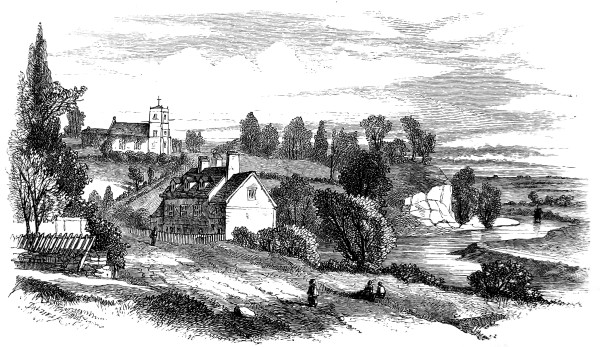
QUATFORD..
In the foregoing pages I have brought before the reader many historical
notices of Bridgnorth from a very early period down to the reign of
Edward III; but I regret that I have been able to collect only a very
few from the commencement of that reign to the era of the Reformation,
and still fewer between that period and the time of the Civil Wars; but
the few which I have been able to collect respecting these intervals,
though of minor importance, may not be without their interest, inasmuch
as they serve to connect our town, however slightly, with some of the
memorable events in English history.
The reign of Edward III. is one of the most brilliant in the annals of
England. The military prowess of the nation, directed by the genius
and intrepidity of the King himself, and by the youthful heroism of
his son Edward, the Black Prince, acquired a fame which has never
since been eclipsed. This enterprising monarch had not been many years
on the throne before he invaded the territories of France, and there
obtained triumphs, so marvellous, when the superiority of the enemy’s
forces is considered, that the names of his victories, Cressy and
Poictiers, are “household words” with Englishmen, even in this day.
It is very possible that some of the men of Bridgnorth may have taken
part in these famous battles; for it appears from a public document,
that just before the invasion of France by King Edward, a writ was sent
to Bridgnorth, as well as to other towns in Shropshire, for raising a
small contingent to the war. In this document it is stated that “Sir
Roger de Strange of Knockin, John Aston and others, as chief persons
within the County of Salop, were summoned to raise 40 men at arms,
within the said County, and 30 Hobelers within the town of Salop; 10
Hobelers in Ludlow; 6 in Wenlock; 10 in Bridgnorth; 4 in Newport;
and 40 in the rest of the County.”—(History of Shrewsbury, p. 163,
note 1.) The men at arms were horsemen who wore a complete suit
of armour, and were mounted on strong war horses, answering to our
heavy dragoons; the hobelers were light-armed horsemen, who rode on
“hobbies,” or small fleet horses, and were in the armies of the ancient
English what the troops of light cavalry are in ours. They served the
same purpose for Edward in his French campaign that our light brigade
did for us in the famous charge at Balaklava. I do not know whether any
man from Bridgnorth was among those gallant 600; but I know that some
of our townsmen were exposed to other perils in the Crimean campaign,
and met them with a fortitude that did no dishonour to their ancestors,
who were enrolled under the banner of the Black Prince.
I have not been able to find out any other fact of any particular
interest respecting Bridgnorth, during the reign of Edward III, except
that the Burgesses of the town petitioned him, that they might have
the use of his chapel, within the Castle, as a parish church. Hitherto
this chapel of Saint Mary Magdalene had been exclusively allotted to
the Castle, and perhaps was used solely by the garrison, and Saint
Leonard’s was the only parochial church belonging to the town; but
now, the Burgesses wishing for larger church accommodation, on account
perhaps of the increase of population, or for some other cause which
made it desirable, laid their petition before the King, that he would
grant them the use of his royal chapel. Whether or not they succeeded
in their object does not appear.[36]
About twenty years after this, in the same reign, the population was
fearfully diminished by a pestilence, which twice swept over England,
as well as the rest of Europe, and which was so destructive in its
ravages, that it is computed that a third part of the inhabitants of
every county was taken off by it. Shropshire suffered very severely.
We have no record of its progress in Bridgnorth; if we had, it would
doubtless afford us as many narratives of an interesting, though
painful, character, as the visitation of the cholera did a few years
since. This fact the historian Walsingham relates, that eighteen out of
every twenty in the Friaries and Abbeys fell victims to the disease.[37]
This may be in part accounted for by so many living together in
the same house, among whom a contagious disease would be likely to
spread with fatal rapidity. Others attribute the remarkable amount of
mortality among the ecclesiastics at this time[38]
to their frequent visitations of the sick—their constant intercourse
with the diseased and dying. If this be a true account of the matter we
may infer that the members of the religious houses in Bridgnorth—who,
like their brethren elsewhere, perished in numbers—were thus charitably
employed during this visitation, and sacrificed their lives to this ministry
of mercy, imparting as far as they were able to do so, the consolations of
the Gospel of Christ to the sufferers around them.
On the death of Edward III., the reins of government were committed
into the feeble hands of Richard II., who, after a disastrous reign of
twenty-two years, (during which I find no historical notice of our town
worth mentioning) was deposed by his cousin Henry Bolingbroke, Duke of
Lancaster. Henry, who assumed the sovereignty, under the title of Henry
IV, was frequently in Shropshire, on account of the insurrectionary
movements which took place among the Welsh, during the early part of
his reign. Under the leadership of the hot-headed and enterprising
Owen Glendwyr, they ravaged the border counties to a considerable
extent; and, in consequence of this, the Council issued an order,
that all the Castles on the borders—and Bridgnorth Castle was one of
them—should be strengthened and put in a state of defence, to resist
the incursions of the rebels. But previously to this, an act of
Parliament had been passed, which had special reference to Bridgnorth,
with other towns in our County, forbidding them to allow any one
born in Wales, and descended from Welsh parents, to become a member
of their corporations, or even to purchase land within the Borough.
These restrictions, however severe they may appear, were considered
necessary, on account of the spirit of disaffection, which so generally
prevailed in the Principality.
But, notwithstanding these civil enactments and military preparations,
the cause of the Welsh chieftain continued to gain ground, till it
suddenly received unexpected support, from the accession to his party
of the Duke of Northumberland, and his valiant son Harry Hotspur, who
at the head of a formidable army of English and Scotch, marched towards
the borders. He, as quickly as possible, united his forces to those of
Glendwyr, and the combined rebel army encountering the royal forces,
led on by the King in person, and Henry Prince of Wales, fought a great
battle, well known to the readers of English History as the famous
Battle of Shrewsbury; for it was fought under the walls of our county
town. If we may rely on Shakespeare in this matter, who indeed is
often, even in minute circumstances, an excellent historical authority,
we may conclude that Bridgnorth was the place appointed by King Henry
for the rendezvous of his army on the eve of this great battle. In
the first part of the Play of Henry IV, the king is represented as
addressing the chief leaders of his army, and giving instructions as to
the mustering of his forces, in these words:—
“The Earl of Westmorland set forth to-day;
With him, my son, lord John of Lancaster;
On Wednesday next, Harry, thou shalt set forward;
On Thursday, we ourselves will march:
Our meeting is Bridgnorth: and, Harry, you
Shall march through Glostershire; by which account
Our business valued, some twelve days hence
Our general forces at Bridgnorth shall meet.”
If our dramatist had any warrant for this representation, of which
I have no doubt, the town of Bridgnorth must have witnessed on this
occasion a fine military muster, and have had the privilege of
receiving into its Castle one who has been ranked among the greatest
of England’s heroes—Henry, Prince of Wales. He was just at that time
beginning to emerge from the state of wild and thoughtless profligacy
in which he had wasted his early years, and was about to exhibit those
qualities, which have since made his name so illustrious in English
History. The battle of Shrewsbury, at which he did some service, was
very decisive; and the confederate army of the rebels, under Glendwyr,
Hotspur, and Douglas, was completely routed. Nevertheless our county
continued for years after to be ravaged by the Welsh insurgents, nor
was it till the reign of Henry V., when the death of Glendwyr took
place, that there was any security for life and property in the Borders.
In the succeeding reign of Henry VI. commenced that most destructive
series of Civil Wars, known by the name of the Wars of the Roses,
between the rival houses of York and Lancaster, which laid waste for
many years the fairest provinces of the land. “It was not finished in
less than a course of thirty years: was signalized by twelve pitched
battles: opened a scene of extraordinary violence: is computed to have
cost the lives of eighty Princes of the blood, and to have almost
entirely annihilated the ancient nobility of England.”—History of
Shrewsbury, Vol. 1, p. 166.
Shropshire was necessarily embroiled in these contests, and I have
lighted upon one fact, which shows, I think, that Bridgnorth, as well
as the neighbouring town of Shrewsbury, assumed the badge of the White
Rose, espousing the cause of the house of York. The fact referred to,
though a trifling one in itself, seems to me to connect Bridgnorth with
the great leader of that party—Richard Plantagenet, Duke of York. This
nobleman, who had doubtless a clearer title to the crown of England
than the reigning monarch, held the Castle of Ludlow, and was naturally
very anxious to associate the people of Shrewsbury with his party, and
to make them his adherents. He therefore entered into communication
with them; and on one occasion, when a matter of some consequence was
to be considered, the Bailiffs of Shrewsbury appointed a gentleman of
Bridgnorth, the representative of this Borough, in company with others,
to treat with the Duke at his castle of Ludlow. The following extract
from the accounts of the Bailiffs of Shrewsbury, a.d. 1457,
refers to this fact:—“Paid for a breakfast to Thomas Acton and Thomas
Hoord, for their good council, touching the return of a precept to the
Duke of York, directed to the Bailiffs for surety of the peace.” Again.
“Money paid for the expenses of Thomas Hoord, and William Lyster,
riding to the Lord Duke of York at Ludlow, to get the said precept
dissolved.” (History of Shrewsbury, Vol. 1, p. 224.) This Thomas Acton
was of Aldenham, and ancestor to the present baronet of that name; and
Thomas Hoord was of Hoord Park, now called Park Farm, adjacent to our
town, a gentleman of ancient lineage. He was member of Parliament for
our Borough, and therefore it is not likely that he would have engaged
himself to treat with the Duke of York, if he had not been aware that
his constituents at Bridgnorth were well affected to his party, which
was now growing formidable.
I have not had access to any records which shew whether our town took
any very active part, or in what measure they suffered in consequence,
in this fatal and disastrous strife; but it is scarcely possible that
such great battles should have been fought in this and the adjoining
counties, as Mortimer’s Cross, Tewksbury, and Ludlow, without
Bridgnorth being more or less affected by them. I have little doubt
that the state of decay and ruin, in which parts of the town were found
some years afterwards, is to be traced to these civil contests. This is
noticed in an Act of Parliament, passed in the year 1535. It recites
that “many houses, messuages, and tenements of habitation, in the town
of Bridgnorth, now are, and have of a long time been, in great ruin and
decay, and specially in the principal and chief streets there being;
in the which chief streets in time passed have been beautiful dwelling
houses there, well inhabited, which at this day much part thereof is
desolate and void grounds, with pits, cellars, and vaults lying open and
uncovered, very perilous for people to go by in the night, without
jeopardy of life, which things are to the great impoverishing and
hindrance of the said town.” (History of Shrewsbury, Vol. 1, p. 318.)
These wars between the houses of York and Lancaster, which spread such
ruin over the land, did not cease till after the battle of Bosworth
Field, and the accession of the house of Tudor to the throne, in the
person of Henry VII; and with this latter event, a very important one
in English history, Bridgnorth was accidentally connected.
The Duke of Buckingham was the chief instrument of raising the Earl of
Richmond, afterwards Henry VII, to the throne of England, and this was
occasioned, the historian Hall relates,[39]
by a casual circumstance which occurred in the neighbourhood of our
town. This Duke had large estates in Shropshire, in consequence of his being the
representative of the ancient family of Corbet, and among these he had certain
tenements in Bridgnorth. (Dukes’ Antiquities of Shropshire, p. 31.)
His possession of this property was perhaps the cause of his visiting
our town, in the summer of 1483. It was just at this time that he was
plotting the overthrow of the government of Richard III, but feeling
uncertain as to the person whom he should endeavour to make sovereign
in his stead, when riding one day between Bridgnorth and Kidderminster,
he accidentally met the Countess of Richmond, better known by the name
of the Lady Margaret. This casual interview suggested to his mind the
young and enterprising Earl of Richmond, as the fittest heir to the
English throne; and he immediately set himself to raise an insurrection
in these, and other parts of the kingdom, in his favour. The
insurrection succeeded, though Buckingham himself perished in the
enterprise; and the Earl of Richmond, became Henry VII, king of
England. On so accidental a circumstance depended the accession of
the house of Tudor to the English throne, and the consequences, which
followed it, so important to the interests of this great empire.
It was during the sovereignty of the house of Tudor that one of the
most important events in the history of our country took place, viz.,
the Reformation, commencing in the reign of Henry VIII., and being
completed in that of Elizabeth. I greatly regret not having been able
to collect any information respecting our town during this eventful and
interesting period. One would like to know how it was affected by the
great movement which was then taking place, and whether the pulpits of
St. Mary’s and St. Leonard’s were late or early in announcing those
glorious truths, which at that time began to stir the depths of people’s
minds, and caused such a mighty revolution in the land—whether here,
as well as elsewhere, there were men who stood up as fearless defenders
of the truth, ready to seal their advocacy of it with their blood.
We have no details on the subject; but we learn that the spirit of
reformation was awakened in Shropshire as far back as the fourteenth
century. A very remarkable Poem of that date, entitled “The Visions
of Piers the Ploughman,” whose uncouth rhymes seem to have produced
a wonderful effect on the popular mind, was written by an inhabitant
of the neighbouring town of Cleobury Mortimer. (History of Salop,
p. 202, note 1.) We also know that our county town had a courageous
advocate of the cause in the reign of Henry IV in William Thorpe; who
ascending the pulpit of Saint Chad’s, vehemently denounced the errors
of the Church of Rome, and in consequence suffered imprisonment. It is
not likely that such things should have gone on in the neighbourhood of
Bridgnorth without our townspeople being more or less affected by them;
but we have no particulars—none, I mean, that my very limited search
could discover—respecting the progress which the Reformation made
among them.
There is one document, however, which shews that the accession of
Queen Mary was received by the inhabitants of Bridgnorth and its
neighbourhood with great demonstrations of joy; but it is of course
doubtful whether this resulted from their loyalty to the person of
one whom they rightly regarded as the heir to the throne, or from
attachment to those religious opinions of which she was known to be a
patron. The document I refer to is an extract from the Register of Sir
Thomas Boteler, Vicar of Much Wenlock, beginning November 26th, 1538,
ending September 20th, 1562. “1553 Memorandum. That as some say King
Edward VI, by the grace of God, &c., died the 6th day of this instant
month of July, in the year of our Lord God as it is above written, and
as some say he died on the 4th of May last proceeding in the same year
of our Lord; and upon Mary Magdalene’s day, which is the 22nd day of
this instant month, at Bridgnorth in the fair there was proclaimed
Lady Mary, Queen of England, &c., after which proclamation finished,
the people made great joy, casting up their caps and hats, lauding,
thanking, and praising God Almighty, with ringing of bells, and making
of bonfires in every street. And so was she proclaimed Queen on the
same day, and at the Battle field in the same evening, with the like
joy of the people, and triumphal solemnity made in Shrewsbury, and also
in this Borough of Much Wenlock.”
The Act for the dissolution of Monasteries and other Religious Houses
took effect here of course, and consequently the Friary and the
Hospitals of St. John and St. James were all suppressed, and their
property confiscated. The Brethren of Grey Friars seem at that time to
have been in very reduced circumstances, so that the spoils obtained
from them were hardly worth the seizure. The King’s Commissioners came
here on the 5th of August, 1538, and the following note, which was
signed by the Bailiffs of the town, shows the indigent condition in
which this religious establishment was found—a plain proof of what
little hold at that time the orders of monks and friars had upon the
affections of the people. “Memorandum. This V daye of Auguste, in ye
XXX yeare of Kynge Henry the VIIJth, that Rycharde bysehope of Dovor,
and vesytor under the Lorde Prevy Seale for ye Kynge’s grace, was in
Bryggenorthe, wher that the warden and heys Bredren in the presens of
Master Thomas Hall, and Master Randolphe Rodes, Balys of the sayd towne
gave the howse, with all the purtenans into the vesytores handdes to
the Kynge’s use; for sayd warden and brethren sayd that they war not
abull to live, for the charyte off the pepulle was so small, that in
IIJ yeares they had not receyvyd in almes in redy mony to the sum of
Xs. by yere, but only leve by a serves that they had in the town in
a chapell[40]
on the bryge. Thus the sayd vesytor receyveyd the sayd howse, with the
purtenans to the kynge’s use, and by indentures delyveryd yt to us
the sayd Balys to kepe to the kynge’s use, till the kynges plesur was
further known. Thys wyttenes we the sayd balys with other.
- per me Thomam Halle.
- per me Randull Rowdes.”
- (Wright’s History of Ludlow, p. 342.)
An incidental proof of the state of penury to which these poor Friars
of Bridgnorth were reduced, may be gathered from a note kept among the
records of the town of Shrewsbury, of the expenses which were incurred
by Roger Thomas, their senior Bailiff, and Thomas Bromley, afterwards
Lord Chancellor, in a journey which they made from Shrewsbury to
Bewdley on important business. On their return they stopped at
Bridgnorth, and had their dinner at the principal inn, and this is the
note of their expenses:—“Dener at Bruggenorth 3s. 4d.; to Shepay the
frere 1d.” This Shepay was no doubt a member of the Grey Friars, who
waited upon the travellers at their inn, to beg alms for his house.
(History of Shrewsbury, p. 302.)
It might have been expected that when Queen Mary came to the throne
she would have restored all the religious houses in England to their
original use; but on the contrary, pressed by strong political motives,
she confirmed by her own acts the confiscation, which had been made in
the reign of Henry VIII., of the property belonging to them; and thus
under a Popish sovereign it became irrecoverably alienated from the
Church.[41]
The Hospital of St. James, Bridgnorth, affords a striking example of
this. In the year 1566, the Queen, in conjunction with her husband
Philip, made over to Sir J. Parrott, in consideration of £184 15s.,
and for his faithful services, all the property belonging to this
Hospital.[42]
In the year following, Sir J. Parrott transferred the same to Mr.
R. Smith of Morville. In the following reign of Elizabeth, it was
transferred to William Tupper and Robert Dawes; and the property,
after passing through the various families of Smith, Dovy, Kinnersly,
Nevitt, Tyner, and Bach, came into the family of Stanier, and now,
by another turn in the wheel of time, the name of Smith is again
connected with the property. There was an order in Council at one
time, that this estate should pay to Bridgnorth Church a yearly sum of
twenty nobles—equal to £6 13s. 4d. This order was lost out of the town
chest, and afterwards recovered; but in one of the wars it was burnt,
after which the property rendered nothing but a pound of frankincense
every Easter, to be burnt in the Church of the High Town: but this last
customary payment has long been discontinued.
What may have been the value of this pound of frankincense I do not
know, but whatever it may have been, it is certain that the Incumbents
of Bridgnorth receive from the present owners of St. James’s, in their
liberal support of the religious institutions of the town, something
far more valuable than this former impost upon their property.
We now enter on the era of Elizabeth. There is perhaps no period in the
history of our country to which Englishmen are accustomed to look back
with more satisfaction. Whatever may have been her faults and foibles
as a woman, she was undoubtedly a great Queen, and swayed the sceptre
of this realm with such a steady and vigorous hand, as made her revered
by her subjects, and dreaded by her enemies. She contributed more
perhaps than any sovereign that preceded her, to raise the character
of our country, and place it high in the scale of European nations.
Besides, she was under God, the great means of strengthening the cause
of the reformed faith, and resisting the colossal power of the Church
of Rome.
It would have been very gratifying to find any record which would have
connected the history of our town with the public events which took
place in the reign of this great princess; but I have not been able
to find any, none at least but what are of a very trivial nature. I
find, for instance, that in the singular proclamation which she issued,
for the purpose of compelling every one in her realm to wear woollen
caps, except the nobility, she mentions Bridgnorth, as a place where
the company of cappers used to flourish;[43]
which seems to indicate that the people now enjoyed a considerable
share of quietness, and were acquiring wealth by their trade and
industry. Again I find that when her great favorite, the Earl of
Leicester, visited Shrewsbury, and where preparations were made to
receive him with an honour, little short of that which would have been
offered to the Queen herself, one of the three who were appointed to
address him on the occasion, was a Bridgnorth youth, Richard Hoord,
son of John Hoord, of Hoord Park; no slight distinction, considering
the almost royal dignity which was attached to the person of the Earl
of Leicester. But it is only in circumstances of this nature, and
not in matters of weightier import, that I can find any reference to
Bridgnorth in this reign. I ought not however to be disappointed at
this, for one who had far better opportunity for making researches of
this kind, than I have, and far greater aptitude for the task, has
stated that “from the 27th year of Henry VIII till the year 1629, he
could discover no historical notice of the Town or Castle of Bridgnorth.”[44]
This latter date brings us to a very remarkable period in the history
of our town. In that year, viz, the 4th of King Charles I., and on the
2nd day of October, the King made a grant of the Castle, to Gilbert
North, Esq., one of the Gentlemen of the Privy Bed Chamber. It had been
a royal castle from the time that it was taken by Henry I. from Robert
de Belesme—a period of more than five hundred years. But now, perhaps
on account of the cost of keeping it in repair, it was transferred to
the possession of a gentleman belonging to the King’s household, who
by a subsequent deed of the same year, transferred it to Sir William
Whitmore, Knight, in whose family it has continued ever since.[45]
It is indeed greatly to be regretted that its present possessor should have
so small a remnant of it to call his own, and that the leaning tower on
Castle Hill, as it is popularly called, should be all that is left
of this once noble fortress of the middle ages. But how it came to
be thus reduced to utter ruin, is the subject which must now occupy
our attention; and it is one which is intimately connected with the
stirring events of that period.
At the time in which Bridgnorth Castle was transferred to the Whitmore
family, the nation was in a great state of political disquietude. The
King was disposed to carry his royal prerogative beyond the limit
which the law had assigned to it; and many members of the Houses of
Parliament in resisting the encroachment, were tempted to invade the
rights of legitimate authority, and became in the struggle fierce and
unrelenting enemies to the Crown. This contest of prerogative on the
one hand, and the spirit of liberty on the other, brought about the
Great Rebellion; and this fair land was once more destined to be the
scene of civil strife, in which was shed the best and noblest blood
of England. Of the two parties into which our countrymen were then
divided, the Royalists and Roundheads, it is not my province to say
much; I know to which of the two, had I lived at the time, my feelings
and principles would have attached me; yet I feel bound to acknowledge,
that while I regard some of the opinions and some of the acts of the
insurgent party with a feeling nothing short of abhorrence, there were
among them, both among their soldiers and their divines, men of the
highest character, and whose minds were cast in the finest mould; nor
am I unwilling to allow that England is in a great measure indebted to
this party for the present freedom of her institutions.[46]
Respecting, however, the great leader of the party, Oliver Cromwell, I cannot
agree with some late writers, who have endeavoured to canonize his memory,
and who try to represent him as a pure and unselfish patriot. He was
indeed a man of great qualities, of fearless fortitude, and untiring
energy; and perhaps at the commencement of his public course he was
upright and single hearted in his intentions: but there can be no
question of it, that he became ambitious of earthly power; and the
religious phraseology, which was once perhaps the sincere expression of
his feelings, he afterwards employed as a crafty instrument to further
his designs, and to conceal their evil character.[47]
Nor must we, if we would form a just estimate of him, lose sight of the
fact that while he was a subject he was an enthusiast on the side of
liberty, but when he himself was placed on the seat of power, no Stuart
or Plantagenet was ever more despotic in his rule.
In this great intestine struggle, the inhabitants of Bridgnorth, as
was natural from their hereditary loyalty, espoused heartily the cause
of Charles I., as that of their legitimate sovereign; and suffered
severely for their allegiance. In the year 1642, preparations were made
throughout the country for the commencement of hostilities; and in
consequence, the authorities here thought it necessary to put the town,
as far as possible, in a state of defence: and the Corporation have
still in their possession some interesting records, containing the
Common Hall orders which were made on this occasion. The first is as
follows:—Bridgnorth. At a Comon Hall in the said towne, the XXVI day
of August, Aᵒ. R. Caroli Angl, &c., XVIIIº Aᵒ Dⁿⁱ 1642, John Harryson
and Robert Richards, Gents, being Bailiffs.
“Concerninge the makinge of a draw Bridge upon the Bridg over
Severn in Bridgnorth aforesaid, and other things for the defence of
the said towne, upon a warrant from John Weld, Esq., High Sheriff of
this county of Salop, in respect of the extreame danger which is
now come neare unto us.
It is agreed, That the makinge of a draw Bridge shall be respited
untill further consideration; and that for the present necessity, Posts
and Chaines shall be made at the two ends of the Low Towne, viz., At
the farther end of the Mill Strette, and at the farther end of St.
John’s Streete, and at other needfule places in the said Towne; and
also that the Gates of the said Towne shall be repayred, and made
stronge with chaynes and otherwise, as shall be convenient for strength
and defence of the said Towne.”
But very early in the year, the Bailiffs had projected another means of
defence. They had petitioned Thomas Corbett, Esq., of Longnor, in this
county, to exercise the young men of the town, and of the immediate
neighbourhood, in the practice of arms and military tactics, that so
they might be ready to repel any attack which might be suddenly made
by the rebel forces. The following is the letter which Mr. Corbett
addressed to Sir Francis Ottley, Governor of Shrewsbury, on this occasion:—
“1642. Noble Sir,
The Bayliffs of Bridgnorth, in behalf of the town, having been
importunate with me to take upon me the exercising of the young men in
this town, and others in the country neare adjoining, for the defence
of the towne upon any needfull design, I have been persuaded by
them to take the same upon me; and they having shewn me a letter which
they intend to present unto the high Sheriff, for a warrant unto me in
that behalf, I pray be pleased to consider thereto, and impart your
advice unto me, and further Mr. Sheriff’s directions therein, as you in
your wisdom shall think most convenient, and you will oblige
Your respective kinsman,
and friend who truly
Honoureth you,
Thos. Corbett.
Bridgnorth, 5 Feb., 1642.
To my noble friend and kinsman Sir Francis Ottly, Knight, at
Shrewsbury House.” (Blakeway Papers, Bodleian Lib.)
No time indeed was to be lost, for four days before the date of
the order above referred to, the King had set up his standard at
Nottingham, and the parliamentary forces were in the field, under the
command of the Earl of Essex. On the 20th of the following month, the
King removed into this county, and Clarendon states, that “a more
general and passionate expression of affection cannot be imagined, than
he received by the people of Shropshire, or a better reception than he
met at Shrewsbury.” (History of the Rebellion, Vol. 2, p. 18.)
But on his march thither he heard of the rebel army advancing towards
Worcester, and in order to watch their motions, and if possible to
check their progress, he dispatched his nephew Prince Rupert with all
his horse across the Severn; and it was most likely on his return
from this expedition, that the Prince passed through our town, and
took up his residence for the night at Cann Hall. He had conducted
the expedition with that intrepid gallantry which characterized all
his military movements; he had with a handful of men attacked a large
body of the enemy as they were defiling out of a narrow lane near the
city of Worcester, and completely routed them in the first onset,
slaying several of their number, and taking the commanding officer
prisoner; (History of the Rebellion, Vol. 2, p. 25) so that he came
to Bridgnorth, flushed with the first victory which was gained in
these civil wars. While he was here he addressed a letter to the Jury
appointed to choose a Bailiff, dated September, 21st, 1642. It is as follows:—
You Gentlemen of the Jury, who are to have voices in this election,
these are to entreat you, out of a tender care both of his Majesty’s
service and your own happiness and welfare, that in the present
election you make choice of such men for your Bailiffs as you are sure
are well affected for his Majesty’s service. By which you will oblige
me to remain,
Your Loving Friend,
Rupert.
The Bailiffs chosen were Thomas Dudley and John Farr, ancestors most
likely of some of our townsmen who now bear these names; and there is
no doubt, from the choice made of them at this critical time, that
they possessed those qualifications for being Chief Magistrates of the
Borough which Prince Rupert described.
On the 12th of October the King left Shrewsbury, and quartered for the
night at Bridgnorth, where, Clarendon observes, “there was a rendezvous
of the whole army, which appeared very cheerful.” [Vol. 2, p. 42.]
Here the king stayed three days; and I am one of those who feel, that
our town and Castle were never so honoured by a royal visit as on this
occasion. Many of the Monarchs of England have been here; many crowned
heads have entered the portals of our Castle, and rested within its
walls—Normans, Plantagenets, and Lancastrians—but to none of them,
in my mind, attaches the same deep interest, and to none is due
the same tribute of veneration, as to this unhappy monarch of the
House of Stuart. Not only was he by far the most accomplished Prince
that ever sat on the English throne, and endowed with considerable
intellectual powers,[48]
as his successful controversy with Henderson, the Presbyterian
Minister, clearly proved; but he was distinguished in all the relations
of private life by the highest moral principle: by a purity, fidelity,
and love, which are rarely seen in king’s courts, and have seldom been
equalled in retired domestic circles; and these virtues in him were
combined with a deep-seated reverence for religion. He was not
blameless in his public conduct; far from it. There was a weakness
and want of stability in him, which justly exposed him to the charge
of inconstancy, if not of insincerity. He was subtle and evasive, and
it may be at times, under the pressure of very trying circumstances,
disingenuous in his transactions with his opponents, so that they
complained that they could not depend upon him. But he was refined in
the furnace of affliction. “Sweet” to him, as they have been to others,
were “the uses of adversity”; so that when his end drew nigh,[49]
there appeared in him, as his enemies allow, a calm heroic
fortitude—saintly magnanimity—a firmness, combined with a gentleness
and forgiving love—which we do not often find surpassed even in the
early Martyrologies. No memorial then connected with our Castle, is to
me of equal interest to that of its having been occasionally, during
his declining fortunes, the residence of Charles I.
It was on one of these visits that he passed that eulogium, so well
known, and, in the opinion of many, so well deserved, on our Castle
Walk; namely, that it was the finest walk in his dominions. We can
easily picture him to our minds, (for there is no King with whose
lineaments we seem to be so familiar, in consequence of the many
inimitable paintings of him by Vandyke) we can easily picture him, with
measured step and pensive aspect, taking his walk along this terrace,
and his face for a moment lighted up with pleasure at the fair scene
which burst upon him; each step as he advanced bringing into view some
new and striking object—the bold front of the High Rock—the wooded
declivities of Apley—the graceful winding of the Severn, with its
“margent green,” and the sloping uplands on either side of it. But
he could not give free indulgence to such pleasurable emotions, for
a heavy burden of care lay upon his mind, which did not admit of his
thoughts being long diverted to anything else.
He left Bridgnorth on the 15th of October, and eight days after was
fought the famous Battle of Edge Hill,[50]
in Warwickshire, where, if it had not been for the fiery impetuosity of
Prince Rupert, such a signal victory might have been gained by the King
over the forces of the rebels, as to decide the fate of the campaign
in his favour. Then followed the taking of Banbury Castle, the march
of the King’s army to Oxford and Reading, and the capture of the town
of Marlborough. These military operations in different parts of the
country convinced the authorities of Bridgnorth of the necessity of
making further preparations for the defence of the town, and we find
a Common Hall order was passed for this purpose, dated November 29th,
1642:—“Watch and ward shall be duly set day and night in all convenient
places of the towne where the Bayliffs shall think fit, and the open
places within the said towne to be made up as the Bailiffs shall find
expedient; and such as are minded for their own safety, and the safety
of the towne, to bear arms, they are desired with all convenient
expedition to provide arms at the general charge of the towne.”
But in the beginning of the next year they deemed it necessary to
introduce a few horse soldiers into the town, as appears from a Common
Hall order, dated January 25th, 1643; by which it was agreed that nine
dragoons should be maintained at the general charge of the said town.
Towards the charge of the said nine dragoons, it is stated that Mr.
Thomas Corbett undertook to lend a horse and provide a rider, so that
the town should bear the charge of the horse and rider. Thomas Glover
undertook to provide two horses, saddles, and bridles, at 1s. per day
for the hire of each horse. Several other persons furnished a horse
and sword, and a bandolier each. Captains of the watch and ward were
appointed, with orders that the said watch and ward be from Six o’clock
in the morning until Six o’clock in the evening, and from Six o’clock
in the evening until Six o’clock in the morning; and it was appointed
that eight men should watch in the night, and six men in the day.
In the beginning of this year, the King had made Lord Capel, Lieutenant
Governour of our county, than whom there is not one in either party
during those troubled times that bore a more honoured name—a
loyal-hearted servant of the crown—a dutiful and devout member of the
Church of England—one of the firmest, as well as noblest, champions
that the royal cause could boast of.[51]
While exercising his function as Lieutenant Governor of Shropshire, he
was not unmindful of so important a post as Bridgnorth, but adopted
means for its security, as we find by an order of the Common Hall, of
May 23rd, 1643:—“The Right Honorable the Lord Capel, Lieutenant General
to the Prince his Highness, of his Majesty’s forces in the countyes of
Worcester, Salop, and Chester, and the six northern countyes of Wales,
hath appointed Sir Thomas Wolrich, Knight and Bart., to draw his forces
of the trayned band of this county which are under his command, to this
towne and neighbourhood hereabouts of Bridgnorth; it is agreed that
fortifications be made in all fords and places about this towne, and
the liberties thereof, where the said Thomas Wolrich shall think good
to appoint, and that all the men of this towne shall come themselves,
or send labourers to this work, with all speed; unto which work Edward
Cressett, Esq., and Edward Acton, Esq., justices of peace of the said
county, being present, do promise to send labourers and workmen out of
the country. Secondly, whosoever has volunteered will bear arms for
the defence of this towne, and the neighbourhood hereabouts, shall
be listed, and attend the service of training weekly, upon every
Tuesday, to be exercised therein, whose teaching and training for that
service Lieutenant Billingsley (at the towne’s entreaty) is pleased to
undertake.”
The year 1644 was a disastrous one to the royal cause, in consequence
of the signal victory, which Cromwell gained over Prince Rupert at
Marston Moor, July 2nd; and the following year opened very gloomily on
the fortunes of the king; but the people of Bridgnorth did not desert
the cause of their sovereign, though recent events had proved it to be
a failing one, but they made further preparations for resisting the
insurgents, and for holding out against them.
It appears that a Committee had been formed for the purpose of
hastening forward the works, and for putting the town in as good a
posture of defence as the circumstances would allow. The following is a
copy of another order made by them, dated May 21st, 1645:—
- “Commissioners present,
- Sir Lewis Kirke, Governor.
- Sir Edward Acton, Bart.
- Edward Cressett, Esq.
- Francis Billingsley, Lieutenant Colonel.
- Thomas Wynde, Lieutenant Colonel.
- John Bromley, Esq.
- Arthur Weaver.
- Edward Latham.
It is ordered that with all convenient speed Colonel Billingsley shall
place soldiers and arms in the North Gate, in Whitburn and in the
Hungry Gates, and that the barns without the works be pulled down,
and that the prisoners who are there be taken thence and disposed of
elsewhere, by Mr. Bailiffs, and that the Towne Walls on both sides
North Gate, and the works about the towne, be presently made up, and
the Towne Hall and New House pulled down, and for the making of the
said wall the treasurer to lay out money not exceeding £10 for workmen,
to be repaid out of the first money raised out of the delinquents’
Estates. Copia vera.”

The West (or Hungry) Gate.
From a Sketch in the Bodleian Library.
On the 10th of June there was a farther order on the subject. “At a
Comon Hall it was agreed that the Chamberlain of the towne should cause
the Towne Hall to be taken down with all convenient speed according
to the foregoing order from Sir Lewis Kirke, governor of the said
towne, and other above-named Commissioners, and that the Chamberlain
shall make sale thereof for the most benefit of the towne, and what
they cannot sell thereof, to cause the timber which shall remain to be
carried into the church, there to remain until further use shall be
for the same for the towne. And the New House is in the like manner to
be taken down if needs require. And it is further also agreed that the
Towne’s Bonds and writings concerning the towne, which are in the New
House, shall be left with the Towne Clerk, or in any other place which
the Bailiffs and he shall think fit. And if they shall happen to be
taken from them the towne is to bear the loss of them, and not they,
because they are not able to warrant them, nor anything else that they
have of their own, as it is very well known both to the towne and
country, whereof they are all very sensible, this towne being every day
in danger of being taken.” The Town Hall, which, as it appears by a
deed, dated Oct. 20th, 1645, stood upon the site of the old Poor House,
of St. Leonard’s Parish, outside the North Gate, was accordingly pulled
down forthwith, and in the month following, July, 1645, the New House
was also pulled down. [Apley Papers.]
Four days after the date of this order, was fought another great
battle, at Naseby in Northamptonshire—fatal to the fortunes of the
King; for here again, through the impetuous and fiery temper of Prince
Rupert, who could brook no delay when an enemy was in sight, and listen
to no counsel that was not prompted by a spirit as daring as his own,
the King’s troops were hurried on prematurely to the attack, and though
they displayed a courage worthy of the Cavalier who led them, they
were eventually routed, and suffered a signal defeat. All the cannon,
ammunition, and baggage, were taken, and the whole of the infantry made
prisoners. The King in person had the command of the main body, and,
as Whitelock observes, “displayed in this action all the conduct of a
prudent general, and all the valour of a stout soldier;” [Hume, Vol.
vii, p. 54.] but he was forced at last
by the solicitations of his friends to retire, leaving the insurgents
masters of the field. He retreated to Lichfield, thence to Bewdley,
thence to Raglan and Chepstow Castles, and afterwards to Wales,
uncertain as to the best place for collecting the remnant of his army,
and for providing for his own personal safety.
But an incident took place at Bridgnorth, about a month after the
Battle of Naseby, which might have changed the whole aspect of the
affairs of the kingdom, and restored Charles to the throne; but
Providence designed it otherwise. Cromwell was near meeting his death
beneath the walls of our town; and if the Bridgnorth soldier had been a
little better marksman, we should never have heard of the Protectorate
of Oliver Cromwell, or possibly of the Commonwealth of England.
The account of this incident may be found among the Blakeway Papers,
in the Bodleian Library, and is as follows:—“1645. Weekly Account.
Tuesday, July 15th. Lieutenant General Cromwell riding within twice
pistole shot of the town of Bridgnorth, on Friday last, to view it,
making some stand to speak with his officers that were with him, a
brace of musquet bulletts, shot from the enemies works, hit a Cornet
of his regiment with whom the Lieutenant General was then talking, but
blessed be God the person aimed at escaped without any hurt.”
Amidst the disaffection which prevailed at this time in so many parts
of the kingdom, Shropshire still continued firm in its allegiance to
the King; and therefore it was thought advisable, when he was about
to take up his winter quarters at Worcester, that he should pass
through our county, as affording him the safest line of march; and
this route brought him again to Bridgnorth. It is thus noticed by
Clarendon:—“Prince Maurice waited on his Majesty, [at Denbigh] with
800 horse. And now being thus strengthened, they less apprehend the
enemy; yet continued their march without resting, till fording the
Severn, they came to Bridgnorth, the place designed.” (Vol. 2, p.
714.) There are also several entries in a Diary, called “Iter
Carolinum,” which state that Charles was here occasionally about the
same time; but it is not easy to make out an exact correspondence
between the dates which it gives, and those referred to by Clarendon.
The Diary, which is one of much interest, bears the following
title:—“Iter Carolinum: being a succint relation of the necessitated
marches, retreats, and sufferings of his Majesty Charles the First,
from Jan. 1641, till the time of his death in 1648. Collected by a
daily attendant upon his sacred Majesty during all the said
time.”[52]
From this Diary I have copied the following entries:—
- “October 12, 1642. To Bridgnorth.
- August, 1645.
- Wednesday, the 6th. To Gurnevil. Sir
- Henry Williams’. Dinner.
- Supper, Yeoman’s House. 18 miles.
- The Court dispersed.”
- “Thursday, the 7th. To Ludlow Castle to dinner.
- Colonel Woodhouse. 14 miles.”
- “Friday, the Great Fast, the 8th. To Bridgnorth,
- Sir Lewis Kirke, Governor. 14 miles.”
- “Sunday, the 10th. Dinner near Wolverhampton,
- in campis. At Litchfield supper, the Governor’s
- in the Close. 22 miles.”
- “September, 1645.”
- “Monday, the 29th. Dinner at Chirk Castle.
- Supper at Halton, in Montgomeryshire.
- Mr. Lloyd’s. 26 miles.”
- “Tuesday, the last. in camp.
- Supper at Bridgnorth, the Governor’s. 30 miles.”
The King on, this occasion staid here two nights, and on Thursday,
the 2nd. of October, moved to Lichfield, stopping for dinner on the way
at Rudge Heath.
In the Diary[53]
kept by Captain Symmonds, which has already been referred to, there
are entries which afford additional proof of King Charles being at
Bridgnorth, at different intervals during this critical juncture, and
of our town being a scene of much military bustle at the time.
“Sunday, September 28th. About One of the
Clock, Afternoon, ye King marched through Ruthvyn, where there is a
large castle, and fortified, to Chirk Castle, County of Denbigh. Here
Prince Maurice mett us with his troupe, and those of Prince Rupert’s
horse that came from Bristoll. His horse in tᵒ 6 or 700.”
“Munday, 29th. September. To Llandicilio and
Llandernes, Co. Montgommery.”
“Tuesday. From thence early at day breake
marched, leaving Shrewsbury [at this time in the hands of the rebels] 3
myle on the left hand: that night, late and tediously, to Bridgnorth;
ye rear guard gott to Wenlock Magna, Com, Salop. In this march, 3 or
4 alarmes by Shrewsbury horse, and 5 or 6 of them crosst the way, and
killed and tooke some.” (p. 59.)
“Thursday, October 2nd. Ye King marched to
Lichfield. This day Generall Goard’s Regiment returned from the
Rendevous, quite tired, to have some refreshments under Bridgnorth
garrison. Ego etiam.” (p. 60.)
“20th. October. Sevrall Colonels with their
Regiments were in Bridgnorth:
Foot.
Sir Lewis Kirke’s Governor.
Col. Jo. Corbett’s.
Col. Billingsley’s, ye trayned band and his Regiment in the town.
Col. Sir Mich. Earnley’s one company of ym.
Sir Cha. Lloyd’s, come here from ye Devises.
Foot, about in all, of all sorts, 260.
Horse.
Sir Fra. Ottley, ye High Sheriff.
Sir Edw. Acton. 10.
Governor’s troope. 60.
Horse not 100.”
“Wednesday, October 22nd. Lieut. Col. Slaugher
marched out of Bridgnorth about 2 of ye Clock, afternoon. Governor’s
troop, commanded by Cap. Singe, 40. That night by 8 to High Arcall.
Thence marched, 30 horse and 20 drag. with us, about 12 of ye Clock
that night. By 9 next day to Chirk.”
“Thursday, December 18th. Sir W. V. drew out
the horse he had with him afore, and some from Dudley and Ludlow.
6 or 700 horse, commanded by Col. Smyth. Horse 5 or 600. Marched
from Bridgnorth, and had a Rendevous towards S. Friday morning came
intelligence to Bridgnorth that Hereford was lost.”[54]
There are extant two letters[55]
of King Charles’s, written to his Secretary Nicholas, from Bridgnorth.
They contain nothing of any great moment; but the fact of their being
written from our town, under the peculiar circumstances in which he was
then placed, invests them with a certain degree of interest. The first
is dated October 1st.: the year is not given, but it was most probably
1642,[56]
as we find from the “Iter Carolinum” that he was here in the
October of that year.
“Bridgenorthe, 1st. Oct.
Nicholas,
None of the letters have hitherto miscarried,
this day having receaved ye 12th. by Pyteford, and shall at the tyme
more insist upon letting you know of my desynes, and giving you
directions, than in answers, having commanded your fellow Secretary
to supply that. First then, (that you may know whether to send to
me) I intend my course towards Newarke, where I shall take further
resolutions, according to occasions. Understanding that my horse, under
Goring, is likely to be {either/224} {beaten/173} or {starved/36} :
3 : 380. where they are: I have comand him to breake through to me.
Now they must passe by or near Oxen, when my pleasure is {that/288}
: {you/110} . 232 . {take/226} : {that/443} opportunity {to/290} :
{send/264} {Duke/125} : {of/231} : {Yorke/541} : {to/290} : {me/213}
: for since it is the fashion to {yielde/314} : {townes/54} : basely,
none can blame me for venturing my children in an army, rather than to
be besieged. I have no more to say, but that I approve of all ye advyse
in your last, and meanes to follow them. One of the enclosed is for
{Queen/247} : {of/231} : {England/360}. The other speakes itself; so I
rest,
C. R.”
The other letter was written three years later by the King to his
Secretary, the day after his arrival at Bridgnorth, on his march from
Ludlow to Lichfield.
“Bridgenorth, 9th. August, 1645.
Nicholas,
This morning I receaved yrs of the 30th.
of July, which requyres no answer, but thankes for yr often
advertisements: and particularly for those which are of moste freedome.
In answer to which, I shall desyre you (with ye lyke freeness) to
take heede that {Digby’s/358} : {friends/376}
make not much of suspicion * * * * * for
{I/174} : 111 : {cannot/29} :
{con/18} : 115 ceale {from/148} {you/316} :
{that/276} : 358. [erased] perfectly—and all that are
believed to be his particular friends; and I assure you that there
is no dispatch yet come to me from —— For newes I refer you to your
friendes, only I must tell you that tomorrow I intend to march to
Lichfield, and so to Newarke ye next day; but if ye Irish be come,
then I turne to Chester. My laste was from Cardiffe, which was written
in such haste, that I forgot to bid you sende me worde (which now I
earnestly desyre you not to forget to doe) how my printed letters,
&c., have been receaved at Oxfd. by the severall sorts of people,
according to their dyverse humours. This is all at this tyme from yrs
C. R.”
Soon after the date of this letter, the King set out for Newark, from
whence, after a while, he retreated towards Oxford, where he arrived on
the 7th. of November, “having finished,” as Clarendon writes, “the most
tedious and grievous march that ever King was exercised in: having been
almost in perpetual motion from the loss of the Battle of Naseby to
this hour, with such a variety of dismal accidents, as must have broken
the spirits of any man who was not truly magnanimous.” (Vol. 2, p. 713.)
While the King was being exposed to these personal hazards and
distresses, many towns and cities in his interest, in different parts
of the country, had been obliged to submit to the parliament, and among
these Bridgnorth; which, after a vigorous resistance, and holding out
boldly for three weeks, was compelled at length to surrender.
It appears, however, that long previous to the
final siege and capture of Bridgnorth, the rebels had on one occasion
got possession of it for a short time. The following letter, which
refers to this fact, and which describes a sharp encounter between the
rebel and royalist forces, will be read with some interest; though it
is probable that the facts are somewhat distorted by the strong party
feeling of the writer.
1642, Oct. 5. Letter from Bridgnorth to
Dudley Norton.
Exceeding joyful news from his Ex. Earl of E.
Sir,
Having received so many favors from you in this
kinde, I have thought it requisite to inform you what hath happened
here at Bridgnorth since my last letter. His E. his Qr. Master General
came hither on Sunday, the 2 of Octr.[57]
and by virtue of a Commission from his Ex. provided billeting for 10
regiments of horse, and near 6000 foot, with us and in our neighbour
villages. Now, by the way, I must inform you that a great many having
been lately oppressed by his Majesty’s forces, seemed somewhat
unwilling to give entertainment to any more souldiers, but to be short
they must do it, or else deservedly suffer under the censure of a
malignant party, and so be in danger of having their houses plundered
by souldiers, who take upon them to execute justice without or feare or
law, or religion, esteeming all those papists, or favourers of papists
that doe not desist from countenancing such uncivil actions, but deny
to be assistant in the performance; wherefore, after the necessity was
well examined, they were resolved rather to put all into the hands of
Almighty God, then any way to seem averse, which would not only bring
ruine to the estate, but presents. [sic.]
On Thursday, at night, we expected his Ex. would have made
Bridgnorth his quarters, but before noone we heard the echoing notes
of the shrill trumpet, which caused to think his Ex. had been neare,
but having sent out scouts to descry the truth, and give us notice,
they brought us word that Duke Maurice, the Lord Strange, Marquisse
Hartford, the Lord Paulet, M. Hastings, of Leicestershire, S. John
Biron, with a very considerable army, were upon a march to our town,
which news began to startle us: instantly an alarm was given, every man
from 16 to 50, and upwards, got himself into such arms as they could
presently attaine, or could imagine be conduceable, for the defence of
the towne.
Likewise we had 5 field pieces and 3 troups of horse, which came to
guard them from Worcester, in our town, being come the night before;
those we mounted upon the church, and the rest in the best places where
we could conceive we might prejudice the enemy. Our troups of horse
made good a passage where they were to pass over before they could
attaine to the towne. Our foote made good severall other marches and
entrances, according to our utmost skill and best endeavours. The Lord
Strange feeling himself thus defeated, and having been gauled twice or
thrice with our pieces from the top of the church, made a stand and
drew up some companies of foote under the covert of a grove of willows,
who, with their muskets, played upon our troups of horse and beat them
from their passage, wounding neare 20, inasmuch that they began to wade
the foard,[58]
which being descried, we, with our bowes and arrowes, sent to them,
which did so gaul them, being unarmed men, (only offensive armies) that
with their utmost speed they did retreat, striving to renew the shelter
of the grove to hide them from us.
During this conflict, his Ex. with severall regiments of horse
drewe neare the towne; which caused the Lord Strange to draw into a
champayn field between our towne and him, endeavouring to intercept
his passage, having got intelligence that his grosse body was about
3 hours march behind. Notwithstanding the Lord Strange his armie was
very considerable both of horse and foote, yet the forces under the
command of the Earle of Essex were so eager to fall on, that maugre all
perswasions they would not stay till that the foote marcht up to second
them; but having received directions from the Earle, they charged them
boldly with their carbine shot, deviding so their troups, that at one
onset both van and reare were charged so fiercely that, spight of all
the cavalier’s discretion, they lost their order, and in a confused
manner retreated basely.
In this confusion many men were lost and hurt on both sides, but
which side most, is not yet apparently knowne; and amongst them my Lord
Paulet[59]
was noosed, who, as it was reported, made a wise speach at the head of
the armie before the skirmish, animating them on to bloody crueltie,
and we doubt not but that he shall in some measure taste of the same
dish he hath provided for others.
The next day a messenger was sent to Shrewsbury, to desire that
Captain Winget, who was taken prisoner before Worcester, might be
exchanged for one of the others; but what return wee shall have is not
yet knowne.
It is conceived there was about 80 killed and 45 wounded on both
sides, but which side lost most I cannot say; onely we ought to give
God thanks that during the space of five hours bickering, no more
blood should be shed. This is the truth of our proceedings. At my next
opportunity I shall send to you. Fare well.
John Norcroft.
B. N., Oct. 5, 1642.
We learn also from the following extract from
a Puritan tract, entitled “The Burning Bush not consumed,” that in
the Autumn of the year 1645, that is, about half-a-year before the
capture of the town and castle, a detachment from the garrison of
Shrewsbury [at that time in the hands of the rebels] made an attempt
on Bridgnorth, which partially succeeded:—“About the 12th. inst., (i.
e. 12th. Sept., 1645) we received certain intelligence by letters from
Shrewsbury, that the valiant and victorious forces of that brave and
most active garrison, having intelligence in what posture the enemy
lay at Bridgenorth, they suddenly and silently marched thither, and
undiscovered fell upon the sentinels, soone surprized them, carried
the town itself, and then fell upon the enemy, drove them into the
Castle, slew some of them, and tooke some prisoners that the enemy had
of theirs, tooke about 180 horse, and some good pillage; all which they
safely brought away, and returned triumphantly to Shrewsbury againe.”
(Part iv, p. 268.)
It is, however, the final siege and capture of Bridgnorth that is the
matter of chief interest to us, and fortunately we have a very detailed
account of what then took place.[60]
The Parliamentary Committee of Shrewsbury, after the surrender of the
garrison of High Ercall, despatched a party of horse and foot against
Bridgnorth. But these being delayed longer than was anticipated, on
account of the length of the march, and the fatigue which they had
suffered in consequence, the inhabitants received notice of their
design, and had time to make some preparations against the attack.
Nevertheless the day following, i. e. March 31, 1646, they were
summoned to surrender. Colonel Billingsley, who commanded the town,
made no reply to the summons, and Colonel Howard, who held the Castle,
sent a peremptory answer of defiance. On this the Parliamentary forces
formed themselves into three divisions, and determined to storm the
town. The cavalry approached the North Gate by the Broseley Road; that
part of it, lying between the present Turnpike Gate and the Innage
Lane, being then a very deep and narrow defile, in some places 80 feet
deep. At this point they suffered severely; for the King’s troops,
taking advantage of the nature of the ground, killed many of them,
not only by shot, but by rolling down large stones upon them from the
summit of the rock. A body of infantry, however, made their approach by
a path considerably to the left of this, most probably by the fields
adjoining the old Rope Walk, and from thence by Love Lane they advanced
against Saint Leonard’s Church Yard. Into this they easily forced an
entrance, as it was only slightly fenced by palisades. There a sharp
encounter ensued between them and a body of the King’s troops, and
before the fight was done many were left companions of the dead, on
whose graves they had so fiercely fought. Among these was the gallant
Colonel Billingsley, the leader of the Royalists. The sword which he
used on the occasion, is now in the possession of a descendant of the
family, in the parish of Astley Abbots, by whom it is preserved with
all the reverent care, which is due to so valuable an heirloom. It had
often been drawn by this brave cavalier in the cause of his rightful
sovereign, and it did its last service in one of the consecrated
enclosures of that church, which he, as well as other noble soldiers
of his time, felt it both his duty, and one of the privileges of his
birthright, to defend. He lies buried in the Church Yard of Astley
Abbots, his native parish; but the parish of Saint Leonard has reaped a
benefit from its Church Yard having been the scene of the last gallant
action which he performed; for it was partly at least on this account,
that a connection of Colonel Billingsley founded and endowed the
Hospital for ten poor widows, which stands on the south side of Saint
Leonard’s Church. The inscription over the gate bears witness to this.
It is as follows.—
“Anno Domini, MDCLXXXVII.
These Almes Houses, for ten poor Widdows of this upper Town,
were Built and Endowed by Francis Palmer, late Rector
of Sandy, in the County of Bedford, who had an affection to
this Place, his Mother being buried in this Church, and was Sister to
Colonel Francis Billingsley, late of Abbots Astley, slain in
this Church Yard, in the Service of King Charles ye first.”
But it is time to return to the narrative of the siege. The infantry
of the Parliamentary forces having succeeded in the encounter with
the King’s troops in the Church Yard, immediately opened the North
Gate, and gave admittance to the cavalry; and before this combined
body of horse and foot, the Royalists were compelled to retreat into
the Castle. On their way they were annoyed by the inhabitants of the
town, who hurled stones and other missiles on them, from the stalls and
piazzas which lined the High Street. It is evident that a bad feeling
had sprung up between them, from what cause is not exactly known. I
have seen documents which clearly prove that some Roundheads had been
for a time in the town, secretly plotting against the cause of the
King; and these very likely stirred up ill will between the soldiers and
the inhabitants, which, as other documents clearly prove, was
aggravated by the rude license which soldiers under such circumstances
often give themselves.[61]
Whitelock states (p. 206) that the town had refused
to bring in a month’s provisions for the troops, which had been expected, and this
was a wrong which no doubt deepened the feeling of resentment already
existing. To this, some suppose is to be attributed the destruction of
the town by fire, which the King’s troops effected after getting into
the Castle. This act on their part, however, may have been, one, simply
of self defence; for they very probably thought, that if the enemy
obtained possession of the town as it stood, it would give them great
advantage in carrying on the siege of the Castle, and of this advantage
they were determined to deprive them. They therefore at once set fire
to the town. The first house that caught fire was one in Listley
Street, which stood near the northern postern of the Castle, and from
this it spread till it reached the middle of High Street; there it was
extinguished by the exertions of the Parliamentary troops. The garrison
of the Castle made a second attempt on Easter Tuesday, and completely
succeeded. Unhappily for the ancient Church of St. Leonard’s, the rebel
army had converted it into a powder magazine—for in the rude time
of war but little respect is paid to the consecrated houses of God,
provided they can be turned to any advantage; and they who scrupled
not to make Worcester Cathedral a stable for their cavalry horses,
would not hesitate to turn the Parish Church of St. Leonard’s into an
ammunition store. But it proved fatal to the building; for the Governor
of the Castle, Sir Lewis Kirke, hearing of the circumstance, caused a
cannon to be mounted on a round tower on the North East side of the
Castle, and from thence bombarded the Church, and set fire to it. The
wind being high, the flames quickly spread to the adjoining College and
Almshouses, and at last consumed all that remained of the High Town.[62]
The soldiers belonging to the army of the Parliament endeavoured to
arrest the progress of the fire, but they were so galled by shots
fired from the walls of the Castle, that they were obliged to give
over the attempt; so that the flames spread in every direction without
resistance, and soon accomplished the work of destruction. Thus was
our ancient town laid in ruins: scarcely anything belonging to it
was spared. Private houses and public offices—the receipt of custom
and the hall of justice—the mart of merchandise and the sanctuary of
God—alike had become a prey to the devouring element; and little or
nothing was left but bare walls, blackened and defaced by fire. The
misery of the inhabitants is described as having been most severe. Rich
and poor alike (for it was one of those visitations which levels all
distinctions) were left houseless, and sought shelter where they could,
in the fields around the town, in thickets, and under rocks: all their
household property destroyed, and their life itself in jeopardy. Many a
wretched invalid, wholly unfit to be moved, would be hurried from his
bed to escape the flames—those at least who had any to care for them;
while some, no doubt, in the confusion and alarm would be forgotten,
and left to die a more awful death than they had looked for—their own
bed becoming their funeral pile. He surely brings on himself a fearful
responsibility who heedlessly evokes the spirit of war, and without an
imperative necessity draws the sword to do its dreadful work.
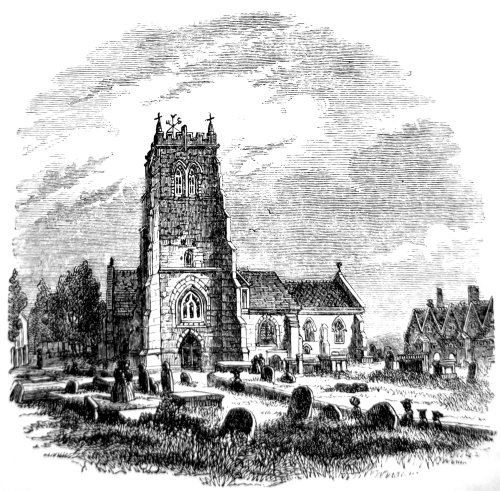
Saint Leonard’s Church.
The Parliamentary army were not deterred from the purpose on which they
were sent, by the horrors that surrounded them (for they were dauntless
men); but laid close siege to the Castle. They directed their attack
against the Close, which was a place within the inner Castle adjoining
the Great Tower, and containing within it the Governor’s house. They
chose Pam-pudding Hill as the best platform on which to erect their
battery, and from thence they bombarded the Castle for three weeks; but
to no purpose. No breach was effected. The garrison, from the great
eminence on which they stood, quite overlooked the besieging party; and
their cannonade from the tower was so effective as to overpower that of
the enemy. A singular incident is related as having taken place while
this cannonade was going on. “The battery on Pam-pudding Hill played
very furiously on the besieged: the cannoneer, answering them very
smartly from the town, sent his ball in the clear, or bore, of one of
the great guns, burst it, and killed the engineer and many others.” It
is curious that an exactly similar circumstance is said to have occurred
in an early stage of the siege of Sebastopol. A Russian artilleryman,
making answer to one of ours, sent a ball directly into the mouth
of the English gun, and a splinter from the gun struck our poor
artilleryman dead.
The leader of the Parliamentary army, seeing how fruitless the
operations were which he had hitherto engaged in, devised another mode
of assault. He determined to sap the Castle; and for this purpose
employed a party, under Colonel Lavingstone, to make a large opening on
the South side of the hill, intending to lay a Mine immediately under
Saint Mary’s Church, where the garrison had stored their ammunition.
They commenced their excavations, and the opening which they made is
still visible. It may be seen in the face of the rock which stands to
the right of the New Road, before you ascend the hill, and it still
bears the name of “Lavingstone’s Hole.” The enemy had no occasion
to proceed far with this mine; for the Governor, Colonel Howard,
perceiving what inevitable destruction it would cause to the Castle and
the garrison, if the mine were sprung, surrendered to the enemy, to
prevent an unnecessary waste of human life.
The terms of Capitulation have been preserved.[63]
They were honourable to the brave men, who had with such valour, and
with such true fidelity to the king, maintained this post so long in
his name, and adhered to his cause so firmly amidst the disheartening
events which were daily taking place. The Castle on its surrender came
into the possession of the Parliamentary party, who, a few months after
the seizure, entirely demolished it, and gradually removed all its
ruins, except that one lonely fragment of it, which stands on the south
east side of the Castle Hill.
Such was the end of this famous fortress—a stronghold indeed, made
so by nature, as well as by engineering skill, around whose walls the
storm of war had so often and so fiercely raged—a royal castle also,
over which the banner of the Kings of England had floated for more than
five hundred years, and which now sank into rain cotemporaneously with
the overthrow of the monarchy.
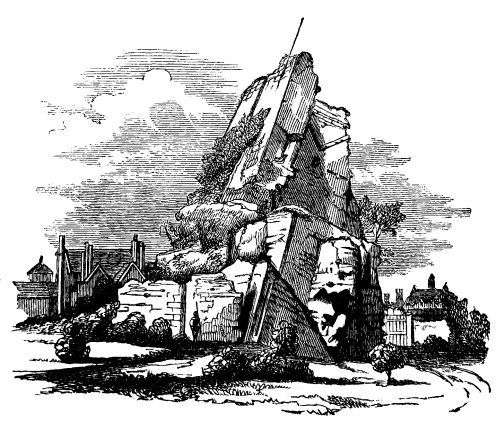
The Remains of the Castle.
It may perhaps be a matter of surprise that in the account which has
been given of Bridgnorth during the civil wars, and of the town and
fortress, no mention has been made of the name of “Whitmore,” although
Sir William Whitmore at this time was the owner of the Castle; but the
fact is, that he had business enough on his hands in endeavouring to
defend his own residence at Apley from the attacks of the insurgents,
so that he had no time to devote to other interests. He maintained
possession of Apley till the spring of 1644, when it was taken by a
party of Roundheads, under the command of Sir John Price,[64]
and Sir William himself made prisoner. An attempt was made to recover it in
the month of June, of the following year, by some of the King’s forces from
Worcester, Lichfield, and other garrisons; but they were encountered by
a detachment of the opposite party from Shrewsbury, and four hundred of
them taken prisoners; and Sir William Crofts, of Hereford, was among
the slain. (History of Shrewsbury, Vol. 1, p. 460, note 2.)
The property of Sir William Whitmore, like that of other
Royalists, was forfeited, and became the spoil of the Parliamentary party: all his
personal goods and chattels were sequestrated, and sold for the benefit
of the State, for the sum of £583 3s. 2d. His estates were siezed, and
he was afterwards allowed to compound for them by paying the sum of
£5,000.[65]
This was the common lot of such, as in those troubled times stood for
the defence of their King, and were loyal to the last. Their personal
property was put into the hands of Parliamentary sequestrators, and
sold as forfeit to the State; and their landed estates were bought back
by their rightful owners at a considerable sacrifice. A register was
kept, and afterwards published, of the names of those who thus suffered
in the cause of loyalty, with the sum, for which they compounded,
affixed to each. It is entitled, “A Catalogue of the Lords, Knights,
and Gentlemen, that have compounded for their Estates. London,
printed 1655.”[66]
In it are to be found the familiar Shropshire names of Whitmore,
Wolwryche, Acton, Corbett, Ottley, Billingsley, Littleton, Eyton,
Newport, Weld, Pigot, &c.; and certainly it detracts nothing from
the honour which belongs to these ancient families, that their names
are inscribed in this “black legend,” as it was very fitly termed. On
the blank leaf of the copy which I have seen is the following entry in
manuscript:—
| “Total Fines |
£1,275,667 |
| Value of Annuities, at 10 years |
90,000 |
| Amount of Money at the period of exaction |
1,365,667 |
| |
|
| Equal in money of the present period, |
£5,462,668 |
| 1842, to four times the amount |
But under the government of Cromwell, not only laymen who
drew the sword in defence of the crown, but clergymen who maintained and taught
the principles of loyalty, and who were too honest to abandon them when
they became unpopular, were deprived of their revenues. It is computed
that the number of ministers in the Church, who were ejected from their
livings on this account, were above 9000; and the sufferings which
many of them underwent, in consequence, form materials for the most
deeply affecting narratives.[67]
I am sorry to say that the minister of Saint Leonard’s was not found
among those who were faithful to their principles. While Shiffnal, and
Wellington, and Chetton, and Sidbury, and Kemberton, and Cleobury,
and Highley, and others could boast of pastors, who willingly endured
persecution for conscience sake, Gilbert Walden, Minister of Saint
Leonard’s, Bridgnorth, was found unfaithful in the day of trial, and
seems to have sacrificed his principles to his interest. His name is
found in the Parish Register as minister, within a year of the date
of the siege, when the town was in the hands of the Royalists; then
it disappears from it, when it was evident that the fortunes of that
party were declining; and then appears again, when the town was in
possession of the Parliamentary party. So that it is to be feared that
he professed allegiance to the King and Church when he thought their
cause likely to prosper, but when it declined he attached himself to
the Roundheads.
Indeed this is scarcely a mere matter of inference, as the reader may
judge for himself from an entry, still remaining in the books of the
Corporation. It is as follows:—Bridgnorth. Aᵒ Dⁿⁱ 1644. “At the Court
Leete held in the said Town of Bridgnorth, the VIIᵗʰ day of May. Aᵒ
Caroli Augᵗ XXº Richard Synge and Willᵐ Bradley, gent, being Bayliffs.
At this Leete it was moted by the Bayliffs and others, That forsomuch
as Mr. Gilbert Walden, the late publiq Preacher of the said Town, is
recesste and gon out of the said Town, and hath deserted his place
ever sithence aboute a moneth before Easter last. That one Mr. Thomas
Laughton, Master of Artes, a Preacher (who is recommended to the place
by Sʳ Lewis Kirke, Knight, Governoʳ of the said Towne, and whoe hath
supplyed the place since Mr. Walden’s goeing away) shold be accepted by
the Town in the said Mr. Walden’s place, to be publiq Preacher of the
said Town, wᵗʰ the profitte and allowance thereunto belonginge; unto
wh. all that were here present at this Leete agree, and nominate him,
the said Mr. Laughton, publiq Preacher of the said Town, with all
such proffits and allowance as the said Mr. Walden had of the Town’s
allowance in that behalfe, Soe as he preach two Sundayes at the High
Church, and the third at the Low Church, as Mr. Walden did. And this
to be further confirmed at a Common Hall, yf it be desired.” The
Parliament were not unmindful of Gilbert Walden, but in reward for his
desertion of the Royalists, placed him again in his office as Minister
of Saint Leonard’s, and restored to him all its emoluments. But far
happier were they who stood firm in the evil day, and had the Christian
courage to brave the consequences—and with such sainted men as Hall,
and Usher, and Hammond, and Jeremy Taylor, submitted to the penalties
of sequestration, poverty, imprisonment, and exile, rather than desert
what they believed the cause of God and of His Truth.
But it must not be supposed, from anything that I have said on this
subject, that I regard as evil-minded, and unprincipled men, all
the Ministers of religion, who in those difficult and trying times
sided with Cromwell and the Parliamentary party. This would not only
be a most uncharitable opinion, but one formed in direct opposition
to the plainest historical evidence. There were men of deep piety
and extensive learning, who unhappily lent their countenance to the
usurpation of Cromwell—men who afterwards suffered persecution
themselves for conscience sake, and whose Christian worth was such,
that we may safely say of them, what Dr. Johnson says of Watts—that
they were to be imitated in everything except in their nonconformity.
Nothing indeed can be said in justification of the line of conduct
which they pursued, but they were prompted to it by pure and not by
corrupt motives, and so far they are to be respected. Among the great
and good men who were allied to the Parliamentary party, I should
especially name one, on account of his connection with Bridgnorth,
namely, Richard Baxter. It appears that he began his ministry
in this town, in the Church of St. Leonard’s; but left it after some
time, with, I am sorry to say, a very unfavourable impression as to
the character of our townsmen of that day. It is said that on leaving
them he shook off the dust of his feet against them, and declared
that their hearts were harder than the rock on which their town was
built. But his disappointment at the want of success in his ministry
here did not estrange his mind from the inhabitants of a place, where
he had commenced his course; but he felt, after years of absence, the
strongest desires for their welfare. A very pleasing proof we have of
this, in an old edition of his work, entitled “The Saint’s Rest” (A.
D. 1654); for there we find the following dedication to the people of
Bridgnorth:—
TO MY DEARLY BELOVED FRIENDS
THE INHABITANTS OF
BRIDGNORTH,
BOTH MAGISTRATES AND PEOPLE,
RICHARD BAXTER
DEVOTETH THIS PART OF THIS TREATISE,
IN TESTIMONY OF HIS UNFEIGNED LOVE TO
THEM, WHO WERE THE FIRST TO WHOM HE
WAS SENT (AS FIXED) TO PUBLISH THE
GOSPEL; AND IN THANKFULNESS TO THE
DIVINE MAJESTY, WHO THERE PRIVILEGED
AND PROTECTED HIM.
It has been already stated that the fire, which took place during the
siege of the Castle, entirely destroyed the High Town, and left it a
heap of ruins. A few houses indeed survived the general destruction.[68]
One of these, which is still standing, deserves a passing notice, as
being the birthplace of Dr. Percy, Bishop of Dromore, the well known
author of “The Reliques of Ancient English Poetry.”[69]
It stands at the bottom of the Cartway, adjoining Underhill Street, and
is conspicuous among the dwellings which surround it, not only from
its size, but from its picturesque appearance, being ornamented with
several pointed gables, and being constructed partly of solid beams of
oak, in some places curiously carved, and partly of masonry. It was
built in the latter end of the sixteenth century, as the following
embossed inscription in the entrance hall informs us:—
“Except the Lord BViLD the OWSE,
The Labourers thereof evail nothing.
Erected by R. For [Qy Foster] 1580.”
It was a large and stately mansion, and when the Cartway was the
principal entrance to the town it was well situated, and must have been
regarded as a dwelling of some importance. It is now in a neglected
condition, a large part of the building is untenanted, a part of the
premises is used for an iron foundry, and another part for a huckster’s
shop. But even in its present rude and decayed condition, a certain
degree of interest attaches to it, as being one of the few surviving
relics of our old town; which interest is further enhanced, from its
having been, about an hundred years ago, the birth place of one, whose
literary attainments may be supposed to reflect no little honor on Bridgnorth.
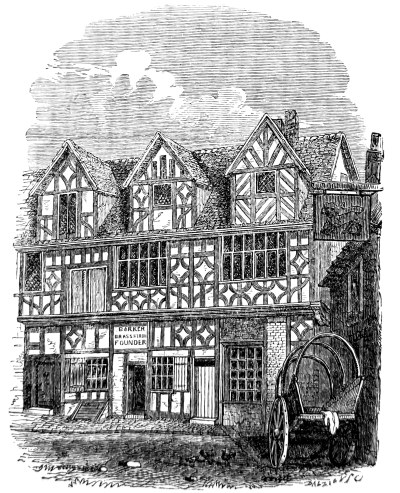
It remains for us to consider how the town recovered from the state of
almost total ruin in which it had been left, and was made habitable
again. It appears that in the same year in which it was destroyed,
the Bailiffs and others forwarded a Petition to the House of Commons,
setting forth in strong terms the miserable condition to which the
inhabitants had been reduced, and praying for relief. They state
that the loss sustained by them amounted to £90,000, or thereabouts;
that upwards of three hundred poor families had been “inforced” by
the loss of their goods, their trade, and habitations, “to disperse
into severall parts of the country, for harbour and for subsistence,
many among them crying aloud for bread”: and they humbly beseech the
Parliament to authorize a general collection to be made for them
throughout the country, or in some other way, to afford relief to their
necessities. The Rev. Gilbert Walden, who has been referred to before,
took this petition to London, and by his zeal and diligence obtained a
favorable answer to it; as appears from the following extract in the
Common Hall Order Book:—“Bridgnorth. At a Comon hall of the said Town
of Bridgnorth, the 27th. of January, Aᵒ Dⁿⁱ 1647. Francis Burne and
Richard Synge, Gent., being Bailiffs, &c. * * * * At this Comon hall,
Mr. Gilbert Walden, Minister of this Town, and Publiq Preacher,
returning to the Town from London, 25th. of this January Instant,
came into this comon hall in his own pson, & acquainted the Town
with his great care & paynes in solliciting the Parliament with a
peticion from the Town, for some repaire of their great loss by the
late burning of the High Town of Bridgnorth, when the Church, Colledg,
and Almshouses were burnt with the said Town. All the losses thereby
sustynedd amounting to 90,000£, as by the said Peticion was set forth
and certified: and the said Mr. Walden pducing lres pattents, under
the great seale of England, for a general collecion thorough out all
England, for rebuilding of the said Town, and repayringe the said
losses, and moving for some course to be taken for distributing the
Briefs, and setting them on work in all shires of England and Wales,
with all ye convenient expidicion that might be, and advising a way to
that behalf; and shewing the Town withall that it had cost him in the
acquiring & getting of these Lres pattentes and Briefs, besides the
great troubling of his friends to ayde & assist him therein.”
But these letters patent, under the Great Seal, granted by the
Parliament, seem to have yielded but little fruit to the impoverished
inhabitants of Bridgnorth; and the collections made under its sanction
were so inadequate to their wants, that they were obliged to resort to
other means for obtaining relief. They addressed a circular letter,
(to some merchants in London, as I conclude from the contents of it)
complaining bitterly of the very little sympathy which had been shewn
to them throughout the country, and of the very scant measure of
assistance which they had received, and very earnestly soliciting their
aid. It also appears that another circular was drawn up, to be sent for
the same purpose to persons whom they supposed to be well affected to
Bridgnorth, in the counties of Derby, Worcester, and Gloucester. The
first is as follows:—
“Gentlemen,
In the behalfe of our poore Towne, whereof
wee are now the representative Body, wee heartiely thanke you for that
you have ben pleased to put your helping hands to raise us up againe
out of the Ashes. Our greatest hopes is in the charity of yourselves
and your friends in the citie. Wee have had sad experience of the
countries chariety, yet what the further result wil be wee daylie must
expect; howsoever, wee shall acknowledge our engagements unto you above
all other, be it less or more. Wee beseach you continew your care and
paynes for us: and your reward shall be implored from God by us, and
ourselves, both for our minister and our whole Towne, shall acknowledge
your goodness with hartie thankes and praiere, and wee be unto you
Your ready servants,
& friends to cerve you.
Bridgnorth, 10 may,
1647.”
The state of destitution, in which the inhabitants of this ruined town
were placed, was such, that it is no wonder that they looked in every
direction for relief, from whence they thought it at all likely to
come, and that they were thus urgent in their appeal for it. In one
case they were not disappointed, as appears from the following letter,
addressed, about the same date I suppose, to Mr. Pully, of Essex: a
name well known, and gratefully remembered by the people of Bridgnorth,
for other benefits besides those referred to here.[70]
“To Mr. Pully, of Essex.
Wee have cause to blesse God that our miserable
towne affords a native friend so far to besteed us as by yourself. Wee
will studdy some requitall, as God shall please, to raise us out of our
ashes.
Wee entreat you to go on in helping us, as Mr. Bushopp hath told us
you have begun. The Lord reward you, wee and all ours shall pray for
you; and if ever wee shall be happy to see you, wee shall give some
further testimony of our thankfullness.
Who speake in the behalf of ourselves, our minister, and whole towne.”
The want of a Town Hall seems to have been much felt by the Burgesses
of Bridgnorth—the former one, which stood outside the North Gate,
having been pulled down during the Civil Wars; but the erection of a
new one, with new materials, was more than they could possibly
accomplish, in the impoverished state in which they had been left. They
therefore applied to Lady Bartue of Wenlock, and petitioned that she
would grant them the materials of an old barn which were about to be
sold, for the sum of £40 or £50; by means of which they might be able
to rebuild the Hall.[71]
The petition was granted; but whether the old materials were bestowed
as a free gift, or sold for the sum specified, does not appear. The
building was in consequence erected; and partly, at least, through the
earnest advice of Mr. Gilbert Walden, in a letter addressed by him to
the Bailiffs, was placed, not in the situation of the former Hall, but
in the middle of the High Street. It was not completed, however, till
four years after the date of his letter (April 24th., 1648); as appears
from the following entry in the Common Hall Order Book:—
“The New Hall set up in the Market Place of the High Street of
Bridgnorth was begun, and the stone arches thereof made, when Mr.
Francis Preen and Mr. Symon Beauchamp were Bayliffs in summer, 1650.
And the Timber work, and building upon the same stone arches, was set
up when Mr. Thomas Burne and Mr. Roger Taylor were Bayliffs of the said
Town of Bridgnorth, in July and August, 1652.”

The Town Hall.
But notwithstanding these applications for assistance from various
quarters, and the earnest efforts made by the inhabitants themselves,
the town appears to have continued during the period of the
Commonwealth, almost in the same state of ruin in which it was left
after the siege—the Church, College, and Almshouses,[72]
still roofless and dilapidated—and nothing effectual was done for
their restoration, and the rebuilding of the town, till the reign of
Charles II. Shortly after he was restored to the throne, a very earnest
Petition was forwarded to him from the Bailiffs and Burgesses of the
Borough, and other inhabitants of the town, praying for relief; and
this Petition was accompanied by a certificate, under the hands and
seals of Sir William Whitmore, Sir Thomas Wolrich, Sir Walter Acton,
Sir John Weld, Sir Richard Ottley, and others, attesting the damage
which had been done to the town, and the amount of the loss of property
sustained by the inhabitants in consequence. This petition, backed by
this certificate, drew from the King a proclamation,[73]
addressed to all his subjects in behalf of Bridgnorth. It is very
long and elaborate—very carefully worded—and not only sets forth
very fully the wants of the petitioners, but pleads their cause with
a warmth and earnestness which one would not expect to find in an
official document. It authorizes a general collection to be made
throughout the kingdom; “in all and every the Cities, Towns Corporate,
Priviledged Places, Parishes, Hamlets, Villages, and all other places
whatsoever,” in order to assist the destitute people of Bridgnorth
in rebuilding their shattered town; and it directs both Ministers
and Churchwardens to do what in them lies to further this object in
their different localities. It would be interesting to know the exact
amount which this royal proclamation, and another which followed it
in about ten years, produced. There is no doubt that it was something
considerable—sufficient to give an impulse to the industry of the
inhabitants—to enable them to restore their ruined Church, College, and
Almshouses—to efface in a great measure the damages of war, and to make
Bridgnorth again a habitable town.
Thus, from the happy restoration of the monarchy in England, and the
re-establishment of its church, we may date the restoration of our town
from the state of ruin, in which it had been left; and its restoration
being coeval with these important and felicitous events, many would
be disposed to regard as no bad omen of its welfare. The motto in the
arms of a neighbouring city may well express our wish for its future
prosperity; for though the terms are hardly suitable to a town of so
small a circumference as ours, yet it merits well the character it has
maintained, in almost every era of its history—Floreat semper fidelis
civitas.
My subject was “The Antiquities of Bridgnorth.” I have already far
passed the boundaries which confined me to such a subject, by referring
to matters which occurred so late as the reign of Charles II. I would,
however, venture one step farther, and refer to an event which took
place in the reign of his successor, James II, for I find that it was
taken particular notice of in Bridgnorth at the time of its occurrence;
and it is one which, from the great interest and importance that
attaches to it, seems to claim attention from us whenever it happens to
be brought before us.
The event referred to occurred in the memorable year of 1688. In the
“Blakeway Papers,” in the Bodleian Library, which contain matters
concerning Bridgnorth, the following entry is made respecting
it:—“When the Bishops were quit, there were 16 bonefires in this town,
and the ringing of bells night and day. Mr. Cornes and Mr. Bailey,
the two Ministers, refused to sign the Declaration.” This notice
alludes to the well known Declaration issued by King James, and the
acquittal of the seven Bishops who had been imprisoned for venturing
to oppose it. James the Second was as zealous a member of the Church
of Rome, perhaps, as any of his subjects, lay or ecclesiastical; and
the great object of his life seemed to be, to regain for his Church the
same usurped authority over the civil and religious liberties of our
country, which she possessed before the Reformation. Among other means
for furthering this object, he published this famous “Declaration.” It
was a very singular document. On the plea of establishing liberty of
conscience, it abrogated, on the King’s sole authority, all the penal
laws which were in force on the subject of religion, the King thus
assuming to himself, as one of his royal prerogatives, the power of
dispensing with exiting statutes, without the consent of Parliament.
The real intention of the King in all this was, to open the door to
Roman Catholics to places of power and authority, which the laws then
in force strictly forbade, as being incompatible with the freedom and
safety of the state. To give publicity, as well as sanction, to this
Declaration, the King issued a command that it should be read by the
Clergy during Divine Service, in every church in the kingdom. The whole
proceeding was perfectly arbitrary and despotic; and if it had been
allowed to go on unchecked, it would, as it has been well observed,
have given a death blow to the Constitution, and have laid the nation’s
liberties at the feet of the sovereign. Where then were the champions of
freedom in this great crisis of danger? Where were to be found the
men, who had courage enough to resist this portentous encroachment on
the liberties of England? Where the assertors of the nation’s rights
against these unlawful inroads of the royal prerogative? Not in a
band of youthful and ardent enthusiasts in the cause of freedom—not
in a knot of ruthless republicans, whose tempers were impatient of
monarchial rule, and who hated the very name of King—not in a set
of restless innovators, who loved innovation for the excitement it
produced, or for the spoil which it might yield to them—not in a rude
soldiery, who were ambitious of enterprise, and longed to signalize
themselves again by deeds of daring—but in the persons of seven aged
Bishops of the Church, some of whom were not only oppressed by the
burden of age, but weighed down by sickness and infirmity; and all of
them, both from temper and principle, averse to anything that seemed
like resistance to kingly authority. Yet it was these who stood forward
at this time of danger, as the defenders of the nation’s liberties.
Their names were well known to our townsmen at the time, for
Bridgnorth, as well as other places, rang with unusual joy at the news
of their acquittal; and it is well that their names should be known
to our townspeople now, as the names of men who have laid the nation
under a deep debt of gratitude. They were Sancroft, Archbishop of
Canterbury; Lloyd, Bishop of St. Asaph; White, Bishop of Peterborough;
Turner, Bishop of Ely; Lake, Bishop of Chichester; Trelawney, Bishop
of Bristol; and Ken, the pious Bishop of Bath and Wells,[74]
a saint indeed, formed on the primitive model, whose devout aspirations in
his Morning and Evening Hymn have served to kindle the devotion of the
members of the English Church for nearly two centuries. These seven
Prelates met together at Lambeth in this critical juncture, and drew up
a petition to James, in which they set forth in plain but respectful
language the illegality of his Declaration, and humbly prayed him
not to insist on their publishing it. In consequence of this they
were committed to the Tower. The King, notwithstanding their dutiful
remonstrance, was resolved on enforcing on the clergy throughout
the kingdom the publication of this unlawful document, and sent his
commands to that effect: but of the many thousands to whom this mandate
was sent, not two hundred complied with it; and among those who had the
courage to refuse, we are glad to find the names of the two Ministers
of Bridgnorth, Mr. Cornes, and Mr. Bailey.
The Bishops after a short term of imprisonment were admitted to bail,
and at the ensuing Sessions were impeached at Westminster Hall on a
charge of publishing a seditious libel. Every circumstance which took
place on this memorable occasion is full of interest, and historians
have thought the most minute details not unworthy of record. On their
way to the scene of trial, the Bishops, it is mentioned, received every
possible expression of reverence and sympathy from the populace, who
formed a lane for their passage, through which as they moved, many
kissed their hands and their garments, and many fell on their knees and
earnestly asked their blessing. Westminster Hall never witnessed such a
scene as their trial presented. As it proceeded, the interest felt by
the spectators was intense; and when at length the verdict was given
by the foreman of the Jury, “Not Guilty,” the profound silence which
had reigned throughout the court was broken by the most tumultuous
acclamations. The multitudes assembled there raised, in spite of the
menace of the Solicitor General, such a shout as shook the old fabric
of Westminster Hall, and conveyed, quicker than the speediest messenger
could do, the tidings to the city. The Bishops on leaving the court
immediately repaired to Whitehall Chapel, to return thanks to God for
their deliverance, and other churches were thronged by multitudes who
assembled in them for the same purpose. “The bells rung from every
tower, every house was illuminated, and bonfires were kindled in every
street.” The joy was not confined to London, it was propagated
throughout the kingdom, and felt in the remotest villages. Bridgnorth,
as we have seen, fully shared in it. Our streets on the occasion echoed
with loud shouts of triumph—the river Severn reflected on its stream
the blaze of many a bonfire—and the tuneful bells of St. Leonard’s and
St. Mary’s rang incessantly night and day to celebrate the event.
I have thus brought before the reader the few historical notices which
I have been able to collect, respecting Bridgnorth, from the time of
Alfred the Great to the close of the reign of James II. I am aware how
much more interest would attach to these if they had been skilfully
handled, inasmuch as they touch on some very important events, and
memorable epochs of our national history. Those indeed who feel the
force of local attachment may read them with interest, whatever defects
may be apparent in the mode of bringing them together, and it is for
such readers that they have been collected. I am aware also, that I
have dwelt much longer on certain facts in our history than many would
think at all necessary, or than was exactly pertinent to my subject.
My reason is, that some would read these things here, who would not be
likely to read them elsewhere; and I thought it advisable, on account
of their importance, that they should be known in detail. Besides, I
was anxious to make this little work more useful in its character, than
it would have been if I had confined myself to a statement of the facts
relating to our town, without connecting them with the general history
of England. As it is, the review which we have taken, ought not to be
without its moral influence. Many generations of men have thus passed
rapidly before us: having acted their parts in quick succession, they
have disappeared from the stage of life. They had “their exits and
their entrances,” and now are seen no more. It is natural for us to
reflect, how utterly unimportant to them it now is in what capacity
they appeared—whether as kings or subjects—whether as masters or as
slaves—whether they were honoured or dishonoured—illustrious or
obscure—prosperous or unfortunate. It matters not to them now,
whether their projects succeeded or failed—whether the enterprises
they so keenly entered on issued in triumph or disaster. Their
restless activities have been put a stop to. The hand of death has
arrested them. The same destiny awaits ourselves. We too shall soon
make our exit; and the interests which now so deeply engage us—the
circumstances which now press on us in all their vivid reality—the
scenes which are now before our eyes, and the busy part we take in
them—will ere long be reckoned among the things that have been; and
nothing will be left us, but the character which we have acquired in
passing through them—our fitness or unfitness for a better state: and
this reflection I desire to leave on the mind of the reader.
It would seem, however, scarcely natural for me to close these pages,
without expressing a wish for the future welfare of a place, the
scattered notices of whose past history I have here collected. I have
been too long, and too intimately connected with it, not to feel the
wish. In Bridgnorth I have passed more than twenty years. I reckon them
the happiest of my life. I have good reason for doing so. Many domestic
blessings—many social pleasures—many natural enjoyments—have here
been allotted to me. Here “the lines have fallen to me in pleasant
places,” and in the fair scenes of nature which surround us, there has
been open to me a source of “unreproved pleasures,” of which it is
my own fault if I have not largely partaken. Here too I have formed
acquaintances, which have ripened into friendships—friendships which
have yielded me something more than mere enjoyment—and which I have
reason to hope will last as long as life itself. But still closer
ties bind me to this place. Here I have been entrusted with the care
of souls, and have been called to minister in the Church of God. This
consideration necessarily outweighs every other, and prompts me with
the most earnest wishes for the welfare of a place, between many of the
inhabitants of which and myself there is so strict and sacred a
fellowship. And not from these alone, but from those also with whom I
am not thus officially connected—from the inhabitants of St. Mary’s
parish, as well as from those of St. Leonard’s, I have received such
proofs of kindness and regard during my ministry here, as make me feel
an interest in everything that can concern their well-being. May they
prosper in every way—as a community, and as individuals—in their
civil and commercial interests—in their social, moral, and religious
condition. May they secure to themselves that which has “the promise of
the life that now is, and of that which is to come:” that when things
temporal shall give place to things eternal—when the changes and
chances of this mortal life shall cease—and all the vicissitudes which
so painfully diversify the history of this world have passed away—they
may have their lot and part in that kingdom which cannot be moved, and
“of whose government and peace there shall be no end.”
Finis.
[Click map to view hi-res image.]