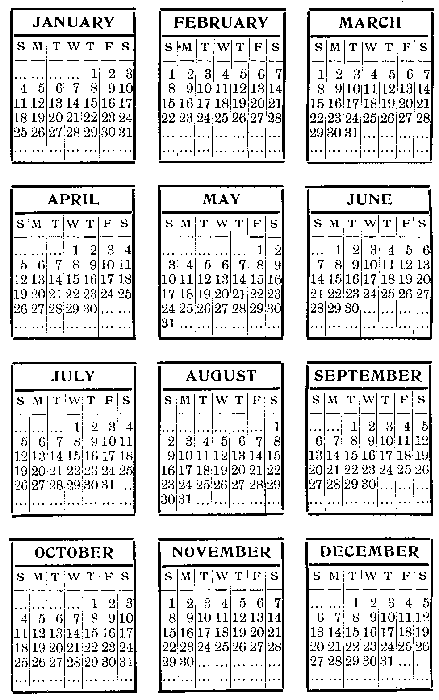
1. The official list of New Year Honours comprised one new Viscount
(the Rt. Hon. James Bryce, who took the title of Lord Bryce of Dechmont),
four new Barons (Sir Rufus Isaacs, Lord Strathclyde—the Scottish judge,
Mr. Alexander Ure,—Sir C. A. Cripps, and Sir Harold Harmsworth, whose
titles were respectively Lord Reading, Lord Strathclyde, Lord Parmoor of
Frieth, and Lord Rothermere), and five new Privy Councillors (Lord Colebrooke,
Sir Guy Fleetwood Wilson, the Hon. William F. Massey, Premier of
New Zealand, Mr. W. H. Dickinson, M.P., and Sir Christopher Nixon, Bt.).
There were six new Baronets, among them Sir Gerard Lowther, G.C.M.G.,
lately Ambassador at Constantinople, and Colonel Sir Edward Ward,
K.C.B., Permanent Under-Secretary at the War Office. Among the twenty-two
new Knights were Mr. Owen Seaman, Editor of Punch since 1906;
Judge Lumley Smith, late Judge of the City of London Court; Mr. W. E.
Garforth, an inventor of safety appliances in coal mines; and Mr. Ernest
Rutherford, F.R.S. The Order of Merit was conferred on Sir Archibald
Geikie, President of the Royal Society.
—Mr. Llewelyn Archer Atherley Jones, K.C., appointed a Judge of the
City of London Court, vice Judge Lumley Smith, retired.
—At Paris, in a Rugby international football match, Ireland beat France
by eight points to six.
3. The Home Secretary refused to reconsider the sentence of four months'
imprisonment passed at the Stafford Assizes on Thomas William Stewart, a
Rationalist lecturer. The reasons for the refusal were, in substance, that
the prisoner was punished, not for holding opinions or arguing in support of
them, but for utterances designed to wound the feelings of his hearers, and
that his speeches on religion were intended to advertise, for his own profit,
his lectures on other subjects and certain appliances sold by him, in respect
of which he was accused of indecency.
3-4. Further severe storms on the New Jersey coast, doing much
damage at Atlantic City and Seabright.
5. Final abandonment announced of "The Romance of India," a spectacle
projected at Earl's Court, and designed by a well-known artist, Mr. R.
Caton Woodville, but objected to by the India Office and Indian residents in
London as likely to give offence to Hindus and others. Several hundred
performers were left destitute.
—The tank steamer Oklahoma was broken in two by a wave fifty miles
off Sandy Hook and sunk; seven lives saved, about thirty-two lost.
—At Johannesburg, the third Cricket Test Match was won by England
by ninety-one runs. England had now won the first three.
7. Announcement that Sir R. H. Brade had been appointed Secretary of
the War Office and the Army Council vice Colonel Sir Edward Ward,
retired.
—Announcement that Mr. Joseph Chamberlain would retire from
Parliament at the next general election.
—Railway strike in South Africa. (See post, For. and Col. Hist., Pt. I.,
Chap. VII.)
—At the King's Hall, Covent Garden, a mock trial was held of John
Jasper for the murder of Edwin Drood, the hero of Dickens' last and unfinished
novel. The literary problem involved in the book, the subject of
much speculation, was not solved. Mr. G. K. Chesterton was Judge, Mr.
George Bernard Shaw foreman of the Jury. The verdict was manslaughter,
but the Judge committed all those present for contempt.
—Attempt to blow up Territorial barracks at Leeds, temporarily used as
police quarters; damage slight.
8. Fire at St. Paul's Training College, Cheltenham; damage over 5,000l.
9. At Cambridge, Dr. Henry Frederick Baker, D.Sc., F.R.S., Fellow and
Tutor of St. John's College, was elected Lowndean Professor of Astronomy
and Geometry, vice Sir Robert Ball, deceased.
9-10. Severe snowstorm in North-West Russia.
9-11. Severe floods on the German Baltic coast, owing to storms and the
bursting of dykes; floods also in Würtemberg, the Rhine Valley, Switzerland
and Belgium.
10. Barton Hall, near Bury St. Edmunds, burnt down in the early
morning; most of the art treasures saved.
11. The Chinese Parliament formally dissolved.
12. At Pretoria, the return match between the M.C.C. and the Transvaal
cricket eleven was drawn.
12-15. Severe winter weather in England.
13. Volcanic eruption near Kagoshima, Japan; about 200 lives lost.
—Martial law proclaimed in South Africa.
—The Royal Mail Company's Steamer Cobequid (late Goth), from the
West Indies to St. John, N.B., went ashore on the Trinity Ledges, near the
entrance of the Bay of Fundy; the passengers and crew were saved after
severe sufferings. The Board of Inquiry (Feb. 2) severely censured the
captain, but in view of his subsequent exertions for the safety of those aboard
it did not deal with his certificate.
13. Extreme cold in Ontario; at Toronto 54 degrees of frost were registered,
at Ottawa 60 degrees, and at White River 80 degrees.
14. At King's College, London, Lord Rayleigh unveiled a memorial
tablet to Lord Lister, the founder of antiseptic surgery.
—The inquest on the victims of the Senghenydd Colliery accident
(A.R., 1913, Chron., Oct. 14) resulted in a verdict of "Accidental Death."
The jury found that there was no neglect, and that the fire probably originated
with a naked light at the lamp station.
15. The Special Committee for promoting English representation at the
Olympic Games in Berlin retired. (See A.R., 1913, Chron., Dec. 31.)
—Announcement that Sir E. Hildred Carlisle, M.P., had given
105,000l. to Bedford College, as a memorial to his mother.
—Surrender of the Johannesburg Unionists besieged in the Trades
Hall. (See post, For. and Col. Hist., Chap. VII., 1.)
16. Submarine A 7 disappeared in Whitesand Bay, near Plymouth,
during exercises; her officers and men, numbering eleven, were lost. She
was located on January 21, but attempts to raise her were abandoned at the
end of February, and the mystery of her loss was unsolved. A memorial
service was held on March 5 at the spot where she lay.
—Under the Ancient Monuments Act of 1913 the destruction of a
Georgian house, 75 Dean Street, Soho, London, was forbidden by the Office
of Works.
17. At Twickenham, England beat Wales in an International Rugby
football match by ten points to nine.
—At Frankfort-On-Main, Karl Hopf was convicted of murdering his
first wife by poison, and attempting to murder his second and third wives
and his two children, and was sentenced to death. He had purchased and
used typhoid and cholera bacilli.
19. Final collapse of the Dublin strike. (See Eng. Hist., Chap. VI.)
—At Kimberley, South Africa, the M.C.C. cricket eleven beat Griqualand
West by an innings and 101 runs.
—At McAlister, Oklahoma, three convicts escaped from the State
penitentiary, but were ultimately shot after a fight; in all seven men were
killed and two men and one woman wounded.
20. The dead body of Thomas Kent Reekes, an Australian and a marine
engineer, was found in a disused pit shaft at Ettingshall, near Wolverhampton.
Death was due to gunshot wounds. Efforts to account for his
presence in the district and to trace an alleged companion failed.
21. The King in Council ratified the Orders defining the boundaries of
the new sees of Chelmsford, St. Edmundsbury, and Ipswich.
—Lieut. Seddon, R.N., flew from Sheerness to Plymouth (down the
Channel) on a Maurice biplane—nearly 350 miles in 5 hrs. 35 min., exclusive
of a stop.
21-28. Strike of 7,000 London coal porters, (See Eng. Hist., Chap. I.)
23. At Brussels, Princess Victor Napoleon, before her marriage Princess
Clementine of Belgium, gave birth to a son, the direct heir to the Bonaparte
dynasty.
25. At the Hendon aerodrome, George Lee Temple, an airman, was
killed while flying.
26. On Salisbury Plain, Mr. Gibb, an airman, was killed while flying and
a passenger injured.
—An explosion took place aboard the Cunarder Mauretania among men
engaged in brazing the turbine blades; three men killed, six seriously
injured.
—An equestrian statue of King Edward VII., by Landowzki, was unveiled
in the Rue Edouard VII., Paris.
27. Announcement that Mr. Arthur Jacob Ashton, K.C., had been
appointed Recorder of Manchester vice Sir Joseph Leese, Bart., resigned.
—Announcement that Lord Denman had resigned the post of Governor-General
of New South Wales through ill-health.
—Mr. F. W. Vanderbilt's steam yacht Warrior stranded off the
Colombian coast; all on board saved.
—An Interim Report of the Dominions Royal Commission dealing
with the needs of Australia condemned the methods of recruiting immigrants
in Great Britain, recommended reduction in cable rates, and held
that the existing postal service was inadequate, but that it would be
inadvisable to bind the State to a new contract by the Brindisi and Suez
Canal route.
—Narrow escape of St. Petersburg from serious flooding after a great
storm.
28. Labour leaders deported from South Africa. (See Eng. Hist., Chaps.
I. and II., and For. and Col. Hist., Chap. VII.)
29. Announcement that Mr. John Horace Round, D.L., LL.D., had been
appointed by the Attorney-General honorary adviser to the Crown in
Peerage Cases.
30. Announcement that the Archbishops of Canterbury and York had
appointed a Committee on the relations of Church and State. The Earl of
Selborne was chairman and Mr. Balfour one of the members.
—At the Parliamentary bye-election for North-West Durham, due to the
retirement of Mr. Lt. Atherley Jones, K.C. (see Jan. 1), Mr. Aneurin
Williams (L.) was returned by 7,241 votes; Mr. J. O. Hardicker (U.) obtained
5,564 and Mr. G. H. Stuart (Lab.) 5,026.
—The liner Monroe, plying between New York and Norfolk, Va.,
was run down by the s.s. Nantucket; forty-one persons in all were
drowned.
—Explosion in a coal mine at Achenbach, Westphalia; twenty-two men
killed, seventeen injured.
31. The German sailing ship Hera was wrecked off Falmouth; of the
crew of twenty-four nineteen were drowned.
—Strike of elementary school teachers in Herefordshire; it was settled
February 25.
31. The official return of pauperism for January, 1914, showed that the
total number of paupers had dropped from 33.8 per 1,000 in 1874 to 17.5 in
1914, and that of outdoor paupers from 27.5 to 10.3 per 1,000. Indoor
pauperism, however, had risen since 1874 from 6.3 to 7.2 per 1,000, this
being due largely to the greater use of workhouse infirmaries. Between
1906 and 1913 the total number of paupers over seventy had fallen nearly
75 per cent., and of outdoor paupers over seventy nearly 95 per cent., owing
mainly to old-age pensions.
2. First performance in England of Wagner's Parsifal at Covent Garden
Opera House. (See post, Pt. II., Music.)
—Announcement that the anonymous lady who had promised 25,000l.
to lay out Shadwell Park in memory of King Edward was precluded from
giving it by "severe and sudden financial misfortunes."
—At Windsor Castle, Gustav Hamel "looped the loop" before the King
and Queen fourteen times in 17 minutes.
4. Influential meeting at the Mansion House to explain the plans for
celebrating the Hundred Years' Peace between Great Britain and the United
States; among the speakers were the Prime Minister, the Archbishop of
Canterbury, and Lord Bryce.
—Announcement that the King had approved the appointment of Mr.
William Warwick Buckland, M.A., Senior Tutor of Caius College, to be Professor
of Civil Law in the University of Cambridge, vice Dr. E. C. Clark,
resigned.
—At Sheffield, during an Association Football Cup-tie Match, a wall
collapsed owing to the pressure of the crowd on its base at a corner; about
seventy persons were injured, three very seriously.
—At Christie's, a James I. silver-gilt cup and cover was sold for
4,500l.
5. At the Liverpool Assizes, George Ball, alias Sumner, was found guilty
of the murder of Miss Christina Bradfield (Chron., 1913, Dec. 11) and
sentenced to death, and Samuel Eltoft convicted as an accessory after the
fact, and sentenced to four years' penal servitude. An appeal by Ball failed,
and he was executed on February 26.
6. Announcement that the King had approved the appointments to the
new Sees created under the Bishoprics Act, 1913, as follows: to the Bishopric
of Sheffield, the Rt. Rev. L. H. Burrows, Bishop Suffragan of Lewes; to the
Bishopric of Chelmsford, the Rev. J. E. Watts-Ditchfield, Vicar of St. James
the Less, Bethnal Green; and to the Bishopric of St. Edmundsbury and
Ipswich, the Ven. H. B. Hodgson, Archdeacon of Lindisfarne.
—Mr. R. C. Munro-Ferguson, M.P. for Leith, appointed Governor-General
of the Australian Commonwealth, vice Lord Denman, retired.
7. At Cardiff, in an International Rugby Football Match, Wales beat
Scotland by twenty-four points to five.—At Queen's Club, West London, in
the Inter-University Association Football Match, Cambridge beat Oxford by
two goals to one.
9. Announcement that the "Panshanger Madonna" (Chron., 1913, Nov.
26) had been sold to Mr. P. A. Widener, of Philadelphia.
—Announcement that Lord Justice Cherry was appointed Lord Chief
Justice of Ireland, vice Lord O'Brien resigned.
—Before a court-martial at Chatham, Fleet Paymaster J. A. Lowry, of
H.M.S. Ganges, pleaded guilty to desertion and embezzlement, and was
sentenced to three years' penal servitude.
10. Sir Laurence Gomme resigned his office as clerk of the London
County Council, owing to ill-health.
—Meeting of Parliament. (See Eng. Hist., Chap. II.)
—At Durban, the M.C.C. cricket eleven were defeated by Natal by ten
wickets.
11. Announcement that Lord Gladstone had resigned the office of
Governor-General of South Africa. (For the consequent Ministerial changes,
see Pt. I., p. 27.)
—The Mont Blanc range crossed by the airman Parmelin in a flight
from Geneva to Turin. Fog compelled him to descend at Aosta.
13. Announcement at the annual meeting of the Great Eastern Railway
shareholders that Mr. Henry W. Thornton, general superintendent of the
Long Island Railroad (New York), had been appointed as General Manager
of the Great Eastern Railway in succession to Mr. Walter Hyde. He had
special experience with heavy suburban traffic.
14[missing period] At Rochdale a tramcar was derailed; eighteen persons were injured.
—At Twickenham, in an International Rugby Football Match, England
beat Ireland by seventeen points to twelve.
15. At Lyndhurst, Hants, a madman named Lee Bond was arrested after
a thirty hours' motor drive through Dorset, Wilts, and Hants; he compelled
the chauffeur to drive under threat of shooting him, and requisitioned petrol
by like means. He attempted suicide next day.
17. At Durban the Fourth Test Match between the M.C.C. and South
Africa resulted in a draw.
18. In the Upper House of the Convocation of Canterbury, the Bishop of
London presented a petition signed by 676 priests in the diocese of London,
expressing anxiety at the unchecked denial of fundamental Christian truths
by office-holders in the Church, and at the tendency to approach the problem
of reunion in a way inconsistent with the recognition of the necessity of
episcopal ordination.
—At the Parliamentary bye-election in Bucks (Wycombe) due to the
elevation to the Peerage of Sir A. Cripps (U.), Mr. W. B. Du Pré (U.) was
returned, obtaining 9,044 votes; Mr. Tonman Morley (L.) obtained 6,713.
19. At the Parliamentary bye-election for South-West Bethnal Green, due
to the appointment of Mr. C. F. G. Masterman (L.) to the Chancellorship of
the Duchy of Lancaster, Sir Matthew Wilson (U.) was returned by 2,828
votes; Mr. C. F. G. Masterman (L.) receiving 2,804, and Mr. John Scurr
(Soc. and Lab.) 316. (See Eng. Hist., Chap. II.)
19. At Cradley Heath, Staffs, owing to a subsidence caused by old colliery
workings, some forty houses in the High Street were cracked and injured.
—Near Birmingham, Ala., a mail train was held up by three men, and
robbed of $40,000; they then detached the locomotive and escaped on it.
—In the King's Bench Division, before Mr. Justice Darling and a special
jury, the six days' trial was concluded of a libel action brought by Major W.
A. Adam, sometime 5th Lancers and late Unionist M.P. for Woolwich,
against Sir Edward Ward, recently Permanent Secretary for the War Department.
The plaintiff complained of the publication of a letter addressed
officially by the defendant to Major-General Scobell in August, 1910, declaring
that the charge brought against the latter by the plaintiff was unfounded
and containing words which the plaintiff regarded as a reflection on his
character. The defendant denied publication, and alleged that the words
were privileged. The charge in question had been debated in the Commons
(A.R., 1910, p. 150). The jury found for the plaintiff; damages 2,000l.
20. At the Parliamentary bye-election for Tower Hamlets (Poplar), due to
the appointment of the Rt. Hon. Sydney Buxton to be Governor of South
Australia, Mr. A. W. Yeo (L.) was returned by 3,548 votes; Mr. R. Kerr
Clark (U.) received 3,270, and Mr. J. Jones (Lab. and Soc.) 893.
—In the final heat of the Waterloo Cup, Messrs. Dennis's hound
Dilwyn beat the Duke of Leeds's Leucoryx, nominated by Major McCalmont.
—At Messrs. Nobel's factory of explosives at Ardeer, Ayrshire, an explosion
killed seven men and injured two, one fatally.
—On the Wexford coast, near Kerrig Island, the Fethard lifeboat was
wrecked while assisting the Norwegian schooner Mexico; five of the lifeboatmen
and nine of the schooner's crew were rescued on February 22, after
sixty hours on the island; nine lifeboatmen were drowned; one of the
crew had died of exhaustion.
21. At Challapata, Bolivia, a magazine containing 3,500 tons of dynamite
exploded; the town was destroyed, with great loss of life.
—Count Mielzynski acquitted of the murder of his wife and her nephew
at his castle in Poland (A.R., 1913, Chron., Dec. 20). The trial was in
camera, but it was stated that the Countess had been unfaithful.
22. Severe storm in Switzerland. On the Lötschberg railway, a train
was partly derailed by wind on emerging from a tunnel; one passenger
killed, several injured.
23. At Debreczin, Hungary, a bomb sent by post to the Greek Catholic
Bishop Miklossy exploded and killed the episcopal vicar and the secretary.
The outrage was ascribed to Roumanian resentment at the creation of a
Greek diocese of Hajdudorog, severing 12,000 Roumanians from the Roumanian
branch of the same Church.
26. At the Parliamentary bye-election at Leith, due to the appointment
to be Governor-General of Australia of Sir R. Munro-Ferguson (L.), Mr. G.
W. Currie (U.) was returned by 5,159 votes; Mr. M. Smith (L.) received
5,143, and Mr. J. N. Bell (Lab.) 3,346.
—Announcement that Mr. Otto Beit had offered a South African
Research Fellowship for two years at Oxford, for the collection of the South
African history preserved by memory and oral tradition.
26. Announcement that Sir Hugh Lane was appointed Director of the
National Gallery of Ireland, vice Sir Walter Armstrong, resigned.
—At Chelsea, in a baseball match between two American teams, the
New York Giants and the Chicago White Sox, the latter won by five runs
to four. The King was present.
—In a duel near Metz a German officer, Lieut. Haase, was shot dead by
a brother officer, Lieut. von Lavallette St. George, who had shown undue
attention to his adversary's wife.
28. At Dublin, Ireland beat Scotland at Rugby football by six points to
nil.
—At Samar, near the Sea of Galilee, the Turkish military airmen Fethi
Bey and Sadik Bey, while flying from Damascus to Jerusalem, were killed
by the fall of their aeroplane.
1. Announcement that the King would offer a cup of the value of 100l.
for an international yacht race at Panama in 1915.
1, 2. Severe snowstorms in the Eastern United States.
2. At Swansea, Wales beat France at Rugby football by thirty-one points
to nil.
3. In the fifth and final South African Test Match, at Port Elizabeth,
England beat South Africa by ten wickets.
—The Admiralty issued a return giving particulars of the strength of
the eight chief naval Powers on January 1, 1914, omitting such battleships,
battle cruisers, and cruisers, as had been launched more than twenty years.
Vessels built are given first; vessels building, if any, are added after a plus
sign. The British figures included Dominion ships. The number of submarines
given for Germany was admittedly too low.
|
Britain. |
Germany. |
France. |
Russia. |
| Battleships |
58 + 14 |
35 + 6 |
21 + 10 |
8 + 7 |
| Cruisers |
47 |
9 |
24 |
12 |
| Light Cruisers |
65 + 20 |
43 + 6 |
8 |
2 + 8 |
| Torpedo Vessels |
25 + 1 |
—- |
3 |
—- |
| Destroyers |
201 + 36 |
132 + 12 |
80 + 7 |
95 + 45 |
| Torpedo Boats |
70 |
80 |
153 |
25 |
| Submarines |
69 + 29 |
24 + 14 |
50 + 26 |
25 + 18 |
|
Italy. |
Austria. |
U.S.A. |
Japan. |
| Battleships |
9 + 5 |
14 + 2 |
30 + 6 |
17 + 2 |
| Cruisers |
9 |
2 |
17 |
15 |
| Light Cruisers |
14 + 4 |
9 + 3 |
18 |
19 |
| Torpedo Vessels |
3 |
11 |
2 + 2 |
3 |
| Destroyers |
30 + 16 |
15 + 3 |
52 + 9 |
51 + 2 |
| Torpedo Boats |
94 + 1 |
58 + 27 |
21 |
33 |
| Submarines |
18 + 2 |
6 + 5 |
29 + 21 |
13 + 2 |
4. On the Ortler Spitz, Tyrol, a patrol of twenty soldiers under instruction
in ski-running were caught by an avalanche; fourteen were killed.
6. In Birmingham, a statue was unveiled of Bishop Gore, first Bishop of
the diocese, as a memorial of his connexion with it.
—At Boulogne-sur-Seine the Penitentiary Convent School was attacked
by a band of fifteen "Apaches," who rescued three girls; these, and seven
of the band, were eventually arrested.
9. In the House of Commons, the Prime Minister gave particulars of the
proposed permissive exclusion of the Ulster counties from the Home Rule
Bill.
—At St. Louis, Mo., the Missouri Athletic Club was burnt; about thirty
lives were lost.
10. The Rokeby Venus in the National Gallery damaged by a militant
suffragist.
—At Upavon, Captain C. P. Downer, Northamptonshire Regiment, was
killed while flying in a BE biplane.
—Ceiba, Honduras, was burnt down; estimated damage $10,000,000.
—In the Convocation of Oxford University a statute throwing open the
eighteen seats of the Hebdomadal Council (hitherto elected from Professors,
Heads, and Masters of Arts equally) was rejected by 97 to 83.
11. On Salisbury Plain, Captain Clement Allan, Welsh Regiment, and
Lieut. James E. G. Burroughs, Wiltshire Regiment, were killed by a fall
from an aeroplane, the only one of its type.
—At Eastchurch, Engineer-Lieut. Briggs, R.N., Royal Flying Corps,
reached a height of 15,000 ft. on a biplane; he was frostbitten, the temperature
falling to -38° Fahr.
12. At the annual dinner of the Association of Chambers of Commerce,
the Prime Minister, after mentioning the development of Inter-Imperial
trade through Trade Commissioners and local correspondents in the Dominions,
said that 1913 had been a record year in trade and employment;
there were signs of slackening, but little reason to anticipate any serious
impression. The character of the Labour unrest, however, was disquieting.
—The training ship Wellesley, on the Tyne, was burnt; no lives lost.
13. At Exeter, N.S.W., between Sydney and Melbourne, a mail train
ran past signals in a fog into a cattle train shunting; fourteen killed, fifteen
injured.
13-14. Great storm on the Sea of Azof. The coast was flooded, the
Kuban railway (under construction) was wrecked, and there was heavy loss
of life.
14. At Belfast, Wales beat Ireland at Rugby football by eleven points to
three.
15-16. Heavy gales and rains; five men were drowned through the
foundering of a tug off Greenhithe. The Swedish barque Trifolium was
wrecked in Sennen Cove, Cornwall; five drowned.
16. At Cardiff, England beat Wales at Association football by two goals
to none.
16. The Times appeared for the first time at the price of 1d.
—At Paris, M. Gaston Calmette, editor of the Figaro, was fatally shot
by Mme. Caillaux, wife of the Finance Minister. (See post, July 28.)
17. At Wellesley College (for women), Wellesley, Mass., the College Hall
was burnt down; no lives lost.
18. Birth of a son and heir to the Duke of Brunswick, whose wife was the
daughter of the German Emperor. This was the first Guelph Prince born
in Germany for nearly a century.
—The World's Tennis Championship was won in Philadelphia by Mr.
Jay Gould, who defeated G. F. Covey by seven sets to one.
19. The King and Queen visited the National Institute for the Blind in
Great Portland Street and opened the new buildings.
—At Upavon, Lieut. H. F. Treeby, West Riding Regiment, was killed
by a fall of his biplane into a wood while descending.
—At Stockholm, the Council of State dissolved the marriage of Prince
William of Sweden and his wife, Princess Marie Pavlovna of Russia.
—At Venice, a ferry steamer was run down by a torpedo boat; about
fifty persons were killed.
20-21. Ulster military crisis. (See Eng. Hist., Chap. II.)
21. At Inverleith, England beat Scotland at Rugby football by 16 points
to 15, winning the International Championship and the Calcutta Cup.
24. At the sale of the collection of silver formed by the Earl of Ashburnham,
a Henry VII. silver-gilt standing salt-cellar weighing 30 oz. realised
5,600l.; a George I. silver-gilt toilet service (626 oz.) 6,100l.
—At Johannistal, Herr Otto Linnekogel, flying with a passenger, reached
a height of 5,500 metres or nearly 3½ miles—a record.
24-26. The King and Queen at Knowsley, and in Cheshire. (See Eng.
Hist., Chap. II.)
27. At the Oxford and Cambridge University Sports at Queen's Club,
West London, Cambridge won six events—the Hundred Yards' Race,
High Jump, Half Mile, Quarter Mile, Putting Weight, and Long Jump;
Oxford four—Throwing the Hammer, the Mile Race, the 120 Yards Hurdle
Race, and the Three Mile Race. In the last-named G. M. Sproule beat the
record for the Sports, his time being 14 min. 34-4/5 sec. In the Long Jump
H. O. Ashington made a record—23 ft. 6¼ in.
—The Grand National Steeplechase was won by Mr. T. Tyler's Sunloch,
Mr. H. de Mumm's Trianon III. being second and Mr. J. Hennessy's Lutteur
III. third. Won by eight lengths; time, 9 min. 58-4/5 sec.
28. The University Boat Race from Putney to Mortlake was won by
Cambridge by 4½ lengths; time, 20 min. 23 sec.
29. The Report of the Departmental Committee on Local Taxation
(Chairman, Sir John Kempe) recommended a large increase in State subventions
to local authorities, a system of direct grants being substituted for
that of assigned revenues. But grants should only be given for semi-national
services, e.g., education, poor relief, main roads, public health, criminal
prosecutions, and provision for mental deficiency. Under these heads a
revised and simplified system of grants was recommended. The total
increase would be 4,700,000l. annually, of which nearly 2,500,000l. would be
spent on elementary education.
30. The Premier announced the resignation of Sir John French, Sir J. S.
Ewart, and Colonel Seely, and his own assumption of the post of Minister of
War. (See Eng. Hist., Chap. II.)
31. Great disaster to the Newfoundland sealing fleet. (See For. and Col.
Hist., Chap. VIII., 3.)
—In the King's Bench Division, the libel action Adam v. Hayes Fisher
was settled. The defendant, the Unionist M.P. for Fulham, had recommended
that the plaintiff should not be selected as Unionist Parliamentary
candidate for Woolwich, and the plaintiff now withdrew the charge that he
had been actuated by express malice.
1. In the Central Criminal Court, the trial of John Starchfield, a newsvendor,
for the murder in a North London train on January 8 of his son
Willie, aged seven, was stopped after the close of the case for the prosecution,
the Judge suggesting that the evidence of identification was insufficient, and
the prisoner was formally acquitted. The child lived with his mother, the
parents being separated.
2. Announcement that General Sir Charles Douglas had been appointed
to succeed Field-Marshal Sir John French as Chief of the General Staff.
3. At the Central Criminal Court Frederick Augustus Gould or Schroeder
was convicted of espionage under the Official Secrets Act and sentenced to
six years' penal servitude.
4. At Glasgow, at an International (Association) Football Match, Scotland
beat England by three goals to one.
5. First opening of the Bisley rifle ranges for shooting on Sunday.
6. Explosion in H.M.S. destroyer Albacore, at Chatham; three stokers
killed.
7. At Little Chesterford, Essex, nine cottages, two public-houses, and
other buildings were burnt; no lives lost.
—Completion of the Grand Trunk Pacific Railway. (See For. and Col.
Hist., Chap. VIII., 2.)
8. The Prime Minister was returned unopposed to Parliament for East
Fife on his appointment as Secretary for War.
—Announcement of the appointment of Lieut.-General Sir H. Sclater,
K.C.B., to be Adjutant-General of the Forces, vice Lieut.-General Sir J. S.
Ewart, resigned.
9. The King of Sweden underwent a successful operation for gastric
ulcer.
13. (Easter Monday). At Paris, in an International (Rugby) Football
Match, England beat France by thirty-nine points to thirteen.
14. In the early morning, the East Coast Express from London to
Aberdeen collided with a goods train near Burntisland and was partly
derailed; the driver and fireman were killed and ten persons injured.
14. The fourth Report of the Civil Service Commission (A.R., 1912,
Chron., March 14) made ninety-seven recommendations as to reforms in the
constitution, appointment, and system of promotion of the service. It
found that the basis of the service was sound and its organisation efficient,
and it proposed certain reclassifications, harmonising them with the educational
system; recommended (with certain reservations and some dissentients)
the permission of transfer from one department to another, and made
a number of recommendations as to women, favouring compulsory retirement
of most grades on marriage.
15. The Yorkshire coal strike virtually closed by a ballot of the miners,
in which 27,259 voted for returning to work and 11,393 against.
18. Death of King Edward's well-known wire-haired terrier Cæsar
while under an operation.
20. Announcement that Mr. Justice Pickford had been appointed a Lord
Justice of Appeal, vice Sir R. Vaughan-Williams, resigned.
21. Announcement of the appointment of Mr. Montague Shearman,
K.C., and Mr. John Sankey, K.C., as Judges of the King's Bench Division,
and of Mr. Justice Channell's resignation.
—At Köslin, Pomerania, the second Burgomaster Heinrich Thormann,
was arrested as a savings-bank clerk convicted of embezzlement in 1910.
He had escaped from custody, fabricated a diploma giving him the degree of
Doctor of Laws, entered the Civil Service, and married a wealthy wife.
21-24. Visit of the King and Queen to Paris. (See Eng. Hist., Chap.
III.)
23. Celebration of Shakespeare's birthday at Stratford-on-Avon; the
American Ambassador proposed the toast to the memory of the poet at the
luncheon. The German Shakespeare Society also celebrated at Weimar
the poet's birthday and its own jubilee.
24-25. Gun-running in Ulster. (See Eng. Hist., Chap. III.)
25. At the Crystal Palace, in the final contest for the Football Association
Cup, Burnley defeated Liverpool by one goal to none. The King was present
and presented the Cup to the victors.
26. The Russian tank steamer Kometa was burnt off the Algerian coast;
thirty of the crew were saved by various steamers; sixteen were lost.
—On the Great Central Railway, near Finchley Road Station, a light
engine ran into an excursion train; about eighteen passengers injured.
—At Hendon aerodrome, the airman Marty was fatally injured by the
fall of his aeroplane.
28. At Eccles, West Virginia, an explosion in a coal·mine entombed 178
men; all were lost.
29. At Newmarket, the Two Thousand Guineas Stakes resulted as
follows: Sir John Thursby's Kennymore, 1; the Marquess of Londonderry's
Corcyra, 2; Mr. J. B. Joel's Black Jester, 3; time, 1 min. 38 sec.
30. The King opened new buildings at the Leys School, Cambridge.
—The Upper House of Convocation adopted the resolutions presented by
the Bishop of London on the questions of Faith and of Church Order raised
in the memorial presented February 18 (see that date). These resolutions
reaffirmed that of May 10, 1905, asserting the determination of the House to
maintain unimpaired the faith in the Trinity and Incarnation contained in
the three Creeds, and that of the Lambeth Conference in 1908, affirming the
historical facts stated in the Creeds to be part of the Doctrine of the Church.
They also reaffirmed the principle that no man should be suffered to perform
priestly functions without Episcopal ordination.
1. Off Aldeburgh, Suffolk, five Coastguardmen were drowned by the
upsetting of their boat.
2. Announcement that the Rt. Rev. George Nickson, D.D., Bishop
Suffragan of Jarrow, was appointed Bishop of Bristol in succession to the
Rt. Rev. George Forrest Browne, D.D., resigned.
—At Pershore, the Bishop of Worcester dedicated the House of St.
Benedict (Caldey Island) for the remaining members of the Benedictine
House at Caldey Island, Pembrokeshire, after the secession of the main
body to the Roman Catholic Church. (Chron., 1913, March 5, July 31.)
—Royal Academy Banquet. The Duke of Connaught adversely criticised
certain "fantastic vagaries" of current art [presumably "Futurism" and
"Cubism"]; Sir Evelyn Wood defended the action of the army officers in
the recent Ulster crisis; the Lord Chancellor defended party government,
and advocated better industrial education; and Sir Edward Poynter, P.R.A.,
expressed the regret of artists at the refusal of the Government to take part
in the Panama Exhibition.
3. The Leyland liner Colombian, from Antwerp to New York, took fire
and blew up off Sable Island; of the crew of forty-nine eighteen lives were
lost; one boat, with four survivors, was not picked up till May 16. There
were no passengers.
—Near Paris, a troop of Boy Scouts was stoned by roughs and defended
themselves with sticks, beating off their assailants, who replied with revolvers;
one scout was wounded.
4. On the first public day at the Royal Academy, Mr. Sargent's portrait
of Mr. Henry James was damaged with a chopper by a militant suffragist.
—The Times published newly discovered fragments of a poem by Sappho.
5. The Report of a Committee of clergy and medical men, formed in 1910
to investigate "faith-healing," declared that the results did not differ essentially
from those of "healing by suggestion," and could be expected to be
effective only in "functional," and not in "organic" disorders. It proposed
to continue its investigations.
7. Marriage of President Woodrow Wilson's daughter Eleanor at the
White House to Mr. W. G. McAdoo, U.S. Secretary of the Treasury.
—The King opened the Edward VII. Galleries at the British Museum.
8. Announcement that Prince Alexander of Teck would succeed the
Duke of Connaught in October as Governor-General of Canada.
—At Bedford College, Regent's Park, Mr. Balfour delivered his address
as President of the English Association. His subject was the comparative
value of prose and verse as vehicles of didactic argument.
8. An earthquake took place in the district S.E. of Mount Etna, between
Catania and Mangano; Linera was destroyed and several other villages
suffered seriously; about 150 people were killed and 500 injured.
10. Special services were held in many churches and chapels throughout
Great Britain by way of thanksgiving for the gift of sight, in connexion with
a movement to extend the provision of books for the blind in Braille type.
11. Funeral ceremony at Brooklyn of seventeen marines and bluejackets
killed in the operations at Vera Cruz; President Wilson delivered an
address.
12. At the Parliamentary bye-election at Grimsby, due to the death of
Sir George Doughty (U.), Mr. T. G. Tickler (U.) was returned by 8,471 votes;
Mr. A. Bannister (L.) received 8,193.
—At the Royal Academy a militant suffragist, Mary Ansell, injured
Herkomer's portrait of the Duke of Wellington.
—The King and Queen of Denmark were entertained by the City
Corporation at luncheon at the Guildhall.
—At Farnborough, Captain E. V. Anderson, of the Black Watch and the
Flying Corps, and Air Mechanic Carter were killed in a collision between
aeroplanes, and Lieut. Wilson, Special Reserve, seriously injured.
13. The steamer Turret Hill foundered off Lowestoft; of fourteen persons
on board twelve were drowned.
—Five pilots were drowned in Bristol Channel through a collision of
their pilot cutter with a steamer.
—The Derby favourite, Captain McCalmont's Tetrarch, was scratched,
having gone lame.
15. While flying in fog in a flight of ten army aeroplanes from Montrose
to Salisbury Plain, Lieut. John Empson, Royal Flying Corps, and George
Cudmore, air mechanic, were killed in landing near Northallerton.
18. The Times published two previously unprinted sonnets by Keats.
20. At the bye-election in N.E. Derbyshire, due to the death of Mr. W.
E. Harvey (Lab. and L.), Major Harland Bowden (U.) was returned by
6,469 votes; Mr. J. P. Houfton (L.) received 6,155; Mr. J. Martin (Lab.)
3,669.
21. Grave disorder in the Commons. (See Eng. Hist., Chap. III.)
—Suffragist riot outside Buckingham Palace. (See Eng. Hist., Chap.
III.)
23. At the Parliamentary bye-election at Ipswich, due to the death of Mr.
Silvester Horne (L.), Mr. F. J. C. Ganzoni (U.) was returned by 6,406 votes,
Mr. C. F. G. Masterman (L.), Chancellor of the Duchy of Lancaster, receiving
5,874, and Mr. John Scurr (Soc.) 395.
—At Sheerness H. G. Hatton, a naval signalman, was found guilty on
charges arising out of the loss of a signal-book of H.M.S. Queen, and sentenced
to four years' penal servitude.
—Mr. Gustav Hamel, while flying from Paris to Hendon, disappeared,
and was drowned in the Channel.
23. At Sandwich, Mr. J. L. C. Jenkins, of Troon, beat Mr. C. O. Hezlet, of
Portrush, in the final round of the Amateur Golf Championship by three
holes up and two to play. (Mr. Travers and Mr. Ouimet were beaten at an
early stage in the contest.)
—A lightship built in Scotland for service on the Sambro Ledges,
Nova Scotia, was lost with all hands (fifteen in number) in fog off Lipscomb
Harbour, Nova Scotia.
—Heavy storm on the North Sea and Baltic, with some loss of life.
—Arrival at Port Jackson of submarines from Great Britain after a
voyage of 12,500 miles under their own steam.
25. Empire Day was celebrated by a review in Hyde Park of upwards of
6,000 boys belonging to naval brigades, scout patrols and cadet corps, with
1,500 members of the National Reserve. The Lord Mayor of London was
present, with many representatives of the Dominions.
—In the King's Bench Division, after three days' trial, the libel case of
Kemp v. Yexley resulted in a verdict for the plaintiff; damages, 3,000l.
The suit was brought by the captain of H.M.S. London against the editor of
a paper for naval men, for libel in criticisms reflecting on his action as
captain of the ship.
—At the Central Criminal Court Charles Edwin Fenner, a stockbroker,
pleaded guilty to fraudulent conversion of securities entrusted to him and
was sentenced to four years' penal servitude. Sixteen of the counts of the
indictment had reference to his dealings with Lord Murray of Elibank.
26. Announcement that Prince Oscar of Prussia, fifth son of the German
Emperor, was betrothed to Countess Ida Bassewitz. (The marriage took place
on August 1.)
27. At the Central Criminal Court, before Mr. Justice Darling, Colonel
Whitaker, sometime commanding the Yorkshire Light Infantry, and Archibald
Minto, one of the employees of Liptons, Limited, were convicted of
conspiring that money should be given to Colonel Whitaker to induce him
to favour the company in certain catering contracts, and six other employees
of Liptons and eight military officers were charged with kindred offences
under the Prevention of Corruption Act in connexion with contracts for the
supply of Army canteens. Colonel Whitaker was sentenced to six months'
imprisonment; the other civilian defendants, save one, were fined from
50l. to 500l.; the remaining civilian and the military defendants were bound
over to come up for judgment when called on. The trials, collectively
known as the "Canteens Case," had occupied nine days in all. An appeal
by Colonel Whitaker was unsuccessful (July 2), but his sentence was eventually
reduced to two months. (See post, July 1.)
—At Epsom, the Derby resulted as follows: Mr. H. B. Duryea's Durbar
II., 1; Sir E. Cassel's Hapsburg, 2; Mr. H. J. King's Peter the Hermit, 3.
Won by three lengths; time, 2 min. 38-2/5 sec. The winner (who started at
20 to 1 against) was owned by an American, and trained in France. Sir J.
Thursby's Kennymore, the favourite after the scratching of Tetrarch (see
ante, May 13), was eleventh.
—Announcement that a balloon discovered in a forest in Siberia was
believed to be that in which the missing explorer Andrée had left for the
North Pole in 1897.
29. The Canadian Pacific steamer Empress of Ireland, from Quebec to
Liverpool, was run down in fog off Father Point by the Norwegian collier
Storstad at 1.52 A.M., and sunk in 17 min.; of the 1,467 persons aboard
1,023 were lost, among them Sir H. Seton-Karr and Mr. and Mrs. Laurence
Irving, the well-known actors. (See post, July 11.)
—At Epsom, the Oaks resulted as follows: Mr. J. B. Joel's Princess
Dorrie, 1; the Earl of Carnarvon's Wassilissa, 2; Sir J. Thursby's Torchlight,
3; time, 2 min. 38-1/5 sec.
30. At the Wharncliffe Silkstone colliery, Barnsley, eleven men were
killed and two injured by an explosion.
1. Wargrave Church, Henley, was burnt down by militants; no arrests.
—At Somerleyton, near Lowestoft, four out of a party of five Boy Scouts,
with their instructor and their scoutmaster, Mr. T. W. Lory, a local solicitor,
were drowned by the capsizing of a small sailboat.
—The Co-operative Congress opened at Dublin. The delegates numbered
over 1,300, representing over 3,000,000 members. The volume of their trade
for 1913 exceeded 130,000,000l., and the profits 14,260,000l. The employees
numbered 145,774, and the wages bill exceeded 8,490,000l.
2. At Oneglia, Italy, Signora Oggioni, wife of an Italian officer, was
acquitted of the murder of her husband's orderly. The prosecution alleged
an intrigue with him; she claimed to have shot him in defence of her
honour.
—At Weymouth Mrs. Joseph Chamberlain (née Endicott), accompanied
by Mr. Austen Chamberlain, M.P., unveiled a memorial to Richard Clerk
and John Endicott, who sailed from the harbour to assist in founding the
colony of Massachusetts, of which Endicott became governor.
—Mr. B. W. Leader, the artist, received the freedom of Worcester.
3. The King's Birthday. A number of elementary school children sent
letters of greeting in their own words. A selection was published.
4. Suffragist appeal to the King at his Court by Miss Mary Blomfield,
granddaughter of a former Bishop of London.
—In Southampton Water, Lieut. T. S. Cresswell, R.M.L.I., and Commander
A. Rice, R.N., were drowned through the fall of their aeroplane.
5. At Florence, Vicenzo Peruggia, who stole "La Joconde" from the
Louvre, was convicted and sentenced to one year and fifteen days' imprisonment
with payment of costs. (See Chron., 1913, Dec. 12.)
—Volcanic eruptions in the Sangir Islands, Dutch East Indies; much
damage to villages and plantations.
5-6. Great storm off the northern coast of New Brunswick; about fifty
fishermen drowned.
6. The "Aerial Derby," round London, was won by W. L. Brock; distance,
94½ miles; time, 1 hr. 18 min. 54 sec. Only four competitors completed the
course, owing to fog.
6. Failure of Chaplin, Milne, Grenfell & Co., Limited, a London banking
and financial house; liabilities estimated at 1,965,761l. gross.
7. At Buckingham Palace, a man who had succeeded in entering was
arrested as a burglar; the crime was apparently the result of a drunken
freak.
—At Sezanne (Marne) a balloon just about to ascend exploded; the
pilot and a child were killed, and 106 persons injured.
9. At Cambridge, the new physiological laboratories, given to the University
by the Drapers' Company, were opened by Prince Arthur of
Connaught.
10. At Oxford in commemoration of the seventh centenary of the death
of Roger Bacon, a statue of him was unveiled in the University Museum by
Sir A. Geikie, O.M. The centenary was celebrated by a banquet at Merton
College on June 25.
—Peace Centenary Costume Ball at the Albert Hall in honour of the
100th anniversary of peace between Great Britain and the United States.
11. Bomb outrage by militant suffragists in Edward the Confessor's
Chapel in Westminster Abbey; the Coronation Chair and Stone were
slightly injured.
—Salvation Army Congress; reception of international delegates in the
Albert Hall. A cordial message of greeting was sent by the King. The
Congress sat in a temporary hall between the Strand and Aldwych, June 12-20.
13. The Prince of Wales laid the foundation stone of St. Anselm's Church,
Kennington, on the Duchy of Cornwall Estate—his first public function.
—Inspection of 10,000 Boy Scouts on the Horse Guards' Parade by
Queen Alexandra, accompanied by the Empress Marie of Russia.
—The American liner New York and the Hamburg-American steamer
Pretoria were in collision 400 miles east of Sandy Hook at 3.20 A.M.; the
New York was badly damaged; no lives lost.
—The German army airship Z 1 was wrecked in bad weather at
Diedenhofen; no lives lost.
—At Meadowbrook, Long Island, England beat the United States in
the first Test Polo Match by eight and a half points to three.
14. A heavy storm passed over South London about 1 P.M. Three
children were killed by lightning on Wandsworth Common, and two adults
and a child in the neighbourhood, while sheltering under trees. In the
suburbs roads were flooded, and birds were killed by large hailstones. In
less than two hours 1.23 in. of rain fell in Wandsworth, and by 5.30 1.88 in.
15. Heavy storms in Paris from 3 to 7.30 P.M. The sewers burst, and
there were subsidences owing to the flooding of unfinished workings of the
Metropolitan Railway, notably in the Boulevard Haussman, Avenue d'Antin,
and Place St. Philippe du Roule. A taxicab containing a lady was engulfed.
About twenty-five lives were lost. The rainfall was 59 millimetres or
about 2-3/8 in.
16. At Oxford, a statute for the reform of Responsions was rejected in
Congregation by 110 to 73.
16. In the second International Polo Test Match at Meadowbrook, Long
Island, England beat the United States by four goals to two and three-quarters.
—Severe storms in South Germany.
17. At Reading, an express train from Worcester collided with an
excursion train from Bristol at a point where two lines converged; the
driver of the express was killed; the two firemen and a lady were injured.
—The German Emperor opened the Hohenzollern Canal from Berlin to
the Oder, thus connecting the capital by water with Stettin.
18. At Carrbridge, on the Highland Railway, a culvert, blocked by a
sudden cloudburst which had carried away a stone bridge above it, collapsed
under an express train; seven persons killed, eight or nine injured.
—At Glasgow, Kingston Dock was burnt, the creosoted piles igniting
while being bored with a red-hot iron; four schooners destroyed; damage,
250,000l.
—The Ascot Gold Cup race resulted as follows: Mr. Fairie's Aleppo,
5 years, 9 st. 4 lb., 1; Mr. J. Ryan's Willibrook, 3 years, 7 st. 7 lb., 2; Mr. T.
Martin's Junior, 5 years, 9 st. 4 lb., 3. Won by three-quarters of a length;
time, 4 min. 25-2/5 sec.
19. Announcement that the Government had refused to give up Somerset
House for the University of London.
—At Hillcrest Mines, near Crow's Nest Pass, Alberta, upwards of 190
miners were killed by an explosion.
—On the Nice-Coni line, in construction, the Mont-Grazzien tunnel
collapsed; about thirty men were buried, of whom several were killed and
injured.
—Severe storms in London; also in Southern Essex, where lightning
killed two persons.
—At Prestwick, the open Golf Championship was won by H. Vardon
with 306; J. H. Taylor was second with 309.
20. At Fischamend, near Vienna, the Körting dirigible was run into at
a great height by a biplane; all on both vessels, numbering nine, were
killed.
—Announcement that a thunderstorm and earthquake had devastated
the islands north of Papua; great loss of life.
—The air race from London to Manchester and back was won by W. L.
Brock, an American; distance, 322 miles; time, 4 hrs, 42 min. 26 sec.
20-21. Rioting at Andover, Hants, due to public sympathy with two
women imprisoned for assault.
—At Eisleben, Saxony, the centenary was celebrated of Friedrich
König, the first to use steam power in printing.
22. King's Birthday Honours. An Earldom was conferred on Viscount
Kitchener of Khartoum, who continued to use his existing title: Baronies
of the United Kingdom on Sir H. Cozens-Hardy, Master of the Rolls; Sir
Edgar Vincent, Chairman of the Dominions Royal Commission; Major-General
J. F. Brocklehurst, C.V.O.; and Sir Leonard Lyell, Bart., sometime
Liberal M.P. for Orkney and Shetland: Privy Councillorships on Lord St.
Davids, the Prime Minister of Australia (Hon. Joseph Cook); Mr. H. J.
Tennant, Parliamentary Under-Secretary for War; Mr. Ellis J. Griffith,
Assistant Home Secretary; and Mr. W. J. Starkie, Chairman of the Irish
Board of Intermediate Education. The eight new Baronets included the
Lord Mayor of London, Sir T. Bowater; Sir Joseph Beecham, the operatic
impresario; and Sir J. W. Benn, L.C.C. Among the twenty-six new Knights
were Dr. J. G. Frazer, the eminent anthropologist; Dr. W. H. St. John Hope,
a noted archæologist; Dr. S. J. Sharkey, a prominent surgeon; and Dr.
Henschel, a conspicuous singer and musician. Earl Beauchamp received
the Order of the Garter, and Lord Kinnaird that of the Thistle.
On the occasion of the King's Birthday, the following Colonelcies were
conferred on Royal ladies: 18th (Queen Mary's Own) Hussars, on the
Queen; 19th (Queen Alexandra's Own Royal) Hussars and Alexandra
Princess of Wales's Own (Yorkshire Regt.), on Queen Alexandra; 7th (Princess
Royal's) Dragoon Guards, on the Princess Royal; Argyll and Sutherland
Highlanders, on Princess Louise.
22. German manufacturers visiting England entertained at Guildhall;
Herr Dernburg, sometime German Colonial Minister, was among the
speakers.
—At Oxford, the Rev. Charles F. Burney, D.Litt., Fellow of St. John's,
was appointed Oriel Professor of the Interpretation of Holy Scripture, vice
the Rev. Canon Cooke, appointed Professor of Hebrew.
23. Postal strike in Paris.
—The Red Star liner Gothland, Montreal to Rotterdam, with eighty-four
passengers, ran on the Gunner Rocks near Wolf Rock lighthouse; no lives
lost.
24. Encænia at Oxford University. Honorary degrees were conferred
on the Duke of Saxe-Coburg, Viscount Bryce, Prof. Ludwig Mitteis of
Leipzig, and Dr. Richard Strauss, the eminent composer.
—Alexandra Day. Throughout London and the suburbs artificial
roses were sold by ladies in aid of charities patronised by Queen Alexandra.
The sum available for distribution among them was 22,000l., or 6,000l. more
than in 1913.
—Sexcentenary celebration of the foundation of Exeter College,
Oxford.
25. Midnight ball at the Savoy Hotel, London, in aid of the National
Institute for the Blind.
26. The King, with the Queen, opened the King George Dock at Hull,
and announced that the Mayor of that town would in future bear the title
of Lord Mayor.
—Great fire at Salem, Mass.; 10,000 persons homeless; estimated
damage to property $10,000,000.
—Earthquake in Sumatra, followed on June 28 by a cloudburst; many
natives killed.
—At Christie's, at the sale of the Grenfell collection, a portrait of a man
with a red cap, attributed to Titian, realised 13,000 guineas; a landscape
with cattle, by Gainsborough, 8,200 guineas; portrait of Miss Constable, by
Romney, 7,200 guineas; Lady Betty Foster, by Lawrence, 5,600 guineas.
27. Outside Cannon Street Station, London, a train to Hastings collided
with a train from Plumstead; one passenger killed, twenty injured.
—At Paris, Jack Johnson, the negro pugilist, was defeated by Frank
Moran (U.S.) in a boxing match.
28. Murder of the Archduke Francis Ferdinand of Austria and the
Duchess of Hohenberg, his wife, at Sarajevo. (See For. Hist., Chap. II.)
—The Grand Prix de Paris resulted as follows: Baron M. de Rothschild's
Sardanapale, 1; Baron E. de Rothschild's La Farina, 2; Mr. H. B.
Duryea's Durbar, 3. Won by a neck; time, 3 min. 11-3/5 sec.
—The Anchor liner California, New York to Glasgow, ran ashore in fog
near Tory Island, on the north coast of Ireland; no lives lost. The ship
was refloated in August.
29. At Hertford, a pageant began in commemoration of the millenary of
the town.
30. Mr. R. E. Prothero (U.) returned unopposed to Parliament for
Oxford University, vice Sir William Anson, deceased.
—At Freeport, Long Island, U.S., Mrs. Louise Bailey, wife of a New
York manufacturer, was shot by an unseen person while consulting a
medical man, Dr. Carman; his wife was arrested on suspicion. [On her
trial at the end of October the jury disagreed, and she was released on bail.]
1. At Victoria, B.C., Jack King, a Chinese servant, was convicted of the
manslaughter in April of his mistress, Mrs. Millard; sentence, penal servitude
for life.
—The freedom of Hertford was conferred on the Rt. Hon. A. Balfour,
the ex-Premier, who had represented it from 1874 to 1885.
—After some days of warm weather, the temperature in London
reached 90°; local thunderstorms followed, doing considerable damage,
especially in the Midlands.
—In the House of Lords, Lord Saye and Sele made a statement
defending himself from the severe comments of Mr. Justice Darling in the
"Canteen Case" (see ante, May 27) on a letter written by him, twelve years
earlier, as the representative of a firm of brewers, and used by Colonel
Whitaker's counsel in the case. Lord Saye and Sele's explanation was
accepted by the Marquess of Crewe, the leader of the House, as satisfactory.
2. Death of Mr. Joseph Chamberlain. (See Eng, Hist., Chap. IV. and
Obituary.)
—Announcement that Mr. James O'Connor, K.C., had been appointed
Solicitor-General for Ireland, in succession to Mr. Jonathan Pim, K.C.,
appointed Attorney-General on the promotion of Serjeant Moriarty to the
Bench.
3. In the early morning, Sir Denis Anson, Bart., dived for fun into the
Thames at Battersea off a launch returning from a midnight excursion, and
was drowned; verdict (July 9) "Accidental death."
—At Christie's, Corot's "Le Rond des Nymphes" realised 6,600 guineas;
Troyon's "Un Sous-Bois avec des Vaches," 5,800 guineas; Troyon's "Bœuf's
à Labeur," 5,500 guineas; Millet's "La Gardienne du Troupeau," 5,600
guineas. These were from the collection of Mr. Archibald Coats, deceased.
The Civil List pensions granted during the year (to March 31) were:—
Mr. Arthur Henry Bullen.—In recognition of his services to the study of Elizabethan
literature, 150l.
Mr. Alexander James Montgomerie Bell.—In recognition of his valuable contribution
to Geology and Palæontology, 60l.
Mrs. Phoebe Anna Traquair.—In consideration of the services to Science of her
husband, the late Dr. R. H, Traquair, M.D., LL.D., F.R.S., and of her own
artistic work, 50l.
Miss Edith Hipkins and Mr. John Hipkins, jointly and to the survivor.—In recognition
of the service to music rendered by their father, the late Mr. A. J.
Hipkins, F.S.A., and of their inadequate means of support, 50l.
Mrs. Jessie Gray.—In recognition of the valuable contributions to the Science of
Anthropology made by her husband, the late Mr. John Gray, and in consideration
of the circumstances in which she has been left by his death, 50l.
Mrs. Annie Wallace.—In consideration of the eminent services to Science of her
husband, the late Dr. Alfred Russel Wallace, O.M., LL.D., F.R.S., and of her
inadequate means of support, 120l.
Mrs. Henrietta Corfield.—In recognition of the public services rendered by her
son, the late Mr. R. C. Corfield, as Commandant of the Somaliland Camel
Corps, and in consideration of her reduced circumstances, 60l.
Mrs. Lilian Alcock.—In recognition of the valuable contributions to the study of
Physiology made by her husband, the late Professor N. H. Alcock, M.D.,
D.Sc., and in consideration of the circumstances in which she has been placed
by his premature death, 50l.
Mr. Haldane MacFall.—In consideration of the merits of his writings, 50l.
Mrs. Selina Mary Ward.—In recognition of the eminent services of her husband,
the late Professor Marshall Ward, F.R.S., to Botanical Science, 40l.
Mr. Walter Shaw Sparrow.—In recognition of the merits of his writings on art
and architecture, 120l.
Dr. Oliver Heaviside, F.R.S.—In recognition of the importance of his researches in
the theory of high-speed Telegraphy and long-distance Telephony, in addition
to his existing pension, 100l.
Mrs. Mary E. Bacon.—In consideration of the merits as a painter of her late
husband, Mr. J. H. F. Bacon, A.R.A., and of her inadequate means of support,
80l.
Miss Kate Babb Hearder.—In consideration of the contributions to Electrical
Science and Telegraphy of her late father, Dr. Jonathan Nash Hearder,
F.C.S., and of her straitened circumstances, 70l.
Mr. Henry Arthur Nesbitt.—In consideration of his services in the improvement of
the teaching of English and Arithmetic, and of his reduced circumstances,
50l.
Mrs. Katherine W. Grant.—In recognition of the merits of her writings in the
Gaelic tongue, 40l.
Miss Ethel Mary Willoughby.—In consideration of the services of her late father,
Dr. Edward Francis Willoughby, M.D., in connexion with questions of Public
Health, and of her inadequate means of support, 30l.
Miss Constance Anthony.—In consideration of the merits as a painter of her late
father, Mr. Mark Anthony, and of her straitened circumstances, 30l.
4. Close of Henley Regatta. The Grand Challenge Cup was won by
Harvard, beating the Union Club, Boston, U.S.; the Stewards' Challenge
Cup by the Leander Club, against the Mayence Ruderverein; the Ladies'
Challenge Plate by Pembroke College, Cambridge; the Wyiold Challenge
Cup by the London Rowing Club; the Thames Challenge Cup by Caius
College, Cambridge; the Visitors' Challenge Cup by Lady Margaret Boat
Club, Cambridge; the Diamond Challenge Sculls by Giuseppe Sinigaglia
(Lario Club, Como, Italy); the Silver Goblets by Trinity Hall, Cambridge.
The Thames, London, and Leander Rowing Clubs' eights, and that of Jesus
College, Cambridge, were beaten by foreign crews in heats for the Grand
Challenge Cup.
4. In New York, a tenement house was blown up and three men and a
woman, all foreign Anarchists, killed, probably by the premature explosion
of a bomb.
—The Report on emigration from the United Kingdom for 1913 showed
that the loss by migration, exclusive of aliens, was 241,997, or about 71,000
less than in 1912. The proportion going to the oversea Dominions was
715 per 1,000 emigrants, against 760 per 1,000 in 1912.
5. At Bornim, near Potsdam, five men were killed and two seriously
injured while amusing themselves by obtaining electric shocks from a broken
power wire.
6. Funeral of Mr. J. Chamberlain at Birmingham.
—Near Beaumont-sur-Oise, two tramps were arrested with bombs, said
by them to be designed for the Tsar on his next visit to France, but believed
to be intended for the French President.
—At the Central Criminal Court, after eight days' trial, Mr. T. W. H.
Crosland, an author, was acquitted of conspiring with Lord Alfred Douglas
and others to make a false charge against Mr. Robert Ross.
—At Saumur, the airman Legagneux was killed by a fall into the Loire
while flying.
7. A statue of Captain James Cook, the navigator, in the Mall, London,
was unveiled by Prince Arthur of Connaught.
—A statue of Victor Hugo, who had lived for many years in Guernsey,
was unveiled in Candie Park, Guernsey, with great ceremony; the British
and French Governments were represented.
—Announcement that Sir Joseph Beecham had bought the Covent Garden
Estate from Mr. Mallaby-Deeley, M.P.
8. At Lord's Cricket Ground, Oxford beat Cambridge in the Inter-University
Match by 194 runs.
9. At Quebec, the Dufferin Terrace was partly destroyed by fire.
—The Representative Church Council (the Houses of Convocation and
of Laymen of the Provinces of Canterbury and York) decided to give women
votes in the election of Church Councils, and to admit them to seats on
parochial Church Councils.
11. At Quebec, the Court of Inquiry into the loss of the Empress of
Ireland found that the collision was due solely to the Storstad porting her
helm during the fog. The captain of the Empress of Ireland was exonerated
from blame, and Mr. Tufteness, the mate of the Storstad, blamed for altering
her course. The conduct of the crews of both vessels was commended.
—At Lord's Cricket Ground, Eton beat Harrow by four wickets.
—At Kennington Oval Cricket Ground, the Players beat the Gentlemen
by 241 runs.
11. At the first "international" athletic contest between England, Scotland,
and Ireland, held at Glasgow, England won six events out of eleven,
Scotland three, Ireland two.
—The air race from London to Paris (Hendon to Buc) and back was
won by W. L. Brock; his time outward was 3 hrs. 33 min. 24 sec., homeward
3 hrs. 39 min. 42 sec.; only two of six starters completed both
journeys.
12. Celebration at Disentis, Switzerland, of the thirteen hundredth
anniversary of the foundation of the Benedictine Abbey by St. Sigisbert, an
Irish monk, A.D. 614.
14. At Newport, Mon., Prince Arthur of Connaught opened a new lock
at the Alexandra Docks.
—Mr. Austen Chamberlain returned unopposed for West Birmingham,
vice Mr. Joseph Chamberlain, deceased.
16. At Gravesend Parish Church, two windows in memory of Pocahontus,
the famous Indian princess who saved the life of the explorer John Smith,
were dedicated by the Bishop of Rochester and unveiled by the American
Ambassador.
—At Olympia, Kensington, Georges Carpentier (France) defeated "Gunboat"
Smith (America) in the fight for the White Heavy Weight Championship
of the world in the sixth round, on a foul.
—At Christie's, a pair of Chinese vases of the Koang-Ho period realised
3,800 guineas.
18. Home Rule Conference arranged. (See Eng. Hist., Chap. IV.)
18-20. Naval display at Portsmouth. (See Eng. Hist., Chap. IV.)
20. At Fort Grange military air station, near Gosport, Lieut. L. C.
Hordern, Lancashire Fusiliers, was fatally, and Sergeant Campbell seriously,
injured in an aeroplane accident.
—At the Pont d'Empalot near Toulouse, an express from Bayonne ran
into a stationary train; seven persons killed, over thirty injured.
21. The Shah of Persia crowned at Teheran.
22. Mr. George Smith, M.A. Oxon, Headmaster of Merchiston Castle
Grammar School, Edinburgh, appointed Headmaster of Dulwich College,
vice Mr. A. H. Gilkes, M.A. Oxon, resigned.
24. Failure of the Home Rule Conference.
—Tercentenary celebrated of the publication by John Napier of Merchistoun
of his discovery of logarithms.
25. Close of the National Rifle Meeting at Bisley. (See next page.)
—Attempt to murder the Khedive of Egypt in Constantinople. (See
For. Hist., Chap. VII., 2.)
26. Gun-running by Irish Volunteers at Howth; the Scottish Borderers
subsequently fired on the crowd. (See Eng. Hist., Chap. IV.)
27. Announcement that Sir Jeremiah Colman had purchased Reigate
Hill, Surrey, for the use of the public.
28. Austria-Hungary formally declared war on Servia. (See Eng. Hist.,
Chap. IV., and For. Hist., Chaps. II. and III.)
| Competitions. |
Distance, yards. |
Highest possible score. |
Highest scores. |
| Humphry Challenge Cup (M.R.) |
900, 1000, 1100 |
1080 |
Oxford |
906 |
| Cambridge |
822 |
| Halford Memorial Challenge Cup (M.R.) |
1000, 1100 |
180 |
Capt. D. Campbell, unattached |
167 |
| Astor County Championship Challenge Cup (S. R.) |
200, 500 |
420 |
Lewisham |
380 |
| South London |
379 |
| Midland Railway, Derby |
378 |
| Wimbledon Cup (M.R.) |
1100 |
90 |
Mr. R. W. Barnett, U.R.A. |
87 |
| Ashburton Challenge Shield (M.R.) |
200, 500 |
560 |
Sedbergh |
496 |
| Eton |
490 |
| Harrow |
490 |
| Edinburgh Academy |
490 |
| Spencer Cup (S.R.) |
500 |
35 |
Cadet O. Baker, Sherborne (after tie) |
35 |
| Elcho Challenge Shield (M.R.) |
900, 1000, 1100 |
2160 |
Scotland |
1912 |
| England |
1899 |
| Ireland |
1871 |
| Kolapore Imperial Challenge Cup (S.R.) |
300, 500, 600 |
840 |
Australia |
776 |
| Canada |
774 |
| Mother Country |
770 |
| United Service Challenge Cup (S.R.) |
200, 300, 500 |
1200 |
Army |
952 |
| Royal Marines |
948 |
| Chancellor's Challenge Plate (S.R.) |
200, 500, 600 |
840 |
Cambridge |
751 |
| Oxford |
724 |
| China Challenge Cup (S.R.) |
600 |
500 |
County of London |
455 |
| City of Glasgow |
447 |
| Houses of Parliament Match [Vizianagram Challenge Cup] (S.R.) |
500, 600 |
560 |
Commons |
416 |
| Lords |
390 |
| Mackinnon Challenge Cup (S.R.) |
900, 1000 |
1800 |
Australia |
1531 |
| England |
1531 |
| Scotland |
1498 |
| National Territorial Challenge Trophy (S.R.) |
200, 500, 600 |
2100 |
England |
1932 |
| Scotland |
1904 |
| Waldegrave (M.R.) |
900, 1000 |
120 |
Mr. B. W. Barnett, U.R.A. |
116 |
| Albert (M.R.) |
900, 1000, 1100 |
270 |
Major T. Ranken, 8 Royal Scots Reserve |
253 |
| Wimbledon Cup (S.R.) |
600 |
50 |
Tpr. C. P. B. King, Camb. Univ., O.T.C. (after tie) |
50 |
| Prince of Wales (S.R.) |
300, 600 |
85 |
Col.-Sergt. G. Higgins, 4 Royal Scots Fusiliers |
84 |
| Alexandra (S.R.) |
200, 600 |
70 |
D. L. McAlister, Australia |
69 |
| C. Cross, Australia |
69 |
| 2nd Lt. W. L. McCurnock, London Univ., O.T.C. |
69 |
| Duke of Cambridge (S.R.) |
900 |
50 |
Pte. E. A. Lowry, Canada |
50 |
| S. Sgt. A. McKenzie, S.R. |
50 |
| Lance-Corp. G. Wilson, London Scottish |
50 |
| Pte. S. E. Johnson, H.A.C. |
50 |
| Queen Mary's Prize (S.R.), Queen's Gold Medal and 50l. |
Determined by certain sections of the Musketry Regulations, 1914. |
— |
Pte. A. G. Fulton, 16 Lon. |
164 |
| Do., N. R. A. Silver Medal and 25l. |
— |
Sgt. C. Medland, 1 Devon Yeomanry |
160 |
| Do., N. R. A. Bronze Medal and 15l. |
— |
Sgt. T. S. French, Herts Yeomanry |
160 |
| King's (S.R.), 1st stage, Bronze Medal |
200, 500, 600 |
105 |
J. M. Jamieson, Australian Reserve |
102 |
| Do., 2nd stage, Silver Medal |
300, 600 |
205 |
Pte. A. G. Fulton, 16 Lon. |
195 |
| Do., 3rd stage, Gold Medal |
900, 1000 |
355 |
Sgt. J. L. Dewar, 4 Royal Scots |
309 |
| St George's Challenge Vase (S.R.), Dragon Cup and Gold Cross |
600, 900 |
175 |
Pte. G. M. Corrie, 7 H.L.I. |
114 |
| Do., Silver Cross |
600, 900 |
150 |
Cpl. H. A. Ommuudsen, H.A.C. |
112 |
| Do., Bronze Cross |
600, 900 |
150 |
Sgt. F. Wood, E. Rdg. Yeo. |
112 |
| Grand Aggregate (S.R.) |
— |
330 |
Dr. F. H. Kelly, N. Lond. R.C. |
313 |
| Territorial Aggregate (S.R.) |
— |
— |
D. L. McAlister, Australia |
282 |
28. At Paris, after seven days' trial, Mme. Caillaux was acquitted of
murdering M. Gaston Calmette. (See ante, Chron., March 16.)
30. Belgrade taken by the Austrians. Partial mobilisation by Russia.
(See For. Hist., Chaps. II. and III.)
—A painting of "An Interior with Figures," by P. de Hoock, realised
8,200 guineas at a London auction sale.
—Lieut. Gran (Norway) flew from Cruden Bay, near Aberdeen, to
Stavanger, 400 miles, in 4 hrs. 10 min.
31. The London Stock Exchange was closed by order of the Committee,
and the Bank rate raised to 8 per cent. (See Eng. Hist., Chap. IV.)
1. The Endurance, with Sir Ernest Shackleton's Antarctic expedition,
left the Thames on her voyage to the South Polar regions.
—The Bank rate was advanced to 10 per cent.
—The National Penny Bank suspended payment.
—Mobilisation ordered of the German and French armies.
—Germany declared war on Russia and France.
2. Russian troops crossed the East Prussian frontier; German invasion
of Luxemburg and France.
—Prayers offered for the nation in churches and chapels throughout the
United Kingdom.
—The Admiralty called out the Naval Reserves. Patriotic demonstration
before Buckingham Palace.
—Partial Moratorium decreed in the United Kingdom by Royal
Proclamation.
3. Announcement of the abandonment of Cowes Regatta by special desire
of the King.
—German ultimatum to Belgium.
—Royal Proclamations issued authorising the Admiralty to requisition
British ships, prohibiting the use of wireless by British merchant vessels,
and forbidding the export of numerous articles described as warlike stores.
—The German Embassy left Paris, the French Embassy Berlin.
—Sir E. Grey's statement in the House of Commons. (See Eng. Hist.,
Chap. IV.)
4. Order in Council declaring it expedient that the Government should
take control of the railways of the United Kingdom.
—British ultimatum to Germany. British Army mobilisation ordered
by Proclamation.
—Resignation of British Ministers. (See Eng. Hist., Chap. V.)
—German invasion of Belgium.
5. Earl Kitchener of Khartoum appointed Secretary for War.
—The German mine-layer Königin Luise, a converted liner, sunk by
H.M.S. Amphion and the Third Torpedo Flotilla.
5. French troops entered Belgium.
6. Vote of Credit for 100,000,000l. and vote of 500,000 men for the Army
passed by the House of Commons, after a statement by the Prime Minister.
—Austria-Hungary declared war against Russia.
—H.M.S. Amphion struck a mine in the North Sea and sank; a paymaster
and 150 men were lost.
—Bank rate reduced to 6 per cent.
—The Prince of Wales and the Queen appealed for subscriptions for a
National Relief Fund.
7. Reopening of British Banks after the extended Bank Holiday.
—Issue of Government notes for 10s. and 1l.
—Montenegro declared herself at war with Austria-Hungary.
8. Bank rate reduced to 5 per cent.
—British Expeditionary Force landing in France.
9. H.M.S. Birmingham sank the German submarine U 15 in the North
Sea.
10. State of war between France and Austria-Hungary.
—Lord Islington appointed Under-Secretary for the Colonies, vice Lord
Emmot, appointed First Commissioner of Works; and Dr. Christopher
Addison, M.P., appointed Parliamentary Secretary of the Board of Education,
vice Mr. C. M. Trevelyan resigned.
—Completion of the purchase of the Crystal Palace.
12. Declaration of war by Great Britain on Austria-Hungary. Proclamation
under Defence of the Realm Act, establishing a kind of martial
law in Great Britain.
—Announcement that Turkey had purchased the German warships
Goeben and Breslau.
14. The Austrian Lloyd liner Baron Gautsch struck a mine off Lussin,
Dalmatia, and sank; 150 persons drowned.
15. The Panama Canal formally opened.
—Proclamation by Grand Duke Nicolas of Russia to Poles. (See For.
Hist., Chap. III.)
16. Japanese ultimatum to Germany.
—Arrival at Avonmouth of General Huerta, ex-President of Mexico.
Entry of the Carranzist General Obregon into Mexico City.
17. The Belgian Court and Government removed from Brussels to
Antwerp.
—French Fleet cleared Adriatic up to Cattaro.
18. Germans entered Tirlemont.
19. French reverse in Lorraine.
—Russians defeat Germans at Stallupönen, East Prussia.
20. Death of Pope Pius X. (See Obit.)
—Belgian Army retired to Antwerp.
—At the bye-election for Wicklow (W.) Mr. J. T. Donovan (N.) was
returned unopposed, vice Mr. E. P. O'Kelly (N.)
20. At Sydney, N.S.W., the President of the British Association, Professor
Bateson, delivered the Presidential Address. (See post, Science.)
21. German occupation of Brussels.
—Day of Intercession for the War.
22. Funeral of Pope Pius X.
23. War began between Japan and Germany.
23-26. Four days' battle in France. (See For. Hist., Chap. V.)
24. Fall of Namur.
25. Parliament reassembled. (See Eng. Hist., Chap. V.)
26. Destruction of Louvain.
—The American steamer Admiral Sampson sank after collision with the
British steamer Princess Victoria; ten persons drowned.
—The German light cruiser Magdeburg went ashore at the entrance of
the Gulf of Finland, and was blown up. A Russian attack had resulted in
some loss of life.
27. First British wounded arrived at Folkestone.
—Further Parliamentary Papers published containing additional details
of breach with Germany.
28. It was announced in Parliament that Indian troops were on their
way from India.
—British Naval victory in the Bight of Heligoland. (See Eng. Hist.,
Chap. V.)
29. Apia in Samoa surrendered to a British Expeditionary Force.
31. Arrival of the Queen of the Belgians and her children at Dover.
—Russian defeat in East Prussia.
1. The King received the Belgian Mission to the United States. (See
For. Hist., Chap. VIII.)
—Announcement that, by order of the Tsar, St. Petersburg would be
known for the future as Petrograd.
—It was reported at Petrograd that Lieut. Sedoff, leader of the
Suvorin Polar Expedition, had died and been buried in Kronprinz Rudolf
Land.
—At Llandaff, the Bishop's palace was burnt down; many of the
valuables, pictures, and books were saved.
3. The French Government left Paris for Bordeaux. (See For. Hist.,
Chap. I.)
—The election of the Pope resulted, at the third ballot, in favour of
Cardinal Della Chiesa, who took the title of Benedict XV.
—The steam drifter Linsdell, and shortly afterwards H.M.S. Speedy,
struck mines off the east coast and sank; eight lives lost.
5. H.M.S. Pathfinder was sunk by a mine (or, more probably, a submarine)
off the east coast; 259 killed, 16 wounded. The Wilson liner
Runo, from Hull for Archangel, met a similar fate; about twenty-five lives
lost.
5. A collision occurred outside Cannon Street between two outgoing
trains; eight persons were injured.
7. Announcement that the German cruiser Nürnberg had cut the cable
between Fanning Island and British Columbia.
9. The armed merchant cruiser Oceanic, late White Star Line, wrecked
off the north coast of Scotland; no lives lost.
—At Doncaster, the St. Leger resulted as follows: Mr. J. B. Joel's
Black Jester, 1; Sir J. Thursby's Kennymore, 2; Sir J. Thursby's
Cressingham, 3; time, 3 min. 23.8 sec.
10. A troop train was derailed at the Hex River Pass, South Africa;
eight persons were killed, eighty-six injured—one fatally.
—Russian advance checked at Allenstein, East Prussia.
11. Pope Benedict XV. issued an appeal for peace.
—Minimum height of recruits raised by War Office to 5 ft. 6 ins. and
chest measurement to 35½ inches.
12. The Annual Report of the Development Commission showed that
grants had been recommended during the year by that body of 767,387l.,
of which 472,793l. was intended for the development of agriculture and
rural industries. Special grants had been made for veterinary research
work for the improvement of live stock. The Commission repeated its
warning that it would be obliged to cut down or abandon several of its
most beneficial schemes unless Parliament aided it after 1915.
—The Spreewald, an armed German merchant cruiser, with two
German colliers, was captured in the North Atlantic by H.M.S. Berwick.
(The capture was announced Sept. 23.)
13. The King received Cardinal Mercier at Buckingham Palace. In
the afternoon His Eminence, standing on Cardinal Bourne's balcony,
blessed 10,000 Irishmen passing beneath in procession.
—The German cruiser Hela was sunk in the North Sea by the British
submarine E 9.
14. At Lebanon, Missouri, a train broke through a bridge and fell into
the river; over thirty-five persons were reported drowned.
—The German merchant cruiser Cap Trafalgar was sunk off the east
coast of South America by the British armed cruiser Carmania (a converted
Cunard liner).
—The Australian submarine AE 1 was lost by some unknown accident
while returning from patrol work; thirty-five officers and men were lost.
15. The Stock Exchange issued a list of trustee securities with minimum
prices, below which its members were forbidden to deal in them.
17. H.M.S. Fisgard II., formerly the Invincible, flagship at the battle of
Alexandria in 1882, now fitted up as a floating repair shop, sank in a gale
off Portland Bill while being towed; twenty-one of her crew were
drowned.
18. Prorogation of Parliament. (See Eng. Hist., Chap. V.)
18. Near Astoria, Oregon, the United States merchant steamer Francis
H. Leggett foundered in a gale; seventy lives were lost.
—A South African force occupied Lüderitzbucht, German West Africa.
19. The Pacific Mail steamer Ortega, 8,000 tons, Capt. D. R. Kinneir,
bound from Valparaiso to Liverpool, escaped from a German cruiser into
the Straits of Magellan, through Nelson Strait, a dangerous and quite unsurveyed
passage—a daring feat of seamanship.
20. At Zanzibar, H.M.S. Pegasus, while at anchor, was surprised by the
German cruiser Königsberg, and disabled; thirty-four of her crew were
killed and sixty-one wounded; the Königsberg escaped.
—German bombardment of Rheims Cathedral. (See For. Hist.,
Chap. I.)
22. Two Parliamentary seats were filled, by arrangement, without
opposition. At Hartlepool Sir Walter Runciman (L.) was returned, vice
Sir Stephen Furness (L.), deceased; at Bolton Mr. A. H. Gill (Lab.), deceased,
was succeeded by Mr. A. H. Tootil (Lab.).
—At 6 A.M., H.M.S. cruiser Aboukir was torpedoed by a German
submarine in the North Sea and sank; H.M.S. cruisers Cressy and (two
hours later) Hogue suffered the same fate while standing by to save
life. The total loss was sixty-two officers and 1,397 men; the saved
numbered 917.
—British air raid on Düsseldorf; Flight-Lieut. C. H. Collet dropped
three bombs on the Zeppelin sheds, approaching within 400 feet; an attack
on the sheds at Cologne was frustrated by fog; all five aviators returned
safely. (See Eng. Hist. Chap. V.)
—Madras shelled by the German cruiser Emden; little damage.
24. An attempt was made to wreck the up Folkestone boat express train
at Hither Green; no harm was done.
—First Indian troops landed at Marseilles.
26. At Cambridge, the Rev. Edmund Courtenay Pearce, M.A., Fellow
and Dean of Corpus Christi College, was elected Master of the College,
vice Colonel R. T. Caldwell, LL.D., deceased.
27. First bombs dropped on Paris by a German aeroplane; an elderly
gentleman was killed and a little girl badly wounded.
—The Albanian Senate proclaimed Prince Burhan-ed-Din, a son of
Abdul Hamid, ruler of the Principality.
28. Announcement of the surrender of Duala (Cameroons) to an Anglo-French
force.
29. Announcement that four British ships had been sunk by the German
cruiser Emden in the Indian Ocean, and a fifth, the collier Buresk, captured.
1. Announcement that the Rev. Canon George Wilfrid Blenkin, Vicar
of Hitchin and sometime Fellow and Chaplain of Trinity College, Cambridge,
was appointed Dean of St. Albans, vice the Very Rev. Walter J.
Lawrance, D.D., deceased.
—In the King's Bench Division, a compulsory winding-up order was
made for the National Penny Bank. The Government enabled the Bank
of England to render assistance, whereby depositors were paid 5s. in the
pound at once. The management of the Bank was officially declared
(Nov. 5) to have been unsatisfactory.
1. Announcement that seven German merchant steamers and a gunboat
had been captured by H.M.S. Cumberland off the Cameroons.
2. The Admiralty announced that a minefield for defensive purposes
had been laid in the North Sea.
—On the Highland Railway, the mail train caught fire; the guard was
injured and sixty mailbags destroyed.
—On the arrival of the steamship Komagata Maru from Vancouver at
Budge Budge, near Calcutta, with British Indians who had been refused
admittance to British Columbia, some of the emigrants attempted to walk to
Calcutta instead of proceeding direct by train to the Punjaub. Eventually
they fired on the police, killing one and wounding others, and were fired
upon by troops; sixteen rioters and two spectators were killed. (See For.
and Col. Hist., Chap. V.)
5. Exactly two months from its commencement, the National Relief
Fund reached 3,000,000l.
6. Off Schiermonnikoog, H.M.S. Submarine E 5 sunk the German
destroyer S 179; most of the crew of the latter were reported saved.
—President Poincaré visited Sir John French's headquarters and
exchanged congratulatory telegrams with the King.
7-8. The bombardment of Antwerp began at midnight.
9. Fall of Antwerp. (See For. Hist., Chap. IV.)
—Announcement that three British naval airmen had destroyed a
Zeppelin at Düsseldorf.
10. Death of the King of Roumania. (See For. Hist., Chap. III.)
11. Two German aeroplanes flew over Paris soon after midday, dropping
twenty bombs, of which one struck Notre Dame; three persons killed,
fourteen injured.
—The Russian cruiser Pallada was sunk, with all her crew, in the Baltic
by a German destroyer; two German destroyers sunk by the Russians.
11-12. Bombardment of Arras.
12. Warning by the Mayor of Gravesend regarding hostile aircraft.
13. The Prime Minister received a deputation of women protesting
against a possible revival of the Contagious Diseases Acts, in view of the
evils that had arisen in the neighbourhood of certain camps.
—Announcement of Maritz's rebellion in South Africa.
14. The first Canadian troops arrived at Plymouth.
—Fire at the Monfalcone Shipbuilding Works, near Trieste; a large
cruiser building for the Austro-Hungarian Government was destroyed.
15. Announcement that H.M. cruiser Yarmouth had sunk the German
liner Markomannia near Sumatra, and captured the Greek steamer
Pontoporos. Both had been coaling the Emden—the latter compulsorily.
15. Near Bucharest, two English M.P.'s, Mr. Noel Buxton and Mr. C.
R. Buxton, were shot at and wounded by a Young Turk while proceeding
to King Carol's funeral; they recovered.
—H.M.S. Hawke was sunk by a submarine, and H.M.S. Theseus
attacked, in the northern waters of the North Sea. The number saved
was seventy, leaving 524 killed and missing.
16. On the Didcot-Newbury line, in the evening, at a level crossing, a
goods train struck a motor-car containing ladies returning from a concert
at Churn Camp; one lady killed, two injured.
17. Four German destroyers, with all their crews but thirty-one, were
sunk in the North Sea by H.M.S. Undaunted and four destroyers, the
Lance, Lennox, Legion, and Loyal; one British officer and seventy-four
men wounded.
—Severe earthquake in Greece and Asia Minor; thirty-three miles of
railway in Asia Minor damaged, and 3,000 peasants reported killed.
—The Japanese cruiser Takahichio was sunk by a mine in Kiao-chao
Bay; about 254 persons believed lost.
—In Camberwell and Deptford a number of shops, belonging, or
believed to belong, to Germans, were wrecked by a mob.
18. H.M.S. submarine E 3 reported sunk on the North Sea coast.
19. Announcement that a "Distinguished Service Medal" had been
instituted for non commissioned officers and privates in the Royal
Marines, and for petty officers, men and boys in the Royal Navy.
—At Marquise, near Boulogne, a train with Belgian refugees was
partly telescoped by a following goods train; thirty-one killed, eighty-one
wounded.
—Attempted rising in Portugal. (See For. Hist., Chap. IV.)
20. Announcement that the Tsar had decided to prohibit for ever the
Government sale of alcohol in Russia.
—In Montreal, a block of nine houses, with three shops, was blown
up, probably by Austrians; four killed, including three of the perpetrators.
The occupants were chiefly Russians.
21. Trafalgar Day. The tributes at the Nelson column included
mementoes of the Aboukir and Hawke. Crowds of people visited the
square.
—Extensive arrests of Germans and Austrians in London and many
English towns.
22. Announcement that German and Austrian merchant ships must
leave the Suez Canal.
23. Announcement that Dr. Arthur Berriedale Keith, D.Litt. Edin.,
D.C.L. Oxon, had been appointed Regius Professor of Sanskrit and
Comparative Philology in Edinburgh University, vice Dr. Julius Eggeling,
resigned.
24. H.M.S. Badger rammed (and was believed to have sunk) a German
submarine off the Dutch coast.
—President Poincaré and Earl Kitchener were unanimously elected
Lord Rector of Glasgow University and Lord Rector of Edinburgh University
respectively.
26. The French liner Amiral Ganteaume, with 2,500 refugees on board,
bound from Calais to Havre, was torpedoed twelve miles off Cape Grisnez
by a German submarine, and sank; four engine-room hands were killed.
The cross-Channel steamer Queen (S.E. & C.R.) took off the passengers,
but about twenty were killed, chiefly in trying to jump aboard her in a
panic.
—Importation of sugar into the United Kingdom prohibited.
—An Anglo-French force entered Edea, Cameroons.
27. News of the risings headed by General Beyers in the Western
Transvaal and by General De Wet in the Orange Free State.
—The steamer Manchester Commerce struck a mine near Tory Island,
off the north-west coast of Ireland, and foundered; thirty of the crew
were saved; the captain and thirteen were lost. The Admiralty consequently
warned shipping to pass by Skerryvore and the Hebrides.
—Closing by order of several entrances to the Thames.
—Announcement that Mrs. Carman had been released on bail after a
disagreement of the jury in her trial for murder. (See ante, June 30.)
28. Completion of the piercing of Moutier-Granges tunnel, on the line
between Delle and Berne, Switzerland, saving thirteen miles on the route
from Paris to Milan via, the Lötschberg.
—Announcement that the Germans had invaded Angola.
—At Sarajevo, sentence was pronounced on the persons convicted of
conspiring to murder the Archduke Francis Ferdinand and the Duchess
of Hohenberg. (See Chron. June 28, and For. Hist., Chap. III.) Four
were sentenced to be hanged, three, including the actual murderer, who
was too young for the death penalty, to twenty years' penal servitude, and
seven others to shorter terms.
—At Penang, the German cruiser Emden sank the Russian cruiser
Zhemchug and a French destroyer; eighty-six lives lost; three officers and
112 men injured.
29. Resignation of Prince Louis of Battenberg. (See Eng. Hist.,
Chap. V.)
—Bombardment by Turkish warships of Black Sea ports. Turkey
thus entered into the war.
30. The British hospital ship Rohilla (late a P. & O. liner) proceeding
from Leith to the Continent to fetch Belgian wounded, went ashore just
south of Whitby, having probably struck a mine; after great difficulties,
the last set of survivors were rescued on November 1, after thirty-six
hours' exposure to heavy seas. About seventy-five lives were lost; the
saved numbered 146.
—Lord Fisher of Kilverstone appointed First Sea Lord of the Admiralty,
vice Prince Louis of Battenberg, resigned.
—The German cruiser Königsberg bombarded by H.M.S. Chatham in
the Rufigi River, East Africa, and her exit prevented by sinking colliers.
30. The Morning Post published the letter written by the German
Emperor to the late Lord Tweedmouth when First Lord of the Admiralty,
assuring him that the German Navy was not intended to challenge British
Naval Supremacy. (See A.R., 1908, Pt. I., p. 58.)
31. Gallant charge of the London Scottish near Ypres.
—The cruiser Hermes, seaplane carrier, was sunk at 10.30 A.M. in the
Straits of Dover while returning from Dunkirk; twenty-two killed, seven
wounded.
1. Sea-fight off the Chilean coast; H.M.S. Good Hope and Monmouth
sunk. (See Eng. Hist., Chap. V.)
—The German Emperor reported to have had a narrow escape from
bombs dropped by a British airman at Thielt.
—Foreign Office statement of repeated provocations offered by the
Porte to the Powers of the Triple Entente, culminating in attacks on
Russia and project of invasion of Egypt. (See For. Hist., Chap. III.)
2. British reverse in German East Africa. (See For. and Col. Hist.,
Chap. VII.)
—Municipal elections throughout England and Wales. By arrangement,
contests were avoided almost everywhere.
—Admiralty announcement of restriction of navigation in the North
Sea and on the North of Scotland and of Ireland, owing to indiscriminate
scattering of German mines.
—Bombardment of the Dardanelles forts by an Anglo-French
Squadron.
—Bombardment of Akabah by H.M.S. Minerva.
3. United States elections; large Republican gains.
4. The German cruiser Yorck struck a mine (or was sunk by a British
submarine) off Jahde Bay and sank; about half the crew drowned.
5. British declaration of war with Turkey; Cyprus annexed to Great
Britain by Order in Council.
—Military execution in the Tower of Karl Lody, convicted of espionage
by court-martial, November 2.
—The Earl of Annesley and Flight-Lieutenant C. Beevor, R.N., shot
down near Ostend while crossing in an aeroplane from Eastchurch to
France.
6. At Edinburgh, William Drummond Dick, recently a coal importer
at Berlin, sentenced to five years' penal servitude for attempting to sell
coal to Germany.
7. Surrender of Tsingtau. (See For. Hist., Chap. VI.)
—Admiralty announcement of the occupation of Fao, at the mouth
of the Shatt-el-Arab. (See For. Hist., Chap. V.)
9. Ministers at the Guildhall. (See Eng. Hist., Chap. V.)
—The Lord Mayor's Show included contingents from the Canadian,
Newfoundland, and New Zealand troops, and also from the Honourable
Artillery Company, the London Scottish, and other London Territorial
Regiments, and the Officers' Training Corps of the City of London School.
9. M. Rodin presented to the British nation twenty of his statues,
recently exhibited in London, as a token of admiration for its heroes.
—Announcement that the German cruiser Emden was sunk by H.M.A.S.
Sydney of the Australian Navy, on November 9, while attempting to destroy
the wireless station at the Cocos or Keeling Islands, and that the German
cruiser Königsberg had been discovered on October 30 (see that date).
11. Opening of Parliament. (See Eng. Hist., Chap. V.)
—H.M.S. Niger torpedoed in the Downs, two miles off Deal; all the
officers and crew saved; four men injured.
14. Death of Earl Roberts at St. Omer. (See post, Obituary.)
—The Royal Society medals were awarded as follows: Royal Medal
to Prof. Ernest W. Brown, F.R.S., for astronomical investigations, chiefly
in the lunar theory, and to Prof. William J. Sollas, F.R.S., for palæontological
researches; the Copley Medal to Sir Joseph Thomson, for discoveries
in physical science; the Romford Medal to Lord Rayleigh, for his numerous
researches in optics; the Davy Medal to Prof. William Jackson Pope, for
researches on stereo-chemistry; the Darwin Medal to Prof. E. B. Poulton,
for researches in heredity; and the Hughes Medal to Prof. John S. Townsend,
F.R.S., for his researches on the electric behaviour of gases.
16. Official announcement of nine awards of the Victoria Cross—the
first in the War.
17. Announcement by the Chancellor of the Exchequer of the new war
taxation and war loan. (See Eng. Hist., Chap. V.)
—The Prince of Wales appointed A.D.C. to F.M. Sir John French.
—At Amiens, fifteen bombs were dropped by German aeroplanes; a
gasholder exploded; one man killed, one injured.
—German bombardment of Libau; Russian bombardment of Trebizond.
—Turkish defeat on the Shatt-el-Arab, (See For. Hist., Chap. V.)
18. The Russian Black Sea battleship division engaged the Goeben off
Sebastopol; she retired seriously damaged.
19. Riot among German prisoners in camp near Douglas, Isle of Man;
five killed, one fatally injured. The jury at the inquest exonerated the
authorities, in view of the riotous conduct of the prisoners.
—Funeral of Earl Roberts in St. Paul's.
—Announcement that the Rev. John Pentland Mahaffy, D.C.L., had
been appointed Provost of Trinity College, Dublin, vice Dr. Traill, deceased.
—Announcement that Dr. Walter Ramsden, Senior Demonstrator of
Physiology at Oxford University, was elected Johnston Professor of Bio-Chemistry
at Liverpool University, vice Dr. Benjamin Moore, resigned.
20. Turkish bombardment of Tuapse.
21. British raid on the Zeppelin airship factory at Friedrichshafen.
(See Eng. Hist., Chap. V.)
—Basra occupied by British. (See Eng. Hist., Chap. V.)
23. The German submarine U 18 was rammed and sunk by a British
patrol vessel off the north coast of Scotland; she subsequently rose, surrendered,
and foundered; one man killed.
—The German destroyer S 124 was sunk by collision with the British
steamer Anglo-Dane off Falsterbro.
—The Cunard freight steamer Malachite, from Havre to Liverpool,
was shelled four miles off Havre by a submarine and sunk; the crew
landed in their own boats.
—The U.S. troops evacuated Vera Cruz.
24. First Indian soldier recommended for the V.C.—Havildar Gangna
Singh, a Dogra, 57th Wilde's Rifles.
26. H.M.S. battleship Bulwark blew up at Sheerness at 7.35 A.M.;
about 750 lives were lost.
—The British merchant steamer Primo was sunk off Cape Antifer by a
German submarine; crew saved.
27. Announcement that Dr. C. S. Loch had resigned the secretaryship
of the Charity Organisation Society, which he had held since 1875.
—Earthquake in Western Greece and the Ionian Islands; at Leucadia,
twenty-three persons reported killed, fifty injured; great damage also at
Corfu.
—At the Central Criminal Court, in the trial of Lord Alfred Douglas
for libelling Mr. Robert Ross, the jury disagreed; a nolle prosequi was
entered December 10.
29. December 4. The King visited the front in France. (See Eng.
Hist., Chap. V.)
30. At the bye-election for Londonderry City, due to the death of Mr.
D. C. Hogg (L.), Sir James Dougherty (L.) was returned unopposed. His
opponent, Mr. J. P. Goode, a "Federal Imperialist," was disqualified on
the informality of his nomination papers.
2. At the Cleckheaton Chemical Works, Heckmondwike, seven lives
were lost by a lyddite explosion.
3. Riot among interned Belgian soldiers near Zeist, Holland; the guard
fired, killing seven and wounding twenty-two.
3-8. Great Austrian defeat in Serbia.
4. Mr. James Cosgrove (N.) returned unopposed as M.P. for Galway
(E.), vice Mr. John Roche, deceased.
5. War precautions in the English Channel.
—At Riardo, between Rome and Naples, a passenger train for Naples
was partly telescoped by a following goods train; eleven persons were
killed or mortally injured, about fifty less seriously injured.
5. The German mercantile cruiser Prince Eitel Friedrich sank the
British steamer Charcas about seventy miles south of Valparaiso; the
crew were landed.
—French air raid announced on the Zeppelin sheds at Freiburg-im-Breisgau.
5-6. Heavy gale; serious floods in Wales.
7. Defeat and death of General Beyers in South Africa. (See For. and
Col. Hist., Chap. VII.)
—The Rev. L. R. Phelps elected Provost of Oriel College, Oxford, vice
Dr. L. Shadwell, resigned.
—Severe storm on the United States coast from Maine to North
Carolina; many wrecks.
8. Off Barrow, the oil-tank steamer Vedra stranded and exploded;
thirty-four persons were lost, two saved.
—In the King's Bench Division, an action by Sir John Brunner and
Sir Alfred Mond against Mr. R. T. Palmer, a Leicester manufacturer, who,
being excited by the war, had written addressing them as "German
swine," was settled by an apology and payment of costs.
—British naval victory off the Falkland Islands. (See For. Hist.,
Chap. V.)
9. At the Parliamentary bye-election for King's County (Tullamore), due
to the death of Mr. E. Haviland Burke (N.), Mr. E. J. Graham (I.N.) was
returned by 1,667 votes, Mr. P. F. Adams (N.) receiving 1,588.
—At the Durham Assizes, before Mr. Justice Shearman, Nicolaus
Emil Hermann Adolf Ahlers, recently German Consul at Sunderland and
a naturalised Englishman, was convicted of high treason and sentenced
to death, he having incited and assisted German reservists in England to
join the German forces after the declaration of war. (The conviction was
quashed on December 18 by the High Court.)
—The Edison Works at West Orange, New Jersey, burnt down;
estimated damage $5,000,000.
10. Lieut.-Gen. Sir James Wolfe Murray appointed Chief of the
Imperial General Staff, vice Lieut.-Gen. Sir Charles Douglas, deceased.
11, 12. Suspension of the London tramway service owing to an accident
at a generating station.
12. On board the s.s. Batavier V., at Tilbury, for Rotterdam, a box
which broke during shipment contained a young German lieutenant,
Otto Koehn, who was attempting escape to Germany and had been interned
at Dorchester.
—Announcement that Russia had declined the Christmas truce suggested
by the Pope.
13. In the Dardanelles the British submarine B 11, Lieut.-Com.
Holbrook, torpedoed and sank the Turkish battleship Messudiyeh.
14. Serbian army re-entered Belgrade.
16. German bombardment of Hartlepool, Scarborough and Whitby.
(See Eng. Hist., Chap. V.)
17. Egypt was proclaimed a British Protectorate, and Lieut.-Col.
Sir Arthur Henry MacMahon, G.C.V.O., appointed British Commissioner.
—During a performance in the 86th Street Theatre, New York, five
lions escaped; one was eventually killed in the street, the rest recaptured;
the police had fired on them, wounding three persons.
—The Austro-Hungarian naval cadet training ship Beethoven was reported
to have struck a mine near Trieste and sunk, with the loss of all
on board.
18. The Khedive Abbas II. of Egypt deposed; Prince Hussein Kamel
Pasha, a son of the ex-Khedive Ismail, appointed Sultan of Egypt.
—Meeting of the Kings of Denmark, Norway and Sweden, at
Malmö.
19. The Donaldson (cargo) liner Tritonia, from Partington (Manchester
Ship Canal) for St. John, N.B., struck a mine off the North of Ireland;
the crew escaped.
20. Herbertshire Castle, Denny, Stirlingshire, was burnt down in the
early morning; two young girl visitors and a lady secretary lost their
lives.
21. The United States Supreme Court decided that Harry Thaw must
be extradited from New Hampshire to New York (A.R., 1913, Chron.,
Aug. 17.)
24. A German aeroplane dropped a bomb on Dover, missing the Castle;
little damage.
24, 25. A German aeroplane dropped bombs on Nancy; two persons
killed, about twelve injured.
25. British air and sea raid on Cuxhaven,
—German aeroplane over Sheerness; the airman was shot at, and
probably killed.
27. A British destroyer wrecked near St. Andrews; all hands saved.
28. Sudden storm in southern England; at Clapham a house was
blown down, killing one person and injuring others.
29. At Edinburgh, Kate Hume, aged seventeen, of Dumfries, was
convicted of forging and altering two letters purporting to relate German
outrages on her sister; she was released on probation.
30. German aeroplane raid on Dunkirk; four aeroplanes dropped
seventeen bombs intended for military buildings, but they fell in the
market-place and streets; fifteen killed, thirty-two wounded, including
many women.
—The Prussian casualty lists, numbering 112, gave the total of killed,
wounded and missing as 771,073. The eighty-three Saxon, eighty-five
Würtemberg, 130 Bavarian, and thirteen naval casualty lists increased
this total by over 500,000. Some estimates, however, put the total German
losses much higher.
There is an undoubted temptation in reviewing the Literature of 1914 to
consider it from two obvious points of view: that published, or already in
the Press, before the declaration of war with Germany, and that issued
afterwards. But, although the outbreak of war caused a momentary pause
in the operations of many publishers, it did not affect the flow of volumes
already announced, though it has doubtless seriously reduced future commitments.
In dealing with the first half of the year, our attention is drawn to a
more than usually numerous list of important works of mental and
artistic culture. The students of History, too, relax nothing of their
strenuous ardour, and writers upon Theological questions abound. It will
be obvious therefore that in the present brief survey only a certain portion
of all the multitudinous literary activities of the year can be noticed.
To begin with an appealing human interest,—many books of Biography
have been issued, showing how unabated is the world's concern in the
life-stories of great men and women. Much critical attention has been
given to the celebration of the Roger Bacon sept-centenary on June 10 at
Oxford, and the contributory papers of British and Foreign savants are
accordingly printed by Mr. Milford. The Life and Works of the "Admirable
Doctor" as given by Mr. J. D. Bridges, is also edited by Mr. H.
Gordon Jones (Williams & Norgate). In connexion with the notice of the
famous Schoolman it is interesting to note that another distinguished
Oxonian, Mr. Allen, the well-known editor of the "Letters of Erasmus,"
has published his Lectures on that great antagonist of the later Schoolmen,
under the title of The Age of Erasmus (Oxford, Clarendon Press; London,
Milford). This is conveniently supplemented by Father Hartmann Grisar's
Luther (Kegan Paul), and by a study of Calvin, by H. Y. Reyburn, B.D.
(Hodder & Stoughton). Here too might be mentioned the work of another
distinguished Roman ecclesiastic—the Rev. Horace Mann, D.D., whose
Lives of the Popes has arrived at its tenth volume, carrying their history
up to 1198 (Kegan Paul). Other famous Ecclesiastics dealt with in sympathetic
vein are Saint Augustin, by Louis Bertrand (Constable), translated
by Vincent O'Sullivan; and two authors deal with the famous "Clement
of Alexandria"—first the Rev. R. B. Tollinton, B.D., Rector of Tendring
(Williams & Norgate); also Dr. John Patrick, in The Croall Lectures for
1899-1900 (Blackwood). Messrs. Lee Warner continue the edition of
Vasari's Lives which is edited and translated by Mr. Gaston du C. de
Vere, now in its seventh volume, and a Study of Boccaccio by M. H.
Hauvette, one of the leading writers on that great medieval master, is
published by M. M. Armand Colin (Paris).
Turning to a later period, we get the late Paul Janet's important work
on Fénelon, translated and edited by Victor Leuliette (Sir Isaac Pitman),
and the joint-lives of John and Sarah, Duke and Duchess of Marlborough
(1660-1744), by S. J. Reid (Murray). Suitably following this, comes The
Life of Charles, Third Earl Stanhope, begun by his great-great-granddaughter,
Miss Ghita Stanhope, and continued by Mr. G. P. Gooch
(Longmans). Coming to studies and lives of eminent statesmen of modern
times, we have The House of Cecil, by G. Ravenscroft Dennis (Constable),
a Life of Sir John Lubbock (Lord Avebury), by H. G. Hutchinson (Murray),
a few brief monographs on Mr. Joseph Chamberlain,—one of these contributed
by Lord Milner and others,—and, above all, we have the brilliant
continuation, by Mr. Buckle, of the late Mr. Monypenny's Life of Benjamin
D'Israeli (Murray). Mr. Henry James's Notes of a Son and Brother
(Macmillan) has naturally attracted attention, and there have been two
books on Tolstoy, one, which is authoritative, by his son, Count Ilya Tolstoy,
translated by J. Calderon (Chapman & Hall). Mr. Francis Gribble
has attempted the Life of the aged Austrian Emperor (Nash), and to balance
the interest we are drawn to a sketch of another great Ruler, the Tsar
Nicholas II., translated from the Russian, and issued by Mr. Hugh Rees.
We are never weary of books on the great French Masters, so that a study
of two of them,—Balzac and Flaubert, by another eminent Frenchman,
M. Emile Faguet (Constable), is welcome. Two authors have also been
attracted to the writings of Paul Verlaine: Mr. Stefan Zweig, translated
by O. F. Theis (Boston, Luce & Co.; Dublin and London, Maunsell),
and a small monograph is offered by Mr. Wilfred Thorley (Constable). In
Italian Literature we notice the continuation of the Crispi Memoirs
(published in their translated form, by Messrs. Hodder & Stoughton),
and a volume on Cavour and the Making of Modern Italy (Putnam),
1816-61, by Pietro Orsi. Coming nearer home we welcome the Memoirs of
Admiral Lord Charles Beresford, by himself (Methuen), which, as might
be expected, are excellent reading, and we also note various unauthoritative
monographs and sketches of prominent modern Generals and Statesmen,
such as brief Lives of Lord Kitchener, Sir John French, President Poincaré,
General Joffre, and several of Lord Roberts. Perhaps the greatest
Biographical sensation of the year has been provided by Mrs. Parnell's
Life of her husband, Charles Stewart Parnell (Cassell). Among studies of
celebrated women there are notices of the Brontës, of Lady Hester Stanhope,
and a valuable work on The Life and Times of Cleopatra, Queen
of Egypt, by A. E. P. B. Weigall, Inspector-General of Antiquities for
the Government of Egypt (Blackwood). Colonel Haggard's Remarkable
Women of France, is also a fascinating volume (Stanley Paul).
The realm of Philosophy in the publications of the year is, as usual,
largely dominated by distinguished foreigners. Every writer is haunted
by recollections of Bergson, who, it must be confessed, has won a large and
serious audience in this country. Dr. G. R. Dodson writes on Bergson
and the Modern Spirit (Lindsay Press); Mr. Bertrand Russell and Mr. H.
Wildon Carr publish their discussion of The Philosophy of Bergson
(Cambridge, Bowes & Bowes); Miss Stebbing, however, in her Pragmatism
and French Voluntarism takes up the Professor's gage (Cambridge
University Press) and questions his conclusions. We welcome a volume
from yet another distinguished Frenchman, Professor Boutroux's Natural
Law in Science and Philosophy, in the authorised translation by F.
Rothwell (Nutt). Then there are translations of famous German philosophers,
Kant, by Lord Redesdale (Lane), Essays on Nietzsche by that
distinguished scholar and critic, Georges Brandes (Heinemann), and Mr.
Meyrick Booth's translation of Eucken's Essays (Fisher Unwin). From
Italy we are delighted to have Professor Aliotta's work, The Idealistic
Reaction against Science, as translated for us by Agnes McCaskill (Macmillan),
and The Greek Problems of Professor Bernardino Varisco, translated
by R. C. Lodge (Allen). Professor Burnet of St. Andrews likewise
turns to the study of the Ancients, in his Greek Philosophy, from Thales
to Plato in this first issue (Macmillan), as also does Mr. Carritt in his
Theory of Beauty (Methuen). From the Cambridge University Press we
have Mr. C. D. Broad's Perception, Physics and Reality. Sir Bampfylde
Fuller publishes his Life and Human Nature with Mr. Murray, and Messrs.
Longmans issue an important work by Dr. Coffey, Professor of Logic and
Metaphysics at Maynooth College, entitled Ontology, or the Theory of
Being. The fourth and last volume of his History of European Thought
in the Nineteenth Century is offered by Mr. Merz (Blackwood).
The students of Psychology have no doubt been excited by Sir Oliver
Lodge's grave and ex cathedra assertion of proofs of Life after (so-called)
Death. Other minds seem to move in the same direction, and Dr. Mooney
debates the subject of Re-incarnation from the medically scientific point
of view that many, who would be sceptical of other attitudes, could accept.
How You Live Again is the book's title (Manchester, The Pons Press).
The Proceedings of the Society for Psychological Research are published
by Mr. MacLehose of Glasgow.
In Sociology we get so much that is useful that it is quite impossible
to follow the list of publications. Among those which, however, call for
notice is the work of a distinguished French contemporary, La Formation
de l'Anglais Moderne, by Paul Decamps (Armand Colin). Another
brilliant foreign writer, Signor Guglielmo Ferrero, offers us a comparative
study of Ancient Rome and Modern America (Putnam). Social Work in
London (1869-1912), being a History of the Charity Organisation Society,
is edited by Dr. Helen Bosanquet (Murray). Jewish Life in Modern
Times is also worth mention (Methuen).
The reference to Jewish life carries us very naturally to the East and,
to Bible Literature. Mr. Claude Montefiore's Judaism and St. Paul (Max
Goschen) seems to offer a link between the Old Testament and the New,
and is a most valuable—if not absolutely convincing—contribution to the
Pauline problem. New Testament Criticism: its History and Results,
by J. A. M'Clymont, D.D. (The Baird Lectures for 1910-11) (Hodder and
Stoughton), is but one of a host of Theological publications of importance.
On the same subject we also get The New Testament in the Twentieth
Century, by the Rev. Maurice Jones, B.D. (Macmillan). The Westminster
Version of the Sacred Scriptures has now published its third volume of
New Testament text. This sustains the high level of Scholarship which
we have come to expect from its learned editor, the Rev. Cuthbert Lattey,
S.J. It is published by Messrs. Longmans.
Among the notable Theological volumes of the year it is only possible
to notice one here and there, and among these must be included one or
two issues of Texts, such as The Epistles of St. Paul from the Codex
Laudianus, by E. S. Buchanan (Sacred Latin Texts) (Heath, Cranton &
Ouseley). The history of this valuable MS., which dates from the ninth
century, is briefly that it was stolen from Wurzburg when it was sacked
by the Swedes in 1631, and was purchased by Archbishop Laud, who gave
it into the keeping of the Bodleian Library. Irenæus of Lugdunum is
presented to us by F. P. Montgomery Hitchcock, with Foreword by Professor
Swete (Cambridge University Press). The Religious Philosophy of
Plotinus and Some Modern Philosophies of Religion, by the Dean of St.
Paul's (The Lindsay Press), is a book few thoughtful readers will care
to miss, also not a few will like to read the late Father Benson's impressions
of Lourdes (Lond., Herder). Dr. Skinner, Principal of Westminster
College, Cambridge, publishes a learned work on the controversy concerning
The Divine Name in Genesis (Hodder and Stoughton), and Dr. H. J. Wicks
traces The Doctrine of God, in the Jewish Apocryphal and Apocalyptic
Literature during the two centuries before Christ and the first century
A.D. (Hunter & Longhurst); Dr. Oesterley, Warden of the Society of the
Apocrypha, London Diocese, also edits The Books of the Apocrypha (R.
Scott). One of the things not to be overlooked is the printing of a Lecture
on The Spiritual Message of Dante, delivered in Harvard University (1904),
by Dr. Boyd Carpenter (Williams & Norgate). The Canticles of the
Christian Church, Eastern and Western, in Early Medieval Times, by J.
Mearns (Cambridge University Press), is attractive to those who care for
literary antiquities and survivals. Much of the year's output has again
been devoted to the discussion of Mysticism, but exigencies of space will
not permit individual reference to books or writers.
Archæological research has been actively pursued during the year, and
the various Surveys of India, Ceylon, and Nubia have published monographs,
also The Egyptian Exploration Fund has launched its new venture—The
Journal of Egyptian Archæology,—and continues the issue (Part X.)
of The Oxyrhynchus Papyri. The particular rolls now edited under the
learned supervision of Dr. Grenfell and Dr. Hunt are among the most
famous of their discoveries—including, as they do, parts of an extra-Canonical
Gospel, and fragments of the two famous Lyric Poets, Sappho and
Alcæus. This discovery, needless to add perhaps, has provided one of
the literary sensations of the year, and goes far to justify the importance
of the work of research in that cradle and tomb of almost all Antiquity—Egypt.
The British Museum has done admirable work in cataloguing its
collection of Egyptian Scarabs, as also in dealing with accounts of the
Egyptian and Assyrian Sculptures in its possession (British Museum).
These last are profusely illustrated, and are edited by Dr. Wallis Budge.
The Palestine Exploration Fund issues its Annual for 1912-13. Coming
nearer home, we are glad to welcome The Bronze Age in Ireland, by
Mr. George Coffey, Keeper of the Irish Antiquities in the National
Museum, and Mr. E. C. R. Armstrong's Irish Seal-Matrices and Seals—both
works issued by Messrs. Hodges & Figgis, of Dublin. Professor
Haverfield writes on Roman Britain in 1913 (Brit. Acad. Supp. Paper)
(Milford).
Anthropology, likewise, has made great strides throughout the year.
Much attention has been given to aboriginal tribes and their customs,
both in Northern and Central Africa, in Nigeria, also in Northern Australia,
where Mr. Baldwin Spencer (Special Commissioner for Aboriginals in the
Northern Territory) continues the investigations he formerly pursued
with his friend, the late Mr. Gillen, to whose memory the work is dedicated
(Macmillan).
As was mentioned last year, the output of Oriental literature grows
apace. Much of this is due to the awakening of China, India and the
East generally. The part the Chinese are taking in this renaissance
of Oriental culture is indicated by the first issue of a Chinese Review
(monthly), owned, edited and printed (in London) entirely by Chinamen.
Interest, too, in Oriental literature has been fostered largely in English
University circles, and under the enlightened and scholarly direction of
the British Museum. Oxford, Cambridge and London vie with one another
to produce scholarly editions of Eastern Texts or Dissertations on
the ancient Religions of India, Assyria, Egypt. Mohammedanism too is
not overlooked, or the Literature of Modern Persia. For particular details
of the principal Oriental Literature dealt with, the publications of
the British Museum, as well as of the before-mentioned Universities, are
the surest guide.
Classics are yet, happily for us, under the fine inspiration of Professor
Gilbert Murray, who though resting from the arduous labours of previous
years, revises the proofs of Mr. R. T. Elliot's edition of The Acharnians
of Aristophanes (Oxford, Clarendon Press; London, Milford), and, in collaboration
with Miss Jane Harrison, affords his sympathetic approval to
Mr. A. K. Thomson's Studies in the Odyssey (Oxford, Clarendon Press;
London, Milford). Dr. A. S. Way continues his rendering of Sophocles
in English Verse (Macmillan), and Mr. F. M. Cornford, in his Origin of
Attic Comedy (Arnold), associates himself with Professor Gilbert Murray
in ascribing the beginnings of Greek Comedy to the Ritual Drama.
Zeus; A Study in Ancient Religion, by Mr. A. B. Cook, Vol. I., comes
from the Cambridge University Press, and we welcome the theory of
Miss Gladys M. N. Davis, Classical Scholar, late Royal University of
Ireland, in her learned volume, The Asiatic Dionysos, that the origin of
the Dionysos Cult was Asiatic rather than Egyptian (Bell). Coming to
Roman Classics, the Loeb Classical Library (Heinemann) continues its
translations, and Sir Robert Allison translates for us five of the Plays of
Plautus (Humphreys).
In the department of English Prose Literature an especially fine
harvest is to be gathered for 1914, though it is only possible in this brief
notice to glean a sheaf or two from among the best-known writers.
ex-President Roosevelt gives us History as Literature, and other essays
(Murray); Mr. H. G. Wells tells us how An Englishman Looks at the
World (Cassell); Mr. Wilfred Ward writes of Men and Matters (Longmans);
Mr. A. C. Benson gives us Where No Fear Was, a book about
Fear (Smith Elder). Then we have Mrs. Meynell's Essays (Burns & Oates),
Mr. George Moore's Hail and Farewell (Heinemann), also The Towers of
the Mirrors and other Essays upon the Spirit of Places, by Vernon Lee
(Lane). Messrs. Dent publish Mr. Austin Dobson's Eighteenth Century
Studies, and M. Maeterlinck's fine appreciation of so-called Supernatural
phenomena in The Unknown Guest is rendered into English for us by Mr.
Alexander Teixeira de Mattos (Methuen).
Much literary work of the year is devoted to the study of the great
authors, The Sonnets of Shakespeare, by the Countess de Chambrun
(Putnam), for example, or the Lectures on Dryden of the late Dr. Verrall,
published by Mary de G. Verrall through the Cambridge University Press,
which is likewise responsible for the issue of an interesting volume compiled
with much industry by Mr. G. Waterhouse; The Literary Relations
of England and Germany in the Seventeenth Century. The Cambridge
History of English Literature, edited by Sir A. W. Ward and Mr. A. R.
Waller, proceeds to its eleventh volume, treating of the Period of the
French Revolution. We welcome the publication of Messrs. Batsford's
Series of Fellowship Books edited by Mary Stratton, some of them being
written by such distinguished modern men of Letters as Dr. W. L.
Courtney—who contributes The Meaning of Life, and by Sir A. Quiller-Couch,
who is responsible for the volume on Poetry. Lord Haldane publishes
his collected addresses, The Conduct of Life, with Mr. Murray.
The Life and Genesis of Arlosto is dealt with very ably by Dr. J. Shield
Nicholson, Professor of Political Economy in Edinburgh University
(Macmillan); and Italian Gardens of the Renaissance, by Julia Cartwright
(Smith Elder), should not be missed.
At home Social and Political questions have been, for the time being,
shelved. But before the war began, the drift of political interest—apart
from Ireland—has tended chiefly towards the great Land Question. Thus
we get The Ownership, Tenure and Taxation of Land, by the Rt. Hon.
Thomas P. Whittaker, P.C., M.P., also Mr. Lennard's Economic Notes on
English Agricultural Wages, both issued by Messrs. Macmillan, and to
the serious student the unfinished but instructive and valuable Essays of
the late Professor Seebohm—Customary Acres and their Historical Importance
(Longmans)—will appeal. At the present moment, too, in view of
rising prices and diminishing supplies, the publication by the Manager of
the Dalmeny Experimental Farms, on the secret of successful Farming,
or Greater Profits from Land, should merit attention (Edinburgh, The
Edina Pub. Co.). Nor should the interesting Canadian experiences of Miss
Binnie Clark, in Wheat and Women (Heinemann), be missed, especially
in a day when the scarcity of male labour for the land is universally a
disquieting factor in the economical situation. We welcome the edition
of his father's Speeches given to us by Mr. Austen Chamberlain (Constable).
In Music the attention of writers seems to be more and more concentrated
upon the study of technique, and its analysis. Dr. Coward, the
famous Director of the Sheffield Choir, publishes Choral Technique and
Interpretation (Novello); and Mr. Cecil Forsyth gives us a volume on
Orchestration, contributed to the Musician's Library of Messrs. Macmillan,
Stainer & Bell. Mr. W. Wallace also discourses of The Musical Faculty:
its origins and processes (Macmillan). Two works are published upon
The Music of Hindostan,—this first by A. H. Fox Strangeway (Oxford,
Clarendon Press; London, Milford), and Indian Music by the Begum
Fyzee-Rahamin, with a preface by F. Gilbert Webb (Will. Marchant,
the Goupil Gallery).
Of the making of History books there seems no end! Apart from the
editing and calendaring of the sources of British History as discoverable
from the Rolls cared for in the Public Record Office,—of which a complete
list is furnished by Messrs. Wyman,—there are endless enterprises and
discursions into all periods of History, Ancient and Modern. In connexion
with the mention of original sources, reference should be made to The
Report of the Historical Manuscripts Commission (Wyman) which publishes
its seventh volume. The issue of the Great Roll of the Pipe,
31 Hen. II. 1184-1185, under the auspices of the Pipe Roll Society
(St. Catherine's Press), is highly important, and we welcome a revised
edition of Magna Charta, by Mr. W. Sharp McKechnie (Glasgow, MacLehose).
The Reign of Henry V. is treated by Dr. James Hamilton
Wylie, in a first volume (1413-15) issued from the Cambridge University
Press. Professor Pollard gives us The Reign of Henry VII. from Contemporary
Sources, as far as Vol. III. (Longmans). Two or three volumes
on the Elizabethan Period call for mention: A History of England from
the defeat of the Armada to the death of Elizabeth, Vol. I., by E. P.
Cheyney, Professor of European History in the University of Pennsylvania
(Longmans), and Elizabeth and Mary Stuart, by F. A. Mumby (Constable).
New Light on Drake is offered by the researches of the Hakluyt Society,
and we welcome particularly a treatise on The English Catholic Refugees
on the Continent, 1558-1795, by the Rev. Peter Guilday, being a Thesis
offered for a Doctor's degree to the University of Louvain (Longmans).
A study of Irish Priests in the Penal Times (1660-1760) is attractive
reading (Waterford, Harvey), and also we are glad to follow Mr. G. V.
Jourdan's Movement towards Catholic Reform in the early sixteenth
century (Murray). The Scottish War of Independence, by Evan MacLeod
Barron, is an admirable critical study of the subject (Nisbet). The Legislative
Union of England and Scotland, by P. Hume Brown (being the Ford
Lectures in Edinburgh University), Fraser Professor of Ancient Scottish
History and Palæography in Edinburgh University, cannot be passed over
(Oxford, Clarendon Press; London, Milford), and the fourth volume of Dr.
Keating's History of Ireland, compiled and arranged by the Rev. Patrick S.
Dinneen (Irish Texts Society: Nutt) has a warm welcome. This valuable
edition of the famous seventeenth century MS. has been in progress during
the last fourteen years, and its interest for modern readers is incalculable.
There are the usual number of books on Napoleon, whose campaigns
and personality are without doubt especially interesting in the light of
present events. Two writers deal with the campaigns of 1814—Mr. F.
Loraine Petre, in Napoleon at Bay (Lane), and a French writer, Mr. H.
Houssaye, whose book is translated by Brevet-Major R. S. McClintock
(Hugh Rees). In this connexion, too, Mr. W. Alison Phillips' book, The
Confederation of Europe: A Study in the European Alliance of 1813-23, is
strangely apposite (Longmans). Messrs. Longmans are also responsible for
the issue of two other important works of History, The Passing of the
Great Reform Bill, by Mr. J. K. M. Butler, and for the latest volume of
Sir George Trevelyan's History of the American Revolution. The volume
is styled George the Third and Charles Fox. Another continuation of an
important work issued by this firm is Vol. III., of Mr. Hill's History of
Diplomacy in the International Development of Europe, in which the
author deals with "The Diplomacy of the Age of Absolutism." This also
has an appealing interest for us to-day.
Professor Oman's History of the Peninsular War proceeds to its fourth
volume, 1811-12 (Oxford, Clarendon Press; London, Milford). The year
has also produced one or two valuable studies of Greater Britain, chiefly
continuations of previous undertakings, such as the sixth volume of Mr.
Wyatt Tilby's The English People Overseas—South Africa, 1486-1913
(Constable), and Sir Charles Lucas's Historical Geography of the British
Colonies, Vol. III., revised by Dr. A. B. Keith (Oxford, Clarendon Press;
London, Milford). Mr. Milford also publishes The Oxford Survey of the
British Empire, an invaluable work in six volumes, edited by Mr. A. J.
Herbertson and Mr. J. R. Haworth. Several Historical studies of Ancient
and Medieval London are issued, and to bring the subject to date we have
Sir Laurence Gomme's important work (Williams and Norgate). With
regard to Ancient History the year is somewhat a barren one, but we
gladly welcome Mr. T. Lloyd's The Making of the Roman People (Longmans),
and the first volume of Messrs. Hutchinson's History of the Nations,
edited by Mr. G. W. Hutchinson, and supported by such eminent authorities
in their various departments as Professor Flinders Petrie, Sir Richard
Temple and Dr. Mahaffy.
The subject of History naturally leads to the more particular consideration
of literature which deals with the countries prominently involved in
the present European conflict,—France, Russia and Germany.
In addition to the studies of Napoleon already referred to, there is a
considerable output of books dealing with the intricacies of the international
situation, and with the echoes of 1870, as for example Mr. Vizetelly's
My Days of Adventure,—treating of "The Fall of France, 1870-71"
(Chatto & Windus), also the Correspondance du Duc D'Aumale et de
Cuvillier-Fleury (1865-71), of which the fourth volume is issued by MM.
Plon-Nourrit. Another interesting and important work bearing upon the
situation is M. Reynaud's Histoire Génerale de l'Influence Française en
Allemagne (Hachette), tracing the workings of French civilisation in
Germany,—and the debt owed by this last-mentioned country to France.
Associated with the same subject must be mentioned French Civilisation
in the Nineteenth Century (Fisher Unwin) by A. L. Guerard. It is
delightful to greet Les Comedies-Ballets de Molière, edited by M. Péllisson
(Hachette),—being the Ballets written for the Court of Louis XIV.,—also a
Life of Saint-Säens, by J. Bonnerot (Durand), before turning to the
literature concerning the political and philosophical outlook of Germany.
It may be remembered by occasional readers how much space in our
columns the increasing flow of volumes on Germany has in the few last
years occupied. This year, as might be expected, the mass of books is
greater than ever, and some of the most informing ones come from that
country itself. Every one is acquainted, at least by name, with the
writings of Treitschke, whose Life and Works are now translated into
English for the first time, and published by Messrs. Jerrold, and Allen &
Unwin. The great Professor's Political Thought is further dealt with by
H. W. C. Davis (Constable), who gives also extracts from the writer's now
world-famous views upon England. Mr. Douglas Sladen also contributes
a translation of The Confessions of Frederick the Great, King of Prussia,
and the Life of Frederick the Great, by the same notable author (Hutchinson).
Two interesting books on German social and political life are given us
by Mr. W. H. Dawson,—Municipal Life and Government in Germany
(Longmans), and The Evolution of Modern Germany (Fisher Unwin), this
last portraying the change in German thought since the days of Goethe, Kant
and Schiller. One of the most amazing books of the time is Professor
Morgan's translation of The German War-Book (Murray), a work which
takes precedence of all other German military publications, being directly
issued for the instruction of the German officer by the authority of the
German General Staff. Professor Morgan's fine, critical Introduction and
discussion of its Machiavellian principles is of great value. Among other
important German publications we must take note of Prince Bülow's
Imperial Germany, as translated by Marie A. Lewenz (Cassell). Other
books, not by German authors, are also pressed upon us. Lord Roberts—whose
opinion will be hailed and venerated by all right-thinking Britons—advised
all who wished to understand the "present crisis" to read
Germany and England, by Professor Cramb, and having an Introduction
by the Hon. Joseph Choate (Murray). The Times likewise assures us that
if any one wishes to understand the equity of our cause in the present
war, he should read Pan-Germanism, by Dr. Roland G. Usher (Professor of
History, Washington University, St. Louis) (Constable).
Russia likewise has had her share of attention, and the Life of Catherine
the Great has again been studied, this time by Mr. E. A. Brayley Hodgetts
(Methuen), also Mr. Maurice Baring has been moved to make us
better acquainted with The Mainsprings of Russia (Nelson) in a popular
handbook, as he has also contributed An Outline of Russian Literature to
"The Home University Library" (Williams & Norgate). An Economic
History of Russia is attempted by J. Mavor, Ph.D,; Professor of Political
Economy in Toronto University (Dent); also Mr. N. O. Winter gives us
The Russian Empire of To-day and Yesterday (Simpkin Marshall), and
Madame N. Jarintzoff offers us papers on Russia as The Country of Extremes
(Sidgwick & Jackson). Sir Claude Macdonald lends the authority
of a Preface to With the Russians in Mongolia, by H. G. C. Perry
Ayscough, and Captain Otter-Barry (Lane). A highly satisfactory tribute
to the accessibility of the Russia of to-day lies in the first issue in England
of Baedeker's Guide-book to Russia. With Teheran, Port Arthur and
Peking (London, Fisher Unwin). Fridtjof Nansen likewise issues his
impressions of a journey Through Siberia: the Land of the Future,
translated by A. C. Chater (Heinemann).
Having thus briefly outlined the books which deal with the aims and
characteristics of the countries now at war, it is necessary to glance at
the mass of pamphlets to which the present situation has given rise.
Naturally first among these come the inquiries and statements as to
How the War Began. A Monograph on this subject is offered us by Mr.
J. M. Kennedy, with an Introduction by Dr. W. L. Courtney (Hodder
& Stoughton); then we have Why Britain Fights, by Dr. J. Madley
(MacLehose); Why Britain is at War, by Sir Edward Cook (Macmillan);
and, by no means least important, we welcome Why We are at War:
Great Britain's case, by Members of the Oxford Faculty of Modern
History (Oxford, Clarendon Press; London, Milford). Mr. Austin
Harrison also has an opinion to offer on The Kaiser's War, introduced by
a Foreword from his distinguished relative, Mr. Frederic Harrison (Allen
& Unwin), nor can we omit from the innumerable list of Pamphlets to be
read Dr. W. L. Courtney's Armageddon and After (Chapman & Hall).
Mr. Sinclair Kennedy's The Pan Angles, with its advocacy of the federation
of the seven English-speaking nations (Longmans), seems a suitable
reply to the Pan-Germanism of which we hear so much. For those who
wish to follow it clearly, The Times History of the War (illustrated) will
be found useful (The Times Publishing Co.).
An important volume, bearing on the international situation, is issued
by Messrs. Smith Elder: this is Italy's Foreign and Colonial Policy, a
selection from the speeches delivered in the Italian Parliament by the
Minister for Foreign Affairs, Senator Tommaso Tittoni (recently Ambassador
at St. James's), disclosing, as the outline of his policy—fidelity to
the Triple Alliance, together with friendship both for France and England.
The book is translated by Baron Bernardo Quaranta di San Severino.
The war has naturally given a tremendous impetus to Military and
Naval publications. These abound, and deal very particularly with such
subjects as the possibilities of a German Invasion, Military Tactics,
Mobilisation, Voluntary Service, Equipment, and the like. The War
Office, Past and Present is dealt with by Captain Owen Wheeler (Methuen),
and Messrs. Hodder & Stoughton publish a series of studies of the British,
French, Russian and German Armies "From Within."
Much attention is given to Aerial Reconnaissance, as in Brigadier-General
Henderson's book (Murray), and in Mr. Ledeboer's translation of
Commandant Duchene's Flight without Formulæ (Longmans). The
Despatches of Sir John French are published by Messrs. Chapman & Hall.
Many books are written about the Navy. Two historical studies call
for notice: The Navy Under the Early Stuarts, by C. D. Penn (The Faith
Press, Leighton Buzzard and Manchester), and The Old Scots Navy,
from 1689-1710, edited for the Navy Records Society by J. Grant, LL.B.
The conditions of modern Naval warfare are treated of by many experts
both as regards the use of such different units as the Torpedo-Boat, the
Cruiser or the Battleship. The Naval Battle is discussed by Lieutenant
A. Baudry, assisted by Captain G. Laur (of the French Army), and with an
Introduction by Admiral Sir Reginald N. Custance, G.C.B. (Hugh Rees).
Opportunities of Travel have necessarily been curtailed since the war
began, but up till then a good deal of adventure, chiefly in the South
American Continent, has been recorded. The Upper Reaches of the
Amazon, by J. F. Woodroffe (Methuen), The Amazing Argentine, by
John Foster Fraser (Cassell), Bolivia, Its People and Its Resources, by P.
Wallé, translated by B. Miall (Fisher Unwin),—these volumes alone would
suffice to show the marked trend of adventurous interest, nor is Tropical
Africa overlooked, as witness Captain Stigand's book on Administration
there (Methuen), then Canada is emphasised as The Land of Open Doors in
a work by Mr. J. Burgon Bickersteth, with a Foreword by Earl Grey
(Wells Gardner); Mr. Hamilton Fyfe gives us The Real Mexico (Heinemann)
and Mr. Lowes Dickinson publishes Appearances, being interesting
Notes of his Experiences as the holder of the Albert Kahn Travelling
Fellowship (Dent).
It is an interesting coincidence, if nothing more, that a year unhappily
marked by the destruction of so many foreign churches of priceless
medieval design—Rheims Cathedral, for instance—should have been
especially noticeable for its publications on Architecture. First we gladly
welcome Cathedrals and Cloisters of Northern France, with illustrations
from original photographs, by Elise Whitlock Rose and Vida Hunt Francis
(Putnams); equally welcome is Mr. Loisel's fine illustrated monograph,
La Cathédrale de Rouen (Laurens), which includes a list of the succeeding
architects who have worked upon it from 1214 to the present day. Here
too perhaps ought to be mentioned Mr. A. J. de Havilland's Storied
Windows (Blackwood)—a study of old church glass, from the twelfth
century to the Renaissance, especially in France.
Coming to our own beloved shrines, we read with delight the Dean of
Gloucester's Secrets of a Great Cathedral (Dent), and appropriately comes
Mr. Bumpus's Guide to Gothic Architecture (Werner Laurie). To set the
seal upon all Mr. Geoffrey Scott presents—through Messrs. Constable—his
Architecture of Humanism, a brilliant and original work by a gifted author.
Some attention has also been given to Domestic Architecture, and particularly
to that of the Georgian Period both in England and Ireland.
The Count de Soissons enquires into The Æsthetic Purpose of Byzantine
Architecture (Murray & Evendon), and Dr. Coomaraswamy continues his
studies of Indian Architecture, which (Part VII.) is issued by Messrs. Luzac.
The Art publications of the year are largely devoted to Decorative
Design, and to the Reproduction of Medieval Illumination and Embroidery,
as, for example, The Book of Kells, described by Sir Edward
Sullivan, and illustrated in colour by The Studio Press, or again, The
Book of the Bayeux Tapestry, issued by Messrs. Chatto & Windus, in
coloured facsimile, with an Introduction from Mr. Hilaire Belloc. In
this connexion the sumptuous volumes of Messrs. Batsford's Library of
Decorative Art, being an illustrated survey of English Decoration,
Tapestry and Furniture during the seventeenth and eighteenth centuries,
should be noticed, as also a volume on Grinling Gibbons and the Woodwork
of his Age—1648-1720, by H. Avray Tipping (Newnes). Turning to
the study of Art in Painting, many collectors will follow with keen
interest Dr. A. P. Laurie's researches into The Pigments of the Old
Masters (Macmillan), an attempt to ascertain the age of pictures by
scientific microscopic investigation, which will earn the gratitude of all
genuine art-lovers and collectors. The Studio publishes reproductions of
The Landscapes of Corot, the Text being contributed by Mr. Croal
Thomson, and we give a most hearty welcome to Art in Flanders, by
Mr. Max Roose, the learned Director of the Plantin Moretus Museum
at Antwerp (Heinemann).
Here too might be mentioned the Catalogue of Italian Book Illustrations
and Early Printing prepared by Mr. A. W. Pollard from the Collection
of Mr. C. W. Dyson Perrins, and printed by Mr. Quaritch.
The year has not been great in Poetic Drama. The writers to whom
we are already indebted for previous good things continue to provide for
us. In this way we have two plays from Mr. Rabindranath Tagore,
Chitra (The India Society, the Chiswick Press and Macmillan) and
The King of the Dark Chamber (Macmillan). Lady Gregory writes about
Our Irish Theatre (Putnam), and perhaps the most arresting play of the
year is Mr. Zangwill's The Melting Pot (Heinemann). We also welcome
Five Plays from Lord Dunsany (Grant Richards) and Mr. John Drinkwater's
Rebellion (Nutt). Mr. Galsworthy publishes Three Plays with
Messrs. Duckworth, who are also responsible for the issue of a Second
Series of Bjornstjerne Bjornson's Plays, translated, as before, by Mr. E.
Bjorkman. Mr. Martin Seeker continues his edition of Hauptmann's
Dramatic Works edited by Mr. Ludwig Lewisohn.
Poetry is with us always, and the year is not exceptional for any outstanding
inspiration. Mr. Elkin Mathews is, as usual, to the fore in this
department of Literature. He publishes Mr. Gibson's Thoroughfares and
Borderlands, the Cubist Poems of Mr. Max Weber, Sailor Town, delightfully
fresh Sea Songs and Ballads, by Miss Fox-Smith, Moorland Sanctuary
and Other Poems, by a new singer—Mr. R. H. Law—and also the collection
of Mr. Binyon's fine war-poems, styled The Winnowing Fan. The war
has indeed animated the writers of patriotic verse, and Messrs. Chatto
and Windus publish a collection of Poems of the Great War—sold for the
benefit of the Prince of Wales' Fund—also Mr. Lane prints Songs and
Sonnets for England in War Time. Needless to say, the best known modern
poets are among the contributors to these volumes. The Poetry Bookshop
offers Mr. Maurice Hewlett's Sing-Songs of the War, and also issues
Mr. Harold Monro's Children of Love. Some New Poems by Robert
Browning and Mrs. Browning are edited by Sir Frederick Kenyon (Smith
Elder), and Mr. Thomas Hardy gives us Satires of Circumstance (Macmillan).
From Mr. Masefield we have Philip the King and Other Poems
(Heinemann), and we welcome more poems from Miss Rose Macaulay:
The Two Blind Countries (Sidgwick and Jackson).
The year has had two startling poetic sensations: the discovery of a
fragment of Sappho, and of Alcæus, already noticed, and of two hitherto
unpublished Sonnets of Keats. Deeply interesting, yet weakly characteristic
of him as these are, it cannot be said that their publication adds
any further lustre to a reputation which in the great genius of sonnet-writing
can scarcely be enhanced.
Looking back on the year that has passed we are particularly grateful
for two literary gifts we have received: the Address of Mr. Balfour to the
British Association on May 8 last, and Mr. Frazer's completed edition of
his great life-work, The Golden Bough (Macmillan).
With the output of the year's Fiction it is absolutely impossible to
cope in this brief article. One of the fascinating literary articles of the
year has been Mr. Henry James' critique upon The Younger Generation,
issued in The Times' Literary Supplement for March and April.
Alice Law.
Astronomy.
A total eclipse of the sun took place on August 21, but owing to the war
the observations were much interfered with, the expeditions to Riga and
Kieff having to be abandoned. The Greenwich party obtained good results
at Minsk, as also the Royal Astronomical Society's party at Hormosand
(Sweden). The prominences were numerous and active, and took fantastic
forms; the corona was of a slightly modified minimum type, and the
solar plexus was very pronounced. In London, 65 per cent. of the surface
was obscured, as against 92 per cent. in 1912. The eclipse was one of a
long series which began in 1211, and will end in 1986. There will be no
total eclipse during the present year, the next two dates being February,
1916, and June, 1918.
The dearth of sunspots, which had not been so marked for over a century,
came to an end late in March, when a spot about 25,000 miles in diameter
appeared on the N.E. limb, and became doubled shortly afterwards.
From August 13 to August 25 a spot was visible to the naked eye.
Dr. St. John, using the 60 feet spectrograph on Mount Wilson, finds
that vapours rush outwards radially from the interior of a spot, while the
motion of chromospheric matter is inwards.
A transit of Mercury took place on November 7, and lasted about four
hours. It was well observed, but was not expected to yield results of importance.
The last transit occurred in 1907, the next two are due in 1924
and 1927.
The very small ninth satellite of Jupiter, of the nineteenth magnitude,
was photographed for the first time, on July 21, by Mr. Seth B. Robinson.
Its orbit is elliptical, and its motion retrograde, with a period of about
three years.
Several of the satellites of Saturn have been shown to have equal periods
of rotation and revolution, like our moon.
The Astronomer Royal, Dr. F. W. Dyson, lecturing at the Royal Institution,
on April 24, said that the solar system was near the middle of a
finite group of stars, the limiting distances of which were from 1,000 to
10,000 parsecs. (By "parsec" is meant a parallax of one second, corresponding
to a distance equal to 206,265 times that of the sun.) About 88 per
cent. of the stars brighter than 10.5 magnitude are from 20,000,000 to
150,000,000 times as far off as the sun, and of these 90 to 95 per cent, are intrinsically
brighter, 87 per cent. being fifty times as bright, or more. Red
stars are very distant; yellow stars, on the whole, are nearest, and the
distance increases as the colour changes to blue or orange. The thinning
out in the number of stars at very remote distances is conspicuous.
Professor E. W. Brown, addressing the Cosmical Physics section of the
British Association, spoke of his work on the motion of the moon, which
had occupied him for twenty years. All gravitational forces have been
taken account of, and the improved tables will be made use of in the
Nautical Almanac for 1919, the intermediate issues having already been
printed. A few residual corrections remain, the origin of which may be
due to electrical or other forces.
A selenium photometer for determining stellar magnitudes, devised by
Mr. Joel Stebbins, and improved by Rosenberg of Tübingen, enables a
magnitude to be determined within about 1-500th, after a couple of
minutes' exposure, using a 5-inch refractor. By the ordinary method the
process is very much more tedious and less accurate.
The Canadian reflector of 72-inch aperture will be ready in about two
years, and will be erected on a hill seven miles north of Victoria, B.C.
It is designed for spectrographic work and for photographing star-clusters
and nebulæ. Its focal length of 30 feet can be increased to 108 feet by a
Cassegrainian combination.
The first comet of the year (1914 a) was discovered on March 29, by
Kritzinger, in Ophiuchus; the second (1914 b) by Zlatinsky, on May 15, in
Perseus, and the third (1914 c) by Neujmin, on June 29. The thirty-third
return of Encke's comet was observed in November; its perihelion is now
nine days later than if the motion had continued as in 1848.
An aerolite, one of the largest ever known to have fallen in Great
Britain, descended in a field at Appley Bridge, near Wigan, on October 13.
The weight of the two principal fragments was 28 lb. 13 oz., and it measured
a little over 9 inches in each dimension. It was composed of olivine 63.43
per cent., enstatite 31.5 per cent., pyrites and metallic matter 5.07 per cent.,
and showed traces of superficial fusion, but presented no exceptional
features apart from its size.
C. L. B.
Geology.
The gases expelled from the volcano of Kilauea, unmixed with air, have
been collected on the spot, and examined by Day and Shepherd, who found
them to consist chiefly of nitrogen, carbon dioxide, carbon monoxide, sulphur
dioxide, sulphuretted hydrogen, hydrochloric acid, and, of course,
water vapour. No argon or other rare gases could be detected.
Mr. A. Brun, who has had the hardihood to descend about 1,000 feet
into the crater of Vesuvius, found at that level a floor in which was an
aperture some 200 feet deep, from which issued gases, steam, and other
concomitants of volcanic action. His results are published in a monograph
(1914) wherein he assigns to water vapour a less important part than
had hitherto been ascribed to it. Mr. F. Burlingham, on the same occasion,
took kinematograph pictures of the interior of the crater, which were exhibited
in London early in the year.
At the British Association meeting in Australia a human skull was exhibited
which had been found about thirty years previously in a cave near
Warwick (north of the Darling range), but not till recently carefully examined.
It was associated with Pleistocene animal remains, though the
fauna of Australia has changed more rapidly than in most other countries,
and the period must not be put too far back. The skull was of a more
primitive type than even the Piltdown specimen (A.R., 1913, p. 55), the
anterior width being greatest at the level of the nose, and the summit was
peak-shaped instead of dome-shaped. Moreover, the facial angle was
hardly 45 degrees, instead of being a right angle or more, and the upper
canine teeth were disproportionately large, and conical. The race to which
it belonged is supposed to have migrated from Western Asia, and to have
died out before giving rise to any of the savage tribes inhabiting the continent
since the historic period.
Mr. A. D. Hall, of the Development Commission, referred in the Agricultural
Section of the Association to the large waste areas on the earth
which might be made productive by drainage, manuring, tillage, or other
treatment without excessive expenditure. Many of these occur in populous
countries, and many more in remoter or uncivilised districts.
The occurrence of coal in Arctic regions is no new discovery, and for
eight or nine years it has been exported from Spitzbergen, the amount in
1913 being some 40,000 tons. The coal is of tertiary age, and is of good
quality for steam-raising purposes. It is found conveniently near the surface,
close to Advent Bay, and the absence of liquid water, of dust and
fire-damp, eliminates the ordinary risks of coal-mining. It is a problem
still unsolved by geologists how the warm climate necessary for the vegetation
of a carboniferous epoch could have been brought about, either in
Spitzbergen or the high southern latitudes in which Sir Douglas Mawson
(see "The Home of the Blizzard," 1914) discovered samples. Astronomical
and geographical changes have both been invoked, but without furnishing
a satisfactory demonstration.
Attention has recently been called to the great marble deposits in
Spitzbergen, which yield stones of varied and often new colours, and suitable
for building or ornamental purposes. As in the case of coal the situation
of the quarries—in King's Bay and elsewhere—leaves nothing to be
desired from the exporter's point of view.
C. L. B.
Geography.
A gift of 24,000l. from Sir James Caird to Sir Ernest Shackleton's expedition
across the Antarctic placed the enterprise on a sure footing and
enabled the leader and his staff to proceed rapidly with their preparations.
By July the members of the expedition were chosen; Mr. Frank Wild is
second in command of the Weddell Sea party, Lieut. F. A. Worsley is in
navigating command of the Endurance on the voyage from London to
Buenos Ayres and the Weddell Sea, and Lieutenant A. Mackintosh is
leader of the party which sails in the Aurora for the Ross Sea area.
The Endurance left Plymouth for the Antarctic on August 8, and Sir
Ernest Shackleton followed from Liverpool on September 19 to overtake
her in South America, leaving Buenos Ayres for South Georgia on
October 27. It is now intended that the Endurance shall winter in the
Antarctic in latitude 77° 30' S.; if this point is reached early enough the
trans-Antarctic journey can be begun this season, and in that case Sir
Ernest hopes to meet the Ross Sea party in April, 1915, but, if not, then in
March, 1916. Wireless telegraphic apparatus is to be installed so that
communication can be kept up with the rest of the world.
At the base in the Weddell Sea area the party is to divide into three
divisions; the main one under Sir Ernest Shackleton will proceed on the
trans-Antarctic journey of 1,700 miles to meet the Ross Sea party; a
westerly division will explore the continuation of the Victoria Mountains;
and an easterly division will investigate Enderby Land.
The Ross Sea party will send out a division over the Barrier Ice which
will follow the route up Beardmore Glacier to meet the leader of the
expedition and his comrades. It is intended on the land journeys to use
motor sledges and an aeroplane with truncated wings, as well as dogs of
which there are one hundred.
Sir Douglas Mawson has communicated to the Royal Geographical
Society a complete account of his voyage to Antarctica and his journey
inland, the region investigated lying due south of Australia between
longitude 90° and 150° east. The expedition sailed from Hobart on December
2, 1911, in the Aurora and made for Macquerie Island, a rocky structure
twenty miles long by three and a half broad, where a party was left
for purposes of research. Here a wireless telegraph station was established,
and by its means communication was kept up with the main contingent in
Antarctica and with Australia. On January 6, 1912, an ice tongue of immense
size was sighted projecting from continental land, where, after some
difficulty, a harbour was found near Cape Denison, and by January 19 a
house was erected and the stores had been transferred thither. On this
part of the coast the gales blowing from the land seem to be almost continuous
and greatly add to the danger of navigation; for example, at Adelie
Land, the average wind velocity is fifty miles an hour, average hourly
velocities of 100 miles an hour were common, and ninety miles an hour
for twenty-four hours has been recorded.
Three inland journeys were undertaken in an easterly direction, the
longest being under the leadership of Dr. Mawson; it was on this journey
that Lieutenant Ninnis was killed by falling into a crevasse and Dr. Mertz
died from exposure, while the leader himself, left alone to struggle to the
base, would have succumbed but for the fortunate discovery of a store
of provisions. A fourth exploring party was led by Mr. Bage in a southerly
direction over the plateau, and a fifth was conducted by Mr. Bickerton
over the high lands towards the West. Seven members of the expedition
remained on Adelie Land for a second year, and finally Adelaide was
reached on February 26, 1914.
A new Anglo-Swedish expedition is under consideration to explore
thoroughly the part of the Antarctic continent due south of South America.
It will be under the leadership of Professor Nordenskjold.
Dr. Steffansson sailed more than a year ago on the Karluk for the western
part of the Northern Archipelago, but the vessel, after being caught in the
ice in lat. 70° 47' N., long. 150° 7' W., was wrecked on January 11, 1914,
through the ice unexpectedly breaking up. Captain Bartlett and eight
others were rescued from Wrangel Island by the U.S. Government ship
Bear, but eleven members of the expedition, including most of the scientific
staff, have been lost. Dr. Steffansson, who had left the Karluk before
she was wrecked, travelled northwards until open water was reached;
thence in pursuit of his journey he thought he might be driven by wind
and currents on to Banks Island, and in that event he would await help
there. Whalers who have touched at the island have, however, seen no
trace of him and his three companions.
Dr. Bruce returned in September from Spitzbergen, where he has been
engaged in hydrographical and other research work.
Mr. Jonas Lied sailed in July for Northern Siberia with the intention
of opening up a commercial route over the sea with that country. The
venture has been partly successful, but the expedition had to return
earlier than expected and a larger one has now been organised.
The Norwegian explorer Sverdrup has been endeavouring to trace the
fate of more than one Russian expedition in the polar area north of Europe
and Asia.
No news is yet to hand of Professor Macmillan's expedition for the
exploration of the region north of Grant Land.
A report on the recent work of Sir A. Stein in Central Asia has been
received. Crossing the Tarim he reached Niya where he discovered in a
sand-buried settlement documents in the Indian language. Evidence of
Chinese occupation and Chinese trade were discovered in the course of his
travels, copper coins, arrow-heads and relics of the silk trade being among
the articles found. He is now proceeding to Kan-su for further work of
exploration.
Dr. Filippi has been engaged in scientific work in Baltistan in Northern
Kashmir, his winter base being Skardu, the capital, which is situated at an
altitude of nearly 8,000 feet. Observations for establishing longitudinal
data have been carried on here and at Dehra Dun, and gravimetrical work
was accomplished at Wozul Hardu at an elevation of 14,000 feet.
Captain F. M. Bailey has returned from the exploration of the Tsangpo
or Upper Brahmaputra River, having mapped its course for 380 miles. He
has discovered a mountain named Gyala Peri, the altitude of which is 24,460
feet, and he has traced the upper waters of the Subansiri, a river which
rises north of the Himalayas and breaks through them.
Captains Pemberton and Trenchard have continued their travels in the
region of the Plains of Assam; Mr. Kingdon Ward has attempted to
penetrate South-East Tibet from China, but had to return on account of
political difficulties; and Dr. Legendre is undertaking a new journey to
Western China.
In Sumatra Mr. Boden Kloss has made a journey to Mount Indrapura,
a volcano with an active crater and the highest point in that country.
ex-President Roosevelt, in conjunction with Colonel Rondon, has made
an expedition in Brazil down the Rio Duvida, the personnel of the expedition
including Mr. Kermit Roosevelt, two biologists, an engineer and a
surgeon. After four days' progress along the river cataracts were met with,
and the next sixty miles took forty-two days to accomplish. The last cataract
was passed about latitude 10° 50' S., and in latitude 5° 20' S. the river
joins the Madeira. This is the most important tributary of the Madeira
below the junction of the Beni and Mamoré, but hitherto it has not been
mapped and the expedition has accomplished a remarkable piece of work.
An account has been published by Dr. Rose, an experienced traveller,
of his journeys in the region of the sources of the Uaupeo River as far as
the Rio Negro, his object being mainly topographical.
A report of the travels of Dr. Fritz Jaeger in German East Africa has
been issued, and is interesting, as it gives a concise account of the Great
Rift Valley of East Africa in which is included Lakes Magadi, Manyara,
and Balangda.
The French travellers M. Rohan Chabot and Captain Grimaud have
returned after exploring the region of Mossamedes and examining the
cataracts of Middle Kunene, the journey being continued to the western
basin of the Upper Zambesi. Commander Tilho has explored the region
around Lake Tehad, and Dr. Abdul Ghani, a member of a Turkish mission,
has given an account of the Jarabub oasis in Northern Africa which
he had visited.
Miss Lowthian Bell has accomplished an enterprising journey to the
south and south-east of Damascus, finally reaching Shammar, and has
obtained interesting archæological results; and Captain Shakespear,
British Resident at Koweit, has travelled the country from the Persian
Gulf to Suez, along a route seldom trodden by Europeans.
J. R. A.
Meteorology.
Some changes have been introduced in the arrangements and work of
the Meteorological Office in consequence of an increased grant received
from the Treasury. In the reports the Scottish National data are now to
be included, so that one publication will contain the whole data of the
British Isles; additional instrumental equipment is to be provided at
Kew; a weather station is to be established at Falmouth; and several
junior professional assistants are to be added to the staff.
Recently published accounts of balloon ascents show that the mean
height of the stratosphere is 10 kilometres, the temperature being -54.5° C.,
the temperature at the maximum height of 14.7 kilometres being -52° C.
The average temperature of the air column between 1 and 9 kilometres is
-21° C.
Dr. Walker, in the memoirs of the Indian Meteorological Department,
emphasises the necessity for the correlation between two quantities to be
a high one if it is to express the probability of a physical relation; chance
may give a correlation factor which when carefully interpreted has no
physical meaning.
In Terrestrial Magnetism reports appear of the work done by the Carnegie
in her second cruise round the world. It is stated that along the Gulf
Stream to Hammerfest the deviation of the compass west of true north is
greater in general, by as much as 1° to 2°, than that given by British and
American charts. The potential gradient is much the same over the sea
as over the land, but the radio-activity is smaller, and the specific conductivity
greater, on water than on land.
At Eskdalemuir Observatory electrical observations of the atmosphere
have not been taken over any long period, but what have been recorded
differ considerably from the results at Kew. In the north the conditions
are much more disturbed than in the south, especially in the summer,
the mean potential gradient being higher at Kew than at Eskdalemuir.
At the latter station the number of ions between summer and winter is
small and uncertain.
Messrs. Stewart and Jörgensen have made observations of the potential
gradient of the atmosphere in the industrial district around Leeds, and
they find it is exceptionally large, a result attributable to the gases poured
into the air from the numerous furnaces in the vicinity.
The relation of annual drainage yield to rainfall has been discussed by
D. Halton Thomson, who shows that a rainfall, over say twenty years, of
a given frequency produces a yield of the same frequency, and that a
simple formula can be obtained connecting these quantities. Thus at
Sheffield the yield is equal to the rainfall minus fourteen inches, the
evaporation of fourteen inches being quite constant whatever the rainfall.
This constancy of evaporation does not hold at all places, for at Torquay
the evaporation varies to a small degree with the amount of the rainfall.
An unexpected and curious see-saw between the rainfall of Havana and
of the South-West of England and South Wales has been discovered by
Mr. A. H. Brown in the course of a study of Cuban rainfall. In Havana
during May to October there is a wet season, and an excess of rainfall in
this season is very generally associated with a deficient rainfall at the
beginning of the next year in the parts of England mentioned; on the
other hand a deficiency at Havana is the precursor of excess in the south-westerly
parts of England and Wales.
A paper on "Canadian Weather Forecasting," by Mr. B. C. Webber,
has been issued by the Meteorological Office of Canada. It covers the
period 1874-1904 and supplies a quantity of statistical information on
percentages of low pressure areas causing storms, the directions in which
depressions move, etc. On the Great Lakes November is the stormiest
month, but on the Gulf of St. Lawrence storms are most frequent in
January and February. Since January, 1912, the Canadian Meteorological
Office has issued a daily meteorological chart of the northern hemisphere,
but the advance of forecasting has not been very rapid and further progress
will probably not be made until more detailed information of the
upper air, especially of the stratosphere, is obtainable, as it is now recognised
that the character of the ground weather is much influenced by the
condition of this layer of air.
Professor W. R. Blair observes that up to 1½ kilometres above the
earth's surface the same type of daily variation of weather elements is
found as at ground level, but above this height a second maximum appears
after midnight, the time of which alters with increasing altitude.
An interesting paper in Himmel und Erde, by Professor G. Hellmann,
deals with superstitions relating to weather, and under the head of character
and causes of the weather he reminds us of the prevalence of the
belief in equinoctial gales, although the evidence of careful observers is
not in favour of stormy winds at the equinoxes. Sayings in relation to
the colour of the sky in the morning and evening are not without some
measure of truth in predicting the weather, but prognostications of the
weather from the moon, although persistently found, have very little to
support them when tested by reliable observations. Lastly, the making of
weather, for example the firing of cannon to produce rain, or the warding
off of thunder by the ringing of church bells, still in vogue in parts of
Switzerland, is a superstition which dies hard, although completely discredited
by science.
Dr. A. E. Douglass has published an account of his investigations on
tree growth in relation to rainfall, and from an examination of the growth
of rings in trees, involving 10,000 observations, he concludes that definite
rainfall information in the past can be obtained from the mode of growth
of trees. The average age of the trees examined was 348 years.
Upper air investigations are likely to suffer from the advent of the war.
International days were fixed to the end of the year but not after, and
meetings of International Committees will probably be suspended. The
Manchester station has been closed since the beginning of the year and
the station at Pyrton Hill ceased to be available in the spring, but its
work is now being carried on at Benson six miles W.S.W. of Pyrton Hill.
In all parts of the British Isles the mean temperature of the year was
in excess by as much as 2° in the East and North-East of England and the
Midland counties, and by about 1° in other parts of the country. The
high temperature of 90° in the shade was touched in the South of England
and the lowest temperature of the year, namely 7°, occurred in the East
of Scotland. The rainfall was greatest in the North of Scotland, where
it reached 49.31 inches, and least in the North-East of England, the fall
there being 24.82 inches; in most parts of England and in the south of
Ireland the amount was decidedly above the average. Sunshine was
normal.
The Terrestrial Magnetic Elements at Greenwich for the year 1913
were:—
| Declination |
15° 15.2´ west. |
| Dip |
66° 50.5´. |
| Horizontal Force |
0.1851 C.G.S. units. |
J. R. A.
Physics.
The constitution of the atom continues to be a subject of experimental
inquiry. According to Sir Ernest Rutherford's views on the scattering
of [Greek: a]α-rays the atom consists of a central nucleus of positive electricity
around which one or more electrons revolve. Mathematicians have objected
that such a system is not stable, but N. Bohr has evaded this difficulty
by introducing Planck's theory of a quantum of energy, which states
that energy is not emitted continuously but in discrete atomic quantities.
For the simple atoms of hydrogen and helium Bohr's theory gives some
remarkably accurate representations of certain properties of these elements;
especially in relation to the spectral lines. Van der Broek contends
that the nuclear positive charge is exactly equal to the atomic number, and
certain experiments by Moseley on the x-ray spectra of the elements are
regarded as confirmatory of this.
The quantum hypothesis of Professor Planck, referred to above, which
regards energy as transferable in definite units and not continuously, is
being applied to several physical problems with some measure of success.
For example, Professor Nernst has recently investigated the specific beats
of the solid elements at very low temperatures and by the application of
a formula due to Debye, involving the quantum hypothesis, a very good
agreement between theory and experiment is obtained. An excellent
review of this work and the bearing of the quantum hypothesis on such
different subjects as photo-electricity, the line spectra of the elements, and
radiation generally, has been written by Mr. J. H. Jeans and published by
the Physical Society of London. Mr. Jeans inclines to the view that the
classical Newtonian Mechanics must be revised to meet the conditions
which the quantum hypothesis have called forth.
Professor Millikan has attempted direct proof of a cardinal feature of
this hypothesis, namely the direct proportionality between the frequency
and the energy of radiation, by showing experimentally that the energy of
the electrons ejected from metals by the action of light is proportional to
the frequency of the light vibrations.
An important discovery has been made by J. Stark that hydrogen in a
state of luminescence when subjected to an electric field has its spectral
lines resolved into three or more components, an effect analogous to the
Zeeman effect in which the spectral lines are resolved into components by
the action of a magnetic field. The effect has been observed independently
by Lo Surdo whilst working on the positive rays in a vacuum tube. The
two outer components of an electrically resolved line are polarised at right
angles to the remainder, the separation of the components being proportional
to the field intensity and increasing with decreasing wave length.
The electric effect is not the same in all its details as the magnetic effect
and is not always quite easily interpreted, but the discovery puts a new
means in the hands of the physicist for the investigation of the structure
of the atom.
Messrs. Kaye and Higgins have continued their researches on the
emission of electricity from substances at temperatures of 2000° to
2500° C. from which currents, generally of negative electricity, are obtained
of a density as much as 1 to 2 ampères per sq. cm. Boiling
brass, however, emits a positive current of 0.5 ampères per sq. cm. The
subject is of considerable interest in connection with the problem of the
electric and magnetic state of the sun. These experiments, however, are
not altogether in agreement with Professor Richardson's view that the
emission of thermions from hot bodies is a kind of evaporation of electrons
following a law like that of liquid evaporation under rise of temperature.
A most interesting experiment has been carried out by Professor K.
Onnes as a branch of his low temperature researches. A coil of lead was
constructed and cooled to within a few degrees of absolute zero at which
temperature its resistance is 2 × 10⁻¹⁰ of what it is at normal temperature,
consequently an induced current when started persists after the inducing
electromotive force is withdrawn, as there is no appreciable resistance and
therefore no dissipation of energy into heat. In this way it has been
possible to realise the conception of electric currents continuously circulating
round atoms, which was first introduced by Ampère to account for
magnetism.
Professor Jean Perrin in a recent course of lectures has explained his
striking and beautiful experiments on the movement of small particles
suspended in liquids. When an emulsion of such particles is dilute the
laws which are applicable to gases are obeyed, but when the emulsion is
concentrated van der Waal's law for dense vapours then holds good, and
in this way these important laws of the behaviour of invisible molecules
can be ocularly demonstrated.
Hiromu Takagi has examined the change of magnetic properties of
magnetite with rise of temperature and is unable to confirm the sudden
changes of susceptibility which were said to occur at definite points above
the critical temperature. These changes Professor Weiss claimed as one
proof of the existence of an elementary indivisible unit of magnetism,
which he named the magneton, and the evidence for this unit must
therefore rest upon other experiments.
The very large intrinsic field of a magnet required by the kinetic
theory of magnetism receives some confirmation by the application of an
experiment, by Hurmuzescu, on the electromotive force developed in a cell
consisting of two identical pieces of soft iron in dilute acetic acid, one
of which is strongly magnetised. Calculation then shows that if the
electromotive force arises from an intrinsic field, such a field must have a
magnitude of the same order as is required by the theory.
Electrification can be produced by the splashing of water, a subject
which has received a good deal of attention as it has a bearing on the
origin of atmospheric electricity. Mr. J. J. Nolan has found from his
experiments that the charge is of positive sign and inversely proportional
to the radius of the drops, and he deduces the result that the charge is
proportional to the new surface formed as the water breaks up, and that
the magnitude of the charge produced per unit area of water surface is
2.7 × 10⁻³ electrostatic units.
An interesting example of how pure science is beneficial to industry is
afforded by Professor Bone's experiments on surface combustion. It has
been a popular lecture experiment for a long time past to exhibit the
combination of combustible gases below the flame temperature when they
are in contact with solids, and it is in this way possible to keep a solid
incandescent by flameless combustion. Applying this result Professor
Bone has constructed a boiler in which the water is heated by the metal
tubes within it being raised to a high temperature by flameless combustion,
and such a boiler has a very high efficiency. A trial on a large scale gave
an efficiency of 92.7 per cent.
The work of the National Physical Laboratory has been extended to
include a new department for the testing of radium preparations and for
certifying the strength of radio-active preparations. This department is
under the superintendence of Dr. Kaye.
The death of Professor John Henry Poynting in March last is a loss to
English science. His name will always be associated with the theorem
on the transference of energy in the electro-magnetic field which he was
the first to enunciate.
J. R. A.
Chemistry.
The constitution of the atom is one of the chief problems in physical
chemistry at the present time, and evidence is accumulating that the atomic
weight of an element is not, as was once thought, a natural constant, like
the ratio of the circumference of a circle to its diameter, but a quantity
which can fluctuate within certain limits. Thus, according to Professor
Soddy, radium F, on losing an atom of helium, has its atomic weight reduced
from 210 to 206, and then becomes chemically indistinguishable
from lead. Thorium C (212), in the same manner, yields another form of
lead with the atomic weight 208, and radium C (214) a third form with the
atomic weight 210. A species of lead from Ceylon, whose atomic weight is
slightly different from that of ordinary lead, lends colour to these assertions,
though it cannot be supposed that all the lead in nature is derived
from radio-active metals of higher atomic weight.
The subject of catalysis is assuming a greater commercial importance
than heretofore, it having been discovered that hydrocarbons are enabled
by this means to take up additional atoms of hydrogen, and form oils,
while certain oils can be hardened into fats. Thus acetylene can be
changed into complex products similar to and even identical with
petroleum, and according to Professor Sabatier of Toulouse, it is even
possible to imitate the Galician, North American, Rumanian and Caucasian
oils at will, by varying the conditions. It is not likely that this will be
done on a sufficient scale to compete with these types in the market,
though a considerable industry has sprung up of late, founded on a
variety of the same process. Oleic acid, for example, can be made to take
up two atoms of hydrogen, and becomes converted into stearic acid; fish
oils lose their smell and are turned into a hard odourless tallow. In
France, the United States, and Germany, large quantities of butter substitutes
and lard substitutes are made in this way. The hydrogenation is
effected by spraying the oil, and compressing it with hydrogen in the
presence of nickel, under suitable degrees of temperature and pressure.
Thoria is a powerful catalyst, and can change organic acids to ketones,
while titanium dioxide causes certain of the fatty acids to turn into aldehydes.
At the British Association meeting Professor E. Goldstein gave an
address to the chemical section on the influence of the kathode rays on
the colour of metallic salts. Sodium chloride is turned brown by this
agency; potassium bromide a deep blue; sodium fluoride rose-colour,
lithium chloride bright yellow, and so on. The effect is very rapid, and
endures for a long time if the salt is kept dark and cold, but disappears
more or less quickly under ordinary conditions. It is supposed to be due
to decomposition, and both the metal and the acid radicle are concerned
in the result. Similar effects have been obtained by Giesel, and also by
Kreutz, who found that rock-salt, heated in the vapour of sodium or
potassium, also became coloured. The changes so produced are more permanent
than those produced by the kathode rays, though if the latter be
allowed to act for a sufficiently long time there is less discrepancy in the
results. It is interesting to note that ordinary acetic acid shows no colour
change, while chloracetic acid is turned yellow, and chloral a bright yellow.
Substances so acted on are sometimes phosphorescent, and the effect is
due to ultra-violet rays excited by stoppage of the beta and x-rays. The
therapeutic effects of kathode and x-ray treatment are no doubt dependent
in some degree on these changes, and it may be possible to discover which
rays are hurtful, and to cut them off.
The chemical world has been affected by the war in various ways. Thus
the supply of potash from Stassfurt has ceased; saccharine, synthetic
drugs, and glass apparatus are no longer procurable from Germany, and,
most important of all, the dyeing industry is deprived of its mainstay, the
aniline colours. With regard to the last, a scheme is under consideration
by the Government to establish the manufacture of dyes in this country—which
should have been its home after Perkin's discoveries—but the
problem is fraught with many difficulties.
Sir James Dewar has recently been studying the composition of air
from various sources with reference to rare gases contained in it, and finds
that the breath expired by different individuals contains 23-52 parts per
million of gases uncondensable at 20° absolute. From 2 to 20 or 30 per
cent of this is hydrogen, the amount varying with the time of day and
other conditions. In ordinary city air there are, in 1,000,000 parts, about
2.6 of hydrogen, and 22½ of mingled helium and neon; country air contains
22.8 of the former and .5 of the latter. With regard to permeability,
helium easily passes through highly heated quartz, a power not possessed
by hydrogen, though it passes easily through hot platinum. Oxygen permeates
more quickly through a rubber film than hydrogen, and hydrogen
than nitrogen. The occlusion of gases, the permeability of metals and the
ubiquity of hydrogen add to the difficulty of these investigations, all
rubber connections and greased stopcocks having to be discarded.
C. L. B.
Botany.
The year has seen the publication of a considerable amount of research
of a detailed and specialised character, but it does not appear to have been
marked by contributions of immediate general interest or of outstanding
importance.
At the meeting of the British Association in Australia, the Presidential
address, by Professor Bower of Glasgow, dealt partly with the history of
Australian Botany from Joseph Banks, who sailed with Captain Cook in
1770, to the present day; and partly with special Australian plants on
which Bower himself has worked, especially with Phylloglossum, a very
primitive Lycopod, and Tmesipteris, a link between living Lycopods and
fossils of the group Sphenophyllales; and other primitive Australian
forms. Numerous other papers dealt with the Australian flora, etc.
Professor Lang has published the first of a series of communications
describing the structure of the Quillwort, Isoetes. This is a curious plant,
a distant relation of the Clubmosses (Lycopods), all of whose immediate
relations appear to be extinct. This investigation of a familiar but little
understood plant promises to provide a thorough explanation of its construction
and a sound basis for a comparison of the stock of Isoetes with
the Stigmarian bases of the fossil tree-Lycopods, whose morphology has
long been a puzzle to fossil botanists.
Miss E. M. Berridge's recent account of the anatomy of the Fagaceæ
(Beech family) is of much interest. Her observations lead her to the
conclusion that the Amentiferæ (catkin-bearing trees) are not primitive,
but derived from plants with large flowers. She finds the Fagaceæ connected
by various links with the Rosaceæ.
Several American botanists have published investigations on the stem
anatomy of flowering-plants, in which they have attempted to trace the
changes that have occurred during evolution, and from which they conclude
as others have done from more general considerations, that the
tree-habit is relatively primitive in flowering-plants.
Our knowledge of fossil seeds has been augmented by two important
contributions. One comes from Dr. Wieland of America, whose researches
in wonderfully rich material have added so much to our information on
the Bennettitales; he describes yet another type of complex inflorescence,
helping to build up our conceptions of the evolution of the flower. The
other, by Salisbury, is a most careful and detailed account of some new
fossil species of Trigonocarpon, old seeds from the Coal measures which
make one realise more profoundly how complex were plant organs even in
those days.
Professor Bottomley has carried a step farther his investigations on
the fertilising influence of "bacterised peat," i.e. peat acted upon by the
bacteria of ordinary soil. In a paper in the Proceedings of the Royal
Society on "Some Accessory Factors in Plant Growth and Nutrition," he
traces the increased growth of plants supplied with this fertiliser to
certain organic substances of unknown nature present only in minute
proportions, yet enabling the plants to make use of a larger amount of the
food available in the soil. From quantitative cultural experiments he
infers that wheat seedlings are able to form a certain limited amount of
these substances during germination, from material present in the grain,
but that after a time their rate of growth falls off considerably unless
further supplies are available from without. These substances are obtained
from ordinary soil, but are more plentiful in "bacterised peat"
(though not in ordinary peat), so that their presence is due to bacterial
activity. Professor Bottomley draws an interesting parallel with the
substances that have been found necessary by Dr. Hopkins and others,
likewise in minute proportions, for the growth of young animals. The
diseases of beri-beri and scurvy have been traced to the lack of similar
substances when the diet consists of polished rice or lacks green vegetables
and fruit.
In a series of experiments Mr. F. Kidd has thrown new light on the
conditions which lead to dormancy of the embryo in ripe seeds, and which
must be removed if germination is to take place. Maturation involves a
cessation, or at least a retardation, of the growth of the embryo, and this
is shown to be the result of the accumulation of carbon dioxide in the
tissues, which acts as a mild anæsthetic. In the soil, carbon dioxide is
frequently present in considerable amount, especially where manure and
other organic matter is being decomposed, or in the deeper layers, and
under such conditions the anæsthesis tends to be prolonged and germination
delayed. During maturation the accumulation of carbon dioxide is
due to the seed-coat becoming impermeable to it. If the seed-coat is
removed the embryos, for instance, of peas can readily be induced to
continue their growth without any period of rest.
Dr. W. Brenchley, working at Rothamsted with a view to the understanding
of the peculiarities of certain natural soils, has found that zinc
and arsenic have no stimulative effect on the growth of pea or wheat
seedlings, but are toxic even in very minute proportions—a few parts per
million—while boron has a small stimulating effect on growth when in
very minute proportions, though it also becomes toxic when less diluted.
Knight and Priestley have begun an attempt to analyse the beneficial
influence of an electrical discharge on the growth of crops, by examining
its influence on the different functions of plants. Beginning with respiration,
they find that an electric discharge has no appreciable effect on
the rate of respiration until it is powerful enough to raise the temperature
appreciably and that then the whole effect is attributable to the rise in
temperature.
Professor Ewart of Melbourne has published an impressive account of
researches on oxidation by organic and inorganic catalysts. He has
studied the nature of the activity of enzymes responsible for oxidation in
the Apple, Lemon, Maize, Parsnip, Beetroot, etc., and in view of his results
controverts the generally accepted views, first promulgated by Chodat and
Bach, that oxidising elements belong to several classes, differing in chemical
value and their mode of action.
M. G. T.
Zoology.
Professor Arthur Dendy, President of the Zoological section of the
British Association, which this year met in Australia, took as the subject
of his address "Progressive Evolution and the Origin of Species." Darwin
and Wallace established the main principle of evolution, but at the present
time there is still great diversity of opinion among expert biologists as to
the means by which organic evolution has been effected. Darwin and
Wallace held that species originate under the influence of "natural
selection"—the selection by nature of fit variations. Later, De Vries
brought forward the view that species arise by sudden "mutations" or
sports, and thus not by gradual changes, and the well-known Mendelian
Professor Lotsy holds that all species originate by crossing. At present, it
is mainly due to the impetus gained by the introduction of experimental
methods that there exists so much difference of opinion. Professor
Dendy's address was an endeavour to take a general survey of the situation.
A theory of organic evolution should account for the following principal
groups of facts: (1) "that on the whole evolution has taken place in a progressive
manner along definite and divergent lines; (2) that individual
animals and plants are more or less precisely adapted in their organisation
and in their behaviour to the conditions under which they live; (3) that
evolution has resulted in the existence on the earth to-day of a vast number
of more or less well-defined groups of animals and plants which we call
species."
Professor Dendy seeks to explain the fact that organisms throughout
nature show a slow progression by the "law of the accumulation of surplus
energy." From Jennings's work on the "Behaviour of the Lower
Organisms" one is led to the conclusion that the lower animals learn by
experience to make the appropriate response to stimuli without having to
pass through the long process of trial and error. They are thus able to
perform a given action with less expenditure of energy. The same is true
for higher animals, and the power of profiting by experience is apparently
a fundamental property of living protoplasm. Jennings speaks of this
property or principle as the "law of the readier resolution of physiological
states after repetition," and this law probably lies at the root of progressive
evolution. As a corollary to the principle enunciated by Jennings, the
"law of the accumulation of surplus energy" would follow. In the
organism or in the egg cell, the oftener the process of absorbing food-material
is repeated, the easier does the process become, and thus the
organism tends to accumulate surplus energy in excess of its own needs.
Professor Dendy lays emphasis on a progressive accumulation of potential
energy by succeeding generations of animals and plants—each generation
having a slightly greater amount than the previous one—and that by means
of this cumulative energy, structural progressive changes are evolved, or
in other words there is progressive evolution. He holds that there takes
place in nature in the stricter sense something similar to that which seems
to occur in human life, when certain families rise in general well-being
and prosperity through the gradual accumulation of capital in successive
generations, and in virtue of this handed-on capital each later generation
starts with an advantage over the previous one.
Professor Dendy also holds that the law of recapitulation, which may
be stated thus, that the life-history of the individual is a recapitulation
of the life-history of the race, is a logical necessity if evolution
has taken place. Leaving out, for the present, the complication introduced
by the union of two germ cells of separate sexes, the behaviour
of the germ cell during development is conditioned by two factors, namely
its own constitution and its environment. It is now accepted that the
living matter of the germ cell is continuous from generation to generation,
and given the same environment, the germ cell should develop in a
similar manner in succeeding generations, but with a difference arising
from the "law of the accumulation of surplus energy." The organism
developing from the germ cell will have a greater capacity for responding
to stimuli—it will be a slightly more capable and efficient being in each
successive generation. The organism must repeat in its life-history the
stages passed through by its ancestors, because at every stage there is an
almost identical organism exposed to the same environment, but there
will be an acceleration in the individual life-history owing to the cumulative
storing of potential energy.
As in human life, however, an organism really inherits from its
parents two things, namely, living protoplasm with potential energy and
an appropriate environment. When we say that an organism inherits a
particular character from its parents, we really mean a special feature
which is handed on if the appropriate environment is also present to
bring out that character. The inheritance of the environment is as important
as the living protoplasm, for in each life-history an animal is
capturing and assimilating from the environment handed down to it from
its parent.
The response which an animal makes to its environment is probably
not merely purely mechanical, for Jennings has pointed out that in the
case of the lower organisms, the response to stimuli is to a large extent
purposive, namely that the organism has the inherent capacity of selecting
those modes of response which are best for its own well-being. Those
responses to stimuli may result in change of structure, and thus the
evolution of the body will be adaptive and follow along definite lines.
One has, however, to remember that while the germ cell may be slightly
different in successive generations, the environment is also changing in
these generations.
In trying to understand evolution and the doctrine of recapitulation
by the individual of the life-history of the race one must proceed slowly
and by single steps, for there is no difficulty in understanding how any
particular stage is related to the corresponding stage in the previous
generation, but the whole series of changes is simply the sum of successive
terms.
Space does not permit a complete review of Professor Dendy's contribution.
Its most important part seems to be the "law of the accumulation
of surplus energy." The complications introduced into the
problem by the union of two cells of different sexes Professor Dendy regards
as less important than is generally held, as the parents must have
been alike in main respects or they could not have interbred. He also
recognises the very important recent work on "mutation" and "hybridisation"
from the point of view of heredity, but regards the unit characters
arising by mutation and interchanged by hybridisation as chance characters
due to chance modifications of the germ-plasm, and having comparatively
little influence upon the general course of evolution. The
characters inherited in the Mendelian manner are apparently non-adaptive,
and with no particular value in the struggle for existence. Probably the
nucleus of Professor Dendy's position may be found in the following quotation:
"Surely that much-abused philosopher, Lamarck, was not far from
the truth when he said, 'the production of a new organ in an animal body
results from a new requirement which continues to make itself felt, and
from a new movement which this requirement begets and maintains.'
Is not this merely another way of saying that the individual makes adaptive
responses to environmental stimuli?" As a counteractive to the foregoing,
however, the reader may be referred to Professor Bateson's "Problems
of Genetics," in which he writes: "When ... we contemplate the
problem of Evolution at large, the hope at the present time of constructing
even a mental picture of that process grows weak almost to the point of
vanishing."
J. S. T.
I. ART.
In the history of art in England the year 1914 will be remembered chiefly
as a period of trouble, unrest, and disappointment. To the picture lover
the first disappointment of the year was the failure of the Royal Academy
to hold the exhibition of Old Masters which had been arranged for January;
a disappointment caused, not as some imagined by the difficulty of obtaining
works, but solely by the death in the preceding autumn of Sir Frederick
Eaton, the Secretary to the Royal Academy, who had been chiefly responsible
for the organisation of the Winter Exhibitions almost from their
commencement. The endeavours of enthusiastic supporters of the woman's
suffrage movement to call public attention to their propaganda by attacking
works of art resulted in serious damage to pictures in various galleries,
several of which were closed for a time wholly or in part (pp. 71, 112). At
the National Gallery the most serious case was the injury to the famous
Velasquez, the "Venus and Cupid." This picture, which had been given
an unfortunate prominence two or three years earlier by a ridiculous
agitation about a supposed signature which proved to be imaginary, was
now the victim of a more serious attack. Early in March a woman named
Richardson broke the glass in front of the picture with a hatchet and
managed to slash the canvas several times before she could be arrested.
The outrages at the National Gallery caused the partial closing of the exhibition
for some time, and the normal conditions had not been resumed
when the war broke out and still further disarranged affairs at Trafalgar
Square.
The German threats of attacks on London by airships called attention
to the possible injury to the nation's pictures in such a case, and Sir
Claude Phillips was especially prominent in urging that protection should
be given to them. Numbers of the best works were removed accordingly
to places of safety, and during the winter the Foreign side of the National
Gallery was occupied mainly by second-rate pictures, and each room was
disfigured by one or more huge bins of galvanized iron, filled with sand.
At the Victoria and Albert Museum special precautions were taken with a
view of protecting the Raphael Cartoons and certain other famous works
of art.
At the Summer Exhibition of the Royal Academy the Hanging Committee
for oil paintings was composed of Mr. David Murray, Mr. Seymour
Lucas, Mr. W. W. Ouless, Mr. S. J. Solomon, Mr. H. H. La Thangue, and
Mr. Lionel Smythe; the last named of whom also arranged the watercolours,
which for the first time were placed in the Tenth and Eleventh
Galleries. Another new departure in Academy hanging was the arrangement
of the Fourth Gallery by Mr. H. H. La Thangue, who allowed no
pictures to be "skied," and did not overcrowd the lower lines. The result
was eminently satisfactory, but it is to be feared that Mr. La Thangue's
example will not be followed extensively unless the wall space at the
Academy is largely increased. During the season several pictures were
attacked by women, and Sir Hubert von Herkomer's portrait of the Duke
of Wellington; Mr. Sargent's portrait of Mr. Henry James, the novelist;
and Mr. Clausen's study of the nude, "Primavera," were all injured. Mr.
Henry James, whose portrait by Mr. Sargent was one of the most discussed
pictures in the exhibition, was also the subject of another portrait of
great interest, a bust in marble by Mr. F. Derwent Wood. This bust was
a commission from Mr. Sargent, who, however, surrendered it to the
Chantrey Trustees, by whom it was purchased for 100l. A marble statue
"Dawn," by Mr. C. L. Hartwell (1,100l.), was also bought by the Trustees;
and two pictures, Mr. F. Cadogan Cowper's "Lucretia Borgia reigns in
the Vatican in the absence of the Pope" (1,500l.); and Mr. Maurice
Greiffenhagen's "Women by a Lake" (420l.). The general sales at the
Academy were fairly numerous although not up to the level of some recent
years. The King, when he paid his first visit to the exhibition, purchased
Mr. B. W. Leader's landscape, "The River Llugwy, near Bettws-y-Coed"
(150l.); and the other pictures sold included "The Annunciation," by
Mr. J. W. Waterhouse; "The Little Archer" (400l.), by Mr. Charles
Sims; "The Silent Woods" (350l.), by Sir Ernest Waterlow; "A Farm
Loggia, Veneto," and "A Riva on the Grand Canal, Venice," by Mr. Henry
Woods; "Primavera" (250l.), by Mr. George Clausen; "Noon, Equihen,
France," and "To the Sea: Equihen, Pas de Calais, France," by Mr.
Hughes-Stanton; "A Greek Water Carrier in Egypt" (250l.), by Sir W. B.
Richmond; "And step from glowing heat to welcome depths of shade"
(300l.), by Mr. Reginald Vicat-Cole; "Where Aspens Quiver," by Mr.
Lionel P. Smythe; "Eternal Eve" (500l.), by Mr. Gabriel Nicolet; "Rag-time,
Rio Mendicante, Venice" (250l.), by Mr. David Murray; "Dawn and
the Shepherd" (200l.), by Mr. George Wetherbee; "The Silver Strand"
(630l.), by Mr. Julius Olsson; "A Winter Morning" (350l.), by Mr. Harry
W. Adams; "The Toast is England—Lord Nelson handing the loving cup
to Benjamin West, R.A." (500l.), by Mr. Fred Roe; "Room at James
Pryde's" (300l.), by Mr. Oswald Birley; "The Meadow Pool" (105l.), by Sir
Alfred East; and "Napoleon's last Inspection of his Army" (315l.), by
Mr. J. P. Beadle. It is curious that the largest picture exhibited in the
Royal Academy at the time England declared war upon Germany was the
portrait group by the late Sir Hubert von Herkomer of "The Managers
and Directors of the firm of Fried, Krupp, Essen, Germany."
The exhibitions held in the earlier part of the year, before the declaration
of war, included those of pictures by artists of the Venetian School,
at the Burlington Fine Arts Club; of Old Masters and of the work of Mr.
John Lavery, both at the Grosvenor Gallery; and of paintings or drawings
by M. Steinlen, Sir Alfred East, Mr. H. H. La Thangue, and Mr. L.
Campbell Taylor at the Leicester Galleries. An exhibition of Italian
studies by Sir William Richmond was held at the Fine Art Society's
gallery. The famous portrait by Millais of Mrs. Heugh, exhibited at the
Royal Academy in 1873, and afterwards sent to America, was shown in
the spring at the International Society's exhibition, to which it was lent
by Mr. Edmund Davis. A loan exhibition of examples of modern French
art was held at Grosvenor House by permission of the Duke of Westminster.
It was of singular interest, but, unfortunately, was opened too late in the
season to attract the attention it deserved.
One of these exhibitions, that of Old Masters at the Grosvenor Gallery,
was organised to raise funds for the purchase of modern pictures for the
nation. It was so successful that the committee was enabled to purchase
works by Mr. W. Orpen, Mr. Oliver Hall, Mr. H. Muhrman, Mr. A. McEvoy,
Mr. W. W. Russell, Mrs. Mary Davis, Mr. John Lavery, and Mr.
Gerald F. Kelly; all of which were presented to the Tate Gallery in July.
A noble gift of some twenty examples of his art was made by M. Auguste
Rodin to the Victoria and Albert Museum in November. The London
Museum, admirably arranged in its permanent home at Stafford House,
was opened in the summer; and other events of interest in the year were
the unveiling of the Royal Academy memorial to Sir Lawrence Alma-Tadema
(designed by Sir George Frampton) at his birthplace in Holland,
and of a memorial to the late Sir William Orchardson in St. Paul's
Cathedral. An important new departure was made at the Victoria and
Albert Museum, where the "sixpenny" days were finally abolished and
free admission given to the public throughout the week. In the summer
plans were made, for the consideration of Mr. Asquith, for a proposed
Ministry of Fine Arts; and a non-party and unofficial committee was
formed of members of the House of Lords and House of Commons for the
purpose of noting and examining questions connected with the acquisition
of pictures for the nation and other matters relating to the arts.
The outbreak of the war was from every point of view disastrous to
artists and picture dealers. The sale of pictures was brought temporarily
almost to a standstill; the opening of some exhibitions was postponed
indefinitely, and that of the Royal Institute of Oil Painters abandoned for
the year. In these conditions, when artists were suffering severely themselves,
it is to their credit that they made great and successful efforts to
aid the funds of the war charities. For the Artists' War Fund they contributed
more than four hundred paintings, pieces of sculpture and prints
which were distributed by lot to subscribers. Mr. Sigismund Goetze
defrayed the cost of collection and distribution; and Messrs. Dicksee
lent their gallery free of charge; and the honorary treasurers and secretary,
Mr. O. Wynne Apperley, Mr. Louis Ginnett and Mr. Martin Hardie, were
therefore enabled to hand over the entire receipts, amounting to 2,615l.,
to the Prince of Wales's National Relief Fund. The Royal Academy
called a meeting of the Presidents of the principal art societies to arrange
an exhibition of pictures to be sold for the same purpose, and also lent
several of its galleries to the United Arts Force whose members practised
military exercises in the courtyard of Burlington House.
In the auction room the season was uneventful even before hostilities
commenced and later there was so little doing that Messrs. Christie did
not reopen their rooms in the autumn, according to custom. The Grenfell
sale was the most important. It included the portrait by Titian for which
the collector paid 30,000l. a few years earlier, and now, under the hammer,
realised £13,650. Other pictures sold in the spring and summer included a
Peter de Hoogh (at Messrs. Robinson & Fisher's) for 8,200 guineas; a
Gainsborough landscape, 7,000 guineas, and a portrait of a lady in white by
the same artist which fetched a similar price; and a portrait by Lawrence,
5,600 guineas. The price paid for the de Hoogh was a record; and another
auction room record was made when Valentine Green's mezzotint of Sir
Joshua's portrait of Lady Betty Delmé was sold from the Northwick collection
for 1,750 guineas.
W. T. Whitley.
II. DRAMA.
The drama of the year 1914 falls, like every kindred subject, into two
sharply defined parts: the first, seven months of normal conditions; the
second, five months of conditions not only abnormal but absolutely
unparalleled. It is difficult to believe that any branch of art can have
suffered more severely than the drama during these later months. No
doubt, in times to come, this European war will furnish material for innumerable
plays, good, bad, and indifferent; it will be treated, dramatically,
from every point of view, as long as the world lasts; but while we
are actually engaged in the struggle the chief incidents inseparable from a
"war-play" are almost too poignant to be reproduced; artistic values are
lost sight of in an overpoweringly painful impression. On the other hand,
the average "drawing-room play"—to say nothing of the "problem play"—has
been reduced to triviality by the readjustment of the public sense of
proportion; domestic quarrels and social theories are shorn of their
interest. Lastly, apart from sentimental or intellectual considerations,
the darkening of the streets at night, and the all-pervading need for the
reduction of personal expenses, have had disastrous results. There is
reason to hope that the lowest ebb has now been reached, and that, even
if the war should be prolonged, public tension cannot be kept always at
the extreme pitch of the past autumn; but for the moment, the post of
dramatic critic can be little more than a sinecure.
To deal first with those plays which enjoyed ordinary chances of success
or failure, the year up to August had presented no very striking
features. Perhaps the greatest promise of novelty was offered by Sir
Herbert Tree's production of "Pygmalion," a new play by Bernard Shaw
(His Majesty's, April 11). The prospect of seeing Sir Herbert Tree and
Mrs. Patrick Campbell in first-rate comedy parts was inspiriting; but,
frankly, it must be owned that the work was not of Mr. Shaw's best, and
that the splendour of His Majesty's is less suited to his methods than
the intimacy of the Court or the Little Theatre. The author may
possibly have felt that the subtle effects of "Candida," or of "John Bull's
Other Island," would be lost in so much space; what is certain is that in
"Pygmalion" the humour is far more obvious—one might almost say
crude—than in the earlier plays. Sir Herbert Tree as the "professor of
phonetics" who undertakes the education of a Cockney flower-girl, and
Mrs. Patrick Campbell as his pupil, did full justice to their parts, each
proving once again a gift of comedy too often neglected. Mr. Edmund
Gurney, as a London dustman—father of the flower-girl—was the chief
vehicle of Mr. Shaw's opinions, and expressed himself effectively, though
at inordinate length.
A clever, though in some respects painful, play was "The Land of
Promise," by Somerset Maughan (Duke of York's, February 26). The
heroine, an English girl of good family, is forced to emigrate to Canada,
where she finds herself incapable of earning a living, and marries a back-woodsman,
whom, after some severe experiences, she learns to love. The
process of "breaking her in" is partly conducted by brute force, and
made the audience feel at times like eavesdroppers of the worst description;
an impression much heightened by the really admirable acting of Mr.
Godfrey Tearle and Miss Irene Vanbrugh in the principal parts. Indeed,
Miss Vanbrugh won more sympathy for "Norah" than the character by
right demanded; her personal distinction made us believe in the gentle
breeding of Mr. Maughan's heroine, even while we felt that this very
refinement would have taught her that the washing of cups and saucers is
in itself a less degrading occupation than fighting and wrangling between
husband and wife. The subordinate parts were well written and acted,
especially those of Norah's peace-loving brother and shrewish sister-in-law.
"My Lady's Dress," by Edward Knoblauch (Royalty, April 21), showed
an original idea, but one exceptionally difficult of treatment. The author's
aim was to show—as a rebuke to vanity and extravagance—each stage in
the creation of a triumph in dressmaking. We saw, among other episodes,
the silk weavers toiling at the loom, in Lyons; the trapper in Siberia; and
the cripple girl making artificial flowers in a London slum. Last, but not
least, we were taken behind the scenes in the establishment of a famous
man-milliner, who tyrannised with fiendish cruelty over the unfortunate
mannequins. These scenes, some half-dozen in all, were linked together by
a slender thread of story, but each might stand as a complete one-act play,
with a distinct list of characters. In each, the chief parts were taken by
Miss Gladys Cooper and Mr. Dennis Eadie, who thus appeared in six or
seven different rôles in the course of an evening. The scenes were,
naturally, of very varying merit; taken altogether, it may be said that
the most dramatic was the episode of the Provençal peasants, who stake
their fortunes upon silkworms. With regard to the acting, Miss Cooper
succeeded best in the pathetic part of the flower-maker; and Mr. Eadie
as the bully of the show-rooms.
Among the new works produced by well-known dramatists are "Plaster
Saints," by Israel Zangwill (Comedy, Feb. 5), which had a career of
some months; "The Clever Ones," by Alfred Sutro (Wyndham's, April 23),
a comedy on somewhat obvious lines; "The Dangerous Age," by H. V.
Esmond (Vaudeville, May 5); and "Outcast," by Hubert Henry
Davies (Wyndham's, September 1). Mr. Stephen Phillips' blank verse
drama, "The Sin of David," courageously produced by Mr. H. B. Irving
(Savoy, June 9), proved no more successful than other like ventures in
recent years. Adaptations from novels included "Helen with the High
Hand," by Richard Pryce, and Arnold Bennett (Vaudeville, Feb. 17);
and "The Impossible Woman," by Haddon Chambers, from Miss Anne
Sidgwick's novel "Tante" (Haymarket, Sept. 8). This last should, if
produced in happier times, have had a longer career, although the
delicacy of Miss Sidgwick's character drawing can scarcely be altogether
reproduced on the stage.
Shakespearean revivals have numbered no more than three: "A
Midsummer Night's Dream" (Savoy, Feb. 6); "Henry IV.," Part I. (His
Majesty's, Nov. 3); and "Henry V." (Mr. Benson's company). Some
surprise and perhaps a little disappointment were felt at Mr. Granville
Barker's choice of "A Midsummer Night's Dream" as the successor to
"Twelfth Night." Few of Shakespeare's plays offer more difficulties to
the stage-manager, or give less scope for the greatest acting. It was even
rumoured that these same difficulties were the attraction, and that the
revival was in the nature of a tour-de-force, undertaken in reply to a
challenge. In any case, Mr. Barker, if he did not triumph over all
obstacles, might be trusted to avoid certain obvious pitfalls. His fairies
were in no way reminiscent of pantomime; his Oberon was not a "principal
boy" but a well-grown young man (Mr. Dennis Neilson-Terry); above
all, his clowns were human and delightful, without a touch of exaggeration.
The grouping of the fairy scenes was exquisite, and the forest background
among the most beautiful ever seen on the stage. The fantastic
element, however, was on some points overdone, as in the gilding of the
fairies' faces; while the figure of Puck (Mr. Donald Calthrop) in scarlet
clothes and a flaxen wig, was more grotesque than supernatural. The
acting honours rested decidedly with the clowns; Mr. Arthur Whitby as
Quince once more proved himself the first Shakespearean comic actor of
the day.
The two later revivals—"Henry IV.," Part I., and "Henry V."—were a
response to the patriotic enthusiasm called forth by the war. Sir Herbert
Tree's Falstaff, and Mr. Benson's Henry V., are both too well known to
require much comment. Sir Herbert, as we cannot but think, is still inclined
to take the part too slowly; the tavern scenes all alike suffered from
a certain heaviness, the result of over-elaboration in by-play and scenic
effects. The tableau of the battle of Shrewsbury should have been entirely
omitted; it was not only ineffective in itself, but it interrupted the action
of the play at a crucial moment, and so lessened the effect of the later
scenes. As to the innovations in the caste, Mr. Basil Gill showed great
rhetorical power in the difficult part of the King; and Mr. Owen Nares
was an ideal Prince Hal in appearance, though he did not, in all respects,
give the character quite its full value. Mr. Matheson Lang's rendering of
Hotspur must, unfortunately, be confessed inadequate; it was inclined to
be ponderous rather than fiery, and was further marred by the assumption
of an unnecessary and irritating stammer. Whether Sir Herbert Tree or
Mr. Lang was responsible for putting this construction on the reference to
Percy's "speaking thick," we cannot pretend to say; but surely it may be
taken for granted that if Shakespeare had intended his Hotspur to stammer
aggressively in the delivery of blank verse he would have given some more
definite instruction to that effect.
For the last five months of the year, revivals of more or less recently
successful plays have been seen at almost every theatre; an inevitable
resource for stage-managers in this time of dearth. Among these we may
note "Milestones" (Arnold Bennett and E. Knoblauch); "The Flag
Lieutenant" (W. P. Drury and Leo Trevor), a particularly happy choice;
"Raffles" (E. W. Hornung); and "His House in Order" (Sir A. W.
Pinero). Two most popular American importations, "Potash and Perlmutter,"
by Montague Glass (Queen's, April 14), and "Peg o' my Heart,"
by J. Huntley Manners (Globe, Oct.), appear to hold their own through
all vicissitudes; but, as both are given by American companies, they cannot
be reckoned under the heading of English dramatic art.
It is impossible to close this record without mentioning the tragic
death of Mr. Laurence Irving and his wife (Miss Mabel Hackney), who were
drowned together in the wreck of the Empress of Ireland on May 29.
Laurence Irving was an actor whose gift matured slowly, hindered by
certain superficial defects; but his work, which steadily increased in
merit, was never weak, and never insignificant. His loss will be felt by
all who value enterprise and sincerity on our stage.
Eveline Godley.
III. MUSIC.
Roughly speaking the year 1914 may be divided into two diametrically
opposed halves, the first in which London suffered from almost a surfeit of
music, the other, on the declaration of war, when she was almost entirely
devoid of music. But in spite of this absence of music during the last
six months the year was one of the most remarkable for a quarter of a
century. It was essentially an opera year, a fact which, coupled with the
success of one of the opera schemes, confirms the statement. Not in
living memory were so many operatic performances to be seen in London
between the beginning of February and the end of July. This annus
mirabilis began on February 2 at Covent Garden with the first performance
here of "Parsifal," the copyright of which had expired only on the night
of the previous December 31. Of course the world was agog to hear this
much-talked of stage work, and in consequence the original number of
performances was increased to twelve from ten, while in the summer or
so-called "grand" season five further performances were given. The conductor
at first was Artur Bodanzky, from Mannheim, and the opening
casts included Burrian and Sembach as Parsifal, with Mélanie Kurt and
Rüsche-Endorf as Kundry. In course of the first season several performances
were given also of "Die Meistersinger," "Tristan und Isolde,"
and "Die Walküre," while Méhul's "Joseph" was staged for the first time
in a London opera house. Albert Coates, an Englishman of Russian birth
who is musical director at the Imperial Russian Opera in Petrograd,
created a fine impression as conductor of the Wagner operas on this his
first appearance here as operatic conductor. The "grand" season opened
on April 20 and lasted uninterruptedly until July 28. As usual operas
were given in Italian, German and French, but not in English, and the
changes were rung chiefly on well-worn operas such as "Aïda," "La
Bohéme," "Madama Butterfly," "Samson et Dalila," and so on. But two
new works were produced, namely Zandonai's "Francesca di Rimini" and
Montemezzi's "L'Amore dei tre Rei," neither of which survived, however,
for more than the customary three performances. But the point of the
season was the revival of Verdi's "Falstaff," with Scotti in the title rôle,
after neglect of twenty years; three performances were given also of "Don
Giovanni," two of "Le Nozze di Figaro," and three of Boïto's "Mefistofele"
which was restored in an entirely new stage setting by Bakst. Two cycles
of Wagner's music dramas were given and included "Der Ring" under
Nikisch, "Lohengrin" under Coates, and "Die Meistersinger," the last of
which was actually played on two consecutive nights. Of the new-comers
the most powerful impression was made by Claudia Muzio, but among the
season's singers were Melba, Caruso, Destinn and Matzenauer. On May 11
a gala was held for the visit of the King and Queen of Denmark.
But opera at Covent Garden was intrinsically of secondary importance,
for the Russian season at Drury Lane, organised for Sir Joseph Beecham,
Bart., by his son Thomas Beecham, very easily took pride of place from both
the musically interesting and the dramatic and stage points of view. Indeed
it is in no degree exaggeration to state that London had not previously seen
opera given to ultimate advantage, at least for years too many to recall.
The Beecham season, in fact, was a veritable riot of gorgeous performances.
It began on May 20, and ran contemporaneously with that at Covent Garden
till July 25; the prospectus was issued in February but not one single
alteration had to be made in it, so that it was also a triumph for the management,
a rare thing in metropolitan operatic affairs! Strauss's "Der Rosenkavalier"
and "The Magic Flute" were capitally given several times in the
early part of the season with Margarete Siems, Frieda Hempel, Claire Dux,
Charlotte Uhr, Knüpfer and Bechstein, Beecham conducting. But it was
not the German opera that was the thing, albeit much gratification came
from the revival of Mozart's masterpiece. It was the extraordinary succession
of magnificent Russian operas, ballet-operas and ballets, magnificently
staged and performed, that completely revolutionised the Londoner's
idea of opera. Moussorgsky's "Boris Godounov" and the brilliant
"Khovanstchina" with Rimsky-Korsakov's "Ivan le Terrible" formed the
nucleus of the season, in all of which the incomparable operatic artist,
Chaliapin, reigned supreme. But there was much else that was entirely
unfamiliar yet not a whit less attractive. An immense success followed
the production of Borodin's "Prince Igor," Rimsky-Korsakov's "Le Coq
d'Or" (this a particularly fascinating new form, for the singing was accomplished
by the soloists and chorus who remain in uniform seated at the
sides of the proscenium while the dramatic action was achieved by the corps
de ballet), "Un Nuit de Mai," Stravinsky's "Le Rossignol;" Strauss's "La
Légende de Joseph" an ultra-modern version of the tale of Joseph and
Potiphar's wife, proved momentarily exciting rather than permanently
valuable. Strauss himself conducted the first performance. Ravel's
"Daphnis et Chloë" and Steinberg's "Midas" were given here for the first
time, as also was Joseph Holbrooke's opera "Dylan" (in English). At a
War Fund function in Covent Garden in the autumn Thomas Beecham
produced a stage setting of Bach's cantata "Phoebus and Pan," which
proved highly interesting and seemed to have provided Steinberg with his
idea for "Midas."
As with any possible autumn opera season, so with the doings in the
concert world the war put an end to nearly all individual effort, save only
for the various war funds. But in the earlier part of the year concerts
were abundant. During the first six months London was visited by nearly
all of the Continental musicians who have been in the habit of coming here
in previous years. The Royal Philharmonic Society obtained a fresh glory
by producing new works by Stanford, Delius and Frank Bridge, but not
much by introducing Strauss's "Festliches Praeludium." Mengelberg was
the chief conductor, and among the artists who appeared were Miss Muriel
Foster, who received the Society's gold medal, Borwick, Lamond (since,
according to report, become a naturalised German citizen), Lhevinne,
Sapellnikoff and Cortôt. The Queen's Hall Symphony Orchestra, under Sir
Henry J. Wood, brought forward several interesting new works, notably
Schönberg's much abused "Five Orchestral Pieces," Mahler's "Das Lied
von der Erde," Stravinsky's delightful "Fireworks" as well as Scriabin's
"Prometheus" with the composer as solo pianist. The London Symphony
Orchestra, on the other hand, devoted the whole of their programmes to
quite familiar works, Steinbach, Nikisch, Mengelberg, Safonoff and Arbos
being the conductors. Mr. Landon Ronald gave the first London performance
of Elgar's "Falstaff" at one of the New Symphony Orchestra's
concerts; Henri Verbrugghen conducted a Beethoven Festival at Queen's
Hall in April, and in June Emile Mlynarski gave two concerts of Slavonic
music in the same place; those of English music given by T. E. Ellis
were chiefly remarkable for the first performance of Vaughan Williams's
fine symphony "London." In the height of the summer a mild sensation
was created by the ability of a seven-year-old boy, Willy Ferraro, as conductor.
The Royal Choral Society produced only Saint-Saëns's "The
Promised Land" as novelty, while the London Choral Society, under
Arthur Fagge, brought out Barnett's "The Eve of St. Agnes," Speer's
"King Arthur" and Balfour Gardiner's "April." Record should be made
of the visit of the Orféo Catala from Barcelona, and of the Swedish National
Choir, both of which were fine. In spite of the war the Promenade Concerts
went their even way, and at them several new works were produced,
but the most use was made of the old and the familiar. Towards the end
of the year a wave of feeling amounting almost to Chauvinism swept over
the country in musical affairs. It began with an attempt, happily frustrated,
to put a stop to all performances of music at the Promenade Concerts
by natives of hostile lands. Its spread, however, was not substantial,
and was, at worst, largely confined to those whose musical instincts are
chiefly commercial.
A considerable amount of righteous indignation was aroused extra-locally
by the abandonment of the provincial festivals, those announced
for Worcester, Norwich, Cardiff and Sheffield being given up and only
those of Torquay (which took place in April) and Brighton (in Nov.), which
were a complete artistic and financial success, actually took place.
No good purpose would be served by printing a lengthy list of the foreign
artists who visited London during the year, for it would be much as in
1913. But the appearance of Ilona Durigo should be recorded in virtue of
the genuine accomplishment of the singer. Sir George Henschel took
farewell of the public as singer in April; a Leo Ornstein, a Russian from
America, literally startled the music-lovers of London by the originality of
the cacophony of his compositions as played by himself. Probably one
effect of the war, and a most beneficial effect, will be the clearing off from
the artistic world of all such grotesquely manufactured efforts at "originality"
of musical diction!
Robin H. Legge.
Viscount Cross.—The Rt. Hon.
Richard Assheton Cross, G.C.B., died at
Eccle Riggs, Broughton-in-Furness, on
January 8, aged 90. The third s. of
William Cross and Ellen, dau. of Edward
Chaffers, he was b. near Preston, May
30, 1823, educated at Rugby under
Arnold, and at Trinity College, Cambridge,
and called to the Bar by the Inner
Temple. He went the Northern Circuit,
acquired a considerable practice, and sat
for Preston as a Conservative from 1857
to 1862, when he resigned for business
reasons. In 1868 he was selected to contest
South-West Lancashire against
Gladstone, whom he defeated by a substantial
majority; and when Disraeli
formed his Ministry in 1874 he was recommended
by the Earl of Derby for the
Home Secretaryship—a post for which
he was qualified by his practical knowledge
of poor-law administration and his
experience as Chairman of the South-West
Lancashire Quarter Sessions. (He
had also directed the affairs of an important
bank.) As Home Secretary he introduced
and passed a number of useful
measures conceived in a liberal spirit,
and fulfilling the promise of his party to
take up social reform. The Employers
and Workmen Act (1875), based on the
Report of a Royal Commission, treated
breaches of contract by workmen as civil
wrongs, not as crimes, and restricted the
dangerous extension given by judicial
decisions to the law of conspiracy in regard
to trade disputes, besides permitting
peaceful picketing during a strike. The
Artisans' Dwellings Act (1875) enabled
the corporation in towns of more than
25,000 inhabitants to acquire land compulsorily
for workmen's dwellings and
build them itself, or let the land for
building. Another Act (1876) restricted
the enclosure of commons; in 1877 the
Prisons Acts (one for each kingdom)
transferred the management of County
jails from local justices to a central
authority, and two useful Acts followed,
a Factories and Workshops Act (1898)
and a Summary Jurisdiction Act (1879).
In 1880 his proposal that the London
Water Companies' undertakings should
be transferred to a Central Public Board
for a price of 27,000,000l., payable in
stock at 3½ per cent., was severely criticised,
and was cut short by the dissolution.
On the retirement of Mr. Disraeli's
Ministry he was made a G.C.B., and he
took a prominent part among the Opposition;
but Lord Randolph Churchill
had conceived a violent dislike to him,
Mr. W. H. Smith, and Sir Stafford
Northcote; and though in 1885 he again
became Home Secretary, in the Marquess
of Salisbury's Government, in 1886 he
was made Secretary for India. In the
Salisbury Ministry of 1895 he was Lord
Privy Seal, and retired on its reconstruction
in 1900. He was a F.R.S. and an
Ecclesiastical Commissioner, and was
one of the most trusted business agents
of Queen Victoria. He m., 1852,
Georgiana, dau. of Thomas Lyon; she
d. 1907, leaving a family; he was
succeeded by his grandson. He was
among the ablest administrators of the
Unionist party of his time.
Lord Strathcona.—The Rt. Hon.
Donald Alexander Smith, first Baron
Strathcona and Mount Royal, G.C.M.G.,
G.C.V.O., and a Privy Councillor, died
in London on January 21, aged 93. B.
at Forres, it was believed on August 6,
1820, the s. of Alexander Smith by his
wife Barbara, dau. of Donald Stewart of
Leanchoil, he was the nephew of John
Stewart, a famous fur-trader, through
whose influence he entered the Hudson
Bay Company's service in 1838. He
spent thirteen years continuously at
Hamilton Bay, Labrador, almost cut off
from civilisation, and then served at
various posts in North-Western Canada,
rising step by step till, in 1869, he became
the last resident Governor of the
Company. During the rebellion of Louis
Riel in the Red River region (afterwards
Manitoba) in 1869-70 he was acting
governor, and negotiated successfully
with the insurgents. He was Chief
Commissioner of the North-Western
Territory in 1870, represented Winnipeg
and St. John in the Manitoba Legislature,
1871-74, Selkirk in the Dominion Parliament
between 1871 and 1877, and
West Montreal, 1877-96. From 1896 to
his death he was High Commissioner for
Canada in London. During the Pacific
railway scandal of 1873 he went over to
the Liberal party, but he supported the
Macdonald Ministry from its formation
in 1878. In that year he and other
financiers connected Winnipeg by rail
with Minnesota, and in 1880 they contracted
to complete the Canadian Pacific
Railway by 1891. It was finished by the
end of 1885, and he may be regarded as
the chief agent in its completion. He
was made K.C.M.G. in 1886, G.C.M.G.
in 1896, raised to the Peerage 1897, and
became G.C.V.O. in 1908. He wrote a
book on "Western Canada before and
after Confederation," and a "History of
the Hudson Bay Company." His
benefactions were enormous. At the
Queen's Jubilee of 1887 he and Lord
Mount Stephen gave $1,000,000 to build
and endow the Royal Victoria Hospital,
Montreal, adding in 1896 $800,000 for
upkeep. To the McGill University,
Montreal, he gave altogether over a
million dollars; in 1896 he endowed the
Royal Victoria College for Women at
Montreal, and during the Boer War he
raised a regiment of scouts, equipping it
and transporting it to South Africa at
his own cost. Other benefactions were
$450,000 to promote physical drill and
military training in the schools of
Canada, $1,000,000 to King Edward's
Hospital Fund, $150,000 for new buildings
for the Young Men's Christian
Association in the Canadian North-West,
and $125,000 to Marischal College,
Aberdeen. He was a Vice-President of
the British Association, a F.R.S., Chancellor
of Aberdeen University, of which
he had been Lord Rector in 1899, and
held numerous honorary degrees. He
m. Isabella, dau. of Richard Hardisty;
she d. 1913, and left one dau., Margaret,
who m., 1888, Robert Howard, F.R.C.S.,
and had three sons and two daughters.
His Barony passed by special remainder
to her and her issue. For his action
in securing oil fuel for the Navy, see
p. [124].
Lord Knutsford.—The Rt. Hon. Sir
Henry Thurston Holland, G.C.M.G., first
Lord Knutsford, died at his London
residence on January 29, aged 88. The
son of Sir Henry Holland, Queen Caroline's
physician, he was educated at
Harrow and Trinity College, Cambridge,
went to the Bar, was legal adviser to the
Colonial Office, 1867-70, and Assistant
Under-Secretary for the Colonies, 1870-74;
in 1874 he was elected for Midhurst
to Parliament as a Conservative, and represented
it till its disfranchisement in
1885, and Hampstead, 1885-88. In 1885
he became Financial Secretary to the
Treasury in Lord Salisbury's Ministry,
and shortly afterwards Vice-President
of the Committee of Council on Education,
an office to which he was again
appointed in the second Salisbury
Ministry (1886). From 1887 to 1892 he
was Colonial Secretary, thus being Parliamentary
Chief of the Department in
which he had been a permanent official.
In 1888 he was raised to the Peerage as
a Baron, and on the formation of Lord
Salisbury's third Ministry in 1895 a Viscount.
Thereafter he practically retired
from active politics. As Colonial Secretary,
he presided over the Colonial Conference
of 1887. He was an Ecclesiastical
Commissioner and a trustee of the
National Portrait Gallery. He m. (1),
1852, Elizabeth, dau. of Nathaniel
Hibbert; she d. 1855; (2) 1858, Margaret,
dau. of Sir C. E. Trevelyan, Bart.; she d.
1906. He was succeeded by his eldest
son.
Sir David Gill, K.C.B., F.R.S., the
eminent astronomer, died in London,
January 24, aged 70. B. June 12, 1843,
the son of an Aberdeenshire gentleman,
and educated at Marischal College and
Aberdeen University, he was in charge
of a private observatory at Aberdeen,
1868-73, then of the Earl of Crawford's
observatory at Dunecht, 1873-76. In
1874 he organised the expedition sent by
Lord Crawford to Mauritius to observe
the transit of Venus, and in 1877 that
sent to Ascension to determine the solar
parallax by observations of Mars. From
1879 to 1907 he was Astronomer Royal
in Cape Colony, and in that capacity he
observed the transit of Venus in 1882 and
photographed the comet of that year.
He also initiated the cataloguing of the
stars by the aid of photography, and
proposed and carried out (in 1896) the
geodetic survey of Natal and Cape
Colony, and organised, a year later, that
of Rhodesia. Twenty years earlier he
had established the base line for that of
Egypt. He was elected F.R.S. in 1883,
and made K.C.B. in 1900. In 1878 he
was awarded the Gold Medal of the
Royal Astronomical Society, and in 1903
a Royal Medal of the Royal Society. He
was President of the British Association,
1907-8; of the Royal Astronomical Society,
1909-11; and of the Institute of Marine
Engineers, 1910-11; and possessed
honorary degrees and other scientific
distinctions.
General Picquart, one of the leading
figures of the Dreyfus case and War
Minister of France, 1906-9, d. January
19, at Amiens, aged 59. A brilliant
infantry officer, he was promoted Lieut.-Colonel
1896, and became Chief of the
Intelligence Department of the Ministry
of War, but coming to the opinion that
Major Dreyfus had been wrongly convicted,
he was relieved of his post and
sent in disgrace to Tunis. On the prosecution
of Esterhazy he was recalled to
Paris, and subsequently was dismissed
the service, after again affirming his belief
during M. Zola's trial. In July,
1898, for declaring that a document
which the War Minister held to be
authentic was forged, he was imprisoned
for eleven months; but, from his prison
and after his release, he took an active
part in the revision of the Dreyfus case.
In 1906 he was restored to the army
as Brigadier-General, promoted Major-General
soon after, and from 1906 to 1909
was War Minister; he reorganised and
strengthened the artillery, and carried
out other important reforms, including
the application of the two years' service
law. He commanded the Second Army
Corps from 1910 till his death, and was
at the head of one of the armies in the
manœuvres in Picardy in 1910. An
honourable man of high culture and refinement,
he wrecked his career in the
interest of truth, and his courage at last
received its due reward.
Francis de Pressensé, one of the
most eminent French journalists and
men of letters of his time, died of
apoplexy in Paris, January 19, aged 60.
The son of M. Edmond de Pressensé, a
Protestant pastor and Life Senator, and
of Mme. Elise de Pressensé, née Duplessis-Goncourt,
a Swiss and a novelist,
he won high distinction at school, alike
in literature, language, history and mathematics,
and at seventeen was English
correspondent of the Journal de Genève.
Before this he had been attached to
General Chanzy's staff in the Franco-German
War, and was taken prisoner at
Le Mans. A brilliant Greek scholar, he
contemplated a work on the constitutional
history of Athens, but was gradually
drawn to politics, partly by his
relations with Guizot and Thiers; and,
after being one of M. Bardoux's secretaries
at the Ministry of Public Instruction,
he entered the diplomatic service,
and served at Constantinople and, as
first Secretary of Embassy, at Washington.
Returning to France, he became
a journalist, working on the République
Française and the Temps, but illness
interrupted his work, and it was only in
July, 1888, that he definitely became
Foreign Editor of the Temps, a post
which he occupied till the Dreyfus crisis,
which made him a Socialist. His wide
knowledge of languages and current
politics gave his work high authority;
and, though Protestant by extraction
and creed, he was specially attracted by
English Catholicism, particularly by
Cardinal Manning and Cardinal Newman,
whom he regarded as called to
solve the problems of Labour. He
published a notable study of the former,
and a work on Irish Home Rule. During
the Dreyfus case he resigned from the
Legion of Honour on M. Zola's suspension,
and was struck off its roll, resignation
being forbidden; he wrote a eulogy
of General Picquart; and he took a
leading part in promoting the movement
for a revision of the sentence, and was
compelled to leave the Temps. He was
President of the Ligue des Droits de
l'Homme, 1904-14. In 1902 he was
elected Socialist deputy for the Rhone;
and his Bill for the separation of Church
and State formed the basis of that ultimately
passed by M. Briand, to which he
carried an important amendment. In
1910 he was defeated at the general
election, and had not since been a
deputy, though he was a candidate for a
Paris seat at his death. His erudition,
his earnestness, and his political achievements
made him one of the most notable
figures of contemporary France.
Paul Déroulède, French poet, soldier,
and patriot, died at Nice on January 30,
aged 67. B. at Paris on September 2,
1846, he studied law, but his taste was
for poetry and the drama, and he had
produced a short play before 1870, when
ha enlisted as a Zouave (finding that the
regiment of Gardes Mobiles with which
he had gone out during MacMahon's
retreat on Sedan was to be disbanded),
was taken prisoner, and confined in
Silesia. Escaping, he took part in the
campaigns of the Loire and the East,
was wounded near Paris, and ultimately
forced to retire from service by a fall
from his horse. Meanwhile he had
written his "Chants du Soldat" (pub.
1872), which instantly became popular.
In 1882 he was invited by Félix Faure to
join a patriotic movement independent
of party, and founded the "Ligue des
Patriotes"; but it was captured by the
Boulangist movement. He had stood
as an independent candidate at the
general election of 1885; and he was
elected deputy for Angoulême in 1889.
The collapse of Boulangism, however,
did not involve his retirement from
active politics; he was extremely active
in the campaign against Dreyfus, and on
February 23, 1899, after President
Faure's funeral, he publicly adjured
General Roget to lead his troops to the
Elysée in order to save France and the
Republic. The invitation was contemptuously
declined, and though tried
for conspiracy and acquitted he was again
arrested in 1900 and sentenced to two
years' imprisonment, which was merged
in the additional penalty of ten years'
exile for insulting President Loubet.
He retired to San Sebastian, and returned
after the amnesty of 1905, but he failed
to re-enter the Chamber, and his political
career was at an end. He continued
however, to propagate militant patriotism
by his writings, and a volume of
"Nouvelles Feuilles de Route" appeared
in 1907. He was a Chevalier of
the Legion of Honour.
About the 1st, aged 61, while on a concert tour in Russia, Stéphane Raoul Pugno,
a noted French pianist; best known as an interpreter of the work of Cesar Franck and
of Mozart; had repeatedly appeared in London since 1894, especially with M. Ysäye,
the violinist. On the 4th, aged 84, Silas Weir Mitchell, M.D., a distinguished
American physician and neurologist; inventor of the "rest cure"; an authority on
toxicology, and a prolific novelist and poet; among his novels was "Hugh Wynne,
Free Quaker," and he also wrote a drama, "The Masque," and "Doctor and Patient."
On the 4th, Mark Melford, a dramatist and actor of considerable note. On
the 5th, aged 64, Francis Arsène Cellier, musical director of the Gilbert and
Sullivan operas from "The Sorcerer" onwards till their cessation in 1901. On the
5th, suddenly, aged 60, Sir John Molesworth Macpherson, C.S.I., Secretary of
the Supreme Legislative Council for India, 1896-1911; had previously been Deputy
Secretary from 1877; had drafted numerous Bills and written an important work
on the Law of Mortgage in British India; an active Presbyterian, and originator of
the Simla (religious) Convention. On the 5th, aged 70, Michel Ephrussi, well
known on the French Turf. On the 6th, Eugène Fournière, a prominent French
Socialist, a Deputy, 1898-1902, and author of various sociological works. On the
6th, aged 69, Alain, eleventh Duc de Rohan, deputy for Morbihan (Ploermel) since
1876; m. Herminie de Verteillac; had served as captain in a regiment of Breton
Mobiles in the Franco-German War; a Conservative and genuine aristocrat. On the
6th, aged 75, Richard Wormell, D.Sc., Lond., Headmaster of the Central Foundation
School, London, 1874-1900, President of the College of Preceptors. About the
6th, aged 51, Major Ernest Cheter Anderson, D.S.O., distinguished in the
South African War. On the 6th, aged 87, Henrietta Keddie, better known as Sarah
Tytler, author in the mid-Victorian era of many novels, of which the best known
was "Citoyenne Jacqueline," and later of an interesting history of her family,
entitled "Three Generations"; a native of Fife. On the 7th, aged 43, Hugh
Frederick Vaughan Campbell, fourth Earl Cawdor; succeeded his father 1911;
Unionist candidate for Pembrokeshire, 1898; had been an invalid for some years; m.,
1898, Joan, dau. of John Charles Thynne; succeeded by his elder s. On the 7th,
aged 86, Patrick Weston Joyce, LL.D., sometime Principal of an Irish Training
College; a Celtic scholar of eminence, and one of the Commissioners for the Publication
of the Ancient Laws of Ireland; author of "Ancient Irish Music," "A Social
History of Ancient Ireland," "The Origin and History of Irish Names of Places,"
and other works. On the 8th, aged 80, Colonel John Stewart, R.A., C.I.E., of
Ardvorlick, Perthshire, a Mutiny veteran, and founder of the great Government
Harness Factory at Cawnpore. On the 8th, aged 82, John Honeyman, R.S.A.,
an architect of some note in Scotland; restored Iona and Brechin Cathedrals, and
was architect of Glasgow Cathedral. About the 9th, aged about 55, the Rev. Henry
Lewis, Rector of Bermondsey since 1896, and Hon. Canon of Southwark, long a
C.M.S. Missionary in India. On the 10th, aged 82, Lieut.-General Sir John
Chetham McLeod, G.C.B., Colonel of the Black Watch; served with distinction
in the Crimea, the Mutiny, and the Ashanti War of 1873; commanded in Ceylon,
1882-7. On the 10th, aged 68, Colonel Camille Favre, of the Swiss Army, and an
authority on military affairs. On the 11th, aged about 67, Mrs. Georgina Weldon,
née Treherne; of great beauty, spirit and musical talent, she started a scheme for
training orphans in music; in 1878 an attempt was made to place her in an asylum
at the instigation of her husband, from whom she had separated, but she escaped;
after a long struggle she recovered damages in 1884 from the doctors concerned, and
in 1885 from the composer Gounod and Sir Henry de Bathe for libel; was herself
imprisoned for libel on M. Rivière; always conducted her own cases, with considerable
skill. On the 11th, aged 77, Marion Grace Kennedy, daughter of
a former Headmaster of Shrewsbury and Regius Professor of Greek at Cambridge,
one of the founders of Newnham College, and an active promoter of University
education for women. On the 11th, aged 74, Heinrich Eduard Brockhaus,
Ph.D., long partner in the famous Leipzig firm of publishers; wrote a history of
the firm, and managed the periodical literature issued by it, including the Deutsche
Allgemeine Zeitung; had retired from active connexion with it in 1895. On the 12th,
aged 78, Admiral George Stanley Bosanquet, R.N.; served in the Crimean
War and the Egyptian Expedition of 1882; distinguished in the Chinese War of
1860-2. On the 12th, aged 66, Frederick Shore Bullock, C.I.E., Assistant Commissioner
of Metropolitan Police since 1908; previously for many years in the Indian
Civil Service (N.W. Provinces, Oudh, and Berar); had done much towards checking
the "white slave" traffic in England in 1910-12. On the 12th, aged 66, Henry
Cyril Percy Graves, fifth Baron Graves in the peerage of Ireland; succeeded his
cousin, 1904; m., 1870, Elizabeth, dau. of Henry Craven; succeeded by his s. On the
12th, aged 71, Sir Henry Francis Redhead Yorke, K.C.B., for many years connected
with the Admiralty; had been Assistant Private Secretary to several First
Lords, and Director of Victualling, 1886-1905; associated with the Naval Exhibition
of 1891 and with the Navy Records Society. On the 12th, aged 60, Colonel
Thomas Trenchard Fowle, C.B., R.A., distinguished in the Afghan and
South African Wars. On the 13th, aged 62, Professor Alfred Lichtwark,
Director of the Hamburg Kunsthalle since 1886. On the 14th, aged 70, Count
Yukyo Ito, Admiral of the Fleet in the Japanese Navy; commanded at the
battle of Yalu in 1894; Chief of the General Staff of the Navy in the Russo-Japanese
War, in which his strategy contributed appreciably to the Japanese success;
created Count in 1907 and Viscount in 1908. On the 14th, aged 80, Pembroke
Scott Stephens, K.C., Treasurer of Lincoln's Inn, and long prominent at the
Parliamentary Bar. On the 15th, aged 85, the Rev. Henry Vincent Le Bas,
Preacher of the Charterhouse, 1871-1910; active in various social movements, and
long a director of the Artisans' Dwelling Company; a Broad Churchman. On the
15th, aged 75, the Marquis de Polavieja, one of the Captains-General of the
Spanish Army, and War Minister in the Silvela Cabinet, 1899; had commanded also
in the Philippines and Cuba. On the 15th, from an accident, Baron Hermann
von Soden, Chief Pastor of the Jerusalem Church at Berlin, a well-known theologian
(conservative on the whole) and textual critic; author of "Palestine and its History."
On the 16th, aged 90, Charles Grant Tindal, of Eversley, Hants, one of the
pioneers of cattle raising in New South Wales; introduced the manufacture of
Liebig's Extract of Meat into the colony. On the 17th, aged 67, Colonel Walter
Liberty Vernon, Government Architect of New South Wales, 1890-1911. On the
18th, aged 60, Sir Matthew Amcotts Wilson, third Baronet; prominent in
county business; m., 1874, Georgina, dau. of T. Lee; succeeded his father in
1909; succeeded by his s. On the 18th, aged 67, Sir John Duncan, one of
the proprietors of the South Wales Daily News and active in promoting University
education in Wales. On the 18th, aged 67, Sir William Lee-Warner,
G.C.S.I., Secretary of the Political Department of the India Office, 1895; member
of the Secretary of State's Council for India, 1902-12; had previously held many posts
in the Indian Civil Service, among them that of President in Mysore; among his
works were biographies of the Earl of Dalhousie and Sir Henry Norman, and an
important work on the Native States of India; contributed to the "Cambridge
Modern History." About the 18th, aged 73, Henry Albert Reeves, F.R.C.S., a
prominent orthopædic surgeon; husband of "Helen Mathers," the novelist. On the
19th, aged 70, the Rt. Rev. William Turner, Roman Catholic Bishop of Galloway
since 1893. On the 19th, aged 89, Professor Rudolf Genée, a famous German
dramatist and interpreter of Shakespeare, and author of an amusing parody of the
Baconian theory entitled "The Goethe Secret." On the 24th, aged 48, John Henry
Bacon, M.V.O., A.R.A., of eminence especially as a portrait painter; painted the
picture of King George's Coronation. On the 25th, aged 90, the Rev. Bulkeley
Owen Jones, Chancellor of the Cathedral of St. Asaph; the original of "Slogger
Williams" in Hughes's "Tom Brown's Schooldays." On the 25th, aged 77, the
Rev. Charles Edward Hammond, Hon. Canon of Truro, sometime Fellow of
Exeter College, Oxford; Rector of Wotton, Northants, 1882-7, and of Menherriot,
Cornwall, 1887-1912; author of a well-known handbook of the textual criticism of the
New Testament, and of works on Eastern and Western liturgies. On the 26th, aged
74, ex-Senator Leo Mechelin, a prominent defender of the constitutional rights
of Finland. On the 26th, aged 86, Henry Grierson, a director of the North British
Railway, and one of the leaders in changing its policy and management in 1899.
On the 26th, aged 73, Jane, née Burden, widow of William Morris, the poet and
artist; her face had been immortalised by her husband and D. G. Rossetti; of great
skill in embroidery. On the 27th, in Newfoundland, aged 66, the Hon. J. S. Pitts,
C.M.G., long a member of the Newfoundland State Council and frequently a
Minister of the Colony, and one of its most prominent citizens commercially. On
the 27th, also in Newfoundland, aged 79, Daniel Woodley Prowse, C.M.G., Judge
of the Newfoundland District Court, 1869-98, author of an important history of the
island and of a "Manual for Magistrates." On the 27th, aged 55, Robert Traill
Omond, Hon. LL.D. Edin., Superintendent of the Ben Nevis Observatory, 1883-95;
an eminent meteorologist. On the 28th, aged 62, Sir Frederick James Mirrielees,
K.C.M.G., sometime partner in Donald Currie & Co., Chairman of the Union-Castle
Line, 1909-12. On the 28th, aged 84, Shelby M. Cullom, a Republican Senator
from Illinois (1885-1913) and for many years Chairman of the Senate Foreign Relations
Committee. On the 28th, aged 77, Frederick Morshead, sometime Fellow
of New College, Oxford, house-master at Winchester, 1869-1905; twice Mayor of
Winchester; an early Alpine climber and a classical scholar of distinction. On the
29th, aged 70, Colonel Olliver Thomas Duke, sometime 5th Battalion Rifle Brigade;
an army surgeon, distinguished in the Afghan War; Political Officer at Kelat and
subsequently Civil Commissioner in Rhodesia, Unionist Parliamentary candidate in
Bedfordshire (Luton), 1895, and in Stirling, 1900, and for a time secretary to the Liberal-Unionist
party. On the 30th, aged 71, John Burnett, chief Labour correspondent
of the Board of Trade, 1886-1907, in which capacity he had settled many labour
disputes; secretary of the Amalgamated Society of Engineers, 1875-86; Assistant
Secretary of the Labour Commission; had been on the Newcastle Chronicle, and led
the engineers' strike for a nine hours day in 1871; one of the ablest Labour leaders.
On the 31st, aged 69, Henry Jephson, J.P., a Progressive member of the London
County Council since 1901, and long in the Irish Civil Service. On the 31st, aged
74, Cardinal Casimir Gennari, sometime Bishop of Conversano in Apulia, and
latterly President of the Congregation of Council; created Cardinal, 1901. On the
31st, aged about 70, Mahmud Skrem Bey Redjaizadé, a Turkish professor of
literature, poet, novelist, and reformer, and Minister of Education in 1908; a reformer
of literary Turkish. In January, aged 75, Edwin Gunn, of Boston, head of a well-known
publishing firm; established and endowed the World's Peace Foundation.
Said Pasha ("Little Said"), seven
times Grand Vizier of the Ottoman
Empire, d. about February 28, aged 75.
Associated with his patron, Mahmud
Djelal-ed-Din Pasha Damad, in the
intrigue which placed Abdul Hamid on
the throne in 1876, he was appointed
First Secretary to the new Sultan, and
successively held various Ministerial
offices until his appointment as Grand
Vizier in October, 1879. In this capacity
he attempted reforms, and consented
to the cession of Thessaly to Greece; and,
with two brief interruptions, he remained
in power till 1885, when he resigned on
the occupation of Eastern Roumelia by
Bulgaria. In 1895 he again became
Grand Vizier to carry out the Armenian
reforms advocated by the Powers; but
he was compelled to resign and to take
refuge in the British Embassy, where he
remained until the Sultan promised the
British Ambassador to hold him harmless.
He again became Grand Vizier,
1901-3, and again for a short period
after the Turkish Revolution in 1908;
and in April, 1909, after the counter-Revolution
he was called upon, as President
of the Senate and National
Assembly, to proclaim the deposition of
Abdul Hamid. He was President of the
Council of State from 1909 to his death.
He was accounted a friend of Great
Britain.
General Sir James Macleod Bannatyne
Fraser Tytler, G.C.B., d.
in February, aged 92. The youngest s.
of William Fraser-Tytler of Aldourie,
Inverness-shire, he entered the 37th
Bengal Native Infantry in 1841, served
in the first Afghan War, when he was
severely wounded in a skirmish, and the
Sikh War of 1848-9, and in the operations
before Lucknow under Sir Henry
Havelock, in which he was dangerously
wounded during the first relief of Lucknow,
and was highly commended for his
gallant conduct. He commanded the
Bhutan Field Force in 1864 with great
distinction, and his capture of the Bala
Pass was described by Lord Strathnairn
as the most brilliant feat of arms in
Indian mountain warfare. He m., 1868,
Anne, dau. of T. H. Langry; she d.
1896. His niece m. Mr. G. F. Watts,
R.A.
Professor Driver.—The Rev.
Samuel Rolles Driver, D.D., Regius
Professor of Hebrew in the University of
Oxford and Canon of Christ Church,
d. in that city on February 26, aged
67. Educated at Winchester and New
College, Oxford, he obtained a First
Class in Classical and a Second in
Mathematical Moderations in 1867, a
First in Lit. Hum. in 1869, the Pusey
and Ellerton and Kennicott Hebrew
scholarships and the Senior Septuagint
and Syriac prizes, and a Fellowship at
his College. In 1882 he succeeded Dr.
Pusey as Regius Professor of Hebrew.
Among his works were an Introduction
to Old Testament Literature (last edition
1909), Commentaries on Genesis, Exodus,
Deuteronomy, Joel and Amos, and
Job, and works on Isaiah and Jeremiah.
He had many honorary degrees and
other distinctions and was a Fellow of
the British Academy. He combined
modern critical views as to the text of
the Old Testament and its origins with a
thorough belief in its Divine authority
and inspiration. He m., 1891, Mabel,
dau. of Edmund Burr, and left children.
Sir John Tenniel, the famous
Punch artist, died at his London
residence on February 25, only three
days before completing his 94th year.
B. in 1820, he succeeded in 1845 in
one of the competitions for the cartoons
to be placed in Westminster Hall, and
in 1850 his illustrations to "Æsop's
Fables" induced Mark Lemon, editor of
Punch, to invite him to join its staff.
The vacancy had been caused by the
departure of Richard Doyle, who was
offended, being a Roman Catholic, by
the paper's attacks on his Church. From
1851 to 1864 he or John Leech drew the
weekly full-page political cartoon, and
after Leech's death, in 1864, he did it
weekly till his retirement in 1901, displaying
an amazing fertility of invention
and of seizing the essence of political
events. He revolutionised and refined
the art of political caricature, and was
never malicious or offensive in his drawings.
He illustrated, amongst other
books, the "Ingoldsby Legends" and
"Alice in Wonderland," and was the
author of the mosaic of Leonardo da
Vinci in the Victoria and Albert Museum.
He also exhibited occasionally at the
Royal Institute of Painters in Water
Colours. Latterly his sight failed.
Viscount Shuzo Aoki, sometime
Japanese Foreign Minister, d. in
Tokyo, February 16, aged 69. The s. of
a doctor, he was adopted by a Samurai
of the Chioshiu clan, and sent to Germany
to study in 1869, and became
Secretary of the Berlin Legation, 1873,
and Minister, 1875. Returning to Japan
in 1886, ha became Vice-Minister of
Foreign Affairs; Minister of Foreign
Affairs, 1889-91, and then returned as
Minister to Berlin till 1898. He was
again Minister of Foreign Affairs, 1898-1900.
In 1906-7 he was Ambassador to
Washington. Most of his work was in
the revision of the treaties between
Japan and other nations, in which he
was singularly successful. He m. a
German lady, and their daughter became
Countess Hatzfeld.
On the 1st, aged 76, Sir Thomas William Snagge, K.C.M.G., Judge of County
Courts in Oxfordshire and Recorder of Woodstock; among other public services, he
had conducted an inquiry into the "White Slave Traffic," on which was based the
Criminal Law Amendment Act, 1885; had subsequently been British delegate at
international Conferences on the traffic; appointed a County Court Judge, 1883; an
antiquary of some distinction. On the 1st, aged 83, Albert Charles Lewis
Gotthelf Günther, Ph.D., M.D., F.R.S., F.Z.S., Keeper of Zoology in the
Natural History Museum, 1875-95; a German by birth, and educated at the Universities
of Tübingen and Bonn; had served on the staff since 1864, and prepared ten
volumes of the Zoological catalogue, dealing especially with fishes and certain
reptiles, on which he wrote other and independent works; founder of the Zoological
Record, and editor of the Annals and Magazine of Natural History, 1878-1908;
one of the leading zoologists of his generation. About the 1st, aged 81, Brigadier-General
James Grant-Wilson, a native of Edinburgh, and Colonel of a negro
regiment of cavalry in the War of Secession; author of a "Life of General Grant,"
and books on Pepys, Bryant, and Thackeray. On the 2nd, aged 67, Vice-Admiral
Germinet, of the French Navy, sometime commander of the Mediterranean
Squadron; removed from this post in 1908 owing to his confirmation in a newspaper
interview of a statement that the ammunition of the squadron was inadequate; had
also restored order as Acting Maritime Prefect at Brest during the dockyard strike
of 1904; President since 1912 of the Technical Commission for Reorganising the
personnel of the French Navy, and a Grand Officer of the Legion of Honour. On the
2nd, aged 63, William Octavius Moberly, assistant master at Clifton College,
1874-1913; educated at Balliol College, Oxford; had been a noted cricketer and Rugby
football player. About the 4th, aged 81, the Hon. Sir George Phillippo; had served
in legal or judicial posts in West Africa, British Columbia, British Guiana, and the
Straits Settlements; Chief Justice of Hong-Kong, 1881-8; British Consul at Geneva,
1897-1910. About the 4th, aged 69, Albert Neuhuijs, a Dutch artist of some
eminence; described by The Times as "a worthy successor of the little masters of
the seventeenth century." On the 7th, aged 53, Dr. Julia Anne Hornblower
Cock, M.D., Brussels, Dean of the London School of Medicine for Women. On
the 8th, aged 86, Sir Dayrolles Blakeney Eveleigh De Moleyns, Bt., fourth
Baron Ventry in the peerage of Ireland, and a Representative Peer since 1871; m.,
1860, Harriet, dau. of Andrew Wauchope; succeeded by his eldest s. On the 8th, aged
70, the Rev. Jonathan Brierly, B.A., a Congregational Minister and well-known
preacher and essayist, especially in the columns of the Christian World. On the
9th, aged 50, Horace Rendall Mansfield, Liberal M.P. for Lincolnshire (Spalding),
1906-10, a prominent Primitive Methodist. About the 9th, aged 43, John Gordon
Lorimer, C.I.E., I.C.S., Political Officer on the Indian Frontier during the troubles
of 1897-1901; served also in various political capacities from 1904 to his death, in
Persia and Mesopotamia, and was for a time H.M. Consul-General at Baghdad. On
the 9th, aged 59, Major-General Sir Stuart Brownlow Beatson, K.C.B.,
K.C.S.I., K.C.V.O.; had served in the Afghan War, 1878-9, in the Burmese Pacification
Campaign, in the N.W. Frontier warfare of 1897-8 and in the South African
War; Inspector-General of Imperial Service troops, 1900-7; had accompanied
the King and Queen in their Durbar tour of 1911-12. On the 9th, aged 67, William
Wightman Wood, County Court Judge since 1894; had rowed in the Eton
Eight in 1863-4, and the Oxford University Eight, 1866 and 1867; founder of
the Eton College Chronicle. On the 10th, aged 71, Charles C. Connor, Unionist
M.P. for North Antrim, 1892-5, and thrice Mayor of Belfast. On the 11th, aged 85,
Colonel Alexander Ross Clarke, C.B., F.R.S., sometime R.E.; for many years in
charge of the Trigonometrical Department of the Ordnance Survey; a leading
authority on Geodesy, and representative of Great Britain (with the Astronomer
Royal) at the International Geodetic Congress in Rome, 1883; his researches had
largely aided in ascertaining the precise shape of the earth; held many scientific
distinctions. On the 12th, aged 90, the Rev. Augustus Jessopp, since 1875 Hon.
Canon of Norwich, and Rector of Scarning, Norfolk, 1899-1911; previously Headmaster
of Helston Grammar School, 1854-9, and King Edward's School, Norwich,
1859-79; a very successful writer, largely in the Nineteenth Century, on archæological
subjects and on past and present village life; wrote also "One Generation of a
Norfolk House," 1878; a "History of the Diocese of Norwich," 1879; "Arcady for
Better or Worse," 1881; "The Trials of a Country Parson," 1890; and edited several
works; Hon. Fellow of his College (St. John's, Cambridge), and of Worcester College,
Oxford; Chaplain in Ordinary to King Edward VII., 1902-10. On the 12th, aged 80,
Major Frederick Bradford McCrea, sometime King's Liverpool Regiment,
founder of the Army and Navy Co-operative Stores. On the 12th, aged 86, Mrs.
Jacintha Shelley Leigh Hunt Cheltnam, widow of Charles Smith Cheltnam, an
artist and journalist of considerable talent, and last surviving child of Leigh Hunt,
the poet and essayist. On the 13th, aged 66, Sir Alexander Cross, first Baronet
(cr. 1912), Unionist M.P. for Glasgow (Camlachie), 1892; eventually returned
to the Liberal party, but was defeated at the general election of January, 1910;
had actively promoted the House Letting (Scotland) Act of 1911, and had been
President of the Scottish Chamber of Agriculture; m. (1) 1894, Jessie, dau. of Sir
Peter Coats; she d. 1901; (2) 1908, Agnes, dau. of J. G. Lawrie; succeeded by his
s. On the 13th, aged 60, in Paris, Alphonse Bertillon, inventor of the anthropometric
system of identifying criminals, which he suggested in 1880; also a pioneer
in the "reconstruction" of crimes by photography, an expert in handwriting, and an
ethnologist; wrote works on these subjects; the son and grandson of eminent
ethnologists. On the 14th, aged 75, Augustus O. Bacon, U.S. Senator from
Georgia since 1894; had fought in the War of Secession and taken a leading part in
politics in his State; for many years a member of the Foreign Relations Committee
and latterly its chairman; the first Senator elected by direct popular vote. About
the 14th, aged 79, Batty Langley, Liberal M.P. for Sheffield (Attercliffe), 1894-1909;
Mayor of Sheffield, 1892, and long prominent in its municipal affairs; a leading
local Congregationalist. On the 15th, aged 85, John Harjes, sometime partner
with Mr. J. Pierpont Morgan in the Paris firm of Morgan, Harjes and Co. On the
15th, aged 75, the Rt. Hon. Thomas Sinclair, P.C., an eminent Ulsterman;
originally a Liberal, he left the party on the Home Rule split and took a leading
part in founding the Ulster Liberal-Unionist Association; an active Covenanter,
and the originator of the Sustentation Scheme for the Presbyterian Church in Ireland
after the withdrawal of the Regium Donum in 1869; a member of Sir Horace
Plunkett's "Recess Committee," which led to the establishment of the Department
of Agriculture and Technical Instruction; a distinguished graduate of the old Queen's
University, in the better equipment of which he had taken a prominent part; head
of a prominent Belfast firm of provision merchants. On the 16th, aged 79, the Rev.
Sir William Vincent, twelfth Baronet, half-brother of Sir C. E. Howard Vincent,
M.P., and Sir Edgar Vincent; Rector of Portwick, Norfolk, 1864-87; succeeded his
father, 1883; active in Surrey county business from 1887, serving as Chairman of
Quarter Sessions and also of the County Council; m. (1) 1860, Lady Margaret
Erskine, dau. of the twelfth Earl of Buchan; she d. 1872; (2) Margaret, dau. of John
Holmes; succeeded by his s. On the 17th, aged 56, Sir Frank Ree, general
manager since 1909 of the London & North-Western Railway, and a high authority
on railway management. On the 18th, aged 86, the Rev. Maurice William
Ferdinand St. John, D.D., Canon of Gloucester, and grandson of the fifth Viscount
St. John; Vicar of Frampton-on-Severn, 1853-80, and of Kempsford, 1880-98; sometime
Inspector of Schools, and Proctor in Convocation for the diocese of Gloucester.
On the 18th, aged 86, the Rev. Thomas Henry Rodie Shand, Prebendary of
Chichester and Rector since 1879 of Clayton with Keymer-Sussex; sometime Fellow
and Vice-Principal of Brasenose College, Oxford, and an examiner in the mathematical
schools of the University. On the 18th, aged about 75, Fanny van der
Grift Stevenson, widow of R. L. Stevenson, the novelist; born in Indiana, she
first m. Mr. Samuel Osbourne, from whom she was divorced; their son Lloyd,
himself a novelist, collaborated with his stepfather in several of his works; she m.
R. L. Stevenson in 1880, and lived with him at Vailima, and assisted him greatly by
criticism of his work; he paid a striking tribute to her in "Songs of Travel." On
the 19th, aged 90, the Rev. Francis Lear, Canon of Salisbury, Rector of Bishopstone,
1850-1914; Examining Chaplain to three successive Bishops of Salisbury;
sometime Chancellor and subsequently Precentor of Salisbury Cathedral, and Archdeacon
of Sarun, 1885-1913; prominent and popular in the diocese; a High Churchman.
On the 19th, aged 74, Henry Charles Manners-Sutton, fourth Viscount
Canterbury; succeeded his father, 1877; m., 1872, Amye Rachel, dau. of the Hon.
Frederick Walpole; succeeded by his s. On the 20th, aged 36, Horace Edward
Wilkie Young, British Vice-Consul at Philippopolis since 1912; had held a succession
of Consular appointments in the Near East, and hastened his death by his great
exertions as agent of the Balkan War Relief Fund. On the 21st, aged 86, Constantia
Annie, widow of Bishop Ellicott of Gloucester and Bristol, and dau. of Admiral
Becher; famous for her own musical gifts, the friend of many composers and vocalists,
and an active promoter of the welfare of young singers and of the working girls
of her husband's diocese. About the 21st, aged 73, Henry Moore Teller, first
Senator (Republican) from Colorado, Secretary of the Interior in President Arthur's
Cabinet, 1882-5; then again a Senator till 1909; became a Democrat during the "free
silver" agitation. On the 22nd, at Philadelphia, aged 61, Joseph Fels, maker of the
well-known "Fels-Naphtha Soap," and one of the most active supporters of the "singletax"
on land, and of the "land values campaign" in Great Britain and elsewhere.
On the 22nd, aged 78, Ivor Bertie Guest, first Baron Wimborne; his family
had been long associated with the famous Dowlais Ironworks; had begun life as a
Liberal, but had repeatedly stood as a Conservative candidate between 1874 and
1880, when he was made a Peer; reverted to Liberalism on the fiscal question; m.,
1863, Lady Cornelia Henrietta Maria Spencer-Churchill, dau. of the seventh Duke of
Marlborough; succeeded by his eldest s., raised to the peerage as Lord Ashby St.
Ledgers in March, 1910. On the 23rd, aged 98, Henry Griffith, senior Bencher of
Gray's Inn and sometime its Treasurer. On the 25th, aged 68, William John
Rivington, for many years a member of the publishing firm of Sampson Low & Co.,
President of the Newspaper Society of Great Britain, 1899-1900. On the 25th, aged
62, William Henry Forbes, sometime Scholar and Fellow of Balliol College,
Oxford, and Ireland Scholar, 1871; a distinguished Etonian; chief collaborator with
Jowett in his translation of Thucydides; gave much friendly assistance to poor
students and to boys' clubs. About the 25th, aged 92, Vice-Admiral Krantz,
Minister of Marine and the Colonies in the Tirard Cabinets of 1888 and 1889, and the
Floquet Cabinet, 1888-9; active in the defence of Paris; held various important
naval posts till his retirement from active service in 1886. On the 27th, aged 67,
Colonel Evelyn Henry Llewellyn, 4th battalion Somersetshire Light Infantry,
Unionist M.P. for North Somerset, 1885-92 and 1895-1906. On the 27th, aged 81,
Cardinal Katschthaler, Prince-Archbishop of Salzburg since 1900, and Primate of
Austria; had actively promoted the foundation of a Catholic University at Salzburg.
On the 28th, aged 68, James Hamilton Wylie, D.Litt., sometime Ford Lecturer
at Oxford, and an authority on Mediæval history. On the 28th, aged 71, Richard
Ouseley Blake Lane, K.C., a London Police Magistrate, 1893-1910. In February,
aged 85, Theodore De Vinne, head of a famous New York printing firm, and
author of works on printing. In February, aged 51, James Duff Brown, Librarian
of the Islington Public Library; had written numerous works on library
subjects and on music.
Lord Minto.—The Rt. Hon. Gilbert
John Murray Kynmond Elliot, fourth
Earl of Minto, Privy Councillor, K.G.,
G.C.S.I., G.C.M.G., G.C.I.E., died at
Hawick, March 1, aged 66. Educated
at Eton and Trinity College, Cambridge,
he served [as Lord Melgund] in the
Scots Guards, 1867-70, saw some fighting
during the Paris Commune, accompanied
the Carlist army in Spain as
Morning Post correspondent in 1873,
was assistant military attaché in the
Russo-Turkish War in 1878, and was
with Lord Roberts in Afghanistan. He
also saw service in the Egyptian War of
1882, and was chief of the Canadian
staff in the second Riel rebellion, that of
1896, having gone out to Canada as
Lord Lansdowne's Military Secretary.
He was mentioned several times in
despatches. In 1886 he stood unsuccessfully
for Parliament in the Hexham
division of Northumberland as a Liberal
Unionist; during the following years he
did much to improve the Volunteer force
on the Border. From 1898 to 1905 he
was Governor-General of Canada, in 1905
he was sent out to succeed Earl Curzon
of Kedleston as Viceroy of India, when
he was instrumental in carrying out, in
conjunction with Lord Morley of Blackburn,
a great scheme of constitutional
reform, and coped successfully with
serious unrest. In his management of
the foreign relations of India, too, he
was notably successful, inducing the
Amir of Afghanistan to visit Calcutta.
He had been a noted gentleman rider in
early life, winning the Cambridge University
Steeplechase on the afternoon of his
degree examination, riding five times in
the Grand National, and winning the
French Grand National at Auteuil in
1874. He m., 1883, Mary Caroline, dau.
of General the Hon. Charles Grey, and
was succeeded by his only s.
Sir John Murray, K.C.B., the
great oceanographer and naturalist of
the Challenger Expedition, was killed
while motoring at Kirkliston, Scotland,
on March 16. B. at Coburg, Ontario,
on March 8, 1841, he studied at Edinburgh
University, went in 1868 on a
whaling cruise in the Arctic Ocean, and
from 1871 to 1876 was engaged under
Sir Wyville Thomson in organising and
accompanying the Challenger Expedition,
which immensely extended knowledge
of the ocean depths and their inhabitants.
He had charge of the collections
and edited the reports, himself paying
large sums towards their completion, and
writing on the cruise. He also did much
research himself on his own steam yacht
on the Scottish coast, established an
oceanographic laboratory and marine
laboratories in Scotland at his own
expense, and paid for the Michael Sars
North Atlantic Expedition in 1910, in
which he took part. He had many
honours and distinctions. He m., 1889,
Isabella, dau. of Thomas Henderson, and
left a family.
Cardinal (George) Kopp, Prince
Bishop of Breslau, died at Troppau,
Silesia, on March 4, aged 76. B. at
Duderstadt, Hanover, in 1837, he began
life as a telegraph official, but became a
priest a few years later, and was made
Vicar-General of the Diocese of Hildesheim
in 1872, and Bishop of Fulda in
1881. He did much to mitigate the
conflict between Church and State
(Kulturkampf) in these dioceses, and to
shape the laws which terminated it, and
in 1887 he was translated to the important
see of Breslau. He was an active
friend of the Labour movement, favouring,
however, the maintenance of separate
trade unions for Roman Catholic workmen.
Throughout his career he strove
for conciliation and peace.
Sir Hubert von Herkomer, R.A.,
an eminent painter and one of the most
versatile of artists, died on March 31,
aged 64. Born at Waal, Bavaria, in
1849, the s. of a master joiner, he was
taken to America in 1851 by his parents,
who, however, settled at Southampton
in 1857. Having shown artistic talent,
he was sent in 1865 to study at South
Kensington, and earned money by working
for illustrated papers and by stencilling.
He was thus enabled to visit
Bavaria and depict peasant life, and in
1873 exhibited in the Royal Academy.
His success was assured by his "Chelsea
Pensioners" (Royal Academy, 1874), and
he painted mainly portraits and groups.
He became R.A. in 1879, F.R.A. in 1890,
and was knighted in 1907, and was
granted the use of the prefix "von" by
the German Emperor. As Slade Professor
of Fine Art at Oxford (1885-95)
he left notable examples of rapid portraiture,
painted as demonstrations to
his class, and now in the Taylorian
Galleries, among them portraits of Dean
Liddell, Professor Westwood, and the
President of Trinity. He built himself a
magnificent house at Bushey, where he
set up a School of Art. According to
his obituary in The Times, he "could
paint, etch, engrave, work in metal,
enamel, play the zither and piano, compose
music, write plays, and act them,"
and he had paid much attention to
cinema work. He explained his principles
in "My School and My Gospel"
(1908), and also wrote a work on etching
and mezzotint engraving. He was
married thrice: (1) 1874, Anna, dau. of
Albert Weise, who d. 1883; (2) 1884,
Lulu, dau. of T. Griffiths, she d. 1885;
(3) 1888, Margaret, another dau. of T.
Griffiths, and left a family.
Frederic Mistral, the Provençal
poet and chief reviver of the "Langue
d'Oc" as a literary language, died at his
home at Maillane, Provence, on March
25. B. there, September 8, 1830, he
was sent to school at Avignon, where his
taste for the Provençal language and its
folk songs, already developed by his
mother, was encouraged by a young
teacher named Roumanille. He studied
law at Aix, and published some Provençal
verse in a collection of poems by
Roumanille and others in 1852, and,
having taken over his father's farm,
tried to rekindle the Provençal sentiment
of race by writing poetry in the native
tongue. In 1854, he, with Roumanille
and other associates, founded the Félibrige
Society for this purpose, and in
1859 published his poem "Miréio,"
which was "crowned" by the Academy
and welcomed by Lamartine. In 1866
he published "Calendeon," and in 1875
a volume of verse, "Lis Iselo d'Or."
In 1876 the Félibrige, which had extended
to part of Italy and Catalonia,
was definitely organised with Mistral as
its first President, and in 1884 he published
"Nerto," which was also crowned
by the Academy. After this he produced
a great Provençal dictionary; in 1890 a
drama, "La Reino Jano," in 1897
another epic, "Lou Pouèmo dou Rose,"
and in 1906 his autobiography. He
divided the Nobel Prize for Literature
with Echegaray and Sinkiewicz in 1906,
and spent his share on founding a provincial
museum at Arles. He was "a
man of magnificent presence," and
possessed many honours from learned
bodies, and several decorations.
George Westinghouse, the eminent
American inventor, died in New York
on March 12, aged 67. B. at Central
Bridge, N.Y., in 1846, and educated at
Union College, Schenectady, he served in
the Volunteer Cavalry and afterwards as
a naval engineer in the War of Secession.
In 1865 he invented a device for replacing
derailed railroad cars, in 1868 he
patented his famous brake; he also
applied pneumatic and electric power to
railroad switching and signalling, introduced
the alternating electric current
for light and power supply, established
the practical use of natural gas, developed
gas engines, and a form of marine turbine,
with other inventions. Unlike most
inventors, he had great business ability,
and presided over numerous companies
manufacturing his inventions. He m.,
1867, Marguerite Walker, and had one s.
He left some 7,000,000l.
On the 1st, aged 55, the Hon. Charles Ramsay Devlin, Minister of Mines in
the Quebec Government since 1907, Nationalist M.P. for Galway City, 1903-6,
Canadian Commissioner in England, 1897-1903. On the 2nd, aged 39, Margaret
Fothergill Robinson, an able student of Poor Law questions; author of "The
Poor Law Enigma," and "The Spirit of Association," a survey of guilds, co-operation,
and trade union; her work was cut short by ill-health. On the 4th, Colonel Henry
Bathurst Hanna, Bengal Staff Corps, distinguished in the Mutiny Campaign
and author of a series of books on Indian military subjects, among them "The
Second Afghan War"; a strong Liberal. On the 4th, aged 56, Colonel Henry
Lionel Pilkington, C.B., sometime 21st Hussars; commanded the West Australian
contingent in the South African War; well known as a writer on Irish agricultural
topics over the signature "Patrick Perterras." On the 4th, aged 69, Masakisa
Matsuda, Minister of Justice in Japan, and one of the leaders of the Sei-yu-Kai
party; had previously been twice Minister of Justice and once Minister of Finance.
On the 5th, aged 69, at sea, near Colombo, the Rev. William Donne, Hon. Canon
of Wakefield and Vicar of Wakefield, 1892-1909; Archdeacon of Huddersfield since
1892. About the 5th, aged 76, Sir William Samuel Seton, ninth Baronet;
served as midshipman in the Indian Navy in the Persian Expedition of 1856-7; then
in the Indian Army, in the Afghan War of 1880-1; Colonel (retired) Indian Staff Corps;
succeeded his brother, 1884; m.,·1876, Eva, dau. of Sir Henry H. A. Wood; succeeded
by his s. On the 6th, aged 61, Colonel Sir Charles Gervaise Boxall, K.C.B.,
originator of the City of London Imperial Volunteers in the South African War and
an expert on the utilisation of railways for artillery. On the 7th, aged 82, Christian
David Ginsburg, L.L.D., J.P., an eminent Hebrew scholar, who exposed in 1883
the forgery committed by a well-known dealer in antiquities named Shapiro of a
MS. purporting to be part of the "sources" of the Book of Deuteronomy; author of
important works on the Essenes, the Kabbalah, and the Song of Solomon. On the
7th, aged 63, Arthur Knatchbull Connell, sometime private secretary to Lord
Goschen, and a Unionist candidate for a division of Edinburgh. On the 7th,
aged 55, John Wykeham Jacomb-Hood, Chief Engineer of the London & South
Western Railway since 1901; carried out many new branches and extensions.
On the 7th, aged 69, Professor Antonino Salinas, C.V.O., Director of the
Museum at Palermo and Professor of Archæology at the University of that city;
a learned antiquary. On the 8th, aged 64, Frederick Townsend Martin, brother
of Mr. Bradley Martin, and one of the best-known Americans in London society;
active in philanthropic work in New York, and author of an interesting volume of
reminiscences. On the 8th, aged 73, Sir George Ross, Premier of Ontario, 1899-1905,
and liberal Leader in the Dominion Senate; previously Minister of Education;
an able public speaker. On the 8th, aged 72, Sir Arthur Mackworth, R.E., C.B.,
sixth Baronet, distinguished in the Egyptian Campaign of 1882; m., 1865, Alice, dau.
of Joseph Cubitt; succeeded by his s. About the 8th, aged 81, Sir Francis
McCabe, Medical Commissioner of the Irish Local Government Board, 1888-98.
About the 8th, José Luciano de Castro, Prime Minister (Progressist) of Portugal,
1904-6; had previously been Minister of Justice and of the Interior, and Prime
Minister, 1886-90, and 1897-1900; a skilful Parliamentary tactician. On the 10th,
aged 57, Alfred Charles Edwards, in spite of his name a thorough Paris
journalist; founder of the Matin, 1883; connected largely with theatrical enterprises;
husband of Mlle. Lantelme, the Paris actress, who was drowned on the
Rhine in 1911. On the 10th, aged 69, Lieut.-Colonel the Hon. George Campbell
Napier, C.I.E., Bengal Army, second son of the first Lord Napier of Magdala,
and heir-presumptive to the Barony; had served as Assistant Commissioner of
the Punjaub in 1867, and superintendent of Kaparthala State, 1885-7. On the
11th, aged 87, Sir Charles Champagne des Voeux, sixth Baronet, succeeded
his brother 1894; m., 1853, Katharina, dau. of T. W. Richardson; she d. 1895; succeeded
by his s. On the 11th, aged 80, Arthur Houston, LL.D., K.C., a prominent
Irish barrister in civil (especially bankruptcy) and criminal cases; Liberal candidate
for Derry (North), 1895; had practised at the English Bar since 1897. About the 11th,
aged about 78, Mlle. Marie Chassevant, Professor at the Geneva Conservatoire
1895-1912, and founder of a new system of musical teaching. On the 11th, aged 65,
George Ernest Herman, sometime President of the Obstetrical Society of London,
an eminent obstetric physician. On the 12th, murdered at Philippopoli, Colonel
Sadik Bey, originally one of the leaders of the Turkish revolution, subsequently
opposed the Union and Progress movement and helped to found the Liberal Entente.
On the 15th, aged 80, the Rev. Richard Rhodes Bristow, Hon. Canon of Rochester
Cathedral, and Canon Missioner of Southwark Cathedral since 1905; Vicar of St.
Stephen's, Lewisham, 1868-97, subsequently of St. Olaves, Southwark; long Proctor
in Convocation, first for the diocese of Rochester and then for that of Southwark;
sometime Chairman of the Lewisham Board of Guardians and a member of the
London School Board, 1885-7; a preacher of some distinction and a prominent High
Churchman. On the 16th, aged 67, the Ven. Edwin Price, Archdeacon of Bishop
Auckland since 1908, and Rector of Sedgefield, Durham, since 1903; acted with
Bishop Westcott in helping to settle the great miners' strike in 1892. On the 16th,
aged 70, while addressing the Berne International Peace Bureau, of which he was
Director, Albert Gobat, LL.D., a member since 1890 of the Swiss National Council
and previously of the Federal Upper House; first secretary and one of the founders
of the Inter-Parliamentary Union; one of the recipients of the Nobel Peace Prize
in 1902. On the 17th, Surgeon-General Sir Arthur Mudge Branfoot,
K.C.I.E., Indian Medical Service; had been President of the Medical Board at the
India Office; had served in Madras and Burma, and done much to improve the conditions
of medical treatment of women in Madras. On the 17th, aged 55, shot
by Mme. Caillaux, Gaston Calmette, chief editor of the Figaro, on the staff of which
he had been for thirty years; had a valuable collection of engravings and caricatures
of the period of the First Empire. On the 18th, aged 88, James Hope, of East
Carns, East Lothian, for two generations one of the leading agriculturists of Great
Britain; prominent in county affairs, as a Master of Foxhounds, 1870-7, and on the
turf, 1866-1900; an Assistant Commissioner on the Royal Commissions on Agriculture
of 1880 and 1894; had a large share in framing the Agricultural Holdings Act, 1883.
About the 18th, aged 95, Charles Waddington, sometime Professor of Philosophy
at the Sorbonne; author of works on the human mind and on Ramus; cousin of the
French statesman W. H. Waddington. On the 20th, aged 53, John Brooks Close-Brooks,
sometime a banker in Manchester, High Sheriff of Cheshire, 1911, and in
the seventies of the last century (as J. B. Close) a famous Cambridge oarsman. On
the 23rd, aged 82, General Sir Thomas Edward Gordon, K.C.I.E., K.C.B.,
C.S.I., distinguished in the Indian Mutiny; second in command of Sir David
Forsyth's mission to the Amir of Kashgar, 1873-4; served in the Afghan War, 187982;
Oriental and Military Secretary of the Teheran Legation, 1889-93; had published
"The Roof of the World" (on the Kashgar Mission, 1876), "Persia Revisited" (1896),
and his autobiography (1906); was the twin brother of Sir John J. H. Gordon,
G.C.B., who d. November 2, 1908; the twins were promoted General on the same
day and were known as "the Gemini Generals." On the 23rd, aged 68, George M.
Minchin, M.A., F.R.S., sometime Professor of Applied Mathematics at Cooper's
Hill, author of a number of important works on physics, and a researcher of some
note. On the 24th, aged 74, Piers Egerton-Warburton, Conservative M.P., for
mid-Cheshire, 1876-1885. On the 25th, aged 65, Robert James McMordie,
Unionist M.P. for East Belfast since 1910, and five times Mayor of the City, in which
he was a prominent solicitor. On the 25th, aged 65, Harry Maule Crookshank
(Crookshank Pasha), Director-General of the Egyptian Prisons Administration,
1883-96, and Controller-General of the Daira Sanieh Administration, 1897-1907.
On the 27th, aged 66, Lieut.-General Sir William Freeman Kelly, K.C.B.,
Colonel Royal Sussex Regiment; had served with distinction in the Egyptian
Campaign of 1882 and the South African War. On the 27th, aged about 50,
Harry Orbell, organiser of the Dockers' Union. On the 28th, aged 57, the Rt.
Rev. Robert Fraser, D.D., LL.D., Roman Catholic Bishop of Dunkeld since
1913, and sometime Rector of the Scots College, Rome. About the 29th, aged 90,
Eleanor Whyte, of the Women Bookbinders' Society, one of the pioneers of
trade unions for women, and a delegate of the Trade Union Congress. On the 30th,
aged 74, Tito Mattel, by birth a Neapolitan, a famous pianist and composer; had
been for fifty years settled in England. On the 31st, aged 64, the Hon. Francis
Albert Rollo Russell, a son of the first Earl Russell, and an authority on meteorology;
had edited his father's early correspondence. On the 31st, aged 86, Timothy
Daniel Sullivan, Lord Mayor of Dublin, 1886 and 1887; Nationalist M.P. for Westmeath
(N.), 1880, for Dublin City, 1885, for West Donegal, 1892-1900; imprisoned under
the Crimes Act, 1888; author of much patriotic verse, of which the best known was
"God Save Ireland," and of some volumes in prose.
The Dowager Empress of Japan
(Haruko, widow of the Emperor Mutsuhito,
who d. 1913), d. at the Numadzu
Palace, April 9, aged 63. The dau. of
Prince Ichijo Tadaha, and a member
of the Fujuvana clan, she m. the
late Emperor, February 9, 1869. She
was eminent for her love of art and
literature, and, like her husband, successfully
adapted herself to the transition
from the old to the new order in Japan.
She did much to raise the status of
Japanese women, and was active in
charitable work and in supporting the
Red Cross organisation for the care of the
wounded in war.
Paul Révoil, an eminent French
diplomat, d. at Mouriez, near Arles,
on April 27, aged 58. B. at Nîmes in
1856, he became a barrister and published
a volume of verse, but in 1896 entered
the public service, and was chef de
cabinet successively to the Colonial, Agricultural,
and Foreign Ministers, and in
1893 became Director of Consular Services
at the Foreign Office. In 1895 he
was made Assistant to the French
Resident at Tunis, in 1900 Minister to
Morocco; from 1901 to 1903 he was
Governor-General of Algeria, where he
created the "Southern Territories," and
reformed the forest laws and the judicial
system. In 1905 he was charged with
the negotiations with the German
Government which led to the Algeciras
Conference, where he was first French
plenipotentiary, and on its conclusion
he was sent as Ambassador to Berne.
Here he carried out important customs
negotiations with the Swiss Government,
and then was transferred as Ambassador
to Madrid, but in 1910 he resigned and
became a Director of the Imperial Ottoman
Bank, retiring, owing to ill-health,
in 1913. A hard worker and not of robust
constitution, he spent himself in his
labours, and it was to him as much as
to any man that France owes the consolidation
of her dominion in North
Africa.
Paul Johann Ludwig von Heyse,
the chief German novelist of his time,
died early in April, aged 84. Born at
Berlin, March 15, 1830, the s. of a Professor
of Philology and a Jewish mother,
he studied classical and romance literature
of the Universities of Berlin and
Bonn, and after gaining his degree with
a thesis on the refrain in troubadour
songs, he travelled in Switzerland and
Italy searching for historical examples
of Romance literature. In 1854, King
Maximilian of Bavaria invited him to
Munich, where he settled for many
years; later in life he lived at Gardone
Riviera, on the Lago di Garda. He
wrote many narrative and epic poems,
among them "Francesca di Rimini,"
"Die Braut von Cypern," and "Ulrica,"
some fifty dramas, twenty-four volumes
of short stories, nine long novels, and
several works of criticism. He was
regarded as "the creator of the short
story" in Germany. He was at his
best as a novelist, possessing great power
of invention and of psychological description.
He also translated much
from Italian and Spanish.
Ayub Khan, s. of the Amir Shere Ali
of Afghanistan, d. at Lahore about the
middle of April, aged 59. His father
having been expelled and his brother,
Yakub Khan, compelled to abdicate, the
British Government recognised Abdur
Rahman as Amir, but refused to let him
keep Kandahar, and retained it for
Great Britain. In June, 1880, Ayub
Khan led an army against it, and defeated
General Burrow's army at Maiwand
on July 27, gaining the most
decided victory over British forces ever
gained by an Asiatic leader in India.
Thereafter he laid siege to Kandahar,
which was relieved by Sir F. (afterwards
Earl) Roberts on September 1 with
10,000 picked troops. Ayub fled to
Persia, but returned to revolt against
Abdur Rahman in 1887 at Herat. He
was defeated, however, and, after surrendering
to the British Consul at Meshed,
was placed at Lahore for the rest of life
as a state prisoner.
On the 1st, aged 80, Sir Augustus Riversdale Warren, fifth Baronet; served
in the Crimea and Indian Mutiny; High Sheriff of Co. Cork, 1867; succeeded his
father, 1863; Conservative Candidate for Co. Cork (S.E.), 1885; m. (1), 1864, Georgina,
dau. of Rev. J. Blennerhassett; she d. 1893; (2) 1898, Ella, dau. of Gen. J. O.
Chichester; succeeded by his s. On the 1st, aged 85, Angelo Mariani, a Corsican
by birth, inventor of a well-known tonic wine, and a conspicuous figure in Parisian
life. On the 3rd, aged 77, Susanna Ibsen, née Thoresen, daughter of a Norwegian
pastor and widow of Henrik Ibsen, the great dramatist. On the 3rd, aged 71, Sir
Hubert Edward Henry Jerningham, K.C.M.G., for twenty-five years in the
Diplomatic Service; Liberal M.P. for Berwick-on-Tweed, 1881-5; afterwards held
various Colonial appointments, including the Governorships of Mauritius and Trinidad;
had written a volume of Reminiscences, and other books. On the 3rd, aged
79, Colonel Edward Lacon Ommaney, C.S.I., served in the Mutiny in the 59th
Bengal Native Infantry, and had charge of the ex-King of Oude; afterwards held
various civil appointments on the Indian frontier. On the 4th, aged 66, Major-General
Sir Henry Hallam-Parr, K.C.B., distinguished in the Zulu War of 1879,
the Egyptian Campaign of 1882, and the Sudan Campaign of 1885, commanded the
N.W. district, 1902-4. On the 4th, aged 65, Sir Richard Mottram, J.P., Mayor
of Salford, 1894-8. On the 4th, aged 51, Colonel Arthur Forbes Montanaro,
C.B., M.V.O.; distinguished in the Ashanti Campaigns of 1895 and 1900, and
commander of the Aro Expedition in Nigeria, 1901-2. On the 4th, aged 79,
Frederick Weyerhaeuser, the American "Lumber King"; of German origin;
very little was known of him except that he was probably the wealthiest man
in America; he was believed to own 50,000 square miles of timber lands. On the
5th, aged 88, Mrs. Henrietta Huxley, née Heathorn, and widow of T. H. Huxley,
the famous biologist; emigrated with her family to Australia in 1843; the devoted
helper of her husband, and a writer in later life of verse. On the 6th, aged 89, Edward
Marston, sometime of the famous publishing firm of Sampson Low, Marston & Co.;
associated in this capacity with Charles Reade, R. D. Blackmore (whose "Lorna
Doone" he accepted after its rejection elsewhere), William Black, Mrs. Beecher
Stowe, Charles Reade, Admiral Mahan, H. M. Stanley, and other authors; a great
fisherman, and author of books on fishing and other works. On the 6th, aged about
80, the Rev. Frederic Vaughan Mather, hon. Canon of Bristol and Vicar of St.
Paul, Clifton, 1853-88; long Proctor in Convocation for the diocese of Gloucester and
Bristol. On the 7th, aged 79, Robert Edward Treston Forrest, sometime
Indian Public Works Department; designed the Lower Ganges canal, and discovered
the Khalsi inscription; author of "Eight Days" (Mutiny experiences), and of many
articles on India. On the 7th, aged 64, Robert Harris, head of the Art Department
of St. Paul's School since 1879, and an Alderman of Fulham. About the 8th, aged
43, Major Wilfrid John Venour, D.S.O., Royal Dublin Fusiliers; distinguished
in the South African War and in the Aro Expedition in Nigeria in 1902. On the 9th,
aged 79, the Rev. Canon Joseph McCormick, Rector since 1900 of St. James's,
Piccadilly, previously Vicar of St. Augustine's, Highbury, 1894-1900, and of Holy
Trinity, Hull, 1875-94; Chaplain in Ordinary to Queen Victoria; in early life a noted
cricketer; a prominent Evangelical. On the 9th, aged 84, the Rt. Hon. Sir Charles
Harbord, Bt., G.C.V.O., K.C.B., fifth Baron Suffield; succeeded his brother, 1853;
sometime 17th Hussars; a neighbour and personal friend of King Edward VII.; in
early life a prominent sportsman and gentleman rider; m. (1), 1854, Cecilia, dau. of
Henry Baring; she d. 1911; (2), 1911, Frances, dau. of Major R. P. Gabbatt, R. A., and
widow of Colonel C. P. Rich; succeeded by his s. On the 11th, aged 62, as the result
of a motor-car accident, Sam Wiener, a prominent Belgian Liberal Senator and
Brussels lawyer, sometime a member of the Council of the Congo Free State. About
the 11th, aged 58, Heinrich Wilhelm Petri, an eminent violinist and composer;
by birth a native of Holland, but had passed most of his career in Germany. On the
13th, aged 42, murdered by his orderly at Tauk on the N.W. frontier of India, Major
George Dodd, sometime 27th Punjabis, distinguished in the Waziristan Expedition
of 1901-2, Political Agent in South Waziristan since 1910, and one of the ablest of
Indian frontier officers. On the 14th, aged 87, Frances Jane Pursell, better known
under her name in religion of Mother St. George, the last survivor of the band of
women who volunteered with Florence Nightingale to nurse the Crimean sick and
wounded; for over thirty years Superior of the Convent of the Faithful Virgin at
Folkestone. On the 15th, aged 78, Major-General Henry Edmeades, R.A. (retired),
D.L., and J.P. for Kent; had served in the Indian Mutiny and the Boer War.
On the 15th, aged 82, Sir John William Ramsden, fourth Baronet, Lord of the
Manor of Huddersfield; Liberal M.P. during a period exceeding thirty years for
various constituencies of which the last was Osgoldcross (Yorks, West Riding);
Under-Secretary of State for War, 1857-8; m., 1865, Lady Helen St. Maur, dau. of
Duke of Somerset; she d. 1910; succ. by his s. On the 15th, aged 56, Sir Delves
Louis Broughton, tenth Baronet; succeeded his father 1899; m. (1), 1881, Rosamond,
dau. of J. L. Broughton (she d. 1885); (2) 1887, Mary Evelyn, dau. of R. H.
Cotton; succeeded by his s. On the 15th, aged 53, McMurdo Pasha (Capt. Arthur
Montagu Murdo, D.S.O., F.R.C.S.), distinguished in the Sudan in 1888-9 and sometime
Director of the Egyptian Government Service for the repression of the Slave
Trade. On the 15th, aged 80, General Sir George Digby Barker, G.C.B.; distinguished
in the Indian Mutiny; sometime Assistant Director of Education at the
War Office; commander of the forces in China, 1890-5; Governor of the Bermudas,
1896-1902. On the 16th, aged 67, Hermann Ahlwardt, sometime a schoolmaster
in Germany, but best known as a violent anti-Semite. On the 17th, aged 74, the
Rt. Rev. Monsignor Walter Croke Robinson, sometime Fellow of New College,
Oxford; went over to Rome, 1872; Rector of the Catholic University College, Kensington,
1875-8; a well-known and popular preacher; in his youth a keen cricketer.
On the 18th, aged 79, the Rev. Walter John Edmonds, B.D. (Lambeth), Chancellor
and sometime Canon of Exeter Cathedral; a C.M.S. missionary in India, 1860-3;
Rector of High Bray, Devon, 1874-85, Vicar of St. George, Twerton, 1889-91; Proctor
in Convocation for the Dean and Chapter of Exeter; author of a remarkable paper
on "The Bible in History." About the 18th, aged 54, at Avignon, Samuel Rutherford
Crockett, the well-known Scottish "Kailyard" novelist; sometime Minister
of the Free Kirk at Penicuik, Galloway; made a great success with "The Stickit
Minister," "The Lilac Sunbonnet," and other novels about 1893; wrote in all some
fifty volumes; an extremely skilful storyteller. On the 20th, aged 77, General the
Rt. Hon. Sir Henry Brackenbury, G.C.B., K.C.S.I., R.A., distinguished
himself in officially supervising aid to the wounded in the Franco-German War, and
also in West and South African warfare in the seventies and the Nile Campaign,
1884-5. Director of Military Intelligence, 1886-91, Military Member of the Viceroy's
Council in India, 1891-6; subsequently Director of Ordnance; had written important
work on military history. On the 20th, aged 79, Wilhelm von Breitling, sometime
Prime Minister of Würtemberg and author of the reform of its Parliament, completed
in 1906. On the 21st, aged 77, Sir Edwin Durning-Lawrence, first Baronet,
cr. 1898, Liberal Unionist M.P. for Cornwall (Truro), 1895-1906; stood there unsuccessfully
1906 and 1910; best known for his ingenious work "Shakespeare is
Bacon," and for its abridged version, "The Shakespeare Myth." He m., 1874,
Edith, dau. of J. B. Smith, and in 1898 took the surname of Durning. On the 21st,
aged 72, the Rev. Robert Bolton Ransford, Vicar since 1895 of St. Paul's, Upper
Norwood, and Canon of Rochester, a strong Evangelical; indirectly originated the
Girls' Friendly Society. On the 24th, aged 86, Sir John Wrixon-Becher, third
Baronet; succeeded his brother, 1893; m., 1857, Lady Emily Hare, dau. of the second
Earl of Listowel; succeeded by his s. On the 24th, aged 58, Vice-Admiral Robert
Henry Simpson Stokes, R.N., just appointed senior officer on the Irish coast, and
recently Superintendent of Devonport dockyard. On the 25th, aged 81, Baron
Geza Fejervary, Prime Minister of Hungary during the crisis of 1905-6, when he
represented the Crown against the Parliament; Minister of National Defence till
1903, and chief organiser of the Houved Army; distinguished in the Austro-Italian
War of 1862. On the 25th, aged 60, William Otto Adolph Julius Danckwerts,
K.C., an eminent and learned barrister of the Inner Temple; specially skilled in taxation
and local government law. On the 25th, aged 83, Dr. Edward Suess, Professor
of Geology at Vienna University, a noted seismologist, and a member of the City Council
and the Reichsrath. On the 26th, Thomas J. Barratt, head of the firm of A. & F.
Pears, the well-known soap-makers, whose business he increased greatly by lavish
advertisement; his reproductions of Millais's "Bubbles" as a poster was the foundation
of the modern application of art to advertising; a keen art collector and author
of a volume of "Annals of Hampstead." On the 26th, aged 71, George Frederik
Baer, an eminent American railroad lawyer; began life as a printer, served in the
War of Secession, and was a confidential adviser of J. Pierpont Morgan and President
of the Philadelphia and Reading Railroad Company; a keen adversary of trade
unionism. On the 26th, aged 60, the Rev. Arthur Newton Johnson, secretary
since 1892 of the London Missionary Society, whose income he greatly increased;
joint author with Dr. Wardlaw Thompson of a work on British Foreign Missions,
previously a Congregationalist pastor. On the 27th, suddenly, aged 60, Sir George
Doughty, M.P. for Grimsby since 1895, except between the two elections of 1910;
a Liberal, 1895-8, subsequently a militant Unionist and ultimately a keen Tariff
Reformer; twice Mayor of Grimsby and a leader in its fishing industry; began life
as a joiner; had done much to promote the growth of Grimsby; knighted 1904.
On the 27th, aged 59, George Chawner, Fellow and Librarian of King's College,
Cambridge; Eighth Classic, 1877, and a Chancellor's medallist, Bell Scholar 1894,
Porson Prizeman 1896. On the 28th, aged 61, William Edwin Harvey, Labour
M.P. for North-East Derbyshire since 1907, a prominent official of the Derbyshire
Miners' Association and a Primitive Methodist local preacher. On the 30th, aged 75,
Philippe van Tieghem, an eminent French botanist. Among the deaths also
reported during the month were those of James Henry Apjohn, M.A., late chief
engineer, Inland Public Works Department, who constructed the Orissa Coast Canal
and completed the Kidderpore Docks at Calcutta; and of George Borthwick, a
prominent Chancery barrister, sometime captain of the Uppingham School eleven,
who rowed in the Cambridge boat in the Oxford and Cambridge Boat Race in 1864
and 1865.
The Duke of Argyll.—Sir John
Douglas Sutherland Campbell, ninth
Duke of Argyll in the Peerage of Scotland
and second in that of the United Kingdom,
hereditary chief of the Clan Campbell,
K.G., K.T., G.C.M.G., died of double
pneumonia, May 2, aged 69. To his
own generation he was probably better
known as the Marquess of Lorne. B.
August 6, 1845, and educated at Edinburgh
Academy, Eton, St. Andrews
University, and Trinity College, Cambridge,
he was Liberal M.P. for Argyllshire,
1868-78, and married Princess
Louise, dau. of Queen Victoria, March
21, 1871. When his father was Secretary
of State for India (1868-71) he was his
private secretary; he was made a Privy
Councillor in 1875, and was Governor-General
of Canada 1878-83. In 1892 he
contested Central Bradford as a Liberal
Unionist, and from 1895 to 1900 represented
South Manchester, but in 1900
succeeded his father in the Dukedom.
King Edward VII. appointed him Chancellor
of the Order of St. Michael and
St. George; he was Hereditary Master
of the King's Household in Scotland,
and at the Coronations of King Edward
and King George he bore the Sceptre
and the Garter. He was hon. Colonel
of the 3rd Argyll and Sutherland Highlanders,
the London Scottish, and other
regiments, and a loyal Scottish patriot.
A many-sided man, his tastes were
rather literary than, like his father's,
philosophic or scientific, and he wrote
verse, books on travel, on Imperial
politics, and on Scottish social history.
Among them were "A Trip to the Tropics
and Home through America" (1867);
"Guido and Lita" (1875); "Imperial
Federation" (1885); a Life of Palmerston
(1892); "The Life and Times of Queen
Victoria" (1901); "Passages from the
Past" (1907); and "Yesterday and To-day
in Canada" (1910). He left no issue,
and was succeeded by his nephew.
Sir Joseph Wilson Swan, the eminent
electrician and photographic chemist,
died at his house at Warlingham, Surrey,
on May 28, aged 85. B. October 31,
1828, at Sunderland, he served as assistant
to a chemist and druggist in order
to learn chemistry, and then was employed
by a firm of chemical manufacturers.
With a fellow-employee
named Mawson he took up the manufacture
of photographic chemicals, and
the firm of Mawson & Swan became
famous, introducing the gelatine dry
plate (1877), bromide paper (1879), and
the carbon or autotype process which
Swan invented. He also introduced
improvements in electro-metallurgy,
and the Swan incandescent electric lamp,
the forerunner of all those of which the
use eventually became established. He
was made F.R.S. in 1894, and ten years
later was awarded the Hughes medal of
the Society and was knighted. He had
been President of the Society of Chemical
Industry and the Institution of Electrical
Engineers, and Vice-President of the
Senate of University College, London.
He had numerous honorary distinctions
and medals, and was a Chevalier of the
Legion of Honour. He m. (1), 1862,
Frances, dau. of W. White, she d. 1868;
(2), Hannah, dau. of W. White; and he
left a family.
Francis Kossuth, leader of the Independence
party in Hungary and sometime
Minister of Commerce, died after a painful
illness at Budapest on May 25, aged
72. B. in Budapest in October, 1841,
he was captured in 1849 by the Austrian
troops and restored to his father the
famous Hungarian revolutionist, at
Kutchia in Turkey, after the failure of
the revolution, and was educated at
Harrow, the University of London
(where he won a prize in 1859), and the
Paris École Polytechnique. Becoming
an engineer, he was employed in the
construction of the Forest of Dean Railway,
of the Mont Cenis Tunnel, and of
the Ligurian railways, and as managing
engineer of a British coal-mining enterprise
in the Romagna. In 1877 he
settled at Naples as Director of the
Impresa Industriale Italiana. He was
invited, after the restoration of the
Hungarian Constitution, to take an
active part in Hungarian politics, and
was even elected by two constituencies.
But it was only on attending his father's
funeral in 1894, at Budapest, that he
decided to accept the invitation to become
the titular chief of the "Party of
1848," and took the oath of allegiance;
in 1895 he was elected deputy for Tapolca,
in 1896 for Czegled, which he
represented till his death. He was, at
any rate nominally, leader of the ultra-Nationalist
Opposition or "Independence
party" against the successive
Ministries of Bánffy, Szell, Khuen-Hedervary,
Szapáry and Tisza, exercising
influence both in Parliament and
through articles in the Egyetertes. In
1905 his party won a great victory at the
general election, and his name was
submitted to the Emperor-King as Prime
Minister; but an "extra-Parliamentary
Ministry of Combat" was formed under
Baron Fejervary, and to this he offered
strenuous resistance. In 1906 the Emperor
gave way and accepted a Nationalist
Ministry, in which Kossuth took the
portfolio of Commerce; but in 1909 the
party, after falsifying most of its
promises, split on the question of an
independent Hungarian State Bank,
and the extremists under Justh outnumbered
his section. The Ministry
then fell, and Count Khuen-Hedervary
succeeded (A.R., 1910, p. 318). The
Nationalists' split reduced them to impotence.
Kossuth was not in fact a
militant politician, and was forced into
politics as his father's son. He was a
man of many accomplishments, an
artist and a musician. He m. (1), 1876,
Emily Hoggins, an Englishwoman; (2),
1914, the widow of Count Beyrovski.
Don Eugenio Montero Rios, Prime
Minister of Spain in 1905, and Liberal
leader 1903-6, died at Madrid on May
12, aged 82. Born at Santiago di Compostella,
he was destined for the priesthood,
but became a barrister and a
teacher of ecclesiastical law. In 1864
he became Professor of Canon Law at
Madrid University, and in 1869 entered
the Cortes as a follower of Ruiz Zorilla.
One of his first speeches there was in
defence of freedom of worship. As
Minister of Justice in General Prim's
Cabinet he introduced important judicial
reforms, and he drew up King Amedeo's
Act of Abdication. After this he retired
from politics for a time, but accepted the
Restored monarchy, and in 1881 became
one of the founders of the Radical party
and was Minister of Justice in 1889. In
1895 he was one of the negotiators of the
peace with the United States at Paris.
In 1903, after Sagasta's death, he was
elected leader of the Liberal party, and
in 1905 became Prime Minister, but resigned
during the conflict caused by the
conduct of certain officers in Barcelona
in 1905, and was succeeded by Señor
Moret. He resigned the Liberal leadership
in 1906, but remained the Nestor
of the party, occasionally exercising a
decisive influence in its internal crises.
Amongst the reforms he introduced were
civil registration, civil marriage, important
alterations in criminal law and
procedure, and the appointment of
Judges for life.
William Aldis Wright, one of the
leading English scholars of his time, died
at Cambridge on May 19, aged 82. The
son of William Wright, a Nonconformist
minister, he was educated at Beccles
Grammar School, and Trinity College,
Cambridge, becoming Scholar and eventually
Librarian, and assumed the name
of Aldis on taking his B.A. degree in 1858.
He had been 18th Wrangler in 1856,
and was one of the earliest Nonconformist
graduates of his University. His
earliest work consisted in a number of
articles in Smith's "Dictionary of the
Bible"; in the 'sixties of the last century
he edited "Bacon's Essays" for the
Golden Treasury Series, and collaborated
in editing the "Globe Shakespeare" and
the "Cambridge Shakespeare," and in
starting the Journal of Philology in
1868. He was Secretary of the Old
Testament Revision Committee throughout
its existence (1870-85), Senior Bursar
of his College, and Syndic of the
University Press, 1872-1910. He edited
mediæval English works for the Early
English Text Society, and the literary
remains and letters of his intimate friend
Edward Fitzgerald, and produced editions
of Milton and Ascham, as well as an
edition of a Hebrew commentary on the
Book of Job. An expert alike in palæography
and bibliography, he was best
known for his work in English literature.
Madame Nordica, the celebrated
prima donna (in private life Mrs. George
Washington Young, and before her
marriage Lilian Norton), died on May 10,
at Batavia, through a chill contracted
aboard the steamer Tasman, stranded
en route from Queensland. B. at
Farmington, Maine, she studied music
in Boston, and made her first appearance
in England at the Crystal Palace in
1878. She then studied at Milan under
Sangiovanni, and appeared in grand
opera ("La Traviata" as Violetta) at
Brescia in 1879. Her chief part was
Marguerite in Gounod's "Faust"; but
she sang repeatedly also in Wagner's
operas, notably the part of Elsa in
"Lohengrin" in 1894. She was a familiar
and famous figure on the operatic stage
in London, Paris, and St. Petersburg.
On the 1st, aged 65, Sir James Henderson, managing proprietor of the
Belfast Newsletter and Belfast Weekly News; first Lord Mayor of the extended city
of Belfast, 1898. About the 3rd, Robert Kaye Grey, M. Inst. C.E., President of
the Institute of Electrical Engineers in 1903; sometime engineer-in-chief to the
Silvertown Telegraph Works, and an electrician of some eminence. On the 3rd,
suddenly, on a steamer on Lake Ontario, aged 50, the Rev. Charles Silvester
Horne, Liberal M.P. for Ipswich and a prominent Congregationalist Minister; had
been pastor of Whitefield's Church, Tottenham-Court Road, 1903-14; an active
promoter of religious and social work, especially the "Brotherhood Movement";
m. Miss Cozens-Hardy, dau. of the Master of the Rolls. On the 4th, in New York,
aged 88, Major-General Daniel Edgar Sickles, U.S.A.; commanded the Third
Army Corps at the battle of Gettysburg, and saw much service in the Civil War; in
early life a lawyer, member of the New York State Senate 1856-7, and a member of
Congress for New York 1857-61; had also been Secretary of Legation in London in
1853-5, and Minister to the Hague 1866, and to Madrid 1869-73; member of Congress
1892-4; awarded medal of honour for gallantry at Gettysburg. On the 5th, aged
48, Reginald Jaffray Lucas, Unionist M.P. for Portsmouth 1900-6. On the 8th,
aged 76, the Rev. Henry Hahoney Davey, Chancellor of Chichester Cathedral, of
some note as an archæologist, and a prominent Freemason. On the 9th, aged 52, Paul
Heroult, a distinguished French metallurgist and engineer. About the 9th, aged
76, Admiral Edgar Humann of the French Navy, who forced his way up the
River Menam to obtain satisfaction from Siam for French claims in 1893; had been
Commander-in-Chief of the French Fleet in the Mediterranean, 1897-8. On the
9th, Charles W. Post, as well-known American manufacturer of cereal foods and
a strong opponent of trade unionism. On the 10th, aged 61, Sir William Alexander
Smith, of Glasgow, founder and secretary of the Boys' Brigade. About the 10th, aged
70, Colonel W. Holden Webb, sometime of the British and Indian Army, subsequently
Acting Commandant of the New Zealand Defence Forces, and a member and
Secretary of the Council of Defence of the Dominion. On the 11th, aged 95, Frederick
Pennington, Liberal M.P. for Stockport 1874-85; a member of the Council of the anti-Corn
Law League, and a friend of Bright and Cobden. On the 11th, aged 64, James
Reid Wilson, of Montreal, a prominent Canadian millionaire and collector of pictures.
On the 13th, aged 70, Henry Richardson, from 1870 to 1905 a master at Marlborough
College, and one of the most devoted friends of the school. On the 13th,
aged 72, Charles Trice Martin, F.S.A., of the Record Office; hon. secretary of
the Pipe Rolls Society; had edited and written important works on the Public
Records, and assisted in calendaring various State Papers. On the 14th, aged 76,
Major-General Thomas Scovell Bigge, C.B., a Crimean and Mutiny veteran;
had served in the expedition for the relief of Lucknow. On the 14th, aged 58,
Frederick de Bartzch Monk, one of the leaders of the Canadian Conservative
parties and member for Jacques Cartier in the Dominion Parliament since 1896;
was Minister of Public Works in the Borden Ministry, 1911, but retired owing to his
connexion with Quebec Nationalism; a learned constitutional lawyer and son of an
eminent Judge. About the 14th, aged 74, William Wainwright, Vice-President
of the Grand Trunk Railway of Canada, and in its service since 1862; a Manchester
man. On the 18th, drowned in Ceylon, Edward Russell Ayrton, Archæological
Commissioner for that Colony, and previously connected with the Egypt Exploration
Fund, where he did much valuable work. On the 18th, aged 67, Admiral Sir Charles
Carter Drury, G.C.B., G.C.V.O., Second Sea Lord of the Admiralty 1902-5;
Commander-in-Chief in the Mediterranean 1907-8, and at the Nore 1908-11; a
native of New Brunswick. On the 19th, aged 56, Mrs. Margaret Mary Russell
Cooke, dau. of Eustace Smith, M.P. for Tynemouth; m. (1) Ashton Dilke, brother
of Sir Charles Dilke; (2) W. Russell Cooke, barrister; was on the London School
Board 1889-92. On the 19th, aged 78, John Wesley Hales, Professor of English
Literature at King's College, London, 1882-1903, and twice Clark Lecturer in English
Literature at Trinity College, Cambridge; educated at Christ's College, Cambridge;
Fourth Classic and 15th Junior Optime 1859, and a Fellow of his College; had
written essays on English literature and on Shakespeare, and edited Elizabethan
poems; a contributor to the "Dictionary of National Biography." On the 20th, aged
51, Alderman William Thompson, a well-known housing expert and manager of
a "garden city" enterprise; sometime Mayor of Richmond, Surrey. About the 20th,
aged 54, Stephen Townesend, F.R.C.S., husband of the authoress Frances
Hodgson Burnett, with whom he collaborated in many plays; had also written
novels, chiefly concerned with hospital life. On the 21st, Sir Pieter Faure, Colonial
Secretary and Minister of Agriculture in the Sprigg and Jameson Ministries in Cape
Colony. On the 21st, Sir Francis Laking, first Baronet, G.C.V.O., K.C.B., long
one of the physicians of the Royal Household. On the 22nd, suddenly, in court,
Sir Thomas Crossley Rayner, Chief Justice of British Guiana since 1912, previously
Attorney-General; Chief Justice of Lagos 1895-1902; a native of Manchester. On
the 22nd, aged 82, the Rev. Arthur Mursell, long a prominent Baptist Minister;
pastor of the Stockwell (South Lambeth) Baptist Chapel 1866-78 and 1887-1909; also
an able popular lecturer, and one of the small body of Nonconformist Unionists.
On the 23rd, aged 64, Charles Davis, M.V.O., a prominent London art dealer and
expert. On the 23rd, aged 75, Philip Henry Pye-Smith, M.D., F.R.S., for
many years on the medical staff of Guy's Hospital and a prominent London consultant;
had edited and written important medical works. On the 23rd, aged 72,
Sir Alexander Campbell of Aberuchill and Kilbryde, sixth Baronet; succeeded his
father 1903; Colonel R.H.A. (ret.); m. (1) Edith, dau. of Alexander Jauncy; she
d. 1884; (2) Annie, dau. of R. H. Mitford and widow of Walter James; succeeded by
his (second) s. On the 24th, aged 69, David, eleventh Viscount Arbuthnott; succeeded
his brother 1895; succeeded by his brother. On the 25th, aged 98, the Rev.
John Birch-Reynardson, for sixty-nine years Rector of Careby with Holywell,
Lincolnshire; had restored Careby Church at his own cost, and was well known for his
benevolence. On the 25th, aged 76, Sir Francis Flint Belsey, Chairman of the
Council of the Sunday School Union; and President of the World's First Sunday School
Convention 1889; Liberal candidate for Kent (Faversham) 1885, Rochester 1886; twice
Mayor of Rochester, his native place, and for twenty-seven years on its School
Board. On the 25th, aged 53, Heinrich Vogelsang, agent of Herr Lüderitz of
Hamburg in founding in 1883 the first German settlement at Angra Pequeña, which
next year became the German colony of South-West Africa. On the 26th, aged 85,
Sir John Heathcoat-Amory, first Baronet (cr. 1874); Liberal M.P. for Tiverton
1868-85; a well-known master of foxhounds; assumed his grandfather's name and
arms of Heathcoat 1874; m. 1863, Henrietta, dau. of William Unwin; succeeded by
his s. On the 29th, aged 75, Paul von Mauser, inventor of the Mauser rifle; son
of a gunsmith, he worked at Liège with his brother, supported by an American
capitalist named Norris, at improving the Prussian needle-gun from 1867 onwards,
and secured the adoption of his weapon by the German army in 1871; improved
types followed until 1898; also invented self-loading pistols, and claimed to have
supplied 8,000,000 weapons; held many distinctions and orders, and was a
member of the Reichstag 1898-1903. On the 29th, aged 67, Prince Peter Dimitrievitch
Sviatopolk-Mirski, Russian Minister of the Interior 1904-5; previously
Governor of various Russian provinces; regarded when Minister as inclined to
Liberalism. On the 29th, drowned in the Empress of Ireland, aged 61, Sir
Henry Seton-Karr, Unionist member for Lancs. S.W. (St. Helens) 1885-1906,
a well-known sportsman and big game shot and writer on sport; and also Mr.
Laurence Irving, younger son of Sir Henry Irving, an actor and playwright
of distinction, and his wife (known on the stage as Miss Mabel Hackney),
at one time leading lady in Sir Henry Irving's company. On the 30th, aged
62, General Von Deines, head of a department in the Great General Staff
of the German Army, 1901-6; reformed the Garrison Artillery so as to enable
it to be used in the field, thus preparing effectively for the war of 1914.
On the 30th, aged 78, the Rev. Leonard Edmund Shelford, Prebendary
of St. Paul's and Rector since 1903 of St. Martin's in the Fields; previously
Rector of Stoke Newington 1886-1903, and Vicar of St. Matthew's, Upper Clapton,
1866-86; an earnest worker and a Liberal Churchman. On the 30th, aged 81,
Colonel Oliver Ormerod Walker, Conservative M.P. for Salford 1877-80, and
High Sheriff of Lancashire 1876. On the 30th, aged 50, Professor George Dean
of Aberdeen University, an eminent bacteriologist. On the 30th, aged 56, John
Sutherland Sinclair, seventeenth Earl of Caithness; had spent most of his life
in the United States; succeeded his father in 1891; unmarried; succeeded by his
brother. On the 30th, aged 55, Dr. Philipp Schwartzkopff, long virtual Minister
of Education in Prussia, and since 1912 Ober-Prësident of the Prussian province of
Posen. On the 30th, aged 80, Surgeon Major-General Robert Lewer; had
served in the Russian War of 1856 and distinguished himself in the Afghan War
of 1878.
The Archduke Francis Ferdinand
of Austria-Este (Franz Ferdinand Karl
Ludwig Joseph) was murdered at Sarajevo
on June 28. The eldest s. of the
Emperor Francis Joseph's brother, the
Archduke Charles Louis, and of his wife
Maria Annunziata, dau. of Ferdinand II.,
King of Naples, he was brought up under
the direction, from the age of eight, of his
stepmother, Maria Theresa, dau. of Don
Miguel of Portugal. His training made
him a devout and convinced supporter
of Clericalism in Austria, a good rider
and shot, and a painstaking cavalry
officer, and his natural tastes were those
of a country gentleman; but he had
devoted no special attention to public
affairs till the suicide or murder of the
Crown Prince Rudolph in 1889. Then
he became heir to the thrones of the
Dual Monarchy and was slowly, and with
some resentment on his part at the scant
confidence shown him by the Emperor,
initiated into its politics. In 1889 he
was sent round the world on a warship,
and on his return published an account
of his travels. This shows him to have
been a pleasant, energetic youth, of wide
interests and considerable intellectual activity,
gifted, as he says, with a mania for
museums, and quite ready to join in the
deck sports of a liner or the time-honoured
ceremony of receiving, and paying toll
to, Father Neptune on crossing the Line.
In the course of his tour he stayed with
the Marquess of Lansdowne, then Viceroy
of India, on whom he made a very
favourable impression. In 1900 he
m. the Countess von Chotek (post)
and resigned her right and that of his
future children to the Crowns of Austria
and Hungary. She was believed to exercise
a controlling influence over him;
and popular rumour credited him with
strong proclivities for the Clerical and
Christian Socialist parties, with hostility
to the Magyars, and with a desire to
counterbalance their power by the
strengthening of the Slav elements in
the Austrian dominions, whom he hoped
to see converted to Roman Catholicism.
He proposed to bring representatives of
Bohemia and Poland, as well as of
Austria and Hungary, when he attended
the coronation of King Edward VII.; and
he resented the telegram of thanks sent
by the German Emperor to the Austrian
Emperor after the Congress of Algeciras.
He was believed, also, to have favoured
a forward policy for Austria-Hungary in
South-Eastern Europe, and to have promoted
the annexation of Bosnia and
Herzegovina. In 1913 he visited King
George V. and was personally much
liked by those who had met him, and
he was expected to prove a thoroughly
earnest and conscientious, though somewhat
reactionary, ruler.
The Duchess of Hohenberg, before
her marriage Countess Sophie Maria
Josephine Albine Chotek of Chotkowa
and Wognin, belonged to an ancient and
in earlier days an illustrious Bohemian
family; she was b. at Stuttgart, March 1,
1868, m. the Archduke Franz Ferdinand
morganatically July 1, 1899. When he
met her she was lady-in-waiting to the
Archduchess Isabella, wife of the Archduke
Frederick of Austria. It was purely a
love match, and entailed the resignation
by the bridegroom of all rights attaching
to his offspring, though it was doubtful
whether the renunciation was valid in
Hungary. She was a devoted wife, a
fervent Catholic, and was believed to
keep her husband's bellicose tendencies
in check. Her position at the Court of
Vienna was an extremely difficult one;
but it was gradually regularised, by the
conferment upon her of the title of
Princess of Hohenberg in 1900, of that of
Serene Highness, for herself and her
descendants, in 1905, and of Duchess of
Hohenberg in 1909. In private life she
was an enthusiastic poultry fancier. She
left three children.
The Grand Duke of Mecklenburg
Strelitz (Adolf Friedrich) died June
11, aged 65. The s. of Grand Duke
Friedrich Wilhelm and of Princess
Augusta, daughter of the Duke of Cambridge,
he was b. July 22, 1848, and
succeeded his father May 30, 1904. He
m. in 1877 Princess Elizabeth of Anhalt,
and was succeeded by his only s.
Adolph Friedrich. One of his two
daughters m. Prince Danilo of Montenegro.
He was a first cousin of
Queen Mary, her mother and his having
been sisters. He was a Knight of the
Garter. Alone among German princely
houses, his family boasts a Slavonic
origin.
The Earl of Wemyss.—Francis
Wemyss Charteris Douglas, tenth Earl
of Wemyss, Earl of March in the Peerage
of Scotland, and Baron Wemyss in that
of the United Kingdom, died after a short
illness in London on June 30, aged 95.
B. August 4, 1818, s. of the ninth
Earl of Wemyss and of Lady Louisa
Bingham, dau. of the second Earl of
Lucan, he was educated at Eton and
Christ Church, Oxford, and represented
East Gloucestershire as a Conservative
1841-6, and East Lothian as an independent
Liberal-Conservative 1847-83, when
he succeeded his father in the peerage.
He was a Lord of the Treasury in the
Aberdeen Ministry of 1853-5, but never
again held office, and probably never
sought it, for he became practically independent
of party. He spoke and voted
against the Ecclesiastical Titles Bill of
1851; he supported the Palmerston
Ministry after Lord Aberdeen's resignation
in 1865; and in later years he
became one of the most decided individualists
in public life, opposing the
reform of the game laws (1865), the
reform of the Scottish law of hypothec
so as to do away with the preferential
right of the landlord over other creditors
of the tenant, the legalisation of "peaceful
picketing" in trade disputes, and the
Irish land legislation interfering with
freedom of contract from 1870 onwards.
He was one of the chief promoters of the
Liberty and Property Defence League,
and was strongly adverse to legislative
interference between employers and employed.
His greatest service to his
country doubtless lay in his active promotion
of the Volunteer movement. He
commanded the London Scottish 1859-79;
and was one of the founders of the
National Rifle Association and Chairman
of its Council 1860-7 and 1869-70; and
he presented it with the Echo Challenge
Shield for competition. He also took
much interest in the fine arts, and
exercised great influence throughout his
career on the treatment of the national
collections by the Government. He
took an important part also in promoting
the Medical Act of 1858, which established
the General Medical Council and
the Medical Register, thus giving a definite
status to the medical profession;
and he was a member of the Trade Union
Commission of 1867. He frequently
spoke on foreign politics, and with knowledge.
He had been described as a type
of "the cross-bench mind," and also as
a Palmerstonian Liberal with a turn for
individualism. He was personally very
handsome, and physically and mentally
active and energetic. He m. (1), 1843,
Lady Anne Anson, dau. of the first Earl
of Lichfield; she died 1896; (2) 1900,
Grace, dau. of Major Blackburn. He was
succeeded by his fourth s., Lord Elcho.
The Right Hon. Sir William
Reynell Anson, D.C.L., third Baronet,
Warden of All Souls' College, Oxford, and
M.P. for Oxford University, died at Oxford
on June 4, aged 70. Educated at
first privately, then at Eton and Balliol,
he obtained a First Class in Moderations
(1863) and in the Final Classical School
(1865), and was elected Fellow of All
Souls in 1867. He practised at the Bar
till 1873, when he succeeded his father in
the baronetcy, and in 1874 was appointed
Vinerian Reader in English Law at
Oxford, where he took an active part in
promoting the foundation of a School of
Law. In 1880 he unsuccessfully contested
West Staffordshire as a Liberal,
and in 1881 was elected Warden of his
College on the death of Dr. Leighton.
In 1884 he became a member of the
Hebdomadal Council and in 1898 was
Vice-Chancellor; he was also Chairman
of Oxfordshire Quarter Sessions and an
Alderman of the City of Oxford. In 1899
he was elected (Unionist) M.P. for Oxford
University on the death of Sir John
Mowbray. In 1902 he was made Parliamentary
Secretary of the Board of
Education, and, as the representative
of the Education Department in the
House of Commons, he had much to do
with defending and bringing into operation
the Education Act of 1903. He
wrote "The Principles of the Law of
Contract" (1879), and "The Law and
Custom of the Constitution" (1881), both
of which became standard works and
passed through several editions. He was
a Fellow of Eton College and a Trustee
of the British Museum, and was very
active in University work. He instructed
the Prince of Wales in Constitutional
history. He never married, and was
succeeded by his nephew, who was
drowned not long afterwards (p. 101).
On the 1st, Mrs. G. D. Day, known
professionally as Miss Lily Hall Caine,
sister of the eminent novelist, and distinguished
as an actress; had published reminiscences
of Dante Gabriel Rossetti and his sister Christina. On the 1st, aged 61,
Henri Roujon, Permanent Secretary since 1903 of the Paris Academy of Fine Arts,
and previously secretary to many leading French statesmen. On the 1st, aged 54,
Charles Alston Smith-Ryland, J.P., originally Smith, High Sheriff of Warwickshire,
1895; for a time Unionist candidate for the Stratford-on-Avon division, he
retired through ill-health; took his second surname on inheriting a large part of the
estate of Miss Ryland, whose engagement to him was discountenanced by her parents.
About the 1st, aged 65, Jacob A. Riis, by birth a Dane, a well-known social worker
in New York, had done much to clear its slums, and written important books on its
social problems. On the 2nd, aged 78, Major-General the Hon. Sir Savage Lloyd
Mostyn, K.C.B., son of the second Lord Mostyn; sometime 23rd Royal Welsh
Fusiliers, had served in the Crimea and Indian Mutiny and distinguished himself in
the Ashanti War of 1873. On the 2nd, aged 89, the Rev. John Wirken, sometime
Fellow of Gonville and Caius College, Cambridge, eighth Wrangler 1848; mathematical
master at the Perse School, Cambridge, 1865-91. On the 3rd, aged 62, County
Court Judge James Valentine Austin, of the Inner Temple, Judge of the Bristol circuit
since 1892, had also frequently served as an arbitrator in trade disputes. About the
3rd, aged 84, Sir George Bingham, K.P., Bart., fourth Earl of Lucan, Vice-Admiral
of Connaught, and a representative Peer for Ireland; had served in the Crimea
as his father's aide-de-camp, and been Conservative M.P. for Mayo 1865-74; succeeded
his father 1888; m., 1859, Lady Cecilia Gordon-Lennox, dau. of the fifth Duke of
Richmond; succeeded by his s. About the 3rd, aged 66, Sir Stanley Ismay,
K.C.S.I., late Judicial Commissioner for the Central Provinces of India. On the
3rd, Joseph Reynolds Green, D.Sc., F.R.S., Fellow of Downing College, Cambridge;
sometime Professor of Botany to the Pharmaceutical Society of Great
Britain. On the 4th, aged 69, Sir Douglas Straight, Judge of the High Court of
Judicature at Allahabad 1879-92; editor of the Pall Mall Gazette 1896-1909; had
had a large practice at the Bar in the seventies of the last century, chiefly at the
Central Criminal Court, and had been Conservative M.P. for Stafford 1870-4; contested
the borough again unsuccessfully in 1892; had written boys' books in early
life and done much journalism; very active in philanthropic work. On the 5th, aged
77, Henry James Stuart-Richardson, fifth Earl Castlestewart; m., 1866,
Augusta, widow of Major Hugh Massey; succeeded by his cousin. On the 6th,
aged 81, Walter Theodore Watts-Dunton, poet, novelist, and critic; till middle
life a solicitor, he joined the London Examiner, a literary weekly paper, in 1874,
and the Athenæum in 1875, writing reviews, mainly of poetry and romances,
almost weekly in the latter till about 1908; wrote much verse, and edited the works
of George Borrow, whom he had known; published "Aylwin", 1898; took his
mother's surname of Dunton 1897; a close friend of the poet Swinburne, who lived
with him for some years and died in his house. On the 7th, aged 77, the Rev. John
Stephenson, Vicar of Boston, 1892-1905; Prebendary of Lincoln; sometime a
Missionary under the Society for the Propagation of the Gospel, and Chaplain to the
Viceroy of India. On the 9th, aged 66, Maxime Lecomte, a member of the French
Senate and sometime its Vice-President. On the 10th, the Rev. Frederick Maule
Millard, sometime Fellow of Magdalen College, Oxford, and Headmaster of St.
Michael's College, Tenbury; Rector of Otham 1869-1909. On the 11th, aged 78, John
Davies Davenport, Barrister-at-law; sometime Fellow of Brasenose College, Oxford;
Senior University Mathematical Scholar 1863. On the 11th, aged 83, Charlotte,
Lady Dorchester, widow of the fourth Lord Dorchester, and only dau. of John Cam
Hobhouse, first Lord Broughton, and the intimate friend of Lord Byron, much of
whose correspondence she inherited; had published "Recollections of a Long Life."
On the 12th, aged 70, Barclay Vincent Head, D.Litt., D.C.L., Ph.D., sometime
keeper of the Coins and Medals at the British Museum; an eminent numismatist,
whose speciality was Greek coins; author of a standard work, the "Historia Numorum"
(1887). On the 13th, aged 79, Adlai E. Stevenson, of Kentucky, Vice-President
of the United States in President Cleveland's second term, 1893-7, and
Assistant Postmaster-General in his first term, 1884; entered Congress 1874; Democratic
candidate for the Vice-Presidency at the election of 1900. On the 13th, aged
65, Admiral Sir John Durnford, G.C.B., D.S.O.; distinguished in the Burmese
War, 1885-6; Junior Naval Lord of the Admiralty 1901-4; Commander-in-Chief at
the Cape of Good Hope 1904-7; President of the Royal Naval College, Greenwich,
1908-11. On the 13th, aged 55, his Honour Judge Amyas Philip Longstaffe,
Judge of County Courts (Huddersfield circuit) since 1911. On the 14th, aged 70, the
Rev. Frederick William Spurling, Canon Residentiary of Chester Cathedral
since 1899; had been tutor and sub-warden of Keble College, Oxford, lecturer at
Wadham and Brasenose College, and assistant master at Westminster and Rugby.
On the 14th, aged 80, the Rev. Thomas Osmotherley Reay, since 1880 Vicar of
St. Mary, Prittlewell, Essex, where he had done much for Church extension; previously
Vicar of Dovercourt; and for many years Chaplain of the Essex Volunteers.
On the 14th, aged 67, Sir Edward White, J.P., L.C.C., Chairman of the London
County Council 1911-12, Vice-Chairman 1909-10; Municipal Reform member for
West Marylebone 1897-1907 and from 1910 to his death; in the interval an Alderman;
was instrumental in abolishing the Works Department; was popular as Chairman,
and was presented by subscription of both parties in the Council with his portrait;
knighted on the laying of the foundation of the new County Hall, 1912. On the 14th,
Mrs. Carlotta La Trobe, professionally known as Miss Carlotta Addison, for
nearly fifty years a leading actress in comedy. On the 15th, aged 55, Allan Gibson
Steel, K.C., Recorder of Oldham since 1904; had a large legal practice in Admiralty
cases; "one of the greatest of English cricketers"; captain of the Marlborough
College Eleven in 1876-7, played four years for Cambridge against Oxford,
and frequently against Australia; an all-round cricketer; joint author of the volume
on cricket in the Badminton Series. On the 15th, suddenly, aged 75, the Rt. Rev.
Alfred Robert Tucker, Bishop of Uganda, 1899-1911, previously first Bishop of
Eastern Equatorial Africa; since 1911 Canon of Durham; wrote an important account
of his work in Africa, where he had done much to promote the spread of
Christianity. On the 16th, aged 44, Major Joseph Andrew Benyon, Assistant
Agent-General for Quebec in London; distinguished in the Boer War. On the
17th, aged about 75, Bennet Burleigh, a famous war correspondent; served
the Central News in the Egyptian Campaign of 1882, and thereafter the Daily
Telegraph in the Soudan, Madagascar, the Ashanti War, South Africa, the Russo-Japanese
War, and the Italian War in Tripoli; had republished several volumes of
his letters; a picturesque and vigorous writer. On the 18th, aged 61, Major-General
Villiers Hatton, C.B., sometime Grenadier Guards; had served with
the Nile Expedition, 1898, and commanded the British forces in South China,
1903-6. On the 19th, aged 65, Brandon Thomas, a noted actor and dramatist;
best known as the adapter of an extraordinarily successful play, "Charley's Aunt."
On the 19th, aged 74, Sir John Gray Hill, nephew of Rowland Hill, the postal
reformer, and a prominent Liverpool solicitor; President of the Law Society 1903-4;
knighted 1904; a frequent traveller; had written a book describing his capture by
Bedouin Arabs. On the 20th, aged 73, Sir David Hunter, K.C.M.G., manager of
the Natal Government Railways, 1879-1906; did good service in this post in the
Boer War. On the 21st, aged 71, Baroness Bertha von Suttner, dau. of
Count Franz Kinsky of the Austrian Army, and widow of Baron von Suttner; an able
Austrian novelist; her best known novel is "Die Waffen Nieder" (1889), translated
under the title "Down with your Arms" (1892); founded the Austrian Peace
Society, and worked hard in the cause of international peace; awarded the Nobel
Prize in 1905. On the 21st, aged 89, Morgan Bransby Williams, M.Inst.C.E.,
had been concerned in the construction in the 'forties of the last century of several
main lines in England and France, and later in Italy and Russia; High Sheriff of
Glamorganshire 1894. On the 22nd, aged 62, Sir George Howland William
Beaumont, tenth Baronet; succeeded his father 1882; m. Lillie, dau. of Major-General
Craster, R.E.; succeeded by his s. On the 23rd, Sir John Stokell
Dodds, K.C.M.G., Chief Justice of Tasmania. On the 24th, aged 85, Horace
Courtenay Gammell Forbes, 20th Baron Forbes, succeeded 1868; a Representative
Peer for Scotland from 1874 to 1906; unmarried; succeeded by his brother;
a benefactor of the Scottish Episcopal Church. On the 24th, aged 90, the Rev.
Richard Samuel Oldham, long incumbent of St. Mary's Episcopal Church, Glasgow;
was instrumental in rebuilding the church, subsequently the Episcopal Cathedral
of the diocese; Dean of Glasgow 1877-8; subsequently incumbent of Grosvenor
Chapel, London, and Vicar of Little Chart, Kent, 1881-1905; Exhibitioner of Wadham
College, Oxford, and Kennicott Hebrew Scholar. On the 26th, aged 50, Joseph
Hugh Brain, a cricketer of some note; captain in 1887 of the Oxford University
Cricket Club, and played four years in the Inter-University Match. On the 27th,
aged 88, George Ogilvie, LL.D., headmaster of Watson's College, Edinburgh,
1870-98; a successful educationist. On the 28th, aged 78, Patrick J. Foley,
Nationalist M.P. for Galway (West) 1885-98; President of the Pearl Assurance
Company, and one of the earliest promoters of industrial insurance in Great Britain.
On the 30th, aged 82, Georges Perrot, Permanent Secretary of the French
Academy of Inscription, a brilliant scholar and man of letters. On the 31st,
aged 81, Sir Francis Campbell, F.R.G.S., sometime Principal of the Royal
Normal College and Academy for the Blind; son of a Tennessee farmer, and himself
blind from the age of three, he overcame his difficulties, learnt music by
dint of strenuous perseverance, and established in 1872 the institution over which he
presided till 1912; ascended Mont Blanc in 1885. On the 31st, aged 38, Stanley
Portal Hyatt, a colonist, explorer, and novelist; fought in the U.S. Army during
the subjugation of the Philippines, and wrote many novels of adventure, among
them "The Little Brown Brother," a striking picture of American rule in the
islands. In June, aged 74, Raja Sir Sourindro Mohun Tagore, C.I.E., Mus.
Doc. Oxon, founder in 1871 of the Bengal Music School, and in 1881 of the Bengal
Academy of Music; revived the cultivation of Hindu melody and systematised its
notation; wrote many musical works, and also books on gems; made notable collection
of Indian musical instruments and of birds.
The Right Hon. Joseph Chamberlain
died at his house at Highbury,
Birmingham, on July 2, aged nearly 78.
The son of Joseph Chamberlain, a leading
London bootmaker who became Master
of the Cordwainers' Company, and of
Caroline Harben, he was b. in Camberwell,
July 8, 1836, and educated at
a small private school and at University
College School. Apprenticed at sixteen
to his father's trade, he two years later
joined a cousin, Joseph Nettlefold, as a
screw manufacturer in Birmingham.
The firm eventually took the first place
in the trade; but Mr. Chamberlain found
time for self-improvement, for an extensive
study of French, for teaching classes
in his own works and in Sunday school,
and for practising public speaking in a
debating society. In 1869 he was invited
to stand for the Birmingham Town
Council; in 1874-6 he was Mayor; and
he was instrumental in great local improvements,
including the municipal
purchase of the gas and waterworks, and
the establishment of the free library and
art gallery. Meanwhile, in 1870, he had
actively co-operated in the formation of
the National Education League, which
aimed at limiting the new Board Schools
to secular instruction, and had become
a member, and then Chairman, of the
Birmingham School Board. He had
also openly professed Republican views,
but he completely dispelled the fears
entertained as to his conduct on the
occasion of the visit of the Prince of
Wales to Birmingham in 1874 by his
tact and courtesy towards his distinguished
guests. Looking for a wider
sphere of activity, he contested Sheffield
at a Parliamentary bye-election in that
year, but was defeated by Mr. Roebuck;
but in June, 1876, he was returned unopposed
for Birmingham. His maiden
speech was on the Education Bill, 1876,
and his manner and delivery—described
by an observer as "that of a ladies'
doctor"—astounded members who had
expected to see a conventional demagogue.
He introduced a Bill for "municipalising"
the liquor traffic on the
Gothenburg system, and speedily rose
to prominence. In 1880 he became
President of the Board of Trade in Mr.
Gladstone's Ministry, and in the next
few years was the Minister responsible
for a Bankruptcy Act and a Merchant
Shipping Bill, which, however, failed to
pass, as well as a Workmen's Compensation
Act, but he endorsed the Ministerial
measures of coercion in Ireland. Nevertheless,
he kept in close relation with
the Nationalist leaders, and was largely
responsible for the policy that led to the
so-called "Kilmainham Treaty" and
the release of Mr. Parnell. At the
same time, he continued to dominate
Birmingham, and the Aston Park riots,
set up by Lord Randolph Churchill's
candidature (Oct. 13, 1884), led to a
bitter debate in the House of Commons.
At the general election of 1885 he inspired,
and largely shaped, the Radical
"unauthorised programme"; but in
1886 his nascent Imperialism helped to
estrange him from the Liberals on the
Home Rule Bill, and he powerfully
contributed to its defeat. After the
change of Ministry he became President
of the Local Government Board; and
he was a member of the "Round Table
Conference" which early in 1887 endeavoured
to reunite the Liberal party;
but during an adjournment he attacked
the Nationalists in a letter (on Welsh
Disestablishment) to the Baptist, and
the Conference was wrecked. He supported
Mr. Balfour's Irish policy in 1887
and the appointment of the Special
Commission; but at the end of the year
he became a member of the Commission
which arranged the Fisheries Treaty
between the United States and Canada,
and, though the United States Senate
rejected it, the dispute was settled by a
modus vivendi. On his return he supported
the Unionist policy, and earned
the bitter hatred of the Nationalists.
In the general election of 1892 his personal
influence kept the Birmingham
area faithful to Liberal Unionism; and
he strongly opposed the Home Rule
Bill—partly from a nascent desire for
the closer union of the Empire. It was
during the final scene in the Commons
on this measure that he was denounced
by a Nationalist as "Judas." He
joined the Unionist Ministry which
followed the Liberal defeat on "the
cordite question" in 1895. After the
dissolution of that year he obtained a
considerable representation for his followers
in the new Ministry, and himself
became Colonial Secretary, investing the
post with a new importance. His main
aims were, to bring the Colonies and
the Mother Country into closer relations,
and to develop the resources of the
Crown Colonies; and in this latter respect
he paid special attention to the
hitherto neglected British possessions in
the West Indies and West Africa. The
Colonial Procession at the Queen's
Jubilee of 1897 was believed to be his
idea; and in home affairs he promoted
the Workmen's Compensation Act, old-age
pensions—a reform for which, however,
there was as yet no money,—and
other social legislation, including a
measure, which proved ineffective, enabling
local authorities to lend money to
tenants of small houses to enable them
to become owners. As Colonial Secretary,
however, his name is indivisibly
linked with the Boer War. His difficulties
with President Kruger began
with the closing of the Drifts by the
latter in 1895, and, when this was
settled, they were renewed by the unfortunate
Jameson raid, which was at
once repudiated both by the High Commissioner,
Sir Hercules Robinson, and
by Mr. Chamberlain himself. Nevertheless
the Colonial Secretary was afterwards
frequently charged, quite falsely,
with having known that the raid was
pending, and the Select Committee,
before which he gave evidence, failed to
clear up its inner history. Almost immediately
after it, however, he invited
President Kruger to England to consult
with the Imperial Government on the
political situation in the Transvaal;
and the history of the next few years is
largely concerned with the struggle between
the Colonial Secretary and the
Boer President over the Uitlanders'
grievance and the British suzerainty
over the Transvaal. Incidentally, however,
Mr. Chamberlain alarmed the
Continent in 1898 by a speech in which,
referring to Russia, he quoted the adage
"Who sups with the Devil must have a
long spoon." In the following year he
advocated a new Triple Alliance between
Germany, Great Britain and the United
States. During the Boer War he was
violently denounced by its opponents,
but public opinion in Great Britain and
the Dominions was overwhelmingly in
his favour, and he vigorously defended
throughout it the justice of the British
cause. During the war, he was engaged
in another and somewhat delicate
negotiation, preparatory to the passing
of the Commonwealth of Australia Act
in 1900, when the outstanding subject
of dispute, the question whether an
appeal should lie from the Commonwealth
Courts to the Judicial Committee
of the Privy Council, was ultimately
settled by a compromise. The "Khaki
election" in 1900 was almost a personal
triumph for him; and in that year
occurred the controversy between himself
and the German Chancellor, set up
by his statement that the most drastic
measures taken in South Africa had
been less severe than those taken by
the German Army in France. After the
conclusion of peace he visited South
Africa (Nov., 1902-March, 1903), going
out in state in the cruiser Good Hope
and visiting all the South African
colonies to discuss economic and other
questions arising out of the war. He
made a profound impression personally
and helped very largely towards the
reconciliation of Boer and Briton; and
on his return he entered into the third
and most remarkable phase of his
political life—his campaign for fiscal
reform. When at the Board of Trade
he had had much to do with Sir
Thomas (afterwards Lord) Farrer, the
Permanent Secretary and a strong Free
Trader; but he came to entertain doubts
of the traditional Customs policy of
Great Britain, and these were increased
by his experience as Colonial Secretary.
Even in 1896 and 1897 he had publicly
urged commercial union of the Empire,
and before leaving for South Africa he
had vainly asked the Cabinet to retain
the 1s. duty on imported corn (which it
was proposed to remove) and to give a
drawback to Canada. And on May 15,
1903, a few hours after Mr. Balfour,
then Prime Minister, had defended the
abolition of this duty, Mr. Chamberlain
announced at Birmingham that the
well-being of the Empire depended on
preferential trade and tariff reform.
The growing feeling for the unification
of the Empire, and the latent desire—exhibited
a few years earlier in the
"Fair Trade" movement—for "protection
to native industry" ensured him
a fervid response, the more so as he
held out hopes of obtaining a revenue
sufficient to establish old-age pensions.
For four months there was a "fiscal
truce" in the House of Commons, owing
to the divisions in the Cabinet on the
question and pending an official inquiry
into the existing fiscal system; but Mr. ·
Chamberlain's arguments were severely
handled in the House of Lords, on
Liberal platforms, and in print by leading
economists and others. On September
14 the Cabinet met after the
recess; Mr. Balfour submitted his own
views in two papers—one subsequently
published, under the title of "Insular
Free Trade"; Mr. Ritchie, the Chancellor
of the Exchequer, Lord George
Hamilton, Secretary for India, and two
Under-Secretaries, resigned office as
Free Traders, and four days later it was
announced that Mr. Chamberlain himself
had resigned in order to work more
freely for the Union of the Empire
through preferential tariffs. The announcement
was contained in correspondence
between himself and the
Prime Minister, and some complaint
was made that the other retiring
Ministers had had no intimation of
Mr. Chamberlain's intention. Mr.
Chamberlain himself pursued a vigorous
platform campaign throughout the
autumn and established the "Tariff
Commission," which produced a mass
of Reports; but the Free Food Unionists,
headed by the Duke of Devonshire,
broke with him shortly afterwards, the
Liberal Unionist organisation was reconstituted
in July, 1903, as a Protectionist
body, and Mr. Chamberlain,
supported by the great majority of the
Unionists, continued to press his views
on the nation. Unquestionably he
made many mistakes both of fact and
of economic interpretation, but his
campaign was definitively checked by
the necessity, which he fully admitted,
of imposing a tax on imported food in
order to give the Colonies the preference
proposed. The general election, though
not for this reason alone, resulted in
an overwhelming Unionist defeat; but
Mr. Chamberlain kept the flag flying,
led the Opposition in the new Parliament
till Mr. Balfour, who had lost his
seat, re-entered it, and vigorously attacked
the new Ministry and Mr.
Birrell's Education Bill. His seventieth
birthday and his thirty years in Parliament
were celebrated in Birmingham in
July with the utmost enthusiasm, by
opponents as well as by supporters, part
of the ceremony, indeed, being devoted
to the recognition of his great civic
services to Birmingham. But ten days
later he was disabled by gout, and the
disablement proved permanent. Paralysis
also attacked him, and for the last
eight years of his life he was seen only
on his journeys to the Riviera, at the
opening of Parliament when he came,
with assistance, to sign the roll as member
for West Birmingham, and occasionally
in a wheel chair at political
garden parties at his residence at Highbury,
Birmingham. Though Chancellor
of the University of Birmingham, and
sometime Lord Rector of Glasgow University,
Mr. Chamberlain had not the
scholarly or literary tastes which have
marked many British Ministers, nor
had he the slightest interest in any
kind of sport. His recreation might be
said to be growing orchids; he was a
heavy smoker, and took practically no
exercise. He was thrice married; (1)
in 1861, to Harriet, dau. of Archibald
Kenrick; she d. 1863; (2) 1868, to
Florence, dau. of Timothy Kenrick;
she d. 1875; (3) 1888, to Mary, dau. of
W. C. Endicott, Secretary for War in
President Cleveland's first Administration,
1884-8, and a Judge of the
Supreme Court of Massachusetts. He
first met her on his visit to the United
States in 1886. His character and
career can hardly be summed up in a
sentence. A man of boundless ambition
and a self-confidence which sometimes
led him into strange indiscretions of
speech, or, as in the fiscal controversy,
into notable errors of appreciation and
statement, he broke up two parties
successively, but failed to dominate
either, or to achieve a solution of the
Irish or the African problem or to establish
tariff reform. But his enduring
work lay in the stimulus he gave to
civic patriotism, and to appreciation
among the British public of the significance
and value of the Empire.
Jean Leon Jaurès, the famous
French Socialist Deputy and one of the
most eminent of contemporary French
politicians and orators, was murdered
in Paris on the evening of July 31, aged
55. B. on September 3, 1859, at
Albi (Var) and a relative of Vice-Admiral
Jaurès, sometime French Ambassador
at St. Petersburg, he was educated at
the École Normale Supérieure, and,
after a brilliant academic career, became
Professor of Philosophy successively
at Albi and Toulouse (1880-5)
and held this Chair at Toulouse again
1889-92. From 1885 to 1889 he was in
the Chamber as an Independent Republican,
in 1893 he returned to it as a
Socialist. He and M. Millerand, as
independent Socialists, stood somewhat
apart from the older groups, and represented
the more moderate and Fabian
creed of Benoit-Malou's "Société
d'Economie Sociale." He actively
championed the cause of Major Dreyfus,
and lost his seat in consequence in
1898, but he returned to the Chamber
in 1902 and, though not in office, co-operated
actively in the policy of the
Combes Ministry in the separation of
Church and State. In 1905 his group
coalesced with others into the Unified
Socialists; but this party broke with
the Radicals, his more eminent followers,
Briand, Millerand, Viviani, left him,
and his later activity was anything but
constructive. He was, moreover, confronted
by a more advanced Labour
section and an anti-patriotic section in
the party. He was the first of French
orators of his generation, and an ardent
supporter of peace and international
arbitration, and he actively opposed the
revival of the three years' term of military
service—a course to which he owed
his death. Among his works wore
"Idéalisme et Matérialisme dans la
Conception de l'Histoire" (written in
collaboration with Paul Lafargue), and
"Histoire Socialiste, 1789-1900"; he
founded the newspaper L'Humanité
in 1904.
On the 1st, aged 49, Edmund Payne, a popular comedian, associated for some
twenty years with musical comedy at the Gaiety Theatre. On the 2nd, aged 76, Sir
Benjamin Stone, Unionist member for East Birmingham 1895-1910, and a prominent
manufacturer of the city; noted as an amateur photographer; had taken numbers
of photographs of the Houses of Parliament and their inmates, and views in all parts of
the world. On the 3rd, drowned after diving overboard from a launch conveying a
supper party on the Thames, Sir Denis Anson, fourth Baronet; had only recently
succeeded his uncle, Sir William Anson, in the baronetcy. On the 3rd, aged 73, Sir
Charles Forster, second Baronet; succeeded his father 1892; High Sheriff of
Staffordshire 1909; m., 1899, Mary, dau. of A. Villiers Palmer; succeeded by his
brother. On the 3rd, aged 59, Henry Willard Denison, legal adviser to the
Japanese Government since 1880. On the 3rd, aged about 60, the Rev. Henry
Danvers Macnamara, Dean of Sion College; and sometime Minor Canon of St.
Paul's; Rector of St. James, Garlick Ryde, and St. Michael, Queenhithe. About the
3rd, aged 52, suddenly, Frederick Walter Ferrier Noel Paton, Director-General
since 1905 of Commercial Intelligence under the Indian Government. On the 4th,
aged 66, Sydney Grundy, in the 'nineties a prominent and able dramatist, a native
of Manchester; among his most successful plays were "The Greatest of These" and
"A Pair of Spectacles." On the 4th, aged 90, George Elgar Hicks, an artist long
known to the public; had exhibited for over sixty years at the Royal Academy,
chiefly portraits and domestic subjects. On the 5th, aged 67, Colonel Edmund
Henry Dalgety, C.B., sometime Cape Mounted Riflemen; had served in several
South African wars, including the Bechuanaland Rebellion and the Boer War. On
the 6th, aged 68, General Sir Laurence James Oliphant, K.C.B., K.C.V.O.,
sometime Grenadier Guards; son of the famous Laurence Oliphant, M.P. and mystic;
served in the Sudan in 1885, distinguished in the South African War; commanded
the London District 1903-6, and was commander-in-chief of the Northern Command
1907-11; long prominent on the Turf. On the 9th, aged 61, the Hon. Henry Robert
Emmerson, sometime Premier of New Brunswick, and Minister of Railways in the
Canadian Cabinet of Sir W. Laurier 1904-7. On the 11th, in London, aged 46, Winifred,
Lady Hardinge of Penshurst, dau. of the first Lord Alington and wife of the
Viceroy of India; had done much for the medical training of Indian women; had escaped
unhurt from the bomb explosion which wounded her husband on their State
entry into Delhi on December 23, 1912, and had then shown great courage and self-possession.
On the 13th, aged 103, William Augustus Gordon Hake, the oldest
barrister in England; had been associated with Lord Brougham at the Bar; had
written reminiscences and two or three volumes of verse. About the 13th, aged 72,
the Rev. Edward Canney, Rector of St. Peter's, Great Saffron Hill; a devoted
worker among the London poor. On the 13th, aged 67, Francis Charles Granville
Ellesmere, third Earl of Ellesmere; succeeded his father 1862; m., 1868, Lady
Katharine Louisa Phipps, eldest dau. of the Marquess of Normanby; inherited the
Duke of Bridgewater's estates in 1903, on the expiry of the Bridgewater Trust; a
keen sportsman, a noted breeder of shire horses and pigs, and prominent, though not
conspicuously successful, as a racehorse owner; was never known to bet; owned a
famous illuminated MS. of Chaucer's "Canterbury Tales." On the 15th, aged 83,
Sir John Swinburne, seventh Baronet; succeeded his grandfather 1860; was a
Captain, R.N., and had served in the Burma, Russian, and Chinese Wars; Liberal
M.P. for Staffordshire (Lichfield) 1885-92; a cousin of the poet Swinburne; m. (1)
1863, Emily, dau. of Rear-Admiral Broadhead; she d. 1881; (2) 1883, Mary, dau. of
John Corbett; she d. 1900; (3) 1905, Florence, dau. of James Moffatt; succeeded by
his eldest s. On the 16th, aged 75, Max Rooses, Keeper since its establishment of
the Plantin Museum at Antwerp, and the leading authority on the life and works of
Rubens. On the 18th, aged 75, Admiral Henry John Carr, R.N.; distinguished
himself at the burning of H.M.S. Bombay in 1864; Admiral Superintendent of Devonport
dockyard 1896-9. About the 19th, the Rt. Hon. Sir Christopher Nixon, M.D.,
LL.D., first Baronet, created 1906; Vice-Chancellor of the National University of
Ireland; sometime President of the Royal College of Physicians of Ireland; first
President of the Royal Veterinary College of Ireland; he had written a "Handbook of
Hospital Practice and Physical Diagnosis," and various medical papers; knighted
1895; m., 1871, Mary, dau. of Dominick Blake; succeeded by his s. On the 20th, aged
66, Major-General Inigo Richmond Jones, C.V.O., C.B., sometime 2nd Scots
Guards; served in the Sudan Expedition, 1885, distinguished himself in the South
African War, when he commanded the Guards' Brigade. On the 21st, aged 49, the
Hon. Fitz Roy Somerset Keith Stewart, son of the ninth Earl of Galloway;
secretary of the Central Conservative Office 1878-1903; prominent in London society;
though a Conservative, he was an opponent of tariff reform and the Boer War, and an
advocate of women's suffrage. On the 21st, aged 59, Samuel Herbert Benson, a
prominent advertising agent; originally in the Navy; distinguished himself in the
Ashanti War 1873-4, and in other warlike operations in West Africa; retired through
ill-health and adopted a business career. On the 21st, aged 88, Henry Coleman
Folkard, K.C., Recorder of Bath since 1887, author of several legal works. On the
22nd, aged 68, Edward Peter O'Kelly, Nationalist M.P. for Wicklow (E.) since
1910, Chairman of the Wicklow County Council. On the 22nd, aged 82, Alexander
Conze, sometime Professor at Halle and Vienna, and long Director of the German
Archæological Institute; excavated the Pergamon Antiquities 1886-99 (with Schuckardt),
and also carried out researches in Samothrace; wrote many works on Greek
Art. On the 22nd, aged 66, Colonel Sir Chandos Hoskyns, R.E., tenth Baronet;
distinguished in the Afghan War; m., 1886, Jean, dau. of David Latham; succeeded
by his brother. On the 22nd, aged 71, Sir Robert Walton, sometime President of
the British Chamber of Commerce in Paris. On the 23rd, aged 41, Harry Evans,
conductor of the Liverpool Welsh Choral Union and a composer of some note in
Wales. About the 24th, aged 70, Lieut.-Col. Patrick Francis Robertson, sometime
92nd Gordon Highlanders; distinguished in the Afghan War; served also in
the Boer War of 1881. About the 25th, aged 66, Richard John Anderson, M.D.,
Professor of Natural History in University College, Galway; for many years joint
conductor of the "International Journal of Anatomy and Physiology." On the 26th,
aged 74, the Rt. Hon. Henry Strutt, second Lord Belper; Liberal M.P. for
East Derbyshire 1868-74, for Berwick-on-Tweed 1880; A.D.C. to the King; Chairman
of Notts Quarter Sessions, and prominent in county affairs; Chairman of the County
Councils' Association; a director of Parr's Bank and of the Midland Railway; succeeded
his father 1880; m., 1874, Lady Margaret Coke, dau. of the second Earl of
Leicester; succeeded by his s. On the 27th, Major Eustace Loder, sometime 12th
Lancers; a noted breeder and owner of racehorses; owner of Pretty Polly, which
won the Oaks and the St. Leger in 1904, and Spearmint, winner of the Derby and
the Grand Prix in 1906; High Sheriff of Kildare 1910. On the 28th, aged 69,
Benjamin Francis Williams, K.C., Recorder of Cardiff since 1890; Conservative
candidate for Monmouth (West) 1885, and for Merthyr 1892. On the 29th, aged 69,
Sir Joseph Francis Leese, K.C., Recorder of Manchester 1893-1914; a strong
Liberal and an able and humane judge. On the 29th, aged 83, the Most Rev.
Monsignor Pietro Pace, K.C.V.O., Archbishop of Rhodes and Bishop of Malta
since 1889. On the 29th, aged 71, Sir John Henry Seale, third Baronet; m.
(1) 1879, Mary, dau. of Arthur Dendy; she d. 1882; (2) 1885, Adela, dau.
of Capt. Edward Jodrell, 16th Regiment; succeeded by his s. On the 29th, aged
90, Major-General George Frederick De Berry, sometime 24th Foot; served
in the Sikh War, 1848-9; distinguished in the Mutiny. On the 31st, aged 62,
Robert Nathaniel Cecil George Curzon, fifteenth Lord Zouche of Haryngworth;
succeeded his father 1873; m., 1875, the Hon. Annie Fraser, dau. of Lord Saltoun,
whom he divorced 1876; succeeded by his sister. In July, aged 96, the Rev.
Osmund Fisher, F.G.S., a distinguished geologist, known for his researches on
the physics of the earth's crust.
Pope Pius X. (Giuseppe Melchiore
Sarto) died unexpectedly of bronchitis
and pneumonia in the early hours of
August 19, aged 79. His end was believed
to have been hastened by his grief
at the war. Born at Riese, near Treviso,
on June 2, 1835, the son of a minor local
official (or tradesman) of the peasant
class, and the eldest of ten children, he
was sent, by the good offices of a priest,
to a school at Castelfranco, and then to
a seminary at Padua. Ordained priest
in 1858, he was appointed assistant
priest of Tombole, a rural parish, and in
1867 became parish priest of Salzano.
Displaying much organising ability, he
was made by his Bishop successively
Dean of Treviso Cathedral and Chancellor
(1875) of the diocese, and eventually
coadjutor Bishop. In 1884 he was
made Bishop of Mantua, and restored
order in the diocesan affairs. In 1893
he was made a Cardinal, and also, after
two other nominees had been rejected
on political grounds by the Italian
Government, appointed Patriarch of
Venice. Here he did much to restore
St. Mark's and more particularly the
fallen Campanile, besides fostering various
Christian social institutions and
peasants and workmen's banks, and
acquiring an influence which enabled
him to stop a strike in the Government
tobacco factory. He visited King Victor
Emmanuel II. in 1903, when the latter
passed through Venice. In August, 1903,
after the death of Leo XIII., he started
for the Conclave with a return ticket
(the unused half of which he afterwards
preserved as a memento), and, when the
Austro-Hungarian Government vetoed
the election of Cardinal Rampolla, he
was chosen Pope. His first Bull condemned
and suppressed the right of
veto; in 1905 he modified the prohibition
to the faithful in Italy to vote or
stand for Parliament, and though he
remained "the prisoner of the Vatican,"
and obstructed, so far as he could, the
formation of a Catholic Parliamentary
party, his Papacy was marked by a
distinct relaxation in the tension with
the Italian Government. On the other
hand, he prevented the acceptance by
the Church in France of the Law of
Associations under which it was offered
fairly favourable terms of reorganisation
after disestablishment, and broke off
diplomatic relations successively with
Portugal and Spain on the ground of
the attitudes of their Republican and
Liberal Governments towards the
Church; and the Bull Ne temere (1907)
discountenancing mixed marriages, set
up serious difficulties in Ireland and
elsewhere. In internal Church matters
he forbade the use of Church music of a
later date than Palestrina (died 1594)
and appointed Commissions to consider
the codification of Canon Law and to restore
the original text of the Vulgate. But
his most far-reaching action was probably
that directed against "Modernist"
or liberalising theology—marked by such
incidents as the condemnation of Father
Tyrrell and of Fogazzaro's novel "Il
Santo." Many stories were told of his
impulsive generosity, and he retained to
the last his simple peasant habits and
ways of life. His absolute sincerity and
profound piety marked him as personally
one of the best of the Popes, but his
intellectual outlook and political knowledge
were limited by his purely ecclesiastical
standpoint, and, whether it was
that he chose his advisers ill or refused
their guidance, he was held by non-Catholics
to have missed a great opportunity
for the Church.
Father Francis Xavier Wernz,
General of the Society of Jesus, died at
Rome at midnight on August 19, aged 71,
having received the last blessing given
by Pope Pius X. Born at Rothweil,
Würtemberg, in December, 1842, he
entered the Society in 1857, studied
canon law—on which he published an
important work—and became Rector of
the Gregorian University in 1904, and
was also adviser to the Congregations of
Extraordinary Ecclesiastical Affairs, of
the Index, and of the Council. He
was elected General of the Jesuits in
September, 1906, and his selection was
regarded as due to German influence.
He was the third German to become
General of his Order, and was an ecclesiastic
of great learning and experience.
General Sir James Moncrieff
Grierson, K.C.B., C.V.O., C.M.G.,
Royal Artillery, died suddenly of heart
failure in a train in France, where he
held high command in the Expeditionary
Force, on August 17, aged 55. A
native of Glasgow, from his boyhood a
keen student of warfare, he had served
in the Egyptian Expedition (1882), in the
Soudan (1885), in the Hazara Expedition
(1886), the South African War and the
Expedition to China during the Boxer
rising, and in the late 'nineties of the last
century had been military attaché at
Berlin. He was appointed to the Eastern
command in 1912. He was A.D.C. to
the King. His remains were brought
home for interment.
President Roque Saenz Pena,
Chief Magistrate of the Argentine Republic
since 1910, died on August 9, aged
63. The son of Dr. Luis Saenz Pena,
President in 1892, he was engaged in
suppressing the Mitre rising in 1874, and
distinguished himself in the Peruvian
Army in the war with Chile 1879-81; was
Under-Secretary of Foreign Affairs in
1881, under President Roca in 1881, and
had been Minister to Spain, and a
delegate to the second Hague Conference.
On the 4th, aged 68, Henry Charles Howard, Chairman of the Cumberland
County Council; Liberal M.P. for Cumberland (Penrith) 1885-92; stood for Eskdale
as a Unionist in 1892 and 1895; High Sheriff of Cumberland 1879. On the
4th, at Washington, Ellen Louise Wilson, wife of the President of the United
States and dau. of Samuel Axsen of Georgia; m. June 24, 1885; active in philanthropic
work, and an amateur artist. On the 7th, in Rhodesia, aged 53, Mr.
Justice Watermeyer (the Hon. John Philip Fairbairn Watermeyer), Judge of the
High Court of Southern Rhodesia since 1896; a native of Cape Town. On the 7th,
Rear-Admiral Charles Davis Lucas, R.N., V.C.; the first officer to win the
Victoria Cross; he did so by throwing a live shell from the deck of H.M.S. Hecla at
the siege of Bomarsund, Aug. 21, 1854, saving many lives. About the 7th, Surgeon-General
Anthony Dickson Home, G.C.B.; won the V.C. during the Indian
Mutiny. About the 8th, aged 48, Sir Edward Anwyl, Oriel College, Oxford;
knighted 1911; sometime Professor of Welsh and Comparative Philology at
Aberystwyth University College, and author of many books on Celtic subjects;
Principal of the Monmouthshire Training College. On the 8th, aged 69, Alfred
Chichele Plowden, a well-known London police magistrate since 1888; at Marylebone
Police Court since 1893; previously Recorder of Much Wenlock; noted for
his obiter dicta; had written his own autobiography, "Grain or Chaff." On the 8th,
aged 59, Georges Cochery, Deputy for the Loiret 1882-1914; Finance Minister in
the Méline Cabinet 1896-8 and in the Briand Cabinet 1909-10; an ex-Vice-President
of the Chamber, and frequently member of the Budget Commission. On
the 8th, Louis Couturat, a philosophic critic of some distinction; had written on
the philosophy of mathematics, on Plato's myths, and on the logic of Leibnitz. On
the 9th, in his own church, the Rev. John Still, Hon. Canon of Norwich and
Rector of Hethersett, Norfolk, and Director of the American School of Assyriology
at Jerusalem. About the 11th, aged 50, Robert Francis Harper, Ph.D., Professor
of Assyriology at Chicago since 1892, an eminent Semitic scholar and archæologist.
On the 12th, aged 74, the Very Rev. Walter John Lawrence, Dean of
St. Albans since 1900; Chaplain to Queen Victoria 1898-1900; Rector of the parish
since 1868, and subsequently Archdeacon; had done much to promote the restoration
of the Abbey Church which became the Cathedral. On the 14th, in Rhodesia, aged
53, Sir Joseph Vintcent, B.A., LL.B. (Camb.), Senior Judge of the High Court of
Rhodesia since 1898; educated at Charterhouse and Cambridge University, and in
the University Association Football eleven 1882-3; had held various legal appointments
in Bechuanaland and Matabeleland. On the 14th, Miss Edith Sichel,
author of a number of works on French Court and social history, among them "The
Story of Two Salons" (1895), "Women and Men of the French Renaissance"
(1901), and two books on Catharine de Medici, as well as various biographies; an
active philanthropic worker in London. On the 14th, aged 51, Charles Cordingley,
a well-known cycling and motorist journalist; had organised the first London
motor-car exhibition in 1896. About the 14th, aged 61, Alfred John Jukes-Browne,
F.R.S., F.G.S., author of "The Cretaceous Rocks of the British Isles,"
and other geological works; awarded the Murchison medal in 1901. On the 17th,
James Crofts Powell, member of a famous firm of stained glassworkers, responsible
for windows in many churches, in particular in Liverpool Cathedral. On the
17th, aged 82, the Hon. Ralph Pelham Nevill, of Birling Manor, Maidstone; s.
of the fourth Earl of Abergavenny and brother of the first Marquess; for forty years
Master of the West Kent Foxhounds, and a successful breeder of sheep. About the
21st, aged 73, the Rev. Albert Smith, Vicar of Wendover 1867-1913; had restored
the church and built schools, vicarage, and library for the village. About the 22nd,
G. Akimoff, President of the Russian Council of Empire. On the 22nd, aged 74,
David Cleghorn Hogg, Liberal M.P. for Londonderry since January 30, 1913;
his return after a keenly contested election for this Orange stronghold was one of
the sensations of that year. On the 23rd, killed at Namur, aged 52, Prince
Frederick of Saxe-Meiningen, half-brother of the Duke of Saxe-Meiningen; m., 1889,
Adelaide, sister of the reigning Prince (Leopold) of Lippe. About the 23rd, aged 73,
Lieut.-Col. Robert Hamilton Lloyd-Anstruther, sometime Rifle Brigade;
had served in the Indian Mutiny and the Suakin Expedition, 1885; Conservative
M.P. for Suffolk (Woodbridge) 1886-92. About the 24th, aged 55, Darius Miller
of Chicago, President since 1910 of the Chicago, Burlington and Quincy Railroad;
had spent his life in the service of various American lines, chiefly as traffic manager.
About the 26th, aged 15, Prince Luitpold, eldest s. of the Crown Prince of
Bavaria. On the 26th, aged 81, Brigadier-General Powell Clayton, U.S.A.,
U.S. Ambassador to Mexico 1897-1905; U.S. Senator from Arkansas 1871-7;
Governor of that State 1868-71. On the 27th, aged 77, Sir William Thomas
Lewis, Baronet (cr. 1896), first Lord Merthyr (cr. 1911); an eminent mining engineer
and active worker in the cause of industrial peace; originated the sliding scale of
wages in the South Wales mining industry in 1875, and settled the Taff Vale Railway
strike in 1900; had done much to develop the South Water coal trade, and the
welfare of the mining population; President of the Iron and Steel Institute 1910;
m., 1864, Anne, dau. of William Rees; succeeded by his eldest s. On the 27th,
aged 89, Lord Adam (James Adam), Judge of the Court of Session 1876-1905,
Sheriff of Perthshire 1874-6. On the 27th, aged 66, John Roche, Nationalist
M.P. for Galway (East) since 1890; active in the land agitation of the 'eighties of
the last century; several times imprisoned. On the 27th, aged 58, Alfred Henry
Gill, Labour M.P. for Bolton since 1906; began his working life in a cotton mill;
afterwards a trade-union official. On the 30th, aged 77, Edward Ingress Bell,
F.R.I.B.A., architect of the War Office, the new Birmingham University, and
several Roman Catholic churches, notably at Caterham and Carshalton. On the
30th, aged 74, James Lilburn, a prominent Glasgow shipowner, founder of a line
of clipper ships to Australia, sometime Chairman of the Clyde Lighthouse Trust.
On the 31st, died of wounds received in France, aged 24, Robert Cornwallis
Maude, sixth Viscount Hawarden; succeeded his father 1908. About the 31st,
killed in action, Colonel R. C Bond, D.S.O., King's Own Yorkshire Light Infantry,
distinguished in the South African War.
Lord de Villiers, John Henry, Baron
de Villiers, K.C.M.G., Chief Justice of
the Union of South Africa since its formation
in 1910, died on September 2 at
Pretoria, aged 72. B. in June, 1842,
at Paarl, Cape Colony, and of Huguenot
descent, he was educated at the South
African College, Cape Town, and at
Utrecht and Berlin Universities, and
was called to the Bar by the Inner
Temple in 1865, but practised in South
Africa, and was elected a member of the
Cape House of Assembly in 1866. He
was Attorney-General in the first Parliamentary
Ministry of Cape Colony in
1872, and became Chief Justice of the
Colony in 1874; was knighted 1880,
created K.C.M.G. in 1881 as a recognition
of his services on the Royal Commission
which gave back the Transvaal
to the Boers, and was created a Peer in
1910. He was the first South African
Peer and the first created by King
George V. His work as a Judge was
(as his biographer in The Times pointed
out) to develop the South African legal
system and adapt it to modern conditions,
and he did so with marked success.
He was a valued member of the Judicial
Committee of the Privy Council. As
President of the Upper House of the
Legislature of Cape Colony, he exercised
considerable political influence, always
in the direction of moderation; he was
a foe to racialism, and was President of
the National Convention of South Africa
which achieved the Union. He m.,
1871, Aletta, dau. of J. P. Jourdan, and
was succeeded by his s.
Sir John Henniker Heaton, first
Baronet (cr. 1912), Unionist M.P. for
Canterbury 1885-1910, and a noted
postal reformer, died at Geneva, on his
way home from Germany, on September
8, aged 66. B. in Rochester, Kent,
the s. of an officer in the Army, he
went to Australia in 1864 and eventually
became a landowner and newspaper
proprietor in New South Wales, and,
after representing the Colony at several
International Exhibitions, returned to
England and entered Parliament in
1885. From the first he pressed postal
grievances, and in 1886 moved a resolution
in favour of universal penny postage,
which he lived to see established in
the British Empire (1898), and between
Great Britain and the United States in
1908, and in 1910 he presented to the
Postmaster-General a list of sixty-two
desirable postal reforms. Many of his
suggestions were adopted, and he promoted
also the cheapening and development
of oceanic telegraphy and
telephony. He m., 1873, Rose, dau. of
Samuel Bennett, and was succeeded by
his s.
Lord O'Brien.—Peter O'Brien, first
Lord O'Brien, and Lord Chief Justice of
Ireland 1889-1913, died at Stillorgan, co.
Dublin, on September 7, aged 72. A
younger son of a Liberal M.P. for
Limerick, he was educated at Trinity
College, Dublin, and went to the Bar,
taking silk in 1880 and becoming a Crown
Counsel. At first a Liberal, he became
a Unionist in 1886, and in 1887 was
made Solicitor-General, and in 1888
Attorney-General for Ireland. In this
latter capacity he conducted many
political prosecutions, and his efforts to
get juries that would not refuse to convict
Land Leaguers earned him the
nickname of "Peter the Packer" from
the Nationalists. In 1889, on his promotion
to be Lord Chief Justice, he
naturally dropped politics. He was
made a Baronet in 1891, and a Peer in
1900. In 1867 he m. Annie, dau. of
R. H. Clarke, but he left daughters only,
and his titles became extinct.
Professor Robert Yelverton Tyrrell,
LL.D., Senior Follow of Trinity
College, Dublin, died on September 19,
aged 70. Born in co. Tipperary, 1844,
he was educated privately and at Trinity
College, Dublin, taking the highest
honours in 1864. He became Professor
of Latin in 1871, was Regius Professor
of Greek 1880-98, Senior Tutor and
Public Orator 1898, Professor of Ancient
History 1900-4, and than Senior Fellow
and Registrar. In collaboration with
Professor L. C. Purser he produced an important
edition of Cicero's Letters, and
he also wrote a valuable work on Latin
poetry and a number of admirable essays
on Greek literature. He was a brilliant
translator and finished classical scholar
of the English type, and made many
notable and often humorous contributions
to Kottabos, the Dublin University
periodical. He was a Commissioner
of National Education in Ireland and
an original member of the British
Academy. He m. the dau. of Dr. F.
Shaw, and left issue.
On the 2nd, died of wounds in France, Lieut.-Colonel Ian Graham Hogg,
D.S.O., 4th Hussars, distinguished in the South African War. On the 2nd, aged 64,
Colonel Henry Harding Mathias, C.B., who led the Gordon Highlanders at the
storming of Dargai in the Tirch Campaign of 1897. On the 6th, accidentally killed
at Broadstairs, aged 42, Sir Stephen Furness, first Baronet (cr. 1913), Liberal
M.P. for the Hartlepools since June, 1910, chairman of Furness, Withy & Co.; m.,
1899, Eleanor, dau. of Matthew Forster; succeeded by his eldest s. On the 7th,
aged 66, Walter Holbrook Gaskell, M.D., F.R.S., Fellow and Lecturer of
Trinity Hall, Cambridge, sometime University Lecturer in Physiology; had made
important researches into the sympathetic nervous system and the origin of the
vertebrata; held many scientific distinctions. On the 7th, aged 81, the Rev.
Douglas Yeoman Blakiston, Vicar of East Grinstead 1871-1908. On the 8th,
after a motor-car accident in Aberdeenshire, aged 71, Colonel Robert Townley
Caldwell, sometime 3rd Battalion Gordon Highlanders, Master of Corpus Christi
College, Cambridge, since 1906; b. in Barbados and educated in Winnipeg, his
father having been Lieutenant-Governor of Manitoba; 10th Wrangler 1865, Fellow
and Lecturer of his College, and its Bursar 1871-99; had commanded the University
Volunteer Corps and been very active in University and College life. About the
8th, aged 89, Captain John H. Jellicoe, father of Admiral Sir John Jellicoe,
sometime Commodore of the Royal Mail Steam Packet Company's fleet and afterwards
a director of the Company. On the 9th, aged 60, Colonel Albury Hawke
Charlesworth, Conservative M.P. for Wakefield 1892-5. On the 10th, killed in
action in France, aged 55, Brigadier General Neil Douglas Findlay, C.B.,
R.A.; distinguished in the South African War. On the 12th, suddenly, aged 75,
Sir Neville Lubbock, K.C.M.G. (cr. 1899); brother of the first Lord Avebury;
Director of the Colonial Bank; Governor of the Royal Exchange Assurance Corporation;
President of the West India Committee. On the 12th, at Yonkers, N.Y.
State, United States, Charles Welsh, sometime member of the publishing firm of
Griffith, Farran, Okeden & Welsh, and author of many books for children. On
the 12th, aged 83, Edward Riley, F.I.C., a distinguished analytical chemist and
metallurgist; turned out the first piece of Bessemer Steel at the Dowlais Ironworks.
About the 12th, aged 81, Wilhelm Ganz, Professor at the Guildhall School of
Music, an eminent impresario and conductor. On the 13th, aged 102, Robert
Crichton, said to be the oldest barrister in the country; had owned a cattle run in
Australia 1839-59, and had been a keen sportsman. About the 14th, aged 73, Sir
Henry Greenway Howse, sometime on the staff of Guy's Hospital, and ex-President
of the Royal College of Surgeons. On the 14th, aged 79, Lieut.-Col. Michael
Fenton, sometime Cheshire Regiment, and Army Pay Department; for a time the
champion shot of India, and winner of the Viceroy's Cup in 1878-9. On the 16th,
accidentally shot by a sentry near Johannesburg, Senator the Hon. General Jacobus
Hendrik de la Rey, sometime member of the Transvaal Volksraad; served throughout
the Boer War, capturing Lord Methuen at Tweebosch (A.R., 1902, p. [395]), and
was prominent in the peace negotiations. On the 16th, aged 63, Edgar John Elgood,
Barrister-at-Law, Chairman of the West Kent Quarter Sessions. On the 16th,
aged 42, Lieut.-Col. Alexander Bertram Lindsey, sometime Indian General
Staff; distinguished in the N. W. Frontier fighting 1897-8 and in the Abor Expedition
1911-12; had written on the Russo-Japanese War. On the 16th, aged 76, Major-General
James Woodward Scott, C.B., sometime Royal Marine Light Infantry;
distinguished in the Egyptian Campaign of 1882. About the 16th, killed in the war,
aged 42, Captain Bertrand Stewart, West Kent Yeomanry; convicted wrongfully
of espionage at Leipzig in 1912, and imprisoned till his release by the German
Emperor in May, 1913; had served in the Imperial Yeomanry in the South African
War. About the 16th, killed in the war, aged 45, Colonel Sir Evelyn Ridley
Bradford, second Baronet, Seaforth Highlanders; distinguished in the South
African War as a staff officer; succeeded his father 1911; m., 1909, Elsie, dau. of
Colonel J. Clifton Brown; succeeded by his elder s. About the 16th, killed in action
in France, aged 31, Lieut. Sir Archibald Charles Gibson-Craig, fourth Baronet,
succeeded his father 1908; succeeded by his brother. About the 16th, killed in action
in France, aged 31, Heneage Neville Finch, Lord Guernsey, s. and heir of the
Earl of Aylesford, and Captain Irish Guards; left a son. On the 22nd, by his own
hand while under restraint at a nursing home, Guido Fusinato, an Italian Deputy
and ex-Minister, and member of the Hague Tribunal; one of the negotiators of the
Italo-Turkish treaty of peace. On the 22nd, aged 78, the Rev. Septimus Buss,
LL.B., F.R.A.S., Rector of St. Anne and St. Agnes in the City of London since
1899; previously Rector of Wapping 1873-81, Vicar of Shoreditch 1881-99; prominent
while in East London in charitable work; had written on the Prayer Book,
and on Roman law and history in connexion with the New Testament. On the
22nd, aged 66, Peter O'Kinealy, sometime Advocate-General of Bengal, previously
Standing Counsel to the Indian Government; an able lawyer. On the 23rd,
aged 57, General James Henry Bor, C.B., C.M.G., Royal Marine Artillery;
A.D.C. to King George V. 1904-11; accompanied him as A.D.C. in his Colonial
tour when Duke of York, 1911; commanded Cretan Gendarmerie during insurrection
of 1907. On the 25th, aged 71, the Hon. Sir James Pliny Whitney, K.C.M.G.,
Premier of Ontario since 1905; a member of the Legislature of the Province since
1888; knighted 1908; refused office in the Borden Cabinet 1911; a strong Imperialist.
On the 26th, aged 71, the Rev. Mitford Mitchell, D.D., Trinity College,
Cambridge, Moderator of the General Assembly of the Church of Scotland,
1907; for twenty-five years Minister of the West Church, Aberdeen, and Chaplain to
Queen Victoria, and also to King Edward and King George; had travelled widely
in the interest of missionary work; noted as a preacher. On the 26th, aged 60,
Sir Herbert Ashman, first Baronet (cr. 1907); Mayor of Bristol 1899-1900 and
first Lord Mayor of the city; m., 1874, Eliza, dau. of Frederick Lorenzen; succeeded
by his s. On the 27th, aged 66, Sir Frederick Carne Rasch, first Baronet;
Trinity College, Cambridge; sometime 6th Dragoon Guards; Unionist M.P. for
Essex (Chelmsford) 1900-8, for S.E. Essex 1885-1900; best known in the House
for his advocacy of shortened speeches; m., 1879, Katharine, dau. of H. Griffinhoofe;
succeeded by his s. On the 27th, Katharine Harris Bradley, who in collaboration
with her niece published several volumes of poems under the pen-name "Michael
Field," among them "Attila, My Attila!" and "Mystic Trees." On the 30th,
aged 88, Sir Henry Duncan Littlejohn, Professor of Medical Jurisprudence at
Edinburgh University, 1897-1905; had done much to cleanse and clear the Edinburgh
slums; knighted 1895. On the 30th, aged 88, Sir Henry Ernest Gascoyne
Bulwer, G.C.M.G.; Governor of Natal, 1882-85, High Commissioner of Cyprus,
1885-92; a Royal Commissioner for the Paris Exhibition, 1900.
King Carol of Roumania died of
heart failure at the Castle of Pelesh,
Sinaia, on October 10, aged 75. The
son of Prince Karl Anton of Hohenzollern-Sigmaringen,
he was born at
Sigmaringen, April 20, 1839, and accepted
the Crown of Roumania after
the deposition of Prince Couza, on the
advice of Bismarck and in face of strong
Austrian opposition. Elected Prince
(still, however, under Turkish suzerainty)
by plebiscite on his 27th birthday,
he devoted himself to promoting the
economic development of his country.
His throne was severely shaken by the
failure in 1870 of the notorious financier,
Dr. Strousberg, who had undertaken a
vast railway scheme in the Principality,
and by the strong French sympathies of
his subjects during the Franco-German
War, which caused revolutionary disturbances
and turned popular sympathy
against him; but he was induced to
withdraw an offer of abdication, and
the general election of May, 1871,
strengthened his rule. During the next
six years, the Army was reorganised,
under his influence, on the Prussian
model, and there was frequent trouble
with the Porte as suzerain, which led to
the participation of Roumania in the
Russo-Turkish War of 1876-78, in which
her troops bore the brunt of the defence
of Plevna. The war secured Roumanian
independence, but at the expense of the
retrocession to Russia of a portion of
Bessarabia, taken from her in the
Crimean War, and for which the assignation
of the Dobrudscha to Roumania
was an inadequate compensation. There
was an outburst of popular indignation,
and a breach with Russia; but the
Prince assumed a firm attitude, and
his German affinities doubtless helped
in the virtual affiliation of his realm for
many years to the Triple Alliance. He
was crowned King in 1881, His reign
was marked by the development of the
petroleum industry, by the rise of a native
manufacturing system, encouraged by a
tariff, and by frequent recurrences of the
Jewish question, active party warfare,
and two grave agrarian risings (1888 and
1907)—together with a growth of Roumanian
nationalism which repeatedly
threatened to embroil his country with
Austria-Hungary, but his long personal
friendship with the Emperor of Austria
was probably a powerful factor in the
preservation of peace. This nationalism,
however, led his country to discover and
patronise the Kutzovlachs of Macedonia
as Roumans, and helped to make it
assume unexpectedly the position of
guardian of the balance of power in the
Balkans after the fratricidal war of 1913.
Moreover, aided by sentiment for France
as a kindred "Latin" country, and by
the growth of French financial interests
in Roumania, it tended towards his
death to divert his country from the
Triple Alliance and bring it into the
great war of 1914 as the ally of Russia.
This was averted mainly by his personal
influence. He m., 1869, Princess Elizabeth
of Wied ("Carmen Sylva"), and
was succeeded by his nephew, who had
been made his heir by the Constitution
of 1887.
Prince Maurice Victor Donald of
Battenberg, youngest son of Princess
Henry of Battenberg, grandson of Queen
Victoria, and Lieutenant King's Royal
Rifle Corps, died October 28 of wounds
received in action in France, aged 23.
Born at Balmoral, October 8, 1891, he
was educated at Wellington College and
at Sandhurst, and was appointed to his
regiment in March, 1911, and promoted
in February, 1914. He had distinguished
himself in the war, and had been mentioned
in despatches by Sir John French.
He was a keen sportsman and motorist,
and was much interested in aviation.
Sir Charles Douglas.—General Sir
Charles Whittingham Horsley Douglas,
G.C.B., Chief of the Imperial General
Staff since April, 1914, died at his London
residence, October 25, aged 64, having
worked at the War Office, though
seriously ill, until a week before his
death. In 1869 he joined the 92nd
Highlanders, eventually becoming its
adjutant, and served with distinction
throughout the Afghan Wars of 1879-80.
He served also in the Boer War of
1881, being taken prisoner at Majuba,
and, when the regiment became linked
with the Gordon Highlanders, he remained
Adjutant, and distinguished himself
in the Suakin Campaign of 1884.
After serving as Adjutant of the London
Scottish, he received a staff appointment
in 1893 at Aldershot, and eventually, in
1898, became Assistant Adjutant-General
and aide-de-camp to the Queen. He
served on Sir Redvers Buller's staff
in the South African War, was Chief
of Staff to the 1st Division under
Lord Methuen, distinguished himself
at Magersfontein, subsequently commanded
the Ninth Brigade, and later a
field column, and was specially mentioned
and promoted Major-General.
After the war he commanded the First
Brigade at Aldershot, and subsequently
the 2nd Division; he was the first
Adjutant-General on the Army Council,
and in 1909, giving up the post to Sir
Ian Hamilton, went to Salisbury Plain
to train troops. He then became Inspector-General
of the Home Forces,
but succeeded Sir John French on his
resignation after the Army crisis of April,
1914. He was an exceptionally able
organiser and administrator.
The Marchese di San Giuliano,
Italian Minister for Foreign Affairs
since 1910, died at Rome, October 16,
aged 61. Born at Catania, he became
Mayor of the city in 1879, and Deputy in
1882; in 1892 he was Under-Secretary
for Agriculture in the Giolitti Ministry,
in 1899 Minister of Posts and Telegraphs
in that of General Pelloux; in 1905-6
he was Foreign Minister in the Fortis
Ministry, and from 1905 to 1910 Italian
Ambassador in London. He was a convinced
supporter of the Triple Alliance,
and was nominally, at any rate, responsible
for the policy of Italy at the
Algeciras Conference and during the
Turkish and Balkan Wars. He was
a man of great talent and wide knowledge
of foreign affairs.
Count Albert de Mun.—Adrien
Albert Marie Count de Mun, the great
lay champion of French Catholicism,
died at Bordeaux on October 6, aged 73.
He was the great-grandson of Helvetius,
the eighteenth century philosopher, and
served as a lieutenant in the 3rd Chasseurs
at Metz in 1870. He was interned
in Germany after the capitulation, and
on his return was promoted captain and
attached as ordnance officer to the
Governor of Paris. He engaged in
social work and founded Catholic clubs
for workmen, and the War Minister,
suspecting him of Monarchism, prepared
to remove him to the provinces. He
resigned from the Army, stood for
Pontivy in 1876, had his election
quashed, but was re-elected, and joined
the Extreme Right, voting for the resolution
of confidence in the Duc de
Broglie's Government which succeeded
that of M. Jules Simon on May 10, 1877.
At the general election in October he
was again returned for Pontivy, but his
election was quashed in 1878, and he
was defeated on standing again. While
out of the Chamber he energetically
opposed the Republican measures, especially
in education, and in 1881 was
again returned for Pontivy. His great
aim was to form Catholic workmen's
associations, and, when again returned
in 1885, he founded the "Catholic Alliance"
group in the Chambers, and in
1892 a Catholic League of the Sacred
Heart, but when the Vatican ordered
Catholics to rally to the Republic later
in the year, he devoted himself exclusively
to Church defence and social
problems. He represented Morlaix from
1893 till his death, though an affection of
the throat latterly had interfered with
his speaking in public; but he served
Catholicism by his pen. He was among
the most eloquent of modern French
orators, and became a member of the
Academy in 1898. He was a fervent
patriot, an earnest champion of the
working classes, and above all a devout
and militant Roman Catholic, and in
spite of his militancy was profoundly
respected by his opponents.
On the 2nd, aged 68, Edward Hyde Villiers, fifth Earl of Clarendon,
Liberal M.P. for Brecon 1869-70; succeeded his father 1870; m. (1), 1876, Lady Caroline,
dau. of the third Earl of Normanton; she d. 1894; (2) 1908, Emma, dau. of Lieut.-General
George Hutch, C.S.I., and widow of the Hon. Edward Bourke; was A.D.C.
to Queen Victoria and King George V.; succeeded by his s. On the 3rd, aged 93,
George Douglas Turnbull, the oldest member at his death of the Indian Civil
Service; passed out of Haileybury 1838; held Bulandshahr near Meerut, with
Brand Sapte, during the Mutiny, thus saving refugees from Delhi; retired, 1874, as
Judge of Meerut. On the 4th, aged 60, Haviland Burke, great-grand-nephew of
the famous Edmund Burke, Nationalist M.P. for King's County (Tullamore) since
1900; one of the Nationalist Whips; special correspondent of the Manchester
Guardian in Epirus during the Græco-Turkish War of 1897. About the 6th, aged 40,
the Hon. Albert Edgar Solomon, Liberal Premier of Tasmania 1912-14, also
Attorney-General and Minister of Education; had held various Ministerial offices
since 1909. On the 5th, aged 59, Sir George Francis Hardy, K.C.B., F.R.A.S.,
sometime President of the Institute of Actuaries; actuarial adviser of the Indian
Government, and also of the British Government in respect of the cost of the Insurance
Act of 1911; had done important work also in astronomy and Egyptology.
On the 7th, aged 70, the Rt. Hon. Sir William Henry Peregrine Carington,
G.C.V.O., K.C.B., Liberal M.P. for Wycombe 1868-83; Keeper of the King's Privy
Purse since 1910; had served in various capacities in the Royal Household since
1880. On the 8th, aged 80, the Hon. Sir Charles Fremantle, K.C.B., third s.
of the first Lord Cottesloe; Deputy Master and Comptroller of the Mint 1868-88;
British representative on the Suez Canal Board 1896-1903; a member of the Council
of Foreign Bondholders. On the 9th, suddenly, in London, aged 53, Colonel Jeffrey
Hall Burland, of Montreal, Knight of the Order of St. John of Jerusalem, Commissioner
of the Canadian Red Cross Society in connexion with the war; prominent
in Canadian business and in philanthropic work. On the 10th, Cardinal Ferrata
(Dominic Ferrata), Cardinal Priest, and Secretary of State for the Holy See since the
election of Pope Benedict XV. On the 11th, aged 77, Lieut.-Colonel Sir William
Algernon Kay, fifth Baronet; succeeded his half-brother 1907; had served in the
New Zealand War of 1864-66 as an officer in the 68th Regiment; m., 1869, Emily,
dau. of Thomas Ireland; succeeded by his s. On the 14th, killed in action in France,
aged 53, Major-General Hubert Ion Wetherall Hamilton, D.S.O.; distinguished
in the Egyptian Campaigns 1897-9, and in the Boer War; Military
Secretary to Lord Kitchener in India; mentioned in despatches by Sir John French.
About the 14th, aged 86, Thomas Patrickson, the last survivor of the famous cruise
of the Beagle, described by Charles Darwin, whom he assisted in his taxidermy. On
the 15th, aged 85, Sir William Markby, Judge of the High Court of Bengal 1866-78;
Reader of Indian Law in Oxford University 1878-1900. Fellow and Bursar first
of All Souls, subsequently of Balliol; very active in University affairs; sometime
Vice-Chancellor of Calcutta University; author of a well-known elementary work,
"The Elements of Law." On the 15th, aged nearly 76, Anthony Traill, M.D.,
Provost of Trinity College, Dublin, since 1904; believed to have effected the compromise
which left Trinity untouched by the creation of a National University in
Dublin in 1906; a Commissioner of National Education since 1901, and on the
Irish Educational Endowments Commission 1885-92; directed the finance of the
Church of Ireland. About the 15th, killed in action, Major William Charles
Christie, Royal Warwickshire Regiment; distinguished in the Nile Expedition
of 1898; served in the South African War, and mentioned in despatches
by Sir John French just before his death. On the 17th, aged 78, Admiral Sir
Henry Frederick Nicholson, K.C.B.; commanded H.M.S. Téméraire at the
bombardment of Alexandria in 1882; Commander-in-Chief on the Cape of Good Hope
Station 1890-92, at the Nore 1896-97; previously Naval Attaché at various European
Courts; A.D.C. to Queen Victoria. About the 17th, killed in action, aged 38,
Sir Robin Duff, second Baronet, 2nd Life Guards, son of Sir Charles Assheton-Smith,
Baronet, who assumed the name of Assheton-Smith in lieu of Duff, 1905, and
was created a baronet in 1911; succeeded his father in September; m. 1903, Lady
Juliet Lowther, dau. of the Earl of Lonsdale; succeeded by his s. About the 18th,
aged 71, Lieut.-General Julio A. Roca, President of Argentina 1880-86 and
1898-1904; commanded the Rio Negro Expedition against the Pampas Indians in
1873, clearing large tracts for settlement; had been distinguished in the war with
Paraguay; suppressed a revolution when President-elect in 1880; had been head of
the National Autonomist party, and was nicknamed "El Zorro" (the fox); visited
England in 1906. On the 19th, aged 42, Mgr. Robert Hugh Benson, son of a
former Archbishop of Canterbury; sometime an Anglican clergyman, he became a
Roman Catholic in 1903; well known as a preacher and novelist. On the 19th,
aged 51, Lieut.-Colonel Keith David Erskine, Indian Staff Corps, Resident in
Cashmere 1910-11, subsequently Consul-General at Baghdad. On the 21st, aged 81,
Sir Charles William Morrison-Bell, first Baronet, cr. 1905, when he assumed
the name and arms of Morrison; sometime 15th Hussars; m., 1863, Louisa, dau. of
W. H. Dawes; succeeded by his s. On the 21st, aged 40, James William Cleland,
Liberal M.P. for Glasgow (Bridgeton) 1906-10, and a Progressive member of the
L.C.C. for Lewisham. On the 22nd, aged 66, William Tattersall, an authority on
the cotton industry. On the 23rd, at Khartum, aged 77, the Rt. Rev. Thomas
Edward Wilkinson, Bishop of Zululand 1870-80, Bishop Coadjutor of London
for North and Central Europe 1886-1911; wrote an account of his experiences in this
latter office. On the 26th, killed in action in France, Captain Sir Frank Rose,
second Baronet, 10th Royal Hussars; succeeded his father 1913. On the 23rd, aged
80, Colonel Sir Lonsdale Hale, late R.E., knighted 1911; well known as an able
writer on military subjects. On the 26th, aged 56, Elizabeth, wife of Alfred Toulmin
Smith, better known by her pen-name of L. T. Meade, dau. of an Irish rector;
authoress of many works of fiction, chiefly for young girls. On the 27th, aged 58,
Lieut.-General Sir William Edmund Franklyn, K.C.B., Princess of Wales'
Own Yorkshire Regiment, commanding the 3rd (Central) Division of the new
Army; distinguished in the Tirah Expedition, 1897-98; Military Secretary to the
Secretary of State for War, 1911. On the 27th, aged 81, Sir Francis Powell,
President of the Royal Scottish Water-colour Society, which he was instrumental in
founding; of high repute as a painter of seascapes; knighted 1893. On the 27th,
William Booth Bryan, M.I.C.E., Hon. Colonel 17th Battalion County of London
Regiment, Chief Engineer of the London Water Board. On the 29th, aged 68, the
Rev. Douglas Lee Scott, LL.D., St. Peter's College, Cambridge, Headmaster of the
Mercers' School, London, since 1879. On the 29th, Mrs. Archibald Mackirdy, better
known as Olive Christian Malvery; widow of a former United States Consul in
Muscat; she had done much rescue work among women, and had written a striking
book, "The Soul Market," giving her experiences. On the 29th, killed in action in
France, aged 22, Sir Gilchrist Neville Ogilvy, eleventh Baronet, 2nd Lieut.
Scots Guards; succeeded his grandfather in 1910. On the 31st, aged 80, the Rev.
William Wolfe Capes, Canon of Hereford, sometime Fellow and Tutor of Queen's
College, Oxford, and subsequently of Hertford College; and Reader of Ancient
History in the University 1870-77; had written important works on Ancient History.
On the 31st, aged 77, Sir Arthur Birch, K.C.M.G., Lieutenant-Governor of Ceylon
1876-78; had held many Colonial appointments, and had been Agent to the West-End
branch of the Bank of England.
The Duke of Buccleuch.—William
Henry Walter Montagu-Douglas-Scott,
sixth Duke of Buccleuch and Queensberry,
died at Montagu House, Whitehall,
on November 5, aged 83. Educated at
Eton and Christ Church, Oxford, he was
Conservative M.P. for Midlothian 1853-1868
and 1874-1880, and was beaten in
the last-named year by Mr. Gladstone.
He succeeded his father in 1884, and devoted
himself to the management of his
great estates. He m., 1859, Lady Louisa
Hamilton, third dau. of the first Duke
of Abercorn; she d. 1912. He was
succeeded by his eldest surviving son.
Earl Roberts.—Field-Marshal the
Rt. Hon. Sir Frederick Sleigh Roberts,
K.G., K.P., G.C.B., O.M., G.C.S.I.,
G.C.I.E., V.C., first Earl Roberts of
Kandahar, died at St. Omer, France, of
pneumonia caught while visiting the
British troops, on November 14, aged 82.
B. at Cawnpore, September 30, 1832,
the son of Colonel (afterwards General
Sir Abraham) Roberts of the Munster
Fusiliers, he was educated privately
and at Eton, Sandhurst, and the East
India Military College at Addiscombe,
and obtained a commission in the
Bengal Artillery in 1851. He served
under his father as A.D.C. at Peshawar
in 1852-53, joined the Bengal Horse
Artillery 1854, was a Deputy Assistant
Quartermaster-General at Peshawar
when the Mutiny broke out, and was
then attached as Staff Officer to General
Sir Neville Chamberlain, commanding
the Movable Column sent to secure the
Punjaub. He served as Staff Officer
under Chamberlain's successor, the
famous General John Nicholson; in
the artillery at the siege of Delhi and
also on the staff, guided the force relieving
Lucknow from the Alumbagh to
the Dilkusha, and at night was sent
back to the Alumbagh to fetch ammunition.
He was attached after the relief
to Sir Hope Grant's cavalry division,
and gained his V.C. at Khudaganj in
January, 1858. In April he was invalided
home, returning in 1859. In
1863 he was sent on the Umbeyla Expedition
against the Bunerwals, and in
1867 to Zulu in Abyssinia, where he was
left to organise the transport for Lord
Napier of Magdala's expedition against
King Theodore. He was sent home
with despatches and given the brevet of
Lieut.-Colonel. For his services in the
Lushai Expedition of 1871-72 he received
a C.B., and he was made Brevet-Colonel
and Quartermaster-General in 1875.
Holding that Russia's advance in Central
Asia should be met by extending the
Indian N.W. frontier, he was brought
(through Lord Napier of Magdala and
Disraeli) into relations with Lord Lytton
when Viceroy, and in 1878 was given
the command of the Punjaub Frontier
Force. When General Sir Neville
Chamberlain's Mission to the Amir of
Afghanistan was stopped at Ali Masjid
in 1878, Roberts commanded the troops
which advanced up the Kuram Valley
and forced the Peiwar Kotal Pass. He
was made Major-General and K.C.B.
and thanked by Parliament. After the
Treaty of Gundamuk he was recalled
for special work to Simla, but on Major
Cavagnari's murder he returned to his
force at Kuram and advanced on Kabul,
occupying it after defeating the Afghans
at Charasia, and two months later holding
Sherpur cantonments against a large
Afghan force. After the British defeat
at Maiwand he led a force of 10,000 men
under great difficulties to Kandahar and
defeated Ayab Khan's Army (August,
1880) when he again received the thanks
of Parliament and was made a baronet
and a G.C.B. He was sent out to South
Africa after Majuba, but arrived when
peace had been made and returned at
once. He commanded the Madras
Army 1881-85, and was Commander-in-Chief
in India 1885-93. He was made
a Peer in 1892, Field-Marshal 1895, and
was Commander-in-Chief in Ireland
1895-99. In December of that year he
was sent to take command in South
Africa, and in February began his great
march to Bloemfontein and Pretoria.
He enveloped Cronje's army, which
surrendered February 27, 1900 at Paardeberg,
and on April 13 he entered
Bloemfontein and on June 5 Pretoria.
He completed his work by defeating the
Boers at Machadorp at the end of
August, and returned to England to become
Commander-in-Chief just before
Queen Victoria's death. He was made
an Earl and a K.G., and was formally
thanked for his services by King Edward
VII. He served in his new post till its
abolition in 1904, doing much to raise,
improve and modernise the army, and
to raise the standard of musketry, and
till the beginning of 1906 he continued
to serve on the Imperial Defence Committee.
From then till his death he
strongly advocated compulsory military
service, and was President of the National
Service League. He was keenly interested
in the war of 1914, and the last
work which he initiated was the collection
of field glasses for the troops.
He retained his vigour to the last. He
was one of the kindliest of men, and one
of the most profoundly religious; and
the private soldier, who adored him as
"Bobs," had no better friend. He m.,
1859, Nora, dau. of Captain John Bows;
one son died in infancy, the other was
killed at Colenso, after having been recommended
for the V.C., and the earldom
passed, by special remainder, to his
dau. Lady Aileen Roberts. Another dau.
married Major Lewin. He received a
public funeral (p. 234) in St. Paul's
Cathedral.
Admiral Cradock.—Rear-Admiral
Sir Christopher George Francis Maurice
Cradock, K.C.V.O., who was lost with
his flagship, H.M.S. Good Hope, in the
action off the Chilean coast on November
1, was born in 1862, entered the
Navy in 1875 at the age of thirteen, and
took part in the Egyptian War of 1882
and was present at the battle of Tokar
in the Sudan Expedition of 1891. In
1892 he helped, as First Lieutenant of
H.M.S. Dolphin, to rescue the officers
and crew of the Brazilian corvette Almirante
Barroza, and in 1894 jumped overboard
and rescued a midshipman from
drowning off the coast of Sardinia. In
1900 he commanded the British Naval
Brigade at the capture of the Taku forts,
and afterwards directed the allied forces
in the operations for the relief of Tientsin
and of Sir Edward Seymour's column.
He wrote two interesting books,
"Wrinkles in Seamanship, or a Help to
Salt Horse" (1894), and "Whispers
from the Navy" (1907). In 1909 he
was appointed A.D.C. to the King. In
1911, when the P.O. liner Delhi stranded
with the Duke and Duchess of Fife off
the Morocco coast, he rendered valuable
assistance. A born leader and thoroughly
trusted by his officers and men, he faced
overwhelming odds in his last contest,
joining battle in accordance with the
traditions of the British Navy and fighting
till the last.
The Marchese Visconti-Venosta,
five times Foreign Minister of Italy,
died on November 28, aged 85. Born
at Milan, January 22, 1829, and belonging
to a family who came from the
Vallettino, he took part in the anti-Austrian
movement in 1848-49, and
corresponded with Mazzini, but broke
with him after the Milan rising of 1853,
and supported Cavour. He was Royal
Commissioner of the Kingdom of
Sardinia to receive Garibaldi in 1859,
and was sent on special missions to the
Courts of England and France. He was
elected to the sub-Alpine Parliament in
1860 as member for Tirano, and in 1860
was sent to Naples to prepare the way
for Garibaldi. In 1864 he became
Foreign Minister in the Minghetti
Cabinet and negotiated with Napoleon
III. the Convention for the withdrawal
of the French troops from Rome. On
the resignation of the Cabinet he went
as Minister to Constantinople, but returned
in 1866 to resume his former part
in the Ricasoli Ministry and negotiated
the cession to Italy of Venetia; and he
was also in the same office from 1869 to
1876, during which period Rome became
the Italian capital. He fell in 1876
with the Right, and only returned in
1896 as Foreign Minister in the Rudini
Ministry, but resigned after the Milan
riots of 1898. He again returned to his
former office in the Pelloux and Saracco
Ministries 1899-1901, and in 1905 he
represented Italy at the Algeciras Conference,
in which he was very conspicuous.
He was a friend of Great
Britain and, latterly, at any rate, adverse
to the Triple Alliance.
On the 1st, aged 85, Thomas Halhed Fischer, K.C., senior Bencher of Lincoln's
Inn; since 1896 a Master in Lunacy; had introduced salutary reforms in the work of
his office. On the 3rd, aged nearly 84, the Rt. Hon. Arthur Cohen, K.C., Honorary
Fellow of Magdalene College, Cambridge; Liberal M.P. for Southwark 1880-88; a
leading member of the Bar, and a member of many Royal Commissions; a scientific
lawyer and a member of the British Academy. About the 3rd, aged 48, Tom Gallon,
a well-known novelist and playwright; author of many novels, of which the best
known was "Tatterley." On the 3rd, aged 78, Lieut.-Col. John Foster Forbes
of Rothiemay, Banff; sometime Commander of the 36th Indian Cavalry (Jacob's
Horse); served with distinction throughout the Indian Mutiny. On the 4th, aged
80, James Colquhoun Colvin, sometime Bengal Civil Service; one of the small
garrison which held a small house at Arrah in the Mutiny against overwhelming
numbers for eight days, and was rescued at the last extremity by a relieving force.
On the 4th, killed in action, aged 39, Captain the Hon. Arthur Edward Bruce
O'Neill, eldest son of Lord O'Neill, and Unionist M.P. for mid-Antrim since 1910.
On the 5th, aged 60, Major-General Robert George Kekewich, C.B., sometime
Loyal North Lancashire Regiment; distinguished in the South African War, when
he held Kimberley for four months till relieved by General French's force. On the
6th, aged 80, August Weismann, Professor of Zoology at Freiburg University;
best known for his refutation of the view that acquired qualities are hereditary. On
the 6th, killed in action in Belgium while flying, aged 30, Francis, sixth Earl
Annesley, sub-Lieut. Royal Volunteer Reserve; m., 1909, Evelyn, dau. of Alfred
Miller Mundy; succeeded by his cousin. On the 7th, aged 75, Thomas Watson
Jackson, Fellow and sometime Vice-Provost and Tutor of Worcester College, Oxford,
Keeper of the Hope Collection. On the 8th, aged 78, Sir Henry Thoby Prinsep,
Bengal Civil Service; Judge of the Calcutta High Court 1878-1904; served with the
troops in the Mutiny. On the 9th, aged 78, Samuel Wayland Kershaw, F.S.A.,
for many years Curator of Lambeth Palace Library. On the 10th, aged 71, Sir
William Shaw Wright, Chairman of the Hull and Barnsley Railway and of the
Humber Conservancy. On the 10th, Cecil Raleigh (Cecil Rowlands), for many years
joint or sole author of the successive and very successful melodramas produced annually
at Drury Lane Theatre. On the 11th, aged 48, Brigadier-General Norman
Reginald McMahon, D.S.O., distinguished in the South African War. On the 12th,
aged 83, Sir Walter Gilbey, first Baronet, a well-known breeder of Shire and other
horses; President of the Royal Agricultural Society 1895; had founded a lectureship
in Agriculture at Cambridge and done much for the subject in many ways; one of
the founders of a well-known firm of wine merchants; m., 1858, Ellen, dau. of John
Parish; succeeded by his s. On the 14th, aged 73, Colonel Thomas William
Chester Master, Conservative M.P. for Cirencester 1878-85. On the 14th, on board
the Allan liner Hesperian, aged 73, the Rt. Rev. Andrew Hunter Dunn, Bishop of
Quebec since 1892, Vicar of South Acton, Middlesex, 1872-92. On the 15th, aged 72,
Colonel Harrison Ross-Lewin Morgan, C.B., R.A.; had seen much active service
in India and had been repeatedly mentioned in despatches. On the 16th, aged 49,
killed in action, Brigadier-General Charles Fitz-Clarence, V.C., grandson of the
first Earl of Munster; distinguished by his bravery in the South African War. On
the 19th, aged 39, Joseph Pointer, Labour M.P. for Sheffield (Attercliffe) since 1909;
by trade a pattern-maker and sometime a trade-union official. On the 20th,
Isaac Burney Yeo, M.D., for many years on the staff of King's College and
author of numerous medical works. On the 20th, Sir Edward Philip Solomon,
K.C.M.G., sometime Minister of Public Works in the Botha Ministry in the Transvaal,
and one of the Senators for that Province. About the 21st, aged 68, George
William Thibaut, Ph.D., C.I.E., Registrar of Calcutta University, previously
Principal successively of two Indian Colleges; assisted Max Muller in producing
editions of the Rig-Veda; a noted Orientalist. On the 22nd, aged 89, General John
March Earle, sometime Bengal Infantry; served in the Sikh War of 1845-46. On
the 22nd, aged 67, Sir John Roche Dasent, C.B., for many years in the Education
Department of the Privy Council; edited thirty-two volumes of the Acts of the Privy
Council; a nephew of Delane, the famous Editor of The Times. On the 24th,
Cardinal Priest Aristide Cavallari, Patriarch and Archbishop of Venice. On the
25th, aged 51, Sir John Macpherson Grant, fourth Baronet of Ballindalloch; succeeded
his father 1907; owner of the famous Ballindalloch herd of black-polled cattle.
On the 28th, aged 91, James George Henry Stopford, fifth Earl of Courtown;
succeeded his father 1858; m., 1846, Hon. Elizabeth Milles, dau. of fourth Lord
Sondes; she d. 1894; succeeded by his s. On the 28th, from wounds received in
action, Captain Sir Edward Stewart-Richardson, fifteenth Baronet, Black
Watch; had served in the South African War; m., 1904, Lady Constance Mackenzie,
dau. of the second Earl of Cromartie; succeeded by his s. On the 30th, aged 60,
Miss Fanny Brough, for some forty years an eminent and versatile actress, chiefly
in light comedy. On the 30th, aged 68, Sir Alfred Mellor Watkin, second
Baronet, Director of the South-Eastern Railway since 1878, and from 1873 to 1878 its
Locomotive Superintendent.
Admiral Mahan.—Alfred Thayer
Mahan, Admiral United States Navy, the
famous naval historian, died December
1, at Washington, aged 74. Born at
Westpoint, New York, September 27,
1840, the son of a Professor in the famous
Military Academy, he was educated
partly at Columbia College, New York,
and entered the Navy in 1856. He served
in the War of Secession, chiefly in blockade
ships, then in the Far East and
Pacific. In 1887 he lectured in the
Naval War College on the subject which
gave him his reputation, "The Influence
of Sea-Power in History." The idea
arose from his study of Hannibal's campaigns
in Mommsen's "History of Rome"
in the English Club at Lima, while his
ship lay at Callao. His book on it was
published in 1890, and in 1892 followed
a sequel, dealing with the subject in connexion
with the French wars of 1790-1815.
From 1893 to 1896 he commanded
the Chicago, the flagship of the United
States European Squadron, which visited
England in 1894. He retired in 1896,
but served on the Advisory Board of
Naval Strategy during the Spanish-American
War, and was a delegate to the
Hague Conference in 1899. In 1892 he
published a Life of Admiral Farragut,
in 1897 a Life of Nelson, in 1905 a volume
on Sea Power in relation to the Anglo-American
War of 1812, and in 1912 a
work on naval strategy. Few men, if any,
have done more to mould public opinion
on the place of navies in national life.
Professor Bywater.—Ingram Bywater,
Regius Professor of Greek at Oxford
1893-1908, died in London, December
17, aged 74. The son of a clerk in the
Customs, he was educated at University
College School and King's College, and
became Scholar of Queen's College, Oxford,
and obtained First Classes in Classical
Moderations in 1860 and in Literae
Humaniores in 1862. He became a
Fellow of Exeter College and was for
many years one of its Tutors, but in 1883
became University Reader in Greek, and
devoted himself to the study and editing
of Greek Texts. In 1877 he had published
an edition of the Fragments of Heraclitus,
and in 1898 edited Priscianus
Lydus for the Berlin Academy; in 1890
he published a new recension of the text
of Aristotle's "Ethics," which became
the standard text at Oxford, and in 1897
his great work, an edition of Aristotle's
"Poetics," which represented probably
thirty years of work. As a textual critic,
despite the smallness of his output, he
had few if any compeers in his generation;
and he was a corresponding member
of the Royal Prussian Academy of
Sciences and a Fellow of the British
Academy. He was well known among
German scholars, and had been among
the most intimate friends of Mark Pattison.
He was a great collector of books,
particularly of early printed Greek books,
and was active as a Curator of the
Bodleian and a delegate of the University
Press. He was a high authority on
Aristotle, and was one of the founders of
the Oxford Aristotelian Society, and a
genial man of the world, with great
gifts of humour and sarcasm. He m.,
1885, the dau. of C. J. Cornish and widow
of Hans Sotheby, and their wills made
a substantial provision for the study of
Byzantine Greek in the University of
Oxford.
On the 2nd, aged 95, Alexander Campbell Fraser, LL.D., Emeritus Professor
of Logic and Metaphysics at Edinburgh University, and editor of the standard
edition of Bishop Berkeley's works. On the 2nd, aged 66, John Hew North Gustave
Henry Hamilton Dalrymple, eleventh Earl of Stair; Lord High Commissioner
of the Church of Scotland, 1910; succeeded his father 1903; m., 1878, Susan, dau. of
Sir James Grant Suttie, sixth Baronet (he divorced her 1905); succeeded by his s. On
the 2nd, aged 75, the Rt. Hon. John Henry Crichton, fourth Earl of Erne,
K.P., Conservative M.P. for Enniskillen 1868-80, for Fermanagh 1880-85; Conservative
Whip 1876-85; succeeded his father 1885; m., 1870, Lady Florence Cole, dau.
of the third Earl of Enniskillen; succeeded by his s. On the 5th, aged 74, Colonel
William Frederick Prideaux, C.S.I., F.R.G.S.; sometime Indian Staff Corps;
one of King Theodore's prisoners in Abyssinia in 1867. On the 6th, aged 89, the
Rev. Sir John Francis Twisden, eleventh Baronet, sometime Professor at the
Staff College; established his claim to the Baronetcy in 1909; m., 1855, Catherine,
dau. of P. Ramskill; succeeded by his s. On the 7th, aged 71, the Rev. Thomas M.
Lindsay, D.D., Principal of Glasgow United Free Church College; a learned
ecclesiastical historian and promoter of foreign missions. On the 8th, aged 60,
William Woodville Rockhill, sometime United States Minister in Peking and
Ambassador in St. Petersburg and Constantinople; had just been appointed Adviser
to the President of China; an able diplomatist. On the 8th, aged 56, Melchior
Anderegg, one of the earliest Swiss guides; originally a chamois hunter, and also
a skilful wood-carver; made over twenty first ascents, the first being that of the Lämmernjoch
in 1856; his patrons included Sir Leslie Stephen, the Rev. Charles
Hudson (killed in the first ascent of the Matterhorn), Mr. Tuckett, and other famous
Alpinists; a notable personality, and one of the greatest of Alpine guides. On the
9th, aged 67, the Rt. Hon. Sir John Winfield Bonser, sometime Chief Justice of
Ceylon; Senior Classic (bracketed) at Cambridge in 1870, and sometime Fellow of
Christ's College, and subsequently Attorney-General, and then Chief Justice of the
Straits Settlements; since 1902 a member of the Judicial Committee of the Privy
Council. On the 9th, aged 70, Sir Standish O'Grady Roche, third Baronet;
succeeded his father 1908; m. (1) 1874, Mary, dau. of C. Colmore; (2) 1910, Sybil, dau.
of Colonel Julius Laurie; succeeded by his s. On the 13th, aged 81, General Bronsart
von Schellendorf, Prussian War Minister 1896; took part in the wars of 1862,
1866, and 1870; had commanded various Army Corps between 1886 and 1896; a
native of Dantzig. On the 14th, aged 73, Bertram Dobell, a well-known London
dealer in second-hand books; a bibliophile and poet, and devoted to literature;
edited James Thomson's poems, and rediscovered the works of the seventeenth
century poets, Thomas Traherne and William Strode. On the 14th, aged 79, the
Rt. Hon. Edmond Robert Wodehouse, M.P. for Bath 1880-86 as a Liberal, as
a Liberal Unionist 1886-1906; had been offered the Colonial and then the Foreign
Under-Secretaryships in the Gladstone Ministry of 1886; had been Chairman of the
Common Committee on Public Accounts. On the 15th, aged 71, Giacomo Sgambati,
a famous Italian composer and musical conductor; well known in England; his
mother was English. On the 15th, aged 84, Lieut.-Colonel Henry George
Lindsay, sometime Rifle Brigade; served in the Kaffir and Crimean Wars; distinguished
in the Indian Mutiny. On the 16th, aged 74, Sir John Barker, first
Baronet (cr. 1908), Liberal M.P. for Maidstone 1900, but unseated on petition, and
for Penryn and Falmouth 1906-10; founder of a great drapery business, and previously
associated with the rise of Whiteley's; a noted horse-breeder; only a
daughter survived him. On the 17th, aged 82, the Hon. Robert Jaffray, a
Canadian Senator, President of the Toronto Globe Newspaper Company, and prominent
in Toronto. On the 17th, aged 53, Sir Henry Foley Grey, the son of Sir
Henry Lambert, sixth Baronet, he assumed the name of Grey in 1905 under the will
of the seventh Earl of Stamford; m., 1883, Catherine, dau. of Rev. Alfred Payne;
succeeded by his s. On the 18th, aged 66, Archibald Ross Colquhoun, sometime
Deputy-Commissioner of Burma, and first Administrator of Mashonaland; had
travelled and explored extensively in Siam, Burma, the Shah country, and China,
and had written notable books, especially "Across Chryse" (1883), "The Key of the
Pacific" (1895), and "China in Transformation" (1898). On the 21st, aged about 41,
Arthur Owen Jones, a famous all-round cricketer; captained the English team
in Australia 1907-8. On the 22nd, aged 64, Sir Robert Simon, M.D., hon.
physician to the Birmingham General Hospital 1891-1914; and Professor at
Birmingham University, an authority on the diseases incident to certain industries.
On the 22nd, aged 80, General Charles Boileau Pemberton, C.B., C.S.I., sometime
R.E.; distinguished in the Mutiny; sometime Director-General of Indian
Railways. On the 23rd, aged about 56, the Rev. William Yorke Fausset, Vicar
of Cheddar and Prebendary of Wells; had a distinguished career as classical scholar
of Balliol College, Oxford, and winner of many University prizes; sometime Headmaster
of Ripon Grammar School, and later of Bath College. On the 23rd, aged 60,
the Rev. Edward Melford Mee, sometime Fellow, Tutor, and Junior Bursar of
Queen's College, Oxford; Rector of Crawley, Hants, 1885-96. About the 25th, aged
93, Lieut.-General Arthur Wombwell, sometime 46th Regiment, distinguished in
the Crimean War. On the 25th, aged 75, Dr. John Muir, an explorer of Alaska, and
an eminent naturalist and geologist; a native of Scotland. On the 26th, aged 74,
General Sir Thomas Kelly-Kenny, G.C.B., G.C.V.O., sometime 2nd Foot; distinguished
in the China War of 1860, the Abyssinian Expedition, and the South
African War, where he commanded the Sixth Division; Inspector-General of Auxiliary
Forces 1897-1900, Adjutant-General to the Forces 1901-4. On the 26th, aged 71,
Colonel William Johnson, C.B., M.D., Army Medical Service; distinguished in
the Zulu War of 1878-9 and the Boer War, and compiled a Roll of Graduates of
Aberdeen University. On the 27th, aged 53, Lord Henry Grosvenor, third son of
the first Duke of Westminster; stood for Cheshire (Northwich) 1887. On the 28th,
aged 82, the Rev. Richard Hobson, hon. Canon of Liverpool, and Vicar of St.
Nathaniel's, Liverpool, 1863-1901; had been very successful in a very poor parish;
a strong Evangelical. On the 29th, aged 61, Colonel Henry Broadley Harrison-Broadley,
Unionist M.P. for Yorks, E.R. (Howdenshire), since 1906, and sometime
M.P. for the East Riding. On the 29th, aged 75, Colonel John Chadwick
Doveton, Indian Army, a pioneer of forestry in British India. On the 30th, killed
in action in France, aged 47, Lieut.-Colonel Reginald Alexander, Rifle Brigade,
distinguished in the South African War. On the 30th, aged 86, Thomas Bryant,
an eminent surgeon, long on the staff of Guy's Hospital, Hunterian Professor of
Surgery 1888-9, Surgeon in Ordinary to King Edward VII., President of the Royal
College of Surgeons 1896-99; wrote important works on surgery. On the 31st, aged
55, the Hon. Sir Edward Charles Macnaghten, K.C., fifth Baronet; succeeded his
father, Lord Macnaghten, a life Peer, 1913; m. (1) 1888, the Hon. Gwen Abbot, dau.
of the first Lord Tenterden; she d. 1891; (2) 1894, Edith, dau. of Thomas Powell;
succeeded by his s.
The figures between [] refer to Part I.
[Speeches in Parliament are entered under their subjects under the heading
"Parliamentary Speeches," and those outside Parliament under "Political
Speeches." Books are entered under "Literature" under their authors' names.
Law cases, except criminal trials, are entered individually.]
ACCIDENTS.
Avalanche, Ortler Spitz, Tyrol, patrol of soldiers, 9.
Aviation, Airship Z. I., wrecked, 17;
Allan, Capt. C., 9;
Anderson, Capt. E. V., 14;
Annesley, Earl of, 33;
Beevor, Flight-Lieut. C., 33;
Burroughs, Lieut. J. E. G., 9;
Campbell, Serg., 23;
Carter, Air-mechanic, 14;
Cresswell, Lieut. T. S., 16;
Cudmore, G., 14;
Downer, Capt. C. P., 9;
Empson, Lieut. J., 14;
Fethi Bey, 8;
Fischamend, 18;
Gibb, Mr., 4;
Hamel, G., 14;
Hordern, Lieut. L. C., 23;
Legagneux, 22;
Marty, 12;
Rice, Com. A., 16;
Sadik Bey, 8;
Temple, G. L., 4;
Treeby, Lieut. H. F., 10;
Wilson, Lieut., 14.
Balloon, Sezanne, Marne, 17.
Explosions, Achenbach coal mine, 4;
Ardeer, Messrs. Nobel's factory, 7;
Challapata, Bolivia, magazine explodes, 7;
Cleckheaton Chemical Works, 35;
Eccles, West Virginia, coal mine, 12;
Hillcrest mines, Alberta, 18;
New York, house blown up, 22;
Wharncliffe Silkstone colliery, 16.
Miscellaneous,
Bornim, Potsdam, 22;
Clapham, house blown down, 37;
Cradley Heath, subsidence, 7;
Montreal, houses blown up, 31;
motor-car, struck by a goods train, 31;
New York, lions escape, 37;
Rochdale, tramcar derailed, 6;
Sheffield, wall collapses, 5;
Tramway service, London, 36.
Railway, Burntisland, 11;
Cannon Street Station, 20, 28;
Carrbridge, 18;
Exeter, N.S.W., 9;
Finchley Road Station, 12;
Hex River Pass, 28;
Hither Green, 29;
Lebanon, Missouri, 28;
Lötschberg, 7;
Marquise, 31;
Mont-Grazzien tunnel collapses, 18;
Pont d'Empalot, Toulouse, 23;
Reading, 18;
Riardo, 35.
Shipping, H.M.S. Albacore, explosion, 11;
Aldeburgh, coastguardmen drowned, 13;
Columbian, blows up, 13;
Venice, ferry steamer run down by a torpedo boat, 10;
Mauretania, explosion, 4;
Somerleyton, Boy Scouts drowned, 16
Adam, Maj. W. A., libel action against Sir E. Ward, 7
Adam v. Hayes Fisher, case of, 11.
Addison, Dr. C., appointed Secretary of the Board of Education, [174], 26
"Aerial Derby," result, 16.
AFGHANISTAN.—Frontier, outrages on, [402].
Neutrality, policy of, [403]
AFRICA, EAST.—Abyssinia, [446].
British East Africa, Germans, attacks of, [444].
German East Africa, [445], [446];
British reverse, [227], 33;
Dar-es-Salaam, wireless station destroyed, [183];
railway, [446];
prehistoric man, remains discovered, [447].
Jubaland, attack on, [445].
Nyasaland, fighting in, [447];
Karonga, attack on, [447].
Somaliland, Burao, camp at, [443];
Dervishes, attacks of, [443].
Uganda, railway, attempt to blow up, [444].
Zanzibar, [447]
—— NORTH.—Algeria, [449].
Morocco, [447];
Germans, measures against, [448];
Taza, occupied, [448];
Zaian district, native unrest, [448].
Tripoli, [449]
—— SOUTH.—Beyers, Gen. resigns command of Union Defence Forces, [420];
his rebellion, [227], [423], 32, 36;
drowned, [425], 36.
Boer rebellion, [418], [423]-[425].
Botha, Gen., on the war, [420];
appeal for volunteers, [421];
on the termination of the rebellion, [425];
his tribute to Gen. Smuts, [426].
Budget, [430].
Buxton, Viscount S., appointed Governor-General, [27].
De Wet, Gen., rebellion, [227], [423]-[425], 32.
Germany, war with, [322], [421].
Gladstone, Lord, resigns the Governor-Generalship, [27], 6;
at the opening of Parliament, [428].
Indemnity Bill, [429].
Indian question, [407], [431].
Johannesburg, Labour conflict, [427], 3;
Labour, Commission on, [430];
leaders, deported, [12], [35], [428].
Legislative measures, [429].
Maritz, Lieut.-Col. S. G., his rebellion, [222], [418], [422], 30.
Martial law, proclaimed, [418], 2.
Railway strike, [427], 2.
Rhodesia Charter, provisions of the, [432];
Finance, statement on, [433];
Gold, production, [434];
Land ownership, question, [432];
Legislative Council, elections, [431].
Smuts, Gen., on the disloyalty of Gen. Beyers, [421];
tribute to his services, [426];
on the industrial troubles, [429].
—— WEST.—Belgian Congo, Estimates, [451];
railway construction, [451].
Cameroons, Duala, war in, [218], [450], [451], 29; 32.
Lüderitzbucht, occupied, [322], [421], 29.
Nigeria, German raids, [449];
North and South Protectorates, amalgamation, [450];
Tin mining, [450].
Portuguese West Africa, Angola, Germans enter, [452], 32;
Bowskill, Rev. J. S., his arrest, [452].
Togoland, Kamina occupied by the British, [183], [451].
Air raids: on Brussels, [252];
Cologne, 29;
Cuxhaven, [252], 37;
Dover Castle, [252];
Düsseldorf, 29, 30;
Freiburg, 36;
Friedrichshafen, [245], 35;
Sheerness, [252];
protection against Germans, [214].
ALBANIA, STATE OF. Burhan-ed-Din Effendi, usurpation by, [357], 29.
Durazzo, demands of the insurgents, [355].
Epirus, insurrection, [354].
Essad Pasha, receives Prince William of Wied, [353];
appointed War Minister, [354];
deported, [355];
Prime Minister, [357].
Ismail Kemal Bey, President of Provisional Government, resigns, [353].
Koritza, intertribal feud at, [354].
Turkhan Pasha, his Cabinet, [354].
Wied, Prince William of, Mpret, [353];
at Durazzo, [354];
on the difficulties of his position, [356];
insurrection against, [356].
Albert Hall, meetings at, [34], [90];
Peace Centenary Costume Ball, 17.
Alexandra Day, sale of roses, 19
Alexandra, Queen, inspects Boy Scouts, 17;
honorary colonelcies conferred on, 19
AMERICA.—Vide Canada, Mexico, Newfoundland, United States, West Indies
AMERICA, CENTRAL.
Guatemala, [487].
Nicaragua, Treaty with the United States, [461], [487].
Panama, Canal opened, [486], 26;
Sanitation in, [487]
AMERICA, SOUTH.
Argentina, Budget, [490];
debts, amount of, [490].
Bolivia, treatment of natives, [493];
railway, construction, [492].
Brazil, Braz, Dr. W., appointed President, [489];
Budget, [489];
Ceara, State of, rebellion, [488];
Roosevelt, T., "Through the Brazilian Wilderness," [489], 54.
Chile, Anglo-German naval engagement, [247], [492], 33;
financial crisis, [491];
neutrality, [492];
Railway Bill, [492].
Colombia, Concha, Don J. V., elected President, [493];
neutrality, failure to observe, [227], [238], [494];
Treaty with the United States, [461], [494].
Ecuador, neutrality, breaches of, [227], [238], [493].
Paraguay, [491].
Peru, Benavides, Col., deposes the President, [490];
elected President, [491];
Billinghurst, President, deposed and exiled, [490].
Uruguay, monetary crisis, [491];
Public debt, [491];
railway construction, [491].
Venezuela, [494]
Amphion, H.M.S., sinks the Königin Luise, [181], 25
Ancient Monuments Act, prevents destruction of a Georgian house, 3
Andover, rioting at, 18
Anniversaries, celebration of, Benedictine Abbey at Disentis, 23;
Boyne, [152].
See also Centenaries
Anson, Sir D., drowned, 21
Armstrong, Sir W., resigns Directorship of the National Gallery of Ireland, 8
Army, increase of the, [180];
mobilisation, 25;
the new formation of, [183];
number of the, [234]
Army Order "Discipline," in Ulster Crisis, [63]
ART.—Retrospect of: Artists' War Fund, 68.
Burlington Fine Arts Club, 67.
Exhibitions, 66, 67.
Fine Art Society's Gallery, 67.
Grosvenor Gallery, 67, 68.
Leicester Galleries, 67.
London Museum, opened, 68.
Royal Academy Exhibition, 66.
Sales, 67, 68, 69.
Tate Gallery, pictures presented to, 68.
Victoria and Albert Museum, statues presented to, 34, 68;
free admission, 68
Ashburnham, Earl of, sale of his collection, 10
Ashton, A. J., appointed Recorder of Manchester, 4
Asquith, Rt. Hon. H. H., appointed Secretary of State for War, [64], 11;
on the development of Inter-Imperial trade, 9
AUSTRALASIA.—Vide New South Wales, New Zealand, Polynesia, Queensland, Tasmania, Victoria
AUSTRALIA.—Budget, [498].
Cook, J., Prime Minister, his resignation, [498].
Denman, Lord, resigns the Governor-Generalship, [498], 4.
Development works, [499].
Dominions, Royal Commission, Report, 4.
Election, general, [498].
Ferguson, Sir R. M., appointed Governor-General, [498], 5.
Fisher, Mr., appointed Prime Minister, [498];
his views on Imperial Defence, [503].
German New Guinea, expedition against, [496].
Holmes, Col., in command of the Expeditionary Force, [496].
Marshall Islands, handed over, [496].
Ministry, the new, [498].
Navy, construction, [499].
Northern territory, [502];
railway construction, [502].
Papua, [503].
Rain, shortage of, [494].
Recruiting, response, [497].
Sydney, H.M.A.S., sinks the Emden, [410], [497], 34.
Volunteers, number of, [495].
War, feelings on the, [495]
—— SOUTH.—Galway, Sir L., appointed Governor, [501].
Young, F. W., Agent-General, [501]
—— WESTERN.—Election, general, [501].
McMillan, Mr., appointed Chief Justice, [502].
Ministry, the new, [502].
Railways, [502].
Scaddan, Mr., appointed Premier, [502]
AUSTRIA-HUNGARY.—Army, mobilisation, [286], [332].
Berchtold, Count, on foreign policy, [328].
Charles Francis Joseph, Archduke, heir-presumptive, [330].
Delegations, opened, [327].
Espionage, cases of, [328].
Foreign policy, [328].
Francis Ferdinand, Archduke, murdered, [137], [329], 20;
his funeral, [329].
Hohenberg, Duchess of, murdered, [329], 20.
Lemberg, capture of, [335];
defeat at, [344].
Libau, bombardment, 34.
Miklossy, Bishop, bomb outrage on, 7.
Naval estimates, [327].
Navy, number of vessels, 8.
Poland, advance into, [343].
Ruthenians, trial of, [327].
Sarajevo, murder at, [137], [329], 20, 32.
Serbia, dispute with, [317];
ultimatum, [281], [312], [330]-[333];
reply, [332];
war with, [332], [360]-[362].
War, declaration of, [167], [188], [286], [334], 23, 26
—— Francis Joseph, Emperor of, his manifesto, [332]
Aviation Accidents. See Accidents
Aviation flights, Briggs, Engineer-Lieut., 9;
Gran, Lieut., 25;
Hamel, G., 5;
Linnekogel, O., 10;
Parmelin., 6;
Seddon, Lieut., 3
Badger, H.M.S., sinks a German submarine, 31
Bailey, Mrs. L., murder of, 20, 33
Baker, Dr. H. F., elected Lowndean Professor of Astronomy at Cambridge, 2
Balfour, Rt. Hon. A. J., his address at Bedford College, 13;
freedom of Hertford conferred, 20
BALUCHISTAN.—[402]
Bank Charter Act, suspension, [175]
Bank holiday, August, extension of, [169], [262]
Bank rate, high, [168], [262], 25;
reduced, [175], [262], 26
Baronetcies conferred, Beecham, Sir J., 19;
Benn, Sir J. W., 19;
Bowater, Sir T., 19;
Lowther, Sir G., 1;
Ward, Col. Sir E., 1
Batavier V., steamer, German lieutenant discovered in a box on board, 36
Bateson, Prof., President of the British Association, his address, 27
Battenberg, Prince Louis of, First Sea Lord, resigns, [226], 32
Beauchamp, Earl, appointed President of the Council, [174];
Order of the Garter conferred, 19
Bedford College, gift to, 3
Beecham, Sir J., baronetcy conferred, 19;
his purchase of Covent Garden Estate, 22
Beit, Otto, offers a South African Research Fellowship at Oxford, 7
BELGIUM.—Antwerp, siege of, [220], [294], [368], 30;
Court remove to, [366], 26.
Army mobilisation, [365].
British squadron, at the battle of the Yser, [370].
Brussels, occupied, [366], 27.
Dinant, sacked, [367].
Election, general, [363].
French troops enter, [367], 26.
German invasion, [288], [320], [366], 25;
atrocities, [367].
Insurance Bill, [363].
Liège, fall of, [366].
Louvain, bombardment, [194], [366], [367], 27.
Malines, fighting at, [368].
Mons, retreat from, [189], [367], 27.
Namur, fall of, [189], [288], [367], 27.
Neutrality, violation of, [174], [178], [283], [314], [364].
Ostend, occupied, [191], [193], [369].
Railways, reorganisation scheme, [363].
Refugees, number of, [221], [371].
Schools Bill, [363].
Termonde, bombardment, [368], 26.
United States, mission to, [371], [463].
Ypres-Armentières, battle of, [222]-[224].
Yser, battle of the, [224], [295], [368].
Zeebrugge, bombardment, [245]
—— Albert, King, Commander-in-Chief of the Army, [370]
BELGIUM, Elizabeth, Queen of, at Dover, [371], 27
Benedict XV., elected Pope, [203], 27;
his appeal for peace, 28
Berwick, H.M.S., captures the Spreewald, 28
Birkenhead, Messrs. Cammell, Laird & Co., engineering works opened by the King, [67]
Birmingham, H.M.S., sinks the German submarine U. 15, 26
Bisley, National Rifle meeting at, 23, 24;
rifle ranges opened on Sunday, 11
Blind, National institute for the, new buildings opened, 10;
midnight ball in aid of, 19;
provision of books in Braille type, 14
Blomfield, Miss M., intercedes for hunger-strikers at Court, [116], 16
Boat-races. See Sports
Bond, L., arrested, 6;
attempted suicide, 6
Brade, Sir R. H., appointed Secretary of Army Council, 2
British Association, at Sydney, [499], 27, 61, 63
British Museum, suffragist damage at, [71];
Edward VII. Galleries opened, 13
Bryce, Viscount, honorary degree, 19
Buckingham Palace, suffragist riot, [112], 14;
windows broken, [113];
Conference on the Ulster question, [158], [161], [258], 23;
members, [158];
views on, [159];
King's speech at, [159];
failure, [161], [258], 23;
man arrested in, 17;
patriotic demonstration before, 25
Buckland, W. W., appointed Professor of Civil Law at Cambridge, 5
Budget. See Parliament
BULGARIA.—Budget, provisional, [358].
Election, general, [358].
Neutrality, policy of, [359].
Radoslavoff, M., re-appointed Premier, [358]
Buresk, collier, captured, 29
Burney, Rev. C. F., appointed Oriel Professor of the Interpretation of Holy Scripture at Oxford, 19
Burns, Rt. Hon. J., appointed President of the Board of Trade, [27];
his resignation, [173]
Buxton, N., and C. R., wounded by a Young Turk, [360], 31
—— Rt. Hon. S., appointed Governor-General of South Africa, [27]
Bye-elections. See Elections
Cæsar, death of King Edward's dog named, 12
Caldey Island, dedication of the House of St. Benedict, 13
Camberwell, German shops wrecked by a mob, 31
Cambridge University, Baker, Dr. H. F., elected Lowndean Professor of Astronomy, 2;
Pearce, Rev. E. C., elected Master of Corpus Christi College, 29;
Physiological laboratories opened, 17
CANADA.—Alberta, [479].
Borden, Sir R., on the war, [476].
British Columbia, [479].
Budget, [472].
Connaught, Duke of, his speech on the opening of Parliament, [469], [476];
address to, [475].
Empress of Ireland, disaster, [474].
Estimates, [471].
Farmers' Bank failure, [472].
Frost, severe, 3.
Grand
Trunk Pacific Railway, completion, [473], 11.
Laurier, Sir W., on the War, [476].
Manitoba, [478].
Naturalisation and Alien's Act, [474].
New Brunswick, [478].
Northern Railway, [473].
Nova Scotia, [478].
Ontario, [477].
Parcels Post system, [470].
Prince Edward Island, [478].
Protective policy, [470], [472].
Quebec, [478].
Redistribution of Seats Bill, [471], [474].
Revenue, [472].
Saskatchewan, [479].
Strathcona, Lord, tributes to, [470].
Teck, Prince Alexander of, appointed Governor-General, [474], 13.
Trade, [472].
Transcontinental Railway, report on construction of, [471].
Volunteers, numbers of, [477];
at Plymouth, 30.
War session, [475];
gifts, [477]
Cannon Street Hotel, meeting at, for reduction of naval expenditure, [7]
Canteens Case, trials, 15, 20
Carlisle, Sir E. H., his gift to Bedford College, 3
Carlton Club, meeting at, [204]
Carman, Mrs., her trial for murder, 20;
jury disagrees, 32
Carson, Sir E., at Belfast, [6];
his house picketed by suffragists, [72], [112];
his reviews of the Ulster Volunteers, [80];
reception at Belfast, [152]
Centenaries, celebration of, Bacon, R., 17;
König, F., 18
Chamberlain, Rt. Hon. J., retires from Parliament, [4], 2;
his death, [144], 20;
funeral, [144], 22;
memorial service, [145];
obituary, 98
Channel, English, war precautions, 35
Chaplin, Milne, Grenfell & Co., failure of, 17
Chatham, H.M.S., bombards the Königsberg, [230], 32
Cherry, Lord Justice, appointed Lord Chief Justice of Ireland, 6
Chester, new infirmary opened, [66]
CHINA.—Constitution, the new, [415].
Finance, [417]; foreign trade, [417].
Missionaries, attack on, [416].
Moratorium proclaimed, [417].
Parliament, dissolved, [415], 2.
Salt Tax, result, [418].
Tsingtau, blockade, [218], [227], [322], [413];
surrenders, [414], 33.
White Wolf, ravages of, [416].
Yuan Shih-kai, elected President, [415]
Christie's, sales at, 5, 19, 21, 23
Civil List pensions, 21
Civil Service report, [76], 12
Coats, A., sale of his collection, 21
Collings, J., retires from Parliament, [4]
Colman, Sir J., his purchase of Reigate Hill, 23
CONFERENCES and CONGRESSES.—"All-for-Ireland," [52].
Co-operative, Dublin, 16.
Football, [247].
Home Rule, Buckingham Palace, [158]-[161], [258], 23.
Labour party, Bradford, [76];
Glasgow, [13].
Postal employees, [76].
Railwaymen, Swansea, [127].
Safety of life at sea, [9].
Salvation Army, 17.
Teachers, Elementary, [76].
Trade Union Congress, Memorial Hall, [73]
Cooke, Rev. Canon, appointed Professor of Hebrew at Oxford, 19
Covent Garden Estate, purchase of, 22;
King's Hall, mock trial at, 2;
Opera House, first performance of "Parsifal," 5, 72
Cowes Regatta abandoned, 25
Cradock, Rear-Adm., defeat of his squadron, [227];
obituary, 111
Cricket matches. See Sports
CRIMINAL CASES.—Ahlers, N. E. H. A., 36;
Ball, G., 5;
Crosland, T. W. H., 22;
Dick, W. D., 33;
Douglas, Lord A., 35;
Eltoft, S., 5;
Fenner, C. E., 15;
Gould, F. A., 11;
Hatton, H. G., 14;
Hume, K., 37;
King, J., 20;
Lody, K., [232], 33;
Minto, A., 15;
Pankhurst, Mrs., [71], [112], [151];
Pankhurst, S., [71], [117];
Richardson, M., [71];
Starchfield, J., 11;
Whitaker, Col., 15
Crystal Palace, completion of the purchase, 26
Cumberland, H.M.S., captures German merchant steamers, 30
CYPRUS.—Annexation of, [226], [352], 33
Denman, Lord, Governor-General of Australia, his resignation, 4
DENMARK.—Budget, [391];
supplementary, [386].
Constitution, reform of the, [386]-[390].
Elections Bill, [388]-[390].
Legislative measures, [390].
Malmö, meeting of Kings at, [391], [398], 37.
Neutrality, policy of, [390].
Thomson, M. A., elected President of the Landsthing, [390].
Women's suffrage, [386]
—— King and Queen of, their visit to London, [101], 14;
to Paris, [277]
Deputations received by, Asquith, H. H., [28], [34], [35], [127], [128], 30;
George, D. L., [200]
Development Commission, Report, 28
Distinguished Service Medal, instituted, 31
Distress, measures for the relief of, [184]
Doré Gallery, picture damaged by a suffragist, [116]
Douglas, Lord A., and R. Ross, case of, 35
Douglas, Sir C., appointed Chief of the General Staff, 11
Dover Castle, air raid on, [252], 37
DRAMA, The.—Adaptations, 70.
"Land of Promise," 70.
"My Lady's Dress," 70.
Plays, new, 69-71.
"Pygmalion," 69.
Revivals, 71
Drummond, Mrs., arrested, [68]
Earthquakes, Asia Minor, 31;
Corfu, 35;
Etna, Mount, 14;
Greece, 31, 35;
Ionian Islands, 35;
Leucadia, 35;
Papua, 18;
Sumatra, 19
ECCLESIASTICAL.—Birmingham Cathedral, suffragist outrage, [71];
Bishoprics, the new, boundaries defined, 3;
Blenkin, Rev. Canon G. W., appointed Dean of St. Albans, 29;
Browne, Rt. Rev. G. F., resigns Bishopric of Bristol, 13;
Burrows, Rt. Rev. L. H., appointed Bishop of Sheffield, 5.
Canterbury, Archbishop of, his appeal against Disestablishment in Wales, [115];
appoints a Committee on the relations of Church and State, 4;
Church Councils, election of women, [151], 22.
Church (Wales) Bill, protest against, [27];
churches, prayers for the
preservation of peace, [168], 25.
St. George's Church, Hanover Square, bomb explosion, [119];
Gravesend Parish Church, windows unveiled, 23.
Hodgson, Ven. H. B., appointed Bishop of St. Edmundsbury, 5.
Intercession, Services of, [187].
St. John the Evangelist's Church, Westminster, bomb explosion, [71].
Kennington, St. Anselm's, foundation-stone laid, 17.
Kikuyu controversy, [2].
London, Bishop of, interviews with suffragists, [10];
his memorial on the question of Faith and of Church Order, 6, 12.
Nickson, Rt. Rev. G., appointed Bishop of Bristol, 13.
Sight, thanksgiving services for the gift of, 14.
Theologians, German and British, on the war, [217].
War, Day of Intercession, 27.
Watts-Ditchfield, Rev. J. E., appointed Bishop of Chelmsford, 5;
Westminster Abbey, bomb explosion, [119], 17.
Worcester, Bishop of, dedicates the House of St. Benedict, 13.
York, Archbishop of, his sermon on peace in Ireland, [6]
Edinburgh University, Regius Professorship of Sanskrit, 31
Edward VII., King, death of his dog Cæsar, 12
EGYPT.—Abbas Hilmi, Khedive, at Constantinople, [434];
attempt on his life, 23;
deposed, [250], [435], 37.
British Protectorate, proclaimed, [250], [435], 37.
Budget, [438].
Cairo, martial law proclaimed, [434].
Crime, report on, [439].
Finance, report on, [438].
Hussein Kamel Pasha, Prince, appointed Khedive, [250], [435], 37;
honorary Knight Grand Cross of the Order of the Bath, [436];
his career, [437].
Legislative Assembly, the new, opened, [437];
measures, [438].
MacMahon, Sir A., High Commissioner, [250], [437], 37;
his statement on affairs, [435].
Maxwell, Lieut. Gen. Sir J., his address to Bedouin Sheikhs, [434].
Press, censorship of the, [434].
Schaade, Dr., appointed Director of the Library, [439].
Soudan, Kitchener, Lord, his report, [440];
Wingate, Sir R., Governor-General, his address on the war, [441].
Waffs, Ministry of, [439].
White Nile, construction of a dam, [438]
ELECTIONS.—Bethnal Green, [33], 6;
Birmingham, 23;
Bolton, 29;
Bucks, South, [33], 6;
Derbyshire, N.E., [109], 14;
Durham, North, [13], 4;
Fife, East, [71], 11;
Galway, 35;
Grimsby, [103], 14;
Hartlepool, 29;
Ipswich, [109], 14;
Leith, [36], 7;
Londonderry, 35;
Oxford University, 20;
Tower Hamlets, 7;
Tullamore, 36;
Wicklow, 26
—— Municipal, 33
Emden, raid on Madras, [218], [410];
sinks four British ships, [322], 29;
sinks the Zhemchug, 32;
sunk by H.M.A.S. Sydney, [410], [497], 34
Emigration, report on, 22
Emmott, Lord, appointed First Commissioner of Works, 26
Empire, unity of the, [250], [252]
Empire Day, celebrations, 15
Empress of Ireland, result of the Court of Inquiry, 22
Endurance, starts on her voyage to the South Polar regions, 25
Espionage, [185], 33;
measures against, [220]
Estimates. See Parliament
European crisis, official documents summarised, [175]-[178], [193], [282], [313]-[320], [330]-[331], [365]
Ewart, Gen. Sir J. S., Adjutant-General of the Forces, signs Army Council Minute, [60];
resigns, [63], 11
Expeditionary Force, British, despatched to France, [175], [367];
lands, [188], 26;
retreat from Mons, [189], [367];
casualties, [190]
Faith-healing, Report on, 13
Falkland Islands, naval engagement, [247], [322], 36
Finance and Trade in 1914, [261]-[267]
FIRES.—Abbeylands, house at, [72];
Ascot, Lady White's house, [35];
Ballymenoch House, [151];
Barton Hall, 2;
Birmingham racecourse, grand stand and offices, [112];
Ceiba, Honduras, 9;
Cheltenham, St. Paul's Training College, 2;
Colombian liner, 13;
Edison Works, West Orange, N.J., 36;
Felixstowe, Bath Hotel, [112];
Glasgow, Kingston Dock, 18;
Harborne, cricket pavilion, [112];
Herbertshire Castle, Denny, 37;
High Wycombe, [117];
Highland Railway, mail train, 30;
Kometa steamer, 12;
Lanark, house in, [10];
Little Chesterford, 11;
Llandaff, Bishop's Palace, 27;
Missouri Athletic Club, 9;
Quebec, Dufferin Terrace, 22;
Salem, Mass., 19;
Trieste, Monfalcone Shipbuilding Works, 30;
Wargrave Church, [116], 16;
Wellesley College, Mass., 10;
Wellesley training ship, 9;
Whitekirk Church, East Lothian, [35];
Yarmouth, pier pavilion, [112]
Fisher, Lord, appointed First Sea Lord of the Admiralty, [226], 32
Floods. See Storms
Folkestone, First British wounded at, 27
Food, prices of, [184]
Football matches. See Sports
Foundation stones laid, St. Anselm's Church, 17;
Glasgow, Municipal Buildings, [151];
Wallasey Town Hall, [67]
FRANCE.—Aerial warfare, [295].
Aisne, battle of the, [213], [293], [321].
Alsace, advance on, [187], [286].
Amiens, Congress at, [270];
bombs dropped, 34.
Army condition, [271], [280];
mobilisation, [283], [320], 25.
Army Bulletin, issue of, [293].
Arras, bombardment, [221], 30.
Bill-posting, electoral, law regulating, [274], [275].
Bordeaux Government at, [291], 27.
Boulogne-sur-Seine, Penitentiary Convent School, attacked by Apaches, 9.
British and Danish Sovereigns, reception, [277].
British Expeditionary Force lands, [188], 26.
Budget, [270], [280].
Caillaux, M., defence of his financial policy, [272];
charges against, [272];
his resignation, [273].
Caillaux, Mme., kills M. Calmette, [273], 10;
her trial, [281], 25.
Calmette, G., shot, [273], 10.
Defence, National, Bills, [285].
Deschanel, P., elected President of the Chamber, [269], [277].
Doumergue, M., his political declaration, [275];
resignation, [278].
Dubost, A., elected President of the Senate, [269].
Dunkirk, air-raids on, 37.
Elections, general, [275]-[277].
Electoral Reform Bill, [269].
Embassy leaves Berlin, 25.
Finance Bill, [274], [280].
Fleet clear the Adriatic, 26.
Income tax, [269], [271], [298].
Indian troops land at Marseilles, 29.
Joffre, General, Commander-in-Chief of the Army, [286];
his order to the troops, [291].
Legislation, [269], [273], [285], [297].
Lorraine, reverse in, [287], 26.
Lyons, Civic Exhibition at, [277].
Marne, battle of the, [199], [291], [321].
Meuse, fighting on the, [288].
Ministry, Doumergue, reconstructed, [273];
Ribot, new, [278];
Viviani, [279];
reconstructed, [289].
Monis, M., his resignation, [273].
Morocco Protectorate loan, [270].
Nancy, attack on, [287], 37.
Navy, number of vessels, 8.
Paris, bombs dropped on, 29, 30;
Bourse, opened, [297];
Boy Scouts' fight with roughs, 13;
Defence, measures of, [290];
invasion, threatened, [290];
Postal strike, 19.
Peace, agreement not to be concluded separately, [198].
Poincaré, M., his visits to Russia and Scandinavia, [291];
to the armies, [296], 30.
Press, censorship of the, [285].
Relief Committees formed, [292], [297].
Rheims Cathedral, bombardment, [213], [294], 29.
Ribot, M., his Cabinet, [278].
Rochette case, [272], [273].
Three years' service law, interpellation on, [278].
Tramps with bombs, arrested, 22.
Trenches, system of, [295].
Viviani, M., Prime Minister, [279];
reconstructs the Ministry, [289].
War, preparations, [282]-[286];
declaration of, [286], 25, 26.
Ypres-Armentières, battle of, [222]-[224].
French, Field-Marshal Gen. Sir J., Chief of the Staff, signs Army Council Minute, [60];
resigns, [63], 11;
appointed Inspector-General of the Forces, [173];
his dispatches on the war as British Commander-in-Chief, [189], [192], [199], [213], [220], [222]
Gales. See Storms
Geikie, Sir A., Order of Merit conferred, 1
George V., King, opens Parliament, [19];
offers prize for a yacht race at Panama, 8;
at Knowsley, [66], 10;
Cheshire, [66], 10;
the National Institute for the Blind, 10;
his visit to Paris, [82], 12;
opens the new buildings at the Leys School, 12;
opens the Edward VII. Galleries at the British Museum, 13;
his birthday, 16;
Honours, 18;
at Welbeck Abbey, [137];
Hull, [137], 19;
in Scotland, [151];
at the naval review, Spithead, [157];
his speech on the Ulster question at the Buckingham Palace conference, [159], [258];
his message to the Dominions, [173], [201], [419];
to the Army, [188];
receives the Belgian mission, 27;
his message to India, [202];
visit to the Front, [245], [296], [370], 35;
inspection of the troops, [246];
order to the Army, [246]
George, Rt. Hon. D. L., his views on naval expenditure, [1];
his land campaign, [2], [72], [166]
GERMANY.—Air-raids, [245], [252], 29, 30, 35, 36, 37.
Aisne, battle of the, [293], [321].
Anglo-German relations, [309].
Antwerp, siege of, [220], [368], 30.
Army Bill, [310];
Estimates, [310];
mobilisation, [168], [283], [313], 25.
Atrocities, [323], [367].
Belgium, violation of neutrality, [174], [178], [365];
invasion of, [174], [178], [283], [288], [314], [366], 25.
Bethmann-Hollweg, Herr von, his statement on the war, [324];
on terms of peace, [325].
British subjects, treatment of, [186].
Brunswick, Duke of, birth of a son, 10.
Bülow, Prince, Ambassador at Rome, [304].
Colonies, reforms, debate on, [311];
loss of, [322].
Crown Prince, attacks of Socialists, [307];
his indiscretions, [308].
Dernburg, Herr, on terms of peace, [325].
Espionage, cases of, [312].
Falkenhayn, Lieut. Gen. von, appointed Chief of the General Staff, [326].
France, invasion of, [287], 25.
Haase, Lieut. and Lieut. von L. St. George, duel between, 8.
Hindenburg, Gen., Field-Marshal, [347].
Hohenzollern Canal opened, 18.
Hopf, K., convicted of murder, 3.
"How the Franco-German Conflict Could Have Been Avoided," [315].
Humanity League, appeal, [323].
"Hymn of Hate for England," [305].
Jagow, Herr von, on foreign policy, [312].
Japan, ultimatum from, [322], 26.
Kiel Canal, British Navy at, [310];
new locks opened, [310].
Lodz, battles of, [346], [347].
Louvain, bombardment, [194], [366], [367], 27.
Luxemburg, invasion of, [169], [283], [314], [373], 25.
Manufacturers, visit England, 19.
Marne, battle of the, [291], [321].
"Memorandum with regard to the Outbreak of War," [316]-[320].
Merchant steamers captured, 30.
Mielzynski, Count, result of his trial, 7.
Moltke, Gen. von, Chief of the General Staff, his dismissal, [326].
Namur, fall of, [189], [367], 27.
Nancy, attack on, [287].
Naval operations, [322].
Navy Estimates, [310];
number of vessels, 8.
Poles, grievances of the, [309].
Prisoners, exchange of, [325].
Prussia, Prince Henry of, his telegram to King George V., [315].
Rheims Cathedral, bombardment, [213], [294], 29.
Schleswig-Holstein, anti-Danish policy, [308].
Solf, Dr., on colonial administration, [311].
Spies, system of, [185].
Stallupönen, battle of, [344], 26.
Tannenberg, victory at, [345].
Termonde, bombardment, [368], 26.
Thormann, H., his career, 12.
Tirpitz, Adm. von, on Naval Estimates, [309], [310].
War, declaration of, [174], [178], [314], 25, 27;
preparations, [282];
views on, [305];
operations, [321];
casualties, 37.
War Loan, [323].
Wedel, Count, Governor of Alsace-Lorraine, his resignation, [308].
Wolf, Prof. J., his estimate of financial losses, [321].
Women's suffrage, petition, [311].
Yser, battle of the, [295], [369].
Zabern, incidents, [306]
—— William II., Emperor of, at Kiel, [310];
Vienna, [311];
Venice, [311];
Norway, [312];
his telegrams to King George V., [315], [316];
to the Tsar, [318]-[320];
letter to Lord Tweedmouth on the Navy, 33;
his escape from bombs, 33
Gladstone, Lord, Governor-General of South Africa, his resignation, [27], 6
Goeben, escape of, [183], [351];
damaged by Russian battleship, 34
Gomme, Sir L., clerk of the London County Council, his resignation, 6
Gough, Gen., refuses to serve against Ulster, [56];
document signed by War Minister, [60]
Gravesend, Mayor of, warning on hostile aircraft, 30
GREAT BRITAIN (in War).—Army, mobilisation, 25.
Austria-Hungary, war with, [188], [334], 26.
Cyprus, annexation, [352], 33.
Germany, ultimatum to, [174], 25;
war with, [174], [284], [315].
Martial law proclaimed, 26.
Neutrality, views on, [169], [313].
Peace, agreement not to be concluded separately, [198].
Turkey, war with, [226], [352], 33.
War, preparations for, [168], [172]
GREECE.—Ægean Islands, question, [350].
Chios and Mytilene, annexed, [357].
Fleet, increase of, [357], [459].
Neutrality, policy of, [357]
Hamel, G., loops the loop at Windsor Castle, 5
Harrison, F., his proposals on the Home Rule Bill, [33]
Hartlepool, bombardment, [248], 36
Hawke, H.M.S., sunk by a submarine, 31
Heligoland, naval engagement off, [193], [322], 27
Herkomer, his portrait of the Duke of Wellington injured by suffragists, [112], 14, 67
Hertford, pageant at, 20
Hobhouse, Rt. Hon. C. E. H., appointed Postmaster-General, [27]
Hooch, P. de, sale of his picture, 25
Horse Races. See Sports
Howard, Sir H., mission to Vatican, [250]
Hull, King George Dock, opened, [137], 19
Hundred Years' Peace, with the United States, plans for the celebration, [468], 5
Hunter v. Coleman, case of, [66]
Hyde Park, demonstrations in, [35], [68];
review in, 15
Income tax, amount of, [237]
INDIA.—Budget, [403], [404], [406].
Conspiracies, cases of, [408].
Delhi, cost of the work, [405].
Estimate, revised, [403].
Expenditure, [405].
Famine, [406].
Finance, [403].
Gifts from, for war, [200].
Indians, treatment of, in the Colonies, [407], [479], 30;
riot, [407].
Loyalty, professions of, [200], [409].
Madras, shelled by the Emden, [218], [410], 29.
Native States, [410].
North-West Frontier, [403].
Plague, [407].
Revenue, [404].
Troops, despatch of, [409], 27, 29.
Ways and Means, [405], [406]
Insurance Act, working of the, [17], [38]
IRELAND.—Belfast, Ulster Day celebrations, [216].
Casement, Sir R., disloyalty, [259].
Cherry, Lord Justice, appointed Lord Chief Justice, 6.
Co-operative Congress, at Dublin, 16.
"Defence of Ireland Fund," [123].
Dublin, riot, [162], [258];
strike, [256], 3.
Enlistment, opposition to, [259].
Gun-running, [258].
Home Rule Amending Bill, [258].
Housing, Report on, [257].
Legislative measures, [260].
Mahaffy, Rev. J., appointed Provost of Trinity College, Dublin, 34.
O'Connor, J., appointed Solicitor-General, 20.
Pim, J., appointed Attorney-General, 20.
Police (Dublin) in 1913 strike, inquiry, [256];
in Howth gun-running, [162].
Press, seditious, [259], [260].
Provisional Committee of Volunteers and the Nationalist party, [121].
Recruits, number of, [259];
opposition of the Press, [259].
Shipbuilding industry, [261].
Sinn Fein and the War, [259].
Trade, [261].
Ulster, military operations against, [56], [80], 10;
review of Volunteers, [80];
landing of arms, [84], [258], 12, 23;
Provisional Government, preamble to the Constitution, [152];
conference at Buckingham Palace, [158], [258];
resistance to Home Rule, [6], [114], [257];
alleged plot against, [80] seqq., [257] seqq.
Volunteer force, [114], [121], [258]
Isle of Man, Douglas, German prisoners' riot, 34
Islington, Lord, appointed Under-Secretary for the Colonies, 26
ITALY.—Army, mobilisation, [303].
Benedict XV., elected Pope, [303], 27;
his policy, [303];
appeal for peace, 28.
Budget, [300].
Bülow, Prince, Ambassador, [304].
Civil Marriage Bill, [299], [300].
Elections, provincial and municipal, [301].
Fleet, mobilisation, [302];
at Valona, [304].
Giolitti, Signor, his resignation, [299].
Howard, Sir H., his mission to the Vatican, [250].
Irredentist demonstrations, [300].
Libya, expedition, expenditure on, [299].
Ministry, Giolitti, resigns, [299];
the new (Salandra), [300], [304].
Navy, number of vessels, 8.
Neutrality, policy of, [302], [303].
Oggioni, Signora, her acquittal, 16.
Peruggia, V., convicted, 16.
Pius X., Pope, his death, [302], 26;
funeral, 27.
Revolution, suppression, [301].
Salandra, Signor, Prime Minister, [300], [304];
his policy, [300].
Socialists, demonstrations, [301].
Taxation Bill, [300]
James, Henry, his portrait damaged by a suffragist, [112], 13, 67
JAPAN.—Budget, [412], [414];
naval, [413].
Empress Dowager, her death, [411].
Germany, ultimatum to, [322], [413], 26;
war declared, [413], 27.
Hokkaido and Hondo, famine, [411].
Kagoshima, volcanic eruption, [411], 2.
Kiao-chou, blockade of, [322], [413];
surrenders, [414].
Kongo battleship, scandal, [412].
Marshall Islands, handed over to Australia, [322], [415], [496].
Ministry,
resign, [413];
the new, [413].
Navy, number of vessels, 8.
Okuma, Count, his Ministry, [413].
Sakurashima, eruption of, [411], 2.
Tsingtau, blockade of, [218], [227], [322], [413];
surrenders, [414], 33
Jellicoe, Admiral Sir J., in command of the Home Fleets, [173]
Jones, Sir D. B., appointed a Commissioner of Lunacy, [250]
Jones, L. A. A., appointed judge of the City of London Court, 1
Judges, appointment of, 1, 12
Keats, J., publication of two sonnets, 14
Keith, Dr. A. D., appointed Regius Professor of Sanskrit at Edinburgh University, 31
Kemp v. Yexley, case of, 15
Kinnaird, Lord, Order of the Thistle conferred, 19
Kitchener, Earl, appointed Secretary for War, [179], 25;
his instructions to the Army, [188];
appeal for more men, [192];
elected Lord Rector of Edinburgh University, 32
KNIGHTHOODS conferred, Frazer, Dr. J. G., 19;
Garforth, W. E., 1;
Henschel, Dr., 19;
Hope, Dr. W. H. St. J., 19;
Rutherford, E., 1;
Seaman, O., 1;
Sharkey, Dr. S. J., 19;
Smith, Judge L., 1
Koehn, O., discovered in a box on board the s.s. Batavier V., 36
Königsberg, German cruiser, bombarded by H.M.S. Chatham, 32;
discovery of, 34
Labour party, manifesto on the war, [221];
unrest, [3], [9], [72], [113], [150];
strikes, [9], [10], [72]
Land Inquiry Committee, Report, [72];
Welsh Report, [166]
Lane, Sir H., appointed Director of the National Gallery of Ireland, 8
Lansdowne, Lord, his house picketed by suffragists, [112]
Lavery, W., his portrait of the King, damaged by suffragists, [113]
Leader, B. W., receives the freedom of Worcester, 16
Leeds, Territorial barracks, attempt to blow up, 2
Leys School, new buildings opened, 12
LITERATURE, principal works—
Aliotta, Prof., "The Idealistic Reaction against Science," 40.
Allen, Mr., "The Age of Erasmus," 38.
Allison, Sir R., translation of five of the Plays of Plautus, 42.
Armstrong, E. C. R., "Irish Seal-Matrices and Seals," 42.
Ayscough, H. G. C. P., "With the Russians in Mongolia," 46
Baedeker's "Guide-book to Russia," 46.
Baring, M., "The Mainsprings of Russia," 46;
"An Outline of Russian Literature," 46.
Barron, E. M., "The Scottish War of Independence," 44.
Baudry, Lieut. A., "The Naval Battle," 47.
"Bayeux Tapestry, The Book of the," 48.
Benson, A. C., "Where No Fear Was," 43.
Benson, Father, "Lourdes," 41.
"Beresford, Memoirs of Admiral Lord Charles," 39.
Bertrand, L., "Saint Augustin," 38.
Bickersteth, J. B., "The Land of
Open Doors," 48.
Binyon, Mr., "The Winnowing Fan," 49.
Björnson, B., "Plays," 49.
Bonnerot, J., "Life of Saint-Säens," 45.
Booth, M., translation of "Eucken's Essays," 40.
Bosanquet, Dr. H., "Social Work in London," 40.
Boutroux, Prof., "Natural Law in Science and Philosophy," 40.
Brandes, G., "Essays on Nietzsche," 40.
Bridges, J. D., "Life and Works of the 'Admirable Doctor,'" 38.
Broad, C. D., "Perception, Physics and Reality," 40.
Brown, P. H., "The Legislative Union of England and Scotland," 44.
Browning, R., "New Poems," 49.
Buchanan, E. S., "The Epistles of St. Paul from the Codex Laudianus," 41.
Buckle, Mr., "Life of Benjamin D'Israeli," 39.
Bridge, Dr. W., "Egyptian and Assyrian Sculptures," 41.
Bülow, Prince, "Imperial Germany," 46.
Bumpus, Mr., "Guide to Gothic Architecture," 48.
Burnet, Prof., "Greek Philosophy," 40.
Butler, J. K. M., "The Passing of the Great Reform Bill," 45
"Cambridge History of English Literature," 43.
Carpenter, Dr. B., "The Spiritual Message of Dante," 41.
Carr, H. W., "The Philosophy of Bergson," 40.
Carritt, Mr., "Theory of Beauty," 40.
Cartwright, J., "Italian Gardens of the Renaissance," 43.
"Cathedrals and Cloisters of Northern France," 48.
Chambrun, Countess de, "The Sonnets of Shakespeare," 43.
Chater, A. C., translation of "Through Siberia; the Land of the Future," 46.
Cheyney, E. P., "A History of England," 44.
Chinese Review, 42.
Clark, B., "Wheat and Women," 43.
Coffey, Dr., "Ontology, or the Theory of Being," 40.
Coffey, G., "The Bronze Age in Ireland," 42.
Cook, A. B., "Zeus; A Study in Ancient Religion," 42.
Cook, Sir E., "Why Britain is at War," 47.
Coomaraswamy, Dr., "Indian Architecture," 48.
Cornford, F. M., "Origin of Attic Comedy," 42.
"Correspondence du Duc D'Aumale et de Cuvillier-Fleury," 45.
Courtney, Dr. W. L., "The Meaning of Life," 43;
"Armageddon and After," 47;
Introduction to "How the War Began," 47.
Coward, Dr., "Choral Technique and Interpretations," 43.
Cramb, Prof., "Germany and England," 46.
"Crispi Memoirs," 39.
Custance, Adm. Sir R. N., Introduction to "The Naval Battle," 47
Davis, G. M. N., "The Asiatic Dionysus," 42.
Davis, H. W. C., "Treitschke's Political Thought," 46.
Dawson, W. H., "Municipal Life and Government in Germany," 46;
"The Evolution of Modern Germany," 46.
Decamps, P., "La Formation de l'Anglais Moderne," 40.
"Decorative Art, Library of," 48.
Dennis, G. R., "The House of Cecil," 39.
Dickinson, L., "Appearances," 48.
Dobson, A., "Eighteenth Century Studies," 43.
Dodson, Dr. G. R., "Bergson and the Modern Spirit," 40.
Drinkwater, J., "Rebellion," 49.
Duchene, Commandant, "Flight without Formulæ," 47.
Dunsany, Lord, "Five Plays," 49
"Egyptian Archæology, The Journal of," 41.
"Egyptian Scarabs," catalogue of, 41.
Elliot, R. T., "The Acharnians of Aristophanes," 42
Faguet, E., "Balzac and Flaubert," 39.
"Fellowship Books," 43.
Ferrero, G., "Ancient Rome and Modern America," 40.
Forsyth, C., "Orchestration," 43.
Fox-Smith, Miss, "Sailor Town," 49.
Francis, V. H., "Cathedrals and Cloisters of Northern France," 48.
Fraser, J. F., "The Amazing Argentine," 47.
Frazer, Dr., "The Golden Bough," 49.
"French, Sir John, The Despatches of," 47.
Fuller, Sir, B., "Life and Human Nature," 40.
Fyfe, H., "The Real Mexico," 48.
Fyzee-Rahamin, The Begum, "Indian Music," 44
Galsworthy, Mr., "Three Plays," 49.
Gibson, Mr., "Thoroughfares and Borderlands," 49.
Gloucester, Dean of, "Secrets of a Great Cathedral," 48.
Grant, J., "The Old Scots Navy," 47.
"Greater Profits from Land," 43.
Gregory, Lady, "Our Irish Theatre," 49.
Gribble, F., "Life of the Emperor of Austria," 39.
Grisar, Father H., "Luther," 38.
Guerard, A. L., "French Civilisation in the Nineteenth Century," 45.
Guilday, Rev. P., "The English Catholic Refugees on the Continent," 44
Haggard, Colonel, "Remarkable Women of France," 39.
Haldane, Lord, "The Conduct of Life," 43.
Hardy, T., "Satires of Circumstance," 49.
Harrison, A., "The Kaiser's War," 47.
Hauptmann, G., "Dramatic Works," 49.
Hauvette, M. H., "Boccaccio," 39.
Haverfield, Prof., "Roman Britain in 1913," 42.
Havilland, A. J. de, "Storied Windows," 48.
Haworth, J. R., and A. J. Herbertson, "The Oxford Survey of the British Empire," 45.
Hewlett, M., "Sing-Songs of the War," 49.
Hill, Mr., "History of Diplomacy in the International Development of Europe," 45.
"Historical Manuscripts Commission, The Report of the," 44.
Hitchcock, F. P. M., "Irenæus of Lugdunum," 41.
Hodgetts, E. A. B., "Life of Catherine the Great," 46.
Hutchinson, G. W., "History of the Nations," 45.
Hutchinson, H. G., "Life of Sir John Lubbock," 39
"Irish Priests in the Penal Times," 44
James, H., "Notes of a Son and Brother," 39;
"The Younger Generation," 49.
Janet, P., "Fénelon," 39.
Jarintzoff, N., "The Country of Extremes," 46.
"Jewish Life in Modern Times," 40.
Jones, Rev. M., "The New Testament in the Twentieth Century," 41.
Jourdan, G. V., "Movement towards Catholic Reform," 44
Keating, Dr., "History of Ireland," 44.
Keats, Sonnets of, 49.
Kennedy, J. M., "How the War Began," 47.
Kennedy, S., "The Pan Angles," 47
Lattey, Rev, C. "New Testament," 41.
Laurie, Dr. A. P., "The Pigments of the Old Masters," 48.
Law, R. H., "Moorland Sanctuary and Other Poems," 49.
Ledeboer, Mr., translation of "Flight without Formulæ," 47.
Lee, V., "The Towers of the Mirrors," 43.
Lennard, Mr., "Economic Notes on English Agricultural Wages," 43.
Leuliette, V., translation of "Fénelon," 39.
Lewenz, M. A., translation of "Imperial Germany," 46.
Lloyd, T., "The Making of the Roman People," 45.
Lodge, R. C., translation of "The Greek Problems," 40.
Loisel, Mr., "La Cathédrale de Rouen," 48.
Lucas, Sir C., "Historical Geography of the British Colonies," 45
Macaulay, R., "The Two Blind Countries," 49.
Macdonald, Sir C., Preface to "With the Russians in Mongolia," 46.
Madley, Dr. J., "Why Britain Fights," 47.
Maeterlinck, M., "The Unknown Guest," 43.
Mann, Rev. H., "Lives of the Popes," 38.
Masefield, Mr., "Philip the King and Other Poems," 49.
Mattos, A. T. de, translation of "The Unknown Guest," 43.
Mavor, J., "An Economic History of Russia," 46.
McCaskill, A., translation of "The Idealistic Reaction against Science," 40.
McKechnie, W. S., "Magna Charta," 44.
M'Clymont, J. A., "New Testament Criticism: Its History and Results," 40.
Mearns, J., "The Canticles of the Christian Church, Eastern and Western, in Early Mediæval Times," 41.
Merz, Mr., "History of European Thoughts in the Nineteenth Century," 40.
Meynell, Mrs., "Essays," 43.
Miall, B., translation of "Bolivia, Its People and Its Resources," 47.
Monro, H., "Children of Love," 49.
Montefiore, C., "Judaism and St. Paul," 40.
Mooney, Dr., "How You Live Again," 40.
Moore, G., "Hail and Farewell," 43.
Morgan, Prof., translation of "The German War Book," 46.
Mumby, F. A., "Elizabeth and Mary Stuart," 44
Nansen, F., "Through Siberia: the Land of the Future," 46.
"New Light on Drake," 44.
Nicholson, Dr. J. S., "The Life and Genesis of Ariosto," 43
Oesterley, Dr., "The Books of the Apocrypha," 41.
Oman, Prof., "History of the Peninsular War," 45.
Orsi, P., "Cavour and the Making of Modern Italy," 39.
O'Sullivan, V., translation of "Saint Augustin," 38.
Otter-Barry, Capt., "With the Russians in Mongolia," 46.
"Oxyrhynchus Papyri," 41
Palestine Exploration Fund, Annual, 41.
Parnell, Mrs., "Life of Charles Stewart Parnell," 39.
Patrick, Dr. J., "Clement of Alexandria," 39.
St. Paul's, Dean of, "The Religious Philosophy of Plotinus and Some Modern Philosophies of Religion," 41.
Péllisson, M., "Les Comedies-Ballets de Molière," 45.
Penn, C. D., "The Navy Under the Early Stuarts," 47.
Petre, F. L., "Napoleon at Bay," 44.
Phillips, W. A., "The Confederation of Europe," 44.
"Poems of the Great War," 49.
Pollard, A. W., "Italian Book Illustrations and Early Printing," 49.
Pollard, Prof., "The Reign of Henry VII. from Contemporary Sources," 44
Quiller-Couch, Sir A., "Poetry," 43
Redesdale, Lord, "Kant," 40.
Reid, S. J., "John and Sarah, Duke and Duchess of Marlborough," 39.
Reyburn, H. Y., "Calvin," 38.
Reynaud, M., "Histoire Génerale de l'Influence Française en Allemagne," 45.
Roose, M., "Art in Flanders," 48.
Roosevelt, T., "History as Literature," 42.
Rose, E. W., "Cathedrals and Cloisters of Northern France," 48.
Rothwell, F., translation of "Natural Law in Science and Philosophy," 40.
Russell, B., "The Philosophy of Bergson," 40
Scott, G., "Architecture of Humanism," 48.
Seebohm, Prof., "Customary Acres and Their Historical Importance," 43.
Skinner, Dr., "The Divine Name in Genesis," 41.
Sladen, Dr., "The Confessions of Frederick the Great, King of Prussia," 46;
"Life of Frederick the Great," 46.
Soissons, Count de, "The Æsthetic Purpose of Byzantine Architecture," 48.
"Songs and Sonnets for England in War Time," 49.
Spencer, B., "Northern Australia," 42.
Stanhope, G., "The Life of Charles, Third Earl Stanhope," 39.
Stebbing, Miss, "Pragmatism and French Voluntarism," 40.
Stigand, Capt., "Administration of Tropical Africa," 48.
Strangeway, A. H. F., "The Music of Hindostan," 44.
Sullivan, Sir E., "The Book of Kells," 48
Tagore, R., "Chitra," and "The King of the Dark Chamber," 49.
Thomson, A. K., "Studies in the Odyssey," 42.
Thomson, C., "The Landscapes of Corot," 48.
Tilby, W., "The English People Overseas," 45.
Times, The, "History of the War," 47.
Tipping, H. A., "Grinling Gibbons and the Woodwork of His Age," 48.
Tittoni, T., "Italy's Foreign and Colonial Policy," 47.
Tollinton, Rev. R. B., "Clement of Alexandria," 38.
Tolstoy, Count I., "Tolstoy," 39.
"Treitschke, Life and Works," 46.
Trevelyan, Sir G., "History of the American Revolution," 45
Usher, Dr. R. G., "Pan-Germanism," 46
Varisco, Prof. B., "The Greek Problems," 40.
Vere, G. du C. de, "Vasari's Lives," 39.
Verrall, Dr., "Lectures on Dryden," 43.
Vizetelly, Mr., "My Days of Adventure," 45
Wallace, W., "The Musical Faculty," 44.
Wallé, P., "Bolivia, Its People and Its Resources," 47.
Ward, W., "Men and Matters," 43.
Waterhouse, G., "The Literary Relations of England and Germany in the Twentieth Century," 43.
Way, Dr. A. S., "Sophocles in English Verse," 42.
Weber, M., "Cubist Poems," 49.
Weigall, A. E. P. B., "The Life and Times of Cleopatra, Queen of Egypt," 39.
Wells, H. G., "An Englishman Looks at the World," 42.
Wheeler, Capt. O., "The War Office, Past and Present," 47.
Whittaker, Rt. Hon. T. P., "The Ownership, Tenure and
Taxation of Land," 43;
"Why We Are at War," 47.
Wicks, Dr. H. J., "The Doctrine of God," 41.
Winter, N. O., "The Russian Empire of To-day and Yesterday," 46.
Woodroffe, J. F., "The Upper Reaches of the Amazon," 47.
Wylie, Dr. J. H., "The Reign of Henry V.," 44
Zangwill, I., "The Melting Pot," 49
Liverpool University, election of Johnston Professorship of Bio-Chemistry, 34
Loch, Dr. C. S., resigns Secretaryship of the Charity Organisation Society, 35
Lody, K., executed in Tower of London, [232], 33
London, air raids, measures of protection against, [214]
—— Germans and Austrians, arrested, 31
—— Lord Mayor's Show, 33; Banquet, [227]
—— Opera House, meetings at, [165], [203]
—— Scottish, their gallant charge at Ypres, 33
—— tramway service, suspended, 36
Lowry, Fleet Paymaster J. A., court martial on, 6
LUXEMBURG, Grand Duchy of, Election, general, [373].
Neutrality, violation of, [169], [178], [283], [314], [373]
MacMahon, Lieut.-Col. Sir A. H., appointed High Commissioner of Egypt, [250], [437], 37
Mahaffy, Rev. J. P., appointed Provost of Trinity College, Dublin, 34
MALTA, [452]
Mansion House, meeting at the, 5
Marriages.—Bassewitz, Countess Ida, 15;
McAdoo, W. G., 13;
Prussia, Prince Oscar of, 15;
Wilson, E., 13
Mary, Queen, at the opening of Parliament, [19];
at the National Institute for the Blind, 10;
at Knowsley, [66], 10;
Cheshire, [66], 10;
Paris, [82], 12;
Welbeck Abbey, [137];
Hull, [137], 19;
Scotland, [151];
her appeal to needlework guilds, [184]
Masterman, Rt. Hon. C. F. G., appointed Chancellor of the Duchy of Lancaster, [27]
McCalmont, Capt., his horse Tetrarch scratched for the Derby, 14
Memorial Hall meeting, on South African deportations, [74]
Memorials unveiled, Alma-Tadema, Sir L., 68;
Clerk, R., 16;
Endicott, J., 16;
Lister, Lord, 3;
Orchardson, Sir W., 68
Mercier, Cardinal, at Buckingham Palace, 28;
blesses troops, 28
Messudiyeh, torpedoed by British submarine B. 11, [248], 36
MEXICO.—Arms, export of, embargo removed, [454], [483].
Benton, Mr., case of, [454], [456], [483].
Carbajal, Señor, Provisional President, [485];
his flight to Vera Cruz, [485].
Carranza, Gen., his policy, [484].
Gutierrez, Gen. C., elected Provisional President, [486].
Huerta, Gen., his retirement, [461], [485];
at Avonmouth, [485], 26.
Moratorium proclaimed, [483].
Niagara Falls, conference at, [458], [484].
Obregon, Gen., his entry, 26.
Vera Cruz, outrages on the American fleet at, [456], [484];
evacuated, [486], 35
Military service, compulsory, deputation to Mr. Asquith, [35]
Mines, marine, dangers from, [181], [187], [219], [225], 33
Mitteis, Prof. L., honorary degree, 19
Montagu, Rt. Hon. E. S., appointed Financial Secretary to the Treasury, [27]
MONTENEGRO.—Army, mobilisation, [362].
Serbia, relations with, [362].
War, declaration of, [362], 26
—— Nicolas, King of, his speech at the opening of the Skupshtina, [361]
Moratorium, in United Kingdom, [169], [262], 25;
in Norway, [401];
in Spain, [381]
Morley, Lord, Lord President of the Council, resigns, [173]
Munro-Ferguson, R. C., appointed Governor-General of Australia, 5
Murray, Lord, charges against, [32], [90]
Murray, Lieut.-Gen. Sir J. W., appointed Chief of the Imperial General Staff, 36
MUSIC.—Retrospect of: Beecham season, 73.
Concerts, 73, 74.
Covent Garden, 72.
Drury Lane operas, 73.
London Choral Society, 74.
London Symphony Orchestra, 74.
Operas, 72, 73;
Russian, 73.
Promenade Concerts, 74.
Provincial festivals, abandonment, 74.
Queen's Hall Symphony Orchestra, 74.
Royal Choral Society, 74.
Royal Philharmonic Society, 73
Napier, J., celebration of the tercentenary of his discovery of logarithms, 23
Napoleon, Princess Victor, birth of a son, 4
National Gallery, pictures damaged by suffragists, [71], [112], 9, 66;
closed, [112], 66
—— Service League, on the claims of compulsory military service, [35]
Naval Brigades at Antwerp, [220], [294], [368];
British squadron at the Yser, [224], [370]
—— Engagements off Coronel, [227], [322], [492], 33;
Falkland Islands, [247], [322];
Heligoland, [193], [322], 27
—— Reserves called out, [169], 25
—— Review at Spithead, [157]
—— Ships requisitioned, 25
Navy, activity of the, [183]
—— Estimates, [36], [46]-[50]
—— expenditure, reduction of, meetings on, [2], [7], [16]
—— League, meetings against reduction of the Navy, [2]
—— losses, Mr. Churchill on, [244]
—— Mines, dangers from, [181], [187], [219], [225], 33
—— oil, fuel for the, [123]
—— vessels, number of, 8
NETHERLANDS, THE.—Army, mobilisation, [372].
Financial measures, [372].
Neutrality, policy of, [372].
Proportional Representation, report, [371].
Scheldt, fortifications, [371].
Schools question, [371].
War, effects of the, [373].
Zeist, Belgian soldiers interned, riot among, 35
NEW SOUTH WALES.—Finance, [500].
Holman, Mr., appointed Premier, [500].
Ministry, the new, [500].
Wheat crop, [500]
NEW ZEALAND.—Customs returns, [503].
Defence, question of, [504].
Election, general, [503].
Fisher, Mr., his views on Imperial Defence, [503].
Railways, construction, [503].
Volunteers, despatch of, [504]
NEWFOUNDLAND.—Bell Island, iron mines close down, [479].
Coal and shale areas, report on, [481].
Dominion Royal Commission, meetings, [481].
Fisheries industry, [480], [482].
Herring fishery, [482].
Legislative measures, [482].
Pit-props, supply of,[481].
Seal fishery, [482];
fleet, disaster to, [482], 11.
Trade, [480].
War, effects of the, [479];
measures, [482].
Wireless Telegraphy Act, [482]
Newport, Alexandra Dock, new lock opened, 23
North Sea minefield laid, [219], 30
NORWAY.—Army Estimates, [400].
Budget, [399].
Castberg, M., Minister for Commerce, his resignation, [399].
Customs tariff, [399].
Defence, Commission, proposed appointment, [399], [400].
Holtfodt, Gen., appointed War Minister, [401].
Independence, Centenary, [398].
Labour Arbitration Bill, [399].
Legislative measures, [400], [401].
Lövland, M., re-elected President of the Storthing, [399].
Malmö, meeting of Kings at, [391], [398], 37.
Moratorium proclaimed, [401].
Nore waterfalls, [400].
Spitzbergen Conference, [401];
Storthing, assembled, [399]
Notes, issue of, in United Kingdom, [175], [262], 26
Nürnberg, German cruiser, cuts Pacific cable, 28
OBITUARY.—Adam, Lord, 104;
Addison, C., 97;
Ahlwardt, H., 89;
Akimoff, G., 104;
Alexander, Lieut.-Col. R., 115;
Anderegg, M., 114;
Anderson, Major E. C., 78;
Anderson, R. J., 102;
Annesley, Lord, 112;
Anson, Sir D., 101;
Anson, Rt. Hon. Sir W. R., 95;
Anwyl, Sir E., 104;
Aoki, Viscount S., 81;
Apjohn, J. H., 90;
Arbuthnott, Viscount, 93;
Argyll, Duke of, 90;
Ashman, Sir H., 107;
Austin, J. V., 96;
Austria-Este, the Archduke F. F. of, [329], 94;
Ayrton, E. R., 92;
Ayub Khan, 88
Bacon, A. O., 82;
Bacon, J. H., 79;
Baer, G. F., 90;
Barker, Gen. Sir G. D., 89;
Barker, Sir J., 114;
Barratt, T. J., 90;
Bas, Rev. H. V. Le, 79;
Battenberg, Prince Maurice V. D. of, 108;
Bavaria, Prince L. of, 104;
Beatson, Major-Gen. Sir S. B., 82;
Beaumont, Sir G. H. W., 97;
Bell, E. I., 105;
Belper, Lord, 102;
Belsey, Sir F. F., 93;
Benson, Mgr. R. H., 110;
Benson, S. H., 102;
Benyon, Major J. A., 97;
Berry, Major-Gen. G. F. De, 102;
Bertillon, A., 82;
Bigge, Major-Gen. T. S., 92;
Birch, Sir A., 110;
Birch-Reynardson, Rev. J., 93;
Blakiston, Rev. D. Y., 106;
Bond, Col. R. C., 105;
Bonser, Rt. Hon. Sir J. W., 114;
Bor, Gen. J. H., 107;
Borthwick, G., 90;
Bosanquet, Adm. G. S., 79;
Boxall, Col. Sir C. G., 85;
Brackenbury, Gen. the Rt. Hon. Sir H., 89;
Bradford, Col. Sir E. R., 106;
Bradley, K. H., 107;
Brain, J. H., 97;
Branfoot, Surgeon-Gen. Sir A. M., 86;
Breitling, W. von, 89;
Brierly, Rev. J., 82;
Bristow, Rev. R. R., 86;
Brockhaus, H. E., 79;
Brough, F., 113;
Broughton, Sir D. L., 89;
Brown, J. D., 83;
Bryan, W. B., 110;
Bryant, T., 115;
Buccleuch, Duke of, 110;
Bullock, F. S., 79;
Bulwer, Sir H. E. G., 107;
Burke, H., 109;
Burland, Col. J. H., 109;
Burleigh, B., 97;
Burnett, J., 80;
Buss, Rev. S., 107;
Bywater, Prof. I., 113
Caine, Miss L. H., 95;
Caithness, Earl of, 94;
Caldwell, Col. R. T., 106;
Calmette, G., 86;
Campbell, Sir A., 93;
Campbell, Sir F., 97;
Canney, Rev. E., 101;
Canterbury, Viscount, 83;
Capes, Rev. W. W., 110;
Carington, Rt. Hon. Sir W. H. P., 109;
Carr, Adm. H. J., 101;
Castlestewart, Earl of, 96;
Castro, J. L. de, 86;
Cavallari, Cardinal A., 113;
Cawdor, Earl, 78;
Cellier, F. A., 78;
Chamberlain, Rt. Hon. J., [144], 20, 98-100;
Charlesworth, Col. A. H., 106;
Chassevant, M., 86;
Chawner, G., 90;
Cheltnam, Mrs. J. S. L. H., 82;
Christie, Major W. C., 109;
Clarendon, Earl of, 109;
Clarke, Col. A. R., 82;
Clayton, Brig.-Gen. P., 104;
Cleland, J. W., 110;
Close-Brooks, J. B., 86;
Cochery, G., 104;
Cock, Dr. Julia A. H., 82;
Cohen, Rt. Hon. A., 112;
Colquhoun, A. R., 115;
Colvin, J. C., 112:
Connell, A. K., 85;
Connor, C. C., 82;
Conze, A., 102;
Cooke, M. M. R., 93;
Cordingley, C., 104;
Courtown, Earl of, 113;
Couturat, L., 104;
Cradock, Adm., 111;
Crichton, R., 106;
Crockett, S. R., 89;
Crookshank, H. M., 87;
Cross, Viscount, 75;
Cross, Sir A., 82;
Cullom, S. M., 80
Dalgety, Col. E. H., 101;
Danckwerts, W. O. A. J., 89;
Dasent, Sir J. R., 113;
Davenport, J. D., 96;
Davey, Rev. H. H., 92;
Davis, C., 93;
Day, Mrs. G. D., 95;
Dean, Prof. G., 94;
De Berry, Major-Gen. G. F., 102;
Deines, Gen. von, 93;
Denison, H. W., 101;
Déroulède, P., 77;
Devlin, Hon. C. R., 85;
Dobell, B., 114;
Dodd, Major G., 89;
Dodds, Sir J. S., 97;
Donne, Rev. W., 85;
Dorchester, Lady, 96;
Doughty, Sir G., [103], 90;
Douglas, Sir C., 108;
Doveton, Col. J. C., 115;
Driver, Rev. S. R., 80;
Drury, Adm. Sir C. C., 93;
Duff, Sir R., 110;
Duke, Col. O. T., 80;
Duncan, Sir J., 79;
Dunn, Rt. Rev. A. H., 113;
Durnford, Adm. Sir J., 96;
Durning-Lawrence, Sir E., 89
Earle, Gen. J. M., 113;
Edmeades, Major-Gen, H., 88;
Edmonds, Rev. W. J., 89;
Edwards, A. O., 86;
Egerton-Warburton, P., 87;
Elgood, E. J., 106;
Ellesmere, Earl of, 101;
Ellicott, C. A., 83;
Emmerson, Hon. H. R., 101;
Ephrussi, M., 78;
Erne, Earl of, 114;
Erskine, Lieut.-Col. K. D., 110;
Evans, H., 102
Faure, Sir P., 93;
Fausset. Rev. W. Y., 115;
Favre, Col. C., 78;
Fejervary, Baron G., 89;
Fels, J., 83;
Fenton, Lieut.-Col. M., 106;
Ferrata, Cardinal, 109;
Findlay, Brig.-Gen. N. D., 106;
Fischer, T. H., 112;
Fisher, Rev. O., 102;
Fitz-Clarence, Brig.-Gen. C., 113;
Foley, P. J., 97;
Folkard, H. C., 102;
Forbes, Baron, 97;
Forbes, Lieut.-Col. J. F., 112;
Forbes, W. H., 83;
Forrest, R. E. T., 88;
Forster, Sir C., 101;
Fournière, E., 78;
Fowle, Col. T. T., 79;
Franklyn, Lieut.-Gen. Sir W. E., 110;
Fraser, A. C., 114;
Fraser, Rt. Rev. R., 87;
Fremantle, Hon. Sir C., 109;
Furness, Sir S., 106;
Fusinato, G., 107
Gallon, T., 112;
Ganz, W., 106;
Gaskell, W. H., 106;
Genée, Prof. R., 79;
Gennari, Cardinal C., 80;
St. George, Mother, 89;
Germinet, Vice-Adm., 81;
Gibson-Craig, Lieut. Sir A. C., 106;
Gilbey, Sir W., 112;
Gill, A. H., 105;
Gill, Sir D., 76;
Ginsburg, C. D., 85;
Gobat, A., 86;
Gordon, Gen. Sir T. E., 86;
Grant, Sir J. M., 113;
Grant-Wilson, Brig.-Gen. J., 81;
Graves, Baron, 79;
Green, J. R., 96;
Grey, Sir H. F., 114;
Grey, R. K., 92;
Grierson, H., 79;
Grierson, Gen. Sir J. M., 103;
Griffith, H., 83;
Grosvenor, Lord H., 115;
Grundy, S., 101;
Guernsey, Lord, 107;
Gunn, E., 80;
Günther, A. C. L. G., 81
Hackney, Miss M., 93;
Hake, W. A. G., 101;
Hale, Col. Sir L., 110;
Hales, J. W., 93;
Hallam-Parr, Major-Gen. Sir H., 88;
Hamilton, Major-Gen. H. I. W., 109;
Hammond, Rev. C. E., 79;
Hanna, Col. H. L., 85;
Harding, Lady, 101;
Hardy, Sir G. F., 109;
Harjes, J., 82;
Harper, R. F., 104;
Harris, R., 88;
Harrison-Broadley, Col. H. B., 115;
Harvey, W. E., 90;
Hatton, Major-Gen. V., 97;
Hawarden, Viscount, 105;
Head, B. V., 96;
Heathcoat-Amory, Sir J., 93;
Heaton, Sir J. H., 105;
Henderson, Sir J., 92;
Herkomer, Sir H. von, 84;
Herman, G. E., 86;
Heroult, P., 92;
Heyse, P. J. L. von, 87;
Hicks, G. E., 101;
Hill, Sir J. G., 97;
Hobson, Rev. R., 115;
Hogg, D. C., 104;
Hogg, Lieut.-Col. I. G., 106;
Hohenberg, Duchess of, 94;
Home, Surgeon-Gen. A. D., 104;
Honeyman, J., 78;
Hope, J., 86;
Horne, Rev. C. Silvester, [110], 92;
Hoskyns, Col. Sir C., 102;
Houston, A., 86;
Howard, H. C., 103;
Howse, Sir H. G., 106;
Humann, Adm. E., 92;
Hunter, Sir D., 97;
Huxley, Mrs. H., 88;
Hyatt, S. P., 98
Ibsen, S., 88;
Irving, L., 70, 93;
Ismay, Sir S., 96;
Ito, Count Y., 79
Jackson, T. W., 112;
Jacomb-Hood, J. W., 86;
Jaffray, Hon. R., 114;
Japan, Dowager Empress of, [411], 87;
Jaurès, J. L., 100;
Jellicoe, Capt. J. H., 106;
Jephson, H., 80;
Jerningham, Sir H. E. H., 88;
Jessopp, Rev. A., 82;
John, Rev. M. W. F. St., 83;
Johnson, Rev. A. N., 90;
Johnson, Col. W., 115;
Jones, A. O., 115;
Jones, Rev. B. O., 79;
Jones, Major-Gen. I. R., 102;
Joyce, P. W., 78;
Jukes-Browne, A. J., 104
Katschthaler, Cardinal, 83;
Kay, Lieut.-Col.
Sir W. A., 109;
Keddie, H., 78;
Kekewich, Major-Gen. R. G., 112;
Kelly, Lieut.-Gen. Sir W. F., 87;
Kelly-Kenny, Gen. Sir T., 115;
Kennedy, M. G., 78;
Kershaw, S. W., 112;
Knutsford, Lord, 76;
Kopp, Cardinal G., 84;
Kossuth, F., 91;
Krantz, Vice-Adm., 83
Laking, Sir F., 93;
Lane, R. O. B., 83;
Langley, B., 82;
Lawrence, Very Rev. W. J., 104;
Lear, Rev. F., 83;
Le Bas, Rev. H. V., 79;
Lecomte, M., 96;
Lee-Warner, Sir W., 79;
Leese, Sir J. F., 102;
Lewer, Surg.-Maj.-Gen. R., 94;
Lewis, Rev. H., 78;
Lichtwark, Prof. A., 79;
Lilburn, J., 105;
Lindsay, Lieut.-Col. H. G., 114;
Lindsay, Rev. T. M., 114;
Lindsey, Lieut.-Col. A. B., 106;
Littlejohn, Sir H. D., 107;
Llewellyn, Col. E. H., 83;
Lloyd-Anstruther, Lieut.-Col. R. H., 104;
Loder, Major E., 102;
Longstaffe, A. P., 98;
Lorimer, J. G., 82;
Lubbock, Sir N., 106;
Lucan, Earl of, 96;
Lucas, Rear-Adm. C. D., 104;
Lucas, R. J., 92
Mackworth, Sir A., 86;
Macnaghten, Hon. Sir E. C., 115;
Macnamara, Rev. H. D., 101;
Macpherson, Sir J. M., 78;
Mahan, Adm., 113;
Malvery, Mrs. O. C., 110;
Mansfield, H. R., 82;
Mariani, A., 88;
Markby, Sir W., 109;
Marston, E., 88;
Martin, C. T., 92;
Martin, F. T., 86;
Master, Col. T. W. C., 113;
Mather, Rev. F. V., 88;
Mathias, Col. H. H., 106;
Matsuda, M., 85;
Mattel, T., 87;
Mauser, P. von, 93;
McCabe, Sir F., 86;
McCormick, Rev. Canon J., 88;
McCrea, Major F. B., 82;
McLeod, Lieut.-Gen. Sir J. C., 78;
McMahon, Brig.-Gen. N. R., 112;
McMordie, R. J., 87;
McMurdo, Pasha, 89;
Meade, L. T., 110;
Mechelin, L., 79;
Mecklenburg-Strelitz, Grand Duke of, 94;
Mee, Rev. E. M., 115;
Melford, M., 78;
Merthyr, Lord, 104;
Millard, Rev. F. M., 96;
Miller, D., 104;
Minchin, G. M., 87;
Minto, Earl of, 84;
Mirrielees, Sir F. J., 80;
Mistral, F., 85;
Mitchell, Rev. M., 107;
Mitchell, S. W., 78;
Moberly, W. O., 81;
Monk, F. de B., 92;
Montanaro, Col. A. F., 88;
Morgan, Col. H. R. L., 113;
Morris, J., 79;
Morrison-Bell, Sir C. W., 110;
Morshead, F., 80;
Mostyn, Major-Gen. the Hon. Sir S. L., 96;
Mottram, Sir R., 88;
Muir, Dr. J., 115;
Mun, Count A. de, 108;
Murray, Sir J., 84;
Mursell, Rev. A., 93
Napier, Lieut.-Col. the Hon. G. C., 86;
Neuhuijs, A., 81;
Nevill, Hon. R. P., 104;
Nicholson, Adm. Sir H. F., 109;
Nixon, Rt. Hon. Sir C., 101;
Nordica, Madame, 92
O'Brien, Lord, 105;
Ogilvie, G., 97;
Ogilvy, Sir G. N., 110;
O'Kelly, E. P., 102;
O'Kinealy, P., 107;
Oldham, Rev. R. S., 97;
Oliphant, Gen. Sir L. J., 101;
Ommaney, Col. E. L., 88;
Omond, R. T., 80;
O'Neill, Capt. the Hon. A. E. B., 112;
Orbell, H., 87
Pace, Most Rev. Mons. P., 102;
Paton, F. W. F. N., 101;
Patrickson, T., 109;
Payne, E., 101;
Pemberton, Gen. C. B., 115;
Pena, President R. S., 103;
Pennington, F., 92;
Perrot, G., 97;
Petri, H. W., 89;
Phillippo, Hon. Sir G., 81;
Picquart, Gen., 77;
Pilkington, Col. H. L., 85;
Pitts, Hon. J. S., 80;
Pius X, Pope, [302], 26., 102;
Plowden, A. C., 104;
Pointer, J., 113;
Polavieja, Marq. de, 79; Post, C. W., 92;
Powell, Sir F., 110;
Powell, J. C., 104;
Pressensé, F. de, 77;
Price, Ven. E., 86;
Prideaux, Col. W. F., 114;
Prinsep, Sir H. T., 112;
Prowse, D. W., 80;
Pugno, S. R., 78;
Pursell, F. J., 89;
Pye-Smith, P. H., 93
Raleigh, C., 112;
Ramsden, Sir J. W., 89;
Ransford, Rev. R. B., 89;
Rasch, Sir F. C., 107;
Rayner, Sir T. C., 93;
Reay, Rev. T. O., 96;
Redjaizadé, M. S. Bey, 80;
Ree, Sir F., 83;
Reeves, H. A., 79;
Révoil, P., 87;
Rey, Hon. Gen. J. H. de la, 106;
Richardson, H., 92;
Riis, J. A., 96;
Riley, E., 106;
Rios, Don E. M., 91;
Rivington, W. J., 83;
Roberts, Earl, [233], 34, 110;
Robertson, Lieut.-Col. P. F., 102;
Robinson, M. F., 85;
Robinson, Rt. Rev. Mons. W. C., 89;
Roca, Lieut.-Gen. J. A., 110;
Roche, J., 104;
Roche, Sir S. O'G., 114;
Rockhill, W. W., 114;
Rohan, Duc de, 78;
Rooses, M., 101;
Rose, Capt. Sir F., 110;
Ross, Sir G., 86;
Roujon, H., 96;
Roumania, King Carol of, 30, 107;
Rowlands, C., 112;
Russell, Hon. F. A. R., 87
Sadik Bey, Col., 86;
Saenz Pena, Pres. R., 103;
Said Pasha, [353], 80;
St. John, Rev. M. W. F., 83;
Salinas, Prof. A., 86;
San Giuliano, Marchese di, [304], 108;
Saxe Meiningen, Prince F. of, 104;
Schellendorf, Gen. B. von, 114;
Schwartzkopff, Dr. P., 94;
Scott, Rev. D. L., 110;
Scott, Major-Gen. J. W., 106;
Seale, Sir J. H., 102;
Seton, Sir W. S., 85;
Seton-Karr, Sir H., 93;
Sgambati, G., 114;
Shand, Rev. T. H. R., 83;
Shelford, Rev. E. L., 93;
Sichel, E., 104;
Sickles, Major-Gen. D. E., 92;
Simon, Sir R., 115;
Sinclair, Rt. Hon. T., 82;
Smith, Rev. A., 104;
Smith, E., 110;
Smith, Sir W. A., 92;
Smith-Ryland, C. A., 96;
Snagge, Sir T. W., 81;
Soden, Baron H. von, 79;
Solomon, Hon. A. E., 109;
Solomon, Sir E. P., 113;
Spurling, Rev. F. W., 96;
Stair, Earl of, 114;
Steel, A. G., 97;
Stephens, P, S., 79;
Stephenson, Rev. J., 96;
Stevenson, A. E., 96;
Stevenson, Mrs. F. van der G., 83;
Stewart, Capt. B., 106;
Stewart, Hon. F. S. K., 102;
Stewart, Col. J., 78;
Stewart-Richardson, Capt. Sir E., 113;
Still, Rev. J., 104:
Stokes, Vice-Adm. R. H. S., 89;
Stone, Sir B., 101;
Straight, Sir D., 96;
Strathcona, Lord, [470], 75;
Suess, Dr. E., 90; Suffield, Baron, 88;
Sullivan, T. D., 87;
Suttner, Baroness B. von, 97;
Sviatopolk-Mirski, Prince, P. D., 93;
Swan, Sir J. W., 90;
Swinburne, Sir J., 101
Tagore, Raja Sir S. M., 98;
Tattersall, W., 110;
Teller, H. M., 83;
Tenniel, Sir J., 81;
Thibaut, G. W., 113;
Thomas, B., 97;
Thompson, Alderman W., 93;
Tieghem, P. van, 90;
Tindal, C. G., 79;
Townesend, S., 93;
Traill, A., 109;
Trobe, C. La, 97;
Tucker, Rt. Rev. A. R., 97;
Turnbull, G. D., 109;
Turner, Rt. Rev. W., 79;
Twisden, Rev. Sir J. F., 114;
Tyrrell, Prof. R. Y., 105;
Tytler, Gen. Sir J. M. B. F., 80;
Tytler, S., 78
Venour, Major W. J., 88;
Ventry, Baron, 82;
Vernon, Col. W. L., 79;
Villiers, Lord de, 105;
Vincent, Rev. Sir W., 82;
Vinne, T. de, 83;
Vintcent, Sir J., 104;
Visconti-Venosta, Marchese, 112;
Voeux, Sir C. C. des, 86;
Vogelsang, H., 93
Waddington, C., 86;
Wainwright, W., 92;
Walker, Col. O. O., 94;
Walton, Sir R., 102;
Warren, Sir A. R., 88;
Watermeyer, Hon. J. P. F., 103;
Watkin, Sir A. M., 113;
Watts-Dunton, W. T., 96;
Webb, Col. W. H., 92;
Weismann, A., 112;
Weldon, Mrs. G., 78;
Welsh, C., 106;
Wemyss, Earl of, 95;
Wernz, Father F. X., 103;
Westinghouse, G., 85;
Weyerhaeuser, F., 88;
White, Sir E., 97;
Whitney, Hon. Sir J. P., 107;
Whyte, E., 87;
Wiener, S., 89;
Wilkinson, Rt. Rev. T. E., 110;
Williams, B. F., 102;
Williams, M. B., 97;
Wilson, Mrs. E. L., 103;
Wilson, J. R., 92;
Wilson, Sir M. A., 79;
Wimborne, Baron, 83;
Wirken, Rev. J., 96;
Wodehouse, Rt. Hon. E. R., 114;
Wombwell, Lieut.-Gen. A., 115;
Wood, W. W., 82;
Wormell, R., 78;
Wright, W. A., 91;
Wright, Sir W. S., 112;
Wrixon-Becher, Sir J., 8 9;
Wylie, J. H., 83
Yeo, I. B., 113;
Yorke, Sir H. F. R., 79;
Young, Mrs. G. W., 92;
Young, H. E. W., 83
Zouche, Lord, 102
O'Connor, J., appointed Solicitor-General for Ireland, 20
Oliver, F. S. (Pacificus), on suspension of the Home Rule Bill, [18], [257]
Olympic games, Special Committee, retires, 3
Olympic, White Star liner, escape from mines, [225]
Oxford University, Burney, Rev. C. F., appointed Oriel Professor of the Interpretation of Holy Scripture, 19;
Cooke, Rev. Canon, appointed Professor of Hebrew, 19;
Exeter College, Sexcentenary of the foundation, 19;
Hebdomadal Council, statute rejected, 9;
honorary degrees, 19;
Responsions, statute for the reform, rejected, 17
Paget, Gen. Sir A., his instructions on the military operations against Ulster, [56], [81];
explanation of the "concession" to officers, [82]
Palmer, R. T., action against, 36
"Panshanger Madonna," sale of, 6
PARLIAMENT.—Opened, [19], [230], 6, 34;
King's Speech, [19], [208], [230];
adjourned, [74], [111], [182], [196], [244];
Easter Recess, [76];
reassembled, [77], [110], [115], [190], [200], 27;
Whitsuntide Recess, [113];
prorogued, [208], 28;
session, close of the, [209];
new session, [230]
Address, amendments, [20];
debate in the House of Lords, [24], [230];
agreed to, [24];
in the House of Commons, [24], [231]
Agriculture and Fisheries, Board of, Vote for, [126]
Blocking motions, obstruction by, [74]
Budget, [93]-[97];
War, [235]-[237]
Colonial Office Vote, [165]
Commons, House of, disorder in the, [109], 14
Credit, Votes of, [178], [233], [263], 26
Education Vote, [166]
Estimates, Army, [41];
Civil Service, [91]-[93];
Navy, [36], [46]-[50];
Post Office, [91]
Foreign Office Vote, [137], [147]
Home Office Vote, [116]
Local Government Board Vote, [126]
Ministry, changes, [27], 6, 27;
resignation, [173], [175], 25
Post Office Vote, [116]
Speaker, his rebuke to Mr. Bonar Law, [109];
apology, [110]
Supply, Committee of, [78], [139], [202];
Reports of, [238];
Votes in, [172]
Trade, Board of, Vote, [147]
PARLIAMENTARY BILLS.—African, East, Protectorate Loan, [74], [77].
Agricultural Holdings, [209].
Aliens, Nationality and Status of, [209].
Amending, see Home Rule.
Appropriation, [180].
Army, Annual, [82], [89].
Betting Inducements, [210].
Children's Employment and School Attendance, [210].
Consolidated Fund, [60], [65], [238], [239].
Courts (Emergency Powers), [196], [242], [255].
Criminal Justice Administration, [77], [209].
Criminal Law Amendment, [210].
Defence of the Realm, [181], [244].
Dogs, [77].
Education, Elementary (Defective and Epileptic Children), [209].
Education (Provision of Meals), [209].
Electoral Disabilities, Removal, [181].
Entails (Scotland), [254].
Feudal Casualties (Scotland), [254].
Finance, [129], [145];
Amendments in Committee, [139], [155]-[157];
Report Stage, [160].
Foreign Companies, Central, [116].
Grey Seals Protection, [209].
Health Resorts and Watering Places, [210].
Home Rule, proposals of compromise, [33], [257];
British Covenant against, [36];
second reading, [39], [67], [257];
Women's Covenant, [51];
financial resolution, [107];
third reading passed, [111];
debate on the postponement, [205]-[207].
Home Rule Amending, [102], [110], [121], [140], [204], [257], [258];
in the Lords, [135], [149];
Report Stage, [153];
third reading, [153].
Horses, prohibition of the exportation of worn-out, [210].
Housing, [182], [209], [210], [254].
India, Council of, [148].
Insurance Act Amending, [115], [209].
Legislative (Suspension during War), [205], [207].
Mall Approach, Improvement, [74].
Matrimonial Causes, [210].
Merchant Shipping, [209].
Milk and Dairies, [115], [209].
Moneylenders, [210].
Patents, Designs and Trade Marks, [181], [253].
Plumage, importation of, [209].
Plural Voting, [83], [102], [120], [154].
Postponement of Payments, [170], [172].
Revenue, [129].
Scotland, Government of, [104], [254].
Sunday Restriction of the Sale of Intoxicants, [210].
Territorial Forces Amendment, [45].
Trading with the Enemy, [244].
War Loan, [196], [241];
measures, [195], [244].
Weekly Rest Day, [110], [210].
Welsh Church, [78], [102], [104], [105], [107], [136];
appointment of a Select Committee, [136];
debate on the postponement, [205], [207].
Women's Enfranchisement, [99]
PARLIAMENTARY SPEECHES, QUESTIONS AND ANSWERS—
Address, Asquith, H. H., [231];
Baker, H. T., [232];
Bryce, Viscount, [231];
Crawford, Earl of, [231];
Curzon, Earl, [231];
Haldane, Lord, [231];
Henderson, A., [232];
Lansdowne, Marq. of, [24];
Law, B., [231];
Loreburn, Earl, [24];
Methuen, Lord, [230];
Morley, Lord, [24];
Selborne, Earl, [231]
Africa, South, deportations, Cecil, Lord R., [73];
Goldstone, F. W., [73];
Harcourt, L., [73]
Africa, South, Indemnity Bill, Harcourt, L., [25];
Macdonald, R., [24];
Parker, Sir G., [26]
Anglo-Russian naval agreement, Grey, Sir E., [139];
King, J., [139]
Army, numbers and character of the, Asquith, H. H., [234]
Army Council document, Asquith, H. H., [61];
Seely, Col., [61]
Army Estimates, Lee, A., [44];
Seely, Col., [42], [44]
Army, the, and Ulster, Asquith, H. H., [58];
Balfour, A. J., [58];
Chamberlain, A., [63];
Lansdowne, Marq. of, [63];
Law, B., [57], [62];
Macdonald, R., [62];
Morley, Lord, [63];
Seely, Colonel, [57];
Thomas, J. H., [59];
Ward, J., [59]
Austro-Serbian rupture, Grey, Sir E., [167]
Budget, Chamberlain, A., [95], [97];
George, D. L., [93]-[95], [99];
Maitland, S., [99];
Mills, C. T., [98];
Montagu, E. S., [98];
Pretyman, E. G., [98];
Snowden, P., [98];
Wedgwood, J. C., [99]
Canteen Case, Saye and Sele, Lord, 20
Chamberlain, J., his death, Asquith, H. H., [145];
Balfour, A. J., [145];
Crewe, Marq. of, [145];
Lansdowne, Marq. of, [145];
Law, B., [145];
Milner, Viscount, [145]
Colonial Office Vote, Harcourt, L., [165]
Credit, Votes of, Asquith, H. H., [178]-[180], [233], 26;
Law, B., [180];
Long, W., [233]
Defence, National, Baird, J. L., [44];
Butcher, J. G., [50];
Churchill, W., [50]; Haldane, Lord, [45];
Pole-Carew, Sir R., [44];
Portsmouth, Earl of, [44];
Wimborne, Lord, [44]
Dogs Bill, Banbury, Sir F., [77];
Chapple, Dr., [77];
Craik, Sir H., [77];
Griffith, E. J., [77]
Dublin, riot in, Asquith, H. H., [164];
Balfour, A. J., [164];
Barnes, G. N., [30];
Birrell, A., [163];
Booth, F. H., [31];
Brady, P. J., [30];
Law, B., [163];
Redmond, J., [163]
Education Vote, Pease, J. A., [166]
Finance Bill, Asquith, H. H., [132], [146];
Balfour, A. J., [146], [155];
Banbury, Sir F., [129];
Buckmaster, Sir S. O., [156];
Cassel, F., [129], [131];
Chamberlain, A., [132], [160];
Evans, W., [155];
Fisher, W. H., [130];
George, D. L., [131], [140], [146], [155], [156];
Henderson, Sir A., [155];
Holt, R. D., [130];
Hope, J. F., [131];
Law, B., [133], [146];
Long, W., [130];
Roberts, G., [131];
Samuel, H., [129], [161]
Finance, War, statement, George, D. L., [241]-[243]
Foot-and-mouth disease, Bathurst, C., [126];
Runciman, W., [126]
Foreign Companies Control Bill, Archer-Shee, Major, [116]
Foreign Office Vote, Grey, Sir E., [137], [147];
Law, B., [147]
George, D. L., attack on, George, D. L., [46];
Randles, Sir J., [45];
Smith, F. E., [46]
German raid, instructions in case of, Teunant, H. J., [238];
Wedgwood, J. C., [238]
Great Britain, obligations of, Asquith, H. H., [178]-[180], [191];
Balfour, A. J., [172];
Crewe, Marq. of, [192];
Grey, Sir E., [170]-[172];
Lansdowne, Marq. of, [192];
Law, B., [172], [180], [192];
Macdonald, R., [172];
Redmond, J., [172]
Home Rule Bill, Asquith, H. H., [21], [39], [52], [108], 9;
Balfour, A. J., [68];
Banbury, Sir F., [107];
Birrell, A., [23], [71];
Carson, Sir E., [22], [40], [70];
Cecil, Lord R., [108];
Chamberlain, A., [22], [107];
Dillon, J., [67];
George, D. L., [107];
Grey, Sir E., [67];
Healy, T., [41], [70], [107];
Law, B., [23], [39], [70], [108];
Long, W., [20], [67];
Macdonald, R., [41];
O'Brien, W., [40];
Redmond, J., [22], [40], [69];
Samuel, H., [68], [107];
Simon, Sir J., [70];
Ward, A., [41]
Home Rule Bill, postponement, Asquith, H. H., [204], [205];
Crewe, Marq. of, [204], [207];
Lansdowne, Marq. of, [204], [207];
Law, B., [205];
Redmond, J., [206]
Home Rule Amending Bill, Abercorn, Duke of, [143];
Asquith, H. H., [102], [110];
Beauchamp, Earl, [154];
Bryce, Viscount, [141];
Canterbury, Archbishop of, [150];
Courtney, Lord, [143];
Crawford, Earl of, [143];
Crewe, Marq. of, [122], [135], [144], [149], [153];
Curzon, Earl, [144], [149];
Denbigh, Earl of, [143];
Desart, Earl of, [150];
Dunraven, Earl of, [142], [153];
Grey, Earl, [136];
Haldane, Lord, [149];
Halsbury, Earl of, [142], [150];
Islington, Lord, [142];
Joicey, Lord, [153];
Killanin, Lord, [149];
Lansdowne, Marq. of, [121], [135], [141], [149], [150], [153], [154];
Law, B., [102];
Londonderry, Marq. of, [142];
Macdonnell, Lord, [142], [149],
[150], [153];
Midleton, Viscount, [142];
Milner, Viscount, [143];
Morley, Lord, [140], [153];
O'Brien, W., [111];
Redmond, J., [103];
Roberts, Earl, [143];
Selborne, Earl of, [149];
Sydenham, Lord, [142];
Weardale, Lord, [153];
Willoughby de Broke, Lord, [142];
Wimborne, Lord, [142];
York, Archbishop of, [141]
Home Rule, Vote of Censure, Asquith, H. H., [53];
Birrell, A., [55];
Carson, Sir E., [54];
Chamberlain, A., [55];
Devlin, J., [54];
Law, B., [53];
Pirie, D. V., [54];
Ward, A., [54]
Honours and party funds, Charnwood, Lord, [34];
Lansdowne, Marq. of, [34];
Milner, Viscount, [34];
Selborne, Earl of, [34]
Housing of the Working-class, Boscawen, Sir A. G., [126];
Davies, E., [29];
Forster, H. W., [126];
Fox, L., [29];
George, D. L., [30];
Long, W., [127];
Pollock, E. M., [30];
Pretyman, E. G., [30];
Royds, E., [29];
Samuel, H., [126]
India, Council of, Bill, Courtney, Lord, [149];
Curzon, Earl, [148];
Faber, Lord, [149]
India, loyalty of, Montagu, E. S., [239]
India, offers of help from, Crewe, Marq. of, [201];
Roberts, C., [200]
India, troops sent from, Crewe, Marq. of, [192];
Kitchener, Lord, [192]
Insurance Act Amending Bill, Burns, J., [115]
Insurance Act, Evans, W., [38];
George, D. L., [34], [38];
Hamilton, G. C., [34];
Henderson, A., [38];
Law, B., [38]
Ireland, housing conditions in, Birrell, A., [78];
Clancy, J. J., [78]
Irish Volunteer forces, Birrell, A., [122];
Cecil, Lord R., [122];
Dillon, J., [123];
Law, B., [123]
Lamlash, battle squadron at, Churchill, W., [60]
Mediterranean, naval position in the, Grey, Sir E., [51];
Herbert, A., [51]
Military situation, Kitchener, Lord, [190], [207];
Lansdowne, Marq. of, [208]
Milk and Dairies Bill, Samuel, H., [115]
Murray, Lord, charges against, Crewe, Marq. of, [32];
Lansdowne, Marq. of, [32];
Murray, Lord, [32]
Naval position, Churchill, W., [243]
Navy Estimates, Beresford, Lord C., [51];
Cecil, Lord R., [37];
Churchill, W., [36], [38], [48]-[50];
Lee, A., [37], [50];
Macdonald, R., [37];
Snowden, P., [51]
Oil fuel for the Navy, Beresford, Lord C., [125];
Churchill, W., [124];
Grey, Sir E., [125];
Pretyman, E. G., [125]
Plural Voting Bill, St. Audries, Lord, [154];
Cecil, Lord H., [120];
Crewe, Marq. of, [154];
Harcourt, L., [84];
Lansdowne, Marq. of, [154];
Newton, Lord, [154];
Sanders, Major R. A., [120];
Williams, H., [83]
Post Office Estimates, Hobhouse, C. E. H., [91], [116];
Holt, R. D., [91];
Joynson-Hicks, W., [116];
Norman, Sir H., [116];
Pointer, J., [91];
Whittaker, Sir T., [116]
Press Bureau restrictions, Buckmaster, Sir S. O., [233];
Bull, Sir W., [232]
Public life, debasement in purity of, Cecil, Lord R., [32]
Railway and mining accidents, Brace, W., [26];
McKenna, R., [26];
Robertson, J. M., [26];
Thomas, J. H., [26];
Wardle, G. J., [26]
Recruits, number of, Asquith, H. H., [202];
Law, B., [202]
Road Board, distribution of funds, Bethell, Sir J., [31];
Montagu, E. S., [31]
Roberts, Earl, tributes to his memory, Asquith, H. H., [234];
Kitchener, Lord, [234];
Law, B., [234];
Redmond, J., [234]
Sarajevo tragedy, Asquith, H. H., [138];
Crewe, Marq. of, [139];
Lansdowne, Marq. of, [139];
Law, B., [138]
Scotland, Government of, Balfour, A. J., [104];
Clyde, J. A., [104];
Mackinder, H. J., [104];
Macpherson, J., [104];
Young, W., [104]
Seats, redistribution of, Jones, E., [38];
Morrison-Bell, Major, [38];
Samuel, H., [38]
Seely, Col., his resignation, Morley, Lord, [66];
Seely, Col., [64]
Speeches, length of, Leach, C., [78];
Verney, Sir A., [78]
Spies, dangers from, Crawford, Earl of, [239];
Dalziel, Sir H., [232];
Haldane, Lord, [240];
Joynson-Hicks, W., [232];
Law, B., [232];
Leith of Fyvie, Lord, [240];
McKenna, R., [232], [239]
Suffragists, Militant, Cecil, Lord R., [117];
McKenna, R., [117]-[119]
Tariff Reform, Law, B., [29];
Tryon, Capt., [28]
Taxation, local, rearrangement, George, D. L., [31];
Samuel, H., [31];
Spear, Sir J., [31];
in Budget scheme, [94]
Temperance reform, Asquith, H. H., [27];
Jones, L., [27]
Territorial Forces Amendment Bill, Haldane, Lord, [45];
Newton, Lord, [45];
Willoughby de Broke, Lord, [45]
Trade, Board of, Vote, Burns, J., [147]
Troops, employment in labour troubles, Asquith, H. H., [82];
Hardie, K., [82]
Ulster, alleged plot against, Asquith, H. H., [87], [88];
Balfour, A. J., [87];
Carson, Sir E., [88];
Chamberlain, A., [85];
Churchill, W., [65], [85]-[87];
Law, B., [88];
Seely, Col, [87];
Smith, F. E., [65];
Thomson, M., [87].
See also [55]-[66]
Unemployment, prevention of, during war, Samuel, H., [180]
War Budget, Chamberlain, A., [236];
George, D. L., [235];
Simon, Sir J., [237]
War, financial position, George D. L., [175], [235]
War loan, George, D. L., [235]
War, imminence of, Asquith, H. H., [168];
Law, B., [168]
War risks, Insurance against, George, D. L., [172];
Henderson, A., [173]
War, starvation, danger of, Bird, A. F., [101];
Runciman, W., [101]
War, statement on the, Grey, Sir E., 25;
Kitchener, Lord, [190], [240]
Welsh Church Bill, St. Aldwyn, Viscount, [136];
Asquith, H. H., [79];
Balfour, A. J., [28], [79], [103];
Cave, G., [106];
Cecil, Lord R., [78], [106];
George, D. L., [103], [106];
Gladstone, W. G. C., [103];
Jones, W., [105];
Law, B., [80];
McKenna, R., [28], [80], [107];
Mond, Sir A., [79];
Ormsby-Gore, Hon. W., [27];
Simon, Sir J., [79];
Smith, F. E., [106];
Williams, H., [105];
Wood, E., [105]
Welsh Church Bill, postponement, Asquith, H. H., [204], [205];
Canterbury, Archbishop of, [207];
Crewe, Marq. of, [204];
Lansdowne, Marq. of, [204];
Law, B., [205]
Women's Enfranchisement Bill, St. Aldwyn, Viscount, [100];
Courtney, Lord, [100];
Crewe, Marq. of, [101];
Curzon, Earl, [100];
Haldane, Lord, [100];
London, Bishop of, [100];
Lytton, Earl of, [101];
Oxford, Bishop of, [100];
Selborne, Earl of, [99];
Willoughby de Broke, Lord, [100]
Pauperism, decline of, [253]
Paupers, number of, 5
Peace (with U.S.) Centenary Costume Ball, at the Albert Hall, 17
Pearce, Rev. E. C., elected Master of Corpus Christi College, Cambridge, 29
Peerages conferred, Brocklehurst, Major-Gen. J. F., 18;
Bryce, Rt. Hon. J., 1;
Cozens-Hardy, Sir H., 18;
Cripps, Sir C. A., 1;
Cunliffe, W., [229];
Harmsworth, Sir H., 1;
Isaacs, Sir R., 1;
Kitchener, Viscount, 18;
Lyell, Sir L., 18;
Ure, A., 1;
Vincent, Sir E., 18
Penny Bank, National, suspends payment, 25;
compulsory winding-up order, 29
PERSIA.—Ahmad Shah, Sultan, coronation, [402], 23.
Neutrality, policy of, [402].
Oil, [123].
Swedish gendarmerie, work of the, [402]
Pickford, Mr. Justice, appointed Lord Justice of Appeal, 12
Pictures, sales of, 19, 21, 25, 69
Pim, J., appointed Attorney-General for Ireland, 20
Pius X., Pope, his death, [302], 26, 102;
funeral, 27
Plunkett, Sir H., his views on the Home Rule Bill, [18], [257];
conversion to Home Rule, [167], [258];
his pamphlet "The Better Way; an Appeal to Ulster not to Desert Ireland," [258]
Poincaré, President, elected Lord Rector of Glasgow University, 31;
visits to Russia and Scandinavia, [291], [340];
work as President, [277]
POLITICAL SPEECHES.—
Asquith, H. H., at Ladybank, [68];
the Guildhall, [197], [229], 33;
Edinburgh, [210];
Dublin, [215], [259];
Cardiff, [218]
Baker, H. T., at Coventry, [81].
Balfour, A. J., in London, [33];
at Coventry, [90];
the Guildhall, [227], 33;
Bristol, [249].
Birrell, A., at Batley, [7];
Bristol, [12].
Brunner, Sir J., at the Cannon Street Hotel, [7].
Buckmaster, Sir S. O., at Keighley, [2]
Carson, Sir E., at Belfast, [6], [114], [216];
Lincoln, [11];
Ipswich, [110];
Mountain Ash, [111].
Chamberlain, A., at
Shirley, [8];
Skipton, [12];
Birmingham, [16].
Churchill, W., at Bradford, [52];
the London Opera House, [203];
Liverpool, [212];
the Guildhall, [228], 33.
Curzon, Earl, at Manchester, [5]
Devlin, J., at Moate, [12];
Longford, [18].
Derby, Earl of, at Liverpool, [15];
Bootle, [251].
Dillon, J., at Ballaghadareen, [217]
George, D. L., at Glasgow, [13]-[15];
the Hotel Metropole, [17];
Huddersfield, [55];
Ipswich, [110];
Criccieth, [114], [216];
Denmark Hill, [128];
the National Liberal Club, [134];
the Mansion House, [157];
the Queen's Hall, [211];
Cardiff, [216];
the City Temple, [229].
Grey, Sir E., at Manchester, [15]
Haldane, Viscount, at Hoxton, [5];
Oxford, [115];
the National Liberal Club, [134].
Hobhouse, C. E. H., at Bristol, [2].
Hunt, R., at Horncastle, [8]
Illingworth, P. H., at Clayton, [13]
Kitchener, Lord, at the Guildhall, [228], 33
Lansdowne, Marq. of, at the Albert Hall, [89];
Nottingham, [212].
Law, B., at Bristol, [5];
Inverness, [119];
Glasgow, [120];
the Guildhall, [198], 33;
Belfast, [217];
the Hotel Cecil, [249];
Bootle, [251].
Long, W., at the Holloway Empire, [8];
Nottingham, [12]
Macdonald, R., at Glasgow, [13].
Milner, Viscount, at Rothwell, [114]
O'Brien, W., at Cork, [4], [257]
Redmond, J., at Waterford, [11];
the National Liberal Club, [17];
Dublin, [216];
Wexford, [219].
Rosebery, Earl, at Broxburn, [198]
Samuel, H., at Henley-on-Thames, [8];
Harrogate, [13].
Seely, Col., at Ilkeston, [75].
Smith, F. E., at Walton, [2];
Hull, [13]
POLYNESIA, [504].—Marshall Islands, handed over to Australia, [496].
New Britain, Australian expedition against, [496], 28;
Wireless station destroyed, [496], 29.
Samoa, captured, [503], 27.
Solomon Islands, Bougainville occupied, 36
Portraits, sale of, 19, 20, 68, 69
Portsmouth, Naval display at, 23
PORTUGAL.—Amnesty for political offences, [384].
Coutinho, Dom V. H. A., appointed Prime Minister, [385].
Costa, Señor A., charge against, [383].
Lisbon Labour Exchange, Bill re-establishing, [384].
Machado, Senhor B., appointed Prime Minister, [384].
Ministry resign, [384], [385];
the new, [384], [385].
Railway strike, [383];
war with Germany, [452]
Press Bureau, appointment of the, [181];
debate on restrictions, [232]
Primrose League meeting at the Albert Hall, [89]
Prince Eitel Friedrich sinks the Charcas, 36
Privy Councillorships conferred, Colebrooke, Lord, 1;
Cook, Hon. J., 19;
St. David's, Lord, 19;
Dickinson, W. H., 1;
Griffith, E. J., 19;
Massey, Hon. W. F.,
1;
Nixon, Sir C., 1;
Starkie, W. J., 19;
Tennant, H. J., 19;
Wilson, Sir G. F., 1
Queen's Hall, London, meeting at, [16]
QUEENSLAND.—Goold-Adams, Major Sir H., appointed Governor, [501].
Land, number of acres taken up, [501].
Pastoral Industry, [501]
Races. See Sports
Railway Accidents. See Accidents
—— Grand Trunk Pacific, completion, 11
Railways, under control of the Government, [173], [266], 25
Ramsden, Dr. W., elected Johnston Professor of Bio-Chemistry at Liverpool University, 34
Recruits, appeal for, [183], [192], [196], [219];
number of, [202], [222], [234]
Reekes, T. K., supposed murder of, 3
Reigate Hill, purchase of, 23
Relief Fund, National appeal for, [180], [181], 26;
amount of, 30
Roberts, Earl, his death, [233], 34;
tributes to his memory, [234];
funeral, [234], 34;
obituary, 110
Roberts, C. S., appointed Under-Secretary for India, [27]
Rodin, M., his presentation of statues, 34, 68
"Romance of India," abandonment of the spectacle, 2
ROMANIA.—Bucharest, Treaty of, [359].
Neutrality, policy of, [359]
—— Charles, King of, his death, [359], 30
—— Ferdinand of Hohenzollern, King of, [360]
Round, J. H., appointed honorary adviser to the Crown in Peerage Cases, 4
Royal Academy, banquet, 13;
exhibition, 66;
portraits damaged by suffragists, [112], 66, 67
—— Society, award of medals, 34
Runciman, Rt. Hon. W., appointed President of the Board of Trade, [174]
RUSSIA.—Alcohol, prohibition of the sale, [337], 31.
Army, mobilisation, [168], [313], [317], [320], [341], 25.
Black Sea ports, attack on, [348], [352], 32.
Budget, [338].
Christmas truce, declined by, 36.
Foreign policy, [340].
Goremykin, M., Premier, [336].
Hungary, invasion of, [345], 29.
Income tax, [348].
Kokovtsoff, M., Premier, his retirement, [336].
Lemberg, capture of, [344].
Lodz, battles of, [346], [347].
Married Women Bill, [338].
Navy, number of vessels, 8.
Nicholas, Grand Duke, appointed Commander-in-Chief of the Army, [342];
his address to the Poles, [343], 26;
appeal to the Ruthenians, [344].
Peace, not to be concluded separately, [198], [349].
St. Petersburg, changed to Petrograd, [348], 27.
Physical Culture, Department of, [337].
Poland, devastation of, [343], [348].
Poles, relations with, [341].
Prussia, invasion of, [344], 25, 27, 28.
Przemysl, siege of, [345], [347].
Rasputin, G., stabbed, [339].
Sazonoff, M., on the increase of armaments, [338];
on foreign policy, [340].
Siberia, discovery of the balloon of Andrée, 15.
Stallupönen, battle of, [344].
Strikes, [339].
Tannenberg, defeat at, [345].
Temperance Bill, [336].
Troops, reported arrival in England, [197].
War, preparations for, [317];
declaration of, [342], 25, 26
—— Nicholas II., Tsar of, his telegrams to Emperor William II., [318]-[320]
Salvation Army, Congress, 17
Samuel, Rt. Hon. H., appointed President of the Local Government Board, [27]
Sankey, J., appointed Judge of the King's Bench Division, 12
Sappho, discovery of fragments of a poem, 13
Saxe-Coburg, Duke of, honorary degree, 19
Scarborough, bombardment of, [248], 36
SCIENCE.—Retrospect of: Astronomy, 50.
Botany, 61-63.
Chemistry, 59-61.
Geography, 52-55.
Geology, 51.
Meteorology, 55-57.
Physics, 57-59.
Zoology, 63-65
Sclater, Lieut.-Gen. Sir H., appointed Adjutant-General of the Forces, 11
SCOTLAND.—Legislative measures, [254].
Presbyterian Churches, reunion, [254].
Sea Fisheries, Report, [255].
Shipbuilding trade, [256].
Trade, effect of the war on, [255], [256]
Scouts, Boy, inspection of, 17
Seely, Col., signs Army Council Minute, [60];
resigns Ministry of War, [61], [64], 11
Senghenydd Colliery accident, verdict, 3
SERBIA.—Army, mobilisation, [360];
casualties, [360].
Austria-Hungary, ultimatum, [281], [312], [330]-[333], [360];
reply to, [332];
war with, [167], [332], [360], 23.
Belgrade, bombardment, [334], [360], 25, 36;
recaptured, [334], 25, 36.
Montenegro, relations with, [362].
Pashitch, M., Premier, his resignation, [360];
reinstated, [360].
Sarajevo, crime at, [137], [329], 20.
Turkey, treaty of peace, [360].
War, declaration of, [360]
Shadwell Park, gift withdrawn, 5
Shakespeare, W., celebration of his birthday, 12
Shearman, M., appointed Judge of the King's Bench Division, 12
Sheerness, air raid on, [252], 37
SHIPPING DISASTERS.—Aboukir, H.M.S., torpedoed, [322], 29.
Admiral Sampson, and Princess Victoria, collision between, 27.
Admiral Ganteaume, torpedoed, [225], 32.
Amphion, H.M.S., strikes a mine, [181], 26.
Anglo-Dane and German destroyer S 124, collision between, 35.
Baron Gautsch, strikes a mine, 26.
Beethoven strikes a mine, 37.
Bulwark, H.M.S., blown up, [239], [245], 35.
California, runs ashore, 20.
Cape Trafalgar, sunk, [322], 28.
Charcas, sunk, 36.
Cobequid goes ashore, 2.
Columbian, blows up, 13.
Cressy, H.M.S., torpedoed, [322], 29.
Destroyer, British, wrecked, 37.
Emden sunk, [230].
Empress of Ireland and Storstad, collision between, [113], [474], 16.
Fethard lifeboat wrecked, 7.
Fisgard II., H.M.S., sinks, 28.
Francis H. Leggett founders, 29.
Good Hope, H.M.S., blown up,
[227], [492], 33.
Gothland runs on the Gunner Rocks, 19.
Hawke, H.M.S., sunk, [222], 31.
Hela sunk, 28.
Hera, wrecked, 4.
Hermes, H.M.S., torpedoed, [225], [322], 33.
Hogue, H.M.S., torpedoed, [322], 29.
Kaiser Wilhelm der Grosse, sunk, [191], [193], [322].
Kometa, burnt, 12.
Königin Luise, sunk, 25.
Lightship lost in a fog, 15.
Linsdell, strikes a mine, 27.
Magdeburg, blown up, [193], [322], 27.
Malachite, sunk, 35.
Manchester Commerce, strikes a mine, 32.
Messudiyeh, torpedoed, [248], 36.
Monmouth, H.M.S., sunk, [227], 33.
Monroe and Nantucket, collision between, 4.
New York and Pretoria, collision between, 17.
Niger, H.M.S., torpedoed, [230], 34.
Oceanic, wrecked, 28.
Oklahoma, sinks, 2.
Pallada, sunk, 30.
Pathfinder, H.M.S., strikes a mine, [198], 27.
Pegasus, H.M.S., disabled, 29.
Pilot cutter and steamer, collision between, 14.
Primo, sunk, 35.
Rohilla, wrecked, [225], 32.
Runo, strikes a mine, [198], 28.
Speedy, H.M.S., strikes a mine, 27.
Submarine A 7, sinks, 3;
AE 1 lost, [497], 28;
D 5, sunk, 31;
E 3, sunk, [225];
U 15, sunk, 26;
U 18, sunk, [245], 35.
Takahichio, sunk by a mine, 31.
Trifolium, wrecked, 2.
Tritonia, strikes a mine, 37.
Tug founders, 9.
Turret Hill, founders, 14.
Vedra, stranded, 36.
Warrior, stranded, 4.
Yorck, strikes a mine, 33.
Zhemchug, sunk, 32
Smith, G., appointed Headmaster of Dulwich College, 23
Smith, Judge Lumley, Knighthood conferred, 1;
retirement, 1
Somerset House for the University of London, decision of the Government, 18
SPAIN.—Barcelona, demonstration at, [379].
Bellarmin, Señor, his resignation, [381].
Besada, Señor, elected President of the Chamber, [380].
Budget, [381].
Election, general result, [379];
campaign, [378].
Italy, Treaty of Commerce, [380].
Mancomunidades, reform, [378].
Navy, construction, [380].
Neutrality, policy of, [381].
Press, freedom of the, [381].
Strike, shipping, [380]
—— Alphonso XIII., King of, his popularity, [382]
Spies, German, dangers from, [185];
measures against, [186].
See also Criminal Cases
Spithead, naval review at, [157]
SPORTS.—Athletic, International, 23;
Oxford and Cambridge, 10.
Baseball match, 8.
Boxing matches, 20, 23.
Coursing, Waterloo Cup, 7.
Cricket, Africa, South and M.C.C., 2, 3, 6, 8;
Eton and Harrow, 22;
Oxford and Cambridge, 22;
Players and Gentlemen, 22.
Football, Burnley and Liverpool (Cup-Tie Final), 12;
England and France, 11;
England and Ireland, 6;
England and Scotland, 10, 11;
England and Wales, 3, 9;
Ireland and France, 1;
Ireland and Scotland, 8;
Oxford and Cambridge, 5;
Wales and France, 8;
Wales and Ireland,
9;
Wales and Scotland, 5.
Golf, 15, 18.
Polo, 17, 18.
Races: Air, 18, 23;
Aerial Derby, 16.
Boat, Henley Regatta, 21;
Oxford and Cambridge, 10.
Horse, Ascot, 18;
Doncaster, 28;
Epsom, 15, 16;
Grand National Steeplechase, 10;
Grand Prix de Paris, 20;
Newmarket, 12.
Shooting, Bisley, 23, 24.
Sports, Oxford and Cambridge, 10.
Tennis, 10
Spreewald, German cruiser, captured, 28
Statues unveiled, Bacon, R., 17;
Cook, Capt. J., 22;
Edward VII., King, 4;
Gore, Bishop, 9;
Hugo, V., 22
Stewart, T. W., reasons for his imprisonment, 1
Stock Exchange, London, closed, [168], [264], 25;
issues a list of trustee securities, [264], 28
STORMS.—Floods, Baltic coast, 2;
Belgium, 2;
Paris, 17;
St. Petersburg, 4;
Rhine Valley, 2;
Switzerland, 2;
Würtemberg, 2.
Gale, Wales, 36.
Snowstorms, Russia, 2;
United States, 8.
Storms, Azof, sea of, 9;
Baltic, 15;
Clapham, 37;
England, S., 37;
Germany, 18;
New Brunswick, 16;
New Jersey, 2;
North Sea, 15;
Switzerland, 7;
United States, 36.
Thunderstorms, Essex, 18;
London, 17, 18, 20;
Midlands, 20;
Papua, 18;
Wandsworth, 17
Strauss, Dr. R., honorary degree, 19
STRIKES.—Agricultural labourers, Essex, [72].
Building trade, London, [10], [72], [150];
settled, [182].
Chair-makers, High Wycombe, [10], [33], [72].
Coal-porters and carmen, London, [9], 3.
Coal, South Wales, settled, [182];
Yorkshire, [72], 12.
Dockers, Liverpool, settled, [182].
Municipal employers, Blackburn, [10], 4.
Postal, Paris, 19.
School teachers, Herefordshire, [10].
Taxi-drivers, London, [10].
Woolwich Arsenal, [150]
Submarine, H.M.S., E 5, sinks the German destroyer S 179, 30
Submarines, British, their voyage to Port Jackson, 15
Suez Canal, German and Austrian ships to leave, 31
Suffragists, Militant, their outrages, [10], [35], [71], [112], [113], [116], [119], [151], 9, 13, 14, 16, 17, 67;
hunger strikes, [71], [112];
riot outside Buckingham Palace, [112], 14;
Westminster Abbey, bomb outrage, 17;
offices raided by the police, [113], [117];
number imprisoned, [117];
general amnesty, [182]
Sugar, Government purchases of, [243], [267];
importation into the United Kingdom, prohibited, [243], [253], [267], 32
SWEDEN.—Budget, [392].
Defence, national, [392], [396], [397];
tax for, [396].
Election, general, result, [396], [397].
Hammarskjöld, M., appointed Premier, [395].
Legislative measures, [398].
Malmö, meeting of Kings at, [391], [398], 37.
Ministry, resigns, [394];
the new, [395];
policy, [395].
Neutrality, policy of, [397].
Peasants, demonstration, [393].
Riksdag opened, [392],
[396];
dissolved, [395];
prorogued, [398].
Staaff, M., on national defence, [392];
his resignation, [394]
—— Gustav, King of, his message to the peasants, [393], [394];
illness, [398], 11
—— Prince William of, his marriage dissolved, 10
SWITZERLAND.—Army, cost of mobilisation, [375].
Belgian refugees, [377].
Berne, National Exhibition at, [374].
Federal elections, [374].
Financial measures, [376].
Foreign relations, [377].
Grain, supply of, [375].
Interned civilians, Agency, [377].
Legislative measures, [374].
Moutier-Granges tunnel, completion of the piercing, 32.
Motta, M., President of the Confederation, [374].
Neutrality, policy of, [375].
Red Cross Society, work of the, [377].
Ticino and Uri, failure of Banks, [374].
Wille, Col. U., in command of the Army, [375]
Sydney, H.M.S., sinks the Emden, [230], [410], [497], 34
TASMANIA.—Earle, Mr., appointed Prime Minister, [502].
Fruit-growing industry, [502].
Ministry, the new, [502].
Nicholls, Mr., appointed Chief Justice, [502].
Solomon, Mr., his resignation, [502]
Taxation, Local, Report of Kempe Committee on, 10.
See also under Parliament
Taxation, yield of the new, [237]
Teck, Prince Alexander of, appointed Governor-General of Canada, [474], 13
Territorial Force, strength on January 1, [42];
number of recruits, [234]
Thames, order to close entrances, [225], 32
Thornton, H. W., appointed General Manager of the Great Eastern Railway, 6
TIBET.—[410]
Times, The, reduced to 1d., 10
Trade and Finance in 1914, [261]-[267]
Trafalgar Day, 31
Trafalgar Square, Labour demonstration, [68];
war protest meeting, [168]
Trevelyan, Rt. Hon. C. M., Secretary of the Board of Education, his resignation, [174], 26
TURKEY.—Ægean Islands, question, [350].
Akabah, bombardment, [226], [352], [410], 33.
Armenian reforms, [349],
Aziz Ali, Col., his trial, [353].
Basra, occupied, [245], [352], [410], 35.
Black Sea ports, attack on, [348], [352], 32.
Caucasus, invasion of, [352].
Dardanelles, bombardment, [226], [352], 33.
Egypt, projected invasion of, [226], 33.
Enver Pasha, appointed War Minister, [349].
Greeks, persecutions of, [351].
Liman Pasha, appointed Commander-in-Chief of the Army, [351].
Shatt-el-Arab, Turkish defeat at, [352], [410], 33, 34.
Trebizond, bombardment, 34.
War, declaration of, [226], [352], 33;
preparations for, [351].
Warships, purchase of, [351], 26
Undaunted, H.M.S., sinks German destroyers, 31
UNITED STATES.—Alcoholic liquors, restriction of the consumption, [456], [467].
Americans, their plight in Europe, [187], [463].
anti-Trust legislation, [453], [458].
Army, report on, [467].
Battleships, sale of, to Greece, [459].
Belgian mission, [371], [463].
Benton case, [454], [456], [483].
Birmingham, robbery on a mail train, 7.
Brooklyn, naval funeral at, [458], 14.
Cape Cod Ship Canal, opened, [469].
Claflin, H. B., & Co., failure, [460].
Colorado, coal-miners' strike, [468].
Colombian Treaty, [461], [494].
Congress assembled, [453], [466];
closed, [465].
Cuba, [469].
Currency Act, [462].
Defence, national, question, [466].
Elections, [466], 33.
Emergency Currency Act, [462], [465].
Foreign relations, [454], [461], [463], [466].
Immigration Bill, [454], [465].
Legislation, [465].
Mexico, embargo on export of arms renewed, [454];
outrages at Tampico, [456], [484].
Naval Appropriation Bill, [458].
Navy, construction, [467], 8;
prohibition of alcohol, [455].
Neutrality, policy of, [463].
New York, lions escape, 37.
Niagara Falls, conference at, [458], [484].
Nicaragua Treaty, [461], [487].
Oklahoma, convicts escape, 3.
Panama Tolls Bill, [454], [456], [459].
Peace Commission Treaties, [460], [465].
Philippines, [469].
Porto Rico, [469].
Prohibition of Intoxicants, [455], [467].
Railroad scandal, [461].
Railway Capitalisation Bill, [458].
Roosevelt, T., attacks policy of the President, [460].
Rural Credits Bill, [453], [465].
Ship Purchase Bill, [464].
Ships, seizure of, [464].
Thaw, H., case of, [469], 37.
Trade, [459].
War, effects of the, [462].
Wilson, President, his Messages to Congress, [453], [454], [464], [466].
Wilson, Miss Eleanor, marriage, 13.
Wilson, Mrs., death, 103.
Women's Suffrage, [455]
Vaughan-Williams, Sir R., resigns Lord Justiceship of Appeal, 12
Victoria Cross, awards of, 34, 35
VICTORIA.—Election, general, [500].
Finance, [500].
Irrigation, value of, [501].
Peacock, Sir A., appointed Premier, [500].
Stanley, Sir A., State Governor, [500].
Watt, Mr., Premier, resigns, [500]
Volcanic eruptions, Kagoshima, Japan, [411], 2;
Sangir Islands, 16
Wales, Land Inquiry Committee, Report, [166]
Wales, Prince of, lays the foundation stone of St. Anselm's Church, 17;
his National Relief Fund, 26;
result of his appeal, [181];
appointed A.D.C, to Sir J. French, [246], 34
War, European, preparations for, [168], [172], [176]-[178], [281]-[286], [305], [310]-[320], [329]-[334], [335], [364];
legislative measures (British), [181], [195];
casualties (British), [190], [214], [224];
(German), 37;
cost of the, [233]
War, outrages and breaches of the laws of, Committee on, [251]
Ward, Sir E., result of libel action, 7;
retires from War Office, 2
Weather, severe, in England, 2
WEST INDIES.—British Guiana, gold, discovery of, [488];
railway construction, [488].
Hayti, [488].
Jamaica, [487].
Santo Domingo, [488]
Whitby, bombardment of, [248], 36
Women's Emergency Corps, work of the, [182]
Yarmouth, H.M.S., sinks the Markomannia, 30
PRINTED IN GREAT BRITAIN BY THE UNIVERSITY PRESS, ABERDEEN
Transcriber's Notes:
Simple spelling, grammar, and typographical errors were corrected.
Punctuation normalized.
Anachronistic and non-standard spellings retained as printed.