When a serious Christian turns his attention to the barren
state of the wilderness through which he is travelling,
frequently must he heave a sigh for the sins and sorrows of his
fellow-mortals. The renewed heart thirsts with holy desire
that the Paradise which was lost through Adam may be fully
regained in Christ. But the overflowings of sin within and
without, the contempt of sacred institutions, the carelessness of
soul, the pride of unbelief, the eagerness of sensual appetite,
the ambition for worldly greatness, and the deep-rooted enmity of
the carnal heart against God: these things are as “the
fiery serpents, and scorpions, and drought,” which distress
his soul, as he journeys through “that great and terrible
wilderness.”
Sometimes, like a solitary pilgrim, he weeps in secret places,
and rivers of water run down his eyes, because men keep not the
law of God.
Occasionally he meets with a few fellow-travellers whose
spirit is congenial with his own, and with whom he can take “sweet counsel together.” They
comfort and strengthen each other by the way. Each can
relate something of the mercies of his God, and how kindly they
have been dealt with, as they travelled onwards. The
dreariness of the path is thus beguiled, and now and then, for a
while, happy experiences of the divine consolation cheer their
souls; “the wilderness and the solitary place are glad for
them; the desert rejoices and blossoms as the rose.”
But even at the very time when the Christian is taught to feel
the peace of God which passeth all understanding, to trust that
he is personally interested in the blessings of salvation, and to
believe that God will promote his own glory by glorifying the
penitent sinner; yet sorrows will mingle with his comforts, and
he will rejoice, not without trembling, when he reflects on the
state of other men. The anxieties connected with earthly
relations are all alive in his soul, and, through the operation
of the Spirit of God, become sanctified principles and motives
for action. As the husband and father of a family; as the
neighbour of the poor, the ignorant, the wicked, and the
wretched; above all, as the spiritual overseer of the flock, if
such be his holy calling, the heart which has been taught to feel
for its own case will abundantly feel for others.
But when he attempts to devise means in order to stem the
torrent of iniquity, to instruct the ignorant, and to convert the
sinner from the error of his way, he cannot help crying out,
“Who is sufficient for these things?” Unbelief
passes over the question, and trembles. But faith quickly
revives the inquirer with the cheerful assurance that “our
sufficiency is of God,” and saith, “Commit thy way
unto the Lord, and he shall bring it to pass.”
When he is thus affectionately engaged for the good of
mankind, he will become seriously impressed with the necessity of
early attentions to the young in particular. Many around
him are grown gray-headed in sin, and give but little prospect of
amendment. Many of the parents and heads of families are so
eagerly busied in the profits, pleasures, and occupations of the
world, that they heed not the warning voice of their
instructor. Many of their elder children are launching out
into life, headstrong, unruly, “earthly, sensual,
devilish;” they likewise treat the wisdom of God as if it
were foolishness. But, under these discouragements, we may
often turn with hope to the very young, to the little ones of the
flock, and endeavour to teach them to sing hosannas to the Son of
David, before their minds are wholly absorbed in the world and
its allurements. We may trust that a blessing shall attend
such labours, if undertaken in faith and simplicity, and that
some at least of our youthful disciples, like Josiah, while they
are yet young, may begin to seek after the God of their
fathers.
Such an employment, especially when blessed by any actual
instances of real good produced, enlivens the mind with hope, and
fills it with gratitude. We are thence led to trust that
the next generation may become more fruitful unto God than the
present, and the Church of Christ be replenished with many such
as have been called into the vineyard “early in the
morning.” And should our endeavours for a length of
time apparently fail of success, yet we ought not to
despair. Early impressions and convictions of conscience
have sometimes lain dormant for years, and at last revived into
gracious existence and maturity. It was not said in
vain, “Train up a child in the way he should go, and when
he is old he will not depart from it.”
What a gratifying occupation it is to an affectionate mind,
even in a way of nature, to walk through the fields, and lead a
little child by the hand, enjoying its infantine prattle, and
striving to improve the time by some kind word of
instruction! I wish that every Christian pilgrim in the way
of grace, as he walks through the Lord’s pastures, would
try to lead at least one little child by the hand; and perhaps,
whilst he is endeavouring to guide and preserve his young and
feeble companion, the Lord will recompense him double for all his
cares by comforting his own heart in the attempt. The
experiment is worth the trial. It is supported by this
recollection,—“The Lord will come with strong hand,
and his arm shall rule for him; behold, his reward is with him,
and his work before him. He shall feed his flock like a
shepherd; he shall gather the lambs with his arm, and carry them
in his bosom, and shall gently lead those that are with
young.”
I shall plead no further apology for introducing to the notice
of my readers a few particulars relative to a young female
cottager, whose memory is particularly endeared to me from the
circumstance of her being, so far as I can trace or discover, my
first-born spiritual child in the ministry of the gospel.
She was certainly the first, of whose conversion to God, under my
own pastoral instruction, I can speak with precision and
assurance.
Every parent of a family knows that there is a very
interesting emotion of heart connected with the birth of his
first-born child. Energies and affections, to which the
mind has hitherto been almost a stranger, begin to unfold
themselves and expand into active existence
when he first is hailed as a father. But may not the
spiritual father be allowed the possession and indulgence of a
similar sensation in his connection with the children whom the
Lord gives him, as begotten through the ministry of the word of
life! If the first-born child in nature be received as a
new and acceptable blessing, how much more so the first-born
child in grace! I claim this privilege, and crave
permission, in writing what follows, to erect a monumental
record, sacred to the memory of a dear little child, who, I
trust, will at the last day prove my crown of rejoicing.
Jane S--- was the daughter of poor parents, in the village
where it pleased God first to cast my lot in the ministry.
My acquaintance with her commenced when she was twelve years of
age by her weekly attendance at my house amongst a number of
children whom I invited and regularly instructed every Saturday
afternoon.
They used to read, repeat catechisms, psalms, hymns, and
portions of Scripture. I accustomed them also to pass a
kind of free conversational examination, according to their age
and ability, in those subjects by which I hoped to see them made
wise unto salvation.
On the summer evenings I frequently used to assemble this
little group out of doors in my garden, sitting under the shade
of some trees, which protected us from the heat of the sun; from
hence a scene appeared, which rendered my occupation the more
interesting. For adjoining the spot where we sat, and only
separated from us by a fence, was the churchyard, surrounded with
beautiful prospects in every direction.
There lay the mortal remains of thousands, who, from age to age, in their different generations, had been
successively committed to the grave,—“earth to earth,
ashes to ashes, dust to dust.” Here the once famed
ancestors of the rich, and the less known forefathers of the poor
lay mingling their dust together, and alike waiting the
resurrection from the dead.
I had not far to look for subjects of warning and exhortation
suitable to my little flock of lambs that I was feeding. I
could point to the heaving sods that marked the different graves
and separated them from each other, and tell my pupils that,
young as they were, none of them were too young to die; and that
probably more than half of the bodies which were buried there
were those of little children. I hence took occasion to
speak of the nature and value of a soul, and to ask them where
they expected their souls to go when they departed hence and were
no more seen on earth.
I told them who was “the resurrection and the
life,” and who alone could take away the sting of
death. I used to remind them that the hour was
“coming in the which all that are in the graves shall hear
His voice, and shall come forth: they that have done good, unto
the resurrection of life; and they that have done evil, unto the
resurrection of damnation.” I often availed myself of
these opportunities to call to their recollection the more recent
deaths of their own relatives that lay buried so near us.
Some had lost a parent, others a brother or sister; some perhaps
had lost all these, and were committed to the mercy of their
neighbours as fatherless or motherless orphans. Such
circumstances were occasionally useful to excite tender emotions,
favourable to serious impressions.
Sometimes I sent the children to the various stones
which stood at the head of the graves, and bid them learn the
epitaphs inscribed upon them. I took pleasure in seeing the
little ones thus dispersed in the churchyard, each committing to
memory a few verses written in commemoration of the
departed. They would soon accomplish the desired object,
and eagerly return to me ambitious to repeat their task.
Thus my churchyard became a book of instruction, and every
grave-stone a leaf of edification for my young disciples.
The church itself stood in the midst of the ground. It
was a spacious antique structure. Within those very walls I
first proclaimed the message of God to sinners. As these
children surrounded me, I sometimes pointed to the church, spoke
to them of the nature of public worship, the value of the
Sabbath, the duty of regular attendance on its services, and
urged their serious attention to the means of grace. I
showed them the sad state of many countries, where neither
churches nor Bibles were known, and the no less melancholy
condition of multitudes at home, who sinfully neglect worship and
slight the word of God. I thus tried to make them sensible
of their own favours and privileges.
Neither was I at a loss for another class of objects around me
from which I could draw useful instruction; for many of the
beauties of created nature appealed in view.
Eastward of us extended a large river or lake of sea-water,
chiefly formed by the tide, and nearly enclosed by land.
Beyond this was a fine bay and road for ships, filled with
vessels of every size, from the small sloop or cutter to the
first-rate man-of-war. On the right hand of the haven rose
a hill of peculiarly beautiful form and considerable
height. Its verdure was very rich, and many hundred sheep
graced upon its sides and summit.
From the opposite shore of the same water a large sloping extent
of bank was diversified with fields, woods, hedges, and
cottages. At its extremity stood, close to the edge of the
sea itself, the remains of the tower of an ancient church, still
preserved as a sea-mark. Far beyond the bay, a very distant
shore was observable, and land beyond it; trees, towns, and other
buildings appeared, more especially when gilded by the reflected
rays of the sun.
To the south-westward of the garden was another down, covered
also with flocks of sheep, and a portion of it fringed with
trees. At the foot of this hill lay the village, a part of
which gradually ascended to the rising ground on which the church
stood.
From the intermixture of houses with gardens, orchards, and
trees, it presented a very pleasing aspect. Several fields
adjoined the garden on the east and north, where a number of
cattle were pasturing. My own little shrubberies and
flower-beds variegated the view, and recompensed my toil in
rearing them, as well by their beauty as their fragrance.
Had the sweet psalmist of Israel sat in this spot, he would
have glorified God the Creator by descanting on these his
handiworks. I cannot write psalms like David, but I wish,
in my own poor way, to praise the Lord for his goodness, and to
show forth his wonderful works to the children of men. But
had David been also surrounded with a troop of young scholars in
such a situation, he would once more have said, “Out of the
mouths of babes and sucklings hast thou ordained
strength.”
I love to retrace these scenes; they are past, but the
recollection is sweet.
I love to retrace them, for they bring to my mind many
former mercies, which ought not, for the Lord’s sake, to be
forgotten.
I love to retrace them, for they reassure me that, in the
course of that private ministerial occupation, God was pleased to
give me so valuable a fruit of my labours.
Little Jane used constantly to appear on these weekly seasons
of instruction. I made no very particular observations
concerning her during the first twelve months or more after her
commencement of attendance. She was not then remarkable for
any peculiar attainment. On the whole, I used to think her
rather more slow of apprehension than most of her
companions. She usually repeated her tasks correctly, but
was seldom able to make answers to questions for which she was
not previously prepared with replies—a kind of extempore
examination, in which some of the children excelled. Her
countenance was not engaging; her eye discovered no remarkable
liveliness. She read tolerably well, took pains, and
improved in it.
Mildness and quietness marked her general demeanour. She
was very constant in her attendance on public worship at the
church, as well as on my Saturday instruction at home. But,
generally speaking, she was little noticed, except for her
regular and orderly conduct. Had I then been asked of which
of my young scholars I had formed the most favourable opinion,
poor Jane might have been altogether omitted in the list.
How little do we oftentimes know what God is doing in other
people’s hearts! What poor calculators and judges we
frequently prove till he opens our eyes! His thoughts are
not our thoughts; neither our ways his ways.
Once, indeed, during the latter part of that year, I
was struck with her ready attention to my wishes. I had,
agreeably to the plan above mentioned, sent her into the
churchyard to commit to memory an epitaph which I admired.
On her return she told me that, in addition to what I desired,
she had also learned another, which was inscribed on an adjoining
stone, adding, that she thought it a very pretty one.
I thought so too, and perhaps my readers will be of the same
opinion. Little Jane, though dead, yet shall speak.
While I transcribe the lines, I can powerfully imagine that I
hear her voice repeating them. The idea is exceedingly
gratifying to me.
EPITAPH ON MRS. A. B.
Forgive, blest shade, the tributary tear
That mourns a thy exit from a world like this;
Forgive the wish that would have kept thee here,
And stayed thy progress to the seats of bliss.
No more confined to grovelling scenes of night,
No more a tenant pent in mortal clay;
Now should we rather hail thy glorious flight,
And trace thy journey to the realms of day.
The above was her appointed task; and the other, which she
voluntarily learned and spoke of with pleasure, is
this:—
EPITAPH ON THE STONE ADJOINING.
It must be so—Our father Adam’s fall,
And disobedience, brought this lot on all.
All die in him—But, hopeless should we be,
Blest Revelation! were it not for thee.
Hail, glorious Gospel! heavenly light, whereby
We live with comfort, and with comfort die;
And view, beyond this gloomy scene the tomb
A life of endless happiness to come.
I afterwards discovered that the sentiment expressed in
the latter epitaph had much affected her, but at the period of
this little incident I knew nothing of her mind; I had
comparatively overlooked her. I have often been sorry for
it since. Conscience seemed to rebuke me when I afterwards
discovered what the Lord had been doing for her soul, as if I had
neglected her, yet it was not done designedly. She was
unknown to us all, except that, as I since found out, her
regularity and abstinence from the sins and follies of her young
equals in age and station brought upon her many taunts and jeers
from others, which she bore very meekly; but at that time I knew
it not.
I was young myself in the ministry, and younger in Christian
experience. My parochial plans had not as yet assumed such
a principle of practical order and inquiry as to make me
acquainted with the character and conduct of each family and
individual in my flock.
I was then quite a learner, and had much to learn.
And what am I now? A learner still; and if I have
learned anything, it is this, that I have every day more and more
yet to learn. Of this I am certain, that my young scholar
soon became my teacher. I first saw what true
religion could accomplish in witnessing her experience of
it. The Lord once “called a little child unto him,
and set him in the midst of his disciples” as an emblem and
an illustration of his doctrine. But the Lord did more in
the case of little Jane. He not only called her as a
child to show, by a similitude, what conversion means, but he
also called her by his grace to be a vessel of mercy, and a
living witness of that almighty power and love by which her own
heart was turned to God.
There is no illustration of the nature and character of the
Redeemer’s kingdom on earth which is more grateful to
contemplation, than that of the shepherd and his flock.
Imagination has been accustomed, from our earliest childhood, to
wander amongst the fabled retreats of the Arcadian
shepherds. We have probably often delighted ourselves in
our own native country, by witnessing the interesting occupation
of the pastoral scene. The shepherd, tending his flock on
the side of some spacious hill, or in the hollow of a sequestered
valley; folding them at night, and guarding them against all
danger; leading them from one pasture to another, or for
refreshment to the cooling waters. These objects have met
and gratified our eyes, as we travelled through the fields, and
sought out creation’s God, amidst creation’s
beauties. The poet and the painter have each lent their aid
to cherish our delight in these imaginations. Many a
descriptive verse has strengthened our attachment to the pastoral
scene, and many a well-wrought picture has occasioned it to glow
like a reality in our ideas.
But far more impressively than these causes can possibly
affect, has the word of God endeared the subject to our hearts,
and sanctified it to Christian experience. Who does not
look back with love and veneration to those days of holy
simplicity, when patriarchs of the church of God lived in tents
and watched their flocks? With what a strength and beauty
of allusion do the prophets refer to the intercourse between the
shepherd and flock for an illustration of the Saviour’s
kingdom on earth! The Psalmist rejoiced in the consideration that the Lord was his Shepherd, and that
therefore he should not want. The Redeemer himself assumed
this interesting title, and declared that “his sheep hear
his voice, he knows them, and they follow him, and he gives unto
them eternal life.”
Perhaps at no previous moment was this comparison ever
expressed so powerfully, as when his risen Lord gave the pastoral
charge to the lately offending but now penitent disciple, saying,
“Feed my sheep.” Every principle of grace,
mercy, and peace, met together on that occasion. Peter had
thrice denied his Master: his Master now thrice asked him,
“Lovest thou me?” Peter each time appealed to
his own, or to his Lord’s consciousness of what he felt
within his heart. As often Jesus commited to his care the
flock which he had purchased with his blood. And that none
might be forgotten, he not only said, “Feed my
sheep,” but “Feed my lambs,” also.
May every instructor of the young keep this injunction
enforced on his conscience and affections,—I return to
little Jane.
It was about fifteen months from the first period of her
attendance on my Saturday school, when I missed her from her
customary place. Two or three weeks had gone by, without my
making any particular inquiry respecting her. I was at
length informed that she was not well; but apprehending no
peculiar cause for alarm, nearly two months passed away without
any further mention of her name being made.
At length a poor old woman in the village, of whose religious
disposition I had formed a good opinion, came and said to me,
“Sir, have you not missed Jane S--- at your house on
Saturday afternoons?”
“Yes,” I replied, “I believe she is
not well.”
“Nor ever will be, I fear,” said the woman.
“What! do you apprehend any danger in the
case?”
“Sir, she is very poorly indeed, and I think is in a
decline. She wants to see you, sir; but is afraid you would
not come to see such a poor young child as she is.”
“Not go where poverty and sickness may call me?
How can she imagine so? At which house does she
live?”
“Sir, it is a poor place, and she is ashamed to ask you
to come there. Her near neighbours are noisy wicked people,
and her own father and mother are strange folks. They all
make game at poor Jenny because she reads her Bible so
much.”
“Do not tell me about poor places and wicked people:
that is the very situation where a minister of the gospel is
called to do the most good. I shall go to see her; you may
let her know my intention.”
“I will, sir; I go in most days to speak to her, and it
does one’s heart good to hear her talk.”
“Indeed!” said I, “what does she talk
about?”
“Talk about, poor thing! why, nothing but good things,
such as the Bible, and Jesus Christ, and life, and death, and her
soul, and heaven, and hell, and your discourses, and the books
you used to teach her, sir. Her father says he’ll
have no such godly things in his house; and her own mother scoffs
at her, and says she supposes Jenny counts herself better than
other folks. But she does not mind all that. She will
read her books, and then talk so pretty to her mother, and beg
that she would think about her soul.”
“The Lord forgive me,” thought I, “for not
being more attentive to this poor child’s
case!” I seemed to feel the importance
of infantine instruction more than ever I had done before, and
felt a rising hope that this girl might prove a kind of
first-fruits of my labours.
I now recollected her quiet, orderly, diligent attendance on
our little weekly meetings; and her marked approbation of the
epitaph, as related in my last paper, rushed into my
thoughts. “I hope, I really hope,” said I,
“this dear child will prove a true child of God. And
if so, what a mercy to her, and what a mercy for me!”
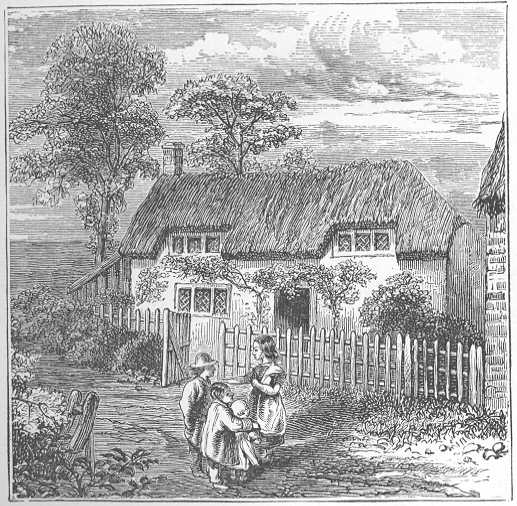
The next morning I went to see the child. Her dwelling
was of the humblest kind. It stood against a high bank of
earth, which formed a sort of garden behind it. It was so
steep, that but little would grow in it; yet that little served
to show not only, on the one hand, the poverty of its owners, but
also to illustrate the happy truth, that even in the worst of
circumstances the Lord does make a kind provision for the support
of his creatures. The front aspect of the cottage was
chiefly rendered pleasing by a honeysuckle, which luxuriantly
climbed up the wall, enclosing the door, windows, and even the
chimney, with its twining branches. As I entered the
house-door, its flowers put forth a very sweet and refreshing
smell. Intent on the object of my visit, I at the same
moment offered up silent prayer to God, and entertained a hope,
that the welcome fragrance of the shrub might be illustrative of
that all-prevailing intercession of a Redeemer, which I trusted
was, in the case of this little child, as “a sweet-smelling
savour” to her heavenly Father. The very flowers and
leaves of the garden and field are emblematical of higher things,
when grace teaches us to make them so. Jane was in bed
upstairs. I found no one in the house with her
except the woman who had brought me the message on the evening
before. The instant I looked on the girl, I perceived a
very marked change in her countenance: it had acquired the
consumptive hue, both white and red. A delicacy unknown to
it before quite surprised me, owing to the alteration it produced
in her look. She received me first with a very sweet smile,
and then instantly burst into a flood of tears, just sobbing
out,—
“I am so glad to see you, sir!”
“I am very much concerned at your being so ill, my
child, and grieved that I was not sooner aware of your
state. But I hope the Lord designs it for your
good.” Her eye, not her tongue, powerfully expressed,
“I hope and think he does.”
“Well, my poor child, since you can no longer come to
see me, I will come and see you, and we will talk over the
subjects which I have been used to explain to you.”
“Indeed, sir, I shall be so glad!”
“That I believe she will,” said the woman;
“for she loves to talk of nothing so much as what she has
heard you say in your sermons, and in the books you have given
her.”
“Are you really desirous, my dear child, to be a true
Christian?”
“Oh, yes, yes, sir; I am sure I desire that above all
things.”
I was astonished and delighted at the earnestness and
simplicity with which she spoke these words.
“Sir,” added she, “I have been thinking, as
I lay on my bed for many weeks past, how good you are to instruct
us poor children; what must become of us without it!”
“I am truly glad to perceive that my instructions have
not been lost upon you, and pray God that this your
present sickness may be an instrument of blessing in his hands to
prove, humble, and sanctify you. My dear child, you have a
soul, an immortal soul to think of; you remember what I have
often said to you about the value of a soul: ‘What shall it
profit a man, if he gain the whole world, and lose his own
soul?’”
“Yes, sir, I remember well you told us, that when our
bodies are put into the grave, our souls will then go either to
the good or the bad place.”
“And to which of these places do you think that, as a
sinner in the sight of God, you deserve to go?”
“To the bad one, sir.”
“What! to everlasting destruction!”
“Yes, sir.”
“Why so?”
“Because I am a great sinner.”
“And must all great sinners go to hell?”
“They all deserve it; and I am sure I do.”
“But is there no way of escape? Is there no way
for a great sinner to be saved?”
“Yes, sir, Christ is the Saviour.”
“And whom does he save?”
“All believers.”
“And do you believe in Christ yourself?”
“I do not know, sir; I wish I did; but I feel that I
love him.”
“What do you love him for?”
“Because he is good to poor children’s souls like
mine.”
“What has he done for you?”
“He died for me, sir; and what could he do
more?”
“And what do you hope to gain by his
death?”
“A good place when I die, if I believe in him, and love
him.”
“Have you felt any uneasiness on account of your
soul?”
“Oh, yes, sir, a great deal. When you used to talk
to us children on Saturdays, I often felt as if I could hardly
bear it, and wondered that others could seem so careless. I
thought I was not fit to die. I thought of all the bad
things I had ever done and said, and believed God must be very
angry with me; for you often told us, that God would not be
mocked; and that Christ said, if we were not converted, we could
not go to heaven. Sometimes I thought I was so young it did
not signify: and then, again, it seemed to me a great sin to
think so; for I knew I was old enough to see what was right and
what was wrong; and so God had a just right to be angry when I
did wrong. Besides, I could see that my heart was not
right; and how could such a heart be fit for heaven?
Indeed, sir, I used to feel very uneasy.”
“My dear Jenny, I wish I had known all this
before. Why did you never tell me about it?”
“Sir, I durst not. Indeed, I could not well say
what was the matter with me: and I thought you would look upon me
as very bold, if I had spoke about myself to such a gentleman as
you: yet I often wished that you knew what I felt and
feared. Sometimes, as we went away from your house, I could
not help crying; and then the other children laughed and jeered
at me, and said I was going to be very good, they supposed, or at
least to make people think so. Sometimes, sir, I fancied
you did not think so well of me as of the rest, and that hurt me;
yet I knew I deserved no particular favour, because I was the
chief of sinners.”
“My dear, what made St. Paul say he was chief of
sinners? In what verse of the Bible do you find this
expression, ‘the chief of sinners;’ can you repeat
it?”
“‘This is a faithful saying, and worthy of all
acceptation, that Christ Jesus came into the world to save
sinners;’—is not that right, sir?”
“Yes, my child, it is right; and I hope that the same
conviction which St. Paul had at that moment has made you
sensible of the same truth. Christ came into the world to
save sinners: my dear child, remember now and for ever more, that
Christ came into the world to save the chief of
sinners.”
“Sir, I am so glad he did. It makes me hope that
he will save me, though I am a poor sinful girl. Sir, I am
very ill, and I do not think I shall ever get well again. I
want to go to Christ if I die.”
“Go to Christ while you live, my dear child, and he will
not cast you away when you die. He that said, ‘Suffer
little children to come unto me,’ waits to be gracious to
them, and forbids them not.”
“What made you first think so seriously about the state
of your soul?”
“Your talking about the graves in the churchyard, and
telling us how many young children were buried there. I
remember you said, one day, near twelve months ago,
‘Children! where will you be a hundred years hence?
Children! where do you think you shall go when you die?
Children! if you were to die to-night, are you sure you should go
to Christ and be happy?’ Sir, I never shall forget
your saying, ‘Children,’ three times together in that
solemn way.”
“Did you ever before that day feel any desire
about your soul?”
“Yes, sir; I think I first had that desire almost as
soon as you began to teach us on Saturday afternoons; but on that
day I felt as I never did before. I shall never forget
it. All the way as I went home, and all that night, these
words were in my thoughts: ‘Children! where do you think
you shall go when you die?’ I thought I must leave
off all my bad ways, or where shall I go when I died?”
“And what effect did these thoughts produce in your
mind?”
“Sir, I tried to live better, and I did leave off many
bad ways; but the more I strove, the more difficult I found it,
my heart seemed so hard: and then I could not tell any one my
case.”
“Could not you tell it to the Lord, who hears and
answers prayers?”
“My prayers (here she blushed and sighed) are very poor
at the best, and at that time I scarcely knew how to pray at all
as I ought. But I did sometimes ask the Lord for a better
heart.”
There was a character in all this conversation which marked a
truly sincere and enlightened state of mind. She spoke with
all the simplicity of a child, and yet the seriousness of a
Christian. I could scarcely persuade myself that she was
the same girl I had been accustomed to see in past time.
Her countenance was filled with interesting affections, and
always spoke much more than her tongue could utter. At the
same time she now possessed an ease and liberty in speaking, to
which she had formerly been a stranger: nevertheless, she was
modest, humble, and unassuming. Her
readiness to converse was the result of spiritual anxiety, not
childish forwardness. The marks of a Divine change were too
prominent to be easily mistaken; and in this very child, I, for
the first time, witnessed the evident testimonies of such a
change. How encouraging, how profitable to my own soul!
“Sir,” continued little Jane, “I had one day
been thinking that I was neither fit to live nor die: for I could
find no comfort in this world, and I was sure I deserved none in
the other. On that day you sent me to learn the verse on
Mrs. B---’s headstone, and then I read that on the one next
to it.”
“I very well remember it, Jenny; you came back, and
repeated them both to me.”
“There were two lines in it which made me think and
meditate a great deal.”
“Which were they?”
“‘Hail Glorious gospel! heavenly
light, whereby
We live with comfort, and with comfort die.’
I wished that glorious gospel was mine, that I might live and
die with comfort; and it seemed as if I thought it would be
so. I never felt so happy in all my life before. The
words were often in my thoughts,—
‘Live with comfort, and with comfort
die.’
Glorious gospel, indeed! I thought.”
“My dear child, what is the meaning of the word
gospel?”
“Good news.”
“Good news for whom?”
“For wicked sinners, sir.”
“Who sends this good news for wicked
sinners?”
“The Lord Almighty.”
“And who brings this good news?”
“Sir, you brought it to me.”
Here my soul melted in an instant, and I could not repress the
tears which the emotion excited. The last answer was
equally unexpected and affecting. I felt a father’s
tenderness and gratitude for a new and first-born child.
Jane wept likewise.
After a little pause she said,—
“O sir! I wish you would speak to my father, and
mother, and little brother; for I am afraid they are going on
very badly.”
“How so?”
“Sir, they drink, and swear, and quarrel, and do not
like what is good; and it does grieve me so, I cannot bear
it. If I speak a word to them about it, they are very
angry, and laugh, and bid me be quiet, and not set up for their
teacher. Sir, I am ashamed to tell you this of them, but I
hope it is not wrong; I mean it for their good.”
“I wish your prayers and endeavours for their sake may
be blessed; I will also do what I can.”
I then prayed with the child, and promised to visit her
constantly.
As I returned home, my heart was filled with thankfulness for
what I had seen and heard. Little Jane appeared to be a
first-fruits of my parochial and spiritual harvest. This
thought greatly comforted and strengthened me in my ministerial
prospects.
My partiality to the memory of little Jane will probably
induce me to lay some further particulars before the reader.
Divine grace educates the reasoning faculties of the soul, as
well as the best affections of the heart; and happily consecrates
them both to the glory of the Redeemer. Neither the
disadvantages of poverty, nor the inexperience of childhood, are
barriers able to resist the mighty influences of the Spirit of
God, when “he goeth forth where he listeth.”
“God hath chosen the foolish things of this world to
confound the wise; and God hath chosen the weak things of the
world to confound the things which are mighty.” The
truth of this scriptural assertion was peculiarly evident in the
case of my young parishioner.
Little Jane’s illness was of a lingering nature. I
often visited her. The soul of this young Christian was
gradually, but effectually, preparing for heaven. I have
seldom witnessed in any older person, under similar
circumstances, stronger marks of earnest inquiry, continual
seriousness, and holy affections. One morning, as I was
walking through the church-yard, in my way to visit her, I
stopped to look at the epitaph which had made such a deep
impression on her mind. I was struck with the reflection of
the important consequences which might result from a more
frequent and judicious attention to the inscriptions placed in
our burying-grounds, as memorials of the departed. The idea
occurred to my thoughts, that as the two stone tables given by
God to Moses were once a means of communicating to the Jews, from
age to age, the revelation of God’s will as concerning the
law; so these funeral tables of stone may, under a better
dispensation, bear a never-failing proclamation of
God’s will to sinners as revealed in the gospel of his
grace, from generation to generation. I have often
lamented, when indulging a contemplation among the graves, that
some of the inscriptions were coarse and ridiculous; others,
absurdly flattering; many, expressive of sentiments at variance
with the true principles of the word of God; not a few, barren
and unaccompanied with a single word of useful instruction to the
reader. Thus a very important opportunity of conveying
scriptural admonition is lost. I wish that every
grave-stone might not only record the name of our deceased
friends, but also proclaim the name of Jesus, as the only name
given under heaven whereby men can be saved. Perhaps, if
the ministers of religion were to interest themselves in this
matter, and accustom their people to consult them as to the
nature of the monumental inscriptions which they wish to
introduce into churches and church-yards, a gradual improvement
would take place in this respect. What is offensive,
useless, or erroneous, would no longer find admittance, and a
succession of valuable warning and consolation to the living
would perpetuate the memory of the dead.
What can be more disgusting than the too common spectacle of
trifling licentious travellers, wandering about the church-yards
of the different places through which they pass, in search of
rude, ungrammatical, ill-spelt, and absurd verses among the
grave-stones; and this for the gratification of their unholy
scorn and ridicule! And yet how much is it to be deplored
that such persons are seldom disappointed in finding many
instances which too readily afford them the unfeeling
satisfaction which they seek! I therefore offer this
suggestion to my reverend brethren, that as no monument or stone
can be placed in a church or church-yard without
their express consent or approbation, whether one condition of
that consent being granted, should not be a previous inspection
and approval of every inscription which may be so placed within
the precincts of the sanctuary?
The reader will pardon this digression, which evidently arose
from the peculiar connection established in little Jane’s
history, between an epitaph inscribed on a grave-stone, and the
word of God inscribed on her heart. When I arrived at
Jane’s cottage, I found her in bed, reading Dr.
Watts’ Hymns for Children, in which she took great
pleasure.
“What are you reading this morning, Jane?”
“Sir, I have been thinking very much about some verses
in my little book. Here they are,—
‘There is an hour when I must die,
Nor do I know how soon ’twill come;
A thousand children young as I
Are called by death to hear their doom.
Let me improve the hours I have,
Before the day of grace is fled;
There’s no repentance in the grave,
Nor pardon offered to the dead.’
“Sir, I feel all that to be very true, and I am afraid I
do not improve the hours I have, as I ought to do. I think
I shall not live very long; and when I remember my sins, I
say,—
‘Lord, at thy feet ashamed I lie,
Upward I dare not look;
Pardon my sins before I die,
And blot them from thy book.’
Do you think he will pardon me, sir?”
“My dear child, I have great hopes that he has pardoned you; that
he has heard your prayers, and put you into the number of his
true children already. You have had strong proofs of his
mercy to your soul.”
“Yes, sir, I have, and I wish to love and bless him for
it. He is good, very good.”
It had for some time past occurred to my mind that a course of
regulated conversations on the first principles of
religion would be very desirable from time to time, for this
interesting child’s sake: and I thought the Church
Catechism would be the best groundwork for that purpose.
“Jenny,” said I, “you can repeat the
Catechism?”
“Yes, sir; but I think that has been one of my sins in
the sight of God.”
“What! repeating your Catechism?”
“Yes, sir, in such a way as I used to do it.”
“How was that?”
“Very carelessly indeed. I never thought about the
meaning of the words, and that must be very wrong. Sir, the
Catechism is full of good things; I wish I understood them
better.”
“Well, then, my child, we will talk a little about those
good things which, as you truly say, are contained in the
Catechism. Did you ever consider what it is to be a member
of Christ, a child of God, and an inheritor of the kingdom of
heaven?”
“I think, sir, I have lately considered it a good deal;
and I want to be such, not only in name, but in deed and in
truth. You once told me, sir, that ‘as the branch is
to the vine, and the stone to the building, and the limb to the
body and the head, so is a true believer to the Lord Jesus
Christ.’ But how am I to know that I belong to Christ
as a true member, which, you said
one day in the church, means the same as a limb of the
body, such as a leg or an arm?”
“Do you love Christ now in a way you never used to do
before?”
“Yes, I think so indeed.”
“Why do you love him?”
“Because he first loved me.”
“How do you know that he first loved you?”
“Because he sent me instruction, and made me feel the
sin of my heart, and taught me to pray for pardon, and love his
ways; he sent you to teach me, sir, and to show me the way to be
saved; and now I want to be saved in that way that he
pleases. Sometimes I feel as if I loved all that he has
said and done, so much, that I wish never to think about anything
else. I know I did not use to feel so; and I think if he
had not loved me first, my wicked heart would never have cared
about him. I once loved anything better than religion, but
now it is everything to me.”
“Do you believe in your heart that Christ is able and
willing to save the chief of sinners?”
“I do.”
“And what are you?”
“A young, but a great sinner.”
“Is it not of his mercy that you know and feel yourself
to be a sinner?”
“Certainly; yes, it must be so.”
“Do you earnestly desire to forsake all sin?”
“If I know myself, I do.”
“Do you feel a spirit within you resisting sin, and
making you hate it?”
“Yes, I hope so.”
“Who gave you that spirit? Were you always
so?”
“It must be Christ, who loved me, and gave himself for
me. I was quite different once.”
“Now, then, my dear Jane, does not all this show a
connection between the Lord Jesus Christ and your soul?
Does it not seem as if you lived, and moved, and had a spiritual
being from him? Just as a limb is connected with your body,
and so with your head, and thereby gets power to live and move
through the flowing of the blood from the one to the other; so
are you spiritually a limb or member of Christ, if you believe in
him, and thus obtain, through faith, a power to love him, and
live to his praise and glory. Do you understand
me?”
“Yes, sir, I believe I do; and it is very comfortable to
my thoughts to look up to Christ as a living Head, and to
consider myself as the least and lowest of all his
members.”
“Now tell me what your thoughts are as to being a child
of God.”
“I am sure, sir, I do not deserve to be called his
child.”
“Can you tell me who does deserve it?”
“No one, sir.”
“How, then, comes any one to be a child of God, when by
nature we are children of wrath?”
“By God’s grace, sir.”
“What does grace mean?”
“Favour; free favour to sinners.”
“Right; and what does God bestow upon the children of
wrath, when he makes them children of grace?”
“A death unto sin, and a new birth unto righteousness;
is it not, sir?”
“Yes, this is the fruit of Christ’s redeeming
love; and I hope you are a partaker of
the blessing. The family of God is named after him, and he
is the first-born of many brethren. What a mercy that
Christ calls himself ‘a Brother!’ My
little girl, he is your Brother; and will not be ashamed
to own you, and present you to his Father at the last day, as one
that he has purchased with his blood.”
“I wish I could love my Father and my Brother which are
in heaven better than I do. Lord be merciful to me a
sinner! I think, sir, if I am a child of God, I am often a
rebellious one. He shows kindness to me beyond others, and
yet I make a very poor return.
‘Are these thy favours day by day,
To me above the rest?
Then let me love thee more than they,
And strive to serve thee best.’”
“That will be the best way to approve yourself a real
child of God. Show your love and thankfulness to such a
Father, who hath prepared for you an inheritance among the saints
in light, and made you ‘an inheritor of the kingdom of
heaven, as well as a member of Christ, and a child of
God.’ Do you know what ‘the kingdom of
heaven’ means?”
Just at that instant her mother entered the house below, and
began to speak to a younger child in a passionate, scolding tone
of voice, accompanied by some very offensive language; but
quickly stopped on hearing us in conversation up stairs.
“Ah, my poor mother!” said the girl, “you
would not have stopped so short, if Mr. --- had not been
here. Sir, you hear how my mother swears; pray say
something to her; she will not hear me.”
I went towards the stair-head, and called to the woman;
but ashamed at the thought of my having probably overheard her
expressions, she suddenly left the house, and for that time
escaped reproof.
“Sir,” said little Jane, “I am so afraid, if
I go to heaven I shall never see my poor mother there. I
wish I may, but she does swear so, and keep such bad
company. As I lie here a-bed, sir, for hours together,
there is often so much wickedness, and noise, and quarrelling
down below, that I do not know how to bear it. It comes
very near, sir, when one’s father and mother go on
so. I want them all to turn to the Lord, and go to
heaven.—Tell me now, sir, something about being an
inheritor of the kingdom of heaven.”
“You may remember, my child, what I have told you when
explaining the Catechism in the church, that the ‘kingdom
of heaven’ in the Scripture means the church of Christ upon
earth, as well as the state of glory in heaven. The one is
a preparation for the other. All true Christians are heirs
of God, and joint-heirs with Christ, and shall inherit the glory
and happiness of his kingdom, and live with Christ and be with
him for ever. This is the free gift of God to his adopted
children; and all that believe aright in Christ shall experience
the truth of that promise, ‘It is your Father’s good
pleasure to give you the kingdom.’ You are a poor
girl now, but I trust ‘an entrance shall be ministered unto
you abundantly into the everlasting kingdom of our Lord and
Saviour Jesus Christ.’ You suffer now; but are you
not willing to suffer for his sake, and to bear patiently those
things to which he calls you?”
“Oh yes, very willing; I would not complain. It is
all right.”
“Then, my dear, you shall reign with him.
Through much tribulation you may, perhaps, enter into the kingdom
of God; but tribulation worketh patience; and patience,
experience; and experience, hope. As a true ‘member
of Christ,’ show yourself to be a dutiful ‘child of
God,’ and your portion will be that of an inheritor of the
kingdom of heaven. Faithful is He that hath promised.
Commit thy way unto the Lord; trust also in him; and he shall
bring it to pass.”
“Thank you, sir, I do so love to hear of these
things. And I think, sir, I should not love them so much if
I had no part in them. Sir, there is one thing I want to
ask you. It is a great thing, and I may be wrong—I am
so young—and yet I hope I mean right—”
Here she hesitated and paused.
“What is it? Do not be fearful of mentioning
it.” A tear rolled down her cheek—a slight
blush coloured her countenance. She lifted up her eyes to
heaven for a moment, and then, fixing them on me with a solemn,
affecting look, said,—
“May so young a poor child as I am be admitted to the
Lord’s Supper? I have for some time wished it, but
dared not to mention it, for fear you should think it
wrong.”
“My dear Jenny, I have no doubt respecting it, and shall
be very glad to converse with you on the subject, and hope that
He who has given you the desire, will bless his own ordinance to
your soul. Would you wish it now or to-morrow?”
“To-morrow, if you please, sir;—will you come
to-morrow and talk to me about it? and if you think it proper, I
shall be thankful. I am growing
faint now—I hope to be better when you come
again.”
I was much pleased with her proposal, and rejoiced in the
prospect of seeing so young and sincere a Christian thus devote
herself to the Lord, and receive the sacramental seal of a
Saviour’s love to her soul.
Disease was making rapid inroads upon her constitution, and
she was aware of it. But as the outward man decayed, she
was strengthened with might, by God’s Spirit in the inner
man. She was evidently ripening fast for a better
world.
I remember these things with affectionate pleasure; they
revive my earlier associations, and I hope the recollection does
me good. I wish them to do good to thee likewise, my
reader; and therefore I write them down.
May the simplicity that is in Christ render
“The short and simple annals of the
poor”
a mean of grace and blessing to thy soul! Out of the
mouth of this babe and suckling may God ordain thee
strength! If thou art willing, thou mayest perchance hear
something further respecting her.
I was so much affected with my last visit to little Jane, and
particularly with her tender anxiety respecting the Lord’s
Supper, that it formed the chief subject of my thoughts for the
remainder of the day. I rode in the afternoon to a
favourite spot, where I sometimes indulged in
solitary meditation; where I wished to reflect on the interesting
case of my little disciple.
It was a place well suited for such a purpose.
In the widely sweeping curve of a beautiful bay, there is a
kind of chasm or opening in one of the lofty cliffs which bound
it. This produces a very romantic and striking
effect. The steep descending sides of this opening in the
cliff are covered with trees, bushes, wild flowers, fern,
wormwood, and many other herbs, here and there contrasted with
bold masses of rock or brown earth.
In the higher part of one of those declivities two or three
picturesque cottages are fixed, and seem half suspended in the
air.
From the upper extremity of this great fissure, or opening in
the cliff, a small stream of water enters by a cascade, flows
through the bottom, winding in a varied course of about a quarter
of a mile in length; and then runs into the sea across a smooth
expanse of firm, hard sand, at the lower extremity of the
chasm. At this point, the sides of the woody banks are very
lofty, and, to a spectator from the bottom, exhibit a mixture of
the grand and beautiful not often exceeded.
Near the mouth of this opening was a little hollow recess, or
cave in the cliff, from whence, on one hand, I could see the
above-described romantic scene; on the other, a long train of
perpendicular cliffs, terminating in a bold and wild-shaped
promontory, which closed the bay at one end, while a conspicuous
white cliff stood directly opposite, about four miles distant, at
the further point of the bay.
The shore, between the different cliffs and the edge of the
waves, was in some parts covered with stones and shingle; in some, with firm sand; and in others, with irregular
heaps of little rocks fringed with sea-weed, and ornamented with
small yellow shells.
The cliffs themselves were diversified with strata of
various-coloured earth, black, yellow, brown, and orange.
The effects of iron ore, producing very manifest changes of hue,
were everywhere seen in trickling drops and streamlets down the
sides.
The huts in which the fishermen kept their baskets, nets,
boats, and other implements, occupied a few retired spots on the
shore.
The open sea, in full magnificence, occupied the centre of the
prospect; bounded, indeed, in one small part, by a very distant
shore, on the rising ascent from which the rays of the sun
rendered visible a cathedral church, with its towering spire, at
near thirty miles’ distance. Everywhere else the sea
beyond was limited only by the sky.
A frigate was standing into the bay, not very far from my
recess; other vessels of every size, sailing in many directions,
varied the scene, and furnished matter for a thousand sources of
contemplation.
At my feet the little rivulet, gently rippling over pebbles,
soon mingled with the sand, and was lost in the waters of the
mighty ocean. The murmuring of the waves, as the tide ebbed
or flowed, on the sand; their dashing against some more distant
rocks, which were covered fantastically with sea-weed and shells;
sea-birds floating in the air aloft, or occasionally screaming
from their holes in the cliffs; the hum of human voices in the
ships and boats, borne along the water: all these sounds served
to promote, rather than interrupt, meditation. They were
soothingly blended together, and entered the ear in a
kind of natural harmony.
In the quiet enjoyment of a scene like this, the lover of
nature’s beauties will easily find scope for spiritual
illustration.
Here I sat and mused over the interesting character and
circumstances of little Jane. Here I prayed that God would
effectually teach me those truths which I ought to teach her.
When I thought of her youth, I blushed to think how superior
she was to what I well remember myself to have been at the same
age; nay, how far my superior at that very time. I
earnestly desired to catch something of the spirit which appeared
so lovely in her; for, simple, teachable, meek, humble yet
earnest in her demeanour, she bore living marks of heavenly
teaching.
“The Lord,” thought I, “has called this
little child, and set her in the midst of us, as a parable, a
pattern, an emblem. And he saith, ‘Verily, except ye
be converted, and become as little children, ye shall not enter
into the kingdom of heaven.’ Oh that I may be humble
as this little child!”
I was thus led into a deep self-examination, and was severely
exercised with fear and apprehension, whether I was myself a real
partaker of those divine influences which I could so evidently
discover in her. Sin appeared to me just then to be more
than ever “exceeding sinful.” Inward and inbred
corruptions made me tremble. The danger of self-deception
in so great a matter alarmed me. I was a teacher of others;
but was I indeed spiritually taught myself?
A spirit of anxious inquiry ran through every thought:
I looked at the manifold works of creation around me; I perceived
the greatest marks of regularity and order; but within I
felt confusion and disorder.
“The waves of the sea,” thought I, “ebb and
flow in exact obedience to the law of their Creator. Thus
far they come, and no further—they retire again to their
accustomed bounds; and so maintain a regulated succession of
effects.
“But, alas! the waves of passion and affection in the
human breast manifest more of the wild confusion of a storm, than
the orderly regularity of a tide. Grace only can subdue
them.
“What peaceful harmony subsists throughout all this
lovely landscape! These majestic cliffs, some clothed with
trees and shrubs; others bare and unadorned with herbage, yet
variegated with many-coloured earths; these are not only sublime
and delightful to behold, but they are answering the end of their
creation, and serve as a barrier to stop the progress of the
waves.
“But how little peace and harmony can I comparatively
see in my own heart! The landscape within is marred
by dreary, barren wilds, and wants that engaging character which
the various parts of this prospect before me so happily
preserve. Sin, sin is the bane of mortality, and heaps
confusion upon confusion, wherever it prevails.
“Yet, saith the voice of Promise, ‘Sin shall not
have dominion over you.’ Oh, then, ‘may I yield
myself unto God, as one that am alive from the dead, and my
members as instruments of righteousness unto God!’
And thus may I become an able and willing minister of the New
Testament!
“I wish I were like this little stream of
water. It takes its first rise scarcely a mile off; yet it
has done good even in that short course. It has passed by
several cottages in its way, and afforded life and health to the
inhabitants; it has watered their little gardens as it flows, and
enriched the meadows near its banks. It has satisfied the
thirst of the flocks that are feeding aloft on the hills, and
perhaps refreshed the shepherd’s boy who sits watching his
master’s sheep hard by. It then quietly finishes its
current in this secluded dell, and, agreeably to the design of
its Creator, quickly vanishes in the ocean.
“May my course be like unto thine, thou little
rivulet! Though short be my span of life, yet may I be
useful to my fellow-sinners as I travel onwards! Let me be
a dispenser of spiritual support and health to many! Like
this stream, may I prove ‘the poor man’s
friend’ by the way, and water the souls that thirst for the
river of life, wherever I meet them! And if it please thee,
O my God, let me in my latter end be like this brook. It
calmly, though not quite silently, flows through this scene of
peace and loveliness, just before it enters the sea. Let me
thus gently close my days likewise; and may I not unusefully tell
to others of the goodness and mercy of our Saviour, till I arrive
at the vast ocean of eternity!
“Thither,” thought I, “little Jane is fast
hastening. Short, but not useless, has been her
course. I feel the great importance of it in my own soul at
this moment. I view a work of mercy there, to which
I do hope I am not quite a stranger in the experience of my own
heart. The thought enlivens my spirit, and leads me to see
that, great as is the power of sin the power of Jesus is greater;
and, through grace, I may meet my dear
young disciple, my child in the gospel, my sister in the faith,
in a brighter, a better world hereafter.”
There was something in the whole of this meditation which
calmed and prepared my mind for my promised visit the next
day. I looked forward to it with affectionate anxiety.
It was now time to return homewards. The sun was
setting. The lengthened shadows of the cliffs, and of the
hills towering again far above them, cast a brown but not
unpleasing tint over the waters of the bay. Further on the
beams of the sun still maintained their splendour. Some of
the sails of the distant ships, enlivened by its rays, appeared
like white spots in the blue horizon, and seemed to attract my
notice, as if to claim at least the passing prayer, “God
speed the mariners on their voyage.”
I quitted my retreat in the cliff with some reluctance; but
with a state of mind, as I hoped, solemnized by reflection, and
animated to fresh exertion.
I walked up by a steep pathway, that winded through the trees
and shrubs on the sides of one of the precipices. At every
step the extent of prospect enlarged, and acquired a new and
varying character, by being seen through the trees on each
side. Climbing up a kind of rude, inartificial set of stone
stairs in the bank, I passed by the singularly situated cottages
which I had viewed from beneath; received and returned the
evening salutation of the inhabitants, sitting at their doors,
and just come home from labour; till I arrived at the top of the
precipice, where I had left my horse tied to a gate.
Could he have enjoyed it, he had a noble prospect
around him in every direction from this
elevated point of view, where he had been stationed while I was
on the shore below. But wherein he most probably failed I
think his rider did not. The landscape, taken in connection
with my recent train of thought about myself and little Jane,
inspired devotion.
The sun was now set: the bright colours of the western clouds,
faintly reflected from the south-eastern hills, that were unseen
from my retreat in the cliff, or only perceived by their evening
shadows on the sea, now added to the beauty of the prospect on
the south and west. Every element contributed to the
interesting effect of the scenery. The earth was
diversified in shape and ornament. The waters of the
ocean presented a noble feature in the landscape. The
air was serene, or only ruffled by a refreshing breeze
from the shore. And the sun’s fiery beams,
though departing for the night, still preserved such a portion of
light and warmth as rendered all the rest delightful to an
evening traveller. From this point the abyss, occasioned by
the great fissure in the cliff, appeared grand and
interesting. Trees hung over it on each side, projecting
not only their branches, but many of their roots in wild and
fantastic forms. Masses of earth had recently fallen from
the upper to the lower parts of the precipice, carrying trees and
plants down the steep descent. The character of the soil
and the unceasing influence of the stream at the bottom, seemed
to threaten further slips of the land from the summit. From
hence the gentle murmur of the cascade at the head of the chine
stole upon the ear without much interruption to the quietness of
the scene. A fine rocky cliff, half buried in trees, stood
erect on the land side about a mile distant, and seemed to vie with those on the shore in challenging
the passenger’s attention. In the distance stood a
noble ash-tree, which, on a considerable height, majestically
reigned as the patriarch of the grove near which it grew.
Every object combined to please the eye and direct the
traveller’s heart to admire and love the Author and Creator
of all that is beautiful to sense and edifying to the soul.
The next morning I went to Jane’s cottage. On
entering the door, the woman, who so frequently visited her, met
me, and said:—
“Perhaps, sir, you will not wake her just yet; for she
has dropped asleep, and she seldom gets much rest, pool
girl!”
I went gently up stairs.
The child was in a half-sitting posture, leaning her head upon
her right hand, with her Bible open before her. She had
evidently fallen asleep while reading. Her countenance was
beautifully composed and tranquil. A few tears had rolled
down her cheek, and (probably unknown to her) dropped upon the
pages of her book.
I looked around me for a moment. The room was outwardly
comfortless and uninviting: the walls out of repair; the sloping
roof somewhat shattered; the floor broken and uneven; no
furniture but two tottering bedsteads, a three-legged stool, and
an old oak chest; the window broken in many places, and mended
with patches of paper. A little shelf against the wall,
over the bedstead where Jane lay, served for her physic, her
food, and her books.
“Yet here,” I said to myself, “lies
an heir of glory, waiting for a happy dismissal. Her
earthly home is poor, indeed; but she has a house not made with
hands, eternal in the heavens. She has little to
attach her to this world; but what a weight of glory in the world
to come! This mean, despised chamber is a palace in the eye
of faith, for it contains one that is inheritor of a
crown.”
I approached without waking her, and observed that she had
been reading the twenty-third chapter of St. Luke. The
finger of her left hand lay upon the book, pointing to the words,
as if she had been using it to guide her eye whilst she read.
I looked at the place, and was pleased at the apparently
casual circumstance of her finger pointing at these
words:—
“Lord, remember me when thou comest into thy
kingdom.”
“Is this casual or designed?” thought I.
“Either way it is remarkable.”
But in another moment I discovered that her finger was indeed
an index to the thoughts of her heart.
She half awoke from her dozing state, but not sufficiently so
to perceive that any person was present, and said in a kind of
whisper:—
“Lord, remember me—remember
me—remember—remember a poor child—Lord,
remember me—”
She then suddenly started and perceived me, as she became
fully awake. A faint blush overspread her cheeks for a
moment, and then disappeared.
“Dame K---, how long have I been asleep?—Sir, I am
very sorry—”
“And I am very glad to find you thus,” I
replied. “You may say with David, ‘I laid me
down and slept: I awaked, for the Lord sustained me.’
What were you reading?”
“The history of the crucifying of Jesus, sir.”
“How far had you read when you fell
asleep?”
“To the prayer of the thief that was crucified with him;
and when I came to that place I stopped, and thought what a mercy
it would be if the Lord Jesus, should remember me
likewise—and so I fell asleep; and I fancied in my dream
that I saw Christ upon the cross; and I thought I said,
‘Lord, remember me;’ and I am sure he did not look
angry upon me—and then I awoke.”
All this seemed to be a sweet commentary on the text, and a
most suitable forerunner of our intended sacramental service.
“Well, my dear child, I am come, as you wished me, to
administer the sacrament of the body and blood of our blessed
Saviour to you; and I daresay neighbour K--- will be glad to join
us.”
“Talk to me a little about it first, sir, if you
please.”
“You remember what you have learned in your Catechism
about it. Let us consider. A sacrament, you know, is
‘an outward and visible sign of an inward and spiritual
grace, given unto us, ordained by Christ himself, as a means
whereby we receive the same, and a pledge to assure us
thereof.’ Now the Lord has ordained bread and wine in
the holy supper, as the outward mark, which we behold with our
eyes. It is a sign, a token, a seal of his love, grace, and
blessing, which he promises to, and bestows on, all who receive
it, rightly believing on his name and work. He in this
manner preserves amongst us a ‘continual remembrance of his
death, and of the benefits which we receive
thereby.’”
“What do you believe respecting the death of Christ,
Jenny?”
“That because he died, sir, we live.”
“What life do we live thereby?”
“The life of grace and mercy now, and the life of
glory and happiness hereafter; is it not, sir?”
“Yes, assuredly: this is the fruit of the death of
Christ, and thus he ‘opened the kingdom of heaven to all
believers.’ As bread and wine strengthen and refresh
your poor, weak, fainting body in this very sickness, so does the
blessing of his body and blood strengthen and refresh the souls
of all that repose their faith, hope, and affections on him who
loved us and gave himself for us.”
Tears ran down her cheeks as she said,—
“Oh, what a Saviour! Oh, what a sinner! How
kind! how good! And is this for me?”
“Fear not, dear child. He that has made you to
love him thus, loves you too well to deny you. He will in
no wise cast out any that come to him.”
“Sir,” said the girl, “I can never think
about Jesus and his love to sinners, without wondering how it can
be. I deserve nothing but his anger on account of my
sins. Why then does he love me? My heart is
evil. Why then does he love me? I continually forget
all his goodness. Why then does he love me? I neither
pray to him, nor thank him, nor do anything as I ought to
do. Why then such love to me?”
“How plain it is that all is mercy from first to last!
and that sweetens the blessing, my child. Are you not
willing to give Christ all the honour of your salvation, and to
take all the blame of your sins on your own self?”
“Yes, indeed, sir, I am. My hymn says,—
‘Blest be the Lord, that sent his Son
To take our flesh and blood;
He for our lives gave up his own,
To make our peace with God.
‘He honoured all his Father’s laws,
Which we have disobeyed;
He bore our sins upon the cross,
And our full ransom paid.’”
“I am glad you remember your hymns so well,
Jenny.”
“Sir, you don’t know what pleasure they give
me. I am very glad you gave me that little book of Hymns
for Children.”
A severe fit of coughing interrupted her speech for a
while. The woman held her head. It was distressing to
observe her struggle for breath, and almost, as it were, for
life.
“Poor dear!” said the woman; “I wish I could
help thee, and ease thy pains; but they will not last for
ever.”
“God helps me,” said the girl, recovering her
breath; “God helps me—he will carry me through.
Sir, you look frightened. I am not afraid—this is
nothing—I am better now. Thank you, dame, thank
you. I am very troublesome; but the Lord will bless you for
this and all your kindness to me: yes, sir, and yours too.
Now talk to me again about the sacrament.”
“What is required, Jenny, of them who come to the
Lord’s Supper? There are five things named in the
Catechism; do you remember what is the first?”
She paused, and then said, with a solemn and intelligent
look,—
“To examine themselves whether they repent them truly of
their former sins.”
“I hope and think that you know what this means, Jenny. The Lord has given you the spirit of
repentance.”
“No one knows, sir, what the thoughts of past sin have
been to me. Yes, the Lord knows, and that is enough; and I
hope he forgives me for Christ’s sake. His blood
cleanseth from all sin. Sir, I sometimes think of my sins
till I tremble, and it makes me cry to think that I have offended
such a God; and then he comforts me again with sweet thoughts
about Christ.”
“It is well, my child—be it so. The next
thing mentioned in that article of your Catechism, what is
it?”
“Steadfastly purposing to lead a new life.”
“And what do you think of that?”
“My life, sir, will be a short one; and I wish it had
been a better one. But from my heart I desire that it may
be a new one for the time to come. I want to forsake
all my evil ways and thoughts, and evil words, and evil
companions; and to do what God bids me, and what you tell me is
right, sir, and what I read of in my Bible. But I am afraid
I do not, my heart is so full of sin. However, sir, I pray
to God to help me. My days will be few; but I wish they may
be spent to the glory of God.”
“The blessing of the Lord be upon you, Jane; so that
whether you live, you may live to the Lord; or whether you die,
you may die unto the Lord; and that, living or dying, you may be
the Lord’s. What is the next thing
mentioned?”
“To have a lively faith in God’s mercy through
Christ, sir.”
“Do you believe that God is merciful to you in the
pardon of your sins?”
“I do, sir,” said the child earnestly.
“And if he pardons you, is it for your own sake,
Jenny?”
“No, sir, no; it is for Christ’s sake—for my
Saviour Jesus Christ’s sake, and that only. Christ is
all.”
“Can you trust him?”
“Sir, I must not mistrust him; nor would I, if I
might.”
“Right, child; he is worthy of all your
trust.”
“And then, sir, I am to have a thankful remembrance of
his death. I can never think of his dying, but I think also
what a poor unworthy creature I am; and yet he is so good to
me. I wish I could thank him—sir, I have been
reading about his death—how could the people do as they did
to him?—but it was all for our salvation. And the
thief on the cross—that is beautiful. I hope he will
remember me too, and that I shall always remember him and his
death most thankfully.”
“And lastly, Jenny, are you in charity with all
men? Do you forgive all that have offended you? Do
you bear ill-will in your heart to anybody?”
“Dear sir, no! how can I? If God is good to me, if
he forgives me, how can I help forgiving others? There is
not a person in all the world, I think, sir, that I do not wish
well to for Christ’s sake, and that from the bottom of my
heart.”
“How do you feel towards those bold, wanton,
ill-tempered girls at the next door, who jeer and mock you so
about your religion?”
“Sir, the worst thing I wish them is, that God may give
them grace to repent; that he may change their hearts, and pardon
all their wicked ways and words. May he forgive them, as I
do with all my soul!”
She ceased—I wished to ask no more. My
heart was full. “Can this be the religion of a
child?” thought I. “O that we were all children
like her!”
“Reach me that prayer-book, and the cup and plate.
My dear friends, I will now, with God’s blessing, partake
with you in the holy communion of our Lord’s body and
blood.”
The time was sweet and solemn. I went through the
sacramental service.
The countenance and manner of the child evinced powerful
feelings. Tears mingled with smiles—resignation
brightened by hope—humility animated by faith—a
child-like modesty adorned with the understanding of a riper
age—gratitude, peace, devotion, patience—all these
were visible. I thought I distinctly saw them all—and
did I alone see them? Is it too much to say that
other created beings, whom I could not behold with my natural
eyes, were witnesses of the scene?
If ministering angels do ascend and descend with glad tidings
between earth and heaven, I think they did so then.
When I had concluded the service, I said,—
“Now, my dear Jane, you are indeed become a sister in
the Church of Christ. May his Spirit and blessing rest upon
you, strengthen and refresh you!”
“My mercies are great, very great, sir; greater than I
can express. I thank you for this favour—I thought I
was too young—it seemed too much for me to think of; but I
am now sure the Lord is good to me, and I hope I have done
right.”
“Yes, Jenny; and I trust you are both outwardly and inwardly sealed by the Holy Ghost to the day of
redemption.”
“Sir, I shall never forget this day.”
“Neither, I think, shall I.”
“Nor I,” said the good old woman; “sure the
Lord has been in the midst of us three to-day, while we have been
gathered together in his name.”
“Sir,” said the child, “I wish you could
speak to my mother when you come again. But she keeps out
of your sight. I am so grieved about her soul, and I am
afraid she cares nothing at all about it herself.”
“I hope I shall have an opportunity the next time I
come. Farewell, my child.”
“Good-bye, sir; and I thank you for all your kindness to
me.”
“Surely,” I thought within myself as I left the
cottage, “this young bud of grace will bloom beauteously in
paradise! The Lord transplant her thither in his own good
time. Yet, if it be his will, may she live a little longer,
that I may further profit by her conversation and
example!”
Possibly, some who peruse these simple records of poor little
Jane may wish the same. If it be so, we will visit her
again before she departs hence and is no more seen.
Jane was hastening fast to her dissolution. She still,
however, preserved sufficient strength to converse with much
satisfaction to herself and those who visited her. Such as
could truly estimate the value of her spiritual state
of mind were but few; yet the most careless could not help being
struck with her affectionate seriousness, her knowledge of the
Scriptures, and her happy application of them to her own
case.
which regenerating grace had implanted in her life, had
kindled a flame which warmed and animated the beholder. To
some, I am persuaded, her example and conversation were
made a blessing. Memory reflects with gratitude, whilst I
write, on the profit and consolation which I individually derived
from her society. Nor I alone. The last day will, if
I err not, disclose further fruits, resulting from the love of
God to this little child, and, through her, to others that saw
her. And may not hope indulge the prospect, that this
simple memorial of her history shall be as one arrow drawn from
the quiver of the Almighty to reach the hearts of the young and
the thoughtless? Direct its course, O my God! May the
eye that reads, and the ear that hears, the record of little
Jane, through the power of the Spirit of the Most High, each
become the witness for the truth as it is in Jesus!
I remembered the tender solicitude of this dear child for her
mother. I well knew what an awful contrast the dispositions
and conduct of her parents exhibited, when compared with her
own.
I resolved to avail myself of the first opportunity I could
seize to speak to the mother in the child’s presence.
The woman had latterly avoided me, conscious of deserving, and
fearful of receiving reproof. The road by which I usually
approached the house lay, for some little distance,
sufficiently in sight of its windows to enable the woman to
retire out of the way before I arrived. There was, however,
another path, through fields at the back of the village, which,
owing to the situation of the ground, allowed of an approach
unperceived, till a visitor reached the very cottage itself.
One morning, soon after the sacramental interview related in
my last paper, I chose this road for my visit. It
was preferable to me on every account. The distance was not
quite half a mile from my house. The path was
retired. I hereby avoided the noise and interruption which
even a village street will sometimes present, to disturb the
calmness of interesting meditation.
As I passed through the churchyard, and cast my eye on the
memorable epitaph, “Soon,” I thought within me,
“will my poor little Jane mingle her mouldering remains
with this dust, and sleep with her fathers! Soon will the
youthful tongue, which now lisps hosannas to the Son of David,
and delights my heart with evidences of early piety and grace, be
silent in the earth! Soon shall I be called to commit her
‘body to the ground, earth to earth, ashes to ashes, dust
to dust.’ But oh, what a glorious change! Her
spirit shall have then returned to God who gave it. Her
soul will be joining the halleluiahs of paradise, while we sing
her requiem at the grave. And her very dust shall here
wait, in sure and certain hope of a joyful resurrection from the
dead.”
I went through the fields without meeting a single
individual. I enjoyed the retirement of my solitary
walk. Various surrounding objects contributed to excite
useful meditation connected with the great
subjects of time and eternity. Here and there a drooping
flower reminded me of the fleeting nature of mortal life.
Sometimes a shady spot taught me to look to Him who is a
“shadow in the day-time from the heat, and for a place of
refuge, and for a covert from storm and from rain.”
If a worm crept across my path, I saw an emblem of myself as I am
now; and the winged insects, fluttering in the sunbeams,
led me comparatively to reflect on what I hoped to be
hereafter.
The capacious mansion of a rich neighbour appeared on the
right hand as I walked; on my left were the cottages of the
poor. The church spire pointing to heaven a little beyond,
seemed to say to both the rich and the poor, “Set your
affection on things above, not on things on the
earth.” All these objects afforded me useful
meditation; and all obtained an increased value as such, because
they lay in my road to the house of little Jane.
I was now arrived at the stile nearly adjoining her
dwelling. The upper window was open, and I soon
distinguished the sound of voices—I was glad to hear that
of the mother. I entered the house door unperceived by
those above stairs, and sat down below, not wishing as yet to
interrupt a conversation which quickly caught my ear.
“Mother! mother! I have not long to live. My
time will be very short. But I must, indeed I must, say
something for your sake, before I die. O mother! you have a
soul—you have a soul; and what will become of it when you
die? O my mother! I am so uneasy about your
soul—”
“Oh, dear! I shall lose my child—she will
die—and what shall I do when you are gone, my
Jenny?” She sobbed aloud.
“Mother, think about your soul. Have you
not neglected that?”
“Yes, I have been a wicked creature, and hated all that
was good. What can I do?”
“Mother, you must pray to God to pardon you for
Christ’s sake. You must pray.”
“Jenny, my child, I cannot pray: I never did pray in all
my life. I am too wicked to pray.”
“Mother, I have been wanting to speak to you a long
time; but I was afraid to do it. You did not like me to say
anything about religion, and I did not know how to begin.
But indeed, mother, I must speak now, or it may be too
late. I wish Mr. --- was here, for he could talk to you
better than I can. But perhaps you will think of what I
say, poor as it is, when I am dead. I am but a young child,
and not fit to speak about such things to anybody. But,
mother, you belong to me, and I cannot bear to think of your
perishing for ever. My Lord and Saviour has shown me my own
sin and corruptions: he loved me, and gave himself for me: he
died, and he rose again: I want to praise him for it for ever and
ever. I hope I shall see him in heaven; but I want to see
you there too, mother. Do, pray do, leave off swearing, and
other bad ways: go to church, and hear our minister speak about
Jesus Christ, and what he has done for wicked sinners. He
wishes well to souls. He taught me the way, and he will
teach you, mother. Why did you always go out of the house
when he was coming? Do not be angry with me, mother; I only
speak for your good. I was once as careless as you are
about the things of God. But I have seen my error. I
was in the broad road leading to destruction, like many other children in the parish; and the Lord saw me, and
had mercy upon me.”
“Yes, my child, you were always a good girl, and minded
your book.”
“No, mother, no; not always. I cared nothing about
goodness, nor my Bible, till the minister came and sent for us,
as you know, on Saturday afternoons. Don’t you
remember, mother, that at first you did not like me to go, and
said you would have no such godly, pious doings
about your house; and that I had better play about the
streets and fields, than be laughed at and be made game of for
pretending to be so good? Ah, mother, you did not know what
I went for, and what God designed for me and my poor sinful
soul! But, thank God, I did go, and there learned the way
of salvation. Mother, I wish you had learned
too.”
As I listened to this affecting conversation, it appeared to
me, from the tone and manner of the mother’s voice, that
she was more under the influence of temporary grief, on account
of her child’s extreme illness, than sincere sorrow from
any real sense of her sins. I however hoped the best, and
rejoiced to hear such weighty and important exhortation dropping
from her daughter’s lips. I felt that present
circumstances rendered it far more valuable than my own could
have been.
I have often, since that time, seen the wicked and careless
much affected, while sitting by the dying bed of a near relative:
I have witnessed their temporary acknowledgments of sin, and
heard their professions of amendment. But, after a short
season, all has passed away like the morning dew. The
friend has been buried out of sight. The world and its cares, the flesh and its sins, have returned
with new temptations, and the eloquence of iniquity has prevailed
over the voice of truth. “The dog has returned to his
vomit, and the sow to her wallowing in the mire.”
On the other hand, how frequently have the deathbeds of true
believers been blessed to the eye-witness of the triumphs of
grace over sin, death, and hell! Often has the careless
bystander received the first saving impression of divine truth,
whilst the dying Christian has experienced and testified the
supports of love and mercy in the trying hour. At such
seasons, faith wields a bright and burning torch, which
occasionally softens the hardest and warms the coldest
heart. The expressions of that heavenly consolation and
devout solicitude, which the Holy Spirit vouchsafes to some, thus
become the happy means of grace and blessing for the conversion
and edification of others.
“He that hath an ear, let him hear what the Spirit saith
unto the churches!”
At this moment the house-door opened, and a younger child, a
brother of Jane’s, came in. The mother asked from
above who it was: the boy replied; and, without further inquiry,
she remained in the chamber. I beckoned to the lad to sit
down quietly; and thus it still remained unknown that I was
below.
“Mother,” continued Jane, “that is my
brother, and will soon be your only remaining child. Do,
pray, encourage him to follow good ways. Send him to Mr.
---, and he will be kind to him, as he has been to me. He
is a wild boy, but I hope he will be brought to think about his
soul in time. Those naughty, wicked boys teach him to swear
and fight, and run after all manner of evil.
Lord, help him to flee from the wrath to come!”
I made a sign to the boy to listen to what his sister said
concerning him. He seemed to hear with attention, and a
tear dropped down his cheek.
“Ay, Jenny, it is to be hoped he will, and that we shall
all likewise.”
“Mother, then you must flee to Christ. Nothing you
can do will save you without that. You must repent and turn
from sin: without the grace of God you cannot do it; but seek,
and you shall find it. Do, for your own sake, and for my
sake, and my little brother’s sake.”
The woman wept and sobbed without replying. I now
thought it time to appear, went to the bottom of the stairs, and
said, “May a friend come up?”
“Mercy on me!” said the mother, “there is
Mr. ---”
“Come in, sir,” said Jane; “I am very glad
you are come now. Mother, set a chair.”
The woman looked confused. Jane smiled as I entered, and
welcomed me as usual.
“I hope I shall be forgiven, both by mother and
daughter, for having remained so long below stairs, during the
conversation which has just taken place. I came in the hope
of finding you together, as I have had a wish for some time past
to speak to you, Sarah, on the same subjects about which, I am
happy to say, your daughter is so anxious. You have long
neglected these things, and I wished to warn you of the danger of
your state; but Jenny has said all I could desire, and I now
solemnly ask you, whether you are not much affected by your poor
child’s faithful conversation? You ought to have been
her teacher and instructor
in the ways of righteousness, whereas she has now become
yours. Happy, however, will it be for you if you are
wise, and consider your latter end, and the things which belong
to your peace, before they are hidden from your eyes! Look
at your dying child, and think of your other and only remaining
one, and say whether this sight does not call aloud upon you to
hear and fear.”
Jane’s eyes were filled with tears whilst I spoke.
The woman hung her head down, but betrayed some emotions of
dislike at the plain dealing used towards her.
“My child, Jenny,” said I, “how are you
to-day?”
“Sir, I have been talking a good deal, and feel rather
faint and weary, but my mind has been very easy and happy since I
last saw you. I am quite willing to die, when the Lord sees
fit. I have no wish to live except it be to see my friends
in a better way before I depart. Sir, I used to be afraid
to speak to them; but I feel to-day as if I could hold my peace
no longer, and I must tell them what the Lord has done for my
soul, and what I feel for theirs.”
There was a firmness, I may say a dignity with which this was
uttered that surprised me. The character of the child
seemed to be lost in that of the Christian; her natural timidity
yielded to a holy assurance of manner resulting from her own
inward consolations, mingled with spiritual desire for her
mother’s welfare. This produced a flush upon her
otherwise pallid countenance, which in no small degree added to
her interesting appearance. The Bible lay open before her
as she sat up in the bed. With her right hand she enclosed
her mother’s.
“Mother, this book you cannot read; you should
therefore go constantly to church, that you
may hear it explained. It is God’s book, and tells us
the way to heaven; I hope you will learn and mind it; with
God’s blessing it may save your soul. Do think of
that, mother, pray do. I am soon going to die. Give
this Bible to my brother; and will you be so kind, sir, as to
instruct him? Mother, remember what I say, and this
gentleman is witness: there is no salvation for sinners like you
and me but in the blood of Christ; he is able to save to the
uttermost; he will save all that come to him; he waits to be
gracious: cast yourself upon his mercy. I wish—I
wish—I—I—I—”
She was quite overcome, and sank away in a kind of fainting
fit.
Her mother observed, that she would now probably remain
insensible for some time before she recovered.
I improved this interval in a serious address to the woman,
and then prepared to take my departure, perceiving that Jane was
too much exhausted for further conversation at that time.
As I was leaving the room, the child said faintly, “Come
again soon, sir; my time is very short.”
I returned home by the same retired road which I had before
chosen. I silently meditated on the eminent proofs of piety
and faith which were just afforded me in the scene I had
witnessed.
Surely, I thought, this is an extraordinary child! What
cannot grace accomplish? Is it possible to doubt after
this, who is the alone Author and Finisher of salvation;
or from whom cometh every good and perfect gift? How
rich and free is the mercy of Jehovah! Hath not he
“chosen the weak things of this world to confound the
things which are mighty?” Let no
flesh glory in his presence: but “he that glorieth, let him
glory in the Lord.”
The truth and excellence of the religion of Jesus Christ
appear to be remarkably established by the union of similarity
with variety, in the effect which it produces on the hearts and
lives of true believers. In the grand and essential
features of Christian experience, the whole household of God
possess an universal sameness of character, a family likeness,
which distinguishes them from all the world besides: yet, in
numerous particulars, there also exists a beautiful variety.
On the one hand, in the aged and the young, in the wise and
the unlearned, in the rich and the poor; in those of stronger and
weaker degrees of mental capacity, in more sanguine or more
sedate dispositions; and in a multitude of otherwise varying
circumstances, there is a striking conformity of principles and
feeling to Christ, and to each other. Like the flowers of
the field and the garden, they are “all rooted and
grounded” in the soil of the same earth; they are warmed by
the same sun, refreshed by the same air, and watered by the same
dews. They each derive nourishment, growth, and increase
from the same life-giving Source. As the flower puts forth
its leaves and petals, adorns the place which it inhabits with
its beauty, and possesses an internal system of qualities,
whereby it is enabled to bring forth its seed or fruit in the
appointed season; so does the Christian.
But, on the other hand, like the flowers also, some
Christians may be said to grow on the mountain tops, some in
valleys, some in the waters, and others in dry ground.
Different colours, forms, and sizes, distinguish them from each
other, and produce a diversity of character and appearance which
affords a delightful variety, both for the purposes of use and
beauty. Yet is that variety perfectly consistent with their
essential unity of nature in the vegetable kingdom, to which they
all equally belong.
In another particular they likewise resemble. They both
die a natural death. The Lord ever preserves “a seed
to serve him,” from generation to generation; for as one
disappears, another springs up to supply his place. But
“it is appointed unto all men once to die.”—Man
“cometh forth like a flower and is cut down: he fleeth also
as a shadow, and continueth not.”—“All flesh is
as grass, and all the glory of man as the flower of the
grass. The grass withereth, and the flower thereof falleth
away.”
In the midst of such diversity of Christian characters there
is much to love and admire. I have selected the case of
little Jane, as one not undeserving of notice.
It is true, she was only a child—a very poor
child—but a child saved by divine grace, enlightened with
the purest knowledge, and adorned with unaffected holiness; she
was a child, humble, meek, and lowly. She “found
grace in the eyes of the Lord” while she was on earth; and,
I doubt not, will be seen on his right hand at the last
day. As such, there is preciousness in the character, which
will account for my attempting once more to write concerning her,
and describe her last moments before she went to her final
rest.
At a very early hour on the morning of the following
day, I was awoke by the arrival of a messenger, bringing an
earnest request that I would immediately go to the child, as her
end appeared to be just approaching.
It was not yet day when I left my house to obey the
summons. The morning star shone conspicuously clear.
The moon cast a mild light over the prospect, but gradually
diminished in brightness as the eastern sky became
enlightened. The birds were beginning their songs, and
seemed ready to welcome the sun’s approach. The dew
plentifully covered the fields, and hung suspended in drops from
the trees and hedges. A few early labourers appeared in the
lanes, travelling towards the scene of their daily
occupations.
All besides was still and calm. My mind, as I proceeded,
was deeply exercised by thoughts concerning the affecting event
which I expected soon to witness.
The rays of the morning star were not so beautiful in my
sight, as the spiritual lustre of this young Christian’s
character. “Her night was far spent;” the
morning of a “better day was at hand.” The sun
of eternal blessedness was ready to break upon her soul with
rising glory. Like the moon, which I saw above me, this
child’s exemplary deportment had gently cast a useful light
over the neighbourhood where she dwelt. Like this moon she
had for a season been permitted to shine amidst the surrounding
darkness; and her rays were also reflected from a luminary, in
whose native splendour her own would quickly be blended and
lost.
The air was cool, but the breezes of the morning were
refreshing, and seemed to foretell the approach of a beautiful
day. Being accustomed, in my walks, to look for
subjects of improving thought and association, I found them in
every direction around me as I hastened onwards to the house
where Jane lay, waiting for a dismissal from her earthly
dwelling.
I felt that the twilight gravity of nature was, at that hour,
peculiarly appropriate to the circumstances of the case; and the
more so, because that twilight was significantly adorned with the
brilliant sparklings of the star on one hand, and the clear, pale
lustre of the waning moon on the other.
When I arrived at the house, I found no one below; I paused
for a few minutes, and heard the girl’s voice very faintly
saying, “Do you think he will come? I should be so
glad—so very glad to see him before I die.”
I ascended the stairs—her father, mother, and brother,
together with the elderly woman before spoken of, were in the
chamber. Jane’s countenance bore the marks of speedy
dissolution. Yet, although death was manifest in the
languid features, there was something more than ever interesting
in the whole of her external aspect. The moment she saw me,
a renewed vigour beamed in her eye; grateful affection sparkled
in the dying face.
Although she had spoken just before I entered, yet for some
time afterwards she was silent, but never took her eyes off
me. There was animation in her look—there was
more—something like a foretaste of heaven seemed to be
felt, and gave an inexpressible character of spiritual beauty,
even in death.
At length she said, “This is very kind, sir—I am
going fast—I was afraid I should never see you again in
this world.”
I said, “My child, are you resigned to
die?”
“Quite.”
“Where is your hope?”
She lifted up her finger, pointed to heaven, and then directed
the same downward to her own heart, saying successively as she
did so, “Christ there, and Christ
here.”
These words, accompanied by the action, spoke her meaning more
solemnly than can easily be conceived.
A momentary spasm took place. Looking towards her
weeping mother, she said, “I am very cold—but it is
no matter—it will soon be over—”
She closed her eyes for about a minute, and, on opening them
again, said, “I wish, sir, when I am gone, you would tell
the other children of the parish how good the Lord has been to
me, a poor sinner—tell them, that they who seek him early
will find him—tell them, that the ways of sin and ignorance
are the ways to ruin and hell—and pray tell them, sir, from
me, that Christ is indeed the Way, the Truth, and the
Life—he will in no wise cast out any that come. Tell
them that I, a poor girl—”
She was quite exhausted, and sunk for a while into a torpid
state, from which, however, she recovered gradually, uttering
these expressions: “Where am I?—I thought I was
going—Lord, save me!”
“My dear child, you will soon be for ever in His
arms who is now guiding you by his rod and staff through the
valley of the shadow of death.”
“I believe so, indeed I do,” said she; “I
long to be with him!—Oh, how good, how great, how
merciful!—Jesus, save me, help me through this last
trial!”
She then gave one hand to her father, the other to her mother, and said, “God bless you, God bless
you—seek the Lord—think of me when I am gone—it
may be for your good—remember your souls—oh, for
Christ’s sake remember your souls—then all may be
well—you cannot know what I have felt for both of
you—Lord, pardon and save my dear father and
mother!”
She then took hold of her brother’s hand, saying,
“Thomas, I beg you to leave off your bad ways—read
the Bible—I give you mine—I have found it a precious
book. Do you not remember our little brother, who died some
years since?—he was praying to the last moment of his
life. Learn to pray while you are in health, and you will
find the comfort and power of it when you come to die; but, first
of all, pray for a new heart—without it you will never see
God in heaven—your present ways lead to misery and
ruin—may the Lord turn your heart to love and follow
him!”
To the other woman she said, “I thank you, Dame K---,
for all your kindness since I have been ill—you have been a
Christian friend to me, and I hope that the Lord will remember
you for it, according to his rich mercy:—you and I have
many a time talked together about death; and though I am the
youngest, he calls me first to pass through it: but, blessed be
his name, I am not terrified. I once thought I could never
die without fear; but indeed I feel quite happy, now it is come;
and so will you, if you trust him—he is the God both of the
old and the young.”
“Ah, my child!” said the woman, “I wish I
was as fit to die as you are; but I fear that will never
be—my sins have been many, very many.”
“Christ’s blood cleanseth from all sin,”
said the child.
At this moment, instead of growing weaker, through the fatigue of so much speaking, she seemed to gather fresh
strength. She turned to me with a look of surprising
earnestness and animation, saying,—
“You, sir, have been my best friend on earth—you
have taught me the way to heaven, and I love and thank you for
it—you have borne with my weakness and my
ignorance—you have spoken to me of the love of Christ, and
he has made me to feel it in my heart—I shall see him face
to face—he will never leave me nor forsake me—he is
the same, and changes not. Dear sir, God bless
you!”
The child suddenly rose up, with an unexpected exertion, threw
her livid, wasted arms around me, as I sat on the bedside, laid
her head on my shoulder, and said distinctly, “God bless
and reward you—give thanks for me to him—my soul is
saved—Christ is everything to me! Sir, we shall meet
in heaven, shall we not?—Oh yes, yes—then all will be
peace—peace—peace—”
She sank back on the bed, and spoke no more—fetched a
deep sigh—smiled—and died.
At this affecting moment, the rays of the morning sun darted
into the room, and filled my imagination with the significant
emblem of “the tender mercy of our God; whereby the
dayspring from on high hath visited us, to give light to them
that sit in darkness and in the shadow of death, to guide our
feet into the way of peace.”
It was a beam of light that seemed at once to describe the
glorious change which her soul had now already experienced; and,
at the same time, to shed the promised consolations of hope over
the minds of those who witnessed her departure.
This was an incident obviously arising from a natural cause; but one which irresistibly connected itself with
the spiritual circumstances of the case.
For some time I remained silently gazing on the breathless
corpse, and could hardly persuade myself that Jane was indeed no
longer there.
As I returned homeward, I found it difficult to repress the
strong feelings of affection which such a scene had
excited. Neither did I wish it. Religion, reason, and
experience, rather bid us indulge, in due place and season, those
tender emotions, which keep the heart alive to its most valuable
sensibilities. To check them serves but to harden the mind,
and close the avenues which lead to the sources of our best
principles of action.
Jesus himself wept over the foreseen sorrows of
Jerusalem. He wept also at the grave of his friend
Lazarus. Such an example consecrates the tear of affection,
while it teaches us, concerning them which are asleep, not to
sorrow, as those which have no hope.
I soon fell into meditation on the mysterious subject of the
flight of a soul from this world to that of departed spirits.
“Swifter than an arrow from the bow, or than the rays of
light from the sun, has this child’s spirit hastened, in
obedience to its summons from God, to appear in his immediate
presence. How solemn a truth is this for universal
consideration! But, ‘washed in the blood of the Lamb
that was slain,’ and happily made partaker of its purifying
efficacy, she meets her welcome at the throne of God. She
has nothing to fear from the frowns of divine justice. Sin,
death, and hell, are all vanquished through the power of Him who
hath made her more than conqueror. He will himself present
her to his Father, as one of the purchased lambs of
his flock—as one whom the Spirit of God ‘has sealed
unto the day of redemption.’
“What a change for her!—from that poor tattered
chamber to the regions of paradise!—from a bed of straw to
the bosom of Abraham!—from poverty, sickness, and pain, to
eternal riches, health, and joy!—from the condition of a
decayed, weary pilgrim in this valley of tears, to that of a
happy traveller safely arrived at home, in the rest that
remaineth to the people of God!
“I have lost a young disciple, endeared to me by a truly
parental tie. Yet how can I complain of that as lost which
God has found? Her willing and welcome voice no longer
seeks or imparts instruction here. But it is far better
employed. The angels, who rejoiced over her when her soul
first turned to God, who watched the progress of her short
pilgrimage, and who have now carried her triumphantly to the
heavenly hills, have already taught her to join
‘In holy song, their own immortal
strains.’
Why then should I mourn? The whole prospect, as it
concerns her, is filled with joy and immortality: ‘Death is
swallowed up in victory.’”
As I looked upon the dewdrops which rested on the grass and
hung from the branches of the trees, I observed that the
sun’s rays first filled them with beautiful and varied
colours; then dried them up, and they were seen no longer.
Thus it was with myself. The tears which I neither would
nor could restrain, when I first began thus to reflect on the
image of the dying chamber of little Jane, were speedily
brightened by the vivid sunshine of hope and confidence.
They then gradually yielded to the influence of that divine principle which shall finally wipe the tear
from every eye, and banish all sorrow and sighing for
evermore.
On the fourth day from thence, Jane was buried. I had
never before committed a parishioner to the ground with similar
affections. The attendants were not many, but I was glad to
perceive among them some of the children who had been accustomed
to receive my weekly private instruction along with her.
I wished that the scene might usefully impress their young
hearts, and that God would bless it to their edification.
As I stood at the head of the grave, during the service, I
connected past events, which had occurred in the churchyard, with
the present. In this spot Jane first learned the value of
that gospel which saved her soul. Not many yards from her
own burial-place, was the epitaph which has already been
described as the first means of affecting her mind with serious
and solemn conviction. It seemed to stand at this
moment as a peculiar witness for those truths which its lines
proclaimed to every passing reader. Such an association of
objects produced a powerful effect on my thoughts.
The evening was serene—nothing occurred to interrupt the
quiet solemnity of the occasion.
“Peace” was the last word little Jane uttered
while living; and peace seemed to be inscribed on the farewell
scene of the grave where she was laid. A grateful
remembrance of that peace revives in my own mind, as I write
these memorials of it; and oh, may that peace which passeth all
understanding be in its most perfect exercise, when I shall meet
her again at the last day!
Attachment to the spot where this young Christian lay, induced me to plant a yew-tree close by the head of her
grave, adjoining the eastern wall of the church. I designed
it as an evergreen monument of one who was dear to memory.
The young plant appeared healthy for a while, and promised by its
outward vigour long to retain its station. But it withered
soon afterwards, and, like the child whose grave it pointed out
to notice, early faded away and died.
The yew-tree proved a frail and short-lived monument.
But a more lasting one dwells in my own heart. And perhaps
this narrative may be permitted to transmit her memory to other
generations, when the hand and heart of the writer shall be cold
in the dust.
Perchance some, into whose hands these pages may fall, will be
led to cultivate their spiritual young plants with increased
hopes of success, in so arduous an endeavour. May the
tender blossoms reward their care, and bring forth early and
acceptable fruit!
Some, who have perhaps been accustomed to undervalue the
character of very youthful religion, may hereby see that
the Lord of grace and glory is not limited in the exercise of his
power by age or circumstance. It sometimes appears in the
displays of God’s love to sinners, as it does in the
manifestations of his works in the heavens, that the least
of the planets moves in the nearest course to the sun; and there
enjoys the most powerful influence of his light, heat, and
attraction.
The story of this Young Cottager involves a clear evidence of
the freeness of the operations of divine grace on the heart of
man; of the inseparable connection between true faith and
holiness of disposition; and of the simplicity of character which
a real love of Christ transfuses into the soul.
How many of the household of faith of every age,
“Alike unknown to fortune and to
fame,”
have journeyed and are now travelling to their “city of
habitation,” through the paths of modest obscurity and
almost unheeded piety! It is one of the most interesting
employments of the Christian minister to search out these
spiritual lilies of the valley, whose beauty and fragrance are
nearly concealed in their shady retreats. To rear the
flower, to assist in unfolding its excellences, and bring forth
its fruit in due season, is a work that delightfully recompenses
the toil of the cultivator.
While he is occupied in this grateful task of labouring in his
heavenly Master’s garden, some blight, some tempest, may
chance to take away a favourite young blossom in a premature
stage of its growth.
If such a case should befall him, he will then, perhaps, as I
have often done, when standing in pensive recollection at little
Jane’s grave, make an application of these lines, which are
inscribed on a grave-stone erected in the same churchyard, and
say—
“This lovely bud so young and fair,
Called hence by early doom,
Just came to show how sweet a flower
In paradise would bloom.”

