The origin of the Barbers’ Guild partook of a religious
character; and the meeting together of men of the
craft for religious observances, for attending the
funerals and obits of deceased members and their
wives, and for feasting once a year, gradually transformed
a semi-social and religious guild into what
ultimately became a purely secular or “trade guild.” This religious
origin is borne out by the very important Return made by the Barbers
of London, to the Writ of 12th Rich. II, and is strengthened by
reference to the Returns made by the Barbers of Lincoln and of
Norwich (both which latter are preserved at the Record Office),
and which clearly point to those guilds being of a religious character;
indeed the Barbers of Norwich do not seem to have had a single
secular or trade ordinance in their constitution.
1388. In the Return of the Barbers of London to the Writ of
Richard II, the Masters recite that they “have found a document
amongst the articles of their records made of the time to which
memory runneth not,” concerning the points upon which the fraternity
was founded;
Primerement al honourance de Dieu et touz ses Seyntes et pur excitac͠on les
c͠oens des gentz a bien faire et perseverance avoir et bien faitz. . . . .
Firstly to the honour of God and all his Saints, and to stir up the commons of
the people to do well, and to have perseverance in well doing. . . . .
Regulations were made enjoining charity, attendance at funerals
and obits, against the enticing away of the servants of others, providing
for the amicable settlement of disputes, and the like.
The articles above briefly referred to, contain nothing in
particular as to trade regulation or inspection, leaving a pretty certain
inference that they were made for the governance of a social and
religious guild or fraternity. We shall presently see that in 1308, the
Company partook of the nature of a trade guild, and we may therefore
reasonably presume that the articles made in the time to which
memory in 1388 did not run, were drawn up previous to 1308, and
therefore without much hesitation we may assign the origin of the
Barbers’ Company to at least the xiijth. century.
In the early part of the reign of Edward II, and indeed for a
long while previously, the Barbers were practitioners in the art of
Surgery; at all events they performed the minor operations of that
craft, such as bleeding, tooth-drawing, cauterization, and the like.
The Barbers having been accustomed to assist the monks in the
surgical operations performed by them in early times, acquired a degree
of proficiency which enabled them to practise as Surgeons themselves.
Up till about the xijth. century the practice of Surgery and Medicine
was however almost wholly confined to the Clergy, who seem to have
enjoyed the double privilege of curing men’s bodies as well as their
souls. In 1163 the Council of Tours, under Pope Alexander III,
considering that a practice which involved in its operations the
shedding of blood, was incompatible with the holy office of the clergy,
forbad them to interfere in any matter of Surgery; the consequence of
this edict was that they gave over the operations of Surgery but
continued to practise the healing art of Medicine.
As already said, the Clergy very frequently employed the
Barbers as their assistants, and committed to them the preparation of
the medicated baths and the performance of sundry minor surgical
operations. No doubt the Edict of Tours was hailed with joy by the
Barbers, who thus found a lucrative practice thrown in their way, and
seized the opportunity of practising as Surgeons “on their own
account,” calling themselves Barber-Surgeons, and practising both
Barbery and Surgery.
c. 1307. The archives preserved at the Guildhall have many
entries concerning the Barbers’ Company, and in Letter-Book D. 157B.
there is an ordinance concerning the Barbers of London, which shows
that at this time they were occupied in Surgery, and advertised their
profession in an objectionable manner, which was very properly
forbidden by the City authorities.
De Barbours. Et que nul barbier ne soit se ose ne si hardy qil mette sank
en leur fenestres en apiert ou en view des gentz, mais pryvement le facent porter a
Thamise sur peine des doux souldz rendre al oeps des Viscountz.
Concerning Barbers. And that no barbers shall be so bold or so hardy as
to put blood in their windows, openly or in view of folks, but let them have it privily
carried unto the Thames, under pain of paying two shillings to the use of the Sheriffs.
1308. The first express entry which we have concerning our
Company is the presentation and admission of Richard le Barber, as
Supervisor or Master of the Barbers, before the Court of Aldermen
in 1308 (Letter-Book C. 96).
Ric’s le Barbour ex oppõito ecc̃lie omñi scoꝜ parue elect’ est et p’sentatˀ pˀ
Barbitonsores london die Martˀ p’xˀ p’t fm̃ Sc̃e Lucie virgĩs Anno R. E. fiɫ R. E. sc̃do
coram dñis Nichõ de ffarndon tũc maiore london Johñe de Wengũue cetˀisqʒ Aldermĩs
ad custodiendˀ officiũ BarbitonsoꝜ &c. Et admissus est et jurˀ q’d quolibet mense faciet
scrutiniũ pˀ totñ officiũ suũ et si quos invenˀit lupanarˀ id alio mõ inhonestos et in
scandalũ officii &c. eos distringat & distriaõem in cam’am apportari faciet &c.
Richard le Barbour dwelling opposite to the Church of Allhallows the Less,
was chosen and presented by the Barbers of London, on Tuesday next after the feast
of Saint Lucy the Virgin (13th December) in the second year of the reign of King Edward,
son of King Edward, before Sir Nicholas de Farndon, then Mayor of London, John
de Wengrave and other Aldermen, to have supervision over the trade of the Barbers &c.
And he was admitted and made oath that every month he would make scrutiny throughout
the whole of his trade, and if he should find any among them keeping brothels, or acting
unseemly in any other way, and to the scandal of the trade, he was to distrain upon
them, and cause the distress to be taken into the Chamber (of London) &c.
The foregoing record does not appear very creditable to the
reputation of the Barbers of Edward the Second’s time, but it should
be remembered that in those days, and for a long period before and
afterwards, the Barbers superintended the Baths (Bagnios) and that
these places were not infrequently the resort of improper characters; a
few of our predecessors had perhaps, under the circumstances, been
somewhat lax in their morality, and let us hope that Richard le Barber
administered to those whom he found offending, due correction
according to his oath and their deserts.
It would not seem from the terms of the admission, that the
Master was at that period elected annually, and the Office was probably
held by one man for a considerable number of years. There is no
entry in the City books (which have been carefully examined for the
purpose) of another admission to the Office until the year 1376, when
two Masters were appointed, and then for some years subsequently two
new Masters were sworn in annually.
1309. In this year we find the first record of an admission of
a Barber to the freedom of the City, and several others occur about
this period (see Freemen).
1310. On Wednesday next after the feast of the Nativity,
4th Edward II, Gerard the Barber was sworn keeper of the Gate of
Newgate (Letter-Book D. 113), and there are other entries of Barbers
being appointed keepers or porters at the City gates; from one of
these, in 1375, it would seem that they were to keep a strict watch
that no lepers should enter the city, and it was doubtless on account
of their surgical knowledge enabling them to distinguish those afflicted
with leprosy, that these offices were conferred upon them.
1310. On Monday before the feast of St. Gregory the will of
Richard le Barber, our first Master, was proved in the Court of
Husting. To Katherine his wife and Johanna his daughter, he left
tenements and rents in Bread Street, Cordwainer Street, Queenhithe,
Candlewike Street, and Whitecrouche Street. To Thomas de
Mangrave his apprentice, a shop in Bread Street; to the fabric of
London Bridge 20s., and the residue to pious uses.
1312. The earliest admission of a Surgeon (not a Barber
Surgeon) to the freedom is that of “Magister Johẽs de Suthwerk
cirurgicus,” who was sworn on Friday before the feast of St. Barnabas,
5th Edward II, and who paid nothing for his freedom, being admitted
at the instance of Hugh de Waltham, Town Clerk.
Among the Archives at Guildhall are various entries relating to
early Barbers, which, although not touching upon the history of our
Company, may properly be preserved in these pages, and I shall
therefore give translations of a few of them.
1315. On Monday next after the feast of the Purification of the Blessed
Virgin Mary, in the 8th Edward II, by common assent of the Mayor and Aldermen
in the Hustings of pleas of Land, there was granted and demised to William de
Dounesheued, Barber to Sir John de Sandale, Chancellor of our Lord the King, a certain
house belonging to the Bridge of London, to have and to hold to the said William for
his whole life, he paying yearly on the usual days two and a half marks to the keepers
for the time being of the said Bridge, which said house is situate between a house
belonging to the said Bridge in which John Mew now dwells towards the West, and
a house belonging to Thomas le Maderman towards the East, in the Parish of Saint
Dionis Backchurch London. And the said William, the said house and its appurtenances
in all needful manner shall sustain, and against wind and rain cause the same to be
defended during the whole term of his life.
And there was a proviso that if the rent should remain unpaid
for a whole year that the Bridge Keepers should re-enter. (Letter-Book
E. 28B.)
1319. On Thursday after the feast of St. Valentine, 13th
Edward II, there was enrolled an obligation by which Roger the
Barber (servant to John de Dallinge, Sheriff of London) and
Margaret his wife, were bound to pay £100 to Sir John de Laugecombe,
Rector of the Church of Laumaz Heys (sic) before the
feast of Easter. (Letter-Book E. 85.)
1320. On Wednesday next after the feast of Saints Fabian
and Sebastian, 13th Edward II, Lawrence the Barber, one of the
men sworn to keep the Poultry Market on Cornhill, laid an information
against John Bakon that he the said John was a forestaller
of the Market. (Letter-Book E. 96B.)
1320. In the same year among the names of the Citizens
assessed to contribute to a fine of £1,000 to the King, occurs
that of Thomas the Barber. (Letter-Book E. 106B.)
1320. On Monday next before the feast of St. Margaret the
Virgin, 14th Edward II, the Wardship of Alice, Joane and Agnes,
children of John de Wynton, Barber, deceased, was given to Joane his
widow; several shops and houses in the City belonging to the
deceased are scheduled as for the benefit of the Wards, and Robert
de Lamyngton, John de Bristolle, Barber, and Roger de Croidon
were bound as sureties. (Letter-Book E. 114.)
Instances also occur of City Wards (sons of Barbers deceased)
being apprenticed by the Chamberlain to various trades.
1340. In 14th Edward III, Hamo the Barber was assessed
by the City at £10 as his contribution towards a forced loan of
£5,000 to the King (Letter-Book F. 33) and six years later (1346)
Hamo was again assessed at 20s. towards a “present” of 3,000
marks to the King.
1370. On 14th March, 44th Edward III, the wardship of
Alice (aged 3 years), daughter of Nicholas the Barber, was given
to Gilbert Prince, who was to use her legacy of 40 marks for her
benefit.
1374. On the 28th July, 1374, Lawrence de Weston, Barber
(Master of the Company in 1376), and Margaret his wife, mother
of the said Alice, came before the Mayor, &c., and proved that the
said Alice was dead, whereupon Gilbert Prince, the Executor of
Nicholas the Barber’s will, was discharged, and the money paid
to Lawrence and Margaret de Weston. (Letter-Book G. 244
and 317B.)
Reverting now from individuals to the Company, we find
that the Barbers existed as a Trade Guild, but unincorporated
certainly from the year 1308, and that they were at first ruled by
one Master, and later on (in 1376) by two Masters, appointed annually.
This Company of Barbers was composed of two classes of
Members—viz., those who practised Barbery proper (perhaps including
phlebotomy and tooth drawing), and those who practised
Surgery, and who were, for distinction sake, called Barber-Surgeons
(in the City books they are spoken of as “Barbers exercising the
faculty of Surgery”). For aught we know to the contrary, a perfect
harmony and good understanding existed between these two sections
of the Company, and it is probable that the ranks of the latter
were continually recruited from the former.
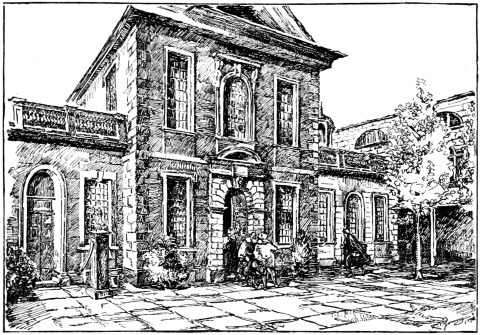
1381. The earliest evidence of the existence of our Hall is
to be found in Harl. MS. 541, which contains a list of Companies’
Halls in the City, temp. 5 Richard II, by which it appears that
the Barbers’ Hall was then, as now, in the Parish of Saint Olave,
Silver Street, and doubtless on the same site; the entry is,
“Barbar hall ye p’yssh of Seynt Oluf in Sylverstrete.” In 1490 the
Hall is known to have been on the same site.
1388. In this year Richard II sent his writs all over the
Kingdom to enquire into the nature and constitution of the several
guilds and fraternities, religions, social or craft, and the returns to
these writs, which must have been an immense number, were formerly
kept among the Records at the Tower of London. Herbert, in his
History of the Livery Companies, refers to his fruitless endeavours to
discover these returns, and I have made diligent enquiry at the Record
Office for them also, with the undoubted result that all of those which
relate to the London Trading Guilds are lost. There are, however, a
great number relating to London religious guilds and to trade guilds
all over the country. Two of these concerning the Barbers of Norwich
and of Lincoln are so highly interesting that I have preserved them in
Appendix A.
Amongst our Archives at Barbers’ Hall, is a vellum book of
Ordinances written out fair in 1658, and therein is to be found a copy
of the return made by the Barbers of London to the writ of Richard II,
and which the Company caused to be extracted from the Tower Records
in 1634. It is certified by William Colet as agreeing with the original,
but unfortunately Mr. Colet (although he was Deputy-Keeper of the
Records) or his copyist has made one or two mistakes, which necessitate
a little hiatus in the translation, and he has put the year as the 11th
instead of the 12th of Richard II. That the latter year is the correct
one is abundantly proved by the dates on the original writs and on the
numerous returns still in existence at the Record Office, as also by the
names of the Masters certifying, who are recorded at Guildhall as
having been admitted 10th September, 12th Richard II.
Richard II was more solicitous as to the funds and property of
the Guilds, than he was about their observances, and our predecessors
seem to have quickly acquainted him with their pecuniary position, “the
which Company have neither tenements nor rents to their common use.”
The Masters recite an old document which they found in their
strong box, and which will well repay perusal; it opens with a devout
dedication to the Trinity, the Virgin Mary, and the glorious company
of heaven, and the first Ordinance being expressly made in honour of
God and all saints, and with the intention of stirring up the people to
do well and to persevere therein, we must all approve of it. It provides
firstly, that decayed brethren shall have an allowance of 101⁄2d. per
week, if their poverty have not come about by their own folly. The
second and third Ordinances relate to attendance at funerals and obits
of deceased members. Then follow certain rules, that no man shall
entice away another’s servant; the Masters to settle disputes, payment
of quarterage, refusal of office, absence from Mass and the yearly feast,
the livery clothing, &c., &c. It is well to observe here the evidence of
the antiquity of our livery, of the quarterage, and of the feast, all of
which have come down to these days.
Some later Ordinances are added, which were apparently made
in 1387. This return is probably the only one extant of the whole of
those made by the London trade guilds, and is therefore of the highest
interest. A copy of the original (which is in Norman French), together
with a translation, follows.
Copia extracta ex Bundell’ Fraternitatum et Gildar’ Civitatis London remaneñ de
Recordo prout patet in Rotulis dñi Regis infra Turrim London.
Anno xjo.29
Ricardi Secundi.
Johan Heydon et Hen Cook Mestres30 William Chapman et William Gomine
Surveyours de la Compaignie appelle ffraternite des Barbers de la Citee de Londres
dauncien temps ordeigne certifiant au Counsail ñre Sr. le Roy en sa Chancellarie la
forme manere et condicion de touz articles obseruancez et lour circumstances contenuz
en la paper de dite Compaignie en la forme quesuyt la quel compaignie nont nul teñt ne
rent a lour c͠oe oeps les queles articles la dite Compaignie nont usez en lour temps forsqz
soulement pur auer lour vesture un foitz per añ et paier lour quarterage pur sustiner
pouerez geñtz de mesme la Compaignie et un foitz per añ assembler pur manger et eslire
neuells Mestres et Surveiours sanz ascun autre article de sontz escript mettre en use
forsqz ceux qˀ tan soulement sont faitz al honour de dieu mes purtant qils ont trouez un
paper one les articles de sontz escriptz fait del temps donc memorie ne court ils les ont
p’sentez a vrẽ tressages discrecions.
Ceste endenture fait en nom̃ de Dieu omnipotent pier et fitz et seynt Esperitz
et de nr̃e Dame Seynt Marie et de tout la gloriouse Compaignie de Ciel de la foundacion
et de Lordinance de la fraternite des Barbers de la Cite de Londres tesmoigñ coment et
sur queux pointz la dite Fraternite est funduz et ordeigne.
Primerement al honourance de Dieu et touz ses Seyntes et pur excitac͠on les
coẽns des geñtz a bien faire et perseuerance auoir en bien faitz est ordeigne qˀ si ascun
frere de cel fraternite qi ad este de cell fraternite per vij anz sil cheit en mischief ou en
pouerte pˀ auenture issint qil neit de quoy il purra viure de son propre et ces ne luy
aucigne de sa propre folye qu donqz il auera chescun semaigne de lour c͠oe boyste
xd. oᵬ. pur sa sustenance.
Item quant ascun frere du dite fraternite soit mort les freres de la dite fraternite
serront la veyle al dirige et le jour al Messe et al dirige et al Messe del Moys obit et
qˀ chescun tiel frere mort eit xxx messes de lour c͠oe Boyste et qˀ chescun frier qˀ soit
absent sanz reasonable eucheson a ascun des ditz iiij foitz qil mette a lour c͠oe Boyste en
noun de ses offrandes et dispences queux il deust auer fait sil eust este en p’sent iijd.
Item quant ascun Meistre de la dite Fraternite eit feme Mort qˀ les freres de la
dite ffraternite soient a La Vigile et a la Messe le jour de sont enterment et a la Moys
obit et quel frer qˀ soit absent a ascun de tres foitz qil paie pur chescun foitz qil soit
absent en lieu des costages et autres dispences queux il ferreit sil feusse present a lour
c͠oe boyst iijd.
Item qˀ nul frere de la dite Fraternite abette autri seruant hors des seruice son
Meistre priuement ne apertement.
Item si ascun debate surdre pˀ entre ascuns des freres qˀ dieu defend et ces soit
redresse per amour per la consideration des Meistres de la dite Fraternite . . . . .
faire bonement et qˀ nul ne sue vers autre en autre manere autant qil ad assaie sil puisse
pˀ leide des ditz Mestrez estre recorde.
Item qˀ chescun frere de la dite ffraternite veigne chescun quarter del an et
paie son quarterage a Collectors decell issint qˀ les dits Collectors ne.
Item accorde est entre toutz les ditz freres qˀ quel de eux qˀ refuse son office
quant ces vient a luy sil voet estre de ces allegge qil paie a lour c͠oe boyst.
Item si ascun frere soit absent a lour Messe et Manger quant il serra un foitz
en lan qil paiera a tant en offrandes et toutz autres choes come un.
Item qˀ nul des ditz freres allowe autre hors de sa Meason.
Item si ascun frere per auenture tarie ses paiements entre añ et demy qil face
gree demz les ij anz sanz rien outre le certain doñ. Et sil ad luy soient . . . . . .
p’donez issint qil paie ce gest aderer. Et a ceux pointz tenir solonc amendement si
mistier soit qils soient amendez ceste Fraternite sont entre jurez et ont chescun de eux
pleine sa foy et si fra chescun qi serra de la dite ffraternite. Et accorde est entre
eux . . . . . . endenture soient enclos en lour c͠oe boyst et lautre demurge
vers les Mestres qˀ serront pur le temps de la dit fraternite.
Item chescun frere du dit fraternite paie en arres pur son Drap auant la
mayn xld. ameyns.
Item qˀ chescun frere garde la liuere ij anz enterrement deuant qil le donne ou
vende ou aliene la liuere en ascun manere sur peyne de paier al compaignie un noble
dor sur lour grace.
Item est ordeyne le dymenge ps̃ch ensuant lassumpc͠on de nr̃e Dame lan le
Roy Richard sẽde xjo. qe les Surveiours du dit Mistier soient esluy per lassent de tout la
ffraternite et nemy per les Mestres.
Item qˀ nul du dit Fraternite paie plus pur son mangre qˀ xiiijd, en apres.
Item ordeyne est qˀ chescun Meistre qˀ eslisera ascun autre home pur estre en
son lieu cesta sauoir pur estre Meistre celuy qˀ eslisera tiel home pur estre Meistre apres
lan serra obligee per mesme luy a la Compaignie pur la monoy en un obligacon.
Convenit cum Recordo
Willũs Colet.
A Copy taken from a Bundle “of the Fraternities and Guilds of the City of
London” which remains of record, as the same is seen in the Rolls of
the Lord the King, at the Tower of London.
Anno 12.
Richard II.
John Heydon and Henry Cook, Masters, William Chapman and William
Gomine, Surveyors of the Company called the Fraternity of Barbers of the City of
London of ancient time established, certifying to the Council of Our Lord the King,
in his Chancery, the form manner and condition of all the articles, customs and their
circumstances contained in the Records of the same Company in the form following:—The
which Company have neither tenements nor rents to their common use, And these
articles the said Company have not used in their time excepting only for to have their
Livery once a year, and to pay their quarterage to maintain the poor folk of the same
Company, and once a year to assemble to feast, and to elect new Masters and Surveyors
without any other article of their writing to put forward except those which only
are made to the honour of God; but, however, as they have found a document
amongst the articles of the Records, made of the time to which memory runneth
not, they have presented it to your most wise discretions.
This Indenture made in the name of the Omnipotent God, the Father and
Son and the Holy Ghost, and of our Lady Saint Mary and of all the glorious Company
of Heaven, concerning the foundation of the Government of the Fraternity of Barbers of
the City of London Witnesseth how and upon what points the said Fraternity is
founded and ordained.
Firstly to the honour of God and all his Saints, and to stir up the Commons
of the people to do well, and to have perseverance in well doing, it is ordained that if
any brother of this Fraternity who has been of this Fraternity for seven years by chance
fall into trouble or into poverty, and if he have nothing of his own by which he may
be able to live, and it be not through his own folly, that then he shall have each
week from their common box tenpence half penny for his sustenance.
Item. That when any brother of the said Fraternity dies the brethren of the
said Fraternity shall go on the Vigil to the dirge, and on the day31 to the Mass, and to
the dirge and to the mass of the month’s obit, and that each such brother dead have
thirty masses from their common box,32 and that each brother who is absent without
reasonable excuse at any of the said four times, shall put into their common box in place of
his offerings and expenses, as he ought to have done if he had been present, three pence.
Item. When any Master of the said Fraternity has a wife dead, the brethren of
the said Fraternity shall be at the Vigil and at the Mass on the day of her burial and at
the month’s obit, and that brother who is absent at any of the three times shall pay for
each time that he be absent, in place of the costs and other expenses which he would have
borne if he had been present, three pence to their common box.
Item. That no brother of the said Fraternity entice any servant from the
service of his master, privily or openly.
Item. If any dispute arise between any of the brethren, which God forbid, it
is to be amicably settled by the decision of the Masters of the said Fraternity [and they
are] to deal plainly,33 and that no one sue another in other manner than at the assize (?)
[and then only] if he be empowered by leave of the said Masters to be recorded.
Item. That each brother of the said Fraternity shall come each quarter of the
year and pay his quarterage to the collectors34 . . . . . .
Item. It is agreed between all the said brethren that whoever of them refuses
his office when it comes to him, if he wishes to be relieved of it, that he pay to their
common box.
Item. If any brother be absent from their Mass and Feast when it shall be
once a year, he shall pay so much in offerings and all other things as one present.
Item. That none of the said brethren put [?] another out of his house.
Item. If any brother by chance delay his payments beyond a year-and-a-half,
that he make acquittance within two years without any [penalty] beyond the ordinary fine.
And if he be thus forgiven that he settle the matter at once.
And to hold these points pursuant to amendment alone if the Mystery will that
they be amended, this Fraternity are sworn among themselves and have each of them
pledged his troth, and so from each who shall [hereafter] be of the said Fraternity. And
it is agreed amongst them that this Indenture be enclosed in their common box, and the
counterpart be held by the Masters for the time being of the said Fraternity.
The document which the Masters found amongst their records
made in “the time to which memory runneth not” probably ends here,
and the following Items (see the third one) were doubtless additional
Ordinances made circa 1387.
Item. That each brother of the said Fraternity pay in pledge for his livery,
when he has the same, forty pence at the least.
Item. That each brother keep the livery two whole years before he may give,
or sell, or alienate it in any manner, under pain of paying to the Company for their
pardon, a noble of gold.
Item. It is ordained that on the Sunday following the Assumption of our Lady
in the 11th year of King Richard the Second,35 that the Surveyors of the said Mystery be
elected by the assent of all the Fraternity, and no longer by the Masters.
Item. That none of the said Fraternity hereafter pay more than fourteen pence
for his feast.
Item. It is ordained that each Master who shall choose any other man to be in
his place, that is to say for to be Master; he who shall choose such man to be Master
for the year shall be bound by himself for him, in an obligation to the Company for the
money.36
It agrees with the Record,
William Colet.
Coeval with our Company of Barbers there existed in the City
of London, another Fraternity or Guild, that of the Surgeons, in no
way connected with the Barbers, but, like them, existing by prescription
only and unincorporated. It is not to be expected that these two
Companies would, in the days of so much trade protection and
jealousy, exhibit an over-friendly feeling towards one another, and the
records of the period, though meagre, show that this was the case.
The Surgeons’ Guild at no time appear to have been a numerous body,
indeed there is reason to believe that frequently their numbers were
less than a dozen, and they possibly never exceeded twenty.
In the researches undertaken for the purpose of this work,
various references to the Surgeons’ Guild have turned up, and although
at this early period there was much in common between the two
Fraternities, I have considered it quite apart from the subject in hand
to go into any detail concerning that Guild, more especially as it has
recently been so ably and fully dealt with by Mr. D’Arcy Power in his
“Memorials of the Craft of Surgery.”
1376. In the 50th Edward III, the Barbers made a complaint
to the Mayor and Aldermen against unskilled practitioners in
Surgery, and prayed that two Masters should be yearly appointed to
inspect and rule the craft, and that none should be admitted to the
freedom of the City, but upon due examination of their skill; and this
was granted by the Court, entered of record and Lawrence de Weston
and John de Grantone were chosen Masters. The following is a
translation of the original record concerning this matter.37
To the honourable Lords, and wise, the Mayor and Aldermen of the City of
London, shew the good folks, the Barbers of the same city, that whereas from one day to
another there resort men, who are barbers, from uppelande38 unto the said city, who are
not instructed in their craft, and do take houses and intermeddle with barbery, surgery,
and the cure of other maladies, while they know not how to do such things, nor ever were
instructed in such craft; to the great damage, and in deceit, of the people, and to the
great scandal of all the good barbers of the said city:—therefore the said good folks do
pray that it may please your honourable Lordships, for the love of God, and as a work of
charity, to ordain and establish that from henceforth no such stranger, coming to the said
City from uppelande, or from any other place, of whatsoever condition he be, shall keep
house or shop for barbery within the same city, before that he shall be found able and
skilled in the said art and office of barbery, and that, by assay and examination of the good
folks, barbers of the same city, whom out of the said craft it may please you to ordain
thereunto. And that it may please you to ordain and establish, that from henceforth
there shall always be two good men of their said craft chosen by their common assent to
be Wardens of the craft; and that such two persons shall be presented unto the Mayor,
Recorder, and Aldermen, of the said city, and sworn before them well and lawfully, to the
best of their power and knowledge, to rule their said craft; and that the said Masters may
inspect the instruments of the said art, to see that they are good and proper for the service
of the people, by reason of the great peril that might ensue thereupon; and that on the
complaint of such two Masters, all rebellious persons in the said craft, shall be made to
come before you, and whosoever shall be found in default against this Ordinance shall pay
to the Chamber 40 pence. And that from henceforth no man of their craft shall be
admitted to the franchise of the said city, if he be not attested as being good and able,
upon good examination before you made. And that no foreigner shall keep house or
shop in their craft within the said city, or the suburbs thereof. And that this Ordinance
shall be enrolled in the Chamber of the Guildhall of London, for all time to last.
And the same was granted unto them. Whereupon, Laurence de Westone and
John de Grantone were chosen Masters of the Barbers. [Letter-Book H. 28.]
The foregoing ordinance must surely have given umbrage to
the Surgeons’ Guild as it placed the Barbers upon an equal
footing with them in the examination of Surgeons, the inspection
of their instruments, etc.; and this more especially as seven years
previously (in 1369) the Surgeons had obtained from the same
Court an Ordinance investing them with the power of presenting
the defaults of all unskilful Surgeons.
1382. As an example of a quack Surgeon’s method of practice,
and of his rogueries and punishment, the following case of Roger
Clerk will be found interesting:—
Roger Clerk, of Wandelesworth,39 on the 13th day of May in the 5th year
(Richard II), was attached in the Chamber of the Guildhall of London, before the
Mayor and Aldermen, to make answer, as well to the Mayor and Commonalty of the City
of London, as to Roger atte Hacche, in a plea of deceit and falsehood: as to which, the
same Roger said, that whereas no physician or surgeon should intermeddle with any
medicines or cures within the liberty of the city aforesaid, but those who are experienced
in the said arts, and approved therein, the said Roger Clerk, who knew nothing of either
of the arts aforesaid, being neither experienced nor approved therein, nor understood
anything of letters, came to the house of him, Roger atte Hacche, in the parish of St.
Martin, in Ismongereslane, in London, on Thursday, the morrow of Ash Wednesday, in
the 5th year, etc.; and there saw one Johanna, the wife of the aforesaid Roger atte
Hacche, who was then lying ill with certain bodily infirmities, and gave the said Roger,
her husband, to understand, that he was experienced and skilled in the art of medicine,
and could cure the same Johanna of her maladies, if her husband desired it.
Whereupon, the said Roger atte Hacche, trusting in his words, gave him
12 pence, in part payment of a larger sum which he was to pay him, in case the said
Johanna should be healed. And upon this, the same Roger Clerk then and there gave
to the said Roger atte Hacche an old parchment, cut or scratched across, being the leaf
of a certain book, and rolled it up in a piece of cloth of gold, asserting that it would be
very good for the fever and ailments of the said Johanna; and this parchment, so rolled
up, he put about her neck, but in no way did it profit her; and so, falsely and
maliciously, he deceived the same Roger atte Hacche. And he produced the said
parchment here in Court, wrapped up in the same cloth, in proof of the matters aforesaid.
And the said Roger Clerk personally appeared, and the said parchment was
shown to him by the Court, and he was asked what the virtue of such piece of parchment
was; whereupon, he said that upon it was written a good charm for fevers. Upon being
further asked by the Court what were the words of this charm of his, he said;—“Anima
Christi, sanctifica me; Corpus Christi, salva me; in isanguis Christi, nebria me; cum
bonus Christus tu, lava me.”40 And the parchment being then examined, not one of
those words was found written thereon. And he was then further told by the Court, that
a straw41 beneath his foot would be of just as much avail for fevers, as this said charm of
his was; whereupon, he fully granted that it would be so. And because that the same
Roger Clerk was in no way a literate man, and seeing that on the examination aforesaid,
(as well as on others afterwards made,) he was found to be an infidel, and altogether
ignorant of the art of physic or of surgery; and to the end that the people might not be
deceived and aggrieved by such ignorant persons, etc.; it was adjudged that the same
Roger Clerk should be led through the middle of the City, with trumpets and pipes, he
riding on a horse without a saddle, the said parchment and a whetstone, for his lies, being
hung about his neck, an urinal also being hung before him, and another urinal on his
back. [Letter-Book H. 145.]
1390. In connection with the Surgeons’ Guild, four Master
Surgeons of the City were sworn before the Mayor, etc., in this year,
and they were to make scrutiny amongst persons practising the art of
Surgery, and to present defaults. [Letter-Book H. 248.] It will be
remembered that in 1369 a somewhat similar Ordinance was made
for the Surgeons’ Guild, and this one in 1390 was probably obtained
as a set off to the powers vested in the Barbers by their Ordinance of
1376, and by way of assertion of equal rights with them in matters
surgical. Anyhow it is very clear that there were two distinct bodies
within the City ruling the craft of Surgery at this period, each, no
doubt, claiming jurisdiction over its own members, and both anxious
and ready to interfere with outsiders, and probably with each other.
It is curious to note that in the Ordinance of 1390, above referred to,
the Masters inspecting are authorised to make scrutiny not only of
men, but of “women undertaking cures, or practising the art of
Surgery”; and here, in the 19th century, we find history repeating
itself, and women again “intermeddling in matters surgical.”
As might be expected the dual scrutiny exercised over persons
practising surgery, by two distinct and antagonistic Companies,
produced considerable jealousy and unpleasantness, and there are
various records extant indicative of cases of attempted interference
with the Barbers’ privileges, one of which is distinctly stated to
have been the work of the Surgeons and Physicians, as doubtless
also were the others.
1410. By Letter-Book I. 94, it appears that the Ordinances for
the Barbers made in 1376 were confirmed to them with the significant
addition that they should enjoy the same, “without the scrutiny of any
person or persons of any other craft or trade, under any name whatsoever
other than the craft or trade of the said Barbers, either as to
shaving, making incision, blood letting or any other matters pertaining
to the art of Barbery or of Surgery, in the craft of the said Barbers now
practised, or to be practised hereafter.” This Ordinance is, I think,
clearly directed against the Masters of the Surgeons’ Guild, who
had sought to exercise their authority over the Barbers using the
faculty of Surgery.
1415. Complaint having been made to the Mayor and
Aldermen, concerning the unskilful and fraudulent practice of certain
Barbers in matters of Surgery, the privileges of the Barbers were
again recorded, though the Company who had hitherto nominated
their own Masters, were somewhat shorn of that privilege, as the
Mayor, etc., directed the names of all the Barber (Surgeons) to be
brought before them, and after due enquiry, they selected two of
them for Masters, and gave them their charge and oath.
1416. “Certain trustworthy and discreet” Barber (Surgeons)
complained to the Mayor, etc., that notwithstanding the last order,
there were still unruly members in the craft, and a fresh Ordinance
was enacted which imposed a penalty on offenders.
The Ordinances above referred to are to be found in Letter-Book
I. 149, and are as follows:
Be it remembered, that on the 10th day of April, in the 3rd year, etc. (1415) it
was intimated in a relation, and not without alarm, unto Thomas Fauconer, Mayor, and
the Aldermen, how that some barbers of the said city, who are inexperienced in the art
of surgery, do oftentimes take under their care many sick and maimed persons, fraudulently
obtaining possession of very many of their goods thereby; by reason whereof, they are
oftentimes made to be worse off at their departure than they were at their coming: and
that, by reason of the inexperience of the same barbers, such persons are oftentimes
maimed; to the scandal of such skilful and discreet men as practise the art of surgery,
and the manifest destruction of the people of Our Lord the King.
And the said Mayor and Aldermen, wishing to obviate an evil and a scandal
such as this, as also, to provide a fitting remedy for the same, and considering first, how
that the said barbers by themselves, without the scrutiny of any other persons of any other
trade or craft,42 or under any name whatsoever, have supervision and scrutiny over all men
following the craft of barbery, and within the liberty of the said city dwelling, as to all
manner of cases touching the art of barbery or the practice of surgery, within the
cognizance, or to come within the cognizance, of the craft of the said barbers;—as by a
certain Ordinance, made and ordained in the time of Richard Merlawe,43 late Mayor, and
the then Aldermen, and in the Chamber of the said City of London enrolled, of record fully
appears;—did determine and ordain that in future, by the more substantial part of all the
barbers following the practice of surgery, and dwelling within the liberty of the said city,
there should be chosen two of the most skilful, most wise, and most discreet men, of all
the barbers following such practice of surgery, and dwelling within the liberty of the said
city; seeing that oftentimes under their scrutiny and correction there would be found
cases of possible death and maiming, where, if ignorant and indiscreet men should
undertake the management thereof—the which might God forbid—in their judgment
grievous errors might unexpectedly ensue, by reason of such unskilfulness. And that
the same Masters, so often as they should be thus chosen, on election should be presented
to the Mayor and Aldermen, for the time being, there by the said Mayor and Aldermen
to be accepted and sworn etc.
And lest perchance a difference of opinion might in future as to such election
arise, therefore, the said Mayor and Aldermen, after taking counsel on the matter aforesaid,
on Friday, the 3rd day of May, in the same year (1415), caused to be brought
before them the name of every barber who followed the practice of surgery and dwelt
within the liberty of the said city, in order that, after enquiring into the duties and
experiences of their practice and skill, in manner theretofore approved and customary,
they might be the better able to accept such Masters. And hereupon, because that,
among other names, Simon Rolf and Richard Wellys, citizens and barbers of the said
city practising the art of surgery, as well for their knowledge and probity, as for the
different kinds of difficult cures that had been sagaciously performed and effected
by them, were by trustworthy testimony, upon sound and umblemished information,
commended before any others, precept was given by the said Mayor and Aldermen to
Baldwin Tettisbury, one of the serjeants of the said Mayor, to summon the said Simon
and Richard for Monday the 6th day of May then next ensuing, to appear before the
said Mayor and Aldermen in the Chamber of the Guildhall aforesaid, there to make the
oath to them by the said Mayor and Aldermen to be administered.
Upon which Monday the said Simon and Richard, by virtue of such summons,
appeared before the Mayor and Aldermen in the Chamber aforesaid. And hereupon
the said Simon and Richard were then accepted by the said Mayor and Aldermen, and
sworn upon the Holy Evangelists of God, well and faithfully to watch over and oversee
all manner of barbers practising the art of surgery, and within the liberty of the said city
dwelling; to maintain and observe the rules and ordinances of the craft or practice
aforesaid; no one to spare, for love, favour, gain, or hate; diligently without concealment
to present unto the Chamberlain of the said City, for the time being, such defaults as
they may find; at all times, when duly required thereto, well and faithfully to examine
wounds, bruises, hurts, and other infirmities, without asking anything for their trouble;
and what they should find, at their discretion, when duly required thereto, distinctly to
certify unto the Mayor and Aldermen of the said City, for the time being; as also, well
and faithfully to conduct themselves from thenceforth in future; and all other things to
do and perform, which of right are befitting or requisite for the masters or overseers of
such practice to do.
Afterwards, on the fourth day of July, in the 4th year, etc. (1416) before
Nicholas Wottone, Mayor, the Recorder, and the Aldermen, in full Court, upon truthful
information of certain trustworthy and discreet men of the craft of Barbers, practising the
art of surgery aforesaid, as of other able and substantial men of the said city, it was stated
how that, notwithstanding the Ordinance aforesaid, very many inexperienced men of the
said craft of Barbers, indiscreetly practising the art of surgery, did presume, and in their
presumption pretend, that they were wiser than the Masters inspecting, and, as to certain
infirmities—indiscreetly excusing themselves therein, on the insufficient grounds that they
are not liable to the peril of maiming or of death—did altogether disdain to give notice
of the same to the said Masters inspecting, according to the Ordinance aforesaid, or to
be discreetly examined by them as to the same, or diligently to be questioned thereon.
Upon which pretence, they did not hesitate daily to take sick persons, in peril of death
and of maiming, under their care, without shewing such sick persons, or such infirmities
and perils, unto the same Masters inspecting; by reason of which presumption or
unskilfulness, such sick persons were exposed to the greatest peril, either of maiming or
of death. Wherefore, the said Mayor and Aldermen were prayed that, for the common
advantage of the whole realm, and the especial honour of the said city, they would deign
to provide some sure remedy for the same.
And accordingly, the Mayor and Aldermen, assenting to the said petition, as
being just and consistent with reason, having taken diligent counsel as to the matters
aforesaid, and considering that very many of such persons in these times are more in
dread of loss or payment of money than amenable to the dictates of honesty or a safe
conscience, did ordain and enact, that no barber, practising the art of surgery within the
liberty of the said City, should presume in future to take under his care any sick person
who is in peril of death or of maiming, unless he should show the same person, within
three days after so taking him under his care, to the Masters inspecting, for the time
being, by the barbers practising the art of surgery within the liberty of the said City to
be elected, and to the Mayor and Aldermen presented, and by them specially to be
admitted; under a penalty of 6s. 8d. to the Chamber of London in form underwritten to
be paid, so often as, and when, against this Ordinance they should be found to act;
namely, 5 shillings to the use of the Chamber of the Guildhall, and 20 pence to the use
of the craft of the Barbers.
1423. In this year certain Ordinances were made by the
Mayor (Sir William Walderne) and Court of Aldermen which are
entered in Letter-Book K. 6B. This record relates to what Mr. D’Arcy
Power, in his “Memorials of the Craft of Surgery,” has termed a
“Conjoint College” of the Physicians and Surgeons, and has little
to do with our Company, beyond the fact that the scrutiny
and oversight of persons practising Surgery is given to the
Masters of the Surgeons’ Guild. The subject of these Ordinances
and many very interesting remarks thereon and on the Conjoint
College may be seen at p. 52, &c., of Mr. D’Arcy Power’s work;
and the record itself is set forth in full at p. 299; furthermore,
extracts from it, so far as the same relate to the privileges and
practice of the Surgeons, are to be found in the beautiful old
vellum MS. formerly belonging to that Guild, and now in the
possession of the Barbers’ Company.
Armed with this additional authority, the Surgeons’ Guild
again sought to interfere with and scrutinize the Barber-Surgeons
of the Barbers’ Company. These latter, however, must have had
good friends at Court, and were not slow in asserting and obtaining
confirmation of their rights and privileges, as will be seen by
reference to the following record in Letter-Book K. 27B.:—
1424. Memorandum. That on Friday the 10th day of November in the third year
of the reign of Henry the Sixth from the Conquest before John Michell, Mayor, Thomas
Knolles and other Aldermen, and Simon Seman and John Bithewater, Sheriffs of the
City of London, It was granted and ordained that the Masters of the faculty of Surgery
within the craft of Barbers of the same city, do exercise the same faculty even as fully
and entirely as in the times of Thomas Fauconer late Mayor, and other Mayors, it was
granted unto them, notwithstanding the false accusation (calumpnia) which the Rector
and Supervisors of Physic and the Masters of Surgery pretend concerning a certain
ordinance made in the time of William Walderne late Mayor (1423) and entered in the
letter book K, folio 6, the which, they now endeavour to enjoin upon the said Barbers.
1451. With the exception of a few references (which are
noticed elsewhere) the City records are silent concerning the
Barbers’ Company until this year, when the Master and Wardens,
styled here “Gardiani,” with certain honest men of the Mystery of
Barbers, brought a Bill before the Mayor and Aldermen, praying
them to establish certain Ordinances, and to enter them of record,
which was granted and done.
These Ordinances provided for the enforcement of stated
penalties in cases of disobedience and related to attendance upon
summons, settlements of disputes, refusal of office, admission of
members, evil speaking, assemblies and payments, instruction of
“foreyns,” employment of aliens. They are to be found in
Letter-Book K. 250, and are the first written in English, all
previous ones being either in Latin or Norman French in the
originals.
Memorandum qd. xxvto. die ffebruarii Anno regni Regis Henrici Sexti post
conquestˀ vicesimo nono veniunt hic in Curˀ Dñi Regis in Camˀa Guyhald Civitatis london
coram Nich̃o Wyfold Maiore & Aldermannis ejusdem Civitatꝭ magistˀ & Gardianˀ
necnon cẽti probi homines misterˀ barbitonsoꝜ Civitatꝭ p’dcẽ & porrexerunt dcisˀ
Maiore & Aldermannis quandam billam sive supplicacioñe vˀboꝜ sequentˀ seviem
continentem Unto the ryght Worshipfull and Worshipfull lord and souvˀaignes Mair
and Aldremen of the Citee of London,
Besechen most mekely all pˀsones enfˀunchised in the craft and mistier of
Barbours wythin the said Citee That it please unto your lordshippˀ and Right wise
discrecions for to consider howe that for as moche as certein ordinances been establisshed
made and entred of Record in the chaumber of the yeldhall of the said Citee all pˀsonnes
of the said Craft have fully in opinion for to obeye observe and kepe theim and noon other
in eny Wise, So been yr. many and divˀse defaultes often tymes amonges your said
besechers not duely corrected for default of such other ordinances to be made and
auctorised sufficiently of record in the said chaumber, like it therefore unto your said
lordshippe and grete Wisdoms of your blessed disposicons for the pˀpetuell Wele and
good Rule of the said Craft for to establissh and make these ordinaunces here folowyng
pˀpetuelly to endure and for to be observed and putte in due execucion in the same craft
And to be auctorised of record in the said chaumber for evˀ And your said besechers
shall pray god for you.
FFirst that evˀy barbour enfˀauncheised householder and other occupier of the
same craft holdyng eny shopp of barberye wythin the Citee of london shall be redy att all
manˀ som̃ons of the Maisters and Wardeins of the same craft for the tyme being that is
to sey for the Kyng the Mair or for eny Worshipp of the said Citee And yef eny man
occupying the said craft in manˀe and fourme aforesaid absent him from eny such som̃ons
wythoute cause reasonable and thereof duely convict than he to pay at the chaumber of
the yeldhall xiijs. iiijd. that is to say vjs. viijd. to the same chaumber and other vjs. viijd. to the
almes of the said craft. Also that evˀy man enfˀauncheised under the fourme abovesaid
that disobeyeth and kepeth not his houre of his som̃ons at eny tyme wtoute cause
reasonable and yˀof44 duely convict shall paye to the almesse of the said craft at
evˀy tyme yt. he maketh such defaute ijd. And yef eny of theim what so evˀ he be of the
same craft that disobeye this ordinance he shall paye to the chaumber of the yeldhall
iijs. iiijd. at evˀy tyme that he maketh such default.
Also that yef eny matˀe of debate or difference be betwene eny pˀsoones of the
said craft Which god defend, that none of theim shall make eny pursuyt at the comˀon
lawe unto the tyme yt. he that findeth him aggreved in that pˀtie hath made his compleint
unto the maister and Wardeins of the same craft for the tyme being and they to ffynyssh
the matˀe and the cause of the said compleint Wythin vj dayes after such compleint
made and yef they conclude not and ffynyssh the same matˀe Wythin the said vj dayes
that yanne it be lefull to either pˀtie to take the benefice of the comˀon lawe Wythin this
Citee So alwayes that the pˀtye ageinst whom the compleint is made be not fugityf
And what pˀsone of the said craft that doth contrarie this ordinance shall paye at evˀy
tyme at the chaumber of the yeldhall xiijs. iiijd. that is to sey vjs. viijd. to ye said chaumber
and oyr. vjs. viijd. to ye almesse of ye said craft.
Also that noon able pˀsone of the said craft enfˀauncheised shall refuse eny manˀ
office or clothing pˀtinent to the said craft Whan and What tyme that he be by his
bretheren be abled and elect yrto upon pein to paye at the chaumber of the yeldhall xls.
that is to wete xxs. to the same chaumber and other xxs. to the said almesse Also what man
of the said craft that absenteth him fro the said eleccion Wythoute cause reasonable or
absent him fro the dyner to be made the same day and will not paye therto his pˀt thanne
he shall paye at the said chaumber iijs. iiijd. that is to sey xxd. to the same chaumber and other
xxd. to the almes of the said craft.
Also that the maisters and Wardeins of the same craft that nowe be or in tyme
to come shall be, shall not take admitte or resceive eny pˀsone in to the bretherhede or
clothing of the same craft Wythoute the com̃on assent of the bretheren of the said craft
or the more pˀt of theim upon pein of eviˀch such maister or Wardein that doth contarie
this ordinance xxs. that is to say xs. to the chaumber and xs to the almesse of the said craft.
FFurthermore it is ordeigned that from hens forward yef eny man occupying
the said craft be imfouled and of evell Will and malice so be unavised to revile or reprof
eny man of the same craft that is to seye for to lye him or wyth other dishonest Wordes
misgovˀne him in presence of the said maisters and Wardeins or in eny oyr. places and
pˀof45 by the report of the said maisters and Wardeins be duely convict what so evˀ he be
of the same craft that is so misgovnˀed at eny tyme shall paye at the said chaumber for evˀy
such default vjs. viijd. that is to say to the same chumber iijs. iiijd. and to the Almes of the
said craft iijs. iiijd.
Also it is ordeigned that evˀy man enfˀauncheised of the said craft under fourme
aforesaid shall assemble with his ffelashipˀ of the same craft by thassignement of the
said maisters and Wardeins being for the yeer in a certein place limited by theim at iiij
tymes of the yeer And at evˀy such quarter day in the yeer evˀy brother enfˀauncheised
and being of the clothing therof shall paye to the almes abovesaid iijd. And evˀy man
that is so enfˀauncheised of the same craft and is not of the clothing of the same shall paye
to the same almes jd. Which iiij dayes be these that is to saye the tewesday next after
all hallown day the tewesday next after candelmasday the tewesday next after Trinite sonday
and the tewesday next after lammas day to thentent that the said maisters and Wardeins
shall enquere amongꝭ the said compaignye so assembled that yef eny default ranker or
discord be hadd or moved amongꝭ theim that thanne the said maisters and Wardeins
shall sett theim at rest accord and in unite to that they canne or may, after the fourme and
custume as have been before used And what parsonne of the said craft be absent eny of
the said dayes wythoute cause reasonable he shall paye for evˀy such day iiijd. to the
expenses of the said maisters.
Also it is ordeigned and establisshed that no barbour nor other able pˀsonne
using barbourye shall enfourme eny foreyn nor him teche in no wise in eny manˀ point
that belongeth to the craft of barbourye or surgˀye wherby the same foreyn shall pˀceyve
and take by his own capacite and exˀcise unto the tyme that the same foreyn be bounden
appˀntice to a pˀsone barbour or other pˀsonne able enfˀauncheised using the same craft
Wythin the Citee of london upon peyne to paye at the chaumber of the yeldhall for evˀy
such defaute iiij marc, that is to say to the same chaumber xxvjs. viijd. and to the Almes of
the said craft other xxvjs. viijd.
And also that no barbour nor other able pˀsoone occupying the same craft shall
take eny Alien nor stˀaunger in to his sˀvice unto the tyme that the same alien or stˀaunger be
examined by the maistˀ and Wardeins of the same craft of his abilite and Connyng And
thereupon the maistˀ and Wardeins With other vj or viij of the moost able and Kunnyng
pˀsonnes of the craft shuld taxe him after his abilite after that hem semeth that he be
worthy to take yeerly for his salarie And also that no Barbour shall take eny alien
or stˀaunger that hath been or wtin sˀvice wyth an other barbour enfˀauncheised before that he
knowe well that the same sˀvnt hath complete his covenantes wyth his former maister upon
pein to paye for evˀy such defaute at evˀy tyme that he be founde defectif ayenst eny of
these ordinances at the said chaumber xiijs. iiijd. that is to wete to the same chaumber vjs. viijd.
and to the said almesse vjs. viijd. and also make restitucion of the damage unto the pˀtie
that findeth him greved.
And also that no man occupying the said craft shall pˀcure eny other mannes
sˀvnt oute of sˀvise upon the peyn aforesaid and damage unto the pˀtie pleintif And also
it is ordeigned that from hensforward that no harbour enfˀauncheised nor eny other able
pˀsoons occupying the said craft shall not take into his sˀvice eny stˀaunger or forein for
lasse time thanne a yeer And what pˀsone enfˀauncheised or occupying the said craft
disobeys this ordinance shall renne in the pein of xiijs. iiijd. that to be devided in manˀ and
fourme above said.
And also that no pˀsons of the said craft of barbours nor other able pˀsone
occupying the same craft huyre no ffˀaunchised man of the same craft oute of his shopp ne
dwellyng place upon pein of xls. that is to wete to the said chaumber xxs. And to the
Almesse of the said Craft other xxs.
Qua quidem billa coram dˀcĩs maiore & Aldermannis lectˀ & per eosdem
plenius intellectꝭ Qua videtur eisdem qˀd omnes articuli in dˀca billa
contentꝭ sunt boni & honesti ac racioni consomˀ, &c., &c. (The articles
were ratified confirmed and ordered to be entered of Record in the books
of the Chamber of London.)
Nothing is now heard of the Surgeons’ Guild for some
years, although they were still in existence. It is quite probable,
that finding the Barbers had invariably obtained the protection and
countenance of the City authorities, whenever their privileges had
been assailed or called in question, they had given over their attempts
at interference with them as hopeless, and allowed our worthy
predecessors to continue to “exercise the faculty of surgery,” in
peace; and being unmolested they doubtless grew in numbers, in
importance, and in the knowledge of their art, until it was
admitted that their position as one of the Guilds, warranted them
in applying for a Charter of Incorporation, which was granted to
them by Edward IV in 1462.
1413. Before proceeding to refer to this important epoch
in the history of our Company, it will be well to introduce a very
remarkable letter, which was written by Thomas Arundell, Archbishop
of Canterbury (formerly of York), to the Mayor, etc., of
London, in which he complained that the Barbers, being, alas!
“without zeal for the law of God,” kept their shops open on the
Sabbath days, and he besought the Mayor and Aldermen (his “sons
in Christ, and dearest friends”) to put a stop to this practice. No
trade, perhaps, has from the earliest days, down to our own times,
owned such persistent breakers of the Fourth Commandment as
have the Barbers. Our records abound with by-laws, enacted and
renewed over and over again on this subject, and details of the
delinquencies of numerous Barbers in this respect, and of their
punishments by fine and imprisonment crop up everywhere.
The Archbishop’s letter reveals to us the fact, that nearly
500 years ago, men were constituted much as they are now; in
that “that which touches the body or the purse, is held more in
dread than that which kills the soul,” and he shrewdly suggests that
the clerical punishment of “the greater excommunication,” should be
augmented by a fine to be levied by the Civil authority. This letter
is so deeply interesting that no apology is needed for reproducing it
here. The original is to be found in Letter-Book I. 125.
1413. On the 24th day of July, in the first year, etc. (Henry V) the Reverend
Father in Christ, and Lord, Thomas, by Divine permission, Lord Archbishop of
Canterbury, Primate of all England, and Legate of the Apostolic See, sent here, to the
Mayor and Aldermen of the City of London, certain Letters Close of his, containing
words as follow:—
“Sons in Christ and dearest friends.—We know that you do seek for the things
which are of above, and that you will the more readily incline to our desires, the more
surely that the things as to which we write are known to tend to the observance of the
Divine law, the maintenance of public propriety, and the rule of the Christian profession.
We do therefore write unto you on this occasion, to intimate that when we were
presiding of late in our Provincial Council, holden at London, with our venerable
brethren, the Suffragan Bishops, and our clergy of the Province of Canterbury, it was
publicly made known unto us with universal reprobation, that the Barbers of the City
of London, over the governance of which city you preside, being without zeal for the
law of God, and not perceiving how that the Lord hath blessed the seventh day and
made it holy, and hath commanded that it shall be observed by no abusive pursuit of
any servile occupations, but rather by a disuse thereof, in their blindness do keep their
houses and shops patent and open on the seventh day, the Lord’s Day, namely, and do
follow their craft on the same, just as busily, and just in the same way, as on any day in
the week, customary for such work. Wherefore we, with the consent and assent of our
said Suffragans and clergy, in restraint of such temerity as this, have determined that
there must be made solemn prohibition thereof in the City aforesaid, and that, of our
own authority, and that of our said Provincial Council; and not there only, but also
throughout the Diocese of London, and each of the cities both of our own Diocese and
of our Province of Canterbury; to the effect, that such barbers must not keep their
houses and shops patent or open, or follow their craft, on such Lord’s Days for the
future, on pain of the greater excommunication; in the same manner as it has been
enacted and observed of late in our time, as to the City and Diocese of York, as we do
well recollect. But, dearest children, seeing that so greatly has the malice of men
increased in these days, a thing to be deplored—that temporal punishment is held more
in dread than clerical, and that which touches the body or the purse more than that
which kills the soul, we do heartily intreat you, and, for the love of God and of His law,
do require and exhort you, that, taking counsel thereon, you will enact and ordain a
competent penalty in money, to be levied for the Chamber of your City, or such other
purpose as you shall think best, upon the Barbers within the liberty of your City
aforesaid, who shall be transgressors in this respect; that so at least, those whom fear of
the anger of God does not avail to withold from breach of His law, may be restrained
by a scourge inflicted upon their purse, in the way of pecuniary loss; knowing that we
in the meantime, after taking counsel hereon, will devise measures for the prevention of
this, and for the due publication of our Provincial enactment aforesaid. Fare you well
always in Christ.
Written at Ikham46 on the 13th day of the month of July.
Thomas, Archbishop of Canterbury.”
An Ordinance was forthwith made thereupon, to the effect, that
no barber, his wife, son, daughter, apprentice, or servant, should work
at such craft on Sundays within the liberty of the city, either in hair
cutting or shaving, on pain of paying 6s. 8d. for each offence; 5s.
thereof to go to the new work at the Guildhall, and the remainder to
the Wardens or Masters of the Barbers within the city.47
1422. In August of this year Henry V died, and thirty-two of
the City Companies assisted at his obsequies, going in procession and
carrying torches. From an entry in Letter-Book K. IB., it appears
that the Barbers bore four torches on this occasion.
1447. This year the Company seem to have contributed 40s.
towards the cost of the Roof of the Chapel at Guildhall, as appears by
the following entry in Journal IV, 198 (25th October, 26 Henry VI)—
Itmˀ gardiani misterˀ barbitonsoꝜ & importaverunt in Cur xls. sterlingoꝜ
pˀse & misterˀ sua ad coopturam Guyhaɫd Sc̃. Capelle.
Hitherto we have considered two distinct and somewhat
hostile fraternities, the Surgeons on the one
hand, and on the other the Barbers (consisting of
Barbers and Barber-Surgeons), both of them City
Guilds, existing by prescription, having independent
rules and Ordinances for their government and the
scrutiny and correction of abuses in their respective Crafts, the former
Company few in number, the latter far more numerous and popular;
the Surgeons without, and the Barbers with, a Livery.
Of these two fraternities, the Barbers by the regular and every
day nature of their calling, as shavers and hair cutters, together with
the practice of Surgery combined by so many of them, were the most
likely to become the more popular Company; their fees would surely be
on a lower scale than those of the more aristocratic Surgeons, and their
numbers and constant intercourse with the citizens, in their capacity as
Barbers, enabled them easily to extend their connection as Surgeons.
In all their contentions with the Surgeons’ Guild, as far as we
know, they held their own well, and thus it was that their place in
the City, as a Livery Guild of at that time an ancient standing, their
position as the professors of useful and scientific arts, their numbers and
presumable affluence, all rendered it desirable that they should be
placed upon the same footing as the better class of Guilds, by their
acquisition of a Charter of Incorporation, which they accordingly
obtained from the young King Edward IV in the first year of his
reign (1462).
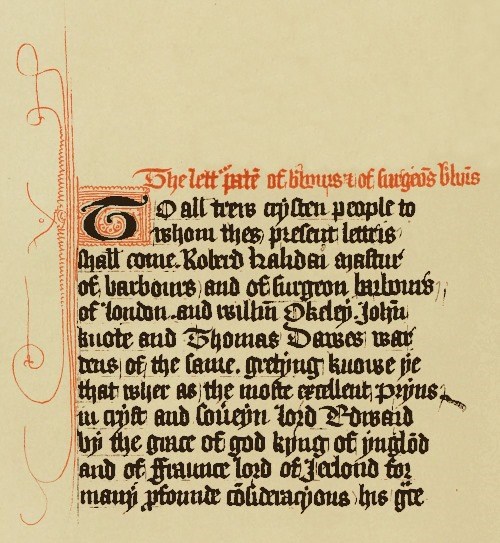
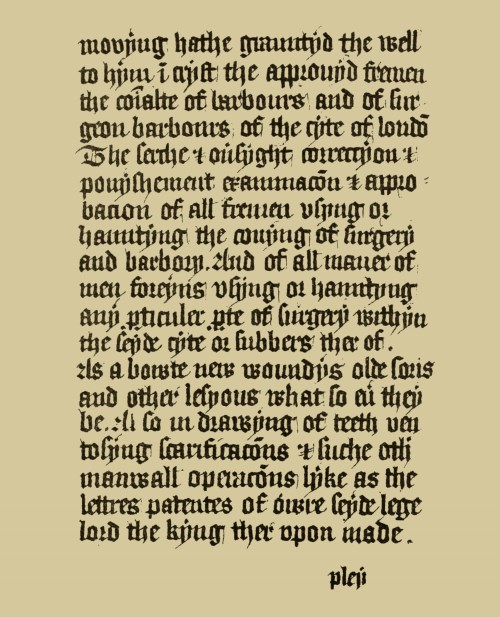
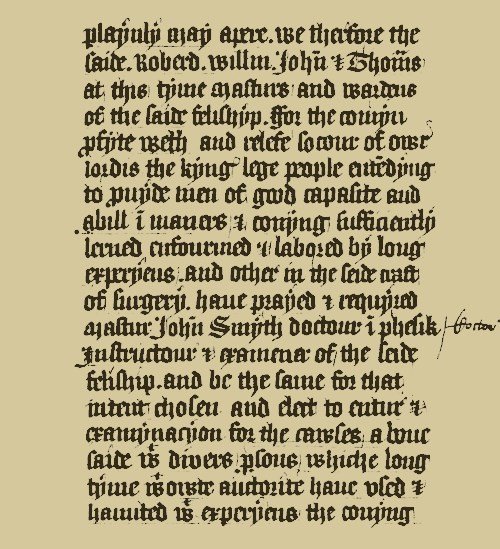
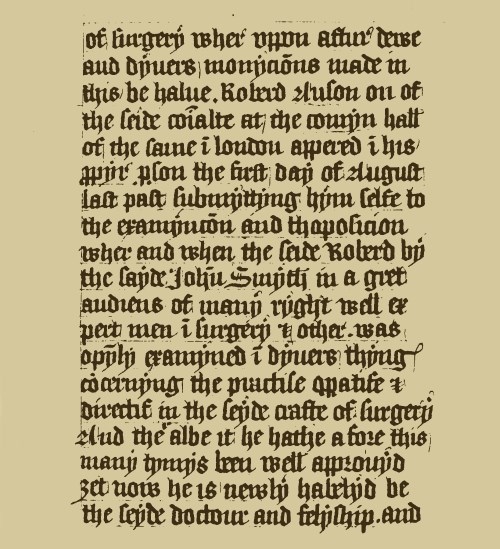
Thomas Knot (Master, 1555) has recorded in one of our
books, a Translation of this Charter, which Mr. J. Flint South (who
does not appear to have seen the original Latin one) has transcribed,
and this has been adopted by Mr. D’Arcy Power (page 326). Thomas
Knot wrote a good hand, and was a zealous champion of the Barber-Surgeons
in his time, but he made egregious blunders in some of the
writings recorded over his signature, and although there is not great
fault to be found with him in this instance, it is suggested that the
Translation given below, is perhaps a more literal one than that which
Knot has handed down.
The Charter is still preserved at our Hall, and is contained on
a small skin of parchment; the initial letters of the title, which were at
the time left to be illuminated have never been filled in, and the
document is therefore not the work of art which one is accustomed to
see in Charters of this period; it bears signs of having been frequently
used, the ink in some places being worn, and the words only legible
with the aid of a magnifying glass. The great seal pendant is not
quite perfect, but is a beautiful specimen and highly artistic. The
following is the text of the Charter:—
(E)dwardus dei grã (R)ex (A)nglie & (F)rancie & (D)ominus (H)ibñie.
(O)mnibus ad quos pˀsentes lrẽ pˀuenint saltm̃ (S)ciatis q̃d nos considerantes qualitˀ Diɫci
nõb prˀbi & liᵬi hoiẽs mistere BarbitonsoꝜ Ciuitatis nr̃e london vtentes mistera siue
facultate SirurgicoꝜ tam circa vulña plagas lesiones & alias infirmitates ligeoꝜ nroꝜ
ibidem curandˀ & Sauandˀ qam in extracc͠oe sanguinis & denc̃iu hˀmꝰ ligeoꝜ nrõꝜ
gandes & multiplices intendencias & labores pˀ longa tempora sustinuerunt & supportauerunt
indiesqʒ sũtinere & supportare non desistunt qualitˀ etiam pˀ ignoranciam negligenciam
& insipienciam nonnulloꝜ hˀmꝰ barbitonsoꝜ tam liᵬoꝜ hõim Ciuitatis nr̃e pˀdc̃e qam
alioꝜ SirurgicoꝜ forincecoꝜ & non liᵬoꝜ hõim eiusdem Ciuitatis indies ad eandem
Ciuitatem confluenciũ & in mistera SirurgicoꝜ minus sufficientˀ eruditoꝜ qam plurima ac
quasi infinita mala diuˀsis ligeis nr̃is in vulnĩbʒ plagis lesionibʒ & aliis infirmitatibʒ suis
pˀ huius modi Barbitonsores & Sirurgicos sauandis & curandis ob eoꝜ defc̃m ante hec
tempora euenerunt quoꝜ quidem ligeoꝜ nroꝜ alii ea de causa viam vniuˀse carnis sunt
ingressi alii autem eadem causa tanqam insanabiles & incurabiles sunt ab omĩbʒ derelecti
similia qʒ mala vel peiora infuturˀ in hac parte euenire formidatˀ nisi remedm̃ congruũ
supˀ hoc pˀ nos cicius pˀuidetuˀ Nos enim attendentes & intime adũtentes qˀd huiusmodi
mala ligeis nr̃is ob defc̃tuˀ debit supˀuis scrutinii correccõis & punicõis huiusmodi
barbitonsoꝜ & SirurgicoꝜ minus sufficientˀ in eisdem misteris siue facultatibʒ vt pˀdcm̃
est eruditˀ & instructˀ euenire contingunt. Ad humilem supplicacoẽm dilc̃oꝜ nobˀ
pˀdcoꝜ pˀboꝜ & liᵬoꝜ hõim pˀdcẽ mistere BarbitonsoꝜ in Ciuitate nr̃a pˀdcã
concessimꝰ eis qˀd mistera illa & omẽs hoiẽs eiusdem mistere de Ciuitate p’dc̃a sint in re
& noiẽ vnũ corpus & vna Coitãs pˀpetua. Et qˀd duo principales eiusdem Coitãtis vna
cũ assensu duodecim vel octo pˀsonaꝜ ad minus Coitãtis illius in mistera Sirurgie maxime
expert singulis annis eligˀe possint & facˀe de Cõitate illa duos magr̃os siue Gubñatores in
mistera Sirurgicˀ maxime exp̃tˀ. Ad supˀuidendˀ regendˀ & gubñandˀ misterˀ & Cõitatem
pˀdictˀ & omẽs hoiẽs eiusdem mistere negociti eoꝜdem imp̃pm̃. Et qˀd qˀdem mãgri
siue guᵬnatores & Coit̃as heañt successionem pˀpetuam & coẽ sigillum negociis dcẽ
Coit̃atis impˀpm̃ sˀuiturˀ. Et qˀd ip̃i & successores sui impˀpm̃ sint pˀsone habiles & capaces
ad pˀquirendˀ & possidendˀ in feodo & pˀpetuitate trãs tenˀ redditus & alias possessiones
quascunqʒ usqʒ ad valorem quinqʒ marcaꝜ pˀ annũ ulta reprisas et qˀd ip̃i noiã
magr̃oꝜ siue GuᵬnatoꝜ & Coit̃atis mistere barbitonsoꝜ london pˀlitare & imp̃litari
possint coram quibuscuqʒ indicibʒ in Curiis & acciõbʒ quibuscuqʒ Et qˀd pˀdci magr̃i
siue Guᵬnatores & Coit̃as & eoꝜ successores congregacoẽs licitas & honestas de seipˀis̃ ac
statuta & ordinacoẽs pˀ salubri gubnacoẽ supˀuisu & correccõe misteria pˀdictˀ sˀcdm̃
necessitatis exigenciam quociens & quando opus fuit̃ facẽ valeant licite & impune siue
occõne vel impedimento nr̃i heredimi vel successoꝜ nr̃oꝜ Justicˀ EscacioꝜ Vicecomitum
CoronatoꝜ aut alioꝜ BalliuoꝜ vel ministroꝜ nr̃oꝜ heredemi vel successoꝜ nr̃oꝜ
quoꝜcuqꝜ dum̃odo statuta & ordinacoẽs illa contˀ leges & consuetudines regni nr̃i
Anglˀ nullo modo existant. Preteria volumꝰ & concedimꝰ pˀ nos heredbʒ & successoribʒ
nrĩs quantũ in noᵬ est qˀd magr̃i siue Guᵬnatores pˀdcẽ Coit̃atis pˀ tempore existenˀ &
eoꝜ successores impp̃m h̃eant supˀuisum scrutinm̃ correccoˀem & guᵬnacoˀem om̃i &
singuloꝜ liᵬoꝜ h̃oim̃ dcẽ Ciuitatꝭ SirurgicoꝜ vtencm̃ mistera BarbitonsoꝜ in eadem
Ciuitate ac alioꝜ SirurgicoꝜ forincecoꝜ quoꝜ cuq̃ʒ mistera illa Sirurgicꝭ aliquo modo
frequentancm̃ & vtencm̃ infra eandem Ciuitatem & suburbia eiusdem ac punicoẽm
eoꝜdem tam liᵬoꝜ qam forincecoꝜ pˀ delictis suis in non pˀfecte exequendꝰ faciendꝰ &
vtendꝰ mistera illa necnon supˀuisum & scrutinm̃ omim̃odoꝜ instrumentoꝜ emplastoꝜ
& aliaꝜ medicinaꝜ & eoꝜ receptꝭ pˀdcos̃ Barbitonsores & Sirurgicꝭ huiusmodi ligeis
nris̃ pˀ eoꝜ plagis & vulnibʒ lesionibʒ & huiusmodi infirmitatibʒ curandꝰ & sauandꝰ
dandꝰ imponendꝰ & vtendꝰ quociens & quando opus fuit pˀ comõdo & vtilitate eoꝜdem
ligeoꝜ nr̃oꝜ ita qˀd punicio huiusmodi BarbitonsoꝜ vtencm̃ dc̃a mistera Sirurgicꝭ ac
huiusmodi Sirurgicꝭ forincecoꝜ sit in pˀmissis delinquencm̃ pˀ fines am̃ciamenta &
imprisonamenta corpoꝜ suoꝜ & pˀ alias vias rõnabiles & congruas exequaturꝰ. Et qˀd
nullus BarbitonsoꝜ vtens dcã mistera Sirurgicꝭ infra dcãm Ciuitatem aut suburᵬ eiusdem
aut alius Sirurgicus forincecus quicuq̃ʒ & exequendꝰ faciendꝰ & exẽcendꝰ eandem
misteram Sirurgicꝰ aliquo modo infuturꝰ in eadem Ciuitate vel Suburᵬ eiusdem admittata
nisi primicũs pˀ dcõs magr̃os siue guᵬnatores vel eoꝜ successores ad hoc habiles &
sufficientes in mistera illa eruditus approbetꝭ & pˀ plenarˀ comprobac͠one sua in hac parte
maiori Ciuitatis pˀdictꝰ pˀ tempore existenꝰ pˀ eosdem magrõs siue Guᵬnatores ad hoc
pˀsenteta. Volumus eciam & concedimꝰ pˀ noᵬ heredibʒ & successoribʒ nr̃is quant̃u in
noᵬ est qˀd dc̃i magr̃i siue guᵬnatores ac Coit̃as pᵭc mistere BarbitonsoꝜ nec successores
sui nec eoꝜ aliquis quoquo modo infuturꝰ infra Ciuitatem nr̃am pˀdcañ & Suburᵬ
eiusdem sumoniunta aut ponanta neqʒ eoꝜ aliquis sumoniata aut ponata in aliquibʒ assisis
iuratis enquestis inquisicõibʒ attinctis aut aliis recognic̃oibʒ infra dc̃am Ciuitatem &
Suburᵬ eiusdem impostimi coram maiore aut vicecountꝭ seu Coronatꝭ dc̃e Ciuitatis nr̃e
pˀ tempore existenꝰ capiendꝰ aut pˀ aliquem officiariũ siue ministm̃ sũu vel officiarios siue
ministros suos sum̃oniandˀ licet iidem Jurati inquisicões seu recognic͠oes sum̃ fuiñt supˀ
br̃i vel briᵬʒ nr̃i vel heredimi nroꝜ de recto Sed qˀd dc̃i mag̃ri siue Guᵬnatores ac coit̃as
mistere antedc̃e & successores sui ac eoꝜ quiᵬt vˀsus nos heredes & successores nr̃os ac
vˀsus maiorem & vicecomites Ciuitatis nr̃e pˀdcẽ pˀ tempore existenꝰ & quoscũqʒ Officiarꝰ
& ministros suos sint inde quieti & penitus exonãti impp̃m pˀ pˀsentes. Et vlterius
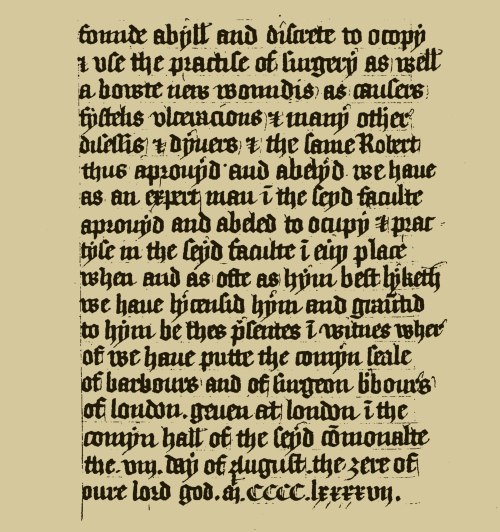
nos considerac͠oe pˀmissoꝜ de gr̃a nr̃a sˀpaɫi concessimꝰ pˀ noᵬ & successoribʒ nr̃is pˀfatis
mag̃ris siue Guᵬnatoribʒ ac Coit̃ati dcẽ Mistera BarbitonsoꝜ & successoribʒ suis hanc
liᵬtatem viᵭelt qˀd ip̃i pˀpetuis futuris temporibʒ pˀsonas habiles & sufficientꝰ eruditos &
informatos in dct̃i mistera Sirurgicꝰ & pˀ mag̃ros siue Guᵬnatores mistera illius pˀ tempore
existenꝰ in forma pˀdc̃ti approbatꝰ & maiore Ciuitatis pˀdc̃e pˀ tempore existenꝰ vt pˀdc̃am
est pˀsentat in eandem misteram BarbitonsoꝜ ad libtat̃es dc̃e Ciuitatis hẽndꝰ & gaudendꝰ
scᵭm consuetudinem dc̃e Ciuitatis admittẽ & recipˀe valeant & non alias pˀsonas quascũqʒ
neqʒ alio Modo aliquo mandato aut requisic͠oe nr̃i heredimi seu successoꝜ nroꝜ pˀ brãs
inscriptꝭ vel alitꝭ qualitꝭ cumqʒ incontrm̃ factꝭ seu faciendꝭ non obstantꝭ Et licet iidem
mag̃ri siue Guᵬnatores ac Coiãtas & eoꝜ successores hac liᵬtate continue in futurꝭ vsi fũint
conta. aliquod mandatum sine requisicõem nr̃i heredũ seu successoꝜ nroꝜ aut aliquoꝜ
alioꝜ quoꝜcuq̃ʒ in forma pˀdc̃a fiendꝭ ip̃i tamen finem contempt̃u depˀditum erga nos
heredes seu successores nrõs aut dampñu vel malum aliquod in bonis seu corporibʒ suis
erga quoscumqʒ alios ea occ̃one nullo modo incurrant nec eoꝜ aliquis incurrat. Et hoc
absqʒ fine seu feodo pˀ pˀmissis seu sigillac͠oe pˀsentum noᵬ faciendꝭ soluendꝭ vel
aliqualitꝭ reddendꝭ aliquo statuto ordinac͠oe vel actu incontrm̃ ante hec tempora editꝭ
factꝭ ordinatꝭ seu pˀuis non obstantꝭ. In cuius rei testimonm̃ has lrãs nr̃as fieri fecimꝰ
patentes. Teste me ip̃o apud Westm̃ vicesimo quarto die ffebruarii Anno regni nr̃i primo.
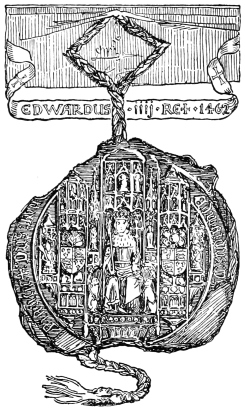
Pekham.
pˀbrẽ de priuato sigillo de datꝭ
pˀdct̃ auctoritate parliamenti & pˀ
decem libris soluitꝭ in hanapˀio
(Endorsed.)
Irt̃o in Curꝰ Domini Regis in Cam̃a
Guihalde Ciuitatꝭ Londõn in libro
signatꝭ cum lit̃ta. l. folˀ tercio decimo.
Anno regni Regis Edwardi quarti
post conquestum Tercio.
Translation.
Edward by the grace of God, King of England and France, and Lord of
Ireland, To all to whom these present letters shall come, health. Know ye, that we
considering how our beloved, honest, and free men of the Mystery of Barbers of our City
of London, exercising the Mystery or Art of Surgery, as well respecting wounds, bruises,
hurts, and other infirmities of our liegemen, and healing and curing the same, as in
letting blood, and drawing the teeth of our liege men, have for a long time undergone
and supported, and daily do undergo and support, great and manifold applications and
labours; and also, how through the ignorance negligence and stupidity of some of the
men of the said Barbers, as well of the freemen of our said City, as of other Surgeons
foreigners and not freemen of the said City, and who daily resort to the said City, and in
the mystery of Surgery are not sufficiently skilled, whereby very many and almost infinite
evils have before this time happened to many of our liegemen, in their wounds, hurts,
bruises, and other infirmities, by such Barbers and Surgeons, on account of their defect
in healing and curing; from which cause, some of our said liegemen have gone the way
of all flesh, and others, through the same cause, have been by all given over as incurable
and past relief, and it is to be dreaded, that similar or greater evils may in future arise on
this head, unless proper remedy is by us, speedily provided for the same. We therefore,
heartily weighing and considering that such evils do happen to our liegemen for want of
the examinations, corrections, and punishments by a due supervision of such Barbers
and Surgeons as are insufficiently skilled and instructed in the said mysteries or arts as
aforesaid; have at the humble request of our aforesaid beloved, honest, and freemen of
the said Mystery of Barbers in our said city, granted to them that the said Mystery, and
all men of the said Mystery aforesaid, may be in deed and name one body and one
perpetual Community, and that two Principals of the said Community may, with the
consent of twelve persons, or at least eight of the said Community who are best skilled in
the mystery of Surgery, every year elect and make out of the Community, two Masters
or Governors of the utmost skill, to superintend rule and govern the Mystery and
Community aforesaid and all men of the said Mystery, and of the businesses of the
same for ever. And that the said Masters or Governors and Community may have a
perpetual succession and common seal to serve for the affairs of the said Community for
ever, and that they and their successors for ever may be able and capable to acquire and
possess in fee and perpetuity lands, tenements, rents, and other possessions whatsoever,
to the value of five marks per annum, besides reprises. And that they, by the name of
the Masters or Governors and Community of Barbers of London, may be able to plead
and to be impleaded before whatsoever Justices in Courts, and actions whatsoever. And
that the said Masters or Governors and Community, and their successors, may lawfully
and honestly assemble themselves, and make statutes and ordinances for the wholesome
government, superintendence, and correction of the said Mystery, according to the
exigency of the necessity, as often and whenever it may be requisite, lawfully and
unpunishably, without leave or hindrance of us, our heirs or successors, Justices,
Escheators, Sheriffs, Coroners, or any other Bailiffs, or servants of us, our heirs or
successors; provided that such statutes or ordinances are not in any ways contrary
to the laws and customs of our Kingdom of England. We further will and grant,
for us, our heirs and successors, as far as in us lies, that the Masters or Governors of the
aforesaid Community for the time being, and their successors for ever, shall have the
superintendence, scrutiny, correction, and government of all and singular the freemen of
the said City who are Surgeons, exercising the Mystery of Barbers within the said City,
and of all other foreign Surgeons whomsoever, in anywise practising and using the said
Mystery of Surgeons in the said City and the suburbs thereof, and the punishment of
them, as well freemen as foreigners, for their offences in not perfectly following, practising
and using that mystery, and also the superintendence and scrutiny of all kinds of
instruments, plaisters, and other medicines, and their recipes, by such Barbers and
Surgeons given, applied, and used for our liege men, for curing and healing their wounds,
bruises, hurts and such kind of infirmities, when and as often as shall be requisite for the
convenience and utility of our liege men; so that punishment of such Barbers exercising
the said mystery of Surgeons, so offending in the premisses, be executed by fines,
amerciaments, and imprisonments of their bodies, and by other reasonable and suitable
means; and that no Barber exercising the said mystery of Surgeons in the said City and
suburbs thereof, or any other foreign Surgeon whatsoever, shall in future be admitted to
follow, practise and exercise the said mystery of Surgeons, in anywise, within the said
City or the suburbs thereof, unless he be first approved by the said Masters or Governors,
or their successors, for this purpose able and sufficient as skilled in the said Mystery,
and for his plenary approbation in this behalf, by the said Masters or Governors to
the Mayor of the said City for the time being, presented. We also will and grant,
for us our heirs and successors, as far as in us lies, that neither the said Masters or
Governors and community of the said Mystery of Barbers, nor their successors, nor any
of them shall hereafter, in anywise be summoned or appointed on any assizes, juries,
inquests, inquisitions, attainders, or other recognizances, within the said City or suburbs
thereof for the time to come, before the Mayor or Sheriffs or Coroners of our said
City for the time being, by any summoning officer or his servant, or summoning officers
or their servants, although the said juries, inquisitions, or recognizances should be
summoned by a writ or writs of right, of us or our heirs, but that the said Masters or
Governors and Community of the aforesaid Mystery and their successors shall,
from henceforth for ever, be peaceably and entirely exonerated towards us, our
heirs and successors, and towards the Mayor and Sheriffs of our said City for the
time being, and every of their officers and servants, by these presents. And further,
we, in consideration of the premisses, do of our special grace, for us and our successors,
grant to the said Masters or Governors and Community of the said Mystery of Barbers,
and their successors, this liberty, to wit, that they in all future times may admit
and receive persons apt and sufficiently skilled and informed in the said Mystery of
Surgery, and by the Masters or Governors for the time being of the said Mystery, in
manner aforesaid approved, and presented to the Mayor of the said City for the time
being as aforesaid, into the said Mystery of Barbers to the fredom of the said City,
to be held and enjoyed according to the custom of the said City; and no other persons
whomsoever, nor in any other manner, any mandate or requisition of us, our heirs
or successors, by written letters or otherwise howsoever made or to be made to
the contrary notwithstanding. And although the said Masters or Governors and
Community and their successors should contumaciously use this liberty in future
against any mandate or requisition of us, our heirs, or successors, or any others
whomsoever to be made in form aforesaid, neither they nor any of them shall in anywise
incur any fine, contempt, or loss towards us, our heirs or successors, or any damage or
punishment in their goods or bodies, or towards any other persons whatsoever, on that
account; And this without fine or fee for the sealing of these presents, to be done
paid or otherwise rendered unto us; any statute, ordinance, or any act to the contrary,
before this time published made ordained or provided notwithstanding In witness
whereof, we have caused these our letters to be made patent. Witness myself at
Westminster the twenty-fourth day of February in the first year of our reign.
Pekham.
By writ of privy seal, and of the date aforesaid, by authority of Parliament,
and for ten pounds paid into the hanaper.
(Endorsed.)
Inrolled in the Court of the Lord the King, in the chamber
of the Guildhall of the City of London in the book marked
with the letter l. folio thirteen in the third year of the reign
of King Edward the Fourth from the Conquest.
The chief point which strikes us on reading the foregoing
Charter is, that it contains a great deal relative to Surgery, and little,
indeed nothing, concerning Barbery, and yet it is granted ostensibly
to the Barbers!
Now the Surgical side being the more important one of the
craft, and the raison d’être of the Charter being in a great measure to
provide for the regulation of Surgery and the correction of abuses in
that profession, this silence as to Barbery and recognition of Surgery
would seem to be an evidence that the practice of the latter, more or
less, was the rule rather than the exception with members of the
Company of Barbers; and, as the Masters or Governors were
empowered to make “statutes and ordinances” (by-laws) for the
governance of the mystery, it was doubtless considered unnecessary
to descend into any details concerning shaving and the like in a
Royal Charter.
The preamble of this Charter is exceedingly quaint and
interesting, reciting how through the “ignorance, negligence and
stupidity” of various Barbers and other practitioners in Surgery,
many of the King’s lieges had “gone the way of all flesh.” Then at
the request of “our beloved, honest and free men of the said Mystery
of Barbers,” the King grants to them, to be one body perpetual, etc.,
that two of the chief men of the Company (no doubt the two then
existing Masters “exercising the faculty of Surgery”) may with twelve
or at least eight other skilled Barber-Surgeons, elect two Masters
annually: this provision in itself is singular, as it would seem to imply
that the body then incorporated was to be ruled by two Masters only;
but a reference to our list of Masters and Wardens will shew that from
the year 1448 the Company has been ruled by four Masters, and so on
in unbroken succession to the present time48; these other two Masters
therefore were Masters of the Barbers proper, about whom nothing
was said in the Charter, but who were chosen annually in accordance
with ancient custom, the Chief or First Master being alternately a
Barber, and a Barber-Surgeon.
The Corporation was to have perpetual succession, and a
Common seal, to hold lands of a certain value, to be able to plead and
to be impleaded, to make by-laws, to have the scrutiny and correction
of (apparently all) Surgeons in the City and suburbs, as also the
oversight of all their instruments and medicines, etc., and to have the
power of inflicting punishment, by fine or imprisonment, on offenders.
None were to practise Surgery until examined and approved by the
Masters and presented to the Mayor, and authority was given for the
freemen of the Company to be admitted into the freedom of the City.
Another clause in the Charter was one which, whilst it conferred
a valuable privilege upon the Company, was a source of
continual strife and conflict with the Civic authorities, for by it all our
freemen claimed to be exempted from serving on Juries and inquisitions,
and this immunity, though constantly disputed, was as often
asserted and maintained, with various qualifications.
In The Times, November 26, 1839, is an account of the exemption
of certain freemen of the Company from serving on Juries at the
Central Criminal Court. In this instance neither the claimants nor the
Recorder knew much about the matter—for one of the applicants said,
in reply to the Recorder, “I rest my claim on the Charter of
Henry VIII”!! And, further on in the discussion, the same bold
Barber had the effrontery to declare that “the privilege was confirmed
by an Act passed in the reign of George II.” This was the Act
which separated the Surgeons from the Barbers, and which did not
confirm to the latter the exemption claimed, but our freeman gained
his point, and the Recorder only grumbled.
As recently as 1868, a case was submitted to Sir J. D. Coleridge
(now Lord Chief Justice) as to the legality of the exemption, and he
gave his opinion in favour of it. However, since then the Jury Act
has, alas! swept away this cherished immunity, and thus let the Barbers
down to the level of their fellow citizens.
With the possession of their Charter the Company were now in
an unassailable position, and we hear no more of their molestation by
the Guild of Surgeons.
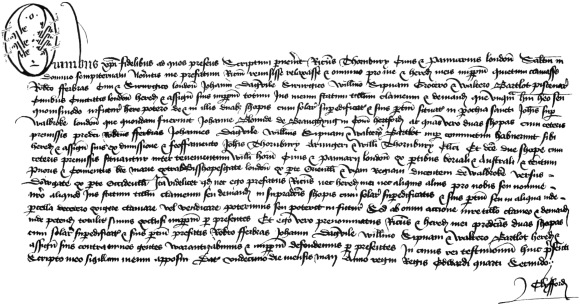
Grant by Richard Thornbury, Citizen and Draper of London, to Robert Ferbras, Citizen and Surgeon, John Dagvile, Surgeon, William Sipnam, Grocer, and Walter Bartlot,
Fishmonger, Citizens of London, for ever, of all his title in two shops and solars with their appurtenances, in the parish of Saint John upon Walbroke, formerly belonging to
John Blounde of Braughyng in the County of Hertford, and which had been already conveyed to the Grantees by John Thornbury, gentleman, and Walter Thornbury, Clerk,
which shops were situate between the tenements of William Horn, Citizen and Draper, towards the north and south, and the tenement of the Prior and Convent of the Blessed
Mary without Bishopsgate towards the east, and the King’s highway leading from Walbroke to Dowgate towards the west. Dated 11th May, 2 Edward IV (1462).
1470. The Company about this period came into possession of
some freehold houses in St. John the Baptist upon Walbrook, to be
held both for trust and corporate purposes. These houses are stated
in our books to have been devised to us by Will (dated 2nd Dec., 1470)
of Robert Ferbras. There are three old title deeds of the period still
at the Hall, relating to these houses, and in the Court of Husting at
Guildhall are two Wills of Robert Ferbras, Surgeon, both proved, one
dated 4th Nov., 1470, and the other 17th April, 1472—but neither of
these contain the bequest to the Barbers. It is, therefore, probable
that Robert Ferbras conveyed the houses to the Company in his lifetime,
and this fact being overlooked in course of years, it came to be
said that they passed by his Will.
1482. 26th April.—The Company applied to the Court of Aldermen,
presenting a set of ordinances for the government of the craft and for
the regulation of apprentices, praying that the same might be allowed
and ratified, which was done. The official entry under this date is in
Letter-Book L. 174, and the following are the Ordinances:—
Ordinacio
BarbitonsoꝜ
Memorand qˀd sexto decimo die Aprilis Anno regni Regis Edwardi
quarti post conq̃m vicesimo scᵭo pˀᵬi hõies Artis sive mistere
BarbitonsoꝜ Civitatis london venˀ hic in Curˀ dc̃i Dnĩ Regis in Camˀa Guyhald Civitatꝭ
pˀdcĩ coram Willm̃e Haryot milite ac maiore & Aldr̃is ejusdem Civitatis et porrexer̃nt
eisdem maiore & Aldr̃is quandam billam sive supplicacõem Cujus tenor sequitur in hec
verba.
To the right honorable lord the Mair And the right wirshipful Sovˀaignes the
Aldermen of the Citee of London Mekely besechen your goode lordship̃ and maistershippes
all the pˀsones enfraunchesed in the crafte and mistere of Barbours wtin the Citee
of london That it wold pleas the same your lordshipp and maistershippes for the Wirship̃
of the said Citee And for the goode Rule to be had wtin the saide Craft to graunte
and establissh thise articles folowyng And theym to be entred of Recorde in the
Chambre of the said Citee before your said lordship and maistershippes hereafter for to
be observed and executed.
FFirst that there shall no ffraunchesed Barbor. wtin the said Citee take any man
or Child to be his Apprentice before that he hath pˀsented the same man or Child unto
the maister and Wardeyns of the said Craft for the tyme being, to thentent that the same
maister and Wardeyns may duely examyne ovˀsee serche and behold by the Colour and
complexion of the said man or Child if he be avexed or disposed to be lepur or gowty
maymed or disfigured in any pˀties of his body Whereby he shall fall in disdeyn or
lothefulnesse unto the sight of the Kingꝭ liege people And also to be examyned of his
birth and of his kynrede or if there be on hym any bonde claymed, And if he be founde
defectif in any of thise poyntꝭ that than no fraunchesed Barbor. of the saide Citee shall
take hym to his Apprentice uppon payn to pay vli. Whereof that one half shall Remayn
unto the Chambre of the said Citee.
Also that evˀy enfraunchesed barbour that taketh any apprentice shall pay to the
almes of the said Craft for the same Apprentice iijs. iiijd. to be paied in fourme folowyng that
is to sey, at the first pˀsentacion of the Appˀntice xxd. and that other xxd. in the same yeere
When he shall be enrolled And the names of the maister and appˀntice and the yeres of
appˀntishode of the same appˀntice shalbe writen in a book by the said maistˀ & Wardeyns
And he that disobeith this article or ordenance shall pay unto ye almes of the said Craft
of barbours xiijs. iiijd. that one half thereof to be applied to thuse of the said Chambre and
that other half to the almes of the said Craft. And if it so be that the said Apprentice
Dye wtin the first yere, or voide so that the said maistˀ take none avauntage by the same
Appˀntice, that than the same money stonde for the next Appˀntice, And if it hapne the
said maister to take any pˀfet [profit] for the said Appˀntice by way of Sale or sˀvice and
that so pˀved before the said maister and Wardeyns that than the saide maister of the said
Appˀntice to be charged for the said iijs. iiijd.
Then follows the usual Ratification (in Latin) of the above
Articles.
1487. The next notice which we have of the Barbers in the City
books, indicates that there had been quarrels and dissensions among
them, and that the rules of the Craft had been set at nought by its
members, whereupon a Book of Ordinances was presented to the Court
of Aldermen for approval and ratification and the same is entered at
this date, 20 July 2 Hen vij, in Letter-Book L. 235B. as follows:—
Memorandum qˀd xxo. die Julij Anno regni Regis Henrici septum secundo,
Gardiani & aɫ pˀᵬi hõies Artꝭ sive occupacõis de Barbours Civitatꝭ london venerˀ hic in
Curˀ dc̃i dñi Regis in Camˀa Guilhald ejusdem Civitatꝭ coram Henrico Colet milite
maiore & Aldr̃is Civitatꝭ pˀdc̃i & porrexˀunt eisdm̃ maori & Aldr̃is quandã billam sive
supplicaõem Cujus tenor sequitr. in hec verba,
To the right honourable lord the maire and fulle discrete sovˀaignes thaldˀmen of
the Citee of london Shewen mekely unto yor. good lordeship and maistˀshippes the maister
and the Wardeyns and the good ffolke of the Crafte or Science of Barbours Surgeons of the
said Citee that Where as they of longe tyme have been in discorde and not of oon conformite,
but evˀy man in effect of the said Crafte or Science hathe taken and folowed his own singuler
way and apetite as menne be49 under no Rule nor obedience, contrarie to all godly policie for
lacke of good Rules and ordenancꝭ hadde and used within the same Crafte or Science, and
in especiall for takyng of over many appˀnticꝭ and settyng a werk of money50 fforeyns comyng
oute of Seint Martyns, Westmynster, Suthwerk and other placꝭ nere unto this Citee to the
distruccion of the good ffolke enfraunchised of the said Crafte or Science, but if51 a remedie by
yor noble and grete wisdomes the rather be pˀvided in that behalf. That it wold pleas yor.
good lordeship and maistershippes for the good Rule and sadde52 guydyng hereafter to be hadde
amongꝭ the good ffolkꝭ of the said Crafte within the same Crafte to graunt to yor. saide besechers
certeyn Articles hereaftˀ ensuying from hensforth to be obsˀved and kept and afore
you here in this honorable Court to be establisshed and entred of Record for ever to endure.
FFirst that no pˀsone of the said Crafte or science ne none other enfraunchised
within the saide Crafte and kepyng open shoppe of the same Crafte or Science within the
same Cite from hensforth in any wyse pˀsume to take uppon him to sette a werke
within his house or Shoppe any sˀvaunt or sˀvauntꝭ or allowes53 or other beyng fforeyns
or estraungiers, but54 evˀry suche pˀsone so enfraunchised in the saide Crafte or science
or in any other and occupie the same Crafte or Science within the Citee aforesaid present
any such sˀvaunt or sˀvauntꝭ allowes and other before the maistˀs and Wardeyns of
the same Crafte or Science of Barbours for the tyme beyng within iij daies next after
his comyng to his saide maister to thentent that the saide maister and Wardeyns have
knowledge of their habilitie and cunyng55 before they be sette any lenger in occupac̃ion
in the saide Crafte or Science, And what manˀ pˀsone56 aforesaid hereafter be founde
doyng the contrarie of this ordenance shall forfeit and pay at evˀy tyme that he is so
founden defectif xls. the oon half thereof to be applied to thuse of the Chambre of this
honorable Citee and the other half to the Coẽn boxe of the said Crafte.
Also that no manˀ pˀsone57 enfraunchised in the saide Crafte or in any other
kepying an open Shoppe and occupieth the same Crafte within the Citee from hensforth
take or set a Werke within his house or shoppe or ellꝭ where within the same Citee
any moo58 Sˀvaunts allowes at oones59 beyng fforeyns or Straungiers but oonly ij pˀsones
and the same ij pˀsones to be pˀsented by their maister before the maister and Wardeyns
of the said Crafte or Science of Barbours for the tyme beyng within iij daies next comˀyng
in to suche sˀvice to their suche maistˀ And that the same fforeyns or straungiers shall
take or have of their saide maister suche wages for their suche sˀvice as it shalbe
thought by the saide Maister and Wardeyns of the said Crafte of Barbours that they
canne desˀve and none other, And what maner of pˀsone aforesaid hereafter be founde
doyng contrarie to this ordenancꝭ shall forfeit at evˀry tyme that he is founde defectif
vli. to be divided and applied to suche uses as be aforeherced.60
Also if it fortune hereafter any pˀsone enfraunchised in the saide Crafte of
barbours or in any other occupying the same Crafte of barbours within the Citee to take
any mo sˀvauntꝭ allowes at oones beyng fforeyns or straungiers than onely ij as is
aforeherced61 Wherethurgh62 he renneth in the forfaiture of the said penaltie of vli. for the
saide offence, and than that the maister and Wardeyns of the saide Crafte of Barbours for
the tyme beyng havyng knowleche therof put not the said penaltie of vli. in execucion
accordyng to the tenor. of the saide Acte thereof made, within xiiij daies after that the
said maistˀ and Wardeyns have knowleche thereof, that than the said maistˀ and Wardeyns
for the tyme beyng so founden defectif shall forfeit and lose at evˀy tyme xiijs. iiijd. to be
divided and applied to suche uses as be aforeherced.
Also that no manˀ pˀsones enfraunchised in the said Crafte or in any other
occupying the same Crafte within the said Citee from hensforth take any moo appˀntices
at oones than iij uppon payne of forfaiture of vli. at evˀy suche tyme as he is founde
defectif doyng contrarie of this Article, to be divided and applied to suche uses as be
afore reherced Savyng allway that it shalbe lefull to evˀy suche pˀsone oon yeere before the
tˀme of appˀntishode of any his appˀnticꝭ be expired to take a nother appˀntice in the
stede of hym that is nygh com̃yng oute of his tˀmes of appˀntishode to thentent that the
same newe appˀntice may have his due erudicion and lernyng in the said Crafte or
Science of Barbours before the tˀmes and 63 of the rather appˀntice.
Also if any pˀson of the said Crafte or Science selle away his appˀntice to a
nother manne within his tˀmes of appˀntishode that than it shalnot be lefull to any suche
pˀsone so silling away his appˀntice to take any newe in his stede duryng the tˀme to come
of appˀntishode of that appˀntice so sold Nevertheles if it fortune any appˀntice to dye
within the tˀmes of his appˀntishode that than it shall be laufull to the mastˀ of that
appˀntice so dying to take a nother in his stede when so evˀ it shall lyke hym.
Provided all way that it shalbe lefull to evˀy pˀsone of the said Crafte nowe
havyng many appˀnticꝭ to reteyne and holde fulle as many appˀnticꝭ as he hathe the day
of makyng of this Acte or ordenance unto suche tyme as the tˀme of their appˀnticialite
shalbe fully accomplisshed So all way that no suche pˀsone take any mo appˀntices unto
suche tyme as the nuˀbre of the said appˀnticꝭ be reduced and brought unto the said
nuˀbre of iij appˀnticꝭ uppon payn of forfaiture of vli. to be divided and applied to suche
uses as been afore reherced.
Also that no foreyn Barbour from this tyme foreward occupie the Craft or
Science of Barbours or Surgeon Barbor. within the ffraunchise of the said Citee but if he
be lymytted and assigned therto by the maister and Wardeyns of the same Craft for the
tyme beyng uppon payn of forfaiture of vli. as often as any suche pˀsone so be founde
defectif, to be divided and applied to suche uses as be aforeherced. Provided allway that
if it canne be thought for the wele of the kyngꝭ people that if any foreyn Barbours or
foreyn Surgeon be founden of such habilitie and connyng of Surgerie or of that Crafte that
it were necessarie to have hym to occupie within the ffraunchise of this Citee, that than
he be admitted therto by the Chamᵬleyn of london and by the Maister and Wardeyns
of the said Crafte of Barbours for the tyme beyng, With that the same fforeyn fynde
suertie sufficient to be bounde to the said Chamᵬleyn and Maister and Wardeyns for to
do make him self free of the saide Crafte or Science of Surgeon Barbours and to obey
and pˀfourme the Rules and ordennancꝭ of the same Crafte and to be under the
correcion of the same Crafte, provided allway that the kyngꝭ people be served
in price of their Cure and shavyng in tyme to come aswell and as safely as they
have been in tymes passed.
Then follows the usual Ratification (in Latin) of the above
Articles.
1490. A declaration made by one Bryan Sandford, dated
8th March, 1490, was produced to the Committee of the House of
Commons in 1745, in which it was stated that the Company were
at that time possessed of the freehold of their Hall in Monkwell
Street.
1493. On the 12th July in this year, an agreement was
entered into between the Barbers’ Company and the Surgeons’
Guild which would indicate that the two bodies were now on amicable
terms, working harmoniously for the increase of the credit of the
profession, and for the correction of inexperienced surgeons and
empirics. This “Composition” is of so interesting a nature that
it is here given in full, as extracted from the fine old Book
of Ordinances at the Hall; it did not unite the two bodies
in any way beyond this, that they agreed to follow the same
rules and practice with regard to the government of all
Surgeons; that each guild was to choose two Wardens, and
that the four so chosen were to act in a conjoint capacity as
rulers or masters in matters surgical, and thus comprehend all
Surgeons, whether of the Barbers’ Company, the Surgeons’
Guild, or “foreyns.”
This present wrytyng endentyd of copˀosicyons made the xijth day
of July iˀ the zere of owyr lord God MtCCCClxxxxiij and the
viijth zere of the reyne of kyng harry the vijth William Martyn
then beyng mayre of this cyte of london betwyxt the ffelishippis
of surgeons enfraunchesˀ wt in the cyte of london on that on p’ty
And the felishippis of barbours surgeons and surgeons barbours enfraunchessid
iˀ the seyd cyte on the other parte witnesyth that the sayde felyshippys of ther
comon assent and mere moc̃yons ben c͠odescẽdyd and agreyd togethir the day
and the zere aboue sayd, in mañ and fourme folowyng. That is to sey that
eũy pˀson and pˀsons of the faculte or scyens of surgeons admyttyd and
sworne to eyth̃ of the sayde felyshippis from hens forward shall stond and
a byde wt ther felyshippis as they now do and dyd before thys present
composicyon.

Also that from hens forth non of the sayde felyshippis shall admyt nor
reseyue in to ther felishippys any alyent straungˀ or foreyn vsyng the
sayde faculte or scyens of surgery wtowten knowleg or c͠osent of
the wardẽs of bothe the seyd felishippys. All so for the welth and
suerte of the kyngꝭ lege people And the honour of the seyde
felyshyppys, It is agreyd be twyxt the same two felyshippis that non alyent
straunger nor foreyn shall use nor ocopy the seyde faculte or scyens of surg̃y
withyn this cyte or subbers of the same unto such tyme as he shewhym selfe
to the mayer for the time beyng, and by the iiij wardeyns of bothe the saide
felishippis, that is to sey of eyth̃ of the sayde felishippis, tweyn, and othˀ suche as
by theyr wysdomys they will call vnto them, be dewly examyned & approuyd to be
sufficyent of conyng and habilyte in the sayde faculte. And yf any such pˀson or pˀsones
bi the sayde iiij wardens as is afore sayde be taken reputed and a lowed to be sufficient
of konyng and habylite iˀ the seyd faculte or scyens of surgery that then the pˀson or
pˀsonys so knowen and admyttyd shall be sworne to all the good rewlys and ordenans of
ye seyd faculte or scyens of surgery, and to be under the coreccyon of the iiij wardens for
the tyme beyng to the entent that at all tymes he may be under dwe coreccyon for the
sauegard of ye kyngis lege people. And if any suche alyent straungˀ or foreyn of
pˀsumcon refuse to be examyned of the seyde wardens in mañ & fourme as is a fore
seyd, Or yf any suche straunger or foreyn so examyned be the seyde wardens be Juged
onsufficient of conyng and neũtheles takyth upon hym to occupy or vse the seyde faculte
of surg̃y wtyn the seyde cyte or subbars of the same, Then take the name of hym or
them so doyng and pˀsent hym by the sayd iiij wardens to the mayer for the tyme beyng,
to the entent that by his wysdom, and advice of hys honerabyll brethern may set suche
direccyon as shall be thought resonabil formacion64 therof, restrayne hym from the
ocupac̃on of the same scyens wt in the sayde cyte. Also it is agreyd and cõpoundyd
betwyxte the sayde felyshippys that from hensforth eũy of the seyde felyshippis and
seũally by them selfe, Chese of themselfe two discrete pˀsons usyng the fete of surgery to
be seũally wardens of the sayde seũall felishippis, and that these iiij wardens for the tyme
beyng when and as oftyn as nede shall requere, Shall haue the syght and good gounaunce
of the seide faculte of surgery. And eũy pˀson or pˀsonys of eũy of the sayde felyshippis
that happenys or shall fortune to haue any Jeopˀde65 or dowtefull cure, dredyng deth or
mãy,66 he or they hauing at eny tyme to come, shall shew and pˀsent the cure or curys
in as short tyme as nede shall be reqˀred, And at the leste at the thyrde dressyd67 to the
saide iiij wardens for the tyme beyng, Or any other pˀson or pˀsonys that is to seye, to
one of yche of the seyde felishippis, and the same wardens and yf them seme nedefull
shall call unto them ij or iij, or more if nede reqˀre, of the wysest and best expˀte mẽ of
the said felishippis occupyeng the saide faculte of surgery as them semeth most expedyent,
for the cause or causis aforesayde. Also in this coposycion yt is ordeyned and agreyd,
that none of the iiij wardens for the zere beyng neyther any other pˀson of the sayde
felishippis ocopyeng the crafte of surg̃i, Put any man of thes sayde felishipis oute of ther
cure otherwyse then the honeste of the crafte wolle, but that yche of them be redy to
helpe eche other wt counsell or deed, yt worship profyte and the honeste of the crafte,
and helpyng of the seke be had and done on all sydis. And if ony of thes iiij wardens
for the tyme beyˀg or any other pˀson or pˀsonys of the seyde felyshippis do the cõtrary
that eche suche doer content the valvyr68 of the cure, After discressyon and Jugem̃et of
the same iiij wardens for the zere beyng, And also for his trespas to paye aftur discression
and Jugem̃et of the iiij wardens. Also if any pˀson of the sayde felishippis dislaunder or
depute any of the saide felishippis onrightfully ownonestly and ef it so maye be prouyd
upon hym by two or thre witnesse, that he paye for that trespas iijs. iiijd., and ouer that
to make amendis to ye seide pˀsons the whiche he hath so disslaunderd aftur Jugement
of onest men of the seyd felyshippis not founden in non suche defaute.
This pˀsent cõposicyon was made the daye and zere a bowe wreton by Roberd
taylour, Robt. Halyday, Thom̃s Koppisley, Thom̃s Thornton, Ihoñ Harte, Johñ Marhm̃,
Roberd Beuerly, James Scote, James Ingoldysby, Johñ Taylour, Richard Swedenhm̃,
Nicholas Leueryng, John Wilson. In rowlid in Raffe Osterigis tyme, mayer.
Of the persons assenting to this composition, the following were
Barber-Surgeons, viz.: Robt. Halyday (Master 1475, 1483, 1485, 1490,
1496), James Scott (M. 1493, 1498, 1500), James Ingoldysby (M. 1501,
1506), John Taylour (M. 1523, 1524), and Nicholas Leveryng(M. 1503,
1508), the others were most likely belonging to the Guild of Surgeons.
An Ordinance by way of addenda to the above was made,
imposing penalties upon any who should break any of the foregoing
rules; the first offence to be punished by a fine of 10s., the second 20s.,
and the third offence to be remitted to the Mayor and Aldermen for
punishment after their discretion.
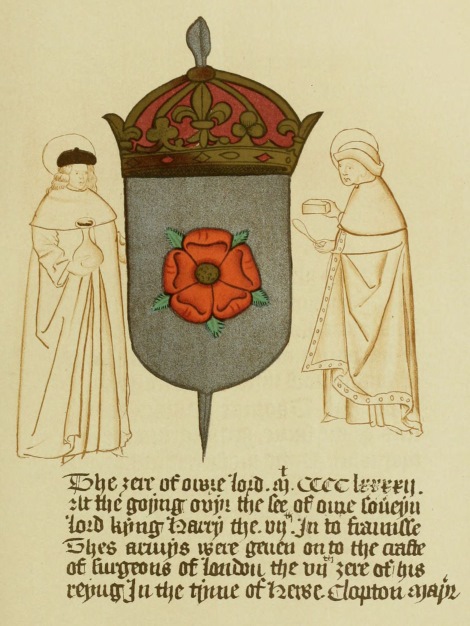
FAC-SIMILE OF THE TITLE-PAGE TO THE OLD BOOK OF ORDINANCES, REPRESENTING SAINTS
COSMO AND DAMIAN (PATRON SAINTS OF THE BARBER-SURGEONS) AND THE COAT
OF ARMS GRANTED TO THE COMPANY OF SURGEONS IN 1492. (See p. 433.)
How long this agreement, so beneficial for the practice of
Surgery, continued in force is unknown; but the probabilities are that
the old jealousies soon re-appeared and that each Guild worked on its
own lines until 1540, as, by the uniting Act then passed, it was specially
remarked as desirable that the two Companies should come together,
and be incorporated in one.
1497. We shall now present to the reader’s notice a highly
important document, being a diploma granted by the Master and
Wardens of the Barbers’ Company to one of their freemen, enabling
him to practise as a Surgeon. This is in all probability the earliest
English diploma of a Surgeon extant and cannot fail by the quaintness
of its composition, and the details given, to prove of much interest.
We notice in it, that our Company as usual, did not fail to rehearse its
prerogatives and practice, and we also observe that thus early the
Company provided an instructor and examiner in the science, Dr. John
Smith, before whom came in the Common Hall, Robert Anson, and
in the presence of a “great audience of many right well expert men
in Surgery and others, was openly examined in divers things concerning
the practice,” etc.
THE LETTˀ PAT̃E OF BˀBOURS & OF SURGEOS BˀBORS.

To all trew crysten people to whom thes present lettris shall come.
Roberd Halidai69 mastur of barbours and of surgeon barbours of
london, and Willm̄ Okeley, John Knote70 and Thomas Dawes71
wardens of the same gretyng, knowe ye that wher as the moste
excellent Pryns in cryst and soũeyn lord Edward by the grace of
god kyng of ynglõd and of ffraunce, lord of Ierlond, for many pˀfounde cos̃ideracyons
his gc̃e movyng, hathe grauntyd the well to hym ĩ cryst, the approuyd fremen
the coiãlte of barbours and of surgeon barbours of the cyte of londõ, The serche
and oũsyght correcyon and ponyshement, examinacon & approbacion of all fremen
usyng or hauntyng the conyng of surgery and barbory, And of all maner of men
foreyns usyng or hauntyng any pˀticuler pˀte of surgery withyn the seyde cyte or subbers
ther of, As a bowte new woundys, olde soris, and other lesyons what so eũ they be, Also
in drawyng of teeth ventosyng scarificacons and suche othˀ manwall operac̃ons, lyke as
the lettres patentes of owre seyde lege lord the kyng ther upon made planyly may apere.
We therfore the saide Roberde, Willm̄, John̄ & Thom̄s at this tyme masturs and
wardens of the saide felishyp, ffor the comyn pˀfyte weth72 and relefe socour of owr lordis
the kyngꝭ lege people, entẽdyng to pˀuyde men of good capasite and abill ĩ maners and
conyng, sufficiently lerned, enfourmed, and labored by long experyens, and other in the
seide craft of surgery,—haue prayed and requyred mastur John̄ Smyth doctour ĩ phesik,
Instructour & examener of the seide feliship, and be73 the same for that intent chosen
and elect to entur & examynacyon for the cawses a boue saide, wt divers pˀsons whiche
long tyme, wtowte auctorite, haue vsed and haunted wt experyens the conyng of surgery,
wheruppon aftur dewe and dyuers monycions made in this be halue, Roberd Anson on
of the seide coĩalte at the comyn hall of the same ĩ london appered, ĩ his pˀpyr pˀson, the
first day of August last past, submyttyng hym selfe to the examync̃on and thaposicion,74
wher and when the seide Roberd by the sayde John̄ Smyth, in a gret audiens of many
ryght well expert men ĩ surgery & other, was op̃yly examyned ĩ dyuers thingꝭ cõcernyng
the practise opˀatife and directif in the seyde crafte of Surgery. And ther albe it he hathe
a fore this many tymys been well approuyd, ʒet now he is newly habelyd, be75 the seyde
doctour and felyship, and founde abyll and discrete to ocopy & vse the practise of
surgery, as well a bowte new woundis, as cansers, fystelis, vlceracions & many other
disessis & dyuers; & the same Robert thus aprouyd and abelyd we haue, as an
expert man ĩ the seyd faculte, aprouyed and abeled to ocupy & practyse in the
seyd faculte, ĩ eũy place, when and as ofte as hym best lyketh we haue lycensid
hym and graũtid to hym by thes pˀsentes. ĩ witnes wherof we haue putte the
comyn seale of barbours and of surgeon bˀbours of london, geuen at london ĩ
the comyn hall of the seyd Comõnalte the viij day of August the zere of oure lord
god MtCCCClxxxxvij.
1499. In this year the Company obtained from Henry VII a
confirmation of their Charter, paying but 20s. for the same. This
Inspeximus Charter recites and confirms that of Edward IV with
the very noticeable exceptions, that four Masters or Governors are
named instead of two, and that they are described as of “the
Mystery of Barbers and Surgeons,” and not “Barbers” only, as
in Edward’s grant.
The original, in excellent preservation, with the great seal of
England pendant, is at the Hall, and the text is as follows:—
Henricus dei gracia Rex Anglie Francie & Dominus Hibernie Omnibʒ ad
quos pˀsentes littere pervenerunt, salutem. Inspeximus litteras patentes recolende
memorie domine E. quarti nuper Regis Anglie progenitoris nostri factas in hec verba.
Edwardus dei gracia . . . . . . . . Teste me ipso apud Westmonasteriũ
vicesimo quarto die Februarii Anno regni nostri primo. Nos autem litteras predictas
ac omnia & singula in eis contenta rata habentes et grata ea pro nobis et heredibus
nostris quantum in nobis est acceptamus & approbamus ac dilectis ligeis nostris Rico
Haywarde Jacobo Holand Johanni Robertson et Johanni Boteler nunc Magistris sive
Gubernatoribʒ mistere BarbitonsoꝜ et SirurgicoꝜ infra Civitatem nrãm predc̃am &
eoꝜ Successoribʒ per pˀsentes ratificamus et confirmamus sicut lrẽ predc̃e rõnabilis
testantˀ In cujus rei testiom̄ has lr̃as nr̃as fieri fecimus patentes. Teste me ip̃o apud
Westm̄ quinto die Decembris Anno regni nostri quinto decimo.
Clerk.
pro viginti solidis solutis in hanaperio.
(Endorsed.)
Intratur in libro signato cum lr̃a. m. tempore Nich̃i Alwyne
maioris Civitatis londoñ Anno Regni Regis Henrici septum
quinto decimo. Pakenham.
Translation.
Henry by the grace of God, King of England and France, and Lord of Ireland,
To all to whom these present letters shall come, health. We have inspected the letters
patent of the Lord Edward the fourth, of gracious memory, late King of England, our
progenitor, made in these words, “Edward by the grace of God . . . . . . . .
Witness my self at Westminster the 24th day of February in the first year of our reign.”
We also, the aforesaid letters, and all and singular therein contained ratifying and
granting, for us and our heirs, as much as in us lies do accept and approve, and to our
beloved lieges, Richard Haywarde, James Holand, John Robertson, and John Boteler,
now Masters or Governors of the Mystery of Barbers and Surgeons within our City
aforesaid, and to their successors, by these presents, do ratify and confirm, as in the
aforesaid letters is reasonably testified. In Witness whereof, we have caused these
our letters to be made patent. Witness myself at Westminster the fifth day of December
in the fifteenth year of our reign.
Clerk.
for twenty shillings paid into the hanaper.
(Endorsed.)
Entered in the book marked with the letter m. in the time of
Nicholas Alwyne, Mayor of the City of London, in the fifteenth
year of the reign of King Henry the Seventh. Pakenham.
1511. In this year an Act of Parliament was passed, which
infringed on the privileges of the Barbers’ Company, inasmuch as it
placed the approbation and licensing of Surgeons in the hands of
certain clerical dignitaries, to wit, the Bishop of London and Dean of
St. Paul’s (while for the country the several Bishops or their Vicars
general were nominated). This Act was possibly the outcome of some
laxity on the part of our Company, or of an intolerable growth of
quackery, with which it could not cope, the pretenders to surgical
knowledge being a “great multitude” of ignorant persons, and women,
using sorcery, witchcraft and noxious remedies. This Act of Parliament
(3 Hen. VIII, cap. XI) as given below, is from an original copy
in the possession of Mr. Charles J. Shoppee (Master 1878).
¶ AN ACTE CONCERNYNG THE APPROBATION OF PHISICIONS AND SURGIONS.
To the kyng our souerayne lorde, and to all the lordes spiritual and temporall,
& comoñs in this present parlyament assembled. Forasmoche as the science and
connynge of phisike & surgerie (to the perfet knowlege whereof, be requisite both great
lernyng and rype experience) is dayly within this realme exercised by a great multitude of
ignorant pˀsons: of whome the great part haue no maner of insight in the same, nor in
any other kynde of lernynge, some also can no letters on the boke, so farforthe that
common artificers, as smythes, weauers, and women, boldely and customably take upon
them greate cures and thinges of greate difficultie: in the whiche they partly use sorcerye,
and witchcrafte, partly apply suche medicines unto the disease, as be very noyous and
nothyng metely therfore to the highe displeasure of god, great infamye to the facultie, and
the greuous hurte, damage, and destruction of many of the kynges liege people: most
specially of them that can not discerne the unconnynge from connynge. Be it therfore
(to the suertie and comforte of all maner people) by auctoritie of this present parliament
enacted, that no persone within the citie of London, nor within seuen myles of the same,
take upon hym to exercise and occupie as a phisition or surgion, excepte he be fyrst
examyned, approued, and admytted by the byshop of London, or by the deane of Paules,
for the tyme beinge, calling to hym or them foure doctours of phisike, and for surgery,
other experte persons in that facultie, and for the fyrste examination suche as they shall
thynke conuenient, and afterwarde alway foure of them that haue ben so approued, upon
the peine of forfayture, for euery moneth that they do occupie as phisitions or surgions,
not admytted nor examyned after the tenour of this acte, of v.li. to be enployed the one
halfe therof to thuse of our soueraine lorde the kynge, and the other halfe therof to any
person that wyll sue for it by action of dette, in whiche no wager of lawe nor protection
shalbe alowed.
¶ And ouer this, that no persone out of the sayd citie and precinte of vii. myles
of the same, except he haue ben (as is aforesayd) approued in ye same, take upon hym to
exercise and occupie as a phisition or surgion, in any diocesse within this realme, but if he
be fyrste examined and approued by the bysshoppe of the same dyocese, or he beynge
out of the dioces by his vycare generall: either of them callyng to them suche experte
persones in the sayde faculties, as their discretion shal thynke conuenient, and gyuyng
theyr letters testimonials under theyr seale to hym that they shall so approue, upon lyke
peyne to them that occupie contrary to this acte (as is above sayde) to be leuied
and employed after the forme before expressed.
¶ Prouyded alway, that this acte nor any thynge therin contayned, be
preiudiciall to the uniuersities of Oxforde and Cambrydge or eyther of them, or to any
priuileges graunted to them.
This Act seems to have invested the Bishops, etc., with the
power of licensing all Surgeons, and if so, would have taken away that
privilege from our Company; the point is however doubtful, and I am
inclined to think that the Act did not operate to the prejudice of the
Company, only in so far as it suffered from the existence of another
licensing authority.
Mr. D’Arcy Power has pointed out that the Act very soon
became unpopular, and that it was almost immediately practically
repealed by another one, which provided that it should be “lawful to
any person being the king’s subject, having knowledge or experience
of the nature of herbs, etc., to minister in and to any outward sore
or wound according to their cunning.” (Memorials of the Craft of
Surgery, p. 85.)
This latter Act, which in its effect would flood the land with
quacks, must however have remained the law until the Act of
32 Hen. VIII, whereby the Barber-Surgeons were reinstated in their
ancient rights; and it is the fact, that down to the 18th Century
the Ecclesiastics claimed and enforced their rights (under the Act
3 Hen. VIII) to license Surgeons, notwithstanding other Acts passed
since then, which although not expressly extinguishing their power,
certainly did not save it. The Barber-Surgeons’ Company seem
to have examined the Surgeons, and, if approved, to have given
a certificate under Seal, which was presented to the Bishop who
thereupon issued his licence. This practice was not however universal,
and I think only applied to some Surgeons who were not free of the
Company. In some cases the Bishop licensed Surgeons, without
reference to the Company, and thousands have been licensed by the
Company without regard to the Bishop. It is almost impossible to say
now what course was followed, the practice certainly varying with the
times (see Surgery).
1513. In this year an Act of Parliament was passed exempting
Surgeons from juries, inquests, etc. This must have been passed in
the interest of the Surgeons’ Guild, as the Barber-Surgeons were surely
exempt under their Charter from Edward IV.
1512. The Barbers’ Company having applied to the King
(Henry VIII) for a confirmation of their Charter, their request was
acceded to. Henry is, on more than one occasion, spoken of in the
books as “our patron,” and there is no doubt but that he was very
friendly both to our Company and to individual members of it, as
witness his gift of the grace cup, and the legacies in his will to various
members of the Company, with some of whom, as Pen, Harman,
Ayliff, etc., he was on as intimate terms as a king could be with a
subject; there would therefore be, we may be sure, but little difficulty
in obtaining an Inspeximus.
In one of our Minute Books, Thomas Knot (Master 1555) has
transcribed what purports to be a copy of Henry’s Inspeximus Charter
with the date 12th of May “in the xviijth yere of our Reigne” (i.e., 1526),
and he appends a certificate that he has compared and agreed it with
the original! Now we possess the original at Barbers’ Hall and it is
dated 12th March 3rd Henry VIII (i.e., 1512), and it would indeed
be a strange thing for Henry VIII in 1526 to recite and confirm
Henry VII’s Charter, when he had already done so in 1512. Moreover
I have searched the Patent Rolls and whilst there is no record
in 1526, there is the entry of the 1512 Charter, and further to fix the
date, both Philip and Mary, and Elizabeth in their Inspeximus
Charters recite the 1512 Charter.
It has been necessary to enter into this detail, as the date of
the Charter is important when we come to consider Holbein’s picture;
and as my friend Mr. D’Arcy Power has (p. 338) quoted this pretended
Charter not having seen the real one, he, very naturally trusting old
Thomas Knot’s statement, has fallen into the pit dug some three
hundred years ago.
The following is the Text of the Charter, and it will not be
necessary to append a translation, as it follows much on the same
lines as that of Henry VII:—
Henricus dei gracia Rex Anglie et Francie et Dominus Hibernie Omnibus ad
quos presentes Irẽ pˀvenerunt saltmˀ Inspeximus litteras patentes domini H. nuper
Rˀgis Anglie septum patris nostri precarissimi de confirmacione factas in hec verba
Henricus dei gracia . . . . . . Teste me ip̃o apud Westmonasterium quinto die
Decembrˀ Anno regni nr̃i quinto decimo. Nos autem litteras predictas ac omnia &
singula in eisdem contenta rata hentẽs & grata ea pro nobis & heredibus nr̃is quantum in
nobis est acceptamus & approbamus ac dilectis ligeis nr̃is Johĩ Peerson Wil̃l̃o Kyrkeby
Thome Gybson & Thome Martyn nunc Magistris sive Gubernatoribus mistere
Barbitonsorum et Sirurgicorum infra Civitatem nrãm predictam & eorum successoribus
per presentes ratificamus & confirmamus sicut lrẽ predicte rõnabiliter testantur. In
cujus rei testimonium has lrãs nrãs fieri fecimus patentes. Teste me ip̃o apud
Westmonasterium duodecimo die Marcii Anno regni nr̃i tercio.
Yong.
pro viginti solidis solutis in Hanapˀio.
The Great Seal, though still pendant, has been considerably
damaged.
1525. This year the Company received a Precept from the
Mayor, ordering them to provide for the “Midsummer Watch.”
To the Wardens of the Barber Surgeons,
We woll and charge you that for the hounour of this Citie ye do ordeyne
& pˀpare ageinst the watches to be kept within this Citie in the nightꝭ of the vigilles of
Sent John Baptist & Seint Peter nowe next comynge iiij honest & comely pˀsones suche
as ye will answere for, wt Bowes & arrowes clenely harneysed and arrayed yn Jakettꝭ of
whytte, havynge tharmes of this Citie, to waytte and attende uppon us in the said
Watches, And to come to Blackwell Hall and there to be, for the not fayllynge hereof as
ye tendre the honour of this Citie and also will answere at your pẽlls. Gyven in
the Guihall of the said Citie the xiiij day of Junij the xvij year of the Reigne of our
Soveraigne lorde King Henry the viijth.
An Act of Parliament was passed in the 20th Henry VII,
which provided that the governing bodies of Guilds should not make
any by-laws or ordinances, without the same should be approved by
the Chancellor, the Lord Treasurer, and the Chief Justices of the
King’s Bench and Common Pleas, or any three of them, etc., and
in 1530 our Company, being desirous of settling many points for
the government of the mystery, drew up a long set of interesting
Ordinances, which were presented to Sir Thomas More the Chancellor,
Sir John Fitzjames and Sir Robert
Norwiche the Chief Justices, and were
signed by them on the 14th May, 1530.
The original (with More’s autograph) is
at the Hall, and after reciting the Act
of 20th Henry VII, ordains the following oaths and articles:—
The oath of a freeman.
The oath of the Masters and Governors with directions as to searches.
Ordinance as to attending on summons.
" " quarterage.
" " presentation of apprentices.
" " number of servants to be kept by freemen and liverymen.
" " wages of servants.
" " enticing away of servants.
" " opening shop.
" " teaching the mystery to any but apprentices.
" " sueing brother freemen at common law.
" " “opprobrios condicions or dishonest wordes.”
" " refusal to come on the Livery, and admission into the Livery.
" " Sunday trading.
" " presenting patients in danger of death.
" " reading Lectures concerning Surgery.
" " supplanting another of his patient.
" " the Dinners.
" " excess of words in debate.
" " departing from the Common assembly.
" " seniority.
" " Barbers setting up shop.
Sir Thomas More’s Ordinances, as above, will be found in full in
the Appendix B, the transcript being made from the original.76
1540. This year is one of the most memorable in the annals of
the Barber-Surgeons, as it witnessed the union of the unincorporated
Guild of Surgeons, with their more accredited fellow-craftsmen, the
incorporated Company of Barbers. It has been suggested by more
than one writer that such an union is shrouded in mystery, difficult of
explanation, and that in those days, with science advancing (slowly, it
is true), it might have been expected that we should read of a divorcement,
rather than a combination of two crafts, which then, as now, were
dissimilar both in their operations, and in the training and intelligence
necessary for their practice.
But it is essential to bear in mind that though the Charter of
Edward IV was ostensibly to the Barbers, it really was granted to a
fraternity, which to a great extent practised as Barber-Surgeons, some
of whom were Surgeons pure and simple, others combined both
branches, while others still carried on the more humble craft of
Shavers and Hair-Dressers; those of the Company who practised
Surgery did no doubt consider it a reproach to be dubbed “Barbers,”
and for distinction sake called themselves and were well known as
“Barber-Surgeons,” indeed they had so far established this title to
themselves and to their Company, as to get it recognised and so
named in the Inspeximus Charter of Henry VII (less than forty years
after their original Charter as “Barbers” had been granted to them).
This is to a great extent confirmed by the words of the Act now about
to be referred to, which distinctly says that there was then a Company
of “Surgeons occupyinge and exercisynge the sayde scyence and
faculty of surgery . . . . . . commonly called the Barbours
of London.”
The Union therefore was not a joining of Barbers with
Surgeons (THAT had existed from the earliest times), but was the
consolidation of the “Guild of Surgeons” with another body of
Surgeons who were incorporated, and practised under the name of
“Barbers” in conjunction with actual working Barbers; and, as the
Act provided what the Surgeons should and should not do, and the
like as to actual Barbers, limiting their operations also, most if not all
difficulty and apparent incongruity in the union seems to vanish.
The Act (32 Hen. VIII, cap. 42) which will well repay perusal,
settled the Barber-Surgeons in their corporate capacity for many a
long year; under it the old rival society disappeared, it being declared
that the two Companies should be united, so that by their assembling
together, the science of Surgery might be fostered and improved;
whereupon it was enacted that they should be incorporated under the
style of “The Maisters or Governours of the Mystery and
Comminalte of Barbours and Surgeons of London.” The
property of the old Company of Barbers was handed over to the
new Corporation (the Guild of Surgeons are not said to have had any
property to bring into the new concern). The usual grant of a common
seal, of power to plead and to be impleaded, to hold lands, etc., will be
seen at large in the Act. The Surgeons of the Company were to be
exempt from bearing armour or being put into watches and inquests.
The dead bodies of four malefactors were assigned to the Company
yearly for dissections. And, inasmuch as various persons exercising
the faculty of Surgery used to take into their houses for cure, people
afflicted with the pestilence and other contagious diseases and “do use
or exercise barbari, as washynge or shavyng and other feates thereunto
belonging,”77 the same was declared “veraie perillous,” and it was
enacted that no one using the faculty of Surgery should practise
Barbery, and that no Barber should practise any point in Surgery,
the drawing of teeth only excepted. The Surgeons were to exhibit a
sign in front of their houses, and no Barber was to exercise his calling
unless free of the Company. Four Masters were to rule the Company,
whereof two were to be Barbers and two Surgeons. A penalty was
named for offenders against the articles, all were to pay scot and lot,
and private persons might keep their own Barber or Surgeon, without
interference by the Company.
The Act was passed on the 24th July, 1540, and will be found
in Appendix C. being taken from the original Black-letter copy in
the Author’s possession.
We now refer to the Company’s chief treasure, the Holbein
picture, and are at once met with a difficulty; does it represent the
granting of a Charter to the Company? if so, the year was 1512;
or does it illustrate the union of the Barbers and Surgeons by Act of
Parliament? if so, the year was 1540.
The picture exhibits a Charter with the Great Seal pendant,
and has always been popularly known and described as the “granting
of the Charter to the Barber-Surgeons.” On the other hand,
however, the King was but 21 years of age in 1512 and 49 years
in 1540, which latter age accords with the picture; moreover, Vicary,
Ayleff, Harman, and the others represented, were members of the
Court in the latter year, but not in 1512. These considerations are
sufficient to demolish the “Charter” theory, and point to the
hypothesis that it is the Union of the Barbers’ Company with the
Guild of Surgeons, accomplished by Act of Parliament in 1540, which
is commemorated, but then we must admit a licence on the part of
Holbein (which deceived no one at the time), when he indulged his
artist’s fancy by putting into the King’s hand a Charter with seal
pendant, instead of an Act of Parliament, which latter would not
indeed have been the King’s function to hand to the Company, and
would probably, if represented, have been depicted as a mere roll,
and not therefore so artistic or effective as a Charter with a Seal
in the King’s hand.
The Act received the Royal Assent 25th July, 1540; this
would be towards the close of the year of John Pen’s mastership.
Vicary, who is receiving the Instrument, was Master from September,
1541, to September, 1542; there is every probability that the painting
was executed during his year of office, and that is why Holbein paid
him the compliment of putting him in the chief position in the
painting, which after all was intended, not as a strictly historical, but
rather as a commemorative picture.
The picture is 10 feet 2 inches long by 5 feet 11 inches high,
painted on oak panel and contains nineteen figures; it represents a
room in the palace (said to have been Bridewell), which is hung with
beautiful tapestry and appears to have been gilded; the King is seated
on a throne, his age apparently about fifty, the complexion florid, the
hair sandy, the eyes small but animated and restless; the expression
on the countenance is impatience, and he seems thrusting the document
hastily into the hand of Thomas Vicary, who receives it kneeling, on
his left; the face altogether might be pronounced handsome, were it
not for the low forehead and contracted eyebrows; he has on his left
thumb a signet ring, and other rings on the first and fourth fingers of
his right hand with which he holds a sword of state resting on his
knee; on his head is a jewelled crown; on his left leg the garter, and
round his neck the collar of the Order; the mantle is short and of
crimson velvet; all these ornaments are most beautifully executed and
are as fine as miniature painting; every hair of his head is distinct, and
the texture of his robe is finely given; his impatience seems to have
warmed him, and the rising colour flushing over his face is most
admirably painted. On the King’s right are three grave and closely
shaved personages on their knees. The first is Dr. John Chambre, one
of the Royal Physicians, he is represented in a skull cap and furred
gown, the sleeves very large and in which his hands are enwrapped;
from the expression of his countenance it would seem that he was
anything but pleased with the provisions of the Act, as the face has a
sullen and discontented look; next to him is the celebrated Dr. William
Butts, also one of Henry’s Physicians, and behind him is Thomas
Alsop, the Royal Apothecary, his hair is long and lank, and features
coarse and hard.
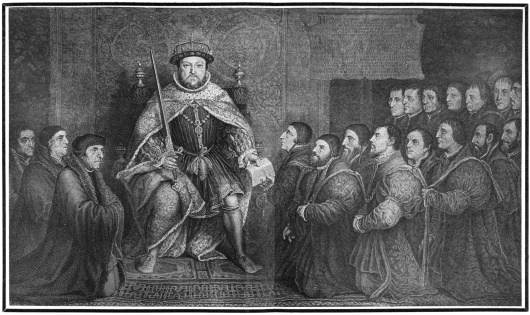
On the King’s left are fifteen members of the Court on their
knees, and in livery gowns, evidently specially sumptuous for the
occasion, being of brocaded or damask silk, trimmed with fur, and
each man wears a livery hood of red and black upon his shoulder. The
first of these is Thomas Vicary, Serjeant-Surgeon, who wears a gold
chain; next comes Sir John Ayleff, Surgeon to the King, also with a
gold chain and a ring on his finger, the next is Nicholas Simpson,
King’s Barber, who, like Vicary and Ayleff, wears a skull cap, all the
others have their heads bare. Then comes Edmund Harman, King’s
Barber, and one of the Witnesses to Henry’s Will, he wears a gold
chain; next him is James Monforde, King’s Surgeon, then John Pen,
the King’s Barber, and Nicholas Alcocke; the expression on the
countenances of all these men is grave and solemn; the next, Richard
Ferris, who has a somewhat merrier face, and was also King’s Surgeon,
completes the front row. The moustaches and beards of the whole,
including the King, would appear as if they had had great care and
attention bestowed upon them. Of the remaining seven figures in the
back row, the names of but two have been preserved, viz., Christopher
Salmond and William Tilley.
This picture of Holbein’s is not surpassed, if indeed it is
equalled, by any other of that master, every part is most elaborately
and delicately finished; the position of none of the figures is
constrained, and there is no attempt at theatrical effect, yet
every person represented is in action, the colouring is chaste,
and kept down, nor is there any of that hardness and stiffness
often observed in Holbein’s pictures. Its reputation has been
truly said to be world-wide, whilst it has been eulogistically
described by some one to be “as glowing as a Titian, and
minutely faithful as a Gerard Dow.”78
The names of the persons represented have been somewhat
rudely affixed to their effigies, probably a few years after the
picture was painted, and whilst we cannot but deplore the disfigurement,
it is more than compensated for, as the means of
identification of so many of our illustrious predecessors. The
tablet, with inscription, has been said to be of later date than
Holbein’s work, and to have been painted over a window, through
which was once seen the old church of St. Bride; this, however,
is most improbable, as it is personally dedicatory to Henry. The
inscription is as follows:—
HENRICO OCTAVO OPT MAX: REGI ANGLIÆ FRANCIÆ
ET HIBERNIÆ FIDEI DEFENSORI AC ANGLICANÆ HIBERNICÆQ
ECCLESIÆ PROXIME A CHRISTO SVPREMO CAPITI SOCIETAS
CHIRVRGORVM COMMVNIBVS VOTIS HÆC CONSECRAT.
TRISTIOR ANGLORVM PESTIS VIOLAVERAT ORBEM
INFESTANS ANIMOS CORPORIBVSQVE SEDENS
HANC DEVS INSIGNEM CLADEM MISERATVS AB ALTO
TE MEDICI MVNVS JVSSIT OBIRE BONI
LVMEN EVANGELII FVLVIS CIRCVMVOLAT ALIS
PHARMACON AD FECTIS MENTIBVS ILLVD ERIT
CONSILIOQ TVO CELEBRANT MONVMENTA GALENI
ET CELERI MORBVS PELLITVR OMNIS OPE
NOS IGITVR SVPPLEX MEDICORVM TVRBA TVORVM
HANC TIBI SACRAMVS RELIGIONE DOMVM
MVNERIS ET MEMORES QVO NOS HENRICE BEASTI
IMPERIO OPTAMVS MAXIMA QVE QVE TVO.
TRANSLATION.
To Henry the Eighth, the best and greatest King of England, France, and
Ireland, Defender of the Faith, and next to Christ, supreme head of the Church of
England and Ireland, the Company of Surgeons dedicate these, with their united prayers.
A grievous plague had ravaged the region of England,
Afflicting man’s spirits and penetrating his frame;
God, pitying from on high this remarkable scourge
Commanded thee to perform the office of a good physician.
The light of the gospel flies around on glowing wings,
This will be the balm to enfeebled minds:
Whilst the disciples of Galen meet to raise a monument to thee,
And all disease is swiftly dispelled by thy power.
We, therefore, a suppliant band of thy Physicians,
Solemnly dedicate this house to thee,
And mindful of the favour with which thou, O Henry, hast blessed us,
Invoke the greatest blessings on thy rule.
The following fragmentary notices of the persons represented in
the picture, will be found of some interest.
The first figure to the left is Thomas Alsop; he was the King’s
Apothecary, and Henry VIII, by his will, left him 100 marks.
Next to him is Dr. William Butts, one of the King’s physicians,
ever famous for his memorable interference with the King on behalf of
Archbishop Cranmer in 1544, when the Roman Catholic party in the
Council endeavoured to procure Cranmer’s committal to the Tower.
A full account of this incident will be found in Strype’s Memorials of
Cranmer (Oxford Ed., 1812, pp. 177–181), and Shakespeare in his play
of Henry VIII (act v., sc. 2) has also graphically described it.
Cranmer’s Secretary, aware of Butts’ great influence with the King,
sent for the Doctor, and acquainted him with the slight which had been
put upon the Archbishop by keeping him standing in the ante-room of
the Council Chamber among lacqueys and servingmen, upon which
Butts immediately repaired to the King, and said:—
“I’ll show your Grace the strangest sight,
The high promotion of his Grace of Canterbury:
Who holds his State at door, ’mongst pursuivants,
Pages and foot boys.”
whereupon Henry replies,—
“Ha! ’tis he indeed!
Is this the honour they do one another?
’Tis well there’s one above them. Yet, I had thought
They had parted so much honesty among ‘em
(At least good manners) as not thus to suffer
A man of his place and so near our favour,
To dance attendance on their lordships’ pleasures,
And at the door too, like a post with packets,
By Holy Mary! Butts, there’s knavery.
Let them alone, and drawn the curtain close:
We shall hear more anon.”
Henry spoke his mind so freely to the Council, that they one and all
shook hands with the Archbishop, and, as Strype says, “Never more
durst any man spurn him during King Henry’s life.”
Dr. Butts must have had the best practice of any man of his
time; there are several references to him among the State papers at
the Record Office, of which the following are a few examples, and
indicate that his patients were the aristocracy of the day.
25th May, 1524. Among the funeral expenses of Sir Thomas Lovell, K.G.,
is this item:—“To John Hewson, riding to Cambridge, to fetch Dr. Buttes when my
master was sick, 4s. 8d.”
28th April, 1525. The Duke of Norfolk, writing to Cardinal Wolsey, says that
last night at 7 o’clock the Lord Marney was “drawyng the draghts of deth, and Mr. Butts
determyned he shuld not lyve after 5 owrys” (hours).
14th October, 1525. A warrant was signed by Wolsey, directed to Sir Andrew
Windsor, for delivery to Dr. Butts, who had been appointed physician to my lady Princess,
of a livery in blue and green, in damask for himself, and in cloth for his two servants.
17th May, 1528. In a letter from the Duke of Norfolk to Wolsey, the Duke
says that Mr. Butts had come to him from the King, without whose aid he thought that
he should not have recovered from his sickness.
23rd June, 1528. In a letter from Brian Tuke (to Cardinal Wolsey) he speaks
of an infection which had been much about of late, and how the King told him that
Mistress Ann Boleyn and my lord Rochford both have had it; what jeopardy they have
been in, by the turning in of the sweat before the time; of the endeavour of Mr. Buttes
who hath been with them in his return; and finally of their perfect recovery.
19th January, 1530. A letter from De Augustinis, written from the palace at Esher,
to Cromwell, desires that Dr. Butts or Dr. Walter Cromer may be sent to the Cardinal
and requesting that Balthazar the physician, may be spoken to, to obtain some leeches;
no time was to be lost and the doctors were to bring with them some vomitive electuary.
Dr. Butts was a personal friend of Henry’s, who, in 1537,
granted him the manor and advowson of Thornage, in Norfolk. He
died 17th November, 1545, and lies buried in Fulham Church, where
there is (or was) a monument to his memory.
Next to Butts, and immediately to the King’s right, is Dr. John
Chambre; he was physician to and a great favorite of Henry’s, holding
several clerical preferments as well. He was a Fellow and Warden of
Merton College, Oxon, where he was admitted Doctor of Physic,
29th October, 1531. In the list of persons to whom Wolsey, in 1526,
assigned lodgings at the King’s house, when they should repair
thither, occurs the name of Dr. Chambre. There is also a catalogue
of the King’s new year’s gifts, in 1528, by which it appears that
the Doctor had a piece of plate weighing 243⁄8 ozs., at the
same time the Cardinal’s gift was 401⁄4 ozs., and that of the
Archbishop 31 ozs.
In Brian Tuke’s letter (23rd June, 1528), before referred to, he
tells Wolsey that when he called on the King with his letters, he found
him in “secret communication with his physician, Mr. Chambre, in a
tower, where he sometimes sups apart.”
Dr. Chambre was Dean of St. Stephen’s Chapel, Westminster,
Canon of Windsor, Archdeacon of Bedford, Prebendary of Comb and
Harnham in Salisbury Cathedral, Treasurer of Wells Cathedral, and
beneficed in Somersetshire and Yorkshire. Truly the lines had fallen
unto him in pleasant places!
He was one of the physicians in attendance on Queen Jane, at
the birth of Edward VI, and in a letter written by him to the Privy
Council, concerning the Queen’s critical state, he signs himself
“priest.” He was also in attendance on Anne Boleyn, in her
confinement with Elizabeth. His name is mentioned with that
of Linacre and three others, in the Charter to the College of
Physicians, in 1518.
Sir William Compton, K.G., in 1522, nominated Dr. Chambre
one of his executors, in conjunction with the Bishop of Exeter, and
Sir Henry Marney, Lord Privy Seal.
Dr. Chambre built a “very curious cloyster,” in St. Stephen’s
Chapel, which cost him 11,000 marks, and he gave the canons of that
chapel some lands. He died in 1549.
On the King’s left is, first, Thomas Vicary (sometimes Vicars
and Vyccary), Master of the Barbers in 1530, and of the Barber-Surgeons
in 1541, 1546, 1548 and 1557. He was a man of great
eminence in his profession, having been Surgeon to St. Bartholomew’s
Hospital, and Serjeant-Surgeon to Henry VIII, Edward VI, Mary and
Elizabeth. He was the author of “The Profitable Treatise of
Anatomy” in “The Englishman’s Treasure, with the true Anatomie
of Man’s Body.” An account of Vicary will be found in D’Arcy
Power, pp. 102, etc., and several particulars relating to his connection
with St. Bartholomew’s Hospital, are recorded in a paper by Dr.
Norman Moore (Hospital Reports, vol. xviii, pp. 333–358); see also
Dr. Furnivall’s exhaustive account (Early English Text Society).
Next comes Sir John Ayleff (Aylif, Aylyff, etc.). He was
Master of the Barbers in 1538, and Surgeon to the King, with whom
he was doubtless on terms of friendship, as Henry bequeathed him
100 marks. Ayleff treated Henry for fistula and cured him, at
Brinkworth in Wilts, for which the King bestowed upon him a great
estate there in gratification. He subsequently became a Merchant of
Blackwell Hall, Sheriff of London in 1548, and Alderman of Bridge
Without in 1550.
17th July, 1550. In the Repertories of the Court of Aldermen
is a Record that the Court of the Barber-Surgeons gave their assent
to the Translation of Sir John from theirs to the Grocers’ Company,
of which Company he was crowned Upper Warden 9th June, 1556.
Sir John Ayleff was buried 20th October, 1556, in the Church
of St. Michael Bassishaw, where there was formerly a marble tomb
with this inscription thereon—
In Chirurgery brought up in youth,
A Knight here lyeth dead;
A Knight and eke a Surgeon such
As England seld hath bred.
For which so soveraigne Gift of God
Wherein he did excell,
King Henry VIII call’d him to Court,
Who lov’d him dearly well.
God gave the Gift, the King gave Goods,
The Gift of God t’enhance;
Where God and such a Prince do joyne,
Such Man hath happy Chance.
King Edward for his service sake,
Bade him rise up a Knight,
A name of Praise and ever since
He, Sir John Ailiffe hight,
Right Worshipful, in name and charge
In London lived he than,
In Blackwell Hall the merchant chiefe
First Sheriffe, then Alderman.
The Hospitals bewaile his death
The Orphan children mone,
The chiefe Erector being dead
And Benefactor gone.
Dame Isabel who lived with him,
His faithful Wife and Mate,
With him (as dearest after death)
Doth not her Knight forsake
The Knight the
2479 of October.
Yeelded up his breath,
And she soon after followed
To live with him in death.
19 April, 1558. My lady Aylyff gave a fyne table cloth of damaske worcke
to sr̃ve for the uppermost table in the hawle the wch of her jentyllness she gave frely
unto this hawle.
John Ayleff (son of the Knight) was admitted to the freedom of
the Barber-Surgeons, 3rd June, 1552.
Next to Sir John Ayleff, is Nicholas Simpson, concerning
whom nothing is known to me, but that he was “King’s Barber,” and
Master of the Barbers in 1537.
Edmund Harman, “King’s Barber,” follows next; he was
admitted to the freedom in 1530, and served Master in 1540. Henry
VIII bequeathed him 200 marks, and he was one of the attesting
witnesses to the King’s will. There are several references to him
among the State Papers and Household Ordinances. His dignified
bearing and expression in the picture are very striking.
James Monforde (or Mumford), “King’s Surgeon,” is next; he
was Upper Warden in 1540 and again in 1543, but never served as
Master. He gave the Company their silver hammer, still used by the
Masters in presiding at Courts.
Then comes John Pen (Penn or Penne), “King’s Barber,” and
Groom of the Privy Chamber; he was admitted to the freedom in
1527 and was Master 1539. He married Lucy, daughter and heiress
of Edmond Chevall, of Coddicote, Herts, by whom he had a good
estate and seven children (vide Harl. Soc. Pub. xxii., 82 & 116).
In Liber Niger Domus Regis (Harl. MS. 642) among the
orders made for the regulation of the Household of Henry VIII
was one, that none but fifteen persons whose names are specified
should be allowed to enter the Privy Chamber, and one of these
is John Penne.
The following quaint regulation, concerning the King’s Barber,
is to be found in the same MS.—
Item. It is alsoe ordeyned that the Kingꝭ Barbor shalbe daylie by the Kingꝭ
upriseinge readdye and attendant in the Kingꝭ Privye Chamber there haveinge in
reddynesse his Water Basons Knyvesꝭ Combes scissourꝭ and such other stuffe as to his
Roome doth appertaine for trymminge and dressinge of the Kingꝭ heade and bearde.
And that the sayd Barbour take a speciall regarde to the pure and cleane keepinge of
his owne p’son and apparrell useinge himselfe allwayes honestlye in his conversationne
withoute resortinge to the Companye of vile personnes or of misguided woemen in
avoydeinge such daunger as by that meanes hee might doe unto the Kingꝭ most Royall
person not fayling thus to doe uppon payne of looseinge his Roome and farther
punnishement at the Kingꝭ pleasure.
In this MS. is also to be found an earlier order, of the time
of Edward IV touching the King’s Barber, which is curious, as
indicating that Saturday night was then (as still it is with many)
“tub night” with the King; and we may also infer from the
expression “if it please the King to cleanse his head, legs or feet,”
that it was not a fixed rule for him to do so every Saturday night.
A Barbour for the Kingis most highe and drad p’son to be taken in this Court,
after that he standeth in degree gentleman yoman or groome. It hath bin much
accustomed to one or two well knowne officers of the Ewrie in housold Daily of
such as bene for the monthe Sergeant or othir. Also we finde how this hath bene used
amonge by a weele betrusted yoman of chambre ffor lacke of cunning of these other
men. It is accustomed that a knight of the Chambre or elles squire of the bodie or
both be p’sent every time when the Kinge wolle shave. This Barbour shall have
every satterday night if it please the Kinge to cleanse his head leggꝭ or feete and for
his shaveing two lovis80 one pitcher wine. And the usher of chambre ought to testifie
if this be necessary dispensed or not.
It is said that the portrait of Pen was greatly admired by Sir
Robert Peel, who frequently came to the Hall to look at it, and who is
reported to have offered the Company £2,000 for the head, if it might
be cut from the picture, he undertaking to make good the damage!
He is also alleged to have said at one of his visits, that he should like
to sleep on the table at the Hall, so that the first thing he would see
on waking in the morning might be Pen’s head. Had Sir Robert
known the legend81 of the table he would perhaps have suggested a
different bed. Henry VIII left, by his Will, 100 marks to Pen.
Concerning the next man, Nicholas Alcocke, nothing is known
beyond that he was Surgeon to Edward VI, and was admitted to the
freedom in 1523. He was doubtless a member of the Court, though
he never served as Warden.
The last on the front row is Richard Ferris (or Ferrers), Master
in 1563 and Serjeant-Surgeon to Elizabeth. Like others of his
brethren, he also benefited under Henry’s will, to the extent of 100
marks, and was one of the King’s Surgeons.
In the back row are seven figures, but of these the names of
only two survive, viz., William Tylley, Upper Warden 1546, and
Christopher Samon (Salmon, Sammond), admitted to the freedom in
1528, and Master in 1553. By Domestic Papers, Henry VIII, vol. 5,
p. 690, it appears that one Christopher Samon was living in Lombard
Street in 1532: this might be the same man.
29 August, 1668. Dear old Samuel Pepys visited us this day,
and thus records his intentions and opinion concerning the picture—
And at noon comes by appointment Harris to dine with me: and after dinner
he and I to Chyrurgeons Hall, where they are building it new, very fine; and
there to see their theatre, which stood all the fire, and which was our business,
their great picture of Holben’s, thinking to have bought it by the help of Mr.
Pierce,82 for a little money: I did think to give £200 for it, it being said to be
worth £1,000; but it is so spoiled that I have no mind to it, and is not a pleasant,
though a good picture.
James I seems to have entertained a high opinion of this picture,
and borrowed it of us to be copied: his letter applying for it is preserved
at the Hall, and is as follows.
James R.
Trustie and welbeloved Wee greete you well. Where we are informed of a
Table of painting in yor Hall wherein is the Picture of or Predecessor of famous memorie
K. Henry the 8th, together with diverse of yor Companie, wch being both like him, and
well done, Wee are desirous to have copyed. Wherfore or pleasure is that you presently
deliver it unto this bearer Our Welbeloved Servant Sr Lionell Cranfield Knight, One of
Our Maisters of Requests, whome Wee have commaunded to receave it of you and to see
it wth all expedition copied and redelivered safely; and so Wee bid you farewell. Given
at Our Court at Newmarket the 13th day of Januarie 1617.83
The Court of course agreed to lend the picture, though
doubtless with some misgivings; contrary however to the practice
of the time when money was “lent” to the King, it found its way
back to the Hall.
In 1627, Charles I, a more suspicious borrower than his
father, had it to Whitehall, but here again we fortunately had it
returned.
The Royal College of Surgeons possess some Cartoons, from
which, it has been said, this picture was painted; this is, however, very
doubtful. Some particulars as to these Cartoons may be seen in
Mr. D’Arcy Power’s book, p. 96.
In 1734 the Company agreed with Mr. Bernard Baron for him
to engrave the picture for 150 guineas, and several details relating
thereto are recorded in the Minutes. It was published in 1736, and
is a faithful reproduction, much sought after by collectors. Baron has
however copied the picture, exactly as he saw it on to the copperplate,
so that when the impressions were struck off, everything was
reversed. His original study, a red crayon, beautifully executed,
is preserved in the Court Room, and the copperplate is still used,
each Assistant on his election being presented with a copy of
the engraving. The Company also possess a rather rough proof
before letters.
The print is dedicated to the Earl of Burlington, with a Latin
inscription, of which the following is a translation.
“To the Most Noble Lord Richard Boyle, Earl of Burlington
and Cork, &c., Knight of the Most Illustrious Order of the Garter.
For the restoration, with the greatest liberality, at his own costs, of
the Anatomical Theatre built a hundred years before, with the
greatest skill, by the very celebrated Architect Inigo Jones, and
decayed by lapse of time. This painting of Holbein representing
the granting of a Charter given with his own hand by Henry VIII,
King of England, &c., to the Society of Surgeons in London and
preserved in their Hall, is by the Society of Surgeons of London
humbly dedicated.”
This inscription, written at a time when the relations between
the Barbers and the Surgeons of the Company were becoming strained,
was evidently drawn by a Surgeon, who coolly ignored the Barbers
throughout.
A very good pen and ink drawing of the picture was made by
Austin Travers Young (aged 16) in 1883, and presented by him to the
Company, for which he received the thanks of the Court.
1537. In “Chapter House Book” B. 1. (at the Record Office)
is a list of the freemen of the several Companies of London at this
date, which gives the names of 2,468 freemen in 39 Companies (an
average of about 63 to each). The Barbers outstripped in numbers all
the others, having a roll of 185 members; next to them came the
Skinners with 151, then the Haberdashers with 120, so on down
to the Bowyers, who mustered but 19. The premier Company,
the Mercers, numbered but 55, whilst the ancient Weavers had
only 30 members.
The following is the list of our freemen, the first twenty-six
being members of the Court, and Nicholas Symson, Master that year.
| Nicholas Symson. | John Raven. | Thomas Wilson. |
| Willm Kyrckby. | Robert Hutton. | John Smythe. |
| Thomas Vycars.84 | Henry Pemberton. | Willm Hiller. |
| John Bankꝭ. | Willm Shirborne. | Richard Tholmod.85 |
| John Potter. | George Genne. | John Awcetter. |
| Thomas Twyn. | Thomas Johnson. |
| John Johnson. | Robert Spegnall.86 | Richard Sermond. |
| John Holland. | Richard Boll.87 | Hugh Lyncocke. |
| Willm Rewe. | Nacholas Alcoke. | John Bordman. |
| John Aylyff. | Willm. Tylley. | Rauf Stek. |
| Edmond Harman. | John Northcote. | Henry Hogekynson. |
| John Peñ. | Willm. Wetyngton. | John Tomson. |
| Richard Tayler. | Henry Yong. | Hugh Dier. |
| Harry Carrier.88 | Cristofer Samond. | Edward ffreman. |
| Rauf Garland. | Robert Waterford. | Thomas Mone. |
| John Enderbye. | Henry Atkyn. | Willm Yenson. |
| Peter Devismand.89 | Christofer Bolling. | John Banester. |
| Robert Postell. | Robert Stocdale. | Willm Trewise. |
| John Bird. | Mathiewe Johnson. | Christofer Hungate. |
| James Tomson. | Davy Sambroke. | John Hutton. |
| Willm. Kydd. | John Atkynson. | John Browne. |
| John Yong. | Thomas Waryn. | John Grene. |
| Thomas Sutton. | Robert Grove. | John Tymber. |
| Charles Wyght. | Robert Brownhill. | John Shrene. |
| John Newman. | Willm Spencer. | Thomas Staynton. |
| Thomas Grome. | Thomas Butfilane.90 | Thomas Pays. |
| Robert fforster. | Thomas Mede. |
| Willm Higgꝭ. | Edmond Tyrell. | John Anger. |
| John Dene. | John Philpott. | Thomas Worseley. |
| Thomas Surbutt. | John Thowlmod.91 | John Gilberd. |
| Willm Billing. | Edward Ingalby.92 | Cristofer Haynes. |
| Willm. Lyghthed. | Richard Elyott. | Willm. Smythe. |
| John Mosseley. | Willm. Downham. | John Smerthwaite. |
| Willm. Hill. | Rogier Skynner. | John Lybbe. |
| George Wenyard. | John Gerard. | George More. |
| John Barker. | Richard Rogiers. | Thomas Burnett. |
| Willm. Barker. | Thomas Dicson. | John Hamlyn. |
| James Wod. | Thomas Gylman. | Richard Child. |
| John Stere. | Thomas Dester. | Thomas Baily. |
| Willm Hetherley. | Edward Hewett. | George Vaughan. |
| Olyver Wilson. | John Dormot. | Thomas Wetyngh’m. |
| Willm. Grene. | George Batman. | John Bonair. |
| Henry Rawshold. | Thomas Vivian. | Richard Cokerell. |
| Bartilmewe Dobynson. | George Brightwelton. | Willm. Walton. |
| Henry Patterson. | John Waren. | Geferey ffraunceis. |
| Philip Pegott. | John Greenway. | Thomas ffayles. |
| Robert Downys. | John Bell. | John Edlyn. |
| Antony Barowes. | Laurens Mollyners. | John Samond. |
| James Hogeson. | John Cobbold. | Henry Bodeley. |
| Robert Wevir. | Willm. Draper. | Thomas Stanbrige. |
| John Surbut. | Richard Smythe. | Willm. Borrell. |
| Willm Sewell. | Robert Ledꝭ. | Richard Nicols. |
| John Denys. | John Gamlyn. | Edward Hughbank. |
| John Page. | Thomas Cutbert. | John Charterane. |
| Robert Dodwell. | Robert Chamber. | Henry Wotton. |
| John Cutberd. | Lewis Bromefeld. | Robert Hastyngꝭ. |
| John Gray. | Richard Worseley. | Alex Mason. |
| Willm. Dauntese. | John Oskyn. | Thomas Darker. |
| Thomas Appilton. | John Robynson. | Thomas ffyshe. |
| John Cragell. | Richard Coley. | Edward Rollesley. |
| Thomas Arundell. | John West. | John Braswell. |
| Willm. Johnson. | Willm. Welfed. | Willm. Symsyn. |
| Henr’. Adam. | | |
The forty-two names following the Court and ending at John
Awcetter were Liverymen, the remaining hundred and seventeen being
Yeomanry.
1543. A few years previously the King had set the example of
wearing his hair and beard short, and now the City seems to have
discountenanced long beards, as I find the following in Letter Book
Q. 87. (10th July, 35 Henry viij.)
An acte agaynst
bearded men.
Item for dyvˀse & sundrye consyderac͠ons & causes movyng this Cor̃te it is
this daye orderyd & decreid & establyshed by the same that from henseforward
there shall no Cytezen or other iñhitaunte93 of this Cytie usyng or havyng a greate
berde of more notable pˀlyxitie94 or length then other the seid Cytezens of this
Cytie do nowe use or have hertofore of late yeres usyd to were, either be iñhited
pˀmytted or suffred to Receyve or take eny orphanage into his handes and custodye
albeit that he wolde fynde nevˀ soe good suertyes for the same nor yet be admytted
from henseforward to this Corte for eny Recognitons or suertye for eny suche orphange
And yt is also assentyd & agreid that no pˀson havynge eny such berde shalbe
admytted by redempc͠on into the lybt̃ies & fredome of this Cytie as longe as he
shall were eny such berde.
1544 and 1545. In Repertory XI (at Guildhall) ff. 73B.,
176, 187B., 229B., 232 and 234 are various records relating to
the vexed question of the Barber-Surgeons going on inquests,
bearing armour and serving as constables, from all which
offices they claimed exemption under their Charters and Act of
Parliament.
By the earlier entry, it seems that the Wardens were warned
to appear before the Court of Aldermen to shew cause why they
refused to pass upon inquests, etc.; then came a petition from the
Company praying to be discharged of all offices save the Inquest of
Wardmote once a year; this does not appear to have satisfied the
Authorities, and the Company were directed to draw up further Articles
to be submitted to the Court of Aldermen. Great pressure was no
doubt put upon the Barber-Surgeons, the result being that they
abandoned most of the privileges of exemption which they had
claimed, and submitted a Bill of Articles, which was finally approved,
and entered of record on fo. 234. A copy of this lengthy document
is at the Hall, and from it it appears that on the 22nd October,
1545, the Company appeared before the Court of Aldermen as
“humble Besechers” to be shorn of their privileges, the ground
of their petition being “That forasmoche as some grudge and
displeasure is lately sith the unyon and conjunction of their
said ffelowshippes in to one entyre Company growen conteyned
and taken against them and their said ffelowship, by dyverse
of theire neighbours being citezeins of this citie, as they be, by
reason that they your said suppliauntꝭ” are discharged by their
Charters and Act of Parliament from bearing offices, etc., “that
other the Cittzeins of this citie are ellygible and lyable unto,
ffor the whiche grudge and displeasure your besechers are not
a little sorye. ffor the playne declarac͠on thereof and for the
eschewyng advoyding and utter extinguysshement of the said grudge
and displeasure from hensforwarde,” they are content that it shall
be ordained that they shall go upon all Wardmote Inquests, but not
upon any inquests between party and party (i.e., sit as jurymen in
civil actions); that all freemen of the Company not practising
Surgery shall be contributory to all assessments, serve as Constables
and keep watches in their turn as other citizens, but that all
Surgeons shall be free from bearing armour, etc.
Notwithstanding this compromise, entered in the City books,
it seems in course of time to have been overlooked, and, as has
been previously remarked, the exemption of all freemen of the
Company from juries, etc., has been claimed and allowed down to
quite recent days.
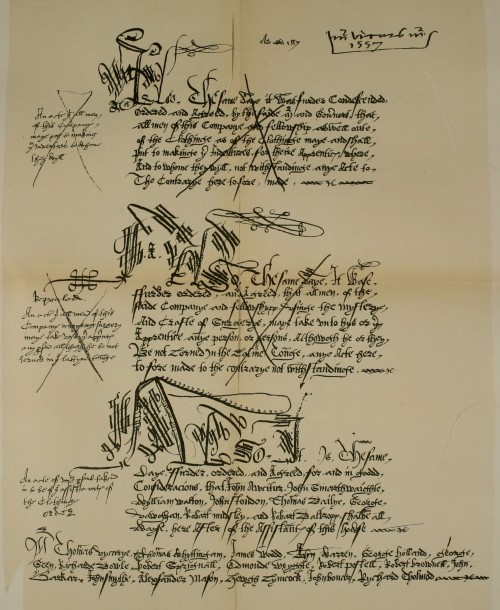
FAC-SIMILE PAGE OF FIRST MINUTE BOOK, 1557.
1550. The first of our Court Minute Books which has been
preserved, commences in the 4th Edward VI, and bears this title,
Orders and Awardes made ordered and awarded within the tyme of Maister George
Geen Thomas Johnson Thomas Stocdall and Mathew Johnson Maister and Wardeins of
the Company and fellowship of Barbors Surgeons of London for one hole yere begynnyng
the xxvjth day of Auguste in the fowerthe yere of the reigne of our Sovereigne Lorde
Kynge Edward the Syxte with thassent and consent of the Assistaunces of the same
Companye as hereafter ensuethe.
From this and the succeeding Minute Books, the following
extracts are principally taken as illustrative of the Company’s History
from this period:
1556. At the end of the first book is a very long memorandum
written and signed by Thomas Knot, Master, to the effect that on the
26th March, 1556, he made humble suit to the Lord Mayor, Sir
Willm. Garrett and the Aldermen, in the name of the Company, for
the exemption of the Company from finding or setting forth any
soldiers or men of war at any time thereafter, when it might be that
the Citizens of London should be required to do so, either by sea or
land, “fforasmoche as the same Company are alwayes at every such
tyme and tymes very sore burdened and chardged otherwise hereafter
expressed, that is to saye, They are comaunded and bounden to
prepare and fynde so manye Surgeons and so many other men
attendinge upon them at every tyme and tymes that it shall fortune
the King” to send out soldiers by sea or land, and “the same Company
doe alwayes prepare fynde and send furthe for every one houndreth
of suche Souldyers one Surgeon and a man attending upon him.”
Upon which representations the Lord Mayor and Aldermen were
pleased to grant to the Company, that on future occasions when the
like requisitions might “fortune to be layed or appointed to or
upon theym, that then they in every suche case upon their gentle
suyte and request made unto the Lorde Mayor and courte of
Aldermen for the tyme beinge for and concernynge their sayd
dischardge for and in consyderac͠on of the causes above remembered,
shalbe as gentelye and charytably holpen eased and
releaved in that behalf as the wayte and ymportaunce of the
burden that the Cytie at every suche tyme shalbe chardged wth
all will reasonablye permytt and suffer.”
The memorandum then proceeds to state that the Lord
Mayor and Aldermen advised the Master to cause a remembrance
of the above (being only a promise by word of mouth)
to be entered and recorded in the Book of Ordinances of the
Company, which was done.
1555. In Henry Machyn’s Diary for this year, is the following
reference to a Romish procession, winding up with a dinner
at Barbers’ Hall.
The xxvij day of May was the Clarkes prossessyon from Yerdhall95 college,
and ther was a goodly masse to be hard, and evere clarke havyng a cope and
garland, with C.96 stremers borne, and the whettes97 a playng round Chepe, and
so to Ledynhall unto Sant Albro98 chyrche, and ther thay putt off ther gayre,
and ther was the blessyd sacrament borne with torche-lyght abowt, and from
thens unto the Barbur-hall to dener.
1558. This year (8th June) the Company procured an
Inspeximus Charter from Philip and Mary, which is still in our
possession, and has a most beautifully executed title, the initial
letter representing the King and Queen seated on the throne,
and the border containing various heraldic badges; the seal
unfortunately is damaged.
PHILIPPUS ET MARIA, Dei gracia Rex et
Regina Anglie hispaniarum ffrancie utriusque
Sicilie Jerusalem & hiᵬine fidei defensores
Archiduces Austrie Duces Burgundie Mediolani
& brabantie Countes haspurgi fflandrˀ
& Tirolis.
Omnibus ad quos presentes lr̃e
pervñint salt̃m.
Inspeximus quasdam lrãs patentes
domini H. quondam Regis Anglie septum99
fc̃as in hec verba, Henricus dei grã, &c.
. . . . . . . . . . Teste me
ip̃o apud Westmonastiũm duodecimo die
marcii Anno regni nr̃i tcĩo. Yong. pro viginti soliᵭ solut̃ in hanap̃io. Nos
autem lrãs pˀdcãs ac omnia & singula in eisdem contenta rata heñtes &
grata ac ea pro noᵬ heredibʒ & Successoribʒ nr̃m prefate Regine quantum
in noᵬ est acceptamus & approbamus ac ea dilc̃is noᵬ Thome Vicary
nunc magistro mistere barbitonsoꝜ Thome Whytyngame Jacobo Wood &
Johĩ Warren Gubernatoribus ejusdem mistere & Successoribʒ suis ratificamus
& confirmamˀ p’ut lrẽ p’dc̃e in se r̃onabiliter testantur. In cujus rei testimonĩu
has lr̃as nrãs fieri fecimus patentes. Testibus nobis ip̃is apud Westmonasterium
octavo die Junii Annis regnorum quarto & quinto.
Lutley.
Taxat̃ finis ad xl.
Nico eboꝜ Canc.100
It is noticeable in this Charter that the confirmation is to the
Governors of the “Barbers,” and not “Barber-Surgeons,” although the
latter was then the legal style of the Company, but probably this was
another clerical error.
1560. This year (6th January) the Company obtained an Inspeximus
Charter from Elizabeth, still preserved at the Hall; it has
a title in much the same style as the preceding charter, but the seal
is very much damaged.
ELIZABETH, Dei gracia Anglie FFrancie, et hibernie Regina fidei
defensor, &c. Omnibus ad quos presentes littere pervenerint
salutem.
Inspeximus litteras patentes Dn̄i P. et Dn̄e M. Sororis nr̃e
precharissime nuper Regis et Regine Anglie de confirmac͠oe factas
in hec verba Philippus et Maria dei gracia, &c. . . . . . . . . Testibus
nobis ip̃is apud Westmonasterĩu octavo die Junii Annis regnoꝜ nr̃oꝜ quarto et quinto.
Nos autem lrãs predcãs ac omĩa et singula in eisdem contenta rata habentes et grata
ea pro nobis heredibus et successoribus nr̃is quantum in nobis est acceptamus et
approbamus ac ea Diɫcis nobis Georgio Geñ nunc magistro mistere BarbitonsoꝜ Willm̄
Grene Thome Bayly et Joh̃i Smarthawyte Gubernatoribus ejusdem mistere et Successoribus
suis ratificamus et confirmamus prout lrẽ predcẽ in se racionabiliter testantur.
In cujus rei testimonium has lrãs nrãs fieri fecimus patentes. Teste me ip̃a apud
Westmonasteriũ sexto die Januarii Anno regni nr̃ secundo.
Cotton.
Taxat̃ finis ad xl. vjs. viijd.
In Machyn’s quaint Diary, we find the following entries:—
1561. The xxiiij day of Feybruary whent to hang xviij men and ij women, and
serten ware browthe101 to be bered in serten parryches in London; the barbur surgens had
on102 of them to be a notheme103 at ther halle.
1562. The xx day of June was a gret shutyng104 of the Compene of the Barbur
Surgeantes for a gret soper at ther owne hall for a xxx mess of mett,105 for they dyd make ij
godley106 stremars agaynst that day of their harmes,107 the whyche they wher agmented by the
most valeant kyng at armes master . . . . . . and they had vj drumes plahyng and
a flutt; and ij gret ansutts,108 and as a shot was wone, downe whent that and up the thodar,109
and as they whan the shut; and master Gall110 and ys syd111 wan the soper—the master of
the Compene.
The x day of August was Barbur surgyons fest, and they capt ther communion at
Sant Alphes112 at Crepull-gat, and master Recherdson dyd pryche,113 the skott; ther was
good syngyng; and after to ther halle to dener, and after dener a play.
1567. Elizabeth inaugurated the first State Lottery in England,
as a means of providing money, and a very peremptory mandate was
directed by the Lord Mayor to the various City Companies, commanding
them to adventure therein.
1st February, 1568. The Barber-Surgeons put in 40s. for the
“use, profet and benefyt of the hall,” but did not draw a prize, and
indeed none of the Companies reaped any advantage by the speculation,
the Lottery being simply a trap into which they were ordered to walk.
The proposal for this Lottery was as follows:—
A verie rich Lotterie Generall without any Blancks contayning a great No. of
good prices, as well of redy money, as of Plate & certaine sorts of marchaundizes
having been valued & prised by the commaundement of the Queenes most excellent
Majestie by men expert & skilfull and the same Lotterie is erected by hir majesties order,
to the entent that such Commoditie as may chaunce to arise thereof, after the charges
borne, may be converted towards the reparation of the Havens and strength of the
Realme, & towardes such other publique good workes. The No. of lots shall be foure
hundreth thousand, and no more: and every lot shall be the summe of tenne shillings
sterling onely, and no more.
Stow says that this Lottery was commenced to be drawn on
the 11th January, 1569, at the West Door of St. Paul’s, and continued
drawing day and night until the 6th May following.
It was a common practice of the Companies to put in their
money under mottoes, and some curious ones are recorded, many
being composed with a quaint sarcasm on the probability of prizes
being obtained.
Herbert (Hist. of the Twelve Livery Companies) gives some
interesting particulars of the State Lotteries, and quotes a motto used
by the Merchant Taylors which pretty clearly indicates their opinion
of the business;
One byrde in the hande is worth two in the wood,
If we get the great lot, it will do us good.
Some of the prizes were ridiculously small, e.g., 1s. 2d., 2s. 1d., etc.,
and great dissatisfaction was expressed at the principal prizes remaining
unpaid to the winners.
1573. The Company received a precept from the Lord Mayor
for a “loan” of money to make provision of wheat for the City,
and the same was by the Court ordered to be complied with. This
“corn custom” is very fully treated of by Herbert, and was virtually
a tax upon the companies, who were each rated and compelled to find
a certain proportion of corn to be stored by the City, and sold at such
times as when, there being a scarcity, the markets would otherwise
rise, were it not for the immense stock kept by the City. This custom
survived for many years under certain modifications; as we shall see
hereafter, our Company built a granary in 1633, and stored their
own corn.
The precept above referred to was as follows—
Forasmuche as all comon polecye requyreth the prevenc͠on of extremities, and
consideringe as you knowe the urgent and present necessitie, and the lacke of provision
of wheate and other grayne for furniture of this so great and populous citie, of the want
whereof the queenes matie and her most honorable coñsell are not ignorant; but havinge
spˀcial regard to the same, are not a lytle offended and displeased, with some grefe
that there bene no better pˀvision heretofore made, and that presentlie the cittie shoulde
be no better stored, by reson wherof the prices of corne and grayne is now muche dearer
in this cittie than in any other parte of this realme, have not only at sundrye times and
gentle meanes, but also wth some terror, as welle in the Starre-chamber as in other
places afore the counsell, given us admonicion that the same her maties cittie and
chamber may not be unfurnished for lacke of good pˀvision. And we, as our
duties is, havinge great care and especial consideracion of the same, and pˀcevynge
by order of the harvest past, and the unkynd season of the yeare, sith that the
prices of corne is verry likely to encrease and be advanced to a greater and higher
price than yet is, have thought good and verrye necessarye for the avoyding of
greater inconvenyences, to make immediate pˀvision of a great masse and quantity
of wheate and other grayne, as well wthin the realme as beyond the seas for the
provision aforesaid, wch cannot be done wthout a great some of money presentlie
to be defrayed, wch is not to be levyed but by the good assestens of you and
others, good coustomers and cittezens of this cittie; have therefore assessed your
Company of Barber Surgeons at the some of114 which is agreed upon
by acte of coˀen counsell, wch some of we do not only require you,
but also streaghtle charge and comande you, immediatelie upon the recept hereof,
calling your companye together in your comon hall, you do forthwth tax, levy,
and gather of the welthiest and most able persones of the same the sum aforesaid,
in such wise that you fayle not to pay the same, and evrie pˀcell thereof, to the
hands of George Helton, of the cittie of London, wth all expedicion, and wthout
repayment thereof to you. Fayle not hereof, as you tender the mytigac͠on of
our sovereigne ladye the queens majesties displeasure already conceived, and do
tender the com̃on weale of this cittie, together wth your private condytte, and as
you will answer for the contrarye.
The next entry would seem to indicate some contemplated
State interference with the Company’s property, and the answer
was probably not in exact accordance with the truth, for on the
28 May, 1576, a precept in the Queen’s name, having been
received, calling upon the Master and Wardens to return to
class="tal plhir"nt of the revenue of their lands, and of
their goods, “the answere was that the true revenewe of the
landes was xxti markes whereof the most pˀte went forthe and is
disbursed in peñcons, and that we had no goods.”
1578. A precept was received as follows,
To the Wardens
of the Companie
of Barbor
Surgins.
By the Maior.
Thyes shalbe to will and require you and in her maiesties name
streitlie to charge and comaunde you that wth all convenient spede
you appointe and pˀvide the number of twelve hable and sufficient pˀsons being Iournemen
appnˀtices or others wch are fremen of this Cittie and inhabitinge wthin the same beinge of
agilitie and honest of behavior betweene the age of xix yeres and xlti wch are fitt to be
trayned for harquebus shott, evˀy one of them havinge a murrion, a sworde and dagger,
and a caliver wth sufficient furniture for the same, and one half pounde of powder, besides
touche powder whereof Three of the same pˀsons to be house holders and free men of
yor saide Companie, and that you certyfie me the saide Maior the names and sir names of
all yor saide number where and wth whome they dwell, of what Companie they be free,
and what Captaynes or other skilfull men that be of yor saide Companie or whome you
knowe inhabitinge wthin this Cittie fitt to trayne or leade the same men of there names
and dwellinge places. And that they be all in a redines furnished as aforesaide to
muster in there hose and dublets onlie, or dublets hose and jerkins wthin xiiijen daies
next ensuinge the date hereof. And for the levyenge of monie for the saide furniture
And for the charge of powder you shall collect suche reasonable somẽs of monie as you
shall finde mete for the saide pˀporc͠on, by waie of reasonable assesment of evˀy
sevˀall welthie and hable pˀson of yor Companie. Wherein we require you in anie wyse
to spare the powrer sorte of ffremen although you somewhat more largelie burden the
ritche. Yoven at the Guildhall of this Cittie of London the xvth daie of Marche 1577.115
Sebright.
In pursuance of this precept a levy was made upon ninety
freemen, who contributed £19 17s. 11d. (in sums ranging from
1s to 6s 8d) and upon ten “foreins” who paid in all £3. The Expenses
of the soldiers, and their arms, powder, etc., are all set out in detail
(see Appendix D).
1585. It was agreed “that or Companie by reason of the
often and earnest preceptes from the Lorde maior to move unto some
liberall puttinge in of monie into the Lottery for Armor, that or
Companie should put in xli yf that might satisfie for all the Companie
vizt the Clothinge vjli xiijs iiijd and the yeomanry v m’kes.”
29th September, 1586. The Lord Mayor had issued sundry
precepts to the Company for the “buyeinge of certein goune powder
amountinge in waight to of one Mr. Henry Dale
Hab’dassher at the price of xd le ɫi. and yt was agreed the saide
powder should be bought and that Mr. Swaldell [Master, 1593]
should go to chuyse it, and he to have the same powder for viijd the
pounde.”
10th March, 1589. It was ordered that the gunpowder
directed by another precept to be provided by the Company, should be
bought and that it should be kept “in the Armorie howse in convenient
place for feare of daunger of ffier.”
29th March, 1596. It was ordered that £40 “ship money”
should be “lent” by the Company to the City, which is the earliest
mention of this obnoxious tax in our books.
8th August, 1596. “Yt was agreed that the som̃e of £xxxti
shalbe lent unto the Cytty for the payenge of Souldiers wages and
other charges diffrayed about the Spanishe voyage.” This was an
Expedition of certain ships (furnished by the City) under the Earl
of Essex and Sir Walter Raleigh “to annoye the King of Spaine.”
The English then sacked and burned Cadiz, burnt the Spanish navy,
and on their return home, says Stow, “great triumph was made at
London for their good successe.”
18th August, 1598. At this Court came a precept from the
Lord Mayor, commanding the Company in Her Majesty’s name to
“lend” £100 to the Queen for six months, for suppressing rebels in
Ireland. The demand was, as usual, of a most peremptory nature,
and the Court ordered £100 to be paid to the Treasurers appointed
by the City.
6th August, 1599. A precept came from the Lord Mayor in
the Queen’s name, commanding the Master and Wardens to deliver to
the freemen the Company’s armour in “suche order as it maye be, in
safetye readie for her Maiesties service,” whereupon the Master took
for his own use “one muskett fflaske and tuche boxe one headepeece
and one rest.” Eleven other members of the Company had armour
delivered out to them, as “one caliver fflaske and tuche boxe, sworde
and dager girdle and hangers and headepeece.”
1599. A precept was received on 11th November, commanding
the Company to be in attendance on the Queen in her
progress from Chelsea to Westminster, which is not only curious for
the quaintness of its description of the persons who were to be
appointed, but affords a glimpse at the magnificence of Royal processions
three hundred years ago.
To the Maister
and Wardens of
the Companye of
Barbor-surgeons.
By the Maior
Where her Mats moste gratiouse pleasure and comaundement is
this pˀsente daie signified unto me the lorde Maior from the
right ho: the lorde Chamberline of her Maties moste honorable householde that myselfe
and my Bretheren thaldermen with a conveniente number of the beste and moste
graveste Cittyzens of this Citye shoulde uppon Tewesdaie nexte in the Afternoune wayte
and attende uppon her highnes royall pˀson from the Towne of Chelsey unto her highnes
princlie pallace at Westminster in as honorable and statelye sorte as conveinentlye maye
be pˀformed. In accomplishment of wch her highnes said comaundement, These shalbe
to chardge and comaunde you in her Mats name to pˀpare not onlye your selves, but alsoe
provide and have in a readines the full number of eighte pˀsons of the moste graveste
talleste and comliest pˀsonages of your saide Companye, everye of them to be well horsed
and appareled in velvet coates and chaynes of goulde And that not onlye your sealves
but alsoe everye of the saide eighte pˀsones maye have one footeman with twoe staffe
torches to waite and attende upon him, and to be all in a readines well and substancially
horsed appareled and appointed as aforesaide in Cheepeside by twoe of the clocke of the
saide afternoone to attende uppon me and my bretheren thaldermen to waite upon her
moste excellente Matie from Chelsey aforesaide to her highnes saide pallace of Whitehall,
Whereof see you faile not at your pˀill and as you will answere the contrarye if throughe
your negligence any parte of this service shall not be thoroughelye pˀformed. Guihalde
the ix of November 1599.
Sebrighte.
In pursuance of the above precept the Master with seven other
Members of the Court were appointed to attend, and eight freemen
were nominated as torchbearers.
1600. The fee simple of three houses in Monkwell Street was
this year purchased by the Company of William Fyninge for £112!
11th November, 1600. In obedience to a precept it was
ordered that twelve members of the Court “well mounted on horseback
and apparrelled in all poynts accordingely,” together with twelve
freemen “to wayte uppon them wth evˀy one twoe staffe torches in his
hande,” were to meet at the Hall on the following Thursday
(13th November) and to ride with the Lord Mayor to Chelsea to
conduct the Queen to Westminster. This procession is thus referred
to in Stow’s Annals; “On the thirteenth of November 1600, her
Maiestie being most honourablie attended on, by the most honourable
Prelates, and Nobles, and Judges of the Realme, was received neere
unto Chelsey, by the Lord Maior of London, with his brethren the
Aldermen all in Scarlet, besides to the number of five hundred
citizens, in coates of velvet, and chaines of gold, on horesbacke,
every of them having two staffe torches to attende on them: And
they all waited on her, to her royall Pallace at Westminster.”
9th November, 1602. Various members of the Company
“were appoynted to ryde wth the Mr to meete her Matie on Saterdaie
next” at Chelsea.
9th April, 1603. A precept was received commanding the
Company to contribute £12 10s. 0d. towards the cost of the reception
of James I by the City, whereupon an assessment was made upon
the freemen for the same, and the Masters made “choyce of sixe
pˀsonable menn for Wiflers to attend the Livˀye of this Companye
when his Matie goeth to be crowned.”
20th April, 1603. The following precept requiring the Company
to assist in the reception of the King “in greater number
and more statelie and sumtiows shewe then hath bene at any time
heretofore within the memory of man in the like case pˀformed,”
will be read with interest;
To the Mrs and Wardens
of the Company of
Barbor Surgeons
By the Maior
Where the most high and mightie Prince James or most
dread & soveraygne Lord is by the grace of god shortlie
to make his repaire from his Kingedom of Scotland into this his Realme of England and
so consequentlye to this his honorˀble Cittie and chaymber of this his imperyall Crowne.
And for that it is agreed by mee and my Breethrn the Aldrẽn of the same Cittie that not
onelie or selves but the full number of five hundred of the best and gravest Cittizens
should accordinge to or dueties wayte and attend uppon his royall pˀson at his approch
nere to this Cittie in greater number and more statelie and sumtiows shewe then
hath bene at any time heretofore within the memory of man in the like case pˀformed,
Towards the accomplishmt of wch number your company is appoynted to pˀvid the
full number of Twelve pˀsonns, These therefore shalbe to chardge and commaund you in
his Maties name to prepare not onely yourselves but also to p’vid the full number of
Twelve persons of the most grave and Comlyest pˀsonages of youre said Companye,
everie one of them to be well horsed and apparrelled wth velvet Coates and wth sleaves of
the same and chaynes of golde, and not onely yourselves but every of the saide pˀsons to
have one comely pˀson well apparrelled in his dublet and hose to attend uppon him
one116 foote. All which pˀsons to be in redines well and substonciallie horsed apparrelled
and appoynted as aforesaid wthin one daies warneing to be signified unto you to attend on
mee and my Bretheren the Aldrẽn of the same Cittie, to attend and wayte uppon
his most exelent Matie as aforesaid. And that uppon Saturdaie morneinge next you
doe certifye to mee in wrytinge the names and Srnames as well of youre selves as of
all other pˀsons free of youre company that you shall appointe for this service. Of all
wch pˀsons you are to have a regard that noe man for insufficiency in any respect be
turned back to the disgrace and discredit of youre company, nor a mann unfitt furnished
and appointed for so honorable a service. And hereof fayle you not, as you will answer
the contrary if through youre defalt any parte of this service shal not be fullie pˀformed.
Guyldhull this Twenteth of Aprill 1603
Sebright.
9th August, 1603. James soon attempted to borrow (as he
termed it) of the Companies. “Where a pˀcept was directed to õr
Mrs. for the lone of money to the Kinge, wee are to answer that wee
have none.”
Perhaps this reply sufficed on this occasion.
22nd October, 1603. London was this year visited with a great
Plague, and in consequence there was no Lord Mayor’s Show.
To the Wardes̃ of
the Compãie of
Barbor Surgeons
By the Maior.
Theise are to will and require you that you take speciall
knowledge herby that for avoydinge of infecc̃on by assemblie
of people this tyme of gods vizitac̃on It is thought meate therbe noe shewe made the
morrowe after Simond and Judes daie next, it is intended that youre Companie be
dischardged thereof for their Attendac̃e for that tyme.
Sebright.
This xxijth of October 1603.
7th February, 1604. The Court having considered the many
abuses “comited against the weale of this Company” decided to
apply for an Act of Parliament which should confer upon them
extended powers, and appointed a Committee for the purpose, with
the Recorder and Mr. Wilbraham as counsel.
20th October, 1604. From an entry of this date, it seems that
it had been decided to apply for a fresh Charter, instead of an
Act of Parliament, and a summary of the clauses (twenty-seven in
number) which it was desired to have embodied therein is set out
in full. As the Charter was obtained, it is unnecessary to give
these suggested clauses here (they may be seen in Mr. D’Arcy Power’s
book, p. 361). The 16th one is, however, curious enough, declaring
the “openinge searinge and imbalmeinge of the dead corpes to be
pˀply belongeinge to the science of Barbery and Surgery, And the
same intruded into by Butchers Taylors Smythes Chaundlors and
others of macanicall trades unskillfull in Barbery or Surgery, And
unseemely and unchristian lyke defaceinge disfiguringe and dismembringe
the dead Corpes, And so that by theire unskillfull searinge
and imbalmeinge, the corpes corrupteth and groweth pˀntlie contagious
and ofensive to the place and pˀsons approachinge.”
30th January, 1605. The Charter of James I is of this date,
but not now in our possession; there are, however, two copies of it at
the Hall, one of which was made in a vellum book in 1658. It was
in Latin of prodigious length; but the following are the clauses as
I make them out, and will suffice for this work.
1. It grants to the Company of Barber-Surgeons that it shall
be ruled by four Masters or Governors and twenty-six Assistants.
2. Power given to the Masters to make lawful assemblies,
to keep Courts in their Common Hall, and therein to consult, counsel
and decree touching their Statutes, Laws and Ordinances, for the
good rule, state and government of the Company.
3. Power to make laws, etc., for the government of the
Masters or Governors, and of all and singular persons using the
mysteries of Barbery or Surgery within the City of London, the
liberties and suburbs thereof.
4. Power to punish offenders by penalties, fines, and imprisonments.
5. Fines to be levied by distress by the officers of the
Company.
6. Nomination of John Laycock as Master, and of the
three Wardens.
7. The present Masters to continue in office until the Monday
next before the feast of St. Bartholomew the Apostle, and until
the election of new Masters.
8. The present Masters and Assistants to continue on the
Court for life, unless removed for misbehaviour or other good cause.
9. Upon the death or dismissal of an Assistant, the vacancy
to be filled up by the Court.
10. Assistants to be sworn on admission.
11. The Masters, or the more part of them, to choose twelve
persons of the mystery (six whereof to be expert Surgeons), which
twelve were to be the Electors to choose the new Masters or
Governors on the Monday next before the feast of St. Bartholomew.
12. Of the four Masters, two to be Surgeons.
13. The Masters elected to be sworn to the due execution
of their offices.
14. Any member elected a Governor, to be ever after an
Assistant.
15. If a Governor be dismissed for misconduct, another to be
chosen in his place in the form provided.
16. The twelve Electors to be sworn.
17. Power of search, oversight, reformation, government, and
correction, as well of free as of foreign professors of Barbery and
Surgery in London and its suburbs.
18. Power of entry into Shops of Barbers and Surgeons.
19. Power to oversee and approve or condemn plasters,
ointments, instruments, etc.
20. Power to examine Barbers and Surgeons.
21. Power to prohibit ignorant persons, or such as shall
wilfully refuse to be examined, from practising.
22. Power to admit skilful persons to practise Surgery.
23. Power to reject and destroy all noxious or improper
medicines, ointments, instruments, etc.
24. The Masters finding on their search any impostors,
ignorant persons, or refusers to be examined, the same to be bound to
their good behaviour.
25. No butcher, tailor, waxchandler or other persons, to cut,
dissect or embalm any dead body, but the same to be done by
members of the Company approved and appointed by the Masters or
Governors of the Barber-Surgeons.
26. The Masters or Governors and admitted Surgeons, to be
discharged from Watch, Ward, Inquests or Juries, and the office
of Constable, and from assessments for the same.
27. Power to purchase lands, etc.
28. Ratification of the old liberties and franchises of the
Barber-Surgeons, and of their lands.
29. All Mayors, Bailiffs, etc., to be aiding and assisting the
Masters or Governors in the execution of their offices.
Teste meipˀo apud Westm̃ Tricesimo die Januarij Anno Regno nr̃i Anglie
ffrancie et Hibernie sc̃do et Scotie Tricesimo octavo.
pˀ Brẽ de privato Sigillo.
Christian IV, King of Denmark, brother-in-law of James, paid
a visit to England in 1606, and was sumptuously entertained. In
accordance with the custom of the time, there was a grand pageant and
procession in the City, in which all the Companies took part, and
the following precept for the same was received by us;—
By the Maior.
To the Mr & Wardens of the
Company of Barbor Surgeons

Ffor the bewtefieinge of the streetꝭ and lanes wthin this Cittie against the
passage of the Kingꝭ most excellent matie and the Kinge of Denmarke their nobilitie
and trayne from the Tower through this Cittie. Theis are in his Matꝭ name straightlie
to charge and command you that all delayes & excuses sett aparte you have and provide
yor rayles in a readines for the livery of yor company to stand in and to be sett up in
the streetꝭ against wednesday the xxxth day of July at the furthest. And likewise that
yor railes against that tyme be hanged with blew azure cloth & garnished wth Banners &
streamers in the most bewtifull manner that may be, as formerlie in like solempnities
hath bin accustomed. And that you likewise have and provide sixe whifflers at the
least to evˀy score of yor livery well apparrelled wth white staves in their handes to
stand with their backꝭ to the Common railes over against your yor Companies railes for
the better and quieter ordering of the streetꝭ through which his matie shall passe. And
hereof faile you not at yor pˀill. This xxjth of July 1606.
Sebrighte.
Three days after the receipt of the above, came another
precept demanding £5 from the Barber-Surgeons towards the City’s
expenses to be incurred about the Pageant.
The two Kings landed at the Tower, from Greenwich, on
the 31st July, on which day the City gave itself up to the gayest
doings and rejoicings. A curious and interesting description of the
pageant is to be found in a rare tract by H. R., 1606, preserved
at Guildhall Library. Howes also gives an entertaining account of
the proceedings, and relates how the King of Denmark “seriously
observed the unimaginable number of gallant Ladies, beauteous
virgins, and other delicate Dames filling the Windowes of every
houss with kinde aspect saluting” him as he passed by. He also
tells us of the melodious harmony, the Latin speech, the pastoral
device, and the fountains which ran with wine, etc.
It seems that on this great occasion one of the Marshalls had
endeavoured to take our Company “down a peg” in order of
precedence. This was, however, successfully resisted, and the Clerk
proudly records the following in the Minutes on the same day:
Memorand: that the Kingꝭ matie wth the Kinge of Denmarke & the Prince
of Wales came through this Cittie from wardes the Tower of London attended uppon
with the Lordes and gentry of this Land on the last day of this instant moneth of July
Att which tyme Mr. ffoxe beinge one of the Comittees for placeinge of the Companies
standingꝭ would have displaced us But by the Lord maiors order wee were placed in the
seaventeenth place accordinge as wee ought to be placed.
1606. Notwithstanding the new charter granted in the
previous year, the Court found itself unable to regulate the practice
of Barbery and Surgery without an extended set of By-Laws, which
were now obtained and are still preserved at the Hall. They are
in English, on eight large skins of parchment, beautifully engrossed
with a handsomely illuminated title, the initial  containing the
Barber-Surgeons’ arms, and distributed over the heading are the
arms of the Master and Wardens in 1606, viz.: John Peck, Edward
Rodes, William Fynynge and John Fenton.
containing the
Barber-Surgeons’ arms, and distributed over the heading are the
arms of the Master and Wardens in 1606, viz.: John Peck, Edward
Rodes, William Fynynge and John Fenton.
The By-Laws are allowed by Thomas Lord Ellesmere,
Lord Chancellor; Thomas Earl of Dorset, Lord Treasurer; and
Sir John Popham, Lord Chief Justice of the Common Pleas; who
send “greeting in our Lord God Everlasting,” and enact Ordinances of
such fearful length, that to a layman it passes comprehension how the
draughtsman could have kept his head clear whilst he travelled through
such a sea of prolixity, and, to a great extent useless, repetition. If
the Chancellor and his colleagues troubled themselves to read through
and understand the document to which they have appended their
seals, they must have uttered very sensible sounds of relief when
they came to the sealing; the recapitulation of the mere heads of
this extraordinary production, will probably be found wearisome to
the reader, vizt:
1. Recital of an Act of Parliament, 24th Feby., 19 Henry VII.
2. Oath of a freeman.
3. Oath of the Masters or Governors.
4. Oath of an Assistant of the Livery.
5. Oath of the Electors.
6. Oath of the Clerk.
7. Oath of a “foreign” Surgeon.
8. Oath of the Wardens of the Yeomanry.
9. Oath of an Assistant of the Yeomanry.
10. Oath of the Beadle.
11. Oath of the Porter.
Note.—Some of the foregoing oaths contain over 500 words in each!
12. Every person shall appear upon summons under a penalty
of 3s. 4d., and for not keeping the hour, a fine of 2d. to be imposed.
13. Masters neglecting the day of Election, the distribution of
Ferbras’ alms, or the payment of rents, to forfeit £5.
14. No great Election dinner to be kept without the consent
of a Court of Assistants, under a penalty of £5.
15. The allowance for a great dinner to be 20 marks, and for
a small one £4.
16. Manner of Election of Masters or Governors.
17. Time of Election.
18. Twelve Electors to be chosen.
19. Electors to be sworn.
20. The Masters omitting any next in Election out of their
Bills, the Electors to choose others.
21. The order after Election.
22. A refuser of the office of Master or Governor to be fined
40s. and to be eligible to be chosen again.
23. Or may be absolutely discharged of such office on payment
of £10.
24. And on refusal to pay such fines, to be dismissed out of
the Court of Assistants and out of the Livery.
25. If the Electors choose such refuser to further place,
before he have paid his fine, each Elector to forfeit 40s.
26. Every person chosen into the Livery to pay £5 if he have
not served as Warden of the Yeomanry, and if otherwise then 40s.
27. Election of two Stewards of the Mayor’s feast, and two
Stewards of the Anatomy; £8 to be allowed to the former and
£6 to the latter.
28. Refusers of the Office of Steward to forfeit £13 6s. 8d. each.
29. The Common Seal to be kept under lock and key.
30. Time of the audit and appointment of eight auditors.
31. Day for reading “General Rules.”
32. View of the Company’s lands to be made yearly in October.
33. Allowance for the view dinner.
34. “Search” to be made twice in the year.
35. Apprentices to be presented within one month after they
are retained in service, under a penalty of 40s.
36. Indentures to be prepared by the Clerk before presentation.
37. The Clerk to make all indentures.
38. Every liveryman may keep three apprentices.
39. No decrepit, diseased or deformed apprentice to be
retained by any Barber or Surgeon.
40. No person to teach any but his apprentice.
41. No person to put away his apprentice, without an order
of Court.
42. No person to entice away another’s apprentice or servant.
43. Every person to enroll his apprentice.
44. The Court to punish disobedient apprentices after its
discretion.
45. No freeman to “open shop” before he hath served one
year as journeyman.
46. No Barber to use more than one shop.
47. No Surgeon to serve by sea or land before he and “his
furniture” be examined and viewed.
48. Reformation of abuses in disobedient masters and servants.
49. No person to serve as a journeyman unless free of the
Company.
50. No person to use surgery before he be examined and
admitted.
51. No person to examine but the Examiners.
52. No Examiner to be chosen but by the Court.
53. Every Surgeon to be at every lecture on Surgery.
54. No Surgeon to defraud another of his patient.
55. No Person to shew his porringers, saucers or basons with
blood therein.
56. Every patient in danger of death or maim to be presented
to the Masters.
57. No person to take such presentation but a Master or
Governor.
58. Ordinance against unskilful practice in Surgery.
59. No Anatomy to be dissected out of the Common Hall.
60. Anatomies to be decently buried.
61. Warrant to create a Yeomanry.
62. No “Courts of Assistants” to be held on Tuesdays.
63. No Court of Assistants to be under the number of
sixteen persons.
64. Order of precedence in speaking.
65. Every Member to go and sit in his due place.
66. Ordinance against contentious and troublesome persons.
67. Ordinance against revealers of Court secrets.
68. No alien or stranger to bear the office of Master or
Governor.
69. Ordinance against unseemly behaviour towards the
Masters or Governors.
70. Ordinance against blotting or defaceing of books, pictures
or monuments.
71. Ordinance against any of the Livery refusing to attend in
his Livery gown.
72. Pensions for decayed members.
73. Warrant to search for hurt persons and malefactors.
74. As to quarterage.
75. Third Warden’s duties as to receipts.
76. And as to payments.
77. Duties of Fourth or Renter Warden.
78. Renter Warden to furnish accounts.
79. As to the Audit.
80. Ordinance against Sunday trading by Barbers.
81. As to fines and penalties.
82. Power to the Beadle to distrain (under a Warrant signed by
the Masters) for all fines; also power to dismiss disobedient persons,
and to inflict corporal punishment.
Penalties of varying amounts are specified for breaches of any
of the foregoing Ordinances.
The By-Laws are signed “Ellesmere, Canc̃,” “T. Dorset”
and “Jo: Popham,” and the three seals of their arms are pendant.
8th September, 1606. This daie it is ordered that the Mrs shall pay vli to
Mr Michaell the Lord Cheif Justices man for his paynes in penninge of or ordynaunces.
5th February, 1607. This day it is ordered that a Court howse be errected
upon the Bulwarke behind the Hall of this Company for the Mrs or Governors to
kepe their Courtꝭ at the charge of this Company And Mr. ffenton and Mr. Jenkins
are to joyne with the Mrs of this Company in the same buildinge.
This Court Room was built within the circular Bulwark at
the west end of the old Livery Hall, from which it was shut off
by a screen wall or partition; many years later this screen was
removed, and the whole thrown into one large apartment, and
used as the Livery Hall.
21st January, 1608. The pˀnt Mrs are this daye authorized to furnishe the
newe Roome in the Bulwark wth cloth of Arras or tapestry or wth waynscot as they
shall think fittest at the chardge of this howse, and the Chimney peece & wyndowes
to be waynscotted.
1608. The Colony of Virginia (so named from the Virgin
Queen Elizabeth, in whose reign it was discovered) was in an
unsatisfactory condition by reason of its scanty population, want of
enterprise and other causes; whereupon the Council of Virginia
endeavouring the prosperity of the Colony, sent a letter to the
Lord Mayor propounding a scheme of emigration and colonisation
to be undertaken by the City, which should ease the Metropolis “of a
swarme of unnecessarie inmates,” make the fortunes of the emigrants
(and of the “undertakers”) and benefit the Colony. This letter
is so interesting that no apology is necessary for reproducing it here.
Whereas the lords of his Mates councill, commissioners for the Subsedie,
desirous to ease the cittie and suburbs of a swarme of unnecessarie inmates as a
continuall cause of dearth and famine, and the verie origenall of all plagues almost
that happen in this kingdome, have advised yor lordshippe and yor brethren, in an
ease of state, to make some voluntarie contribuc͠on for their remove into the plantation of
Virginia, wch we understand you all seemed to like as an action pleasing to God and
happie for this com̃onwealth; We the councell and companie of this hoble plantation,
willing to yelde unto your lop̃p and them all good satisfac͠on, have entered into
consultac͠on wth orselves, what may be everie mans chg̃es, and what of everie private
familie, wch we send herewth at large, not as a thing wch we would exact from you,
but that you may see, as in a true glasse, the true chg̃e, wch we wholly commend
unto yor grave wisdoms, both for the somme and manr of leavie; onlie give us leave thus
farre to enforme you that we give no bills of adventure for a lesse some than 12li 10s.
ps̃uminge it wont be an infinite trouble now, and confusion in the retribuc͠on, but
if your lop̃ make any seasment, or raise any voluntarie contribuc͠on out of the best
disposed and most able of the companies, we are willing to give or bills of adventure to
the mr and wardens, to the general use and behoof of that companie, yf by wards,
to the good of that ward, or otherwise as it shall please you and your brethren out
of yr better experience to direct. And if the inmate called before you and enjoyned
to remove shall alledge that he hath no place to remove unto, but must lie in the
streats, and being offerd this journey shall demand what shalbe their pˀsent maintenance,
what their future hopes, yt may please you to lett them know that for the pˀsent they
shall have meat, drink, and clothing, wth an house, orchard, and garden for the
meanest familie, and a possession of lands to them and their posteritie, one hundreth
acres for everie man’s pˀson that hath a head or a body able to endure labour, as
much for his wife, and as much for his child that is of yeres to do sˀvice to the
colonie, wth further pˀticular reward according to theire pˀticuler meritt and desert;
and yf yor lordshipp and yor brethren shalbe pleased to put in any private adventure
for yor selves in pˀticuler, you shalbe sure to receive according to your pˀporc͠on
of the adventure, equall pˀts wth us adventurers from the beginning, both of the
comodities returned or land to be divided; and because you shall see (being aldermen of
so famous a cittie) we beare you due respect, we are contented, having but one
badge of grace and favor from his Matie, to participate wth you therein, and to make
as many of you as will adventure 50li. or more, fellow councellors from the first day
wth us who have spent double and treble as much as is required, abidden the hazard
of three sevˀall discoveries, wth much care and diligence, and many days adventure,
and as yor deputies, and yor assistants, in yor private wards, so shall as many of them as
will adventure but 25li. present money, be made pˀties of this companie and assistants
of this councell; and thus as an action concerning God and the advancement of
religion, the present ease, future honr and safety of this kingdome, the strength of
or navie, the visible hope of a great and rich trade, wth many secrete blessings not
yet discovered, we commend the cause to the wisdome and zeale of yor selfe and
yor brethren and you, and it, and us, to the holie pˀtection of the Almightie.
The City took up the scheme heartily, a large sum was
subscribed and a great number of emigrants crossed the water. The
Barber-Surgeons invested £25, but never received anything for
it again.
23rd March, 1609. This daye it is ordered that the pˀnt Mrs shall adventr
xxvli. uppon a Bill of Exchange for the plantac͠on of Virginia, of the stock of this howse.
6th January, 1609. In obedience to a precept from the Lord
Mayor, £10 was paid to the Chamberlain, towards the construction
of a Garner for the use of the City.
25th May, 1610. A precept came from the Lord Mayor
calling upon the Company “to be readie in yor bardge well and
richlie sett forthe before vii of the clocke in the morning” on
the 31st January, to go to Chelsea to meet the eldest son of James I,
on which occasion he was to go from Richmond to Whitehall to
be created Prince of Wales; whereupon the following minute is
recorded:—
At this Court a precept beinge sent from my lord Maior unto this Company
wch beinge at this Court read, the effect whereof was that our Company on Thursdaie
next shalbe reddie to attend my Lord Maior in their barge for the honor of this
Citie in the enterteynement of the high & mightie prince at Chelsey. It was
ordered that none of the Company shold be warned for this service but onely those wch
ware of the Assistaunce of the Clotheinge to goe in the Barge, the reason thereof
is that a barge cold not be gotten large enough to carry the whole lyvery.
1611. In this year came a precept from the Lord Mayor,
by authority of the King, complaining of “the abuse growing by
excesse and straunge fashions of apparell, used by manye apprentises,
and by the inordynate pryde of mayde servaunts and women servaunts
in their excesse of apparell and follye in varietie of newe fashions,
and to admonish them to have a due and speciall care to see a
spedye reformac͠on had in everye one of their servaunts.” What
effect this had upon the apprentices and servants of the Barber-Surgeons
we are not told, but doubtless they were properly
admonished.
1st July, 1614. A precept was received to the effect that
the King had determined to borrow £100,000 of the City, and
that the Barber-Surgeons were assessed at £600 towards this loan,
which they were to lend, or which they were coolly informed they
could compound for, by an absolute fine of £30! As the Court
well knew that they would never again see a halfpenny of the £600
if lent, they quickly and wisely determined to pay the £30.
Profiting by past experience, the next extracts show that the
Court proceeded warily in the matter of “adventuring” in the State
Lottery.
29th April, 1614. Att this Court the Mr propounding how they had receaved
Letters from the Lordꝭ of the privy Councell and from the lord Maior thereby exhorting
& intreating them to call their assistauntes together and to admonishe the genˀall
body to be adventurers in the great lottery wch is comyng forth, Whereupon the same
lrẽs being considered on at this Court, it is thought fitt and ordered that the Mrs
shall att their pleasures call together the body of the Company, and they being gathered
together, to admonish & pˀswade them to be adventerers in the same Lottery.
17th October, 1614. The Court having collected a sum of
money for the Lottery, it was ordered that it should not be paid to
the Treasurer, Sir Thos. Smith, until the Company shall be “assured”
by a Bill of Adventure under seal “for their adventure unto virgynia,
as also that it shalbe published in print certeynelie when the lotterey
shalbe drawen.”
The College of Physicians had been for many years very
jealous as to the Barber-Surgeons trespassing on their preserves,
and as far back as 12th November, 1595, wrote a long letter to
their “verie loving freends” the Master and Wardens, cautioning
the members of the Company against practising physic, and stating
that no few of them were culpable in the matter, but that the
College had hitherto forborne to molest or punish them; the letter
continues, “but for that we now see by daily experience that upon
our lenetie and sufferance this inconvenience more and more
increaseth, insomuch that both in credit and otherwise, it seemeth
to touch us more neere than well can be indured; We have therefore
thought it good to put you in mynd thereof, and therewithal earnestly
and freendlie to request you, that among yourselves some such
discreet order may be taken heerin, that the like offence hereafter
maie not be committed by them or any of theirs. Wherein if we
shall perceave you as ready to fulfil our honest request, as we are
willing to maintain good amytie and concord with you and your
Companie, we wilbe very glad thereof and geve you thanks therefore.
If not, then as we are fully minded to defend our privileges and to deal
with the particular offendors therein, as order of law and our ordinances
in that behalf requireth; so we trust the body of your Societie will not
be offended therewith. And so we bid you most hartelie farewell.”
The above letter is taken from Dr. Goodall’s History of the
College of Physicians. Dr. Goodall gives several instances of Barber-Surgeons
and Apothecaries being fined or imprisoned for practising
physic; and, indeed, there seems to have been a strife waging between
the College and the Company for a long period.
1617. The Physicians in 15 James I obtained a Charter
confirming their Charter of 10 Henry viij, with several additional
privileges and clauses in restraint of the privileges of the Barber-Surgeons,
who thereupon petitioned the King that that Charter might
not be confirmed by Act of Parliament, as the Physicians were
desirous that it should be. The King on 4th February, 1620, ordered
that the petitioners should be left to seek any lawful remedy either
in Parliament or otherwise, as they might be advised, and accordingly
on 23rd April, 1624, they presented a petition to the House of
Commons, who ordered that the Physicians’ Patent should be brought
into the Committee of Grievances, and both parties heard by Counsel,
the consequence of which was that the Physicians proceeded no
further with their Bill.
1632. Later on the Physicians endeavoured again to obtain
a supremacy over the Barber-Surgeons, and on 13th June, 1632,
procured an Order in Council which made it incumbent upon Surgeons
in certain serious and specified cases of Surgery, to call in a
“learned Physitian,” and to enforce this order they procured the
Attorney General to exhibit a Bill in the Star Chamber in which
the obnoxious clause was inserted, but on a Petition of the Barber-Surgeons
complaining of the injury that would thereby accrue not only
to themselves, but to the public, the King, by an Order of Court
dated 22nd July, 1635, directed the clause to be struck out.
After the Restoration, the Physicians again endeavoured to
procure an Act of Parliament confirming their Charter, whereupon the
Barber-Surgeons claimed to have a clause inserted in the Act in the
nature of a proviso that nothing therein contained should be construed
to the prejudice of their privileges, and again the Physicians seem
to have been checkmated, for they allowed their proposed Act to
fall through.
Kings’ Barbers and Kings’ Surgeons seem to have secured
substantial benefits from their official positions, as the following notices
(from Domestic State Papers at the Record Office) testify.
25th August, 1625. There is a letter of this date from Sir
James Fullerton to Secretary Conway, intimating that it is His
Majesty’s pleasure to grant to Michael Andrews (Master 1635 and
King’s Surgeon) a pension of £150 per annum for life.
17th December, 1625. And at this date is a grant to Thomas
Caldwell (Master 1627 and King’s Barber).
A graunt to Thomas Caldwell esqr his Mats servant of ye som̃e of one thousand
poundes To be received as well out of the remainder of three hundred pounds due
to his Matie by Richard Harbin sometime Collector of his Matꝭ greenwax before his
accesse to the Crowne and out of the arrerages of grenewax money then due unto his
Maty. As also out of the other grenewax moneys now accrewing to his Matie not being
in farme. And is granted to him as of his Mats bounty in lieu of 800li formerly graunted
unto him by his Maty of wch he received no benefitt. Subscrˀ by Mr. Attorney Genˀall
upon significac͠on of his Matꝭ pleasuere by the Lord Trẽr.
In addition to stray grants like the above, the perquisites and
fees attaching to the Office of King’s Barber were very lucrative, and
Mr. Caldwell must have done exceedingly well out of the following
stroke of business.
January, 1626. Whereas his Matie hath bene pleased to appoint Mr. Thomas
Caldwell his Mats servant and Barber to make provisions of all such necessaries as are
to be used at the Ceremony of Bathing the Knts of the Bath at this his Maties Coronac͠on
to be holden on the 2d day of February next at Westmr as to his place by auntient
custome belongeth I do therefore will and require all such whome it may concearne
to take notice thereof hereby for permitting him to doe and performe all such services
as hath bene accustomed in that behalfe & for delivering such necessaries in kynd or
allowance of money to the valeu thereof as shalbe by him required for the same
according to the auntient custome heretofore used therein. The number of the said
Knts for whome such provisions are to be made being 80, by his Matie appointed to receave
that degree.
Arundell & Surrey.
Examined by Wm Ryley
Lancaster Herald
Mr. Caldwell does not appear to have left his widow well
provided for, as we read under date 10th July, 1643:
Upon the distressed Petic͠on of Widdow Thamar Caldwall late Wife of
Mr Thomas Caldwall deceased there is given to her of the gift of this House vli.
1624 and 1625. In the minutes of this period are constant
notices of the “visitation,” and of “the contagious tyme.” The Plague
raged with great severity in London in 1625, and it is said that over
40,000 died of it in the year. The Company appear to have been
very liberal in their gifts of money to any who had the least claim
upon them, the relief being frequently stated to have been given by
“reason of the hardnes of the tymes.”
11th April, 1625. This daye the pˀcept for provision of corne sent unto or
Companie by the lord Maior of london was here read in Courte, And this Courte is
fullie resolved that the present Mrs doe give unto the Lord Maior and returne him this
answeare that the Companie is provided of their proportion of corne and more they
are not able to provide or receive into their charge.
1628. This year the Company were compelled to “lend”
the King £360, which they with great difficulty raised, the greater
part being borrowed at interest to enable them to do so. They
also paid £30 towards a “present” (?) of £5,000 given by the
City to the Palsgrave (Frederick, Prince Elector Palatine, son-in-law
of James I).
15th August, 1629. On this day was sealed the Company’s
new Charter from Charles I. It is in Latin on five large skins
of parchment with the Great Seal of England pendant. There
is a portrait of the King with a stiletto beard in the initial
letter, and an ornamental heading along the top of the first
skin. This Charter ratifies that of James I, directs that public
lectures on Surgery shall be given, and confirms and somewhat
varies the old regulations for the governance of the practitioners of
that science.
22nd October, 1629. The Company evidently began now
to kick at the numerous demands made upon its purse by the
authorities, for a precept coming from the Lord Mayor demanding
£12 10s. contribution towards a pageant, it was ordered that it
be not paid until the Court was satisfied that it could be legally
demanded, and enquiry made as to whether or no other Companies
had paid similar contributions.
1632. The fabric of old St. Paul’s being in a lamentable
state of decay, the celebrated Archbishop Laud wrote a letter
to the Barber-Surgeons asking a contribution towards its
repair. Ever ready to assist in good works, the Company
cheerfully devoted a very considerable sum towards that object,
notwithstanding the comparative poverty to which they had been
reduced (in consequence of the grievous impositions made upon them
by the authorities in the shape of forced loans and other unconstitutional
demands). Moreover, they recorded their benefaction, in a
delightfully expressed minute, which will be found at the end of
the following letter.
9th April, 1632. The letter written by William Lord Bishopp of London and
directed to this Court concerneing our contribuc͠on towardꝭ the repaire of St Paulls
Church in London being now much ruined was here in Court reade, the tenor whereof
is as followeth, vidzt
To the right worpll my very worthy ffreindꝭ the Maister Wardeins and
Assistantꝭ of the Companie of Barbar surgions London, theis
S. in xp̃o.117 After my verie hartie comendac͠ons, you cannot but take notice
of his Matꝭ most honble and pious intention for the Repaire of the decayes of St Pawles
Church here in London, being the Mother Church of this Citty and Diocess, and the
greate Cathedrall of this Kingdome. A greate dishonor it is not onely to this Citty but
to the whole State to see that Auncient and goodly Pyle of building soe decayed as
it is, but it will be a farr greater if care should not be taken to prevent the fall of
it into ruin, And it would be noe lesse disgrace to Religion happily established in
this Kingdome, if it should have soe litle power over the mindes of men as not to
prevaile with them to keepe those eminent places of Gods service in due and decent
repaire which their fforefathers buylt in tymes by their owne confession not soe full
of the knowledge of gods truth as this present age is. I am not ignorant how many
worthy workes have bene done of late in and about this Citty towardꝭ the building
and repayring of Churches which makes me hope that every mans purse will open
to this greate and necessary worke (according to Gods blessinge upon him) soe much
tending to the service of God and the honor of this nation. The generall body of
the Cittye have done verie worthily in their bounty allready as alsoe the lord Maior
Aldermen and Sheriffes severally for their owne pˀsons. Theis are therefore accordinge
to their examples hartily to pray and desire you the Maister Wardeins and other
Assistants of the worthy Company of Barbar Surgions to contribute out of ye publicke
Stock, to the worke aforesaid what you out of yr Charitye and devotion shall thinke
fitt, and to pay the Summe resolved on by you into the Chamber of London at or
before our Lady Day next, praying you that I may receave by any servant of yor
Companye a note what the Summe is which you resolve to give. And for this
Charity of yors whatsoever it shall prove to be, I shall not onely give you harty thankes,
but be as ready to serve you and every of you, as you are to serve God and his
Church. Soe not doubting of yor love and forwardnes to this greate worke, I leave
you to the grace of God, and shall soe rest
Yor very loving ffreind
Guil: London:
London house, January 30. 1632.
And thereupon this Court deepely considering the contentꝭ of that letter
together with the pˀnte ruines and dilapidac͠ons of the said Church, and as faithfull
and charitable members obliged largely to contribute to soe pious and religious
a worke Doe nowe order that out of the stock and revenew of this house there
shalbe paid into the Chamber of london towardꝭ the said repaire xli pˀntely and
xli yearely for nine yeares followeing to make it upp compleate a Cli as of the free
guift of this house. And if att any tyme hereafter the worke doe cease that then
our payementꝭ to cease likewise.
1633. This year the Company built a granary at the Hall,
for the store of Corn.
12th July, 1633. A new set of By-Laws was framed and
allowed by the proper authorities. These are extant on twelve
great skins of parchment, more wordy and of greater length than
those of 4th James I! They are, however, very similar to those,
with technical alterations and amendments here and there, and
provision is made for Lectures on Surgery, demonstrations of anatomy,
and for the better Examination of Surgeons. Clause 19 provides
that any freemen of the mystery who shall use any arts, trades or
sciences other than Surgery “shall be accepted, reputed, adjudged
and taken for Barbars.” Empirics and impostors were to be rigorously
dealt with, and the Court was to have supervision over all Navy
Surgeons, their chests, medicines and instruments. No Barbers or
Surgeons were to be impressed for the Navy without license of the
Court, and numerous regulations were made for the government of
the Company.
The document is signed by Richard Earl of Portland, Lord
Treasurer; Sir Thomas Richardson and Sir Robert Heath, the Lords
Chief Justices; the seals of the first two are still pendant, but that of
Sir Robert Heath is missing.
1636. Spurred into further action for the advancement of the
science of Surgery, which their extended powers under the new
By-Laws had conferred upon them, the Company determined upon
building a Theatre for the delivery of Lectures, and for anatomical
purposes, etc. This they set about in 1636, employing the great
Inigo Jones as their Architect, who about this period also designed and
carried out the present beautiful Court Room or Parlour, one of the
best proportioned and prettiest rooms in London.
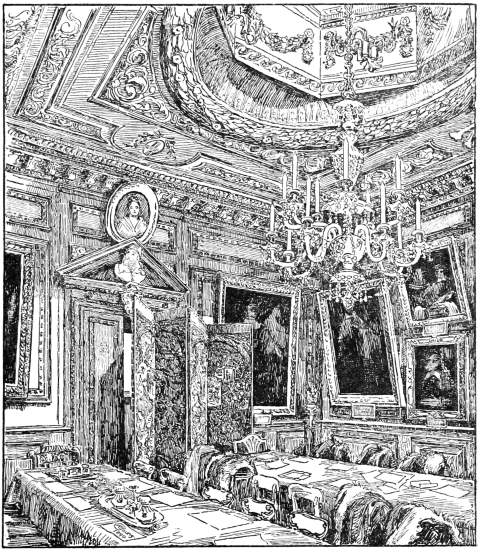
11th February, 1636. Upon the moc͠on of or Mr to this Court concerneing the
want of a publique Theater for Anatomycall exercises and Sceletons and a lesser roome
for private discections, This Court doth order that if the Mrs or Governors upon their
petic͠on to the Lord Maior and Aldrẽn they have the bullwarke & long stripp of ground
lieing betwixt the gould smiths tenement & clothw: tenemtꝭ & london wall at the
one end & the Companies hall & pˀlor & london wall at the other end, by purchase
in fee farme or a long lease from the Cittie, that then a Theater to the largenes of
the upper ground betwixt the goldsmithes tenem̃t & the clothworkers tenemt on the one
side & london wall on the other side shalbe be ovally built for the Wor̃p118 and
comiditie of this Companie at the Charge of this house.
The piece of ground on which it was proposed to erect the
Theatre was then on lease to the Company from the City. The
Lease was dated 29th March, 7 Charles I (1631), and made between
the Mayor, &c., of London, of the one part and the Masters, &c.,
of the Barber-Surgeons, of the other part. In consideration of
£20 paid by the Company the City leased to them lwark and the houses Roomes and buildings therein or thereupon
made or erected, And all that ground or garden plott with
thappurtenñces scituat lyinge and beinge in the parish of St Olave
in Silver Street in the Citie of London next unto the Wall of the
same Citie there of the one side, and the landes of the saide Maisters
or Governors and others on the other side late in the tenure or Pg157 Pg158 Pg159
occupac͠on of the right honoroble Henry late Lord Wyndsor deceased
or of his assignes and now in the tenure or occupac͠on of the said
Maisters,” etc., from the feast of the Annunciation, 1631, for forty-one
years at a rent of £3. The lease contained the usual covenants of a
repairing lease, as also one “that neither they the saide Masters
or Governors their successors nor assigns shall or will att any time
or times during the said Terme suffer any Inmate or Inmates
to dwell in any part of the premises afore demised.”
5th May, 1636. There is an Indenture of Lease of this date
made between the Mayor, &c., of London, and the Masters, &c.,
of the Barber-Surgeons, which after reciting the last mentioned
lease proceeds: “And whereas the said Maisters or Governors of
the Misterie and Comonaltie of Barbars and Surgians of London
for the better enhableing of them in the Arte of Surgerie Doe intend
to erect and build a decent Roome or Theatre on part of the premisses
for the keeping therein A learned and constant Lecture in the
Theorie and practiqʒ partꝭ of Surgerie As also to pˀforme their
publique operac͠ons of Anatomies and other exercises thereunto
belonging, Which will be verie chargeable to them Wherein the
said Maior and Cominaltie and Citizens are desirous and willinge to
aide and further the saide Maisters or Governors in the setting forward
of soe necessarie and comendable a worke tendinge to the generall
good of the whole kingdome,” wherefore the Mayor, &c., leased the
said premises to the Company for a further term of 200 years upon the
expiry of the lease then running, at the same rent of £3 per annum, the
Lessees covenanting to build the Theatre within seven years.
16th May, 1636. Upon or Mrs report to this Court that the Lord Maior &
Aldrẽn have freely graunted to this house a new lease of CC yeares comenceing
from the expirac͠on of or lease now in being It is ordered with the generall consent
of the whole Court here present that the Theater shalbe proceeded in and built
according to the plotts drawne by his Matꝭ Surveigher.
3rd August, 1636. It is ordered by this Court that the Companies Armes with
Helmett Crest supporters and mantlings shalbe sett up in Portland Stone under the
Cantilaver does of the Theater being over the Windowe next the Granarye.
Alsoe the mottoe vizt. Speciosum hoc Theatrum Anatomicum erectñ fuit
Michaele Andrews Chirurgo Regio ac comunioni BarbitonsoꝜ et ChirurgoꝜ pˀ
tempore præfecto, Guardianis vero Joanne Warde Nicolas Heath et Wilhelmo
Huckle anno ab exhibito in carne Messiæ supra millesimum sexcentesimum
trigesimo sexto shalbe engraven in the voyde stone worke over the greate doore into
the Theater.
A plan of the Theatre is preserved in a collection of the
works of Inigo Jones, at Worcester College, Oxford, and a short
description of it is found in Hatton’s New View of London, 1708.
The curiosities in the Barber-Surgeons’ museum of those days will
excite a smile when compared with the collection now at Lincoln’s
Inn Fields. Hatton says that the Theatre was built in “an elliptical
form, and commodiously fitted up with four degrees of seats of cedar
wood, and adorned with the figures of the seven liberal sciences, and
the twelve signs of the zodiac. Also containing the skeleton of an
ostrich, put up by Dr. Hobbs, 1682, with a busto of King Charles I.
Two humane skins on the wood frames, of a man and a woman,
in imitation of Adam and Eve, put up in 1645; a mummy skull,
given by Mr. Loveday, 1655. The sceleton of Atherton with copper
joints (he was executed) given by Mr. Knowles in 1693. The figure
of a man flead, where all the muscles appear in due place and
proportion, done after the life. The sceletons of Cambery Bess
and Country Tom (as they then call them), 1638; and three other
sceletons of humane bodies.”
Hogarth has, in ghastly style depicted the dissection of a
criminal in this Theatre, in which the skeletons above referred to
are seen in niches in the wall.
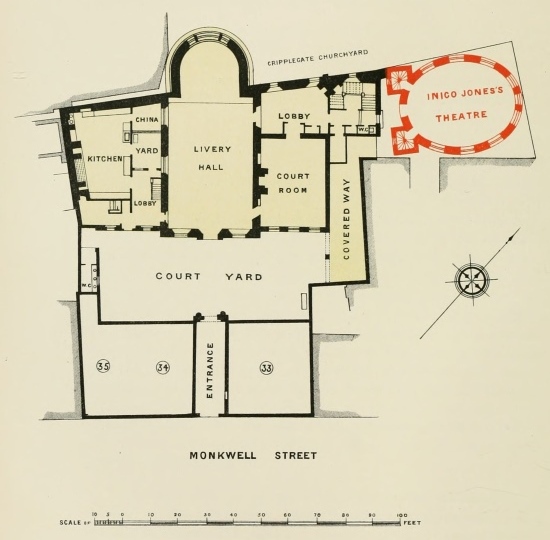
ESTATE IN MONKWELL STREET
The plan of the Company’s Estate, has been kindly supplied
for this work by Mr. Charles John Shoppee, as surveyed by him
in 1869, previous to the demolition of the old Livery Hall, Kitchen,
etc. The Theatre had been pulled down in 1784, and houses erected
on its site; the Theatre is, however, shewn upon this plan, as being
more interesting than the houses which supplanted it. In 1636 the
Company commenced the erection of the Livery Hall and present
Court Room, the work being carried out from the designs and under
the superintendence of the celebrated Inigo Jones, the Livery Hall
was, however, burnt in 1666, and that shown upon the plan is the
one which was erected after the Great Fire.
5th September, 1636. The Plague was again abroad in
London, and the Court, for fear of infection by meeting together,
resolved as follows:
In regard of the now greate visitac͠on of the plague This Court doth
deferre the Courts for the daye of Rules the Vew daye & other publique Courts
till it shall please God to cease the Sicknes.
23rd September, 1636. The Lord Mayor having requested
the Company to nominate “twoe Surgians to take care of those
that were infected with the plague in this Cittie & liberties,” the
Court thought that two was a wholly insufficient number and
nominated six Surgeons to be presented to the Court of Aldermen.
2nd October, 1636. £5 was ordered to be paid in to the
Chamber of London towards the relief of the poor, stricken with
the Plague.
30th March, 1637. The Company were assessed to pay £10
“ship money,” whereupon an order was made that they should
forbear to pay it, and a Committee appointed to wait on the Court
of Aldermen to petition against the assessment. The application
was, however, unsuccessful, as by an Order of Court, 29th March,
1638, the money was directed to be paid.
8th November, 1638. The Court of Aldermen having assessed
the Company to furnish 80 quarters of corn in lieu of 60 as heretofore
provided, it was resolved to petition against it. This would
be a very important matter to the Company as the assessments
for all public purposes were made upon the City Companies pro
rata with their corn quarterages, and if the 80 quarters were allowed
to stand, it would raise all the future assessments 33 per cent. The
result however, of the protest does not appear in the minutes.
28th October, 1640. On receipt of a precept from the Lord
Mayor, it was ordered that three barrels of Gunpowder should be
bought and stored.
1640. The Company unwillingly agreed to lend the King
£400, and were put to great inconvenience in raising the money, which
was required by Charles for his campaign in Scotland.
After several skirmishes with the Scots, the English Army
was at length disbanded, and the King went himself to Scotland
to negotiate the difference which had arisen by his attempted interference
in Church matters in that Kingdom; he returned to London in
November, 1641, and the following minute refers to the preparations
made by our Company to meet him.
22nd November, 1641. Upon reading the Lord Maiors precepts for the
Companyes enterteyning the King upon his returne from Scotland It is ordered
that the Mar and Wardens, Mr. Serjeant Clowes, Mr. Richard Wateson, Mr. Woodall,
Mr. Powell, Mr. Burgin, Mr. Heath, Mr. Henry Wateson, Mr. Bignall, Mr. Dye,
Mr. Arris, Henry Boone, and Thomas Turner, shalbe attendant on Twesday next well
mounted on Horseback in plush or Velvett with Chaines of Gold, and that John Perkins
shall beare the Pendon with our Coate of Armes on Horseback and that these 18 ffree
men shalbe Decently cladd in the Companyes Colours of White and Greene, each of
them with a greene flatt Cap with a white Ribbon about it, a greene Cassock and
Drawers of the same Stuffe Whiffler like laced with a white Lace a white ribaning and
a greene Ribbin athwart theire Brests, and each of them a Truncheon in theire hands
in the forenoone, and in the aftˀnoone each of them 2 Torches, and these 18 to attend
perticulerly one of them to each of the Horsemen, vizt.
(Then follows a list of the freemen chosen.)
The “Riding out” on this occasion must have been a
magnificent sight, if all of the Companies spent proportionately to
the outlay of ours, which was no less than £39 17s. 10d. upon
decorations, etc., for those taking part in the procession. Strype
informs us that—
The Lord Mayor on horesback wearing a gown of crimson velvet & a collar of
SS, and attended by his suite, rode in the front of the procession to meet the King.
Then followed the Aldermen in scarlet gowns and the City council and chief officers
in black gowns. Upon reaching Moorfields, there waited in a readiness to attend his
Lordship and the service, about five hundred horsemen selected out of the Liveries
of the several Companies, being Masters, Wardens, and prime men of each Company
in velvet or plush coats and suits, with chains of gold, being well horsed and gallantly
furnished, every Company having a horseman in the front carrying a pendant with that
Company’s arms to which he did belong (for distinction sake), and a footman to attend
each horseman of the Livery with truncheons and torches as before, both horsemen with
the pendants and footmen being suited cap-a-pee with the Company’s colours on
which they waited. There were also fourteen Trumpeters, with trumpets, banners and
scarfs, who were placed two between every hundred of the horse, and four at the
head of the troop. The procession moved on to Kingsland, where the Lord Mayor
and Aldermen and the Companies awaited the Kings approach, while the Sheriffs
attended by seventy-two men in Scarlet Cloaks trimmed with silver lace (the colours
of the City) with javelins and feathers and four trumpeters, rode as far as Stamford Hill,
and there met their Majesties and escorted them to Kingsland.
His Majesty was accompanied by the Queen, the Prince, the Duke of York,
the Princess Mary and the Prince Elector Palatine, and after receiving an address,
the Royal party joined the civic procession to London, entering it at Moorgate,
and proceeded through London Wall, Bishopsgate Street, Cornhill and Cheapside,
to the banquet at Guildhall, amidst the City Companies in their formalities and stands
on each side of the streets, the City conduits running with a diversity of wines.
1643. The relations between the King and the City having
become estranged in the fearful distractions of these times, Charles
endeavoured to conciliate the citizens with a message, which was
publicly read at Guildhall on the 13th January, and later on he
sent a circular letter to the Masters of the several Companies requiring
them to call their freemen and apprentices together, to read to them
a copy of a letter which he had sent to the City on the 17th January.
The Court of the Barber-Surgeons met on Tuesday, 24th inst.,
and cautiously record that they would have summoned their freemen
for the next day, but that it was a fast day and that in the interim
an order had come from the Committee of Safety that the letter, etc.,
should not be read.
24th January, 1643. The Kings Letter sent to the Mrs & Wardens of this
Company was read in Court and the printed Letter in it and the Cittyes Petic͠on and
his Maties gracious answer unto it. And but that the morrow was fast day being the
last Wednesday in this Moneth the ffreemen and apprentices of this Company could not
be summoned to appeare then, it should have bin read. Soe that in the Interim an
Order of Comand from the Lords and Comõns was directed to this Company to
countermaund the said Letters in these words,
Die Martis 24to Januarii, 164 2/3. At the Comittee of Lords and Comõns for
the safety of the Kingdome.
Whereas there are divers Letters pretended to be sent by his Matie to the
Mrs and Wardens of the severall Halls in the city of London with Two litle Bookes
therein closed the one intituled The humble Petic͠on of the Maior, Aldermen and
Comõns of the City of London to his Matie. And the other intituled his Maties Letter
and declarac͠on to the Sheriffes and City of London Dated the 17th of January, which
evidently tendeth to sedition and setting of the whole State in a Combustion. These
are therefore strictly to charge & comand the Mrs and Wardens of every Hall in
the City to whome the said Letters and Bookes inclosed shalbe directed to forbeare
to publish or open any of them till both the Houses of Parliament shall give further
order therein. And the Mrs and Wardens of every Hall are required to bring the
said Letters with the Messengers thereof to this Comittee which they will take to be
an Argument of theire good Affection to the Parliament
| Pembroke | Montgomery | Bolingbroke | Ed: Manchester |
| W. Say & Seale | Ed: Howard | Jo: Evelin | Jo: Pym |
| Antho: Nicoll. |
17th January, 1644. It is ordered that in respect of the greate troubles and
distractions of these times there shalbe noe publique Anatomy this yeare dissected.
1644. The Company seem to have become greatly impoverished
by the venture in Ireland, the rebuilding of their premises,
and the forced loans to the King and the Parliament. In a
certificate given by the Master and Wardens (5th September, 1644)
to be produced in a suit in which they were defendants, they state
that their debts are £3,000, and that they can get no return of
any of the money lent for public purposes, or even the interest of it.
If the Stuarts acted in an unconstitutional manner in their
oppressive demands upon the Companies, the Roundheads were as
bad, with just this difference, that, with all their pretensions to
purity, piety and high-mindedness, they did not hesitate to practise
actual dishonesty in their modus operandi of squeezing the Companies,
as the following painful incident from our books testifies:—The
Company had borrowed from Mr. Richard Wateson, one of the
Assistants, £1,200 upon sealed bonds, for the express purpose of
meeting the demands which had been made upon them by the King
and Parliament from time to time. Mr. Wateson having been
declared a “Papist and Delinquent,” his property was seized, and
the Bonds of the Barber-Surgeons, found in his strong chest, were
taken to the Committee for Gloucester and Hereford, sitting at
Grocers’ Hall. These worthies, in conjunction with the Committee
for Sequestrations, came down upon the Company and demanded
payment of the £1,200 for which they had given their bonds to
their brother, Mr. Wateson. The Court deeming this a monstrous
piece of injustice, hesitated to comply, whereupon the Committees
threatened to seize the Company’s entire estate; and then the Court
resolved to petition Parliament, but the House not sitting for some
time the petition could not be prosecuted, and the Committee being
urgent, the Company most reluctantly agreed to pay down £400
and to have the bonds cancelled. Although these shameful terms
were definitely agreed upon, the Committees a few days later broke
faith, demanding £400 cash and the Company’s bond for another
£100, to which the Company, like the lamb with the wolf at its
throat, nolens volens, consented. The iniquity of this business was
made apparent to the Committees, who were well aware that the
Company had incurred the debt to Mr. Wateson in order to meet
the previous rapacity of themselves, and yet they hesitated not
to compel the Company to submit to a further fine of £500 for
having complied with their demands in the past, besides manifesting
the dishonesty proposed by them in offering to cancel the debt due by
the Company to Mr. Wateson.
29th April, 1645. By the power and authority to this Court given by severall
Orders of a late Court of Assistants, this Court for and towards the raiseing of the
400li agreed to be paid in part of the composic͠on for Mr. Watson’s debt unto the
the Comittee for the releife of Gloucester, &c., did pawne all the Companyes plate
both guilt and white, weighing 1,120 oz. 1/3 or thereabouts, unto Mary Crosse of London
Widdow for the Sum̃ of 280li by a Writeing of Bargaine and Sale this day sealed
with this Companyes Com̃on Seale bearing date the 16th day of this Instant Aprill with
a provisoe of Redempc͠on. And borrowed of Mr. George Dunn 100li more at Interest
at vjli 10s pˀ annum pˀ centum for wch he tooke the secureity of our Com̃on Seale.
A few years later on (14th September, 1648), Mr. Edward
Arris presented to the Court a letter from Mr. Wateson, wherein was
intimated that he expected the Company to repay him the money
borrowed, the bonds for which had been seized by Cromwell’s party,
and for which the Company had already compounded, whereupon we
read “This Court doth declare theire acknowledgement of a great
respect and esteeme they have and beare towards him and shalbe
ready to doe him all the right they can without prejudicing the
Company”; and again on 30th April, 1650, “Mr. Richard Wateson
an ancient Mr of this Company Doth this day desire to know the
mind of this Court concerning the 1,200li by him lent to this
Company and sequestred in this Company’s hands and compounded
ffor 500li in full of principall and Interest, The matter being of great
Consequence, this Court doth take time to consider of it and to give
him an answer therein.”
What answer Mr. Wateson got, I do not know; he was held
in great esteem by the Company, and doubtless some honourable
compromise was arranged.
In their negotiations with the Committees, the Company
seem to have been able to impress the Chairman favourably on
certain occasions, though there is grave reason to apprehend that
this official of the party of purity was open to a bribe, as the following
minutes would seem to indicate.
27th October, 1645. The Company having been threatened
with sequestration of their entire estate unless an assessment made
upon them was paid on Friday following, a Committee of the Court
was ordered to wait on Mr. Scawin, the Chairman of the Committee
for the Army, to beg his favourable consideration of the Company’s
poor estate; the result is seen in the next entry.
14th September, 1648. This Court takeing notice of the greate Love and ffavour
of Mr. Scawin Chaireman to the Comittee ffor the Army expressed oftentimes upon
severall occasions towards our Company Doth thinke fitt in gratitude and accordingly
doth order That the present Governours doe present to him a guift of the value of
vjli 13s 4d The quality and price of the guift is left to theire discretions.
1646. To relieve them of their great debts, the Company
about this period raised considerable sums by granting annuities;
the following are examples in point:—
24th March, 1646. This day Mr Nicholas Heath payd the sum of 200li to the
use of this Company and is the purchase money for an Annuity of 26li pˀ añn. for
10 yeares to himselfe and Grace his Wife Whereupon the Deed of Grant of the said
Annuity was sealed with the Com̃on Seale and delivered to theire use.
Alsoe this day Mris Elizabeth ffreeman payd the sum of 200li the Purchase
money for the like Annuity of 26li pˀ añn. for 10 yeares and the Deed for that purpose
was sealed and delivered to her.
On the 30th January, 1649, the King’s troubles were ended by
his murder, and very shortly afterwards we find this significant minute.
19th March, 1649. This Court doth order That the Oath conteyned in the
Rules and Ordinances of this Company be administred unto every ffreeman upon his
admission as before, The ffirst Words which doe concerne allegiance to the King
and his Successors only to be left out.
The banners of the Company bearing the late King’s arms
were destroyed, and any heraldic insignia at the Hall which contained
the Royal Arms were ordered to be defaced. We may readily believe
that this was most unwillingly done by the Court, who however,
had no option in the matter.
1648–9. Fairfax had filled the City with troops, “billetting
orders” being made upon the several Companies for the reception
of the soldiers at their Halls. Herbert (Vol. I, p. 181) states that
the Merchant Taylors were fortunate enough to procure an order
of exemption which cost them £20 10s., and further that he believed
their case to be unique, but it seems that the Carpenters by means
of “Gratuities ‘to sevˀall men of qualitie,’” amounting to £13 2s. 6d.,
managed to get free of this imposition, whilst the Barber-Surgeons
procured their immunity at a much cheaper rate, for we read in
the Wardens’ accounts of the period,
Paid fforr the charges expended in procureing a Protecc͠on from the Lord
General from quartering Souldiers in the hall 13s 3d.
These notices are clear indications that Cromwell and the
“men of qualitie” about him, were accustomed to take bribes.
3rd February, 1654. The City entertained Cromwell at
Grocers’ Hall, and our Company had to go out in procession to
receive him, our “standing” being in St. Paul’s Churchyard.
1660. The Barber-Surgeons contributed £96 towards a
present of £10,000 given by the City to Charles II at the
Restoration. No money exacted under precept was more willingly
paid than this, and indeed the Companies generally seemed to have
cheerfully contributed, delighted to have escaped the gloom of the
Commonwealth, and with a prospect of brighter times in store. On
the 5th July, the King was nobly entertained at Guildhall, our
Company taking part in the rejoicings (see Wardens’ Accounts of
this date).
1666. Our Minute Books for this period having been lost
or stolen, we unfortunately have no records of the Great Fire beyond
those preserved in the “Wardens’ Accounts” (which see), and
although these are somewhat meagre, they are highly interesting,
especially those which relate to the fortunate preservation of the
great Holbein picture. It has been stated (but without any other
authority than that of gossiping Samuel Pepys, who had a special
interest in disparaging the picture) that it was damaged in the fire,
though no notice of such a mishap is known to me, and the Accounts
(which are complete) are significantly silent as to anything having
been spent on its restoration or cleansing, which, had it been injured,
would have been necessary; it seems to have been taken away
from the Hall by Major Brookes to a place of safety, and subsequently
brought home again by six porters.
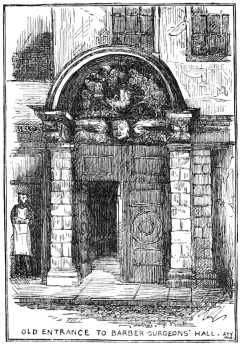
OLD ENTRANCE TO BARBER-SURGEONS’ HALL.
The Theatre, which was a detached building, as also the
present Court Room, both the works of Inigo Jones, were saved,
though the Hall was burned,
entailing a great expense upon
the Company in rebuilding (see
Wardens’ Accounts).
The houses 33, 34 and 35,
Monkwell Street (see plan, p. 135)
were rebuilt 1671, when the gateway
to the Hall Court Yard was
formed and the grotesque coat-of-arms
put up over the Lintol.
When the alterations were
made under the superintendence
of Charles J. Shoppee in 1869,
the old lintol, corbels, tympanum,
and door-head were very carefully
taken down and refixed over the
present entrance to the Hall in the Court Yard. This door-head
is always an object of interest to visitors to Barbers’ Hall; long may it
continue to be so!
25th August, 1681. A short set of By-Laws was this day
enacted. It is on a single skin of parchment, and imposes penalties
upon such persons, as, being elected, should refuse to serve as
Masters or Stewards of Anatomy. It is signed by Heneage, Earl of
Nottingham, Lord Chancellor, and Sir Francis Pemberton and
Sir Francis North, the two Lords Chief Justices, all of whose seals
are pendant to the document.
1684. This was indeed a troublous year for the Corporation
and for the guilds of London. Charles having interfered with the
privileges of the City by thrusting in his nominees for Sheriffs, had
met with considerable opposition from the citizens, and being assured
that this resistance would be continued and maintained by the City,
he determined to strike a blow at the root of its franchise, by getting
into his hands the Charter of the City, as also the Charters of the
several Companies. It was not difficult to procure a venal tribunal
which would be prepared to pronounce an iniquitous judgment upon
any fictitious statement submitted to it by the King. Sir Robt.
Sawyer, the Attorney-General, thereupon undertook, on behalf of
the Crown, to prove that the City Charters were forfeited, and
contrived the celebrated quo warranto, upon which judgment was (as a
matter of course) obtained against the City, on the 12th June, 1684.
The Companies seem to have unanimously anticipated this
decision, and by so doing and by “surrendering” their Charters
and liberties before the delivery of the judgment, hoped to ensure
the favour of the King.
The original of the “surrender” of the Barber-Surgeons is
very neatly engrossed on extra thick parchment, but the seal was
of course removed when it was returned to the Company. The
text is as follows:—
To all to whom these prsents shall come. The Masters or Governors of
ye Mystery and Coĩaltie of Barbrs & Surgeons of London send Greeting.
Know yee yt wee considering how much it imports the Governmt of our company
to have men of known Loyalty & approved integrity to bear offices of Magistracy
& places of Trust. The sd Mars or Governrs have granted surrendred and yielded
up, and by these prsents do grant surrendr and yield up unto his most gracious Majesty
Charles ye second by the Grace of God King of England, &c., his Heires and
Successors. All and singular ye Powers Franchises liberties priviledges and authorities
whatsoever and howsoever granted to or to bee used or exercised by ye said Masters
or Governors by vertue of any right Title or Interest vested in them by any Charters
Letters Patents Custome or Prescripc͠on in force of or concerning the electing nominating
constituting being or appointing of any person or persons into or for ye severall and
respective offices of Mastr Wardens Assistants and Clerk of ye said Company. And
ye said Masters or Governors do hereby humbly beseech his Matie to accept of this their
surrendr and do with all submission to his Majesties good pleasure implore his grace
and favor to regrant to ye said Masters or Governors the nameing and Chusing of ye
said Officers and the said libertie and ffranchises or so many of them and in such
mannr as his Majesty in his great wisdome shall judge most conducing for ye governmt of
ye said Company, And with and under such reservacc͠ons restricc͠ons and qualificac͠ons
as his Majestie shall bee pleased to appoint. In Witnes whereof the said Mastrs or
Governors have hereunto affixed their Com̃on seal the sixteenth day of Aprill in
ye Thirty sixth year of ye reign of or or sovˀaign Lord Charles ye second, &c., and in
ye year of or Lord Christ 1684.
Similar forms of surrender were adopted by other Companies.
I am unable to say whether or no the King interfered with the
franchises of the Barber-Surgeons, but think not, as no record of
such meddling is to be found in our books, though, doubtless, the
Court took care, remembering the rod in pickle, to govern in accordance
with the wishes of the King.
Some time in this year (1684) certain unquiet spirits, Surgeons
of our Company, got up a petition to the King, setting forth that the
union of Surgeons with Barbers hindered rather than promoted the end
for which the two bodies had been united, and praying the King to
incorporate the Surgeons a distinct and separate body. Nothing came
of this application beyond a reference (ordered by the King, 15th May,
1684) to the Lord Keeper of the Great Seal, and the Lord Chief
Justice of the King’s Bench, who were directed to examine and report
upon the petition, but whether they ever did so or not, I don’t know.
27th February, 1685. James II, in the first year of his reign,
granted us a Charter, which is contained on seven skins of parchment,
all of which have handsomely designed head-pieces and borders,
the first one having a fine portrait of the King as well; only a fragment
of the great seal remains, and the charter itself is considerably
damaged, apparently by rats. It is in Latin, of great length, and,
like others granted to other companies at the period, is an “unreal
mockery.” The Charter recites the “Surrender,” and proceeds to
grant another charter in which, inter alia, the appointment of any
Master, Warden, Assistant, or Clerk should be subject to the approval
of the King, that all members of the Company should take the Oaths
of Supremacy and Allegiance, be in the Communion of the Church
of England and receive the Sacrament, and that no person who
frequented a conventicle should be eligible for the Livery.
4th April, 1687. The King having published a declaration,
allowing liberty of conscience to all his subjects, suspending and
dispensing with the penal laws and tests, and even with the Oaths
of Supremacy and Allegiance on admission into offices civil and
military, numerous addresses of thanks for this liberty were presented
to the King, among others the following one from our Company,
which is preserved in the “London Gazette” of 20th October, 1687.
The Humble Address of the Masters Governors Assistants
and Members of the Mystery and Commonalty of Barbers
and Surgeons of London.
May it please your Majesty
We having daily before our eyes the munificent Bounties of your Royal Brother
of Blessed Memory, and other Your Ancestors, and also that of your Majesties Gracious
Favour, in restoring to us our new Charter, we must be esteemed ever ungrateful and
undutiful Subjects, if we did not with all humility acknowledge the same.
But we are in more especial manner bound to cast ourselves at Your Majesties
Feet, and return our most humble and hearty Thanks for Your late Declaration; wherein
You are Graciously pleased to give us Your Royal Word, whereby we are protected in
the Profession and free Exercise of our Religion, and also in the Enjoyment of our
Liberties and Properties in Peace and Safety; for which Your Gracious Condescension
and Goodness (as God hath made it our Duty), Your Majesty hath made it our Interest
duly to pray to the Divine Majesty for his Blessing upon your Royal Person, Family and
Government. And that after the enjoyment of a long and prosperous reign here, over
a Dutiful and Obedient People, You may receive an everlasting Crown in the World
to come.
And that it may be so, it shall be as it becomes us, the constant and utmost
endeavour, as well as the hearty Prayer of,
Dread Sir!
Your Majesties most humble, most Loyal,
and most obliged Subjects.
1688. Matters were now rapidly approaching a crisis with
James, who in vain, when too late, sought to conciliate the citizens
whom he had wronged. One of his acts of propitiation was the
redelivery to the Companies of the “surrenders” which they had
made of their franchises and charters in 1684. We have no note of
the date of the return of our surrender; but it was towards the end of
November and within about a fortnight of the King’s flight when this
tardy act of justice was done, and the Barber-Surgeons thus partly
restored to their ancient rights and privileges. The Bill of Rights
was shortly afterwards passed, the quo warranto declared illegal, and
all charters granted by Charles II and James II since the judgment on
the quo warranto, declared absolutely null and void, thus practically
reinstating the Guilds in statu quo ante.
28 July, 1690. Ordered that in pursuance of an order of the Com̃on Counsell
& Lord Mayor &c. that the Company advance towards the provideing one Rigiment of
Horse & one of Dragoone the sum̃e of one hundred pounds.
1699. Jealousies arose in the Company in consequence of the
more frequent election of Surgeons than Barbers, as Governors. The
By-Laws required that every year there should be two Barbers and
two Surgeons chosen (a Barber being defined to be any member who
did not practise Surgery). The Surgeons disregarding the law and
the old custom, seem to have been able to procure the election of an
undue number of members of their own craft to the offices of Master
and Wardens, whereupon certain of the Company filed an information
in the King’s Bench against the Masters or Governors; the Barbers
were successful, and having obtained a Mandamus, a fresh election took
place. This altercation between the Barbers and Surgeons was never
forgotten, and, indeed, helped to pave the way to further estrangement
and the absolute separation in 1745.
The following Minutes relate to these proceedings:
14th December, 1699. Ordered Mr. Srgeant Wright Mr. Srgeant Darnell Mr.
Com̃on Srgeant & Mr. Dee bee advised with upon the Informac͠on agt the Governrs.
25th January, 1700. Ordered that the Cause agt the Governrs at the prosecuc͠on
of the Barbers bee referred to Srgeant Darnell & his opinion to bee taken & to pˀceed
thereupon, Mr. Oades Mr. Pleahill & Mr. Barnard to meet tomorrow at the raine bow to
attend him by five in the afternoone.
2nd May, 1700. Ordered Mr. Dee bee consulted concerning the Rule of
Court of King’s Bench for a copy of the by laws &c. & to follow his advice &c. He
advised to give Copyes if required & not to oppose it.
11th May, 1700. Ordered that Mr. Srgeant Darnell have three guineys Mr.
Com̃on Srgeant & Mr. Dee have two a peece given them for the Tryall of the Informac͠on
on Tuesday next & that all the Court of Assistants bee desired to bee there.
28th June, 1700. Ordered that nothing bee done in the Cause agt the Company
untill the Mandamus be served & then the Comittee to meete.
4th July, 1700. A pˀemtory Mandamus being served the last Court, Ordered
that on Tuesday next by two of the Clock in the afternoon there bee an elecc͠on of two
Wardens Expert in Barbery for the remainder of this yeare.
9th July, 1700. An election took place, with the result that
Mr. John Pinke and Mr. Richard Marks, both being Barbers, were
elected Wardens. Mr. Pinke was already a Warden, but the Mandamus
required two Barbers to be elected, and he was simply re-elected.
Mr. Marks took the place of Mr. Bartholomew King, Surgeon. The
Master, Mr. Lichfield, and the second Warden, Mr. James Wall, were
both Surgeons.
13th January, 1709. It was agreed that a new set of By-Laws
which had been settled by the Common Serjeant and Sir Edward
Northey should be presented to the Lord Chancellor, etc., for
confirmation, it being considered that the existing By-Laws were
defective in many parts, and that “good & wholesome Lawes were
the life strength & support of this Company.”
6th April, 1709. A set of By-Laws of this date was confirmed.
They are comprised on thirteen great skins of parchment, and, like
previous ones, are far too voluminous, and indeed not of sufficient
interest, to warrant transcribing, being practically the former set with
sundry technical and minor alterations. There is a fine portrait of
Queen Anne on the first skin, and the Document is signed by William
Lord Cowper, Lord Chancellor, Sir John Holt and Sir John Trevor,
Lords Chief Justices, whose seals are pendant. These By-Laws were
brought into Court on 5th May, 1709.
13th January, 1709. The Court were informed that the Barbers
of the Company were in treaty with the Peruke Makers “of the other
end of the town,” about incorporating them into this Company, and
that they were endeavouring to procure an Act of Parliament to that
effect, whereupon the proposition was approved and leave given to the
Barbers to petition Parliament in the name of the Court.
5th December, 1709. A petition was presented by sundry
liverymen (Barbers) representing that Peruke making was an encroachment
upon the art of Barbery, and praying the Court to obtain an
Act of Parliament incorporating the Peruke Makers with the Barber-Surgeons;
the petition was favourably received by the Court and a
Committee appointed, who met the next day and recommended the
proposed union, the Peruke Makers paying such fees as other
members of the Company paid.
24th December, 1709. A petition for an Act was ordered
to be drawn by the Clerk and submitted to several eminent counsel
for their perusal.
9th January, 1710. Five hundred copies of the proposed Bill,
and a similar number of the reasons for the suggested incorporation,
were ordered to be printed; but in the result nothing came of this
proposed union with the Peruke Makers.
25th August, 1714. The following precept relating to the
Accession of George I was received:
To the Master and Wardens of
the Company of Barber Surgeons.
By the Mayor.
Whereas it hath been resolved in Com̃on Councill yt if our most Gratious
Lord King George upon his comeing into this Kingdome be pleased to pass through
this his City of London, yt he shall be received by us & our fellow citizens with all the
Demonstrationes of Joy & affection as are suitable to our duty and Loyalty.
These are therefore to require you to have your Rayle Cloaths Standings
Banners Streamers Ensignes & other Ornaments of triumph belonging to your Company
in a readiness to sett up imẽadiatly upon Notice yt shall be given you of the time & place
by any further precept & yt yor Cloaths Banners Streamers Ensignes & other ornaments
be fresh & Good & yt you forthwith send to all the Liverymen of yor Company that they
be well & decently apparrelled in their best Cloaths & Gowns to attend in their Standings
yt so your Company may be ready (when required) to receive his Majtie to his satisfac͠on
& the Honour of this City and thereof you are not to faile. Dated this 25th day of
August, 1714.
Gibson.
23rd December, 1717. The Company having had great
difficulty in getting in some of their rents, and various of the houses
being empty, determined to sell their property in Mowse Alley,
East Smithfield, and in Butcher Row in St. Botolph’s, Aldgate,
agreeing to convey the fee simple to Mr. Robert Finlay for £1,250.
And it is further ordered by this Court that till such time as the said sume
of 1250li can be laid out in a convenient purchase of houses or lands with the
approbac͠on of the Court of Assistants, The same shall be forthwith placed out at
Interest by the Governors upon such Government or other Publick securitys as they shall
think fitt, But that the said sume of 1250li or any part thereof shall never be expended
on the Company’s common occac͠ons or be any way lessened or broke into on any
account whatsoever.
17th April, 1718. The following record was ordered to be
made of the “reasons” for disposing of this property:
The Estate in East Smithfield in eleven years time produced to the Company
above all disbursements relating thereto119 but £28 15s. in the whole, Whereas the
annual interest of £1250 at 4 pˀ cent. is £50.
Eleven years interest at £50 pˀ ann. for £1250 amounts to without computeing
Interest upon Interest £550.
The Company have run behind hand for severall years by means of the great
sumes laid out upon this Estate.
Whoever goes backward every year must in time be undone.
The Estate is still in such a condition as to require a great sum̃e of money to be
expended upon it in Repairing and Rebuilding in order to make it tenantable.
The Company had not money to lay out upon it.
If they had, the Estate is so scituated that there is no room to hope, even
in case the whole had been rebuilt (as it wants to be) that it would have answered
the laying out so much money.
And if the Company had let it upon building Leases The pˀsent method
of building is so as to last exactly the term for which the Lease is taken, wouˀd have put
the Company in the same condic͠on as they are now, when the term expired, besides loss
of Rent, & disputes with such Tenants in the mean time.
It was therefore thought better to dispose of the Estate.
Following are the details of negotiations with one or two
parties other than Mr. Finlay, and some curious particulars of the
Company’s title to part of the Estate, which seems to have been
an equitable rather than a legal one, whereby the Court apprehended
some difficulty in disposing of it to another party from whom a
somewhat better price might have been obtained, and therein, under
the circumstances, showed themselves good men of business by
concluding with Mr. Finlay: we cannot however now, but regret
that this most valuable property should have passed from us for so
comparatively insignificant a sum. The purchase-money was laid out
in thirteen East India Bonds of £100 each.
7th April, 1730. Mr Serjt Dickins the Master of the Company informing
the Court, That he having the honour to be acquainted with the Right Honourable
The Earl of Burlington and with his Lordships most extraordinary genius and superior
judgment in Architecture, had taken the liberty to address himself to the said noble
Earl, and to make it his humble request to his Lordship that he would be pleased
to favour the Company with his opinion, in what manner it would be safest and best
to repair the anatomical Theatre built by the celebrated Inigo Jones about one
hundred years ago.
That his Lordship had thereupon condescended to take a view of the Theatre
and most obligingly directed the proper method of repairing a structure of so peculiar a
frame, and afterwards out of his accustomed generosity, and in regard to the memory
of that great Architect offered to defray the expence thereof.
It is thereupon resolved Nemine Contradicente by this Court,
That the Master and Wardens of the Company together with the late Master
William Cotesworth Esqr be, and they are hereby desired forthwith to wait on the
Right Honb̃le The Earl of Burlington, and in the most gratefull manner to assure
his Lordship in the name of the whole Company.
That they do receive this noble instance of his Lordships bounty and
generosity as a most distinguishing & illustrious mark of honour shown by his Lordship
to the Company & Profession.
And that this Court will take care so to record & transmitt the remembrance of
this magnificent action of his Lordship to their successors That the gratitude of the
Company to his Lordship’s person and memory may be for ever preserved among them.
13th August, 1730. A marble Bust of the Earl of Burlington
was ordered to be set up in the Theatre.
27th April, 1739. “The Court taking into their considerac͠on
that several of their By-Laws, which had been confirmed by the
Lord Chancellor and Lord Chief Justices for the time being, were
in want of alteration, by reason of the variation of the times and
circumstances of the Company and their Members since such By-Laws
were made, and several new By-Laws being also wanting for the
better government of the Company in times to come,” It was ordered
that a Committee of six should consult and draw up fresh By-Laws,
to be submitted to a future Court of Assistants, but in the result no
action was taken.
1744. The long slumbering animosity between the Surgeons
and the Barbers had now reached a climax, and indeed it is a matter
of surprise that an union which had become grotesque should have
existed for as many years as it had. The Surgeons, many of whom
had attained to great eminence, naturally chafed under a system
which required their diplomas to be signed by Governors, two
of whom were always Barbers, or members of some trade or
profession other than that of a Surgeon, and with the rapid progress
of science and of surgical skill and knowledge, they felt their
alliance with the Barbers a restraint upon their advancement, as also
that the exercise of their profession under Charters and By-Laws,
antiquated in form, and more adapted to the times in which they were
framed, a hindrance rather than an incitement to further proficiency.
There is little in the records as to this disagreement, it being
tacitly agreed that neither side should place their arguments or
grievances in the books, which were their joint property.
20th December, 1744. This day the gentlemen on the Surgeons side having
made known at this Court their desire of being separated from the gentlemen on the
Barbers and that each may be made a distinct and independent Body free from each
other, and producing a Case intended to be offered to the Honourable House of
Commons praying such separation, which being read at this Court It was agreed that
the following gentlemen on the Barbers side vizt.—
Mr. Warden Negus Mr. Parker Mr. Maurice Mr. Truelove and Mr. Haddon.
& on the Surgeons side vizt.—
Mr. Serjt Dickins Willm Petty Esqr James Dansie Esqre Mr. Freke and Mr. Sainthill
be a Committe appointed to meet on Monday next at the Kings Arms Tavern
in Saint Paul’s Church Yard at one of the Clock at noon to receive the proposals from
the Gentlemen on the Surgeon’s side for such Separation, and that when they had so
done that the Gentlemen on the Barber’s side members of this Court should lay the
same before the Livery on their side, by a Meeting to be had for that purpose, and that
a Court of Assistants should be held on the Tenth day of January next, at which time
the Gentlemen on the Barber’s Side Members of this Court, should then report their
opinion and assent or Dissent to such proposals made.
At the same time it was agreed that any Member of this Court should at any
time have the free liberty of examining and inspecting into the several Books and
writings belonging to this Company In case the same should be in the presence of
the Master or one of the Wardens but not otherwise, but no such Books or writings
be at any time removed from the Hall, on any account whatever unless by a special
order of this Court first had and obtained for that purpose.
10th January, 1745. Pursuant to an Order of the last Court of Assistants
the gentlemen on the Barbers side Members of this Court, did this day make their
report on the proposals made by the gentlemen on the Surgeons side for a separation,
by Dissenting in general to such proposals made.
By the Journals of the House of Commons, 18 George II, it
appears that the Surgeons on 31st January, 1745, presented a petition
to Parliament, in which among other things they recited the Act,
32 Henry VIII, and also that Charles I in the 5th year of his reign,
by Letters Patent under the great seal confirmed the Barber Surgeon’s Company
in their possessions and privileges and gave the Company power to make by-laws
and to constitute ten persons to be Examiners of Surgeons during their lives, and it was
thereby further granted that no person whether freeman foreigner native of England
or alien should practise Surgery in London or Westminster or within seven miles of
the City of London unless previously examined allowed and admitted by the Company
in manner therein mentioned; and that the Surgeons so examined might practise in
any part of England; and that the Masters and Governors of the said Company might
appoint and have a public lecture for the science of Surgery, for the better instruction
and information in the principles and rudiments of the art and science of Surgery,
and that no person exercising the art of Surgery within the limits therein mentioned
should go out or send any apprentice or servant from the Port of London to serve
in quality of a Surgeon for any ship without the approbation and allowance of the
said Company, in such manner and under such penalties as are therein mentioned.
That since the said Act for incorporating the two said Companies, those of the said
Company practising Surgery have from their sole and constant study of, and application
to the said science, rendered the profession and practice thereof of great and public
benefit and utility to this Kingdom, and that the Barbers belonging to the said
Corporation are now, and have been many years, employed in a business foreign to
and independent of the practice of Surgery; and that the Surgeons belonging to the
same Corporation, being now become a numerous and considerable body, and finding
their union with the Barbers inconvenient in many respects and in no degree conducive
to the progress or improvement of the art of Surgery, are therefore desirous that the
Surgeons being freemen of the said Company, may be made a Corporation separate
and distinct from and independent of the Barbers of, and belonging to the said Company;
and therefore praying the House to give leave that a bill may be brought in dissolving
and vacating the union and incorporation of the Barbers and Surgeons made by
the said former act; and for making the Surgeons of the said Company a separate
and distinct Corporation; and for making a partition and division of the real and
personal estate and effects of and belonging to the said united Company, unto and for
the separate benefit of the said two Companies so proposed to be separated, as to this
House shall seem meet and reasonable.
Whereupon it was ordered—
That the said petition be referred to the consideration of a Committee and
that they do examine the matter thereof, and report the same with their opinion
thereupon to the House.
A Committee was at once appointed with power to send for
persons, papers, and records.
On the 6th February the Barbers presented a Petition against
the proposed separation, and asked to be heard by counsel; whereupon
it was ordered—
That the said petition be referred to the consideration of the Committee to
whom the petition of the Surgeons of London, whose names are thereunto subscribed, on
behalf of themselves and other the Surgeons in the City and suburbs of London is
referred: And that these petitioners the said Barbers, if they think fit be heard by their
Counsel before the said Committee according to the prayer of the said petitioners.
This petition of the Barbers to the House of Commons was
identical with a very scarce pamphlet “The Case of the Barbers,” a
copy of which has been kindly given to me by Mr. D’Arcy Power, M.A.
It is full of interest, and will be found in Appendix E.
27th February, 1745. The Committee brought up their report,
which was read by the Clerk, and recited the various documents
produced and the evidence tendered; among other matters it is stated
that Mr. John Hayward, a Past Master, was examined and deposed,
that the Master (who every other year was a Barber) and the Wardens
present, sign the diplomas. That there are ten Examiners who have
each half a guinea for their attendance, and the Master and Wardens
have the like. That he did not know that the presence of Barbers at
these examinations was any inconvenience, but he apprehended it
would be more eligible if the Master were always a Surgeon. That
the Barbers are generally present at the four public lectures of
Anatomy, two of which are at the expense of the Company, the other
two being at the expense of the Surgeons. That the Demonstrators
of Anatomy and Osteology are chosen by the whole Court of Assistants
(fifteen of whom are Barbers, and fifteen Surgeons). That he
apprehends the present union is the reason why so many persons
do not bind their sons apprentice at the Hall. He never knew of the
Barbers interfering in or giving interruption to examinations, and he
never heard any fact mentioned as a reason for the separation desired
by the Surgeons, except that a great many foreign brothers (who are
gentlemen that practise both in and out of town) refuse to come into
the Company on account of the present expense.
Being examined as to the money generally given to the Poor’s
Box by Sea Surgeons at the time of their receiving a Qualification,
he said that it was always expected, but that if they are not in a
capacity it is not insisted upon, and that he never heard of any
person being denied a Qualification for refusing to pay it. That
the Qualification is delivered to the party sealed up, to be carried
to the Navy Office, and that the Master commonly signifies to him
what fees are expected; that the said Box is examined every month,
and about nine-tenths of the money distributed by the Master and
Wardens, among the poor of the Barbers.
Being asked what proportion the Barbers pay to the Poor’s Box,
he said that the greatest part of the income applied to that use arises
from the examination of Sea Surgeons, but that the Apprentices of
Barbers (who are as twenty to one) always pay when bound at the
Hall, and at their admission to the freedom, as well as the Surgeons.
Mr. Hayward put before the Committee a statement of the
fines received by the Company, which was as follows—
| | Surgeons. | | Barbers. |
| | £ s. d. | | £ s. d. |
| For | Freedom by purchase | 10 10 0 | | 6 6 0 |
| " | Livery fine, and all Offices to the Parlor door | 35 0 0 | | 25 0 0 |
| " | Examination for great Diploma | 6 6 0 |
| " | The fine for not serving the four several offices of Master and the three Wardens, which the Surgeons often pay, but the Barbers never do, sometimes 30 guineas but oftener | 40 0 0 | | 40 0 0 |
| " | The fine for Master and Stewards of Anatomy when called upon in turn (and if they serve, the expense is rather greater) | 40 0 0 |
| | £131 16 0 | | £71 6 0 |
The Clerk’s and Beadle’s fees are not included in the above.
Mr. Joseph Wheeler, the Clerk of the Company, was examined
by the Committee, and generally confirmed Mr. Hayward’s evidence.
The next witness, Mr. Neil Stewart, was evidently called in
the interest of the Surgeons, to show the inconvenience which had
arisen (in his case at all events) by reason of the warrants being issued
by the “Barbers and Surgeons.” He deposed that he was surgeon
to H.M.S. The Looe, and, being taken prisoner by the French, was
put in the common prison at Brest, where he petitioned to be removed
to an open hospital at Dinan, and enclosed his warrant as a surgeon
with his petition to the French authorities; some days after, he
enquired of the “Linguist” as to the success of his petition, and
was informed that “the Superintendent did not know by his warrant
whether he (the witness) was a Barber or a Surgeon: that upon his
desiring the linguist to read the warrant, by which it would appear
he was a surgeon, the linguist replied that it might be so, but that if
the witness had been taken on board one of the King of Great
Britain’s ships it would have been out of doubt.” This witness further
stated that he believed the unfavourable notice which was taken of
his petition was because his warrant came from the Masters of the
Barbers and Surgeons.
With reference to the gift of Edward Arris the Court minutes of
29th February, 1675–6 were produced which stated that “Mr. Edward
Arris a very worthy member of this Company having formerly
settled by Deed £30 a year for a dissection of a body yearly and
Reading on the Muscles, desired that deed might be delivered up to
him,” and he in return would pay the Company £510 to enable them
to apply the interest to the same purposes, which was agreed to.
Mr. Arris dying on the 28th May, 1676, the Company soon became
involved in a Chancery suit with his son, Dr. Thomas Arris, and the
Court minutes of 20th January, 1677–8 were produced and read
to the Committee. These set forth the answer which the Company
filed to the Bill of Complaint before the Master of the Rolls, and
stated the circumstances referred to in the minutes of 29th February,
1675–6, and that Mr. Arris gave as his reason for this “That his
only son and heir, the now Doctor, had and did then receive the
profits of the said lands to his own use upon condition and under
promise to pay the said £30 per annum for the said Dissection; but
he found that he did never pay one penny of it, or ever would do,
when he their benefactor was dead, without trouble or suit; with
some severe and sharp expressions, which we will by no means
mention, although they were the very words of the father spoken
of the son.”
The answer goes on to express the hope that the Company will
not be compelled to enter into any further covenant with Dr. Arris
than they had done with his father their “pious benefactor,” for the
carrying out of the trust, or be ordered to refund the £510 to
Dr. Arris. It also prayed that he might be ordered to pay the
costs of “this troublesome and unnecessary suit, which doth so
much shew what they must expect from him hereafter, if they should
part with the £510.” As the Company retained the £510 till the
separation in 1745, there is no doubt but that Dr. Arris, as he
deserved to do, lost his suit.
Various extracts from the Company’s books were read, on
behalf of the Barbers, to show that the united Company had always
assisted the Surgeons, and promoted the cause and interest of Surgery
out of the common fund of the Barbers and Surgeons.
Part of the Will of Robert Ferbras, Citizen and Surgeon,
dated 2nd December, 1470,120 was read, whereby it appeared that
several estates formerly belonging to the said Company, were given
to the Barbers before their union with the Surgeons in Henry VIII’s
time. And a declaration of Bryan Sandford, dated 8th March, 1490,
was read, whereby it appeared that the site of the Hall was purchased
by the Barbers before the said Union.
The Committee of the House of Commons reported that
they had recommended the parties to settle the dispute as to the
division of the property between them, and that thereupon the
Surgeons had proposed that they should have given up to them
Dr. Gale’s Annuity of £16 per annum and Alderman Arris’ gift of
£510; also that for about three years until the Surgeons could
provide themselves with suitable premises, they should have the
use of the Hall, Theatre, &c., at a nominal rent of one guinea
per annum.
The Barbers agreed to give up Gale’s and Arris’ gifts, but
proposed that the Surgeons should take a lease for such days in
the year as they commonly used the premises, at £80 per annum,
and pay the Barbers £100 towards the expenses to which they had
been put by this suit in the Parliament.
In the result the Committee reported:—(a) That the Surgeons
had made good the allegations of their petition. (b) That the proposed
separation was desirable. (c) That the propositions of the Surgeons
touching the division of the property were reasonable.
Subsequently the Bill passed both Houses and received the
Royal Assent, the quaint union being dissolved 25th June, 1745.
By this Act (18 Geo. II) the Surgeons were erected into a
separate Corporation, and the Barbers were re-incorporated under
the style of “The Master, Governors and Commonalty of the
Mystery of Barbers of London.” So much of this Act as relates
to the Barbers will be found in the Appendix F.
The first Court of Assistants of “The Barbers’ Company”
was held on the 25th June, 1745, at 10 a.m., and there were present:—
| Mr. Jonathan Medley | Master. |
| Mr. Humphry Negus | Second Governor. |
| Mr. William Parker. |  | Assistants. |  | Mr. Samuel Rutter. |
| Mr. John Barnwell. | Mr. Robert Scrooby. |
| Mr. John Truelove. | Mr. Richard Swithin. |
| Mr. William Haddon. | Mr. Edward Colebeck. |
| Mr. John Negus. | Mr. Togarmah Jones. |
| Mr. Edward Boxley. | Mr. John Gurney. |
The Act of Separation being read, and the Oaths as formerly
required to be taken by Freemen, Master, Warden, Assistant,
Clerk, and Beadle being also read and considered, the Court
settled and formulated the various Oaths, and the same are entered
in the Minutes.
The Election of nine fit and able persons to be Assistants was
then proceeded with, and Mr. William Jackson, Mr. John Bearblock,
Mr. Willm. Roberts, Mr. Thomas Cotton, Mr. John Whiting, Mr.
Richard Lookes, James Theobald, Esqre., Peter Theobald, Esqre., and
Mr. John Pepys, were unanimously elected.
Mr. Edward Boxley and Mr. Samuel Rutter were chosen third
and fourth Governors or Wardens.
Thanks were voted to Mr. Jonathan Medley and Mr. Humphry
Negus “for their great care in defending and preserving the Rights
Priviledges and property of this Company on their Separation from
the Surgeons.”
Thanks were also voted to Mr. John Paterson “for his great
care and diligence in executing the orders and directions of the Master
and Governor about the defence and preservation of the rights
priviledges and property of the Company” and to further mark their
sense of the same, the Court unanimously elected Mr. Paterson
as Clerk.
The two Beadles, Henry Gretton and William Littlebury
were re-elected.
It was ordered that all Charters, Books, Plate and goods
belonging to the Company, then in the custody of Mr. Joseph
Wheeler (the late Clerk) should be delivered to Mr. Paterson, who
was to make and sign an Inventory of the same, and also to examine
Mr. Wheeler’s accounts, and report thereon to the Court.
The Common Seal was directed to be altered by omitting the
words Et Chirurgorum and by adding Anno MDCCXLV.
A Committee was appointed to peruse the By-Laws of the late
United Company, and to report as to which of them required amendment
or were fit to be repealed or added to.
8th August, 1751. Mr. John Brooks attended and produced
a Deed to which he requested the subscription of the Court; this deed
recited that by an Act of Parliament passed in the 10th year of
Queen Anne, it was enacted that a duty of 2d. per lb. should be laid
upon all starch imported, and of 1d. per lb. upon all starch made
in Great Britain, that no perfumer, barber, or seller of hair-powder
should mix any powder of alabaster, plaster of Paris, whiting, lime,
etc. (sweet scents excepted), with any starch to be made use of for
making hair-powder, under pain of forfeiting the hair-powder and £50,
and that any person who should expose the same for sale should
forfeit it and £20. Also that by further Acts additional duties were
laid upon starch. And by an Act passed in the 4th year of George II
the penalties were somewhat mitigated. “And whereas the said laws
with respect to hair-powder have by experience been found not to
answer the end proposed by the Legislature, the sum arising by the
said duties upon starch and hair-powder having gradually lessened,
whilst the fair traders have been great sufferers by the practice of
those who by the greatness of the duty have attempted to make vend
or use the said prohibited articles. And whereas the trade or business
of making vending or dressing of Perukes or other Ornaments
of hair for the head and also of cutting and dressing the hair of the
head being considered as distinct from the business of Barbers is under
no regulation whatever,” etc., the parties whom Mr. Brooks represented
(and whose names were signed to the deed) had, therefore,
agreed to join in an application to Parliament for reducing the duties
on hair-powder, as also for incorporating all persons carrying on the
trade of Barbers and Peruke-makers within the Bills of Mortality,
into one joint Corporation or Body politick, and for restraining
persons from exercising those trades who had not served seven years’
apprenticeship.
It was stated that subscriptions towards defraying the costs
of the proposed Bill had been paid to Messrs. Gosling & Bennett,
Bankers in Fleet Street, that John Paterson, Esq., Clerk of the
Company, was Solicitor for the Bill, and Mr. John Brooks was
Secretary of the Petitioners.
The Court, having considered the application, decided to
contribute Twenty Guineas, but the matter seems to have been
in abeyance for eighteen months, as the petition to the House
of Commons was not sealed by the Company until the 7th
January, 1753.
13th January, 1753. The petition was this day presented and
is recorded in the Journals of the House; it states, among other
things, that the Company “are in danger of being unable to support
themselves and that the petitioners who exercise the art of Peruke
making in the liberties and neighbourhood of the said City are not
a body corporate, nor under any order or regulation; for want whereof
great frauds are practised in the said manufacture to the discouragement
of the fair trader, and manifest injury of the consumer, And
therefore praying the House that leave may be given for the bringing
in a Bill for incorporating the Peruke makers as well within as
without the liberties of the City of London, and within such distance
thereof as the House shall think fit, with the said petitioners”—the
Barbers’ Company. This petition was referred to a Committee, but no
report of that Committee is entered in the Journals.
4th December, 1764. The Peruke makers turned up again
in 1764, for we find in the Minutes that certain of them attended with
the draft of a petition to the King, to which they asked the assent
of the Court. This petition which strangely commenced “We the
Company of Barbers and Peruke makers,” stated that the suppliants
laid before his Majesty the distresses into which the Peruke makers
had fallen by reason of the change of fashion, and thus appeals to the
King, “Where can we look for relief but there only where it is
to be found, for as the Fashion your Majesty approves will very justly
be a pattern to your subjects, We most humbly hope not to be too bold
in wishing Perukes may soon be as much in fashion as the wearing of
hair is at present, which will increase the Revenue, give happiness to
the indigent and distressed Peruke makers, and increase the many
great unmerited Favours, We as a Company have received from
Royal Hands!”
16th January, 1765. The Court took this ridiculous petition
into consideration, and of course refused to adopt it, informing the
suppliants that they were concerned to observe the decay in their trade,
as it was connected by usage with that of Barbery, but as the Charters
of the Company did not extend to Peruke making, the Court could not
with propriety address his Majesty on the subject.
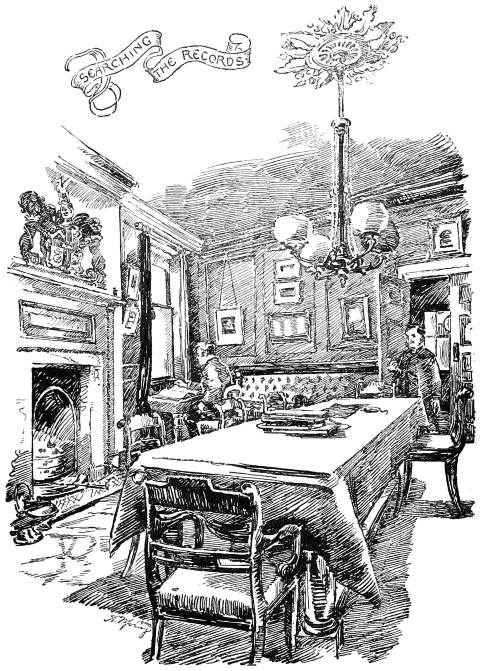
THE COMMITTEE ROOM, BARBERS’ HALL.
EXTRACTS FROM COURT MINUTES, ETC.,
MORE PARTICULARLY RELATING TO THE
INTERNAL HISTORY OF THE COMPANY.
29th August, 1550. Memorandum the xxixth day of Auguste in the house
belonging to the sayd Company it was condescended and fully agreed by the aforesayed
Mr and Wardeins Mr Geen Thomas Johnson Thomas Stocdall and Mathew Johnson
wt thassent of thassistance being there present that is to say Mr Kyrkeˀ (Kyrkeby)121
Mr Vycary122 Mr Bancks123 Mr Byrde124 Mr Yonge125 Mr Henderbe126 Robert Postell127 Willm Tyllˀ
(Tylley)128 Peter Dayseman129 Robert Waterforde130 Richard Bowll131 Henry Pemberton132
Robert Sprignell133 Robert Brownell134 John Smythe135 Willm̄ Otherborne136 and Austeyn
Clarck.137
An order
taken
concerninge
Thomas Knot.
That Thomas Knot shalbe dischardged and not called to no manner of
office unto such tyme that it shall please the mrs to agree for Another
order. And also that he shall not paie no maner of scott lot nor subsedye
nor any other chardge concerning the saied Crafte but shalbe dischardged of and
from the same Ecept onelie his quarterage and except that which he shall gyve &
paye of his owne fre will and gentelnes.
An order for
the elecc̃on of
the Maister.
Alsoo yt was ordered and agreed the sayd daye by the hole assistaunce that
the maister shall put in iiijor into his bill for his electyon and so the
same byll to goo through the house and every man to prycke as his mynde doth
serve him wthout any telling and when every man hathe pricked about the house then
the byll to be brought to the Mr And he that hath the moste pricks to have the
roome of Mr the yeare ensuynge. The names of the ellecyon for the Mr was Mr Geen
Richard Ferres Robert Postell and Willm̄ Tylle.
An order for
the eleccyon
of the upper
wardein.
Alsoo for the elleccyon of the upper wardein he shall put iiijor names into
his Byll and so to goo through the house like as the Mr Byll hath dooen.
The names for the elleccyon for upper wardein was Thomas Johnson,
Richard (The remainder of this line is torn away in original).
An order for
the Elecc̃on
of the Second
Wardein.
Alsoo for the Elleccyon of the Seconde Wardein he shall put in iiijor names
in his byll and so to goo through the house like as is before mencyoned.
The names for the Elleccyon was Thomas Stocdall, John Atkinson, John
Smyth and Thomas Knot.
For the
Eleccyon of
the youngest
Wardein.
Alsoo for the Elleccyon of the youngest wardein he shall put iiijor into his
Byll and so to goo through the house like as before. The names for
the Elleccyon are Mathew Johnson, John Tholmoode, Richard Elliot
and John Shryffe.
10th Sept., 1551. It was ordered that—
An order that the
Seconde Wardein
shall receyve all
fynes quartrage and
other casualtyes.
The second Wardein shall receyve all maner of Receite as fynes quartrag
for prentises, for fremen and all other casualtyes whatsoevr yt be. And he
to paye also all maner of wage, And the Bedyll to have a booke of all
suche receitte and dischardge as the seconde wardein hathe for his
dischardge.
Also yt ys agreed that the younger wardein shall receyve nothing but onely the
Rents of the Londes, and to see reparac͠ons dooen where as nede shall requyer and that
he shall take Appulton138 wth him when he goeth to receyve the rentes of the Londes so
that bothe there books may agree.
4th Nov., 1551. It was agreed—
That there shalbe allowed in goyng and searching of their Londes vjs viijd.
Ordered—
That John West shall bring in his fyne which ys vjs viijd for speking opprobryous
wordes against John Androwson in the presence of the Mrs.
17th Nov., 1551. It was ordered—
That the Kings maiestyes Barbor or Barbors to his highness parson And also his
mats Surgeon or Surgeons shall sytt next to the Last Mr upon the benche where as the
Mrs nowe usually doo sytt and alsoo shall goo next to the Mrs in all goyngs and syttings.
It was ordered that no Barber should take a “foreigner” as
journeyman and set him to work, before presenting him to the Master
and Wardens, under a penalty of 3s. 4d. per week.
This order was made because many foreigners (i.e., non-freemen)
who were inexpert had lately come into the City, and the Court
directed that each foreigner should give proof of his skill, and then
that he should remain for one year only and in one service, and no
Barber was to pay a foreigner higher wages than the Masters should
from time to time “sess” or determine under a penalty of 13s. 4d.
for “every weke so offending.” The Beadle was directed to keep
a register book of all foreigners for the year, and when the year
was expired, the Barber who kept a foreigner and was minded to
keep him longer was to come to the Hall within fourteen days to
have him re-registered under a penalty of 3s. 4d. per week. And no
Barber was to “entyce or envegyll any mans servant from him upon
peyne of forfeyting for a fyne xiijs. iiijd.”
The Court fixed the wages of these men as follows—
The best jorneyman that is a forrein shall have for a weke xijd. the second xd.
and the thurde as the sayd Mrs. shall thinke meate & convenyente.
17th November, 1551. It was ordered that the youngest
Warden should be chosen out of the Livery and that he should be—
in especcyall one that hathe byn stewarde so that he be a man that hath usyed
himself in that behalf honestleye and discretly.
It was also ordered that all freemen should come every quarter
day to the Hall to pay quarterage, hear the rules read, and to hear
the book set forth by the Corporation of London concerning Orphans,
and no man was to sit out of his appointed place, under a penalty.
17th July, 1553. It was ordered that Mr. John Enderby
(Master 1547)—
shall have the benevolense of the crafte fower marks a yere.
20th September, 1553. The Masters agreed with Richard Drewe—
For a barge when the Mayer goeth to Westmˀ for Twentie sixe shillings and
eighte pence.
12th August, 1554. Being Election day it was agreed that at
the choosing of the Masters—
There shalbe a solempe masse139 or other dyvyne servyce sayd and songe that the
Mrs. be choessen and the hole lyverye to be therat in their best clothing and to meete at
the hall at or before the hower of ix of the clocke and he that fayleth his hower to paye
xijd for his fyne wtout any redempcyon or gayne sayeing. The sayed masse140 to be at the
chardgs of the Companye.
1st Oct., 1555. The following Articles were agreed upon by
the Court—
I. There shall no man ffreeman fforyner or straunger of the Clothinge or wtout
the clothing shave wasshe a Bearde or tryme any man wth any Instrumēt as to make
cleane teathe upon the Sondayes within the Cytie of London or withoute in his owne
house or in any mans house or chamber or in any place els he shall forfayete at every
tyme beinge duely proved for a fyne to the hall the some of xls. And further that no
fforyner being no ffreman shall carry out any Bason or clothe or Instrumēt to make
cleane teathe to shave poll or wasshe a bearde or to trym̄e any man but wtin the Lybertye
where he dwellethe But wtin the Cytie of London he shall not trym̃e any man at no
dayes wtin anye of their howses or in any place els wtin the Cytie upon payne to lose at
every tyme beinge duely proved for a fyne to the hall xls.
II. That Apulton the Beadle of the Clothing was to be the
Clerk, and that the Beadle of the Yeomanry was to help the Clerk at
coronac͠on tyme or at other greate tryumphes when any other greate man
cometh in or when the kinge or quene comen through the Cytie.
III. That whenever the Shreif be chosein or the Mayor or the burgesses of the
parlyamẽt or upon the kings or queenes comĩg into the Cytie or any other greate man
comyth in or upon any other greate truymphe whereapon comaundement ys geven by the
Mayor of London to the sayed Company of the Clothinge of Barbors and Surgeons to
geve their attendaunce Then the hole Company of the Clothinge to meete at our owne
hall of Barbors and Surgeons in our owne lyverye all to gether fyrste, and afterwards to
gooe out of the hall two and two together as of olde tyme yt hathe been used, and when
the Mayor goeth to poules141 then the Mr and governors to gooe throughe out Wood streate
to poules wth the rest of the Company of the Clothinge. And that Mr and governors
that dothe not this shall forfaycte for a ffyne to the hall vjli xiijs iiijd And they of the
Clothing that dothe not come to the hall firste but will meete us at the place where we
shalbe appointed to stande and to remayn and dothe not kepe his hower shall loose for
a ffyne in the hall at every tyme so offending iijs iiijd Provyded alwayes yf the Mayor gooe
not to poules at the Mayors ffeaste Alhollande daye xp̃emas daye twelves daye and
Candlemas daye In what streets we doo gooe throughe yt be not throughe Wood streate
yt shall not be prejudycyall to the master and governors of the Company for the tyme
being.
IV. It was ordered that Apprentices, before being presented,
should pay 2s. 6d. fine, also 8d. to the Clerk for drawing the
Indentures.
8th October, 1555. Further ordinances were framed, vizt:—
I. That at all sittings of the Court when any business was
discussed the Members should speak to the subject in order of
seniority, and any one interrupting or speaking out of turn was to
pay 12d. fine. The Beadle also was to stand without the door, in
the Hall, and there to give his attendance whenever the Master
should knock for him.
II. That there should be an Armourer with a yearly fee
of 10s., and—
for the same he shalbe bounde to make cleane our harneys wth daggers gunnes
armyng swords and bills and with all other things that doethe appertayne to an Armorer
for to doo in mending of buckells lethers or any other thinge which dothe appertayne
to that whiche we nowe have.
III. When the Master and Governors should go to view their
lands and tenements to see the state of repair, the Bricklayer was to
go with them to advise and to have a fee of “ijs and his dynnar.”
IV. This relates to the Clerk (see Clerk).
V. That a Minute book be kept to record all the orders
made at any Court, and that such orders be read at the next Court
and signed.
VI. That no freeman shall serve a foreigner under a penalty
of 13s. 4d. for every time so offending, and any foreigner taking a
freeman to serve with him should be fined 26s. 8d.
19th November, 1555. John Demynge, “Cowper142 & ffre
denysen,” was granted a lease of a house belonging to the
Company at St. Katherine’s, Tower Hill, at £2 per annum for
thirty years, with a fine of £4 on sealing the lease and a “barrell
of doble beare.”
26th November, 1555. Thomas Glynton, Goldsmith, was to
have a lease of the house in Tower Street, where he then dwelt, for
30 years from Christmas, 1555, no rent stated, but a fine of £10 to
be paid on sealing the lease.
5th March, 1556. Several further Ordinances and awards were
made by the Court, among which were the following:—
I. That the Masters and Governors should not let the Hall to
anyone to—
daunce or use anye other kynde of games els whereby the sealinge or other
things being broken in the hall or kitchen shall redowne to the losse of the Company
Yf therefore the sayed Mr and governors for the tyme being doo let out the hall to any
bodye to thentent aforesayde wtout the consent of the hole howse to be called for the
same they should forfeit and pay etc.
IV. The ffourthe Artycle is that if any of the Lyverye or of the yomanrye come
to sesse any man being a jornye man to serve him as the order is that he taketh Id for a
yere or ijd for ij yere That his Mr shall not put him awaye at his pleasure as many now
a dayes do, but he shall complayne to the Mr and Governors for the tyme of the
demeaner usuage and evell behaveor of the sayed Journyman for noen kepinge of his
Mrs howse all the weke daye by reason wherof he dothe lose his customˀs or that he
goeth out at his pleasure and come in at his will againe wtout asking of any leave of his
Mr or mysteris wch pertayneth not to a servaunte for to doo for theyse consyderac͠ons and
other the mr maye complayne. The Jornyman lykewise may complayne of his Mr yf that
he doo not paye him his wages and to have his meate and dryncke as Jornymen shoulde
have according to the agremẽt of bothe the partyes as the Mr and the Jornyman shalbe
at a pointe when he cometh to sesse any Jornymen because that if the Jornyman doo
not his dewtye that he may be punysshed and put in prison to thentent that Jornymen
may be kept in good order otherwise then they be nowe. And that the Mr and govˀnors
for the tyme being shall declare to the Jornyman what is his dewty to his Mr when he
dothe come to be seste to thentent that he shall knowe his dewtye to his Mr and if he
doo not the same then he knoweth the pryce. And agayne to declare to the Jornyman
what his Mr shall doo to him, as to paye his wages mete and dryncke and other things
that a Jornyman oughte to have. Yf any of the Clothinge or of the yomanrye put awaye
his Jornyman before his yere or yeres come out and not declaring the matter to the Mr
and governors [he] shall forfaycte at every tyme so doinge for a ffyne to the hall vjs viiijd.
And that all ffremen being Journymen may be preferred and taken, being a workman
before any fforyner duynge his dewty to his Mr as is aforesayed because we are bounde to
preferre the ffremen wch beare scot and lot to the Cytye and company wch the Jornymen
doo not being forryners but come out of the contrye to learne there scyence here and so
after warde goo away agayne wch is not to the welth of the Companye.
VII. No Liveryman was to presume to come into the parlour,
whilst the Court was sitting, without being sent for.
VIII. Freemen were not to put away apprentices to make room
for others by whom they might get money.
IX. Two Stewards for the Anatomy were to be chosen
every year.
X. The Clerk having claimed to provide the napery and
vessells, and to appoint the Cook for the Anatomy dinners, alleging
an old custom to that effect, it was ordered that he should not again
do so as he had aforetime for a “lytle lucer of moneye,” but that the
Stewards of the Anatomy should make their own provision and “dresse
there meate clenly and honestlye because of worshipfull men comyng
thereunto,” and if the Clerk again offended he was to “paye to the
hall for a fyne his half yeres wages wch is xs.”
XII. The Twelve Article is that if Olyver Wilson dothe hereafter speake
evill of the Mr and governors and thassistaunce of the clothinge or of any of the
yomanrye as heretofore he hathe dooen wch by profe hathe been tryed and therfore
hathe been punnished in pryson, yf ever hereafter he dothe the like he to be expelled.
Note.—In all cases penalties or punishments were specified
for breach of the foregoing ordinances.
5th March, 1556. William Goodwin, Merchant Taylor, leased
to the Company for 99 years “all the houses next the hall wth the
house of the prevy wtin the hall for vjli vjs viijd” per annum, the
Company to keep the premises in repair.
27th June, 1556. Arnold Tymes, “beare brewer,” had a lease
of a “gardein lying in easte Smithefelde” for 40 years, paying 12d. for
an earnest penny, and to pay at the sealing of the lease £4, and at
the Audit day other £4.
9th July, 1556. John More, Cordwainer, and Richard Wiston,
had leases of houses in St. John’s, Walbrook, for 30 years from
Midsummer, and about this period there are several other notices
of leases for 30 years having been granted of property in East
Smithfield, Holborn Bridge, and Mugwell Street.
22nd July, 1556. An order was made:—
That there shalbe a painter belonge to the hall, and he to have a penc͠on
yerely of vjs viijd by the yere to be payed at fower tymes of the yere and for the same he
shall make cleane all the paintinge wtin the hall bothe above and benethe as the Tables
in the hall and other things and in the gardein every qr̃ter of a yere if it so neede: and
to amend faults where there ys anye at his owne proper costs and chardgs as is afore
declared.
26th August, 1557. It was ordered that Mrs. Dawson, the
Widow of one Bryckett—
a Toothe drawer shall paye no quartryge to the hawle nor hange oute any
signe or clothe wth teethe as she hearetofore hath don.
12th October, 1557. John West was discharged out of this howse bycawse
he wold not abyde ye order of ye Mr & govˀnors and one Asheton had lycence to
arest hym.
Various entries occur about this period of freemen being
brought before the Court and punished for using “obrobrious wordes.”
9th November, 1557. It was ordered that Robert Postell
(Warden 1544) should have a “yerely anewitie oute of thys
howse” of 40s.
A freeman before “setting up shop” was required to procure
the testimony of one or more citizens that he was worth 10 marks, and
to obtain a licence from the Court; there are numerous examples
in point, e.g.:—
16th November, 1557. Heare was before the Mr and Govˀnors Rychard Lynley
and he had Lycẽce to sett up hys shoppe and one Johan Coale of the Cytie of London
Cytizen and Clothwoorcker Deposed that the sayd Rychard ys worthe and valued
of hys proper owne vjli xiijs iiijd.
23rd November, 1557. Licence was granted to William
Thomlyn—
To drawe teethe and to make cleane teethe and no more and he ys so admytted
a brother into thys howse but not yet sworne and he hathe payde xs and rest other ten
shyllings he wyll brynge in as sowne as he can.
11th January, 1558. The same daye Tyndall ye Armorer is dysmyst & shall
have no more his fee oute of this howse bycawse he gave none attendañce whan or
soldyers wer sett oute to calyce143 & John gamlyn is admytted armorer & he to have
ye same fee yt tyndall had yt is to saye by the yere xs.
19th April, 1558. My lady Aylyff gave a fyne table cloth of damaske worcke
to srv̈e for the uppermost table in the hawle the wch of her jentyllness she gave frely
unto this hawle.
22nd November, 1558. An order was made against John John
that he should pay 6s. to William Bourne for “ij Barbores potts”
which he had lost.
1566. The second volume of Court Minutes contains a long
list of “Lawes Actes and Ordenances” enacted by the Court in
1566, but as many of these are not of sufficient interest to warrant
transcribing, the headings of such will only be given here
1. An order to avoied grudg or displeasure for the elecc͠on.
This was that no one was to “fynd fault” with the election of
Master or Governors if the persons so elected should at any time
be chosen out of their turn.
2. An order that solempne service be saied one the day of Elecc͠on.
Also yt is ordayned that the Mr and govˀnoures of the saied mystery for the
tyme beinge yerelye uppon the daye of elecc͠on of the newe Mr and governoures shall
cause Devine service solempnely to be kepte at the churche therefore to be appoynted.
And that the whole company of the Clothinge or Lyverye of the said ffellowshippe shall
pˀsonallye be present at the same yf there be no Lawfull and reasonable cause of Absence
to be allowed of by the Mr and govenors of the sayed mysterye uppon payne that
whosoevˀ absenteth hym self shall for evˀy suche default paye xijd. The said service
to be at the charges of the common Boxe.
3. An order ffor the allowance of the Dynner one the daye of Elecc͠on.
This directed that £13 6s. 8d. should be allowed yearly towards
the Election Dinner out of the common box.
4. An order that ye Clothing shall bring home the Mr & govˀnors in their Lyvˀyes.
Also yt is also ordayned yt uppon the day of the Elecc͠on of the newe Mr and
governoures of the saied mysterye After that they shall be chosen and that suche of
them as be present have taken their othe that then they and every off them shalbe
had home unto their howses with the Lyvery or Clothinge and their hoodds uppon
their shoulders accordinge unto an ould custome heretofore used.
5. An order howe evˀy man shall behave hym self in the Court tyme.
This relates to the order in which the members of the Court
shall speak upon any debated point; the Master to speak first, the
Upper Governor next, and so on down to the Junior Assistant, and, in
the event of the Court being equally divided, the Master to have the
casting vote.
6. An order that evˀye one of thassistaunce shall come to all courts of Assists.
7. An ordre against the Lettinge out of the Hall.
The Hall was not to be used or let out for “weddings sportes
or games therein or playes or dauncinge or for any other like entente,”
but by permission of the Court.
8. An ordre that ye Mr and upper governor shall quarterlye take accompte of the
youngre govˀnor.
9. An order that ye younger govˀnr shall quartˀly make an accompte to the Mr
& uppr govˀnor.
10. An order concernynge the younger govˀnor his receipts & payments and to
see all repac͠ons144 done.
11. An order concerninge the Secound govˀnors receiptes and payments.
12. An ordre concernynge ye examynac͠on of such as shall be admytted Surgeons.
No one was to be examined for admission to practise Surgery
but in the Common Hall, and in the presence of at least three
Examiners and one or more of the Masters or Governors.
13. An order that everie man of the said company shall abide the ordre and
award made by the Mr and governors.
14. An order that no pacient be brought unto the hall one ye Court dayes.
15. An order for chosenge Mrs and Stewards of thannothomye.
There shall be chosen yerelye for ever two Masters and twoe Stewardes for the
Anathomyes and that those twoe whiche were Stewardes the one yere shalbe Masters of
The Anathomies the nexte yere ensewinge To thende that thereby yt maybe bettˀ knowne
howe to wourke and make the same.
16. An order concerninge the Anathomyes.
This provided that all anatomies, whether public or private
should be made at the Hall and “that all private Anathomyes shall
reverently from hensforth be buryed as publick Anathomyes ar for
the worshippe of the said mysterye, any skelliton to be made onelye
excepted.”
17. An order that none supplant or take anothers cure from him one paine
of vli.
18. An order that none take any apprˀntice for Surgerie but that he can write
& reade.
19. An order how many sˀvnts evˀy man may kepe.
No liveryman was to keep more than four apprentices or
servants working in his art, and no freeman more than three.
20. An order that none use eny mannr of Barbory on Sundayes.
Yt is ordayned that none of the said mysterye usinge any manˀ of Barberye
. . . . . . shall uppon any sondaye shave wasshe poule or trymme any manne
or wth any Instrumt to make cleane teeth either wthin his howsse or in any other place
elles where privelye or appartlye uppon payne of forfeture of xls.
21. An order that none doe make any shewe of Barborye one Sonndais or
other holy days.
This provides that Barbers shall not “hange upp set or put out
any bason or basons pott or potts uppon his poule Racke shoppe
windowes or otherwise” on Sundays or holy days, and is the earliest
mention of the “Barbers’ pole” in our Books.
22. An order that assistaunts maye be made nevˀ beinge any Governor.
23. An order that none being out of thassistants com̃ into the pˀlor except he
be called.
24. An order that no courte of Assistaunce be houlden one the tuesdayes.
Tuesdays were set apart for Lectures and for the ordinary or
Monthly Courts; no reason is given why Courts of Assistants should
not be held on the Tuesdays.
25. An order for the pˀsentac͠on of apprentices before they be bounde.
Every apprentice was to be presented to the Court that they
might “uppon the sight of him allowe hymme to be cleane in pˀson
and Lymme and meete for the excersycinge of the same mysterye.”
26. An order that none put away his appˀntice before the cause be knowne
before ye Mr & govˀnors.
27. An order that none lett any bloud stand to the annoyaunce of the people.
“Barbours excercyseinge fleabothomye or bloud lettinge” were
not to show blood in vessels in their windows.
28. An order that all pˀsentac͠ons in Surgery shalbe pˀsented to the Mr wth
his governoures for the tyme beinge.
This order provided that any Surgeon having a patient in peril
of “mayme” or death, was to “present” or make known the case to
the Governors within three days, and the Court would then appoint
certain expert Surgeons to see the patient and assist in the cure.
There are scores of entries in the books of Surgeons being fined
for not “presenting” patients.
29. An order that none take any pˀsentac͠ons but ye Mr & govˀnoures for
the tyme beinge.
30. An order that the Mr and governoures and their deputies shall goe to the
poore as well as to the rich.
Any Master or Governor being sent for to see a sick or
hurt person and refusing to go without payment, was to forfeit 20s.
31. An order for puttinge the rules in execuc͠on.
32. An order for multipliinge speche in the corte tyme.
This was an early form of closure directed against such
members of the Court as were given to an over-indulgence in oratory.
33. A rule for order in goinge.
Every member of the Company was to take his place
according to precedence, at burials, anniversaries, Courts, etc.:—
And if anie of them of any scrypulosytie frowardnes follye or pusyllanimity
refuse to take his owne romme or place accordinge to the order in good obedyent
manner he was to be fined 12d.
34. An order for the view.
This relates to the yearly inspection of the Company’s property.
4th March, 1566. In Thys Courte Willm̄ Gyllam was discharged and released
oute of warde and hath p̃d his arerages and he hathe confessied yt Richard Bromehed
doth shave the vycar of Stepney in his howse every sondaye.
4th July, 1566. It was ordained that if any of the Court
hereafter might “happen to lyght or fall into povertie or dekaye” that
he should have a pension out of the Common box. One who had served
as Master was to have per ann. £4; an Upper Governor £3; Second
Governor £2; Younger Governor £1; and an Assistant 13s. 4d.
It was also ordained that Thomas Hall should have an
exhibition of 40s. per annum—
towardes hys studye in the unyvercytie for Surgery anexynge physycke thereunto,
and thereby hereafter to pˀphet his other brethren beynge of this sayde mystery and
comynaltie usynge and ocupyenge the sayde syence & arte wthin the cytie of London by
Readynge lectures unto them in ye Comon Hall and other wyse by his councell conynge
and knowlege in the same science & arte of Surgery.
It was also ordained that whenever the Lord Mayor should
invite the Masters and Governors to dine with him, that—
then and there after the same dynner ys don The Mr or govˀnors shall make his
oracyon or request in the behalf of the sayde Company as to hys wysdome yt shall seme
best in most descrytest maner and shall then geve and delyver unto the sayde Lorde
maior of lawful mony in golde ls and in orther corrant mony iijs iiijd that is foure marks
by waye as a good wyll of the same Company.
Also It ys Ordayned That god callyng oute or frome this Trancytory vale or
worlde any of this saide Company decessed and beynge wthin the clothing or lyvery of
the same, his best hood shalbe layed upon the hearse and unto the churche and yr upon
yt shall so remayne untyll the takynge of145 of the said herce clothe wch is used at the
goynge forth of the Mr govˀnors & company of the clothinge oute of the churche & the
corps goynge to be buryed. And then and yr the clarke of the saide Company shall
take the same hood and [it] shalbe his pˀper owne of dewtie. (In default the widow
or executor was to pay 6s. 8d.)
The Beadle was directed to look after, and to help in removing
back to the Hall, the standings, banners, carpets, etc., after they
had been used on any public occasion, and a small yearly fee was
to be allowed him for this service.
3rd November, 1566. Edward Parke, referred to in the
next minute, was constantly getting into trouble, and sometimes
into the Compter:—
Here was Thomas Lambkyn & John Merryt wytnesses against Edward Parke
for yt he saide he wolde not com̃e to the Courte beynge warned & yt yf the Mr com̃ytted
hym to warde he wolde brynge the Mr before the lorde cheefe Justice And yt is ordered
yt the saide Parke shall [be] & is upon his humble submyssion remytted.
16th Jan., 1567. The old vellum book of ordinances, etc.,
containing portions of the four Gospels in Latin, and still in our
possession is probably the book referred to in the minute of this date,
which states that Willm̄ Grene had “taken an othe upon the blacke
booke that serveth in this howse for the same purpose.”
13th Nov., 1567. Yt ys ordayned that Wyllyam Bull Chrystofor Swalldell
William Crowe Wyllyam Grene Henry Rankyn and Leonard Coxe is elected to be of the
clothyng and Lyvery and that theyre hoods shalbe by the Mr for the tyme beyng put upon
theyre shoulders wthin the pˀlor one Chrystmas day next ensuyng before the company go
to pawles to weyghte on the lorde mayor, unto the olde usuage in that behalf provyded
accordyngly.
27th Jan., 1568. In this court Rich Hughes is graunted to have the hall to
kepe a maryage in upon Sonday c͠o146 a sevenighte.
Again this year a licence for a similar purpose was granted to
Francis Partridge, and there are other instances.
18th May, 1568. In this Courte here was Phillip Jorden for trymynge on the
Sondayes & for now he is forgeven beynge the fyrst tyme.
13th Oct., 1568. Here was Wm fferrat for Trymyng upon the Sonday but he wyll
do yt no more here after.
About this period there were numerous cases of Sunday trading
before the Court, and in many instances the offenders were fined or
imprisoned.
9th Nov., 1568. In thys Courte here was Rich Roberts and he is comanded
that he shall agree wth this mystery as a brother or ells he to shutte up his shoppe and
ocupye no more but as a servant upon the penallties of the statute.
10th March, 1569. It was ordered:—
That Richard Wysto for his mysdemeanor and unquyet behaveor and beyng a
troublesom pˀson, so that the courte of assystents canne neyther thincke well or good on
hym, therupon and therfore he the saide Richard Wysto is relynquyshed depryved and
dysmyst of his office and yongr govˀnorshyp and also fourth of assystents of the saide
mystery.
Wysto appears from time to time to have given the Court
trouble, his offence on this particular occasion being that he had
ordered his apprentice to let a man blood in the Compter contrary
to the order of the Aldermen. Wysto was contumacious for a long
period, but seems on 17th July, 1572, to have made humble submission
and apology, whereupon an order was made “That none do stirre
upp any talke consr̃ninge the deprivac͠on or submyssion of Ric.
Wistowe”; he was subsequently re-admitted on to the Court and
served Master 1586, but the animus against him revived, and on
7th November, 1587, certain parties were before the Court for reviling
him on the old score, and were duly threatened and admonished as
to their future behaviour.
22nd November, 1569. Here was Phillip Jordan for trymming upon the
sabboth daye and he once agayne is warned upon the penalltie of the acte that he
do yt hence forwardes no more (see 18th May, 1568).
10th October, 1570. Margaret yt was Mr Vaughan147 his mayde is graunted
to kepe one Sonday her wedyng in the hall & no more.
1568 to 1570. There are several entries in the books of
members of the Court being removed for misbehaviour.
27th January, 1571. It was ordered that—
a newe Bayle be made to thentent them of the clothing of this mysterie
maie decentlie stand to attend all soch tymes as it shall please the Queenes matie to
come through the citie of London.
The Bayle was a movable stand or platform; there are various
notices as to the one previously in use, having been out of repair.
It was taken out on all great days of processions or triumphs and
on Christmas day when the “lorde maior went to Poules,” and
numerous references are also made to the Company’s banners which
accompanied it.
19th January, 1573. Here was Willm̄ Carrington for havinge iiij servaunts one
Christmas even and ordre was taken that he should laye downe his ffyne.
15th March, 1573. Here was a question moved concerninge takynge in
certeyne into the Assystaunce But the howsse would not consent to the takinge in of
any more for that there were alredye xxviij pˀsones.
Here was a question moved concernynge the takinge in of certayne pˀsons
into the clothinge but the house did not think good to take in anye for that the
nomber is alredy fyftye.
26th May, 1573. Here was John Johnsonne and brought in his fyne for
kepinge a foryner uncest xxd.
There are frequent entries of freemen being fined for not
“cessing” foreigners and journeymen, and for teaching foreigners
their “science.”
It would seem from the following precise minute that commitments
to prison were made by the Court direct, and not always upon
Warrants obtained from the Lord Mayor or a Justice.
15th March, 1575. Here was one Mˀkes [Markes] servñte wth Mr Tholmwood
sometyme, sent to the Compter by Willm̄ Eden Clark to this misterye for not pˀforming
an Awarde made betwene the saide Mr Tholmwood and the saide Mˀkes and divers
others stubborne and lewde behaviors. The comittemt made by the saide Mr and Wardens.
22nd March, 1575. Here was John Clark sessed wth Edward Park for two
yeres to begin at the ffeast of Thannuncˀ of or Ladye next vizt. the first yeare xxijs and a
payre of hose, the seconde yere xxvjs viijd a payre of hose and a Capp.
15th May, 1575. Here was a pˀsept sent by my Lorde maior straitly charging
and commandinge the companye in her Majesties name that they take immediate
order that theyr sˀvaunts and app̃ntices nor any of them in any wyse or sorte do mysuse
annye s̃vyng man page or lackey or anye other pˀson that shal goo throwe the streets
of this Cittee, nor shall attempt anything to the breach of her Maties peace either
in wordes acts countenaunce or otherwise at their uttmost pˀyll, whereupon all the
whole Companye were sent for and had that Comaundement.
1577. Thomas Hall (see 4th July, 1566) was appointed an
Examiner in Surgery and to dissect the anatomies for ten years.
There are several instances of exhibitions to sons of freemen
(generally 40s. a year), to enable them to study at Oxford and
Cambridge, and these entries extend over a great many years.
22nd Oct., 1577. Here was Mr Skarlet the Quenes Bargeman and he pˀmised
the Companie that they shoulde have a barge called the Greyhounde belonging to the
maydes of honor for lijs iiijd yf my Lorde maior do go unto westmˀ.
This sum would not of course include the Bargemaster’s or his
men’s fees for their services, or the providing banners, accessories or
attendants, all of which were paid for by the Company in addition.
23rd July, 1582. At this Coˀte John Yates Thomas Lamkin and Edward Parke
were dismist from their places and owte of thassistance for revelinge of secrets contrarie
to a rule in that case pˀvided.
6th March, 1583. Yt was agreed that whereas a demaunde was made by the
L. Maior and Corte of Aldermẽ unto or Companie for a contribution of certein monie for
certeine Landes we hold as the saide Corte gave in Certificate of John Johnsons guifte
for thuse of an obit. The answere was made by the consent of the said Masters that
this house will joyne wth other Companies in the charge accordinge to their porc͠ons.
21st Nov., 1583. Mr. Banester, a liveryman, being indebted to
the Company £5, gave a “watche or clock” and it was ordered that his
debt should be cancelled in consideration of this gift.
The following minute refers to the obit for John Johnson (vide 6th
March, 1583) the property having been declared to be held for
superstitious uses, the Company purchased their right to retain its
possession for £13 6s. 8d.
5th July, 1585. At this Corte yt was agreed That whereas a Teñte in Tower
streate belonginge to this house ys founde [to] be concealled Landes. That the pattenist
should have for agreament to have or Teñte surelie the som̃e of xxtie markes.
The next is a curious instance of an ancient tenure.
29th Sept., 1586. A lease for 21 years of a house in East
Smithfield was granted to Humphry Rowland at £6 per annum, and
the said Humphry was to—
delivr and geve unto the saide masters and to suche as shall come wth them to
viewe the said Teñte yerely the nombre of xviij shoing hornes franck and ffree.
14th Aug., 1587. It was also condiscended and agreed That the newe masters
or governors of this or Company shall eṽy yeare on the daie of or Ellecc͠on of them be
brought home to their howses with the Levery or some p̃te of them as heretofore hathe
ben accustomed eṽy one wearinge his hood in decent order.
6th July, 1592. Certein newe silver booles are to be bought for those pˀcell
gilt booles wch were the guifte of Mr Vaughan.
9th February, 1596. It was agreed for “the taking in of the
water wch cometh from the Themes by pipes into this howse.” Heretofore
the water had been supplied from a well, and later on by a
leaden “pomp.”
1596. In this year a curious episode occurred, which showed
that the Court were not unwilling to shield their freemen when
offending, if the party taking action against the offender did not
belong to the Company. Four freemen (one being an Assistant)
had been “put into” the Court of Exchequer by “one Holmes an
Informer for using both Barbery and Chirurgery against the Statute,”
and the Court, without troubling to enquire if the offence had been
committed or not, ordered that £10 should be lent the parties to
assist them in defending the suit. At the next Court the matter was
much debated as to whether the Barber-Surgeons should go on with
their defence or make terms with the informer, and the parties themselves
were consulted, whereupon it was finally decided “among
themselves to agree wth the said Informer wch they related to the whole
Corte, whereupon the Corte rose and the said pˀties made their owne
agreement privately wth the saied Informer to their best likinge.”
10th December, 1596. Mr. Storer came to the Court and
agreed with the Company, by indenture, in consideration of £5 per
annum for seven years, to relieve the Company from all charges in
respect of the provision of grain for serving the market during
that period.
9th June, 1597. This daie one septer or mace and twoe pictures latelye and
verye loveingelye given to this Companye by William Martyn148 of the Clothinge in
token of his love to this house was presented to this Courte and verye gratefullye accepted.
This daie one cupp made of an Ostridge Egge or shell and sett in silver and
guilte given by the laste will and testamente of Mr Thomas Bankes divers tymes Mr of
this Companye was likewise presented to this Courte and verye gratefullye accepted.
15th Jany., 1598. This daie William Clare one of the Lorde Maiors serjeantes
at mace is chosen officer of this house and where his fee to fore was but vjs viijd per Anñ
it is nowe by this Courte uppon good consideration augmented to xs pˀ Anñ and John
Smith in his absence is appointed deputye.
The duty of this officer was to attend the Courts of Assistants
and to arrest and convey to the Compter such persons as were
committed.
30th Jan., 1598. Nicholas Kellaway, in consideration of his
years, was excused serving the offices of Steward and Master of the
Anatomy and “freelye gave one standinge cup double guilte wch was
kindely accepted.”
14th Aug., 1598. There is under this date an interesting
account of the Election of Master and Wardens; twelve Electors
from among the Livery were appointed:—
Which electors after they had their chardge given them by the Maisters or
Governors of this Companye and their severall billes for the elecc͠on delivered unto them
after longe and deliberate considerac͠on had, did electe for the Maister John Leycocke
and for the upper Governor John Burgis and for the seconde Governor John Pecke and
for the yongeste Governor Roberte Johnson Which saide John Leycocke beinge not then
presente the garlande accordinge to the manner and custome of this house was by the
Maister for the yeare paste placed uppon the heade of Mr. Docter Browne as deputye for
the saide John Leycocke, after which another garlande was likewise placed uppon the
heede of the saide John Burgis by the upper governor And a like garlande tendered to
the saide John Pecke which he utterlye refused and for the same was fined at ffortye
shillinges which fine he paid accordinglye likewise a nother garlande was placed by the
yongeste Governor uppon the heade of the said Roberte Johnson and by him gratefullye
accepted And the saide Maister Burgis and Mr. Johnson were sworne standinge for the
due execuc͠on of their offices.
1598. In the Minute Book commencing 1598 there are scores
of cases of Barbers being fined for working on Sundays; the informant
was generally the Beadle, and it is amusing to note how frequently a
delinquent, after purging himself by a fine, voluntarily took to the office
of Informer against his brother Barbers.
Many Barbers and Surgeons were fined for presuming to
“sett up shoppe” without licence, here is an instance:—
28th November, 1598. This daye George Collimer appeared before the Mrs
of this Companye and had daye till the next court to bringe in his fine for openinge
his shop wthout licence.
11th December, 1598. This daye Thomas Powell appeared before the Mrs
for workinge on the saboth daye and puteth him self uppon his tryall, wherefore
he is comaunded to attend here the next Court And in the meane tyme for his
unrevˀent behaviour towards the Mr is comitted to the Comptr.
15th January, 1599. Where divers grudges and manye greate inconveniencies
have happened amongest suche as have benne familiar frendes and brothers of this
Societye by the unadvised rashnes of some of the Assistance of this Companie whoe
have disclosed and revealed suche secretes as have bene advisedlye and discretlye
for the benefit of the said Companye spoken in the courte tyme Contrarye to the
solempne othes of suche assistanˀ to the greate dishoner of god and scandall to the
said Companye, ffor reformac͠on whereof it is ordered by consente of a full Courte
of Assistance That if at any tyme hereafter any of the Assistance of this ffelowship
shall utter or reveale to any other pˀson beinge not Assistante any secretes uttered
and spoken at any courte which oughte not to be uttered or revealed And also
if any Elector of the Mr or Governors for the tyme beinge shall at any tyme hereafter
utter or reveale any speches concerninge the election to any person which oughte
not to knowe the same suche person soe offendinge and due proffe thereof made,
beinge of the Assistance shalbe dismissed oute of his place and livery, and beinge
onlye of the livery shalbe dismissed oute of the liverye.
Where this house hath a barrel of Gunpowder It is ordered that the same
be soulde to the beste benifitt of this house.
30th January, 1599. This daie Edward Downes was comitted to the Compter
for calleinge villayne before the maisters of the Companye.
6th February, 1599. It is ordered that John Mullines shalbe comitted to
the Compter for his disobedience in not payeinge his debte to this house.
17th April, 1599. This daie Michaell Bullocke complayneth of William Webbe
forren brother for workeinge with Henrye Needeham beinge not ceassed with him and
for grindeinge of rasares149 And Needeham is to be warned to the nexte Courte.
8th May, 1599. Marmaduke Jefferson hath till the nexte Courte to bring in
his fine for hangeinge oute his basones on maye daie.
5th July, 1599. Richard Sprignall, to be excused serving the
office of Master, presented a—
drinckeinge cupp made of a nutte and garnished with silver and guilte which
was thankfullye accepted.
17th July, 1599. This daie William Lacye is Comitted to the Compter for
his contemptious behaviour towardes the Maisters of the Companye and for workinge
in the trade of barberie beinge noe freeman.
24th July, 1599. This daie Richard Samborne complayned of one Phillip
Winter for settinge upp a shoppe in paules church yarde beinge not free. It is ordered
that the saide Winter shalbe comitted to prison untill he be free, or bounde before my
lorde Maior to departe the Citye.
This daie Gabriell Hunte appeared before the Maisters and was comitted to
prison for workeinge on the sabouth daies.
30th July, 1599. This daie Thomas Hobbes hath lycence of the Maisters to
sue Thomas Watson at the Comon lawe for not accomptinge with him for iijli. due in
the tyme of his apprentishipp.
13th August, 1599. It was further ordered that because this tyme is troblesom
and to avoyde the evill speches of men, that there shoulde go home with the Maister
but eighte of the liverye and with the rest of the Governors sixe a peece and that
withoute their hoodes.
29th May, 1600. It was ordered that two streamers and
two banners should be purchased to garnish the Company’s barge.
3rd July, 1600. This daye Anthony Millington Esquier Executor to the laste
Will and Testament of Elizabeth Scoloker deceased payd unto the Mrs viz., Mr Wood
Mr Dardes & Mr Martin a legacy of tenne poundes by the sayd Elizabeth bequeathed
to this Company whereuppon it is ordered that there be a Cup made wth the same money
And that her name be ingraven uppon it as a thinge geven by her.
11th Aug., 1600. Whereas Thomas Cole a verye disobedient and pervers
brother of this Companye did verye disobedientlie and perversely behave himselfe
towardes the Maisters or Governors in the presents of the Assistants and liverye there
assembled And alsoe for that hee refused to paie the musicions iiijd according to order
It is ordered by the consent of a full Courte of Assistants and of the reste of the
assemblie that he be dismissed oute of the liverye of this Companye And not to be
warned to any assemblies or meetinges in other sorte then one150 of the yeomanrie till it
shall please a Courte of Assistants at the like tyme to restore him to his former place, yet
he is to paye his quarterage dulye.
Thomas Cole reformed his ways, and was subsequently
re-admitted to the Livery.
4th Nov., 1600. This daye it is ordered that Wheelis dwellinge in Longe Lane
take downe his basons and make no shewe towardes the streete uppon payne to be
comitted to the Compter.
22nd Apl., 1601. This daye where this howse alloweth but vs to the parson of
St. Olaves for his sermon on the Election daye It is ordered by this Court that the
same be augmented to xs.
5th May, 1601. This daie Henry Eaton uppon warninge appeared before the
maisters or Governors for keepinge a forren Jorneyman whereuppon it was ordered that
the said Eaton shoulde put a waie the said fforren before the next courte daye.
30th June, 1601. Noah Bayley, a Surgeon, who for two or
three years past had continually been complained of for various offences,
and disagreements with patients and apprentices, came at last to grief,
for having—
not onely abused Mr Warden Thorney wth reprochefull & slanderous speeches
but also Mr Mapes and Mr ffenton twoe of the assistants of this Company making mowes151
and mockinge them as they sate in the Courte in contempt of the said Court it was
ordered that hee therefore shalbe comitted to the Compter uppon the Lo: Maiors
commaundement for example of othrs.
22nd September, 1601. This daye Richard Higgins was committed to the
Compter by the Mrs uppon the Lo: Maiors commaundmt for refuseinge to paye his fine
for his absence from the hall at the daye of genrall Rules.
This day Thomas Allen152 was fined for his absence from the said rules.
6th October, 1601. This daye it was ordered that Willm Braye for certayne
speeches & for his misbehaviour towards Mr Warden Atmer should be pˀsently comitted
to the Compter, of wch imprisonmt at his humble suite and uppon his submission to the
said Mr Atmr hee was dischardged of his said imprisonmt.
10th October, 1601. This daye Willm Deepeinge Owin Jones and Edward
Waterhowse were appoynted for three of the wiflers for the yere ensuinge.
A committee was ordered to meet at “Mˀcers Chappell by sixe
of the Clock in the morninge to viewe the repac͠ons of the howses
belonginge to this Company.” How many members of the Court
would now attend at 6 a.m. in chill October?
27th October, 1601. This daye it is ordered that the Mrs of this Company
& also Mr Bird Mr Wood Mr John Izard Thomas Thorney William Martin & John
Gerrard153 be warned to meete on ffrydaye next by sixe of the clock in the morninge
to goe on serch accordinge to custome.
23rd February, 1602. This daye it is ordered that Richard Jackson a brother
of this Company shall be committed to the Comptr for not appearinge before the Mrs
uppon warninge to answer the complaint of Edward Bird his apprentice.
22nd March, 1602. This daye it is ordered that John Rea Strangr shall be
committed to the Compter for settinge out his billes154 uppon the gates & othr places
in the Cytie contrary to his tollerac͠on.
30th March, 1602. This daye it is ordered that Mr Warden ffrederick Mr
Thorney Mr Willm Martin Mr John Peck Mr Gerrard153 & Mr ffenton shall meate on
ffrydaye next by eyghte of the clock in the morninge at Lyon Key to goe from
thence to my Lord Admirall155 to complayne against Robert Derham for his contempt
in refusinge her Mats imprest.
13th April, 1602. This daye Robert Durham (Derham) appeared before the
Mrs of this Company of his owne voluntary And it was by this Courte ordered that for
his sevˀall contempts of this Company aswel in their serch as in their prest hee should
bee committed to the Comptr uppon the Lord Maiors Commaundemt whereuppon hee
was sent to the Compter But at the speciall instance and request of one Mr Meredith
and Mr Morgan twoe of the said Derhams ffrendes hee was sent for back agayne and
uppon his humble submission & intreaty hee was dischardged of his imprisonment And
thereuppon did promise to be obedient to this Company at all tymes hereaftr.
24th November, 1602. This daye it is ordered by the Mrs or Governors of this
Company that Robert Redhead one of the Lord Maiors officers shalbe officer to this
Company as aftr the decease of Willm Clare And to have such fee for the same as the said
Willm̄ Clare held the same And also hee is to be confirmed in the same place by the
next court of Assistance.
20th March, 1604. This daye it is ordered that on thursdaye next the Mrs of
this Company shall attend the Lord Maior to knowe his pleasure concerninge their
places of standinges.
The Masters on this occasion procured an order of the Court of
Aldermen ranking the Company as sixteenth in order of precedence,
and this is set forth in the Minute Book as follows:—
17th April, 1604. A Copie of an order of Courte set downe the daye and
yere hereaftr expressed concerninge the place of this
Company in all assemblies of the Companyes of
this Cytie.
Martis decimo septimo die Aprilis 1604 Annoqʒ regni Dñi nr̃i Jacobi Regis
Anglie &c. sc̃do.
Bennet
Maior
Soane Garrard Lee Hollydaye Wattes Rowe Craven Anderson Swynerton Hayes ac Romney uñ vĩc &c.
Where it appeareth to this Court aswell by the humble supplicac͠on of the
Maisters or Govˀnors of the Mistery & Coiãltye of Barbors and Chirurgeons of this Cytie
as by an ordr taken by the same Courte the fowerth daye of ffebruary in the tyme of the
Maioraltie of Sr Stephen Peacock knighte and in the fower and twenteth yere of the
reigne of the Late Kinge of famous memory Kinge Henry the eight That the Mrs or
Governors of the said mistery & Coiãlty of Barbors & Chirurgeons & their pˀdecessors in
the order of their goinges standinges rydinges sittinges & othr assemblies of the livˀyes
of the sevˀall Companyes of this ho: Cytie have bene alwayes tyme oute of mynde reputed
taken & placed as the seaventeneth Company amongest othrs the sevˀall Companyes of this
Cytie next & imediatly from & aftr the Company of Mercers Grocers Drapˀs ffishemongers
Goldsmythes Skinners Marchaunttaylors Haberdashers Salters Iremongers Vinteners
Stockfishmongers Clothworkers Brewers Lethersellers and Pewterers And forasmuch as
it doth likewise appeare to this Corte that sythens the makeinge and establisheinge of the
said order the said Mrs or Governors of the said Mistery and Coiãltie of Barbors and
Surgeons have enjoyed the Benifit of the said order and borne all chardges taxes and
contribuc͠ons whatsoevˀ imposed on them from tyme to tyme wth credytt to the good
likinge of the Magistrats and Governors of this Cyttie as well as other Companies of like
sorte and State have done And yett notwthstanding of late at the Royall passages of the
Kinge and Queenes most exelent Maties and the prince of wales attended by the Nobilitie
and gentry of the land through this Cyttie on the fifteenth daie of March last when
through ignorance theie were misplaced by the Comittie appoynted by this Cyttie for the
mannaginge of those affaires. It is therefore this daie upon due considerac͠on had of the
pˀmisses, and for that the said Company of Stockfyshmongers have bene since the tyme
of the said order wholelie dissolved and abrogated and noe Company or Corporac͠on
remayninge wthin this Cyttie of that name, ordered and decreed that the said Mrs or
Governors of the said Misterie and Coiãltie of Barbors and Surgeons shalbe from henceforth
reputed taken and placed as the syxeteenth Companie wthin this Cyttie in all theire
goeings rydinges sytteinges standeinges and assemblies whatsoever, any misplaceinge of
them on the said fifteeẽth daie of March last to the contrary notwthstandinge.
Sebright.
22nd May, 1604. This daie it is ordered that from henceforth the Clark of this
Companie shall against evˀy Courte daie bestowe iiijd in hearbes and flowers.
12th June, 1604. This daye Willm Wrighte a very disobedyent Brothr of this
Company was accordinge to the Rules of this howse fined at vjs viijd for callinge the
officers of this howse knaves and for other his lewde & disobedient behaviour and
is to bringe it into this Court on tewsedaye next.
8th November, 1604. Mr. Thomas Goodall and Mr. Kellaway
were each fined 10s. “for not riedinge wth the Mrs when the kinge came
through the city” (probably in March last).
5th February, 1605. This daye Marcus Davie appeared before the Mrs and
was rebuked for shewinge the Copie of õr Chr̃e156 to a Scrivener.
28th February, 1605. This daye it is ordered that the numbr of 16 pˀsons of
the Assistance of this Company shalbe accompted a full Court of Assistance.
It was also ordered that a “fayre parchemt booke” be bought
for engrossing therein the Charters of the Company; this book is still
in our possession.
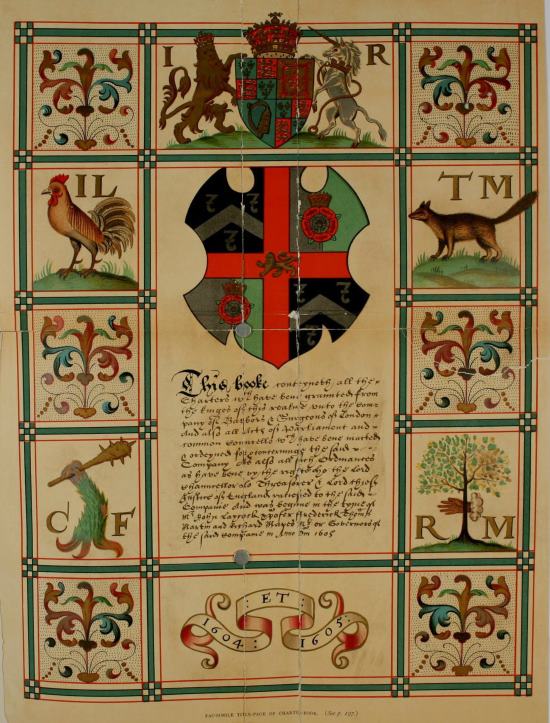
FAC-SIMILE TITLE-PAGE OF CHARTER-BOOK.
28th February, 1605. This daye Mr Warden ffrederick made request to have
a Deputie to supplie his place and office of upper warden and to sit in his place till
his retorne from Spayne whithr the saide Mr ffrederick is bounde And alsoe to kepe his
keyes whereuppon it was ordered that he should make choyce of any sufficient man of the
Assistantꝭ to keepe his keyes in his absens if hee pleased. But it was denyed that any
should sit in his place as deputy.
Christopher Frederick was Serjeant-Surgeon to the King, and
father of Sir John Frederick, Lord Mayor in 1661. He was of alien
birth and did not work harmoniously with the Court of Assistants.
In Repertory xxvii. fo. 117 (at Guildhall), is an order of the Court
of Aldermen that Sir Thomas Garrard and four other Aldermen were
to call the Master and Wardens and Mr. Frederick before them and to
end their controversies (which, however, they did not succeed in doing).
21st March, 1605. Mr. Frederick brought a letter to the
Court from the Earl of Nottingham, saying it was the King’s pleasure
that Mr. Frederick should appoint a deputy to act as Warden in his
place, whilst he was away with the King in Spain, but the Court
adhered to its decision of 28th February.
This daye Mr Warden ffrederick pˀsented to this Court a letter wrytten to the
Mrs or Governors & Assistants of this Company the contents thereof hereafter ensueth, vizt.:
Aftr my very hearty commendac͠ons I have thoughte good to signifie unto you
his Maties pleasure That I should have to attend me in this my ambassage into Spayne
Mr. Xpõfer ffrederick one of the nowe Governors of yor Company wch by reason of the
place hee bereth amongest you can hardely be spared nevertheles because the necessytie
of the service urgeth the same It is thought fit by his Matie that hee shall noĩat and
appoynt such a sufficient man to execute his place in his absens as formˀly hath borne
that office, wherefore I doubt not but you will admitt and allowe of such a one as for that
purpose hee shall noĩat to sit in his absens as his deputy who shalbe answerable for all
matts as if Mr ffrederick were there himself So to continue eythr untill the tyme of the
yere that you make choyce of some other pˀsone fit for the same or Mr ffrederickꝭ retorne
oute of Spayne wch shall first happen, of whose ready care to satisfie the Kinges
expectac͠on and my desyre I dowbte not And evenso I bid you righte hartely farewell.
ffrom Arnedell howse the ixth of March 1604.157
Yor very lovinge frend
Notingham158
I do praye you that Willm Martin be
excepted159 in his place till Mr ffrederickꝭ
retorne Notingham
26th March, 1605. This daye Mr James Hodson one of the tenaunts of this
Company accordinge to an order of a Court of Assisstance payd to the Mrs his fyne of
Lli for his lease And had lycence graunted unto him to demyse the tenement wch hee
holdeth of this Company or any pt̃e thereof And did pˀmise to geve unto this howse one
hogshead of clarret wyne when it should for the use of this howse be called for &
demaunded.
9th April, 1605. This daye it is ordered that Humfrey Gorston bringe in his
fyne at the next Courte for teachinge of a forren his Art.
16th April, 1605. This daye Stephen Abraham was commaunded [to] geve over
his keepinge a barbors shop in Phillip Lane untill hee shalbe made free of this Company
uppon payne of imprisonment.
23rd April, 1605. This daye it is ordered that Stephen Abraham be committed
to the Compter for contempt of the Mrs order heretofore set downe.
Abraham must have instantly obeyed the order, and shut up his
shop in Phillip Lane, and directly afterwards have opened another in
Finch Lane, for we read:—
30th April, 1605. This daye it is ordered that Stephen Abraham shall take
downe his basons and geve over his shop in ffynch Lane and shall continue wth his mr̃is
mr̃is Smyth orels to be committed to prison.
24th May, 1605. fforasmuch as Mathew Peele a brothr of this Company hath
delt underhand wth the tenante in possession of the howse where in one Edward Sares
lately dwelt at Dowgate, makinge the tenant to beleeve that hee the sayd Mathew Peele
had a lease graunted unto him from this howse of the same and pˀffered to sell the same
to the said tenaunt where there is no such thinge to him graunted. It is therefore
ordered that an order made the xviijth of March whereby it was determyned that the sayd
Mathew Peele should have the first pˀffer of the next tenemt that should fall voyde of this
Company better cheape by xli then any othr pˀson shalbe voyde & of none effect to all
intents & constructions.
11th June, 1605. This daye it is ordered that Willm̄ Wrighte shalbe committed
to the Compter for abuseinge the late Mrs of this Company.
25th June, 1605. This daye John Crispe dwellinge in St. Martins Barbor is
dischardged from kepeinge a shop.
12th September, 1605. This day it was agreed that the pˀnte Mrs shall pˀceed to
build againe the wall latelie taken downe betwixt or yard and the Bulwark wth Brick only
And the same to be correspondent to the reste of the bricke wall of the said yard In
which wall they are to cause to be made and placed such and so many convenient
wyndowes wth lettice and casementꝭ as they shall thincke fitt. And it is further agreed by
the consent of the Court that they shall proceed wth the worcke now in hand for the
erectinge of a steyre and steyrecase to be made to passe through the pˀlor into the said
Bullwarke or garden plott And the same to be finished and done in such mannˀ and
forme as the said Mrs shall thincke fitt And also shall repaire and amend the defectꝭ of the
wainscott in the said pˀlor where need shall require. And that such chardges shalbe borne
by this house as shalbe in that behalf disburssed.
26th September, 1605. This day Mr Nicholas Collins is chosen to be of
Councell wth this Company and is to have a fee of xls pˀ añn. and is to continue in the
same place so longe as it shall please the Assistantꝭ of the same Company.
1st October, 1605. This day William Gravenor was fined for hanginge out of
his basons on Bartholomew day And also Humphry Gorston.
This day there was redd to this Court a lrẽ directed from Doctor Browne to the
said court importinge that Christopher ffredricke was as forward in his advice as in his
Assistaunce in the cuttinge of Sr Anthony Cooke as Mr ffenton was.
About the year 1605 the Court were at law with Mr. Frederick
as appears by the Wardens’ accounts, though there is no reference to
the subject of the dispute in the Minutes, beyond the above reference
to a surgical operation performed on Sir A. Cooke, and the controversy
about the Deputy Warden when Mr. Frederick went to Spain. Mr.
Frederick was alien born, and the following order, without doubt, had
a reference to this circumstance:—
10th October, 1605. This day it is ordered that from henceforth no Alien or
stranger borne out of his Matꝭ dominions shall hereafter be capable or eligible to
beare or take upon him any place or places or office of a Mr or Governour of this
Company And that an ordinaunce shalbe pˀntlie drawne to such purpose if by or
Councell wee shalbe advised so to doe.
The above order was rescinded 21st July, 1608.
8th October, 1605. This day Thomas Emerie William ffarris John Heydon
John Burrowes Roger Brecknocke John Hullins Wyddow Turner widdow Eaton John
Phillipps and Robert Samme were fined for workinge upon last Saboth.
10th October, 1605. This day it is ordered by this Courte that the reparac͠ons
of the Citties wall next to the Bullwark shalbe accomplished and done according as the
pˀnte Mrs or Governors of this Company shall thincke fitt And all charges therein
disburssed shalbe borne by this house.
7th November, 1605. It is also ordered that the pˀnte Mrs or Governors of this
Company shall if they cann bargaine wth the Ladie Windsor for the glasse in the
wyndowes of the Bulwark And for such other thingꝭ as are by her Ladishipp to be sold
and to give such Composition for the same as they in their discretions shall thincke fitt.
This day it is ordered that the youngest Governor Rentor doe cause all needful
and necessarie repˀac͠ons to be done upon such tenemtꝭ as ought to be repaired by
this Company And also shall cause the privit hedge in the garden next the Bullwark to
be taken up and the ground to be leveled and another hedge to be planted and sett all
alonge from the further end of or new bricke wall to the furthest corner of that garden.
19th November, 1605. This day it is ordered that the Mrs of this Company
togeather wth Mr Bird Mr Wood Mr John Martin and Mr Mapes are to goe in search on
satterday and upon munday next And they are to meete in Powles.160
28th Nov., 1605. This day it is ordeyned that or Mr shall compound with some
Baker to pˀvide for this Company 50 quarters of good wheate at such yearelie rate and for
such tyme as they can agree And he to be Baker to the house so longe as he behave
himself well.
One Willm. Clifton was on 17th December following appointed
Baker, and agreed to find 50 quarters of wheat for £5 per annum.
28th January, 1606. This day John ffoxe a forren Barbor appeared before the
Mrs and was by them forbidden to keepe shopp in London any more for Barbinge or
Surgery, And he pˀmissed that he would not.
16th June, 1606. In the controvˀsie betwixt Thomas Orton & ffrauncꝭ
Holland It is ordered that the said Orton proceed not in suite of law against the said
Holland otherwise then by takeinge the peace of him till the next Court Att wch tyme the
said Holland is comaunded by this Court to bringe in his fine of xls for strikinge of him
the said Orton. And the said Orton is to geve his attendaunce at that Courte.
14th July, 1606. This day uppon the suite of the pˀson and pˀishioners of St.
Olaves in Silver Street It was ordered by this Court that at such tyme as the now church
of the said pĩsh shal begin to be reedified beinge now in great decay and fallen into ruyn
That then the Mrs or governours of this Company for the tyme beinge shall of the stocke
of the said Company pay to the then church wardens of the said pĩsh the somme of xli
towardꝭ the reedifiẽg of the said Church wthout makinge further suite for the same.
Several liverymen were complained of for not having attended
in their liveries of late, and among other notes is the following:—
14th July, 1606. This day Henry Bradley one fferris and Henry Bracey are
dismissed out of the Clothinge and Assistaunce of this Company for they have not given
their attendaunce in their liveryes uppon summons.
8th September, 1606. This daie Mr. Peck did lend voluntary to this howse L
gratis for a yeare next ensueinge.
This daie Mr ffenton did lend Cli gratis to this Company for a yeare next ensueinge
Also he did lend to this Company Lli more for a yere at xli pˀ cent.
23rd September, 1606. This day it is ordered that Percivall Jackson shalbe
comitted to the Compter for his severall Contemptꝭ to this howse.
30th September, 1606. This daie Percivall Jackson was dischardged out of
prison upon his mothers intreatie. And is to bring in his debt to Burrowes at the next
Court.
7th October, 1606. This daie John Hedlow paid to the Mrs vjs viijd wch by them
was tofore paid to officers wch attended to committ the said Hedlow for his severall
contemptꝭ to this howse.
13th October, 1606. Percivall Jackson was again committed to
the Compter for his “severall contemptꝭ.”
4th November, 1606. This daie John Kerrell Richard Cade & Richard
Houlden were fyned for being absent from the funerall of Mr ffyneinge.
10th March, 1607. This daie Thomas Grig was fyned at xiid for not wearinge
his Cap on Candlemas daie last.
19th September, 1607. The Clerk’s child having died of the
plague, and being carried through the gate of the Hall, an order came
from the Lord Mayor commanding the Court not to sit for 28 days,
and it was thereupon ordered that the Courts should sit at Mr. Fenton’s
house in Bartholomew’s Court during that period.
This daye it is ordered that Carehills wyef be warned to the hall against the next
Court for keepinge of twoe shoppes of Barbinge wthout Bisshoppesgate.
8th October, 1607. This daye it is ordered by this Courte uppon due
considerac͠on had That from henceforth the Mrs or Governors of this Company every yere
yerely shall geve to the Recorder of this Cytie a yerely fee of money oute of the stock of
this Company at their pleasures so that it exceede not the somme of iiijli.
It was ordered that no liveryman should henceforth—
attend in his lyvery and wthout a ruffe band uppon payne of xijd for evˀy offence.
3rd November, 1607. This daye uppon the humble suite of one wydowe
Burrows shee is admitted to keepe her Barbors shop where shee now dothe for 2 yeres
next ensuinge not wthstandinge that wthin the said tyme shee mary an husbond of any
othr trade.
1st December, 1607. This daye Thomas Allen161 and James Mullins were fined
for wearinge of falleinge bands wth their livˀy gownes.
21st January, 1608. This daye it is ordered that. . . . Braye [be appointed]
Informer to pˀsecute suites by informac͠on against such pˀsons as the pˀnt Masters shall
noĩat for one yere next ensuinge at the chardgꝭ of this howse And hee is to have tenne
poundes for his paynes therein.
27th January, 1608. Five of the Company were fined for
not being at the funeral of Mistress Izard in their liveries.
5th April, 1608. This daye lycence is geeven to Willm Buckley to arrest John
Dodd breakeinge his wyndowes.
21st July, 1608. This daye it was thought fit that the pˀnt Assistantꝭ showld
sit in Court wthout their Gownes for that the weathr is hot.
It is ordered that the laste quarters penc͠on due to John a Lee lately deceased
shalbe paid to the poore woman wch kept him in his sicknes.
At almost every Court, charities in sums varying from 2s to 40s
were given to poor members for their relief, or to the widows of
former members, and in many cases yearly annuities were granted
out of the stock of the house, independent of the Trust charities
distributed by the Court.
14th February, 1609. This daye John Stubbes one of my lord maiors officers
is appoynted a Serjeant to this Company.
27th June, 1609. This daye it is ordered that George Dugdale shall before
Michaelmas next paye to Thomas Shephard vs wch hee oweth him Orels to be
Committed to the Compter.
6th July, 1609. This daye Roger Rayney Marchaunt tayler is elected &
chosen Butler to this howse so longe as hee shall well & honestly behave himself
therein And is to have all such fees and allowances as to his said place or office
are incedent or belongeinge Provided hee enter into bond to the Mrs of this Company
wth sufficient surety wth Condic͠on to make good to this howse all such plate linen &
othr thingꝭ as shalbe committed to his chardge by the Mrs of this Company the
Stewardꝭ of the Maiors feast The Maisters or Stewardꝭ of the Anathomy or Wardens
of the Yomanry.
This daye uppon the due examinac͠on of sevˀall abuses & misbehaviours
comitted by Thomas Goodale on of the Assistantꝭ of this Company towardꝭ Mr.
Edward Rodes maister of this Company wrongefully chardgeinge him wth injustice
before the wholl Courte And for othr his misdemeanures hee is by the wholl Consent
of this Court dismissed oute of the Assistance of this Company.
26th July, 1609. Whereas heretofore it hath byn observed for a rule and
customary order that the Mrs of the Company to whom the Electors on the Election
day before dyñn should deliver the names of such pˀsons who were at such tyme elected
Mrs of the Company for the yeare insuinge, should not give any notice to any new Mr so
elected before the garland should be put upon his head, it was now thought fit that that
rule should be put on one side, and that those chosen should be at once informed of
their Election that they may make pˀvision for the entertaynement of the livery, etc.
10th August, 1609. This day Richard Browne was admitted Armorer to the
Company and to have p̃. anñ. xiijs iiijd and he to have a speciall care to keepe the
Armour in repac͠ons and to be therefore paid by the Rentor warden for the tyme beinge.
This day Mr. John Leacocke162 contemptuoslie depˀted out of the Courte wthout
licence of the Mrs or of any of them And albeit he was required by the Clarke by the
comand of the Mrs to come into the Courte beinge depˀted out of the hall, he answered
that he would not come againe Therefore it is ordred by this Courte that he shall pay
his fine of iijs iiijd for depˀtinge the Court without the Mrs licence And if he refused to
pay the said iijs iiijd then the som̃e of xls is by this Courte ordred to be assessed and
ymposed upon him wch if he shall likewise refuse to pay then he is by this Court
dismissed out of the Assistaunce ipso facto.
Mr. Leacocke submitted and paid his fine 26th September, 1609.
21st August, 1609. In answer to a precept from the Lord
Mayor, a certificate was sent to his Lordship that there were
remaining of the 50 quarters of wheat wherewith the Company was
charged, 20 quarters, and that the remainder had been sold in the
Markets according to former precepts.
19th October, 1609. It was ordered that:—
no Mr or govˀnor of this Company shall from henceforth have power or authority
in them or any of them to sell morgage or ympawne the fower pieces of Tapistry
hangingꝭ or any of them wch were bought for the use and creditt of this house.
9th January, 1610. Att this Courte Henry Jones paid vjd to the pore’s box for
hanginge out his basons one Twelveth day last.
6th March, 1610. Att this Courte it is ordered that Thomas Burgis shall
at the next Tusedayes Courte pay unto the widdow Burrowes his late Mris iiijs for that
he hath broken her Combes and Sisers.
21st March, 1610. Att this Court it is ordered that the wyddow Saunders shall
no longer reteyne in her service one Allexander ffarrington uppon payne that if shee doe
her basons shalbe taken downe & she comitted to the Compter.
8th May, 1610. At this Court it is ordered that Pyramus Porter shall be pnˀtely
discharged out of Prison being layd in by Richard Gessell for that Porter was layd in
wthout the Mrs Consentꝭ.
Porter was Gessell’s apprentice, and their disagreements had
been before the Court on a previous occasion.
20th August, 1610. Mr. William Gale (who had been Master,
1595) was elected Master; he was an eminent Surgeon but, dying on
19th November, 1610, was succeeded in his office by Mr. John Peck
(who had been Master in 1605). Mr. Gale was buried at Monken
Hadley, in the chancel of which church may still be seen in the floor
on the North side of the Altar, a brass with an inscription to his
memory, and two brasses with the effigies of his sons and daughters.
There were formerly brasses of the effigies of William Gale and his
two wives, but they have unfortunately been removed.
The arms of Gale (as appearing on his son’s brass in Monken
Hadley Church) Az. on a fesse betw. three saltires ar. as many lyons’
heads era. of the field langued gules.163
20th September, 1610. Att this Court a motion being proposed by the
present Mrs to thentent to bringe the howse out of debt, wch cannot be soddenly effected
except the Assistauntꝭ of this board shall of their owne free willꝭ by their pˀticuler
free guiftꝭ or other wise by the voluntary free loane of money to this howse for a
certayne tyme, be assistinge And thereupon Mr Warden ffenton declared that or Mr
was contented towardꝭ soe good an acc͠on to gyve freely xxli and Mr Warden ffenton
vjli xiijs iiijd Mr Warden Veare iijli vjs viijd Mr Warden Hassald xls And demaundinge
of the residue of the bord what they would gyve, Mr Wood he would gyve xli if the
howse will renewe his lease, Mr Sˀjaunt Goodorus would thinck of itt, Mr Leycock
Mr Thorney Mr Gerard Mr Rodes & Mr ffrederick would doe the lick Mr Thomas
Martyn would gyve xxs Mr Isard vjs viijd Mr Mapes would gyve xls Mr Johnson Mr ffoster
Mr Ingolsby & Mr Coghill they would doe as others in their Ranck would doe. Mr
Cook would gyve xxxiijs iiijd.
16th October, 1610. Att this Court It is agreed that one Henry Pullyard
a Drummer shalbe admitted to be the Drummer to this howse And he is to have
for evˀy dayes service that he shall serve as a Drummer to this Company on the
lord Mayors daie the some of xiijs iiijd.
20th November, 1610. Att this Court ytt is ordered that William Jones
shall bringe in the next Tuesdaye Cort xxs for a ffyne for keeping two shoppes.
22nd November, 1610. Roger Joanes, a Waterman, was
appointed Bargeman with a yearly fee of 20s., and was in consideration
thereof to find a Barge with “all thingꝭ therein and
therewith fittinge” whenever the Company should require the same
for £3 on each occasion.
11th June, 1611. Itt is likewise ordered that the Clothworker wch practizeth
Barberye about Thames Street if he be found workinge, that then he shalbe comitted
to the Compter.
18th July, 1611. At this Court upon the humble suite of Edward Handsome
it was thought fitt & decreed that he should first agree wth the Informer, wch being
done come & make his suite to this house at some Court of Assistantꝭ and then he
shoulde knowne & fynd howe kyndlye they would deale wth him.
8th October, 1611. At this Court John Scott was ffyned at vjs viijd for
refuseinge to holde the place of a whiffler.
4th May, 1613. At this Court Henry Clawes came before the Mrs and by them
is pˀhibited and forbidden to keepe a Barbors shopp or deale any more in surgery for that
he is noe denizen.
22nd August, 1614. It was ordered that in future, any
liveryman being called to the Court should pay a fine of five marks.
It does not appear that before this time a fine had been taken on like
occasions.
By an entry about this date, it seems that when a “foreigner”
was admitted to the livery he paid £5 for yeomanry and £5 for livery
fines in one payment.
30th March, 1615. At this Court it is further ordered that the new Ryver water
shalbe taken into this howse so as it maie be had for 30s fyne & 30s pˀ anñ in rent.
6th July, 1615. The hall, which was in “great decay,” was
ordered to be viewed by a Committee of the Court, as to its restoration.
11th November, 1615. At this Court our Mr acquayntinge them how unfortunatlie
it hath happened that the Hall on Tewsdaie night last beinge 7 November was broken
open & what losse the howse susteyned thereby. Whereupon it was then presentlie
considered and then ordered that a present course be taken for the spedie repaieringe
of the howse & tresory howse and that the same shalbe forthwith stronglie borded &
made up at the charges of the howse. And for this purpose this Court did noĩate the
p’nte Mr together with Mr Peck Mr ffenton Mr Martyn & Mr ffoster for to be Comittees
for the well orderinge & appoyntinge of the workmen to doe & finish this worke as in
their discretions shalbe thought mete. And what the Comittees or anie three or two of
them shall thinke fittinge to be done this howse will rate for & allow of as also of the
charge to be borne by this howse.
Note That the xjth daie of November Thomas Lyne confessed how he was the
plotter for the Robbinge of or Hall and how or plate was Carried to Westmˀ & our
monie was devided amongst the theves who were these Thomas Jones Nicholas Sames
& Walter ffoster wc̃h did break open the Hall, whereupon the Clarke haveinge order
from or Mr went to Westmˀ & upon search there made found our plate locked up in a
trunke in the howse of one . . . . a shoemaker xjli xviijs of the monie Mr Warden
Coopˀ found the same daie in the howse of one ffulses in Fleete Street. About the
xvjth of Nov. then followinge Thomas Jones was taken who beinge brought to Newgate
in December followinge Jones & Lyne were both executed for this fact.
In January followinge Sames was taken & executed. In April 1616 ffoster was
taken & executed. Now letts pray God to blesse this howse ever from any more of
these damigees. Amen.
13th December, 1615. At this Court was gyven unto the officers in regard of
their paynes taken in apprehendinge the theves & obteyninge our plate 5li that is to the
Clarke 40s & 30s a peice to the beadell & Porter.
30th June, 1617. At this Court is gyven unto the weif of John Davis a fre
brother who lieth in prison xs.
27th January, 1618. Upon the humble petic͠on unto this Companie preferred
by Thomas Shaw a pore brother of this Companie & now lyeinge in Ludgate thereby
sueing for some releife to discharge him out of prison. It is therefore ordered by this
Court that if the some of 30s will discharge him out of prison it shalbe disbursed out of
the stock of this howse.
20th September, 1622. At this Court is gyven to Susan the Clarkꝭ mayde
towardꝭ her marriage 40s in gratuity.
At this Court it is ordered that Jones the Waterman shall have for the hier of
our barge against the lord Maiors day fower poundꝭ So as it is a large barge will hold
the hole lyvery And to worke wth 7 or 8 oweis.164
31st January, 1625. It is straightly ordered by this Courte that the pˀnte Mrs or
Governors and their successors shall take speciall care to comence and prosecute any suite
by lawe against any ignorant imposters or other pˀsons exerciseing the arte of Chirurgery
aboute this Cittie not free of this Companye & alsoe such as shall keepe shoppes for
barbery within this Cittye being free of other Companies & not of ours.
19th January, 1626. This daye John Mills and George Roades are chosen to
be of our Assistants for Barbars and Henry Blackley and Peter Thorney for Surgions.
Item this Courte takeing into their considerac͠ons the fewnes of our Livery many
of them being lately dead by reason of the late greate visitac͠on doe elect and choose John
Pinder Edward Charley Edward ffleete Robert Clarke Samuell Dye and Lewis Gossidge
to be of the Clothing of our Companye.
15th February, 1626. At this Courte it is ordered that William Kellett do bring
in his fine of vjs viijd at the next Courte for his unseemely carriage and vile language to
Walter Preist being contrary to the ordinance and good goverment of this house, which
fine the said William Kellett here in Courte refused and said he would not paye it.
At the same Court Priest was ordered to pay Kellett £3 which
he owed him.
8th June, 1626. Kellett, not having paid his fine, was ordered
to be dismissed out of the livery.
26th October, 1626. But becoming repentant, he made humble
suit to the Court to be reinstated, “protesting here in Courte that as he
hopeth to be saved he did not speak those wordꝭ and if he did he is
very sorroy for it,” upon which submission and payment of his fine, he
was readmitted to the livery.
23rd February, 1626. This daye upon the petic͠on of Thomas Borne and a
certificate under the hand of Doctor Allott that the said Borne was a Scholler of the
house in St. Johns Colledge in Cambridge it is ordered by the Court that for one yeare
ensueing he shall have iijli to be paid him by Mr Warᵭ Molins.
1st February, 1627. Item It is ordered by this Courte that there shalbe given
unto Mr Doctor Gwyn and his sonne for his prefermt in takeing degree of Batchelor of
Arte in the universitie of Oxenford xijli as the free gift of this Court.
9th November, 1628. This daye Richard Roades a Barbar & Surgion hath
leave to open his shopp according to the ordinances of this house.
Roades was probably a man who had practised both as a Barber
and a Surgeon outside the Company’s jurisdiction (the common usage
of those days), but now being admitted a brother he had licence to
practise “according to the ordinances,” that is, either as a Barber or a
Surgeon, but not as both.
5th February, 1629. Upon the humble petic͠on made unto this Courte by
John ffranck a professor of Surgery the sonne of John ffrancke late of the clothing
of the livery of this Companie for that the said ffranck is nowe taken prisoner in
Turkey and his ransome is assessed to 600 Crownes. In comiserac͠on of whose
distressed estate in a deede of charitye of soe greate consequence this courte doth
order that upon the said John ffranckꝭ being safe delivered into England here alive
he shall have viijli paid unto such pˀtie as the ransome doth belong unto.
24th July, 1629. This daye in the complaint made unto this Court by
Henry Edwardꝭ against John Cox for arresting of him without the consent of the
Maisters they both being here present in Court It is ordered that Edwardꝭ shall
paye Cox the xxs which he received of him uppon the wager that was wagered betweene
them, and that Mr Cox shall withdraw his acc͠on and proceede noe further in lawe
and It is further ordered that Mr Cox shall paye his fine of a marke on the next Tuesdaie
for not askeing leave of the Maisters to arrest him.
1629. The fine for not serving Steward of the Mayor’s feast
was £13 6s. 8d., and this had been the usual fine for many years.
16th September, 1630. A reference is made to a brick building
which a tenant of the Company was erecting at Holborn Bridge,
under the direction of Inigo Jones.
28th January, 1631. This Court doth give to Marshall Petoe165 for his elegies on
Mr Banckꝭ his funˀall vs.
15th March, 1631. It is ordered by this Courte that the 12 Electors shalbe
chosen and drawne by a ballotting box in this manner, twoe out of the auncient Mrs
one barbar one Surgion, 6 out of those of the whole Assistantꝭ 3 Barbars 3 surgions,
4 out of the livery 2 barbars 2 surgions as shalbe present on the Election daie.
10th April, 1632. Nicholas Moseley made complaint against goody Smith of
her unruly and disorderly liefe amongst the Tenementꝭ in the alley at Holborne Bridge
and thereupon this Court doth give him leave to expulse her from dwelling [there]
any longer.
2nd July, 1632. This daye upon the humble and pittifull petic͠on made
unto this Court by Richard Hayeward in the behalfe of Ric: Heyward his son whoe
is now captivated and inthrawled under the slaverye of the Turke and his Ransome
being to the som̃e of one Ci. wch the said Heyward is not able to raise, This Court
therefore compassionateing the said Richard Heywards distressed estate, whoe being a
Christian is in bondage to those Turkish & heathen Infidelles dothe order that there
shalbe xli. paid out of the stock of this house for and towards the ransomeing and
redeemeing the Captive at such tyme as the said Richard Heyward the son shalbe
delivered alive here in England and not otherwise.
6th February, 1633. Anthony Mondeys wĩdd pˀnted to this Court a Booke
called The Surveigh of London beinge in folio and newlie printed.
This would be Munday’s edition of Stow presented by his
widow, and for which she, in return, had a present from the Court.
29th November, 1633. It is ordered that for the stock of Corne to be provided
yearely by this house every one of the Assistantꝭ of the Liverye shall lend xls. presently
and every one of the liverye shall lend xxs. or Mr giveing a noate under his hand that
the house shall repaie it within a moneth after each mans death to his executors if it
be demaunded And soe hereafter every pˀson that cometh into the Assistantꝭ to lend xls.
or that cometh into the liverye to lend xxs.
4th March, 1634. 52 quarters of corn only being in the granary,
it was ordered that 8 quarters more should be purchased to make up
the complement of 60, which the Company were required by the
City to keep in stock.
14th January, 1634. The question of “Ship money” being
considered by the Court, it was thought that the Surgeons of the
Company were free from the same by Charter, and a Committee of
the Court was appointed to take counsel’s opinion thereon.
20th April, 1635. £10 was ordered to be given towards the
restoration of the Church of St. Alban, Wood Street.
2nd June, 1635. Hugh Ward, for his absence from lectures,
was summoned before the Court, when he used “approbrious language,”
and defied the Masters,
Whereupon this Court did in the Lord Maiors name comitt the said Hugh to
the Compter in Woodstreete & charged the said Ward to staye but he struggled to gett
forth of ye parlor soe the Mrs comaunded the dores to be shutt till an officer had taken
him in charge, but after the officer had him in charge and they were gone forth into the
streete (as the officer reported to this Court) Ward stepped from him and drew his knife
& swoare hee would sheath it in his guttes if he came after him and soe he made an
escape from the officer.
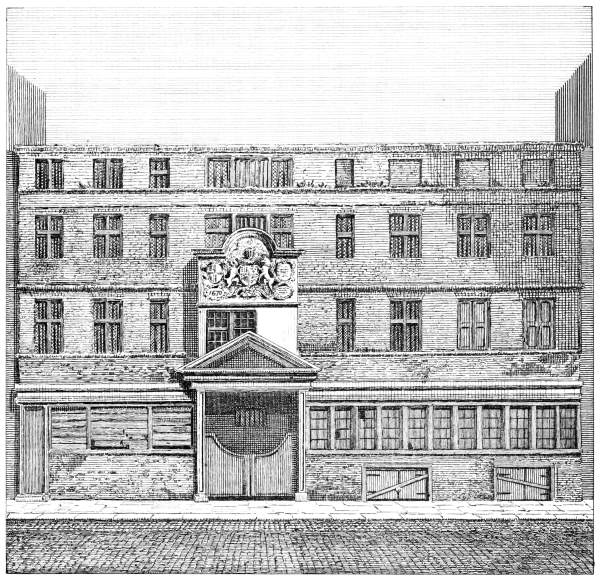 Wood Street, Compter.
On the east side of Wood Street, stood this Prison, pertaining to the
Sheriffs of London, built in the Mayoralty of Sir Samuel Strange,
Knt:—(Sir John Smith, & James Edwards, Esq.r being Sheriffs)
in the year 1670.
Publish’d Jany. 1 1793 by N. Smith G.t Mays Buildings, St. Martins Lane
13th August, 1635. Ward made his submission and paid a
fine of 40s.
1st December, 1635. John Robinson a forreyne bar̃b was questioned here in
Court for setting up a barbars shopp in Blackfriers before he had made knowne to this
Court that he had served 7 yeares appnˀticeship with a barbar by trade, and had a licence
to sett upp shopp, said he was bound appˀntice to Rich. Davyes of Hereford barbar
xth of Januar xxjth of King James for 8 yeares but could not bring testimony he had
served that time This Court doth charge him to take in his barbars pole & basons & to
forbeare keepeing that shopp any longer.
8th March, 1637. Whereas there was an intenc͠on to make an open Gallery
The Court is now resolved & doe order that it shalbe made a convenient faire Parlour
over the walke leading into the Theater at the costꝭ of ys house.
30th March, 1637. It is ordered that the Gallery or Parlour leading to the
Theater from the Bullwarke shalbe built and the Hall Cupboard that cants into the stone
yarde shalbe taken downe and the leade thereof shalbe imployed to leade the Tarris that
passeth from that plor into the Theater.
19th May, 1637. £10 was ordered to be paid towards the
ransom of Thomas Wright, a Surgeon, who had been captured by
the Turks.
10th June, 1637. It is ordered that the 3 stone Columbꝭ allready wrought
shalbe sett up and the walk next the hall side to be leaded over and railes & turned
ballasters to be sett up Alsoe that there shalbe Iron barrs for all the windowes Alsoe a
portland stone for the mantle tree Alsoe a tablett of stone shalbe sett up in the front and
the Mr & Wardeins names to be insculpted thereon and a sunn diall to be in a convenient
place.
24th July, 1637. It is ordered that the Concave seeleing of the Theater shalbe
painted with the Constellac͠ons of the Heavens and the 7 planetts over the 12 signes in
every peere and sceletons to be wrought and sett up on every one of the 12 signes or
Corbells.
Alsoe that this mottoe shalbe sett in the tablett of stone in the front of the greate
pˀlor. This Parlour was built in ye yeare of or Lord 1637 Mr Richard Powell being Mr
Mr John Heydon Mr Wm Huckle Mr Law: Cotton Wardeins.
13th August, 1637. The painting the ceiling of the Theatre
was ordered to be deferred until next year, and the scaffolding to be
taken down forthwith.
20th September, 1637. It is ordered that the seeleing of the greate pˀlor shalbe
boarded shott & planed over with hole deales.
20th September, 1637. It is ordered that there shalbe given xls to St Edmunds
berey for reliefe of the poore people visited with the plague.
20th November, 1637. It is ordered that the yeomanryes hearse cloth shalbe
altered and the imbrothered scutchions & figures to be decently sett by an Imbrotherer
to be alwayes used at the publique discections in the Theater.
28th December, 1637. This daye complaint was made agt Thomas Trevilion
now Rentor Wardein both for his obstinacy and ill words and exacting money from
yonge freemen and throughing up his keyes of the Threasurye & sayeing he would
come no more to keepe Courtꝭ at the Hall and desireing to be put out of his place,
for wch his misdemeanors and other evill behavior being made apparent to this Court
and his acknowledgemt of them upon due considerac͠on of all wch It is ordered by this
Court yt the said Thomas Trevilion doe stand and shalbe from henceforth absolutely
removed and dismissed from his office & place of ffowerth Mr or Governor.
Mr. William Lingham was subsequently chosen in Trevilion’s
place.
The Court sometimes acted in the capacity of private trustees
of the estates of deceased members, and among the archives there
remains a deed of acknowledgment signed by the Master and Wardens
in 1637, wherein it is recited that Richard Mapes, a former Master
of the Mystery, deceased, had left legacies to his four children, then
being infants, and had appointed his wife Faith, executrix and trustee,
with the proviso that in the event of her marrying again the Court of
this Company were to be the trustees for the said children, and that the
widow, having remarried, had paid over the children’s portions to
the Masters or Governors. Attached is the seal of the Barber
Surgeons, unfortunately not perfect, though a good specimen.
8th February, 1638. It is ordered that the Seaven liberall Sciences shalbe
provided for the Theater by the Mr and Wardens at the house charge soe it exceede
not xli. xs. the carveing of them.
29th March, 1638. The whole of the Assistants and Livery
were called together to know what they would give to the building
fund, when the following sums were promised.
| Mr Serj Clowes | xli. | Edward Charley | vli. | Robert Bulluck | iijli. |
| Mr Rich Wateson | xli. | Edward ffleete | vli. | Thomas Bowden | iijli. |
| Mr Michaell Andrews | xli. | Henry Eaton | vli. | John Dorrell | iiijli. |
| Mr Hen Blackley | xli. | Henry Boone | vli. | James Clarke | iiijli. |
| Mr Warden Burgen | vli. | Samuell Sambrooke | iijli. | Hugh Warde | ijli. |
| Mr Warden Cotton | vli. | Hugh Napkin | ijli. | William Watson | iijli. |
| Mr Warden Lingham | vli. | Morrice Griffith | vli. | Nicholas Brothers | iijli. |
| Mr John Heydon | vli. | Wm Bennett | ijli. | John Meredith | iijli. |
| Mr Nicholas Heath | vli. | Robert Terrill | ijli. | Thomas Biggs | iiijli. |
| Mr William Huckle | iijli. | Edward Arris | vli. | Phillip Gill | vli. |
| Mr Martine Browne | xli. | Humfrey Painter | iijli. | Charles Stamford | iijli. |
| Mr Wm Kinge | vli. | Thomas Allen | ijli. xs. | James Walsall | iijli. |
| Mr John Pinder | vli. | Lawrence Loe | vli. |
3rd July, 1638. This daye was made knowne to this Court yt Jon Pemberton
formerly chosen an Assistant hath given his answeare that he will not hold that place
nor come to the Hall unlesse he were drawne with wild horses thither, whereupon this
Court doth fine him at xli. & that he shalbe prosecuted for the same at Lawe.
16th August, 1638. A stormy election of Master and Wardens
was holden this day, and a very precise minute of the proceedings
is entered, from which it appears that the Court and Livery being
assembled, the Master declared—
The occasion of this solempne meeteing & the necessarye succession of the
Governors & governemt of this Corporac͠on. And thereupon a ballatting box being
sett on the table and the names of the auncient Mrs & Assistants and livery being
severally put into the twoe Sells of yt box, or Mr according to order did first drawe
forth the names of theis twelve pˀsons following for Electors vizt for the Six Surgians
Mr Rich Wateson Mr Martine Browne Mr Jon Pinder Tho. Tomlinson Edward Arris
& Henry Eaton. And for the other six Mr Richard Powell Mr William Huckle
Mr Jon Davyes Mr Samuell Die Hen. Hodgkinson & Evan Owen. And thereupon
the said Electors haveing wthdrawne themselves from the publique Assemblye & taken
their oathes upon the holye evangelists for the election of fower Masters or Governors
for the yeare ensueing, The Mrs and the rest of the Assembly made their repaire to
the Church and after Sermon upon their returne to the Hall the Masters being called
to those 12 Electors they were informed that the Election could not proceede and
be made,
by reason that certain of the Electors being of divers trades
were unable to agree upon two persons expert in Barbery, and these
Electors refusing to choose two Masters Barbers, a Court was at once
held and the six Barber Electors were discharged, six more Electors
being chosen and called; two of these, however, being contaminated
by those already dismissed, refused to serve, and eventually a fresh
set of Electors was chosen, who retired, and elected Mr. William
Clowes, Serjeant-Surgeon to the King, as Master, and three others
Wardens, “and after dinner ended and the Seremonye pˀformed
by the Masters or Governors of chooseing the new Mrs or Governors
with silver Garlands in the publique Hall,” the new Master and
Wardens were sworn in.
8th November, 1638. A great feud having arisen between the
Court and Richard Morrice, an Assistant, a suit was prosecuted against
Morrice in the Earl Marshal’s Court, when the sentence pronounced
against him was that he should attend the Court at the Hall, and there
bareheaded rehearse in an audible voice an abject apology, the exact
words of which are set out. This Morrice did, and the Master and
Wardens having testified the same, he was again called into Court,
when it would seem that his apology had been made under fear of the
Earl Marshal and not of his free will, for the Court calling upon him to
make answer “for his contentious carriage & foule & bitter languages
& invective speeches by him given from Court to Court agt divers
Assistantꝭ to the generall disturbance of their Courtꝭ he refused to
cleare himselfe or to give answeare,” whereupon the Court dismissed
him from his place as an Assistant.
13th September, 1640. This Court is willing that there shalbe a distribuc͠on of
Mr Mapes Legacy on Cosmas and Damianus day being the 27th of this Instant September
to 12 poore people 12 Angells according to the directions of Mris Joy they haveing red
crosses on theire brests.
Memorand. on the 27th September being Cosmus and Damianus day 6li 13s 4d
was distributed according to Mr Richard Mapes Will. vizt These 12 poore persons free
of our Company came into our Hall with red Crosses each of them on theire right Brests
and the Governours gave to each of them 10s which amounted to 6li and the 13s 4d was
to themselves for a repast for their paynes.
|  | Widdow Wright. | | Widdow Chapman. |
| Widdow James. | Widdow Tyler. |
| The poores | Widdow Colley. | Widdow Pebworth. |
| names were | Old Holmewood. | Old Kelham. |
| Widdow Bullock. | John Mulis. |
| Blind Reynolds. | Widdow Wadlowe. |
20th November, 1640. A dispute between Edward Molins and
one Coppinger was heard by the Court, when the decision was
against Molins, and he was fined for using bad language.
12th January, 1641. Edward Molins came into the Court and stood in the face
of the Court with his Hatt on his head and his Armes on his side and told the Court he
would doe noe obedience to the cote and swore Gods wounds he would submitt to noe
man liveing.
15th January, 1641. Molins was fined 40s for this contempt.
18th January, 1641. Richard Tompkins & Symon Crouch Surgeons by
profession yet useing Barbery, This Court doth give them Order by our Lady day next to
leave barbeing it being against ye Statute to practise both.
29th July, 1641. Mr. George Dunn hath given 5li to buy Bookes for the Library
which is by this Court ordered to be performed accordingly.
There having been many quarrels in the Court, and various
members expelled, a general shaking of hands appears to have taken
place, for we read:—
30th July, 1644. This Court doth thinke fitt and soe order That a Sermon be
made on the next Election day of thankes giveing to Almighty God for peace and amity
which is now begun to be restored among the members of the Company And that Mr
Sharpe be desired to performe the same.
9th March, 1645. This day Mr Callice Barber being complayned of for teaching
to trimm to other then his Apprentices contrary to the Ordinance of this House did
absolutely deny the same upon the Oathe that he tooke upon his admission into the
ffreedome.
17th March, 1645. Mr. William Kings this day freely gave for the Ornament of
this House a great Tortershell Whereon at his owne charge he hath given order for the
Companyes Armes to be painted.
This shell is preserved at the Hall.
7th January, 1646. Mr Michaell Markeland appeareing to this Court at the
request of our Mr he was here complayned of to have embalmed severall humane Bodyes
within this City against the Ordinance of this Company in that behalf being an Apothecary
and not a Surgeon approved according to Law Nor a ffreeman of this Company which
Mr Markeland acknowledged But alleadged It was through his ignorance Not knowing
that the right thereof was in approved Surgeons and ffreemen of this Company only and
none other And being now well satisfyed thereof haveing heard the said Ordinance read
unto him promised not to doe the like againe.
2nd June, 1646. This daye Mr. Lawrence Loe Chirurgeon a Member of this
Company through his good affection thereunto Did for the worship thereof freely offer to
give for the beautifying of the Hall soe many stones of black and white Marble as shalbe
sufficient for the Pavement thereof.
These marbles were laid to form the floor at the upper end of
the Hall, and when the Hall was pulled down they were preserved and
now form the pavement in the Entrance to the Hall from Monkwell
Street.
There is a Memorandum that Mr. John Bancks by his will
left—
To the Company of Barber Chirurgions London so long as they shall performe
the uses hereafter limitted (or els not) To be paid them betwixt the first and seaventh day
of May next after the decease of the said John Banckes and so yearely for ever the sum̃e
of Twenty shillings wch Twenty shillings shalbe by the said Company distributed in forme
following vizt To Twelve poore householders or widowes of the same Company To each
of them ffower poundꝭ weight of good beefe Two penny loaves of good sweet bread Two
pence a peece in mony and each of them one Woodden platter.
14th December, 1646. This Court doth at the humble suite of the Ordinary of
the Goale of Newgate freely give unto him 10s for his releife in his present want.
7th July, 1647. This Court doth give to John ffranck Chirurgeon who hath bin
for a long time in Captivity in Turkey iiijli towards the setting him forth to sea and doth
order that he be admitted into the ffreedome gratis when he shall desire it.
See the Minute 5th February, 1629. John Franck (the son of
a Liveryman) was doubtless a “foreign brother,” and entitled to his
freedom by patrimony upon payment of the fine, which the Court now
ordered to be dispensed with if he wished to take up his freedom.
Being a Sea Surgeon only, it was not necessary that he should be free
of the Company. He had probably been in slavery 18 years!
Several entries similar to the following are to be found in
the books.
9th August, 1647. Upon the humble suite of Thomas Tomlinson an ancient
Member of this Company and of the Livery now fallen into greate Poverty and Want
for some charitable releife from this Company. This Court being moved in Compassion
to his deplorable Condic͠on and calling to mind his former good service to this Company
Doth freely give him 10li. out of the Stock of this House.
14th September, 1648. Samuell Needler an examined Chirurgeon complayned
to this Court that he was required to beare Armes notwithstanding his exempc͠on
therefrom and therefore craved this Courts Assistance in his defence therein which
was granted.
27th October, 1648. Mr Warden Madocks and certaine others of the Assistants
here present desireing to peruse our Charter for theire informac͠on the better to enable
them for the Governement of this Company had a sight thereof and were well satisfyed
in every particuler.
13th August, 1655. Mr. John Gale of Bushey (son of William
Gale, M. 1595) a Surgeon of this Company, by his Will of this date
left to the Barber-Surgeons £16 per annum, payable out of certain
houses on Snow hill, in the parish of Saint Sepulchre, for the
founding of an Anatomy lecture in the name of Gale’s Anatomy.
This trust was transferred to the Surgeons’ Company in 1745.
Our Minute Books from the year 1651 to 1689 are unhappily
lost; they are known to have been at the Hall as recently as 1832.
Should any reader ever light upon them, he is particularly entreated
to communicate with the Clerk of the Company or with the author.
1689. The practice was now adopted of entering all admissions
to the freedom, etc., in the Court Minute Books (as well as in the
Register) the forms being as follows:—
3rd September, 1689. For an apprentice:
Johẽs Rawson app̃r Caroli Peters admĩs est ex Rẽl Magr̃i & Jur̃.
for a freeman by patrimony:
Ptrũs Hartley Stac͠oner filˀ Thome Hartley Civis & Barbitonsorˀ & Chirurgˀ
London admĩs est pˀ patrimõn ex Rẽl Isaacii Boddington Weaver & Wil̃l̃i Bletsoe
Grocer, Wil̃l̃i Bateman Barbitonsorˀ & Chirurgorˀ London & Jur̃.
for a freeman by redemption:
Henr̃ Chamberlane admĩs est pˀ redemc͠on vˀtute orᵭem Curˀ Majorˀ & Alᵭrn
Dat xviijo die Augusti 1689 & Jur̃.
17th January, 1690. This day an order was sealed to presse 40 Surgeons mates
for the Kings service in Ireland.
At this period all freemen on their admission “took the oathes
menc͠oned in a late Act of Parliament & subscribed the Declarac͠on
therein named”: these were the oaths of Allegiance and Supremacy as
required by the “Bill of Rights” (passed December, 1689).
2nd July, 1690. Ordered that the Clarke keep an accompt of all pˀsons faleing
at a Court of Assistants and that every one faileing for every such time soe doeing shall
forfeit vs & shall not be admitted to binde or make ffree untill he or they have made
payment of the same of which they are to have notice except Sr John Letheullier
Sr Humfry Edwin & Mr Thomas Canham.
29th April, 1693. Ordered that the 2 Chirurgeons Governors & whome they
shall thincke fitting to call to them Attend the Archbishopp of Canterbury conserning
his Barber practiceing Chirurgery.
20th July, 1693. Ordd that a lease bee taken of the Archbishopp for one &
twenty yeare from the 19th day of July 1693 for the Barge house166 & that as the Governors
have agreed a ffine of the same they pay to his Grace the sume of one hundred pounds
besides ffees.
3rd October, 1693. Ordered that the Bargeman have a new coate & britches &c.
19th July, 1694. Ordered that Mr George Minikin bee warned before the Lord
Major to shew cause why he doe not attend the Court of Assistants as he hath been
chosen one of them.
18th June, 1696. A new sun dial was ordered to be put up.
About this period there seems to have been a general disinclination
to serve as an Assistant, many of the Livery being fined
£10 for refusing to serve the office, while some who had sat as
Assistants were dismissed the Court for non-attendance.
25th October, 1697. Ordered that the Barge house bee mended & Mr Warden
Pinke take care to see it done.
18th August, 1698. Ordered that the Governrs dispose of the Barge & let the
Barge house from yeare to yeare.
12th October, 1698. Ordered That there may be papers made for a subscriptõn
for a Barge.
21st October, 1700. Ordered that the ill manadgement of the late Master Mr
Tho: Lichfeild as to his office of Master and his other offices of Warden bee pˀsented to
the next Court of Assistants in order to bee expelˀd the sˀd Court it being the opinion of
this Comittee that he deserves soe to bee as alsoe for being any longer an examinr he
haveing acted contrary to the establishmt of the Corporac͠on in the sd offices.
8th November, 1700. A Committee of the Court having waited
upon the Commissioners of the Navy and reported that Mr. Lichfeild
had committed irregularities in certifying men as qualified Surgeons for
sea service, such men not being duly qualified, the Court adjudged him
to be dismissed from his office of an Examiner in Surgery, and out of
the Court of Assistants.
10th March, 1707. The new Clerk, Mr. Chas. Bernard, seems
to have been industrious in searching out practising Barbers not free of
the Company, as also others who had committed abuses; several were
fined and compelled to take up their freedom and this day the following
entries occur:—
Clyett being sum̃oned for Shaveing on Sunday last appeared before the Comittee
and the fact being plainly proved against him the Comittee fined him ten shillings for his
said offence.
Newland being sum̃oned for the like offence appeared also before the Comittee
but there being no possitive proofe against him he was dismissed.
John Gould a Dutchman being sum̃oned for keeping a Shopp and exercising the
trade of a Barber not being free of this Company And the matter being plainly proved
against him the Comittee ordered him to be prosecuted on the statutes of the 32nd of
Hen 8th and the 5th of Queen Elizabeth.
Ordered that a Second Sum̃ons be sent to all such Defaulters as have not
appeared with intimation that theire ffines will be levied on them by distresse.
Ordered that Thomas Latham be sum̃oned to take upp his ffreedome &
that all other persons exerciseing Barbery not being ffree of this Company be sum̃oned.
17th March, 1707. Nineteen delinquents who had been
summoned appeared, and their cases were heard; a few examples will
suffice—One Darby was “seen to comb a persons haire on Sunday
morning last but alleadging that it was his ffather,” he was let off
with 5s. fine.
Lewis Roger made answer that it “was onely his Apprentice
combing a persons haire without his knowledge and that it was
his first offence,” he likewise escaped with a 5s. fine.
James Good was more fortunate, for proving that his offence
“was onely the Combing of a Lodgers Wigg,” he escaped.
Willm. Haslegrove appears to have filled up the measure of
his iniquity, for being detected in “actually shaveing a person on
Sunday morning,” he was fined 10s.
Samuel Beaumont, charged with keeping two Barbers’ shops,
had a month given him to part with one of them, and John Shoard
who, not being free of the Company, kept a Barber’s shop in
Cloth Fair, was ordered to quit the same within two months.
31st March, 1707. Elizabeth Presbury being sumoned appeared & alleadged
that she was very poore & that her husband was an Idle man and promised to reforme
her method whereupon the Comittee excused her.
The number of Barbers fined for working on Sundays, or for
keeping shop not being free, was enormous, and it becomes wearying
to travel through the records of their offences and fines.
17th June, 1708. Ordered that the Company’s Barge house and the Dwelling
house thereunto belonging be forthwith repaired.
13th January, 1709. Sir Edward Northey was appointed
standing counsel to the Company with a yearly retainer of two guineas.
15th April, 1709. Upon complaint made against one Henry Drudge for
exerciseing Barbery & Surgery wthin the City not being ffree he attended and alleadged
that he haveing been a Soldier in the late Warr thought himself intituled to keep his
Shoppe without takeing up his ffreedome, by Virtue of the Act of Parliament made upon
the disbanding the Army which gives liberty to disbanded soldiers to exercise any
trade within the Corporations or places where they were borne, althoˀ they had not
served seven years to it But the Court believing that act did not extend to Drudge
by reason he was not borne in London, ordered that in case he did not shut up his
Shop in a month’s time he should be prosecuted.
21st July, 1709. In consequence of the great expense to which
the Company had been put in the repairs to the Hall, the Court
determined to call thirty-one freemen into the Livery, and the fine
being £10 each on admission or £20 on refusal, a considerable
sum was realized.
It having been suggested to the Court that the yeomanry
objected to pay 20s. for “corn money” when called to the Livery,
the Clerk was directed to enquire into the origin of that tax, and
finding that it had been originally levied on each member taking his
livery, to satisfy the precepts made in 1633, and afterwards for
providing a stock of corn for the City; and for that at the present
time the Company had no Granary or stock of corn to provide, and
“being out of debt,” it was ordered that in future this fine should be
discontinued.
18th August, 1709. At the Election, ten of the Livery who
had attended without their gowns, were severally fined and paid 1s.
each, and there are other references to Assistants being fined for not
appearing in their gowns.
4th October, 1709. A complaint being made against Richard Stockwell for
being copartner with a fforreigner & the fact being made appeare pritty plain against him
the Court fined him five pounds being the penalty imposed by the By Law, But upon his
promise to discharge his said partner the Court were pleased to remitt his ffine.
18th April, 1710. Mr John Booth a Surgeon at Warrington in Lancashire
applying to this Court to be admitted a fforeign brother & he being examined in
Surgery & approved It was ordered that upon his payment of ten Guineas he should be
admitted a fforeign brother of this Company, But the said Mr Booth refusing to take that
part of the fforeign brothers oath whereby he was sworne to be true to the Queen he
was not for that reason admitted.
1st June, 1710. It is ordered that the Members present at this Court shall be
excused from wearing their gowns in regard to the heat of the weather.
20th October, 1710. It is ordered for the accomodation of the Members of this
Court of the Barbers side for the seeing & being heard at Courts of Assistants That for
the future at all Courts of Assistants the Governors on the Surgeons side shall set even
with the Mar next on his right hand & the Governors on the Barbers side next on his
left. But that at all other Courts all the Governors shall according to their seniority
sett along the side of the Parlour Table on the left hand of the Master in such maner as
has been accustomed.
11th January, 1711. The Clerk’s and Beadle’s houses were
ordered to be insured against fire, for £600 in the “Amicable Society.”
20th February, 1711. Mr. Willm. Smith, an Assistant, complained
that Mr. Joseph Cosins, also an Assistant, and his junior in the
freedom, had always taken precedence of him at the Courts, whereupon
the matter was considered and the following order made:—
Forasmuch as it appeared that Mr Cosins was first chosen into the Court of
Assistants & that it is in the power of this Court to chuse whom they shall think fitt to
be an Assistant out of the whole Livery without respect to Seniority & for that Mr Cosins
continued for many years in his present station as Assistant The Court were of opinion
& did so declare themselves to be That the sd Mr Cosins shou’d continue to take place
of the said Mr Smith as he formerly had done.
9th July, 1711. The Common Seal of the Company being
worn out a new one was ordered to be cut in steel, together with an
“Ingine,” wherewith to make the impressions.
6th May, 1712. Ordered that the Porter who shaves att the Custome house be
sum̃oned.
27th May, 1712. Walter Browne being “one of the people
called Quakers,” was admitted into the freedom and took a “solemn
affirmation.”
7th April, 1713. Valentine Day Tallow Chandler was admitted into the
freedom of this Company by Redempc͠on and at the same time was admitted to ffine for
all offices to the Parlour door for both which he paid a ffine Clock worth 30li.
5th October, 1714. It is ordered that the Musitioners shall have five pounds
for attending on the day of the Kings Entrance. (George I.)
5th June, 1716. Nathanael Charles owned that he has several times let blood
for One shilling & sixpence upon which the Company ordered him to be prosecuted
as also his Mastr Joseph Roe; twas observed that Roe could not write his name
having sett his mark only to the Inᵭre.167
15th August, 1717. Mr William Highmore Junr haveing marryed the Vintners
widow who kept the Bell Taverne in Nicholas Lane applying to this Court and
acquainting them that he had quitted the Barbers Trade and had undertook the
trade of a Vintner, and was for that reason under a necessity of becomeing a freeman
of the Vintners Company or of takeing a License from the Crown to retail wine
and praying of this Court to translate him from this Company to the Company of
Vintners, This Court after hearing the By-Law in that behalf read and due considerac͠on
had thereof doth order that the said Mr William Highmore shall be translated from
this Company into the Company of Vintners upon payment of £20 to the use
of this Company and upon Condic͠on that he shall not from henceforward exercise the
trade of a Barber or Perriwig maker.
1st October, 1717. Robert Rainsford, the Company’s Barge
Master, was ordered to have a new livery provided for him.
24th June, 1718. The Theatre was ordered to be repaired
and beautified.
21st April, 1720. Mr. Berney, Mr. Burroughs and Mr.
Fitzhugh, Liverymen Barbers, applied to the Court, giving their
reasons and praying that the Court would petition the Lord Mayor,
Aldermen, and Common Council to suspend the act of Common
Council restraining them from employing foreigners as journeymen,
whereupon the matter was considered and the Court thought it
would be contrary to their oaths to join in any such petition,
because it was a standing By-Law of the Company, as well as
of the City, that no Barber should employ any foreigner as a
journeyman; it was also considered that such a liberty would prove
a great discouragement to apprentices and that the present inconvenience
complained of would soon be cured if Masters would
sufficiently instruct their apprentices so as to make them useful
during their servitude and competent as journeymen afterwards.
The Court further decided to oppose, by every means in its power,
the movement set on foot by Mr. Berney and his friends.
24th June, 1722. The lease of the Barge-house at Lambeth
expiring in April, 1723, and the Archbishop having offered to renew
the same for 21 years at £10 per annum and £100 fine, it was resolved
not to renew it, in consequence of its being an unprofitable property,
and the Company not then having a barge. The Barber-Surgeons
let off part of their Barge-house to the Drapers and Ironmongers, and
the Clerk was instructed to give those Companies notice that it
was not the intention of this Company to renew the lease from
the Archbishop.
2nd December, 1729. In consequence (as was alleged) of the
difficulty in sometimes procuring a full Court, it was ordered that
in future each Assistant who attended within one hour of the time
mentioned in his summons and remained till the rising of the Court,
should receive a fee of 2s. 6d.
1st February, 1731. It is ordered that all the Liverymen shall attend on
Election day and Lord Mayors day in their Gowns and at publick anatomys in their
Capps upon Forfieture of Three shillings and Fourpence for every offence.
8th July, 1731. A precept coming from the Lord Mayor
recommending the Company to contribute “towards the relief of the
poor sufferers by the late fires at Blanford Tiverton & Ramsey being
read The Court upon considerac͠on had thereof and from a just
sense of the calamity and distress of their fellow subjects the late
inhabitants of the said towns,” ordered £20 to be paid into the
Chamber of London.
1732. The following fines were in force at this date, viz.:—
£6 6s. 0d. for a Barber admitted to the freedom by redemption.
£10 for a free Barber admitted to the Livery.
£30 for a Barber’s or Surgeon’s apprentice, made free by
servitude, admitted to the Livery, and for all offices to the parlour
door.
£7 7s. 0d. for examination, admission and diploma of a foreign
brother.
£3 3s. 0d. for the same, if the applicant had been bound to a
foreign brother at the Hall.
5th March, 1733. It is hereby referred to the Master & Wardens Mr Serjt
Dickins Mr Serjt Amyand Mr Petty Mr Shott Mr Parker & Mr Maurice to receive proposalls
for Building a Cupola in the Hall parlor and report the same to the next Court of
Assistants.
19th July, 1733. Several of the livery attending upon a complaint against a
Jew in Duke’s place for exercising the trade of a Barber without being free of the
Company or having served seven years apprenticeship It is ordered that the Clerk of the
Company shall sue the said Jew in such manner as he shall think fitt or be advised at the
Company’s expence.
4th May, 1736. At this Court Abraham Diaz Delgadoa Jew was admitted into
the freedom of the Company by Redemption for Ten pounds Ten shillings which he paid
down and was sworn upon the Old Testament being a Jew.
3rd August, 1738. The Company contributed five guineas
towards the Organ recently set up in the Church of Saint Alban, Wood
Street.
3rd April, 1739. Mr John Owen a Freeman of the Company & who lives at
Islington was chosen Musicianer to the Company in the room of Mr Brown dec̃ed.
11th November, 1740. It is ordered (in regard this Company have no Barge)
That the Waterman shall forthwith deliver up his Livery coat and Badge belonging to the
Company to the Beadles and that he no longer be annually intitled from this Company to
a new Coat nor make use of nor wear the old one but that when he shall be employed in
the Companies service. And also that for the future on every Lord Mayor’s day that this
Company shall walk in procession in order to attend the Ld Mayor a Stand or proper
building shall be provided at the Companies expence for the better accomodation of the
Livery belonging to this Company and in such manner and fform as several other
Companies of this City are usually provided with on that day.
1745. The Surgeons are now separated from the Barbers.
8th August, 1745. The Clerk reporting that many of the
Company, as well as Surgeons lately free of the Barber-Surgeons’
Company, were greatly in arrear in their quarterage, he was ordered to
acquaint them that unless the said arrears were paid up forthwith, they
would be sued.
17th September, 1745. The Company of Surgeons sent to the
Company of Barbers two documents under their Common Seal, the one
authorising Mr. Joseph Cruttenden to peruse and copy any Charters or
documents in the possession of the Barbers, and the other empowering
him to take possession of any books, papers or writings relating to
Surgeons or Surgery only, on behalf of the Company of Surgeons;
whereupon the Court acceded to the request, and gave instructions as
to the same.
4th December, 1745. Mr. Cruttenden applied on behalf of the
Surgeons’ Company for £510 (the Arrisian endowment) which had
been directed to be paid by the Act of Parliament, whereupon the
Master told him that by reason of the late fall in the Public Stocks, the
Company could not without great loss, raise the money, but were
ready to give the Surgeons a proper bond for the same, with Interest.
19th February, 1746. Forty-one freemen were reported as
being fit and able persons to take the Livery, and were ordered to be
summoned for the same with the intimation that if any refused he or
they would be sued for the penalty of £20 each upon such refusal.
Of these, seven appeared at the next Court, took the livery and
paid the fine of £10; six others begged to be excused. The remaining
twenty-eight did not appear till later Courts, when some were excused,
and others ordered to be sued; subsequently a large proportion of
those nominated, accepted and paid their fines.
17th July, 1746. The Surgeons’ Company having pressed for
payment of the £510 and Interest, and our Company having in Cash
but £300, Mr. Luke Maurice (Master 1732, a Wine Merchant in
Lime Street) lent the Company £200 at 4 1/2 per cent., and the Clerk
advanced the balance, whereupon the principal, with £15 17s. 0d.
interest, was paid to the Surgeons.
18th May, 1747. The Master acquainting the Court that he had employed
Mr Whiston the Bookseller to putt the Company’s Library in order and to make a
Catalogue and valuation thereof And that M{r} Whiston had appraised the same at
Twenty Guineas And the Clerk acquainting the Court that a learned Physican had
offered twenty-five Guineas for the Library together with the Skeleton and other
curiosities formerly kept in the Library It was ordered that the Clerk should acquaint
the Master of the Worshipfull Company of Surgeons with the said offer made to this
Company And that this Court being desirous to manifest their esteem for and preserve
the ffriendship of the Surgeons did give them the refusal of the said Library Skeleton
and Curiosities at the said price of Twenty ffive Guineas And that in case of their
acceptance thereof the rich and ancient Pall belonging to this Company should be at
their service as a free gift.
16th July, 1747. The Clerk reported that he had made the
above offer to the Surgeons who replied that they considered themselves
entitled to the Library under the Act of 1745, but that to avoid
controversy with the Barbers they would be willing to refer the matter
to Counsel, whereupon it was resolved that the matter should be
submitted to the opinion of Counsel.
5th July, 1749. Ordered that the Library of Books formerly belonging to the late
united Company be forthwith sold for the most money that can be gotten for the same.
2nd June, 1749. Ordered that the Companys Arms be cast in lead and affixed
upon the several houses belonging to this Company.
Various specimens of these castings are extant about the Hall,
and in possession of Mr. Charles John Shoppee (Master 1878) and
of the author.
2nd May, 1750. Ordered that Mr Paterson do wait upon the Earl of Burlington
to know his Lordship’s intention about repairing the Company’s Theatre.
6th June, 1750. Ordered that the Clerk do write to the Right Honorable
the Earl of Burlington to aquaint him of the ruinous condition of the Theatre and
Company’s inability to repair the same and to know whether his Lordship will be
pleased to order the said Repairs agreable to his own generous proposal in the
Mastership of Mr Rutter.
Nothing came of this application.
1st August, 1750. Ordered that the Clerk do cause a Catalogue to be made
of the Books in the Library, and that he deliver a copy thereof to Mr Samuel Rutter.
9th August, 1750. Mr. Gheys, Sculptor, was ordered to
have the Skeleton, in exchange for the Bust of Inigo Jones, still
preserved at the Hall.
3rd September, 1751. Resolved also that the old Pall be given to the Beadle.
This, alas! was the “rich and ancient pall.”
The Clerk was again directed to endeavour to sell the Library
and it was disposed of to Mr. Whiston the Bookseller for £13!!
29th October, 1751. Resolved that the Doctors Gown and Hood be given
to the Beadle.
13th August, 1752. Ordered that it be referred to the Master and Wardens
to treat with Mr Thomas Reynolds about erecting a Cupola over the great Parlor
agreable to the Draft now produced to this Court and about repairing the Roof And
also repairing whitewashing and painting the said Parlor so as the Contract for that
purpose do not exceed the sum of One hundred and seventeen pounds.
19th August, 1752. The Agreement between the Company
and Mr. Reynolds was entered into at £116 15s., and the Specification
of his work is recorded in the Minute Book, from which
I extract the following:—
The Cupola compleat and properly secured glazed and ornamented with Stucco
and the Roof covered with Milled lead seven pounds to the ffoot with good brass pulley
in the middle fit for a Branch or Lustre. A new white veined marble Chimney piece and
Slabb with a carved wooden ovalo round it and Slabb of the same Marble The
Chimney piece of the same dimensions as the present and the Slabb six foot nine inches
by two foot four inches with a new fire stone hearth.
The ceiling and ornaments thereof to be secured mended cleaned and
whitewashed.
9th August, 1753. The Great Hall, Kitchen and Lobby were
ordered to be repaired by Mr. Reynolds in accordance with his
Estimate of £101 17s. 6d.
8th August, 1754. Ordered that the thanks of this Court be given to James
Theobald Esqr one of the Ancient Masters of the Company for the magnificent Lustre
by him lately presented and at his Expense fixed up in their great parlor assuring him
This Court doth most gratefully accept the same as a monument of his regard for the
honor and prosperity of the Company.
This handsome lustre still adorns the Court Room.
12th September, 1754. The Court having considered the state
of the Theatre, which was out of repair, and for which the Company
had no use, ordered advertisements to be inserted twice in three daily
papers, asking for tenders for the materials of the same, and for
pulling down and clearing it away. The “N.B.” to the advertisement
states that “The Doors, Benches and Railes of the said
Theatre are of Cedar.”
1st October, 1754. Three tenders for the materials of the
Theatre were received, £21 10s. 0d., £32 and £35 respectively, and
the decision thereon postponed.
4th February, 1755. William Shakespear (Barber) the apprentice
of Richard Hulett, was admitted to the freedom.
5th June, 1764. The Clerk informed the Court of the death of
Mrs. Elizabeth I’Ans, widow of Mr. Michael I’Ans, and that the
Master and Wardens had, on the 23rd May, received of the Executors
of Mr. I’Ans £2,200—3 1/2 per cent. Bank Annuities, and £75 in
accordance with Mr. I’Ans’ will.
1764 and 1765. Mr. James Clowes who had been summoned
to take up the Livery, refused to do so, whereupon he was sued for the
fine of £20 and judgment obtained against him with costs.
14th August, 1766. A Committee having been appointed to
examine and report upon the Theatre, and having done so, were now
authorised to apply to the Court of Common Council for permission to
pull down the same, and to treat with that Court for the purchase of
the ground, for which the Company paid the City £3 per annum under
an old lease.
3rd November, 1767. The City Comptroller having requested
the Company to make an offer for the site of the Theatre, it was
resolved that 30 years’ purchase (£90) be offered for the same.
7th February, 1769. A plan of the ground leased by the City
to the Company and on which the Theatre stood, having been
prepared by Mr. George Dance, Clerk of the Works to the City, it
was laid before the Court, and the City sold the fee simple to
the Company for £90. Would that one could buy City freeholds
at the same rate now!
2nd September, 1783. Mr. Sylvanus Hall, of Paternoster Row,
Carpenter, proposed to take a lease of the ground on which the
Theatre stood, to take down the whole building, and to erect two
dwelling houses on the site similar to those he had already built in
Monkwell Street. The lease to commence at Christmas, 1784, and to
be for 61 years at £10 ground rent. He also proposed to pay the
Company £20 for the old materials of the Theatre and to clear the
same away. To all these propositions the Court agreed, and Mr. Hall
paid a guinea as earnest money.
1st February, 1785. Mr. Hall having pulled down the Theatre,
the Clerk was instructed to write to him for the £20 for the old
materials which he had removed.
4th October, 1791. There being a sufficient number of Members present to
form a Court of Assistants, thoˀ no such Court was called, the Master took the sense of
the Members present, as an adjournment from the last Court of Assistants, whether the
Company should go out in the usual procession the ensuing Lord Mayor’s day, when on
the question being put, the same was resolved in the negative.
4th November, 1794. Mr Thomas Holehouse who was on the 1st July last
elected on the Livery of this Company, but had refused to take upon him the same,
without shewing any cause to the Contrary, and against whom an Action had been
commenced for the recovery of Twenty Pounds the penalty incurred by such his refusal,
this day attended and paid the said sum of Twenty pounds together with the costs of the
said Action.
9th November, 1795. The following Circular was distributed
amongst the Livery at the dinner this day:—
The Court of Assistants of the Worshipful Company of Barbers having
received information that many persons residing within the City of London carry
on the Trade of a Barber and Hair dresser without being free of this Company to
the great prejudice of the Members and the rights of the Company Do hereby
give notice that they have come to a resolution to prosecute all persons carrying on
the trade of a Barber or Hair dresser within the said City not being free of this
Company and they request the assistance of their Members for that purpose for the
benefit of the Company and Trade at large; any information to their Clerk at the
Hall will be duly attended to.
By order of Court,
Edwd Grose Smith,
Clerk.
9th November, 1796. The By-Laws of the Company having
been found, on the opinion of Mr. Serjeant Adair, insufficient to
enforce the payment of fines for the refusal to serve various offices,
a new set was drawn up by the Clerk, and submitted to and approved
by the Court, who ordered the Clerk to get the same confirmed
and allowed by the Lord Chancellor and two Chief Justices, but this
was never done.
5th September, 1797. The Mahogany table now in the Court
Room was made about this time. There is a tradition that the
bulb-shaped end of it was a portion of the old dissecting table
used by the Surgeons. If so, its latter days are more cheerful than
its first.
1796 to 1799. Several Barbers were prosecuted for exercising
their Trade within the limits of the Company’s Charters and brought
to terms, generally they became freemen, and then were compelled to
come on to the livery; in other cases the barbers removed out
the jurisdiction, and paid the costs.
18th May, 1802. The Commissioners for the Public Lottery
having advertised for a place in which to hold the lotteries, the Court
decided to send in proposals offering the use of the Hall (under certain
restrictions) for the next three lotteries for Six hundred guineas, but
the offer was not accepted.
1st August, 1809. A case was submitted to the Attorney
General (Sir R. Gibbs) who gave an opinion that the freemen of
the Company were exempt from serving on Juries, but not from
serving as Constables.
4th February, 1812. A memorial signed by four freemen of
the Company was presented to the Court, the purport of which was
that the memorialists having been summoned to act as Ward Constables
had refused to serve, and that thereupon actions had been brought
against them, which, being tried before Lord Ellenborough, the
verdicts were against them and they were ordered to pay the costs
(£333 9s. 0d.). The memorialists alleging that they defended the
actions for the benefit of the Company and really to uphold its
privileges, prayed that they might be reimbursed the costs, which,
however, the Court declined to accede to, but ordered that £12, which
had been paid to the Company for copies of the Charters, should
be refunded.
1814. The Churchwardens of St. Olave, Silver Street, having
assessed the Hall at £172, they were requested to attend the next
Court which they did, and the following delightful method of settling
these matters is recommended to the Authorities nowadays.
1st November, 1814. The parish officers of Saint Olave Silver Street attended
& stated to the Court that the Vestry of that Parish had taken the subject of the Poor
rate into consideration, and considering the great increase of the rate they left it to the
Company to say what they were agreeable to be rated at; the Court proposed to say
£100 per annum; the gentlemen (having withdrawn) were then called in and informed
of such proposal, with which they cordially acquiesced.
2nd April, 1816. Alexander Rowland the younger [of Macassar oil fame] of
Kirby Street Hatton Garden, Barber was admitted to the Livery.
3rd May, 1825. The Livery stand, being in a decayed and
useless condition, was ordered to be sold.
2nd May, 1826. But as a purchaser could not be found, the
Master offered to give £5 for it, which was accepted, and this, together
with an additional £5, was ordered to be given to the Committee for
the Relief of Distressed Manufacturers.
5th February, 1861. Mr. John Atkinson gave £100 consols
for the purpose of distributing the dividends thereof in the purchase of
Bibles and Prayer Books for the poor members of the Company.
7th February, 1862. Mr. John Atkinson’s Will reciting a
munificent bequest to the Company is set out in the minutes of this date.
3rd February, 1863. A Statement of the property left by Mr.
John Atkinson is recorded in a letter from the Solicitors to his Trustees
directed to the Court, and entered in the minutes of this date.
PORTION OF THE MASTER’S SILVER GARLAND (DATE 1629).
PRECEDENCE.
The Barbers’ Company is ranked the seventeenth
in order of the City Companies, and is the
fifth after the “Twelve great Companies,” the
thirteenth being the Dyers, fourteenth Brewers,
fifteenth Leathersellers, sixteenth Pewterers, seventeenth
Barbers, eighteenth Cutlers, etc.
The question of precedency in former times gave rise to
many contentions between the City Guilds, and the Barber-Surgeons
seem to have had some experience in these quarrels: the City
pageants, processions, and public attendances at church, were
numerous in the days of the Tudors and Stuarts, and at most of
these the Livery Companies attended, each guild jealously striving
to keep its place, and no doubt to advance its position whenever
opportunity arose.
There are extant, lists of the Companies in the City books,
in which our Company takes various positions; and Stow, having
incorporated one of these lists in his Survey, has given it an
authority as a table of precedence which it was never intended to
possess; he furnishes a list of the Companies attending the Lord
Mayor’s feast, 23rd Henry VIII (1531), and places the Barbers
as the thirty-second, whereas at that time they were undoubtedly
the twenty-eighth.
1516. The first authentic reference to our Company’s standing
is found in Letter-Book N. leaf 5 (January, 1516), where it is
ordained that the Barbers, although they claimed of their ancient
right to be the seventeenth Company, yet were adjudged to take
the twenty-eighth place, following the Cordwainers, and preceding
the Paynter-Stainers.
1532. This order was probably in force until February,
1532, when the Barbers got back their old position (Repertory 8,
leaf 272) and an officer was directed to wait on the Pewterers to
“shewe theym that the seyd Company of Barbours Surgeons be
Restored ageyn to their olde Rowme.” Three months later (May,
1532), the Barbers were “taken down one,” and directed to occupy
the eighteenth place.
1533. In February, 1533 (Letter-Book O. fo. 213), is a
record which is somewhat puzzling, as, altogether ignoring the
orders of February and May, 1532, it is stated that the Barber-Surgeons
had petitioned to be restored to their old place of
seventeenth Company, from which it is said they were dispossessed
about sixteen years back (evidently alluding to the order of January,
1516), “so that they be nowe the xxix or xxxth Companye yn
thordre of such goynges,” etc.
Perhaps the orders of February and May, 1532, had been
disregarded by the other guilds, and our Company forcibly ousted
from their rightful position, so that this is in effect an application
for a confirmatory order, which was granted, and thus they were
again fixed as the seventeenth Company.
1534. The Barbers must have given some offence to the
Civic authorities in 1534, for in October of that year (Repertory 9,
leaf 79) the last-named order was repealed, and they were put back
again to the twenty-eighth place, and further the Company were
ordered that they “shall no more goo yn pˀcessyons, standyngꝭ,
Rydyngꝭ, goyngꝭ, and other assembles from hensfurth, tyll it be
otherwyse ordered by thys coˀrte.”
1535. This vacillation on the part of the Court of Aldermen
in settling our position, was not yet at an end, for in March, 1535,
we were again placed seventeenth, to come before the Cutlers and
after the Pewterers, and this order was confirmed no less than four
times in 1535, and twice in 1536.
1604. At a Royal Procession on the 15th March, 1604, our
Company got misplaced by some of the Marshals, and this led to
another application to the Court of Aldermen, whereupon a peremptory
order was made that the Barber-Surgeons should stand
sixteenth in precedence. This order is set out in full elsewhere (see
page 195); the sixteenth place was then accorded to us in consequence
of the Stockfishmongers, who formerly held the twelfth
place, having been dissolved, whereby the Barber-Surgeons went up
one: the Clothworkers who, at that time were the thirteenth
Company, then became the twelfth.
Some short time afterwards, the Dyers, who had been the
eighteenth Company, got the thirteenth place, and we reverted to
our old position of seventeenth Company in which we still continue.
1606. An attempt to misplace us was made in July, 1606,
but this was successfully resisted. (See p. 116.)
COURT OF ASSISTANTS.
The constitution of the governing body of the Company
has grown up in the course of time from one Prime
Master or Ruler to a Master with three Wardens
and twenty Assistants, forming a Court of twenty-four
members.
We gather from the earliest records, that the business of the
Company was then transacted by the meeting together in Common
Hall, of the whole fraternity (which probably included both freemen
and liverymen), under the presidency of a single Master, who, as in
the case of Richard le Barber in 1308, was invested with the supervision
of the craft, and power to make search and scrutiny, and to
punish offenders.
In 1376 two Masters were appointed to rule the craft, while
in 1388 we find that two Masters and two “Surveyors” formed the
governing body.
In 1416 is recorded the admission of five Masters, three of
whom are described as “Barbitonsores” (i.e., Barbers proper) and
two as “Masters of the Barbers exercising the faculty of Surgery.”
In 1428 there were four Masters, two of each class, and this number
was the governing body at the time of Edward IV’s Charter of
Incorporation, in 1462.
As has been elsewhere remarked, this Charter provides for the
appointment of two Masters only, and they to be skilled in Surgery, to
be chosen by twelve Electors taken from the Commonalty; but as our
records preserve the names of four Masters elected in that year, and so
on ever since in unbroken succession, there cannot be any doubt but
that (the Charter dealing almost entirely with the regulation of matters
surgical) the two Masters of the “Barbers side” were left to be elected
in accordance with old custom, or under the By-laws which the
Company were, by their Charter, empowered to make.
At what period a Court of Assistants was created in our
Company is unknown, but I am inclined to think the date is about
1480 to 1500. The four “Masters or Governors” (answering to our
“Master and three Wardens”) were chosen out of the Commonalty by
twelve electors yearly, and do not, as seems by the lists preserved,
appear to have gone up annually by seniority as now they do, i.e., from
third Warden to second, and so on. Those who had served as second,
third, or fourth Governors, if not chosen to higher office the next year,
as a general rule took their places again as simple liverymen; whilst
those who had served as Prime or Chief Governor were, at the expiry
of their term of office, designated “Ancient Masters,” and these, with
some past Wardens, having become qualified by experience in the
affairs of the Company would naturally be consulted by the ruling
Governors who sought their “assistance” and advice, and thus grow
up into a Court of Assistants168 (nearly always in early time spelt
“Assistance”) and be recognised to a great extent as a power in the
direction of the Company’s business.
The earliest mention of Assistants is in the By-laws settled by
Sir Thomas More in 1530, though throughout these By-laws the
actual ruling power was evidently in the four Masters or Governors.
The Assistants are here twice referred to, in one case where it is
enacted that the Masters shall not admit a “fforen” to the freedom
without the assent of the “xxiiijti assistentes,” and in another place
they are to have, with the Masters, the election of the Livery.
The Act 32 Henry VIII is silent as to Assistants, vesting all
power in the Masters or Governors. In 1557 at one of the Courts
twenty-one Assistants and four Masters attended, and at a Court held
19th July, 1595, the names of twenty-five Assistants are recorded.
The number seems to have varied with the times, the full Court,
however, never exceeding four Masters and thirty-two Assistants.
The Assistants have always been elected by the Court, and the custom
became in time to choose the senior liveryman whenever a vacancy
occurred, though there does not appear to have been at any time a
by-law to that effect, and indeed this practice has been departed from
on very many occasions.
The Election of Masters prior to the year 1633 was on the
Monday next before the feast of St. Bartholomew the Apostle
(Aug. 24); from 1633 to 1745 it was held on the third Thursday in
August, and since 1745 it has been held on the second Thursday in
August.
The ancient practice was for the whole body of the livery to be
summoned to the Hall in their livery gowns, hoods and caps on the
Monday at 8 o’clock in the morning “at the furthest” to whom the
Masters, sitting in Court, declared the cause of their assembling; this
done, the Masters retired, and the livery, sitting there, chose twelve of
their number to be “Electors,” of whom six were to be “expert
Surgeons,” and four at least must never have served the office of
Master or Governor. The Clerk then called the twelve Electors out
(the rest of the livery remaining in the Hall). The Masters then
delivered to the Electors the “Bills of Election,” each Master
nominating two Barbers and two Surgeons, so that sixteen in all were
nominated, and, after administering to them the oath prescribed, the
Electors retired to a private room apart to make their choice. Should
the Electors deem that one or more of themselves ought to have been
put in nomination, they were to send for the Masters who were bound
to withdraw such person or persons, and choose others in their place.
The Bills were to be made out in accordance with seniority, but the
Electors were not bound to choose by seniority. Having made their
choice, the Electors sent for the Masters and delivered to them a Bill
with the names of the four persons selected, and these names were
(under a heavy penalty) to be kept secret until after the “dener.”
The whole Company then proceeded in state to the Church of
St. Olave, Silver Street (after the Great Fire to St. Alban, Wood
Street), maids strewing the way with flowers. At Church there was a
“goodly masse” celebrated, and in later times a “devyne sˀrvice,”
which, being ended, the parson and some of the church officials had
customary fees and returned with the Company to the Hall to celebrate
the Election dinner. The feast over, the outgoing Masters, according
to “auncient order,” walked about the table, each bearing a garland
and placing it on the head of the member who had been chosen to fill
his place in the year ensuing. If anyone elected happened to be
absent, his garland was placed on the head of one of the Ancient
Masters as proxy, and the newly-elected Masters were sworn on the
Holy Evangelists to the due execution of their offices, absentees being
sworn at the next Court.
The Election dinners were held at any early hour in the afternoon
(1 or 2 p.m.) and were generally followed by a play or a dance,
sometimes both; the wives of the livery and Assistants were present
at the dinner, and the latter had their apprentices in attendance waiting
at table.
In 1633 the mode of choosing the Electors was varied as
follows: a “fair ballating box” with two cells therein, one labelled
“Surgeons” and the other “Barbers” was placed upon the table,
| Into each cell the Master put the names of two Ancient Masters, and drew one out of each | 2 |
| The second and third Governors put into each cell the names of six Assistants, and the Master drew three out of each | 6 |
| The fourth Governor put into each cell the names of four liverymen and the Master drew two out of each | 4 |
| 12 |
The twelve so drawn constituted the Electors, and the proceedings
were then much the same as has been before described.
The new Masters or Governors commenced their duties
immediately upon being sworn.
From the earliest period the custom has been to hold the
monthly and ordinary Courts on Tuesdays, but the meetings do not
seem to have taken place on any definite or fixed days, numerous
Courts being held at irregular intervals and frequently on Mondays.
“Courts of Assistants,” as distinguished from Monthly and special
Courts, were, in early times, for some reason or other, particularly
prohibited from being held on Tuesdays, there being several orders
and by-laws to this effect, but why, I do not know.
In the year 1557 twenty Courts were held. In 1572 forty-one
Courts, the average attendance at which was twelve. In 1599 forty-six
Courts assembled. At the intermediate Courts a great deal of
important as well as minor business was transacted, including the
admissions and presentations of freemen and apprentices, the examination
of Surgeons and Sea Surgeons, and a great variety of business
connected with the medical service of the army and navy.
Previous to the separation in 1745, the office of Master was
supposed to be, and generally was, held by a Barber and a Surgeon
alternately, the Wardens being chosen in like manner, any member
not practising as a Surgeon being accounted a Barber, whatever
his trade or occupation might be.
Great importance has at all times been attached to the question
of precedence in sitting at table and in speaking in Court, and many
have been the rules enacted, and the disputes and jealousies which
have arisen between members of the Court on this question.
Some of the powers executed by the Masters of old and by
the Court of Assistants in later times have been those which now are
peculiar to Courts of Law, e.g., the settlement of disputes upon every
conceivable question, the imposition of fines, and their recovery by
distress levied by the Beadle, the summary committal of offenders to
gaol, and the issuing of orders for their release, the prohibition of
actions and suits at common law (if commenced by a freeman without
leave of the Court), the inhibition of members from practising their
profession, and the infliction of corporal punishment upon unruly
freemen and apprentices.
The Court as now existing, consists of four Masters or Governors
and twenty Assistants, appointed under the provisions of the Act 18
George II, cap. xv. By this Act the election of the Masters or
Governors is in the Court and takes place on the second Thursday
in August, but alas! without the ancient ceremonies of attending
Church, crowning with garlands, and—may I add?—the Election dinner
for the Livery.
As will be seen elsewhere, there have been frequent disturbances
at the Courts, and there are numerous entries of Assistants,
Wardens, and Past Masters having been expelled the Court and
sometimes dismissed from the Livery as well, for their misconduct
or quarrelsome behaviour. Instances of impertinence and abuse
by freemen and liverymen before the Court, are also by no means
rare, and in these cases condign punishment by imprisonment or
fine was invariably meted out.
9th March, 1624. This daye Mr. Warden Thornebury made knowne to this
Court yt one Tanner, a brother of this Companie, hath abused him in words. Whereupon
it is ordered by this Court that John Bayard the officer belonging to this Companie
shall laye the Lord Maiors comaund on the said Tanner and comitte him to one
of the Compters of this Cittye And that imediately upon the said comittmt shall
acquaint the Mrs therewith That thereupon the Mrs maye acquaint the lo: Maior with
the reson of his comittemt.
19th January, 1626. This daye the letter directed to the Maister Wards and
Assistants of the Companie of Barbor Surgions of London from Mr William Clowes
Sarjeant Chirurgion to his Matie was here in Courte reade in hec verba vizt Right worthie
Maister and Governors and assistants of the companie of Barbers and Surgions in my
true love I wish all health and florishinge goverment of yor Company to the glory of
God the honor of the Kinge and the good of Gods people Amen. Now whereas I have
bin not only by many Brothers advertised but also of yor Officer legally by letter and
otherwise given to understand that you had chosen me Renter warden of the company
from the wch Election I desired by Mr Cooper and Mr Thomas Allen I might be freed
yett could not, I then knewe well that in duty I owed you an aunswer which might well
be seeme my reverent respect to yor Authoritye; and my tender regard of the kinge my
Mrs honor which in yor Chusinge and my acceptinge maye be considered, which as much
as in me is I desired to doe, And nowe, not once questoninge the troblesomnes of the
place, nor other hinderances wch god Almighty did then send I thus aunswer (because I
wilbe free of Ambition or pride) that if you can make that appeere upon yor Records that
any of my predecessors did beare the office of Wardein after he was sworne Serjeant
Surgion to any of the Kˀs or Queenes of England I shall humbly serve it, if not, I Crave
yor pˀdon for I might not soe poorely value the Kinge my Mr as thinke him less mighty,
less absolute a Prince then any Kinge whatsoever hath raigned before him, and so as his
Servaunt I expect from the Company as good respect as any Sergeant Surgion heretofore
hath had, for my Mrs honor I will not give to any other, And further because I am many
tymes summoned to yor Courts and other meetings, wch service I am very willinge to
performe, when I shall knowe my place in the Company, which I must leave to yor grave
considerac͠on, only if you please to take notice how the Colledge of Phisitions and the
Company of Apothecaryes of London have rancked the Kingꝭ Phisitions and
Apothecaryes, you may thereby guess what place I expect, but howsoever if by the
occasion of back freinds wee may not so well agree as I desire, so as I may personally
absent my selfe from the Company yett thus much I ingenuously and religiously profess
that I will alwayes in harty love be present and ready press either by the Kinge my Mr or
any other wayes to doe the Companye any loveing Service I may, And so ceasing further
troubling you but desireing to heare of yor smoothe acceptance, I rest.
Whereas he was chosen renter warden of this Companie for this yere ensueing
wch place by reason of this contagious tyme and other respects he is not able to
execute, It is thereupon ordered by this courte that he shalbe discharged from the
said place of youngest warden and second warden of this Company, And it is
further ordered that he shall take place next unto the youngest of our assistants
that have served the place of upper warden and when he shall have served the
place of upper warden of this Companye then he to take his precedencye and ranck
according to that service.
21st August, 1626. Serjeant Clowes was elected Master, but
it seems his election was called in question, as it was the turn for a
Barber this year, and it was moved that the electors should be fined
for breach of the ordinance in choosing a Surgeon, but the Court
decided not to do so. There was evidently a dislike to Mr. Clowes
on the part of some of the Company, as the Wardens of the Yeomanry
were on the 20th September, fined 40s. for refusing, or
neglecting to carry the Standing Cups before him and the Wardens
of the Livery on the Election day.
1638. Serjeant Clowes was again elected Master.
9th April, 1641. Mr Warden Martin Browne made his complaint against
Mr Serjeant Clowes and he did freely declare that he did forgive the Serjeant his
personall Wrong, and did referr the Wrong due to the Court unto the Court, And
this Court did order that Mr Serjeant Clowes shall acknowledge that in his anger and
passion he did speake some words to the wrong of this Court, and this being done
this Order to be annihilated.
22nd September, 1642. Alsoe for the more peaceable treaty and discussing
matters in times of Courts of Assistants It is ordered That decency be held in these
Courts proceedings and that every one of the Assistants as he is in his turne and
time of Delivery to yeild his voyce shall not use any impertinent speeches or divert
the matter in question into some other busines but give his answer freely to the
present matter proponed and that during the time of his delivery of his speech or
opinion none other of the Assistants shall give crosse or thwarting speeches or calumniate
that Assistant And if any Assistant shalbe soe Uncivill That then the present Mr
or Governour shall cause him to be silent and shall put such Assistants Interrupc͠on
of speech to question concerneing his ffine for evill behaviour and such Interruptor
being found faulty shall pay the ffine of vjs viijd according to the Ordinance in that
behalfe made.
3rd October, 1642. Alsoe Mr Cotton layed downe his ffines imposed on
him at the last Court of Assistants vizt xxvjs viijd The Mr of the Company moveing
by the consent of the last Court Mr Cotton to withdrawe himselfe according to
Orders and Custome, he gave this Court this peremptory answer, I will not goe out
of the Court nor the Mr hath noe power to bidd mee goe out and that the Court
had noe power to fine him, then he threatned Mr Warden Arris as he sat in the
Court saying Winter will come, Alsoe he abused Mr Dye in his delivery of speech
to this Court that his speeches were rotten speeches and thwarted him to the generall
disturbance of the Court, and to Mr Martin Browne threatning him I will make
you know it better in another place Alsoe he sought to disable the Mrs hand which
was signed to Ticketts for his and other appearances at the Hall for defaults saying
they might choose whether to appeare or not Alsoe he told the Court with high language
I will not be dismissed.
fforasmuch as this Court is informed and it doth fully appeare to this present
Court of Assistants That Mr Lawrence Cotton hath from time to time bin a disturber
of the Unity peace and amity of this Society and hath by many reproachfull Words
and ill behaviour abused the present Mrs of the Company and divers of the Assistants
and Members of this Company Whereupon this Court doth dismisse the said Mr Cotton
out of and from his place of an Assistant and being an Examiner.
Mr. Cotton subsequently made his peace, was reinstated and
served the office of Master, 1645!
8th July, 1644. Whereas by Order of the Honourable house of Comõns
assembled in Parliament of the 28th June last the President of the Colledge of Physicians
was appointed to call this Company before them and to tender the Covenaunt by them
This Court conceiveing their Priviledges to be thereby infringed this Cort the Mr doe
advise with Councell Doth order that a Petic͠on be framed to be preferred by all the
Assistants that are now present or the major part, to the House of Comõns to have the
tendring of the Covenñt themselves to theire owne Members and the Charge to be
allowed out of the Comõn stock.
THE COMMONALTY.
The admission to membership in the
Company has ever been by servitude,
patrimony, or redemption, and
the fines and fees payable have
varied so much at different periods
in our history, and have frequently
been so capricious, that no attempt
has been made to tabulate them,
though references will be made here
and there to the prevailing fees of
the period. The fees for apprentices
have always been of a nominal
description, and generally so of freemen, though, in olden time, the
Court, as became the Masters of the mystery of “bleeding,” not
unfrequently bled a new member by a substantial fine on admission,
but also put him to the expense of a dinner into the bargain.
The initial letter T is reduced from one in the Audit Book 1614–15.
An ample fine, suited to the period, has always been taken from
the Liverymen who were, in the days of the Tudors and Stuarts
a comparatively small section of the Company, and rarely exceeded
fifty in number; they were always chosen from the more substantial
of the Yeomanry, and if on election they refused “to take the
clothing,” as was frequently the case, a heavy penalty was imposed,
which, if not paid, the unhappy yeoman was forthwith committed
to the Compter, where, upon reflection, he generally came to the
conclusion to submit. It is right, however, to state that at all
times the Court have, in cases where the proposed Liveryman was
actually a poor man, remitted the fine, and allowed him to continue
a yeoman; on the other hand, contumacious refusal was invariably
met in the firmest manner and conquered.
The practice of calling up yeomen to the Livery was at times
resorted to as a means of putting the Company into funds, and as
these calls generally took place at periods of national trouble, when
the coffers of the Company had been emptied by the King or the
Parliament, the intended Liverymen were themselves not unfrequently
in sore straits, and great contentions arose.
About one hundred and fifty years ago the practice of enforcing
these fines was in regular operation, but since then it has been attended
with varying success; not that the Company has not by law the power
of enforcement, but a prejudice had grown up against the system, and
the Court has been unwilling to sanction a resort to extremities.
Early in the present century three or four actions were brought
against freemen to recover penalties of £20 for refusing to accept the
Livery; in one case which was ripe for trial the Company withdrew the
record and paid the costs, and the others seem to have been abandoned.
All freemen on being sworn were liable to pay “quarterage,”
which has been from the earliest period, and still is, 2s. per annum.169
On a man coming up for admission he was “presented,” that is,
seen by the Court who enquired into his position, knowledge, fitness
and general qualifications, and if approved he paid his fees and
was sworn. Some of the earlier forms of oath will be seen on
reference to the Ordinances, and that used up to a very recent
period was as follows:—
You shall swear That you shall be True and Loyal to our Sovereign Lady
Queen Victoria and faithful and true in all lawful things unto the Corporation and
Company of the Mystery of Barbers of London, whereof you are now made free,
and accordingly be obedient to the Master and Governors thereof: and as much as in
you lieth maintain amity and unity therein; and obey observe and perform all the
lawful rules statutes and ordinances thereof; and be proportionably contributory to
the best of your power, to all lawful or reasonable charges contributions and payments
belonging or necessarily appertaining to you to bear and pay as other Brethren of
the same Company do. And also you shall obey all manner of summons or warnings
done, or to be made by the Clerk Beadle or other officer of the said Company
thereunto assigned in the name of the Master and Governors, having no lawful or
reasonable excuse to the contrary. All these articles you shall duly, truly, fully and
faithfully observe, perform and keep to the best of your power. So help you God.
A few years since, this oath was changed into a declaration,
the words “You shall declare” being substituted for “You shall
swear.”
It was generally the practice, when a member wished to be
translated to another Company or entirely discharged, that he should
pay a fine for his dismission. In 1724, Mr. John Bamber, a Surgeon,
informing the Court that he intended to practise as a Physician
and to become a Member of the College of Physicians prayed
for his discharge, which was granted to him on payment of thirty
guineas, and there are other entries to the like effect.
The regulations for the governance of the members are
very fully contained in the Ordinances referred to elsewhere, and
it would therefore be tedious to further allude to them here. On
a perusal of the extracts from the minutes, etc., many curious
particulars will be seen concerning both freemen and liverymen
who were liable to be expelled for not being “able” (i.e., solvent)
and also for not attending in their livery gowns and hoods upon
summons. There are many and often reminders to the livery to
appear in their gowns with their hoods upon their shoulders, and
there are also cases in which individuals were forbidden to wear
their gowns and hoods by way of punishment. The dress of the
livery has been well described in Herbert’s Livery Companies, and
Planche’s Costume, and we can see it in our great Holbein picture,
though the dresses worn on that occasion were of a much richer
description than those in daily use.
It will be seen that the Livery were constantly going out in
procession in days of old. There were the services at St. Paul’s on
Christmas and Candlemas days, the Lord Mayor’s procession, the
setting of the watch on Midsummer Eve, the celebration of 5th
November, the anniversary of Gowrie’s Conspiracy, the Election
Service at St. Olave’s, Silver Street, days of thanksgiving and
humiliation, Royal progresses and Civic pageants. To all of these
the Livery were bidden to go by precept, and on neglect of the
summons were fined. In many cases certain of them were appointed
to ride on horseback with velvet coats and chains of gold about their
necks, and when not so apparelled they appeared in their gowns of
black and scarlet, with their hoods upon their shoulders. What would
we not give for a photograph of one of these gorgeous scenes wherein
we should see the “liverie of our solempne and grete fraternite”
riding “ayenst,” say, Queen Elizabeth in 1599?
Our earlier records of freemen are unfortunately lost, the first
register commencing in the year 1551, but at Guildhall I have
discovered several admissions of freemen Barbers to the freedom
of the City, and here place a few of them upon record. The first
is in 1309:—
Thomas Orgor barbitonsor admissus fuit in libtãte civitatis & jurˀ &c. die sabĩ
pˀxima post festñ scĩ Edmundi Regis & martirˀ anno R. E. filˀ R. E. tcĩo coram Nich̃o
de ffarendon Joh̃e de Wyndesore & Henrˀ de Dunolm Aldris Et dat commitati xxs quos
pˀdcĩ Aldr̃i recepˀunt.
(Translation.) Thomas Orgor, Barber, was admitted into the freedom of the
City and sworn, etc., on Saturday next after the feast of Saint Edmund the King and
Martyr in the third year of King Edward, the son of King Edward, before Nicholas de
Farendon, John de Windsor and Henry de Durham, Aldermen, And gave to the
Commonalty 20s., which the aforesaid Aldermen received.
Other entries are much in the same form, a few of which,
abridged, follow:—
1309. John de Dodinghurst, Barber, admitted and sworn, etc.,
Friday next after the feast of St. Thomas the Apostle; paid half
a mark.
1310. Ralph the Barber admitted, etc., 16th March; paid
one mark.
1310. Gilbert Blaunchard, Barber, admitted, etc., 1st April;
paid 10s.
1310. Peter de Pecham, Barber, admitted, etc., 12th May,
“at the instance of Roger le Brabanzon, a justice of our Lord the
King”; paid 5s.
1310. Galfridus de Trengye, Barber, admitted, etc., Saturday
before the feast of the Nativity of St. John the Baptist; paid 10s.
1311. John Syward, Barber, admitted, etc., Monday before
the feast of St. Edmund the King, at the instance of the Lord Walter,
Bishop of Winchester, Chancellor, “et ideo nichil dat ꝓ liᵬtate
habenda,” “and therefore gave nothing to have the freedom!”
1312. Ralph de Bosbery, Barber, admitted, etc., on Monday
in the feast of St. Valentine; paid half a mark.
1312. John de Fynceham, Barber, admitted, etc., 6th April;
paid 10s.
1312. Henry de la Chaumbre, Barber, admitted, etc., on
Monday in the vigil of the Assumption; paid half a mark.
1312. Thomas de Mangrave who was the apprentice of
Richard le Barber of Bread Street, was admitted on Wednesday
before the feast of St. James the Apostle, on the testimony of
Katherine, widow of the said Richard and of Robert de Gloucester,
the executors of his will; paid 2s. 6d.
The “Richard le Barber” mentioned in the last entry was
Master of the Company in 1308.
The freemen were formerly enrolled in the “yeomanry” and
formed a minor fraternity within the Company (see the chapter on
the Yeomanry).
All freemen practising as journeymen or assistants, if Barbers,
Surgeons, or Barber-Surgeons were “sessed at the Hall,” that is,
their wages were settled for them by the Court, and entered in a
book, together with the period for which they agreed to serve, the
period being never less than one year nor more than three. These
men were often called “covenant servants,” but they paid quarterage,
and were entitled to all the privileges of freedom, excepting that
they could not take apprentices.
If a freemen desired to start in business, the By-laws of 1530
required that he should prove to the Court as an act precedent to his
so doing, that he was possessed of goods to the value of ten marks.
A certain class of members called “Foreign Brothers” are very
frequently alluded to in the Books, and it has been a matter of some
difficulty to ascertain what their status exactly was, but by collation of
numerous entries I have come to the conclusion that, with very few
exceptions, they were all of them practising Surgeons, and that they
had not been apprenticed to freemen of the Company. If practising
within the jurisdiction of the Company, they were compelled to join,
or else to forbear to practise, and it seems that on admission they were
required to satisfy the Court by the production of their Indentures of
apprenticeship to Country or other Surgeons that they had duly served
seven years, and to give ample proof of their skill and knowledge
before the Examiners; exceptions to the production of indentures were,
however, made in favour of those who came with recommendations
from persons of quality, or of such as had acquired eminence and
position in the profession. All sea surgeons were “Foreign Brothers”
and paid a fine (generally seven guineas) on admission, they also paid
quarterage as freemen, and when they resided within the jurisdiction
were subject to all the rules and ordinances of the Company as other
freemen, being frequently fined and imprisoned for malpractice, etc.,
though they were not entitled to the benefit of the charities, to come
to the dinners, or to confer the right of admission by patrimony upon
their sons, nor do they seem to have been necessarily free of the City.
Many Surgeons practising in the Country became Foreign Brothers
for the sake of the diplomas granted at Barber-Surgeons’ Hall.
There are a few instances of “Barbers” being compelled
to become Foreign Brothers, for which I am unable to give an
explanation, unless they be errors of description by the Clerk for
“Barber-Surgeons.”
Every freeman on admission formerly paid 3s. 4d., and every
apprentice on “presentation” 2s. 6d. For many years the names of
these persons are entered in the Audit Books, and thus it has been
possible to ascertain the number admitted extending over a considerable
period.
It appears that from the year 1603 to 1674, 3,479 persons
were admitted to the freedom, an average of about 48 per annum;
and 9,554 apprentices were presented, an average of about 133 per
annum. The greatest number of freemen admitted was in the
year 1647 when 82 came on, and the least in 1666 when but 23 were
admitted. With apprentices the greatest number presented was in
the year 1629 when there were 219, and the least again in the
year of the Great Fire when there were but 54.
Between 1674 and 1745, about 75 freemen and 162 apprentices
would be the yearly average.
After the separation in 1745, and indeed down to the beginning
of this century, a respectable average was maintained, being about
40 freemen and 60 apprentices per annum.
In the hundred years between 1746 and 1845, 2,964 persons
were admitted to the freedom and 4,298 apprentices were presented,
being an average of about 30 of the former and 43 of the latter
for each year. The least number of freemen coming on was in
1845, when only 5 were admitted, and of apprentices in 1844, when
but 4 were presented.
The apprentices always seem to have been a fruitful source
of trouble both to their Masters and to the Company, and numerous
are the entries of their floggings and imprisonments. The term
of servitude was generally seven years, but in a few instances it
was eight and even nine, the age at which boys were taken was
usually fourteen, and before the Indentures were sealed the boy
was “presented” to the Court that it might be seen that he was
clean and not deformed or diseased. If approved, the Indentures
were executed and recorded, and in all cases the apprentice actually
lived with his Master, who covenanted to find him meat, drink,
apparel, lodging and all other necessaries according to the custom
of the City. If the boy’s master died or for other reasons was
unable to continue his business, it became necessary for him to be
“turned over” to another master, free of the Company, and that
such turn over should be approved and recorded, otherwise the
apprentice was disqualified for his freedom. When his term
expired the Master brought him to the Hall and “testified”
to his faithful service, whereupon he became entitled to the
freedom on payment of a nominal fine. Sometimes Masters
refused to make their apprentices free, in which cases the Court
enquired into the circumstances, and acted in accordance with the
merits of the case.
From the earliest times the custom has prevailed to admit
women to the freedom, mostly by apprenticeship, but also by
patrimony, and these freewomen bound their apprentices, both boys
and girls, at the Hall; of course the ladies were not admitted
to the livery, but otherwise they had the same privileges as
freemen so far as the same were compatible with their sex.
At the present time (1890) there is one freewoman of the Barbers’
Company.