Most people have heard of Alexandre Dumas, the great
French novelist who wrote ‘The Three Musketeers’
and many other delightful historical romances. Besides
being a great novelist, M. Dumas was a most kind and
generous man—kind both to human beings and to animals.
He had a great many pets, of which he gives us the history
in one of his books. Here are some of the stories
about them in his own words.
I was living, he says, at Monte Cristo (this was the
name of his villa at St.-Germains); I lived there alone,
except for the visitors I received. I love solitude, for
solitude is necessary to anyone who works much. However,
I do not like complete loneliness; what I love is
that of the Garden of Eden, a solitude peopled with animals.
Therefore, in my wilderness at Monte Cristo, without
being quite like Adam in every way, I had a kind of small
earthly paradise.
This is the list of my animals. I had a number of
dogs, of which the chief was Pritchard. I had a vulture
named Diogenes; three monkeys, one of which bore the
name of a celebrated translator, another that of a famous
novelist, and the third, which was a female, that of a
charming actress. We will call the writer Potich, the
novelist the Last of the Laidmanoirs, and the lady Mademoiselle
Desgarcins. I had a great blue and yellow macaw
called Buvat, a green and yellow parroquet called Papa
Everard, a cat called Mysouff, a golden pheasant called
100]
Lucullus, and finally, a cock called Cæsar. Let us give
honour where honour is due, and begin with the history
of Pritchard.
I had an acquaintance named M. Lerat, who having
heard me say I had no dog to take out shooting, said,
‘Ah! how glad I am to be able to give you something
you will really like! A friend of mine who lives in Scotland
has sent me a pointer of the very best breed. I will
give him to you. Bring Pritchard,’ he added to his two
little girls.
How could I refuse a present offered so cordially?
Pritchard was brought in.
He was an odd-looking dog to be called a pointer!
He was long-haired, grey and white, with ears nearly
erect, mustard-coloured eyes, and a beautifully feathered
tail. Except for the tail, he could scarcely be called a
handsome dog.
M. Lerat seemed even more delighted to give the
present than I was to receive it, which showed what a
good heart he had.
‘The children call the dog Pritchard,’ he said; ‘but if
you don’t like the name, call him what you please.’
I had no objection to the name; my opinion was that
if anyone had cause to complain, it was the dog himself.
Pritchard, therefore, continued to be called Pritchard.
He was at this time about nine or ten months old, and
ought to begin his education, so I sent him to a gamekeeper
named Vatrin to learn his duties. But, two hours
after I had sent Pritchard to Vatrin, he was back again at
my house. He was not made welcome; on the contrary,
he received a good beating from Michel, who was my
gardener, porter, butler, and confidential servant all in
one, and who took Pritchard back to Vatrin. Vatrin was
astonished; Pritchard had been shut up with the other
dogs in the kennel, and he must have jumped over the
enclosure, which was a high one. Early the next morning,
when the housemaid had opened my front door, there
101]
was Pritchard sitting outside. Michel again beat the dog,
and again took him back to Vatrin, who this time put a
collar round his neck and chained him up. Michel came
back and informed me of this severe but necessary
measure. Vatrin sent a message to say that I should not
see Pritchard again until his education was finished.
The next day, while I was writing in a little summer-house
in my garden, I heard a furious barking. It was
Pritchard fighting with a great Pyrenean sheepdog which
another of my friends had just given me. This dog was
named Mouton, because of his white woolly hair like a
sheep’s, not on account of his disposition, which was remarkably
savage. Pritchard was rescued by Michel from
Mouton’s enormous jaws, once more beaten, and for the
third time taken back to Vatrin. Pritchard, it appears,
had eaten his collar, though how he managed it Vatrin
never knew. He was now shut up in a shed, and unless
he ate the walls or the door, he could not possibly get
out. He tried both, and finding the door the more
digestible, he ate the door; and the next day at dinner-time,
Pritchard walked into the dining-room wagging his
plumy tail, his yellow eyes shining with satisfaction.
This time Pritchard was neither beaten nor taken back;
we waited till Vatrin should come to hold a council of
war as to what was to be done with him. The next day
Vatrin appeared.
‘Did you ever see such a rascal?’ he began. Vatrin
was so excited that he had forgotten to say ‘Good morning’
or ‘How do you do?’
‘I tell you,’ said he, ‘that rascal Pritchard puts me in
such a rage that I have crunched the stem of my pipe
three times between my teeth and broken it, and my wife
has had to tie it up with string. He’ll ruin me in pipes,
that brute—that vagabond!’
‘Pritchard, do you hear what is said about you?’
said I.
Pritchard heard, but perhaps did not think it mattered
102]
much about Vatrin’s pipes, for he only looked at me
affectionately and beat upon the ground with his tail.
‘I don’t know what to do with him,’ said Vatrin. ‘If
I keep him he’ll eat holes in the house, I suppose; yet I
don’t like to give him up—he’s only a dog. It’s humiliating
for a man, don’t you know?’
‘I’ll tell you what, Vatrin,’ said I. ‘We will take him
down to Vésinet, and go for a walk through your preserves,
and then we shall see whether it is worth while
to take any more trouble with this vagabond, as you call
him.’
‘I call him by his name. It oughtn’t to be Pritchard;
it should be Bluebeard, it should be Blunderbore, it
should be Judas Iscariot!’
Vatrin enumerated all the greatest villains he could
think of at the moment.
I called Michel.
‘Michel, give me my shooting shoes and gaiters; we
will go to Vésinet to see what Pritchard can do.’
‘You will see, sir,’ said Michel, ‘that you will be better
pleased than you think.’ For Michel always had a liking
for Pritchard.
We went down a steep hill to Vésinet, Michel following
with Pritchard on a leash. At the steepest place I turned
round. ‘Look there upon the bridge in front of us,
Michel,’ I said, ‘there is a dog very like Pritchard.’
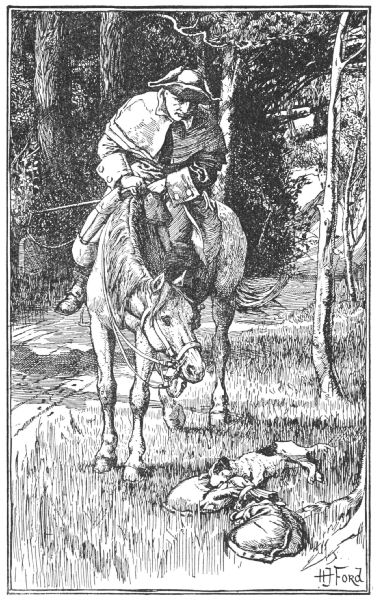
Michel looked behind him. There was nothing but the
leather straps in his hand; Pritchard had cut it through
with his teeth, and was now standing on the bridge
amusing himself by looking at the water through the
railing.
‘He is a vagabond!’ said Vatrin. ‘Look! where is
he off to now?’
‘He has gone,’ said I, ‘to see what my neighbour
Corrège has got for luncheon.’ Sure enough, the next
moment Pritchard was seen coming out of M. Corrège’s
back door, pursued by a maid servant with a broom. He
103]
had a veal cutlet in his mouth, which he had just taken
out of the frying-pan.
‘Monsieur Dumas!’ cried the maid, ‘Monsieur
Dumas! stop your dog!’
We tried; but Pritchard passed between Michel and
me like a flash of lightning.
‘It seems,’ said Michel, ‘that he likes his veal underdone.’
‘My good woman,’ I said to the cook, who was still
pursuing Pritchard, ‘I fear that you are losing time, and
that you will never see your cutlet again.’
‘Well, then, let me tell you, sir, that you have no right
to keep and feed a thief like that.’
‘It is you, my good woman, who are feeding him to-day,
not I.’
‘Me!’ said the cook, ‘it’s—it’s M. Corrège. And
what will M. Corrège say, I should like to know?’
‘He will say, like Michel, that it seems Pritchard likes
his veal underdone.’
‘Well, but he’ll not be pleased—he will think it’s my
fault.’
‘Never mind, I will invite your master to luncheon
with me.’
‘All the same, if your dog goes on like that, he will
come to a bad end. That is all I have to say—he will
come to a bad end.’ And she stretched out her broom
in an attitude of malediction towards the spot where
Pritchard had disappeared.
We three stood looking at one another. ‘Well,’ said I,
‘we have lost Pritchard.’
‘We’ll soon find him,’ said Michel.
We therefore set off to find Pritchard, whistling and
calling to him, as we walked on towards Vatrin’s shooting
ground. This search lasted for a good half-hour, Pritchard
not taking the slightest notice of our appeals. At last
Michel stopped.
‘Sir,’ he said, ‘look there! Just come and look.’
104]
‘Well, what?’ said I, going to him.
‘Look!’ said Michel, pointing. I followed the direction
of Michel’s finger, and saw Pritchard in a perfectly
immovable attitude, as rigid as if carved in stone.
‘Vatrin,’ said I, ‘come here.’ Vatrin came. I showed
him Pritchard.
‘I think he is making a point,’ said Vatrin. Michel
thought so too.
‘But what is he pointing at?’ I asked. We cautiously
came nearer to Pritchard, who never stirred.
‘He certainly is pointing,’ said Vatrin. Then making
a sign to me—‘Look there!’ he said. ‘Do you see anything?’
‘Nothing.’
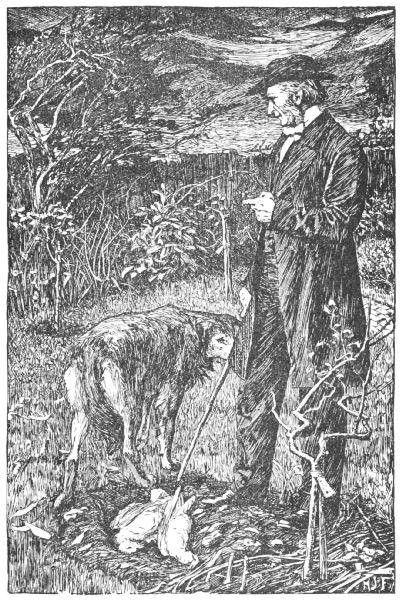
‘What! you don’t see a rabbit sitting? If I only had
my stick, I’d knock it on the head, and it would make a
nice stew for your dinner.’
‘Oh!’ said Michel, ‘if that’s all, I’ll cut you a
stick.’
‘Well, but Pritchard might leave off pointing.’
‘No fear of him—I’ll answer for him—unless, indeed,
the rabbit goes away.’
Vatrin proceeded to cut a stick. Pritchard never
moved, only from time to time he turned his yellow eyes
upon us, which shone like a topaz.
‘Have patience,’ said Michel. ‘Can’t you see that
M. Vatrin is cutting a stick?’ And Pritchard seemed to
understand as he turned his eye on Vatrin.
‘You have still time to take off the branches,’ said
Michel.
When the branches were taken off and the stick was
quite finished, Vatrin approached cautiously, took a good
aim, and struck with all his might into the middle of
the tuft of grass where the rabbit was sitting. He had
killed it!
Pritchard darted in upon the rabbit, but Vatrin took it
from him, and Michel slipped it into the lining of his coat.
105]
This pocket had already held a good many rabbits in its
time!
Vatrin turned to congratulate Pritchard, but he had
disappeared.
‘He’s off to find another rabbit,’ said Michel.
And accordingly, after ten minutes or so, we came
upon Pritchard making another point. This time Vatrin
had a stick ready cut; and after a minute, plunging his
hands into a brier bush, he pulled out by the ears a second
rabbit.
‘There, Michel,’ he said, ‘put that into your other
pocket.’
‘Oh,’ said Michel, ‘there’s room for five more in this
one.’
‘Hallo, Michel! people don’t say those things before
a magistrate.’ And turning to Vatrin I added, ‘Let us try
once more, Vatrin—the number three is approved by the
gods.’
‘May be,’ said Vatrin, ‘but perhaps it won’t be approved
by M. Guérin.’
M. Guérin was the police inspector.
Next time we came upon Pritchard pointing, Vatrin
said, ‘I wonder how long he would stay like that;’ and
he pulled out his watch.
‘Well, Vatrin,’ said I, ‘you shall try the experiment,
as it is in your own vocation; but I am afraid I have not
the time to spare.’
Michel and I then returned home. Vatrin followed
with Pritchard an hour afterwards.
‘Five-and-twenty minutes!’ he called out as soon as
he was within hearing. ‘And if the rabbit had not gone
away, the dog would have been there now.’
‘Well, Vatrin, what do you think of him?’
‘Why, I say he is a good pointer; he has only to learn
to retrieve, and that you can teach him yourself. I need
not keep him any longer.’
‘Do you hear, Michel?’
106]
‘Oh, sir,’ said Michel, ‘he can do that already. He
retrieves like an angel!’
This failed to convey to me an exact idea of the way
in which Pritchard retrieved. But Michel threw a handkerchief,
and Pritchard brought it back. He then threw
one of the rabbits that Vatrin carried, and Pritchard
brought back the rabbit. Michel then fetched an egg and
placed it on the ground. Pritchard retrieved the egg as
he had done the rabbit and the handkerchief.
‘Well,’ said Vatrin, ‘the animal knows all that human
skill can teach him. He wants nothing now but practice.
And when one thinks,’ he added, ‘that if the rascal would
only come in to heel, he would be worth twenty pounds
if he was worth a penny.’
‘True,’ said I with a sigh, ‘but you may give up hope,
Vatrin; that is a thing he will never consent to.’
I think that the time has now come to tell my readers
a little about Mademoiselle Desgarcins, Potich, and the
Last of the Laidmanoirs. Mademoiselle Desgarcins was a
tiny monkey; I do not know the place of her birth, but
I brought her from Havre, where I had gone—I don’t
know why—perhaps to look at the sea. But I thought
I must bring something home with me from Havre. I
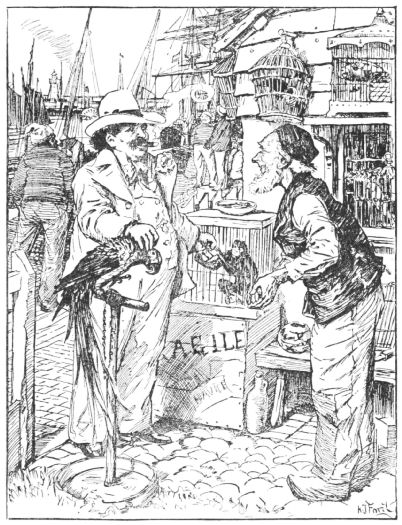
was walking there on the quay, when at the door of a bird-fancier’s
shop I saw a green monkey and a blue and yellow
macaw. The monkey put its paw through the bars of its
cage and caught hold of my coat, while the blue parrot
turned its head and looked at me in such an affectionate
manner that I stopped, holding the monkey’s paw with
one hand, and scratching the parrot’s head with the other.
The little monkey gently drew my hand within reach of
her mouth, the parrot half shut its eyes and made a little
purring noise to express its pleasure.
107]
‘MONSIEUR DUMAS, MAY I ACCOMMODATE YOU WITH MY MONKEY AND
MY PARROT?’
‘Monsieur Dumas,’ said the shopman, coming out
with the air of a man who was more decided to sell than
I was to buy; ‘Monsieur Dumas, may I accommodate
you with my monkey and my parrot?’ It would have
108]
been more to the purpose if he had said, ‘Monsieur
Dumas, may I incommode you with my monkey and my
parrot?’ However, after a little bargaining, I bought
both animals, as well as a cage for the monkey and a
perch for the parrot; and as soon as I arrived at home,
I introduced them to Michel.
‘This,’ said Michel, ‘is the green monkey of Senegal—Cercopithecus
sabæa.’
I looked at Michel in the greatest astonishment. ‘Do
you know Latin, Michel?’
‘I don’t know Latin, but I know my “Dictionary of
Natural History.”’
‘Oh, indeed! And do you know what bird this is?’
I asked, showing him the parrot.
‘To be sure I know it,’ said Michel. ‘It is the blue
and yellow macaw—Macrocercus arararanna. Oh, sir,
why did you not bring a female as well as a male?’
‘What is the use, Michel, since parrots will not breed
in this country?’
‘There you make a mistake, sir; the blue macaw will
breed in France.’
‘In the south, perhaps?’
‘It need not be in the south, sir.’
‘Where then?’
‘At Caen.’
‘At Caen? I did not know Caen had a climate which
permits parrots to rear their young. Go and fetch my
gazetteer.’
‘You will soon see,’ said Michel as he brought it. I
read: ‘Caen, capital of the department of Calvados, upon
the Orne and the Odon: 223 kilomètres west of Paris,
41,806 inhabitants.’
‘You will see,’ said Michel, ‘the parrots are coming.’
‘Great trade in plaster, salt, wood—taken by English
in 1346—retaken by the French &c., &c.—never mind
the date—That is all, Michel.’
‘What! Your dictionary never says that the
109]
arararanna, otherwise called the blue macaw, produces young
at Caen?’
‘No, Michel, it does not say that here.’
‘What a dictionary! Just wait till I fetch you mine
and you will see.’
Michel returned in a few minutes with his book of
Natural History.
‘You will soon see, sir,’ he said, opening his dictionary
in his turn. ‘Parrot—here it is—parrots are monogamous.’
‘As you know Latin, Michel, of course you know
what monogamous means.’
‘That means that they can sing scales—gamut, I
suppose?’
‘Well, no, Michel, not exactly. It means that they
have only one “wife.”’
‘Indeed, sir? That is because they talk like us most
likely. Now, I have found the place: “It was long
believed that parrots were incapable of breeding in Europe,
but the contrary has been proved on a pair of blue
macaws which lived at Caen. M. Lamouroux furnishes
the details of these results.”’
‘Let us hear the details which M. Lamouroux
furnishes.’
‘“These macaws, from March 1818 until August 1822,
including a period of four years and a half, laid, in all,
sixty-two eggs.”’
‘Michel, I never said they did not lay eggs; what I said
was—’
‘“Out of this number,”’ continued Michel in a loud
voice, ‘“twenty-five young macaws were hatched, of
which only ten died. The others lived and continued
perfectly healthy.”’
‘Michel, I confess to having entertained false ideas
on the subject of macaws.’
‘“They laid at all seasons of the year,”’ continued
Michel, ‘“and more eggs were hatched in the latter than
in the former years.”’
110]
‘Michel, I have no more to say.’
‘“The number of eggs in the nest varied. There
have been as many as six at a time.”’
‘Michel, I yield, rescue or no rescue!’
‘Only,’ said Michel, shutting the book, ‘you must be
careful not to give them bitter almonds or parsley.’
‘Not bitter almonds,’ I answered, ‘because they contain
prussic acid; but why not parsley?’
Michel, who had kept his thumb in the page, reopened
the book. ‘“Parsley and bitter almonds,”’ he read,
‘“are a violent poison to parrots.”’
‘All right, Michel, I shall remember.’
I remembered so well, that some time after, hearing
that M. Persil had died suddenly (persil being the French
for parsley), I exclaimed, much shocked: ‘Ah! poor man,
how unfortunate! He must have been eating parrot!’
However, the news was afterwards contradicted.
The next day I desired Michel to tell the carpenter
to make a new cage for Mademoiselle Desgarcins, who
would certainly die of cramp if left in her small travelling
cage. But Michel, with a solemn face, said it was
unnecessary. ‘For,’ said he, ‘I am sorry to tell you, sir,
that a misfortune has happened. A weasel has killed
the golden pheasant. You will, however, have it for your
dinner to-day.’
I did not refuse, though the prospect of this repast
caused me no great pleasure. I am very fond of game,
but somehow prefer pheasants which have been shot to
those killed by weasels.
‘Then,’ said I, ‘if the cage is empty, let us put in the
monkey.’ We brought the little cage close to the big
cage, and opened both doors. The monkey sprang into
her new abode, bounded from perch to perch, and then
came and looked at me through the bars, making grimaces
and uttering plaintive cries.
‘She is unhappy without a companion,’ said Michel.
‘Suppose we give her the parrot?’
111]
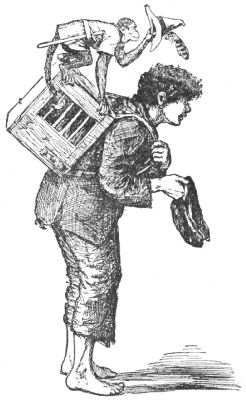
‘You know that little boy, an Auvergnat, who comes
here with his monkey asking for pennies. If I were you,
sir, I would buy that monkey.’
‘And why that monkey rather than another?’
‘He has been so well educated and is so gentle. He
has a cap with a feather, and he takes it off when you give
him a nut or a bit of sugar.’
‘Can he do anything else?’
‘He can fight a duel.’
‘Is that all?’
‘No, he can also catch fleas on his master.’
‘But, Michel, do you think that that youth would part
with so useful an animal?’
112]
‘We can but ask him, and there he is at this moment!’
And he called to the boy to come in. The monkey was
sitting on a box which the little boy carried on his back,
and when his master took off his cap, the monkey did the
same. It had a nice gentle little face, and I remarked to
Michel that it was very like a well-known translator of
my acquaintance.
‘If I have the happiness to become the owner of this
charming animal,’ I continued, ‘we will call it Potich.’
And giving Michel forty francs, I left him to make his
bargain with the little Auvergnat.
I had not entered my study since my return from Havre,
and there is always a pleasure in coming home again
after an absence. I was glad to come back, and looked
about me with a pleased smile, feeling sure that the furniture
and ornaments of the room, if they could speak,
would say they were glad to see me again. As I glanced
from one familiar object to another, I saw, upon a seat
by the fire, a thing like a black and white muff, which I
had never seen before. When I came closer, I saw that
the muff was a little cat, curled up, half asleep, and purring
loudly. I called the cook, whose name was Madame
Lamarque. She came in after a minute or two.
‘So sorry to have kept you waiting, but you see, sir, I
was making a white sauce, and you, who can cook yourself,
know how quickly those sauces curdle if you are not
looking after them.’
‘Yes, I know that, Madame Lamarque; but what I
do not know is, where this new guest of mine comes
from.’ And I pointed to the cat.
‘Ah, sir!’ said Madame Lamarque in a sentimental
tone, ‘that is an antony.’
‘An antony, Madame Lamarque! What is that?’
113]
‘In other words, an orphan—a foundling, sir.’
‘Poor little beast!’
‘I felt sure that would interest you, sir.’
‘And where did you find it, Madame Lamarque?’
‘In the cellar—I heard a little cry—miaow, miaow,
miaow! and I said to myself, “That must be a cat!”’
‘No! did you actually say that?’
‘Yes, and I went down myself, sir, and found the poor
little thing behind the sticks. Then I recollected how
you had once said, “We ought to have a cat in the
house.”’
‘Did I say so? I think you are making a mistake,
Madame Lamarque.’
‘Indeed, sir, you did say so. Then I said to myself,
“Providence has sent us the cat which my master wishes
for.” And now there is one question I must ask you, sir.
What shall we call the cat?’
‘We will call it Mysouff, if you have no objection.
And please be careful, Madame Lamarque, that it does not
eat my quails and turtle-doves, or any of my little foreign
birds.’
‘If M. Dumas is afraid of that,’ said Michel, coming
in, ‘there is a method of preventing cats from eating
birds.’
‘And what is the method, my good friend?’
‘You have a bird in a cage. Very well. You cover
three sides of the cage, you make a gridiron red-hot, you
put it against the uncovered side of the cage, you let out
the cat, and you leave the room. The cat, when it makes
its spring, jumps against the hot gridiron. The hotter
the gridiron is the better the cat is afterwards.’
‘Thank you, Michel. And what of the troubadour
and his monkey?’
‘To be sure; I was coming to tell you about that.
It is all right, sir; you are to have Potich for forty francs,
only you must give the boy two white mice and a guinea-pig
in return.’
114]
‘But where am I to find two white mice and a guinea-pig?’
‘If you will leave the commission to me, I will see that
they are found.’
I left the commission to Michel.
‘If you won’t think me impertinent, sir,’ said Madame
Lamarque, ‘I should so like to know what Mysouff
means.’
‘Mysouff just means Mysouff, Madame Lamarque.’
‘It is a cat’s name, then?’
‘Certainly, since Mysouff the First was so-called. It
is true, Madame Lamarque, you never knew Mysouff.’
And I became so thoughtful that Madame Lamarque was
kind enough to withdraw quietly, without asking any
questions about Mysouff the First.
That name had taken me back to fifteen years ago,
when my mother was still living. I had then the great
happiness of having a mother to scold me sometimes. At
the time I speak of, I had a situation in the service of the
Duc d’Orléans, with a salary of 1,500 francs. My work
occupied me from ten in the morning until five in the
afternoon. We had a cat in those days whose name was
Mysouff. This cat had missed his vocation—he ought to
have been a dog. Every morning I started for my office
at half-past nine, and came back every evening at half-past
five. Every morning Mysouff followed me to the
corner of a particular street, and every evening I found
him in the same street, at the same corner, waiting for
me. Now the curious thing was that on the days when
I had found some amusement elsewhere, and was not
coming home to dinner, it was no use to open the door
for Mysouff to go and meet me.[5] Mysouff, in the attitude
of the serpent with its tail in its mouth, refused to stir
from his cushion. On the other hand, the days I did
come, Mysouff would scratch at the door until someone115]
opened it for him. My mother was very fond of Mysouff;
she used to call him her barometer.
‘Mysouff marks my good and my bad weather,’ my
dear mother would say; ‘the days you come in are my
days of sunshine; my rainy days are when you stay
away.’
When I came home, I used to see Mysouff at the street
corner, sitting quite still and gazing into the distance. As
soon as he caught sight of me, he began to move his tail;
then as I drew nearer, he rose and walked backwards and
forwards across the pavement with his back arched and
his tail in the air. When I reached him, he jumped up
upon me as a dog would have done, and bounded and
played round me as I walked towards the house; but
when I was close to it he dashed in at full speed. Two
seconds after, I used to see my mother at the door.
Never again in this world, but in the next perhaps, I
shall see her standing waiting for me at the door.
That is what I was thinking of, dear readers, when
the name of Mysouff brought back all these recollections;
so you understand why I did not answer Madame Lamarque’s
questions.
Henceforth Mysouff II. enjoyed the same privileges
that Mysouff I. had done, although, as will be seen later,
he was not distinguished by similar virtues, but was, in
fact, a very different sort of cat.
The following Sunday, when my son Alexandre and
one or two intimate friends were assembled in my room, a
second Auvergnat boy, with a second monkey, demanded
admittance, and said that a friend having told him that
M. Dumas had bought his monkey for forty francs, two
white mice, and a guinea-pig, he was prepared to offer
his for the same price. My friends urged me to buy the
second monkey.
116]
‘Do buy this charming creature,’ said my artist friend
Giraud.
‘Yes, do buy this ridiculous little beast,’ said Alexandre.
‘Buy him, indeed,’ said I; ‘have I forty francs to give
away every day, to say nothing of a guinea-pig and two
white mice?’
‘Gentlemen,’ said Alexandre, ‘I am sorry to tell you
that my father is, without exception, the most avaricious
man living.’
My guests exclaimed, but Alexandre said that one day
he would prove the truth of his assertion. I was now
called upon to admire the monkey, and to remark how
like he was to a friend of ours. Giraud, who was painting
a portrait of this gentleman, said that if I would let the
monkey sit to him, it would help him very much in his
work, and Maquet, another of my guests, offered, amidst
general applause, to make me a present of it.[6] This decided
me.
‘You see,’ said Alexandre, ‘he accepts.’
‘Come, young man,’ said I to the Auvergnat, ‘embrace
your monkey for the last time, and if you have any tears
to shed, shed them without delay.’
When the full price was paid, the boy made an attempt
to do as I told him, but the Last of the Laidmanoirs refused
to be embraced by his former master, and as soon
as the latter had gone away, he seemed delighted and
began to dance, while Mademoiselle Desgarcins in her
cage danced, too, with all her might.
‘Look!’ said Maquet, ‘they like each other. Let us
complete the happiness of these interesting animals.’
We shut them up in the cage together, to the great
delight of Mademoiselle Desgarcins, who did not care for
Potich, and much preferred her new admirer. Potich,
indeed, showed signs of jealousy, but, not being armed
117]
with the sword which he used to have when he fought
duels, he could not wash out his affronts in the blood
of his rival, but became a prey to silent melancholy and
wounded affection.
While we were still looking at the monkeys, a servant
came in bringing a tray with wine and seltzer water.
‘I say,’ said Alexandre, ‘let us make Mademoiselle
Desgarcins open the seltzer-water bottle!’ and he put the
bottle inside the cage on the floor. No sooner had he
done so, than all three monkeys surrounded it and looked
at it with the greatest curiosity. Mademoiselle Desgarcins
was the first to understand that something would happen
if she undid the four crossed wires which held down the
cork. She accordingly set to work, first with her fingers,
and then with her teeth, and it was not long before she
undid the first three. She next attacked the fourth,
while the whole company, both men and monkeys,
watched her proceedings with breathless attention. Presently
a frightful explosion was heard: Mademoiselle
Desgarcins was knocked over by the cork and drenched
with seltzer water, while Potich and the Last of the
Laidmanoirs fled to the top of their cage, uttering piercing
cries.
‘Oh!’ cried Alexandre, ‘I’ll give my share of seltzer
water to see her open another bottle!’ Mademoiselle
Desgarcins had got up, shaken herself, and gone to rejoin
her companions, who were still howling lamentably.
‘You don’t suppose she’ll let herself be caught a second
time,’ said Giraud.
‘Do you know,’ said Maquet, ‘I should not wonder if
she would. I believe her curiosity would still be stronger
than her fear.’
‘Monkeys,’ said Michel, who had come in on hearing
their cries, ‘are more obstinate than mules. The more
seltzer-water bottles you give them, the more they will
uncork.’
‘Do you think so, Michel?’
118]
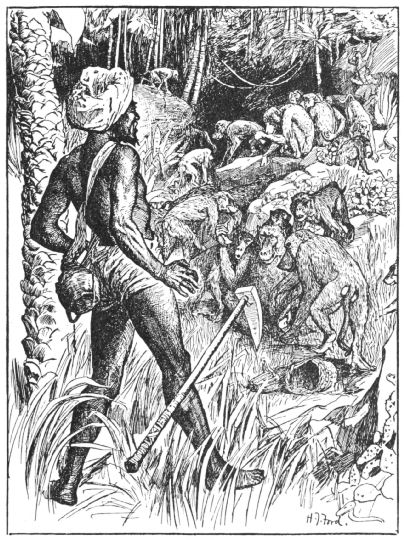
‘You know, of course, how they catch them in their
own country.’
‘No, Michel.’
‘What! you don’t know that, gentlemen?’ said
Michel, full of compassion for our ignorance. ‘You know
that monkeys are very fond of Indian corn. Well, you
put some Indian corn into a bottle, the neck of which is
just large enough to admit a monkey’s paw. He sees the
Indian corn through the glass——’
‘Well, Michel?’
‘He puts his hand inside, and takes a good handful
of the Indian corn. At that moment the hunter shows
himself. They are so obstinate—the monkeys, I mean—that
they won’t let go what they have in their hand, but
as they can’t draw their closed fist through the opening,
there they are, you see, caught.’
‘Well, then, Michel, if ever our monkeys get out, you
will know how to catch them again.’
‘Oh! no fear, sir, that is just what I shall do.’
The seltzer-water experiment was successfully repeated,
to the triumph of Michel and the delight of Alexandre,
who wished to go on doing it; but I forbade him,
seeing that poor Mademoiselle Desgarcins’ nose was
bleeding from the blow of the cork.
‘It is not that,’ said Alexandre; ‘it is because you
grudge your seltzer water. I have already remarked,
gentlemen, that my father is, I regret to say, an exceedingly
avaricious man.’
It is now my painful duty to give my readers some
account of the infamous conduct of Mysouff II. One
morning, on waking rather late, I saw my bedroom door
gently opened, and the head of Michel thrust in, wearing
such a concerned expression that I knew at once that
something was wrong.
119]
‘What has happened, Michel?’
‘Why, sir, those villains of monkeys have managed to
twist a bar of their cage, I don’t know how, until they
have made a great hole, and now they have escaped.’
‘Well—but, Michel, we foresaw that that might occur,
and now you have only to buy your Indian corn, and
procure three bottles the right size.’
‘Ah! you are laughing, sir,’ said Michel, reproachfully,
‘but you won’t laugh when you know all. They
have opened the door of the aviary——’
‘And so my birds have flown away?’
‘Sir, your six pairs of turtle doves, your fourteen
quails, and all your little foreign birds, are eaten up!’[7]
‘But monkeys won’t eat birds!’
‘No, but Master Mysouff will, and he has done it!’
‘The deuce he has! I must see for myself.’
‘Yes, go yourself, sir; you will see a sight—a field of
battle—a massacre of St. Bartholomew!’
As I was coming out, Michel stopped me to point to
Potich, who had hung himself by the tail to the branch
of a maple, and was swinging gracefully to and fro.
Mademoiselle Desgarcins was bounding gaily about in
the aviary, while the Last of the Laidmanoirs was practising
gymnastics on the top of the greenhouse. ‘Well,
Michel, we must catch them. I will manage the Last of
the Laidmanoirs if you will get hold of Mademoiselle
Desgarcins. As to poor little Potich, he will come of his
own accord.’
‘I wouldn’t trust him, sir; he is a hypocrite. He has
made it up with the other one—just think of that!’
‘What! he has made friends with his rival in the
affections of Mademoiselle Desgarcins?’
‘Just so, sir.’
‘That is sad indeed, Michel; I thought only human
beings could be guilty of so mean an action.’
120]
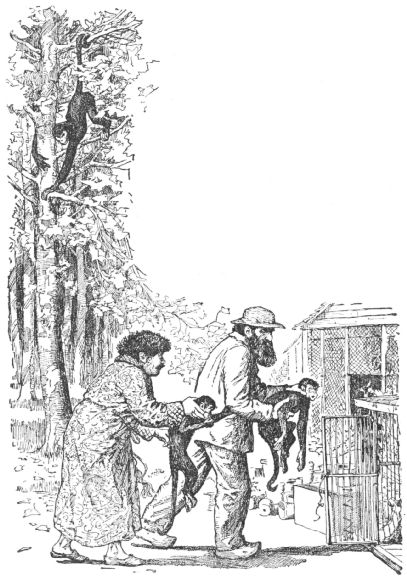
‘You see, sir, these monkeys have frequented the
society of human beings.’
I now advanced upon the Last of the Laidmanoirs
with so much precaution that I
contrived to shut him into the
greenhouse, where he retreated
into a corner and prepared to
defend himself, while Potich, from
the outside, encouraged his friend
by making horrible faces at me
through the glass. At this moment
piercing shrieks were heard
from Mademoiselle Desgarcins;
Michel had just caught her.
These cries so enraged the Last
of the Laidmanoirs that he dashed
out upon me; but I parried his
attack with the palm of my hand;
with which he came in contact
so forcibly that he lost breath
121]
for a minute, and I then picked him up by the scruff
of the neck.
‘Have you caught Mademoiselle Desgarcins?’ I shouted
to Michel.
‘Have you caught the Last of the Laidmanoirs?’
returned he.
‘Yes!’ we both replied in turn. And each bearing
his prisoner, we returned to the cage, which had in the
meantime been mended, and shut them up once more,
whilst Potich, with loud lamentations, fled to the top of
the highest tree in the garden. No sooner, however, did
he find that his two companions were unable to get out
of their cage, than he came down from his tree, approached
Michel in a timid and sidelong manner, and with clasped
hands and little plaintive cries, entreated to be shut up
again with his friends.
‘Just see what a hypocrite he is!’ said Michel.
But I was of opinion that the conduct of Potich was
prompted by devotion rather than hypocrisy; I compared
it to that of Regulus, who returned to Carthage to keep
his promised word, or to King John of France, who
voluntarily gave himself up to the English for the Countess
of Salisbury’s sake.
Michel continued to think Potich a hypocrite, but on
account of his repentance he was forgiven. He was put
back into the cage, where Mademoiselle Desgarcins took
very little notice of him.
All this time Mysouff, having been forgotten, calmly
remained in the aviary, and continued to crunch the
bones of his victims with the most hardened indifference.
It was easy enough to catch him. We shut him into the
aviary, and held a council as to what should be his
punishment. Michel was of opinion that he should be
shot forthwith. I was, however, opposed to his immediate
execution, and resolved to wait until the following Sunday,
and then to cause Mysouff to be formally tried by my
assembled friends. The condemnation was therefore
122]
postponed. In the meantime Mysouff remained a
prisoner in the very spot where his crimes had been
committed. He continued, however, to refresh himself
with the remains of his victims without apparent remorse,
but Michel removed all the bodies, and confined him to a
diet of bread and water.
Next Sunday, having convoked a council of all my
friends, the trial was proceeded with. Michel was
appointed Chief Justice and Nogent Saint-Laurent was
counsel for the prisoner. I may remark that the jury
were inclined to find a verdict of guilty, and after the
first speech of the Judge, the capital sentence seemed
almost certain. But the skilful advocate, in a long and
eloquent speech, brought clearly before us the innocence
of Mysouff, the malice of the monkeys, their quickness
and incessant activity compared with the less inventive
minds of cats. He showed us that Mysouff was incapable
of contemplating such a crime; he described him wrapped
in peaceful sleep, then, suddenly aroused from this
innocent slumber by the abandoned creatures who, living
as they did opposite the aviary, had doubtless long
harboured their diabolical designs. We saw Mysouff but
half awake, still purring innocently, stretching himself,
opening his pink mouth, from which protruded a tongue
like that of a heraldic lion. He shakes his ears, a proof
that he rejects the infamous proposal that is being made
to him; he listens; at first he refuses—the advocate
insisted that the prisoner had begun by refusing—then,
naturally yielding, hardly more than a kitten, corrupted
as he had been by the cook, who instead of feeding him
on milk or a little weak broth, as she had been told to do,
had recklessly excited his carnivorous appetite by giving
him pieces of liver and parings of raw chops; the
unfortunate young cat yields little by little, prompted
more by good nature and weakness of mind than by
cruelty or greed, and, only half awake, he does the bidding
of the villainous monkeys, the real instigators of the
123]
crime. The counsel here took the prisoner in his arms,
showed us his paws, and defied any anatomist to say that
with paws so made, an animal could possibly open a door
that was bolted. Finally, he borrowed Michel’s Dictionary
of Natural History, opened it at the article ‘Cat,’
‘Domestic Cat,’ ‘Wild Cat’; he proved that Mysouff was
no wild cat, seeing that nature had robed him in white,
the colour of innocence; then smiting the book with
vehemence, ‘Cat!’ he exclaimed, ‘Cat! You shall now
hear, gentlemen, what the illustrious Buffon, the man
with lace sleeves, has to say about the cat.
‘“The cat,” says M. de Buffon, “is not to be trusted,
but it is kept to rid the house of enemies which cannot
otherwise be destroyed. Although the cat, especially
when young, is pleasing, nature has given it perverse and
untrustworthy qualities which increase with age, and
which education may conceal, but will not eradicate.”
Well, then,’ exclaimed the orator, after having read this
passage, ‘what more remains to be said? Did poor
Mysouff come here with a false character seeking a
situation? Was it not the cook herself who found him—who
took him by force from the heap of sticks behind
which he had sought refuge? It was merely to interest
and touch the heart of her master that she described him
mewing in the cellar. We must reflect also, that those
unhappy birds, his victims—I allude especially to the
quails, which are eaten by man—though their death is
doubtless much to be deplored, yet they must have felt
themselves liable to death at any moment, and are now
released from the terrors they experienced every time
they saw the cook approaching their retreat. Finally,
gentlemen, I appeal to your justice, and I think you will
now admit that the interesting and unfortunate Mysouff
has but yielded, not only to incontrollable natural instincts,
but also to foreign influence. I claim for my client the
plea of extenuating circumstances.’
The counsel’s pleading was received with cries of
124]
applause, and Mysouff, found guilty of complicity in the
murder of the quails, turtle-doves, and other birds of
different species, but with extenuating circumstances, was
sentenced only to five years of monkeys.
The next winter, certain circumstances, with which I
need not trouble my readers, led to my making a journey
to Algiers. I seldom make any long journey without
bringing home some animal to add to my collection, and
accordingly I returned from Africa accompanied by a
vulture, which I bought from a little boy who called himself
a Beni-Mouffetard. I paid ten francs for the vulture,
and made the Beni-Mouffetard a present of two more,
in return for which he warned me that my vulture was
excessively savage, and had already bitten off the thumb
of an Arab and the tail of a dog. I promised to be very
careful, and the next day I became the possessor of a
magnificent vulture, whose only fault consisted in a strong
desire to tear in pieces everybody who came near him. I
bestowed on him the name of his compatriot, Jugurtha.
He had a chain fastened to his leg, and had for further
security been placed in a large cage made of spars. In this
cage he travelled quite safely as far as Philippeville, without
any other accident than that he nearly bit off the finger
of a passenger who had tried to make friends with him.
At Philippeville a difficulty arose. It was three miles
from Stora, the port where we were to embark, and the
diligence did not go on so far. I and several other gentlemen
thought that we would like to walk to Stora, the
scenery being beautiful and the distance not very great;
but what was I to do about Jugurtha? I could not ask
a porter to carry the cage; Jugurtha would certainly
have eaten him through the spars. I thought of a plan:
it was to lengthen his chain eight or ten feet by means of
a cord; and then to drive him in front of me with a long
125]
pole. But the first difficulty was to induce Jugurtha to
come out of his cage; none of us dared put our hands
within reach of his beak. However, I managed to fasten
the cord to his chain, then I made two men armed with
pickaxes break away the spars. Jugurtha finding himself
free, spread out his wings to fly away, but he could of
course only fly as far as his cord would permit.
Now Jugurtha was a very intelligent creature; he saw
that there was an obstacle in the way of his liberty, and
that I was that obstacle; he therefore turned upon me
with fury, in the hope of putting me to flight, or devouring
me in case of resistance. I, however, was no less
sagacious than Jugurtha; I had foreseen the attack, and
provided myself with a good switch made of dogwood, as
thick as one’s forefinger, and eight feet long. With this
switch I parried Jugurtha’s attack, which astonished but
did not stop him; however, a second blow, given with all
my force, made him stop short, and a third caused him to
fly in the opposite direction, that is, towards Stora. Once
launched upon this road, I had only to use my switch
adroitly to make Jugurtha proceed at about the same pace
as we did ourselves, to the great admiration of my fellow-travellers,
and of all the people whom we met on the road.
On our arrival at Stora Jugurtha made no difficulty about
getting on board the steamer, and when tied to the mast,
waited calmly while a new cage was made for him. He
went into it of his own accord, received with gratitude the
pieces of meat which the ship’s cook gave him, and three
days after his embarkation he became so tame that he
used to present me with his head to scratch, as a parrot
does. I brought Jugurtha home without further adventure,
and committed him to the charge of Michel.
It was not until my return from Algiers on this occasion
that I went to live at Monte Cristo, the building of
which had been finished during my absence. Up to this
time I had lived in a smaller house called the Villa
Medicis, and while the other was building, Michel made
126]
arrangements for the proper lodging of all my animals,
for he was much more occupied about their comfort than
he was about mine or even his own. They had all plenty
of room, particularly the dogs, who were not confined by
any sort of enclosure, and Pritchard, who was naturally
generous, kept open house with a truly Scottish hospitality.
It was his custom to sit in the middle of the road
and salute every dog that passed with a little not unfriendly
growl; smelling him, and permitting himself to
be smelt in a ceremonious manner. When a mutual
sympathy had been produced by this means, a conversation
something like this would begin:
‘Have you a good master?’ asked the strange dog.
‘Not bad,’ Pritchard would reply.
‘Does your master feed you well?’
‘Well, one has porridge twice a day, bones at breakfast
and dinner, and anything one can pick up in the
kitchen besides.’
The stranger licked his lips.
‘You are not badly off,’ said he.
‘I do not complain,’ replied Pritchard. Then, seeing
the strange dog look pensive, he added, ‘Would you like
to dine with us?’
The invitation was accepted at once, for dogs do not
wait to be pressed, like some foolish human beings.
At dinner-time Pritchard came in, followed by an unknown
dog, who, like Pritchard, placed himself beside
my chair, and scratched my knee with his paw in such
a confiding way that I felt sure that Pritchard must
have been commending my benevolence. The dog, after
spending a pleasant evening, found that it was rather too
late to return home, so slept comfortably on the grass
after his good supper. Next morning he took two or three
steps as if to go away, then changing his mind, he inquired
of Pritchard, ‘Should I be much in the way if I stayed
on here?’
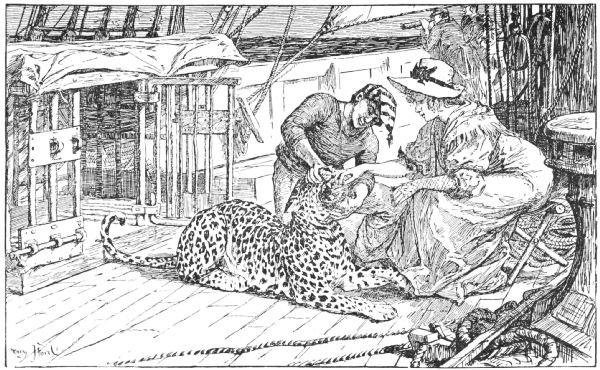
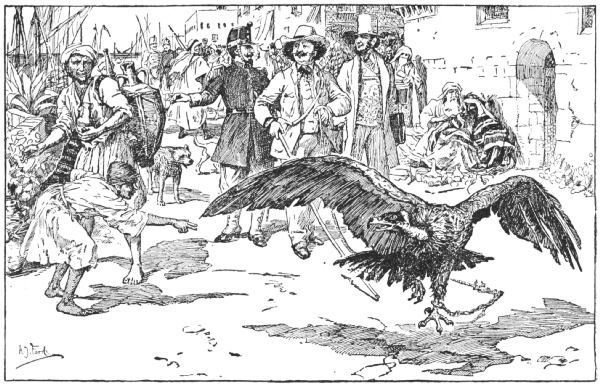
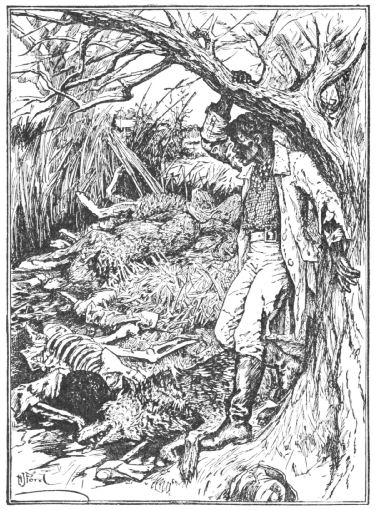
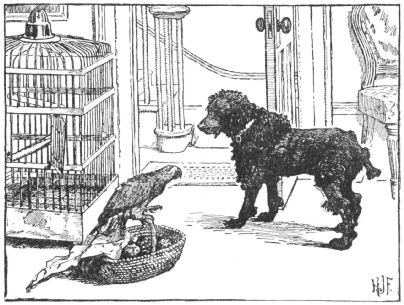
DUMAS ARRIVES AT STORA WITH HIS VULTURE
Pritchard replied, ‘You could quite well, with management,
129]
make them believe you are the neighbour’s dog,
and after two or three days, nobody would know you did
not belong to the house. You might live here just as well
as those idle useless monkeys, who do nothing but amuse
themselves, or that greedy vulture, who eats tripe all day
long, or that idiot of a macaw, who is always screaming
about nothing.’
The dog stayed, keeping in the background at first,
but in a day or two he jumped up upon me and followed
me everywhere, and there was another guest to feed, that
was all. Michel asked me one day if I knew how many
dogs there were about the place. I answered that I did
not.
‘Sir,’ said Michel, ‘there are thirteen.’
‘That is an unlucky number, Michel; you must see
that they do not all dine together, else one of them is sure
to die first.’
‘It is not that, though,’ said Michel, ‘it is the expense
I am thinking of. Why, they would eat an ox a day, all
those dogs; and if you will allow me, sir, I will just take
a whip and put the whole pack to the door, to-morrow
morning.’
‘But, Michel, let us do it handsomely. These dogs,
after all, do honour to the house by staying here. So give
them a grand dinner to-morrow; tell them that it is the
farewell banquet, and then, at dessert, put them all to the
door.’
‘But after all, sir, I cannot put them to the door,
because there isn’t a door.’
‘Michel,’ said I, ‘there are certain things in this world
that one must just put up with, to keep up one’s character
and position. Since all these dogs have come to me, let
them stay with me. I don’t think they will ruin me,
Michel. Only, on their own account, you should be careful
that there are not thirteen.’
‘I will drive away one,’ suggested Michel, ‘and then
there will only be twelve.’
130]
‘On the contrary, let another come, and then there
will be fourteen.’
Michel sighed.
‘It’s a regular kennel,’ he murmured.
It was, in fact, a pack of hounds, though rather a
mixed one. There was a Russian wolfhound, there was
a poodle, a water spaniel, a spitz, a dachshund with
crooked legs, a mongrel terrier, a mongrel King Charles,
and a Turkish dog which had no hair on its body, only a
tuft upon its head and a tassel at the end of its tail. Our
next recruit was a little Maltese terrier, named Lisette,
which raised the number to fourteen. After all, the expense
of these fourteen amounted to rather over two
pounds a month. A single dinner given to five or six of
my own species would have cost me three times as much,
and they would have gone away dissatisfied; for, even if
they had liked my wine, they would certainly have found
fault with my books. Out of this pack of hounds, one
became Pritchard’s particular friend and Michel’s favourite.
This was a dachshund with short crooked legs, a
long body, and, as Michel said, the finest voice in the
department of Seine-et-Oise. Portugo—that was his
name—had in truth a most magnificent bass voice. I used
to hear it sometimes in the night when I was writing, and
think how that deep-toned majestic bark would please
St. Hubert if he heard it in his grave. But what was
Portugo doing at that hour, and why was he awake while
the other dogs slumbered? This mystery was revealed
one day, when a stewed rabbit was brought me for dinner.
I inquired where the rabbit came from.
‘You thought it good, sir?’ Michel asked me with a
pleased face.
‘Excellent.’
‘Well, then, you can have one just the same every
day, sir, if you like.’
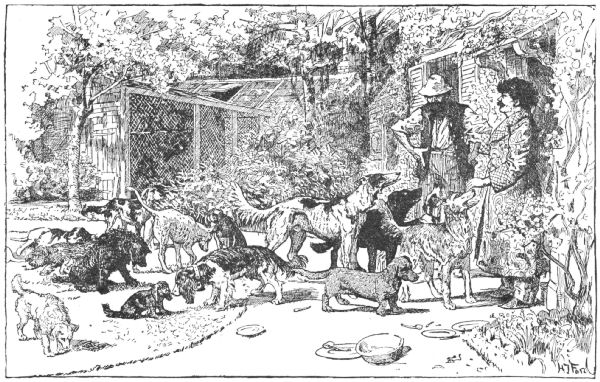
‘IT’S A REGULAR KENNEL’
‘Every day, Michel? Surely that is almost too much
133]
to promise. Besides, I should like, before consuming so
many rabbits, to know where they come from.’
‘You shall know that this very night, if you don’t mind
coming out with me.’
‘Ah! Michel, I have told you before that you are a
poacher!’
‘Oh, sir, as to that, I am as innocent as a baby—and,
as I was saying, if you will only come out with me to-night—’
‘Must I go far, Michel?’
‘Not a hundred yards, sir.’
‘At what o’clock?’
‘Just at the moment when you hear Portugo’s first
bark.’
‘Very well, Michel, I will be with you.’
I had nearly forgotten this promise, and was writing
as usual, when Michel came into my study. It was about
eleven o’clock, and a fine moonlight night.
‘Hallo!’ said I, ‘Portugo hasn’t barked yet, has he?’
‘No, but I was just thinking that if you waited for
that, you would miss seeing something curious.’
‘What should I miss, Michel?’
‘The council of war which is held between Pritchard
and Portugo.’
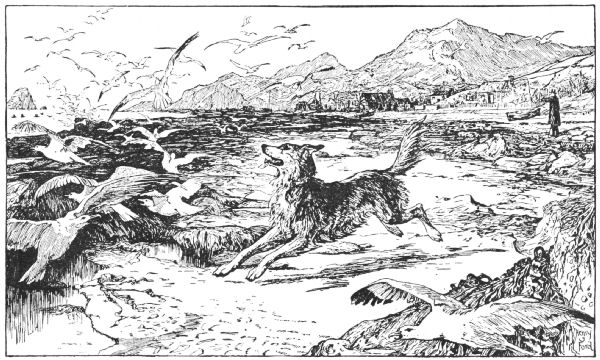
I followed Michel, and sure enough, among the fourteen
dogs, which were mostly sleeping in different attitudes,
Portugo and Pritchard were sitting up, and seemed
to be gravely debating some important question. When
the debate was ended, they separated; Portugo went out
at the gate to the high road, turned the corner, and disappeared,
while Pritchard began deliberately, as if he had
plenty of time before him, to follow the little path which
led up to a stone quarry. We followed Pritchard, who
took no notice of us, though he evidently knew we were
there. He went up to the top of the quarry, examined and
smelt about over the ground with great care, and when he
had found a scent and assured himself that it was fresh, he
134]
lay down flat and waited. Almost at the same moment,
Portugo’s first bark was heard some two hundred yards
off. Now the plan the two dogs had laid was clear to us.
The rabbits came out of their holes in the quarry every
evening to go to their feeding ground; Pritchard found
the scent of one; Portugo then made a wide circuit, found
and chased the rabbit, and, as a rabbit or a hare always
comes back upon its former track, Pritchard, lying in
ambush, awaited its return. Accordingly, as the sound
of Portugo’s barking came closer, we saw Pritchard’s
yellow eyes light up and flame like a topaz; then all of
a sudden he made a spring, and we heard a cry of fright
and distress.
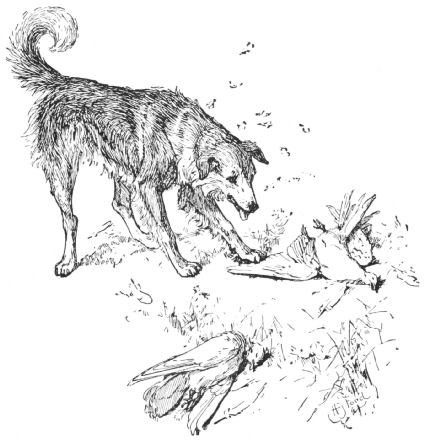
‘They’ve done it!’ said Michel, and he went to Pritchard,
took out of his mouth a nice plump rabbit, gave it
a blow behind the ears to finish it, and, opening it on the
spot, gave the inside to the two dogs, who shared their
portion contentedly, although they probably regretted
Michel’s interference. As Michel told me, I could have
eaten a stewed rabbit every day for dinner, if such had
been my desire.
But after this, events of a different kind were taking
place, which obliged me to leave my country pursuits,
and I spent about two months in Paris. The day before I
returned to St.-Germains I wrote and told Michel to
expect me, and found him waiting for me on the road
half way from the station.
‘I must tell you, sir,’ he said, as soon as I was within
hearing, ‘that two important events have happened at
Monte Cristo since you went away.’
‘Well, Michel, let me hear.’
‘In the first place, Pritchard got his hind foot into a
snare and instead of staying where he was as any other
dog would have done, he bit off his foot with his teeth,
and so he came home upon three legs.’
‘But,’ said I, much shocked, ‘is the poor beast dead
after such an accident?’
135]
‘Dead, sir? Was not I there to doctor him?’
‘And what did you do to him then?’
‘I cut off the foot properly at the joint with a pruning
knife. I then sewed the skin neatly over it, and now
you would never know it was off! Look there, the rascal
has smelt you and is coming to meet you.’
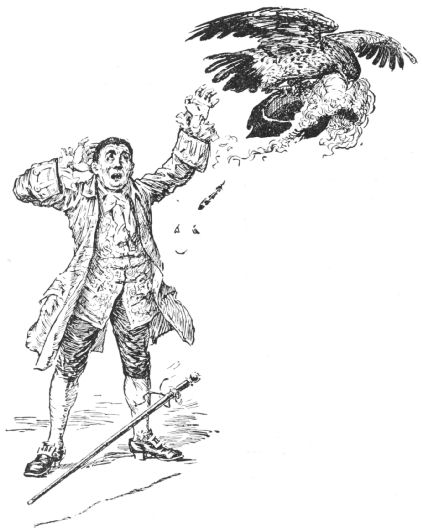
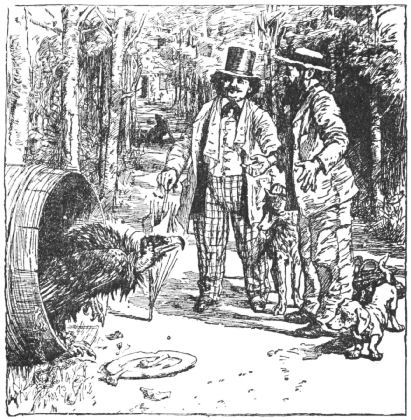
JUGURTHA BECOMES DIOGENES
And at that moment Pritchard appeared, coming at full
gallop, so that, as Michel had said, one would hardly
have noticed that he had only three feet. My meeting
with Pritchard was, as may be supposed, full of deep
136]
emotion on both sides. I was sorry for the poor animal.
When I had recovered a little, I asked Michel what his
other piece of news was.
‘The latest news, sir, is that Jugurtha’s name is no
longer Jugurtha.’
‘What is it then?’
‘It is Diogenes.’
‘And why?’
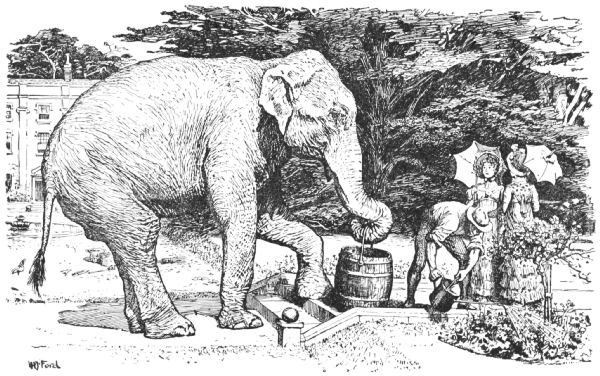
‘Look, sir!’
We had now reached the little avenue of ash-trees
which formed the entrance to the villa. To the left of
the avenue the vulture was seen walking proudly to and
fro in an immense tub, which Michel had made into a
house for him.
‘Ah! now I understand,’ said I. ‘Of course, directly
he lives in a tub——’
‘That’s it!’ said Michel. ‘Directly he lives in a tub,
he cannot be Jugurtha any more; he must be Diogenes.’
I admired Michel’s historical learning no less than I
did his surgical skill, just as the year before, I had bowed
before his superior knowledge of natural history.
In order to lead to more incidents in the life of Pritchard
I must now tell my readers that I had a friend called
Charpillon, who had a passion for poultry, and kept the
finest hens in the whole department of Yonne. These
hens were chiefly Cochins and Brahmapootras; they laid
the most beautiful brown eggs, and Charpillon surrounded
them with every luxury and never would allow them to be
killed. He had the inside of his hen-house painted green,
in order that the hens, even when shut up, might fancy
themselves in a meadow. In fact, the illusion was so
complete, that when the hen-house was first painted, the
hens refused to go in at night, fearing to catch cold; but
after a short time even the least intelligent among them
137]
understood that she had the good fortune to belong to a
master who knew how to combine the useful with the
beautiful. Whenever these hens ventured out upon the
road, strangers would exclaim with delight, ‘Oh! what
beautiful hens!’ to which some one better acquainted
with the wonders of this fortunate village would reply,
‘I should think so! These are M. Charpillon’s hens.’ Or,
if the speaker were of an envious disposition, he might
add, ‘Yes indeed! hens that nothing is thought too good
for!’
When my friend Charpillon heard that I had returned
from Paris, he invited me to come and stay with him to
shoot, adding as a further inducement that he would give
me the best and freshest eggs I had ever eaten in my life.
Though I did not share Charpillon’s great love of poultry,
I am very fond of fresh eggs, and the nankeen-coloured
eggs laid by his Brahma hens had an especially delicate
flavour. But all earthly pleasures are uncertain. The
next morning Charpillon’s hens were found to have only
laid three eggs instead of eight. Such a thing had never
happened before, and Charpillon did not know whom to
suspect; however he suspected every one rather than his
hens, and a sort of cloud began to obscure the confidence
he had hitherto placed in the security of his enclosures.
While these gloomy doubts were occupying us, I observed
Michel hovering about as if he had something on his mind,
and asked him if he wanted to speak to me.
‘I should be glad to have a few words with you, sir.’
‘In private?’
‘It would be better so, for the honour of Pritchard.’
‘Ah, indeed? What has the rascal been doing
now?’
‘You remember, sir, what your solicitor said to you one
day when I was in the room?’
‘What did he say, Michel? My solicitor is a clever
man, and says many sensible things; still it is difficult for
me to remember them all.’
138]
‘Well, sir,’ he said, ‘find out whom the crime benefits,
and you will find the criminal.’
‘I remember that axiom perfectly, Michel. Well?’
‘Well, sir, whom can this crime of stolen eggs benefit
more than Pritchard?’
‘Pritchard? You think it is he who steals the eggs?
Pritchard, who brings home eggs without breaking them!’
‘You mean who used to bring them. Pritchard is an
animal who has vicious instincts, sir, and if he does not
come to a bad end some day, I shall be surprised, that’s
all.’
‘Does Pritchard eat eggs, then?’
‘He does; and it is only right to say, sir, that that is
your fault.’
‘What! my fault? My fault that Pritchard eats
eggs?’
Michel shook his head sadly, but nothing could shake
his opinion.
‘Now really, Michel, this is too much! Is it not enough
that critics tell me that I pervert everybody’s mind with
my corrupt literature, but you must join my detractors
and say that my bad example corrupts Pritchard?’
‘I beg pardon, sir, but do you remember how one day,
at the Villa Medicis, while you were eating an egg, M.
Rusconi who was there said something so ridiculous that
you let the egg fall upon the floor?’
‘I remember that quite well.’
‘And do you remember calling in Pritchard, who was
scraping up a bed of fuchsias in the garden, and making
him lick up the egg?’
‘I do not remember him scraping up a bed of fuchsias,
but I do recollect that he licked up my egg.’
‘Well, sir, it is that and nothing else that has been
his ruin. Oh! he is quick enough to learn what is wrong;
there is no need to show it him twice.’
‘Michel, you are really extremely tedious. How have
I shown Pritchard what is wrong?’
139]
‘By making him eat an egg. You see, sir, before that
he was as innocent as a new-born babe; he didn’t know
what an egg was—he thought it was a badly made golf
ball. But as soon as you make him eat an egg, he learns
what it is. Three days afterwards, M. Alexandre came
home, and was complaining to me of his dog—that he was
rough and tore things with his teeth in carrying them.
“Ah! look at Pritchard,” I said to him, “how gentle
he is! you shall see the way he carries an egg.” So I
fetched an egg from the kitchen, placed it on the ground,
and said, “Fetch, Pritchard!” Pritchard didn’t need
to be told twice, but what do you think the cunning rascal
did? You remember, some days before, Monsieur —— the
gentleman who had such a bad toothache, you know.
You recollect his coming to see you?’
‘Yes, of course I remember.’
‘Well, Pritchard pretended not to notice, but those
yellow eyes of his notice everything. Well, all of a
sudden he pretended to have the same toothache that
that gentleman had, and crack! goes the egg. Then he
pretends to be ashamed of his awkwardness—he swallows
it in a hurry, shell and all! I believed him—I thought
it was an accident and fetched another egg. Scarcely
did he make three steps with the egg in his mouth than
the toothache comes on again, and crack! goes the second
egg. I began then to suspect something—I went and got
a third, but if I hadn’t stopped then he’d have eaten
the whole basketful. So then M. Alexandre, who likes his
joke, said, “Michel, you may possibly make a good
musician of Pritchard, or a good astronomer, but he’ll
never be a good incubator!”’
‘How is it that you never told me this before,
Michel?’
‘Because I was ashamed, sir; for this is not the
worst.’
‘What! not the worst?’
Michel shook his head.
140]
‘He has developed an unnatural craving for eggs; he
got into M. Acoyer’s poultry-yard and stole all his. M.
Acoyer came to complain to me. How do you suppose
he lost his foot?’
‘You told me yourself—in somebody’s grounds where
he had forgotten to read the notice about trespassing.’
‘You are joking, sir—but I really believe he can
read.’
‘Oh! Michel, Pritchard is accused of enough sins
without having that vice laid to his charge! But about
his foot?’
‘I think he caught it in some wire getting out of a
poultry-yard.’
‘But you know it happened at night, and the hens
are shut up at night. How could he get into the hen-house?’
‘He doesn’t need to get into the hen-house after eggs;
he can charm the hens. Pritchard is what one may call
a charmer.’
‘Michel, you astonish me more and more!’
‘Yes, indeed, sir. I knew that he used to charm
the hens at the Villa Medicis; only M. Charpillon has
such wonderful hens, I did not think they would have
allowed it. But I see now all hens are alike.’
‘Then you think it is Pritchard who——’
‘I think he charms M. Charpillon’s hens, and that is
the reason they don’t lay—at least, that they only lay for
Pritchard.’
‘Indeed, Michel, I should much like to know how he
does it!’
‘If you are awake very early to-morrow, sir, just look
out of your window—you can see the poultry-yard from
it, and you will see a sight that you have never seen
before!’
‘I have seen many things, Michel, including sixteen
changes of governments, and to see something I have
never seen before I would gladly sit up the whole night!’
141]
‘There is no need for that—I can wake you at the
right time.’
The next day at early dawn, Michel awoke me.
‘I am ready, Michel,’ said I, coming to the window.
‘Wait, wait! let me open it very gently. If Pritchard
suspects that he is watched, he won’t stir; you have no
idea how deceitful he is.’
Michel opened the window with every possible precaution.
From where I stood, I could distinctly see the
poultry-yard, and Pritchard lying in his couch, his head
innocently resting upon his two fore-paws. At the slight
noise which Michel made in opening the window, Pritchard
pricked up his ears and half opened his yellow eye,
but as the sound was not repeated he did not move. Ten
minutes afterwards we heard the newly wakened hens
begin to cluck. Pritchard immediately opened both eyes,
stretched himself and stood upright upon his three feet.
He then cast a glance all round him, and seeing that all
was quiet, disappeared into a shed, and the next moment
we saw him coming out of a sort of little window on the
other side. From this window Pritchard easily got upon
the sloping roof which overhung one side of the poultry-yard.
He had now only to jump down about six feet,
and having got into the inclosure he lay down flat in front
of the hen-house, giving a little friendly bark. A hen
looked out at Pritchard’s call, and instead of seeming
frightened she went to him at once and received his compliments
with apparent complacency. Nor did she seem
at all embarrassed, but proceeded to lay her egg, and that
within such easy reach of Pritchard that we had not time
to see the egg—it was swallowed the same instant. She
then retired cackling triumphantly, and her place was
taken by another hen.
‘Well, now, sir,’ said Michel, when Pritchard had
swallowed his fourth egg, ‘you see it is no wonder that
Pritchard has such a clear voice. You know great singers
always eat raw eggs the first thing in the morning.’
142]
‘I know that, Michel, but what I don’t know is how
Pritchard proposes to get out of the poultry-yard.’
‘Just wait and see what the scoundrel will do.’
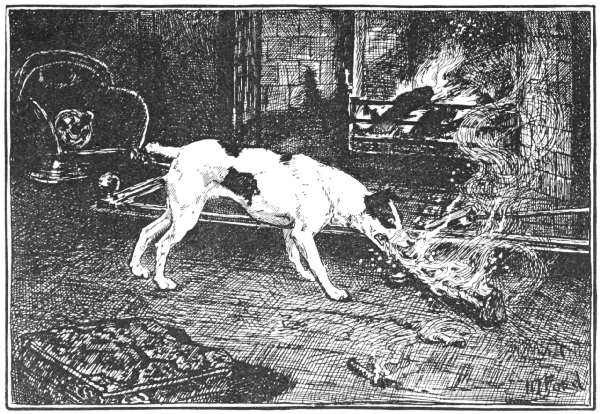
Pritchard having finished his breakfast, or being a
little alarmed at some noise in the house, stood up on his
hind leg, and slipping one of his fore-paws through the
bars of the gate, he lifted the latch and went out.
‘And when one thinks,’ said Michel, ‘that if anybody
asked him why the yard door was left open, he would say
it was because Pierre had forgotten to shut it last night!’
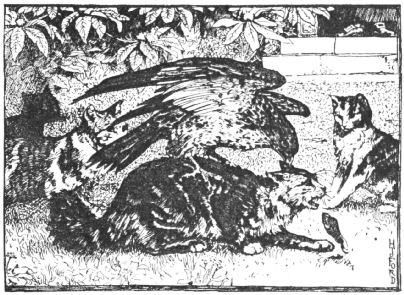
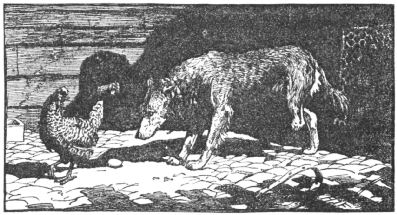
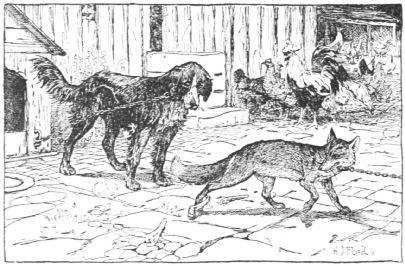
PRITCHARD AND THE HENS
‘You think he would have the wickedness to say that,
Michel?’
‘Perhaps not to-day, nor yet to-morrow, because he is
not come to his full growth, but some day, mind you, I
should not be surprised to hear him speak.’
Before going out to shoot that day, I thought it only
right to give M. Charpillon an account of Pritchard’s
proceedings. He regarded him, therefore with mingled
143]
feelings, in which admiration was more prominent than
sympathy, and it was agreed that on our return the dog
should be shut up in the stable, and that the stable-door
should be bolted and padlocked. Pritchard, unsuspicious
of our designs, ran on in front with a proud step and with
his tail in the air.
‘You know,’ said Charpillon, ‘that neither men nor
dogs are allowed to go into the vineyards. I ought as
a magistrate to set an example, and Gaignez still more,
as he is the mayor. So mind you keep in Pritchard.’
‘All right,’ said I, ‘I will keep him in.’
But Michel, approaching, suggested that I should send
Pritchard home with him. ‘It would be safer,’ he said.
‘We are quite near the house, and I have a notion that
he might get us into some scrape by hunting in the vineyards.’
‘Don’t be afraid, Michel; I have thought of a plan to
prevent him.’
Michel touched his hat. ‘I know you are clever,
sir—very clever; but I don’t think you are as clever as
that!’
‘Wait till you see.’
‘Indeed, sir, you will have to be quick, for there is
Pritchard hunting already.’
We were just in time to see Pritchard disappear into
a vineyard, and a moment afterwards he raised a covey
of partridges.
‘Call in your dog,’ cried Gaignez.
I called Pritchard, who, however, turned a deaf ear.
‘Catch him,’ said I to Michel.
Michel went, and returned in a few minutes with
Pritchard in a leash. In the meantime I had found a
long stake, which I hung crosswise round his neck, and
let him go loose with this ornament. Pritchard understood
that he could no longer go through the vineyards,
but the stake did not prevent his hunting, and he only
went a good deal further off on the open ground.
144]
From this moment there was only one shout all along
the line.
‘Hold in your dog, confound him!’
‘Keep in your Pritchard, can’t you! He’s sending all
the birds out of shot!’
‘Look here! Would you mind my putting a few pellets
into your brute of a dog? How can anybody shoot if he
won’t keep in?’
‘Michel,’ said I, ‘catch Pritchard again.’
‘I told you so, sir. Luckily we are not far from the
house; I can still take him back.’
‘Not at all. I have a second idea. Catch Pritchard.’
‘After all,’ said Michel, ‘this is nearly as good fun as if
we were shooting.’
And by-and-bye he came back, dragging Pritchard by
his stake. Pritchard had a partridge in his mouth.
‘Look at him, the thief!’ said Michel. ‘He has
carried off M. Gaignez’s partridge—I see him looking
for it.’
‘Put the partridge in your game-bag, Michel; we will
give him a surprise.’
Michel hesitated. ‘But,’ said he, ‘think of the opinion
this rascal will have of you!’
‘What, Michel? do you think Pritchard has a bad
opinion of me?’
‘Oh, sir! a shocking opinion.’
‘But what makes you think so?’
‘Why, sir, do you not think that Pritchard knows in
his soul and conscience that when he brings you a bird
that another gentleman has shot, he is committing a
theft?’
‘I think he has an idea of it, certainly, Michel.’
‘Well, then, sir, if he knows he is a thief, he must take
you for a receiver of stolen goods. Look at the articles
of the Code; it is said there that receivers are equally
guilty with thieves, and should be similarly punished.’
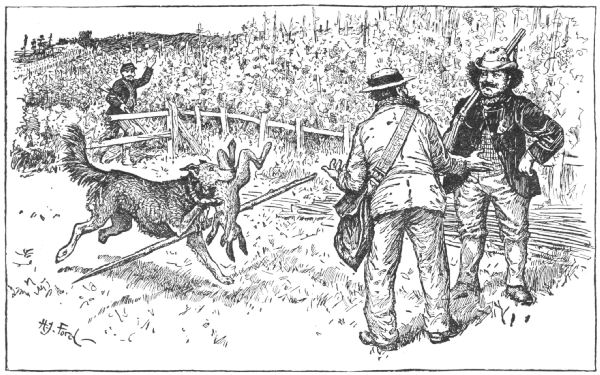
‘PRITCHARD REAPPEARED NEXT MOMENT WITH A HARE IN HIS MOUTH’
‘Michel, you open my eyes to a whole vista of terrors.
147]
But we are going to try to cure Pritchard of hunting.
When he is cured of hunting, he will be cured of
stealing.’
‘Never, sir! You will never cure Pritchard of his vices.’
Still I pursued my plan, which was to put Pritchard’s
fore-leg through his collar. By this means, his right fore-foot
being fastened to his neck, and his left hind-foot
being cut off, he had only two to run with, the left fore-foot
and the right hind-foot.
‘Well, indeed,’ said Michel, ‘if he can hunt now, the
devil is in it.’
He loosed Pritchard, who stood for a moment as if
astonished, but once he had balanced himself he began to
walk, then to trot; then, as he found his balance better,
he succeeded in running quicker on his two legs than
many dogs would have done on four.
‘Where are we now, sir?’ said Michel.
‘It’s that beast of a stake that balances him!’ I
replied, a little disappointed. ‘We ought to teach him to
dance upon the tight-rope—he would make our fortunes
as an acrobat.’
‘You are joking again, sir. But listen! do you hear
that?’
The most terrible imprecations against Pritchard were
resounding on all sides. The imprecations were followed
by a shot, then by a howl of pain.
‘That is Pritchard’s voice,’ said Michel. ‘Well, it is
no more than he deserves.’
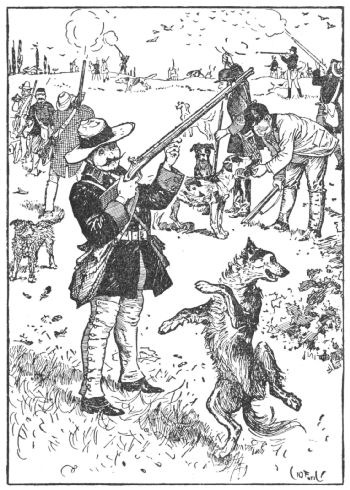
Pritchard reappeared the next moment with a hare in
his mouth.
‘Michel, you said that was Pritchard that howled.’
‘I would swear to it, sir.’
‘But how could he howl with a hare in his mouth?’
Michel scratched his head. ‘It was he all the same,’
he said, and he went to look at Pritchard.
‘Oh, sir!’ he said, ‘I was right. The gentleman he
took the hare from has shot him. His hind-leg is all over
148]
blood. Look! there is M. Charpillon running after his
hare.’
‘You know that I have just put some pellets into your
Pritchard?’ Charpillon called out as soon as he saw me.
‘You did quite right.’
‘He carried off my hare.’
‘There! You see,’ said Michel, ‘it is impossible to
cure him.’
‘But when he carried away your hare, he must have
had it in his mouth?’
‘Of course. Where else would he have it?’
‘But how could he howl with a hare in his mouth?’
‘He put it down to howl, then he took it up again and
made off.’
‘There’s deceit for you, gentlemen!’ exclaimed
Michel.
Pritchard succeeded in bringing the hare to me, but
when he reached me he had to lie down.
‘I say,’ said Charpillon, ‘I hope I haven’t hurt him
more than I intended—it was a long shot.’ And forgetting
his hare, Charpillon knelt down to examine Pritchard’s
wound. It was a serious one; Pritchard had received
five or six pellets about the region of his tail, and was
bleeding profusely.
‘Oh, poor beast!’ cried Charpillon. ‘I wouldn’t
have fired that shot for all the hares in creation if I had
known.’
‘Bah!’ said Michel; ‘he won’t die of it.’ And, in
fact, Pritchard, after spending three weeks with the
vet. at St.-Germains, returned to Monte Cristo perfectly
cured, and with his tail in the air once more.
Soon after the disastrous event which I have just
related the revolution of 1848 occurred in France, in
which King Louis Philippe was dethroned and a republic
149]
established. You will ask what the change of government
had to do with my beasts? Well, although, happily,
they do not trouble their heads about politics, the revolution
did affect them a good deal; for the French public,
being excited by these occurrences, would not buy my
books, preferring to read the ‘Guillotine,’ the ‘Red
Republic,’ and such like corrupt periodicals; so that I
became for the time a very much poorer man. I was
obliged greatly to reduce my establishment. I sold my
three horses and two carriages for a quarter of their
value, and I presented the Last of the Laidmanoirs, Potich,
and Mademoiselle Desgarcins to the Jardin des Plantes
in Paris. I had to move into a smaller house, but my
monkeys were lodged in a palace; this is a sort of thing
that sometimes happens after a revolution. Mysouff also
profited by it, for he regained his liberty on the departure
of the monkeys.
As to Diogenes, the vulture, I gave him to my worthy
neighbour Collinet, who keeps the restaurant Henri IV.,
and makes such good cutlets à la Béarnaise. There was
no fear of Diogenes dying of hunger under his new master’s
care; on the contrary, he improved greatly in health and
beauty, and, doubtless as a token of gratitude to Collinet,
he laid an egg for him every year, a thing he never
dreamt of doing for me. Lastly, we requested Pritchard
to cease to keep open house, and to discontinue his daily
invitations to strange dogs to dine and sleep. I was
obliged to give up all thoughts of shooting that year. It
is true that Pritchard still remained to me, but then
Pritchard, you must recollect, had only three feet; he had
been badly hurt when he was shot by Charpillon, and the
revolution of February had occasioned the loss of one
eye.
It happened one day during that exciting period, that
Michel was so anxious to see what was going on that he
forgot to give Pritchard his dinner. Pritchard therefore
invited himself to dine with the vulture, but Diogenes,
150]
being of a less sociable turn, and not in a humour to be
trifled with, dealt poor Pritchard such a blow with his
beak as to deprive him of one of his mustard-coloured
eyes. Pritchard’s courage was unabated; he might be
compared to that brave field marshal of whom it was
said that Mars had left nothing of him whole except
his heart. But it was difficult, you see, to make much
use of a dog with so many infirmities. If I had wished
to sell him I could not have found a purchaser, nor
would he have been considered a handsome present had
I desired to give him away. I had no choice, then, but
to make this old servant, badly as he had sometimes
served me, a pensioner, a companion, in fact a friend.
Some people told me that I might have tied a stone
round his neck and flung him into the river; others, that
it was easy enough to replace him by buying a good
retriever from Vatrin; but although I was not yet poor
enough to drown Pritchard, neither was I rich enough to
buy another dog. However, later in that very year, I
made an unexpected success in literature, and one of
my plays brought me in a sufficient sum to take a shooting
in the department of Yonne. I went to look at this
shooting, taking Pritchard with me. In the meantime
my daughter wrote to tell me that she had bought an
excellent retriever for five pounds, named Catinat, and
that she was keeping him in the stable until my return.
As soon as I arrived, my first care was to make Catinat’s
acquaintance. He was a rough, vigorous dog of three or
four years old, thoughtless, violent, and quarrelsome. He
jumped upon me till he nearly knocked me down, upset
my daughter’s work-table, and dashed about the room to
the great danger of my china vases and ornaments. I
therefore called Michel and informed him that the superficial
acquaintance which I had made with Catinat would
suffice for the time, and that I would defer the pleasure
of his further intimacy until the shooting season began
at Auxerre.
151]
Poor Michel, as soon as he saw Catinat, had been seized
with a presentiment of evil.
‘Sir,’ he said, ‘that dog will bring some misfortune
upon us. I do not know yet what, but something will
happen, I know it will!’
‘In the meantime, Michel,’ I said, ‘you had better
take Catinat back to the stable.’ But Catinat had already
left the room of his own accord and rushed downstairs
to the dining-room, where I had left Pritchard. Now
Pritchard never could endure Catinat from the first moment
he saw him; the two dogs instantly flew at one
another with so much fury that Michel was obliged to
call me to his assistance before we could separate them.
Catinat was once more shut up in the stable, and Pritchard
conducted to his kennel in the stable-yard, which,
in the absence of carriages and horses, was now a poultry-yard,
inhabited by my eleven hens and my cock Cæsar.
Pritchard’s friendship with the hens continued to be as
strong as ever, and the household suffered from a scarcity
of eggs in consequence. That evening, while my daughter
and I were walking in the garden, Michel came to meet
us, twisting his straw hat between his fingers, a sure sign
that he had something important to say.
‘Well, what is it, Michel?’ I asked.
‘It came into my mind, sir,’ he answered, ‘while I was
taking Pritchard to his kennel, that we never have any
eggs because Pritchard eats them; and he eats them
because he is in direct communication with the hens.’
‘It is evident, Michel, that if Pritchard never went into
the poultry-yard, he would not eat the eggs.’
‘Then, do you not think, sir,’ continued Michel, ‘that if
we shut up Pritchard in the stable and put Catinat into
the poultry-yard, it would be better? Catinat is an animal
without education, so far as I know; but he is not
such a thief as Pritchard.’
‘Do you know what will happen if you do that,
152]
Michel?’ I said. ‘Catinat will not eat the eggs, perhaps,
but he will eat the hens.’
‘If a misfortune like that were to occur, I know a
method of curing him of eating hens.’
‘Well—but in the meantime the hens would be eaten.’
Scarcely had I uttered these words, when a frightful
noise was heard in the stable-yard, as loud as that of a
pack of hounds in full cry, but mingled with howls of rage
and pain which indicated a deadly combat.
‘Michel!’ I cried, ‘do you hear that?’
‘Oh yes, I hear it,’ he answered, ‘but those must be
the neighbours’ dogs fighting.’
‘Michel, those are Catinat and Pritchard killing each
other!’
‘Impossible, sir—I have separated them.’
‘Well, then, they have met again.’
‘It is true,’ said Michel, ‘that scoundrel Pritchard can
open the stable-door as well as any one.’
‘Then, you see, Pritchard is a dog of courage; he’ll
have opened the stable-door for Catinat on purpose to
fight him. Be quick, Michel, I am really afraid one of
them will be killed.’
Michel darted into the passage which led to the stable,
and no sooner had he disappeared than I knew from the
lamentations which I heard that some misfortune had
happened. In a minute or two Michel reappeared sobbing
bitterly and carrying Pritchard in his arms.
‘Look, sir! just look!’ he said; ‘this is the last we
shall see of Pritchard—look what your fine sporting dog
has done to him. Catinat, indeed! it is Catilina he
should be called!’
I ran up to Pritchard, full of concern—I had a great
love for him, though he had often made me angry. He
was a dog of much originality, and the unexpected things
he did were only a proof of genius.
‘What do you think is the matter?’ I asked Michel.
‘The matter?—the matter is that he is dead!’
153]
‘Oh no, surely not!’
‘Anyhow, he’ll never be good for anything again.’
And he laid him on the ground at my feet.
‘Pritchard, my poor Pritchard!’ I cried.
At the sound of my voice, Pritchard opened his yellow
eye and looked sorrowfully at me, then stretched out his
four legs, gave one sigh, and died. Catinat had bitten
his throat quite through, so that his death was almost
immediate.
‘Well, Michel,’ said I, ‘it is not a good servant, it is
a good friend that we have lost. You must wash him
carefully—you shall have a towel to wrap him in—you
shall dig his grave in the garden and we will have a
tombstone made for him on which shall be engraved this
epitaph:
‘Like conquering Rantzau, of courage undaunted,
Pritchard, to thee Mars honour has granted,
On each field of fight of a limb he bereft thee,
Till nought but thy gallant heart scatheless was left thee.’
As my habit was, I sought consolation for my grief in
literary labours. Michel endeavoured to assuage his with
the help of two bottles of red wine, with which, mingled
with his tears, he watered the grave of the departed. I
know this because when I came out early next morning
to see if my wishes with regard to Pritchard’s burial had
been carried out, I found Michel stretched upon the
ground, still in tears, and the two bottles empty by his
side.
154]