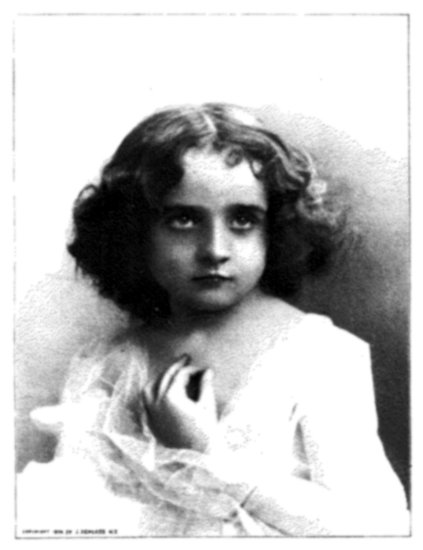
"It's a nice, cool morning," said the ever
sanguine Miss Bonkowski to Joey, one day
late in September, "so, if you will give me
your solemn promise—" and Miss Norma
paused impressively, emphasizing her words
with nods of her blonde head, "not to go to
any speakings, nor yet to the dock to fish, nor
to any fires, or to a procession, even if it's
right around the corner," and Miss Norma
drew breath as she finished the enumerating of
his various exploits, "why, Angel here can
play with you until Mary Carew comes down
to get her."
The Major—his cap a little more battered,
his belt somewhat the worse from constant
wear, but clean as to face and hands, having
just emerged from the morning inspection of
the Armory janitor, better known to the neighborhood
as Old G. A. R.—treated Miss Bonkowski
to a salute and a confidential wink, and
edged up to the smiling Angel's side. "Yer
jus' leave her wid me," he responded reassuringly,
"an' I ain't goin' to do nothin' as ain't
square."
And Miss Norma, whose faith in human
nature, phœnix-like, ever sprang up anew from
the blighted hopes of former trust, accordingly
turned her darling over to Joey and hurried off.
"For she's obliged to have some one to play
with and to get some fresh air somehow," the
chorus-lady argued for her own re-assuring,
though it remains a mystery as to how she
could deceive herself into considering the garbage-scented
atmosphere of the neighborhood
as fresh, "and Joey's by far the best of the
lot around here."
Meanwhile, the small subject of all this solicitude,
in clean frock and smiling good-humor,
responded at once to Joey's proposal, and the
two sat down on the curbstone. In the constant
companionship of their two months'
acquaintance, the little Major's growing interest
in the Angel had assumed almost fatherly
proportions. Hitherto this zeal had taken itself
out in various expeditions for her entertainment
similar to the one ending in Mr.
Tomlin's rescue. To-day it was produced in
the shape of a somewhat damaged peach purchased
with a stray penny. But the Angel, in
her generous fashion, insisting on a division
of the dainty, Joey at first stoutly declining,
weakened and took half, seeing to it, however,
that his was the damaged side.
"When yer was up there," he observed
unctiously as he devoured his portion—and he
nodded his round little head toward that foggy
and smoky expanse about them, popularly believed
by the population about the Tenement
to be the abode of angels—"when yer was up
there, yer had these kinder things every day,
didn't yer?"
If her small ladyship's word could be taken
for it, in that other life still remembered by
her, she had everything, even to hoky-poky ad
libitum, to her heart's content, though her
testimony framed itself into somewhat more
halting and uncertain English.
"What did yer do up there, anyhow?"
queried Joey curiously.
"Danced," the Angel declared, daintily devoting
herself to her portion of the peach,
"her danced and—her danced."
This earthly vocation seemed to fail to appeal
to Joey's imagination. "Nothin' else?"
he demanded anxiously. "Didn't yer never
do nothin' else?"
But the Angel had fallen to poking the green
contents of the gutter with a stick, and seemed
to find the present more fascinating to contemplate
than the past.
"Didn't yer never go nowhere?" persisted
Joey.
"Her went to school," the Angel admitted,
or so it sounded to Joey.
"What 'ud yer do at school?" he inquired.
"Danced," was the Angel's unmistakable
announcement.
Joey looked disgusted, but soon recovered
and fell to revolving a new idea in his fertile
young brain.
"I know where there is a school," he remarked.
"I've never went, but I hung on ter
the window-sill an' looked in, an' if yer went
ter school up there, yer oughter be goin' down
here, see!" And forthwith Joey arose.
Amiable as her small ladyship usually was,
on this occasion, seeing determination written
on Joey's small countenance, she rebelled.
"Angel yants to stay here," the young lady
declared, continuing to poke at the contents
of the gutter.
"I don't wanter make her cry," argued Joey
wisely, then cast about in his mind for an inducement.
"They have parties to that school,
they do," finally he observed, "fer I seen 'em
settin' 'round tables an' eatin' one day."
The guileless infant rose to the bait at once,
and dropped her stick and slipped her confiding
hand in Joey's. "Angel likes to have parties,"
she declared, and thus lured on, she forthwith
followed Joey down the street.
*****
"Some one to see me," repeated pretty
Miss Stannard, of the Darcy College Settlement's
Free Kindergarten, and laying down
her blocks she went to the door.
On the steps outside the entrance stood a
small, chubby-cheeked boy smiling up out of
knowing brown eyes from beneath a soldier's
cap many sizes too large for him, while behind
him stood a slender, graceful child with wonderful
shining hair, and eyes equally as smiling.
The small boy treated the tall, pretty young
lady to a most confiding nod and a wink.
"I've brought her ter school," he remarked.
"Oh, have you?" returned the young lady
laughing, "then I'd better invite you in, I suppose,"
and she led the way toward the entry-room
where hung some dozens of shabby hats
and bonnets. "And what is your name?" she
inquired.
"Her name is Angel, it is," responded the
little fellow briskly, with emphasis on the pronoun,
as if to let the young lady understand at
once that her interest need extend no further
than to the prospective pupil.
"Didn't a know I are Angel?" queried the
smiling cherub with her accustomed egotistical
surprise.
"And what is your other name?" questioned
Miss Stannard smiling.
"She ain't got no more," returned the escort
succinctly.
"And what is yours?"
"Mine—oh, I'm just the Major, I am," with
off-hand loftiness.
"Indeed? And where do you live, Major?"
"Fourth Reg'ment Arm'ry," responded the
Major glibly.
"And the little girl,—Angel—you said—"
The Major looked somewhat surprised,
"They come from Heaven,—Angels do, yer
know," he remarked, staring a little at the tall
young lady's want of such knowledge.
"Yes," responded the pretty lady gently,
"but where is she living now?"
"Round by me," said the small boy briefly,
showing some restlessness.
"With her father and mother?"
The Major, staring again, shook his head,
and poor Miss Stannard, despairing, of learning
anything definite from this source, asked if he
would take her there after Kindergarten, and
began to untie the little girl's cap.
Evidently gratified at this attention to his
charge, the Major said that he would, and followed
the two into the large, sunny room adjoining.
"The children are just going on the
circle," said the pretty young lady, "won't you
take my other hand and go too."
The Major drew back hastily. "She's come
ter school," he declared indicating the Angel,
"there ain't no school in it fer me. I'm a
sojer, I am."
"Then have a chair, sir, and watch us," said
the young lady, with amused eyes, as she
brought out a little red chair with polite hospitality.
The young gentleman graciously accepting
it, the Angel was forthwith borne away to join
the circle of children about the ring, and to
Miss Stannard's surprise, with no more ado,
joined in the game like one familiar with it all,
waving her small hands, singing gaily and,
when her turn arrived, flitting gaily about
the circle until the sash strings of her
little faded dress sailed straight out behind
her.
And the game at an end, without waiting
for direction or guidance, the newcomer
marched with the other children about the
big room and took her place with them at one
of the tables spread with entrancing green and
yellow papers. And here, absorbed in directing
the work at her own table, and her two
assistant teachers equally absorbed at theirs,
Miss Stannard was presently aroused by a
nudge from 'Tildy Peggins, the freckle-faced
young person employed in a capacity of janitress
and nursery maid.
"Look a-yonder to that young willain, Miss
Ruth," urged 'Tildy, whose sentiments regarding
the infant populace refused, despite all the
efforts of her employers, to be tempered by
Kindergarten views.
Miss Stannard looked up hastily, and so did
the twenty pairs of eyes about her table.
From the depths of one pocket the Major
had produced a cigarette, and from the mixed
contents of another he had extracted a match,
and as the twenty pairs of eyes fell on him, a
fascinating curl of blue smoke was just issuing
from his lips.
'Tildy Peggins folded her arms on her flat
chest and gave vent to a groan. Already, with
her gloomy views on Kindergarten regeneration
versus innate depravity, she foresaw the contamination
of every half-subjugated small masculine
in the room.
Miss Stannard, with a shake of her head at
'Tildy, coughed slightly. Instantly the eyes
of the school left the Major and fixed themselves
expectantly on her pretty face.
"I thought you wanted to be a soldier,
Major," she observed, addressing the small
gentleman.
"I is goin' to be," returned that unabashed
gentleman, calmly sticking a thumb in his belt,
and in so doing pushing his jacket aside, so as to
further expose the military trappings about his
round little person, "I's a-goin' to be a sojer in
the Fourth Regiment."
"No, indeed," said Miss Ruth, "the members
of the Fourth Regiment are gentlemen,
and a gentleman would never have smoked in
here without asking if he might."
The Major looked somewhat moved out of
his usual imperturbability. The curl of offending
smoke ceased.
"I know a soldier," Miss Ruth went on
calmly, "and what is more, he is a member of
the Fourth Regiment, but he never would have
done such a thing as you are doing."
The cigarette trembled in the Major's irresolute
fingers.
"And even if you had asked first," the
steady voice went on, "I would have said no,
for such a thing as smoking is never allowed in
this room."
The Major's irresolute brown eyes met Miss
Stannard's resolute brown ones. Then the
cigarette went out the open window behind
him and the work at the tables went on.
Presently Miss Ruth looked up again.
"Won't you come," she said pleasantly, touching
a pile of the gay papers. "Are you not
tired?"
The Major shook his head decidedly. "No,
he would not," and finding a chip among the
apparently inexhaustible stores of his pockets,
he next produced a knife boasting an inch of
blade and went to whittling upon 'Tildy's immaculate
floor.
Miss Ruth saw it all, and presently saw the
chip fall to the floor and the round head begin
to nod. Then, with 'Tildy Peggins' gloomy
and disapproving eye upon her at this act of
overture, she crossed the room. "Major,"
said Miss Ruth, just a little plaintively, perhaps,
"do you suppose you could do something
for me?"
The Major was wide awake on the instant.
"These papers," explained Miss Ruth, while
'Tildy from her work of washing windows,
shook her disapproving head, "put all like this
in a pile on the table here, and all like this over
here, and this color,—here," and before Miss
Stannard had gotten over to her table again,
the Major was deep in the seductive fascinations
of Kindergarten.
It was when the three teachers, with 'Tildy's
help, had at last distributed the sixty hats,
hoods, and caps, and started the loitering
groups on their homeward ways, that pretty
Miss Stannard, putting on her own hat, addressed
her new pupils. "Now, Major, I am
ready," she said, and the three accordingly
turned their steps toward the neighborhood of
the Tenement.
Miss Ruth's small escort had quite an idea
of the proper thing to do, and pointed out the
landmarks as the three went along, the
Angel's friendly hand slipped confidingly into
that of her new friend.
"I did hear as so many died in this yere
house of the fevers this summer," Joey remarked
cheerfully, pointing to a wretched-looking
tenement building they were passing;
"they'll give yer a room there now fer nothin'
to git a good name fer the house agin."
Miss Ruth shivered as they passed.
The Major next nodded toward a dingy
saloon. "Here's where I take a schooner an'
a free lunch sometimes," he remarked confidentially.
The tall young lady's brown eyes danced as
she glanced down at the small person of the
Major. "And how old are you, Major?" she
inquired.
"Ha'f pas' seven, the Cap'n an' Old G. A. R.,
they say."
"The Captain? Old G. A. R.?"
"Uh, huh! The Cap'n's a good 'un, he is.
He gim' me these yere togs, he did, an' he told
Old G. A. R. I might sleep to th' Arm'ry,
see?"
Miss Ruth saw, and was just about to pursue
the subject of Old G. A. R., when the Angel
dropped her hand and with a gleeful cry ran
ahead, and Miss Stannard looked up to behold
two females bearing down upon them. Miss
Bonkowski and Mrs. O'Malligan in fact, nor
did they pause in their haste, until the Angel
was safe in Norma's embrace and the Major
anything but safe, in the clutches of the irate
Irish lady.
"An' it's yerself, ye limb, an' plaze to tell us
whut ye mane by it?" the loud-voiced Mrs.
O'Malligan demanded, "a-runnin' off with
the childer agin, an' the whole Tiniment out
huntin' an' her niver to be found at all, at
all?"
But the sweet-faced, tall young lady coming
to his rescue, the two women softened, and
reaching the Tenement, insisted on Miss Stannard
coming in, and hearing the Angel's story.
And on the way up to Miss Bonkowski's
apartment, she learned that the Tenement, that
morning, had been convulsed from cellar to
garret, by the great honor bestowed upon it.
For who but the Prima Donna, the Great Personage
of Norma's professional world, had just
driven away in her carriage after a visit of an
hour and the Angel never to be found at all!
"An' ma'am," explained Mary Carew, her
bony face swollen with crying, when Miss Stannard
had been installed in one of the two chairs
of the apartment, "an' ma'am, it was fer th'
Angel she come. A offerin' Norma an' me
anything we'd name to give her up, such a
fancy as she's taken to her, an' wantin' her fer
her own."
"And you, what did you say?" asked Miss
Ruth, gently, watching Mary with tender eyes as
she held the beautiful, chattering little creature
so jealously in her arms, and thinking as she
watched, of the life and reputation commonly
accorded the great singer.
"Say?" came from Miss Bonkowski quickly,
her befrizzled blonde tresses fairly a-tremble
with her intensity, and sticking the hat-pin
recklessly in and out of the lace hat she had
taken off, "what did we say, you ask, and
knowing, as you and every body must, the kind
of life and future it would mean for a child
that takes to things like this 'n does! With
all her money and her soft, winning ways, it is
better, far better, for the child with her disposition,
to starve along with Mary an' me, than
grow up to that, if it was nothing more to be
afraid of than being left to servants and hotel
people and dragged around from place to place
in such a life as it is. Not that I mean, ma'am,"
and Miss Bonkowski spoke with quick pride,
"that being in the profession need to make
any body what they shouldn't be, for I know
plenty of 'em of the best, and am one myself,
though only a Chorus, but what with what's
said about this one, even with her good heart
and generous ways, she's not the one to have
our Angel, though she meant it for the
best."
"An' she said," Mary Carew took it up, "as
how Norma's gettin' old, and 'll be dropped
afore long from the Chorus, an' she offered her,
she did, in this very room, a' here before me,
to buy out a Costumer as is leavin' the business,
an' start Norma in for herself, along of
her knowin' how to run a business such as
that."
"And oh girls," declared Miss Stannard as
she told this part of the story to her assistant
teachers afterward, "it was the bravest thing
I've met among the poor people yet. Think
of the courage of those two women, with
poverty grimmer than they have yet known,
ahead of them in all probability, yet determined
to resist the temptation because they
are assured it is not well for the child. Picture
making jean pantaloons, year in, year out, at
barely living wages, yet having the courage to
put the matter so resolutely aside. After that,
I could not bring myself to tell them they had
done wrong in the beginning in not notifying
the authorities. Of course there is some mystery
about it. I cannot for a moment accept
their explanation of it. The child, beyond
question, is well born and has been carefully
trained. And she goes about among all the
strange, queer inmates of that Tenement house
as fearlessly as a little queen. But, oh, the one
that is a chorus-singer! If you could see her!
So lean, so sallow, so airy and full of manner.
But I will never laugh at another elderly
chorus-singer again in my life, she is grand, she's
heroic," and the pretty Kindergartner threaded
gay worsteds into needles with a vigor which
lent emphasis to her words.
"She's powerful stuck up, too," asserted the
gloomy tones of 'Tildy Peggins, and she shook
her mournful head, as she moved about straightening
the disordered room for the next day,
"there's a man lives in our Tenement wanted
to keep comp'ny with her, but, la, she tossed
her yellow head at his waffle cart, she did, an'
she said if he'd had a settled h'occupation she
might a thought about it in time, but she
couldn't bring herself to consider a perambulating
business, an' that was all there was to it.
La, maybe she is grand an' 'eroic, but she's
got a 'aughty 'eart, too, that woman has!"