In
treating of the implements belonging to the Palæolithic Period,
and found in the ancient freshwater or river drifts in Britain,
I propose first to give a slight sketch of the nature of the discoveries
which have been made in this particular field of archæology;
then to furnish some details concerning the localities
where implements have been found, and the character of the
containing beds; next, to offer a few remarks on the shape and
possible uses of the various forms of implements; and, finally, to
consider the evidence of their antiquity.
So much has already been written in
England, [2459]
as well as on
the Continent, as to the history of these most curious discoveries,
that a very succinct account of them will here suffice. It was in
the year 1847, that M. Boucher de Perthes, of Abbeville, called
attention to the finding of flint instruments fashioned by the hand
of man, in the pits worked for sand and gravel, in the neighbourhood
of that town. They occurred in such positions, and at such
a depth below the surface, as to force upon him the conclusion that
they were of the same date as the containing beds, which he
regarded as of diluvial origin, or as monuments of a universal
Deluge. In 1855, Dr.
Rigollot, [2460]
of Amiens, also published an
account of the discovery of flint implements at St. Acheul, near
Amiens, in a drift enclosing the remains of extinct animals, and
at a depth of 10 feet or more from the surface.
From causes into {527}
which it is not necessary to enter, these discoveries were regarded
with distrust in France, and were very far from being
generally accepted by the geologists and antiquaries of that
country.
In the autumn of 1858, however, that distinguished palæontologist,
the late Dr. Hugh Falconer, F.R.S., visited
Abbeville, [2461]
in order
to see M. Boucher de Perthes’s collection, and became “satisfied
that there was a great deal of fair presumptive evidence in favour
of many of his speculations regarding the remote antiquity of these
industrial objects, and their association with animals now extinct.”
Acting on Dr. Falconer’s suggestion, the late Sir Joseph Prestwich,
F.R.S., whose extensive and accurate researches had placed
him in the first rank of English geologists, visited Abbeville and
Amiens, in April, 1859; where I, on his invitation, had the good
fortune to join him. We examined the local collections of flint
implements and the beds in which they were said to have been
found; and, in addition to being perfectly satisfied with the
evidence adduced as to the nature of the discoveries, we had the
crowning satisfaction of seeing one of the worked flints still in situ,
in its undisturbed matrix of gravel, at a depth of 17 feet from the
original surface of the ground.
I may add that on March 26th, 1875, I dug out from the gravel,
in a pit close to the seminary at Saint Acheul, a pointed implement
at a depth of 10 feet 10 inches from the surface.
From the day on which Sir Joseph Prestwich gave an account
to the Royal Society, of the results of his visit to the Valley of
the Somme, the authenticity of the discoveries of M. Boucher de
Perthes and Dr. Rigollot was established; and they were almost
immediately followed by numerous others of the same character,
both in France and England.
Before proceeding to describe the discoveries made in this
country, it will be well to say a few words as to some others of
those which have been made on the continent of Europe. In
France such discoveries have been so abundant that it would be
an almost hopeless task to enumerate the whole of them, I must,
therefore, content myself by calling attention to a few only; and,
moreover, shall not overburden my pages with references. One
of the earliest discoveries was made by M. Vincent at
Troyes [2462]
(Aube), where, in 1850, at a depth of 3
metres, he found an {528}
ovoid implement, but most of the recent finds date subsequently
to 1859. Those made at
Chelles [2463]
(Seine et Marne) deserve especial
mention, inasmuch as M. Gabriel de Mortillet, regarding the
deposits at that place as being more of one and the same age than
those at St. Acheul, has termed his oldest stage of the Palæolithic
Period Chelléen rather than Acheuléen. He places the Moustérien
next, but in some respects the subdivision is unsatisfactory. The
Elephas antiquus occurs at Chelles, but at
Tilloux [2464]
(Charente)
E. meridionalis, E. antiquus, and E. primigenius all occur together
with well-marked palæolithic implements of usual types. At Paris
itself, in the gravels of the valley of the Seine, numerous implements
have been found, as well as lower down the valley at Sotteville,
near Rouen. At Argues, [2465]
near Dieppe, Saint Saen, and
Bully, [2466]
near Neufchâtel, they have also occurred. At Grand
Morin [2467]
(Seine et Marne) and
Quiévy, [2468]
(Nord), fine specimens have
been found. At the Bois du
Rocher, [2469]
near Dinan, in the Côtes
du Nord, numerous implements, mostly small and of fine-grained
quartzite occur—I found eight there myself in 1876—and near
Toulouse [2470]
many larger and coarser examples chipped out of quartzite
pebbles. I have also implements from Chelles made of a kind
of quartzite. Of other localities in the north of France I may
mention Guînes and Sangatte, near Calais; Montguillain and
other spots near Beauvais; Thenay and Thézy, near Amiens, and
Vaudricourt, near Béthune. In the district of the Loire I have
found implements in the gravels of Marboué, near Châteaudun,
and at Vendôme. Further south in Poitou they are abundant on
the surface at Coussay-les-Bois and other places near Leugny.
They have also been found in some abundance near Sens (Yonne),
and occur in Dordogne, the Mâconnais and Champagne, the
departments of Corrèze, Indre et Loire, Nièvre, and indeed over
the greater part of France.
In Belgium several discoveries have been made, notably at
Curange [2471]
and Mesvin. [2472]
{529}
To the east, in
Germany, [2473]
Austria, [2474]
Hungary, [2475]
and Russia, [2476]
such discoveries, though rare, seem to be not entirely unknown.
Further evidence, however, is desirable.
In Italy [2477]
various implements, presumed to be of Palæolithic age,
have been found in the gravels of the Tiber, but they are nearly
all rude flakes. One, however, of ovate form, has been found near
Gabbiano, [2478]
in the Abruzzo.
Other well-defined implements have been found near
Perugia, [2479]
in the Imolese, [2480]
Ceppagna [2481]
(Molise), and elsewhere.
In the gravels of the valley of the Manzanares, at San Isidro,
near Madrid, palæolithic implements of the usual types have been
found, as well as some of a wedge shape, unlike the ordinary
European types, but similar to one of the Madras forms. They
are associated with the remains of an elephant, probably E. antiquus.
The Quaternary beds at San Isidro are nearly 200 feet
above the level of the existing river, and the implements that
they contain are varied in character, some chipped out of porphyry
and other old rocks, being very rude in fabric, while others
of flint are as dexterously made as any of the ordinary specimens
from St. Acheul. The first discovery made there was by M.
Louis Lartet. [2482]
I have on several occasions visited the spot.
Diagrammatic sections of the valley have been given by Prof. A.
Gaudry [2483]
and M. E. Cartailhac. [2484]
Messrs. Siret [2485]
mention several
other localities in Spain that have yielded palæolithic implements.
In Portugal [2486]
also, both in gravels and in caves, such implements
have been found, and a good ovate specimen, made of quartz, from
Leiria, near Lisbon, has been figured
by [2487]Cartailhac.
In Greece some almond-shaped implements,
of the true {530}
palæolithic type, are said to have been discovered in beds of sand near
Megalopolis, [2488]
with bones of the great pachyderms.
Returning to this country and to the year 1859, I may observe
that it turned out on examination that more than one such discovery
as those of Abbeville and Amiens had already been recorded,
and that flint implements of similar types to the French had been
found in the gravels of London at the close of the seventeenth
century, and in the brick-earth of Hoxne, in Suffolk, at the close
of the eighteenth, and were still preserved in the British Museum,
and in that of the Society of Antiquaries.
During the thirty-eight years that have elapsed since renewed
and careful attention was called to these implements, numerous other
discoveries have taken place in various parts of England of instruments
of analogous forms in beds of gravel, sand, and clay, for the
most part on the slopes of our existing river valleys, though in some
instances at considerable distances from any stream of water, and
occasionally not thus embedded, but lying on the surface of the
ground. Several of these discoveries have been made in localities
where, from the nature of the deposits, it had already been
suggested by the late Sir Joseph Prestwich and myself that implements
would probably be found; and others have resulted from
workmen, who had been trained to search for the implements in
gravel, having migrated to new pits, where also their search has
proved successful. In not a few instances the researches for such
evidence of the antiquity of man have been carried on by fully
qualified observers. It is, however, needless here to trace the causes
and order of the discoveries, and I therefore propose to treat them
in geographical, and not chronological, sequence. In so doing it will
be most convenient to arrange them in accordance with the river
systems in connection with which the gravels were deposited,
wherein for the most part the implements have been found.
The district of which, following the order formerly adopted, it
seems convenient first to treat, is the basin of the river Ouse and its
tributaries, comprising, according to the Ordnance
Survey, [2489]
an area of
2,607 square miles. Beginning in the west of this district, I may
mention the finding by Mr. Worthington G. Smith, F.L.S., of several
implements near one of the sources of the Ouse, a little to the north
of Leighton Buzzard. Through his kindness I possess a pointed,
thick and deeply-stained implement, found at Bossington, about a
mile north of Leighton. A more important scene of discoveries of
this kind is the neighbourhood of Bedford, where
the late Mr. James {531}
Wyatt, F.G.S., obtained specimens so early as April, 1861, since
which time considerable numbers have been found. The pit in which
they first occurred is one near Biddenham, in which I had, some
few years before, discovered freshwater and land
shells, [2490]
and which I
had, previously to Mr. Wyatt’s discovery, already visited with him
in the expectation of finding flint implements in the gravel. The
other localities in the immediate neighbourhood of Bedford where
palæolithic implements have been found, are
Harrowden, [2491]
Cardington,
Kempston, Summerhouse Hill, and Honey Hill, all within a
radius of four miles.
The Ouse near Bedford winds considerably in its course, which has
in all probability much changed at different periods, the valley
through which the river now passes being of great width. As instances
of its changes even within historical times, it may be mentioned
that the chapel in which
Offa, [2492]
King of Mercia, was interred, is said
to have been washed away by the Ouse; and in the time of Richard
II. [2493]
its course was so much altered, near Harrold, that the river is recorded
to have ceased flowing, and its channel to have remained dry, for
three miles.
At Biddenham, the beds of Drift-gravel form a capping to a low
hill about two miles in length, and about three quarters of a mile in
width, which is nearly encircled by one of the windings of the river.
Judging from the section given by Sir Joseph
Prestwich, [2494]
the highest
point which the gravel attains is about 59 feet above the river, and
its surface in the pit, where the implements are found, is 40 feet
above it. The gravel rests upon the Cornbrash, or upper member of
the Lower Oolite; but the valley itself, though partly in the limestone
rock, has been cut through a considerable thickness of Oxford Clay
and of Boulder Clay, which here overlies it. The gravel consists of
subangular stones in an ochreous matrix, interspersed with irregular
seams of sand and
clay. [2495]
It is principally composed of fragments of
flint, local Oolitic débris, pebbles of quartz and of sandstones from the
New Red Sandstone conglomerates, with fragments of various old
rocks. All these latter have no doubt been derived from the washing
away of the Boulder Clay or of other Glacial beds. The thickness of the
gravel, in the pit where the implements have been principally found,
is about 13 feet, and detailed sections of it have been given by Sir
Joseph Prestwich and by Mr. Wyatt. Dispersed throughout, from a
depth of about 5 feet from the surface down to the base, are to be
found land and freshwater shells, mostly in fragments, but occasionally
perfect. Their character has been determined by the late Mr.
Gwyn Jeffreys, F.R.S.; [2496]
and they consist—including some specimens
from Harrowden and Summerhouse Hill—of various species of Sphærium,
or Cyclas, Pisidium, Bythinia, Valvata, Hydrobia, Succinea,
Helix, {533}
Pupa, Planorbis, Limnæa, Ancylus, Zua, and Unio. Of
these the Hydrobia (marginata) has never been found alive in
this country.
Mammalian remains also occur in the gravel, principally towards
its base. Including other localities in the neighbourhood of Bedford,
besides those already mentioned, but where the gravel is of the same
character, remains of the following animals have been
found: [2497]
Ursus
spelæus, Cervus tarandus, Cervus elaphus, Bos primigenius, Bison priscus,
Hippopotamus major, Rhinoceros tichorhinus, Rhinoceros megarhinus, Elephas
antiquus, Elephas primigenius, Equus, and Hyæna spelæa.
I have already given in the
Archæologia [2498]
full-size figures of two of
the implements from the Biddenham pit, which are here reproduced.
Fig. 414, though worked to a wedge-like point, is very massive,
weighing something over
1 1 ⁄ 2
lb. The butt-end has
been roughly {534}
chipped into form, and has some sharp projections left upon it, so that
it can hardly have been intended to be simply held
in the hand when {535}
used, but was either mounted in some manner, or else some means
were adopted for protecting the hand against its asperities. I have
already called attention to its resemblance to an implement from
Kent’s Cavern, Fig. 388A.
The second specimen, Fig. 415, still shows the natural crust of the
flint at its truncated end, and is well adapted for being held in the
hand when used.
Other specimens from the Biddenham Pit are engraved on the scale
of one-half linear measure in Figs. 416 to 418.
The whole, with the exception of Fig. 417, were in the collection of
the late Mr. Wyatt.
Fig. 416 is of ochreous cherty flint, symmetrically chipped, and
showing a portion of the original crust of the flint at the base. Its
angles are sharp, and not water-worn. In character it much resembles
many of the implements from the valley of the Little Ouse, and from
St. Acheul, near Amiens.
The original of Fig. 417 is in my own collection, having been kindly
presented to me by Mr. Wyatt. As will be seen, it is remarkably
thick at the butt, which is somewhat battered, almost as if the instrument
had been used as a wedge. On a part of the butt is a portion
of the white crust of the flint, which is somewhat striated, and suggestive
of the block of flint from which the implement was fashioned
having been derived from some Glacial deposit.
Fig. 418 represents a very curious form of implement made from
a part of a sub-cylindrical nodule of flint, and chipped to a rounded
point at one end, and truncated at
the other, where the original fractured
surface of the flint is left
intact. The angles at the pointed
end are but little worn.
Implements of various other
forms and sizes have been found
in the gravels near Bedford, but in
character they so closely correspond
with those found in other parts
of England, and in France, that it
seems needless to particularize
them. One of them, however, in
my own collection,
10 1 ⁄ 4
inches long
by
4 1 ⁄ 4
inches wide, tongue-like in
character, but of a long ovate
shape, deserves special mention. It
was found at Biddenham. The flat
ovate, or oval type, is there of
extremely rare occurrence.
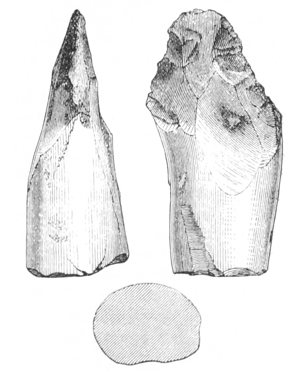
I have numerous other specimens
from the Bedford gravels,
principally from Kempston, and others exist in various public and
private collections. Like the mammalian remains, they occur for the
most part towards the base of the gravel, but occasionally at higher
levels in the beds. Besides the more highly wrought instruments,
knife-like flakes of flint have been found, some
of them presenting {536}
evidence of use upon their edges. A few flakes trimmed at the end
into scraper-like form have also been discovered.
At Tempsford, some seven or eight miles below Bedford, the river
Ouse is joined by the small river Ivel, a branch of which, the Hiz,
rises from the Chalk escarpment near Hitchin, and joins the Ivel at
Langford. About two miles south of the junction of these two streams,
near Henlow, Bedfordshire, Mr. F. J. Bennett, of the Geological
Survey, found in 1868 a flint implement of palæolithic type, not indeed
in gravel, but lying on the surface. It is 4 inches long and 2 1 ⁄ 2
broad, and of the same general character as that from Icklingham,
Fig. 420, but rather more acutely pointed at each end. It is ochreous
on one face, and grey black on the other, and not improbably may
have been derived from some gravelly bed. I remarked in 1872 that
this discovery seemed to place the Ivel and Hiz among the rivers, in the
valley-gravels of which, farther search would probably be rewarded.
Since then at
Ickleford, [2499]
near Hitchin, numerous implements, some
of them much water-worn, have been found by Mr. Frank Latchmore
and others in gravels lying in the valley of the Hiz. I have also
an acutely-pointed specimen from Bearton
Green, [2500]
a little to the north
of Hitchin, in an angle between the rivers Oughton and Hiz.
But the most important discoveries are those which have been made
a short distance to the south of the town of Hitchin. There, near the
summit of a hill cut off by valleys on three sides from higher land, a
brickfield has been worked for some years by Mr. A. Ransom.
Although attention was called to the discovery in
1877, [2501]
the whole
circumstances of the case are only now being thoroughly worked out.
At that time the section exposed was about 20 feet in depth, of
reddish brick-earth with numerous small angular fragments of flint
throughout. In places there were seams in which flints were more
abundant. With them were a few quartz and quartzite pebbles.
Above one seam, about 9 feet from the surface, was a layer of carbonaceous
matter. The implements, [2502]
which are of various forms,
both ovate, like Pl. II., No. 17–19, and pointed, like Pl. I., No. 5–7,
are said to occur in the brick-earth, but not in the alluvial beds below.
They are mostly ochreous, but some are white. I have a hammer-stone
found with them which is made of an almost cylindrical portion
of a nodule of flint about
4 1 ⁄ 4
inches long, truncated at each end; the
edges round both ends are much battered. It was probably used in
the manufacture of the other implements; a hammer of the same kind
was found at Little
Thurrock. [2503]
In October, 1877, a well was sunk at
the bottom of the pit showing—
|
ft. |
in. |
| (a) Red loam with a few quartz pebbles
and flints, about |
4 |
0 |
| (b) White very sandy loam with freshwater
shells about |
5 |
6 |
| (c) Dark greenish-brown loam with numerous
shells and vegetable remains, among them Bythinia,
Planorbis and Limnæa; also elytra of beetles, about |
10 |
6 |
|
20 |
0 |
Mammalian remains are reported to have been found in the argillaceous
beds at Hitchin, [2504]
including bear, elephant, and rhinoceros.
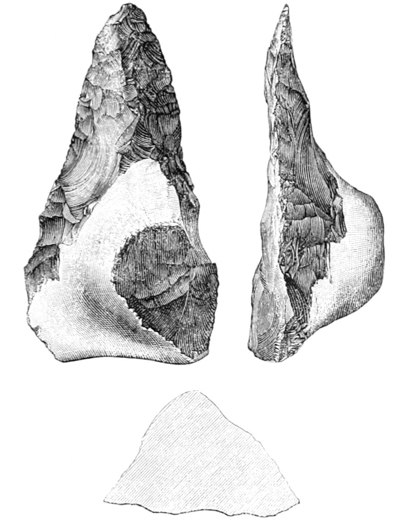
In Fig. 418A is shown a small shoe-shaped implement from the
brick-earth at Hitchin, on which a considerable amount of the crust
of the original nodule of flint from which it was made still remains.
At the Folly Pit, about half a mile south and at a lower level, a
section was shown in 1877 of about 18 feet of Glacial Drift, with large
rounded pebbles of different rocks, false-bedded sands, &c. On an
eroded surface of sands and gravels of the Glacial Series was brick-earth
extending in the direction of Mr. Ransom’s pit. At one spot
white marly sand-like beds, full of freshwater shells, were visible.
The brick-earth at Hitchin, like that at Hoxne, seems to have been
deposited in what were locally Post-Glacial times.
A detailed examination of the spot has recently been carried out by
Mr. Clement Reid, F.G.S., who finds that the alluvial deposits beneath
the palæolithic brick-earth fill a deep channel and contain a temperate
flora, including such trees as the oak, ash, cornel, elder, and alder.
Towards the margin of the channel, in at least one place, the Chalky
Boulder Clay occurs beneath the ancient alluvial and palæolithic strata.
The succession corresponds closely with that
found at Hoxne. [2505]
{538}
At Biggleswade, farther down the valley of the Ivel, a few palæolithic
implements have been procured from the railway ballast-pit.
Northwards of Hitchin a flint flake has been found in the gravel of
the Ouse at Hartford, [2506]
near Huntingdon, together with remains of
Elephas primigenius and Rhinoceros tichorhinus. I have also a well-shaped
ochreous pointed implement (5 inches) found at Abbot’s Ripton,
3 1 ⁄ 2 miles north of Huntingdon, in 1896, as well as one like
Fig. 457
(5 3 ⁄ 4
inches) from gravel at Chatteris, Cambs.
Proceeding eastward, the next important affluent of the Ouse which
is met with, is the Cam, the gravels along the valley of which present
in various places characters analogous with those near Bedford.
Numerous mammalian remains of the same Quaternary fauna have
been found along its course, especially at Barnwell and
Chesterton, [2507]
near Cambridge, where also land and freshwater shells occur in
abundance. I have also found them in a pit near Littlebury, a few
miles from Saffron Walden.
From Quendon, Essex, about 5 miles south of Saffron Walden, and
in the valley of the Cam, Mr. C. K. Probert, of Newport, Bishop
Stortford, obtained a magnificent sharp-pointed implement with the
sides curved outwards, 8 inches in length. It lay in sandy drift in a
pit about 12 feet deep.
In the publications of the Cambridge Antiquarian
Society [2508]
is a
paper by the late Prof. Chas. C. Babington, F.R.S., “On a flint hammer
found near Burwell.” It is described as a pointed implement,
very similar to those found at Hoxne and Amiens, as represented in
Phil. Trans., 1860, Pl. XIV., 6 and 8. It was not found in situ, nor
in gravel, but is said to have come from a mill used for cleaning
coprolites, where it had been well washed with them. If it be the
specimen that I have seen in the museum of the Cambridge Antiquarian
Society, I fear it is a forgery. Another worked flint, also of rather
uncertain origin, but perfectly genuine, and having all the characteristics
of belonging to the River-drift, was found in 1862 on a heap of
gravel, near Cambridge, by Mr. W. Whitaker, F.R.S., who kindly
placed it in my collection. It is a thick polygonal flake, about 3
inches long and 1 inch broad at the base, tapering to the point, which
is broken off. Its surface is stained all over of a deep ochreous
colour, its angles are slightly water-worn, and the edges worn
away, either by friction among other stones in the gravel, or by
use. In the Woodwardian Museum is another flake, apparently of
palæolithic date, which was found in gravel near the Cambridge
Observatory. The Rev. Osmond Fisher, F.G.S., possesses an implement
in form and character much like Fig. 470, from Highfield,
Salisbury, which was found on a heap of gravel brought from Chesterton.
Other discoveries have confirmed this evidence of the presence
of palæolithic implements in the gravels of the valley of the Cam.
Mr. A. F. Griffith [2509]
in 1878 described a fine implement from the
Barnwell gravels
(6 3 ⁄ 4
inches) in form and size almost
identical with {539}
Fig. 414. Others have been found in gravel from the Observatory
Hill, Cambridge, and from Chesterton. Another tongue-shaped
implement from the plateau near Upper Hare
Park, [2510]
Cambridge, has
been found by Mr. M. C. Hughes.
I may add that in the gravel at Barnwell, at a depth of 12 feet, and
associated with remains of elephant, rhinoceros, and hippopotamus,
was found in 1862, a portion of a rib-bone like that of an elephant,
showing at one end “numerous cut surfaces, evidently made with
some sharp instrument used by a powerful hand.” I have not seen the
specimen, but Mr. H. Seeley,
F.R.S., [2511]
who records the fact, has “no
doubt that the whittling is as old as the bone.” The Corbicula fluminalis,
Hydrobia marginata, and Unio rhomboideus are among the shells
which are found in the River-drift of Barnwell, but are no longer
living in England.
I have a number of implements, principally of ovate form, which are
said to have been found in the neighbourhood of Bottisham, but I am
not sure as to the exact locality. I believe them to have come from
gravel-pits about a mile to the north of Six Mile Bottom Station.
In gravel at Kennett
Station, [2512]
about 5 miles north-east by east of
Newmarket, but still in Cambridgeshire, several specimens have been
found by Mr. Arthur G. Wright and others.
I have a much-worn flat ovate specimen from Herringswell, three
miles to the north of Kentford Station.
Implements occur, though rarely, at the base of the peat in the
Fen country, below Cambridge. I have a small ovate specimen
(3 1 ⁄ 4
inches) from Swaffham Fen. It is of black flint with the surface
eroded as if a portion of its substance had been dissolved away. A
much larger implement (6 inches) from Soham Fen is also black, but
its surface is uninjured.
The valley of the Lark, the next river which empties itself into the
Ouse, has been much more prolific of implements in its gravels, than
that of the Cam. The fact of their occurrence in this valley was first
observed by myself, in 1860, in consequence of my finding among the
stone antiquities in the collection of a local antiquary—the late Mr.
Joseph Warren, of Ixworth—two specimens, which I at once recognized
as being of palæolithic types. On inquiry, it appeared that one
had been found by a workman in digging gravel at Rampart Hill,
Icklingham; and the other by Mr. Warren himself on a heap of gravel
by the roadside, which had been dug in the same neighbourhood.
The late Sir Joseph
Prestwich [2513]
and I at once visited Icklingham, and
though our search was at the time unsuccessful, yet the instructions
given to the workmen soon resulted in their finding numerous implements.
The examination of the gravel was at the same time taken up
by the late Mr. Henry Prigg (subsequently Trigg), of Bury St.
Edmunds, to whose discrimination and energy the discovery of implements
in various other localities in Suffolk is due. He brought
together a large collection of antiquities, of which the greater part,
after his decease, came into my hands. {540}
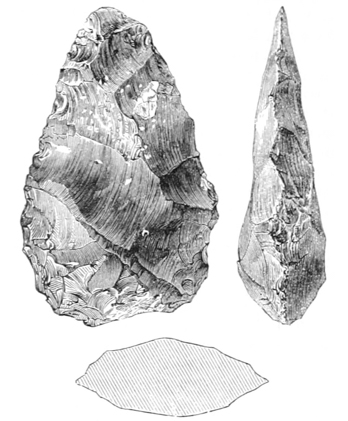
Fig. 419.—Maynewater Lane, Bury St. Edmunds.
1 ⁄ 2
The principal places in the valley of the Lark, where palæolithic
implements have been found, are in the neighbourhood of Bury St.
Edmunds, Icklingham, and Mildenhall. The first specimen from the
River-drift at Bury St. Edmunds was obtained by Mr. Trigg in gravel
at a low level, near the ruined Gatehouse of St Saviour’s Hospital, in
October, 1862; [2514]
since which time numerous other specimens have been
discovered, principally through his agency. Several were found in the
excavations made for the drainage of the southern part of the town in
1864—one elongated oval implement having been discovered in
Botolph’s Lane; and three others, varying in form, in Maynewater
Lane, where also a flake was found. That here engraved as Fig. 419
is from this latter locality, and was found at a depth of 14 feet in a
bed of loamy, sub-angular gravel, underlying a deposit of fine grey
loam 6 feet thick, containing scales of fish, and abundant remains of
Anodonta and Bythinia. It is now deposited in the Blackmore Museum
at Salisbury. Its edges are sharp and unworn, and its colour black,
with ochreous spots. Others, since discovered, are of even finer workmanship.
One in my collection is a much ruder specimen, though of
nearly similar general form, which was found in the South Gate in
1869. Several have been found in Westgate and St. Andrew’s Streets,
and in Newton Road. The greatest number of implements found at
Bury have, however, come from what is known as the Grindle Pit, a
short distance to the south-east of the town, and on the summit and
western slope of a tongue of land between the Linnet and the Lark.
Some of them occurred in a dark, stiff, rather argillaceous gravel,
composed mainly of sub-angular flints, but also containing a small
proportion of the pebbles of the older rocks,
derived from Glacial {541}
deposits. This gravel is from 2 to 3 feet in thickness, and underlies a
stratum of red brick-earth from 2 to 6 feet thick, which is again, in
places, surmounted by sands and clay with angular flints about 4 feet
in thickness, on which the surface soil reposes. This was the section
exhibited in 1865, but the beds are very irregular, and the character
of the section exposed in the pit varies considerably from time to time,
as material is removed. In places the Drift-beds are faulted, as if by
the giving way of the subjacent beds.
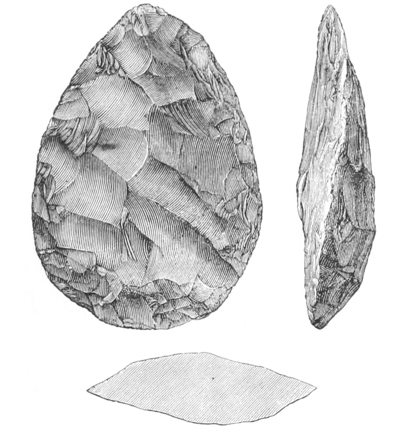
A beautiful and absolutely perfect specimen from this pit is shown
in Fig.
419A.
It was found in a black vein in the lower loamy bed,
on February 4th, 1870. Though the implement has been most skilfully
chipped, the edge is not in one plane, but when looked at sideways,
shows an ogival curve. The regular contour is partly due to
secondary working, but the edge is as sharp as on the day when the
instrument was made. Several others of almost the same form,
though not quite so delicately fashioned, came from the same pit, and
may have been made by the same hands.
I have a fine pointed implement,
(5 1 ⁄ 2
inches), also from the Grindle
Pit. Another, ovate, is 7 inches in length.
A remarkably fine palæolithic flake from Thingoe
Hill, [2515]
Bury St.
Edmunds, is shown in Fig.
419B.
It is water-worn, and much resembles
some from the low-level gravels at Montiers, near Amiens,
and Montguillain, near Beauvais. It belongs, of course, to a much
earlier period than the mound in, on, or near which it was found.
As already observed, remains of shells, and some scales of fish, were
found in the Drift-beds during the drainage works,
as also some {542}
mammalian remains. They were, however, scarce. Higher up the valley
by about three miles, there have been found in a pit at Sicklesmere,
remains of Rhinoceros tichorhinus and Elephas primigenius; and, in
another pit, elephant remains; specimens of all of which are now
preserved in the Bury Museum. Mr. Trigg obtained several well-wrought
implements from the brick-earth of Sicklesmere, near
Nowton, which there overlies the Boulder Clay; and has also found
examples in the gravels of the valley of the Kent, another small
affluent of the Ouse.
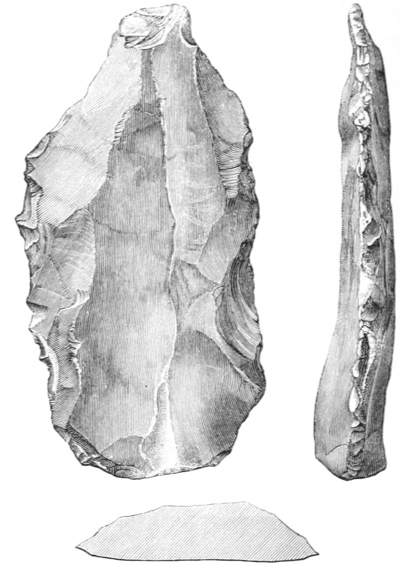
One of these Nowton specimens is shown in Fig.
419C.
It is broad
and kite-shaped in form and has weathered to a creamy white. In
type it approaches Fig. 435, from Santon Downham. Some remarkably
fine implements, principally ovate, have been found at Westley,
about two miles west of Bury, and at Fornham All Saints, two miles
to the north; and I have a pointed one from the Beeches Pit, West
Stow, five miles to the north-west, and nearer Icklingham. It was in
one of the pits at Westley, eroded in the old chalk surface and filled
with loam, that Mr. Trigg discovered portions of a human skull which
he described to the Anthropological
Institute. [2516]
In other pits at {543}
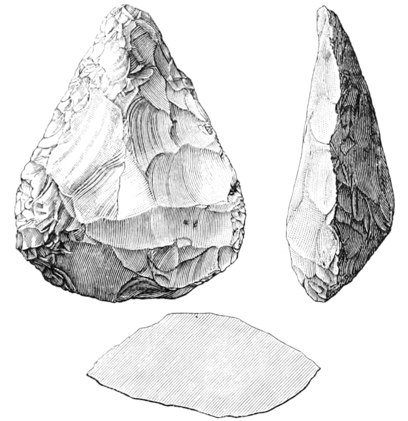
the same spot were molars of Elephas primigenius, and the chopper-like
instrument shown in Fig. 419D.
In the valley of the Lark, about seven miles down from Bury, lies
the village of Icklingham, in the neighbourhood of which numerous
remains belonging to the Roman and Saxon Periods have been found,
but where also relics belonging to both the Neolithic and Palæolithic
Periods abound. Many of the latter have been discovered in the
gravel of Rampart Hill, about a mile to the south-east of Icklingham,
and nearer to Bury; but still more numerous specimens have now for
many years also been found in the gravel at Warren Hill—sometimes
termed the Three Hills—about two miles on the other side of Icklingham,
and midway between that place and Mildenhall. A section
across the valley of the Lark, near Icklingham, has been given by Sir
Joseph Prestwich. [2517]
The valley, which is excavated in the chalk, is in
its lower part covered by recent alluvial deposits, but on the slopes
of its northern side, the chalk is covered with sands and gravels
belonging to the Glacial Series, which are again overlain by the
Boulder Clay. The gravel both at Rampart Hill and Warren Hill
is of a different character from that belonging to the Glacial Series,
though of course containing a number of the silicious pebbles from
the conglomerate beds of the New Red Sandstone, and other pebbles
of the older rocks derived from the Glacial Drift. It is for the most
part composed of sub-angular flints in an ochreous sandy matrix, and
is spread out in irregular beds interstratified with seams of sand. At
Warren Hill there are great numbers of quartzite
pebbles, as well as {544}
very many formed from rolled chalk, mixed with the other constituents.
These are less abundant in the upper part of the deposit, which is
there of considerable thickness. I am not aware of the exact levels
having been taken at either place, but the surface of the ground is
probably from 40 to 50 feet above the level of the river. The gravel
beds are in places as much as 14 or 15 feet in thickness. Mammalian
remains are scarce, but teeth and portions of tusk of Elephas primigenius
have been found at Rampart Hill, and the core of the horn of
an ox, and teeth of horse, and bones and teeth of elephant, at Warren
Hill.
Up to the present time the search for remains of testacea in these
beds has proved unsuccessful.
Not only have the worked flints been discovered in considerable
numbers, but Canon Greenwell, F.R.S., has found in the gravel at
Warren Hill, several quartzite pebbles bearing
evident marks of {545}
abrasion and bruising at the ends, such as may have resulted from
their having been in use as hammer-stones, either for chipping out
the flint implements or for other purposes. He also obtained an ovate
lanceolate implement from this spot,
4 3 ⁄ 4
inches in length, and formed
from a quartzite pebble, the original surface of which is still preserved
over nearly the whole extent of one of the faces.
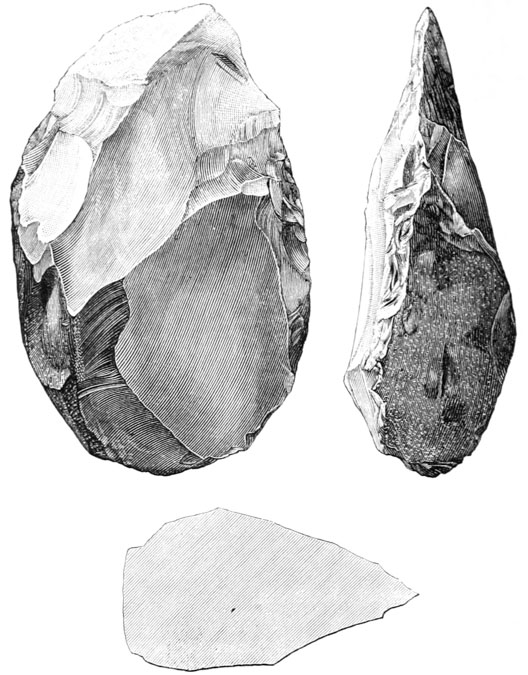
Examples of the Icklingham implements are given in Figs. 420 to
424.
The finer of the two, of which mention has already been made as
having formed part of the collection of the late Mr. Warren, of Ixworth,
is now in my own, and is shown in Fig. 420. It is more convex
on one face than the other, and a portion of the butt presents an
almost scraper-like appearance. The angles formed by the facets are
slightly worn, and the surface of the flint has been much altered in
character, having become nearly white, and quite lustrous. This
alteration in structure is almost universal with the Icklingham implements,
though in many cases they are ochreous instead of white, and
not unfrequently the discoloration is only partial, giving them a dappled
appearance. In many specimens the angles are much water-worn.
The original of Fig. 421 is in the Blackmore
Museum, and is of {546}
dark brown lustrous flint, almost equally convex on both faces, and of
very regular elliptical form.
In most cases the outline
approximates more to that
of Fig. 467. These thin,
flattened, oval, and almond-shaped,
or ovate, implements
seem, as Mr. Trigg
has pointed out, to predominate
at Icklingham.
Those of oval form are
especially abundant at
Warren Hill.
Many of ruder character,
however, also occur, one of
which, in my own collection,
is shown in Fig. 422.
It approaches more nearly
in form to some of the
roughly chipped instruments
of the Surface period,
such as Fig. 16, than do
most of the implements
from the River-drift.
One of the finest specimens
hitherto found in this
country is that shown in
Fig. 423, from the original
in the Blackmore Museum.
It is of dark ochreous flint,
with the surface considerably
decomposed, and the
angles but little worn. In
the same collection is another
Icklingham specimen,
in form like that from
Thetford, Fig. 427, but
9 inches long and
4 1 ⁄ 2
wide.
Besides the more finished implements, a few flakes occur in the
Icklingham gravels. Some of these have been chipped all round
the periphery by blows administered on the flat face, thus
producing a bevelled edge. One such, from Warren Hill, in my own
collection, somewhat resembles the implement from Reculver, Fig.
461. It is, however, narrower {547}
in its proportions, being
4 1 ⁄ 2
inches long and
2 3 ⁄ 8
broad. It has been
formed from an external flake, and has been carefully trimmed all
round into an almost perfect oval form, the butt alone having been left
untrimmed for about half-an-inch in width. A small part of the other
rounded and scraper-like end has been broken off in ancient times.
Others are wider in their proportions though not so symmetrically
worked. The trimmed flake, shown in Fig. 424, is in my own collection,
and at its rounded end is very scraper-like in character. A very
large flake, rounded into a broad scraper, and about 5 inches in
diameter, was found by myself at Warren Hill, and is now in the
Christy Collection. {548}
Three-quarters of a mile to the north of the Warren Hill pits, and
on the same ridge, but at a rather higher level, is High or Warren
Lodge, distant about two miles from Mildenhall. To the south of this
house, and by the side of the Thetford road, is a small pit on the slope
of the hill, where, in the process of digging clay for brick-making, a
considerable number of worked flints have been obtained, many of
which passed into the collection formed by Canon Greenwell, who has
furnished me with particulars of the discovery. I have also visited
the spot. The clay or brick-earth is of a reddish hue, and rests upon a
chalky Boulder Clay, which is exposed farther up the hill. It ranges
in thickness from about 4 to 6 feet; and above it are sands and gravel,
the latter varying in thickness from about 2 to 6 feet, and of much
the same character as that of the Warren Hill pits, but containing far
less chalk. The sand occasionally comes down in pipes or pockets
into the clay, and some of the worked flints occur in it, as well as in
the clay. Many of these are merely roughly-chipped splinters, but
several well-wrought forms have also been found.
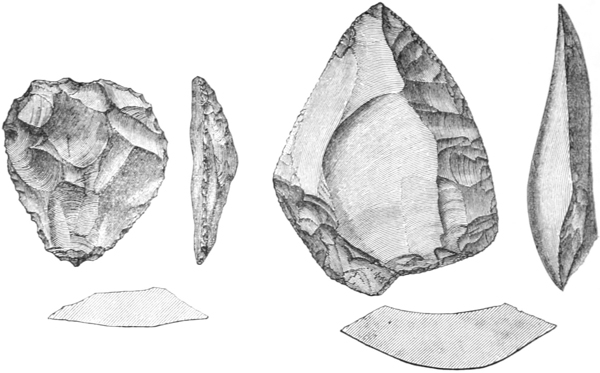
Fig. 425.—High Lodge.
1 ⁄ 2
Among them is an oval implement of a common River-drift type,
4 1 ⁄ 2 inches long, which, with three or four others of the same kind,
was found in the upper sands and gravel. From the clay itself are
several large side-scrapers, or choppers, made from broad flakes, 4 or
5 inches long, and in form similar to the specimen from Santon Downham,
Fig. 437, and of the same character as the implements from the
cave of Le Moustier. [2518]
Besides these, there are several other large
flakes worked along the edge into side-scrapers, and presenting a Le
Moustier form. [2519]
Another is like that from Thetford, Fig. 431, and
worked along both edges. Even external flakes have been utilized;
one of these, 4 inches long, having been neatly
worked at one end {549}
into a segmental edge. Another large implement,
5 1 ⁄ 2
inches long and
3 inches broad, is ovate-lanceolate in form, flat on one face, and
worked to a sharp edge all round. Several others have been found of
the same type. I have a considerable number from the Trigg collection.
One of the most beautifully formed of these implements from High
Lodge Hill is shown in Fig. 425. It has been made from a broad,
flat truncated flake, with a well-marked cone of percussion. The two
sides have been carefully trimmed to a curved edge, by secondary
chipping, and the edge itself has been finished by a subsequent process
of finer chipping. The angles where the truncated chisel-like end
joins the sides have also been retouched, but a portion of the sharp
edge is left in its original condition. The edge formed by the outer
face of the flake with its flat butt-end has also been re-chipped, and in
one place appears to have been bruised by an unskilful blow. The
workmanship generally is of a finer and neater character than is usual
on the implements found in the river gravels. In form and character
this instrument is remarkably similar to some of those found in the
cave of Le Moustier in the Dordogne.
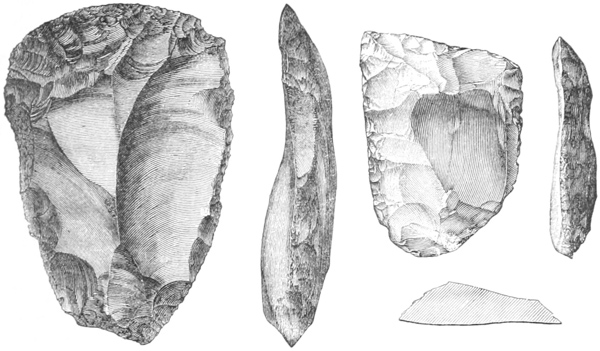
Fig. 426A.—High Lodge.
1 ⁄ 2
Others, again, resemble the scrapers from the surface and the caves.
One of these is engraved full size in Fig. 426. The edge is more
acute than usual with scrapers, perhaps in consequence of the curvature
of the inner face of the flake from which it was made.
Another example with a straight terminal edge at an angle of 80°
to the side is shown on the scale of one half in Fig. 426A.
The flint of the High Lodge implements is but little altered in character,
but has either remained black or has been stained of a deep
brown; the angles and edges being still as sharp as the day when they
were formed. In this respect they resemble the worked flints from
the brick-earth of Hoxne. Those from the brick-earth of the valley
of the Somme are usually quite white
and porcellanous. {550}
I have seen fragments of a molar of Elephas, probably primigenius,
from the clay at this spot, and also a bone of a ruminant, probably
Cervus megaceros.
As will subsequently be seen, there appears some reason for
believing that at a remote period, the River Lark took a northerly,
instead of a north-westerly, course from the neighbourhood of Mildenhall,
and thus joined the Little Ouse instead of the Ouse itself;
so that this pit may possibly be connected with the old channel of
the stream. On the slope of the hill to the east of Eriswell is
gravel of much the same character as that at Warren Hill, but in
which as yet few implements have been found. I have, however,
one of ovate form from Holywell Row, near Eriswell, and another,
not unlike Fig. 471, from the surface at Cardwell, about three miles
farther north. To the east of Lakenheath, still farther to the
north, is an isolated hill, near Maid’s Cross, capped with gravel,
in which flint implements have been found. It will be best to
describe this spot when treating of the discoveries that have
been made in the valley of the Little Ouse.
The source of this stream and that of the Waveney may be
regarded as one, inasmuch as both take their rise in a fen crossed
by the road at Lopham Ford; the one river running east, and the
other west, of the road. By the time it reaches Thetford, however,
a distance of about 12 miles, the Little Ouse has been joined
by the Ixworth stream and the Thet, so that the area of ground
drained by it is considerably more than would at first sight appear
probable, being upwards of 200 square miles. With the exception
of a broad flint flake, found by Mr. Trigg at Santon
Downham, [2520]
the first discovery of flint implements in the gravels of the Little
Ouse was made in 1865 at Redhill, near Thetford, by a labourer
from Icklingham, who had been trained to search for implements
in the gravel pits in his own parish. These specimens he brought
to Mr. Trigg, who subsequently obtained others at Whitehill,
farther down the valley on the same—or Norfolk—side of the
river; and on my visiting the spot with him in December, 1865,
Mr. Trigg found in my presence a well-formed pointed implement
in some gravel at Santon Downham, on the opposite—or Suffolk—side.
Since then the discoveries have extended farther down the
valley, and numerous implements have been found at several
localities in the neighbourhood of Brandon, and at Shrub Hill, in
the parish of Feltwell, Norfolk. {551}
In June, 1866, [2521]
the late Mr. J. W. Flower, F.G.S., who had
long carried on investigations in the district, communicated a
paper to the Geological Society on the subject of the discoveries
at Thetford, and again in April,
1869, [2522]
a second paper on the
discoveries of flint implements in Norfolk and Suffolk, with
some observations on the theories accounting for their distribution,
on which I shall have to make some comments hereafter.
The highest point up the valley of the Little Ouse at which,
up to the present time, flint implements have been discovered in
the gravel on its slopes, is Redhill, on the Norfolk side of the
river, about a mile north-west of Thetford. The gravel at this
place is coarse in character, and consists principally of sub-angular
flints, some of large size, mixed with a few pebbles derived from
beds of the Glacial series, and deposited in a red sandy matrix. It
forms a terrace running nearly parallel with the present stream, and
ranging from about 12 feet to nearly 40 feet above its level. In
places, the gravel is from 12 to 16 feet in
thickness, [2523]
the largest
stones, as usual, occurring towards its base, in which part of the
gravel the greater number, but by no means all, of the flint implements
occur, as some are dispersed throughout the whole thickness
of the mass. Occasionally they have been found in pipes of
gravel, let down into the chalk by means of water charged with
carbonic acid eroding its upper surface. Sandy
seams [2524]
are, as
usual, interbedded with the gravel; and in one of these, about 10
feet below the surface, I found shells of Helix, Bythinia, Cyclas,
Pisidium, Ancylus, and Succinea. Of mammalian remains, those
of Elephas primigenius, ox, horse, and stag have occurred.
A very large number of implements have been found in the gravel
at Redhill, of which specimens exist in the Christy Collection, the
Blackmore Museum, and in numerous private
collections. [2525]
Those
selected for engraving here, are all in
my own possession. {552}
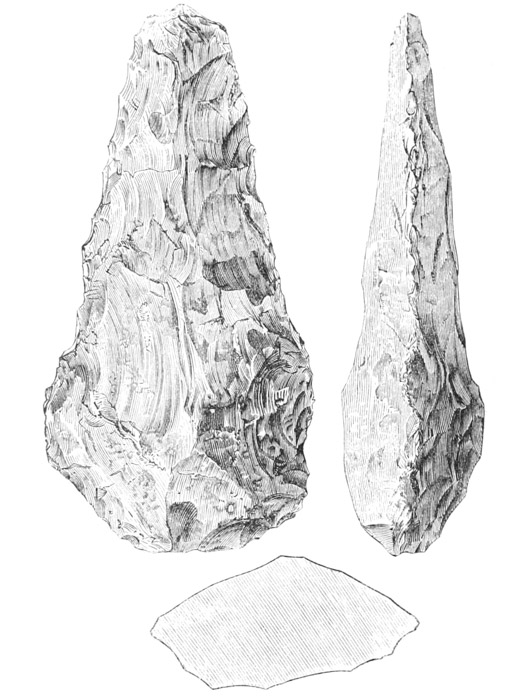
Fig. 427 shows a remarkably fine specimen, stained all over of a
deep ochreous red, though slightly mottled, owing to the original
structure of the flint from which it was chipped. The angles are to
a small extent waterworn. On what is in the figure the left side of
the base, a portion of the original crust of the flint has been left, so as
to form a protuberance at that part, instead of the edge being continued
all round the instrument. This protuberance is well adapted
to fit into the hand, like that of the Picts’ knife, described at page 345,
so that this may have been a cutting tool intended to be grasped.
I have another specimen of nearly the same size, and with the
same protuberance, from Santon Downham, and one of the implements
from Southampton presents the same feature, which, indeed, is
not unusual. A flat surface is frequently left on the
sides of the ovate {553}
implements in or about the same position. This flat space has been
referred to by the late Mr.
Flower, [2526]
who considered it intended to
receive the thumb of the right hand, and not to go against the palm
or the fore-finger, as suggested by myself long
ago. [2527]
Fig. 428 represents another singularly fine specimen of a very uncommon
form, it being much more acutely pointed than usual. It is
stained all over of a deep ochreous colour, and its angles are still sharp.
It has been boldly but symmetrically chipped, and has a thick, heavy
butt, well adapted for being held in the hand. As is the case with
almost all these implements, an analogous form has
been found in the {554}
gravels of the valley of the Somme. The magnificent implement from
the gravel of Vaudricourt, near Béthune, which was exhibited at Paris
in 1867, was also much of this type. Its length is
10 1 ⁄ 4
inches; that
of the Thetford specimen being
8 1 ⁄ 2
inches. It would be an endless
task to attempt to engrave all the varieties of form found at this place,
but Mr. Trigg is correct in his remark as to the comparative absence
of the flat oval form with a cutting edge all round. The most common
type here is the ovate-lanceolate, like Pl. I., Fig. 5, rather thick
towards the butt-end. Mr. Flower has figured a fine lanceolate
specimen, and one of more ovate form from this
place. [2528]
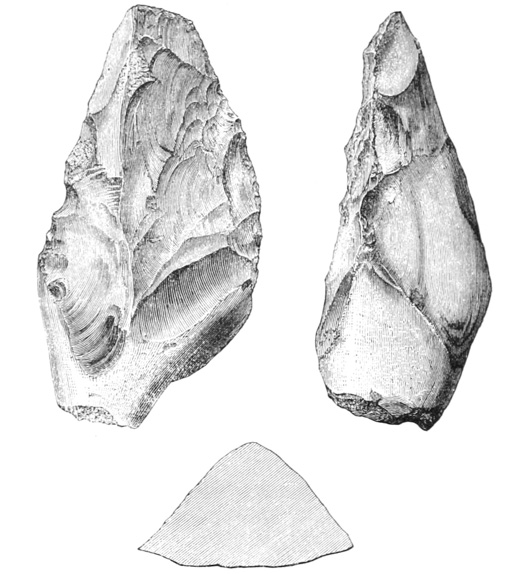
The finely-wrought symmetrical specimens are rarer at Redhill than
at Santon Downham; but here, as elsewhere in this district, implements
are occasionally found of what has been aptly termed the shoe-shaped
type, of which an example is shown in Fig. 429. The form is
flat on one face, the other being brought to a central ridge rising
towards the butt, which is usually rounded and obtusely truncated.
In this specimen the greater part of the butt-end or heel of the shoe
exhibits the original crust of the nodule of flint from
which the {555}
implement was formed. The point, which is usually brought to a semicircular
sharp edge, has been broken in old times either by use or by
attrition in the gravel. Most
of these shoe-shaped instruments
have been formed
from large spalls of flint, so
that the flat face has been
the result of a single blow,
though occasionally retouched
by subsequent chipping.
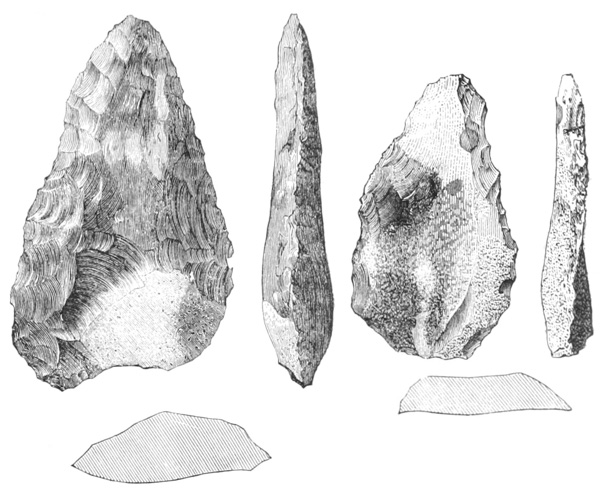
Fig. 431.—Redhill, Thetford.
1 ⁄ 2
The implement shown in
Fig. 430 is of this character,
but is too thin, in proportion
to its size, to represent the
typical shoe-shape. It has
been formed from a large
external flake, the bulb of
percussion being at the lower
left-hand corner of the
figure, but on the opposite
face to that shown. The
flake has been trimmed into
shape by chipping along the
edges on both faces, so that
not above half of the original
inner face remains free from
secondary working. The
surface is, as usual, stained
of a rich ochreous brown.
A considerable number of flint flakes of various sizes and shapes
have been found at Redhill, many
of them showing signs of use and
wear on their edges, and some being
worked to a quadrant of a circle or
more, at the point, so as to make them
almost assume the form of scrapers.
I have one external flake in which
is worked a curved recess, as if by
scraping some hard cylindrical object,
such as a round bone. The flake
engraved as Fig. 431 was found by
myself in December, 1865, and has
had both its edges retouched by
secondary chipping. The edge thus
produced seems to have been worn
away by use. I have a rather larger
flake, presenting precisely the same
characteristics, from the valley gravel
of the Somme, at Porte Marcadé,
Abbeville.
A little lower down the river, and on the same
side as Redhill, is {556}
the spot to which the name of Whitehall has been given by Mr. Trigg.
The gravel is composed of similar materials to that at Redhill, of
which it may be said to form a continuation, except that the matrix is
whiter. Mr. Trigg has informed me that beneath the gravel are beds
of red sand, and that at one time, a section was exposed of 26 feet in
depth. Of late, the gravel at this spot has been but little worked,
and but few implements have been found in it.
Mr. Trigg [2529]
records having obtained three flint implements from this
place, one of which, at present in the Blackmore Museum at Salisbury,
is engraved as Fig. 432. Its
surface has become white and
decomposed, and is partially
covered by an incrustation of
carbonate of lime. A part of
the edge, towards the point,
on the right side of the
figure, appears to be worn
away by use.
Remains of Elephas primigenius
and horse have been
found here, but no land or
freshwater shells.
Between Whitehill and
Santon Downham, but on the
Suffolk slope of the valley,
a considerable quantity of
gravel has been dug on Thetford
Warren. Though the
gravel is of much the same
character as at Redhill, no
implements appear to have
been found in it.
About three miles north-west of Thetford, and also on the Suffolk
side of the Little Ouse, is Santon Downham Warren, on the slope of
which towards the river, is a considerable expanse of gravelly beds,
which have been largely excavated for road-making purposes. On the
sketch map given by Mr.
Flower, [2530]
this place is erroneously called
Whitehill. As has been already stated, the first implement from this
spot was discovered by Mr. Trigg, when in my company, in 1865.
Since that time, it has produced, at a moderate estimate, several hundred
specimens, some of them affording the finest instances of the
skill of the Palæolithic Period which have been found in Britain, or
indeed elsewhere. The gravel is at a somewhat higher level above the
river than that at Redhill, but resembles it in character. It contains,
besides flints, a few of the quartzite pebbles of the New Red conglomerate,
which have been derived from the Glacial beds and Boulder
Clay which cap the chalk hills on either side of the river. The gravel
is of considerable thickness, so much so that in places, caves of sufficient
magnitude to allow of a man standing inside, have been formed
within it, in consequence of the lower beds being
let down into the {557}
chalk, through its erosion by water charged with carbonic acid. The
same phenomenon has been observed at Bromehill, the spot next to be
mentioned; and some connection was at one time supposed to exist
between these cavities and the implements often found in and near
them. I think, however, that the
explanation [2531]
that I have elsewhere
given of their origin will be deemed satisfactory. No testaceous remains
have been found here, and mammalian remains are very scarce.
Among the implements from Santon Downham, the
almond-shaped [2532]
type seems to predominate, though other forms are also found.
A very elegant pointed specimen, in my own collection, is shown in
Fig. 433. It is chipped with great skill, and brought to a fine point,
the butt-end being comparatively blunt, so that it may have been used
in the hand without being in any way hafted. At the shoulder, shown
in the side-view, a part of the original crust of the flint is left, and
small portions are also left on the other face. In form, this implement
curiously resembles some of those from Hoxne,
and that from Gray’s {558}
Inn Lane (Fig. 451). Like many of the implements from the gravel, it
is cracked in various directions, apparently from inward expansion,
and would break up into fragments with a slight blow. A very sharp
point, such as that presented by this specimen, is not uncommonly
met with in implements found at Santon Downham.
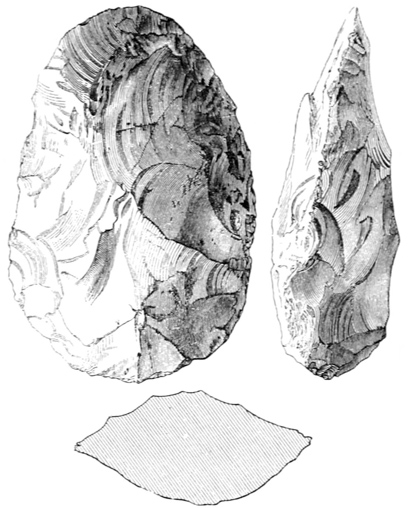
The original of Fig. 434 is also in my own collection, and is cracked
in a similar manner. It is uniformly stained of a light buff colour, as
are many of the implements from this spot, and has dendritic markings
upon it, and in places, particles of ferruginous sand adhering to the
surface. It is fairly symmetrical in contour, with an edge all round,
which is somewhat blunted at what is the base in the figure. This
edge, however, is not in one plane, but considerably curved, so that
when seen sideways it forms an ogee sweep, even more distinctly
than appears from the figure. I have other implements of the same
and of more pointed forms, with similarly curved edges, both from
France, and other parts of England, but whether this curvature was
intentional, it is impossible to say. In some cases it is so marked that
it can hardly be the result of accident, and the curve is so far as I
have observed, almost without exception
 ,
and not S. If not intentional,
the form may be the result of all the blows by which the
implement was finally chipped out, having been given on the one face,
on one side, and on the opposite face on the other.
Fig. 435 represents an implement of porcellanous,
slightly ochreous {559}
flint, found at that place, and now in the Fitch collection at Norwich.
The late Mr. Robert Fitch, F.S.A., kindly allowed me to engrave it, as
well as the specimen next to be described. Implements of this broad,
ovate-lanceolate form are extremely uncommon, and this is a remarkably
symmetrical specimen, of good workmanship, and almost equally
convex on the two faces. A few implements, almost circular in outline,
have been found at this spot.
Another specimen from Nowton, Fig.
419C,
shows almost the same
form. In the Toulouse Museum is an implement (5 inches) in flint
from Clermont, about 18 miles south of that town, found with remains
of mammoth and reindeer.
The original of Fig. 436 presents an example of another rare form,
almost crescent-like in character. There is frequently a slight want of
symmetry between the two sides of the ordinary ovate implements,
which gives them a tendency to assume this form, but I have never
seen it so fully developed as in some of the implements from Santon
Downham.
Another somewhat uncommon form is shown in Fig. 437, the
original of which, with several others, was presented to the Christy
Collection by the late Rev. W. W. Poley. It has been formed
from a large broad flake, the flat face of which is not shown in the
figure, and has been chipped to a bevelled segmental edge, so that it
assumes the form of a ‘broad’ or ‘side’ scraper, resembling in
character some of the implements from the cave of Le Moustier in the
Dordogne.
In the Greenwell Collection is a thick flake from Santon Downham,
4 1 ⁄ 4 inches long and
2 1 ⁄ 4
inches wide, trimmed at the butt-end to a
semicircular scraper-like edge.
Viewed as a whole, the implements from Santon Downham present
a higher degree of finish, and a greater skill in chipping the required
forms out of flint, than those found in the gravels
of any other part {560}
of the valley of the Little Ouse, or, it may perhaps be added, of
England or France.
Following the course of the river, the next spot at which flint implements
have been found in the gravel, is a pit known as the Bromehill
or Broomhill Pit, in the parish of Weeting, and on the Norfolk side
of the Little Ouse, about a mile and a quarter east of Brandon. The
gravel here is at a lower level than that at Santon Downham, or even
Redhill, its base not being more than six or eight feet above the
river, to which it is close.
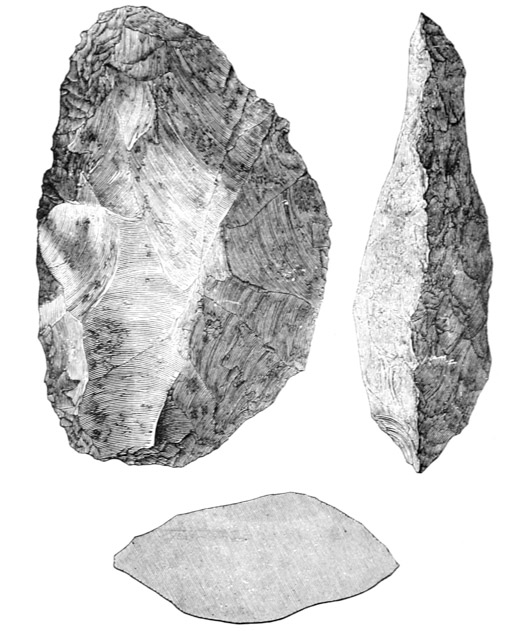
The late Mr.
Flower [2533]
has described the spot, but his description of
the section, and of the position in which the implements are found,
does not completely coincide with mine. On the occasion of one of my
visits to this pit, in
July, [2534]
1868, in company with him, the section
exposed was 24 feet in height, from the chalk at its base to the
superficial soil at the summit. The upper part of
the section showed {561}
sand, with a few gravelly seams, and from 8 to 10 feet in thickness;
at the base of this, a dark ferruginous band, a few inches in thickness;
then some 8 or 9 feet of ochreous gravel, with a red sandy
matrix, which was separated by a band of grey sand from the lower
beds of gravel, which contained a very large percentage of rolled
chalk and seams of chalky sand. Below the chalky gravel, ferruginous
beds also sometimes occur, containing large blocks of flint.
In the chalky gravel (the base of which is but a few feet above the
level of the river) implements are rarely found, but what there are,
are usually black. In the upper gravel they are more abundant, and
ochreous in tint. It was in this gravel that I had the opportunity of
examining one of the cavities already mentioned; and in the pipe
formed through the more chalky gravel into which a part of the upper
bed had been let down. I witnessed the finding of a pointed flint
implement. In character, the implements found at this spot much
resemble those from Redhill. They are, however, usually more rolled
and waterworn. There are but few pebbles from the Glacial Beds in
the gravel, but among these Canon Greenwell has found one of
quartzite, with the ends battered as if from its having been used as a
hammer-stone.
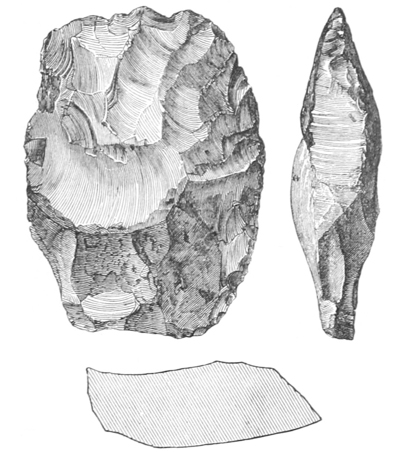
Remains of Elephas primigenius, and of horse, have been found here,
but as yet no land or freshwater shells.
The only specimen from this spot which I have thought it worth
while to engrave, is shown in Fig. 438. It presents a much narrower
form than is usual among the River-drift implements, and in outline
closely approximates to some of the neolithic rough-hewn
celts. It is, {562}
however, much more convex on one face than on the other, and presents
what are apparently signs of wear along both the sides and the
ends, the broader of which is somewhat
gouge-like in character.
In addition to the pit in the bluff facing the river, there is
another in the same gravel, but on the other side of the railway, which
has been here cut through the Drift deposits. In this also implements
have been found.
The next locality to be mentioned is on the Suffolk side of the
river, about two miles S.W. of Brandon Station. This spot has already
been described by Mr. Flower, [2535] under the name of Gravel Hill, Brandon;
it is also known as Brandon Down, or Brandon Field; and from the
contiguity of one of the pits to Brick-kiln Farm, Wangford, some
specimens from this place have been labelled as found at Wangford.
The gravel is worked on both
sides of the point of a high ridge
of land, nearly at right angles to
the course of the river, and about
a mile distant from it. The summit
of the ridge between two of the
pits was found by Mr. Flower to be 91 feet above the level of the
river at its nearest point. The surface of the ground where gravel
has been dug is lower only by a few feet, and the beds possibly
extend through the ridge. Between the ridge and the higher land to
the S.W. a valley intervenes, along which the road to Mildenhall
passes, so that the hill on which the gravel reposes is isolated. The
gravel is usually not more than 10 feet in thickness, but often less,
and it rests in some places immediately on the chalk. It contains a
very large proportion of quartzite pebbles from the New Red Conglomerate,
in some spots more than 50 per cent. of the whole, as well as
fragments of jasper, clay-slate, quartz, greenstone and limestone; all
derived from Glacial Beds, from which also many of the flints appear
to have come. The matrix is of coarse red sand, and there is usually
some thickness of sand above the gravel. In some few places there
are beds formed almost exclusively of the quartzite pebbles; but Mr.
Flower’s estimate of their forming three fourths of the whole mass of
gravel is, I believe, very far in excess.
Flint implements have been found here in considerable numbers—at
all events, many hundreds. I have myself found several, and
many flakes, but all in gravel already dug and not in situ. They
appear to occur at all depths; but, as usual, for
the most part, near {563}
the base, and occasionally resting on the chalk. A large proportion
of them are very rude, though they were evidently chipped into shape
for some particular purpose, and approximate to the more symmetrical
specimens in general form. It seems hardly worth while to figure
any of these roughly chipped implements, the character of which was
no doubt in some measure determined by the shape of the original
blocks of flint from which they were fashioned.
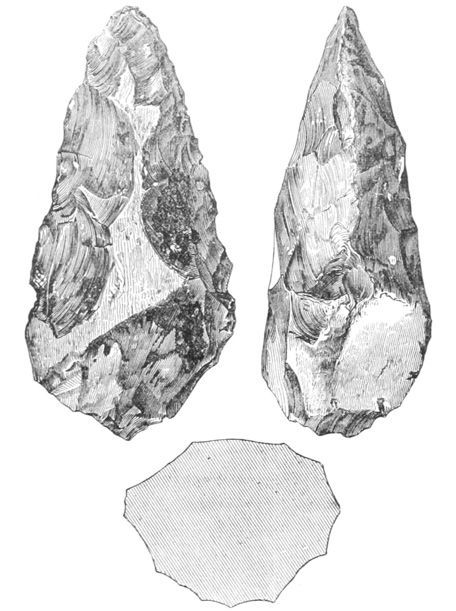
Mixed with these ruder tools or weapons, are some of much higher
design and finish. Mr. Flower had some remarkably beautiful specimens,
in form much like Fig. 472, from Milford Hill, two of which he
bequeathed to me. One of these is rather more than 9 inches long
and
4 1 ⁄ 2
inches broad. Some of the flattened oval implements, such as
are common at Icklingham, occur also at Gravel Hill. I have one
approaching the circular form, the length being
3 1 ⁄ 4
inches and the
breadth
3 1 ⁄ 8.
Those which I have selected for engraving are for
the most part in my own collection. Fig. 439 shows an unusually
thick pointed specimen of dark flint, with ochreous stains in places.
This implement has been dexterously made from
a nodule of flint, {564}
the original outer skin of which is visible along the greater part of the
ridge of one of the faces. It has also been left on part of the butt,
which, though presenting some rather sharp
angles, may have been intended to be held in
the hand.
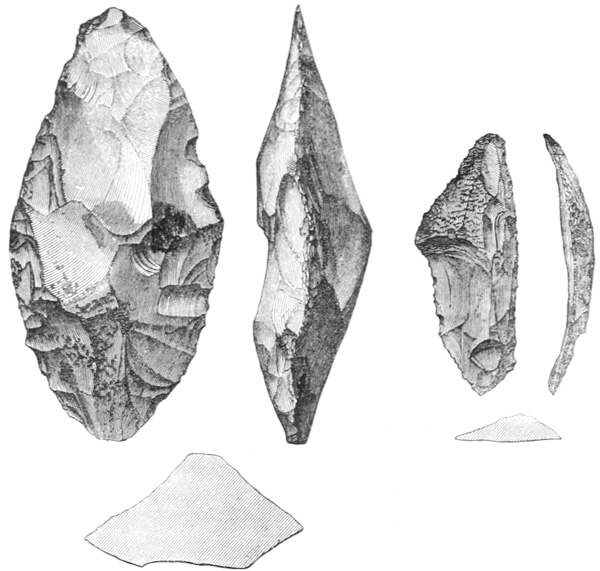
Fig. 441.—Gravel Hill, Brandon.
1 ⁄ 2
I am not quite sure as to the locality along
the course of the Little Ouse from which the
implement shown in Fig. 440 was obtained by
Mr. Flower, to whom it belonged, but it probably
came from Gravel Hill. It presents the
peculiarity of being almost as much pointed at
one end as at the other. The depression in the
centre is the result of a large flake having been
removed, and is probably accidental. Though
pointed at both ends, it seems probable that
only one was intended for use, as a small flat
surface has been left at the other end, which
unfits it for cutting or piercing.
Flakes and spalls of flint are abundant
in the gravel, though not often noticed by
the workmen. That shown in Fig. 441 was
found by myself near {565}
Brick-kiln Farm. Except that the surface has undergone more
decomposition than is usual with flakes of the Neolithic Period, and
that it bears upon it some of those bright shining specks, so common
on flints from the gravel, there is nothing to distinguish it from
one of much more modern date. These bright or polished spots, which
are very minute, seem to indicate points of contact with other stones,
and the lustre upon them is probably due in part to pressure and in
part to friction. They are most apparent on dark-coloured flint, and
afford one of the tests of the authenticity of a worked flint professing
to belong to the River-drift Period.
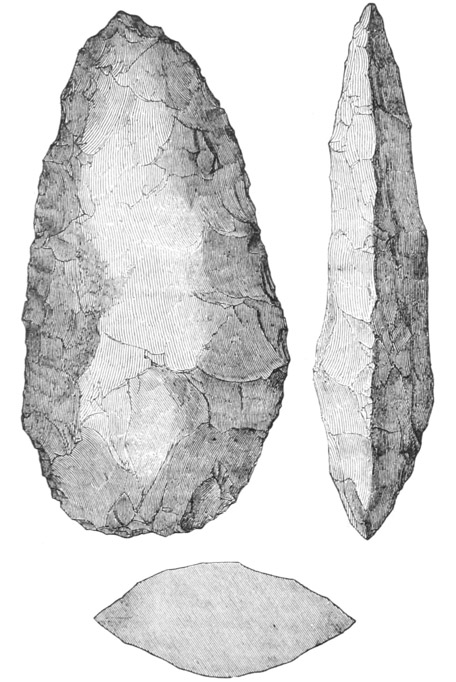
One of the most interesting features at Gravel Hill is that there, for
the first time, were found cutting stone implements of the Palæolithic
Period formed of other materials than flint, chert, or quartzite. That
shown in Fig. 442, though so identical in form with
many of the {566}
implements of flint, is formed of felstone, no doubt derived either from the
Boulder Clay or from some other of the Glacial Beds. One face appears
to show a considerable portion of the original surface of the block of
stone from which the instrument was fashioned, but the whole surface
is now somewhat decomposed, so much so, that it is difficult to determine
with certainty the nature of the material, which by some has been
regarded as diorite rather than felstone. One face has been carefully
chipped, the flakes having been removed in much the same manner as
if the substance wrought had been flint. At one part of the other face
there is a considerable shoulder between the central ridge and the edge
near the butt, where, owing to the ‘grain’ of the stone, the flakes have
run in and not come off kindly. The angles and edges are slightly
rounded.
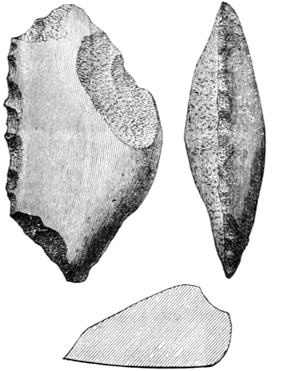
Even the quartzite pebbles so abundant in this neighbourhood, were
occasionally utilized instead of flint. Mr. Flower obtained two pointed
instruments manufactured from such pebbles, one of which he bequeathed
to me. Lord Northesk had another well-formed ovate specimen. Another
has already been mentioned as having been found near Icklingham.
Another instrument, of a different form, was found by myself in the
gravel near Brick-kiln Farm, and is represented in Fig. 443. It is
a broad flake, having a well-marked cone of percussion on the flat
face. The other face shows, over nearly its whole extent, the original
surface of the quartzite pebble from which it has been formed. It has,
however, had a portion removed on one side of the cone, apparently to
produce a symmetrical form; and the whole of the edge at the broad end
of the flake has been trimmed by chipping from the flat face, so as to
produce a bevelled edge, which is now somewhat rounded, either by wear
in the gravel or by use. In character this implement is like those from
Santon Downham and Highbury (Figs. 437 and 453), or the side-scrapers
from the cave of Le Moustier.
On the opposite side of Wangford Fen, rather more than
2 1 ⁄ 2
miles S.W. of Gravel Hill, and
3 ⁄ 4
mile E. of Lakenheath, close to
Maid’s Cross, is an isolated hill, about three miles distant from the
Little Ouse, locally known as the Broom, but distinguished on the
old Ordnance Map by the words, “The Old Churchyard.” The spot
has been described by Mr.
Flower, [2536]
with whom I have examined
it. The greater part of the hill is capped with
gravel, in places {567}
from 8 to 10 feet thick, and of much the same character as that at
Gravel Hill, but less ferruginous, and not containing so many
quartzite pebbles. The beds here have not been excavated to the
same extent as those near Brandon, the gravel being only dug
for the repairs of the parish roads; but several well-fashioned
implements have been found in them, mostly of pointed form.
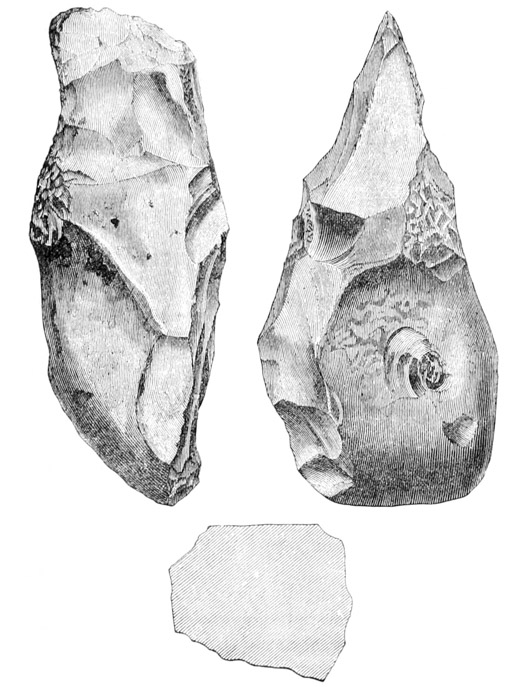
Fig.
444.—Valley of the Lark, or of the Little Ouse.
1 ⁄ 2
Some implements have also been found at a lower level in the
gravel on the slope of the hill towards the Fens, and close to the
main street of Lakenheath; amongst them one of ovate form most
skilfully chipped into shape.
The curious implement shown in Fig. 444,
which was presented {568}
to me by Canon Greenwell, F.R.S., was procured from a Lakenheath
workman, but it is not certain whether it was found in the gravel near
that place, or in one of the pits near Brandon. It differs from all other
implements that I have seen from the River-drift, in having an oblique
hatchet-like edge at the end, so that the side-view somewhat resembles
that of the iron Francisca, of Saxon times. A considerable portion of
the original crust of the flint remains at the butt-end. Until other
specimens of the same form are discovered, it is hardly safe to regard
this as furnishing an example of a new type of implement; yet its
symmetry and character seem to prove that it was designedly chipped
into this form, to fulfil some
special purpose.
It will be best to postpone any remarks as to the probable connection
of the beds near Lakenheath with the ancient course of
the Lark and Little Ouse, until I come to consider the geological
aspects of the whole case.
It was from a place called Botany Bay, near Brandon, that Mr.
S. B. J. Skertchly, F.G.S., of the Geological Survey, first obtained
evidence on which he founded the existence of the beds that he
termed Brandon Beds, which though containing palæolithic implements
he regarded as occurring below the Chalky Boulder-clay,
and as, therefore, of Interglacial date. The evidence that the
implement-bearing beds are, at all events in the Eastern Counties,
later than the Boulder Clay is now beyond all cavil, and, so far as
I could judge, the supposed Boulder Clay lying above the implement
bed at Botany Bay was not in its original position, but was
either remanié or had slipped down from a higher level. It is,
however, but fair to state that the Rev. O.
Fisher, [2537]
F.G.S.,
has accepted Mr. Skertchly’s views, at all events with regard to
some of the localities, as to there having been three successive
Palæolithic Periods in Britain, each preceded and succeeded by
a Glacial Period. [2538]
I can only say that I am not prepared to accept
such a view.
I must now proceed to describe another of the River-drift
deposits in the more immediate neighbourhood of the Little Ouse,
and lower down its course, at Shrub Hill, in the parish of Feltwell,
Norfolk.
This too has been described by Mr. Flower in the paper to
which I have already so frequently referred. It has also been
described by Mr. H.
Trigg, [2539]
to whom flakes from
this deposit were {569}
brought, so early as 1865. It caps a low-lying hill in the middle
of the Fens, about 8 miles nearly due W. of Brandon, and 1 mile
N. of the present course of the Little Ouse, and just to the N.
of Fodder Fen Drove on the old Ordnance Map. Mr. Flower states
that the gravel here is about 12 feet in thickness, but that at the
surface it is only 6 feet above the river. Of course, however, the
thickness varies, being often less than 8 feet; and I am inclined
to think that the elevation above the river is somewhat underestimated.
The gravel consists mainly of subangular flints, mixed
with some rolled chalk, a considerable number of quartzite pebbles,
and rolled fragments of other old rocks, derived from the Glacial
Beds higher up the river. It is in a very sandy matrix, more or
less ochreous at different spots. In places, the sand predominates.
The Drift-beds rest upon the Gault clay, and not, as in most of
the cases already described, upon the Chalk. The implements
found here occur usually towards the base of the gravel, and as a
rule are rolled and waterworn. They have been found in considerable
numbers, and of various types, including many flakes.
It will be remembered that a barbed arrow-head and a partially
polished stone celt were also found here; from which it seems
probable that in Neolithic times, Shrub Hill formed a habitable
spot in the midst of the Fens, or possibly of the watery waste
since choked up by vegetation. Teeth of Elephas
primigenius, [2540]
and fragments of the horns of deer, and teeth of some ruminant—probably
deer also—and of a small horse, have been found at
Shrub Hill in the gravel, but I have searched in vain for testaceous
remains.
Among the implements found at Shrub Hill is one which is probably
the largest of its class as yet discovered in England or France, and
which was presented by the late Mr. Flower to the Christy Collection. It
is fully
11 1 ⁄ 2
inches long and
5 1 ⁄ 4
inches broad near the base. Its greatest
thickness is 3 inches. One face is much more highly ridged than the
other, and it has been boldly chipped with large facets. In general
form it resembles Fig. 445 from the same locality, but is somewhat
thicker and more elongated in its proportions, and is, as nearly as may
be, six times the length of the figure. It weighs 5 lbs. 7 oz.
An interesting account of large and heavy examples of palæolithic
implements has been compiled by Mr. Worthington
Smith. [2541]
The
heaviest is one formed of quartzite in the Central Museum at Madras.
It is
9 3 ⁄ 4
inches long and
5 3 ⁄ 4
wide with a weight of
6 1 ⁄ 4
lbs.
The small specimen here shown as Fig. 445 was found in 1866, and
is less waterworn than is usual with Shrub-Hill implements,
though its {570}
surface is beautifully sand-polished. It is of dark brown flint, in places
mottled with a fine amber colour. It shows a part of the original crust
of the flint at its base.
The same is the case with the implement shown in Fig. 446, which
also is in my own collection. It is a specimen
of a thin broad type {571}
occasionally met with. Towards the point the edge bears all the
appearance of having been worn away by use as a scraping tool.
Another implement of somewhat the same character, but thicker at
the butt, and having the sides
rather straighter, so as to be more
acutely pointed, is shown in Fig.
447. The angles are much waterworn,
and the greater part of the
base shows the natural crust of
the flint.
The only other specimen which
I have thought it worth while to
engrave from this locality (Fig.
448), shows a considerably smaller
example of the crescent-like implements,
such as that already figured
from Santon Downham. It is,
however, of coarser workmanship,
and not so broad in proportion to
its length.
Most of the forms which are
found higher up the valley of the
Little Ouse occur also at Shrub
Hill, and include some of the
flattened oval type. But as a
rule, the general facies of the implements
is more like that of {572}
Redhill and Bromehill than that of either Santon Downham or of
Gravel Hill, Brandon.
The Little Ouse joins the main river about 4 miles N.W. of Shrub
Hill; and 5 miles N. of the junction the Ouse receives another affluent—the
Wissey or Stoke River, draining 243 square miles—along the
course of which, however, no palæolithic implements have as yet been
found. The same is the case with the valley of the Nar or Setchy, a
river which joins the Ouse just above King’s Lynn, a few miles before it
discharges into the Wash, and which drains an area of 131 square miles.
Along a great portion of its lower course the Ouse runs through a
Fen country, where, of course, no gravel is to be seen; but at Ash
Wicken and Leziate, a few miles E. of King’s Lynn, and at South
Wootton, about 2 miles to its N., the late Rev. John Gunn, F.G.S.,
found Drift-beds of apparently fluviatile character. In the gravels in
a side valley leading into the marshes, near the School at South
Wootton, Mr. W. H. Houghton, having been set upon the search for
flint instruments by Mr. Gunn, found, in 1884, a tongue-shaped specimen,
5 1 ⁄ 4 inches long, in form much like that from Shrub Hill (Fig. 447),
but having the whole surface worked, and having the flatter face
slightly concave longitudinally. It is stained all over of an ochreous
colour, and shows signs of use near the point, a part of which has been
broken off. The angles, though not sharp, are not waterworn. The late
Mr. James Wyatt, F.G.S., of Bedford, also found, in the year 1870, in
gravel in a pit near Lynn—the base of which is seldom reached on account
of its lying below the level of the water—an oval flint implement, well
formed and deeply stained, and another of rude workmanship.
Many miles to the east, but still in Norfolk, there is seen in the cliff
at West Runton, [2542]
near Cromer, what appears to be the channel of an
old river, filled up with gravelly deposits. In these, at a depth of 12
feet from the surface, and above a black freshwater bed, Mr. A. C.
Savin, of Cromer, in 1878, found in situ a fine well-wrought ovate
implement of flint
4 3 ⁄ 4
inches long. A few years later I found on the
sea-shore below, a large ochreous flake, apparently palæolithic, which
I gave to Mr. Savin.
About 3 miles S.W. of Runton, near Gallows or Gibbet Corner, in
Aylmerton parish, Mr. F. C. J. Spurrell found, in 1882, an ochreous implement
from the gravels capping the hill, not far from Sherringham
Heath. At East Runton, [2543]
in the pre-glacial “Forest Bed,” Mr. W. J.
Lewis Abbott thinks that he has found worked flints. I fail, however,
to see any distinct marks of human workmanship upon his specimens.
With these discoveries in Norfolk and those near the mouth of the
river, my account of the basin of the Ouse ceases, but before proceeding
southwards I must record some others of the same kind.
Yorkshire lies far away from the usual scenes of palæolithic discoveries,
but I have seen a pointed implement
(3 3 ⁄ 4
inches), in form like
Fig. 419, that was found on the surface at Huntow, near Bridlington.
There is no record of its having been associated with any remains of
the Quaternary fauna.
In the first edition of this book I recorded my finding an implement
in form like Fig. 434, on a heap of stones near King’s
Langley, within {573}
a short distance of the railway. As the staining and incrustation upon
it were unlike those on the stones of the local gravel, and corresponded
with those on the flints in the ballast of the railway, I was inclined
to refer the implement to that source, and to believe that it had been
brought from Oundle with the gravel, at that time used for ballast. A
visit to the pit proved unfruitful, but I suggested that in all probability
a prolonged search might result in adding the valley of the Nene
to those in which palæolithic implements have been found. My suggestion
has now been justified. In 1882 Mr. T. George, F.G.S., found
in a ballast pit at Elton, about 5 miles N. of Oundle, an ochreous pointed
implement, in colour and appearance identical with mine from Langley,
and kindly added it to my collection.
At Overton Longville, or Little Orton, two miles S.W. of Peterborough,
a spot visited by Sir Joseph Prestwich and myself in search
of palæolithic implements about 1861, some were found a few years
ago by the late Dowager Marchioness
of Huntly. [2544]
The next valley to be considered is that of the Waveney, a
river which, after a circuitous course of 53 miles, joins the Yare
a few miles S.W. of Yarmouth, and passes through Breydon Water
to the sea. It takes its rise, as has already been stated, at
Lopham Ford, close by the source of the Little Ouse.
Up to the present time there is but one locality known in its
valley, where palæolithic flint implements have been found; but
this is of peculiar interest, on account of the discoveries having
been observed and recorded before the close of the last century,
and, therefore, at a time when speculations as to the great antiquity
of the human race can hardly be said to have commenced. And yet
Mr. John Frere,
F.R.S., [2545]
in the concise and able account which he
gives of the discovery, shows himself to have been so much struck
by the situation in which the implements were found as to be
tempted to refer them “to a very remote period, indeed, even
beyond that of the present world.” Mr. Frere states that the
implements or weapons, as he terms them, lay in great numbers at
the depth of about 12 feet, in a stratified soil, which was dug into
for the purpose of raising clay for bricks; and he gives a section
of the strata. He states that shells, which he erroneously regarded
as marine, occurred in sand at a depth of 9 feet, together with
bones of great size, and that below this, in a gravelly soil, the
flints were found. His account is illustrated by excellent engravings
of two of the implements, which I was enabled to reproduce
in illustration of my first Essay on Flint Implements from the
Drift, in 1859, and which have since been
copied, on a smaller {574}
scale in Lubbock’s “Prehistoric
Times.” [2546]
Mr. Frere presented
some specimens of the Hoxne implements to the Society of Antiquaries,
which are still preserved in their museum; and it was
my seeing these, on my return from Amiens and Abbeville, in 1859,
that again directed attention to this most interesting discovery.
Sir Joseph Prestwich, F.R.S., in his admirable Papers on Flint
Implements and their containing Beds, published in the Philosophical
Transactions [2547]
for 1860 and 1864, has given full details of
the contour of the surrounding country, and of the section at that
time exposed in the brick-field visited by Mr. Frere more than
sixty years before, which is still in operation. It is situated
to the S.W. of the village of Hoxne, in Suffolk, and close to Fairstead
Farm; Hoxne itself being about 4 miles to the east and
slightly to the south of the market town of Diss, which is on the
other, or Norfolk, side of the Waveney.
The Drift deposits rest in a kind of trough, in the Boulder
Clay [2548]
which caps all the neighbouring hills, and forms a sort of
table-land through which the small valleys are cut. The top of
the freshwater beds reaches within 6 or 8 feet of the summit of
the hill of which they form an unbroken and uniform part. Their
upper surface is about 40 feet above the neighbouring Goldstream,
from which they are not more than 200 yards distant,
and 50 feet above the Waveney, of which the Goldstream is a
tributary, and which flows within about a mile of the spot.
The present configuration of the surface is totally unconnected
with these beds of Drift, and must have been produced after they
were deposited.
The part of the pit which was being worked in 1859 exhibited the
following section:—
| 1. Surface soil, with a few flints |
2 feet. |
| 2. Brick-earth, consisting of a light-brown sandy clay, divided by an irregular layer of carbonaceous clay |
12 feet. |
| 3. Yellow sub-angular gravel |
6 in. to 1 foot. |
| 4. Grey clay, in places peaty, and containing bones, wood, and freshwater and land shells |
2 to 4 feet. |
| 5. Sub-angular flint gravel |
2 feet. |
| 6. Blue clay, containing freshwater shells |
10 feet. |
| 7. Peaty clay, with much woody matter |
6 feet. |
| 8. Hard clay |
1 foot. |
The thickness of these lower beds was ascertained
by Sir Joseph {575}
Prestwich and myself by boring, as the pit was not worked below the
bed of clay, No. 4. In another part of the pit we had a trench dug,
which exhibited the following section:-
| 1. Ochreous sand and gravel, passing down into white sand |
4 ft. 9 in. |
| 2. Seams of white and ochreous gravel |
1 ft. 8 in. |
| 3. Light grey sandy clay |
0 ft. 8 in. |
| 4. Coarse yellow gravel |
1 ft. 0 in. |
| 5. Grey and brown clay, with abundance of Bythinia |
2 ft. 4 in. |
| 6. Boulder Clay |
1 ft. 0 in. |
In the gravel thrown out from Bed No. 4, I found an implement in
form like Fig. 433, but which had lost its point through having been
struck by the pick of the workman.
The mammalian remains, which had then recently been found in this
pit, consisted of those of deer, horse, and elephant. The shells
comprised Cyclas, Pisidium, Unio, Bythinia, Helix,
Limnæa, Planorbis, Succinea, and Valvata. Among the
remains of trees, those of oak, yew, and fir had been recognized.
Implements [2549]
still continue to be found from time to time in this pit.
Several of those found long since are also extant, in addition to those
already mentioned. One of pointed form was in the
Meyrick [2550]
Collection
of Armour, and is stated to have been found 12 feet below the
surface of the ground, and to have once been in
the Leverian Museum. {576}
I have another of much the same character, which was sold by auction
in London as an ancient British spear-head, but which I at once recognized
as Palæolithic, and after purchasing it, found my opinion confirmed
by the word Hoxne being written on its base.
In the account given by Mr. Frere, it is stated that the implements
had been found in such quantities that they had been thrown into the
ruts of the adjoining road, and it therefore appeared probable that in
the disturbed upper soil of the worked-out parts of the pit, some
implements still existed. I accordingly made search for them, and
succeeded in discovering, besides several flakes—one of which is
5 inches long and 2 inches broad—three implements, of which one is
engraved in Fig. 449. It will be observed that a flat place has been
left on one of the side edges of this instrument, probably to allow of
its being held comfortably in the hand, so as to serve for a rude kind of
knife.
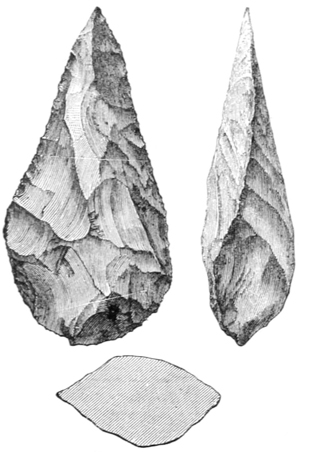
Two remarkably fine specimens—one of them much like that from
Reculver, Fig. 459, and the other somewhat more irregular in form but
also round-pointed—were likewise
found in the disturbed soil
by Mr. Charles M. Doughty, of
Caius College, Cambridge, and
are now in the Woodwardian
Museum. There are other specimens
in the Christy Collection.
A pointed implement from this
place has been figured by
Prestwich. [2551]
Another of these very acutely
pointed implements is shown in
Fig. 450, the original of which
is in my own collection. It presents
the peculiarity, which is
by no means uncommon in ovate
implements, of having the side
edges not in one plane but forming
a sort of ogee curve like that
of Fig. 434. In this instance,
the blade is twisted to such an
extent that a line, drawn through
the two edges near the point, is
at an angle of at least 45° to
a line through the edges at the
broadest part of the implement. I think, however, that this twisting
of the edges was not in this case intended to serve any particular purpose,
but was rather the accidental result of the method pursued in
chipping the flint into its present form. Curiously enough, one of the
specimens presented by Mr.
Frere [2552]
to the Society of Antiquaries
exhibits the same peculiarity, and, indeed, so closely resembles mine,
that they might have been both made by the same hand. An essay
on the Hoxne deposits by the late Mr. Thomas Belt, F.G.S., will be
found in the Quarterly Journal
of Science. [2553]
{577}
I have left my original account of this locality almost unaltered,
but the whole circumstances of the deposit have now been most
thoroughly and satisfactorily investigated. In 1888 Mr. Clement
Reid, F.G.S., and Mr. H. N. Ridley, F.L.S., communicated a paper
to the British Association, [2554]
calling attention to the presence of
fossil Arctic plants in the lacustrine deposits at Hoxne. This
was followed, in 1895, by some
further [2555]
notes on the deposits by
the same authors, with the result that a small committee, of which
I was chairman, was appointed by the
Association, [2556]
“to ascertain
by excavations at Hoxne, the relation of the Palæolithic deposits
to the Boulder Clay, and to the deposits with Arctic and Temperate
plants.” A sum of money, subsequently supplemented by a grant
from the Royal Society, enabled Mr. Clement Reid, Messrs. E. P.
and H. N. Ridley, to carry out the necessary borings and excavations,
while Miss Morse aided in washing out specimens, and
Mr. Mitten in determining the species of the mosses. I cannot
here enter into the details of the case, but must refer the reader to
the “Report of the
Committee” [2557]
for them. The general results
of the examination are as follows.
The deposits lie in a valley excavated in the Chalky Boulder Clay
of the district, through which a stream ran, probably connected
with the valley of the Waveney. By subsidence the channel of the
stream was converted into the bed of a freshwater lake which
gradually silted up, and its site became covered with a dense thicket
of alders. From some cause or other, lacustrine conditions reappeared
and 20 feet more of freshwater strata were deposited, but
the climate had become Arctic or sub-Arctic. Then followed floods
which deposited the implement-bearing beds, and finally the strata
became sandy. During the formation and the silting up of the
channel, the climatic conditions seem to have changed at least twice,
having been at one time mild and then again Arctic. To use the
words of the report: “The Palæolithic deposits at Hoxne are
therefore not only later than the latest Boulder Clay of East
Anglia, but are separated from it by two climatic waves, with
corresponding changes of the flora. Such sweeping changes cannot
have been local. They must have affected wide areas.”
Subsequently, however, to the Palæolithic beds being deposited,
all traces of the shores of the old lake have disappeared, and but
for artificial excavations the surface of the ground would give no
indication either of a stream or lake having
existed at the spot. {578}
Though terraces of gravel are found at various places along
the course of the Waveney, and apparently of the same age as
those of the Little Ouse valley, yet up to the present time no discoveries
of implements in them have been recorded, although it
seems improbable that it is at Hoxne alone that implements exist.
In the gravels of the valleys of the Gipping, and other small
streams between the Waveney and the Stour, no works of man
have as yet been discovered; but in a pit worked for ballast, near
Melford Junction, on the Great Eastern Railway, and at no great
distance from the Stour, the late Mr. Henry Trigg discovered one or
two implements of flint, and a portion of a tooth of Elephas primigenius.
Some worked flints have also been found in the gravel
at Sudbury, Suffolk, and some palæolithic implements in the
valley of the Stour, north of Colchester. In the cliff at Stutton,
opposite Manningtree, is a freshwater deposit containing many shells
of Corbicula fluminalis. Numbers of these washed out from the cliff
are lying on the shore, and among them I found, in 1883, a broad
flake about 3 inches long, which has all the appearance of being
palæolithic. At Lexden
Park, [2558]
near Colchester, Mr. Edward
Laver has found a small ovate implement with a cutting edge all
round, ogival in character. Some other specimens have been
discovered to the north of Colchester. On the banks of the Ter, a
tributary of the Chelmer, Mr. J.
French [2559]
has found two palæolithic
implements near Felstead; and in 1883, at North End Place, 1 1 ⁄ 2
miles south of Felstead, the Rev. A. L. Rowe, F.G.S., picked up
a rudely chipped heavy oval implement of quartzite (6 inches)
which he has kindly added to my collection.
The valleys of the small rivers between the Stour and the
Thames, the Colne, the Blackwater, and the Crouch, have up to
the present time produced no relics of human workmanship,
though I have seen a rudely worked flint, apparently from gravel,
which was found on the sea-shore by Mr. W. Whitaker, F.R.S.,
a little to the north of the mouth of the Colne.
Before proceeding to discuss the discoveries that have been
made within the basin of the Thames and in the Southern counties,
I must call attention to one that was made in 1890 in the
Midland Counties, not far from Birmingham.
The old gravels of the river Rea at Saltley, Warwickshire,
have for a long time been subjected to a careful examination by
Mr. Joseph Landon, F.G.S., of Saltley College,
in the hope of {579}
finding in them some relics of human workmanship; and his
search has been rewarded by the discovery of the undoubted
palæolithic implement, which through his kindness I am able to
exhibit in Fig.
450A.
It is 4 inches in length and has been
formed from a brown quartzite pebble which, by dexterous chipping,
has been brought into a nearly symmetrical form with a
sharp point and edge. It much resembles one from the Robin
Hood Cave, Creswell Crags, Fig. 413A.
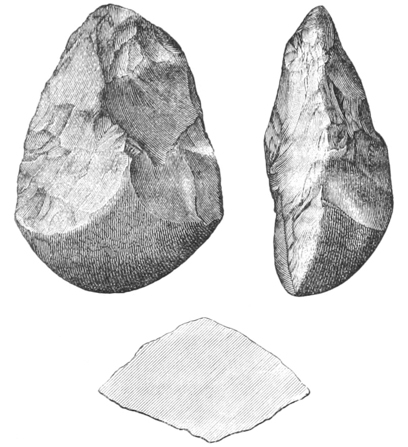
The valley of the river Rea runs at Saltley in a more or less
N.N.E. direction, and is about a mile in width. Several stretches of
gravel are found at different heights on both sides of the valley,
but especially on the southern side. The highest and oldest
gravels on this side are exposed in a clay-pit just in front of
Saltley College, and are about 3 feet in thickness. They consist
in the main of small quartzite pebbles in a light-brown sandy
matrix, though some large pebbles and a few broken foreign
flints also occur, and below the sandy beds is a layer, 3 or 4 feet
thick, of Glacial clay and sand, with pebbles and boulders (Arenig
felsite, &c.), and below this again come the Keuper marls, which
are used for brick-making. The level of the top of the gravels is
395 feet above Ordnance Datum and that of
the river is about {580}
315 feet, so that the valley must have been excavated to the depth
of at least 80 feet since the gravels were deposited.
The implement was found at the base of the sandy gravel at a
distance of about 60 yards from the front of Saltley College. In
the same beds and in a small area, some 10 yards square, were
found a number of fractured quartzite pebbles, which though not
presenting such distinct signs of design may possibly owe their
forms to human workmanship. Some of the chipped pieces of
quartzite in the caves of Creswell Crags are rude in the extreme.
The discovery of this well-fashioned specimen suggests some
interesting considerations.
It has been held that the absence of palæolithic implements
in Britain north of an imaginary line drawn from about the
mouth of the Severn to the Wash, is due to glacial conditions
having prevailed in the north-west part of England and in Scotland
at the time when the makers of these early tools or weapons
occupied the southern and eastern parts of this country, which,
however, in those days was not an island but was still connected
with the Continent.
The question now arises whether the assumed absence of palæolithic
implements over this area may not be due to their not
having as yet been found, and not to their non-existence.
It must be remembered:—
1st. That flint is extremely scarce over a great part of the
area, and therefore that any implements would almost of necessity
have to be formed from some other material, such as quartzite or
one of the older rocks.
2nd. That in the case of implements made of such materials,
the evidences of human workmanship are not so conspicuous or so
easily recognized as on those formed of flint.
3rd. That owing to the nature of the rocks over which the
ancient rivers flowed, the alluvial deposits within the area in question
are of quite a different character from those formed in districts
where flint abounds.
4th. That such alluvial deposits are not so constantly being
excavated for economic purposes, and consequently not so open to
examination as ordinary flint gravels, and that implements made
from such materials as quartzite being probably more difficult to
make, they would be fewer in number over a given area and also
more highly treasured.
Even in the case of cave-deposits we have seen
how, in those of {581}
Creswell Crags, a locality which lies within the presumed non-implementiferous
district, all the larger implements were made
from quartzite, some of the tools being so rude that human workmanship
can hardly be recognized upon them. I therefore venture
to think that if competent observers like Mr. Landon will
devote their attention to the ancient gravel-like alluvial deposits
of our northern rivers, and seek for implements not formed of flint
but of quartzite or some other of the older rocks, their search will
be rewarded. In some of the Welsh caves the implements were
for the most part made of felstone and chert.
The finding in the neighbourhood of Bridlington of a flint implement
of a distinctly palæolithic type, seems to afford corroborative
evidence in favour of extending the area of such discoveries,
though it must be admitted that so far as at present known it was
not lying in association with any remains of the pleistocene fauna.
It may be incidentally mentioned that palæolithic implements of
quartzite, and even of Tertiary sandstones, occur though rarely in
districts in which flint abounds. Possibly it was found that this
material was tougher and less brittle than flint, and therefore
better adapted for certain uses when the sharpness of the edge
was not of primary importance. Most of the implements from
India are formed of a quartzite which is more easily chipped into
form than that of our English pebbles.
I now come to the important district drained by the Thames
and its affluents, which comprises an area of upwards of 5,000
square miles. The number of localities within this area, where
discoveries have been made in the ancient River-drift, has greatly
increased since 1872, and at some of them palæolithic implements
have been found in abundance.
The Thames valley may moreover lay claim to the first recorded
discovery of any flint implement in the Quaternary gravels, whether
in this or any other country. An implement is preserved in the
British Museum to which my attention was first directed by Sir
A. Wollaston Franks, and which is thus described in the Sloane
Catalogue:—“No. 246. A British weapon found, with elephant’s
tooth, opposite to black Mary’s, near Grayes Inn Lane. Conyers.
It is a large black flint shaped into the figure of a spear’s point.
K.” This K. signifies that it formed a portion of Kemp’s collection.
It appears to have been found at the close of the seventeenth
century, and a rude engraving of it illustrates a letter on the
antiquities of London, by Mr. Bagford, dated
in 1715, and printed {583}
in Hearne’s edition of Leland’s
“Collectanea.” [2560]
From his account
it would seem that a skeleton of an elephant was found not far
from Battlebridge by Mr. Conyers, and that near the place where
it was found, “a British weapon made of a flint lance, like unto
the head of a spear, was dug up.”
A full-sized engraving of this implement illustrated my first
notice of these discoveries, in the
Archæologia, [2561]
and is here reproduced
as Fig. 451. As will be seen, it is remarkably similar in form
to that from Santon Downham, Fig. 433, though rather larger in
size. During some excavations in Gray’s Inn
Lane [2562]
in 1883 and
1884, several palæolithic implements of different forms were found;
but none I think so fine as that described by Leland. One found in
Clerkenwell Road in 1883 by Mr. G. F.
Lawrence, [2563]
was, however,
slightly larger. Another implement was found in Drury
Lane, [2564]
and others from Jermyn Street and Prince’s Street, Oxford
Street, are in the Museum of Economic Geology.
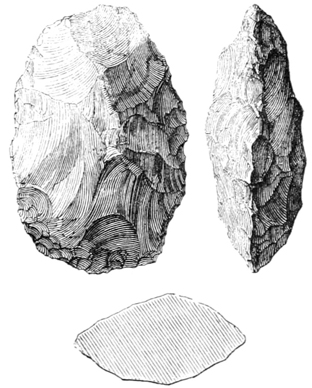
Before describing the recent discoveries which have been made
higher up the valleys of the Thames and its affluents, it will be
well to discuss the various
localities in the immediate
neighbourhood of London, so
as not to disturb the sequence
of the Figures which is necessarily
that of my first edition.
It will be needless to do this
at any great length, as the
principal investigator of the
gravels around London, to
whom indeed the greater part
of the discoveries are due—Mr.
Worthington G. Smith—has
given full particulars
in his excellent book, “Man,
the Primeval Savage.” [2565]
In the British Museum is
an oval implement, formerly in
the collection of the late Rev. Dr. Sparrow Simpson,
F.S.A., shown in {584}
Fig. 452, and found by Mr. G. H. Gaviller in gravel dug at Hackney
Down, to the north-east of London, and not far from Shacklewell. It
is of ochreous flint, slightly rolled, and in form remarkably like that
from Bournemouth, Fig. 476. Though the exact place whence it came
is unknown, there can be no doubt of its belonging to the Hackney
Down gravels, which may be regarded as identical in age and character
with those of Shacklewell, which have been described by Sir Joseph
Prestwich. [2566]
The surface of the ground at Hackney
Down [2567]
is 70
feet above Ordnance Datum, and in 1866 a shaft was there sunk
through gravel and sand, to a depth of 22 feet. In the sandy beds
at the base Mr. G. J.
Smith [2568]
discovered numerous land and freshwater
shells, and among them the Hydrobia marginata—already mentioned as
having been found in the Bedford Drift, and as being no longer an
inhabitant of Britain—and the Corbicula fluminalis, which has already
been cited as occurring near Cambridge, and of which more will be
said immediately. The Shacklewell gravel mainly consists of subangular
broken flints, some large flints but little worn, Lower Tertiary
pebbles, a few quartz and sandstone pebbles, and some rolled blocks
of hard Tertiary sandstone. In the pit described by Sir Joseph
Prestwich there is, at a depth of about 8 feet, a bed of sandy clay
intercalated in the gravel, and containing mammalian remains, numerous
land and freshwater shells, and remains of oak, elm, alder, and
hazel. The group of shells procured here resembles that of the Salisbury
Drift, of which mention will be made hereafter.
Since 1854, when his paper was read, numerous specimens of the
Corbicula fluminalis, or, as it was formerly called, the Cyrena consobrina,
have been found here by Sir Joseph Prestwich, Sir Charles
Lyell, [2569]
and others, including myself. This shell, of a mollusc no longer
living in Europe, though still found in the Nile and in several Asiatic
rivers, has also been found in the Drift deposits of the Somme at
Menchecourt, near Abbeville, associated with flint implements; and is
likewise to be met with in the drift deposits of the Thames at Gray’s
Thurrock, Ilford, Erith, and Crayford, in several of which implements
have now been found. The beds at these places have by some geologists
been regarded as belonging to an older and Pre-glacial period;
but the discovery of an implement at Hackney Down raises a presumption
that the gravel there is, like other flint implement-bearing
gravels, Post-glacial; and the discovery of an implement in beds of
fluviatile origin at a still higher level than those of Hackney Down
corroborates this view, as the lower bed is probably the more modern.
The fluviatile beds in question were exposed in two brick-pits at
Highbury New Park, near Stoke Newington, and attention was first
called to them in August,
1868, [2570]
by the late Mr. Alfred Tylor, F.G.S.
The surface of the ground at the more eastern of these two pits
is, according to Mr. Tylor, 102 feet above Ordnance Datum; and
22 feet below the surface there is a bed of clay 2 feet thick, full of
land and freshwater shells, accompanied by
much wood. There are {585}
also shells in the lower part of the reddish loam or brick-earth immediately
above the clay. The shells are said to consist of Helix, Zua,
Clausilia, Succinea, Carychium, Limnæa, Planorbis, Valvata, Pisidium,
and Cyclas; to which Mr. J. Wood Mason,
F.G.S., [2571]
added Achatina,
Bythinia, Pupa, and Velletia.
On reading the account of this discovery, I was at once impressed
with the possibility of the occurrence of palæolithic implements in the
deposit; and accordingly in September, 1868, I visited the pit with
the view of searching for them, taking with me my youngest son,
Norman, who had a quick eye, and an almost instinctive power of
recognizing a worked flint. Our search was soon rewarded, for immediately
on descending into the lower part of the pit, where the shell-bearing
beds were exposed, my son picked up the remarkably well-formed
implement shown in Fig. 453. It was not in situ, but was
lying in the bottom of the pit; and judging from the staining upon a
portion of its surface, it appears to have been derived from the brick-earth,
rather than from the more shelly beds below.
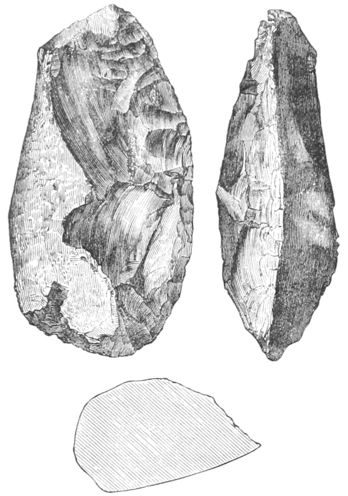
It is well adapted for being held in the hand as a sort of knife or
chopper, having a thick rounded back formed of the natural crust of
the nodule of flint from which it was formed. One face of it has been
the result of a single blow, and its surface is that of a portion of a
what irregular cone, at the apex of which the
blow was struck, by {586}
which it was produced. The other face, as will be seen by the figure,
has been fashioned by first roughly chipping the implement to a curved
edge, by blows administered on the flatter face, and then neatly trimming
this edge to a regular sweep by secondary chipping. The ends
have also been trimmed into shape. At the upper end, as shown in
the figure, a small piece has been broken off, but otherwise the edge
is uninjured. In character it is identical with the implement from the
Santon Downham gravel, Fig. 437, and it closely resembles some of the
large trimmed flakes from High Lodge, near Mildenhall, and the
“choppers” from the cave of Le Moustier. The surface of the flint
is stained ochreous in places, and presents much the same appearance
as do some of the implements from the brick-earth at Hoxne.
It was in consequence of my publication of these discoveries that
the attention of Mr. Worthington Smith was directed to the gravels of
North-Eastern London, among which his labours have been crowned
with such marked success. Not only has he found palæolithic implements
in the City, [2572]
Gray’s Inn Lane, Clerkenwell, London Fields,
Dalston, Kingsland, Homerton, Hackney, Lower Clapton, Upper
Clapton, Stamford Hill, Mildmay Park, South Hornsey, Abney Park
Cemetery, Stoke Newington, and Shacklewell, but he has been able
to identify the old surface of the ground, which was occupied by the
early men who chipped out the implements. To this old land-surface
he has given the name of the “Palæolithic floor,” and he has been able
to trace its existence over a considerable area of ground on the western
as well as the eastern side of the river
Lea. [2573]
It consists of a stratum of
five or six inches of subangular ochreous gravel, in some places, however,
only one or two inches in thickness, or only visible as a tone of
colour. On, and imbedded in this floor among rolled and waterworn
stones and bones, black, sharp and unabraded implements of flint occur,
together with flakes which, in some instances, have been susceptible
of being replaced in their original juxtaposition. Below the floor
are usually thin beds of sand containing shells of land and freshwater
mollusca, and beds of gravel, sometimes as much as 12 feet thick, containing
palæolithic implements more or less abraded. The sand is not
always present. Above the floor are usually contorted loamy beds of
“warp and trail,” generally 4 to 6 feet thick, including the superficial
humus. These seem to be of subaërial origin and may be due to a
lengthened prevalence of a cold and rainy climate. The fauna of the
gravels is described as including Felis spelæa, Hyæna, Elephas primigenius,
E. antiquus, Rhinoceros megarhinus, R. leptorhinus, and R. tichorhinus,
Cervus tarandus, and Megaceros hibernicus. Remains of Antilope Saïga
have, I believe, been also found. Among the testaceous remains
Corbicula fluminalis and Hydrobia marginata have already been noted.
Another diligent investigator of the gravels of North-East London,
who has also treated of the Palæolithic floor, is Mr. J. E.
Greenhill. [2574]
He has given some interesting sections, showing how the waterworn,
abraded implements underlie those of the Palæolithic floor which are
quite unworn. [2575]
Professor Rupert Jones, F.R.S.,
has also written on {587}
the subject. The best geological account is that given by Mr. W.
Whitaker, F.R.S. [2576]
By the kindness of Mr. Worthington Smith most of the important
specimens that he has found are now in my collection. I am
further indebted to him for the use of the blocks illustrating some of the
implements. [2577]
Fig. 453A exhibits a finely pointed implement from Lower
Clapton. Its surface is lustrous and it shows at its butt part of the
original crust of the nodule of flint out of which it was chipped.
The fine ovate
implement, [2578]
Fig.
453B,
came from the 12 feet stratum
at Stamford Hill. It is of dark colour, lustrous, and has the angles
slightly abraded.
A small example from the Palæolithic floor at Stoke Newington is
shown in Fig. 453C. [2579]
The edges are still quite sharp, and at one place
there appear to be traces of use. A
quartzite [2580]
implement from the
same locality is shown in Fig. 453D.
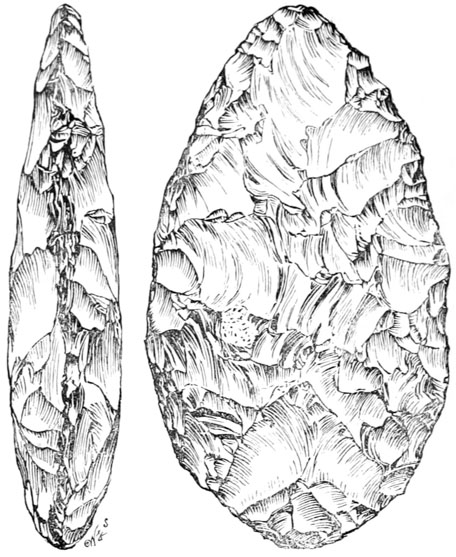
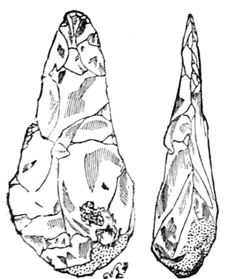
Implements presumably of Palæolithic Age have been found in the
bed of the Thames. One from Battersea is of peculiar
form, with a {588}
truncated butt, and has been presented to the Christy Collection by Sir
A. Wollaston Franks, F.R.S. Another from Hammersmith is in the
same collection, having been formerly in that of the late Rev. Dr. Sparrow
Simpson, F.S.A. It is
8 1 ⁄ 4
inches long, and much resembles that from
Reculver, Fig. 458, though somewhat
longer in its proportions and thicker in
the butt. It is much rolled and water-worn,
so that it has probably belonged to
a bed of gravel at a much higher level
than that from which it was dredged up.
Another
(5 5 ⁄ 16
inches) from the bed of the
Thames at the Chelsea Suspension Bridge
was found by Mr. Lambton Young,
C.E., in 1854, before general attention
had been directed to such relics. Mr.
G. F. Lawrence, of Wandsworth, has
ovate specimens from the Thames, at
Wandsworth, Battersea, Putney, and
Richmond, all but the latter much
rolled.
It will be most convenient to reserve
the discoveries in the South of London and
in the valley of the {589}
Lea for future pages, and to proceed up the Thames valley towards
its sources.
Nearly ten miles to the west of London, and on the northern side
of the Thames, the careful researches of General Pitt Rivers, F.R.S.,
have been amply rewarded, he having found several implements
of well-marked palæolithic types, and numerous flakes, in the
gravels of Ealing Dean and
Acton. [2581]
He has fully described the
localities and given sections of the beds in a communication to
the Geological Society. [2582]
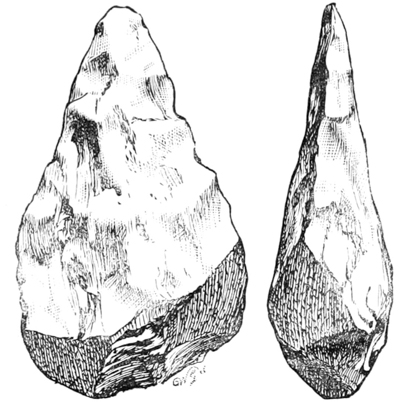
At the former spot, the surface of the ground is 92 feet above
Ordnance Datum, and here several implements have been found. At
Acton the surface is from 60 to 80 feet above high-water mark, and here
an implement of oval form was found beneath 7 feet of stratified sand
and gravel, and resting on the clay beneath; another, of pointed form,
was found in the middle of the gravel, about 10 feet from the surface,
and beneath beds of sand 8 feet in thickness. Others were found in
gravel from the same spot, and from Mill Hill, half-a-mile to the
westward, which had been spread on the roads. One of the pointed
implements from Ealing Dean is shown in Fig. 454. In form it much
resembles that from Reculver, Fig. 458, though smaller in size. Like
all the other implements from these two spots, it is stained of the
ochreous colour of the gravel, and has had its angles worn away by
being rolled in water along with the other constituents of the gravel.
The flakes, which are comparatively abundant, are
for the most part {590}
large and rude, but many appear to have had their edges chipped by
use. Some have been wrought into the scraper form. Cores or blocks
of flint from which flakes have been struck have also been found.
In May, 1871, an implement, 8 inches long, and of rather less tapering
form than that from Ealing, Fig. 454, was found at Acton, beneath
13 feet of sand and gravel, at a spot where the surface is 70 feet above
high-water mark. General Pitt Rivers has also seven or eight flakes
of flint, one of them
5 1 ⁄ 2
inches long and 1 inch wide, which were found
together, beneath 9 feet of brick-earth and gravel, in excavating for the
foundations of a house at Acton. Their edges are sharp and unworn,
so that they must have been deposited where they were found, prior
to the accumulation of the 9 feet of drifted beds above them. They
lay in a bed of ochreous sandy clay, about 1 foot in thickness, which
reposed immediately on the blue London Clay.
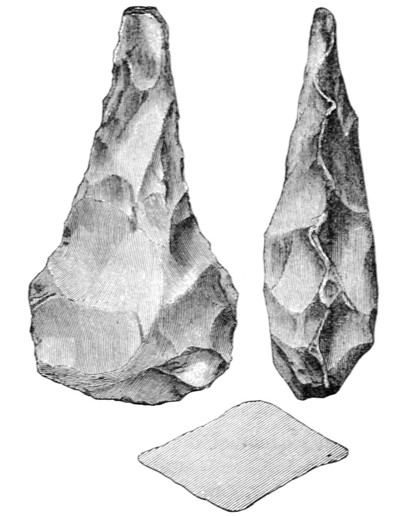
In Acton village, the beds of Drift which constitute the first patch
of gravel occurring at so high a level as we go westward from London,
and which form a sort of terrace overlooking the broad valley of the
Thames, attain a thickness of 18 feet, and consist of layers of sub-angular
gravel, mixed with yellow and white sand, very irregularly
stratified. The gravel consists principally of flints and Tertiary
pebbles, with some of quartz and quartzite. A few mammalian
remains, including a tooth of Elephas primigenius, have been found in
these beds, and south of Ealing
Park [2583]
land and freshwater
shells. At {591}
a lower level, and cut off from the upper gravels by an outcrop of
London Clay, is a wide terrace of alluvial deposits at an average
height of about 20 feet above high-water mark, and a lower terrace
still is to be found in the immediate neighbourhood of the river.
General Pitt Rivers’s researches in the mid-terrace beds of gravel and
brick-earth have not produced any implements of the River-drift types,
but he has obtained animal remains which were identified by the late
Mr. G. Busk, F.R.S., as those of Elephas primigenius, Rhinoceros hemitæchus,
Hippopotamus major, Bos primigenius, Bison priscus, Cervus
tarandus, and other species of deer. They occur invariably at the base of
the gravel 12 or 13 feet from the surface. The late Mr. Thomas Belt,
F.G.S., [2584]
has speculated on the age and character of the Acton deposits.
Mr. J. Allen Brown,
F.G.S., [2585]
has diligently continued these
researches, and in laminated clay, 200 feet above O.D. at the Mount,
Ealing, has found an ochreous flake trimmed at the edge. At Creffield
Road, Acton, [2586]
Middlesex, he has discovered another “Palæolithic
floor,” having found more than 600 flakes and implements in an
area of not more than 40 feet square. Besides implements from Acton
and Ealing up to 130 feet above O.D. he has described specimens from
East Sheen, on the other side of the Thames, and
Hanwell, [2587]
Iver,
Gunnersbury, Kew, Turnham Green, and Dawley, near West Drayton.
An ovate implement from Dawley is of felsite. He has also described
implements found at
Southall [2588]
associated with remains of Elephas
primigenius. A pointed specimen from Southall is made of quartzite.
At Hounslow [2589]
also implements have been found. It is possible that the
gravels at West Drayton belong to the valley of the Colne rather than
to that of the Thames, as also those at Hillingdon, where in the Town-pit,
180 feet above O.D., Mr. Brown has found palæolithic implements.
Farther west, at Langley and at Burnham, implements have been found
in the gravels. One from Burnham was given to me by Mr. E. Sawyer.
He has also found a broad-pointed implement at Cookham, near Maidenhead.
They have likewise been discovered at
Ruscombe, [2590]
Taplow, [2591]
Maidenhead, and Marlow. A very broad-pointed implement
(5 1 ⁄ 2
inches) found in high-level gravel at Cookham, Maidenhead, has
been shown to me by Mr. E. Sawyer. In my own collection are
specimens from the majority of the other localities here enumerated.
In form and character they approximate so closely to those from
similar deposits elsewhere that it seems needless to figure any of them.
Higher up the river Thames, the next important discoveries to recite
are those which have been made in and near Reading by Dr.
Joseph Stevens. At
Grovelands, [2592]
about 80 feet above
the level of the {592}
river, near the junction of the Kennet and the Thames, the Drift deposits
are ferruginous and about 15 feet thick. In them were found a tooth
of a mammoth and numerous implements, principally of ovate forms
and made of flint, but among them one made of quartzite. At Redlands,
at a lower level, about 40 feet above the river, mammoth
remains occur, as also at the Kennet Mouth Pit, Newtown, where a
kite-shaped implement was found. The geological position and structure
of the Redlands beds have been described by Prof. Poulton,
F.R.S. [2593]
In 1882 I found in the gravel at Pig’s Green, near Reading, the butt-end
of a pointed implement, which had been originally about
4 1 ⁄ 2
inches long and had lost its point before being deposited in the Drift.
The gravel was subangular and ochreous, and contained from 15 to
20 per cent. of quartzite pebbles. Flint flakes were fairly abundant,
but finished implements, scarce. On the other side of the river, at
Caversham, Dr. Stevens has found implements in gravel 120 feet
above the level of the Thames. I have myself found an acutely-pointed
implement (4 inches)
in the same beds.
These Caversham Beds have been well described by Mr. O. A.
Shrubsole. [2594]
At Toots Farm the implements are usually pointed, as
also at Shiplake, at a distance of about three miles and at a slightly
lower level. At Henley Road, Caversham, about 59 feet above
the Thames, he obtained a flat ovoid implement of flint. A molar of
Elephas primigenius was found at this spot. South of the Thames,
besides the pits mentioned by Dr. Stevens, Mr. Shrubsole enumerates
the following localities: a cutting of the South Western Railway
at Earley, one of the Great Western Railway at Sonning, a
gravel-pit at Charvil Hill, Sonning, and a brick-yard at Ruscombe,
near Twyford. In the last-mentioned place several implements
of various types have been found. Some extremely doubtful specimens,
probably of purely natural origin, have been found on Finchampstead
Ridges, [2595]
but in gravel at
Wokingham [2596]
a large highly
finished pointed implement has been obtained by Mr. P. Sale.
Some more or less worked flints from the
Reading [2597]
gravels
have been described and figured by Mr. O. A. Shrubsole, who has
assigned uses to what he terms “the less familiar forms of Palæolithic
Flint Implements.”
Still higher up the Thames, near Wallingford, there is a considerable
spread of gravel, some of it at a distance of two miles or
more from the existing streams. In this gravel implements have
been found, though up to the present time in no
great abundance. I {593}
have a fine kite-shaped specimen of the type of Plate I., No. 6
(5 1 ⁄ 2
inches), that was found at Gould’s Heath, East of Wallingford,
and two from Turner’s
Court, [2598]
rather nearer the town. In
all three cases the flint has become more or less whitened. I
have another large flat ovate implement more like Plate I., No. 16,
that was found at Cholsey, on the other side of the river. It is
more lustrous and not so much whitened. Another was found on
the surface at Ipsden, [2599]
3 miles S.E. of Wallingford.
In the neighbourhood of Oxford a fair number of palæolithic
implements have been found, some of which are in the University
Museum. The first of these was a fine specimen with a heavy
butt and pointed tip (broken off), procured, in 1874, by Sir Joseph
Prestwich from gravel on the left bank of the Cherwell, at
Marston Ferry, not more than from 4 to 5 feet from the surface.
Another, ovate
(3 3 ⁄ 4
inches), was obtained by the late Professor
Rolleston from the foundations of the New Schools in the High
Street, in 1878, and two more of ruder workmanship came from
the site of the Girls’ High School in the Banbury Road, in 1880.
Yet another was found below Oxford by the side of Bagley
Wood, opposite Iffley. The principal discoveries have, however,
been made at Wolvercote, about
1 1 ⁄ 2
miles north of Oxford, whence
many have been collected by Mr. A. M.
Bell, [2600]
from whose account
of the discoveries I have been quoting. Among the specimens in
his and other collections are pointed and ovate implements, a
fine example of the shoe-shaped type, like Fig. 429
(8 1 ⁄ 2
inches),
trimmed flakes and a hammer-stone. One of Mr. Bell’s pointed
implements has been chipped out of quartzite. The brick-earth
and gravel deposits lie in what appears to be an old river-channel,
which has been cut into the Oxford clay and the superimposed
Northern Drift to a depth of about 17 feet from the surface. It
is at the base of this channel that the implements are found. In
the sand near the base nine or ten species of land and freshwater
shells occur, and in a peaty bed immediately above the sand
and gravel the remains of various plants; but both the testaceous
and vegetable remains belong to species still found in the neighbourhood.
Mammoth, rhinoceros, and hippopotamus as well as Corbicula
fluminalis have, however, been found in the Oxford gravels. The
beds at Wolvercote above the peat consist of clay and sand deposited
evenly in successive layers, but towards
the surface they are {594}
traversed by an irregular line of “trail,” such as is often seen above
palæolithic deposits and for which it is so difficult to account.
Mr. Percy Manning, F.S.A., possesses several palæolithic implements
found near Oxford. Among eleven specimens from
Wolvercote, mostly tongue-shaped, is one of brown flint
9 1 ⁄ 2
inches
long and
4 1 ⁄ 2
inches broad, sharply pointed with a truncated butt
and the sides curving outwards somewhat like Fig. 475. Another
fine implement from the same place has straighter sides and is 6 3 ⁄ 4
inches long. The others are smaller, but among them is one of
pointed form rather rudely chipped from a quartzite pebble.
Mr. Manning has also three implements dredged from a backwater
of the Thames between Oxford and North Hinksey, one of
them
(4 3 ⁄ 4
inches) like Fig. 422, but more roughly chipped and
much waterworn. Another (4 inches) is like Fig. 436, but more
pointed. The third
(5 1 ⁄ 8
inches), is a remarkably symmetrical ovate-lanceolate
implement, in outline like Plate II., No. 11, made out of
a pebble of quartzite, or possibly of chert. This also is waterworn.
At Broadwell, Oxon, on the borders of Gloucestershire, Mr.
Manning found an implement
(4 1 ⁄ 4
inches) resembling Fig. 459,
apparently from gravel dug upon the spot. The village of
Broadwell lies about 3 miles to the north of the Thames.
In my former edition I called attention to the discovery in the
valley of the Wey, at Peasemarsh, between Guildford and Godalming,
by the late Mr. Whitbourn,
F.S.A., [2601]
some sixty years ago,
of the implement shown in Fig. 455, which is now in my own
collection. It was found embedded in the gravel in a layer of
sand about 4 or 5 feet from the surface, in apparently undisturbed
ground. Mr. Whitbourn had heard of remains of large animals
having been discovered in the same beds, but not in very close
proximity to the spot where the implement was found. It is, as
will be seen by the figure, of a different shape from the majority
of the implements found in the River-drift, being very broad at
the base and short in proportion to its width. The flint of which
it consists is grey and slightly ochreous. At the base is a considerable
portion of the original crust of the flint, which is stained
of a dull red. The gravel beds, in which it was found, have been
described by Mr. R. A. C. Godwin-Austen,
F.R.S. [2602]
They rest
on Wealden Clay, and in places, on beds of the Lower Greensand.
The material principally consists of sub-angular
chalk flints, and {595}
in it have been found numerous remains of Elephas primigenius.
In places, the gravel overlies what appears to have been an old
land-surface, in the mould of which fragments of branches of
trees, and bones of ox and elephant, have been found uninjured
and lying together. Mr. Godwin-Austen does not record the discovery
of any land or freshwater shells in the gravels, nor on
visiting the spot was I able to find any, or any more worked flints.
In the Woodwardian Museum, at Cambridge, is an implement of
palæolithic type, and of the ovate form, found higher up the valley
of the Wey, near Alton, but on the surface, and not in gravel.
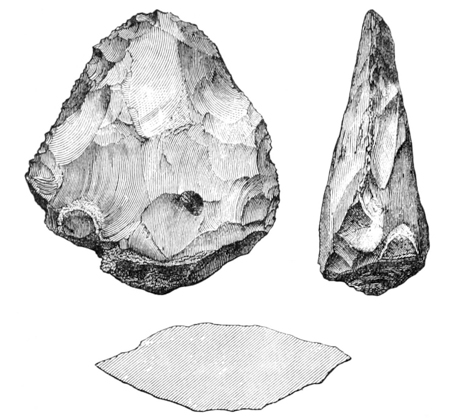
At Farnham, between Alton and Godalming, many palæolithic
implements have been secured from the gravels of the valley of the
Wey, principally through the intelligent care of Mr. Frank Lasham,
of Guildford, and Mr. H. A. Mangles, F.G.S., of Littleworth
Cross, Tongham. The former has contributed a paper on
“Palæolithic Man” to the Surrey Archæological
Society, [2603]
and
has kindly given me much information on the subject. The beds
of gravel are from 10 to 40 feet deep, and lie upon the Lower
Greensand. They attain an elevation of 364
feet [2604]
above the
mean sea-level, or about 150 feet above the present bed of the
river, and are principally dug in pits on the southern
or right side {596}
of the Wey towards Wracklesham, pits which have furnished
several hundreds of palæolithic implements of various forms and
sizes. The oval and ovate seem to predominate, but there have
been found not a few fine pointed implements. Associated with
the more sharply preserved specimens, are many of dark ochreous
colour, with their angles much abraded, which in all probability
have been brought down by the old river from beds higher up
its valley. Remains of mammoth occur occasionally in the
gravels. Some specimens of the implements are preserved in
the Charterhouse School Museum. Mr. Lasham informs me of
an implement having been found in gravel at Peperharow, of a
part of one near Farley Heath, and of one found at
Frimley, [2605]
in
the valley of the Blackwater.
The discoveries of palæolithic implements in the valley of the
Colne near its junction with the Thames, have already been
recorded. In the valley of the Misbourne, an affluent of the
Colne, an implement was found in 1891 in digging the foundations
of the bridge over the Metropolitan Extension Railway,
just north of Great Missenden. It is of a thick ovate form, made
of grey flint, rather narrower than Pl. II., No. 18, and with
small flat surfaces of the original crust of the flint left about the
middle of each side. The specimen is in my own collection.
In the valley of the Gade, in Hertfordshire, a few have been found
by myself. The first of these was lying on the surface of a ploughed
field near Bedmond, [2606]
in the parish of Abbot’s Langley, at a spot
which, though probably 160 feet above the level of the nearest
part of the stream, is towards the bottom of one of the lateral
valleys leading into the main valley of the Gade, between Boxmoor
and Watford. The implement, which has unfortunately
lost its point, is remarkably similar in form and size to that from
Gray’s Inn Lane, Fig. 451. The flint of which it is made has
become nearly white and porcellanous on both faces, though
more so on one than on the other. In places it has been so much
altered in structure that it can be cut with a knife. I have
noticed this feature in flints which have lain long in pervious red
brick-earth, and this leads me to suppose that the implement
may have been derived from some beds of that character at the
spot where it was found, though on this point
I have no direct {597}
evidence. In 1892 [2607]
I found another small implement (4 inches)
of rude ovate form, among some stones recently placed in a rut
at Bedmond Hill. Here, again, there is no evidence as to the
exact geological position. Nor is there with regard to two other
implements, both of which I found in 1868, in gravel laid on the
towing-path of the Grand Junction Canal, which is there united
with the Gade, between Apsley and Nash Mills, about two miles
south of Hemel Hempstead. There is, however, no doubt of the
gravel in which they lay having been dredged or dug from the
bottom of the valley in the immediate neighbourhood. One of
them, of grey flint, is a neatly-chipped, flat implement, of ovate
outline, about 4 inches long, in form much like Fig. 468, from
Lake. The other is imperfect, but appears to have been originally
of much the same character, though flatter on one face. It
is deeply stained of an ochreous colour, and its angles are considerably
waterworn. I have searched in the gravels of the
neighbourhood for other specimens, but as yet in vain. I may
add that during the formation of this part of the canal, some
eighty years ago, an elephant’s tooth was found in the gravel,
within about 200 yards of the spot where I discovered one of the
implements.
Other specimens are reported to have been found near the head
of the tributary valley of the Bulbourne, at Wigginton, near
Tring.
At Watford, Herts, on the left bank of the Colne, in gravel
near Bushey Park, at a height of about 40 feet above the level
of the existing river, Mr. Clouston has found several implements
of ochreous flint of various types. He has kindly given me a
square-ended flake, much like Fig.
426A,
from High Lodge,
Mildenhall.
Some of the discoveries made by Mr. Worthington G. Smith
were in localities within the valley of the Ver, an affluent of the
Colne, rather than in that of the Lea, but inasmuch as many of
the beds which contained the implements found by him seem to
bear but little relation to existing watersheds, and are at no
great distance from the Lea, I shall at once proceed to the discussion
of the remarkable series of facts which he has brought to
light. All details must, however, be sought for in Mr. W. G.
Smith’s own book, “Man, the
Primeval Savage.” [2608]
{598}
The main source of the Lea is at Leagrave Marsh, about 3
miles N.W. of Luton, and 376 feet above Ordnance datum. On
the surface near this place, Mr.
Smith [2609]
found a flat ovate implement,
in form much like those from Warren Hill or that from
near Dunstable, Fig. 17. He says that it may be neolithic, but
that he has found palæolithic flakes, both ochreous and grey, in
situ in gravel at Leagrave. At Houghton
Regis, [2610]
1 1 ⁄ 2 miles north
of Dunstable, Mr. Smith found a fragment of an ovate implement
on the surface. Another implement, found so long ago as 1830 by
Mr. William Gutteridge, at
Dallow, [2611]
or Dollar farm,
3 ⁄ 4
of a mile
west of Luton, is distinctly palæolithic in form.
The most interesting of Mr. Worthington Smith’s discoveries
have, however, been made on or near the summit of a hill, a good
2 miles from the Lea, and somewhat nearer the Ver. At and
around the village of Caddington there are several brickfields,
some of them no longer worked. The original surface of the
ground in some of these is as much as
550 [2612]
to 595 feet above
the Ordnance Datum. The brick-earth is of great thickness, in
places fully 50 feet, and overlies the Chalk. The upper portion
of the beds is much contorted, and has in it occasional seams of
flint gravel or tenacious clay, in which cream-coloured or brownish
palæolithic implements occur. In the gravel, brown, ochreous,
slightly abraded implements and flakes are found, and at the base
in many cases is the old land-surface or “Palæolithic floor”
resting on and surmounted by brick-earth. In one pit were
three heaps of flints brought by hand in Palæolithic times from
flint-bearing beds either above or in the Chalk. On the Palæolithic
floor were numerous sharp-edged flakes, which had hardly
been moved from the original place at which they were struck
off. Mr. Smith has replaced more than 500 flakes either on to
other flakes or on to implements and cores from the same floor.
One old land-surface was full of narrow vertical fissures, due
perhaps to the heat of a burning summer sun. While they were
still open 18 inches of watery brick-earth, perhaps brought down
by a heavy storm of rain, filled up the fissures, covered up the
old surface and formed a new surface at a higher level. The
upper deposits often resemble contorted masses of half-frozen
mud and stone pushed over an old water-laid and perhaps frozen
surface of brick-earth. Mr. Smith’s view
is that Palæolithic {599}
man lived here by the side of one or more small freshwater lakes,
and manufactured his implements upon the spot which eventually,
by successive storms and flooding, became buried beneath accumulations
of mud. The neighbouring valley on the west was not
at that time excavated to its present depth. He considers that
the ochreous implements found at Caddington are of earlier date
than those of lighter colour found on the Palæolithic floor, and
points out that there is, moreover, a difference in the nature of the
tools, inasmuch as some well-formed scrapers occur in the brick-earth
of the Palæolithic floor, while they are never found amongst
the ochreous tools. The difference seems consistent with the
probability that the tools for domestic use would be more
abundant on the spot where the men of the period were at home
than elsewhere. One of the most interesting features of the case
is the number of instances in which Mr. Smith has been able to
bring together the fragments of implements broken in Palæolithic
times, [2613]
and to replace upon them the flakes removed during
the process of their manufacture. Of these he has given a long
series of illustrations in his
book; [2614]
those relating to one instance
are here by his kindness reproduced as Figs.
455A,
B, and C.
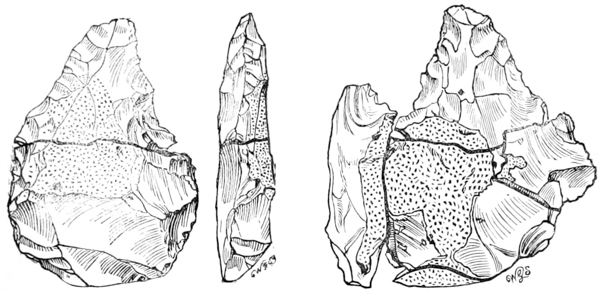
Fig. 455B.—Caddington.
1 ⁄ 2
In Fig. 455A is shown a finished implement broken in Palæolithic
times, both pieces found separately and now conjoined.
Fig. 455B shows the other side of the implement, with three of
the flakes struck off during its manufacture replaced, and Fig.
455C reproduces the first view, but shows a fourth
flake replaced. {600}
A good series of these reconstructed implements is in the
British Museum.
Fig. 455D shows an ovate implement from the brown stony
clay at Caddington. Fig. 455E
represents a scraper, and Fig.
455F a pointed tool from the
Palæolithic floor, and an ivory-white
sharp-edged implement
from the same source is illustrated
in Fig.
455G.
For all
these figures, [2615]
I am indebted to
Mr. Worthington Smith, as well
as for very many acts of kindness.
A paper by Mr. Smith on Neolithic
and Palæolithic scrapers,
re-placed and re-worked, will be found in the Essex
Naturalist. [2616]
At Mount Pleasant, [2617]
Kensworth, to the west, on the other side
of the extension northwards of the valley, and at a height of
760 feet above Ordnance datum, or nearly 200 feet higher than
the Caddington deposits, Mr. Worthington
Smith has found {601}
some ochreous flint flakes, apparently of Palæolithic age, one of
them trimmed.
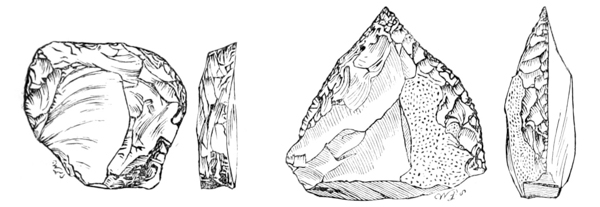
Fig. 455F.—Caddington.
1 ⁄ 2
At Harpenden,
8 1 ⁄ 2
miles from the source of the Lea, and not
far from the stream, he has obtained a few ochreous palæolithic
flakes. At Wheathampstead, a few miles further down the Lea,
he also met with a few ochreous flakes in gravel near the railway
station.
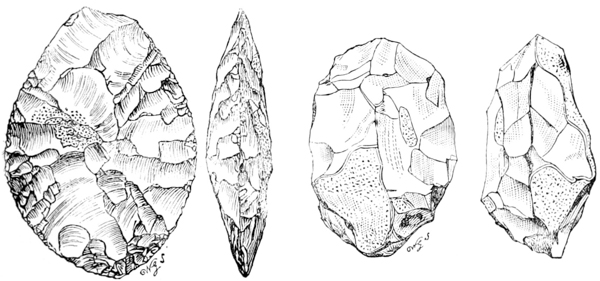
Fig. 455H.—Wheathampstead.
1 ⁄ 2
In gravel brought from No Man’s Land, a common about a
mile south of Wheathampstead, the late Rev. Dr. Griffiths, of
Sandridge, found two small ovate implements of whitened
flint, [2618]
one of which he presented to my collection. Mr. Worthington
Smith, on visiting the spot in 1886, discovered a rude implement of
nearly the same character in situ in the gravel, and has lent me
the block, [2619]
Fig.
455H,
on which it is represented. He subsequently
found an implement with only one
edge and the point {602}
chipped into shape, also in situ. He likewise discovered a third
implement and a well-formed scraper in the beds. The gravel
at No Man’s Land is in a valley along which in former times the
Lea or a branch of its stream may have taken its course. Near
Ayot St. Peter [2620]
and Welwyn, in the valley of the Maran, Mr.
Worthington Smith has found flakes only. I have recorded the
finding of an implement at North
Mimms, [2621]
south of Hatfield.
At and near Hertford and Ware, the Lea receives several other
affluents coming from the north. Among these is the Beane, the
present source of which is near Stevenage. At Fisher’s
Green, [2622]
a little to the north of that town, pointed ochreous implements
have been found in the brick-earth by Mr. Frank Latchmore
and myself. I have also a rough ovate specimen made from a
large broad flake, and found in a brick-field south of Stevenage.
Further south, in gravels exposed in a cutting of the Great
Northern Railway near
Knebworth, [2623]
some well-formed implements,
both pointed and ovate, were found in 1887. I have
several specimens, as well as an ovate implement found on the
surface in 1890. Still farther south, in a clay-pipe near
Welwyn Tunnel, a pointed ochreous implement (4 inches) was
obtained in 1896, which Mr. Frank Latchmore has kindly added
to my collection.
Palæolithic implements have been found by Mr. Worthington
Smith in the gravels of the
Lea [2624]
and Beane at Hertford and
Ware, one of them at Bengeo. They are of pointed forms,
fairly well made, and much water-worn. He has recorded other
implement-bearing gravels a mile north-west of Ware and at
Amwell. General Pitt Rivers has a remarkably fine palæolithic
implement, which is said to have been found at Bayford, a mile
or so south-west of Hertford.
In the valley of the Stort, which joins the Lea near Hoddesdon,
two palæolithic implements have been found by Mr. W. H.
Penning, F.G.S., in the neighbourhood of Bishop’s Stortford.
Though in both instances lying on the surface, yet the condition
of the implements is such that there can be no doubt as to their
having been but recently dug out of the soil; the colour of both
is a dark brown, ochreous in places, and the
general appearance {603}
much like that of the implements found in the brick-earth at
Hoxne. One of them was found at a short distance from the
river, by the side of a ditch cut in a thin deposit of valley brick-earth,
about a mile north of Bishop’s Stortford, and probably
had been thrown out with the soil from the ditch. It is 5 1 ⁄ 2
inches long and
3 3 ⁄ 4
inches broad, and in form it much resembles
Fig. 421. The other is of the same character, but is somewhat
broader, and is squarer at the base. It was found farther north,
on the sandy surface of a ploughed field, close to Pesterford
Bridge.
In 1872 Mr. Penning also found, near Stocking Pelham, five
miles north of Bishop’s Stortford, an ochreous, somewhat water-worn,
oval implement 5 inches in length.
At Flamstead
End, [2625]
one mile west of Cheshunt, and on the right
side of the Lea, Mr. Worthington Smith has obtained several
implements in the gravels, some of which he has kindly added to
my collection. He has also found specimens at Bush Hill Park
and Forty Hill, near Enfield; Rowan Tree Farm, Lower Edmonton,
and between Edmonton and Winchmore Hill. For his discoveries
on the east or left side of the Lea I must refer the
reader to Mr. Smith’s book, “Man, the Primeval Savage.” Suffice
it to say that he has found implements in Drift deposits at
Plaistow, [2626]
Stratford, Leyton, Leytonstone, Wanstead, Walthamstow,
Higham Hill, West Ham, Forest Gate, and Upton. In the
valley of the Roding he has added Barking, East Ham, and
Ilford, and farther east again Rainham, Gray’s Thurrock, Little
Thurrock, Tilbury, Mucking, Orsett, and Southend.
Mr. Hazzeldine Warren, of the Cedars, Waltham Cross, has
obtained several palæolithic implements from gravels at Bull’s
Cross and Bush Hill Park, Enfield, and a few at Hoddesdon. A
fine pointed specimen (7 inches) from Bull’s Cross is rather like
Fig. 459, but is battered at the butt.
From gravel at Grove Green Lane,
Leyton, [2627]
some good
pointed implements have been obtained by Mr. A. P. Wire. One
of them is 6 inches long.
A thin ovate implement made from a piece of tabular flint
was found in gravel at Lake’s
Farm, [2628]
Cannhall Lane, Wanstead.
A sub-triangular implement with a heavy butt was found in
gravel of the Roding Valley at St. Swithin’s
Farm, [2629]
Barking {604}
Side, and two others at Wallend, one mile west of Barking town.
Mr. G. F. Lawrence found an oval implement in situ at
Stratford. [2630]
I have a rude specimen found at Shoeburyness by Mr. B. Harrison.
Returning to London we must notice some discoveries on the
southern side of the Thames.
In 1872 [2631]
General Pitt Rivers recorded the finding of a
palæolithic implement and a flake in gravel on Battersea Rise,
at the junction of Grayshot Road and the Wandsworth Road; and
in an excavation for a new house on Battersea
Rise, [2632]
near
Clapham Common, on one of the higher gravel-terraces of the
Thames, Mr. Worthington Smith picked up a palæolithic implement
in 1882.
Mr. G. F. Lawrence has also found two or three implements
in gravel at East and West Hill, Wandsworth, on each side of
the Wandle, as well as at Earlsfield. One from the latter place,
now broken, must originally have been of very large size. This
and another are pointed. He has also found one at Lavender
Hill, and a small ovate specimen at Roehampton.
At Lewisham also an implement has been discovered. One of
ovate form (4 inches) was found in 1874 in gravel on Wickham
Road by Mr. A. L. Lewis, and by him liberally added to my
collection.
Further south, in a branch of the valley of the Ravensbourne,
on a patch of gravel upwards of 300 feet above Ordnance Datum,
Mr. George Clinch, [2633]
in 1880, found several ovate palæolithic
implements, and in subsequent years many more; in all some
fifty [2634]
in number.
About four miles farther east, at Green Street
Green, [2635]
about
250 feet above Ordnance Datum, Mr. H. G. Norman found two
palæolithic implements, on the surface of what is now a dry part
of the valley of the river Cray, about two miles above its present
source. They are both of ovate form, one much like Fig. 420,
the other like Fig. 468. Each is about
5 1 ⁄ 2
inches in length.
“The gravel at this spot has afforded remains not only of the
mammoth, but also of the musk-ox.” {605}
Mr. de B. Crawshay [2636]
has also found about 40 ovoid and
pointed palæolithic implements near Green Street Green.
The valley may be traced upwards for nearly five miles, in a
south-easterly direction, to Currie Wood, between Knockholt and
Shoreham; and on the border of this wood, not far from Currie
Farm, I found on the surface of the ground, in 1869, a well-marked
flint implement, in character and size closely resembling
that from Swalecliffe, Fig. 462, and stained of a rich ochreous
colour. In places there are some ferruginous concretions
adhering to the surface, and it has all the appearance of having
been derived from the gravel which here not unusually forms the
superficial deposit. A part of one of the faces has been lost
owing to a recent fracture, and it can be seen that the implement
has been formed of what is now a light buff, somewhat chalcedonic,
flint, similar in character to that of most of the pebbles in the
gravel at Well Hill, near Chelsfield, about midway between
Currie Wood and Green Street Green. A subsequent search on
the spot, in company with Sir John Lubbock, Sir Joseph Prestwich,
General Pitt Rivers, and Sir Wollaston Franks, was unproductive
of any more specimens. The remarkable feature in the case is the
elevation at which this implement was found, the level of the
ground being probably 300 feet above the neighbouring valley of
the Darent, and upwards of 500 feet above the sea. Regarding
the gravel, however, as connected with the valley of the Cray,
and not with that of the Darent, its elevation above the head of
the valley is but slight. In 1872 I remarked that it was
“necessary that further discoveries should be made in this
district, before it will be safe to speculate on the origin of these
gravels, and their relation to the superficial configuration of the
neighbourhood.” Since then, as will be seen in subsequent
pages, these discoveries have been made.
Farther down the valley of the Cray than Green Street Green,
near Dartford Heath, about half a mile to the south of Crayford
Station, Mr. Flaxman C. J. Spurrell, F.G.S., has been so fortunate
as to discover, in situ, the beautifully symmetrical implement
which, through his kindness, I am enabled to engrave as
Fig. 456.
It is of dark, brownish grey flint, in places mottled with white.
It is worked to an edge all round, but is less sharp towards the base
than towards the point. On one side, near
the point, the edge {606}
has been worn away by use into a curved notch. On the opposite side
is a more modern break. It is almost equally convex on the two
faces.
Mr. Spurrell informs me that he found this implement lying on its
face, at a depth of 8 feet below the
surface of the gravel, which is that
of the upper level of Dartford
Heath, and appears to belong to
the valley of the Thames, and not
to that of either the Cray or the
Dart.
Another implement has been
found near the same spot by
Mr. C. C. S. Fooks. [2637]
A little to
the north of Crayford, in the
brick-earth below an old cliff of
chalk and Thanet sands, Mr.
Spurrell has found a number of
flakes of flint associated with
remains of the Pleistocene fauna.
He has, indeed, discovered a
“Palæolithic floor” on which
the ancient workmen lived while
they fashioned their tools. Not many of the larger implements
were found, but many of the flakes after having been struck off the
nucleus had been trimmed at the butt-end. By patience and skill
Mr. Spurrell was able to bring many of the flakes together into
their original positions, and thus to reconstitute the blocks of flint
from which they had been
manufactured. [2638]
In one instance he
was able to build up around an implement—broken in old times—the
various flakes struck off during its manufacture, and thus to
reproduce the block of flint originally taken in hand by the
workman. Two hammer-stones were present, made from cylindrical
nodules of flint.
It is to be remembered that in
April, [2639]
1872, the Rev. O.
Fisher, F.G.S., found a worked flint, or flake, in Slade’s Green
Pit, Crayford, beneath a sandy stratum containing among other
shells those of Corbicula fluminalis. In 1875 a large broad flake
(5 1 ⁄ 2
inches) was picked up by Dr. J. H. Gladstone,
F.R.S., [2640]
in a {607}
brick-earth pit at Erith. It is figured and described in the
Argonaut. [2641]
Another flake found in 1876 in the same stratum as
that in which ten years earlier a skull of a musk ox occurred,
has been figured by Professor Boyd
Dawkins. [2642]
The fauna of the Crayford beds is remarkable, and comprises
two Arctic forms, Oribos moschatus and a Spermophilus, as well as
Megaceros hibernicus, Rhinoceros megarhinus, tichorhinus and
leptorhinus, Elephas primigenius and antiquus, lion, hyæna, bear, and
bison. Professor Boyd Dawkins regards it as
Mid-Pleistocene. [2643]
Before proceeding to discuss the discoveries that have been
made in and near the valley of the Darent, it will be well to
follow the course of the Thames a little farther eastward, and
record those that have been made in the neighbourhood of Northfleet,
opposite Gray’s Thurrock. At several places within about
a mile of Northfleet Station, and to the west of it, especially at
Swanscombe, Milton Street, and Galley Hill, gravel has been dug
in considerable quantities, and has proved to contain a very large
number of palæolithic implements of various forms, among which
the pointed type is most abundant. At Milton
Street [2644]
the
surface level is about 100 feet above the Thames, and at Galley
Hill [2645]
about 90 feet. It was in this pit, apparently at a depth
of about 8 feet from the top of the gravel, that a human skull, or
to judge from the presence of both tibiæ, a whole skeleton, was
discovered in September, 1888. No formal account of the discovery
was given until nearly seven years afterwards, when Mr.
E. T. Newton, F.R.S., communicated a detailed notice of the skull
and limb-bones to the Geological
Society. [2646]
I was present at the
meeting, but it appeared to me that the evidence as to the contemporaneity
of the bones with the containing beds was hardly
convincing, and I ventured to assume an attitude of doubt with
regard to the discovery which I still maintain. There can, however,
be no question as to the true palæolithic character of the
implements found in the gravels, of which a few are figured
in illustration of Mr. Newton’s
paper. [2647]
Leaving the Thames we come to the valley of the Darent, in
which, about a mile
E.S.E. [2648]
of Horton Kirby, Mr. W. Whitaker,
F.R.S., in 1861, found upon the surface, on
the top of a hill, a {608}
small ovate implement about
3 1 ⁄ 2
inches long, and in form much
like Fig. 468.
At Lullingstone, [2649]
at an elevation of 400 feet, another implement
has been found, and a pointed specimen of the Amiens type was
picked up by Miss H. Waring on Cockerhurst
Farm, [2650]
near
Shoreham, at the level of about 430 feet.
I now come to the numerous and important discoveries made
during the last thirty years by Mr. Benjamin
Harrison, [2651]
of Ightham,
which, aided by Sir Joseph Prestwich’s interpretation of
them, have done much to revolutionize our ideas as to the age and
character of the Drift deposits capping the Chalk Downs in
Western Kent, north of the escarpment facing the Weald.
All around Ightham, at different elevations above the bottom
of the neighbouring valley of the Shode, Mr. Harrison has succeeded
in discovering palæolithic implements of flint, for the most
part of oval or ovate forms, but not unfrequently pointed. Fane
Hill, Bewley, Chart Farm, Stone Pit Farm, Stone Street, Seal
and Ash to the North may be mentioned among the localities
where his search was successful. He has also found nearly fifty
implements in the talus of Oldbury
Hill. [2652]
Some of those from Seal occurred at a height of 420 feet above
Ordnance Datum, and on what appeared to be the watershed
between the Medway and the Darent. An almost circular specimen
formed of ochreous flint and found at Bewley, Ightham, is shown
in Fig. 456A.
For full particulars of the localities and their relative levels,
the reader must be referred to Sir Joseph Prestwich’s comprehensive
paper [2653]
on the occurrence of palæolithic flint implements in
the neighbourhood of Ightham, Kent, in which about forty places
are mentioned. Since that paper was published, Mr. Harrison,
aided by Mr. de B. Crawshay, has extended his researches with the
result that many more implements have been found at high elevations
to the north of the escarpment of the chalk. These discoveries
enabled Sir Joseph Prestwich in another
paper [2654]
on the Age,
Formation and successive Drift-stages of the valley of the Darent,
and on the origin of its chalk escarpment, still farther to extend
his interesting speculations. It is true that
he accepts as being {609}
of human manufacture, flints with bruised and battered edges,
which I and some others venture to regard as owing their shape
to purely natural causes. But fortunately this does not invalidate
his arguments, as in most cases where the so-called “Plateau
types” have been found, more or less well-finished palæolithic
implements of recognized form, though much abraded and deeply
stained, have also been discovered. The evidence of such witnesses
is not impaired by calling in that of others of more
doubtful character.
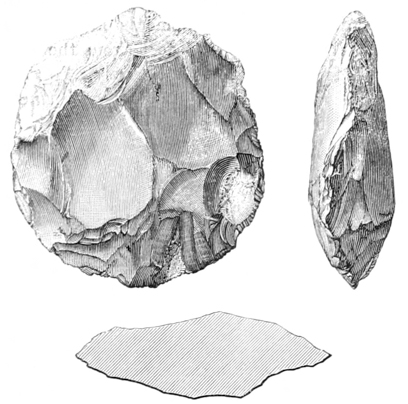
The continuous slope now extending from the neighbourhood
of the Thames to the summit of the Chalk escarpment, and in
many places capped with implementiferous drift, appears to have
been continued southward within the human period over a part of
what is now the Lower Greensand area, if not, indeed, into that
of the Weald; and subsequently the great valley that now intervenes
between the Lower Greensand escarpment and the North
Downs must have been excavated.
Whatever causes we may assign for the changes in the surface-configuration
of the district, it must be borne in on all that the time
required to effect them is beyond all ordinary means of calculation.
West of Ightham, at the head of the present valley of the
Darent, is Limpsfield, [2655]
the scene of some interesting
discoveries {610}
made by Mr. A. Montgomerie Bell. These, also, have been discussed
by Sir Joseph Prestwich in his paper on the Drift-stages of
the Darent valley, already mentioned; but for the following account
of the locality I am in the main indebted to Mr. Bell. Palæolithic
implements have been found by him and others in the parish of
Limpsfield, Surrey, from the year 1883 up to the present time.
They are of the usual forms, both pointed and oval, symmetrical
and well made, though rarely exceeding
4 1 ⁄ 2
inches in length.
Many of them have been found on the surface of the ground;
but in a gravel-pit on the water-shed between the Darent and the
Medway, at an elevation of 500 feet above the sea, Mr. Bell has
succeeded in obtaining several implements out of the solid bed of
gravel, at depths of from 3 to 7 feet from the surface. The
gravel is about 8 feet in thickness and covers a considerable area.
The late Mr. Topley [2656]
has pointed out that it presents some features
that are unusual in river gravels, and Mr. Bell is inclined to
invoke some kind of ice-action in its formation. I content myself
with recording these opinions.
Besides the gravel there is a second implementiferous deposit at
Limpsfield, on the slope of the Lower Greensand escarpment.
Here more than three hundred implements have been found, at
elevations of from 450 to 570 feet above the sea, principally on
the surface, but also in the brick-earth at a depth of from
3 1 ⁄ 2
to 5
feet. They have been most frequent on Ridland’s Farm, and
comprise all the forms that are usually obtained.
Eastward of Ightham, within the watershed of the Medway, implements
from the gravels have been obtained at West
Malling. [2657]
Dr. C. Le Neve Foster, F.R.S., in 1865, picked up a broken
ovate implement about a quarter of a mile S.W. of Marden Church,
on the edge of the valley of the Teise, an affluent of the Medway.
Though found on the surface, it is of an ochreous colour, and
apparently has been derived from some bed of gravel. In the
same year, in the valley of the Medway itself, at Sandling, he
found a rude, almost circular, implement, which, though on the
surface, was also ochreous.
The most important discoveries, however, have been made in the
well-known pits near Aylesford, in which some very fine implements
have been found. I have several, one of which, of pointed
form, with a heavy butt, must originally have
been 9 inches long. {611}
It has, however, had the end broken off. Mr. B. Harrison has
given me another thinner and more perfect pointed specimen made
from a flat block of flint. Numerous remains of the pleistocene
fauna have been found in the gravels.
In 1862, Prof. T. McK. Hughes, F.R.S., found a rude palæolithic
implement near Otterham Quay, Chatham, and another at
Gillingham, in the same neighbourhood. He also picked up a small
oval implement at Tweedale, half-way between Chatham and Upchurch;
and one of larger size, 5 inches long, with a rounded
point and truncated base, on the railway, west of Newington Station.
Prof. Hughes likewise found a rudely-chipped implement
in gravel said to have been brought from a pit near the railway-cutting
at Hartlip. There may be some question whether the
gravels at these latter places would be more properly classed as
belonging to the valley of the Thames, or to that of the Medway.
On the north of the Medway, at St. Mary, in the hundred of
Hoo, Mr. W. Whitaker, F.R.S., found a small, neatly-chipped,
pointed implement; and another at Stoke, in the same district,
with rounded point, and sub-triangular in form. They are both
ochreous in colour, and have their angles much abraded. To the
south of Gravesend, at some distance from either the Medway or
the Thames, near Meopham, Nursted, and Cobham, he has also
found broken implements of palæolithic types.
In the Christy Collection is an ovate implement,
4 1 ⁄ 4
inches long,
in form like Fig. 462, which was discovered by Mr. E. A. Bernays
on a heap of gravel at Chatham.
I have also an ovate implement found in gravel at the Engineering
School, Chatham, in 1882, by Prof. J. W. Judd, F.R.S.,
who presented it to me; as well as a good pointed implement
found at Chatham by Mr. Worthington Smith.
Farther east, Prof. Hughes found a large implement, which,
though wanting its point, is 8 inches long, in gravel said to have
been brought from a pit on the hill north of the railway, and
half a mile east of Teynham Station; and at Ospringe, near
Faversham, Prof. W. Boyd Dawkins found, in 1865, not in
gravel, but on the surface, a small, neatly-chipped, ovate implement.
In form it resembles Fig. 467, from the Isle of Wight,
but is white and porcellanous. I have another fine specimen, from
the brick-earth at Faversham, which was given to me by Mr. J. W.
Morris of that town. It is 5 inches long, in form much like Fig.
456, but thinner, and it has weathered to a porcellanous white on {612}
one face, and to a light grey on the other. South of Faversham,
at Moldash, Mr. C. E. Hawkins, of the Geological Survey, in 1872
came across a smaller and thicker porcellanous ovate implement
lying on the surface of the ground. In the same district,
1 1 ⁄ 2
miles
south of Selling Church, Mr. W. Whitaker, F.R.S., has found
another small pointed implement of palæolithic character. {613}
It is, however, in the neighbourhood of Herne Bay and Reculver,
that palæolithic implements have been found in the greatest number.
The first discoveries in that locality were made in the autumn of
1860 by Mr. Thomas
Leech, [2658]
who had studied in the School of
Mines, in Jermyn Street, and who, while searching for fossil
remains at the base of the cliff between Herne Bay and Reculver,
picked up a flint implement which he at once recognized as
analogous in form with some of those from the River-drift of the
valley of the Somme. Continuing his search, he found six implements
in all, which he placed in the Museum of Economic Geology,
in Jermyn Street. One of those is shown full size in Fig. 457, from
a block which has already been used in the Archæologia. It is of
considerable interest, as having been formed from a Lower Tertiary
flint pebble, and not from a flint derived directly from the chalk.
The rounded end of the pebble, which forms the butt of the
instrument, is admirably adapted for being held in the hand. It
is singularly like the implement from St. Acheul, shown in Pl. I.,
Fig. 9.
On being informed of this discovery, the late Sir Joseph Prestwich
and I at once visited the locality. I have also been there on many
subsequent occasions. The implements in this case have not been
found in their original matrix, but exposed upon the sea-shore at the
base of the cliff, between Herne Bay and Reculver, and for the most
part at a short distance from the Bishopstone Coast-guard Station.
In all, there must have been upwards of a hundred discovered. I
have myself found at various times eight specimens. Sir Joseph
Prestwich, [2659]
Mr. James Wyatt, Mr. Whitaker, and others, have also found
some. The greatest number, however, have either been found by or
passed into the hands of the late Mr. John
Brent, [2660]
F.S.A., of Canterbury,
who has supplied a series of twelve or fourteen to the Christy
Collection.
A magnificent implement was found near Bishopstone about 1891,
and has been brought under my notice by Col. A. J. Copeland, F.S.A.
It is rather more pointed than Fig. 472, and is 11 inches long and
nearly 6 inches wide towards the base. It rivals in size that from
Shrub Hill, mentioned on p. 569.
The majority of the specimens seem to be of the pointed form, of
which the implement engraved full size in Fig. 458 offers a fine
example. It was found by myself in 1861, and has already been
figured in the Archæologia, [2661]
as has also Fig. 459, the original of which
was found by Sir Joseph Prestwich.
A small, but rather curious implement from Mr.
Brent’s collection {616}
is shown in Fig. 460. It is slightly curved in the direction of its
length, and has a remarkably
thick butt. The original of
Fig. 461 is in the Christy Collection,
and has been made
from a broad flake, which has
subsequently been chipped
into an oval form. Its surface
is much altered in structure,
and has become mottled and
ochreous. In general character
this instrument much resembles
the large broad flakes
from the gravel at Montiers,
near Amiens, but it has been
chipped to a more symmetrical
outline than that which they
usually present. Another, of
much the same form, has been
found by Mr. Brent, in the
gravel at Canterbury. An engraving
of another pointed implement
from Reculver is given
in Once a Week. [2662]
A few specimens
have been found of oval or ovate, and of sub-triangular form,
and equally convex on both
faces.
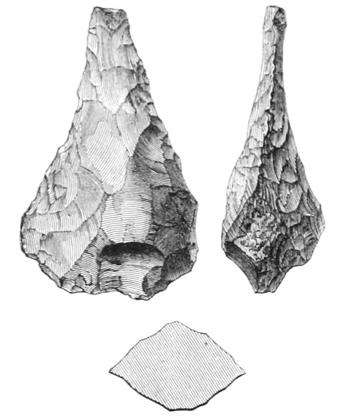
Thanks to Mr. F. Rutley,
F.G.S., I have a small
ochreous oval implement,
which he found on the
shore
1 1 ⁄ 2
miles west of Reculver.
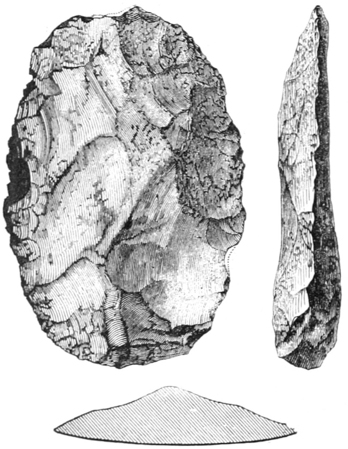
Though the implements are usually found on the sea-shore at the
foot of the cliff, there can be no doubt of their being derived
from the gravels at its summit. They are generally somewhat worn
by the action of the waves, but occasionally they have preserved
their edges quite sharp, and their angles unabraded, so that
they could not have been many days upon the shore, and must have
been quite recently derived from the cliff. I have, indeed, been
informed by a coastguard-man that in {617}
1884 he found an implement in situ in the gravel on the cliff
somewhat west of Old Haven Gap. Many of them are stained of
the same ochreous colour as the other flints in the gravel, and I
have, moreover, in one instance, found the point of an implement
on the surface a short distance inland. Dr. G. D. Gibb,
F.G.S., [2663]
also records finding a broken implement on the top of the cliff, half-way
between Herne Bay and Reculver. The late Mr. Brent, F.S.A.,
had a long flake stained of an ochreous colour, and apparently
derived from the gravel, which also came from the top of the cliff.
The lower part of the cliff, of which a section has been published
by Sir Joseph Prestwich, [2664]
consists of Thanet Sands and the
sandy beds of the Woolwich Series, above which is a local pebbly
clay deposit of small extent, and about 8 feet thick, to which he is
inclined to refer the flint implements. Its height is about 50 feet
above the sea. At a higher level farther west, near Old Haven Gap,
are other gravel beds, which he presumes to be of older date. Into
this question I need not enter, but for further geological details will
refer the reader to my account of this discovery in the
Archæologia. [2665]
There are pits, in which gravel is dug, near Chislet, where not improbably
similar implements will eventually be discovered. I may add
that it is difficult to form an idea of the position of the coast-line at
the time when these gravels, which appear to be of freshwater origin,
were deposited; as, owing to the soft nature of the base of the cliffs,
the gain of the sea upon the land has been very rapid in this district,
for even since Leland’s time—say three and a half centuries ago—it has
encroached nearly a
mile, [2666]
but to this subject I shall have to recur.
To the west of Herne Bay, and about midway between that place and
Whitstable, is another cliff, near Studhill, where, in the gravel which
caps it, 50 feet above the sea, I have found a portion of a molar of
Elephas primigenius, and at the foot of the cliff, rather farther to the
west, the implement shown full size in Fig.
462. [2667]
It is stained of an
ochreous colour to some depth, and its surface is much altered in
structure. Sir Joseph
Prestwich [2668]
seems inclined to refer this implement
to a stratum of clay and gravelly sand at a lower level, but its
colour is more in accordance with the higher beds. I subsequently
picked up another implement of sub-triangular form, deeply stained,
and much waterworn at the edges, at the foot of the same cliff. Tusks
and bones of Elephas
primigenius, [2669]
are stated to be found near this spot
when the cliff falls, as is frequently the case, from its being undermined
by the sea. Elephants’ teeth are occasionally dredged up off the
shore, and I have seen one which was found on the shore at Reculver.
At Swalecliffe, nearer Whitstable, where, in the shingle, an
ochreously-stained flint flake was found by my son, and again, nearer
Herne Bay, at Hampton, there are more argillaceous freshwater beds
at a lower level, and containing land and marsh shells; but these seem
to be comparatively modern, and connected with small lateral valleys
rather than with the main valley of the Thames, or of any other
ancient river. {618}
Immediately east of Reculver lies the marshy valley which separates
the Isle of Thanet from the rest of Kent, a valley which is traversed
by the river Stour, the principal stream of which passes by Sandwich,
eastward, while a smaller channel connects it with a small stream
rising to the west of Chislet, and conducts part of its waters northward
to Northmouth sluice. The Stour and its tributaries drain an
area of upwards of 300 square miles, and not far from its source at
Rowton Chapel, near Lenham, Mr. G. Bunyard, of Maidstone, found
in 1885 a good ovate palæolithic implement of flint, while near
Canterbury, flint implements have been found in considerable numbers
in the gravels in the neighbourhood of the river.
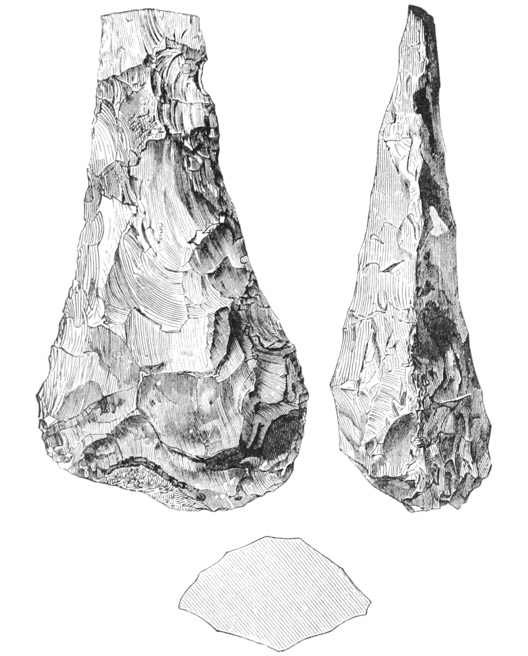
Their discovery is due to the late Mr. John Brent, F.S.A., of Canterbury,
with whom I have visited the neighbourhood, and who has
most kindly furnished me with all the information at his command,
including some particulars of the levels, and
has allowed me to {619}
engrave some of his specimens. One of the finest of these is shown
in Fig. 463. The flint of which it is composed has become porcellanous,
and nearly white. Small portions of the original crust are
left at the base, and on one of the faces; the point has been broken
off in ancient times. It was found in Thanington parish, on the surface,
and not in the gravel, from which, however, it was undoubtedly
derived. Several other specimens have been found in the same
manner, among stones gathered from the surface of the slope of the
southern side of the valley of the Stour, between Thanington and
Canterbury. I have a pointed implement, but unfortunately broken,
which was found by the late Mr. Frederick Pratt Barlow, on a heap of
stones, when he visited the spot with me in 1868. The gravel beds
near Thanington, out of which the implements appear to have come,
must be from 80 to 100 feet above the river. Nearer Canterbury, at
the back of Wincheap, between the waterworks and the gasometer,
pits have been sunk in the gravel, at a lower level,
where the surface {620}
of the ground is about 29 feet above the river, from which the pits are
distant about 600 yards; and from this spot Mr. Brent has procured
several well-wrought implements of various forms. One of these is
shown in Fig. 464. [2670]
Its surface is
lustrous, and of an ochreous colour,
and the central ridge is waterworn.
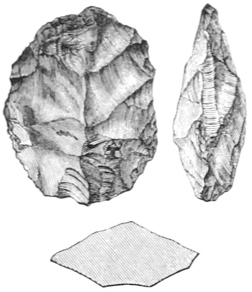
The gravel, which is about 12 feet
in thickness, and rests on the chalk,
is coarse, and consists principally of
sub-angular flints, with an admixture
of rounded chalk, sandstone and iron-stone
pebbles, with some fragments
of fossil wood apparently from the
Thanet Sands. The matrix is sandy,
and there are some sandy veins. In
parts of the pit there is a great thickness
of brick-earth or loam. No land
or freshwater shells have as yet been
found, but some mammalian remains
have occurred, among which is a
molar of Elephas primigenius. At a
lower level, in the gravel exposed by drainage works along Wincheap,
I found several flakes; and more recently, in 1870, Mr. Brent
has kindly sent me two pointed implements found in gravel in a pit
near the new gasometer, where the surface is lower than that near the
waterworks by 5 or 6 feet. One is of much the same type as the
Reculver specimen, Fig. 458, but of coarser workmanship, and about
6 inches long. The other is less symmetrical, and only
4 1 ⁄ 2
inches in
length. The surface of each is very much bruised and waterworn, and
deeply stained of a dark ochreous colour.
There are in my collection numerous other specimens from Canterbury,
both pointed and ovate. Many of them are deeply stained and
much waterworn. One of these, by the kindness of Mr. Worthington
Smith, is shown in Fig.
464A. [2671]
The white patches marked A show
where chips that have been detached before the implement was left in
its final position in the gravel have left an unabraded surface. Mr.
Smith regards this implement as one of the oldest class, and certainly
it appears to have met with many vicissitudes and to have travelled a
long way down the valley of the Stour before attaining its last resting-place.
Another specimen, from the New Cemetery, is sharp and unabraded,
and almost black and unstained. A fine pointed implement
7 inches long, has become white and porcellanous.
Higher up the valley, an implement has been found on the surface
near Chilham, by Mr. John Marten, formerly of Easinge. It was at a
distance of a quarter of a mile from the river, and at a height of
about 100 feet above it.
Lower down, near Wear Farm, between Chislet and Reculver, on
the western bank of the North Channel of the Stour, is a pit with
sand and loam above the chalk, which has been
described by {621}
Prestwich. [2672]
In the lower beds of sand, at a height of but a few feet above
the sea, he found freshwater shells (including the Corbicula fluminalis),
mammalian remains, and valves of the marine shell Balanus, as well
as Entomostraca and Foraminifera, characteristic of brackish water conditions.
It would appear that we have here another instance of the
occurrence of beds with the Corbicula, at no great distance from those
productive of flint implements, but at a lower level. From a pit of
the same character, on the opposite side of the road, I have seen
elephant remains in the possession of Mr. Slater, of Grays, near
Chislet.
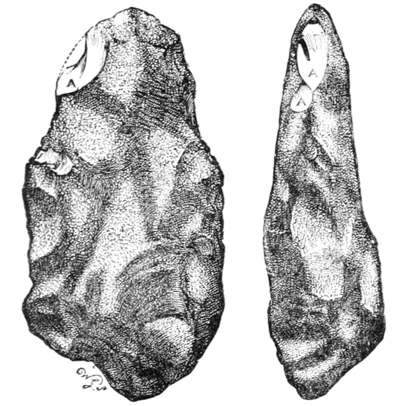
Another palæolithic implement of ovate form was discovered in
1865, on a heap of stones, about 3 miles north of Folkestone, by Mr.
W. Topley, F.R.S., of the Geological Survey. It is of course impossible
to say from what source it was derived; but it may be
mentioned that at Folkestone itself, at the top of the West Cliff, near
the Battery, at the height of 110 feet above low-water mark, are
some beds of Drift of much the same character as those in which
flint implements have occurred in other localities, containing remains
of Elephas primigenius, Hippopotamus major, and other mammals, and
shells of Helix.
Since this passage was written, a remarkably well-shaped ovate
implement has been found in St. John’s Road (Radnor Park end),
Folkestone, by Mr. Richard Kerr, F.G.S., in August, 1893. It lay in
brick-earth at a comparatively low level, and is of flint partially
whitened. With it was found a molar tooth of Rhinoceros tichorhinus.
It is now, through Mr. Kerr’s kindness, in my collection, and is represented
in Fig.
464B.
{622}
Proceeding along the southern coast, the next discoveries that have
to be recorded are those made to the west of Eastbourne by Mr. R.
Hilton. At Bell’s Field, Friston, he has found ovate implements,
both ochreous and white and porcellanous, and he has given me a
pointed implement from Crow Link Gap, East Dean. Although found
on the surface and not in gravel or brick-earth, the implements present
types which seem to justify their being regarded as of Palæolithic age.
Farther west, in the so-called Elephant bed at Brighton, a bed
apparently of subaërial origin, and containing numerous mammalian
remains of the Pleistocene period, Mr. Ernest Willett, in 1876, found a
well-marked ovate implement,
5 1 ⁄ 2
inches long, of the type shown in
Plate II., No. 11.
With these exceptions, if such they be, the valleys of the smaller
rivers along the southern coast of England have as yet been barren of
discoveries of implements in their gravels, until we come to the Itchen
and the Test, which unite below Southampton, and now discharge into
Southampton Water. As will be subsequently seen, there is good
reason for believing that at the time when these implements were in
use, a portion of the ground now covered by this estuary formed the
bed of a river, itself a branch of a larger stream, only a small part of
the course of which now remains, and that in a greatly altered condition,
having been widened out into the Solent and Spithead.
The localities at which palæolithic implements have been found in
the neighbourhood of the Itchen and Test are as yet mainly confined
to the lower part of their course, namely, near the town of Southampton
and along the shore of Southampton Water. The first discoveries
in the district were made in
1863, [2673]
by Mr. James Brown, of
Salisbury, who found several implements in
the neighbourhood of {623}
Hill Head, about nine miles S.E. of Southampton; while the earliest
discoveries near the latter place are of somewhat more recent date,
and due to Mr. W. Read, C.E., until lately a resident
of Southampton.
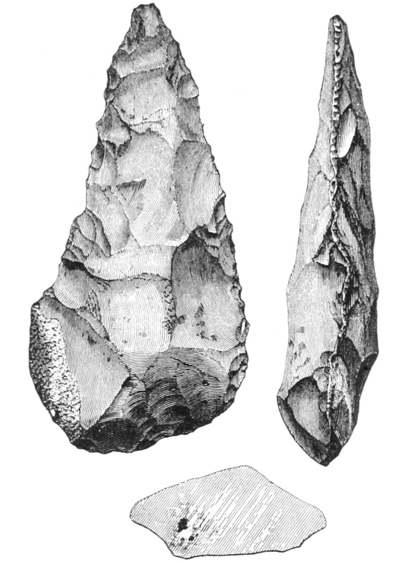
I take the Southampton discoveries first, as being nearer the sources
of the rivers. The implements obtained by Mr. Read have come from
four different excavations in the gravel, at some distance from each
other, three of them on Southampton Common, all of which I have,
through his courtesy, had the opportunity of examining in his company,
and the other at Freemantle, to the west of the town, about 60
feet above mean-tide level. The first of those on the Common was on
the southern side, close by the road leading to the cemetery, where a
section of gravel about 6 feet in thickness was exposed. This consisted
principally of sub-angular flints and Lower Tertiary flint-pebbles
mixed with a few of quartz, in a loose sandy matrix, and with some
sandy and marly seams in places. At the base of the gravel was found
the pointed implement shown in Fig. 465. It is stained of an ochreous
colour, and has a projection on one side, towards the base, like that on
the implement from Thetford, Fig. 427. One face is more carefully
chipped than the other, and the edges and angles
are slightly {624}
water-worn. The elevation of the ground, at the spot where it was found,
is estimated to be 86 feet above the mean
sea-level. [2674]
In another small pit, at a rather higher level, and close to the N.E.
corner of the cemetery, at a depth of 5 feet from the surface, an oval
implement was found by Mr. Read, in situ, in the gravel, which here
attains a thickness of about 8 feet. In this, as also in the preceding
case, a bed of brick-earth or loess has been removed from above the
gravel. The surface of this implement is ochreous and polished, and
its angles are waterworn. The periphery is much twisted, like that
of Fig. 434 from Santon Downham.
At the N.W. corner of the Common, fully half a mile from the first
pit, and at a higher level still, where the surface of the ground is
stated to be more than 160 feet above the mean sea-level, was the extensive
excavation known as the Town Pit. The gravel here retains
the same character, but is perhaps rather less coarse; and above it
is a thin bed of marl, which separates it from the loess or brick-earth,
which in most places has been removed for use. The gravel itself
attains a thickness of from 8 to 15 feet, and from “a fall,” at about
6 feet from the surface, was picked out an ovate implement
4 1 ⁄ 2
inches
in length, and in form like Fig. 419 from Bury St. Edmunds. Its
edges are sharp, and its surface lustrous and stained of an ochreous
tint, though on one face the flint has become partially whitened.
Another and still more interesting specimen
(5 1 ⁄ 2
inches), which, like
that last described, is now, by the kindness of Mr. Read, in my own
collection, has also been found in this pit. It is irregularly oval in
form, being somewhat truncated at one end, but bearing a strong
general resemblance to that from Hill Head, Fig. 466. Its surface
is lustrous and deeply stained all over of a bright ochreous colour, and
its angles and edges are much waterworn. The significance of this
fact, in the case of an implement found in gravel capping a gently
sloping tongue of land, between two rivers, the levels of which are
now 160 feet below it, will be considered hereafter. Numerous other
implements have been found near Southampton, and extensive collections
of them are in the possession of Mr. W. E. Darwin and Mr. W.
Dale. There is also a series in the Hartley Institution at Southampton.
Higher up the valleys of the Itchen or the Test, none of the more highly-wrought
implements have as yet been found in the gravels, although it
seems probable that they may eventually be discovered, especially if the
drift-beds at some considerable height above the present river levels be
excavated. I have, however, seen a flake with one face artificial, and
with signs of use or wear at the edge, which was found in a gravel-pit
near the Fleming Arms, Swathling, a few miles north of Southampton,
by Mr. Spencer G. Perceval. In the gravel near this place
a molar of Elephas primigenius is recorded to have been
found. [2675]
I have also a deeply-stained ovate implement from Redbridge,
close to Southampton, found by Mr. Worthington G. Smith.
I have already, in 1864, described
elsewhere [2676]
the discoveries
which have been made in the gravels on
the eastern shore of {625}
Southampton Water, in the neighbourhood of Hill Head. Since
that time a considerable number of flint instruments have been
found in this locality, principally by Mr. James Brown, the original
discoverer, and his friends.
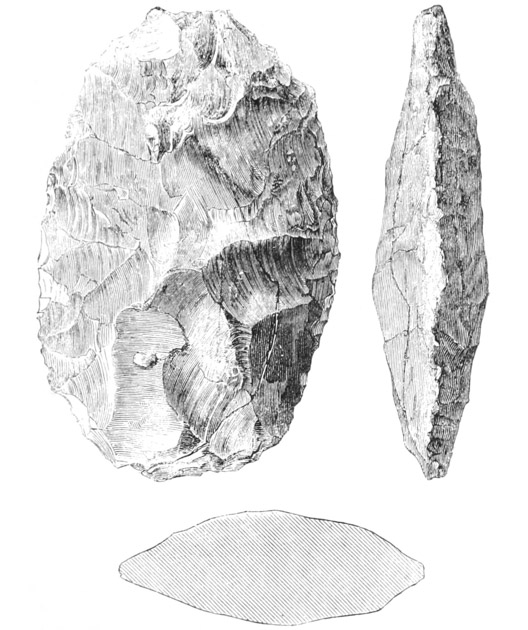
A large number of specimens from this district are preserved
in the Blackmore Museum at Salisbury. Among them is at least one
of chert. Of those found near Hill Head, a large proportion are flat,
oval, and ovate specimens, one of which is engraved as Fig. 466. It
was found by Mr. James Brown, in 1863, on the shore between
Brunage and Hill Head. It is ochreous, and has its angles slightly
waterworn, possibly in modern times, by the action of the pebbles on
the shore. Some of the specimens have suffered considerably from
this cause; but that the implements are derived from the gravel is
proved by the fact of one having been discovered by Mr. James
Brown, [2677]
in a mass which had fallen from the
cliff. Some of the {626}
implements are of the pointed form with straight sides, and a few
have the rounded butt of the flint left untouched, apparently by way
of handle. One or two well-chipped broad flakes have also been found.
The discoveries have extended over about 9 miles of the coast between
Warsash and Gosport. Along a great part of this distance there is a
low cliff, ranging in height from about 20 to 38
feet [2678]
above the mean
sea-level, and consisting of sands belonging to the Bracklesham series,
capped by gravelly beds, in many places 10 to 12 feet thick, and
in some, as much as 15 or 16 feet. These beds are almost continuous,
and rest on a nearly horizontal base, except where the cliff is intersected
by transverse valleys. The gravel consists almost entirely of
chalk flints, mostly subangular, among which are some of considerable
size, and some quite fresh and unrolled. There are also a
few quartz and chert pebbles in the mass, and some large blocks of
sandstone of Tertiary origin. Some loamy and sandy beds occur at
intervals, but no mammalian remains or land or freshwater shells
have, I believe, as yet been found in these beds of Drift. The gravels
extend eastward a considerable distance, as may be seen on the
excellent map [2679]
given by Mr. Codrington in illustration of his paper
on the Superficial Deposits of this District, as well as on the new Geological
Survey Map. Since his paper was written Mr. Codrington has
found in situ, in a gravel-pit at Warsash, a mile to the north of Hook a
well-wrought, long, pointed implement, at a height of about 46 feet
above the mean sea-level. Two implements, one of them much like Fig.
468, found on Southsea Common to the east of Portsmouth, by Lieut.
Oliver, R.E., and Mr. G. Smith, are now in the Blackmore Museum.
During building operations at Lee on the
Solent, [2680]
numerous palæolithic
implements have been found and preserved by Sir J. C. Robinson,
F.S.A., to whom I am indebted for several specimens.
On the other side of Spithead, at the Foreland or most eastern point
of the Isle of Wight, the cliff-section shows a bed of shingly gravel,
apparently a beach-deposit, according to Mr. Codrington, and between
30 and 40 feet thick, resting in a deep valley in the Bembridge marl.
Towards the edge, where the gravel would abut against the marl, it
is cut off by a trough filled with brick-earth 36 feet thick, with a few
seams of small angular flints. This brick-earth appears to extend
some distance upwards over the slope of the marl as well as over the
shingly gravel; and among some flints derived from it, at a height of
about 80 feet above the mean sea-level, Mr. Codrington found the
neatly-chipped ovate implement shown in Fig. 467. Its surface is
lustrous and in part whitened, and its angles and edges are sharp and
unworn. The possible connection of the bed containing this instrument
with others in this district is a matter for future consideration.
The discovery is not, however, the only one that has been made in
the Isle of Wight. I have two ovate water-worn specimens, found
on the shore at Bembridge, and a thick, pointed implement, found on
the beach between the flag-staff at Bembridge Point and the ferry.
Prof. E. B. Poulton, F.R.S., has also found two implements on the
shore at Seaview between
Ryde and Bembridge. {627}
I now turn to the discoveries made in the valleys of the Avon and its
affluents, which drain an area of about 670 square miles. The first of
these took place in the River-drift beds, in the neighbourhood of
Salisbury; beds which were pointed out by Sir Joseph Prestwich in
1859 [2681]
as likely to contain implements of the same class as those from
the valley of the Somme. This prognostication was made in ignorance
of the fact that, already in 1846, a palæolithic implement had
been found near Salisbury, and had come into the possession of the
late Dr. S. P. Woodward, of the British Museum, who at that time
put it aside, as having little reference to his own special studies.
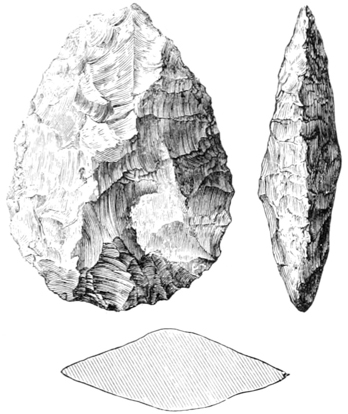
In 1863, however, Dr. Humphrey P. Blackmore, of Salisbury, discovered
a flint implement in the gravel at Bemerton, near that town; and
since that time numerous other discoveries have been made by him in the
district, and also by the late Mr. E. T. Stevens, Mr. James Brown, and
other explorers resident at Salisbury, the results of whose zealous researches
may be seen in the admirable Blackmore Museum. These discoveries
have been made in the valleys of the Avon and the Wiley, and
also on the spur of land separating those streams, and on that between
the Avon and the Bourne. In the valley of the Avon, implements have
been found at Lake, about 6 miles above Salisbury; and also at Ashford,
near Fordingbridge, about 12 miles below its junction with the Wiley
and Nadder at that city. As Lake is the highest point in the Valley of
the Avon proper at which, up to the present time, such discoveries have
been made in the River-drift, it will be well to notice it first, though it
must be mentioned that Mr. F. J. Bennett, of the Geological Survey, has
found a good palæolithic implement farther north, near Pewsey Station.
Implements were found at this spot, in 1865, by
Mr. Tiffin, jun., of {628}
Salisbury, [2682]
but only a few have since been discovered, as the gravel is
little, if at all, worked; and it is therefore only on the slope of the
hill where the beds have been cut through by the deepening of the
valley that they occur. That shown in Fig. 468 is preserved in the
Blackmore Museum. It is stained of an ochreous tint, and is worn
at its edges. Others of similar form, but white, have also been found,
as well as some large broad flakes. It is needless to discuss the character
of the gravel, as so many discoveries, of which the circumstances
can be better ascertained, have been made in the same neighbourhood.
In the valley of the Wiley, at South Newton, about 5 miles above
Salisbury, an isolated specimen of a flat ovate implement has also
been found.
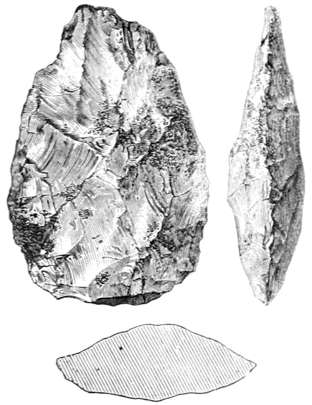
Nearer Salisbury, at Bemerton and Fisherton, the discoveries have
been of more interest and importance. They have already, to some
extent, been described by
myself, [2683]
principally from information given
me by Dr. Humphrey P. Blackmore. The beds of Drift at these two
places are at different levels on the slope of the north side of the valley
of the Wiley, and of different characters; that at Bemerton being at
the higher level, and principally gravel, and that at Fisherton lower,
and principally consisting of brick-earth, with a few gravelly seams.
The pit at Bemerton, in which most of the implements have been
found, is about a mile west of Salisbury, nearly opposite the new
church, and close to the lane connecting the roads to Wilton and
Devizes, and nearly midway between them. The gravel consists
mainly of subangular flints, with a few Upper Greensand pebbles and
Tertiary sandstone blocks in a red clayey matrix.
It is 10 to 12 feet {629}
in thickness, and attains a height of at least 100 feet above the river,
though in this particular pit it is only about 80 feet above it. The
gravel caps the hill, instead of lying merely in a trough along its side,
so that in this particular, the section I have elsewhere given is incorrect.
The chalk comes nearly to the surface, lower down the slope,
and divides the gravel from a brick-earth deposit continuous with that
of Fisherton, farther down the valley.
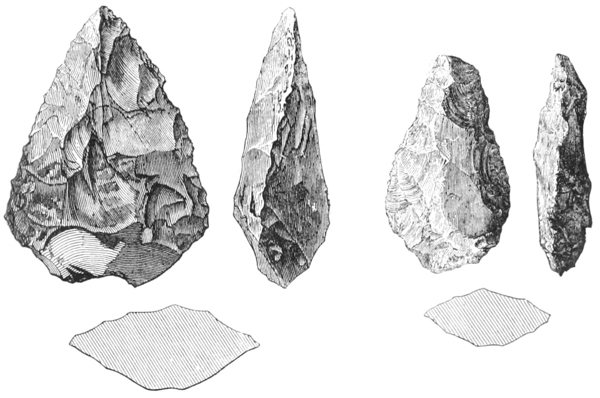
Fig. 470.—Highfield.
1 ⁄ 2
The implements found at Bemerton are principally oval, ovate, and
ovate-lanceolate. They are for the most part considerably altered in
texture at the surface, and many of them are
much rolled and waterworn. A few flakes
and spalls of flint have also been found.
The original of Fig. 469 is in the Blackmore
Museum, and is of grey flint, not
waterworn. It shows some marks of use on
the edge, towards the point, and a portion
of the natural crust of the flint remains at
the base. In all, upwards of twenty specimens
have been found in this gravel, one
of them as high as the cemetery. Several
others have also been found between that
place and Highfield, which is about a
quarter of a mile nearer Salisbury than the
Bemerton Pit; and in gravel which there
caps the hill between the Wiley and the
Avon, implements have also been found.
A remarkably small specimen from this
place is shown in Fig. 470. It is of grey flint, slightly ochreous, and
with its angles somewhat worn. The original is in the Blackmore
Museum. {630}
I am not aware of any organic remains having as yet been found in
these upper gravels, though they are abundant in the brick-earth at a
lower level, at Fisherton Anger, where, however, flint implements are
so scarce that only few have been found; two of these are in the
Blackmore Museum. One of them, obtained beneath remains of the
mammoth, in 1874, [2684]
is shown in Fig. 471. The flint of which it is
made has become white and porcellanous, its angles are sharp, but
along the edges of both sides towards the base there are marks of
wearing away by use. The other specimen is only fragmentary, but the
flint has assumed the same characters. The edge is like that of Fig.
437; one face of the implement having been flat and the section wedge-shaped.
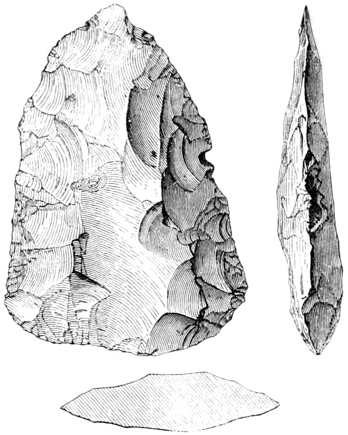
The Drift deposits at Fisherton have long been known to geologists,
and have been described by Sir Charles
Lyell, [2685]
Sir Joseph Prestwich, [2686]
and others. They present a great similarity to the implement-bearing
beds at Menchecourt, near Abbeville, as has been pointed out by Sir
Joseph Prestwich; [2687]
and this circumstance led us to visit the spot in
1859, with a view of discovering works of man in the beds, though at
that time our search was unrewarded.
It is needless for me here to describe the beds in detail: suffice it
to say, that resting on a more highly inclined surface of chalk is a
deposit, the upper portion of which forms the surface of the present
slope on the northern side of the valley of the united Wiley and
Nadder. It is in some places nearly 30 feet in thickness,
but thins out {631}
towards the bottom of the valley. This
deposit, [2688]
leaving the superficial
soil out of the question, has usually in its upper part a rubbly
gravel, with angular and subangular flints, fragments of chert, iron-stone,
and chalk, mixed with clay and brick-earth, to a thickness of 4
or 5 feet; below that is from 10 to 18 feet of brick-earth mixed with
variable masses of flint and chalk rubble, and containing bones and
shells, principally in its lower part; below this again, from 1 to 2 feet
of fine marl, full of well-preserved shells and a few bones; and at the
base, flint and chalk rubble, with sand and clay.
The following species are recorded by Dr. Blackmore as having
occurred in these beds:—Canis lupus, Canis vulpes,
Hyæna spelæa, Felis spelæa, Bison
minor, [2689]
Bos
primigenius, Ovibos moschatus, Cervus tarandus, Cervus
(Guettardi?), Cervus elaphus, Equus (four varieties),
Rhinoceros tichorinus, Elephas primigenius, Spermophilus
(superciliosus?), Lemmus torquatus, Lemmus (norvegicus?),
Arvicola (sp. nov.?) and Lepus timidus.
Of birds, some bones of the wild goose, Anser segetum, have been
found, and portions of the shells of eggs corresponding to those of the
same bird, and of the wild duck, Anas boscas.
The land and freshwater shells consist of Ancylus, Limnæa, Planorbis,
Bythinia, Valvata, Pisidium, Acme, Carychium, Succinea, Helix,
Limax, Pupa, Zonites, and Zua.
It is worthy of notice in passing, that the presence of the musk ox,
the marmot, and the lemming, to say nothing of the reindeer, seems
to point to a colder climate having prevailed at the time of the deposit
of these beds, than now. The egg of the wild goose, if such it be, is
also suggestive of a more arctic climate; as the breeding-place of this
bird is presumably in the far north. This question of climate will
come under consideration farther on.
The discoveries at Milford Hill have already been placed on record
by Dr. H. P. Blackmore. [2690]
This hill, the name of which has on the old
Ordnance Map been by error assigned to Cricket Down, forms a spur
between the valleys of the Avon and the Bourne, and is in fact a
continuation of Mizmaze Hill, from which, however, it is cut off by a
transverse valley about 30 feet in depth. The summit of the hill rises
to an elevation of about 100 feet above the waters of the Avon and
the Bourne, which flow on either side of it, and unite below the point
of the spur. At the summit of the hill the gravel attains its greatest
thickness, which is about 12 feet. It rests on an irregular surface of
chalk, occasionally running down into pipes, and thins out towards
the sides, ceasing altogether rather more than half way down the hill.
In places, there is chalk rubble or gravel in a chalky matrix at the base.
The gravel consists principally of subangular flints, a few Tertiary
pebbles, and blocks of sandstone, and contains a larger proportion of
Upper Greensand chert than the Bemerton gravel—the whole mixed
with a variable proportion of sand and stiff clay, and for the most part
deeply stained by iron. Many of the large flints
are said to present {632}
no signs of wearing by water transport. On the slope of the hill, near
the base of the gravel, a narrow seam of sand was found to contain
some land shells of the genera Helix, Pupa, and Zua. No mammalian
remains, with the exception of a tooth of horse, have been found
in the gravel.
Flint implements have been discovered here in considerable numbers,
mostly of the pointed lanceolate form; some of ovate, and other forms,
including a scraper, have also occurred. Most of them are now in the
Blackmore Museum. More than one specimen is of chert. In about
150 yards of gravel, excavated to form a cellar at Elm Grove, Milford
Hill, no less than twenty implements of different forms were found,
principally by Mr. James Brown. Dr. Blackmore observes that the
implements on the side of the hill are relatively only half as numerous
as on the top, and that the condition of their surface varies considerably,
the majority being waterworn, but others having their edges
and angles as sharp as if they had been made yesterday. The degree
of staining also varies, and is not always due to their present position
in the gravel, some deeply stained having been dug out of the chalk
rubble at the base, where they lay side by side with fragments of
flint, which retained their original colour; and, on the other hand,
perfectly unstained specimens having been obtained from the ochreous
gravel. Several implements were observed, in situ, by Mr. Wheaton,
Mr. James Brown, and others; and they were found scattered
unevenly through the deposit, but the majority low down and towards
the base. Many of them are extremely rude; in fact, as a whole,
“ruder and less skilfully made than most of the specimens from the
valley of the Somme.” Flakes and spalls were found in considerable
numbers, and also a few remarkably well-made implements, of
which a magnificent specimen is shown in Fig. 472. It is of light-grey
flint, with the natural crust on part of the base. The face not
shown is roughly chipped, but it has been neatly wrought at the edge
to a symmetrical form. Its angles are but slightly rounded. A detailed
account of the discoveries at
Bemerton [2691]
and Milford Hill, with
maps and figures of several implements, has been given by Mr. C. J.
Read, of Salisbury.
A scraper-like implement from Britford, a short distance below
Salisbury, is in the Blackmore Museum.
About 6 miles below Salisbury, in gravel, near
Downton, [2692]
and at an
elevation of about 150 feet above the river Avon, Sir Joseph Prestwich
picked up a small ovate implement, in form like Fig. 456, but more
sharply pointed and only 3 inches in length. Between the pit, in
which it was found, and the river, two gravel-terraces occur, one
80 to 110 feet, and the other 40 to 60 feet, above its level. At
Breamore, farther south, a well-shaped pointed implement of chert
was found by Mr. E. Westlake in 1888, in gravels 100 feet above the
Avon.
A few miles farther down the valley, and about half a mile S.W. of
Fordingbridge, at
Ashford [2693]
railway station, is a gravel-pit, which was
largely worked for the purpose of ballasting the
railway, and in this {633}
gravel also, implements have been found; first by Mr. Toomer, of
Salisbury, in 1866, and subsequently by Mr. James Brown, myself,
and others. Several specimens are preserved in the Blackmore
Museum, one of which is shown in Fig. 473. It is of ochreous flint,
with the angles slightly waterworn. Some of the implements found
in this gravel have been much rolled. Mr. J.
W. Brooke, of {634}
Marlborough, has in his collection a series of about forty implements and
flakes from Fordingbridge, many of them water-worn.
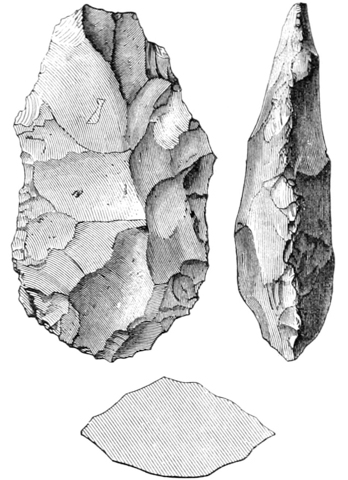
The gravel here rests upon Tertiary beds, and consists principally
of subangular flints, with many Lower Tertiary pebbles, a few
pieces of greensand iron-stone, and more rarely quartz pebbles among
them. The beds are about 10 feet thick, and their height above the
river about 40 feet. Remains of
mammoth [2694]
have been found in them.
Farther down the course of the Avon, palæolithic implements have
not as yet been found; and in the basin of the Stour, which joins
the Avon at Christchurch, but one discovery has been made. This
was of a small brown ochreous implement, made from a large external
flake, trimmed into a somewhat kidney-shaped outline, and
having its edges worn round, and its angles waterworn. It was
found at Wimborne Minster, by Mr. W. F. Tiffin, of Salisbury, in
gravel brought from a pit in the neighbourhood, and not in situ. I
have searched for implements, but in vain, in some of the pits near
Wimborne, though the gravel, especially at Oakley, has all the
characters of a deposit likely to contain them.
Though the united Avon and Stour now find their way into the sea
near Christchurch, it seems probable, as will subsequently be shown,
that they were in remote times affluents of a river running from west
to east, and that a portion of this river, now widened
out by the sea, {635}
has become the Solent between the Isle of Wight and the mainland.
The course of this ancient river appears to have been a little to the
south and seaward of the present line of the coast at Bournemouth;
and some of the gravels which formerly lined its valley now cap
the cliffs for some distance between Poole Harbour and Hengistbury
Head, and thence on in the direction of Portsmouth.
In these gravels, a very large number of palæolithic implements
has been found. The first discovery at Bournemouth was made in
1866, [2695]
by Mr. Alfred H. Stevens, of Salisbury, and in immediately subsequent
years they were principally due to Dr. H. P. Blackmore, my
son, P. Norman Evans, Mr. Albert Way, and others. The first implements
were found in the gravel, after it had been dug and spread upon
the roads; but Dr. Blackmore found an implement in situ, and two or
three rough flakes, close to Boscombe Mouth, at almost the highest
point of the cliff, more than 100 feet above the sea-level.
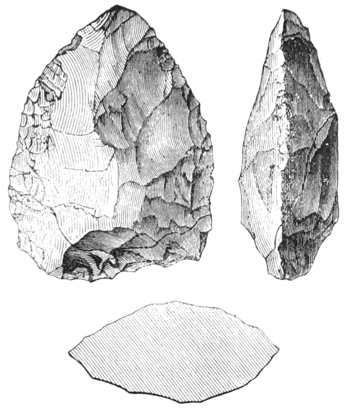
This implement, which is nearly white and unworn, is preserved in
the Blackmore Museum, and is represented in Fig. 474. Numerous
implements of other forms have since been found in the gravel dug in
the neighbourhood of Boscombe. Among them is a side-scraper 3 1 ⁄ 2
inches long and of the same type as that from Santon Downham,
Fig. 437. It was found by Mrs. E. Sandars, of Bournemouth, who
has kindly added it to my collection. A rude chopper-like implement
was also found there. One of the finest, however, of all the early
Boscombe implements is that shown in Fig. 475, which was found by
my son Norman in 1868. It has unfortunately lost
a portion near the {636}
base, through a crack in the stone, but is otherwise perfect. The
material is not, as usual, flint from the Chalk, but chert from the Upper
Greensand. The surface is slightly ochreous, and to some extent
lustrous. I have another implement of chert, but of ovate form, found
at Boscombe, as well as some good pointed implements of flint. In the
railway-cutting east of Boscombe, I, some years ago, found a flake of
flint. Other implements have been found in gravel which is believed
to have been dug to the west of Bournemouth, near the Bourne
Valley Pottery and the turnpike on the Poole road. That shown in
Fig. 476 was found by Miss Way, and kindly communicated to me by
her father, the late Mr. Albert Way, F.S.A. It is of flint, now of a
milky-white colour. Mr. Way has found three or four other specimens
of much the same character. I have two large, rather coarsely
chipped, irregularly oval specimens from the same gravels, both found
by my son Norman.
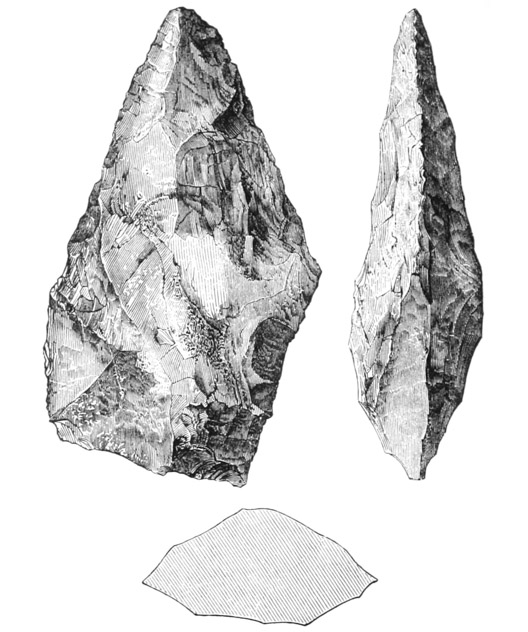
The beds near the turnpike are from about 6 to 8 feet thick, and
rest on a slightly irregular surface of Bagshot
Sands. The gravel {637}
consists principally of subangular and rolled flints, a few Tertiary flint-pebbles,
a considerable proportion of small quartz pebbles, and a few
fragments of old rocks and Upper Greensand chert; the whole in a
sandy matrix, and having in places some sandy seams. I am not
aware of any mammalian or molluscan remains having been found
in them. They are nearly, if not quite, on the summit of table-land,
slightly inclining seawards, and with the valley of the Bourne to the
north, with higher ground beyond it and also to the west. The surface
near the turnpike is about 130 feet above the mean sea-level.
Following the presumed course of the ancient river Solent for about
ten miles eastward, along what is now the coast, we come to Barton.
For the whole distance the land to the north is thickly capped with
gravel; and at Barton, on the slope of the cliff, a flat, oval implement,
6 inches long, and in form much like that from Hill Head, Fig. 466,
was found by an officer of the Coast Guard, about 1868, and was subsequently
presented to the Christy Collection by Mr. Albert Way, F.S.A.
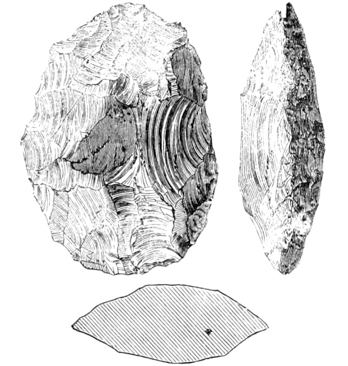
Since that time an astonishing number of palæolithic implements
has been found in the district extending from Chuton Bunny by
Barton and Hordwell to Milford. I have about sixty specimens from
this district in my own collection, many of them very perfect of their
kind. For the most part they have been picked up on the shore and
on the talus of the gravel-capped cliff, but they have occasionally been
found in the gravel itself. A few have been made of Upper Greensand
chert, but the majority are of flint. Nearly all the usual types are
represented, several by large examples. I have pointed, oval, and ovate
specimens, as much as 8 and
8 1 ⁄ 2
inches in length. Those from the
gravel are as a rule sharp and but little abraded, while the condition
of those found on the shore depends upon the length of time that they
have been exposed to the rolling action of the sea since their fall from
the cliff. {638}
A palæolithic flake has been found still farther east, at
Stone, [2696]
between Exbury and Calshot Castle.
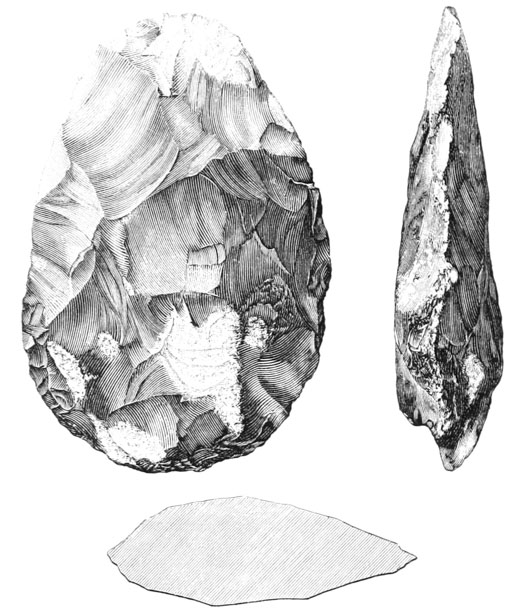
Assuming the existence of an ancient river Solent flowing at an elevation
of upwards of 100 feet above the present level of the sea at Bournemouth,
its western sources must have drained much the same basin
as that of the rivers now discharging into Poole Harbour; but without
at present entering into that question, I may mention the discovery
of a palæolithic implement at Dewlish, about 3 miles N. of Piddletown,
Dorsetshire, by Mr. James Brown, of Salisbury. It is very neatly
chipped, but slightly unsymmetrical in form, one side being straight
and the other curved; but in general character it resembles Fig. 430
from Thetford, having been made from a large flake, and showing the
original crust of the flint at its base. It was found on the surface, at
the top of a high hill, at no great distance from the branch of the
Trent or Piddle, which flows past Dewlish.
Elephant [2697]
remains have
been found near the same place, which have, however, been assigned
to Elephas meridionalis. {639}
In the Blackmore Museum there were in 1872 four implements of
chert, of oval and tongue-shaped types, found during the erection of
the telegraph posts between Chard and Axminster. There was also
another thin oval implement of ochreous flint,
7 1 ⁄ 2
inches long and 3 1 ⁄ 2
broad, which was found near Colyton, Devon. The exact locality
where those first mentioned were found, is unknown; but it appears
probable that the gravel, like that at Colyton, belongs to the valley
of the Axe, in which I suggested in 1872 that further search should be
made.
Such a search has long since been rewarded. In
1877 [2698]
I recorded
some discoveries at Broom, near Axminster, and in 1878 the late Mr.
W. S. M. D’Urban [2699]
gave an account of the ballast pit at Broom, in the
parish of Hawkchurch, near Axminster, and close to the river Axe.
It was worked in a low hill consisting of chert gravel intermingled
with seams of ferruginous and sandy clay, and a section was exposed
about 40 feet deep, the base being about 150 feet above the level of
the sea, which comes within a distance of about six miles. At that time
numerous palæolithic implements of various types had been found in the
pit. They were formed of dark Upper Greensand chert, and some were
much water-worn, while others were quite sharp and uninjured. Since
then very many more have been collected, and a fine series of them is
preserved in the Albert Memorial Museum at Exeter. There are also
some good specimens in the Horniman
Museum [2700]
at Forest Hill, S.E.
I have engraved a typical example of the ovate form in my own collection
as Fig. 477.
Some implements from Broom are of large size. I have a very rude
specimen that I found among the ballast on the South Western Railway
in August, 1877. It is
8 1 ⁄ 2
inches long and 6 inches wide. Other
specimens are small. The ovate type seems to predominate, but the
pointed forms are not scarce. A few broad flakes trimmed at the
edges, of the so-called Le Moustier type, occur with the other forms.
In the valley of the Culm, at Kentisbeare, near Cullompton, Mr. W.
Downes, [2701]
in 1879, found a chert implement in form like Plate II.,
Fig. 17.
With the exception of those from the bone-caves of Devonshire, no
palæolithic implements have as yet been found farther
west in Britain.
 ,
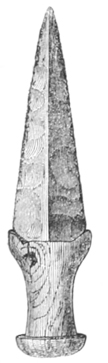

 are translated sharp knives,
which by analogy with a passage in Psalm lxxxix. 44 (43
 )
observes upon the passage, “This
is a circumstance worthy of remark; and goes to show at least,
that knives of stone were found in the sepulchres of Palestine, as
well as in those of north-western
Europe.”
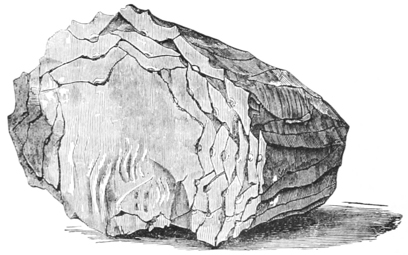
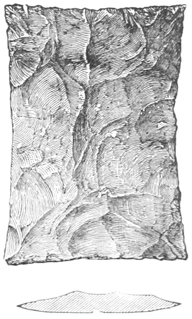
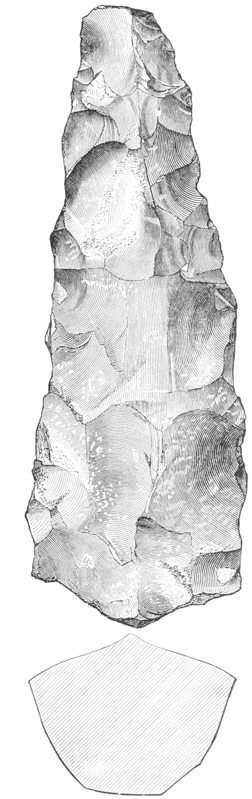
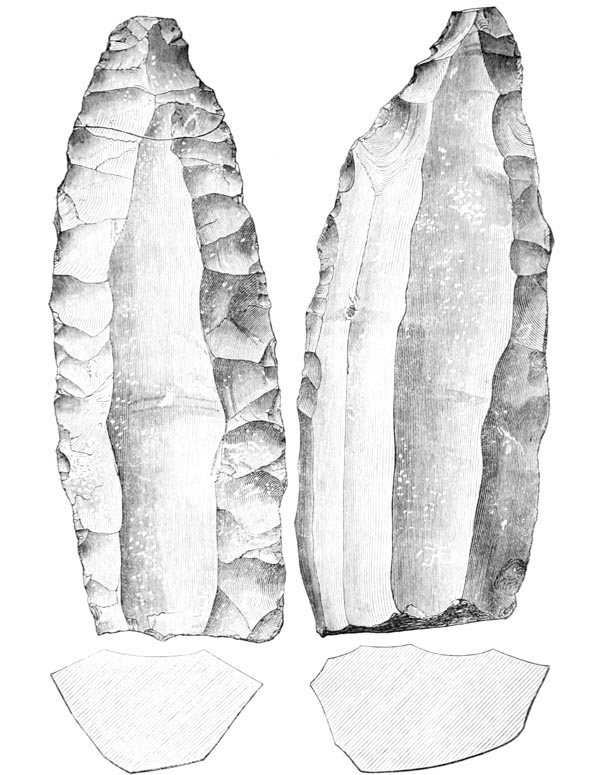
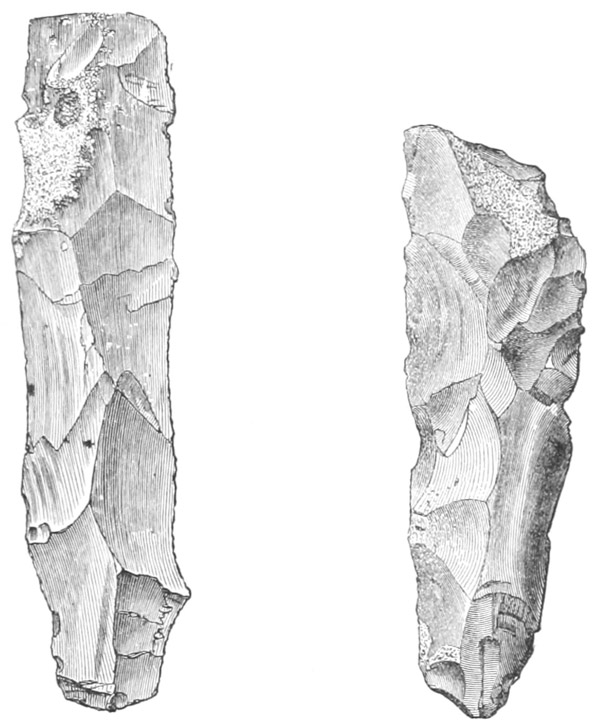
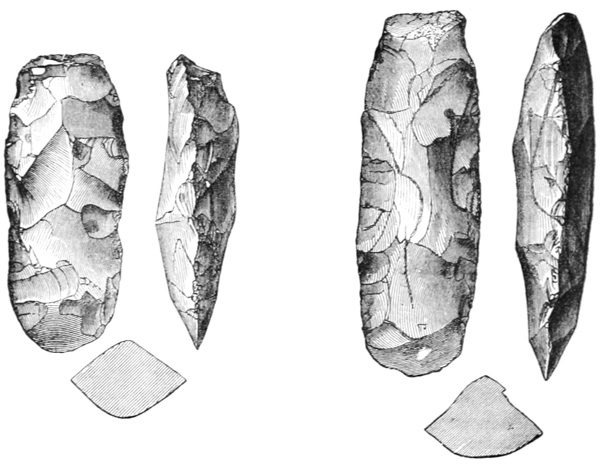
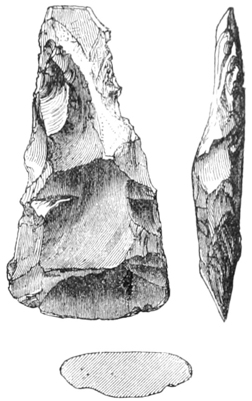
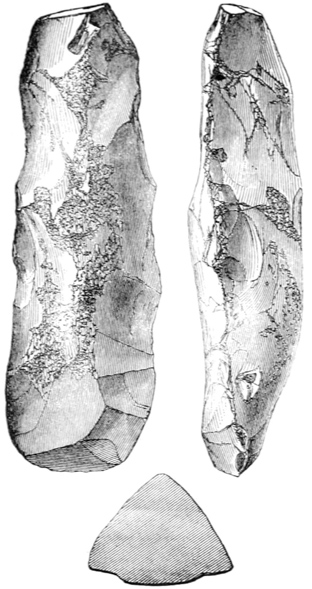
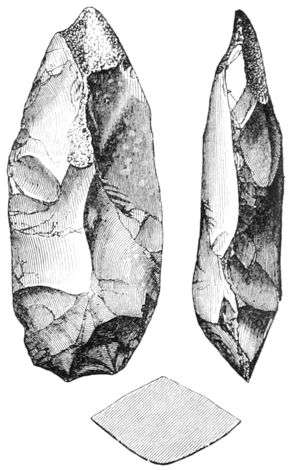
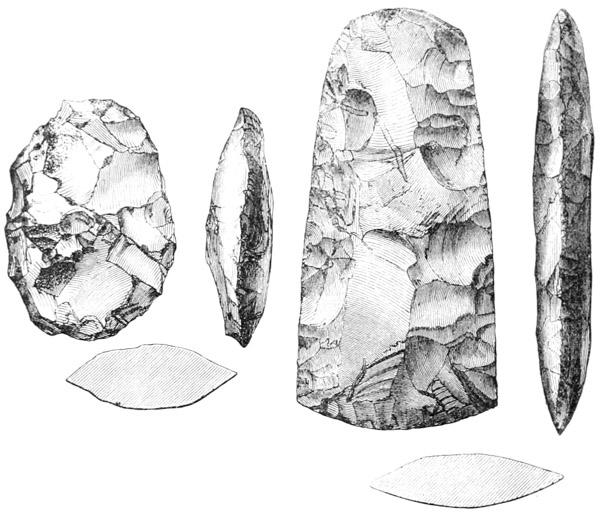
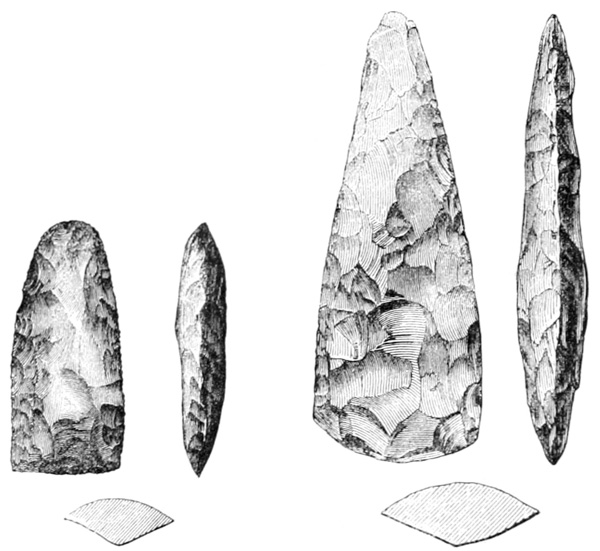
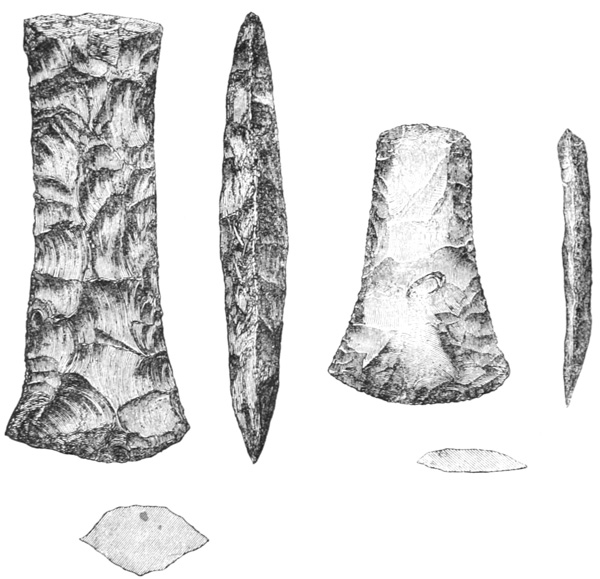
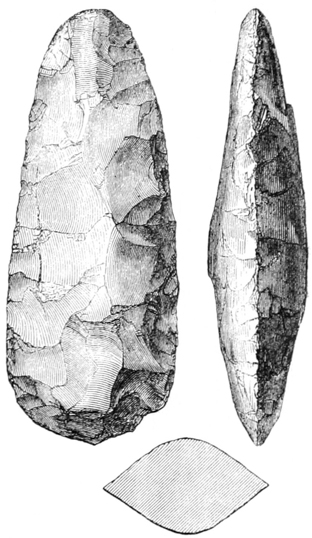
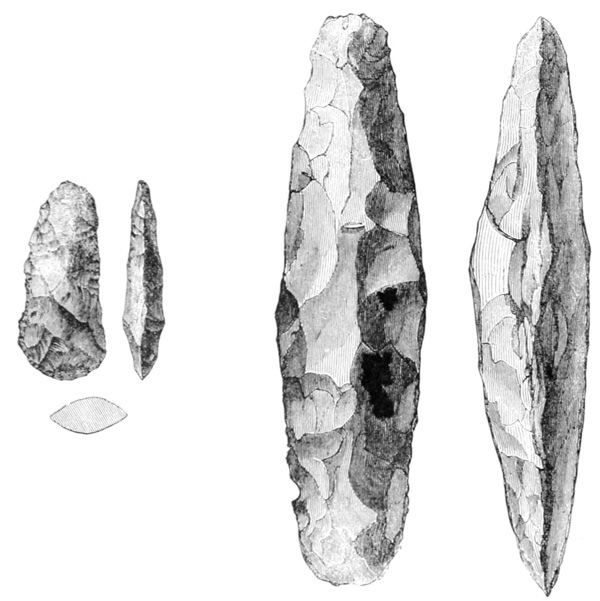
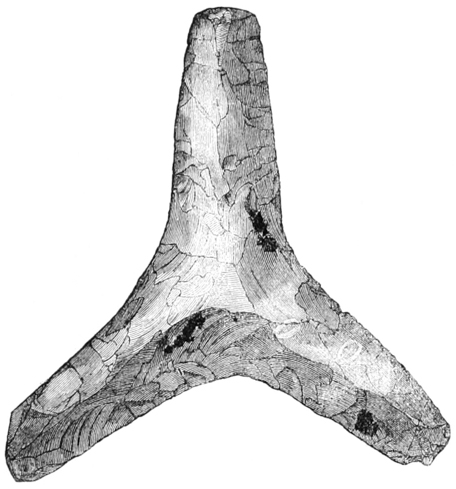
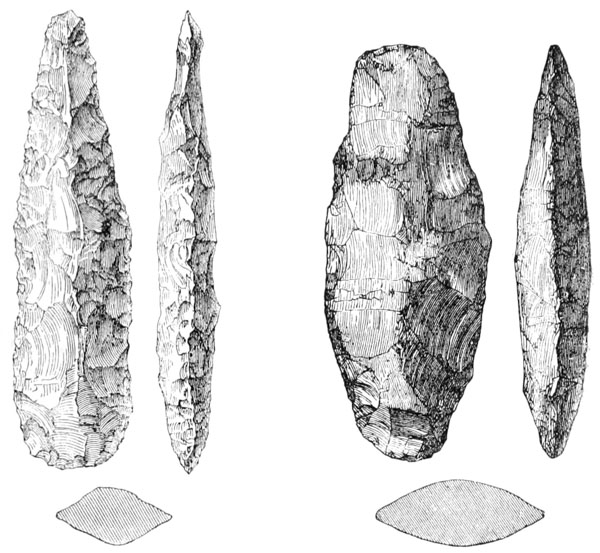
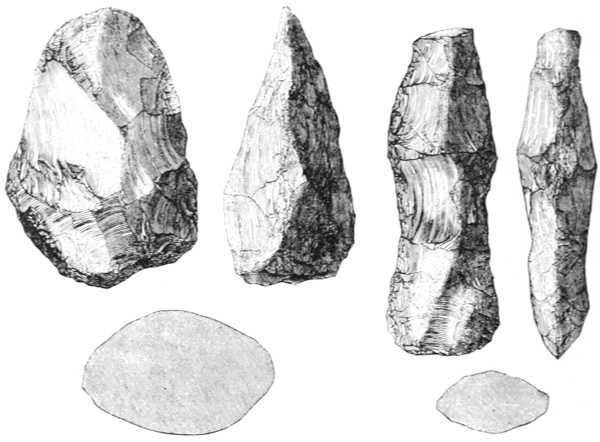
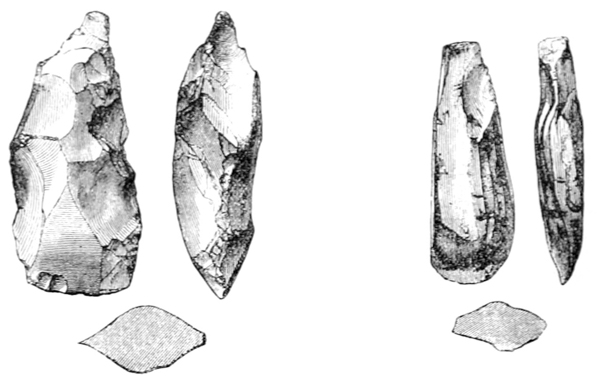
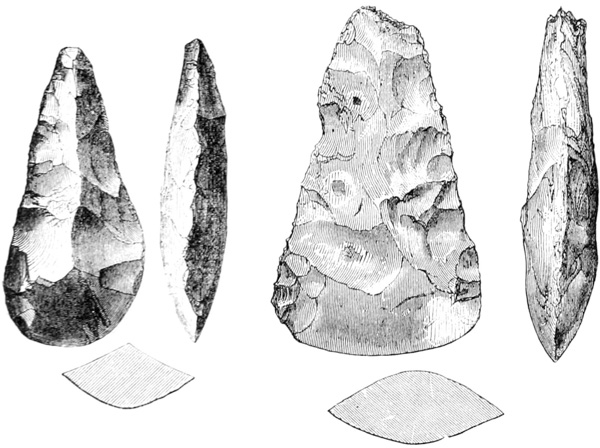
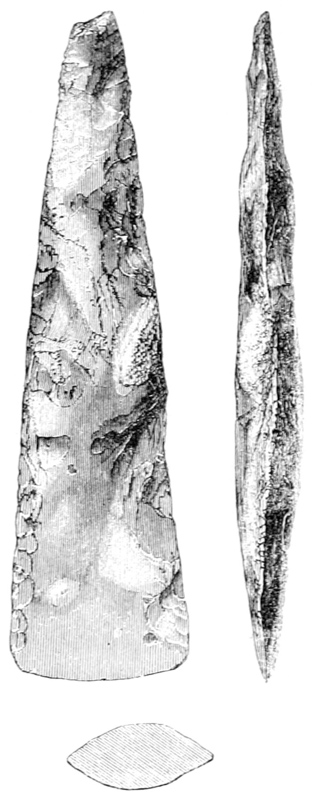
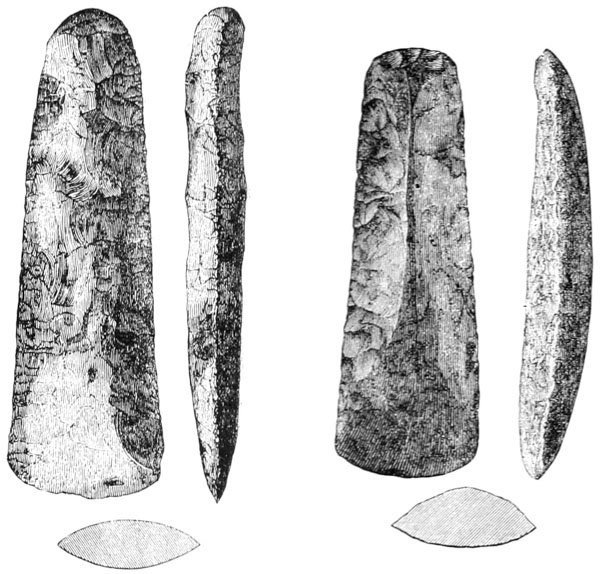
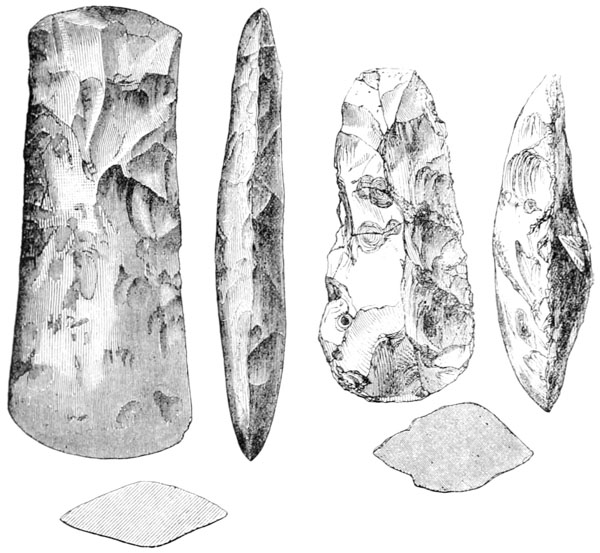
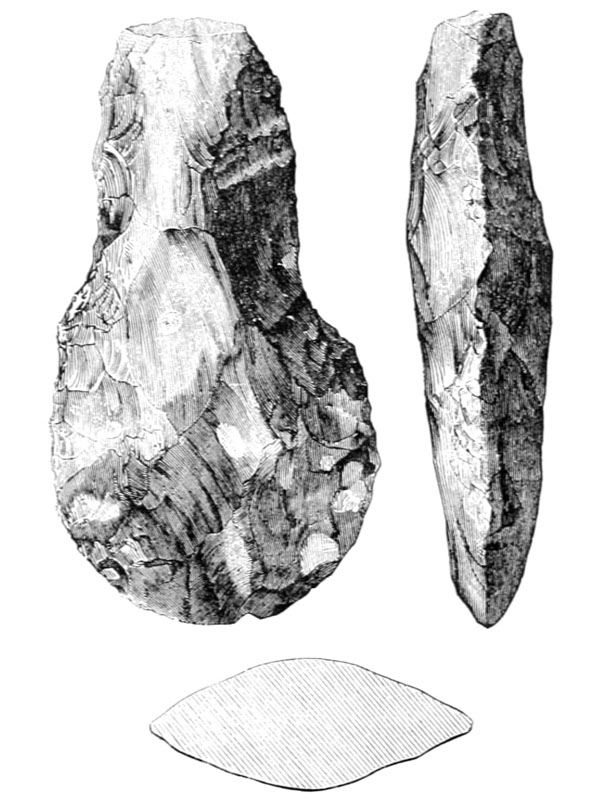
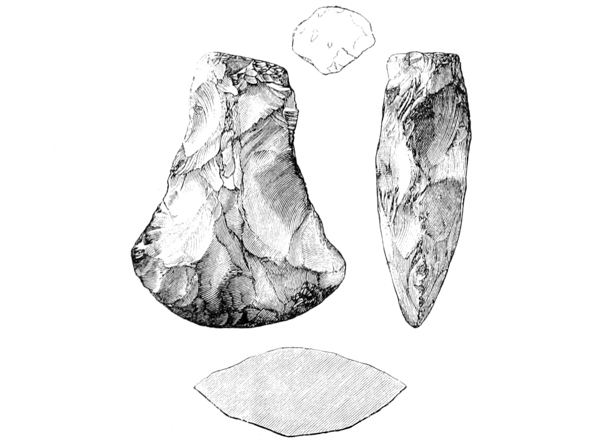
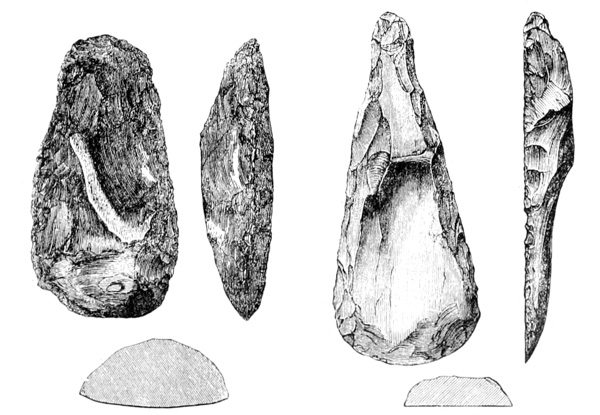
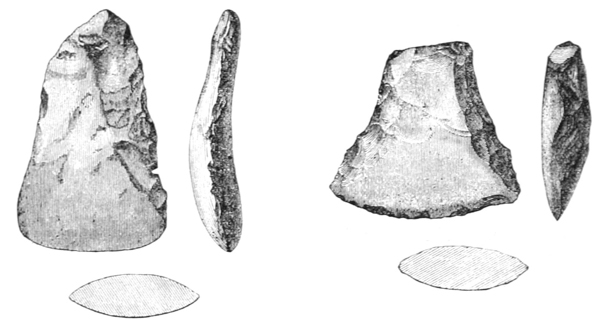
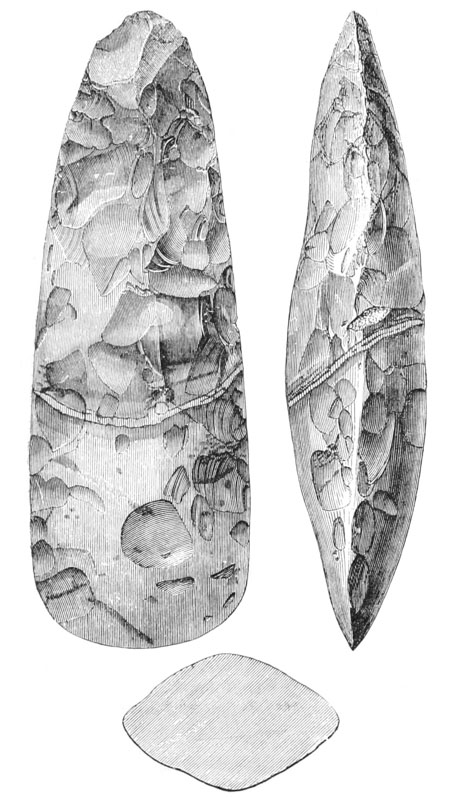
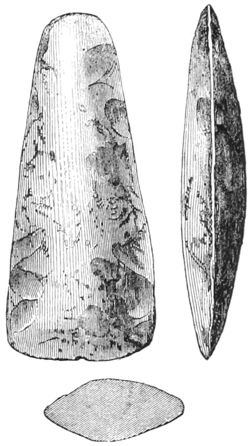
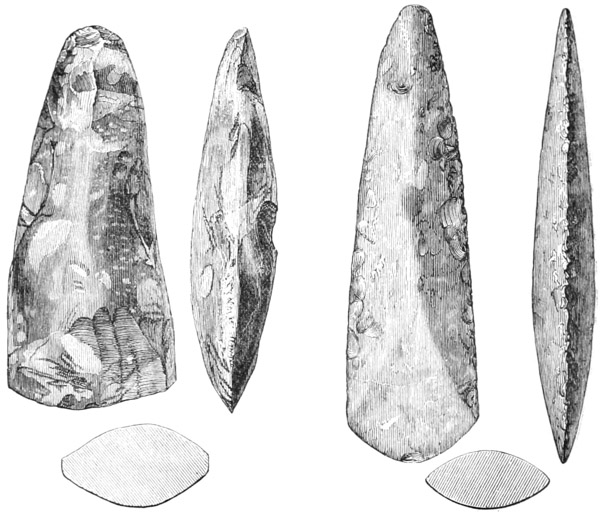
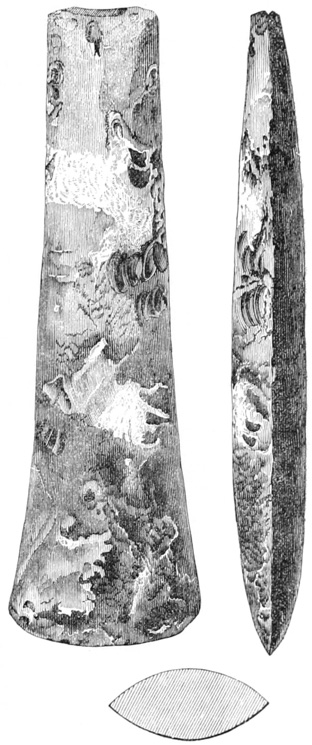
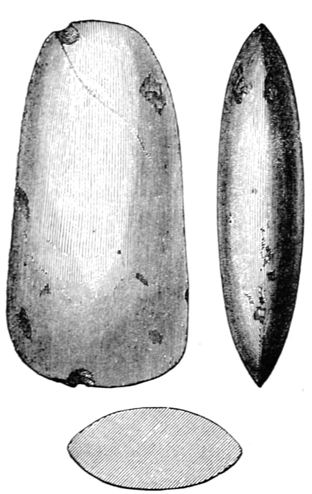
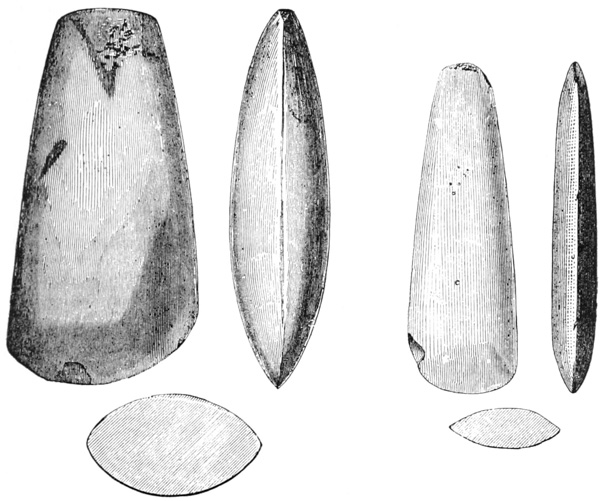
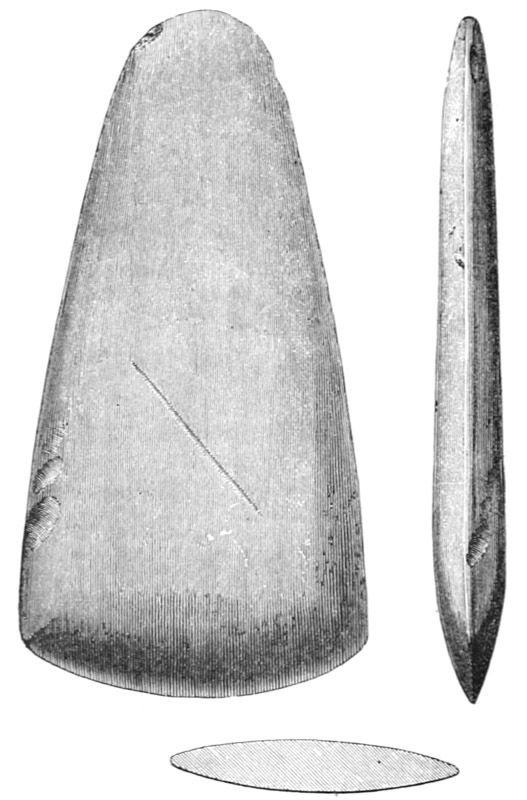
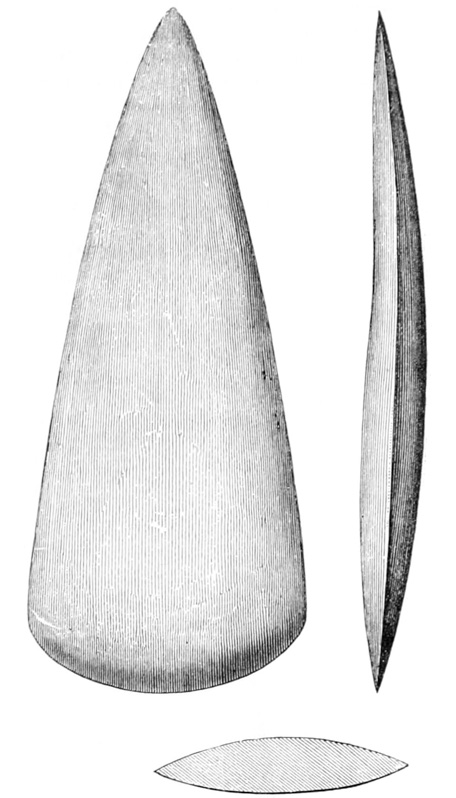
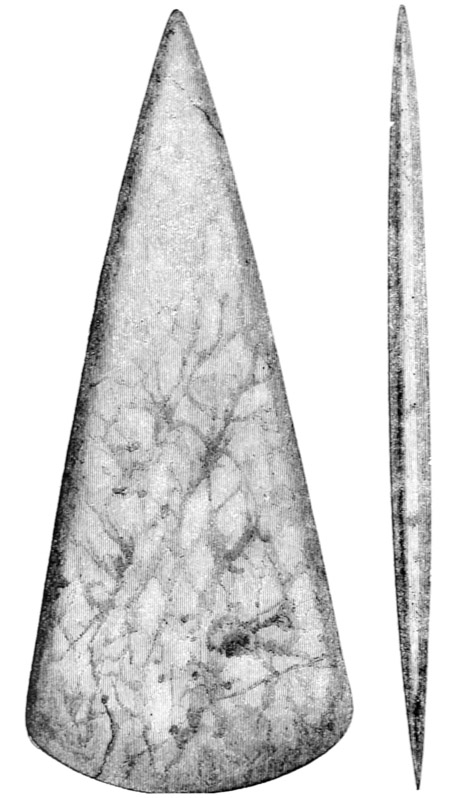
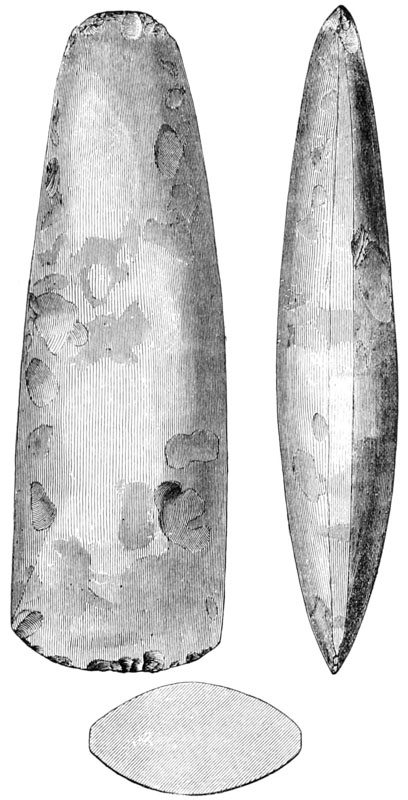
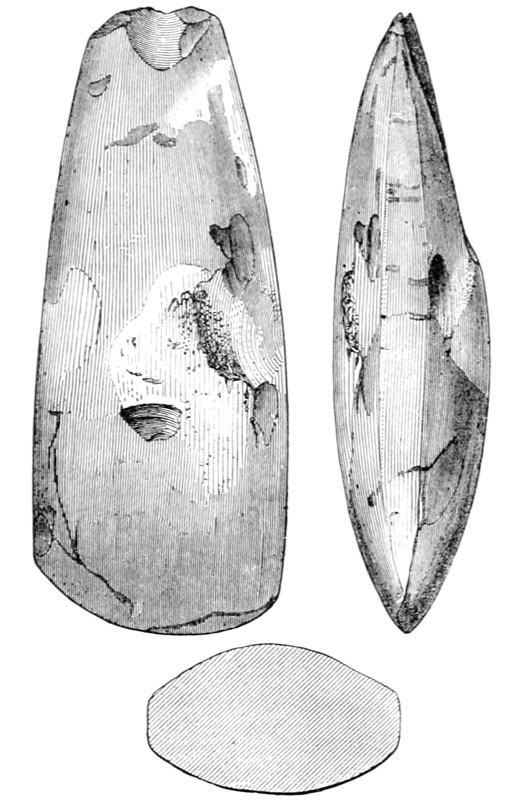
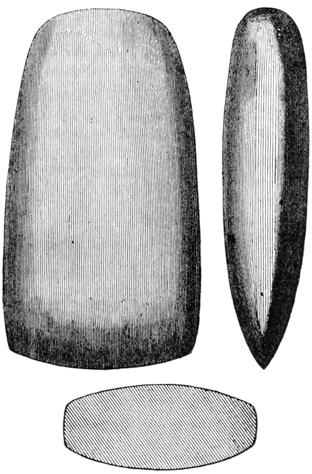
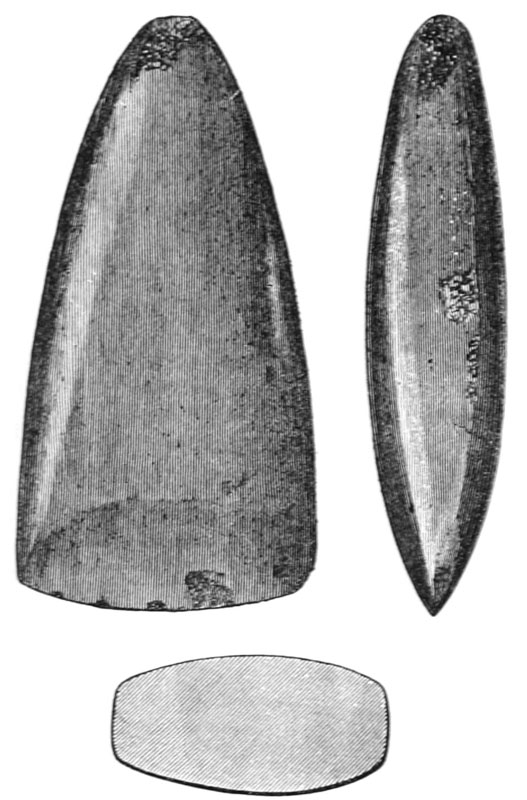
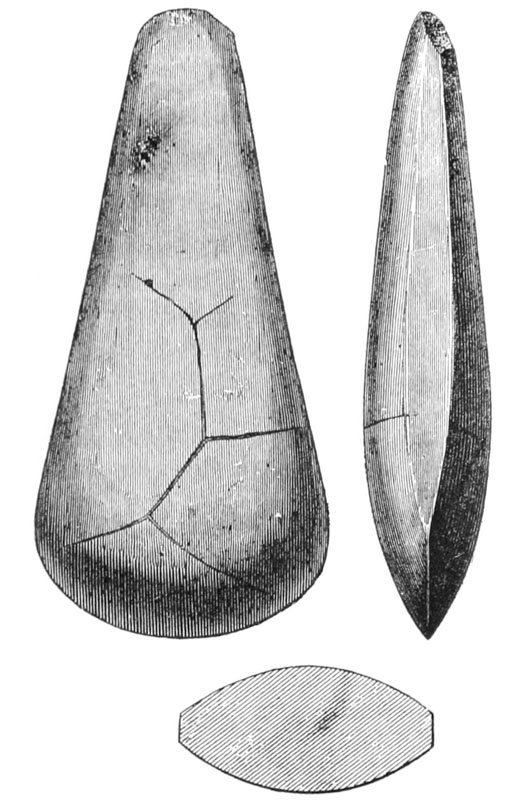
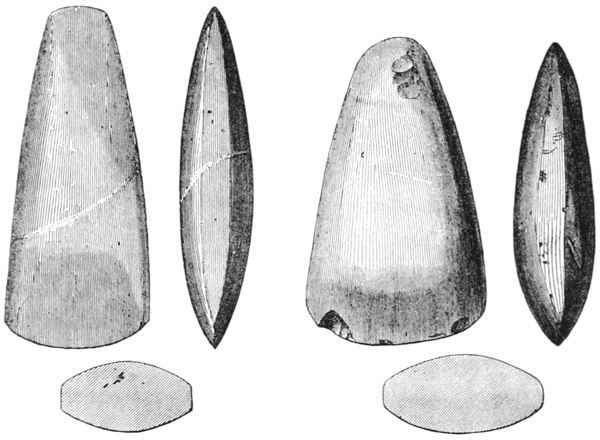
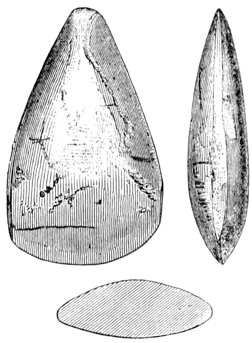
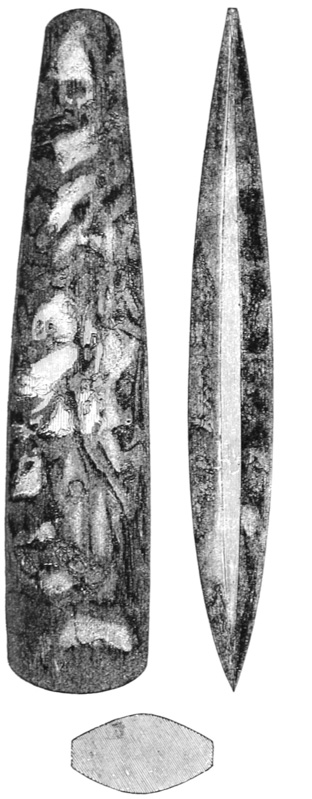
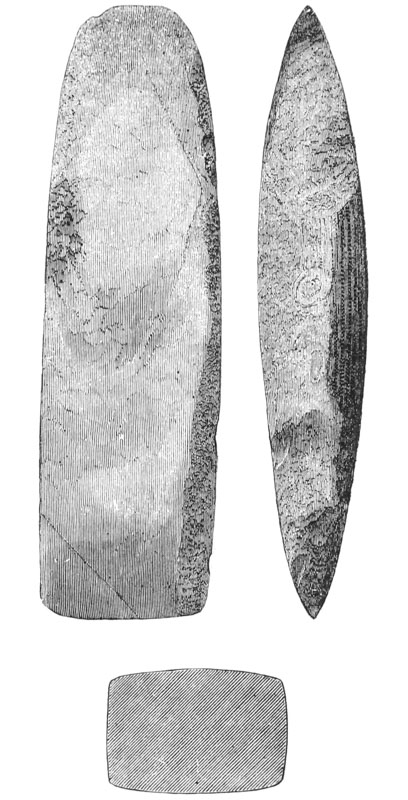
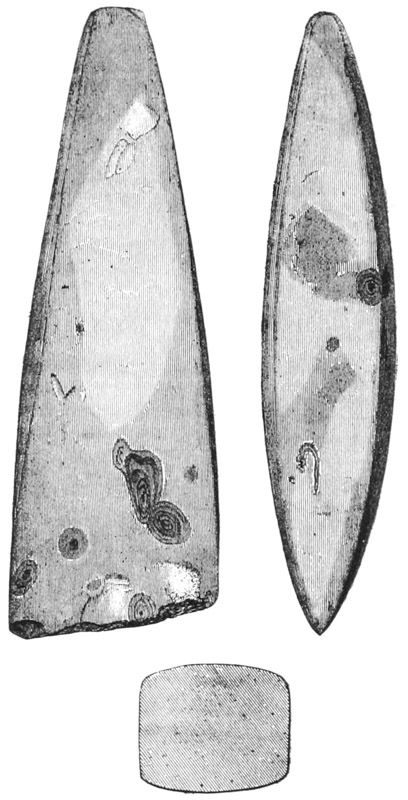
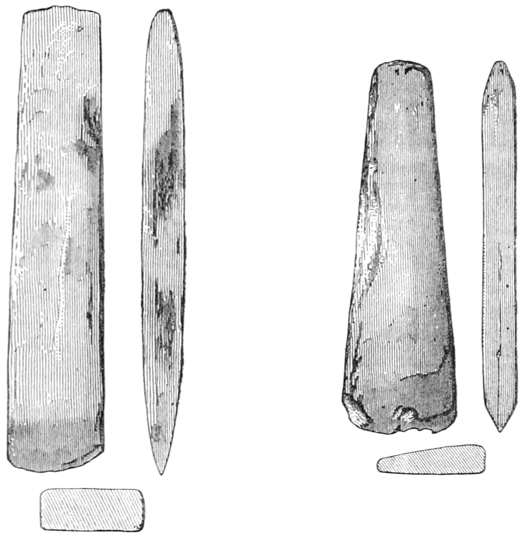
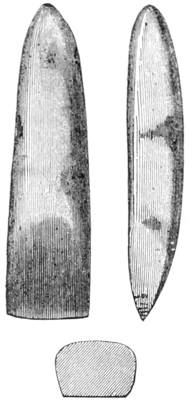
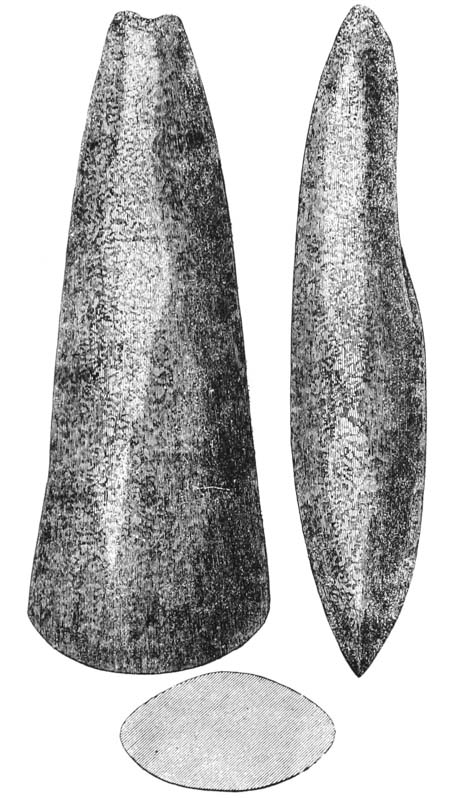
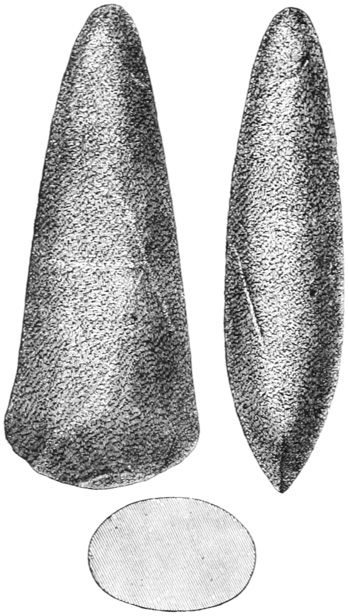
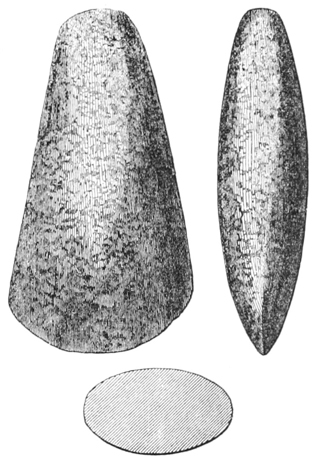
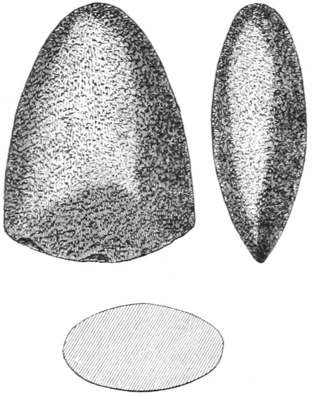
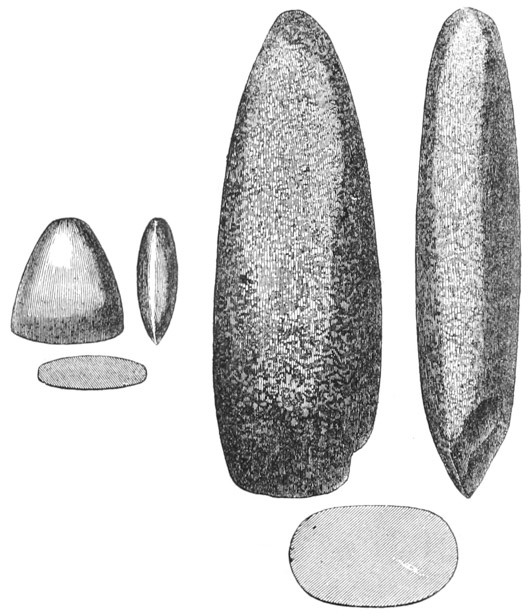
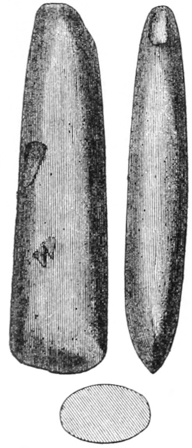
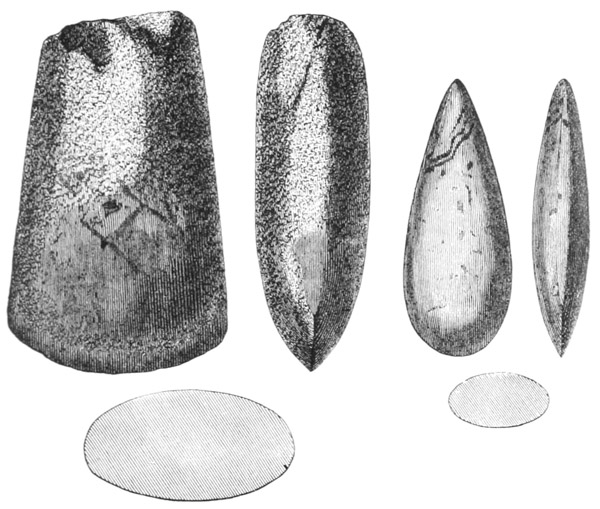
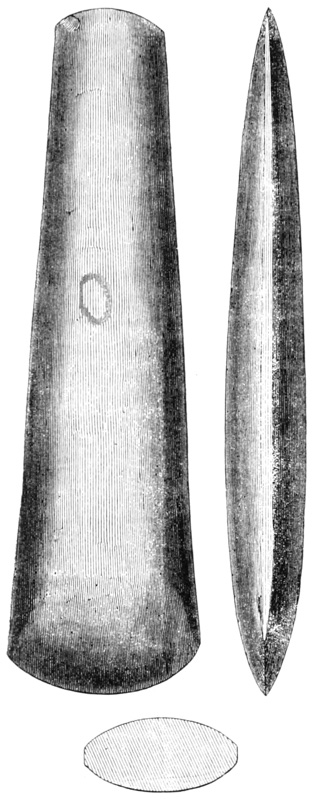
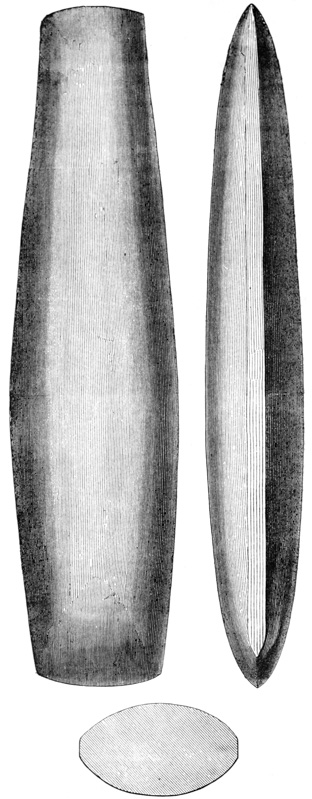
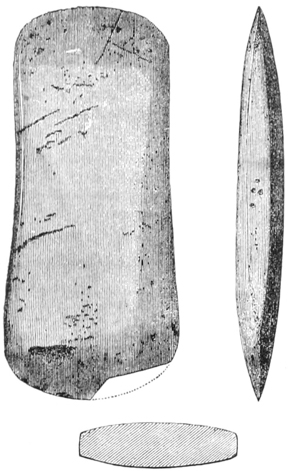
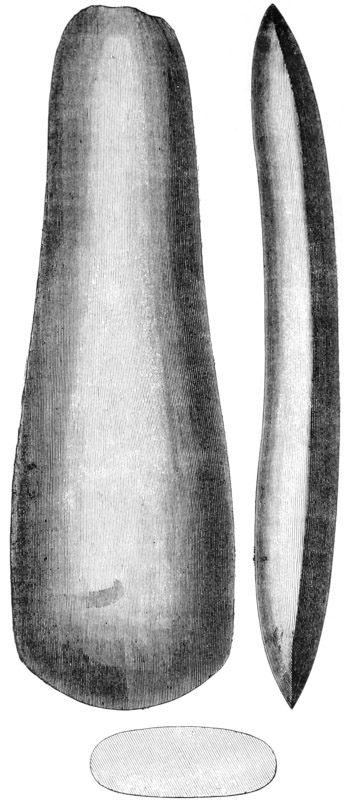
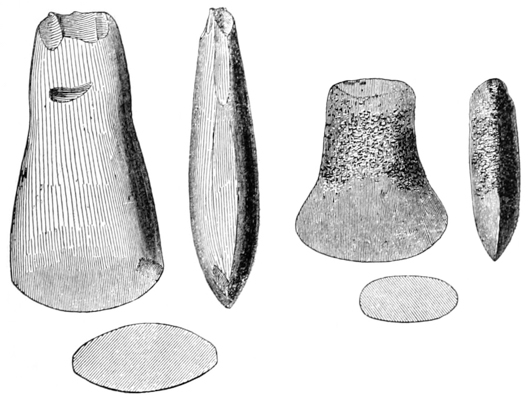
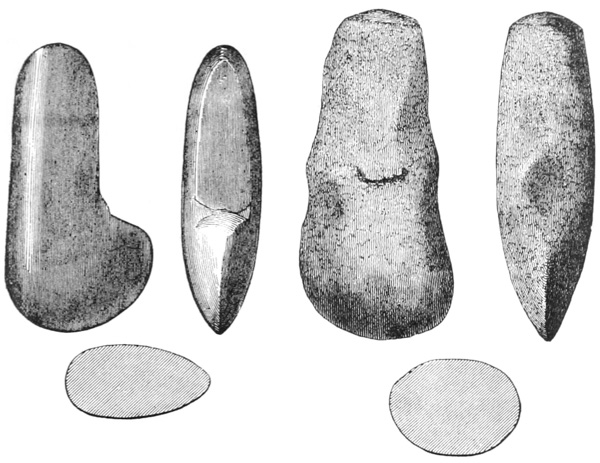
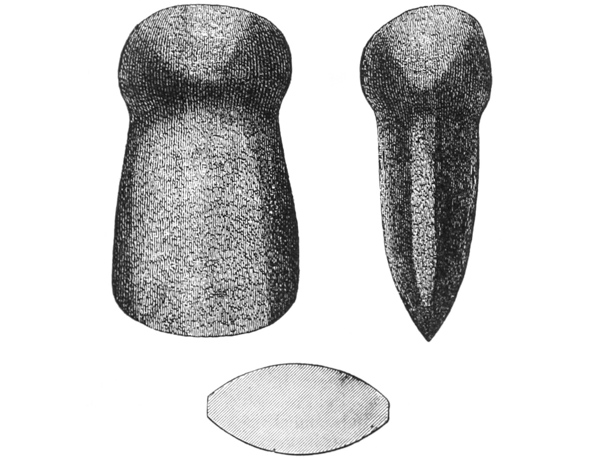
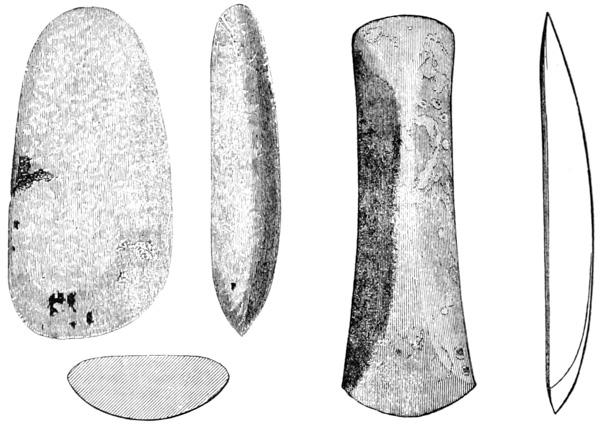
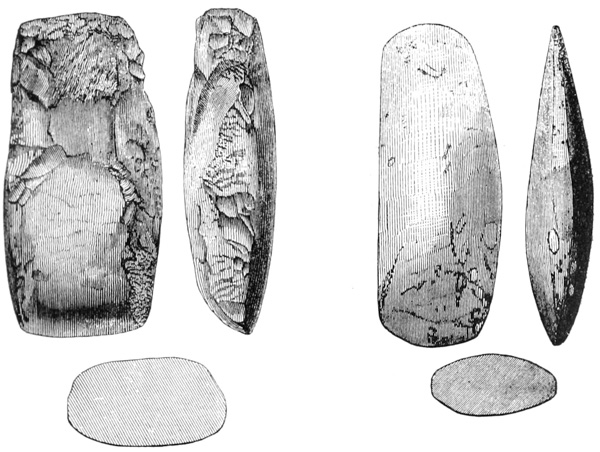
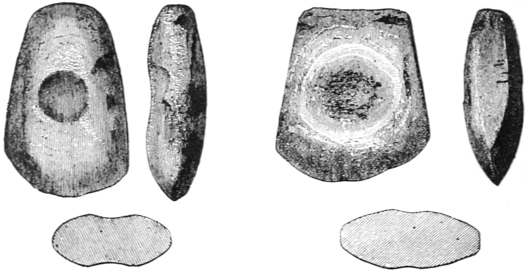
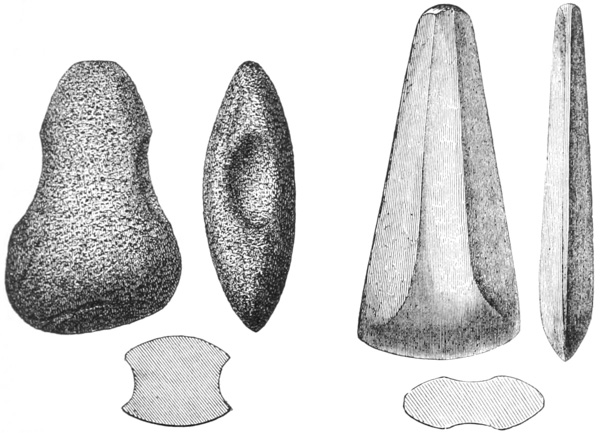
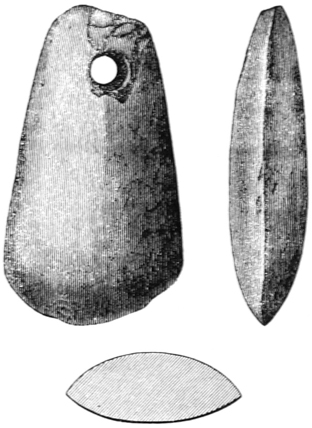
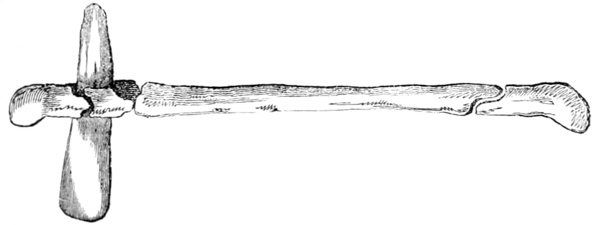
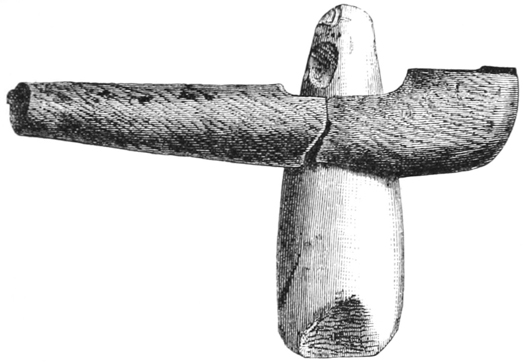
 -shaped
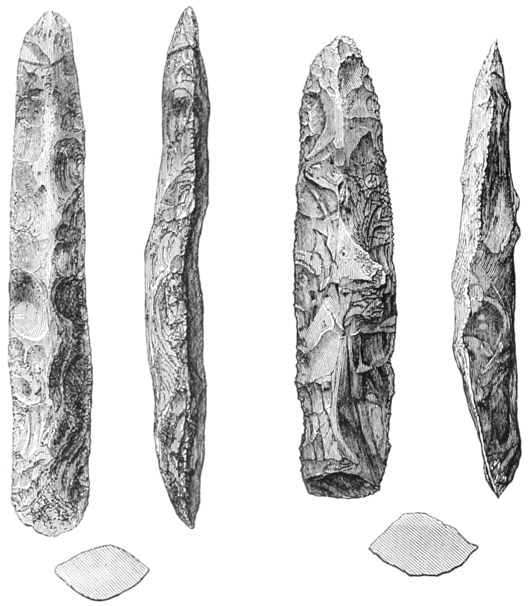
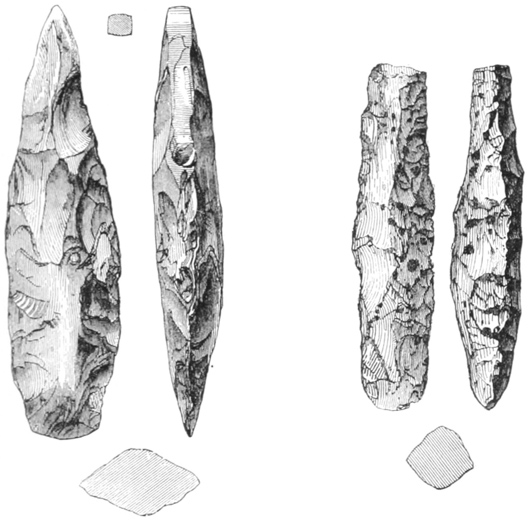
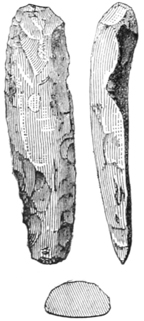
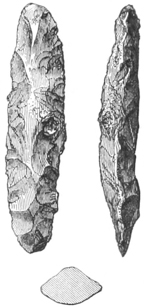
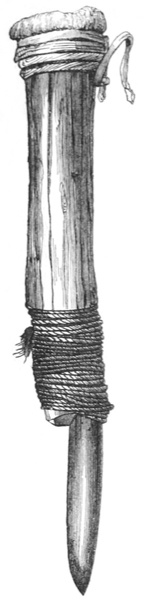
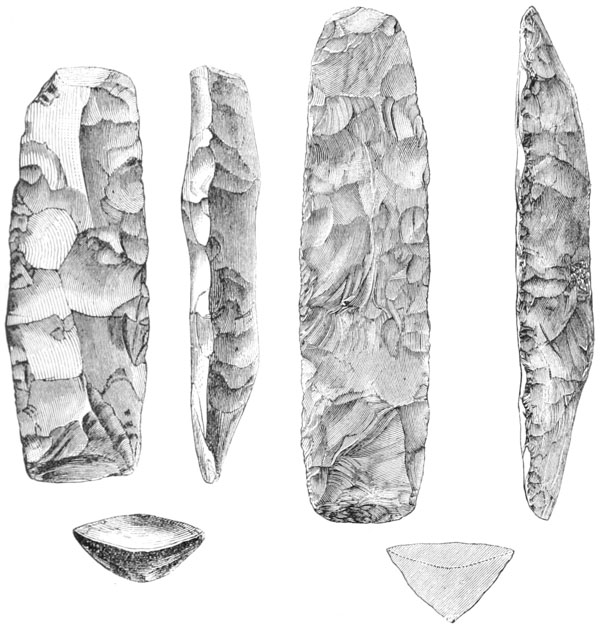
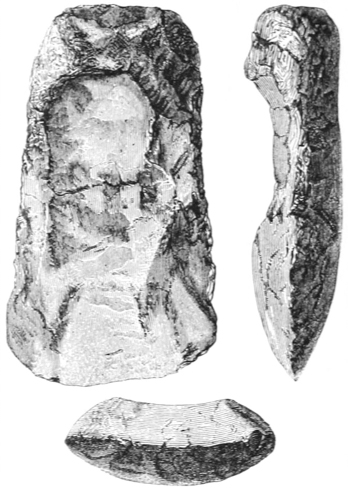
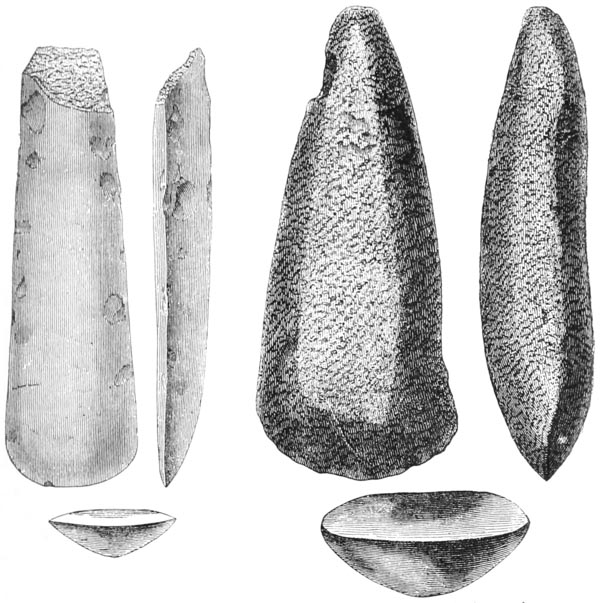
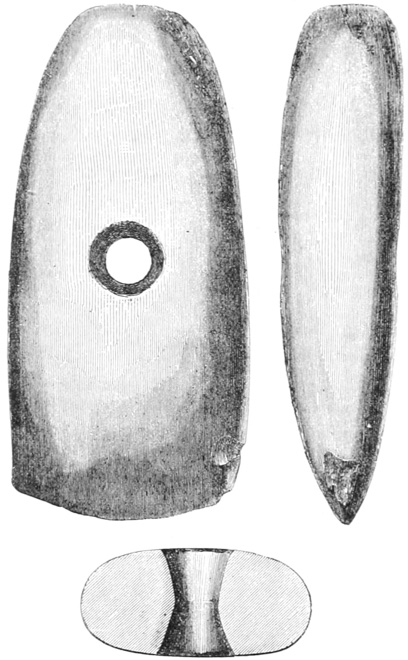
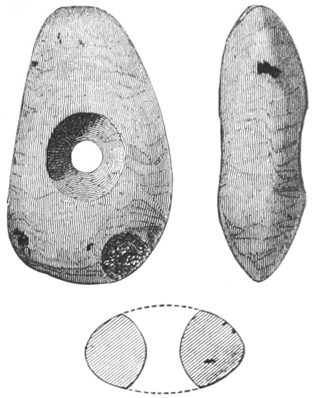
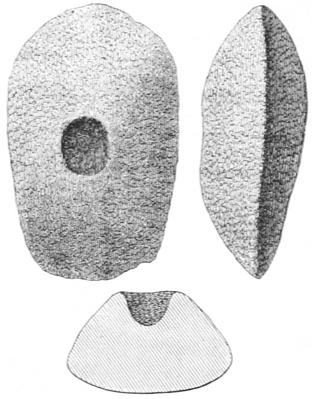
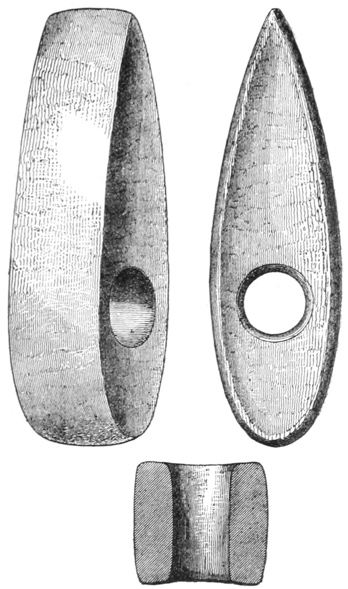
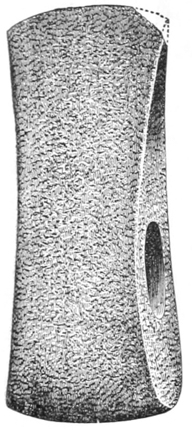
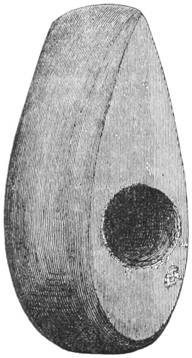
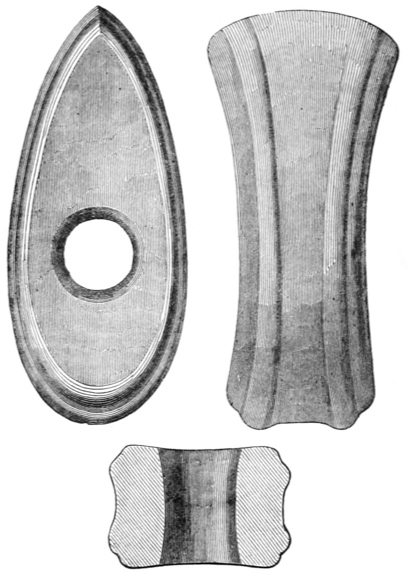
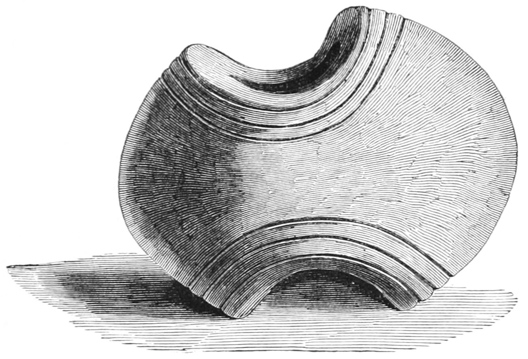
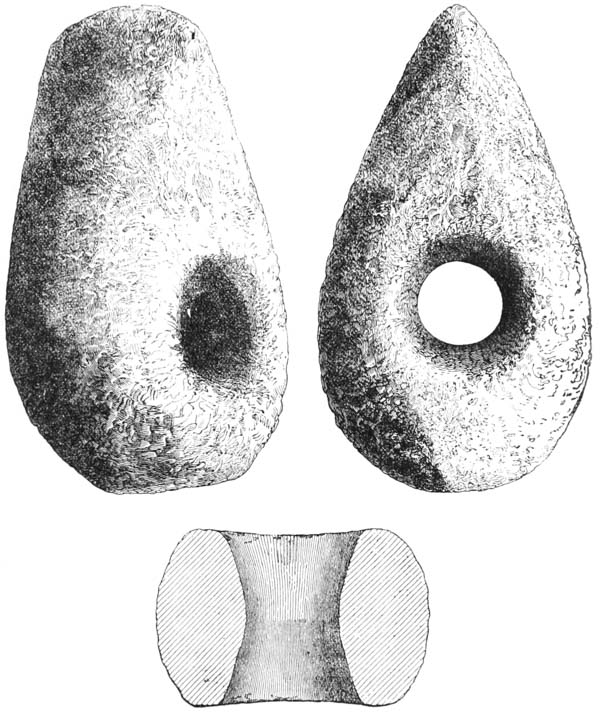
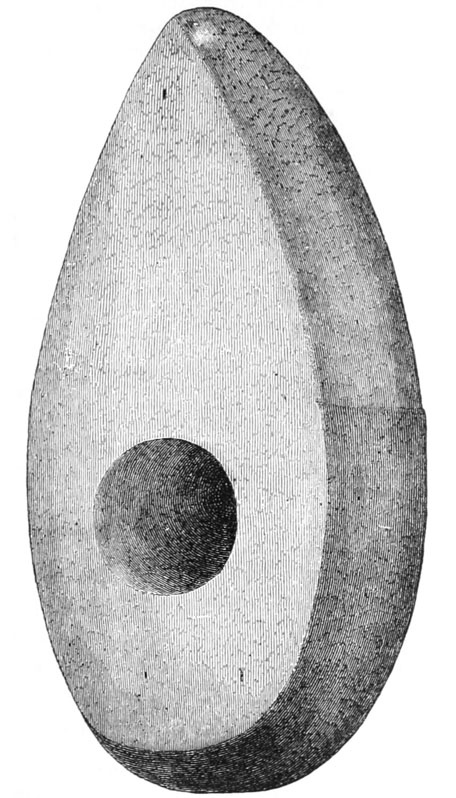
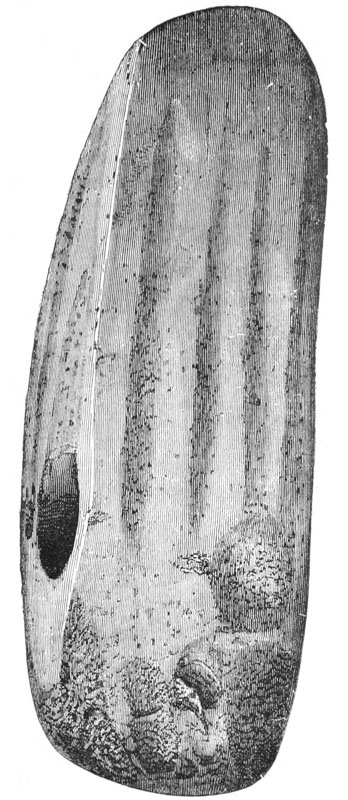
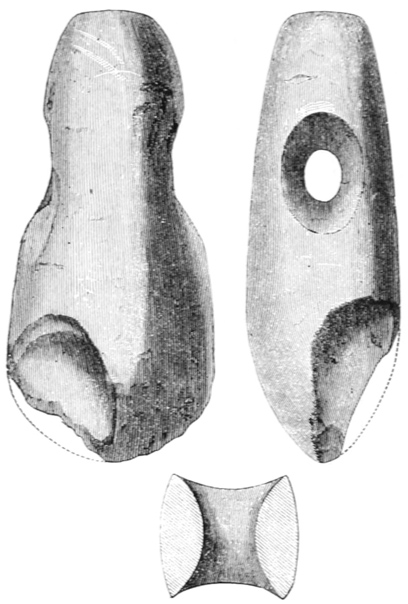
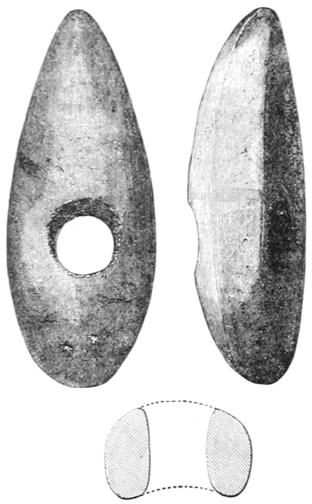
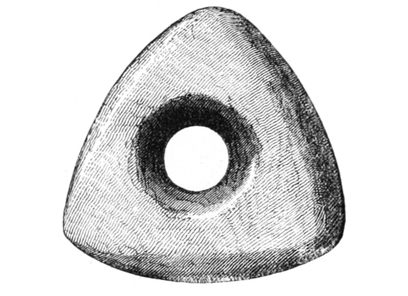
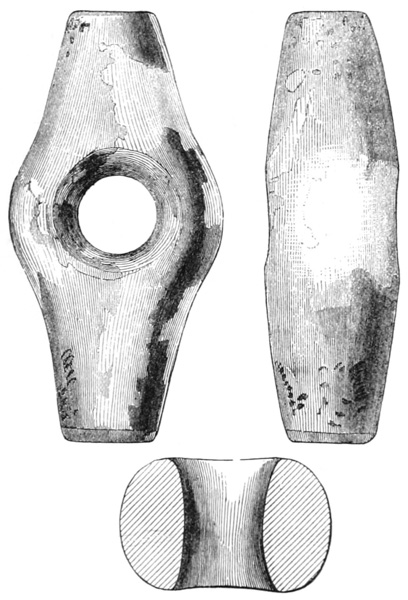
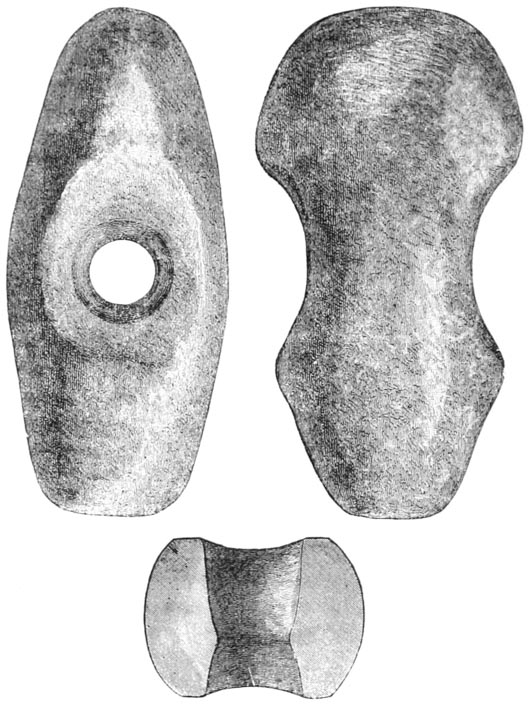
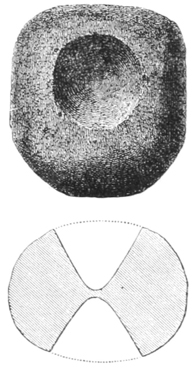
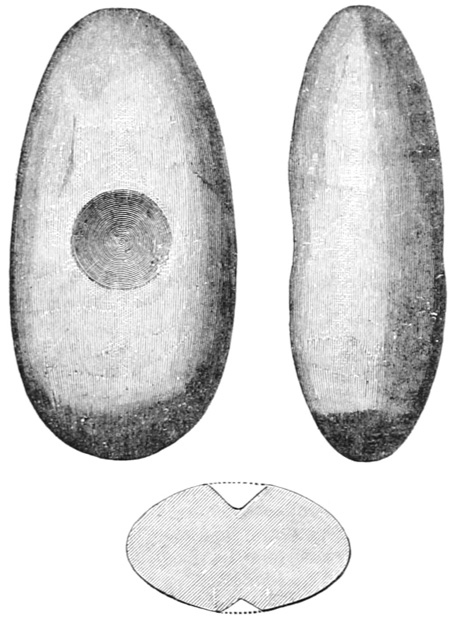
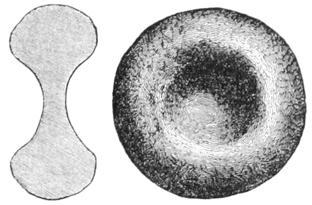
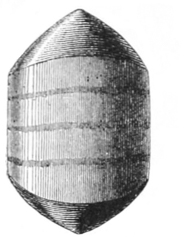
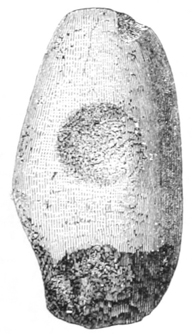
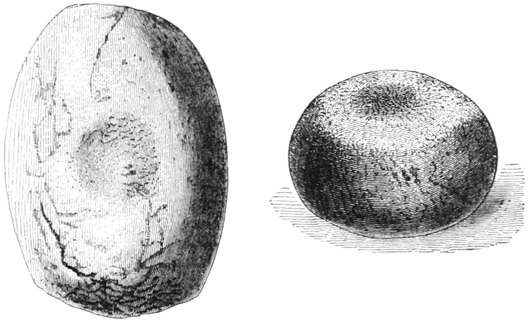
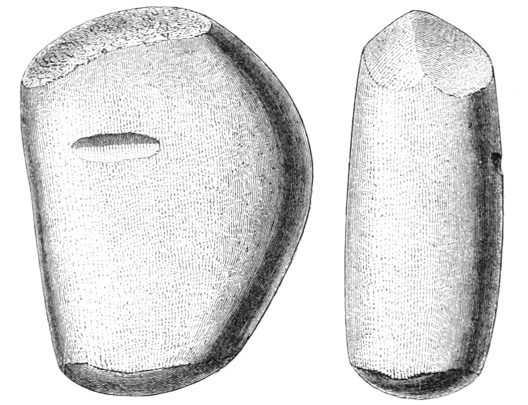
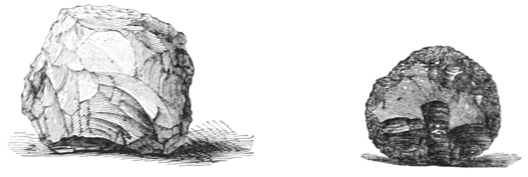
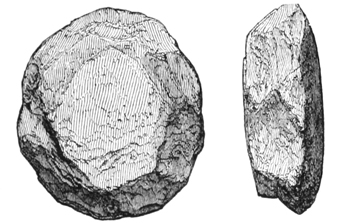
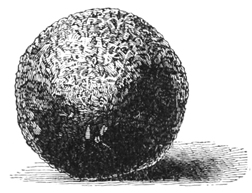
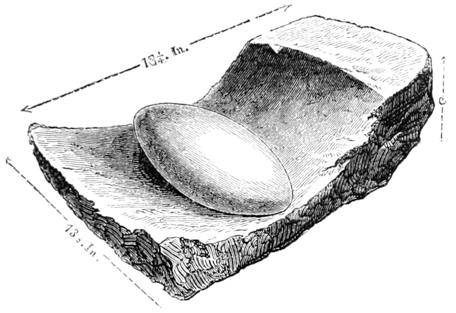
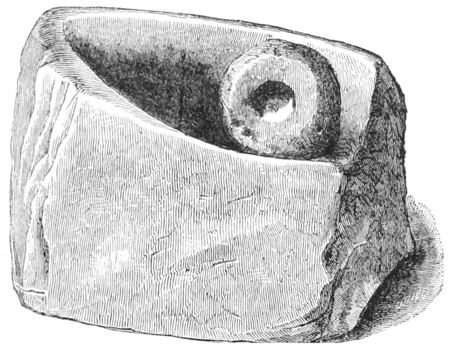
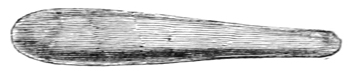
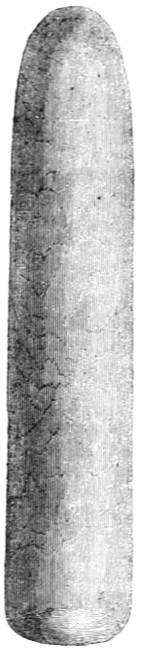


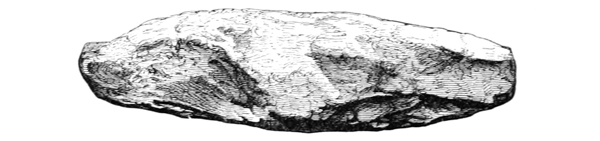
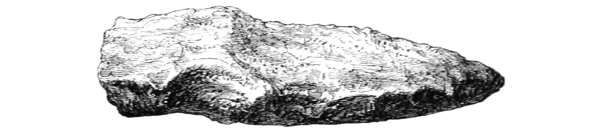

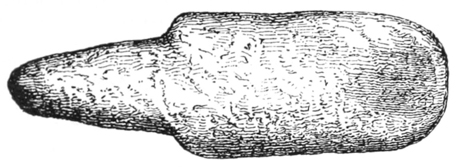
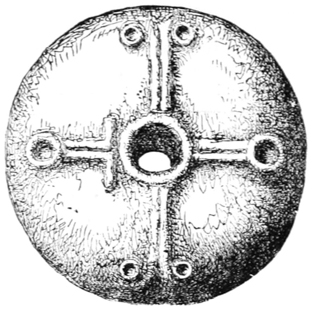
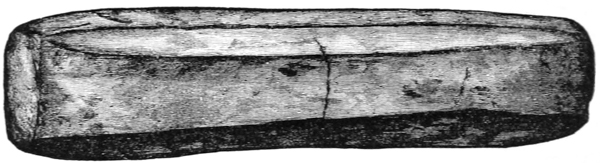
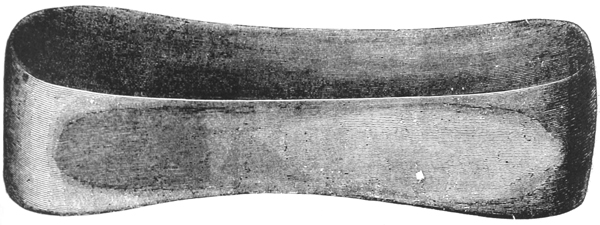
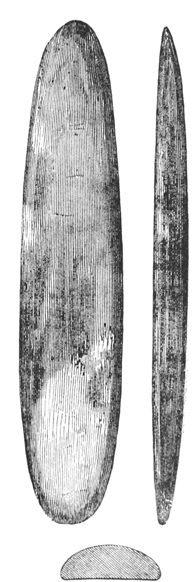
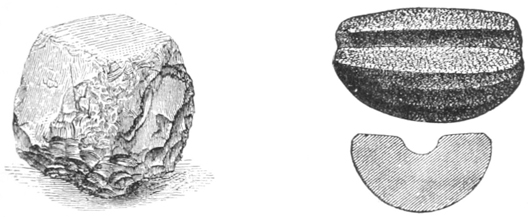
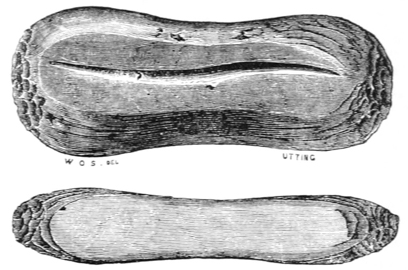
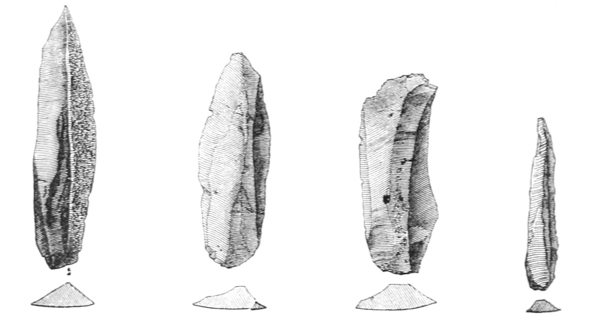

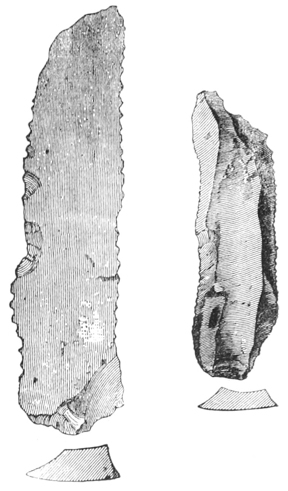
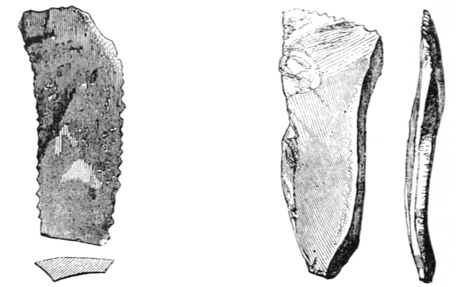
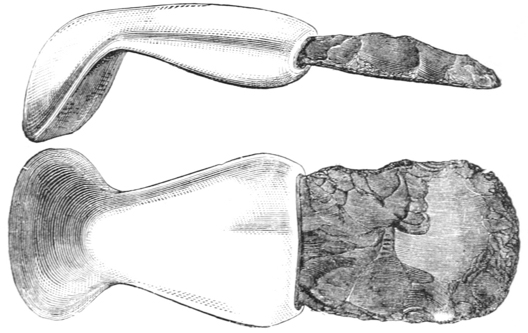
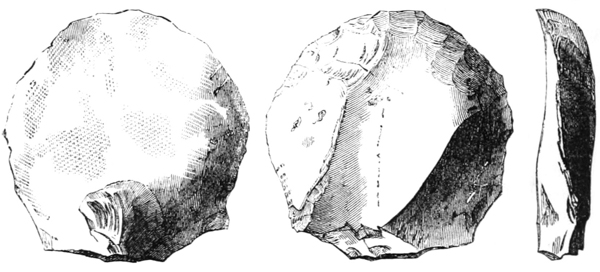
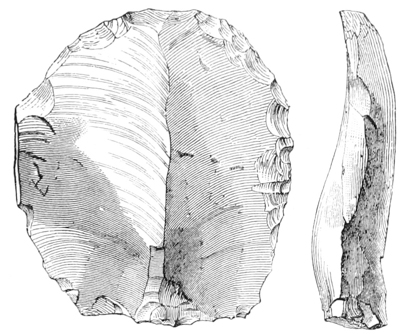
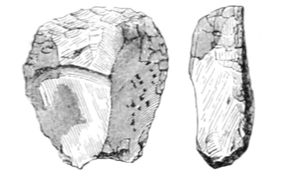
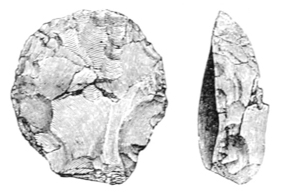
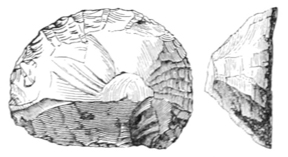
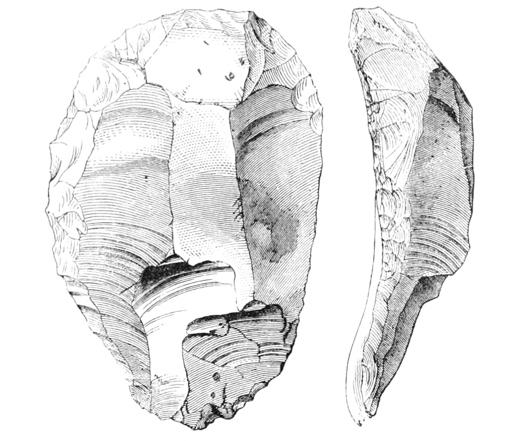
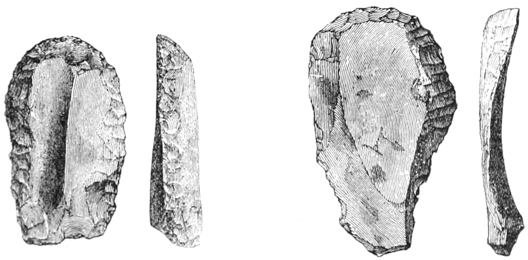
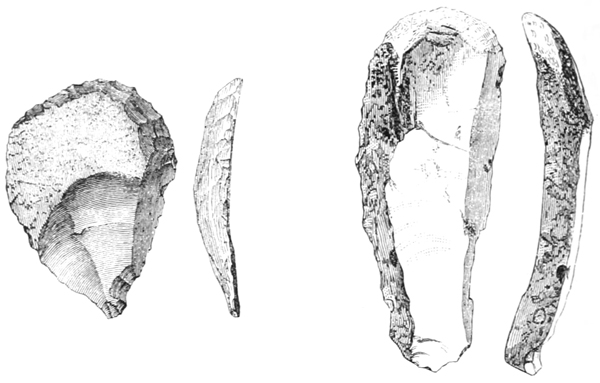
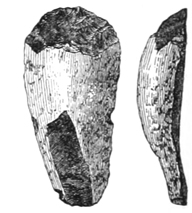
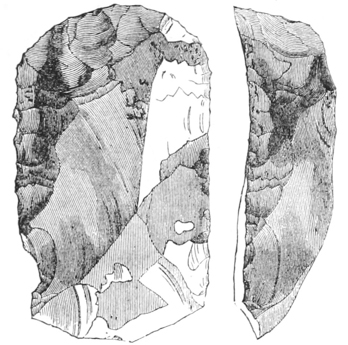
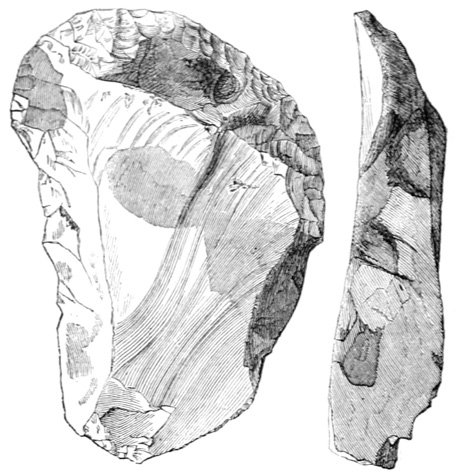
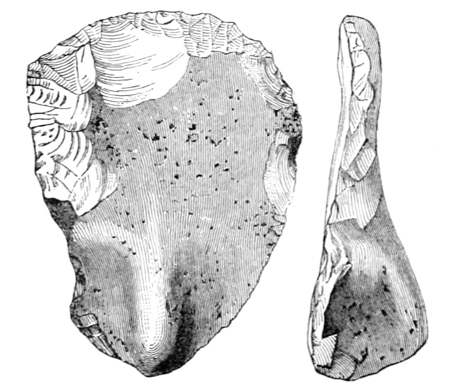
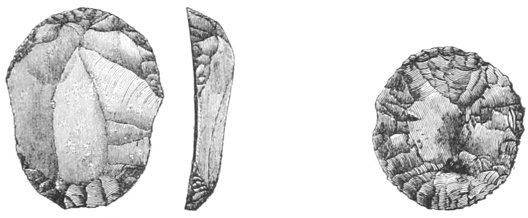
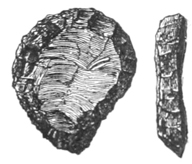
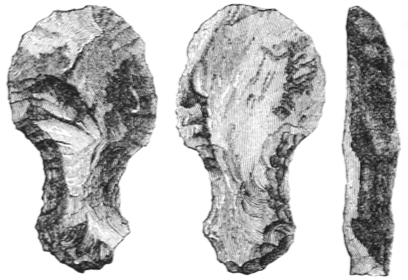
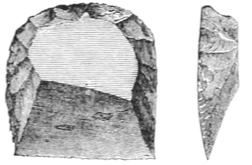
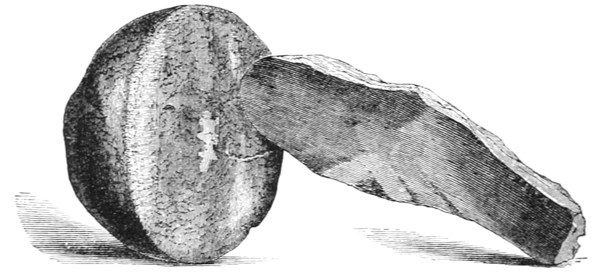
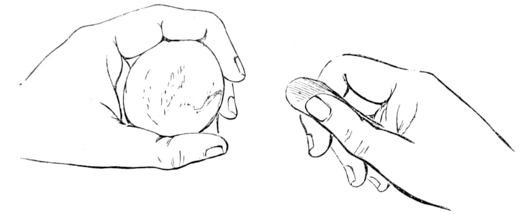
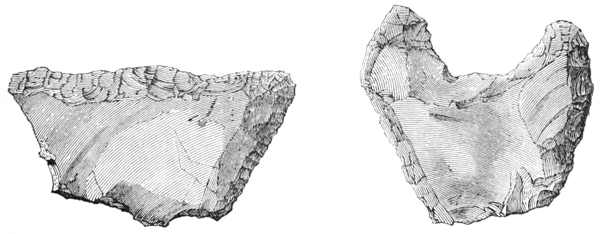
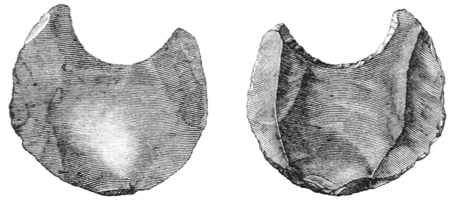
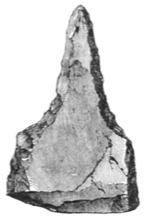
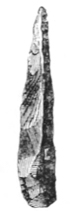
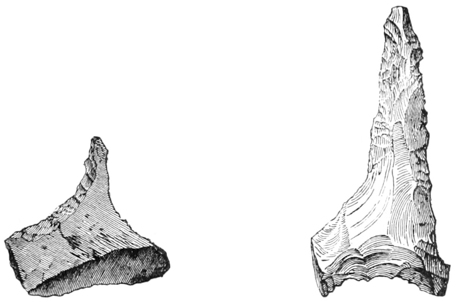
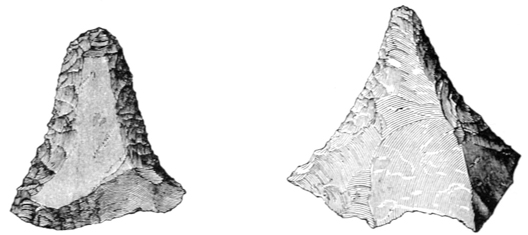
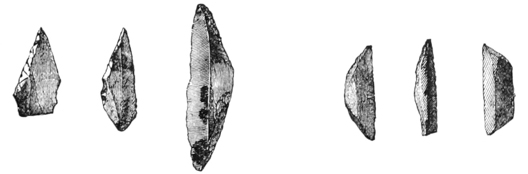
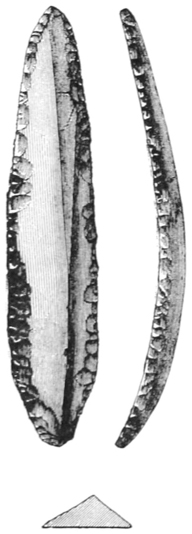
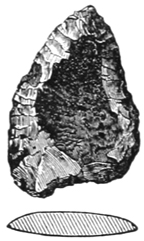
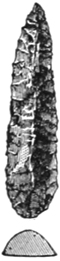
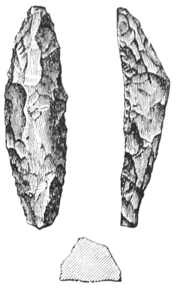
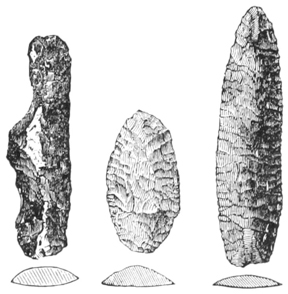
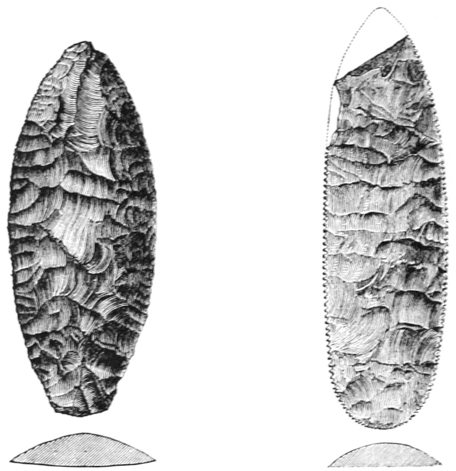
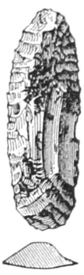
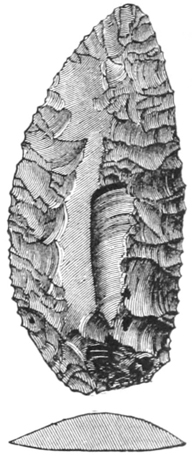
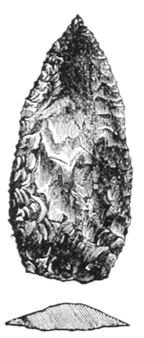
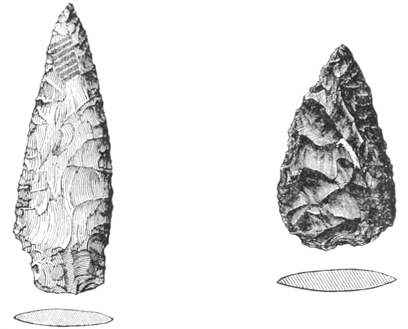
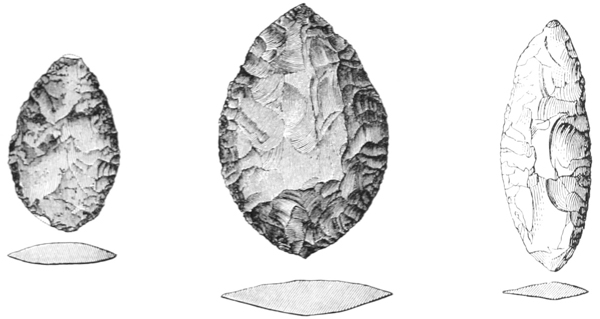
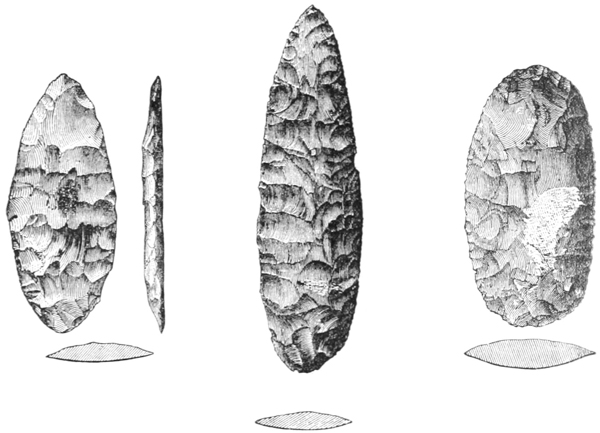
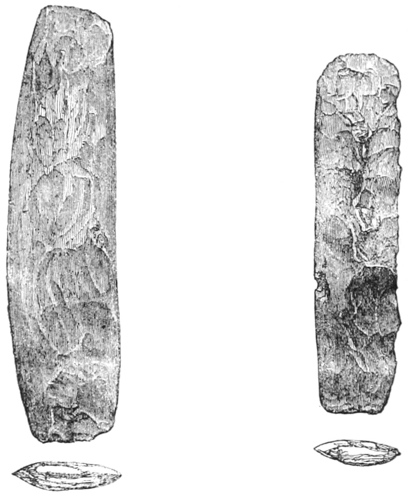
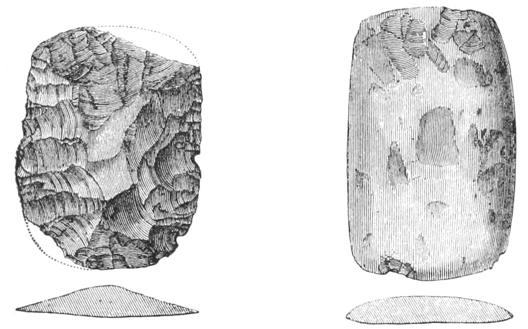
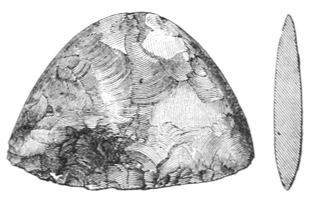
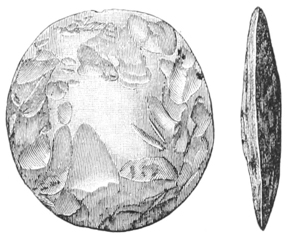
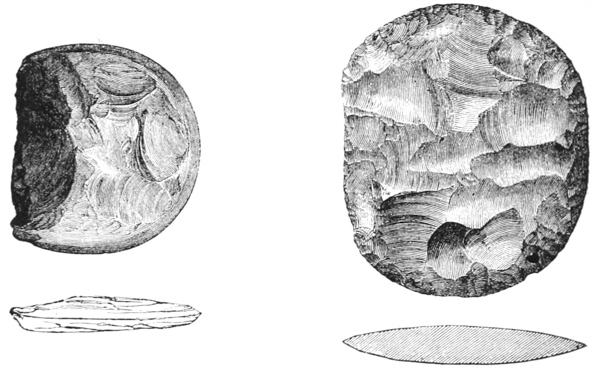
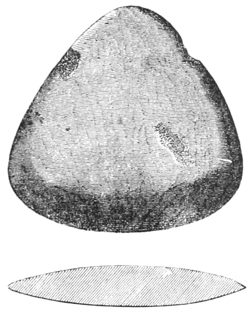
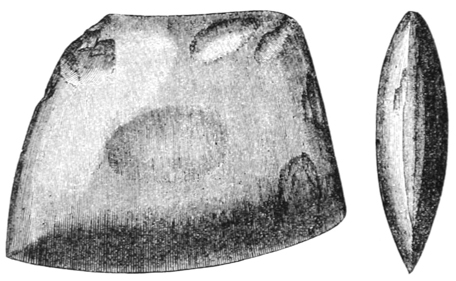
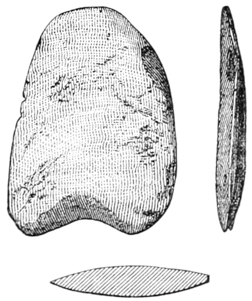
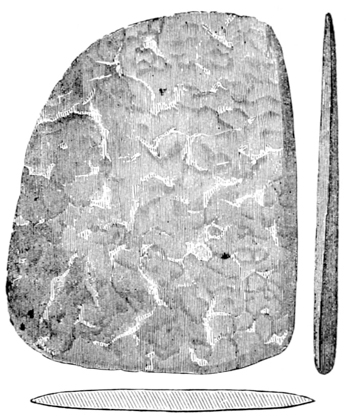
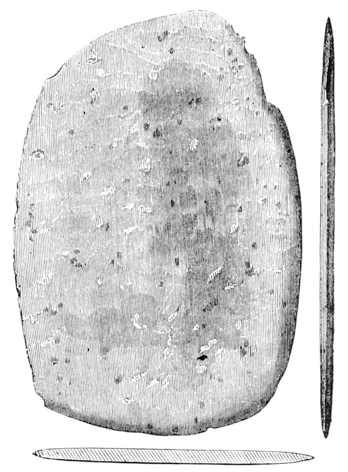
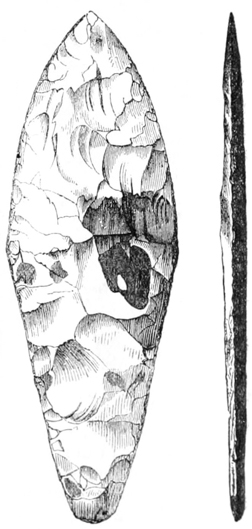
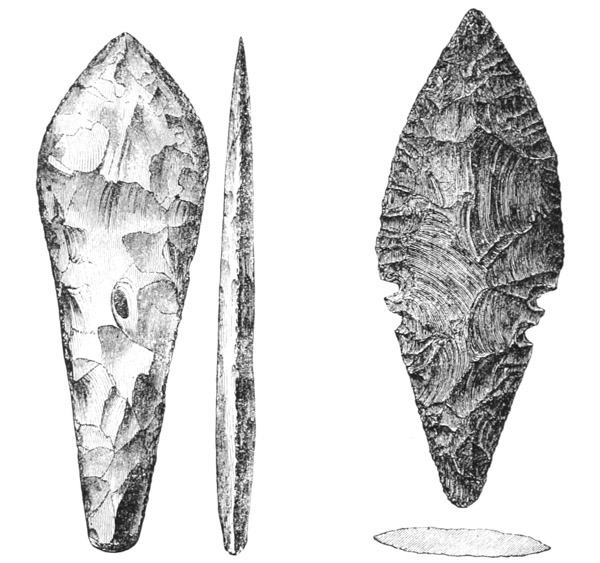
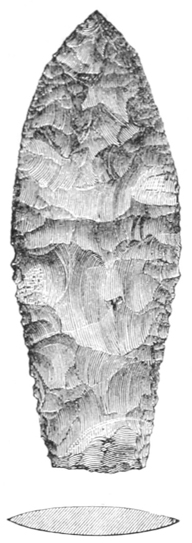
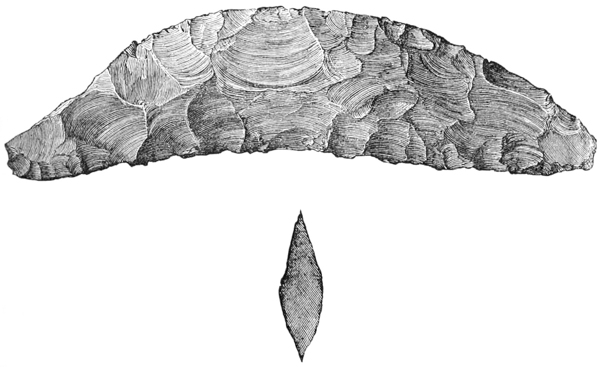
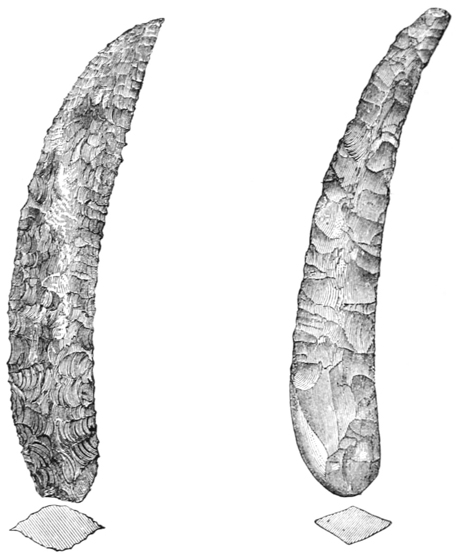
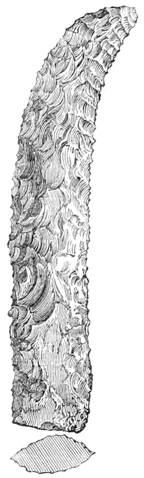
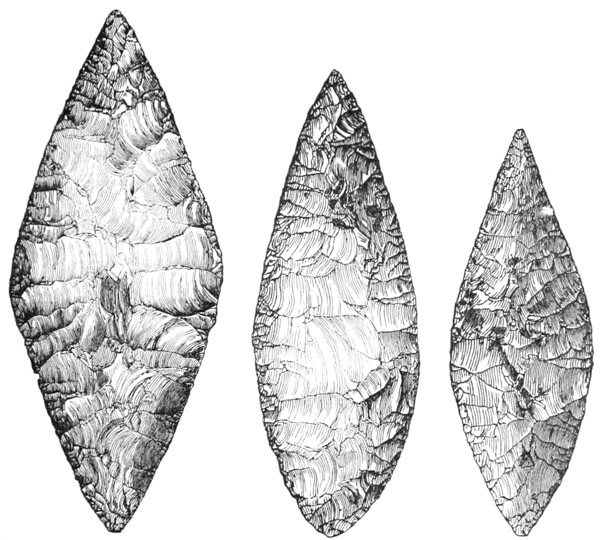
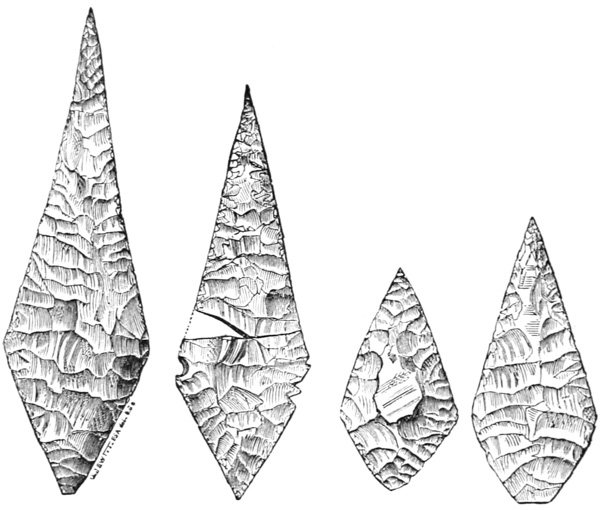
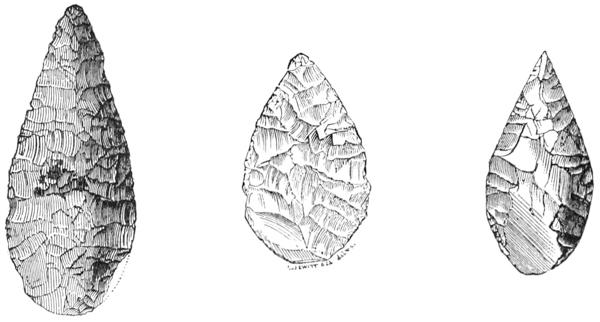
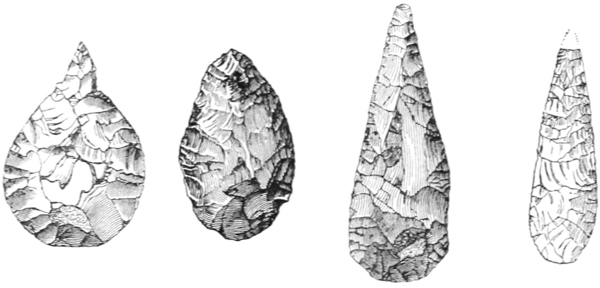
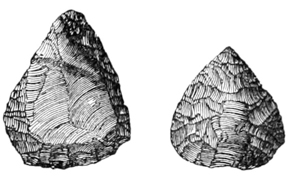
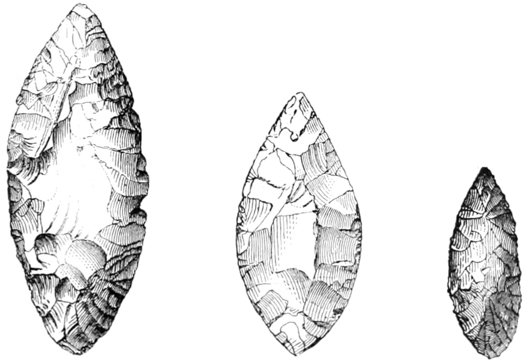
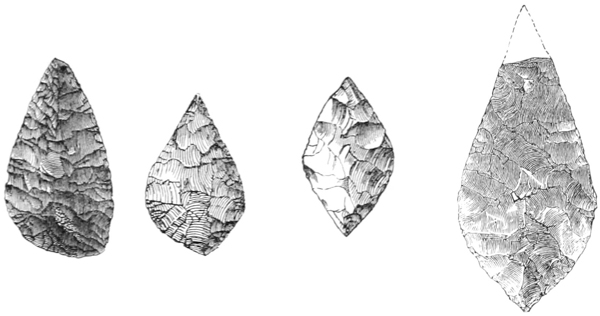
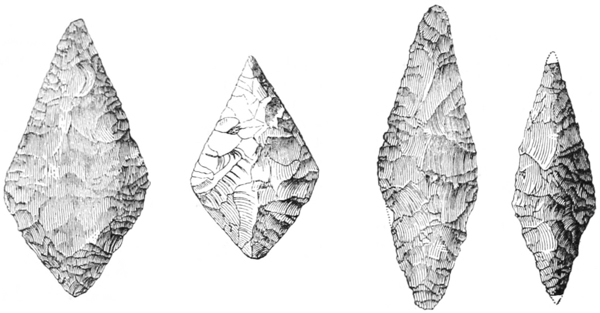
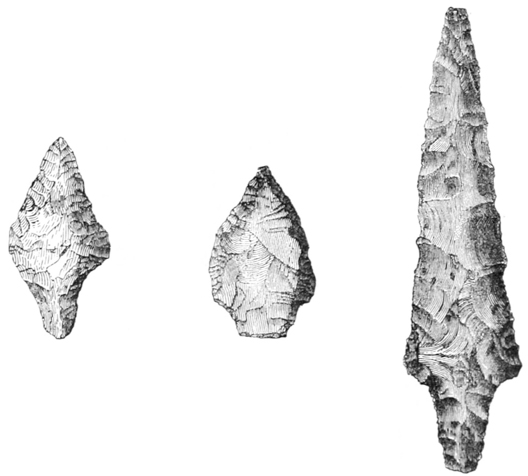
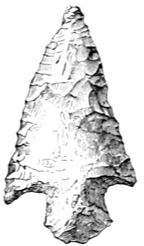
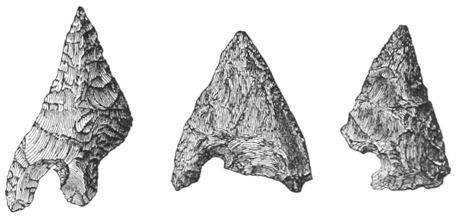
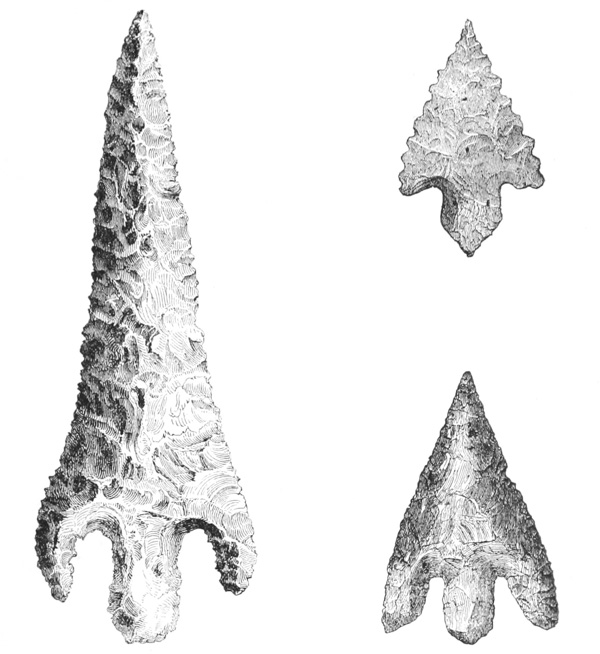
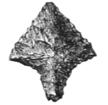
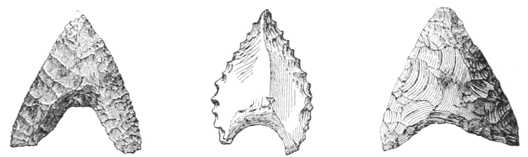
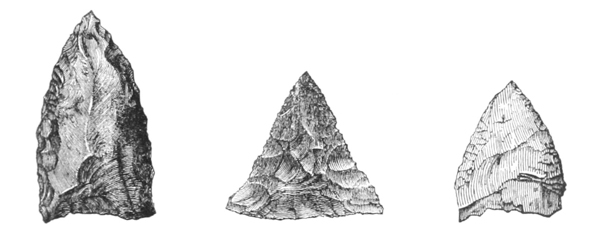
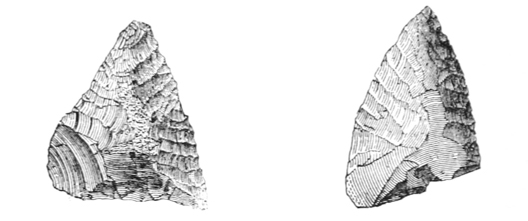
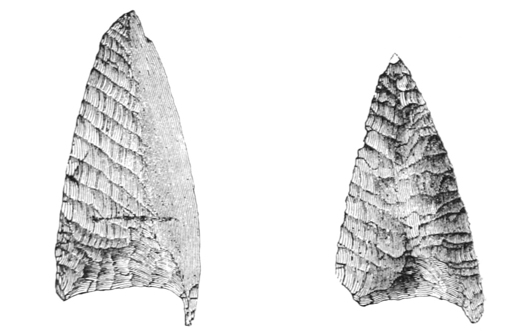
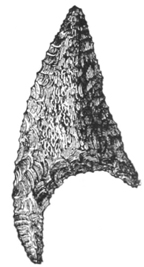
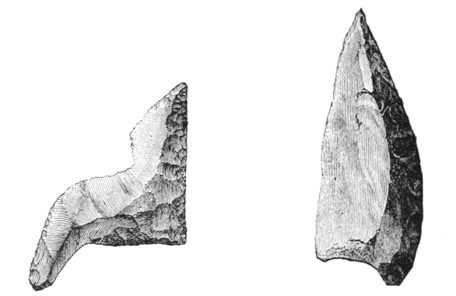
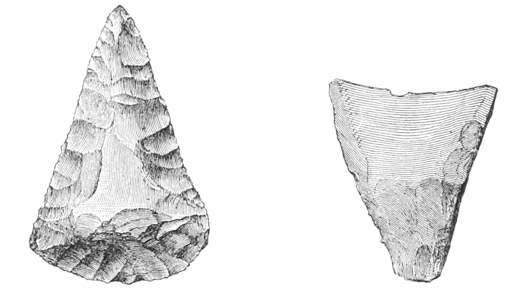
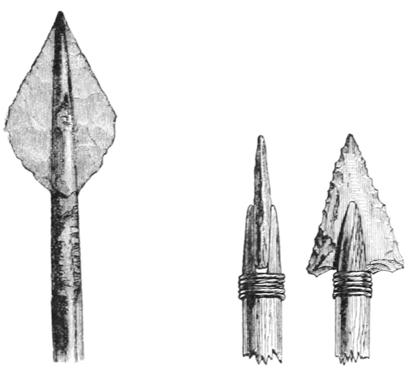
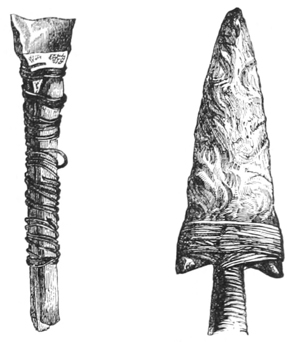
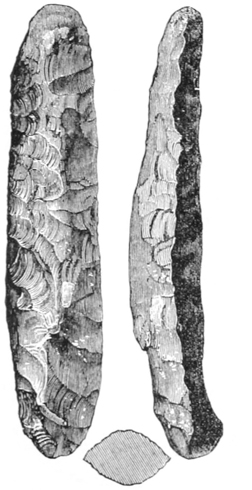
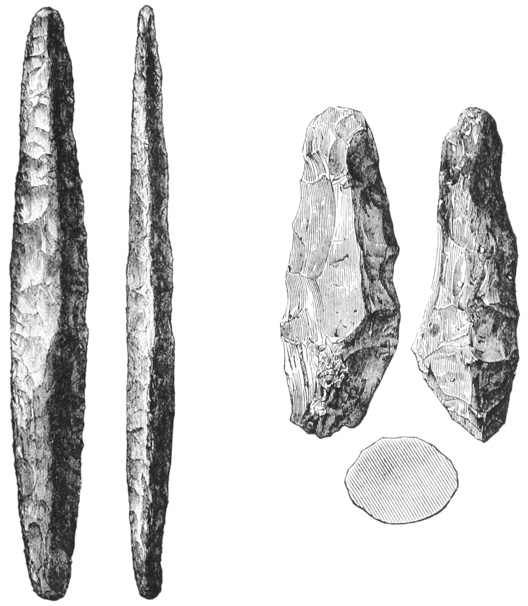
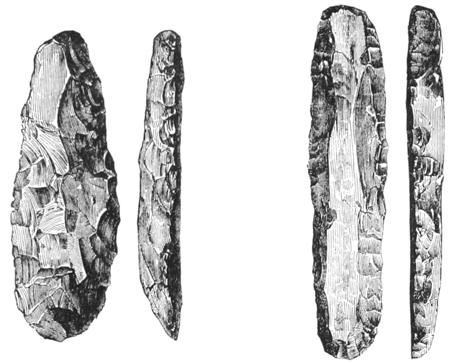
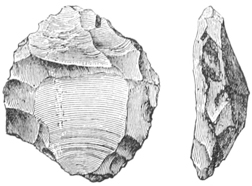
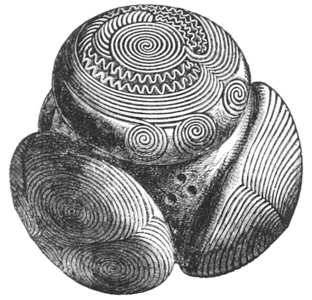
 (Eben) denoted both a stone
and a weight; and we have a somewhat similar instance of
customs being recorded in language in the case of our own
“stone” of eight or fourteen pounds. Discoidal weights formed
of stone are not unfrequently found on the sites of Roman
occupation.
 -shaped

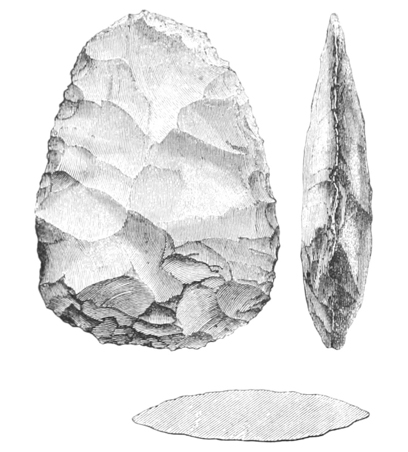
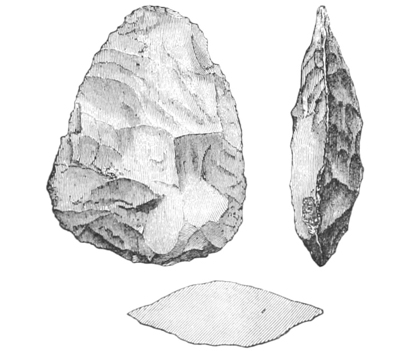
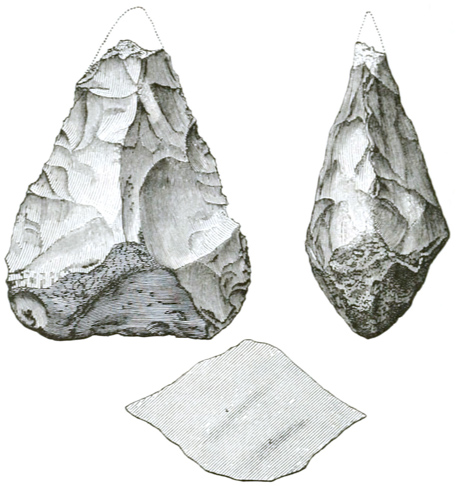
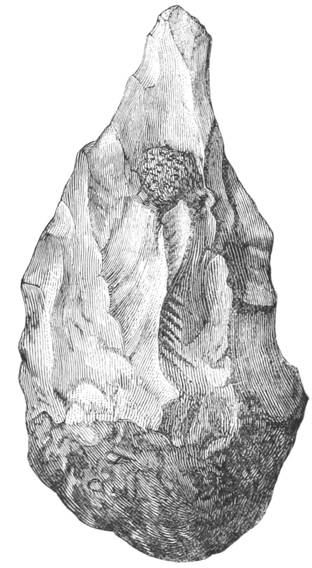
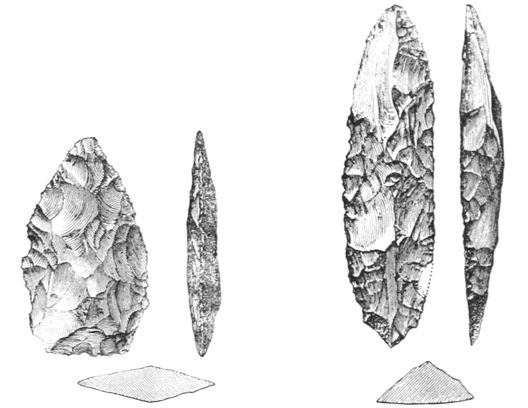
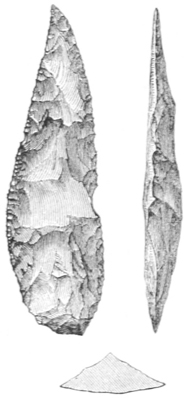
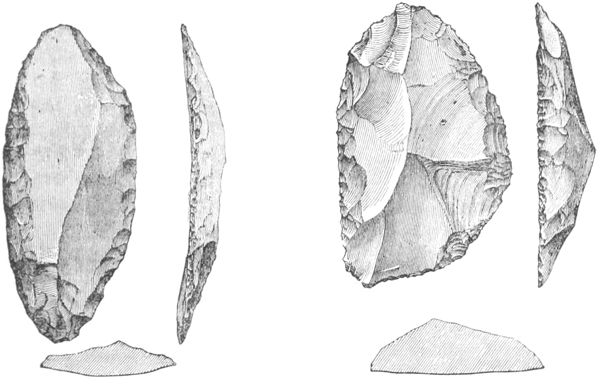
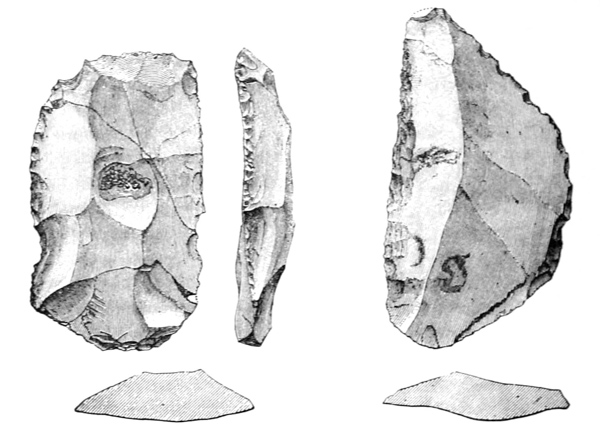
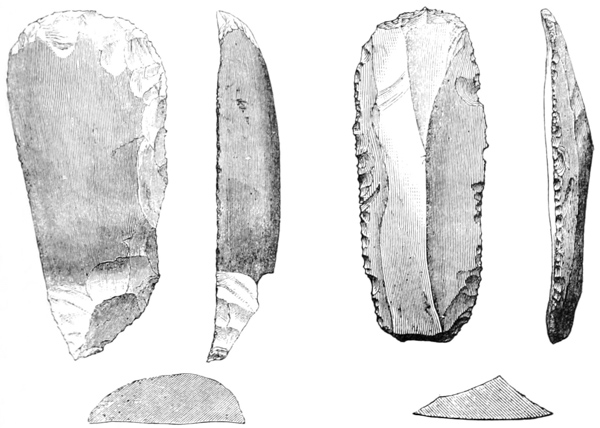
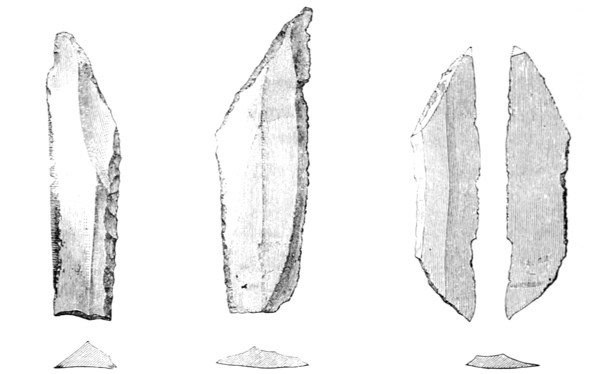
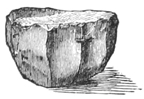
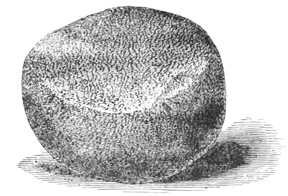




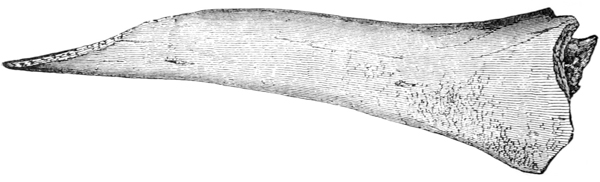
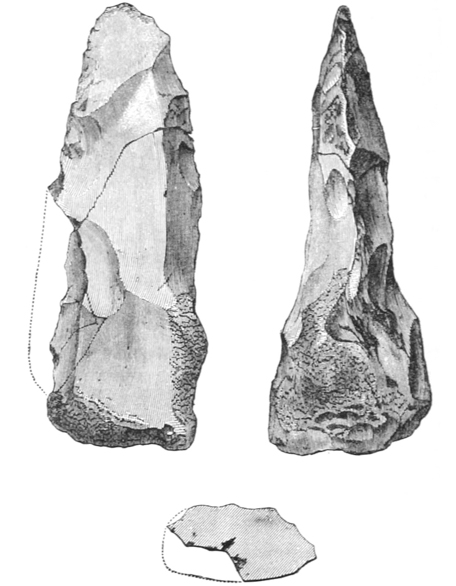
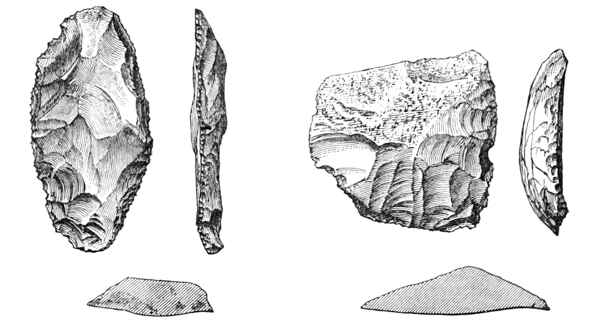
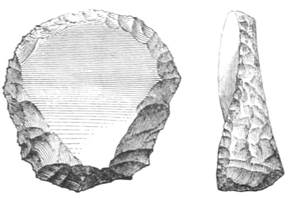
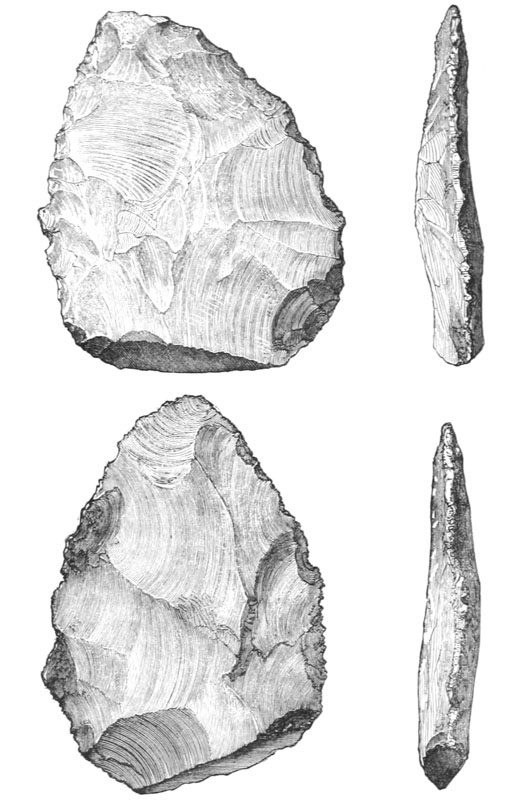
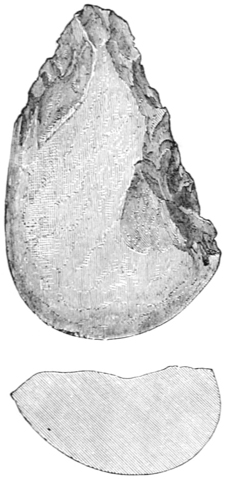
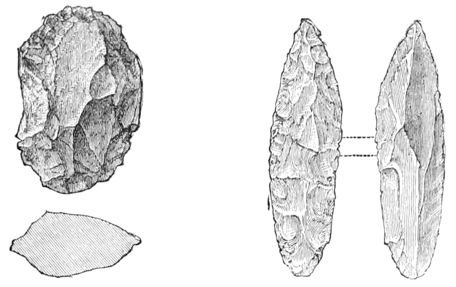
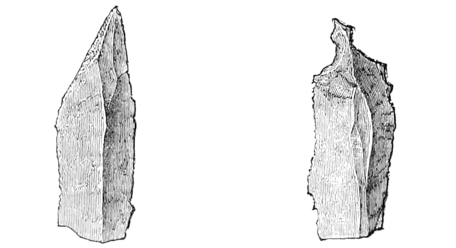
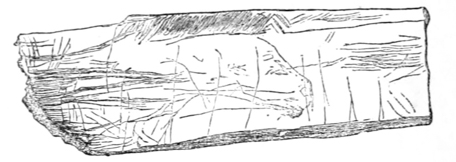
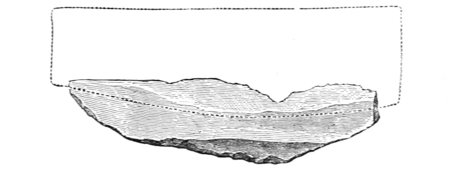

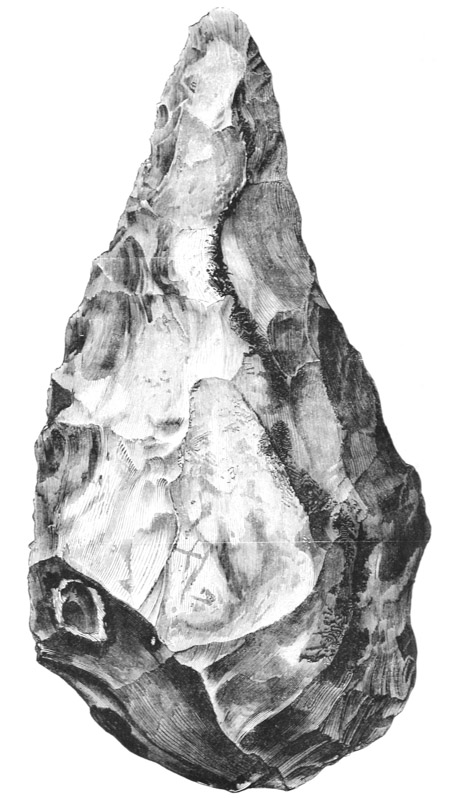
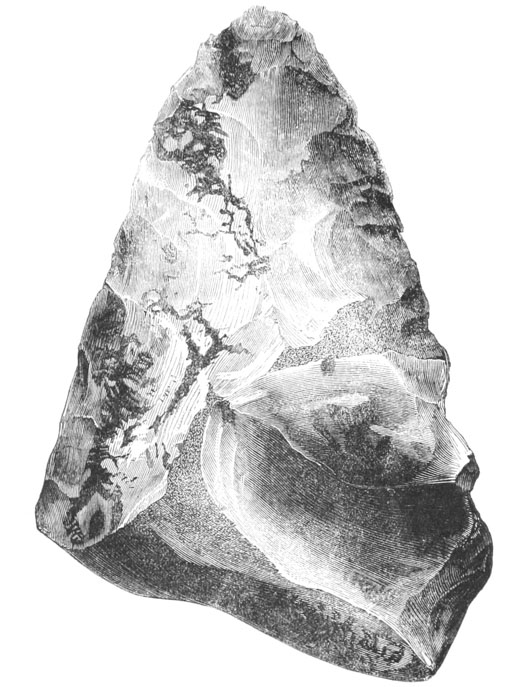
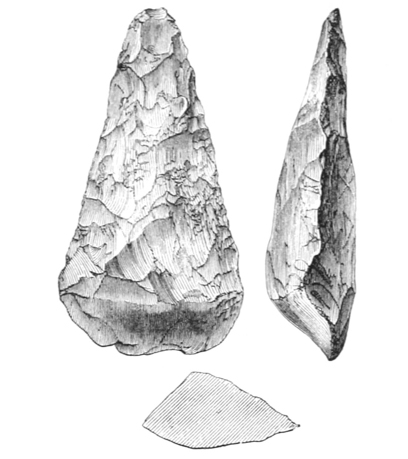
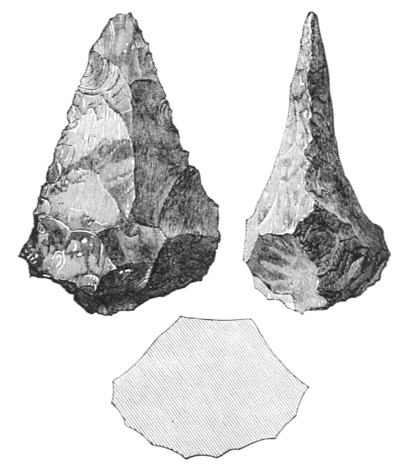
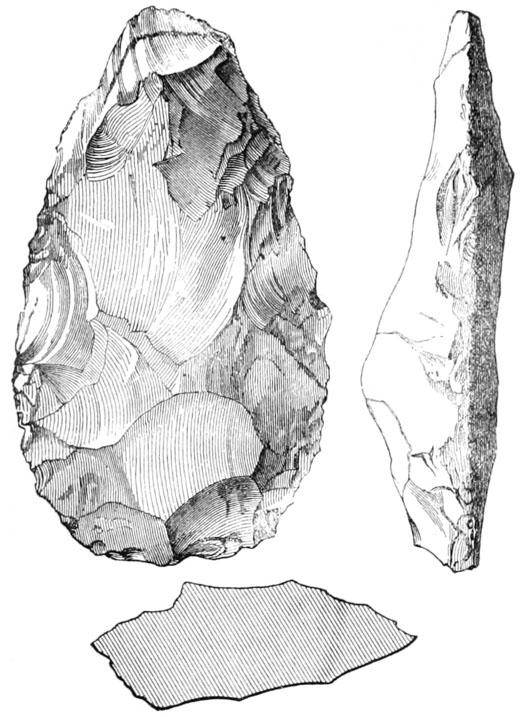
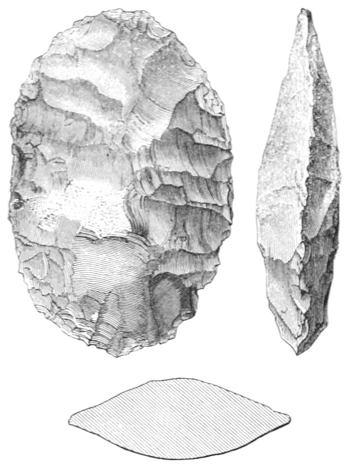
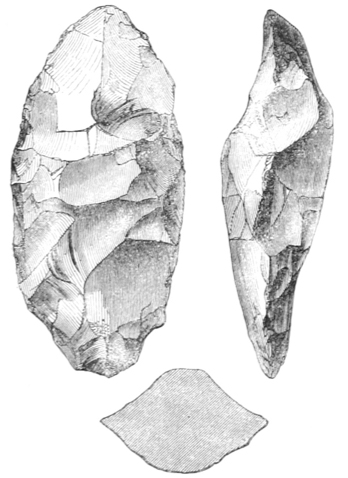
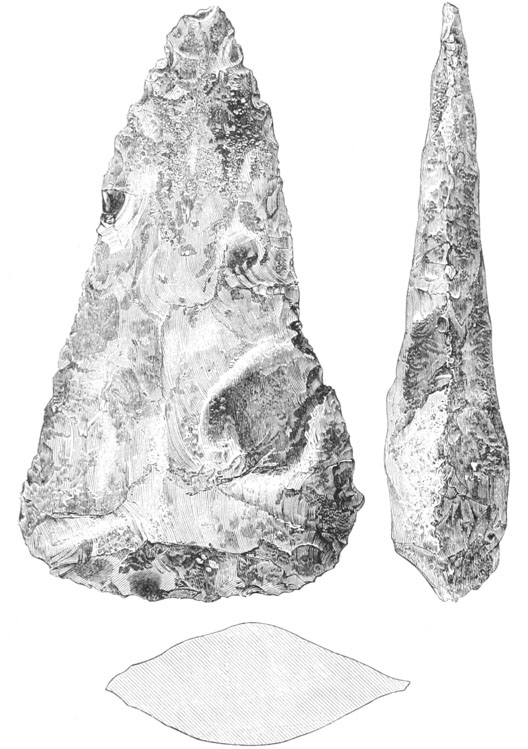
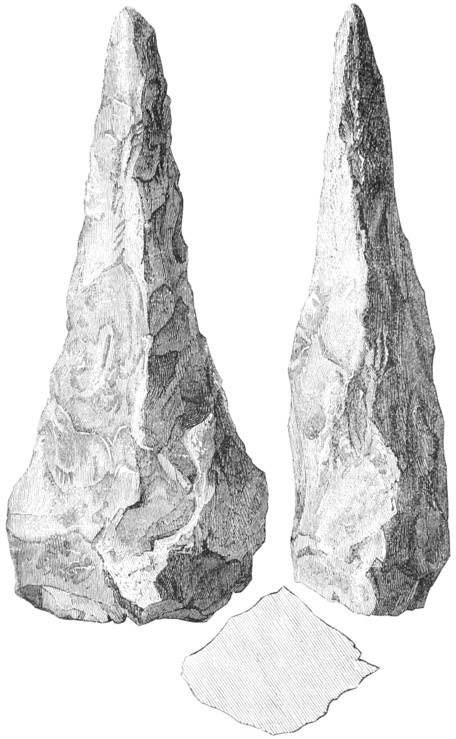
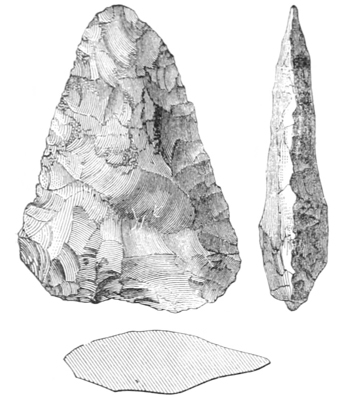
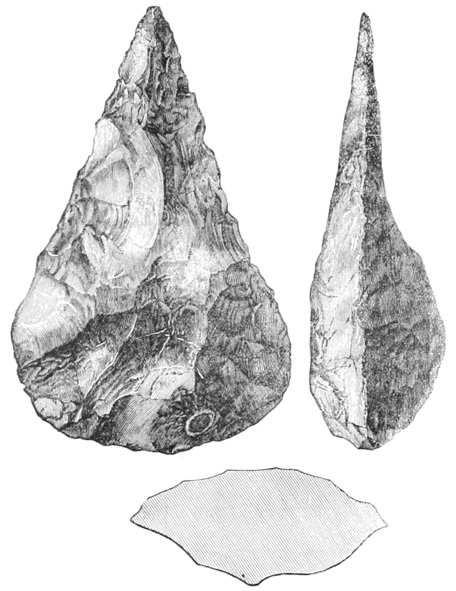
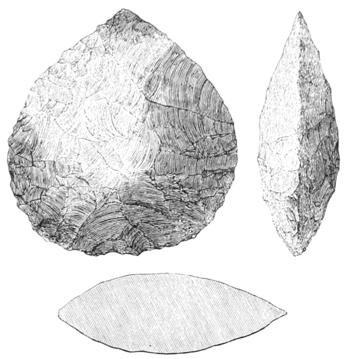
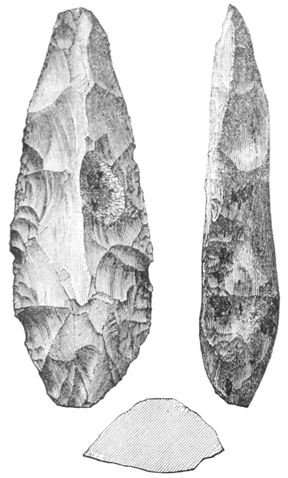
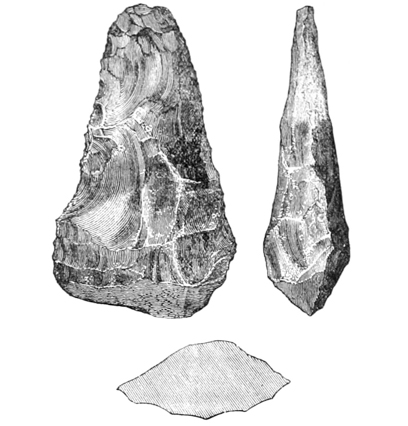
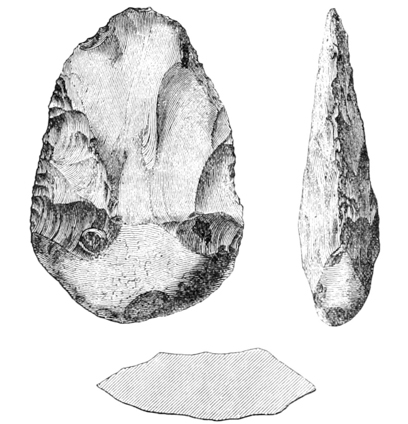
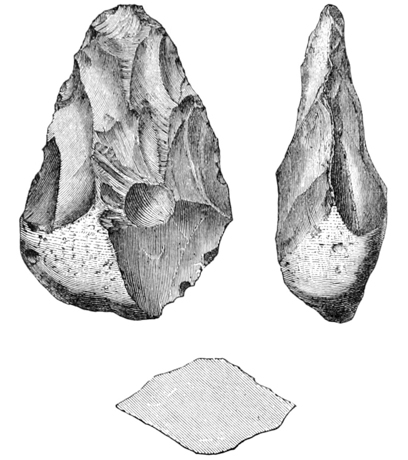
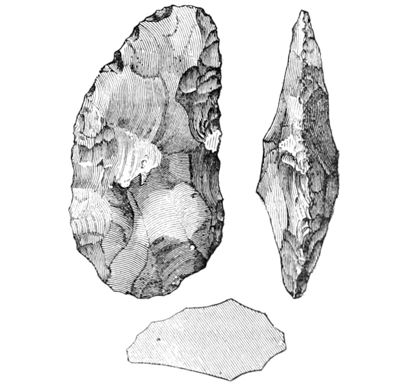
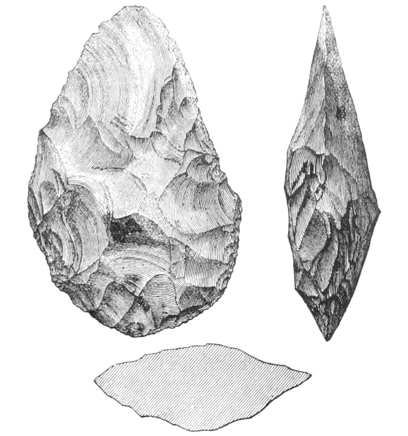
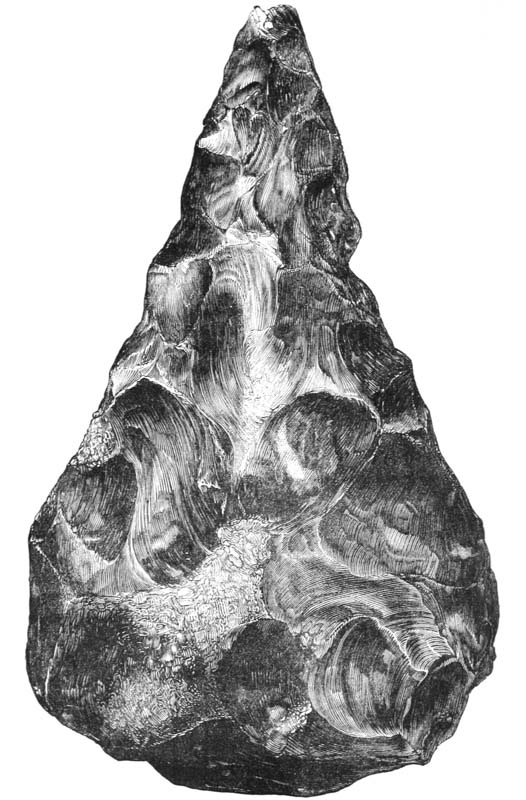
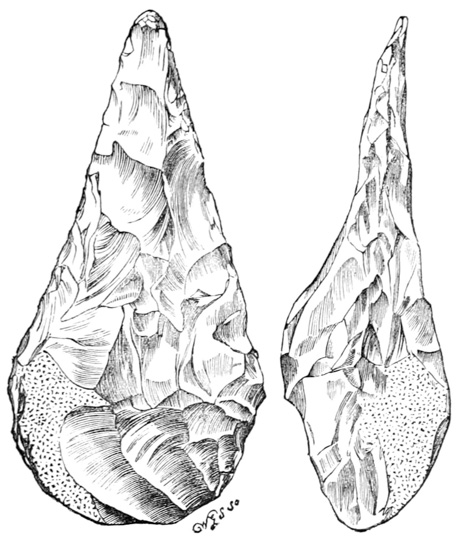
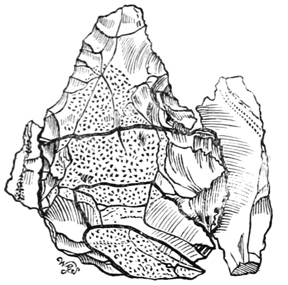
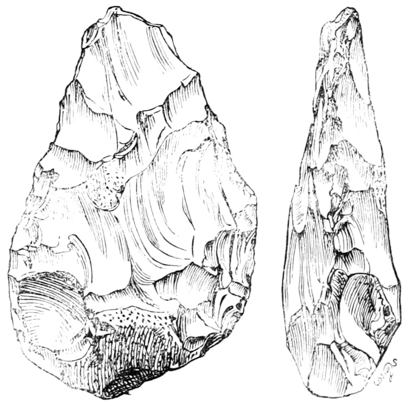
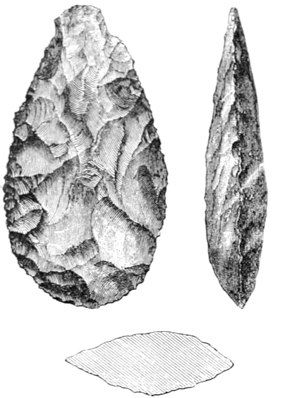
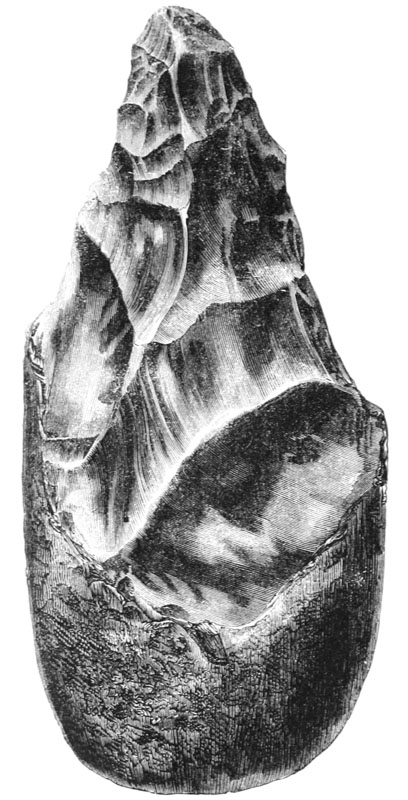
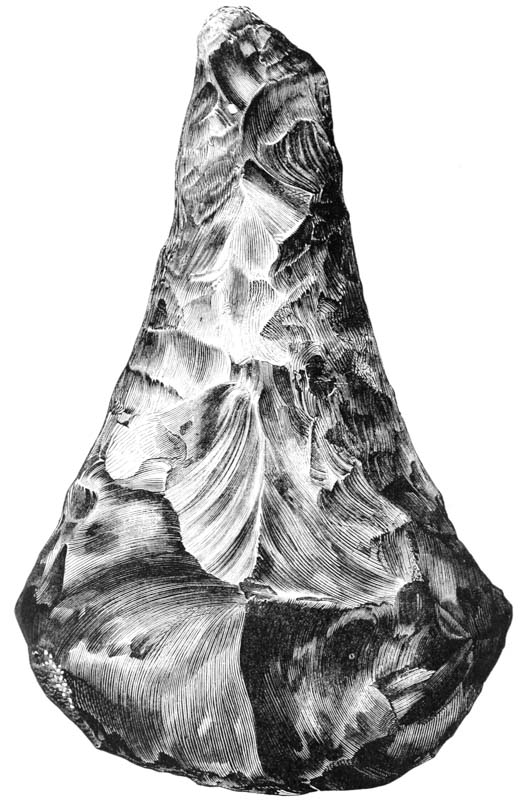
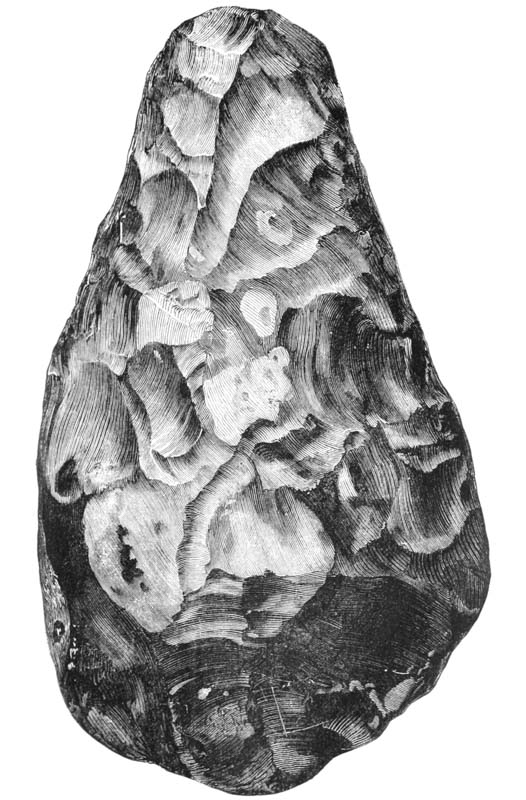
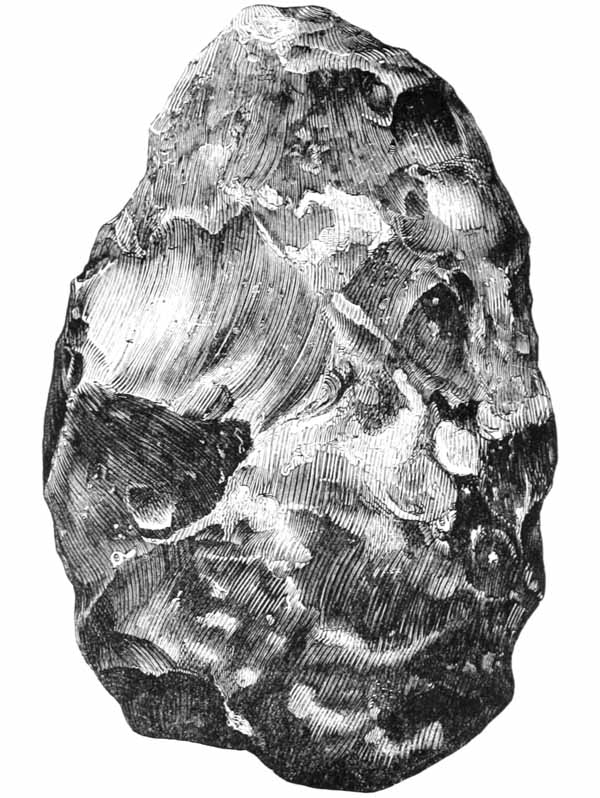
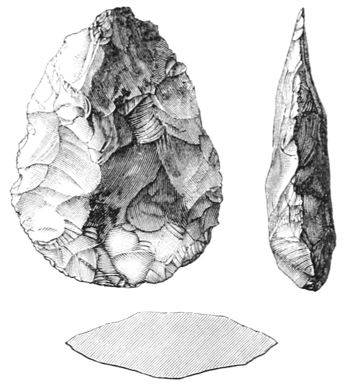
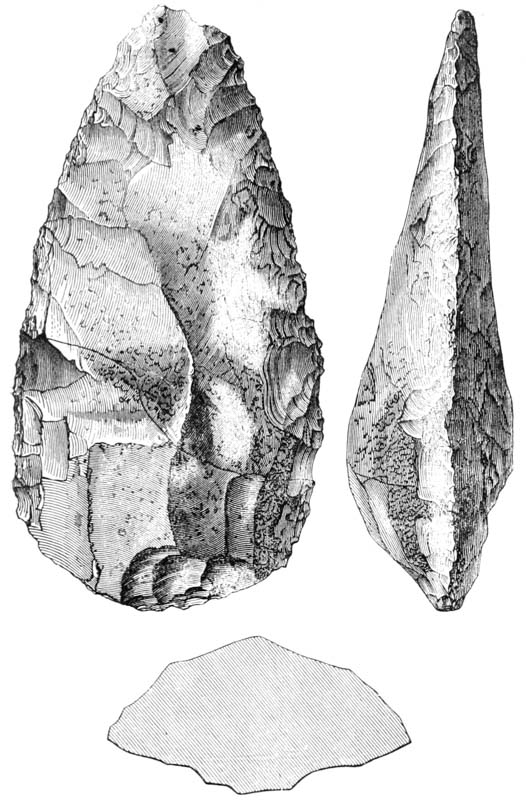
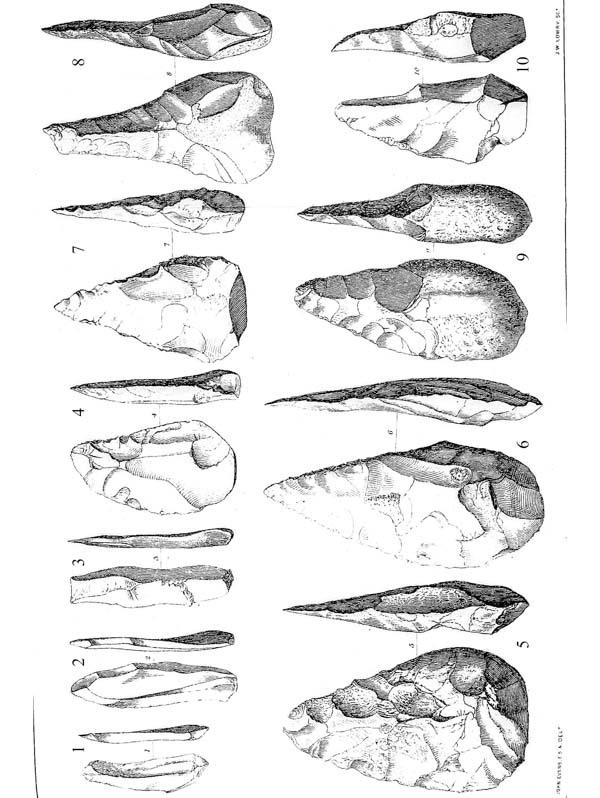
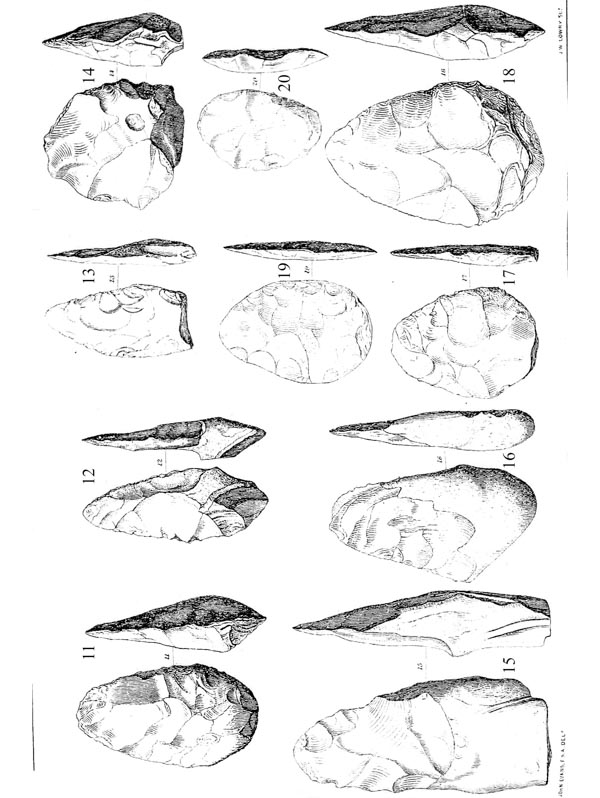
 ,
interpretation of,
 .