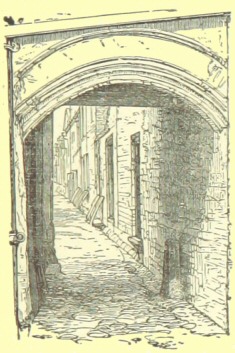
 The two most remarkable and
noteworthy features of the ancient Borough of Great Yarmouth,
that remain unchanged to the present day, are the Parish Church,
and the unique series of long, narrow passages, known by the
general name of Rows. The wonderful proportions and
interesting features of the renowned Church having been duly
examined, these singularly confined thoroughfares next claim the
attention of the intelligent visitor. On seeing them for
the first time, the query naturally arises in the mind, why were
they constructed in this peculiar manner, so opposed to all
prevailing ideas? Thoughtful minds have ingeniously
surmised sundry motives; but the preponderating belief is
probably the most correct one, viz., the builders’ desire
to economise the limited area at their disposal within the walls
of the fortifications. In early times the population of
Yarmouth grew apace; numbers of enterprising persons from various
places being attracted thither by the flourishing fishing
operations that were carried on here. Manship, in his
History of Yarmouth, states that within four hundred years from
the time when “from a sand in the sea, by the deflection of
the tides, Yarmouth grew dry and firm land, whereby it became
habitable; the population grew to a great multitude, over whom,
at the beginning of the Reign of Henry I., a Provost was
appointed.” It may be mentioned, by the way, that it
was in this reign the Parish Church of St. Nicholas was
built. The population of Yarmouth, in the year 1348,
numbered ten thousand. We can, therefore, without
difficulty, understand how valuable space would be in those early
times, and how general the desire to make the most of it.
It is
interesting to notice that Manship, who wrote in the year 1619,
opined a very different reason for the circumscribed limits of
the Rows. When contemplating them patriotically, he
prognosticated, with glowing satisfaction, the bad half-hour that
awaited any rash invader, who might incontinently venture to
approach them, feeling assured the brave and hardy inhabitants
“of those seven score passes” would render a good
account of themselves on any such occasion. [4] But we must quote his own
words. He says: “The number of them (‘the
Rows’) at this day be 140; whereby every householder to his
private dwelling hath of all necessaries very convenient
conveyance, and the same in time of hostility, for the defence
and safeguard of the town, is very meet and necessary, for one
man against twenty, with shot and powder, is able to make
resistance.” Continuing the subject, he says:
“These buildings, although dissevered and disjoined each
from the other by Rowes or Lanes, the same being in number, as I
have before declared, one hundred and forty, yet is there not any
more division in comeliness, to be by the eye discovered, amongst
them, than unpleasantness to the ear in music, consisting of many
discords which do make a perfect concord. The streets being
contrived and built in such warlike manner, flankerwise, with
such convenient distance from the walls (fortifications)
aforesaid, that the enemy having gained the walls, and entered
the town (both which God forbid), may with few men, be enforced
to retire, and the town recovered without any great danger
sustained.”
It seems the most reasonable supposition that the Rows were
constructed as we see them, in order that as large a population
as possible might be concentrated within the narrowest limits, to
make the work of fortifying the town as easy a matter as possible, and
give, at the same time, greater security to the whole.
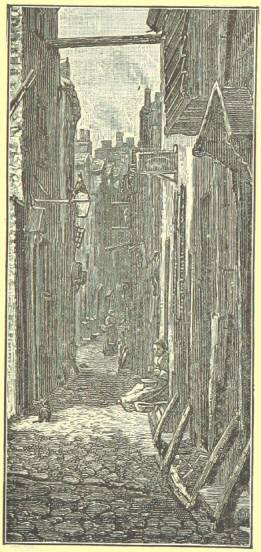 The following imaginative idea may be taken for what it is
worth, namely, that the ground plan of the Streets and Rows were
suggested by the fishermen’s nets, when spread out in long
lines upon the Denes for drying, a narrow pathway being left
between the nets of each fisherman, the pathways representing the
Rows.
It has been sagely remarked by a reflective writer that the
Rows “seem to have been so constructed, that in the event
of an unusually high tide, the water might flow through
them.” And in like manner observes another, “if
the water swept over on one side, it would make its escape at the
other as if through a grating.” Had such a
contingency been in contemplation, surely a greater breadth would
have been given to allow the water a freer flow.
These Rows, as might have been anticipated, have been objects
of much interest to Visitors generally, but especially to those
of antiquarian tendencies. The minds of some have been so
impressed with their old-world appearance, that on returning to
their distant homes, they have relieved themselves by relating
wonderful descriptions of them to the unfortunate individuals who
had not yet seen them. Some have excitedly rushed into
print, and gladly made known to whole neighbourhoods, through
their local press, the striking phenomena they had witnessed
here. One described the Rows to wondering readers as
“fearsome apertures in the street,” and then
soothingly added, “but there is nothing to
fear.” Another, we imagine, well-versed in country
life, said they were “like rabbit burrows.” A
third descriptive writer asserted that “many of the ancient
thoroughfares might be appropriately termed cracks in the wall,
they are so narrow.” Another less excitable
individual wrote, “many of them are so narrow that you can
easily touch both sides at once, by stretching out your hands
while walking through, and it surprises the stranger not a little
to be told that these were the only communications between the
principal thoroughfares of the town.” The critical
pen of another scribe declares them to be “very long
alleys—needless alleys I should say, if the architects had
only known what they were about in the days when these alleys
were made.” Ah! yes! and then, before leaving the
consideration of them, he thus describes their
capabilities. “They are so narrow that neighbours can
shake hands across their little street.” Another,
condescendingly, describes the way in which it may be done.
“The inhabitants might lean out of their windows and shake
hands.” Still further capabilities were seen by
another imaginative writer. “You can put your hand
out of your bedroom window and put out the candle in your
neighbour’s;” and, I suppose, if necessary, borrow
the candlestick; but this he omitted to state. One, whose
presence had, doubtless graced continental cities, as well as honoured
the Rows of Great Yarmouth, saw in them other possibilities, and
stated “for intricacies they can compete with the most
confined of those of any Continental City you can mention, where
the inhabitants can converse and shake hands from upper stories,
visit each other in night-caps, quarrel in the upper world, or
carry on a general confab, peacefully or otherwise.”
Somewhat more definitely wrote another: “They are passages
between parallel streets, some with shops on either side like
Union Passage in Birmingham, but most of them only a few feet
wide, with dwelling houses on each side, where a jump from one
window to another would be an easy task for a
gymnast.” Who can but admire the following graphic
description? “What a quaint old town. The fine
Market Place is like an open plain; the scores of narrow
‘Rows’ running out of it may be likened to burrows
leading in all manner of directions. However does each
denizen find his, or her dwelling? Do they never get mixed,
and give it up for a bad job? Some of these Rows are too
narrow to permit of a man falling down if he got
crosswise.” Having investigated them with the eye of
an antiquary, another gentleman described the Rows as “the
long series of narrow passages, running from one principal street
to another, numbering 145 in all, with houses on each side.
Although none of them are sufficiently wide to allow of other
than pedestrian traffic, many quaint old-fashioned houses, dating
several centuries back, bearing both external and internal
evidence of great expense and labour being devoted to their
erection and decoration. In fact, old Yarmouth is full of
interest to the antiquary and to the curiosity
seeker.” Of course, the visitor with an eye to
sanitation, has not allowed the Rows to be unexplored. They
have borne the scrutiny, and we may breathe freely now the
verdict has been given. “A remarkable appearance is
presented to the visitor by the number of long narrow lanes
called ‘Rows’ that run east and west of the
town. It leaves little room for doubt of the healthiness of
the place when these Rows are examined, for their cleanliness and
orderly appearance must surely render them conducive to the
highest possible standard of health; and if these observations
can be applied with as much appropriateness to the internal
sanitary arrangements of the dwellings—as I have reason to
believe it may—the Corporation may congratulate themselves
on the success of their efforts in this respect.”
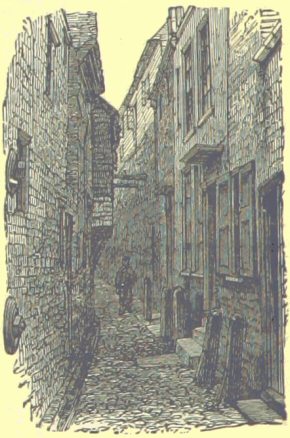
We will now present the reader with the observations of
writers who have less cursorily investigated this
wonderland. A writer in a metropolitan newspaper gave
the following well-considered description:—“These
openings are the famous Yarmouth ‘Rows,’ 154 in
number, running parallel to each other, between the river and the
sea, and so narrow that the meanest London Lane would look a very
Regent Street if placed alongside of them. I measured one,
it was the narrowest I saw, and found, that at the entrance, it
was little more than two feet across. It is probably
reserved for thin natives, since no fat man, with all his clothes
on, could safely venture to tread it. In all points of
comparison, however, but narrowness, the Yarmouth Rows have a
decided advantage over the London Lanes, and it is this that
makes their appearance so extraordinary to a Londoner. He
naturally associates poverty, filth, squalor, and all sorts of
misery and crime with courts in which the inhabitants can shake
hands with each other out of the opposite windows, or step at one
stride across the so-called street or lane. Everyone with a
watch to lose, carefully shuns such localities, or instinctively
buttons up his coat if he happens to wander into them. At
night the narrow gloomy jaws of the Yarmouth Rows must, to a
cockney pilgrim of a lively imagination, look even more
formidable; but in daylight, one glance down them suffices to
show that they are widely different from anything that his
experience had taught him to expect.
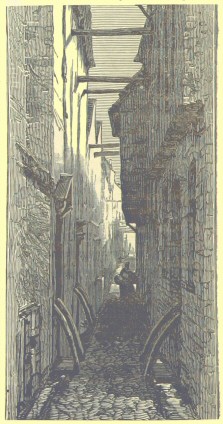
“The model Row is respectability itself; its tiny toy
pavement of brick or stone is easily kept clean, and shines like
the deck of a man-of-war; the houses on each side, so far from
betraying any signs of squalor or painful poverty, are, some of
them, so nicely kept with rows of flower pots brightening the
windows, and clustering creepers draping the naked wall, that one
begins to wonder how people, who are in a position to consider
the amenities, as well as the necessaries of life, consent to
live in such close, crowded quarters, and is driven to conjure
that they are a jolly neighbourly race, who like, out of pure
good fellowship, to be always in talking and hand-shaking
distance of each other.
“And this theory that the grotesque construction of the
Yarmouth Rows is due not to strategic, but to social
considerations, is supported by the fact, in the ‘good old
times,’ each Row took its name, in friendly fashion, from
the best-known or the principal person living in it. In
these degenerate days of scientific classification, arithmetic
has triumphed over flesh and blood, and each Row is known by its
number, with the single exception, I believe, of ‘Kitty
Witches’ Row’—once a pet preserve of the
invaluable public servant, the witch-finder Hopkins, who could
always count upon unearthing enough ugly women in Yarmouth, with
the unmistakeable witch marks on their sea-tanned shrivelled old
skins, to make a respectable official return, and satisfy
Government that public money was not being wasted. The Rows
are, I am told, chiefly the resort of the seafaring population,
who constitute Yarmouth’s working class.”
A writer in Cassell’s Magazine says: “the
Rows are not wooden arcades like those of Chester, but straight
and extremely narrow alleys, running between the principal
streets and the river, like the rungs of a ladder, to the number
of 156. Now-a-days only the humbler class of people live
there, but having penetrated into a good many of them, I am bound
to say that in no instance have I seen the squalor and misery of
a low neighbourhood in London. There are vice and poverty
in Herring-haven, as elsewhere, but you see none of those sights
which saddens the heart of the reflective Londoner. I think
the filthy coal smoke has something to do with the degradation of
our metropolitan poor. Country folks who come and settle in
Babylon grow in time weary of contending with the blacks, and
suffer their children to grow up grimy and ragged, while the
children playing about the doors in the Rows are clean, healthy,
decently dressed, and civil spoken. * * * Whitewash is laid
liberally on every accessible place, the causeway is plentifully
supplied with gutters made of semi-circular yellow tiles, and in
no instance have I encountered those vile odours which offend you
on the Continent. It would be false to say that I never
smelt fish; there is a vast deal of shrimp boiling done in some
of these Rows, but of those filthy stenches of which Coleridge
numbered seventy-two in the city of Cologne, I detected not
one.”
Harper’s Magazine of June, 1882, gave the
following interesting description:—“At one time the
inhabitants of this old borough took up to living on a plan
almost entirely their own, and the Rows in which they built their
houses remain to this day the most curious of all the features of
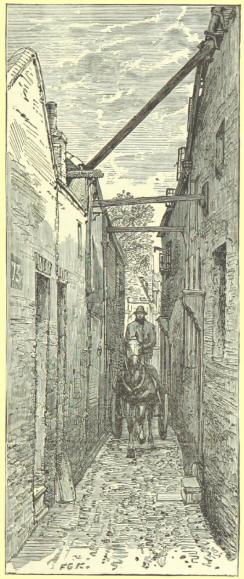
the ancient town. The Rows are narrow streets leading to
and from the quay,—not narrow in the ordinary sense, but
narrower, perhaps, than any other streets in the world, their
average width being six feet. They are not isolated
infrequent lanes left between more commodious thoroughfares by
the incomplete modifications of early plans, but they form a
system and their aggregate length is about eight miles. Six
feet is their average width, but some of them are scarcely more
than three feet, and two persons cannot pass one another without
contracting themselves and painfully sidling in the opposite
directions. The pavement is of rough cobble-stones, with
sometimes a strip of flags down the middle to ease the way of the
pedestrian. The houses tower up with smooth perpendicular
walls, like cliffs, on both sides, and shut out the light, the
upper stories projecting in many cases beyond the lower, and
forming an arch over the narrow passage below. Most of
these houses are very old, and the material of which they are
built is flint or stone, often white-washed, though occasionally
left in its natural condition with open timbering in the fronts;
in one or two the masonry is of the herring-bone pattern; but
huddled up as they are, without regard to privacy or ventilation,
staring into one another’s faces with undesirable intimacy,
they are of a good class, and in good condition, and some of them
have courtyards before them with nasturtiums and scarlet runners
dragging a tender green web over their white walls. The
narrowest of the Rows is only 2 feet 3 inches in width.
There are in all 156 of them, each known by its number. The
object of the frugal plan in which they originated is a
mystery. One of the guesses at it is this:—‘The
fishermen spread out their nets to dry very carefully, and leave
on the four sides of each net a clear passage, four, five or six feet
wide.’ It is suggested that the ground on which the
Rows stand was once used for this purpose, and that the passages
became so well defined from constant traffic that eventually they
were perpetuated as streets. However this may be, it is
certain that some of the houses in the Rows were among the first
built in the town, and certain also that, leading from the main
street, they give easy access to the Quay, whereon Yarmouth finds
its chief interest. When the moon is full and throws black
beams of shadows across these alleys, and opens seeming pitfalls
in their rugged pavement, a stranger hesitates to enter
them. At all times they seem properly to belong to
conspirators, but they are quite safe and reputable. In
olden times the Watchmen patrolled them, ‘crying the
wind’ for sleepless merchants and anxious skippers; and the
bellmen of the Church of St. Nicholas prayed in them for the
souls of those who had bequeathed money for the purpose. [11] The wind holds pretty well to one
quarter in Yarmouth, and it is said the watchmen seldom had
occasion to vary their announcement: ‘East is the wind,
east-north-east; past two and a cloudy morning.’
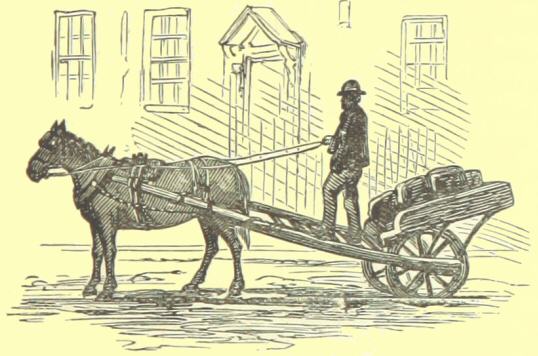
“Having invented the narrowest streets in the world, the
inhabitants had to devise an original vehicle for their
locomotion, as no ordinary carts could enter them, and this
necessity was relieved by the ‘trolly,’ a peculiar
cart about 12 feet long, with two wheels revolving on a box axle,
placed underneath the sledge, the extreme width of the vehicle
being about 3 feet 6 inches.
“Even in the dead of night the Rows are not quite
still. All of them lead toward the river, and some of them
reveal the black lines of clustered masts and rigging. Many
of the houses are occupied by fishermen, who are astir at all
hours. The shrimpers go out to meet the tide at eleven or
twelve o’clock, and though the river has some traffic with
distant ports, the most frequent vessels on it are the
‘dandy-rigged’ boats and the rakish cutters which
belong to the great industry of the town.”
Were we to omit the characteristic description given in
Household Words, Vol. VII., p. 163, that is very
generally ascribed to the pen of the late Charles Dickens, our
list of noteworthy quotations would be rightly deemed by many
readers to be very incomplete. We gladly insert the
following from that excellent magazine, heading the extract with
some lines from a rhyming description of Yarmouth, written by Mr.
H. J. Betts:—
“And the Rows! them long bars of the
gridiron,
That Dickens hev wrote on—so quare;
Them ere Rows are a great institution,
In the town at the mouth of the Yare.”
“Great Yarmouth is one vast gridiron, of which the bars
are represented by ‘Rows,’ to the number of one
hundred and fifty-six. Repel the recollection of a
Chester-row, a Paradise-row, or a Rotten-row. A Row is a
long, narrow lane or alley, quite straight, or as nearly as may
be, with houses on each side, both of which you can sometimes
touch at once with the finger tips of each hand, by stretching
out your arms to their full extent. Now and then the houses
overhang, and even join above your head, converting the Row, so
far, into a sort of tunnel or tubular passage. Many and
many picturesque old bit of domestic architecture is to be hunted
up among the Rows. In some Rows there is little more than a
blank wall for the double boundary. In others, the houses
retreat into tiny square courts, where washing and clear
starching are done, and wonderful nasturtiums and scarlet runners
are reared from green boxes, filled with that scarce commodity,
vegetable mould. Most of the Rows are paved
with pebbles from the Beach, and, strange to say, these narrow
gangways are traversed by horses and carts which are built for
this special service, and which have been the cause of serious
misunderstanding among antiquaries, as to whether they were or
were not modelled after the chariots of Roman invaders. Of
course, if two carts were to meet in the middle of a Row, one of
the two must either go back to the end again, or pass over the
other one, like goats upon a single file ledge of a
precipice. The straightness of the passage usually obviates
this alternative. A few Rows are well paved throughout with
flagstones.
 Carts are not allowed to enter these, and
foot passengers prefer them to the pebbly pathways. Hence
they are the chosen locality of numerous little
shopkeepers. If you want a stout pair of hob-nail shoes, or
a scientifically oiled dreadnought, or a dozen of bloaters, or a
quadrant or a compass, or a bunch of turnips, the best in the
world, or a woollen comforter and night-cop for one end of your
person, and worsted overall stockings for the other, or a plate
of cold boiled leg of pork stuffed with parsley, or a ready-made
waistcoat, with blazing pattern and bright glass
buttons—with any of these you can soon be accommodated in
one or other of the Paved Rows. Here you have a board
announcing the luxurious interval, during which hot joints are
offered to the satisfaction of salt water appetite; from twelve
to two no one need suffer hunger. Elsewhere is the notice
over the door, that within are ‘LIVE
AND BOILED SHRIMPS SOLD BY THE CATCHER.’
Shrimps, unadulterated, boiled and sold by the very catcher
himself,—the original article, and no mistake! From
time immemorial, there has been a Market Row, in which two people
can walk arm-in-arm, as they stare at the elite of
Yarmouth shop windows, and there is a Broad Row, across which, if
an Adelphi harlequin could not skip from first floor to first
floor, he would get from the manager very significant hints about
his abilities.”
The reader cannot fail to have observed the numerical
diversity in the above quotations, as to the total number of the
Rows. The discrepancy probably arose through a compositor,
when engaged upon a Yarmouth publication, transposing two of the
numerals, thus turning the number 145 to 154, and the error
passing unobserved remained uncorrected; and succeeding writers,
instead of drawing inspiration from the fountain-head—the
Rows themselves, have complacently copied, and so perpetuated the
blunder. This, however, does not explain the number given
as 156.
Considerable allowances must be made for many of the
statements given by the various writers, in consideration of the
length of time that has since elapsed. The onward march of
improvement has become so general, it has penetrated even into
the recesses of these old-world thoroughfares. Although
they remain, as in all probability they will continue to be, the
picturesque, tumble-down Rows of Yarmouth, a “Paradise for
painters,” as Punch described them, still the signs
of the times are now apparent within their precincts.
Pedestrians are no longer compelled to tread gingerly upon
uncrushed “petrified kidneys,” when threading their
way through them, but may proceed satisfactorily and pleasantly
along a pathway of concrete or flagstone, and if disposed to
enter them at night, he will discover that nearly all are now
illuminated by gas. When preparation was being made for
these improvements in the year 1884, an official measurement of
eighty-one of the Rows was taken, and the total length of them
was ascertained to be 8,372 yards, or rather more than 4¾
miles. The entire length of the 145 Rows exceeds seven
miles. Within the eighty-one Rows which were measured, the
number of the dwelling-houses was found to be 1,811.
The names of some of the Rows were sufficiently remarkable to
justify Dickens in amusingly referring to them as
“Jumber’s Row,” and “Mopus’s
Row.” Known as the Rows were to succeeding
generations all down the ages, by name only, it was no easy
matter to wean the Yarmouthians from the method so familiar to
them and their forefathers, of recognising each Row by its
name. The change from name to number was adopted by the
Corporation in the year 1804, and although a century of years
have since nearly run their course, many of the old inhabitants
still recognise a Row by name, in preference to its number.
The writer has found it a common occurrence for persons, after
long residence in Rows, to be utterly unable to state their
numbers. A woman when asked the number of the Row she lived
in, said, “57, but I don’t know whether it is the
same number at both ends.” Quite recently, “Row
161” was given to the writer as a place of residence of an
individual. A woman born in Row 21, in 1869, wrote in 1893,
“I was born in Row 100, where some houses were pulled down
for Sir E. Lacon’s Brewery.” An illustration of
a similar character may be given from one of the Register Books
at the Parish Church. In 1840, at their marriage, a couple
were asked their place of residence, and it was given as
“Row 171,” and they evidently stood uncorrected, as
“Row 171” was recorded. Still further proofs
may be culled from these Registers, showing the tenacity with
which the old names were cherished. Most of the following
designations have been obtained from entries which were made
within the first four years of Her present Majesty’s
reign:—
Angel Row
Almshouse Row
Adam the Barber’s Row
Buck Row
Barnaby Baker’s Row
Boulter’s Row
Brown, Grocer’s Row
Bennet, Cooper’s Row
Blue Anchor Row
Broad Row
Black Swan Row
Baptist Meeting Row
Black Horse Row
Blower’s, Cabinet-maker’s Row
Budd, Sail-maker’s Row
Blue Bell Row
Bessey’s Half Row
Bank Paved Row
Bell and Crown Row
Child, Blacksmith’s Row
Castle Row
Chapel Row
Chapel Paved Row
Conge Row
Cart and Horse Row
Custom House Row
Crown and Anchor Row
Crown and Heart Row
Dove Row
Doctor Smith’s Row
Doughty’s Row
Dog and Duck Row
Dover Court Row
Dr. Bayly’s Row
Doctor Ferrier’s Row
Dene Side Austin Row
Duncan’s Head Row
Esquire Palmer’s Row
Esquire Steward’s Row
Excise Office Row
Elephant and Castle Row
Earl St. Vincent’s Row
Fighting Cock Row
Foundry Row
Fulcher’s Row
Ferry Boat Row
Fourteen Stars Row
Frere’s Row
Gun Row
Gallon Can Row
Globe Row
George and Dragon Row
Garwood, Painter’s Row
Garden Row
Glass House Row
Golden Lion Row
Humber Keel Row
Horn Row
Horse and Cart Row
Half Moon Row
Huke, Carpenter’s Row
Jail Row
Kitty Witches’ Row
King’s Head Row
Law’s Baker’s Row
Lamb, Butcher’s Row
Lawyer Cory’s Row
Lacon’s Garden Row
Lion and Lamb Row
Mr. Paget’s Row
Mr. Blake’s Row
Mr. Butcher’s Row
Mr. Cobb’s Row
Mr. Skill’s Row
Mr. Woolverton’s Row
Mr. Yett’s Row
Meeting House Row
Mariner’s Compass Row
Market Row
Money Office Row
Morley Grocer’s Row
Miller, Basket Maker’s Row
Mews Half Row
Martin, Shoemaker’s Row
Nine Parish Row
New White Lion Row
Newcastle Tavern Row
Nichols, Shoemaker’s Row
Naunton, Baker’s Row
North Pot-in-hand Row
Old Fountain Row
Old Meeting Row
Old Post Office Row
Old Prison Row
Oakes, Grocer’s Row
Old White Lion Row
Page, Pipe-maker’s Row
Paternoster Row
Plummer, Schoolmaster’s Row
Pike, Sailmaker’s Row
Present, Butcher’s Row
Pot-in-hand Row
Post Office Half Row
Priory Row
Queen’s Head Row
Quay Angel Row
Quay Austin Row
Quay Mill Row
Quaker’s Meeting-House Row
Rampart Row
Rose and Crown Row
Rivett, Baker’s Row
St. John’s Head Row
South Walking Row
Saving’s Bank Row
Steward, Chemist’s Row
Say’s Corner Row
South Say’s Corner Row
Star and Garter Row
Spotted Cow Row
Stamp Office Row
Split Gutter Row
Snatchbody Row
South Garden Row
Sewell’s Row
Ship Tavern Row
Star Tavern Row
Synagogue Row
St. George’s Tavern Row
St. George’s Row east
St. George’s Row west
St. Peter’s Row east
St. Peter’s Row west
Sons of Commerce Row
Taylor, and Fulcher’s Row
Turnpike Row
Took, Baker’s Row
Two-Neck Swan Row
Three Herrings Row
Thornton, Grocer’s Row
Utting’s Row
Unitarian Chapel Row
White Lion Row
Wheatsheaf Row
Well Row
White Horse Row
Wheel of Fortune Row
White Swan Row
Wrestler’s Row
Yett’s Foundry Row
In some instances two names were given to the same Row.
Rampart Row no longer exists. The cottages have been
removed and the old rampart wall exposed to view; the space thus
gained has been converted into a carriage way, and the
thoroughfare named Rampart Road.
It has been asked, why are these thoroughfares called
Rows? In Palmer’s Notes on Manship, p. 271, we
find the following reply:—“‘Row’ is
supposed to be derived from rhodio, to walk; or from the
Saxon rowa (a rank); or, which is more probable in the
sense in which it is used in Yarmouth, from the French
rue, a street, or lane.”


