LITTLE as we know of the ancient Egyptian
religion in its entirety, and of its motley
mixture of childishly crude fetichism and deep
philosophic thought, of superstition and true religious
worship, of polytheism, henotheism, and pantheism,
one dogma stands out clearly from this confusion,
one article of belief to which the Egyptian religion
owes its unique position among all other religions
of antiquity−-the doctrine of the immortality of the
human soul. It is true that other ancient religions
attained to a similar dogma, for the belief was
early developed among Semites, Indo-Germanians,
Turanians, and Mongolians; but in all these cases it
appears as the outcome of a higher conception of
man and God and of their reciprocal relationship,
and, when attained to, brought about the abandonment
of grossly material forms of thought. But in
Egypt we have the unique spectacle of one of the
most elaborated forms of the doctrine of immortality
side by side with the most elementary conception of
higher beings ever formulated by any people. We
do not know whether the belief in immortality which
prevailed in the valley of the Nile is as old as the
Egyptian religion in general, although at first sight it
appears to be so. The oldest of the longer religious
texts which have come down to us are found in the
wall inscriptions of pyramids of kings of the Fifth
and Sixth Dynasties (according to Manetho's scheme
of the dynasties), and must be dated to at least
3000 B.C. In these texts the doctrine of immortality
appears as a completed system with a long history
of development behind it.
In that system, all the stages through which this
doctrine of the Egyptian religion had successively
passed are preserved; for the Egyptians were so
immoderately conservative in everything that they
could not make up their minds to give up their
old ideas of deity, even after having advanced to
higher and purer ones. The older ideas were all
carefully retained, and we find various systems of
religion which in point of time had followed each
other on Egyptian soil afterwards existing side by
side. There is no trace of any struggle for the
victory between these systems; each new order of
thought was taken as it arose into the circle of the
older ones, however heterogeneous it might be to
the rest. The consequence was that in Egypt there
was no religious progress in our sense of the term.
With us it is essential that old and outworn forms
of belief should be cast off; with them a new
doctrine could achieve no greater success than to win
a place among the older conceptions of the Egyptian
Pantheon.
Each single divinity, each religious belief, each
amulet, has in itself a clear and intelligible significance;
and where this is apparently otherwise it is
not because the point was obscure to the Egyptian
mind, but because we have not yet succeeded in
making it clear to ourselves. When we abandon
the consideration of single points and try to imagine
how the different detached notions were combined by
the people into one belief, and what picture they had
really formed of their Heaven and Pantheon—then
we have set ourselves an impossible task. Many
divinities have precisely the same character and
perform the same functions; whole circles of ideas
are mutually exclusive; yet all existed together and
were accepted and believed in at one and the same
time.
In these circumstances any discussion of Egyptian
religious ideas must begin by dealing with isolated
facts; each divinity, each idea, each smallest amulet
must be carefully examined by itself and treated of
in the light of the texts specially referring to it.
Generations of Egyptians pondered on each single
point seeking to elucidate it. With anxious fear
priests and laymen strove to acquire the use of all
the formulæ by the help of which man hoped to
appease the gods, overcome demons, and attain to
bliss, and all sought to provide themselves with every
amulet possessing efficacy for the world to come and
import for man’s eternal welfare. But great as must
have been the expenditure of thought which produced
and developed their various religious doctrines, the
Egyptians never succeeded in welding their different
beliefs and practices into one consistent whole.
In most religions the gods of life are distinct from
the gods of death, but such a distinction scarcely
existed at all in Egypt, There the same beings who
were supposed to determine the fate of man in this
world were supposed to determine it also in the world
to come; only in the case of certain deities sometimes
the one and sometimes the other side of the divine
activity was brought into special prominence. The
exercise of their different functions by the gods was
not in accordance with any fixed underlying principle,
was not any essential outcome of their characters, but
rather a matter of their caprice and inclination. In
course of time the Egyptian idea of these functions
changed, and was variously apprehended in different
places. It seems to us at first as though the relation
of the gods to the life beyond had nearly everywhere
been regarded as more important than their relation
to this life. But this impression is owing to the fact
that our material for the study of the Egyptian
religion is almost exclusively derived from tombs
and funerary temples, while the number of Egyptian
monuments unconnected with the cult of the dead is
comparatively small.
On this account it has been supposed that both in
their religion and in their public life the Egyptians
turned all their thoughts towards death and what lay
beyond it. But a close examination of the monuments
has proved that they had as full an enjoyment
of the life here as other nations of antiquity, and that
they are not to be regarded as a stiff and spiritless
race of men whose thoughts were pedantically turned
towards the contemplation of the next world.
Had this been the case, the Egyptians would have
come to hold a pessimistic view of the life here and
hereafter something like that prevailing in India, and
have striven to escape from the monotony and dulness
of existence by seeking some means to end it. But
this is the reverse of what happened in the valley of
the Nile. The most ardent wish of its inhabitants
was to remain on earth as long as possible, to attain
to the age of one hundred and ten years, and to
continue to lead after death the same life which they
had been wont to lead while here. They pictured
the after-life in the most material fashion; they could
imagine no fairer existence than that which they led
on the banks of the Nile. How simple and at the
same time how complicated were their conceptions
can best be shown by some account of their ideas
on the immortality of the soul and its constitution
as a combination of separate parts set forth in
ancient Egyptian documents.
When once a man was dead, when his heart had
ceased to beat and warmth had left his body, a
lifeless hull was all that remained of him upon earth.
The first duty of the survivors was to preserve this
from destruction, and to that end it was handed over
to a guild whose duty it was to carry out its embalmment
under priestly supervision. This was done
according to old and strictly established rules. The
internal and more corruptible parts were taken away,
and the rest of the body—i.e., the bony framework
and its covering—was soaked in natron and asphalt,
smeared with sweet-smelling unguents, and made
incorruptible. The inside of the body was filled with
linen bandaging and asphalt, among which were
placed all kinds of amulets symbolising immortality−-heart-shaped
vases, snake-heads in carnelian,
scarabæi, and little glazed-ware figures of divinities.
By their mystic power these amulets were intended
to further and assist the preservation of the corpse,
for which physical provision had already been made
by embalmment. In about seventy days, when the
work of embalmment was completed, the body was
wrapped in linen bandages, placed in a coffin, and
so returned to the family.
The friends and relatives of the deceased then
carried the dead in solemn procession across the
river to his last resting-place, which he had provided
for himself in the hills forming the western boundary
of the valley of the Nile. Mourning-women accompanied
the procession with their wailing; priests
burnt incense and intoned prayers, and other priests
made offerings and performed mysterious ceremonies
both during the procession and at the entrance to
the tomb.1 The mummy was then lowered into
the vault, which was closed and walled up, further
offerings were made, and afterwards the mourners
partook of the funeral feast in the ante-chamber of
the tomb. Harpers were there who sang of the
dead man and of his worth, and exhorted his
relations to forget their grief and again to rejoice
in life, so long as it should be granted unto them
to enjoy the light of the sun; for when life is past
man knows not what shall follow it; beyond the
grave is darkness and long sleep. Gayer and gayer
grew the banquet, often degenerating into an orgy;
when at length all the guests had withdrawn, the
tomb was closed, and the dead was left alone.
Afterwards it was only on certain feast days that
the relatives made pilgrimages to the city of the
dead, sometimes alone and sometimes accompanied
by priests. On these occasions they again entered
the ante-chamber of the tomb, and there offered
prayers to the dead, or brought him offerings,
either in the shape of real foods and drinks,
or else under the symbolic forms of little clay
models of oxen, geese, cakes of bread, and the
like. Otherwise the tomb remained unvisited. How
it there fared with the dead could only be learned
from the doctrines and mysteries of religion; to
descend into the vault and disturb the peace of
the mummy was accounted a heavy crime against
both gods and men.
And yet how much an Egyptian could have wished
to look behind the sealed walls of the sepulchral
chamber and see what secret and mysterious things
there befell the dead! For their existence had not
terminated with death; their earthly being only
had come to an end, but they themselves had
entered on a new, a higher and an eternal life. The
constituent parts, whose union in the man had made
a human life possible, separated at the moment of
his death into those which were immortal and those
which were mortal. But while the latter formed
a unity, and constituted the corruptible body
only (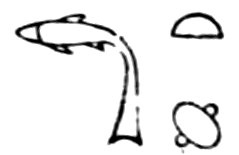 Kha), on which the above-mentioned
rites of embalmment were practised, each of the
former were distinct even when in combination.
These “living, indestructible” parts of a man, which
together almost correspond to our idea of the soul,
had found their common home in his living body;
but on leaving it at his death each set out alone
to find its own way to the gods. If all succeeded
in doing so, and it was further proved that the
deceased had been good and upright, they again
became one with him, and so entered into the
company of the blessed, or even of the gods.
Kha), on which the above-mentioned
rites of embalmment were practised, each of the
former were distinct even when in combination.
These “living, indestructible” parts of a man, which
together almost correspond to our idea of the soul,
had found their common home in his living body;
but on leaving it at his death each set out alone
to find its own way to the gods. If all succeeded
in doing so, and it was further proved that the
deceased had been good and upright, they again
became one with him, and so entered into the
company of the blessed, or even of the gods.
The most important of all these component parts2
was the so-called
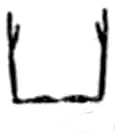 ,
Ka, the divine counterpart of
the deceased, holding the same relation to him as
a word to the conception which it expresses, or a
statue to the living man. It was his individuality
as embodied in the man’s name; the picture of him
which was, or might have been, called up in the
minds of those who knew him at the mention of
that name.3 Among other races similar thoughts
have given rise to higher ideas, and led to a philosophic
explanation of the distinction between personalities
and persons, such as that contained in
the Platonic Ideas. But the Egyptian was incapable
of abstract thought, and was reduced to forming
a purely concrete conception of this individuality,
which is strangely impressive by reason of its
thorough sensuousness. He endowed it with a
material form completely corresponding to that of
the man, exactly resembling him, his second self,
his Double, his Doppelgänger.4
,
Ka, the divine counterpart of
the deceased, holding the same relation to him as
a word to the conception which it expresses, or a
statue to the living man. It was his individuality
as embodied in the man’s name; the picture of him
which was, or might have been, called up in the
minds of those who knew him at the mention of
that name.3 Among other races similar thoughts
have given rise to higher ideas, and led to a philosophic
explanation of the distinction between personalities
and persons, such as that contained in
the Platonic Ideas. But the Egyptian was incapable
of abstract thought, and was reduced to forming
a purely concrete conception of this individuality,
which is strangely impressive by reason of its
thorough sensuousness. He endowed it with a
material form completely corresponding to that of
the man, exactly resembling him, his second self,
his Double, his Doppelgänger.4
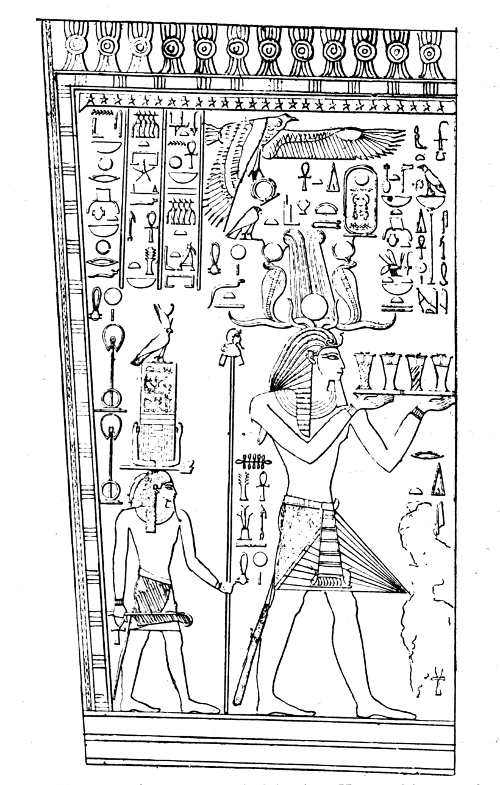
Fig. 1.—Hatshepsû, accompanied by her Ka, making perfume-offerings.
(From the temple of Dêr el Bahri.)5
Many scenes, dating from the eighteenth century
B.C. and onwards, represent different kings appearing
before divinities, while behind the king stands his
Ka, as a little man with the king’s features (fig. 1),
or as a staff with two hands (fig. 2),6 and surmounted
by certain symbols of royalty, or by the king’s head.
In these scenes the Personality accompanies the
Person, following him as a shadow follows a man.
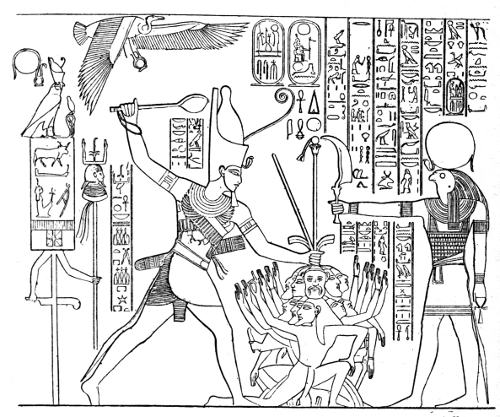
Fig. 2.—The Ka of Rameses II., represented by the two-handed staff,
standing behind the king while he slays his enemies before Rā
Harmakhis. (From Abû Simbel.)7
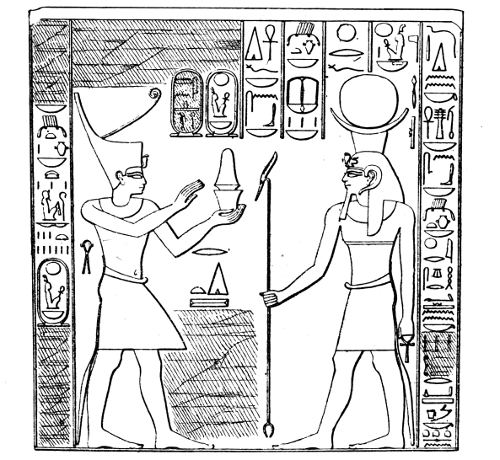
Fig. 3.—Amenophis III. making offerings to his Ka. (From his
temple at Soleb.)8
But even as early as the time of Amenophis III.,
about 1500 B.C., the Egyptians had carried the idea
still further, and had completely dissevered the Personality
from the Person, the king being frequently
represented as appearing before his own Personality,
which bears the insignia of divinity, the staff of
command, and the symbol of life, the
 ānkh (fig. 3).
To it the king presents offerings of every kind and
prefers his petition for gifts of the gods in exchange
His Personality replies: “I give unto thee all Life,
all Stability, all Power, all Health, and all Joy
(enlargement of heart); I subdue for thee the
peoples of Nubia (Khent), so that thou mayest cut
off their heads.” In bas-reliefs of the same period
which represent the birth of Amenophis III.,9 his
Ka is born at the same time as the king, and
both are presented to Amen Rā, as two boys exactly
alike (fig. 4), and blessed by him. About this time
the kings began to build temples to their own
Personalities, and appointed priests to them; and
from time to time the sovereign would visit his
temple to implore from himself his own protection,
and still greater gifts. So long as the king walked
the earth, so long his “living Ka, lord of Upper and
Lower Egypt, tarried in his dwelling, in the Abode
of Splendour (
ānkh (fig. 3).
To it the king presents offerings of every kind and
prefers his petition for gifts of the gods in exchange
His Personality replies: “I give unto thee all Life,
all Stability, all Power, all Health, and all Joy
(enlargement of heart); I subdue for thee the
peoples of Nubia (Khent), so that thou mayest cut
off their heads.” In bas-reliefs of the same period
which represent the birth of Amenophis III.,9 his
Ka is born at the same time as the king, and
both are presented to Amen Rā, as two boys exactly
alike (fig. 4), and blessed by him. About this time
the kings began to build temples to their own
Personalities, and appointed priests to them; and
from time to time the sovereign would visit his
temple to implore from himself his own protection,
and still greater gifts. So long as the king walked
the earth, so long his “living Ka, lord of Upper and
Lower Egypt, tarried in his dwelling, in the Abode
of Splendour (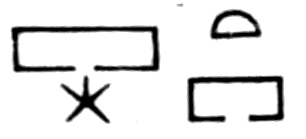 Pa Dûat)”;10 for his Ka
was himself, independent of him, superior to him,
and yet his counterpart and bound up with him.
Pa Dûat)”;10 for his Ka
was himself, independent of him, superior to him,
and yet his counterpart and bound up with him.
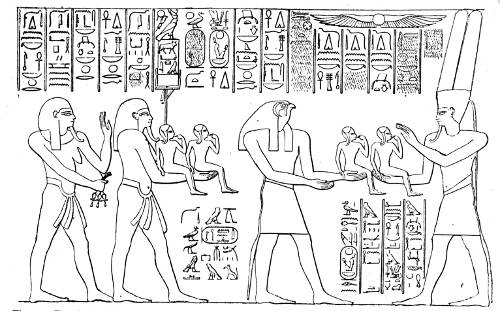
Fig. 4.—−The infant king, Amenophis III. and his Ka, presented to Amen Rā, the god of Thebes,
by two Nile gods, and by Horus. (From the temple of Amenophis III., at Luxor.)11
The disjunction of the Personality from the Person
was not, however, rigorously and systematically
insisted upon; the two were indeed separate, but
were so far one as to come into being only through
and with each other. A man lived no longer than
his Ka remained with him, and it never left him
until the moment of his death. But there was this
difference in their reciprocal relations: the Ka could
live without the body, but the body could not live
without the Ka. Yet this does not imply that the
Ka was a higher, a spiritual being; it was material
in just the same way as the body itself, needing
food and drink for its well-being, and suffering
hunger and thirst if these were denied it. In this
respect its lot was the common lot of Egyptian
gods; they also required bodily sustenance, and
were sorely put to it if offerings failed them and
their food and drink were unsupplied.
After a man’s death his Ka became his Personality
proper; prayers and offerings were made to the
gods that they might grant bread and wine, meat
and milk, and all good things needful for the
sustenance of a god to the Ka of the deceased.12
Offerings were also made to the Ka itself, and it
was believed that from time to time it visited the
tomb in order to accept the food there provided
for it. On such occasions it became incorporate
in the mummy, which began to live and grow
(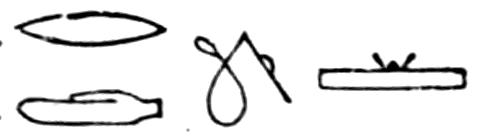 rûd), or renew itself as do plants and
trees (
rûd), or renew itself as do plants and
trees (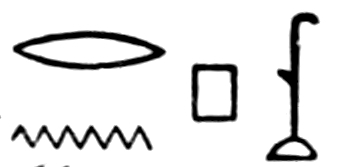 renp), and became, as the texts occasionally
express it, “the living Ka in its coffin.”
The rich founded endowments whose revenues were
to be expended to all time in providing their Kas
with food offerings, and bequeathed certain sums
for the maintenance of priests to attend to this;
large staffs of officials were kept up to provide the
necessaries of life for the Personalities of the dead.13
The Ka was represented by statues of the dead
man which were placed within his tomb, and sometimes
in temples also by gracious permission of the
sovereign.14 Wherever one of these statues stood,
there might the Ka sojourn and take part in Feasts
of Offerings and the pleasures of earthly life; there
even seems to have been a belief that it might be
imprisoned in a statue by means of certain magic
formulæ. Royal statues in the temples were destined
to the use of the royal Kas, the many statues of
the same king in one temple being apparently all
intended for his own Ka service.15
renp), and became, as the texts occasionally
express it, “the living Ka in its coffin.”
The rich founded endowments whose revenues were
to be expended to all time in providing their Kas
with food offerings, and bequeathed certain sums
for the maintenance of priests to attend to this;
large staffs of officials were kept up to provide the
necessaries of life for the Personalities of the dead.13
The Ka was represented by statues of the dead
man which were placed within his tomb, and sometimes
in temples also by gracious permission of the
sovereign.14 Wherever one of these statues stood,
there might the Ka sojourn and take part in Feasts
of Offerings and the pleasures of earthly life; there
even seems to have been a belief that it might be
imprisoned in a statue by means of certain magic
formulæ. Royal statues in the temples were destined
to the use of the royal Kas, the many statues of
the same king in one temple being apparently all
intended for his own Ka service.15
The Egyptians, holding the belief that the statue
of a human being represented and embodied a human
Ka, concluded that the statues of the gods represented
and embodied divine Kas, and were indeed neither
more nor less than the Kas of the gods. Thus the
idea of divinity became entirely anthropomorphic,
and, just as the king built his temple not to himself
but to his Personality, so also sanctuaries were
sometimes dedicated not to a god himself but to
his Personality. For example, the chief temple of
Memphis was not for the service of the god Ptah,—the
maker of the world, whom the Greeks compared
to Hephæstos,—but rather for that of his
Ka. (Ptah was not alone among the gods in this
respect. The pyramid texts show that even in the
times of the Fifth and Sixth Dynasties Thot, Set,
Horus, and other gods were recognised as having
Kas; that is to say, each was supposed to be
possessed of his own Personality in addition to himself.16
It was believed that the divine Ka, this image
which had the greater likeness to man, stood nearer
to man than the god himself, and hence in the
case of votive stelæ dedicated to the incarnation of
Ptah in the sacred Apis-bull of Memphis, prayer
for the divine favour and blessings is not as a rule
addressed to the Apis, but to its Ka. It is a very
remarkable fact that in several inscriptions17 the god
Rā is credited with no less than seven Bas and
fourteen Kas, corresponding to the various qualities
or attributes pertaining to his own being, and which
he could communicate to the person of the king;
such as: wealth, stability, majesty, glory, might, victory,
creative power, etc.18
Thus the apprehension of the Ka, of a man’s Personality,
as his Doppelgänger, or Double, found even
in some of the oldest texts, acquired a far-reaching
significance which extended not only to the doctrine
of human immortality but also to the conception of
the relations of gods to men.
As we have already stated, each man had a Ka
so long as he was alive, but at his death it left him
and led an independent existence. Only after long
wanderings did he meet it again in the world to come,
and we still possess the prayer with which he was to
greet it, beginning with the words, “Hail to thee who
wast my Ka during life! I come unto thee,” etc.19
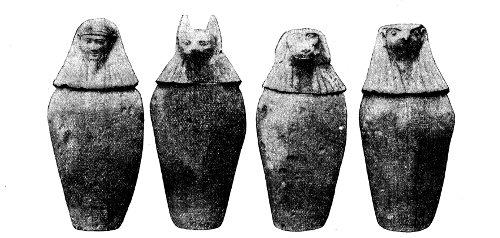
Fig.: 5.—Set of “Canopic” Vases.21
Ȧmset.xxxxxDûamûtef.xxxxxHāpi.xxxxxQebhsenûf.
The second immortal part of man was his heart
(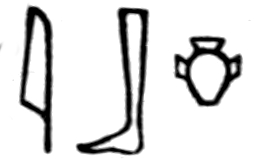 àb).20 The heart was removed from the body
by the embalmers, and the texts give no definite explanation
as to what became of it. During certain
periods of Egyptian history, but still comparatively
rarely, it was enclosed, as were the rest of the viscera,
in special alabaster, limestone, or wooden vases, of
which four were placed with the mummy in its grave.
These vases are generally but most erroneously called
“Canopic” vases. They usually date from the times
of the New Empire, but we have some few dating
from the Ancient Empire. In other cases the viscera
were replaced within the body after its embalmment,
and with them waxen images of the four genii of
the dead as their guardian divinities. But for the
most part documents do not afford us any information
as to what was done with the material heart.
Perhaps the priests took measures for its disappearance
in order to furnish some tangible foundation
for their doctrine concerning the heart. Certain
statements of Greek writers seem to imply some
such proceeding. According to these authorities the
viscera, which must have included the heart, were
cast into the Nile, because they were designated as
the source of all human error. Porphyry gives us
even the form of the prayer which was repeated
when the chest containing the intestines was presented
before the Sun; and if the text of this
prayer has not hitherto been confirmed from original
documents it is yet so thoroughly Egyptian in character
that its authenticity cannot be doubted.22
àb).20 The heart was removed from the body
by the embalmers, and the texts give no definite explanation
as to what became of it. During certain
periods of Egyptian history, but still comparatively
rarely, it was enclosed, as were the rest of the viscera,
in special alabaster, limestone, or wooden vases, of
which four were placed with the mummy in its grave.
These vases are generally but most erroneously called
“Canopic” vases. They usually date from the times
of the New Empire, but we have some few dating
from the Ancient Empire. In other cases the viscera
were replaced within the body after its embalmment,
and with them waxen images of the four genii of
the dead as their guardian divinities. But for the
most part documents do not afford us any information
as to what was done with the material heart.
Perhaps the priests took measures for its disappearance
in order to furnish some tangible foundation
for their doctrine concerning the heart. Certain
statements of Greek writers seem to imply some
such proceeding. According to these authorities the
viscera, which must have included the heart, were
cast into the Nile, because they were designated as
the source of all human error. Porphyry gives us
even the form of the prayer which was repeated
when the chest containing the intestines was presented
before the Sun; and if the text of this
prayer has not hitherto been confirmed from original
documents it is yet so thoroughly Egyptian in character
that its authenticity cannot be doubted.22
But the immortal heart of a man, which stood in
a similar relationship to his material heart as his Ka
to the whole body, left him at death and journeyed
on alone through the regions of the other world till
it reached the “Abode of Hearts.” Its first meeting
with the deceased to whom it had belonged was in
the Hall of Judgment, where it stood forth as his
accuser; for in it all his good and evil thoughts had
found expression during his lifetime. They had not
originated there, for the heart was essentially divine
and pure, but it had of necessity harboured and
known them,23 and therefore it was called upon to
testify concerning the man's former thoughts and
deeds before Osiris, judge of the dead.
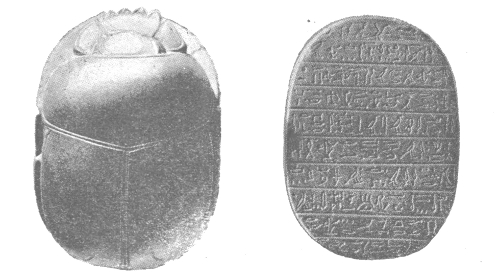
Fig. 6.—A heart scarab.24
In the meantime the mummy was without heart,
and had become lifeless and dead; for to pierce the
heart of anything was equivalent to utterly destroying
it. The Osiris, too (to which we shall presently
return), would have shared the fate of the mummy
had the device not been conceived of providing the
latter with an artificial heart in place of its own
original one, which had returned to the gods. The
provisional heart was represented by an artificial
scarabæus, generally made of hard greenish stone
in the image of the beetle, which was a symbol of
genesis and resurrection (fig. 6). Underneath it was
made flat, and inscribed with magic formulæ,25 that
it might be the substitute for the dead man’s heart,
and also ensure his resurrection by virtue of its
form. But when his own heart was restored to him
the scarabæus lost its significance. Like all the rest
of the amulets which the Egyptians gave to their
dead, its efficacy only availed for the space of time
intervening between death and the reunion of those
elements which death had separated. When once
the resurrection had taken place there was no further
need of amulets, nor any hurt through lack of them.
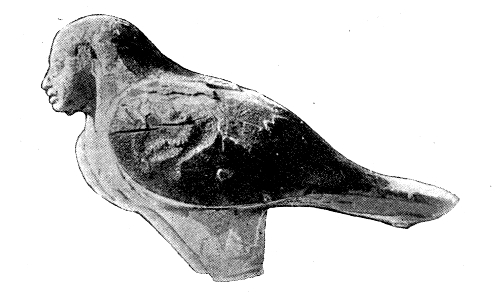
Fig. 7.—The Ba as a bird.
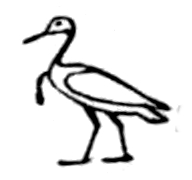
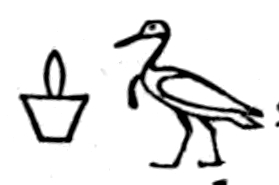
Another immortal part of man was the
 ,
,
 ,
,
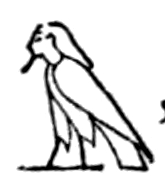 ,
Ba. This conception most nearly corresponds
to our “soul,” for it was a being which, on the
death of the man in whom it had dwelt, left him in
order to fly to the gods, to whom it was closely akin,
,
Ba. This conception most nearly corresponds
to our “soul,” for it was a being which, on the
death of the man in whom it had dwelt, left him in
order to fly to the gods, to whom it was closely akin,
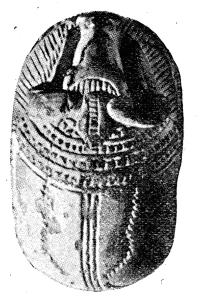 Fig. 8.—Ram-headed
scarabæus.27
and with whom it abode when not united to the man.
But, nevertheless, the Ba was neither immaterial nor
able to dispense with food and drink.26 It bore the
form of a human-headed bird (fig. 7), sometimes with
hands (figs. 10, 14); or of a ram-headed scarabæus
(fig. 8). From the fifteenth to the eleventh century
B.C. it was preferably represented
under the second form
which is really nothing more
than its hieroglyphic symbol.
The phonetic value of the
ram,
Fig. 8.—Ram-headed
scarabæus.27
and with whom it abode when not united to the man.
But, nevertheless, the Ba was neither immaterial nor
able to dispense with food and drink.26 It bore the
form of a human-headed bird (fig. 7), sometimes with
hands (figs. 10, 14); or of a ram-headed scarabæus
(fig. 8). From the fifteenth to the eleventh century
B.C. it was preferably represented
under the second form
which is really nothing more
than its hieroglyphic symbol.
The phonetic value of the
ram, 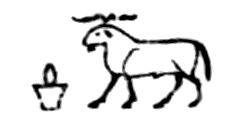 ,
is ba, and of the
scarabæus,
,
is ba, and of the
scarabæus, 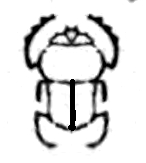 ,
kheper, which
latter means to be, to become;
and the composite figure of the
ram-headed scarabæus signifies,
therefore, something like “he
who has become a soul.”
,
kheper, which
latter means to be, to become;
and the composite figure of the
ram-headed scarabæus signifies,
therefore, something like “he
who has become a soul.”
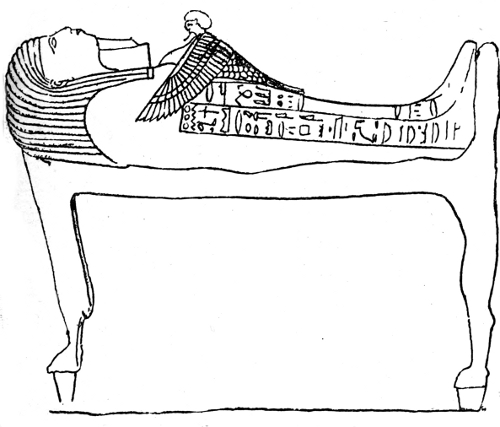
Fig. 9.−The Ba visiting the mummy on its funeral couch. (From
“The Book of the Dead,”)
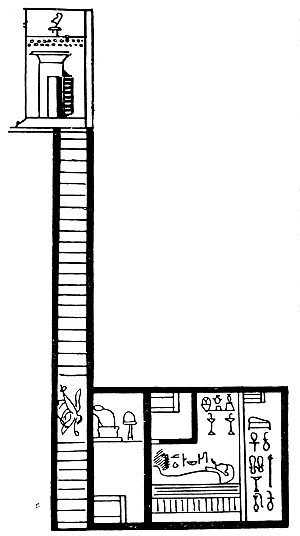
Fig. 10.−The Ba flying down the shaft of the tomb and
bringing offerings to the mummy.
(From “The Book of the Dead.”)
It is otherwise with the first image, which really
represents the soul as it was imagined by the Egyptians.
We have sculptured figures and drawings (fig. 9)
showing the little soul perched by the sarcophagus,
touching the mummy, and bidding it farewell before
rising to the gods.28 In other scenes the soul is
depicted as it comes flying from heaven with the
sign of life in its hand, and approaching the grave
to visit the mummy; or as flying down
This conception of the soul as a kind
of bird is noteworthy when compared
with the ideas which other nations have
formed of it. The Greeks sometimes
represented the εἴδωλον, or soul, as a
small winged human figure (fig. 11); in
Roman times it was imagined as a butterfly
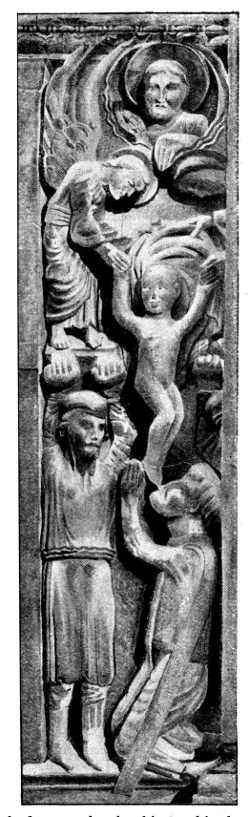
(fig. 12); and in mediæval reliefs and
pictures we
see it leaving
the mouth of
the dead man
as a child (fig.
13), or a little
naked man.29
The latter form recalls that of the Egyptian Ka,
although the idea which it embodies reminds one
rather of the Ba.
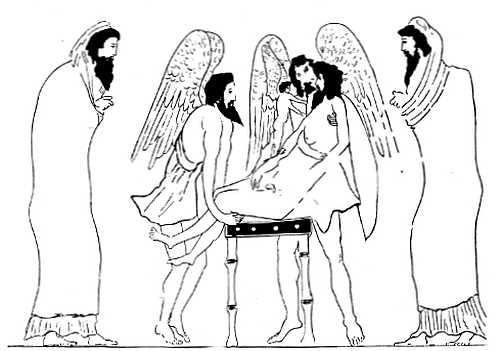
Fig. 11.—The placing of the dead in the tomb by Thanatos (Death) and Hypnos (Sleep). The small
winged figure represents the dead man's soul. (From a lekythos published by M. C. Pottier
in his Étude sur les Lecythes Blancs Attiques. The εἴδωλον was usually painted black.)
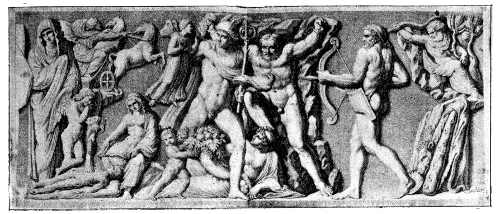
Fig. 12.—Scene from a sculptured sarcophagus of the third century a.d., in the Capitoline Museum, Rome. To the left,
below the chariot of Selene and the draped figure of Night, lies the dead body of the man, whose soul hovers
above him as a butterfly beside the inverted torch of the pensive winged boy representing either Sleep or Death.
Fate sits with open scroll at the dead man's head, and above her his soul is again represented as a Psyche, carried
away by Hermes. (See Bottari, Musée Capitoline, vol. iv., pl. xxv. Cf. also many representations of Amor and
Psyche in ancient art, showing Psyche—the soul—sometimes as a winged figure and sometimes as a butterfly.)
Fig. 13.—The soul of a man leaving him at his death in the form of
a naked child, and received by an angel. (From the porch of the
cathedral church of St. Trophimus, at Arles.)
The 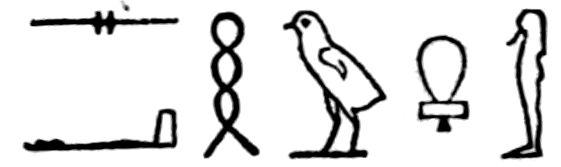 ,
Sāhû, also was considered as
immortal. This is invariably depicted as a swathed
mummy, and represented the form which the man
wore upon earth. Originally it was related to the
Ka, but whereas the latter was a complete Personality,
the Sāhû was nothing but a hull,—a form
without contents. Yet this also was of the gods and
imperishable, returning to its heavenly home when
death had set it free. Since the body, or Kha30
had also the same form, it naturally came about
that when the mummy was mentioned in religious
texts as reanimated by the Ka it was frequently
confounded with the Sāhû. In this sense it is said
that “the Sāhû lives in the Sarcophagus (or in the
underworld), it grows (rûd), it renews itself (renp).”31
But in more precise texts the two things are kept
distinct, as, e.g., “the Ba (soul) sees its Kha, it rests
upon its Sāhû.”32 At such times the Ba had power
over the Sāhû, and, as is said on the Sarcophagus
of Panehemisis, “the Sāhû lives at the command
of the Ba.”33
,
Sāhû, also was considered as
immortal. This is invariably depicted as a swathed
mummy, and represented the form which the man
wore upon earth. Originally it was related to the
Ka, but whereas the latter was a complete Personality,
the Sāhû was nothing but a hull,—a form
without contents. Yet this also was of the gods and
imperishable, returning to its heavenly home when
death had set it free. Since the body, or Kha30
had also the same form, it naturally came about
that when the mummy was mentioned in religious
texts as reanimated by the Ka it was frequently
confounded with the Sāhû. In this sense it is said
that “the Sāhû lives in the Sarcophagus (or in the
underworld), it grows (rûd), it renews itself (renp).”31
But in more precise texts the two things are kept
distinct, as, e.g., “the Ba (soul) sees its Kha, it rests
upon its Sāhû.”32 At such times the Ba had power
over the Sāhû, and, as is said on the Sarcophagus
of Panehemisis, “the Sāhû lives at the command
of the Ba.”33
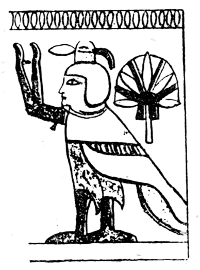
In close connection with the Sāhû was the
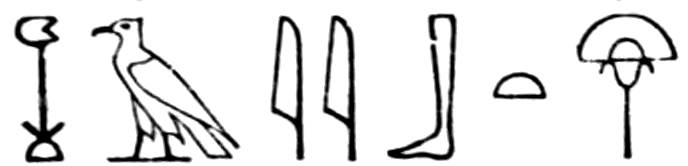 ,
Khaïb, the shadow, represented
as a fan, or sunshade (fig. 14), in scenes professing
to portray the next world.34
,
Khaïb, the shadow, represented
as a fan, or sunshade (fig. 14), in scenes professing
to portray the next world.34
As all earthly forms must needs have their
shadows, such was also the case with things in the
world to come; there, too, the sun shone and all
the optical phenomena of earth were repeated. But,
not content to accept this as a simple fact, the
Egyptians ascribed separate existences both to the
shadows of the dead and to those of gods and genii.
According to Egyptian belief a shadow might live on
independently, apart from its owner, and this was
exactly what it was supposed to do at the moment
when death had taken place; then the Khaïb went
forth alone to appear in the realm of the gods.
This Ancient Egyptian idea of the independent
existence of a man’s shadow recalls to our minds
Chamisso’s story of Peter Schlemihl, published in
1823.35
Fig. 14.—Ba and Khaïb. (From “The Book of the Dead.”)
The Ka, the Åb, the Ba, the Sāhû, and the Khaïb
constituted the chief elements of that which was
immortal in man, but others were also occasionally
included, especially one which was called the Khû,
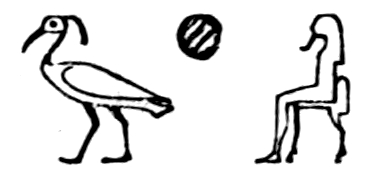 ,
i.e. the Luminous.36 To these, however,
there is less frequent reference; they were of importance
in local cults only, and were either included
among the parts already mentioned or were so
vaguely defined that they may be safely left out
of account in treating of the soul as conceived by
the Egyptians without danger of our conception
being falsified by the omission.
,
i.e. the Luminous.36 To these, however,
there is less frequent reference; they were of importance
in local cults only, and were either included
among the parts already mentioned or were so
vaguely defined that they may be safely left out
of account in treating of the soul as conceived by
the Egyptians without danger of our conception
being falsified by the omission.
When the immortal was thus resolved into its
component parts at death, what then became of
the human individuality which had resulted from
their combined action, and how could its different
parts find each other again in the next world, in
order to form the new man of the resurrection?
The Egyptians had evolved a very simple solution
of this problem, although one which, according
to our mode of thought, stands in direct contradiction
to their doctrine of the soul. It was
assumed that in addition to his immortal elements
the man as a person of a particular appearance and
character was also endowed with a kind of deathlessness,
which seems to have held good only for a
time, and not for ever. To this conception of a
dead man, in whom soul and life were lacking but
who in the interim still possessed existence, feeling,
and thought, the Egyptians gave the name of Osiris.
Osiris was the first divine King of Egypt who
reigned in true human likeness; he civilised the
Egyptians, instructed them in agriculture, gave them
laws, and taught them true religion. After a long
and blessed reign he fell a prey to the machinations
of his brother Set (Typhon), and having been slain
was constrained to descend into the underworld,
where he evermore lived and reigned as judge and
king of the dead. His fate of death was the fate
of all men. Every one, when his earthly pilgrimage
was ended, must descend into the underworld by
the gates of death; but each man hoped to rise again,
even as Osiris had risen, to lead henceforth the life
of the blessed. In this hope men called their dead
Osiris, just as Germans speak of their dead as
“blessed,”—hoping that blessedness may indeed be
their lot. Death had not changed Osiris; as he
had been king on earth, so he was king in the
world beyond death. In the same way man, too,
remained that which he had been here; death
merely made a break in his life, without altering
any of his conditions of existence.
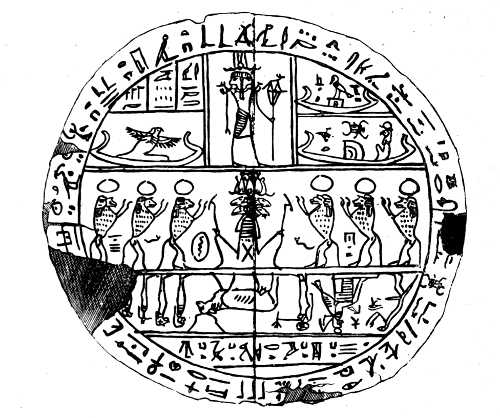
Fig. 15.—Hypocephalus, from a drawing by Dr. W. H, Rylands.
The relation subsisting between a man’s Osiris
and his mummy was not clearly apprehended, even
by the Egyptians themselves. Identical they were
not—that fact is obviously implied by the texts,
which never once substitute the mummy for the
Osiris; men knew also from experience that no
mummy had ever left its place of embalmment, or
the tomb, to journey on into the next world. Yet
mummy and Osiris were nevertheless not entirely
different and distinct; both had the same appearance
and the same character. Moreover, the texts describe
the Osiris as resembling the mummy in appearance
while really differing from it, and the embalmers
equipped the mummy as though it were called upon
to journey forth as the Osiris. The inherent contradiction
in all this arose principally from the fact
that the Egyptian hoped and believed that shortly
after death he would arise again, complete in flesh
and blood as he had lived upon earth; whereas
experience contradicted his creed, for it showed him
that the mummy never did and never could leave the
earth. He extricated himself from the dilemma by
providing the mummy with a Doppelgänger: its own
perfect counterpart, yet not itself. When once we
have familiarised ourselves with this singular idea
we find in it a simple key to all the riddles of
the Osiris.
The mummy was provided with an artificial heart
in the shape of a scarabæus,37 because the Osiris
could not live without one, and also with various
amulets, by virtue of every one of which demons of
the next world could be overcome. A stuccoed disc
of papyrus, linen, or bronze, which, by the figures and
formulæ inscribed upon it, had mystic power to preserve
the needful warmth of life to the Osiris (fig. 15),
was placed under the head of the mummy.38 The soles
of the feet which had trodden the mire of earth
were removed in order that the Osiris might tread
the Hall of Judgment with pure feet; and the gods
were prayed to grant milk to the Osiris that he
might bathe his feet in it and so assuage the pain
which the removal of the soles must needs have
caused him. And, finally, the soles which had been
excised were placed within the mummy in order that
the Osiris might find them to hand for the completion
of his Personality.39 That nothing might be wanting
to this Personality, the gods were besought that the
mummy should not suffer earthly corruption, and it
was held to be of supreme importance that flesh and
bones, muscles and limbs should all remain in place.
With the mummy were also placed The Book of the
Dead, as well as other religious and mystic texts needed
by the Osiris for his guidance through the regions
beyond the grave, and from which he might learn
the prayers which had to be spoken in due order
and place according to strict prescriptions. In short,
the mummy was treated precisely as though it
were an Osiris. But the difference was great: the
mummy remained within the sarcophagus in the
sepulchral chamber, while the Osiris proceeded on
his way.
The journey of the Osiris, treated at wearisome
length, forms the favourite subject of Egyptian
texts, and to this is devoted the largest and best
known work in the religious literature of the nation:
the compilation called by us The Book of the Dead.
This book contains no systematic account of the
journey, such as the analogy of similar literatures might
lead us to expect, but exhibits it in a series of disconnected
stages by giving the prayers which the Osiris
must repeat when passing through different parts of
the underworld, or on encountering certain genii there.
A chapter is devoted to each prayer, but the chapters
do not follow each other in the order in which the
prayers were to be used. The Egyptians never
attained to any clear idea of the Osirian underworld;
the same confusion and obscurity reigned over it as
over their whole conception of the unseen world and
of deity. They pondered deeply over a series of
separate problems without being able to unite the
results into one consistent whole, which should
command acceptance, or to form any definite and
permanent topography of the regions beyond the
tomb. Hence there is no fixed sequence for the
chapters of The Book of the Dead; the order varies
materially in the different manuscripts to which we
are indebted for our knowledge of the work. The
number of chapters in the different copies also varies;
while in some it is small, in others, as in the Ptolemaic
copy for a certain Aûfānkh, published by Lepsius,
it reaches to one hundred and sixty-five. Since there
was no fixed rule as to order or number, priest or
scribe might make a selection of such chapters as he
or the family of the deceased held to be the most
essential, and each was at liberty to form for himself
a more or less modified conception of the characteristics
of the underworld.
We cannot here follow the Osiris through all the
details of his journey, but must be content to know
that according to the account in The Book of the
Dead he issued victorious from all his trials, overcame
all enemies whom he encountered, and was
ushered at length into the Hall of the Double Truth,
and received by the goddess of Truth. Here also
he found the chief gods of the Osirian cycle gathered
together, and the forty-two assessors of Divine Justice
near the canopy under which the god Osiris was
enthroned. Then the deceased spoke, and proceeded
to recite the “Negative Confession”—a denial of
sins of commission—declaring that he had not been
guilty of certain definite sins, and denying one or
another particular form of guilt to each of the
assessors. He had not done evil, had not robbed,
nor murdered, nor lied, not caused any to weep,
not injured the property of the gods, and so on.40
The judges heard all in silence, giving no sign
either of approval or disapproval; but when the
confession was ended the heart of the deceased was
brought forward and laid in the scales against the
image or symbol of Truth. The weighing was
superintended by the gods Anubis and Horus,
while Thot, the scribe of the gods, stood by ready
to record the result (fig. 16).41
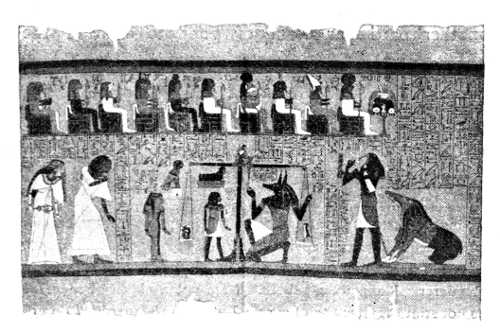
Fig. 16.—The weighing of the dead man's heart against the feather
symbolic of Maāt, the goddess of Truth. (From “The Book of
the Dead”)
This was the time for the deceased anxiously to
call upon his heart in the prescribed formula from
The Book of the Dead,42 not to bear witness
against him, for “the heart of a man is his own
god,”43 and must now determine his everlasting
fate. If his heart were content with him, and the
scales turned in his favour, then the god Thot
commanded that his heart should be restored to
him to be set again in its place. This was done,
and forthwith the immortal elements which death
had separated began to reunite. His Ka, and all
the remaining parts of himself, were now restored
to the justified Osiris, who was thus built up into
the complete man who had once walked the earth,
and who now entered upon a new life, the everlasting
life of the righteous and the blessed. He
was joyfully admitted by the gods into their circle,
and was henceforth as one of them.
The Book of the Dead and cognate religious texts,
always assume that judgment goes in favour of the
deceased, that his heart approves him, and that
he becomes one of the blessed. Nowhere are we
clearly informed as to the fate of the condemned
who could not stand before the god Osiris. We are
told that the enemies of the gods perish, that they are
destroyed or overthrown; but such vague expressions
afford no certainty as to how far the Egyptians
in general believed in the existence of a hell as a
place of punishment or purification for the wicked;44
or whether, as seems more probable, they held some
general belief that when judgment was pronounced
against a man his heart and other immortal parts
were not restored to him. For such a man no
re-edification and no resurrection was possible. The
immortal elements were divine, and by nature pure
and imperishable; but they could be preserved
from entering the Osiris, from re-entering the hull
of the man who had proved himself unworthy of
them. The soul, indeed, as such did not die,
although personal annihilation was the lot of the
evil-doer in whom it had dwelt. But it was the
hope of continued individuality which their doctrine
held out to the Egyptians; this it was which they
promised to the good and in all probability denied
to the wicked.
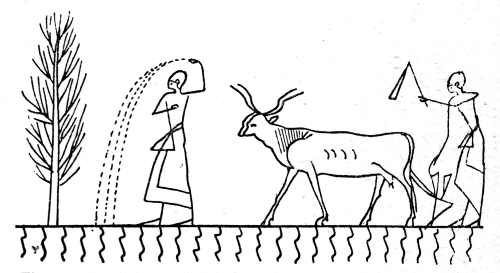
Fig. 17.—-The Blessed Dead ploughing and sowing by the waters
of the celestial Nile. (From “The Book of the Dead.”)
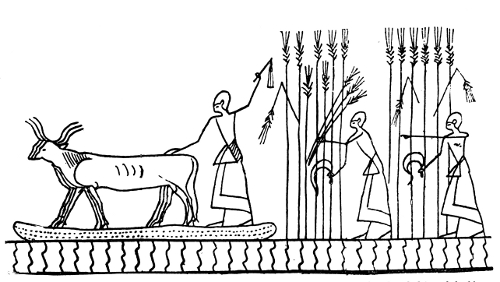
Fig. 18.—The blessed Dead reaping and treading out the corn in the fields of Aalû.
(From “The Book of the Dead.”)
After judgment the righteous entered into blessedness,
unchanged in appearance as in nature; the
only difference being that, while the existence which
they had led upon earth had been limited in its
duration, the life of the world to come was eternal.
But the future blessedness for which the Egyptian
hoped was far from being a passive state of bliss
such as is promised by most of the higher religions,
an absorption into the All or into the Godhead, a
dreamy state of floating in everlasting repose, content,
and unimpassioned joy. The average Egyptian
expected to lead as active a life in the world
to come as he had led
here. Although with
the Godhead, he counted
on retaining his independent
individuality in
all respects and on
working and enjoying
himself even as he had
done on earth. He expected
his chief employment
to be agriculture,
the occupation which
must have seemed most
natural to a people almost
entirely dependent
upon the produce of
the fields. A vignette
belonging to chap. cx.
of The Book of the
Dead represents the
dead at work in the
fields of the Blessed,45 ploughing with oxen, casting
the seed-corn into the furrows (fig. 17), cutting
the ripe ears with sickles, driving oxen to tread
out the grain from the straw (fig. 18), and finally
piling up the corn in heaps against it was required
to serve for the making of bread. For change and
recreation they sailed upon the canals of the next world
in their boats (fig. 19), played at draughts with their
own souls, or made offerings to the gods, especially
to the celestial Nile, which gave water to their fields
and fertility to their seed (fig. 20). All went on exactly
as here, excepting that the work of the blessed was
invariably crowned with success. The Nile always
overflowed the fields to best advantage, the corn
grew five ells high and its ears were two ells long,
the harvest never failed to be abundant, the weather
was always favourable, the fresh and pleasant north
wind was always blowing, the foe was always conquered,
and the gods graciously accepted all offerings
and requited the givers with rich gifts of all kinds.
In short, the life of the dead in the kingdom of the
gods was an idealised earthly life, although not
always a very moral life according to our standards.
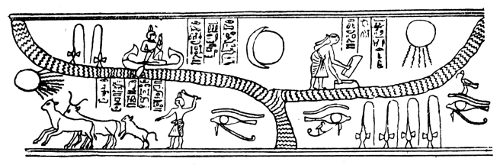
Fig. 19.—One of the Osirian dead sailing in his papyrus bark along the heavenly
canals.
(From “The Book of the Dead.”)
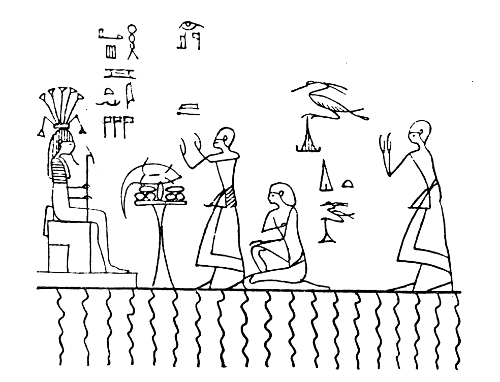
Fig. 20.—-The Blessed Dead making offerings to the celestial Nile-god.
(From “The Book of the Dead.”)
But this belief in the life of the next world as the
exact counterpart of this implied a danger which
involved the Egyptian in heavy cares. The dead
lived, therefore they must of necessity eat and drink,
for without these processes the continuation of life
was inconceivable; if the dead were without food
they would be starved. The inscription of the
sepulchral pyramid of Ûnas, an Egyptian king of
the Fifth Dynasty, gives expression to this fear.
“Evil is it for Ûnas,” says that text, “to be hungry
and have nothing to eat; evil is it for Ûnas to be
thirsty and have nothing to drink.” The necessities
of life were, indeed, partly ensured to the dead by
means of the offerings made to them by their sur-vivors
on recurrent feast-days, and partly mysteriously
created for their use in the next world by the repetition
of magic formulæ in this.46 But if the offerings
ceased, or if no one took the trouble to repeat the
formulæ, the dead were left to their own resources,
and must work, and till the land, and earn their
own living.
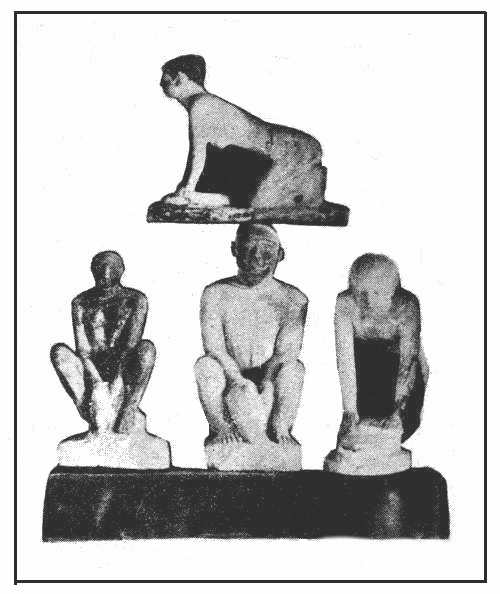
Fig. 21.—Ancient kingdom Ka-statues of servants−potters and
bread-makers. (Originals in the Ghizeh Museum.)
Such enforced labour could hardly have appeared
very attractive to Egyptians of the upper classes,
and so an expedient suggested by the conditions of
their earthly life was devised for evading it on their
behalf. The rich man who had servants to work for
him in this world was desirous of securing like service
for himself in the world to come. In the time of the
Ancient Empire it seems to have been taken for
granted that those who were servants in this life
would be servants also in the life beyond. With this
selfish end in view the rich of those times had placed
within their own sepulchral chambers Ka-statues of
their servants in order to ensure immortal life to them
also (fig. 21). As the old Germans were followed
into the next world by their slaves and horses; as
other uncivilised nations sent the servants of the dead
to the realm of death after their masters,47 so in
Ancient Egypt a certain portion of mankind was
set apart to serve the rest through all eternity. But
as Egyptian civilisation advanced and a more humane
state of feeling dawned, these views were modified,
and the thought gained ground that all Egyptians
were equal in the presence of death and of the gods.
So the rich man was obliged to renounce his hope of
finding his servants again at his service beyond the
tomb, and was face to face with the old fear of being
reduced to heavy toil through the possible negligence
of his successors.
A most singular expedient was adopted to avert
this danger: little images of clay, or wood, or stone,
or even of bronze, were made in human likeness,
inscribed with a certain formula,48 and placed within
the tomb, in the hope that they would there attain
to life and become the useful servants of the blessed
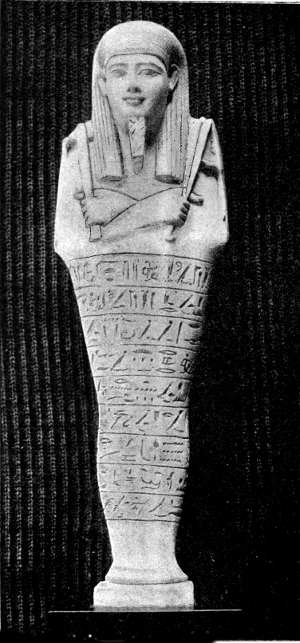
dead; they are the so-called Ûshabtiû (or Respondents),
of which hundreds and thousands of specimens
may be found in collections of Egyptian antiquities
(see Frontispiece49). These “servants for the underworld,”
or “servants to the Osiris,” as the texts call
them, owed their very being and life to the dead, and
stood to him in the same relation as man to God.
And as men seek to testify their gratitude to the
Creator by doing Him service, so it was hoped that
these little figures would show their thankfulness by
their diligence, and spare their master and maker
all toil.
Many other customs arose out of similar ideas to
those which gave rise to the institution of Ûshabtiû.
Articles of personal adornment and for toilet use,
wreaths, weapons, carriages, playthings, and tools
were given to the dead, and a whole set of household
furniture was often laid away in the grave in order
that the Osiris should not be obliged to set to work
at once to make or collect these things for himself on
his entrance into the next world; for this purpose
choice was often made of such objects as the man
had used and valued in his lifetime. All this care,
however, was bestowed not simply in the interest of
those who had entered upon the life everlasting but
also in that of those who were left behind. Among
other powers possessed by the dead was that of going
to and fro upon earth; and, to prevent their exercise
of it, all things whose lack might impel them to
revisit the scenes of their earthly lives were placed
within the tombs, for their visits might not be altogether
pleasant for survivors withholding any part
of the goods which belonged to the dead. But
these facts must not lead us to conclude that the
tomb was the permanent dwelling of the dead, and
that the objects placed within it were really intended
for his use there, and for all time.
As the amulets laid in and about the mummy were
for the use of the Osiris, so the furniture and implements
placed near the coffin were intended not so
much for the mummy lying in its tomb as for the
Osiris dwelling with the gods. Each of these objects
had its heavenly counterpart, even as the mummy
was represented by the Osiris.50
It was thus that the Egyptians sought to make
themselves homes in the next world, and to secure all
the comforts and pleasures of their earthly life in
the life which was to come. Nevertheless, the pious
Egyptian did not expect to remain for ever as an
Osiris, or as a god in human likeness: he rather
hoped for ever-increasing freedom, for the power of
taking other shapes and transforming himself at will
into quadrupeds; or into birds—such as the swallow
or the heron; or into plants—more especially the
lotus; or even into gods.51
This is no doctrine of compulsory transmigration
such as used to be freely ascribed to the Egyptians
on the strength of the statements made by Herodotus52;
there is no question here of souls being
forced to assume fresh forms in which their purification
is gradually worked out and their perfection
achieved. To the Egyptian transmigration was not
the doom of imperfect souls, but a privilege reserved
for such as had already attained perfection.
Again and again the texts assert that the blessed
may assume any form and visit any place at will;
body and place can no longer enthral him. He
may travel round the heavens with the Sun-god Rā,
or arise from the shades with Osiris in the “divine
night” of the 26th of the month Khoiak (i.e. at the
winter solstice); he is even as a god, nay, he is
himself a god, able to live in and by Truth, actually
taking it, indeed, as food and drink.
The power of the soul to incarnate itself at pleasure
became one of the chief reasons for embalming the
body. As we have seen, the preservation of the
body was held to be necessary because the mummy
was supposed to be the material form of which the
Osiris was the essential reality. But this temporary
need might have been met in simpler fashion, since
the journey of the Soul to the Hall of Judgment
was accomplished in a comparatively short time.
There was, however, a further need for which provision
had to be made. The soul might sometimes
visit the mummy, again take up its abode in its
former body, and, animating it anew, return to earth
under that form and thus revisit the spots where
once it had dwelt. To this end it required an earthly
and tangible body, and this was supplied by the
mummy. If the mummy were destroyed, then the
soul not only lost one of the forms in which it might
incarnate itself, but that one with which its interests
were naturally most closely connected—that one which
linked it to earth and best enabled it to exhort the
survivors to remember the funerary offerings, and to
see how it fared with those whom it had been obliged
to leave behind. The destruction of the mummy
did not involve the destruction of the soul, but it
narrowed the soul’s circle of activity and limited its
means of transmigration.
This doctrine gave rise to the necromantic theory
that a soul might be compelled by means of magic
formulæ to re-enter its body, and to speak through
the dead lips. The magician who had brought
this about could then stipulate for all kinds of
favours before restoring the soul to freedom. It
is true that such an attempt was reckoned highly
dangerous; and, according to a tale dating from
Ptolemaic times, a royal prince named Setna,53 who
had succeeded in the undertaking, paid heavily for
having sought to make the spirits of the dead subject
to him, when, through his own imprudence, he was
overpowered by those whom he had invoked.
The above sketch of the eschatology of the Ancient
Egyptians is drawn from their own religious texts.
As to the origin of that system and the transformations
which it had undergone before reaching the
form under which it is known to us we are as yet
entirely ignorant; but it is obvious that it must have
developed gradually and assimilated many originally
heterogeneous doctrines. For instance, the Ka and
the Osiris must surely once have had the same
significance, and not have been considered as two
different factors of the dead man’s being until time
had brought about the fusion of two theological
systems—in one of which the Ka was regarded as
the spiritual Doppelgänger, or Double, while in the
other it was named the Osiris. All attempts
at solving these and similar problems connected
with this subject are, as yet, mere hypotheses.
As far back as Egyptian history has been traced
the people appear to have been in possession not
only of written characters, national art and institutions,
but also of a complete system of religion.
As in all other departments of Egyptian life and
thought, so with the Egyptian religion—we cannot
trace its beginnings. In the earliest glimpse of it
afforded by the Egyptian texts it appears as perfect
in all its essential parts; nor were after-times able
to effect much change in it by the addition of new
features. What greatly intensifies the deep historical
interest of Egyptian eschatology is that it testifies
not only to the fact that a whole nation believed in
the immortality of the soul four thousand years before
the birth of Christ, but also that this nation had
even then succeeded in clearly picturing the future
life to themselves after a fashion which may indeed
often seem strange and incomprehensible to modern
minds but to which we cannot deny a certain consistency
and a deep spiritual connotation.
We shall not here discuss the many analogies subsisting
between Egyptian belief and the religious
systems of other nations and times, nor yet its
great differences from them; and it is for the
sciences of anthropology and comparative religion
to determine to what extent the Egyptian doctrine
of immortality originated in Egypt itself, and how
much was brought there by the Egyptians from
the common home which they had shared with the
Semites and Indo-europeans.
 ,
,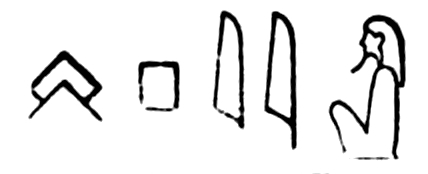 ,
,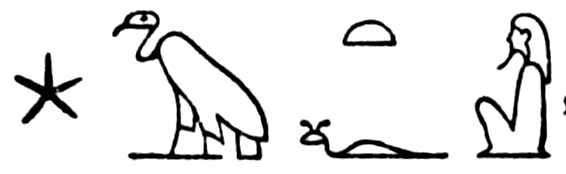 ,
, ,
,
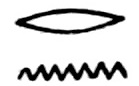 )—name.
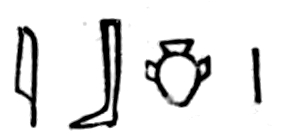 áb
áb
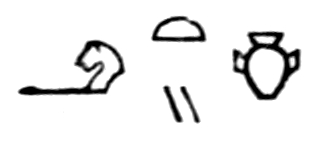 hāti. Sometimes, as in The Book of the Dead,
chap.
hāti. Sometimes, as in The Book of the Dead,
chap. 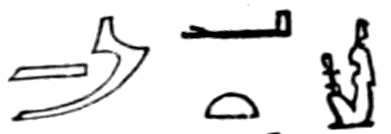 Maāt. The gods were said to be nebû maāt,
‘possessors of maāt.’ or ānchiû em maāt, ‘subsisting by or
through maāt.’ Maāt is in fact the Law and Order by which
the universe exists. Truth and justice are but forms of Maāt as
applied to human action.”—Papyrus of Ani, Introduction, p. 2.
Maāt. The gods were said to be nebû maāt,
‘possessors of maāt.’ or ānchiû em maāt, ‘subsisting by or
through maāt.’ Maāt is in fact the Law and Order by which
the universe exists. Truth and justice are but forms of Maāt as
applied to human action.”—Papyrus of Ani, Introduction, p. 2.