CHICHEN-ITZA.
Chichen-Itza—El Castillo—General Survey—A Maya City—Aguilar—Historical
Jottings—Montejo’s Expedition—Historians—Their Contradictions—Chichen
Deserted—The Conqueror’s Retreat—The Nunnery—Impressions and Photographs—Terrestrial
Haloes—An Unexpected Visitor—Electric Telegraph—Akab-Sib—Prison—Caracol—Cenotés—Ruined
Temples—The Temple of
the Sacred Cenoté—Tennis-Court—Monuments Described—Portico—Paintings—Bas-reliefs—New
Analogy—The Tlalocs of Chichen and of the Uplands—Market-place—End
of Our Labours—Col. Triconis.
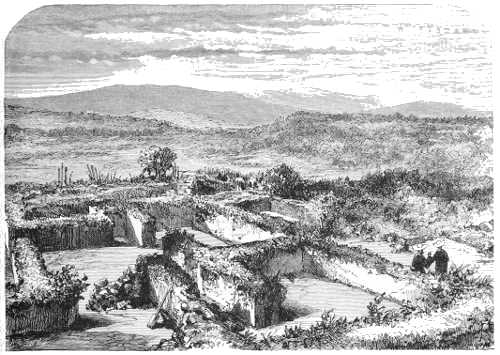
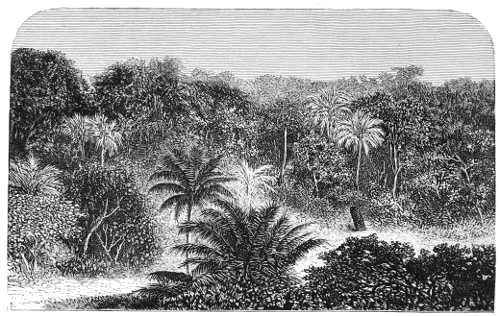
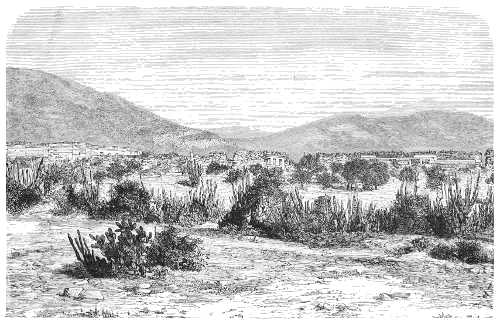
The ruins of Chichen are two miles east of Pisté, and were used
as pasture for the cattle of the inhabitants, who at stated periods
had the woods cut down, when the monuments were easily
distinguished. It was a favourite place, to the prejudice of the
palaces and the sculptures, which were made the butt by the
visitors to shoot at; but since the destruction of Pisté, nature
again reigns supreme; every sign of the buildings has disappeared,
and the jungle has become so impassable, that twenty
men were required to open the old path.
This was not my first visit to Chichen, nevertheless my
emotion was profound on beholding again the gigantic outline of
El Castillo, which we had decided beforehand should be our headquarters,
as from its elevated position it offered many strategical
advantages, which would secure us against surprise. It was
with considerable difficulty that we climbed the steps, which are
steep and completely invaded by a vigorous vegetation; as for
our great quantity of baggage, none but nimble, sure-footed
natives could have succeeded in hauling it up on to the platform
of the monument.
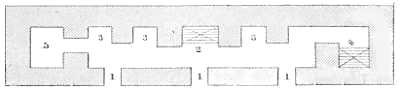
Our next thought was how to dispose of ourselves. The
interior of El Castillo consists of a rectangular corridor, running
along two-thirds of the edifice, pierced east, south, and west by
three large apertures, and a gallery giving access to a great hall
closed in on every side. We very stupidly gave up the latter
to our men, with the idea that we should be cooler and have
more air in the open gallery, not taking into consideration that
at this altitude, whichever way the wind blew, it would sweep
in upon us in fearful blasts, causing perpetual sneezing, coughing,
and freezing the very life out of us.
The day was spent unpacking and classifying, and at suppertime
we discovered that our cook, who was to have come from
Valladolid, had failed us; food we had in tins, but no water,
having left our cantaros at Citas, so that we were obliged to
go without soup, coffee, or our evening tub.
It may seem unworthy to have been put out by such
trivial details with the grand spectacle we had before us: a
glorious moon had risen, sailing on her course with her brilliant
retinue of scintillating stars, illuminating the vast wooded expanse,
like a boundless, heaving ocean on a calm day; fragments
of walls, mounds, eminences, shrouded in a sombre vegetation,
were distinctly visible, which I pointed out one by one to
my companions who, unlike myself, beheld them for the first
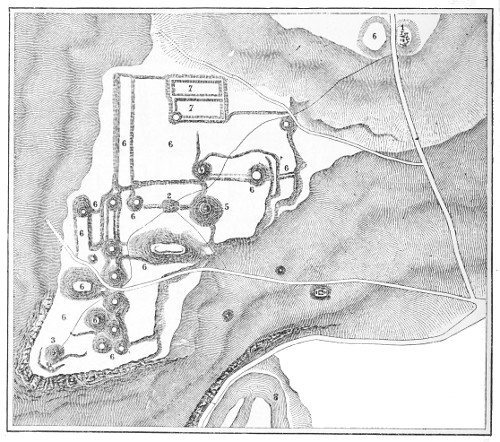
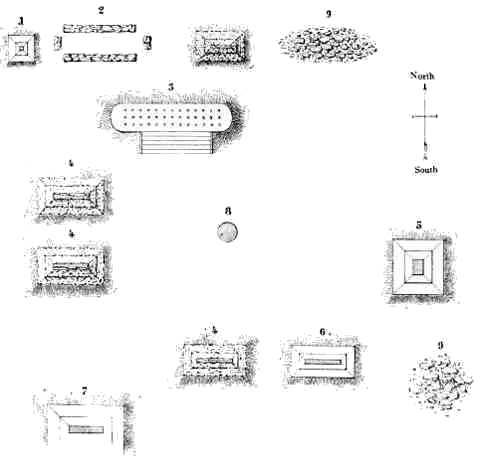
time. El Castillo occupies nearly the centre of the ruins;
below it to the east was the Market-place, and two small
palaces which belonged to it; to the north, a stately but
ruinous building, the cenoté and the temple attached; to the
north-west, the famous Tennis-court; to the west and south-west,
the Chichan-Chob, the Caracol and the other cenoté, the
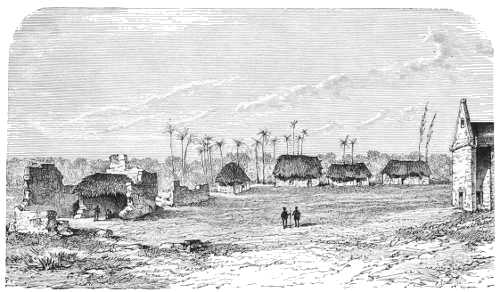
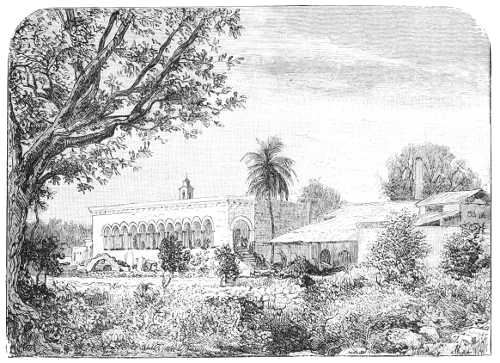
Nuns’ Palace, the Akab-Sib; and farther south, the hacienda,
which has long been abandoned.
We were conversing in subdued tones of the mysterious
past of this dead city, which mayhap our studies and explorations
would bring to life again; all was hushed, and the
death-like silence was only broken at regular intervals by the
cry of our sentinels; and these very cries carried us back to
the far-gone days, when the city was perhaps similarly guarded
against a sudden inroad from her jealous neighbours.
The morning effects of light and shade were no less
beautiful; the broad level wrapped in a transparent mist,
pierced here and there by the pyramids and the wooded
eminences, looked like a whitening sea interspersed with green
islets; while the horizon was gilded with the brightness of
the rising sun, who seemed to create, to raise suddenly into
life all the objects touched with his golden wand; presently,
like a mighty giant he tore asunder and burnt up the white
vapour, and lit up the whole sky.
Meanwhile, our unpacking and our plans for the immediate
future are almost completed; the cantaros have come, and as
water is one of our great requirements, as the cenoté is at some
distance, and there are ninety steps to our abode, ten men
are told off for it; other ten are set to cleaning the place,
while an equal number will open up the paths and clear the
monuments we wish to explore.
Here it may be remarked that Yucatan had centres rather
than cities; for the groups of dwellings and palaces we find
resemble in no way our cities of the present day, although
they are continually compared to Spanish places, notably Sevilla,
by the conquerors. They consist everywhere of temples and
palaces, either of the reigning prince or caciques, of public
edifices scattered about, apparently at random, covering a vast
area, with cemented roads and gardens intervening, while the
avenues were occupied by the dwellings of dependents and
slaves. This is borne out by Landa, who says: “Before the
arrival of the Spaniards the aborigines lived in common, were
ruled by severe laws, and the lands were cultivated and planted
with useful trees. The centre of their towns was occupied by
the temples and squares, round which were grouped the palaces
of the lords and the priests, and so on in successive order to
the outskirts, which were allotted to the lower classes. The
wells, necessarily few, were found close to the dwellings of
the nobles, who lived in close community for fear of their
enemies, and not until the time of the Spaniards did they
take to the woods.”121
These last words plainly indicate the sudden desertion of
Indian cities at the coming of the Spaniards.
The word used by Landa is pueblo, “hamlet,” meaning,
perhaps, town; at all events, it shows that even after the
breaking up of the Maya empire (from great provinces) into
small independent principalities, the people had preserved their
ancient customs. Chichen-Itza, “the mouth of the wells,” from
the two cenotés around which the town was built, is more recent
than Izamal or Aké, but older than Uxmal, although it belongs,
like the latter, to the “cut stone period.”
Our information respecting it is of the vaguest, and Aguilar
and Montejo are equally silent on the subject, while E. Ancona
is of opinion that the greater portion of the writings and
documents treating of the conquest of Yucatan have been
lost, or at any rate have escaped our investigations. Nevertheless,
we find in a letter of Montejo to the King of Spain,
April 13th, 1529, published by Brinton, of Philadelphia, from
the unpublished documents and archives of the Indies, this
remarkable passage: “This region is covered with great and
beautiful cities and a dense population” (“ciudades muy frescas,”
recent, new). Could he have expressed more clearly that
the cities he had visited were lately built? Can these places
have disappeared and left no trace? Who were the builders
of the noble ruins that have filled with admiration every
one who has visited them?
Unfortunately, whether we consult the traditions collected too
late, or the Perez manuscript with its doubtful dates, we find no
certain data to go upon; in the latter we read that the Toltecs
travelled in 360 from Bacalar (Ziyancan) to Chichen; left it in
452 to return in 888, when they remained until 936; that a
governor of Chichen was defeated in 1258 by a prince of
Mayapan, etc.; in fact, a mere roll of obscure names without any
meaning. If we would find an ascertained historical fact, we
must turn to Cogolludo and Landa, who wrote from 1420 to 1460,
where the Chichemec exodus is recorded, corresponding to the
capture and destruction of Mayapan.
The cause of this emigration (or elopement, since there was
a lady in the case) is thus told by Cogolludo: “A king of
Chichen, called Canek (a generic name of the sovereigns of the
Iztaes), fell desperately in love with a young princess, who,
whether she did not return his affection, or whether she was
obliged to obey a parent’s mandate, married a more powerful
Yucatec cacique. The discarded lover, unable to bear his loss,
moved by love and despair, armed his dependents and suddenly
fell upon his successful rival; when the gaiety of the feast was
exchanged for the din of war, and amidst the confusion the
Chichen prince disappeared, carrying off the beautiful bride. But
conscious that his power was less than his rival’s, and fearing
his vengeance, he fled the country with most of his vassals.”122
Thus runs the legend; the historical fact is that the inhabitants
of Chichen did emigrate, and did establish in the Peten
lagoons, one hundred leagues to the south, a little principality with
Tayasal for its capital, seen by Cortez in his journey to Honduras,
and brought under the Spanish sway as late as 1696. That a
whole population should abandon their native city, is an example
of the facility with which these peoples moved from one place
to another at a moment’s notice; nevertheless, we cannot accept
the reasons given by Cogolludo for this migration, so little in
accordance with the deep-seated love of the Mayas for their
country. It is more likely that one or a series of calamities
incident to a primitive race, such as war, pestilence, famine, more
or less periodical among the aborigines, was the true cause of
their migration.
One thing is clear, that Chichen was inhabited scarcely sixty
years before the Conquest, when her monuments were entire;
and it is equally clear that a city possessed of two considerable
cenotés, so important in a country without water, was not left
uninhabited, and that the vacuum left by the exodus was soon
filled up, the city preserving its normal existence down to the
time of the Spaniards. I am well aware that this kind of evidence
will not suit people fond of the marvellous, yet the paucity of
documents allows us only a tentative theory, but it will be our
care to collect probabilities in such vast numbers, knitting them
into a cumulative whole by a patient comparison of monuments,
sculptures, bas-reliefs, customs, arms, and public ceremonies, so
as to make the evidence absolute. Had Aguilar, who was
wrecked and made prisoner on this coast, and lived for nearly
eight years as factotum of a powerful cacique, been more
observant, we might have a graphic and thorough description of
the public and private life among the Mayas; but like the rest
of his countrymen, his ideas were turned into quite a different
channel, so much so that he has not even recorded the name
of the place where later Cortez found him. Ancona tells us
that the conquest of Yucatan was hastened by Aguilar, who,
when in Mexico with Cortez, persuaded Montejo that “the
region was fertile and covered with magnificent monuments”—words
of paramount importance, since Aguilar could not have
mentioned them in such terms, had they been in ruins or hid
away in the woods. It may also be inferred from the incessant
mutual warfare of the caciques, that the country had lost its unity
and was split up into several provinces, which Herrera says were
“eighteen in number covered with stately edifices.”123 According
to the same authority Montejo had a return of the whole population
taken, that he might apportion them among his followers,
when every one received no less than two or three thousand.124
This, however, is obviously a gross exaggeration, for supposing
the 400 soldiers of Montejo to have dwindled down to 300,
the mean population of the district would have amounted to
750,000, which is quite impossible.125 At all events, the Spaniards
occupied Chichen-Itza for two years, but nothing is known of
their doings, for Montejo was no writer, nor did he, like Cortez,
have chroniclers to record his deeds. At first the submission
of the natives was complete; but after a time they rallied from
the stupor into which the unparalleled success of the Spaniards
had plunged them, and tiring of ministering to the insatiable wants
of the Spanish marauders, who consumed in one day what would
have kept in comfort a native family for a month, they disappeared,
and the Spaniards were soon reduced to foraging in distant
villages. This gave rise to daily skirmishes and a more active
hatred on the part of the Indians against the foreigners, until
at last exasperated, relying moreover on their numerical strength,
they came in great numbers and laid siege to Chichen, during
which the Spaniards lost 150 of their number, while the rest
were all covered with wounds. In this strait, Montejo, despairing
of holding the place much longer, determined to evacuate it; this
it was not easy to do, for the whole country round was occupied
by the Indians; but a pitch-dark night seemed to favour their
flight: Montejo took the precaution of having the horses’ hoofs
muffled, not to arouse the natives’ suspicions respecting their movements,
while he left a dog tied to a pole beneath a piece of meat
with a bell attached, which the animal rang every time he tried
to reach the prey, thus keeping the Indians in the full belief
that the enemy was entrenched behind the walls. Only on the
morrow did the natives find out their mistake; they gave instant
but unavailing pursuit, for the Spaniards had several hours’ start
of them and were able to reach the territory of a friendly cacique,
not far from their own ships.
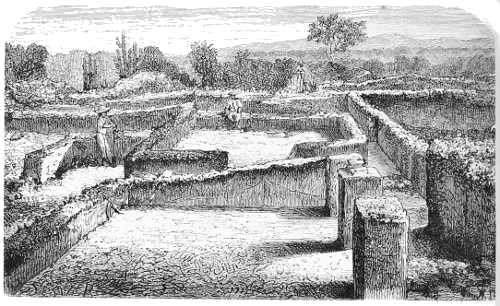
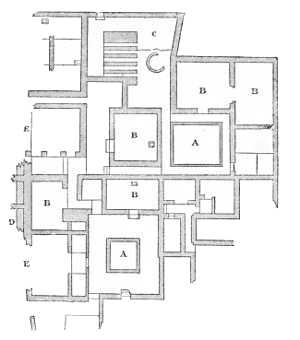
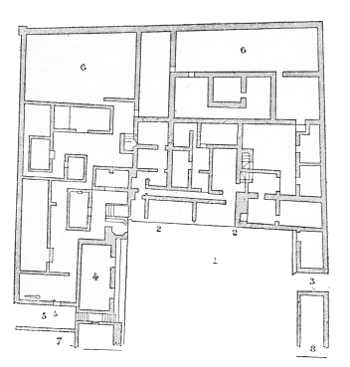
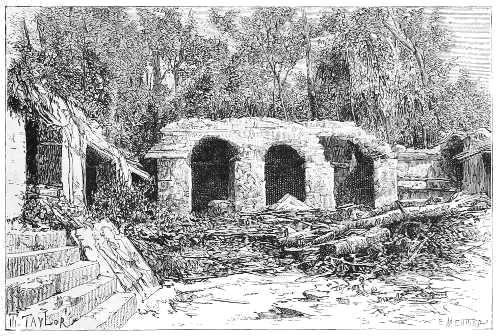
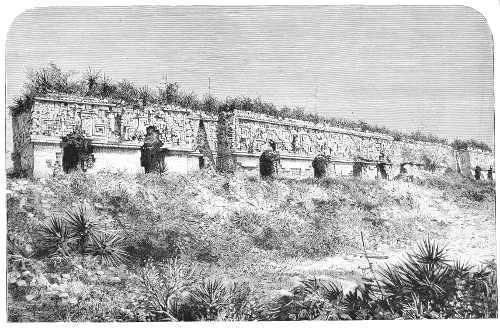
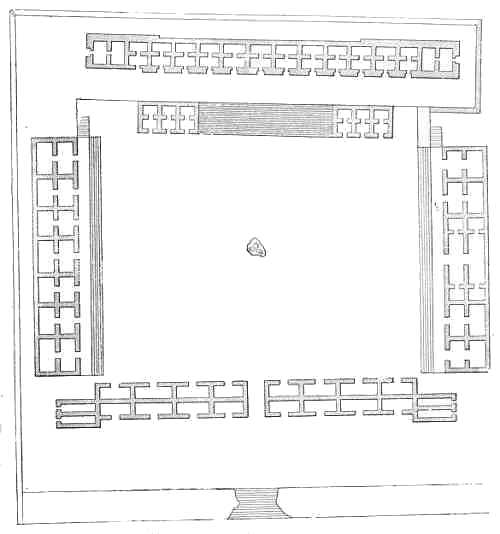
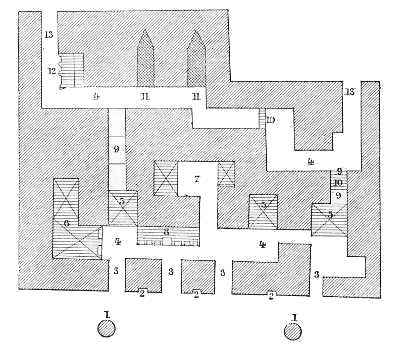
To return to our excavations, “El Palacio de las Monjas,”
or Nuns’ Palace, is one of the most important monuments at
Chichen-Itza, and possesses a greater number of apartments
than any other. Whether the name is due to this circumstance,
or from its traditionary appellation, is uncertain; but
we know from Mexican writers that it was the custom
among the Aztecs to dedicate girls of noble birth to the
service of the gods, on their attaining the age of twelve or
thirteen. Some remained there until they were about to be
married; some few took perpetual vows; others, on account
of some vow they had made during sickness, or that the gods
might send them a good husband, entered the Nunnery for
one, two, three, or four years. They were called deaconesses
or sisters; they lived under the superintendence of staid
matrons of good character, and upon entering the convent,
each girl had her hair cut short. They all slept in one
dormitory, and were not allowed to undress before retiring to
rest, that they might always be ready when the signal was
given to rise. They occupied their time with weaving and
embroidering the tapestry and ornamental work of the temple.
They rose in the night to renew the incense in the braziers,
a matron leading the procession; the maidens with eyes
modestly cast down filed up to the altar, and returned in
the same manner; they fasted often, and were required to
sweep the temples and keep a constant supply of fresh
flowers on the altars. They did penance for the slightest
infringement of their religious rules by pricking their tongues
and ears with the spines of the maguey plant. Death was the
punishment of the Mexican maiden who violated her vow of
chastity.126
It has been supposed, from the latter custom, that an order
of Vestals, similar to those in Rome, existed in America, but
the analogy is more apparent than real. According to Clavigero,
priesthood was not binding for life among the Mayas. Of
the different male and female religious orders, those dedicated
to Quetzalcoatl deserve particular mention; their members had
to submit to the strictest observances, but in compensation
the people paid them almost divine honours, whilst their
power and influence were boundless. Their chief or superior
bore the name of Quetzalcoatl, and never walked abroad
except to visit some royal personage.127 Thus the Nunnery
may very well have been both a convent and a priestly
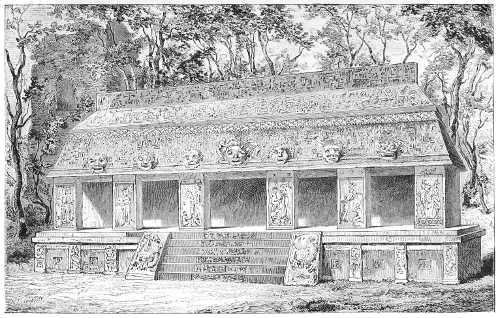
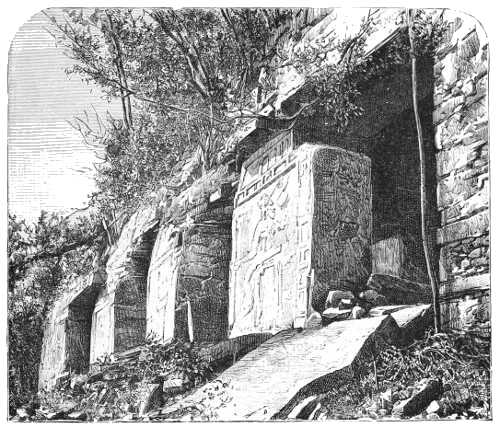
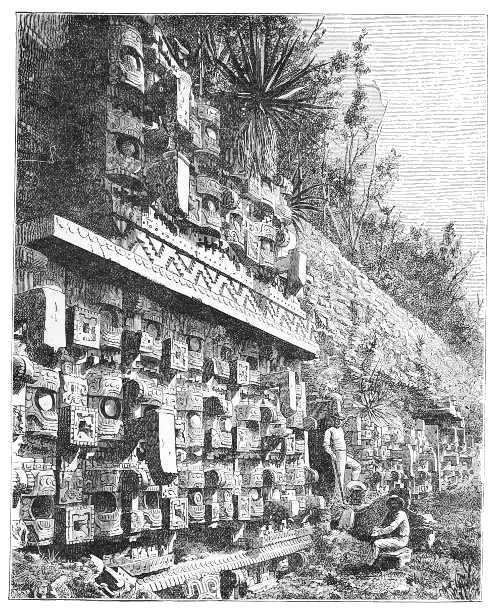
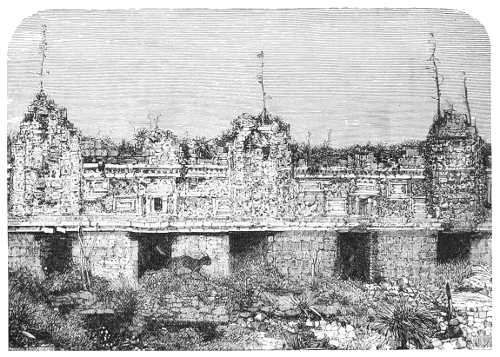
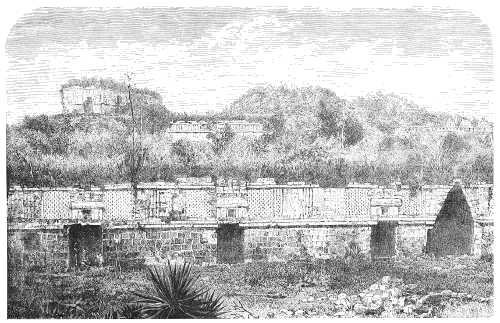
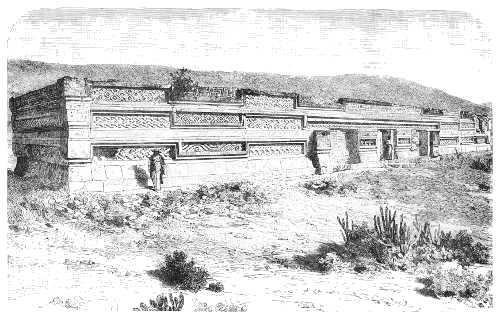
abode. It is not a considerable pile, the façade measuring
only some 29 feet by 19 feet 6 inches high, while its
grotesque, heavy ornamentation reminds us in its details
of a Chinese carving. The base up to the first cornice
is occupied by eight large superimposed idols, and four
of these figures are enclosed within two very salient cornices.
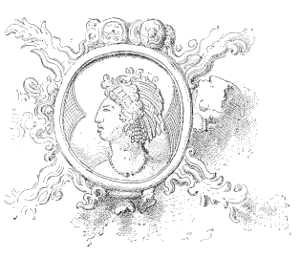
The door is crowned with a medallion representing a cacique
or priest with the usual head-dress of feathers, the inscription
of the palace and stone spires, some of which have
entirely disappeared, while the outline of the rest is much
defaced. The whole length of the frieze of the north façade
has a row of similar gigantic heads, bearing the general
characteristics of the ornamentation observable throughout this
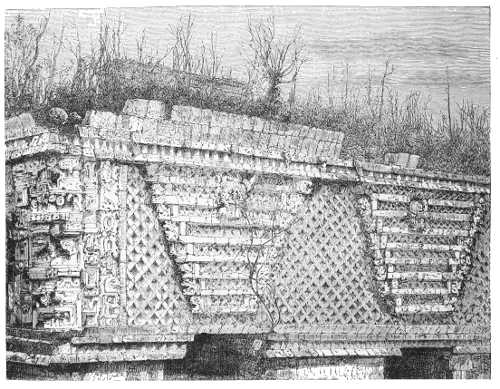
structure. The Nunnery is typical of the Toltec calli, of which
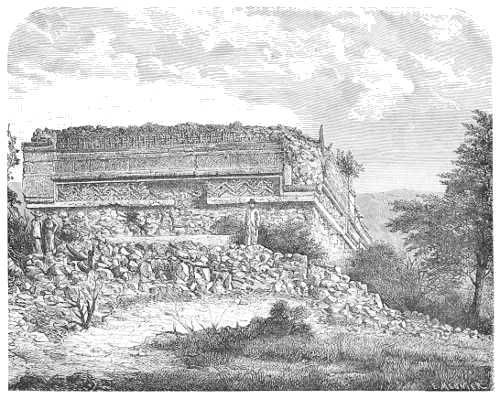
we gave a drawing in our chapter on Tula. The left wing is
but 26 feet wide, by 13 feet deep, and about 32 feet high; it consists
of three cornices, with two friezes intervening in which the
same designs are repeated; the first two high-reliefs represent
stooping figures, one having his body locked in a tortoise shell,
while the centre and the sides of the frieze are decorated with
grotesque figures like those of the main façade, which, with
small variations, are the same throughout the peninsula. As
we have seen in a former chapter, these monstrous masks have
been called elephants by Waldeck and others, who wished to
claim a fabulous antiquity for these monuments, but the types
they most resemble are the Japanese or Chinese. Here, as at
Palenque, the upper portion of the wall is ornamented so as
to enhance the effect of height.
The main body of the Nunnery rests on a perpendicular
pyramid, the platform of which is occupied by a solidly constructed
building, intersected with small apartments having two
niches facing each other, traversed by a corridor running from
east to west of the pyramid. Over this is a smaller structure
or third story. The first platform is reached by a steep, broad
stairway 50 feet wide, which continues with additional steps to
the second platform, where the apartments of the ruined building
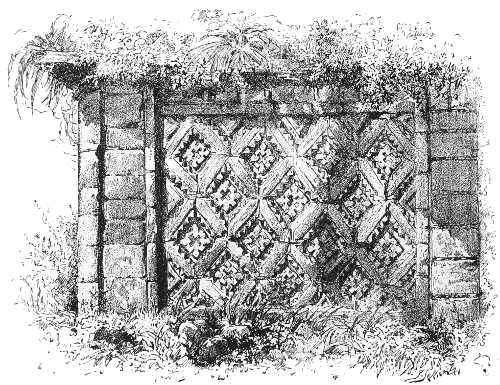
were but cells. The ornamentation of the first story differs
from that of other buildings at Chichen; it consists of small
sunk panels, having in the centre a large rose-like device, framed
with exquisitely moulded stones. The lintels, likewise of stone,
were covered with sculptures and inscriptions now fallen into
decay; we could only collect three, and even these are much
defaced. In this building are curious traces of masonry out of
character with the general structure, showing the place to have
been occupied at two different epochs.
ORNAMENTATION OF THE UPPER STORY OF THE NUNNERY, CHICHEN-ITZA.
This second construction, or rather restoration, was effected
with the materials of the ancient building, as is seen in the
fragments of sculptured stones which in the later construction
are identical with those of the first, save that they were put
up haphazard, so that the systematic ornamentation of the
older structure is no longer reproduced, but in places a thick
plaster coating was laid over the whole. The rebuilding may
have been the work of the aborigines, since we know that
Chichen was abandoned and reoccupied towards the middle
of the fifteenth century; or, more likely still, the clumsy restoration
may have been the work of the Spaniards during their
sojourn in the city, when the Nunnery, from its elevated position,
constituted a valuable fortress. Traces of their passage are
observable in various other buildings, notably in the Castillo,
where their natural fanaticism, coupled with their ignorance,
caused them to see in the portraiture of the national and religious
life of the Mayas, representations of the devil. This could
not be suffered to remain, and as they were unable to demolish
the temples and palaces in which they lived, they whitewashed
the ornamentation, in order that their eyes might not be
constantly offended by the subjects therein represented.
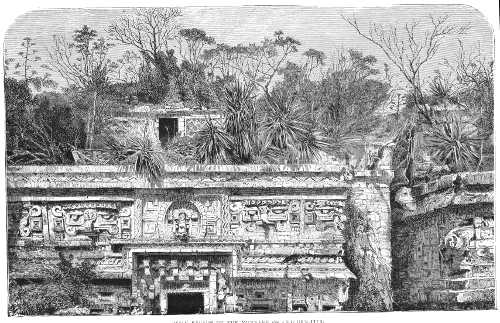
MAIN FAÇADE OF THE NUNNERY OF CHICHEN-ITZA.
We try with small success to undo their savage work by
means of daggers, brushes, and repeated washes, taking up
much time, but in most cases the relief is lost to science,
being much too defaced to allow us to take squeezes. The
idea that the chiefs who erected these monuments were the
authors of their defacement is too absurd for serious consideration.
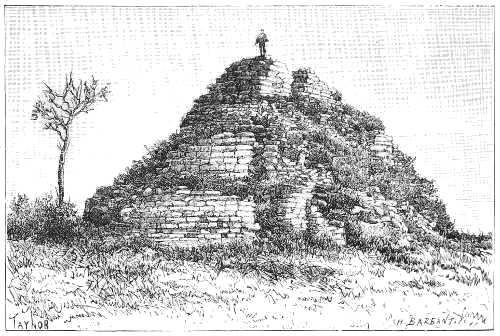
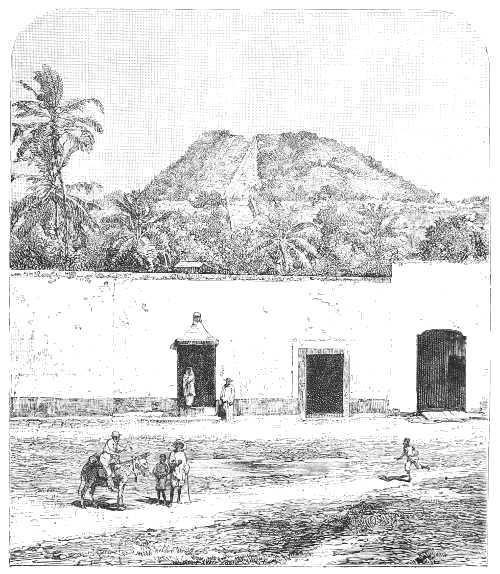
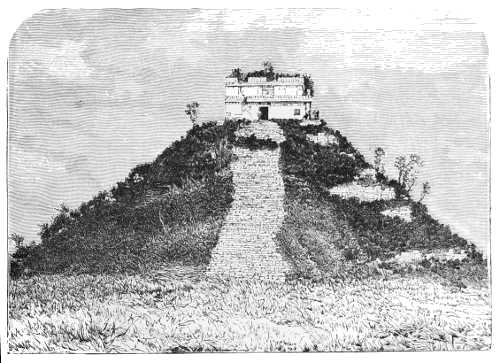
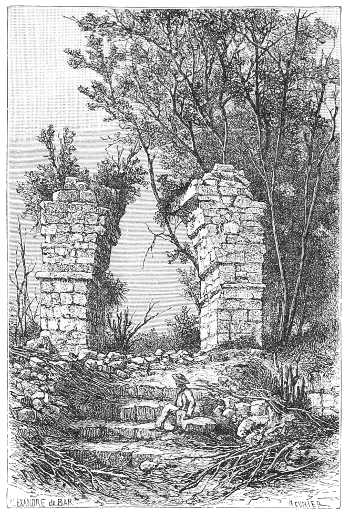
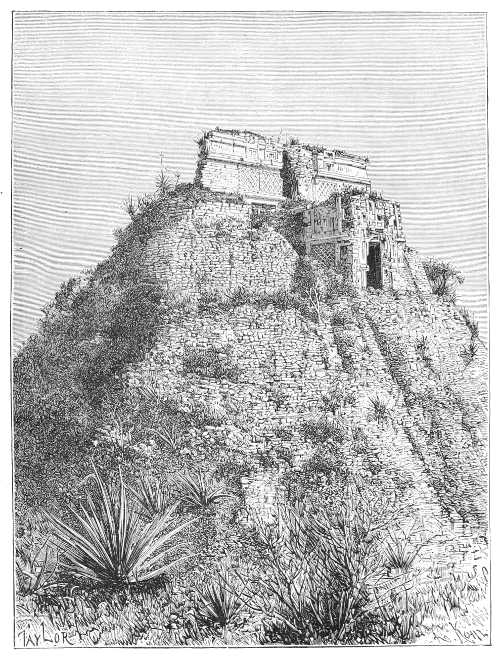
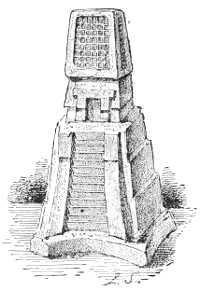
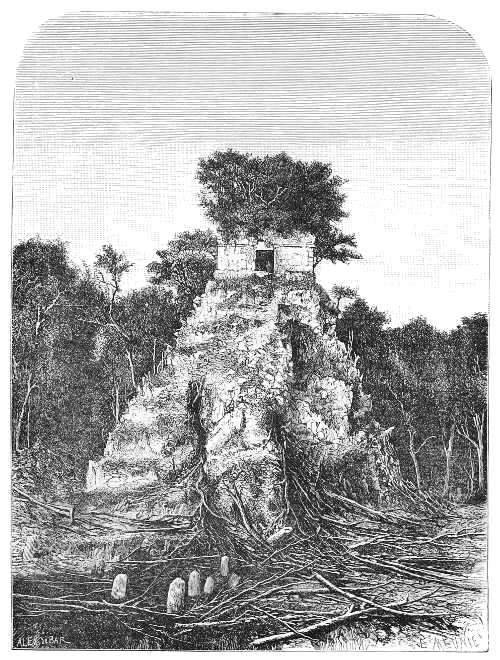
The Castillo, or rather temple,128 is reared on a pyramid,
facing north and south, and is the most interesting monument
at Chichen; its four sides are occupied with staircases, facing
the cardinal points. Our drawing shows the western façade.
The base of the pyramid measures 175 feet; it consists of
nine small esplanades, narrowing towards the top, supported
by perpendicular walls, and terminates in a structure about
39 feet on one side by 21 feet high. The upper platform is
68 feet above the level of the plain, having a flight of ninety
steps, 39 feet wide, leading up to it.
The name of El Castillo (the fortress), given to this building
is appropriate enough; since throughout Central America,
temples, in times of war, became real strongholds, on whose
gigantic terraces the last desperate conflict was waged against
an invading and victorious foe. The struggle might last some
time, but was always attended with heavy loss, for each
terrace had to be carried against men resolved to die. In
the assault on the great temple in Mexico, the Spaniards were
several times repulsed before they could get possession of the
four esplanades of the pyramid; and when these were taken
a fierce encounter followed on the upper platform, which
only ended with the utter annihilation of the Aztecs, who were
either slaughtered on the spot or hurled down the sides of
the pyramid.
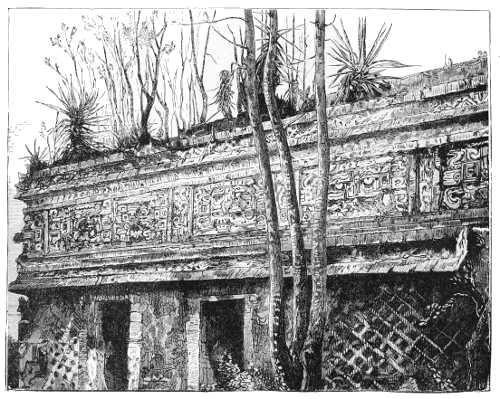
NORTHERN FAÇADE OF THE NUNNERY OF CHICHEN-ITZA.
The only decoration of the western and southern sides
consists in two beautiful cornices, while the interior of the long
corridor shows no trace of ornamentation, save over the doors,
where gigantic warriors are sculptured. The principal or
northern façade must have been very striking when Landa saw
it in 1560. Our photograph shows its dilapidated condition, but
it can easily be reconstructed. It consists of a portico supported
by two massive columns connected by wooden lintels, resembling
that in the Nunnery; this portico gives access to a gallery which
occupies the whole width of the building. A large room, which
must have been the sanctuary, is entered by the only opening
out of the gallery, while two pillars with square capitals supported
a double corbel vault. Here the stairway was wider, and on
each side, forming a balustrade, is a gigantic plumed serpent,
whose head and protruding tongue run down the balustrade. All
these columns, pillars, and wooden lintels, are covered with
sculptures and bas-reliefs, the impressions of which kept us closely
at work for several days.
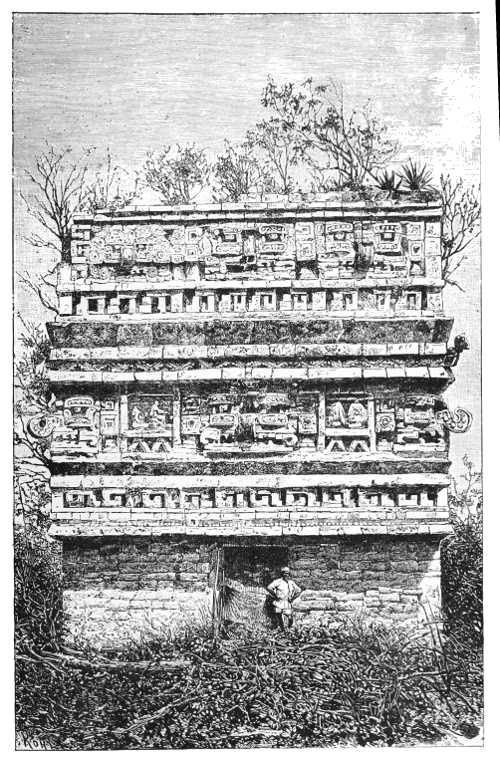
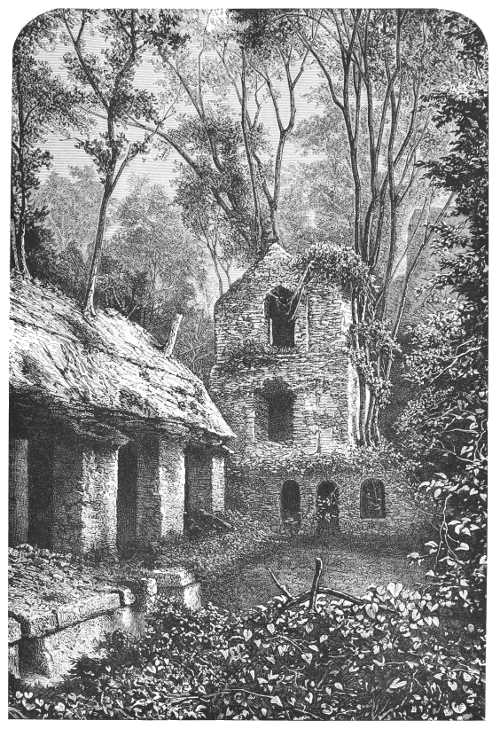
LEFT WING OF THE NUNNERY OF CHICHEN-ITZA.
As in Mexico, Palenque, and Tula, there were no doors
properly so called at Chichen, and no traces of hinges are found;
but a bamboo or wickerwork screen was suspended across the
entrance, and secured at night with a bar. The inner rooms
were divided off by hangings, which probably also served to
cover the windows. We notice everywhere the small holes in
the pillars into which the bars fitted.
Landa mentions the two serpents of the grand staircase, and
that the corridor was probably used for burning perfumes:
“Over the door is a kind of coat-of-arms sculptured in stone,
which I could not read. Extending round this edifice is a
series of solid constructions; the intervening distances are
coated with cement in perfect condition, which looks quite new,
so hard was the mortar in which it was laid.”129 These stucco
layers are facsimiles of those at Tula and Teotihuacan, and
characteristic of the Toltecs. In the three centuries that
have elapsed since the bishop visited these monuments, vegetation
has completely over-run them, but it was not so in his
time.
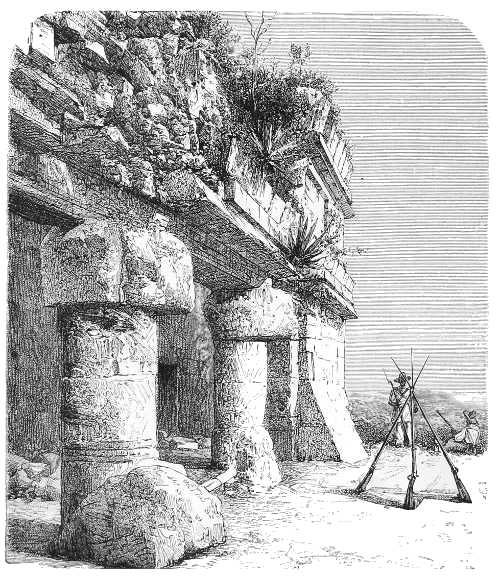
FAÇADE OF EL CASTILLO, CHICHEN-ITZA.
|
|
| TOLTEC COLUMN IN THE CASTILLO. |
TOLTEC COLUMN AT TULA. |
It was in this temple that the striking analogy between the
sculptures and the bas-reliefs of the plateaux with those at
Chichen was first revealed to us; and since the dates of the
Toltec emigrations are known, we can fix approximately the age
of these monuments. We know, on the other hand, that the
Aztec civilisation was but a reflex directly derived from the
Toltecs, so that in some of their manifestations the two civilisations
must resemble each other; from all which it may be seen
that these monuments are both Toltec and recent. The
balustrade on the grand staircase consists of a plumed serpent
like those forming the outer wall of the temple in Mexico; an
emblem of Quetzalcoatl, a deity common to the Toltecs, the
Aztecs, and the Mayas. He is often found on Yucatec buildings.
In Mexico, a serpent biting his tail was a favourite design with
the Aztecs as a frieze to their houses, or over their entrances,
and this we shall also observe at Uxmal. Further, the two
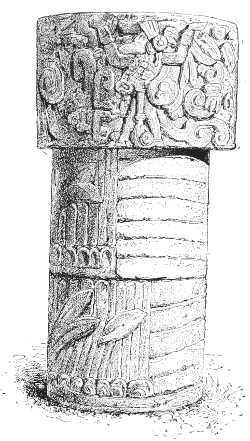
columns of the temple façade furnish a still more striking
example: the bases represent two serpents’ heads, whilst the
shafts were ornamented with feathers, proving that the temple
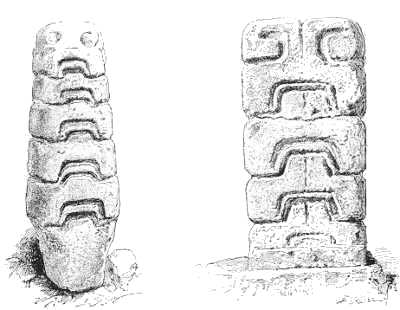
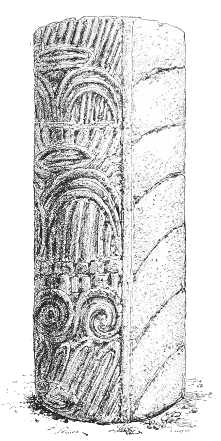
was dedicated to Cukulcan (Quetzalcoatl). These shafts are
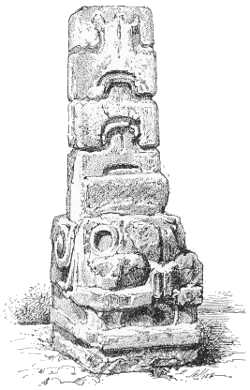
almost an exact reproduction of a Toltec column we unearthed
at Tula, as seen in our cuts. The two columns are
found three hundred leagues from each other, separated by an
interval of several centuries; but if, as we firmly believe, the
Tula column is Toltec, the other must be so too, for it could
not be the result of mere accident. I have only compared the
shafts, for the simple reason that the Tula column has no capital.
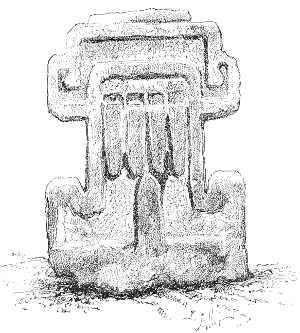
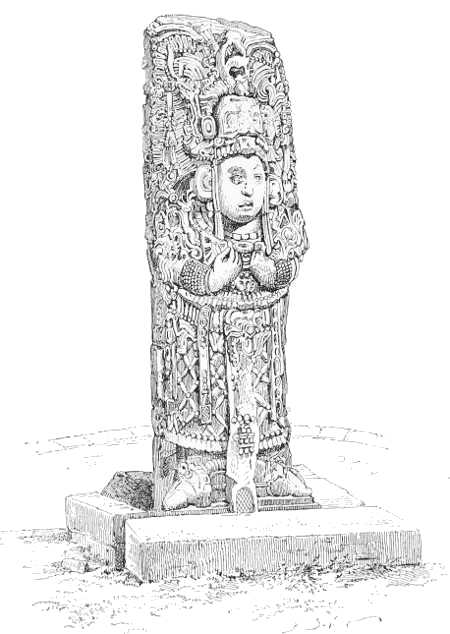
The bas-relief on
the capital of the other
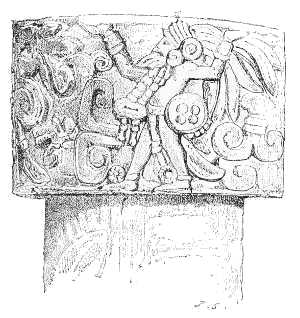 YUCATEC CAPITAL AT CHICHEN-ITZA.
consists of a standing
figure with upraised
arms supporting the
entablature; he wears
large bracelets, huge
feathers form his headdress,
his feet are
covered with shoes fastened
on the instep by
a leather knot, a collar
of precious stones is
around his neck, a
richly embroidered
maxtli falls to the ground, and he wears the long flowing beard
characteristic of Quetzalcoatl.
YUCATEC CAPITAL AT CHICHEN-ITZA.
consists of a standing
figure with upraised
arms supporting the
entablature; he wears
large bracelets, huge
feathers form his headdress,
his feet are
covered with shoes fastened
on the instep by
a leather knot, a collar
of precious stones is
around his neck, a
richly embroidered
maxtli falls to the ground, and he wears the long flowing beard
characteristic of Quetzalcoatl.
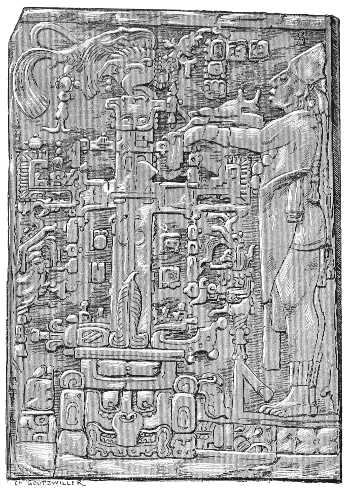
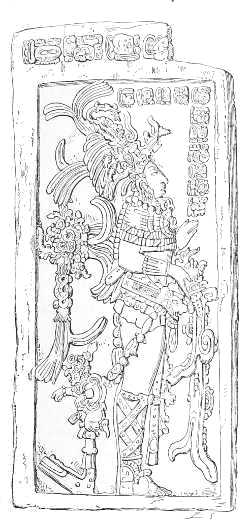
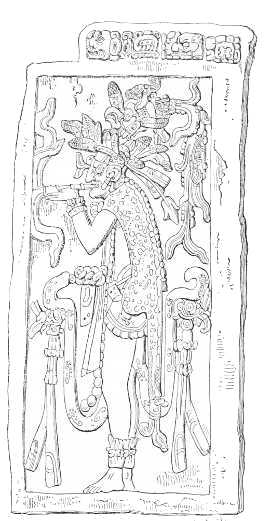
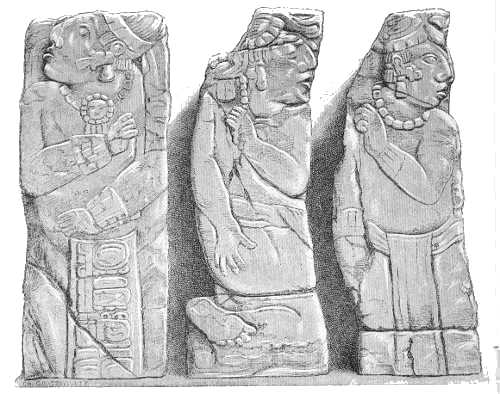
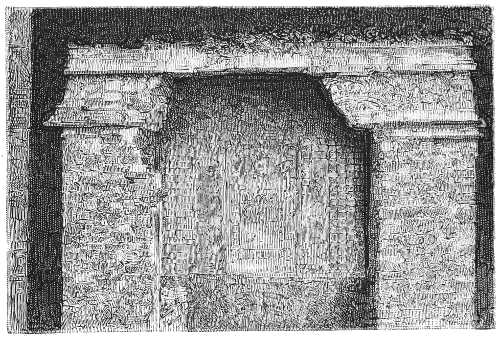
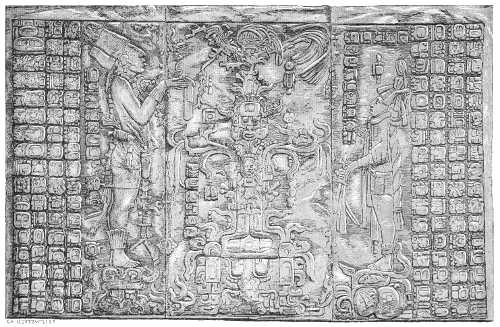
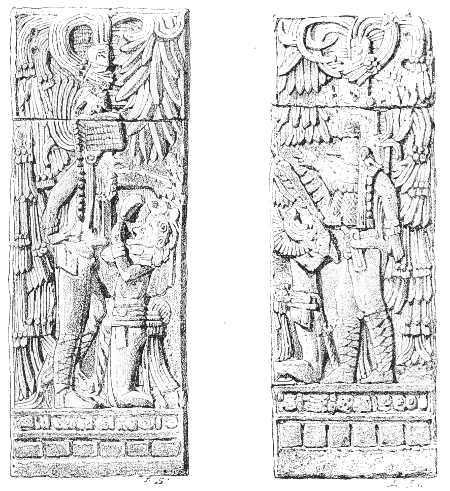
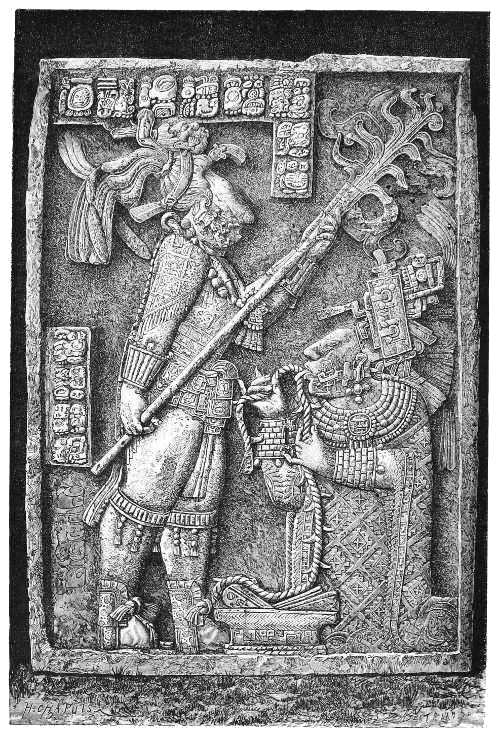
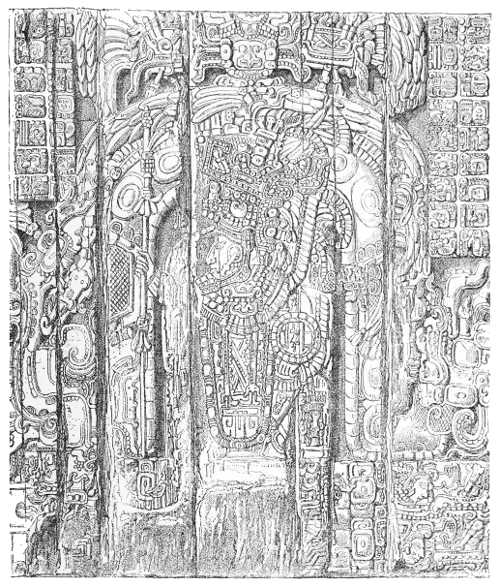
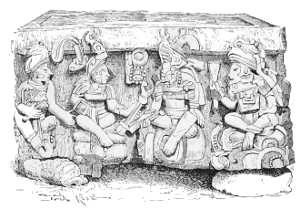
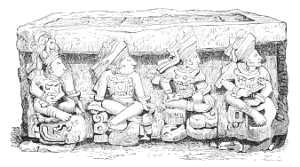
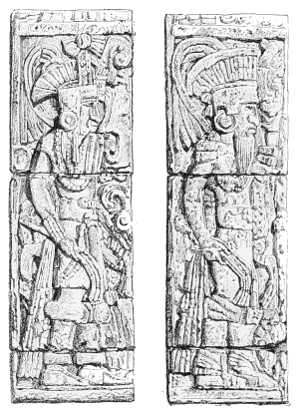
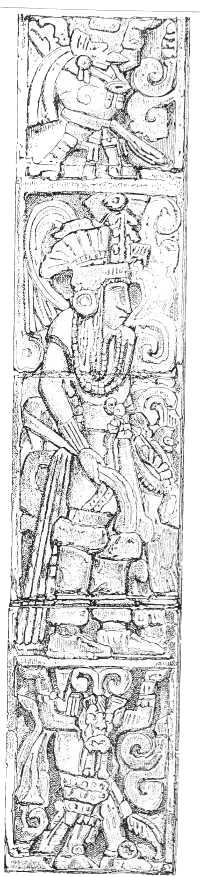
The two bas-reliefs given opposite are from pillars in
the sanctuary. They represent figures in gala costumes,
one of which is distinguished by a long beard, and all have
the aquiline nose ascribed to the Toltecs. These pillars are
occupied by three bas-reliefs, a large one in the centre and
two smaller at each side of it. The central relief is a life-size
figure of a priest, to judge from the total absence of
arms about all the figures on these pillars. The caryatides
on the smaller reliefs, notably the lower one, have double
spirals over the mouth, presumably a symbol of wind and
speech. We noticed in a former chapter this spiral about
Quetzalcoatl on the outer relief of the altar in the Temple
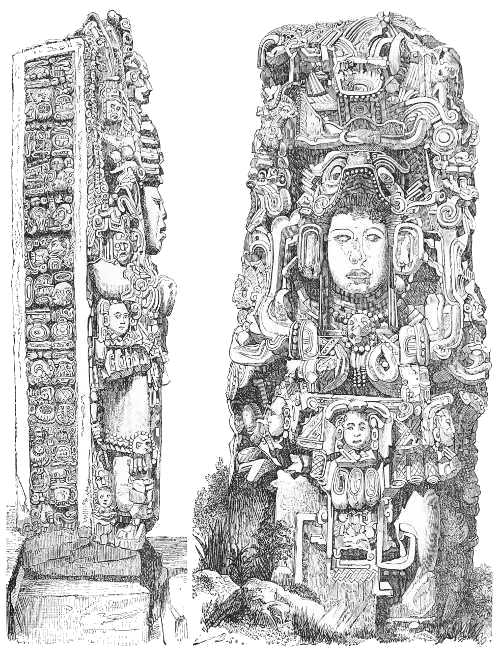
of the Cross at Palenque. All these caryatides represent
 DOOR-POSTS IN THE CASTILLO, CHICHEN-ITZA.
long-bearded men,
whose type is identical
with those on the
Tula relief, as may
be seen by the most
superficial comparison
of the two. But is
the spiral an emblem
of speech? That it is
so may be assumed
from the upper caryatid,
which only supporting
the entablature
has no spiral about
the mouth, while the
lower one not only
bears aloft the central
figure and the edifice,
but it seems to carry,
to create and breathe life into the whole, as the emblem of
civilisation. At least so it struck us when we looked at these
bearded figures which support the pillars, and saw the symbolical
sign of quickening speech around the mouth of each, and
considered that the Toltecs were the builders of these monuments,
which they reared by their mighty word, in accordance with
their pacific and civilising character, as described by Herrera and
Landa. I am well aware that this assumption rests on no
scientific basis, nevertheless I hope to bring so many data in
its favour as to make it highly probable. The most remarkable
feature about the relief on the capital is its striking resemblance
to the caryatides in high relief found on the terrace and façade
of Angcor-Thom’s palace, given by Francis Garnier;130 in both
the same attitude and dress are observable; the latter consists
of the patoi with the Cambodians, and the maxtli with the
Toltecs; while the sculpture is primitive in both, the only
difference being in the relief.
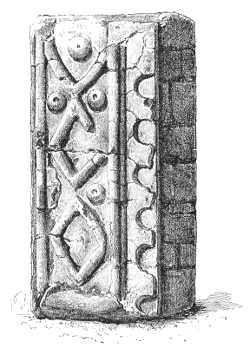
DOOR-POSTS IN THE CASTILLO, CHICHEN-ITZA.
long-bearded men,
whose type is identical
with those on the
Tula relief, as may
be seen by the most
superficial comparison
of the two. But is
the spiral an emblem
of speech? That it is
so may be assumed
from the upper caryatid,
which only supporting
the entablature
has no spiral about
the mouth, while the
lower one not only
bears aloft the central
figure and the edifice,
but it seems to carry,
to create and breathe life into the whole, as the emblem of
civilisation. At least so it struck us when we looked at these
bearded figures which support the pillars, and saw the symbolical
sign of quickening speech around the mouth of each, and
considered that the Toltecs were the builders of these monuments,
which they reared by their mighty word, in accordance with
their pacific and civilising character, as described by Herrera and
Landa. I am well aware that this assumption rests on no
scientific basis, nevertheless I hope to bring so many data in
its favour as to make it highly probable. The most remarkable
feature about the relief on the capital is its striking resemblance
to the caryatides in high relief found on the terrace and façade
of Angcor-Thom’s palace, given by Francis Garnier;130 in both
the same attitude and dress are observable; the latter consists
of the patoi with the Cambodians, and the maxtli with the
Toltecs; while the sculpture is primitive in both, the only
difference being in the relief.
Our excursions in these impenetrable woods, our ascents
and descents of the pyramid, the arduous work attending the
taking of squeezes, made our life very harassing; it could have
been more easily borne had we been able to sleep, but the
scorching days were succeeded by icy-cold nights, which kept
us awake, so that we rose in the morning more unrefreshed
and more tired than when we turned in for the night.
Some compensation we had in our walks round the pyramid,
beguiling the time we could not sleep with a cigar, contemplating
the fine starry nights and sometimes the lunar rainbows so rarely
seen; or we watched the broad shadow of the pyramid cast
athwart the white haze shrouding the plain, fringed by an immense
brilliant corona, which seemed to float in space. Never
had I gazed on anything so curious and fantastic as this
terrestrial halo; and if the ancient worshippers of Cukulcan
ever witnessed the phenomenon, they must have deemed it
little short of miraculous.
We were still without a cook; for Julian was so atrociously
bad that I kept him at the squeezes, taking the cooking
ourselves in turn, which wasted much valuable time. One
evening, after everybody had gone to
 BAS-RELIEFS FROM PILLARS OF SANCTUARY
OF CHICHEN-ITZA.
rest, I was sitting alone writing my
impressions, my head full of the ruins
and the people who inhabited them.
I suddenly looked up, to see standing
before me a lovely maiden more
like an apparition than a mortal
being. Was this the shade of a
Maya princess who had returned to
the scenes of her former life, conjured
up by my imagination? Meanwhile
the beauteous figure stood
looking and smiling at me. I was
amazed, speechless, hardly daring to
break the spell, when a third figure
stood out from the dark entrance, in
whom I recognised the commandant
of Pisté.
BAS-RELIEFS FROM PILLARS OF SANCTUARY
OF CHICHEN-ITZA.
rest, I was sitting alone writing my
impressions, my head full of the ruins
and the people who inhabited them.
I suddenly looked up, to see standing
before me a lovely maiden more
like an apparition than a mortal
being. Was this the shade of a
Maya princess who had returned to
the scenes of her former life, conjured
up by my imagination? Meanwhile
the beauteous figure stood
looking and smiling at me. I was
amazed, speechless, hardly daring to
break the spell, when a third figure
stood out from the dark entrance, in
whom I recognised the commandant
of Pisté.
“You are surprised at our visit,”
he said.
“Rather, especially at this hour,
and in such a night.”
“Time is of no account when you
wish to serve a friend; I heard that
you required a cook, I brought you
mine, that’s all.”
“A cook!” I ejaculated to myself.
What a fall! my Indian princess
a cook! I looked at her again, and
I could not believe that so much
youth and beauty were put to such
menial occupation. I wondered at
the commandant’s self-abnegation. I was somewhat embarrassed,
nevertheless, as to where I should put her. I called
up Julian to prepare a bed for her, but as he was not easily
roused, I had time to reflect that with a hundred men about
me, El Castillo was no fitting place for a young girl. I
was profuse in my acknowledgments to the commandant,
observing that as nothing was ready, it would perhaps be
better to put off her coming for a day or two, apologising
for the trouble they had taken in coming through the woods
and having to climb the pyramid in such a pitch-dark night.
He knew what I meant. I slipped a coin in the girl’s
hand, as she held a bottle towards me. “Drink,” said the
officer; “it is Josepha’s present to you.” I did so, while
Josepha merely put her lips to the bottle. We shook hands,
and my two visitors disappeared in the night. The draught
was Staventum, a strong spirit, which made me light-headed,
and in a fit of somnambulism I wandered about, spouting poetry
at the top of my voice, on the very edge of the pyramid, whence
I was fortunately removed, without any further result than to
awake the next day with a splitting headache. Our long-expected
cook arrived at last, and she was so old, and such a fright, that
it relieved me of all fear on her account.
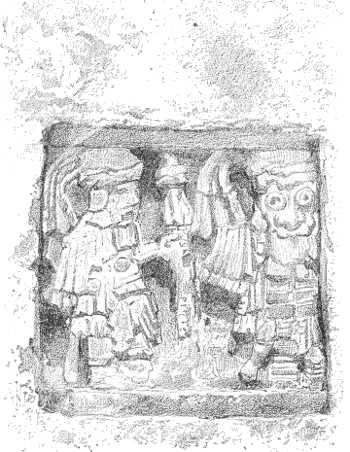
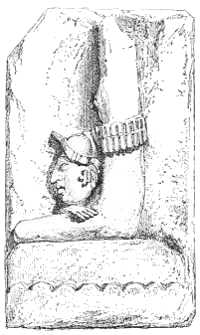
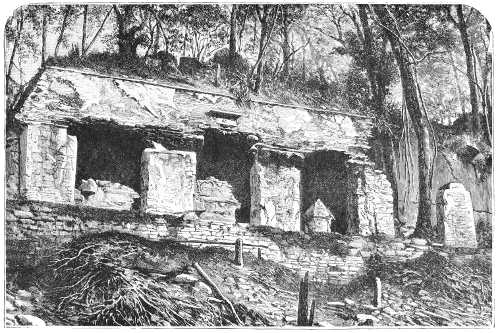
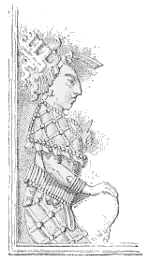
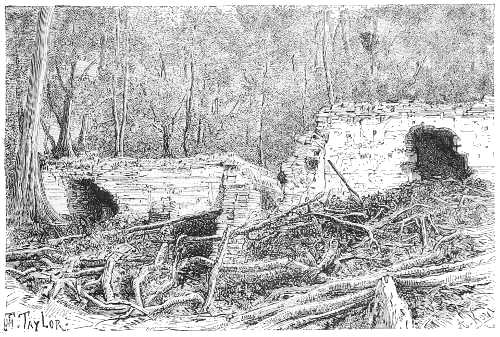
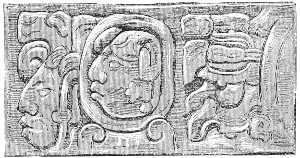
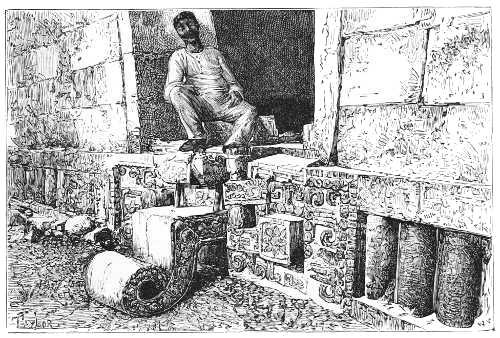
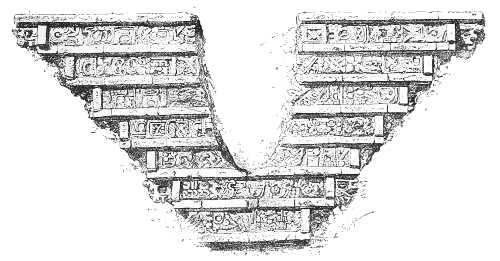
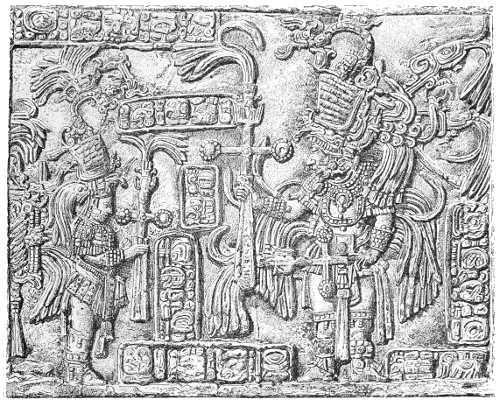
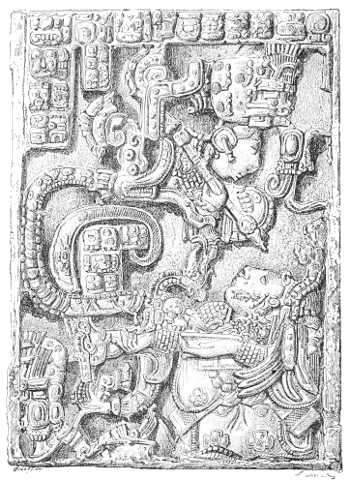
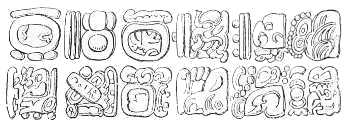
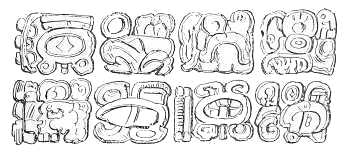
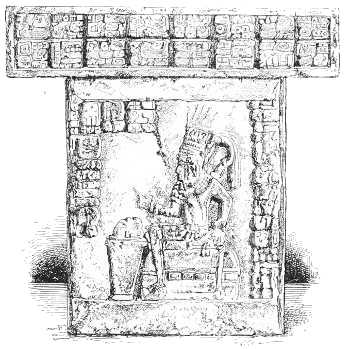
Akab-Sib, “writing in the dark,” is a modern appellation,
due to a bas-relief found on the lintel of an inner door at
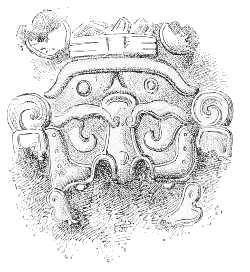
the extremity of the building. The cut we give is a copy of
our photograph. We can give no explanation respecting this
relief. The figure it represents is sitting before a vase full of
indistinct objects, with outstretched arm and forefinger pointed,
whether in question or command is uncertain—not much for the
imagination to go upon. We will restrict ourselves to pointing
out the analogy of the characters in the inscriptions with those
at Palenque. The structure consists of eighteen rooms, reared
on a plain pyramid, with a stairway to the east, without any
ornamentation.
The Caracol is a round building, 22 feet in diameter, with
a double inner corridor and a central pillar; it is a kind of
tower, used probably for civil or religious ceremonies, for we
have found this kind of structure at Cozumel and in all the
great centres.
BAS-RELIEFS WITH INSCRIPTIONS, AKAB-SIB PALACE AT CHICHEN-ITZA.
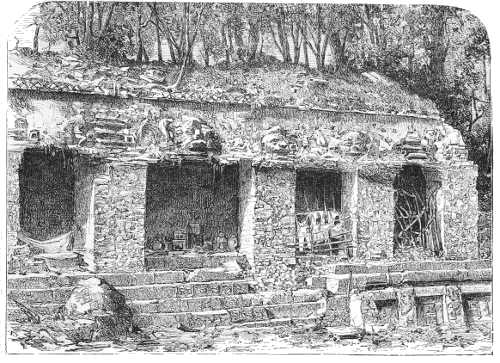
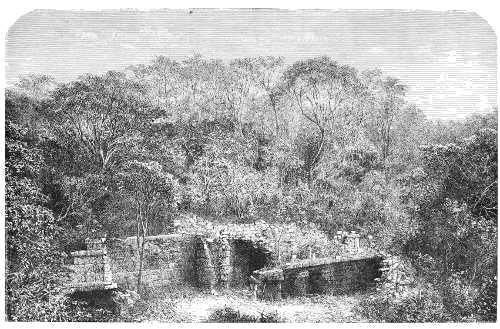
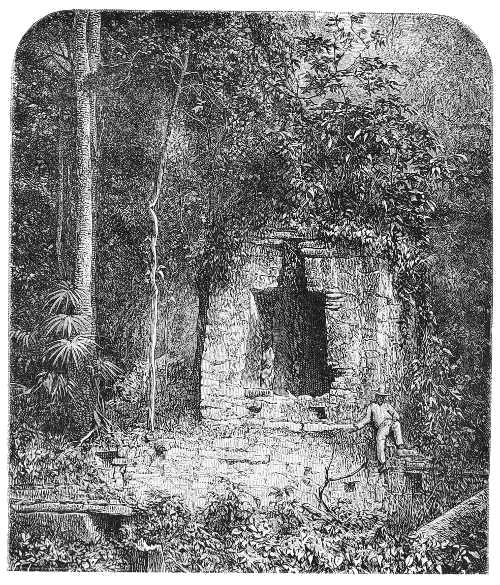
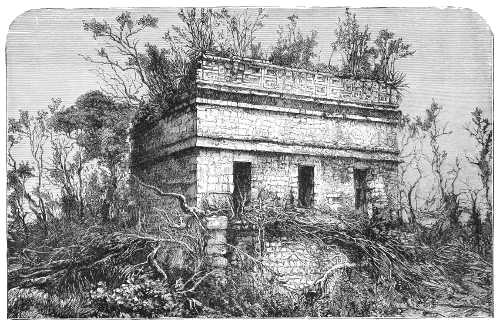
The Chichan-Chob, “Red House” (p. 351), is a small
building about a hundred yards north of the Caracol; it
stands on a rectangular platform, reached by a flight of
twelve or fifteen steps. It is the best preserved monument
at Chichen, and might be even now a pleasant residence; for
time seems to have respected and to have left untouched its
plain, smooth walls, and from its general appearance it cannot
date further back than towards the last years of the city in the
fifteenth century. Three doorways to the north lead into a
corridor extending over the whole length of the building, whence
three more openings give access to as many apartments in a
perfect state of preservation. Over these doorways, and running
the whole length of the corridor, is a narrow stone tablet, on
which is graven a row of hieroglyphics very much damaged, of
which Stephens gave a faithful reproduction.
The situation of Chichen is due probably to the great cenotés
which supplied the city with abundant water, and which differ
from the complicated underground passages noted in other parts
of the state, being immense natural pits of great depth, with
perpendicular sides. Of these cenotés, that for general use
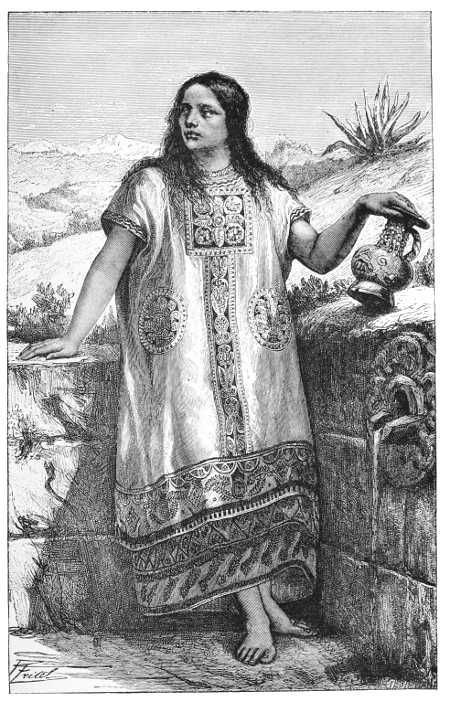
occupied the centre of the place; picturesque must have been
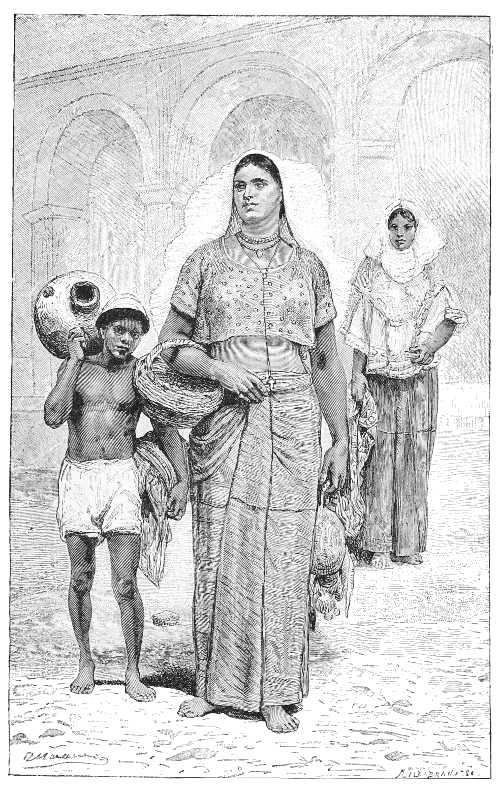
the throng of white-robed women who peopled its steps at all
hours of the day to fetch water for household purposes, carrying
double-handled urns on their shoulders or on their hips just
as they do at the present day. The other, or sacred cenoté, lies
in a tangle of wood on the confines of the city, to which a path
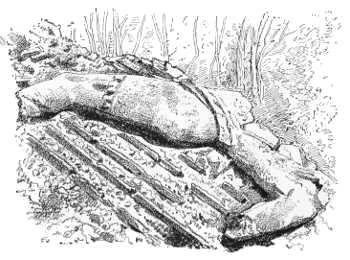
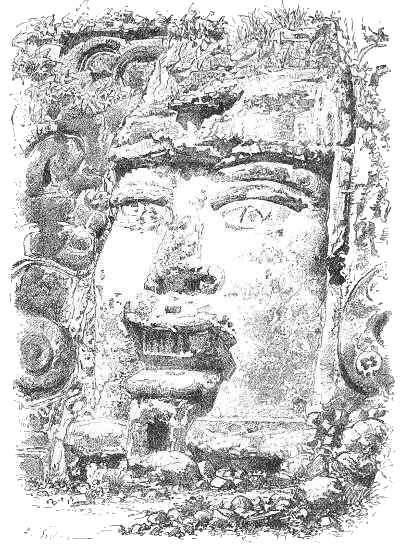
had to be opened. We find midway a large broken statue of
Tlaloc, similar to the two we reproduce further on; the upper
portion of the body and the head are wanting. Near it are
ruinous heaps, remains of two temples, their base occupied by
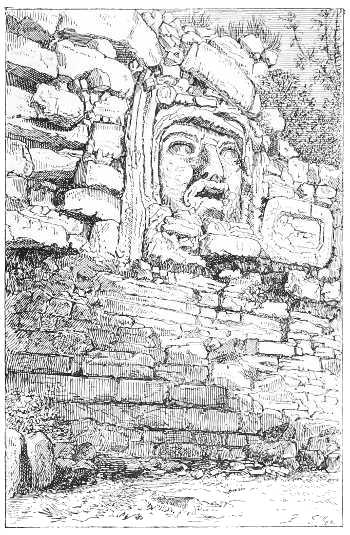
immense heads of Quetzalcoatl, who seems to have been the
tutelary deity of Chichen. On fragments of walls still standing,
I notice bas-reliefs in excellent preservation, one representing a
large fish with a human head,131 and the other a figure of a man
after death.
CHICHAN-CHOB, PRISON OF CHICHEN-ITZA.
Landa’s description of these temples would lead us to infer
that they were entire in his time, for he says: “Some distance
north of the Castillo were two small theatres built with square
blocks; four flights of steps led to the top, paved with fine
slabs, and on which low comedies were performed.”132 Notwithstanding
Landa and Cogolludo’s testimony, we think they
were temples on whose summits the Christianised Indians performed
their religious ceremonies, which from fear of anathemas
they represented to the good bishop as comedies.
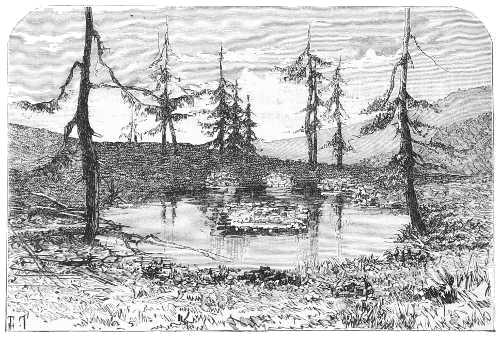
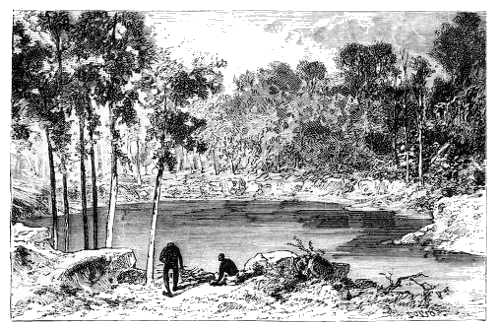
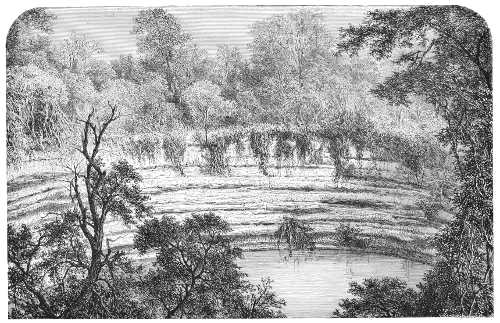
The sacred cenoté lies 150 yards beyond; it is oblong in
shape, and the two diameters measure from 130 to 165 feet.
The surface of the water cannot be reached, for the wall, some
65 feet high, is entire and perpendicular throughout. The desolation
of this aguado, its walls shrouded with brambles, shrubs,
and lianas, the sombre forest beyond, but above all the lugubrious
associations attaching to it, fill the imagination with indescribable
melancholy.
Hither pilgrims repaired, and here offerings were made; for
Chichen was a holy city, and among her shrines the cenoté
held a conspicuous place, as the following passage from Landa
will show: “From the courtyard of the theatre, a good wide
road led to a well some little distance beyond (the road was
therefore in perfectly good condition), into which in times of
drought the natives used to throw men, as indeed they still
do (1560), as an offering to their deities, fully believing that
they would not die, even though they disappeared. Precious
stones and other valuable objects were also offered; and had
the country been rich in gold, this well would contain a vast
quantity, because of the great veneration of the natives for it.
The aguado is round, of great depth, measuring over 100 feet
in width and cunningly hewn out of the rock.133 The green
colour of the water is due to the foliage; on its banks rises
a small building filled with idols in honour of all the principal
edifices in the country, exactly like the Pantheon in Rome. I
cannot say whether this is an ancient practice or an innovation
of the aborigines, who find here their idols to which they can
bring their offerings. I also found sculptured lions, vases, and
other objects, which, from the manner they were fashioned,
must have been wrought with metal instruments; besides two
statues of considerable size of one single block, with peculiar
heads, earrings, and the maxtli round their loins.”134 This passage
is very remarkable, but the Abbé Brasseur, who translated
it, does not seem to have grasped its true meaning. What,
there was a plastered road in good preservation, a temple filled
with idols brought thither by the existing natives, more than forty
years after the Conquest, there were numerous offerings in honour
of the various poliote deities, statues representing the Mayas in
their national costume, and yet it is urged that these temples
were constructed before the Christian era! Landa’s account
ought to convince the most prejudiced; proving the town to
have been, if not quite recent, comparatively so, and inhabited
when Montejo occupied it for the first time, in 1527, since
thirty-three years later (1560) devotees were still visiting its
shrines. This is also the conclusion arrived at by Stephens,
who had fewer data in support of it.
These pages had already been written when I received Chicxulub’s
Chronicles, written at the time of the Conquest, by the
Cacique Nakuk-Peck; translated and published by Brinton, Philadelphia,
1882, containing most valuable information whereby my
theory is strengthened with all the weight of an official document.
SACRED CENOTÉ OF CHICHEN-ITZA.
Sec. 4. Nakuk-Peck, writing of Montejo’s expedition to
Chichen-Itza, 1527, says: “He set out to reconnoitre the place
called Chichen-Itza, whence he invited the chief of the town
to come and see him; and the people said unto him: ‘There
is a King, my Lord, there is a King, even Cocom aun Peck,
King Peck, King Chel of Chicantum;’ and Captain Cupul said
to him: ‘Stranger warrior, take your rest in these palaces.’
So spoke Captain Cupul.” After this, can it be further doubted
that Chichen was inhabited at the Conquest? Of Izamal he
says:
Sec. 18. “When the Spaniards established themselves at
Merida in 1542, the chief orator, the high-priest Kinich-Kakmó
and the King of the Tutulxius from Mani, made their submission.”
Obviously Kinich-Kakmó was the generic name for the high-priests
at Izamal who were in full possession of their religious
prerogatives at the coming of the Spaniards; consequently the
temples and palaces of both Izamal and Chichen were then inhabited.
These passages tell us, moreover, what we did not yet
know—that after the fall of Mayapan the head of the Cocomes
took possession of the principality of Chichen (the fall of Mayapan
and the migration of the Chichemecs were probably contemporaneous
events), that Kinich-Kakmó was the ally of Tutulxiu,
King of Mani, since, jointly with him, he offered his alliance to
Montejo, and that the latter and Cocom, both of Toltec descent,
were enemies struggling for supremacy over the province.135
We read in Torquemada and other writers that the first to
arrive in the country were the Cocomes, penetrating the
peninsula from Tabasco towards the end of the twelfth century,
under the command of their chief Quetzalcoatl, after they had
already subdued and civilised most of the northern portion of
Yucatan. They were succeeded a century later by the Tutulxius,
who marked their passage through the Usumacinta Valley by
the erection of Lorillard and Tikal.
Herrera and Landa tell us that “several tribes came from
Chiapas, having entered Yucatan by the south, although this
is not generally known to the natives themselves, but he (Landa)
conjectures it from the great number of names and verbal constructions
common to Chiapas and Yucatan, as from considerable
vestiges of deserted localities (Palenque, Ocosingo, and Lorillard,
etc.). These tribes dwelt in the wilderness south of the peninsula,
journeying hence to the hilly region of Kabah, Uxmal, etc., where
they settled down under their chief Tutulxiu, spreading everywhere
the worship of the Sun, the Moon, Tlaloc, and Quetzalcoatl,
their chief deities. They lived in great peace with the former
inhabitants, and with one another. They had no arms, snaring
animals with nets or taking them with lazos.”136 Yet these kindred
tribes, the Cocomes and Tutulxius, so mild in disposition, became
fierce and quarrelsome soon after the settlement of the latter
in the district, both struggling for supremacy. In this conflict,
Mayapan was successively occupied by the victorious party,
while both succumbed to the caciques, who, taking advantage
of these inter-tribal contentions, consolidated their power, when
the peninsula was divided into eighteen independent provinces,
continually at war with each other, which finally worked the
destruction of the Maya-Toltec civilisation.
Aware of the treasures the cenoté might contain, I had provided
myself with two automatic Toselli sounding-machines, one
of which is capable of bringing up half a cubic metre deposit;
but unfortunately I could not get it to work, owing to the
height of the walls, the depth of the water, and the enormous
detritus of several centuries.
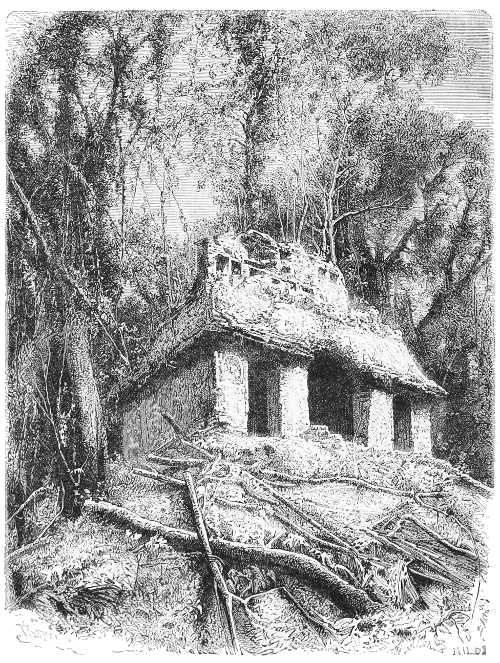
SMALL TEMPLE IN THE TENNIS-COURT OF CHICHEN-ITZA.
The Tennis-court is at once the largest and the best preserved
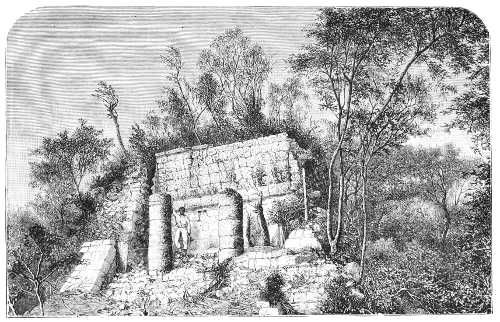
of any structure of this description; it consists of two
perpendicular parallel walls from north to south, 34 by 325 feet,
32 feet high, and 113 feet apart. Both ends are occupied by
two small temples always seen in structures of this kind. The
southern edifice has no ornamentation of any interest; the
northern, which is shown in our cut, contains a single apartment,
with a portico to the south supported by columns, forming a
balcony whence the grandees witnessed the game sheltered
from the fierce rays of the sun.
The ruinous condition of this building will not allow us
to judge of its external decoration; but the columns and
the walls in the interior are covered with rows of human
figures in bas-relief, so damaged, however, that the subjects
represented cannot be recognised. The inner walls facing
each other, have in the centre of each, some 15 feet from the
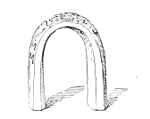
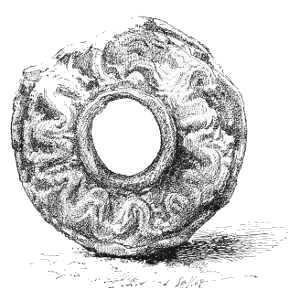
ground, two stone rings with a hole through the centre,
similar to the one we dug up at Tula. The vast proportions
of this tlachtli indicate that the national Nahua game
was as eagerly played in Yucatan as on the table-land.
From the remaining sculptured fragments, whether bases, shafts
of columns, or reliefs, representing Quetzalcoatl, we are induced
to believe that this stately building was dedicated to this
god; all the more that the south end of the eastern wall
is occupied by a monument where his symbolical image is
everywhere seen. It consists of two apartments of different
size, richly decorated; a portico gave access to the main
chamber (our cut shows its dimensions), where the bases of the
columns are covered with finely sculptured serpents’ heads with
protruding tongues, over 9 feet long, bearing the characteristics
of those on the great temple at Mexico which date 1484-1486.
The southern façade of this monument has a beautiful interlaced
frieze, with a procession of tigers, divided by richly
fringed shields, bearing a strong resemblance to those of the
various tribes, published by Lorenzana with Cortez’ letters,
and similar to those generally seen in the Mexican manuscripts.
We think we recognise in this a monument of Quetzalcoatl
commemorating his victory over Tezcatlipoca in his foot-ball
match which took place at Tula, and that this is so seems
highly probable.
BAS-RELIEF IN HALL OF TENNIS-COURT OF CHICHEN-ITZA.
In the chamber which stood over the ruined portico
there was, twenty years ago, a series of paintings descriptive
of domestic and public life among the Mayas, now entirely
destroyed by barbarous explorers, or by the inhabitants of
Pisté. Stephens, who saw them, says that they were painted
in bright colours of blue, red, yellow, and green. Fortunately
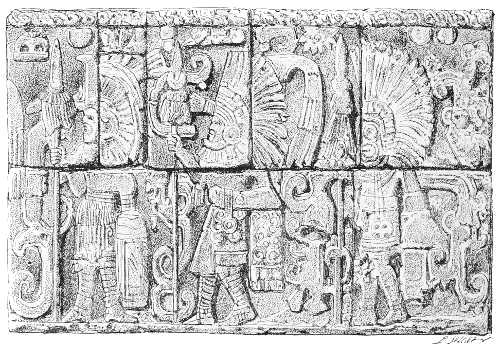
for us, three sides of the pillars at the entrance are still
covered with sculptures, as also the lintels, and all are in
better preservation than any at Chichen-Itza, as may be seen
in our drawing. Here also we find numerous analogies with
Mexican monuments, which, it should be recollected, were the
result of Toltec teaching.
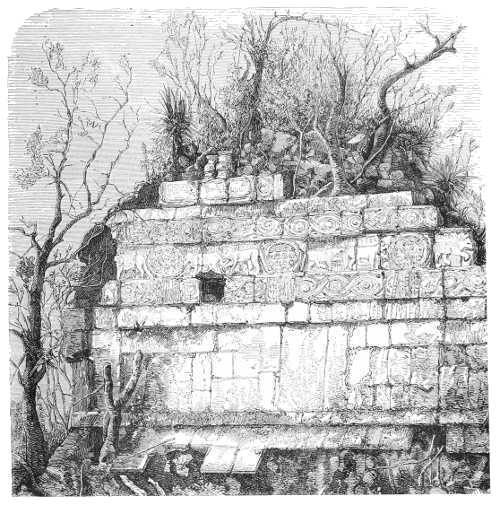
TIGERS’ BAS-RELIEFS ON PORTION OF TENNIS-COURT OF CHICHEN-ITZA.
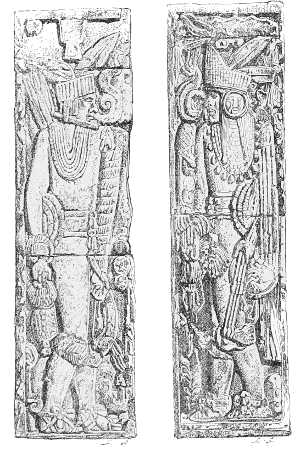
All the human figures seen on these monuments have the
usual type of the Toltecs of the high plateaux. Their gala
dress, like that of the reliefs at page 362, is identical with the
dress of the figures on Tizoc’s stone. It is always a headdress
 DOOR-POSTS OF HALL IN THE TENNIS-COURT OF
CHICHEN-ITZA.
of feathers, a heavy collar of precious stones, a bundle
of arrows in the left hand, while the right carries a knife
similar to that carried by the figures of the Cuauhxicalli, so
that we might almost fancy we are following in the train of a
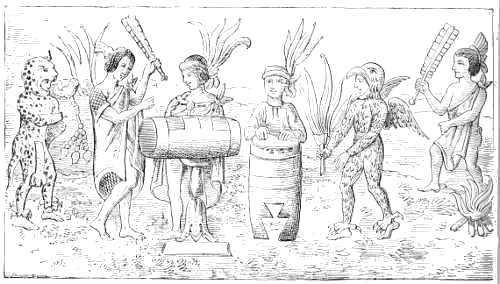
Nahua pageant so vividly portrayed by Sahagun, when he says:
“In the feast of the God
of Fire, which was held in
the month Izcalli” (the
eighteenth month), “the
nobles wore a high-fronted
paper coronet, with no back
to it, a kind of false nose
of blue paper, a collar and
medallions around their
necks, while in their hands
was carried a wooden knife,
the lower half of which was
painted red and the upper
white.”137 In our cut, the
figure to the right wears
the mitre just described with
the piece of paper about the
nose, while the collar and
the wooden knife may be
seen in both, just like those
we see on Tizoc’s stone. The analogy is as curious as it is
striking.
DOOR-POSTS OF HALL IN THE TENNIS-COURT OF
CHICHEN-ITZA.
of feathers, a heavy collar of precious stones, a bundle
of arrows in the left hand, while the right carries a knife
similar to that carried by the figures of the Cuauhxicalli, so
that we might almost fancy we are following in the train of a
Nahua pageant so vividly portrayed by Sahagun, when he says:
“In the feast of the God
of Fire, which was held in
the month Izcalli” (the
eighteenth month), “the
nobles wore a high-fronted
paper coronet, with no back
to it, a kind of false nose
of blue paper, a collar and
medallions around their
necks, while in their hands
was carried a wooden knife,
the lower half of which was
painted red and the upper
white.”137 In our cut, the
figure to the right wears
the mitre just described with
the piece of paper about the
nose, while the collar and
the wooden knife may be
seen in both, just like those
we see on Tizoc’s stone. The analogy is as curious as it is
striking.
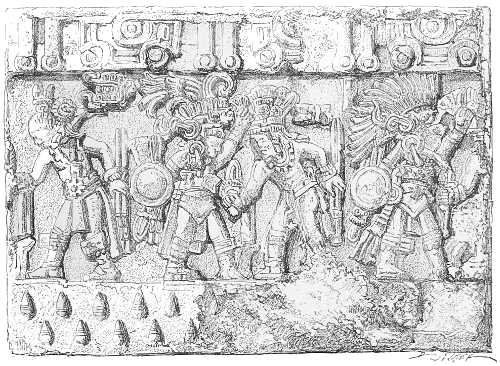
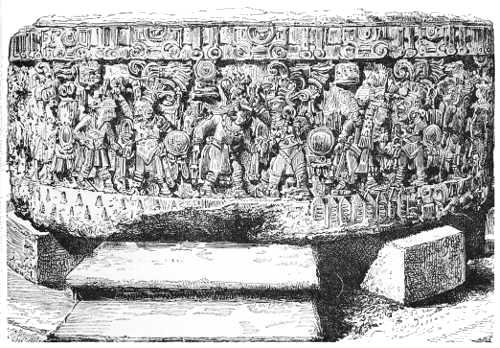
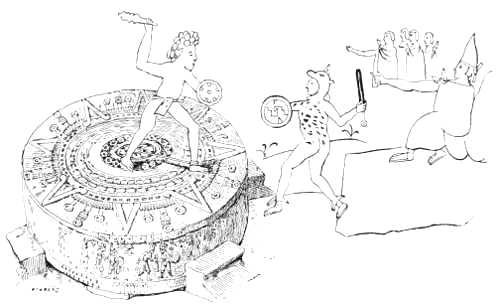
TIZOC’S STONE, IN MEXICO.
Further, to the right of our drawing (page 365), the figures,
besides the huge feather head-dress, carry in their hands spears
barbed with feathers, like the figures to the extreme left on Tizoc’s
stone. These warriors are distributed in groups of two, the
conqueror to the left, the vanquished to the right; the latter
in the act of presenting the sacred knife he holds in his hand,
as a sign of submission. Some of the warriors, instead of the
knife, have a two-handed sword, “macana,” furnished with
blades of obsidian of Toltec manufacture; a few have their
noses pierced, and wear a golden ball, or the obsidian bezoté,
on their under-lip, as a badge of knighthood, which they had
adopted from the Nahuas of the Uplands. Further, each
figure, whether in the Mexican or Maya bas-relief, wears a
kind of casque, fashioned in the shape of a crocodile, a bird,
a serpent, or a duck’s head, etc., with his name on it. Slight
differences of style may occur here and there; for these
monuments belong to remote epochs, while Tizoc’s stone
only dates back to 1485; but the fact that they are found at
a distance of more than 900 miles from each other does not
make their resemblance less marvellous.
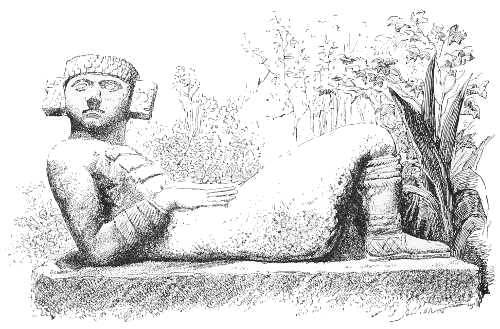
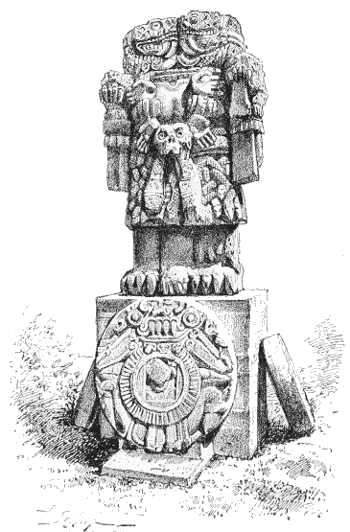
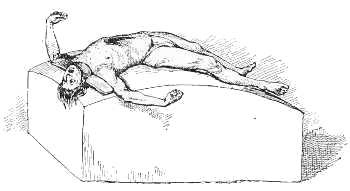
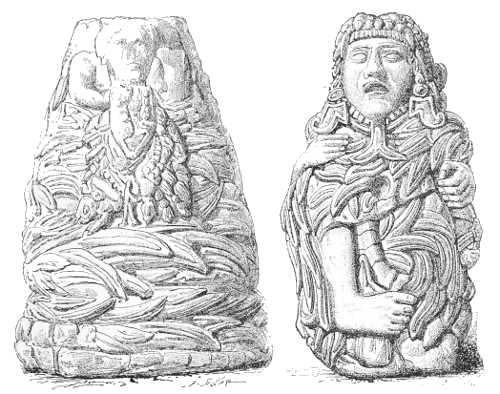
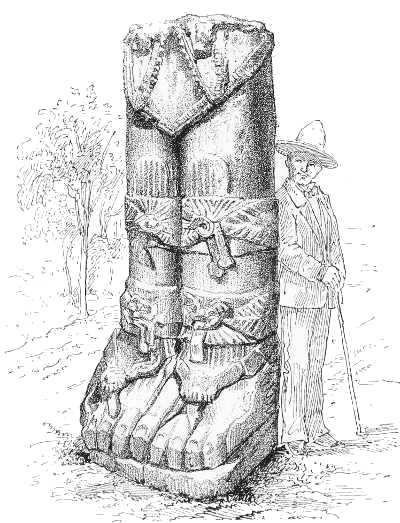
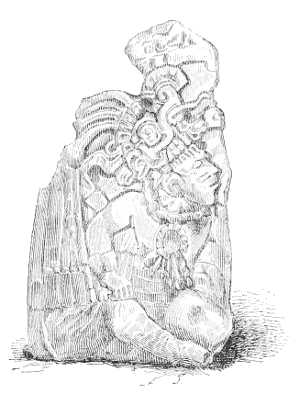
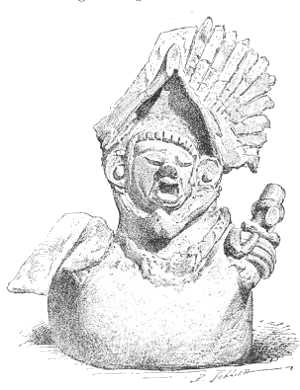
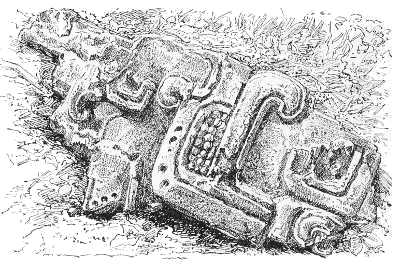
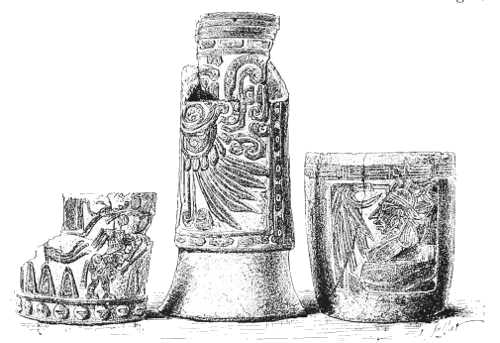
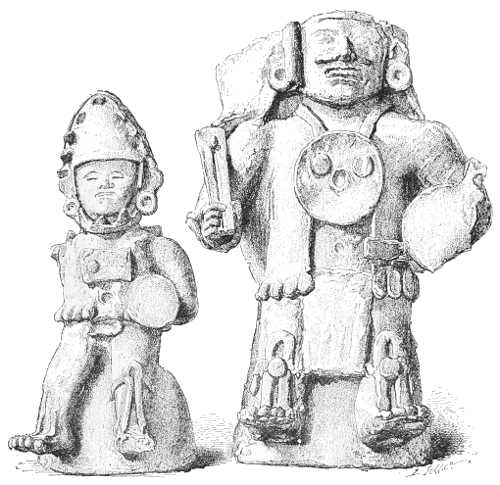
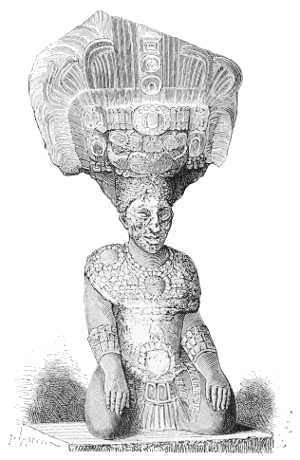
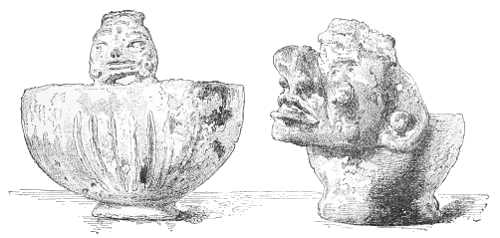
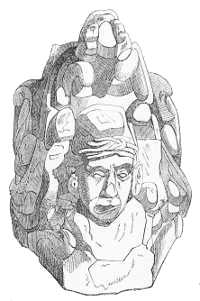
STATUE OF TLALOC FOUND AT CHICHEN-ITZA.
We will end our comparisons with a description of the following
statues, which ought to convert the most obstinate to our
theory. One was discovered at Chichen-Itza five or six years
ago, by Leplongeon, an American explorer; the other in the
neighbourhood of Tlascala, close to Mexico, at a considerable
distance from the former. The two statues represent the Toltec
god Tlaloc, according to Mr. Hamy, whose view I take. This
view receives additional probability from the existence of a third
statue, which was found I know not where, and which is the
property of Mr. Baron of Mexico, who bought it among several
other Aztec antiquities, and had it placed in his beautiful garden
at Tacubaya, whence it has, I suppose, been removed to Spain.
“This statue,” says Jesus Sanchez, “is smaller than the other two,
measuring but 3 feet by 1 foot 7 inches by 2 feet high. It
also represents a man lying on his back, his legs drawn up, his
feet on the ground, and holding with both hands a vase which
rests against his body.”
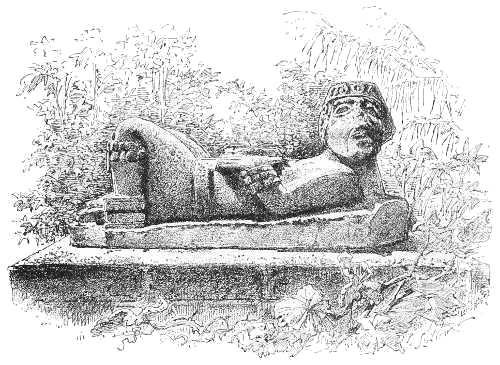
STATUE OF TLALOC OF TLASCALA (IN THE MUSEUM OF MEXICO).
There is no doubt that the same deity is figured in
these three statues, whatever the ornamentation, which varies
according to the epoch, the locality, or the imagination of
the artist. But Sanchez adds, “recollecting that a number
of Mexican statues were sculptured also beneath their base,
I turned this, when I discovered several devices in relief.
The sculptor had carved on the surface of the stone a sheet of
water, aquatic plants, two frogs, and a fish; while the bank was
occupied by beans and grains of maize, which are among the
attributes of Tlaloc.138 The statue in the Mexican Museum,
although found at Tlascala, must necessarily be Toltec from its
archaic character, and determines the origin of the second at
Chichen-Itza. When we add that the same customs, the same institutions,
the same manner of computing time, the same religion,
and the same arms, were common to both the tribes of the
plateaux and the Mayas of the peninsula, as recorded by all
ancient writers so often quoted in the course of this work, we
think we may even more positively affirm that the Yucatec
civilisation is both Toltec and recent.
There remains another monument to explore, which has not
been understood by former travellers, whilst the drawing given
by Stephens is altogether erroneous, but the probable use of
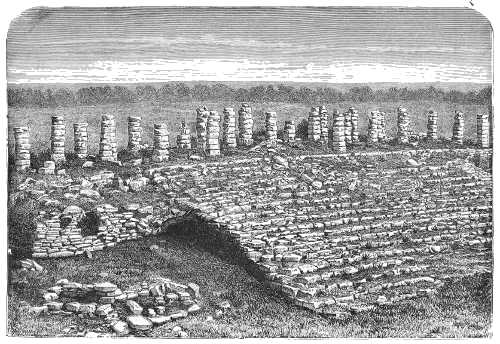
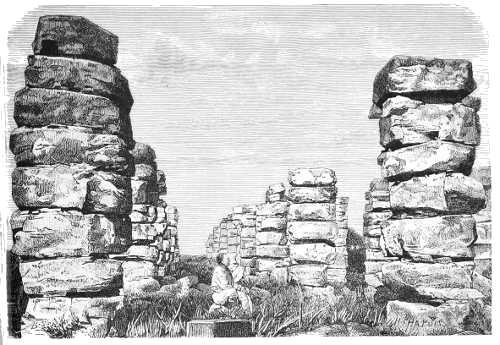
which we think we can explain. At a distance of some 162 feet
east of the Castillo, is a curious assemblage of several hundred
small columns in rows, five or six abreast, 13 feet apart from
each other, forming an immense quadrilateral. These columns,
6 feet high, some of which are still standing, consist of five round
pieces, crowned by a beautifully cut but plain square capital.
By far the greater proportion are lying on the ground, their
blocks disjointed but in order, while others are scattered about
in great confusion. Two edifices, now demolished, save some
fine sculptured fragments, occupied the angles north-east and
south-west of the quadrilateral. We are of opinion that this vast
structure was the Market-place.
It is not conceivable that so great a religious centre was not
possessed of an establishment similar to those found in all the
great cities of the Uplands, notably to any one familiar with the
narratives of the time of the Conquest, in which the Mexican and
Tlascalan market-places are described as having, like this monument,
low colonnades, galleries, and buildings occupied by the
judges entrusted with the various cases arising in and out of
the Market-place.
The importance attached to the market on the table-land,
leaves no doubt that it had equal rank in the peninsula, where
the manners and requirements were identical. “In Mexico,” says
Clavigero, “the judges of the commercial tribunal, twelve in
number, held their court in the market building, where they
regulated prices and measures, and settled disputes. Commissioners
acting under their authority patrolled the tianquiztli
(market-place) to prevent disorder. Any attempt at extortionate
charges, or at passing inferior or injured goods, or any infringement
of another’s right, was reported and severely punished.”139
The king received a certain percentage on all goods brought
to the market, in return for the protection thus extended to the
merchants. The tianquiztlis of Texcuco, Cholula, and other
cities, were on a similar plan, and Cortez speaks of the market
at Tlascala as being attended by more than thirty thousand
people.
Sahagun enumerates the various products which were sold,
the judges who watched over the interests of buyers and sellers,
the perfect order enforced, and the importance of the markets.140
What more natural than to suppose that the markets of the
table-land had their counterpart in the peninsula, and that a great
city like Chichen should have had an important tianquiz, which
was frequented daily or at stated times by vast multitudes of
traffickers, or that provision should have been made for sheltering
them against the fierce tropical sun? Moreover, it is the only
structure here which could have been used as a market; while
its arrangement, the fact that it occupies the centre of the city,
favour our assumption. According to Dr. Montano, the Indian
word tianquiz, “market,” is tianggi in the Malay language.
Meanwhile, our squeezes and our explorations had been going
on pari passu; the former consisting of impressions taken from
the best preserved and most interesting monuments. The labour
was now brought to a satisfactory termination, and our thoughts
were directed to the packing and safe transport of so many
precious objects. When this was accomplished, I entrusted the
freight to some picked men to convey it to Pisté, whither we
should follow.
All the time we had been at Chichen we had looked, but in
vain, for Colonel Triconis’ promised visit. We regretted it all
the more as through his kindness we had obtained our escort,
which had proved so helpful in our work. Our saddle and pack-horses
had arrived from Citas; we were at the foot of the
pyramid, putting the last hand to the loading, when the Colonel
rode up. To shake hands, to tender our thanks for his civility,
was all we had time to do before we all set out for Pisté, where we
parted: Colonel Triconis to return to Valladolid, and we to Citas.
In the order of our march the squeezes went first, forming
immense rolls covered with tarpaulin. We followed in silence,
and our band had all the appearance of a funeral procession
conveying the sacred ornaments of the priests of olden time.
We reached Citas without accident, and two days later were
in Merida.
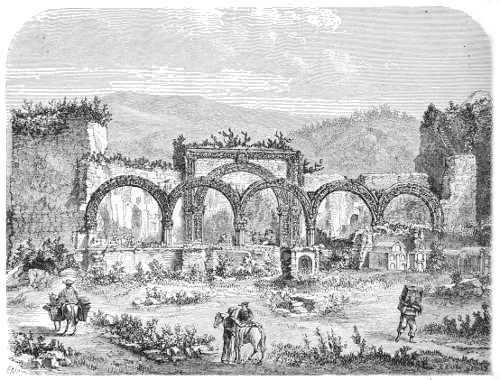
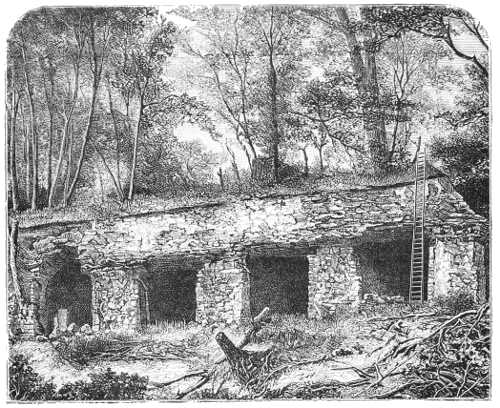
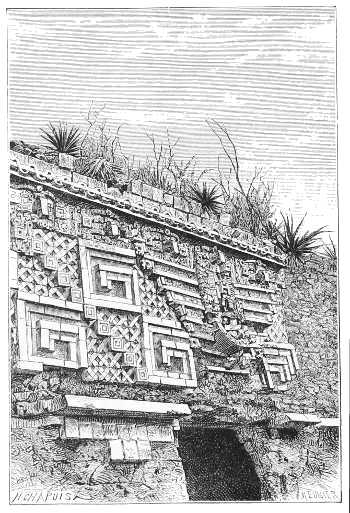
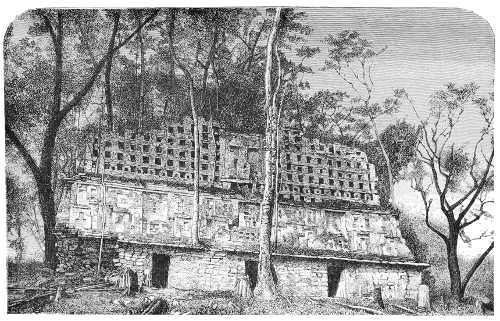
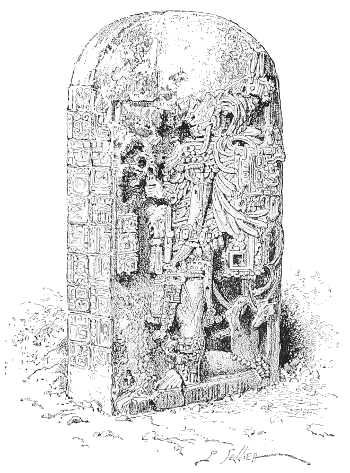
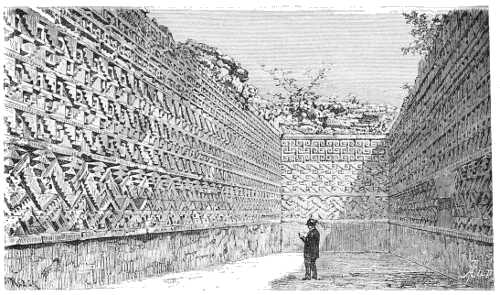
SECOND PALACE OF KABAH.