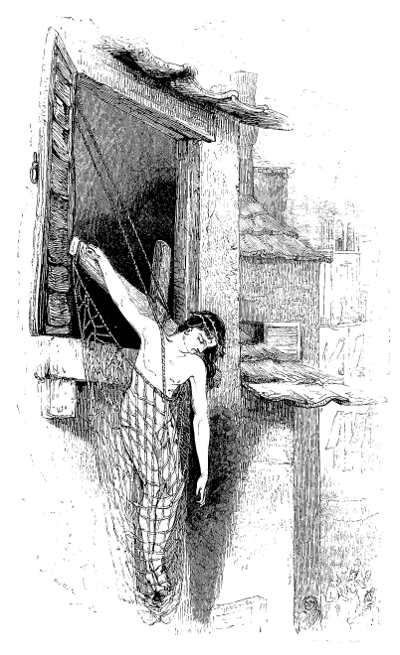
Introduction—Contempt of death—Eustace Budgel—M. de Boissy and his
wife—Mutual suicides from disappointed love—Suicide from mortification—Mutual
suicide from poverty—A French lady while out shooting—A
fisherman after praying—Determination to commit if not cured—Extraordinary
case of suicide after seduction—Madame C. from remorse—M. de
Pontalba after trying to murder his daughter-in-law—Young lady in a pet—Sir
George Dunbar—James Sutherland while George III. was passing—Lancet
given by a wife to her husband to kill himself—Servant girl—Curious
verses by a suicide—Robber on being recognised—A man who
ordered a candle to be made of his fat—After gaming—Writing whilst
dying—From misfortune just at a moment of relief—Curious papers
written by a suicide—By heating a barrel in the fire—By tearing out the
brains—Sisters by the injunction of their eldest sister—Mutual from
poverty—Girl from a dream—Three servants in one pond—Indifference
as to mode—By starvation—A man forty-five days without eating—Mutual
of two boys after dining at a restaurateur’s—By putting head under
the ice—By a pair of spectacles—By jumping amongst the bears—Young
lady from gambling—Verses by a suicide—To obtain salvation—A lover
after accidentally shooting his mistress—Mutual attempt at suicide—M.
Kleist and Madame Vogle—Richard Smith and wife—Love and suicide—Bishop
of Grenoble—Suicide in a pail of water—Mutual of two
soldiers—Lord Scarborough—A man who advertised to kill himself for
benefit of family—The case of Creech, and the romantic history of
Madame de Monier—Suicide of M ——, after threatening to kill his brother—Two
young men—Two lovers—Homicide and suicide from jealousy—Cure
of penchant for—Attempt to, prevented—Man in a belfry—Attempt at—The
extraordinary case of Lovat by crucifixion.
In the preceding chapters we have detailed the history of many
remarkable cases of self-destruction. It is melancholy to consider
that the principle of life with which God has endowed
us for high and noble purposes should have been sacrificed
with that apparent coolness and self-possession which was
manifested in many of the instances recorded in this work.
“How we abuse that article our life! Some people pluck it
Out with a knife; some blow it up with powder; others duck it;—
One thing is sure, and Horace
Has already said it for us,—
Sooner or later, all must kick the inevitable bucket.”
A gladiatorial contempt of death is becoming one of the
most alarming features of the time; in this respect we appear
ambitious to imitate the conduct of the French sophists, and
seek, in acts of desperation, a notoriety that nothing else
can give us. In investigating, as we have endeavoured to do,
the motives that have led to this heinous offence, we have in
many cases been unsuccessful in tracing the act to any definite
principle. Either no reasons have been assigned or the
accounts of the cases transmitted to us have been imperfect.
These individuals stand apart from the rest of the world, and
exhibit an anomaly in the last act of life totally irreconcilable
to all acknowledged principles of reason and human action.
Eccentric in their lives, they have been desirous of manifesting
the ruling passion strong in death. This mental idiosyncracy
may be, and no doubt often is, the result of original constitution,
aided in its development by the moral atmosphere in
which the person is placed, as well as by education and other
circumstances which are known to influence the formation of
the mind and character.
The singular facts adduced in this chapter are only brought
forward as evidence of that anomalous condition of the mind
referred to which leads to suicide; at the same time the
instances will afford to the metaphysician valuable materials to
assist him in his investigations into the philosophy of the
human understanding. Some of the cases related, of course,
admit of elucidation, but the majority will be found to puzzle
the ingenuity even of those who pride themselves on their capacity
of understanding what is beyond the ken of ordinary
mortals.
Eustace Budgel was a man of much literary fame at the
beginning of the last century, the relation and friend of Addison,
and a distinguished writer in the periodical publications
of that day. He was born to a good fortune, and held a
considerable place under government whilst Addison lived,
who kept him in some order as to his political character. But
having lost all court favour after Addison’s decease, and being
a man of great expense and vanity, having also sunk a large
sum of money in the South Sea scheme, and having involved
himself in a number of fruitless litigations, he became highly
distressed in his circumstances. This, added to the chagrin of
disappointed ambition and to other matters, determined him to
make away with himself. He had always thought but lightly
of revelation, and after Addison’s death became an avowed
free-thinker, which laxity of principle strongly concurred in
disposing him to adopt this fatal resolution. Accordingly,
after having been visibly agitated and almost distracted for
several days, he took a boat, and ordered the waterman to go
through London bridge. While the boat was under the
bridge, Budgel threw himself overboard, having had the previous
caution to fill his pockets with stones. This happened
in the year 1737. It was said to have been Budgel’s opinion,
“that when life becomes uneasy to support, and is overwhelmed
with clouds and sorrows, man has a natural right to
deprive himself of it, as it is better not to live than to live in
pain.” A man of unsettled principles easily persuades himself
into the notion of suicide when he is actually suffering from
some violence of his passions, even though he had not imbibed
it before. For whenever the passions attempt to reason, it is
only on the delusive suggestions of their own perturbed feelings.
The morning before Budgel carried his deadly intentions
into execution, he endeavoured to persuade his daughter
to accompany him in his death. His only argument to her
was, that her life was not worth holding; but she thought
otherwise, and refused to concur in the sacrifice. A slip of
paper was left on his writing-table, containing these few
words, as an apology for his rash act:—
“What Cato did and Addison approved
Cannot be wrong.”
Monsieur de Boissy, a French dramatic writer and satirist,
being reduced to great indigence, resolved to commit suicide.
As he considered this action in no other light than as a friendly
relief from further misery, he not only persuaded his wife to
bear him company, but prevailed on her not to leave their
child of five years old behind them, to the mercy of that
world in which they had experienced so little sympathy and
happiness. Nothing now remained but to fix on the mode of
their death. They at length agreed to starve themselves.
This not only seemed to them the most natural consequence
of their condition, but also saved them from committing a
violence either on their child, themselves, or each other, of
which perhaps neither Boissy nor his wife found themselves
capable. They determined therefore to wait with unshaken
constancy the arrival of death under the meagre form of
famine; and accordingly they shut themselves up in the
solitude of their apartment, where, on account of their distresses,
they had little reason to dread the interruption of
company. They began, and resolutely persisted in their plan
of starving themselves to death with their child. If any one
called by chance at their apartment, they found it locked, and
receiving no answer, it was concluded that nobody was at
home. A friend, however, from that kind of instinct perhaps
with which the spirit of friendship abounds, began to apprehend
that something must be much amiss with Boissy, as he
could neither find him at home, nor get intelligence concerning
him. Under much anxiety he returned once more
to his apartment; and, whether from hearing any groans
from within, or suspecting something was wrong, he ventured
to break open the door. Boissy and his wife had
been so much in earnest, that it was now three days since
they had taken any sustenance, and they were so far on their
way to their intended home, that they were in sight, as it
were, of the gates of death. The friend, entering into the
room where this scene of death was going forward, found the
miserable pair in such a situation as to be insensible of his intrusion.
Boissy and his wife had no eyes but for each other,
and were not sitting in, but rather supported from falling on
the ground by two chairs set opposite to each other. Their
hands were locked together, and in their ghastly looks was
painted a kind of rueful compassion for their child, which
hung at the mother’s knee, and seemed as if looking up to her
for nourishment, in its natural tenaciousness of life. This
group of wretchedness did not less shock than afflict his friend.
But soon collecting from circumstances what it must mean, his
first care was not to expostulate with Boissy or his wife, but
to engage them to receive his succours, in which he found no
small difficulty. Their resolution had been taken in earnest.
They had got over the worst, and were in sight of their port.
Their friend, however, took the right way of reconciling them
to live by making the child join in the intercession. The child,
who could have none of the prejudices or reasons they might
have for not retracting, held up his little hands, and in concert
with him entreated his parents to consent to live. Nature
did not plead in vain. They were gradually restored to life,
and provided with everything that could make them in good
humour with its return.
Euphrosine Lemoine was the daughter of a bourgeoise of
the Faubourg St. Antoine. She loved, and had admitted to
secret interviews, a young cabinetmaker of the neighbourhood.
Her parents, however, had long intended her to marry Mr.
B——, a man of some property. She reluctantly consented—pronounced
the “fatal yes;” and the young man prudently left
Paris for some years. In 1836 he yielded to the desire of
once more seeing her he had loved. They met, and the
husband was dishonoured. This was followed by an elopement;
but the husband, who still loved his wife in spite of
her crimes, discovered their retreat, and by the intervention
of friends and of the police a reconciliation was effected—in
vain. They again eloped, but only to perish together; and
they were found dead, eight days after, locked in each other’s
arms, in a miserable apartment they had hired for the purpose.
Before the suicide, one of them had sketched with coal on the
wall of their retreat two flaming hearts, and beneath, this inscription—“We
have sworn eternal love, and death, terrible
death, shall find us united.”
A boatman discovered in the Seine a mass which the stream
seemed to roll along with difficulty; he found it was two
bodies, a young woman about twenty, tastefully dressed, and
a young man in the uniform of the eighth hussars. The left
hand and foot of one victim were laid to the right hand and
foot of the other. A bit of paper, carefully wrapped up in
parchment to preserve it from the water, told their names and
motives:—
“O you, whoever you may be, compassionate souls, who
shall find these two bodies united, know that we loved each
other with the most ardent affection, and that we have perished
together, that we may be eternally united. Know, compassionate
souls, that our last desire is, that you should place us,
united as we are, in the same grave. Man should not separate
those whom death has joined.
(Signed), “Florine. Goyon.”
Some years ago, a light was observed in the church of
Rueil. This singular appearance occasioned a search; on the
approach of the authorities the light was extinguished, but a
woman’s stays were found on the pavement. The beadle of
the church was met, apparently much agitated. On a further
search, the proprietress of the stays was found concealed in a
press under the draps mortuaires, (the parish pall.) The unhappy
man, on the detection of this profanation, drowned
himself.
M. Malglaive, a half-pay officer, lately employed in a public
office, had suffered some unexpected pecuniary losses. One
of his friends received a note from him by the twopenny post,
requesting him to call at his lodgings, where he would find a
packet addressed to him. On proceeding there, and opening
the packet, he found a letter in these words:—
“When you shall have received this letter, my poor Eleanore
and I will be no more. Be so good as to have our door
opened; you will find our eyes closed for ever. We are weary
of misfortunes, and don’t see how we can do better than end
them. Satisfied of the courage and attachment of my excellent
wife, I was certain that she would adopt my views, and
take her share in my design.”
These young people (for the husband was but thirty-four
and the wife twenty-eight) had taken the most minute precautions
to render the effect of the fumes of charcoal certain;
but a brace of loaded pistols was placed on the night table,
to be used if the charcoal had failed.
Madame de F—— killed herself in the park of her chateau,
with her own fowling-piece, which she took out on pretence
of going shooting, as she was in the habit of doing.
She loaded it with six balls, and placing the muzzle to her
breast, discharged it. The only cause assigned is the vexation
she and M. de F—— felt at her having no children to inherit
their large fortune.
A fisherman with a large family, residing at Vellon d’Auffes,
near Marseilles, had been driven by domestic trouble to form
a design of suicide, which he had long announced. One
Sunday he climbed a high rock in the neighbourhood, where,
in the sight of his friends below, with a crucifix in his hands,
he was evidently saying his last prayer, preparatory to suicide.
One of the neighbours, guessing his intentions, reached the
spot suddenly, and seized him; a struggle ensued on the edge
of the precipice; the unhappy man prevailed, and, escaping
from the arms of his friendly antagonist, flung himself over.
Voltaire relates the particulars of the following singular
case:—An Englishman of the name of Bacon Morris, a half-pay
officer, and a man of much intellect, called on Voltaire at
Paris. The man was afflicted with a cruel malady, for which
he was led to suppose there was no cure. After a certain
number of visits, he one day called on the philosopher, with a
purse and a couple of papers in his hand. “One of these
papers,” he said, addressing Voltaire, “contains my will, the
other my epitaph; and this bag of money is intended to defray
the expenses of my funeral. I am resolved to try for
fifteen days what can be effected by regimen and the remedies
prescribed, in order to render life less insupportable; and if I
succeed not, I am determined to kill myself. You will bury
me in what manner you please; my epitaph is short.” He
then read it; it consisted of the following two words from
Petronius, “Valete, curæ”—“Farewell, care.” “Fortunately,”
says Voltaire, “for him and myself, who loved him, he was
cured, and did not kill himself.”
Two young people—Auguste, aged twenty-six, and Henriette,
aged eighteen—had long loved each other, but the
parents of the girl would not consent to the match. In this
difficulty the young man wrote to Henriette:—
“Men are inexorable. Well, let us set them at defiance.
God is all-powerful; our marriage shall be celebrated in his
presence; and to-morrow, if you love me, we will write, in
our blood, at the foot of the cross, our marriage vow.”
This proposition turned the weak girl’s head, and she consented.
They proceeded one night to a field near St. Denis,
where there was a cross. On their way they made incisions
in both their arms, to procure the blood in which the following
acte de mariage was written:—
“O great God, who governs the destinies of mankind, take
us under thy holy protection! As man will not unite us, we
come on our knees to implore thy sanction to our indissoluble
union. O God, take pity on two of thy poor children! Assemble
all thy heavenly choir, that on so happy a day they
may partake our transports, and be witnesses of the holy joy
that shines in our hearts. O God! O ye angels of heaven
and saints of Paradise! look down upon a happiness which
even the blessed may envy.
“And you, shades of our parents, come to this affecting
ceremony, come and give us your approbation and your
blessing. It is in the presence of you all that we, Pierre
Auguste and Marie Henriette, swear to belong to each other,
and to each other only, and to be faithful to each other to the
hour of dissolution. Yes, we swear it—we swear it with one
voice. You are our witnesses, and we are united for life and
for death.
(Signed in letters of blood), “Pierre Auguste.
“Marie Henriette.”
The very day after this visionary marriage it was dissolved
by the suicide of the unfortunate Henriette. The moment
her fault had become irreparable, her betrayer abandoned her,
and the poor creature threw herself into the Seine. On the
body was found the foregoing singular acte de mariage, to
which she had subjoined, with a feeble hand, the following
note:—
“He has dishonoured me—the monster! He deceived me
by pretences which went to my heart; but it is he who is to
be pitied—wretch that he is!”
A young woman, of a highly honourable commercial family,
put an end to herself, overwhelmed with the idea of having
forfeited the esteem of her husband. Rosalie had from her
youth been destined to be the wife of M. C——, a gentleman
of her own station in life. Their union, though not distinguished
by any transports of love, was soberly and rationally
happy, and they had two children.
Unfortunately, Madame C—— was obliged by affairs of
business to go into the country while her husband remained
in Paris. During this absence, she appears to have formed a
guilty passion, (the circumstances of which have not been revealed;)
but on her return home, the remorse of her conscience
so preyed upon her spirits as to be at last unsupportable, and,
after a long and painful struggle, she resolved upon suicide.
Just before the fatal act, she wrote a long letter to her sister, of
which we can only spare room for the most striking passages:—
“I have resolved to terminate my existence to-day; but I
have not had, during the whole morning, resolution to leave
my poor little children, who are unconscious of their mother’s
agony.... Forgive, my dear sister, the grief that my
death is about to cause you. If my excellent husband has
offended you, forgive him.... If I had appreciated his
worth, I should not be the wretch I am: my negligence
towards him began my misfortune, but I had nothing to
reproach myself with till my fatal journey to Sarcelles—that
journey was my ruin!... If I had your virtues, I should
have been the happiest of women; but I allowed myself to be
bewildered by a sentiment which I had not before known,
and in my culpable frenzy I was guilty before I intended it.
O, my God! may my repentance be accepted, and may thy
goodness inspire my husband with a peculiar, an exalted degree
of parental affection for those unhappy and innocent children.
Protect them, O, my God, and grant that they may not
curse the memory of their unhappy mother, who was guilty
without intending it.
“And you, O my dearest Louis, forgive your wretched
wife, who offers you this her last farewell.”
One may judge the consternation which this affecting letter
spread in the family. The sister, on receiving this letter,
hastened with Dr. Bouillet to Mr. C—— ’s house: it was too
late—they found the poor woman in the last agonies of death,
whilst her little children were playing about the adjoining
room, indulging in the sports of their age.
M. de Pontalba was one of the great proprietors of France.
His son had been a page of Napoleon’s, and afterwards a distinguished
officer, aide-de-camp to Marshal Ney, and a protégé
of the Duke of Elchingen. He married the daughter of
Madame d’Almonaster, and for some time they lived happily;
but on the death of her mother, Madame de Pontalba began to
indulge in such extravagances that even the enormous fortune
of the Pontalbas was unequal to it. This led to some
remonstrance on the part of her husband, on the morning
after which she disappeared from the hotel, and neither he
nor his children had any clue to her retreat. At last, after
an interval of some months, a letter arrived from her to her
husband, dated New Orleans, in which she announced that
she meant to apply for a divorce; but for eighteen months
nothing more was heard of her, except by her drafts for
money. At last she returned, but only to afflict her family.
Her son was at the Military Academy of St. Cyr. She induced
him to elope, and the boy was plunged in every species
of debauchery and expense. This afflicted, in the deepest
manner, his grandfather, who revoked a bequest he had made
him of about £4,000 a year, and seemed to apprehend from
him nothing but future ruin and disgrace. The old man,
eighty-two years of age, resided in his Chateau of Mont
Levéque, whither, in October, 1834, Madame de Pontalba
went to attempt a reconciliation with the wealthy senior.
The day after her arrival she found she could make no impression
on her father-in-law, and was about to return to Paris,
when old M. de Pontalba, observing a moment when she was
alone in her apartment, entered it with a brace of double-barrelled
pistols, locked the door, and, approaching his astonished
daughter-in-law, desired her to recommend herself to God, for
that she had but few minutes to live; but he did not even
allow her one minute—he fired immediately, and two balls
entered her left breast. She started up and fled to a closet, her
blood streaming about, and exclaiming that she would submit
to any terms, if he would spare her. “No, no! You must die!”
and he fired his second pistol. She had instinctively covered
her heart with her hand; the hand was miserably fractured by
the balls, but it saved her heart. She then escaped to another
closet, where a third shot was fired at her without effect; and
at last she rushed in despair to the door, and while M. de
Pontalba was discharging his last barrel at her, she succeeded
in opening it. The family, alarmed by the firing, arrived, and
she was saved. The old man, on seeing that she was beyond
his reach, returned to his apartment, and blew out his brains.
It seemed clear that he had resolved to make a sacrifice of the
short remnant of his own life, in order to release his son and
his grandson from their unfortunate connexion with Madame
de Pontalba. But he failed—none of her wounds were
mortal; and within a month after, Madame de Pontalba,
perfectly recovered, in high health and spirits, radiant, and
crowned with flowers, was to be seen at all the fêtes and concerts
of the capital.
A wealthy inhabitant of St. Denis arrived from a long
journey, in which he had occasion to carry a brace of pistols;
these he deposited, loaded, on a table in his bed-chamber, and
sat down to dinner with his family and some friends, invited
to celebrate his return. Hardly had dinner begun when a
discussion arose between the father and his eldest daughter,
about twenty years of age. This young woman had always
shewn great jealousy of her younger sister, of whom she pretended
her father was fonder than of her. On this occasion
the same feeling broke out, and after some strong exhibition
of ill-temper on her part, her father said, “Nay, if you are
sulky, you had better go to bed.” The girl got up immediately,
went to her father’s bed-room, took one of the pistols, shot
herself, and expired in a few hours in great agony.
Sir George Dunbar, Baronet, Major in the 14th Light
Dragoons, quartered at Norwich, unhappily got involved in a
dispute with his fellow officers. He was a man of quick
sensibility, which may have betrayed him into error on the
occasion; but whichever party was to blame, the quarrel was
of a most violent nature, and he returned home much bruised
from blows received in the scuffle. The next day, repairing
to the mess-room, he declared to the other officers, “That, if he
had offended any of them, he was ready to make an apology;
or, if that was not thought sufficient, to give them honourable
satisfaction.” This proposal was refused, and the officers
insisted “That he must sell out, for that, as he had abused the
whole regiment, nothing else would or could satisfy them.”
To this, Sir George replied, “That he would live and die in
the regiment, of which he had been an officer for twenty years,
and that a pistol should end the dispute.” Here ended all
communication, but the business made a most deep impression
on his mind. For two successive days he neither took food
nor slept; and his melancholy appearance filled his family
with the most lively apprehensions. Lady Dunbar locked up
his razors, pistols, &c., and watched him with unceasing
vigilance. Her distress at seeing him so wretched was very
great, and in the night she moaned very much, and was quite
restless. Sir George said, “Maria, you disturb me; I will
get up;” which he immediately did, put on his watch-coat, and
laid down on the floor. Lady Dunbar then endeavoured to
conceal the anguish of her mind, in hopes to pacify him, and,
being overcome with watching, fell asleep. Sir George, as
soon as he perceived it, left the room, and at about five or six
in the morning walked out. Her ladyship, when she awoke,
being much alarmed at his absence, eagerly inquired for him,
and was told he had taken a morning walk, having a violent
headache, and thinking the air would do him good. This,
however, proved only a pretence; for he had gone to purchase
a case of pistols, and stood by while the bullets were casting,
which, with the pistols, he brought home, concealed under his
watch-coat. On his return, he went to Lady Dunbar, who
took hold of his hand, observing at the same time, “How
cold you are!” To which he answered, “Yes; I shall be
better presently.” She then proposed to make breakfast, but
he declined it, saying he had a letter to write first, and that
he would ring to let her know when he had finished it. He
then parted from her, after pressing her hand very hard; went
to his study, wrote his will, and instantly after blew out his
brains. Lady Dunbar, who heard the report of the pistol, ran
down into the room, and fell insensible on his body, which
lay extended on the floor, and from which she was taken up
covered with his blood, and immediately removed to a friend’s
house. They were a very happy couple, and she had accompanied
him in all his campaigns.
As George III. was passing in his carriage through the
park to St. James’s, a gentleman dressed in black, standing
in the green park, close to the rails, just as the carriage came
opposite to where he stood, was observed to pull a paper
hastily from his pocket, which he stuck on the rails, addressed
to the king, threw off his hat, discharged a pistol in his own
bosom, and instantly fell. Though surrounded with people
collected to see the king pass, the rash act was so suddenly
perpetrated, that no one suspected his fatal purpose till he had
accomplished it. He expired immediately. In his left hand
was a letter addressed “To the coroner who shall take an
inquest on James Sutherland.” This unfortunate gentleman
was judge-advocate at Minorca during the governorship of
General Murray, with whom he had a law suit which terminated
in his favour. The general, however, got him suspended
and recalled. This, and the failure of some applications
to government, had greatly deranged his mind. He was
very genteelly dressed, but had only two-pence and some
letters in his pocket; the letters were carried to the Secretary
of State’s Office. He left a singular paper behind him, expressive
of being in a sound mind, and that the act was
deliberate.
The following case is mentioned by Dr. A. T. Thomson, as
illustrative of the extraordinary determination often exhibited
by those resolved on self-destruction. A gentleman, who
had long enjoyed an unblemished reputation, was appointed
the treasurer of a society; but having unfortunately fallen into
pecuniary difficulties, he not only applied the funds of the
society to his own purposes, but forged some bills. As the
punishment of the latter crime was penal at that period, on
being arrested, he made an attempt upon his life, but did not
succeed. His prior good character, and the respect in which
he had been held, prevented him from being immediately sent
to jail; and he was permitted to remain in the custody of the
officer of justice who arrested him. The attempt which he
had made upon his life rendered it requisite that every implement
which could be employed by the suicide should be
withheld from him; but in other respects, as much indulgence
was extended to him as possible, under the circumstances of
the case. His wife also was permitted to visit him, but she
was searched before entering his apartment. He was locked
up every night, and he was awoke in the morning by an
officer, at a certain hour. On the third morning after his
arrest, the officer, as usual, entered his room, and called to him,
but received no answer; he then approached the bed, and
found that his prisoner was dead. A medical man was immediately
sent for. It appeared that this gentleman had studied
anatomy, and knew how to use a lancet; and as he had a
thorough conviction that he should be hanged, he had persuaded
his wife to bring a lancet to him in her mouth. After
being locked up for the night, he undressed himself, and
opened the femoral artery, the blood from which he allowed
to flow into the pan of the night chair, until, as was supposed,
he became faint. He then bound a handkerchief round the
upper part of the thigh, and placed himself in bed, in the
position in which he was discovered. Notwithstanding his
great loss of blood, he contrived so effectually to stem the
further flow, that none was seen on the floor of the room, and
only a few spots on the sheets of the bed.”
A servant girl of Mursley, Bucks., committed suicide
while her master and his men were weeding in the field, by
taking a cord and tying it tight round the upper part of her
left thigh, and with a fleam and stick used in bleeding cattle,
making a deep incision through the artery. She bled to death
before any assistance could be procured.
John Upson, of Woodbridge, in Suffolk, a glover, who was
committed to the castle for felony a few days before, hanged
himself in his own room with a garter. The following verses
were written in a prayer-book lying by him:—
“Farewell, vain world, I’ve had enough of thee,
And now am careless what thou say’st of me;
Thy smiles I court not, nor thy frowns I fear,
My cares are past, my heart lies easy here.
What faults they find in me take care to shun,
And look at home: enough is to be done.
| “June 26, 1774. | Poor John the Glover.” |
Mr. Brower, a print-cutter, near Aldersgate-street, was
attacked on the road to Enfield by a single highwayman,
whom he recollected to be a tradesman in the city, and called
him by his name. The robber immediately shot himself
through the head.
The case of a man is recorded in a French paper who
burnt with one of the strongest passions of which we ever
heard an account. His mistress having proved unfaithful to
him, he called up his servant, informed him that it was his
intention to kill himself, and requested that, after his death,
he would make a candle of his fat, and carry it lighted to his
mistress. He then wrote a letter, in which he told her that
as he had long burnt for her, she might now see that his
flames were real; for the candle by which she would read the
note was composed of part of his miserable body. After this
he committed suicide.
Lieutenant Colonel Mautren, of the Prussian Hussars,
having been stripped, at the gaming table, of all his property,
even to his watch and the rings he wore, returned home.
Next day he disposed of his commission; and having offered
marriage to a respectable female whom he had seduced, a
clergyman was sent for, and the ceremony performed. He
then retired to a private room, and while some friends were
felicitating the bride on her good fortune, the report of a
pistol announced the catastrophe that had taken place. The
company hastened to the room; but the Colonel was no more.
On the table was a letter to his wife, mentioning the cause of
his death and inclosing the amount of the sale of his commission.
The particulars of the following case were read by M.
Gerard de Gray, at the Société de Médecine. A young man,
having spent in the capital all his finances, returned home
to recruit his purse; but failing in his object, he resolved
to put an end to himself. He made no secret of his determination.
On the 16th of August he carried it into execution.
His bed-room was about nine feet square, and a
little more than six in height. On every aperture in it by
which the air might possibly have admittance, he pasted paper,
and about five in the afternoon lighted a brazier of coals,
which he set on the floor close by his bed. He then left
the apartment, carefully closing the door after him. At six,
he said to an old lady, “My brazier is now ready—I go to
die.” On the following morning, the family having become
alarmed, the door of the chamber was forced open. An insupportable
vapour issued from the place, and the body of the
unfortunate youth was found stretched across the bed. On
the floor, the brazier still occupied the place already mentioned;
it was of considerable capacity, and seemed to have been
lighted with paper. Near the body were placed two volumes
of an old Encyclopædia; one of them at the foot of the bed,
open at the article Ecstasy; the other near the right hand
displayed the article Death. On the latter volume was a
pencil and a bit of paper, with the words, Je meurs avec
calme et bonheur, clearly written, with the date annexed; but
beneath that there appeared, in characters very difficult to be
read, the following words: Au moment de l’agonie j’aurais
voulu m’être procuré une sensation agréable. It would appear
that the deceased immediately on writing the scrawl, had
fallen into the position in which he was found. The attitude
did not betoken any struggle at the last moment; yet it seems
probable, from the signs of sickness of the stomach, and the
mention of agony in the last phrase, that life did not become
extinct without some painful sensations.
Madame Augine having been personally attached to the
late Queen of France, expected to suffer under the execrable
tyranny of Robespierre. She often declared to her sister,
Madame Campan, that she never would wait the execution of
the order of arrest, and that she was determined to die rather
than fall into the hands of the executioner. Madame Campan
endeavoured, by the principles of morality and philosophy, to
persuade her sister to abandon this desperate resolution; and
in her last visit, as if she had foreseen the fate of this unfortunate
woman, she added, “Wait the future with resignation;
some fortunate occurrence may turn aside the fate you fear,
even at the moment you may believe the danger to be
greatest.” Soon afterwards the guards appeared before the
house where Madame Augine resided, to take her to prison.
Firm in her resolution to avoid the ignominy of execution,
she ran to the top of the house, threw herself from the balcony,
and was taken up dead. As they were carrying her corpse to
the grave, the attendants were obliged to turn aside to let pass
the cart which conveyed Robespierre to the scaffold!
In the year 1600, on the 10th of April, a person of the
name of William Dorrington threw himself from the top
of St. Sepulchre’s church, in London, having previously left
on the leads or roof a paper of which the following is a
copy:—
“Let no other man be troubled for that which is my own
fault; John Bunkley and his fellows, by perjury and other bad
means, have brought me to this end. God forgive it them,
and I do. And, O Lord, forgive me this cruel deed upon my
own body, which I utterly detest, and most humbly pray him
to cast it behind him; and that of his most exceeding and
infinite mercy he will forgive it me, with all my other sins.
But surely, after they had slandered me, every day that I lived
was to me a hundred deaths, which caused me rather to die
with infamy than to live in infamy and torment.
“Oh, summa Deitas, quæ cœlis et superis presides, meis
medere miseris, ut spretis inferis, letis superis, reis dona
veniam.79
“Trusting in his only passion and merits of Jesus Christ,
and confessing my exceeding great sins, I say—‘Master, have
mercy upon me!’”
This paper was folded up in form of a letter, and indorsed,
“Oh, let me live, and I will call upon thy name!”
Thomas Davers, who built at a vast expense a little fort on
the River Thames, near Blackwall, known by the name of
Davers’s Folly, after passing through a series of misfortunes,
chiefly owing to an unhappy turn of mind, put an end to his
miserable life. Some few hours before his death, he was seen
to write the following card:—“Descended from an ancient and
honourable family, I have, for fifteen years past, suffered more
indigence than ever gentleman submitted to; neglected by
my acquaintance, traduced by my enemies, and insulted by
the vulgar, I am so reduced, worn down and tired, that I have
nothing left but that lasting repose, the joint and dernier
inheritance of all.
“Of laudanum an ample dose
Must all my present ills compose;
But the best laudanum of all
I want (not resolution) but a ball.
| “N. B. Advertise this. | T. D.” |
A farmer near Allandale, in Northumberland, procured a
gun-barrel, which he loaded with powder and shot, and having
placed the stock end in the fire, he leaned with his belly
against the other. In this position he awaited the dreadful
moment. When the barrel became hot, an explosion took
place, by which he was shot through the body. He had,
some time before, been in the habit of excessive drinking,
which had impaired his intellects, and probably produced a
derangement which led to the commission of the deed.
Mr. Henry Grymes, of Virginia, U. S., whilst labouring
under the influence of delirium, broke his skull with a stone.
After having shattered it, he took out a piece about three
inches long, and two broad. Concluding that this would not
put a period to his existence, he thrust his fingers into his
head, and tore out a considerable quantity of his brains. Instead
of immediate death, he instantly returned to the full
exercise of reason! walked home, and lived to the second
evening following. He appeared very penitent and rational
to the last moment of his life; and in the meantime gave to
his friends the above statement of the horrid transaction.
The cause of this derangement is believed to have been a
disappointment in marriage. Through the whole of his life
he supported an unsullied character.
“A blacksmith charged an old gun-barrel with a brace of
bullets, and, putting one end into the fire of his forge, tied a
string to the handle of his bellows, by pulling which he
could make them play whilst he was at a convenient distance,
kneeling down; he then placed his head near the mouth of
the barrel, and moving the bellows by means of the string,
they blew up the fire, he keeping his head, with astonishing
firmness and horrible deliberation, in that position till the
further end of the barrel was so heated as to kindle the powder,
whose explosion instantly drove the bullets through his
brain. Though I know this happened literally as I relate
it, yet there is something so extraordinary, and almost incredible,
in the circumstance, that perhaps I should not have
mentioned it, had it not been well attested, and known to the
inhabitants of Geneva, and to all the English there.”80
A Hanoverian, eighty years of age, resided at a country
house near Berne, with his five daughters, the eldest of whom
was aged thirty, and the youngest sixteen. The family were
of very retired habits, but were governed chiefly by the eldest
sister, who was noted for her imperious disposition, and opposition
to religion. A young Englishman, who had been for
some time an occasional visitor to the house, became smitten
with one of the daughters; and one fine evening, as the five
sisters were taking the air in a carriage in the avenues of the
Eugi, they met him in his cabriolet, accompanied by a friend.
After parading up and down for some time, an exchange of
vehicles was proposed to and accepted by the young ladies,
one of whom accompanied the Englishman, and his friend
entered the carriage with the ladies. A similar change was
again effected, until the Englishman found himself with the
object of his affections, with whom he immediately decamped.
The others, thinking he had returned to the house by another
road, gave themselves no uneasiness, but continued their
road homewards. On arriving, however, they found he had
not returned. The eldest sister, becoming alarmed, sent and
informed the police that her sister had been run away with;
and the next day, news having been received that the runaways
were at Fribourg, she immediately set out for that
place, accompanied by one of her sisters. Before her departure,
she told the two who remained, that if she did not
return by a certain hour, it would be a proof that their family
was dishonoured; in which case, it became the duty of them
all to renounce life. She required, and even extorted, from
them a solemn oath, that they would drown themselves if they
(the two elder sisters) did not return at the hour mentioned.
On arriving at Fribourg, and finding their sister, whom they
could not persuade to return home, they two resolved upon
putting their resolution into effect; for which purpose they
repaired to the banks of the Sarine; but the younger, on
arriving, finding her courage fail, exclaimed, “Kill me, sister;
I can never throw myself into the river.” The eldest drew
out a dagger, and was about to perpetrate the deed, when a
peasant coming up, interrupted the design. She immediately
despatched the peasant to prevent her other two sisters from
putting their oath into effect; but the precaution was too
late. After having prepared every necessary for their aged
father during the day, they dressed themselves in their best
apparel, and, on arriving at the banks of the Aar, fastened
themselves with a shawl, and, embracing each other, precipitated
themselves into the river, in which position their bodies
were found some time afterwards.
The particulars of the following extraordinary case we find
recorded in the Annual Register for 1823. It appears that a
man of the name of Spring and his paramour, Mary Gooch,
had agreed to commit mutual suicide. For that purpose a
large dose of laudanum was purchased; but the dose which
Spring took was not sufficient for his purpose, and he recovered.
The poor woman was successful in killing herself.
The following is the evidence given by Spring at the coroner’s
inquest:—
“John Spring said, that he was present with the deceased
in bed when she died, about seven o’clock on Friday morning;
that she did not die in agony; that on the Wednesday evening
the deceased and witness came to an agreement to buy some
laudanum to take together, that they might both be found
dead together in the same bed; that on the Thursday morning,
he (the witness) went to the chemist’s and bought some
laudanum; he thinks four ounces; that when he came in,
Mary Gooch said, ‘Your heart has failed you; you have not
bought it for me;’ that she got up and felt witness’s pocket.
The deceased said, ‘You have got something here.’ Witness
replied, ‘Oh, that will soon do our business, if we take it.’
She said, ‘Have you any money left of what I gave you
to buy it with?’ Witness said, ‘Yes, there are some halfpence.’
The deceased said she would purchase some oranges
with them, to take after it, and would send for them; that
she sent a boy of Webb’s, who returned with two oranges;
that the deceased peeled them; that she took two wine
glasses off the shelf, and placed hers on the box, and said,
‘Now let us take it.’ She poured half into one glass, and
half into another. One glass she kept to herself, and the
other she gave to witness. The deceased said, ‘Let us take
hold of each other’s hands.’ Witness said, ‘No, my dear;
if we do, we shall not take it; let us turn back to back, and take
it.’ Deceased and witness turned their backs to one another,
and drank the contents of the glasses. After they had drunk
the laudanum, the deceased said, ‘What shall we do with
the bottle?’ Witness said, he would go and throw it away.
She said, she would in the mean time wipe the glasses.
He threw away the bottle, and the deceased had wiped the
glasses by the time he came back. The deceased said, ‘Let
us go to bed.’ They both went to bed together. The deceased
afterwards got out of bed, placed a chair against the
door, to fasten it, and drew the window blinds. The deceased
then said, ‘Now we shall die happily together.’ This
was between two and three o’clock. He asked the deceased
how she came by the money she had given him; the deceased
said, ‘That is of no consequence, and does not signify;’
the deceased and witness conversed together about various
things, till eight o’clock. She said, she had sent her gown
to her aunt’s, and that the money came from her. The
laudanum did not take any effect till about two; she then
began to sleep. The witness was sick about four, and the
deceased was awake at that time. The deceased was not sick
at all, and fell into a sound sleep at six. The witness awoke
her between six and seven; the deceased then said, ‘How
large your eyes look!’ Witness said to her, ‘Mary, I am
afraid my laudanum will take no effect.’ The deceased said,
‘Oh dear! if I should die without you, and you are taken
before a court of justice, I shall not die easy.’ Witness told
her she might be quite happy, for, if it did not take effect,
he would get up and buy some that would, as he would die
with her. The deceased said, ‘My dear, pray give me that
blue muslin handkerchief, that I may have it in my hand
when I die. Pray, don’t you take anything; but let me die,
and you will get over.’ She then laid her head on the shoulder
of the witness, and died almost immediately. The body began
to grow cold by the time he came in from the town, about
half-past eight. The deceased had been in a bad state of
mind ever since he had known her. She always appeared to
wish to die, and had attempted to destroy herself before,
when the witness was at a fair. About a month previous, the
deceased having come home in an unhappy state of mind,
got up about twelve at night, took a linen line, pinned her
cap over her head, and went out of the house, taking a small
chair with her. She had one end of a rope about her neck,
and was about to throw it over the arm of an apple-tree, when
he overtook her, brought her in, and took the rope from her.
The deceased, all Wednesday evening, was very anxious to die,
and wished witness to die with her. On Thursday, she expressed
a desire that they should both die together. The
witness had known the deceased ever since Michaelmas Bury
fair. She had been very anxious about the payment of the
half-year’s rent; the witness said, he could go to his friends
and get it; deceased said, ‘If you go away, I shall be afraid
that you will not come back again.’ It was not from want
that they committed the act; it had been in contemplation
some time.”
A young lady, at a boarding school near Birmingham, had
been set a task, and felt indignant at being obliged to learn
it out of an old book, while some of the other scholars were
indulged with new ones. She went next day to an old woman
in the neighbourhood, and told her “that she had had a
singular dream,—that she was dead, and had been carried
to her grave by such and such young ladies,” naming some
of her companions and young friends; and asked the old
woman what she thought of it; who replied, “that she put
no faith in dreams.” A few days after, when going a walk
with the other scholars, she loitered behind, and making her
escape from the party, drowned herself in a pool near the
school. She left her hat (or bonnet) on the edge of the pool,
wherein was pinned a letter for her parents, entreating their
forgiveness of such a rash act. She therein requested to have
for her bearers those whom she had said she dreamed had
carried her to her grave; and enclosed some locks of her hair
as mementos of friendship. She was only about eleven years
of age, and the daughter of very respectable parents in the
neighbourhood.
Sophia Edwards and Mary West, two female-servants, in
the family of the Rev. John Gibbons, of Brasted, in Kent,
were left in care of the house for some weeks, in consequence
of the absence of their master and mistress. During this
time they had the misfortune to break some articles of furniture,
and to spoil four dozen of knives and forks, by incautiously
lighting a fire in an oven where they had been placed
to keep them from rust. The unfortunate girls, however,
bought other knives and forks. Upon the return of Mr. and
Mrs. Gibbons, the servants were severely reprimanded for
what had happened, and one of them received notice to leave
her place. They both appeared to be very uncomfortable for
two days afterwards; and, on the second day, the footman
heard them in conversation respecting Martha Viner, a late
servant in the same family, who had drowned herself in a
pond in the garden, and observing one to the other, that she
had done so through trouble. The elder then said to the
younger—“We will have a swim to-night, Mary!” The
other replied—“So we will, girl.” The footman thought
they were jesting, and said—“Ay, and I will swim with
you!” Sophia Edwards replied—“No, you shan’t; but I will
have a swim, and afterwards I will haunt you.” After this
conversation, they continued about their work as usual, and at
six o’clock asked the footman to get tea for them. While
he was in the pantry for that purpose, he heard the kitchen
door shut; and on his return into the kitchen, they were
both gone. The footman afterwards thought he heard them
upstairs, and therefore took no notice of their absence,
until eight o’clock, when he told his master and mistress.
Search was made for them about the house, garden, and
neighbourhood, during the whole night; and early next
morning, the same pond was dragged which had so recently
been the watery grave of Martha Viner, when both their
bodies were found in it, lying close to each other.
The following whimsical instance of indifference as to the
mode of suicide is related in Sir John Hawkins’s History of
the Science and Practice of Music, vol. v. 7:—“One Jeremiah
Clarke, organist of St. Paul’s, an. dom. 1700, was at the
house of a friend in the country, from whence he took an
abrupt resolution of returning to London. His friend having
observed marks of great dejection in his behaviour, and
knowing him to be a man disappointed in love, furnished him
not only with a horse, but a servant to take care of him. A
fit of melancholy seizing him on the road, he alighted and
went into a field, in the corner whereof was a pond, and also
trees; where he began to debate with himself, whether he
should then end his days by hanging or drowning. Not
being able to resolve on either, he thought of making what he
looked on as chance, the umpire. He tossed a piece of
money into the air, which came down on its edge and stuck
in the clay. Though the determination answered not his
wishes, it was far from ambiguous, as it seemed to forbid both
methods of destruction; and would have given unspeakable
comfort to a mind less disordered than his. Being thus interrupted
in his purpose, he returned, and mounting his
horse, rode on to London, where, in a short time after, he
shot himself.
Falret relates the case of an apothecary who, on receiving a
reproof from his sweetheart, went home and blew out his
brains, having first written the following sentence on his
door—“When a man knows not how to please his mistress,
he ought to know how to die.”
A German merchant, aged thirty-two, depressed by severe
reverses of fortune, came to the resolution of starving himself
to death. With this view he repaired, on the 15th of September,
1818, to an unfrequented wood, where he constructed
a hut of boughs, and remained, without food, till the 3rd of
October following. At this period, he was found, by the
landlord of a public-house, still alive, but very feeble, speechless,
and insensible. Broth, with the yolk of an egg, was
administered to him; he swallowed some with difficulty, and
died immediately.
In the pocket of the unfortunate man was found a journal,
written in pencil, singular of its kind, and remarkable as a
narrative of his feelings and sentiments. It commences in
these words:—“The generous philanthropist, who shall one
day find me here after my death, is requested to inter me;
and in consideration of this service, to keep my clothes, purse,
knife, and letter-case. Moreover observe, that I am no suicide,
but have died of hunger, because through wicked men I have
lost the whole of my very considerable property, and am
unwilling to become a burden to my friends.” The ensuing
remark is dated September 17th, the second day of abstinence:—“I
yet live; but how I have been soaked during
the night, and how cold it has been. O God! when will my
sufferings terminate! No human being has for three days
been seen here; only some birds.” The journal continues,
“And again, three days, and I have been so soaked during
the night, that my clothes to-day are not quite dry. How
hard this is no one knows, and my last hour must soon
arrive. Doubtlessly, during the heavy rain, a little water has
got into my throat; but the thirst is not to be slaked with
water; moreover, I have had none even of this for six days,
since I am no longer able to move from the place. Yesterday,
for the first time during the eternity which, alas! I have
already passed here, a man approached me within eight or
ten paces. He was certainly a shepherd. I saluted him in
silence, and he returned it in the same manner; probably, he
will find me after my death!”
“Finally, I here protest before the all-wise God, that, notwithstanding
all the misfortunes which I have suffered from
my youth, I yet die very unwillingly, although necessity
has imperiously driven me to it. Nevertheless, I pray for it.
Father, forgive him; for he knows not what he does! More
I cannot write for faintness and spasms; and this will be the
last. Dated near the forest, by the side of the Goat public-house.
| “Sept. 29, 1818. | J. F. N.” |
It is evident, from the above account, that consciousness
and the power of writing remained till the fourteenth day of
abstinence. The operation of famine was aggravated by
mental distress, and still more by exposure to the weather.
This, indeed, seems to have produced his most urgent sufferings.
Subsequent to the common cravings and debility of
hunger, his first physical distress appears to have been the
sensation of cold; then cold and thirst; lastly, faintness and
spasm. In this case we find no symptoms of inflammation.
A want of nervous energy, arising from the reduction in the
quantity or quality of the blood, appears to have been the
principal disease. The effort of swallowing, and the oppression
of food on the exhausted stomach, completed the catastrophe.81
There is an extraordinary instance of suicidal design recorded,
and which is worth noticing, were it only to shew the
extent to which the human powers can sustain life unaided
by proper nourishment, even though the intelligent principle
be subverted.
An officer, having experienced many mortifications, fell
into a state of deep melancholy. He resolved to die of
famine; and he followed up his resolution so faithfully that
he passed forty-five days without eating anything, except on
the fifth day, when he asked for some distilled water, in which
was mixed a quarter of a pint of spirits of aniseed. This lasted
him three days. Upon being told that this quantity of spirit
was too much, he then took in each glass of water no more
than three drops of it, and the same quantity of fluid lasted
him thirty-nine days. He then ceased drinking, and took
nothing at all daring the last six days. On the thirty-sixth
day, he was obliged to recline on a couch. Every request to
induce him to break his resolution was useless, and he was
regarded as already lost, when chance recalled within him a
desire to live. Having seen a child with a slice of bread and
butter, the sight excited in him so violent an appetite that
he instantly asked for some soup. They gave him every two
hours some spoonsful of rice bouillie, and by degrees more
nourishing diet, and his health, though slowly, was established.82
Two young men, mere youths, entered a restaurant, bespoke
a dinner of unusual luxury and expense, and afterwards
arrived punctually at the appointed hour to eat it.
They did so, apparently with all the zest of youthful appetite
and glee. They called for champagne, and quaffed it
hand-in-hand. No symptom of sadness, thought, or reflection
of any kind, was observed to mix with their mirth,
which was loud, long, and unremitting. At last came the
café noir, the cognac, and the bill; one of them was seen to
point out the amount to the other, and then burst out afresh
into violent laughter. Having swallowed each a cup of
coffee to the dregs, the garçon was ordered to request the
company of the restaurateur for a few minutes. He came
immediately, expecting, perhaps, to receive the payment
of his bill, minus some extra charge which the jocund but
economical youths might deem exorbitant.
Instead of this, however, the elder of the two informed him
that the dinner had been excellent, which was the more fortunate,
as it was decidedly the last that either of them should
ever eat; that for his bill, he must of necessity excuse the payment
of it, as, in fact, that neither of them possessed a single
sous; that upon no other occasion would they have thus violated
the customary etiquette between guest and landlord; but
that finding this world, with its toils and its troubles, unworthy
of them, they had determined once more to enjoy a repast of
which their poverty must for ever prevent the repetition, and
then take leave of existence for ever! For the first part of
this resolution, he declared that it had, thanks to the cook
and his cellar, been achieved nobly; and for the last, it would
soon follow, for the café noir, besides the little glass of his
admirable cognac, had been medicated with that which would
speedily settle all their accounts for them.
The restaurateur was enraged. He believed no part of the
rhodomontade but that which declared their inability to discharge
their bill, and he talked loudly in his turn of putting
them into the hands of the police. At length, however, upon
their offering to give up their address, he was induced to
allow them to depart.
On the following day, either the hope of obtaining his
money or some vague fear that they might have been in
earnest in the wild tale that they had told him, induced this
man to go to the address they had left with him; and he
there heard that the two unhappy boys had been that morning
found lying together, hand-in-hand, on a bed hired a
few weeks before by one of them. When they were discovered,
they were already dead and cold.
On a small table in the room lay many written papers, all
expressing aspirations after greatness that should cost neither
labour nor care, a profound contempt for those who were
satisfied to live by the sweat of their brow, sundry quotations
from Victor Hugo, and a request that their names and the
manner of their death might be transmitted to the newspapers.
Many are the cases of young men, calling themselves
friends, who have thus encouraged each other to make their
final exit from life, if not with applause, at least with effect.
And more numerous still are the tales recounted of young
men and women found dead, and locked in each other’s arms,
fulfilling literally, and with most sad seriousness, the destiny
sketched so merrily in an old song—
“Gai, gai, marions-nous—
Mettons-nous dans la misère;
Gai, gai, marions-nous—
Mettons-nous la corde au cou.”
83
A woman drowned herself by breaking a hole in the ice of
a pond sufficiently large to admit her head, which she put
into the water, so that her body remained quite dry.
A Greenwich pensioner, who had his allowance stopped
from some misconduct, committed suicide by stabbing himself
with his spectacles, which he sharpened to a point for that
purpose.
A man, with a determination to sacrifice his life, threw
himself among the bears in the Jardin du Roi, in Paris. A bear
sprung immediately upon him, and before he could be rescued
from Bruin’s grasp, he was so mutilated that he died a few
hours afterwards. Prior to his death he expressed much
pleasure at having effected his purpose.
A young lady, at the age of nineteen, was extremely
beautiful, in possession of a large fortune, and by no means
deficient in understanding or wit; but was immoderately
fond of play. She soon gambled away her whole fortune.
Reflections on the past became bitter; anticipation of the
future alarming; melancholy increased, and weariness of life
succeeded. Being at Bath, in the year 1731, she was seen to
retire to her chamber with her usual composure, and was
found in the morning hanging by a gold and silver girdle to
a closet door. Her youth, beauty, and distress, rendered her
an object of pity to every one but a near relation, who, on
hearing of her death, was inhuman enough to exclaim, in a
punning style—“Then she has tied herself up from play.”
On the morning of her death she left these lines in the
window:—
“O death, thou pleasing end of human woe!
Thou cure for life! thou greatest good below!
Still mayst thou fly the coward and the slave,
And thy soft slumbers only bless the brave.”
On reading which a gentleman wrote thus:—
“O dice, ye vain diverters of our woe!
Ye waste of life! ye greatest curse below!
May ne’er good sense again become your slave,
Nor your false charms allure and cheat the brave.”
A man whose name and connexions were unknown, was
found dead in his chamber at an inn, in Kent, with the
following paper lying beside him:—
Lost to the world, and by the world forsaken,
A wretched creature,
Who groaned under a weary life
Upwards of thirty years, without knowing
One happy hour.
And all
In consequence of one single error,
Committed in early days,
Though highly venial
As being the mere effects of juvenile folly,
And soon repented of.
But, alas!
The poor prodigal
Had no kind father that would take him home,
And welcome back his sad repentant virtue
With fond forgiveness and the fatted calf.
Here
He sinks beneath his mighty load of ills,
And with
His miserable being lays them down,
Heart-broken,
At the age of fifty.
Tender reader, give him a little earth
For charity.
A middle aged Frenchman, decently dressed, hanged himself
in a public-house in Old Street Road. A letter written in
French was found in his pocket, setting forth that some years
ago, he dreamt he was to die that day, if not, he was to be
damned; and therefore, for the salvation of his soul, he had
thought it necessary to put an end to his life.
A young gentleman, living in London, had paid his addresses
to an agreeable young lady, won her heart, and
obtained the consent of her father, to whom she was an only
child. The old gentleman had a fancy to have them married
at the same parish church where he himself had been, at a
village in Westmoreland; and they accordingly set out alone,
the father being at the time indisposed with the gout, in
London.
The bridegroom took only his man, and the bride her
maid; and when they arrived at the place appointed, the bridegroom
wrote the following letter to his wife’s father:—
“Sir,—After a very pleasant journey hither, we are preparing
for the happy hour in which I am to be your son. I
assure you the bride carries it, in the eyes of the vicar who
married you, much beyond her mother; though he says,
your open sleeves, pantaloons, and shoulder-knot, made a
much better shew than the finical dress I am in. However,
I am contented to be the second fine man this village ever
saw, and shall make it very merry before night, because I
shall write from thence, Your most dutiful son,
“T. D.”
“P. S. The bride gives her duty, and is as handsome as an
angel. I am the happiest man breathing.”
The bridegroom’s servant knew his master would leave the
place very soon after the wedding was over, and seeing him
draw his pistols the night before, took an opportunity of going
into his chamber and charged them.
Upon their return from the garden they went into that
room, and, after a little fond raillery on the subject of their
courtship, the bridegroom took up one of the pistols, which
he knew he had unloaded the night before, presented it
to her, and said, with the most graceful air, whilst she looked
pleased at his agreeable flattery, “Now, madam, repent of all
those cruelties you have been guilty of towards me; consider,
before you die, how often you have let a poor wretch freeze
under your casement. You shall die, you tyrant! you shall
die with all those instruments of death about you,—with that
enchanting smile, those killing ringlets of your hair!”
“Give fire,” said she, laughing. He did so, and shot her
dead. Who can speak his condition? But he bore it so
patiently as to call up his man. The poor wretch entered, and
his master locked the door upon him. “Will,” said he, “did
you charge these pistols?” He answered, “Yes;” upon which
his master shot him dead with the undischarged instrument of
death. After this, amidst a thousand broken sobs, piercing
groans, and distracted motions, he wrote the following letter
to the father of his dead mistress:—
“Sir,—Two hours ago, I told you truly I was the happiest
man alive. Your daughter lies dead at my feet, killed
by my own hand through a mistake of my man’s charging my
pistols unknown to me! I have murdered him for it. Such
is my wedding-day. I will follow my wife to her grave; but
before I throw myself upon my sword, I command my distraction
so far as to explain my story to you. I fear my
heart will not keep together till I have stabbed it. Poor,
good old man, remember that he who killed your daughter
died for it! In death I give you thanks, and pray for you
though I dare not pray for myself. If it be possible, do not
curse me. Farewell for ever!
“T. D.”
This being finished, he put an end to his life. The body of
the servant was interred in the village where he was killed;
and the young couple, attended by their maid, were brought
to London, and privately interred in one grave, in the parish
in which the unhappy father resided.
The following case occurred in England not many years
ago. A young couple, the wife aged sixteen and the husband
nineteen, discovered, a few months after marriage, that money
was much more easily spent than procured; and being unable
to live in the style they wished, they determined, after having
held a long consultation on the subject, that their best and
only remedy was at once to put an end to their imaginary
miseries by committing suicide. After dinner, the husband
attended his usual business, and brought home with him at tea-time
a quarter of a pound of sugar of lead, for the purpose of
executing their design. The whole of this poison was dissolved
in a pot of coffee, and carefully strained and sweetened,
to render it more palatable. The young man then deliberately
wrote a letter, explaining the circumstances to his
father, to whom he had previously sent a message, requesting
him to call in the evening. At the time appointed the
husband and wife drank off the poison, and then, embracing
each other, laid down to die. When they were discovered,
all that they could be induced to say was the word “poison.”
Medical assistance was immediately procured, but no persuasions
could induce them to take an antidote, both of them
heroically resolving to die. The young woman, however,
reconsidered the point, and began to think that death was not
so agreeable a thing as she first supposed; but, retaining her
feelings of obedience strong in death, imploringly said to her
husband, when she was pressed to take the medicine offered,
“Shall I take it, dear?” To this he gave a direct negative,
enforcing it with an oath; but her love of life triumphed over
her sense of obedience to the commands of her lord, and she
consented to swallow the antidote. The husband, however,
was not so willing to venture upon the cares and vexations of
the world, and obstinately persisted in dying; but as this was
not thought prudent, he was made by physical force to swallow
the medicine, and was restored to life, and is still in the
land of the living.
Instances of mutual suicide are by no means uncommon on
the Continent, and were not unknown in ancient times. The
inhabitants of England have not become as yet romantic
enough for these exhibitions. The case of M. Kleist, the
celebrated Prussian poet, and Madame Vogle, may be fresh
in the minds of our readers. Madame Vogle, it is said, had
suffered long under an incurable disorder; her physicians had
declared her death inevitable; she herself came to a resolution
to put an end to her existence. M. Kleist, the poet, and
a friend of her family, had also determined to kill himself.
These two unhappy beings, having confidentially communicated
to each other their horrible resolution, resolved to carry
it into effect at the same time. They repaired to the inn at
Wilhemstadt, between Berlin and Potsdam, on the borders
of the Sacred Lake. For one night and one day they were
preparing themselves for death, by putting up prayers, singing,
drinking wine and rum, and concluded by drinking
sixteen cups of coffee. They wrote a letter to M. Vogle, to
announce to him the resolution they had taken, and to beg
him to come as speedily as possible, for the purpose of seeing
their remains devoutly interred. After having despatched
the letter to Berlin, they repaired to the bank of the Sacred
Lake, where they sat down opposite to each other. M. Kleist
then took a loaded pistol and shot Madame Vogle through
the heart,—she instantly fell back dead; he then reloaded
the pistol, and applying the muzzle to his own head, blew out
his brains.
A horrid scene of mixed murder and suicide, accompanied
with great calmness in its execution, was exhibited in the year
1732, in the family of one Richard Smith, a bookbinder. This
man being a prisoner for debt within the walls of the King’s
Bench, was found hanging in his chamber, together with his
wife; and their infant of two years old lay murdered in a
cradle beside them. Smith left three letters behind him, one
of which was addressed to his landlord, in which he says:—“He
hopes effects enough will be found to discharge his
lodgings, and recommends to his protection his ancient dog
and cat.” A second was addressed to his cousin Brindley,
and contained severe censure on the person through whose
means he had been brought into difficulties, with a desire also
that Brindley would make the third letter public, which was
as follows:—
“These actions, considered in all their circumstances, being
somewhat uncommon, it may not be improper to give some
account of the cause; and that it was an inveterate hatred we
conceived against poverty and rags, evils that through a train
of unlucky accidents were become inevitable. For we appeal
to all that ever knew us, whether we were idle or extravagant,
whether or no we have not taken as much pains to get our
living as our neighbours, although not attended with the same
success. We apprehend the taking our child’s life away to
be a circumstance for which we shall be generally condemned;
but for our own parts we are perfectly easy on that head. We
are satisfied it is less cruelty to take the child with us, even
supposing a state of annihilation as some dream of, than to
leave her friendless in the world, exposed to ignorance and
misery. Now in order to obviate some censures which may
proceed either from ignorance or malice, we think it proper to
inform the world, that we firmly believe the existence of
an Almighty God; that this belief of ours is not an implicit
faith, but deduced from the nature and reason of things. We
believe the existence of an Almighty Being from the consideration
of his wonderful works, from those innumerable celestial
and glorious bodies, and from their wonderful order and harmony.
We have also spent some time in viewing those wonders
which are to be seen in the minute part of the world,
and that with great pleasure and satisfaction. From all which
particulars we are satisfied that such amazing things could not
possibly be without a first mover,—without the existence of
an Almighty Being. And as we know the wonderful God to
be Almighty, so we cannot help believing that he is also good—not
implacable, not like such wretches as men are, not taking
delight in the misery of his creatures; for which reason we resign
up our breath to him without any terrible apprehensions,
submitting ourselves to those ways which in his goodness he
shall please to appoint after death. We also believe in the
existence of unbodied natures, and think we have reason for
that belief, although we do not pretend to know their way of
subsisting. We are not ignorant of those laws made in terrorem,
but leave the disposal of our bodies to the wisdom of the
coroner and his jury, the thing being indifferent to us where
our bodies are laid. From hence it will appear how little
anxious we are about a ‘hic jacet.’ We for our part neither
expect nor desire such honours; but shall content ourselves
with a borrowed epitaph, which we shall insert in this paper:
‘Without a name, for ever silent, dumb;
Dust, ashes, nought else is within this tomb;
Where we were born or bred it matters not;
Who were our parents, or have us begot.
We ‘were, but are not.’ Think no more of us,
For as we are, so you’ll be turn’d to dust.’
“It is the opinion of naturalists, that our bodies are at certain
stages of life composed of new matter; so that a great
many poor men have new bodies oftener than new clothes.
Now, as divines are not able to inform us which of those several
bodies shall rise at the resurrection, it is very probable that
the deceased body may be for ever silent as well as any other.
(Signed,)xxxxxxxx“Richard Smith,
“Briget Smith.”
A lady and gentleman visited an hotel in the neighbourhood
of Paris, and ordered dinner to be prepared in a private room.
The lady, who appeared only nineteen years of age, was most
magnificently attired. The gentleman was observed to pay
her marked attention, and addressed her with the most endearing
epithets. The dinner consisted of every luxury of the
season. After drinking a large quantity of wine, the gentleman
requested that they should not be disturbed, and he was
heard to lock the door. Half an hour afterwards, a report
of a pistol was heard in the room. The master of the hotel
was alarmed. The assistance of the police was obtained, and
the door of the room in which the lady and gentleman had
dined forced open. The lady was found on the floor dead,
and the gentleman a short distance from her, in the last
struggle of death. Two pistols were found near the bodies.
It appeared that they had agreed to commit mutual suicide,
and each being provided with a loaded pistol, fired at and
killed each other. On the table was found a piece of paper,
on which were written with a pencil the following words:—“We,
H***d and Maria **, were enamoured of each
other. Circumstances beyond the control of man prevent our
alliance. We have no alternative but separation or death;
and believing death to be one eternal dream of bliss, we, after
much meditation, have determined to kill each other. We
affix our signatures to this document.
“H***d,
“Maria **.”
Two devoted lovers, disappointed in obtaining the consent
of their parents to their union, resolved upon dying. They experienced
some difficulty in deciding how to effect their purpose.
The lady expressed an abhorrence of pistols, and the
gentleman was equally repugnant to the rope. After much
hesitation, they agreed to throw themselves into the river, and
stated their intention to a friend, who, thinking they were
merely joking, observed—“Well, I think you will find the
water very cold; I should advise you to put on warm clothing
before you jump in.” In the evening they were missing, and
on searching the river, they were discovered, tied to each
other, quite dead.
The suicide of Sir R. Croft has often been alluded to. He
attended the late Princess Charlotte in her confinement, and
her much lamented death, although not owing to any want of
skill on his part, preyed much on his mind, and drove him to
the rash act. He fancied he saw the spirit of the princess
glide through his room. The sight of an open razor on the
table first suggested the idea of self-destruction to him. He
was a physician of great skill, and was much beloved by all
who knew him.
A bishop of Grenoble affords an instance of suicidal ingenuity.
He took a rod on which his bed-curtains hung,
and suspended it across by a stick, which communicated with
the trigger of his fowling-piece. He then sat quietly down,
with his feet hanging over the rod, and placing the muzzle of
the gun in his mouth, held it fast. He had nothing more
now to do than to drop his leg upon the rod, when the gun
went off, and three bullets entered his brain.
The fortitude which suicides display is amazing. A servant
girl of the Dean of——, who had always borne a most excellent
character, was accused by the family of theft. She
immediately repaired to the wash-house, immersed her head
in a pail of water, and was found dead in that position. What
must have been the courage of this poor creature, who, when
writhing under the lash of a false accusation, kept her head
under water, despite the horrible sense of suffocation that must
have come on!
A French soldier of the name of Bordeaux, being determined
to put an end to his life, persuaded a comrade, called
Humain, to follow his example. They both repaired to an
inn at St. Denis, and bespoke a good dinner. One of them
went out to buy some powder and balls. They spent the day
(Christmas) together with great cheerfulness, called for more
wine; and, about four o’clock in the evening, blew out their
brains, leaving some empty bottles, their will, a letter, and
half-a-crown, in addition to the amount of their bill.
The following letter was addressed by Bordeaux to the
lieutenant of his troop, and was as follows:—
“Sir,—During my residence at Guise, you honoured me
with your friendship. It is time to thank you. You have often
told me that I appeared displeased with my situation. I was
sincere, but not absolutely true. I have since examined myself
more seriously, and acknowledge that I am disgusted with every
state of man, the whole world, and myself. From these discoveries
a consequence should be drawn,—if disgusted with the
whole, renounce the whole. The calculation is not long,—I
have made it without the aid of geometry. In short, I am
about putting an end to the existence that I have possessed for
near twenty years, fifteen of which have been a burden to me;
and from the moment that I have ended this letter, a few grains
of powder will destroy this moving mass of flesh, which we vain
mortals call the king of beings. I owe no one an excuse. I
deserted. That was a crime; but I am going to punish it,
and the law will be satisfied. I asked leave of absence from
my superior officers, to have the pleasure of dying at my ease.
They never condescended to give me an answer. This served
to hasten my end. I wrote to Bord to send you some detached
pieces I left at Guise, which I beg you will accept.
You will find that they contain some well chosen literature.
These pieces will solicit for me a place in your remembrance.
Adieu, my dear lieutenant! Continue your esteem for St.
Lambert and Dorat. As for the rest, skip from flower to
flower, and acquire the sweets of all knowledge, and enjoy
every pleasure.
‘Pour moi, j’arrive au trou,
Qui n’echappe ni sage ni fou,
Pour aller je ne sais où.’
“If we exist after this life, and it is forbidden to quit it
without permission, I will endeavour to procure one moment
to inform you of it; if not, I shall advise all those who are unhappy,
which is by far the greater part of mankind, to follow
my example. When you receive this letter, I shall have been
dead at least twenty-four hours.
With esteem, &c.
“Bordeaux.”
Lord Scarborough exhibited the same nonchalance in the
act of killing himself as he did when he resigned his situation
as master of the horse. He was reproached in the
House of Peers with taking the king’s part because he had a
good place at court. “My Lords,” said he, “to prove to
you that my opinion is independent of my place, I resign it
this moment.” He afterwards found himself in a perplexing
dilemma between a mistress whom he loved, but to whom he
had promised nothing, and a woman whom he esteemed, and
to whom he had promised marriage. Not having sufficient
resolution to decide which to choose, he killed himself to
escape the embarrassment.
Perhaps the coolest attempt at self-destruction on record,
the chef d’œuvre of a suicide, is one related by Foderé. An
Englishman advertised extensively that he would on a certain
day put himself to death in Covent Garden, for the benefit
of his wife and family. Tickets of admission a guinea each.
Voltaire states that Creech, the translator of Lucretius,
wrote on the margin of the manuscript, “Remember to
hang myself after my translation is finished,” and he accordingly
did so.84 Zimmerman asserts that he committed suicide
in order to escape from the contempt of his countrymen, in
consequence of the ill-success that attended the translation of
Horace, which followed Lucretius. Mr. Jacob, however, observes,
in reply to the statement of Zimmerman, that Creech
did not hang himself until seventeen years after the appearance
of his Horace. His death was attributed at the time to
some love affair, or to his morose and splenetic temper.
The history of the unfortunate Madame de Monnier is full
of interest. It has been asserted that her death was the
result of an ardent passion for Mirabeau; but we think it has
clearly been established that, at the time of her suicide, she had
abandoned all claim to his affection, and had formed a strong
attachment to a person who, although highly respectable in
point of rank, was very inferior to herself. It is well known
that Mirabeau had a liaison with Madame de Monnier, the
wife of the Marquis de Monnier, whom she abandoned. After
residing seven years with her seducer, mutual jealousies and
suspicions arose, and all intercourse between them ceased.
After the death of her husband, the Marquis de Monnier, she
became enamoured of M. Edme. Benoit de Poterat, a retired
captain of cavalry, a widower, thirty-five years of age.
The lovers were mutually captivated, and they agreed to
marry. Before this happy event, however, could be arranged,
the ill health of M. de Poterat forced him to quit the country,
and Madame de Monnier resolved to terminate her own
existence. She often conversed with her intimate friend
Dr. Ysabeau on the effects of suffocation from charcoal wood.
She asked whether death necessarily ensued? The doctor
replied, that when suffocation was gradual and incomplete, instances
had been known of persons saved by the instinctive
effort of introducing air into the room. On the death of
M. de Poterat, which took place on the 8th of September,
1789, Madame de Monnier was overcome with grief. Dr.
Ysabeau and his wife did all they could to console her, but
without effect. Being alone one day, she collected her
papers, tied them in bundles, sealed them, wrote a letter containing
her last directions, and entered a closet, the smallness
and closeness of which she considered well suited to the design
she had long resolved to carry into execution. She then
closed and carefully calked the door and the window. Two
chafing dishes full of charcoal, which she had just lighted,
were then placed by her, one on each side of the arm chair
upon which she seated herself. In order to prevent her purpose
from being counteracted by any instinctive effort of
nature, she bound her legs, first under and then above her
clothes. She then tied one of her arms to the chair, and
fixed the other, and in this position calmly awaited death.
When it was discovered that she had attempted suicide,
M. Bousseau, Procureur du Roi of the Bailliage, proceeded to the
house, attended by a surgeon, who, without adopting the most
simple means of resuscitation, commenced opening the body,
on the supposition that she was enceinte. In the meanwhile,
a messenger was dispatched for Dr. Ysabeau, who rode full
gallop towards Madame de Monnier’s house; but he arrived
too late; the operation had been performed, and life was extinct.
From the symptoms which were present before the
ignorant and barbarous surgeon commenced the operation,
Dr. Ysabeau expressed a firm belief that he could have
restored her to animation.85
M. ——, aged twenty-seven, a native of Burgundy, who
was equally favoured by nature and by fortune, fell passionately
in love with a young lady. For a long time he solicited
in vain the consent of his parents to the match, but at length
love triumphed. Scarcely a month had elapsed after his marriage,
when he was seized with a lowness of spirits, a disgust
of life, and a frightful desire to commit suicide. Everything
which the tenderness of a young and loving wife, and the
solicitude of the whole family, by whom he was loved, could
suggest, was done to disperse these gloomy ideas, and reconcile
him to life; but the unfortunate fellow was too deeply
sunk in his melancholy. He at length quitted Burgundy,
and went to Paris with his brother to consult a physician.
The day after he had arrived, he went to M. Esquirol, made
known his sad state to him, assuring him that his weariness of
life was not the result of any physical disease, of any disappointment,
or of any moral pain; affirming, on the contrary,
that he was surrounded with nothing but subjects of contentment.
His brother confirmed this declaration. He left
M. Esquirol, and promised to return the next day and commit
himself to his care in his establishment. The next day
arrived, the young man went out at six o’clock in the morning,
purchased a pair of pistols, and returned at seven. He
then proposed to his brother to set out together for Rouen;
but he reminded him of the promise he had given to
M. Esquirol, adding, to prevent his changing his mind,
that he had months suitable to go. At that instant M. ——
took out his two pistols, and placing the mouth of one of them
at his brother’s forehead, said, “If you do not consent to go
with me immediately, I will instantly blow out your brains
with this pistol, and afterwards kill myself with the other.”
The brother, on hearing this, fell at his feet in a swoon, and
when he recovered, he no longer saw his unfortunate relative
who had threatened him, and he trembled lest he should have
gone to some secret place to terminate his life. He at
once gave notice to the police, and demanded that the most
active of their body should be sent in search of him. On his
part, he neglected nothing which could give him any clue to
his discovery; he inquired of his friends and his acquaintances,
but heard nothing of him until the next day, when he
received intelligence from the police that the body of a man
shot through the head, had been found in the forest of Seuart.
It was that of his unfortunate brother.
M. Escousse, author of a drama called Faruck le Maure,
about twenty, and M. Lebras, about fifteen, both united by
the closest ties of friendship, and each of a melancholy turn of
mind, committed suicide at Paris. They had often complained
of the miseries of this world, and talked of the necessity of
quitting it. M. Escousse wrote the following note to his
friends:—“I shall expect you at half-past eleven o’clock; the
curtain will be raised; come, and we will at length arrive at
the dénouement.” The young Lebras arrived at the appointed
time, the charcoal was ignited, and the two friends expired
together.
A young woman of Marseilles, remarkable for her beauty,
formed a connexion with a cabinetmaker, whose parents objected
to their union. They were found quite dead, clasped
in each other’s arms, having been suffocated by a quantity of
burning charcoal. They were both dressed in the most elegant
manner, and must have spent many hours at their toilet
preparing for their last adieu.
The following case related by Gall cannot easily be paralleled.
The first lieutenant of a company in which a man named
Prochaska served became enamoured of the wife of the latter;
but she resisted all his entreaties. The officer, irritated by
this obstinacy, was guilty of some injustice to the husband.
Prochaska appeared dejected and morose, but the following
day he appeared at the dinner table and seemed quite tranquil.
A few days afterwards he and his wife attended the confessional
and took the sacrament. He dined in good spirits, and
took a few glasses of wine. In the evening, he and his wife
went out to walk, and he expressed himself in terms of great
affection for her. He asked her, however, if she had made
a candid and full confession to the priest; and on being
answered in the affirmative, he coolly plunged a poniard in
her breast; seeing that she was not instantly dispatched, he cut
her throat across, in order to release her from her sufferings.
He now repaired to his house, and seizing his two children,
who were in bed asleep, he actually hacked them in pieces
with a hatchet. Having committed these three murders, he
repaired to the main guard, and with the most perfect coolness
and deliberation detailed the whole particulars of the
bloody deed. He concluded in these words:—“Let the lieutenant
now make love to my wife if he pleases!” Shortly after
this, he stabbed himself to the heart.
A young lady threatened, without ceasing, to kill herself,
and made many attempts at it. An old uncle with whom she
lived, tired by her repeated menaces, proposed a walk in the
country; and taking her to the brink of a piece of water, he
commenced undressing himself. “Now, niece,” said he,
“throw yourself into the water, and I will follow after you.”
He continued pressing her, and pushed her towards it; but
after some struggling, she cried out that she was unwilling to
die, and would never more talk of killing herself.
A young woman, married to a churlish husband, and who,
although the mother of many children, was unhappy in domestic
life, determined to fall by her own hands. She threw
herself into a part of the river sufficiently deep for the execution
of her project, but a man, passing by, drew her out, and
compelled her to go home. The necessary attentions were
paid her, and she recovered; but it was observed that she
stood in much dread of water, and felt a pain even in going
into a bath. She, besides, had a fit of melancholy at the time
in which she endeavoured to drown herself. This fit lasted
two or three months; it was followed by a month of great
excitement, and then she remained calm during the remainder
of the year.
The bell of the church at Fressonville, in Picardy, was heard
to sound at an unusual hour, and in a very extraordinary
manner. The people hastened to make inquiry, and found a
man suspended from the clapper. He was immediately cut
down, and after some time restored to life. No motives are
assigned for the act.
A person of melancholy temperament, and who detested
his parents on account of their injustice towards him, had recourse
to the chase as a diversion from his domestic sorrows.
One day, being weary, he lay down in the shade by the side
of his weapon and his dog, the faithful companion of his misfortunes,
and fell into a profound sleep. He awoke in an agitated
state of mind, and the idea occurred to him of making an
eternal sleep follow the temporary one he had so much enjoyed.
Pleased with this, he got up, increased the charge of his
fowling-piece, and was about to blow out his brains, when he
sensibly reflected in this manner—“What! am I about to
shorten my days because my unjust and unnatural parents
deprive me of their property? This is to give them their
utmost desire, and to abandon to them that which they cannot
take from me.”
Matthew Lovat was born at Casale, a hamlet belonging to
the parish of Soldo, in the territory of Belluno. His father’s
name was Mark, and being in poor circumstances, the son
was employed in the coarsest labours of husbandry. His education
and habits must have been in accordance with his
station; but it appears that, being attracted by the comfortable
and easy circumstances of the rector and curate, the only
persons in the parish who lived without manual labour, he
placed himself under the latter with the desire of entering the
priesthood. From him he learned to read and write a little,
but he was too poor to gratify this inclination, and betook
himself to the trade of a shoemaker. Whether this disappointment
had any effect on Lovat we cannot tell, but he
never became expert at his trade, and was distinguished for
his gloominess and silence. When he grew older, he became
subject to attacks of giddiness in the head in the spring, and
to eruptions of a leprous character. Except this gloominess
and his great attention to religious exercises, nothing remarkable
was noticed about Lovat until July, 1802. At this period
he performed an operation upon himself, which subjected him
so much to the ridicule of his neighbours that he was compelled
to remain within doors, and to refrain even from going
to mass. He left the village in November, and went to
Venice, where he had a younger brother, who recommended
him to a widow, with whom he lodged until the 21st of September
in the following year, working regularly as a shoemaker,
and without exhibiting any signs of insanity. On that
day he made his first attempt to crucify himself. Having
constructed a cross out of the wood of his bed, he proceeded
to nail himself to it in the middle of the street, called the
Cross of Biri, and was only prevented by some persons who
seized him as he was about to drive the nail through his left
foot. He was interrogated as to his motives, but would give
no answer, except on one occasion, when he said that the day
was the festival of St. Matthew, and that he could not explain
further. A few days after this had happened, he left Venice,
and went to his native village, but returned soon after, and
continued working at his trade for nearly three years without
exhibiting further signs of his malady. Having taken a room
in a third story in the street Delle Monache, his old delusion
again seized him, and he commenced making at his leisure
hours the machine on which he intended to accomplish his
purpose, and providing the nails, ropes, bands, crown of thorns,
&c. He perceived that it would be difficult to nail himself
firmly to the cross, and therefore made a net, which he fastened
over it, securing it at the bottom of the upright beam a little
below the bracket he had placed for his feet, and at the ends
of the two arms. The whole apparatus was securely tied by
two ropes, one from the net, and the other from the place
where the beams intersected each other. These ropes were
fastened to the bar above the window, and were just sufficiently
long to allow the cross to lie horizontally upon the floor of his
apartment. Having finished these preparations, he next put
on his crown of thorns, some of which entered his forehead;
and then, having stripped himself naked, he girded his loins
with a white handkerchief. He then introduced himself
into the net, and seating himself on the cross, drove a nail
through the palm of his right hand by striking its head against
the floor until the point appeared on the other side. He now
placed his feet on the bracket he had prepared for them, and
with a mallet drove a nail completely through them both, entering
a hole he had previously made to receive it, and fastening
them to the wood. He next tied himself to the cross by
a piece of cord round his waist, and wounded himself in the
side with a knife which he used in his trade. The wound was
inflicted two inches below the left hypochondre, towards the
internal angle of the abdominal cavity, but did not injure any
of the parts which the cavity contains. Several scratches
were observed on his breast, which appeared to have been
done by the knife in probing for a place which should present
no obstruction. The knife, according to Lovat, represented
the spear of passion.
All this he accomplished in the interior of his apartment,
but it was now necessary to shew himself in public. To accomplish
this, he had placed the foot of the cross upon the
window sill, which was very low, and by pressing his fingers
against the floor, he gradually drew himself forward, until the
foot of the cross overbalancing the head, the whole machine
tilted out of the window, and hung by the two ropes which
were fastened to the beam. He then, by way of finishing,
nailed his right hand to the arm of the cross, but could not
succeed in fixing his left, although the nail by which it was
to have been fixed was driven through it, and half of it came
out of the other side.
This took place at eight o’clock in the morning. Some
persons by whom he was perceived ran up stairs, disengaged
him from the cross, and put him to bed. A surgeon in the
neighbourhood who was called in ordered his feet to be put in
water, introduced some tow into the wound in the hypochondre,
which he said did not reach the cavity, and prescribed
some cordial.
Luckily, Dr. Bergierri, to whom we are indebted for the particulars
of this case, was passing near, and came immediately
to the house. When he arrived, his feet, from which but a
small quantity of blood had flowed, were still in water; his
eyes were shut; he gave no answer to the questions of those
around him; his pulse was convulsive; his respiration difficult;
he was, in fact, in a state which required the most
prompt means of assistance. Having obtained permission of
the director of police, who had come to the spot to ascertain
what had happened, he had him removed by water to the
Imperial Clinical School at the Hospital of St. Luke and St.
John, of which he then had the superintendence. The only observation
Lovat made while being conveyed was to his brother
Angelo, who was lamenting his extravagance; he replied,
“Alas! I am very unfortunate.” His wounds were examined
afresh on his arrival at the hospital, and it was quite evident
that the nails had entered at the palm of the hand, and passing
between the bones of the metacarpus without doing them
much injury, had gone out of the back. The nail which
fastened the feet first entered the right foot between the
second and third bones of the metatarsus, and then passed
between the first and second of the left foot, laying them open
and grazing them. The wound in the hypochondre was found
to extend to the point of the cavity.
The patient all this time was quite docile, and did everything
that was required of him. The wounds in the extremities
were treated with fresh oil of sweet almonds and
bread and milk poultices, renewed several times a day. Some
ounces of the mixture cardiaca opiata and a little very weak
lemonade were taken at intervals during the first six days.
On the fifth day the wounds of the extremities suppurated,
and on the eighth, that in the hypochondre was perfectly
healed.
Dr. Bergierri frequently questioned him as to the motives he
had in crucifying himself, and always received the same answer—“The
pride of man must be mortified; it must expire on
the cross.” Lovat seldom spoke; he sat with his eyes closed,
and a gloomy expression of countenance. The impression on
his mind that he must crucify himself was very deep. He
seemed fully persuaded that this was an obligation imposed
on him by the will of the Deity, and wished to inform the tribunal
of justice that this was his destiny, in order that they
might not suspect that he had received his death from any
other hand than his own. He had expressed these ideas on a
paper which he wrote before his attempt, and which afterwards
fell into the hands of Dr. B.
He did not complain much of pain during the first seven
days, but on the morning of the eighth he suffered severely;
this, however, was soon removed by the remedies had recourse to.
In the course of a short time Lovat was completely restored
to bodily health, but his mind retained until his death the
same melancholy caste, although he never had another opportunity
of putting his sanguinary project into execution.86