Chris Curnow
(1937–2023)
the Project Manager at Distributed Proofreaders
who selected this book,
and more than 2200 others,
to be preserved as free digital transcriptions
by Project Gutenberg.
This book was written based on notes from which the author gave
lectures. Consequently, words may have multiple spelling variations
or inconsistent hyphenation. These have been left unchanged unless
indicated below. Obsolete spelling was retained. Obvious printing errors, such as
backwards, upside down, reversed, dropped, or partially printed letters
and punctuation, were corrected. Repeated words over line breaks were
removed. An ñ was substituted for an n with a macron.
Final stops missing at the end of sentences and abbreviations
were added. Book II, Chapter 3, omits paragraph 10 §. Footnotes were
renumbered sequentially. The table of generic
differences of flavors was reformatted to fit narrower screens.
A few page numbers in the index were corrected to match the
related text.
The following were changed:
added missing word: “of” ... on either side of it, ...
changed “in” to “its” ... from its Inner or Central Parts ...
deleted “is” from “as it is seems” ... as it seems, ...
added missing letters “seve” to “several” ... in the several Parcels ...
At a Meeting of the Council of theROYAL
SOCIETY,Feb. 22. 1681/2
DR. Grew having read several Lectures of the Anatomy
of Plants, some whereof have been already
printed at divers times, and some are not printed; with
several other Lectures of their Colours, Odours, Tasts, and
Salts; as also of the Solution of Salts in Water; and
of Mixture; all of them to the satisfaction of the said
Society: It is therefore Ordered, That He be desired, to
cause them to printed together in one Volume.
Chr. Wren P.R.S.
THE ANATOMY OF PLANTS.
WITH AN
IDEA
OF A
Philosophical History of Plants,
And several other
LECTURES,
Read before the
ROYAL SOCIETY.
By NEHEMJAH GREW M.D. Fellow
of the ROYAL SOCIETY, and of the
COLLEGE of PHYSICIANS.
Printed by W. Rawlins, for the Author, 1682.
TO HIS MOST
Sacred Majesty
CHARLES II.
King of Great Britain, &c.
May it please Your Majesty,
HEThe Dedication of one Part of the
following Anatomy having been
very graciously received by Your
Majesty: I am now emboldened most
humbly to present the Whole into
Your Royal Hands.
By which Your Majesty will find, That there
areTerræ Incognitæin Philosophy, as well as
Geography. And for so much, as lies here, it
comes to pass, I know not how, even in this Inquisitive
Age, That I am the first, who have given a
Map of the Country.
Your Majesty will here see, That there are those
things within a Plant, little less admirable, than
within an Animal. That a Plant, as well as an
Animal, is composed of several Organical Parts;
some whereof may be called its Bowels. That every
Plant hath Bowels of divers kinds, conteining
divers kinds of Liquors. That even a Plant lives
partly upon Aer; for the reception whereof, it hath
those Parts which are answerable to Lungs. So that
a Plant is, as it were, an Animal in Quires; as an
Animal is a Plant, or rather several Plants bound up
into one Volume.
Again, that all the said Organs, Bowels, or other
Parts, are as artificially made; and for their Place
and Number, as punctually set together; as all the
Mathematick Lines of a Flower or Face. That
the Staple of the Stuff is so exquisitely fine, that
no Silk-worm is able to draw any thing near so small
a Thred. So that one who walks about with the
meanest Stick, holds a Piece of Natures Handicraft,
which far surpasses the most elaborate Woof or
Needle-Work in the World.
That by all these Means, the Ascent of the Sap,
the Distribution of the Aer, the Confection of several
sorts of Liquors, as Lympha’s, Milks, Oyls,
Balsames; with other parts of Vegetation, are all
contrived and brought about in a Mechanical way.
In sum, Your Majesty will find, that we are come
ashore into a new World, whereof we see no end.
It may be, that some will say, into another Utopia.
Yet not I, but Nature speaketh these things: the only
true Pallas, wherewith it is treasonable for the most
couriously handed Arachne to compare. In whose
Name, I, the meanest of her Pupils, do in all humility
crave Your Majesties Gracious Patronage. Whereof
I cannot doubt, since Your Majesty hath been pleased
to be the Founder, and to style Your Self the Patron
of that Society, of which I have the honour to
be a Member. Your Majesty deeming it to be a more
Noble Design, To enlarge the Territories of Knowledge,
than those of Dominion: and the Highest Pitch
of Human Glory, not to rule, in any sort, over many;
but to be a Good Prince over Wise Men. I am
Your Majesties
most humble
and
most obedient
Subject
NEHEMJAH GREW.
THE PREFACE.
T
is a Politick or Civil Virtue in every
prudent mans Eye, To set himself an
example, in what he doth, unto others.
And in so doing, he looks upon himself
as accountable, in some sort, to all
Men. To those therefore, who may
either expresly, or tacitly, expect the Reasons, upon
which I first undertook the Anatomy of Plants, and also
made the after-progress therein; I shall summe them
up as follows.
The first occasion of directing my Thoughts this
way, was in the Year 1664, upon reading some, of
the many and curious Inventions of Learned Men, in
the Bodies of Animals. For considering, that both
of them came at first out of the same Hand; and
were therefore the Contrivances of the same Wisdom:
I thence fully assured my self, that it could not be a
vain Design; to seek it in both. And being then newly
furnished with a good stock of Seeds, in order to
raise a Nursery of Plants; I resolved, besides what I
first aimed at, to make the utmost use of them for
that purpose: that so I might put somewhat upon that
side the Leaf which the best Botanicks had left bare
and empty. And in which, notwithstanding some other
Learned Men had inferred somewhat of this nature;
as Dr. Highmore in his Book of Generation, Dr.
Sharrock of the Propagation of Plants, and Mr. Hook
in his Micrography: yet but collaterally, and whithout
shewing any purpose of managing this Part of Natural
History. And although it seemed at first an Objection
in my way, That the first projectors seldome
bring their business to any good end: yet I also knew,
That if Men should stay for an Example in every thing;
nothing extraordinary would ever be done.
But notwithstanding the reasonableness of the Design;
yet I did not forget, that, in respect of the
Undertaker, there might be Impar congressus. And therefore,
before I had ventured very far, in the Year 1668,
I imparted it to my Brother-in-Law, the Learned Dr.
Henry Sampson, now Fellow of the Colledge of Physicians
in London. Who not only very well liked the
same; but also excited me to a vigorous and accurate
prosecution of it. Which he did, partly, by mentioning
a very pertinent passage of Dr. Glisson, in the Preface to
his Book de Hepate,[1] which I had not then read.
Plantæ quoque in hunc censum (sc. Anatomicum) veniunt;
variâ enim Partium texturâ, & differentiis constant: & proculdubio,
ex acurata earundem dissectione, utiles valde observationes
nobis exurgerent: præstaretque in illis (inferioris
licet ordinis) rebus examinandis operam impendere, quam in
transcribendis ut sæpe sit, aliorum laboribus, inutiliter ætatem
transigere. Quippe hoc pacto, ignavarum apum more, aliena
duntaxat alvearia expilamus, nihilque bono publico adjicimus.
After I had finished the First Book, that I might know
the sense also of other Learned Men, whether the steps
I had already taken, would warrant me to proceed any
further: I put some part of it into the same Hand;
who, in the Year 1670, communicated the same to
Mr. Oldenburge, then Secretary to the Royal Society:
and after he had read it over, it was, upon his motion, delivered
to that excellent Person Dr. John Wilkins then
Bishop of Chester; who produced it at a Meeting of the
Royal Society, and desired, they might see the rest. Which,
or the greatest part, being also presented to them, the Right
Honourable the Lord Vicount Brouncker, then President
of the Royal Society, was pleased to peruse the same.
Presently, after which, at a Meeting of the Council
of the said Society, the following Order was made,
and entred in their Council-Book with this Date, and
in these words:
May 11ᵗʰ 1671.
Then was Licensed Dr. Nehemjah Grew’s
Book, Entituled, The Anatomy of Vegetables
begun; together with an account of Vegetation
grounded thereupon. And Ordered to be
Printed by the Printer to the Royal Society.
Hereupon, I was obliged to send the Book to the
Press. And upon the 9ᵗʰ of November following in
the same Year 1671, when it was near being printed,
my Lord Brouncher signed the forementioned Order: the
Printer, whose Name was to be inserted therein, not
having received his Diploma till that time.
The Book being quickly after printed off; I ordered
it to be Presented to the Royal Society; which
was accordingly done at one of their Meetings December
7, 1671. And also to be sent to the Bishop of
Chester; who was pleased to signifie his acceptance thereof
by a Letter dated at Chester, December 26ᵗʰ 1671.
now filed amongst others in the Custody of the Royal
Society: part whereof, in regard it relates to matter of
Fact, I shall here recite.
Sir,
I did yesterday receive your Book; and am very
sensible of the Honour you have done me in the Dedication
of it. You was very happy in the choice
of this Subject to write upon; one of the most Noble
and the most Copious parts of Philosophy; and
such an one, as hath hitherto lain uncultivated. And
you have been very successful in your first Attempt
about it, in so many remarkable Observations and
Discoveries, as you have made already. I could
heartily wish, that you would still apply your self
to this kind of Enquiries. You will find that Additionals
will come in more copiously and easily. And
it is not fit, that any one should, by his Superstructions,
carry away the praise from him, who was
the first Inventor, and who laid the Foundations,
wherein the greatest difficulty doth consist, &c.
Having thus submitted my self to the Judgment of
many Learned Men; I saw that my Journey must not
here end. So that, like one who is got into a Wood, I
thought I might as fairly find my way out, by going
on, as by making a retreat. Whereupon, I began to
draw up a Scheme of the whole Design.
While I was doing this, I received news from London,
that the same day, December 7. 1671, in which
my Book, then printed, was presented to the Royal Society:
there was also presented a Manuscript (without
Figures) from Seignior Malpighi, upon the same
Subject; dated at Bononia, November, 1ˢᵗ 1671. the
same, which Mr. Oldenburge, when it came to be printed,
calleth his Idea. And of this, entry was made in
their Journal Book. So that the Royal Society having now
a Prospect of the good service of an Ancient Member,
and one, who had highly merited by his Works then
extant; from thence forward, I looked upon my self to
be excused.
But soon after, receiving another Letter from the
Bishop of Chester, dated at London, Febr. 18. 1672. I
found the matter otherwise; and that the Society were
pleased to engage me to proceed. Whereof entry was
made by the Secretary in their Journal Book, at one
of their Meetings, April, 18. 1672, in these words:
The Society was made acquainted with one
particular lately passed in the Council; sc. That
the Bishop of Chester had there proposed Dr.
Grew to be a Curator to the Royal Society
for the Anatomy of Plants: and that the
Council had approved of that Proposal. Upon
which, it was Ordered, That the Thanks of
the Society be returned to the Lord Bishop of
Chester, for this Proposal, and to the Council
for their Approbation of the same.
This they might be induced to do; upon considering,
that it would be no disadvantage to the credit of those
matters, which were so new and strange, to be offered
to the World from a double Authority. For one, although
he may have no mind to deceive; yet is it more
likely for one, than for two, to be deceived. Likewise,
that the same Subject, being prosecuted by two Hands,
would be the more illustrated by the different Examples
produced by both. And that, as in other matters, so
here, the defects of both, would mutually be supplyed.
Whether for these, or other Reasons also, they were
pleased to pass the forementioned Order; that being
done, it had been very ill manners in me, not to have
answered their expectation therein. And therefore reassuming
the Design I had laid by, and having reduced
it to some intelligible Idea, it was submitted to the Censure
of the Royal Society: and it was thereupon ordered
it should be printed.
Not long after, I received a Curious and Learned
Book from Mons. Dodart, Archiater to the Prince of
Conde, and Fellow of the Royal Academy at Paris; in persuance
of whose Order, it was by him composed and
published. Which being a Design of a like Import,
I was glad to see it so far justify’d by that Illustrious Society,
as well as by our own.
In this Idea, one principal Thing I insist upon, for
a Philosophical History of Plants, is Anatomy. And, agreeing
to the Method therein proposed, all the Observations
conteined in the First Book, except one or two, were made
with the Naked Eye. To the end, I might first give a
proof, How far it was possible for us to go, without the
help of Glasses: which many Ingenious Men want;
and more, the patience to manage them. For the Truth
of these Observations, Seignior Malpighi, having procured
my Book to be translated into Latin for his
private use, speaks his own sense, in some of his Letters
to Mr. Oldenburge, printed at the end of his Anatomy of
Plants. And some of them, have since been confirmed,
both by our Learned Country-men Dr. Wallis, and
Mr. Lister; and by the Ingenious Mr. Lewenhoeck, abroad.
Having thus begun with the bare Eye; I next proceeded
to the use of the Microscope. And the Observations
thereby made, first on Roots, and afterwards on Trunks
and Branches, together with the Figures, were all exhibited
to the Royal Society at several times from May 15.
1672. to April 2. 1674; being the Materials for the Second
and Third Parts: and hereof Memorials were inserted
in their Journal Books.
After this, the Royal Society received from Seignior
Malpighi his Second Part of the Anatomy of Plants, together
with the Figures therein described, and his Letters to
their Secretary, dated at BononiaAug. 20ᵗʰ of the same year
1674. when, and not before, he gave leave that the two
said Parts should be printed.
So soon as I had finished the Second and Third Parts, I
proceeded to the Last, sc. of Leaves, Flowers, Fruits and
Seeds: and those Things I met with, more remarquable,
were presented to the said Society in the Years 1676
& 1677. And the publishing of the former Parts successively,
as well as of all together, hath been done in
pursuance of their several Orders for the same.
Having concluded the History of Perfect Plants; I intended
to have subjoyned the Description of those which
are Imperfect. As also of Parasitical, Marine, and Sensitive
Plants. And lastly, a view of the chief Particulars,
wherein the Mechanisme of a Plant, is different from
that of an Animal. But these things I leave to some
other Hand.
The First Book, a little after it came forth; was
translated into the French Tongue, by Mons. Le Vasseur
an Ingenious Gentleman in Paris; elegantly, and in the
Judgment of those who are well skilled in that Language,
with much exactness, as to the sense. He having
taken special care, to have all the difficulties of
our own, by Me, cleared to him. And in a late Book
Entituled, Philosophia vetus & nova printed at Noriberg
1682. the Learned Author seems to have made use of this
Translation, for all that he hath taken notice of in that
my First Book.
By the Ingenious Collectors of the German Ephemerides,
both my First, Second, and Third Books, are all
published in Latine. But their unskilful Interpreter doth
often fail of the Grammatical Sense. Whose Errors, many
of them very gross, I desire may be imputed neither
to them, nor to my self.
Besides these, the Second Lecture of Mixture is also
translated into French, by Mons. Mesmin a Learned
Physician in Paris: whose Version is very well approved
by those who are competent Judges hereof.
This, and the rest which follow, are placed, not in the
order of Time; but more according to their Nature or
Relation one to another. All of them intended as a
Commentary upon some particulars mentioned, either
in the First Lecture, or in the Idea.
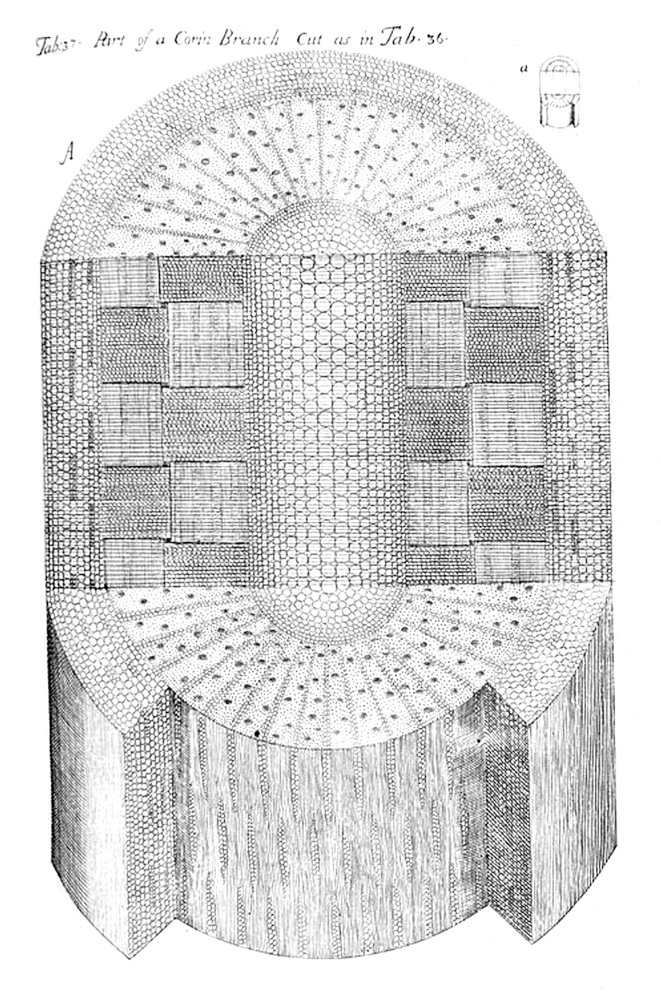
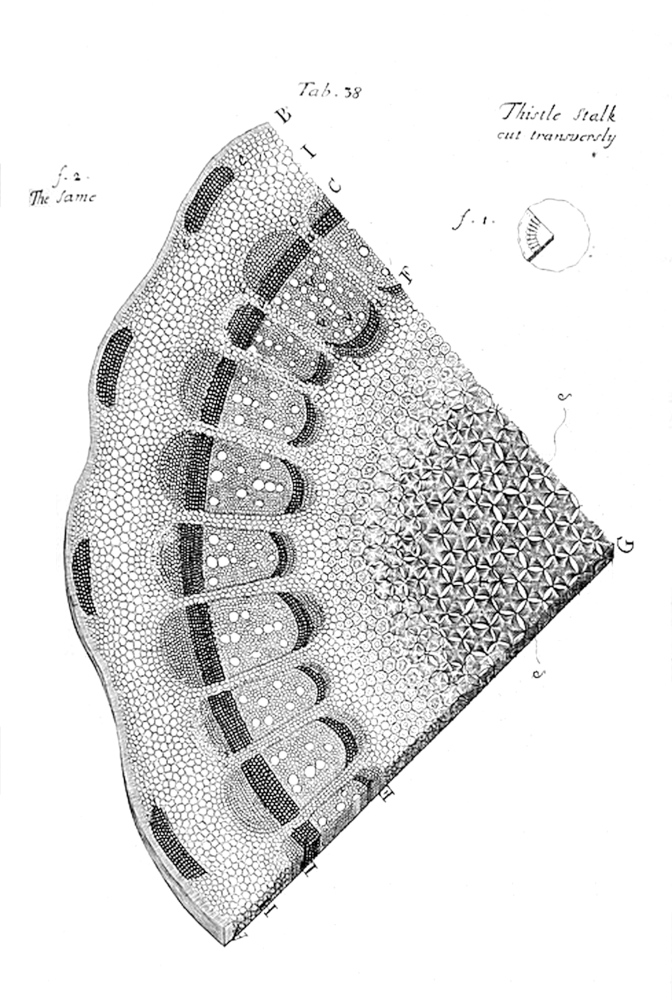
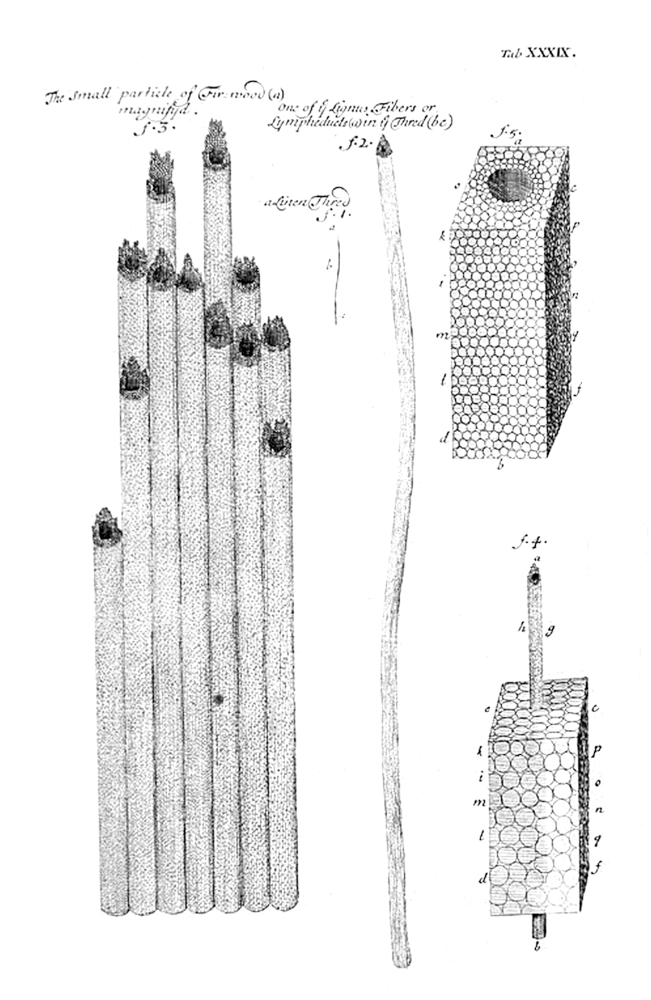
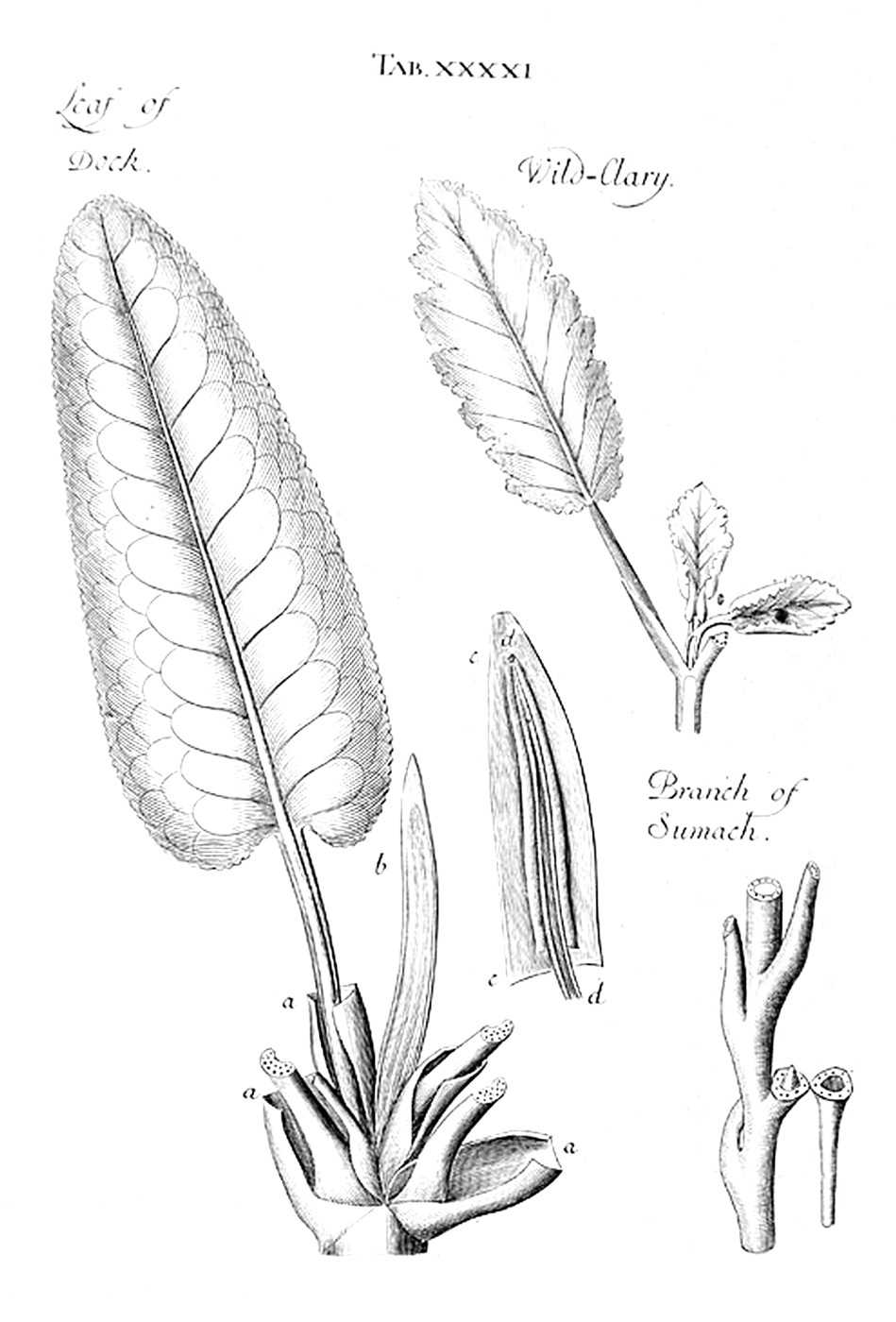
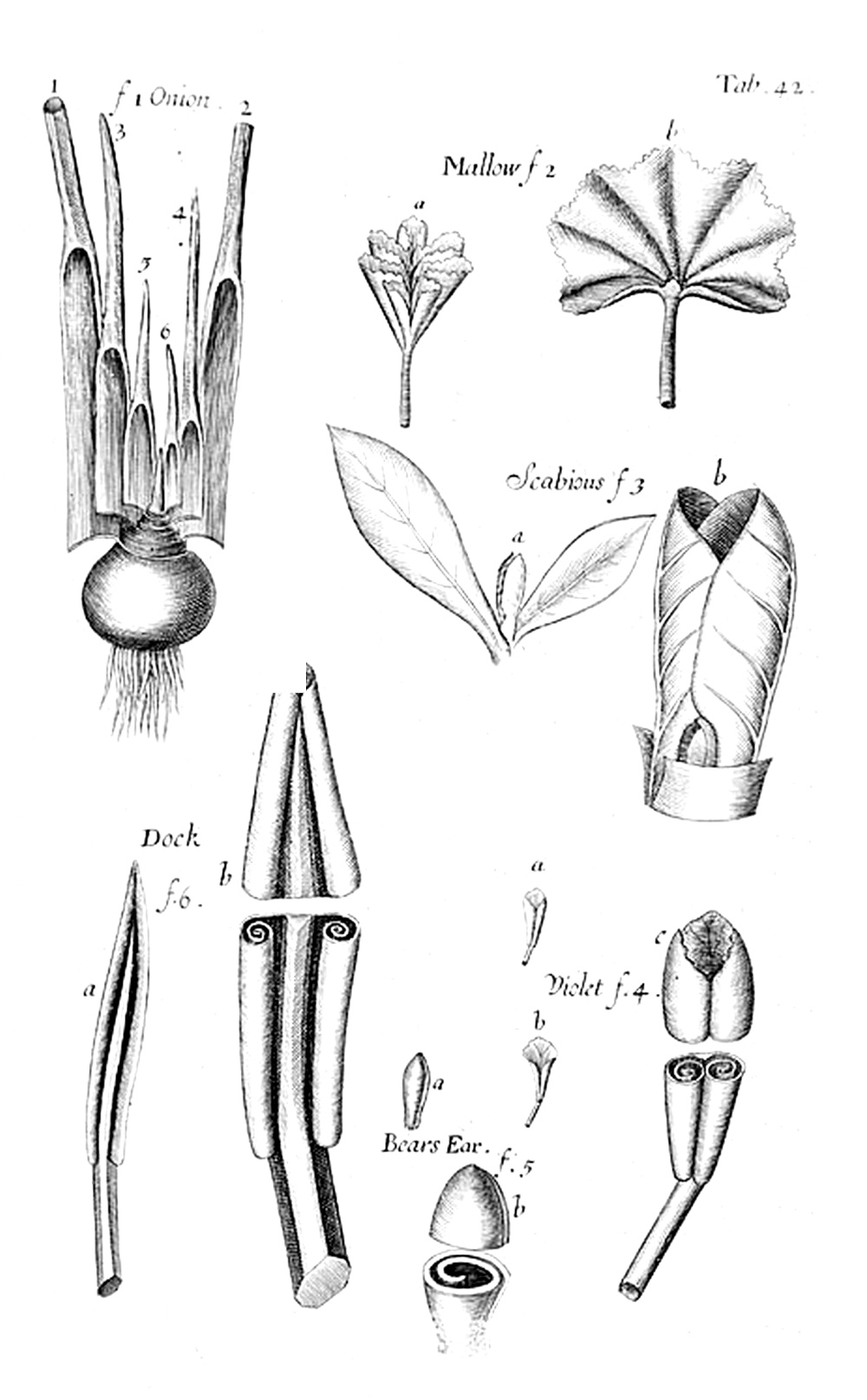
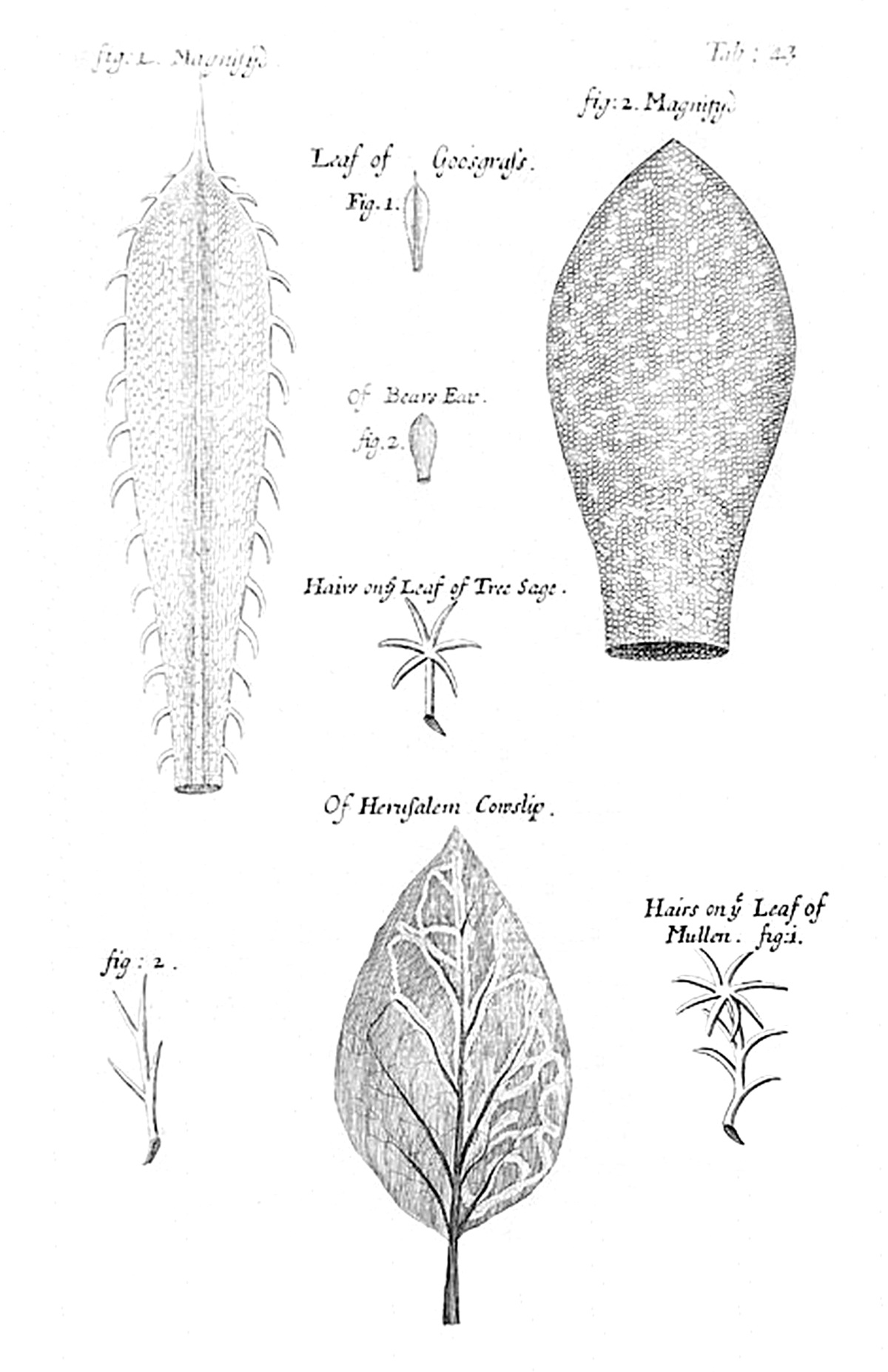
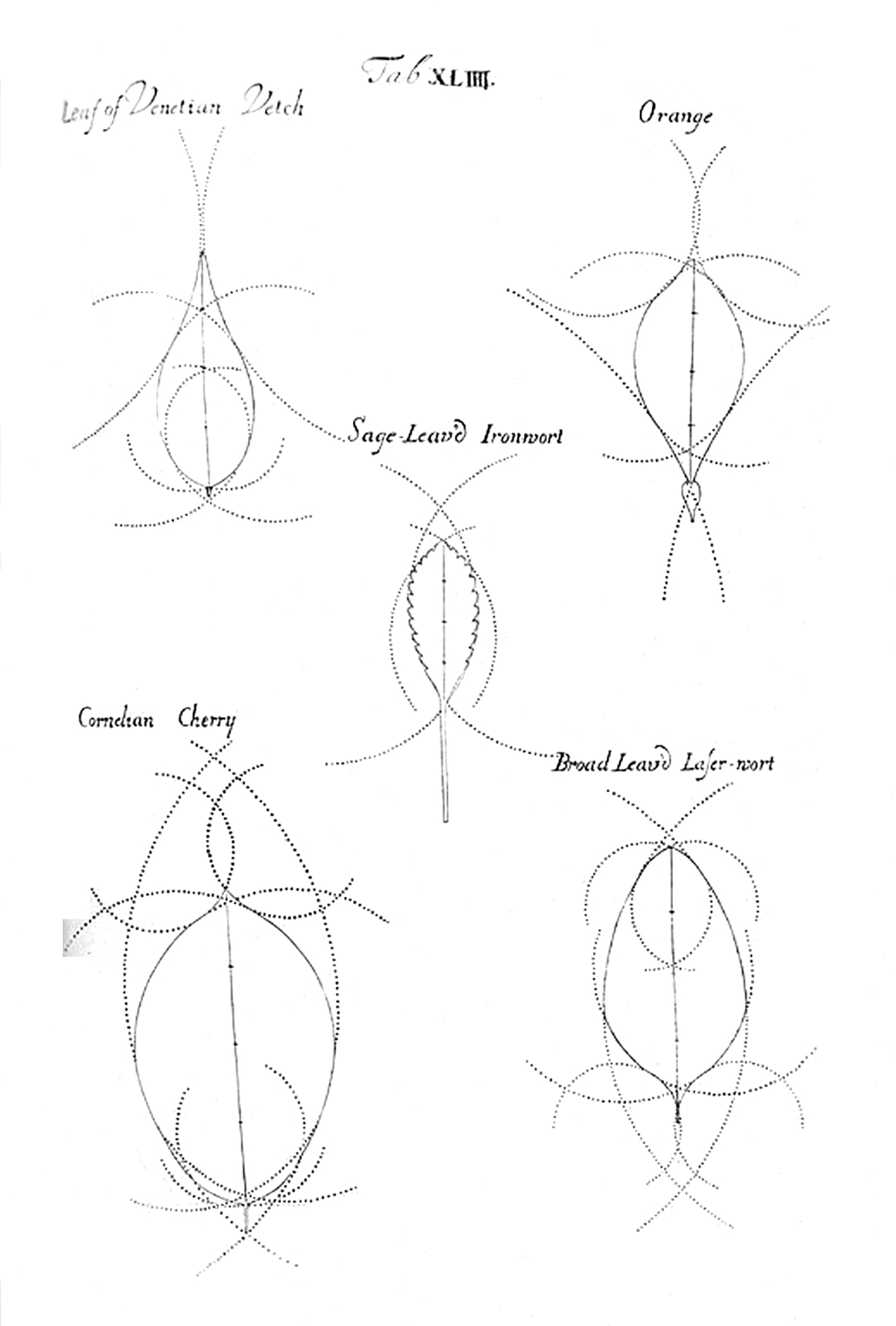
In the Plates, for the clearer conception of the Part
described, I have represented it, generally, as entire, as its
being magnified to some good degree, would bear.
So, for instance, not the Barque, Wood, or Pith of a Root
or Tree, by it self; but at least, some portion of all three
together: Whereby, both their Texture, and also their
Relation one to another, and the Fabrick of the whole,
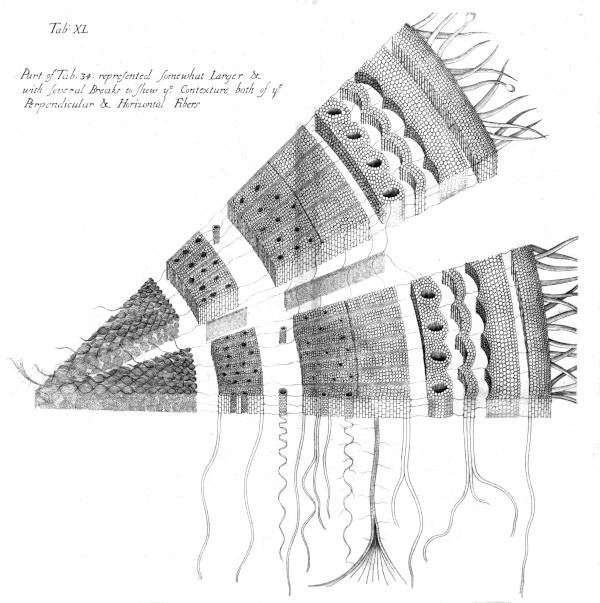
may be observed at one View. Yet have I not every
where magnify’d the Part to the same degree; but more
or less, as was necessary to represent what is spoken of it.
And very highly, only in some few Examples, as in
Tab. 40. which may suffice to illustrate the rest. Some of
the Plates, especially those which I did not draw to the
Engravers hand, are a little hard and stiff: but they are all
well enough done, to represent what they intend.
AN IDEA OF A Philosophical History OF PLANTS.
Read before the
ROYAL SOCIETY,
January 8. and January 15. 1672.
By NEHEMJAH GREW M.D. Fellow of the
Royal Society, and of the College of Physicians.
The Second Edition.
LONDON,
Printed by W. Rawlins, 1682.
TO THE Most Illustrious THE ROYAL SOCIETY,
The following IDEA
Is most HUMBLY PRESENTED. AND,
In their NAMES also PROPOSED TO THE CONSIDERATION
Of other Learned Men.
By the AUTHOR NEHEMJAH GREW.
THE
CONTENTS.
UNTOwhat Degree the knowledge of Plants is arrived,
§. 1. Wherein defective, §. 2. Why concluded
to be so, §. 3. Yet capable of Improvement, §. 4. And
worthy of it, §. 5.
Divers Instances given, wherein; first of the Organical
Parts, as to their external Accidents and Oeconomical Uses, 6.
Then of their Contents, Qualities, and Powers, 7. And an
Improvement of this Part, will further that of divers other
parts of knowledge; whereof Instances are given, 8.
In order whereto, Five General Means are propounded, 9.
The First, a particular and comparative Survey of whatever
is of more External consideration about Plants, 10. Instanced
as to their Figures, 11, 12. Proportions, 13. Seasons, 14. Places,
15. Motions, 16.
The Second, A like Survey of the Organical Parts by
Anatomy, as that which is very necessary, 17. In what manner
to be prosecuted, both without, and with the Microscope,
18. What thereupon to be observed, 19. And what, from observantion
made, probably attainable, 20.
The Third, A like Survey of the Contents of Plants; their
several Kinds, 21. Of all which, their Receptacles, 22. Motions,
23. Qualities, 24. Consistence, 25. Colours, Smells, and
Tastes, 26. Where also the same Qualities are to be inquired
into, as generally belonging to Plants, 26. As their Colours,
27. Odours, 28. Tastes, 29. Also their Faculties, 30. All
these to be further examined, 31. By Contusion, 32. Agitation,
33. Frigifaction, 34. Infusion, 35. Subsession, 36. Digestion,
37, 38. Decoction, 39. Destillation, 40. Arefaction, 41.
Assation, 42. Ustion, 43. Calcination, 44. By Composition
with other Bodies, 45. And by Compounding the Experiment
it self, 46. What hence attainable, 47.
The Fourth, A like Survey of the Principles, as well as
of the Contents, of the Organical Parts, 48. The Difficulty
hereof, in some respects cleared, 49. Further, by two Instances,
50, 51. Some Remarques hereupon, of the Principles
of Plants, 52. From hence will be attainable a further
knowledge of the Modes of Vegetation, 53. Of the Qualities
of Vegetables, 54. And of their Powers, 55, 56.
The Fifth, A like Survey of those Bodies, either from
which these Principles are derived, or wherewith they have
any communion, 57. Which are Four in general, soil, Earth,
and all solid Receptacles, 58. Water, and all liquid Receptacles,
59. Aer, 60. And Sun, 61.
F
WE take an account of the Degrees whereunto
the Knowledge of Vegetables is Advanced, it appeareth,
That besides the great Varieties, which
the Successful Arts of Florists, or Transplantations
from one Climate to another, have produced; we
have very many Species brought to light, especially
Natives of the Indies, which the Ancients, for any
thing that appears in their Writings now extant, were ignorant of.
In which particular Clusius, Columna, Baubinus, Boccone, and others,
have performed much. Withall, That their Descriptions (of all Parts
above ground) their Places and Seasons, are with good diligence and
preciseness set before us. Likewise their Order and Kindred: for the
adjusting whereof our Learned Countryman Mr. Ray, and Dr. Morrison,
have both taken very laudable pains. As also the ordering of
them with respect to their Alimental and Mechanick Uses; for which,
amongst others, Mr. Evelyn and Dr. Beal have deserved many thanks,
and great praise. We are also informed, of the Natures and infallible
Faculties of many of them. Whereunto so many as have assisted, have
much obliged their Posterity.
2. §. By due Reflection upon what hath been Performed; it also
appears, what is left Imperfect, and what Undone. For the Virtues of
most Plants, are with much uncertainty, and too promiscuously ascribed
to them. So that if you turn over an Herbal, you shall find almost
every Herb, to be good for every Disease. And of the Virtues of
many, they are altogether silent. And although, for the finding out,
and just appropriation of them, they have left us some Rules, yet not
all. The Descriptions likewise of many, are yet to be perfected; especially
as to their Roots. Those who are very curious about the
other Parts, being yet here too remiss. And as for their Figures, it
were much to be wished, That they were all drawn by one Scale; or,
at most, by Two; one, for Trees and Shrubs; and another for Herbs.
Many likewise of their Ranks and Affinities, are yet undetermined.
And a great number of Names, both English and Latine, not well given.
So what we call Goat’s-Rue, is not at all of kin to that Plant, whose
Generical Name it bears. The like may be said of Wild-Tansy, Stock-July-Flowers,
Horse-Radish, and many more. So also when we say
Bellis Major, & Minor, as we commonly do, these Names would intimate,
That the Plants to which they are given, differ (as the great
double Marigold, doth from the less) only in Bulk: whereas, in truth,
they are two Species of Plants. So we commonly say, Centaurium Majus
& Minus, Chelidonium Majus & Minus, and of others in like manner,
which yet are distinct Species, and of very different Tribes. But for
the Reason of Vegetation, and the Causes of all those infinite Varieties
therein observable (I mean so far as Matter, and the various Affections
hereof, are instrumental thereunto) almost all Men have seemed to
be unconcerned.
3. §. That Nothing hereof remaineth further to be known, is a
Thought not well Calculated. For if we consider how long and gradual
a Journey the Knowledge of Nature is; and how short a Time
we have to proceed therein; as on the one hand, we shall conclude it
our ease and profit, To see how far Others have gone before us: so
shall we beware on the other, That we conceive not unduly of Nature,
whilst we have a just value for Those, who were but her Disciples,
and instructed by Her. Their Time and Abilities both, being
short to her; which, as She was first Designed by Divine Wisdom;
so may Her vast Dimensions best be adjudged of, in being compared
Therewith. It will therefore be our Prudence, not to insist upon
the Invidious Question, Which of Her Scholars have taken the fairest
measure of Her; but to be well satisfied, that as yet She hath not
been Circumscribed by Any.
4. §.Nor doth it more behove us to consider, how much of the
Nature of Vegetation may lie before us yet unknown; Than, to believe,
a great part thereof to be knowable. Not concluding from the
acknowledged, much less supposed Insuccessfulnes, of any Mens Undertakings:
but from what may be accounted Possible, as to the Nature
of things themselves; and from Divine Providence, by Infinite Ways
conducting to the knowledge of them. Neither can we determine
how great a part This may be: Because, It is impossible to Measure, what
we See not. And since we are most likely to under-measure, we shall
hereby but intrench our Endeavours, which we are not wont to carry
beyond the Idea, which we have of our Work.
5. §. And how far soever this kind of Knowledge may be attainable,
its being so far also worthy our attainment will be granted. For
beholding the Many and Elegant Varieties, wherewith a Field or
Garden is adorned; Who would not say, That it were exceeding pleasant
to know what we See: and not more delightful, to one who has
Eyes, to discern that all is very fine; than to another who hath Reason,
to understand how. This surely were for a Man to take a True Inventory
of his Goods, and his best way to put a price upon them. Yea
it seems, that this were not only to be Partaker of Divine Bounty;
but also, in some degree, To be Copartner in the Secrets of Divine Art.
That which were very desireable, unless we should think it impertinent
for us to design the Knowing of That, which God hath once
thought fit to Do.
6. §.If for these, and other Reasons, an inquiry into the Nature
of Vegetation may be of good Import; It will be requisite to see, first
of all, What may offer it self to be enquired of; or to understand,
what our Scope is: That so doing, we may take our aim the better in
making, and having made, in applying our Observations thereunto.
Amongst other Inquiries therefore, such as these deserve to be proposed.
First, by what means it is that a Plant, or any Part of it, comes
to Grow, a Seed to put forth a Root and Trunk; and this, all the other
Parts, to the Seed again; and all these being formed, by continual Nutrition
still to be increased. How the Aliment by which a Plant is
fed, is duly prepared in its several Parts; which way it is conveyed
unto them; and in what manner it is assimilated to their respective Natures
in them all. Whence this Growth and Augmentation, is not
made of one, but many differing Degrees, unto both extremes of small
and great; whether the comparison be made betwixt several Plants, or
the several Parts of one. How not only their Sizes, but also their
Shapes are so exceeding various; as of Roots, in being Thick or Slender,
Short or Long, Entire or Parted, Stringed or Ramified, and the
like: of Trunks, some being more Entire, others Branched, others
Shrub’d: of Leaves, which are Long or Round, Even-edg’d or Escallop’d,
and many other ways different, yet always Flat: and so for
the other Parts. Then to inquire, What should be the reason of their
various Motions; that the Root should descend; that its descent should
sometimes be perpendicular, sometimes more level: That the Trunk doth
ascend; and that the ascent thereof, as to the space of Time wherein
it is made, is of different measures: and of divers other Motions, as
they are observable in the Roots, Trunks, and other Parts of Plants.
Whence again, these Motions have their Different, and Stated Terms;
that Plants have their set and peculiar Seasons for their Spring or
Birth, for their Full Growth, and for their Teeming; and the like.
Further, what may be the Causes as of the Seasons of their Growth;
so of the Periods of their Lives; some being Annual, others Biennial,
others Perennial; some Perennial both as to their Roots and Trunks;
and some as to their Roots only. Then, as they pass through these several
Seasons of their Lives, in what manner their convenient feeding,
housing, cloathing or protection otherwise, is contrived; wherein, in this
kind and harmonious Oeconomy, one Part, may be officious to another,
for the preservation of the health and life of the whole. And lastly,
what care is taken, not only for themselves, but for their Posterity; in
what manner the Seed is prepared, formed and fitted for Propagation:
and this being of so great concernment, how sometimes the other Parts
also, as Roots, in putting forth Trunks; Trunks in putting forth Roots;
yea in turning oftentimes into Roots themselves; whereof, in the Second
Book of the Anatomy of Plants, I shall give some instances. With
other Heads of Inquiry of this kind.
7. §.Nor are the Natures, Faculties, and Contents of Vegetables
less various, or a particular Inspection hereinto, of less concernment.
For since All, or Most, seem to grow in the same manner, with one Sun,
one Rain, indifferently well upon one Soil, and, to outward appearance,
to have the same Common Parts; it may be asked, How it comes to pass
that their Liquors, or other Contained Parts, are of such different
Kinds; one being Watry, another Winy, a third Oily, a fourth Milky,
and the like. How also there is such a variety in their Sensible
Qualities, as their Colours, Tastes, and Smells; what those Materials
are, which are necessary to the Being of these Qualities; and those
Formalities, wherein their Essence doth consist; as what it is that makes
a Plant, or Flower, to be white or red; fragrant or fetid; bitter or sweet;
or to be of any other Colour, Smell, or Taste. In like manner, their Faculties
and Powers, what that is, or those things are, by which they
are constituted; as whence one becomes Purgative, another Vomitory,
a third Diaphoretick, &c., These, I say, with many other particular
Inquiries depending hereupon; as they cannot but much oblige the
Reason of Man to be obsequious to them, so by bringing in, at least,
some satisfaction, will no less reward it. Especially, if it be withal
considered, that besides our satisfaction as to the Nature of Vegetation;
some further Light, to divers other parts of Knowledge, may likewise
hence arise.
8. § For since the present Design will ingage us, to an accurate
and multifarious Observation of Plants; we may hereby be enabled
to range and sort them with more certainty, according to the Degrees
of their Affinity. And all Exoticks, Plants or Parts of Plants, may
probably be reduced to some such Domesticks, unto which they may
bear the best Resemblance. Again, it may frequently conduct our
minds to the consideration of the State of Animals; as whether there
are not divers material Agreements betwixt them both; and what
they are. Wherein also they may considerably differ, and what those
things are which are more essential to their distinguishment. And besides,
not only to compare what is already known of both; but also,
by what may be observed in the one, to suggest and facilitate the finding
out of what may yet be unobserved in the other. So also the consideration
of the Colours, Smells, and Tastes of Vegetables, may conduce to
the Knowledge of the same Qualities in General; or of what it is, that
constitutes them such, in any other Body: not as they are actually received
by Sense; but so far, as such Materials or external Circumstances,
are requisite to their becoming the Adequate Objects thereof. It
may lead us also to inquire into further Ways of Cultivation, with respect
to the whole Plant, or to the Flower, Fruit, or other Part:
To amend them as to their Sizes, Colours, Tastes, Fruitfulness, or otherwise:
To think of other Ways of Propagation; or to apply those already
known to other Plants than hath been used. Likewise the Knowledge
of their Mechanical Uses may hereby be enlarged; both as to the
Reason of their use, in such particular Trades and Manufactures, already
known; and the discovery of other uses yet unknown. As also
their Alimental, with respect both to Meats and Drinks; the preparation
of some, and the finding out of others. But especially their Medicinal;
some Plants which have hitherto been neglected, may be applied
to use; the Perverted uses of some, and the Confused uses of
others, may be rectified. What may best correct their Malignancies,
or inforce their Virtues; When needful to add the preparations of Art
to That of Nature; How to Enlarge those of Art, and Rectifie those
which are indeed Inartificial, may hereby be better conjectured. The
knowledge of all which, that we may know how far it is accessible,
and what probable Approaches may be made towards it; those several
Means I have thought of, and suppose necessary thereunto, are next
to be proposed.
9. §. Reflecting then upon the present Design, and seeing this to
lie wide; we shall, in the first place, conclude the Means attending
thereon, should do so likewise. Wherefore, although some may present
themselves unto us as more promising; yet let us suppose what
several Persons, were they hereunto engaged, each according to his
Sense and Genius, would possibly make choice of. Believing, that
although Considering Men may vary, in the approval of their own
Sense and Notion; yet not always mearly, because it is their own;
but because each, may probably see somewhat more in his own, than
others do. Wherefore it will be our surest Logick to conclude, Not
because no Mean may be approved by all Men, that all Means should
be rejected; but rather, because each may be approved by some, that
therefore, all be made choice of. And these, I think, may be comprehended
under Five General Heads of Enquiry. First, Of those Things,
which are of more External Consideration about Plants, as their Figures,
&c.Secondly, Of their Compounding Parts, as Vessels, &c.Thirdly, Of their Liquors, and other Contents. Fourthly, Of their
Principles, as Salts, &c.Fifthly, Of their Aliment, as Water, and other
Means of Growth.
10. §. AND FIRST of all, whatever is of more External Consideration, The First General Mean.
as the Figures, Proportions, Motions, Seasons, Situations of
Vegetables, and of their several Parts, should be observed. In doing
which, a particular survey of all their Varieties should be taken. And
then a Comparison made betwixt these, and the several Plants, or Parts
of Plants, whereof they are the Properties. To the end, We may, if
possible, be thereby conducted to find out, what other, either sensible,
or more recluse Property, any of them may agree together in. For
it is not more certain, that the three Angles of every Rectilinear Triangle,
because all ways equal to two Right Angles, are therefore, if put
together, always the same: than that one Property, agreeing to divers
Vegetables, should have one Cause: For although the Scope and End
may vary; yet the Cause, as it is the Cause of that Property, must be
one: and consequently, must also import some Identity in the Nature
of all those Vegetables wherein it Acts. Wherefore by thus comparing
of them, we shall be able more exactly to state the Orders and Degrees
of their Affinities; Better to understand both the Causes and Ends of
their Varieties: And more probably to conjecture of their Natures and
Vertues.
11. §. First then the various Figures of their several Parts should
be observed; and that with respect both to the Forms, and the Positions,
by which their Roots, Trunks, Branches, Leaves, Flowers, Fruits,
and Seeds may vary, or agree; and those several Lines, by which
both the said Varieties are determin’d. In which of these Parts, the
agreement chiefly lies; this being both more observable, and more
material in some of them; less in the Root, more in the Flower, or
Seed. And in how many of these Parts together; whether one, more,
or all. By both which, the Orders and Degrees of Affinity, which
are many, may be accounted; either as to what we strictly call Kindred,
or else Analogy. For there are found, not only Herbs accounted
of several Tribes, which are ally’d; and some of the Smallest, which
are of kin to the Greatest: But there are also, probably, some Herbs,
which have a particular Relation, to many Kinds of Shrubs; and some
Shrubs, to many Kinds of Trees. Thus the several sorts of Letuce, are
of Kin, together in the First Degree; with Endive, in the Second. The
several Clarys, amongst themselves in the First; with Horehound, in
the Second; with Lamium, in the Third. All Strawberries agree together,
in the First Degree; with Cinquefoyl, in the Second; with Tormentil
in the Third; and with Avens, &c. in other Degrees more remote.
So Agrimony, hath alike Analogy unto Strawberry; as Goats-Rue,
hath to Claver: And Strawberry, the like unto the Rasp; as Goosberry
to the Vine; or Burnet, to the Rose. Amongst the several Sorts
of Grass, there are some which match all those of Corn; which is but a
greater kind of Grass. So again all Pulse, are not only of kin, in their
several Degrees, to one another; but likewise, to almost all kinds of
Trefoyls, as Melilot, Fœnugreek, and the common Clavers themselves;
as by comparing not only their Leaves, but Flowers, Seeds, and Cods
together, may be evident. For the several parts of the Flower of a
Trefoyl, are so many more Flowers, containing so many Cods of small
Seeds, all, in shape, agreeable to the Flowers, Cods, and Seeds of Pulse.
The same Relation, which Trefoyls have to the Peas or other Pulse;
Colts-foot, hath to Buttyr-Bur; Chickweed to Leucanthemum; Groundsell,
to Jacobæa; or Scorodonia, to Foxglove: Or, to go higher, as the
Leguminous Kinds of Herbs, have to Sena, or some other of the Lobed
Shrubs and Trees. And, as among Animals, there are some which connect
several Kinds; as the Batt doth Beasts and Birds: So, among
Plants, there are some also, which seem to stand between two Tribes;
as Lappa, between Knapweeds and Thistles; Lampsana, between the
Intybaceous Kind, and the Mouse-ears.
12. §. From hence likewise, the Natures of Plants may be conjectured.
For in looking upon divers Plants, though of different
Names and Kinds; yet if some affinity may be found betwixt them,
then the Nature of any one of them being well known, we have thence
ground of conjecture, as to the Nature of all the rest. So that as every
Plant may have somewhat of Nature individual to it self; so, as far
as it obtaineth any Visible Communities with other Plants, so far, may
it partake of Common Nature with those also. Thus the Wild, and
Garden Cucumers, have this difference; that the one purgeth strongly,
the other, not at all: yet in being Diuretick, they both agree. The
Natures of Umbelliferous Plants, we know, are various; yet ’tis most
probable, that they all agree in this one, scil. in being Carminative.
The several sorts, both of Corn and Grass, are all akin; there is no
doubt therefore, but that the Seeds of Grass themselves (of Rye and
Oats it is tryed) if it were worth the while to order them, as Barley,
would yield an inflammable Spirit. So likewise the several Kinds of
Pulse, have some one community in their Form, as is said: for which
reason, I question not, but that in some Cases, wherein Cicers are esteemed
a good Medicine; a Decoction of the better sort of Pease, especially
that we call the Sugar-Pease, may go beyond them. As doth also
the Flower or Meal of Beans, that of the Seeds of Fœnugreek; even
there, where they are accounted excellent. So Tulips, Lillies, Crocuses,
Jacynths, and Onions themselves, with many others, in their several
Degrees, are all allied. If therefore Crocuses, Onions, Lillies, agree
in one or more Faculties, then why may not all the rest? as in being
Anodyne; or in some other Common Nature; whereby, in their Vegetation,
their Parts are Governed and Over-ruled, to one Common or
Analogous Form.
13. §. The Proportions likewise, amongst the several Parts of Vegetables,
for the same Reasons, deserve to be observed; the comparison
being made, both betwixt the Parts of several Plants, and the several
Parts of one. And here again, either betwixt any Two of the
Parts, or any One of them, and the Whole besides, or all the rest
put together. So some larger Seeds, produce a small Root; as those
of Cucumer: and others smaller, produce one very great; as those of
Bryony. Some Plants, as the Melon, though themselves but very slender,
yet have a vast and bulky Fruit; others again, as Thistles, and
many yet more substantial, have no other Fruit, besides their Seed.
So the Seeds of all Pulse, and especially, the Garden Bean, though
large, yet produce but a small Plant: but those of Foxglove, Mullen,
Burdock, Sun-flower, &c. being themselves much less, do yet produce
a far greater. And especially, those Seeds, which are inclosed in the
Thicker sort of Cover, (analogous to that I have elsewhere called
the Secondine) as that of Peony; Anat. Plant. Book I. Chap. ult.whose Seed, so called, is only the
Nest wherein the true and real Seed is lodged, no bigger than a little
Pins head: which is also observable of the Seeds of divers other
Plants. These, and the like Proportions, as they lie betwixt the several
Parts, should be noted: and to what Plants or Parts especially, any
of them may agree: comparing also in what other kind of Properties
an agreement betwixt the said Parts may be found: that so doing, we
may, if possible, amongst all their Individual Natures, be instructed to
single out those Common Ones, which are concomitant to such Agreeing
Properties.
14. §. The several Seasons also of Plants, and of their Parts, should
be considered. Observing at what particular Times of the Year, any
of them chiefly Spring, Early or Late. The Times wherein they Germinate;
whether for some Space only, or all the Year long. Wherein
they Spring, after Sowing; or Flower, after Springing, sooner, or
slower. Which Flower, the first Year, or not till the second. Which
after the Leaves are put forth, or before them; for so, some do, as
the Crocus Vernus, Bears-foot, Hepatica aurea, and others; all the Leaves,
at the time of their flowering, being old, or of the foregoing Year’s
growth. So likewise the Maturation of the Fruit or Seed; how long
after the Flower, and the like. All or some of which Varieties, being
laid together, we may probably conjecture the Causes thereof, and
the Natures of the Plants in which they are seen: scil. as such a Degree
of Heat may be necessary for the Fermentation, or the better Distribution
of the Sap of such a Plant; or for the Impregnation of
the Aer, to be mixed therewith; or the due Disposing of the Soil, to
render the most convenient Aliment thereunto. So the Principles of
such Plants, which flower all the Year, may be more equally proportion’d.
Those which flower before the Leaves put forth, as the Crocus
Vernus, and those which flower in Spring, may be accounted Rank,
and full of Volatile Salt. But Autumn Plants especially, to abound with
a Fixed: and the like.
15. §. The proper Places also of Plants, or such wherein they
have, from their Seeds, or other way of Propagation, a Spontaneous
growth, should be considered. And that as to the Climate; whether
in one Colder, Temperate, or more Hot. The Region; Continent,
or Island. The Seat; as Sea, or Land, Watry, Boggy, or Dry; Hills,
Plains, or Vallies; Open, in Woods, or under Hedges; Against Walls,
rooted in them, or on their Tops: and the like. And perhaps the
Seeds of some Plants, as of Mosses, (which, through their smallness,
will ascend like Moths in the Sun) may fly or swim for some time, in
the Aer, viz. till they begin to shoot, and so become heavy enough,
to fall down upon the Ground. From whence, in like manner, as
from their Seasons, their particular Natures may be directed unto.
In that, so far as we may conjecture the nature of such an Aer, Soil, or
Seat, we may also of such a Plant, to which they are congenial.
16. §. So likewise, those many Varieties observable in the Motions
of Plants, and of their Parts, both Kinds and Degrees; Ascending,
Descending, and Horizontal; Rectilinear, and Spiral Motions, should be
noted; to what Plants they agree, and wherein any of these Motions
may be analogous to those of Animals. And in a word, any other
Forensick Properties of Plants. And then, to Compare them all together;
both being necessary. For Thoughts cannot work upon nothing,
no more than Hands. He that will build an House, must provide
Materials. And on the contrary, the Materials will never become
an House, unless, by certain Rules, we joyn them all together.
So, it is not, simply, the Knowledge of many things, but a multifarious
Copulation of them in the Mind, that becomes prolifick of further
Knowledge. And thus much for the first General Mean.
17. §. THE NEXT which I propose, and that a most necessary
one, is Anatomy. The Second General Mean.
For when upon the Dissection of Vegetables, we
see so great a difference in them, that not only their Outward Figures,
but also their Inward Structure, is so Elegant; and in all, so
Various; it must needs lead us thus to Think, That these Inward
Varieties, were either to no End; or if they were, we must assign to
what. To imagine the first, were exceeding vain; as if Nature, the
Handmaid of Divine Wisdom, should with Her fine Needle and Thred,
stitch up so many several Pieces, of so difficult, and yet so groundless
a Work. But if for some End, then either only to be looked upon,
or some other besides. If for this only, then this must be such as in
respect whereof, Her Work is at no time, nor in any degree frustrate;
the contrary whereunto, is most manifest. For although Men do
every where, with frequent pleasure, behold the Outward Elegancies of
Plants; yet the Inward Ones, which, generally, are as Precise and
Various as the Outward; we see, how usual it is, for the beholding of
These, to be omitted by them. And besides, when we have observed
Nature’s Work, as well as we can; it may be no impediment to our
best Endeavours, to believe, That some Parts of it, will still remain
behind, Unseen. So that if to be Seen, were the only End of it, it must
needs be wholly frustrate, as to the greater number of Men; and, in
some part, as to all. Wherefore, we must suppose some other Ends
of the said Varieties, which should have their Effect, and so These,
not be in vain, whether Men beheld them or not; which, are, therefore,
such as have respect to Vegetation: That the Corn might grow,
so; and the Flower, so, whether or no Men had a mind, leisure, or ability,
to understand how.
18. §. If then the Anatomy of Vegetables be so useful a Mean, we
ought not to streighten it; but to force this, as well as the rest, to its
utmost Extent. And therefore, first of all, To go through all the
Parts, with equal care; examining the Root, Trunk, Branch, Leaf,
Flower, Fruit, and Seed. Then to Repeat or Retrograde the Dissection,
from Part to Part: in that, although the best Method of Delivery,
for clear Discourse, can be but one, according to that of Nature,
from the Seed forward, to the Seed: yet can it not but be useful,
for That of Dissection, to proceed to and fro; somewhat or other
being more Visible in each several Part, from whence still an Hint
may be taken, for the ushering in the observation of it in the others.
To examine, again, not only all the Parts,but Kinds of Vegetables, and
comparatively, to observe divers of the same size, shape, motion, age,
sap, quality, power, or any other way the same, which may also agree,
in some one or more particulars, as to their Interiour Structure: and to
make this comparison, throughout all their Parts and Properties. To
observe them likewise, in several Seasons of the Year, and in several
Ages of the Plants, and of their Parts; in both which, divers of them
may be noted to change, not only their Dimensions, but their Natures
also; as Vessels, do into Ligaments; and Cartilages, into Bones, sometimes,
in Animals. And to do all this by several Ways of Section,
Oblique, Perpendicular, and Transverse; all three being requisite, if
not to Observe, yet the better to Comprehend, some Things. And
it will be convenient sometimes to Break, Tear, or otherwise Divide,
without a Section. Together with the Knife it will be necessary to
joyn the Microscope; and to examine all the Parts, and every Way, in
the use of That. As also, that both Immediate, and Microscopical
Inspections, be Compared: since it is certain, That some things, may
be demonstrated by Reason and the Eye conjunct, without a Glass,
which cannot be discovered by it; or else the discovery is so dark, as
which, alone, may not be safely depended on.
19. §. By these several Ways of Inspection, it will be requisite, To
observe their Compounding Parts; as Simply considered, and as variously
Proportioned, and Disposed. As Simply considered, to note their Number;
what, and whether the same, in all: their Kinds, wherein different
in the same, or divers Vegetables: their Original, in part, or in
whole: Structure, as to their Contexture and their Cavities; Their
Contexture, within themselves severally, and as joyned together: their
Cavities, as to their Size, Shape, and Number; in which a great variety
will be found. Next their Positions one amongst another, which
are also various; as Anterior, Posterior, Collateral, Surrounding, Mediate,
Immediate, Near, Remote; both as they respect the several
Parts, and the several portions of one: And all these, as few, or more;
these or others of them, may be diversely Compounded together. And
then the Proportions they bear one to another; whether as to Minority,
Equality, or Excess; each Part compared with each, and that
as to the several Degrees appearing in the said Proportions; the Varieties
whereof may be exceeding numerous. For if we should suppose
but Four considerable Parts generally constitutive of a Vegetable:
These Four, produce a Variety Four ways. First, when One is Unequal;
and then it produceth only Four Varieties: and those two ways,
scil. when one is Greater, and the other three, Equal and Less; or
when one is Less; and the other three, Equal and Greater. Secondly,
when Two be Unequal; and then they produce Six Varieties. Thirdly,
when Three be Unequal, which produceth Twelve Varieties. Or
lastly, when all Four be Unequal; which produceth Twenty four:
which general Varieties, may be further multiplied by their several
Degrees.
20. §. From all which, we may come to know, what the Communities
of Vegetables are, as belonging to all; what their Distinctions,
to such a Kind; their Properties, to such a Species; and their Peculiarities,
to such Particular ones. And as in Metaphysical, or other
Contemplative Matters, when we have a distinct knowledge of the
Communities and Differences of Things, we may then be able to give
their true Definitions: so may we possibly, here attain, to do likewise:
not only to know, That every Plant Inwardly differs from another,
but also wherein; so as not more surely to Define by the Outward
Figure, than by the Inward Structure, What that is, or those
things are, whereby any Plant, or Sort of Plants, may be distinguished
from all others. And having obtained a knowledge of the Communities
and Differences amongst the Parts of Vegetables; it may conduct
us through a Series of more facile and probable Conclusions, of the
ways of their Causality, as to the Communities and Differences of Vegetation.
And thus much for the Second General Mean.
21. §. HAVING THUS far examined the Organical and Containing
Parts of Vegetables; The Third General Mean. it will be requisite, more designedly,
to observe those also which are Fluid, or any others Contained in
them: and that, for our better understanding both of the Nature of
Vegetation, and of the said Contained Parts. And to make inquiry, First
of their Kinds; as Spirits; both such as agree, in general, in being
Vinous; and those that are Special, to particular Plants. Aers and
Vapours; for the existence whereof, in all Vegetables, there are Arguments
certainly concluding. And for the difference of their Natures,
in being more dry, or moist, more simple or compounded, as
they are existent in several Parts, there are probable ones. Lympha’s
or clear and watry Saps; which most Plants, in one Part or other,
at some time of the Year, do Bleed Mucilages; as in Mallow and Violet
Leaves; in many Seeds, as of Quinces, Clary; Fruits, as in Cucumers;
distinct from the watry Sap, as by permitting it to stand and
gelly upon the Vessels from whence it issues, is plain: And in the
young Berrys of White Bryony, when about the bigness of a Pepper-Corn;
the juyce whereof is so Viscous, that the twentieth part of a
Grain, will draw out above a Yard in length. Oyles; not only in
Seeds, and some Fruits, but other Parts; as in certain little cavities in
the Leaves of Savine, visibly collected while they are growing. Gumms
or Resines; as in Pine, Fir, and others of this Kind. Milks; as
in a vast number of Plants, and amongst them, many not suspected to
yield any. For, of Herbs, not only most of the Umbelliferous Kind,
are Milky; but all or most of the Intybous; Poppys; Tracheliums;
Perwinkles; divers Thistles; and even Onions, if cut at the bottome;
with a great many more. Of Trees, not only the Little Maple, but
the young Shoots of Lawrel, especially being crushed; as also those of
Elder, and some others. To which may be added, such Mucilages,
which though not so properly contained within the Parts, yet are
found lying over them; as over the first Spring-leaves of all kinds of
Docks; betwixt the Leaves and the Veil wherein they are involved.
That fine white Flower or Powder, which lies over the Leaves of some
Plants, as of Bears-Ear: And in Princes-Feather, about certain Apertures
only on the edges of the Leaves.
22. §. Of all these should be observed, first their Receptacles;
some of them, being proper to one; others, common to two or more
of them: since it is certain, that some of them do Transmigrate from
one, into another Receptacle, or that the same Receptacle is filled with
Fluid Bodies, of a quite different Nature, at the different Seasons of
the Year, and Ages of the Vegetable. And it is also very probable, That
two of some of them, may, sometimes, be contained in one Receptacle,
at the same time; as in Animals, the Lympha in the D. Thoracicus, and
that, and the Chyle, in the Sanguineous Vessels.
23. §. Then their Motions; both Natural, and such as may be
effected by Art: and those either by Descent or Ascent; And in
ascending, through what different Chanels or Parts of the Trunk; since
it is certain, That there is a variety, both in respect of the Season, and
of Vegetables. Where it will fall in, To observe the Tapping of Trees.
As also their Bleeding: to what Trees it is proper to bleed: in those to
which it is, with what difference of Celerity: and when their peculiar
Season: for none will bleed at all times; neither will all bleed at the
same. And then their Collateral Motion, together with the Mode of
their Transition from one Organical Part to another.
24. §. Next their Quantities, either of one; as the Comparison
is made betwixt several Plants, or betwixt the Parts of the same. So
the true Seed of all Plants, containeth more Oyl, in proportion, than
any of the other Parts. Or else of divers, as coexistent and bearing such
a proportion one to another in the same Part: of most of which, it
may be known by their respective Receptacles. Yet the Computation
must not be made from the number of the said Receptacles, simply;
but as that is in conjunction with their Capacity; and as their Capacity
is proportioned to their surrounding Sides; the Sides of those of the
least Capacity, being usually as thick, as those of the greatest: so that
suppose Ten lesser, to lye within the compass of One greater; the Content
of these altogether, would scarce be equal to half the Content of
that One.
25. §. Also their Consistence; scil.: of so many of them as are discriminable
by Touch; in being Soft or Hard; Thin or Thick; Mucilaginous,
Gummous, Glutinous, Friable, &c. And these in their several
Degrees; in which there is a Variety, as in the Milks of some Plants, which
are more Dilute, than that of others: Mucilages; which in some, are
very thick and Viscous, in others, more diluted and coming nearer to
a watry Sap. And by This, to be compared in the same manner, as
by their Quantity.
26. §. Likewise their Colours, Smells, and Tastes: The general
and particular Kinds of all which should be noted. And to what Contained
Parts, and in what Variety, they appertain. So most Resinous
Gumms are Tinctur’d, some, not; as that which drops from the Domestick
Pine, is as clear as Rock-water. The Milks of some Plants are
Paler, as in Burdock; of others Whiter, as in Dandelyon, Scorzonera;
Citrine, in the Root of Trachelium, Angelica; Yellow, as in Lovage. In
some Plants, Odorous, as in Umbelliferous; in others not, as in Cichoraceous.
That of Little Maple, Tasteless; of Garden Chervil, Sweet; of
Fenil, Hot; of Scorzonera, Astringent; of Dandelion, Bitter; and generally,
in other Plants; but with many Degrees of Strength, and in
conjunction with other Tasts. But most Mucilages, have little either
Colour, Taste, or Smell; and the like. Here also the same Qualities are
to be inquired into, as, in general speaking, they are said to belong to
a Vegetable. Since it is more than probable, that all Colours (excepting
White, which is sometimes common both to Containing and Contained
Parts) all Odours, and Tastes, which are more immediately, and without
a resolution of their Essential Principles, perceptible in a Plant; are
not ascribable either to the Organical, or Containing Parts; but only
to Those, Contained in them; as from divers reasons hereafter may
appear.
27. §. And first, their Colours; where, with respect to several
Plants and Parts, they are more Changeable; as Red, in Flowers; or
Constant, as Green, in Leaves. Which, with respect to several Ages
of one Part, are more fading, as Green in Fruits; or durable, as Yellow
in Flowers. In what Parts more Single, as always in the Seed;
or more Compounded, as in the Flower; and in what Plants more especially,
as in Pancy. Which proper to Plants that have such a Taste
or Smell, as both, in White Flowers, are usually less strong. To Plants
that flower in such a Season, as a Yellow Flower, I think, chiefly, to
Spring Plants. And to Plants that are natural to such a Soil or Seat,
as to Water-plants, more usually, a white Flower. What, amongst all
Colours, more Common to Plants, as Green; or more Rare, as Black. And
what all these Varieties of Colours are upon Cultivation, but chiefly,
in their natural Soil. To observe also with their superficial Colours,
those within: so the Roots of Docks, are Yellow; of Bistort, Red;
of Avens, Purple; but of most, White. Where the Inward, and Superficial
Colours agree; as in the Leaves; or vary, as in the other Parts
frequently. And in what manner they are Situated; some universally
spreading, others running only along with the Vessels, as in the Leaves of
Red Dock, and the Flowers of Wood-Sorrel.
28. §. Next their Odours; what may be their principal Seat;
whether one or divers Seats in the same Plant. What the chief Matter
out of which they are continually bred. What similitude betwixt
the Smells of divers Vegetables; as betwixt Baume, and a Limon; the
Green Leaves of Meadow-sweet, and the green Rinds of Walnuts. Or
betwixt those of Plants and Animals; as the Smell of green and well-grown
Carduus, is like to that rank scent, ab aliquorum axillis spiranti.
Which have a more sensible Smell; as most have; and which
have less, as Corn. Where the green Leaf is the most Fragrant Part,
as in Musk-Cranesbill; where the Flower, as in Roses; the Root, as in
sweet Calamus. Where all the Parts have some Odour, where some, or
one, only; as in Scurvy-grass, only the Flowers, unless the Leaves are
bruis’d; and in Arum, the Pestil only; for neither the Leaf, nor Root
hath any Smell, unless cut; but this is strong enough, not much unlike
to Humane Excrements.
29. §. But especially their Tastes, which it much importeth us
more precisely to distinguish; First, by their general Kinds; for the
number, even of these, may be computed greater than usually it is. I
remember not, that Heat and Acritude, with respect to Taste, are distinguished;
yet Arum-Root is very Pungent, without any proper
Heat; and Cloves, are very Hot, without any proper Pungency. So
the White Roots of Yarrow, have a Taste, hardly any other way perceptible,
than by causing a gentle glowing and continued Warmth upon
the Tongue. Also their Respondencies one to another; as that of Zedoary,
and of the lesser Cardamoms, is somewhat like to Camphire.
Likewise their Degrees; in which there is a great latitude, and may
be extended from One to Ten, or with easie distinction, from One to
Five: So the Root of Sorrel, is Bitter in the first; of Dock, in the
second; of Dog-Rose, in the third; of Dandelyon, in the fourth; of Gentian,
in the fifth: observing them, not only as they vary in several
Kinds of Plants, but the several Species of one, as in Cichory, Hawkweed,
Dandelyon. And then their Compositions; for Tastes are as truly
conjunct in one Part, as Colours: by which, the latitude is still greater;
In that all Kinds of Tastes, in all their Degrees, and in differing Numbers,
may be variously Compounded together: For the most part,
Two, as in the Leaves of sharp-pointed Dock, Astringent, and Sowre;
in Sorrel-Roots, Astringent and Bitter; and in Aloes, Bitter and Sweet;
the one in the fifth, the other, in the first Degree; as upon an unprejudiced
tryal may be perceived: and yet more evidently in the Gall
of any Land-Animal. Sometimes three, as in Agrimony, Bitter, Rough,
and Sowrish and in Agarick, Bitter, Rough, and Sweet. And sometimes,
perhaps more. The Sensible distinctions of all which, may lye almost
as wide, as of Plants themselves. Wherefore, although it may be
thought rashness, to take away the distinctions of Hot, Cold, Moist,
Dry, Thin, Gross, and other Qualities, in their several Degree, which
the Ancients have affixed to particular Plants: yet since they have
done it, to many of them, with much uncertainty; and that, withal,
they are, more properly, the Effects and Operations of Plants, than their
Qualites; Practical Observation, may therefore approve it useful, to
add these Sensible Ones of various Tastes, precisely distinguishing their
Conjugations and Degrees. Lastly, their several Varieties and Mutations,
with respect to the Subject wherein they reside, should also be
noted. As, of all Tastes found in Plants, Bitter and Sowr, are most
common; Sweet and Salt, most rare. Which latter, is not only perceptible
in some Sea-Plants; but upon some others, as upon the fresh
Leaves of Tamarisk; which being licked while they grow, or when
immediately gathered, are plainly Saltish. How they vary with the
Age of the Plant, or Part; as the Roots of Radishes, growing up to
Seed, lose the strength of their Tast; so most Fruits are first Sowre,
then Sweet. What proper to the several Parts of any one Plant; so
the Leaves of Wormwood are extraordinary Bitter; the Root scarcely
so at all; of an Hot, but quite different Taste. What more Common, or
Rare, to any Part; so no Root that I ever tasted, is Sowre. And how
they Alternate in several Plants; as the Root of Stock-July-flower is
biting, not the Leaves; on the contrary, the Leaves of the Water-Arsmart,
are Biting; but not the Root; and the like. To which we
may add the difference of Time wherein the Tastes of Plants are perceived;
as those of Arum, and Rape-Crowfoot, are both Biting; but
that of the first, as it is slowly perceived, so it continues long; that of
the other, quickly comes, and quickly goes.
30. §. Amongst the other Adjuncts of the Contained Parts, though
not of these only, the Faculties of Vegetables are to be reputed. For
so the Rosin of Jalap, which is Purgative, is as truly contained in the
Organical Parts of that Root, as Blood is in Veins: It will be requisite
therefore to make particular observation of these also. And first,
what Faculties chiefly may reside in Plants, above others: so there is
none of known use in Salivation, except by holding in the mouth:
Although we may ask, Why some amongst them, may not (being Taken
inwardly) have a power to evacuate by This, as well as other Violent
ways? Where the Faculty is more universally spread over all the
Parts of a Vegetable, as in Asarum. Where belonging chiefly or wholly
to any particular Parts or Part; as chiefly to the Root of Rhubarb;
and only to the true and proper Seed of Barbado Nuts. Whether some
Faculties, may be proper to some Parts especially. What conjunction
they may have with any sensible Qualities. So, many Purgers, are not
only Resinous and Gummous; But also Mucilaginous; as Bryony, wild
Cucumer, Lapathum Sativum; and therefore probably Rhubarb, when
growing; Mallows, Violets, &c. Such as are Purging and Vomitory,
though some of them have a strong Taste, yet the greater part, and of
those, many of the stronger sort, have no Taste, or not Great; as
Senna, Jalap, Scammony, Hellebore, Asarum, and others. Amongst
which, although Hellebore hath a very Durable Taste, yet is it not very
High or Great. So also, those that are most sensibly tasted, are, I
think, for the most part, more or less Bitter; either simply, as Colocynthis;
or Bitter and Astringent, as Rhubarb; or Bitter and Sweet, as
Aloe; or Bitter, Astringent, and Sweet, as Agarick. Few are Hot, as
Iris. Or simply Sweet. And though some may be Subacid, that are
Mollifying or Lenitive, yet no proper Purge or Vomit is Sowre. Such
Plants as are of a soft and sweetish Taste, without Viscosity, may be accounted
good Antiscorbuticks, especially against the Sea, or other Salt-Scurvey;
as are good sweet Pease: And sometimes the Water or Spirit
of the Shells; which may easily be drawn from them, being first
duly fermented, and hath a true Vinous Taste; but very mild, and not
unpleasant. Those Plants, whose Parts are not only Hot but Volatile,
as Onions, are generally good for Burns. Such as have a Balsamick
Taste or Smell, with a little Astringency, as Hypericum, Golden-Rod,
Lamium Luteum, &c. the best Wound-Herbs. And such as are gently
Bitter, and Penetrant upon the Tongue, or in the Throat, as Daisy, Anagallis,
good Cleansers. That such Bodys, principally, are Anodyne, which
are Yellow, I think, is more than a conceit; Yelks of Eggs, Fœnugreek
Seeds, Lint-seed Oyl, May-Butyr, Marrow, Pinguedo Humana, Hyoscyamus
luteus, Safron, Sulphur, Opium, all Anodyne and Yellow. How
likewise their Faculties and Qualities may vary their Degrees, either
differently or together: so Aloe and Colocynthis, are both Bitter in the
highest Degree; yet Aloe, which is also Sweet, Purgeth more moderately;
Colocynthis, which is Bitter, but not Sweet, most Violently. How
far the Faculties of Vegetables, as well as their Qualities, may be Compounded;
where, and which chiefly; as Astrictive and Purgative in
Rhubarb. Where this Question may be put, Whether divers other,
and yet more extreme Faculties, as well as these of Astrictive and Purgative,
may not somewhere or other be also found, or made, to meet:
whereby the same Plant, or some Preparation of it, may be most Potent,
and yet most Innocent; the Malignity thereof exerting its Power,
and the Virtue its Sovereignty at the same time. And lastly, what
Affinity there may be betwixt them; as most Plants, that are strong
Purgatives, and especially Vomitories, I think, are also Sternutatory;
as white Hellebore, Jalap, Tobacco: and on the contrary, such as are
Sternutatory, are some of the most proper and most potent Medicines
for the Head, Brain, and Genus Nervosum, Taken inwardly, as Lilium
convalle, &c. and the like.
31. §. Thus far a particular observation of the Qualities and Faculties
of the Contents of Vegetables may proceed, as they are existent
in their Natural Estate. From which, although some probable Conjectures
may be made, of their Material and Formal Essences, and of the
Causes of their determinate Varieties, or the Modes of Vegetation necessary
thereunto: yet will our Conceptions hereof be more facile, clear,
and comprehensive, if by all other Ways of Observation, they be likewise
examined, according as Experiment maybe applicable to any of
them.
32. §. As by Contusion; so some Plants give their Smell, not without
Rubbing, or not so well; as the green Leaves of Stramonium, Scurvygrass,
and many more: others lose it by Rubbing, as the flowers of
Violets, Carnations, Borage, &c. others yield it both ways, as Rosemary,
&c. So some Apples mend their Taste, by Scoaping, and Pears
by Rowling, especially that called the Rowling Pear.
33. §. By Agitation; which doth that, sometimes, by Force, which
Digestion, doth by Heat: so any cold Oyl and a Syrup being, in a due
manner, agitated together, of two Fluid bodies will become one Consistent,
as is known.
34. §. By Frigifaction; how far the Juyces of Plants, either without
or within them, may be any of them, or some more than others, subject
to Cold: and thereby to be deprived of their Motion or natural
Consistence, or may suffer alteration in their Colour, Taste, or Smell.
35. §. By Infusion; where I mean Infusion only in Common Water;
So both Cassia Lignea, and Cinnamon are a little Mucilaginous;
but the former most. Some of the Contents of Plants, may be wholly
dissolved in Common Water; some but in part, others not at all; or very
little; which is proper to some Milks, as well as Gums. The Colours,
Smells or Tastes they hereupon yield, are found various; and in
some very unexpected: So the green Leaves of Bawm, being duly infused
in common Water, without any other Body added, tincture it
with a clear and deep Red, near that of Claret Wine, as I have often
tryed.
36. §. By Subsiding; So the Juyce of Sorrel, being ordered as that
of Grapes, will, in time, let fall a kind of Tartar or Essential Salt. And
so perhaps will that of many other Plants, without any previous Decoction;
although that be commonly thought to be necessary.
37. §. By Digestion with Fermentation; either of the entire Vegetables,
or of the Juyces, or other Contents; and these by themselves,
or with common Water. And hereby to note, what difference may
be in the Strength, Celerity, or Continuance of the Fermentation. Likewise,
how their Qualities may thereby be altered; as the Smell of Violet-flowers,
from a most excellent Fragrancy, may, by Digestion, be reduced
to an odious and abominable Stink, like that of the black Mud
of Gutters.
38. §. By Digestion with Calefaction; so the Colour of the Juyce
of Limons, from Transparency (if that be a Colour) may be turned
to a perfect Red. Whence it is that many are deceived in the Preparation
called the Tincture of Corals; supposing the Corals to give the
Menstruum its Colour. Whereas the Menstruum will obtain it, only
by Digestion, without any Corals, mixed with it.
39. §. By Decoction; either of Vegetables themselves, or of their
Liquors; and to observe what alterations follow. So Turpentine boiled
becometh friable, Sugar, Bitter, and of a Brown Red. Turneps lose
their Biting Taste; Onions, their Picquancy; yet neither of them convey
those self same Qualities to the Water. The same may be observed
in the Decoction of Sweet-Fennel-seeds, Aniseeds, and others, losing
much of their Tastes themselves, and yet conveying very little of them
to the Liquors wherein they are boiled; the greater portion of their
Volatile parts, and so their Virtue and Taste therewith, flying away.
Whereof therefore it is much better to make an Emulsion, than to decoct
them; or to make an Emulsion from them, with their own Decoction,
especially if the Medicine be intended to be Carminative, as I have frequently
observed. The Decoction should also be carried on throughout
all degrees to that of an Extract; by which the Qualities thereof,
sometimes, are much altered; as the Colour of all or most green Leaves,
from a kind of Yellow, deepens at last into a dark one, as Black as
Pitch.
40. §. By Distillations; both with the cold Still, Alembick, Chappel- and
open Furnace: and to note what Vegetables thus give their
Smell or Taste, and in what Degrees of strength, either under, or over
their natural ones; as Mint, Pennyroyal, and the like, which are Aromatick
and Hot, give their Tastes perfect: but Wormwood, which is
Aromatick and Bitter; gives it but by halfs, pretty fully as Aromatick, little
as Bitter. And Carduus, though also so exceeding Bitter, yet not
being Aromatick, yieldeth a much weaker Taste. Also what Vegetables
yield Oyl most plentifully; and what difference may be in those
Oyls, as to their Colour, Weight, or otherwise; as that of Cloves is sometimes
Red; of Cinnamon, limpid; both Ponderous. So to distil Juices,
Gums, or other Contents, with an hot fire; and to see, what Bodies they
yield, and of what Qualities; as Turpentine is known to yield, besides
its Oyl, a subacid Water; Vinegar, an Eager Spirit; as that part may
be called, which Chymists are wont to call the Phlegm.
41. §. By Arefaction; so Milks which are Liquid, and White in
their Natural Estate, in Standing, grow Gummous, Yellow, and otherwise
different, so doth that of Scorzonera; and that of Fenil becomes a
Balsamical, but Limpid Oyl. The Roots of Angelica, being dry’d, and
cut by the length, exhibit their small Veins fill’d with an Aromatick
Rosin. In the whiter parts of Rhubarb, is gathered a kind of Saline
Concret; by which, this Root, in chewing, seems as if it were a little
gritty. Cabbage-Stalks, sliced, and laid in the Shade to dry, gather on
them a kind of Nitrous Hoar. Raisins and Corins contain, not only
a sweet Juyce, but also a true Sugar, which lies curdled in the Pulp,
as the more Saline parts do in Green Soap. And the like is gather’d
on the out-side of a Fig; saving, that it is more Nitrous, as lying next
the Aer. The Roots of Arum, upon drying, lose much of the strength
of their Taste; but the contrary may be noted of many other Roots,
which, upon drying, increase it. Some, being cut and laid by, change
their Natural Colours, into Red, Purple, Yellow, Green, or White;
as Liquorish, into White, in some places; and Peony, into Red: and
sometimes into two; as Patience, into Yellow and Red.
42. §. By Assation; thus Apples, by roasting, eat more Sowre. The
Root of Horse-Radish, toasted, tasteth like a Turnep. Potatoes, Onions,
and many other Roots, and Parts, have their Tastes, either Altered
or Refracted; which chiefly, and in what manner, should be observed.
There is one alteration, as remarkable, as commonly known;
and is that which followeth upon roasting or baking in one kind of the
Waldensian Pears, which, for a Walden, we corruptly call a Warden.
43. §. By Ustion; wherein some Plants, or Parts of them, burn
very quietly; others, not without violent motions; so Fenil-Seeds,
held in the flame of a Candle, will spit and spurtle, like the Serum of
Blood. Some Vegetables lose their Smell, as Roses; others, keep it,
as Rosemary; and others, mend it, as Lignum Aloes, To note, not
only the alteration of their Qualities, but what they yield; as Turpentine,
which, in Distillation, yieldeth Oyl and Water, both limpid; upon
Ustion, sheweth nothing but a black Soot. So Benzoine, by Distillation,
Oyl; by Ustion, white Flowers, as is known.
44. §. By Calcination; and here to observe, wherein the Caput
Mortuum of one, may differ from, or agree in Nature with that of another;
and also to compare these with those of Animal Bodies. As also in
their Quantities. And to compare them with what they yield by Distillation
and Ustion as to both. Thus far they have been tryed singly,
or by themselves. They should also be examined.
45. §. By Composition; not only with Water, as in simple Infusions,
&c. but with any other Bodies, which may have a power of acting
upon them, or upon which, these may have a power to act. And so
to make Infusions, Destillations, Decoctions, Digestions, in divers kinds
of Liquors, as Vinegar, Urine, Spirit of H. H. Wine, Blood, Milk,
or others. So in Infusions, some Red Colours are heightned by Acids;
Blews, turned Purple. So fetid Spirits (as of H.H.) may be rendred much
more grateful, by being Rectified, once or twice, with fresh Aromaticks,
To observe also what follows, upon mixing the Liquors, or other Parts
of Plants together, as Oyl of Turpentine, by Digestion with a Lixivial
Salt, extracteth thence a Red Tincture. Or with Salts, Earths, Metals,
or any other Bodies; as the Juyce of the green Leaves of Rasberry, Primrose,
and divers other Plants (I think principally such as are Astringent)
expressed upon Steel, as it drieth, becometh of a Purple Colour.
46. §. Lastly, by Compounding the Experiment it self, or joyning
two or more of them, upon the same matter: as Fermentation and Destillation,
as is used for some Waters. Infusion and Fermentation, as in
making of Beer. Fermentation and Coction, or rather Assation, as in
making of Bread. Arefaction and Destillation, as may be tryed upon
some Herbs; and with what difference from what may be noted, upon
their being distilled, moist.
47. §. Having proceeded thus far, by all the above particular
Ways of Observation; a Comparative Prospect must be taken of them:
by which, at last, the Communities and Differences of the Contents of
Vegetables, may be discerned; the manner of their Causation and Original,
partly, be judged of; and wherein it is, that the Essence of their
several Natures and Qualities doth consist, in some measure comprehended.
And consequently, both from the knowledge of their particular
Natures, and the Analogy found betwixt them; we may be
able, better to conjecture, and try, what any of them are, or may be
good for. For certainly, we shall then know, more readily, to apply
things unto, and more fitly to prepare them for, their Proper Uses,
when we first know, what they are. Notwithstanding, since the Faculties
of Plants, do often lie more recluse; it is best,therefore, not wholly
to acquiesce in such Conjectures, as their Tastes, or other Sensible Properties
may suggest; but to subjoyn Experiment. In making of which,
and in passing a Judgment thereupon, many Cautions, both in respect
of the Plant whereof, and the Subject whereupon it is made, are requisite
to be attended. Which yet, in regard they result not so directly
from the Matter at present in hand; I shall not, therefore, here insist
upon them, And thus much for the Third General Mean.
48. §. THE Contents of the Organical Parts of Vegetables, having
been thus duly Examined: The Fourth General Mean. it will be requisite to make the like Inquiry
into their Principles; or the Bodys, immediately concurrent and essential
to their Being. And of these, we are to observe, First, their Number;
whether well reducible to five, six, seven, or more, or fewer: and
the Special Differences observable under any one General; since there
are many Bodies, of very different Natures, confounded under one
Name. Next their Conjugation; which they are, that either under
or over those observable in animal, or other Bodies, are here joyned
together in a Plant; How far common to the Organical Parts
of divers Plants; or to the several Organical Parts of one; or
how far different in them. So the predominant Principle of the Parenchymous
Parts of a Plant, that it is an Acid, seems evident, From the
general Nature of Fruits; and of Corn; and most Parenchymous Roots,
which are either Spirituous, or Sower, or by Digestion, do easily become
such. Likewise their Proportions; which stand in the greatest,
which in the least, or in the meaner Quantities, and in what Degrees;
both in divers Vegetables, and in the several Organical Parts of one.
And then the Concentration and Union of them altogether; as to the degrees
of their Closeness or Laxity; or the manner of their Implication and
Coherency; or as to their Location, one being more Central, another
more Exposed and Rampant over the rest; or otherwise different. To
examine these Principles, by their Colour, Taste, Smell, Consistence, Fixedness,
Volatility, Weight, Figures, or other Accidents. And to these
purposes, to go through the formentioned Ways of Experiment; as
Ustion, Calcination, Destillation, &c. as any of them may appear applicable
hereunto. So the Essential Salt of Wormwood, which may be
obtained from the Lixivial; is Bitter, transparent, and commonly, of
a Cylindrick figure: whereas that which is obtained by Coction, or from
the Extract, is tasteless, greyish, and almost Cubick: and that in the Extract
of the Green Leaves of Violets, appears in fine transparent Shoots,
like so many little Needles. And it is probable, That the Salts of
most Kinds of Plants, whether Lixivial or Essential; and of these, whether
obtained by Decoction, or otherwise, have either their Figure, or
other Qualities, proper to themselves, whereby they are all distinguished
one from another. And lastly, to make Experiment upon these
Principles, mixing them with one another, or with other Bodies, or
otherwise.
49. §. I know it will be difficult to make observations of this kind
upon the Organical Parts of Plants, severally. Yet I have thought of
some Ways, whereby true and undeceivable ones may be made. And
the better to illustrate what I mean, I shall give one or two Instances
of Tryal to this purpose. For the making of which, and some others
of the like nature, I considered, That upon the Anatomical Analysis of
all the Parts of a Plant, I had certainly found, (and shall hereafter
shew) That in all Plants, there are Two, and only Two Organical Parts
Essentially distinct, viz. The Pithy Part, and the Lignous Part, or such
others as are analogous to either of These. So that, if we can think
of any Plants, which will afford us either of these two, though not perfectly,
yet in some good measure, simple and unmixed: We may then
see, by putting them to a Chymical Test, what Principles and Proportion
of Principles, concur to specifie their Substantial Forms.
50. §. To the Pithy Part, Starch, or pure Manchet is analogous,
as having very little of the Lignous mixed with them. I therefore ordered
℔ ij of Starch to be put into a Retort, and with a Receiver affixed,
to be set in a Sand Furnace; and that all it would yield, should,
by degrees, be forced over; which, besides what was evaporated at
the Neck of the Receiver, was about ℔ j. of an acid and eager Liquor,
of a heavy and blackish Oyl ℥ ss, and of a light Oyl ʒ j. The Caput Mortuum
could not be reduced to Ashes, by the strongest heat which a
naked fire in that Furnace would produce.
51. §. To the Lignous Part, Hemp or Flax is analogous, having
very little of the Pithy mixed with them. I caused therefore ℔ ij of
Flax to be put into a Retort, and manag’d as the Starch: whereupon,
it yielded a Liquor, as I remember, somewhat like the former, and
about the same quantity; no Oyl which remained liquid, when cold;
but instead of that a Butyr, almost of the Consistence and Colour of
the Oyl of Mace; and of this above ℥ iij, or near six times the quantity
of the Oyl which was yielded by the Starch. The Caput Mortuum
being burned to a white Ash, yielded some portion of a Lixivial
Salt.
52. §. From whence, I shall, at present, only make these two Remarques;
First, That although the chief portion, as to quantity, in
both these Bodys, (as in most Plants) is an Acid Liquor; yet the latter,
yields also some of an Alkaly, which the other doth not. So that
they are the Lignous Parts of a Plant, generally, which yield the Alkalick
Salt, or at least in the greatest Proportion. Secondly, That the Sulphurious
or Oleous Principle, is also much more predominant in the Lignous
Part, than in the Pithy. To these, the like Tryals upon other
Plants, should be added; and other ways. So, in regard the Soot of
most Woods, yields a Volatile Alkaly; it were fit to examine, Whether
the Soot which is made of the Pithy Parts and that, of the Lignous,
afford the said Alkaly, in equal qantity; or whether, as is most
likely, that of the Lignous doth afford it in a far greater: and the
like.
53. §. The prosecution of what is here proposed, will be requisite,
To a fuller and clearer view, of the Modes of Vegetation, of the Sensible
Natures of Vegetables, and of their more Recluse Faculties and Powers.
First, of the Modes of Vegetation. For suppose we were speaking
of a Root; from a due consideration of the Properties of any Organical
Part or Parts thereof; ’tis true, that the real and genuine Causes
may be rendred, of divers other dependent Properties, as spoken generally
of the whole Root. But it will be asked again, What may be
the Causes of those first and Independent ones? Which, if we will
seek, we must do it by inquiring also, What are the Principles of those
Organical Parts? For it is necessary, that the Principles whereof a Body
doth consist, should be, if not all of them the active, yet the capacitating
Causes, or such as are called Causæ sine quibus non, of its becoming
and being, in all respects, both as to Substance and Accidents, what
it is: otherwise, their Existence, in that Body, were altogether superfluous;
since it might have been without them: which is so, it
might then have been made of any other; there being no necessity of
putting any difference, if neither those, whereof it is made, are thought
necessary to its Being. Wherefore if we will allow a Body, and so the Organical
Parts of a Vegetable to have Principles, we must allow these Principles
their necessary Use; and that the Shapes or other Properties of the
said Parts, are as much dependant upon the Nature of These; as is the
Roundness of a Drop of Ink, upon the Fluidity of Water, ingredient
to it.
54. §. Again, the Principles of the Organical Parts being known,
we may from thence obtain a further knowledge of the Natures, and
Causation or Original of their Contents; since these Contents are not only
included in the said Organical Parts, but also Created by them: and
must needs be so, whether we will suppose the Principles of these Contents
to be præ-existent to their reception thereinto, or not. For, if
not præ-existent, what can be clearer, than that the said Parts give
them their Existence? And if præ-existent, yet in regard they are distinguished,
and such only of them admitted in such sort into an Organical
Part, from amongst others, as are apt to combine and mix together
in such a Form, and so to constitute such a Liquor; it is as clear, that
the Existence, if not of those Principles, yet of that Liquor, is dependent
on the said Part.
55. §. And if by means of the said Organical Parts, it is, that their
Contents become such and such peculiar Mixtures; it is hence also manifest,
That, by the same means, they are of such distinct Faculties and
Powers: Because the Faculty or Power of a Body, lieth not in any of
its Principles apart; but is a Resultance from them all; or from their
being, in such peculiar sort and manner, United and Combined together.
So the Principles of the Purgative Parts of a Root, as of Rhubarb,
although we should suppose them to be existent in the surrounding
Earth, yet we cannot say, That that Earth, or the Principles therein
contained, are Purgative; but only that they are such, as by being
combined together, in such a peculiar way, may become so. So the several
parts of a Clock, although they are and must be all præ-existent
to it, and it is their Form, by which they are, what they are; yet is it
the setting together of such Parts, and in such a way only, that makes
them a Clock. And since we see that the Mixture of two Bodies of two
different Qualities, as of Two Colours, will produce a Third Colour,
differing from them both; as Blue and Red, do a Murrey: Why should
not Two or More Bodies of different Natures, be so combined together,
as to produce a Third Nature? Or wherefore may not that be
allowed to be performed by Nature, which by Artificial Compounding
of Medicines, or other Bodies, is designed, and often times effected? I’ll
give but one Instance; Water, Grease, and an Alcatizate Salt, may be
easily so ordered as to be inverted with new Qualities, Nature, and
Powers; the Salt, to lose its extreme fiery Pungent Taste; the Tallow, its
Smell; and being before unsociable with the Water, to mingle therewith:
neither Tallow, Salt, nor Water alone, will fetch out a spot of
Grease; but all united easily do it: the same Three Bodys united, are,
in some Cases, as in the Jaundies, no ill Medicine; any of which, given
alone, may rather prove prejudicial, than a cure: and all this done,
only by duly boiling them together into one Body, which we call
Sope.
56. §. Whence again, if it be such an Union, and Proportion, of
such a Sort of Principles, which produceth such a Faculty; and that
we may, by any means, come to know what these are; we may, possibly,
also attain to the knowledge of such Rules, whereby any kind of
Faculty may be made; as to Compound such Bodies, which are neither
Purgative nor Vomitory, so together, as to be Invested with those Faculties.
And if to Make them, then consequently, to Mend, Exalt,
Strengthen, and Enoble them, with greater ease and certainty. And thus
much for the Fourth General Mean.
57. §. HITHERTO, We have considered the Materials of a Vegetable,
only as Ingredient to it: The Fifth General Mean. there yet remains a Fifth Story to be
ascended; which is, to consider these Materials as they are derived
from abroad: or as, after they are received and naturalized, they may,
with others yet abroad, have any kind of correspondence. And these
are Four in general, scil.Earth, Water, Aer, and Sun; all which, in
that they contribute so universally to Vegetation, and to whatsoever is
contained in a Vegetable, it is therefore requisite, that of These likewise,
Particular Observation should be made.
58. §. And First, of the Earth, and of all Solid Receptacles of
Plants. Where we are to consider their several Kinds; as Mellow,
Sandy, Clayie, Chalky, and others. Their Ingredients; as Rank and
Mellow Earth, with Sand, or with Clay; or Sand with Clay; or altogether;
and in what Proportions. The Principles whereinto any one
of these Ingredients, separated from the rest, and put to the Test of
Distillation, Ustion, Calcination, or other, either alone, or by mixture
with other Bodies, may be Resolved. And by their Qualities, as
Colour, Smell, Taste, &c. both Ingredients and Principles to be examined.
To make tryal of the growth of Plants, in all kinds of simple
Soils; either Earthy or Mineral, as Clay, Marl, Oker, Fullers Earth,
Bole Armeniac, Vitriol, Allum, &c. or Vegetable, as Rotten Wood,
Brans, Starch, or Flower, &c. or Animal, as Dungs, pounded Flesh,
dried and powdered Blood, and the like; that it may appear, how far
any of these may contribute to the growth of a Plant; or to one, above
another.
59. §. Next of the Water, and of all Liquid Receptacles. Where
the several kinds of Water, from Wells, Springs, Rain, and Rivers are,
by their Qualities and Faculties, to be examined; as these, and by
these, their Principles, either in their Natural State, or upon Digestion,
or otherwise, may be observable: since Common Water it self, is
undoubtedly compounded of several Principles; the simplicity thereof,
not being argued, from its Clearness and Transparency; for a Solution
of Alum, though it containeth a considerable quantity of Earth,
is yet very Clear: nor from its seeming to have neither Smell nor Taste;
for Water-drinkers will tell you of the varieties of both in different
Waters. Besides, if these Qualities should be accounted rather Phansie,
than Sense; the difference of Waters is yet more manifest, from
their different Effects, observed by Cooks, Laundresses, Brewers, and
others, that have occasion to use them: for not to mix with Sope, without
curdling; not to boil Meat tender, or without colouring it red;
and the like, are the vices of some Waters, not of others, which yet
would seem, in Colour, Taste, and Smell, to be the same. Tryal should
also be made of the growth of Plants in all kinds of Liquid Receptacles,
as Common Water, Snow Water, Sea Water, Urine, Milk, Whey,
Wine, Oyl, Ink, &c. Or any of these, with a solution of Salt, Nitre,
Sal prunellæ, Sope, or other body. And hereby to observe what follows,
either in the Liquor, or in the Plant it self: as if any fixed Body,
being weighed before its dissolution in Water; and if the Plant, set herein,
groweth; the Water, being then evaporated; whether the quantity of that
dissolved body, continue the same, or is lessened. So, whether any Vegetable
will become Opiate, by growing a considerable time in a plain Solution or
Water-tincture of Opium; and the like. Which Experiments, what event
soever they have, yet at least, for our further instruction in the Nature
of Vegetation, may be of use.
60. §. Next of Aer, where it will be requisite to inquire, what sort
of Bodies may be herein contained: It being probable, from the variety
of Meteors formed herein; and of Vapours and Exhalations continually
advanced hereinto; that some or other of them, may bear an Analogy,
to all Volatile Bodys, whether Animal, Vegetable, or Mineral. The flourishings
also of Frozen Dew; and the Green Colour, which the Aer
gives the Ground or Water, when, for some time exposed to it; and
other effects; seem to argue, that it is Impregnated with Vegetable Principles.
To consider also the peculiar Nature of that Body, which is strictly
called, Aer, And of that true Aerial Salt, which to me, seemeth probable,
that it is dissolved in the Æther, as other Salts are in Water, or in
the Vaporous parts of the Aer. As also to try, what different Effects, a
diversity of Aer may have upon a Vegetable; as by setting a Plant, or Seed,
either exceeding Low, as at the bottom of a deep Well; or exceeding
High, as on the top of a Steeple. Or else by exposing some Soil to the
Aer, which is assuredly free from any Seed, and so, as no Seed can light
upon it; and to observe, whether the Aer hath a power of producing
a Vegetable therein, or not: and the like.
61. §. Lastly of the Sun; as to which, it may be considered, What
Influence it may have upon the Plant it self; upon the Soil; Or upon
the Aer. Whether that Influence is any thing else besides Heat: or may
differ from that of a Fire, otherwise, than by being Temperate, and
more Equal. That it doth, seems evident from an Experiment sometime
since given us, in one of the Parisian Journals des Scavans, and which I
therefore think very applicable to our present purpose. If you hold a
Concave at a due distance, against a Fire, it will collect and cast the Heat
into a burning Focus: but if you put a piece of plain Glass between
them, the Glass will scatter the Heat, and destroy the Focus. Whereas
the Sun-Beams, being gathered in like manner, will pass through the interposed
Glass, and maintain their Focus. As for That, of the Collection
of the Sun-beams, by the help of Glasses, in the form of a Magistery,
or of Flowers, and such like, I desire to suspend my thoughts of them,
till I see them. I will only say thus much further at present, That I do
not understand why the Sun should not have some Influence upon Bodies,
besides by Heat, if it may be granted, That the Moon hath; for
which, it should seem, there are some good Arguments.
62. §. WE HAVE thus far examined the Principles necessary to
Vegetation. A Sixth General Mean. Only hinted. The Question may be put once more, In what manner are
these Principles so adapted, as to become capable of being assembled together,
in such a Number, Conjugation, Proportion, and Union, as to
make a Vegetable Body? For the comprehension whereof, we must also
know, What are the Principles of these Principles. Which, although they
lie in so great an abyss of obscurity; yet, I think, I have some reason to believe,
that they are not altogether undiscoverable. How far they may
be so, I am so far from Determining, that I shall not now Conjecture.
The Conclusion.63. §. THIS is the Design, and these the Means I propose in order
thereunto. To which, I suppose, they may all appear to be necessary.
For what we obtain of Nature, we must not do it by commanding, but
by courting of Her. Those that woo Her, may possibly have her for
their Wife; but She is not so common, as to prostitute her self to the
best behaved Wit, which only practiseth upon it self, and is not applied
to her. I mean, that where ever Men will go beyond Phansie and
Imagination, depending upon the Conduct of Divine Wisdom, they must
Labour, Hope and Persevere. And as the Means propounded, are all
necessary, so they may, in some measure, prove effectual. How far, I
promise not; the Way is long and dark: and as Travellers sometimes
amongst Mountains, by gaining the top of one, are so far from their
Journeys end; that they only come to see another lies before them:
so the Way of Nature, is so impervious, and, as I may say, down Hill
and up Hill, that how far soever we go, yet the surmounting of one
difficulty, is wont still to give us the prospect of another. We may
therefore believe, our attainments will be imperfect, after we have done
all: but because we cannot attain to all, that therefore we should endeavour
after nothing; is an Inference, which looks so much awry from
the Practical Sense of Men, that it ought not to be answered. Nor with
better Reason, may we go about determining, what may be done. The
greatest Designs that any Men undertake, are of the greatest uncertainty,
as to their Success: which if they appear to be of good Import,
though we know not how far they are attainable, we are to propound
the Means, in the utmost use whereof only, we can be able to judge:
A War is not to be quitted, for the hazards which attend it; nor the
Councils of Princes broken up, because those that sit at them, have not
the Spirit of Prophecy, as well as of Wisdom. To conclude, If but
little should be effected, yet to design more, can do us no harm: For
although a Man shall never be able to hit Stars by shooting at them;
yet he shall come much nearer to them, than another that throws at
Apples.
FINIS.
THE ANATOMY OF PLANTS,
BEGUN. WITH A General Account OF VEGETATION,
Grounded thereupon.
The FIRST BOOK.
Presented in Manuscript to the Royal Society,
Sometime before the 11ᵗʰ. of May, 1671.
And afterwards in Print, December 7. of the same Year 1671.
By NEHEMJAH GREW M.D. Fellow of the
Royal Society, and of the College of Physicians.
The Second Edition.
LONDON,
Printed by W. Rawlins, 1682.
TO THE
RIGHT HONOURABLE
WILLIAM
Lord Vi-Count Brouncker, THE PRESIDENT, And to the Council and Fellows OF THE ROYAL SOCIETY,
The following ANATOMY Is most HUMBLY PRESENTED By the AUTHOR NEHEMJAH GREW.
TO THE Right Reverend
JOHN
Lord Bishop of
CHESTER.
MY LORD,
Hope your pardon, if while you are holding
That best of Books in one Hand, I here
present some Pages of that of Nature into
your other: Especially since Your Lordship
knoweth very well, how excellent a
Commentary This is on the Former; by
which, in part, GOD reads the World his own Definition,
and their Duty to him.
But if this Address, my Lord, may be thought congruous,
’tis yet more just; and that I should let Your
Lordship, and others know, how much, and how deservedly,
I resent Your extraordinary Favours. Particularly,
that you were pleased, so far to animate my Endeavours,
towards the Publishing the following Observations. Many
whereof, and most belonging to the First Chapter,
having now lain dormant, near seven years; and might
still, perhaps, have so continued, had not Your Lordships
Eye, at length, created Light upon them. In doing
which, You have given one, amongst those many Tokens,
of as well Your readiness to promote Learning and Knowledge
by the hands of others; as Your high Abilities to do
it by Your Own: Both which, are so manifest in Your
Lordship, that, like the first Principles of Mathematical
Science, they are not so much to be asserted, because
known and granted by all.
The Consideration whereof, my Lord, may make me
not only Just, in owning of your Favours; but also most
Ambitious of your Patronage: Which yet, to bespeak, I
must confess, I cannot well. Not that I think, what is
Good and Valuable, is always its own best Advocate: for
I know, that the Censures of Men, are humorous, and variable;
and that one Age, must have leave to frown on
those Books, which another, will do nothing less than kiss
and embrace. But, chiefly, for this Reason, Lest I should
so much as seem desirous, of Your Lordships Solliciting
my Cause, as to all I have said. For as it is your Glory,
that you like not so to shine, as to put out the least Star; so
were it to Your Dishonour, to borrow Your Name, to illustrate
the Spots, though of the most conspicuous. I am,
THEMethod propounded, §. 1. The Garden-Bean, dissected, 2.
The two Coats Described, 3,4. The Foramen in the outer
Coat, 5,6. What generally observable of the Covers of the Seed,
7. The Organical Parts of the Seed, 8. The Main Body, 9,10. The
Radicle in the Bean, 11. In other Seeds, 12. The Plume, 13,14. The
Similary Parts, 15. The Cuticle, 16,17. The Parenchyma, 18,19,20. The Inner Body, 21, to 29. No solid Account yet given, of Vegetation,
30. The Coats how in common subservient to the Vegetation
of the Seed, 31. The Foramen, of what use herein, 32. The use of the
Inner Coat, 33. Of the Cuticle, 34. Of the Parenchyma, 35. Of
the Seminal Root, 36. How the Radicle first becomes a Root, 37.
By what means, the Plume all this while preserved, 38. How after the
Root the Plume vegetates, 39. How the Lobes, 40. But not in all
Seeds, 41. That they do in most, demonstrated, 42,43,44. What hence
resolvable, 45. The use of the Dissimilar Leaves, 46, to the end.
THis also to be Dissected, §. 1. The Skin hereof, its Original, 2.
The Cortical Body, its Original, 3. Texture, 4. Pores, 5.
Proportions, 6. The Lignous Body, its Original, 7. Texture, 8. Proportions,
9. The Insertment, its Original, 10. Pores, 11. Number and
Size, 12. A fuller description hereof, with that of the Osculations of the
Lignous Body, 13,14,15. The Pith, its original sometimes from the
Seed, 16. Sometimes from the Barque, 17. Its Pores, 18,19. Proportions,
20. Fibres of the Lignous Body therein, 21. The Pith of
those Fibres, 22. How the Root grows, and the use of the Skin, Cortical
and Lignous Body thereto, 23. How it groweth in length, 24.
By what means it descends, 25. How it grows in breadth, 26. And
the Pith, how thus framed, 27. The use of the Pith, 27. Of the Insertment,
28.The joynt service of all the Parts, 29,30,31.
THE Coarcture, §. 1. The Skin, its original, 2. The original of
the Cortical Body, 3. Of the Lignous, 4. Of the Insertment
and Pith, 5. The Latitudinal Shooting of the Lignous Body, wherein
observable, 6,7. The Pores of the Lignous Body, where and how most
remarkable, 8. A lesser sort of Pores, 9. A third sort only visible through
a Microscope. Observed in Wood or Charcoal, 10. Observed in the
Fibres of the Trunks of Herbs, 11. The Insertions, where more visible,
12,13. Their Weftage with the Lignous Body, 14. The smaller Insertions,
only visible through a Microscope, 15. No Valves in a Plant, 16.
The Ranks of the Pores of the Insertions, 17. The Pores of the Pith, 18,19,20. How the Trunk ascends, 21. The disposition of its Parts consequent
to that Ascent, 22. Consequent to the different Nature of the Sap,
23. The effects of the said Differences, 24, to 28. Which way, and
how the Sap ascends, 29, to the end.
The Appendix.
Of Trunk-Roots and Claspers.
Trunk-Roots of two kinds, §. 1,2.
Claspers of one kind, 3.
The Uses of both, 4, to the end.
THE Parts of the Germen and Branch the same with those of the
Trunk, §. 1,2. The manner of their growth, 3. How nourished,
4. And the use of Knots, 5. How secur’d, 6. The Parts of a Leaf,
7. The Positions of the Fibres of the Stalks of Leaves, 8. For what
Uses, 9,10. The visible cause of the different circumference of Leaves, 11. And
of their being flat, 12. And filamentous, 13. The Foulds of Leaves, their
Kinds and Use, 14,15,16. The Protections of Leaves, 17. The use
of the Leaf, 18, to the end.
The Appendix.
Of Thorns, Hairs and Globulets.
Thorns of two Kinds; the Lignous, §. 1.
The Cortical, 2. An argument
of the Magnetick Descent of the Cortical Body, 3.
Hairs of
divers Kinds, 4,5.
Their Use, 6. Globulets of two Kinds,
7,8.
ITs three Parts, §. 1. The Impalement, of divers kinds, 2. Their
use, 3,4. The Foliation, its nature, 5. Foulds, 6. Protections, 7.
Downs, 8,9. Globulets, 10. Its Use, 11,12. The Attire of two
kinds. The Description of the first, 13,14,15,16. Of the other, 17,18,19,20,21. Their use, 22, to the end.
THE Vital Parts of all, the same, §. 1. The Number, Description,
and Original of the Parts of an Apple, 2. Of a Pear, 3,4. Of a
Plum, 5,6,7. Of a Nut, 8. Of a Berry, 9. The use of the Fruit, 10,
to the end.
WHat here further observed, not in the First Chapter, §. 1. The
Case, its Figures, 2. The outer Coat, its Figures, 3. Various
Surface, 4. And Mucilages, 5. The nature of the outer Coat, 6. Its
Apertures, 7. Next to which the Radicle usually placed, 8. The Original
of the Outer Coat, 9. The Original of the Inner, 10. Its Nature,
11,12. The Essential Parts of a Plant, 13,14. The Secondine, 15.
The Colliquamentum herein, 16. The Navel Fibres, 17. In the Generation
of the Seed, the Sap first prepared in the Seed-Branch, 18,19.
Next in the inner Coat, 20. With the help of the Outer, 21,22. The use
of the Secondine, 23. Of the Ramulets of the Seed-Branch, 24. Of their
Inosculation, 25. How the Colliquamentum becometh a Parenchyma,
26, to the end.
CHAP. I. — Of the Seed in its State of Vegetation.
THE
ANATOMY
OF
PLANTS,
BEGUN.
With a General Account of Vegetation,
Founded thereupon.
EING
to speak of Plants; and, as far as Inspection,
and consequent Reason, may conduct, to enquire
into the visible Constitutions, and Uses of their
several Parts: I choose that Method, which, to the
best advantage, may suit with what we have to say
hereon. And that is the Method of Nature her self,
in her continued Series of Vegetations; proceeding
from the Seed sown, to the formation of the Root, Trunk, Branch,
Leaf, Flower, Fruit, and last of all, of the Seed also to be sown again;
all which, we shall, in the same order, particularly speak of.
2. §. The Essential Constitutions of the said Parts are in all Plants the
same: But for Observation, some are more convenient; in which I shall
chiefly instance. And first of all, for the Seed, we choose the great Garden-Bean.
3. §. If then we take a Bean and dissect it, we shall find it cloathed
with a doubled Vest or Coat. These Coats, while the Bean is yet
green, are separable, and easily distinguished. Or in an old one, after
it hath lay’n two or three days in a mellow Soil; or been soaked as
long a time in Water: as in Tab. 1. Tab. 1. f. 2. When ’tis dry, they cleave so closely
together, that the Eye not before instructed, will judge them but one;
the inner Coat (which is of the most rare contexture) so far shrinking up,
as to seem only the roughness of the outer, somewhat resembling Wafers
under Maquaroons.
4. §. The Inner Coat, in its Natural State, is every where twice,
and in some places, thrice as thick, as the Outer. Next to the Radicle,
which I shall presently describe, it is six or seven times thicker;
and encompasses the Radicle round about, as in the same Figure appears. Tab. 1. f. 2.
5. §. At the thicker end of the Bean, in the outer Coat, a very
small Foramen presents it self, even to the bare Eye. In Dissection
’tis found to terminate against the point of that Part which I call
the Radicle. Tab. 1. f. 1–2. It is of that capacity, as to admit a small Virginal Wyer;
and is most of all conspicuous in a green Bean. Especially, if a little
magnified with a good Spectacle-Glass. This Foramen is not a hole casually
made, or by the breaking off of the Stalk; but designedly formed,
for the uses hereafter mentioned. It may be observed not only in
the great Garden-Bean, but likewise in the other kinds; in the French-Bean
very plainly; in Pease, Lupines, Vetches, Lentiles, and other
Pulse ’tis also found; and in many Seeds not reckoned of this kindred,
as in that of Fœnugreek, Medica Tornata, Goats-Rue, and others:
In many of which, ’tis so very small, as scarcely, without the help of
Glasses to be discovered; and in some, not without cutting off part
of the Seed, which otherwise would intercept the light hereof.
6. §. That this Foramen is truly permeable, even in old Setting-Beans,
and the other Seeds above named, appears upon their being
soaked for some time in Water. For then, taking them out, and crushing
them a little, many small bubles will alternately arise and break upon
it.
7. §. Of all Seeds which have thick or hard Covers, it is also observable,
That they have the same likewise Perforated, as above said,
or in some other manner. And accordingly, although the Coats of such
Seeds as are lodg’d in Shells or Stones, being thin, are not visibly perforated;
yet the Stones and Shells themselves always are; as in Chap. 7.
shall be seen how. To which Chapter, what is farther observable, either
as to the nature and number of the Covers of the Seed, I also
refer.
8. §. The Coats of the Bean being stripp’d off, the proper Seed
shews it self; The parts whereof it is composed, are three; sc. the
Main Body, and two more, appendant to it; which we may call the
Three Organical Parts of the Bean.
9. §. The Main Body is not one entire piece, but always divided,
lengthwise, into two halves or Lobes, which are both joyn’d together
at the Basis of the Bean. These Lobes in dry Beans, are but difficultly
separated or observ’d; Tab. 1. f. 2, 3. but in young ones, especially boil’d, they easily
slip asunder.
10. §. Some very few Seeds are divided, not into two Lobes, but
into more; as that of Cresses into Six. Tab. 1. f. 4. f. 5. And some are not at all divided,
but entire; as the Grains of Corn. Excepting which few, all other
Seeds, even the smallest, are divided, like as the Bean, into just two
Lobes. Whereof, though in most Seeds, because of their minuteness,
we cannot by dissection be inform’d; yet otherwise, we easily may,
as in this Chapter shall be seen.
11. §. At the Basis of the Bean, the two other Organical Parts
stand appendent; by mediation whereof, the two Lobes meet and join
together. The greater of these two Parts stands without the two
Lobes, and upon divesting the Bean of its Coats, is immediately visible. Tab. 1. f. 2. & 3 a
’Tis of a white colour, and more glossie than the Main Body, especially
when the Bean is young. In the Bean, and many other Seeds, ’tis
situated somewhat above the thicker end, as you hold the Bean in its
most proper posture for growth. In Oak-Kernels, which we call Acorns,
Apple-Kernels, Almonds, and many other Seeds, it stands prominent
just from the end; Tab. 1. f. 6 c. the Basis and the End being in these the
same, but in the Bean divers.
12 §. This Part is found not only in the Bean, and the Seeds
above mentioned; but in all others: being that, which upon the Vegetation
of the Seed, becomes the Root of the Plant; which therefore
may be called the Radicle: by which, I mean the Materials, abating
the Formality, of a Root. In Corn, it is that Part, which Malsters, upon
its shooting forth, call the Come. ’Tis not easie to be observed, saving
in some few Seeds, amongst which, that of the Bean is the most
fair and ample of all I have seen. But that of some other Seeds, is, in
proportion, greater; Tab. 1. f. 7 e. as of Fœnugreek, which is full as big as one of
its Lobes.
13. §. The lesser of the two said Appendents lies occult between
the two Lobes of the Bean, by separation whereof only it is to be seen.
’Tis enclos’d in two small Cavities, form’d in the Lobes for its reception. Tab. 1. f. 3 b.
Its colour comes near to that of the Radicle; and it is founded upon the
Basis thereof, having a quite contrary production, sc. towards the Cone
of the Bean; as being that very Part, which, in process, becomes the
Body or Trunk, of the Plant. In Corn, it is that Part, which after the
Radicle is sprouted forth, or come, shoots towards the smaller end of
the Grain; and by many Malsters, is called the Acrospire.
14. §. This Part is not, like the Radicle, an entire Body, but divided,
at its loose end, into divers pieces, all very closely couched together,
as Feathers in a Bunch; for which reason it may be called the
Plume. They are so close, that only two or three of the outmost are
at first seen: but upon a nice and curious separation of these, the more
interiour still may be discovered. In the Bean, this may be done: but
in very few other Seeds; because of the extreme smallness of the Plume.
Now as the Plume is that Part which becomes the Trunk of the Plant,
so these pieces are so many true, and already formed, though not display’d
Leaves, intended for the said Trunk, and foulded up in the same
plicature, wherein upon the sprouting of the Bean, they afterwards appear.
In a French Bean, and especially in the larger white Kind, or in
the great Indian Phaseolus, the two outmost are very fair and elegant. Tab. 1. f. 8 b.
In the great Garden-Bean two extraordinary small Plumes often, if not
always, stand one on either side the great one now describ’d: From
which, in that they differ in nothing save in their size, I therefore only
here just take notice of them. And these three Parts, sc. the Main
Body, the Radicle, and the Plume, are concurrent to the making up of
a Seed; and no more than these.
15. §. Having thus taken a view of the Organical Parts of the
Bean, and other Seeds; let us next examine the Similary, sc. those
whereof the Organical are compos’d: a distinct observation of which,
for a clear understanding of the Vegetation of the Seed, and of the whole
Plant arising thence is requisite: To obtain which, we must proceed
in our Anatomy.
16. §. Dissecting a Bean then, the first Part occurring is its Cuticle.
The Eye and first Thoughts, suggest it to be only a more dense and
glossy Superficies; but better enquiry discovers it a real Cuticle. ’Tis
so exquisitely thin, and for the most part, so firmly continuous with
the Body of the Bean, that it cannot, except in some small Rag, be distinctly
seen, which, by carrying your Knife aslant into the Bean, and
then very gently bearing upward what you have cut, will separate, and
shew it self transparent. This Cuticle is not only spread upon the Convex
of the Lobes, but also on their Flats, where they are contiguous,
extending it self likewise upon both the Radicle and Plume, and so over
the whole Bean.
17. §. This Part, though it be so far common with the Coats of
the Bean, as to be like those, an Integument; yet are we in a quite different
Notion to conceive of it: For whereas the Coats, upon setting
the Bean, do only administer the Sap, and, as being superseded from
their Office, then die; as shall be seen: this, on the contrary, with the
Organical Parts of the Bean, is nourished, augmented, and by a real Vegetation
co-extended.
18. §. Next to the Cuticle, we come to the Parenchyma it self;
the Part throughout which the Inner Body, whereof we shall speak anon,
is disseminated; for which reason I call it the Parenchyma. Not that
we are so meanly to conceive of it, as if (according to the stricter sense
of that word,) it were a meer concreted Juyce. For it is a Body
very curiously organiz’d, consisting of an infinite number of extreme
small Bladders; as in Tab. 1. is apparent. Tab. 1. f. 9. The Surface hereof is somewhat
dense, but inwardly, ’tis of a laxer Contexture. If you view it
in a Microscope, or with a very good Spectacle-Glass, it hath some similitude
to the Pith, while sappy in the Roots and Trunks of Plants;
and that for good reason, as in Ch. 2. shall be seen. This is best seen in
green Beans.
19. §. This Part would seem by its colour to be peculiar to the
Lobes of the Bean; but as is the Cuticle, so is this also, common both to
the Radicle and Plume; that is, the Parenchyma or Pulp of the Bean, as
to its essential substance, is the same in all three. The reason why the
colour of the Plume, and especially of the Radicle, which are white,
is so different from that of the Lobes, which are green, may chiefly depend
upon their being more compact and dense, and thence their different
Tinctures. And therefore the Lobes themselves, which are green
while the Bean is young; yet when it is old and dry, become whitish
too. And in many other Seeds, as Acorns, Almonds, the Kernels of Apples,
Plums, Nuts, &c. the Lobes, even fresh and young, are pure white as
the Radicle it self.
20. §. But although the Parenchyma be common, as is said, to
all the Organical Parts; yet in very differing proportions. In the
Plume, where it is proportionably least, it maketh about three Fifths
of the whole Plume; in the Radicle, it maketh above five Sevenths of
the whole Radicle; and in each Lobe, is so far over-proportionate, as
to make at least nine Tenths of the whole Lobe.
21. §. By what hath been said, that the Parenchyma or Pulp is not
the only constituting Part, besides the Cuticle, is imply’d: there being
another Body, of an essentially different substance, embosom’d herein:
which may be found not only in the Radicle and Plume, but also
in the Lobes themselves, and so in the whole Bean.
22. §. This Inner Body appears very plain and conspicuous in
cutting the Radicle athwart, and so proceeding by degrees towards
the Plume, through both which it runneth in a large and strait Trunk. Tab. 1. f. 10, 11, & 12.
In the Lobes, being it is there in so very small proportion, ’tis difficultly
seen, especially towards their Verges. Yet if with a sharp Knife
you smoothly cut the Lobes of the Bean athwart, divers small Specks, Tab. 1. f. 13.
of a different colour from that of the Parenchyma, standing therein all
along in a Line, may be observ’d; which Specks are the Terminations
of the Branches of this Inner Body.
23. §. For this Inner body, as it is existent in every Organical Part
of the Bean; so is it, with respect to each Part, most regularly distributed.
In a good part of the Radicle ’tis one entire Trunk; towards
the Basis thereof, ’tis divided into three main Branches; Tab. 1. f. 14. the middlemost
runneth directly into the Plume; the other two on either side of
it, after a little space, pass into the Lobes; where the said Branches
dividing themselves into other smaller; and those into more, and smaller
again, are terminated towards the Verges of each Lobe; in which
manner the said Inner Body being distributed it becomes in each Lobe a
true and perfect Root.
24. §. Of this Seminal Root, as now we’ll call it, from the Description
here given, it is further observable; That the two main Branches
hereof; in which the several Ramifications in each Lobe are all united,
are not committed into the Seminal Trunk of the Plume, nor yet
stand at right angles with That and the Radicle, and so with equal respect
towards them both: but being produced through part of the Parenchyma
of the Radicle, are at last united therein to the main Trunk,
and make acute Angles therewith: as may be seen in the same. f. 14.Tab. 1. f. 14.
25. §. This Seminal Root being so tender, cannot be perfectly excarnated,
(as may the Vessels in the Parts of an Animal) by the most
accurate Hand. Yet by dissection begun and continu’d, as is above
declared, its whole frame and distribution may be easily observ’d. Again,
if you take the Lobe of a Bean, and lengthwise pare off its Parenchyma
by degrees, and in extreme thin slices, many Branches of the Seminal
Root, (which by the other way of Dissection were only noted by so
many Specks) both as they are fewer about the Basis of the Bean, and
more numerous towards its Verges, in some good distinction and entireness
will appear. For this you must have new Beans: or else soaked in
Water, or buryed for some time.
26. §. As the Inner Body is branched out in the Lobes, so is it in
the Plume: For if you cut the Plume athwart, and from the Basis proceed
along the Body thereof, you’ll therein find, first, one large Trunk
or Branch, and after four or five very small Specks round about it,
which are the terminations of so many lesser Branches therewith distributed
to the several parts of the Plume. Tab. 1. f. 11 c. The distribution of the
Inner Body, as it is continuous throughout all the Organical Parts of
the Bean, is represented, Tab. 1. f. 14.
27. §. This Inner Body is, by dissection, best observable in the
Bean and great Lupine. In other larger Pulse it shews likewise some
obscure Marks of it self. But in no other Seeds, which I have observed,
though of the greatest size: as of Apples, Plums, Nuts, &c. is there any
clear appearance hereof, upon dissection, saving in the Radicle and
Plume; the reason of which is partly from its being, in most Seeds,
so extraordinary little; partly from its Colour, which in most Seeds,
is the same with that of the Parenchyma it self, and so not distinguishable
from it.
28. §. Yet in a Gourd-Seed, the whole Seminal Root, not only its
Main Branches, Tab. 1. f. 15. c. but also the Sub-divisions and Inosculations of the lesser
ones, are without any dissection, upon the separation of the Lobes, on
their contiguous Flats immediately apparent.
And as to the existence of this Seminal Root, what Dissection cannot
attain, yet an ocular inspection in hundreds of other Seeds, even
the smallest, will demonstrate; as in this Chapter shall be seen how.
29. §. In the mean time, let us only take notice; That when we
say, every Plant hath its Root, we reckon short. For every Plant hath
really two, though not contemporary, yet successive Roots; its Original
or Seminal-Root within the Lobes or Main Body of its Seed; and
its Plant-Root, which the Radicle becometh in its growth: the Parenchyma
of the Seed, being in some resemblance, that to the Seminal
Root at first, which the Mould is to the Plant-Root afterwards; and
the Seminal Root being that to the Plant-Root, which the Plant-Root
is to the Trunk. For our better understanding whereof, having taken
a view of the several Parts of a Bean, as far as Dissection conducts;
we will next briefly enquire into the Use of the said Parts, and in
what manner they are the Fountain of Vegetation, and concurrent to the
being of the future Plant.
An Account of the Vegetation of the Seed.30. §. THE GENERAL Cause of the growth of a Bean, or other
Seed, is Fermentation. That is, the Bean lying in the Mould, and a
moderate access of some moisture, partly dissimilar, and partly congenerous,
being made, a gentle Fermentation thence ariseth. By which,
the Bean swelling, and the Sap still encreasing, and the Bean continuing
still to swell, the work thus proceeds: as is the usual way of explicating.
But that there is simply a Fermentation, and so a sufficient
supply of Sap is not enough: but that this Fermentation, and the Sap
wherein ’tis made, should be under a various Government, by divers
Parts thereto subservient, is also requisite; and as the various preparation
of the Aliment in an Animal, equally necessary: the particular
process of the Work according whereto, we find none undertaking to
declare.
31. §. Let us look upon a Bean then, as a piece of Work so fram’d
and set together, as to declare a Design for the production of a Plant;
which, upon its lying in some convenient Soil, is thus effected. First
of all, the Bean being enfoulded round in its Coats, the Sap wherewith
it is fed, must of necessity pass through these: By which means, it is
not only in a proportionate quantity, and by degrees; but also in a
purer body; and possibly not without some Vegetable Tincture, transmitted
to the Bean. Whereas, were the Bean naked, the Sap must
needs be, as over-copious, so but crude and immature, as not being filtred
through so fine a Cotton as the Coats be. And as they have the use
of a Filtre to the transient Sap; so of a Vessel to that which is still
deposited within them; being alike accommodated to the securer Fermentation
hereof, as Bottles or Barrels are to Beer, or any other Fermentative
Liquor.
32. §. And as the Fermentation is promoted by some Aperture in
the Vessel; so have we the Foramen in the upper Coat also contrived.
That if there should be need of some more Aiery Particles to excite
the Fermentation; through this, they may obtain their Entry. Or,
on the contrary, should there be any such Particles or Steams, as might
damp the genuine proceeding thereof, through this again, they may
have easie issue. Or if, by being over copious, they should become too
high a Ferment; and so precipitate those soft and slow degrees, as are
necessary to a due Vegetation. The said Aperture being that, as a common
Pasport, here to the Sap, which what we call the Bung-hole of
the Barrel, is to the new tunn’d Liquor.
33. §. And the Radicle being designed to shoot forth first, as presently
shall be shew’d how; therefore is it distinctly surrounded with
the Inner and more succulent Coat. That being thereby suppled on
every side, its eruption may be the better promoted.
34. §. The Sap being passed through the Coats, it next enters the
Body of the Bean; yet not indiscriminately neither; but, being filtred
through the Outer Coat, and fermented in the Body of the Inner, is by
mediation of the Cuticle, again more finely filtr’d, and so entereth the
Parenchyma it self under a fourth Government.
35. §. Through which Part the Sap passing towards the Seminal
Root, as through that which is of a more spatious content; besides the
benefit it hath of a farther percolation, it will also find room enough
for a more free and active fermenting and maturation herein. And being
moreover, part of the true Body of the Bean, and so with its proper
Seminalities or Tinctures copiously repleat; the Sap will not only
find room, but also matter enough, by whose Energy its Fermentation
will still be more advanced.
36. §. And the Sap being duly prepared here, it next passeth into
all the Branches of the Seminal Root, and so under a fifth Government.
Wherein how delicate ’tis now become, we may conceive by the proportion
betwixt the Parenchyma and this Seminal Root; so much only
of the best digested Sap being discharged from the whole Stock in that,
as this will receive. And this, moreover, as the Parenchyma, with its
proper Seminalities being endowed; the Sap for the supply of the Radicle,
and of the young Root from thence, is duly prepared therein, and
with its highest Tincture and Impregnation at last enriched.
37. §. The Sap being thus prepared in the Lobes of the Bean, ’tis
thence discharg’d; and either into the Plume, or the Radicle, must forthwith
issue. And since the Plume is a dependent on the Radicle; the
Sap therefore ought first to be dispenced to this: which accordingly,
is ever found to shoot forth before the Plume: and sometimes an inch
or two in length. Now because the primitive course of the Sap into
the Radicle, is thus requisite; therefore, by the frame of the Parts of
the Bean is it also made necessary. The two main Branches of the Seminal
Root, being produced, as is before observed, not into the Plume,
but the Radicle. Now the Sap being brought as far as the Seminal
Root, in either Lobe; and according to the conduct thereof continuing
still to move: it must needs immediately issue into the same Part,
Tab. 1. f. 14. whereinto the main Branches themselves do; that is, into the Radicle.
By which Sap, thus bringing the several Tinctures of the Parts aforesaid
with it, being now fed; it is no longer a meer Radicle, but is
made also Seminal, and so becomes a perfect Root.
38. §. The Plume, all this while, lyes close and still. For the sake
of which, chiefly it is, that the Bean and other Seeds are divided into
Lobes, viz. That it might be warmly and safely lodged up between
them, and so secur’d from the Injuries so tender a Part would sustain
from the Mould; whereto, had the Main Body been entire, it must,
upon the cleaving of the Coats, have lay’n contiguous.
39. §. But the Radicle being thus impregnated and shot into a
Root; ’tis now time for the Plume to rouze out of its Cloysters, and
germinate too: In order whereto, ’tis now fed from the Root, with
laudable and sufficient Aliment. For as the Supplies and Motion of
Sap were first made from the Lobes, towards the Root: so the Root
being well shot into the Mould, and now receiving a new and more
copious Sap from thence; the motion hereof must needs be stronger,
and by degrees proceed in a contrary course, sc. from the Root toward
the Plume: and, by the continuation of the Seminal Root, is directly
conducted thereinto; by which being fed, it gradually enlarges
and displays it self.
40. §. The course of the Sap thus turned, it issues, I say, in a
direct Line from the Root into the Plume: but collaterally, into the
Lobes also; sc. by those two aforesaid Branches which are obliquely
transmitted from the Radicle into either Lobe. By which Branches the
said Sap being disbursed back into all the Seminal Root, and from
thence, likewise into the Parenchyma of the Lobes, they are both thus
fed, and for some time augmenting themselves, really grow: as in Lupines
is evident.
41. §. Yet is not this common to all Seeds. Some rot underground;
as Corn; being of a laxer and less Oleous Substance, differing
herein from most other Seeds; and being not divided into Lobes, but
one entire thick Body. And some, although they continue firm, and
are divided into Lobes, yet rise not; as the great Garden Bean. In
which, therefore, it is observable, That the two Main Branches of the
Lobes, in comparison with that which runs into the Plume, are but
mean; Tab. 1. f. 14. and so insufficient to the feeding and vegetation of the Lobes;
the Plume, on the contrary, growing so lusty, as to mount up without
them.
42. §. Excepting a few of these Two Kinds, all other Seeds whatsoever,
(which I have observed) besides that they continue firm;
upon the Vegetation of the Plume, do mount also upwards, and advance
above the Ground together with it; as all Seeds which spring up with
one or more Dissimilar Leaves: These Dissimilar Leaves, for the most
part Two, which first spring up, and are of a different shape from those
that follow, being the very Lobes of the Seed, divided, expanded, and thus
advanced.
43. §. The Impediments of our apprehension hereof are the Colour,
Size and Shape of the Dissimilar Leaves. Notwithstanding, that
they are nothing else but the Main Body of the Seed, how I came
first to conceive, and afterwards to know it, was thus. First, I observed
in general, that the Dissimilar Leaves, were never jagg’d, but
even edg’d: And seeing the even verges of the Lobes of the Seed hereto
respondent, I was apt to think, that those which were so like, might
prove the same. Next descending to particular Seeds, I observed, first,
of the Lupine; that, as to its Colour, advancing above the Ground,
(as it useth to do) it was always changed into a perfect Green. And
why might not the same by parity of Reason be inferred of other Seeds?
That, as to its size, it grew but little bigger than when first set. Whence,
as I discern’d (the Augmentation being but little) we here had only
the two Lobes: Tab. 2. f. 1. So, (as some augmentation there was) I inferr’d the
like might be, and that, in farther degrees, in other Seeds.
44. §. Next of the Cucumber-Seed, That, as to its Colour, often
appearing above ground, in its primitive white, from white it turns to
yellow, and from yellow to green; the proper colour of a Leaf. That,
as to its size, though at its first arise, the Lobes were little bigger than
upon setting; yet afterwards, as they chang’d their Colour, Tab. 2. f. 2. so their dimensions
also, growing to a three-four-five-fold amplitude above their
primitive size. But whereas the Lobes of the Seed, are in proportion,
narrow, short and thick: how then come the Dissimilar Leaves, to be
so exceeding broad, or long, and thin? The Question answers it self:
For the Dissimilar Leaves, for that very reason are so thin, because so
very broad or long; as we see many things, how much they are extended
in length or breadth, so much they lose in depth, or grow
more thin; which is that which here befalls the now effoliated Lobes.
For being once dis-imprisoned from their Coats, and the course of the Sap
into them, now more and more encreased; they must needs very considerably
amplifie themselves: and from the manner wherein the Seminal
Root is branched in them, that amplification cannot be in thickness,
but in length or breadth. In both which, in some Dissimilar
Leaves, ’tis very remarkable; Tab. 2. f. 3. especially in length, as in those of Lettice,
Thorn-Apple, and others; whose Seeds, although very small, yet
the Lobes of those Seeds growing up into Dissimilar Leaves, are extended
an Inch, and sometimes more, in length. Though he that shall attempt to
get a clear sight of the Lobes of Thorn-Apple, and some others, by Dissection,
will find it no easie Task; yet is that which may be obtained; and in
the Last Book shall be shew’d. From all which, and the observation
of other Seeds, I at last found, that the Dissimilar Leaves of
a young Plant, are nothing else but the Lobes or Main Body of its
Seed. So that, as the Lobes did at first feed and impregnate the Radicle
into a perfect Root; so the Root, being perfected, doth again feed,
and by degrees amplifie each Lobe into a perfect Leaf.
45. §. The Original of the Dissimilar Leaves thus known, we understand,
why some Plants have none; because the Seed either riseth
not, as Garden-Beans, Corn, &c. Or upon rising, the Lobes are little
alter’d, as Lupines, Pease, &c. Why, though the proper Leaves are
often indented round; the Dissimilar like the Lobes are even-edg’d.
Why, though the proper Leaves are often hairy, yet these are ever
smooth. Why some have more Dissimilar Leaves than two, as Cresses,
which have six, as the Ingenious Mr. Sharrock also observes. Hist. of the Prop. of Vege. The reason
whereof is, because the Main Body is not divided into Two, but Six, distinct
Lobes, as I have often counted. Why Radishes seem at first to
have four, which yet after appear plainly two: because the Lobes of the
Seed, have both a little Indenture, and are both plaited, one over the
other. To which, other Instances might be added.
46. The use of the Dissimilar Leaves is, first, for the protection
of the Plume; which being but young, and so but soft and tender, is
provided with these, as a double Guard, one on either side of it. For
this reason it is, that the Plume, in Corn, is trussed up within a membranous
Sheath: and that of a Bean, cooped up betwixt a pair of Surfoyls:
Tab. 3. But where the Lobes rise, there the Plume hath neither of them,
being both needless.
47. §. Again, since the Plume, being yet tender, may be injur’d
not only by the Aer, but also for want of Sap, the supplies from
the Root being yet but slow and sparing; that the said Plume therefore,
by the Dissimilar Leaves, may have the advantage likewise of
some refreshment from Dew or Rain. For these having their Basis
a little beneath that of the Plume, and expanding themselves on all
sides of it, they often stand after Rain, like a Vessel of Water, continually
soaking and suppling it, lest its new access into the Ayr, should
shrivel it.
48. §. Moreover, that since the Dissimilar Leaves by their Basis
intercept the Root and Plume, the greater and grosser part of the
Sap, may be, by the way, deposited into those; and so the purest proceed
into the yet but young and delicate Plume, as its fittest Aliment.
49. §. Lastly, we have here a demonstration of the being of
the Seminal Root: which, since through the colour or smalness of
the Seed, it could not by Dissection be observ’d, except in some
few; Nature hath here provided us a way of viewing it in the now
effoliated Lobes, not of one or two Seeds, but of hundreds; the Seminal
Root visibly branching it self towards the Cone or Verges of the
said Lobes, or now Dissimilar Leaves.
CHAP. II. — Of the ROOT.
AVING
Examin’d and pursu’d the Degrees of
Vegetation in the Seed, we find its two Lobes have
here their utmost period: and, that having conveyed
their Seminalities into the Radicle and Plume; these
therefore, as the Root and Trunk of the Plant, still
survive. Of these, in their order, we next proceed
to speak; and first, of the Root: whereof, as
well as of the Seed, we must by Dissection inform our selves.
2. §. In Dissection of a Root then, we shall find it with the Radicle,
as the Parts of an Old Man with those of a Fœtus, substantially,
one. The first Part occurring is its Skin, the Original whereof is
from the Seed: For that extreme thin Cuticle which is spread over the
Lobes of the Seed, and from thence over the Radicle, upon the
shooting of the Radicle into a Root, is co-extended, and becomes its
Skin.
3. §. The next Part is the Cortical Body. Which, when it is thin,
is commonly called the Barque. The Original hereof, likewise is
from the Seed; or the Parenchyma, which is there common both to
the Lobes and Radicle, being by Vegetation augmented and prolonged
into the Root, the same becomes the Parenchyma of the Barque. Tab. 2. f. 4.
4. §. The Contexture of this Parenchyma may be well illustrated
by that of a Sponge, being a Body Porous, Dilative and Pliable. Its
Pores, as they are innumerable, so, extream small. These Pores are
not only susceptive of so much Moisture as to fill, but also to enlarge
themselves, and so to dilate the Cortical Body wherein they are: which
by the shriv’ling in thereof, upon its being expos’d to the Air, is also
seen. In which dilatation, many of its Parts becoming more lax and
distant, and none of them suffering a solution of their continuity; ’tis
a Body also sufficiently pliable; that is to say, a most exquisitely fine-wrought
Sponge.
5. §. The Extention of these Pores is much alike by the length
and breadth of the Root; which from the shrinking up of the Cortical
Body, in a piece of a cut Root, by the same dimensions, is argu’d.
6. §. The proportions of this Cortical Body are various: If thin,
’tis, as is said, called a Barque; and thought to serve to no other end,
than what is vulgarly ascrib’d to a Barque; which is a narrow conceit.
If a Bulky Body, in comparison with That within it, as in the young
Roots of Cichory, Asparagus, &c. ’tis here, because the fairest, therefore
taken for the prime Part; which, though, as to Medicinal use,
it is; yet, as to the private use of the Plant, not so. The Colour
hereof, though it be originally white, yet in the continued growth of
the Root, divers Tinctures, as yellow in Dock, red in Bistort, are thereinto
introduced.
7. §. Next within this Part stands the Lignous Body: This Lignous
Body, lyeth with all its parts, so far as they are visible, in a Circle
or Ring. Tab. 2. f. 4. b. Yet are there divers extreme small Fibres thereto parallel,
usually mixed with the Cortical Body; and by the somewhat different
colour of the said Cortical Body where they stand, may be noted.
These Fibres the Cortical Body, and Skin, altogether, properly
make the Barque. The Original of this Lignous Body, as of the two
former, is from the Seed; or, the Seminal Roots of both the Lobes, being
united in the Radicle, and with its Parenchyma co-extended, is here
in the Root of the Plant, the Lignous Body.
8. §. The Contexture hereof, in many of its parts, is much more
close than that of the Cortical; and their Pores very different. For
whereas those of the Cortical are infinitely numerous, these of the Lignous
are in comparison nothing so. But these, although fewer, yet
are they, many of them, more open, fair and visible: as in a very thin
Slice cut athwart the young Root of a Tree, and held up against the
light, is apparent. Yet not in all equally; in Coran-Tree, Goosberry-Tree,
&c. less, in Oak, Plums, and especially Damascens, more; Tab. 2. f. 5. in
Elder, Vines, &c. most conspicuous. And as they are different in
number and size, so also (whereon the numerousness of the Pores of the
Cortical Body principally depends) in their shape. For whereas those
of the Cortical Body are extended much alike both by the length and
breadth of the Root; these of the Lignous, are only by the length;
which especially in Vines, and some other Roots is evident. Of these
Pores, ’tis also observable, that although in all places of the Root they
are visible, yet most fair and open about the filamentous Extremities of
some Roots, Tab. 2. f. 7. a. b. where about, the Roots have no Pith; as in Fenil. And
in many Roots, higher.
9. §. The proportion betwixt this Lignous Body and the Cortical,
is various, as was said; yet in this, constant, sc. that in the filamentous
and smaller Parts of the Root, the Lignous Body is very much the less;
running like a slender Wyer or Nerve through the other surrounding
it. Whereas in the upper part, it is often times of far greater quantity
than the Cortical, although it be encompass’d by it. They stand
both together pyramidally, which is most common to Infant Roots, but
also to a great many others.
10. §. The next Part observable in the Root, is the Insertment. The
existence hereof, so far as we can yet observe, is sometimes in the Radicle
of the Seed it self; I cannot say always. As to its substantial nature,
we are more certain; that it is the same with that of the Parenchyma
of the Radicle; being always at least augmented, and so, in part,
originated from the Cortical Body, and so, at second hand, from the said
Parenchyma. For in dissecting a Root, I find, that the Cortical Body
doth not only environ the Lignous, but is also wedg’d, and in many
Pieces inserted into it; and that the said inserted Pieces make not a
meer Indenture, but transmit and shoot themselves quite through as
far as the Pith: Tab. 2. f. 5. which in a thin Slice cut athwart the Root, as so many
lines drawn from the Circumference towards the Center, shew themselves.
11. §. The Pores of the Insertment are sometimes, at least, extended
somewhat more by the breadth of the Root, as about the top of
the Root of Borage may be seen; and are thus different from those of
the Cortical Body, which are extended by the length and breadth much
alike; and from those of the Lignous, being only by its length.
12. §. The number and size of these Insertions are various. In
Hawthorn, and some others, and especially Willows, they are most extream
small; in Cherries and Plums they are Biger; Tab. 2. f. 5. & 6. and in the Vine
and some other Trees, very fairly apparent. In the Roots of most
Herbs they are generally more easily discoverable; which may lead to
the observation of them in all.
13. §. These Insertions, although they are continuous through
both the length and breadth of the Root; yet not so in all Parts, but
by the several shootings of the Lignous Body they are frequently intercepted.
For of the Lignous Body it is (here best) observable;
That its several Shootings, betwixt which the Cortical is inserted, are
not, throughout the Root, wholly distinct, strait and parallel; but
that all along being enarch’d, the Lignous Body, both in length and
breadth, is thus disposed into Braces or Osculations. Betwixt these
several Shootings of the Lignous Body thus osculated, the Cortical
shooting, Tab. 2. f. 8. and being also osculated answerably Brace for Brace, that
which I call the Insertment is framed thereof.
14. §. These Osculations are so made, that the Pores or Fibres of
the Lignous Body, I think, notwithstanding, seldom or never run one
into another; being, though contiguous, yet still distinct. In
the same manner as some of the Nerves, though they meet, and for
some space are associated together, yet ’tis most probable, that none
of their Fibres are truly inosculated, saving perhaps, in the Plexures.
15. §. These Osculations of the Lignous Body, and so the interception
of the Insertions of the Cortical, are not to be observ’d by the
traverse cut of the Root, but by taking off the Barque. In the
Roots of Trees, they are generally obscure; but in Herbs often more
distinctly apparent; and especially in a Turnep: the appearance whereof,
the Barque being stripp’d off, is as a piece of close-wrought Net-work,
fill’d up with the Insertions from thence.
16. §. The next and last distinct Part of the Root is the Pith. The
substantial nature thereof, is, as was said of the Insertment, the same
likewise with that of the Parenchyma of the Seed. And according to
the best observation I have yet made, ’tis sometimes existent in its Radicle;
in which, the two main Branches of the Lobes both meeting,
and being osculated together, are thus dispos’d into one round and
tubular Trunk, and so environing part of the Parenchyma, make thereof
a Pith; as in either the Radicle, or the young Root of the great Bean
or Lupine, may, I think, be well seen.
17. §. But many times the Original hereof is immediately from
the Barque. For in dissection of divers Roots, both of Trees and Herbs,
as of Barberry or Mallows, it is observable, That the Cortical Body and
Pith, are both of them participant of the same Colour; in the Barberry,
both of them tinged yellow, and in Mallows, green. In cutting the
smaller Parts of the Roots of many Plants, as of Borage, Mallows, Parsley,
Columbine, &c. ’tis also evident, That the Lignous Body is not
there, in the least Concave, but standeth Solid, or without any Pith, Tab. 2. f. 9. a.
in the Center; and that the Insertions being gradually multiplied afterwards,
the Pith, at length, towards the thicker parts of the Root,
shews and enlarges it self. Whence it appears, that in all such Roots,
the Pith is not only of the same substantial nature, and by the Insertions
doth communicate with the Barque; and that it is also augmented
by it; which is true of the Pith of all Roots; but is moreover,
by mediation of the said Insertions, wholly originated from it;
that is to say, from the Parenchymous Part thereof. The various appearances
of the Insertions and Pith from the filamentous Parts to the
top of the Root, see in Tab. 2. Tab. 2. f. 9. The Pores of the Lignous Body, as
it stands entire in the said filamentous Parts, are best seen when they
have lain by a night to dry, after cutting.
18. §. A farther evidence hereof are the Proportions betwixt the
Cortical Body and Pith. For as about the inferiour Parts of the Root,
where the Pith is small, the Cortical Body is proportionably great; so
about the top, where the Pith is enlarged, the Cortical Body (now more
properly becoming a Barque) groweth proportionably less, sc. because
the Insertions do still more and more enlarge the Pith. Likewise the
peculiar frame of some Roots, wherein besides the Pith, the Lignous
Body being divided into two or more Rings, there are also one or more
thick Rings, of a white and soft substance, which stand betwixt them;
and are nothing else but the Insertions of the Cortical Body collected
into the said Rings; but, towards the top of the Root, being inserted
again, thus make a large and ample Pith; Tab. 2. f. 8. as in older Fennel-Roots, those
of Beet, Turnep, and some other Herbs, is seen.
19. §. The Pores of the Pith, as those of the Cortical Body, are
extended both by the breadth and length of the Root, much alike; yet
are they more or less of a greater size than those of the Cortical
Body.
20. §. The Proportions of the Pith, are various; in Trees, but
small; in Herbs, generally, very fair; in some making by far the greatest
part of the Root; as in a Turnep: By reason of the wide circumference
whereof, and so the finer Concoction and Assimilation of its
Sap; that Part which in most old Trunks is a dry and harsh Pith, here
proves a tender, pleasant meat.
21. §. In the Roots of very many Plants, as Turneps, Carrots, &c.
the Lignous Body, besides its main utmost Ring, hath divers of its osculated
Fibres dispersed throughout the Body of the Pith; sometimes
all alike, and sometimes more especially in, or near, its Center; which
Fibres, as they run towards the top of the Root, still declining the
Center, at last collaterally strike into its Circumference; either all of
them, or some few, keeping the Center still. Of these principally, the
Succulent part of the Lignous Body of the Trunk is often originated.
22. §. Some of these Pith-Fibres, although they are so exceeding
slender, yet in some Roots, as in that of Flower de liz, they are visibly
concave, each of them, in their several Cavities also embosoming a very
small Pith; the sight whereof, the Root being cut traverse, and laid
in a Window for a day or two to dry, may without Glasses be obtain’d.
And this is the general account of the Root; the declaration of the manner
of its growth, with the use and service of its several Parts, we shall
next endeavour.
An Account of the Growth of the Root.23. §. I SAY THEN, That the Radicle being impregnate, and
shot into the Moulds, the contiguous moisture, by the Cortical Body, being
a Body laxe and Spongy, is easily admitted: Yet not all indiscriminately,
but that which is more adapted to pass through the surrounding
Cuticle. Which transient Sap, though it thus becomes fine, yet is not
simple; but a mixture of Particles, both in respect of those originally
in the Root, and amongst themselves, somewhat heterogeneous. And
being lodg’d in the Cortical Body moderately laxe, and of a Circular
form; the effect will be an easie Fermentation. The Sap fermenting,
a separation of Parts will follow; some whereof will be impacted
to the Circumference of the Cortical Body, whence the Cuticle becomes
a Skin; as we see in the growing of the Coats of Cheeses, of
the Skin over divers Liquors, and the like. Whereupon the Sap
passing into the Cortical Body, through this, as through a Manica Hippocratis,
is still more finely filtred. With which Sap, the Cortical
Body being dilated as far as its Tone, without a solution of Continuity,
will bear; and the supply of the Sap still renew’d: the purest part,
as most apt and ready, recedes, with its due Tinctures, from the said
Cortical Body, to all the parts of the Lignous; both those mixed with
the Barque, and those lying within it. Which Lignous Body likewise
super-inducing its own proper Tinctures into the said Sap; ’tis
now to its highest preparation wrought up, and becomes (as they speak
of that of an Animal) the Vegetative Ros or Cambium: the noblest
part whereof is at last coagulated in, and assimilated to the like substance
with the said Lignous Body. The remainder, though not united
to it, yet tinctur’d therein, thus retreats, that is, by the continual
appulse of the Sap, is in part carried off into the Cortical Body back
again, the Sap whereof it now tinctures into good Aliment. So
that whereas before, the Cortical Body was only relaxed in its Parts, and
so dilated; ’tis now increas’d in real quantity or number of parts, and
so is truly nourish’d. And the Cortical Body being saturate with so
much of this Vital Sap as serves it self; and the second Remainders
discharged thence to the Skin; this also is nourish’d and augmented
therewith. So that as in an Animal Body there is no instauration or
growth of Parts made by the Bloud only, but the Nervous Spirit is also
thereunto assistant; so is it here: the Sap prepared in the Cortical
Body, is as the Bloud, and that part thereof prepared by the Lignous, is
as the Nervous Spirit; which partly becoming Nutriment to it self,
and partly being discharged back into the Cortical Body, and diffusing
its Tincture through the Sap there, that to the said Cortical Body and
Skin, becomes also true Nutriment, and so they all now grow.
24. §. In which growth, a proportion in length and breadth is requisite:
which being rated by the benefit of the Plant, both for firm
standing and sufficient Sap, must therefore principally be in length.
And because it is thus requisite, therefore by the constitution of one
of its Parts, sc. the Lignous Body, it is also made necessary. For the
Pores hereof, in that they are all extended by its length, the Sap also
according to the frame and site of the said Pores will principally move;
and that way as its Sap moves, the same way will the generation of its
Parts also proceed; sc. by its length. And the Lignous Body first (that
is by a priority causal) moving in length it self; the Cortical also moves
therewith. For that which is nourish’d, is extended: but whatever
is extended, is mov’d: that therefore which is nourish’d, is mov’d:
The Lignous Body then being first nourish’d, ’tis likewise first mov’d,
and so becomes and carries in it the Principle of all Vegetative motion
in the Cortical; and so they both move in length.
25. §. Yet as the Lignous Body is the Principle of Motion in the
Cortical; so the Cortical is the Moderator of that in the Lignous: As in
Animal Motions, the Principle is from the Nerves; yet being once given
to the Muscle or Limb, and that moving proportionably to its structure,
the Nerves also are carried in the same motion with it. We suppose
therefore, that as the principal motion of the Lignous Body is in
length, so is its proper tendency also to Ascend. But being much exceeded
both in Compass and Quantity by the Cortical, as in the smaller parts
of the Root it is; it must needs therefore be over-born and governed
by it; and so, though not lose its motion, yet make it that way wherein
the Cortical Body may be more obedient to it; which will be by descent.
Yet both of them being sufficiently pliable, they are thus capable,
where the Soyl may oppose a direct descent, there to divert any
way, where it is more penetrable, and so to descend obliquely. For
the same reason it may also be, that though you set a Bean with the
Radicle upward; yet the Radicle, as it shoots, declining also gradually,
is thus arch’d in form of an Hook, and so at last descends. For
every declination from a perpendicular Line, is a mixed motion betwixt
Ascent and Descent, as that of the Radicle also is, and so seeming
to be dependent upon the two Contrary Tendencies of the Lignous
and Cortical Bodies. What may be the cause of those Tendencies (being
most probably external, and a kind of Magnetisme) I shall not make
my Task here to enquire.
26. §. Now although the Lignous Body, by the position and shape
of its Pores, principally groweth in length; yet will it in some degree
likewise in breadth: For it cannot be supposed that the purest Sap is
all received into the said Pores; but that part thereof likewise, staying
about its Superficial Parts, is there tinctur’d and agglutinated to them.
And because these Pores are prolonged by its length; therefore it is
much more laxe and easily divisible that way; as in slitting a Stick, or
cleaving of Timber, and in cutting and hewing them athwart is also
seen. Whence it comes to pass, that in shooting from the Center towards
the Circumference, and there finding more room, its said original
Laxity doth easily in divers places now become greater, and at
length in open Partments plainly visible. Betwixt which Partments,
the Cortical Body, being bound in on the one hand, by the surrounding
Skin and Moulds, and pressed upon by the Lignous on the other,
must needs insert it self, and so move contrary to it, from the Circumference
towards the Center. Where the said contrary motions continued
as begun, they at last meet, unite, and either make or augment the
Pith. And thus the Root is fram’d, and the Skin, the Cortical and
Lignous Bodies, so as is said, thereunto concurrent. We shall next shew the
use of the two other Parts, sc. the Insertment and Pith; and first of the
Pith.
27. §. ONE true use of the Pith is for the better Advancement of
the Sap, whereof I shall speak in the next Chapter. The use I here
observe, is for the quicker and higher Fermentation of the Sap: For
although the Fermentation made in the Cortical Body was well subservient
to the first Vegetations, yet those more perfect ones in the Trunk
which after follow, require a Body more adapted to it, and that is the
Pith; which is so necessary, as not to be only common to, but considerably
large in the Roots of most Plants; if not in their inferiour
parts, yet at their tops. Where though either deriv’d or amplify’d
from the Cortical Body, yet being by its Insertions only, we may therefore
suppose, as those, so this, to be more finely constituted. And
being also from its coarctation, while inserted, now free; all its Pores,
upon the supply of the Sap, will more or less be amplified: Upon
which accounts, the Sap thereinto received, will be more pure, and
its fermentation therein more active. And as the Pith is superiour to
the Cortical Body by its Constitution, so by its Place. For as it thus
stands central, it hath the Lignous Body surrounding it. Now as the
Skin is the Fence of the Cortical Body, and that of the Lignous; so is
the Lignous again a far more preheminent one unto the Pith; the Sap
being here a brisk Liquor, tunn’d up as in a wooden Cask.
28. §. And as the Pith subserves the higher Fermentation of the
Sap; so do the Insertions its purer Distribution; that separation which
the parts of the Sap, by being fermented in the Pith, were dispos’d for;
being, upon its entrance into the Insertions, now made: So that as the
Skin is a Filtre to the Cortical Body, so are the Insertions a more preheminent
one to the Lignous. And as they subserve the purer, so the
freer and sufficient distribution of the Sap: For the Root enlarging,
and so the Lignous Body growing thicker, although the Cortical and the
Pith might supply Sap sufficient to the nutrition of its Parts next adjacent
to them; yet those more inward, must needs be scanted of their
Aliment; and so, if not quite starved, yet be uncapable of equal growth:
Whereas the Lignous Body being through its whole breadth frequently
disparted, and the Cortical Body inserted through it; the Sap by those
Insertions, as the Bloud by the disseminations of the Arteries, is freely
and sufficiently convey’d to its intimate Parts, even those, which from
either the Barque or from the Pith, are most remote. Lastly, as the
consequent hereof, they are thus assistant to the Latitudinal growth of
the Root; as the Lignous Body to its growth in Length; so these Insertions
of the Cortical, to its better growth in Breadth.
29. §. Having thus seen the solitary uses of the Several Parts of
the Root, I shall lastly propound my Conjectures of that Design whereto
they are altogether concurrent, and that is the Circulation of the
Sap.
30. §. That the Sap hath a Double, and so a Circular Motion, in
the Root; is probable, from the proper Motion of the Root, and from
its Office. From its Motion, which is Descent: for which, the Sap
must likewise, some where, have such a Motion proper to it. From
its Office, which is, To feed the Trunk: for which, the Sap must also,
in some Part or other, have a more especial Motion of Ascent.
31. §. We may therefore suppose, That the Sap moving in the
Barque, towards the Pith, through the Insertions, thereinto obtains
a pass, Which passage, the upper Insertions will not favour;
because the Pith standing in the same height with them, is there large,
the fermenting and course of the Sap quick, and so its opposition
strong. But through the lower it will much more easily enter; because
there, from the smallness of the Pith, the opposition is little, and
from the shortness of the Insertions, the way more open. So that the
Sap here meeting with the least opposition, here it will bestow it self
(feeding the Lignous Body in its passage) into the Pith. Into which,
fresh Sap still entring, this being yet but crude, will subside: that
first receiv’d, and so become a Liquor higher wrought, will more easily
mount upwards. And moving in the Pith, especially in the Sap-Fibers
there dispers’d, as in the Arterys, in equal altitude with the upper-Insertions;
the most volatile parts of all will still continue their direct ascent
towards the Trunk. But those of a middle nature, and, as not
apt to ascend, so being lighter than those beneath them, not to descend
neither; they will tend from the Pith towards the Insertions in a Motion
betwixt both. Through which Insertions (feeding the Lignous
Body in its passage) it is, by the next subsequent Sap, discharged off
into the Cortical Body, and so into the Sap-Fibres themselves, as into
the Veins, back again. Wherein, being still pursu’d by fresh Sap
from the Center, and more occurring from the Circumference, towards
the lower Insertions, it thus descends. Through which, together
with part of the Sap afresh imbib’d from the Earth, it re-enters the
Pith. From whence, into the Cortical Body, and from thence into
the Pith, the cruder part thereof, is reciprocally disburs’d; while
the most Volatile, not needing the help of a Circulation, more directly
ascendeth towards the Trunk.
CHAP. III. — Of the TRUNK.
AVING
thus declar’d the degrees of Vegetation
in the Root; the continuance hereof in the Trunk
shall next be shew’d: in order to which, the
Parts whereof this likewise is compounded, we
shall first observe.
1. §. That which without dissection shews it
self, is the Coarcture: I cannot say of the Root,
nor of the Trunk; but what I choose here to mention, as standing
betwixt them, and so being common to them both; all their Parts
being here bound in closer together, as in the tops of the grown Roots
of very many Plants, is apparent.
2. §. Of the Parts of the Trunk, the first occurring is its Skin:
The Formation whereof, is not from the Air, but in the Seed, from
whence it is originated; being the production of the Cuticle, there
investing the two Lobes and Plume.
3. §. The next Part is the Cortical Body; which here in the
Trunk is no new substantial Formation; but, as is that of the Root,
originated from the Parenchyma of the Plume in the Seed; and is only
the increase and augmentation thereof. Tab. 3. f. 1, & 4. The Skin, this Cortical Body
or Parenchyma, and (for the most part) some Fibers of the Lignous
mixed herewith, altogether make the Barque.
4. §. Next, the Lignous Body, which, whether it be visibly divided
into many softer Fibers or small Threads, as in the Bean, Fennel,
and most Herbs; Tab. 3. f. 1. or that its Parts stand more compact and close,
shewing one hard, firm and solid piece, as in Trees; it is, in all, one
and the same Body; and that not formed originally in the Trunk,
but in the Seed; being nothing else but the prolongation of the Seminal
Root distributed in the Lobes and Plume thereof.
5. §. Lastly, The Insertions and Pith are here originated likewise
from the Plume, as the same in the Root, from the Radicle: So
that as to their Substantial Parts, the Lobes of the Seed, the Radicle
and Plume, the Root and Trunk are all one.
6. §. Yet some things are more fairly observable in the Trunk.
First, the Latitudinal shootings of the Lignous Body, which in Trunks
of several years growth, are apparent in so many Rings, as is commonly
known. For several young Fibers of the Lignous Body, Tab. 3. f. 5, & 8. as in the
Root, so here, shooting in the Cortical one year, and the spaces betwixt
them being after fill’d up with more (I think not till) the
next, at length they become altogether a firm compact Ring; the
Perfection of one Ring, and the Ground-work of another, being thus
made concomitantly.
7. §. From these Annual younger Fibers it is, that although the
Cortical Body and Pith are both of the same substantial nature, and
their Pores little different; yet whereas the Pith, which the first year
is green, and of all the Parts the fullest of Sap, becomes afterwards
white and dry: The Cortical Body, on the contrary, so long as the
Tree grows, ever keepeth green and moist, sc. because the said Sap-Fibers,
annually grow therein, and so communicate with it.
8. §. The Pores likewise of the Lignous Body, many of them,
in well-grown Timber, as in Oaken boards, are very conspicuous,
in cutting both lengthwise and traverse. They very seldom, if ever,
run one into another, but keep, like so many several Vessels, all along
distinct; Tab. 3. f. 2. & 3. as by cutting, and so following any one of them as far as
you please, for a Foot or half a Yard, or more together, may be observ’d.
And so, the like, in any Cane.
9. §. Besides these, there are a lesser sort; which, by the help
only of a good Spectacle Glass may be observ’d.
10. §. And these are all the Pores visible without a Microscope.
The use of which, excepting in some few particulars, I have purposely
omitted in this first Book. Micrography. Mr. Hook sheweth us, besides these,
a third, and yet smaller Sort; and (as a confirmation of what, in
the Second Chapter, C. 2. §. 8. I have said of the Pores of the Lignous Body
in general) that they are all continuous and prolonged by the length
of the Trunk, as are the greater ones: whereof he maketh Experiment,
by filling up, in a piece of Char-coal, all the said Pores with
Mercury; which appears to pass quite through them, in that by a
very good Glass it is visible in their Orifices at both ends; and without
a Glass, by the weight of the Coal alone, is also manifest. All
these I have seen, with the help of a good Microscope, in several
sorts of Woods.Tab. 3. f. 7.
As they all appeare in a piece of Oak, cut transversely,
See Tab. 3.
11. §. Upon further Enquiry, I likewise find, That the Pores
of the Lignous Body in the Trunks of Herbs, which at first I only supposed,
by the help of good Glasses, are very fairly visible: each Fibre
being sometimes perforated by 30, 50, 100, or hundreds of Pores.
Or what I think is the truest notion of them, That each Fibre, though
it seem to the bare eye to be but one, yet is, indeed, a great number
of Fibres together; and every Pore, being not meerly a space betwixt
the several parts of the Wood, but the Concave of a Fiber. So that
if it be asked, what all that Part of a Plant, either Herb or Tree, which
is properly called the Woody-Part; what all that is, I suppose, That
it is nothing else but a Cluster of innumerable and most extraordinary
small Vessels or Concave Fibers: Tab. 3. f. 6. as in a Slice of the Trunk of Burdock
is apparent.
12. §. Next the Insertions of the Cortical Body, which in the
Trunk of a Tree saw’d athwart, are plainly discerned as they run
from the Circumference toward the Center; the whole Body of
the Tree being visibly compounded of two distinct Substances, that of
the several Rings, and that of the Insertions, running cross; shewing
that in some resemblance in a Plain, Tab. 3. f. 5. & 8. which the Lines of Latitude and
of the Meridian do in a Globe. The entrance of the Insertions into
the Wood, is also, upon striping off the Barque, very apparent; as
in the same Fig. 8.
13. §. These Insertions are likewise very conspicuous in Sawing
of Trees length-ways into Boards, and those plain’d, and wrought into
Leaves for Tables, Wainscot, Trenchers, and the like. In all which,
as in course Trenchers made of Beech, and Tables of Oak, there are
many parts which have a greater smoothness than the rest; Tab. 3. f. 2. & Tab. 4. f. 1. and are so
many inserted Pieces of the Cortical Body; which being by those of
the Lignous, frequently intercepted, seem to be discontinuous, although
in the Trunk they are really extended, in continued Plates,
throughout its Breadth.
14. §. These Insertions, although as is said, of a quite distinct
substance from the Lignous Body, and so no where truly incorporated
with it, yet being they are in all parts, the one as the Warp, the
other as the Woof, mutually braced and interwoven together, they
thus constitute one strong and firmly coherent Body; Tab. 4. f. 1. as the Timber
of any Tree.
15. §. As the Pores or Vessels are greater or less, so are the Insertions
also: To the bare eye usually the greater only are discernable:
But through an indifferent Microscope there are others also, much
more both numerous and small, distinctly apparent, Tab. 3. f. 7. as in a transverse
piece of Oak.
16. §. In none of all the Pores can we observe any thing which
may have the true nature and use of Valves, which is, Easily to admit
that, to which they will by no means allow a regress. And their nonexistence
is enough evident, from what in the first ChapterC. 1. §. 42. we have
said of the Lobes of the Seed: in whose Seminal Root, were there any
Valves, it could not be, that by a contrary Course of the Sap, they
should ever grow; which yet, where-ever they turn into Dissimilar
Leaves, they do. Or if we consider the growth of the Root, which
oftentimes is upward and downward both at once. And being cut
transversely, will bleed, both the same ways, with equal freedom.
17. §. The Insertions here in the Trunk give us likewise a sight
of the position of their Pores. For in a plained piece of Oak, as
in Wainscot, Tables, &c. besides the larger Pores of the Lignous Body,
which run by the length of the Trunk; Tab. 3. f. 2. the Tract likewise of those of
the Insertions may be observed to be made by the breadth, and so directly
cross. Nor are they continuous as those of the Lignous Body,
but very short, as those both of the Cortical Body and Pith, with
which the Insertions, as to their substance, are congenerous. Yet they
all stand so together, as to be plainly ranked in even Lines or Rows
throughout the breadth of the Trunk: As the Tract of those Pores
appears to the naked Eye, see in Tab. 3. Fig. 9. The Pores themselves
may be seen in the Root of a Vine described and figured in the Second
Book, as it appears through a good Microscope. Tab. 17.
18. §. The Pores of the Pith likewise being larger here in the
Trunk, are better observable than in the Root: the width whereof,
in comparison with their Sides so exquisitely thin, may by an Hony-Comb
be grosly exemplified; and is that also which the vast disproportion
betwixt the Bulk and Weight of a dry Pith doth enough declare.
In the Trunks of some Plants, they are so ample and transparent,
that in cutting both by the length and breadth of the Pith,
some of them through the transparency of the Skins by which they
are bounded, or of which they consist, would seem to be considerably
extended by the length of the Pith; but are really discontinuous
and short, and as ’tis said, somewhat answerable to the Cells
of an Hony-Comb. This is the nearest we can come to them, by the
bare Eye without the assistance of a good Microscope. Mr. Hook
sheweth in his Micrography, That the Pores of the Pith, particularly of
Elder-Pith, so far as they are visible, are all alike discontinuous; and
that the Pith is nothing else but (as he calls them) an heap of Bubbles.
Although, in regard they are not fluid, but fixed Parts, I shall
choose rather to call them, Bladders. As they appear through a good
Glass, in a piece of Burdock, See in Tab. 3.Tab. 3. f. 6. But a more particular
Description of the Sizes, Figures, and admirable Textures hereof,
I have given in several places in the following Books.
19. §. Besides what this Observation informs us of here, it
farther confirms what in the Second ChapterC. 2. §. 3, 16, 17. we have said of the
Original of the Pith and Cortical Body, and of the sameness of
both their natures with the Parenchyma of the Seed: which is nothing
else but a Mass of Bladders; C. 1. §. 18. & Tab. 1. f. 9. as in the First Chapter hath been
said.
20. §. In the Piths of many Plants, the greater Pores or Bladders
have some of them lesser ones within them, and some of them are
divided with cross Membranes: And betwixt their several sides, have, I
think, other smaller Bladders visibly interjected. However, that
they are all permeable, is most certain. They stand together not confusedly,
but in even Ranks or Trains; as those of the Insertions by the
breadth, so these by the length of the Trunk. And thus far there is a
general corresponding betwixt the parts of the Root and Trunk. Yet
are there some considerable Disparities betwixt them; wherein, and
how they come to pass, and to what especial Use and End, shall next
be said.
An Account of the Growth of the Trunk.21. §. WE SAY then, that the Sap being in the Root by Filtrations,
Fermentations (and in what Roots needful, perhaps by Circulation
also) duly prepar’d; the prime part thereof passing through
the intermediate Coarcture, in due moderation and purity is entertain’d
at last into the Trunk. And the Sap of the Trunk being purer and
more volatile, and so it self apt to ascend; the motion of the Trunk
likewise will be more noble, receiving a disposition and tendency to
ascend therewith. And what by the Sap the Trunk is in part dipos’d
to, by the respective position and quantity of its Parts it is effectually
enabled. For whereas in the Root the Lignous Body being in proportion
with the Cortical, but little, and all lying close within its
Center; it must therefore needs be under its controul: on the contrary,
being here comparatively of greater quantity, and also more
dilated, and having divers of its Branches standing more abroad towards
the Circumference, as both in the Leaves and Body of the young Trunk
and Plume, is seen; it will in its own magnetical tendency to ascend,
reduce the Cortical Body to a compliance with it.
22. §. And the Trunk thus standing from under the restraint of the
Ground in the open Air, the disposition of its Parts, originally different
from that of the Parts in the Root, will not only be continued, but
improved. For by the force and pressure of the Sap in its collateral
Motion, the Lignous Body will now more freely and farther be dilated.
And this being dilated, the Cortical Body also, must needs be
inserted; and is therefore in proportion always, more or less, smaller
here in the Trunk, than in the Root. And as the Cortical Body lessens,
so the Pith will be enlarged, and by the same proportion is here
greater. And the Pith being enlarged it self, its Pores (the Lignous
Body, upon its dilatation, as it were tentering and stretching out all
their sides) must needs likewise be enlarged with it; and accordingly,
are ever greater in the Pith of the Trunk, than of the Root.
And the dilatation of the Lignous Body still continued, it follows,
that whereas the Pith descendent in the Root, is not only in proportion
less and less, but also in the smaller extremities thereof, and sometimes
higher, altogether absent: Contrariwise, in the Trunk, it is
not only continued to its top and smallest Twigs, but also there, in
proportion, equally ample with what it is in any other inferiour
part.
23. §. But although the openness of the Aer permitting, be always
alike; yet the Energy of the Sap effecting, being different; as
therefore that doth, the dilatation of the Trunk, will also vary. If
that be less, so is this; as in the Trunks of most Trees: If that be
greater, so this; as in Herbs is common; the Lignous Body being usually
so far dilated, that the utmost Shootings thereof may easily be
seen to jut out, and adjoyn to the Skin. And if the Sap be still of
greater energy, it so far dilates the Lignous Body, as not only to amplifie
the Pith and all its Pores; but also so far to stretch them out,
as to make them tear. Whereupon either running again into the
Cortical Body, or shrinking up towards it, the Trunk thus sometimes
becomes an hollow Stalk, the Pith being wholly, or in part voided.
But generally it keeps entire; and where it doth, the same proportion
and respect to the Lignous and Cortical Bodies, as is said. The
Consequences of all which will be, the Strength of the Trunk, the Security
and Plenty of the Sap, its Fermentation will be quicker, its Distribution
more effectual, and its Advancement more sufficient.
24. §. First, the Erect Growth and Strength of the Trunk; this
being, by the position of its several Parts, effected: for besides the slendering
of the Trunk still towards the top, the Circumferential position
of the Lignous Body, likewise is, and that eminently, hereunto subservient.
So that as the Lignous Body, in the smaller parts, of the Root
standing Central, we may thence conceive and see their pliableness to
any oblique motion; so here, on the contrary, the Lignous Body standing
wide, it thus becomes the Strength of the Trunk, and most advantageous
to its Perpendicular Growth. We see the same Design in
Bones and Feathers: The strongest Bones, as those in the Legs, are
hollow. Now should we suppose the same Bone, to be contracted into
a Solid; although now it would be no heavier, and in that respect,
as apt for motion; yet would it have far less strength, than as
its Parts are dilated to a Circumferential posture. And so for Quills,
which, for the same Reasons, in subserviency to flying, as they are exceeding
light; So, in comparison with the thinness of their Sides, they
are very strong, and much less apt to bend, than if contracted into a
Solid Cylinder. We see it not only in Nature, but Art. For hence it
is, that Joyners and Carpenters unite and set together their Timber-pieces
and several Works oftentimes with double Joynts; which, although
they are no thicker, than a single one might be made; yet standing
at a distance, have a greater strength than That could have. And
the same Architecture, will have the same use, in the Trunks of Plants;
in most whereof ’tis very apparent; as for instance, in Corn. For
Nature designing its Sap a great Ascent; for its higher maturity, hath
given it a tall Trunk: But to prevent its ravenous despoiling either of
the Ear, or Soyl; although it be tall, yet are its sides but thin: And
because again, it should grow not only tall and thriftily, but for avoiding
propping up, strongly too; therefore, the same proportion as its
heigth bears, to the thinness of its sides, doth the greatness of its Circumference
also; being so far dilated as to parallel a Quil it self.
25. §. Besides the position of the Lignous Body within the compass
of a Ring, there are some Shootings thereof, often standing beyond
the Circumference of the said Ring, making sometimes a triangular,
oftner a quadrangular Body of the Trunk. To the end, that the Ring,
being but thin, and not self-sufficient, these, like Splinters to Bones,
might add strength and stability to it.
26. §. Next, the security and plenty of the Sap. For should the
Lignous Body, as it doth in the smaller Parts of the Root, stand Central
here also, and so the Cortical wholly surround it: the greater part of
the Sap would thus be more immediately expos’d to the Sun and Aer;
and being lodged in a laxe Body, by them continually be prey’d upon,
and as fast as supplied to the Trunk, be exhausted. Whereas, the Pith
standing in the Center, the Sap therein being not only most remote from
the Aer and Sun, but by the Barque, and especially the Wood, being
also surrounded and doubly immur’d, will very securely and copiously
be convey’d to all the Collateral Parts, and (as shall be said
how) the top of the Trunk.
27. §. And the Sap by the amplitude, and great porosity of the
Pith, being herein more copious, its Fermentation also will be quicker;
which we see in all Liquors, by standing in a greater quantity together,
proceeds more kindly: And being tun’d up within the Wood,
is at the same time not only secur’d from loss, but all extream mutations;
the Day being thus, not too hot; nor the Night, too cold for
it.
28. §. And the Fermentation hereof being quicker, its motion
also will be stronger, and its Distribution more effectual, not only to
the dilatation of the Trunk, but likewise the shooting out of the
Branches. Whence it is, that in the Bodies of Trees, the Barque of it
self, though it be Sappy, and many Fibres of the Lignous Body mixed
with it, yet seldom sendeth forth any; and that in Herbs, those
with the least Pith (other advantages not supplying this defect) have
the fewest or smallest Branches, or other collateral Growths: and that
Corn, which hath no Pith, hath neither any Branches.
29. §. Lastly, the Advancement of the Sap will hence also be
more ready and sufficient. For the understanding where, and how,
we suppose, That in all Trunks whatsoever there are two Parts joyntly
hereunto subservient. In some, the Lignous Body and the Cortical, as
in older Trunks; the Pith being either excluded, or dried: But in
most, principally, the Lignous Body and Pith; as in most Annual
Growths of Trees; but especially Herbs, where the Cortical Body is
usually much and often wholly Inserted.
30. §. Of the Lignous Body it is so apparent by its Pores, or rather
by its Vessels, that we need no farther Evidence. For to what
end are Vessels, but for the conveyance of Liquor? And is that also,
which upon cutting the young Branch of a Sappy Tree or Herb, by
an accurate and steady view may be observed. But when I say
the Vessels of the Lignous Body, I mean principally them of the
younger shootings, both those which make the new Ring, and those
which are mixed with the Cortical Body in the Barque: that which
ascendeth by the Pores or Vessels of the Wood, being probably, because
in less quantity, more in form of a Vapour, than a Liquor. Yet
that which drenching into the sides of its Pores, is with all thereunto
sufficient Aliment; as we see Orpine, Onions, &c. only standing in
a moyster Aer will often grow. And being likewise in part supplied
by the Insertions from the younger Shoots: But especially because as
it is but little, so (considered as Aliment) it serveth only for the
growth of the Wood, and no more; whereas, the more copious Aliment
ascendent by the younger Shoots, subserves not only their own
growth, but the generation of others; and is besides with that in the
Cortical Body the Fountain of Perspirations, which we know even in
Animals are much more abundant than the Nutritive Parts; and
doubtless in a Vegetable are still much more.
31. §. But these Pores, although they are a free and open way
to the ascending Sap; yet that meer Pores or Vessels should be able of
themselves to advance the Sap with that speed, strength and plenty,
and to that height, as is necessary, cannot probably be supposed. It
follows then, that herein we must grant the Pith a joynt service. And
why else is the Pith in all Primitive Growths the most Sappy part, why
hath it so great a stock of Sap, if not, after due maturation within it
self, still to be disbursed into the Fibres of the Lignous Body? Why
are the Annual Growths of all both Herbs and Trees, with great Piths,
the quickest and the longest? But how are the Pores or Bladders
of the Pith permeable? That they are so, both from their being capable
of a repletion with Sap, and of being again wholly emptied of
it, and again, instead thereof fill’d with Aer, is as certain as that they
are Pores. That they are permeable, by the breadth, appears from
the dilatation of the Lignous Body, and from the production of Branches,
as hath been, and shall hereafter be said. And how else is there
a Communion betwixt This and the Cortical Body? That they are so
also, by the length, is probable, because by the best Microscope we
cannot yet observe, that they are visibly more open by the breadth,
than by the length. And withall are ranked by the length, as those
of the Insertions by the breadth of the Trunk. But if you set a
piece of dry Elder-Pith in some tinged Liquor, why then doth it
not penetrate the Pores, so as to ascend through the Body of the Pith?
The plain reason is, because they are all fill’d with Aer. Whereas the Pith
in a Vegetating Plant, as its Parts or Bladders are still generated, they
are at the same time also fill’d with Sap; which, as ’tis gradually spent,
is still repaired by more succeeding, and so the Aer still kept out; as in
all Primitive Growths, and the Pith of Elder it self: Yet the same Pith,
by reason of the following Winter, wanting a more copious and quick
supply of Sap, thus once become, ever after keeps dry. And since in the
aforesaid Trial the Liquor only ascends by the sides of the Pith, that
is of its broken Bladder, we should thence by the same reason conclude
that they are not penetrable by the breadth neither, and so no
way; and then it need not be ask’d what would follow. But certainly
the Sap in the Bladders of the Pith is discharged and repaired
every moment, as by its shriv’ling up, upon cutting the Plant, is evident.
32. §. We suppose then, that as the Sap ascendeth into the Trunk
by the Lignous Body, so partly also by the Pith. For a piece of Cotton
with one end immers’d in some tinged Liquor, and with the other
erect above, though it will not imbibe the Liquor so far as to over-run
at the top, yet so as to advance towards it, it will. So here, the
Pith, being a porous and spongy Body, and in its Vegetating state, its
Pores or Bladders being also permeable, as a curious Filtre of Natures
own contrivance, it thus advanceth, or as people use to say, sucks up
the Sap. Yet as it is seen of the Liquor in the Cotton; so likewise are
we to suppose it of the Sap in the Pith; that though it riseth up for
some way, yet is their some term, beyond which it riseth not, and
towards which the motion of the ascending Sap is more and more broken,
weak and slow, and so the quantity thereof less and less. But
because the Sap moveth not only by the length, but breadth of
the Pith; at the same time therefore as it partly ascendeth by the
Pith, it is likewise in part pressed into the Lignous Body or into its
Pores. And since the motion of the Sap by the breadth of the Pith
not being far continued, and but collateral, is more prone and easie,
than the perpendicular, or by its length; it therefore follows, that
the collateral motion of the Sap, at such a height or part of the
Pith, will be equally strong with the perpendicular at another part,
though somewhat beneath it; and that where the perpendicular is
more broken and weak, the collateral will be less; and consequently
where the perpendicular tendency of the Sap hath its term, the collateral
tendency thereof, and so its pressure into the Pores or Vessels of
the Lignous Body, will still continue. Through which, in that they
are small, and so their sides almost contiguous, the Sap as fast as pressed
into them will easily run up; as in very small Glasse Pipes, or betwixt
the two halves of a Stick first slit, and then tyed somewhat loosely
together, may also any Liquor be observed to do. By which Advantage
the facility and strength of that ascent will be continued
higher in the said Vessels, than in the Pith. Yet since this also, as
well as that in the Pith will have its term; the Sap, although got
thus far, would at last be stagnant, or at least its ascent be very sparing,
slow and feeble, if not some way or other re-inforced. Wherefore,
as the Sap moving by the breadth of the Pith, presseth thence
into the Vessels of the Lignous Body; so having well fill’d these, is
in part by the same Collateral motion disbursed back, into a yet
higher Region of the Pith. By which partly, and partly, by that portion
of the Sap, which in its perpendicular ascent was before lodged
therein; ’tis thus here, as in any inferiour place equally replenished.
Whereupon the force and vigour of the perpendicular motion of the
Sap herein, will likewise be renew’d; and so its Collateral motion also,
and so its pressure into the Vessels of the Lignous Body, and consequently
its ascent therein: and so by a pressure, from these into the Pith, and
from the Pith into these, reciprocally carried on; a most ready and copious
ascent of the Sap will be continued, from the bottom to the top,
though of the highest Tree.
An Appendix.
Of Trunk-Roots and Claspers.
THE distinct Parts whereof these are composed, are the same
with those of the Trunk, and but the continuation of them.
1. §. Trunk-Roots are of two kinds: Of the one, are those that
vegetate by a direct descent: The place of their Eruption is sometimes
all along the Trunk; as in Mint, &c. Sometimes only at its
utmost point, as in the Bramble.
2. §. The other sort are such as neither ascend nor descend, but
shoot forth at right Angles with the Trunk; which therefore, though
as to their Office, they are true Roots, yet as to their Nature, they are
a Middle Thing betwixt a Root and a Trunk.
3. §. Claspers, though they are but of one kind, yet their Nature
is double; not a mean betwixit that of the Root and that of the
Trunk, but a compound of both; as in their Circumvolutions, wherein
they often mutually ascend and descend, is seen.
4. §. The use of these Parts may be observed as the Trunk Mounts,
or as it Trails. In the mounting of the Trunk, they are for Support
and Supply. For Support, we see the Claspers of Vines: the
Branches whereof being very long, fragile and slender; unless by
their Claspers, they were mutually contain’d together, they must
needs by their own weight, and that of their Fruit, undecently fall;
and be also liable to frequent breaking. So that the whole care
is divided betwixt the Gardener and Nature; the Gardener, with
his Ligaments of Leather, secures the main Branches; and Nature,
with these of her own finding, secures the Less. Their Conveniency
to which end, is seen in their Circumvolutions, a motion, not proper
to any other Part: As also in their toughness, though much more
slender than the Branches whereon they are appendent.
5. §. The Claspers of Bryony have a retrograde motion about every
Third Circle, to the form a Doublet-Clasp. Probably for the more
certain hold; which, if it miss one way, it may be sure to take
another.
6. §. For Supply, we see the Trunk-Roots of Ivy. For mounting
very high, and being of a closer or more compact Substance than
that of a Vine; the Sap could not be sufficiently supplied to the upper
Sprouts, unless these, to the Mother-Root, were joyntly assistant. Yet
serve they for support likewise; whence they shoot out, not as in
Cresses, Brook-lime, &c. reciprocally on each side, but commonly, all
on one; that so they may be fastned at the nearest hand.
7. §. In the Trailing of the Trunk, they serve for stabiliment,
propagation and shade. For stabiliment, the Claspers of Cucumbers
are of good use. For the Trunk and Branches being long and fragile,
the Brushes of the Winds would injuriously hoise them to and fro, to
the dammage both of themselves and their tender Fruits, were
they not by these Ligaments brought to good Association and Settlement.
8. §. As for this end, so for Propagation, the Trunk-Roots of
Chamæmile do well serve. Whence we have the reason of the common
observation, that it grows better by being trod upon: the Mould,
where too laxe, being thus made to lie more conveniently about the
said Trunk-Roots newly bedded therein; and is that which is sometimes
also effected in Rowling of Corn.
9. §. For both these ends, Serve the Trunk-Roots of Strawberries;
as also for shade; for in that all Strawberries delight; and by the trailing
of the Plant is well obtain’d. So that as we are wont to tangle
the Twigs of Trees together to make an Arbour Artificial; the same
is here done to make a Natural one: as likewise by the Claspers of
Cucumbers. For the Branches of the one by the Linking of their
Claspers, and of the other by the Tethering of their Trunk-Roots, being
couched together; their tender Fruits thus lie under the Umbrage
of a Bower made of their own Leaves.
CHAP. IV. — Of the GERMEN, BRANCH, and LEAF.
HEParts of the Germen and Branch, are the
same with those of the Trunk; the same Skin,
Cortical and Lignous Bodies, Insertment and Pith,
hereinto propagated, and distinctly observable
herein.
2. §. For upon Enquiry into the Original
of a Branch or Germen, it appears, That it
is not from the Superficies of the Trunk; but
so deep, as to take, with the Cortical, the
Lignous Body into it self: and that, not only from its Circumference,
but from its Inner or Central Parts; So as to take the Pith in
also. Divers of which Parts may commonly be seen to shoot out
into the Pith; from which Shoots, the surrounding and more superiour
Germens are originated; in like manner as the Succulent Part of
the Lignous Body of the Trunk is sometimes principally from those Fibrous
Shoots which run along the Pith in the Root.
3. §. The manner wherein usually the Germen and Branch are fram’d,
is briefly thus: The Sap (as is said, Chap. 3.) mounting in the Trunk,
will not only by its length, but by its breadth also, through the Insertions
partly move. Yet, its Particles being not all alike qualified, in different
degrees. Some are more gross and sluggish; of which we have the
formation of a Circle of Wood only, or of an Annual Ring. Others are
more brisk; and by these, we have the Germen propagated. For by
the vigour of their own motion from the Center, they impress an equal
tendency on some of the inner Portions of the Lignous Body next adjacent
to the Pith, to move with them. And since the Lignous Body is
not entire, but frequently disparted; through these Dispartments, the
said interiour Portions, upon their Nutrition, actually shoot; not
only towards the Circumference, so as to make part of a Ring; but even
beyond it, in order to the production of a Germen. And the Lignous
Body thus moving, and carrying the Cortical along with it; they both
make a force upon the Skin. Yet their motion being most even and gradual,
that force is such likewise; not to cause the least breach of its
parts, but gently to carry it on with themselves; and so partly, by
the extension of its already existent parts, as of those of Gold in drawing
of Guilded Wyer; and partly, by the accretion of new ones, as in
the enlarging of a Bubble above the Surface of the Water; it is extended
with them to their utmost growth. In which growth, the
Germen being prolonged, and so displaying its several parts, as when
a Prospective or Telescope is drawn out, thus becomes a Branch.
4. §. The same way as the propagation of the Parts of a Germen is
contriv’d, is its due nutrition also. For being originated from the
inner part of the Lignous Body, ’tis nourished with the best fermented
Sap in the Trunk, sc. that next adjacent to it in the Pith. Besides,
since all its Parts, upon their shooting forth, divaricate from their perpendicular,
to a cross Line, as these and the other grow and thrive
together, they bind and throng each other into a Knot: through
which Knot the Sap being strain’d, ’tis thus, in due moderation and
purity delivered up into the Branch.
5. §. And for Knots, they are so necessary, as to be seen not
only where collateral Branches put forth; but in such Plants also, as
shoot up in one single Trunk; as in Corn. Wherein, as they make
for the strength of the Trunk; so by so many percolations, as they
are Knots, for the transmission of the Sap more and more refined
towards the Ear. So that the two general uses of Knots are, For
firmer standing, and finer growth.
6. §. Lastly, as the due Formation and Nutrition of the Germen
are provided for, so is its security also; which both in its position upon
the Trunk, and that of its Parts among themselves, may be observed.
The position of its Parts shall be considered in speaking of the
Leaf. As to its standing in the Trunk, ’tis alwayes betwixt the
trunk or older Branch, and the Basis of the Stalk of a Leaf; whereby
it is not only guarded from the Injuries of any contingent Violence;
but also from the more piercing assaults of the Cold; so
long, till in time ’tis grown larger, and more hardy. The manner
and uses of the position of every Germen, considered as after it becomes
a Branch; hath already been, Hist. of the Prop. of Veget. by the Ingenious Mr. Sharrock
very well observed; to whom I refer.
7. §. UPON THE prolongation of the Germen into a Branch, its
Leaves are thus display’d. The Parts whereof are substantially the
same with those of a Branch. For the Skin of the Leaf, is only the
ampliation of that of the Branch; being partly by the accretion of
new, and partly the extention of its already existent parts, dilated
(as in making of Leaf-Gold) into its present breadth. The Fibres or
Nerves dispersed through the Leaf, are only the Ramifications of the
Branch’s Wood, or Lignous Body. The Parenchyma of the Leaf,
which lies betwixt the Nerves, and as in Gentlewomens Needle-works,
fills all up, is nothing else, but the continuation of the Cortical Body,
or Parenchymous part of the Barque from the Branch into it self, as in
most Plants with a thick Leaf, may easily be seen.
8. §. The Fibers of the Leaf neither shoot out of the Branch, or
the Trunk, nor stand in the Stalk, in an even Line; but alwayes in
either an Angular or Circular posture; and usually making either a
Triangle, or a Semi-Circle, or Chord of a Circle; as in Cichory, Endive,
Cabbage, &c. may be observed. Tab. 4. f. 2. to f. 11. And if the Leaf have but one main Fiber,
that also is postur’d in a bowed or Lunar Figure; as in Mint and
others. The usual number of these Vascular Threds or Fibres is 3, 5, or 7.
9. §. The reason of the said Positions of the Fibers in the Stalk of
the Leaf, is for its more Erect growth, and greater Strength: which,
were the position of the said Fibers in an even Line, and so the Stalk
it self as well as the Leaf, flat; must needs have been defective; as
from what we have said of the Circumferential posture of the Lignous
Body in the Trunk, C. 3. §. 24. we may better conceive.
10. §. As likewise for the security of its Sap: For by this means
it is, that the several Fibers, and especially the main or middle Fiber
of the Leaf, together with a considerable part of the Parenchyma, are
so disposed of, as to jut out, not from its upper, but its back, or
nether Side. Whence the whole Leaf, reclining backward, becomes
a Canopy to them, defending them from those Injuries which from
colder Blasts, or an hotter Sun, they might otherwise sustain. So
that by a mutual benefit, as These give suck to all the Leaf, so that
again protection to These.
11. §. These Fibers are likewise the immediate Visible Cause of the
Shape of the Leaf. For if the nethermost Fiber or Fibers in the Stalk
(which thence runs chiefly through the length of the Leaf) be in proportion
greater, the Leaf is long; as in Endive, Cichory, and others:
If all of a more equal size, it spreads rounder, as in Ivy, Doves-foot,
Colts foot, &c. And although a Dock-Leaf be very long, whose
Fibers notwithstanding, as they stand higher in the Stalk, are disposed
into a Circle all of an equal size; yet herein one or more peculiar
Fibres, Tab. 4. standing, in or near the Center, betwixt the rest, and running
through the length of the Leaf, may be observed.
12. §. In correspondence also to the size and shape of these Fibres,
is the Leaf flat. In that either they are very small, or if larger, yet
they never make an entire Circle or Ring; but either half of one, as
in Borage, or at most three parts of one, as in Mullen, may be seen.
Tab. 4. For if either they were so big, as to contain, or so entire, as perfectly
to include a Pith, the Energy of the Sap in that Pith, would cause
the said Lignous Ring to shoot forth on every side, as it doth in the
Root or Trunk: But the said Fibers being not figur’d into an entire
Ring, but so as to be open; on that hand therefore where open
they cannot shoot any thing directly from themselves, because there
they have nothing to shoot; and the Sap having also a free vent
through the said opening, against that part therefore which is thereunto
opposite, it can have no force; and so neither will they shoot
forth on that hand; and so will they consequently, that way only,
which the force of the Sap directs, which is only on the right and
left.
13. §. The several Fibers in the Stalk, are all Inosculated in the
Leaf, with very many Sub-divisions. According as these Fibers are
Inosculated near, or at, or shoot directly to the edge of the Leaf,
is it Even, or Scallop’d. Where these Inosculations are not made,
there we have no Leaves, but only a company of Filaments; as in
Fennel.
14. §. To the Formations of Leaves, the Fouldings immediately
follow. And sometimes they have one Date, or are the contemporary
works of Nature; each Leaf obtaining its distinct shape, and proper
posture together; both being perfect, not only in the outer, but Central
and minutest Leaves, which are five hundred times smaller than the
outer: both which in the Cautious opening of a Germen may be seen.
15. §. Nor is there greater Art in the Forms, than in the Foulds
or Postures of Leaves; both answerably varying, as this or that way
they may be most agreeable. Treat. of the Quincunx. Of the Quincuncial posture, so amply instanc’d
in by the Learned Sir Thomas Brown, I shall omit to speak.
Others there are, which though not all so universal, yet equally necessary
where they are, giving two general advantages to the Leaves,
Elegancy and Security, sc. in taking up, so as their Forms will bear,
the least room; and in being so conveniently couch’d, as to be capable
of receiving protection from other Parts, or of giving it one to another;
as for instance,
16. §. First, There is the Bow-Lap, where the Leaves are all
laid somewhat convexly one over another, but not plaited; being to
the length, breadth and number of Leaves most agreeable; as in the
Buds of Pear-tree, Plum-tree, &c. But where the Leaves are not so
thick set, as to stand in the Bow-Lap, there we have the Plicature, or
the Flat-Lap; as in Rose-Tree, Strawberry, Cinquefoyl, Burnet, &c. For
the Leaves being here plaited, and so lying in half their breadth, and
divers of them thus also collaterally set together; the thickness of
them all, and half their breadth, are much alike dimensions; by which
they stand more secure within themselves, and in better consort with
other Germen-Growths in the same Truss. If the Leaves be much indented
or jagg’d, now we have the Duplicature; wherein there
are divers Plaits in one Leaf, or Labels of a Leaf, but in distinct
Sets, a lesser under a greater; as in Souchus, Tansey, &c. When
the Leaves stand not collaterally, but single; and are moreover
very broad; then we have the Multiplicature; as in Gooseberries, Mallows,
&c. the Plaits being not only divers in the same Leaf, but of
the same Set continuant, and so each Leaf gather’d up in five, seven
or more Foulds, in the same manner as our Gentlewomens Fans.
Where either the thickness of the Leaf will not permit a Flat-Lap, or
the fewness of their number, or the smalness of their Fibers, will allow
the Rowl, there This may be observed. Which is sometimes single, as in
Bears-Ears, Arum, Flammula, Jerusalem Cowslip, &c. Sometimes double,
the two Rowls beginning at each edge of the Leaf, and meeting
in the middle. Which again, is either the Fore-Rowl, or the Back-Rowl.
If the Leaf be design’d to grow long, now we have the Back-Rowl,
as in Docks, Sorrels, and the rest of this Kindred: as also in
Primrose, and other like Plants. For the main Fibers, and therewith
a considerable part of the Cortical Body standing prominent from
the Back-side of the Leaf, they thus stand securely couch’d up betwixt
the two Rowls; on whose security the growth of the Leaf
in length depends. But those of Bears-Ears, Violets, Doves Foot,
Warden, and many more, upon contrary respects, are rowled up inwards.
Lastly, there is the Tre-Rowl, as in Fern; the Labels whereof,
though all rowled up to the main Stem, yet could not stand so
firm and secure from the Injuries either of the Ground or Weather, unless
to the Rowls in breadth, that by the length were super-induc’d;
the Stalk or main Stem giving the same Protection here, which in
other Plants by the Leaves, or some particular Mantling, is contriv’d.
These, and other Foulds, See in the Figures belonging to the FirstPart of the FourthBook.
17. §. According to the Form and Foulding of every Leaf or
Germen, is its Protection order’d; about six ways whereof may be
observ’d; sc. by Leaves, Surfoyls, Interfoyls, Stalks, Hoods and Mantlings.
To add to what we have above given, one or two Instances.
Every Bud, besides its proper Leaves, is covered with divers Leafy
Pannicles or Surfoyls; which, what the Leaves are to one another,
are that to them all: For not opening except gradually, they admit
not the Weather, Wet, Sun or Aer, to approach the Leaves, except by
degrees respondent, and as they are gradually inur’d to bear them.
Sometimes, besides Surfoyls, there are also many Interfoyls set betwixt
the Leaves, from the Circumference to the Center of the Bud; as in
the Hasel. For the Fibres of these Leaves standing out so far from a
plain surface; they would, if not thus shelter’d, lie too much expos’d
and naked to the Severities of the Weather. Where none of all the
Protections above-named, are convenient, there the Membranes of the
Leaves by continuation in their first forming (together with some Fibres
of the Lignous Body) are drawn out into so many Mantles or
Veils; as in Docks, Snakeweed, &c. For the Leaves here being but
few, yet each Leaf and its Stalk being both exceeding long; at the
bottom whereof the next following Leaf still springs up; the form
and posture of all is such, as supersedes all the other kinds of Protection,
and so each Leaf apart is provided with a Veil to it self. These,
and other Protections, See in the Figures belonging to the FirstPart
of the FourthBook.
18. §. The Uses of the Leaves, I mean in respect of their service
to the Plant it self, are these: First, for Protection; which, besides
what they give one to another, they afford also to the Flower
and Fruit. To the Flower in their Foulds; that being, for the most
part, born and usher’d into the open Aer by the Leaves. To the
Fruit, when afterwards they are display’d, as in Strawberries, Grapes,
Rasps, Mulberries, &c. On which, and the like, should the Sun-Beams
immediately strike, especially while they are young, they
would quite shrivel them up; but being by the Leaves screened off,
they impress the circumjacent Aer so far only as gently to warm the
said Fruits, and so to promote their Fermentation and Growth. And
accordingly we see, that the Leaves above-named are exceeding large
in proportion to the Fruits: whereas in Pear-trees, Apple-trees, &c.
the Fruit being of a solider Parenchyma, and so not needing the like
protection, are usually equal with, and often wider in Diameter than
the Leaves.
19. §. Another use is for Augmentation; or, the capacity for
the due spreading and ampliation of a Tree or other Plant, are its
Leaves. For herein the Lignous Body being divided into small Fibres,
and these running all along their lax and spongie Parenchyma; they
are thus a Body fit for the imbibition of Sap, and easie Growth. Now
the Sap having a free reception into the Leaves, it still gives way to
the next succeeding in the Branches and Trunk, and the voyding
of the Sap in these, for the mounting of that in the Root, and ingress
of that in the Ground. But were there no Leaves to make a free
reception of Sap, it must be needs be stagnant in all the Parts to the
Root, and so the Root being clogg’d, its fermenting and other Offices
will be voyded, and so the due Growth of the whole. As in the motion
of a Watch, although the original term thereof be the Spring, yet,
the capacity for its continuance in a due measure throughout all the
Wheels, is the free and easie motion of the Ballance.
20. §. Lastly, As the Leaves subserve the more copious advancement,
so the higher purity of the Sap. For this being well fermented
both in the Root, and in its Ascent through the Trunk, and
so its Parts prepar’d to a farther separation; the grosser ones are
still deposited into the Leaves; the more elaborate and essential only
thus supplied to the Flower, Fruit and Seed, as their convenient Aliment.
Whence it is, that where the Flowers are many and large, into
which the more odorous Particles are copiously receiv’d, the green
Leaves have little or no smell; as those of Rose-tree, Carnations, French-Marigold,
Wood-bind, Tulips, &c. But on the contrary, where the
Flowers are none, or small, the green Leaves themselve are likewise of
a strong savour; as those of Wormwood, Tansie, Baum, Mint, Rue,
Geranium Moschatum, Angelica, and others.
An Appendix.
Of Thorns, Hairs and Globulets.
THornsare of two kinds, Lignous and Cortical. Of the first are
such as those of the Hawthorn, and are constituted of all the
same substantial Parts whereof the Germen or Bud it self, and in a
like proportion: which also in their Infancy are set with the resemblances
of divers minute Leaves. Of affinity with these are the Spinets
or Thorny Prickles upon the Edges and Tops of divers Leaves, as of
Barbery, Holly, Thistle, Furze, and others; all which I think are the
filamentous extremities of the Lignous Body sheathed in the Skin. But
this principal difference betwixt a Bud and these Lignous Thorns, is observable;
That the Bud hath its Original from the Inner part of the
Lignous Body, next the Pith: But these Thorns, from the outer, and
less fecund Part; and so produceth no Leaves, but is, as it were, the
Mola of a Bud.
2. §. Cortical Thorns are such as those of the Rasberry Bush, being
not, unless in a most extraordinary small and invisible proportion
propagated from the Lignous Body, but as, it seems, wholly from the
Cortical and Skin, or from the exteriour part of the Barque.
3. §. The Growth of this Thorn may farther argue what in the
C. 2. §. 25.Second Chapter we supposed;
sc. That as the proper Tendency of the
Lignous Body, is to Ascend; so of the Cortical to Descend. For as the
Lignous Thorn, like other Parts of the Trunk, in its Growth ascends;
This, being almost wholly Cortical, pointeth downward. Hist. of the Prop. of Veget. The use of
Thorns the Ingenious Mr. Sharrock hath observed.
4. §. Upon the Leaves of divers Plants two Productions shew
themselves, sc.Hairs and Gloubulets. Of Hairs, only one kind is
taken notice of; although they are various. Ordinarily they are of
a Simple Figure; which when fine and thick set, as on most Hairy
Buds; or fine and long, as on those of the Vine, we call them Down.
5. §. But sometimes they are Branched out, from the bottom to the
top, reciprocally on every side, in some resemblance to a Stags Horn;
as in Mullen. And sometimes they are Astral, as upon Lavender, and
some other Leaves, and especially those of Wild Olive; wherein every
Hair rising in one round entire Basis a little way above the surface of
the Leaf, is then disparted, Star-like, into several, four, five or six
Points, all standing at right Angles with the said perpendicular Basts.
6. §. The Uses of Hairs are for Distinction and Protection. That
of Distinction is but secondary, the Leaves being grown to a considerable
size. That of Protection is the prime, for which they were originally
form’d together with the Leaves themselves, and whose service
they enjoy in their Infant-estate: For the Hairs being then in form
of a Down, always very thick set, thus, give that Protection to the
Leaves, which their exceeding tenderness then requires; so that they
seem to be veiled with a Coat of Frize, or to be kept warm, like
young and dainty Chickens, in Wool.
7. §. Globulets are seen upon Orach, both Garden and Wild;
and yet more plainly on Mercury or Bonus Henricus. In these, growing
almost upon the whole Plant, and being very large, they are by
all taken notice of.
8. §. But strict Observation discovers, that these Globulets are
the natural and constant Off-spring of very many other Plants. Both
these Globulets, and likewise the diversity of Hairs, I find that Mr.
Hook hath also observed. Micrography.I take notice, that they are of two kinds;
Transparent, as upon the Leaves of Hysop, Mint, Baume, and many more
White, as upon those of Germander, Sage, and others. All which,
though the naked Eye will discover, yet by the help of Glasses we
may observe them most distinctly. The use of these we suppose the
same, in part, with those of the Flower, whereof we shall speak.
CHAP. V. — Of the FLOWER.
E next proceed to the Flower. The general Parts
whereof are most commonly three; sc. the Empalement,
the Foliation, and the Attire.
2. §. The Empalement, whether of one or more
pieces, I call that which is the utmost Part of the
Flower, encompassing the other two. ’Tis compounded
of the three general Parts, the Skin, the
Cortical and Lignous Bodies, each Empaler (where there are divers)
being as another little Leaf; as in those of a Quince-Flower, as oft
as they happen to be overgrown, is well seen. As likewise in the
Primrose, with the green Flower; commonly so call’d, though by a
mistake: For that which seems to be the Flower, is only the more
flourishing Empalement, the Flower it self being White. But the continuation
of all the three aforesaid Parts into each Empaler, is discoverable,
I think, no where better than in an Artichoke, which is a
true Flower, and whose Empalers are of that amplitude, as fairly to
shew them all: As also, that the Original of the Skin of each Empaler
or Leaf is not distinct from that of the rest; but to be all one piece,
laid in so many Plaits or Duplicatures, as there are Leaves, from the
outermost to the inner and most Central ones.
3. §. The Design of the Empalement, is to be Security and Bands
to the other two Parts of the Flower: To be their Security before its
opening, by intercepting all extremities of Weather: Afterwards to be
their Bands, and firmly to contain all their Parts in their due and
most decorous posture: so that a Flower without its Empalement,
would hang as uncouth and taudry, as a Lady without her Bodies.
4. §. Hence we have the reason why it is various, and sometimes
wanting. Some Flowers have none, as Tulips; for having a fat and
firm Leaf, and each Leaf likewise standing on a broad and strong Basis,
they are thus sufficient to themselves. Carnations, on the contrary,
have not only an Empalement, but that (for more firmitude)
of one piece: For otherwise, the Foot of each Leaf being very long
and slender, most of them would be apt to break out of compass:
yet is the top of the Empalement indented also; that the Indentments,
by being lapp’d over the Leaves before their expansion, may then
protect them; and by being spread under them afterwards, may better
shoulder and prop them up. And if the Feet of the Leaves be
both long and very tender too, here the Empalement is numerous,
though consisting of several pieces; yet those in divers Rounds, and
all with a counterchangeable respect to each other (which also the
Learned Sir Thomas Brown observes) Treat. of the Quincunx. as in all Knapweeds, and other
Flowers; whereby, how commodious they are for both the aforesaid
ends, may easily be conceiv’d; and well enough exemplified by the
Scales of Fishes, whereunto, as to their position, they have not an
unapt resemblance.
5. §. THE FOLIATION also, is of the same substantial Nature
with the green Leaf; the Membrane, Pulp, and Fibres whereof, being,
as there, so here, but the continuation of the Skin, the Cortical
and Lignous Bodies.
6. §. The Foulds of the Flower or Foliation are various, as those
of the green Leaf; but some of them different. The most general
are, First, The Close-Couch, as in Roses, and many other double Flowers.
Then the Concave-Couch, as in Blattaria flore albo. Next the
Plait, as in some of the Leaves of Pease-Blooms, in the Flowers of Coriander,
&c. which is either single, as in those nam’d; or double, as in
Blew-Bottle, Jacea, and more of that rank. Next, the Couch, and
Plait together in the same Flower, as in Marigolds, Daisies, and all
others of an agreeing form: where the first apparent Fould or Composture
of the Leaves is in Couch; but the Leaves being erect, each
likewise may be seen to lie in a double Plait within it self. Then
the Rowl, as in the Flowers of Ladies-Bower, the broad top of each
Leaf being by a double Rowl foulded up inwardly. Next, the Spire,
which is the beginning of a Rowl; and may be seen in the Flowers
of Mallows, and others. Lastly, the Plait and Spire together, where
the Part analogous to the Foliation, is of one piece, the Plaits being
here laid, and so carried on by Spiral Lines to the top of the Flower,
as is in divers, and I think, in Convolvulus Doronici folio, more elegantly
seen. These and other Foulds, See in the Figures belonging
to the SecondPart of the FourthBook. The reason of all which
varieties, a comparative consideration of the several Parts of the
Flower may suggest. I’le only mention, That no Flower, that I find,
hath a Back-Rowl, as hath the green Leaf. For two Reasons; because
its Leaves have not their Fibres standing out much on their backside,
as the green Leaves have; and because of its Attire, which it ever embosomes,
and cannot so well do it by a Back-Rowl.
7. §. The usual Protections of Flowers by the Precedents are express’d,
sc.Green Leaves and Empalements. Some have another more
peculiar, that is a double Veil; as the Spring-Crocus. For having no
Empalement, and starting up early out of the Mould, even before its Green
Leaves, and that upon the first opening of the Spring; lest it should
thus be quite starved, ’tis born swath’d up in a double Blanket, or
with a pair of Sheets upon its Back.
8. §. The Leaves of divers Flowers at their Basis have an hairy
Tuft; by which Tufts the Concave of the Empalement is filled up;
That, being very choice and tender, they may thus be kept in a gentle
and constant Warmth, as most convenient for them.
9. §. The Leaves of the Flower, though they are not hairy all
over, yet in some particular parts they are often set with a fine
Downy Velvet; that, being by their shape and posture in those
parts contiguous to their delicate and tender Attire, they may thus
give it a more soft and warmer touch. Thus in the Flower of Ladies
Bower, those parts of its Leaves which rowl inward, and lie contiguous
to the Attire, are Downy; whereas the other Parts are smooth or
bald: So the Flowers of Pease, Spanish Broom, Toad-Flax, and many
others, where contiguous to their Attires, are deck’d with the like
Hairy Velvet.
10. §. As upon the Green Leaves, so upon the Flowers are
Globulets somtimes seen; as upon the backside of that of Enula. On
none more plainly than that kind of Blattaria with the white Flower;
where they are all transparent, and growing both on the Stalk and
Leaves of the Flower, each shewing likewise its Peduncle whereon it
is erected.
11. §. The use of the Flower, or the Foliation whereof we now
speak, (that is, as to its private service) is for the protection of
the Attire; This, as its under, and the Empalement as its upper Garments.
As likewise of the Fruit: The necessity of which Service, in
some Cases, by the different situation of the Flower and Fruit, with
respect to each other, is evident; Apples, Pears, and several other
Fruits, standing behind or under the Flower; but Cherries, Aprecots,
and divers others, within it. For these, being of a very tender and
pulpous Body, and withal putting forth with the colder part of the
Spring; could not weather it out against the Variations and Extremities
of the Air, (as those of a more solid Parenchyma can) except
lodged up within their Flowers.
12. §. And as the Flower is serviceable to the safety of the
Fruit, so is it to its growth; sc. in its Infancy, or Embryo-estate;
for which purpose, as there is a Flower, so that Flower is greater or
less, according as the nature of the Fruit to which it belongs, and
the plenty of the Sap by which the Fruit is fed, doth require.
Thus, where the young Fruit is of a solider Substance and the ascent
of the Sap less copious, were there here no Flower to promote the
said ascent thereof into the Fruit (in the manner as is effected by the
Green Leaves) it must needs pine and die, or prove less kindly. On
the contrary, should the Flower be over-large, it would not only
promote the ascent of the Sap up to the Fruit, but being as yet over-proportionate
to it, would likewise it self exhaust the same Sap, as
fast as ascendent; like a greedy Nurse, that prepares the Meat for her
Child, and then eats it up her self. Thus we see Apples and Pears,
with a Flower of a moderate Size; like their Body, of a middle Constitution,
and their Sap, of a middle quantity: But Quinces, being
more solid, besides that they have as great a Flower, the Impalers of
their Flower also thrive so far as to become handsom Leaves; continuing
also after the Flower is fallen, firm and verdent a great while;
so long, till the Fruit be able to provide for it self. On the other
hand, Plums being more tender and Sappy than Apples and Pears, besides
that their Empalers are much alike, their Flower is less, and Goosberries
and Currants, which are still more Pulpy, and the course of the
Sap towards them more free, have yet a Flower far less. And Grapes,
whose Sap is still of quicker Ascent, have scarce any Flower at all;
only some small resemblance thereof, serving just upon the setting of
the Fruit, and no longer.
13. §. THE ATTIRE, I find to be of two kinds, Seminiforme,
and Florid. That which I call Seminiforme, is made up of two general
Parts, Chives and Semets, one upon each Chive. These Semets (as I
take leave to call them) have the appearance, especially in many
Flowers, of so many little Seeds: but are quite another kind of Body.
For, upon enquiry, we find, that these Semets, though they seem to
be solid, and for some time after their first formation, are entire; yet
are they really hollow; and their side, or sides, which were at first
entire, at length crack asunder: And that moreover the Concave of
each Semet is not a meer vacuity, but fill’d up with a number of minute
Particles, in form of a Powder. Which, though common to all Semets,
yet in some, and particularly those of a Tulip or a Lilly, being larger,
is more distinctly observable. Tab. 4. f. 12.
14. §. These Semets are somtimes fastned so, as to stand erect
above their Chive, as those of Larks-heel. Somtimes, and I think usually,
so as to hang a little down by the midle, in the manner and figure
of a Kidney; as in Mallows. Their Cleft or Crack is sometimes single,
but for the most part double: At these Clefts it is that they disburse
their Powders; f. 12. a. which as they start out, and stand betwixt the two
Lips of each Cleft, have some resemblance to the common Sculpture
of a Pomegranate with its Seeds looking out at the Cleft of its Rind.
This must be observ’d when the Clefts are recently made, which usually
is before the expansion of the Flower.
15. §. The Particles of these Powders, though like those of
Meal or other Dust, they appear not easily to have any regular shape;
yet upon strict observation, especially with the assistance of an indifferent
Glass, it doth appear, That they are a Congeries, usually, of
so many perfect Globes or Globulets; Sometimes of other Figures, but
always regular. That which obscures their Figure is their being so
small: In Dogs-Mercury, Borage, and very many more Plants, they
are extreamly so. In Mallows, and some others, more fairly visible.
16. §. Some of these Powders, are yellow, as in Dogs-Mercury,
Goats-Rue, &c. and some of other Colours: But most of them I
think are white; and those of yellow Henbane very elegant; the disburs’d
Powders whereof, to the naked eye, are white as Snow; but each
Globulet, through a Glass, transparent as Crystal; which is not a
fallacy from the Glass, but what we see in all transparent Bodies whatsoever,
lying in a Powder or small Particles together. The Parts of
this Attire, see in Tab. 4. But especially, in the Figures belonging
to the SecondPart of the FourthBook.
17. §. The Florid Attire, is commonly known by the blind and
rude Name of Thrums; as in the Flowers of Marigold, Tansie, &c.
How inadequate its imposition is, observation will determine. For the
several Thrums or rather Suits, whereof the Attire is made up, however
else they may differ in various Flowers, in this agree, that they
are ever consistent of more than one, sometimes of Two, Tab. 4. f. 13. a. and for
the most part of Three Pieces (for which I call them Suits) and each
Piece of a different, but agreeable and comely form.
18. §. The outer Part of every Suit, is its Floret: whose Body
or Tube is divided at the top (like that of the Cowslip) into five
distinct Leaves. f. 13. b. So that a Floret, is the Epitome of a Flower: and
is all the Flower that many Plants, as Mugwort, Tansie, and others,
have. What the Learned Sir Thomas Brown observeth Treat. of the Quincunx. of the
number Five, as to the Leaves of the Flower, is still more universally
holding in these of the Floret.
19. §. Upon the Expansion of the Floret, the next Part of the
Suit is from within its Tube brought to sight; which we may (with respect
to that within it) call the Sheath. f. 13. c. For this also, like the Floret,
is a Concave Body; in its shape very well resembling the Fistulous
Pouches of Wake-Robin, or of Dragon.
20. §. The Sheath, after some time, dividing at the top, from
within its Concave the Third and innermost part of the Suit, sc. the
Blade advanceth and displayes it self. Tab. 4. f. 13. d. This Part is not hollow, as
the other two, but solid; yet at its Point, is commonly, divided into
two halves.
21. §. About the said Point especially, there appears, Globulets,
which are of the same nature with those of a Semet, though not so
copious. So that all Flowers have their Powders or Globulets. The
whole Attire may in Aster Per, Blewbottle, &c. where the Suits are
large, be plainly observed without a Glass. The Parts of this Attire,
See in Tab. 4. But especially in the Figures belonging to the SecondPart of the FourthBook.
22. §. The use of the Attire, how contemptibly soever we may
look upon it, is certainly great. And though for our own use we
value the Leaves of the Flower, or the Foliation, most; yet of all
the three Parts, this in some respects is the choycest, as for whose
sake and service the other two are made. The use hereof, as to
Ornament and Distinction, is unquestionable; but is not all. As for
Distinction, though, by the help of Glasses, we may make it to extend
far; yet in a passant view, which is all we usually make, we
cannot so well. As for Ornament, and particularly in reference to the
Semets, we may ask, If for that meerly these were meant, then why
should they be so made as to break open, or to contain any thing
within them? Since their Beauty would be as good if they were not
hollow; and is better before they crack and burst open, than afterwards.
23. §. Other uses hereof therefore we must acknowledge, and
may observe. One is, for food; for Ornament and Distinction to
us, and for Food to other Animals. I will not say, but that it may serve
even to these for Distinction too, that they may be able to know one
Plant from another, and in their flight or progress settle where they
like best: and that therefore the varieties of these small parts are many,
and well observed by them, which we take no notice of. Yet the
finding out of Food is but in order to enjoy it: Which, that it is
provided for a vast number of little Animals in the Attires of all
Flowers, observation perswades us to believe. For why else are they
evermore here found? Go from one Flower to another, great and
small, you shall meet with none untaken up with these Guests. In
some, and particularly the Sun-Flower, where the parts of the Attire,
and the Animals for which they provide, are larger, the matter is more
visible. We must not think, that God Almighty hath left any of the
whole Family of his Creatures unprovided for; but as the Great
Master, some where or other carveth out to all; and that for a
great number of these little Folk, He hath stored up their peculiar
provisions in the Attires of Flowers; each Flower thus becoming their
Lodging and their Dining-Room, both in one.
24. §. Wherein the particular parts of the Attire may be more distinctly
serviceable, this to one Animal, and that to another, I cannot
say: Or to the same Animal, as a Bee, whether this for the Honey, another
for their Bread, a third for the Wax: Or whether all only suck
from hence some Juice; or some may not also carry some of the Parts,
as of the Globulets, wholly away.
25. §. Or lastly, what may be the Primary and Private Use of
the Attire (for even this abovesaid, though great, yet is but Secondary)
I now determine not.
CHAP. VI. — Of the FRUIT.
HEgeneral composition of all Fruits is one,
that is, their Essential and truly Vital Parts,
are in all the same, and but the continuation
of those which in the other Parts of a Plant,
we have already observed. Yet because by
the different Constitutions and Tinctures of these
Parts, divers considerably different Fruits result;
I shall therefore take a particular view
of the more known and principal of them, sc.Apples, Pears, Plums, Nuts and Berries.
2. §. AN APPLE, if cut traverse, appears constituted of four
distinct Parts, the Pilling, the Parenchyma, Branchery, and Coare. The
Pilling is only the spreading and dilatation of the Skin, or utmost
part of the Barque in the Branch. The Parenchyma, when full ripe,
is a tender delicate Meat. Yet as the Pilling is but the Continuation of
the utmost part of the Barque; so is this, but the continuance and ampliation,
or (as I may call it) the swelth and superbience of the Inner
Part thereof; which upon observation of a young and Infant-Apple
especially, is evident. Thus we see the Pith, which is often tough;
in many Roots, as Parsneps, Turneps, &c. is tender and edible. So
here, the Parenchyma, though originally no more than the Barque,
yet the copiousness and purity of its Sap being likewise effectual to
the largness and fineness of its growth, it thus becomes a soft and tender
meat. The Branchery is nothing else but the Ramifications of the Lignous
Body throughout all the parts of the Parenchyma; the greater
Branches being likewise by the Inosculations of the less (as in the Leaf)
united together. The main Branches are usually Twenty: Ten are
spred and distributed through the Parenchyma, most of them enarching
themselves towards the Cork or Stool of the Flower: The other
Ten, running from the Stalk in a directer Line, at last meet the former
at the said Cork, and are there osculated with them. Of these
latter, five are originated from one; which running along the Center
of the Stalk, and part of the Parenchyma of the Fruit, is therein at
last divided. To these the Coats of the Kernels are fastned. So that
whereas most of these Branches were originally extended even beyond
the Fruit, and inserted into the Flower for the due growth
thereof; the Fruit afterwards growing to some head, and so intercepting
and preying upon the Aliment of the Flower, starves that
and therefrom supersedes the service of the said Branches to it self,
fifteen for its Parenchyma, and five for its Seed. The Coar is originated
from the Pith; for the Sap finding room enough in the Parenchyma,
through which to dispence it self all abroad, quits the Pith, which
thereby hardens into a Coar. Thus we see the Insertions, although
originate from the Cortical Body, yet their Parts being, by the Inosculations
of the Lignous, so much compress’d and made to co-incide
together, they become a Body very compact and dense. And in the
Barque the same thing is effected by Arefaction only, or a meer voydance
of the Sap; the Inner Part whereof, though soft and sappy, yet its superficial
Rind is often so hard and smooth, that it may be fairly writ upon.
The Parts of an Apple, See in the Figures belonging to the ThirdPart of the FourthBook.
3. §. IN A PEAR there are five distinct Parts, the Pilling, the
Parenchyma, Branchery, Calculary, and Acetary. Tab. 4. f. 14. The three former are
here and in an Apple much alike; saving that here the Inner or Seed-Branches
ordinarily stand double. The Calculary (most observable
in rough-tasted, or Choak-Pears) is a Congeries of little stony Knots.
They are many of them dispersed throughout the whole Parenchyma:
But lying more continuous and compact together towards the Center
of the Pear, surround the Acetary there, in a somewhat Globular Form.
About the Stalk they stand more distant; but towards the Cork or
Stool of the Flower, they still grow closer, and there at last gather
(almost) into the firmitude of a Plum-stone it self. Within this lies
the Acetary; ’tis allways sour, and by the bounding of the Calculary
of a Globular Figure. ’Tis a simple Body, having neither any of the
Lignous branched in it, nor any Calculous Knots. It is of the same substantial
nature with the outer Parenchyma; but whether it be absolutely
one with it, or be derived immediately from the Pith, my Enquiries
yet made, determine not.
4. §. The Original of the Calculary I seem to have neglected. But
hereof we may here best say, that whereas all the other Parts are Essential
and truly Vital; the Calculary is not: but that the several Knots
whereof it consists, are only so many meer Concretions or Precipitations
out of the Sap; as in Urines, Wines, and other Liquors, we often
see. And that the Precipitation is made by the mixture and re-action
of the Tinctures of the Lignous and Cortical Bodies upon each other:
Even as all Vegetable Nutrition or Fixation of Parts is also made by the
joynt efficiency of the two same Tinctures, as hath been said. Hence
we find, that as the Acetary hath no Branches of the Lignous Body, so
neither hath it any Knots. Hence likewise it is, that we have so different
and contrary a tast in the Parenchyma beyond the Calculary, from
that in the Acetary: For whereas this is sour, that, wherein the said
Precipitations are made, is sweet; being much alike effect to what we
find in mixing of Corals, &c. with Vinegar or other acid Liquors. The
Parts of a Pear, See in Tab. 4. But especially in the Figures belonging
to the ThirdPart of the FourthBook.
5. §. IN A PLUM (to which the Cherry, Apricot, Peach, Walnut,
&c. ought to be referr’d) there are four distinct Parts, the Pilling,
the Parenchyma, Branchery and Stone. The Pilling and Parenchyma are,
as to their Original, with those of an Apple or Pear, both alike. As
likewise the Branchery; but differently ramified. In Plums (I suppose
all) there are five main Out-Branches, which run along the Surface
of the Stone from the Basis to the point thereof, four of them by
one Ridge, and one by the other opposite to it. Tab. 4. f. 15. In an Apricot there is
the same number, but the single Branch runs not upon the Surface, but
through the Body of the Stone. There are likewise two or three
smaller Branches, which run in like manner under the other Ridge for
some space, and then advancing into the Parenchyma, therein disperse
themselves: These latter sort in Peaches are numerous throughout.
6. §. But notwithstanding the different disposition of the Branches
of the Fruits aforesaid; yet is there one Branch dispos’d in one and
the same manner in them all. The entrance hereof into the Stone is at
its Basis; from whence running through its Body, and still inclining
or arching it self towards its Concave, is at last, about its Cone, thereinto
emergent, Tab. 4. f. 15. where the Coats of the Seed are appendent to it. Of
the Seed-Branch ’tis therefore observable that after its entrance into
the Fruit, ’tis always prolonged therein to a considerable length;
as is seen not only in Apples, &c. where the Seed stands a good distance
from the Stalk; but in Plums likewise, where it stands very near it;
in that here the Seed-Branch, as is said, never strikes through the Stone
into the Coats of the Seed directly, but runs through a Chanel cut in
the Stone, till it issues, near the Cone, into the Concave thereof.
7. §. The Stone though it seem a simple Body, yet it is compounded
of different ones. The Inner Part thereof, as it is by far the thinnest,
so is it the most dense, white, smooth and simple. The Original
is from the Pith; difficult, but curious to observe: For the Seed-Branch,
not striking directly and immediately quite through the
Basis of the Stone, but in the manner as is above described, carries a
considerable Part of the Pith, now gather’d round about it, as its Parenchyma,
along with it self; which upon its entrance into the concave
of the Stone about its farther end, is there in part spread all over it, as
the Lining thereof. The outer and very much thicker Part, consisteth
partly of the like Precipitations or concrete Particles, as in a Pear;
being gathered here much more closely, not only to a Contiguity, but
a Coalition into one entire Stone; as we see in Pears themselves, especially
towards the Cork, they gather into the like Stoniness; or as a
Stone, Mineral, or Animal, is oftentimes the product of accumulated
Gravel. But as the Parenchyma is mixed with the Concretions in the
Calculary, so is it also, though not visibly, with these in the Stone,
the ground of the Stone being indeed a perfect Parenchyma; but by
the said Concretions so far alter’d, as to become dry, hard and undistinguishable
from them. All which Particulars, are observable
only in the several degrees of Growth in the young Fruit. And are
represented in Tab. 4. But especially by the several Figures belonging
to the Third and FourthParts of the FourthBook.
8. §. IN A NUT (to which an Akern is analogous) there are
three general Parts, the Cap, Shell, and Pith. The Cap is constituted
of a Pilling and Parenchyma, derived from the Barque; and Ramulets
from the Lignous Body of the Branch. The Shell likewise is not one
simple Body, but compounded. The Superficial Part thereof is originated
from the Pilling or Skin of the Cap, from the inside whereof
it is, in a Duplicature, produc’d and spred over the Shell. Which, if
you look at the Basis of the Shell, is farther evident: for that being continuous
with the Parenchyma of the Cap, without the interposure of the
Skin, the said superficial Part is there wanting. The thicker and inner
Part of the Shell consisteth of the same Parenchyma as that of the Cap,
with a Congeries of Precipitations silled up, as in a Stone. And as the
Lignous Body is branched in a Stone, so, with some difference, in a
Shell. The outer Branches or Ramulets are numerous, each issuing out
of the Parenchyma of the Cap, and entring the Shell at the Circumference
of its Basis, and so running betwixt its superficial and inner
Parts towards the Cone, round about. The Inner or Seed-Branch is single,
entring in, as do the other, at the Basis of the Shell, but at the
Center thereof: from whence it runs, not through the Shell, as in
Plums through the Stone; but through the Pith, as far as the Cone,
where the Coats of the Seed hang appendent to it. The Pith whether
derived from the same part both in name and nature in the Branch
and Stalk; or from the Cortical Body, I yet determine not. The
Parts of a Nut, See in the Figures belonging to the ThirdPart of the
FourthBook.
9. §. A BERRY, as a Gooseberry (to which Corinths, Grapes
Hips, &c. are to be referr’d) consisteth, besides the Seed, of the
three general Parts, Pilling, Parenchyma and Branchery. The Pilling
is originated as in the foregoing Fruits. The Parenchyma is double,
as likewise in some other Berries. The outer is commonly, together
with the Pilling, call’d the Skin, and is that part we spit out, being
of a sour tast. Now as the Pilling is originated from the outer, so this
from the inner Part of the Barque; and accordingly the Pores thereof
may be observed plainly of a like shape with those both of the Cortical
Body and Pith. The Inner or Pulp is of a sweet taste, and is
the Part we eat: It is of a Substance so laxe and tender, as it would seem
to be only a thicker or jellied Juice; although this likewise be a true
Parenchyma, something like that of an Orange or Limon, with its
Pores all fill’d up with Liquor. The Branchery is likewise double:
The Exterior runs betwixt the Pilling and Outer Parenchyma in arched
Lines, from the Stalk to the Stool of the Flower. These outer Branches,
though of various number at the Stalk, yet at the Cork are
usually ten principal ones; five for the five Leaves of the Flower,
and five for the Attire. The Inner main Branches are two, diametrically
opposite to each other, and at the Cork with the other inosculated.
From these two are branched other smaller, every one having a Seed
appendent to it, whose Coats it entreth by a double Filament, one at
the Basis, the other at the Cone. They are all very white and turgent,
and by a slaunt cut, may be observ’d concave; thus representing
themselves analogous to so many true spermatick Vessels. The
Parts of a Gooseberry, See in the Figures belonging to the ThirdPart of the FourthBook.
10. §. The Uses of Fruits are for Man, (sometimes also other
Animals, as are Akerns and Haws) and for the Seed. For Man, they
are so variously desirable, that till our Orchards and Store-Chambers,
Confectioners-Stoves and Apothecaries-Shops, our Ladies Closets, their
Tables or Hands are empty of them, I shall not need to enquire for
what. If it be asked, how the Fruit becomes, generally above all
the other Parts, so pleasant a Meat? It is partly from the Sap, the
grosser portion thereof being deposited in the Leaves, and so the
purer hereunto reserved. Partly from the Globular Figure of the
Fruit. For the Sap being thus in a greater quantity herein, and in
all Parts equally diffus’d, the Concoction hereof, as in a Vessel, is with
greatest advantage favoured and promoted. Wherefore all Fruits,
which we eat raw, how small soever, are of a Globular Form, or
thereunto approaching; and the nearer, the delicater; amongst Apples,
the Pipin; amongst Pears, the Burgundian; and amongst all
Fruits, the Grape; and amongst Grapes, the roundest, are of all, the
most dainty.
11. §. The visible cause of this Globular Figure, is the Flower;
or the Inosculation of all the main Branches at the Stool of the Flower;
and upon the fall of the Flower, the obtuseness, and with Wind and
Sun, as it were the seaing of their several ends: For thus the Sap
entering the Fruit, being not able to effect, either a Disunion, or a
shooting forth of the said Branches, and so to carry on their Growth
in length; they must of necessity be enarch’d, and with the Parenchyma
more and more expand themselves. Whereas were they
disposed and qualified otherwise, than as is said; instead of forming
a Fruit within bounds, they would run out into all extravagance, and
even into another little Tree or Leafy Growth.
12. §. To the Seed, the Fruit is serviceable; First, in order to
its being supply’d with a due and most convenient Sap, the greater
part thereof, and that which is less elaborated, being, in its passage towards
the Seed, thereinto received; the Fruit doing the same office
to the Seed, which the Leaves do to the Fruit; the Sap in the Fruit
being, in a laxe comparison, as the Wine; and that for the Seed, a
small part of the highest Spirit rectified from it.
13. §. So likewise for its Protection, in order to the prosperous
carrying on and perfecting of its generation, and security being perfected.
Which protection it gives not only to the Seminal Sap and Seed
it self, but ever also to its Seed-Branch. Thus we see an Apple, besides
that it is it self of ample compass, for the sake of its Seed, hath
likewise its Coar; as if it were not sufficient, that the Walls of their
Room are so very thick, unless also wainscoated. In a Pear again,
where the Parenchyma is of less compass than that of an Apple, to what
protection this affords, that of the Calculary is super-added. But in a
Plum, where the Parenchyma is exceeding tender, and in a Peach, which
hangs late, and till Autumn Frosts approach, we have not only the
Rubbish of a Calculary, but stout Stone-Walls. Within which also,
not only the Seed it self, but the Seed-Branch is evermore immur’d.
Lastly, in a Nut, where the Shell being not surrounded with a Parenchyma,
that protection is wanting without, ’tis answer’d by an ample
Pith within it; and the Seed-Branch likewise included, not meerly
in the Body of the Shell, as in a Plum, but within the Pith it self.
So necessary is this design, that what the Hen by Incubation or
Hovering, is to the Egg or Chick; that the whole Fruit, by comprehension,
is to the Seed.
CHAP. VII. — Of the SEED , in its State of Generation.
S the Original, so the Ultimate end and Perfection
of Vegetation is the Seed. How it is the former, and
in its state apt for Vegetation, hath already been seen.
How the latter, and in its state of Generation, we
shall now lastly enquire. In doing which, what in
the other state, was either not distinctly existent, or
not so apparent, or not so intelligible, will occur.
2. §. The two general Parts of the Seed are its
Covers and Body. The Covers in this estate are usually Four. The outmost,
we may call the Case. ’Tis of a very various form; sometimes a
Pouch, as in Nasturtium, Cochlearia; a Cod, as in all Pulse, Galega;
sometimes not entire, but parted, or otherwise open, as in Sorrel,
Knotgrass; with many other forms: I think alwaies more heterogeneous
to that of the Seed, by which it differs from the proper Coats.
To this the Caps of Nuts, and the Parenchyma’s of other Fruits are
analogous.
3. §. The two next are properly the Coats. In a Bean especially,
and the like; from whence, to avoyd Confusion, the denomination
may run common to the responding Covers of other Seeds. The Colour
of the outer, is of all degrees, from White to the Blackness of Jett.
Its Figure sometimes Kidney’d, as in Alcea, Behen, Poppy; Triangular,
as in Polygonatum, Sorrel; Spherically triangular, in Mentha, Melissa;
Circular, in Leucoium, Amaranthus; Globular, in Napus, Asperula;
Oval, in Speculum Veneris, Tithymalus; half Globe, in Coriander;
that which we take for one single round Seed, being a Conjugation
of two; half Oval, in Anise, Fennel; Hastal, in Lactuca; Cylindrical,
as, if I mistake not, in Jacobæa; Pyramidal, in Geranium Althææ
fol. with many other differences. But the Perfection of one or two
of the said Figures lieth in the Case. So that, as all Lines and Proportions
are in the Leaf and Flower; so all Regular Solids in the Seed; or
rather in its Covers.
4. §. ’Tis sometimes glistering, as in Speculum Veneris; Rough-cast,
in Catanance; Studded, in Behen, Balttaria; Favous, in Papaver, Antirrhinum,
Lepidum annuum, Alcea Vesicaria, Hyoscyamus, and many
more, before the Seeds have lain long by; Pounced, in Phalangium Cretæ,
Lithospermum; Ramified, in Pentaphyllum fragiferum Erectum majus,
resembling the Fibers of the Ears of the Heart; some just Quinquenerval,
as in Anisum, and many more, the Lignous Body being in five main Fibers
branched therein. The Figures, and Surface, of These, and other
Seeds, See in the Tables belonging to the FourthPart of the FourthBook.
5. §. The Covers of not only Quince-Seeds, and those of Psyllium
(more usually taken notice of) but those also of Horminum, Nasturtium,
Eruca, Camelina, Ocymum, and divers others, have a Mucilage. Which,
though it be not visible when the Seeds are throughly dry; yet lying
a while in some warm Liquor, or only on the Tongue, it swells more
or less, and upon them all fairly shews it self. On that of Ocymum it
appears grayish; on the other, transparent; and on that of Nasturtium
Hortense very large; even emulous of the inner Pulp surrounding
a Gooseberry-Seed. The putting of Clary-seed into the Eye, may
have been brought into use from this Mucilage, by which alone it
may become Medicinal. And thus far of the Superficies.
6. §. The nature of the outer Coat is also various, Membranous,
Cartilaginous and Stony; the like Precipitations being sometimes made
herein, as in a Stone or Shell; as in that of the Seeds of Carthamum,
Lithospermum and others. The Designment hereof, being either with
respect to the Seed in its state of Generation; as where the Case is
either wanting, or at least insufficient of it self, there for its due
protection and warmth. Or, in its state of Vegetation, for the better
Fermenting of its Tinctures and Sap; the Fermentations of some Seeds
not well proceeding, unless they lie in their Stony Casks in the Ground,
like Bottled Liquors in Sand.
7. §. All Seeds have their outer Covers open; either by a particular
Foramen, as in Beans, and other Pulse, as is said; or by the breaking
off of the Seed from its Peduncle or Stool, as in those in Cucumber,
Cichory; or by the entering and passage of a Branch or Branches, not
only into the Concave thereof near the Cone, but also through the
Cone it self; as in Shells and Stones.
8. §. For the sake of this aperture it is, that Akerns, Nuts, Beans,
Cucumbers, and most other Seeds, are in their formation so placed, that
the Radicle still standeth next to it; That So, upon Vegetation, it may
have a free and ready passage into the Mould.
9. §. The Original of the outer Coat, though from Parts of the
same substantial nature, yet is differently made. In a Plum, the Seed-Branch
which runns, as is described, through the Stone, is not naked,
but, as is said, invested with a thin Parenchyma, which it carries from
the Stalk along with it; and which, by the Ramification of the said
Branch within the Stone, is, in part, dilated into a Coat. That of a
Bean is from the Parenchyma of the Cod; the superficial part of which
Parenchyma, upon the large peduncle of the Bean becoming a thin Cuticle,
and upon the Bean it self a Cartilaginous Coat.
10. §. The Original of the inner Coat of the Bean is likewise from
the inner part of the said Parenchyma; which first is spred into a long
Cake, or that which with the Seed-Branch maketh the Penduncle of the
Bean; under which Cake, there is usually a black part or spot; by the
length of which, the inner part of the Cake is next inserted into the
outer Coat, and spred all over the Concave thereof, and so becomes
the inner.
11. §. Of this Inner Coat it is very observable, That although
when the Seed is grown old and dry, ’tis shrunk up, and in most Seeds,
so far, as scarcely to be discern’d; yet in its first and juvenile Constitution,
it is a very Spongy and Sappy body; and is then likewise (as the
Womb in a Pregnant Animal) in proportion, very thick and bulky.
In a Bean, even as one of the Lobes it self: And in a Plum or Apricot,
I think I may safely say, half an hundred times thicker than afterwards,
when it is dried and shrunk up, and can scarcely be distinguished
from the upper Coat. Upon which Accounts it is, in this estate a true
and fair Parenchyma. The Delineation hereof, See in the Figures belonging
to the FourthPart of the FourthBook.
12. §. In this Inner Coat in a Bean, the Lignous Body or Seed-Branch
is distributed: Sometimes, as in French-Beans, throughout the
whole Coat, as it is in a Leaf. In the Great Garden-Bean, upon its first
entrance, it is bipartite, and so in small Branches runs along the Circumference
of the Coat, all meeting and making a kind of Reticulation against
the Belly of the Bean. In the same manner the main Branches in the
outer Coat of a Kernel, circling themselves on both hands from the
place of their first entrance, at last meet, and mutually inosculate;
as the Veins in the Kidneys of a Man or any Quadrupede; Or the Carotick
Arteries in the Braine.
13. §. So that all the Parts of a Vegetable, the Root, Trunk, Branch,
Leaf, Flower, Fruit and Seed, are still made up of Two Substantially
different Bodies.
14. §. And as every Part hath Two, so the whole Vegetable taken
together, is a composition of Two only, and no more: All properly
Woody Parts, Strings and Fibers, are One Body: All simple Barques,
Piths, Parenchyma’s and Pulps, and as to their substantial Nature, Pills
and Skins likewise, all but One Body: the several Parts of a Vegetable
all differing from each other, only by the various Proportions and
Mixtures, and variated Pores and Structure of these Two Bodies. What
from these two general Observations might reasonably be inferr’d, I
shall not now mention.
15. §. The Fourth or Innermost Cover we may call the Secondine.
The sight of which, by cutting off the Coats of an Infant-Bean, at
the Cone thereof, in very thin Slices, and with great Caution, may
be obtain’d. While unbroken, ’tis transparent; being torn and taken
off, it gathers up into the likeness of a Jelly, or that we call the Tredle
of an Egg, when rear-boyl’d. This Membrance in larger or elder
Beans, is not to be found distinct. But (as far as our Enquiries yet discover)
it may in most other Seeds, even full grown, be distinctly seen; as
in those of Cucumber, Colocynthis, Burdock, Carthamum, Gromwel, Endive,
Mallows, &c. Tab. 4. f. 16. ’Tis usually so very thin, as in the above-nam’d, as
very difficultly to be discover’d. But in some Kernels, as of Apricots,
’tis very thick; and most remarquably such, in some other Seeds. That
all these have the Analogy of one and the same Cover, which I call the
Secondine, is most probably argu’d from their alike Natures; being all
of them plain simple Membranes, with not the least Fibre of the Lignous
Body or Seed Branch, visibly distributed in them: As also from their
Texture, which is in all of them more close. See this Part in Tab. 4. As
also amongst the Figures belonging to the FourthPart of the FourthBook.
16. §. The Concave of this Membrane is filled with a most transparent
Liquor, out of which the Seed is formed; as in cutting a petite
and Infant-Bean, may be seen; and yet better in a young Walnut. In
Beans I have observed it to turn, upon boyling, into a tender white
Coagulum.
17. §. Through this Membrane, the Lignous Body or Seed-Branches
distributed in the inner Coat, at last shoot downright two slender
Fibres, like two Navel-strings, one into each Lobe of the Bean.
Tab. 4. f. 18.The places where the said Fibres shoot into the Lobes, are near the
Basis of the Radicle; and by their Blackishness well enough remark’d:
but the Fibers themselves are so very small, as scarcely to be discern’d.
Yet in a Lupine, of the larger kind, both the places where the Navel-Fibres
shoot into the Lobes (which here from the Basis of the Radicle
is more remote) and the Fibres themselves, are fairly visible. For
the Seed-Branch, upon its entrance into the Coat of the Lupine, is presently
divided into two main Branches, and those two into other less;
whereof some underly, others aloft, run along the Coat, and towards
its other end meet and are inosculated: where about, two opposite,
shallow, round, and most minute Cavities, answerable to two Specks of
a Cartilaginous gloss, Tab. 4. f. 17. one in either Lobe, may be observed; which
Specks are the ends of the said Navel-Fibres, upon the ripening of the
Seed there broken off. These Fibres from the Superficies of each Lobe,
descend a little way directly down: presently, each is divided into
two Branches, one distributed into the Lobes, the other into the Radicle
and Plume, Tab. 4. f. 18. in the manner as in the First Chapter is described.
And thus far the History. I shall now only with a brief account of the
Generation of the Seed, as hereupon dependent, conclude this Discourse.
An Account of the Generation of the Seed.18. §. LET US say then, that the Sap having in the Root, Trunk and
Leaves, passed divers Concoctions and Separations, in the manner as they
are said to be perform’d therein; ’tis now at last, in some good maturity,
advanced towards the Seed.
19. §. The more copious and cruder part hereof is again separated
by a free reception into the Fruit, or other Part analogous to it:
being either sufficiently ample to contain it, or at least laxe enough for
its transpiration, and so its due discharge. The more Essential part is
into the Seed-Branch or Branches entertain’d. Which, because they are
evermore of a very considerable length, and of a Constitution very fine,
the said Sap thus becomes in its Current therein as in the Spermatick
Vessels, still more mature.
20. §. In this mature estate, from the Seed-Branch into the Coats
of the Seed, as into the Womb, ’tis next delivered up. The meaner
part hereof again, to the Outer, as Aliment good enough, is supplied.
The finer part is transmitted to the Inner; which being, as is said, a
Parenchymous and more spatious Body, the Sap therefore is not herein,
as in the Outer, a meer Aliment; but in order to its being, by Fermentation,
farther prepared.
21. §. Yet the Outer Coat, being on the contrary hard and dense;
for that reason, as it admitteth not the Fermentation of the Sap so well
within it self; so doth it the more promote and favour it in the Inner;
being Bounds both to it and its Sap; and also quickeneth the process of
the whole Work in the formation of the Seed.
22. §. Nor doth the Outer Coat, for the same reason, more promote,
than declare the purity of the Sap now contained in the Inner:
For being more hard and dense, and so not perspirable, must needs
suppose the Parts of the Sap encompassed by it, since thus uncapable of
any evacuation, to be therefore all so choice, as not to need it.
23. §. The Sap being thus prepared in the Inner Coat, as a Liquor
now apt to be the Substratum of the future Seed-Embrio; by fresh supplies,
is thence discharg’d. Yet that it may not be over-copious;
which, because of the laxity of the Inner Coat, from whence it issues,
it might easily be: therefore, as the said Inner Coat is bounded without,
by the upper Coat; so by the Secundine, is it bounded within.
Through which Secundine the Sap being filtr’d, or, as it were, transpiring;
the depositure hereof, answerable to the Colliquamentum in an
Egg, or to the Semen Mulibre, into its Concave at last is made.
24. §. The other part of the purest Sap embosom’d in the Ramulets
of the Seed-Branch, runs a Circle, or some progress therein; and
so becomes, as the Semen Masculinum, yet more elaborate.
25. §. Wherein also, lest its Current should be too copious or
precipitant, by their co-arcture and divarication where they are inosculated,
it is retarded; the noblest portion only obtaining a pass.
26. §. With this purest Sap, the said Ramulets being supplied,
from thence at last, the Navel-Fibres shoot (as the primitive Artery
into the Colliquamentum) through the Secundine into the aforesaid Liquor
deposited therein.
27. §. Into which Liquor, being now shot, and its own proper
Sap or Tinctures mixed therewith, it strikes it thus into a Coagulum;
or of a Liquor, it becomes a Body consistent and truly Parenchymous.
And the supply of the said Liquor still continu’d, and the shooting of
the Navel-Fibres, as is above described, still carried on, the said Coagulation
or Fixation is therewith likewise.
28. §. And in the Interim of the Coagulation, a gentle Fermentation
being also made, the said Parenchyma or Coagulum becometh such, not
of any Texture indifferently, but is thus raised (as we see Bread in Baking)
into a Congeries of Bladders: For such is the Parenchyma of the
whole Seed.
FINIS.
THE ANATOMY
OF ROOTS;
Presented to the Royal Society at several times,
in the Years, 1672 & 1673.
With an Account of the VEGETATION OF ROOTS,
Grounded chiefly hereupon.
The SECOND BOOK.
By NEHEMIAH GREW M.D. Fellow of the
Royal Society, and of the College of Physicians.
The Second Edition.
LONDON,
Printed by W. Rawlins, 1682.
TO THE
Right Honourable
WILLIAM
Lord Vi-Count BROUNCKER
THE PRESIDENT AND TO THE Council and Fellows OF THE ROYAL SOCIETY.
MY LORD,
F the Dedication of Books were not in use;
yet here, I think, I might have been a Precedent.
The promotion of Phytological
Science is one Part of Your Work; and ’tis
You have called me to the management of
this Part; for some time, have intrusted me
herein; and by Your most favourable and candid acceptance
of what I have performed thus far, have encouraged
me hereunto: I therefore present but Your Own,
into Your Hands.
The great Honour and Advantage of Your Fellowship,
I first obtained, by Mediation of Dr. Wilkins, the late most
Reverend Bishop of Chester. Whom I cannot name,
without saying thus much of him, That He was a Person
of that eminent and happy Worth, which, as it was
too good, to fear envy; so is it too great, to need an Elogie.
With Him, it was, You were pleased to commit to Me,
the further prosecution of this Work; the Beginnings
whereof, were by Your Order formerly made publique.
Had I consulted my own Abilities altogether, I should
scarcely have ventured upon it; seeing very little, for
which I could think well of my self, saving, That I had
learned, upon good grounds, to think of You with greatest
Honour. But I also considered, That to insist hereon too
much, might be a reflection upon Your Judgments, who had
thought fit to make choice of Me. And, That You were
not more the Patrons of Wit, than of Industry; and of
All, who shall endeavour to find out, or to confirm the
Truth of Things. Withal, I looked upon Nature, as a Treasure
so infinitely full; that as all Men together, cannot exhaust
it; so no Man, but may find out somewhat therein,
if he be resolved to Try.
In compliance therefore with Your Commands, I have
hereunto devoted a very considerable part of my Time.
These, adding force to my own Desires, of being somewhat
instrumental to the Improvement of Medicinal, and other
wholesom Knowledge: if peradventure, as we increase
herein, we may become better, and more happy. As to
which Improvement, though I could not hope; yet, I
would not dispair. I have already prepared the Soil, and
made some Plantation: what remaineth behind, and the
Vintage of the whole, will depend much upon the continued
Influence of Your Beams: for how unpromising
soever the Stock may be; yet the Fruit cannot but be
somewhat matured, upon which You are pleased to shine.
I am also confident, that the same Nobilty and Goodness,
which accept the endeavours, will likewise pardon the
faults, of,
My Lord, Your Lordships most humbly and most sincerly devoted Servant NEHEMJAH GREW.
OF the Barque. Its Original and external Accidents, §. 1. Size,
2. Compounding Parts: Whereof the one Parenchymous, 3.
The Bladders of the Parenchyma, 4, 5, 6. The Diametral Portions,
7, to 11. The other Part, Lignous, consisting of long Pipes or Vessels,
12, to 17, Of several Kinds, 18, to 23. In different Proportion,
24, 25. And in different and elegant Position. 26, to the end.
OF that Part of the Root next within the Bark; in Trees and
Shrubby Plants, called the Wood. Hereof the Parenchyma,
§. 1, 2, 3, & 7. The Lignous Portion: of which, the Sap-Vessels, 4.
The Aer-Vessels, 5, 6. The Position of the Former, 8, 9. Of the
Latter, 10, 11, 12. Their Proportion, 13, 14, 15. The Latter, sometimes
a little tapering. 16. Their Texture, 17, to 22. Content, 23.
OF the Pith. Found in the upper part of most Roots, §. 1. Its
size and shape, 2. Sap-Vessels, 3. Original, 4, 5. Bladders,
6, Fibres and Texture, 7, to 11. That of the Insertions and Barque
the same, 12. Hence, the Original of the Aer-Vessels conjectured, 13.
What the whole Body of a Root, concluded, 14, 15. The Contents of
the Pith, 16.
The SECOND PART.
Theology, the Beginning and End of Philosophy, §. 1, to 6.
The Divine Wisdom seen in the Growth of Plants, 7. If we
observe,
CHAP. I. — Of the ORIGINAL, FIGURES, MOTIONS, and AGES of ROOTS.
EING
TO speak of Roots; it is requisite, for
our better understanding of what follows, that some
things, as to their Original, Figures, Motions and
Ages, be premised.
1. §. Roots, taken altogether, have a Three-fold
Original. Either from the Radicle; as all
Roots which come of the Seed: or from the Trunk
or Caulis, above ground; as in Strawberry, Chamæmile, and many other
Creepers: or from the Trunk or Caulis, after it is sunk under ground;
as in Primrose, Bistort, and many others; and presently shall be shewed
how.
2. §. In the Growth of a Bud, and of a Trunk-Root, there is
this observable difference; That the former, carries along with it, some
portion of every Part in the Trunk or Stalk; whereof it is a Compendium.
The latter, always shoots forth, by making a Rupture in the
Barque, which it leaves behind, and proceeds only from the inner part
of the Stalk.
3. §. As also, That in a Bud, the Lignous Part is spread abroad,
so as to encompass a Pith. Whereas in a Trunk-Root, it makes a solid
Thred standing in the Center. Which is the Cause of its descending
into the Ground: as is already, in the FirstBook, and shall in
This be further shewed.
4. §. ROOTS are generally distinguished, as to their Figures,
in being more Entire, as is that of Liquirish; or Parted, as of St. Johns-wort.
Parted or Forked, either at the Bottom, as most Roots; or at
the Top, as Dandelyon, and some others. A thing very odd, and unintelligible,
without the knowledge of the Motions of Roots; whereof
presently.
5. §. Parted, again, are either Ramified, as that of Cumfry; or
Manifold, as of Crowfoot: both are Parted; but the former, by the
subdivision of greater Branches, into lesser; these, when divers Strings,
have all their distinct original from one Head. Some are Straight, as a
Radish; others Crooked, as Bistort. Smooth, as Bugloss; or Stringy
all round about, as Columbine. And to Carnations, this seems to be
peculiar, That sometimes many of the Strings run parallell with the
Wood of the great Root, through the Barque, or betwixt the Wood and
the Barque.
6. §. Again, some are Thick, as Rhubarb; Slender, as the Vine.
Long, as Fenil; Short, as a Turnep: which are distinct from Great and
Little; in that these, are so called with respect to several Roots; those,
with respect to the several Dimensions of one. Short, are Stubbed, as
Iris tuberosa; or Round, as Dracontium. Round are Tuberous, or Simply
Knobbed, as Rape-Crowfoot; Bulbous, that is Scaled, as some Lilys; or
Shell’d, as an Onion. Where note, That all Bulbous Roots, are, as it
were, Hermaphrodites, or Root and Trunk both together: for the
Strings only, are absolute Roots; the Bulb, actually containing those
Parts, which springing up, make the Leaves or Body; and is, as it were,
a Great Bud under ground.
7. §. Roots, again, are Even or Uneven; Even, are Cylindrical,
as Eryngo; or Pyramidal, as Borage. Growing smaller Downwards,
as do most; or Upwards, as Skirrets. Uneven, are Pitted, as Potato’s,
where the Eyes or Buds of the future Trunks lie inward; or Knotted,
as Jerusalem-Artichoke; where they stand out. These Differences, are
also Compounded: so some Roots are both Entire and Smooth, as
Peony; others Entire, but Stringy, as Clary: that is, neither Ramifi’d,
nor yet Brushy, or divided at the Top into severall small Strings; but a
Single Root surrounded with many Hairy Threds. Some both Plain in
some parts, and Knobbed in others, as Filipendula, Lilium non bulbosum,
and others.
8. §. Some also have two or more Roots; and those of one Kind:
of which, some are distinctly fastend to the bottome of the Stalk, as in
Dogstones; some stand one under another, so as only the uppermost is
fasten’d to the Stalk, as in Dragon, Crocus, and others. And there are
some, which have not only two Roots, at the same time; but those also
of two distinct Kinds, as in Bistort; one of them, a slender strait
Cylindrick and horizontall Root; the other large and crooked, and
bred of the Descending Trunk; as in speaking next of the Motions of
Roots, will be understood, how. All which, with other Differences
by Those that undertake the Descriptions of Plants, are accurately to
be Noted. But the Differences, above mentioned, will serve for our
present Purpose.
9. §. THE MOTIONS of Roots are also divers. Sometimes
Level, as are those of Hops, Ammi, Cinquefoyle; and all such as properly
Creep. Sometimes Perpendicular, as that of Parsnep: Which is
different from Straightness; for some Straight Roots, are Level. Both
of them are either Shallow or Deep: some run Level, and near the
Turf, as Woodbind, Wild Anenomy; others lower, as Dogs-Grass. Some
strike down, but a little way, as Stramonium; others grow deep, as
Horse-Radish: Which is different from being Long; for many long
Roots, are Level, as Hops.
10. §. Some again Descend, as Tulips, and other Bulbous Roots,
which differs from growing only Downwards; in that here, the
Head of the Root is Immoveable; but in Descending, the whole Root
obteineth different Places, running deeper, time after time, into the
Earth. Some also Ascend, sometimes, and in some part, appearing
above ground, as Turneps.
11. §. These Motions are also Compounded; both in respect of
the several Parts of the Root, and of several Times. So the main
Root of Primrose, is Level; the Strings are Perpendicular. The
Roots of most Seedlings grow Downward and Upward, or shoot out
in length at both Ends, at the same time. Those of Bistort, Iris,
and some others, grow, in part, both Downward and Upward at several
times: Whence it is, that Bistort is Crooked, with some resemblance
to an S, according to its Name; And that some Parts of Iris-Root
appear oftentimes above the ground.
12. §. There is also another Motion, in some Roots, not heeded;
and that is Contortion: whereby, without being moved out of their
Place, they are Writhed or Twisted; as a piece of Cloath is, when
the Water is wrung out of it; as in Carduus, Sonchus, and others:
whether always I cannot say. This Motion cannot be noted, without
stripping off the Barque; whereby the Vessels may be seen, sometimes,
to make two or three Circumvolutions. This Motion seems to
be governed by the winding of the Stalk; and therefore to begin at
the Head, and terminate at the Poynt or lower end of the Root, which
is immoveable.
13. §. BUT ABOVE all the Motions of Roots, not observed,
the most remarkable is that of DESCENT. Which, although it hath
been noted, by some Botanicks, of Bulbous Roots; yet of these only:
Whereas it is the Property, of a great many more; and those, of very
different Kinds; probably, of the far greater number of Perennial Roots
of Herbs; as of Arum, Rape-Crowfoot, Valerian, Brownwort, Bears-foot,
Tansy, Lychnis, Sampier, Primrose, Ammi, Avens, Wood-sorrel,
Iris, and others. Of all which Plants, it is very observable, That
their Root, is annually renewed, or repaired, out of the Trunk or Stalk
it self. That is to say, The Basis of the Stalk continually, and by
insensible Degrees, descending below the surface of the Earth, and
hiding it self therein; is thus, both in Nature, Place, and Office changed
into a true Root. Which Root, by the continuance of the said
Motion of the Stalk, also Descends; and so, according to the durableness
of its Substance, becomes a shorter or longer Root; the Elder
or Lower Portion thereof, Rotting off, by the same Degrees with
the Generation of the Upper, out of the Stalk. So in Brownwort, the
Basis of the Stalk sinking down by degrees, till it lies under Ground,
becomes the upper part of the Root; and continuing still to sink,
the next year, becomes the lower Part; and the next after that, rots
away; a new Addition being still yearly made out of the Stalk, as
the elder Parts yearly rot away. Tab. 5. f. 6, & 7. So in Dragon, Crocus, and the like,
where the Root is double; the Basis of the Stalk, this year; the next,
becomes the Upper-Root; after that, the Lower-Root; and at the
length dies and is consum’d.
14. §. The Demonstration hereof, is taken, more evidently, from
some Roots, than from others; as from the Level and Knobed Roots
of Wood-sorrel, Primrose, &c. Tab. 5. f. 1, & 2. For the Leaves of those Plants rotting off
successively, and the Bases of those Leaves gradually descending into the
Ground; each Basis is thus nourished with a more copious Sap, and so
swelled into so many thick Knots. It may likewise be gather’d in
some, from the like Position of the Vessels or Woody Parts, in the Root,
as in the Trunk; as in Bares-foot, As also, from the Root of the Iris
Tuberosa: Tab. 5. f. 4. where, although the Leaves fall off close to the Surface of
the Stalk; yet after that is sunk down, and swell’d into a Root, the
Seats of the perished Leaves, and the Ends of the Vessels belonging to
them, are not obscurely visible; whereby the Root is wrought, as it
were, with several Seames and Prickt Lines; the Seams shewing the
setting on of the Leaves; and the Pricks, the Terminations or broken
Ends of the Vessels: which ends, are still more apparent, upon the
stripping off the Barque. I considered likewise, That as among Animals,
there are many, which are not Bred of Eggs, immediately; but
are Transformed, one Animal into another: So, it is more than probable,
That among Plants, there are not a few Instances of the like
Transformations; whereof, this is one.
15. §. The Cause of this Descent, so far as it is dependent on the
Inward Conformation of the Root, I shall shew in the following
Part. But the Immediate Visible one, are the String-Roots, which
this kind of Trunks frequently put forth: which, descending themselves
directly into the Ground, like so many Ropes, lug the Trunk after
them. Hence the Tuberous-Roots of Iris upon the rotting or fading
away of the String-Roots hanging at them, sometimes a little Re-ascend.
Hence also the Shape of some Roots is Inverted: For whereas most are
parted downwards, into several Legs; some are parted upwards into
divers Necks, as Dandelyon, and others. Tab. 5. f. 5. For these Roots sending forth
at the top several Trunk-Buds, the said Buds successively put forth new,
and cast their old Leaves; and continually also making their Descent,
are at length formed into so many Necks, of three, four, five, or more
Inches long, under Ground.
16. §. HENCE ALSO we understand, in what particular way,
some Roots become Perennial. Some are wholly so, as those of Trees,
Shrubs, and divers other woody Plants. Others, in part, or by a
new Progenies of Roots, from the old Head or Body, in the room of
those that die yearly, or after a certain Time; as of Lilium non bulbosum,
Jerusalem Artichoke, Potato, Dog-stones, Monks-hood, little Celandine,
and others. In which Plants, one or more of their Roots are
firm, the other spongy and superannuated; and partly, by the ravine
of the Trunk, and other younger Roots, reduced to a Consumption and
Death.
17. §. With these, Tulips, and other Bulbous-Roots consort: For the several
Rindes & Shells, whereof chiefly, the Bulb consists, successively perish
and shrink up into so many thin and dry Skins: betwixt which, and in
their Centre, other Leaves and Shells, being successively formed, the
Bulb is thus perpetuated. In the same manner the String-Roots also succeed
one another annually. So that at the end of divers Years, although
it be still looked upon as the same Individual Root, yet it is, in truth,
Another, as to every particle thereof.
18. §. Lastly, many other Roots are perpetuated by the aforesaid
Descent of the Trunk; out of which, it is still annually Repaired, as
by the gradual perishing of its lower parts, it is Diminished; as hath
been said. Whence also we see the reason of the Rugged and Blunt
extremities of these, Tab. 5. f. 3. and some other Roots, as of that Plant superstitiously
called Devils-bit: because the end of it seems to be bitten off.
Yet doth it not appear so originally; but the Lower part thereof rotting
off, as the Upper descends; the living remainder, becometh
stumped, or seemeth Bitten. Thus far of the Original, Shapes, Motions,
and Ages of Roots.
CHAP. II. — Of the SKIN.
NEXTproceed to the several Parts whereof a
Root is Compounded. The outer Part of all is the
Skin; which is common to all Roots. ’Tis diversly
Coloured: Whiter in Skirrets; Yellow, in Dock;
Red, in Potato; Brown, in Lovage; Black, in Bugloss.
Its Surface, sometimes Smooth, as in Hors-radish;
Rough, as in Scorzonera. And the Skins
of the several Shells of a Tulip-Root, taken up fresh, look as if they
were perforated with a great many small holes. ’Tis of various Size;
very Thin, in Parsnep; somewhat Thick, in Bugloss; very Thick in Iris.
Sometimes it is Opacous, as in Thistle; and sometimes Transparent, as
in Madder.
2. §. Every Root hath successively two kinds of Skins: the one,
Coëtaneous with the other Parts; and hath its original from that
which involved the Parts of the Seed it self. The other, Postnate,
succeeding in the room of the former, as the Root ageth; and is originated
from the Bark. So in Dandelyon, the old Skin, looked upon
about the beginning of May, seems to have been one of those several
Rings, which the precedent year composed the Cortical Body of the
Root: but by the Generation of a new Ring, next the Wood, is now
thrust off and shrunk up into a Skin. Tab. 14, 15. So also in the Roots of Bugloss
and Horse-Radish, as far as the Bladders in the former, and the Vessels
in the latter are Radiated; the Cortical Body seems either annually or
oftener, to shrink up into another new Skin, as, the old ones fall off.
Tab. 10. And sometimes, perhaps, as in Assparagus, the whole body of the Perpendicular
Roots, except the woody Fibre in the Centre, becomes the
second Skin. So that the wearing away of the old Skin, succeeds the
derivation of the new one; as in Descending Roots, the Consumption
of the Lower Parts, doth the Generation of the Upper. Because
the Barque swells, and grows sometimes faster than the Skin can fall
off, or give way to it: therefore are the Roots of many Herbs, Barquebound,
as well as the Trunks of Trees.
3. §. This Skin is usually, if not always, compounded of two
Kinds of Bodies: which also is probable of the Coëtaneous. The one,
Parenchymous, and frequently constructed of exceeding little Cells or
Bladders; which in some Roots, as of Asparagus, cut traverse, and
viewed through a Microscope, are plainly visible. Tab. 10. These Bladders are
of different Sizes; in Buglos, larger; in Asparagus less; and sometimes
they coincide and disappear. Tab. 14. But in these, and all other Roots,
even where these Bladders appear nor, the Parenchyma of the Skin,
is of the same Substantial Nature, with that other more vivid and bulky
one of the Bark: As is manifest, from its being thence Originated;
and alike Conformed, as shall be seen; and not only adjacent to it, as a
Glove is to the Hand; but continuous therewith, as the parts of a
piece of flesh, are one with another.
4. §. OF THIS Parenchymous Body, the Skin consisteth chiefly,
but not wholly; there being many Lignous Vessels which are Tubulary,
mixed therewith: which, though hardly by the Microscope, yet
otherwise, is demonstrable. For in tearing the Skin, you shall do it
more easily by the length, than bredth; because, by the first way, the
continuity only of the Parenchyma, is dissolved; but by the latter,
both of this, and of the Vessels, these being posited by the length of the
Root: So that, as by the smalness of the Bladders of the Parenchyma,
the Skin is Dense; so by these Vessels, is it Tough.
5. §. Again, if you cut a Root traverse, and let it lie by for some
time, all the parts, where there are no Vessels, shrink below the surface of
the cut-end; but where-ever These are posited, there is no shrinking;
which oftentimes, evidently appears also in the Skin: because the said
Vessels, though, as the Bladders, they may coincide; yet they cannot
visibly shorten or shrink up in length; no more than a Straw, whose
sides may yet be easily crushed together.
6. §. Further, the Root being cut traverse, if, near the cut-end,
you very gently press the side of the Root with the edge of your Nail,
the Sap will thereupon arise sometimes from the Skin; in the same manner,
as from any other part of the Root, where the like Vessels are posited.
And although the Sap may likewise be expressed from the Pith,
and other Parts where sometimes, there are none of these Vessels; yet
not without a solution of there continuity; which here doth not follow;
as appears, from the disappearing of the Sap, together with the intermission
of the pressure; the said Vessels then dilating themselves by
a Motion of Restitution, and so sucking up the Sap again.
7. §. Hereunto may be added the Testimony of sight; the very
Vessels themselves, in many Roots, coming under an apparent view, and
standing in the utmost surface of the Root all round about, as in that
of Liquirish, Columbine, Scorzonera, and others. Which Experiments,
I have here, once for all, more particularly set down; because
I shall have occasion, hereafter, to refer to them.
CHAP. III. — Of the BARQUE.
EXT
WITHIN the Skin lieth the Barque.
’Tis sometimes Yellow, as in Dock; Red, in Bistort;
but usually, and in Seed-Roots, I think, always
White. It is derived from the Seed it self; being
but the extension or prolongation of the Parenchyma
of the Radicle; One of the three Organical
Parts of the Seed, described in the FirstChapter
of the FirstBook.
2. § It is variously Sized; sometimes very Thin, as in Jerusalem
Artichoke, Goats-beard, and in most Trees; where it also retains the
Name of a Barque or Rind. Sometimes ’tis more Thick, and maketh up
the far greatest portion of the Root, as in the String-Roots of Asparagus,
in Dandelion, and others. The thinnest and the thickest are all analogous,
and obtain the same general Uses. The degrees of its Size,
amongst all Roots, may be well reckoned about Twenty, and seen in
the following examples,
Tab. 7, 8, 9.sc.Beet, Dropwort, Jerusalem Artichoke,
Orpine, Valerian, Goats-beard, Nettle, Brownwort, Columbine, Celandine,
Asparagus, Horse-Radish, Peony, Bryony, Eryngo, Borage, Lovage,
Dandelion, Parsnep, Carrot, &c. In the Root of Beet, scarce exceeding
a good thick Skin: but in a Carrot, half the Semidiameter of the Root,
or above half an Inch over in some places: and that of Dandelion, sometimes,
in proportion with the woody Part, twice as thick: the rest of
Several intermediate Degrees: And to most Roots, this is common,
To have their Barque proportionably thicker, at the bottome than at
the top.
3. §. IT IS Compounded of two Bodies. The one Parenchymous;
Continuous throughout; yet somewhat Pliable without a solution of
its Continuity. Exceeding Porous; as appeareth from its so much
shrinking up, in drying. The Pores hereof are extended much alike
both by the length and bredth of the Root; therefore it shrinketh up,
by both those Dimensions, more equally. And they are very Dilative;
as is also manifest from its restorableness to its former bulk again, upon
its infusion in Water: that is to say, It is a most curious and exquisitely
fine wrought Sponge. Thus much the Eye and Reason may discover.
4. §. The Microscope confirms the truth hereof, and more precisely
shews, That these Pores are all, in a manner, Spherical, in most Plants;
and this Part, an Infinite Mass of little Cells or Bladders. The sides of
none of them, are Visibly pervious from one into another; but each is
bounded within it self. Tab. 10, & sequent. So that the Parenchyma of the Barque, is much
the same thing, as to its Conformation, which the Froth of Beer or
Eggs is, as a fluid, or a piece of fine Manchet, as a fixed Body. The
Sides also of these Bladders are as transparent, as those of Water; or
the Bodies of some Insects.
5. §. But their Size is usually much smaller; and their Posture more
Regular than those in Bread or Water. In all Roots they are so small,
as scarcely, without the Microscope, to be discerned: yet are they of
different Size, both in the same, and in divers Roots; the varieties
whereof, amongst all Roots, may be reduced to about Ten or Twelve
according to the Standard, in Tab. 11.Tab. 13, 14. Some of those in Dandelion,
being of the Smallest; and in Bugloss, of the Greatest. They are posited,
for the most part, at an Equal Height; and piled evenly one over
another: So that, oftentimes, they visibly run in Ranks or trains,
both by the length and breadth of the Roots, as in the Root of Bugloss, or
of Dandelion, split through the middle, may be seen. Although they are
usually Spherical, yet sometimes, and in some places, they are more
oblonge, Tab. 14. as in the outward part of the Barque of Bugloss. These Bladders,
are sometimes best seen, after the Root, being cut traverse, hath layn
by awhile, to dry.
6. §. They are the Receptacles of Liquor; which is ever Lucid;
and I think, always more Thin or Watery. They are, in all Seed-Roots,
filled herewith; and usually, in those also which are well
grown, as of Borage, Radish, &c.
7. §. THIS Parenchymous Part, in many Roots, is of one Uniform
Contexture; as in Asparagus, Hors-Radish, Peony, Potato, and others.
In many others, it is, as it were, of a Diversified Woof; the Bladders
being, though every where Regular, yet either in Shape, Size, or
Situation, different in some Parts hereof, from what they are, in other
intermediate ones. For these Parts, are like so many White Rays,
streaming, by the Diameter of the Root, from the inward Edge toward
the Circumference of the Barque; as in Lovage, Melilot, Parsnep, &c.
cut transversly, is apparent. Tab. 8, 9. They are, though not in direct Lines,
continued also by the length of the Root; so that they are, as it were,
so many Membrances, by which the other Parts of the Barque, are disterminated.
8. §. The Continuation of these Diametral Rays, or Portions, is
divers: sometimes, but half through the Barque, or somewhat more,
or less, as in Melilot. Tab. 9. And it is probable, that to the Roots of all or
most Trefoyls, and also of the Leguminous Kind, this is proper, To have
their Diametral Rays come short of the Circumference. Tab. 8. Sometimes,
they run quite through to the very Skin, as in Lovage. And I think,
in the Roots of all Umbelliferous Plants: In which therefore, the Skin
seems to have a closer Communion with the Diametral Rays, and to be
originated especially therefrom. They usually stand at an Equal Distance
in the same Root: But with respect to divers Roots, their Distance
varies;Tab. 7, 8. so less, in Parsnep, greater in Bugloss. They are commonly
Rectilinear, as in Lovage; Tab. 8. but sometimes winding to and fro, as in
a Carrot.
9. §. They are not always of one Size: in a Carrot near the
Inner Edge of the Barque, exceeding Slender, and scarcely discernable;
in others, Thicker, as in the Three greater ones of Melilot, and
in common Chervil. Tab. 8, 9. Both by their Distance, and Size, they are also
less or more Numerous; some, only as they are nearer; some, as smaller;
others, as both. And ’tis proper, I think, to the Intybous kind,
either to have none, or but a few. Sometimes they are of the same
Thickness quite, through the Barque from edge to edge, as in Marsh-Mallow. Tab. 7.
And sometimes are considerably spread or dilated as they
aproach the Skin, wherewith they are joyned, and whereinto they
more visibly run, as in Parsley, or the smaller part of the Root of
Lovage. Tab. 8. And in some Roots, as of Scorzonera, at some times of the
year, when less succulent, almost the whole Parenchyma seems to be
of the Nature of the Diametral Rays, in other Roots. The Bladders
of these Diametral Portions, are sometimes, greater than those of the
other Parenchymous Parts, as in Parsley; and I think sometimes less.
Yet as there, so here, variously sized; to about six or eight Degrees;
and those of Parsley about the third, fourth, and fifth. Their
Figure is Sometimes more oblong; and their direction or respect more
towards the Center of the Root.
11. §. As the other Parenchymous Parts of the Barque, are the
Receptacles of Liquor; so these, (where they are) of Aer. This is argued,
From their being more White, and not Transparent, as such
Roots and Parts use to be, which are more copiously and equally filled
up with Liquor: as the Pith of Elder, which, in the old Stalks, is
White; was once, and by being well soaked, will become, again
Transparent. And from their being more dry and voyd of Liquor;
whereupon their Bladders, which cannot be Vacuities, must be filled
with more or less Aer, mixed with the Sap or the Vaporous parts thereof.
This is more observable in those Diametral Portions, which terminate
upon, and run into the Skin.
12. §. THE BARQUE is not only of a divers Woof, but as is
said, of a Compounded Substance; there being a certain number of
Lignous Vessels, fewer or more, in some place or other, mixed with
the Parenchymous Part above described; and some way or other, are
demonstrable in all Roots. As by the Toughness of the Barque, when
pulled by the length. By the visible Continuation of the said Vessels
through the length of the Barque, in the resemblance of small Threds. Tab. 6.
And by the rising up of the Sap in the traverse cut of the Root, in
such places of the Barque, where these Threds terminate: as the existence
of the same Vessels in the Skin, was proved in the PrecedentChapter.
13. §. These Tubulary Threds, run not through the Barque in direct
lines; but are frequently Braced together in the form of Net-Work;
The Parenchymous Parts every where filling up the spaces betwixt
the Braced Threds; Tab. 6. as in Burnet, Scorzonera, &c. the Barque
being paired or striped off, is apparent.
14. §. They seem, at first, where they are Braced, to be Inosculated;
so as to be pervious one into another. But a more accurate
view, especially assisted by a Microscope, discovers the contrary. Neither
are they woun’d any way one about another, as Threds are in a Rope:
nor Implicated, as in ravled Yarn, or the Knots of a Net: but only
contiguous or simply Tangent, as the several Chords in the Braces of
a Drum: being thus joyned together by the Parenchymous Parts, as in
speaking of the Pith, will be understood how. Yet do not always the
same Threds belong and keep entire to one Brace; but are frequently
parted into lesser Threds; which are transposed from Brace to Brace.
Nor do they always, in whole or in part, presently after their contingence,
mutually fall off again; but, oftentimes, run along collaterally
joyned together for some space.
Tab. 6. 15. §. These Braces are of various number in divers Roots; more
frequent in Jerusalem Artichoke, less in Scorzonera, more rare in Cumfry.
The Threds likewise are variously Divaricated; sometimes more, where
the Braces are frequent, as in Jerusalem Artichoke; and sometimes less,
where the Braces are rare, as in Scorzonera, Dandelion: And in all
Roots, more frequent towards the Inner Verge of the Bark.
16. §. By what is said, it is partly implied, That these Threds, are
not Single Vessels; but a Cluster of them, Twenty, Thirty, or more or
fewer of them together. Yet as the Threds are not Inosculated in the
Braces; so neither are the Vessels, in the Threds. Nor yet Twisted;
but only stand collateral together; as the several Single Threds of the
Silkworm, do in Sleave-Silk. Neither are these Vessels pyramidal, so far
as the Glass will discover; or, from probable Reason, may be conjectured.
Nor Ramified, so as to be successively propagated one from
another, after the manner of the Veins in Animals: but Cylindrical,
and Distinctly continued, throughout the length of the Root; as the
several Fibres in a Tendon or Nerve.
17. §. THESE VESSELS are either themselves of divers kinds, or
serve, at least, to constitute divers Kinds, in divers Roots: of the different
Natures whereof, although there may be other ways whereby to
judge; yet so far as by Inspection, we may do it, chiefly, by the Diversity
of those Liquors, which they severally contain. Sometimes they
yield a Lympha; and that Thin, as they do in a Parsnep; especially
those that make a Ring, at the inward extremity of the Bark. See the
Root it self. That this Clear Sap ascendeth only from these Vessels, is
certain. Because no Liquor will do the like, from any Parenchymous
Part, as Chap. 2. hath been said. And because it is of a different
nature from the Sap contained in the Bladders of the Parenchyma; although
of the same Colour, yet sensibly more Sweet.
18. §. Sometimes they yield a Thick and Mucilaginous Lympha, as
in Cumfry, as appeareth by its tenacity. From the Mucilaginous Content
of these Vessels it is, I suppose, that the Sap contained in the Bladders
is rendred of the like nature, so far as it approaches hereto, which
sometimes is more, as in Marsh-mallow; and sometimes but little as in
Borage: For in pressing out the Liquor of this Plant, and then heating
it over an indifferent fire; the far greater part hereof remaineth thin;
only some certain strings and little bits of a gellied substance are mixed
herewith; which as it seems, were originally the proper Liquor of these
Muciducts.
19. §. Oftentimes these Succiferous Vessels yield a Milky or White
Sap; and sometimes Yellow, and of other colours as in Sonchus,and most
Cichoraceous Plants; in Angelica, and most Umbelliferous; in Burdock,
and divers Thistles, to which that is ’akin: in Scorzonera, Common
Bells, and many other Plants, not commonly taken notice of to be
milky. The Milky Saps of all which, although they differ in Colour,
Thickness, and other Qualities; yet agree, in being more Oyly than
any of the Lymphous Saps. It being the mixture of the Oyly parts with
some other Limpid Liquor, but of a different Nature, which causeth
them to be of a Milky, or other Opacous Colour, in the same manner
as common Oyl, and a strong Liquamen of Tartar, shaked in a Bottle
together, presently mix into a White Liquor. And although they
will, for the greatest part, separate again; yet some of their parts,
without any Boiling, or so much as the least Digestion with Heat, by
Agitation only, or standing together for some time, incorporate in the
form of a Thin Milky-Sope, which will also dissolve in Water. I suppose,
therefore, That it is the Volatile Salt, chiefly, of these Plants,
which being mixed with their Oyl, renders this Liquor of a White or
other Opacous Colour.
20. §. Sometimes the Oyl will separate and discover it self: for if
you cut a Fenil-Root traverse, after it hath layn some days out of the
Ground; the same Vessels, which, in a fresh Root, yields Milk; will
now, yield Oyl: the watery parts of the Milk, which in the drying
of the Root are more evaporable, being spent.
21. §. All Gums and Balsams are likewise to be reputed the proper
Contents of these Vessels: for These and Milks, are very near akin.
So the Milk of Fenil, upon standing, turns to a Clear Balsam; of
Scorzonera, Dandelion, and others, to a Gum. In the dryed Root
of Angelica, &c. being split, the Milk, according to the Continuation
of these Vessels, appeareth, as Blood clodders in the Veins, condensed
to an hard and shining Rosin. Tab. 9. And the Root of Helenium cut
transversely, presently yields a curious Balsame of a Citrine Colour,
and sometimes of the Colour of Balsame of Sulphur. I call it a Balsame;
because it will not dissolve in Water. Yet not a Terebinth;
because, nothing near so viscid or tenaceous as that is. But the Root
of Common Wormwood, bleeds, from large Vessels, a true Terebinth, Tab. 10. E. or a
Balsame with all the defining properties of a Terebinth; although that
word be commonly used only for the Liquors of some Trees.
22. §. There is yet another kind of Sap-Vessels, which may be called
Vapour-Vessels; as in Docks, at least some of them. For by the
Sap-Vessels it is, that the Barques of Roots do Bleed. Of which, some
Bleed quick and plentifully, as the Umbelliferous and the Cichoraceous
Kinds. Some, very slowly and scarce visibly, as all or most Trefoyls,
and of the Leguminous Kind. And some seem not to Bleed, as the
Dock. Yet that this Root, hath also Vessels distinct from those that
carry Aer; doth partly appear, from the different Colour they produce
where they stand; as will better be understood anon, in speaking
of the Causes of the Colours of Roots. As also from the Toughness
of the Barque, in pulling it by the length; neither the Parenchyma,
nor the Aer-Vessels, being of themselves Tough. But because the Succus
or Sap they carry, seems to be a kind of Dewy Vapour, therefore, they
may not improperly be called Roriferous or Vapour-Vessels.
23. §. THE Sap-Vessels, are not only of divers Kinds, in divers
Roots, but in the same. Whether in all, I doubt: but in some it is
certain they are: Tab. 9. For if you cut a Fenil-Root traverse, both Milk and
Limpid Sap, will presently ascend, and, upon accurate inspection,
appear thereupon distinctly. So the Roots, both of Trachelium and
Enula, Bleed both a Lympha, and a Citrine Balsame: and Wormwood,
both a Lympha, and a Terebinth, at the same time. So also the Root
of Dandelion being cut in November, seems to bleed both a Milk
and a Lympha; the latter being drowned by the former at another
time when it is more copious. Whether all Roots have Lymphæducts,
is doubtful; but ’tis most probable, that they have, more or fewer;
standing, for the most part, in a Ring, at the Inner Verge of the
Barque: the Sap whereof, I suppose, is so far of common Nature in
all Roots, as to be Clear, and less Oily.
24. §. THE Quantity of these Vessels is very different: In Borage,
Peony, Bistort, but few; in Asparagus, fewer: in Parsnep, Celandine,
many; in Fenil, Marsh-mallow, many more: and betwixt these extreams,
there are many Degrees, Tab. 7, 8, 9. as by comparing the Roots of Horse-Radish,
Turnep, Briony, Skirrets, Parsley, Goats-Beard, and as many
more as you please, may be seen. Amongst the several Sorts of Docks,
they seem in Patience, to be the fewest; in Red-Dock, the most numerous.
There are two ways of judging of their Number; Either
as their Extremeties are visible upon the traverse cut of the Barque;
or as the Barque is diversly Brittle or Tough; being so, from the various
Number of these Vessels therein, as in the Second Chapter hath
been said.
25. §. The Quantity of the ascending Sap, is a doubtful argument,
whether of the Number, or Size of these Vessels. For it is
common to most Milky-Roots, for the Milk to ascend more copiously:
yet in some of them, the Vessels seem, in proportion with the Parenchymous
Part, not to be so numerous, as in some other Roots, where
the ascending Sap is less; as by comparing the Lacteals of Dandelion,
and the Lymphæducts of Fenil together, may appear: so that it should
seem, that the bore of the Lacteal Vessels, is greater than that of the
Lymphæducts.
26. §. THE Situation of these Vessels, as they appear, even to
the naked Eye, in the transverse Section, is Various and Elegant.
Sometimes they are posited only at the Inner Edg of the Barque, where
they make a Ring, as in Asparagus. Tab. 7, 8, 9, & 10. In which place and position, they
stand in most, if not in all, Roots, how variouslly soever they are posited
also otherwise. The Common Crow-Foot with numerous Roots,
hath a Ring of Sap-Vessels next the Skin. So the Barque of Monks-Hood,
is encompassed with a transparent Ring of Sap-Vessels. The
Ring is either more Entire, as in Eryngo, Brown-Wort, Valerian, Hop,
Madder, &c. Or it is a Prick’d Ring, as in Buttyr-Bur. Sometimes
they are chiefly postur’d in a Prick-Ring, towards the outward part of
the Barque, as in Peony: and some Roots are pricked all over the
Barque, as of Melilot. In others, they stand not so much in Pricks,
as Portions or Colums, as in Cumfry.
27. §. In others, again, they all stand in more continued Lines,
either Rays or Diametral, as in Borage; or Peripherial, as in Celandine.
The Vascular Rays are not equally extended in all Roots: in
Parsnep, towards the Circumference of the Barque;
Tab. 7, 8, 9. in Bugloss, about
half way. In all Docks, and Sorrels, the Rays are extended through
about ¾ of the thickness of the Barque, towards the Circumference,
whereabout, divers of them are always arched in, two and two together.
In all or many Trefoyls, and of the Leguminous Kind, they are
extended through no more than ⅓ᵈ of the Barque. In the Umbelliferous,
they are Ralled in betwixt the Diametral Portions of the Parenchyma.
In Borage, the Rays are more Continuous; in a Carrot, more
Pricked. Here also the Pricks stand in Even Lines; in Lovage, they
are Divaricated. Of which, and those of some other Roots, it is also
Observable, That they are not all meer Pricks, but most of them
small, yet real Circles; Tab. 8. which, after the Milk hath been frequently
licked off, and ceaseth to ascend, are visible, even without a Glass.
And note, that in observing all Milk-Vessels, the Milk is to be taken off,
not with the Finger but the Tongue; so often, till it riseth no more,
or but little. And some Roots may also be soaked in Water; whereby
the Position of the Milk-Vessels, will be visible by the darker Colour
of the Barque, where they stand.
28. §. The Rays sometimes, run more Parallel, and keep several,
as in Monkshood; and sometimes, towards the Circumference of the
Barque, they are occurrent; Tab. 7, 8, 9.
as not only in Docks, but other Plants:
In Eryngo, in a termination more Circular; and in Bryony, angular,
or in the form of a Glory, as also in Horsradish, through a Microscope. Tab. 15.
The Peripherial Lines are in some, more entire Circles, as in Dandelion;
in others, made up of shorter Chords, as in Potato, Cumfry, and the
smaller part of the Root of Monks-hood. In some, the Pricks are so
exceeding small, and stand so close, that, to the bare eye, they seem
to be continuous Rings, which yet, through the Microscope, appear
distinct, as in Marsh-mallow and Liquirish. Tab. 12.
29. §. Sometimes Columns and Chords are compounded, as in
Burnet; Pricks and Chords, in Potato; Rays and Rings, in Monkshood;
where the Ring is Single. In Fenil, there is a double or treble
order both of Rays and Rings, the Lymphæducts standing in Rays and
the Lacteals in Rings. And in Marsh-mallow, the Vessels are so posited
as to make both those kinds of Lines at once.
30. §. In Celandine, they seem all, to the bare eye, to stand in
numerous Rings lying even one within another. As also in Dandelion;
in which yet, being viewed through a Microscope, Tab. 13. there is an appearance
of very many small Rays; which streaming from the Inner Verge
of the Barque, cross three or four of the smaller Rings, and are there
terminated. Whence it should seem that Lymphatick Rays and Milky
Rings, are in that Root, so far mixed together. Only the Lympha, being
confounded with the Milk, cannot be discerned. And where the
Milky-Vessels are evacuated, or at such Seasons, wherein they are less
full, divers Milky Roots will yield a clear Liquor at the Inner Verge of
the Barque, where, at other times, they seem to yield only Milk.
And this is the Description of the Barque.
CHAP. IV. — Of the WOOD.
HATPortion of the Root which standeth next
within the Barque, and in Trees, and Shrubby
Plants, is the Wood; is also compounded of
Two Substantially different Bodies, Parenchymous
and Lignous. The Parenchymous, is of
the same Substantial Nature with that of the
Barque. And is originated from it; being not
only adjacent to it, but all round about continuous
therewith; even as that, is with the
Skin; the Parenchyma of the Barque, being distributed, from time to
time, partly outward into the Skin, and partly inward, into the
Wood.
2. §. The Position of the several parts hereof, is different. For the
most part it hath a Diametral Continuation, in several Portions, running
betwixt as many more of the Lignous, from the Circumference
towards the Center of the Root: all together, constituting that, which
in the Second Chapter of the FirstBook, I call the Insertment. In the
Roots of many Herbs, these Diametral or Inserted Portions are more
observable, as in Cumfry; Tab. 9. which leadeth to the notice of them in all
others, both of Herbs and Trees. Sometimes part of this Parenchymous
Body is disposed into Rings, as in Fenil. The Number and Size
of which Rings differ: In Fenil, when the Root is grown large, they
are in some places broader, but fewer; Tab. 8, 9. in Beet they are narrower, but
more. The Diametral Portions are here, in like manner, much varied;
in Cumfry, Celandine, larger; in Beet, Bugloss, meaner; in Borage,
Parsnep, more, and smaller; and in most Woody-Roots, streaming
betwixt the Pith and the Barque, as so many small Rays. Their
Continuation is also different; in some Roots, to the Centre, as in Columbine;
in others not, as in Parsnep. Tab. 17. And sometimes different in the
same Root, as in the Vine.
3. §. The Contexture of these Parenchymous Portions is sometimes
Uniform, as in Bugloss, Peony; and sometimes also, as it is in the
Barque, different; in part, more sappy, and transparent; in part,
more white, dry, and aery, as in Carrot, Lovage, Scorzonera, and
others; which yet cannot be observed without a wary view. But
their general Texture is the same being all made up of many small Bladders.
Which are here of different Sizes, like those of the Barque, but
for the most part smaller. Their Shape likewise, is usually Round;
but sometimes Oblong and Oval, as in Borage; or Oblong and Square,
as in the Vine. Tab. 17.
4. §. The Lignous Part, if not always, yet usually, is also Compounded
of Two Kinds of Bodies, scil.Succiferous or Lignous and Aer-Vessels.
The Lignous as far as discernable, are of the same Conformation
and Nature with those of the Barque, and in the transverse cut
of the Root, do oftentimes, as those, emit a Liquor. They are also
Braced; and many of them run in distinct Threds or Portions, collaterally
together.
5. §. The Aer Vessels I so call, because they contain no Liquor, but
an Aery Vapour. They are, more or less, visible in all Roots. They may
be distinguished, to the bare Eye, from the Parenchymous Parts, by their
Whiter Surface; and their standing more prominent, wheras those
shrink below the transverse level of the Root, upon drying. They are
frequently Conjugated divers of them together, sometimes fewer, and
for the most part single, as in Asparagus; Tab. 10, & 15. sometimes many, as in Hors-Radish.
And their Conjugations are also Braced, as the Threds of the
Succiferous Vessels. But they are no where Inosculated: nor Twisted
one about another; but only Tangent or Collateral. Neither are they
Ramified, the greater into less; but are all distinctly continued, as
the Nerves in Animals, from one end of the Root to the other.
6. §. Their Braces, as those of the Succiferous Vessels, are also of
various number: in Jerusalem Artichoke, Cumfry, Scorzonera, more rare;
in Borage, Burnet, more frequent; as by stripping off the Barque of
such Roots, where it is easily separable, may be seen. Tab. 6. And they often
vary in the same Root; so in Borage, Scorzonera, &c. they are more
frequent in the Centre, and next the Barque, than in the Intermediate
space, as by splitting those Roots down the middle doth appear. Tab. 6. They
also vary from those of the Succiferous Vessels; those being usually more
frequent, as in Jerusalem Artichoke, than these of the Aerial.
7. §. Betwixt these Braced Aer-Vessels, and the rest, which make
the true Wood, run the Parenchymous Parts above described; Tab. 6. as they
do betwixt the Succiferous in the Barque: and so make up two Pieces
of Net Work, wherof one is the filling up of the other.
8. §. The Position of both these Kinds of Vessels, is Various. The
Succiferous or Lignous, are sometimes posited in diametral lines or portions;
as in the Vine, and most Trees. Tab. 17. Sometimes, oppositely to the
Aerial, as in Beet; Tab. 8.
each Ring herein being double, and made both of
Sap- and Aer-Vessels.
9. §. In Nettle the Position is very peculiar, Tab. 8. from what it is in the
Roots of other Herbs; being curiously mixed; the Succiferous running
cross the Aerial, in several, viz.Five, Six, Seven, or more Rings.
In Bryony the several Conjugations of the Aerial, are distinctly surrounded
with the Succiferous. Tab. 7. In Patience, the Succiferous are disposed,
besides Rays, into many small Rings, of different Sizes, sprinkled up
and down, and not, as in other Roots having one common Centre;
within divers whereof, the Aer-Vessels are included: especially within
those which are drawn, not into Rings, but, as it were, into little
stragling Hedges.
10. §. That also of the Aer-Vessels, is Various and Elegant: especially
in the upper part of the Root. In Ammi, Lilium-non-bulbosom,
they make a Ring. In these, a Prick’d-Ring; in Peony, a Ring of
Rays; in Valerian, a Ring of Pricks and Rays.
Tab. 7, 8, 9. In others, they make
not Rings, but longer Rays, extended either towards the Centre,
as in Scorzonera; or meeting in it, as in Columbine. In the Common
Dock, they stand more in single Rays: in the other Species of Docks,
both in Rays, and collateral Conjugations between.
11. §. In Beet, they stand in several Rings; and every Ring,
made of Rays. In Cumfry, the Rays and Rings are separate; those
stand without, these next the Centre. Tab. 8, 9. In Dandelion, they stand altogether,
and make a little Rope, in the Center it self. In Geranium,
and others of that Kindred, they make a little Thred, in the same
place. And in Skirret, they stand in two Threds, near the Centre.
12. §. In Celandine, they stand in almost parallel Lines.
Tab. 8, 9. In
Monks-hood, of a wedged Figure; divided in the smaller part of the
Root, into Three little Wedges, with their poynts meeting exactly
in the Centre. In Cincquefoyle, and Strawberry, they are also postur’d
in three Conjugations, triangularly. In the young Roots of Oak,
they stand neither in Radiated, nor otherwise strait, but Winding
Lines. And in Borage the position, of many of them, is Spiral. As
likewise, sometimes, in Mercury, or Lapathum unctuosum. Tab. 15. In Horse-Radish,
they stand more confused neither in Rings nor in Rays; yet
their several Conjugations, are radiated: with very many other differences.
13. §. The Quantity of these Vessels, as to the space they take up
in the Root, is to be computed Two ways, By their Number, and
Size. Their Number may, in some Roots, and in some measure, be
judged of, by the bare Eye; having, frequently, a whiter surface
than the other Parts. As also their Size; the Bore of these Vessels being
greater than that of the Lignous in all Roots; especially in some.
For if you take the Roots of Vine, Fenil, Dandelion, Plum-tree, Elder,
Willow, &c. and lay them by, for some time, to dry; and then,
having cut off a very thin Slice of each, transversely; if you hold up
those Slices before your Eye, so as the Light may be trajected through
the said Vessels, they hereby become visible, as notably different, both
in Number and Size.
14. §. But undeceitful and accurate Observation of both their
Number, and Size, must be made by the Microscope; and so they will
appear to be much more various. In Bistort, Skirret, they are very
few; in Beet, very many: betwixt which extreams there are all Degrees;
as in Orpine, Venus Looking-Glass, Scorzonera, Great Celandine,
Peony, Borage, Fenil, &c. may be seen. So their Size, in some is extream
small, as in Strawberry, Bistort, Valerian; in others very great,
as in Asparagus, Bugloss, Vine. They are also of several Sizes in one
and the same Numerical Root; but in some, are less varied, as in Lilium
non bulbosum, Asparagus, Bugloss; in others, more, as in Bryony,
Lovage. Tab. 10. to 17. Amongst all Roots, they vary by about Twenty Degrees;
as by comparing the Roots of Vine, Thorn-Apple, Bryony, Lovage,
Fenil, Wild Carrot, Saxifrage, Parsley, Peony, Hore-hound, Cinquefoyl,
Strawberry, &c. together, may be seen. Some of those in the Vine,
being of the greatest Size; appearing through a good Glass, at least
one Third of an Inch in Diametre: those in Strawberry, and that
Kind, of the smallest; most of them appearing, in the same Glass,
no bigger, than to admit the poynt of a small Pin, according to
the Standard, in Tab. 12. See also the Figures of so many of them
as are drawn.
15. §. In some Roots, they are Small, and Few; as in Jerusalem
Artichoke; in others Small, but Many, as in Horse-Radish:
Tab. 11, 14, 15, 17. in Bugloss,
they are Great, but Few; in the Vine, Great and Many. So that the
proportion, which those of a Vine, their Number and Size being taken
together, bear to those of Jerusalem Artichoke, may be, at least, as Fifty,
to One. Of the smallest Kinds, as those of Cinquefoyl, Jerusalem Artichoke,
and the like; It is to be noted, That they are scarce ever visible
in the fresh Slices of these Roots; but after they have layn by a while, at
last, by a good Glass, Clear Light, and steddy View, are discernable.
16. §. In some Roots, the greater of these Vessels stand in or next
the Centre, Tab. 13, 15. as in Taraxacum, or Dandelion; in others next the circumference,
as in Horse-Radish. Sometimes each of them is from one end of
the Root to the other, of a more equal Size, or more Cylindrical, as in
Marsh-mallow; but usually, they widen, more or less, from the Top,
to the Bottom of the Root, as in Thorn-Apple: about the Top of which,
they are, for the most part, but of the Sixth, Seventh, and Eighth,
Magnitude; some of the Fifth, but none of the Third; but about the
Bottome, they are most of the Third, and Fifth: whence it is manifest,
That some of them are, in the manner of Veins, somewhat Pyramidal.
Yet is it observable, That their ampliation proceedeth not towards, but
from their Original, as in Nerves.
17. §. Of these Vessels Seignior Malpighi hath observed; Componuntur
(saith he) expositæ fistulæ Zona tenui & pellucida, velut argentei
coloris lamina, parum lata; quæ, spiraliter locata, & extremis lateribus
unita, Tubum, interius & exterius aliquantulum asperum, efficit.
18. §. To whose Observation I further add, That the Spiral
Zone, or Lamina, as he calls it, is not ever one Single Piece; but consisteth
of Two or More round and true Fibres, although standing collaterally
together, yet perfectly distinct. Neither are these Single Fibres
themselves flat, like a Zone; but of a round forme, like a most fine
Thred. According as fewer or more of these Fibres happen to break off,
from their Spiral location, together; the Zone is narrower, or broader:
usually, Narrower in the Trunk, and Broader in the Root.
19. §. Of these Fibres I also Observe, That they are not Inosculated
side to side, but are Knit together by other smaller Fibres; those being,
as it were, the Warp, and these the Woof of the Aer-Vessels. Yet
I think the several Fibres are not interwoven just as in a Web; but by
a kind of Stitch, as the several Plates or Bredths of a Floor-Mat. A
clear and elegant sight of these Fibres, and of their Interweftage, by
splitting a Vine-Root, or a piece of Oak, may, with a good Glass in the
sides of their Greater Aer-Vessels, be obtained; having much of the resemblance
of Close Needle-work.
20. §. The Spiration of the Fibres of these Vessels, may more easily
be observed in the Trunk, than in the Root. And better in younger
Plants, than other. And not so well by Cutting as by Splitting, or by
Tearing off some small Piece, through which they run: their Conformation
being, by this means, not spoiled. Yet this way, the Vessels are
seen, chiefly, Unresolved.
21. §. But in the Leaves and Tender Stalks of all such Plants, as
shew, upon breaking, a kind of Doune or Wool; they may be seen
Resolved and Drawn out, and that some times even to the naked Eye,
an Inch or two Inches in length. This Wool being nothing else, but a
certain number of Fibres Resolved from their Spiral position in these
Vessels, and Drawn out in Length; and so clustred together, as so many
Threds or little Ropes: appearing thus more or less, in the Leaves and
some other Parts of most Plants; but more remarquably in some, as
in the Vine, Scabious, and others. As also in the Scales of a Squill. In
which last, for example, they are so easily separable, as further to
shew, what before was observed; viz. That the Plate or Zone, into
which the Aer-Vessels are usually Resolved, is not one Single Piece, or
meer Plate; but made up of several Round Fibres, all standing and
running parallel, and so knit together by other smaller ones, tranversly,
in the form of a Zone. For if you break or cut a Leaf or Shell
of a fresh Squill, till you come to the Aer-Vessels, and having softly
drawn them out, for about an Inch or more (to the naked Eye) in
length, you then single out one or two of them from the rest, and
rowl them, as they hang at the Shell, eight or nine times round, each
Vessel will appear, through a Glass, to consist of 8, 10, or 12 small
Fibres; which, in the Unresolved Vessel, run parallel; but by this
means, are all separated one from another. See the Figures belonging
to the Third and FourthBooks.
22. §. The Process of their Spiration, is not, so far as I have observed,
accidental, but constantly the same; scil. In the Root, by
South, from West to East: But in the Trunk, contrarily, by South,
from East to West.
23. §. The Content of these Vessels, is, as hath already been intimated,
more Aery. The Arguments for which, are, That upon a
transverse Cut of the Root, the Sap ascendeth not there, where
These stand. Being also viewed through a Microscope, they are never
observed to be filled with Liquor. Besides a Root cut and immersed in
Water, till the Water is in some part got into these Vessels, and then
the Root taken out and crushed; the other Parts will yield Liquor,
but These, only Bubbles: which Bubbles are made, by some small
quantity of Liquor mixed with the Aer, before contained in the said
Vessels. To which, other Arguments will arise out of those Things
that follow in the SecondPart. As also for this Content, its not being
a pure or simple, but Vaporous Aer. Whether these Vessels may
not, in some Vegetables, and at some times, contain Liquor, is doubtful.[2]
Thus far of the Lignous Part.
ITHIN the Lignous Part lyeth the
Pith. This Part is not common to all Roots,
for some have none, as Nicotian, Stramonium, and
others. Yet many which have none, or but little, throughout all
their lower parts, have one fair enough about their tops, as
Mallow, Bourage, Dandelion, and the like. Tab. 6. See the Roots. And
in many others there are Parenchymous Parts, of the same
substantial nature with the Pith, distributed betwixt the
several Rings of Vessels, and every where visible, from the
top to the bottom, as in Beet, Fenil, &c.
Tab. 8.
2. §. The Size of the Pith is varied
by many Degrees, easily reckoned an Hundred; in Fenil,
Dandelion, Asparagus, but small; in Horse-Radish,
Valerian, Bistort, great. The Shape hereof, in the lower
parts of most Roots, is Pyramidal; but at the tops, Various,
according to the different Distribution of the Vessels, as in
Carrot, Hyperbolick, in Parsley, Oval;
Tab. 6. as appeareth, in cutting
the Roots length-ways.
3. §. The Pith, for the most part, especially in Trees, is a Simple Body:
but sometimes, it is, as the Barque, compounded; some certain number
of Succiferous Vessels being mixed herewith; as in Jerusalem Artichoke,
Tab. 6, & 8.Horse-Radish, &c. upon a traverse cut, by a strict view, may be
discerned. Their Position is sometimes Confused, as in a Carrot; and
sometimes Regular, as in Parsley; appearing, by the traverse cut, in
Rings, and in cutting by the length, in Arches.
Tab. 6.
And sometimes the
Pith is hollow; as in the Level-Roots of Bishops-Weed: these Roots
being made out of the Stalk, §. 13, 14, 15. as in the FirstChapter hath been shewed,
how.
4. §. As all the other Parts of the Root, are originated from the
Seed; so, sometimes, is the Pith it self. But sometimes, it hath its
more immediate Derivation from the Barque. Hence it is, that many
Roots, which have no Pith in their lower parts, have one at their
top, as Columbine, Lovage, &c. Tab. 4. For the Parenchymous Parts of the
Barque being, by degrees, distributed into Diametral Portions, running
betwixt those of the Lignous Body, and at length, meeting and
uniting in the Centre, they thus constitute the Pith. In the same
manner, at the top of some Roots, the Pith is either made or augmented,
out of the Parenchymous Rings above described; these being
gradually distributed to, and embodied in the Centre; as in Fenil, and
some other Roots, their lower and upper parts compared together,
maybe seen. Even as in Animals, one Part, as the Dura Mater, is
the original of divers others.
5. §. From hence, it also appears, That the Pith is of the same
Substantial Nature with the Parenchyma of the Barque, and with the
Diametral Portions; and that therefore they are all one body, differing
in no Essential Property, but only in their Shape and Place. The
same is also evident from the Continuity of the Pith with the Diametral
Portions, as of These, with the said Parenchyma. And from
their Contexture, which, by a Microscope, appeareth to be of one
and the same general kind, in all Plants, both in the Parenchyma of
the Barque, in the Insertment or Diametral Portions, and in the Pith,
all being made up of Bladders.
Tab. 9, & 15.
6. §. The Bladders of the Pith, are of very different Sizes; seldom
less, than in the Barque, as in Asparagus; usually much bigger,
as in Horse-Radish. They may be well reckoned to about fifteen or
twenty degrees; those in Jerusalem Artichoke, of the largest; in Valerian,
Horse-Radish, of the meaner; in Bistort, Peony, of the smallest.
Their Position is rarely varied, as it is oftentimes, in the Barque;
but more uniform, and in the transverse Cut, equally respective to all
parts of the Root: yet being piled evenly, one over another, in the
long cut, they seem to run, in Direct Trains, by the length of the
Root. Their Shape also is, usually more orbicular;
Tab. 11.
but sometimes,
somewhat angular, in the larger kinds, as in Jerusalem Artichoke.
7. §. THUS FAR the Contexture of the Pith is well discoverable
in the Root. In the Trunk, farther, and more easily. Whereof
therefore, in the next Book, I shall give a more particular Description
and Draught. Yet since I am speaking of it, I shall not wholly omit
here to observe, That the Sides, by which the aforesaid Bladders of
the Pith are circumscribed, are not meer Paper-Skins, or rude Membranes;
but so many several Ranks or Piles of exceeding small Fibrous
Threds; lying, for the most part, evenly one over another,
from the bottom to the top of every Bladder; and running cross,
as the Threds in the Weavers Warp, from one Bladder to another.
Which is to say, That the Pith is nothing else but a Rete mirabile, or
an Infinite Number of Fibres exquisitely small, and admirably Complicated
together: as by cutting the Pith with a Razor, and so viewing
it with a good Glass, may be seen. See the Figures belonging to
the ThirdBook.
8. §. All Plants exhibit this Spectable, not alike distinctly; those
best, with the largest Bladders. Nor the same Pith, in any condition;
but best, when dry: Because then, the Sap being voided, the spaces
betwixt the Fibrous Threds, and so the Threds themselves, are more distinctly
discernable. Yet is it not to be dryed, after Cutting; Because
its several parts, will thereupon coincide and become deformed. But to
be chosen, while the Plant is yet growing; at which time, it may be
often found dry, yet undeformed; as in the Trunks of Common Thistle,
Jerusalem Artichoke, &c.
9. §. Neither are these Threds, so far as I can observe, Single Fibres;
but usually, consist of several together. Nor are they simply
Collateral, but by the weftage of other Fibres, in their natural Estate,
knit together; much after the same manner as the Spiral Fibres of the
Aer-Vessels. This Connexion I have no where so well seen, as in the
White Bottoms of the Bladders of a Bulrush, being cut traverse; wherein
they have the appearance, of very Fine and close Needle-work.
10. §. The Fibres by which the said Threds are knit together, I
think are all Single: and are seldom and scarcely visible, except by
obliquely Tearing the Pith; by which means, they will appear through
the Glass, broken off, sometimes, a quarter or half an Inch, or an
Inch in Length; and as small as one Single Thred of a Spiders Webb.
In a Bulrush, they are sometimes discernable in cutting by the Length.
These Fibres, and the Threds, they knit together, for the most part,
are so pellucid, and closely situate, that they frequently seem to
make One entire Body, as a piece of Ice or a film of Water it
self: or even as Animal Skins sometimes shew, which yet are known
to be Fibrous.
11. §. The Situation of these Threds, is contrary to that of the
Vessels, as those by the Length, so these, chiefly, by the Bredth of the
Root, or horizontally, from one edge of the Pith to the other. They are
continued circularly; whereby, as oft as they keep within the compass
of the several Bladders, the said Bladders are Round: But where they
winde out of one Bladder, into another, they mutually Intersect a Chord
of their several Circles; by which means, the Bladders become Angular.
12. §. The Contexture, likewise, both of the Parenchymous Part
of the Barque, and of the Diametral Portions inserted betwixt the Lignous;
is the same with this of the Pith, now described; that is, Fibrous.
Whence we understand, How the several Braces and Threds of the Vessels
are made: For the Vessels running by the length of the Root, as the
Warp; by the Parenchymous Fibres running cross or horizontally, as
the Woof: they are thus knit and as it were stitched up together.
Yet their weftage seemeth not to be simple, as in Cloath; but that
many of the Parenchymous Fibres are wraped round about each
Vessel; and, in the same manner, are continued from one Vessel to
another; thereby knitting them altogether, more closely, into one
Tubulary Thred; and those Threds, again, into one Brace: much after
the manner of the Needle work called Back-Stitch or that used in
Quilting of Balls. Some obscure sight hereof, may be taken in a Thred
of Cambrick, through a Microscope. But it is most visible, in the Leaves
and Flowers of some Plants. The Delineation of these Things I shall
therefore omit, till we come hereafter to speak of the other Parts.
13. §. From what hath been said, it may be conjectured; That
the Aer Vessels successively appearing in the Barque, are formed, not
out of any Fluid Matter, as are the original ones: But of the Parenchymous
Fibres; sc. by changing them from a Spherical to a Tubulary
Forme.
14. §. From the precedents, it is also manifest, That all the Parenchymous
Parts of a Root, are Fibrous.
15. §. And lastly, That the whole Body of a Root, consisteth of
Vessels and Fibres. And, That these Fibres themselves, are Tubulous,
or so many more Vessels, is most probable: There only wanteth a greater
perfection of Microscopes to determine.
16. §. The Contents of the Pith are, sometimes Liquor, and sometimes
a Vaporous-Aer. The Liquor is always Diaphanous, as that of the
Parenchymous Part of the Barque; and in nature, not much differing
from it. The Aer is sometimes less, and sometimes more Vaporous, than
that of the Barque. By this Aer I mean, that which is contained in the
Bladders. Within the Concaves of the Fibres which compose the Bladders,
I suppose, there is another different Sort of Aer. So that as in
the Bladders is contained a more Aqueous; and in the Vessels, a more
Essential Liquor: So sometimes, in the same Bladders, is contained a
more Vaporous; and in the Fibres, a more Simple and Essential Aer.
Book 2 Part 2
An Account of the
VEGETATION OF
ROOTS Grounded chiefly upon the foregoing
ANATOMY.
PART II.
O Philosophize, is, To render the Causes and Ends
of Things. No man, therefore, that denieth God can do this,
Truly. Theology the Beginning and End
of Philosophy. For the taking away of the first
Cause, maketh all things Contingent. Now, of that which is
Contingent, although there may be an Event; yet there
can be no Reason or End: so that Men should then study,
That, which is not. So the Causes of Things, if they are
Contingent, they cannot be Constant. For that which is
the Cause of This, now; if it be so Contingently, it may
not be the Cause hereafter: and no Physical Proposition,
grounded upon the Constancy and Certainty of Things, could
have any foundation. He, therefore, that philosophiseth, and denieth
God, playeth a childish Game.
2. §. Wherefore Nature, and the
Causes and Reasons of Things, duly contemplated,
naturally lead us unto God; and is one way of securing our
Veneration of Him: giving us, not only a general Demonstration
of his Being; but a particular one, of most of the
several Qualifications thereof. For all Goodness,
Righteousness, Proportion, Order, Truth, or
whatever else is Excellent and Amiable in the Creatures; it is
the Demonstration of the like in God. For it is impossible, that
God
should ever make any thing, not like Himself, in some degree or
other. These Things, and the very Notions which we have of them, are
Conceptions issuing from the Womb of the Divine
Nature.
3. §. By the same means, we have a greater
assurance of the Excellency of his Sacred Word. That He,
who hath Done all things so transcendently well; must needs
Speak as well, as he hath Done. That He, who in so
admirable a manner, hath made Man; cannot but know best,
What his true Principles and Faculties are; and what
Actions are most agreeable thereunto: and, that having
adorned him with such Beauteous and Lovely ones; it
is impossible, He should ever put him upon the Exercise of those
Faculties, in any way Deformed and Unlovely. That
He should do all things, so well Himself; and yet require his
Creatures, to do otherwise, is unconceivable.
4. §. And as we may come, hereby, to rectifie
our Apprehension of His Laws; so also, of His Misteries.
For there are many Things, of the Manner of whose Existence, we
have no certain Knowledge. Yet, of their Existence, we are as
sure, as our Senses can make us. But, we may as well deny, what
God hath Made, To be; as, what he hath Spoken, To be
true, because we understand not how. And the knowledge of
Things being gradually attained, we have occasion to reflect,
That some Things, we can now well conceive, which we once
thought unintelligible. I know, therefore, what I understand
not; but, I know not, what is unintelligible: what I know not
now, I may hereafter; or if not I, another; or if no Man,
or other Creature, it is sufficient, That God fully
understandeth Himself. It is not, therefore, the Knowledge
of Nature, but they are the wanton phansies of Mens
minds, that dispose them, either to Forget God, or to Think
unduly of Him.
5. §. Nor have we reason to fear going too
far, in the Study of Nature; more, than the entring
into it: Because, the higher we rise in the true Knowledg and due
Contemplation of This; the nearer we come to the Divine
Author hereof. Or to think, that there is any Contradiction, when
Philosophy teaches that to be done by Nature; which
Religion, and the Sacred Scriptures, teach us to be
done by God: no more, than to say, That the Ballance
of a Watch is moved by the next Wheel; is to deny that
Wheel, and the rest, to be moved by the Spring; and that
both the Spring, and all the other Parts, are caused to
move together by the Maker of them. So God may be truly
the Cause of This Effect, although a Thousand other
Causes should be supposed to intervene: For all Nature is
as one Great Engine, made by, and held in His Hand. And as it is
the Watch-makers Art, that the Hand moves regularly, from
hour to hour, although he put not his Finger still to it: So is it the
Demonstration of Divine Wisdome, that the Parts of Nature
are so harmoniously contrived and set together; as to conspire to all
kind of Natural Motions and Effects, without the Extraordinary and
Immediate Influence of the Author of it.
6. §. Therefore, as the Original Being of
all Things, is the most proper Demonstration of Gods Power: So
the successive Generations, and Operations of Things are
the most proper Demonstration of his Wisdom. For if we should
suppose,that God did now make, or do any Thing, by any Thing;
then, no Effect would be produced by a Natural Cause: and
consequently, He would still be upon the Work of Creation: which
yet Sacred Scripture assureth us, He resteth from. And we
might exspect
the Formation of a Child, in an Egg, as well as in a
Womb; or of a Chicken, out of a Stone, as an
Egg: And all Sorts of Animals, as well as Plants,
might propagate their Species, without Coition: and the like.
For Infinite Power, needeth not make any difference in the
Things it undertakes to manage. But in that, these Things are not only
made, but so made, that is, according to such certain
Natural Laws, as to produce their Natural Effects; here is the
Sensible and Illustrious Evidence of his Wisdom. Wherefore as
the Wisdom of Government, is not seen, by the King his interposing
Himself in every Case; but in the contrivance of the Laws, and
Constitution of Ministers in such sort, that it shall be as
effectually determin’d, as if he did so indeed: So the more complicated
and vastly Numerous, we allow the Natural Causes of Things
to be; the more duely we conceive of that Wisdom, which thus
disposeth of them all, to their several Effects: All Things
being thus, as Ministers in the Hands of God, conspiring
together a Thousand Ways, towards a Thousand Effects and
Ends, at one time; and that with the same certainty, as if he
did prepose to each, the same Omnipotent Fiat, which he used at
the Creation of the World.
7. §. THIS Universal Monarchy, as it is eminently Visible in all
other Particular Oeconomies; so is it, no less, in that of Vegetables.
Infinite Occurrences, and secret Intrigues, ’tis made up of; of which
we cannot skill, but by the help of manifold Means; and those, in
the foregoing Idea, have been lately proposed. The Divine Wisdom seen in the Growth of Plants; if we observe, Wherein, although
some Experiments have been briefly touch’d: yet that which I have
hitherto chiefly prosecuted, hath been the Anatomical Part; and that
not throughly neither. Notwithstanding, so far as Observations
already made will conduct us, I shall endeavour to go. And if, for
the better clearing of the way, I have intermixed some Conjectures; I
think they are not meerly such, but for which I have layd down some
Grounds, and of which, the Series also of the following Discourse, may
be some further proof.
First, How the Ground is prepared.
8. §. LET US say then, that the Root of a Plant being lodged in
some Soil, for its more convenient growth; ’tis necessary the Soil
should be duly prepared for it. The Rain, therefore, falling and soaking
into the Soyl, somewhat diluteth the Dissoluble Principles therein
contained; and renders them more easily communicable to the
Root: Being as a Menstruum, which extracteth those Principles, from
the other greater and useless part of the Soil.
9. §. And the warm Sun, joyned with the diluting Rain, by both,
as it were a Digestion of the Soil, or a gentile Fermentation amongst its
several Parts, will follow: whereby the Dissoluble Parts therein, will
rot and mellow: that is, those Principles which as yet remained more
fixed, will now be further resolved and unlocked, and more copiously
and equally spread themselves through the Body of the Soil.
10. §. These Principles, being with the growth of Plants continually
exhausted, and needing a repair; the successions, therefore, of
Wet, Wind, and other Weather, beat down and rot the Leaves and
other Parts of Plants. Whereby these (as Weeds which are wont to
be buried under ground) become a natural Manure, and Re-impregnate
the Soil: Being thus, in part, out of their own Resolved Principles,
annually Compounded again.
11. §. Many of these Principles, upon their Resolution, being by
the Sun more attenuated and volatilized; continually ascend into
the Aer, and are mixed therewith. Where, although they lose not
their Vegetable Nature, yet being amongst other purer Principles; themselves
also, depositing their Earthy feculencies, become more subtile,
simple and Essential Bodies.
12. §. And the Aer being of an Elastick or Springy Nature, pressing,
more or less, upon all Bodies; it thereby forceth and insinuateth
it self into the Soil, through all its permeable Pores. Upon its own
entrance, it carries also many of the said Vegetable and Essential Principles
along with it; which, together with the rest, are spread all over
the Body of the Soil. By which means, though a less Vehement, yet
more Subtil Fermentation, and with the least advantage of warmth,
continuable, will be effected.
13. §. The Principles being thus farther resolved and subtilized,
would presently exhale away, if the Rain, again, did not prevent.
Which, therefore, falling upon and soaking through the Ground, is as a
fresh Menstruum, saturate or impregnate with many of them. And as
it still sinketh lower, it carries them along with it self, from the Superficial,
to the Deeper parts of the Ground: thus, not only maturing
those parts also, which, otherwise, would be more lean and cold;
but therein likewise, laying up and securing a Store, more gradually
and thriftily to be bestowed upon the Upper parts again, as they need.
14. §. And Autumn having laid up the Store, Winter following
thereupon, doth, as it were, lock the doors upon it. In which time,
some warmer Intervals, serve further and gradually to mature the stored
Principles, without hazard of their being Exhaled. And the Spring
returning, sets the doors open again, with warmer and more constant
Sun, with gentle and frequent Rain, fully resolves the said Principles;
and so furnisheth a plentiful Diet, for all kinds of Vegetables:
being a Composition of Water chiefly, wherein are resolved, some portions
of Earth, Salt, Acid, Oyl, Spirit, and Aer; or other Bodies of
Affinity herewith.
Then, How the Sap is imbib’d, and distributed to the
several Parts. 15. §. THE ROOT standing in the Ground thus prepared, and being
always surrounded with a Barque, which consisteth chiefly of a
Parenchymous and Spongy Body;[3] it will thus, as Sponges do, naturally
suck up the watry parts of the Soil impregnate with the said
Principles. Which Principles notwithstanding, being in proportion
with the watry parts, but few, and also more Essential;[4] therefore
in this Parenchymous Part, are they never much discovered, either by
Colour, Taste, or Smell. As it is probable, that some distilled Waters,
which discover nothing, to Sense, of the Plants from which they are
distilled, may yet, in part, retain their Faculties. And it is known,
that many Bodies; as Crocus Metallorum, convey many of their parts
into the Menstruum, without any sensible alteration thereof. So Frost
and Snow have neither Taste nor Smell; yet from their Figures, ’tis
evident, that there are divers kinds of Saline Principles incorporated
with them; or at least, such Principles as are common to them and
divers kinds of Salts.
16. §. The entrance of this Impregnate Water or Sap is not without
difference, but by the Regulation of the intervening Skin; being
thereby strained and rendred more pure: the Skin, according to the
thickness[5] or closeness thereof, becoming sometimes only as a brown
paper, sometimes as a Cotton, and sometimes as a Bag of Leather to
the transient Sap, as the nature of it doth require. By which it is also
moderated, lest the Barque, being spongy, should suck it up too fast,
and so the Root should be, as it were, surcharged by a Plethora. And
divers of the Succiferous Vessels being mixed herewith[6] and lying
next the Soil, usually more or less mortified, and so their Principles
somewhat resolved; the Sap is hereby better specified, and further
tinctured; such parts of the Sap best entring, as are most agreeable to
those Principles; which the Sap also carries off, in some part, as it
passeth into the Barque.
17. §. The Sap thus strained, though it be pure, and consisteth of
Essential parts; yet being compounded of heterogeneous ones; and received
into the Parenchyma of the Barque a laxe and spongy Body, they
will now easily and mildly ferment. Whereby they will be yet further
prepared, and so more easily insinuate themselves into all the
Bladders of the said Parenchyma; swelling and dilating it as far as the
Continuity of its parts will bear. Whereupon, partly from the continued
entrance of fresh Sap, and partly by a Motion or Pressure of Restitution
in the swollen and Tensed Bladders of the Parenchyma, the
Sap is forced thence into the other parts of the Root.
18. §. And because the Parenchyma is in no place openly and
Visibly Pervious, but is every where composed of an Infinite Number
of small Bladders[7]; the Sap, therefore, is not only fermented therein,
and fitted for Separation; but, as it passeth through it, is every part
of it, strained an Hundred times over, from Bladder to Bladder.
19. §. The Sap thus fermented, and strained, is distributed to the
other Organical Parts, according as the several Principles of This, are
agreeable to those whereof the said Organical Parts consist. As the Sap
therefore passeth from Bladder to Bladder, such Principles as are agreeable
to those of the Fibres of the said Bladders, will adhere to, and insinuate
themselves into the Body of the Fibres; sc.Watry chiefly,
next Acid, then spirituous, Earthy, Aery, and Oleous.[8]
20. §. And the Sap by its continual appulse and percolation, as it
leaveth some parts upon the said Fibres; so as it is squeezed betwixt
them from Bladder to Bladder, it licks and carries off some others from
them, in some union together with it; and so is Impregnate herewith:
as Water, by passing through a Mineral Vein, becomes tinctured with
that Mineral.
21. §. The Sap thus Impregnate with some united Principles of the
Parenchymous Fibres, passeth on to the Lignous Vessels, whereinto their
correspondent Principles also enter; sc.Watry, Saline, Oleous and Earthy
chiefly.[9] And because the Parenchymous Principles mixed with
them, are in some degree united, and so more ready to fix; some of
these therefore will likewise enter into the said Vessels. Whereupon, the
Alkali oleosum of the one, and the Acidum spirituosum of the other, meeting
together; These, with the other Principles, all concentre, and of
divers fluids, become one fixed Body, and are gradually agglutinated to
the Vessels; that is, The Vessels are now nourished.
22. §. The supply of the Sap still continued, the Principles thereof
will not only enter into the Body of these Parts, but also their Concaves.
And the Parenchymous Fibres being wrapped about the Vessels,[10] as
often as the said Fibres are more turgid with their own contained Fluid,
they will thereby be somewhat shortned, or contract in length; and so
must needs bind upon the Vessels, and thereby, as it were, squeeze some
part of the Fluid, contained both within themselves and the Vessels,
back again into the Bladders.
23. §. And the Sap herein, being thus tinctured with some of the
united Principles of the Vessels, divers of them will now also insinuate
themselves into the Parenchymous Fibres, and be incorporated with
them: Whereby, the said Fibres, which before were only relaxed and
dilated, are now also nourished, and not till now. Some portion of
the united Principles both of the Parenchymous and Lignous Parts, being
necessary to the true nutrition of Each: As the Confusion and
joynt assistance of both the Arterious and Nervous Fluids, is to the
nourishment or coagulation of the Parts in Animals.
24. §. Some portion of the Sap thus doubly tinctured, is at the
same time transmitted to, and enters the Body of the Aer-Vessels; consisting
chiefly of Water, Aer, and Acid; and, in like manner, as in the
other Parts is herein agglutinated. And the appulse and pressure of the
Sap still continued, some portion hereof is also trajected into the Concaves
of the said Vessels; existing therein as a most Compounded Fluid; partaking,
more or less, both of the Principles and Tinctures of the other
Organical Parts, and of the Aer-Vessels themselves; being as it were, a
Mixed Resolution from them all.
25. §. And the Parenchymous Fibres being wrapped about These,
as about the other Vessels,[11] and, in like manner, binding upon them;
they thus frequently squeeze part of the said contained Fluid out
again: As necessary, though not to the immediate Nourishment of the
Parts, yet the due Qualification of the Sap; being a Constant Aerial
Ferment, successively stored up within the Aer-Vessels, and thence transfused
to the Sap, in the other Organical Parts.
26. §. And that there may be a better Transition of the Sap thus
tinctured, to the several Organical Parts; therefore, none of them are
close set and compact within themselves, severally: For so, they
would be inaccessible to the Sap, and their inward Portions, wanting
a due supply of Aliment, would be starved. But the Vessels, both of
Aer and Sap, being every where divided into Braced Portions, and
other Parenchymous Portions, filling up the spaces every where betwixt
them[12]; there is therefore a free and copious communication of the
Sap, (and so of all the Tinctures successively transfused into it) from
Part to Part, and to every Portion of every Part: The Parenchymous
Portions, running betwixt the Braces, as the smaller Vessels do throughout
the Viscera, in Animals. Whereby, none of them want that
Matter, which is necessary either for their Nutrition, or for the good
Estate of their Contents, or for the due period of their Growth.
27. §. For the better Tempering of the several parts of the Sap,
serve the Diametral Portions of the Parenchymous Body which run sometimes
directly through the Barque, as in Lovage, Parsley, &c. is described
and figur’d[13] Which being, all or most of them, continued betwixt
both the Succiferous and the Aer-Vessels, from the Circumference
to the Centre; they hereby carry off a more Copious and Aerial
Ferment from the One, and communicate it unto the Other. For as
the Sap enters the Barque, the more liquid part, still passeth into the
succulent Portions thereof; the more Aery, is separated into those
White and Dryer Diametral ones; and in its passage betwixt the Portions
of the Aer-Vessels, is all along communicated to them. Yet is it not a
pure or simple Aer, but such as carries a Tincture with it, from the Succiferous
Vessels. And therefore it is observable, That when the Diametral
Portions are more distant, the Sap-Vessels run not in a Straight Line betwixt
them, but are Reciprocally so inclined, as to touch upon them;
as in Lovage is visible: Thereby communicating their Tincture to the
Aer, as it passeth by them, through the said Diametral Portions.
28. §. By the continual appulse of fresh Sap, some, both of the
aery, and of all the other parts thereof are transmitted into the Pith;
where, finding more room, it will yet more kindly be digested. Especially
having the advantage herein of some degree of Warmth; being
herein remoter from the Soil, and, as it were, Tunn’d up within
the Wood, or the Mass of surrounding Vessels. So that the Pith is a
Repository of better Aliment gradually supplied to those Succiferous
Vessels, which are frequently scattered up and down therein, and
which ascend into the Trunk.[14] But where no succiferous Vessels are
mixed, herewith, it usually becomes Dryer, and is replenished with a
more Aerial and Warmer Sap; whereby the growth of the Caulis is
promoted, as by an Hot Bed set just under it. And in many Plants with
divers knobbed Roots, the younger are more succulent, serving chiefly
to feed the Stalk: the Elder are spongy and fill’d with Aer, for the fermenting
of the Sap, and more early growth of the Stalk: as in little
Celandine, Dogstones and all of that Kindred. And thus all the Parts
have a fit Aliment provided for their Nourishment.
How the several Parts are Nourish’d and Form’d. 29. §. IN THIS Nourishment, the Principles of the Sap are, as is
said, concentred and locked up one within another:[15] Whence it is,
that the Organical Parts, being cleansed of their Contents, have none of
them any Taste or Smell, as in the Piths of Plants, Paper and Linen
Cloth is evident.[16] Because till by Digestion, violent Destillation, or
some other way, they are resolved, they cannot act upon the Organs
of those Senses. For the same reason, they are never tinctured, excepting
by their Contents: and although, to the bare Eye, they frequently
shew White, yet viewed through a Microscope, they all appear
transparent. In like manner, as the Serum of Blood, Whites of Eggs,
Tendons, Hairs and Horns themselves are transparent, and without
much Smell or Taste, their Principles being, in all of them, more or
less concentred: But when ever these Principles, are forcibly resolved,
they are ever variously invested with all those Qualities.
30. §. And as from the Concentration of the Principles, in every
Organical Part, the said Parts do thus far, all agree: So, from the
Predominion of the Principles of each Part, the rest are controuled,
not only to a Concentration, but an Assimilation also; whereby, the
Specifick Differences, of the several Organical Parts, are preserved.
Hence the succiferous Vessels are always Tough and very Pliable; for so
are all Barques, wherein these Vessels abound; so is a Handful of Flax,
which is nothing else but a heap of the succiferous Vessels in the Barque of
that Plant. For besides Water, and Earth, an Alkaline Salt and Oyl are,
as is said, the predominant Principles of these Vessels.[17] It is then the
Oyl, chiefly, by which these Vessels are Tough: for being of a tenacious
Nature, by taking hold of other Principles, it marries them together;
and the Alkaline Salt and Earth, concentred with it, addeth to it
more Strength. Hence the Caput Mortuum of most Bodies, especially
those that abound with Oyl and a Sal Alkali, is brittle and friable;
those Principles, which were the Ligaments of the rest, being forced
away from them. From the same Cause, the Parenchymous Parts of a
Root, even in their Natural State, are brittle and friable; sc. Because
their Earthy, and especially Oleous and Saline Principles are, as is said,[18]
so very few. Therefore all Piths and more simple Parenchyma’s, break
short, so Corn, and the Roots of Potato’s, and divers other Plants,
being dryed, will easily be rub’d to Meal; and many Apples, after
Frosts, eat mealy; the Parenchymous Parts of all which, are not only
by Analogy, but in Substance or Essence, the self same Body.[19]
31. §. And as the Consistence of the several Organical Parts, is dependent
on their Principles; so are their Figures. And first, the
Succiferous Vessels, from their Alkaline Salt,[20] grow in Length. For
by that Dimension, chiefly, This Salt always shoots: And being a less
moveable Principle than the rest, and so apt more speedily to fix or
shoot: It thus overrules them to its own Figure. And even as the Shape
of a Button dependeth on the Mould, the Silk and other Materials
wrought upon it, being always conformable thereunto: so here; the
Salt is, as it were, the Mould; about which, the other more passive
Principles gathering themselves, they all consort and fashion to it.
Hence also the same Sap-Vessels are not pyramidal, as the Veins of Animals;
but of an equal bore, from end to end; the shootings of the
said Salt, being also figured more agreeably to that Dimension. And
as by the Saline Principle, these Vessels are Long; so by the Oleous,[21]
they are every where Round, or properly Cylindrical; without some
joynt Efficacy of which Principle, the said Vessels would be Flat, or
some way Edged and Angular, as all saline shoots, of themselves, are;
as those of Alum, Vitriol, Sal Ammoniac, Sea Salt, Nitre, &c. And
because the Spirituous and more Fluid part of the Principles, is least
of all apt to fix; while therefore, the other parts fix round about,
This will remain moveable in the Centre; from whence every Vessel is
formed, not into a solid, but hollow Cylinder; that is, becomes a
Tube.
32. §. The Lactiferous Vessels are tubulary, as the Lymphæducts,
but of a somewhat wider Concave or Bore. For being their Principles
are less Earthy and Oleous, and also more loosely Concentred; as
from their easie corruption or Resolution by the Aer, it appears they
are: they are therefore more tender, and so more easily dilative, and
yielding to the said Spirituous part in the Centre. And by this means,
obtaining a wider Bore, they are more adapted to the free motion of
the Milky Content: which being an Oleous and Thicker Liquor, than
that in the Lympheducts; and having no advantage of pulsation, as the
Blood hath in Animals; might sometimes be apt to stagnate, if the
Vessels, through which it moves, were not somewhat wider.
33. §. As the Saline Principle is the Mould of the Succiferous, so
is the Aerial of the Aer-Vessels.[22] Now the Particles of Aer strictly so
called, at least of that part of it concerned in the Generation of the
Aer-Vessels, I suppose, are crooked: and that by composition of many
of those crooked ones together, some of them become Spiral, or of
some other winding Figure: and that thereupon dependeth the Elastick
Property of the Aer, or its being capable of Rarefaction and
Condensation by force. Wherefore, the said crooked Particles of the
Aer, first shooting and setting together, as the Mould, the other Principle
cling and fix conformably round about them. So that, as by
force of the Saline Principles, the rest of them are made to shoot out
in Long continued Fibres; so by force of the Aerial, those Fibers are
still disposed into Spiral Lines, thus making up the Aer-Vessels. And
according as there are fewer of these Aerial Particles, in proportion to
the Saline, the Concave of the Aer-Vessels is variously wider, or the Fibres
continue their shooting by wider Rings; as those that come nearer
to a right Line, and so are more compliant to the Figure and shooting
of the Saline parts. And whereas the Lympheducts, shooting out only
in length, are never sensibly amplified beyond their original size:
These, on the contrary, always, more or less, enlarge their Diameter;
because their Fibres, being disposed into Spiral Lines, must needs
therefore, as they continue their growth, be still dilated into greater
and greater Rings. And being at the bottom of the Root more remote
from the Aer, and so having somewhat fewer Particles purely
Aerial, there ingredient to them, then at the top; they fall more under
the government of the Saline, and so come nearer to a right Line,
that is into greater Circles; and so the Aer-Vessels, made up of those
Circles, are there generally wider.[23]
34. §. By mediation of their Principles, the Parenchymous Parts
likewise of a Root have their proper Contexture. For from their Acid
Salt they are Fibrous; from their Oyl, the Fibres are Round, and
in all parts even within themselves; and from their Spirit, it is most
probable, that they are also hollow. But because the Spirit is, here,
more copious than the Aer; and the Saline Principle an Acid,[24]
and so, more under the government of the Spirit, than is an Alkali;
therefore are not the said Fibres continued in straight Lines, as the
Sap-Vessels; or by one uniform motion, into spiral lines, as the Fibres
in the Aerial; but winding, in a circular manner, to and fro a thousand
ways, agreeable to the like motions of the Spirit, that most active,
and here most predominant Principle. And the Spirituous Parts being,
as is said, here more copious and redundant, they will not only suffice
to fill up the Concaves of the Fibres, but will also gather together
into innumerable little spaces, without them: whence the Fibres
cannot wind close together, as Thred, in a Bottom of Yarn; but
are forced to keep at some distance, one parcel from another, and
so are disposed, as Bread is in baking, into Bladders.[25]
35. §. And the under Fibres being set first, as the Warp, the spirituous
parts next adjacent, will incline also to fix, and so govern an
over work of Fibres, wrapping, as the Woof, in still smaller Circles
round the other: whereby they are all knit together.[26] For the
same reason, the Lympheducts, being first formed, the Parenchymous
Fibres set and wrap about These also.[27] And the Aer-Vessels being
formed in the Center, the succiferous run along those likewise (as volatile
Salts shoot along the sides of a Glass, or Frost upon a Window)
and so are, as it were, Incrustate about them in a Ring.
How the several Parts come to be Situate or Dispos’d.
36. §. SOME OF THE more Ætherial and Subtile parts of the Aer,
as they stream through the Root, it should seem, by a certain Magnitisme,
do gradually dispose the Aer-Vessels, where there are any store
of them, into Rays. This Attraction (as I take leave to call it) or
Magnetick power betwixt the Aer and these Vessels, may be argued,
From the nature of the Principles common to them both: From the
Electral nature of divers other Bodies; the Load-stone being not the
only one which is attractive: And from other Effects, both before[28]
and hereafter mentioned. Wherefore in the inferiour parts of the
Root, they are less Regular;[29] because more remote from the Aer.
And in the upper parts of many Roots, as Cumfery, Borage, Parsnep,
where those that are next the Centre are confused, or differently
disposed; Tab. 7, 8, 9. those next the Barque, and so nearer the Aer, are postured
more Regularly, and usually into Rays. For the same reason it
may be; that even the Sap-Vessels in the Barque, as often as the Aer
Vessels are more numerous, are usually disposed into Rays, as following
the direction of the Aer-Vessels. And that the Parenchyma of the
Barque, is disposed into Diametral Portions: and that where the Aer
Vessels are fewer or smaller, these Portions are likewise smaller or none;
Tab. 7, 8, 9., &c.
as in Chervil, Asparagus, Dandelion, Orpine, Bistort, Horse-Radish,
Potato’s, &c.
37. §. The said Ætherial parts of the Aer, have a Power over
the Aer-Vessels not only thus to Dispose them; but also to Sollicite
and spread them abroad from the Center towards the Circumference
of the Root. By which means, those Roots which have no Pith in
their lower parts, obtain one in their upper.[30] And the same Pith,
which in the lower part, is ratably, small, in the upper, is more or
less enlarged.[31]
38. §. The Spreading of these Vessels is varied, not only according
to the Force the Aer hath upon them, but also their own greater
or less Aptitude to yield thereto. As often therefore, as they are Slenderer,
they will also be more Pliable and recessive from the Centre,
towards the Circumference. Hence, in such Roots where they are
small, they stand more distant; Tab. 2, & 6. as in Turnep, Jerusalem Artichoke, Potato’s,
and others; and so their Braces are fewer: and in the same
Root, where they are smaller, their distance is greater. Besides, in
these smaller Aer-Vessels, the Rings being less, and the Spiral Fibres
whereof they are made, continuing to shoot; the said Rings therefore,
must needs be so many more, as they are smaller; and so take up more
space by the length of the Root; and so, not being capable of being
crowded in a right line, every Vessel will be forced to recede to a crooked
or bowed one.
39. §. The Sap Vessels, being by the Parenchymous Fibres knit to these,
will likewise comply with Their motion, and spread abroad with them.
Yet being still smaller[32] and more pliable than the Aer-Vessels, and so
more yielding to the intercurrent Fibres of the Parenchyma, their
braced Threds will, sometimes, be much more divaricated, than those
of the Aer-Vessels; Tab. 6. as in Jerusalem Artichoke. And because the SucciferousVessels, although they are joyned to the Aerial by the Parenchymous
Fibres,[33] yet are not continuous with them; neither fall under
the like Attractive Power of the Aer, as the Aerial do; the Aerial
therefore, upon their spreading, do not always carry all the Succiferous
along with them; but often, if not always, leave many of them
behind them sprinkled up and down the Pith; Tab. 6.
as in Parsley, Carrot,
Jerusalem Artichoke, Turnep, &c. may be seen.
40. §. The spreading of the Aer-Vessels still continued, several
of them, at length, break forth beyond the circumference of the
Root; and so are distributed, either in the lower parts, into Branches
and Strings; or at the top, into Leaves. And lest they should all
spread themselves into Leaves, and none be left for the Caulis; as
where they are very small, or the Sap-Vessels to bound them, are but
few, they might; therefore divers of them are, oftentimes, more frequently
braced in the Centre; Tab. 6. for which reason, they cannot so easily
separate and spread themselves from thence, but run more inwardly up
into the Caulis, as in Borage.
How the whole Root is differently sized and shaped.
41. §. FROM THE various Sizes, Proportions, and Dispositions
of the Parts, Roots are variously sized, shaped, moved and aged. Those
which, by their Annual Growth, are large; have fewer, both Aerial,
and Sap-Vessels, and a more copious Parenchyma. So that the Aer-Vessels,
or rather, the Aery Ferment contained in them, volatilizing
only a smaller portion of the Sap; the said Sap is less capable of advancement
into the Trunk; and so must needs remain and fix more copiously
in the Root, which is thereby more augmented. And where
the Sap-Vessels alone, are but few, the Root is yet, ratably, somewhat
large: but where they are numerous, it is never so, as to its
Annual Growth, in any proportion to their Number: Because their
Tincture, which is Alkaline, will go farther in setting the Parenchymous
Parts: than the Tincture of These, which is Acidulate, will go,
in setting Them.[34]
42. §. When the Aer-Vessels are more pliable and sequent to the
Attraction of the Aer, and so spread themselves, and the Succiferous
together with them, more abroad; in the manner as hath been said;
the Root also will grow more in Breadth; Tab. 2, & 7. the nutrition of the Parenchymous
Parts, to which the Vessels are adjacent, being thus, by the
same dimension, more augmented; as in Turnep, Jerusalem Artichoke, &c. Tab. 7, & 8.
But where these are not spread abroad, the Root is but slender; as in
Asparagus, Dandelion, &c.
43. §. If the Aer-Vessels be contracted into, or near the Centre,
and are somewhat Large or Numerous; and the Succiferous, also more
copiously mixed with, or surrounding them; the Root grows very
Long; as do those of Fenil, Vine, Liquirish, &c.
Tab. 2, & 17. For the Aer-Vessels
containing a more copious Ferment, it will well digest and mature the
Sap: Yet the Succiferous being over proportioned to them; the Sap
will not therefore, be so far volatilized, as to ascend chiefly into the
Trunk; but only to subserve a fuller Growth of their Vessels: which
being more numerous, and so more sturdy, and less sequent to the
expansive motion of the Aerial; this their own Growth, and consequently,
that of all the other Parts, cannot be so much in Breadth,
as Length.
44. §. Where the same Aerial Vessels are Fewer, or more Contracted,
or sheathed in a Thicker and Closer Barque; Tab. 7, 8. the Root is smooth, and
less Ramified, as in Asparagus, Peony, Dandelion. But where more
Numerous, sheathed in a Thinner Barque, Smaller, or more Dilated;
the Root is more Ramified, or more Stringy, Tab. 2, & 7. as in Columbine, Clary,
Beet, Nicotian. For being, as is said, by these means, more sequent
to the Attraction of the Aer; approaching still nearer the circumference
of the Barque, they at last strike through it, into the Earth.
And the Parenchymous Fibres being wrapped about them, and the
Succiferous Vessels knit to them by those Fibres;[35] therefore they
never break forth naked, but always invested with some quantity of
these Parts as their Barque: where by, whatever Constitutive Part is
in the main Body of the Root, the same is also in every Branch or
String.
45. §. From the same Expansion and Pliability of the Aer-Vessels,
the Root oftentimes putteth forth Root-Buds; which gradually shoot
up and become so many Trunks. In the Formation of which Buds,
they are pliable and recessive all kinds of ways; being not only invited
Outward, toward the Circumference of the Root, as in Root-strings,
but also spread more Abroad every way, so as to make a Root-Bud:
Where as in the said Root-strings, they are always more Contracted.
Tab. 6. Which, in respect of the Disposition of the Parts, is the
principal difference betwixt the Root and the Trunk, as hath been
said.[36] Hence, those Roots,
chiefly, have Root-Buds,Tab. 11. which have
the smallest Aer-Vessels;[37] these, as is said, being the most pliable
and Expansive.
46. §. But because the expansiveness of the Vessels, dependeth also,
in part, upon the Fewness of their Braces; therefore the said Buds
shoot forth differently, in divers Roots. Where the Braces are fewer,
the Buds shoot forth beyond the Circumference of the Root, as in Jerusalem
Artichoke; Tab. 6. where more close, as in Potato’s, the Buds lie
a little absconded beneath it; the Aer-Vessels being here, by their
Braces, somewhat checked and curbed in, while the Barque continueth
to swell into a fuller Growth.
47. §. If the Aer-Vessels are all along more equally sized, the
Root is so also, or Cylindrical; as are those of Eryngo, Horse-Radish,
Marshmallow, Liquirish, &c. But if unequal, growing still wider towards
the bottom of the Root; then the Root is unequal also: But
groweth, as is observable, quite contrarily to the Aer-Vessels; not
Greater, as They do; but still smaller, or pyramidally; as in Fenil,
Borage, Nettle, Patience, Thorn-Apple, &c. is apparent. For the Aer-Vessels
being considerably wider about the bottome of these Roots; they
there contein a more Copious Ferment: Whereby the Sap is there
also more volatilized, and plentifully advanced to the Upper Parts.
Withal, thus receiving into themselves, and so transmitting to the upper
Parts, a more plentiful Vapour, they hereby rob the Parenchymous
Parts of their Aliment, and so stint them in their Growth.
How Roots are differently Mov’d.
48. §. FROM THE different Proportions and Situation of the
Parts, the Motions of Roots are also various. For where the Aer-Vessels
are spread abroad and invested with a thinner Barque; Tab. 8. the Root runs
or lies Level, as in the level-Roots of Primrose, Bishops-weed, Anemone, &c.
may be seen. So that these Roots, as by the Perpendicular Strings,
which shoot from them into the Earth, and wherein the Aer-Vessels
are contracted into their Center, they are Plucked down[38]: So by
the Aer-Vessels, which stand nearer the Aer, and more under its Attractive
Power[39] they are invited upwards; whereby they have
neither ascent nor descent, but keep level, betwixt both.
49. §. But if these Vessels are Contracted, standing either in, or
near the Centre, and are invested with a Barque proportionably
Thick; the Root striketh down perpendicularly, as doth that of Dandelion,
Bugloss, Parsnep, &c. Tab. 7, 8. And therefore the said Vessels, although
they are spread abroad in the level Roots, yet in the perpendicular ones
of the same Plant, they are always contracted; as by comparing the
Level and Down-right Roots of Ammi, Primrose, Jerusalem Artichoke,
Cowslip, and others, is manifest.
50. §. If the Aer-Vessels are Contracted, and Environed with a
greater number of Succiferous, the Root grows deep; that is, perpendicular
and long.[40]Perpendicular,
from the Contraction of the Aer-Vessels;[41]
and long, from the Predominion of the Succiferous, which
in their growth, are extended only by that Dimension, as in Liquirish,
Eryngo, &c.
51. §. If the Succiferous are over proportioned to the Parenchymous
Parts, but under to the Aer-Vessels; the Root is perpendicular still, but
groweth shallow: The Succiferous being sturdy enough to keep it perpendicular;
Tab. 7.
But the Aer-Vessels having a predominion to keep it from
growing deep; as in Stramonium, Nicotian, Beet, &c.
52. §. If, on the contrary, the Parenchymous Parts are predominant
to the Aer Vessels; and that, both in the Root and Trunk; then the
whole Root changeth place, or descends.[42] For the said Aer-Vessels,
having neither in the Trunck, nor in the Root, a sufficient Power to
Draw it upwards; it therefore gradually yields to the Motion of its
String-Roots; which, as they strike into the Soil, Pluck it down after
them. And because the old Strings annually rot off, and new ones
successively shoot down into the Ground, it therefore annually still descendeth
lower; as in Tulip, Lily, &c. may be observed.
53. §. Where the Aer-Vessels are much spread abroad, and also numerous,
the Root oftentimes, as to its several parts, descends and ascends
both at once. So Radishes and Turneps, at the same time, in which their
nether parts descend; their upper, (where the said Vessels are more
loosely braced, and spread more abroad than in the lower parts) Tab. 2. do
ascend, or make their Growth upward. Hence also, the upper part
of most young Roots from Seed, ascends: Because the first Leaves, being
proportionably large, and standing in a free Aer, the Aer-Vessels
therein, have a dominion over the young Root; and so themselves
yielding to the solicitation of the Aer, upwards; they draw the Root,
in part, after them.
How Roots are differently Aged.
54. §. BY THE Situation and Proportions of the Parts, the Age
of the Root is also varied. For if the Sap-Vessels have the greatest
Proportion, the Root, is Perennial, and that to the farthest extent, as
in Trees and Shrubs. Because these Vessels containing a more copious
Oyl;[43] and their several Principles being more closely Concentred,
they are less subject to a Resolution, that is, a Corruption or Mortification
by the Aer.
55. §. If the Parenchymous Parts have much the greatest, the
Root seldom liveth beyond Two Years; but afterwards perisheth either
in whole, or in part; as do divers bulbous, tuberous, and other
Roots; whether they are more Porous and Succulent, or more Close
and Dry. If Porous, all the Liquid Principles standing herein more
abundant, either by a stronger Fermentation, or otherwise, Resolve
the fixed ones of the Organical Parts; whence the whole Root, rots;
as in Potato’s. So also Parsneps, and some other Roots, which, in a
hard and barren Soil, will live several years, in another more rank,
will quickly rot. If the Parenchyma be Close, then the Aer, chiefly,
entring in and filling it up, thus mortifies the Root; not by Rotting the
Parts, but over Drying them; as in Satyrion, Rape-Crowfoot, Monkshood,
&c.[44]
56. §. But if the Aer-Vessels have the greatest Proportion, and especially
if they are more large, and withall, are spread more abroad:
the Root is Annual, as in Thorn-Apple, Nicotian, Carduus Ben, &c.
Tab. 9. And of the same Kindred, if any, those are Annual, which have the
most Aer-Vessels. So Endive and Sonchus, which have store of
Aer-Vessels, are both Annual: whereas Cichory, in which they are fewer,
is a Perennial Root. For hereby a more copious Aer being Transfused
into all the other Parts;[45] they are thus, by degrees, hardened,
and become sticky; and so impervious to the Sap, which ought
to have a free and universal Transition from Part to Part. As Bones,
by Precipitations from the Blood, at length, cease to grow. Or the
same more abundant Aer, so far volatilizeth the Liquors in the Root,
that they are wholly advanced into the Trunk, and so the Root is
starved. Whence also the Aer-Vessels of the Trunk; where they are
numerous, and over proportioned to the Bulk of the Root, as in Corn;
they so far promote the advance of the Sap, as to exhaust the Root,
sucking it into a Consumption and Death.
How the Contents of the several Parts are made.
57. §. FROM THE Principles of the Parts, their Contents and
the several Qualities hereof are also various;[46] the Fluid of each
Organical Part, being made, chiefly, by Filtration through the sides
thereof; such of the Principles in the Sap, being admitted into, and
transmitted through them, as are aptest thereunto. In the like manner,
as when Oyl and Water, being poured upon a Paper, the Water passeth
through, the Oyl sticks: or as the Chyle is strained through the Coats
of the Guts, into the Lacteal Vessels: or as Water in Purgations, is
strained through the Glands of the same Guts, from the Mesenterical.
58. §. The Principles therefore of the Parenchymous Fibres being
spirituous, acid, and aerial, they will also admit the like into them;
excluding those chiefly which are Alkaline and Oleous.[47] And as by
the Conjugation of such Principles in the Fibres, the like are capable of
admittance into their Body: so the Proportion and Union of the same
Principles, regulates the transmission hereof into their Concave. Wherefore,
the predominant Principles of the Fibres being chiefly acid, next
spirituous, and aery, the more aery ones will be transmitted. For if
more of them should fix they must do so by similitude and adhesion:
But where there are fewer similary parts to adhere to, fewer must adhere.
The Fibres therefore contain so many parts of Aer, as to admit
many more into their Body; but not to fix them; which therefore
must needs, upon admission, pass through into their Concave; where,
together with some other more spirituous parts, they make an Ætherial
Fluid. And because some aqueous or vaporous parts will also strain
through with them; hence it is, that as more and more of these enter,
they by degrees still thrust out the aery ones; which quitting the more
succulent Fibres of the Parenchyma, are forced to betake themselves
to the dryer ones, scil. all those, whereof the Diametral Portions do
consist. For the same reason the Aery parts being gradually excluded
the succulent Fibres of the Barque; they are forced to recede and transmigrate
into those of the Pith. And the Fibres of the Pith themselves
being filled, and the Aery parts still forced into them; they at length
also strain through the Fibres into the Bladders: whence it comes to
pass, that while the Barque is succulent, the Pith is often times filled
with Aer.
59. §. The Lymphæducts being more earthy, Salinous; oleous,
and P. 2. §. 21.aqueous, will both admit and copiously fix the like Principles, as their
proper Aliment. The Water being more perfluent than the rest, will
therefore strain, with a lighter Tincture of them, into their Concave.
Especially the Oleous parts of these being rampant, and less apt to fix and
seize the aqueous, upon their entrance, than the saline.
60. §. The Lactiferous, appearing to be made, chiefly, by the
Constipation of the Parenchymous Parts all round about their Sides;
the Liquor conteined in those Parts, although it may easily enough
be transfused into the Hollow of these Vessels; yet seems it not, with
equal facility, to be refunded thence: So that the thinner and more
aqueous Portion only, passing off; the remainder, is, as it were, an
Oleous Elixyr, or extract, in the form of a Milk.
61. §. The Fluid Ferment contained in the Aer-Vessels, is also in
part, dependent on the Principles of those Vessels, being in their percolation
tinctured therewith. But because the percolation is not made
through the Body of the Fibres whereof the Vessels are composed, but
only betwixt them; therefore the transient Principles more promiscuosly,
yet with an over porportion of dryer Particles, pass into the Concaves
of these Vessels, and so are herein all immersed in a Body of
Aer.[48] The Fibres themselves, in the mean time, as those of the
Parenchyma, admitting and containing a more Aery and Ætherial
Fluid.
62. §. The Contents are varied, not only by the Nature, but also
the Proportion and Situation of the Parts, whereby the said Contents
are with different Facility and Quantity, communicated one to another.
Hence it is, partly, that a Vine, or that Corn, hath so little Oyl: sc.
Because their Aer-Vessels, in proportion with the other Parts, are so
Great and Numerous: in Corn, the Stalk being also very hollow, and so
becoming as it were, one Great Aer-Vessel. For the Oily parts of the Sap,
are so exceedingly attenuated[49] by the Aery Ferment contained in
these Vessels; that they are, for the most part, so far immersed in the
Spirit, or mixed therewith, as not, by being collected in any considerable
Body, to be distinguishable from it. And the affinity that is betwixt
Spirits and Oils, especially Essential, is manifest: Both are very
inflammable; Both will burn all away; The Oders, which we call
the Spirits of Plants, are lodged in their essential Oyl; Both, being
duly Rectified, will mix as easily together, as Water and Wine. So
that, although Oyl, by the separation of its earthy and Saline parts,
which give it its sensibly oleous Body, may not be so far attenuated, as to
produce a Spirit; yet that it may so far be attenuated, and so be mixed
therewith, as not to be discerned from it, as in the forementioned Plants,
will be granted.
63. §. Hence it is, that the Lactiferous standing more remote from
the Aer-Vessels, and the Succiferous interposing;[50] the Liquor, therefore,
contained in them, is not so much under the government of the
Aerial Ferment, and is thence, partly, more Oily. For the same reason,
all Roots which are Milky, so far as I have observed, have an under-proportion
of Aer-Vessels, these being either Fewer or Smaller.
How the Odours of Plants are made.
64. §. FROM what hath been said, we may receive some
information, likewise, of the Odours, Colours, and Tastes of
Plants. And for Odours, I suppose, That the chief Matter of them,
is the Aerial Ferment contained in the Aer-Vessels. Not but that
the other Parts do also yield their smell; but that these yield the
strongest and the best, and immediately perceptible in fresh, undryed and
unbruised Plants. For the Aer entring into, and passing through the
Root, and carrying a Tincture, from the several Organical and Contained
Parts, along with it, and at last entring also the Concaves of the
Aer-Vessels; it there exists the most Compounded and Volatile Fluid,
of all others in the Plant, and so the fittest matter of Odour: and
such an Odour, as answers to that of all the Odorous parts of the
Plant.[51] Wherefore the Organical Parts, being well clensed of their
Contents, smell not at all; Because the Principles hereof are, as hath
been said, so far fixed and concentred together. Hence also the Contained
Parts themselves, or any other Bodies, as their Principles are any way
more fixed, they are less Odorous: So is Rosin, less than Turpentine,
and Pitch, than Tar; and many the self same Bodies, when they are
coagulated, less than when they are melted. So also Musk, which is
not so liquid as Civet, is not so strong; nor Ambergreece, as Musk:
For although it hath a more excellent smell, than Musk hath, yet
yieldeth it not so easily; since it is a more fixed Body, and requireth
some Art to be opened. Hence also the Leaves of many Plants lose
their Odour upon rubbing: Because the Aer-Vessels being thereby broken,
all their contained odorous Fluid vanisheth at once: which before,
was only strained gradually through the Skin. Yet the fixed
Parts themselves, upon drying, are so far altered by the Sun and Aer,
as to become resoluble, and volatile, and thence odorous.
How their Colours.
65. §. SO ALSO of their Colours. As whence the Colours of the
Skins are varied. For divers of the Sap-Vessels, together with the
Parenchymous Parts successively falling off from the Barque into the
Skin[52] by their proximity to the Earth and Aer, their Sulphureous or
Oleous Principle is more or less resolved, and so produceth divers Colours.
So those Roots which turn purple any where within, have
usually a blacker Skin; the one of those two Colours being, by a resolution
and corruption of parts, easily convertible into the other, as
in Cumfry, Thistle, &c. So the Milk of Scorzonera, contained in
the Vessels of the Barque, upon drying, turneth into a brown Colour:
Wherefore the Skin, in which there are divers of those Vessels,
is of the same. So both the Milk and Skin of Lovage is of a
brownish yellow. But Parsnep hath a clearer Sap in all its Vessels, and
a whiter Skin. So Potato’s, being cut traverse, after some time out of
ground, have divers red specks up and down where the Vessels stand,
and their Skin is accordingly red.
66. §. The reason, I say of these Colours, is the resolution or reseration
of the Principles of the several Parts, chiefly, by the Aer, and
a lighter mixture of them consequent thereupon: whereby the Sulphureous
or Oyly Parts, which were before concentred, are now more
or less rampant, discovering themselves in divers Colours, according as
they are diversly mixed with the other Principles. Hence these Colours
are observable, according to the nature of the Parts wherein
they are, or whereunto they are adjacent: So where the Lympheducts
doe run, there is a Red, or some other Sulphureous Colour; the Oleous
Principles being, as is said,[53] more copious in these Vessels; as
in the Bark of Peony, the inward parts of Potato’s, &c. may be
seen. But the Parenchymous Parts, where more remote from the said
Vessels, they are usually White, or but Yellow: the Sulphureous Principle
of these Parts, being, as hath been said, but sparing.[54] The
same is seen in those Roots which shew both Red and Yellow: those
Parts, principally, where the Succiferous Vessels run, being Red; but
those Parts, where only the Aer-Vessels are mixed with the Parenchymous,
being Yellow; as in Patience. So likewise the pithy part of a
Carrot, where the Aer-Vessels have very few Succiferous mixed with
them, is Yellow; but the Barque, where the Succiferous are very numerous,
is Red. For the same reason, many Roots, which are
Whiter in their upper parts, are Purple or Reddish in their inferiour,
as Avens, Strawberry, &c. Because those lower parts, having
lain longer[55]
under ground (these being descending Roots) their
Principles are, thereby, somewhat more resolved, and so the Oleous, ramp
and spread all over the rest in that Colour.
67. §. And that the Resolution of the Sulphureous and other Principles
is partly effected by the Aer, appears, In that, where the Aer
hath a free access to the Succiferous Vessels, the Colours are there,
chiefly produced, or are more conspicuous. So in Potato’s, where
the Succiferous Vessels are either next to the external Aer, as in the
Skin; or contiguous with the Aer-Vessels, as in the Ring within the
Barque; there, they produce a Red: but where more remote from
both, as in the middle of the Barque, and Centre of the Root,
there they produce none. Hence also it is, that the Leaves and
Flowers of some Plants, as Bloodwort, Wood-Sorrel, Radish, Jacea,
&c. although Green or White in the greatest portion of their Parenchymous
Part; yet where the Succiferous and Aer-Vessels run together,
they are of Red, Blue, and other Colours; the Oleous parts
of the one, being unlocked and opened, by the aery of the other.
How their Tastes.
68. §. AND LASTLY, of their Tasts. Most Roots which are
acres or bitting, have a very copious Parenchyma in proportion with
the Succiferous Vessels, as of Arum, Dragon, and others: Because the
Saline and other Principles are not so much hot, by any sufficient
quantity of Sulphureous, from those Vessels, in which the Sulphur,
as is said, is more abundant;[56] but rendred rather pungent, from
some Spirit and Aer. But divers Umbelliferous Roots, especially which
abound with Lactiferous Vessels, are hot; as Fenil, Lovage, Angelica,
&c. Yet is it not their Oyl alone that makes them hot, but the combination
thereof with the Saline Parts: as is manifest, from the nature
of the Seed of these Plants; wherein, as the Oyl is most copious;
So being held to a Candle till they burn, constantly spit;
which cometh to pass, by the eruption of the Saline Parts: and
is the very same effect, with that which followeth upon burning of
Serum or Blood. And therefore, as these Seeds are more hot, they
also spit the more; So those of Cumine, which, though fulsom, yet
are not so hot, spit less; Fenil and Dill, which are hotter, more;
there being a greater quantity of volatile Salt contained herein.
Hence all Essential Oyls are hot, the Spirit and volatile Salt, being incorporated
herewith. And some of them will shoot, and crystallize as
Salts do, as that of Anise; which argues a mixture of a considerable
quantity of volatile Salt. As also doth the Nature of these Oyls, in
being amicable to the Stomach, Carminative, and sometimes Anodyne;
scil. as they kill some fetid, or corrosive Acid: for volatile Salts themselves
will have the like operation in some cases as these Oyls.
69. §. Many Lactiferous Roots, as Taraxacum and others of that
kind, are not so much hot, as bitter. For although by the Lactiferous
Vessels they are very Oyly; yet those Vessels being posited in Rings,
and not in Rays, and having no Diametral Portions running through
their Barque to the Aer-Vessels; Tab. 13. the Acido-Aerial Parts do hereby, although
not mortifie, yet so far refract the saline, lightly binding up
the Oleous therewith, as to produce a bitter Taste. So, many sweet
Bodies, upon burning, become bitter; the Acid Parts, now becoming
rampant, and more copiously mixed with the Oleous.
70. §. The Roots, or other Parts, of many Umbelliferous Plants, have
a sweetish Taste, as both the Sweet, and Common Chervil; both the
Garden, and wild Carrot; Parsnep, Fenil, &c. the Saline Principles
being concentred in the Oyly, and both of a moderate quantity with
respect to the rest. For by the Oyly, the Saline is rendred more smooth
and amicable; and both being moderate, they are not therefore hot,
as in some other Umbelliferous Roots; but by the predominion of the
other Principles, made mild. Hence it is, that Sugar it self is sweet,
scil. because it is an Oleous Salt; as is manifest, from its being highly
inflammable; its easie dissolution by a moderate Fire, without the addition
of Water; and in that, being melted with Turpentine, and
other Oily Bodies, it will mix together with them. So also the Acid
Parts of Vinegar, being concentred in the Salino-sulphureous of Lead,
produce a Sugar. Hence Barley, which upon Distillation or Decoction
yeildeth only an acid; being turned into Mault, becomes sweet. Because,
being steeped, couched, and so fermented, the oleous parts are thereby
unlocked, and becoming rampant, over the other Principles, altogether
produce that Taste. And the Bile it self, which, next to Water and Earth,
consisteth most of oily parts, and of many both saline and acid is a bitter-sweet.
Wherein, as some of the Saline and Acid parts, smoothed by
the Oleous, produce a Sweet: So, some of the Oleous, impregnated with
the Saline, and the Acid, doe hereby produce a Bitter.
Book 3-Anatomy of Trunks
THE ANATOMY OF TRUNKS, With an Account of their VEGETATION Grounded thereupon.
The Figures hereunto belonging, Presented to the Royal
Society in the Years, 1673 & 1674.
The THIRD BOOK.
By NEHEMJAH GREW M.D. Fellow of the
Royal Society, and of the College of Physicians.
The Second Edition.
LONDON,
Printed by W. Rawlins, 1682.
Dedication Book 3
TO THE Right Honourable
WILLIAM
Lord Vi-Count BROUNCKER
THE
PRESIDENT;
AND TO THE Council and Fellows OF THE ROYAL SOCIETY.
MY LORD,
THE Commands I received from Your Lordship,
and the Royal Society, To prosecute
the Subject treated of in the Two former Books;
have produced This which follows. And I
humbly submit the same to Your Lordships Judgment:
which must needs be Candid and Benign,
because it is Great. I have only this to say,
——Ἐς Τροίαν πειρώμενοι ἦνθον Ἀχαιοί;
Your Lordship will not disapprove the Enterprise,
although it falls short of perfection. It being the
result of Your Lordships manifold Virtues and Abilities,
That You know how far to Encourage the
meanest Attempts; as well as rightly to Value
and Assist the greatest Performances.
I am,
My Lord,
Your Lordships
most humble
and
most obsequious
Servant
NEHEMJAH GREW.
London,
August 20.
1675.
THE CONTENTS.
The FIRST PART.
CHAP. I.
A Description of several Stalks or Trunks, as they appear to the Naked
Eye.
OF the Stalk of Maze, §. 1, 2. Of Dandelion, 3, to
6. Of Borage, 7, to 10. Of Colewort, 11, to 16. Of
Holyoak, 17, to 20. Of Wild Cucumer, 21, to 23. Of Scorzonera,
24, to 26. Of Burdock, 27, to 29. Of Endive, 30, 31. Of Vine,
32, to 35. Of Sumach, 36, to 38. Cautions to be had in observing the
Parts, 39. Some Particulars better observed in cutting by the length,
40, 41.
Of the Barque, as it appears through a good Microscope.
FIrst, a General Description of the several Parts of the Barque, 2, to
9. Next, a Particular Description of the Barques of 8 several Trunks;
sc. Of Holly, Hazel, Barbery, Apple, Pear, Plum, Elm, Ash; The Vessels
of all whose Barques are Lymphæducts: and those of two kinds, 10,
to 13. Of 3 more, sc. Wallnut, Fig, and Pine: the Vessels of the
Barques of the Two first, being Lymphæducts and Lactiferous, Of the next,
Lymphæducts and Resiniferous, 14, to 20. Of 3 more, sc. Oak, Common
Sumach, and Common Wormwood; the Vessels of whose Barques are of
3 Kinds, 21, to 29. Some further Observations and Conjectures of the
Sap-Vessels, 30, to 37.
WHat in all Trunks, §. 1. A Description of its Parts, in the
several Trunks aforesaid. Of the Parenchymous Part, or Insertions,
2, to 9. Of the true Wood, 10, to 15. Of the Aer-Vessels, 16,
to 26. Some further Observations and Conjectures of their Form, 27.
Texture, 28, to 32. Nature, 33, 34. And Original, 35.
A Description of the Pith, in General, §. 1. In the several Trunks
or Branches aforesaid. As of the Size, 2, 3. Vessels, 4.
Parenchyma and Bladders, 5, to 9. Apertures or Ruptures, 10.
Some further observations of the Pith. And of all the Pithy and
Parenchymous Parts. And thence of the True Texture of a Plant, 11,
to 15.
Of the Nature of Trunks, as variously fitted for Mechanical Use.
CHAP. I. — The Descriptions of several Trunks, as they appear to the bare Eye.
THE ANATOMY OF TRUNKS;
PROSECUTED
With the bare EYE,
And with the
MICROSCOPE.
PART I.
O
the end we may clearly understand, what the
Trunk, Stalk, or Branch of a Plant, is; I shall
by these Figures here before us, Describe the
several Parts, whereof it is compounded.
1. §. And for examples sake, I shall in the
first place, Describe the Trunks of some Plants,
as being cut tranversly, and accurately observ’d,
they appear to the naked Eye. And some
others, as by the length. Which having done,
I shall next proceed to a more particular Description of divers other
Trunks and Branches as they appear through a good Microscope. In
both shewing, not only what their several Parts are, as generally belonging
to a Branch; but also, by a Comparative Prospect, in what
respects they are specifically distinguished one from another, in the several
Sorts of Branches.
2. §. I SHALL begin where the Work of Nature appears less
Diversify’d: as in the Stalk of Maze or Indian Wheat. In which, although
there are the same Parenchymous and Lignous Parts, as in all
other Plants; Tab. 18. yet is there neither Barque, nor Pith; the Vessels being
dispersed and mixed with the Parenchyma, from the Circumference to
the Centre of the Stalk: Saving, that in and next the Skin, there
seems to be no Aer-Vessels. Every where else, they run up, like fine
Threds, through the length of the Stalk: Each Thred being also surrounded
with Sap-Vessels; which in a Slice cut transversly, appear in
very small and dark colour’d Rings. The like structure may also be
seen in the Sugar-Cane, and some other Plants.
3. §. LET the next Trunk be that of Taraxacum, or Dandelion. In
a slice whereof, being cut transversly, is seen next the Skin, first, a
simple, white, and close Parenchyma or Barque; Tab. 18. made up of Vesicles;
but such as are exceeding small; and hardly visible without a Glass.
4. §. Within This, stand Milk-Vessels in seven or eight distinct Colums,
of different size: each Colum being also made up of seven or
eight Arched Lines. Betwixt these Colums, run as many Diametral
Portions, derived from the Barque, into or towards the Pith.
5. §. Next within These, stand the Aer-Vessels. Which are likewise
divided, by the said Diametral Portions, into divers Arched
Lines. The size of these Vessels, as well as their number, is small.
6. §. Within These, stands the Pith, consisting of very small Vesicles
or Bladders, as the Barque. ’Tis very small, the Diameter hereof,
being scarce one fifth, of that of the Pith of Borage. But the
Barque of Borage is not half so thick as this of Dandelion.
7. §. FOR a Third Stalk, we may take that of Borage; wherein
there is some further Variety. For in a slice hereof, cut transversly,
there appears, first a Tough, yet Thin and Transparent Skin. Within
this Skin, and Continuous therewith, there is also a Thin Ring of Sap-Vessels:
Tab. 18. which, without being crushed in the least, do yield a Lympha.
8. §. Next standeth the Parenchyma of the Barque. Which is
made up of a great number of very small Vesicles or Bladders. Upon
the inner Verge of this Parenchyma, standeth another Ring of Sap-Vessels:
which also yield a Lympha; and that different, as is probable, from
the Lympha in the utmost Ring. Hitherto goes the Barque.
9. §. Adjacent to the Ring of Sap-Vessels, on the inner Verge of
Barque, stand the Aer-Vessels on the outer Verge of the Pith. Not in a
Ring; but in several Parcels; some Parcels or Conjugations, in the figure
of little Specks; others, in little Arched Lines, almost like an V Consonant.
And being viewed in a good Glass, there appears to be within
the compass of every larger Speck or Parcel, about 20 or 30 Aer-Vessels
and within the smallest, about 8 or 10.
10. §. The Pith, in a well grown Stalk of this Plant; is always
hollow. But originally, it is entire. It is likewise wholly made up
of a great number of Vesicles: of which, through a Glass, some appear
Pentangular, others Sexangular, and Septangular. Most of them are
larger than those of the Barque; so as to be plainly visible to a naked
Eye.
11. §. A FOURTH Trunk, shall be that of Colewort, which
seems likewise, to have at least, two Sorts of Lymphæducts. For being
cut transversly, as the former, we may observe, next the Skin, a
very close Parenchyma, of a darkish Green. Wherewith are mixed
some few Sap Vessels, which give it that Colour.
12. §. Within This, stands a scalloped Parenchymous Ring, or a
Ring of many short and slender white Arches. Tab. 18. Which all round about
the Barque, meeting together, run in so many white Diametral Portions,
or extream small Rays, into the Pith.
13. §. Betwixt these white Rays, and next of all to the said white
Arches, stand as many small Parcels of Sap-Vessels, like so many little
Half-Ovals. Within each of which, is included a white Parenchyma.
14. §. On the inner Verge of the Barque, stands another Sort of
Sap-Vessels, in one slender and entire Ring. And so far goes the
Barque.
15. §. Next within this Ring stand the Aer-Vessels, in several Parcels,
diametrically opposite to the said white Parenchymous Parcels next
without the Sap-Ring.
16. §. Last of all, and more within the Pith, stand the same kind
of Sap-Vessels, as those of the Half-Ovals. Both these, by small lines,
run one into another; thus, on both sides, hemming in the Aer-Vessels,
and so making altogether, so many little Pyramids.
17. §. LET a Fifth be that of Holyoak. In which, the Curiosity
of Nature, is still more copious: presenting us, as it seems, with
Three sorts of Lymphæducts; Of which, two yield a Thin; the Third,
a Thick Lympha. For being cut, as before, next to the Skin, stands the
Barque; somewhat close, and, in proportion, Thick.
18. §. Towards the inner Verge hereof, stand one sort of Sap-Vessels,
postur’d in short Rays. These Vessels yield a Mucilage. And on the
inner Verge of the Barque, stands a Thin Ring of other Sap-Vessels,
which yield a thinner Liquor. Tab. 18.
19. §. Next within the Barque stand the Aer-Vessels, postur’d likewise
in short Rays, diametrically opposite to those in the Barque. In
every Ray, there are about twelve or sixteen Vessels.
20. §. Lastly, and more within the Pith, there stand other Sap-Vessels,
all in very Thin or Slender Arched-Lines; thus hemming in the
several Parcels of Aer-Vessels.
21. §. FOR a Sixth, I will take that of Wild Cucumer: Wherein
is also found a Mucilaginous Lympha. For first of all, next to the
Skin, there is a Ring of Sap-Vessels. Which Ring is also radiated, the
Rays, all poynting towards, and most of them terminating on, the
Skin. Tab. 18.
22. §. Next of all, there is a thick, and simple Parenchymous Ring.
On the inner Verge whereof, there are other Sap-Vessels standing in
Parcels, also in a Ring. So far goes the Barque.
23. §. Next within, stand the Aer-Vessels, in as many Parcels, contiguous
to those of the Sap-Vessels aforesaid. To which likewise are
adjoyned as many more Parcels of Sap-Vessels within the Pith, opposite
to the said Sap-Vessels within the Barque.
24. §. FOR a Seventh, we may choose that of Scorzonera. In
which, the Vessels are both Lymphæducts, and Lactiferous. All of them,
with the Aer-Vessels, in a radiated posture. For first next the outer
Edg of the Barque, stand the Lactiferous, in little Specks. Tab. 18. Next to
these, on the inner Edg of the Barque, stand the Lymphæducts, in the
same form.
25. §. Hereunto adjacent, on the outer Edg of the Pith, stand the
Aer-Vessels, some in Specks, and some in extream short Lines; hardly
distinguished, without a very nice Inspection.
26. §. Within These, are placed other Lymphæducts, opposite to
those in the Barque. And within these Lymphæducts, still in the same
radiated Line, run more of the Milk-Vessels.
27. §. AN EIGHTH, may be that of Burdock; Wherein first,
there are a Sort of Lymphæducts, which stand in Arched Parcels, round
the Trunk, adjacent to the Skin. Tab. 18.
28. §. Within these, about the middle of the Barque, run the
Milk-Vessels, in the form of small round Specks.
29. §. Next to these on the inner Edg of the Barque are placed
other Lymphæducts. Which, together with more of the same in the
Pith, and the Aer-Vessels betwixt them, stand all in Radiated Lines, of
several Lengths, and all sharpning towards the Centre.
30. §. LET the Ninth, be that of Endive: In which there is also
much curious Work. Tab. 18. Next to the Skin, there is, first, a thick and
simple Parenchyma. Then there is a kind of Undulated Ring of Milk-Vessels.
Within which stand a Sort of Lymphæducts, in several Parcels;
some, in Arched Half-Ovals; others, in short slender Rays. Betwixt
these Parcels, many of the Milk-Vessels likewise stand.
31. §. Next there is an undulated Ring of other Lymphæducts, parting
as in most Trunks, betwixt the Barque and the Pith. Within which,
are the Aer-Vessels. And within These, more Sap-Vessels. Both of them,
in small Specks, answerable, or opposite to the Rays in the Barque.
Tab. 18.32. §. I SHALL give also one or two Examples of Trees, or Arborescent
Plants; the Vine and Common Sumach. In a Slice of the former
cut transversly, next the Skin, there is a Thin Barque. In the inner
part whereof, adjacent to the Wood, stand the Lymphæducts in several
Half-Oval Parcels, opposite to so many Radiated Pieces of the
Wood.
33. §. The Wood is divided into the said Pieces, by as many Parenchymous
Rays, inserted from the Barque, and so continuous therewith.
34. §. Within these Radiated Pieces of Wood, stand the Aer-Vessels;
the largest of which, especially if held up against the light, are
plainly visible to the bare Eye.
35. §. Within the hollow of the Wood, stands the Pith; in the
young Growths always large. In the utmost Verge whereof, adjacent
to the Wood, stand a few more Sap-Vessels of the same Sort with those
in the Barque.
Tab. 18.36. §. IN A like Slice of Common Sumach, contiguous to the hairy
Skin, there is a Ring of Lymphæducts. Next to this a Simple Parenchyma.
Then several Arched Parcels of Lymphæducts. Within these, a
Ring of Milk-Vessels. And then a Ring of other Lymphæducts. Thus
far the Barque.
37. §. Within the Barque, stands the Wood, divided into several
Portions, by the Diametral Insertions divided from the Barque. In
the Body of the Wood, stand the Aer-Vessels, very much smaller than in
the Vine.
38. §. The hollow of the Wood is filled up with the Pith. In
the Circumference of which, stands a Ring of Lymphæducts, of the
same sort with those next to the Wood without.
39. §. All the Parts of these Trunks, may, as I have now described
them, be observed without a Microscope: excepting the Bladders
and number of Aer-Vessels. Yet Three things are hereunto necessary;
viz. a good Eye, a clear Light, and a Rasor, or very keen Knife,
wherewith to cut them with a smooth surface, and so as not to Dislocate
the Parts.
40. §. UPON Inspection also by the length, there are some particulars,
common, more or less, to most Plants, yet better observable in
some, than in others. As first, the Reticulation of the Vessels, (formerly
described) not only in the Wood, but in the Barque: Tab. 19. which is evident
in a young Branch of Corin, upon the very Surface thereof, when some
of the Vessels begin to be cast off into the Skin. And so, by stripping
off the Skin, upon the Surface of the Wood.
41. §. In cutting by the length, as well as transversly, the young
Fibres, which grow within the Wood in the Edg of the Pith, are also
seen. As likewise the manner of the Derivation of the Parts of the Bud
from the Branch or Stalk; as in Sonchus. There are also many Varieties
in the Pith, such as those hereafter mentioned[57] which fall under
observation only in cutting by the length.
CHAP. II. — Of the Barque, as it appears through a good Microscope.
NOW proceed to a more particular Description of
several Trunks and Branches, as they appear through
good Glasses.
1. §. Now the Trunk, or Branch of every Tree,
hath Three General Parts to be described; sc. the
Barque, the Wood, and the Pith. That likewise of
every Herbaceous Plant, hath either the same Three
Parts; or else Three Parts Analogous; sc. the Cortical, the Lignous,
and the Pithy Parts.
2. §. The Barque consisteth of two Parts, sc. the outmost or Skin,
and the Main Body. The Skin is generally composed, in part, of very
small Vesicles or Bladders, cluster’d together. That is, originally it is
so; but as the Plant grows, the Skin dries, and the said Bladders, do
very much shrink up and disappear.
3. §. Amongst these Bladders of the Skin, there are usually intermixed
a sort of Lignous Fibres, or Vessels, Tab. 20. which run through the length
of the skin; as in Mallow, Nettle, Borage, Thistle, and most Herbs. Which
is argued not only from the Toughness of the skin by means of the said
Vessels; but in some Plants, may be plainly seen, as in Teasle. In which,
the several Fibres, which run by the length of the Stalk, are also conjoyned
by other smaller ones, which stand transversly.
4. §. Whether they are Aer-Vessels, or Sap-Vessels, is dubious. For,
on the one hand, because they emit no Sap, or bleed not, and also stand
adjacent to the Aer; ’tis probable that they are Aer-Vessels. On the
other hand, they may be Sap-Vessels; notwithstanding that they bleed
not: Because the non-emission of Sap is not an infallible and concluding
argument of an Aer-Vessel. For there are some Plants which bleed not.
Which yet are furnished with Sap-Vessels, as certainly as any others
which bleed.[58]
5. §. The Skin of the Trunk is sometimes visibly porous. But no
where more, than in the better sort of walking Canes; where the
Pores are so big, as to be visible even to the naked Eye: like to those,
Tab. 20. which are observable in several parts of the Ball of the Hand, and upon
the ends of the Fingers and Toes.
6. §. THE Main Body of the Barque consisteth likewise of two
Parts, sc.Parenchyma, and Vessels. The Parenchyma is made up of an
innumerable company of small Bladders cluster’d together. Differing
in nothing from those aforesaid in the Skin; Tab. 22. & Sequent. saving, that they are much
larger; and generally rounder.
7. §. This Parenchyma of the Barque is the same, as to its Substance,
both in the Root and Trunk. Yet as to the Texture of its Parts,
in the one, and in the other, there is This observable difference, viz.
That in the Barque of the Root, cut transversly, the said Parenchyma
(as hath been shew’d) is usually, more or less, disposed into Diametral
Rays; Tab. 7, 8, 9. running through the Barque, after the same manner, as do the
Hour-Lines through the Margin of the Dial-plate of a Clock or
Watch: as in Marsh-Mallow, Lovage, Melilot, and others. Whereas
here in the Barque of the Trunk, the said Parenchyma is rarely thus
disposed into Diametral Rays: Tab. 22. & Seq. Nor when it is, are those Rays continued
to the Circumference of the Barque; as in the Barque of the Root they
frequently are. Tab. 31, 34, &c. So in Rhus or Sumach, although part of the Parenchyma
be dispos’d into Diametral Rays: yet are those Rays extended
not half way through the Barque. So also in Fig-tree, Worm-wood,
Thistle, and others. What is further observable in the Texture of the
Parenchyma, I shall shew in the description of the Pith.
8. §. THE Vessels of the Barque, are, as I shall also shew, diversifyed
many ways. But there are some Things, wherein, in all Sorts
of Plants, they agree. First, in standing, most numerously, in or near,
the inner Margin of the Barque. Secondly, in being always, and only
Sap-Vessels. I have viewed so many, that at least, I can securely affirm
thus much, That if there be any Heteroclital Plants, wherein they are
found otherwise, there is not One, in Five Hundred. Thirdly, in being
always Conjugated or Braced together in the form of Net-work. Although
the Number and Distances of the Braces, are very different:
Chap. 3. Tab. 6. as
I have already shewed in the Anatomy of Roots.
9. §. THE Properties, whereby the said Vessels of the Barque are
specificated and distinguished one from another, both in the same
Plant, and in the several Species of Plants, are very many. Which
Properties, are not Accidental, but such as shew the Constant and
Universal Design of Nature. All which shall be demonstrated by the
Description of several Quarters of the Slices, of so many Kinds of
Branches, cut Transversly: and by the several Figures which represent
them.
10. §. FIRST then, for the Eleven first Quarters, the Vessels of
the Barque are only of Two Kinds. Tab. 22. & Seq. And these, in the first Eight, seem
to be Roriferous (described also in the Anatomy of Roots)[59] and
those which are common to most, if not to all Plants, sc. the Lymphæducts.
Yet in all the Eight, they are, in respect both of their Proportion,
and Position, very different. So in Hazel and Ash they are but
few. In Holly and Barberry more. In Apple, Pear, Plum, Elm, still
more numerous. And of those three Fruits, in an Apple, or Plum,
more than in a Pear.
11. §. Again, as their Proportion, so likewise their Position is divers.
For in Holly, the Lymphæducts or inner Vessels next to the Wood,
stand in Rays. Yet so numerous and close together, as to make one
Entire Ring. Tab. 22, 23, 24. In Hazel, they stand more in Oblong Parcels. In Barberry,
they stand likewise in Parcels, but they are so many Half-Ovals.
The utmost Vessels or Roriferous of all Three, make a Ring.
12. §. Again, in Apple, Pear, and Plum, the Lymphæducts are Radiated.
The Roriferous are neither Radiated, nor make an entire Ring;
Tab. 25, to 28.
but stand in Peripherial Parcels. Much after the same manner, they
also stand in Elm. In Ash, the Vessels make Two Rings; Tab. 29. but neither
of them Radiated: the inmost Ring or Lymphæducts, consisting of Arched
Parcels, and the utmost or Roriferous Vessels, of Round ones.
And whereas in all the foregoing, the Lymphæducts are still contiguous
to the Wood; and the Roriferous more or less, distant from the Skin:
here, on the contrary, the former are distant from the Wood, and the
latter contiguous to the Skin.
13. §. And that these Vessels in each Barque of the said Eight Branches,
are of Two distinct Kinds, seems evident, as from some other reasons,
so from hence; In that their Positions are altogether Heterogeneous:
Yet in both Constant, Regular and Uniform. I say, there seems to be
no Reason, why the self same Kind or Species of Vessels, should have
a different, yea a contrary Position in one and the same Plant; and that
Contrariety, not Accidental, but Regular and Constant.
14. §. FOR the Three next Quarterssc. the Ninth, Tenth and
Eleventh, the Vessels of the Barque are also different in Number, Position,
Size and Kind. Tab. 30, 31, 32. In Pine, which is the Eleventh, they are fewer. In
Walnut, the Ninth, more. In Fig, the Tenth, most numerous.
15. §. So for their Position. In Pine, the inmost make a Radiated
Ring. The utmost stand stragling up and down, without any certain
order. In Wallnut the inmost make also a Radiated Ring; The utmost
make a Double Ring; not Radiated, but of Round Parcels.
In Fig, the inmost make also a Radiated Ring. But the utmost make
a Double and sometimes Treble Ring, not of Radiated, nor Round, but
Arched Parcels.
16. §. Thirdly, they are also different in Kind. Those, I think,
of the two former, Wallnut and Fig, are thus different: those certainly,
of the Fig, are so; being Lymphæducts and Lacteals. The Lymphæducts
make the inmost Radiated Ring. The outmost which make the
other Rings in Arched Parcels, are the Lactifers.
17. §. That they are distinct Kinds of Vessels, is evident for two
Reasons. First, from their Position in the Barque; which is altogether
different, as hath been said. Secondly, from the most apparent
Diversity of the Liquors or Saps, which they contain, and which, upon
cutting the Branch transversly, do distinctly Bleed from them. Which
is one way, whereby we do distinguish the Vessels of Animals themselves.
As in the Liver, it were hard to say, which is a Blood-Vessel, and which
is a Bile-Vessel, where they are very small, if it were not for the Contents
of them both.
18. §. Those in the Barque of Pine, are likewise of Two Kinds.
The inmost are Lymphæducts, as in the two former. The utmost are
not Milk-Vessels, but Gum-Vessels, or Resiniferous; which stand stragling,
and singly, about the midle of the Barque. Out of these Vessels
all the clear Turpentine, that drops from the Tree, doth issue.
19. §. Few, but very great. So that besides the difference of their
Number and Position, and of the Liquors which they contain, and Bleed;
there is yet a Fourth, and that is, their Size. Most of these Turpentine
Vessels, being of so wide a bore, as to be apparent to the naked Eye:
and, through a good Glass, above ⅓ᵈ of an Inch in Diametre.
Whereas that of the Lymphæducts, can hardly be discovered by the best
Microscope.
20. §. The same Turpentine-Vessels of Pine, are likewise remarkably
bigger, not only than the Lymphæducts, but many times, than the
Milk-Vessels themselves: as those of the Fig, which, in comparison, are
exceeding small; every Arch, not being a single Vessel, but a Parcel or
Cluster of Vessels; Whereas one single Gum-Vessel in Pine, is sometimes
as big as two whole Arched Clusters, that is, as some Scores of the Milk
Vessels in a Fig-tree. And the said Gum-Vessels of Pine, being compared
with the Lymphæducts of the same Tree, one Gum-Vessel, by a moderate
estimate, may be reckoned three or four hundred times wider than
a Lymphæduct. The like prodigious difference may be observed in the
Size of the several Kinds of Vessels of many other Plants.
21. §. THE Three next Quarters of Branches, are of Oak, Common
Sumach, and Common Wormwood. In the Barque-Vessels whereof,
there is observable some farther Variety. For in all or in most of the
above named, there are only Two Kinds of Vessels in the Barque. But
in Each of these, there are, at least, Three Kinds.
22. §. And first, in that of Oak there are Lymphæducts, Roriferous,
and a Sort of Resiniferous. Tab. 33. The inmost or Lymphæducts, make a
Radiated Ring, contiguous to the Wood. The utmost or the Roriferous
make also a Ring, but not Radiated. Those which are a sort of
Rosin-Vessels, stand in Round Parcels; the greater Parcels betwixt the
Two Rings of Roriferous and Lymphæducts; and the lesser, betwixt
the Roriferous and the Skin.
23. §. That these last are different Vessels from both the other, seems
evident, from the difference of their Position, as aforesaid. And that
they are a sort of Resiniferous, is argued from hence; In that, not
only Galls are very full of Rosin, but that the Barque of Oak it self is
also somewhat Resinous. For the conveyance of whose Resinous parts, it
is most unlikely that any other Vessels should subserve, but a peculiar
Kind; which may therefore be properly called Resiniferous.
Tab. 34. 24. §. The next is a Branch of Common Sumach. In the Barque
whereof, there are likewise Three Kinds of Vessels. First of all, there
is a thick Radiated Ring of Lymphæducts; standing on the inner Margin
of the Barque, contiguous with the Wood. These Vessels exhibit
their Lympha very apparently. A second kind of Vessels, sc.Roriferous,
are situate towards the outer Margin of the Barque, and are composed
into distinct Arched Parcels, all standing in a Ring.
25. §. Betwixt these Two Kinds stand the Milk-Vessels. Every
single Milk-Vessel being empaled or hemmed in with an Arch of Roriferous.
The Milk-Vessels are extraordinary large, almost as the Gum-Vessels
of Pine; so as distinctly to be observed without a Microscope;
after they are evacuated of their Milk; and without difficulty will
admit a Virginal Wyer; being two or three hundred times as big as a
Lymphæduct. Besides these Three sorts of Vessels, there is also a Ring,
adjacent to the Skin; which seems to be another sort of Roriferous.
26. §. The Last, is a Branch of Common Wormwood. Tab. 35. In the
Barque whereof, there are likewise Three Kinds of Vessels. First of
all, there is a thin Radiated Ring of Lymphæducts, contiguous with the
Wood or on the inner Margin of the Barque. Yet the Ring is not entire,
but made up of several Parcels; which are intercepted by as many
Parenchymous inserted into the Pith.
27. §. A Second Sort of Vessels, which seem to be Roriferous, are
situate about the middle of the Barque: and are composed into Arched
Parcels, which likewise stand all even in a Ring.
28. §. Beyond these Arches, and towards the outer Margin of the
Barque, stand a Third Sort of Vessels. Different from the Milk-Vessels
in Sumach, both as to their Situation, Size and Content. For in
Sumach, the Milk-Vessels stand within the Arched Lymphæducts: whereas
these in Wormwood, stand without them. Likewise, being the Vessels
of an Herb, they are far less; sc. about the compass or width of a small
Wheat-Straw. Their Content, is not a Milk, but a liquid, most Oleous
and viscid Gum. Or which, for its pleasant Flavour may be called an
Aromatick Balsom. For it perfectly giveth whatever is in the Smell
and Taste of Wormwood: being the Essence of the whole Plant, which
nature treasureth up in these Vessels. So that they are, in all respects,
analogous to the Turpentine Vessels in Pine. There are divers other
Herbs and Trees, which in the like Vessels, contain a Turpentine, or rather
Aromatical Balsom; as Angelica, Helenium and others; the Vessels
being so very large, that they may be easily traced with a knife, in cutting
by the length of a Branch or Stalk.
29. §. Whether in some Plants, there are not more Sorts of Vessels,
in the Barque, than have been now mentioned, I cannot say:
Though we have not much reason to doubt of it. Because we see,
there is so great variety in the Viscera of Animals. For what the
Viscera are in Animals; the Vessels themselves are in Plants.
30. §. CONCERNING the Form and Texture of the Lymphæducts,
there are some things, which though they are best observed in the
Wood, yet in regard I am now describing the said Vessels, I shall here
therefore add. I have already said, and shewed, in the former Books,
That the Lignous and Towy Parts of all Plants, are Tubulary. And
that the Lympha is conveyed, by the length of a Plant, through an innumerable
company of small Tubes or Pipes.
31. §. The Question may be yet further put: If the Towy Parts of
the Barque are made of Tubes, What are these Tubes themselves made
up of? I answer, That these Tubes or Lymphæducts, are not only
themselves Organical; but their very Sides also, seem to be composed
of other Parts, which are Organical, sc. of Lignous or Towy Fibres.
Tab. 40. Which Fibres, standing close or contiguous in a round Figure, they
make one Tubulary Body, which I call the Lymphæduct of a Plant. And
it is probable, That these Fibres themselves, are also Tubulary. That
is, that a Lymphæduct, is a small Tube, made up or composed of
other, yet much smaller Tubes, set round together in a Cylindrick Figure.
As if we should imagine a company of Straws, which are so
many small Pipes, to be joyned and set round together, so as to make
another greater Pipe, answerable to a hollow Cane. The Cane, I say,
is as the Lymphæduct; and the Straws are as the Fibres whereof it is
composed. By which also appears, the admirable smallness of these
Fibres. For there are some Lymphæducts, which may be reckoned fifty
times smaller than a Horse-Hair. Allowing therefore but Twenty of
the aforesaid Fibres to make a Thred so big as one Lymphæduct; then
one of the said Fibres, must be a Thousand times smaller than a Horse-Hair.
That these Fibres, whereof the Lymphæducts are made, are
themselves made up of other Fibres, is not altogether improbable.
32. §. These Fibres, although parallel; yet are they not coalescent,
but only contiguous; being contained together in a Tubulary Figure,
by the Weftage of the Cortical Fibres, as in Chapter the Fourth will
better be understood.
33. §. The first notice I took of the Composition and Texture of
these Vessels, so far as the best Glasses yet known, will admit; was in
a very white and clear piece of Ash-wood torn, with some care, by the
length of the Tree, and objected to a proper Light. They seem also
sometimes discernable in some other clear Woods, as in very white Fir,
&c. And having formerly demonstrated, that the Lignous Part of a
Plant, is annually made or augmented out of the inner part of the
Barque, wherein the Lymphæducts always stand: we may reasonably
suppose the same Lymphæducts to have the like Conformation in the
Barque, as in the Wood.
34. §. And I am the rather induced to believe, that I am not mistaken
in this Description, upon these two Considerations. First, that
herein the Analogy betwixt the Vessels of an Animal and a Plant, is the
more clear and proper. For as the Sanguineous Vessels in an Animal
are composed of a number of Fibres, set round, in a Tubulary Figure,
together: so are these Lymphæducts of a Plant. Secondly, in that herein,
there is a more genuine respondence betwixt these, and the other
Vessels of a Plant it self; sc., the Aer-Vessels; which are made up of a
certain number of Round Fibres, standing collaterally, or side to side
as I have already observed in the Anatomy of Roots. So that it is the
less strange, that the Lymphæducts should be made up of Fibres, since
the Aer-Vessels are evidently so made. Only with this difference, that
whereas in the Aer-Vessels, the Fibres are postured or continued Spirally:
here, in the Lymphæducts, they stand and are continued only
in straight Lines.
35. §. THE STRUCTURE of the Lactiferous and Gum-Vessels, which
have a very ample Bore, is more apparent. Tab. 20. And, by the best Glasses
I have yet used, they seem to be made, chiefly, by the Constipation
of the Bladders of the Barque. That is to say, That they are so many
Chanels, not made or bounded by any walls or sides proper to themselves,
as a Quil thrust into a Cork, and as the Aer-Vessels are in the
Wood: but only by the Bladders of the Parenchyma; which are so
postured and crouded up together, as to leave certain Cilyndrick Spaces,
which are continued by the length of the Barque.
36. §. One difference betwixt the Vessels or Chanels now describ’d,
and the Tubulary Hollows and other Apertures in the Pith, is this;
That these never exist originally with the Pith; but are so many Ruptures
supervening to it in its Growth. Caused, partly, by the Stretch or
Tenter it suffers from the Dilatation of the Wood:[60] and partly, the
drying, and so the Shrinking up of its Bladders, and of the Fibres
whereof they are composed. Whereas the said Vessels in the Barque,
are many of them originally formed therewith. And those which are
post-nate, not made by any Rupture, but only such a Disposition of
the Parenchymous Fibres, and Constipation of the Bladders, as is thereunto
convenient.
37. §. In paring the Barque of a Branch of Pine, Sumach, &c. they
appear, neither parallel, nor any where Inosculated: but run, with
some little obliquities, distinct one from another, through the length
of the Branch: and so, we may believe, through the length of the
Tree.
CHAP. III. — Of the WOOD.
HEnext general Part of a Branch, is the Wood;
which lyeth betwixt the Barque and the Pith.
And this likewise evermore consisteth of Two
General Parts, sc. of a Parenchymous Part, and
that more properly called Lignous. The Parenchymous
Part of the Wood, though much diversifyed,
yet in the Trunks of all Trees whatsoever,
hath this property, To be disposed into
many Rays, or Diametral Insertions, running betwixt
so many Lignous Portions, from the Barque to the Pith: as in
any of the Quarters here before us may appear.
2. §. But these Insertions are much diversifyed, according to the
several Sorts of Plants. So in Barberry, Ash, Pine, Worm-wood, they
are less numerous. Tab. 22, to 35. In Elm, Wallnut, Fig, Sumach, they are more.
And in Holly, Pear, Plum, Apple, Oak, Hazel, are most numerous.
3. §. The same Insertions, in Barberry, Wormwood, and some in
Oak, are very Thick. In Pine, Fig, Ash, of a middle Size. In Pear,
Holly, and most of them in Oak, are exceeding Small. Ibid. Again, in Barberry,
Elm, Ash, Sumach, Fig, they are of an Equal Size. In Holly,
Hazel, Pear, Plum, Oak, they are very Unequal: some of those in
Holly, being Four or Five times thicker than the rest; in Plum, Six
or Seven times; and in Oak, Ten times at least.
4. §. In some Plants, they are Equidistant; in others, not: in
some, the Great ones are Equidistant; in others, the Lesser; in others,
both; in some, neither. Which Varieties are not accidental; but constant
to the Species in which they are severally found.
5. §. They are not always visibly continued from the Circumference
to the Centre of the Wood: but in some Branches, as of Sumach;
and in most Trunks of many years growth, declining, in some places,
Tab. 34. under or over, from a Level, are thereby, upon a Transverse Section,
in part cut away.
6. §. They have yet one more Diversity, which is, That in divers
of the aforesaid Branches, they run not only through the Wood;
but also shoot out beyond it, into some Part of the Barque, as in
Elm, Sumach, Wormwood, &c. Tab. 28,
34, 35. Whereas in Pine, and some of the
rest they either keep not distinct from the other parts of the Parenchyma
of the Barque; Tab. 32. or are so small, as not to be distinguished there
from.
7. §. The Texture likewise of these Insertions is somewhat various.
Tab. 35. For in Wormwood, and most Herbs, they are manifestly composed of
small Bladders: differing in nothing from those of the Barque or Pith,
saving, in their being much less. Yet in Herbs, they are much larger
than they are in Trees. Tab. 36, 37. And in many Trees, as Apple, Pear, Plum, Pine,
&c. they are either quite lost, or so squeezed and pressed together
by the hard Wood standing on both sides, as to be almost undiscernable.
8. §. So that although the Parenchyma of the Barque or Pith, and
the Insertions in the Wood, are of the same Specifick Nature or Substance:
yet there is this difference betwixt them; That the Fibres of the former,
are so Netted together, as to leave several round Vacuities; or
to make a great many little Bladders, whereas, in the latter, they are
usually so far crowded up, as to run (as when a Net is stretched out)
like a Skein of Parallel Threds.
9. §. Of these Insertions in the Wood, it is further observable, That
they do not only run betwixt the Lignous Portions; but that many of
their Fibres are likewise all along distributed to the several Fibres, Tab. 40. of
which the Lignous Portions consist, and are interwoven with them; both
together thus making a piece of Linsy-Woolsy Work, or like many other
Manufactures in which the Warp and the Woof are of different Sorts
of Stuff: as in the end of the Fourth Chapter is further explained.
10. §. THE WOOD is likewise compounded of Two Sorts of
Bodies; That which is strictly Woody; and the Aer-Vessels mixed herewith.
The true Wood is nothing else but a mass of antiquated Lymphæducts,
viz. those which were originally placed on the inner Margin
of the Barque. For in that place, there grows, every year, a new
Ring of Lymphæducts. Which losing its original softness by degrees,
at the latter end of the year, is turned into a dry and hard Ring of
perfect Wood.
11. §. So that every year, the Barque of a Tree is divided into
Two Parts, and distributed two contrary ways. The outer Part falleth
off towards the Skin; and at length becomes the Skin it self. In like
manner, as hath been observed of the Skin of the Root. Or as the Cuticula
in Animals, is but the efflorescence of the Cutis. I say, that the
elder Skin of a Tree, is not originally made a Skin; but was once,
some of the midle part of the Barque it self, which is annually cast off,
and dryed into a Skin: even as the very Skin of an Adder, upon the
gradual generation of a new one underneath, in time, becomes a Slough.
The inmost portion of the Barque, is annually distributed and added to
the Wood: the Parenchymous Part thereof making a new addition to
the Insertions within the Wood; and the Lymphæducts a new addition
to the Lignous pieces betwixt which the Insertions stand. So that a
Ring of Lymphæducts in the Barque this year, will be a Ring of Wood
the next; and so another Ring of Lymphæducts, and of Wood, successively,
from year to year. So the Table, for an Apple-Branch, Tab. 25,
24, 34, 28. sheweth a
quarter of a Slice of a Branch cut transversly, of Three years growth:
That of Barbery, of Two; That of Sumach, of One only; That of
Elm, of Five.
12. §. Hereby two things maybe the better noted. First, the difference
betwixt the degrees of the annual growths of several Trees: three
years growth in an Oak, being as thick as five in an Elm.
Tab. 33, 28. Secondly,
the difference betwixt the Annual growths of the same Tree; being
not of a constant proportion, but varying in thickness, as it should seem,
according to the season of the year: whereby it may appear, what
season, or kind of year, doth most of all favour, the latitudinal growth,
or the thickening of any Tree.
13. §. The Lymphæducts thus antiquated or turned into Wood, do
rarely, if ever, Bleed: but only transmit a kind of Dewy or Vaporous Sap.
And some of them, as in the Heart of some Trees, it is probable, That
they transmit not any Sap, either in the form of a Liquor, or a Vapour:
and so being gradually deprived of their Watery Parts, become the Heart.
14. §. There is this further variety in the Wood; represented in
Walnut, Fig and Oak. That some certain parcels hereof, make either
several small and white Rings, as in Oak; or else divers white and crooked
Parcels, transverse to the Insertions, as in Wallnut and Fig.
Tab. 30, 31,33. For it
seemeth, that, at least,in many Trees, some portion of all the Kinds of Vessels
in the Barque, are not only annually distributed to the Wood, but
do likewise therein retain the same, or somewhat like Position, which
they originally had in the Barque. So that as all those bigger and darker
Portions of the Wood, were originally, the Radiated Lymphæducts of
the Barque: so the little white Circles, or Parcels of Circles, in the same
Wood, were originally another sort of Sap-Vessels in the Barque, sc.
those which have a circular Position therein.
15. §. In the Branches of Fir, Pine, and others of the same Kindred,
there are some few Turpentine-Vessels scattered up and down the Wood; Tab. 32.
and represented by the larger Black Spots. Which Vessels are eadem numero,
the self same, which did once appertain to the Barque; and do
even here also in the Wood, contain and yield a liquid Turpentine.
Only, being pinched up by the Wood, they are become much smaller
Pipes.
16. §. THE Aer-Vessels, with the Insertions, and true Wood, altogether
make up That, which is commonly called, The Wood of a Tree.
The Aer-Vessels I so call, not in that they never contain any Liquor;
but, because all the principal time of the growth of a Plant, when the
Vessels of the Barque are filled with Liquor, these are filled only with a
Vegetable Aer.
17. §. In almost all Plants, not one in some hundreds excepted,
this is proper to the Aer-Vessels; To have a much more ample Bore or Cavity,
than any other in the Wood. In the Wood, I say; for in the Barque,
there are many Sap-Vessels bigger than the biggest Aer-Vessels that be.
18. §. The Varieties hereof are very many; in respect both of their
Number, Size, and Position; being, as to these, the same, in no two
Sorts of Plants whatsoever. First in respect of their Number. So in
Hazel, Apple, Pear, they are very numerous; but in different degrees:
and are represented in the Figures already referred to, by all the black
spots in the Wood. Tab. 23,
25, 26. 22,
24, 27. 29, 30, 33. 32.
In Holly, Plum, Barberry somewhat numerous. In
Oak, Ash, Walnut fewer. In Pine, and others of that Kindred, very
few; sc. fewer than in any other kind of Plant.
19. §. Secondly, in respect of their Size; which from the first or
greatest, to the least, may be computed easily to about Twenty Degrees.
Thus, many of those in Elm, Ash, Wallnut, Fig, Oak, are very large. In
Barberry, Plum, not so large. In Hazel, Sumach, smaller. In Holly,
Pear, of a still smaller Size. Tab. 28,
33. 22, 26. So that many of those in Elm, or Oak,
are Twenty times bigger, than those in Holly or Pear.
20. §. In an ordinary joynted Cane, they are so wide, that if you
take one a yard, or a yard and ½ long, and putting one end into a Basin
of Water, you blow strongly at the other; your Breath will immediately
pass, through the Aer-Vessels, the length of the Cane, so as to
raise up the Water into a great many Bubbles.
21. §. And as they have a different Size in divers Kinds of Plants;
so likewise, according to the place where they stand, in the self same.
So in Holly, Hazel, Apple, their Size is more equal throughout the
bredth of the Tree. Tab. 22,
23, 25. 24,
28, 29. 33.
But in Barberry, Elm, Oak, Ash, very different:
Not fortuitously, but always much after the same manner. For in all
the last named Branches, the Aer-Vessels stand in the inner margin
of each annual Ring, are all vastly bigger, than any of those that stand
in the outer part of the Ring.
22. §. Thirdly, these Aer-Vessels are also different in their Situation.
So in Apple, Wallnut, Fig, they are spread all abroad in every
annual Ring; Tab. 25,
30, 31. not being posited
in any one certain Line. In others,
they keep more within the compass of some Line or Lines; either Diametral,
or Peripheral. Tab. 22.23, 32.
So in Holly they are Radiated, or run in even
Diametral Lines betwixt the Pith and the Barque. So also are some
of them in Hazel; and some few in Wallnut.
23. §. Whether they stand Irregularly, or are Radiated, it is to be
noted, That Nature, for the most part, so disposeth of them, that
many of them may still stand very near the Insertions. So in Apple,
she will rather decline making an even Line; or in Holly, will rather
break that Line into Parcels, than that the Aer-Vessels shall stand remote
from the Insertions. To what end this is done, shall be said
hereafter.
24. §. Again, in Ash, the Aer-Vessels are none of them Radiated,
but most of them stand in Circles on the inner Margin of every annual
Ring. Tab. 24.29. 28. 26,
27. Which Circle is sometimes
very thick, as in Ash and Barberry.
In others but thin, the Vessels standing, for the most part, single
throughout the Circles; as in Elm. Sometimes again, they both make
a Circle, and are also spread abroad; as in Pear and Plum.
25. §. Those likewise which are spread abroad, are sometimes Regularly
posited. Tab. 24. So in Barberry, besides those larger, that make the
Circle, there are other smaller ones, that stand, in oblique Lines,
athwart one another; almost like a Bend, or sometimes, an entire
or broken Saltyr in an Escutcheon.
Tab. 33. 38.
In Oak, they make rather certain
Columns, in the posture of the Pale. And in Elm, they make, as it
were, many cross Parcels, in the posture of the Fess.
26. §. This great difference in the Size and Position of the Aer-Vessels,
in the same individual Plant, is one ground, for which, I think
it probable, That there are divers Kinds of Aer-Vessels, as well as of
Sap-Vessels. Even as in Animals, there are divers Kinds of Organs for
Spiration, and the separation of Aer: Fishes having their Branchiæ;
Land-Animals their Lungs; and those in Frogs, &c. being of a somewhat
peculiar Kind.
27. §. THE Form and Texture of these Vessels, and the various
ways whereby they may be best observed, I have already described
and shewed in my Anatomy of Roots.
P. 1. c. 4.
As to their Form, one thing
remarqued was this; That they are never Ramified, but distinctly
continued from one end of a Plant, small or great, to the other:
as the Nerves are in Animals. A further and easie proof whereof,
may be made, only by holding up a piece of an ordinary Cane,
about ½ a foot long, cut very smooth at both ends, against a full
light: whereupon, if you keep it in a straight Line betwixt the
Light, and the cast of your Eye, and then look steadily, you may
see quite through it, that is, through the Aer-Vessels, which run straight
along the Cane from end to end.
28. §. As to their Texture; whereas, oftentimes, the Aer-Vessels
appear to be unroaved in the form of a very small Plate, it is to be
noted, That it is not only of different bredth, in divers Plants, and
usually much broader in the Root, than in the Trunk: but also, that
in the Trunk, many times, the said Vessels are unroaved or resolved,
not in the form of a Plate, but of a Round-Thred. The Causes of
which Diversity, are principally Three; viz. The Weftage of the
Fibres of which the Aer-Vessels consist; The deference betwixt the
said Fibres, or betwixt the Warp and the Woof; And the different
Kinds of Woof.
29. §. By the Weftage of the Fibres, it is, That the Vessels, oftentimes,
unroave in the form of a Plate. As if we should imagine a
piece of fine narrow Ribband, to be woun’d spirally, and Edg to Edg,
round about a Stick; and so, the Stick being drawn out, the Ribband
to be left in the Figure of a Tube, answerable to an Aer-Vessel.
For that which, upon the unroaving of the Vessel, seems to be a Plate, Tab. 39.
or one single Piece, is, as it were, a Natural Ribband, consisting of
several Pieces, that is, a certain number of Threds or Round Fibres,
standing parallel, as the Threds do in an Artificial Ribband. And as
in a Ribband, so here, the Fibres which make the Warp, and which are
Spirally continu’d; although they run parallel, yet are not coallescent;
but conteined together, by other Transverse Fibres in the place of
a Woof.
30. §. And as the said Fibres are transversly continued, thereby
making a Warp and Woof: So are they (as in divers woven Manufactures)
of very different Bulk; those of the Former, being much
bigger, and therefore much stronger, than those of the Latter. By
which means, as Cloth or Silk will often Tear one way, and not another;
so here, while the Warp or those Fibres which are Spirally continued,
are usually unroaved without breaking; those smaller ones,
by which they are stitched or woven together, easily tear in sunder
all the way.
31. §. And because the Fibres of the Woof, are themselves also of
different Bulk; therefore it is, That where they are more sturdy,
as usually in the Root, they require a greater quantity of Warp,
that is, a broader Plate, to overmatch them. Whereas, where they
are more extream small, as in the Trunk and Leaves, one Thred of the
Warp, that is, one Spiral Fibre, will be strong enough of it self, and
so, sometimes, be singly unroav’d.
32. §. From the extream Tenuity of these Fibres, it is, That
they are very rarely discern’d, and not without the greatest difficulty.
As also, from their great Tenderness; whereby not enduring to be
drawn out, they all break off close to the Sides of the Spiral ones. In the
Pith, the like Transverse Fibres are a little more visible: which first
conducted Me to the notice of them here also.
33. §. All the Fibres of the Aer-Vessels, both the Warp and the
Woof, are of the same Substantial Nature with the Pith and the other
Parenchymous Parts of a Plant. From whence it is, That whereas the
Towy Parts of a Plant, whereof all Linen Manufactures are made,
are very Strong and Tough; these, as is abovesaid, are extream Tender
and Brittle, like those of the Pith and all the Pithy Parts. To which
therefore, the Aer-Vessels are to be referr’d. And the Content of both,
is oftentimes the same.
34. §. From whence, we have a further proof of what I have
formerly asserted, which is, That in all Plants, there are Two Substantially
different Parts, B. 1. c. 7. §. 13. 14. and no more than Two, viz. the Pithy, and
the Towy or Lignous Parts.
35. §. From hence also we have some ground to conjecture, That
so many of the Aer-Vessels, at least, which are not formed with the
seed, but post-nate, are originated from the Parenchymous Parts; which
seem by some alteration in the Quality, Position and Texture of the
Fibres, to be Transformed into Aer-Vessels, as Caterpillars are into Flies.
And as the Pith it self, by the Rupture and Shrinking up of several
Rows of Bladders, doth oftentimes become Tubulary: So is it also
probable, that in the other Parenchymous Parts, one single Row or File
of Bladders evenly and perpendicularly piled; may sometimes, by the
shrinking up of their Horizontal Fibres, all regularly break one into
another and so make one continued Cavity; or a Tube, whose Diametre is
the same with that of the Bladders, wherof it is composed. All which,
will appear more probable, and what hath been said, be yet better
understood, when we come, in the next Chapter, to the Description
of the Pith.
CHAP. IV. — Of the PITH.
HEThird General Part of a Branch is the Pith.
Which though it have a different name from the Parenchyma in the
Barque, and the Insertions in the Wood; yet, as
to its Substance, it is the very same with them both. Whereof
there is a double evidence, sc. their Continuity, and
the sameness of their Texture. Their Texture shall be
shewed presently. As to their Continuity, it is to be noted,
That as the Skin is continuous with the Parenchyma of
the Barque; and this Parenchyma likewise, with the
Insertions in the Wood; so these Insertions
again, running through the Wood, are also continuous with
the Pith. So that the Skin, Parenchyma,
Insertions, and Pith, are all One entire piece
of Work; being only filled up, in divers manners, with the
Vessels.
2. §. The Size of the Pith is various, being not the same in any
two Branches here represented.Tab. 24,
31, 34, 35. 22,
29, 30, 32. 23,
25, 26, 35. 27. 28.
In Wormwood, Sumach, Fig, Barbery,
’tis very large; sc. betwixt 5, and 7 Inches Diametre, as it appears
through the Microscope. In Pine, Ash, Holly, Walnut, not so large;
from 3 Inches Diameter to 4. In Oak, Apple, Pear, Hazel, lesser, scarce
from 2, to 3. In Damascene, not above an Inch and half. And in Elm,
scarce an Inch Diameter. Note also, that of all Plants, both Herbs,
and Shrubs, have generally the largest Piths, in proportion with the
other Parts of the same Branch, as in Sumach, Fig, Barbery, is manifest.
3. §. It is also worth the noting, That wheras, in most Plants,
the Barque and Wood do both grow thicker every year: the Pith, on
the contrary, groweth more slender; So that in a Branch of one years
growth, it is apparently more ample, than in one of two; and in a
Branch of two, than in one of three; and so on.
4. §. The Pith, for the most part, if not always, in the Branch,
as well as the Root, is furnished with a certain number of Sap-Vessels.
They are here usually so postur’d, as to make a Ring on the Margin
of the Pith. Where they are more numerous, or large, they are more
evident; as in Walnut, Fig, Pine, and others. They are also of divers
Kinds, Tab. 30, 31, 32. answerable to those in the Barque; as in Wallnut, Lymphæducts;
in Fig, Lacteals; in Pine, Resiniferous.
5. §. The Parenchyma of the Pith is composed of Bladders. Which
are the very same with those in the Barque, and oftentimes in the Insertions
within the Wood. Only these in the Pith, are of the largest
Size; those in the Barque, of a lesser; and those of the Insertions
least of all: for which reason they are less obvious than in the Pith.
6. §. The Bladders of the Pith, though always comparatively
Great; yet are of very different Sizes. Being easily distinguished, even
as to their Horizontal Area, to Twenty Degrees.
Tab. 24, 31. Those of Fig, Barberry,
and some others, are somewhat large. And of many Herbs, as
of Thistle, Borage, and others, Tab. 39. three times as big again; appearing in
the Microscope, like to the largest Cells of an Hony-comb. Those of
Plum, Worm-wood, Sumach, less. Of Elm, Apple, Pear, lesser. Of
Holly and Oak, still less. Tab. 32. So that the Bladders of the Pith in Borage
or Common Thistle, are of that Size, as to contain, within the compass
only of their Horizontal Area, about twenty Bladders of the Pith
of Oak. Wherefore one whole Bladder in Thistle, is, at least an hundred
times bigger, than another in Oak.
7. §. Of the Size of these Bladders of the Pith, ’tis also to be noted,
That it doth not at all follow the Size of the Pith it self; but is
still varied, according as Nature designeth the Pith for various use.
Thus, whereas the Pith of Sumach, is Larger than that of Barberry;
it might be thought, that the Bladders, whereof it is composed,
should be likewise Larger: Yet are they Three times as Small again in
Sumach, as they are in Barberry. Tab. 24,
34. 26, 27. 23, 33. So the Pith of Plum, is far Less than
that of Pear; yet the Bladders of the former are Four or Five times
as big, as those of the latter. So the Pith of Hazel is almost Three
times as Little again, as that of Holly; yet the Bladders in Hazel, are
Ten times bigger, than in Holly.
8. §. The Shape of the Bladders hath also some Variety. For although,
for the most part, they are more round; yet oftentimes they
are angular: as in Reed-grass, a Water-plant; where they are Cubical;
and in Borage, Thistle, and many others, where they are pentangular,
sexangular and septangular.
9. §. Of the Texture of the Bladders, ’tis also to be noted, that
many times, the Sides of the greater Bladders are composed of lesser;
as is often seen in those of Borage, Bulrush, and some other Plants. In
the same manner, as the Sap-Vessels, are but greater Fibres made up of
lesser.
10. §. The Pith, though always originally composed of Bladders,
and so One Entire Piece; yet in process, as the Plant grows up, it hath
divers openings or Ruptures made in it: oftentimes very regularly, and
always for good use, and with constancy observed in the same Species of
Plants. In Sharp-poynted Dock, many of the Pores are considerably prolonged
by the length, like small Pipes. Tab. 19. In Walnut it shrinketh up into
transverse Filmes or Membranes; as likewise sometimes in Spanish-Broom.
Sometimes the Pith is hollow or Tubulary: either throughout the Trunk,
as in Thistle, Endive, Scorzonera, Marsh-Mallow: or so, as to remain
entire at every joynt; as in Sonchus, Nettle, Teasle; in which it is divided
as it were into several Stories: and divers other ways.
11. §. I SHALL conclude this discourse with a further illustration
of the Texture of the Pith, and of the whole Plant, as consequent
thereupon. I say therefore, (and have given some account hereof in
the Anatomy of Roots) That as the Vessels of a Plant, sc. the Aer-Vessels
and the Lymphæducts are made up of Fibres; according to what I
have in this Discourse above said; so the Pith of a Plant, or the Bladders
whereof the Pith consists are likewise made up of Fibres. Which
is true also of the Parenchyma of the Barque. And also of the Insertions
in the Wood. Yea, and of the Fruit, and all other Parenchymous
Parts of a Plant. I say, that the very Pulp of an Apple,
Pear, Cucumber, Plum, or any other Fruit, is nothing else but a Ball
of most extream small transparent Threds or Fibres, all wrapped and
stitch’d up (though in divers manners) together. And even all those
Parts of a Plant, which are neither formed into visible Tubes, nor into
Bladders, are yet made up of Fibers. Which, though it be difficult
to observe, in any of those Parts which are closer wrought and principally
in the Insertions of some Trees: yet in the Pith, especially of some
Plants, which consisteth of more open work, they are more visible.
Which introduceth the observation of them in all other Parenchymous
Parts. So in the Pith of a Bulrush of the Common Thistle, Tab. 38. and some
other Plants; not only the Threds of which the Bladders; but also the
single Fibres, of which the Threds are composed; may sometimes with
the help of a good Glass, be distinctly seen. Yet one of these Fibres,
may reasonably be computed to be a Thousand times smaller than an
Horse-Hair.
12. §. The Fibrosity of the Parenchyma is also visible in some Woods,
in which, it is apparently mixed with the Lignous Parts, not only by
Insertions, but per minimas Partes organicas. That is to say, The Parenchymous
Fibres, like smaller Threds, are either wraped round about both
the Lignous and the Aer-Vessels, or at least interwoven with them, and
with every Fiber of every Vessel: as in very white Ash or Fir-Wood, Tab. 39.
with an advantagious posture and light, may be observed.
13. §. WHENCE it follows, that the whole Substance, or all
the Parts of a Plant, so far as Organical, they also consist of Fibres.
Of all which Fibres those of the Lymphæducts, run only by the
Length of the Plant: those of the Pith, Insertions, and Parenchyma
of the Barque, run by the breadth or horizontally: those of the Aer-Vessels,
fetch their Circuit by the Breadth, and continue it by the
Length.
14. §. By which means, the said Parenchymous Fibres, in fetching
their horizontal Circles, do thus weave, and make up the Bladders
of the Pith, in Open-Work. And the same Fibres being thence continued;
they also weave and make up the Insertions, but in Close-Work.
Betwixt which Insertions, the Vessels being likewise transversly interjected,
some of the same Fibres wrap themselves also about these; thus
tying many of them together, and so making those several Conjugations
and Braces of the Vessels, which I have formerly described. And
as some of these Horizontal Fibres are wraped about the Vessels; so also
about the Fibres, whereof the Vessels are composed. By which
means it is, that all the Fibres of the Vessels are Tacked or Stitched
up close together into One Coherent Piece. Tab. 40. Much after the same
manner, as the Perpendicular Splinters or Twigs of a Basket, are, by
those that run in and out Horizontally. And the same Horizontal Fibres,
being still further produced into the Barque; they there compose
the same work over again (only not so open) as in the Pith.
15. §. SO THAT the most unfeigned and proper resemblance
we can at present, make of the whole Body of a Plant, is, To a piece
of fine Bone-Lace, when the Women are working it upon the Cushion,
For the Pith, Insertions, and Parenchyma of the Barque, are all extream
Fine and Perfect Lace-Work: the Fibres of the Pith running Horizontally,
as do the Threds in a Piece of Lace; and bounding the several
Bladders of the Pith and Barque, as the Threds do the several
Holes of the Lace; and making up the Insertions without Bladders, or
with very small ones, as the same Threds likewise do the close Parts of
the Lace, which they call the Cloth-Work. And lastly, both the Lignous
and Aer-Vessels, stand all Perpendicular, and so cross to the Horizontal
Fibres of all the said Parenchymous Parts; even as in a Piece of
Lace upon the Cushion, the Pins do to the Threds. The Pins being
also conceived to be Tubular, and prolonged to any length; and the
same Lace-Work to be wrought many Thousands of times over and
over again, to any thickness or hight, according to the hight of any
Plant. And this is the true Texture of a Plant: and the general composure,
not only of a Branch, but of all other Parts from the Seed
to the Seed.
Book 3 Part 2-Vegetation of Trunks
An Account of the VEGETATION OF TRUNKS Grounded upon the foregoing ANATOMY.
PART II.
AVING
before given the Anatomy of Trunks;
I shall next proceed to see, what Use may be made
thereof; and principally, to explicate the manner
of their Vegetation. In doing which, that former
Method, which I used in shewing the manner of the
Growth of Roots, I shall not exactly follow. For
so, in regard the Organical Parts of the Root and
Trunk are the same, and consequently their Nutrition and Conformation
are effected in the same way; I should hereby be obliged to a nauseous
and unprofitable repetition of many things already said. The
Explication therefore of all those Particulars, which more especially
belong to the Trunk, or are more Apparent therein, and not spoken of,
or not so fully, in the former Books, will be my present Task. The
chief Heads whereof, shall be these Seven following, viz. FIRST, the Motion and Course of the Sap. SECONDLY, The Motion and Course of the Aer. THIRDLY, The Structure of the Parts. FOURTHLY, The Generation of Liquors. FIFTHLY, The Figuration of Trunks. SIXTHLY, The Motion of Trunks. SEVENTHLY, And lastly the Nature of Trunks as variously fitted
for Mechanical Use.
CHAP. I. — Of the Motion and Course of the Sap.
IRST,
as to the Course of the Sap, there are
Three Parts in which it moveth; sc. the Pith, the
Wood and the Barque. First the Pith; in which
the Sap moveth the First year, and only the First
year. Or, it is Proprium quarto modo, to the Pith
of every Annual Growth, and to the Pith of such a
Growth only, To be succulent. That is, whether of a
Sprout from a Seed, or of a Sucker from a Root, or of a Cyon from a
Branch; The Pith is always found the First year full of Sap. But the
Second year, the same individual Pith, always becomes dry, and so it
continues ever after.
2. §. One cause whereof is, that the Lymphæducts in the Barque,
being the first year adjacent to the Pith; they do all that time, transfuse
part of their Sap into it, and so keep it always Succulent. But the
same Lymphæducts, the year following, are turned into Wood; and
the Vessels which are then generated, and carry the Sap, stand beyond
them, in the Barque. So that the Sap being now more remote from
the Pith, and intercepted by the new Wood, it cannot be transfused,
with that sufficient force and plenty as before, into the Pith; which
therefore, from the first year, always continues dry.
3. §. THE SECOND Part in which the Sap moves, sub forma
liquoris, is the Wood. Which yet, it doth not in all Plants, but
only in some; and visibly, in very few; as in the Vine: In a Vine, I
say, the Sap doth visibly ascend by the Wood. And this it doth, not
only the first year, but every year, so long as the Vine continues to
grow. But although this ascent, in or through the Wood, be every
year; yet it is only in the Spring, for about the space of a Month; sc.
in March and April.
4. §. There are many other Trees, besides the Vine, wherein, about
the same time of the year, the Sap ascendeth, though not so copiously,
yet chiefly, in the Wood. For if we take a Branch of two or three
years growth, suppose of Sallow, and having first cut the same transversely;
if the Barque be then also transversely, and with some force,
pressed with the back of the knife, near the newly cut end; the Sap
will very plainly rise up out of the utmost Ring of Wood. And if it
be pressed in the same manner, or a little more strongly, about an Inch
lower, the Sap will ascend out of every Ring of Wood to the Center.
Yet at the same time, which is to be noted, there ariseth no Sap at all
out of the Barque.
5. §. Whence appears the Error of that so Common Opinion,
That the Sap always riseth betwixt the Wood and the Barque. The contrary
whereunto is most true, That it never doth. For the greater
part of the year, it riseth in the Barque, sc. in the inner Margin adjacent
to the Wood, and in Spring, in or through the Wood it self, and
there only.
6. §. THE THIRD Part in which the Sap ascends, is the
Barque, as was above hinted, and may be observ’d in almost any
Branch, if cut cross, in the late Spring and in Summer; either as the
Sap issueth spontaneously, or upon pressing, as aforesaid. So that
when the Sap ceaseth to ascend, sub forma liquoris, by the Wood, then
it begins to ascend by the Barque.
7. §. Besides the difference of Time, the Organical Parts likewise,
in which these two Saps ascend, are divers. For in the Barque, it
ascendeth visibly, only in the Succiferous, whereas in the Wood, it
ascendeth only by the Aer-Vessels.
8. §. FROM what hath been said, we may understand, what is
meant by the Bleeding of Plants. If we take it generally, it properly
enough expresses, The eruption of the Sap out of any Vessels. And so,
almost all Plants, in Summer time, do Bleed, that is, from Sap-Vessels,
either in the Barque, or in the Margin of the Pith: the Saps they
Bleed, having either a Sower, Sweet, Hot, Bitter, or other Tast. At
which time, the Vessels also, in the Barque of a Vine-Branch, do Bleed
a Sower Sap.
9. §. But that which is vulgarly called Bleeding, as in a Vine, is
quite another thing; both as to the Liquor which issueth, and the Place
where it issues: that is to say, it is neither a Sweet, nor Sower, but
Tasteless Sap; issuing, not from any Vessels in the Barque, but from
the Aer-Vessels in the Wood. So that there is as much difference betwixt
Bleeding in a Vine, or the Rising of the Sap in any other Tree,
in March, and in July; as there is betwixt Salivation and an Hæmorrhage;
or betwixt the Course of the Chyle in the Lactiferous Vessels, and the
Circulation of the Blood in the Arteries and Veins.
10. §. NOW the Cause from whence it comes to pass, that the
early Spring-Sap of a Vine, and other Trees, ascendeth by the Wood, is,
In that the Generation of the young Sap-Vessels in the Barque, by
which the Sap ascendeth all the Summer; is, in the beginning of Spring,
but newly attempted. So that the Sap having not yet these Vessels to
receive it, it therefore (pro hac vice) runs up the Aer-Vessels in
the Wood. But so soon as the said Vessels in the Barque begin to be considerably
encreased, the Sap, declining the Aer-Vessels, betakes it self to
These, as its most proper Receptacles.
11. §. THE CAUSE also, why the Vessels of almost all
Plants, upon cutting, do yield Sap, or Bleed; is the Pressure which the
Parenchyma makes upon them. For the Pith and other Parenchymous
Parts of a Plant, upon the reception of Liquor, have always a Conatus
to dilate themselves. As is manifest from Sponges, which are a Substance
of the same Nature, and have a somewhat like structure. As
also from Cork, which is but the Parenchyma or Barque of a Tree. I say
therefore, that the Parenchyma being fill’d and swell’d with Sap, hath
thereby a continual Conatus to dilate it self; and in the same degree,
to press together or contract the Vessels which it surroundeth. And
the said Vessels being cut, their actual Contraction and the Eruption of
the Sap, do both immediately follow.
12. §. IT may be also noted, That the Trunk or Branch of any Plant
being cut, it always bleeds at both ends, or upwards and downwards,
alike freely. Which, as well as divers other Experiments plainly
shews, That in the Sap-Vessels of a Plant, there are no Valves.
13. §. FROM what we have now above, and elsewhere formerly
said, we may also understand the manner of the Ascent of the Sap.
As to which, I say, First, That considering to what height and plenty,
the Sap sometimes ascends; it is not intelligible, how it should
thus ascend, by virtue of any one Part of a Plant, alone; that is
neither by virtue of the Parenchyma, nor by virtue of the Vessels,
alone. Not by the Parenchyma alone. For this, as it hath the Nature
of a Sponge or Filtre, to suck up the Sap; so likewise, to suck
it up but to a certain height, as perhaps, about an Inch, or two, and
no more.
14. §. Nor by the Vessels alone, for the same reason. For although
we see, that small Glass-Pipes immersed in Water, will give
it an ascent for some Inches; yet there is a certain period, according
to the bore of the Pipe, beyond which it will not rise. We must
therefore joyn the Vessels and the Parenchyma both together in this
Service; which we may conceive performed by them in the manner
following.
15. §. Let A B be the Vessel of a Plant. Let C E D F be the
Bladders of the Parenchyma, wherewith, as with so many little Cisterns,
it is surrounded. Tab. 39. I say then, that the Sap, in the Pipe B A, would, of
it self, rise but a few Inches; as suppose, from D to L. But the Bladders
D P, which surround it, being swelled up and turgid with Sap,
do hereby press upon it; and so not only a little contract its bore,
but also transfuse or strain some Portion of their Sap thereinto: by
both which means, the Sap will be forced to rise higher therein. And
the said Pipe or Vessel being all along surrounded by the like Bladders;
the Sap therein, is still forced higher and higher: the Bladders
of the Parenchyma being, as is said, so many Cisterns of Liquor, which
transfuse their repeated Supplies throughout the length of the Pipe.
So that by the supply and pressure of the Cisterns or Bladders F D, the
Sap riseth to L; by the Bladders Q L, it rises to M; by the
Bladders N M, it rises to I; by the Bladders O I, it rises to K; by the
Bladders P K, it rises to E; and so to the top of the Tree. And thus
far of the Motion of the Sap.
CHAP. II. — Of the Motion and Course of the Aer.
HE
NEXT enquiry to be made, is, into the
Motion and Course of the Aer. Where this
question will first of all be asked; sc. Which way
the Aer first enters the Plant; whether at the
Trunk, Leaves, and other Parts above ground;
or at the Root? I answer, That it enters in part,
at them all. For the Reception, as well as Extramission
whereof, the Pores are so very large, in
the Trunks of some Plants, as in the better sort
of thick walking Canes, that they are visible, to a good Eye, without
a Glass; Tab. 19. but with a Glass, the Cane seems, as if it were stuck top
full of holes with great Pins: being so large, as very well to resemble
the Pores of the Skin in the end of the Fingers and Ball of the
Hand.
2. §. In the Leaves of Pine, they are likewise through a Glass, a
very Elegant Show; standing all most exactly, in rank and file,
throughout the length of the Leaves. The Figure whereof shall be
given hereafter, when we come to the Anatomy of the Leaf.
3. §. But although the Aer enters, in part, at the Trunk and other
Parts, especially in some Plants; yet its chief entrance, is at the
Root. Even as some Parts of Aer, may continually pass into the Body
and Blood, by the Habit, or Pores of the Skin; but the chief entrance
hereof, is at the Mouth. And what the Mouth is, to an Animal; that
the Root is to a Plant.
4. §. Again, if the chief entrance of the Aer, were at the Trunk; then,
before it could be mixed with the Sap in the Root, it must descend;
and so move not only contrary to its own Nature, but likewise in a
contrary Course to the Sap, throughout the Plant. Whereas, by its
Reception at the Root, and so its Transition from thence; it hath a more
natural and easie motion of Ascent. For while the Sap ascends, that
the Aer, in the same Plant, should continually descend, cannot reasonably
be supposed.
5. §. The same is further argued, From the fewness and smallness
of the Diametral Portions in the Trunk in comparison with those
in the Root. In which Nature hath plainly designed the same, for the
Separation of the Aer from the Sap, after they are both together received
thereinto. So that the Reception and Course of the Aer, is made on this
manner following.
6. §. THE Aer being a Springy Body, it insinuates into all the
Holes and Cranies of the Earth; and so is plentifully mixed therewith.
Whereupon, as the Sap enters the Root, more or less Aer still intrudes
it self together with it. The Liquid Portion of the Sap, swells and
fills up the Succulent Parts of the Barque. The Aery Part, is, as was
said, separated from the Liquid, into the Diametral Portions. Which
running from the Barque towards the Centre of the Root, and so passing
along betwixt the Aer-Vessels; do hereby convey the Aery Part
of the Sap from the Barque, into the same.
7. §. Being thus received into the Aer-Vessels, and the Reception
thereof, by the same means continued; it is by them advanced into
the Trunk. In which advance, it is again, more or less, disbursed into
all the Parts of the Trunk, as it goes. Partly, inwards to the Pith.
From whence, the Pith is always, at length, filled with Aer. Partly,
into the Insertions; by which it is conveyed outward into the Barque.
Wherein, it is in some part, transfused through the Sap: and so the
rest, with part of the Sap, remitted, in perspirations, back again into
the Aer.
8. §. So that, whereas the Diametral Portions in the Root, do
serve to convey the Aer from the Sap in the Barque, into the Aer-Vessels,
in the Wood: on the contrary, the Insertions here in the
Trunk, serve to convey the Aer from the Aer-Vessels in the Wood, into
the Sap, in the Barque. Wherefore, as the Aer-Vessels advance the Aer,
or the Aery Part of the Sap, and so convey it by the length of the Trunk;
so the Insertions filter it, and convey it by the breadth.
9. §. AND that the Insertions have this Office or Subservience
unto both Kinds of Vessels; doth yet further appear, if we consider,
That the Aer-Vessels are always so postured, as to touch upon the said
Insertions, or at least to stand very near them. For either they are
large, and so do frequently touch upon them on both sides; as in
Elm, Ash, Wallnut, &c. Tab. 28.
29. 22. Or if they are small; then they either run
along in even lines collateral and oftentimes contiguous with the said
Insertions, as in Holly: or at least, are reciprocally, some on one side,
and some on another, inclined to them; as in Apple. 25. By all which
means, the Aer is more readily conveyed from the Vessels into the Insertions.
10. §. A further evidence hereof is this, That generally, the bigger
and the more numerous the Aer-Vessels be; the bigger, or at least,
the more numerous also are the Insertions: Especially, if the comparison
be made (as in all other cases it ought to be, as well as here)
betwixt the several Species of the same Kind. So Corin, which hath
small Aer-Vessels, Tab. 17. hath also very small Insertions. But the Vine, hath
both very large: and so for others.
11. §. Wherefore, the Insertions minister betwixt the Aer-Vessels, and
the Succiferous; in the same manner, as the Vesiculæ of the Lungs, do
betwixt the Bronchiæ and the Arteries. That is to say, as in an Animal,
the Bronchiæ deposite the Aer into the Vesiculæ of the Lungs; which
administer it to the Arteries: so in a Plant, the Aer-Vessels deposit the
Aer into the Insertions, that is into the Vesiculæ of the Insertions; by
which it is gradually filtred off into the Barque and the Sap-Vessels
therein.
CHAP. III. — Of the Structure of the Parts.
THIRD enquiry, is into the Generation and
Structure of Parts. The manner whereof I have
already endeavoured to explicate[61] from the Anatomy
of the Root, throughout all particulars.
Some whereof I shall yet further clear.
1. §. As First, the Union of the Barque to the
Body of the Tree, Contrary to the common Opinion,
That they are not continuous; but that the Barque only surrounds
the Body, as a Scabbard does a Sword, or a Glove the Hand. As also
seemeth to be proved, by the easy Slipping of the Barque of Willow,
and most other Trees, when full of Sap, from the Wood.
2. §. But, notwithstanding this, they are as truly continuous, as
the Skin of the Body is with the Flesh: sc. by means of the Parenchyma;
which is one entire Body, running from the Barque into the Wood,
and so uniting both together; Tab. 19. as in a Branch of Vine or Corin-Tree,
when the Barque is stripped off, is apparent; the Spaces between the
several Parts of the Wood, being filled up with the Parenchymous, inserted
from the Barque.
3. §. Now the reason why the Barque nevertheless slips so easily
from the Wood, is plain, viz. Because most of the young Vessels and Parenchymous
Parts, are there every year successively formed; that is, betwixt
the Wood and Barque: where the said Parts newly formed, are
as tender, as the tenderest Vessels in Animals. And we may imagine,
how easie it were at once to tear or break a thousand Vessels or Fibres
of an Embrio, of a Womb or Egg.
4. §. THE same Vessels of the Barque being always braced, and
gradually falling off, together with the Parenchyma, into the utmost
Rind: Hence it is, that the Barques of many Trees, are as it were, Tab. 19. latticed
with several Cracks of divers Sizes, and sometimes in the Figure of
Rombs: the said Fissures representing the Position and Tract of the
Vessels in their Braces. Hence also it is, that the Barque of some Trees,
as of Corin, Cherry, &c. falleth off in Rings, sc. because the Sap-Vessels
are posited in the same manner in the Barque.
5. §. The Sap-Vessels, as they are generated at the inner Verge of
the Barque: so likewise, in a small quantity, at the utmost Verge of the
Pith. These being not only fed with a more vigorous Sap, but with
great caution, secured within the Wood, for the propagation of the
succeeding Buds.
6. §. Hence also it is, that is, by the annual accretion of these
Vessels, that the Pith is sometimes less in the Trunk, than in the Branches; Tab. 18.
and less in the elder Branches, than in the younger; and sometimes ’tis
almost wholly filled up. By which means, as the Branches carry every
year a greater burthen; so they become still more sturdy the better to
support it.
7. §. SOMETIMES also the Pith breaks and shrinks up, thus
making the Trunk a Pipe. The cause whereof, is either the Largeness
of its Pores, or the Thinness of the Sides of the said Pores; upon both
which accounts, the Pith doth more easily tear, and upon tearing
shrink up, and so become hollow: as in Cichory, Lampsana, Sonchus,
Teasel, Brownwort, and others; wherein the Pores of the Pith are
Large, and the Sides of the Pores, Thin. Whereas, upon contrary accounts,
the Piths of most Trees, remain perpetually entire.
8. §. THE Reason why Plants are made thus to become hollow,
is partly, for the ripening of the Fruit or Seed; which is the better effected
by a more plentiful supply of Aer continually received into their
hollow Trunks. For by means of that Aer, part of the Sap, is dryed up,
and the remaining part of it made warmer, and so sooner matured.
9. §. Partly, for the better determining the due Age of the Plant.
Hence it is, that the greater part of Annual Trunks, are hollow: the
Aer contained in that hollow, drying up the Sap, and shrinking up the
Sap-Vessels so far, as to hinder the free motion of the Sap therein; from
whence the Plant must needs perish. So that as the Content of the
Aer-Vessels, is a kind of Vegetable Aer, whose Office is to Attenuate, and
Ferment the Juyces of Plants: so the Content of these Cavities, cometh
nearer to a more common Aer, designed chiefly, so soon as it is convenient,
to dry them up.
10. §. AGAIN, as to the Aer-Vessels, divers questions may be
asked. As how it comes to pass, that they are generally less in the
Trunk of the same Plant, than in the Root? The Cause whereof is,
that here in the Trunk they are more under the power of the Aer;
both that which entreth in at the Trunk, and that which of its own
Nature ascendeth up into it from the Root. For the Aer, as we have
elsewhere said, is the Mould of the Aer-Vessels; to whose crooked or at
least, Acid Parts, the Saline, and other Principles concurring to their generation,
do conform. To which they do best, the smaller they are:
the Fibres of the larger Aer-Vessels making greater Circles, and so coming
nearer to a right Line, answerable to the Figure of the Particles, not of
the Aerial, but of the Saline Principle.
11. §. Wherefore as the Aer-Vessels may be observed still to be dilated
or widened towards the lower parts of the Root, the Aerial Principle
being there less predominant, and the Saline more: So towards the
upper part of the Trunk, to be contracted or grow smaller; the Aerial
Principle being here more predominant, and the Saline less.
12. §. FOR the same cause it may be observed, That the Aer-Vessels
of the Second years Growth, and the several years succeeding, are usually
nearer of one Size, than those of the Second and First; all being
under a less power of the Aer, than the First. For the first year the
Pith being full of Liquor, the Aer-Vessels themselves, are the only Repositories
of the Aer. Whereas after the first year, the Pith becoming dry,
or another great Repository for the Aer; the Aer-Vessels are henceforth
filled with a moister or more Vaporous and Saline Aer, and so made to
grow wider.
13. §. Hence the very Size of the Pith, hath much influence upon
the Aer-Vessels, and the manner of Nutrition, and the Generation of Liquors
in Plants.
14. §. BUT for the most part, the Aer-Vessels are somewhat,
more or less, amplified in every new Annual Ring; or at least to a certain
number of years. Probably, because in the elder Branches, the Spiral
Fibres, of which the Vessels consist, are more bulky; and so make a
Vessel of a wider, as a more agreeable bore. Nature obtaining hereby,
that the Quantity of Aer, shall always be answerable to the
Growth of the Plant, or at least, be sufficient to maintain its Vegetable
Life and Vigour.
15. §. And therefore, as is above hinted, it seems likely, That after
a certain number of years, the Aer-Vessels are no longer amplified, but
stand at a stay, and perhaps may grow smaller, according as the Tree is
less or more Longæve; and that after this period, it is some way or other
in its Declining State.
16. §. LASTLY, from the Content and Governing Principle of
the Aer-Vessels, the Time, when they begin every year to be formed, or
to appear, is always later; at least with respect to the season of the
Tree. So that whereas the Sap-Vessels begin to be formed in Spring:
these, not till the latter end of Summer, or there about; at least not
till about that time to appear. That is, when the Sap begins to decrease,
and to grow more Aery; and so more fit matter for the Generation
of the said Aer-Vessels.
CHAP. IV. — Of the Generation of Liquors.
PON
the Structure and Formation of the Parts, dependeth
the Generation of Liquors, as was lately intimated.
The manner whereof I have formerly
shewed, in discoursing of the Root. Yet some things
I shall here further explicate. And First, what we
have formerly asserted, sc. That the concurrence of
two specifically distinct Fluids, is as necessary to
Nutrition in Plants, as in Animals. Which appears, as from divers
other considerations, so from the very Structure of a Plant: where in
all the Organical Parts, or the Parenchyma and the Vessels, are every
where mixed together per minima, that is, per minimas partes organicas,
or Fiber with Fiber of several Kinds. Every small part of a
Tree, or of the Barque of a Tree, being as I may say, a sort of Linsy-Woolsey.
So that there is not the least part of the Sap, which is not
impregnate with divers Essential Tinctures, as it is continually filtred
from the Fibres of one Kind, to those of another; standing every
where woun’d and stitch’d up together for the same purpose.
2. §. FROM the special Nature and Structure of the Parts, the
Liquors of Plants are likewise specified. The Vessels being the chief
Viscera of a Plant. For all Liquors in a Plant, are certainly made by
that Plant. And since the Plant hath no Viscera (so called) I would
then know, what its several Liquors are made by? If in the Parenchyma,
surely by that Parenchyma. If in the Vessels, by the Vessels.
And if of divers Kinds by divers Kinds of Vessels. So that what the
Viscera are in Animals, the Vessels themselves are in Plants. That is
to say, as the Viscera of an Animal, are but Vessels conglomerated: so
the Vessels of a Plant, are Viscera drawn out at length.
3. §. AGAIN, as the specifying of the Sap dependeth chiefly on
the special Nature of the Parts: so partly, upon the Structure of the
Whole. Whereby every Part is still better accomodated with its own
Juyce. Thus the Aer-Vessels are necessary, not only and barely for a
supply of Aer; but also by their Number, Size, and Position to adjust
the quantity of that Aer, to the government of Nutrition, and the Generation
of the Specifick Liquors of every Plant. Which is evident
from hence, in that they do not follow the Size of the Plant; but are
great and many, in some small Plants; and small and few, in some
others that are large. So Vines, and Corn, as we have formerly observed,
have proportionably a great number of Aer-Vessels, and those
very large. By which means the Sap is attenuated and less Oyly, and
more copiously impregnated with a Subtle, Volatile and Winy Spirit.
4. §. For the same reason, the Stalk of Maze or of Indian Wheat,
which when it is Green yieldeth a very sweet Juyce; and the Canes,
whereof Sugar (which aboundeth with a volatile and inflammable Spirit)
is made; these, I say, obtain the like over proportion of Aer-Vessels,
to what we see in most other Plants. Hence also it is, that
none of the said Plants have any considerable Barque; that so the attenuating
and subtilizing Aer, may have a more easie and plentiful admission
at the Trunk also. For which reason likewise the Pores of
the Skin of some Canes are, as hath been said, remarkably wide.
5. §. Hence also it is observable, that of the same Species or Kindred,
those Plants which have the most, and especially the largest Aer-Vessels;
have also the greatest abundance either of a sweet, or of a winy
Liquor. So in Apple; they are larger than in Crab; In Warden,
larger than in Quince; and in Pear-Tree, larger than in Warden. So
also in Corin, larger than in Gooseberry; and in Vine, larger than in
Corin: and so in others.
6. §. AND as the Aer-Vessels, by their Multitude and Largeness,
are accommodated to the better making of a Winy Sap: so by their fewness
and smallness, of an Oylie. As is remarkably seen in Fir, and
other Resiniferous Trees: these having, if not the smallest, yet the
fewest Aer-Vessels of all other Trees.
7. §. IF it be asked, how a Plant comes to have any Oyl at all in
any Part? Since we see, that the Sap by which the Root is fed, seemeth
to be nothing else but Water: and that many Plants which yield a
great deal of stillatitious Oyl, as Mint, Rue, and others, will yet grow
in Water: I say, if it be enquired how this Water, is made Wine or Oyl?
I answer, that there is no such matter. But that the Oyl, and all other
Vegetable Principles are actually existent in, and mixed per minima,
though in an extraordinary small proportion, with the Water. Even
as we see the distilled Waters of Anise Seeds, Penyroyal, and the like
to be impregnated with their own Oyls, which give the Taste and Smell
to such Waters.
8. §. Wherefore, as a certain quantity of any Salt may be dissolved
in Water; beyond which, it will not mix therewith, but remains under
its own Form: So is there a certain proportion of Oyl, though far
less, which may also be perfectly mixed with Water; and is certainly
so, more or less, with all the Water in the world. But if that proportion,
or degree of impregnation be once exceeded; the particles of
Oyl do then, and not till then, gather into a body, and appear under
their own Form.
9. §. I say therefore, that all kinds of Vegetable Principles, are
either in or together with the Water, with less difference first received
into a Plant. But when they are once therein; they are then separated,
that is to say, filtred, some from others, in very different Proportions
and Conjunctions by the several Parts; the Watery by one Part, the
Aery by another, the Oyly by another, and so the rest: and so every
Part is the Receptacle of a Liquor, become peculiar, not by any Transformation,
but only the Percolation of Parts out of the common Mass
or Stock of Sap. And so all those parts of the Sap, which are superflous
to any kind of Plant, are at the same time, discharged back by
Perspirations, into the Aer.
10. §. AND, that Nature, in the various Percolations and Sepations
of the Sap, may still the better answer her end; hence, it is, that
she carefully seeth, not only to the special Nature and Proportion of
the Organs, by which she doth her work; but likewise to their very
Position. Thus it is observable, That whereas the Lymphæducts, which
carry a more Watery Liquor, are still placed on the inner Verge of the
Barque, next to the Aer-Vessels: the Lactiferous and Resiniferous Vessels
of Plants, to whose Oylie Liquor a mixture of much Aer is incongruous;
do usually stand, neither on the inner, nor the outer verge of the
Barque; but in the midle. By which means, they are at the greatest
distance, and so most secure, from the Aer; either that which enters
the Barque at the Circumference, or from the Wood and Pith.
11. §. AND because the Resinous Liquors of Plants are more
Oily, than their Milky; their security therefore, from the approach
of the Aer, is yet further contrived. In that in Pine, and other Resinous
Trees, the Diametral Insertions are never found; or at least, not
visible: which yet in other Trees, are conspicuous; being those Parts,
whose office it is, to introduce the Aer from the Aer-Vessels into the
Barque.
12. §. AGAIN, the Milky Liquors of Plants being thinner than
the Resinous, and having a considerable quantity of Water mixed with
their Oyl; hence it is, that in Milky Plants, as in Rhus, there are a
greater number of Lymphæducts; and those standing nearer to the
Milky Vessels, than they do in Pine and the like, to the Resinous. By
which means they are better fitted to affuse their Aqueous Parts more
plentifully to the said Milky Liquor.
13. §. FROM the Mixture of Watery Parts with the Oylie, it
comes to pass, that whereas all Lympha’s, Mucilages, and Rosins are
transparent; the Aquæ-oleous Liquors of Plants are Milky or white,
or otherwise Opacous. For the same thing is the cause of the whiteness
of Vegetable, as of Animal-Milk: that is to say, a more copious
mixture of Watery and Oily Parts per minima, or into one Body. For
even the Serous and Oylie Parts of Animal Milk, when throughly
separated one from the other, they become very transparent. So the Stillatitious
Oyl of Anise Seeds, is most transparent and limpid, even as Water
it self: yet there is a known sort of White Anise-Seed Water, as it is
commonly called: that it is to say, wherein the Oyl, in distillation,
ariseth and is mixed more plentifully with the Water. And the Water,
wherein the stillatitious Oyl of any Vegetable is dissolved, becomes
a perfect white Milk; as in this Honourable and Learned Presence, I
have formerly had occasion to shew the Experiment.[62]
14. §. AND that the Milky Liquors of all Vegetables whatsoever,
are more Oylie than their Lympha’s, is most certain. For all those Gums,
which dissolve either in Oyl or in Water, as Galbanum, and the like,
are originally the Milky Juyces of Plants. And if you take the Milk
of any Plant, as for instance, the Milk of common Sumach, or of
any Taste, Bitter, Astringent, Hot, Cold, or any other whatsoever;
and having well dryed it, and then fired it at a candle; it will thereupon
burn with a very bright and durable flame, even like that of
Tar or Turpentine it self.
15. §. FROM what hath been said, we may likewise gather
the most genuine import of the word Gum, and the distinction thereof
both from a Rosin and a Mucilage. First, a Rosin, is originally a
Turpentine, or Acidoleous Liquor, having an exceeding small quantity
of Watery Parts mixed therewith; and which, for that reason, will
not be dissolved in Water, but only in Oyl. Of this kind are Mastick,
Benzoine, Taccamahacca, and divers others, commonly, in our Bils to Apothecaries,
called Gums. Yet in strict speaking they are all so many
Rosins.
16. §. Secondly, a Gum, and every Oylie Gum, is originally a
Milky Liquor, having a greater quantity of Water mixed with its
Oyly Parts; and which for that reason, will be made to dissolve either
in Water or Oyl. Of this kind are Sagapen, Opopanax, Ammoniac,
and others.
17. §. The third sort of Gum, is that which is Unoylie, and which
therefore dissolveth only in Water, as Gum-arabick, the Gum of
Cherry-Tree, and others such like. This Gum, though commonly so
called, yet is properly but a dryed Mucilage: being originally nothing
else but the Mucilaginous Lympha issuing from the Vessels of the Tree.
In like manner, as it doth from Cumfry, Mallow, and divers other
Plants: and even from the Cucumer. The Vessels whereof, upon cutting
cross, yield a Lympha, which is plainly Mucilaginous, and which
being well dryed, at length becomes a kind of Gum, or rather a
hardened Mucilage. In like manner, the Gums of Plum-tree, Cherry-tree
and the like, are nothing else but dryed Mucilages. Or, if we will
take the word in its widest sense, then all Gums are originally, either
a Terebinth, or a Milk, or a Mucilage.
18. §. I have likewise made divers Observations of the Tasts,
Smells, and Colours of Plants, and of their Contents, since those I last
published: and that both for the finding out the true Causes of their
Generation, and also the applying of them unto Medical and other
Uses. Of which hereafter.
CHAP. V. — Of the Figuration of Trunks.
HEFifth Head, shall be, of the Figuration of
Trunks. Which also, as well as the making of
Liquors, dependeth upon the Structure of the
Parts. As First, almost all Shrubs (cæteris paribus)
have a greater number of Aer-Vessels; and
those of a smaller Size; and consequently much
spread abroad, as most easily yielding to the
magnetick Power of the Aer, according as we
have more fully demonstrated, in speaking of
the Vegetation of Roots: as in Elder, Hazel, Fig, Sumach, and the like.
By which spreading, the said Aer-Vessels do sooner, and more easily
strike into the Barque, and so produce collateral Buds and Branches, and
that upon the first rising of the Body from the Root: that is, the Plant
becomes a Shrub.
2. §. BUT if the said Aer-Vessels are very large, they will not
yield so easily to shoot out collaterally; and so the Trunk grows up
taller and more entire: as in Oak, Wallnut, Elm, &c. wherein they are
exceeding large, is seen. Hence also the Vine, if supported, will grow to a
prodigious length. And Hops and Bryony, are some of the tallest, amongst
all Annual Growths: the Aer-Vessels of all which, are very large. Whereas
Borage, and many other like Plants, although the Pores of their Parenchyma,
are vastly wide, and filled with Sap; yet because their Aer-Vessels
are small, they are therefore but Dwarf-Plants. Wherefore the tallness
or advancement of a Plant or Tree, dependeth not upon the Plenty
of Sap, how great soever, but on the Largeness of the Aer-Vessels.
3. §. AGAIN, as a Plant or Tree grows either Shrubby, or Tall
and Entire, according to the Size of the said Vessels: so from their
Position, doth it grow Slender or Thick. So, where they keep more
within the compass of a Ring, as in Elm, and Ash, the Tree, in proportion,
usually grows taller, and less thick. But where the said
Vessels are spread more abroad, and especially are postured in Rays, as
they are in Oak, the Tree grows very thick. Because the said Vessels thus
standing all along nearer to the Insertions, there is a more ready and
copious passage of the Aer out of the one into the other; and so the
Diametral growth of the Wood is more promoted.
4. §. LASTLY, from the same general cause it is, That the Trunks of
Vegetables are either Round or Angular. Those of all Trees are
Round. Because the Barque, being here thicker, and the Aer-Vessels
bound up with a greater quantity of Wood; the Aer hath not sufficient
power to move them, and the Barque with them, into those various
Positions or Figurations, as the Trunks of Herbs do yield to.
5. §. Yet the cause of the various shapes of the Trunk, is not the
Aer alone; but partly, the Principles of the Plants themselves, in conjunction
therewith; according to the predominion whereof, and chiefly
of some certain kind of Salt or Salts, as I shall hereafter[63] more
particularly explicate, the Trunk is Square, Triangular, Pentangular,
or otherwise Figured. And thus much in general of the Figuration
of Trunks.
HEMotions also of Trunks are various. Principally
Four; sc.Ascending, Descending, Horizontal,
and Spiral. The cause of the Ascent of a Plant, is a
certain Magnetick Correspendence betwixt the Aer and
the Aer-Vessels of a Plant; the Motion and Tendency
whereof, the whole Plant follows. This I have asserted,
and I think, clearly demonstrated in my
First and SecondBooks of the Anatomy of Plants. I will here add
this plain Experiment.
2. §. Take a Box of Moulds, with a hole bored in the bottom,
wide enough to admit the Stalk of a Plant, and set it upon stilts half
a yard or more above ground. Then lodg in the Mould some Plant,
for Example a Bean, in such sort, that the Root of the Bean standing
in the Moulds may poynt upwards, the Stalk towards the ground.
As the Plant grows, it will follow, that at length the Stalk will rise
upward, and the Root, on the contrary, arch it self downward. Which
evidently shews, That it is not sufficient, that the Root hath Earth to
shoot into, or that its Motion is only an Appetite of being therein
lodged, which way soever that be: but that its nature is, though
within the Earth already, yet to change its Position, and to move Downwards.
And so likewise of the Trunk, that it rises, when a Seed sprouts,
out of the Ground, not meerly because it hath an Appetite of being
in the open Aer; for in this Experiment it is so already; yet now makes
a new Motion upwards.
3. §. BUT although the Natural Motion of the Trunk be to
Ascend; yet is it forced oftentimes to Descend. For the Trunk-Roots
growing out of some Plants near the ground, and shrinking thereinto,
like so many Ropes, do pluck the Trunk annually lower and lower
into the ground together with them; as may be seen in Scrophularia,
Jacobæa, and many other Plants.
4. §. IF these Trunk-Roots break out only about the bottom of the
Trunk, as in the aforesaid Plants, then the Trunk gradually Descends
into the Earth, and is turned into a Root. But if it be very slender, and
the Trunk-Roots break forth all along it, then it Creeps horizontally;
the said Roots tethering it, as it trails along, to the ground; as Strawberry,
Cinquefoyl, Mint, Scordium, &c.
5. §. AS to their Spiral Motion, it is to be noted; That the Wood
of all Convolvulus or Winders, stands more close and round together in
or near the Center, thereby making a round, and slender Trunk. To
the end, it may be more tractable, to the power of the external Motor,
what ever that be: and also more secure from breaking by its winding
Motion.
6. §. Wherefore, Convolvulus do not wind by any peculiar Nature
or Genius, which other Trunks have not; but because their Parts
are disposed so, as to render them more sequaceous to the external
Motor. Even as the Claspers of a Vine, having the like Structure, have
also a Motion of Convolution: whereas the Branches themselves upon a
contrary account, move in a straight Line.
7. §. The Convolution of Plants, hath been observed only in those that
Climb. But it seems probable, that many others do also wind; in
which, the main Stalk, is as the Axis to the Branches round about.
B. 2. P. 1. Ch. 1. Of
which number, I conceive, are all those whose Roots are twisted; a
Motion we observed in speaking of the Root. Whether it be so, or
not the Experiment may easily be made by tying a Thred upon any of
the Branches; setting down the respect it then hath to any Quarter in
the Heavens: for, if it shall appear in two or three Months, to have
changed its Situation towards some other Quarter; it is a certain proof
hereof. And that hereby the Roots of many Plants become twisted;
the Motion beginning in the Stalk, and ending at the bottom of the
Root, which stands always fixed in the same place.
8. §. The Convolution of Trunks, is made not one, but divers ways;
some moving by South from East to West; and others from West to East.
Wherefore it seemeth, that as the Efficient Cause of Convolution, is not
within the Plant, but external: so also, that it is not One, but that there
are Two Great Efficients of this Motion; sc. the Sun and the Moon.
Some winding together with the Sun, in its Diurnal Motion, (or, if the
Earth moves, then, Inclining to the Sun) by South from East to
West. And others winding with the Moon, in its Monthly Motion, from
West to East.
9. §. This possibly, may also be one sensible way of distinguishing
betwixt Solar, and Lunar Plants. Thus far, in general, of the Motions
of Trunks.
CHAP. VII. — Of the Nature of Timber or Trunks, as they serve for Mechanick Use.
HE
last thing I purposed to speak of, is, Those
several Qualities of Timber or of Trunks, by which
they are fitted for Mechanical Use. As Hardness,
Softness, Fastness, Clevesomeness, Toughness, Brittleness,
Durableness, or any of the same Qualities
compounded. The Visible Causes whereof are observable,
Partly, in the Structure of the several
Parts; sc. the Insertions, Sap-Vessels and Aer-Vessels; as to the Number,
Size, or Position of any of them. And partly, in the Nature of
the Parts; I mean such as is manifest to sense. According to our clear
and distinct observing of all which Causes, we may understand,
Wherefore any Wood is made use of for any certain purpose. And
also, wherein fitly to apply it to further Use. In order to which, a
compleat History of the Mechanical Uses of Vegetables would very
much conduce. I shall for the present give some Instances.
2. §. AS First, some Woods are soft, as Deal, and Sallow. Yet from
different Causes. Deal, from the great Porosity of the Wood it self,
or the large Pores amongst the Sap-Vessels. But Sallow, from the great
number of Aer-Vessels spread all over it. And therefore, though they
are both soft, yet will not serve for the same purposes; Sallow being
well wrought upon, which way soever you cut it: but Deal, especially
the white Deal, if it be cut cross, it tears, and will never polish
or work smooth.
3. §. Again, in Sallow, by the equal spreading of the Aer-Vessels,
the Softness is equal or alike in all Parts. For which cause it maketh
an excellent Coal for Painters Scribets. Because it doth not only make
a light Stroak, but every where certain; and so doth not disturb the
even Motion of the Hand. For the same cause, Shoemakers also make
use of it for their Carving-boards. Because being every where equally
soft, it turns not the edge of their Knives, Which Deal would presently
do; because though very soft in some places, yet in others ’tis
hard; that is to say, on the inner Verge of every annual Ring of Wood,
where the old Sap-Vessels grow much more compact and close together.
4. §. AGAIN, some Woods are soft, but not fast; others are
both, as Linn: its Softness, depending on the numerousness and equal
spreading of the Aer-Vessels; its Fastness, on the closeness of the true
Wood, and the shortness, and smallness of the Insertions. For which
cause, it is of excellent use for many purposes; and particularly, for
small Sculpture: such as may sometimes be seen for the Frames of
Looking-Glasses, or of smaller Pictures in Water-Colours.
5. §. SOME Woods, again, are fast, and hard, as Elm. Its
hardness depending upon the closeness of the Wood. Its fastness,
Partly, upon the same cause; and partly, on the smalness of the Insertions;
as also on the fewness of the Aer-Vessels in proportion with the
Wood; and on the thwart and cross Position of many of them. Hence it
is, that Elm, of all others, is the most Cross-grain’d Timber; that is,
cleaveth so unevenly, to and fro, according to the cross Position of the
said Vessels.
6. §. Hence also it cleaveth the most Difficultly. Even then,
when it is without any Knots. For which reason it is always used,
as best for the Hub of a great Wheel. As also for Water-Pipes, and for
Pumps. Not because it is the most durable Wood; but because it
will not split or crack, either in the working, or afterwards. For
the very same reason, it is used for Coffins; that is, because, it will
not split in working: not because it will endure longest under ground;
for Pales are always made of Oak. So also the Ladles and Soles of a
Mill-wheel are always made of Elm; as also the Keel of a Boat, sc. lest
they should split: but the other Parts are made of Oak.
7. §. It may here also be noted, That the Planks commonly called
Groaning-Boards, lately exposed, as a kind of Prodigy, to the view
and hearing of many People, were of Elm. The Aer-Vessels of this
Wood, being, though not more numerous, yet more ample, than in
any other Timber. So that upon the application of the Red-hot-Iron,
as was usual, and thereby the Rarifaction of the Aer and Watery Parts
in the Timber; every Vessel became, as it were a little Wind-Pipe for
their Expiration. And as a great many Drops falling together in a showr
of Rain; so a great many of these Pipes playing together, might make
a kind of big or groaning noyse.
8. §. AS Elm, of all Woods, is one of the fastest; So, on the
contrary, of all hard Woods, Oak is the most Cleavesome, or splitteth
the most easily. The cause whereof is, partly, the Largeness of the
Insertions; and partly, the Diametral or Radiated Position of most of
the Aer-Vessels: upon both which accounts, wherever a crack is once
begun, ’tis easily continued throughout the Diameter of the Trunk.
9. §. AGAIN, some Woods are hard, fast, and tough. So is
Ash, and especially Beech. Hard and fast, from some of the same Causes,
as Elm. Tough not from the Structure, but from the Nature of the
Parts; whose Principles are united in a more exact proportion. Wherefore
London-Cars have the Rings of their Wheels of Beech; because it
tears more difficulty than even Ash it self. Whence also for large Screws,
there is no Wood like it. But for Small Screws, of about an Inch Diameter,
Birch is the best; as being, though not so hard, yet more tough.
10. §. THE more Brittle a Wood is, ’tis likewise usually the more
durable. So Oak, which, with respect to its hardness, is not a tough, but
very brittle Wood, is almost as durable as any. Whereas Beech, Birch,
and the like, although very tough; yet for Duration, are of no service;
for there are no Woods will rot sooner: and therefore, though strong
enough, yet unfit to make any Standing Parts of Building, or of Furniture;
especially in wet and moist places. Because, these Woods,
having a less proportion of Oyl, than there is in Oak; they are apter
to imbibe the moisture even of a dank Aer; by which moisture, they
either Rot, or breed Worms, which destroy them.
11. §. HENCE it is, that what we call the Heart of Timber,
as it is more brittle, so also more durable; sc. Because more
Oylie. So that which is called the Sap of Oak, is much more tough than
the Heart, although the Heart be more durable. That is to say, the
older the Wood is, the Watery Parts are the more evapourated, whilst
the Oylie still remaine, as a kind of Tincture or Extract in the Wood.
Even as we see, that the older Seeds of any one Kind, are more Oylie
than those that are green and young. So that the Oylie or Rosinous
Parts of the Sap, are a kind of Embalming to the Heart, or older Part
of a Tree, securing it from the destructive impressions of the Aer. For
which Cause it is, that Oak, Yew, Cocus, Guajacum, &c. which are
Oylie Woods, have always much Heart, whereas Birch, Alder, Beech,
Maple, which are very Unoylie, have never any Heart.
12. §. FROM hence likewise we may understand the Cause of
the Toughness of Flax: what we call Flax, being only the Sap-Vessels,
or Lignous Fibres of the Barque. And generally, the Barque of any
Tree, as of Willow (whereof are usually made a sort of Ropes) is
very tough. The Vessels being here younger, and less Oylie than in the
Wood. So likewise Hemp, is nothing else but the Sap-Vessels of the
Barque of the Plant so called. And Scotch-Cloath, is only the Housewifery
of the same Parts of the Barque of Nettle.
13. §. WHENCE it is very probable, that there are many
other Plants, as well as the above named, whereof might be made
good Tow. And of some, especially in some respects, better than of
Flax it self. Because that even Hemp, although it will not make so
fine a Staple, as Flax (for all our fine Hollands are made of Flax) yet
Flax, which is but of the same fineness as Hemp, will never, by all the
Art yet known, be made so white as Hemp is made. The Qualities
therefore of the best Tow, that can be in Nature, are that the Staple
be long, small, tough, and white. So that if in the Barque of any
Plant, we can find these Qualities, or any of them, to excell; we may
be sure, it will be of better use, in some respects, for the making of
Cloath, or other purpose, than Flax it self.
14. §. I WILL conclude with one Instance more, and that is
as to Grafting. The good and happy success whereof, doth certainly
depend upon the suitableness or respondence betwixt the several Parts
of the Stock and Cyon; as the Barque, Wood, and Pith; and that both
as to the Number, Size, and Position of the said Parts, and of their several
Pores or Vessels: according to the degrees whereof, the Conjunction
(cæteris paribus) will be more or less prosperous. So that of all
such Conjunctions as are found to be apt and taking, and which some
have learned not without long Practice and Experience; another, only
by comparing the Branches of Trees together, may with little trouble,
and in much less time, inform himself. By the same means, some
Conjunctions which seem to be strange, as Quince and Pear, White Thorn
and Medlar, &c. do yet, by the respondence of their Parts, as well as
by Experience, appear to be good. And there is no doubt, but that
many Conjunctions not yet tryed, or not known to have been so, may
upon the same ground, be tryed with good success.
15. §. The chief Use of Grafting and Inoculation, is, That they
Accelerate the growth of Good Fruit. The Cause whereof, is the Knot,
which is always made in the Conjunction. By means of which, all the
Sap is strained, and so ascendeth up into the Graff or Bud, both Purer
and in less Quantity; and is therefore better and sooner concocted.
Hence, the smaller the Fruit of any Tree, though it be not the best, yet
the Sap being there, in less Quantity, is the sooner ripe. On the contrary,
where the Sap ascendeth too freely, it doth not only retard the
growth of the Fruit, but produceth Barrenness; as is seen in those
luxuriant Branches, where it runs all up to Leaves. Hence also Vines,
by Bleeding, become more Fruitful: that is, by the Effusion of Part
of the Sap, there is a more easier melioration of that which remains.
Even as Phlebotomy doth oftentimes produce a more healthful and better
Habit of our own Bodies. To conclude, the lessening the Quantity,
and thereby the melioriation of the ascending Sap, by Knots, is
Natures own contrivance; as is seen in Sugar-Cane, Corn, and other
Plants.
Book 4 - Anatomy of Leaves, Flowers, Fruits and Seeds
THE
ANATOMY OF
LEAVES, FLOWERS,
FRUITS and SEEDS.
In Four Parts.
The FOURTH BOOK.
By NEHEMJAH GREW M.D. Fellow
of the ROYAL SOCIETY, and of the
COLLEGE of PHYSICIANS.
Of the Manner of the Generation of the Leaf. Where
also, that of the Two General Parts of a Plant, sc. the
Lignous and Parenchymous, is further explain’d.
Book 4 - Dedication
To the Honourable
Robert Boyle Esq;
SIR,
FTER
I had finished the foregoing
Books, In which, I conceive, as far as
Glasses will yet lead us, I have clearly Describ’d
and Delineated the Structure of a
Plant; and have endeavour’d, in some
part, to Unfold the Reason and Scope of Nature therein:
I was willing to sit down, and leave what remained,
to the Improvements of the Present and Succeeding
Ages.
But in Discourse upon this Subject, You have been pleased
frequently to insist, That I should by no means omit, to give
likewise, some Examples of the Mechanisme of Nature in
all the other Parts. The Performance whereof therefore,
next to the Obedience I owe to the Royal Society, is to
be looked upon, as a Due to the Authority which Your Judgment
hath over me.
This I have said, that, if what is herein done, shall prove
acceptable unto Learned Men; they may know, To whom they
are once more to give their Thanks: After they have so often
done it, upon (a better score) the Publishing of Your own Excellent
Works. In which, there seems to be a Question, Whether
Your Continual Endeavours, to enlarge the Bounds of
Natural Knowledge, or Your Successes therein, have been
the Greater. So that, whereas Nobility in some, doth
only serve to lift them, like Jupiter’s Satellits, out of
sight: You, by giving a greater Light, have drawn all
Mens Eyes upon You. And whilest there are many, in
all Ages, fond of Preheminency in the Conduct of Popular
Affairs; who yet rarely hit the Mark they aim at; or
aim at That they pretend: You have thought fit, rather
to separate Your Self, to that more Innocent, and more
Noble Sort of Wisdom, which lieth, not in the Arts of
Conceiling, but in Discovering, the Truth of Things.
That we may have many to imitate You herein, cannot
but be heartily wish’d by all, who regard the Honour
of their own Country; as it is, with much Zeal, by
Sir,
Your most obedient
Servant
NEHEMJAH GREW.
The Anatomy of Leaves, Part 1
THE
ANATOMY OF LEAVES, PROSECUTED
With the bare EYE,
And with the
MICROSCOPE.
Read before the Royal Society, Octob. 26. 1676.
PART I.
CHAP. I. — Of the Protections and Folds of Leaves.
N
THEGeneral Anatomy of Plants, I have assigned
one whole Chapter[64] to the Germen and
Leaf. Since then, I have occasionally made divers
Remarques of the same; both with the Naked
Eye, as there, and also with the Microscope. The
Principal whereof, I shall here set down; without
repeating any from thence; or obliging my self
strictly to the Order there used.
2. §. That which in a Germen, first occurs to the Eye, is the Protection
of the Leaves, or the various Methods which Nature takes to
preserve them from the Injuries both of the Ground, and of the Weather.
To the Instances formerly given, I shall add these that follow.
3. §. AND First, it is observable of the young Buds of Ammi,
that lest they should be bruised, or starved, upon their first Eruption
from under the Ground; they are couched, as Firn is rowl’d, inward;
each Bud, against the Base of the Stalk of the foregoing
Leaves, and most exactly laid up within the Membranes thence produced:
Just as the Child in the Womb, lies with his Head against his
Knees; or as it is afterwards embraced with the Armes of the
Nurse. And it is a general Rule of Nature, where the Stalks of
the Leaves are so long, that they cannot lap one over another, and
where no other special Protection is provided; for the bottoms of the
Stalks to be produced into broad Membranes, as Blankets to the succeeding
Buds; as in Crowfoot, Dovesfoot, Claver, Cransbill, Strawberry,
Yarrow, and others. And sometimes instead of two Skins
lapped one over another, there is one entire Skin, produced from the
Stalk, in which as within a Secundine, the Bud is safely shrowded; and
which, in its Growth, it gradually breaks open.
4. §. THE same is also observable in Dock, Sorrel, Bistort, and
all other Plants of this Kindred; with this difference, That every
Veil or Secundine is not here produced from the Stalk of the Leaf; but
hath its Original Distinct from it. And whereas in the former, every
Bud hath only one to it self: Tab. 41. in these Plants, every lesser Leaf, together
with its own proper Veil, is always inclosed, with the next greater
Leaf, in another Veil common to them both; and both these with the
next, in another; and so on to the greatest. These Veils are extream
thin, and have very few Vessels; being so many meer transparent
Skins. For which reason, there is always found a Mucilage or clear
Gelly, between every Leaf, and its Veil, and between Veil and Veil.
The one, thus preserving the other, (as do the Humors and Membranes
of the Eye) from drying and shrinking up, and thereby from
becoming useless for the Protection of the Plant.
5. §. THE Orchis, and other Plants of this kindred, because they
Spring and Flower early, when the mornings are cold, have a double
Sheath, or Blanket over all. The Buds of some Herbs (as of Plantain)
having no Hairs growing on them, are covered with Hairy Thrums. And
the Nettle hath Bastard-Leaves, or Interfoyls between Leaf and Leaf,
for the preservation of its Stings.
6. §. ANOTHER Sort of Protection is seen in Wild Clary,
White Archangel, and other Plants of a like Shape. In which, the
greater Leaves do still cover and inclose the lesser, not by being lapped
over them, Tab. 41. as where the Leaves are more numerous, is usual; but by a
Double Fore-Curl at the bottom of every two greater Leaves; by which
the little Under-Bud is embraced, and so kept safe and warm.
7. §. THE Leaves of Onions are all Pipes one within another.
These Pipes are every where entire, saving about the middle, where
they have a small Aperture; Tab. 42. common to all of them, even the most
minute in the Centre: not being a forced Crack, but a Door originally
formed, for the issuing of every lesser Pipe, out of a greater.
8. §. THE LAST I shall give, is that which is remarkable in
Common Sumach. The Buds whereof, being exceeding tender, Tab. 41. Nature
appears sollicitous in a peculiar manner, for their preservation. For
whereas in other Plants, they are well enough secured only by standing
behind the Stalks of the elder Leaves: here they are lodged within the
very Body of the Stalk; as entirely, as a Kernel is within an Apple, or
a Fœtus in the Womb. From whence it comes to pass that the Basis of
every Stalk is extreamly swelled, as going Great with a Bud.
9. §. UPON THE removal of those Parts, which are contrived
for the Protection; the Foulds and Composture of the Leaves do
next appear: all which are most aptly suited both to the Number and
Shape of the Leaves, and also their Position upon the Branch. In the
FirstBook[65] I have given Examples of these Eight Sorts, sc. the
Plain Lap, the Plicature, the Duplicature, the Multiplicature, the Single
Roll, the Double Back-Roll, the Double Fore-Role, Tab. 42. and the Treble-Roll.
To which I shall add Four or Five more.
10. §. And First, in some Plants, as Ground-Ivy, St. Johns Wort,
and divers others, where the Leaves are small, pretty numerous, and
grow by pairs, they have no Fould, but stand Flat and Tangent, like
a pair of Battledores clapt together.
11. §. They have the like Posture in Baum; saving, that here
the Edges of the Leaves are a little curled backward. Not Rolled, a
Curl being but the beginning of a Roll. So the several Labels of a
Grounsel-Leaf are all laid in a Back-Curl.
12. §. The Leaves of some Plants, as Horehound, White Lamium,
Nettle, and others, are likewise only Tangent, but are set with a Fore-Curle.
And the several Labels or Scallops of the Leaf of Common
Crowfoot, are all Curled Inward. But those of Hepatica aurea, are composed
into Double Fore-Rolls.
13. §. THE Leaves of Sage, Scabious, Red Lamium, Lychinis
Sylvestris, and others, are neither couched one over another, as in the
Bow-Lap; nor plated, as in the Flat Lap; but being loosely foulded, of
every pair of Leaves, the half of one is reciprocally received between
the two halfs of another, and may therefore be called the Cleep. Tab. 42.
A Position very well suited to the Smalness of their Number, and the
Equality of their Size, not so well agreeing with the Bow-Lap; and
the somewhat inward Posture of the Fibres, not allowing the Flat
Lap. Sometimes, as in Syringa, where the Leaves are broader, the
Cleep is joyned with a Fore-Curle.
14. §. THE last I shall mention, is the Plaite-Roll, as in the Lapathum
Alpinum, which some call English Rhubarb. The Leaves whereof
are so very large, and the Fibres so prominent; that besides and
under the two Back-Rolls, they are also laid in several Plaits, and under
those Plaits, again with lesser ones, all most exquisitely Tucked up
between the said Fibres: So, as neither to bruise the same, nor yet to
leave any Vacuity: whereby every Leaf, and the whole Bud, lie close
and round within their Veils.
CHAP. II. — Of those things which appear upon the Surface of the Leaf.
HESE
are Globular Excrescences, Spots, Hairs,
Thorns and Prickles: of all which, except Spots,
I have spoken in the Appendix to the Chapter of
Leaves in the FirstBook.
2. §. Of the Globulets, it may here be further
noted, That those which are white, and lie
sometimes like a fine Powder upon the Leaf,
were once transparent, as in Bears-Ear; their
cleer Liquor being now evaporated to an Extract
of White Flowers. Tab. 43. This, if licked off, will give you the Tast of the
more Essential Content of the Plant; different from that perceived in
chewing the Leaf.
3. §. For the observing of them, it may also be noted, That although
they often grow on both sides the Leaf alike; yet sometimes,
as in Ground-Ivy, only or chiefly on the Back-Side. And that in many
Plants, where the elder Leaves have none; on the young Buds they are
very numerous; as in Corin Tree, Sorrel, and others.
4. §. AS for Spots, the smaller ones are observable not only in
St. Johns-worts, (in which Plant only they are commonly taken notice
of) but also in Rue, Tab. 43.Ground-Ivy, Pympernel or Anagallis, and
divers other Plants, when held up against the Light. The original
whereof seems to be, at least in some, from the Globulets above mentioned;
that is, when they break and dry away. So the Spots of Rue-Leaves,
which in the Refection of Light look black, but upon the Trajection
thereof are transparent; are so many little Holes, pounced half way
through the thickness of the Leaf, and seem as made, by the breaking
and drying away of as many Globulets. Whence also, as the Globulets
are best seen in the younger Leaves, so these Spots in the elder.
5. §. BESIDES these, and some others (as those in Ladies-Thistle)
which are Natural to the Leaf; there are also some Spots, or
rather Streaks, which are Adventitious; as those in the Leaves of Sonchus.
Tab. 43. The Cause whereof, is a small flat Insect, of a grey Colour, and
about ⅙ᵗʰ of an Inch long. Which neither ranging in bredth, nor
striking deep into the Leaf; eats so much only as lies just before it,
and so runs scudding along betwixt the Skin and the Pulp of the Leaf;
leaving a whitish Streak behind it, where the Skin is now loose, as the
measure of its Voyage.
6. §. THE Original and several kinds of Thorns, I have describ’d
in the above said Appendix. I only add, that the very Leaves of some
Plants, if they stand till the second year, are changed into so many
Thorns, as in the Furz.
7. §. They are of Use, not only for the Protection of the Bud; but
likewise, for the support of the Plant; as is observable in those Climbers,
which are neither strong enough to stand of themselves; nor yet, from
their fragility, are capable of winding about another, without being
torn all to pieces. For which end also, these Thorns grow not like
Buds, erected; but poynt all downwards, like so many Tenters or
Hanging-hooks: as in the Bramble, chiefly on the Stalks; and in Clivers, Tab. 43.
also on the Leaves themselves; whereby they catch at any Thing that
stands next them; and so, although such slim and feeble Plants, yet
easily climb to a very great hight.
8. §. OF THE several Figures of Hairs,
and their Use, B. 1. Ch. 4. I have
also spoken. As to one Use, sc. the Protection they give to the Leaf,
Tab. 43.
I shall here further note, That the design of Nature, is the more evident
if we consider, That all Leaves are not alike Hairy, nor at all
times, nor in every part: but differently, according to their Age, Substance,
Texture, and Foulding up. Their Age; for there are many
young Buds covered with a thick warm Hair, which afterwards dries
up and disappears, as useless; as those of the Vine, Golden Liverwort,
&c. Their Substance; so those Buds which are tenderest, and would
sooner feel the cold, if naked, have the fullest Hair; as of Thistle,
Mullen, Burdock, and others. Their Structure; therefore those Leaves,
whose Fibres stand more prominent or above their Surface, lest the
cold should nip them, are covered with greater Store of Hair; as in
Moth-Mullen, Garden-Clary, and the like. And their Fould; it being
observable, That those Leaves which are folded up inward, have little
or no Hair on their inner, but only on their Back-Sides, which are
open to the Aer; as is visible in Corin, Warden, Golden Liverwort,
and others.
9. §. Add hereto, That where there is Store of Hair, Nature is
the less sollicitous for other Covers; and where there is not, she is more.
So the Leaves of Beans and Peasen, of Nettle, Plantain, &c. not being
Hairy, have each a Surfoyl, or else certain Hairy Thrums, to protect
them. And those Plants which have neither, are such as have a Hotter
Juyce, and so less subject to the impressions of Cold, as Speerwort, Scurvygrass,
Watercress, Fenil, and most of the Umbelliferous Kind.
10. §. Hair is of use to preserve young Buds, not only, from the
cold Aer, but also from too much Wet; which, if it were contiguous,
especially in Winter, would often rot and destroy them. But being
made to stand off in drops at the ends of the Hair, doth not hurt,
but refresh them. Thus doth Nature make the meanest Things sometimes
subserve to the best Ends.
CHAP. III. — Of the Figure of the Leaf; and the Apparent Position of the Fibres.
HAT
which in the Leaf offers it self next to
be observed, is its Figure. This is infinitely varied
with the several Kinds of Plants: and there
are some, which have Leaves (besides the two
first Dissimilar ones) of Two Kinds or Two distinct
Figures; as the Bitter-Sweet, the common
Little Bell, Valerian, Lady-Smocks, and
others. For the Under Leaves of Bitter-Sweet,
are Entire; the Upper, with two Lobes: the Under Leaves of the
Little Bell, like those of Pancy; the Upper, like those of Carnation,
or of Sweet-William. And in some Plants, Nature affecteth a Kind
of Irregularity; the Leaves whereof are of no one certain Figure; as
in Dragon, Peony, Bishops-Weed, &c.
2. §. BUT the Leaves of most Plants, have a Regular Figure;
and this Regularity, both in Length and Circuit, always defineable.
In Length; by the Proportion between the several Leaves upon one
Stalk, Tab. 46. or between the several Lobes upon one Leaf. So the Leaves
of Clematis Sylv. major, which stand by Ternaries, shorten by equal
Proportions, that is to say, if, the chief Fiber of each, be divided into
equal Parts; their several Lengths are not as Ten, Eight, and Four; but
as Ten, Eight, and Six. So the Lobes and Fibers of Clematis Virginiana
Hederæ folio, of Artenuisa, &c. shorten in like manner by equal
Proportions. The same is observable in measuring, upon a Gooseberry-Leaf,
Tab. 46. from the Poynt of the first Lobe, to the first Angle; from thence,
to the second Poynt; from thence, to the second Angle; and from
thence to the third Poynt.
3. §. But in many, the Proportion is different. So in the Leaves
of the Lesser Maple; the shortning of the smaller Lobes, with respect to
the middlemost; is not Equal, but Double to that of the middlemost,
with respect to the Greater. For if their chief Fibres be divided into
Equal Parts, they are as Eleven, Nine, and Five. On the contrary,
in the Leaves of Althæa fruticosa Pentaphylloidea, the middlemost Lobes
shorten by a greater Proportion than the Least; all three being as Ten,
Fourteen, and Twenty.
4. §. WITH respect to the Circumference, the Figure of most
Leaves is very Complex. Yet Two things are evident. First, that all
Regular Leaves, are defined or measured out by Circles; that is, by the
Arches or Segments of several Circles, having either the same, or divers
Centers and Diameters. Secondly, That the Length of the Leaf,
or of the chief Fiber thereof, is the Standard Measure for the Diameters
of these Circles: these being either its full Length, or certain
equal parts substracted, or multiplied; as half its Length, or its Length
and half, &c.
5. §. TO make this appear, I shall give several Instances: of some,
where both the Edges are of one Measure; and of others, where they
are different. And of both kinds, where they are measured by fewer,
and where by more Circles.
6. §. The Leaf of Lagopus major fol. pennat. is measured by One
Circle, the same on both Edges, whose Diametre is Thrice the Length
of the Leaf.
7. §. That of Syderitis Salviæ fol. by Two Circles: the Diameter
of the Lower, being Twice the Length of the Leaf; Tab. 44. of the upper,
the Length and half. In both these the Circles are drawn Outward;
that is, with their Centers some where upon the middlemost or chief
Fiber of the Leaf.
8. §. That of Orange-Tree, is also measured by Two Circles: but
one of them repeated with Opposite Centers. That next the Cone of
the Leaf, is drawn Inward; that is, with the Center no where upon the
Leaf, but without it. The Diameter hereof is just the Length of the
Leaf. Tab. 44. The midle part of the Edge is measured by the same Circle,
only drawn Outward. The lower Circle next the Stalk, is drawn Inward,
as the upper; and its Diameter Three times the Length of the
Leaf.
9. §. The Leaf of the Venetian Vetch, is measured by Three Circles.
That next the Cone, drawn Inward; the Diameter whereof is
Twice the Length of the Leaf; the next is drawn Outward; Tab. 44. whereof
the Diameter, is just the Length. The third or lowermost, is drawn
also Outward; and its Diameter, half the Length. So that they all
lessen by an Equal Proportion.
10. §. The Leaf of Great Laserwort, is also measured by
Three Circles; all drawn Outward, and one of them Repeated. The
Diameter of that next the Cone, is Half the Length of the Leaf; Tab. 45. of the
next, Thrice the Length; of the Third, just the Length; the lowermost,
is the same with the First.
11. §. That of Broad Leav’d Laserwort, is also measured with Three
Circles; and one of them repeated with Opposite Centers. The Diameter
of the First, is Half the Length of the Leaf; Tab. 44. of the Second, Twice
the Length; of the Third, just the Length: all of them drawn Outward.
That next the Stalk, is the same with the First; only drawn
Inward.
12. §. The Figure of the Leaf of the Cornelian Cherry, is exactly that
of the foregoing, Inverted: the same measure there beginning at the
Base, Tab. 44. and ending at the Cone; which here begins at the Cone, and ends
at the Base: as by comparing their Draughts together may be observ’d.
13. §. IN ALL, the foregoing Examples, both the Edges of the
Leaves have the same Measure. But they have oftentimes, different
ones; as in these that follow.
14. § The Leaf of Althæa fruticosa, is measured by Three Circles. The
left Edge (as the Leaf lies with the backside upward) by One Circle,
but Twice repeated. For the Diameter of the First, is the Length of
the Leaf; Tab. 45. the Second is the same, but drawn upon another Center;
the Third also the same, but drawn Inward. The right Edg, is measur’d
by Two Circles: the Diameter of the First, being the Length of
the Leaf; of the Second, Half the Length.
15. §. That of Black Poplar, by Three; and each Edge by Three
repeated. On the left, the Diameter of the First, is the Length of the
Leaf; Tab. 45. of the Second, Half the length; of the Third, the Length and
Half. The Measure of the right Edge, is that of the left, Inverted:
the same Measure there beginning at the Base, and ending at the Cone;
which here begins at the Cone, and ends at the Base.
16. §. That of Doronicum, is measured by Three Circles, whereof,
one is repeated Once; and another Thrice. The right Edge by Two,
and One repeated. For the Diameter of the First or that next the Cone;
is the Length of the Leaf; the next is the same, but drawn Outward;
the Diameter of the Third, is Half the Length. The left Edge, by
Three Circles; Tab. 45. whereof One is repeated on the same Edge, and Two,
the same, as on the other. For the Diameter of the first, is the Length
of the Leaf; of the Second, Four times the Length; the Third, the
same as the First; and of the Fourth, Half the Length.
17. §. Lastly, that of Mountain Calamint is measured by Four
Circles. Tab. 45. The left Edge, by Three Circles, of which, the lowermost is
once repeated: the right Edge also by Two; whereof the nether is
likewise once repeated.
18. §. It may seem, even from these Instances, no very unobvious
Conclusion; That all Crooked Lines, Spiral, Helick, Elliptick, Hyperbolick,
Regular, or Irregular; are made up of the Arches of Circles, having
either the same, or divers Centers and Diameters. And, as otherwise
so from the Contemplation of Plants, men might first be invited to Mathematical
Enquirys.
19. §. TOGETHER with the Figure of the Leaf, the Position
of the Fibers, as it is apparent before Dissection, is observable; especially
on the back of the Leaf. Whereof I shall add, to what I have
said in the FirstBook, the following Remarques.
20. §. First, that there are some Leaves, in which the first Collateral
Fibres make Right Angles with the Great one in the midle: as
the Great-Maple, the Great Celandine, Chondrilla, and the rest, or many,
of the Intybous Kind; with some few others. But that generally all the
chief Fibers of a Leaf, make Acute Angles together: both where they
stand collateral with the midle Fiber, as in Strawberry; and where they
all part at the Stalk, as in Mallow.
21. §. Again, that of these, there are some few, any two of whose
Defining Fibres making two Rays of equal Length, take in One Eighth
Part of a Circle, Tab. 46, & 47. as in Mallow, and in some one Tenth: but in most
they take in either one Twelfth part, as in Holy-Oak; or one Sixth, as
in Sirynga. So that where the Fibres stand Collateral with one in the
midle, if you suppose them to be drawn out at Opposite Angles;
or where the chief Fibers part at the Stalk, you only take in the Stalk;
you will thereby divide a Circle into Eight, Twelve, or Six equal Parts;
as in Sirynga, the Vine and others. And so likewise, where there are
several Sprigs upon one Stem, Tab. 46, 47. as in Fenil, Hemlock, and the like:
as will best be understood by the Figures.
CHAP. IV. — Of the Parts and Texture of the Leaf.
COME next to observe the several Parts, whereof
the Leaf is composed: and first the Skin. This
being stript off the Leaf, although to the bare Eye
it looks no otherwise than a Skin of Isinglass: yet
being viewed through a good Glass, with a clear
and true Light, and in an advantagious Position; it
appears to consist not only of Organical Parts, as
do the Skins of Animals; but these also Regularly mixed together; that
is, of Parenchymous and Lignous Fibres, all very curiously interwoven
as it were, into a piece of admirably fine white Sarcenet: as in Flag,
Tulip, and the like. Tab. 48.
2. §. From hence, it is easy to conceive how the Skins of all
Plants, as well as those of Animals, are perspirable; sc. between the
several Fibers of which they consist. But as the Skins of Animals,
especially in some Parts, are made with certain open Pores or Orifices,
either for the Reception, or the Elimination of something for the benefit
of the Body: so likewise the Skins, of at least many Plants, are
formed with several Orifices or Pass-ports, either for the better Avolation
of Superfluous Sap, or the Admission of Aer.
3. §. THESE Orifices are not in all Leaves alike; but varied in
Bigness, Number, Shape, and Position: Serving to the different Nature
of the Plant, or Leaf; and giving the Leaf, as it were, a different Grain.
Princes Feather, i. e. a Sort of Sanicle, they stand only on the Edges
of the Leaf; but are very ample. In the White Lily, they are Oval,
very white, and each surrounded with a slender white Border. They
stand about a 6ᵗʰ or 8ᵗʰ part of an Inch distant, Tab. 48. as they appear through
a good Glass, all over the Leaf, but not in any regular Order. These
Orifices are the cause of the Greyish Gloss on the upper side the Leaf:
for the Back-side, in which there are none of them, is of a dark
Sea-Green.
4. §. In the Leaf of Pine, they are also Oval, and about the same
Bigness and Number, as in that of a Lily; yet without a Border. Tab. 48. But
their Position is very Elegant, standing all, most exactly, in Rank and
File from one end of the Leaf to the other.
5. §. NEXT TO the Skin, lies the Pulpy part of the Leaf; which
by the same latitude, as Use hath taught us in many other Words, I
call the Parenchyma. This Parenchyma or Pulp of the Leaf, like the
Pith, and all other Parenchymous Parts of a Plant is made up of incomparably
small Cylindrick Fibres: and these Fibres, in most Leaves,
woven and woun’d up into little Bladders.
6. §. The Bladders are here of several Sizes, as in the Pith: but
generally more visible in the Stalk, than in the Body of the Leaf. Tab. 49. Varied,
as in the Pith, so here, not according to the Size, but the Nature
of the Leaf. So in Common Dock, and Moth Mullein, both Great
Leaves, they are Small; in Wild Clary, a Lesser Leaf, they are very
Large. Tab. 50. In the Body of the Leaf, sometimes the Sides of the greater
Bladders, are made up of lesser ones; as in Borage.
7. §. In some Leaves, these Parenchymous Fibres are all drawn close
up together. In the Former, they are as the Threds in the Open-work
of Bone-Lace; in These, as the same Threds, in the Cloth-work.
8. §. The Pithy Part, in the Stalk, and almost up to the Top of
the chief Fiber, in many Leaves, is Tubular; even whilst they are yet
Young and Sappy: as in Sweet Chervil, Hemlock, Endive, Cichory,
Lampsana, Dandelion, Burdock, Daisye, Scorzonera, and others. And
sometimes the said Pithy Part is opened into several little Pipes, like so
many Aer-Vessels, above ⅓ of a Foot long; as in the Common Dock and the
Little Spurge, by some called Wart-Wort.
9. §. THE Strings of the Leaf, or those Fibres which are visible
to the bare Eye, are composed of Vessels of the Two General
Kinds, sc, for Sap, and for Aer. They are joyntly distributed throughout
the Leaf: Yet not so, as to run meerly parallel; as in Animals,
every Artery hath its Vein: but the Aer-Vessels are every where Inclosed,
or as it were sheathed in the Sap-Vessels.
10. §. THEIR Position is various and regular, not only in the
Body of the Leaf, as is above shewed; but likewise in the Stalk: of
which also I have given several Instances in the FirstBook. I shall
here note, and more particularly describe, One or Two more. In the
Stalk of a Mallow-Leaf, they stand in Six Oblong Parcels of equal Size,
and in a Ring near the Circuit. Tab. 49. Whereby the Stalk is stronger, the
Growth hereof, before and behind, more equal, and so the posture
of the Leaf more erect.
11. §. In Dandelyon, they stand in Five Parcels: of which the
Greater stands a little behind the Centre of the Stalk; figured into a
very small Half-Moon or Semi-Tube, whose Diametre, through a Glass,
is not above ⅛ᵗʰ of an Inch. The other Four, are extream small Cylinders.
Altogether make an Angle, twice as big as that of a V Consonant.
Tab. 49. Whereby, although the Stalk be strong enough to support the younger
Leaves; yet those which are grown longer, and so not only by their
Bulk, but their farther Extension from the Center of Gravity, are
become more weighty; commonly lie flat on the Ground.
12. §. In Wild Clary, they stand also in Five Parcels, the Greater
stands not behind, but before the Center; making an Arch, whose Chord
in a Glass, is above ½ an Inch long; and belongeth to a Circle, whose
Diameter is an Inch and half. Tab. 49. The other Four, are small Cylinders, also
different from those in Dandelion; the two bigger, there standing
hindmost; but here, the two Less, and the two Bigger, within the
two round Ridges of the Stalk.
13. §. From hence it is, that the Leaves of this Plant have not only
a Prone or Horizontal Posture, but also make that Forceable Pressure on
the Ground, which can by no means be imputed to their Weight. For
the Great Arched-Fibre standing before the Centre of the Stalk, and
the two Longer Round ones being uppermost, in the Ridges of the
Stalk; they put on the upper parts thereof to a more full and forward
Growth, and so to bow the Leaf back-ward. And the Fibrous
Arch being, though broad, yet almost flat, doth hereby the more easily
yield to that Motion.
14. §. In Borage, and Moth-Mullen, they stand also in Five Parcels. Tab. 49.
In the former, the largest maketh still a more bulky Arch, than
that of Clary; being thicker, as broad, and of a lesser Circle or more
bowed. But in Mullein, it maketh almost an entire Oval.
15. §. By means of this Figuration, a sufficient number of Vessels
for such large Leaves, are not only more conveniently Distributed into
them; but also stand more safely in the Stalk. For were the Arch contracted
into a solid Cylinder, it could not so presently be resolved into
small Fibers. And were it laid into a flat Plate, or straight out, either
the Figure of the Stalk, and so of the Leaf, must be altered; or else, the
two ends of the Plate, would come too near the Circumference of the
Stalk, and so be more liable to the Impressions of the Weather: as may
be observed in cutting the Stalk transversly, and by the Figures.
16. §. IN the Body of the Leaf, besides the Positions of the Fibrous
Strings or Threds; above expressed, there is one Thred, bigger or less,
which in all Plants, runs round the Edge of the Leaf, and hems in all the
rest; but can hardly be well observed in any, without stripping off the
Skin of the Leaf. Tab. 50. When the Fibres of the Leaf, are bigger, or less tender,
as in Holly, the Skin and the Pulp are sometimes found either rotted
off, or eaten away with Insects; whereby, both the said surrounding
Fiber, and the rest, are all very fairly visible.
17. §. THE Vessels seem to be continu’d, in the Leaf, by being
Ramified out of Greater into Less, as Veins or Arteries are in Animals.
But if the Skin and Pulp of the Leaf, as suppose a Borage-Leaf be taken
off, and the Vessels laid bare; by the help of a good Glass, it will appear;
That they are all of the same Size, every where in the Leaf; Tab. 50.
and also continued throughout the same, all several and distinct Pipes one
from another, as the Threds in a Skein of Silk. And that therefore the
Distribution of the Threds which the Vessels compose, is not the Ramifying
of Greater Pipes into Less; but the dividing a greater Cluster of
Pipes, into several lesser Clusters, till at last they come to be single; as
in the Distribution of the Nerves.
18. §. The Vessels seem also to be Inosculated, not only side to
side, but the ends of some into the Sides of others. But neither is
this ever really done: Tab. 50. the lesser Threds, being only so far diducted, as
sometimes to stand at Right-Angles with the greater. So that they are
Inosculated only End to End or Mouth to Mouth, after they are come
at last to their final distribution.
19. §. The Aer-Vessels, are not only, as is said, Existent in the
Leaves of all Plants; but are herein also discoverable without the help
of Glasses: For upon breaking the Stalk or chief Fibers of a Leaf; the
likeness of a fine Woolly Substance, or rather of curious small Cobwebs,
may be seen to hang at both the broken Ends. This is taken notice of,
only in some few Plants, as in Scabious, where it is more visible.
Tab. 51, & 52. But
may also be seen more or less, in most other Plants, if the Leaves be very
tenderly broken: as I have noted near twenty years since; and
thence conjectur’d them a Sort of Vessel common to Plants. Now this
fine Wool, is really a Skein of Aer-Vessels, or rather of the Fibers of the
Aer-Vessels, unroaved from their Spiral Position, and so drawn out in
Length. As they appear thus unroaved and drawn out at Length, both
to the bare Eye, and through a good Microscope, I have represented in
two Examples, the one a Scabious Leaf, the other that of a Vine.
20. §. THE Weftage of the Strings and Parenchymous Fibers together,
is here made in the same manner, as hath been described in the
Anatomy of the Root, and Trunk: the former being in some Sort as the
Warp, the latter as the Woof of the Leaf.
21. §. And one Example we have (it may be more than one)
wherein Nature shews, though not a greater, yet a different Art; and
that is the Palm-Net. For whereas in other Plants, the Webb is made
betwixt the Lignous-Strings and the Fibers of the Parenchyma, only visible
through a Microscope: here the said Strings themselves are Interwoven,
and the Weftage apparent to the bare Eye. Of these Palm-Nets
or Sacks, there are several Sorts. One of them is composed in this
manner. It hath a Fivefold Series of Lignous Strings or Fibers. The
greatest whereof swell out above the rest; and like so many Ribs, are
obliquely produced on both hands, so as to encompass the Sack. Along
each of these Ribs, on the inside the Sack, runs a small Whitish Line;
being a Thread of Aer-Vessels growing thereto. Betwixt these Ribs or
larger Strings, there are others much less, Two or Three betwixt Rib
and Rib, Parallelly interjected. On the inside, there is a Third Series,
which is also obliquely produced; but transversly to the former. The
Fourth and Fifth, consist of the smallest Strings; not only Transversly
produced, but also Alternately, from the outside to the inside of the
Sack, & vice versa. By these two last, all the rest are most elaborately
woven into one entire and strong piece of Work.
CHAP. V. — Of the Duration of Leaves, and the Time of their Generation.
N
Evergreen, is one degree above a Plant which is
simply Perennial: of This, only the Trunk and Buds
live all the Winter; of That, also the Expanded
Leaves. And an Evergrow, is a degree above an
Evergreen: here, the Buds and young Sprigs, do
only live; there, they grow and are put forth.
2. §. An Evergreen, is made such, either by
the Toughness of the Skin, and Closeness or Density of the Parenchyma,
whereby the Leaf is better able to endure Cold; as in Holly: or by the
extream Smalness or Fewness of the Aer-Vessels, whereby the Sap is less
dryed up, and so sufficient, even in Winter, for the Nourishment of
the Leaf; as in Box, and Yew, as also Fir, and all Resiniferous Plants.
3. §. The perpetual Growth of a Plant, seemeth to depend chiefly
on the Nature of the Sap. For all Juyces will not ferment alike, nor
with the same degree of Heat. So that whereas many Plants require a
greater Heat, as that of Summer, for the fermenting and distribution of
their Juyces, and so their growth; the Warmth of Spring is sufficient for
many others; and for some few, that of Winter it self.
4. §. AS TO the Time wherein the Leaves are formed; First,
it is very probable, That in those Plants which have Leaves (besides
the Dissimilar) of Two distinct Figures, as hath the Little Common
Bell, and some others; the Under-Leaves, which differ in Shape from
the rest, are all at first formed in the Plume, before it begins to sprout;
and the rest afterwards; That is to say, that the former Leaves, are all
formed (out of Sap from the Trunk) with the Seed it self, and so
compose one Principal Part thereof, sc. the Plume: the latter, not till
after the Seed is sow’n, and so the Plume supply’d with Sap immediately
from the Root. Which Sap, it seems, is so far different from
the former, as sometimes to produce a different Sort of Leaves.
5. §. SECONDLY, of the Buds of all Trees, and of Perenni-Stalks,
it appears, That they consist of a great number of Leaves, all
perfectly formed to the Centre; where, notwithstanding, they are sometimes,
not half so big as a Cheese-Mite. So that all the Leaves which
stand upon a Branch or Cien of one whole Years Growth, were actually
existent in the Bud. It is also very observable, That although
these Buds begin to be expanded not till Spring, yet are they entirely
Formed, as to all their Integral Parts, in the Autumn foregoing. So
that the whole Stock of Leaves which grow upon a Tree, or any Perennial
Stalk, this year; were made, or actually in being, the last
year. A greater Heat, more subtilized Aer, and better concocted
Juyce, being requisite for their Generation, than for their bare Expansion
and Growth.
6. §. LASTLY, of all Annual Plants, in which there are several
Successive Generations of Buds, one under another in one year;
although I have not made the Remarque, yet am apt to believe, That
as the Leaves in every Bud are all formed together, as in other Plants:
so likewise, that the Successive Generations of the Under-Buds, begin at
certain stated Terms: as in some Plants, at every New Moon; in others,
at the Full Moon; and in some perhaps; with both, or every
Fourt’night.
CHAP. VI. — Of the Manner of the Generation of the Leaf. Where also, that of the Two General Parts of a Plant, sc. the Lignous and Parenchymous, is further explain’d.
HEVisible Causes of the Figures of Leaves, have
been formerly mentioned. B. 1. Ch. 4. It may here be
further noted, That the greater Fibers of the
Leaf, being never Braced in the Stalk; it is a
good preparative for their better spreading in
the Leaf. As also, that the same is much favour’d,
by the extream smalness of the Aer-Vessels herein:
whereby they are more easily divaricated, in
the lesser Fibers, and so the Leaf dilated.
2. §. BUT these and the like are to be reckoned a secondary Order
of Causes; which serve rather to carry on and improve, that which
Nature hath once begun. Idea, §. 53. And therefore, we must not only consider
the visible Mechanism of the Parts; but also the Principles of which
they are composed; wherewith, Nature seems to draw her first
Strokes.
3. §. Now of these, I have formerly, and as I conceive upon good
ground, supposed, the chief Governing Principle, to be the Saline,
whether Alkaline, Acid, or of any other Kind:
Lib. 2. P. 2. §. 31, &c.
being in some sort as
the Mold of a Button, to which the other Principles, as its Attire, do
all conform. Or the Salts are, as it were, the Bones; the other Principles,
as the Flesh which covers them.
4. §. A further Argument hereof may be deduced from the Cuticular
and other Concretions, commonly called Mothers, in Distill’d Waters,
Vinegar, and other Liquors. For in these Concretions, there is always
a tendence to Vegetation; and many of them are true Vegetables
in their Kind; as shall hereafter be seen. Now the Liquors, in which
these are generated, do always, wholly or in part, lose their Tast and
Smell, and so become Vapid. The more sensible Principles therein
having made their Transit from the Fluid, into the Concrete Parts. So,
I have known, sometimes, Vinegar it self, to become by these Concretions,
almost as Tastless as Common Water. Whereby it seems evident,
That of Vegetable Principles, there are some, more Masterly than others:
and that of these, the Saline is the chief. The same is likewise argued,
from the frequent Experiment of many good Husband-men; that most
Bodies which abound with Salt, are the greatest Nourishers of Plants.
5. §. This Saline Principle, as is above hinted, is to be understood,
a Generik Name, under which divers Species are comprehended;
and of some whereof, it is always compounded, as in other Bodies,
so in Plants. As shall be made to appear, by divers Experiments, when
we come, hereafter, to speak of Vegetable Salts. Whereby we are conducted,
yet further to enquire, What are the Principles of this Principle?
6. §. NOW these seem to be Four; a Nitrous, an Acid, an Alkaline,
and a Marine. The Admixture of the First, is argu’d from the
Place, which Nature hath assigned for the Generation and Growth of
most Plants, sc. neither in Caverns under Ground, as for Minerals; nor
above it, as for Animals; but the Surface of the Earth, where this
Sort of Salt is copiously bred. And doth therefore prove, not only a
Mixture, but a good Proportion hereof with the other Principles of a
Plant. Hence it is, that Dew or Water on Windows or Plain and Smooth
Tables, by virtue of a Nitro-Aerial Salt, is often frozen into the resemblance
of little Shrubs. And the like Figure I have often seen in a well
filtred Solution of the Salt of any of our Purging Waters, as of Epsom,
&c. being set to shoot. Produced, as I conceive, by the Nitre, which
with the Rain or other Waters, is washed down from the Surface of the
Earth, and so mixed with the Mineral Salts.
7. §. The other Three Salts are exhibited, by the several ways of
Resolving the Principles of a Plant. Many Plants, even in their Natural
Estate, do yield an Acid Juyce. And the Juyces of many more, by Fermentation,
will become Acid. And most, by Distillation in a Sand-Furnace,
yield an Acid Liquor.
8. §. By Calcination, all Sorts of Plants, yield more or less, both of
a Fixed and a Volatile Alkaly: the former, in the Ashes; the latter, in the
Soot. And, at least the generality, by Fermentation also, yield a Volatile
one; or such a kind of Salt, which, whether we call an Urinous, or
otherwise, hath the like Odour and Tast with that of Urine, Harts-Horn,
Soot, and the like.
9. §. The Marine, is obtained no other way, that I know of, but
from a Solution of the Alkaline, upon its being exposed to the Aer.
The process wherof, I shall particularly set down in a following Discourse.
Of these Salts, mixed in a certain proportion, together, and
also Impregnated with some of the other Active Principles of a Plant,
and not without an Admixture of some Parts from the Aer; I suppose,
that which I call the Essential, is produced: of which, I shall also give
an account in the same Discourse.
10. §. ALL THE Four Salts above mentioned, seem in their Order,
to have a share in the Formation of a Leaf, or other Part of a Plant:
And first of all, the Marine. For all Generations are made in some
Fluid: But in every Fluid there is a perpetual Intestive Motion of
Parts. So that the first Intention of Nature is, That some of those
Parts be disposed to Rest. Now of all the Principles of a Plant, there
are none hereunto more disposed, than their Salts; whose Particles,
being figu’rd with plain Sides, as often as they touch Side to Side, like
two Marbles exquisitely polished, they will adhere together. And the
Particles of Marine Salt, being Cubick; and so, with respect to their Figure,
of greater Bulk than those of any other Salt; they will hereby, be
most and first of all disposed to Rest; and so become, as it were, the
Foundation of the following Superstructure.
11. §. THE Second Intention of Nature is, That the Particles be
brought to Rest, in a certain Position, agreeable to the Figure of the
Parts which are to be formed. And therefore in the next place, all
those Parts of a Plant which are truly Lignous, by the Marine Salt,
with the assistance of the Alkaline, but especially of the Nitrous, are
made to shoot out in Length, or into an innumerable company of small
Cylindrick Fibres: Tab. 53. these Salts being, altogether, sturdy enough to resist
those Impulses which might incline them to conform to any other Figure.
12. §. THE next Intention is, That these Fibres, at the same time
in which they are formed, may likewise receive such a Posture as will
best answer the indented Shape of the Leaf. Which Posture, although
in the Growth of the Leaf it is much Govern’d by the Aer-Vessels; yet
in the Generation hereof, seems to be first determined by the forementioned
Salts, according to their several Angles, whereby they are differently
applicable one to another.
13. §. Now all the Sides of the Marine Salt, and the Sides and the
Ends of the Nitrous, properly so called, stand at Right Angles. And
it is very probable, from the Figure of the Crystalls in Spirit of Blood,
and some other Bodies, that the Particles of the Alkaline are Square at
one End, and Poynted at the other. Tab. 53. And those of the Acid, at both;
And that, withal, they are Shorter and more Slender.
14. §. It should therefore seem, That where the Alkaline Salt is
any way predominant, and that the Particles thereof are placed End to
End; there the Lignous Fibres (as the larger ones in many Leaves) Tab. 53.
declining their parallel Growth, begin to shoot out obliquely, or at Angles
one with another, and those Acute.
15. §. If the same Salt be predominant, and some of its Particles
placed, with the Pointed End of one, to the Side of another, Tab. 53. or the
Square End of one, to the Poynted End of another; there the said Fibres
begin to shoot at Angles less Acute.
16. §. But if either the Marine or Nitrous Salt is predominant; or
some Particles of the Alkaline, are placed with the Square End of one,
to the Side of another; Tab. 53. there the Fibres begin to make, not Acute, but
Right Angles; as do the greater Fibres, in some Leaves; and the smaller,
in all.
17. §. IN the same manner, the Fibre in the Circumference of
the Leaf is also governed; the Particles of the said Salt, being reduceable,
not only to any Angle, but also to any Circle, or other Crooked
Line, as they are variously applyed. For if the major part be applied
End to End, and only every Third or Fourth applied End to Side, they
produce a great Circle. Tab. 53. But if the Poynted End of each, be set to the
Side of another, they make a less. And if the Application be the same,
but to the contrary Side, they thence begin a new Circle with the
same Diameter, but with another Center, answerable to the intended
Shape of the Leaf.
18. §. AFTER the same manner, the Aer-Vessels may be formed by
the Particles of the Acid Salt. Which, without being supposed to be
crooked (as those of the Aer, at least the compounded ones, probably
be) only by applying the lesser Side of one, to the greater Side of
another, will also be reduced to any either Circular or Spiral Line.
Tab. 53. And so, likewise, for the production of the winding Fibres, which compose
the Bladders of the Pith and other Parenchymous Parts of a Plant.
19. §. Thus doth Nature every where γεωμετρεῖν. For what She appears
in Her Works, She must needs be also in their Causes.
Book 4-Anatomy of Flowers
THE
ANATOMY OF FLOWERS, PROSECUTED
With the bare EYE,
And with the
MICROSCOPE.
Read before the Royal Society, Novemb. 9. 1676.
The SECOND PART.
By NEHEMIAH GREW M.D. Fellow
of the ROYAL SOCIETY, and of the
COLLEGE of PHYSICIANS.
Being a METHOD proposed, for the ready finding, by the
Leaf and Flower, to what Sort any Plant belongeth.
CHAP. I. — Of the EMPALEMENT.
THE
ANATOMY
OF
FLOWERS.
PART II.
NEXT proceed to the Flower. Where I intend
not to repeat those things, which have been by Me
already noted in the FirstBook.
Ch. 5. And the foregoing
Discourse of Leaves, will excuse me from divers
particulars, common to These and the Flower.
I shall here therefore remarque some things not before
mentioned, or but in transitu, and such as
are more particular to the Flower.
2. §. And First, it may be noted; That where the Leaves of the
Flower are few; those of the Empalement or Green Border, are either
of the same Number, or just half as many, whether even, or odd. So
in Leucanthenum and Chickweed, there are Five Leaves; in the former
Five Empalers; in the latter, Ten. In Great Celandine, there are
Four Leaves, and but Two Empalers; and so in Poppy. The Arithmetick
of Nature being every where suitable to Her Geometry.
3. §. Of this Part of the Flower it is likewise observable, That
it is rarely, if ever, entire or one piece, but parted into divers little
Leafy Pales, especially in all Flowers with the Florid Attire, as of Marigold,
Daisy and the like; being so numerous, as to make a Double, and
often a Treble, Quadruple or Quintuple Border. Whereby they are aptly
designed, not only to protect the Leaves of the Flower in the Bud;
and after their Expansion, to keep them tite: but also, by receding,
Bredthways, one from another, and so making a greater Circle, gradually
to give way for the full Growth and safe spreading of the Attire.
Which, in regard it consists of Parts so exquisitely tender, were
it pinched up too close, would be killed or spoyled before it came to
the Birth. As Teeming Women, gradually slaken their Laces; or as
Taylors use to split their Stomachers into several Lappets, to spread, as
their Belly rises.
4. §. Nor is the Posture of the Parts in the Empalement less suitable:
not being filed one just over another, but alternately. Whereby
the Pales or Pannicles of every Under-Order, serve to stop up the gaps
made by the Recess of the Upper. And so, notwithstanding they all
make more roome, yet all conspire to keep the Aer out.
5. §. It is also worth the notice, That, for the same purpose, the
Edges at least, of the several Pales, are neither Fibrous, nor Pulpy; but
so many extream fine transparent Skins, as in Chamemile. Whereby
they close so exactly one over another, that it is impossible for any Aer
to creep in, or any Steams useful to the Attire or Seed, over hastily to
perspire. As we use, when we have put a Cork into a Bottle, to tie a
Bladder over it.
CHAP. II. — Of the FOLIATURE.
Tab. 54.HELeaves of the Flower are folded up in such
Sort, as is most agreeable to their own Shape, and
that of their inclosed Attire: Ch. 5. whereof I have
given Instances in the FirstBook. I shall here
add some further Remarques.
2. §. The Leaves of the Flower of Blattaria,
although of different Size and Shape; Tab. 54. are
so lapped one over another, as to make an
Equilateral Pentangle.
3. §. The Spiral Fold, which is proper to the Flower, and never
seen in the Green Leaves; Tab. 54. as it is it self immediately visible on the Surface,
so by cutting off the top of the Flower before it is expanded,
seems also to make a Helix; as in Perwincle, the larger Convolvulus, &c.
4. §. In some Flowers, where the Attire is lofty or spreading, as in
Holioak, together with the Spiral Fold, the Leaves are all at the top
tacked down a little; thereby making a blunter Cone, and so a more
ample Pyramid for the inclosed Attire.
5. §. In Poppy, although the Leaves are extraordinary broad, yet
being but few, and inclosing a small Attire; they could not be well reduced
to any regular Fold, Tab. 54. without leaving such a Vacuity, as by being
filled with Aer, might be prejudicial to the Seed. For which reason,
they are cramb’d up within the Empalement by hundreds of little
Wrinckles or Puckers; as if Three or Four fine Cambrick Handcherchiefs
were thrust into ones Pocket.
6. §. In Ladies-Bower, the Leaves are neither laped one over another,
as is most usual, nor set Edge to Edge, as sometimes, but Side
to Side, Tab. 54. answerable to their Shape, and the Distribution of their Fibres.
Their broad Tops being also rowled up so as to make a Cone.
In Ladys-Looking-Glass, they stand also Side to Side, but in a different
manner: in the Former with the Sides standing inward, but here,
bearing outward.
7. §. In the Marvel of Peru, the Fold is likewise very peculiar.
For, besides the several Plates, about Six, Tab. 54. whereby the Flower is gathered
in the Midle; the Top of it is also gathered up by as many distinct
Plates, underneath the former; and these rowled or wreathed up
together so exactly, that the like could hardly be imitated by a very
dextrous Hand.
8. §. OF the Hairs upon Flowers and their Use to the Attire, I
have also spoken in the FirstBook.Ch. 5. I shall here add, That they are
likewise of Use to the Leaves themselves, that is, for their closer and
faster Conjunction. For of some Flowers it is observable, That they
are all over smooth, saving on their Edges, which are border’d with
Fringes of Hair; as of Spanish Broome, Dulcamara, and others: Tab. 55. In
which, the Hairs on the Edge of one Leaf, are so complicated, or at
least indented, with those of another, that all the Leaves seem to be
but one piece. Nature seeing it fit, by this means to tie them together,
lest they should be expanded before it be due time.
9. §. Many Flowers instead of Hairs, are beset round about, with
a great Number of small Parts, not ending in a Poynt, but having a
Head. Sometimes oval, as in Snap-Dragon, like the Horns of a Butterfly,
or a Plummers Sodering-Iron. But usually Globular, as in Deadly
Nightshade, like so many little Mushrooms sprouting out of the
Flower.
10. §. Out of these Heads, doth sometimes issue a Gummy or Balsamick
Juyce. From whence proceeds that Clamminess of some Flowers,
whereby, being handled they stick to our Fingers, as do those of Blattaria,
and of Marigold; and those of Colus Jovis, where the said Heads
are so soft and succulent, that they resemble so many little Drops of
Balsame. The Clamminess which is felt upon fresh Carduus, may perhaps
proceed from the like Cause.
11. §. THE Number of the Leaves of the Flower hath been noted
by the Learned Sir Thomas Brown, Treat. of the Quinc. to be usually Five. And this
Nature so far affecteth, that many times where the Leaves of the same
Flower are of a different Size, yet they keep to this Number, Tab. 54.
as in Blattaria.
12. §. I also add, That even those Flowers, which are not properly
parted into Leaves, have yet their Tops usually divided into Five
great Scallops; as those of Toad-Flax, Snap-Dragon, Coded-Arsmart,
Clary, Broom, and others. And when the Flower hath more than Five,
even many times Five Leaves; yet the Top of each Leaf is indented into
Five Parts; Tab. 54. as in Scorzonera, Cichory, and all the Intybous Kind, with
many others.
13. §. From whence and other like Instances, it may seem, That
there is some certain Species of Salt in Nature, and that in most Plants,
of whose Agency there are still some Footsteps or other in the
Flower.
14. §. The Number of the Leaves, as hath been said, is commonly
Five. Yet some Flowers have fewer, and some more, and that with
Constancy, in divers Numbers, from One to One and Twenty; perhaps
in all, so far. The Flower of Acanthus Syriacus, is in a manner one
single Leaf, that of Monks-Rubarb, Three-Leav’d; of Poppy, Crosswort,
Radish, and many others, Four-Leav’d; the greater Number of
Flowers, Five-Leav’d; of White Hellebore, Tulip, Onion, and most
Plants with Bulbous Roots, Six-Leav’d; of Wild-Crowfoot, Seven-Leav’d;
of French Marigold, commonly Eight-Leav’d; of Flower-de-luce,
Nine-Leav’d; of Chickweed, Ladies-Mantle, Ten-Leav’d; of St.
James’s Wort, Thirteen-Leav’d; and I think of Febrifuga, Cotula, Ageratum,
Corn-Marigold, with others; and of Chamemile, Buphthalmum,
and some few more, the Leaves are commonly One and Twenty.
In that of St. James’s Wort, the Number is so constant that there is
scarce One Flower in Forty, wherein the Leaves are more or fewer than
Thirteen. Tab. 55. Divers of which Numbers, seem also to have some relation to
the Number 5. For 9, is Twice; 13, Thrice; and 25, Five times 5 running
into it self.
15. §. THE Constituent Parts of the Flower are the same as those
of the Leaf, sc. the Parenchyma or Pulp, and the Vessels. But in the Basis
or bottom of the Flower, the Parenchyma is commonly much more spongy
and dry, than in the Leaves; conteining, after the Flower is open’d,
little or no Sap, but only a dry and warm Aer. Which standing continually
under the Seed, hastens the Maturation or due Exiccation thereof:
as we use to dry Maulted Barly over a warm Killn.
16. §. The Vessels of the Flower, are both for Sap and for Aer, as
well as in other Parts. And both of them sometimes, even in the Skin
of the Flower; as may be argued from its being stained with divers
Colours; produced as hath formerly been shewed, by the mixed
Tinctures of the said Vessels.
B. 2. P. 2. §. 65, 66, 67. These Colours, in many Flowers, as Tulips,
as they are in the Skin it self, so therein only; the Pulp of the
Leaf being white.
17. §. The Lignous or Sap-Vessels are fewer, and the Aer-Vessels smaller
in the Flower, than in the Leaf. And therefore it is very difficult
to observe the latter by Glasses; especially the Proportion which they
hold to the other Parts. But if you break the Leaves of some Flowers,
with very great gentleness; they may hereby be Unroaved or drawn
out, as in the Green Leaves, to some visible length; and their different
Number in divers Flowers may be discerned.
18. §. THE Use of the Flower or of the Foliature whereof we
are speaking, is various; B. 1. Ch. 5. as hath formerly been shewed. I now only
add, That one Use hereof seemeth to be, for the Separation of the
more Volatile and stronger Sulphur of the Plant. That so the Seed,
which lyeth within or next it, may be so much the milder, and the Principles
thereof more fixed and concentred. And this, both for its better
Duration till the time of Sowing; and also, that its Fermentation,
when it is sow’n, may not be too hot and precipitate; but suitable to
so slow and equal a motion, as is the Vegetation of a Seed.
19. §. And that this Sulphur is separated and discharged by the
Flower, seems evident, not only from the Strength of its Odour, above
that of the other Parts; but likewise, in that many times where there
is no Flower, or that very small, the Seed, that is its Cover, as in the Umbelliferous
Kind, is the more odorous. And therefore also, the Vine
hath no Flower, partly, that the most Volatile Spirit and Sulphur might
all run into the Fruit.
20. §. THE Figure of the Flower, although it is often much more
complex, than that of the Leaf: yet there is no doubt, but that the
Measure hereof may be defined in some way, answerable to that exemplified
in the foregoing Part. The difference is only this, That
whereas the Green Leaves, and the Plain Leaves also of the Flower, are
all measured by the parts of several Circles: those Flowers which
are Bellyed, and those Leaves of the Flower which are not Plain,
but Convex, are all measured by the parts of several Spheres. And as
the Diametres of those Circles, bear a certain proportion to the midle
Stemm of the Leaf; so the Axes of these Spheres, to an imaginary
one in the Centre of the Flower.
21 §. NOW the reason why the Figure of the Flower is more
multiplex, than that of the Leaf; may be, partly, because it is under
the Command and Government of those Salts, which are here more
refined and depurate, than in the Leaf; and so more free to lay the Foundation
of any kind of Figure, for which, of their own Nature, they are
adapted. Partly, for that as the Nitrous and Alkaline Salts are chiefly
regnant in the Leaf; so in the Flower, in which the Parenchymous Part
hath a greater[66] proportion than in the Leaf; it is most reasonable,
to assign the Predominion to the Acid[67]: the Particles whereof, both as
they are less, and also poynted at both ends,[68] seem to be more easily
applicable one to another for the making of any Sort of Line or Figure.
CHAP. III. — Of the Attire, and first of that sort which may be called Seminiform.
ITHIN
the Foliature stands the Attire; which is
of Two general Kinds, every where Various and
Elegant; according to the Description I have given
of them in the FirstBook. Ch. 5. I shall here add some
further Remarques.
2. §. And first, of that Sort of Attire, which
may be called Seminiform; being usually, as it
were, a little Sheaf of Seed-like Particles; standing on so many Pedicills,
as the Ear doth upon the End of the Straw.
3. §. Of their Colour it is observable, That for the most part, they
are White or Yellow; sometimes Blew; but never Red, let the Flower
or Foliature be of what Colour it will. Neither doth their Colour always
follow that of the Foliature, although that be not Red. Whereby
it appears, how very Curious and Critical Nature is, in the Separation
of the Juyces in Plants: that such small Parts as these of the Attire,
and so near the Leaves of the Flower, should yet receive a different
Tincture.
4. §. These Parts differ also in their Position; standing sometimes
double upon each Pedicil, as in Toad-flax, Snapdragon, and some others; Tab. 55.
but usually single, as in Blattaria, Clematis Austriaca, &c. Sometimes
fastned to their Pedicils at their middle, stooping down after the manner
of Poppy and other hanging Flowers; as in Spanish-Broom, Hysop,
Scabeous, Behen, &c. Sometimes they stand erected, as in Clematis
Austriaca, Ladyes-Looking-Glass, Rape-Crowfoot, &c. Those of Coded
Arsmart have no Pedicils, but stand upon a large Base.
5. §. Of the Pedicils themselves, it is to be noted, That they are
rarely fastned to the Top of the Repository or Case of the Seed, but
round about the Bottom. Partly, That hereby they may the better intercept
and separate the Incongruous Parts of the Sap from the Seed.
Yet in the Coded Arsmart they stand at the Top. Which is not the only
thing peculiar in that Plant; it being the property thereof, to ejaculate
its Seed, upon the least touch. Which property seemeth to depend,
partly, upon the Position of the said Pedicils, as shall be shewed
in speaking of the Seed.
6. §. These Seed-like Parts are also of different Number. In Great
Celandine, Rose, Rape-Crowfoot, numerous; in Great Plantaine, and
some other Herbs, much more conspicuous than the Foliature it self. In
Germander-Chickweed, they are always Two, and no more. Sometimes
they follow the number of the Leaves, especially in the number 5; as
in Blattaria, Black Henbean, &c. In Stichwort and Lychnis Sylvestris,
they are 10, just double to the number of the Leaves.
7. §. They differ also in their Bigness, being in some smaller Flowers,
large; as in Borage, Ladys-Looking-Glass, and others: and in some
larger Flowers, less; as in the Rose.
8. §. But especially in their Shape, which is always very Elegant,
and with much Variety. In Borage, like the point of a Spear. In Blattaria,
like a Horse-shooe. In Clematis Austriaca, like the Spatula, wherewith
Apothecaries make their Mixtures. In Mallow, like a Head-Roll.
In Hysop, they have one Cleft before; in Blattaria, one round about;
in Water Bettony, one at the Top; in Scabious, they have a double Cleft,
one on each side; Tab. 56. and so in St. Johns Wort, Hyoscyamus, and others;
before they open, in the Shape of a double Purse.
9. §. These Parts, are all hollow; each being the Theca or Case
of a great many extream small Particles, either Globular, or otherwise
Convex; but always regularly figur’d. They are all crowded together,
and fastned in close Ranks, without any Pedicils, to the Insides of the
Theca, like other lesser Seeds within a greater; or after the same manner
as in Hyoscyamus and some other Plants, the true Seeds themselves
grow all round about close to the Bed of the Case; as in Clary, and
the Figures now referred to, may be seen. Tab. 55, 56. And when they are ripe, the
Case also opens and admits them to the Aer, as the Seed-Case doth the
Seed. The whole Attire, together with the Foliature and Seed-Case,
Tab. 57.See in one Example, amongst the Figures.
10. §. The Colour of these small Particles conteined in the Theca,
is also different. But as That is usually White or Yellow, so are These:
sometimes Blewish; but never Red. And sometimes not of the same
Colour with that of the Theca. Which further shews how scrupulous
Nature is, in differencing the Tinctures of the several Parts.
11. §. They are also of different Bigness and Figure. Those in
Snap-dragon, are of the smallest Size I have seen; Tab. 58. being no bigger
through a good Microscope, than the least Cheese-Mite to the naked
Eye. In Plantain, also through a Glass, like a Scurvy-grass-seed. In
Bears-foot, like a Mustard-seed. In Carnation, like a Turnep-Seed. In
Bindweed, like a Peper-Corn. In all these of a Globular Figure.
12. §. In Devils-bit, they are also Round, but depressed, like the Seed
of Goos-grass, or a Holland Cheese. In the Bean and all sorts of Puls,
and Trefoyls, as also in Blew-bottle, &c. they are Cylindrick. Tab. 58. In Orange
Lilly, Oval, one 5ᵗʰ of an Inch long, like an Ants-Egg. In Deadly-Nightshade,
also Oval, but smaller at both Ends. And those of Pancy, Cubick.
In all these and the former, they are Smooth.
13. §. But in Mallow, Holyoak, and all of that kind, they are beset
round about with little Thornes; whereby each looks like the Seed-Ball
of Roman Nettle, or like the Fruit of Thorn-Apple, or the Fish called
Piscis orbis minor, or the Murices, used antiently in Wars. Tab. 58. They are
also very great, shewing, through a Glass, of the bigness of a large
White Pease; being 200 or 300 times biger than those in Snapdragon;
of which there are about a Thousand in each Theca, that is, in the space
of about 1000ᵗʰ Cubical Part of an Inch.
14. §. In some Plants, as in Deadly Night-shade, where these Particles
are White, they seem, by a very good Glass and advantagious Position,
to be composed of Parenchymous and Lignous Fibres, stitched up
together, as in the other Parts.
15. §. In Colocynthis, (and with some Analogy in Wild Cucumer,
and I suppose all of that kind) the Attire is very peculiar, not consisting
of several little Thecæ, upon so many Pedicils, as is described; but
is all one entire Part, like a thick Columna in the midst of the Flower;
having several little Ridges, and Furrows winding from the Top to the
Bottom round about. In the midle of each Ridge runs a Line, where
the Skin, after sometime, openeth into two Lips, presenting the Globular
Particles conteined in the hollow of every Ridge.
16. §. Where the Attire consists of several Seed-like Parts, as is
described there, another Part distinct, like a little Columna or Pinacle,
stands on the Top of the Uterus or true Seed-Case. Which is
also regularly and variously Figured. In Bindweed, it hath a round
Head, like that of a great Pin. Tab. 56, 57. In the Common Bell, St. Johns wort, it is
divided into Three Parts. In Geranium, into Five; In Asarum, into
Six. Sometimes, the Head is Smooth, and sometimes beset with little
Thorns, as in Hyoscyamus. Of the Use of these Parts, anon.
CHAP. IV. — Of the FLORID ATTIRE.
N
THISAttire there is also much Elegant Variety,
according to the Description we have given of it in
the FirstBook. It always consists of several
Suits; Ten, Twenty, Fourty, a Hundred, or more, according
to the Bigness of the Flower. And every Suit
most commonly, of three distinct Parts, all of a Regular, but
Different Figure. The utmost Part, is always like a little
Flower with Five Leaves and a Tubular Base, like
that of Cowslip. Tab. 59.
So that every Flower with the Florid Attire, Embosomes,
or is, a Posy of perfect Flowers.
2. §. In some Flowers, every one of these Florets, is encompassed
with an Hedg of Hairs; and every Hair branched
on both sides almost like a Sprig of Fir;
Tab. 59.
as in Aster Atticus,
Golden-Rod, and others.
3. §. The Base of the
Floret is usually Cylindrick, but sometimes Square, as
in French Marigold. And the Leaves hereof which, for the
most part, Tab. 60. are Smooth on
the Inside, in the same Flower are all over Hairy. And
the Edges of these little Flowers, are frequently Ridged,
or as it were, Hem’d, like the Edge of a Band.
4. §. The midlemost of the Three Parts, which I call the
Sheath, B. 1. Ch. 5. is
usually fastened towards the Top, or else at the Bottom
of the Floret. Tab. 60, 61,
62.This is rather indented, than parted into Leaves.
The Surface seldom Plain or Even, but wrought with Five
Ridges, and as many Gutters running almost Parallel from
the Top to the Bottom.
B. 1. Ch. 5. 5. §. The Inmost Part, which I call the
Blade, runs through the hollow of the Two Former, and so is
fastned, with the Floret, to the convex of the Seed-Case.
The Head and Sides of this Part, is always beset
round about with Globulets, commonly through a Glass,
as big as a Turnep-seed, or a great Pins-Head. In some
Plants growing close to the Blade, as in the common
Marigold; Tab. 60, 61, 62.
in the French, and others, upon Pedicils or little
slender Stalks. These, as the Blade springeth up from
within the Sheath, are still rubed off, and so stand like a
Powder on them both. And sometimes, as in Cichory, they
seem to grow on the Inside of the Sheath,
if it be split with a small Pin: as also in Knapweed,
in which they are numerous. Yet in the Seed-like Attire,
always more numerous, than in the Florid.
6. §. The
Head of the Blade is always divided into Two,
and sometimes into Three Parts, as in Cichory;
Tab. 58, &c. which, by degrees,
curl outward, after the manner of Scorpion-Grass.
7. §. The Description now given, agrees principally to the
Corymbiferous Kind, as Tansy, Chamemile,
and the like. But in Scorzonera, as also Cichory,
Hawk-Weed, Mous-ear and all the Intybous Kind,
with many
more, the Attire is not separate from the Foliature,
so as to stand within that in one entire Posy; but every
Leaf of the Flower hath its own Attire apart. For
the sake of which, the Basis of every Leaf is formed into
a little Tube or Pipe,Tab.
62. whereby it embosomes its own Attire within it
self. Consisting commonly of Two Parts, a Sheath and a
Blade: the Leaf it self answering to the Floret
in other Flowers.
8. §. In some Plants, besides
the Attire or Posy in the midle of the Flower;
the Leaves also have each their own to themselves, as in
Marigold: Tab. 61. yet
this, as I take it, consisting only of one single Part, which
answers to the Blade; the Leaf it self being as the
Sheath.
9. §. In many Plants, this Florid
Attire is very large; so that not only the Suits,
Tab. 61. but also the several
Parts whereof every Suit consists, being throughly
ripe and well blown open, are all visible to the bare Eye, as in
Knapweed, and all the Thistle Kind. This Attire
is all the Flower, that this sort of Plants have;
being, though Empal’d, yet without any Foliature.
10. §. And sometimes, there is little or no Flower
besides this Attire, although extream small, as in Golden
Rod, Wormwood and others. Where it may be noted, That the
Medicine called Wormseed or Semen Santonici, is no
Sort of Seed, but the Buds of small Flowers, or of
the Florid Attire of that Plant.
CHAP. V. — Of the Use of the Attire.
F the Secondary Use hereof, I have spoken in the
FirstBook; Ch. 5. and particularly, of the Globulets or
small Particles within the Thecæ of the Seed-like Attire,
and upon the Blades of the Florid, I have conjectur’d,
That they are that Body which Bees gather
and carry upon their Thighs, and is commonly called
their Bread. For the Wax they carry in little
Flakes in their Chaps: but the Bread is a Kind of Powder; yet somewhat
moist, as are the said little Particles of the Attire.
2. §. But the Primary and chief Use of the Attire is such, as hath
respect to the Plant it self; and so appears to be very great and necessary.
Because, even those Plants which have no Flower or Foliature,
are yet some way or other Attir’d; either with the Seminiform, or the
Florid Attire. So that it seems to perform its service to the Seed, as
the Foliature, to the Fruit.
3. §. In discourse hereof with our Learned Savilian Professor Sir
Thomas Millington, he told me, he conceived, That the Attire doth
serve, as the Male, for the Generation of the Seed.
4. §. I immediately reply’d, That I was of the same Opinion;
and gave him some reasons for it, and answered some Objections, which
might oppose them. But withall, in regard every Plant is ἀῤῥενόθηλυς
or Male and Female, that I was also of Opinion, That it serveth for
the Separation of some Parts, as well as the Affusion of others. The sum
therefore of my Thoughts concerning this Matter, is as follows.
5. §. And First, it seems, That the Attire serves to discharge some
redundant Part of the Sap, as a Work preparatory to the Generation of
the Seed. In particular, that as the Foliature serveth to carry off the Volatile
Saline Sulphur: So the Attire, to minorate and adjust the Aereal; to
the end, the Seed may become the more Oyly, and its Principles, the
better fixed. And therefore the Foliature generally hath a much
stronger Odour, than the Attire: because the Saline Sulphur is stronger,
than an Aerial, which is too subtile to affect the Sense. Hence also it is,
that the Colour of the Parts of the Attire, is usually White, or Yellow, never
Red: the former, depending upon a greater participation of Aer;
the latter, of Sulphur. I add further, That the most Volatile and Aerial
Sulphur; being by means of these Parts much discharged; it may
hereby come to pass, not only that the Seed is more Oylie, and its Principles
more fixed; but also, that the Body or Parenchyma thereof, is so
compact and close: For although it consists of Bladders, yet such, as
are Twenty times smaller than in any other Part of a Plant of the like
bigness. Whereas, were the Aer copiously mixed with the Sap here,
as in the Pith, Fruit, and other Parenchymous Parts; it would give so
quick a Ferment to the Sap, as to dilate and amplify the Bladders of
the Seed, beyond its present compact and durable Texture; and so expose
it, either to a precipitant Growth, or sudden Rot. Wherefore, as
the Seed-Case is the Womb; so the Attire (which always stands upon
or round about it) and those Parts of the Sap hereinto discharged;
are, as it were, the Menses or Flowers, by which the Sap in the Womb,
is duly qualified, for the approaching Generation of the Seed.
6. §. And as the young and early Attire before it opens, answers
to the Menses in the Female: so is it probable, that afterward when it
opens or cracks, it performs the Office of the Male. This is hinted from
the Shape of the Parts. For in the Florid Attire, the Blade doth not
unaptly resemble a small Penis, with the Sheath upon it, as its Præputium.
And in the Seed-like Attire, the several Thecæ, are like so many
little Testicles. And the Globulets and other small Particles upon the
Blade or Penis, and in the Thecæ, are as the Vegetable Sperme. Which,
so soon as the Penis is exerted, or the Testicles come to break, falls
down upon the Seed-Case or Womb, and so Touches it with a Prolifick
Virtue.
7. §. Consentaneous hereto it is also observable, That those Herbs
generally have the Seed-like Attire, which either produce a greater Quantity
of Seed, or a Perennial Root: and that there is no Tree, with the
Florid Attire. As if the other, because it contains a far greater Proportion
of the abovesaid Particles, that is, of Sperm; ’tis able to beget
a more Numerous, Vivaceous, or Gigantick Birth.
8. §. That the same Plant is both Male and Female, may the rather
be believed, in that Snails, and some other Animals, are such.
And the Parts which imitate the Menses, and the Sperm, are not precisely
the same: the former, being the External Parts of the Attire, and
the Sap, which feeds them; the latter, the small Particles or moyst
Powder which the External inclose.
9. §. And that these Particles, only by falling on the Uterus,
should communicate to it or to the Sap therein, a Prolifick Virtue; it
may seem the more credible, from the manner wherein Coition is made
by some Animals; as by many Birds, where there is no Intromission,
but only an Adosculation of Parts: And so in many Fishes. Neither
in others, doth the Penis ever enter any further than the Neck of the
Womb. Nor doth perhaps the Semen it self: or if it doth, it can by no
means be thought, bodily or as to its gross Substance, to enter the Membranes,
in which every Conception, or the Liquor intended for it, before
any Coition, is involved; but only some subtle and vivisick Effluvia,
to which the visible Body of the Semen, is but a Vehicle. And the
like Effluvia may be very easily transfused from the above said Particles
into the Seed-Case or Womb of a Plant.
10. §. If any one shall require the Similitude to hold in every
Thing; he would not have a Plant to resemble, but to be, an Animal.
CHAP. VI. — Of the Time of the Generation of the Flower.
HETime in which the Flower is Generated or Formed
is a Providence in Nature, whereof, I do a little
wonder, that no one, amongst so many observers
of Plants, hath ever yet taken any notice. It is
therefore to be remarked, That all Flowers are formed
or perfectly finished, in all their Parts, long
before they appear in sight; usually Three or Four
Months, and sometimes half a year, or more. And that in all Perennial
Plants, those Flowers which appear and are called the Flowers of
any one year; are not formed in that year; but were actually in
Being, and entirely formed in all Parts, the year before; as in many
Herbs, and in all Shrubs and Trees.
2. §. This will best be seen by some Instances. So the Flower of
Mezereon, which opens in January, is entirely formed about the midle
of August in the year foregoing. At which time, the Green Leaves of
the Bud being cautiously removed, Tab. 63. the Leaves of the Flower, and the
Thecæ Seminiformes or Seed-like Attire, encompassing the Seed-Case,
through an indifferent Glass, are all distinctly visible.
3. §. The like may be seen in Sirynga, and other Shrubs, and in
Trees. In as many of which, as are Frugiferous, the Fruit also, which
answers to the Seed-Case in other Plants, is about the same time entirely
formed.
4. §. And so in Herbs; as the Flower of Asarum, which appeareth
in April or May, is entirely formed in August or July of the foregoing
year. For there are here, as well as in Trees, Tab. 64. Two Sorts of Buds; some
which are composed only of Green Leaves; and some which also contein
a Flower and the Seed-Case. So in Bears-foot, by some called the
January Rose, the Flower-Buds, which open in January are all formed
in or before the Month of August in the year preceding.
5. §. The same may also be seen about the end of August or the beginning
of September in a Tulip-Root. Tab. 63. In which, the Two Inmost Shells
dryer than the rest, stand hollow, with the little young Flower (which
appears in March or April following) inclosed now in their Centre. Being
thus kept warm and dry, lest it should either perish, or be precipitated
upon the Winter, by sprouting too soon.
6. §. From hence it is plain, That although the Flower appears before
the Seed; yet if the comparison be made betwixt the Flower and
Seed of the same year; the Seed is first formed, and afterward the
Flower. That is, the Seed, for which Nature chooses the Firstborn
Sap, is formed in the fore part of the year: which work being
finished, out of the less fœcund part of the Sap, the Flowers intended
for the Sire and Matrix of the next years Seed; is afterwards produced.
7. §. THE true Time of the Generation of the Flower being
know’n, it may also be an Inducement to make Tryal, for the bringing
of many Flowers to grow fairly in Winter, which are used to grow, that
is, to appear, only in the Spring and Summer: sc. by keeping the Plants
warm, and thereby enticing the young lurking Flowers to come abroad.
The Appendix. — Being a Method proposed, for the ready finding, by the Leaf and Flower, to what Sort any Plant belongeth.
LTHOUGH
many have bestowed extraordinary
Care and Industry upon the searching out, and
Description of Plants; and for the reducing of
them to their several Tribes: yet I will take leave,
here to propose a short Method whereby Learners,
seeing a Plant they know not, may be informed
to what Sort it belongs, and so be directed
where to find it described and discoursed of. For, except they have
a Master to conduct them, which few have; they must needs, by seeking
at random, lose a great deal of time, which by a regular Enquiry might
be saved. Besides, that what is learned by their own Observation,
will abide much longer on their mind, than what they are only Poynted
to, by another.
2. §. Now the most Philosophick way of distinguishing or sorting
of Plants, were by the Characteristick Properties in all Parts, both Compounded,
Constituents, and Contents. But of the Compounded, the Seeds,
and some other Parts, are oftentimes very minute: and the Roots always
lie hid. As also the Constituent Parts, every where, without cuting and
the use of Glasses. Nor can the Contents be accurately observed otherwise.
So that for the Use here intended, those Properties are the fitest
to be insisted upon, which are the most Conspicuous, and in those Parts,
where the Learner may the most readily and without any difficulty
take notice of them; as in the Flower and Leaf. The Flower hath
Varieties enough of it self. But in regard it is often wanting, when the
Green Leaf is not; it is therefore convenient, that he be assisted
by both, and that the Varieties of both be distinctly reduced unto Tables.
Which may be done, after the following, or some other like
manner.
3. §. And First for the Leaves. The most obvious Varieties of
which, are in their Position, Size or Shape.
4. §. Leaves are fastned with, or without a Stalk. Without,
only close to the Branch, as in Southistle; or surrounding it, as in
Thorow-Wax.
5. §. Both these ways, they stand either singly, that is, but one at
the same height; or more together.
6. §. More together, in Even or Odd Numbers. In Even Numbers,
commonly Two and Two, as in Sage, Polium; Sometimes Four, as
in Cross-wort, Madder, Herb True-Love, Pomum Majæ; or more, as,
I think, in Woodrofe, &c. In Odd Numbers, Three, as in all Trefoyls,
Strawberries; Five, in Pentaphil, Castanea Equina; Seven, in Tormentil.
7. §. The Sizes of Leaves are innumerable. It is therefore necessary
to reduce them to a Standard. And so, they may be reckoned,
Three; Small, Mean and Great: with respect to the Length of the
Leaf, the Breadth, or both. From one Inch and under, all Leaves may
be accounted Small; from one Inch and over, to five Inches, Mean;
from five and over, Great.
8. §. The Shapes of Leaves are also numberless. But the most obvious
distinctions which they admit of, are such as these;
9. §. Leaves are Membraneous, as the greater part; Squameous, as
Abies, or Filamentous. Which are solid, as in Fenil, Meum, Buphthalmum,
Chamemile, Groundpine; or hollow, as in Onion.
10. §. Membraneous, have all their main Fibres produced either from
the Stalk, as in Holyoak; or from the middle Stem of the Leaf, as in
most. From the midle Stem, reciprocally, as in Scabious, or oppositely,
that is, one over against another, as in Rose: and both ways, at Acute
Angles, as in most; or Right, as in Dandelion.
11. §. Again, they are different with respect to the Top, the Bottom,
and the Sides. The Top is Thorny, as in Furz; or Unarmed. Unarmed,
either Produced, that is, Poynted, or at least, Roundish, as in Lamium,
Ironwort; or else Reduced, as in Woodsorrel. And so the Bottom,
is either Reduced towards the Top, as in Ground-Ivy; or Produced
upon the Stalk, as in Poplar, Bay, &c.
12. §. The Sides or Edges of the Leaf, are either of one and the
same Measure, as commonly; or of divers, as in Doronicum. Both
ways they are Even, as in Syringa, Mous-ear; or Uneven. The Uneven,
are Prickly, as Holly, Eryngium, Thistle; or Unarmed. Unarmed,
are Insected, or Resected. Insected deeply, that is, Lobed, as
Golden Liverwort, Clematis Peregrina; or with shallow Insections, as
in most. And so, Indented, or Scallopped: the former, when the Angle
is made with Straight Lines, as in Dandelion; the latter, with Crooked,
as in Thalictrum. Resected, that is, both Lobed, and Insected, or when
upon the greater Insections, there are other lesser ones, as in Wild-Clary,
Lovage, Masterwort.
13. §. THE most Conspicuous Varieties of Flowers, are in their
Position, Size, Shape, and Colour.
14. §. Most are fastned with Stalks; but many without. Sometimes,
they are placed round about the Branch, that is, Coronated, as
in Pulegium; and sometimes, all on one side; either in Ranks only, as
in Bawm; or in Rank and File, as in Foxglove. In Saxifraga Aurea,
they grow on the Leaf.
15. §. Again, they either stand Singly, as in Corn Marigold; or
Clustur’d. And so, either all upon one Branch, or on several little Ramificated
Sprigs. On one Branch, prolonged like a Tail, as in Blattaria;
or Contracted. And so, either without Stalks, that is, Capitated,
as in Scabious; or with Stalks, that is, Umbellated, as Fenil, &c.
On several Sprigs, as in Tanacetum, Yarrow.
16. §. The Sizes of Flowers, as of the Leaves, may be reduced to
Three. From ½ an Inch and under, in Diameter or Length, may be
accounted Small. From ½ an Inch and over to an Inch and ½, may go
for Mean. And from an Inch and v and over, Great.
17. In respect of the Shape, Flowers are Open or Belly’d. Open have
both Leaves and Attire, as most; or else are all Attire, as of Burdock,
Beta Cretica.
18. §. The Open, consist of a Certain Number of Leaves, One,
Two, Three, Four, Five, Six, Seven, Eight, Nine, Ten, Thirteen, or
One and Twenty. Uncertain, commonly called Double. Those of a
Certain Number, either Uniform, that is, all of a certain Size and
Shape, as usually; or Biform, or Triform, as in Iris, Blattaria. And
these again, Even Edged or Notched; with Three Poynts, as in Marigold;
or Five, in Cichory.
19. §. The Belly’d, are either so in whole; or in Part, that is,
with the Top divided into Leaves, and the Bottom, Hollow: The former,
are also Even Edged, as in Convolvulus; or Notched, as in Trachelium.
The latter have their Leaves distinguished as before. Their
Bottom or Base, either fastned to the Seed-Case, as in Snap-dragon; or
standing below it. And so, either Straight, as I think in Toad-flax;
or Crooked, as in Violet, Lark-heel.
20. §. In all these, the Attire is either Seminiform, or Florid. And
both, Clustur’d, or Divided; as in Mallow, St. Johns wort; Starwort,
Hawkweed.
21. §. The Colours of the Flower, are White, as in Water-Crowfoot;
Red, as Lychnis; Blew, as Borage; Purple, as Stock-July Flower; Black,
as in some Anemones; Yellow, in Wall-Flower; Tawny, in Colus Jovis;
Green, in Laureola. Which are either Single, or Mixed: Two together,
as in Butyr-Bur, White and Red; in White Hellibore, White and
Green; in Monks Rubarb, Red and Green; &c. Or Three together, as
in Pancy, Yellow, Blew, and Black, i.e. atro-purpureus.
22. §. How far these, and some other like Distinctions, being reduced
to Tables, would serve for the finding out of any Sort of Plant,
may be conceived, if we consider, how great a Variety, a few Bells, in
the ringing of Changes, will produce. And the search will be easy, and
successfull, if in every foregoing Table, reference be made to those that
follow; and in the Tables conteining the last Divisions, the Names of
the Plants therein poynted out, be expressed.
Book 4, Part 3, Anatomy of Fruits
THE
ANATOMY OF FRUITS, PROSECUTED
With the bare EYE,
And with the
MICROSCOPE.
Read before the Royal Society, in the Year 1677.
The THIRD PART.
By NEHEMJAH GREW M.D. Fellow
of the ROYAL SOCIETY, and of the
COLLEGE of PHYSICIANS.
Of the USE of the Parts to the Seed. And the TIME,
in which, the Uterus or Fruit and Seed-Case are formed.
Book 4, Part 3 - Anatomy of Fruits — CHAP. I. — Of the APPLE; and of the LIMON, and CUCUMER, the Fruits of Plants vulgarly called POMIFEROUS.
THE
ANATOMY OF FRUITS.
PART III.
HEDescription and Use of Leaves and Flowers,
together with the Figures thereto belonging, were
presented to this Honourable Society, the last year.
I shall conclude this Subject with Fruits and
Seeds; beginning with Fruits, which will take
up the present Discourse.
2. §. And First, I shall describe the Compounding
Parts of some, more generally known.
Which having done, I shall next observe the Uses of the same; either
for the Fruit it self, or for the Seed. Some of the Descriptions, the
Reader may be pleased to compare with those in the FirstBook.
Ch. 6.
I begin with the Apple; to which I shall subjoyn the Limon, and Cucumer,
commonly reduced to the Pome Kind.
3. §. AN APPLE, besides the Skin, consisteth of a Parenchyma,
Vessels, and Coar. The Parenchyma or Pulp, is the same with that of the
Barque of the Tree. As is apparent, not only from the visible continuation
thereof from the one, through the Stalk, into the other: but
also from the Structure common to them both; being both composed
of Bladders. In which, notwithstanding, there is this difference,
That whereas in the Barque, they are spherical, and very small, most of
them, through a good Glass, not exceeding 1/16ᵗʰ of an Inch in Diametre,
and some of them, less: here, they are oblong and very large, most
of them about ⅓ᵈ of an Inch in Length, or more, according to the largeness
and tenderness of the Fruit; Tab. 65. being all uniformly tenter’d or
stretched out, by the arching of the Vessels, from the Coar towards the
Circumference of the Apple.
4. §. The Vessels, as in the other Parts of a Plant, are Succiferous,
and for Aer. Both the Branches of the former, and the single Vessels
of the latter, are extream small. They run every where together, not
collateral, as Veins and Arteries do in Animals; Tab. 65. but the latter, sheathed
in the former.
5. §. They are distributed into Twenty principal Branches. The Ten
outmost, a little within the Apple, are diverted from a straight Line, into
so many great Arches; from which a few small Fibres are without any
order dispearsed through the Apple. The Five middlemost, and the
Five inmost, run in a straight Line as far as the Coar, and are there diverted
into as many lesser Arches; Tab. 65. the former, at the outer, and the
latter at the iner Angles of the Coar. Upon these Five inmost hang all
the Seeds.
6. §. These Ten, and the other Ten abovesaid, do all meet together
at the top of the Apple, where originally, they all ran into the
Flower. Tab. 65. But betwixt them, there are scarce any intercurrent Fibres;
so that they appear every where disjunct from the bottom to the top
of the Apple.
7. §. A LIMON hath a Threefold Parenchyma; which seem
to be derived one from another: the Texture, upon every derivation,
being somewhat altered, and so made more close and elaborate. Tab. 66. The
utmost, called the Rind, hath the most open, and the coursest Texture;
being composed of the largest Threds, and those Threds woven up into
larger Bladders. Those little Cells, which contein the Essential Oyl of
the Fruit, and stand near the Surface of the Rind, are some of the said
Bladders much more dilated.
8. §. From this utmost Parenchyma, Nine or Ten Insertions or Lamels
are produced, betwixt as many Portions of the Pulpy Part, towards
the Centre, where they all unite into one Body, answerable to
the Pith in the Trunk or Root of a Tree; and is a conspicuous demonstration,
of the communion betwixt the Barque and the Pith; which
there, is much more obscure and difficult to observe. Tab. 66. At the bottom,
but especially the top of the Fruit, the Pith is so far expanded, as without
the mediation of any Lamels, to be joyned to the Rind.
9. §. Throughout this Parenchyma, the Vessels are dispearsed. But
the chief Branches stand on the iner Edge of the Rind, and the outer
Edge of the Pith, Tab. 66. just at the two extremities of every Lamel. From
those Branches on the Edge of the Pith, other little and very short
ones shoot into the Pulp of the Fruit, upon which the Seeds are appendant.
In the Centre of the Pith, are Eight or Nine, in a Ring,
which run through the Fruit up to the Flower.
10. §. Between the Rind and the Pith and those several Lamels,
which joyn them together, stands the second Sort of Parenchyma, different
from the former, in being somewhat closer, and finer wrought
Divided, by the Lamels, into several distinct Bodies; every one of them
a great and entire Bag.
11. §. Within every great Bag, is conteined a Third Parenchyma,
which is also a Cluster of other little Bags, about the bigness of an
Oate, all disjoyned one from another, and having their distinct Stalks, Tab. 66.
of several Lengths, by which they are all fastned to the utmost Side of
the great Bag, wherein they are conteined. Within each of these lesser
Bags are conteined many hundreds of Bladders, consisting of most extream
fine Threds woven up together into that Figure. Within these
Bladders lies the Acid Juyce of the Limon.
12. §. A CUCUMER, hath also a Threefold Parenchyma. The
Utmost, is derived, from the Barque. In this, being exposed for some
time to dry, and then cut transversly with a Rasor; not only the Bladders,
but also the Threds whereof the Bladders consist, through a good
Microscope, are apparent.
13. §. Throughout this Parenchyma the Sap-Vessels are dispersed;
near the Circumference, in Ten or Twelve very large Branches. Tab. 66. Each
of these larger Branches, embosoms another of Aer-Vessels in its Centre.
Adjacent to the Midle Parenchyma, they stand in Clustres of much
smaller Branches, but more numerous.
14. §. Out of all these Sap-Vessels, issues a transparent and viscous
Mucilage; which being dryed, becomes as hard and tough as Gum Tragacanth.
Analogous to which, I suppose, is the truly purgative part of
Elaterium.
15. §. The Midle Parenchyma is derived from the Pith; and divided
into Three Colums, standing triangularly, and having each of them
a Triangular Figure. Tab. 66. Within these Colums stand a distinct Sort of Sap-Vessels:
from whence, several small and short Fibres shoot into the Inmost
Parenchyma, whereupon the Seeds do hang. So that these Columns
are as it were the Beds on which the Seeds grow. With each of the
Seed-Branchs or Fibres, goes some part of the said Parenchyma or Colum,
out of which, the Covers of the Seed are formed.
16. §. The Inmost Parenchyma wherein the Seeds lie, and which
answers to the Pulp of a Limon, seems likewise to be derived from the
Colums, Tab. 66. that is, to be originally thence produced upon the Seed-Fibres,
and afterwards spread and augmented into a Pulp. By Three Insertions
from the Colums, and as many from the Utmost Parenchyma, and
these re-inserted; it is divided into Six Triangular Bodies; and every
Triangle, into Three Ovals.
17. §. A near resemblance betwixt the Garden and Wild Cucumer,
with respect to the Inward Structure, as well as the Outward Figure,
may be observed: Tab. 66.
Both of them having a Threefold Parenchyma. Yet
with this difference, That the Three White Triangular Bodies or Colums
in the one, is answered by a White Ring or Tube in the other.
CHAP. II. — Of the PEAR and QUINCE.
PEAR, besides the Skin, consisteth of a Twofold
Parenchyma, of Vessels, Tartareous Knots or Grains,
and a Coar. The Skin is lined with a great number
of the said Tartareous Grains, through a Glass,
about the bigness of small Shot: whereby it looks
withinside, like the Skin of the Scate and some other
Fishes. Tab. 67. Besides those which grow to the Skin, there
are also many more standing near adjacent to it all round about the
Fruit: altogether about ⅓ᵈ of an Inch in thickness, through a Microscope;
as in a Slice of a Pear cut transversly is apparent. Somewhat
more or less, as I take it, according to the Delicacy or Harshness of the
Fruit; as more in a Burgamy, or other soft and sweet Pear, than in those
which are called Strangulatoria. As all Vinous Liquors, and those especially
which are the most Tartareous, become more soft and sweet, according
as they cast off their Tartar, in a greater quantity, upon the
Sides of the Vessel.
2. §. The Outer Parenchyma, is of the same Original, and general
Structure, as in an Apple. But the Bladders, answerable to the Shape
of this Fruit, not altogether so long, with respect to their Bredth.
Tab. 67. Throughout this Parenchyma, are also dispersed many small Tartareous
Grains; most of them somewhat round, as those next the Skin, and
of a like Size; but nothing near so numerous.
3. §. The Bladders here, have also a different Position from that
they have in an Apple: there, they are all stretched out, as to have
respect to one common Centre, which is that of the Apple it self. But
here, they every where bear a respect to the said Tartareous Grains, Tab. 67. every
Grain being the Centre of a certain Number of Bladders; like a Star,
in the midle of its Vortex. Whereby, so many of the Tartareous parts
of the Sap, as cannot well be thrown off upon the Skin, are more
commodiously discharged, upon every little Knot or Grain, nearer
hand.
4. §. Throughout this Parenchyma, the Vessels likewise are dispersed.
Of the Two general Kinds, for Sap, and for Aer. The Aer-Vessels,
are here extream small, as well as in an Apple; yet one degree,
larger. They are both together distributed into Fifteen principal
Branches. Tab. 67. The Five Utmost make as many Arckes, but commonly not
near so deep as in an Apple. From these, some small Fibres, yet a little
more numerously than in an Apple, are dispersed throughout the
Parenchyma. The Ten Inmost run along to the Seed, and from thence,
with the other Five, to the Flower.
5. §. Next the Coar, stands the Inner Parenchyma, in divers respects
different from the Outer. The Bladders of the latter, as hath been
said, large and long; of the former, small and round, answerable to
those of the Pith, of which it seems to be derived. Throughout that,
the Vessels and Tartareous Grains are dispersed; in this, there are neither.
The Effect whereof is, that is sweet, this sower; Tab. 67. for which
reason, I have taken leave to name it, the Acetary.
6. §. Betwixt this and the outer Parenchyma, the said Tartareous
Grains begin, first to stand nearer together, to grow biger, and of a
more unequal Surface; and by degrees, to unite into a Body, in some
Pears, Tab. 67.
and especially towards the Cork, almost as hard as a Plum-Stone;
which I have thereupon, named the Calculary.
B. 1. Ch. 6. So that a Pear, is Natures
Preface or Introduction to a Plum.
7. §. This Tartareous Body, and those small Grains above said, I
have formerly supposed, B. 1. Ch. 6.
to be precipitated out of the Sap, by virtue of
the Vessels. Which is not only argued from their growing, where
the Vessels, only in the outer Parenchyma: but in that the very Bounds
or Figure of the Calculary, is determined by the Situation of the chief of
those Vessels; Tab. 67. as in cuting a Pear smoothly through the Centre and by
the Length, is apparent.
8. §. The Coar as well as the Acetary, seems to be derived from the
Pith. And is therefore lesser here, than in an Apple, where the whole
Pith of the Stalk, goes to the making of the Coar only.
9. §. In most Pears, at the bottom of the Coar, and a little below
the Centre of the Fruit, there is a kind of small Umbelical Knot; Tab. 67. from
whence is extended a straight Chanel or Ductus, which opens at the
midle of the Cork or Stool of the Flower, scarce wide enough to admit
the smallest Pin. Made for the Use hereafter mentioned.
10. §. A QUINCE, is nearly allyed to a Pear. The differences
betwixt them are these; In the Quince, the outer Parenchyma
is more close, that is, the Bladders are smaller. Tab. 67. The Vessels more numerous,
and more deeply enarched; the Calculary greater, and more
spread; according to the Shape of the Fruit: but the Acetary, less:
The Coar stands higher or nearer to the Cork; divided, not into Five,
but Four Cells. And the Ductus from the bottom of the Coar to the
top of the Fruit, much more open and observable.
CHAP. III. — Of the PLUM, and some other Fruits of the same Kindred.
PLUM consisteth of a Parenchyma, the Two
general Kinds of Vessels, and a Stone. All which
I have already described in the FirstBook.
Ch. 6. I
shall here add, and further clear some things.
And First, it is to be noted, That, in Proportion
to the Bulk of the Fruit, there are more
Vessels in a Plum, than in an Apple, Pear, or
Quince. As also, That in Plums, all the Vessels are
braced together into one Uniform Piece of Net-Work, every where
terminating at an equal distance from the Circumference, sc. ⅛ᵗʰ of an
Inch or thereabout. Tab. 68. And as for the Bore of the Aer-Vessels, although
the Glass I used, when I examined this Fruit, would not reach it; yet
is it to be presumed, that they bear a just Proportion to those in the
Trunk of the same Tree; and that therefore they are here larger, than
in an Apple or Pear. The Skin likewise of a Plum, is more fibrous,
thick, and tough, than in those Fruits. The Ends of these Diversities,
we shall presently speak of.
2. §. Of the Stone, amongst other particulars wherein the contrivance
of Nature is very admirable, I have formerly shewed,
B. 1. Ch. 6. That
it is composed of Two or rather Three distinct Bodies. One of them,
the Lining; which answers to the Coar in a Pear. And is originated
from the Parenchyma, which the Seed-Branch brings along with it,
through the Chanel in the Side, and at last into the Hollow, of the
Stone; and is there spread all over it: as when a small Glass-Pipe, is
blown and expanded into a Bubble. Tab. 68.if a Bladder, being stretch-out,
and put through the Neck of a Bottle; were then blown up, so
as to be every where contiguous to the Sides, and become, as it were,
the Lining of the Bottle.
3. §. The Foundation or Ground of the Outer and more Bulky
Part of the Stone, is the Iner Part of the Parenchyma; and answers
to the Acetary in a Pear. Tab. 68. As the Fruit grows, the Tartareous Parts
of the Sap, being continually precipitated upon this Parenchyma, it is
hereby petrify’d. As will best be seen, by comparing the several Ages
of the same Fruit together. And in some Stones; on the Surface
whereof, some of the said Tartareous Parts appear in distinct Grains.
Tab. 68. So that whereas in a Pear, the Calculary and the Acetary are distinct,
here in a Plum, they are thrown one into the other. Or, as some
Mineral Waters only make a Crust about a Stick or other Bodies immersed
in them; but others, by sinking into these Bodies, do hereby
petrify them: So in a Pear, the Tartareous Parts of the Sap, only
make a Crust about the Acetary; but in a Plum, they sink into the
Body thereof, or that Part of the Parenchyma, which stands in the
place of it, whereby it is converted into a Stone. The Figures of Stones
shall hereafter be spoken of, when I come in the next Part, to the Covers
of the Seed.
4. §. AN APRECOCK is of the Plum-Kind. But some
things are herein better observed. As first, the Position of the Bladders
of the Parenchyma. For the Tartareous Parts of the Sap not being
here dispersed, in little Grains, throughout the Fruit, as in a Pear;
but all thrown off into the Stone: the Bladders therefore are so disposed,
as not to have respect to several Centres, as in a Pear; Tab. 68. but only the
Stone, to which they all do most exactly radiate; thereto conveying
the feculent Sap, in so many little Streams. This is best seen, when the
Fruit is full ripe.
5. §. In this Fruit, while it is young, the gradual transmutation of
the Inner Part of the Parenchyma into a Stone, is also more apparent.
And so are the Three Coats, which serve for the Generation of the
Seed; being now all very distinct; and remarkable, not only for
their Bulk; but also, the Analogy which they bear to the Three Membranes
in many Viviparous Animals. Whereof I shall give a more particular
Description, when I come, in the following Part, to the Covers
of the Seed.
6. §. A PEACH hath a much bigger Stone, than either a Plum,
or an Aprecock: and hath therefore, when full ripe, and especially in
hot Countries, a more desecated or better fined Juyce. For the reason
why the Stone is so great, is because the Vessels run so very numerously
through the Body of it; and so cause a more copious precipitation
of the Lees of the Sap thereinto.
7. §. A CHERRY is likewise near related to a Plum. But
the Bracement or Reticulation of the Vessels, is here carried out further,
Tab. 69. so as to be all round about contiguous to the Skin. And as the Aer-Vessels
in the Branch of a Cherry-Tree, are larger than those of an Apple-Branch,
but less than those of a Plum-Branch; so may they be presumed,
to bear the same Proportion here in the Fruit.
8. §. A WALNUT, is a Nuciprune; or betwixt a Plum and a
Nut, as a Bat is betwixt a Beast and a Bird. For the Rind, answers to
the Pulp; and the Shell, as the Stone, is also lined. But the Seed-Vessels,
which in a Plum run through a Chanel made on purpose in the
Stone; do here enter, as in a Nut, at the Centre of the Shell. By which
means, they are invested with a more fair Parenchyma; which Nature
hath provided, as her Cloth, for the making of the Coats wide enough
for so vast a Kernel.
CHAP. IV. — Of the GRAPE, and HAZEL-NUT; with some other Fruits, analogous to each of them.
GRAPE, is a Plum with two Stones; for their
thickness, as hard as any other. Tab. 69. The Distribution
of the Vessels is also somewhat different. For the
principal Fibres running up directly betwixt the
Stones; and the smaller, making only one single
Net, near the Circumference; they all meet together
at the Top of the Grape. It is also to be noted,
That many Lignous Fibres are visibly mixed with the Skin it self:
whereby it becomes very thick and tough. And as the Aer-Vessels in
the Trunk of a Vine, are greater than in that of an Apple, Pear, or Plum:
So is it to be presumed, that in a Grape, they are greater than in the
Fruits of those Trees.
2. §. The Parenchyma or Pulp of a Grape, seems to be derived,
not from the Barque, as in an Apple; nor partly from the Barque, and
partly from the Pith, as in a Goosberry; but wholly from the Pith;
at least, as far as the Reticulation of the Fibres; and the Skin only from
the Barque; whereby the Pulp becomes so tender and delicate a Meat.
3. §. A GOOSBERRY, hath a Threefold Parenchyma. The
Utmost is derived from the Barque; of a Greener Colour, and very
Sappy. The midlemost, from the Pith; somewhat white, and more
dry, as the Diametral Insertions in some Roots. In both of them, the
Bladders are very conspicuous, above what they are in any Fruit, I at
present think of; so as to be visible to a good Eye without a Glass. Tab. 69.
4. §. Betwixt these Two Parenchymas, do run most of the principal
Fibres, or Vascular Threds. Tab. 69. From which several smaller ones are
branched into the Inmost Parenchyma; upon which, the Seeds do hang.
5. §. Each of these smaller Branches is invested with some part of
the midle or white Parenchyma. Serving partly to make the Covers of
the Seed; and partly, the Pulp, that is, the Inmost and finest Parenchyma
of the Berry, in which the Seed lies.
6. §. A White CORIN, without taking off the Skin, sheweth not
unpleasantly how the Seeds are fastned. For as the Trunk of the Tree
continues not to any considerable Length, entire, as in a Plum, but
is presently divided into several Boughs; nor are the Edges of the Leaf
entire, as also in a Plum, but slit into several Lobes; and the Fruit, into
a great many Corins in a Bunch: So again, the Seeds do hang upon
the Fibres, like Two other Bunches, in every Corin. As by Refraction,
Objects of all Sizes are represented on the Walls of the Eye. The
Operations of Nature being every where Uniform: and sometimes the
same in small, transcribed from a greater Copy.
7. §. A NUT, is a Plum inverted, or turned inside outward.
For the Shell, standing naked, includes the Parenchyma: the bearded
Cap, not precisely answering to that, but to the Empalement of the
Flower; Tab. 69. which likewise in many other Plants, out-lives the Foliature
and Embosomes the Uterus of the Seed. And whereas the Stone of a
Plum is not Faced, but Lined with a Parenchyma derived at second hand
from the Pith: The Shell of a Nut is not Lined, but Faced with the
iner Skin of the Cap.
8. §. AN AKERN, is the Nut of an Oak. Yet with this difference;
That besides the Cup, it stands in, it hath only a Leathern or
Parchment Cover instead of a Shell. From whence it come to pass, that
whereas the Kernel of a Nut is sweet; that of an Akern, is of a very
rough Tast: the Austere Parts of the Sap, which in a Nut are drained
off into the Shell, being here imbibed by the Kernel it self.
CHAP. V. — Of the SEED-CASE or MEMBRANEOUS UTERUS.
O
the forementioned Fruits, I shall subjoyne, in some
Examples, the Description of the Seed-Case, which
is analogous to the Fruit. For the Fruit, strictly so
called, is, A Fleshy Uterus, which grows more moist and
Pulpy, as the Seed ripens. But the Seed-Case, whether
it be called a Cod, Pod, or by any other name,
is, A Membraneous Uterus, which as the Seed ripens,
still grows the more dry and hard: as in most Plants.
2. §. THE SEED-CASE, is either originally open; Or only
when the Seed is ripe; Or never opens at all, till the Seed be sown.
Of the first Sort, is that of Luteola; as also of Clary, Sage, Hysop, and
the like: wherein one and the same Part, is both the Empalement of the
Flower, and when that is gone, survives as the Case of the Seed.
3. §. Of the Last, is that of Myagrum Monspermon, Lithosperme,
all the Stones of Fruits, with divers others. And some Cases, which
are soft, as, I think, that of Garden Radish. The former, by cleaving
in some part or other; these only by roting under Ground.
4. §. THAT of Garden Radish, is a Light and Spongy or Pithy
Body; originally, every where entire. But, as it ripens, breaks within,
into several White and Dry Membranes round about the Seed. Tab. 70. By
the Length and about ⅛ᵗʰ of an Inch distant from the Sides of the Case,
do run a pair of little Vascular Ropes. Some smaller Fibres are from
these transmitted to the Sides of the Case; by which they are kept
tite and steady. Upon divers others produced towards the Centre, hang
the Seeds, like Two Ropes of Onions.
5. §. Of those which open so soon as the Seed is ripe; some are
made to open at the Top, as Popy Heads; Some on the Side, as most
Cods; and some at the Bottom, as that of Coded Arsmart.
6. §. THE Popy-Head, is a little Dove Coat; divided by Eight
or Ten Partitions, into so many Stalls. On both Sides the Partitions,
hangs a most numerous Brood of Seeds. Tab. 70. The Partitions and Sides of
the Head, are made of the Barque, and Lined with the Pith. While
young, they are very thick and spongy; and together with the Seeds, do
then fill all up. The Head is then also every where entire; but as it dries,
it gradually opens at the Top, into several Windows, one for every Stall:
which are all covered with a very fair Canopy. A Fabrick designed for
several purposes, as shall hereafter be said.
7. §. Of those which open on the Side; some are made to open,
only on One Side; some, on both Sides; some, with Three Sides;
some, with more; and some horizontally or round about.
8. §. THE COD of Garden Bean (and so the rest of the Leguminous
kind) opens on one Side. It hath a Twofold Parenchyma. The
Utmost derived from the Barque: in which stand all the Vessels, in several
Parcels; Tab. 70. one whereof, at the Back of the Cod, is much larger
than the rest, shaped like a Copula used in Schemes; from whence shoot
those lesser Fibres upon which the Beans do grow.
9. §. The Inner Parenchyma is derived from the Pith. Upon its
Nativity, and for some time afterwards, entire and wholly composed of
Bladders, as the Outer. From the Base of the Cod they are gradually
enlarged, so as to compose this Parenchyma into a very soft and delicate
Sponge. Tab. 70. In which (the Cod being well grown) the very Threds whereof
the Bladders were woven, are many of them so loose and ample, as
easily to be drawn out (as in the unroaving of Knit-work) to a considerable
Length, fairly visible through an ordinary Glass.
B. 2. P. 1. Ch. 5.
& B. 3. P. 1. Ch. 4.
10. §. This may further confirm all that I have formerly said of the
Fibrous Texture of the Pith, and of all the other Parenchymous Parts of
Plants.
11. §. THE Seed-Case of Medica, is a Cod wound up: in the
Echinata, Spirally; in the Tornata, by an Helix. Not finished all together;
but, upon the fall of the Flower, beginning to wind, continues
its Circles, till it be come to its full Growth.
12. §. THE Seed-Case of Yellow Henbean opens on both Sides.
Tab. 70. On the Top, is erected a Colum, about ½ an Inch long; which, as the
Case swells, grows less, and at last falls off. On the Sides of the Uterus
or Case, Two Vascular Fibres run oppositely from the bottom to the
top, and so into the Colum. Along the Tract of these Fibres, the Case,
as it ages, gradually cleaves on both Sides asunder.
13. §. The Case is lined with a dry and thin Parchment, as
smooth as Glass. Tab. 70. In the Centre of the Case, stands a great Parenchymous
Boss, which is, as it were, the Bed or Placentula of the Seeds; which
lie all over it, as in a Strawberry. And so in many other Plants.
Throughout this Bed, the Vessels for the Generation and Nourishment of
the Seeds, are distributed; one very small Fibre, shooting, from the
direct ones, obliquely into each Seed.
14. §. THE Seed-Case of Tulip, opens with Three Sides; being,
when young, a Prism or long Triangle. From the midle of each
Side, a Partition or Boord is produced; all three meeting in the Centre
of the Case; Tab. 71. and so parting it into Six Stalls for the Seed. The insides
hereof, are, lined with a thin smooth and glossy Parchment, like
that in Hen-bean; derived from the Pith; as the outside, from the
Barque: and so in many other Seed-Cases.
15. §. The Vessels, after they rise above the Stalk, are disposed
with great artifice. For first, they are divided into Three principal
Branches, which run a long the Three Angles of the Case; Tab. 71. where the
Three Sides, as it ages, gradually cleave asunder. From these chief
Branches, at the Three Angles, divers lesser ones run horizontally, and
meet at the midle of each Side. From whence again, many yet smaller
ones are produced through the bredth of each Partition to their Edges
in the Centre of the Case. Where, once more, they are distributed into
very fine and short Threds, whereupon hang the Seeds.
16. §. THE Seed-Case of Stramonium or Thorn Apple, is divided
into Four Closets: Not open one into another, as in Poppy, Tulip, &c.
but so many distinct Inclosures. Tab. 71. In the midst of each Closet stands a
Colum, joyned to the Side of the Closet by a Wall or Lamine. Through
the Length of the Colums run several greater and lesser Branches of
Vessels, from whence others are obliquely produced, upon which the
Seeds grow.
17. §. THE Seed-Case of Anagallis or Pimpernel, is a little Globe;
which opens not by its Meridian or Vertically, as do the former; but
by its Horizon. Tab. 71. For divers very small Fibres, being produced from the
Stalk to the midle of the Case; do there fetch a Circle, and so divide it
exactly into Two Hemispheres: the Uppermost of which, when the
Seeds are ripe, falleth off; and so the wind sowes them.
18. §. THE Seed-Case of Coded Arsmart, neither opens at the
Top, nor on the Sides, as do all the former; but at the Bottom. It is
composed of Four Sides: the Outer Part of which, is softer and more
succulent; Tab. 71. the Inner a tite and strong Membrane. In the Centre of the
Case, is erected a Pole or Colum upon which the Seeds do all hang very
loosely.
19. §. From this Mechanism, the manner of that violent and surprising
Ejaculation of the Seeds, is intelligible. Which is not a motion
originally in the Seeds themselves; but contrived by the Structure of
the Case. For the Seeds hanging very loose, and not on the Sides of
the Case, as sometimes, but on the Pole, in the Centre, with their
thicker end downward, they stand ready for a discharge: and the Sides
of the Case being lined with a strong and Tensed Membrane, they hereby
perform the office of so many little Bows: which, remaining fast
at the Top, and (contrary to what we see in other Plants) opening or
being lett off at the Bottom, forceably curle upward, and so drive all
the Seeds before them.
CHAP. VI. — Of the USE of the Parts to the Fruit.
N
the forgoing Descriptions, I have already mention’d
the Use of the Parts in some particulars. I shall now
a little further explain the manner of their service,
both to the Fruit, and to the Seed.
2. §. And first, the Vessels serve for the Figuration
of the Fruit. So in an Apple, the Ten great and
utmost Branches serve not only to nourish and feed
it; but also, by the Arched Lines they draw, to direct and govern the
Growth thereof into an orbicular Figure. The Dilatation of these
Vessels, not being hindred by any Braces or Conjunction with the Interior
ones. By the Slenderness of the Aer-Vessels, as in the Root, so
here in the Fruit, much promoted. And by their Saline Principle,
first begun.
3. §. The Five midlemost and the Five Inmost serve together, to
figure the Coar; the former bounding the Outer, the Latter, the Iner
Angles. For were they only Five, or were all Ten in the same Circle,
they would only make a round Cavity like that of a hollow Pith.
Hence it is that Apples, in which some small Threds of the Vessels strike
out into the Circumference, are very Uneven with divers Knobs and
Ridges. But Plums, Cherries, &c. where the Vessels all terminate at
an Equal distance from the Skin, are Even all round about.
4. §. The Bulk of the Fruit dependeth also on the Braces of the
Vessels. For in Plums and Cherries, they are more numerous; but in
Apples and Pears they are very loose one from another, and so have liberty
left them to spread abroad.
5. §. As also on their Size; that is, on the Size of the Aer-Vessels.
Which, the less they are themselves, they serve to make a bigger Fruit.
As the less they are in any Root, they serve to make it the more ample.
For the less they are, the more pliable to the Attraction of the Aer:
and in their Growth must make so many more spiral Rings: by both
which means, they make the greater Arches. And therefore a Pear is
commonly a smaller Fruit than an Apple; a Plum than a Pear; and a
Grape, than a Plum; in all which the Aer-Vessels are still greater and
greater.
6. §. From the same Cause, it is also most agreeable, That the
Fruit should not come before the Leaves or Flower, but last of all. For
the Aer-Vessels, as hath been often noted, are not exactly Cylindrick,
but tapered; that is, not only the Fibres consisting of divers of these
Vessels, but the Vessels themselves, as they ascend into the Trunck,
Branches, Leaves, Flower, and Fruit, grow still more and more slender.
So that the smallest coming last, and being the most pliable; they are
also best accommodated for the Expansion of the Parenchyma into that
we call the Fruit.
7. §. It is likewise a proper Question to be asked, How it comes
to pass, That some Plants bear a Fruit, and not all? I answer, That
as the Size of the Aer-Vessels conduceth to the Bulk of the Fruit, and
the Order of its Growth: So the Number of them, to there being, or
not being, any Fruit at all. For the Fruit, as we have already defined
it, is an Uterus, which grows moyster and softer, as the Seed
ripens. The reason therefore, why the Uterus in some Plants, continues
moist and soft after the Seed is ripe; and in some, dries up; is,
Because in the former, there is a smaller, in the latter, a greater Quantity
of the Aer-Vessels in proportion to the other Parts of the Uterus,
and so a greater quantity of Aer. Which as in the Pith of most Plants,
so here, by degrees excludes the Sap, or rendering it more evaporable,
comes in the room of it; and so the Uterus is dryed up: that is, there
is no Fruit produced, but only a Seed-Case.
8. §. From the Size, Number, and Position of all the Vessels in Fruits
a reason also may be given, for the diversity of their Tasts. Some Instances
have before been given; to which I shall add one or two more.
So the Rind of an Orange, is bitter; the Pulp, sower. Because the
former is furnished with many Lignous Vessels, the Sulphureous or Oyly
Tincture whereof, being copiously mixed with the Acid of the Parenchyma,
produce that Tast. Whereas the Pulp, which is very sower, is
void of all manner of Vessels. But if the Sap-Vessels are either less numerous
or less Sulphureous; they give so mild a Tincture to the Parenchyma,
as not to produce a bitter, but a sweet or soft Tast; as in Apples, Grapes,
Goosberries, &c. And of a Goosberry, it is particularly to be noted,
that whereas, in a Limon, the Pulp only is sower, as being void of
Vessels: here, on the contrary, the Pulp only is sweet, whereinto all
the Vessels strike, and the Rind sower.
9. §. The diversities of the Skin it self, have their Use. And therefore,
the more tender and delicate the Fruit is; the Skin, on the contrary,
is thicker and more tough. So Apples have a thicker Skin, than
Pears; Plums, than Apples; and Grapes than Plums; those having as
it were, only a Coat of Kid, but this of good thick Buff. And therefore
some Fruits, although tender, yet either not having so rich a
Juyce, or coming early, and so not being exposed to excessive heats,
have a very thin Skin, as Mulberries, Strawberries, &c.
CHAP. VII. — Of the USE of the Parts to the Seed. And the TIME, in which the Uterus or Fruit and Seed-Case are formed.
ND first, for example, in an Apple, the Five Inmost
Branches, do best serve for the Generation of
the Seed; these running into the Attire of the
Flower, and so carrying off the most Aerial Spirit
from the Seed; P. 2. Ch. 5. §. 5.
by which means, it becomes a more
compact and denser Body, than the Fruit, and so
more accommodate to the process of Vegetation;
as hath formerly been shewed.
2. §. The Elongation likewise of the Seed-Vessels, in the Fruit and
Case, sometimes directly, as in Plums and Nuts, and sometimes by several
Ambages before they shoot into the Seeds, as in Tulip; shewes a
design for the highest refining and maturation of the Seminal Sap.
3. §. Chiefly by means of the Inmost Vessels, is made that Chanel
in some Pears, and especially in Quinces. For these perishing with
the Flower, the circumjacent Parenchyma shrinks up, leaving the said
Chanel in the midst. Designed for an inlet to the Aer, for the better
drying of the Seeds; which here stand the more in need of it, because
encompassed with a Mucilage.
4. §. For the better drying of the Seed, and the disbursing or
sowing of it in due time, the opening of the Case is, in the same manner,
also contrived: either at the Top, as in Popy; or on the Sides, as
in Tulip, Pimpernel; or at the Bottom, as in Coded Arsmart. All which
openings are effected by the running of the Aer-Vessels along those places:
for by drying the Parenchyma next adjacent, they cause it to chop
and cleave asunder.
5. §. Of the Seed-Case of Poppy, it is particularly to be noted,
That as the several Windows, serve to let in Aer, for the drying of the
Seeds, after their full Growth: So the Canopy over them, serves to
keep out Rain. For here, the Case not cleaving down the Side, as it
usually doth; should the Rain get in, it would stand in it, as in a Pot,
and so rot the Seeds. And as the Canopy serves to preserve the Seeds;
so the several Partitions or Walls, for their better Stowage. For by an
easie survey of this little piece of Ground, it is plain, that as they
stand on both Sides every Wall, there is as much more Ground for them
to stand upon, as if there were no parting Walls, but the Seeds stuck
all round about upon the Ambit or Sides of the Case; or upon a great
Bed or Placenta within it, as in Hyoscyamus, Anagallis, &c. where there
is a less numerous Brood.
6. §. The Coar likewise, by standing betwixt the moyst Parenchyma
and the Seed, and being hollow and so filled with Aer; doth much
conduce to the ripening and drying of the Seed, and its greater fitness
both for keeping, and sowing. So the Parchment Lining of the Seed-Case,
as in Hyoscyamus, &c. is answerable to a Coar.
7. §. The Parenchyma serveth, amongst other purposes, for the
Generation of the Covers of the Seed; as in some instances hath been
shewed. For which intent, sometimes the Exterior Parenchyma, as in
a Limon; sometimes the midlemost, as in a Goosberry or Cucumer, is
subservient; both of them, in those Fruits, being more white and dry,
than the rest, and so fiter to make the Covers of the Seed.
8. §. The Parenchyma is also of use for the warmth of the Seed;
as in the Seed-Case of Garden Radish. Wherein, as it ripens the Parenchyma
gradually drys, breaks, and shrinks up into several soft Membranes,
in which the Seeds, in the Centre of the Case, lie swadled, as in
so many fine Calico Cloths.
9. §. I SHALL conclude with observing the Time of the Generation
of the Fruit and Seed-Case. This hath hitherto been thought to be initiated
upon the opening, I say not, the forming, but the opening of the
Flower, or not long before. Notwithstanding which, what I have
formerly said of the Flower; I now do the like, of the Uterus it self;
sc. That in very many Plants, ’tis formed, with the Flower, the year
before it appears and comes to its full Growth. Tab. 71. As for instance, in Azarum,
not only all the Parts of the Flower, but the Uterus it self, and
there in also the outer Cover of the Seed of any one year, are perfectly
formed in August or September of the year foregoing. The like may
be seen in Tulip, Mezereon, Corin, and many other Perennial Plants.
Book 4, Part 4, Anatomy of Seeds
THE
ANATOMY OF SEEDS, PROSECUTED
With the bare EYE,
And with the
MICROSCOPE.
The Figures presented to the Royal Society, in
the Year 1677.
The FOURTH PART.
By NEHEMJAH GREW M.D. Fellow
of the ROYAL SOCIETY, and of the
COLLEGE of PHYSICIANS.
HEFigures of Seeds, or rather of their outward
Covers, are made suitable, Partly to their
Collocation in the Uterus, as the End. So those
of Mallow, standing like a Coronet round the
Stalk, are of a wedged Figure; whereby their
sharp Edges do all meet together in one Centre.
Partly, to the various distribution of the Vessels
or Fibers, as one Cause: by which the Measures
and Surface of Seeds, as well as of the Leaves
of Plants, are diversified. And partly, to the Nature of the Saline
and other Principles regent in a Plant, as another principal Cause.
And therefore the more stony, brittle, or full of Salt the Covers of any
Seeds are, they are generally more angular, and their Figure, whether
angular or not, more constantly observed. So the Tartareous Stone of
a Plum, is not only more angular, but also more regular than the Husk
of the Kernel of a Pear or Apple.
2. §. For all Stones are measured by several Circles, whose Diametres
hold a certain proportion to the Length of the Stone; in the
same manner as hath been shewed in the description of the Leaf.
P. 1. Ch. 3. So
the Stone of the Pease-Cod-Plum, is measured by two Circles. That of
the Turkey-Plum with Four. Tab. 72. That of the Aprecok-Plum, with Two
repeated oppositely; being perfectly Rhomboid. To which, those
also of the Wheat-Plum, Damasceen, and some others, allude. And some
are measured by four Circles, and one repeated.
3. §. The Figures, not only of the larger sort of Seeds, but even
of the smallest, have much and elegant variety. We will take the
pleasure of comparing these which follow.
4. §. And first of all, some are perfectly Spherick, and with an even
Surface; Tab. 73. as that of little Century. That of Spergula is also Spherick;
but hath a knobed Surface, and is encompassed with a Membraneous
Rimm, like the Horizon of a Globe. That of little Celandine is Circular,
but compressed like a Cheese.
5. §. Others are Nephroideous, or as it were Hemispherick. Of which
Figure, and hereunto approaching, there are a greater number than
of any other; as that which agrees with the more frequent Shape and
Fold of the Lobes and Radicle of the Seed, as shall be seen. Yet with
some difference, as to their Shape and Surface. So, that of Lychnis Sylvestris
is figur’d just like the kidney of a Cat; and hath a knobed Surface.
Tab. 73. That of Poppey comes near it in Shape; but hath a Surface exactly
like that part of the Paunch of a Sheep, called the Hony-Coome.
That of great Celandine, is a little more oblong; and so, like the
Kidney, not of a Cat, but of a Sheep: chequered with parallel Rings
and other short Lines placed alternately betwixt them.
6. §. Where, by the way, we may see, as well by the Seed, as by
the other Parts, of how different kinds, the Great and Little Celandine,
notwithstanding their Names, are to be esteemed.
7. §. The Seed also of Ben or spatling Poppey is somewhat like a
Kidney: Tab. 73. but hath its Circumference raised up into a double Ridge: to
which several small Ridges do in some sort also radiate from one Centresc. the Base of the Seed.
Tab. 73.
8. §. The Seed of Chickweed, is partly like a Kidney, and partly
like a little Retort. As also that of Pentaphyl. fragiferum. But the former
is rough cast with small pieces having as it were feet on each side,
like little Insects. With which, the Seed of Leuchanthemum (which
may be called, the Giant-Chickweed) doth much agree. The latter,
hath several Fibrous Ridges, resembling the Fibres in the Auricles of
the Heart; or running from the nose to the Circumference, somewhat
like the Azymuth Lines on a Quadrant.
Tab. 73.
9. §. Some are Oval; as that of the little Bell, and rough cast
with Fibres almost parallel and produced by the Length of the Seed.
In which latter respect, the Seeds also of Trachelium and some other like
Plants, are agreeable. That of Brooklime, is also Oval, but encompassed
with a thick Rimm, narrowing all the way to the Base of the Seed.
10. §. The Seed of Dovesfoot hath an oval Cone, and a flat Base.
Its Surface favous, like that of Poppy, Toad-flax, and some other Seeds.
Tab. 73. That of Sedum minus æstivum luteum, is in a manner the Figure of
the former inverted, being flat, not at the Base, but on the Top. And
whereas that rises with a blunt Angle, this hath only a Ridg, raised
above the Surface of the Seed.
11. §. The Seeds of divers sorts of Grass, are more Conick, as particularly
of that, which for the likeness its Seed hath to a Barly Corn,
may be called Barley-Grass. And I little doubt, but that among the
several sorts of Grass, Tab. 73. there are some which answer to all the kinds of
Esculent Grains, as Oat-Grass, Rice-Grass, Wheat-Grass, Rye-Grass.
And accordingly, that they may be more profitably sown in one Ground,
than in another; and used with distinction, for the higher, or more
wholsome feeding of Cattle. A Rush, though it seems an imperfect
Plant, yet besides its Flower, hath also a plentiful brood of Seeds of a
Conick Figure.
12. §. Some Seeds are Cylindrick, as that of St. Johns-wort, as
also of Tutsan, and some other like Plants, with some little diversity in
the Shape or Surface of the Seed. Tab. 73. That of Vervain, is in a manner,
half a Cylinder: the true Seed lying in the Covers, like a Child, in a
Cradle without an head.
13. §. Others are rather Conico-Cylindrick, as that of Jacobæa;
Tab. 73. having a Coronet on the top, and several furrows by the Length round
about. Answerable to which, is that of Erygerum; in Shape not
unlike to a Rowling-pin.
14. §. Some are Plani-Conick, as that of Nettle, which is shaped
somewhat like the end of a Speer. That of Eye-bright is more Eliptick;
with several Ridges running by the Length; and joyned together with
short pieces transversly, as in the looping of Lace. Tab. 74. That of Wormwood
not very unlike a little flat Essence-Glass: in which, the Fibres
are produced by the Length, as the Ridges are in Eye-bright. And so in
Yarrow, which is also encompassed with a Membraneous Rimm. That
of Dandelyon, is Plani-Conick towards the Base. And so those of Lettice,
Sonchus, and some others. To which, those also of Hieraceum, Tragopogon,
Scorzonera, &c. with respect to their Surface, do all allude.
15. §. And some are Conico-Triangular. Of which, that of Sorrel
is Conick at both ends; the sides equal; and upon every Angle,
hath a narrow and sharp Rimm. As also that of Anagallis; but the
Sides are Spheri-conick, and so the ends are blunt. Tab. 74. They are also
pounced with many little round Cavities. But have no Rimm upon
the Angles.
16. §. The Seed of Nigella is Triangular, and Conick only at the
Top. On every Angle, hath a narrow Rimm; the three Sides equal,
and Spheri-conick; surrounded with seven or eight Ridges by the girth,
joyned together in some places with others transversly. Tab. 74. That of Arsmart,
is also Triangular and Conick at the Top. But one of the Sides
is almost equal to the other two; which stand low. That of Knot-Grass
hath three Sides, one less than another; being as 5, 3, and 2,
or thereabout.
17. §. The next (which I take to be the Seed of a sort of Bugloss)
is very oddly figured. The Base, oval; the Top, conick; the
Back, swelling and round as an Egg; Tab. 74. the Belly also swelling, but rising
up into an obtuse Angle highest in the midle, somewhat like a Breastpiece
of Armour: and is encompassed with a Rimm sloaped upward.
18. §. That of Moldavian Bawm, is Triangular, and Conick only
at the Base. The place where it is fastned, shaped like the Beard of
a Dart. Two of the Sides are Plani-conick, the Third Spheri-conick, Tab. 74.
and near as big as both the other two. The Head flat, with a Rimm
erected upon each Side, so as to make a Spherical Triangle. Approaching
to this, are those of Sage, Horehound, Clary, &c.
19. §. That also of Bellis Tanaceti folio, hath two Sides Planiconick,
and a third Sphericonick. Tab. 74. The two first have several Ridges running
to the Base. Which is not perfectly conick, but a little dilated
into two obtuse Angles. The Head Triangular, with one Side convex,
the other Two straight, a little hollowd, and having a small pinacle
in the Center.
20. §. That of Stæchas Arabica, as the former, saving, that the
Head is oval, and the Base sloaped into a little Triangle. That of
Wartwort or Sun-Spurge, hath a very complex Figure. The Belly consisteth
of two Planiconick Sides, as the former; the Back, Sphericonick.
Tab. 74. The whole Seed, in a manner, Conick-oval. Yet the Base and Head
both flat. In the midle of the former, a Peg by which the Seed is
fastned; and of the latter, a poynted Knob. The midle of the Belly-Sides,
hollowed, so as to make a flat Rimm of equal Bredth; and the
hollows filled up with Bladders like those in all the Parenchymus Parts
of a Plant.
21. §. Lastly, there are some Seeds which are square. Whereof
some are straight, as that of Fox-glove; Tab. 74. which hath also an even Surface:
And that of Blattaria, in which there are several little hollows
in even Rows. And so in Brounwort.
22. §. And some Convex, as that of Chrysanthemum Americ. ’Tis
Quadrati-conick, or square and sharp at the Base, and big at the
Head. Tab. 74. The Sides all plain; and a thin Rimm erected upon every Angle.
As also on the four Sides of the Head, which is flat, with a little
Pinacle in the midle.
23. §. The Seed also of Tansey, is a Conick and bended square not
with the Angle forward, as the former, but the Side. Tab. 74. And in the
place of every Rimm, hath a round Ridge. Somewhat like to this, are
those of Febrifuga, Mayweed, and some others. Thus far of the Figures
of Seeds.
CHAP. II. — Of the NUMBER and MOTIONS of Seeds.
ATURE
hath secured the Propagation of Plants
several ways, but chiefly by the Seed: for the Production
of which, the Root, Leaves, Flower, and
Fruit, do all officiate, as hath been shewed. And
according as the Plant, or the Seed it bears, is
more liable to be destroyed, Provision is made for
Propagation, either by a greater number of Seeds,
or other ways. So the Seeds of Strawberry, being gathered, or eaten
by Vermin, with the Fruit; the Plant is therefore easily propagated by
Trunk-Roots. So Poppy, being an annual Plant, is highly prolifick:
for instance, the White Poppy; which commonly bears about four mature
Heads, in each of which, there are at least ten Partitions, on both
sides whereof, the Seeds grow; and upon ¼ᵗʰ part of one side, about
100 Seeds; that is, 800 on one Partition: which being multiplied
by 10 (the number of Partitions) makes 8000; and 8000 again
by 4 (the number of Heads) makes 32000 Seeds, the yearly product
of that Plant.
2. §. So in Typha major, the Seeds being blow’n off and sow’n
(as the Eggs of many Fishes spawn’d) with great hazard, they are
strangely numerous. For as they stand altogether upon the Spike, they
make a Cylinder at least six Inches long, and near ⅝ᵗʰˢ of an Inch in Diametre,
or an Inch and ¾ about. Now 9 of these Seeds, set side to
side, as they stand on the Spike, make but ⅛ᵗʰ of an Inch; so that 72
make a line of an Inch in Length. But because upon the Spike, the
Hairs belonging to the Seeds come between them; we will abate 10,
and count but 62. To which ¾ᵗʰˢ of 62, that is (without the Fraction)
46 being added, makes 108 for the Circuit of the Cylinder.
And the Cylinder being six Inches long, there are six times 62, that is,
372, for a Line the length of the Cylinder. Which number being
multiplied by 108, produceth 40176 the number of Seeds which stand
upon one Stalk; and so, upon three Stalks, which one Plant commonly
bears, there are in one year, above a hundred and twenty Thousand
Seeds.
3. §. SO SOON as the Seed is ripe, Nature taketh several Methods
for its being duly sow’n: not only in the opening of the Uterus,
as in some Instances[69] hath already been seen; but also in the make
of the Seed it self. For First, the Seeds of many Plants, which affect
a peculiar Soil or Seat, as of Arum, Poppy, &c. are heavy and small
enough, without further care, to fall directly down into the Ground:
and so to grow in the same place where themselves had their Birth.
4. §. But if they are so large and light, as to be exposed to the
wind, they are often furnished with one or more Hooks; To stay them
from straying over far from their proper place, till by the fall of Leavs
or otherwise, they are safely lodged. So the Seeds of Avens have one
single Hook, those of Agrimony and Goose-grass, many; Tab. 72. both the former,
loving a Bank for warmth, the latter, a Hedge for its support.
5. §. On the contrary, many Seeds are furnished with Wings or
Feathers. Partly, with the help of the Wind to carry them, when
they are ripe, from off the Plant, as those of Ash, Maple, Orach, &c.
lest staying thereon too long, they should either be corrupted, or
miss their season. And partly, to enable them to make their flight,
more or less, abroad: that so they may not, by falling together, come
up too thick; and that if one should miss a good Soyl or Bed, another
may hit. So the Kernels of Pine have wings not unlike to those of
some Insects; yet very short, in respect of the weight of the Seed; Tab. 72.
whereby they flye not in the Aer, but like domestick Fowls, only
flutter upon the Ground. But those of Typha, Dandelion and most
of the Pappous kind, with many more, have very long and numerous
Feathers, by which they are wafted every way, and to any distance
necessary for the aforesaid purposes.
6. §. Again, there are some Seeds, which are scattered not by
flying abroad, but by being either Spurted, or Slung away. The first
are those of Woodsorrel; which having a running Root, Nature sees it fit
to sow the Seeds at some distance. The doing of which is effected by
a white thick and sturdy Cover of a Tendinous or Springy Nature, in
which the Seed lies within the Case. Tab. 72. This Cover, so soon as it begins
to drye, bursts open on one side, in an instant, and is violently turned
inside outward, as you would turn the Gizard of a Fowl; and so
smartly throws off the Seed.
7. §. The Seeds of Harts-tongue, and of all that Tribe, are Slung or
Shot away. The doing of which is performed by the curious contrivance
of the Seed-Case; as in Codded Arsmart, and some other like
Plants. Only there, the Spring moves and curles up inward; but here
it moves outward. I shall describe it, as well as the Weather (which
when I observed it was cloudy) would permit. Every Seed-Case, as
it appears through a good Glass, Tab. 72. stands upon a Pedicle from ½ an Inch
to an Inch or more in Length; at the bottom about as thick again as a
Horse-hair, and a little thicker at the Top, on which stands the Case, of
a Silver Colour; about the bigness of a Cherry-Stone, of a Spherick Figure,
and girded about with a sturdy Tendon or Spring, of the
Colour of Gold: the whole Machine looking not much unlike a little
Padlock. The Surface of the Spring resembles a fine Screw, or some of
the Aer-Vessels in the Wood of a Plant. So soon as by the Innate Aer of
the Plant, or otherwise, this Spring is become stark enough, it suddenly
breaks the Case into two halfs, like two little Cups, and so slings
the Seed.
8. §. These Cases grow in oblique Furrows or Trenches on the back
side the Leaf, from ¼ of an Inch to an Inch in Length, and about ⅛ᵗʰ
of an Inch broad. Tab. 72. In one of these Trenches an Inch long are more than
300 of the Cases above described; and allowing but 10 Seeds to every
Case, above 3000 Seeds. Which being multiplied by the number of
Furrows in one Leaf, with allowance for the lesser Furrows; and that
summ by the number of Leaves commonly growing upon one Root,
comes to above Ten Hundred Thousand Seeds, the annual product of
this Plant. The Seed is of a Tawny Colour, through a good Glass about
1/12ᵗʰ of an Inch long, flat, and somewhat oval. Of these, ten Thousand
are not so big as a white Pepper Corn.
CHAP. III. — Of the several COVERS of Seeds, and of the VITELLUM.
HE
next step of Natures Managery, relates chiefly
to the Growth of the Seed when it is sow’n. For
which purpose, the outer Covers are somewhere
furnished with Apertures sufficient for the reception
of Alimental Moysture from the Ground; and
Divisions, for the shooting forth of the young
Root into it. As in the Seed of a Gourd, at the
Bottom; in a Bean, on the Side; and in a Chestnut,
at the Top: Tab. 72. in which places the Radicle or young Root always
lies and puts forth, in the said several Seeds. And the Seed of Palma
Christi; Tab. 72. which falls to the Ground not only in the usual Covers, but
also in the Seed-Case, for the more plentiful admission of Aliment, hath
a double Aperture. Not much unlike to this, is that found sometimes
in larger parcels of Euphorbium; for which Cause, I suspect it to be the
Gumm of a Plant of the Tithymal kind.
2. §. If the Cover of the Seed be stony and very hard, it is also
distinguished into several Pieces; whereby they easily cleave asunder
without much resistance to the eruption of the Root. So the Shell of a
Hazel-nut easily cleavs on the edg; and the cleft begins best at the
poynt, where the Root stands and shoots forth. Tab. 75. The Shell of some
Walnuts cleavs into three Parts; and the Stone of the Bellerick Myrobalan
into five: that so, being very thick and hard, if one piece should
not yield, another may not fail to do it. And the Covers or Husks of
some sorts of Grain, as of Millet, are only folded or laped one over
another, the better to give way to their tender Sprouts.
3. §. Besides the Kernels of Plums and some other Fruits, there
are very many Seeds, even of the smaller sort, which have also stony
Covers; as of Carthamum, Myagrum monospermon, Beet, Borage,
Lithosperme, Amaranthus, Violet, &c. Sometimes, for the reception of
the harsher and less matured Principles from the Seed, in its Generation,
as in Borage. Commonly, to keep it warmer before and after its sow’n.
For which purpose, the outer Covers of some Seeds, are as it were
Lined with Fur: in that of Great Maple, Short; of Gossipium, Long.
And if the Seed requires a longer stay under ground, the hardness of
the Cover serves to stint the Aliment; lest too much, should either rot
it, or cause it to germinate, before its proper season, or full time for a
more Masculine Growth.
4. §. On the contrary, many Seeds, as those of Clary, Garden-Cress,
and others of that Tribe, have their upper Covers faced with a
Mucilage: which being easily receptive of any Moysture in the Ground,
gradually swells, till it lies like a Gelly round about the Seed. Either
for a more plentiful supply of Aliment; or at least, to soften the
Covers, the better to accelerate the Growth of the Seed.
5. §. The process of Nature in the several steps of the Vegetation
of the Seed, hath formerly been explained.[70]
6. §. THE COVERS of all, or at least the far greater number
of Seeds, are Three; some way or other derived from the Pith:
as shall hereafter be seen. And sometimes, Four: even those of ston’d
Fruits, have Three, besides the Stone. In that of Gossipium, there are
Two Coats under that lined with the Cotton. The Seeds of Cucumer,
Goats-beard, Broom, Scabious, Lettice, &c. although so small, have
plainly Three Coats. Tab. 75. But in some of these, and many more, there are
only Two distinctly visible, except in the State of Generation.
7. §. In the Upper Coat, the Seed-Vessels are disseminated. The
Second, is first a meer Pulp; but afterwards shrinks up and sticks close
to the upper. The Third or Inmost is more dense; and if it be thin,
for the most part, transparent; whereby the Seed seems sometimes to
be naked while it lies therein; as in Almonds, Cucumers, and the like. Tab. 76.
For this sticks not to the midle Coat, as that doth to the outer; but
commonly, remains entire, after those are stripp’d off, being as it were,
the Smock of the Seed.
8. §. In Melissa and some other small Seeds, it comes finely off upon
soaking in warm Water or on the Tongue. In Fenugreek, ’tis soft,
and of an Amber-Colour; and being moystened, looks almost like fine
Glew. But commonly, ’tis a pretty tough Membrane, and often with
some thickness, as in Plums, Borage, Scabious. Yet always extream
thin at the Tip of the Radicle; the more easily to break and yield to
it, as the Secundine to the Fœtus, when it first shoots into the Ground.
And sometimes, as in the Seeds of an Orange, it hath at one end, the
resemblance of a Placenta. Tab. 75. But of this, and the two upper Coats, I
shall give a further Description in the last Chapter.
9. §. AS ALL Seeds are ex Ovo; so there are many with thin
Covers, as of Orach, Spinage, Beet, and the rest of that Tribe, &c.
which besides the Albumen or clear Liquor out of which they are bred;
have also, a Vitellum, or a Body thereunto Analogous: being neither part
of the Seed, nor part of the Covers, but distinct from them both. With
respect to the Bulk of the Seed, very large, as white as Starch, and pretty
friable, like good Rice or Barley: Tab. 75. of a roundish Figure, and grooved
on the Girth, so as to have a double Edge; Whereby the Seed, which
is long and slender, lies round it, as a Sack of Corn upon a Pack-Saddle
or a Rope upon a Pully-wheel. Upon my first notice hereof, it seemed
to answer to a Placenta. But upon further consideration, the Analogy
doth not hold betwixt them. For the Placenta lies without the Membranes
in which the Fœtus is conteined: whereas this body lies within
the Covers contiguous to the Seed, and so becomes its first and finest Aliment,
as the Yelk doth to the Chick. For which purpose, as in the Generation
of the Seed, it is a pure Milky Chyle; So in its Vegetation, it is
converted into the like again.
10. §. The same Body for Sustenance is observable in the Seeds of
Rhapontick, Dock, Sorrel, and the rest of that kindred, with this difference;
Tab. 75. That whereas in Orach, &c. the Seed only lies upon it; here,
the main Body or Lobes of the Seed are immersed therein, the Radicle
standing naked or above it. So that the said Lobes, and therein the
Seminal-Root are beded herein, as in a Tub of Meal or a little pot of pure
refin’d Mould, necessary for the first Vegetation of the Radicle.
11. §. BY THESE midle Steps, Nature proceeds from the
Thiner Covers of Seeds; or those, which after the Generation of the
Seed is finished, shrink up; to the Bulky Kind, or those which keep
their Bulk after they are dry. Wherein, not only the Lobes, as in
Dock, but the whole Seed is immediately lodged. Different in Substance,
Shape and Bulk; but always many times biger than the true Seed
within it: for which it is commonly mistaken; but is no more the Seed,
than is the Stone of a Plum, the Kernel.
12. §. In the Barbado Nut, ’tis White, Soft, Conick-oval, and taking
all its Dimensions, 8 or 10 times bigger than the Seed within it.
In Ashen Keys, ’tis of a sad Colour, hard, yet somewhat Oyly, Oval and
flat, and of the same Bigness as in the Barbado Nut, with respect to the
Seed. Tab. 76. In the Fruit commonly called Nux Vomica Officinarum, ’tis of
the Colour and Hardness of a Cows-Horne; and makes almost the whole
Body of the Fruit, being about 14 or 15 times the Bulk of the Seed.
Tab. 77. In Goosgrass or Cliver ’tis of the like Horny Substance, but shaped somewhat
like a Bonet with the Rimm tuckt in. And so in a Coffee-Berry; but
rowled or foulded up into a kind of Oval Figure, with a Notch or Rima
through the Length, where the two Ends meet. With other diversities
which will best be understood, when I come presently to the Description
of the Seed herein contained.
13. §. With respect to the use of this Cover, it is observable, that
where there is a Stone or Shell over it, as in the Barbado Nut, it is
soft; but where there is none, as in Nux Vomica, Ash, &c. ’tis hard;
and so it self instead of a Stone. As also, That it becomes hard, only
by the proper Nature of its Parenchyma, and the exquisite smallness of
the Bladders of which it consists. Whereas a Stone, is also hardened by
the Lees or Tartar of the Sap which sinks into it, and thereby petrifies it[71]
as hath been said. So that whereas a Stone, as it lies in the Ground,
only cleavs in certain Places, but continues hard: This Cover, like some
Horns, upon the due accession of Moisture, doth gradually become
soft. Whereby, as while it is hard, it performs the Office of a Stone,
in guarding the Seed til the proper Season for its Growth: So afterwards
when it is soft, it answers, as in Orach or Dock,[72] to a Vitellum,
from whence the Seed receiveth its first and purest Aliment.
CHAP. IV. — Of the FOETUS or true SEED: and first of the RADICLE and LOBES.
AVING
discoursed of the Covers, I come next to
the Seed or Fœtus it self. Of the Shape and Posture
whereof, I shall give some Examples, first, among
those with the thinner sort of Covers; and
then, of those with the Bulky one: where I shall
speak only of the Lobes, or Main Body, and the
Radicle. Next, I shall describe the several sorts of
Nodes or Buds of Seeds. And lastly, the several Parts, of which the
Lobes, Radicle, and Buds are compounded.
2. §. Among Seeds with the Thinner Covers, are those of all sorts of
Corn and Grass. Of a different make, from that of most other Seeds:
The Main Body being not divided into Lobes, but one entire Piece,
doubled in the form of a Pair of Lips. And whereas commonly,
the whole Seed is very Soft and Oyly; here, only those two minute
Parts, which become the Root and Stalk, are so: The Main Body
being of a different Substance; when the Corn is ripe, hard and friable;
but when it is sown, easily colliquable into a kind of Milk or Chyle, so
that, in some respects, it hath a near Analogy to a Vitellum. For as that
is gradually melted into a sort of Chyle, and by the Branches of the Ductus
Intestinalis carryed into the Bowels of the Chick: So is this, into a
like Substance, and by the Branches of the Seminal Root (formerly
describ’d) conveyed to those Parts, which become the future Plant.
B. 1. Ch. 1.
3. §. Of Relation to this Kind, the Seeds of Dates, and of some
other like Plants, may be esteem’d. For that which is commonly called
the Stone, seems indeed to be the Main Body of the Seed, doubled
or folded up in the same manner as in Corn. To which that Part which
becomes the Plant, is annexed. Tab. 75. But whereas in Corn, ’tis placed at
the Bottom of the Main Body; here it lies in a small round Cavity in
the middle of the Back. The Stone, or Main Body, where this Part
grows to it, is not so hard, as more remote from it: and is therefore
probably in some part dissolved, by lying in the Ground, as in
Corn.
4. §. But for the most part, the Main Body is divided, as hath been
said, into two Lobes; and those in Substance Homogeneous to the other
Part or Parts, plainly distinguished in most Kernels and other
large Seeds; Tab. 75. and not difficultly in many lesser ones, as in that of Viola
Lunaris, Scabious, Doves-Foot, &c. if slipped out of their Covers before
they are full ripe.
5. §. In Hounds-Tongue, they are of a circular figure, and very large in
Proportion to the Radicle. In Cucumer, oblong, with some visible
Branches of the Seminal Root; and the Radicle somewhat bigger. Tab. 75. But
in Scorzonera, very long, like the Leggs of a Pair of Compasses: and
the two first, or dissimilar Leavs of the Plant into which they are
converted, are of the same Shape. Of these and many more, the
Radicle is short and pointed; and lies in one straight Line with the
Lobes.
6. §. In Viola Lunaria, they are very large; and the Branches of
the Seminal Root, fairly apparent, so as to resemble a Pair of Leavs.
The Radicle pretty long, equally thick from end to end, and couched
down upon the two Lobes, Tab. 75. each of them having a little Shoulder for it
to lie upon. In Woad, where it hath the like Posture and Shape, as also
in Chamælina, Eruca, and many others, it is very Bulky, being bigger
than both the Lobes put together.
7. §. Of this Part, I think it may be observed, That commonly those
Seeds, wherein it is very small with respect to the Lobes, produce a
Perennial Plant: And so, vice versa, where it is very large, an Annual
one. In the latter, the Seminal Virtue being more vigorous, and so
tending more hastily to the Business of Generation, followed with the
Death of the Plant.
8. §. IN THE former Seeds, the Lobes lie flat one against another.
Tab. 75. But in Garden-Radish, they are folded up, so as to receive the Radicle
into their Bosome: as when a Chicken tucks his Head under his
Wing.
9. §. In Holyoak, the Lobes are plated upwards, and re-plated
down again. Tab. 75. Being most agreeably composed to the Shape of the
Covers, as those are to their Posture on the Plant. In Maple, they are
plated one over another, and so rouled up.
10. §. In the Cotton-Seed, which consisteth almost wholly of two very
broad and thin Lobes or Leaves, the Folds are yet more numerous; Tab. 75. all
curiously reduced to an exact and solid Oval.
11. §. It happens now and then, that instead of two, there are
three Lobes, as in the Kernels of Plums, Apples, and other Fruits, and
the smaller sorts of Seeds, will spring up sometimes with more than
two dissimilar Leaves, originally the Lobes of the Seed. These are observed
by some, more frequently to produce a double Flower, which
may be, because the Seminal Virtue in such Seeds, is increased by a third
Part.
12. §. IN many Seeds, the Radicle is of one and the same Colour
from end to end. But in others, as in the Lupine, it is observable,
That the upper and greater half, is White; the Lower to the Point, hath
a kind of Horny Gloss, and seems to be of a somewhat different make. Tab. 75.
Whereby it comes to pass, that after the Radicle is shot forth a little
way, only this lower half descends and becomes the Root: The upper
half is produced or raised above ground, as a Pillar upon which the
Lobes, or dissimilar Leaves are erected.
13. §. This Seed, on the out side of each Lobe, and near the Radicle,
hath a very small and round Node, like a Navel; whereof, in the
first Book: the whole Seed looking not much unlike a Pidgeons Head;
Ch. 7.
the Radicle resembling the Bill, and the Navel the Eye.
14. §. IN the Seed of Garden-Orach, Tab. 75. both the Radicle and Lobes
are very long and slender, and lie almost in a compleat Circle round
about the Vitellum before describ’d. The Lobes of Rhapontick are
shaped like the Bitt of a Spade;
Ch. 3. and the Radicle stands erected above
them like the Handle.
15. §. OF SEEDS also with the Bulky Cover, there are many not
divided into Lobes; being in a manner, all one Piece; as all of the
Bulbous-Kind. In some of which, though the inmost Cover be thin;
yet compared either with the other Covers, or with the Seed it self, it
may very well be accounted of the Bulky Kind.
16. §. In Flag, it is above twenty times bigger than the Seed within
it. Consisting of Bladders all Radiated towards the Seat of the Seed.
The Seed it self is shaped somewhat like a Penknife. Tab. 76. The lower Part
which becomes the Bulb, as the Haft, is thick, and cometh near to a
Cylindrick Figure, and the end, round. The upper Part which becomes
the first years Leaf, as the Blade, is rather flat, double edged, and pointed,
and the Point a little bent. The Fibers and Bladders of which
it consists, are all disposed into Parallel Lines running by the length.
In Lily, where this Cover is thinner and more Transparent, without being
cut, but only held up against the Light, the Seed may be seen within
it.
17. §. BUT THE greater number of Seeds also with the Bulky
Cover, are divided into two Lobes; which, for the most part, resemble
a pair of little Leavs. In the Purging Nut of Angola, the Shell being
taken off, the upper Covers (dry’d and shrunk up) seem to be but one. Tab. 76.
In these, the Spermatick Vessels are Branched. Under these, lies the
Thick and Inmost Cover; which being cut down the middle, exhibits
the true Seed: Consisting of a couple of fair Leavs, Veined, and as
white as Milk, joyned together with the Radicle at their Base; and
let into a Hollow, made in the Cover, of an answerable shape. The
like is observable in the Barbado-Nut, Ricinus Americanus, and some
other Indian Fruits; with some little difference in the Shape of the
Root and Leavs.
18. §. IN the foregoing Fruits, the Bulky Cover is very soft.
But in the Nux Vomica Officinarum, ’tis near as hard as a Date-Stone. Tab. 76.
In this, besides the hollow made for the reception of the Seed, or the
two Leavs and Root; the Sides are separated or distinct almost to the
Edge of the Cover round about, especially towards the Root: So that
it may not unaptly be compared to a little Pouch with the Sides clapt
together.
19. §. IN this and the Nuts above mentioned,the Seeds are all very
large. But in some other Plants, they are extream small, so as to be
hardly visible without a Glass; Tab. 77. as in Staphisagria, Peony, &c. In Staphisagria,
the Thick or Inmost Cover, is commonly a Spherical Triangle,
conick towards the Base. At the poynt of which, there is a little Cavity,
in which the Seed, about as big as a small pins head, is lodged. The
Root whereof is a little poynted, and the two Lobes rounded at the
Top.
20. §. In Peony, the same Cover is Soft, White, and of an Oval Figure;
Tab. 77. the part used in Medicine. Usually thought to be the Seed it
self. But is near two hundred times biger than the true Seed, which is
almost invisible. It lies in a little Cavity near the bottom of the Cover;
with a thick and blunt Root, and two poynted Lobes or Leavs.
21. §. IN the Coffee-Berry, the Seed lies in the Inner or Cartilaginous
Cover (formerly described) Ch. 3. where one would not expect to find
it, sc. near the Top or Surface of the Back. Tab. 77. The Lobes of the Seed are
veined like two very minute Leaves, and joyned to a long Root like a
Stalk. The end of which comes just to the bottom of the Cover, ready
for its exit into the Ground.
22. §. In Goosgrass, where the Inner Cover is also Cartilaginous or
Horney, Tab. 77. the Seed is postured in much a like manner, and looks just like
a couple of poynted Leavs with a very long Stalk.
23. §. THE Seed of Stramonium, is also inclosed in a Bulky Cover.
Which being soaked in warm water, and very warily cut about
the edges, with a Rasor, the Seed may be taken out of it entire. Tab. 77. Shaped
like that of Orach, but much longer. For the Reception whereof, the
Cover is formed with a hollow, which runs round about it near the
Edge; where in the Seed lies like a little winding Snake.
CHAP. V. — Of the BUDS of Seeds. And of the PARTS, of which these, the Radicle, and Lobes are compounded.
ROM
between the two Lobes, rises up the Stalk of
the Plant. The original whereof, either to the
naked Eye, or by a good Glass, is always visible in
the Seed.
2. §. In many Plants, Nature sees fit only to lay
the foundation hereof in a small round Node; where
upon the Leavs, in the Vegetation of the Seed, are
superstructed: as in Viola Lunaria, and others.
3. §. But in the greater number of Seeds, is formed a true Bud,
consisting of perfect Leavs; different from those, which grow upon
the Stalk, only in Bigness; and so far in Shape, as the same Parts of an
Animal Fœtus, in its several ages in the Womb. In many Seeds, as well
small as great, and as well of Herbs as Trees, it is very apparent. But
oftentimes lyeth so deep between the Lobes as to be almost undiscernable,
as in Maple.
4. §. The Leaves of the Bud, in different Plants, are of a different
Number; in some, Two; in others, Four, Six, and sometimes more.
In the Bay-Berry, they are only two; very small, but thick or fat,
and finely veined. In the Seed of Carduus Benedictus, Tab. 78. they are also
Two; almost invisible; broad at the Bottom, poynted at the Top,
thick or fat, yet plated inward, and postured a little distant one from
the other; for the two next to rise up between them. The like may
be seen in Carthamum; and so, I suppose, in all the Carduus Kind.
5. §. In some Herbs, although the Bud consisteth but of two perfect
Leaves, yet they are very conspicuous. Tab. 78. Not only in larger Seeds,
as in the Phaseolus or French Bean; but in those which are small, as
in the Seed of Hemp. In this, the two Leaves are both plated, and
so set Edge to Edge, with mutual Undulations. Of that Length, as
to be extended beyond a third part of the Lobes.
6. §. In the Seed of Sena, the Bud consisteth of Four Leaves; Tab. 78. of
which, the greater pair is the outer, and guards the less. Shaped not
much unlike those in the Seed of Carduus; but are a little more visible.
7. §. In the Bud of an Almond, we may easily count six, or eight
Leaves, and sometimes more; the Inermost being laid bare by a dexterous
Separation of the Outer. Tab. 78. These are by much the greatest, doubled Inward,
and so laped one over another; whereby they embosome all
the rest, as a Hen spreads her Wings over her Chickens. The like is observable
in many other large Kernels, as also in the Garden Bean, and
some other Plants. With respect to which, I have taken leave[73] to
call this Part the Plume.
8. §. THE LOBES of the Seed, and so likewise the Radicle
and Bud consist of a Skin, Parenchyma, and Branched Vessels: all which
I have formerly described.[74] I shall now add the following Remarques.
Tab. 79. 9. §. And first of the Skin, which in some Seeds, as the French-Bean
may easily be separated from the Parenchyma: especially if the
Bean be soaked in water for some days; for then it will slip off, like
the Skin in any part of ones Body where it is blistered. ’Tis woven
into Bladders, as the Parenchyma; but into smaller ones, and upon the
Lobes of a Garden Bean, all radiated towards the Center. With
these Bladders, there are also mixed a sort of Lignous Fibres, incomparably
small, which give a Toughness to the Skin, and by which the
Bladders are directed into Rays.
10. §. The Bladders of the Parenchyma, as is said, are much larger
than those of the Skin, especially in the Lobes. In those of a Garden
Bean, somewhat oval, about ⅛ of an Inch Diametre by their Bredth, Tab. 79.
and directed towards the Branches of the Seminal Root. In the Radicle,
they are twenty times smaller, than in the Lobes: and so in the
Plume.
11. §. Throughout the Parenchyma run the Branched Vessels, Tab. 79. which
in the Lobes make the Seminal Root; in the Radicle and Plume, the Wood
of the Root and Stalk. In all of them, distributed as hath been[75]
formerly shewed.
12. §. I shall here further note, That the utmost divisions are no
where extended to the Circumference of the Lobes, Tab. 79. but are all inosculated
together at a considerable distance from it, as in the Leaves of
some Plants.
13. §. In the Lobes they all meet in one solid Nerve. But in the
Radicle, are dilated into a hollow Trunk, filled up with a Pith; composed
of Bladders somewhat bigger than those which make, as it were,
the Barque of the Radicle. Tab. 79. In the Radicle of a French Bean, the Pith
is very conspicuous.
14. §. The Vessels are of two kinds, as in the other Parts of a
Plant; for Sap, and for Aer. Not running collateral, as Arteries and
Veins; but the latter every where sheathed in the former. From the
Aer-Vessels it is, that if a Bean be steeped in water, and then the Radicle
cut transversly and pressed, it will yield Bubles as well as Liquor.
Tab. 79. These Vessels are admirably small, yet through a very good Glass become
visible.
15. §. The Liquor conteined in the Seed, when full ripe is chiefly
Oyl; generally, found in a greater proportion here, than in any other
part of a Plant. Being as the Pickle, in which the Seminal Virtues,
i. e. the more volatile and active Principles of the Seed, are immersed
for their Preservation: and to curb them from too great a Luxuriance
in the Vegetation of the Seed.
CHAP. VI. — Of the GENERATION of the SEED.
S
I made choice of a Garden-Bean, to shew the manner
of the Vegetation of the Seed: so I shall take
an Aprecock, as very apt and convenient, to observe
and represent the Method which Nature taketh
in its Generation.
2. §. In order to do this, the first thing that is to
be done, is to make a fit Uterus. Both to keep
the Membranes of the Fœtus warm, and succulent,
till it be formed: and to preserve and secure the Fœtus it self afterwards,
till it comes to be born into the Ground.
3. §. For this purpose, the Pulp and Stone of the Fruit are both
necessary; but primarily the Stone: the Meat or Pulp being no otherwise
necessary, but because the Stone cannot be made without it; the
petrifying of that Parenchyma which is the Ground of the Stone, being
effected, by the sinking or the Tartar from the Pulp thereinto.
4. §. And that, at the first, the Ground of the Stone, is a distinct,
but soft Parenchyma; is evident in the cuting of a young Aprecock.
Of which, also a slice cut off, with a Rasor, and viewed through a
good Glass, sheweth it to be composed of Bladders, as the Pulp it
self. Tab. 82. Only, whereas many of those of the Pulp are large, now about
as big as a white Pepper-Corn: these are no bigger than a Mustard-Seed.
But as the Parenchyma hardens into a Stone, these Bladders
are all gradually filled up, and disappear.
5. §. This Parenchyma is derived immediately from the Pith, as the
Pulp is from the Barque; and makes the far greater part of the Stone.
’Tis covered all over within, with a very thin Lining; derived, not from
the Pith but the Parenchyma which covers the Seed-Branch, upon its first
entrance within the hollow of the Stone. This Lining is of a close
substance; yet composed of Bladders, exquisitely small and hardly visible.
By which means, it soon becomes a very hard and dry Body; Tab. 80. and is
hereby fitted, both to promote the induration of the rest of the Stone;
and the seasonable drying, and so, the shrinking up, of the Covers of
the Seed, to make room for its Growth.
6. §. The Stone being made hard and dry; it could never be so
sufficiently softned by lying under ground, but that, it would keep the
Seed a perpetual prisoner, unless it were also made pretty easily to cleave
in two. For which purpose, the Skin of the Fruit doth observably
conduce. Tab. 80. For in a Slice of a young Aprecock cut transversly with a
very sharp knife, it may be seen, especially with the help of a Glass, to
be doubled inward from the two Lips of the Fruit, and so to be continued,
not only through the Pulp, but also through the Stone it self,
into the hollow of the same, where it meets, and is united with the
Lining thereof. Whereby, as it further helps to the drying and hardning
of the Stone; so also renders it cleavable in that part, where it runs
through it. And therefore, whereas towards the Stalk, it goes no farther
than to the Seed-Branch, and so but half way through the Stone:
towards the Top of the Fruit, where the Radicle stands, and where
the Stone begins to cleave, it runs quite through it.
7. §. Nature having thus provided a convenient Uterus, She next
taketh care about the Membranes of the Fœtus. These are Three apparently
distinct, and in many respects different one from another.
8. §. The outer Membrane is derived from the Parenchyma which
surrounds the Seed-Branch; which, upon its entry into the hollow of
the Stone, is expanded, as it were, into two Bladders, one within another;
Tab. 80. whereof, one becomes the Lining of the Stone; the other,
this outer Membrane: as is best seen by cuting a young Aprecock, when
it is about half an Inch long, down through the midle, or from the Seat
of the Flower to the Stalk, between the two Lips.
9. §. This outer Membrane, at this age, hath a good full and frim
Body, about 1/12ᵗʰ of an Inch thick, or through an ordinary Glass, half an
Inch, where it is thickest, as at the Sides and the greater end: the
Poynt being thinner, for the more easy eruption of the Radicle into the
Earth. Tab. 80. Composed of Bladders, through an ordinary Glass, about as
big, as a Colewort-Seed.
10. §. Throughout this Membrane, the Vessels conteined in the
Seed-Branch are distributed. Beginning a little below the smaller end of
the Coat or Membrane, they thence fetch their circuit both ways round
about, just beneath the Surface of the Membrane, and at last, meet in
the midle of the greater end, where they are all inosculated, so as to
make a kind of umbilical Node. Tab. 80. From whence they strike deeper into
it, and at last, into the midle Membrane, in which they presently become
invisible. By these Vessels, the Sap is brought and spewed into the midle
Membrane. So that the outer Membrane seemeth, in some respects, to
be answerable to the Placenta in Animals.
11. §. The midle Membrane, is derived from the bottome of the
Outer. From whence especially, but also round about, the Bladders
hereof (all angular) are more and more amplified towards the Centre;
most of them being at least two hundred times biger, than those of the
Outer Membrane: Tab. 80. whereby it looks, through a Glass, not unlike a
Coome full of Hony; or in regard of their great transparency, like a
company of little Crystal Pans full of a pure Lympha.
12. §. This Midle Membrane, is properly so called, from the state
and condition it hath, upon the Augmentation of the Seed, at which
time, it obteins the nature of an Involucrum. But originally, it is
every where entire, without any Hollow, filling up the Cavity of the
Outer Membrane, like a soft and delicate Pulp. After a short time,
there appears in it a small Ductus or Chanel; which runs from the bottom
to the top, like an Axis, through the midle of it.Tab. 81. At first,
no wider than to receive the Hair of a Mans Head; not visible, except
in a slice hereof cut transversly, and viewed in a Glass. Being
grown a little wider, it may be seen, if the Membrane be dexterously
cut by the length. At which time, it is also dilated into two Oval
Cavities, one at each end: which are as two little Cisterns, whereinto
a most pure Lympha continually owzeth, and is therein reserved for
the nourishment of the Seed; and through the Chanel which runs between
the Cisterns is emptied out of one Cistern into another, according
as the Seed or the Inmost Membrane hath need of it; i. e. as the Weather
and other Circumstances do more or less accelerate their Growth,
and so render the Lympha useful to them.
13. §. A few days after this, the Innermost Membrane begins to
appear; growing, like a soft Node or Bud, out of the upper Cistern;
to the lower end of which it is joyned by a short and tender Stalk, Tab. 81. from
whence it is produced into a Conick-oval Figure, answerable to that of
the Cistern.
14. §. This Membrane, though soft and full of Sap, yet being
compared with the midlemost, is a close and compact Body, composed
of Bladders above 300 times smaller than they are in that. Whereby,
as the Seed is so well guarded, as not to be supplyed with any part of
the Lympha, but the purest: so neither with any more of this, than
will suffice, without the danger of making an Inundation out of so great
a Lake.
15. §. This Membrane, if it be pulled with a most steady hand, and
very gently, upwards, it will draw a small transparent String after it
to the bottom of the Midle Membrane: The said String though for
the greater part, Parenchymous, yet being strengthened with the admixture
of some Lignous Fibres; not otherwise visible in either of these
two Membranes. So that they seem, to be a small portion of those
which are inosculated at the bottome of the Outer Membrane, and
thence produced through the midlemost, underneath the Chanel, till at
last they break forth into the upper Cistern, where they form this inner
Membrane: a piece of close-wrought Work, suitable to the incomparable
fineness of all the Stuff out of which it is made.
16. §. The same Membrane is originally entire, as the Midlemost:
but being grown to about the bigness of a Carvi-Seed, becomes a little
hollow near the Cone. And the Lignous Fibers abovesaid, Tab. 81. fetching their
compass from the Base, shoot forth into the Cone; and so make a very
small Node therein, for the first Essay towards the Generation of the
Seed. The said Fibers being thus spun out, to the utmost degree of fineness
for this purpose.
17. §. This Node, being grown about ⅕ᵗʰ part as big as a Cheese-Mite;
it begins next to be divided by a little indenture at the Top. Tab. 81.
Which growing by degrees still deeper, the Node is hereby at length
distinguished into two Lobes or thick Leavs.
18. §. So soon as these are finished, their Basis begins afterwards
to be contracted, Tab. 81. and so to be formed into a Radicle or that part of
the Seed which becomes the Root. As the Stalks of Fruits do grow
lesser, while the Fruits themselves are expanded. So that in this estate,
the Radicle is, as it were, the Stalk of the Seed.
19. §. At this time, the Seed being extream small, the Lobes are
not so manageable as to be separated one from the other. But it is
most reasonable to suppose that so soon as the Radicle is finished, the
next step, is the pushing forth of another Node, between the Lobes, in
order to the making of a Bud, and so the perfection of the Seed.
20. §. This being done or in doing, the Radicle or Stalk of the
Seed, containing still more and more at the bottome, hangs at the Inner
Membrane, only by an extream small and short Ligament or Navel-String.
Which at last, also breaks; and so the Seed, as Fruits when they are
ripe, falls off and lies loose in the Iner Membrane; Tab. 81. this gradually shrinking
up and so becoming more hollow, to make room for the further
Growth of the Seed.
Several Lectures
Several
LECTURES
Read before the
ROYAL SOCIETY.
By NEHEMJAH GREW M.D. Fellow
of the ROYAL SOCIETY, and of the
COLLEGE of PHYSICIANS.
LONDON,
Printed by W. Rawlins, 1682.
Titles of Lectures
THE
TITLES
Of the following
LECTURES.
I.OF the Nature, Causes, and Power of MIXTURE. The
second Edition.
II.Of the LUCTATION arising upon the Mixture of several
Menstruum’s with all sorts of Bodies. The second Edition.
III.An Essay, Of the various Proportions, wherein LIXIVIAL
SALTS are found in Plants.
VI.Of the Diversities and Causes of TASTS; chiefly in
Plants. With an Appendix, Of the ODOURS of Plants.
VII.Experiments in Consort, upon the SOLUTION of
SALTS in Water.
Dedication
TO THE
Right Honourable
WILLIAM
Lord VisCount BROUNCKER,
PRESIDENT
OF THE Royal Society.
MY LORD,
NE
Reason why I Dedicate the following
Discourses to Your Lordship, is, For that by
Your great undeserved Respects, You have
obliged me to do no less.
Another, my Lord, is, Because I could
not but Publickly return Your Lordship
Thanks, for minding the Royal Society of so good a Way,
they are lately resolved upon, for the Management of a
great part of their Business. Wherein, my Lord, I do more
than presume, that I also speak the Sense of the whole Society;
I think, not any one excepted.
I may with the same Confidence intimate, my Lord,
how happy they account themselves, in having a Person
so fit to preside their Affairs, as Your Lordship. The
Largeness of your Knowledge, the Exactness of Your Judgment,
the Evenness of Your Comport; being some of those
necessary Qualifications, which His Majesty had in His
Eye (as right well understanding what He did) when
He fixed His Choice upon Your Lordship.
I know, my Lord, that there are some men, who havejust so much Understanding, as only to teach them how to
be Ambitious: The Flattering of whom, is somewhat like
the Tickling of Children, till they fall a Dancing. But I
also know, that Your Lordship unconcerneth Your self as
much, in what I even now spake; as Cæsar did himself,
when his Souldiers began to style him King. For as he said,
Non Rex, sed Cæsar: So let Your Lordship be but once
nam’d, and all that follows, is but a Tautology to what You
are already known to be. Your being President of the Royal
Society, Your being the First that was Chosen, and Chosen
by so Knowing a Prince; becomes so real a Panegyrick to Your
Lordship, as leaveth Verbal ones without any sound.
Whence, my Lord, I have a third Reason most naturally
emergent, which is, That I dare to submit my self, as to what I
have hereafter said, to Your Lordships Censure. You being
so able and just an Arbiter betwixt the same and all those Persons
therein concern’d; that You can neither be deceived, nor
corrupted, to make a Judgment in any Point, to the Injury of
either.
And truly, my Lord, were it only from a Principle of self-Interest,
yet I could not desire it should be otherwise. For the
World, if it lives, will certainly grow as much more knowing
than it is; as it is now more, than it was heretofore. So
that we have as little Reason to despise Antiquity; as we can
have willingness, that we our selves should be despised by Posterity.
Yet some difference there is to be made; viz. betwixt those
of all Ages, who have been modestly ignorant; and those who
have thought, or pretended, that they were Omniscient. Or
if knowing and acknowledging that they were Ignorant; have
yet not been contented to be so; unless, with as good manners,
as sense, they did conjure all Mankind not to offer at the knowing
any more than themselves.
Upon the whole, my Lord, I desire not You should be a Patron,
any further than You are a Judge. For if this small
Essay hath deserved the least acceptance, I am sure, that in
being one, You will be both.
I am,
My Lord,
Your Lordships most Faithful
and Obedient Servant,
NEHEMJAH GREW.
Lecture on Mixture
A
DISCOURSE
Read before the
ROYAL SOCIETY Decemb. 10. 1674.
Concerning the
NATURE, CAUSES, and POWER OF
MIXTURE.
AVING
the honour to perform the Task of
this day; I shall endeavour to conform to the
Phylosophy, which this Society doth profess;
which is, Reasoning grounded upon Experiment,
and the Common Notions of Sense. The former
being, without the latter, too subtle and intangible;
the latter without the former, too gross
and unmanageable: but both together, bearing
a true analogy to our selves; who are neither
Angels, nor meer Animals, but Men.
The Subject I have chosen to speak of, is Mixture. Whereof, that
our Discourse may be the more consistent, and the better intelligible;
all I have to say, shall be ranged into this Method; viz.
1. First, I shall give a brief account of the received Doctrine of
Mixture.
2. Next, lay down some Propositions of the Principles whereof all
Mixed Bodies consist.
3. Then, open the true Nature of Mixture; or say, What it is.
4. And then enumerate the Causes of Mixture; or say, How it is
made.
5. Lastly, I shall shew the Power of Mixture; or, What it can do.
CHAP. I. — Of the received Doctrine of Mixture.
IRST,
As to the received Doctrine of Mixture; not to
trouble you with tedious quotations of what Aristotle, Galen,
Fernelius, Scaliger, Sennertus, Riverius, and other
Learned men say hereof; we may suppose the whole summed
up in that Definition which Aristotle himself hath given of
it, Lib. 1. de Generat. & Corrupt. Cap. ult. and which the greater number of his Followers, have almost religiously
adhered to; viz. that ’tis, τῶν μικτῶν ἀλλοιωθέντων ἕνωσις, that ’tis,
Miscibilium alteratorum unio. Which Definition, as it is usually explicated,
is both Unintelligible, and Unuseful.
2. §. Two things are unintelligible; what they mean by Alteration;
and what by Union. In this Alteration, they say, That the very
Forms of the Elements are altered. And therefore lay it down for an
Axiom, Quod in Mixto, Formæ Elementares tantum sint in potentia, But
let us see the consequence. For if in a mixed body, the Forms of the
Elements are but in potentia; then the Elements themselves are but in
potentia: for we all say, Forma dat esse. And if the Compounding
Elements, are only in potentia; then the Compounded Body it self can
be only in potentia; yet to say it is no more, is most absurd.
3. §. As for the Union of Elements in a mixed Body; they make
it such, as brings them at last to assert, the Penetration of Bodies, and
that the Union of mixed Bodies is nothing else. For they say it is made
in such sort, that every particle of the mixed Body, partaketh of the
Nature of the whole. Which Nature, ariseth from the contemperated
Qualities of the four Elements. Whence they conclude, That
every particle of the mixed Body, containeth in it self all the four Elements.
Which is plainly to assert a penetration of Bodies. For every
Element is, at least, one particle; if therefore every particle of the
mixed Body, containeth four Elements; then four particles are but one.
I conclude then, That the received Doctrine of Mixture is Unintelligible.
4. §. Whence it follows, That it is also Barren and Unuseful. For
who can make any use of that which he understandeth not? And the
experience of so many years, wherein it hath been ventilated by the
disputes of men, proveth as much: Scarce any of them, except the
Learned Sennertus, daring to venture upon Experiment, for fear they
should come to understand themselves.
5. §. It is confessed, that many gallant things have been found out
by artificial Mixture. But no thanks to this Definition of it. For as
an Ignorant Man may make bad Work, and a good Rule be never the
worse; so one that is Ingenious may make good Work, and a bad Rule
be never the better. The question is not, what have men done? but
what have they done upon this foundation, Quod Mixitio sit miscibilium
alteratorum unio. Had this ever taught them to do any thing,
even so much as to make the Inke wherewith they have wrote, all
their Disputes; I confess, they would have had something to shew for
it. But the truth is, their notions of Mixture, have been so far from
doing us any good, that they have done us much harm: being, through
their seeming subtlety, but real absurdity, as so many phantastick
Spectrums, serving only to affright men from coming near them, or the
Subject whereof they treat.
6. §. I shall therefore endeavour to open the true Nature of Mixture.
And I shall build my Doctrine upon the Common Notions of Sense:
which none can deny; and every one may conceive of. In order to
which, I shall take leave to lay down some Propositions, of the Principles
of all mixed Bodies.
CHAP. II. — Of the Principles of Bodies.
ND
first, by Principles, I mean Atomes, or certain
Sorts of Atomes, or of the simplest of Bodies. For
otherwise they would not be Principles; for a
compounded Principle, in strict speaking, is a Contradiction.
Even as Fives, Threes, or Two’s are
not the Principles of Number, but Unites.
2. §. Whence, secondly, it follows, that they
are also Indivisible. Not Mathematically; for the Atomes of every Principle
have their Dimensions. But Physically; and so, what is but one,
cannot be made two. If it be asked, Whether a Stick cut with a Knife,
be not of one, made two? I say, that a Stick, is not one Body, but
many millions of Bodies; that is, of Atomes; not any one whereof is
divided within it self, but only they are separated one from another,
where the Knife forceth its way. As in the drawing of a mans Finger
through a Heap of Corn; there is no Division made in any one
Grain, but only a separation of them one from another, all remaining
still in themselves entire. I say, therefore, that what is Physically
one, is also most firm, and Indivisible, that is, Impenetrable: for Penetration
is but the Separation, not the Division of Atomes.
3. §. Hence, thirdly, they are also Immutable. For that which
cannot be divided, cannot be chang’d. So that of the whole World
of Atomes, not any one hath ever suffer’d, or can suffer the least mutation.
Hereupon is grounded the Constancy of Causes and Effects. So
that, in all Generations, it is not less certain, that the self same Principle
is still propagated from the same; than, that Man is from Man.
Wherefore, compounded Bodies are generated; but Principles are not,
but only propagated; that is, in every Generation, they pass, in themselves
unaltered, from one Body, into another.
4. §. If Principles, or Atomes are all Immutable; it again follows,
That they are of Divers Kinds. For one and the same Principle, or Kind
of Atomes, will still make the Same Thing, and have the same Effect: so
that all Generations would then be the Same. Wherefore, since they
are Immutable, they must be Divers.
5. §. This Diversity, for the same reason, is not small, but very
Numerous. For as the World, taken together, is Natures Shop; so the
Principles of Things are her Tools, and her Materials. Wherefore, as
it speaks the goodness of a Shop; so the Perfection of the Universe, That it
is furnished with many Tools wherewith, and many Materials whereupon
to work. And consequently, that Philosophy beareth best its own name;
which doth not strain all to two or three Principles, like two or three
Bells in a Steeple, making a pitiful Chime: but tryeth to rise up to
Natures own Number, and so to ring all the Changes in the World.
6. §. Yet doth not this vast Diversity take away the Regiment and
Subordination of Principles. There being a certain lesser number of
them, which either by their greater quantity, or other ways, have
Rule and Dominion, in their several Orders, over all the rest. For
where-ever the Subject is Multitude, Order is part of its Perfection. For
Order is Proportion. And how can Nature be imagin’d to hold Proportion
in all things else, and not here? Wherefore, as certainly, as Order
and Government are in all the Parts of the Rational; so certainly,
of the Material World. Whence it is, That although the Species of
Principles be very numerous; yet the Principles called Galenical, Chymical,
or any others, which do any way fall under the notice of
Sense, are notwithstanding reduceable to a smaller number: viz. according
to the number of Predominant Principles in Nature; or, rather in this part
of the Universe which is near and round about us. To the Power and
Empire whereof, all other Principles do submit. Which Submission, is
not the quitting of their own Nature; but only their appearance under
the external Face or Habit of the said Predominant Principles.
7. §. As there can be no Order of Principles, without Diversity;
so no Diversity, but what is originally made by these two ways; sc. by
Size and Figure. By these they may be exceeding different: and all
other Properties besides, whereby they differ, must be dependent upon
these Two.
8. §. Nor therefore, can they be of any other Figures, than what
are Regular. For Regularity, is a Similitude continu’d. Since therefore
all kinds of Atomes are divers only by their Size and Figure; if
the selfe same Size and Figure were not common to a certain number of
Atomes, they could not be said to be of any one kind: and consequently,
if there were no Similitude of Atomes, there could be no Distinction
of Principles.
9. §. Hence also, these two Modes of Atomes, viz. their Size and
Figure, are the true, and only original Qualities of Atomes. That is,
an Atome is such or such, because it is of such a certain Size and Figure.
10. §. Lastly, As these two Modes, taken severally, are the Qualities
of an Atome: so consider’d together, they are its Form. A Substantial
Form of a Body, being an unintelligible thing. I say of a
Body; for although the Rational Soul be a Substantial Form, yet is
it the Form of a Man, and not of a Body. For the Form of a Body,
we can conceive of no otherwise, than as of the Modification of a Body,
or a Complexion of all the Modes of a Body. Which also agrees with
that Definition of a Form, which amongst the Peripatetick Philosophers
is well enough accepted, viz.Quod sit, Ratio ejus Essentiæ, quæ cuique Rei
competit. Which Ratio, if it be referred to a Body, what is it, but the
Modification of that Body? Having thus proposed a Summary of my
Thoughts about Principles; I shall next proceed to shew what their
Mixture is.
CHAP. III. — Of the NATURE of Mixture.
ND
first of all, from the Premisses, we arrive at this
Conclusion; sc. That the Formation and Transformation
of all Bodies, can be nothing else, but the Mixture
of Bodies. For all Principles are immutable;
Ch. 2. §. 3. as we
have above proved: and therefore not generable,
formable, or transformable. And the Forms of Principles,
being but their Modes, are also immutable.
Ch. 2. §. 10.
So that the whole Business of the Material World, is nothing else, but
Mixture.
2. §. Again, as Nature worketh every where only by Mixture;
so is this Mixture every where but one thing, and can be but one. For
whether it be the Mixture of great Bodies, or of small; of Compounds,
or of Atomes; it is every where Mixture, and the Mixture of Bodies.
Ch. 2. §. 2.
Wherefore, Mixture is either an intelligible Affection of all Bodies, or
of none; which later, no man will say. As many ways therefore, as
we can see, or conceive the Mixture of any gross Bodies, which we
hold in our hand; so many ways, we may, of the subtilest Mixtures
which Nature maketh, or of Atomes themselves; and no other ways.
3. §. Now all the ways we can distinguish Mixture by, are, in general,
these Two; either in respect of the Bodies Mixed, or else of the
Modes of the Mixture it self.
4. §. In respect of the Bodies Mixed, Mixture is distinguished also
two ways; viz. by Conjugation, and by Proportion.
5. §. By Conjugation, I mean, a Mixture of some certain Principles,
and not of others. Which is threefold. First, As to Number:
as when one Body may be compounded of two Principles, another of
three, a third of four, a fourth of five, and so on. Secondly, As to
Kind: where, though there be a conjunction of the same Number,
yet not of the same Kind. Thirdly, When they differ from one another
both in Number and Kind. So many ways the Principles of
Bodies may be conceived to be Conjugated; and therefore are:
for here, that which may be, is. The Consequence is clear. For
first, Nature hath various Materials wherewith to make these Mixtures;
as we have shewed. Ch. 2. §. 5.Secondly, By these Mixtures she may, and
without the concurrence of any imaginary Forms, must produce all the
varieties in the material World; as likewise hath been said.
Ch. 3. §. 1. Wherefore,
since all imaginable Mixtures may be made, and that to some purpose;
if they should not be so, Nature would be Imperfect: because
we our selves can think, how she might put her Materials to further
use, then so she would do. To think therefore, that all Kinds of Principles,
or all Elements go to make up every Compounded Body, as by the
Peripatetick Philosophy we are taught; is a conceit, no more to be
credited, than one that should tell us, all Kind of Wheels and other
parts of a Watch, were put into a Clock; or that there were no other
Materials wherewith to build an House, then for a Tent or a Ship. For
why should Nature, the great Artificer by which all perfect Works are
made, be feigned to cram and ram all things into one, which we our
selves look upon as absurd?
6. §. Secondly, The Mixture of Principles is diversifi’d, as by Conjugation,
so also by Proportion. That is, by the divers Quantities, of
the several Principles or Parts mixed together. As if the Quantity of
one, were as five to ten; of a second, as five to fifteen; of a third, as
five to twenty, &c. Or if that of one, be as five to six; of a second,
as six to seven; of a third, as seven to eight. By which, and by other
Proportions, Mixture may be varied innumerable ways.
7. §. Again, As Mixture is varied with respect to the Bodies Mixed;
so likewise in respect of the Mixture it self, which I call the Location
of Principles, or the Modes of their Conjunction. Which may be
various, as well as their Conjugation and Proportion. Yet are they all
reduceable unto two general Modes:
Ch. 2. §. 2. all Bodies, and therefore all Principles,
being mixed either by Mediation, or by Contact.
8. §. Now all Contact, whether of Compounds, or of Atomes, can
be no other way, than such as is answerable to their Figures. Whereof,
therefore, we can conceive but three general ways, viz.
First, By Contact in a Point, or some smaller part: as when two Atomes
meet, which are globular or otherwise gibbose. Secondly, By
Contact in a Plain: as in the conjunction of the sides of Triangular or
Quadrangular Atomes, or otherwise flat. Thirdly, By Contact in a
Concave: as when one Atome is admitted into the Concave or hole of
another; as a Spigot is into a Fosset. The first may be called, Apposition;
the second, Application; the third, Reception or Intrusion.
9. §. In the two last ways, Atomes may be joyned by Mediation;
but best of all the last. As when the two extreams of one Atome are received
into the Concaves or the holes of two others.
10. §. And these are all the general ways, whereby we can conceive
Bodies to be Mixed together; sc. by their various Conjugation, Proportion
and Location. So that the Composition of Atomes, in Bodies; is
like that of Letters, in Words. What a Thunderclap would such a
Word be, wherein all the four and twenty Letters were pack’d up?
One therefore is compounded of more, another of fewer: this of some,
and that of others: and both the Conjugation, Proportion, and Location
of Letters is varied in every Word: whereby, we have many thousands
of differing Words, without any alteration at all, in the Letters
themselves; and might have ten times as many more. In like manner,
therefore, or in the self same analogous way, as the Letters of the Alphabet,
are the Principles of Words; so Principles, are the Alphabet of
Things.
11. §. What we have said of Principles; and of Mixture as consequent
thereupon; may be a foundation for an intelligible account, of
the Nature and Cause of most of the Intrinsick Properties, and Qualities
of Bodies: as of Gravity, Levity, Fixity, Fluidity, Angularity, Roundness,
Heat, Cold, Blackness, Whiteness, Sowerness, Sweetness, Fragrancy,
Fetidness, and very many more. I say an intelligible account; sc.
such as is grounded upon the Notions of Sense, and made out Mechanically.
But the exemplification hereof, being too large a field
for this, or any one Lecture, I shall, before I come to the Causes of
Mixture, only deduce from the Premises, these following Corollaries.
12. §. First, That there is no alteration of Principles or of Elements,
in the most perfect Mixture of Bodies. It cannot be; for Principles
are Immutable, as we have said.
Ch. 2. §. 3. And if it could be, yet it needeth not
to be: for they are also many, and compoundable infinite ways;
Ch. 2. §. 5. as
hath been shewed. So that we have no need to perplex our selves
with any of those difficulties,
Ch. 3. §. 10. that arise from the Doctrine of the
Alteration of Elements. The ground of which conceit, is that, of
there being but four Elements, and all in every particle of the
mixed Body. And so men being puzeled, how from thence to make
out the infinite variety of Bodies, they feigned them to be alterable,
and altered, upon every perfect Mixture. Not considering, that if
their four Elements be alterable; as few as they are, no fewer then
three of them may be spared: for one Element, if alterable, may be made
any.
13. §. Hence, Secondly, may be solved that great Dispute, Whether
such as we call Lixivial Salts, are made by the fire? For first,
No Principle is made by the fire:
Ch. 2. §. 3. all Principles being unalterable;
and therefore unmakable. Secondly, We must therefore distinguish
betwixt the Principle, and its various Mixture with other Principles;
from whence it may receive different Shapes and Names. Wherefore,
a Lixivial Salt, qua Lixivial, is certainly made by the fire. But quatenus
Salt, it is not: that Principle being extractable out of most Bodies;
and by divers other ways, then by the fire. For whether you
Calcine a body, or else Ferment it, (after the manner shewed by the
curious Improver of Chymical Knowledge, Dr. Daniel Cox) or putrifie
it under ground, or drown it in the Sea; it still yieldeth some kind
of Salt. All which Salts are made, not by making the Saline Principle;
but only by its being differently Mixed, by those several ways
of the Solution of Bodies, with other Principles: from which its different
Mixture, it receives the various Denominations, of Marine, Nitrous,
Volatile, or Lixivial.
14. §. Hence, Thirdly, the most perfect Mixture of Bodies, can
go no higher than Contact. For all Principles are unalterable;
Ch. 2. §. 3. and all
Matter is impenetrable; as hath been said.
Ch. 3. §. 2. In the most visible and laxe
Mixture, there is Contact; and in the most subtile and perfect, as in Generation
it self, there is nothing more.
15. §. Hence, Fourthly, we easily understand, how divers of the
same Principles, belonging both to Vegetables and many other Bodies,
are also actually existent in the Body of Man. Because even in Generation
or Transmutation, the Principles which are translated from one
Body to another, as from a Vegetable to an Animal, are not in the least
alter’d in themselves; but only their Mixture, that is, their Conjugation,
Proportion and Location, is varied.
16. §. Hence also the difference of Mixture, arising from the difference
of Contact, is intelligible; sc. as to those three degrees, Congregation,
Union, and Concentration.
Congregation, and Inconsistent Mixture, is when the several Atomes
touch but in a Point, or smaller part.
Ch. 3. §. 8. In which manner, I have divers
arguments, inducing me to believe the Atomes of all Fluid Bodies, qua
Fluid, do touch; and in no other.
Ch. 3. §. 8.Union, is when they touch in a Plain. As in the Crystals and Shootings
of all Salts, and other like Bodies. For if we pursue their divided
and subdivided parts, with our eye, as far as we can; they still
terminate, on every side, in Plains. Wherefore, ’tis intelligible, That
their very Atomes do also terminate, and therefore touch, in Plain.
Concentration, is when two, or more Atomes touch by Reception
and Intrusion of one into another:
Ch. 3. §. 8. which is the closest, and firmest
Mixture of all; as in any fixed unodorable, or untastable Body: the
Atomes of such Bodies, being not able to make any Smell or Taste,
unless they were first dissolved; that is to say, unpin’d one from
another.
17. §. Hence, Sixthly, we understand, how in some cases, there
seemeth to be a Penetration of Bodies; and in what sense it may be
admitted: viz. if we will mean no more by Penetration, but Intrusion.
For the Intrusion of one Atome into the Concave or hole of another,
is a kind of Penetration; whereby they take up less room in
the mixed Body, then they would do by any other way of Contact.
As a naked knife and its sheath, take up almost double room, to what
they do, when the knife is sheathed. Whence we may assign the
reason, Why many Liquors being mixed; take up less room or space,
then they did apart; as the Ingenious Mr. Hook hath made it to appear
by Experiment, that they do. I say the plain reason hereof, or at least
one reason, is the Intrusion of many of their Atomes into one another.
Which yet is not a Penetration of Bodies strictly so called.
18. §. Seventhly, If all that Nature maketh, be but Mixture;
Ch. 3. §. 1. and
all this Mixture be but Contact ’tis then evident, That Natural and
Artificial Mixture, are the same.
Ch. 3. §. 14. And all those seeming subtilties
whereby Philosophers have gone about to distinguish them; have
been but so many Scarcrows to affright Men from the Imitation
of Nature.
19. §. Eighthly, Hence it follows, That Art it self may go far in
doing what Nature doth. And who can say, how far? For we have
nothing to Make; but only to mix those Materials, which are already
made to our hands. Even Nature her self, as hath been said,
Maketh nothing new;
Ch. 3. §. 1. but only mixeth all things. So far, therefore,
as we can govern Mixture, we may do what Nature doth.
20. §. Which that we may still the better understand; let us before,
and in the next place, see the Causes of Mixture.
Ch. 3. §. 18. For since
Natural and Artificial Mixture are the same; the immediate Causes of
both, are and must be the same.
CHAP. IV. — Of the CAUSES of Mixture.
OW
all the Causes of Mixture we can conceive of,
must, I think, be reduced to these six in general;
viz.Congruity, Weight, Compression, Solution, Digestion,
and Agitation.
1. §. Congruity, or aptitude and respondence betwixt
the Sizes and Figures of Parts to be mixed:
whereby Bodies may be truly called the Instrumental
Causes of their own Mixture. As when a Plain answers to a Plain,
a Square to a Square, a Convex to a Concave, or a Less to a Greater or
an Equal, &c. according to which Respondencies in the parts of Bodies,
they are more or less easily mingleable.
2. §. Weight, by means whereof all Fluid Bodies, upon supposition
of the Congruity of their parts, must unavoidably mingle.
3. §. Compression; which either by the Air, or any other Body,
added to Weight, must, in some degree, further Mixture. Because, that
Weight it self, is but Pression. For further Proof of all the said Causes,
I made this Experiment; Let Oyl of Aniseeds, and Oyl of Vitriol
be put apart into the Receiver of an Air-Pump. And, having exhausted
it of the Air, let the two said Oyls be then affused one upon the other.
Whereupon, First, It is visible, that they here mix and coagulate together;
that is, their parts are wedged and intruded one into another,
without the usual compression of the Air; for that is exhausted, and
therefore only by the Congruity of their receiving and intruding parts;
and by their Weight; by which alone they are so compressed, as to make
that Intrusion. Secondly, It is also evident, That although they do Coagulate;
yet not altogether so much, as when poured together in the
same manner, and quantity, in the open Air. Wherefore, Compression,
whether made by the Air, or any thing else, as it doth further the
Dissolution of some Bodies, so the Mixture of others, and the greater
the Compression, the more.
4. §. Solution; For all Bodies mix best, in Forma fluida. And
that for two reasons. First, Because the parts of a Body are not then
in a state of Union, but of Separation; and therefore, in a more capable
state, for their Mixture and Union with the parts of another Body.
Secondly, because then they are also in a state of Motion, more or less;
and therefore, in a continual tendency towards Mixture; all Mixture
being made by Motion. Wherefore all Generations, and most perfect
Mixtures in Nature, are made by Fluids; whether Animal, Vegetable,
or Mineral. Which is also agreeable to the Doctrine of the Honourable
Mr. Boyle, in his Excellent Treatise of the Nature and Vertues of Gems.
And it is well known, That Bodies are ordinarily petrified, or Stones
made, out of Water. That is, out of petrifying parts dissolved per minima
in Water, as both their Menstruum and their Vehicle. Wherefore, if we
will talk of making Gold; it must not be by the Philosophers Stone, but
by the Philosophers Liquor.
5. §. Digestion. For which there is the same reason, as for Mixture,
by Solution. For, First, All heat doth attenuate, that is, still further
separate the parts of a Body; and so render them more mingleable with
the parts of another. And therefore, Secondly, Doth also add more
Motion to them, in order to their Mixture.
6. §. Agitation. Which I am induced to believe a great and effectual
means of Mixture, upon divers Considerations. As, First, That the
making of Blood in the Bodies of Animals, and the mixing of the Chyle
therewith, is very much promoted by the same means; sc. by the Agitation
of the parts of the Blood and Chyle, in their continual Circulation.
Again, from the making of Butter out of Milk, by the same means:
whereby alone is made a separation of the oleous parts from the Whey,
and Conjunction of the Oleous together. Moreover, From the great
Effects of Digestion; well known to all that are conversant in Chymical
Preparations. Which Digestion it self, is but a kind of insensible agitation
of the parts of digested Bodies. ’Tis also a known Experiment,
That the readiest way to dissolve Sugar in Wine or other Liquor; is to
give the Vessel a hasty turn, together with a smart knock, against any
hard and steady Body: whereby all the parts of the Sugar and Liquor,
are put into a vehement Agitation, and so the Sugar immediately dissolved,
and mixed with the Liquor. And I remember, that having (with
intent, to make Mr. Matthews’s Pill) put some Oyl of Turpentine and
Salt of Tartar together in a Bottle, and sent it up hither out of the
Country; I found, that the continual Agitation upon the Road, for three
or four days, had done more towards their Mixture; than a far greater
time of Digestion alone had done before. And it is certain, That
a vehement Agitation, especially, if continu’d, or joyned with Digestion;
will accelerate the Mixture of some Bodies, ten times more, than
any bare Digestion alone; as may be proved by many Experiments. I
will instance in this one. Let some Oyl of Turpentine and good Spirit
of Nitre be stop’d up together in a Bottle, and the Bottle held to the
Fire, till the Liquors be a little heated, and begin to bubble. Then
having removed it, and the Bubbles by degrees increasing more and
more; the two Liquors will of themselves, at last fall into so impetuous
an Ebullition, as to make a kind of Explosion; sending forth a smoak
for the space of almost two yards high. Whereupon, the parts of both
the Liquors, being violently agitated, they are, in a great portion, incorporated
into a thick Balsam in a moment: and that without any intense
heat, as may be felt by the Bottle. And thus much for the Causes of
Mixture.
CHAP. V. — Of the POWER and USE of Mixture.
AVING
enumerated the general Causes, we shall,
lastly, enquire into the Power and Use of Mixture;
or, into what it can Do and Teach. And I shall Instance
in six particulars. First, to Render all Bodies
Sociable, whatsoever they be. Secondly, To Make
Artificial Bodies in Imitation of those of Natures own
production. Thirdly, to make or imitate the sensible
Qualities of Bodies; as Smells, and Tasts. Fourthly,
To make, or imitate their Faculties. Fifthly, It is a Key, to discover
the Nature of Bodies. Sixthly, To discover their Use, and the Manner
of their Medicinal Operation.
INSTANCE I.
FIRST, To render all Bodies Sociable or Mingleable: as Water
with Oyl, Salt with Spirit, and the like. For Natural and Artificial
Mixture, are the same; as we have before proved.
Ch. 3. §. 18. If therefore
Nature can do it, as we see in the Generation of Bodies she doth, ’tis
likewise in the Power of Art to do it.
2. §. And for the doing of it, two general Rules result from the
Premisses, sc. The Application of Causes, and the Choice of Materials.
As for the Causes, they are such as I have now instanc’d in.
Ch. 4. And for
the Application of them, I shall give these two Rules.
3. §. First, That we tread in Natures steps as near as we can; not
only in the Application of such a Cause, as may be most proper for such a
Mixture; but also in allowing it sufficient time for its effect. For so we see
Nature her self, for her more perfect Mixtures, usually doth. She
maketh not a Flower, or an Apple, a Horse, or a Man, in a moment;
but all things by degrees; and for her more perfect and elaborate Mixtures,
for the most part, she requireth more time. Because all such
Mixtures are made and carri’d on per minima; and therefore require a
greater time for the compleating of them.
4. §. A second Rule is, Not only to make a due Application of
the Causes; but sometimes to Accumulate them. By which means, we
may not only, imitate Nature, but in some cases go beyond her. For
as by adding a Graft or Bud to the Stock, we may produce Fruit sooner,
and sometimes better, than Nature by the Stock alone would do: So
here, by accumulating the Causes of Mixture, that is, by joyning two,
three, or more together; or by applying more in some Cases, where Nature
applyeth fewer; we may be able to make, if not a more perfect,
yet a far more speedy Mixture, than Nature doth. As by joyning Compression,
Heat, and violent Agitation, and so continuing them all together,
by some means contrived for the purpose, for the space of a
Week, or Month, or longer, without cessation. Which may probably
produce, not only strange, but useful Effects, in the Solution of some,
and the Mixture of other Bodies. And may serve to mix such Bodies,
as through the small number of their congruous parts, are hardly mingleable
any other way. Agitation being, as carrying the Key to and
fro, till it hit the Lock; or within the Lock, till it hit the Wards.
5. §. Secondly, For the Choice of materials, if they are not immediately,
that is, of themselves, mingleable; we are then to turn one
Species of Mixture into a Rule;
Ch. 3. §. 9. which is, To mix them by mediation
of some third, whether more simple or compounded Body, which may
be congruous in part to them both: as Sulphurous Salts are to Water and
Oyl; and are for that reason mingleable with either of them. Or, By
any two congruous Bodies, which are also, in part, congruous to two
others: and other like ways. Whereby the parts of Bodies, though
never so heterogeneous, may yet be all bound and lock’d up together.
Even as twenty Keys may be united, only by uniting the two Rings
whereon they hang.
6. §. The Consideration of these things, have put me upon making
several Experiments, for the mingling of heterogeneous Bodies. I
shall give two Examples of Tryal; the one upon Fluid, the other upon
consistent Bodies.
7. §. For the first, I took Oyl of Aniseeds, and pouring it upon another
Body; I so order’d it, that it was thereby turned into a perfect
milk-white Balsam, or Butyr. By which means the said Oyl became
mingleable with any Winy, or Watery Liquor; easily, and instantaneously
dissolving therein, in the form of a Milk. And note, That
this is done, without the least alteration of the Smell, Tast, Nature, or
Operation of the said Oyl. By somewhat the like means, not only
Oyl of Aniseeds, but any other stillatitious Oyl, may be transformed
into a milk-white Butyr; and in like manner be mingled with
Water or any other Liquor. Which is of various use in Medicine; and
what I find oftentimes very convenient and advantageous to be
done.
8. §. Again, not only Fluid but consistent Bodies, which of themselves
will mix only with Oyl; by due mixture with other Bodies, may
be render’d easily dissoluble in Water; as may Rosin, and all resinous
and friable Gums. As also Wax: and this without changing much
of their Color, Tast, or Smell. Whereof likewise, whatsoever others
may do, the Physician may make a manifold Use.
INSTANCE II.
BY Mixture also, we may be taught to Imitate the Productions of
Nature. As to which, from what we have before said of Mixture,
we may conclude; That there is no Generation of Bodies unorganical,
but what is in the Power of Mixture to imitate. As of Animals,
to Imitate Blood, Fat, Chyle, Spittle, Flegm, Bile, &c. Of Vegetables,
to Imitate a Milk, Mucilage, Rosin, Gum, or Salt. Of Minerals, to
Imitate Vitriol, Allom, and other Salts; as also Metals, and the like.
2. §. I do not say, I can do all this: yet if, upon good Premisses,
we can conclude this possible to be done; it is one step to the doing of
it. But I will also give an Instance of somewhat that may be done in
every kind. And,
3. §. First, For the Imitation of an Animal Body, I will instance in
Fat. Which may be made thus; Take Oyl Olive, and pour it upon
high Spirit of Nitre. Then digest them for some days. By degrees,
the Oyl becomes of the colour of Marrow; and at last, is congealed, or
hardened into a white Fat or Butter, which dissolveth only by the fire, as
that of Animals. In converting Oyl thus into Fat, it is to be noted,
That it hardens most upon the exhalation of some of the more Sulphureous
parts of the Spirit of Nitre. Which I effected, well enough
for my purpose, by unstopping the glass after some time of digestion;
and so suffering the Oyl to dissolve and thicken divers times by successive
heat and cold. Hence, The true Congealing Principle, is a Spirit
of Nitre separated from its Sulphur. For the better doing whereof,
the Aer is a most commodious Menstruum to the said Spirit of Nitre.
Whence also, if we could procure such a Spirit of Nitre, we might congeal
Water in the midst of Summer. We might also refrigerate Rooms
herewith Artificially. And might Imitate all frosty Meteors. For the
making of Fat, is but the Durable Congelation of Oyl: which may be
done without frost, as I have shewed how.
Hence also it appears, That Animal Fat it self, is but the Curdling of
the Oyly parts of the Blood; either by some of its own Saline parts;
or by the Nitrous parts of the Aer mingled therewith.
Hence likewise it is, That some Animals, as Conies, and Fieldfares,
grow fatter in frosty weather: the oily parts of the blood, being then
more than ordinarily coagulated with a greater abundance of nitrous
parts received from the Aer into their bodies.
For the same reason it is, That the Fat of Land-Animals is hard;
whereas that of Fishes is very soft, and runs all to Oyl, sc. Because
the Water, wherein they live, and which they have instead of breath,
hath but very few nitrous parts in it, in comparison of what the Aer
hath.
4. §. Secondly, For the Imitation of a Vegetable Body, I will give
three Instances; In Rosin, Gum, and a Lixivial Salt. The first may
be made thus; Take good Oyl of Vitriol, and drop it upon Oyl of Anise seeds;
and they will forthwith incorporate together; and by degrees,
will harden into a perfect Rosin; with the general and defining Properties
of a truly Natural Resinous Gum. Being not at all dissoluble in Water; or
at least, not any more, then any natural Rosin or Gum: yet very easily
by fire: as also highly inflamable: and exceeding friable. Although this
Artificial Rosin, be the result of two Liquors, both which very strongly
affect the Sense: yet being well washed from the unincorporated parts,
(which is to be done with some care) it hath scarce any Tast or Smell.
The Concentration of these two Liquors, is likewise so universal; that
the Rosin is not made by Precipitation, but almost a total Combination
of the said Liquors; and that with scarce so much, as any visible fumes.
5. §. Again, Having taken a certain Powder and a Saline Liquor,
and mixed them together in a bottle, and so digested them for some
time; the Powder was at last transmuted to a perfect Oily Gum; which
will also dissolve either in Oyl or in Water; in the self same manner, as
Galbanum, Ammoniac, and the like will do.
6. §. And Lastly, A Lixivial Salt may be imitated thus; Take
Nitre, Oyl of Vitriol, and high spirit of Wine, of each a like quantity.
Of these three Bodies, not any two being put together, that is to say
neither the Nitre with the Oyl, nor the Oyl with the Spirit, nor the
Nitre with the Spirit, will make the least Ebullition: yet all three mingled
together, make a very conspicuous one. The Spirit of Wine being as the
Sulphur; and so that, and the Nitre together, standing, as it were, in the
stead of an Alkalizate, that is, a Sulphurious Salt, against the Oyl of
Vitriol. Divers other Experiments may be shew’n of the like Nature.
7. §. In the last place, for the Imitation of a Mineral Body, I will
instance in two, sc.Nitre and Marine Salt; if I may have leave to reckon
them amongst Mineral Bodies. As for Nitre, by mixing of four Liquors
together, and then setting them to shoot; I have obtained Chrystals
of true and perfect Salt; which have had much of a nitrous tast;
and would be melted with a gentle Heat, as Nitre is; and even as easily
as Butyr it self: I mean not, by the addition of any sort of Liquor,
or any other Body, to dissolve it; but only by the fire.
8. §. And as for a Sea-Salt, that I might Imitate Nature for the making
thereof, I consider’d, That the said Salt is nothing else
but that of Animals and Vegetables, freed from its true Spirit and Sulphur,
and some Saline particles, specifically Animal or Vegetable, together
with them. For both Animal and Vegetable Bodies being continually
carried by all Rivers into the Sea; and many likewise by shipwrack,
and divers other ways immersed therein: they are at last corrupted, that
is, their Compounding parts are opened and resolved. Yet the Resolution
being in the Water, is not made precipitately, as it is in the Air;
but by degrees, and very gently; whence the Sulphurious and other
Volatile parts, in their Avolation, make not so much haste, as to carry
the more fixed Saline parts along with them; but leaveth them behind
in the Water, which imbibeth them as their proper Menstruum.
And the Imitation of Nature herein, may be performed thus; Put
as much of a Lixivial Salt as you please, into a wide-mouth’d Bottle,
and with fair Water make a strong Solution of it; so as some part thereof
may remain unresolved at the bottom of the Bottle. Let the Bottle
stand thus for the space of about half or three quarters of a year, all
the time unstopped. In which time, many of the Sulphurious and other
Volatile parts gradually flying away; the top of the unresolved
Salt will be incrustate, or as it were frosted over, with many small and
hard Concretions, which, in their nature, are become a true Sea-Salt.
Whereof there is a double Proof; First, In that most of the said Concretions
are of a Cubical, or very like Figure. Especially on their upper
parts; because having a fixed Body for their Basis, their under parts,
therefore, contiguous thereto, are less regular. Whereas the parts of
the Salt in the Sea, being environed on all sides with a Fluid; their Figure
is on all sides regular. Secondly, In that a strong Acid Spirit or
Oyl being poured upon a full body’d Solution hereof; yet it maketh
herewith no Ebullition, which is also the property of Sea-Salt. And
thus much for the more General Imitation of Bodies.
INSTANCE III,
& IV.
FROM the aforesaid Premisses, and by the aforesaid Means, there is
no doubt to be made, but that also the other sensible Qualities of
Bodies may be Imitated, as their Odors, and Tasts. And that not only
the general ones, as Fragrant, or Astringent: but also those which are
specifical and proper to such a species of Bodies.
2. §. Thus for Example, by mixing Spirit of Nitre or Vitriol with
rectified Oyl of Turpentine, and some other Vegetable Oyls, severally,
and in a due Proportion and Time, I have Imitated the Smells of divers
Vegetables; as of Tansy, of Lignum Rhodium, and others. And I conclude
it feasable, To Imitate the Tast or Smell of Musk, or Ambergreece,
or any other body in the world.
3. §. Hence also we may be Taught, How to Imitate the Faculties,
as well as other Qualities of Bodies. The reason is, because even these
have no dependance upon any substantial Form: but are the meer result
of Mixture; effected by the same Causes, whether in Nature or
Art; as I think I have made to appear in the foregoing Idea.
Id. §. 55.Ch. 2. §. 10.Ch. 3. §. 10. And
as in the Premisses of this Discourse hath been shew’d.
INSTANCE V.
FROM whence, again, it is likewise a Key to Discover the Nature
of Bodies. For how far soever we can attain to Mingle, or to
Make them, we may also know what they are.
2. §. For Bodies are mingleable, either of themselves, or by some
Third. As to those which mingle of themselves, we may certainly conclude,
That there is a congruity betwixt them, in some respect or other.
So upon various Tryals I find, That Essential Oyls do more easily imbibe
an Acid, than an Alkaly. Whence it is evident, That there is
some Congruity and Similitude betwixt Essential Oyls, and an Acid, which
there is not betwixt the said Oyls and an Alkaly.
3. §. As to those that mingle only by some third; we may also certainly
conclude, That though the two extreams are unlike; yet that
they have both of them some congruity with that third, by which they
are united.
4. §. Moreover, We may make a Judgment from the manner or
Degree of Mixture. Thus the Acid Spirit of Nitre, as is said, will coagulate
Oyl-Olive, and render it consistent. Whence it might be thought,
That any other strong Acid will do the like; and that therefore, there
is no great difference in the Nature of the said Acid Liquors. But the
contrary hereunto, is proved by Experiment. For having digested the
same Oyl in the same manner, and for a much longer time, with strong
Oyl of Sulphur; although it thence acquired some change of Colour, yet
not any Consistence.
5. §. Again, Because the said Spirit of Nitre coagulates Oyl-Olive;
it might be expected, it should have the same effect upon Oyl of Aniseeds;
or, at least, that if other Acids will Coagulate Oyl of Aniseeds,
that this should do it best. But Experiment proveth the contrary. For
of all I have tryed, Oyl of Vitriol is the only Acid that doth it instantaneously.
Oyl of Sulphur, if very strong, will do it; but not so soon,
nor so much Aqua fortis, and Spirit of Salt, for the present, do not at
all touch it. And Spirit of Nitre it self will not coagulate it, under eight
or ten hours at least.
INSTANCE VI.
LASTLY, and consequently, It is a Key To Discover the Medicinal
Use and Operation of Bodies. Thus, for Example, by the Imitation
of Rosins and Resinous Gums, we certainly know what all of them
are, and when, and wherefore to be used. For what are Mastick, Frankincense,
Olibanum, Benzoin, and other like Rosins, or Resinous Gums, for
their principle and predominant parts, that is, quà Rosins; but Bodies
resulting from Natural, in like manner, as I have shewed, they may be
made to result, from Artificial Mixture? That is to say, the Oleous, and
Acid parts of Vegetables, being both affused and mingled together, per
minima, in some one sort of Vessels in a Plant, they thus incorporate into
one consistent and friable Body, which we call Rosin.
2. §. Now from hence it is, That the said Rosins, and Resinous
Gums; as also Amber and Sulphur for the same Reasons; are of so great
and effectual Use against most thin and salt Rheums; sc. as they are
Acidoleous Bodies. For by their Acid parts, which in all these Bodies
are exceeding copious, they mortifie and refract those Salt ones, which
feed the Rheum. And by their oleous parts, the same Salt ones are also
Imbibed. Whence, they are all, in some degree, incorporated together;
that is, The Rheum is thickned: which is the desired effect.
3. §. Whereas, on the contrary, if the Cough proceed not from a
thin, and specially a Salt Rheum, but from a Viscous Flegm; the use of
many other Bodies which are also more oleous, and abound not so much
with an Acid as these do, especially some of them, is more proper:
such as these, in this Case, proving sometimes not only ineffectual, but
prejudicial. Since the very Cause of the said Viscousness of Phlegm, is
chiefly some great Acidity in the Blood, or in some other part, as may
be proved by divers Arguments.
4. §. Many more Instances might be hereunto subjoyned: and may
hereafter be offered to the acceptance of such, who are inquisitive into
matters of this Nature. If I shall not herein anticipate, or reiterate the
Thoughts and Observations, of those two Accurate and Learned Persons
Dr. Willis, and Dr. Walter Needham, as to what the one hath already
published, and both have put us in Expectation of. But the Instances already
given, are sufficient to evidence what I have said. And, I hope,
this present Discourse to prove, in some measure, thus much; That Experiment,
and the Common Notions of Sense are prolifick; and that nothing
is Barren, but Phansie and Imagination.
An Appendix to the precedent discourse of Mixture.
AVING,
in the first Edition of the foregoing Discourse,
Ch. 5. Inst. 1. §. 8.
made mention of the preparation of Essential
Oyls, so as to become easily mingleable with
any unoyly Liquor. I shall here acquaint the Reader,
That this may be done, by digesting any of
the said Oyls with about an equal quantity of the
Yelk of an Egg, with a very soft heat, like that of
the Meridian Sun in Summer, continued for the
space of three Weeks or a Month; and in the mean time, to be now
and then stirred a little together. The Yelk will by degrees, imbibe the
Oyl, and at length be incorporated with it, and become a Balsam, as
white as Milk, easily dissoluble in any watery or winy Liquor.
2. §. I confess, that it will be very difficult to prepare any good
quantity for use, this way. But this being a sufficient proof of the
possibility of such a Mixture; I considered, whether the application of
some other forementioned Cause of Mixture, might not supply the defect
of this: and hereupon, have made several successful tryals; not
only for the mixing of the said Oyls, but likewise of all sorts of Rosins
and Gums with any winy or watery Liquor, in great quantities, in a
short time, and without much trouble. But for the mixing of some of
them, the Yelk of an Egg alone will not serve, without the intervening
of some other sociable Body,
Ch. 5. Inst. 1. §. 6. according to one of the Rules given
in the foregoing Discourse.
3. §. In the same Discourse, upon certain premises, I have laid
down this following conclusion.
Ch. 5. §. 5.
“—— By accumulating the Causes of Mixture, that is, by joyning
two or three or more together; or by applying more in some cases,
where Nature applyeth fewer; we may be able to make, if not a more
perfect, yet a far more speedy Mixture, than Nature doth. As by joyning
COMPRESSION,Heat, and violent Agitation, and so continuing
them altogether, by some means contrived for the purpose, for
the space of a Week or Month, or longer without Cessation. Which
may probably produce, not only strange, but useful effects, in the
SOLUTION of some, and the Mixture of other Bodies.”
4. §. For the proof whereof, and that I had throughly weighed
what I have said, Mr. Pappin hath since given us an ingenious Instance,
in his new Digester. Which is, a Balneum Mariæ clausum: all Infusions
and Digestions made with Double Vessels, having hitherto been made
with the outer Vessel, open. So that whereas by the old way of Digestion,
there is no other Power made use of but that of Heat: in this
way, that also of Compression is joyned therewith.
Lecture II. - Luctation
EXPERIMENTS
IN
CONSORT OF THE LUCTATION Arising from the Affusion of several MENSTRUUMS Upon all sorts of BODIES,
Exhibited to the Royal Society, April 13. and
June 1. 1676.
HE
intent of the following Experiments is two-fold.
The one, to be as a Demonstration of the
Truth of one, amongst other Propositions, laid
down in the precedent Discourse of Mixture,
Ch. 5. Inst. 5.sc.
That it would be a Key to let us easily into the
knowledge of the Nature of Bodies.
The other, and that consequently, To be as a
Specimen of a Natural History of the Materia
Medica: that is to say, a multifarious Scrutiny
into the intrinsick Properties of all those Materials, which have been, or
may be used in Medicine: for the performance whereof, the following Method
is exhibited as one, amongst others, necessary to be insisted upon.
For what Dominion a Prince hath over the Moral, that a Physician hath,
as one of God Almighty’s Vice-Roys, over the Corporeal World. Whom
therefore nothing can more import, than a particular knowledge of the Genius
of all his Subjects, those several Tribes of Matter, supposed to be
under his Command.
There are some known Observations of this nature: but there is no Author,
I think, who hath given us a Systeme of Experiments upon the
Subject: The performance whereof is here intended.
The Experiments may seem too numerous to be of one make. But no
less a number would have answered the design of an Universal Survey;
which, though less pleasing, proves the more instructive in the end: not being
like angling with a single Hook; but like casting a Net against a shole:
with assurance of drawing up something. Besides the advantage of comparing
many together; which being thus joyned, do oftentimes, like
Figures, signifie ten times more, then standing alone, they would have
done.
How far the Corollaries all along subjoyned have made this good, is
left to the Reader to judge. And also, to add to them, so many more, as
he pleases: for I make my own Thoughts no mans Measure.
CHAP. I. — What is generally to be observed upon the Affusion of the Menstruum; and what, particularly of Vegetable Bodies.
HE
Bodies whereupon I made tryal, were of all
kinds, Animal, Vegetable, and Mineral. Amongst
Vegetables, such as these, scil.Date-stones, Ginger,
Colocynthis, Pyrethrum, Hawthorn-stones, Staphisagria,
Euphorbium, the Arenulæ in Pears, Semen
Milii Solis, Tartar, Spirit of Scurvygrass, Spirit
of Wine, &c.
2. §. Amongst Minerals, several sorts of
Earths, Stones, Ores, Metals, Sulphurs, and Salts.
3. §. Amongst Animals; such as these, scil.Hairs, Hoofs, Horns,
Shells, and shelly Insects, Bones, Flesh, and the several Viscera, Silk,
Blood, Whites and Yelks of Eggs, Sperma Ceti, Civet, Musk, Castor,
Gall, Urine, Dungs, animal Salts and Stones.
4. §. The Liquors which I poured hereupon severally, were these,
sc.Spirit of Salt Armoniac, Spirit of Harts-Horn, Spirit of Nitre, Aqua
fortis, Oyl of Salt, Oyl of Sulphur, and Oyl of Vitriol; commonly
so called.
5. §. In the Mixture of these Bodies, two things, in general, are
all along to be observed, viz.First, which they are, that make any,
or no Luctation. For, as some which seem to promise it, make none:
So, many, contrary to expectation, make a considerable one.
6. §. Next, the manner wherein the Luctation is made; being with
much variety in these five sensible Effects. 1. Bullition; when the
Bodies mixed produce only a certain quantity of froth or bubbles.
2. Elevation; when, like Paste in baking, or Barm in the working of
Beer, they swell and huff up. 3. Crepitation; when, they make a
kind of hissing and sometimes a crackling noise. 4. Effervescence; then
only and properly so called, when they produce some degree of heat.
5. Exhalation; when not only fumes, but visible steams are produced.
7. §. Of all these, sometimes one only happens, sometimes two or
more are concomitant. Sometimes the Luctation begins presently upon
mixture, and sometimes not till after some intermission. In some bodies,
it continues a great while; in others, is almost instantaneous:
Examples of all which I shall now produce; beginning with Vegetables,
as affording the least variety.
8. §. And first, if we take Spirit or Oyl of Salt, Oyl of Vitriol, Spirit
of Nitre, or Aqua fortis, and pour them severally upon the several parts of
Vegetables, as Roots, Woods, Stones, &c. we shall find, that they are,
generally far less apt to make a Luctation, than either Animal, or subterraneal
Bodies. Whence, as from one argument, it seemeth evident, That
in most Vegetables, and in most of their parts, the predominant Salt is
an Acid. But that, on the contrary, the predominant Salt in most
Minerals, and parts of Animals, is an Alkaly: in the former, usually
a fixed; in the latter, a volatile Alkaly.
9. §. Again, although the Luctation which most Vegetables, and most
of their parts make with Acids, be but small, yet some they make; especially
with some Acids, as with Spirit of Nitre and Aqua fortis. Whence
it seemeth plain, That there is an Alkaline Salt existent in many Vegetables,
even in their natural estate; and that it is not made Alkaline, but
only Lixivial, by the fire. Or, there is some quantity of a Salt, call
it what we will, in the said Bodies, which is so far different from an Acid,
as to make a Luctation therewith. But to give particular instances
of the several proportions, or manner of Mixture, wherein it appears
to be in several Plants.
10. §. And first, of all vegetable Bodies, Date-stones are amongst the
least apt to make a Luctation with Acids, if they may be said to make any at
all. Hence they are not so potent Nephriticks, as many other Stones,
which make a more sensible Luctation.
11. §. Ginger makes a small Bullition with Aqua fortis, only observable
by a Glass. Hence the pungency of Ginger lyeth in a sulphureous and
volatile Salt, which yet is very little Alkalizate.
12. §. Scurvygrass-seeds make a very small Bullition with Aqua fortis,
like that of Ginger. So doth also the Seed of Purslane. Hence, although
there is much more of a certain kind of volatile Salt in Ginger or
Scurvygrass, than in Purslane; yet there is little more of an Alkaly in
any one, than in an other.
13. §. The Pulp of Colocynthis, Fruit-Stones, the stony Covers of
the Seeds of Elder, of white Bryony, of Violets, and others, with Aqua
fortis make a Bullition just perceivable without a Glass. Hence it appears,
That the great Cathartick power of Colocynthis lieth not so much
in an Alkaly, as an Acid; as making a much less Bullition, than some
other vegetable Bodies, which are less Cathartick. For which reason
likewise it is, That the best Correctors, or Refractors of the force of
Colocynthis, are some kinds of Alkalies, as particularly that of Urine,
as Riverius hath somewhere observed.
14. §. The Root of Pyrethrum, with Aqua fortis, makes a Bullition
and huff, in a short time. Hence, the Cause of a durable Heat, upon the
Tongue, is an Alkalizate Sulphur. For the Heat of Ginger, though
greater; yet abideth nothing near so long as that of Pyrethrum; which,
as is said, maketh also a more sensible Bullition with Acids.
15. §. Kermes-berries, commonly, but ignorantly, so called, with the
said Liquor, huff up to an equal height, but in a somewhat longer time.
Hence they are gently astringent; scil. as their Alkaly binds in with
some preternatural Acid in the stomach.
16. §. Hawthorn-stones, with Aqua fortis, huff up equally with the
former Body; but the Bullition is not so visible. The life is also observable
of Medlar-stones. Hence, as they contain a middle quantity of an
Alkaly, they are not insignificantly used against the Stone.
17. §. Seeds of Staphisagria, with Aqua fortis, make a Bullition still
more visible. But it quickly ends. This confirms what was said before,
sc. That the cause of a durable Heat is an Alkaline Sulphur; these
Seeds producing a durable Heat, as doth the Root of Pyrethrum.
18. §. The Seeds also of red Roses, Borage, and Comfrey do all with
Aqua fortis make a considerable Bullition and huff; and that very quickly.
So that amongst all Shells and Stones, those generally make the greatest
Bullition, which are the hardest and the brittlest, and so the fullest of
Salt.
19. §. Euphorbium makes a Bullition yet more considerable, with much
froth, and very quickly. From which Experiment, compared with two
of the former, it appears, That Euphorbium is not an Acid, but an Alkaline
Gum. As also, that the cause of its so very durable Heat, is an
alkaline Sulphur, as of Pyrethrum and Staphisagria hath been said. It
seems also hence evident, that the power of all great Sternutatories
lyeth not in their Acid, but their Alkalies.
20. §. The Arenulæ or little stones in Pears, cluster’d round about the
Coar, with Aqua fortis, presently huff up, and make a great Bullition and
Effervescence, much greater than do any of the Bodies above-named. Whence,
although, so far as I know, they have never yet been used in Medicine;
yet it is probable, that they are a more potent and effectual Nephritick,
than any of the Bodies aforsaid, some of which are usually prescribed.
It is hence also manifest, That, according to what I have elsewhere said,
Anat. of Plants, B. 1. Ch. 6.
for the sweetning of the Fruit and Seed, the Tartareous and Alkaline
parts of the Sap, are precipitated into their Stones, stony parts, and
Shells.
21. §. The last Instance shall be in the shells of the Seeds of Milium
Solis; which not only with Aqua fortis, but some other Acids, make a
greater and quicker Bullition and Effervescence, than any other vegetable
Body, upon which I have yet made tryal, in its natural estate. Hence, as
well as from divers of the last fore-going Instances, we have a clear
confirmation of what I have, towards the beginning of this Discourse,
affected; sc. That there is some kind of Alkaline Salt in Plants, even in
their natural estate. As also, that they are as significantly used against
the Stone, quatenus alkalizate, as Millipedes, Egg-shells, or any other
testaceous Bodies of the same strength. To these I shall subjoyn one or
two Examples of Vegetable Bodies which are more or less altered from
their natural estate.
22. §. Neither Crystals of Tartar, nor Tartar it self (although they have
some store of alkaline mixed with their acid parts) make any Effervescence
with Acids, but only with Alkalites, as Spirit of Harts-Horn, &c. Hence
the calculous sediment or Arenulæ in Urine, may not so properly be called
the Tartareous part of the Urine; the events following the mixture hereof
with the aforesaid Salts, being quite contrary; as will be seen in the
Last Chapter.
23. §. Spirit of Scurvy-grass maketh no Luctation with any Acid.
Hence (as from a former Experiment was above-noted) it seems, That
there may be a kind of volatile Salt, which is neither acid, nor alkaline;
such as this of Scurvygrass and other like Plants seems to be: yet
contrary to an acid; as experience shews in their efficacy against the
acid Scurvy.
24. §. Rectified Spirit of Wine, both with Spirit of Nitre, and with
Oil of Vitriol, severally, maketh a little Luctation. Which argues, that
there is contained, even in this Spirit, some portion of a volatile Alkaly.
25. §. Spirit of Wine, and double Aqua fortis, as the strongest is called,
make an effervescence so vehement, as plainly to boil.
26. §. Besides the vehemency hereof, there is another surprizing circumstance.
For whereas all other Liquors which make an Effervescence together,
will do it in any proportion assigned, although but one drop to a
thousand: these two, sc. rectified Spirit of Wine and Aqua fortis, require
a certain proportion the one to the other. For if, suppose, into six
drops of Spirit of Wine you put but two or three of Aqua fortis, they stir
no more than if you put in so much Water: but drop in about seven or
eight drops of Aqua fortis, and they presently boil up with very great vehemency.
Hence we may conceive the reason of the sudden access of an
acute Disease, and of its Crisis. These not beginning gradually with
the Cause; but then, when the Cause is arrived unto such an ἀκμὴ, or
such a certain Proportion, as is necessary to bring Nature to the contest.
And these may serve for Examples upon Vegetables.
CHAP. II. — What may be observed of MINERALS.
AVING
given several Instances of tryal upon
Vegetables; I next proceed to Minerals, which,
for some orders sake, I shall distribute into five
or six sorts, sc.Earths, Stones, Ores and Metals,
Sulphurs, and Salts.
2. §. First for Earths. Oyl of Vitriol upon
Fullers Earth, doth not stir it, or cause the least
Bullition. Nor upon yellow Oker. Nor upon the
Oker which falls from green Vitriol. The same
Oyl of Vitriol and Spirit of Harts-Horn poured severally upon Bolus Armena
of two kinds, and upon one kind of Terra sigillata, stir none of
them. Hence Bolus’s are the Beds, or as it were, the Materia prima,
both of opacous Stones, and Metals; into which the said Bolus’s are
transmuted, by being concentred with divers kinds of Salts and Sulphurs,
which successively flow in upon them.
3. §. Aqua fortis, and Oyl of Vitriol being poured severally upon another
sealed Earth, which was vended by the name of Terra Lemnia; they
both made a very considerable Effervescence herewith. Whence it appears,
That there is no small difference in the nature, and therefore the operation
of Bolus Armena and Terra Lemnia. As also, betwixt the sealed
Earths themselves, one making a great Effervescence, another none at
all. Whereto those that use them, are to have regard.
4. §. Next for Stones. And first, Irish Slat, with Spirit of Harts-horn,
maketh a small, yet visible Bullition: and it presently ceaseth. So
that it seems to be nothing else but a Vitriolick Bole. As is also argued
from its taste, which is plainly acid, and somewhat rough. Whence
also it is with good reason given upon any inward Bruises. Because
by coagulating the Blood, it prohibits its too copious afflux into the
affected part. Yet being but gently astringent, and so the Coagulations
it makes, not great; they are likewise well enough carried off from
the same part in the Circulation; by both which means an Inflammation
may be either prevented, or the better over-ruled.
5. §. Lapis Hæmatites maketh no Effervescence at all either with Alkalies
or Acids.
6. §. Powder of the green part of a Magnet with Oyl of Vitriol maketh
some few bubbles, yet not visible without a Glass. But the powder of
the black part of a Magnet, which is the said stone fully perfect, stirreth
not with any acid. Neither doth the calcined Magnet. Hence there is
some considerable difference betwixt Iron and the Magnet.
7. §. Lapis Lazuli, with Oil of Vitriol, and especially with Spirit of
Nitre, maketh a conspicuous Bullition. Hence its Cathartick virtue lyeth
in an Alkaly. For which reason it is also appropriate, in like manner
as Steel, to the cure of Hypochondriacal Affections; originated from
some kind of fermenting Acid.
8. §. Osteocolla, with Spirit of Nitre maketh yet a greater Effervescence.
How it comes to be so great a knitter of broken Bones, as it is reputed,
is obscure. It seemeth, that upon its solution by a Nitrous Acid
in the body; it is precipitated upon the broken part, and so becomes a
kind of Cement thereto.
9. §. Lapis Tuthiæ, with Spirit of Nitre, maketh an Effervescence
much alike. And with Oyl of Vitriol very considerably. But Lapis Calaminaris
with Oyl of Vitriol grows stark; as the powder of Alabaster doth
with water. With Spirit of Nitre it maketh a little Bullition, and quickly.
But with Aqua fortis, a great one; beyond any of the Stones above named.
Hence both Tutty and Calamy are Ophthalmicks from their Alkaly.
Which is also confirmed, from the efficacy of some Alkalies of the like
use. Hence also Calamy seemeth to partake somewhat of the nature of
Silver: as by tryal made upon that also, will hereafter better appear.
10. §. Chalk and Oil of Sulphur or Vitriol make as strong an Effervescence
as any of the rest. Whence it is sometimes well used against a
Cardialgia.
11. §. Whiting makes as great an Effervescence as Chalk. So that it
seems the saline parts are not washed away with the water, wherein
the Chalk, for the making of Whiting, is dissolved.
12. §. Talk will not stir in the least either with Spirit of Nitre, or
Oyl of Vitriol. But the Lead-Spar maketh a considerable Effervescence with
both of them severally. Hence, however this be also called English Talk,
yet there is no small difference betwixt this, and true Talk.
13. §. To these Stones may be added petrified bodies. As petrified wood;
which (that upon which I made tryal) no acid stirreth in the least. Petrified
shells; upon four or five several sorts whereof, Oyl of Vitriol being poured,
produceth a great Effervescence. The Root or rougher part of the stone called
Glossopetra, with Spirit of Nitre, makes a conspicuous Bullition. Asteria,
the Stone so called, and found in some places in England, with Oyl of
Vitriol, maketh an Effervescence at the same degree. So doth the Belemnites,
or Thunder-Stone, both the larger and the lesser kinds. So that
none of these are acid, or vitriolick, but alkalizate Stones.
14. §. Coraline, with Oyl of Vitriol, makes a conspicuous Bullition,
yet mild and gentle; that is, with very little, if any heat, and without
any visible Fumes. And red and white Coral do the like. Hence they
are all of a very gentle operation, and fit for Children, as the case requires.
15. §. Magistery of Coral (prepared the ordinary way) stirreth not
in the least, either with Alkalies or Acids. Whence it is evident, That its
active Principles are in its preparation destroyed and washed away:
that is to say, It is an elaborate Medicine good for nothing. And thus
far of Stones.
16. §. I next come to Metals and Ores. And first for Lead; upon which
Spirit of Salt, Spirit of Nitre, or Aqua fortis being dropped, it stirreth not
in the least with any of them: but with Oyl of Sulphur, and especially with
Oyl of Vitriol it maketh a slow Bullition and froth. Hence it seemeth to be
the most alkalizate Metal. Which is also confirmed by a foregoing Experiment
upon the Lead-Spar, which maketh a considerable Effervescence
with any sort of acid. And which likewise, being calcined,
yieldeth a good quantity of Lixivial Salt.
17. §. Lead-Ore stirreth not at all with Aqua fortis or Oil of Vitriol.
But Spirit of Salt makes it bubble, and Spirit of Nitre makes it boil.
Hence there is a considerable difference betwixt the perfect Metal and
the Ore.
18. §. Burnt Lead and red Lead, make a very small Bullition with
Oyl of Vitriol, with Spirit of Nitre a far greater.
19. §. Mercury, with Oyl of Vitriol, will not stir, nor with Oyl of Sulphur.
But with Spirit of Nitre presently boyls up. Hence Mercury is a
subacid Metal; Spirit of Nitre being a subalkaline Acid.
20. §. The filings of Iron or Steel, with Oyl of Vitriol, make a fair
Bullition, like that of Minium. But Spirit of Nitre makes them boil with
much celerity. Hence Iron is likewise a subacid Metal.
21. §. Steel prepared with Sulphur maketh a far less Effervescence
with the same Spirit of Nitre, than do the filings. Hence there is a great
difference in their strength. So that ten grains of the filings unprepared,
will go as far as fifteen grains or more of those which are prepared,
as above-said. Yet in some cases the weaker and milder may be the
better.
22. §. There is one Circumstance in the mixture of Steel and Aqua
fortis, which is surprizing; and that is this, That strong Aqua fortis,
dropped upon Steel, will not, of it self, make the least Bullition: but ifhereto you only add a drop or two of Water, they presently boil up with very
great vehemency. The Cause is obscure; yet it is well known, that
Water it self will dissolve Iron: so that it appears, as well by this, as
by some other Experiments, that even in common Water, as mild as it
is, there is some kind of corrosive Principle.
23. §. Antimony with Spirit of Nitre, and Aqua fortis severally,
maketh an Effervescence; somewhat lower than Iron. With Oil of Vitriol
the Bullition is so small, as difficulty to be perceived with a Glass.
Hence it seemeth to be of a very compounded nature; if I may so call
it, a subacid-alkaline Metal.
24. §. Antimonium Diaphoreticum, with Spirit of Nitre and Oil
of Vitriol severally, makes a considerable Effervescence. Wherefore it is
not an useless Preparation; as from the Calcination and Ablution used
therein, some have thought.
25. §. Bezoardicum Minerale, (that upon which I made tryal)
stirreth not at all either with Alkalies or Acids. To which, let those
who make use of it, have regard.
26. §. Tin, with Spirit of Nitre, makes so hot and vehement an Effervescence,
that it turns presently, as it were, into a Coal. It makes
also a fair Bullition with Oyl of Vitriol. And a gentle one with Spirit
of Salt. Wherefore, it hath something of the nature both of Iron,
Lead, and Copper.
27. §. The like remarkable circumstance is seen in the mixture of
Aqua fortis with Tin, as with Iron. For Tin and strong Aqua fortis
of themselves will not stir; but add a few drops of water to them, and
they boyl up with the greatest vehemency.
28. §. Copper, with Spirit of Salt, and Oyl of Vitriol severally, stirs
not at all. Spirit of Nitre, and Aqua fortis, both boil it up vehemently.
Neither Spirit of Harts-horn, nor spirit of Salt Armoniac maketh any Bullition
therewith. But both of them, by a gentle solution, that is, gently
separating its Sulphur from its Salts, turn it blue. Hence Copper hath
a greater proportion of acid than any of the forementioned Metals.
29. §. Silver, neither with Spirit of Salt, nor Oyl of Vitriol makes any
Bullition. With Spirit of Nitre it makes one, but ’tis soon over: and then
continues to dissolve slowly into white Coagulations. It also maketh with
Spirit of Harts-horn, or of Salt Armoniac, a full and deep blue. Hence
there is a greater proportion of acid in Silver, than in Lead, Mercury,
Iron, Antimony, Tin, or Copper.
30. §. Litharge of Silver maketh the greatest Effervescence with Oyl
of Vitriol. Yet some with Spirit of Nitre. And with Spirit of Salt Armoniac
maketh some little huff or elevation. And being mixed with Spirit
of Nitre and Spirit of Salt Armoniac both together, produceth a faint
blue. Hence, although the far greater part of this Litharge be but
Lead; yet, it seems, it hath some small mixture of Silver. But that
of Gold seemeth, for contrary reasons, not to have any Gold.
31. §. Gold maketh no Effervescence with any single Salt I know of.
But it is commonly dissolved with Aqua Regis, which is known to be an
alkaline Liquor. Whence it seemeth, That as Lead is the most alkalizate,
so Gold the most acid of Metals.
32. §. These things considered, and other observations added hereunto,
may possibly give some directions, not only for the ordering and
using, but even for the making, imitating and transmuting of Metals.
Thus far of Metals.
33. §. I will next give one or two Instances of tryal upon Sulphurs.
And first Sulphur vive, with Aqua fortis, maketh an apparent Bullition,
but it is some time, before it begins. But the factitious or common Brimstone,
maketh scarce any, if any at all. So that there is no small difference
betwixt them.
34. §. White and yellow Arsenick make no Bullition either with Alkalies
or Acids. Wherefore the strength of its operation on the Body,
lies more in a Sulphur than a Salt; or in a Salt drowned in its Sulphur.
35. §. The ashes either of Pit-Coal, or Sea-Coal, make no Effervescence
with Alkalies or Acids. Whence the saline Principle is altogether
volatile, and sublimed away by the fire.
36. §. Lastly for Salts. And first of all, Borax maketh no Effervescence
nor any Fumes with Oyl of Vitriol or Spirit of Nitre.
37. §. Oyl of Vitriol and Nitre make fumes or steams, though no
Effervescence.
38. §. Green Vitriol, with Spirit of Harts-Horn, is scarcely moved.
White Vitriol, with the same Spirit, maketh a conspicuous huff. And Roman
Vitriol a vehement Effervescence. Whence the former is the least
acid, and the latter the most of all. Which also confirms what I said
before of the like natures of the several Metals to which they belong.
39. §. Salt of Vitriol, though a fixed Salt, and made by Calcination,
yet maketh no Effervescence with the strongest acid; but only with Alkalies;
as may be seen upon their mixture, but much better heard by holding
the mixture to ones ear. Hence, there are fixed Acids. Which
further confirms what I have above asserted concerning the nature of
Gold, sc. That the predominant Salt thereof is a fixed Acid.
40. §. Sal Martis, with Spirit of Harts-horn, maketh a considerable
huff. Hence it is much more acid than green Vitriol; and is therefore
a cooler body.
41. §. Alum and Spirit of Harts-horn make a plain Effervescence.
42. §. Saccharum Saturni, with Oyl of Vitriol, stirs not at all.
With Spirit of Salt, huffs a little. With Spirit of Nitre much more.
Hence the acid of the Vinegar, and not the Alkaly of the Lead, is the
predominant Principle.
43. §. Common Salt stirs neither with Spirit of Salt, nor with Spirit
of Nitre; nor with Aqua fortis. But with Oyl of Vitriol it maketh
a great Effervescence with noise and steams. Hence, even common Salt,
though it be not reckoned amongst alkaline Salts, yet is far nearer in
nature to that, than to an acid. Hence also the Spirit of Salt is a subalkaline
Acid, and of a very different nature from Oyl of Sulphur or
Vitriol.
44. §. Salt Armoniac, with Spirit of Nitre, stirreth not. But
with Oyl of Vitriol it maketh a great Effervescence. Hence Spirit of
Nitre is a subalkalizate Spirit.
45. §. Oyl of Vitriol and Spirit of Nitre, though both acids, yet make
a great smoak; greater than that which the Spirit maketh of it self.
Which confirms the last precedent Corollary.
46. §. Oyl of Vitriol and Spirit of Salt, though both acids, yet
make a strong Effervescence, with noise and fumes. Which further confirms,
what was noted before, sc. that Spirit of Salt is a subalkaline
Acid.
47. §. Spirit of Salt Armoniac, with Oyl of Vitriol, makes an Effervescence
so extraordinary quick, and as it were instantaneous, that nothing
seemeth quicker. Whence it is probable, That if Gun-powder were
made of Salt Armoniac, instead of Nitre, or with both mixed together;
it would be far stronger, than any kind now in use. And thus far for
Minerals.
48. §. I have only one Corollary to add, from the whole; which
is, That whoever doth undertake the Natural History of a Country,
(such as that the Learned Dr. Plot hath exceedingly well done of Oxfordshire)
the foregoing Method, seemeth so easie, cheap, and indeceitful,
for the finding out and well distinguishing the natures of all
kinds of Metalls, Ores, Salts, Earths, Stones, or other subterraneal Bodies;
as cannot, I think, be supply’d, but by others of greater difficulty
and expence.
CHAP. III. — What may be observed of the PARTS of Animals.
NOW proceed to the several Parts of Animals; as
Hairs, Hoofs, Horns, Shells and shelly Insects, Bones,
Flesh and the several Viscera, Silk, Blood, Eggs, Musk,
Castor, Gall, Urine, Dungs, Salts and Stones.
2. §. And first of all, the Hair of a mans head,
with Oyl of Vitriol, maketh no Bullition at all. Nor
yet with Spirit of Nitre. So that although it contains
a good deal of volatile Salt; yet it seemeth either not to be alkaline,
or else is centred in so great a quantity of Oyl, that the acid menstruum
cannot reach it.
3. § Hares Fur, with spirit of Nitre, maketh, although a short, yet
very plain Bullition and huff. Hence the Hair, and therefore the Blood,
of some Animals, is fuller of Salt, at least of an Alkaline Salt, than
that of some others. And perhaps the Hair of some men, as of Black’s,
may be so full of Salt, as to make a Bullition like Hares Fur.
4. §. The shavings of Nails stir not at all, either with Oyl of Vitriol,
or Spirit of Nitre: only with the latter they turn yellow. But Elks Claws,
with Spirit of Nitre, make a small and slow Bullition.
5. §. Horses Hoof, with Oyl of Vitriol, stirs not of many hours. But
with Spirit of Nitre, allowing it some time, makes a very plain Bullition,
and huffs up very high.
6. §. Cows Horn, neither with Oyl of Vitriol, nor with Spirit of Nitre,
maketh any Bullition, only turneth a yellow colour.
7. §. Rams Horn stirs not with Oyl of Vitriol; but with Spirit of
Nitre, makes a small and slow Bullition.
8. §. Harts-Horn makes a considerable Bullition and huff, even with
Oyl of Vitriol, which the rest of the Bodies abovesaid, will not do. But
with Spirit of Nitre, it makes yet a greater. From the foregoing Experiments,
and almost all that follow, what is before asserted of
the Salts of Vegetables and Minerals, is here also evident concerning that
of Animals, scil. That it is not made, but only separated by the fire.
It likewise hence appears, That the proportion of Salt in the forementioned
parts is very different; and that therefore some of them are never,
and none of them but with good discretion, to be substituted one for
another in Medicine. As also, that there is a different proportion of
Salt in the several Animals themselves, to which the said Parts belong.
9. §. Next for shells; as those of Lobsters, Eggs, Snails and Oisters:
all which make an Effervescence, both with Oyl of Vitriol, and Spirit of
Nitre. But with Spirit of Nitre the greatest. Lobster-shells make a considerable
Bullition and huff, but no noise nor steams. Egg-shells make a Bullition and
huff, with some noise, but no steams. Snail-shells make an Effervescence
with noise and steams. Oyster-shells make one with the gratest noise and
thickest steams. Hence we may judge, in what case to administer one
more appositely than another. As also in what proportion, according to
their different strength. Some may be better for Children, as being
milder. Or for a Body whose very sharp Blood or other Humors, are
more easily kindled into Ferments. Or else may be safest, to avoid a
sudden precipitation of the Humors; or for some other cause.
10. §. Oyster-shells, and the rest above-said, make a quicker Effervescence,
not only with Spirit of Nitre, but even with Spirit of Salt, than
they do with Oyl of Sulphur, or Oyl of Vitriol. So that these bodies, as
well as Metals, have their proper Menstruums whereby they are be
dissolved.
11. §. Egg-shells calcined, make with Oyl of Sulphur, or Oyl of Vitriol,
or Spirit of Nitre, a greater Effervescence, than when uncalcined.
As also with steams, which uncalcined, they produce not. The like is
seen in calcined Oyster-shells. And the longer the Calcination is continued,
the quicker and stronger will be the Effervescence. This I tryed at several
terms, from a quarter of an hour, to five hours. So that after so long a
Calcination, they make an Effervescence almost instantaneous. The reason
hereof is, Because the several Principles whereof the Shells consist, being
relaxed, and the Sulphur for the greatest part, driven away by the fire;
the remaining Salt lies now more open and naked to the attaque of the
Menstruum, so soon as ever they are mixed together. From hence it is
plain, That Egg-shells, and the others above-said, being burnt, are far
stronger Medicines, than when unburnt. It is hereby likewise evident,
That a great portion of their Salt, is not a volatile, but a fixed Alkaly.
To these may be subjoyned all kinds of shelly Insects. I will instance
in three or four.
12. §. And first Bees, with Oyl of Vitriol, stir not in the least. With
Spirit of Nitre they make an exceeding small Bullition, without any elevation.
13. §. Cochinele (the Nest of an Insect) makes some Bullition with
Oyl of Vitriol, but very small: for the bubbles are not to be seen without a
Glass. But with Spirit of Nitre the Bullition is more visible, and joyned
with some elevation.
14. §. Cantharides make no visible Bullition with Oyl of Vitriol.
But with Spirit of Nitre they do, and huff up rather more than Cochinele.
Yet is this done very slowly, and comparatively with many other
bodies, is not much. Hence it is not the quantity, but the quality
of their volatile Salt, which makes them so strong an Epispastick.
For most of those Bodies above, and hereafter named, make a
greater Bullition, and yet are neither Caustick nor Epispastick in the
least. It is hence also evident, as hath been before suggested, That
there are divers kinds of Volatile Salts, eminently different; some
being highly alkaline, others very little, and some scarce any thing
so: such as those of Scurvy-grass, Anemone, Crowfoot, and many the
like Plants; to whose Salts, this of Cantharides seemeth to be very
near of kin.
15. §. Millepedes make a Bullition and huff, much greater and quicker,
than any of the Insects above-named: and that both with Spirit of Nitre,
and Oyl of Vitriol it self. Yet is this Insect of a very temperate nature.
Whereby is further demonstrated, That the being simply alkaline, is not
enough to make a body to be Caustick.
16. §. Again, although Millepedes make a Bullition, greater than any
of the Insects above named: yet is it much less, than that of Oyster, Snail,
or even Egg-shells; and of divers other bodies above, and hereafter mentioned.
Hence, being given to the same intent, as any of those bodies;
it is the mildest and gentlest in its operation of them all.
17. §. Millepedes likewise calcined, makes a stronger Effervescence,
than when uncalcined, as do the Oyster-shells, &c. So that it appears,
That all Testaceous Salts, are at least in part, fixed Salts.
18. §. I next proceed to Bones. And first Whale-bone maketh no
Bullition at all with any acid. A Cartilage, with Spirit of Nitre, makes
some very small bubbles, not to be seen without a Glass.
19. §. The Bone in the Throat of a Carp, makes a little and slow Bullition
with Spirit of Nitre. The Spina of a Fish (that which I used was of
a Cod-fish) maketh a Bullition one degree higher.
20. §. All sorts of Teeth, as Dogs, Boars, the Sea-horse, Elephant,
make the like. As also the Bone of an Oxes heart. So that all these are
very gentle in their operation, and fit for Children.
21. §. Sheeps and Calves Bones both of them make a Bullition yet a
little higher, especially with Spirit of Nitre. Cocks Bones somewhat higher
than the former. Cranium humanum a little higher than all the rest.
22. §. Bones likewise, being calcined, make a Bullition with Acids.
And so doth also calcined Harts-Horn. But in neither of them, is the Bullition
advanced by Calcination, any thing comparable to what it is in shells.
Whence it appears, That the Salt of Horns and Bones, is much more
volatile, than that of Shells.
23. §. Next for Flesh and the several Viscera. And first, dryed
and powdered Mutton, with Oil of Vitriol, stirs not at all. But with
Spirit of Nitre makes a small Bullition and huff. Sheeps Heart doth the
like somewhat more apparently. Vipers flesh produceth a froth, but huffs
not, Powdered Earthsworms make a great froth, and huff a little. Powdered
Tripe makes only a little Bullition. Lamb-stones do the like. Kidney,
Spleen, and Liver, with some elevation. Lungs, with bubbles very
large; because extraordinary slowly. Dryed Brain makes also a littleand slow Bullition. Hence there is a greater proportion of Sulphur
or Oyl, and less of an Alkaly in all these parts, than there is in Bones,
Shells, and divers other parts hereafter mentioned. And in some of
them, as in the Brain, that Alkaline Salt which there is, may rather be
lodged in some sanguineous parts mixed with them, than in their own
proper substance.
24. §. I proceed to instance in all sorts of Animal Contents. And
first, raw Silk, with Spirit of Nitre, makes a very small Bullition, but
the elevation is considerable.
25. §. The grumous part of the Blood dryed, with Oyl of Vitriol,
stirs but little. But with Spirit of Nitre it huffs up considerably.
26. §. Serum of Blood dryed, with the same Spirit makes a plain
elevation, with a little Bullition. Herewith may be reckoned the White
of an Egg, which is nothing but a pure Crystlalline Serum separated from the
common stock. This being dryed, with Spirit of Nitre, huffs up rather
more than even the grumous part of the Blood, the Bubbles are much larger,
break oftner, and the elevation sooner made. Whence it seemeth, that
there is a greater quantity of a volatile Alkaly in proportion to the
Sulphur, requisite to the Generation, than to the Nutrition of an
Animal.
27. §. The Yelk of an Egg is scarce moved with spirit of Nitre, producing
only a very few Bubbles. The Salt being either little alkalizate,
or else immersed in so great a quantity of Oyl, that the Menstruum cannot
reach it. For the same reason Sperma Ceti stirs not with any Acid.
Neither doth Civet.
28. §. Russian Castor, with Oyl of Vitriol, stirs not. But with
Spirit of Nitre makes a considerable huff and froth. Yet it requires time.
Wherefore it seemeth, That Castor by virtue of its alkaline sulphur,
becomes so good a Corrector of the acid-alkaline sulphur of Opium; so
I take leave to call it, having some reasons to believe it such.
29. §. Musk, with Oyl of Vitriol, stirs not. But with Spirit of
Nitre it makes a considerable and quick Bullition, with large bubbles,
which often break and rise again. Whence there is a very eminent difference
betwixt Musk and Civet. Hence also, Musk is Cordial, not
only from its Sulphur, but its Alkaly; by both directly opposite to preternatural
Acidities.
30. §. Dryed Gall with Spirit of Nitre, for some time, is still: but
at length it makes a considerable Bullition and froth. The reason why
it is so long before it begins, is because the Salt, (as was observed of
some other Parts) is locked up in so great a quantity of Oyl. The
abundance whereof is manifest, not only from Destillation, but also
from hence, In that the dryed Powder, in lying by, incorporateth all
together into one body, as Mirrh, and some other softer and oily Gums
are used to do.
31. §. Extract of Urine, with Spirit of Nitre, makes a Bullition
with some Effervescence, which continues for a considerable time; and at
last it huffs up with great bubbles. The Bullition begins presently: the
Salt being copious, and the Oyl but little.
32. §. The same Extract of Urine makes a considerable Bullition and
froth, not only with Spirit of Nitre, but even with Oyl of Vitriol. Hence
the Salt of Urine is more alkaline than that in most of the afore-said
Contents. From this and some of the following Experiments, it also appears,
That the Salt which concurs to the generation of Gravel or of
a Stone in the Kidneys or Bladder, is of a very different nature from the
Salt of Urine.
33. §. Next for Dungs. And first, dryed Goats-dung makes with
Spirit of Nitre, a small Bullition, but no elevation. That of Mice the
like. And that of Cows. So that of all I have tryed, these three stir the
least.
34. §. Goose-dung, with Spirit of Nitre, makes a very small Bullition
and some elevation. But it requires time. Oyl of Vitriol stirs it
not.
35. §. Album Græcum, with Spirit of Nitre, besides innumerable
small bubbles, rises up with some great ones, exactly resembling the huffing
up of Yest or Barm. Also with Oyl of Vitriol it maketh some little froth,
but slowly. So that it should seem, that the Bones are a little opened by
some acid Menstruum in the Dogs stomach (as the body of Steel is in its
preparation with Sulphur) whereby it becomes a good mild Topick in
Quinzies.
36. §. Hens dung, with Spirit of Nitre, makes a very great bullition
and huff: greater and quicker, than any of the rest above-named.
37. §. But of all I have tryed, Pigeons dung, with the same Spirit,
maketh the greatest and the quickest Effervescence and huff; and that not
without steams. Yet neither the same Dung, nor that of Hens, is moved
in the least with Oyl of Vitriol. The Cause of so great an Effervescence
in these, more than in the rest, is that white part which is here mixed
in a great quantity with the Dung. Which white part, descendeth
not from the Stomach, but is an Excrement separated from the Blood
(as the Urine in other Animals) by a peculiar Organ, which evacuates
it into the Intestinum rectum; whence, together with the Stercus it is
excluded. Hence it is evident, That in the said white part of Hens,
and especially Pigeons dung, is contained a great quantity of a volatile
Alkaly.
38. §. I proceed to Salts. And first Salt of Blood and Urine both
make a more durable Effervescence with Acids, than doth Salt of Wormwood,
or Salt of Fern. Hence the former are more alkaline, than
the latter.
39. §. Again, though divers other Animal Salts will not stir with
Spirit of Salt, or with Oyl of Sulphur or Vitriol; yet the Salt of Blood
will make an Effervescence with all kinds of Acids. Whence it is further
argued to be highly alkaline, and very proper for the correction, of
all sorts of preternatural Acids in the body. There is little doubt, but
that Spirit of Harts-horn will do the like.
40. §. The Gravel which is precipitated out of Urine; with Oyl of
Vitriol makes no bullition in the least. Nor with strong Spirit of Salt. But
with Spirit of Nitre, it makes a very great one, with Effervescence and
steams. From hence it appears, That there is much difference to be
made in the use of acid Diureticks, Nephriticks, &c.
41. §. And that I may not altogether omit to mention, what may
be so much for the good of mankind, I do here declare, That for preventing
(I say not, the breaking, but preventing) the generation of
the Stone, either in the Kidneys, or in the Bladder, there are not better
Medicines in the world, than some certain Preparations of Nitre,
duly administred. Whoever shall think that any kind of acid, as Oyl
of Sulphur, Oyl of Vitriol, Spirit of Salt, or the like, will have the same
effects, will find themselves much deceived in their practice.
42. §. I conclude with Stones. And first, Spirit of Nitre droped upon
a Stone of the Kidneys or Bladder, produceth the very same effect, as
upon the Gravel in Urine. That is to say, it makes it boil and huff up,
until at length it is perfectly dissolved into a soft Pulp; which neither Oyl
of Sulphur, nor Oyl of Vitriol, nor Spirit of Salt will do; nor give the least
touch towards its dissolution. This confirms what said before of the
use of Nitre and Nitrous Spirits, if duly prepared and administred, above
any other Acids, against the breeding of the Stone.
43. §. Pearls, with any Acid, make the like Effervescence, as do Oyster-shells.
But Magistery of Pearls, as usually prepared, stirs not at all,
with any Alkaly or Acid. So that as to the effect frequently intended by
it, it is very insignificant; as of that of Corals hath been said.
44. §. Crabs Eyes, with any Acid, make an Effervescence, almost as
quick as that of Oyster-shells.
45. §. Crabs Eyes likewise calcined, make a stronger Effervescence, than
when uncalcined. So that these, as well as Shells, contain a fixed
Alkaly.
46. §. The Stones in Whitings heads make a strong Effervescence
like that of Oyster-shells.
47. §. Stone of humane Gall, Stirs not with Oyl of Vitriol. But with
Spirit of Nitre maketh a little bullition just upon mixing, and after a considerable
time, a little froth. Much less than what was observed before of
the Gall it self. So that it seemeth to be generated of the Gall coagulated
by some Acid, which hath already refracted the Alkaly wherewith
the Gall abounds. This confirms the use of those Medicines in the Jaundies,
or any other bordering Disease, which destroys those Acidities
by which the Gall is curdled or coagulated, and so rendred more
difficulty separable into the Guts.
48. §. Since the first publishing of these Observations, Mr. William
Matthews an Apothecary in Ledbury, sent me part, as I take it, of a
Stomach-stone, as big as a Wallnut of the largest Size, voided by a woman
about 82 years of age, sometime after an Autumn Fever. It consisteth
of the same Striæ, as the Bezoar Stone; and maketh some Bullition
with Spirit of Nitre.
49. §. Bezoar, neither the Western nor the Eastern, doth stir at all
with Oyl of Vitriol.
50. §. Western Bezoar, with Spirit of Nitre, makes a very little thin
froth, and that’s all; and that it doth very slowly. But Oriental Bezoar,
with Spirit of Nitre, after some time, maketh a very great Effervescence,
froth, elevation, noise, and steams (as if you poured Oyl of Vitriol upon Salt
of Tartar) till it be wholly dissolved by the affused Spirit, and turned into
almost a blood-red. Hence it may seem to be no mean Remedy against
such fretting and venenate acids, as oftentimes in Fevers, and other Distempers,
lye about the Stomach, and are thence frequently translated
to the Heart, Brain, Nerves, and other parts. The difference likewise
betwixt the Western and the Eastern Bezoar, is so great, that in any
case of danger, and where the Bezoar is relyed upon, it is an unpardonable
fault, for the Apothecary, or any Person, to substitute the one for
the other: unless he will take ten times as much, or ten times as little
of the one, as he would have done of the other: if that will serve turn.
51. §. The Stones already mentioned, (except the great Stomach-stone)
are ordinarily generated in the bodies of Animals. I have one
Instance more of some other Stones which are extraordinary. In the
City of Hereford lives a Maid, who often voids these Stones, and in
the space of some years last past, hath voided several pounds, of several
Colours and Sizes, not only per vias urinarias, but also by vomit,
and by stool. The first mention made to me of them, was by
Mr. Diggs, a worthy Gentleman of that City, as a thing that was there
much wondred at. And some of them, upon my desire, were sent
me by Mr. Wellington, an Apothecary in the same place. I have
tryed what several acid Menstruums will work upon them; and find, That
with Oyl of Vitriol, and especially with Spirit of Nitre the great ones make
a very quick and conspicuous Effervescence. But the small ones, neither
the white, nor the grey, make any Bullition in the least: for in truth, they
are no other but little Pebbles and Grit-stones.
52. §. This being considerd, and the various colours and mixture
of any one of the great Stones, being well observed; it seemeth plain,
That although she be somewhat old (above thirty years) yet may she
have a kind of μαλακία, or diseased Appetite to Stones, Bones, Wood-ashes,
Tobacco-Pipes, Chalk, and such like things; which sometimes
swallowing in little lumps, sometimes grosly, or finely ground betwixt
her teeth; they are in her Stomach and Bowels, more or fewer of them,
cemented together, either with a pituitous, bilious, or some other more
or less glutinous substance. And that by virtue also of the said Cement,
or any of the said, or other like alkalizate Bodies, the greater Stones,
which consist of those partly, do make an Effervescence with acid Liquors.
Thus far of Instances upon the parts of Animals. I shall close
with some Corollaries deduced from the whole.
53. §. And first, since we find, that amongst all the Menstruums we
have made use of, Spirit of Nitre, or any very Nitrous Spirit, is the
most universal dissolver of all kinds of Animal Bodies; the best dissolver
of many others both Vegetable and Mineral, and the only dissolver
of some: Hence it is probable, That the great stomachick Menstruum,
which either dissolves, or opens almost all Bodies which come into the
Stomach, is a kind of Nitrous Spirit.
54. §. Again, Spirit of Nitre being a subalkaline Acid, and working
more evidently upon Animal bodies, than other simpler Acids do,
which yet are as strong; It hence follows, That most of the Salts of
Animals are subacid Alkalies. How far this conclusion may further instruct
us, I shall have occasion to shew in another Discourse.
55. §. Lastly, there being so many, say twenty or thirty degrees,
from the slowest to the most vehement, in the Bullition of mixed Bodies;
it seemeth, That Fermentation it self, as to the formal notion of it, is
nothing else: or that from the common Luctation of mixed Bodies
whereof we have now been speaking, it differs not in specie, but only
in the manner of its causation, and in degree: the Aer, or some certain
Menstruum lodged therein, being of no greater strength, than to
produce a Bullition or Luctation of that low and soft degree, which we
call Fermentation.
56. §. I have thus endeavoured to prove, by various Instances,
how instructive this most easie, plain and simple Method in the Mixture
of Bodies, may become to us: and that meerly by observing the Luctations
which thence arise betwixt them. How much more then, if a
diligent remarque be made of all those various Colours, Smells, Tastes,
Consistencies, and other Mutations thereupon emergent?
Lecture III. - Lixivial Salt
AN
ESSAY
OF THE Various Proportions Wherein the LIXIVIAL SALT Is found in PLANTS.
Read before the Royal Society, March, 1676.
CHAP. I. — Of the QUANTITIES afforded by several Plants calcined in gross.
T
is the part of a Physician, knowingly and artificially
to use and govern Nature. And therefore
by every likely Method, to inspect the State and
Properties of all sorts of Bodies. One Method, is
that I have taken in the foregoing Experiments;
sc. by mixing them with several Menstruums or Liquors:
whereby we may be assisted to judge,
both of the Kinds and the Proportions of Principles
in any Body; and of the manner of their Mixture in the same.
Another is by Calcining them; or, as it were, by mixing them with
the Fire, a potent and almost universal Menstruum. I shall here only
set down some Tryals for an Essay, upon Plants; chiefly noting, The
different Proportions of their Lixivial Salts. Of these Tryals, some
were made upon the whole Plant, or some Portion of it wherein several
Parts are mixed together: And others, upon some one Part of a Plant
distinct from the rest. All of them answering to such Queries, as may
seem proper to be proposed.
Query 1. As first, Whether Trees or Herbs and Bushes, quantity for
quantity & cæteris paribus, yield the most Lixivial Salt?
For this I took Ash-Barque and Rosemary of each ℔j. The latter
yielded 5 Scruples; the former but 32 Grains; which is three times less.
I took also the same quantity of the Barque of Black-Thorn, and of Agrimony.
The latter yielded 5 Scruples and 6 Grains; the former, not
above 1 Scruple and 5 Grains; which is four times less.
Although the Barque of a Tree be compounded of Pithy and Lignous
Parts; yet to answer the Query exactly, the Wood of these Trees should
be taken with the Barque, that there may be some portion of every
Part of the Tree, as well as of the Herb.
But thus far the Experiment is conclusive, That the same quantity of
Lixivial Salt, doth not always follow the same Generical Tast. For the
Barque of Ash and Rosemary, are both equally Bitter; and the Barque
of Black-Thorn and Agrimony are both Astringent and Bitter.
Quer. 2. Whether any Plant growing in a Garden or the Field, doth
not yield a lesser quantity of Lixivial Salt, than another of the same kindred
growing on the Sea-Coast; and with what difference?
For this, I took Garden and Sea-Scurvygrass, of each ℔j. The former
yields 2 Drachms and 1 Scruple; the latter, being well washed,
9 Drachms, which is more than 4 times as much. The like may be
tryed upon others.
Quer. 3. Whether the same Specifick Plant affords more Lixivial
Salt, being only dryed, and then calcin’d, or after it hath first been distilled,
it is then dryed and calcin’d?
For this, was taken ℔j of Mint only dryed and then calcin’d; and
another first distilled. The former yielded ½ an Ounce and ½ a
Drachm of Salt; the latter, 5 Drachms and a Scruple; which is almost
⅕ᵗʰ more. This also should be tryed on other Plants.
Quer. 4. How far the proportion follows the different Tasts of Plants?
The first Experiment, relates to the same Tast in several Plants; this,
to several Tasts. And so,
Of Majorane, which is Aromatick, ℔j affords but one Scruple of Lixivial
Salt; which is but the 384ᵗʰ part of the whole pound.
Of Oak-Barque which is Astringent, ℔j yields ½ a Drachm of Salt;
or the 256ᵗʰ part of the whole.
Of Liquirish, which is sweet, ℔j yields about the same quantity.
But Anise Seeds ℔j yields 2 Scruples or a 192ᵈ part.
Of Sorrel, which is sower, ℔j yields one Drachm, or the 128ᵗʰ part.
Of Garden Scurvygrass, which is Hot, ℔j yields 2 Drachms and ½ a
Scruple; or the 59ᵗʰ part.
Of Mint, which is Hot and Bitter, ℔j yields 5 Drachms and a Scruple,
or the 24ᵗʰ part.
Of Sea Scurvygrass, which is Salt, ℔j yields 9 Drachms and a Scruple
or 28 Scruples; which is near 1/13ᵗʰ part of the whole. A greater
proportion of Salt, than in any other Plant upon which I have hitherto
made Tryal: Or even in Tartar it self. Yet is it not a Marine, but
true Lixivial Salt: as is evident, both from its Taste; and in that it
maketh an Effervescence with Spirit of Salt; which Sea-Salt will
not do.
For the Experiment to be fully adequate to the Query; the Tryals
should be made, either all on Trees, or all on Herbs; all on Roots, or all
on Stalks, &c. Yet thus much is evident, That Sorrel yields Thrice as
much as Majorane; Sea-Scurvygrass, Eight and Twenty times as much:
Mint, Five times as much as Sorrel; and Sixteen times as much Majorane,
&c.
Quer. 5. How far the Proportion follows the Faculties of Plants?
And so, it appears, that
Majorane, a Cephalick, hath a greater Proportion of Volatile Parts, than
any of the Plants above mentioned, and so far, is more agreeable to the
Animal Spirits, and Genus Nervosum.
Agrimony,[76] an Aperient, yields above Five times as much Lixivial
Salt, as Majorane. Yet much less than many other opening Plants
which are stronger.
Mugwort (℔j) yields two Drachms and two Scruples; or above half
as much more as Agrimony. So that this Plant, though it hath no considerable
Taste, and in that respect promiseth but little; yet yielding a
good quantity of Lixivial Salt, seems no contemptible Medicine to subdue
those Acidities which either by causing Obstructions, or immoderate
Fermentations, frequently disorder the Female Sex.
Mint, yieldeth still a greater quantity; and is therefore, partly for
the same cause so excellent a Stomachick: And Rosemary,[77] which is appropriated
both to the Head and Stomach, yieldeth a midle quantity
of Salt; more than the chief Cephalicks, and less than the chief Stomachicks.
Common Mallow (℔j) yields 5 Drachms and 2 Scruples. i. e. the 23ᵈ
part of the whole. So that this Plant, though of a very mild Taste,
yet yields more Salt than Mint it self a Bitter Plant. Whereby it no
longer seems strange, that a Plant of so soft a Taste, should be very
Diuretick, and so evidently affect the Reins.
Rhubarb (2 Ounces) yieldeth scarce any fixed Salt, so for as can be
judged by the Taste of the Ashes, not more than a Grain or two. So
that its Salt is, in a manner, wholly volatile; and thereby apter to
operate upon the Bilious parts of the Blood; which contein a far greater
proportion of Volatile Salt, than do the Serous.
Of the Caput Mortuum or meer Earth, it is observable, that it
was near ½ an Ounce or ¼ᵗʰ part of the whole; Which is almost Six
times as much as the Caput Mortuum of Common Dock: and much more
than that of any other Root I have yet calcin’d. Whereby it seemeth
probable that Rhubarb looseth much of its Volatile Part, and therefore
of its Virtue, before it comes to our Shops.
Sena (℔j) yields 4 Scruples and ½ of Salt; or the 85ᵗʰ part.
Jalap (℔j) yields but one Drachm and 15 Grains, or 102ᵈ part.
Colocynthis (℔j of the Pulp) yields an Ounce and half of Caput
Mortuum, which is almost all Salt. Yet allow half an Ounce of the Salt,
and Earth to be wasted in filtring &c. the remaining Ounce is no less
than 1/16ᵗʰ part of the whole. Which is more than in any of the
above named Plants, except the Sea-Scurvygrass.
CHAP. II. — Of the QUANTITIES afforded by the Parts of several Plants distinctly calcin’d.
SHALL next set down some Tryals, upon one Part
of a Plant, as well Organick, as Content, separated
from the rest; in answer to these supposed Queries.
Quer. 1. What Proportion doth the Lixivial Salt
of the Pith or Pithy Part of a Plant, bear to that of
the Fibrous, or of the Woody Part? Or whether is
there a Fixed Salt always found in either of them? A
sufficient Answer to which, must be built upon many Tryals. At present
I shall mention only Two; one upon Starch, answerable to the
Pithy Parts; the other upon Flax, consisting almost wholly of the
Nervous or Towy Fibers: of the Volatile parts§. 50, 51, 52. whereof, chiefly, I have
given some account in the foregoing Idea.
Of Starch, ℔j yieldeth about ℔¼ not of Ashes, but of Black Coal.
For though it be exposed in a Calcining Furnace to a vehement fire, for
5 or 6 hours, which is longer then will serve to calcine most Bodies:
yet would it not in the least part, be reduced to Ashes; but to the last
continued (though the fierceness of the Fire consumed part of it) as
black, as when it was first burnt. So strangely was the remaining part
of the Sulphur fixed to the Earth; that in flying away, it did volatilize
and carry that away with it. In this Coal or Cinder, there is not
the least of a Lixivial or other Taste. And although, upon Tryal I find,
That the Pith of many Plants, as of a Cabbage Stalk, will yield some
quantity of Lixivial Salt; yet it is probably, that generally, it yields
less than the Wood.
Of Flax, ℔j yields not above 50 Grains of Caput Mortuum or white
Ashes, which are Salt. According to vulgar conceit, it would seem
to be a very dry Body: yet of 153 parts, 152 are volatile, and being
distilled would have been collected into Liquor. Hence also appears
the great and unexpected Variety in the Proportion of the Earthy Parts,
as well as the other Principles of Bodies. Or else, that there are divers
kinds of Earths, even in Plants, of which, as well as of Salts &c.
some are volatile. For of ℔j of this Plant, there remaineth fixed but
50 Grains: whereas of ℔j of Rhubarb, there will remain near 1920
Grains, i. e. 88 times as much as the former.
Quer. 2. In what proportion is the Lixivial Salt found in the Gumms
of Plants? and whether is it yielded, more or less, by all? For answer to
which, I caused the Eleven following, of each two Ounces, to be
calcin’d, and so observed,
That Common Rosin, yields but one Grain and ½ of Caput Mortuum.
So that ℔j will yield but 12 Grains. In this Caput Mort. there is not
the least particle of Salt, it being altogether insipid.
Mastick yields gr. 12 of Cap. Mort. But not the least part of Salt.
Of this Rosin, it is observable; That being set, in a Crucible, within
the fire, before it comes to have thick fumes, it boyls up with a very
great foame or froath; and is the only Gum or Rosin (of the Eleven)
that hath this property. So that I suspect, there is a great quantity of
some kind of volatile Spirit, which then flies away; and so, in breaking
through the Oyly parts, huffs them up to so great a froath.
Olibanum yields half a Drachm of Caput Mortuum. But it is to be
noted, That the weight is encreased by certain little Spar-Stones, which
in the burning of several parcels, I always found mixed with this Gumm.
These being picked clean out, the Cap. Mort. weigheth not much more
than that of Mastick. And is in like manner insipid, when the said
Stones are picked out.
From hence it appears, how proper these Gums are for the Concoction
of Salt Rheums;
Discourse of Mixture Cap. Ult. according to what I have formerly suggested
from another Experiment.
It may also be noted, that Rosin and Mastick, seem to be more
purely Acidoleous Gums; not only from their consistence which is uniform;
and their Smell, which is less strong and more pleasant: but
also from the Acid Liquor they yield by Distillation; and in that the
young Leavs of Fir, and especially of Pine, are sower; and ’tis probable
that those of Mastick are so likewise. Whereby these, and
other like Gums are more especially fitted for the abovesaid purpose.
But Olibanum seems, besides its Acidity, to contein some Volatile Alkaly,
and so to be an Acid-Alkaline Gum. For as it hath a stronger Smell
than the former, so a hotter Taste; both the ordinary effects of an
Alkaline Sulphur. And being infused in several Menstruums, appears
to consist of two Bodies, one of them more Resinous than the other.
Of which, it is probable, that the one is made by the Acid parts as the
other by the Alkaline. Whereby it is very well adapted in some Cases,
as in a Pleuresie, for removing the Coagulations of the Blood, or its
disposition thereunto.
Asa fœtida yields no less than half its weight or an Ounce of Caput
Mort. that is 8 times as much as that of the other Gumms, and 48 times
as much as that of some of them. Yet doth it not contein one grain of
Salt, so far as can be judged by its Tast. Yet the Strength and Loathsomness
of the Smell and Tast of the Gumm do argue it to be highly impregnated
with some kind of Volatile Alkaly proper to arrest those
offensive Vapours (to use the vulgar word) which flying, either by
the Blood or Nerves, from part to part, do often prove so troublesome.
Gum Arabick yields one Scruple of Cap. Mort. whereof, by the
Taste, about ⅓ᵈ part is Salt.
Euphorbium yields one Drachm of Caput Mort. of which, by the
strength of the Taste, two Scruples seem to be Salt. Which confirms
a former conjecture[78] of its being an Alkaline Gumm.
Myrrh also yields a Drachm of Cap. Mort. and at least two Scruples
of Salt. Of the Eleven, these two Gums have the greatest quantity
of a fixed Alkaly.
Opium yields half a Drachm of Cap. Mort. whereof the one half
is Salt.
Aloe yields a Drachm of Cap. Mort. conteining about one Scruple of
Salt.
Scammony yields Two Scruples of Cap. Mort. of which, about half a
Scruple is Salt.
Gutta Gamba yields but half a Scruple of Cap. Mort. of which four
or five Grains are Salt.
So that considering the Dose of any Cathartick Gumm, the quantity
of the Fixed Alkaly, is extream small with respect to the Volatile
parts: In which, therefore, its Cathartick Power doth chiefly reside.
Yet none of the Cathartick Gumms are without some portion, more
or less, of a Fixed Alkaly; though some of the rest are. Which seemeth
to prove, That the Fixed it self, hath some Interest in the business
of Purgation: as by being a Clog to the Volatile, and so preventing its
being deleterious; or some other way. But the manner of their Operation
will better be understood, when the Volatile Parts have likewise
been examined.
It may also be of good import, to know, what different quantities
of Salt, are afforded by the Tartars of all sorts of Wines. Whereby,
partly, as well as by the quantity of the Tartar, we may be enabled
the better to judge of the Nature of Wines.
Lecture IV. - Marine salts
A DISCOURSE Concerning the ESSENTIAL and MARINE
Salts of Plants.
Read before the Royal Society, December 21,
1676.
CHAP. I. — In which is shewed the way of making both an ESSENTIAL and a MARINE Salt, out of the LIXIVIAL Salt of a Plant.
OMETIME
since, I took the boldness to present
my thoughts to this Honourable and Learned
Body in a Discourse concerning Mixture. Wherein
I have endeavoured to lay such a Foundation, as
might hereafter reduce the Doctrine hereof to Experience
and Practice; and to demonstrate, the Power
and Use of Artificial Mixture. And in further proof
of what is therein asserted, I have since made a continuation of Experiments
upon the same Subject, in Two Methods. One in the Mixture
of several Menstruums, both Acid and Alkaline, with all Sorts of
Bodies. The Other, by calcining them, or, as it were, mixing them
with the Fire.
2. §. I shall now proceed to a Third, which is, the mixing them
with the Aer or exposing them to it; another of Natures grand Menstruums;
which goes sometimes further than the Fire it self, in the dissolution
of Bodies. This I have formerly mentioned for the Imitation
of Nature, in producing a Marine or Muriatick Salt out of the Lixivial
Salt of a Plant.
Discourse of MixtureCh. 5. Inst. 2.
But some Learned Persons then present, seeming to
doubt of the Experiment; I thought it requisite to prosecute the same
a little further; that so, if possible, it might become clear and unquestionable.
And because that Method was imperfect, and required half a
year, or a longer time: I bethought my self of an other way; which
proved far better, and more expedite. And which, withall, afforded
me, not only a true Marine Salt, out of the Lixivial Salt of a Plant;
but also another kind of Salt, different from them both: which may
not be improperly called, an Essential Salt or Nitre of Plants. The
History or manner of the production of them both, is as follows.
3. §. December 15. 1675, I took about half a pound of a strong
Solution of the Lixivial Salt of Firne: and pouring it into an Earthen
Pan, well glazed, broad and shallow, exposed it therein to the open
Aer, in a Chamber Window, to evaporate of it self. Tab. 83.
4. §. This Solution or Lee, although it was very clear before, and
having stood corked up in a bottle many days, had no sedement: yet
standing now in the open Aer, within the space of 4 or 5 days, it began
to let fall a very white Sedement, like fine Chalk; which encreased daily
for 8 or 10 days; amounting at last to about half a Drachm of white,
light and meer Earth, altogether insipid, and when it was well washed,
stirring not upon the Affusion of Acids.
5. §. Within the space of a day or two after this white Sedement
began to fall to the bottom; there was also gathered on the top, a
kind of soft Scum or Cremor, wherewith the Solution was covered all
over.
6. §. Within 8 or 9 days after the first exposing of the Liquor, or
2 or 3 days after the gathering of the Cremor; that Salt, which I take
leave to call, an Essential Salt of Plants, began to appear; shooting
into several little Crystals. These Crystals, as they grew bigger, began
to sink, and at last fell down to the bottom of the Pan.
7. §. Upon their first generation or shooting, the said Cremor presently
breaks, leaving a bare space round about each Crystal; and upon
the bounds of every space is indented; Tab. 83. the space growing bigger and
bigger together with the Crystal in the Centre. And so, by that time
the Crystals are grown to a considerable number and bigness, the Cremor
vanishes away, the several Circles or bare places breaking at last
one into another all over the Surface of the Lee. After which, it never
comes again.
8. §. From whence it seemeth, That the several Circles or bare
Spaces about the Crystals, are made for the more free admission of the
Aer, requisite to their Generation. For as there is no Crystal begins to
be formed before there is a breach made in the Cremor: so that breach
is enlarged together with the Crystal. So that as the falling of the
Sedement and the gathering of the Cremor, sheweth that the Aer, as a Menstruum
separates some part from the Lee: so the breaking of the Cremor
afterwards, that as a Vehicle, it brings something to it: both in order
to the Generation of the Crystals. Nature taking a Method for the Generation
of simpler Bodies, as well as of those which are Compounded and
Organical.
9. §. The Figure of these Crystals is angular and oblong, most of
them about the fifth, sixth or seventh of an Inch; but none of them
very regular. Yet we are not hence to conclude, but that with the
help of some Circumstances which might be wanting in the shooting of
these; some portion of regular ones may be obteined from this, as well
as other Lixivial Salts hereafter mentioned.
10. §. They are somewhat transparent, and of a dark Ambar Color,
or like that of brown Sugar-Candy. Of a quite different Taste
from that of the Solution or Lee out of which they are bred; being not
at all Lixivial, but very weak and mild; not Salt, but Bitter in a
good degree.
11. §. It is also observable, that Alkaline and Acid Salts being both
poured severally upon these Crystals, they stir not, nor are any way
affected with either of them. So that these Crystals are no sort of Tartar,
or Tartareous Salt. As is plain, from the manner of their Generation;
Tartar being still bred in close Vessels; these never, but by exposing
the Liquor to the Aer. As also from their Taste, being not sower,
in the least, but bitter. And in that Tartar will make a Bullition with
Alkaline Salts, which these will not do. Upon which accounts it appears,
that they are a Salt different in Nature from all other Salts
hitherto known, or a new Species added to the Inventory of Nature.
12. §. These Crystals within the space of about a fortnight after
their first Generation, did also cease to shoot any more, but only increased
a little in their Bulk. After which time, I dayly expected to
see the production also of a true Marine Salt. And about two months
after the said Essential Crystals had done shooting, and not before, this
also began to shoot, in many small Crystals, and at the top of the Solution,
as the other did, still falling to the bottom as they grew
biger.
13. §. The Size of most of them was near that of the Flakes or
Grains of Bay-Salt. The Colour of some of them white, of others transparent;
and of others white in the Centre, with transparent Edges; as
is also usual in the Crystals of Common Salt.
14. §. The Figure of most is a perfect Square, and of very many
coming near to a Cube; which is also the Figure of Common Salt, and
seldome an exact Cube. An exact Cube, being the constant property of
no Marine Salt, that I know of, except that of the Dead Sea. Tab. 83. Divers
of them were also raised as it were by several steps from a deep Centre
to the Top: as is often seen in the common shooting of Common Salt;
and not in any other. Their Taste is neither Lixivial, as that of the
Solution out of which they shoot; nor bitterish, as that of the Essential
Crystals; nor sowerish, as that of Tartar; but the perfect Taste
of Common Salt.
15. §. It is also to be noted, That if Oyl of Vitriol, and some other
strong Acids, be poured upon this artificial Sea-Salt, they make an Effervescence
together: but if Spirit of Salt or Spirit of Nitre either be
poured on it, though it be never so strong it stirreth it not. In both
which, and all the formentioned respects, it answers to the Properties of
a Marine or Common Salt, which no other Salt doth. I conclude it therefore
to be a true Marine Salt produced by Art in the imitation of Nature.
CHAP. II. — Wherein is shewed, That the said ESSENTIAL and MARINE Salts of Plants are both of different Sorts.
AVING
made the Experiment, that both an
Essential and Marine Salt may be produced out
of the Lixivial Salt of a Plant. I thought it
probable, that neither the one nor the other,
was always the same, but that as they had their
general properties which made them to be of
two general kinds; so they might have some
special property, for the distinguishing of each
kind into several Sorts. And withall, that
in a warmer season, than before taken, the Tryal hereof might be
finished in a shorter time.
2. §. For the making of which, I conceived it requisite to remove
an Opinion which seemed to lye in my way; sc. That there is little
or no difference between the several Lixivial Salts of Plants, as some
Learned men have thought. But either there is a difference, or not: if
not, it should be proved: and if there be, it should then be justly stated,
what that difference is. For the doing of which, I chose this Method. I
took an equal quantity of the whitest and purest Salts of divers Plants,
all made by an equal degree of Calcination; and dissolved them all severally
in an equal quantity of water. And pouring likewise an equal
quantity, as about 10 or 12 drops of each into a spoon, I tasted them
severally. Whereby it was very evident, that they were not all of one
Tast, but of very different ones, both as to strength and kind: and
therefore different in Nature also. The Salts I made tryal of were
those of Sorrel, Anise, Wormwood, Mallow, Ash, Tartar and others:
and upon half a Drachm of each I poured ℥ijß of water. The Solutions
are here present to be tasted. By which the differences will easily
be observed, and particularly that the Salt of Wormwood or Scurvygrass,
is almost as strong again as the Salt of Anise, or Sorrel: and that
the Salt of Ash is above twice as strong, and that of Tartar above
thrice as strong, as that of Sorrel, and almost thrice as strong as that of
Wormwood or Scurvygrass. So that he who shall give half a Scruple,
suppose of Salt of Tartar; instead of half a Scruple of Salt of Wormwood,
or other like Salt; he may as well give a Scruple of Rosin of
Jalap, for a Scruple of the powder, or almost three Drachms of Rhubarb,
or other like Purge, instead of one. And the like is to be said
of other Lixivial Salts in their degrees.
3. §. Having observed thus much, I proceeded to repeat the former
Experiment, with some of the aforesaid, and some other Vegetable
Salts, the best calcin’d, and the purest, that could be made for this
purpose, being these Six Salts, sc. of Rosemary, Garden Scurvygrass,
Black Thorn, Common Wormwood, Ash, and Tartar. All which dissolved
severally in fair water, I exposed in a Chamber window, and
not in Winter, as before, but in the heat of Summer, sc. on the 19 of
July, to evaporate of themselves.
4. §. The Effect was, That the third day after their being exposed,
the Essential Crystals began to shoot in three of the Solutions,
sc. in that of Rosemary, of Garden Scurvygrass, and of Black Thorn.
On the fourth day, in that of Wormwood. On the fifth day, in that of
Ash. In that of Tartar, not at all.
5. §. These Essential Crystals began, in all, to shoot at the top, and
then to fall to the bottome; as in the Experiment before. But as there
was very little of the white Sedement before mentioned, that preceded;
So no Scum or Cremor at all. Which although a more perfect Calcination,
it seems, did here almost prevent; yet did not in the least destroy
the aforesaid Essential Salt, but rather make way for its more speedy and
copious Production: exhibiting likewise a distinct Species in several of
the Solutions.
6. §. For first, the Crystals of Rosemary (the largest of them)
were about the bigness of a Rice-Corn. In Figure almost like a Tip-Cat,
which Boys play with, split down the midle. Each Tip being cut into
5 sides all ending in a poynt: Tab. 83. the midle part divided into 7, all drawn
by parallel Lines; the topmost with the lowermost but one, on each
side, being three exact Squares.
7. §. The Crystals of Black Thorn are most of them poynted with
just six sides of Equal Measure: very like to the shooting of true
Crystal it self. Tab. 83. From the topmost of which six Sides, a Line being drawn
out, runs parallel to a broad Base, whereon each Crystal stands. So
that they are in some sort of a Rhomboid Figure.
8. §. The Crystals of Scurvygrass have also a very elegant and regular
Figure, which is in a manner compounded of the two former now
described. But they are nothing near so bigg, the largest of them,
being no biger than a Grain of that which we call Pearl Barley.
9. §. The Crystals of Wormwood have also very many of them a
regular Figure; but quite different from that of the Crystals before
mentioned; each Crystal being a little Cylinder, saving that it is constantly
somewhat smaller at one end, than the other: as it were one half
of a Rowling-pin. Tab. 83. And not evenly Circular, but cut out by Six Sides
of equal Measure: almost as in the Crystal of Nitre. So that contrary to
what is seen in the forementioned Crystals, the ends of these of
Wormwood are not poynted, but flat; and cut at Right Angles with
the Sides.
10. §. The Crystals of Ash, though by their properties they appear
likewise to be Essential; yet are nothing near so regularly figur’d, as
all the forementioned.
11. §. The Colour also of the said Crystals is somewhat different:
Those of Ash being of a brown transparency, almost like those of Firne.
Those of Wormwood being also brownish, but paler. Those of Rosemary
and Scurvygrass having some little Tincture, yet very clear. But
those of Black Thorn without the least Tincture, and as clear as Crystal
it self.
12. §. None of these Essential Crystals have any hot fiery Taste, but
are very mild, and sensibly Bitter; especially, about the Root of the
Tongue: as is also observable of some Plants hereafter mentioned, in
speaking of the different Tastes of Plants.
13. §. Oyl of Vitriol droped upon these Crystals doth not affect
them in the least: yet droped into the several Solutions out of which
the Crystals are produced, immediately causeth a great Effervescence.
14. §. Of the Solutions above named, that, of Salt of Tartar was
the 6ᵗʰ. Whereof it is remarquable, That having waited several
Months together, I could not observe the least Essential Salt to be
therein produced in all that time. Whether there be any other Vegetable
Salts, besides this of Tartar, which will not yield the Essential
above described, I have not yet experimented.
15. §. In the mean time, from the Premises it is very probable,
that most of them afford more or fewer of the said Crystals. In regard
they are Plants of a very different kind, which I made tryal upon:
as Garden Scurvygrass, very Hot; Rosemary, very Aromatick. Wormwood
very Bitter; Black Thorn, Astringent and Sower. And it is also
plain, That the said Essential Salts contained in the Lixivial, are not
altogether one and the same, but of divers Sorts.
16. §. ABOUT 7 or 8 days after the Essential Crystals were produced;
the Marine Salt did also begin to shoot; first in Rosemary; quickly
after, in Scurvygrass; Next, in Black Thorn and Wormwood, sc. after
the space of a week or 10 days more. And in all of them with some
difference of Size and Figure.
17. §. The plainest of all, was that produced out of the Salt of
Black Thorn, consisting for the most part of very small Crystals, not
above the 15ᵗʰ of an Inch square, as also thin, shaped like a Duch Tile
used for Chimnies. Many others were very thick, and near to a
Cube. Tab. 83. Most of which were a little hollowed in the midle, like a grinding
Marble or Salt-Celler; and the hollow bounded by 4 plain and
equal Sides, all descending a little towards the Centre; and measured
by two cross Lines, which staid upon the four Angles of the Square,
and so cut one the other at Right Angles. Both which Properties
are likewise usually seen in the Crystals of Common Salt.
18. §. In Wormwood, many of these Crystals, besides the plain
ones, were figur’d crossways like a Dagger-Hilt. Tab. 83. Which was sometimes
naked, and sometimes inclosed in a square and almost Cubical Box.
Many others were figur’d into Sprigs made up of four chief Branches
standing crosswise, and those subbranched; and all the Branches made
up of little square Crystals, clustered together in that Figure. The
Sprigy Figure of these Crystals is not accidental, but hath constantly
come after they had been three times dissolved, and the Solution exposed
to evaporate.
19. §. The Marine Salt of Rosemary hath also some variety. For
besides the plain ones above described, there are some thick Squares,
Tab. 83. which have also a square hollow descending by five, six, or seven narrow
steps, towards the Centre; being in Figure, saving these Steps,
somewhat like the Hoper in a Mill.
20. §. Upon a second Solution of the same Salt, there shoots another
sort of square; which is not plain on the edges, as the above-named,
Tab. 83. but scalloped or florid all round about, not unlike the Leaves
of some Plants.
21. §. The Crystals of Marine Salt of Scurvygrass are somewhat
like to those of Rosemary now described.
22. §. As for the Lixivial Salts of Ash and Tartar, though in a
Month or Five Weeks Space, they yield some Crystals of very clear
Salt: yet of Marine Salt neither of them yieldeth the least particle.
So that of these Six Lixivial Salts, sc. of Rosemary, Scurvygrass, Black
Thorn, Wormwood, Ash and Tartar, all, but that of Tartar, yielded an
Essential Salt. And all, but those of Ash and Tartar, yielded a Marine,
such as is above described. All which Salts both Essential and
Marine, together with their Models, made of white Alabastre, I have
here ready to be seen.
23. §. Of those that yield these Salts, or either of them, it is
further to be noted, That there is a considerable difference in the
Proportion or Quantities which they yield. The Rosemary yields store
both of Essential and Marine, but more Essential. Wormwood and Scurvygrass
more Marine. Black Thorn less of Either. The Ash no
Marine, and the Tartar neither the Essential nor Marine, as hath
been said.
24. §. From what hath been said, I deduce only at present these
Three Corollaies. First, That a Lixivial Salt, is not only a compounded
Body sc. of Salt, Sulphur, Aer and Earth; but even a Compounded
Salt, containing both a Vegetable Nitre, and a true Sea Salt.
25. §. Secondly, That the Exposing of Bodies, in the manner
above shewed, may justly be accounted one Part of Chymistry hitherto
Deficient, and much farther to be improved for the Discovery of the Nature
of Bodies. For as Nature chiefly compoundeth Bodies by Digesting
them, and so either shutting out or keeping in the Aer: So she Dissolveth
them by Exposing, and so neither shutting in the Aer, nor keeping
it out, but leaving it free to come and go; and thereby to bring,
and carry off whatsoever is necessary for the Separation or Solution of
Bodies. For the Sea it self (to confine the similitude to our present case)
is but as a Great Pan, wherein all kinds of bodies being long exposed,
are throughly resolved, ultimately yielding from the rest of their visible
Principles, that which we call Sea Salt.
26. §. Lastly, if by Exposing and Dissolving we can make one Salt;
then by Compounding and Digesting we may make another, yea any
other Salt; either a Fixed of a Volatile, or a Volatile of a Fixed. That
is to say, a Volatile Salt may be so separated from other Bodies, as to become
Fixed; or a Fixed Salt may be so mixed with other Bodies as to
become Volatile. For that any Salt should of it self become Fixed or
Volatile, is a Fixion not grounded upon Experiment.
27. §. As for the Virtue of the Essential Salts above described, I
believe they will be found upon tryal, not contemptible in some
Cases. For which amongst other reasons, I have been the more punctual
in relating the manner of their Generation; that others also may have
the opportunity of making proof hereof.
28. §. When I made the Experiments for this and the foregoing
Discourse, not having so good conveniency at home for making the
Salts I used: I procured them all (except that of Firne, which I made
my self) to be purposely prepared by Mr. John Blackstone a London
Apothecary, who assured me of his great care herein; and particularly,
that he added no Nitre to whiten any of the Salts with, as is commonly
done for that of Tartar.
I do declare, That all the Lixivial Salts
mentioned in this and the foregoing Discourse
except that of Firne, were faithfully prepared
by me
John Blackstone.
Lecture V. - Colours of Plants
A DISCOURSE
OF THE COLOURS
OF PLANTS.
Read before the Royal Society, May 3. 1677.
CHAP. I. — Of the COLOURS of Plants in their Natural Estate.
AVING
formerly made some Observations of
the Colours of Plants;
Idea, §. 27. and Anat. of R. P. 2. §. 65, &c.
I shall now crave leave to
add some more to them of the like Nature. None
of which, nor any of the Conclusions thence deduced,
will, if duly considered, appear contrary to
the Hypothesis and Experiments of Mr. Boyle, Mr.
Des Cartes, Mr. Hook, Mr. Newton, or any other,
concerning Colours. As not having respect to
the Colours of all Bodies in general. Nor to the Body of Colour,
which is Light; Nor to the formal notion of Colours (ad extra) as the
Rays of Light are moved or mixed: But to those Materials, which are
principally necessary to their Production in Plants. Concerning which,
the present Discourse shall be reduced to these Three general Heads,
scil.
2. §. First, Of those several Colours, which appear in Plants in their
Natural Estate.
3. §. Secondly, As they appear upon the Infusion of Plants into
several Sorts of Liquors.
4. §. Thirdly, As upon the Mixture of those Infusions, or of any
one of them with some other Liquor, or other Body.
5. §. As they appear in the Plants themselves, it may be observed
in the first place, That there is a far less variety in the Colours of Roots,
than of the other Parts: the Parenchyma being, within the Skin, usually
White, sometimes Yellow, rarely Red. The Cause hereof being,
for that they are kept, by the Earth, from a free and open Aer; which
concurreth with the Juyces of the several Parts, to the Production of
their several Colours. And therefore the upper parts of Roots, when
they happen to stand naked above the Ground, are often deyed with
several Colours: so the tops of Sorrel Roots will turn Red, those of Mullen,
Turneps and Radishes, will turn purple, and many others green.
Whereas those parts of the same Roots which lie more under Ground,
are commonly White.
6. §. As Roots are more commonly White; so the Leaves, Green.
Which Colour is so proper to them, that many Leaves, as those of Sage,
the young Sprouts of St. Johns-wort, and others, which are Redish
when in the Bud; upon their full Growth, acquire a perfect Green.
7. §. The Cause of this Colour, is the action of the Aer, both from
within, and from without the Plant, upon the Juyces thereof, whereby
it strikes them into that Colour.
8. §. By the Aer from without, I mean that which surrounds the
Body of the Plant: which is the Cause of its Greeness, not meerly as
it is contiguous to it, but as it penetrates through the Pores of the
Skin, thereinto; and so mixing with the Juyces thereof, plainly deys
or strikes them into a Green.
9. §. By the Aer from within, I mean, that which entring, together
with the Aliment, at the Root, thence ascends by the Aer-Vessels,
into the Trunk and Leaves, and is there transfused into all the several
Juyces, thereby likewise concurring to their Verdure. Whence it is, that
the Parts of Plants which lie under Water, are Green, as well as those
which stand above it; because, though the ambient Aer, conteined in
the Water be but little, yet the want of it is compensated, by that
which ascends from the Root.
10. §. And therefore it is observable, that the Stalks of Marsh-Mallow,
and some other Plants, being cut transversly, though the
Parenchyma in the Barque be white, yet the Sap-Vessels which lie within
that Parenchyma, are as Green as the Skin it self; scil. because they
stand close to the Aer-Vessels. The Parenchyma, I say, which is intercepted
from the Aer, without, by the Skin; and from the Aer within,
by the Sap Vessels, is white: but the Skin, which is exposed to the Aer
without, and the Sap-Vessels which are next neighbours to that within,
are both equally Green. So likewise if a Carrot be plucked up, and
suffered to lie sometime in the open Aer; that part which standeth in
and near the Centre, amongst the Aer-Vessels, will become Green as well
as the Skin, all the other Parts continuing of a Redish Yellow, as before.
The Aer therefore, both from without, and from within the Plant, together
with the Juyces of the Plant, are all the concurrent Causes of its
Verdure.
11. §. BUT how doth the Aer concur to the Greeness of Plants?
I answer; Not as it is meerly either cold or dry, or moist, nor yet quatenus
Aer; but as it is a mixed, and particularly, a Saline Body: that
is, as there is a considerable quantity of Saline Parts mixed with those
which are properly Aereal. It being plain from manifold Experience;
That the several kinds of Salts, are the grand Agents in the Variation of
Colours. So that, to speak strictly, although Sulphur be indeed the
Female, or Materia substrata, of all Colours; yet Salt is the Male or
Prime Agent, by which the Sulphur is determined to the Production of
one Colour, and not of another.
12. §. If then it be the Aer mixed with the Juyces of a Plant, and
the Salt of the Aer, that makes it Green; It may further be asked, what
kind of Salt? But this is more hard to judge of. Yet it seemeth, that
it is not an Acid, but a Subalkaline Salt; or at least some Salt which
is different from a simple Acid, and hath an Affinity with Alkalies.
13. §. One reason why I so judge, is, Because that although all
Plants yield an Alkaly, or other Salt different from an Acid, and some
in good quantity; yet in most Plants, the Prædominant Principle is
an Acid. So that the Supply of an Acid Principle from the Aer, for
the Production of a Green Colour, as it would be superfluous; So also
ineffectual: a different Principle being requisite to the striking of this,
together with the Sulphur, into a Green Colour.
14. §. I suppose therefore, That not only Green, but all the Colours
of Plants, are a kind of Precipitate, resulting from the concurrence
of the Saline Parts of the Aer, with the Saline and Sulphurious
Parts of the Plant; and that the Subalkaline, or other like Saline Part
of the Aer, is concurrent with the Acid and Sulphurious Parts of Plants,
for the Production of their Verdure; that is, as they strike altogether
into a Green Precipitate. Which also seemeth to be confirmed by divers
Experiments hereafter mentioned.
15. §. THE Colours of Flowers are various; differing therein not
only from the Leaf, but one from another. Yet all seem to depend
upon the general Causes aforesaid. And therefore the Colours of Flowers,
as well as of Leaves, to result not solely from the Contents of the Plant,
but from the concurrence likewise of the ambient Aer. Hence it is,
that as they gradually open, and are exposed to the Aer, they still either
acquire, or change their Colour: no Flower having its proper Colour in
the Bud, (though it be then perfectly formed) but only when it is
expanded. So the Purple Flower of Stock-July Flowers, while they
are in the Bud, are white, or pale. So Batchelors Buttons, Blew Bottle,
Poppy, Red Daisies, and many others, though of divers Colours
when blown, yet are all white in the Bud. And many Flowers do
thus change their Colours thrice successively; as the youngest Buds of
Ladys-Lookinglass, Bugloss and the like, are all white, the larger Buds
are purple or murrey, and the open Flowers, blew: according as they
come still neerer, and are longer exposed, to the Aer.
16. §. But if the Colour of the Flower dependeth on the ambient
Aer; it may be asked: How it comes to pass then, that this Colour is
various, and not one, and that one, a Green? that is to say that all
Flowers are not Green, as well as the Leaves? In answer to this Three
things are to be premised.
17. §. First, What was said before, is to be remembred, that here
the Aer is not a solitary, but concurrent Cause. So that besides the
Efficacy of this, we are to consider that of the several parts of the Plant,
by which the Contents both Aereal and Liquid are supplied to the
Flower.
18. §. Secondly, That in the Lymphæducts of a Plant, Sulphur is
the predominant Principle, and much more abounding than in any other
part of a Plant, as also hath been formerly shewed.
19. §. Thirdly, That it appears, according to what we have observed
in the Anatomy of the Flower, That the quantity of Lymphæducts with
respect to the Aer-Vessels is greater in the Flower than in the Leaf.
20. §. It seemeth therefore, that the Aer-Vessels, and therefore the
Aer, being predominant in the Leaf; Green, is therein also the predominant
Colour. I say predominant, because there are other Colours
lye vailed under the Green, even in the Leafe, as will hereafter appear
more manifest.
21. §. On the contrary, the Lymphæducts, and therefore the Sulphur,
being more, and the Aer-Vessels and therefore the Aer, less, in
the Flower than in the Leaf; the ambient Aer alone is not able to controle
the Sulphur so far, but that it generally carrys the greatest port
in the Production of the Colour. Yet in different degrees; For if
the proportion betwixt the Lymphæducts and the Aer-Vessels be more
equal, the Flower is either White or else Yellow, which latter Colour is
the next of kin to a Green. If the Sulphur be somewhat predominant,
the Flower will shew it self Red at first; but the ambient Aer hath so
much power upon it, as gradually to turn the Red into a Blew. But
if the Sulphur be much predominant, then the Acid of the ambient Aer
will heighten it to a fixed Red.
22. §. Hence it is, that Yellows and Greens are less alterable, upon
the drying of Plants than other Colours; sc. Because the Aer being predominant
in their Production, they are the less lyable to suffer from it
afterwards. Whereas Reds and Purples, in the Production whereof
Sulphur is predominant, are very changeable. So the Red Flowers of
Lysimachia, upon drying, turn Purple, and the young purple Flowers of
Bugloss turn Blew. So likewise the Purple of Bilberries, and the Crimson
of baked Damascens, both turn Blew. For being gathered, and so wanting
a continued supply of fresh Sulphur, to bear up the Colour against
the force of the Aer; it strikes it down at last from Red to Purple or
Blew. I conclude therefore, that one Principal Cause of the Variety of
Colours in the Flower, is the over proportion of the Lympheducts to
the Aer-Vessels, and therefore the dominion of the Sulphur over the
Aer, therein.
23. §. If it be objected, that the Aer doth not deepen, but highten
the Colour of the Blood: I answer, First, That I am not now speaking
of Animal, but of Vegetable Bodies; the same Aer which hightens the Colour
of Blood one way, may deepen that of a Flower, another: nay and
may highten that of some Flowers too, some other way.
24. §. And therefore, Secondly, it is to be considered, That as
there is not one only, but divers Saline Principles in the Aer; so are
there also in the several Parts of one Plant; as in the Root, of one sort;
in the Leavs, of another; in the Flower, of another; and so in the
other Parts. For since the Figuration of the Parts of a Plant dependeth
chiefly upon the Saline Principles: and that the Flower hath a different
Figure from that of the Leaf: it follows, that there is some Saline
Principle in the one, which is not in the other, especially, all in such
Flowers, whose Figures are cut out by a greater Variety and Complication
of Lines. The Leavs therefore, though variously shaped, yet agreeing
so far in one common Figure, as usualy to be flat; it therefore seemeth
plain, that there is a Saline Principle in them all, so far one, as to be the
chief Cause of that common Figure: and in concurrence with the ambient
Aer, to be likewise the chief Cause of one common Colour, sc. a Green.
25. §. Whereas the Figure of the Flowers, and therefore their
Saline Principle, being more various, and commonly distinct from that
of the Leaf; it will easily concur with as a great Variety of Salts in
the Aer, whether Acid, Alkaline, Nitrous, Urinous, Armoniacal, or
any other therein existent, to the Precipitation of the Sulphur into
the like Variety of Colours. Thus far of the Colours of Plants as they
appear in their Natural Estate.
CHAP. II. — Of the COLOURS of Plants by Infusion.
HE
next general Inquiry, proposed to be made, was
this, After what manner the Colours of Plants shew
themselves, upon their infusion into Liquors. The Liquors
I made use of for this purpose, were three, sc.Oyl of Olives, Water, and Spirit of Wine. The Water I
used was from the Thames, because I could not
procure any clear Rain Water, and had not leasure
at present to distill any. But next to this, that yields as little Salt, as any.
2. §. As for Oyl, it is known, that most Plants either by Coction
or long Infusion, will give it their Green Colour. I have likewise tryed
some Yellows, and find they will do indifferently well; as Saffron,
which, by Infusion in Oyl, gives it a light golden Tincture.
3. §. Divers Aromatick Plants, as Mint, Majorane, &c. being
dryed and infused in Oyl give it a double Tincture, both green and yellow;
one drop of the Oyl shewing green; but a good quantity of it
held up against a candle looketh redish or of a deep yellow.
4. §. But there is no Vegetable yet known which gives a true Red to
Oyl, except Alkanet Root: with which, some colouring either common
or other Oyl, vend it under the name of the Red Oyl of Scorpions.
5. §. These things confirm what we have said concerning the Causes
of Colours in the Leavs and Flowers of Plants, upon this twofold
Consideration.
Discourse of MixtureCh. 5. Inst. 2. §. 3. & Inst. 5.First, that Oyl is the most proper Menstruum of Sulphur.
Secondly, that Oyls have a greater congruity with Acids than
with Alkalies; as I have formerly shewed.
6. §. I say therefore, that in Blews, Purples and especially Reds,
the predominant Principles being Sulphur and Acid, the Oyl either abstracts
the Sulphur of it self, or at least, unlocks it from the Acid Parts;
whereby both of them are bestowed seperately to their like parts in
the Oyl; upon which their disunion the Colour vanishes: that depending,
not upon either of them alone, which of themselves are Colourless,
but upon both united together.
7. §. On the contrary, a Green Colour not depending on a predominant
Acid, but an Alkaly, or some Saline Principle different from an
Acid; this will not so easiely be imbibed separately, into the Pores of the
Oyl, but only by mediation of their Sulphur. So that being both imbibed
without any disunion, they still retein the same green Colour they
had before in the Plant.
8. §. Hence also it is, that red Roses being dryed and infused some
time in Oyl of Anise Seeds, a more potent Menstruum than Common Oyl;
they wholly lose their own Colour, and turn white; the Oyl remaining
Limpid, as at the first. That is the Sulphur or that part of it on
which cheifly the Red depended, is absorbed separately by the Oyl, and
so the Colour vanishes.
9. §. A SECOND Menstruum I made use of, was Water. And First,
Alkanet Root, which immediately tinctures Oyl with a deeper Red,
will not colour Water in the least.
10. §. Next it is observable, That Water will take all the Colours
of Plants in Infusion except a Green. So that as no Plant will by Infusion
give a perfect Blew to Oyl; so their is none, that I know of,
which, by Infusion will give a perfect Green to Water.
11. §. But although the Green Leavs will not give their visible
Colour, by Infusion in Water; yet they will give most other Colours, as
well as the Flowers themselves. So the Green Leavs of Cinquefoyl,
give a Tincture no higher than to resemble Rhenish Wine; those of
Hyssop, Canary; of Strawberrey, Malaga; of Mint, Muscadine; of
Wood-Sorrel, Water and some drops of Claret; of Blood-wort, Water
and a dash of Claret; and those of Bawm make a Tincture near as red
as ordinary Claret alone. All Aromatick hot Plants, give a yellow-red
Tincture, or colorem ex luteo rubrum. All Plants with a yellow Flower
give either a pale citrine or yellowish Tincture; and the like. Yet all
give not their Tincture in the same space of time; some requiring a
fortnight, others a week, others five, three or two days, and some
but one, or half a day. From hence it appears, that the Colours of
most Flowers are begun in the Leavs; only Green being therein the
predominant Colour, as a veil spred over them, conceils all the rest.
But passing on into the Flower, where the Aer-Vessels, as is aforesaid,
are under the dominion of the Lymphæducts; they show themselves
distinctly.
12. §. A THIRD and the last Menstruum I made use of, was Spirit
of Wine. And here it is to be remarqued; That as Oyl rarely takes a
Red, there being but one known Instance of it; nor Water, a Green:
So neither Spirit of Wine, a Blew. I have tryed with several blew
Flowers, as of Lark-heel, Violet, Mallows, Burrage, and others, whereof
it will not take the least Tincture.
13. §. Again though no Blew Flowers, that I know of, will give a
Blew Tincture to Spirit of Wine: yet having been for some days infused
in the said Spirit, and the Spirit still remaining in a manner Limpid,
and void of the least Ray of Blew; if you drop into it a little Spirit
of Sulphur, it is somewhat surprizing to see, that it immediately strikes
it into a full Red, as if it had been Blew before: and so, if you drop
Spirit of Sal Armoniac or other Alkaly upon it, it presently strikes it
Green. Which further confirms what have been before said of the Causes
of Vegetable Colours.
14. §. It is also observable, That the Green Leaves of Bawm, which
give a Muscadine Red, with some Rays of Claret, to Water, gives a pure
and perfect Green to Spirit of Wine: and is the only Plant of all
that I have yet tryed, which doth the like.
15. §. It is likewise to be noted, That both Yellow and Red Flowers
give a stronger and fuller Tincture to Water, than to Spirit of Wine;
as in the Tinctures of Cowslip, Poppys, Clove-July-Flowers and Roses,
made both in Water and Spirit of Wine, and compared together, is
easily seen. So that for Tinctures made with Flowers, whether for Medicines,
or other purposes, Water, with respect to the Colour, is the better
Menstruum. I say for Tinctures made with Flowers; for there are
some other Parts, especially Gumms, as Gamboja, Myrrh and Aloes,
which give their Tinctures full and clear, only to Spirit of Wine. Some
of which are used by Leather-Gilders, and others, for the washing over
of Silver, so as to give it the Colour of Gold. Thus far of the Colours
of Plants as they appear upon Infusion.
CHAP. III. — Of the COLOURS of Plants produced by their Mixture with other Bodies.
HE
last general Enquiry proposed to be made,
was this, After what manner they would exhibite
themselves upon the Mixture of those Infusions,
or of any one of them with some other
Liquor.
2. §. A strong Infusion, or the Juyce of the
Leavs of Rose-Tree, Raspis, Strawberry, Cynquefoyle,
Goosberry, Primrose, Jerusalem Cowslip,
Bears-eare, Bearsfoot, Peony, Bistort, Lawrel,
Goats-beard, droped upon Steel, make a Purple Tincture. But that of
Vine Leaves scarce maketh any Tincture at all. So that there is something
else besides Sowerness concurring to the Purple upon Steel.
3. §. Saccharum Saturni droped on a Tincture of Red Roses, turneth
it to a faint pale Green.
4. §. Salt of Tartar droped upon the same Tincture, turneth it to
a deeper Green.
5. §. Spirit of Harts Horn droped upon a Tincture of the Flower
of Lark-heel and Borage turn them to a verdegreese Green.
6. §. Spirit of Harts Horn droped on most green Leavs doth not
change them at all. The like Effects have Aq. Calcis, and Spirit of
S. Armoniac.
7. §. These Experiments seem to confirm, That it is some Alkaline
or other like Salt in the Aer, which is predominant in the production
of Green in the Leavs of Plants.
8. §. Salt of Tartar droped on the white Flowers of Daisy, changeth
them into a light Green. Which as it further confirms the aforesaid
Position; so likewise argues, That Whiteness in Flowers, is not always
from the defect of Tincture: but that there may be White, as well as
Yellow, Green, Red or Blew Tinctures.
9. §. Spirit of Sulphur droped on the green Leavs of Adonis Flower,
Everlasting Pease, and Holy Oak, turns them all Yellow.
10. §. Spirit of Sulphur on a Tincture of Saffron changeth it not.
11. §. Spirit of Sulphur on the Yellow Flower of Crowfoot alters
them not. Neither are they changed by the Affusion of Alkalies.
12. §. So that it seemeth, that in all Yellows, the Sulphureous Acid
and Alkaline Parts are all more equal.
13. §. Spirit of Sulphur on a Tincture of Violets turns it from Blew
to a true Lacke, or midle Crimson.
14. §. Spirit of Sulphur upon a Tincture of Clove-July-Flowers makes
a bright blood Red. Into the like Colour, it hightens a Tincture of Red
Roses.
15. §. So that as Alkalys, or other Analogous Salts, are predominant
in Greens, so Acids in Reds, especially in the brighter Reds, in
the Leavs and Flowers of Plants. Hence it is, that Spirit of Nitre
droped upon the Blew Flower of Ladies Looking-Glass, Larkspur, Borage,
turns them all Red, sc. into the Red of Common Lychnis. But
(which is particularly to be noted) being droped on the said Red
Flowers of Lychnis, alters them little or nothing: because, that very
Colour is therein produced by a copious admixture of the like Principle.
16. §. The Summ therefore of what hath now been said, of the
Causes of Vegetable Colours, is this: That while their Sulphur and Saline
Principles, only swim together, and are not as yet united into one Precipitate,
no Colour results from them, but the Contents are rather
Limpid; as usually in the Root, and many other Parenchymous
Parts.
17. §. When they are united, and the Alkaline are predominant,
they produce a Green.
18. §. When the Sulphur and the Alkaline are more equal, they
produce a Tauny.
19. §. When the Sulphur, Acid and Alkaline, there a Yellow.
20. §. When the Sulphur predominant, and the Acid and Alkaline
equal, there a Blew.
21. §. When the Sulphur and Acid are predominant to the Alkaline,
then a Purple.
22. §. When the Sulphur predominant to the Alkaline and the Acid
to them both, a Scarlet.
23. §. Lastly, When the Acid predominant to the Alkaline, and the
Sulphur to them both, a Blood-Red: which is the highest and most
Sulphurious Colour in Nature.
24. §. From the Premises, divers Rules do also result for the making
of Tinctures, either for Medicines, or for any other purposes.
25. §. I shall only add one or two Notes. As first, that of all
Colours, Yellows are the most fixed and unfading. As for instance, if
you drop either a Solution of Tartar, or of Spirit of Sulphur upon a
Tincture of the Yellow Flowers of Crowfoot, of Adonis, or of Saffron,
neither of them will alter their Colour. Which shewes the strength
of most Yellows, to resist all manner of impressions from the Aer.
26. §. Again, that the use of Salts, is not only to highten or
deepen Colours, but also to fix and make them permanent. As for Instance,
The Tincture of Clove-July-Flowers, made either with Water
or Spirit of Wine being exposed to the Aer, will often turn into a
Blackish Purple. But the addition of a few drops of Spirit of Sulphur,
doth not only highten the Colour, but renders it stable and permanent.
27. §. Likewise, of Salts themselves there is choice to be made.
For there are some, which although they fix the Colour, yet, will a
little give, as we say, and not hold throughly dry; as most Lixivial
Salts, and Stillatious Acids. But there are some Salts, which will
not give in the least, as Alum, that in Lime-Water and some others;
which latter, is so far from being moystened, that it is rather petrified
by the Aer. For which reason I take it to be one of the best Liquors
for a stable and permanent Green, and some other Colours.
28. §. Amongst all Water-Colours, the rarest, and most difficult
to make clear bright and permanent, is a Blew. There are many Flowers
of an excellent Blew, as those of Bugloss, Lark-heel and others; but
they easily fade. And there are very few Flowers that will strike into
a Blew by any Liquor; being almost all changeable into Green,
Purple or Red. Yet some few there are, in which this Colour may be
produced. As for instance, the Flower of Lathyrus or Parseverlasting;
which upon the affusion of Spirit of Harts-Horn is changed from a
Peach, to as pure a Blew, as the best Ultramarine: that which hitherto
is, I think, wanting in Water Colours. Spirit of Harts Horn was the
Liquor I used; but I question not, but that other Alkalies, and particularly
Lime-Water, will have the like Effect, and so render it the
more stable.
29. §. From what hath been said, we may likewise be confirmed
in the use of the already known Rules, and directed unto others yet
unknown, in order to the variation of the Colours of Flowers in their
Growth. The effecting of this, by putting the Colour desired in the
Flower, into the Body or Root of the Plant, is vainly talked of by
some: being such a piece of cunning, as for the obtaining a painted
face, to eat good store of white and Red Lead.
30. §. The best known Rules are these Two; First, that the
Seed be used above any other part, if the variation of the Colour be intended.
One reason whereof is, because that part being but very small,
the Tinctures of the Soyl will have the greater over proportion to those
of the Seed. Besides, the tender and Virgin Seed, being committed to
the Soyl, will more easily take any peculiar Tincture from it, then an
other Part, which is not so susceptive, and hath been tinctur’d already.
All the strange varieties in Carnations, Tulips, and other Flowers are
made this way.
31. §. The other Rule is, To change the Soyl, or frequently to
transplant from one Bed to another. By which means, the Plant, is as
it were, superimpregnated with several Tinctures, which are prolifick
of several Colours; which way is taken for Roots and Slips.
32. §. The consideration whereof, and of the foregoing Experiments,
may direct us not only in changing the Bed, but also in compounding
the Soyl, as by mixing such and such Salts, or Bodies impregnated
with such Salts, I say by mixing these Bodies in such a proportion,
with the Soyl, as although they have no Colour in themselves, yet
may be effectual to produce a great variety of Colours in the Plants they
nourish; supplying the Plants with such Tinctures, as shall concur
with the Aer, to strike or precipitate their Sulphur into so many several
Colours, after the manner above explicated: and so to bring even
Natures Art of Painting, in a great part, into our own power.
Lecture VI - Tasts in Plants
A
DISCOURSE
OF THE
DIVERSITIES and CAUSES
OF
TASTS
CHIEFLY IN
PLANTS.
Read before the Royal Society, March 25. 1675.
CHAP. I. — Of the several Sorts of SIMPLE and COMPOUNDED Tasts; and the DEGREES of both.
HAVE formerly published some Notes, concerning
Tasts.
Idea, §. 29. & Anat. of R. P. 2. §. 68, &c.
Since then, I have made other Observations
upon the same Subject: and these have produced
further Thoughts. I will summ up all in giveing
an account, First, of the Diversities; and then,
of the Causes of Tasts, chiefly in Plants.
2. §. The Diversities of Tasts are so many, and
so considerable; that it seemeth strange, to see the matter treated of
both by Philosophers and Physicians, with so much scantness and defect.
For the Subject is not barren, but yieldeth much and pleasant Variety.
And doth also appear to be of great import unto Medicine. Besides,
it is preposterous to discourse of the Causes of Tasts, before we have
taken an account of their Diversities; Whereof therefore I shall in the
first place, exhibit the following Scheme.
3. §. TASTS may be distinguished by these Three general ways.
First, with respect to the Sensation it self. Secondly, with respect to
its Duration and Terms. Thirdly, with respect to its Subject.
4. §. The Sensation it self is differenced two ways, by its Species,
and by its Degrees. With respect to the Species, Tasts are Simple, or
Compounded. By Simple Tasts, I mean not such, as are never found in
conjunction with other Tasts: but the Simple or Single Modes of Tast,
although they are mixed with divers others in the same Body. As for
example, the Taste of a Peppin, is Acidulcis; of Rhubarb, Amarastringens;
and therefore Compounded in both. Yet in the Peppin, the Acid
is one Simple Taste, and the Sweet another; and so in Rhubarb, the
Bitter is one Simple Taste, and the Astringent is another.
5. §. Two faults have here been committed; the defective Enumeration
of Simple Tasts; and reckoning them indistinctly among some
others which are Compounded.
6. §. SIMPLE Tasts, (of which, properly so called, there
are commonly reckoned but Six or Seven Sorts,) are, at least Sixteen.
First, Bitter, as in Wormwood: to which, the contrary is Sweet, as in Sugar.
Thirdly, Sower, as in Vinegar: to which, the contrary is Salt. Fifthly,
Hot, as in Cloves: whereto, the contrary is Cold. For we may as
properly say, a Cold Taste, as a Hot Taste: there being some Bodies,
which do manifestly impress the Sense of Cold upon the Tongue, though
not by Touch. So doth Sal Prunellæ, although the Liquor wherein it
is dissolved, be first warmed.
7. §. Seventhly, Aromatick. For it doth not more properly agree
to an Odor than a Taste, to be Aromatick. And that an Aromatick
Taste, is distinct from an Hot, is clear; In that, there are many Bodies
of a Hot Taste, some meanly and others vehemently Hot; which yet
are not in the least Aromatick: as amongst others, is apparent in Euphorbium.
So that although an Aromatick Taste be often conjoyned with
Heat; yet it is not that Heat it self, but another distinct Sense.
8. §. Eighthly, Nauseous or Malignant, contrary to the former.
Such as is perceived, together with the Astringent and Bitter, in Rhubarb;
or with the Bitter, and Sweet, in Aloes. It may be called Malignant,
because distastful although mixed in a low degree with other
Tasts: whereas other Tasts will render one another grateful.
9. §. Again, Tasts may properly be said, to be Soft or Hard. A
Soft Taste, is either Vapid, as in Watery Bodies, Whites of Eggs, Starch,
Fine Boles, &c. Or Unctuous, as in Oyls, Fat, &c.
10. §. A Hard Taste is Fourfold, sc.Penetrant, Stupifacient,
Astringent, Pungent. Contrary to a Vapid, are Penetrant and Stupifacient.
11. §. Penetrant, is a kind of Taste, which worketh it self into the
Tongue (as some Insects into the Skin) without any Pungency; as in
the Root and Leavs of Wild Cucumer.
12. §. Stupifacient, as in the Root of Black Hellebore. Which being
chew’d, and for sometime reteined upon the Tongue; after a few
minutes, it seemeth to be benum’d and affected with a kind of Paralytick
Stupor; or as when it hath been a little burnt with eating or supping
of any thing too hot.
13. §. Contrary to an Unctuous Taste, are Astringent, and Pungent;
as in Galls, and Spirit of Sal Armoniack.
14. §. Again, Tasts are either Continual, as most commonly: or
Intermittent; as that of Dracontium, especially in the Root. For after
it seems to be lost and extinguished; it will then again (chiefly upon
the Collision of the Tongue and Goomes) be plainly heightened and reviv’d.
15. §. Lastly, Tasts are either Still, as usually; or may be called
Tremulous, as the Heat produced by Pyrethrum. Distinct from that
of Cloves, Ginger, and many other Hot Bodies, in that there the Heat
is still; but here in Pyrethrum, ’tis joyned with a kind of Vibration:
as when a Flame is brandished with a Lamp-Furnace. Thus far of the
Sorts of Simple Tasts.
16. §. COMPOUNDED Tasts are very numerous; being
made by the various Conjunction of Simple Tasts, as Words are of Letters.
Sometimes of two, as in Saccharum Saturni, of Astringent and
Sweet. Sometimes three, as in Aloes, Malignant, Bitter and Sweet; in
Rhubarb, Malignant, Astringent and Bitter. Sometimes four, as in
Agarick, Malignant, Astringent, Bitter and Sweet. And in some Bodies,
five or six Species may be joyned together.
17. §. For the more accurate Observation whereof, there are these
easie Rules. That not too many be tasted at one time: least the Tongue
being surcharged, become less critical. That the Mouth be washed
with warm water betwixt every tasting. And that those things be
first tasted which produce a less durable Taste; that so one may be
throughly extinguished, before another be try’d.
18. §. Of the numerous Conjunctions of Tasts, which may thus be
observed, there are only Six to which the penury of Language hath allowed
(if I may call them) Proper Names, sc. Acerbus, Austerus, Acris,
Muriaticus, Lixivus & Nitrosus. Most of which are commonly taken
in to make up the number of Simple Tasts. But very improperly; being
all of them Compounded and Decompounded Tasts: to which Class
they ought therefore to be refer’d. For
19. §. Austere, is Astringent and Bitter; as in the green and soft
Stones of Grapes.
20. §. Acerb, properly so called, is Astringent and Acid; as in
the Juyce of unripe Grapes.
21. §. Acris, is also Compounded. For first, simply Hot, it is not:
because there are many Hot Bodies, which are not Acria; as the Roots
of Zedoary, Yarrow, Contrayerva. Nor Secondly, is it simply Pungent,
because there are also Bodies, which are Non-acria pungentia; of which
kind is the Root of Arum. Wherefore Acritude, is Pungency joyned
with Heat.
22. §. Muriatick, is Saltness joyned with some Pungency, as in
common Salt.
23. §. Lixivial, is Saltness joyned with Pungency and Heat.
24. §. Nitrous, is Saltness joyned with Pungency and Cold.
25. §. Besides these Six, or perhaps one or two more, there are,
as is said, a great number of Conjunctions, for which we have no Proper
Names. For admit that there were but Ten Species of Simple Tasts,
sc. these Ten; Amarus, Dulcis, Acidus, Salsus, Calidus, Frigidus, Aromaticus,
Malignus, Astringens, Pungens. And of these Ten, but Two,
or at most, but Three to be compounded together in any one Body.
If only Two, they produce 45 Compounded Tasts. For the First, may
be compounded with all the 9 following; the Second, with all the 8
following; and so, the rest: which together make 45. But if the
same Ten be compounded by Threes together; they produce no less
than 120 Variations: as by the Table made of them all doth plainly
appear.
26. §. Some few of the Conjunctions therein set down, may not
be found actually existent in Nature. The abatement of which, will
be much more than compensated two ways. First, by the other Six
Species of Simple Tasts, which are also sometimes compounded. And by
other more complex Conjunctions, as of many Quadruples, and perhaps
some Quintuple or Sextuple ones. Thus far of the Simple Species,
and Conjunctions of Tasts.
27. §. THE DEGREES of Tasts are also numerous; and
each Species, in every Conjunction, capable of Variation herein. For
the more accurate observing whereof, it will be best, To take those
Bodies, whose Tasts are, as near as may be, the same in Specie: and
that those be first tasted, which are less strong; whereby the true Degree
will be more precisely taken.
28. §. The Tasts of Bodies will thus appear to be varied, in most
Species unto Five Degrees; and in some of them, unto Ten. So the
Root of Turmerick, is bitter in the First Degree; of Gentian, in the
Tenth. The Root of Carduus Benedictus, is Hot in the First Degree;
the Green Pods or Seed-Cases of Clematis peregrina, in the Tenth. So
that, allowing some to vary under Five; yet by a moderate estimate,
we may reckon every Species, one with another, to be varied by at
least Five Degrees. Which being added to the several Species of Tasts,
in all the Treble Conjunctions of the aforesaid Table, come to 1800 sensible
and defineable Variations of Taste. And these are the Diversities
of Taste, with respect to the Sensation it self.
CHAP. II. — Of the DURATION and several TERMES of Tasts.
HE
next general way of distinguishing Tasts, is by
their Duration, and their Terms, or their Motion
of Intension and Remission from one Degree to
another. For there are many Tasts, which have
their Motions analogous to those of Diseases; and
by those may be distinguished in the same manner.
For as of Diseases, so of Tasts, there are Four
Times, as Physicians call them, or Terms of Motion;
sc. Principium, Augmentum, Status, & Declinatio.
2. §. For the distinct observing of which, those Bodies which are
hard, and so their tastable parts less easily extractable by the Tongue,
should be reduced to a fine Powder: otherwise, the true measure of the
Principium will be lost. And for the precise measuring of all the Four
Termes, it should be done by a Minute-Watch or a Minute-Glass. For
so it will appear, that the Variations of each, are divers and remarquable.
3. §. To instance first in those of the Principium. Which I call,
That space of time, betwixt the first Contact of the Body to be tasted,
and the first manifest Perception of the Taste. For Example, those
Bodies which are Acid, or Bitter, as Vinegar or Wormwood, are presently
perceiv’d, quatenus Acid or Bitter, upon the first Contact; or
have Principium brevissimum. Those Bodies which are Acrid, have
their Principium somewhat longer. So the Seed Cases of Clematis
peregrina, although they have a vehement Acritude, even in the Tenth
Degree; yet is not that Acritude so soon tasted, as the Bitterness
of Roses, which is but in the second. But the Principium of Hot
Tasts, is generally longer than that of any other. So the Bitterness
of the Root of Black-Hellebore, which exceedeth not the second Degree,
is yet presently tasted: but the Heat proceeding from the same
Root, and which ascendeth to the third Degree, is not perceived at all,
till after two full Minutes. And so the Bitterness of Enula, which exceedeth
not the 4ᵗʰ Degree, yet is sooner tasted than its Heat, which
ascendeth to the 8ᵗʰ.
4. §. Next, in those of the Augment. Which I call, That space,
betwixt the first Perception of the Taste, till it be come to the heighth.
So the Heat of Galangale, is not only presently perceived, but ariseth to
the heighth within half a Minute. But the Heat of the Root of Enula,
comes not to the heighth till after a whole Minute. And the Heat of
Black-Hellebore, not till after four full Minutes from the first Contact.
5. §. The Status, or space wherein the Taste continues in its heighth,
is also divers. So the Heat of the Seed-Case of Helleboraster, comes to
its heighth, and begins to decline within half a Minute; that of the
Root of Garden-Scurvygrass, not till after a Minute; and that of the
Root of Asarum, not till after two full Minutes.
6 §. And Lastly, the Declination, or the space betwixt the first
Remission of the Taste, and its total Extinction. For instance, The Leavs
of Millefolium, are Bitter in the 4ᵗʰ Degree, and Hot only in the 1ˢᵗ
yet the Heat continues for sometime, and the Bitter presently vanishes.
Calamus Aromaticus, is Bitter in the 4ᵗʰ Degree, Hot in the 1ˢᵗ, and Aromatick
in the 3ᵈ: yet the Bitter quickly vanishes, the Heat continues
two Minutes, and the Aromatick seven or eight. The Heat of
the Root of Contrayerra, is extended, almost to two Minutes; the
Pungency of Jalap, almost to six; the Heat of Garden Scurvygrass, to
seven or eight. And even the Bitterness of Wild Cucumer, to near a
quarter of an hour. But the Heat of Euphorbium dureth much longer,
as also that of Black Hellebore, sc. above half an hour.
7. §. So that the Augmentum, is seldom extended beyond Four or
Six Minutes, from the first Contact: but the Declination, sometimes to
Thirty, Fourty, or more. Thus far of the Terms of Tast, or the manner
of their Intension and Remission.
CHAP. III. — Of the SUBJECT or SEAT of Tasts.
HEThird and Last way of distinguishing Tasts, is
by their Subject, or the Part or Parts where they
are either wholly or chiefly perceived. And so,
Tasts are either Fixed, or Movable.
2. §. A Fixed Tast, is that which keepeth
within the compass of some one Part, all the time
of its Duration; as upon the Tip, or the Root of
the Tongue, or other Part.
3. §. A Movable Taste, is either Diffusive or Transitive.
4. §. A Diffusive Taste, I call that, which by degrees spreads
abroad into divers Parts, and yet in the mean time, adheres to that
Part in which it is first perceived. So the Bitterness in the dryed Roots
of Black Hellebore, is first felt on the Tip of the Tongue; from whence
it spreads it self to the midle of the same. And the Bitterness of the
Leavs of Wild Cucumer, spreads from the Tip, to the Root of the
Tongue.
5. §. A Transitive Taste, is that, which after sometime, wholly
quitting the Part wherein it is first perceived, is thence transfered into
some other Part: as the Bitterness of Gentian, imediately from the Tip,
to the midle of the Tongue. And most of the Diffusive, are also Transitive.
6. §. The several Parts which these ways become, and with some
latitude may be called, the Seats of Tasts, are, the Lips, Tongue, Palate,
Throat and Gulet.
7. §. Upon the Lips, the Root of white Hellebore, as also of Pyrethrum,
being chewed, make a sensible Impression; which continues
(like the flame of a Coal betwixt in and out) for 9 or 10 Minutes.
But the Heat in other Parts much longer.
8. §. Upon the Tongue, Tasts are perceived in Three places, as
hath been intimated. On the Tip or Cone of the Tongue; as most commonly.
On or near the Basis of the Tongue; where the Taste of the
Leavs of Wild Cucumer chiefly fixeth it self. Or on the Vertex or midle
of the Tongue; in which place it is observable, that the Tast of Gentian,
Colocynthis, and divers other Bodies, is then considerably strong,
when not at all perceived at the Tip of the Tongue or in any other Part.
9. §. Upon the Palate or Roofe of the Mouth, the Root, as I take
it, of Deadly Nightshade maketh its chief Impression; and there continues
about four Minutes in some degree.
10. §. The Throat, or the Uvula, Larinx and other adjacent Parts
are oftentimes the Seat of Taste. For there are many Bodies, which
although they have scarce any Taste upon the Tongue, or any other of
the aforesaid Parts, yet make a strong Impression on the Throat: as the
Leavs of little Daisy, little Celandine, and of Pimpinel; as also the
Roots of Jalap, Mercury, Asparagus and others. Which being chewed
make little or no Impression on the Tongue, but their Juyce being swallowed,
causeth a kind of pricking in the Throat; as when one is provoked
by a sharp Rheum.
11. §. And that this Taste or Sense, is truly distinct from either
the Heat, Pungency, or Acritude upon the Tongue, it is hence further
manifest; In that Pyrethrum, which is very Hot, and Cortex Winteranus
which is very Pungent upon the Tongue; yet their Juyce being swallowed,
causeth no Heat, Pungency or Exasperation in the Throat.
12. §. Lastly, if we will take the word (Tast) in a larger sense,
the Oesophagus it self may be said to be sometimes the Subject thereof;
as of the Heat produced by the Root of Common Wormwood. For of
this Heat it is remarquable, that being first perceived on the Tip of the
Tongue, it thence maketh its transit to the Root of the Tongue, and so
into the Throat, and by degrees descends into the very Gulet; where
it seemeth to warm the Stomach; and so continues, in some degree,
almost ¼ of an hour. And the Transition and Descent of this Heat is
made, although none of the Juyce be swallowed. And in this maner
Tasts are distinguished with respect to their Subject.
13. §. So that the general Diversities of Tasts are these. With
respect to their Species, they are Simplices vel Compositi; To their Degree,
Remissi vel Intensi; To their Duration, Breves vel Diuturni;
To the Terms of their Motion, Celeres vel Tardi; and lastly, To their
Subject, Fixi, Diffusivi & Transitivi.
14. §. I HAVE thus endeavoured to draw up a Scheme or Inventory
of the several sorts of Tasts. In which, some may think, that I have
over done: and that as Galen hath been censured for being too curious
in the Distinctions of Pulses; so have I been, in these of Tasts.
Not to enquire now, how far the Differences of the Pulse may be extended,
or be fit to be taken notice of; I shall only say, That we have
not so much reason to censure him, if he hath given us some few which
are coincident; as we have to thank him, for observing so many which
are really distinct.
15. §. By the Scheme of Tasts here represented, we may be able,
so to enumerate the Modes of any Tast, as to make a Scientifick Definition
of it. Which is pleasant Instruction to any inquisitive mind; these
things being all matter of sense and demonstration; wherein lyeth,
though not always the most plausible, yet the most satisfying Philosophy;
and where men, after they are grown weary with turning round,
are oftentimes contented to rest.
16. §. But the usefulness of this Schem will further appear, in two
respects; sc. In conducting us to a cleerer and more particular Explication
of the Causes of Tasts: and the Investigation of the Virtues of those
Bodies in which they reside. Whereof in the following Chapters.
CHAP. IV. — Of the CAUSES of Tasts.
O
speak of the Causes of Tasts, before we have
well enumerated and distinguished them; is to
provide Furniture for a House, before the Roomes
have been counted and measured out. But the
Varieties of Tasts having been first laid down;
it will induce us to believe, and investigate as
great a variety in their Causes.
2. §. Now the Causes of Tasts, particularly
of the Tasts of Plants, whereof we chiefly
speak, are, in general, these Four or Five, sc. The Bed out of which they
grow; The Aer in which they stand; The Parts of which they consist;
The several Fermentations under which their Juyces pass; And the Organs
by which their Tastable Parts are perceiv’d: as will appear upon
Instance.
3. §. But the immediate Causes, besides the Organs of Taste, are
the Principles of Plants. As many of which, as come under the notice
of Sense, we have already supposed to be these Seven, Alkaline, Acid,
Aer, Water, Oyl, Spirit and Earth. The Particles both of Alkaline and
Acid Salts, are all angular and poynted. Those of Aer, properly and
strictly so called, are Elastick or Springy; and therefore also Crooked; as
I have likewise formerly conjectured. And I find the Learned Borelli,
in a Book of his since then published, to be of the same Opinion. Those
of all Fluid Bodies, quà Fluid, and therefore of Water, Oyl and Spirit,
I conceive to be Globular, but hollow, and with holes in their Sides.
Those of Water, to be larger Globes, with more holes; those of Oyl, to
be lesser, with fewer holes; and those of Spirit the least. Lastly, that
the particles of Earth are also Round; yet angular; and nearer to a
solid.
4. §. These Principles affect the Organs of Sense, according to the
variety of their Figures, and of their Mixture. So those which are
sharp or poynted; and those which are springy; are fitted to produce
any stronger Taste: and those which are round, are apt, of their
own Nature, to produce a weaker or softer one. And so by the diversities
of their Mixture; not only with respect to their Proportion,
but also the very Mode of their Conjunction. Hence it is, that many
Bodies which abound with Salt, as Ambar with an Acid, and the Bones
of Land-Animals with an Alkaline, have notwithstanding but a weak
Tast; the Saline Parts being in the former drowned in the Oyl, and in
the latter also buried in the Earth.
5. §. The same is further confirmed by an Experiment mentioned
in a former Discourse;
Of Mixt. Ch. 5.sc. the Transmutation of Oyl of Anise-Seeds,
with the help of Oyl of Vitriol, into a Rosin. For both those Liquors,
though so strongly tasted, apart; yet the Rosin made of them, being
well washed, hath a very mild Taste, and without any smatch of that
in either of the Liquors. Whence it follows, that the very Mode of
Mixture is sufficient, not only for the variation of the Degrees in any
one Species of Tast; but also for the destroying of one Species, and the
introducing of another.
6. §. THESE things being premised, I conceive, That as an Unctuous
Tast dependeth upon Oyl; so a Vapid either on Water, or Earth: or
upon such an intimate Mixture of other Principles, as renders them indissoluble
by the Saliva, and so, in a manner, untastable.
7. §. That a Pungent, is made either by an Alkaly or an Acid
sharpned or whetted; that is, cleared from the soyl of other Principles;
as in the Spirit of Sal Armoniac or of Sulphur. And so in those
Plants which have a Pungent Tast; whose Juyces or Tinctures, although
they consist of divers Principles, yet all so loosely mixed, that being
dissolved by the Saliva, the Saline are hereupon left naked. Wherefore
biting Plants, qua biting, are Nitrous Plants. So that the Juyce
of such Plants, is a kind of Spirit of Nitre, made by the several Parts
of the Plant. Hence Arum grows best under an Hedg; where the
Ground, not being exposed to the Sun, but the Aer only, like those
Rooms in Houses, which are covered, is impregnated with a greater quantity
of Nitrous Salt. And those Roots which are Biting, have but few
or but small Aer-Vessels; whereby fewer parts of the nitroaereal Sap are
carryed off into the Trunk. For the same Cause, it is no wonder,
that many Aquaticks are Biting; Water being, though it self cold, yet
the Menstruum by which all Salts are imbibed most easily, and in laxer
state of Commixture with other Principles.
8. §. Penetrant (something slower than Pungent) is made by any
Salt that is also soiled or guarded with Earth. Sower, by an Acid only
soyled with Earth. Salt, by an Acid guarded by an Alkaly, and soyled
with Earth. Cold, by an Acid drowned in Water, and soyled with
Earth.
9. §. In all these, the Salts are predominant; In Heat the Oyl or
Sulphur. The particles whereof being Spherick and bored with holes;
those of Salt stick in them, as the Spokes do in the Hub of a Wheel, or
as the Quills in the Skin of a Porcupine. Whereby, as in Common Fire
the Sparks of Sulphur being agitated and whirled about by the Aer;
with the help of the Salts, which stick in them, tear in pieces all kinds
of Bodies: so here, being agitated by the Circulation of the Blood, they
make a kind of hurry or combustion; and so, according to the degree
and strength of their Motion, tear in pieces fewer or more of the Fibers
of the Tongue; and in a greater quantity, would raise a Blister
upon it; the common Effect of Fire, or any strong Epispastick. So that
a Hot Tast, is produced by Sulphur toothed or armed with Salts.
Wherefore all Stillatitious Oyls are Hot; being strongly impregnated
or armed with the Essential Salts of the Plants from whence they are
distilled. And as those Plants which are very Parenchymous, from the
predominancy of their Volatile Acid, are biting: So those which are
Lignous, that is, have a good quantity of Lympheducts, from the dominion
of their Sulphur are commonly Hot. For the same reason
it is, that many both Biting and Hot Plants, as the Roots of Dragon,
Garden-Radish, Onion, Iris, Rape-Crowfoot, &c. being corked up in a
bottle with Water, and set in a Cellar or other cool place; they do all
of them turn Sower in a few days: The same Fermentation, at once
sullying the Salts of the one, and disarming the Sulphurs of the other.
But some, wherein the Sulphureous parts are more copious, will hardly
ever become Sower. Hence also, some Plants, whose Roots are neither
Hot, nor of any strong Taste, as those of Wild Anemone; yet their
Leaves and Flowers are plainly Caustick: So that it seems, that as their
Juyces rise up into the Trunk or Stalk, and are therein further fermented,
the Sulphurous Parts thereof, are at the same time relaxed from the
other Principles, and acuated with an Aereal Salt.
10. §. A Stupifacient Tast (as the Impression which some Hot Plants
make upon the Tongue may be called) is in some sort, analogous to the
mortifying of any part of the Body by the application of a Caustick.
For as there the mortification succeeds the burning pain, so here, the
Stupifaction, neither comes before, nor with the Heat, but follows it.
11. §. Sweetness is produced, sometimes by an Alkaly; smoothed
either by a Sulphur, as in Lime-Water; or by both a Spirit and a Sulphur,
as in the Stillatitious Oyls of Animals. But most commonly, by
a smoothed Acid; as in Malt, Sugar, Hony. Hence a Sweet Taste, is
generally founded in a Sower; So Sower Apples, by mellowing, and
harsh Pears, by baking become sweet; the Spirit and Sulphur being
hereby at once separated from the other Principles and brought to a
nearer union with the Acid. So the Sower Leaves of Wood-Sorrel, being
dry’d, become sweet: and those of a sower Codlin, while they
hang on the Tree, and even of a Crab-Tree, are neither Astringent, nor
sower, but sensibly sweet. And so commonly, wherever the said Principles
are a little exalted by a soft Fermentation; as in the Juyce of the
Stalk of Maze or Indian Wheat, which is as sweet as Sugar; and in the
green Stalks of all sorts of Corn and Grass, in several degrees. So likewise
Tulips and some other Roots, being taken up, in open weather,
sometime before they sprout; if tasted, are as sweet as Liquirish or Sugar;
and at no other time: not only Fruits, but many Roots, Seeds,
and other Parts, upon their first or early Germination, acquiring a curious
Mellowness, wherein, all their Principles are resolved, and their
most Spirituous Parts exalted and spread over the Acid. Wherefore
also most Roots, which are not meerly long, but grow deep in the
ground, have at least some of their Juyces of a sweet Tast; as Liquirish,
Eryngo, Hounds-Tongue, Garden-Parsnep, Black Henbeane, Deadly Night-shade,
&c. Even the Juyce of Horse Radish, which bleeds at the Lympheducts,
is of a sweet Taste. And of the same kindred those which
grow the deepest, are the sweetest; as a Parsnep is sweeter than a Carrot,
especially if you tast the bleeding Sap; and the Root of Common
Tall Trefoyl tasteth somewhat like Liquirish, but is not near so sweet.
For all deep Roots, are fed with a less Nitrous Aliment: and being remoter
from the Aer, their Juyces pass under much more soft and moderate
Fermentations.
12. §. Bitterness is produced by a Sulphur well impregnated, either
with an Alkaline, or an Acid Salt, but also shackled with Earth. And
therefore the Bitterest Plants, commonly yield the greatest quantity of
Lixivial Salt. So also many Stillatitious Oyls digested with any strong
Acid, will acquire a Bitter Taste. Wherefore this Taste is often founded
either in a Hot Taste, or a Sweet. Hence it is, that the Leaves of all
sweet Roots are Bitter. And that the Fig-Tree, which bears a sweet
Fruit, bleeds a Bitter Milk. So likewise those Plants, which bear a
Bitter Stalk, have not Bitter, but Hot Roots, as in Yarrow, Primrose,
Wormwood, Rue, Carduus benedictus &c. is manifest. So the Coats of
the Seeds of Viola Lunaria are of a hot and biting Tast; but the Seeds
themselves, in which the Salts, though copious, yet are also immersed
in a greater quantity of Oyl, are Bitter. And that the Earthy Parts do
also contribute something more to this, than to most of the forementioned
Tasts, is argued from its being more Fixed; that is, the Body in which
it resides, is either more Fixed, or else flyeth not away in that same
state of conjunction, by which it maketh a Bitter Taste. For whereas
Hot, Biting, and divers other Plants lose the strength of their Taste,
by drying; most of those which are Bitter, do hereby increase it. And
although the Extract of Dandelion and some other Roots, which are
very Bitter, hath scarce any Tast, yet generally, they are Bitter Plants,
which are best for the making of Extracts. And the distilled waters
of Plants which are Hot and Bitter, notwithstanding that they always
tast high of the Heat, yet rarely and very faintly of the Bitter.
13. §. Astringency, is made, partly, by the further increase and
more intimate union of the Earth. And therefore this is seated still in
a more Fixed Composition, than a Bitter. And partly, by the diminution
of the Sulphur. And therefore the Acid Parts ingredient to it,
either by Fermentation or otherwise, are easily exposed. Astringency
being the Womb or Bud of a Sower. For all or most Astringent Roots
bear a sower Leaf, or a sower Fruit; as those of all Docks and Sorrels,
Black-Thorn, Dog-Rose, and others. Wherefore also, Astringency is
often found in conjunction with Bitter, Sweet, or Sower; but scarce
ever with Pungent, or Hot.
14. §. An Aromatick Tast, seems to be produced, chiefly, by a
spirituous, acid, and volatile Sulphur; as in Ambar-griese, Cardamon-Seeds,
many Stillatitious Oyls &c. A Nauseous, by a Sulphur less Spirituous
and Volatile, and more Alkaline; as in the Root of Dog-stones, Sheep scabious,
the young and green Leaves of Coriander, or the Seeds of Cumine.
The Spirit, as it enters the Nerves, carrying the Alkaline Sulphur
along with it; as when a City is betrayed by one of its Inhabitants to
an Enemy.
15. §. An Intermittent Taste, as in Arum, seems to have its dependance
upon a simple and very pure Nitre, which by its subtilty enters
into the very Concaves of the Nervous Fibers of the Tongue: and so
being lodged there, is little affected or stirred, by the Motion of the
Blood; but only when the Tongue it self is moved, at which time it
causeth a kind of pricking Taste.
16. §. A Tremulous Taste, as in Pyrethrum, dependeth probably,
upon an Aereal Sulphur; which being agitated by the Blood in its Circulation,
the springy Motion or Vibration of the Aereal Parts produce
that Taste.
17. §. A Tast is Lingual, Guttural, &c. according to the grosness
or fineness or other difference of the Membranes into which the tastable
parts are admitted. For Tasts are made not meerly by the outward
Contact, but the Ingress of the tastable parts. Now the outer Skin of
the Tongue, which is commonly observed to pill off in boyling, like the
Cuticula in other Parts, hath either no sense, or much less than that which
lies under it; and is therefore, but a Sieve or Strainer to the tastable
parts. So that being of different fineness in the several parts of the
Tongue; it hereby comes to pass, that according as the tastable parts of
any Plant are more or less penetrant, subtle, or dissoluble, they are
admitted into one part of the Tongue, and not another. And in the
Throat, the outer Skin it self, seems to be the immediate Sensory; and
so, to be evidently affected with the Juyces of some Plants, from which
the Tongue receiveth little or no sensible Impression.
18. §. When the Tast is Permanent and Fixed in some one Part;
it is a sign, either that the Gustable Parts are less dissoluble; or more
subtle, so as to enter the Concaves of the Fibers; and that there is an
admixture of an Aereal Salt, or a like Sulphur; some of the parts whereof,
being crooked, hang like Hooks on the Fibers of the Tongue. For
the reception of such a Tast, is not to be looked upon as a wound
made with a Lancet, and so the Lancet taken away; but with the Lancet
sticking in the wound; until in time, ’tis carryed off by the Circulation
of the Blood; which like the Stream of a River in a Flood,
carries all before it, but those things last, which stick in the Mud.
19. §. But when the Tast, though Permanent, yet is Diffusive or
Transitive; it seems probable, that as there is a less admixture of Aer;
so a greater subtlety of the Tastable Parts, whereby they are conveyed,
through the Nervous Fibers, from one Part to another.
CHAP. V. — Of the Judgment which may be made of the VIRTUES of Plants, from their Tasts.
S
by duly observing the Tasts of Plants, we may be
directed to understand their Causes. So also the
Use and Virtues of those Plants or Parts of Plants
in which they reside. For the proof whereof, an
Instance might be fetched from every particular
difference of Tast before set down. But it may be
enough, to give these which follow.
2. §. And first, we may make no ill guess ex
Analogia, or where we find the same Tast, that there the same Virtue
in some kind, and in some degree, may reside. So Jalap, Mercury,
and Daisy, have all of them that exasperating Tast in the Throat before
described; and they are all three more or less Cathartick. Wherefore,
we may believe, that other Plants which make the like Impression
on the Throat, and there are many others which do, that
they are in some degree alike Cathartick. Those Plants which
are reckoned amongst the chiefest Cephalicks, cause rather a durable,
than a vehement Heat upon the Tongue, as Pyrethrum, Euphorbium,
Black-Hellebore, &c. It seemeth therefore reasonable to
rank with these, any other Plant, though not used, which produceth
the like durable Heat. The young Roots of Yarrow, or Millefolium,
have the same Taste, as the Root of Contrayerva: and may therefore be
used for the same purpose, with a probability of the like success; if
not a better, because they may be gotten fresher. But by drying the
Root, the Tast and Virtue, which lie in its exhalible parts, are much
lost. The Seeds of the lesser Cardamom, and of Zedoary Root, if found,
have both a smatch of the Tast of Camphire. They may therefore all,
so far, reach the same Case.
3. §. Again, as we may make no ill conjecture from the sameness of
Taste in Plants of several Tribes; so from the diversity of Taste, in those
of the same. So the Flowers of all the Docks are evidently Astringent,
and not Sower; except those of the Rha-pontick, which are extream
sower, even in the 5ᵗʰ degree. Which is no mean Signature of some
more than ordinary Virtue in it, besides what it hath in common with
the rest of the Tribe. The Flowers of Pancy have a kind of fulsome
Tast, plainly different from that of Violets: and in some Hypochondriacal
Cases may be more useful.
4. §. It likewise importeth much, to observe the difference of Taste
in the several Parts of the same Plant. So the Barque of Sassafras is three
times as strong, as the Wood: and the like may be observed in any
other commonly known Tree. If therefore we could obtein the Barques
of Santalum, Lignum Rhodium, Lignum Aloes, &c. they would doubtless,
most of them, be of much greater use. And as the Taste is sometimes
stronger; so, much more grateful, in one Part than in another:
as in the Flowers or Yellow Attire in the Heads of Carduus Benedictus;
which being infused in Spirit of Wine, or other convenient Liquor,
make a pleasant Cordial. Nature having laped up the Virtue in the
Leavs, as in a brown Paper; but in the Flowers, as in Leaf-Gold.
5. §. As also, how far the Taste of any Plant may alter, either in
preserving, or preparing it. So the Root of Arum, when taken fresh
out of the ground, is notably Pungent: but being throughly dryed,
and especially kept for some time, hath no more Taste, and therefore
in all likelyhood, no more Virtue, than a Lump of Starch. The like
we are to judge of all other Plants, whose Virtue lieth in their exhalible
Parts. The Stillatitious Oyls of many Plants, are stronger than the
Leavs or other Parts from whence they are drawn: but some there
are, which are weaker; as is that of Euphorbium, in which the Heat is
neither pertinaceous, as in the Gum it self, nor so great.
6. §. We may make, moreover, a judgment from the Nature of
the Tast. So those Roots which are Bitter, and not Hot, as of Cichory,
and the rest of the Intybous kind, may be accounted Nitro-Sulphureous;
and so, to be Abstersive without any Heating Quality. The Marum
Austriacum, which is extream Pungent, as well as Aromatick, may be
looked upon as the best Cephalick of that Tribe. Because we find,
that Jalap hath a special property of imitating the Glandulous Parts
of the Mouth, and Throat; we may gather, That it is a better
Purge to all the other Glandulous Parts, than most other Catharticks.
Which is also one reason of its operation, for the most part, with at
least a tendency to vomit; the Stomach it self being Glandulous as well
as the Throat, and thereby answerably affected with it. A strong Infusion
of white Sarzaparilla in Water, botled up, and kept in a Cellar for
the space of two months, becomes extream sower; far beyond any
thing observed in the Tasts of the Juyces and Infusions of divers other
Plants kept as long and in the same manner. Which shews, how well
Nature hath adapted a Plant of so mild a Taste, either by similitude of
parts, for the carrying off of any preternatural Acid; or by contrariety,
for the curbing of an exorbitant Salt. The Barque of the Root of
common Wormwood, which impresseth a pertinaceous and diffusive Taste,
which descendeth from the Tongue into the Gulet, as is before described;
may be justly ranked with the most excellent Stomachicks; and
upon tryal, I find it one of the best: besides, that it is neither unpleasant,
nor affecteth the Head, as the Leavs. Yet the Gardener, and
every Body throws it away, as good for nothing.
7. §. I shall conclude with one note, which is this; That the Specifick
Virtue of Medicines, which some Physicians positively deny, and
most dispute; from some of the forementioned Differences of Taste, as
well as for other reasons, may seem, at least, to be probable. For
why should not a Medicine make an Impression upon one Part, and not
upon another, within the Body, as well as we find it doth within the
Mouth? especially, since the Parts of the Mouth, are of a less different
Nature, than some of the Viscera.
An Appendix. — Of the ODOURS of Plants.
HESenses of Tasting and Smelling being so nearly
ally’d; many things already explained concerning
the Diversities and Causes of Tasts in Plants, may
easily be transferr’d to those of their Odours. I
shall now therefore only remarque some particulars,
not commonly taken notice of hitherto, and leave
them as a Specimen to be Improved by other Hands.
2. §. The Root of Rape-Crowfoot being cut, and held to the Nose,
when it is newly taken out of the Ground, smelleth almost like
Spirit of Sal Armoniac, or fresh Scurvygrass Juyce. And hath the property
of making the Eyes to water, as Onions do. Horse-Radish Root
is not so Pungent to the Nose, but gets pretty much into the Eyes. But
that of Dragon, doth neither affect the Eyes, nor the Nose.
3. §. The Succulent Roots of Dogstones, and most of that Tribe,
have a rank Smell. And that of Crown Imperial, being rub’d a little,
smells as like a Fox, as one Fox smelleth like another.
4. §. The Root of Patience digested with Water, in a warm Room,
for the space of three weeks, smels like Spirit of Harts Horn, or other
Urinous Spirit. Of Red Dock, almost like Aqua fortis or Spirit of Nitre.
That of Dragon bottled up with Water, and set in a Cellar, about a
Month, stinks like the pus of the most Fetid Ulcer. At the end of five
Months, more abominably, than either to be endured or expressed.
5. §. The Leavs of Mountain Calamint, smell like Peny Royal.
Those of Ulmaria, like Walnut Pills. Of Yellow Lamium, like a Balsame.
Of Sena, a good quantity being held to the Nose, of a rank
Smell betwixt that of Sweat and Urine. Of Coriander, when green and
young, stink so basely, that they can hardly be endur’d. Sometimes
the Leavs have a stronger Smell, than the Flower, as in Borage, and
sometimes the Stalk, a stronger than the Leavs, as in Ulmaria.
6. §. Rue Leavs corked up in a bottle and set in a Cellar for about
ten weeks, smell like Spirit of Harts Horn, or of Urine. The green
Leaves of Roses infused in water, have a mild, but pleasant Smell. Neither
is that of Savine unpleasant, upon the like Infusion.
7. §. Scurvygrass Juyce kept about ¾ of a year in bottles, with the
green Sedement, in a warm Room, stinks like Humane Excrements. And
Scurvygrass Wine, made only of the Juyce, smells like some Issues.
8. §. The Flowers of Yarrow, smell not much unlike to those of
Southernwood. And the Flowers of Crowfoot almost like those of Scurvygrass.
Some Flowers are of a weaker Smell in the Bud, as those of
Mallow. But many have a stronger, than when they are blown open;
as those of Lavender, Rosemary, &c.
9. §. The Buds of Vervaine Mallow, while they are young, and
the Flowers unseen, have a very pleasant Smell, like that of Geranium
Moschatum: but when afterwards they are opened they have an unpleasant
Smell. Common Mallow Flowers dryed and bottled up for some
time, acquire, though not a strong, yet very noysom Smell.
10. §. The Purple Pouch of Dragon which covers the Seed, being
broken, smells just like a Lobster. But permitted to lie in a warm Room
for some days, smells exactly like Carrion; and scents the Room with
the same Smell.
11. §. Some Seeds as those of Cumine, Daucus, being powdered
and laped up only in Papers, do notwithstanding retein their Smell.
But many others, as of Sweet Fenil, in a short time, lose it. Some
Seeds, when they first begin to sprout, become Odorous, which were
not so before; as the Garden Bean.
Tabula, quâ perspicuè videre est, quot Triplicati Sapores,
ex solummodo decem Simplicibus numerantur.
AMARUS
Am.du.ac.
am.du.sa.
am.ac.sa.
am.du.ca.
am.ac.ca.
am.sa.ca.
am.du.fr.
am.ac.fr.
am.sa.fr.
am.ca.fr.
am.du.ar.
am.ac.ar.
am.sa.ar.
am.ca.ar.
am.fr.ar.
am.du.ma.
am.ac.ma.
am.sa.ma.
am.ca.ma.
am.fr.ma.
am.ar.ma.
am.du.as.
am.ac.as.
am.sa.as.
am.ca.as.
am.fr.as.
am.ar.as.
am.ma.as.
am.du.pu.
am.ac.pu.
am.sa.pu.
am.ca.pu.
am.fr.pu.
am.ar.pu.
am.ma.pu.
am.as.pu.
DULCIS
du.ac.sa.
du.ac.ca.
du.sa.ca.
du.ac.fr.
du.sa.fr.
du.ca.fr.
du.ac.ar.
du.sa.ar.
du.ca.ar.
du.fr.ar.
du.ac.ma.
du.sa.ma.
du.ca.ma.
du.fr.ma.
du.ar.ma.
du.ac.as.
du.sa.as.
du.ca.as.
du.fr.as.
du.ar.as.
du.ma.sa.
du.ac.pu.
du.sa.pu.
du.ca.pu.
du.fr.pu.
du.ar.pu.
du.ma.pu.
du.as.pu.
ACIDUS
Aci.sal.cal.
aci.sal.fri.
aci.cal.fri.
aci.sal.aro.
aci.cal.ar.
aci.fri.ar.
aci.sal.mal.
aci.cal.ma.
aci.fri.mal.
aci.ar.mal.
aci.sal.ast.
aci.cal.ast.
aci.fri.ast.
aci.ar.ast.
ac.ma.ast.
ac.sal.pu.
aci.ca.pun.
aci.fr.pun.
aci.ar.pun.
ac.ma.pu.
ac.ast.pu.
SALSUS
Sal.cal.fri.
sal.cal.aro.
sal.fri.aro.
sal.cal.mal.
sal.fri.mal.
sal.aro.mal.
sal.cal.ast.
sal.fri.ast.
sal.aro.ast.
sal.ma.ast
sal.cal.pun.
sal.fri.pun.
sal.aro.pun.
sal.ma.pu.
sal.ast.pun.
CALIDUS
Cal.fri.aro.
cal.fri.mal.
cal.aro.mal.
cal.fri.ast.
cal.aro.ast.
cal.mal.ast.
cal.fri.pun.
cal.aro.pun.
cal.mal.pun.
cal.ast.pun.
FRIGIDUS
Fri.aro.mal.
fri.aro.ast.
fri.mal.ast.
fri.aro.pun.
fri.mal.pun.
fri.ast.pun.
AROMATICUS
Aro.mal.ast.
aro.mal.pun.
aro.ast.pun.
MALIGNUS
ASTRINGENS
PUNGENS
Tabula, quæ Genericas omnes Saporum differentias
comprenhedit.
SAPORES, ratione
Sensationis ipsius, distinguuntur per
Species. Sunt enim alii
Simplices, qui sunt
⎧Amarus
⎩Dulcis
⎧Acidus
⎩Salsus
⎧Calidus
⎩Frigidus
⎧Aromaticus
⎩Malignus
⎧Æqualis
⎩Tremulus
Mollis
Vapidus
Unctuosus
Durus
Penetrans
Stupifaciens
Astringens
Pungens
Continuus
Intermittens
Compositi, qui sunt
Nominati; seil.
Acerbus
Austcrus
Acris
Muriaticus
Lixivus
Nitrosus
Iñominati quamplurimi, ut Amaro-dulcis, &c.
Gradus. Ita enim sunt
Remissi ve Intensi a gradu
3º ad 1ᵘᵐ·
4º ad 10ᵘᵐ·
Durationis, sunt
Breves
Diuturni
Motûs, sunt
Celeres⎫
Tardi ⎭ in Principio Augmento Statu Declinatione.
Est autem Sapor in
Principio
Quartarius
Binarius
Trinarius
Minutarius
Minuto-quartarius, &c.
Bi-minutarius
Bino-quartarius, &c.
Triminutarius
Augmento
Quartarius, &c.
Bi-minutarius
Statu.
Quartarius, &c.
Quadrinarius.
Declinatione
Quartarius, &c.
Quadrino-quartarius, &c.
Quinarius
Senarius, &c.
Vicenarius
Viceno-quinarius
Tricenarius
Triceno-quinarius
Quadragenarius
Subjecti, sunt
Fixi
Labiales
Linguales qui ad Linguæ
Apicem
Verticem
Radicem percipiuntur
Palatales,
Gutturales,
Oesophagei.
Mobiles
Diffusivi.
Transitivi.
Lecture VII. - Salts in Water
EXPERIMENTS
IN CONSORT UPON THE Solution of Salts IN WATER.
Read before the Royal Society, January, 18. 1676/7.
CHAP. I. — In which is shewed, the Compleat or Utmost Impregnation of WATER with several kinds of Salt, both together, and apart.
N
discourse upon a Lecture formerly read, concerning
the Lixivial Salts of Plants; It was mentioned, as a
thing asserted by some Phylosophers, That Water
having been fully impregnated with one kind of
Salt, so as to bear no more of that kind; it would
yet bear, or dissolve some portion of another; and
so of a third. And it was referred to Me by this
Honourable Chair, to examine and produce the Experiment. The doing
whereof brought into my mind divers other Experiments hereunto relating.
2. §. As next, With what difference of quantity this Superimpregnation
would be made, upon the Solution of different Salts?
3. §. Thirdly, Whether the Solution of a smaller quantity of several
Salts, doth consist with the non-increase of the bulk of the Water?
Because this also is affirmed by some.
4. §. Fourthly, What quantity of the several kinds of Salt, may
be dissolved severally, in the same quantity of Water?
5. §. Fifthly, Whether by dissolving a Salt in Water, there be any
Space gained, or not? That is, whether the Bulk of the Water be
greater, before the Salt lying in it be fully dissolved, than it is afterwards?
Or if a Cubick Inch of Salt be dissolved in nine Cubick Inches
of Water; Whether the Water will then fill a Vessel of ten Cubick Inches
content?
6. §. Sixthly, Whether the Space be equally gained, by an equal
encrease of the same Salt?
7. §. Seventhly, Whether upon the Solution of several kinds of
Salts, be gained so many several quantities of Space? That is, if the
Solution of common Salt gains, suppose, an Inch, whether the Solution of
Salt Armoniack gains as much, or more, or less? and so for other Salts.
8. §. Eighthly, What that just space may be, which any Salt gaineth
with respect to its own Bulk, or that of the Water?
9. §. And first, for the Superimpregnation of Water; I put into
a bottle ℥ij of fair Water; adding thereto, first half an Ounce of Nitre;
and afterwards more, as the Water would dissolve it; and (that
I might be sure the Impregnation was full) some portion above what
the Water would bear. Then having separated this remaining portion;
I put to this Solution of Nitre, two Drachms of Sal Armoniac; which
wholly and easily dissolved in the said Solution; though it would not
bear a grain more of Nitre. I then added a third Drachm of Sal Armoniac,
after that a fourth, and a fifth; all which, within the space
of half an hour, were perfectly dissolved in the said Solution, without
any precipitation of the Nitre.
10. §. In the making of this Experiment, two things, to render it
infallacious, are to be noted. That the said Salts were not dissolved
by the help of Fire, but only by a strong and continued Agitation.
And that this was done upon a warm day: which I mention, because
that even the changes of the weather will somewhat alter the Solubility
of the Salts.
11. §. Having made the Experiment upon two Salts, I proceeded to
repeat it upon three. And first I dissolved as much common Salt in
℥ij of Water, as that quantity would bear. Then having separated
the subsiding portion; I put to the Solution, no less than five Drachms
of Nitre, which by a continued Agitation, was wholly dissolved therein,
neither the Nitre nor the common Salt being in the least precipitated.
Then adding a Scruple more, it would not dissolve, but subsided. This
second subsiding portion, I again separated; and then put to this Superimpregnation,
near ʒj of Sal Armoniac, which was also dissolved as the
former. And if as many more Salts had been added, ’tis probable that
the same Water would have born some quantity of them all.
12. §. From this Experiment, it is a Conclusion demonstrated,
That not only the visible Crystals, but the very Atomes of every Salt,
at least those Particles which are ultimately dissolved in Water, have a
different Figure one from another. Because that if they were all of
one Figure; there would be no Superimpregnation, but the Pores of
the same Water, would imbibe as much of one Salt, as answers to the
total of two more Salts imbibed: that is to say, it would as well
imbibe two Ounces of common Salt, as one Ounce of common Salt and
another of Nitre: which yet is contrary to the Experiment. And it
is the same thing, whether we suppose the Pores of Water to be also
different, or not. Because, that if the Figure of all the said Atomes be
the same; then their respect to the Pores of the Water must be the
same, how different so ever those Pores be: which is also contrary to
the Experiment. Besides it is a great presumption, to say, that the
Pores, and therefore the Atomes of Water have different Figures; and
yet not those of Salts.
13. §. From the same Experiment we may go upon good ground in
Compounded Infusions; whether of Purgative, or other Materials. As
not doubting, but that the same Menstruum may be highly impregnated
with several Ingredients at once, whose operative parts may be therein
copiously dissolved, without hindring either an Extraction, or causing
a Precipitation one of an other.
14. §. The Second Enquiry is, With what difference this Superimpregnation
of Water is made? which I find considerable. For a Solution
of above five Drachms of Nitre may be superimpregnated with no
less quantity of Sal Armoniac. And a Solution of five Drachms of common
Salt, may be superimpregnated with as much Nitre. Yet neither
a strong Solution (as of five Drachms) of common Salt, will bear above
two Scruples of Sal Armoniac: nor will a strong Solution (as of five
Drachms) of Sal Armoniac, bear above a Drachm of common Salt: for
if above the said quantities of either of them be mixed together: they
are both copiously and forthwith precipitated to the bottome of the
Glass.
15. §. Whence, notwithstanding the former Experiment, yet are
we admonished, not to infuse all manner of Ingredients in any proportion.
Because though some do not, yet others will precipitate one
another.
16. §. The Third Enquiry was this, Whether the Solution of a
smaller quantity of several Salts, doth consist with the non-increase of
the Bulk of the Water? For this I took a Bolthead with a slender Neck,
conteining about a pint and a quarter of Water; and dissolved therein
about ℥jß of Nitre. And marking the place to which the Water
ascended in the Neck of the Bolthead: I then dissolved in the same Water
about a Drachm of Sal Gemmæ: which little quantity, raised the
Water above half an Inch higher then it was before. The like I observed
in the addition of Nitre to a Solution of Sal Armoniac. So that
to suppose the variation of the Salt doth prevent the increase of the Bulk
of the Water, is a manifest Error.
17. §. From the same Experiment it also appears, That the ascent
of the Water upon a Superimpregnation, is the same, by whatsoever Salt
the first Impregnation be made. For instance, Let a Solution of Nitre
ascend in the Neck of the Bolthead, suppose, to 10 Inches, then add
½ an Ounce more of Nitre, so as to raise the Water, suppose, 12 Inches
or more, or less, according to the Bore of the Neck. In like manner,
let a Solution of Sal Armoniac reach to ten Inches: then add again half
an Ounce of Nitre; and it will reach just 12 Inches, or more or less,
as before.
18. §. The Fourth Enquiry is, What quantity of the several kinds
of Salt, may be dissolved severally in the same quantity of Water:
that is to say, by agitation alone, without the help of fire, as I noted
before. And upon tryal it appears, First, that two Ounces of Water
will dissolve three Ounces of Loaf-Sugar and no more, except the
Water be heated.
19. §. The same quantity of Water that is, two Ounces will dissolve
above two Ounces of Salt of Tartar. I say above, for how much
more, want of a greater quantity of Salt which I could confide in,
made me that I could not finish the Experiment.
20. §. The same quantity, sc. two Ounces of Water, dissolveth an
Ounce and a Drachm of Green Vitriol.
21. §. The like quantity dissolveth six Drachms and a Scruple or
above ¾ of an Ounce of common Salt.
22. §. Of Nitre, Five Drachms two Scruples and an half.
23. §. Of Sal Armoniac, five Drachms and two Scruples.
24. §. Of Alum, not above two Drachms and a Scruple.
25. §. And of Borax, not above a Drachm and half a Scruple.
26. §. Of these note, That although Common Salt be very dissoluble,
and will presently catch the moysture of the Aer: yet a much
greater quantity not only of Salt of Tartar, but even of Loaf Sugar,
and of Green Vitriol it self, may be dissolved in Water than of Common
Salt.
27. §. Again, as the great Solubility of some, so the less Solubility
of other Salts is also observable, as of Alum, and Borax. For the same
quantity of Water will dissolve near four times as much of Green Vitriol,
as it will of Alum. And of Sugar more than ten times as much. Of
Green Vitriol near eight times as much as of Borax; and of Sugar, twenty
times as much.
28. §. From this Experiment we are likewise cautioned, not only
in the Infusion of several Ingredients together, but of any one singly;
that such a proportion thereof to the Menstruum, be not exceeded.
For all that is over and above what the Menstruum will bear, is either not
extracted, or will be precipitated. As is evident not only in the Dissolution
of the Salts above named, but in the Infusion of Plants themselves:
as, for instance, of Senna; two Drachms whereof will impregnate
four Ounces of Water as strongly, as if twice the quantity were infused;
because the Water will bear no more of the Purgative Parts of that
Body.
29. §. There is only one Salt more remaineth to be spoken of under
this Experiment; and that is, the Crystals of Tartar. Whereof,
it is somewhat strange to observe, that it will scarce at all dissolve in
Water: not more, than even divers Resinous Gums, as Mastick, Tolu,
Tacchamahacca, and some others will do. For if two Drachms, suppose
of these Crystals, of Tartar (commonly sold for Cremor Tartari)
be put to one Ounce of Water, scarce five Grains thereof will, by Agitation,
be therein dissolved.
CHAP. II. — In which is shewed, that by the Solution of Salts in Water, some certain space, more or less, is gained. That the space is different according to the Nature of the Salt. And what the just space is, which is gained.
HEFifth Enquiry is, Whether by dissolving of
a Salt in Water, there be any space gained, or
not. That is, whether the Bulk of the Water be
greater before the Salt lying in it be fully dissolved,
than afterwards. For tryal whereof, I
took a Bolt-head with a slender Neck, holding
somewhat more than a pint; and filling it up to
a certain place in the Neck; I then put in an
Ounce or two of Salt. And observing the hight
of the Water, both before it was dissolved, and afterwards; It plainly
appeared, that there was some, and that a considerable space, gained
by the Dissolution; the Water thereby sinking several Inches below
the place, where it stood after the Salt was first put into it.
2. §. From this Experiment it is plain, that there are Vacuities in
Water. That is to say, that all the parts of Water are not contiguous,
but that either betwixt, or in the Atomes of the Water themselves, there
are certain Pores, either absolutely void, or at least filled up with another
more subtile body which is easily excluded by the particles of
Salt: by possessing the room of which the above said space is gained.
3. §. The Sixth Enquiry is, Whether the space be equally gained,
by an equal encrease of the same Salt.
4. §. For this I made two tryals; the first was this. Two half
Ounces of Salt Armoniac, being successively dissolved in the same Water;
both of them raised up the Water in the Neck of the Bolt-head, equally;
the first 3 Inches ⅝, and so the second.
5. §. The other was this. Four half Ounces of Nitre, being successively
dissolved in the same Water, they all of them raised up the
Water in the Neck of the Bolt-head, equally; the first a little above
two Inches, and the 2ᵈ, 3ᵈ, and 4ᵗʰ, just as much.
6. §. The Seventh Enquiry is, Whether upon the Dissolution of
several kinds of Salts, be gained so many several quantities of space.
For this I made tryal upon Eleven several Salts, sc. Salt of Tartar,
Common Salt, Sal Gemmeus, Roman Vitriol, Nitre, White Vitriol, Green
Vitriol, Alum, Borax, Loaf-Sugar, and Sal Armoniac; of all which, I
dissolved an equal quantity sc. two Ounces, in an equal quantity of
Water, severally; that is, taking fresh Water for every Solution. The
success was, That the Sal Armoniac raised the Water 15 Inches. The
Loaf-Sugar, 13 Inches and ⅜ᵗʰˢ· The Borax, a Foot. The Alum 11
Inches, and ⅝ᵗʰˢ. Green Vitriol, 9 Inches and ⅝ᵗʰˢ· White Vitriol, 9
Inches and ⅛ᵗʰ. Nitre, 8 Inches, and ⅜ᵗʰˢ· Roman Vitriol, 7 Inches
and ⅝ᵗʰˢ· Sal Gemmæ, 6 Inches, and ⅝ᵗʰˢ· Common Salt, 6 Inches and
⅜ᵗʰˢ· Salt of Tartar, not above 4 Inches and ⅛ᵗʰ. All which differences
are plain, and most of them very remarquable: Two Ounces of Sal
Armoniac raising the Water near four times as high, as the same quantity
of Salt of Tartar.
7. §. From this and the fourth Experiment, compared, it also appears,
That the several spaces gained by the several Salts, though sometimes
they do, yet do not always answer to the Solubility of the said
Salts. As to give some Instances; Loaf-Sugar is the most dissoluble of
any other Salt; yet it gaineth less space than all the rest, save only
Sal Armoniac. So Green Vitriol is more dissoluble then either Nitre
or Common Salt; yet gaineth less space than either, especially than the
latter. And Sal Armoniac, which is more dissoluble than Alum or Borax,
yet gaineth less space than either of them. The Cause whereof
is not easily assigned.
8. §. Note also, that by the same Experiment, as well as by the
Taste and other Circumstances, it is plain, That Sal Gemmæ is nothing
else but Common Salt, coagulated or Crystalliz’d under Ground.
9. §. Again, as the Fifth Experiment sheweth, That there are
Vacuities in Water: so doth this Last, that those Vacuities, are of differing
kinds. Because, otherwise, it should seem, That the Bulk of the
Water would increase, more or less, according to the Solubilitie of every
Salt, and not be alternately differenced as it is; Some Salts, more
dissoluble, increasing the Bulk of the Water less, and others less dissoluble,
increasing it more. I say, that this difference dependeth not
only upon the different Figures of the Atomes of Salt; because then
every Salt which is more dissoluble, would (quantity for quantity)
take up less room in the Water: which is contrary to the Experiment.
10. §. From the same Experiment, howsoever paradoxical it may
seem, yet is it also manifest, That although Water be a Fluid, yet the
Particles thereof are hard and consistent, and unalterable in their Figure.
Otherwise it is plain, That all manner of Salts would be dissolved in
the same manner, and take up the same room in the Water. For let
the Figures of the Salts be never so various, yet if the Particles of
Water were themselves Fluid or Inconsistent and Alterable, they would
always so conforme to those Figures, as to fill up all Vacuities; and so
upon the Solution of several Salts, if of equal quantity, the Water
would still retein an equal Bulk. As suppose an Ounce of Iron were
drawn into Wyer, another beaten into Plates, a third made into Hooks,
a fourth into Needles, a fifth into Nails; every one of these five Ounces,
being put severally into Water will encrease its Bulk equally. I
conclude therefore, That the Atomes of Water are hard and unalterable.
11. §. The Eighth Enquiry was this, What that just space
might be, which any Salt gaineth upon Dissolution, with respect to its
own Bulk, or the Bulk of the Water? For the making of this Experiment,
Water will not serve, nor yet Spirit of Wine; because they both
of them dissolve more or less of those Salts which are put into them;
whereby the observation of the true Bulk of the Salt, and consequently
of the just space it gaineth by Dissolution is lost. I took therefore Oyl
of Turpentine, and pouring it into a Bolt-head, marked the place of
its ascent in the Neck. Then pouring likewise into it two Ounces of
Common Salt, I marked the second ascent of the Oyl; and found it to
be 10 Inches and 6 eighths. Repeating the Experiment in like manner
with two Ounces of Nitre, I found the ascent of the Oyl to be 11 Inches
and ⅛ᵗʰ. Repeating it again with two Ounces of Alum, the ascent of
the Oyl was 13 Inches and 2/8ᵗʰˢ· And making it once more with Sal
Armoniac, the Oyl ascended to 15 Inches: the said several ascents of the
Oyl being the true spaces which the Four abovesaid Salts take. From
which, the space which the same Salts take up upon Dissolution, being
deducted; the remainder is the space gained by that Dissolution.
And so it appears, first, that Sal Armoniac gaineth nothing; being the
only Salt of all I have tryed, which causeth the equal ascent both of the
Water and the Oylsc. just 15 Inches in both. Alum causeth the ascent
of the Oyl to 13-2/8ᵗʰˢ, of the Water, to 11 Inches and ⅝ᵗʰˢ: So that it
gains about 1 Inch and ½ out of 13. Nitre causeth the ascent of the
Oyl, to 11 Inches and ⅛ᵗʰ; of the Water, to 8 Inches and ⅜ᵗʰˢ· So that
Nitre by Dissolution gets almost the space of 3 Inches in 11. Common
Salt causeth the ascent of the Oyl, to 10 Inches and 6/8ᵗʰˢ; of the Water,
6 Inches and ⅜ᵗʰˢ· So that Common Salt gains by Dissolution 4 Inches in
10, which is very considerable.
12. §. By this way the Specifick Gravity of all kinds of Salts may
be easily taken, and the difference betwixt them is somewhat surprizing.
For it appears by the Ascent of the Oyl, that Nitre, quantity
for quantity, is about a 22ᵗʰ part lighter than Common Salt. Alum
about a 6ᵗʰ part lighter. And Salt Armoniac, almost a 4ᵗʰ part lighter
than Common Salt. The like estimate may be made of the Gravity of
all other Salts.
13. §. By the same Experiment it also appears, That according to
the Specifick Gravity of Salts they are many times at least more or
less Volatile; as in the four last Salts is plain. For Common Salt which
of all the four is the most fixed, is also the heavyest. Nitre which is
somewhat less fixed is somewhat lighter. But Alum which is still less
fixed is much lighter. And Sal Armoniac which is wholly Volatile, is
the lightest of all the Salts above mentioned.
CHAP. III. — Wherein, from the Experiments in the foregoing Chapter, is shewed, the Cause of the Motion of the Mercury in the BAROMETER.
OR
the doing of this, it will first be acknowledg’d,
That not only several sorts of Sulphur, but also of
Volatile Salts, are continually sublimed from most
Bodies into the Aer. So Lightning, from the celerity
of the ascension, appears to be made of a Meteor,
which is Nitro-Sulphureous. Snow dependeth upon
a Mixture of Nitrous, and other Salts; as is evident,
from the regularly and differently Figur’d Parts, which compose
the whole Body of a Snowy Cloud, before it clusters into Flakes. And
one reason, why Rain is the best Water for any Soyl, is because it is impregnated
with divers Volatile and Fruitful Salts. And so from other
Meteors.
2. §. And next, that these Salts, are not always in the same Quantity,
Proportion, and State, in the Aer: but that sometimes they are
more copious; at others, less: sometimes, one more copious, than an
other: sometimes, more plentifully dissolved; at others, more sparingly:
and that, either as they are more or less pure and dissoluble; or
according to the quantity of the Vaporous Parts in the Aer, in which
they are incorporated or dissolved.
3. §. Thus much being granted, from the Experiments in the foregoing
Chapter compared together, we may resolve our selves about
some Phænomena in the Barometre. Which seems to vary, not so much
with the meer Weight of the Aer, which hitherto hath been supposed:
as by the different pressure it makes, in being crowded more at
one time, than at another. That is, according as certain Nitrous, or
other Saline Bodies, take up less Space in the Aer, when dissolved in the
Watery Parts therein, than while they are undissolved.
4. §. And therefore it is especially to be observed, That as the
Mercury commonly riseth in the Cylinder for some days, but always
for some time, before the change of the Weather, whether for Snow or
Rain: So, that then it presently falleth again, even before the Snow
or Rain falls. Whereas, if the Weight of the Aer, were the only, or
the chief Cause of the ascent of the Mercury; than as it riseth all the
while the Weather is gathering, so it would keep its standing or heighth,
until the Weather breaks and falleth down: which yet it never doth,
but always falls before it; sometimes no less than a whole day. The
Cause whereof is, in that all the while the Mercury riseth in the Cylinder,
the Aer is crowded with more and more Saline Parts, which by
the Winds, or otherwise, are carryed into it; and so causeth it to
press upon the Mercury in the Box: but after that in some time the
Salts are dissolved or incorporated in the Aqueous Parts of the Aer, as
in Rain or Snow; so soon as that is done, there is some Space gaind; and
so, before any Weather falleth, the Aer is less crowded, and presseth
less upon the Mercury in the Box, which gives way to its descent in
the Cylinder.
5. §. From hence also it is, that the Mercury riseth higher with
Cold Winds, than it doth with those which are Warme. Both because
that in cold Winds there is the greatest quantity of Nitre: and that the
coldest Winds, are usually the dryest. So that the Nitre wanting
Moysture fully to dissolve it; it takes up so much the greater space, and
so causeth a greater pressure in the Aer, as hath been said.
6. §. Lastly, For the same reason it comes to pass, that the Mercury
first riseth higher, and then falleth lower before Snow, than it doth
before Rain. Because that for the production of Snow, the Aer is
crowded with a greater quantity of Nitre, or some other like Salts;
which before they are dissolved, take up so much the more space;
and afterwards so much the less, even before the Snow falls: as hath
been proved.
FINIS.
INDEX
AN INDEX OF THE Chief Matters,
In which, Id. signifies Idea. An. Anotmy. The Figures
before §. the Page. The Figures following §. the Section
in that Page.
A.
Acid, commonly the predominant Principle in Plants, 240. §. 8.
Trunks, and Branches several
described as they appear to the naked Eye, sc. of Indian
Wheat, Dandelyon, Borage, Colewort, Holyoak, wild Cucumer, Scorzonera,
Burdock, Endive, Vine, Sumach103, &c.
F. 1, 2, & 3. shew the gradual conversion of the Lobes of the Seed, into Leavs.
F. 4. a, the Radicle cut by the length;
b, transversly.
F. 5. The white Wedges, are the Insertions; the black, are the Wood; the pricks are the Aer-Vessels; and the black half ovals, the Lympheducts in the Barque.
F. 6. The three black Rings, are the terms of three years growth.
F. 7. a, the upper part;
b, the lower.
F. 8. A Turnep cut transversly, and part of the Rind cut off.
F. 1. The Bud cut transversly, and part of the Radicle
by the Length, in a Bean newly sprung up.
F. 2. sheweth the Wood as it appears to the naked Eye.
F. 3. the Cane split down.
F. 4. the Corn newly sprouted.
F. 5. A Branch of five years growth. From the Circumference, to the utmost black Ring, goes the Barque.
F. 6. a, a piece of the Stalk;
b, magnified.
F. 7. a, a piece of Oak-Wood cut transversly;
b, the same magnified. The white Lines are the lesser and greater Insertions. The Pricks, are the Wood. The little and great Holes two sorts of Aer-Vessels.
F. 8. Part of a Branch ten years old, with the Barque stripped off, and cut both transversly and down the length, to shew how the Barque is inserted into the Wood.
Sheweth the Structure of the Lympheducts or of the Lignous Fibers both in the Barque, and the Wood.
F. 1. a, & F. 2, A single Vessel in the Barque of Flax, composed of a great number of other Lignous Fibers; with which also the Parenchymous are intermixd. Not visible, except very highly magnified.
F. 3. A parcel of the same Vessels in Wood.
F. 4, & F. 5. shew the manner of the Ascent of the Sap, both in the Lympheducts, and in the Lactiferous and other larger Vessels.
F. 1, 2, & 3. shew the Apertures in several Leavs.
F. 4. sheweth the same. And likewise, the peculiar composure of the Bladders and Fibers of the Leaf.
TAB. XLIX.showeth the difference in the Bladders, and in the Position of the Lignous Fibers in the Stalks of Leavs.
TAB. L.sheweth the Pulp of a Borage-Leaf and many others composed of Bladders; the sides of which Bladders, are made of other smaller ones.
And the distribution of the Lignous Fibers (and of the Aer-Vessels sheathed within them) not like that of Veins in Animals, but of the Nervs, &c. See the description of the Leaf.
F. 1, &c. The same Attire in French Marigold or Flos Africanus, with one suit magnified. Of which, there are about 12, in one Flower; and every suit consisting of 3 Pieces.
F. 5. One of another Flower, consisting also of 3 Pieces.
TAB. LXI.One suit of the same Attire in Marigold, and Knapweed, each of them consisting of three Pieces.
F. 5. a, The Attire of one Piece, proper to each Leaf in a Marigold Flower, besides that in the bosome of the Flower.
F. 8. a b, the Seed-Case or Uterus at the bottom of every suit.
TAB. LXII.The Attire (of 3 Pieces) proper to each Leaf in the Flower of Cichory.
TAB. LXIII.sheweth the Flower of Mezereon perfectly formed in all its Parts, in the year before it appears. But differs in Shape, as a Fœtus doth when newly formed.
TAB. LXIV.sheweth the same in the Flower of Asarum.
TAB. LXV.sheweth the position of the 20 chief Branches in an Apple.
Their Production from the Stalk to the Seeds and Flower.
And a part of the Parenchyma magnified, sc. that which is pricked out from the Coar to the Skin; shewing the oblong Figure of the Bladders, and the Divisions in every Bladder.