The American Red Cross — President — Vice-President — Treasurer — Counselor — National Director — Secretary — CENTRAL COMMITTEE — Appointed by the President of the United States. — Elected by the Board of Incorporators. — Elected by Delegates.
Hon. William H. Taft
Mr. Robert W. de Forest
Hon. Sherman Allen
Hon. William Marshall Bullitt
Mr. Ernest P. Bicknell
Mr. Charles L. Magee
Major General George W. Davis, U. S. A. (Retired), Chairman.
Honorable Huntington Wilson, Assistant Secretary of State, To represent the Department of State.
Honorable Sherman Allen, Assistant Secretary of the Treasury, To represent the Department of the Treasury.
Brigadier General George H. Torney, Surgeon General, U. S. Army, To represent the War Department.
Rear Admiral Charles F. Stokes. Surgeon General, U. S. Navy, To represent the Navy Department.
Honorable William Marshall Bullitt, Solicitor General, To represent the Department of Justice.
Miss Mabel T. Boardman, Washington, D. C.
Mr. Robert W. de Forest, New York, N. Y.
Colonel A. G. Kaufman, Charleston, S. C.
Judge W. W. Morrow, San Francisco, Cal.
Honorable H. Kirke Porter, Pittsburgh, Pa.
Honorable James Tanner, Washington, D. C.
Brigadier General Charles Bird, U. S. A. (Retired).
Mr. William W. Farnam, New Haven, Conn.
Mr. John M. Glenn, New York, N. Y.
Honorable Charles Nagel, Washington, D. C.
Honorable Charles D. Norton, New York, N. Y.
Honorable Beekman Winthrop, Washington, D. C.
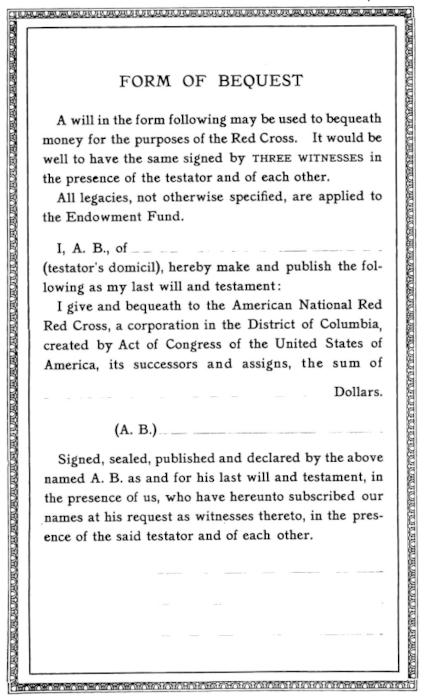
FORM OF BEQUEST
THE AMERICAN RED CROSS MAGAZINE
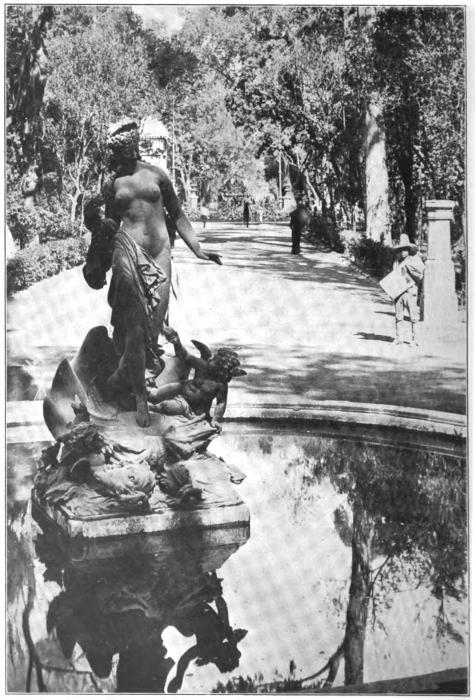
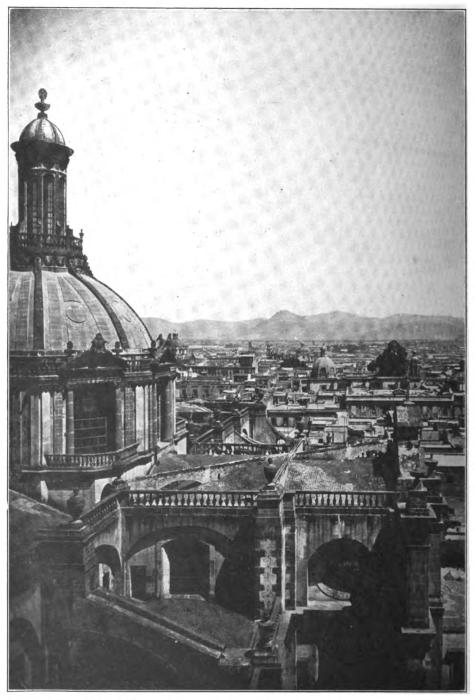
ALAMEDA PARK, MEXICO CITY,
SCENE OF FIGHTING IN RECENT REVOLUTION.
Opinion and Comment — NEW NAME, NEW PAPER, NEW DEPARTMENT — MAYOR GAYNOR’S SOUTHERN FLOOD RELIEF COMMITTEE — CINCINNATI CHAPTER WIDE AWAKE — CHAPTER NEWS WANTED FOR PUBLICATION — RED CROSS LAW AND THOSE WHO VIOLATE IT — OUR COUNTRYMEN’S SPLENDID SERVICE IN TURKEY — BRIGADIER-GENERAL CARROLL A. DEVOL, U. S. A. — PHYSICIANS WILL HELP THE RED CROSS — THE FORTY-NINTH STATE BOARD — THE RED CROSS IN BALTIMORE — THE RED CROSS BUILDING
Unless attention is specifically
called to the fact, our readers may
not notice that with this issue they
receive a Magazine instead of a
Bulletin. That time-tried query of
the cynic, “What’s in a name?” may
be flung at us, and our answer will
be that the contents and character of
this publication are more in keeping
with the accepted idea of a magazine
than of a bulletin. At any rate,
we like the new name better than
the old, and we hope our readers will
approve our taste. But whatever may
be the verdict upon the slight change
of name, we feel assured that we
shall hear only approval of the
heavier and better paper on which
the magazine is printed. We hope
also that the new department of
“Opinion and Comment” may prove
acceptable. Furthest from our
thought is any idea that the Magazine
is perfect, and any concrete suggestions
of improvement which readers
may offer will be cordially received
and given careful consideration.
During the Mississippi River flood
in the spring of 1912, Mayor Gaynor,
of New York, appointed a committee
to collect money for relief purposes.
Mr. Robert W. de Forest, head
of the New York County Chapter of
the Red Cross, was made chairman,
and Mr. Robert Adamson, the Mayor’s
secretary, became secretary of the committee.
Among the prominent members
were officers of the New York
Southern Society. This committee
undertook its duties with such vigor
and effectiveness that it became much
the largest contributor to the flood
relief fund placed in the hands of
the Red Cross for expenditure. The
committee held its final meeting in
Mayor Gaynor’s office on January
21, 1913, when the secretary presented
an interesting account of the
work accomplished.
Money was received from all parts
of the country, although the greater
part was contributed by residents of
New York City. The New York
Southern Society received $14,281.05.
From this sum $10,000 was paid to
Mr. Jacob H. Schiff, treasurer for
the Mayor’s committee. The Southern
Society also paid all expenses of
the campaign for both itself and the
Mayor’s committee, amounting to
$1,612.49, and forwarded $600 directly
to flood sufferers. This left a
balance in the hands of the Southern
Society of $2,068.56, which later was
turned over to the Red Cross. Including
the $10,000 paid in by the
Southern Society, the Mayor’s committee
received a total of $67,322.39,
all of which was transmitted to the
Red Cross.
Summarizing the work of both the
Southern Society and the Mayor’s
committee it appears that the total
collections amounted to $71,601.44,
of which $600 went direct to the
flood district, $1,612.49 was paid for
expenses and $69,390.95 was turned
over to the Red Cross.
By invitation of the committee the
national director of the Red Cross
attended the final meeting and gave
an account of the relief operations as
carried on in behalf of the quarter
of a million persons whose homes
were affected in the 15,000 square
miles of country inundated.
Good news comes from the Cincinnati
Chapter of the Red Cross, where
Mr. Julius Fleischman is chairman
and Miss Annie Laws secretary. A
permanent office has been taken at
220 West Seventh street, and Miss
Hilda M. Reinecke, a well known
nurse, has been placed in charge.
Miss Reinecke will also serve as instructor
in home nursing, for which
classes are now being organized.
During the flood in Cincinnati in
January the Chapter participated
actively in relief operations in co-operation
with the committee appointed
by the mayor, who, by the
way, is an active member of the executive
committee of the Chapter.
Plans are in contemplation for other
important activities, and no great
prophetic power is required to predict
a useful career for the Chapter.
It is hoped to devote an increasing
amount of space in the Red Cross
Magazine to accounts of the work
and plans of Chapters. For this reason
chairmen and secretaries are invited
to send in reports and notes of
anything of interest in which the
Chapters are engaged or which they
are contemplating. In this way the
experience of one Chapter will be
made available for the help and guidance
of others. While establishing
policies and strengthening other parts
of the national organization the creation
and upbuilding of Chapters
have been necessarily retarded. It
is believed the time has come for a
vigorous effort to bring the Chapters
into their proper place of importance
in the Red Cross scheme of things.
Officers of Chapters are invited to
study the little handbook recently
published with a view to finding
suggestions for local activities
of an interesting and useful
character. It is to be remembered
that the handbook is not
intended to specify all the activities
permissible to a Chapter, but is meant
to define in a broad way the legitimate
field for Red Cross activities,
with a few suggestions of specific
lines of work which are consistent
with the purposes of the society.
The national director will be glad to
correspond with Chapters which
contemplate embarking in new work.
Reports or items of Chapter news
intended for the Magazine should be
sent to the national director.
That persons who use the name or
emblem of the Red Cross illegally,
do so, as a rule, in ignorance of the
federal law prohibiting such use,
and are quick to discontinue the violation
when their attention is called
to the statute, is a fact frequently
demonstrated. A recent instance in
point was that of the William Windhorst
Company, of Cincinnati. This
company had issued some attractive
advertising matter which contained
the Red Cross emblem. As soon as it
was informed that this was in violation
of law, the company took prompt
measures to recall and destroy the
objectionable printed matter and to
inform its customers that it holds the
American Red Cross in the highest
respect and would, under no circumstances,
knowingly infringe upon its
rights.
Another striking illustration of the
same spirit was that in which Mr.
Arthur Letts, proprietor of a large
department store in Los Angeles, not
only discarded all use of the Red
Cross in his own advertising, but
issued an order to his buyers that no
goods bearing the name or emblem
of the Red Cross should be purchased
or sold in his store.
Members of the American Red
Cross everywhere who observe locally
the use of the name or emblem on
signs or tags or vehicles or for other
advertising purposes are urged to
call the attention of the users to the
federal law which prohibits such use.
The secretary of the Red Cross in
Washington will always be pleased
to learn of such efforts and their results.
If a user declines to discontinue
the practice, the member of the
Red Cross who has called his attention
to the law is invited to send the
user’s name and address to the secretary
in Washington, together with a
description of the character of the
violation observed. A copy of the
law will be sent to any one on request.
Every member of the Red Cross
who reads the several short reports
from Turkey in this number of the
Red Cross Magazine must be stirred
by a deep sense of pride in the great
work of humanity which is being
carried on by the Constantinople
Chapter of the American Red Cross.
In the dreadful cholera camp of San-Stefano,
in the hospitals filled with
sick and wounded soldiers in Constantinople,
among the starving
refugees, children, women and old
men, in Salonica and Asia Minor,
the story is the same. Brave men and
women giving of their time and
strength and skill, disregarding danger
and hardship and forgetful of
their own personal affairs, are making
a record of effective accomplishment
under extreme difficulties in
that foreign country which should
touch the deepest springs of American
patriotism. Slight, indeed, as
compared to this splendid service is
our duty and privilege of giving
something of our abundance wherewith
to sustain these efforts.
When the Red Cross first knew him
he was Major Carroll A. Devol, U.
S. A. He was then performing a
herculean task in the relief of San
Francisco, and was doing the job in
such a manner as to arouse general
admiration for his executive ability,
his promptness and his calmness
under extremely trying conditions.
Since those days he has proved his
mettle in relief work for the Red
Cross following the great storm at
Hattiesburg and Purvis, Mississippi,
and after a great fire of two years
ago at Colon, Panama. On the Canal
Zone, where he has for some years
been United States Quartermaster for
the Canal Commission, he was instrumental
in establishing a very
active and efficient Chapter of the
Red Cross.
All this leads up to the announcement
that Major Devol, after promotion
to the rank of colonel, has now
been appointed a brigadier general,
and the Red Cross, could it express
itself through its Magazine, would
extend to him its hand in hearty congratulation
and good wishes. He
has been a strong and reliable friend
of the Red Cross at all times, and
through his unselfish devotion has
done much to advance its cause and
establish its good name. While his
well deserved promotion has come
as a result of eminent services in the
army, we shall no doubt be pardoned
for utilizing this opportunity of recalling
his great services to the Red
Cross.
In the Red Cross Magazine for
January, 1913, announcement was
made of the appointment, by
the American Medical Association,
of a committee whose duty it was
to confer with the American Red
Cross with a view to establishing a
comprehensive system of co-operation
between the Red Cross and the
medical profession of the United
States. The committee has proved to
be prompt and active. Following is
a copy of a circular letter which has
been sent to all the county medical
societies in the country. It will be
found to contain a clear outline of
the co-operative plan proposed by
the committee and approved by the
executive committee of the Red
Cross:
February 14, 1913.
To the Secretary,
County Medical Society,
Dear Sir:
The undersigned have been constituted
a committee by the President of
the American Medical Association to
cooperate with the American Red
Cross, in the matter of medical work.
The Committee feels that a great
deal of substantial good will come to
all communities by providing a body
of representative physicians of approved
qualifications to direct or participate
in medical work carried on
by the Red Cross in different localities
in times of emergencies and to
advise with the representatives of
that society on questions of medical
policy and procedure. Besides its
activity in emergency relief work, the
Red Cross is engaged in an educational
campaign for the mitigation
of human suffering and the saving
of lives. So far it has extended this
movement only to the teaching of
prevention of accidents and first aid
to the injured, but it is hoped in future
that it shall include popular instruction
in the prevention of disease.
These medical committees are not in
any way bound to this educational
work of the Red Cross, but members
of the committees who may be interested
are invited to correspond with
the First Aid Department of the Red
Cross.
In the opinion of this committee,
the plan may be properly considered
under the following headings:
1. Object. Primarily this service
is designed to meet local emergencies
when conditions of disaster are such
as to call for the intervention of the
Red Cross. When exigencies come
about in any community the Red
Cross would be glad to feel that it
might call upon carefully selected
physicians in that community to lend
their aid in the medical work incident
to the situation.
2. Organization. It is desired to
have in every county a central committee
of five physicians, two of
whom shall be the President and
Secretary of the County Medical Society,
ex officio. The President of
the County Medical Society shall select
the other three members, preferably
from the list of councilors or
of the executive committee. This committee
should be designated the
“Committee on Red Cross Medical
Work.” The names and residences
of the members, immediately after
organization, should be reported to
the chairman of the American Medical
Association. In case of disaster,
requiring relief action by the Red
Cross, these county committees will
be called upon to nominate qualified
medical men in their respective counties
for Red Cross service. The committees
will also serve in an advisory
medical capacity to the Red Cross in
time of disaster and in other lines of
Red Cross activity as indicated in a
preceding paragraph.
3. Qualifications. The certification
of physicians by County Committees
will be accepted as ample evidence
of the physical, moral and professional
qualifications of the gentlemen
recommended for appointment.
It may be pertinent to state that service
in time of disaster may entail
severe physical effort and physical
fitness of appointees to perform hard
work is, therefore, important.
4. Compensation. In some instances
the Red Cross may require the
services of physicians at a distance
from their places of residence and
for varying periods. Under these
conditions the Red Cross will be prepared
to pay traveling expenses and
a moderate honorarium to be agreed
upon between the physicians and the
National Director of the Red Cross.
It will be obvious to you that the
arrangement here proposed is primarily
intended to provide for emergencies
which may suddenly arise in
any community or, on the other
hand, may happily never occur. Thus
it may be that the committee which
we are inviting you to create may
never be called into action, while, on
the other hand, it may have occasion
to perform a very great public service.
Your cooperation in the completion
of this plan at as early a date
as convenient will be appreciated.
Please address all communications
bearing upon the contents of this letter
to the Chairman, Doctor George
M. Kober, care The American Red
Cross, 715 Union Trust Building,
Washington, D. C.
Very respectfully,
George M. Kober, M.D., Chairman.
F. A. Winter, Lt. Colonel, Medical Corps, U. S. Army.
E. M. Blackwell, Surgeon, U. S. Navy.
At a meeting of the Executive Committee
of the American National Red
Cross held in Washington, D. C.,
February 14, 1913, the foregoing plan
of cooperation between the medical
profession and the Red Cross was
unanimously approved.
George W. Davis, Major General, U. S. A., retired,
Chairman Central Committee.
Charles L. Magee,
Secretary.
Many replies are coming from
county medical societies indicating
a cordial acceptance of the committee’s
plan. It may be said, in this
connection, that the medical profession
has always been generous and
responsive in the highest degree in
all its relations with the Red Cross.
The purpose of the new plan is to
provide a simple system by means
of which this cordial relationship
may become more effective.
The New Mexico State Board of the
American Red Cross was appointed
on February 26, 1913, this being the
forty-ninth Board organized since the
inception of the State Board form of
organization.
Immediately the new States of Arizona
and New Mexico were admitted
to the Union the first steps looking
to the organization of Red Cross
Boards therein were taken. The cordiality
with which Hon. William C.
McDonald, Governor of New Mexico,
and Hon. George W. P. Hunt, Governor
of Arizona, entered into the negotiations
was keenly appreciated by
the Red Cross officers at Washington,
and it is hoped that the announcement
of the completion of the Arizona
Board will be made in the not
distant future. The membership of
the New Mexico Board is as follows:
Hon. William C. McDonald, Santa Fe, President.
Hon. Richard H. Hanna, Santa Fe.
Mr. Nathan Jaffa, Roswell.
Mr. John R. Joyce, Carlsbad.
Mr. H. S. Kaune, Santa Fe.
Mr. Owen N. Marron, Albuquerque.
Mr. W. D. Murray, Silver City.
A decision has not as yet been
made as to which of the above-named
members will be appointed Treasurer
of the Board, but no time will
be lost in putting the Board into
workable shape.
The past election brought changes
in the gubernatorial chairs of twenty-three
of the States in which the American
Red Cross has State Boards.
Men elected to such important positions
in the governments of the various
States must find little time at the
beginning for matters other than
those pertaining strictly to their new
offices, yet out of the twenty-three
new Governors fifteen have already
accepted the Presidency of the Boards
in their respective States. That the
Red Cross can make this announcement
gives it great satisfaction, and
it feels confident that the remaining
eight new Governors will also accept
the leadership of their State
Boards as soon as the first rush of
their new administration is over.
During the past year the State
Boards of Missouri, Kentucky, Tennessee,
Louisiana and Mississippi
again demonstrated, during the relief
work incident to the Mississippi
flood, as did that of West Virginia
in connection with the flood in the
Northwestern part of that State, the
value of the plan adopted by the
Red Cross and which comprehends
in each State a group of successful
business and professional
men to act as its financial representatives
and advisers in connection with
disaster relief work.
On another page will be found a
brief account of the recent great
dynamite explosion in Baltimore
with the relief measures which followed.
The incident offers an excellent
illustration of the adaptability
of Red Cross methods and of the fact
that the organization, though national
in scope and policy, is none-the-less
local in its relations and an
integral part of the community in
which its service is needed. When a
disaster is of such magnitude or
character that local agencies of relief
are prostrated or overwhelmed, the
Red Cross is prepared to provide the
necessary machinery for relief distribution;
in smaller disasters the
Red Cross simply joins hands with
other local agencies and lends its
strength and influence to concentration
of resources and cooperative
effort.
In time it is hoped that at least in
our larger cities and towns there will
exist Red Cross Chapters in affiliation
with all the local agencies that
can be utilized in case of disaster, so
that relief work at such times will all
become Red Cross work.
In the Red Cross Magazine for
January, 1913, appeared an illustration
of the beautiful building which
the Red Cross hoped to obtain
through the combined generosity of
the New York Commandery of the
Loyal Legion and the Congress of the
United States. The proposed building
was to be a memorial to the loyal
women of the Civil War and was to
become the permanent headquarters
of the American Red Cross.
The Loyal Legion offered to donate
$300,000 toward the memorial on
condition that Congress would give a
suitable site in the City of Washington.
A bill was accordingly introduced
in Congress to carry the plan
into effect by appropriating $300,000
for the purchase of ground. Everybody
was favorable and all conditions
seemed auspicious.
Those who have had opportunities
to observe legislation in the making,
are familiar with the fact that the
only certain thing about it is its uncertainty.
A resume of the career of
this particular measure affords a
shining example in point. The bill
was introduced in both Senate and
House in the spring of 1912, and was
referred to committees in the usual
manner. The Senate committee gave
prompt consideration to the bill, and
of its own accord increased the
amount of the proposed appropriation
to $400,000, after which it reported
it to the Senate, which passed
it without opposition. The Committee
on Public Buildings and Grounds
of the House, after hearings, submitted
a unanimously favorable report
to the House on the last day before
adjournment for the summer of 1912.
When Congress met in December,
1912, the status of the Red Cross
building bill seemed most fortunate.
It had passed the Senate without opposition
carrying an appropriation
of $400,000. The House Committee
had unanimously accepted the Senate
bill and had recommended it for passage.
All that remained was for the
House to pass it and the President to
attach his signature. The road looked
straight and easy and not very long,
with a bright blue sky overhead.
And then something interfered
slightly with the forward movement.
Many other bills with many active
congressmen behind them crowded
into the foreground. There seemed to
be no opening for the Red Cross bill
to slip through. Big bills for the support
of the vast governmental departments
had to be given precedence.
Time flew and congressmen began to
refer to the fact that it was a short
session with much to be done. Also
the leaders began to urge economy in
appropriations.
It was found impossible to get a
definite place or date set for a vote
on the Red Cross bill. At one time
it was proposed to try to call it up by
unanimous consent, but nothing
came of that. Then those in charge
thought better to abandon it as a distinct
measure and insert it as an item
in the big Public Buildings and
Grounds Bill, which contained appropriations
for many buildings.
Later the cry of economy became
more strident and the plan for the
Red Cross bill was again changed.
Now it was decided not to bring it
forward in the House but instead to
pass the Public Buildings and
Grounds Bill in the House without it
and let it be inserted by the Senate
when the big bill reached that body.
It is customary for the Senate to
add numerous items to bills of this
character after the House has passed
them. Then the bills as amended by
the Senate must go back to the House
for the House to accept the Senate
amendments. If the House declines
to accept the Senate amendments a
committee is appointed from each
side to confer and try to agree on the
items in dispute. Usually both Senate
and House accept the recommendations
of the conference committees.
So the House passed the Public
Buildings and Grounds Bill without
the Red Cross item and the Senate
was asked to insert that item. It did
so. Then opposition arose because
the Red Cross building was a memorial
to the loyal women of the Civil
War. It was argued that the Confederate
women were just as brave
and devoted and self-sacrificing as
the women of the North; that no memorial
should perpetuate sectional
feeling. The proposition was made
that the word loyal be eliminated and
that the building be a memorial to all
the women of the Civil War. This
could not be done, however, because
the gift of $300,000 by the Loyal
Legion was conditioned upon the retention
of the word loyal. A sharp
discussion followed with the result
that the Red Cross item was entirely
stricken out. A little later the subject
was reopened and the Red Cross item
was again inserted and remained
there when the Senate passed the bill.
The House refused to accept the
Senate amendments and a conference
committee was appointed. Several important
Senate amendments, among
them the Red Cross item, became the
subject of prolonged discussion. Congress
must adjourn on March 4th. It
was now March 3rd and it became
imperative that an agreement should
be reached. Finally the dispute had
narrowed down to this:
The House conferees would consent
to the passage of the Red Cross
item if the Senate would abandon the
item for the purchase of the Rock
Creek Valley in Washington for park
purposes. The Rock Creek Valley
purchase was of the utmost importance
to Washington. It had been
urged for years and there was no
question that it was of greater public
value at this time than the provision
of a Red Cross building. The Senate
forced to this hard choice wisely held
on to the Rock Creek Valley item and
the Red Cross item was lost.
Perhaps this story of high hope, of
keen suspense, of alternating optimism
and despair is not worth the
space here given to its relation. It is,
however, a tale of a gallant fight in
which the Red Cross won many
friends and made no enemies. Shall
it fare better in Congress another
year? Who so faint hearted as to
doubt?
Vivid Glimpses of the American Red Cross in Turkey — Fighting the Cholera at San Stefano — Situation in Salonica — Red Cross Work for Refugees in Western Asia Minor — Activities of the Red Crescent Society — Savages Four Hundred Years Ago — Faik Pasha Della-Sudda
Following are several illuminating extracts from reports recently received
from the fields of Red Cross activity in Turkey. The American Red
Cross has been extremely fortunate in the character of its representation
in this work. Some of those whose services have been particularly noteworthy
are mentioned in the statement below by Mr. G. Bie Ravndal,
American Consul General at Constantinople, who is also secretary of the
Red Cross Chapter in Constantinople. The composite picture of widely
extended and many-sided activity presented by these brief reports conveys
an impression of magnitude and importance which must gratify every
American who takes pride in the achievements of his fellow countrymen.—Editor
Red Cross Magazine.
By G. Bie Ravndal, American Consul General, Secretary Red Cross Chapter.
Our Chapter was just withdrawing
from the earthquake stricken
coast of the sea of Marmora,
where, owing to the generosity of
charitable Americans, acting through
the American National Red Cross, it
had been enabled to furnish medical
and other timely aid, as described in
my report of October, 1912, when the
wardogs were let loose in the Balkans,
and then began the initial
scenes of that terrible drama which,
during the winter, has monopolized
the attention of the world.
Hardly had the curtain fallen after
the first battles, which followed each
other in swift, unrelenting succession,
before the cholera began its
fearful ravages, competing with the
shrapnel in deadly work.
Thousands of families, mostly women,
children and old men, fled before
the onrush of soldiers from the
north. Their suffering on the trail
baffles all description.
No feature of the catastrophe
proved more heartrending than the
condition of affairs in the San-Stefano
cholera camp, in which masses
of sick and wounded soldiers were
thrown together after the battles of
Louleh Bourgas and Wisa. It is
gratifying to be able to report the
fact that it was Hoffman Philip, secretary
of the American Embassy in
Constantinople; Major Clyde Sinclair
Ford, of the Medical Corps
of the United States Army, and Frederick
Moore, of the Associated Press,
who taking their lives in their hands,
first undertook the heroic work of
organizing relief in this place of
horror. They were nobly assisted by
Reverend Dr. Frew, of the Scotch
Mission in Constantinople, by two
Swiss ladies, residents of San-Stefano,
Miss Alt and Mrs. Schneider,
and also by Hon. Maurice Baring, of
London. The details of the relief
furnished by our Chapter in the San-Stefano
cholera camp have been described
in letters by Mrs. W. W.
Rockhill, wife of the American Ambassador
at Constantinople, and I
shall not attempt to add to the information
submitted by her, as at
the time under report I was in the
United States. Mrs. Rockhill has taken
a leading part in the relief work instituted
by the Constantinople Chapter
in the present emergencies, and
the Chapter is deeply grateful to her.
Ultimately the San-Stefano situation
was taken in hand by the Red Crescent.
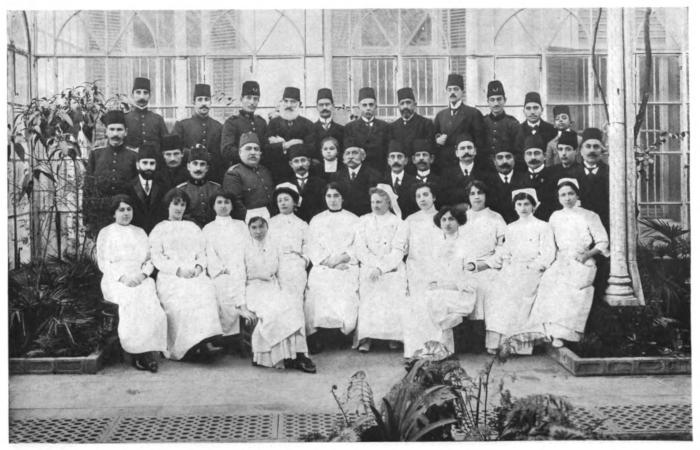
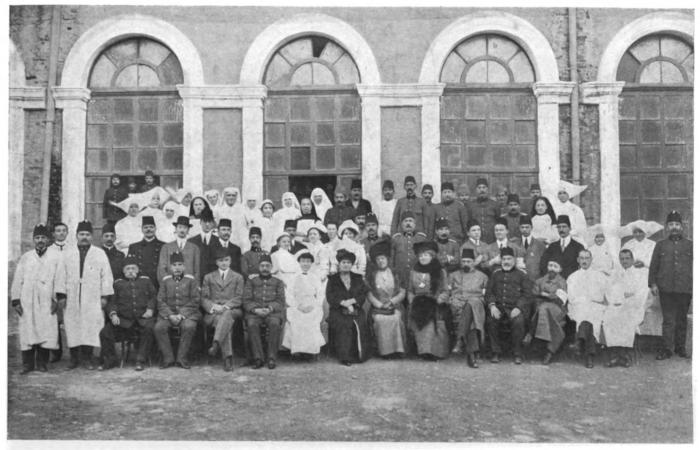
COMMITTEE OF NICHAUTACHE (SULTAN’S)
HOSPITAL.
EGYPTIAN RED CRESCENT MISSION UNDER
DR. MAX REICH.
Even before the San-Stefano need
had been discovered by Mr. Hoffman
Philip, whose action in this relation
cannot be too highly praised, the
Constantinople Chapter had established
two Red Cross wards for
wounded soldiers in the barracks at
Tash-Kesla in Constantinople, and a
fully equipped operating room. This
hospital work has been, and is still
being, conducted by Major Ford.
Major Ford came here while on leave
and generously offered his services
to the Constantinople Chapter. His
professional skill and administrative
experience have enabled the Chapter
to render invaluable help, which
otherwise could not have been furnished
by us, in saving lives and alleviating
suffering. Major Ford has
been ably assisted by D. Alton Davis,
secretary of the International Y. M.
C. A. in Constantinople; Dr. Walton,
surgeon of U. S. S. Scorpion, and Dr.
Kazakos, a graduate of Robert College.
Since Christmas the Chapter has
been giving special attention to the
“refugees.”
Dr. Wilfred Mellvaine Post, of the
American Medical Mission in Konia,
magnanimously volunteered to superintend
the Chapter’s efforts in the
field for the relief of refugees. Associated
with him is Miss Jeannie
Jillson, of the American School for
Girls in Broussa.
Next to Broussa, as far as the
Chapter’s present activities in behalf
of the refugees are concerned, comes
Salonica. Our relief work is also
being extended into Monastir and
Koricha in Albania.
Letter from Mr. E. O. Jacob.
Salonica, Jan. 3, 1913.
I trust you will forgive me for not
writing you earlier. My trip unfortunately
lasted 13 days. I had 5
days’ quarantine in Pireus and then
had to wait 5 days for a steamer, so
that I did not reach here till December
30. I found, as I had feared, that
the most urgent need was over, and
the work of relief in Salonica itself
was already pretty well organized.
It seems, however, that my services
will meet a real need at least for
some weeks. Some one is urgently
needed to visit the towns and villages
of the provinces and Mr. Haskell is
certainly the best man for that.
I am writing this letter also as a
sort of report, any material of which
you are at liberty to use. You have
already received, I understand, a copy
of the “Independent,” describing the
work of the “Societe de Secours aux
Refugies.” This is a quite modest
and impersonal description of the
work of Mr. Haskell, Mme. Christo
Hajji Lazaro and the association
whom they have gathered, namely,
Pastor Brunau, Mme. Yenny, the
wife of a Swiss merchant; Sister Augustine
of the Catholic Mission, and
lately Mr. van Bommel. They began
at once the collection of funds, the investigation
of the condition of the
refugees and the giving of bread. It
must have been a terrible task to locate
50,000 refugees, scattered as
they were all over the city, and still
more so to inaugurate a system of
distribution, for the imams of
mosques and the former Mouhtars of
different districts tried in every way
to turn the funds into their own
pockets. But by frequent and tiresome
inspections a fair degree of efficiency
is now maintained. The
committee has now the aid of three
native pastors, who are proving very
effective in tracing irregularities, removals
and other changes.
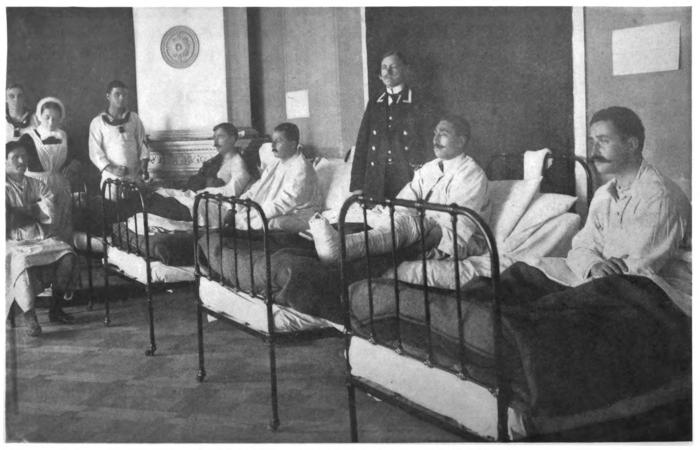
HOSPITAL IN CONSTANTINOPLE IN CHARGE OF
GERMAN OFFICERS.
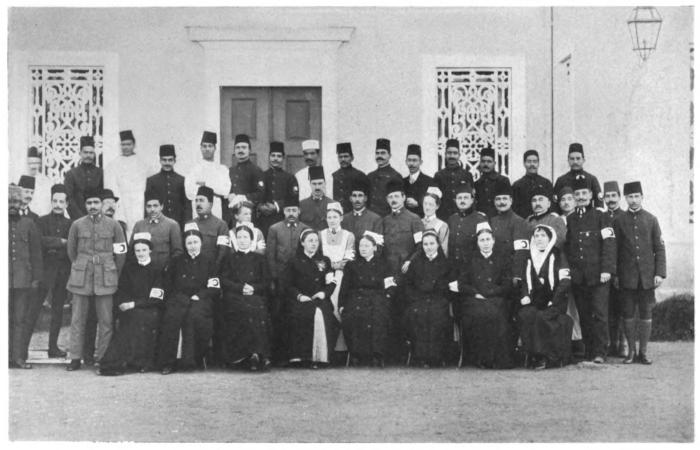
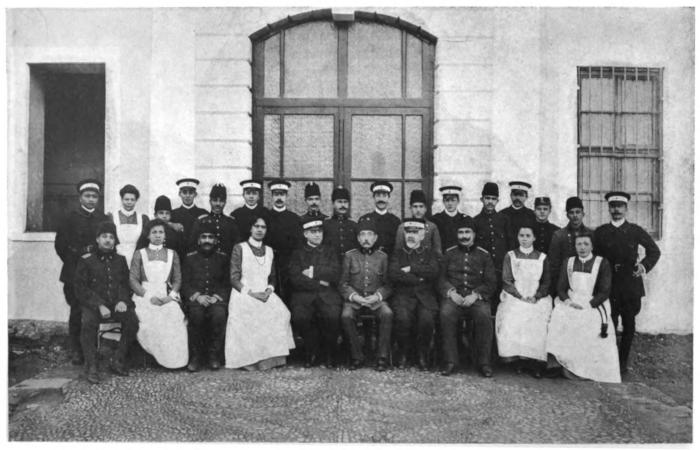
TASH-KESHLA HOSPITAL, CONSTANTINOPLE.
FRONT ROW (BEGINNING FIFTH FROM LEFT)—MAJOR FORD C. S. A.; TURKISH
DOCTOR; MADAME DEPAGE IN NURSING COSTUME; UNKNOWN LADY; MARCHIONESS
PALLAVACINI, WIFE OF AUSTRIAN AMBASSADOR; MRS ROCKHILL, WIFE OF AMERICAN
AMBASSADOR; DR. DEPAGE.
This group of people has thus far
had to confine its activities to the
giving of bread, the most immediate
necessity of the unfortunate “muhajjirs.”
For a long time they gave at
the rate of 9 ounces per person per
day, surely a minimum ration. Since
this week it has fortunately been possible
to raise the rate to 12 ounces a
day. Four distribution centers are
operated, the people coming to these
places for their allowances. At the
one where I am working we are now
distributing 2,700 loaves a day. The
total daily distribution is 8,000 loaves
and costs a little over 100 Lt. a day.
In certain directions the financial
support has been very encouraging.
The largest giver, unofficial, of
course, is the Greek government,
which has put into the hands of this
society about 180,000 francs. Queen
Olga has in addition given the good
sum of 40,000 francs out of her own
purse. From Holland came, as the
result of an unsolicited appeal from
the Dutch Red Cross Mission here, 25,000
francs. The American Red Cross
is credited with about Lt. 350 and
about 7,300 francs have come to Mr.
Haskell from friends in Switzerland.
So up to the present the work has
been maintained without a deficit.
It seems clear, however, that as the
harder part of the winter comes, aid
will, in many instances, have to be
given in other ways than the one I
have mentioned, as 12 ounces of
bread a day will not indefinitely keep
the body and soul together. Thus far,
in fact, most of those who have received
aid have enough money for a
little salt and a few olives, for a few
candles and a bit of charcoal. But
lately we get the complaint more and
more frequently that these resources
are exhausted and that the bread
ration no longer suffices alone. Once
in two weeks, in fact, each person
gets a half bowl of soup. This is
made possible by a very efficient little
soup kitchen which the Catholic
sisters have opened. But this, too, is
certainly only a trifle. Again, as wintry
weather comes, we get calls for
clothing, bed quilts, etc. Practically
nothing has yet been given in this line.
I have thus far been speaking exclusively
of the people under the care
of the “Societe de Secours.” There
is also in the city an “International
Committee,” which has been taking
up other sides of the same work. It
has, for example, in operation an
observation camp for those who have
been exposed to smallpox. It also
charters steamers to convey to Asia
Minor free of charge those who wish
to seek employment there. I had a
long interview with Mr. Forbes in
Smyrna and brought to the committee
details about his offer to employ
several thousand men in licorice digging.
They are therefore now sending
him a first load of 1,100 persons
by the steamship Assouan. It strikes
us all that to give them like this an
opportunity for steady work is about
the best service that can be rendered.
The largest enterprise of this committee
is the maintenance of a concentration
camp, which houses 6,000
refugees. Though they have to live
in tents they are otherwise under the
best of care. The government is military,
the sanitary conditions are excellent
and everyone directly under
the eye of the workers. Unfortunately
the operating cost of this camp
(about Lt. 80 a day) is so great that
the scheme cannot be extended to the
others. This committee, moreover,
finds itself in a less encouraging financial
condition than the “Societe,”
and with a deficit already on hand,
is not venturing beyond its present
range of work.
Then, finally, the needs of the
towns in the provinces are begging
to be brought to our attention. In
many respects they are more sadly in
want than Salonica itself. Naturally
the armies have absorbed all the
available foodstuffs. Moreover, dozens
of villages have been burned to
the ground and many towns have
been quite thoroughly looted. The
same sort of story comes from all the
surrounding regions, Monastir, Uskub,
Strumitza, Brama, etc.
The British Balkan Committee has
begun to help in several places. Mrs.
Lazaro has gone with a member of
the Macedonian Relief Committee to
Gumendje, and Mr. Haskell expects
to start next week on a two weeks’
tour in the region of Strumitza. Those
trips should make clear just what the
most urgent needs are.
Part of a letter from Dr. Wilfred M. Post.
The number of refugees who have
passed over from European Turkey
into Western Asia Minor since the
commencement of the Balkan War is
probably in the neighborhood of 56,000;
the large majority of these have
settled in the Broussa vilayet, a
smaller number having found their
way to the Konia and Angora vilayets.
Most of the refugees have
traveled by rail, their carts and oxen
having been carried with them at the
expense of the government, but a
fair proportion have “trekked” into
the interior all the way from European
Turkey, spending several weeks
on the journey. The main distribution
is along the line of the Anatolian
railway, the usual plan having
been for a definite number to be allotted
to each city or large town
along the line, and then sent off as
fast as possible to the villages—a
few families to each village—the
government hoping by this arrangement
to cause the refugees to amalgamate
with the Anatolian population,
and also by allotting a few families
to each village, to throw the burden
of maintenance on the people and
avoid the problems arising from concentration
in large camps and settlements.
This policy has been carried
out most thoroughly and the many
hundreds of villages from one or two
hours to two or three days distance
from the railway have almost all received
their quota of unfortunates
to care for, an exception having been
made for the Christian villages, few,
if any, of the latter having been thus
called upon.
About a quarter or a third of the
refugees have come with some personal
clothing and bedding, and with
some property in the shape of carts
and oxen, cooking utensils and
money. These have been allowed to
shift for themselves, but the remainder
have arrived in the interior
in more or less wretched condition,
having little or nothing but the
clothes they wear, and in many cases
only half-clad and in very poor condition
to meet the rigors of the cold
Anatolian winter. As long as this
class of refugees remains in cities
the government makes regular distributions
of bread to them, about 50
paras’ worth to each adult, and 25
paras to each child per day, in some
cases giving the money instead of the
food, but as soon as the refugees
have been shipped off to the villages
the government ceases to distribute
help.
HARBIE HOSPITAL.
ESTABLISHED BY DUTCH RED CROSS MISSION UNDER DR. LINGHEEK.
Those refugees remaining in the
cities have also been scattered as extensively
as possible, a notable instance
being Konia, where 2,500 people
have been scattered all over the
city and surrounding gardens, a few
dozen having been put into each
“mahle” or quarter of the city, so
that it took a week of careful search
and inquiry to obtain statistics that
were anywhere near accurate. This
extensive scattering makes the work
of relief very difficult; nevertheless
much has been accomplished already
and by systematic canvassing by
American missionaries and native
agents it is hoped that much of the
suffering and need of the refugees
will be discovered and relieved.
Relief of over-crowding, supply of
adequate clothing and bedding,
opening of soup kitchens and supply
of food other than the dry bread
given by the government, distribution
of fuel and medical aid, indicate
the principal lines along which the
Red Cross must work for the next
two or three months. The officials
everywhere express the hope that
they will be able to send the refugees
back to Europe for the spring, but, of
course, nothing definite can be
planned as yet. Whatever may be
the political outcome of the Balkan
war, a large number of the refugees
will undoubtedly remain in Anatolia,
and the Red Cross may then consider
the advisability
of providing
employment
for these people,
supplying
them with farm
implements,
etc. The large
majority of the
refugees are women
and children, many of
these having been rendered
widows and orphans
by the war; the few able-bodied
men who have come have
for the most part, been drafted into
the Turkish army and sent to Chatalja,
so that the question of employment
will have to be considered
later on. A few of the refugees
are able to earn money by carting
wood and grain, using their primitive
oxcarts for the purpose, but
most of them are idle, and on account
of the great scattering
throughout the country they must,
unfortunately, remain so for some
time to come. It is most fortunate
that the general health of the refugees
is good, and from the hygienic
standpoint the policy of scattering
has no doubt been a good one. There
are, of course, many cases of sickness
among them, and in the process
of investigation we have found many
people at the point of death from exposure
and cold, the most pathetic
cases being among the children. Here
again the scattering makes it impossible
to do much visiting, and though
the communities may
be saved from epidemic,
many individuals,
sad to say, will
perish from cold,
hunger and
disease this
winter.
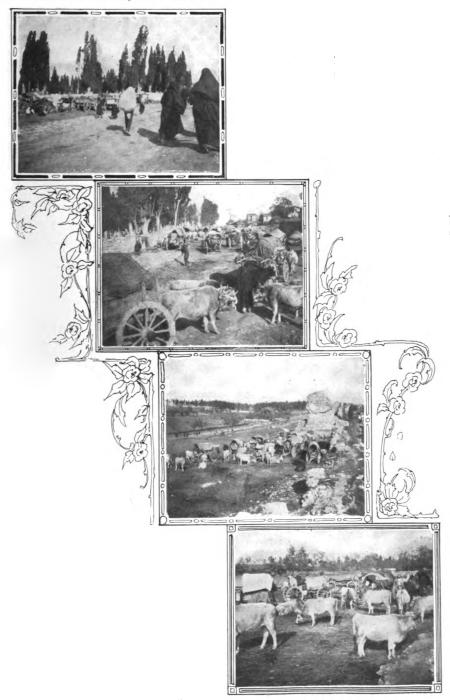
MACEDONIAN REFUGEES
FLEEING TO CONSTANTINOPLE.
Our investigations
have
been confined
chiefly to the
cities, where
several hundreds or thousands of
refugees are gathered, but we have
also looked into the condition of a
dozen or more villages and have
found that in general the villagers
have been kind to the refugees and
have given them food and shelter,
and have lent them clothing and
bedding; but in some places the villagers
have thrust the refugees into
stables and broken-down hovels, with
little or no clothing and bedding, and
just enough food to keep body and
soul together. In some instances the
unfortunate, defenceless women and
girls have been forced into prostitution.
The Constantinople Chapter of the
American Red Cross has established
relief work in Konia and Broussa
along the lines indicated above. In
Konia a systematic canvass of the
city and surrounding villages has
been made, and bedding and clothing
distributed according to need; in
many cases eight or ten people were
found sharing one quilt, and women
and children walking about the
frozen streets with bare feet. For people
in the city we distributed tickets
having the articles they were to receive
indicated on them, and the distribution
was made on the mission
premises. The government, however,
forbade us to carry on independent
work and insisted that all
articles for distribution must be
handed over to them; we were unwilling
to accept this condition, so
work was stopped for the time being.
In Broussa an effort has been made
to get the people into more sanitary
quarters than they now occupy; we
found many places where eight, ten
and even twelve people were packed
into a tiny mud-floored room about
ten feet square, damp and dismal,
and with one or two of the family
sick—in one case three people, one
with ulcers and two with dysentery,
reposing under one small and filthy
quilt. Not only must these people be
gotten speedily into more healthy
surroundings, but some sort of sanitary
supervision must be established
over the quarters to which they are
to be removed. It is our expectation
to open one or more soup kitchens
and inaugurate some medical work.
We have turned over the city of
Eski-Shehir to the Germans, who
promise to attend to its needs and to
those of the surrounding region. We
hope through the above arrangements
to get into direct touch with
more than half the refugees in Asia
Minor, and trust that where our work
is unable to reach them other helpers
may come forward to tide them over
this first difficult winter.
The Turkish Red Crescent Society
has come forward so nobly during
the present war that it has delighted
observers by the depth and force of
its vitality. A national institution of
humanitarian aims, it had been
recognized as such in the Geneva
Conference of 1864—but though it
had worked efficiently in the Russian
and Turco-Greek wars of the last
century, it is only lately, through the
impulsion given to it some years ago
by Mrs. Rifaat Pasha, wife of the
present Turkish Ambassador in Paris,
that its more modern organization
and increased capital have brought it
to the front, able to compete in usefulness
and resource with the Red
Cross Societies in other countries.
The society is managed by a Central
Committee, composed of 30
members, subject to the approval of
a president and to the occasional control
of the government. At present
His Excellency Hussein Hilmi Pasha,
Ottoman Ambassador in Vienna, is
president of the Red Crescent.
At the beginning of the Turco-Balkan
war the Red Crescent Committee
founded three hospitals for the
wounded—one numbering over 600
beds—in the capital of the Empire,
and several in the provinces, notably
at Salonica, Adrianople, Uskub,
Loule-Bourgas, etc., appointing well-equipped
staffs of nurses and doctors.
The necessary surgical instruments
and medical supplies were procured
from abroad, and recently ambulances
were ordered from South
Bend, Indiana. Four transportable
hospitals of 100 beds each were received
from England, and following
the example set by European nations
in such cases, the Red Crescent established
field kitchens in the principal
camps, which supplied the harrassed
soldiers with soup and bread.
When the cholera broke out among
the hapless troops, and they were
sent back to Constantinople for treatment,
the society organized three
more new hospitals in the choleraic
centers of Hademkeny, San-Stefano,
etc., and as the sick soon filled to
overflowing the epidemic wards
hastily founded in the capital, the Red
Crescent had the mosques of the city
opened to the sufferers and supplied
them with food, linen and medical
care. It is computed that about 3,000
soldiers were supported in these improvised
hospitals between the beginning
of October and the end of
November, 1912, and in this heavy
task the Red Crescent was assisted by
its branch missions of Hindoustan,
Egypt and England, who took their
full share of the heavy nursing and
relief work. Besides the hospitals
thus run, the Red Crescent sent Lt.
7500 in cash to the military sanitary
authorities of Constantinople, as
well as very numerous suits of clothing,
articles of bedding and medicinal
supplies.
The arrival of the refugees in Constantinople
created a new and tremendous
demand for aid. The Red
Crescent immediately forwarded another
Lt. 7500 to the prefecture of
the town, and housed thousands of
the unfortunate emigrants in old
Konaks (palaces) and in temporary
sheds. Committees of investigation
and distribution were organized in
the chief provincial centers to which
the government sent the refugees and
bread or money doled out.
The Ladies’ Section of the Red
Crescent Society has proved most
active on behalf of the patients and
refugees. Societies were formed for
the cutting and sewing of linen, of
which the hospitals were continually
in need, and the garments made
reached the total of 70,000.
The foregoing facts (culled from
the columns of the Jeune Turc), brief
and incomplete as they are, suffice to
show, however, that the energies of
the Red Crescent Society have been
severely taxed during the present
terrible happenings, and it is an act
of justice as well as one of keen satisfaction
to say that these energies
have been not drained but richly developed
by the call made upon them.
In the present emergency the Red
Crescent has been generously supported
by the Red Cross Societies of
different countries. Sisters of the
Red Cross and the Red Crescent have
worked shoulder to shoulder in alleviating
suffering, as shown by the
photograph herewith inclosed of the
Imperial Hospital in Nichantache,
Constantinople, kindly furnished by
the Phebus Atelier.
Writing from Konia, January 15,
Dr. Dodd sends in the following
about an old Moslem priest:
“An old Turkish hodja named
Saduk Effendi called today and said
he came for the special purpose of
asking me to give his thanks to the
people in America who are sending
help to the poor here. I report his
words as near as I can do so. ‘May
the Lord of the Universe, the God of
all men, who are all of one family
on this earth, look graciously upon
those who have shown such love and
kindness. The servants of God here
will always remember and rejoice in
these good deeds. How wonderful
that a people that were only savages
four hundred years ago should have
awakened to such noble deeds!
When shall we have such an awakening?’”
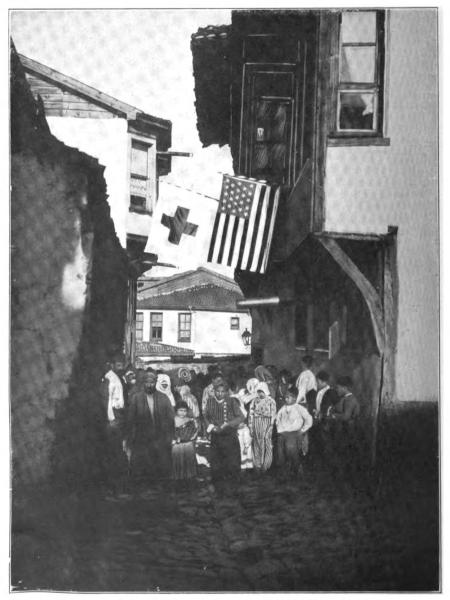
AMERICAN RED CROSS WORK IN BROUSSA.
REFUGEES WAITING OUTSIDE THE PROTESTANT SCHOOL WHERE CLOTHING
AND BEDDING ARE DISTRIBUTED. A CLINIC IS HELD EVERY AFTERNOON
IN THIS BUILDING AND PATIENTS OBTAIN THEIR MEDICINES
FREE OF COST FROM THE DRUG STORE AROUND THE CORNER.
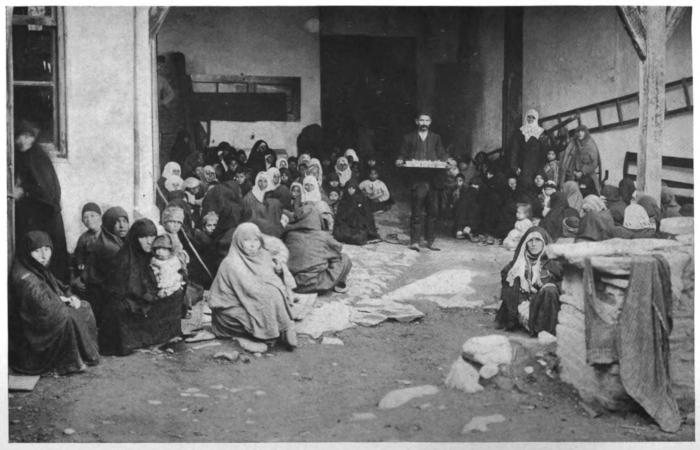
WOMEN AND CHILDREN REFUGEES IN THE COURT OF
THE PROTESTANT SCHOOL IN BROUSSA.
DISTRIBUTION IS MADE FROM THE ROOM AT THE LEFT. TEA IS BEING SERVED WHILE
THE PEOPLE ARE WAITING. SEVERAL OF THE WOMEN ARE SEEN COVERING THEIR FACES
OR TURNING THEIR BACKS TO THE CAMERA, BUT THE MAJORITY MAKE NO OBJECTION TO
HAVING THEIR PICTURES TAKEN.
One of the prominent Constantinople
personalities, Faik Pasha
Della-Sudda, died on Jan. 11, 1913. He
was the founder and honorary president
of the Red Crescent Society,
which during many difficult years
owed its subsistence to his devoted
management, and the American
Red Cross Magazine is indebted to
his courtesy for the interesting article
on the Red Crescent, published in
Vol. 5, No. 3. of 1910.
Born in 1835, Faik Pasha Della-Sudda
was sent when scarcely sixteen
to France, where he studied
under the famous chemist, Ganot.
He completed his training at the Superior
School of Pharmacy, Paris,
and at the laboratory of Wurtz &
Gerhard, and on his return to Constantinople
was immediately appointed
to the post of professor of
chemistry at the Imperial University
of Medicine in that city. For nearly
half a century he personally conducted
most of the pharmaceutics
and chemistry classes in the capital
of the Ottoman Empire, with a range
and depth of knowledge that has
been universally recognized and appreciated.
His important treatises on ammonium,
phosphoric acid, opium and the
falsification of pharmaceutical products
in Turkey, his contributions to
European and American exhibitions,
made his name well-known abroad,
and in 1910 he was unanimously
elected honorary president of the
newly-organized “Society of Pharmacists
in Turkey,” in proof of the
grateful affection of colleagues and
pupils, and of his own superior
scholarship and value. He leaves behind
him the record of a long life
admirably spent.
Red Cross and White Cross in Mexico
Ernest P. Bicknell, National Director American Red Cross.
During the culminating scenes of
the recent revolution in Mexico,
when the capital city was torn by
heavy artillery warfare in its central
streets and plazas, and which resulted
in the tragic death of President Francisco
I. Madero, the press dispatches
referred occasionally to the activities
of the Mexican Red Cross and the
Mexican White Cross. These dispatches
were of a character to sadden
the friends of the Red Cross
movement, because they indicated a
failure on the part of the federal
troops to respect the Red Cross flag
and because they revealed a defection
of some who should have been
a part of the Red Cross, but who, instead,
divided the strength and prestige
of humane Mexico by organizing
the White Cross Society, whose
functions are identical with those of
the Red Cross.
It is reported that while engaged
in giving attention to wounded men
in the plaza before the National
Palace, the president of the Red Cross
was shot and killed. It has also been
stated that two members of the White
Cross Society were captured by the
troops under the command of General
Diaz and were found to be engaged
in carrying ammunition, and
that for this reason they were executed.
Without more complete
knowledge of local conditions and in
consideration of the terrible confusion
which prevailed in the City of
Mexico in those days of fighting, it
would be unjust to endeavor to fix
the blame for these unfortunate incidents.
With the establishment of a stable
government and the coming of peace
it is hoped that the Mexican Red
Cross may be given its proper status
and recognition, and that those who
have heretofore served under the
banner of the White Cross may be
induced to dissolve that organization
and join hands heartily with the Red
Cross.
The origin of the Mexican White
Cross dates back to the revolution
which Francisco I. Madero led
against the government of Porfirio
Diaz. As a result of the severe fighting
between the insurgent and federal
forces along the United States border
in the spring of 1911 many men
were seriously injured. At that time
no systematic medical service was
provided by either army, and the
Mexican Red Cross, which had been
organized only a short time previously,
had not undertaken to send
nurses and physicians to the front.
The situation at the threshold of the
United States, particularly at the
California boundary and near El
Paso, Texas, became so serious that
the American Red Cross undertook
to provide physicians, nurses and
hospital care for such of the wounded
men as could be reached without
going into the interior of Mexico.
This service of the American Red
Cross along the border in California,
Texas, New Mexico and Arizona
aroused a sense of pride among many
of the people of Mexico, with the
result that a group of friends of the
insurgents organized a body of
nurses and physicians to be sent to
the scene of the fighting. To the
new organization was given the
name of the Mexican White Cross.
At about the same time that the
White Cross was organized, the Red
Cross also prepared to send nurses
and physicians to the front. The
White Cross group reached Juarez,
across the boundary from El Paso,
only twenty-four hours before the
arrival of the Red Cross group. At
that time it was a matter of current
report that the White Cross promoters
and supporters were favorable
to Madero and his cause, and that
the Red Cross, having been created
under the administration of President
Diaz, inclined to favor the
federal cause as against that of Madero.
The representatives of the two
organizations on reaching Juarez
were not cordial to each other, and
a strong feeling of rivalry was apparent.
In justice to both organizations,
however, it should be said that
at a conference held in Juarez at the
suggestion of representatives of the
American Red Cross, an arrangement
was made by which the work to be
done was divided equitably between
the two, and that thereafter they
worked side by side, zealously and
seemingly without friction.
While the facts are not known, it
is possible that the failure of the
Madero troops, in the recent fighting
in the City of Mexico, to respect the
Red Cross flag in some measure resulted
from the reported partiality
of the Red Cross for the Diaz government
when Madero was the leader
of the insurgents. On the other
hand, General Diaz, in the recent
Mexican fighting, may have been the
more ready to deal harshly with the
representatives of the White Cross
because of the fact that the White
Cross had been reported to be particularly
friendly to the cause of Madero
when Madero was fighting
President Diaz, uncle to General Diaz,
leader of the uprising which overthrew
Madero.
But whatever may have been the
causes which led to a division of the
humane people of Mexico into the
camps of the Red Cross and the
White Cross, it is not to be forgotten
that their objects were humanitarian
and at bottom identical. With the
coming of peace and the restoration
of normal conditions of life in the
Republic of Mexico, there is every
reason to hope that rivalries may be
forgotten and that there may come a
splendid union of all the humanitarian
forces of the country under the
emblem of the Red Cross.
In the closing days of the Madero
government, while fierce and ruthless
war raged in the streets of the City
of Mexico, lives and property of
American residents were in extreme
peril. United States Ambassador
Henry Lane Wilson gave every possible
assistance and protection, but
at best many were without resources
and were unable to escape from the
city or country unaided. The American
Red Cross, on receiving information
of these conditions through the
Department of State, forwarded
$1,000 to Ambassador Wilson to be
expended at his discretion for the
benefit of Americans in need. Many
Americans who succeeded in reaching
the city of Vera Cruz were unable
to pay for steamship passage to the
United States, and for their assistance
the Red Cross also sent $500 to
William W. Canada, American Consul
General of that city, to be used
as required for their help.
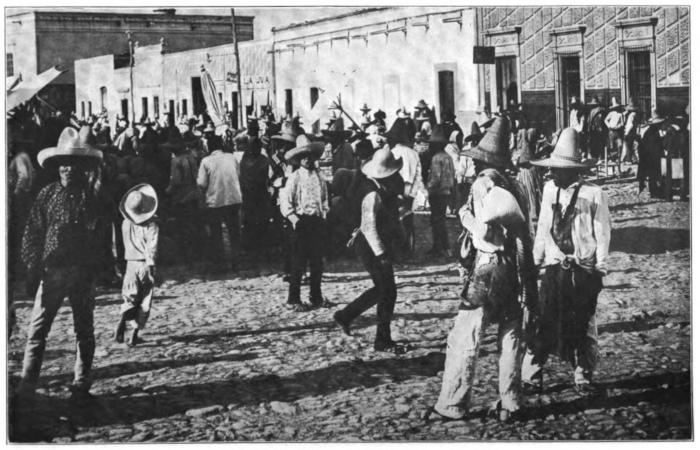
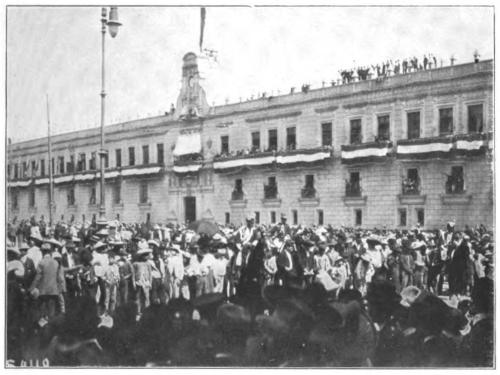
PLAZA IN FRONT OF NATIONAL PALACE, MEXICO CITY.
PRESIDENT MADERO ADDRESSING THE CROWD FROM BALCONY.
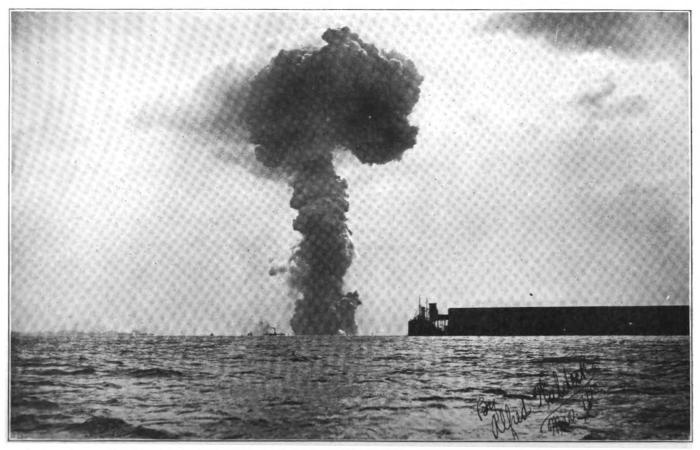
A tramp steamer, the Alum
Chine, lay peacefully at her
dock in Baltimore Harbor on
March 6, while a gang of stevedores
loaded her with dynamite for use in
the Panama Canal. The boxes of
the explosive were being transferred
to the hold of the ship from cars
which stood on a barge alongside.
About 300 tons of dynamite were on
board or in the cars when smoke was
seen coming from below. Knowing
the inevitable result the men leaped
overboard with a rush but before all
had reached safety the explosion
came.
No words can convey any adequate
conception of the terrific destructive
power of such a sudden loosing of
immeasurable force. The Alum Chine
and the barge with its cars alongside
disappeared. Other vessels in the vicinity
were shattered. Men upon the
deck of a new ship five hundred feet
away were swept down like tall grass
in a gale and a rain of fragments of
iron and wreckage killed some, injured
many and pierced the steel hull
like shots from a cannon. Houses
miles away were rocked to their
foundations and windows were shattered
without number.
REMARKABLE PHOTOGRAPH TAKEN AN INSTANT
AFTER THE EXPLOSION OF 300 TONS OF DYNAMITE WHICH HAD BEEN LOADED ON
BOARD THE “ALUM CHINE” FOR SHIPMENT TO THE CANAL ZONE.
Immediate measures of relief were
undertaken in behalf of the families
of the thirty-one men killed and the
fifty-eight injured. The Baltimore
Chapter of the Red Cross held a meeting
and appropriated $500 while the
newspapers were equally prompt in
collecting funds. By common consent
the Federated Charities, with its
experienced agents, was given charge
of the gathering of the information
necessary to effective action as well
as of the actual relief distribution.
The next logical step was the consolidation
of all contributed funds
from whatever source. Thus efficiency
and community unity of action
were assured from the start.
With this beginning it may be confidently
expected that the greatest possible
good will result from the generosity
of the Baltimore people.
Public Works and Relief in China
In general a report of relief operations
published long after the
public interest in the emergency
which called for relief has subsided,
is regarded as a good example of what
not to read. When an exception is
found, it is entitled to special notice,
which accounts for this reference to
the report of the Central China
Famine Relief Committee, embracing
an account of the relief operations in
the famine district in China between
October 1, 1911, and June 30, 1912.
It will be recalled that the headquarters
of the committee were in Shanghai
and membership included many
well known American and other foreign
residents of China, as well as
prominent Chinese citizens. Bishop
F. R. Graves was chairman and
Rev. E. C. Lobenstine, secretary, and
Consul General Amos P. Wilder an
active member. These three gentlemen
are Americans. At the outset of
its work the committee adopted a
program stated in six articles. Two
of these articles were:
“That relief be given only in return
for work done, except in the
case of those incapacitated for work.”
“That in the selection of work,
preference be given to such work as
will help the locality permanently,
and as tends to prevent the recurrence
of famine conditions, and that
each piece be complete in itself.”
This program was closely adhered
to from first to last. District subcommittees
of representative foreign and
native residents, appointed in various
sections of the famine region, had immediate
charge of the relief works
and distribution, and under the district
committees were superintendents
who had personal direction of the
working forces. So much for the
machinery. Now for the accomplishment.
In May, 1912, the number of famine
sufferers in the employ of the relief
committee was 110,000. As but one
member was employed from a family,
it is estimated that this work supported
about 550,000 persons. The
character of the work undertaken and
its extent are indicated by the following
figures from the report:
Dykes built or repaired
129
miles
Canals built or repaired
63
miles
Ditches built or repaired
1,124
miles
Roads repaired
163
miles
Cubic yards of earth moved
10,155,000
It was estimated that the average
amount of work performed daily by
a famine sufferer was about two-thirds
the average day’s work of a
coolie under normal conditions. In
Hankow 2,000 women from the
famine district were employed for
months in making garments, of
which 64,000 were made and distributed.
Much space is given in the
report to a description of the actual
methods of conducting the work on
dykes, canals, etc. A single extract
must suffice here:
“Now come with me to the works.
First in number and importance are
the dirt pushers (I translate the
Chinese term), who dig the earth
from rectangular pits and push it on
their wheelbarrows to the new dykes.
They number 3,400 and work in
groups of about ten men each and are
paid by the job in this way. As soon
as a pit reaches a depth of four or
five feet it is measured by the foreigner
in charge and the head man of
the ten is given a ticket which is
really an order on the office for the
value in grain of the work done.
Measuring these pits takes almost all
of one foreigner’s time, and as two-thirds
of the workmen are dirt pushers,
the foreigner has in his direct
control that fraction of the whole.
The dirt pushers receive 450 cash per
fang of 100 cubic feet. In this and
the following statement it should be
remembered that it takes about 2,500
cash to make a gold dollar.
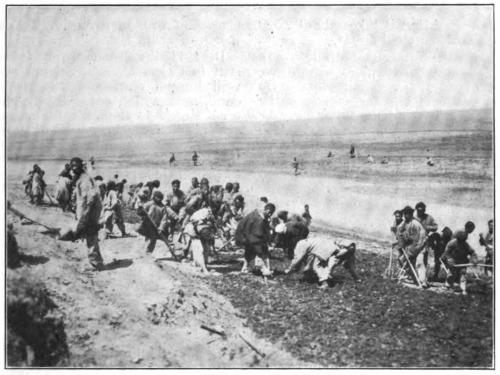
CHINESE ENGAGED IN BUILDING DYKES FOR
THE PREVENTION OF FLOODS IN THE FAMINE DISTRICTS.
TAMPING EARTHWORK.
“Next in numerical strength are
the ‘small workmen,’ of whom we
have about 1,000. Their work is to
carry water from the canal to the
dyke in order that the latter may be
pounded firm the more easily. Also
many of them receive the earth as it
comes on to the dyke, break it up,
level it and dig small holes into which
the water may be poured. They are
paid in grain at the rate of 150 cash
per man per day.
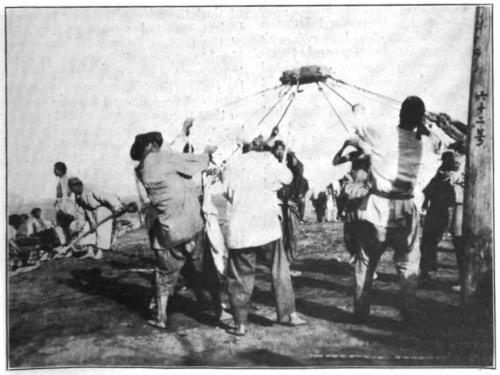
“Now we come to the pounders.
They number 750 and were divided in
groups of ten. Each group has a
stone weighing about 100 pounds,
circular, a foot in diameter, and eight
inches thick. To each stone are attached
ten ropes, one for each of the
ten men, and when the men all pull
in unison the stone rises above the
level of their heads and then comes
down with a thud. The dyke is built
in layers, which are one foot thick
after they are pounded. Each layer
is pounded until it is of the consistency
of rubber and is then tested in
this unique way. An iron rod is
driven down and into the small hole
thus made water is poured from a
tea kettle. If the water does not soak
away the layer has been pounded sufficiently.
These pounders are skilled
workmen and were originally paid
250 cash worth of grain per man per
day, but they proved to be so lazy that
we had to invent a sliding scale of
wages. So we considered 1,200
square feet as a full day’s work, and
if a gang pounds that amount each
man is given 250 cash; if they pound
1,100 square feet, 240 cash; 1,000
square feet, 230 cash; 1,300 square
feet, 260 cash, and so on. Now they
are not lazy.
“We have thirty skilled workmen
who trim the edges of the dyke and
give it a finished appearance. Also
there are sixty overseers who understand
the work. They keep an eye
on the stone men and test their work
as described above, see that the dirt
pushers place the dirt in the proper
place and direct the stream of water
carriers as they come. Both these
classes of workmen receive 250 cash
worth of grain a day.”
In 1911 the American Red Cross
sent to China Mr. C. D. Jameson, a
well known engineer, to study the
conditions which cause the frequent
great floods to devise and suggest a
system of river conservancy which
will reduce the number and extent of
these floods. Mr. Jameson was an
advisor of the relief committee and
was familiar with its public works at
all times. He praises in the warmest
terms the thoroughness of the operations
and the judgment and ability
of the missionaries who were in
charge of much of the work. These
missionaries, in fact, proved themselves
practical men and capable administrators,
who did not spare themselves,
but under adverse conditions
gave from twelve to fifteen hours
daily to their unpaid tasks.
In connection with the relief operations
an interesting experiment in
colonization was undertaken under
the leadership of Prof. Joseph Bailie,
of the University of Nanking. After
many difficulties Prof. Bailie, with
the co-operation of Dr. Sun Yat-sen,
at that time Provisional President of
China, secured a tract of waste land
at the foot of Purple Mountain, near
Nanking, moved some of his more
trustworthy men on to it and began
its cultivation. Huts were first built.
A school was started for the children,
so that they would be cared for while
the men and women were at work.
The land was gradually broken up,
drainage ditches were dug, and potatoes
and strawberries, wheat and
other cereals were planted. A large
number of fruit trees were set out.
Some of these were Chinese, but
many were obtained from Japan and
other countries. The land is now
being used as an experiment farm
and as a testing school for the men.
The soil is of a poor quality, and is
in many ways unsatisfactory; but
Prof. Bailie is persevering in the
faith that he will succeed, not only in
doing a piece of work which will be
deeply interesting to the officials and
gentry near the city of Nanking, but
will prove of value to the larger enterprise
which he still expects to see
carried through.
Mr. Jameson, the American Red
Cross conservancy engineer, after
traversing the famine districts, says
of the prevention of the recurrent
floods which have caused many
famines, including this one of 1911-12:
“There are no engineering difficulties
in the way of controlling the
rivers, lowering the flood level and reclaiming
the waste land in North Kiangsu
and North Anhwei; it is purely
a question of money and time. Under
the present conditions at least three
crops out of five are lost over an area
of some 30,000 square miles. The
soil of this area is exceedingly rich,
the climate such that two crops a
year should be possible when the
conservancy and reclamation work
had been completed. Not only will
heavy crops be possible over this
whole section year by year, but some
millions of acres (English), which
now are absolutely worthless, will be
available for cultivation. All of this
makes the expenditure of the necessary
money justifiable from a commercial
standpoint.”
It is hoped that the Republic of
China will accept the plan prepared
by Mr. Jameson as a basis for a system
of river conservancy which will
put an end to the greater part of the
flood devastation which has cursed
this land for many centuries. Chinese
records show that since the year 494
A. D. sixty-seven famines have occurred
in this region. All but two of
these famines were caused by floods.
The Central China Famine Relief
Committee held its last meeting and
closed its work on January 21, 1913.
At that time an unexpended balance
of approximately $75,000 (gold) remained
in the treasury, but the committee
disposed of the greater part
of it by a series of resolutions, which
were in effect as follows:
The sum of $11,250 was placed in
the hands of a special committee for
the purpose of carrying on “a campaign
covering three years or more,
to draw attention of officials and people
to the seriousness of famines
which are occurring with such frequency
in different parts of China; to
educate public opinion upon the subject
of famine prevention and to show
how the condition of the people in
the famine area can be permanently
improved.” The treasurer of this
educational fund is the treasurer of
the National Committee of the Young
Men’s Christian Association of China.
The sum of $2,500 was set aside to
assist in the care of “famine children”
in the orphanages of the Catholic
missions in the famine areas.
The sum of $5,500 was appropriated
to be applied to the carrying out
of a plan already begun for colonizing
destitute Chinese upon unoccupied
lands under instruction and supervision.
The sum of $22,500 was set aside
to be used in the repair of dykes in
the neighborhood of Wuhu on condition
that the Chinese of Anhwei
Province raise the sum of $45,000 to
be applied to the same work.
The sum of $7,500 was voted to be
used in the education of Chinese
young men in forestry, with special
reference to conservation against
drought and flood. The purpose is to
select a few especially promising
Chinese students from the institutions
of higher education in China and
send them to the American School of
Forestry at Manila, P. I., or possibly
in some instances to the United
States. These young men, after receiving
their education, will be expected
to return to their native country
and enter actively into efforts toward
that reforestation which is regarded
as essential to any great reduction
in the number and severity of
floods and droughts.
After making the allotments above
mentioned there remained a balance
in the committee’s hands of about
$22,500, which was transferred to a
permanent committee of trustees,
consisting of the following: The
General Consular Officer of the United
States at Shanghai, the Commissioner
of Customs, the Manager of the International
Banking Corporation, the
Honorable Wu Ting Fang, Ch’on Jen
Fu, Esq., and the Chairman of the
Chinese Chamber of Commerce. This
committee will hold the balance of
the relief funds for use in future relief
work which may be necessary in
China as the result of famines.
[A part of this article was published
in a recent issue of the Survey.]
HOUSEBOAT USED BY MR. C. D. JAMESON,
AMERICAN RED CROSS CIVIL ENGINEER, EMPLOYED IN CHINA.
Nicaraguan Famine Relief
A general failure of crops, followed
by the revolutionary outbreak
of last summer in Nicaragua
caused great distress among the
poorer classes in that country. Conditions
were sufficiently bad before
the military operations took place,
but during July, owing to the revolution,
they became critical, and many
Nicaraguans faced starvation. Early
in August, having been apprised of
the situation as it then existed, Secretary
of State Knox addressed a communication
to the American Red
Cross, requesting to be informed
whether the Red Cross was in a position
to furnish food supplies to relieve
the needs of the non-combatants.
The American Red Cross
promptly forwarded $1,000 to the
American minister at Panama, with
instructions to expend that amount in
the purchase of flour, beans, corn,
rice and potatoes. Through the
courtesy and co-operation of Colonel
George W. Goethals, U. S. A., Governor
of the Canal Zone, the commissary
of the Isthmian Canal Commission
furnished these supplies at
wholesale rates, and the same were
shipped via the United States transport
Justin, which was carrying a
battalion of United States Marines to
Nicaragua.
On August 28th, at the request of
Hon. George T. Weitzel, American
minister to Nicaragua, at Managua,
the State Department suggested a
further appropriation by the American
Red Cross to continue the alleviation
of the suffering which would
probably continue some time after
the revolutionary disturbances. Pursuant
to this suggestion, a further appropriation
of $1,000 was made by
the Central Committee, and the supply
of corn and beans purchased therewith
was shipped to Managua from
Panama on the steamer San Juan, on
September 7th.
Under date of January 21, 1913, the
Secretary of State transmitted to the
American Red Cross a report from
Mr. Weitzel as to the manner in
which the supplies were distributed
and the effectiveness of the relief rendered.
Following is an extract from
that report:
“The first car, consisting of flour,
corn, beans, rice and potatoes to the
value of one thousand dollars, left the
Panama Canal Zone on August 9,
1912, in charge of Major Smedley D.
Butler, U. S. M. C., and was received
in Managua on the 15th of that
month.
“The legation requested a committee
of Americans, including Messrs.
Otto Schoenrich, A. R. Thompson, C.
D. Ham, A. J. Lindberg and J. A.
Whitaker, to take charge of the provisions
under instructions to relieve
all cases of distress, irrespective of
affiliation of the applicants; but as
they were unable to attend to the
matter on account of departure from
the city, or other reason, the legation
decided to do the work itself. Mr.
Walter H. Hooper, an American missionary,
and Padre J. A. Lezcano, a
well known Nicaraguan priest, kindly
offered to assist in investigating
needy cases. Signed tickets, good for
five rations, were then issued to the
applicants who presented them to Mr.
William Gower, assistant paymaster
of the United States Navy, at the railroad
station, where two-fifths of the
car load was distributed, beginning
with the flour and potatoes, which
deteriorate very rapidly in this climate.
“The remaining three-fifths were
taken to Leon, where Lieutenant Colonel
Charles G. Long, U. S. M. C., distributed
them through the Hospital
San Vincente and the Sisters of
Charity, reserving a portion, however,
to feed one hundred and twenty-five
prisoners, who had been sadly
neglected during the hostilities in
that town.
“The second carload donated by
the Red Cross consisted of 10,000
pounds of beans and 7,140 pounds of
cornmeal, these two staples being the
principal articles of food for the
poorer classes in Nicaragua. Having
been despatched from the Canal Zone
on September 7th the consignment
reached Managua on the 14th of that
month and was started the next
morning to Granada under the personal
charge of the clerk of the legation,
arriving there after being fired
on at the Barranca on Sunday, September
22d. The distribution was
promptly begun from a central station
even before the disarmament had
taken place. Great assistance was
rendered by Dr. Juan I. Urtecho, an
elderly gentleman of wide reputation
for impartial charity, who has devoted
many years of his professional
life as a physician to gratuitous practice
among the poor, and who before
the arrival of the Americans had fed
at his own expense hundreds of famished
people. Several of the Granada
ladies kindly volunteered their services
in placing the tickets with deserving
families, and Private Baldwin,
U. S. M. C., supplied the holders
of the tickets with the number of
rations thereon designated, nearly
8,000 in all being thus disposed of.
A gratifying feature of the distribution
of supplies was the small number
of men who appeared in line, and
even those few were maimed, sick or
blind. The Red Cross and San Juan
Hospitals, the French College for
Girls and the schools were given the
first attention.
“There was urgent need of help, as
many poor families had been forced
for a long time to subsist on green
mangoes, and some deaths had already
resulted from starvation, but
the timely arrival of supplies quickly
relieved the situation. Children who
crowded around the camp were fed
by the enlisted men out of their own
rations, and a carload of corn and
flour donated by the American colony
in Managua was distributed among
the sufferers.
“As soon as order was restored the
farmers from the surrounding territory
brought their produce to market,
and the railroad resumed transportation
of supplies which had been
accumulating in Corinto, so that conditions
at Granada and elsewhere
should begin gradually to improve,
although it will be some time before
the people will cease to feel the depression
caused by the failure of
crops for two successive years, and
by the hardships suffered during the
present disturbances.
“The prompt and generous action
of the American Red Cross has won
expressions of deep appreciation
from those who have been helped,
and has created the kindliest feeling
among all classes of people in Nicaragua.”
Important Conference on Red Cross Christmas Seals — Partial Statement of the Results of Christmas Seal Sales for 1912 Compiled from the Reports of Agents.
No sooner does one Red Cross
Christmas Seal Campaign end
than preparations for the next
begins. While the public sees and
hears of the seal only during the
months of November and December,
when the seals are on sale, a very
large amount of preparatory work is
necessary in order that the sale may
reach every section of the country
and may be carried on with the publicity
and system which are necessary
to success.
Although the returns from the season
of 1912 are not yet all received,
the first important step toward the
Christmas Seal Campaign of 1913 has
already been taken. This was a conference
held in the offices of the
American Red Cross in Washington
on February 28th and attended by
many of the principal State and city
agents, who have demonstrated their
ability in past years and will be leaders
in the campaign of this year. It
is gratifying to note that with each
succeeding year the system and
methods of selling Christmas Seals
are improving. In the first year or
two after the introduction of the
Seals as a means of obtaining support
for anti-tuberculosis work, the
venture was generally regarded as
one of those novelties which, after a
transient popularity, drop quickly
out of use. Agents thought it
scarcely worth while to undertake
the trouble and expense of systematizing
their methods of selling
and accounting. Gradually the
permanent value of the Seal as a
method of interesting a very large
number of people in anti-tuberculosis
work and in raising large sums of
money without unjustly burdening
any givers began to be apparent.
From that time the methods of distributing,
selling and accounting for
the Seals have been made the subject
of careful study. System and business
methods have been gradually
introduced, with the result that instead
of falling away, the sales of
Seals have increased with each year,
while economies which have been introduced
in administration have increased
the percentage of net profit.
In the winter of 1912 the first conference
was held of agents for the
Seals for the discussion and interchange
of experiences and for the
purpose of reaching an agreement
upon questions of interest to all. That
conference was so prolific of good
results in the Seal campaign of 1912
that a second similar conference was
held on February 28th, as above mentioned.
An idea of the thoroughness with
which the agents are considering the
business of distributing the Seals
may be gained from a mention of a
few topics considered at this conference.
The first subject of discussion
was the design for the Christmas Seal
of 1913 and the form which the Seal
should take. It was the unanimous
opinion of those present that the Seal
should contain some pictorial design
suitable to the Christmas season,
rather than a purely ornamental design
of artistic merit, but without any
particular human appeal. Without
exception the agents reported that the
design for 1912, containing a head of
Santa Claus, had proved the most
popular yet adopted.
Another subject discussed was the
character, variety and quantity of advertising
matter to be prepared. It
was reported that an experiment in
selling Seals through penny-in-the-slot
machines had proved unsuccessful,
and this method of distribution
was disapproved. From many agents
it was learned that the sale of Seals
through a simple mail order system
had proved successful and inexpensive.
In many busy offices agents
for the Seals find it difficult to obtain
a hearing by personal calls, when a
brief, well-expressed letter will receive
a prompt and favorable response.
In certain cities fully half
the Seals sold in 1912 were disposed
of in this manner.
It was found to be the consensus
of opinion among agents that the offering
of prizes for the sale of Seals,
especially individual prizes to school
children, is inadvisable. A few
agents reported the successful use of
prizes for schools, but not to individual
pupils, without apparent disadvantages.
All agreed that great
care must be exercised in offering
prizes in order to avoid stimulating
children to improper methods.
Several agents reported that citizens
of their communities had complained
of annoyance because of the numerous
calls at their doors by children
desirous of selling Seals. One agent
described a method of avoiding this
nuisance which has proved completely
successful in his community. This
method is for a citizen who has purchased
Christmas Seals to paste one
of the seals on his door knob or front
door. Any child approaching a door
and seeing a seal thus posted, understands
that he is not to disturb that
household, as its supply of Seals is
already purchased. By announcing
this system of protection through the
press and in the schools it is said to
have fully accomplished its purpose.
Tn Ohio the State agent for the
Seals adopted a method of awarding
prizes which is reported to have been
extremely successful, not only as a
stimulus to the selling of Seals, but
as an educational factor. The agent
offered to supply a visiting nurse for
one month to each of the twelve cities
in the State of Ohio which sold the
largest percentage of Seals in proportion
to its population. A trained
visiting nurse was employed by the
State agent for one year and was sent
in turn from city to city among the
prize winners, serving one month in
each locality. Not only did this prove
an extremely popular arrangement,
but in six of the cities benefited by
the plan in 1912, the public became
so impressed by the value of the visiting
nurse that they arranged to employ
nurses permanently upon the
withdrawal of the prize nurse.
It has been found by experience
that the distribution and sale of Seals
can best be carried on through the
appointment of State agents, who in
turn appoint, and are responsible for,
the local agents. The State agents
return to the American Red Cross 10
per cent of the gross proceeds of sales
in their respective States. This 10
per cent is to cover the expense to
the Red Cross, which manufactures
and distributes the Seals and the
large quantity and variety of advertising
matter used by the agents. The
conference discussed at length the
question of the percentage which the
local agents should pay to the State
agents. This discussion resulted in
the conclusion that it is impracticable
to fix upon a percentage applicable
to all States alike. Local conditions
vary so widely in different
States that a percentage which would
be fair in one State might be unsatisfactory
in another. The reports indicated
that the percentages charged
by State agents to their local agencies
vary from 2½ to 20 per cent on
gross sales, although in one or two
instances the percentage required to
be returned to the State agents has
exceeded 20 per cent.
Many other subjects of material
interest were discussed, and no doubt
exists that the conference will prove
to have been of material value to all
who participated in it. The agents
who were present were the following:
Dr. William Charles White, of Pittsburgh.
Mr. Frank H. Mann, of New York City.
Mr. William J. Deeney, of Philadelphia.
Mr. Karl de Schweinits, of Philadelphia.
Dr. Hoyt E. Dearholt, of Milwaukee.
Dr. R. H. Bishop, of Cleveland, O.
Mr. D. Van Blarcom, of New York City.
Mr. Ernest D. Easton, of Newark.
Mr. Severance Burrage, of Indianapolis.
Mr. H. Wirt Steele, of Baltimore.
Mr. L. B. Meyers, of Charlotte, N. C.
Mr. James Jenkins, Jr., of Brooklyn.
Mr. William C. Smallwood, of Newark.
Mr. Roy L. French, of Baltimore.
Mr. Kendall Weisiger, of Atlanta.
Besides the agents above mentioned,
there were also present Dr.
Livingston Farrand and Mr. Philip
P. Jacobs, of the National Association
for the Study and Prevention of
Tuberculosis, and Miss Mabel T.
Boardman, Mr. Ernest P. Bicknell
and Mr. Charles L. Magee, of the
American Red Cross.
The National Association for the
Study and Prevention of Tuberculosis,
as in 1911 and 1912, has been
appointed by the Red Cross as national
sales agent for the Christmas
Seals. The appointment of State
agents, as in the past, will be in the
hands of the national sales agent.
While it is not possible at this time
to publish a complete statement of returns
from the Christmas Seal campaign
of 1912, the following figures
will show the results reached by
some of the leading agents:
Agency.
Number of Seals Rec’d.
Number of Seals Sold.
Percentage of Seals Sold.
Arkansas
140,000
118,819
84.8
California
5,500,000
1,373,520
24.9
Connecticut—
Danbury
25,000
15,305
61.2
Hartford
250,000
148,035
59.2
Litchfield
40,000
32,960
82.4
Meriden
100,100
5,554
5.5
Middletown
75,000
34,741
46.3
New Britain
125,000
74,257
59.4
New Haven
600,000
228,220
38.3
New London
50,000
19,893
39.7
Norwich
120,000
82,694
68.9
Stamford
40,000
30,385
75.9
Waterbury
250,000
184,921
73.9
Delaware
75,000
42,746
56.9
District of Columbia
374,500
362,716
96.8
Georgia
1,800,000
770,770
42.8
Hawaii
400,000
179,995
44.9
Illinois
6,000,000
1,821,520
30.3
Iowa
1,500,000
410,440
27.3
Kentucky—
Covington
100,000
36,406
36.4
Cynthiana
10,000
1,205
12.0
Henderson
50,000
10,040
20.0
Lexington
140,000
61,505
43.9
Louisville
300,000
180,446
60.1
Owensboro
30,000
8,240
27.4
Paducah
100,000
48,349
48.3
Louisiana
600,000
281,784
46.8
Maine
1,500,000
304,884
20.3
Maryland
1,000,000
512,819
51.2
Massachusetts—
Boston
2,500,000
1,353,969
54.1
Holyoke
100,000
52,114
52.1
Pittsfield
100,000
71,345
71.3
Springfield
150,000
89,265
59.5
Michigan
3,000,000
1,078,464
35.9
Mississippi
500,000
153,220
30.6
Montana—
Billings
75,100
14,870
19.8
Great Falls
20,000
17,358
86.7
Nebraska
720,000
289,360
40.1
New Hampshire
190,000
100,180
52.7
New York—
Brooklyn
2,100,000
1,323,220
63.0
New York City
4,000,000
2,079,324
51.9
North Carolina
801,500
396,053
49.4
Oregon
1,000,000
124,536
12.4
Pennsylvania
2,000,000
1,297,531
64.8
Rhode Island
2,000,000
1,101,700
55.0
South Carolina—
Georgetown
10,000
400
4.0
Spartanburg
20,000
8,860
44.3
South Dakota—
Aberdeen
25,100
5,510
21.9
Sioux City
40,000
8,929
22.3
Tennessee
1,000,000
118,300
11.8
Utah—
Ogden
50,000
8,000
16.0
Salt Lake City
100,000
100,000
100.0
Vermont
125,000
65,786
52.6
Virginia
250,000
151,450
60.5
West Virginia
700,000
457,175
65.3
Wisconsin
3,000,000
2,896,840
96.5
Total
45,871,300
20,746,938
45.2
The important position which the
Red Cross Christmas Seal now occupies
as a means of support for anti-tuberculosis
work in the United
States is indicated by the fact that
the sales of the Seal, since its introduction
five years ago, have
amounted to a total of more than
$1,000,000. Every year the sale has
exceeded that of the year preceding.
In 1911 the total sale amounted
to $339,656.08, and it is believed
that the complete reports
of the sale in 1912 will show a
considerable increase over that
amount.
What the Red Cross Seal Has Done for Brooklyn
James Jenkins, Jr., Executive Secretary, Brooklyn Committee on Tuberculosis.
The money made by the Red
Cross Christmas Seal has done
a very definite and practical
piece of work for Brooklyn, New
York. About a year before the seals
were issued, there had been formed
in Brooklyn a Tuberculosis Committee,
that had at that time limited
funds but was struggling to carry
on various pieces of important and
rather expensive work. One of the
needs of the community was more
adequate hospital facilities and a day
camp for tubercular patients. The
camp was to be established for mothers
and children, and it was hoped
at that time that a class might be
formed for children, who could go
on with their school duties.
As a result of the first year’s sales
about $5,000 was made, and through
the help of the Erie Railroad an old
ferryboat was made into a city day
camp and attached to one of the piers
of North River, where the air is as
fresh as possible, in such a large city.
The first day the camp opened there
were thirty-five cases on the boat and
the number has increased, sometimes
slowly but always steadily, until now
the capacity of the boat is 100 patients.
The first summer a kindergarten
teacher was privately employed,
who entertained the children,
but early in the fall a regular class
was established, as an annex to one
of the public schools, and it was the
only school in Brooklyn for tubercular
children. Now the boat has three
classes, of nearly thirty children
each, besides fifteen adults.
When the day camp was established
and known as the Red Cross
Day Camp, it was planned by the Tuberculosis
Committee to have the city
take it over or share the expenses, if
the experiment should prove worth
while. The city very soon recognized
the value of the work at the Red
Cross Day Camp and the children
were admitted through the city tubercular
clinics. Gradually the city
has taken over more and more of the
expenses of the camp, but the boat is
still known as the Red Cross Day
Camp, and the money made by the
sale of the seals pays the remarkably
good superintendent of the boat, furnishes
carfare to and from the camp,
for those patients who cannot afford
to pay, and also pays for any special
training which the committee deems
valuable to the patients. This year a
cobbling teacher has been employed
to teach the boys how to mend their
own shoes; an expert course of corrective
exercises was given by a
trained man; chair caning was
taught and the adults and older girls
are taught to sew and mend.
The total number of cases admitted
to the boat since the beginning is
965. The curative results have been
excellent, especially with the children.
At the beginning of the second
semester of the school year this session
about one-third of the children
were pronounced cured and sent
back to their regular schools.
OPEN AIR SCHOOL FOR TUBERCULAR CHILDREN,
BROOKLYN. N. Y. PHOTOGRAPH SHOWS CHILDREN SLEEPING AFTER LUNCHEON
In addition to the work of the day
camp this year the funds raised by
the Red Cross Christmas Seals will
be devoted to the open-air classes for
anemic children in the public schools.
There are open-air classes in eight of
the public schools now in Brooklyn.
About 300 children attend these
classes and all of them are given
some extra nourishment in the morning
and afternoon and a warm lunch
at noon, and some extra clothing
was provided by the Board of Education.
Special examinations by
private physicians, visits to homes,
employment of cooks, supervisor,
etc., come out of the Red Cross
money.
The plan adopted in Brooklyn has
been to keep the Red Cross money in
a special fund and devote it to some
specific work, which interests the
thousands of people who buy seals
at Christmas time. Without the help
of the sale of the seals it would have
been impossible to have done some
of the most valuable work which has
been done for tubercular patients in
Brooklyn.
“FERRY BOAT CAMP.” THE SCHOOL AT PLAY.
First Aid Department
One of the most successful campaigns
conducted by the First
Aid Department of the American
Red Cross has been that on the
Missouri-Pacific System, which was
completed at Texarkana, Arkansas,
on January 4, 1913. It was begun at
Omaha, Nebraska, on the September
16, 1912. A great part of the Missouri-Pacific
System was covered
during the ensuing two months and
a half, meetings being held at points
in nine different States. The total
number of meetings was 234, the
total attendance 14,050, and the total
travel 5,752 miles. The employes of
this railroad system were generally
greatly interested in learning first
aid. As the direct result of this tour
the entire system is to be outfitted
with first aid supplies and the instruction
of men in their use is to be
continued systematically.
It is gratifying to be able to record
the fact that in the course of this
campaign many public meetings
have been held both in Car No. 1 and
in town halls. Several opportunities
have been offered to speak on first
aid at high schools, and in one or
two towns this subject will be adopted
as part of the curriculum. Many
fire and police departments have been
represented at meetings as well as a
good number of industries.
Dr. Mackey, in charge of Car No.
1 on his arrival at Texarkana,
Texas, on January 6, made arrangements
to hold meetings at schools,
factories, etc., in that town while
awaiting a new railroad schedule.
The high school and normal school
attendance during this period
amounted to 995 persons. The school
board of Texarkana has adopted first
aid to the injured as a regular course
of study in the high school. The Y.
M. C. A. has installed a complete
course and the Texarkana Normal
School (colored) has decided to take
up this work. On leaving Texarkana
on the 17th of January, 1913, Dr.
Mackey, with Car No. 1, resumed his
railroad work on the St. Louis Southwestern
Railroad of Texas. This was
continued until the end of February
with a total attendance of 2,085, a
total of 30 meetings, and a total
travel of 1,274 miles.
The hard and continuous service
of Car No. 1 during the past three
years has finally put it out of commission
beyond hope of repair. It
is a pleasure to be able to record the
fact that the Pullman Company has
generously offered to replace this car
with a new one which will be larger
and better suited to Red Cross purposes.
It is expected that this car
will be ready for service before this
report goes to press. Meanwhile, Dr.
Mackey is devoting his time to the
various schools and industries in the
vicinity of Texarkana, Texas.
After what Dr. Davis, in charge of
Car No. 2, characterizes as a splendid
campaign over the Philadelphia &
Reading System first aid work was
taken up for the Lehigh Valley Railroad.
This was begun on December
13, 1912, and continued to February
7, 1913. The more important points
visited and at which meetings were
held were as follows: Jersey City,
Perth Amboy, N. J.; Easton. Pa.;
Bethlehem, Pa.; Lehighton, Pa.; Hazleton,
Pa.; Delano, Pa.; Wilkes-Barre,
Pa.; Pittston, Pa.; Sayre, Pa.: Auburn,
N. Y.; Manchester, N. Y.; Rochester,
N. Y.; Buffalo, N. Y., and Niagara
Falls, N. Y. The total number
of miles traveled was 916; 72 meetings
were held, with a total attendance
of 3,105. The interest displayed
on the Lehigh Valley has been extremely
gratifying.
DR. SHIELDS ILLUSTRATING USE OF RED
CROSS TOURNIQUET. THE COMPRESS IN THIS CASE IS A POCKET KNIFE.
EMPLOYEES OF THE CHESAPEAKE & POTOMAC
TELEPHONE CO., WASHINGTON, D. C., UNDER INSTRUCTION IN FIRST AID.
Dr. Davis also reports that he
learned from Mr. J. S. Rockwell,
General Agent, Buffalo, Rochester &
Pittsburgh Railroad, that since Car
No. 2 covered that system last spring
the work has been progressing very
favorably under the supervision of
the company surgeons. The men
and officers are taking an active part
in the movement and the results have
been strikingly successful, not only
in respect to proper handling and
dressing of injuries but in a decrease
in the number of accidents. A bulletin
is posted each month at the different
shops making comparison as
to the number injured for each plant
per number employed. Mr. Rockwell
states that it is truly remarkable the
way the men from the different shops
are vying with each other in doing
everything in their power to make
their particular shops come out at
the end of the month with the fewest
injured.
The Buffalo, Rochester & Pittsburgh
Railroad would like very much
to have another first aid campaign
over its lines with the idea of getting
road men thoroughly organized
in order that as nearly as possible
they may be on a par with the men
employed in the shops. The report
from this railroad is of the greatest
importance as it shows the direction
which it is believed first aid should
take on railroads generally; first, the
prevention of accidents, and, second,
their proper care if they do unfortunately
occur.
As mentioned in the January Red
Cross Magazine, Dr. M. J. Shields.
Field Agent of the First Aid Department
of the American Red Cross, has
been carrying on a very successful
first aid campaign for the Bell Telephone
Company, spending from December
3, 1912, to February 12, 1913,
with the Bell Telephone Company of
Pennsylvania and from February 14
to March 10, covering the Chesapeake
and Potomac Company’s plant. Lectures
were given in Philadelphia and
vicinity, Chester, Westchester, West
Grove, Jenkintown, Doylestown, Norristown,
Pottstown, and Lancaster in
eastern Pennsylvania: Camden, Atlantic
City, Burlington, Bridgetown,
and Trenton in New Jersey, and at
Wilmington and Dover in Delaware.
The following offices of the Bell
Telephone Company of Pennsylvania
were also visited during January and
February: Reading, Allentown, Harrisburg,
Altoona, Lewistown, Bellefonte,
Williamsport, Sunbury,
Wilkes-Barre, Scranton, Easton, Pittsburgh,
Washington, Uniontown,
Greensburg, Johnstown, New Kensington,
Rochester, New Castle, Greenville,
Erie, Warren, Oil City, Bradford,
Du Bois, and Butler in Pennsylvania;
in West Virginia, Wheeling,
Fairmont, Clarksburg and Parkersburg;
and in Ohio, Marietta,
Urieville, Steubenville, and East Liverpool.
In Chesapeake and Potomac territory,
Washington, D. C., Baltimore,
Westminister, Frederick, Hagerstown,
Queenstown, Salisbury, all in
Maryland were reached as well as
Norfolk, Richmond, and Lynchburg
in Virginia and Thurmond, Charleston,
Huntington, and Martinsburg in
West Virginia. In all, the number
of meetings held was 142, miles traveled
7,500, and attendance 7,950.
Those in attendance at the meetings
were principally from the plant
department, the men who build and
maintain the telephone lines, put up
ærial and underground cables, and
install ’phones, but at nearly every
meeting numbers from the commercial
and traffic departments attended.
Special talks were given in Philadelphia,
Pittsburgh, Baltimore, and
Washington, D. C., to the chief operators
(women) and matrons on
what to do in sudden illness and
emergencies, on how to keep well,
and on personal hygiene. Dr. Shields
reports that these lectures were well
received. He also reports that the
subject of accident prevention was
taken up and emphasized at each
lecture.
Invitations to attend these lectures
were extended to the officials and
employes of the various electric light,
power and street car companies. Also
to the Western Union, Postal and
American Telegraph and Telephoto
companies, with the idea of encouraging
a cooperative movement
already started of making a safer arrangement
of cross-arms and a better
spread and less dangerous arrangement
of high tension wires on
poles jointly used and in underground
conduits, thereby cutting
down to the minimum the most distressing
of accidents—fatal shock on
a pole 30 feet in the air or in an 8-foot
man hole.
DEMONSTRATION OF FIRST AID TO BELL
TELEPHONE COMPANY, PITTSBURGH, “PATIENT”: HAS FRACTURED HIP, FRACTURED
LEG AND WOUNDS ON HEAD.
The press in the towns and cities
visited gave the work good publicity
both in their news columns and editorials.
The Gazette-Times of Pittsburgh,
on Sunday, February 16, had
a full page with excellent illustrations.
The following is an extract
from an editorial in the Westminster
Maryland Times of February 21:
“Too much cannot be said in
praise of the work now being done
by the Red Cross in educating people
to care for themselves and
others in time of accidents. That
such work has great economic, as
well as sentimental value, is proved
by the way the Bell Telephone
Companies and other large corporations
are spending money to
carry on campaigns, with the help
of the Red Cross surgeons, that will
show their men what they can and
should do in the way of giving first
aid to the injured, before a doctor
can arrive.”
The Telephone-News, January 1st,
made first aid and accident prevention
a leading article. The Transmitter,
published by the Chesapeake &
Potomac Company, in the issue of
March 1st had an illustrated article
on the first aid Campaign.
Throughout all this work every assistance
was given by the officials
and men and the work was much appreciated
by them. No doubt the interest
created will be the means of
doing a great deal of good not only
among telephone men but with the
public generally, as no business
comes into closer contact with the
public than that of the telephone
company.
First Aid in Australia
As another exemplification of the
frequent assertion that the earth
is not so large after all is a letter
which the editor of the Red Cross
Magazine recently received from Australia.
Mr. H. Leslie McWhinney, of
Auburn, Victoria, in some unexplained
way, obtained a copy of the
Magazine for October, 1912, and became
so interested in the activities of
the American Red Cross that he was
moved to write the editor. His letter
contains so much information relative
to the work of the First Aid
Volunteer Association in Australia
that a portion of it is quoted here, as
follows:
“First aid work in Australia is organized
and conducted by the St.
John Ambulance Association, an
English institution, which conducts
first aid and nursing classes, and has
a permanent ambulance service in
most of the capital cities of the six
States. It also has an organization
called the St. John Ambulance
Brigade, consisting of men’s and women’s
(nursing) divisions. Sydney
and Brisbane have civil ambulances
as well. In Melbourne we have the
First Aid Volunteer Association,
owing allegiance to St. John’s, but
acting quite independently of it.
“This association had its origin in
the visit of the American fleet in 1908,
when this country became wild with
enthusiasm and large crowds visited
the seaports to see the fleet. The Melbourne
City Council, expecting large
crowds and many accidents, called
for volunteers holding first aid certificates,
and a number responded, and
rendered good service. Afterwards
Mr. W. F. Pratt, our present secretary,
suggested that those on duty
should form a practice society, and
this was done, the First Aid Volunteer
Association being formed.
“Our membership has increased
from 40 to 110, and is now growing
rapidly; the average attendance at
weekly meetings ranges from 30 to
40 and at lectures from 60 to 80. We
encourage people interested in first
aid to visit our meetings and send
members out to help class secretaries.
We also supply members for first aid
duty at large public meetings, exhibitions,
missions and other gatherings.
Last year our members attended
the Scoville Mission for six weeks,
treating 44 cases; the Alexander-Chapman
Mission (4 weeks), and
several other large gatherings. A
hygiene exhibition opens in Melbourne
next week and we have agreed
to supply 12 members a night for
four weeks. We make no charge,
and our members take no payment.
Of course, we are willing to accept
donations to our funds, but do not
ask for them.
“We have a stretcher and a first
class kit and plenty of bandages, besides
medical instruments for use on
duty by any medical man who happens
along. At our monthly outings,
which take place out of the city on
Saturday afternoons, the secretary
prepares a list of accidents, labels
various ‘patients,’ and the other members
have to work in pairs, being allowed
one bandage apiece and having
to improvise the others. Average
attendance is thirty. We usually do
a little propaganda work at these outings,
inviting the local class secretaries
to bring along their pupils, if
any.”
Of course, the readers of the Red
Cross Magazine will understand the
difference between this First Aid Society
in Australia and the American
Red Cross. The First Aid Volunteer
Association was organized with only
one purpose in view, that of practicing
first aid, and one of the conditions
of membership is that the applicant
must have received a first aid certificate;
whereas the activities of the
American Red Cross have many
ramifications and any reputable citizen
of the United States may become
a member thereof simply upon the
payment of dues. Membership in
the First Aid Association in Australia
is rather analogous to membership
in the classes throughout the
United States organized by the First
Aid Department of the American Red
Cross.
It is interesting to note that the arrival
of the American fleet in Australian
waters in 1908 was the prime
cause for the organization of the
First Aid Volunteer Association.
“BROKEN THIGH.” FIRST AID PRACTICE.
Red Cross Nursing Service — Rural Nursing — Home Nursing and First Aid Instruction For Women — Plan of Instruction for Women. — Objects. — Need. — Results. — Course of Instruction. — Organization of Classes. — Examinations and Certificates.
Miss Jane A. Delano, Chairman National Committee.
The rapid development of the
Nursing Service of the Red
Cross and the solidarity of its
various activities are encouraging
signs of future growth and more extended
usefulness.
Our state and local committees of
nurses, organized primarily for the
enrollment of Red Cross nurses, have
responded with enthusiasm whenever
new demands have been made upon
them. We now have more than five
hundred representative nurses serving
on these committees throughout
the United States, and their co-operation
and interest may be depended
upon to further any work undertaken
by the Red Cross. They have
been most active in the sale of
Christmas Seals and have co-operated
with local tuberculosis agencies,
often serving on special committees.
In organizing our Rural Nursing
Service we have sought their advice
and assistance. They have suggested
nurses for rural work and have
given valuable information in regard
to the needs of their own communities.
Further details concerning this
important service is given by Miss
Clement, superintendent of rural
nurses.
Our local committees are found
ready to assist in relief work at celebrations
and parades, and appreciate
the opportunities for experience
thus offered. The District of Columbia
committee, of which Miss
Anna J. Greenlees is chairman, secured
the nurses required for relief
stations established in Washington
during inaugural week. A report of
the work of these stations appears
in this number of the Magazine.
The National Committee on Nursing
Service, in co-operation with the
First Aid Department, has been authorized
by the Red Cross to organize
classes of instruction for women in
Home Nursing and First Aid. Once
more we must appeal to our local
committees of nurses for their assistance.
The plan adopted requires
that the instruction in Home Nursing
shall be given by enrolled Red Cross
nurses, who must, in a large measure,
be secured through the local
committees. As the work develops
we hope that nurses especially qualified
to instruct women in the principles
of right living and the home
care of the sick may be found willing
to devote their whole time to
this instruction. Even two classes a
day would give a fair income and
an opportunity to render valuable
service to a community. Information
concerning these classes for
women is given in this issue by Miss
Oliver, in charge of their organization.
Believing that the course in first
aid adopted by the Red Cross would
be valuable even to graduate nurses,
arrangements have been made with
the First Aid Department to allow
enroled Red Cross nurses to take this
course at home. The textbook written
by Major Charles Lynch must
be used, and nurses who so desire
will be allowed to take an examination
under the direction of a physician
appointed by the Red Cross. To
those who pass this examination a
Red Cross First Aid Certificate will
be issued.
Miss Fannie F. Clement, Superintendent of Rural Nurses.
Before the Red Cross entered
the field of rural nursing several
attempts were made to extend
this work on a broad plan into
the country districts. After the Peace
Conference, held at Portsmouth, N. H.,
in 1905, the Russian and Japanese
envoys made a gift of $20,000
to the State, to be used for charitable
purposes. At this time several persons
who realized that rural nursing
was an important factor in the improvement
of social conditions tried
to have this sum used in establishing
a state-wide system. It was not
possible, however, to convince those
in authority that this would be the
best disposition of the gift. It was
the aim of the Holman Association,
incorporated in 1911, “for the promotion
of rural nursing, hygiene and
social service.” to expand as resources
permitted to meet the needs
of rural communities in the United
States, but the society has recently
been disbanded.
There are but few instances where
rural nursing has been extended by
a single organization to cover any
considerable area. A pioneer work
was started seventeen years ago in
North Westchester county, New
York, where the District Nursing Association
now employ six nurses
and covers about twenty villages.
Gradually new districts in the surrounding
territory are being opened
up by the association.
There are, however, several individual
nurses meeting the needs of
rural communities, and often under
trying conditions. In isolated regions
they are cut off from helpful association
with others doing similar
work and the stimulus that comes
from identification with an extensive
organized effort. The Red Cross has
planned a service of which these
nurses may become a part, which
will assist them to establish and
maintain high standards.
Rural nursing as it now exists is
generally carried on under the
supervision of a committee which
may include several sub-committees.
These are responsible for various
branches of the nurses’ work.
Wherever such committees are able
to arouse a general interest much has
been accomplished not only in behalf
of public health, but in many
lines of public welfare work.
It is expected that in the development
of Red Cross rural nursing,
local committees will be created,
meeting standards of salary and
other regulations which are deemed
necessary to insure the best interests
of a community. The locality benefitted
by the work of a nurse is expected
to meet the expenses connected
with it. Fees collected from
patients are not sufficient for this, as
all sick persons are not able to pay
for the services of the nurse. As a
rule, patients are expected to pay for
professional visits, according to their
means, but those unable to make
any payments should not go uncared
for. The responsibility for raising
the necessary funds rests with the
local committee, which also superintends
the work of the nurse.
A general supervision by the Red
Cross is maintained through occasional
visits of the superintendent
of rural nurses and through monthly
reports of their work.
During the 1910 Red Cross Christmas
Seal sale, the Anti-Tuberculosis
Association of Wisconsin, offered
the services of a visiting nurse for
one month to twelve cities of a
limited population, making the highest
per capita sale. The Red Cross
Seal Committee of Ohio, in 1912, sent
a visiting nurse for one month to
each of twelve small cities throughout
the State as a prize in the seal-selling
contest. Interest in visiting
nursing was thus stimulated to a degree
that several of these towns have
since been insisting upon a permanent
nurse, and have raised funds
necessary for her support.
Hospitals, dispensaries and medical
attendance are seldom as accessible
in the country as in cities. To
have the rural nurse a resident in
the community, her services for all
regardless of any lines of distinction,
to have intelligent nursing care for
patients in their own homes, and instruction
and demonstration given
in the principles of hygiene, not only
of person but as applied to home surroundings,
are advantages which
have been appreciated wherever the
visiting nurse is established.
The best physicians have welcomed
her assistance. No stronger
testimony to the value of her services
is needed than the present demand for
public health workers in connection
with industrial establishments, department
stores, religious and civic
institutions and health departments
of city, town and county.
Women of the finest type are
needed for this work and those who
have had specialized training in public
health activities. Several visiting
nursing associations to be utilized as
training centers for Red Cross nurses
offer good opportunities for students
to become familiar with social work
of various kinds through lectures,
study courses and affiliations with
philanthropic societies in the city.
Nurses may thus come in contact
with milk stations, dispensaries,
tuberculosis and charity organization
societies, settlements and other
social agencies.
Nurses eligible for appointment to
the Rural Nursing Service, who have
not already had experience or training
in visiting nursing, after a minimum
period of three months with a
city nursing association will be
placed one month with an association
in the country, thus giving them
actual experience in rural nursing
and its problems before assignment
to their post of duty. It is important
that the rural nurse be informed
upon the various branches of public
health nursing and social service, as
carried on in cities, in order that she
may initiate work along these lines
in country places where it is often
wholly unorganized. She should be
able to recognize contagious diseases
and minor ailments among school
children. By giving simple health
talks in the schools, she is able to
utilize one of the most advantageous
avenues for influencing the home
life of her people.
Local societies and clubs, the aim
of which is to improve unfavorable
conditions that exist in their communities
can establish a no more
fruitful source of helpfulness than
by the employment of a visiting
nurse. Red Cross Chapters will find
in such an undertaking not only a
means of creating interest in local
work of the Red Cross, but opportunity
of enlarging their field of usefulness
to the community. The experience
of the Red Cross Chapter
in Islip, Long Island, in the employment
of a rural nurse has long ago
proven the value of this plan of
work.
Miss Marion L. Oliver, In Charge of Organization of Classes.
Believing that the physical
welfare of the race depends
largely upon home conditions
and that the women of the nation
have a very definite responsibility in
maintaining the health of the family,
the American Red Cross has undertaken
to organize on a national scale
classes for women in home nursing
and first aid. It is hoped that this
instruction will make them better
home makers, better mothers and
better citizens. Before describing
what has been accomplished in this
direction, it is best to give details of
the plan adopted. This can be done
most briefly by quoting from the official
circular relating to the same.
The American Red Cross has decided
to organize classes of instruction
for women in first aid, home
nursing, hygiene and allied subjects,
to be given under the supervision of
the National Committee on Red Cross
Nursing Service.
1. To afford women the opportunity
to learn first aid to the injured,
and to provide simple instruction in
the home care of the sick.
2. To afford women the opportunity
to learn how to prepare food for
sick and well.
3. To afford women the opportunity
to learn how to prepare rooms
and other places for the reception of
ill and injured.
4. To afford women the opportunity
to learn how to protect their
own health and that of their families.
It must be distinctly understood
that this course of instruction for
women is only intended to prepare
them to render emergency assistance
in case of accident, to give more intelligent
care to their own families
under competent direction, and, in
exceptional cases, to assist in relief
work under the supervision of the
Nursing Service of the American
Red Cross.
Much needless suffering is now
caused the ill and injured on account
of the ignorance of unskilled
persons. It has been said that the
fate of the injured is dependent on
the care which their injuries first receive.
It is therefore necessary for
everybody to learn what to do first in
an emergency, and what not to do.
This is easy to learn, but the subject
must be learned. Nobody can be expected
to know this without instruction.
The number of people injured
in the United States is rapidly
mounting and is now in the hundreds
of thousands annually. Knowledge
of first aid to the injured cannot,
it is true, prevent the consequent
suffering entirely, but it can be made
an important factor in this result.
The health of the family depends
largely upon the home maker, and
it is most essential that she have a
definite knowledge of personal and
household hygiene and the proper
preparation of food. Special diet for
the sick is no less essential. Scarcely
any woman is unacquainted with
the sick room in her own family, and
some simple instruction in the care
of the sick should be a part of every
woman’s education.
It is the purpose of the Red Cross
to provide for this instruction.
This work is just being started in
this country, so that great results
cannot yet be reported. It has already
been demonstrated here, however,
that instruction in first aid will reduce
deaths and serious results from
injuries about one-half. On railroads
and everywhere else that the American
Red Cross has carried first aid
instruction, all interested are enthusiastic
in praise of the benefits
derived. In other countries, such as
Great Britain, France, Germany, Italy
and Russia, work of a similar character
to that contemplated for women
has been done for many years
and all testimony goes to show that
the public has largely benefited
therefrom.
Ten lessons in First Aid.
Fifteen lessons in Hygiene and
Home Nursing.
Fifteen lessons in Dietetics and
Household Economy.
All instruction will be very practical
and pupils will, as far as possible,
be required actually to do
everything described in the teaching.
Lessons in either First Aid or Home
Nursing may be given first, but both
these courses of lessons must be
completed and certificates must be
held in both by those desiring to take
further instruction.
No two courses of instruction may
be taken at the same time.
All first aid courses must be given
by a physician and other instructions
by a Red Cross nurse, unless
otherwise authorized by the Red
Cross.
Women desiring to form a class in
either first aid or home nursing
should secure a sufficient number of
names—not less than ten or more
than twenty-five—selecting one to
act as president. The president so
selected should then communicate
with the Department of Instruction
for Women, American Red Cross,
Washington, D. C. A roll will be
supplied on which the names of the
members of the class will be inscribed
and answers given in respect
to certain essentials.
No one under sixteen years of age
is eligible for these classes.
It will be necessary locally to obtain
the services of a physician or a
nurse to give the instruction, whose
name and address should be forwarded
to Washington with required roll
of proposed class. All instructions
must be approved, and a card of
authorization issued, by the Red
Cross before any course is begun.
The instructors’ fees, if any, must
be paid locally, and arrangements
for the same must be made by the
class with the instructor selected.
It will also be necessary to provide
a meeting place.
Books and charts will be supplied
by the Red Cross. The cost of these
will be $1 per member for each
course of ten lessons, and $1.50 per
member for each course of fifteen
lessons. Payment for the same should
be made in advance. The president
will be responsible for collecting and
forwarding this amount to Washington.
On the completion of each course
of instruction an examiner will be
appointed, to be paid by the Red
Cross. Such examiner will be other
than the instructor of the class.
No one will be allowed to take an
examination in any course who has
not attended at least three-fourths of
the lessons of that course.
Certificates will be given successful
candidates at the conclusion of
each course of instruction.
After fulfilling the requirements
for the organization of a class and
the instructor has been formally appointed
the class is free to begin
work, and very interesting work it
proves to be. The course of instruction
in first aid begins with an introductory
lesson in anatomy and
physiology followed by nine lessons
with practical demonstration in the
care of emergencies and accidents
most likely to be met with in the
every-day walks of life. It is most
desirable that each pupil be given an
opportunity to practice on a model
or manikin the various points covered
in the lessons. After the ten lessons
are over, those members of a
class who have not been absent more
than three times, are ready for examination.
This is given by a physician
other than the instructor of
the class who is appointed direct
from the first aid office. The examination
is one-third oral, one-third
written and one-third practical.
There are fifteen lessons in the
Home Nursing course, and these
should prove of absorbing interest
and practical value to every one. The
preliminary lessons deal with matters
relating to the healthfulness of the
home, such as contamination of food
and its prevention, sources of impurities
in water and air, personal
hygiene and the preservation of
health. Then follows simple instruction
in the home care of the sick,
how to make a sick bed, to transfer
a patient from bed to chair, the general
care of a patient, including
baths and the use of ordinary sickroom
appliances. For example, the
theory of bed-making was being
taught in one of our classes the other
day, and after the instructing nurse
had finished her lecture, every
member of the class had to make the
bed with and without the patient, the
patient in this case being a life-sized
doll covered with oilcloth so that it
could be bathed. Several members
of the class did not make the beds
satisfactorily and were told to practice
at home so that at the next lesson
they could do better. A special
examination also follows this course.
After those Home Nursing lessons
are over, it is planned to have a
series of lectures on home economics
and dietetics.
So much for the plans and organization,
now for the actual classes.
The records show that on March 30th
almost six hundred women are taking
this instruction.
Twenty-four classes in First Aid
and three in Home Nursing have
been formed in different localities.
Both the Young Women’s Christian
Association and the Girls’ Friendly
Society have become interested in
this work.
In Genesee, New York, the fox-hunting
community has formed a
large class for women to teach them
to cope with the accidents of the
hunting field.
In Manchester, Connecticut, where
the Cheney Brothers have their big
silk mills, classes in both First Aid
and Home Nursing have been organized
among the employes.
In Cincinnati a group of society
women are taking the First Aid
course.
In one of the suburbs of Washington,
a group of young mothers
have formed a class.
Other classes are active in Lexington,
Ky., Providence, R. I., Detroit,
Mich., North Attleboro, Milton and
Manchester, Mass., Milwaukee, Wis.,
York, Pa., Philadelphia, Pa., and
Washington, D. C.
Two classes have been formed by
the wives of the officers of the Army
and the Navy, and we hope that in
time every Army post and Naval stations
will have its regular classes
in First Aid and Home Nursing, and
that this work will not only be for
the officers’ wives but for the wives
of the enlisted men as well.
Al the end of each set of classes
there is an examination and those
who successfully pass receive a Red
Cross certificate.
It is also planned that a field day
will be held in each State that has
enough classes to warrant it and at
this field day First Aid teams of
women will compete for a Bronze
Medal. The rules for such a competition
will be supplied upon request.
The Red Cross at the Inauguration — Union Station. — Physicians. — Nurses. — East of Capitol. — Physicians. — Nurses. — Rear of Sherman Statue. — Physicians. — Nurses. — Boy Scouts. — Troop 37, Somerset, Maryland. — Lafayette Square. — Physicians. — Nurses.
The Red Cross participated actively
in the care of ill and injured
during the various ceremonies
incident to the inauguration
of President Wilson, March 4, 1913.
On the morning of Sunday, March
2, a small emergency hospital was
established in a room set aside for
the purpose at the Union Station.
This continued in operation till the
morning of Thursday, March 6, and
was open for patients day and night.
On the morning of March 3, two
small Red Cross tent hospitals were
opened, one in rear of the Sherman
Statue and the other in Lafayette
Square. These were in operation till
the close of the Suffrage Parade the
same afternoon. In addition five ambulances
were stationed along the
line of march for this parade. Two
of these were near the Peace Monument,
one at Seventh street, one at
Twelfth street, and one at Fifteenth
street. Very few patients sought assistance
or were brought to these
hospitals or ambulances on this afternoon.
All received were promptly
treated and properly disposed of.
On March 4, the day of the inauguration,
besides the hospital at
Union Station the Red Cross had in
its charge tent hospitals east of the
Capitol, in rear of the Sherman
Statue and in Lafayette Square. The
second was also open during the fireworks
or till about 11 p. m.
At these stations the number of
patients treated was as follows:
Union Station
64
East of the Capitol
23
Rear of Sherman Statue
19
Lafayette Square
12
Ambulances, March 3
15
133
Major Charles Lynch. Medical
Corps, U. S. A., was in charge of the
emergency service. Miss Jane A.
Delano, Chairman of the Nursing
Committee of the American Red
Cross, acted for that committee in the
necessary arrangements so far as it
was concerned. Miss Anna J. Greenlees
served as director of Red Cross
nurses, and Mrs. Theodora North McLaughlin
represented the District
Chapter. The physicians on duty at
the stations were members of the Inaugural
Sub-committee on Ambulances
and Hospitals. The nurses
were Red Cross nurses of the District
of Columbia and the Boy Scouts were
supplied by the local Boy Scout organization.
It will be noted that no very great
demands were made on the emergency
service of the Red Cross during
the inaugural period. Most of
the patients required rest rather than
medication or hospital treatment.
This they were able to obtain at the
Red Cross Stations. These also sheltered
a few cases of serious illness
and for all everything possible was
done.
The weather conditions were in
marked contrast with those of four
years ago, which contributed largely
to reducing the number of cases requiring
emergency treatment.
The thanks of the Red Cross are
due to the following physicians,
nurses and Boy Scouts for services
which, while by no means spectacular,
were thoroughly creditable in
every respect.
Dr. J. J. Madigan, Red Cross Director;
Doctors R. E. Ledbetter, Chas.
W. Allen, C. N. Chipman, Wm. J. G.
Thomas, Elmer Sothoron, J. Franklin
Hilton, Philip Newton, H. F. Sawtelle,
T. Victor Hammond, John P. Gunion,
Alfred Richards, R. F. Tobin, W. C.
Gwynn, Jas. G. Townsend, J. A.
O’Donoghue, Joseph C. Leonard, H. C.
Duffey, G. B. Heinecke, J. E. Lind,
and Edgar Snowden.
Sallie F. Melhorn, Susie A. Mortimer,
Katherine Von Brodt, Charlotte
H. Barnes, Ethel H. Brown, Winona
R. Taylor.
Dr. Alfred Richards, Red Cross Director;
Doctors Carl Haas, Roy Dunmire
and Stuart C. Johnson.
Mrs. M. J. Johnson and Mrs. Emil
A. Fenstad.
Dr. Frank E. Gibson, Red Cross Director;
Doctors J. R. Ramsburgh,
Oscar Wilkinson and O. Cox.
Misses Agnes Hayes, Mary Davis,
Kathryne Donnelly, Lena Bauer, A.
L. Goodheart, Pricilla Page, Keiningham,
Sewell, Cora Wynkoop and
Zaidee Kibler.
Arnel Carpenter, Clarence Shrout,
Ernest Utz and Waldo Jones.
Dwight Terry, Raymond Henderson,
Mark Shoemaker, Leslie Stimpson,
Silas Hayes, Talbot Barnard,
Charles Shoemaker and William
Probey.
It is to be regretted that the names
of all the Boy Scouts, who invariably
did good work, were not recorded.
CROWDS IN FRONT OF THE CAPITOL DURING
THE INAUGURATION OF PRESIDENT WILSON.
Dr. William P. Reeves, Red Cross
Director; Doctors Philip Newton and
Albert G. Wenzell.
Mrs. L. A. Weed, Mrs. J. J. Johnson,
Misses J. Allan, Mary W. Cox,
Mary F. Sewall and Bernice Keiningham.
The Ford Motor Car Company
through its local agent, Miller Brothers,
was also good enough to give an
automobile for inspection purposes
on the day of the Inauguration.
ILLUMINATION OF PENNSYLVANIA AVENUE ON THE
NIGHTS OF THE 4TH AND 5TH OF MARCH
The expenses involved were paid
from Inaugural and Red Cross funds.
They were small as all served without
pay except the nurses at the
Union Station on whose time much
greater demands were made than on
other personnel.
The expenditures in detail were as
follows:
Inaugural Funds.
Nurses at Union Station
$56.00
Medical supplies used
16.00
Total
$62.00
Red Cross Funds.
Miscellaneous supplies, lunches, tent floors, etc.
$61.40
Grand total
$123.40
The Endowment Fund Committees — WORK ACCOMPLISHED
December 31, 1912.
Amount to be raised
$2,000,000.00
Amount raised and in Red Cross Treasury to date
$820,221.67
Amount in hands of Endowment Fund Committees and not yet transferred (reported)
81,657.98
901,879.65
Amount yet to be raised
$1,098,120.35
Committee
Apportionment
Raised
Plus
Minus
Percentage raised
Akron, Ohio
6,000
250.00
5,750.00
4
Albany, N. Y.
10,000
10,000.00
Amesbury, Mass.
90
190.00
100.00
211
Atlanta, Ga.
15,000
15,000.00
Baltimore, Md.
55,000
8,555.00
46,445.00
15
Berkshire County, Mass.
10,500
10,500.00
Boston, Mass.
67,000
27,633.62
39,366.38
41
Buffalo, N. Y.
42,000
42,000.00
Burlington, Iowa
2,500
2,500.00
Canal Zone
700
709.63
9.63
101
Canton, Ohio
5,000
5,000.00
Charleston, S. C.
5,000
5,000.00
Chattanooga, Tenn.
4,000
245.00
3,755.00
6
Chicago, Ill.
218,000
78,000.00
140,000.00
35
Cincinnati, Ohio
36,000
18,487.06
17,512.94
51
Cleveland, Ohio
56,000
56,000.00
Columbus, Ohio
18,000
18,000.00
Dallas, Texas
9,000
9,000.00
Dayton, Ohio
11,000
11,000.00
Denver, Colo.
21,000
500.00
20,500.00
2
Detroit, Mich.
46,000
10,005.00
35,995.00
21
Duluth, Minn.
7,800
7,800.00
Grand Rapids, Mich.
11,000
11,000.00
Hampden County, Mass.
8,000
813.00
7,187.00
10
Harrisburg, Pa.
6,000
6,000.00
Hartford, Conn.
9,800
5,514.60
4,285.40
56
Hyde Park, N. Y.
600.00
Indianapolis, Ind.
23,000
4,807.68
18,192.32
20
Kansas City, Mo.
24,000
24,000.00
Los Angeles, Cal.
31,000
31,000.00
Louisville, Ky.
22,000
22,000.00
Lowell, Mass.
10,000
1,871.50
8,128.50
18
Magnolia, Mass.
30
62.00
32.00
206
Manchester, Mass.
270
2,057.11
1,787.11
761
Massillon, Ohio
1,300
1,300.00
Memphis, Tenn.
13,000
13,000.00
Nashville, Tenn.
11,000
11,000.00
Newark, N. J.
34,000
34,000.00
New Haven. Conn.
13,000
6,840.83
6,159.17
52
New York, N. Y.
476,000
510,821.00
34,821.00
107
Omaha, Nebr.
13,000
13,000.00
Paterson, N. J.
12,000
12,000.00
Philadelphia, Pa.
154,000
154,000.00
Pittsburgh, Pa.
53,000
105.00
52,895.00
1-5
Portland, Oreg.
20,700
20,700.00
Rhode Island
54,000
54,000.00
Richmond, Va.
12,000
12,000.00
Rochester, N. Y.
21,800
21,800.00
San Antonio, Texas
9,000
500.00
8,500.00
5
San Francisco, Cal.
41,000
75,668.34
34,668.34
184
Schenectady, N. Y.
7,000
7,000.00
Scranton, Pa.
12,900
8,021.08
4,878.92
62
Seattle, Wash.
23,700
23,700.00
St. Louis, Mo.
68,000
70,630.84
2,630.84
103
St. Paul, Minn.
21,000
198.00
20,802.00
47-50
Toledo, Ohio
16,000
16,000.00
Troy, N. Y.
7,000
7,000.00
Utica, N. Y.
7,000
7,000.00
Washington, D. C.
33,000
33,890.04
890.04
102
Wilkes-Barre, Pa.
6,000
6,000.00
Worcester, Mass.
14,000
50.00
13,950.00
5-14
Youngstown, Ohio
7,000
550.00
6,450.00
7
In the case of Scranton the committee in a short time after its organization
secured $8,000 of its $12,000 apportionment. By reason of a serious mine disaster in
the vicinity of Scranton the members of the committee were compelled to devote their
efforts to the raising of a large relief fund. The Red Cross has therefore accepted the
$8,000 as completing Scranton’s apportionment.
ADVERTISEMENTS
OFFICERS
PRESIDENT
Charles C. Glover
VICE PRESIDENTS
Milton E. Ailes
William J. Flather
CASHIER
Henry H. Flather
ASS’T CASHIER
Joshua Evans, Jr.
CAPITAL
$1,000,000
SURPLUS
2,000,000
DIRECTORS
Charles C. Glover
Thomas Hyde
James M. Johnston
Wm. J. Flather
R. Ross Perry
Henry Hurt
John R. McLean
F. A. Vanderlip
Milton E. Ailes
Henry H. Flather
H. Rozier Dulany
Frederic D. McKenney
Frank C. Henry
Willard H. Brownson
Charles I. Corby
Sylvester W. Labrot
Strength and conservatism in a
bank are two of the most important things to be
considered in selecting a depositary for your funds.
¶ The resources of this time-tested institution,
amounting to over $14,000,000, afford ample
protection to its depositors.
¶ The conservative policy of its management, backed by years of
experience, assures careful attention to all banking matters entrusted
to its care.
¶ Dependable connections in all the principal cities of the United
States and abroad enable us to handle with expedition collections
on any point in the world.
¶ Letters of Credit and Travelers’ Checks issued available the
world over.
¶ Investments made for customers.
Correspondence Invited
Riggs National Bank
1501 Pennsylvania Avenue
WASHINGTON, D. C.