Entered at the Post Office, Washington, D. C., as second-class matter.
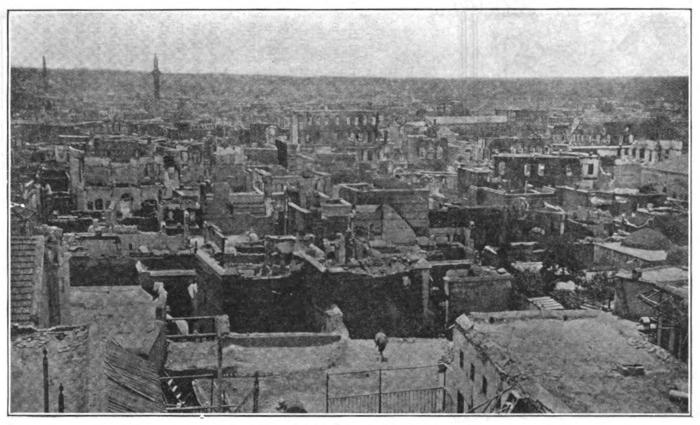
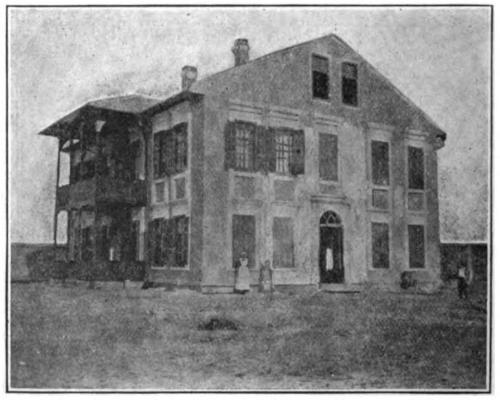
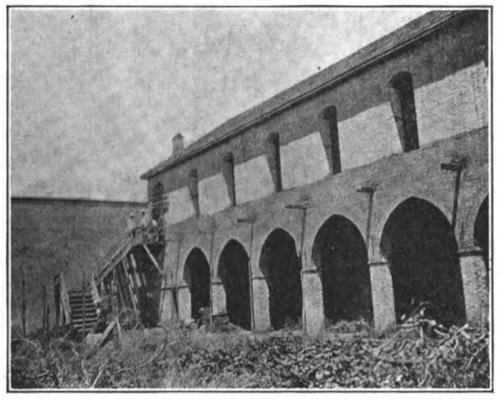
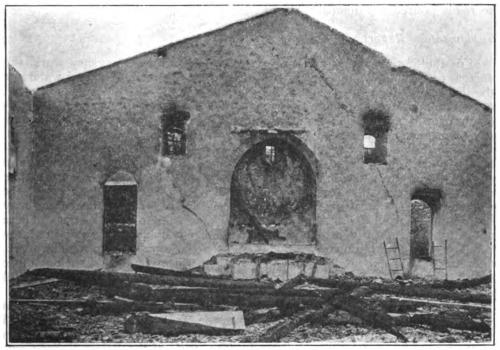
DESTRUCTION OF ARMENIAN QUARTER IN ADANA
PREFACE
WILLIAM H. TAFT.
With the October number of 1909 the Red Cross Bulletin
brings its fourth volume to a close. Those who recall the
dry little report which constituted the first Bulletin, issued in
January, 1906, will find a strong proof of the growth of the
American Red Cross by contrasting the former with the Bulletins
issued during the last year. The Red Cross is fast becoming
a very vital force throughout the world, a force that is
bringing the nations closer together in the bonds of human
sympathy, brotherhood, and peace.
During 1909 our people, by means of the American Red
Cross, have been able to express their sympathy and give their
help to thousands of their fellowmen who have suffered from
earthquakes in Italy and Portugal, from massacres in Turkey, and,
just as this Bulletin goes to press, from floods in Mexico.
In San Francisco the Relief Home and the thousands of little
cottages built after the fire are monuments beside the Golden
Gate to our Red Cross. Again, in sunny Italy the American
Red Cross Orphanage and hundreds of little cottages are
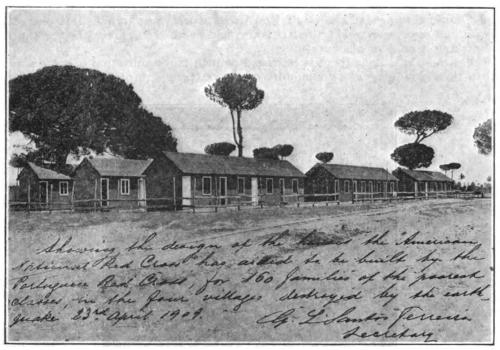
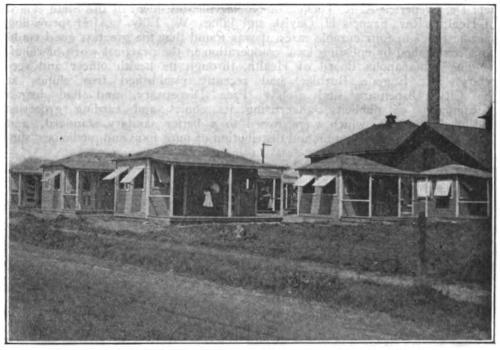
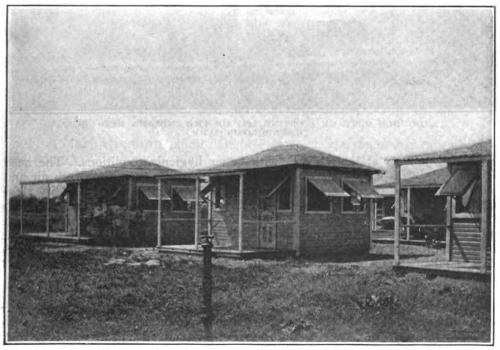
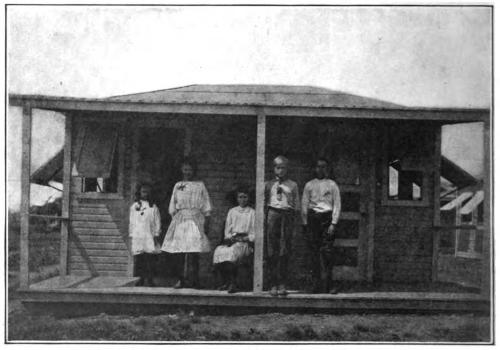
witnesses of its zeal and its sympathy. A picture in this Bulletin
shows some of the cottages it has helped to build in Portugal,
and the Red Cross Day Camps that are beginning to dot
the country over show its unforgetfulness of those who are victims
of the “Great White Plague.” The transport that carried
to China the generous cargo of food supplies provided by the
Christian Herald floated the Red Cross flag; the relief ship
Bayern, sent out by the American Relief Committee in Rome
under the American Red Cross flew again that wonderful emblem,
and from Beirut comes the news that the steamer on
which our Red Cross committee there shipped relief supplies
to the sufferers from the Armenian massacres sailed under the
Red Cross flag. The ferryboat given by Miss Mary Harriman
to the Brooklyn Red Cross for its tuberculosis work is another
ship in what has been called “The Red Cross Navy.” So the
water as well as the land has seen the beneficence of its labors.
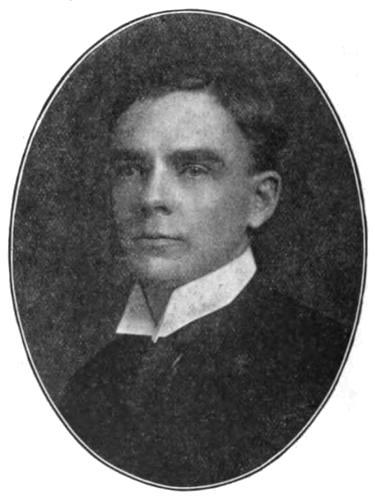
ROBERT W. DE FOREST. Copyright,
Harris-Ewing, ’08.
Our American Red Cross has suffered a serious loss in the
death of Mr. John C. Pegram, of Providence, Rhode Island.
Due to the interest and energy of Mr. Pegram, Rhode Island
founded the first State Branch of the Red Cross after its reorganization
in 1905. From this time until his death Mr.
Pegram was its President, and he has also been a most faithful
and valuable member of the National Central Committee.
We regret that the new plans for a reorganization in regard
to State Branches are not yet in such shape as to be presented
in this Bulletin. Experience has shown the difficulty of
maintaining efficient State Branches under present regulations.
Our States are generally too large for the officers and members
of Committees of a State Branch to hold frequent meetings,
and in many cases it is not wise to concentrate all officers and
members of State Committees in one city. The new plans
leads to the creation of skeleton State Branches, to act only in
case of disasters. The local, county, city, or town chapters
will be brought directly in contact with the National Headquarters
at Washington. In case of disaster in a State, it has
been the custom of the Governor of the State to take prompt
action for relief measures. For this reason it is probable that
the Governors of States will be asked to act as Presidents of
their respective State Branches. In appealing to the President
of the United States for assistance, as has been the custom
when the calamity has been of such magnitude that it was not
possible for the State to render all the aid required, the Governor
will appeal to the President of the American Red Cross,
so the stricken community will be assured of assistance from
the Government and also from the great national organization
of the Red Cross. The new plans will soon be formulated and
sent to all State officers of our Branches.
MAJ.-GEN. GEORGE W. DAVIS Copyright,
Clinedinst, ’08.
Arrangements for First Aid Courses on a large scale are
fast developing. In October, under the Red Cross’ auspices,
will be held a competition in First Aid among a number of
Miners’ First Aid Corps from different mines in Pennsylvania.
A prize, to be won three times, will be awarded, and bronze
medals to the individual members of the winning team. Plans
for the Nursing Department will receive much consideration.
The new Christmas stamp for the tuberculosis work we trust
will prove even more successful than that of last year, and
so our Red Cross sees the future looming large and vigorous
before it.
HON. CHARLES D. NORTON
If, having proved to our people and to the world at large the
use and value of our American Red Cross, we can now raise our
Endowment Fund to a million dollars, so that by its income we
may be always ready to render First Aid when great national
or international disasters occur without having to wait for contributions
to come in, and so that we may continue and carry
on measures of teaching the hundreds of thousands of our
men and women engaged in manufacturing, in mining, in railroading,
etc., to be prepared to help themselves and each other
in cases of the innumerable accidents of every day life, our
Red Cross will take its place among the greatest, most efficient,
and most blessed forces not only of our own country but of
the world itself.
TURKO-ARMENIAN RELIEF — AMERICAN RED CROSS BEIRUT RELIEF COMMITTEE. — Supplementary Report of July 15. — MEDICAL RELIEF WORK IN ADANA — End of First Massacre. — Work Organized. — Second Massacre. — Conditions of Refugees. — Red Cross Sends Medical Aid. — Conditions Improve. — Work of Trained Nurses. — International Feature of Relief Work. — THE SACK OF KESSAB — Supplementary Report. — An English Woman’s Heroism. — Slaughter in the Fields. — REPORT OF F. G. FREYER, SECRETARY-TREASURER OF THE BEIRUT RELIEF COMMITTEE. — A Special Appeal for Kessab. — Abstract of First Financial Statement, Beirut Relief Committee, June 24, 1909. — SUMMARY OF DISTRIBUTION. — Abstract of Second Financial Statement, Beirut Relief Committee, July 26, 1909. — Supplementary Statement or Cash Memorandum, Beirut Relief Committee, July 28, 1909. — Turkey-Armenian Relief Fund.
By G. Bie Ravndal,
American Consul-General, Chairman.
Beirut, Syria, June 5, 1909.
Your Committee desires to express its profound appreciation of its recognition
by the American National Red Cross as the latter’s authorized
agents in the matter of extending relief to the sick and destitute of Asia Minor
and Syria in consequence of recent bloody disorders.
Such recognition strengthened our appeals for aid. It implied a thorough
audit of accounts, and also that distribution to the needy would be made, irrespective
of race or creed.
As Americans we have wished that credit for whatever we might be able
to accomplish along the lines of alleviating suffering and destitution should be
given to the American National Red Cross. For this reason, as well as for
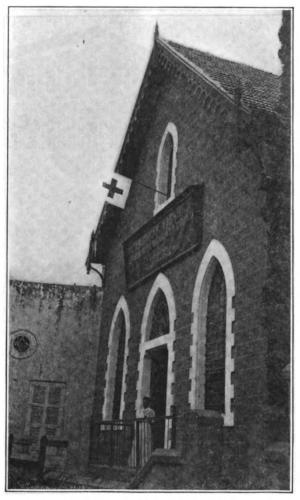
purposes of protection, we have displayed the Red Cross flag in the field as
well as at our headquarters in Beirut, and we have also marked supplies as
shipped by us to various local relief agents with the Red Cross insignia.
Commercially and otherwise, the stricken districts form part of Beirut’s
tributary territory. This city, therefore, is especially suitable as a point of
distribution of relief supplies in the present emergency. Your Committee,
accordingly, was able to and did reach Adana and other afflicted points
before any other relief agency. As soon as other instrumentalities had been
provided for the Adana region, your Committee concentrated its efforts upon
the less favored districts of Alexandretta, Latakia, Kessab, Antioch, and Marash.
We take pleasure in inclosing herewith a synopsis of the report of Prof. Harry
Gaylord Dorman, M. D., of Beirut, who, while there, was called upon to superintend
the entire medical relief work. Some of Dr. Dorman’s photographs
show the Red Cross well to the front in Adana. We are grateful to the
authorities of the Syrian Protestant College for granting Dr. Dorman the
leave of absence required for the purpose indicated.
Inclosed financial statements, prepared by E. G. Freyer, Esq., our Secretary
and Treasurer, who, as the executive member of your Committee, has displayed
the most commendable zeal and tireless activity, explains the Committee’s
operations up to the present time. Fuller accounts of the manner in which
our cash remittances to Alexandretta, Marash, and Antioch were used will
accompany our final and detailed settlement with the American National Red
Cross. In every instance we have availed ourselves of the services of American,
British, and German missionaries in the field, individually known to and
fully trusted by your Committee, as distributing agents. Most of them “went
through” the massacres of 1895, and thus acquired experience in relief work.
Among such field agents we would especially mention Rev. Chambers, at
Adana; Rev. Dodds, at Mersine; Rev. Kennedy, at Alexandretta; Dr. Balph, at
Latakia; Rev. Maccallum, at Marash, and Rev. Trowbridge, at large, as having
rendered valuable assistance.
While this is only the American Relief Committee at work, we are fully
aware of the important services rendered by the International Committee at
Adana, of which the British Vice-Consul, Major Doughty-Wylie, is chairman;
Rev. W. N. Chambers (American), Secretary, and the Imperial Ottoman Bank
(French), Treasurer. The latest letter received from Rev. Mr. Chambers,
of Adana, shows that the relief work at that point still remains at its initial
stage (feeding the hungry and nursing the wounded), and that fresh relief
measures are imperatively required.
Rev. T. D. Christie, D. D., President of St. Paul’s College Institute (American),
at Tarsus, under the date of May 29, 1909, indorses an “Appeal for Help
to Cilicia,” issued by an Armenian Bishop, in the following language:
RED CROSS HEADQUARTERS, BEIRUT.
“The above is not mere rhetoric; it understates rather than overstates the
case. The needy refugees in these two Provinces of Adana and Aleppo now
number about seventy thousand; the value of the property looted or destroyed
is fifty million dollars. I trust there will be a generous response to this cry
for help. Something is already being done, for which the men and women on
the ground are most grateful; but much more must be done if disaster is to
be averted.”
Your Committee is not prepared to confirm any specific estimate of the
number of destitute refugees. While in some places the devastation is complete,
in other places the crops are left and may yet be saved. We do know,
however, that the general situation in the stricken belt is extremely pitiable,
and that we are perfectly justified in calling upon the American public for
further help.
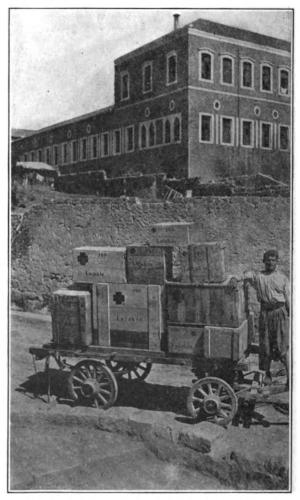
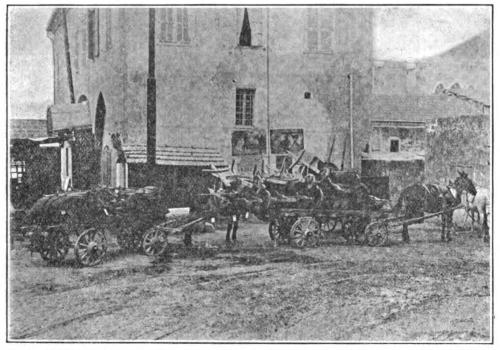
A SHIPMENT OF SUPPLIES LEAVING RED CROSS HEADQUARTERS
AT BEIRUT FOR LATAKIA.
In the case of Kessab, we have supplied some mechanic’s tools and agricultural
implements as the best means of obviating the necessity of issuing
rations indefinitely. This policy will be pursued in other villages which were
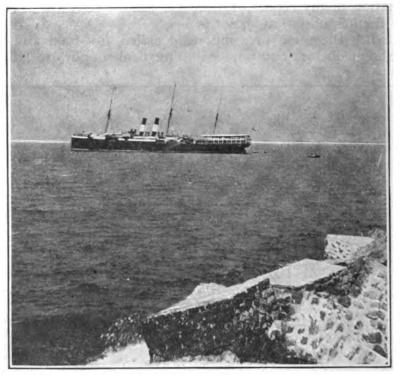
looted and destroyed, and where the inhabitants are utterly destitute. Photographs
show the steamer which carried our fairly large shipment for Kessab,
and boxes composing the shipment. The steamer (Italian) flew the Red
Cross flag in honor of the occasion.
Your Committee is deeply grateful for the opportunity of doing this kind
of work under the inspiring auspices of the American National Red Cross, and
would assure you that we constantly have in mind performing our task in such
a manner as not to lower the high standard of efficiency and fidelity to duty set
by your noble organization.
In continuation of my report of June 14, 1909, I have the honor to submit
the following further observations:
To begin with, the most pressing need called for food and medical aid.
We, therefore, sent doctors and nurses and medical supplies to Adana and provisions,
or cash wherewith to buy food, to various stricken centers, such as Adana,
Tarsus, Alexandretta, Kessab, Antioch, and Marash. Kessab we also supplied
with implements and tools of various kinds, as the village was utterly looted
before being destroyed, and practically nothing but ruins was left of it. At
Aintab and Beirut we have provided clothing, shoes, and bedding for some
destitute orphans.
RED CROSS SUPPLIES, INCLUDING PLOWS, PICKS AND OTHER TOOLS, BEING TAKEN
TO THE STEAMER SAILING FOR KESSAB.
Fortunately, in many districts the crops were saved. The food problem,
except at certain points, including Kessab, which is not an agricultural village,
will therefore be deprived of its worst terrors until the winter sets in. There
has been and still is a general demand for clothing, quilts, and blankets, especially
from the mountainous regions between Latakia and Marash. We shall
hear more about the need of clothing and bedding and shelter as the season
advances and the cold November rains begin beating down upon the mountains.
Kitchen utensils are urgently wanted in many districts in which the marauders
carried off everything portable.
But while the initial and most palpable suffering and destitution may be said
to have been provisionally checked, and while preliminary steps are being
discussed with a view to establishing orphanages and asylums for the fatherless
and factories in which to give the widows employment, we feel that the real pinch
is yet to come. After careful investigation, we are satisfied that relief on an
extensive scale will have to be furnished for months to come, and that the
coming winter will to the utmost tax the capacity of all the relief agencies
at work, even if the funds at their disposal are very materially increased beyond
the present ratio of contribution.
ITALIAN S. S. “ORIONE” FLYING RED CROSS FLAG,
LEAVING BEIRUT FOR LATAKIA.
Confronted with so many unsolved problems of relief and of rehabilitation
and feeling that some 25,000 destitute fellow-beings in the district between
Marash and Latakia are looking toward this Committee for help, both for the
present and during the approaching season of inclement weather, we are in
duty bound to persevere.
As late as July 8, Rev. Kennedy reported from Alexandretta:
“Nothing has been done in the district so far to reinstate the refugees in
their homes. They have been ordered back to their villages repeatedly, and
even threatened if they did not obey, but they say they can not go back as long
as they have no houses to return to. What the outcome will be I can not
predict. To rebuild 746 houses, even though many of them are little better than
huts, is no small thing.”
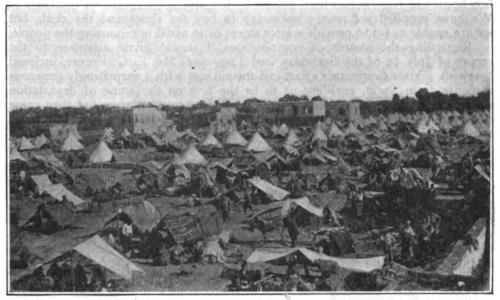
TENTS FURNISHED THROUGH THE RED CROSS RELIEF COMMITTEE FOR ADANA.
THIRTY-FOUR ORPHAN GIRLS FROM ANTIOCH BROUGHT TO BEIRUT UNDER RED
CROSS AUSPICES FOR THE GERMAN DEACONESSES OF KAISERSWERTH. BEDS,
BLANKETS, SHOES AND CLOTHING WERE SUPPLIED.
On July 3 this Committee received an appeal from Miss E. Chambers at
Kessab for $500 for shoes, $250 for cotton cloth, and $5,000 for wheat, while
urgent requests were made for money with which to rebuild houses. More than
600 houses in Kessab had been ruined by fire and other means of destruction.
We have supplied the money necessary to buy the shoes and the cloth, but
we are unable as yet to provide winter stores or to assist in rehousing the people.
Regarding the matter of contributions, I would invite attention to the
report of July 12 of the Secretary and Treasurer, Mr. E. G. Freyer, inclosed
herewith. Your Committee’s first call for aid met with a surprisingly generous
response from Syria, enabling us to be the first on the scene of devastation
with help from the outside. The contributions were not large, but they came
in promptly, and as shown by the financial statement of June 24, from numerous
sources.
In the matter of distribution, this Committee has exercised very special
care. We have dealt exclusively with American, British, and German missionaries
in the field, men and women personally known to ourselves, and in
whose trustworthiness and good judgment we had implicit confidence. We
have full assurance that the supplies and the cash forwarded have been
employed where they would accomplish the greatest amount of good. In that
way the piasters or piasters’ worth furnished have been made to serve important
ends. We, therefore, feel that we have not striven in vain, although the summary
of receipts and expenditures does not run into very large figures.
The number of killed during the recent disturbances is variously estimated
at 15,000 to 30,000, leaving thousands of widows and orphans. Business practically
is at a standstill in the disturbed region. Hundreds of families wish
to emigrate, and some have applied to American consuls for assistance to that
end. It is a sad state of affairs. But emigration on a large scale at this time,
when brighter days obviously are dawning upon this empire, unquestionably
would be both a mistake and a misfortune.
Everywhere the Red Cross has been respected and honored, although the
emblem of official relief work in Turkey is the red crescent.
Your Committee considers it a special and precious privilege to be permitted
to help so many of these afflicted people under the inspiring auspices of the
American National Red Cross. We once more appeal for further funds.
The Adana massacre was in two sections, the first massacre lasting from
the morning of Wednesday, April 14, for three days, until Friday afternoon,
April 16; the second followed after an interval of eight days, and lasted
for two days, Sunday and Monday, April 25 and 26. The second massacre
was followed by occasional killing of Armenians for five or six days more.
The feature of the first day was the plundering of the shops in the Armenian
quarter by the Moslem mob. There was much shooting in the city, and some
killing on both sides.
Thursday the shooting and killing was continued with more violence. The
resistance of the Armenians in the Armenian section of the city was, to a
certain extent, successful in preventing the pillaging of a large part of the
Armenian quarter. But in the suburbs, where the Christian houses stood
isolated, in their little vineyards or gardens the mob and pillaging soldiers
had full play. Houses were entered, their inhabitants shot regardless of sex
or age, and then, after having been plundered, the buildings were set on fire.
On this Thursday afternoon the first assistance to the wounded was given by
Mrs. Doughty-Wylie, the wife of Major C. H. M. Doughty-Wylie, British
Consul at Mersine. These two had come up on the last regular train from
Mersine the previous day because of the report of trouble at Adana. However
much of credit may have been, and rightly, given to the Major for a
heroism and courage in these days of terror that was the means of saving the
lives of thousands, his wife is no less deserving of credit for a brave and tireless
devotion to the needs of the wounded, which has done much to mitigate
the suffering that followed these awful massacres. To this work she brought
not only a love for the details of nursing, but a genius for organization as well,
and a training that prepared her in a peculiar way to fill the need. She had
seen service as army nurse in the Boer war, and for six years she personally
supported and conducted a hospital in Bombay, where she has nursed through
famine and through plague. It surely was a special Providence that brought
these two to Adana at such a time.
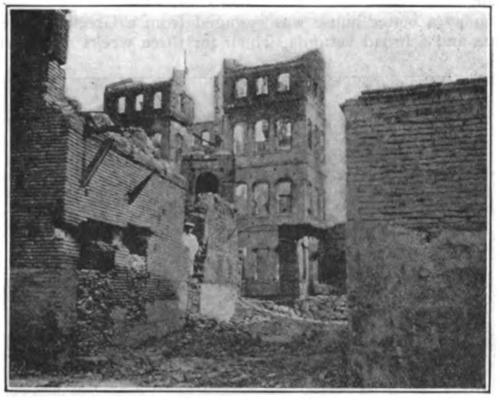
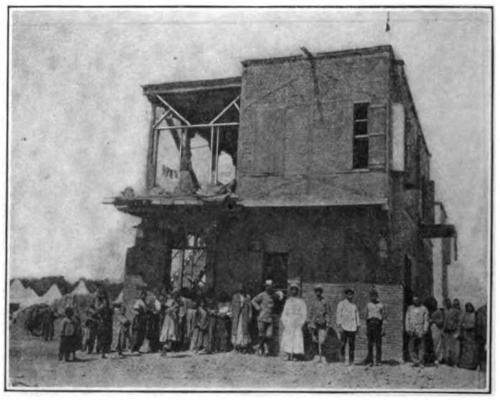
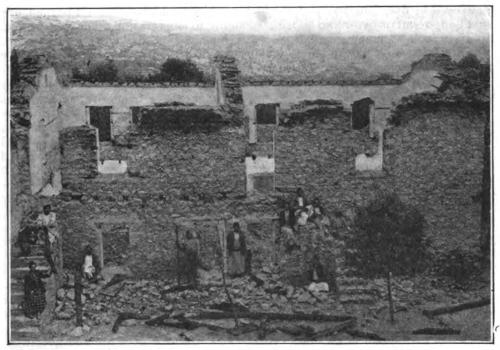
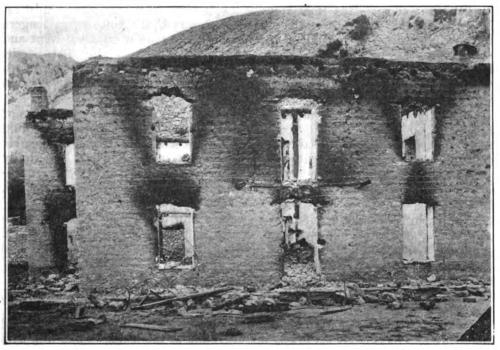
RUINS IN ADANA.
Thursday afternoon it was reported at the Consulate that nine wounded
women and children from the ruined houses of the adjoining suburb had been
brought into the Turkish guard house near the Consulate. A message to the
guard house to ask if medical help could be given was answered by the curt
reply that no assistance was needed as all would be dead by morning. There
was firing on the street and murder abroad, but Mrs. Doughty-Wylie, taking
with her a Greek woman and Dr. Danielides, who had taken refuge at the
Consulate, went over to the guard house. The nine wounded were on the floor
of a small room, lying in pools of blood. In an adjoining room were two
wounded soldiers, one with a broken leg and one with a flesh wound. After
a trip back to the Consulate for dressings, Mrs. Doughty-Wylie and the doctor
dressed the wounds, caring first for the wounded soldiers. The women and
children were then brought over and placed in a woodshed adjoining the Consulate,
while the soldiers were left to the care of the proper military authorities.
This formed the nucleus of the hospital relief work. There might have been
ten instead of nine in this nucleus but for the fact that even while Mrs.
Doughty-Wylie was at work in the guard house a wounded Armenian seeking
its protection was stabbed to death by the bayonets of the soldiers in full view
of the English Consulate. Of the nine, two died of peritonitis in the course of
a few days; two were discharged cured within two weeks, and others were
convalescing in the hospital five weeks later.
A tenth was added to the list of wounded in the Consulate that afternoon
by the wounding of Major Doughty-Wylie in the right forearm, who, in the
role of peacemaker, was frequently between the fire of the contending parties.
Friday morning, about nine o’clock, the bugles sounded the call to cease
firing, and the first massacre ceased. Some four or five wounded men were
brought into the British Consulate, and the little hospital overflowed into an
adjoining Armenian house, where the patients lay in a little dark room with
a mud floor.
On Monday a better house was engaged from a Greek. Here were four
small rooms and a broad veranda, which for three weeks did service for surgical
dressing room and operating room. The hospital was established with
fifteen inpatients and a number of outpatients, who came for dressings. Dr.
Danielides left in the middle of the week, and the work was carried on by
Mrs. Doughty-Wylie, assisted by Miss Alltree and Miss Sinclair (English), and
Miss Avania (Greek), until the arrival of Sick Bay Stewart Shenton and five
first aid marines from the British cruiser Swiftsure. These came on Saturday,
eight days after the end of the first massacre, and with a reinforcement of four
more marines two days later they did thorough and efficient work until they
were relieved after three weeks by a similar crew of men under Sick Bay Stewart
Weiber from H. M. S. Minerva. The work of these men, and especially of
Mr. Shenton, in caring for the wounded and in the daily dressing of what, after
the second massacre, amounted to some 200 suppurating wounds, is deserving
of the highest praise.
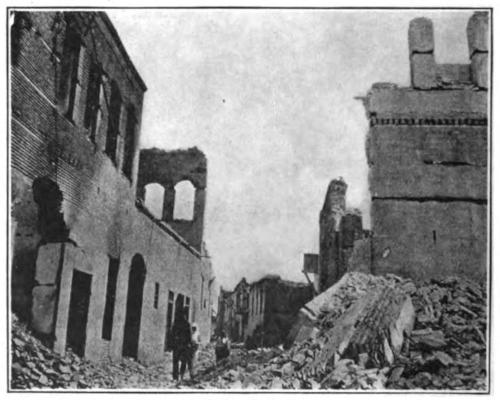
RUINS IN ADANA.
In the interval of eight days that elapsed between the first and second
massacres, confidence had begun to be gradually restored. The wounded
were gathered in several places and cared for by Armenian doctors under the
supervision of foreigners. Many of the wounds had gone four days without
being dressed and were in bad condition.
On Monday, April 9, three days after the end of the first massacre, work
began to be organized, as follows:
Under the care of Miss Wallis, in the upper Gregorian Church, 60 wounded
women and children, and in the Protestant Boys’ School, 15 wounded men,
together with over 15 outpatients.
Under the care of Miss E. S. Webb, in the Armenian Girls’ School, and in
the lower Gregorian Church adjoining, over 40 wounded, besides 30 sick.
Under the care of the Soeurs de Charite de Ste. Leon, in a large Armenian
house, 25 wounded, besides 130 outpatients.
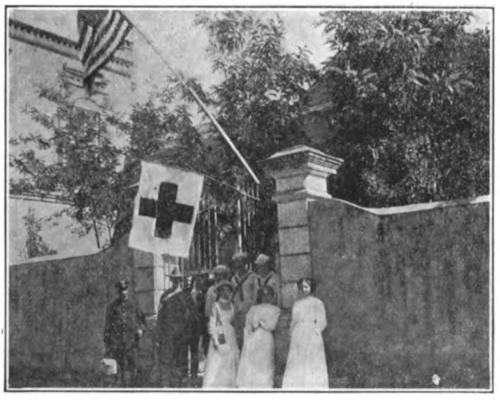
RED CROSS HOSPITAL (SURGICAL) IN CHARGE OF MRS.
DOUGHTY-WYLIE. IN SIMEONIDES’ HOUSE.
There were also about a dozen wounded in the Turkish School, and among
the 2,000 or so refugees in the New Market Armenian Boys’ School there were
50 sick.
In all there were 330 wounded Armenians under treatment, of whom
about half were able to come and go for their dressings. Besides this, there
were some 100 sick among the crowded refugees. The small proportion of
wounded relative to the total number of Armenians killed in the city during
the first massacre—a number estimated at 2,500—is indicative of the vindictiveness
of the killing. The chance of escape was small for a man, woman,
or child once disabled by a wound.
Wounded Moslems were cared for in the government charity hospital outside
the city. There were about 50 inpatients, among whom were said to
be a few Christians, and about 150 outpatients. In the Turkish Military Hospital
there were also about 40 wounded. From 50 to 60 other wounded
Moslems were cared for in their homes. The number of Moslems killed is
unknown, but is said to have been 200, more or less.
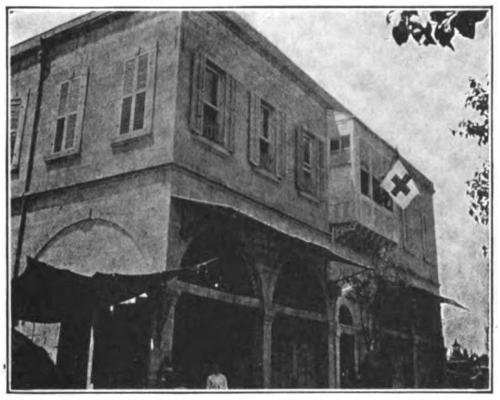
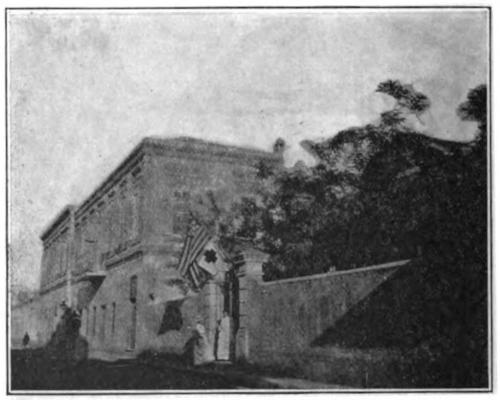
AMERICAN RED CROSS HOSPITAL (MEDICAL) ADANA.
On Sunday, April 25, the aspect of the medical relief work was abruptly
changed by the occurrence of the second massacre. This began at 4 in the
afternoon, with a determined fusillade on the New Market Armenian School,
accompanied by the firing of the building, and followed by the massacre of
most of its 2,000 or more helpless refugees as they sought to escape from the
death trap. Carts piled high with bodies were busy for the next three days
emptying the school playground of its dead. The acute stage of incendiarism
and killing lasted only until the following night, Monday, April 26, but frequent
fires and the shooting of stray Armenians continued for a week after. This
massacre differed from the first in the absence of any effectual resistance on the
part of the Armenians, the prominent participation of the soldiers in the killing,
and in that it ended with the complete destruction by fire of the Armenian
section of the town, representing something over one-fourth of the city’s area.
It seems also to have been characterized by a peculiarly relentless cruelty; sick
and wounded men, women, and children fell alike before the shots and
bayonets of the pitiless soldiery. The 2,500 who are roughly estimated to have
been killed in this second massacre are, for the most part, victims of the
Armenian School massacre, together with those who were killed the same
afternoon in the lower Gregorian Church and adjoining girls’ school. Of the
70 sick and wounded among the refugees here, most were either killed or
burned. The hospital of the French Sisters was burned at the same time.
Some of the patients were burned with it, but some were saved by two of the
Jesuit Fathers, who carried as many as they could over to the Church of the
Jesuit Boys’ School. Even this proved for them an uncertain refuge, for the
following day the buildings of the Jesuit School were burned, and its refugees,
together with the Jesuit Fathers themselves, were saved from the blood-thirsty
mob only by the timely intervention of Major Doughty-Wylie. In spite of his
fractured arm, he had a guard from the Vali, and rode about in the endeavor to
save life and restore order.
Monday morning, April 26, it was announced that government protection
would be afforded only to those Armenians who should present themselves at
the Konak or government house. So through the day refugees by the thousand,
among them the sick and wounded, fled to the open space in front of the
Konak, until the Armenian quarter was deserted. Many were escorted there
by Major Doughty-Wylie with a guard of soldiers. Here they stood waiting
helplessly, without food, for many hours. The women and children were
commanded to stand apart from the men, and all were subjected to a thorough
search for arms or valuables. Toward evening they were told to go, but no
provision was made for their going. Like a herd of frightened sheep, turning
back here and there as some new terror faced them, with a number trampled
to death at every fresh panic, husbands separated from wives, and children
separated from parents, dead bodies lying in the streets, and darkness coming
on, they gradually drifted to the new quarter of the town near the railroad
station, where they finally found refuge in the two great cotton factories—13,000
in Trepanni’s factory and 5,000 in the German factory. In this flight they
were partially protected by the Macedonian soldiers. Some of them were cut
and wounded as they passed by Arab soldiers, but none were killed.
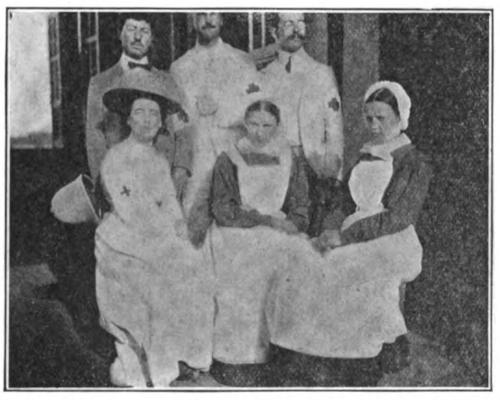
DOCTORS AND NURSES SENT TO ADANA UNDER AUSPICES OF
AMERICAN RED CROSS AGENTS, BEIRUT.
The four emergency hospitals in the Armenian district were thus broken up.
On that Monday 120 wounded from these hospitals came down to the hospital
of Mrs. Doughty-Wylie for dressings, most of them destitute of beds or bedding.
The next day, Tuesday, there were over 60 inpatients under the charge
of Mrs. Doughty-Wylie; 100 wounded among the 5,000 refugees in the
inclosure of the German factory were segregated in a good building intended
for the use of foreign employees of the factory. There were no beds for these
unfortunates at first. Of this 100 many were but slightly wounded, so that
when the factory was emptied of its refugees a week later only 50 were left
as interne patients. Besides the 60 or more patients in Mrs. Doughty-Wylie’s
hospital, 200 outpatients were also cared for.
There were thus in the three hospitals about 375 wounded under the care
of foreigners, after the second massacre, not many more than the number of
wounded before the second massacre, for the newly wounded were hardly
more than enough to take the places of the wounded who had been killed or
burned. Besides, the nature of the second massacre was such as to leave
few wounded among those attacked. The kill was usually complete.
Dr. Connell, of H. M. S. Swiftsure; Dr. Bouthillier, of the French cruiser
Victor Hugo; Dr. Bockelberg, of the German cruiser Hamburg, with a number
of sailors and marines from their ships, gave much assistance.
A number of the native physicians likewise gave their services, though at
first it was hardly safe for the Armenian doctors to do so.
The German Emperor had sent his own ship, the Hamburg, post haste from
Corfu to Mersine soon after the first massacre, and the supplies needed for the
German Hospital were to a large extent furnished from the ship’s stores.
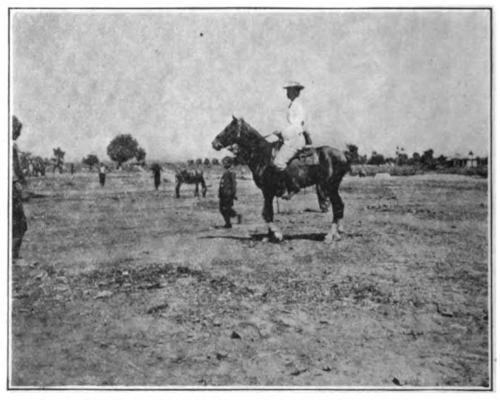
DR. DORMAN MAKING HIS ROUNDS OF THE CAMP. ADANA.
In the four days following the second massacre the condition of the refugees
in the factories was pitiable. A little raw flour was given out, even on Monday
evening, but for most of the people it was two and a half days before bread was
distributed to them. The suffering was great. Conditions were not as bad in
the German factory as in the Greek factory, because the inclosure of the former
was spacious, and the number of refugees less. In the Greek factory the 13,000
filled all available space. The buildings were packed, with people sitting everywhere
on the floor; many crawled under the machinery to find a place to lie.
Out in the yard of the factory the last comers were jammed together tightly,
so that for many there was actually “standing room only.” Among the refugees
here few were wounded, but many sick. There had been an epidemic of
measles in the town before the trouble began, and in the crowding of refugees
from the first massacre there had been a thorough spread of infection. The
two weeks that had elapsed since the beginning of the first massacre gave time
for the incubation period, and now many children broke out with the rash of
measles.
A smallpox scare was of benefit, in that it hastened the evacuation of the
factory. This early turning out of the crowd from the factory was one of the
best steps taken in all the relief work, for although it caused some few deaths
by pneumonia from exposure, it avoided the awful calamity of an outbreak of
typhus fever, such as occurred after the Armenian massacres of 1895. The
moving of refugees into camp from the Trepanni factory was superintended by
Commander Carver, of H. M. S. Swiftsure. By Thursday noon the 13,000 had
been divided up into about 30 sections to facilitate the distribution of bread.
On Friday, when it was desired to empty the factory, it was announced that
bread would no longer be given out in the factory, and each section, according
to directions, followed its own particular bread cart out to the place of encampment,
at the Yenemahalle. Here, without sufficient covering, and for a time
without any tents, families were required to pass nights still cold and chilly,
and days rendered intolerable by exposure to the intense heat of the sun at
midday. Children in the acute stage of measles passed the night on the bare
ground without any covering, and exposure to the chill air resulted in many
cases of broncho-pneumonia, from which, for a time, they were dying at the
rate of ten a day.
AMERICAN RED CROSS HOSPITAL IN CHARGE OF SURGEON
MILLER, OF U. S. S. “NORTH CAROLINA,” ASSISTED BY
THREE HOSPITAL CORPS MEN AND LADIES.
Two days after the establishment of the camp an attempt was made to
separate the families with measles, and between 300 and 400 of such were
collected by Commander Carver in an orange grove, a quarter of a mile away
from the main Yenemahalle camp.
Tuesday, May 4, eight days after the second massacre, the German factory
was cleared of its 5,000 inmates, and these were located part in an open
camp and part in adjoining houses, which, although rented by Armenians, had
been spared the general destruction because belonging to Turkish owners.
This location was nearly half a mile distant from the Yenemahalle camp. The
people here were fed by German funds, and the place was known as the “German
camp.”
At this time the allowance of rations was doubled in the large Yenemahalle
camp, so that from this time on the people had sufficient food. But the bread
from the emergency bakeries of the first two weeks was often poorly baked,
and many people had diarrhœa, approaching dysentery, from eating the raw
dough that for many was the only food available during the first two days in
the factory. Tuesday night and Wednesday 500 blankets and 100 quilts, sent
from Beirut, were distributed to the most destitute of the sufferers in the
Yenemahalle and measles camp, but when half of the 13,000 refugees were
without covering for the night, it can be understood that the 600 pieces were
woefully insufficient to go around. A week later 300 more blankets were
received and distributed.
GERMAN HOSPITAL IN GROUNDS OF GERMAN FACTORY WITH
KAISERSWERTH DEACONESSES.
On this Tuesday a request made to Ashraf Bey, municipal sanitary inspector,
for aid in medical inspection was answered by the sending of two Turkish
doctors and two pharmacists, who, the following day, opened an emergency
pharmacy near the measles camp.
Immediately after the second massacre, a call for medical assistance was
sent by the Adana Relief Committee to Beirut, where a Red Cross Relief
Committee had been constituted by Hon. G. Bie Ravndal, American Consul
General; Mr. E. G. Freyer, of the American Presbyterian Mission, and Dr.
Geo. E. Post, of the Syrian Protestant College. This was answered by sending
an Armenian physician, Dr. Armadouni, on Wednesday, April 28, who,
on arrival at Mersine, found that it was impracticable to proceed farther on
account of government restrictions of Armenians. Surgical supplies sent with
him were forwarded to Adana, and he returned to Beirut.
Another still more urgent appeal for doctors came from the Adana Relief
Committee on Friday, April 30. The surgeons from the English and German
ships were necessarily irregular in their attendance, and soon to be compelled
to leave; Armenian doctors were not available, and severe epidemics were to
be expected among the crowded and poorly fed refugees. In response to this
call the American Red Cross Committee at Beirut sent a medical commission,
which reached Adana on Wednesday, May 5, consisting of two students of the
fourth year of the Syrian Protestant College Medical School, Dr. Kamil Hilal
and Dr. Fendi Zughaiyar; Miss MacDonald, a Canadian, who had been teaching
in Jerusalem, and Dr. H. G. Dorman, of the Syrian Protestant College, who is
the writer. With us was a complete hospital outfit of surgical instruments,
sterilizers, sterilized dressings and sutures, and a supply of condensed milk,
tinned soups, drugs, etc. Miss MacDonald was succeeded later by Miss Davis,
who arrived May 10. The size of the Beirut delegation was increased later by
the arrival, on May 12, of Mr. Bennetorossian, of the third year in the Syrian
Protestant College Medical School, and on May 20 by Dr. Haigazum Dabanian,
who had been released by Dr. Torrence, of the Tiberias Mission, from his
engagement in the English hospital there that he might assist in the Adana
relief work. The two senior medical students were Syrians who spoke Turkish;
the last two men were Armenians and deserving of especial credit in
coming to Adana at this time, for they knew that in so doing they ran the risk
of government suspicion and arrest.
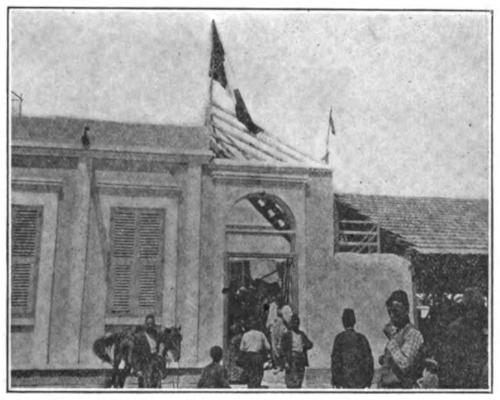
FRENCH FLAG FLYING OVER FRENCH DISPENSARY.
With the delegation going from Beirut, although not sent by the Red Cross
Society, were two Kaiserswerth Deaconesses from the Johanniter Hospital in
Beirut, Sister Louisa and Sister Hannah. These two sisters were sent in
response to an appeal from the captain of the Hamburg. They took the German
hospital in charge from the time of their arrival in Adana and inaugurated
a reign of cleanliness and order that made the German hospital a pleasure to
behold.
On Tuesday, May 6, as the doctors from the English and German ships
were compelled to leave, the writer was asked by the Relief Committee to take
entire charge of the medical work. I began with a survey of conditions.
In the German hospital were 23 men and 25 women and children now under
the care of the two German Deaconesses; 15 or 20 outpatients were coming in
for daily dressings.
In Mrs. Doughty-Wylie’s hospital were 17 men and 20 women and children,
and in the railroad freight house, under her care, were 21 men and 4 women;
160 outpatients were having their dressings done at this hospital.
In the American Girls’ School were 15 women and children, under the care
of Miss Wallis and Dr. Salibian. Some 10 or 15 wounded outpatients were
also dressed at the daily clinic held by these two in the Yenemahalle camp.
Thus there were at this time, in all, 305 wounded under the care of
foreigners.
PHARMACISTS AND DOCTORS IN FRONT OF ARMENIAN
EMERGENCY PHARMACY IN YENEMAHALLE CAMP.
Except for the need of a surgeon in charge of Mrs. Doughty-Wylie’s hospital,
the surgical work seemed well in hand and likely to be of lessening
urgency, while the medical need was just getting into its prime and had been
so far almost entirely neglected. In the Yenemahalle and German camps some
200 were reported as sick, while in the measles camp between 75 and 100 children
were suffering from the sequence of measles, bronchitis, pneumonia, otitis,
and from diarrhœa and dysentery, as the result of bad food. A discouraging
feature of the outlook was the lack of bedding to protect the sick from exposure,
and another difficulty was the absence of milk or soup for the hundreds
who could eat nothing else. When people die from starvation, it is usually not
for lack of something to put in their stomachs. Their hunger compels them to
swallow things unfit for food and a fatal diarrhœa or dysentery is the result.
For the children, made sick by eating dough during the days in the factory, the
rations of the camp, consisting at first of coarse and half-cooked beans (fule),
were as impossible food as is grass to a healthy man. Only a limited supply
of milk at famine prices was at this time available. There was sometimes two
cups of milk a day, sometimes one, and sometimes none for the sick babies, and
consequently the little ones were fading away quickly. Happy were the mothers
who were nursing their own children, but it was sad to see little ones
starving where the mother was too sick to nurse. I was reminded of the work of
thoughtless hunters, who kill the parent birds in nesting time and leave the little
ones to starve in the nest. Day by day the rows of little unnamed graves were
lengthened near the measles camp. Heart rending scenes of mothers beseeching
help for their dying babies were common. Some babies were killed in the
massacres by cutting and shooting, and perhaps there the Turks were the more
merciful.
The camps were rapidly becoming foul from lack of sanitary restrictions.
Swarming flies were zealous to convey infection, and it only needed a good
hard rain, such as is common in Adana at this time of the year, to spread an
epidemic of typhoid or dysentery that would have been impossible to combat.
These were the needs of the camps: Cleanliness, milk, bedding, efficient medical
attendance, medicines, and pharmacists. All these needs were gradually
supplied in the course of the next ten or twelve days.
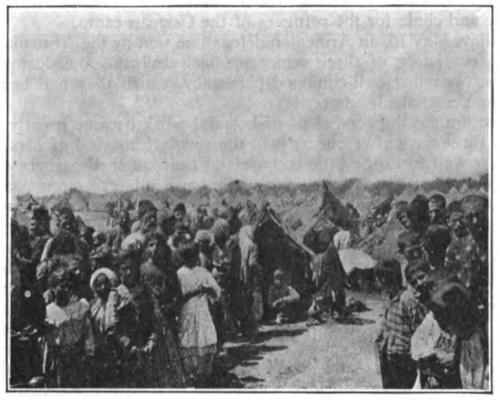
CAMP LIFE, ADANA.
The first week’s work after our arrival seemed rather discouraging, although
constant progress was made. The camps were rigorously cleaned under
threat of short rations. Fortunately the rain held off, and in time the camps
became relatively sweet and clean. After a week and a half the refugees began
moving back to their ruined homes, and the relief of the congested condition of
the camp was a constant lessening of the menace of epidemic outbreak. Until
medical force became reinforced, we had to cover the field among us as best
we could. Sickness was on the increase, and once the daily reports handed in
by the head men of the camp sections showed 400 sick in camp, of whom 75
were reported as “very sick.”
The medical staff at first was quite inadequate for the work of visiting all
these sick. The two Turkish doctors and the two pharmacists found the life
too strenuous for much more than half a day’s work at a time. It was several
days before we were able to do more than make sure that the very sick were
seen by a doctor each day.
There was also a shortage of drugs. The remedies needed were few and
simple, but they were needed in large quantities. This lack was soon supplied
from the drug shops in Mersine. There was a shortage of bottles to put fluid
medicines in, and medicines when not taken on the spot were dispensed in finjans,
old tin cups, or anything that would hold fluids. One man at the dispensary,
whose prescription for castor oil had been filled, in spite of protestations,
into his own mouth, when he was told to go finally made clear that it
was for his wife that he wanted the medicine.
These rough and ready methods gradually passed as better organization
became possible. Dr. Peoples, newly arrived for American mission work in
Mersine, joined the medical staff in Adana on May 9, and gave valuable assistance
in various branches of the work. After a week, on May 12, the returning
French Sisters of Charity, among whom were two experienced nurses, opened
a pharmacy and clinic for the refugees of the German camp.
On Sunday, May 16, an Armenian delegation, sent by the Armenians of Constantinople,
consisting of three senior medical students, one doctor, and two
pharmacists, opened a well-equipped pharmacy, which they had brought with
them, in the Yenemahalle camp.
In the meantime the conditions of hospital work became greatly improved.
On May 8, three days after our arrival, the surgical hospital of Mrs. Doughty-Wylie
was moved from the little cottage and railroad sheds, where such excellent
emergency work had been done under such adverse circumstances, to a
large commodious house, which had been generously offered for the work by its
owner, Cosma Simeonides. In the well-ventilated, spacious rooms of this
building 60 patients were comfortably housed, and sufficient space was left for
an admirable operating room, for accommodations for help, and for kitchen
needs. To care for the patients in these improved quarters, and to relieve the
work of the British marines, the necessity for whose withdrawal was anticipated
in the near future, a corps of 15 young Armenians and Greeks were enrolled as
hospital assistants. These volunteers were for the most part students of St.
Paul’s Institute, at Tarsus, and their knowledge of English facilitated the work
for the English speaking doctors and nurses. Under these new conditions
work which before was arduous and imperfect became a constant source of
satisfaction and pleasure. A large debt of gratitude is due to the owners who
so generously devoted their beautiful home to this work.
The transfer of the surgical patients left the first emergency hospital free
for the accommodation of medical patients. It was soon filled and overflowing,
and within a week it was found necessary to accept an offer of the use of the
Greek School for the accommodation of patients. On Saturday, May 15, this
building was opened as a medical hospital with 50 patients, the most part cases
of pneumonia, enteric fever, and dysentery. These patients, too, were under
the general care and oversight of Mrs. Doughty-Wylie. In this building also
were housed the four American first-aid bluejackets who came up from the
cruiser North Carolina the following week; and here, too, was instituted
another pharmacy to supply the needs of the hospitals under the care of the
sailors who had had training in pharmaceutical work.
In connection with the improvement of the hospital work should be mentioned
the noble work of several trained nurses, whose services were early
volunteered. Miss Yerghanian, sent by the King’s Daughters Society of
Smyrna for this work, arrived on May 5. Miss La Fontaine, of the British
Seaman’s Hospital at Smyrna, came soon after. These two, in conjunction with
two Armenian nurses who came with the Constantinople Armenian Relief Commission,
undertook the nursing of the medical hospital. Miss Davis, of the
Jessie Taylor Memorial School, of Beirut, furnished Mrs. Doughty-Wylie
most acceptable and skillful assistance in the work at the surgical hospital.
It has been said that perhaps the greatest need of the medical work for the
Adana refugees was the lack of sufficient supply of milk. Accordingly the most
encouraging day of our work was the day, ten days after our arrival, when
arrangements were made to secure huge quantities of goats’ milk from peasants
at less than half the famine price of cows’ milk that prevailed in the first days
of the camp life. Distribution of the milk and soup in the camps had been
early assigned to the Misses Webb, of the American Girls’ School in Adana.
The work of these two ladies in their constant, tireless devotion to the relief of
discomfort, sickness, and trouble incidental to the distressing conditions of the
camp life, calls for the warmest admiration. To the sufferers, whose constant
appeals to them were never slighted, these sisters were veritable ministering
angels of mercy. Another assistant in this relief work was Mrs. Kuhne, of
Mersine, who, while her health permitted, helped in the work of the upper camp.
BUILDING TO BE ALTERED FOR MORE PERMANENT AMERICAN
RED CROSS HOSPITAL.
On Monday, May 17, twelve days after we reached Adana, medical assistance
was arriving in such force that I felt justified in returning the three
medical students who were with me to Beirut, where their approaching examinations
necessitated their early return. On this day, in addition to the helpers
already enumerated, Dr. J. T. Miller, surgeon of the American cruiser North
Carolina, arrived with four first-aid bluejackets. Dr. Gogel, of the British
cruiser Minerva, arrived with four marines to take the place of the Swiftsure
marines, who were leaving.
I remained in Adana five days longer to make sure that the work was all
apportioned and running smoothly. When I left, on Saturday, May 22, the
medical work was well in hand and fully manned. Dr. Miller was in charge
of the medical hospital, which it was agreed to call the American Red Cross
Hospital, and also in charge of the sick children in the measles camp. Dr.
Gogel was in charge of Mrs. Doughty-Wylie’s surgical hospital, and a ward
for sick babies that had been instituted in an adjoining building, under the care
of Miss Alltree. The patients in the hospitals were improving and being discharged,
but other patients had been admitted, so that the original numbers
were maintained. Some wounded had come in from outside the city. The
German hospital, under Dr. Phanouriades, had not taken in new patients, and
the number there had diminished to 25. Responsibility for the German
encampment was turned over to the French clinic and pharmacy. On May 20
the French opened a little hospital of 12 beds, for medical cases, near their
pharmacy. In the Yenemahalle camp rounds were being made by the Turkish
and Armenian doctors; the Armenian pharmacy was in full operation and two
daily clinics were being held.
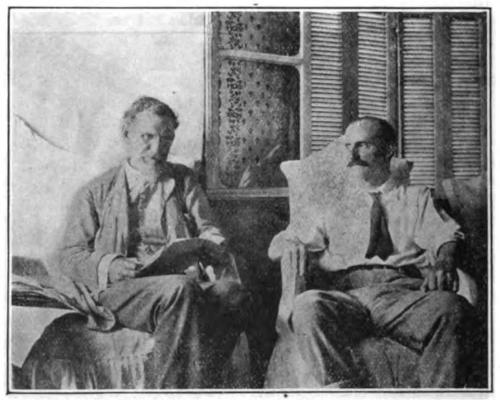
THE ADANA RELIEF COMMITTEE IN SESSION. MR. CHAMBERS
ON LEFT AND MAJOR DOUGHTY-WYLIE ON RIGHT.
The Turkish military doctors were continuing the clinic at their pharmacy
near the measles camp. There were thus in operation four hospitals—English,
American, German, and French; four dispensaries—Turkish, Armenian,
French, and American, and five daily clinics—English, French, Turkish, and
two Armenian. The staff of workers included 25 doctors—English, American,
French, Greek, Syrian, Turkish, and Armenian; 11 trained nurses—English,
German, and Armenians; 8 first-aid men from the English and American ships,
and 12 Armenian assistants. In all this work one of the pleasantest features
was its international character. No friction or international jealousies were
seen. Before the great need and common aim, distinctions of race or nation
fell away, and one helped another with a single desire for service. While I
have spoken of the surgical hospitals as English and the medical hospital as
American, the distinction is only in name, for the English and Americans have
worked together indiscriminately in both hospitals.
The provision for the medical wants of the refugees was sufficient, and it
seemed only a question of time until the emergency relief work should grade
off into the permanent medical work required for 20,000 homeless and penniless
people. When the time for this change should come, it was desired that some
permanent good might remain as a memorial of the relief work in Adana, and
it was planned that the patients remaining from the American Red Cross Hospital,
together with whatever hospital equipment might have been accumulated,
should be left to the care of the American Mission in a large building belonging
to them, which is now being altered for use as a hospital. There is no
hospital in Adana, except one poorly equipped and totally inadequate charity
institution, and the field of usefulness for a good hospital would be great.
There could be no fitter legacy of permanent help to the Adana sufferers than
the founding among them of such a permanent hospital.
The evacuation of the camps, forced by the government on all those who
had remaining houses or vineyards, while it worked hardship in some cases,
was a necessary precaution for the avoidance of epidemics, and at this time the
campers had been reduced by about one-half.
A share in the Adana relief work has been a privilege not alone as an opportunity
for service, but it has been a still greater privilege to see the men and
women there who, in sublime unconsciousness of self, are daily giving themselves
to fill the swarming needs of thousands of destitute people. Especially is
this true of Major Doughty-Wylie and Mr. Nesbit Chambers. Credit for the
high personal bravery shown by them at the time of the massacres is surpassed
by admiration for their devotion now that, acting as directors of the Adana
relief work, and showing foresight, discretion, and economy, they have established
themselves to bear the burden through the hot days of the long summer.
Honor may well be given to those who couple courage in danger with humanity
in time of need.
(Signed) HARRY G. DORMAN, M. D., Of the Adana Relief Delegation of the
American Red Cross Committee in Beirut.
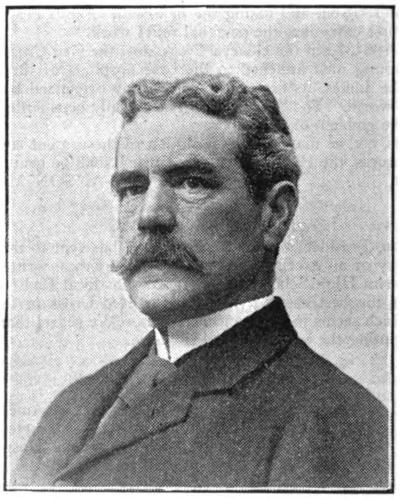
By Stephen van R. Trowbridge.
Kessab was a thrifty Armenian town of about 8,000 inhabitants, situated
on the landward slope of Mount Cassius (Arabic, Jebel Akra), which
stands out prominently upon the Mediterranean seacoast, halfway between
Alexandretta and Latakia. Kessab is now a mass of blackened ruins, the stark
walls of the churches and houses rising up out of the ashes and charred timbers
heaped on every side. What must it mean to the 5,000 men and women and
little children who have survived a painful flight to the seacoast and have now
returned to their mountain home, only to find their houses sacked and burned!
There were nine Christian villages which clustered about Kessab in the valleys
below. Several of these have been completely destroyed by fire. All have been
plundered and the helpless people driven out or slain.
On Thursday, April 22, serious alarm reached the people of Kessab. It
was known that a massacre of the Armenians had taken place in Antioch, 36
miles to the north, and that attacks were being planned on the Christian villages
of the mountains. A parley was arranged with the Mudir (magistrate) of
Ordou, the nearest seat of government, and a telegram asking for military
protection was dispatched to the Governor of Aleppo. The Mudir, whose
name is Hassein Hassan Agha, met the Kessab delegation halfway down the
mountainside and assured them that he had already scattered the mobs that had
gathered with evil intention. But his pledges soon proved to be idle tales,
because that very Thursday evening he permitted crowds of armed Moslems
to come into Ordou from Jissr Shoughr, Kusayr, Antioch, and even from Idlib,
far to the east. Early the next morning, after entertaining the raiders overnight,
he sent them on their way to the sack of Kessab. Moreover, the Mudir
detained the eleven gendarmes which were ordered by the Aleppo government
to protect American and Italian interests in Kessab. The Mudir instructed the
gendarmes that they should remain in Ordou.
STEPHEN VAN RENSSELAER TROWBRIDGE.
Thursday evening the Kessab scouts brought word into the town that great
crowds of armed Turks and Arabs had gathered in the nearest Moslem village.
It was an anxious night. Before daylight, Friday morning, rifle shots told
of the enemy’s advance. By three separate mountain trails, from the north,
northeast, and east, thousands of armed Moslems came pouring up the valley.
Their Martini rifles sent the bullets whizzing into the Kessab houses, while the
shotguns of the 300 Christians who were posted on the defense could not cover
the long range. It was a desperate struggle, and the Kessab men realized
their straits. The plan which they thereupon made is to their honor and credit.
They resolved to hold out as many hours as possible, so as to furnish time for
the women and children to escape into the clefts and caves of the mountains to
the south. For five hours the fusillade continued with fierce determination.
By midafternoon Turks from the Antioch villages had circled around Jebel
Akra on the north, so as to command a position above Kessab. The Arabs
had flanked the town on the southeast. Meanwhile the vanguard of the Ordou
Moslems had captured and burned the adjacent villages just below Kessab,
and had set fire to three of the houses at that end of the town. Their cries
and frantic threats could be heard distinctly. The women and girls gathered
up the little children on their backs and in their arms, hastened along the west
trail over the ridge toward Kaladouran, and clambered up into the cliffs and
crevices which overlook the sea at an altitude of 5,000 feet. Some in small
groups, others entirely alone, hid themselves underneath the thorny underbrush
or in the natural caves. Toward evening the men had been compelled by the
overwhelming odds to give up the defense. They fell back without any panic
or noise. And the Turks and Arabs who rushed into the streets of the town
were so seized with the lust of plunder that they did not pursue the rear guard
of the Christians. Angry must have been the scenes as the plunderers fought
with one another over the stores of raw silk, the chief product of Kessab.
Cattle, mules, copper kettles, bedding, clothing, and rugs were carried out by
the Turks in feverish haste, as one after another the houses were set on fire.
Some of the aged Armenians, who had not the strength to flee, were caught
in their houses and barbarously put to death. Others, who had delayed flight
in order to gather up and rescue a few valuables, were likewise put to the
sword. Axes and knives finished up what the rifles had spared. But the
instinct to escape had been so strong among the Christians, and the greed of
plunder so absorbing among the Mohammedans, that in all the day’s fray only
153 Armenians and a handful of Turks were killed.
A Kessab girl named Feride, 20 years of age, had a remarkable escape.
She had gone over to the village of Ekizolook (Twin Hollows) to save the
little bridal trousseau of one of her friends. It was well on in the afternoon
when she had gathered up the garments into a bundle. And when she hurried
out into the street to join the fugitives she found, to her dismay, that everyone
had gone beyond sight and hearing. A moment more and she saw a host of
Arabs rush up through the street. She dashed through several little gardens
and reached the rocks and underbrush above the village. On and on she made
her way without being discovered. In a deep cleft between the rocks she hid
and listened. She had dropped the precious bundle, but kept in her hand
her New Testament, which was more precious than anything else. As she
listened and watched many Arabs and Turks ranged past the entrance to the
cleft. Then came one who peered in closely. Their eyes met. He gave a cry
to his comrades, “There is a maiden here!” and sprang forward. She summoned
her whole strength and leaped up the side of a great rock which rises up
above the village. It was a feat which no athlete could commonly have done. At
first the Arab could not follow her. He cried again to his companions. They
replied by shouting to one another, “Surround her! Surround her!” She
was now standing on top of the rock in full sight of fifteen or sixteen Arabs,
all in her pursuit. They called fiercely to her to come down. She answered
in Arabic, “You may shoot me, but I will never give myself up.” Then they
ordered her to throw down to them the purse she had in her hand. She told
them it was not her purse, but her Holy Gospel. And she held out her hands
in prayer to God. Just then the Arab who had first seen her made a spring up
the side of the rock. She leaped in the opposite direction down into some brushwood,
but was caught at the side of the rock by branches of briar. The Arab
came on over the top of the rock and had reached out his arm to seize her, when
a Christian young man, who had taken refuge in another part of the brushwood,
fired and shot him dead. He gave a long groan, threw up his arms, and fell
prostrate upon the rock. The other Moslems were startled by the unexpected
shot and retreated for a time. This gave Feride time to escape into the caves
farther up the mountainside, where she remained entirely alone all night and
part of the next day. When I was in Ekizolook the Arab had not yet been
buried. I took his headdress—a coil of black wool and the “keifiyye” which goes
with it—as a trophy. Feride herself told me the story of her escape. Her
eyes were bright and her cheeks flushed as she recalled the dangers through
which she had passed. She said that after she was discovered in that cleft of
the rocks all fear left her. A strange courage came over her, and she felt sure
that God would save her from being captured.
One of the school teachers, named Mariam, was caught by the Arabs not far
from where Feride had hidden. The Arab who captured her ordered her
to become a Moslem. When she refused he threatened to kill two little boys
she was trying to protect. Then he raised the axe which he carried and placed
the edge against Mariam’s neck, threatening her three separate times. Each
time she said she would never become a Mohammedan, nor deny her faith in
Christ, nor surrender her honor. The Arab snatched the money which she
had with her and tore off the dress and shoes which she was wearing. He told
her he would make her his slave. Just then some Turks from Ordou came up
and recognized among the women the wife of Dr. Apelian. The doctor had
often served these Turks medically. A sharp skirmish ensued, which ended
in the defeat of the Arabs. The women were that night taken in safe conduct
by these Turks to a Greek house in Ordou, where they were kindly cared for
until the fighting was over and they could return to Kessab.
One of the saddest experiences was that of Azniv Khanum, wife of the
preacher in Kaladouran. Ten days before the massacre she had given birth to
twin children, a boy and a girl. When the flight to the mountains took
place she had not the strength to climb with the others, so her husband hid her
and their four children among the rocks near the edge of the village. The
babies were wrapped in a little quilt and the other children clung to their mother,
while the father hid in a cave close by. Before long Azniv Khanum and the
children were discovered by the Turks. One of the plunderers snatched up
the quilt, despite the mother’s entreaties. The two babies rolled out, one
in one direction and one in another, over the rough stones. Then the Turk
rudely laid hold of the mother, and, holding his revolver against her breast,
ordered her to become a Moslem. She bravely refused. “You are my slave,”
he said, and beat her with the flat of his sword. He commenced to drag her
down in order to tie her on his horse. Her foot tripped, she fell, and rolled over
and over for about eight yards. There she lay on the rocks, bruised and
exhausted, in the hot sun. The Turk seeing a chance to plunder, abandoned
her. Afterwards other Turks took her money and her dress and shoes and her
little girl about four years old. It is wonderful that she lived through it all.
One of the little babies lived a week, the other about ten days, after that.
When I was in Kaladouran we buried the little boy. It was a very touching
service out under the trees.
Now, to return to the narrative. Friday evening it occurred to Dr. Apelian
that if he could reach the seaport of Latakia, forty miles to the south, he could
telegraph for assistance by sea. With a trusty guide he set out that same
evening for the house of a Moslem chief in the mountains. This Turk agreed
to ride with him to Latakia, and thus give him protection along the way.
Without this escort the doctor could never have made this trip. Even as it
was he took his life in his hands. They arrived in Latakia at 2 o’clock at
night, called the British and French consuls to Dr. Balph’s home, sent telegrams
to Alexandretta and Aleppo, and at dawn notified the Mutasarrif (Lieutenant-Governor)
of the attack on Kessab. Turkish soldiers were dispatched at once,
and a Messageries steamer started to the rescue from Alexandretta.
Meanwhile, all day Saturday the sacking and burning went on. The large
village of Kaladouran was devastated. The Moslems increased in numbers as
raiders from distant villages arrived. In the afternoon Selhan Agha, captain
of gendarmerie, arrived with forty cavalrymen. He joined in the sack of the
town, taking for himself and his company the most valuable share of the booty,
the raw silk found in the merchants’ shops. He and the cavalrymen were afterward
intercepted at Idlib, on their way to Aleppo, and their saddlebags were
found to be crammed full of plunder. Selhan Agha, with the forty horsemen,
had been dispatched from Jissr by orders from Aleppo, Thursday afternoon, to
go at once to protect Kessab from any mob violence. He could have gone in
eight hours, or even less, from Jissr to Kessab. At that time the attack had
not yet commenced. Instead of going directly to Kessab he went to Sheikh
Keoy and spent the night there. The next day all the Moslems from that
village were out on the warpath, while Selhan Agha turned far out of his way
and made a sixty-mile detour to many other Mohammedan villages and to the
city of Antioch. Finally he reached Kessab, forty-eight hours after receiving
his orders, and when he arrived he did not stop the burning and looting, but
himself became a plunderer. This whole disgraceful affair has been probed
by the Aleppo Commission, and their findings substantiate all of the above
statements. I have most of the evidence, however, directly from one of the
gendarmes named Mehmet Ali.
BOYS’ GRAMMAR SCHOOL, KESSAB. BURNED APRIL 23-24.
By Saturday night there was not much valuable plunder left. The iron
bars were wrenched out from the windows and the household pottery smashed
to pieces out of sheer vandalism. As the loot became exhausted the Moslems
commenced to range the mountainsides, exploring the caves, and firing into
the bushes in the effort to exterminate the Christians. One woman’s husband
was cut to pieces before her very eyes, and she herself was severely wounded
in the side. She escaped to the deep ravines near the summit of Mount Cassius
and lived on snow for twelve days. She is now in the American hospital at
Latakia.
All the tradesmen’s shops and merchants’ storehouses in Kessab are burned.
In fact, the whole market is in ashes. The Roman Catholic and Protestant
Churches are completely burned. The latter was a spacious building, seating
a congregation of 1,800. The American Mission residence, occupied by Miss
E. M. Chambers, was burned; so, also, the Girls’ High School (American
property), the Boys’ Grammar School, and the Protestant parsonage; 530
houses, including the homes of all the well-to-do families in Kessab, are also
destroyed by fire. The 700 houses which remain, plundered, but not burned, are
small one-room or two-room houses, belonging to laborers and other poor people.
In Ekizolook 38 homes are burned; 22 remain. In Kaladouran 65 are gone;
135 are left. In Duz Aghaj 24 are burned; 1 remains. In Keorkine 55 are
burned; 45 remain.
On Saturday one of the Latin priests, Father Sabatine, made the journey
to Latakia, at considerable risk, in order to appeal for help. Whether it was
by the influence of his telegrams or the ones sent twenty-four hours before by
the Protestant physician, Dr. Apelian, I do not know, but at all events on
Sunday morning a Messageries Maritime steamer came down the coast toward
the cove at Kaladouran, at the foot of Mount Cassius. The news was carried
from mouth to mouth to all the hiding places among the crags and ravines, so
that within a few hours the fugitives began to pour in streams down the Kaladouran
gorge to the seashore. The painfulness of that descent can scarcely
be imagined. Most of the people had not had anything to eat for two days.
Many of them had become separated from their families and were now plodding
down toward the sea with a strange blend of hope and despair. The
suffering of many of the women was severe indeed. Fourteen children were
born during that flight, and the mothers had no alternative but to press onward
as best they could in the wake of the multitude.
An 8-year-old little boy was captured by the Turks and carried off to become
a Moslem. He was given a Mohammedan name and made to wear a little
turban. He acted very demurely and kept quiet. But when a chance offered,
as he had permission to go to a nearby well, he ran for dear life and got away.
With an instinct as keen as that of a wild creature of the woods, he made his
way among the mountains and across the maritime plain forty miles, to Latakia,
where he found his mother.
The Messageries steamer took aboard about 3,000 and brought them to
Latakia, where they were divided up among several churches and schools. On
Monday, a French cruiser brought 4,000 more. The largest number were
cared for in the grounds of the American Presbyterian Mission. The hospital
was crowded with wounded and sick under the care of Dr. James Balph.
Miss Elsey, the trained nurse, opened a maternity ward, and all the Americans
worked hard in relief measures. The days in Latakia, under the hot sun
and with the constant fear that the Turks of the town might rush in and attack
them, were days of exile and hardship, in spite of all that could be done for
safety and health. They gathered quietly in the evenings for prayer and for
the singing of the hymns that they all know by heart. After a few days sickness
began breaking out rapidly. Several smallpox cases were discovered,
and the crowded conditions threatened still further disorders. The Mutasarrif,
who is chief magistrate in Latakia, had from the start done everything in his
power to protect and provide for these fugitives. He himself patrolled the
streets at night, and, with the few soldiers at his command, dispersed the angry
Moslem mobs which repeatedly made attempts at disorder. He furnished a
ration of flour for all and expressed his sympathy with those who were in
sorrow. When he saw the rapid increase of sickness he advised that they
should all return to Kessab, and to give the people assurance of safety on the
road he went with them in person. The courageous and kind-hearted action
of this Turk saved Latakia, and the thousands of Kessab people sheltered
there, from the dreadful event of a massacre. His conduct stands out in strong
contrast with the criminal behavior of Hassein Hassan Agha, the Mudir of
Ordou.
INTERIOR OF THE CHURCH IN KESSAB. SACKED AND BURNED APRIL 23-24.
Can you imagine the feelings of the Kessab people as they climbed on foot
the long trail up the mountain, and then as they came over the ridge into full
view of their charred and ruined dwellings? Their stores of wheat, barley,
and rice had been burned; clothing, cooking kettles, furniture, and tools had
gone; their goats, cows, and mules had been stolen; their silk industry stamped
out; their beloved churches reduced to smouldering heaps. The bodies of their
friends and relatives who had been killed had not been buried. And yet the
love of home is so strong that the people have settled down there with the
determination to clear up the debris and rebuild their houses. If generous
gifts arrive from England and America the Local Relief Committee hopes
to put into the hands of the Kessab men such tools as shall enable them to
earn their usual livelihood by one of the trades or by farming. For the present
food supplies and clothing must also be forwarded from Latakia and Beirut.
But as soon as a man begins to earn a daily wage, no matter how small, his
name is struck off the ration lists. I insisted upon this rule in the case of
muleteers, who were paid for carrying up the first shipment of relief supplies.
Two capable doctors are ready to give their services for the sick, but they
have lost all medical and surgical supplies. It would be of the utmost benefit
to furnish them with instruments and medicines. In this, as in other needs,
we heartily appreciate the prompt cooperation of the Beirut Relief Committee.
Miss E. M. Chambers, who was in Adana during these troubles, has now
returned to Kessab. She has lost everything, but is quite ready to share the lot
of the people. She is secretary for the Kessab Relief Committee, of which Dr.
James Balph, Latakia, is chairman and treasurer.
On Sunday afternoon, May 23, the first preaching service for four weeks
was held out under the trees near the burned church. My heart went out to
the people as I spoke to them and looked into their faces. I realized then a
little what they had been through during the past month. May God’s blessing
be richly poured out upon them!
For the first few weeks we were all compelled to do emergency work, the
doctors to treat the wounded, the rest of us to secure flour, rice, and water for
the throngs of homeless people. But now the attention of all of us is directed
to construction work, providing for the industrial needs of the sufferers, rebuilding
wherever possible and reorganizing the agricultural work of the peasants.
For the orphan children homes are being established, chiefly by the missionaries,
and for the widows whose livelihood has been cut off by the killing of husbands,
fathers, and sons, the establishment of embroidery, rug making, and
silk culture, the materials and tools furnished by the relief committees, the
wages to be paid daily to the earners. Where many men have survived, the
common trades of carpentry, masonry, stonecutting, tailoring, and weaving may
be reestablished by a sufficient financial backing from relief societies. There
is also great need of men to specialize in relief work and administer the large
funds required. Missionaries can not rightly give up all their regular work,
nor can navy officers nor consuls, but a few American volunteers, such as those
sent to southern Italy and Sicily after the earthquake, could do a wonderful
amount of good.
Perhaps the most effective and wide-reaching relief work thus far has been
done by Dr. F. D. Shepard and his wife in the large villages of Hassan Beyli
and Baghche. This American surgeon could use to excellent advantage a
staff of young men from the homeland. The work of the Beirut Relief Committee
in providing hundreds of the men who survived the Kessab attack with
tools and implements, so that they might commence earning a living at once,
deserves note as a typically American plan, financed chiefly through the generosity
of the American National Red Cross. To avoid pauperizing the people
is one of the most difficult feats. Here in the city of Aintab, where there has
been practically no loss of life, but great economic loss and resulting increase
of poverty, I have furnished some of the unemployed weavers with twelve
looms for six months. Twelve stonecutters, who were out of work since April
16, I have set to work digging pits or holes in the limestone of the hospital
grounds, so that trees may be planted in the pits next spring. The earth is
only a few inches deep here.
Although the American people have helped very generously, the work of
relief has only just begun, and a more thorough effort to put the people here
on their feet again and to make kindly provision for all the helpless persons,
the old women and little children, requires large plans and large appropriations
from such societies as the American National Red Cross.
Mrs. Doughty-Wylie, wife of the British Vice-Consul, in a letter to her
mother, describes with the vividness of an eye witness the horrors of the last
days of the rule of the late Sultan, Abdul Hamid.
Major Doughty-Wylie, a soldier who has taken part in many campaigns,
was severely wounded while engaged in the work of rescue. His heroic services
have won from the American missionaries laurels that will not fade. Mrs.
Doughty-Wylie also, according to impartial witnesses, displayed the courage of
her race, and by her devotion and energy saved many lives.
From a letter from Mrs. Doughty-Wylie we make the following extracts:
THE AMERICAN MISSION RESIDENCE. KESSAB. COMPLETELY DESTROYED.
“We are having a perfectly hideous time here. Thousands have been murdered—25,000
in this province, they say; but the number is probably greater,
for every Christian village was wiped out. In Adana about 5,000 have perished.
After Turks and Armenians had made peace and the Armenians had
given up their arms, the Turks came in the night with hose and kerosene and
set fire to what remained of the Armenian quarter. Next day the French and
Armenian schools were fired. Nearly everyone in the Armenian school perished,
anybody trying to escape being shot down by the soldiers.
“In the French school a large number of Fathers and Sisters, with 2,000
Armenians, were rescued by Dick (Major Doughty-Wylie). Thirty, who tried
to escape, were shot. Dick found their bodies at the gate, but he got the survivors
out of the schools and brought them right through the Turkish quarter
without losing a soul. Altogether he got several thousand people out of the
burning quarter and encamped them near our temporary dwelling.
“I have the hospital—sixty-five beds so far and about 150 outpatients
requiring surgical dressings. Fifteen thousand starving people are to be fed
and we are running into debt nicely.
“The Turkish authorities do nothing except arrest unoffending Armenians,
from whom by torture they extort the most fanciful confessions. Even the
wounded are not safe from their injustice. A man was being carried in to me
yesterday when he was seized and taken off to gaol. I dare not think what his
fate may be.
“Nobody is safe. They murder babies in front of their mothers; they half
murder men and violate their wives while the husbands are lying there dying
in pools of blood. Then they say it is the fault of the Armenians, because
there existed a revolutionary society of about sixty members, who talked and
wrote a good deal of rot.
“We arrived in Adana from Mersine the first day of the massacre, April 14.
The murderers boarded the train. There was a rush of Armenian passengers
into our compartment. While I tried to buck them up a bit Dick went and
tackled an assassin who was just going to shoot somebody else. At Tarsus
they murdered two men who were coming from the station just behind us.
One man made a rush and gained the guardhouse, but the soldiers shoved him
out and watched him done to death in the road.
“Dick got into uniform the moment he arrived, and we saw no more of
him till 11 at night. He had been rescuing all the foreign subjects he could
find. The following day I saw more brutal murders. An Armenian quarter
near us was attacked by Arab soldiers from our guard and was practically
wiped out. Their officers and one or two decent soldiers stuck to the guardhouse
and took no part in the murders. The officers, at my earnest appeal,
even saved some women and children—but how dreadfully shot they were.
“After an hour’s argument I got a Greek doctor to come out with me to the
guardhouse and dress the wounded women and children. The room was a
puddle of blood, and while we were working there a wounded Armenian, who
was staggering in to be dressed, was stabbed to death by some of the soldiers. I
saw many murders, and nobody seemed to care.
“The authorities did nothing, and the soldiers were worse than the crowd,
for they were better armed.
“One house in our quarter was burned with 115 people inside. We counted
the bodies. The soldiers set fire to the door, and as the windows had iron bars
nobody could get out. Everybody in the house was roasted alive. They were
all women and children and old people. It was in that part of the town that
Dick was wounded. They told him that some wounded Turkish soldiers were
lying among the burning houses, and he went to rescue them, which they
certainly did not deserve. The house from which he was shot had a garden
filled with dead women and children, and I have no doubt that some Armenian,
who had lost entire family and most of his friends, shot him in a sort of mad fit,
probably taking him for a Turk.
“Outside Adana every Christian village—Greek, Syrian, or Armenian—has
been burned and every soul in them killed. Unfortunately, it was just before
harvest, and thousands of peasants from the mountains and other districts were
there to start work. From 100 to 200 men and women were murdered on every
farm. Turkish farms were not burned or looted, but the Armenian servants
were killed. I know of only one farmer—a friend of ours—who had the
nerve to save his Armenians.
MRS. DOUGHTY-WYLIE IN UNIFORM OF ARMY NURSE ON BALCONY OF
SURGICAL HOSPITAL.
“The French engineer and an English traveler gallantly did some saving.
They had escorts, and the Frenchman stood a three-days’ siege and made his
escort fight some Circassians to save a dozen Armenians. It was gallantly
done. The Englishman, whose name is Gunter, refused to save himself unless
the Armenians who had thrown themselves on his protection were saved. It
was touch and go for the lot, but British pluck won and he got his own terms.
“The Germans, however, who were shut up in a place called Bagche gave
up the Armenians in their house as the price of their own safety. Here the
Germans are working splendidly on relief work. They are all Saxons and had
a factory full of Armenians, which held out all right. When the Armenians
were being brought out of the factory to the camp, as soon as things were supposed
to be quiet, the soldiers started killing them. I happened to be at the
guardhouse and got my little officer to go to the rescue, and all were brought
in safely except three, who had been already shot.
“Things are still very unsettled. Murders and fires continue; but, of course,
it is not like the first days of horror.
“We have 15,000 people starving and without shelter. All we can give
them is a fragment of bread or a handful of rice. We have nothing more
to give. No milk for the babies—nothing. And measles and dysentery are
rife.”
Beirut, Syria, July 12, 1909.
Mr. E. G. Freyer, Secretary-Treasurer of the Relief Committee, with his
financial statements sends a special appeal for Kessab. He also says, in regard
to the Committee’s work as American Red Cross Agents:
We realized, first, that under the American National Red Cross our Committee
would take the field as a distinctively American undertaking, even
though recognizing the principle which governs all Red Cross work—that its
benefits should reach all in need, irrespective of nationality or creed.
Secondly, it gave the Committee a standing, a guarantee before the public
which enabled it to raise funds in quarters where remittances under other
circumstances might not have been forthcoming.
The sending of doctors and nurses to Adana in the name and under the
protection of the Red Cross flag was not only a source of satisfaction to the
Committee, but of the very greatest help and blessing to the many who at that
time required immediate medical aid.
Those of us who have lived in the Orient for years have become accustomed
to the remark, and in many cases have allowed ourselves to believe, that
the native will not help himself, much less others, but that he is willing to be
dependent on the charity of the outside world. Be this as it may under ordinary
conditions, the present crisis has fully demonstrated that the native can
and will rise to the occasion and help not only himself but his neighbor as well.
In looking over the summary of receipts it is more than gratifying to note
the very generous response which has come to our appeal from the Syrians, or
those whom we designate as “natives.” When we consider that out of a total
of 564,538 piasters received fully one-third has come from native sources, this
fact in itself may be considered a success commensurate with any relief and help
which the money itself has brought to the sufferers. It is proverbial that it is
difficult to get money from the native. It is a satisfaction to know that he is
sympathetic, and that he can and will help.
Many cases can be cited where sacrifices have been made to help along the
work of relief. One man who had saved his metallic pieces (1 cent plus) for
nearly three years, and who had his small box nearly full, handed it over with
the remark, “Here, I have saved these for three years. I know not what the
box contains. Take it for the fund.” The proceeds of that box netted the
fund 385 piasters, or $13.75. The children brought their pennies, school girls
went without portions of their meals, the poor gave of their little, and by these
acts of self-denial helped to feed and clothe their fellow-countrymen.
We have esteemed it a privilege to work under Red Cross auspices, even
though our funds have come also from many other sources.
From England we have received many contributions, large and small. The
latter are numerous, and indicate the desire many have had to help.
Relief work at Kessab, as in many of the disturbed districts of northern
Syria, has been going on since the end of April last. During that time the
Beirut Relief Committee has been able to aid in feeding and clothing the
many widows and orphans who were left entirely destitute, while tools for
carpenters, blacksmiths, and masons, also plows and farming implements, have
been sent there so that the work of reconstruction might begin.
Until now relief work has consisted chiefly in feeding the hungry; more
could not be undertaken on a large scale. The summer months have proved
favorable in that the people did not require special housing. Improvised tents
and shelters of various kinds were constructed, and for the present these have
served their purpose well, but the great question which confronts all who are
engaged in this work is, how these people are to be housed and sheltered during
the bleak winter months. It must be remembered that the winters at Kessab
are exceptionally severe. Situated on the side of a mountain at a high altitude,
the winds and rains not infrequently cause the place to be entirely
covered with ice and snow.
Then, again, how are they to be provided with food to tide over the winter,
or until they can raise their next crop of silk worms, the chief industry of
Kessab? We can not go on feeding them indefinitely, yet it is a duty to feed
and house this people until, under ordinary conditions, they can provide their
own support and repair their homes.
In regard to providing shelter, it is thought that it may be feasible to erect
two or three large barracks to give at least temporary shelter to the women
and children. Conference with those on the field and those who know the
conditions which hold good at Kessab may prove that this is not a feasible
plan, but that it would be better to roof over some of the larger buildings.
While practically all the houses in Kessab were destroyed by fire, the walls
of most of them are standing and in good condition. It may be found more
advantageous to roof over several of these large houses, or even the Protestant
and Armenian Churches. The latter could be used by the constituents
of either sect, and under such conditions as the Relief Committee may see fit
to make. Unless some such measure of relief is adopted immediately great
will be the suffering and privation of the people of Kessab during the coming
winter months.
The very lowest estimate places the cost of the construction work at $10,000
and the cost of a sufficient quantity of wheat to sparingly supply the needs of
the people at $5,000.
In view of the foregoing facts a special appeal is therefore made for $15,000,
$10,000 of which to be specifically designated as intended for and to be applied
to constructive work.
It is hoped that these specific objects for which funds are so urgently
needed, and the receipt of which will do untold good, may appeal to many who
are in a position to give.
Your Committee has long felt the necessity of rendering at least a preliminary
statement, showing amounts received and expended, in connection
with the relief work made possible through your generosity.
Without the aid of regularly paid assistants it has, however, been impossible
for the Committee to render such an account earlier, feeling that its first efforts
should be directed toward the work of relief rather than that of accounts.
It is a pleasure to acknowledge with thanks the gifts of so many who have
responded to our call for aid. Considerable has been done to alleviate the
sufferings and wants of the sick and destitute, but from all accounts from the
stricken districts the work of relief is far from completed. Until we can get
sufficient funds wherewith to purchase tools, etc., the people can not be set to
work at their various trades. This, and this only, can solve the problem of
reconstruction which confronts all engaged in this work.
Very truly, yours,
G. BIE RAVNDAL, American Consul-General, Chairman.
GEO. E. POST, M. D. E. G. FREYER, Secretary and Treasurer.
RECEIPTS.
Piasters.
Syria
136,581.10
Palestine
28,012.05
Asia Minor
17,505.00
Cyprus
1,322.35
Egypt
35,667.25
Belgium
815.25
France
543.30
England
51,658.25
America
223,930.25
Grand Total
496,037.20
£3,627 6s. 7d.
$17,715.62
EXPENDITURES.
Piasters.
Adana
60,088.10
Kessab
76,960.10
Alexandretta
81,006.25
Latakia
7,000.00
Antioch
26,029.20
Tarsus
14,099.05
Aintab
12,462.20
Marash (Americans)
79,193.20
Marash (Germans)
23,253.30
Deaconesses, Beirut
4,404.00
Miscellaneous
31,575.00
Grand total
416,072.20
Beirut currency:
Piasters.
Total receipts
496,037.20
Total expended
416,072.20
June 24, 1909. Balance on deposit in bank
79,965.00
E. G. FREYER, Treasurer.
8,783
pieces of clothing and 182 pairs of shoes, sent in by 152 donors.
3,600
blankets purchased by Committee.
1,100
quilts purchased by Committee.
130
sacks of rice purchased by Committee.
23
sacks of wheat purchased by Committee.
197
sacks of flour purchased by Committee.
Piasters.
Cash
198,942.10
Medicines and medical supplies
13,371.25
Blankets
29,295.00
Quilts
21,548.10
Foodstuffs
50,000.20
Clothing
26,012.40
Miscellaneous, including carpenters’, masons’, and farming
tools; sewing machines, tin pots, pans, spoons, copper pots,
blacksmiths’ tools, plows, pickaxes, spades, needles, thread,
buttons, administration, etc.
76,903.15
416,072.20
I have examined the above accounts, compared the same with vouchers, and
hereby certify that they are correct.
W. R. GLOCKLER, Auditor.
Beirut, Syria, June 24, 1909.
Piasters.
Credit by balance brought forward June 24, 1909
79,965.00
Additions:
Syria
2,759.30
Palestine
316.25
Asia Minor
664.35
Egypt
1,317.10
Cyprus
136.15
Denmark
69.10
England
83,728.10
America
79,929.00
Interest, bank account
564.15
Total
249,450.30
Expended for account:
Adana
13,344.30
Kessab
30,715.30
Alexandretta
27,082.30
Antioch
485.35
Antab
12,462.20
Oorfa
411.10
Marash
18,264.30
Miscellaneous
4,520.00
Total
107,287.25
Credit by balance on hand July 26, 1909
142,163.05
Piasters.
Total of all receipts to date
665,523.10
or
$23,768.68
Total of all expenditures to date
523,360.05
or
18,691.43
Credit by balance carried forward to new account
142,163.05
or
5,077.25
Respectfully submitted,
E. G. FREYER, Treasurer.
I have examined the above accounts, have compared them with vouchers,
and hereby certify that they are correct.
W. R. GLOCKLER, Auditor.
Piasters.
Credit by balance brought forward July 26
142,163.05
Cash received per C. A. Wilson, Alexandria
13,962.25
Cash received from Isper Bayoud, Amatour
160.00
Cash received from N. Berouti, Jaffa
217.20
Total
156,502.50
Debtor to—
T. L. 300, transferred to Dr. Balph for purchase
of wheat and storage of same
37,387.20
Telegram to Dr. Balph
22.10
225 pieces kham for Kessab
9,344.00
600 blankets, tinware, etc., for Kessab
9,263.30
40 dozen each of crockery plates and bowls
1,203.20
Medical supplies for Kessab
1,436.10
Cost of packing bales for Kessab
23.05
Cost of sending cash to Dr. Balph
30.20
Miscellaneous shipping, telegram fees, etc.
118.30
Total
58,829.25
Balance, approximately, T. L. 783
97,673.25
RECEIPTS.
Advanced from General Emergency Fund
$12,500.00
Contributions, Christian Herald (New York)
12,500.00
Contributions, Armenian Relief Committee (New York)
3,500.00
Contributions, miscellaneous
1,187.01
Total receipts
29,687.01
DISBURSEMENTS.
By cable to the American Ambassador, Constantinople
$28,000.00
Repayment to General Emergency Fund
1,500.00
Total disbursements
29,500.00
Balance September 1, 1909
187.01
Note.—The Red Cross wishes to invite the attention of its members and
friends to the amount contributed by the Christian Herald for this fund. Our
readers will remember the large amounts contributed by this paper in the past
to various Red Cross Relief Funds, especially the following: Japanese Famine
Fund, $200,000; Chinese Famine Fund, $250,000 in money and a Government
transport load of food supplies, and to the Italian Earthquake Fund, $55,000.—Editor.
ITALIAN EARTHQUAKE RELIEF — SUMMARY OF CONSTRUCTIVE WORK TO JUNE 11. — Commander Belknap’s Work. — Commander Belknap’s Tributes to His Assistants. — Committee on American Offerings. — The American Red Cross Orphanage. — Disposal of Balance of Italian Fund. — Testimonials of Gratitude. — Translation of Inscription on Medal Received from the Italian Red Cross. — Translation of Inscription on Diploma Received from the Italian Red Cross Society.
From Mr. Lloyd Griscom and Lieutenant-Commander Belknap final reports
have been received of the American Red Cross Relief work in Italy. A printed
report of Mr. Griscom’s American Relief Committee in Rome, together with all
the vouchers and correspondence of this Committee, have been sent to the
American Red Cross at Washington for permanent filing in its archives. The
vouchers for all expenditures have been revised and certified to by the Banca
Commerciale Italiana at Rome. The vouchers for all the expenditures connected
with the American Red Cross Relief Ship Bayern are already on file at
Washington.
Messina.
Cottages of standard type, built 16×20×9 feet
1,039
Grand Hotel Regina Elena, 75 bedrooms, two stories and partial
third story; 100 feet central part with two wings, each 132 feet
long, all finished except plaster, plumbing, lighting, Eternit
roofing, and inside paint; material used equivalent to
178
Building suitable for church, material used equivalent to
24
Building attached to church, material used equivalent to
15
Laboratorio, material used equivalent to
12
Two school buildings, together equivalent in material to
12
Total buildings at Messina, equivalent in material to
1,280
Material remaining at Messina for continuing construction
of houses
350
Reggio-Calabria.
Cottages of standard type
500
Villagio Regina Elena.
Cottages of semidetached type, each 16×20
75
Hospital Elizabeth Griscom, equivalent in material used to 30
houses; plumbing, lighting, and furnishing done by Her Majesty’s
staff
30
Palmi and District.
Cottage of special smaller type built, 13×16×10, as a model,
complete, and frame for a second built
1
Material sent to this district for other such houses
500
Ali and Surrounding District.
Portable houses erected
49
Houses of Palmi type built as models
5
Roccalumera 3, Santa Teresa Riva 2, Nizza-Sicilia 2 (models
of Palmi type built)
7
Material sent to this district for houses of this type
300
Total built by American construction party
1,898
Total number of houses furnished
3,097
VITTORIO EMANUELE, KING OF ITALY.
ELENA, QUEEN OF ITALY.
Captain Belknap, on the 10th instant, consigned the completed work at
Messina to the Ministry of Public Works, who then assumed charge.
Ensign Robert W. Spofford, U. S. N., remained to direct the work in
general until it had become well organized under the new direction. He will
also supervise the completion of certain work being done by contract not
yet completed.
Mr. Griscom says: “The report of Captain Belknap is worthy of careful
study. Its only fault is that it does not do justice to his work. I feel that it
is incumbent upon me to endeavor to express to you the admiration I have for
the manner in which Lieutenant-Commander Belknap has performed his duty.
The magnitude of the task could only be appreciated by one who has been
on the spot and seen the difficulties as they arose and witnessed the courageous
and adroit manner in which he overcame all obstacles and carried to successful
conclusion a work which is truly remarkable. The departure of Lieutenant-Commander
Belknap from Messina was a veritable personal triumph. All
the highest military and civil authorities were present at the steamship landing,
together with a military band, and he was given full military honors and
received a remarkable and spontaneous public demonstration of admiration.
He and several of his assistants were formally made citizens of Messina. To-day
he has been formally received by their majesties, the King and Queen of Italy,
and had extended to him their majesties’ personal expressions of gratitude.”
Before closing this report, I beg to mention those who have labored so
energetically and faithfully to bring about results which have been kindly
commended by all who have visited the camps.
The special prominence of the services rendered by Tonente di Vascello
Alfredo Brofferio stand apart from all else. He worked unremittingly in the
closest association with us, his duties touching every feature of the work, and it
would be impossible to place too high a value upon his far-seeing, conscientious,
and self-sacrificing devotion to our success.
The Italian authorities’ cordial attitude toward us and hospitable care
made away with innumerable difficulties. To their magnanimity and their
earnest devotion to their own duties was due their sincere appreciation
of our efforts and their frank and grateful acknowledgment of our gift to their
cities.
Commander Harry P. Huse, U. S. N., commanding the U. S. S. Celtic,
established us on a living and working basis in our camp at Messina, the
Celtic serving as our base until the first group of houses were ready for us,
and he was most felicitous in all that he did to promote a genuine feeling of
cordiality in our relations with the authorities.
Lieutenant-Commander George Wood Logan, commanding the U. S. S.
Scorpion, gave his most cordial support and interest in the undertaking from
the first, and placed every facility at our disposal.
Lieutenant Allen Buchanan, U. S. N., was the mainstay in the executive
work, and I was always able to rely on his good judgment on the frequent
occasions when taking counsel was necessary. He discharged his duty with
unremitting industry and exemplary zeal, and he left behind him in Messina
and among the members of our organization a feeling of the most uniform
good will and admiration for his character and ability as an officer.
Ensign John W. Wilcox was in charge of the Reggio division of the work,
which he managed with exceptional skill. He had many difficulties to contend
against, but solved them with an ease and discernment that an officer of long
experience might envy.
THE ORIGINAL MEMBERS OF THE EXPEDITION, MESSINA.
Ensign Robert W. Spofford, U. S. N., had charge of the unloading of
steamers. He has done excellent work and is left in charge of the work being
completed at Messina. To Assistant Surgeon Donelson, U. S. N., for medical
supervision of the camp, and to Pay Inspector J. A. Mudd, U. S. N., for the
care taken in the shipment of the building materials from America, Captain
Belknap gives high praise. The enlisted men of the Navy performed their
work most faithfully, and Captain Belknap mentions many of them by name.
This country may well be proud of the splendid work of the officers and men
of our Navy so far outside their regular duties. Captain Belknap says also that
thanks are due to Mr. John Elliott, who was a most devoted worker, and left
his beautifying touch on every part of the work. Mr. H. W. C. Bowdoin and
Mr. Charles King Wood were among the other tireless and efficient volunteer
workers to whom our thanks are due. And finally, many of the master carpenters
sent from America gave most satisfactory and valuable service under
difficult conditions.
Of this committee Mr. Griscom says: “As you already know, after consultation
with his excellency, the Minister of Foreign Affairs, Signor Tittoni,
I placed the sum of 256,250 lire (the equivalent of $50,000) in the hands of a
committee appointed by Mr. Tittoni, of which his wife, Donna Bice Tittoni,
was Chairman. This committee has to-day handed to me its report and accompanying
vouchers, which are transmitted to you herewith under separate
cover. I am satisfied that this committee carried out some of the best rehabilitation
work which has been done since the earthquake. It was done in a rapid
and businesslike way.”
Signor Bruno Chimirri, Chairman of the Committee on Orphans, called
the “Patronato Regina Elena,” reports: “Being desirous of expediting the
plant of the colony before the departure of the Ambassador from Rome, and
not wishing to touch one single lire of the American capital, the Patronato
voted 200,000 lire (about $40,000) for the building of the colony. This
depended upon us, and it has been done. As to the choice of a site upon which
it will be erected, it is not a question of choosing any piece of land, but a ground
within the jurisdiction of the Itinerant Chair of Agriculture, in order to secure
not only gratuitous teaching but also the very best obtainable. With this end
in view, two months ago I addressed myself to the Minister of Agriculture,
upon whom depends the Itinerant Chair that has to choose a suitable locality.
I have finally brought the matter before the House of Deputies. Nor is this all.
In order to facilitate the negotiations for the purchase of the land, since the
Ministry would not consider the price of the proprietor, I have induced the
municipality of Nicastro to contribute to the expense by paying the difference,
as you will see by a copy of their decision appended hereto. As soon as we
receive an answer we shall send the Professor of the Itinerant Chair to visit
the proffered land, and, if his report is favorable, we shall hasten to secure
possession and lay the cornerstone before Mr. Griscom’s departure.”
The Italian government consented to pay $4,800 for the land, and the District
of Nicastro voted to contribute the balance of the $6,000 which was asked.
In regard to this Orphanage there is given an open letter to the American
Red Cross from Mr. Anthony Matre, Secretary of the American Federation of
Catholic Societies. This letter was published in some of the prominent Roman
Catholic papers before it even reached the hands of the officers of the American
Red Cross, an act that can hardly be considered courteous. It was referred
by the Chairman of the Executive Committee of the American Red Cross to
our Ambassador at Rome, and his reply is embodied in an answer to Mr. Matre.
As the Roman Catholic Church made appeals for the Italian sufferers, and the
offerings it received in reply were sent to the Pope, it is probable that but a
very small percentage of the contributions received by the Red Cross, possibly
5 or 10 per cent, came from members of the Roman Catholic Church. The
receipts show many contributions from Protestant Churches and Sunday
Schools, but none from any Roman Catholic institution, and yet, according to
Mr. Matre’s figures, some 97 per cent, and, according to Mr. Griscom’s letter,
99 per cent, of these contributions must have been expended in Italy for the
people of this faith. Of the funds sent to our Ambassador, a generous contribution
was made to the Pope for the relief work in which he was interested,
and other moneys were placed in the hands of bishops and priests in the
stricken district to aid them in their work for the earthquake sufferers. The
Red Cross considers neither race nor creed; its mission is to mitigate, as far as
lies within its power, the sufferings of the sick and wounded in the misfortune
of war or of the victims of fire, flood, famine, earthquake, pestilence, and other
great disasters.
The following copies of correspondence will be of interest:
St. Louis, Mo., March 22, 1909.
To the President, Secretary, and Officers of the American Red Cross Association:
Gentlemen: The American Federation of Catholic Societies, representing
millions of American Catholics, desire official information regarding the dispatch
published in the papers of the United States on February 8th, and referring
to an appropriation made by your society. The dispatch reads:
“Rome, Feb. 7.—It is officially declared that the American Red Cross, through
Ambassador Griscom, has put $250,000 at the disposal of the committee organized
by Queen Helena, which has undertaken the establishment of an orphanage
to be devoted to the care of children left homeless and without parents by the
earthquake disaster.”
THE ENLISTED MEN OF THE UNITED STATES NAVY, MESSINA.
Under date of February 6, 1909, the Civilta Cattolica, published at Rome,
states that a national patronage of orphans, under the name of “Queen Helena,”
has been erected by decree of the 14th of January, and to it has been granted
all legal rights for the protection of orphans who have suffered by the recent
calamity or who will need protection on account of any future disaster; that
the direct administration of this orphanage is committed to a council, half of
whose membership shall be appointed by royal authority and the other half
by election or choice of those contributing annually to its support.
In the same paper, the Civilta Cattolica, of February 20, 1909, appears the
following: “There has been appointed to the Presidency of the National Committee
the Mayor of the first city of Italy, Erneste Nathan, a Hebrew, a very
bitter enemy of Catholicism.” The same issue states that the National Committee
has appointed three women to take charge of “Patronato Nazionale Regina
Elene,” namely, Turin, an unknown woman, a Socialist and Freemason;
Labriola, a Protestant woman (a Valdensian Protestant), and Levi, a Jewess.
To them was confided the care of all orphans brought to Naples from the
scene of the disaster. This charge was taken from the Nepolitan authorities
because they were good Catholics.
The Civilta Cattolica states: “It is evident from the entire policy of the
National Committee that the Pope was refused all voice in the disposition of
the orphans. He never entered into the committee’s consideration, except that
it is trying and succeeding in hampering his efforts everywhere, for instance:
1. The government, i. e., the National Committee, refused to send any of
the wounded to the hospital of Santa Marta in Rome, so that the Knights of
Malta have to make up a train themselves to go to Naples in order to get the
wounded.
2. The Catholic officers of the Spanish ship Cataluna were hampered in the
gathering of the wounded and orphans at Messina to take them to Rome for
disposition of the Pope. This ship has been placed under direct control of
the Pope by the Count of Comillas, the owner.
3. The Pope was interfered with in placing orphans in the care of the
French priest, Santol. (The Pope has offered to care for 2,000 earthquake
orphans, one-half of whom were to be put in charge of Father Santol.)”
From the above it appears that part of the money contributed by our fellow-citizens,
irrespective of creed and nationality, is being used by missionary
societies and others against Catholicity. Some of our Catholic fellow-citizens
feared that such would likely be the case, but they nevertheless contributed
liberally, thinking that in such a crisis and such distress haste was necessary
and bigotry would not be allowed to have part. But from the above statements
it is evident that their fears were well founded, and if it turns out that
the statements are true, the Red Cross Society, though splendid in its aims, will
never be trusted again by the 15,000,000 of Catholics in this country, nor by
the 270,000,000 Catholics the world over.
Your organization is no doubt aware that all civilized countries now
acknowledge the right of the child to be educated in the religion of its parents,
and though the Red Cross Society of America may not have anything to do
with the education of these children without religion, it has the right and duty
to protest against funds sent from America being used in such a way as to
outrage justice.
It will not be amiss to show you how few Protestants there are in Italy:
Last summer at the International Congress of Religious Liberals, held in
Boston, Rev. Tony Andre, of Italy, gave these statistics: “Italy is essentially
a Catholic country. Out of the 32,475,253 inhabitants enumerated in the census
of 1901, 31,539,863 declared themselves Catholics; that is, 97.12 per cent of the
population. All told there were 65,595 Protestants, 20,538 of whom were foreigners.
At the same time, 795,276 were unwilling to say to what religion they
belonged, and 36,092 declared they were of no religion.” This will show that
practically all the children to be cared for are Catholics.
We address this open letter to your society and expect that you will give
the matter referred to therein immediate investigation and consideration.
Very respectfully, yours,
THE AMERICAN FED. OF CATH. SOCIETIES.
ANTHONY MATRE, National Secretary.
July 9, 1909.
Mr. Anthony Matre, Secretary, American Federation of Catholic Societies, St. Louis, Mo.
Dear Sir: The American Red Cross is in receipt of the expected reply
from the American Ambassador at Rome to an inquiry of the Embassy adverted
to in my letter to you dated April 12, 1909.
Mr. Griscom states that there was no true basis for the statement published
in the Catholic Transcript in Rome and quoted by you in the open letter, whereby
you charged the American Red Cross with grave wrong to the Italian children
made orphans by the earthquake of December 28, 1908, the offense consisting
in the assignment of the control of the American Red Cross Italian
Orphanage, and the instruction and rearing of these orphans to non-Catholics,
such as Hebrews, Masons, and Socialists.
AFTER WORKING HOURS, MESSINA.
Mr. Griscom, to whom I sent a copy of your attack upon the Red Cross,
brought the matter to the attention of Countess Spalletti Rasponi, the President
of the Queen’s Orphanage, who, as such, has general supervision over the
branch of the same known as the American Red Cross Orphanage, and for
which latter Mr. Bruno Chimerri is Chairman of the Executive Committee.
The following is a translation of a quotation from a letter from the Countess
Spalletti to Mr. Griscom, the American Ambassador, dated Rome, April
19, 1909:
“After reading the article published in the Catholic Transcript of March 25,
1909, I consider myself, as the President of the Queen’s Orphanage, bound to
reassure your excellency, and send you some information regarding the system
pursued by those placed in control of the orphans in choosing a place for the
orphans and abandoned minors, with the tutelage of whom we have been
charged by the royal decree, dated January 14, 1909.
“The number of wretched creatures left destitute of any support and guidance
being considerable, we have undertaken to take the place, as far as possible,
of the parents in their education and start in life. We have proceeded in
accordance with this principle, and have decided that the minors should be, as far
as possible, brought up in the religion of their parents, and educated in conformity
with the conditions in which their families were, with the only tendency to
ameliorate those conditions. We consider it to be our duty to bring up these
children in the religion of their parents.
“Referring to the article published in the Catholic Transcript, I have to
point out that the Mayor of Rome, Mr. Nathan, is not the President of the
Queen’s Orphanage. He has no connection with it whatever, but is President
of the Executive Board of the Central Relief Committee for the earthquake
sufferers, of which committee his royal highness, the Duke of Aosta, is the
President....
“It is, moreover, to be noted that the President of the Palmi Subcommittee
is the Bishop of Milito, Monsignor Morabito. Our representative in Messina
has been another most worthy Catholic Priest, the Rev. Luigi Orione.
“I am confident that this summary will be sufficient to remove from the
souls of American Catholics all apprehensions.”
In forwarding this letter, Mr. Griscom, our Ambassador to Rome, remarks
in substance:
“You will observe that the governing body of the Queen’s Orphanage have
exercised the greatest care to place Protestant orphans in Protestant hands and
Catholic orphans in Catholic hands. I am satisfied that this wise policy has
been consistently carried out. American Protestant Missions have received
the tutelage of the children of the members of their missions in cases where
there were no surviving relatives to assume the burden. I am satisfied the
Catholic Transcript would not have published such an article had they been in
possession of the full facts....
“You will be interested in knowing that long before I heard from you on
this subject the head of one of our American Protestant Missions in Rome
stated to me that he understood our orphanage was to be governed and managed
by Catholic priests, and that the Protestant contributors of money in America
would never tolerate such a thing. When I explained to him the policy of
those in charge of the Queen’s Orphanage in regard to orphans, he seemed
thoroughly satisfied. It is interesting that we should have received a protest
from the Protestant Church that the Catholics are being favored, and then that
the leading Catholic papers in America should publish an article implying that
the Catholics are receiving unfair treatment.
“The very nature of the organization and the legal status of the orphanage
work under the Queen’s patronage makes it impossible that it should be governed
in the interest of one denomination....
“In my opinion, the Queen’s Orphanage is entitled to our admiration and
respect for the very just and liberal policy adopted to solve the very delicate
questions raised by the different religious denominations of the orphans.
During the whole of this trying period I have not received a single complaint
from any of the American Protestant Missions with regard to the disposition
of the orphans belonging to their denomination; nor has any complaint from
a Catholic source been brought to my knowledge until you forwarded me the
clipping from the Catholic Transcript. I am extremely disappointed that such a
fair-minded paper should have failed to do justice to the perfectly correct
course of the Italian authorities with regard to the religion of the earthquake
orphans.
“It goes without saying that a great part of the moneys which came from
America through the American Red Cross and otherwise went to the assistance
of Catholics. The money received by Protestant Italians would be a minute
fraction of 1 per cent. It seems strange that there should be any expression
of discontent from any Catholic source.
MOVING-IN DAY. ONE OF THE FIRST FAMILIES TO OCCUPY AN AMERICAN
COTTAGE, MESSINA.
“On the other hand, I am most happy to say that we have the most gratifying
expressions of appreciation from such persons as Archbishop Ireland, the
Archbishop of Messina, the Bishop of Milito, and other distinguished prelates
of the Catholic Church.”
The Red Cross has no method of knowing how much or what part of the
amounts received for Italian earthquake relief (about $1,000,000) was contributed
by Catholics. Assuming that the proportion this part bore to the whole
was the same as the ratio of the Catholic population of the United States to the
whole population, then the funds of Catholic origin, so to speak, received by
the Red Cross must have been one-seventh or one-sixth of the whole.
It seems to be established as a fact that there was no sufficient basis for your
charge that the American Red Cross had adopted a course that would or did
result in the perversion of faith of the Catholic orphans. Those appointed by
the King to the solemn trust of rearing these orphans are discharging their
duty conscientiously. The prelates of the Catholic Church on the spot are
thoroughly familiar with what was ordered to be done and with what is being
done in this regard, and they will be careful to note and call attention to any
deviation from conditions imposed by royal warrant and by justice.
Your letter to me of March 22, 1909, was given to the press before it
reached me, and before you had taken pains to inquire into the proofs relied
on to support the assertions which were the basis for your arraignment of the
Red Cross.
I have sent copies of this letter to the Catholic press of the United States,
in the belief that the readers of the original charge are entitled to know what
are the actual facts respecting the measures taken by those applying the generous
contributions of American Catholics and non-Catholics to insure the
rearing and instruction of the earthquake orphans in the faith of their fathers.
The American Ambassador in Rome is a member of the permanent Executive
Committee of the American Red Cross Italian Orphanage.
Yours, very sincerely,
GEO. W. DAVIS, Chairman, Central Committee.
As the American Red Cross was desirous of bringing to an end its Italian
relief work, an inquiry was made of our Embassy in Rome as to the best use
to be made of a small balance of funds still in hand. It was advised to contribute
this amount to the Queen of Italy for the benefit of her relief work in
the model village of Regina Helena, built for the refugees near Messina, and in
which her majesty is deeply interested. In acknowledgement of this gift of
$5,000 the following letter was sent to the American Ambassador:
Court of Her Majesty, the Queen, Rome, July 3, 1909.
Excellency: Her majesty, the Queen, has charged me to request you to
thank the American Red Cross for the relief it has so generously given to the
refugees of the Sicilian disaster.
COUNT P. DI TRINITA.
On June 19 the American Red Cross received from the Italian Red Cross
a beautiful gold medal and diploma as tokens of appreciation of the assistance
rendered by America after the earthquake in Sicily and Calabria.
Cuts of the medal are shown herewith, and below are printed the letter
of the President of the Italian Red Cross transmitting the medal and diploma,
and the letter of the President of the American Red Cross in acknowledgment.
Rome, Italy, April 19, 1909.
Illustrious Sir: In the never-to-be-forgotten calamity by which she was
overcome Italy has found but one solace. It was to feel, to know, that the sorrow
was universal, and that the heart of the world throbbed in unison with hers.
Touching evidence of human solidarity came to us from every part of your
glorious Republic, but every burst of charity was outdone by the Red Cross,
over which you preside, sir, and which assisted her Italian sister with a supreme
munificence of relief.
May you find the medal and diploma we now send you as tokens of our
gratitude, of which, however, they are but a modest outward sign, acceptable.
More durably than in the metal is our gratefulness engraved in the hearts of
the Italians, whose mindful blessings will stand as the sacred heritage of the
generations to come.
R. TAVERNA, President, Italian Red Cross.
To the President of the American Red Cross, Washington, D. C.
Washington, D. C., June 22, 1909.
Sir: I have received your courteous communication of April 19 last, with
which you transmit a gold medal and diploma, presented by the Italian National
Red Cross to the American National Red Cross, as testimonials of gratitude
for the contributions furnished by the latter for the sufferers from the earthquakes
in Calabria and Sicily.
As President of the American National Red Cross it affords me great
pleasure to accept these testimonials in behalf of the association, not only
because of their beauty and intrinsic worth, but as tokens of the humanitarian
spirit which joins the world in fraternal kinship in times of great distress.
Not less valued that they are the sentiments of generous appreciation on
the part of the Italian Red Cross, to which you give expression in your communication.
I beg you to be so good as to convey to the Italian Red Cross the thanks
and appreciation of the American Red Cross for their considerate action,
and am,
Very cordially, yours,
WM. H. TAFT, President, American National Red Cross.
Count R. Taverna, President, Italian Red Cross.
Inscription of the circle around the medal: To the well deserving of the Italian Red Cross.
Inscription on medal: To the American National Red Cross: most generous
cooperation in the relief of the sufferers of the earthquake
in Calabria, Sicily, 1908.
ITALIAN RED CROSS.
Under the high patronage of their Majesties, the King and
the Queen, and of her Majesty, the Queen Mother.
Association incorporated by law of May 30, 1882. No. 768,
Side Series.
Under Articles 115 and 116 of the Organic By-Laws, upon the motion of
the Honorable President of the Association of the Central Committee, in its
deliberations of the 3d of April, 1909, has been awarded the Diploma of Honor
to the American National Red Cross. Rome, April 3, 1909.
R. TAVERNA, President of the Association.
A Token of Gratitude from the Italian Government.
On May 17 Miss Boardman received a letter from Baron Mayor des
Planches, the Italian Ambassador at Washington, of which a translation is
given below, with Miss Boardman’s reply:
Washington, D. C., May 17, 1909.
Dear Miss Boardman: Have you seen the Literary Digest of the 15th,
which betrays an official secret? The Minister of Foreign Affairs, M. Tittoni,
has written me that the government of the King desired to send you a decoration,
but unfortunately the statutes of our chivalresque orders do not permit
the decoration of women. Our gratitude toward you will be testified by an
artistic gift, which we hope you will accept as a souvenir of the benefits you
have rendered.
Believe me, dear Miss Boardman, very sincerely,
E. MAYOR.
Washington, D. C., May 17, 1909.
Dear Mr. Ambassador: I have not seen the Literary Digest to which you
refer. Permit me to express my deep appreciation of the intention of his
majesty’s government to present to me some testimonial in recognition of the
American Red Cross work in Italy.
It has been for some time the intention of our society to take under consideration
the question of permitting members to receive gifts or testimonials
because of any special work of relief in which they have taken part. Therefore,
should the plan of his majesty’s government to present to me some
testimonial be as yet not so advanced as to cause any embarrassment if not
carried out, I would be glad to have it held in abeyance until the question is
decided.
But as there exists no regulation of this nature at present, if this plan has
been so advanced that my not receiving this testimonial would cause any
embarrassment to his majesty’s government, or to the Minister of Foreign
Affairs, please take no action in the matter.
Permit me to again express to your excellency my sincere appreciation, and
to say whatever should be decided I shall always value the intention of such
kindly recognition of the American Red Cross and its work on the part of the
Italian government.
Please accept, Mr. Ambassador, the expression of my highest esteem and
my heartiest good wishes for the return of prosperity to Sicily and Calabria.
Yours, sincerely,
MABEL T. BOARDMAN.
To this letter the Ambassador replied that the testimonial had already
been completed, and he begged that no action against its acceptance be taken.
THE ELIZABETH GRISCOM HOSPITAL AT VILLAGIO DE REGINA ELENA.
IN PROCESS OF CONSTRUCTION.
A beautiful reproduction in yellow gold of the ancient civic crown of Rome,
sent in a most artistic leather jewel case, was later presented to Miss Boardman,
in the name of the Italian government, by the Marquis Montagliari, the Italian
Charge d’Affairs, in the absence of the Ambassador. On a plate in the case is
engraved:
To Miss Mabel Boardman
Of the American Red Cross Society.
The Italian Government as a Token of Gratitude.
1908-1909.
A translation of the graceful letter of the Minister of Foreign Affairs,
Signor Tittoni, which accompanied the gift, is given below:
Rome, June 16, 1909.
Illustrious Lady: The royal Ambassador has already expressed, and will
reiterate, to you the sentiments of our gratitude for the highly generous work
inspired by you, and accomplished with such intelligent love, during the terrible
disaster which overwhelmed our country at the end of the last year.
Now I desire to address you personally, offering to you, in the name of the
government and the Italian people, an object which is inspired by our artistic
traditions, and which will serve to recall to you the benefactions rendered and
the memory which we preserve thereof.
We have wished to see in the action, so prompt, so efficacious, so vast, and
so enduring of the American Red Cross, something more than a simple evidence
of human fraternity. We love to consider it a fresh proof of the
spiritual ties by which the United States feel themselves bound to the Mother
Italy; therefore this action has been doubly dear to us. To you belongs so
large a share of the merit, allow us to see personified in yourself all the feminine
grace of the institution which has known how to give expression to these ties
in the form most acceptable to the grateful beneficiaries.
With the most cordial regards, yours, most devotedly,
TITTONI.
Your Excellency: Permit me to express, through you, to the Italian
government and to the people of Italy my most profound appreciation of the
honor conferred upon me by the presentation of the beautiful reproduction of
the civic crown of Rome, as a token of gratitude for the sympathy and assistance
of the American Red Cross after the terrible disaster in Sicily and
Calabria.
It was with a sense of the greatest sorrow and the sincerest sympathy that
the people of the United States, through their Red Cross Society, found means
to express in tangible form these heartfelt emotions. To many of our people
Italy is the motherland, and to many others she has given so rich a treasury
of art and literature that we must remain forever in her debt. Stricken by one
of the great and mysterious forces of nature, thousands of her people were
destroyed and thousands were left homeless, suffering, and in dire distress.
Our people, overwhelmed by her misfortune, were glad, in the spirit of brotherly
love, to take some share in her assistance.
That the Italian government selected as a token of gratitude an object
around which clusters the great traditions of ancient Rome moves us deeply,
and will be an inspiration for our Red Cross to continue constant in its efforts
to conquer suffering and be worthy of such recognition.
Permit me to express my own gratitude, and to say that what little I have
been able to do personally has been done with sincere affection for Italy and her
people, and because of the sympathetic and hearty support of our people and
Red Cross officers.
With earnest wishes for the prosperity of your country, and for the speedy
rehabilitation of the stricken communities, and with cordial regards and many
thanks for your excellency’s most kind communication, I am
Yours, sincerely,
MABEL T. BOARDMAN.
Senator Tittoni, Minister of Foreign Affairs, Rome, Italy.
On June 10, 1909, the Executive Committee adopted the following resolution:
Whereas, It has sometimes occurred that members of the American Red
Cross, engaged in some special work, have been presented with gifts because of
appreciation of this work; and,
Whereas, The Executive Committee of the American Red Cross considers
that this is an unwise custom to permit to continue; and,
Whereas, The American Red Cross itself provides a medal of merit for
recognition of especially meritorious relief work;
Be it resolved, That hereafter no member of the American Red Cross shall
be permitted to receive any valuable gift in recognition of special relief work
in which he or she has taken part, and that no testimonial or medal shall be
accepted without authority of the Executive Committee.
PORTUGUESE EARTHQUAKE RELIEF
Lisbon, Portugal, August 5, 1909.
The American National Red Cross, Washington, D. C.
Gentlemen: Through His Excellency, Colonel Page Bryan, American
Minister at Lisbon, we have just received your new contribution of $300 for
our Earthquake Relief Fund, your credit on that account having thus risen to
$1,300.
We beg to present to you our earnest thanks for this generous manifestation
of your sympathy and take the liberty of enclosing a photo showing the design
of the houses you kindly have aided us to build for 160 families of the poorest
classes in the four villages destroyed by the earthquake.
Very faithfully, yours,
PELA SOCIEDADE PORTUGUEZA DA CRUZ VERMELHA,
G. L. Santos Ferreira, Secretary.
CANAL ZONE RED CROSS
By Major C. A. Devol, U. S. Army.
Of the three great classes of Red Cross work, war relief, international
relief and emergency relief, the last is the field in which the Canal Zone Branch
is making itself peculiarly useful.
PRESIDENT TAFT ADDRESSING AUDIENCE OF RED
CROSS MEMBERS AT THE Y. M. C. A., CULEBRA.
On the Canal Zone there is less need of such an organization in some ways
than there would be in a community of 50,000 people in the United States,
because here the government, through the Isthmian Canal Commission, maintains
a good system of hospitals and district physicians, and also because there
are few people here who cannot work, and almost none who cannot get work
if they want it. But there is a limit beyond which the Commission may not go
in the expenditure of government funds, and, broadly, that limit is that it may
not aid people who are not employed on the Canal work. To the cases that lie
outside this limit the Red Cross addresses itself.
VIEW OF HOSPITAL GROUNDS FROM ENTRANCE, ANCON.
WRECK OF STEAM SHOVEL NO. 261. BAS OBISPO, DECEMBER 12, 1908.
An instance arose recently in Colon, where a family was destitute because
it had been deserted by the husband and father. The mother and three children
were kept alive by private subscription until the Red Cross was organized. The
Red Cross then sent the family to New York, where the members of the
Masonic order came to their relief and sent them to the mother’s home in
England. The Commission could not help in such a case, but the Red Cross
could, and did.
A citizen of France, living near Tabernilla, and not employed on the Canal
work, was bitten by a mad dog a few weeks ago. He had no money to pay his
way to a Pasteur Institute; attempts to inoculate for hydrophobia on the
Isthmus have been of uncertain value, and the Commission could not send a non-employee
to the United States. The Red Cross appropriated $50 for his steamship
fare to New York and he was successfully treated in the Pasteur Institute
in that city.
CULEBRA CUT. LOOKING SOUTH. FEBRUARY, 1905.
A Spanish laborer who had lost both his legs on the Isthmus was sent to
New York by the Commission, where he was fitted with two cork legs and then
sent back to his home in Spain. The Red Cross gave him $50 to help him on
his way, for the Commission could not advance more than his actual transportation
and medical fees.
Not long ago a Boer, who had become naturalized as an American, was declared
so far gone with tuberculosis that he could not work on the Isthmus nor
remain here with safety. He had been in Mexico a few years before, and felt
sure that if he could return to the plateau region his health would be restored.
The Red Cross advanced him $150 to defray his expenses—in other words, gave
him another chance for his life.
A number of cases have been relieved where the necessity was just as
pressing but where a smaller amount was sufficient.
It is not improbable that there may be a call for immediate relief on a larger
scale before the Canal is completed and the Americans in this big construction
camp pass on to other work. If an accident occurs, it will find a thorough organization
with funds in hand and ready to begin work without any preliminaries.
Lectures on first aid are delivered by the district physicians along the line
of the Canal to members of the police and fire departments. To what extent
this instruction will aid in time of emergency is conjectural, but it should have
the effect of adding instructed men to the corps of nurses and doctors in case
of a big accident. It is probable, however, that there is no place on earth where
the hospital corps is so well equipped to give prompt aid as on the Canal Zone.
On this account, the instruction of the police and firemen is not likely to prove
such a benefit as it would in a less thoroughly organized community.
GATUN DAM SITE. LOOKING EAST FROM SPILLWAY. AUGUST, 1908.
The Canal Zone Branch has already spent about $500 in its relief work, and
its balance on July 1, 1909, was $1,577.17.
The suggestion that a branch of the American National Red Cross be organized
on the Canal Zone was made by Miss Mabel T. Boardman, member of
the Executive Committee, to Major C. A. Devol, U. S. A., Chief Quartermaster
of the Isthmian Canal Commission, in a letter dated October 26, 1908. At the
request of Major Devol, Major Lynch, of the Medical Department, U. S. A.,
author of the text-book, “How to Prevent Accidents and What to Do for Injuries
and Emergencies,” came to the Isthmus in January, 1909, and addressed
Red Cross meetings at Ancon, Culebra, Gorgona and Cristobal. Major Devol
accompanied Major Lynch, and invited all persons interested to help organize
a Canal Zone Branch. On January 17, at a meeting held in the Hotel Tivoli, at
Ancon, a permanent organization was effected, with Major C. A. Devol as
president; Mr H. D. Reed, treasurer; Miss J. Macklin Beattie, secretary. The
Canal Zone was divided into fourteen districts, and the work of perfecting district
organizations was begun. At a meeting held in the Hotel Tivoli, February
28, twelve district organizations were represented. The central organization
was perfected by electing Mrs. Lorin C. Collins, Lieutenant-Colonel John L.
Phillips, Major Chester Harding, and Mr. A. Bruce Minear an executive
committee; and Mr. W. W. Warwick, auditor. A Committee on First Aid
Lectures was appointed, consisting of Lieutenant-Colonel Phillips and Mr. H.
D. Reed.
A noteworthy event in the early history of the Canal Zone Branch was the
visit of President-elect Taft, National President of the Red Cross, to the Canal
Zone in February, 1909. On the night of February 3 he made an address at the
Commission Club house in Culebra, in which he outlined the work of the Red
Cross. The meeting was attended by over 1,200 members of the Red Cross, and
had a marked effect in arousing popular interest in this most important work.
The Canal Zone has now a membership of 1,300, divided among fourteen districts.
The following are the officers of the district organizations:
Ancon—Dr. John L. Phillips, chairman.
Corozal—Alfred P. James, chairman.
Pedro Miguel—Ernest Bitely, chairman.
Paraiso—Harry Dundas, chairman.
Culebra—Mrs. C. A. Devol, chairman.
Gatun—Major William L. Sibert, chairman.
Cristobal—Dr. M. E. Connor, chairman.
Empire—W. M. Wood, acting chairman.
Las Cascadas—Mrs. Frank I. McAllister, acting chairman.
Bas Obispo—X. D. Holt, acting chairman.
Camp Elliott—Mrs. B. F. Fuller, acting chairman.
Gorgona—Mrs. Frank M. Morrison, acting chairman.
San Pablo—V. L. Kearney, acting chairman.
Tabernilla—C. D. Thaxton, acting chairman.
THE USE AND ABUSE OF THE RED CROSS BRASSARD
By G. H. Richardson, M. D.,
Late First Lieutenant Medical Reserve Corps, U. S. A.
In a War Department order issued on February 10, 1909, the importance of
regulating the issue of brassards to those entitled to neutrality by virtue of the
first paragraph of article 9, and articles 10 and 11 of the Geneva Convention,
was recognized. At the same time, and by the same order, the Medical Department
was authorized to provide and deliver the “necessary certificates of
identity to those persons attached to the sanitary service who do not have a
military uniform.”
It is generally understood that this order shall not be applicable in time of
peace; yet it would seem that, to make it effective and to anticipate the confusion
incident to a declaration of war, some plan or system should be developed
in the American Red Cross (which is the sanitary service recognized
by the War Department) whereby the individual members could be definitely
classified, and, when the occasion demanded, the necessary brassards and cards
of identity could be expeditiously given them.
That this question should engage the attention of the American Red Cross is
apparent to those of us who were in San Francisco during the weeks immediately
following the disaster of April 18, 1906. On almost every other man was seen
the Red Cross emblem in some form, it being generally known that those engaged
in duties pertaining to this organization were permitted to pass and
re-pass the sentries on duty in different parts of the city; for while we were not
technically “under martial law,” yet the streets were everywhere patrolled by
armed men, some of whom were directly under military control and others only
partially so. It was in passing one of these patrols that a personal friend of
mine was shot and killed for refusing, when challenged, to stop his automobile,
on which was flying a Red Cross flag. It is needless to say that not one-quarter
of those using the emblem were legally entitled to do so, and much
harm was done the organization by those who wore the brassard for personal
gain and benefit.
Only by the study of past experience can we judge what the future will
produce; and if we expect the general public ever to recognize and respect the
brassard we should begin at once a campaign of instruction which will explain
its legitimate use and the reasons for regulating its issue.
It would be of incalculable benefit in time of war, or when martial law was
declared, to have brassards and cards of identification already issued and
recorded, for they could readily be re-stamped or copied by the Medical Department,
as provided for in the order quoted, with the result that much time
would be saved and much confusion avoided.
REPRESSION OF THE ABUSE OF THE RED CROSS INSIGNIA — Action of American Medical Association.
At the time of the Eighth International Red Cross Conference held in
London, June, 1907, Professor Louis Renault presented in the name of the
Central Committee of the French Red Cross a report upon the “Repression of
the Abuse of the Red Cross Insignia.” In this report Professor Renault showed
that for twenty years this question had not ceased to be considered. This abuse
continues in certain countries—ours among the number—because of insufficient
legislation. Still, important steps have been taken, and if to-day the work has
not been completed it is on the right road. At the International Convention of
1906, at Geneva, when the revised treaty was accepted it contained special paragraphs
referring to the protection of the insignia and name which all the countries
of the world have agreed upon to designate the hospital formations and their
personnel protected by this treaty. The countries signing this treaty obligated
themselves, in case their present laws do not provide sufficient protection
to the Red Cross name and insignia, to apply to their respective
legislative bodies for the further necessary legislation. The report of Professor
Renault had for its object to call attention to these promises that had
been made. The honor and the interest of each country demand that they be
kept. The Swiss Federal Council has lately prepared a law which it will present
to the Chambers to preserve to this emblem of humanitarian neutrality, which the
Cross of Geneva represents, all its moral value and its noble signification.
Major W. M. Ireland, Medical Corps, U. S. Army, presented to the House
of Delegates of the American Medical Association the resolution adopted by
the Executive Committee of the American National Red Cross, October 18,
1907, and then offered the following resolution:
Whereas, By the terms of the Treaty of Geneva, 1864, and the Revised
Treaty of Geneva, 1906, the emblem of the Greek Red Cross on a white ground,
and the words “Red Cross,” or “Geneva Cross,” were adopted to designate the
personnel and materiel of the medical departments of the military and naval
forces and of the recognized volunteer aid societies in time of war for the
humane purpose of rendering them immune from attack or capture; and
Whereas, The United States, as well as all other civilized powers, is a
signatory to said treaties; and
Whereas, The use of the Red Cross by medical associations and individuals
of the medical profession must seriously impair the usefulness of the emblem
for the purpose for which it was created and adopted; be it therefore
Resolved, That it is the sense of the American Medical Association that the
use of the Geneva Red Cross by associations or individuals, other than those
of the army, navy and Red Cross Society, should be discontinued, and, if desirable,
some other insignia adopted, and be it further
Resolved, That the adoption of this resolution be given as wide publicity as
possible in the medical journals of the country.
Dr. Samuel Wolfe, of Pennsylvania, supplemented the resolutions presented
by Major Ireland by introducing the following preambles and resolution, which
were also referred to the Reference Committee on Legislation and Political
Action:
Whereas, It is held that the Red Cross, which now constitutes the main
character in the official badge of the American Medical Association, is eminently
distinctive of certain broader fields of philanthropy, rather than of medicine in
particular, and
Whereas, The traditions of medicine would be fully satisfied by the adoption
of a design as herewith submitted and described as follows:
A shield on which is emblazoned the American eagle holding in its talons
a laurel wreath within which is the knotty rod and entwined serpent and the
letters A. M. A.; therefore, be it
Resolved, That the American Medical Association adopt as its official insignia
or badge this design.
Protect the Red Cross.
Issued by the New York State Branch.
When the Red Cross insignia was first adopted at the Geneva Convention,
as a sign of a hospital in war, and for many years after that, no one dreamed of
using it as a mark on goods sold in trade. Gradually, however, such use became
more common, and a badge of humanity, which men in the midst of warfare
respected, became more and more, in trade, a meaningless label, applied to all
kinds of medicinal boxes, bottles and jars, and every other conceivable package
and bundle.
The badge of the Red Cross in America would have become a mere commercial
mark but for the efforts of the American Red Cross and its branches.
We have worked hard to stop this wrongful use of the red cross, and we
appeal to you to help us in this work, and to respect the law, for the unauthorized
use of the red cross is in violation of a Federal statute. Help us to make
the red cross what it should be, the badge which stands for humanity, and help
to those who suffer in war and in calamities of all kinds. Help us to do this
by stopping the use of the red cross or using the words red cross on your own
articles of commerce and by urging others to do the same.
Even if it helps you to sell a few articles by using this mark on them, is it
worth while bringing the red cross into the domain of commercialism, when
so many thousand Americans, men and women, in private and in public life—President
Taft as well as the smallest worker in the smallest branch—are trying
to make the red cross the emblem of the great Red Cross work all over this
country, and of that work only?
We forget only too readily what is done in such cases as the San Francisco
and the Messina earthquakes, and few recall now the Red Cross work in the
Spanish War—fewer still the similar work of the Sanitary Commissions during
the Civil War. We pour out money to the associations organized to help
those in distress, and we give the Red Cross millions of dollars to distribute.
Nobody questions its work; nobody doubts its efficiency; all trust it. Why not
then help it as we ask you to do? City officials in New York, and hundreds of
individuals have stopped the use of the red cross on ambulances, automobiles,
wagons, boxes, packages and all kinds of other articles. They have chosen
other emblems suggesting medicine and purity of the articles sold. We urge
you to do the same.
Help us, therefore, to make its badge honored and respected, so that it shall
stand for nothing but the presence of the ever-ready American Red Cross.
Resolution adopted by the National Association of Retail Druggists in convention
at Louisville, September 6-10, 1909.
Whereas, By the terms of the Treaty of Geneva, 1864, and the revised
Treaty of Geneva, 1906, the emblem of the Greek Red Cross on a white background
and the words “Red Cross” or “Geneva Cross” were adopted to designate
the personnel and materiel of the medical departments of the military and
naval forces and the recognized volunteer aid societies in time of war, for the
humane purpose of rendering them immune from attack or capture, and
Whereas, The United States, as well as all other civilized powers, is a signatory
to said treaties,
Resolved, That the National Association of Retail Druggists request its
members to refrain from using this insignia to designate their places of business.
THE STORY OF THE RED CROSS — V. SOCIETIES SUGGESTED.
“Why did I write ‘Un Souvenir de Solferino’”? M. Dunant asks himself,
and replies:
“That societies, like those suggested, with a permanent existence should be
organized so that they could be ready to act the moment war was declared.
They should receive official recognition from their respective governments,
with permission and facilities for continuing their noble work to the end.
Among their officials should be the most honorable and esteemed men. In our
century of egotism what an attraction for generous hearts and chivalrous characters
to brave the same danger as the soldier, with a voluntary mission of
peace and consolation! History proves there is nothing chimerical in counting
upon such devotion. Two facts especially confirm this. While the Sisters of
Charity cared for the sick and wounded of the French army in the Crimea, the
Russian and British armies witnessed the arrival from the north and the west
of two legions of noble women nurses. The Grand Duchess, Helene Paulowna,
of Russia, widow of the Grand Duke Michael, engaged nearly 300 ladies
of St. Petersburg and Moscow, provided them with supplies, and sent them to
the hospitals in the Crimea, where these good women were blessed by thousands
of the soldiers.
“Miss Florence Nightingale, having received from the Minister of War a
pressing appeal to help the sick and wounded English soldiers, left for Scutari
in November, 1854, with 27 other women. In 1855 Miss Stanley, with 50
more women, went out. The image of Florence Nightingale, her little lamp
in hand, passing at night down the vast wards of the military hospitals and
taking note of each of the sick and wounded will never be effaced from the
hearts of the men who were the objects of her noble charity, and the story of
her work will remain forever engraved in history.
“In many cases of similar devotion, ancient and modern, how many proved
of little value because they were isolated and were not supported by the sympathy
of others intelligently associated together for a common end? Had
trained nurses and hospital orderlies been at Castiglione those terrible days of
June 24, 25, and 26, how many human lives would have been saved? The sight
of so many brave young soldiers crippled by loss of arm or leg returning disconsolately
to their homes must arouse a feeling of remorse that no measures
had been taken beforehand to prevent such consequences of wounds which
would have healed had proper care been given them at first.
“For the accomplishment of such a work help must be immediate, for he who
can save the wounded to-day can not save them to-morrow. Why could not
such humane work be organized, permanent, and universal, instead of desultory,
temporary, and restricted? It appeals to the men of all countries and all
ranks, from the monarch to the workingman, for all may take their part in this
good work, from the high-born lady to the simple housewife—all who desire
to contribute to their neighbor’s welfare. It appeals to the general, to the
marshal, the minister of war, the writer, who by his publications may plead for
a cause that interests all humanity.”
Dunant also urged the calling of special conferences to formulate an international
treaty for the protection of the sick and wounded and the hospital personnel
in time of war.
The result of these reflections was the formation in 1863 of the universal
work of the Red Cross, which should not only be useful on the battle field
in war time, but also in time of epidemic, floods, fires, and catastrophes generally,
and in 1864 the first treaty of Geneva, since accepted by all the civilized
countries of the world, was signed.
The Bishop of Orleans pronounced this “a beautiful and Christian idea of
M. Dunant’s,” observing that “he who does good is the compatriot of all, and
deserves a universal passport.”
TUBERCULOSIS DEPARTMENT — AMERICAN RED CROSS CHRISTMAS STAMPS — Terms and Conditions Governing their Sale and Disposition of the Proceeds. — DISTRICT OF COLUMBIA — INDIANA — NEW YORK — Ferryboat for Red Cross. — Resolution of the International Association of Accident Underwriters. — WHAT THE CHRISTMAS STAMP IS DOING IN NEW HAMPSHIRE
Practical experience in the Red Cross
Christmas stamp campaign in the season
of 1908, and in the distribution of the proceeds
from stamp sales, has shown the
necessity of certain changes in conditions
and methods. The rules which will govern
in the sale of stamps and disbursement of
proceeds from July 1, 1909, until further
notice are as follows:
Rule 1. The American Red Cross will
appoint agents to sell the stamps and dispose
of the proceeds. The stamps will not
be sold to agents but will remain the property
of the Red Cross until sold at retail
by the agents. Agents will be such State
branches and sub-divisions of the Red
Cross and such anti-tuberculosis societies or other organizations as may be
appointed.
Rule 2. Before entrusting the sale of Christmas stamps to any society, the
Red Cross will require satisfactory evidence of the reliability and standing of
the society and its ability to creditably carry out the Red Cross purposes in the
expenditure of the proceeds from stamp sales.
Every State branch or subdivision and every other society desiring to sell
Christmas stamps is required to first submit to the Central Committee a statement
of the particular anti-tuberculosis work which it proposes to support or promote
with the proceeds from the stamp sales. If the organization desiring to sell
stamps intends to expend the money itself, the statement should make plain the
exact character of the work proposed to be carried on. If it intends to turn
the money over for expenditure to one or more other societies or agencies, the
names of such other societies or agencies and the kind of work for which the
money will be expended by them should be explicitly stated.
All the information called for in rule 2 should reach the National office of
the Red Cross during the summer in order that there may be no delay in the
appointment of agents or the forwarding of stamps when the selling period
arrives.
Rule 3. The appointment of agents will be for the period ending March 1,
1910. During the term of its appointment an agent shall have the exclusive
right to sell Red Cross stamps within the city (including suburbs) in which
such agent is situated and the expenditure of the proceeds of the sale of stamps
will be under the immediate direction of such agent, in accordance with the
general plan approved by the Red Cross.
Rule 4. The American Red Cross will supply Christmas stamps to agents
free of charge. It will also supply, free of charge, posters and printed matter
intended to assist in the sale of stamps.
Rule 5. When the stamp sale is ended the agent will return all unsold
stamps to the National office of the Red Cross. The Red Cross must pay for all
stamps printed whether they are sold or not. Unsold stamps returned are a
total loss. In view of this all agents are requested to order stamps with the
utmost care. It is expected that all orders can be promptly filled. There will,
therefore, be no necessity for trying to make a first order large enough to cover
all the demands for the entire season. This advice is especially urged upon
agents who have not heretofore sold the stamps.
Rule 6. All express charges and all postage required in forwarding shipments
of stamps or in returning unsold stamps will be paid by the Red Cross.
Rule 7. Christmas stamps are to be sold at the uniform price of one cent
each. The stamps will be printed in sheets of 100 each and shipped in packages
of 10,000 stamps or multiples of 10,000. No broken packages will be shipped.
Stamp books will not be issued in 1909.
Rule 8. In ordering stamps as Christmas approaches, it is important to consider
the congested condition of business with the express companies and post
offices, and the distance which the shipment must travel. By careful forethought
it will usually be found possible to estimate needs early enough for
orders to be filled in good time. The Red Cross will respond promptly, but cannot
prevent express and postal delays.
Rule 9. On or before February 1, 1910, every agent which has sold Red
Cross Christmas stamps shall pay to the American Red Cross an amount of
money equal to one-third of the face value of all stamps sold by such agent.
Any expenses incidental to the sale incurred by the agent will be paid from the
two-thirds retained by the agent and the remainder will be applied to local anti-tuberculosis
work in accordance with the plans previously approved by the Red
Cross.
Societies which sold Red Cross Christmas stamps in 1908 will note that the
plan of selling stamps and disposing of the proceeds described above marks a
considerable departure from the plan of last year.
This change is the result of careful thought and is believed to be in the
direction of better business method and greater justice to all concerned. It
seems eminently fair that the important direct work of the Red Cross should
in some measure profit from the sale of stamps. The loyal and generous support
which the American people have given to the Red Cross leads to the belief
that the buyers of stamps will be pleased to know that a portion of the money
comes direct to its great work.
In making the societies which sell the stamps its agents the Red Cross is
giving them certain concessions which are extremely important. They will
require no cash capital or initial expenditures. The provisions for a free supply
of posters and printed matter and the payment of express and postal charges
by the Central Committee will assure every agent against loss. If all the work
of selling stamps is carried on by volunteers, there will be no expense to the
agents connected with the campaign. In any event the necessary expenses
will be trifling and there is no risk of loss involved in undertaking the agency
for the stamps.
The total cost to the National office of the Red Cross of printing and handling
of Christmas stamps in 1908 was about $13,000. This amount was repaid from
the proceeds of the wholesale price at which the Stamps were sold to agents.
In 1909, under the proposal set forth in the rules above, the expenditures by
the National office of the Red Cross will include not only the printing and
handling of the stamps but the printing and distribution of posters, circulars,
etc., and the payment of all express and postal charges upon shipments of
stamps and other supplies. Instead of charging these expenses directly to the
agents, as in 1908, they will be covered by the one-third share of the proceeds
of stamp sales reserved by the Red Cross, as described in rule 9 above.
With a double incentive to the purchase of stamps on the part of the public,
an absolute absence of risk or initial expense on the part of agents, and the great
favor of the public established last year, the campaign for the Christmas season
of 1909 should bring a generous return to all concerned.
By Miss I. L. Strong.
The second season of the Red Cross Day Camp for Tuberculosis began the
first of April. Several improvements were made on last year’s camp. We now
have two visiting physicians, Dr. Norcross and Dr. Lawson; a caretaker in
charge (who is also “taking the cure”), two large tents loaned by the War
Department, and our own kitchen and cook. One of the instructive visiting
nurses is both Superintendent and nurse. The patients are ambulatory cases in
the first and second stages. A few advanced cases have been admitted, but most
of these have been referred to the hospital. The Camp draws its patients largely
from the dispensaries.
FOUR OF THE YOUNGER PATIENTS. DISTRICT OF COLUMBIA DAY CAMP.
The patients arrive about 9 a. m., and are given a lunch of milk and eggs.
After having their temperature and pulse taken they wander out under the
trees, where the hammocks and reclining chairs are found. Here they stay
reading and sleeping till noon, when a hot dinner is served. This consists of
meat, potatoes, one vegetable, milk, bread and butter, and a dessert, usually
made of milk and eggs. After an hour’s rest the children generally play croquet
or visit the spring in the woods. Lately they have been much interested
in seven puppies found in the woods. Of course they have been promptly
adopted. A setting hen is also a member of the family. Another lunch of
milk and eggs is served at 4, the afternoon temperatures recorded, the car
tickets given out, and preparations made to “break camp” at 5.30 p. m. The
Camp is ideally situated among the trees high up behind the new Municipal
Hospital. On the list to-day there are 19 patients—5 white men, 3 white
women, 2 white boys, 5 colored men, 1 colored woman, and 3 colored children.
Of the cases thus far treated 2 have been discharged cured, 3 improved and continue
the out-door treatment in the country, 7 have been transferred to the hospital,
3 have died, and 9 are at home, either at work or unable to attend, thus
giving a total of 43 patients admitted, with an average attendance of 14. Of
the patients now on the list 9 are making constant progress, and 10 are holding
their own. We feel sure that though the camp has hardly as yet made a beginning,
yet the results thus far justify its continuance. The camp life is educational
as well as beneficial. Fresh air, cleanliness and carefulness are constantly
being taught, and each patient becomes a little center to spread the
knowledge of the cause and prevention of tuberculosis. Now that it is started
the District of Columbia cannot afford to be without its Red Cross Day Camp.
By Rowland Evans,
Secretary Indiana Branch American Red Cross.
“Whether tuberculosis will be finally eradicated is even an open question.
It is a foe that is very deeply intrenched in the human race. Very hard it will
be to eradicate completely, but when we think of what has been done in one
generation, how the mortality in many places has been reduced more than 50
per cent., indeed, in some places 100 per cent., it is a battle of hope, and so long
as we are fighting with hope the victory is in sight.”—Dr. William Osler.
ADMINISTRATION BUILDING OF INDIANA RED CROSS TUBERCULOSIS CAMP.
A GROUP OF COTTAGES OF INDIANA RED CROSS TUBERCULOSIS CAMP.
A SINGLE COTTAGE (IN CENTER) COSTING $60. INDIANA RED CROSS
TUBERCULOSIS CAMP.
The Indiana Branch realized $3,851.58 from the sale of Christmas stamps.
To dispose of this fund to best advantage in anti-tuberculosis work, the Executive
Committee early in February appointed as a sub-committee, with power to
act: Dr. Frederick A. R. Tucker, of Noblesville, president of the State Board
of Health; Rev. Francis H. Gavisk and James W. Lilly. After providing
specific relief in four curable cases, it was found that the greatest good could
be accomplished by enlisting local co-operation in the practical work of relief.
A DOUBLE COTTAGE (COSTING $80) OF THE INDIANA RED CROSS
TUBERCULOSIS CAMP.
The Indianapolis Board of Health, through its health officer and secretary,
Dr. Eugene Buehler, had recently established free clinics at
the City Dispensary and Bobbs’ Free Dispensary, and had begun
a campaign of publicity, advertising its clinics and carding groceries
and meat markets, which were raised to a better sanitary standard, and
in various ways, by visitation and distribution of pure food and medicines, surrounding
patients at their homes with better hygienic conditions. The need
for facilities to isolate and treat curable cases with the necessary fresh air and
sunshine resulted in the establishment of a colony of cottages on the City Hospital
grounds, the Indiana Branch furnishing the first four—two single and two
double cottages. As soon as this became known the Second Presbyterian
and St. John’s Catholic churches and private individuals arranged to donate
others, until there are now on the grounds eleven cottages. The single cottages
cost complete, $62, size 10 × 12; double cottages, 10 × 16, $80. The specifications
are:
House, 10 × 16 feet, with concrete foundation under house and porch;
foundation to be 6 inches high. Siding to be tongued and grooved
drop-siding; framing material to be 2 × 4 placed flatwise 30 inches on
centers; flooring and roof material to be tongued and grooved. Hip-roof
on main building and shed roof on porch. Porch to be 6 feet wide,
with square posts and small rail. Four windows, 35 × 35, with canvas tacked
on frame hinged at top. Three windows, 18 × 35, with canvas tacked on frame
hinged at top. One glass door to be placed in each single and two in each double
house. All lumber to be dressed on both sides and to receive two coats of paint
inside and out, color to be selected by owner. Two-ply rubberoid roofing to be
placed on roof. Price for cottages outside Indianapolis same, with freight
added.
A cottage was also erected, partly through funds provided by the Indiana
Branch, to be used in connection with the colony for dining room and kitchen to
prepare food for patients and quarters for nurses and cook. This cottage has
sewer connection, hot and cold water and sanitary plumbing. Patients’ cottages
have electric call bells to summon the nurse, and electric lights are supplied from
the City Hospital plant. A bath house is now being erected, providing separate
bath rooms for male and female patients.
Adjoining the City Hospital grounds the Flower Mission—a private charity
partially supported by public funds—maintains a hospital for incurables. It is
the only place in the State where hopeless cases are received. The Flower Mission
nurses also minister to the relief of tuberculosis patients at their homes.
The branch donated $500 to the furtherance of this work.
The plan inaugurated at Indianapolis under Dr. Buehler’s management contemplates
(1) extension of facilities of the colony system to include and care
for every offered curable case; (2) minimizing the danger of contagion and
infection from chronic or incurable cases by isolation where practicable, or
else supervizing the home conditions so as to surround the patient with hygienic
comforts, pure food and drugs, and lessen the danger of infection to other members
of the household. Both parts of the work are well under way and as fast
as funds will permit the work will be extended.
The sub-committee, under the direction of Dr. Tucker, secured like co-operation
of local authorities elsewhere in the State, and cottages have been
erected as follows: Four in South Bend, four in Terre Haute, six in Evansville,
three in Lafayette, and negotiations are pending for supplying Richmond, Fort
Wayne, New Albany, Frankfort and Huntington. The branch erects the cottages
and the local authorities maintain them. In every case it has proven an
effective stimulus to local aid by the municipality and private charity.
Miss Mary Harriman, eldest daughter of E. H. Harriman, has taken one of
her father’s Erie ferryboats and turned it into a man-o’-peace to fight tuberculosis.
She has presented the boat to the Brooklyn Committee on the Prevention
of Tuberculosis and the Brooklyn Red Cross Society.
It will go into commission as a part of the Red Cross Navy on July 1, when
its flag will fly over an anchorage off Brooklyn.
Hammocks, steamer chairs, and other conveniences of out-in-the-air sleeping
will be arranged for the accommodation of 300 men, women and children.
Three meals a day will be served on the boat.
Mr. A. E. Forrest, president of the North American Accident Insurance
Company of Chicago, presented the following resolutions, which were unanimously
adopted:
Resolved, That the International Association of Accident Underwriters, in
convention assembled, herewith voices its profound admiration for the magnificent
work of the American National Red Cross in its efforts for the relief
of suffering and distressed humanity and for the prevention of disease;
Resolved, That we extend to the officers and members of the American
National Red Cross our heartfelt co-operation, and earnestly recommend that
not only the companies and associations, members of this association, but that
all branches of insurance interests will, so far as lies in their power, promote
its humane labors by a liberal use of the Red Cross Christmas stamps;
Resolved, That the thanks of this convention are herewith tendered to Miss
Mabel T. Boardman, a noble woman, whose ardent labors in the cause of humanity
sheds such bright lustre upon American womanhood, for the charming
compliment which her letter addressed to this association so graciously conveys;
be it further
Resolved, That the thanks of this convention are herewith tendered to Mr.
Max Cohen, editor of Views, Washington, D. C., for embodying this appeal
from one of the greatest instrumentalities for a higher and finer civilization
in his interesting and instructive address pertaining to the presentation by this
association of its George E. McNeill medal in rewarding acts of heroism in the
saving of human life.
By George B. Leighton.
New Hampshire is a small State, but
its people have the same interest in advancing
the methods of living and the
same desire to be abreast of the times
that people of other States have. The
motives which govern its people are as
high minded as in any other State, and
a great deal that has been said in regard
to the political shortcomings of the State
are not in accordance with the facts. The
people of New Hampshire became interested
in the Christmas stamp idea, and,
so far as they were able, have seemingly
accomplished a good deal to be proud
of. The New Hampshire Federation of
Women’s Clubs, through the then president,
Mrs. Lorin Webster, took a deep
interest in the Christmas stamp campaign
of last December, and largely through
their efforts we had in bank something
over $1,300. Naturally, many people who
had helped in selling the stamps felt that
they should have a part of the funds for
particular cases of tuberculosis in which
they were interested, but the officers of the Red Cross took the position
that these funds were to be used for general rather than for special
work, believing that in the end more good would be accomplished. As there
are no tuberculosis societies in the State of any prominence, although one exists
in name, we decided to spend this money on rather new lines. We believed that
the way to exterminate a disease was to prevent, so far as possible, new cases.
To accomplish this end a poster was prepared, which is indicated in the cut, and
it has been very generally circulated through the State, being placed in all
schools, mills, railway stations and places of public meeting. In the distribution
of this poster the Women’s Clubs assisted materially. All together, some
8,000 of these posters have been distributed and requests are coming in continually
for additional copies. The poster states in concise language three conspicuous
factors or conditions in the campaign against tuberculosis, that the
disease is contagious, that it is curable, and that it is preventable. The Boston
& Maine Railroad, which operates practically the entire railway mileage in New
Hampshire, has taken a deep interest in this matter in that they have placed the
placards in all of their stations and have instructed their agents to see that they
are not defaced or removed. This assistance has been most helpful. The railway
even went further and placed the placards in its stations in other States, for
it has a considerable mileage in Massachusetts, Vermont and Maine. The result
of this has been that numerous requests have been received from Massachusetts,
from people interested in the tuberculosis campaign, for those posters, as they
have seen them in the other States. The people in the good commonwealth of
Massachusetts have been obliged to confess that they have had to come to New
Hampshire for a very important suggestion in this work. The more the writer
familiarizes himself with the tuberculosis campaign the more he is impressed
that if the disease can be eliminated it must be done by informing practically
every citizen of the State how to avoid contracting it, and we believe that what
we have accomplished by this poster has been or will prove to be successful.
The superintendent of public instruction in our State, Mr. Morrison, grasped
the idea of the importance of this poster early in the campaign, and he prepared
a letter to all his subordinates directing them to place the poster in the schools
and to see that attention was directed to them by the teachers. Again, Rev.
R. E. Thompson, head of the New Hampshire Sunday School organization, felt
the importance of this work, and he, too, prepared a circular letter to be sent
to 600 superintendents and teachers in the State requesting them to put a placard
in all Sunday Schools and direct attention to it. Copies of the poster were
sent to the different granges throughout the State. The posters have been
printed on cardboard, measuring 19 × 12½, and they cost, with envelopes, about
a cent a piece.
In addition to this form of publicity the New Hampshire Branch has prepared
two bulletins, one being a reprint of Rev. Elwood Worcester’s article
which appeared in the Ladies’ Home Journal for March, 1900, on the class
method of treating tuberculosis. This has been circulated gratuitously throughout
the State. The conditions seem to be such in our State that in a good many
communities the class method ought to accomplish much. Again, we prepared
as Bulletin No. 3 an article issued by the Boston Association for the Relief and
Control of Tuberculosis, which treats in a very simple manner of the essentials
of right living and clean living. This bulletin is also being distributed
gratuitously.
So much as indicating how the campaign has been carried on through the
assistance of printer’s ink, but we have in addition secured the services of Mrs.
Duryea, whose duties are to go about the State and tell of the class method of
treating tuberculosis. The method of procedure is that she communicate with
the officers of the local Women’s Club, some of the medical men and other
prominent citizens, to the end that a meeting will be arranged, and at this meeting
she tells of what has been done in Boston at the Massachusetts General Hospital
in curing those afflicted with the disease.
We have found, regrettably, that the doctors in some of the smaller communities
have not sufficiently studied the apprehension of the disease in its
early stages. The State Board of Health has recognized this and is endeavoring
to bring before the profession means and suggestions so that all of its members
may have the latest word on this subject. The State of New Hampshire
has directed, and is about to open for the treatment of patients, a sanitarium
situated in the northern central section of the State, but this sanitarium will
accommodate very few cases, and for this reason our campaign has been largely
to interesting communities in establishing tuberculosis classes.
The death rate from tuberculosis in New Hampshire has decreased materially
in the last ten years. It has dropped from considerably over 1 death per
1,000 of population to less than 1 death per 1,000 of population. A study of the
report of the State Board of Health shows that the death-rate is higher in proportion
to the population in that part of the State nearest the sea than it is in
the western or Connecticut valley district.
We feel that we can not as yet consider our work anything more than begun.
It is a campaign of education, and when considered from this point of view we
feel that we have accomplished a great deal. Unquestionably, a very much
larger number of citizens know certain things about tuberculosis than they did
six months or a year ago. Everybody must know these facts before the work
of publicity is fully accomplished.
We have made an open offer of financial assistance to any tuberculosis class
or summer camp that is established, and in the coming years a much larger
amount of money can be distributed in this way.
RED CROSS NURSES’ DEPARTMENT — Miss Delano’s Appointment. — CALIFORNIA. — PENNSYLVANIA. — Work of a Red Cross Nurse. — Letter from President of the Red Cross. — Reunion Program.
The Red Cross can not fail to be greatly pleased by the following announcement:
Miss Jane A. Delano, of New York, has been appointed Superintendent of
the Army Nurse Corps. Miss Delano was formerly Superintendent of Nurses
at the Bellevue Hospital in New York, and is President of the National Association
of Nurses. It is probable that an attempt will be made at the next session
of Congress to enlarge and organize the Army Nurse Corps.
Miss Delano has long been deeply interested in the Red Cross and has been
for some time a member of the New York State Branch Committee on Nurses.
She will be appointed a member of the Red Cross War Relief Board and be
made the Chairman of its Subcommittee on Nurses. By this arrangement the
whole system of the Regular Army Nursing Corps and Red Cross Nursing
Corps will be placed under one head, so that in case of war the plans for Red
Cross nursing assistance will fall into complete accord with the demands of the
Army Medical Service. Miss Delano will, therefore, be not only fully advised
as to the regular nursing strength of the Army Corps, but will know exactly the
status of the volunteer aid of the Red Cross Nursing Corps.
At the annual meeting of the Federation of Nurses, held last June at Minneapolis,
a resolution was passed that the Alumnæ Association of Trained
Nurses of the United States affiliate with the Red Cross according to the plan
outlined by the War Relief Board. This plan provides for a Subcommittee on
Nurses of the War Relief Board, the committee of fifteen to consist of a Chairman,
who is to be a trained nurse, two other trained nurses, an Army surgeon,
and a Navy surgeon, and one other person, all members of the War Relief
Board, six trained nurses selected from a list submitted by the Nurses’ Alumnæ
Association, and three other persons, all to be appointed by the Chairman of the
War Relief Board.
The lectures of the Nurses’ Auxiliary of the California Branch, of which
Mrs. L. L. Dunbar, President of the Children’s Hospital, is Chairman, and Miss
Frances S. Hershey, Secretary, have continued uninterruptedly. Miss Katherine
Brown, Superintendent of Nurses at the Children’s Hospital, and Miss
Killiam have been very active in this work, as well as Miss Eisel and Miss
McCarthy. The lectures at the Heynemann Overall and Shirt Factory, at the
noon hour, have proven very interesting and profitable, both to lecturer and
the class. They have found the work mutually enjoyable. This auxiliary has
also undertaken a course of lectures at the request of the Young Women’s
Christian Association. Notices of these lectures have been posted in the
retiring rooms of the large department stores. The Branch is planning courses
in home nursing and hygiene for the Chinese women of the city of San
Francisco.
Philadelphia, July 30, 1909.
Captain John S. Muckle, President, Pennsylvania Branch, American National Red Cross.
I have the honor, in compliance with your request, to hand you the following
report in reference to my aid to the injured at the collapsed building at the
northeast corner of Eleventh and Market streets, Philadelphia, on Thursday
afternoon, July 15, 1909:
I was walking west on the north side of Market street, between Tenth and
Eleventh streets, about 1 o’clock, with my mother, Mrs. D. S. Baxter, when I
heard a terrific crash, followed by clouds of dust. I left my mother standing
on the sidewalk and ran in the direction of the disaster, and on my way left my
hat in the saloon of the Bingham House, southeast corner of Eleventh and
Market streets, and then ran over to the collapsed building and saw two injured
women being taken away to a hospital from the sidewalk in an automobile. As
I entered the ruins I was stopped by a city policeman, and stated to him that I
was a Red Cross nurse, and the officer immediately let me pass into the collapsed
building. I found a projecting joist, which I hung on to and dropped
into the cellar, where I saw two men; one was already dead, and the other, H.
W. Fickis, I called to and he answered. By this time a police officer and a
doctor of medicine joined me, and we three tried to remove the above two, but
found it impossible. I then turned to help others, and succeeded in bringing
one, Martin L. Lewis, to the surface, and stuffed my handkerchief into the cut
in his head and took him to the Hahneman Hospital in a patrol wagon; then
returned to the building and continued removing those I found, James Haggerty,
Thomas Devine, Peter Nelson, and James Noble, dressed their wounds,
and sent one, James Haggerty, to the Hahneman Hospital, and the others to
Medico Chi Hospital, in a patrol wagon. By this time they had removed the
man I had seen in the cellar, H. W. Fickis, put him in the patrol wagon, and I
dressed his wounds and took him to the Hahneman Hospital. My last injured
man, Albert Creen, I sent to the Jefferson Hospital in a patrol wagon. In
dressing the wounded I used my handkerchief and underskirt, and when these
gave out used the bandages I found in the patrol wagon. After I had taken
and sent about twenty-two injured to the hospitals, and the dead, six, were
removed, I returned to the collapsed building and helped the firemen and police
officers and workmen who were cleaning up the debris, as they were alone, no
one having remained to help them. I stayed in the collapsed building until the
very last person had been removed. Through the courtesy and kindness of
Mr. George W. B. Hicks, Mayor’s statistician, I was taken home in his automobile
late that night. I hand you a copy of a letter from Hon. John E. Reyburn,
Mayor of Philadelphia.
Very truly, yours,
MARGARET B. SIMON, American National Red Cross Nurse No. 604.
Office of the Mayor,
Philadelphia, July 15th, 1909.
Mrs. Margaret B. Simon, Philadelphia, Pa.
My Dear Mrs. Simon: In a report of the terrible accident at Eleventh and
Market streets this afternoon when a building of the United Gas Improvement
Company collapsed, imprisoning in a mass of wreckage a large number of people,
special mention is made of your heroic action in offering early aid to those
seriously injured.
The Red Cross badge justifying your membership in a great organization
gained you immediate entrance to the heart of the disaster, and all agree in
saying that you proved by your splendid work and helpful sympathy your right
to be considered an honor to the great order.
I think it due to you that public recognition should be made of your brave
and successful work in a time of extreme excitement and danger; grateful for
this new reason to be proved not only of the Red Cross but of the women of
Philadelphia.
I am, yours, very truly,
JOHN E. REYBURN, Mayor of Philadelphia.
The White House, Washington, August 5, 1909.
Mrs. Margaret B. Simon, Louden and Camac streets, Philadelphia, Pa.
Dear Mrs. Simon: Through the President of the Pennsylvania Red Cross
Branch I have learned of your brave and helpful action on July 15, at the time
of the serious accident caused by the collapse of a building in the city of Philadelphia.
As President of the American Red Cross permit me to express to
you its sincere appreciation of the services you gave in the capacity of Red
Cross nurse in rendering first aid to so many of the victims and at so much risk
to your own life.
The knowledge that the society has enrolled so courageous, faithful and valuable
a nurse as yourself is a great satisfaction to its officers and an inspiration
to its nursing corps.
Sincerely yours,
WM. H. TAFT.
Following is the program of the First Annual Reunion of the nurses enrolled
in the Pennsylvania Branch of the American National Red Cross at Philadelphia,
September 18 to September 25, 1909:
Saturday, September 18—Reunion.
Sunday, September 19—Attend service at Christ Church (11 a. m.).
Monday, September 20—Call on the Hon. John E. Reyburn, mayor of Philadelphia,
at the City Hall (12 noon). Afternoon, visit places of interest, institutions,
etc.
Tuesday, September 21—Visit Philadelphia hospitals. Afternoon, visit
places of interest, institutions, etc. Evening, Keith’s Theatre, as the guests of
Mr. B. F. Keith, through the courtesy of Mr. H. T. Jordan.
Wednesday, September 22—Visit Philadelphia County Prison, Tenth and
Reed streets (morning), and Eastern Penitentiary (afternoon). Evening, reception
given to the nurses by the “Colonial,” at Logan, Pa.
Thursday, September 23—Trip on the river. Assemble at Race street
wharf at 2 p. m. (A boat has been placed at our disposal through the courtesy
of the Hon. Henry Clay, director of public safety of the city of Philadelphia.)
Friday, September 24—Call on Mrs. John S. Muckle, wife of the President
of the Pennsylvania Branch, at her summer home “Windrush,” in Germantown.
Train leaves North Philadelphia Station 12.26 p. m. for Queen Lane
Station.
Saturday, September 25—“Atlantic City.” Train leaves Broad Street Station
at 9.40 a. m.
FIRST AID DEPARTMENT — CALIFORNIA — The Red Cross and the Dragon. — Additional Notes. — ILLINOIS — NEW YORK — Red Cross and Y. M. C. A. Co-operation. — First Aid Certificate. — PENNSYLVANIA — GERMANY — GREAT BRITAIN — The Red Cross in Every Home. — Famous Surgeons Aid. — Details of the Scheme.
By William Lathrop McClure.
Going to the smart new office building of the Canton Bank, passing shops
filled with the weird and bizarre merchandise of the Orient, passing blouse-clad
forms shuffling by on heelless boat-shaped sandals—truly, I think, this cannot
be the old Chinese quarter of San Francisco. These are clean streets, these
buildings are handsome, this public school is of concrete faced with bright blue
tiles and filled with smiling little Chinese men and women. Sanitary? Yes,
but still picturesque. Soon this ancient race will weave exotic mystery and charm
about steel-girdered walls and balconies will bulge with great globular lanterns
of oiled paper swinging in the wind. For some days to come Chinese ladies
with “lily feet” will look down over their tulips upon the crowded street, and
wish for the Good Lady Festival that they may wear their brocade and gold
abroad, even as “other” women.
NEW CHINESE QUARTER. SAN FRANCISCO.
But the old order changeth. New China does not brook the “cycle of
Cathay.” And here, in the Canton Bank Building, under the wing of the
American National Red Cross, has grown a flourishing offshoot of the Grand
Legion of the Red Cross, of the California Branch, that has, in the vernacular
of the street, “made good.” For a while—a short while—it was contented to
be one detachment: then it became a twin; now its membership has reached
about the hundredth mark, with supporting members. We watch this changeling
with surprise. It needs no nursing.
THE CHINESE RELIEF COLUMN OF THE CALIFORNIA RED CROSS.
Saturday evening, March 27, 1909, saw the hall of the Chinese Presbyterian
Church so crowded that a burly policeman had the doubtful pleasure of turning
away visitors of both races. Inside was filled with merchants and their
families—the men on one side, the women and children on the other. The
Consul, in a robe of biscuit brocade, followed by his suite, entered and aroused
the interested glances of Caucasian and Oriental alike. Like flowers, bloomed
from the dark blue background of the bloused and trousered women, a parterre
of babies in cap and gown of purple, blue and rose. Tiny ques and tiny sandals,
smiling faces, and not a whimper the long evening through.
Under the guidance and by the gracious courtesy of Donaldine Cameron, a
noble friend of Chinese womanhood, a choir of Chinese young ladies sang the
“Battle Hymn of the Republic.” Later the audience rose to the “Star Spangled
Banner,” most beautifully rendered by Miss Wong in a clear mezzo-soprano.
The program—partly interpreted by Mr. Wong, partly in Chinese—closed in
a glory of flashlight, the sudden burst raising pandemonium among the baby
choir, who were “velly much ’flaid.” A small dog smuggled in under the blouse
of Lee Ching, a real boy, supplied the necessary bass for the tiny Celestial
singers.
Organized by Dr. G. H. Richardson and the writer, the welfare of this successful
detachment has been splendidly nourished by Dr. Mark Neumann, the
Medical Director. From occupying the “parlors” of the Chinese Native Sons
of the Golden State, its members became ambitious to have quarters of their
own. Dr. Neumann donated his waiting room. On one wall hangs the Dragon
and the Stars and Stripes about a Red Cross on a field of white. On another
the portrait of President Taft; on the third, beautifully written in Chinese
characters, the By-laws of the Legion and the Proposed Women’s Auxiliary.
Often a silk-trousered Chinese lady, with polished hair ornamented by fine
workmanship of jade and gold, sits before these by-laws studying them
seriously, beginning at the upper right hand corner and reading downward.
THEATRE WHERE THE CHINESE HELD AN ENTERTAINMENT
FOR THE BENEFIT OF THE RED CROSS.
Most remarkable will be the evolution of a Women’s Auxiliary to the Red
Cross Legion; most remarkable to those best acquainted with Chinese life and
character. It is an emergence from sheltered living, a setting aside of a custom
scarce permitting a Chinese young lady to appear upon the street. One does
not even talk to a Chinese gentleman about his household. But there is a precedent.
Chinese ladies are going about the streets of the great ports of New
China obeying the calls of humanity and the voice of recent ideals of social
development and service. For China has a Red Cross.
A Chinese merchant rarely calls upon a male physician for his family, but
an up-to-date woman physician is welcome in the families of the educated.
Favorable as is one’s impression of the prosperity, intelligence and generosity
of our Chinese friends; the advantages of enlightened medical knowledge and
sanitary science among them in San Francisco, not to mention the vast interior
of the Chinese Empire itself, cannot be overestimated.
It is one of the functions of the Red Cross to create and foster enduring
friendship between nations. War is often the instrument of passion rather than
equity. Whether war is eternal or not the function of the Red Cross is to be
neutral and to heal. With acquaintance comes understanding. We have our
superstitions regarding the Chinese; they have theirs regarding us. Beyond
the Pacific the pulse of a mighty nation is quickening, and through the Golden
Gate the young Chinese will soon be lured by opportunity to the Flowery Kingdom.
Nor will they go as student, tourist or commercial man alone. Slow, indeed,
will be the opening of the vast interior. The intelligently trained Mongolian
is a great organizer and China’s metropolitan progress will be swift.
Since the fire the evolution of the Chinese quarter has been marvelous. Some
undesirable conditions still exist, but measuring by these only heightens the
achievement of the progressive.
A YOUNG GIRL OF THE CHINESE QUARTER.
Across the Western seas New China wakes from sleep,
And hearts of exiled sons in filial answer leap;
Her sons with quickened pulse of other lands,
Shall hold the mother’s future in their hands.
We may not flatter yet that we have done our part,
We may not now forget the foes at China’s heart.
She asks our friendship now, the same she had of old,
That she may hold secure her crown of jade and gold.
Our neighbor, separate only by the restless sea,
Yet linked by ships, the birds of commerce, bold and free;
Let us not fail the higher duty, man to man,
Which lights the world and thus reveals the master plan.
The practical value of First Aid instructions as instrumental in saving life
was demonstrated by Lee Wong, a member of the Chinese Detachment, First
Legion, State of California, who applied continuous pressure upon the artery
of a man wounded by a knife until the arrival of a physician.
Mr. Tinyut Lee, an active member of the Chinese Detachment, who made
a remarkable record for the sale of Christmas and New Year stamps in the
Chinese Colony, promised to excel that achievement by 800 per cent. As the
colony has had no theatre since the fire rendered 23,000 Chinese homeless, this
resourceful detachment hired the Oriental Theater, a clean moving-picture
resort in the heart of the quarter, to swell its bank account. This benefit, with
5 cent tickets, netted $40. The Detachment has paid into the California Branch
treasury $87. It is now contemplating a Red Cross Hospital, and plans are
being prepared for a home nursing course for Chinese young women.
Members of the Columbia Park Boys’ Club Detachment, who did not
accompany that organization to Australia, were equipped with a first-aid outfit
for their summer outing at Cloverdale.
Dr. G. H. Richardson, Field Agent of the California State Branch, has completed
his course of lectures to the Merchant Marine on First Aid. His important
work has been highly appreciated and a movement to repeat them at
many ports is advocated. This is pioneer work for the Red Cross among
sailors and Dr. Richardson is to be congratulated on his faithful and disinterested
service. The masters, mates and pilots of Lodge Harbor 15, before
whom he has been lecturing, have placed upon record their appreciation of his
efforts in their behalf.
I have the honor to submit the following data about the organization and
equipment of the Illinois First-Aid Corps of the Red Cross:
The Illinois organization was officially born January 11, 1909—that is to
say, less than five months ago. On that day the reporter was appointed
Director-in-chief of the Illinois units to be organized. Within a few days after
the Illinois Branch was handed about forty applications as a nucleus.
These new members who joined the American National Red Cross, and at
the same time the First Relief Column, were not gathered in a few days, but
represented a loyal band of men and women who had joined in 1908 an independent,
private first-aid corps under my command.
All the officers were fully uniformed, practically in accordance with army
regulations. The fact, however, that the Relief Column officers have no distinctly
military rank and that the regulations in Major Lynch’s text-book would
compel them to remove the coat-of-arms from the cap, the buttons, and the insignia
of rank from the straps; possibly, also, to lay aside their sidearms (there
being no mention of sidearms) produced such intense opposition that for a time
I feared not a single one with whom I had been associated in our attempt to
raise a first-aid brigade would remain with me. And for one man to do all the
work and to look for congenial co-workers all over again appeared a Herculean
task. It was then that I submitted in writing certain propositions to Mr.
Ravell, Secretary of the Illinois Branch, who agreed to place them before the
Central Committee at Washington. On his return from Washington last December
I was advised that we could retain the caps and adopt more suitable
collar insignia, so that there remained but one objection, viz, lack of military
rank for the officers.
OFFICERS OF THE FIRST ILLINOIS LEGION.
However, with the objected-to features of the uniform overcome, I assured
the officers that if they would go to work and aid me in the organization so that
we could show the American people that we have the personnel, if not the
material equipment, I would do all in my power to induce the authorities to
grant us a certain status, which, though not equivalent to that enjoyed by the
National Guard, would still mean more than empty titles beautifully engrossed
in “commissions” signed by a few private citizens. This had the desired effect.
Immediately after my appointment I called them together and delivered an impassioned
address. I pointed out to them the seriousness of the step, the great
responsibility it involves, the sacredness of the work to be done and the honor
and prestige that is to be ours if we succeed. I made them pledge to observe
the strictest possible discipline, to obey implicitly, and to respond to any call
issued by the proper authorities.
A week later all our former members, new friends, patients of mine—in short,
any one who could be reached—were called to attend a meeting in the parlor of
a large hostelry, and the work of organization was begun in earnest.
For about two months bi-weekly lectures were delivered at hotel parlors.
An independent detachment which had been associated with a fraternal organization
was induced to join our column as a body. We agreed to accept them
without the Legion dues by merely paying for membership in the Red Cross.
The evening that body of young men in uniform entered the lecture hall in
military order new life was infused, especially among the male members. I was
repeatedly besieged by them with the request to supply them with uniforms and
to take them to some place where they could learn how to march, carry litters,
transport patients, etc.
I promised them all these things for the near future. As I am myself living
in moderate circumstances, and as our Legion dues of $1 per annum (we had
to make the dues low to enable the poorest working man and working woman
to join) were not sufficient to pay for the most urgent needs, I presented
myself to our Chairman of the Executive Committee, Dr. L. L. McArthur, and
laid the matter before him. He finally consented to our appealing to certain
private citizens when I was supported in my contentions by the Secretary and
by Colonel Gordon C. Strong, I. N. G., a member of the Executive Committee,
and a gentleman, by the way, to whom we are indebted for many services rendered
the organization and your reporter.
At a meeting of the Executive Committee Mr. J. Spoor, president of the
Union Stock Yards, promised to fully equip a detachment of 22 men recruited
in the yards. He not only paid for 22 uniforms, but equipped that detachment
with hospital pouches, canteens, litters, and a national flag.
FIRST COLUMN FIRST ILLINOIS LEGION READY FOR INSPECTION BY
REVIEWING OFFICER.
Four detachments were completed by this time. The day a fifth one was
completed I recommended to the committee that the entire command be officially
declared as the “First Illinois Legion,” for there were then already indications
that detachments would soon be organized in other cities in Illinois, and, in
fact, detachments will be completed in the near future in Springfield, Joliet and
Decatur, all depending on the writer’s ability to go to these towns and perfect
the details. Our aim is not only to raise the full quota for this Legion, but to
have in Chicago two legions and a third one distributed through the State.
At about the same time Colonel Strong induced Captain Maurice Woolman,
commanding Battery B, Illinois National Guard, to let us have his armory at
the cost of expense ($15 monthly). We occupy that armory every Thursday
evening. Captain Woolman was so pleased with our men, who began drilling
in civilian suits, that he consented to act as military instructor to the First
Legion, and since has attended every drill and instructed the officers in
infantry tactics.
But the most important thing had yet to be done. We had to secure uniforms
to enable the men to participate in the Memorial Day parade. I interviewed
the Hon. Lambert Tree, and that gentleman subscribed $100. I also
sent a dozen letters to prominent citizens, who, I knew, were familiar
with the aims of the Red Cross. Only one so far responded with $10. But
that was a beginning, and Dr. McArthur, after learning of my efforts to raise
enough to uniform the men made us all happy by calling me into his office and
telling me to have all the men uniformed, that he would guarantee the bill,
though I must raise the money within 90 days. The firm honored Dr. McArthur’s
guarantee, and when his action was announced to the assembled
detachments all military discipline was thrown to the winds and our boys yelled
themselves hoarse. The uniforms are good regulation khaki. We have now
a total of 121 service uniforms for enlisted men and non-commissioned officers.
Each uniform consists of: Campaign hat with maroon cord, blouse with
the letters “Ill.” and a large Red Cross button on the collar, one pair of
trousers, one regulation belt, one pair leggings. Each man has a pair of tan
shoes (private property). One detachment has pouches and canteens. Each
detachment has a guidon (five in all). We have at our disposal 19 regulation
army litters. Several of them are private property, but available.
The writer is chief surgeon to the Abraham Lincoln Hospital, with a capacity
of 32 beds and a complete operating room outfit, laboratory, etc. This hospital
is at the disposal of the Executive Committee without any expense for board,
nursing or service.
The total strength of our personnel is as follows:
Director-in-Chief, commanding all Illinois “Relief Columns”
1
Surgeons, attached as his staff, available as instructors
or in a professional capacity (ranking as assistant directors)
6
Director-in-Chief, First Illinois Legion
1
Staff Assistant Directors, corresponding to adjutant and
quartermaster, respectively
2
Detachment Commanders
5
Doubtful and unassigned or suspended
2
Total officers
17
Five detachments of non-commissioned officers and privates
(each 21)
105
Color bearers
4
Bugle and drum corps
16
Nurse corps (ladies)
21
Non-active, or not yet assigned, pending completion of 6th
and 7th detachments
58
Total strength
221
This report is not satisfactory to us from a numerical standpoint because
we have paid no attention to recruiting owing to the proximity of Memorial
Day, having strained every nerve to drill the men so as to make a creditable
showing.
Work Done.—Lectures delivered (bi-weekly) during January, February
and March. Drills (weekly) during April and May. Sunday, May 23, the
entire command assembled at the armory at 10 a. m. and accompanied Battery
B to divine service. They marched in orderly fashion and were very dignified.
At 1.30 p. m. the command met a second time at Rose Hill Cemetery and
assisted in the ceremonies. Conduct and appearance elicited hearty approval
from G. A. R. speakers.
DRUM AND BUGLE CORPS, FIRST ILLINOIS LEGION, A. N. R. C.
Decoration Day Parade.—The writer was marshal of the 5th Division. None
but Red Cross officers were selected for the staff. They were all in dress uniforms,
sidearms, and were decently mounted. The Red Cross detachments
marched in the center of the division with their bugle and drum corps, colors
flying. Several detachments carried litters. I noted that the people greeted
the command with hearty applause. General Grant and Governor Deneen, who
reviewed the parade, seemed interested. No less an officer than Colonel Van
Hoff, Chief Medical Officer, Department of the Lakes, who witnessed the procession,
admitted that we made a fine showing. I have been assured by many
military men that our men marched as well as any seasoned troops. We certainly
have succeeded in raising a feeling of pride in the breasts of our men for
their organization.
But we have only begun. We must now proceed to increase our organization
all over the State. The writer will be compelled to visit cities, deliver
addresses and “incite” the organizers to activity. Our medical officers will be
compelled to attend courses in military hygiene and surgery, which I will deliver
from August 15 to September 30. Lectures and drills will go on. In July the
command will be taken out on a three-day “hike.” The money for this will be
raised by a concert and ball. This “hike” will enable us to teach our officers
the rudiments of military map-making and map-reading (topography). But
all these efforts fall into insignificance compared with the task before me of
raising funds to pay off the debt guaranteed by Dr. McArthur and to equip the
new members, several hundred of whom are expected to join within a few
weeks. We need more litters, pouches, dressings, tents, bedding, transport
wagons, ambulances, wheeled litters, all of which are requisites for an emergency.
I am aware that in times of disaster the State will aid us with its equipment
of tents, kitchens, etc., yet I feel that we must have at our disposal a field
hospital—at least 100 stretchers, folding cots, bedding, blankets, surgical appliances,
kitchen (field), a transportable x-ray machine, etc.
I also realize that there must be a system at the very beginning, and within a
few days books will be prepared in which all information about the personnel
will be recorded for reference in an emergency. Something like that has been
done already, but I intend to learn who can be depended upon to respond to a
call—their ’phones, business, social status, and the like.
I am disheartened when I look at the figures tabulated in England, Germany,
Japan and Australia, with their thousands of men and women, and millions in
property. I am anxious to do my share, but I feel confident that success would
come surer and faster if the following suggestions were carried out:
1. Reorganization of the First-Aid Department with national and State
chiefs.
2. Proper descriptive nomenclature for the entire corps, State Divisions
and units.
3. A definite military status for officers and men. Even such terms as “detachment
commander,” “column commander,” etc., would be better than
“assistant director,” “director,” etc.
4. Aid in material by the government.
5. Preparation of “rules and regulations” on a similar plan to that used in
the army, to insure uniformity and discipline.
6. Uniform stationery, blanks, enlistment pledges, vouchers and similar
equipment to be issued from the main headquarters.
7. Assignment of medical officers of the army to diverse States as instructors
and teachers.
8. The Red Cross to participate in army maneuvers.
I have the honor to remain, very respectfully,
GUSTAVUS M. BLECH.
Editor’s Note.—The second part of the entertainment given for the benefit
of the First Illinois Legion of the Red Cross was devoted to an interesting exhibition
of its training and drills.
Litter Drill—Detachment B, H. H. Wood commanding.
First Aid to Injured—Detachment D, Harry L. Coon commanding.
Exhibition Drill—Detachment C, John A. Stedge commanding.
Important announcement of first aid till the doctor comes for camp, summer
school, home, shop. The American National Red Cross and the International
Committee of Young Men’s Christian Associations will grant
joint certificates in first aid to the injured, signed by President William H.
Taft and a representative of the International Committee, to men and boys completing
the requirements.
What to do for broken limbs, hemorrhage, poisoning, sunstroke, lockjaw,
cramps, drowning, scalds, burns, cuts, bruises, etc.
Examination (August 25). Part practice, part written. Cost, 25 cents each
person.
For any Association boy or man. A short course—10 lessons. Teacher—a
doctor or physical director. In camp, at home, anywhere. Any text book.
Certificate granted to those with passing grade of 75 per cent. or above in
examination. No extra charge.
For further particulars, see or write Secretary, Young Men’s Christian
Association, or Educational Department, International Committee, 124 East
Twenty-eighth street, New York.
This certifies that __________ has satisfactorily completed the elementary
course of study and passed the examination in first aid to the injured at the
Young Men’s Christian Association, __________.
For the American Red Cross:
WM. H. TAFT, President.
For the International Committee, Educational Department:
FREDERIC B. PRATT, Chairman.
August 18, 1909.
Hon. William H. Taft, President Red Cross Society, War Department, Washington, D. C.
My Honored Sir: On the 17th of July, while traveling on the Canadian
Pacific Railway, near Fields, B. C., I met with a distressing accident by having
two of my fingers almost mashed off by being pinched by the car door. We had
no doctor on the train at that time, but fortunately a Red Cross man from
Philadelphia, Mr Joseph A. Steinmetz, was on the train. He came quickly to
my relief, bound up my fingers as best he could, and was the embodiment of
kindness and sympathy itself. I appreciate his services very much and desire
to become a life member of a society that is doing so much everywhere to relieve
suffering.
I therefore enclose you my check for $25.00, and, if agreeable to your society,
would thank you to send me a life membership certificate.
With deep appreciation of the service of your secretary from Pennsylvania,
I am, very sincerely yours,
E. S. HACKNEY.
Mr. Hackney also sent a contribution to the Pennsylvania Red Cross.
IMPROVISED AMBULANCE—OFFENBACH SYSTEM. LEADERS AND
DOCTORS’ MEETING AT MAYENCE.
METHOD OF TRANSPORTATION TO SHIPS.
(SANITARY COLUMNS—HOCHHEIM).
During 1908 the members of the German Red Cross Relief Columns gave
assistance in 8,268 cases of accidents, 4,643 of which occurred in factories,
showing the value of first aid instruction among men employed in manufactories.
IMPROVISED BICYCLE AMBULANCE. COLLIE DOG TRAINED
TO SEARCH FOR WOUNDED. (SANITARY COLUMNS—BROSKAW.)
Das Rothe Kreuz, the official organ of the German Red Cross, gives interesting
accounts of the great assistance rendered by the Relief Columns of
Nuremberg in the earlier part of the year and also of that given by the Relief
Columns of Osterburg and Seehausen after floods in their respective neighborhoods
in November, 1908, and February, 1909. The Osterburg Column had
already proved its usefulness after a railroad accident in 1903. Since then it
had established an alarm system and by means of this it was quickly called into
active service. Provided with boats placed at its disposition for this work, its
members rescued many, and to others, who were cut off from the outside world
by the flood, carried food and other supplies until the waters subsided. In
some cases persons who were ill were carried in wheel ambulances on the boats
and then transferred to the hospital at Osterburg. In February the Seehausen
Column proved of service in its neighborhood. Its wheel ambulance stands
always at the market place near the bridge, its station being marked by a Red
Cross flag. These facts are a new proof of the value of these columns to any
community and that they can provide faithful and capable assistance in every
kind of accident.
METHOD OF TRANSPORTING WOUNDED FROM THE BATTLEFIELD.
(SANITARY COLUMNS—KONIGSHUTTER.)
[From Daily Mail (Great Britain), August 18, 1909.]
We are enabled to give to-day full details of one of the most remarkable
developments of the voluntary principle in English life. It is a scheme which
makes a great and comprehensive effort to enlist the patriotic services of all
classes for a humane purpose—the succor of the sick and wounded in war.
Further, the scheme will associate with the Territorial Force thousands, including
women, who can not themselves serve in our army for home defense.
The War Office, the County Association, and the British Red Cross Society
are all engaged in the appeals which will be put forward from to-day to members
for the general purpose of urging them to join the new Red Cross
detachments which are to train for the assistance of the Territorial Army
Medical Corps in war. No one need be left out. In the detachments may be
included peers, peeresses, landowners, ladies of the manor, squires, squires’
wives, local doctors, trained nurses, chemists, chemists’ assistants, carpenters,
women cooks, joiners, smiths, drivers, mechanics, grocers, and butchers.
Many other occupations could be named whose everyday knowledge would
be of special utility in war. All will be welcomed in the new “organization of
voluntary aid in England and Wales,” the proposals for which were yesterday
submitted to the County Associations and the Branches of the British Red
Cross Society.
Its details were the work of Sir Alfred Keogh, Inspector-General of the
Army Medical Service at the War Office, backed by the enthusiastic assistance
of Sir Frederick Treves, the famous surgeon, whose experiences in South
Africa have given him an unequalled expert knowledge, and Sir Richard Temple.
Already there exists an organization which would come into active
operation the moment war is declared, and which provides for the manning
of general hospitals throughout the kingdom.
To these, scattered all over the country, in Cambridge, Brighton, London,
Manchester, Leeds, Liverpool, Glasgow, Edinburgh, and elsewhere, are attached
all the best medical men in Great Britain. There are, to name only a few,
Sir Watson Cheyne, Sir T. Barlow, Sir T. C. Allbut, Sir T. Oliver, Dr.
Norman Moore, Dr. Gibson (Edinburgh), and Sir Hector Cameron (Glasgow).
The names of these voluntary officers of the force, colonels, majors, and captains,
who only assume their rank in war time, fill twenty-four columns of this
month’s Army List.
To them would fall the task of succoring the sick and wounded who were
brought to them from the field hospital and the ambulances. Unlike France
and Germany, we have no line of communication by which the victims of war
can be passed from the fighting line to safety in the hospital far in the rear.
The Red Cross Society and the English people are now asked to meet the want.
The scheme is so to train the inhabitants of our towns and villages that they
can render first aid after a battle, convey the wounded to the nearest hospital,
and forward them on through a chain of similar units from rest house to rest
house till the base hospital is reached.
Sir Alfred Keogh has so planned his proposals that no one in future will be
able to say that he or she can not assist in the duties of the Territorial Force.
He takes the village as a unit. In each he places a Red Cross detachment, in
which both men and women may share. The commandant may be some one
of leading in the place, and the women’s portion of the detachment will have
a lady superintendent, a position which, it is hoped, some one of note will always
be ready to fill.
Every voluntary aid detachment will be so arranged as to admit of dividing
into two complete half detachments, thus:
Men—Commandant, medical officer, quartermaster, pharmacist, assistant
pharmacist, under officer and 12 men; assistant commandant, medical officer,
quartermaster, pharmacist, assistant pharmacist, under officer and 12 men.
Women—Commandant (medical officer), quartermaster, lady superintendent,
ten women (including one trained nurse); assistant commandant (medical officer),
assistant quartermaster, lady superintendent, ten women (including one
trained nurse).
Under the commandant will be two sections, each commanded by an officer,
who ought to be the village doctor. Their under officers will again be the
chemist and his assistants. The men of the sections will be made up of tradesmen
and workmen. Each will have an assigned duty. The carpenter and the
smith would train to convert the church and the school into a hospital, make
ready carriages and carts to convey wounded and sick, and fit up railway
wagons, coal trucks, and the like for a similar use.
Others would prepare in peace time, so that when mobilized they could go
to a house here or a house there, obtain beds promised beforehand, and fit them
up in the temporary hospital, procure tables for operations, lay in the necessary
food and fuel. Under the lady superintendent is to be the trained nurse,
and her associates are to include those who have volunteered as cooks, and
others who will look after the cleanliness of the hospital, wash clothing, and do
all those thousand and one tasks which make for the comfort and the restoration
to health of ailing men. In the larger towns and cities there may be dozens
of these splendid organizations for making less terrible the dreadful results
of war.
The Red Cross detachments have no place in our regular service. Because
our forces serve over seas the War Office itself provides the necessary chain
of hospitals and communications for bringing the wounded to the base. But
the Territorial Forces are created only for service at home, and the hope is that
those who can not for any reason join its ranks may at least render valuable
assistance as members of their local Red Cross detachment.
The Central Council of the Red Cross Society will superintend the scheme,
and the local Branches in the counties will cooperate with the various Territorial
Associations in carrying out arrangements. The main object will be the
base hospital, which is even now part of the Territorial Force organization.
Beyond that, however, it is hoped that the Red Cross organizations and the
general public may provide a convalescent hospital, where the men wasted by
war may recruit before, if necessary, returning to the fighting line.
In time of war the organization would be: Fighting line, Territorial Army
Medical Service, field ambulances, clearing hospitals, voluntary aid detachment,
rest stations, ambulance trains, general hospital, convalescent depot, and homes.
NOTES — CALIFORNIA. — DISTRICT OF COLUMBIA. — INDIANA. — MASSACHUSETTS. — MINNESOTA. — NEW HAMPSHIRE. — NEW YORK. — RHODE ISLAND. — INTERNATIONAL COMMITTEE. — BULGARIA. — CHILI. — CONGO. — CUBA. — FRANCE. — GERMANY. — GREAT BRITAIN. — GREECE. — JAPAN. — THE NETHERLANDS. — RUSSIA. — SAXONY. — SPAIN. — SWITZERLAND. — TURKEY.
PALMA COGLIANDRO (4 YEARS OF AGE), AN ORPHAN, BROUGHT FROM
MESSINA AND DELIVERED TO HER UNCLE IN SAN FRANCISCO BY THE AMERICAN RED
CROSS.
Mr. Steinmetz, Secretary of the Pennsylvania Branch, who has lately been
in California, writes: “It was my desire to study carefully the design of the
wood houses issued to the refugees. Mr. Dohman very kindly put me in
the hands of Mr. McLaren, Superintendent of the Golden Gate Park, and I
went with him in his automobile, accompanied by one of the active workers
of their Organized Charities, and visited a great many of the little houses.
These wooden houses have been carried away to different permanent sites,
where they now form the permanent homes of their owners. As a rule they
have been somewhat rebuilt, have been raised off of the ground, front porches
and rear kitchens added, and they have been shingled and painted and set in
the midst of gardens of blooming plants and shrubs, forming beautiful little
suburban homes in which anyone would be content and happy. The woodwork,
as far as I observed, was in a good state of preservation. There does not seem
to be any rotting of the sills, the roofs seemed taut and, altogether, the wisdom
of issuing these houses has more than been proved, showing that really your
Central Committee builded better than it knew.”
Palma Cogliandro, the little girl who was brought from Italy by the Red
Cross, and who, during an attack of measles, was most kindly cared for by
officers of the Massachusetts Red Cross, has safely reached her destination and
is with her uncle in California.
The District of Columbia Branch of the National Red Cross Society
has finished equipping its relief station in the old Pierce mill, Rock Creek Park,
and in the future all accidents occurring in the park will be given emergency
treatment at this station.
A complete outfit of first aid to the injured has been installed. No regular
attendant will be stationed at the building, but the equipment will be available
to all who may need it at any time, day or night. The keys to the room in which
the outfit is located, and which will be used as an accident ward until the arrival
of one of the city ambulances, have been placed under the glass at the side of
the door of the mill. Telephone connection with the city hospital has been made.
A request was received at Red Cross headquarters from the Railroad Commission
of the State of Indiana for some ten thousand of the Red Cross railroad
posters, of which some sixty thousand have been distributed. The Commission
was informed that the railroads had already asked and received thousands of
these posters. The following reply to this communication was later received
from the Commission, which also issued a special circular to all the railroads in
the State urging them to apply for these posters:
Dear Sir: Your favor of June 7th was received and carefully noted.
I agree with you that your system of distribution of the Red Cross warning
posters is adequate, and you will allow me to say that it is my opinion that they
are doing a great deal of good.
Our Commission has been so impressed with the value of these posters that
we desire to go further than you have done in their distribution, if it can be
satisfactorily arranged. We wish to post them in the schoolhouses of this State.
We think that children ought to be instructed, especially those who, in the
country, ride over unprotected highway grade crossings, as to how serious is the
danger that they constantly incur.
There are 11,000 unprotected highway grade crossings of the railroads in
this State. A great many people, and very often children, are killed by the
trains on these crossings. We think that the attractiveness of your poster, its
large letters and its colors would strike the attention of the children in the
public schools.
If you can arrange in some way to supply this Commission with the quantity
mentioned in my letter of the 7th, I believe the result would be satisfactory to
your Association.
Yours, very truly,
W. J. WOOD, Chairman.
The posters were sent as requested.
The Secretary of the Massachusetts Branch writes National Headquarters
as follows:
“Mr. Richard M. Saltonstall, a lawyer and member of the Massachusetts
Branch, has been successful in stopping the use of the Red Cross as an advertisement
on several occasions, notably in connection with the offices of quack
doctors.”
St. James, Minn., May 31, 1909.
Mr. Ernest P. Bicknell, Of the American National Red Cross, Washington, D. C.
Sir: I got your address from clipping herewith from our Minneapolis
Journal. I write for a copy of the last report of your organization.
I am, so far as I know, the sole survivor of the original “Auxiliary Relief
Corps” of the U. S. Sanitary Commission, a corps organized by the commission
in the winter of 1863-64, and taking the field with Grant’s movement on Lee,
May, 1864, its first entry into the personal relief work.
In January, 1865, I put the Geneva Cross, now the Red Cross, on our corps
of some fifty young men attached to the base hospitals of the armies of the
Potomac and the James, its first display upon any organized body of men on
any field in the world. The “San. Com.” had already been sufferers from lack
of this protective emblem of neutrality.
Such reports, etc., as may give me a notion of the present condition of this
now assured success, the Red Cross of America, I shall be grateful for.
I am, sir,
ANSON M. SPERRY.
Mr. Leighton, President of this State Branch, has sent to the editor of the
Bulletin a copy of an excellent essay on the Red Cross, written by a young
man of the Antrim High School, and suggests that local Red Cross Divisions
offer prizes for the best essay written on the Red Cross in their respective
high schools, which seems to us an excellent idea. We regret that lack of space
prevents our printing the essay referred to above.
A large and enthusiastic meeting in the interest of the American National
Red Cross was held in Florence Nightingale Hall, Presbyterian Hospital.
Miss Mary E. Gladwin, Superintendent of the Woman’s Hospital, presided,
and addresses were made by B. O. Satterwhite, Mrs. W. K. Draper, Mrs.
Charles C. Stevenson, and Mrs. F. J. Brockway.
The purpose of the meeting was to enlarge the general membership and to
increase the number of nurses enrolled. The speakers especially urged nurses
to enroll now, because of the approaching Hudson-Fulton celebration, during
which the American National Red Cross expects to maintain twenty-one relief
stations, six army tents, and an automobile ambulance service, with nurses in
attendance.
It was announced that the Mills Training School had decided to affiliate
with the Red Cross nurses’ organization, and the announcement was received
with much applause, for, as the chairman explained, there had been a dearth
of good male nurses in the Red Cross.
The American National Red Cross and the Rhode Island Branch have
sustained a great loss in the death of Mr. John C. Pegram, of Providence, a
member of the Central Committee of the American Red Cross and the President
of the Rhode Island Branch. The Red Cross in this country has had no
more loyal and faithful supporter than Mr. Pegram since its reorganization
in 1905. At the next meeting of the Central Committee appropriate action
will be taken to express the deep appreciation of the Red Cross of Mr. Pegram’s
services and its sincere sympathy with the members of his family and the
Rhode Island Red Cross Branch.
John Combe Pegram, a member of the Providence bar since 1868, a former
Representative in the General Assembly, and prominently known throughout
the city and State because of his activities in benevolent and civic work, died
at the Hope Club at 6 o’clock on the morning of August 11. His death resulted
from an attack of cerebral hemorrhage.
JOHN COMBE PEGRAM.
John Combe Pegram, son of William B. and Charlotte Combe Pegram, was
born August 26, 1842, at Owensborough, Ky. He was a graduate of the
United States Naval Academy, of Annapolis, in the class of 1863, and served
in the south Atlantic blockading squadron from July, 1863, to October, 1864, on
the U. S. S. Wachusett in 1865-66, on various other vessels during the civil
war, and on the staff of Admiral Dahlgren. He resigned from the navy in
1866, when he went to Cambridge. He was graduated from the Harvard Law
School in the class of 1868. He was admitted to the Rhode Island bar in 1868,
and had been the senior member of the firm of Pegram & Cooke since 1885,
though he had not been in active practice recently.
Mr. Pegram had always been active in public affairs and had held many
offices testifying to his interest in hospitals of the community. He was a trustee
of the Rhode Island Hospital, and for several years was Secretary of the Board
of Trustees. He was, until last year, a Trustee of the Rhode Island State Sanatorium
at Wallum Lake, and President of the Rhode Island Branch of the
American National Red Cross.
The Providence Journal says of Mr. Pegram:
“There was a fine blending of Southern chivalry and New England rigor
in John C. Pegram, who died suddenly yesterday. His Annapolis training and
naval service during the civil war were marked by the same sense of public
responsibility as his interest in our local hospitals and charities. He was the
leader of the Red Cross movement in Rhode Island, and the Rhode Island
Hospital and the State Sanatorium especially profited by his loyal and valued
cooperation. Independent in politics, fearless in denunciation of everything
unwholesome, refined in thought, cultivated in speech, a gentleman of pleasing
address, he gave to this community willingly of his time and labor and leaves it
in his debt for forty years of good citizenship.”
Monsieur Moynier, President of the International Committee since its
foundation in 1864, has collected in a cabinet all the souvenirs, orders, and
testimonials of gratitude he has received during his long connection with
the universal Red Cross. The idea of Christian charity is represented
by an engraving of Christ dying upon the cross. Photographs of the
founders of the Red Cross in different countries fill one album, and the
publications of the International Committee form in themselves quite a library.
The University of Tomsk, on the 350th anniversary of its foundation, unanimously
conferred honorary membership of the university upon Monsieur Moynier,
the highest academic honor that can be given in Russia. The Grand
Duchess of Baden, in the name of the Baden Women’s Union of the Red
Cross, has sent to Monsieur Moynier, with a personal letter, a medal and an
illuminated address. The medal bears the indication of the 50th jubilee of this
union, which was actually formed before the Red Cross, with a red cross in the
center on the one side of the medal and on the other the grand ducal arms and
the motto of the society, “Gott mit uns.”
Of the American Red Cross Text-Book on First Aid, by Major Charles
Lynch, U. S. A., Dr. Ferriere speaks most highly in the International Bulletin,
saying that it merits being translated and adopted by other Red Cross Societies.
The International Bulletin, in referring to the international relief work done
by the Red Cross, says: “The international solidarity is developing and may
well some day crystallize into a convention like that of Geneva, for the purpose
of organizing specially for international assistance at times of great calamities.”
The American Red Cross ventures respectfully to suggest that this international
assistance after great calamities needs no special convention, that the
Red Cross Societies of the world, originally organized to render volunteer aid
in time of war, have, almost without exception, so broadened their scope of
work as to include the assistance necessary after great calamities. The American
Red Cross, since its reorganization in 1905, has rendered assistance after
some eighteen serious disasters, eleven of which were in foreign lands. If
the American Red Cross shall have the honor and pleasure of receiving the
Ninth International Red Cross Conference at Washington, it will ask that
special attention be paid to this question of international assistance at times
of great calamities. Such international cooperation in relief measures would
not only bring the financial assistance that does so much to relieve the sufferings
of the victims and gives them new courage because of the consciousness
of brotherly sympathy the world over, but the experience and knowledge of
each and all as to methods of relief after various kinds of calamities, such as
fires, earthquakes, famines, floods, and epidemics, could be available for the
benefit of those in need of such aid. Much time, money, and supplies are often
wasted and unnecessary suffering caused because of lack of experience in how
best to proceed with relief measures.
The annual meeting of the Bulgarian Red Cross was held at Sofia on May 1.
The reports show that the society possesses, in funds and value of supplies,
about $336,200. It will soon open a new hospital for the instruction of its
nurses. In 1908 it took energetic measures to prevent an invasion of cholera
from Russia. Funds were also raised for the benefit of the victims of the fire
at Uscub, Macedonia.
The International Committee of Geneva has sent out Circular 123, announcing
the receipt of the statutes of the Chilian Red Cross, which are in accordance
with the Red Cross international regulations, and therefore the Chilian
Red Cross is declared duly accredited to the Central Committees of the Red
Cross.
As the Congo has now become a colony of Belgium, the Congo Red Cross,
which has done much good work for the amelioration of the sufferings of the
victims of the sleeping sickness at Boma and Leopoldville, has been dissolved.
[Extract.]
Decree No. 406.
Habana, Cuba, May 10, 1909.
The Cuban Red Cross Society will enjoy in Cuban territory all privileges
accorded, or which may hereafter be accorded, charitable institutions.
The statutes and by-laws of the International Society of the Cuban Red
Cross, adopted by the Supreme Assembly of the society on March 10, 1909, are
approved by the government.
Dr. Diego Tamayo y Figueredo, elected on March 10, 1909, President of
the Supreme Assembly and of the Executive Committee of the society, is officially
recognized in such capacity and is appointed delegate of the Cuban government,
as provided in article 36 of the by-laws of the society.
Mrs. Dulce Maria Perez Ricart de Sanchez Fuentes is officially recognized
as President of the Central and of the Provincial Executive Committees, to
which she was elected on March 13, 1909.
The insignia, uniforms, banners, etc., of the society, provided for in articles
5, 6, 7, 21, 23, 178, 179, 182, 184, and 196 of the by-laws, are similarly
recognized.
Gen. Armando Riva y Hernandez, E. P., and Gen. Gerardo Machado y Morales,
Inspector General of the Armed Forces, and Dr. Arturo Sonville, Major Medical
Corps, R. G., are appointed commissioners of the government for the
purpose of drawing up, together with commissioners designated by the society,
the regulations contemplated by article 31 of the by-laws for the government
of relations between members of the Red Cross and of the official medical
corps in time of war.
Dr. Florencio Villuendas y de la Torre is, in accordance with article 13 of
the by-laws, designated to represent the Secretary of government in the
Supreme Assembly of the society.
The provisions of this decree will be communicated to the commanding
generals of the Armed Forces for the information of said forces, and to the
provincial Governors for the information of Alcaldes in their respective jurisdictions.
The Department of Government is intrusted with the fulfillment of the
provisions of this decree.
JOSE M. GOMEZ, President.
NICOLAS ALBERDI, Secretary of Government.
The Life Saving Society of France has asked to become affiliated with the
French Red Cross. It has been in existence thirty years, and its object is to
provide assistance to the victims of accidents of public calamities and epidemics.
This society, in time of war, will place its litter bearers at the disposition of
the Red Cross. The French Society of Secouristes, composed of volunteer
men nurses, whose object is to install emergency first-aid stations in Paris and
other large cities, has asked for a like affiliation for the purpose of placing
its 1,000 trained men at the disposal of the Red Cross in time of war. The
Navy Department has issued an order permitting the French Red Cross
nurses to study in the navy hospitals. Both the Army and Navy Departments
have issued orders authorizing their officers to become members of the Red
Cross. The methods of discovering the wounded after battle, especially when
the search has to be made at night, is receiving particular attention in France;
the use of trained dogs and of powerful lights are being carefully studied.
The income of the Central Committee of the French Red Cross last year
amounted to $71,162, without including those of the two branches, the Association
of French Women and the Union of the Women of France. Legacies
amounting to $11,200 were also received. The Academy of Moral Science,
in recognition of the Red Cross work in Morocco, awarded the society the
Audifferd prize of $3,000, the highest distinction it can confer. As a recognition
of the same services, the Chamber of Deputies voted an appropriation of
$3,000 to the Red Cross “as a testimony of the gratitude of the nation.” The
society, during the past year, sent to the military posts 6,800 books and magazines,
not counting 360 subscriptions to periodicals; 3,612 games were also
sent for the soldiers’ use. The French Red Cross presented to the Queen of
Italy and to the Duchess of Aosta the gold medals of the society in appreciation
of their heroic work for the earthquake victims.
Red Cross and Aviation.—Near the Red Cross temporary hospital stood
a man with a telescope, sweeping the whole plain. Beside him was an automobile,
ready to start at a second’s notice. As soon as Bleriot fell assistance
was rushed to him and he was quickly in the nurse’s hands. His injuries,
considering that he had fallen sixty feet, proved slight, but his nervous system
received a terrible shock. When he appeared at lunch on the stand his left
hand was bandaged and he walked with a slight limp. He was heartily cheered.
In an hour’s time after news of the earthquake in Provence had reached it,
the Marseilles Committee of the Association of French Women of the Red
Cross had ready a fully equipped hospital with its personnel, which was established
at Rognes. In speaking of this work one of the Marseilles papers said:
“The promptitude of this mobilization proves to us the value of the Red Cross
and the necessity for its practical instructions.”
The French War Department has conferred the gold medal of honor upon
Mademoiselle Berthe Clavery, a Red Cross nurse, who, after many months of
most devoted service in Morocco, nearly lost her life through typhoid fever
contracted while on this patriotic duty.
By postal regulation all contributions for the Central Committee of the
German Red Cross, addressed to that Committee in care of its official bank,
can be sent free.
The society reports up to date that contributions for the flood sufferers in
Germany amount to $46,185.
The War Department of Great Britain has issued a circular to the officers
of the Territorial Medical Corps, recommending that on their retirement they
become members of the St. Andrews’ Ambulance Corps of the Red Cross,
which now numbers 4,000 active members. In the First Aid Department of
this Bulletin will be found a most interesting article on the plans of the
British War Department and the Red Cross for developing the latter for
war relief service. In April, 1909, the Canadian Red Cross was officially
recognized by the government. It is affiliated with the British Red Cross.
In its report for 1907, the Greek Red Cross states that it furnished antiseptics
and other supplies to twenty-three hospitals. The sick and wounded
refugees from Macedonia were aided. For a number of sick refugees from
Roumelia and Bulgaria tents, linen, and other necessary articles were provided.
After the International Conference at London, the Greek Red Cross
formulated the following recommendations:
1. To procure, as soon as possible, further legal protection for the name
and insignia of the Red Cross.
2. To procure different means for the transportation of wounded.
3. To found a school for the training of nurses.
4. To continue to take part in the anti-tuberculosis campaign.
Its funds and value of supplies amount to $155,285.
After the Italian earthquake the Japanese Red Cross made an appeal in its
public press and $81,800 were received and sent to Italy. In a letter its President,
Count Matsukata, says that there were many touching contributions
from poor students, sons of peasants, who made great sacrifices to send their
modest contributions, which were accompanied by naively cordial words of
sympathy.
H. R. H., the Duke of Mecklenburg, a prince of the Netherlands, has been
appointed President of the Dutch Red Cross.
The Russian Red Cross has again to mourn the loss of one of its most distinguished
members, Prof. Frederick de Martens, who died June 20 while on
his way to his estate in Livonia. Professor Martens, renowned for his
knowledge of international law, was a most devoted and enthusiastic supporter
of the Red Cross. In June, 1907, before attending The Hague Convention,
where he was the most prominent Russian representative, he represented
the Russian Red Cross at the Eighth International Red Cross Conference
and carried from this conference some of its important resolutions to The Hague
Convention. During the war with Japan he was at the head of the Bureau of
Prisoners of the Russian Red Cross, and at the time of his death he was President
of the International Red Cross Jury on the Awarding of the Marie
Feodorovna Fund prizes. The American Red Cross extends its sincere sympathy
to the Russian Red Cross for the serious loss it has thus sustained, and
which loss is shared by the International Red Cross.
The Saxon Red Cross has created a special committee, which has charge
of relief measures after great calamities. The society sent $5,000 and a
large amount of supplies to the Italian earthquake relief.
The Spanish Red Cross has received from Monsieur Bayod, pharmacist of
the court, two automatic apparatus for the production of oxygen. The contributions
of this society for the Italian relief amounted to some $20,000, besides
a large amount of supplies.
The Swiss Red Cross has suffered the misfortune of again losing by death
its President, Monsieur Pestalozzi. We desire to express, on the part of the
American Red Cross, our sincere sympathy to our sister society. The Swiss
Red Cross raised $108,646 for the Italian relief. A number of houses were
built in Reggio and Messina, which shelter seventy-four families.
At the time of the Armenian massacres the International Committee
received an appeal from the College of Tarsus for Red Cross assistance for the
victims. The Committee telegraphed to the Committee of Constantinople,
asking it to render immediate aid. The latter replied by telegraph that owing
to the lack of personnel, and because of conditions in Constantinople, it was
unable to respond to this appeal. By letter it also expressed its regrets that
it could not send aid to Adana, as its stores had been entirely exhausted during
the Greco-Turkish war and not replenished. From its small funds it, however,
appropriated $400 for the relief at Adana. The letter, which was signed by
Fayk G. della Sudda, as President of the Red Crescent, told of the difficulties
under the old government, which almost prohibited the society from raising
any funds, but states that under the new government it hopes to make rapid
progress.
Instantaneous
is the relief from the acute stinging pain of inflammations
and eczematous eruptions about the mucocutaneous
margins when
Resinol Ointment is applied. And a permanent
cure is effected by this remedy with greater
facility in all skin affections where a local application
is indicated than by any other method. As a
dressing for Burns, Carbuncles, etc., there is nothing
approaches it.
Resinol Soap is the greatest adjunct to the
Ointment, and renders the necessary bathing of
the parts an aid to the cure, where the ordinary
application of water and other soaps usually increases
the trouble.
Resinol Ointment and Resinol Soap
Are Genuine Comforts to Physician and Patient Alike
SEND FOR SAMPLES AND TRY THEM
Resinol Chemical Company
BALTIMORE, MARYLAND
GREAT BRITAIN BRANCH:
97 New Oxford Street, London, W. C.
CHAS. MARKELL & CO.
Agents for Australasia, Sydney, N. S. W.
The Red Cross
ensures speedy relief to the suffering, the needy and the distressed.
THE EQUITABLE LIFE ASSURANCE SOCIETY not
only furnishes relief to the distressed, but prevents suffering and
poverty through the prompt payment of its policies all over the world.
In 1908 the Equitable distributed nearly Forty-Eight Millions of
Dollars among its beneficiaries and policy holders. Practically all of
this vast sum is now at work alleviating the daily wants of widows
and orphans; providing support for the aged; liquidating mortgages
left by homeseekers; guarding estates of capitalists; or doing good
in a multitude of other ways. By no other method can you so
adequately and so safely guard your loved ones, your home and your
estate as by life insurance.
THE EQUITABLE
LIFE ASSURANCE SOCIETY
of the United States
PAUL MORTON President
120 BROADWAY NEW YORK
A HEALTH RESORT
WASHINGTON SEVENTH-DAY ADVENTIST SANITARIUM, TAKOMA PARK, D. C.
The first Sanitarium established by Seventh-Day Adventists was at Battle
Creek, in 1866. Since then institutions have been started in many places.
At present nearly sixty exist in various parts of the world.
Washington is known as “The City Beautiful.” Much has been
written of the many beautiful and historic spots around Washington,
but one which is a revelation to all who visit it is the new
Washington Sanitarium, located at Takoma Park, on an elevation
of 300 feet. The Washington Sanitarium has only been in operation a little
over a year. It already has a splendid patronage; it is undoubtedly destined
to become well known not only for its beauty and delightful surroundings,
but as a health resort. During the fall and winter the climate is almost
ideal; the summer climate is good—no mosquitoes or other pests are to be
found.
A Branch Sanitarium is conducted at Nos. 1 and 2 Iowa Circle. The
Branch Sanitarium has recently been overhauled, and extensive alterations
have been made. The surroundings of this health-home are also attractive
and restful. Both institutions are thoroughly scientific, and employ the
most modern methods in the treatment of patients.
Massage, electricity in its various forms, baths of all descriptions, and
special dieting are the agencies chiefly depended upon.
For further information address
The Washington Sanitarium
TAKOMA PARK, WASHINGTON, D. C.
Phone, Takoma 127 and 128 Branch Sanitarium Phone, North 1325
Telephone, N 4372
GREAT BEAR
Spring Water
Fifty Cents per Case of
6 glass-stoppered bottles
New Warehouse and Office
322 R Street Northeast
WASHINGTON, D. C.
Alpha
Photo-
Engraving
company.
Engravings for the Printer,
Merchant & Manufacturer
N E Cor Howard and Fayette Streets BALTIMORE, MD.
What Shall the Patient Eat?
PRACTICAL DIETETICS
solves the question. It contains diet lists and what to avoid in the
various diseases, as advised by leading hospitals and physicians in
New York, Boston and Philadelphia. It also gives in detail the way
to prepare the different foods. Also appropriate diet for the different
stages of infancy. A book of great value for the physician, nurse
and household.
Pattee’s “Practical Dietetics”
Has been recommended by
Governments—United States and Canada (Adopted for use
by the Medical Department and placed in every Army Post).
Medical Colleges and Hospitals, Training Schools—(Adopted as a text-book
in the leading schools of United States and Canada).
State Board of Examiners of Nurses—(New York, Maryland, Virginia, Connecticut,
Minnesota, Indiana, and North Carolina included in their Syllabus).
Public Schools—Boston and New York (Added to their authorized text-book list)
Fifth Edition just out. 12mo. 320 Pages.
Price, $1.00 Net. By Mail, $1.10. C. O. D., $1.25.
A. F. PATTEE, PUBLISHER AND BOOKSELLER Mt. Vernon, N. Y.
New York Office, 52 West Thirty-Ninth Street
AN ABDOMINAL SUPPORTER IN HARMONY WITH MODERN SURGERY
The “Storm” Binder and Abdominal Supporter
Patented
IS ADAPTED TO USE OF MEN, WOMEN, CHILDREN and BABIES
No Whalebones
No Rubber Elastic
Washable as Underwear
Light
Flexible
Durable
Comfortable
The invention which took the prize offered by the
Managers of the Woman’s Hospital
of Philadelphia.
The “Storm” Binder may be used as a
SPECIAL support in cases of prolapsed kidney,
stomach, colon and in ventral and umbilical
hernia; as a GENERAL support in obesity and
general relaxation; as a POST-OPERATIVE
Binder after operation upon the kidney, stomach,
bladder, appendix and pelvic organs, and after
plastic operations and in conditions of irritable
bladder to support the weight of the viscera.
WOMAN’S BELT—Front View MAN’S BELT—Front View
Illustrated folder, giving styles, prices and diagram for measuring and partial list of physicians using “Storm”
Binder sent on request. A comfort to athletes, especially horseback riders. Of marked value in the prevention
and relief of intestinal disorders.
Mail Orders Filled Within 24 Hours on Receipt of Price
KATHERINE L. STORM, M. D. 1612 DIAMOND STREET, PHILADELPHIA
CUMBERLAND STEEL COMPANY
TURNED AND GROUND
HIGHLY POLISHED SHAFTING
CUMBERLAND, MD. U.S.A.
Not only perfectly straight, but round, true to size and highly polished
SEND FOR RED PRICE LIST N
The American Red Cross Bulletin
IS PRINTED BY
The Carnahan Press
AMERICA’S BEST PRINTERS
332-334 C Street N. W. Washington, D. C.
American Red Cross Membership
Any man, woman or child who desires to become a member of the
American Red Cross may do so by filling in one of the Application
Blanks at the bottom of this page and forwarding it, with the dues, to
THE AMERICAN RED CROSS, WASHINGTON, D. C. Checks
or money orders should be made payable to THE AMERICAN RED
CROSS.
The membership fee of $1.00 includes subscription to the quarterly Red
Cross BULLETIN.
Application for Membership
American Red Cross, Washington, D. C.Date ____
I hereby signify my desire to become a member of the
American Red Cross. One dollar for membership dues and subscription
to the BULLETIN is enclosed herewith.
Name _________________________________
Address ______________________________
“AMERICAN NATIONAL RED CROSS TEXT-BOOK ON First-Aid and Relief Columns”
By MAJOR CHARLES LYNCH
of the Medical Corps, United States Army
Being a Manual of Instruction for the Prevention of Accidents and What to do for
Injuries and Emergencies
PREPARED FOR AND INDORSED BY THE
AMERICAN NATIONAL RED CROSS
WITH A PREFACE BY
BRIGADIER-GENERAL R. M. O’REILLY
Surgeon-General, United States Army
Illustrated With 74 Engravings Pocket Size, viii+244 Pages.
For Sale by The American National Red Cross, Washington, D. C.
PRICE, $1.00 PER COPY
Gum Gluten Flour
GUARANTEED UNDER THE FOOD AND DRUGS
ACT, JUNE 30TH 1906. SERIAL NO. 5715
FOR SALE BY ONE LEADING GROCER IN
EACH CITY—WRITE FOR HIS NAME AND
BOOK OF RECIPES—MENTION PUBLICATION
The Pure Gluten Food Co.
90 West Broadway, New York.
Patents
ALEXANDER & DOWELL
Attorneys at Law
918 F St., Washington, D. C.
(Established 1857)
Procure Patents and Trade-Marks; render Expert Opinions
on Patentability of Inventions; Validity and Infringement of
Patents. Practice in all Federal Courts. Inquiries courteously
and freely answered.
Army and Navy Academy WASHINGTON, D. C.
SPECIAL COACHING FOR THE
U. S. Military and Naval Service Examinations
Candidates are thoroughly prepared, both in class and by
private individual instruction, for the following examinations
WEST POINT, Military Academy, Entrance Examination.
ANNAPOLIS, Naval Academy, Entrance Examination.
U. S. ARMY, 2d Lieutenant, Entrance Examination.
U. S. NAVY, Asst. Paymaster, Entrance Examination.
U. S. MARINE CORPS, 2d Lieut., Entrance Examination.
REVENUE CUTTER, Cadet, Entrance Examination.
Remarkable Success in all the Service Examinations
For Particulars Address M. DOWD,
Principal,
1410 Harvard St.
Government Positions
46,712 Appointments were made to Civil Service places during
the past year. Excellent opportunities
for young people. Each year we instruct by mail
thousands of persons who pass these examinations and a large share
of them receive appointments to life positions at $840 to $1,100 a year.
If you desire a position of this kind, write for our Civil Service Announcement,
containing full information about all government examinations
and questions recently used by the Civil Service Commission.
COLUMBIAN CORRESPONDENCE COLLEGE, WASHINGTON, D. C.
American Security & Trust Company
WASHINGTON, D. C.
COMPARATIVE STATEMENT FROM ORGANIZATION TO DATE
DEPOSITS
CAPITAL Surplus and Undivided Profits
ASSETS
Dec. 31, 1891—
$ 588,715
$1,320,238
$ 2,159,704
1893—
809,261
1,462,097
2,905,658
1895—
1,266,201
1,533,184
3,777,185
1897—
2,627,182
1,587,455
5,149,138
1899—
3,702,594
1,738,455
5,807,569
1901—
3,943,832
1,838,108
6,012,165
1903—
4,061,215
4,606,856
8,680,468
1905—
5,555,065
4,709,706
10,311,840
1907—
5,753,260
4,904,048
10,712,722
Nov. 30, 1908—
$7,450,174
Assets
$12,407,298
Amount Paid to Customers in Interest
$1,285,735.18
Amount Added to Capital for Protection of Customers
$1,750,000.00
Amount Added to Surplus for Protection of Customers
$1,967,124.47
From the foregoing it will be seen that the business of the Company has steadily grown from year to year, and, while
the shareholders have received a fair return on the capital invested, the directors have always borne in mind that their
first duty was protection to the depositors, which they have accomplished by adding over four million dollars,
making a guarantee fund to its clients, including shareholder’s liability, of EIGHT MILLION DOLLARS,
a record shown by few banking corporations in the United States.
This statement does not include our Trust Department, the securities of which, under the law, are kept
entirely separate and distinct from the assets of the Company, and our relations being of a confidential nature, no published
statements are made. The growth has, however, been much greater than the above.
Accounts Solicited Interest Paid on all Deposits, Large or Small.
SPECIFY P-W-R
CHEMICALS
Ether, U. S. P., for Anaesthesia
Quinine Sulphate
Morphine Sulphate
Bismuth Subnitrate, Bulky, Tasteless
Collodion
Hydrogen Dioxide
Iodoform
Thymol
COMPLETE LIST ON REQUEST
POWERS-WEIGHTMAN-ROSENGARTEN CO.
Manufacturing Chemists
New York PHILADELPHIA Saint Louis
Buholz Artificial Limb Co.
1325 ARCH STREET, PHILADELPHIA, PA.
These Limbs are made of Compressed Leather
The Limb you will eventually buy if you want
comfort and satisfaction
ESTABLISHED JANUARY 1, 1843
Thos. Kent Manufacturing Co.
MANUFACTURERS OF
WOOLEN GOODS, BLANKETS,
FLANNELS, UNIFORM CLOTHS
AND WORSTED YARNS
U. S. Standard Olive Drab Covert Cloths, Flannels and
Serges a Specialty
SPECIAL BLANKETS
FOR HOSPITALS AND INSTITUTIONS
Union Mills Rockbourne Mills
Runnymede Mills
Bell Telephone 160, Lansdowne, Pa.
Clifton Heights, Pennsylvania
(Send for Nurses’ Catalog N)
APPAREL
FOR NURSES
Ready to Wear and Made to Order
UNIFORMS
APRONS
CAPS
GOWNS
COATS
BONNETS
COLLARS
CUFFS
All Prices
All Styles
Best Value
Excellent Cut
Excellent Work
Superior Quality
FOR Maids
CORRECT UNIFORMS
FOR
Cooks
Chambermaids
Housemaids
Waitresses
Etc., Etc.
FOR Doctors
HOSPITAL GARMENTS
FOR
Doctors
Nurses
Orderlys
Contagions
Etc., Etc.
(Send for Maids’ Cat. M.)
(Send for Drs.’ Cat. H.)
Nurses’ Outfitting Association
52 West 39th Street, New York
“Home Bureau” House Near Fifth Avenue
Leave Your Wife a Fixed
Monthly Income for Life
The Prudential
Newest Monthly Income Policy
Provides a Cash Payment at death of
Insured AND THEN a regular
MONTHLY INCOME for your wife
for 20 years or for life.
Cost is Low
Write now for Particulars and cost for you.
Address Dept. 146. Give your age and
age of Beneficiary.
THE PRUDENTIAL HAS THE STRENGTH OF GIBRALTAR
7,731,739 Policies in Force
Insuring $1,434,551,347
The Prudential Insurance Co. of America Incorporated as a Stock Company by the State of New Jersey
JOHN F. DRYDEN, President. Home Office, NEWARK, N. J.
NATIONAL ENGRAVING CO.
DESIGNERS, HALFTONE, LINE
AND COLOR ENGRAVERS
Phone, Main 1679
Office, 506-508 Fourteenth Street, Cor. Pennsylvania Ave.
Washington, D.C., U. S. A.
After having tried the various remedial
agents for this purpose as a
necessity to the toilet of your patients’
hygiene with unsatisfactory
success, we would suggest that you
recommend a twenty-five cent box
of Tyree’s Antiseptic Powder, a preparation
which both science and practice has
demonstrated time and again to be of unfailing
value in the treatment of diseases peculiar to
the genital organs, in both male and female, as
well as dermatologic practice. Prickly Heat,
Ulcers, Poison Oak, Tender Feet, Offensive
Perspiration, etc. It neither pains or stains.
Is odorless and economical, consequently can
be used by persons of moderate means, without
the all-pervading tell-tale odor of Carbolic
Iodoform, and such objectionable preparations.
Our little booklet containing its composition
and how to use it will tell you more about it.
Free upon application. Specify Tyree’s. Take
no other but TYREE’S.
J. S. TYREE, Chemist
Washington, D. C.
J. E. CALDWELL & CO.
Jewelers and Silversmiths
IMPORTERS OF
High-Grade Watches and Clocks
DESIGNERS AND MAKERS OF
Loving Cups and Other Presentation Pieces
Among which we mention the Silver Services for the
U. S. S. Pennsylvania, Kentucky, Iowa,
Mobile and Mississippi
Makers of the Insignia for Buffalo Homœopathic Hospital,
U. of Pa. Hospital, Atlantic City Hospital,
Wilkes-Barre Hospital, etc.
CORRESPONDENCE SOLICITED
902 Chestnut Street, Philadelphia, Pa.
PATENT SENSE
and Patents that PROTECT
yield our clients enormous profits. Write us for PROOF.
Inventors lose MILLIONS through WORTHLESS patents.
R. S. & A. B. LACEY Dept. 55 WASHINGTON, D. C. Estab. 1869
SAL HEPATICA
For preparing an
EFFERVESCING ARTIFICIAL
MINERAL WATER
Superior to the Natural,
Containing the Tonic, Alterative and
Laxative Salts of the most celebrated
Bitter Waters of Europe, fortified by
the addition of Lithia and Sodium
Phosphate.
BRISTOL-MYERS CO.
277-279 Greene Avenue,
BROOKLYN—NEW YORK.
Write for free sample.
Telephone, Main 3495
ADOLF BODÉ, LADIES’ TAILOR
Habit and Dressmaker
EVENING GOWNS A SPECIALTY
908 Fourteenth St., opp. Franklin Park (2d Floor, Bradford Building)
WASHINGTON, D. C.
In answering advertisements please mention THE AMERICAN RED CROSS BULLETIN.
ADDRESS OF STATE BRANCHES
Note.—Crosses Indicate States and Possessions in Which Branch Societies Have Been Organized.
CALIFORNIA: Mrs. Thurlow McMullin, Secretary, 2200 California street, San Francisco,
Cal.
CANAL ZONE: Miss J. Macklin Beattie, Secretary, Ancon, Canal Zone.
COLORADO: Mr. L. L. Aitken, Secretary, Colorado Springs, Colo.
CONNECTICUT: Mrs. Sara T. Kinney, Secretary, P. O. Box 68, Hartford, Conn.
DELAWARE: Miss Emily P. Bissell, Secretary, 1404 Franklin street, Wilmington, Del.
DISTRICT OF COLUMBIA: Mr. W. A. Slater, Secretary, 1731 I street N. W., Washington,
D. C.
GEORGIA: Mr. Allan Sweat, Treasurer, Savannah, Ga.
HAWAII: Mrs. W. W. Hall, Secretary, Honolulu, Hawaii.
ILLINOIS: Mr. Chas. H. Ravell, Secretary, 135 Adams street, Chicago, Ill.
INDIANA: Mr. Rowland Evans, Secretary, Indianapolis, Ind.
IOWA: Mr. Charles Hutchinson, Secretary, 916 Fleming Building, Des Moines, Iowa.
KANSAS: Mrs. B. B. Smyth, Secretary, Room 8, 4th floor, State House, Topeka, Kan.
MAINE: Mrs. Anne Morrill Hamlin, Secretary, P. O. Box 732, Portland, Maine.
MARYLAND: Mr. George Norbury Mackenzie, Secretary, 1243 Calvert Building, Baltimore,
Md.
MASSACHUSETTS: Miss Katharine P. Loring, Secretary, Prides Crossing, Mass.
MICHIGAN: Mr. Ralph M. Dyar, Secretary, 818 Penobscot Building, Detroit, Mich.
MINNESOTA: Mr. Edward C. Stringer, Secretary, St. Paul, Minn.
MISSOURI: Mr. Leighton Shields, Secretary, 1200 Third National Bank Building, St.
Louis, Mo.
NEW HAMPSHIRE: Address of Branch, Mr. Wm. F. Thayer, First National Bank,
Concord, N. H.
NEW JERSEY: Mr. W. E. Speakman, Secretary, Woodbury, N. J.
NEW YORK: Mrs. William K. Draper, Secretary, 500 Fifth Avenue, New York City.
NORTH CAROLINA: Mrs. Theodore F. Davidson, Secretary, Asheville, N. C.
OHIO: Mr. R. Grosvenor Hutchins, Secretary, Columbus, Ohio.
OKLAHOMA: Dr. Fred. S. Clinton, Secretary, Tulsa, Okla.
PENNSYLVANIA: Mr. Joseph Allison Steinmetz, Secretary, Independence Hall Building,
Philadelphia, Pa.
PHILIPPINE ISLANDS: Mrs. Victorino Mapa, Secretary, Manila, P. I.
PORTO RICO: Miss Josefina Noble, Secretary, No. 9 Tetuan street, San Juan, P. R.
RHODE ISLAND: Professor George Grafton Wilson, Secretary, care Brown University,
Providence, R. I.
SOUTH CAROLINA: Mr. A. W. Litschgi, Secretary, 187 King street, Charleston, S. C.
TEXAS: Mr. Raymond D. Allen, Secretary, 483 Bryan street, Dallas, Texas.
VERMONT: Mr. Chas. S. Forbes, Secretary, St. Albans, Vt.
WASHINGTON: Rev. M. A. Matthews, Seattle, Wash.
WEST VIRGINIA: Miss Elizabeth Van Rensselaer, Secretary, Berkeley Springs, W. Va.
WISCONSIN: (Madison Sub-Division) Prof. Eliot Blackweleder, Secretary, care University
of Wisconsin, Madison, Wisconsin.
WYOMING: Mr. Chas. F. Mallin, Secretary, Cheyenne, Wyo.
Chinosol
(Pronounced Kinnosol)
THE ONLY
NON-POISONOUS, NON-IRRITATING, NON-ALCOHOLIC ANTISEPTIC WHICH IS
“MUCH STRONGER THAN CARBOLIC
ACID AND AT LEAST THE EQUAL
OF BICHLORIDE OF MERCURY.”
(Extract from Bacteriological Report from the Lederle Laboratories.)
A THOROUGHLY RELIABLE DISINFECTANT
SAFE EVEN IN THE HANDS OF CHILDREN.
There is no longer any excuse for running the risk of poisoning by
carbolic acid or corrosive sublimate.
PARTIAL LIST OF AUTHORITIES.
Imperial Board of Health of Germany.
Royal Scientific Commission for Therapeutics of Prussia.
Hygienic Institute of the University of Munich.
Royal University Clinics, Halle a. S.
Dr. Vogelius, Bacteriologist Laboratory University, Copenhagen.
In use in hospitals throughout all Europe.
Chinosol
DOES NOT INJURE MEMBRANES.
FREE FROM DISAGREEABLE ODOR.
Every physician approves of the prompt application of a proper antiseptic to a bruise,
cut, wound or burn, thus insuring surgical cleanliness until he can reach the patient.
CHINOSOL IS PRESENTED IN TABLET FORM. ONE TABLET TO ONE QUART
OF WATER PRODUCES SOLUTION OF PROPER STRENGTH.
WE ARE INTRODUCING CHINOSOL THROUGH THE DRUG TRADE OF AMERICA.
IF YOU CANNOT OBTAIN IT, REMIT TO US, IN POSTAGE, AND
WE WILL SEND YOU SUFFICIENT CHINOSOL TO MAKE
3 QUARTS FOR 10 CENTS.
Guaranteed by us to comply with National and State Pure Drug Laws—No. 2335.
CHINOSOL CO.—PARMELE PHARMACAL CO., Selling Agent, 54 South St., N. Y.