Yearly Subscription, 50 cents. Single Copy, 15 cents.
(Issued Quarterly.)
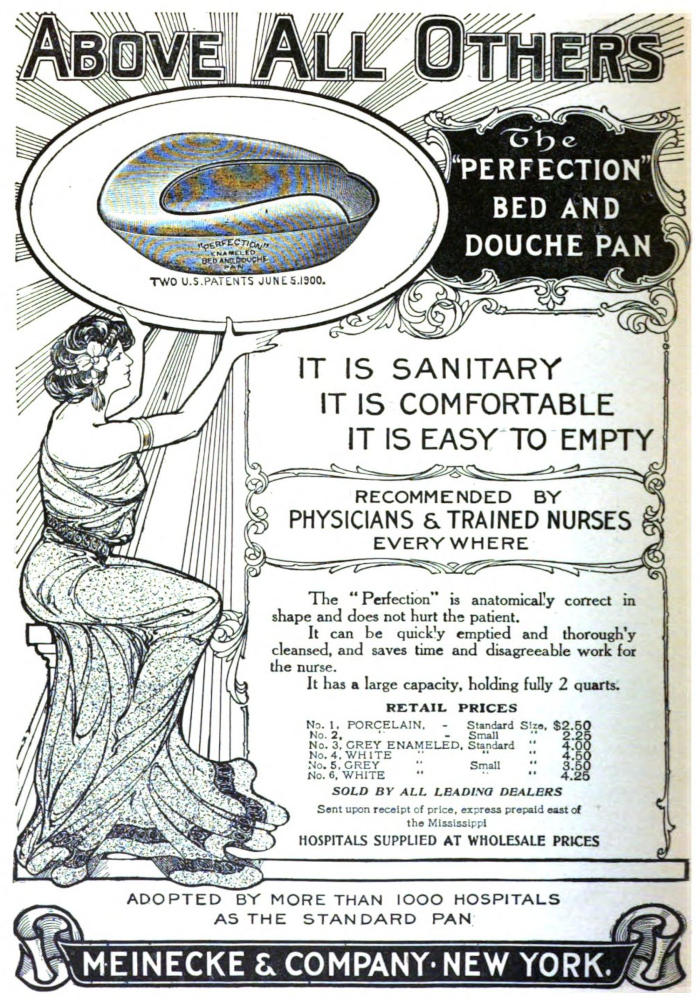
Above All Others
TWO U.S. PATENTS JUNE 5, 1900
The
“PERFECTION”
BED AND
DOUCHE PAN
IT IS SANITARY
IT IS COMFORTABLE
IT IS EASY TO EMPTY
RECOMMENDED BY
PHYSICIANS & TRAINED NURSES EVERYWHERE
The “Perfection” is anatomically correct in
shape and does not hurt the patient.
It can be quickly emptied and thoroughly
cleansed, and saves time and disagreeable work for
the nurse.
It has a large capacity, holding fully 2 quarts.
RETAIL PRICES
No. 1,
PORCELAIN,
Standard
Size,
$2.50
No. 2,
Small
”
2.25
No. 3,
GREY ENAMELED,
Standard
”
4.00
No. 4,
WHITE ”
”
”
4.50
No. 5,
GREY ”
Small
”
3.50
No. 6,
WHITE ”
”
”
4.25
SOLD BY ALL LEADING DEALERS
Sent upon receipt of price, express prepaid east of
the Mississippi
HOSPITALS SUPPLIED AT WHOLESALE PRICES
ADOPTED BY MORE THAN 1000 HOSPITALS
AS THE STANDARD PAN
MEINECKE & COMPANY · NEW YORK.
THE AMERICAN RED CROSS — Officers — Board of Consultation — Central Committee 1908-1909
President,
HON. WILLIAM H. TAFT.
Vice-President, ROBERT W. de FOREST.
Treasurer,
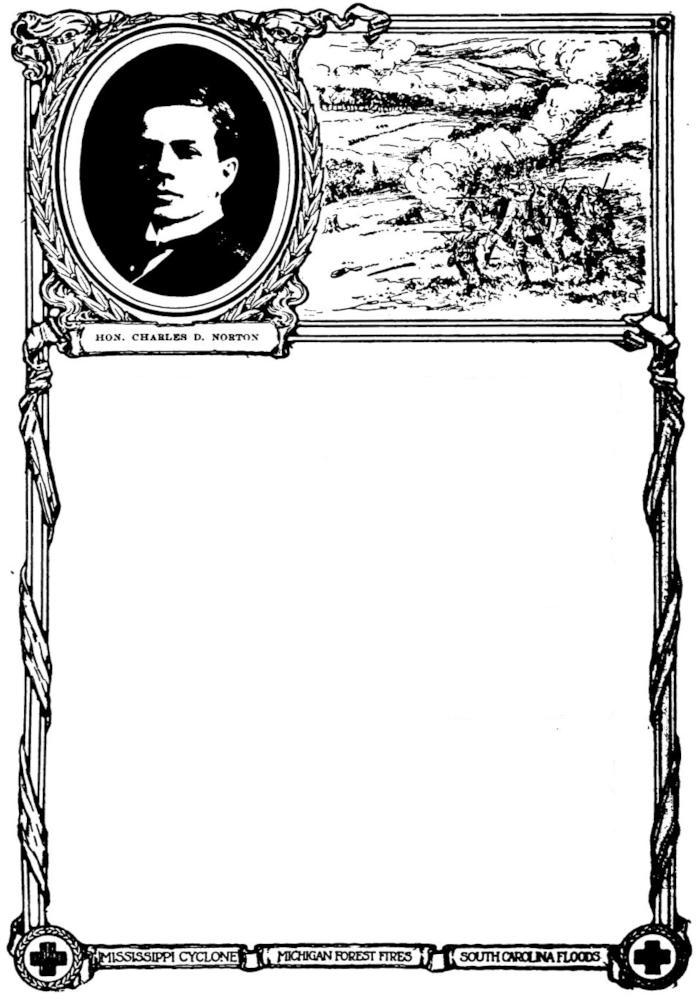
HON. CHAS. D. NORTON.
Counselor,
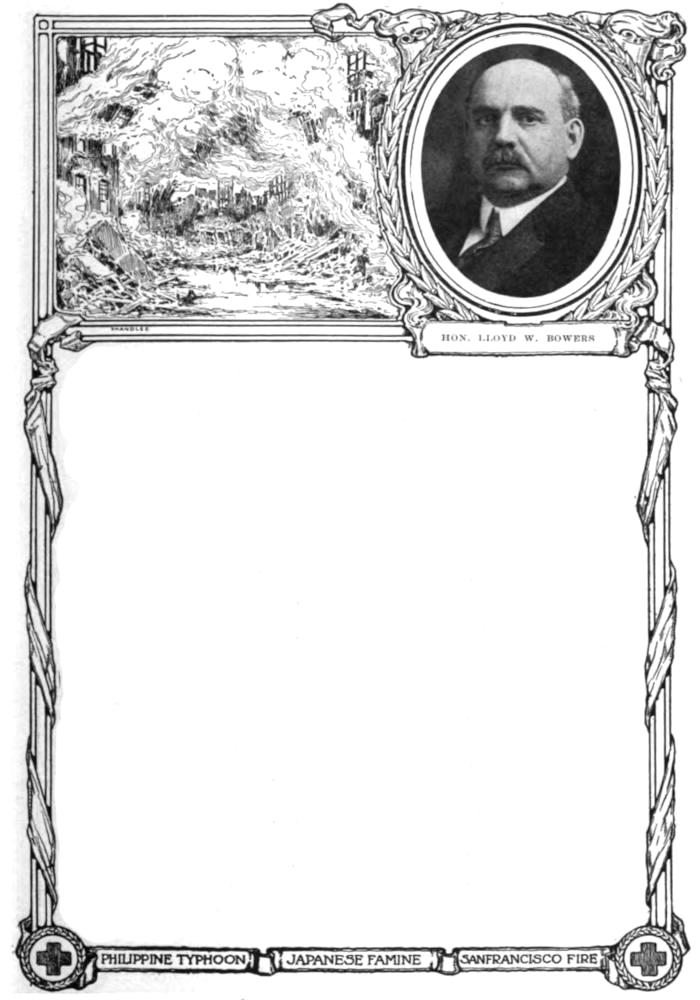
HON. LLOYD W. BOWERS.
Secretary,
CHARLES L. MAGEE.
Chairman of Central Committee,
MAJOR-GENERAL GEO. W. DAVIS, U. S. A. (Ret.)
National Director,
ERNEST P. BICKNELL.
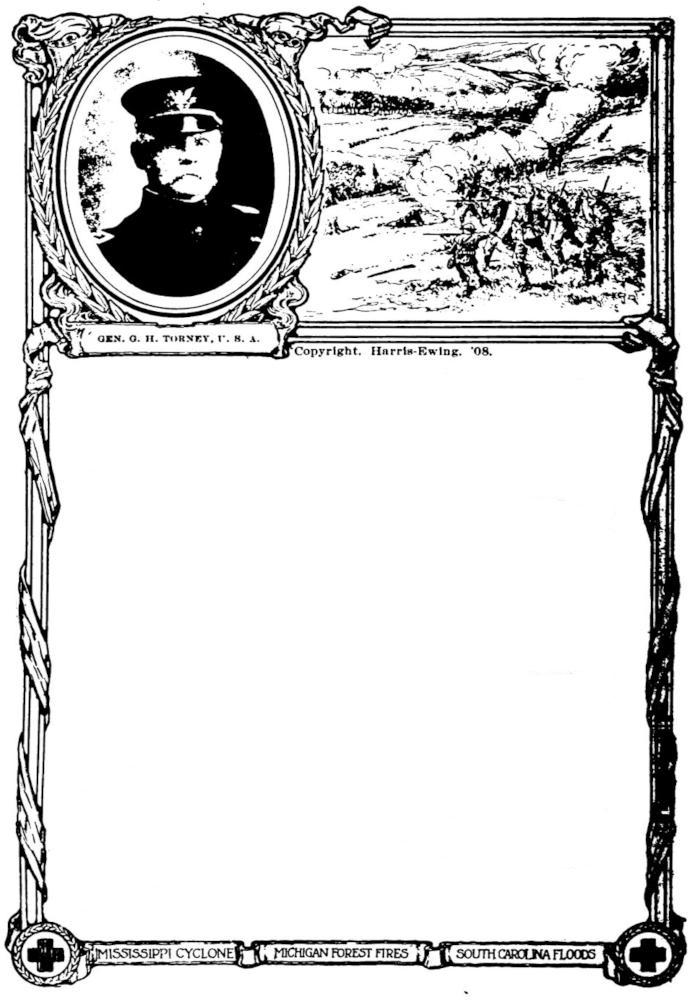
BRIGADIER-GENERAL GEORGE H. TORNEY,
Surgeon-General, U. S. Army.
REAR ADMIRAL PRESLEY M. RIXEY,
Surgeon-General, U. S. Navy.
SURGEON-GENERAL WALTER WYMAN,
U. S. Public Health and Marine Hospital Service.
Major-General George W. Davis, U. S. A. (ret.), Chairman.
Brigadier-General George H. Torney, Surgeon-General, U. S. Army, War Department,
Washington, D. C.
Hon. Huntington Wilson, Assistant Secretary of State, Department of State, Washington,
D. C.
Hon. Charles D. Norton, Assistant Secretary of the Treasury, U. S. Treasury Dept., Washington,
D. C.
Medical Director John C. Wise, U. S. N., Navy Department, Washington, D. C.
Hon. Lloyd W. Bowers, Solicitor-General, Department of Justice, Washington, D. C.
President Benjamin Ide Wheeler, University of California.
Mr. John M. Glenn, 105 East 22d street, New York, N. Y.
Miss Mabel T. Boardman, Washington, D. C.
Hon. James R. Garfield, Secretary of the Interior, Washington, D. C.
Hon. A. C. Kaufman, Charleston, S. C.
Hon. H. Kirke Porter, 1600 I street, Washington, D. C.
Mr. John C. Pegram, Providence, R. I.
General Charles Bird, U. S. A., Wilmington, Del.
Col. William Cary Sanger, Sangerfield, N. Y.
Judge Lambert Tree, 70 La Salle street, Chicago, Ill.
Hon. James Tanner, Washington, D. C.
Mr. W. W. Farnam, New Haven, Conn.
Note—Attention is invited to the recent changes in the Officers and Central Committee
members.
The President of the United States has appointed Hon. Huntington Wilson, Hon.
Charles D. Norton, Brigadier General George H. Torney and Hon. Lloyd W. Bowers members
of the Central Committee to represent the Departments of State, Treasury, War and
Justice, respectively. The Executive Committee has elected Hon. Charles D. Norton Treasurer
and Hon. Lloyd W. Bowers Counselor to fill the vacancies caused by the resignations
of the former Treasurer and Counselor.
Entered at the Post Office, Washington, D. C., as second-class matter.
PREFACE
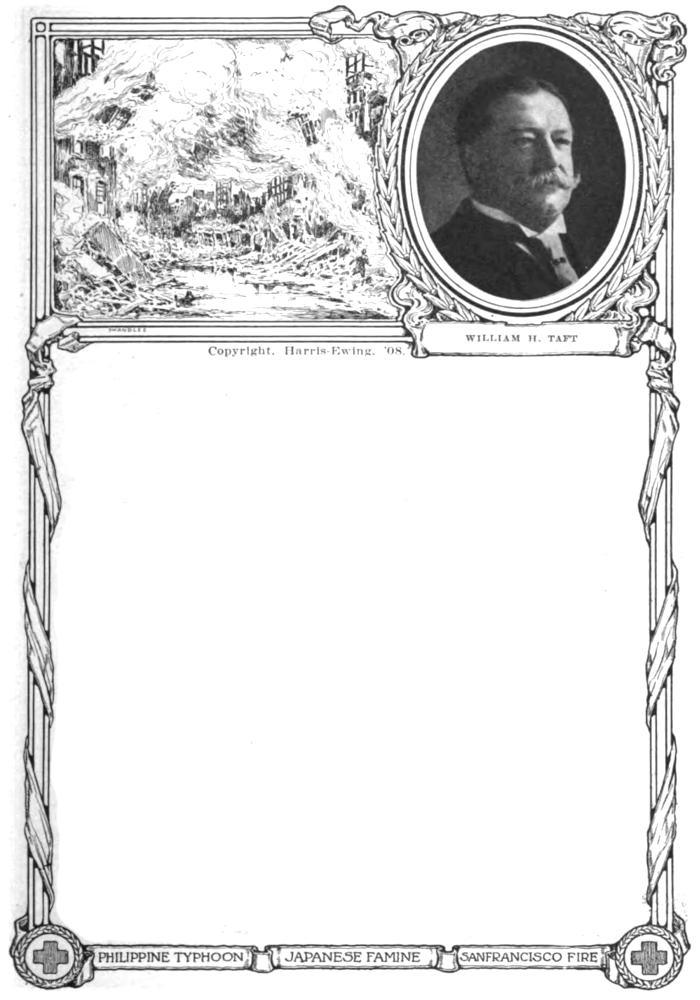
WILLIAM H. TAFT Copyright,
Harris-Ewing, ’08.
Hardly had our Red Cross work for the Sicilian and
Calabrian earthquake sufferers come to an end when a new field
for help opened before our American Society. This time it
was not some great catastrophe of nature’s doings, but
man’s inhumanity to man that brought about the need of
aid and as from Macedonia of old again arose the cry,
“Come over and help us.” In Eastern Turkey lay this
field of suffering, and of the Red Cross help the July
Bulletin gives a brief statement, hoping later to receive
a fuller report from the field itself.
So great was the devastation wrought by the earthquake
in Italy that later the less serious one in Portugal
almost escaped our attention, but among a number of
villages there has been much suffering and distress so that
our Society was glad to send some small but tangible expression
of our sympathy in its relief work to the Portuguese
Red Cross. We have not forgotten the contributions
it sent to the American Red Cross in 1898 for our
sick and wounded during the war with Spain.
HON. CHARLES D. NORTON
The article on Italy by Mr. Ernest P. Bicknell, National
Director of the Red Cross, with illustrations furnished
by Lieutenant Commander Belknap, U. S. N., of the houses
erected under his supervision will, we are sure, deeply interest
our readers.
Two special departments will be noted in the Bulletin,
one of the Relief Column and First Aid and the other on
Tuberculosis, lines of work along which our Red Cross has
plans for large and earnest development.
The Red Cross is needed. It is a blessing in many
ways to the peoples of the world. It brings them closer
together in the days of trouble and teaches them that
nations, like men, are brothers. In America our Red Cross
should aim to make itself one of the strongest and most
helpful in this brotherhood of nations.
MASSACRES IN ASIATIC TURKEY
HON. LLOYD W. BOWERS
The spirit of unrest was seething in Turkey and the
old antagonism that from the time of the crusades has
existed between the cross and the crescent was ready to
break out into action. On the 10th of April, at Adana, a
town in Eastern Turkey, not far west of Alexandretta, an
Armenian and a Turk were killed. This kindled into life
the flames of hatred and on the 14th they burst forth in
ferocious massacres. The Moslems being in the majority
the Armenians suffered terribly. Throughout that part of
the country it is estimated that some twenty-five thousand
persons have been massacred during this reign of terror.
Their houses and shops were pillaged and burned, and
those who escaped fled in terror for their lives. The Government,
in the person of the Vali, was either unable or
unwilling to put a stop to this appalling destruction of
human life and property. Once started the scenes of horror
were repeated in town after town in the eastern provinces.
At Tarsus several hundred Armenian houses were burned
and in the yard of the American College were sheltered and
protected 4,000 refugees. At Antioch, forty miles south of
Alexandretta, the Armenian population of 7,000 was nearly
annihilated. Kurds, Arabs and Circassians besieged the
small Armenian villages, pillaging and burning the houses,
killing the men and carrying the women into captivity. At
Adana and Tarsus 15,000 and at Mersina 5,000 refugees
were in dire distress and need while many more women
and children escaped from the villages and were hiding in
the mountains. The atrocities perpetrated reduced the
people to a state of terror and despair. If some small village
of Armenians succeeded in resisting the besiegers its
inhabitants were soon reduced to the verge of starvation.
Mr. Kennedy, an American missionary, secured some 450
Turkish soldiers and went to the relief of Deurtyul, an
Armenian village of 10,000 inhabitants, on the coast, which
was being besieged by hordes of Kurds and Circassians.
The water supply having been cut off, the people were dependent
upon the rain that fell, the children drinking from
the water that collected in the footprints of animals. Frantic
appeals for help and protection came down from scores of
villages and the foreign consuls at Aleppo cabled to their
Governments word of the great distress of thousands of
refugees.
GEN. G. H. TORNEY, U. S. A. Copyright,
Harris-Ewing, ’08.
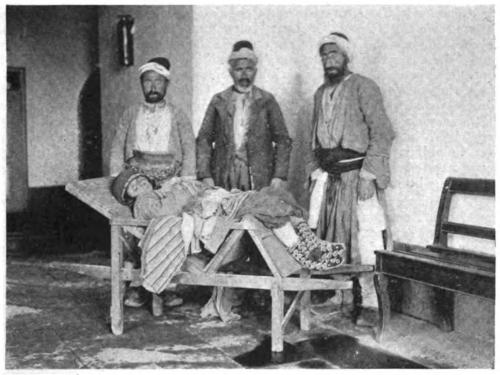
Turkish Woman,
Emergency Surgical Case. American Christian Hospital.
(By Courtesy of the National Geographic Society.)
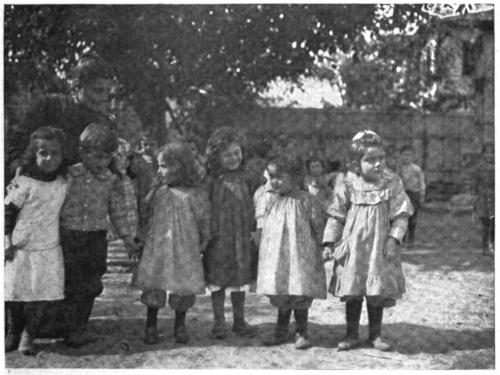
Armenian Children
in American School at Adabazar.
(By Courtesy of the National Geographic Society.)
Thanks to the efforts of our Consul General, Mr. Ravndal, at Beirut,
assisted by the French Cruiser “Jules Ferry,” Latakia in Syria was relieved.
Thousands of women and children, most of the men having
been killed, were being besieged there. Appeals to the Vali of Adana
continued useless. Conflagrations were continually breaking out and
often the entire city was threatened. Thousands of the refugees were
homeless and without any means of earning their livelihood. Bodies of
the dead were scattered through the streets and the pedestrian who ventured
forth had to pick his way so as not to step upon them. One writer
says in half an hour he counted twelve wagon loads of Armenian dead
being carried to the river and in the Turkish Cemetery graves were
being dug by the wholesale.
At Adana four hospitals were established; doctors and nurses were
sent from Beirut and Tarsus. Women, children and even babies suffered
from severe wounds. Among the hundreds in one hospital the
average of wounds to each person was four. Thousands of refugees
were without food, clothing and bedding. Those sheltered at the American
Missions were completely disarmed before being received so that,
to obtain as far as possible immunity from attack for the missions.
There was not enough water to drink nor to dress the wounds. Garbage
and filth collected in the streets and diseases of all kinds began to
reap their harvest.
On April 28th, in response to an inquiry if financial assistance was
advisable addressed to the American Ambassador at Constantinople by
the State Department, at the suggestion of the Red Cross, the following
dispatch was received:
“Secretary of State, Washington:
“As distress among population is very great, I am convinced that
American Red Cross could not better fulfill the noble purpose for which
it was founded than by such a contribution. If desired, money could
be sent to the Embassy for transmission to Mr. Peet, treasurer of the
American Missions in Turkey, and it would be a most humane act if
our charitable organizations could be induced to follow suggestion, as
thousands of the poor people are without food and shelter. If American
Red Cross will wire amount of draft they are donating, I will hand
over immediately such sum, as funds are urgently needed.
“LEISHMAN (Ambassador).”
Immediately upon receipt of the above cablegram the Red Cross appropriated
one thousand dollars from its General Emergency Fund which
was cabled by the Secretary of State to Mr. Leishman; and the Branch
Societies were requested to announce through the press that the Red
Cross would receive and forward to the Ambassador at Constantinople
any contributions for relief work in Turkey.
On May 6th a further remittance of $5,000 was sent by the Red Cross
to the Ambassador.
The Relief Committee at Beirut, of which the American Consul General,
Mr. Ravndal, is chairman, cabled to the Red Cross on May 10th,
requesting that it be permitted to act regardless of source of funds as
Red Cross agents, rendering full accounts. This Committee had already
raised about ten thousand dollars and had dispatched to Adana for doctors
and trained nurses. With the full approval of the American Ambassador
this Committee was recognized as its agent with full power to use the Red
Cross flag to protect its hospitals and field force.
On May 13th $5,000 more was cabled to the Ambassador by the Red
Cross as a contribution from the Christian Herald, with the request that
$2,000 be sent to Mr. Nesbit Chambers, of Adana, $2,000 to Thomas D.
Christie, Tarsus, and $1,000 to Mr. Ravndal, Chairman of the Relief
Committee at Beirut.
On May 6th the Armenian Relief Committee organized in New York
sent a special Committee, Dr. A. Ayvazian, Chairman, and Col. Mesup
Newton Kahn, to the New York Red Cross Branch to ask if the American
Red Cross would receive and dispense the funds raised by their Committee.
In reply to this inquiry forwarded from New York the National
Headquarters telegraphed its consent to receive and administer such
funds, stating its desire to be as efficient in Armenia as it had been in
other theatres of relief and that in this work it had the co-operation of
the State Department and the American Ambassador at Constantinople.
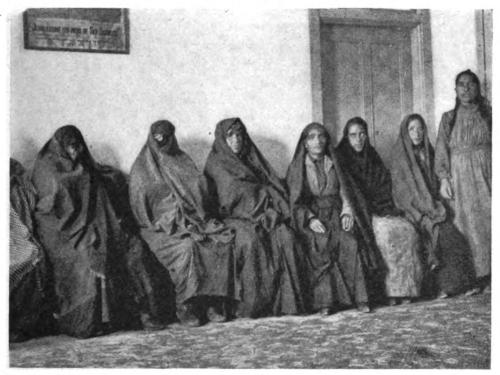
Women in Waiting at
Aintab Dispensary. Moslems on Left, Armenians on Right.
(By Courtesy of the National Geographic Society.)
On May 19th, $2,500 received from this Armenian Committee was
cabled to the Ambassador with the request that it be distributed to Armenian
sufferers of all denominations with the co-operation of the Armenian
Patriarch in Adana, the Reverend Kevrok Arslandan.
On May 28th a further remittance of $1,500 was sent with a like
request. This included a second remittance of $1,000 from the Armenian
Committee, making a total of $20,000 sent for the relief in Turkey.
On June 16 an additional $5,000 was received from the Christian
Herald, and was cabled to Turkey on the same day with instructions to
distribute it in the same manner as the remittance of the 13th of May.
The last dispatch received by the State Department on June 3rd,
and transmitted by the First Assistant Secretary of State to the Red
Cross, reads as follows:
“Mr. Peet makes the following statement:
“‘Relief work prosecuted in nine centers where thirty thousand people
are now supported. Present endeavor to rehabilitate refugees thus
making possible to earn livelihood and reduce list. Permanent provision
for orphans also required. Generous help now will (word indecipherable)
thousands dollars relief and put thousands of people on feet again.’
“I have great confidence in Mr. Peet’s judgment, as he is eminently
qualified by his long experience to speak authoritatively of such matters
and the Relief Committee at Adana, although international in character,
is largely composed of American missionaries headed by the British and
United States Consuls, which furnishes an unquestionable guarantee that
the relief funds will be fairly and judiciously expended. So far, the
subscriptions from England and America have been comparatively small
considering the enormous number of widows and orphans who, for the
moment, are entirely dependent upon public charity, and I am sure that
if the generous American public more fully realized the great distress
prevailing in the Adana and Aleppo districts it would respond more liberally
to the appeals which are being made.
“LEISHMAN.”
Armenian Orphans from
Massacres of 1894-5, in School Supported by Second Evangelical Church
of Aintab.
(By Courtesy of the National Geographic Society.)
CALABRIA AND SICILY TWO MONTHS AFTER THE EARTHQUAKE — Policy of the American Committee. — Impressions of Messina. — Burying the Dead. — Extent of the Disaster. — Tidal Wave. — How Catania Helped. — Bowdoin and Wood. — Difficulties of Obtaining Information. — Work of Italian Red Cross. — The Common Soldier. — Many Small Earthquakes. — Temporary Houses. — Attitude of Italian Authorities.
By Ernest P. Bicknell, National Director, American Red Cross.
The Italian earthquake occurred on December twenty-eighth and exactly
two months later, on February twenty-eighth, 1909, I arrived
in Rome. My first duty was to familiarize myself with the working
plans of the American Relief Committee. Although Rome is about three
hundred and fifty miles from Messina, it was the headquarters of the chief
agencies engaged in relief operations. Through the kindness of the American
Ambassador, Honorable Lloyd C. Griscom, I was quickly brought
into close relations with the American Relief Committee and with the
officers at the head of the Italian Relief Organizations. Count Taverna,
President of the Italian Red Cross, and Count Somaglia, the Vice-President,
showed me every courtesy and gave me all the information possible.
The hurried emergency work of the early days had been largely
closed at this time. Most of the injured had been discharged from hospitals,
the field hospitals had been closed, and the relief operations had
settled down to a long, slow struggle to help people of the ruined communities
to make a fresh start in life.
Many thousands of sufferers from the calamity had been removed to
Naples, Rome, Palermo, Catania and other cities immediately after the
earthquake. This made necessary the organization of extensive relief
measures in numerous cities which were not themselves sufferers. After
two months, this work outside the earthquake zone had been greatly reduced,
though still requiring considerable attention. Many public spirited
men and women gave important services through these outside organizations
without actually going to the scene of the disaster.
At Rome I also met Miss Katherine B. Davis, who had just ended
her brilliant relief administration in Syracuse, to which city more than a
thousand injured persons had been taken from Messina. Miss Davis had
gone to Sicily worn out with hard work as Superintendent of the Reformatory
for Women at Bedford, New York, and was looking forward
to a long restful vacation. She arrived the day after the earthquake and
probably performed the most strenuous and trying work of her life during
the following two months. The people everywhere were speaking in
terms of highest praise of what she had done, which was not only valuable
in itself but which set an example, copied in Palermo. Naples and
elsewhere.
Mr. Edmund Billings, of Boston, who, as the representative of the
Massachusetts Relief Committee, spent six weeks in Sicily, also reached
Rome at this time. Mr. Billings had cultivated close relations with the
local relief administrators and in this way had been enabled to apply his
relief funds with a personal knowledge of the extent of the need and the
method of their distribution in each instance.
The American Committee had occupied a delicate position in the
midst of a group of active Italian relief agencies. It was necessary to
avoid giving offense to any, as well as to keep out of the special fields
of work in which the Italian agencies were occupied. So well did the
Committee conduct its operations that I heard of no instance of dissatisfaction
or criticism of its efforts. The Committee took no step until
it had consulted the men in charge of the Italian relief work. It either
appropriated specific sums of money for the use of other of the most
efficient Italian organizations or it carefully selected relief tasks which
had not been undertaken by others. In fact the American Committee
had gained the enviable reputation of having ready cash instantly available
for any important piece of work for which cash from other sources was not
immediately to be had.
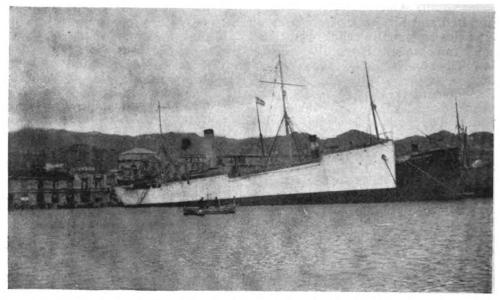
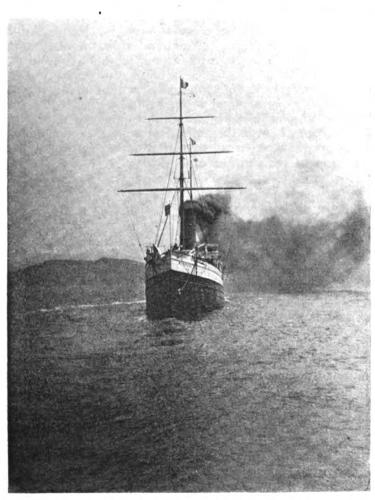
U. S. Supply Ship
“Celtic.” Anchored in Messina Harbor.
After a few days in Rome I went to Messina, where I arrived in the
early morning. As we drew into the land-locked harbor heavy clouds
obscured the surrounding mountains and a driving rain swept the desolate
ruins which were spread out before us. White as snow at her
anchorage swung the United States supply ship Celtic with her flag floating
high above the shattered quay and the heaps of debris which clogged
the crescent-shaped water front. On board the Celtic Captain Harry P.
Huse, in command, gave me a cordial welcome and immediately solved
for me the problem of a place to sleep and eat. Captain Huse had distributed
his cargo and surrendered most of his subordinate officers and
crew for shore duty. Big and energetic, he himself paced the long decks
of the Celtic somewhat restively because of his own enforced idleness.
With headquarters also upon the Celtic was Lieutenant Commander
R. R. Belknap, Naval Attachè of the American Embassy at Rome, but
now in full charge of the work of constructing the American cottages
in the earthquake district. Captain Belknap is clear headed, tireless,
executive to his finger tips, and a most courteous and considerate gentleman
to meet. He had his hands full with clearing and laying off
the land upon which American houses were to be built in Messina and
Reggio and the organization of his working force consisting of half a
dozen young American naval officers, about thirty American jackies and
several hundred native mechanics and laborers. The first of the ships
bearing lumber from America was expected in a day or two and arrangements
for unloading the lumber upon lighters, transferring it thence to
the dock, then loading it upon ox-carts and hauling it by circuitous ways
through the ruins to the sites where it was to be used, demanded much
attention. The revising of plans for the houses to adapt them to the
Italian needs, the making of itemized estimates of cost and the letting
of certain contracts also required time and much knowledge of local conditions.
Captain Belknap usually worked a couple of hours before breakfast
and the light in his cabin was the last to be extinguished at night.
A few days later when the first American ship anchored in the harbor,
with lumber for five hundred American houses on board, a new
activity began. Teams of great red oxen with horns of tremendous
reach, each team attached to a massive two-wheeled cart, blocked the
water front while a crowd of noisy, hustling Italian laborers, like ants
about an ant hill, carried the lumber piece by piece and stacked it high
upon the creaking vehicles. Processions of loaded carts moved sinuously
among the ruins, each driver guiding his oxen by ropes attached to their
horns and by means of mournful cries which the animals seemed to understand.
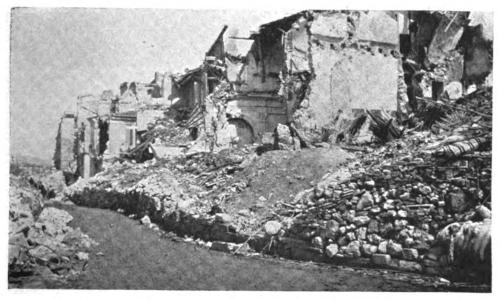
Ruins of Messina,
Showing Method of Opening Street.
At this time Messina presented a strange and sorrowful picture. In
the midst of some of the most beautiful scenery in the world the city lay
a center of horror and desolation. All the world is familiar, through descriptions
and photographs, with the appearance of the ruins of the city.
These ruins had not been cleared away at the time of which I write.
Certain winding paths had been cleared through a few important streets.
San Martino, a street extending straight back from the harbor through
the city, was so wide that the heaps of debris on either side left a considerable
clear area in the center. Along San Martino all the life and
business of the city had gathered. Tiny, shapeless huts of fragments of
lumber, sheet iron, blankets, tin and scraps of cloth were crowded into
this open space and swarmed with huddling people. Microscopic stocks
of food and clothing were on sale in some of these huts. A temporary
postoffice occupied a wooden shack in the center of the street and more
cabs than one would have supposed could have been saved from the
disaster drove madly back and forth through the clutter of huts and
throngs of people. The most conspicuous business was the sale of postcards,
picturing the results of the earthquake. At midday San Martino
was crowded with probably ten thousand persons; at dark the unlighted
street was empty. The disappearance of the people at night was a mystery
which aroused much comment. The available shelter seemed to be
absurdly inadequate to the need. The people in fact slept under the
broken arches and in doorways and behind or beneath any projections
or rude contrivances which gave protection from the almost incessant
rains.
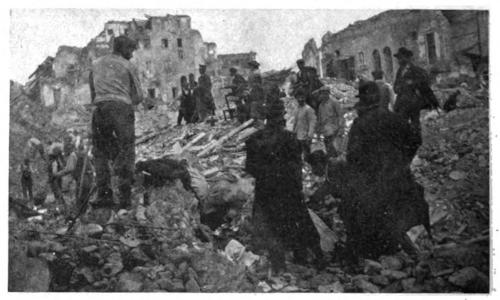
Discovering a Body
in the Ruins of Messina.
Oppressed by the sense of the tragedy of the city a visitor was at
first shocked to see the crowds in San Martino engaged in business,
haggling and bargaining, quarrelling and jesting in quite a natural
manner.
In all directions through the miles of ruins were to be seen knots of
people gathered upon the sites of their former homes. Each group consisted
of certain members of the family, three or four workmen with
shovels and a soldier. The workmen were digging into the ruins to uncover
the bodies of victims of the disaster and to recover any property
of value which might be buried there. The soldier was assigned to the
duty of guarding and directing the work and preventing curious or dishonest
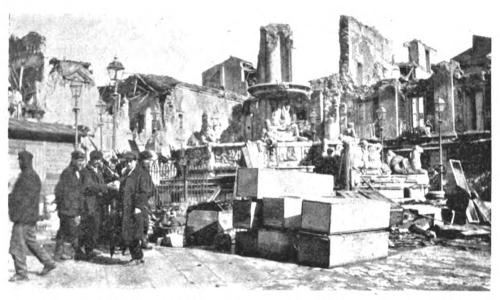
persons from interfering or carrying away property. At the side
of each group would be observed one or more rough wooden boxes waiting
to receive the bodies for which the workmen were searching. At
this time it was officially estimated by the military authorities in control
of Messina that twenty thousand bodies had been removed and that forty
thousand bodies still remained undiscovered. About two hundred bodies
a day were being taken out in the month of March. As the larger houses
of the city had suffered the most complete destruction, it followed that
the loss of life among the resourceful and well-to-do had been greater
than among the poor who lived in the smaller structures. It was estimated
roughly by Italian officials that ninety per cent. of the dead in
Messina belonged to the resourceful class.
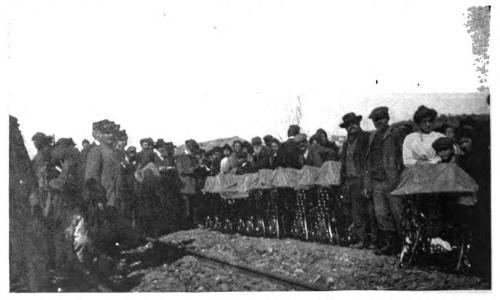
Bodies Awaiting
Burial in Public Square, Messina.
Sad and terrible as was the task of disinterring the bodies of the
dead and burying them in the cemeteries, it was inevitable that the work
carried on day after day should become a commonplace occupation and
that the men engaged in it should eventually regard it with something
of the same indifference with which any other daily task is regarded.
This may be illustrated by an incident which was observed one hot
afternoon. Four workmen, carrying upon their shoulders a box containing
a body, were hurrying to the burial place in one of the cemeteries.
The men were laughing and jesting as they moved rapidly along a rough
road. Behind the men followed an old woman in rusty black, struggling
painfully to keep up with the box. Under her arm she carried a
small cross such as is placed at the head of each grave as the dead are
buried. When the burial place was reached the men carelessly placed the
box upon the ground and hastened away without a word. No grave was
ready to receive the body and the old woman sat down on the ground
beside the box, still clinging to the little cross. It would probably be
some hours before the over-worked force of grave diggers had prepared
a place for this particular body, and the old woman in the meantime sat
in the broiling sun beside the rough coffin. She feared that if the body
was buried in her absence she would not be able to identify the grave
thereafter. So she sat there during the long afternoon, occasionally
caressing the rough boards with tender hands.
Carts or groups of carriers bearing other coffins were continually
arriving. It was impossible for the grave diggers to keep up with their
task and the grass for a long distance about was covered with the waiting
boxes.
A special cemetery was set apart for the burial of the unidentified
dead. In this cemetery pits about thirty feet long, twelve feet wide and
six feet deep were prepared and the boxes were stacked in them in tiers,
about one hundred boxes to each pit. By the middle of March about
twenty-five hundred unidentified bodies had been buried in this cemetery.
The condition of the bodies taken from the ruins at this late date and the
oncoming of hot weather made it imperative that all possible haste should
be insisted upon. No ceremony whatever accompanied the burial or the
preparation for it. Bodies were placed in the boxes the moment they
were exhumed from the ruins, a little later were placed on carts and
driven directly to the cemetery.
It is unnecessary here to speak at length upon the extent of the
disaster. The earthquake affected a strip of land on each side of the
Straits of Messina. The extreme dimensions of the affected area were
about fifty miles from North to South and perhaps forty miles from
East to West. Within this area no town or village escaped entire or
partial destruction. In all more than fifty cities, towns, villages and
communes were destroyed. The lowest estimate which I heard of the
number of persons made homeless was five hundred thousand. Estimates
of the dead range from one hundred thousand to two hundred and fifty
thousand. In the course of my travels about the region I visited about
twenty-five cities, towns and villages, among them all the larger ones.
Wherever I went I inquired of the local authorities, who seemed best
informed, concerning the loss of life. Based upon the answers to these
inquiries and my own observations, I have reached the conclusion that
the estimates of the number of dead have been uniformly too large.
When the final estimates are made, after all bodies have been accounted
for, I doubt whether the total will exceed seventy-five thousand.
I have seen no estimate of the property loss and it is doubtful
whether any approximately accurate estimate can be made. Neither
have I seen any figures of the amount of insurance carried on property
but the result of inquiries indicates that the total insurance was comparatively
small. The Italian people do not seem to have very fully
adopted the policy of insuring their property. Unless such insurance
as was held covered loss by earthquake, the owners of property can, in
any event, collect little, if anything, from the insurance companies. The
poverty of this part of Italy, coupled with the overwhelming magnitude
of the loss, both of property and life, must make recovery exceedingly
slow. The Italian Government is preparing to introduce measures of
great liberality intended to help the people re-establish themselves.
Most of the descriptions and photographs of the results of the earthquake
have applied chiefly to the City of Messina, because it was the
largest city in the earthquake zone and was the point to which relief
measures were first of all directed and at which lines of transportation
from the outside world centered. Tourists invariably get their first view
of the earthquake at Messina and many of them go no further. Descriptions
of conditions in Messina, however, convey a fair idea of conditions
in all the other ruined cities and towns. Messina had over one
hundred thousand population, Reggio about forty thousand, Palmi about
twenty thousand, Villa San Giovanni about seven thousand. These were
the largest communities in the region affected by the disaster. The ruin
everywhere was as complete in proportion to population as was that in
Messina. In Reggio about fifteen thousand lives were lost, in Palmi five
or six thousand, in Villa San Giovanni about fifteen hundred.
Relief measures were slow to reach the smaller towns lying among
the mountains back from the coast. Many of these towns are upon
mountain tops and are inaccessible except by donkey trails. The difficulty
of access made the work of relief particularly difficult and it is
probable that the suffering for food and shelter was greater in the mountain
towns than in the larger cities on the coast.
Town of Pellaro,
Leveled by Tidal Wave.
Much was said in early reports about the tidal wave which followed
the earthquake. Had the tidal wave occurred alone, it would have been
regarded as a great disaster. But overshadowed as it was by the earthquake,
it forms but a small item in the sum total of ruin. The wave did
not cause much damage on the shores of Sicily, its chief force being expended
upon the Calabrian coast. As the wave rushed into the small
bays, the funnel shape of the shores piled the water up higher and
higher until at the apex of the bays it had reached a height of many
feet and rushed across the low lands adjacent with irresistible force. If
a village happened to be situated at the innermost point of a bay, it suffered
great damage from the wave. Some injury was done in the harbor
of Reggio in this way and some at Villa San Giovanni. The chief
sufferer from the tidal wave, however, was the little town of Pellaro.
Pellaro was, like other Italian towns, constructed entirely of stone and
mortar. It was built up solidly along one or two streets which were
parallel to the shore. Immediately in the rear of the village were large
lemon orchards. The earthquake shook the buildings down and about
ten minutes afterward the tidal wave came in and leveled the heaps of
ruins in a manner which amazed all who went over the ground later. It
was almost impossible to discover the street lines or to identify the
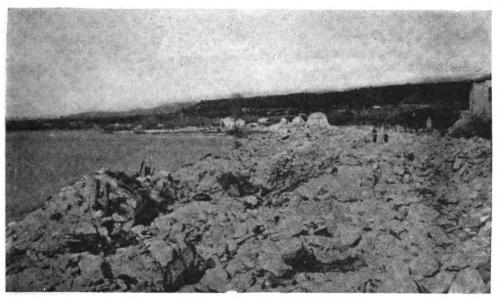
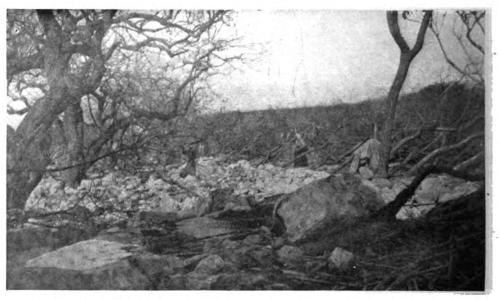
sites of the houses. The stones of which the buildings were constructed
were carried hundreds of yards inland and scattered among the lemon
trees. The entire site of the village was reduced to a dead level and
one found it difficult to believe that a town of fifteen hundred population
had ever occupied the place. About nine hundred of the people of
Pellaro were killed by the earthquake or tidal wave and hundreds of
bodies were carried out to sea by the receding waters.
Stones from Pellaro
Houses, Swept by Tidal Wave into Lemon Orchard.
As before mentioned, many Italian cities outside the earthquake zone
received and cared for large numbers of earthquake victims. Catania in
Sicily with about one hundred and fifty thousand population was closest of
these outside cities to the scene of the disaster and was the most accessible
of all. The result was that at least twenty-five thousand people from
Messina and other destroyed towns were carried into Catania for care.
Several thousand of these victims required hospital attention, and all
the regular and many improvised hospitals were quickly crowded. The
municipal authorities of Catania, with boundless generosity, undertook
to provide shelter and support for this tremendous influx of helpless people.
Numerous large institutions and vacant private buildings were converted
into refuges. There had been no time to make proper preparation for
the comfort of these people and it should not be held the fault of Catania
that the conditions in the refuges quickly took on a deplorable character.
The best of the refuges was that provided in the new municipal
prison. This is a vast, massive stone building, with stone cells and
the iron bars and grim, echoing corridors which characterize modern
prisons. The building was barely completed and had never been occupied.
Everything was clean and wholesome and sanitary provisions were
ample. When I visited Catania in March twelve hundred men, women
and children from Messina and other earthquake towns were living in
this prison in comfort. It was strange to hear baby voices and the
lullabys of women in the cells and about the long passages. The great
number of cells made it possible to segregate the people by families or
by sex and to give to each family a certain amount of privacy. Probably
no other great prison ever received a dedication so strange as this.
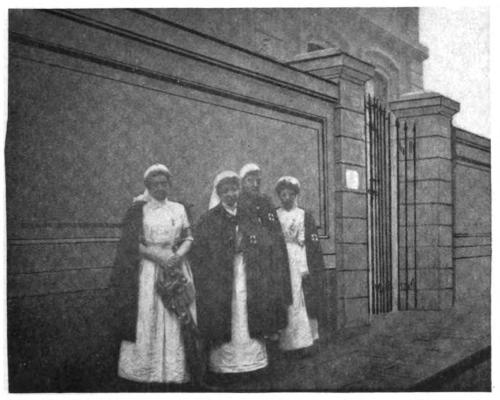
Ladies of the French
Red Cross Society Nursing in Neapolitan Hospital.
Between Messina and the mountain town of Taormina, thirty miles
to the South, lies a chain of towns and villages which were destroyed by
the earthquake. At Taormina, when the earthquake occurred, were two
young Americans—Harry Bowdoin and Charles King Wood. Mr. Bowdoin
was spending the winter in Taormina with his invalid mother and
Mr. Wood is an artist who has lived in Taormina for several years.
These men entered with the utmost zeal upon the work of relief. Taormina
was not injured, but it lay close to the edge of the zone of destruction
and many hundreds of fleeing victims sought refuge there. Others
in Taormina also participated actively in relief work, but gradually
Messrs. Bowdoin and Wood came to be recognized as the leaders.
Afterwards, by common consent, these two young men became representatives
of the American Committee in the small towns between Messina
and Taormina. Day and night they went up and down the coast
and back among the mountain communes, carrying comfort and good
cheer. They organized local Committees in every community, gathering
relief from the points of distribution at Messina and Catania and conveyed
it to these local Committees. Without compensation and with
a modesty which shrank from any words of commendation, these Americans
performed a laborious and delicate task in a manner to stir the pride
of their fellow countrymen.
In attempting to secure reliable information of the methods and
extent of relief measures in the earthquake zone, I found an obliging
readiness on the part of those in charge at any given point to give me
all the facts desired concerning their own respective agencies and a somewhat
surprising ignorance of the operations in the same field of any other
relief agencies. This in part arose from a deplorable lack of co-operation
among the different agencies engaged in relief work and perhaps
in part from a spirit of competition and pride which led each representative
to desire to have it appear that the agency which he served was
the chief factor in the situation. This may be illustrated by an incident
which occurred one day when I was visiting the town of Villa San
Giovanni.
Prince Chigi of
Rehabilitation Committee Distributing Sewing Machines.
I took lunch with the Mayor of the town and in the course of conversation
inquired of him whether the Italian National Red Cross had
participated in the relief work of his town. He replied, with a shrug of
his shoulders and in emphatic language, that the Red Cross had given
no assistance in Villa San Giovanni; that it might as well have no existence
so far as the people of his community had had occasion to know of
it. After our luncheon was completed, the Mayor was called away to
attend to official matters and I walked up the street toward the municipal
headquarters, which were in a small, temporary wooden building.
Presently I saw coming down the street in a cloud of dust, a large
red automobile. Fluttering from a short staff on the front was a Red
Cross flag. The motor drew up with a flourish in front of the Municipal
building and two men with Red Cross brassards on their arms dismounted
and began unloading several hundred articles of clothing from
the tonneau. These they were carrying into the building and stacking
up on the floor in one corner of the Mayor’s office. I entered into conversation
with the man in charge of the Red Cross car. He told me
that the Red Cross was sending out a number of automobiles every day
from Reggio and Messina to deliver supplies of clothing to the people
in the surrounding small towns. I asked him how it happened that he
had not before visited Villa San Giovanni. He looked surprised and replied
that he had brought several loads of clothing to this place before.
Turning to his companion, they compared notes, and he then informed
me that this was the seventh visit which they had paid to Villa San
Giovanni, each time bringing a large quantity of clothing. Replying to
further inquiries he assured me that he and his companion in no instance
distributed clothing direct to the people, but had always brought
their goods to the municipal headquarters and turned them over to the
Mayor for distribution.
It is unnecessary here to speak at length of the relief work of the
Italian Red Cross, since the public is already familiar with it. Two
months after the earthquake the largest part of the work of the Red
Cross had been completed and the greater part of its relief funds expended.
Immediately after the earthquake the Red Cross had a hospital
ship which carried the sick and wounded from Messina to Naples,
and ran a hospital train which conveyed many of the victims from Naples
to Rome. The Red Cross also established and maintained ten field hospitals
in different parts of the earthquake zone, and carried on a work
of great magnitude. When the task of dealing with the sick and
wounded was about ended the Red Cross turned its activities in the
direction of supplying relief, one of its methods being that of sending
consignments of clothing to the small towns by means of motor cars.
The Italian soldier was found everywhere throughout the earthquake
district. He was called upon to perform the hardest work and
the most trying tasks. Heat, cold and rain were alike to him. Living
in the rudest shelters and subsisting upon the most meager fare, he was
uniformly cheerful, good natured and obliging. His brave uniform and
military trappings were in sharp contrast to his hard life and to his
simplicity about which there was something winning and childlike. He
received no sympathy nor expected any. I had many occasions to ask
information or other assistance from the soldiers and found them always
ready to go far beyond any mere demand of duty in meeting my wishes.
When far from headquarters, I sometimes went to the shelter of the
nearest group of soldiers for food. With a hospitality which was almost
pathetic, the men would bring forth the best they had from their cupboards
and chests and set it before me with apologies for its meagerness.
The usual supply of food I found consisted of dry bread and the native
mild wine of the country. Occasionally a small can of meat or fish was
found in their stock, but this was evidently regarded as a luxury only
to be brought forth on special occasions.
The people of the country bordering on the Straits of Messina have
always been accustomed to earthquakes. Slight tremors of the earth are
likely to occur at any moment, as the record of any year would show.
Since the disaster of December 28th last these small incidents are fraught
with a new importance and frequently carry terror to the hearts of the
population. Since the great earthquake many small ones have occurred.
There may be two or three in a day and then a period of several days
with no perceptible tremor. Occasionally one of these little earthquakes
comes with a sharp bang and a swift rattle which distinguishes it from
its milder and less noticeable fellows. In such instances the people rush
wildly from their huts and shelters calling out anxiously to each other
and exhibiting signs of the keenest alarm. Especially in the night is the
terror pronounced. After a few minutes, finding that no harm has been
done, the excited people become calm, retire once more to their shelters,
and the clamor gradually quiets down.
Some odd effects of these earthquakes at night are observed. The
commonest beasts of burden are the small donkeys. There are literally
thousands of these animals in and about Southern Italian towns. Whenever
a rather sharp earthquake occurs at night every donkey immediately
sets up an excited braying and for a few moments the air for miles
resounds with their unearthly noise.
This country is the home of a small tree frog which inhabits the
lemon orchards and clumps of trees and shrubbery. During all the night
these frogs keep up an incessant trilling which sets the atmosphere
a-quiver. The slightest earthquake brings them to instant silence. After
five minutes or so of quiet, following the earthquake, one will hear a few
of the boldest frogs tuning up again in a timid and hesitating manner.
In another moment the other frogs also become emboldened and a little
later the concert is again in full swing.
Everybody is familiar with the fact that much money contributed by
America to the relief of Italy has been expended in the erection of small
wooden houses for the temporary shelter of the people who lost their
homes by the earthquake. About four hundred fifty thousand dollars
of the money appropriated by Congress and about one hundred seventy-five
thousand dollars of money contributed through the Red Cross have
been applied to the purchase of materials for some thirty-three hundred
houses and the actual expense of erecting about twenty-four hundred of
this number. The lumber, hardware, glass and all other necessary materials
for the building of about nine hundred houses were turned over
to the Italian authorities, who undertook to scatter this number of houses
in small groups among many different towns where they would be erected
by the people themselves.
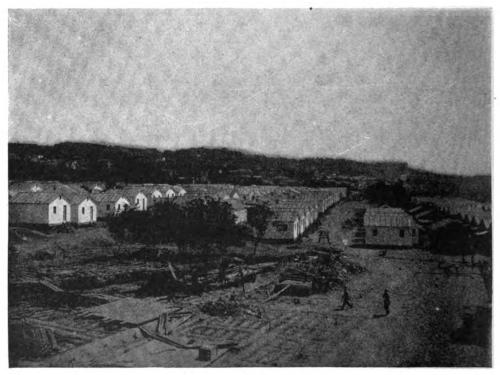
Each one of these houses is sixteen by twenty feet in outside dimensions.
It is enclosed with a good quality of weather boarding, has a
good floor and a composition roof which is expected to endure for not
less than five years. Some of these houses are partitioned into three
small rooms, while others are left in the form of a single large apartment.
Upon the rear of each cottage is built a kitchen about eight feet square
with a brick floor and with two walls of brick. In the angle formed by
the two brick walls is a brick arch with a flat top. This forms the
cooking stove with which the Italian is familiar. In the flat top of the
arch are two openings containing wrought iron baskets to hold the charcoal
which is the universal fuel of the country.
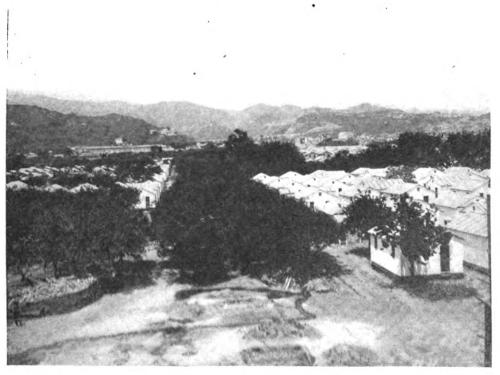
American Village,
Messina. Parks and Streets Shaded by Lemon Trees.
The common people of Italy are accustomed to living in stone
houses with stone or earth floors and have no idea of the importance
of care in handling fire. The houses they have always known have been
fireproof and it has not been uncommon for them to build fires on the
floor of their living rooms. It is hoped that the provision of these small
semi-fireproof kitchens will prove a sufficient safeguard against fire, but
there is considerable apprehension that the inhabitants of the wooden
houses may ignorantly or carelessly build fires in such a way as to destroy
some of the buildings. As these stand close together, it is conceivable
that a fire might start on a windy day and destroy a large number
of the houses before it could be checked. The houses are built in
blocks of twelve, each block fronting in all directions upon streets thirty
feet wide, but within the block the houses are only about six feet apart.
In the open quadrangle in the center of each block are the sanitary
arrangements and the water supply for the twelve houses composing the
block.
On a beautiful plateau, sloping gradually toward the Strait and commanding
a magnificent view of the water and mountains of Calabria beyond,
one thousand of the American houses have been built in the outskirts
of Messina. This great group of houses is commonly referred to
as the American Village or, as it is officially known to the Italian authorities,
the Zona Case Americana. The Italian government issued a special
order making this tract of land, for the time being, American soil
and authorizing the Americans in charge of the work to float the United
States flag over their headquarters. A pole was set up and with considerable
ceremony the flag was hoisted while all the workmen, both
American and Italian, and many Italian spectators from Messina listened
to several short addresses and cheered lustily.
American Village,
Reggio.
In the outskirts of Reggio, ten miles away across the Strait, upon
another beautiful plateau, at the same time, was rising another American
village of one thousand cottages. On the Northern boundary of Messina,
sheltered by a towering hill, and commanding a lovely view of sea
and mountain, is a pretty village of small wooden houses named after the
Queen of Italy, Villagio Regina Elena. In this village the Americans have
erected about one hundred houses. At the expressed wish of the Queen
they have also built a small but model hospital of six pavilions. To this
institution the Queen has given the name of “Elizabeth Griscom Hospital,”
in honor of the wife of the American Ambassador to Italy.
All of these building operations are under the direction of Lieutenant
Commander Belknap. In this he has had the efficient assistance of
Lieutenant Allan Buchanan and Ensign J. W. Wilcox, two capable young
American naval officers assigned to this duty from the naval yacht
Scorpion, which spent the spring in the harbor at Naples. John Elliott,
the well-known American artist of Rome, laid aside his brush and willingly
became the architect and draftsman for this extensive American
project. With headquarters in Reggio, Mr. Winthrop Chanler, of New
York, took charge of the building of over two hundred American houses
in some of the smaller towns near Reggio. Several young noblemen of
Rome, fired with zeal to help in the work of relief, joined Mr. Chanler
and, under his guidance, spent some weeks in individually going among
the people in the ruined villages of Calabria, studying their particular
needs and supplying them with tools, sewing machines, and other equipment
necessary to enable them to become self-supporting.
At the end of March the lumber from America had been all unloaded
from the five ships that carried it to Italy, the working forces
engaged in putting up the cottages had been completely organized and
Captain Belknap had the great satisfaction of reporting that twenty-four
complete houses were erected every working day of ten hours. The
American houses are turned over to the municipal authorities of Messina
and Reggio and the assignment of the houses to individual families
is in the hands of the municipal officers.
It should not be supposed that America is the only agency engaged
in building temporary homes. Some have been built by other countries
and a very large number by the provinces of Italy. I was informed at
the office of the Minister of Public Works in Rome that sites had been
assigned at the end of March for the erection of fifteen thousand eight
hundred temporary houses. Considering the size of the average Calabrian
or Sicilian family, it is probable that these temporary buildings
will provide shelter for most of the survivors of the earthquake who are
unable to obtain homes through other means.
This informal account of the situation in the earthquake zone, two
months after the disaster, cannot with justice be closed without a word
of appreciation, of the extremely friendly and helpful attitude of the
Italian authorities. They gave every possible facility to Captain Belknap
and his assistants, and the engineer who represented the Federal
Department of Public Works in Messina co-operated with the American
builders constantly and cordially. The Italian Navy assigned one
of its brilliant young officers, Commandante Brofferio, to constant duty
at the American encampment. He lived on board the supply ship Celtic
until it sailed away for America and then with Captain Belknap and the
other Americans moved into a group of the new cottages in the American
Village. Practical, obliging, tireless and of few words, Commandante
Brofferio soon became indispensable and was respected by every
one. The Italian Navy also placed at the command of the American
officers a torpedo boat for the purpose of conveying Captain Belknap
and others back and forth across the Straits of Messina as their duties
required. In every way the representatives of America, engaged in the
work of Italian relief, have reason to regard the Italian federal and municipal
officers, the officers of the army and navy and the heads of the
Italian Red Cross and the Central National Committee with feelings of
the highest esteem.
REPORT OF EARTHQUAKE IN PORTUGAL
By Louis H. Aymé, American Consul-General at Lisbon.
I have the honor to furnish additional
details of the earthquake
shock experienced here April 23
and already briefly reported by me in my
No. 75 of that date.
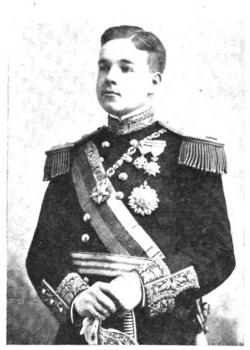
King of
Portugal.
It is now learned that while some
slight damage in the way of fallen chimneys,
cracked walls and ceilings was
caused in Lisbon, very serious damage
was done on the other side of the Tagus
to the northeast. Four villages were
completely destroyed, 37 persons were
killed, a very large number wounded and
some thousands made homeless. The
greatest damage occurred at Benavente,
about 23 miles from Lisbon.
Twenty persons lost their lives at
Benavente and some idea of the severity
of the earth movement there may be
gathered from the fact that the great
church, the walls of which were more
than 13 feet thick, was entirely wrecked.
At Samora de Correia there were
seven killed. At St. Estevao three
were killed and two deaths occurred at Salvaterra de Magos. Nine hundred
buildings were destroyed in this last place and some 3,000 persons
made homeless. The other three villages are also heaps of ruins.
Telegraphic communication was destroyed and the news came by
messengers. Instantly energetic measures were taken for the relief of
the sufferers. A dozen doctors, full ambulance corps, a huge quantity
of medical, surgical and other hospital supplies were rushed to the scene;
police, engineers, fire brigades and soldiers were also sent and the King,
accompanied by his uncle, Dom Affonso, were on the spot as quickly
as special trains and automobiles could carry them after they received
the news. The parliament voted unanimously $100,000 to be at once
available for the relief of those needing it, and great quantities of provisions
were sent to the afflicted district.
The shock here in Lisbon upset a small lamp in a shrine in a private
house, setting it on fire. The King and Dom Affonso were there almost
with the arrival of the firemen. Too much praise cannot be given to the
cool, clear-headed, swift and effective aid extended, especially in view
of the fact that Lisbon was utterly panic-stricken. The usual idiots had
issued predictions that another and greater shock would occur in twenty-four
hours. Two light shocks, at 2 o’clock and 6 o’clock the morning
of April 24, and the fearful news from the Trans Tagus made terror
yet greater. Thousands had passed the night in the streets. In the
Avenida, in front of this Consulate, many hundred richly dressed women
slept out under shelters made from the park benches and chairs with
shawls and rugs stretched over them to make a sort of roof. Amid this
universal terror and fear everyone in authority gave evidence of coolness
and energy. The newspapers used their heaviest type and great headlines
for rational arguments to reassure the people; all parties in parliament
praised the generous and energetic action of the King and the government,
and the longest speech made in that body yesterday was devoted
to counteracting the panic. There is no seismographical observatory or
instruments in Portugal, but the scientists have come out with quieting
explanations of what has happened and advised that all should think
only how to relieve those who had actually suffered. I repeat that too
much praise cannot be given for the able manner in which Portugal is
handling the whole matter.
The last earthquake shock felt in Lisbon occurred in August, 1903,
but was much less severe than this. Prior to that there was a shock in
1859. I have spoken with two gentlemen who were then here and they
tell me it was not anything as severe as this. The whole lower city is
built on made ground, filled in after the great earthquake of 1755, and
in case of a severe shock great damage might be done there, but the
new city is built on rock and all houses are built with a special view to
withstanding earthquake shocks, having a skeleton of peculiarly and skillfully
interlaced timbers that gives great elasticity and at the same time
resistance.
While writing this I learn that the Portuguese Red Cross is already
sending in stretchers and ambulances with the wounded from the villages
to be taken care of in the Lisbon hospitals, and that doctors and nurses
are now busily at work in the field. Thousands are still thronging the
parks and wider avenues, but confidence is being gradually restored.
Examination of this Consulate yesterday revealed that the heavy
moulded ceiling in the main business office is very badly cracked and a
portion several feet square is liable to fall at any moment. The whole
ceiling will probably have to be taken down. One of the large windows
is also somewhat sprung. These damages are examples of the results of
the shock in this city.
I do not believe that any foreign relief will be required and, should
it be, our legation here would of course be the proper and natural channel
by which such information would be forwarded. I have wished only
to give a brief notice of the most salient features of the catastrophe, but
could not refrain from saying an appreciative word regarding the splendid
manner in which the calamity has been met, and I have had some experience
in such things.
As later information the press told of much distress in spite of all
the work done by the Portuguese Government and the Red Cross. The
American Red Cross, through its representative in the State Department,
Mr. Huntington Wilson, requested information as to whether any
assistance would be accepted by the Portuguese Red Cross.
On May 17th the following reply was received from the American
Minister at Lisbon: “Portuguese Red Cross accepts proffered assistance.”
On receipt of this information the following message was sent to
the Secretary of State:
“Will the Secretary of State please telegraph to the American Minister
in Lisbon for, the Red Cross, as follows: ‘Draw for one thousand
dollars and pay to Portuguese Red Cross for earthquake relief, contribution
of American Red Cross.’”
Our American Red Cross has not forgotten the fact, not generally
known, that during the Spanish-American war the Portuguese Red Cross
sent to the then president of the American Red Cross $1,465.00 for the care
of our sick and wounded.
Lisbon, May 25, 1909.
THE AMERICAN NATIONAL RED CROSS,
Washington, D. C.
Gentlemen—I am directed by the Central Committee of the Portuguese
Red Cross Society, Lisbon, to present to the American National
Red Cross, Washington, our most earnest thanks for your kind and valuable
contribution of $1,000.00 for our Earthquake Relief Fund, this sum
having been forwarded in a draft signed by His Excellency Col. Charles
Page Bryan, American Minister, Lisbon.
The receipt of said sum has been acknowledged by means of our
local press and duly appreciated by our citizens as an eloquent proof of
your sympathy towards the poor victims of the disaster, and was, at same
time, of invaluable benefit to sufferers.
I avail myself of this opportunity to assure you of my high consideration.
PELA SOCIEDADE PORTUGUEZA DA CRUZ VERMELHA, G. L. Santon Terreira, Secretary.
A TESTIMONIAL TO THE AMERICAN RED CROSS FROM ITALY
Under the advice of the American Ambassador at Rome and the
Italian Minister of Foreign Affairs, T. Tittoni, $50,000 of the relief funds
sent by the American Red Cross were placed in the hands of a special
Italian Committee on rehabilitation. This Committee was called the
Committee of American Offerings. The Chairman was Donna Tittoni
and among its members were Countess Taverna, the Duke of Terranuova,
the Marquis of San Ferdinaveto, Signor Tenerami and Signor Mario
Ferdiani.
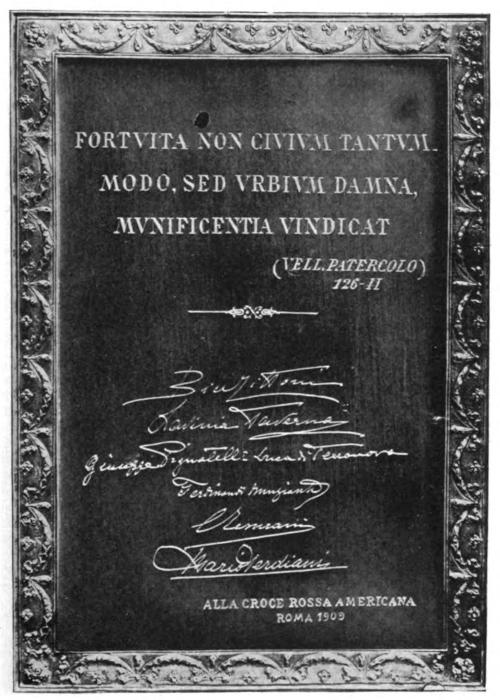
As a token of the appreciation of these offerings the Committee
presented to the American Red Cross, through our National Director,
Mr. Ernest P. Bicknell, a silver tablet upon which is inscribed the following
Latin sentence:
“Fortuita non civium tantum modo, sed urbium damna,
munificentia vindicat.”
Mr. Herbert Putnam, Librarian of Congress, in reply to a request
for a translation and for the source of the quotation kindly wrote, “The
quotation is from Velleius Paterculus, the Roman historian. It is part
of a recital of the achievements of one of the Caesars, I believe (though
this I have not verified), and might be rendered thus:
“Your bounty repaired the catastrophe (fortuita damna, i. e., accidental
injury) not merely of individual citizens but of entire cities
(communitas).”
A TESTIMONIAL TO THE AMERICAN RED
CROSS FROM ITALY
(About One-Quarter Actual Size.)
REPORT OF PARTIAL EXPENDITURE OF AMERICAN COMMITTEE IN ROME
The following table contains a preliminary statement of the Italian
relief operations of the American Committee in Rome. A complete
statement will be prepared later which will show a substantially larger
expenditure. The table here given, however, conveys a very fair idea of
the extent and variety of the extremely important work carried on by
the American Committee.
Thousands of vouchers covering every item of expense have been
preserved by the Committee and will eventually be filed in the office of
the American Red Cross in connection with the report of the Committee.
It will be recalled that the members of the American Committee
in Rome were Honorable Lloyd C. Griscom, American Ambassador to
Italy, Chairman, and Messrs. George B. Page, H. Nelson Gay, Winthrop
Chanler, William Hooper and Samuel L. Parrish.
EXPENDITURES.
Lire
The Relief Ship “Bayern”:
Charter and other expenses
L.
64.650,33
Cash distributed:
Messina—To the Archbishop for relief work
L.
1.000—
Messina—Refugee journalists
”
151—
Acireale—Local Relief Committee
”
5.000—
Taormina—Municipal Relief Committee
”
4.000—
Giardini—Local Relief Committee
”
6.000—
Catania—Prefect
”
30.000—
” Conservatorio S. Vincenzo di Paola
”
500—
” City Hospital “Vittorio Emanuele”
”
1.000—
” Hospital “Santa Marta”
”
1.000—
” Municipal Hospital and Hospital “Garibaldi”
”
1.000—
Catania—Little Sisters of the Poor
”
1.200—
Towns between Giardini and Messina. Distributed by C. K. Wood and H. W. C. Bowdoin
L.
10.000—
Syracuse—Mayor
”
10.000—
”To be distributed by Marchesa di Rudini
L.
10.000—
Syracuse—To be distributed by Miss K. B. Davis
L.
15.000—
Palermo—Donatuti family for relief work
”
400—
” Caserma “Benedetto Cairoli”
”
100—
” R. Commissary, President of the Relief Committee
L.
20.000—
Palermo—American Consul for relief work
”
10.000—
Food, clothes, etc. distributed:
at Messina
”
11.000—
” Reggio
”
57.000—
” Catania
”
109.000—
” Taormina and neighboring villages
”
34.500—
” Acireale
”
2.500—
” Palermo
”
13.713—
418.714,33
The Ladies Auxiliary Committee for direct relief work in Rome and Naples
85.423,80
Money delivered to private persons or institutions for relief work:
Caspar S. Crowninshield, American Consul at Naples, for relief work among the refugees
L.
8.341,60
William H. Bishop, American Consul at Palermo for relief work among the refugees
L.
10.000—
Thomas Spencer Jerome, American Consular Agent at Capri for local relief work conducted by an American citizen, Major Metcalfe
L.
2,500—
Stuart K. Lupton, American Consul at Messina, for local relief work
L.
6.000—
Archbishop John Ireland for the fund of His Holiness Pope Pius X.
L.
25.000—
Italo-American Baptist Mission in Rome for relief work
L.
10.000—
Reverend Walling Clark of the American Methodist Church in Rome for relief work
L.
2.500—
Reverend Arthur Muston, of the Waldensian Church in Rome, for relief work
L.
5.000—
To the ten principal Hospitals in Sicily; 5000 Lire each
L.
50.000—
Miss Florence Bayard Kane, an American citizen, for the Taormina Hospital
L.
1.000—
Marchesa Etta de Viti de Marco, for refugees in Rome
L.
5.000—
Commendatore Marco Besso for the rehabilitation of professional people
L.
5.000—
Mr. F. Marion Crawford, an American citizen, for relief work at Sorrento and neighboring villages
L.
5.000—
Miss Katherine B. Davis, an American citizen, superintendent of the New York State Reformatory for women at Bedford, for relief work conducted by her at Syracuse, Sicily
L.
1.000—
Marchese Enrico Visconti Venosta, for medical supplies to be carried by him personally to certain villages in Calabria
L.
2.000—
Principe Pietro Lanza di Scalea, for houses bought in Rome to be carried by him personally to certain villages in Calabria
L.
13.200—
Mr. H. Nelson Gay for relief work in Rome. Mr. Gay investigated the individual appeals which were made to any member of the Committee and administered relief in deserving cases
L.
6.500—
Italian Commercial Committee for rehabilitation of tradesmen, Rome
L.
5.000—
Principe Ludovico Chigi for an old women refuge in Rome
L.
1.000—
Monsignor Morabito, Bishop of Mileto, for relief work in his Bishopric in Calabria
L.
5.000—
Mr. Bowdoin, an American citizen engaged in relief work between Messina and Catania
L.
5.000—
174.041,60
Relief Expedition of Mr. H. Nelson Gay and Mr. W. Earl Dodge to Calabria:
Clothes, utensils and medicines
L.
48.474,25
To Generale Tarditti, Military Commander at Palmi, for building purposes
L.
44.432—
Tarred roofing for barracks
”
14.935,20
Tarpaulins for tents in the stricken mountain villages
L.
61.120,30
Shipping and expenses of the expedition
”
10.143,75
179.105,50
Relief Expedition of Mr. Winthrop Chanler and Associates to Calabria:
Lumber and shipping
L.
113.021,87
Building expenses
”
47.000—
Tarred roofing
”
8.109,90
Cash distributed by Prince Chigi and Lieut. Serpieri
L.
6.000—
Medicines and expenses of the expedition
”
24.765,30
198.897,07
Building Expenses at Messina and Reggio (Capt. Belknap)
25.000—
To the Relief Committee for the families of Italian Officers and soldiers
10.000—
Outstanding Obligations:
A Hotel at Reggio
L.
27.000—
Forty houses at S. Giuseppe
”
40.000—
Twenty houses at Gallico
”
20.000—
Kitchens to be added to the houses
”
15.000—
To Her Majesty the Queen for outfitting two hospitals at Messina and Reggio
L.
50.000—
152.000—
Telegrams, clerical expenditures and Red Cross Cables
4.637,55
Balance up to date
1.319,03
Total Lire
1.249.138,88
Note.—The amount of expenditures is given in terms of Italian
money. It is to be remembered that one lira amounts substantially to
twenty cents of United States money, and that accordingly the number
of dollars expended was one-fifth of the number of lire indicated. For
instance, 500 lire would be equivalent to $100; 100 lire, to $20, and so on.
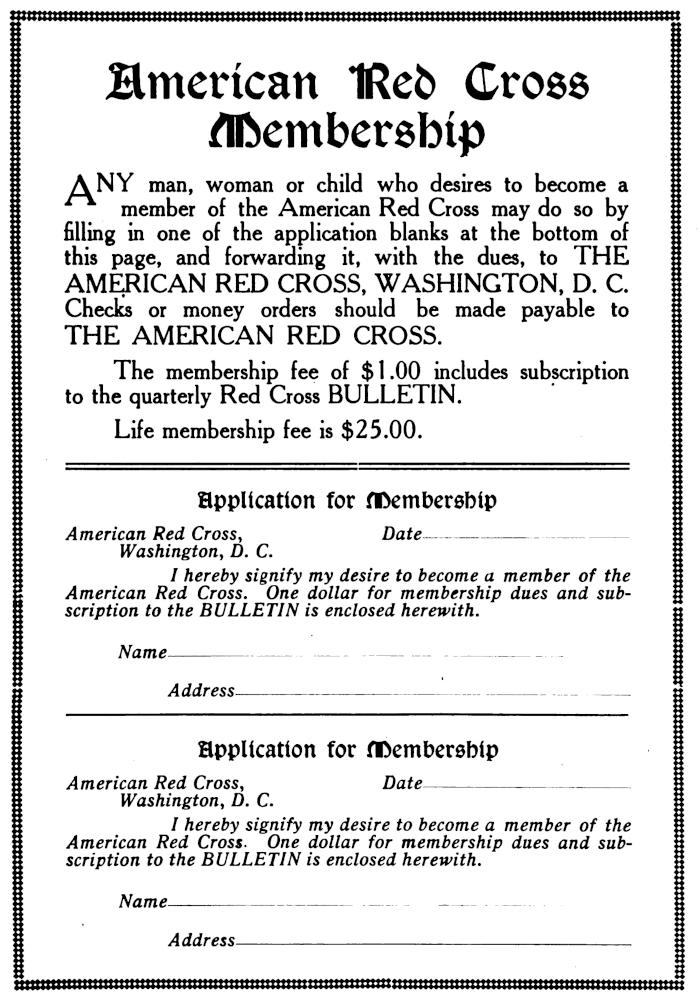
The Red Cross needs members. If you are now a member
will you not endeavor to interest others? Subscription
to the Red Cross Bulletin is 50 cents a year. Help
us to increase the circulation.
THE RED CROSS AND PRESIDENT TAFT’S INAUGURATION — INAUGURAL COMMITTEE — SUB-COMMITTEE ON AMBULANCE STATIONS. — SUB-COMMITTEE ON HOSPITAL AT PENSION OFFICE. — SUB-COMMITTEE ON HOSPITAL AT UNION STATION. — SUB-COMMITTEE ON INSPECTION OF QUARTERS. — REPORTS TO RED CROSS.
At the time of presidential inaugurations between two and three
hundred thousand strangers, including large civil and National
Guard organizations, come to Washington. The great crowds at
the railroad station, in public conveyances, on the streets, the excitement
and exposure involved—all tend to produce an unusual number of accidents
and sudden illnesses. Under the Inaugural Committee a sub-committee
on Public Comfort has heretofore taken entire charge of such
emergency cases as have arisen, but a need was felt for a number of well-equipped
relief stations with a competent personnel to act in co-operation
with the physicians of the city. The American Red Cross offered its
services, which, having been accepted, it immediately began its work of
preparation. A relief column with thirty-six members, many of whom
were medical students, devoted two months to weekly instructions in
First Aid and hospital drill. The first course was given by Dr. Charles
S. White, lately resident physician of the Emergency Hospital, and the
second by Captain Reynolds, of the U. S. Army Medical Service. Each
of these surgeons kindly donated their time and services for these instructions.
The District Red Cross Branch, at an expense of over three
hundred dollars, provided uniforms and equipment for the members as
prescribed in Major Lynch’s Red Cross First Aid Book. Through the
New York Branch the Brooklyn Relief Column was invited to take part
and promptly accepted the invitation, meeting themselves the expense of
their uniforms, equipment and transportation.
The question of the nursing personnel was next considered. The
committee on nurses of the District Branch secured thirty-six of its enrolled
Red Cross nurses, each nurse promising to secure a substitute in
case she was prevented from serving. Besides those from the District
the Pennsylvania Branch sent eleven, the New York and the Maryland
Branches each five. These branches paid for the transportation of the
nurses and the National Executive Committee defrayed their expenses
here. The salary of the six nurses who were on duty for the week at the
Railroad Relief Station, two nurses being on duty for each eight hours
in the twenty-four, and those of the nurses who were on duty parts of
several days at the Pension Office station were paid by the National
Executive Committee, but the nurses who were on duty for the day of the
inauguration all gave their services.
Thanks to the Army Medical Service and to the Quartermaster General’s
Department twenty-two hospital tents, with a complete equipment
of cots, tables, chairs, oil stoves and field hospital chests for all of these
stations, was procured. It is always a great help as well as a pleasure
to have the Army as an assistant in any Red Cross work, and too much
praise cannot be given to the efficient and prompt assistance its officers
are always ready to render the Red Cross. Major Merritte W. Ireland, of
the Surgeon General’s Office, knew what was required and how and where
to obtain everything not only for the relief stations along the line of
march, but for the larger station at the Union Station and for a complete
small hospital equipment, with operating room, installed at the
Pension Office. Major William E. Horton, of the Quartermaster’s Department,
under direction of the Quartermaster-General, procured the tents,
made plans for wooden beam foundations, where they had to be raised
on asphalt, and the Chief of Staff gave an order for a detail of soldiers to
put them up. General Johnston, who was the marshal in charge of the
inaugural parade, gave the Red Cross every assistance in his power, as did
Major Sylvester, Chief of Police.
Dr. D. Percy Hickling was Chairman of the Sub-committee on the
Hospital and Ambulance Service, Dr. Wm. P. Reeves and Dr. Emory W.
Reisinger had charge of the Emergency Hospitals at the Union Station
and the Inaugural Ball, respectively, and Dr. Frank E. Gibson of the
relief stations along the line of march. All of these busy physicians, with
a large number of others, gave up many hours of their time to this work
and the Red Cross Personnel served gladly under their competent direction.
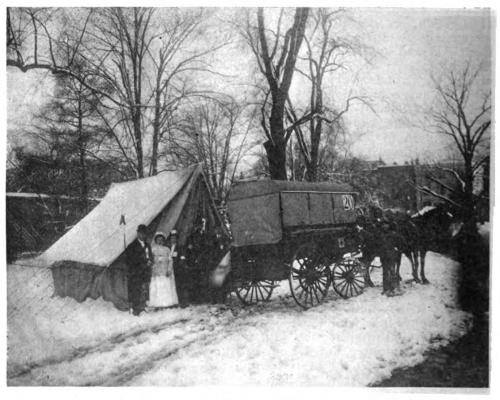
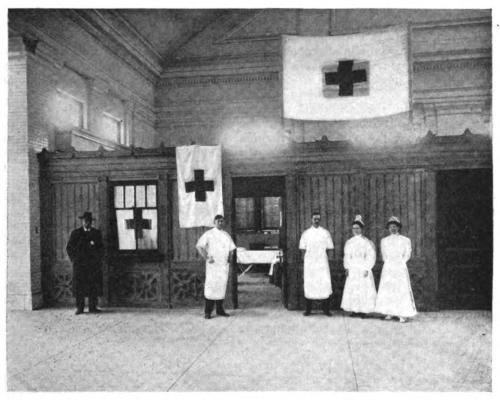
Red Cross Relief
Station. There Were 22 of These Stations on Line of March.
Washington’s oldest inhabitant had to tax his memory to recall a
worse morning than presented itself the fourth of last March. A driving
wet snowstorm that had raged all night still filled the air with large
flakes and covered the ground with several inches of melting snow.
The picture of one of the relief stations gives some idea of conditions
later in the day when the storm had ceased, but unfortunately no picture
was taken of the tents that collapsed under the wind and weight of
snow, no picture is given of the brave efforts to again erect these tents,
nor of the nurses driven out of the tents taking refuge in the ambulances
so as to remain on duty, or securing in two or three cases a room
in a nearby building for their station. At every station in spite of the
weather our nurses reported promptly for duty and the Red Cross is
proud of their record and reliability. Our Relief Column men likewise
did excellent service, as will be noted in the doctors’ reports. With equal
devotion to duty the Brooklyn Column, twenty-two in number, left for
Washington the night of the third, but with many others were detained
by the storm-demoralized railroad service, and did not reach the city
until late on the afternoon of the fourth, so that it was not possible for
them to take active part, much to their and our regret.
Were these Red Cross relief stations of use? The fact that over two
hundred cases of accidents and sudden illnesses were taken care of at
these stations, not counting those which were removed to the hospitals,
is a sufficient answer as to their value to the public. Some parts of the
reports of the physicians in charge are appended to this article.
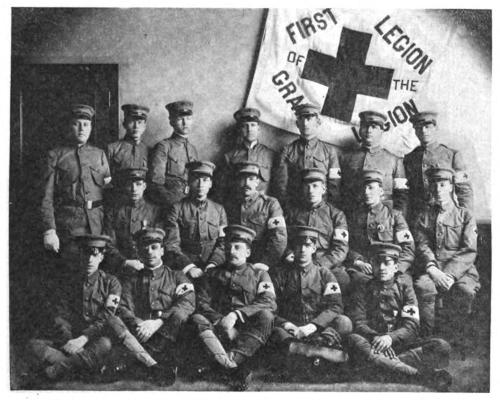
Detachment First
Legion (New York) Ready to Proceed to Washington for Duty in Connection
With Inauguration of President Taft.
The morning of the fifth the nurses from New York, Maryland and
Pennsylvania were presented to President Taft at the White House and
the following week some of the physicians, the nurses and the Washington
Relief Column men were entertained by Miss Boardman at a tea.
The names of the nurses and Relief Column men who participated in
the Red Cross work of inauguration day are as follows:
Nurses—(New York), the Misses Phelan, Collins, Miller, Patterson
and Hallahan; (Maryland), Kinhart, Murphy, Boyer, Lucas, Spielman
and Bartlett; (Pennsylvania), Beitel, Rice, Simon, Uomer, Suddoth, McKnight,
Calhoun, Zellfelder, Seiwell, Akeley and Bierstein; (Washington),
Bauer, Hayes, Hart, Donnelly, Davis, Fitz, Backofen, Mahan, Bauer,
Burhman, Grunwell, Stith, Lohr, Strong, Carbauld, Hewitt, Brown, Braun
and Roach.
The New Willard.
MAJOR RICHARD SYLVESTER,
Chairman Committee on Public Order.
Dear Sir—In compliance with your request I have the honor to report
the operations of the Hospital and Ambulance Service of the Committee
on Public Order for the Inaugural period of 1909, of which, under
your appointment, I acted as Chairman. In order to facilitate the work
this sub-committee was organized by the appointment of Drs. George
M. Kober and G. L. Magruder as Vice-Chairmen and Dr. P. C. Hunt
as Secretary, the work being divided among four sub-committees, as follows:
Sub-committee on Ambulance Stations, Sub-committee on Hospital
at Pension Office, Sub-committee on Hospital at Union Station and
Sub-committee on Inspection of Quarters. These Sub-committees were
in charge of Drs. Gibson, Reisinger, Reeves and Gwynn, respectively.
This Sub-committee cared for 81 cases, 10 surgical and 71 medical,
53 of whom were males and 28 females. This work was done under the
most unfavorable circumstances on account of the weather, which not
only interfered with the well-planned arrangements in many of their
details, but made many of the physicians at some of the stations use
Pennsylvania avenue as a thoroughfare to carry urgent cases to the
Emergency Hospital instead of the longer runs to the other hospitals,
as it was practically impossible to get the mules to pull the heavy ambulances
over the snow-covered streets. While this was all done in violation
of orders, yet suffering was materially lessened by so doing.
Many of the tents were blown down, so that three of the emergency
stations had to be established in three of the public buildings, namely,
the District Building, State, War and Navy Building and the Marine
Hospital Building.
Every station reported cases having been treated except No. 19.
There were on duty during the day over 70 members of the Committee.
The work of the Red Cross is to be specially commended in connection
with the Ambulance Stations, as they had not only furnished a complete
relief equipment for each station, but two trained nurses in uniform
at each station, all of whom, in spite of the weather, promptly reported
for duty and rendered very efficient service. The stretcher men, trained
and uniformed, at the expense of the American Red Cross Association,
did excellent service and ought to be highly commended.
The Hospital at the Pension Office was opened March 4th at 9 A. M.
and closed March 7th at 11 A. M., having treated 24 cases.
The thanks of the Sub-committee are specially tendered to Lieut.
Judge, of the Metropolitan Police Force, for the excellent assistance given
and the order maintained, also to Mr. Graham, of the Inaugural Committee,
through whose kindness supper was furnished to the Red Cross
nurses on duty at the Hospital.
The work of the Red Cross Society in placing at the disposal of your
Committee the equipment, trained nurses and stretcher men is highly appreciated.
Physicians and
Nurses on Duty at the Red Cross Emergency Hospital at Union Station,
Washington.
Owing to the courtesy of the Terminal Station Officers and of the
American Red Cross your Committee were enabled to establish and maintain
a well-equipped emergency hospital at the Union Station. This
emergency room was in operation from 8 A. M. March 1st until midnight
of March 7th. During this time 105 cases were treated.
To the physicians, Red Cross nurses and Red Cross stretcher-bearers,
who performed this work, covering the whole 24 hours, my thanks are
specially due, as the work was done faithfully and well.
In compliance with your desires, a number of the members of your
Committee on Hospitals and Ambulances were designated to inspect the
quarters of soldiers and organizations, who were quartered in large numbers
in any one place during the inaugural period. This not only included
those located in hotels, halls and tents, but also the numbers
quartered in Pullman cars at Sixth street and Virginia avenue. The number
of these places obtained from the Committee on Public Comfort was
25, all of which were inspected by the members of your Committee,
who paid special attention to the ventilation and sanitation and also
rendered efficient service to four men who were sick and in need of treatment.
In closing this report, I desire to call your attention to the fact
that 214 cases have been reported as having been treated by your Committee
without any expense to the Inaugural Committee, except the general
printing and badge expenditures, and that the physicians willingly
gave their services night and day in order to make the work of your
Committee a success, and up to this time I have not heard of a single
complaint.
I desire to specially call attention to the kindness of Miss Boardman,
of the Red Cross Association, for her active co-operation. Through
her efforts hospital tents were furnished along the line of march and at
the fireworks. These tents were thoroughly equipped with appliances
for the First Aid treatment of the sick and injured, and also two Red
Cross nurses were on duty at each tent as long as the same was in commission,
as well as two being constantly in attendance night and day
at the Union Station and four at the Pension Office. The stretcher men,
who had been drilled and uniformed, performed active and efficient service
at the Pension Office, Union Station, along the line of march and
at the fireworks, all of which was done without expense to the Inaugural
Committee.
I also desire to express my high appreciation of your many acts of
kindness and valuable assistance in carrying out the work of this Sub-committee.
(Signed) D. PERCY HICKLING, M. D.
March 18th, 1909.
I have the honor to submit the following report:
The weather on the Fourth of March was unusually stormy, especially
early in the morning, and six of the tents (Nos. 1, 4, 5, 11, 12 and 16)
were blown down and the ice and snow made them so heavy that it was
impossible for the men to place them again in position.
Cases at stations Nos. 1, 4, 5 and 11 were treated in the ambulances—that
is, the slight ones, and the others were taken to the hospitals. Stations
12 and 16 were removed to a room in the District and War Department
Buildings, respectively, and very comfortable quarters were
provided indoors for these two stations.
On March the second I took Sergt. Frank G. Motz, of Company H,
Engineer Corps, around to the different places where you wished the
tents pitched, and early on the morning of March 4 he had his corps of
eight good men at work pitching the tents. I was with them until they
finished at six o’clock in the evening. These men deserve great credit,
as they were compelled to work in the rain all the afternoon and they
were wet to the skin, but did not give up until the last tent was pitched.
The next morning when they knew it was snowing they came out without
orders and pitched some of the tents that had blown down.
Too much praise cannot be given the good corps of nurses that so
faithfully did splendid duty on that day. I visited several stations about
nine o’clock in the morning and no one was there but the faithful nurses
under your command. There was not a station at which the nurses did not
report. In the reports from the different physicians much praise is given
the nurses for their excellent work.
Every station had work to do, except No. 19, which was not on the
route of parade.
Eighty-one cases were cared for—ten surgical and seventy-one medical—twenty-eight
females and fifty-three males.
I most earnestly recommend that the next time the Red Cross is
to do duty along the line of march and the weather is not good that rooms
on the ground floor be utilized for Emergency Stations instead of tents.
FRANK E. GIBSON, M. D.,
In Charge of Ambulance Stations.
Washington, D. C., March 3-8, 1909.
D. PERCY HICKLING, M. D.,
Chairman Sub-committee on Hospitals and Ambulances.
Sir—I respectfully report that the Red Cross Hospital, at the Pension
Office, organized by the Inaugural Committee, was opened March
4, 1909, at 9 A. M., and closed March 7, 1909, at 11 A. M. During the
maintenance of said Hospital 24 cases were treated, which varied from
incised wound of index, third phylanx, to la grippe; most of the cases were
syncope and the majority of these were in males, this being due to the
heavy snow. I wish through you to thank the Red Cross, the physicians,
the nurses and the Red Cross stretcher-bearers for the hearty co-operation
given, and especially Lieutenant Judge, of the Metropolitan Police Force,
for the excellent assistance given and the order maintained.
Thanking you for the honor conferred, I am,
Respectfully,
(Signed) E. W. REISINGER, M. D., Physician in Charge
I have the honor to submit the following report:
The Relief Station situated in a room at the Union Station was in
operation March 1 at 12 noon, the first case being treated at 5.30 of that day
and the last one March 7 at 2 P. M. The total number of cases treated
was 105.
The ambulances were used to transfer seven additional cases to hospitals.
The character of the cases treated was varied, practically an equal
division of medical and surgical. Most of the cases were not serious,
the patients being able to leave the hospital shortly after first aid was
rendered. The serious cases were sent either to their homes or to permanent
hospitals. There were one doctor and two nurses constantly on duty,
the doctor being relieved every two hours and the nurses every eight.
The Washington Terminal employees were most kind and courteous
and seemed to appreciate the work.
Very respectfully,
NELLIE REED, Head Nurse.
Mr. Barney Robinowitz, one of the Relief Column members, also
made an excellent report of the work done at Station No. 8.
THE APPROPRIATE INSIGNIA FOR THE AMERICAN MEDICAL ASSOCIATION — SUMMARY.
Samuel P. Gerhard, A. M., M. D., Philadelphia.
An emblem, to be appropriate, should be so devised as to convey a
meaning suitable to the organization which carries it as a badge;
therefore it seems strange that the American Medical Association
should have adopted for its use the device of the red cross, which belongs
to another organization and represents a character of work entirely different
from that of the medical profession.
The American National Red Cross, through its executive committee,
passed resolutions October 18, 1907, which decided that by reason of
an international agreement the emblem of the red cross was adopted to
designate the personnel of sanitary corps, and was to be used in time
of peace or war to protect sanitary formations, establishments and personnel
and material.
Furthermore, in order that the emblem should be kept in its proper
place, legislation has been recommended to prevent its use by private persons
or by societies, and the executive committee has requested that all
hospitals, health departments and like institutions kindly desist from the
use of the red cross and suggests that some other insignia be substituted
for it.
Some commercial houses which manufacture surgical necessities and
appliances, together with some nostrums, print the red cross on their
packages of kidney plasters, dog soap and dyspepsia medicines. There
is a nurse’s school which claims to teach nursing in a short term of a
few weeks and calls the graduates “red cross nurses,” who go out in
competition with those who have served several years in hospitals.
In many of the large cities throughout the United States druggists
are fond of naming their places “Red Cross Pharmacy.” In New York
and Chicago physicians have placed this symbol on their automobiles—whether
this gives them more privileges than they would otherwise have
is a question; it appears more as an advertisement than an explanation
for speed. On state occasions some use it as a chevron on the sleeve,
and sometimes the police think they have a right to it during large parades
and wear it before the crowd.
There may, however, be raised the question of priority of use, inasmuch
as the red cross was adopted by the American Medical Association
before the laws were passed, and therefore the latter has a perfect
right to its use. This all may be true, but when we come to consider the
objects of the Red Cross as originally set forth in 1864 we must concede
that its use was not intended solely for the medical man, but for all
connected with the work of relief. Besides, we should be charitable
enough to consider that we have appropriated an emblem devoted to
humanitarian work.
What, then, is the proper badge of the medical profession?
In the United States Army the device of the surgeon is Mercury’s
wand, consisting of a rod surmounted by a pair of wings with two serpents
twined about it. Carefully examining the literature on the subject
of Mercury we learn many facts arguing against the use of this
later emblem in the healing art. We shall see that it belongs strictly to
commerce and trade; the name “Mercury” itself is derived from the Latin
merx, mercis—“goods.” Mercury was the Roman divinity of commerce and
gain; also mercor, to traffic, is from the same root; the word mercatus is
akin to our English word “market,” as is also the word mercator, “merchant.”
Mercury, the Roman god, is identical with the Greek god Hermes
and was considered the god of diplomacy, arts, sciences, commerce, gain
and riches, especially of sudden and unexpected riches and of good luck
at the games. He was usually represented with a purse in one hand,
his magic caduceus in the other, and was supposed to preside over the
commerce of the Romans.
The magic caduceus of Mercury is an evolution of the staff of Hermes,
and the original caduceus or staff was an olive branch with garlands. Later
ribbons were substituted for the garland and finally mythologists transformed
the ribbons and garlands into snakes, about which others, like Hyginus,
invented various tales, one of them being that Hermes found two
snakes fighting in a garden and, dividing them with his wand, chose this as a
symbol of the quarrels which it was his duty to assist in settling. After
a time a pair of wings was added to the staff to indicate the speed of
Mercury as a divine messenger; it also became a symbol of power that
produced wealth and was supposed to be an enchanted wand of prosperity.
Owing to the fact that Mercury’s wand is used by the United States
Army and by some medical publishers, and is to be placed on the ambulances
of some New York hospitals, it would appear to be the proper emblem;
but, studying the references which we have just gone over, we
learn that it is more adapted to merchants, delivery wagons and steamships
and is a commercial device. With the knowledge that the red
cross and Mercury’s wand are incorrect emblems, what, then, shall we
consider the true insignia for the healing art?
The medical profession should be proud of the fact that a symbol
has been handed down from ages past, though it was lost to some extent by
those who forgot history and our traditions and desired something new
for a device. The true ancestral symbol of the healing art is the knotty
rod and serpent of Esculapius. Delving into the history of this symbol
we find a veritable mine of facts which will convince us that we have a
heritage worthy of our profession. It is customary to trace the history
of medicine back to the story of Esculapius, whom the Greeks elevated
to the position of the god of medicine. He was revered and worshipped
throughout Greece, but the great center of healing was at Epidaurus,
where a beautiful temple was built to his honor in which his statue by
the sculptor Thrasymedes stood. This statue, of gold and ivory, the
head bearded and surrounded with rays, a knotty stick in one hand, the
other entwined by a serpent, gives us the original symbol of the healing
art.
Serpents of a peculiar kind were kept in the temples. Votive tablets
also have been found on which the ailments were inscribed and which
were similar to our hospital case records. No doubt Hippocrates, the
“father of physic,” gained much of his knowledge of medicine from these
tablets, for some of his reputed writings and formulas, such as Prorrhetica
or Praedictiones and Coacoae Praenotiones, are very much like them. He
was a descendant of the early Asclepiades and was said to be the nineteenth
in descent from Esculapius. He inherited the instruction of his
fathers through a long line of physicians and was well versed in the
practice of his time.
Later on we find the Greek practitioners coming to Rome, and the
practice of the Asclepiades came with them. According to the Roman
law they were freedmen. After a time they established shops, on which
they placed the sign of the Esculapian snake and practiced their art and
sold medicine; the Romans called them medicinae.
We learn from Ovid that on the occasion of the great plague in
Rome, at the command of the Delphic oracle, B. C. 293, an embassage
was sent to the temple of Esculapius at Epidaurus, whence was brought
a living serpent which was received with great ceremony by the Romans.
They built a temple on the Tiber and the serpent was placed therein.
Now let us glance at the sources of this serpent idea as found in the
earlier times and the strange ramifications of the respect for the serpent
among barbaric races. In the earliest civilized times we find that
the Egyptians represented the eternal spirit “Kneph” as a serpent. Osiris
in snake form was usually associated with health; the Chaldean Hoa was
identical with the Agatho-daemon, which the Hebrews, who were in Egypt
for over four hundred years, learned to regard as the symbol of health
and life. Thermuthis, the sacred asp, was associated with Isis, the goddess
of life and healing.
The serpent’s change of skin may have been suggestive of resurrection
and renovation; he was feared because he was supposed to possess
superhuman knowledge and power. His supposed longevity was, no
doubt, the reason why this animal entwined about a staff was symbolic
of health and the distinctive attribute of the classical Esculapius and
Hygeia.
We find also that the Phenicians adored the serpent as a beneficent
genius. The Hindoos had a serpent deity, Rudra, who was not only
beautiful and strong but also the healer. The Druids had serpents in
the sanctuary to bring good fortune. The Python of the Greeks in the
table of Apollo, described by Ovid, was all-powerful; the Celts, the Basques
and all Asia had legends of the Orm and the Paystha pictured as a great
dragon.
We are all familiar with the fables of St. Michael and St. George,
and, turning to the Chinese, the winged dragon or serpent is a symbol
of superior wisdom and power.
In the folklore of the Gauls and Germans the white snake, when
boiled, was considered to have the attribute of conferring wisdom in
medicine. The white snake was also venerated by the Scottish highlanders,
as well as by certain Arabian tribes, as a mighty agent and the
king of all serpents.
Following this thought into America, let us learn what the Indians
believe in this respect. The general idea among them is that it brings
happiness. Professor Agassiz tells us that he found the Maues Indians,
who live in Brazil, whenever they assign a form to any remedio, give it
that of a serpent. Among the Lenape Indians their famous doctors were
called “big snakes.”
We must not forget to look into Holy Writ for the symbolical influence
and intelligence of the serpent in the history of the fall of man,
where it is stated, “Now the serpent was more subtle than any beast of
the field.”
In the story of the Exodus we have many allusions to the serpent
as a power for deliverance. Aaron’s serpent rod is an instance. Also
during the wanderings in the wilderness Moses placed a brazen serpent
on a pole in the midst of the camp, which was preserved for many centuries,
until the days of Hezekiah, when it was broken to pieces because
it became an object of worship and tended to turn the people from their
true God.
During the Christian era the serpent was employed to signify the
virtue of prudence and wisdom; the disciples were admonished, “Be ye
wise as serpents.”
In the Latin church of the early days the pastoral staff terminated
at the top with a serpent, indicating power and wisdom.
Whatever element of superstition or imagination may have been injected
into these stories of mythology and the legends of more recent
times, there is a wonderful history hidden behind them, all of which permeates
the whole human race.
Man in his primitive state and in his more civilized life believes there
was a superior power for good, and his mind, requiring a material expression
of that unseen source, used the serpent as a symbol of power and
wisdom. Without this the rod of Esculapius would be impotent over
disease and the wand of Mercury would have no authority over trade
or commerce. The cultured Greeks, therefore, having great respect for
the healing art, honored it with the most significant and expressive symbol
of the highest attributes conducive to the welfare of the race.
Among the orientals the shepherd was considered the highest type
of citizen, whose life in the open country brought him in contact with
great struggles. The rod was the weapon with which he struck down
the adversaries of the sheep; the staff or crook, however, was used for
their guidance in the proper path on the trackless pastures. Hence we read
in the beautiful pastoral song of the “shepherd king” these expressive
words: “Thy rod and thy staff they comfort me.” The rod therefore
became the symbol of a defending power which brought comfort and
support to the weak in the consciousness that they were protected from
all danger.
Esculapius was always pictured with a knotty rod in his hand, the
knots indicating the many difficult problems of physic to be solved in
the treatment of the ailments of mankind. Therefore, applying these
thoughts to the symbol, we have in the entwined serpent, power, wisdom
and health, together with the protection and support against disease
and the difficulties to be overcome by the knotty rod. With this historical
symbol the sanctity of medicine can be pictured and the doctor is
shown in his true light, not only as a laboratory scientist and as a practitioner,
but as a teacher and adviser to the patient, the family and the
community in all the difficult problems that arise concerning health and
disease.
This dissertation on the meaning of the medical emblem will suggest
the appropriate insignia of the American Medical Association to
be as follows: A shield on which is emblazoned the American eagle
holding in its talons a laurel wreath within which is the knotty rod and
entwined serpent and the letters A. M. A.
The explanation of the emblem so devised would be as follows: The
eagle represents the national organization of the United States; the laurel
wreath stands for the crown which the Romans bestowed on the healing
art; the entwined serpent is indicative of power, wisdom and health, and
the knotty rod signifies protection and support in the difficult problems
of the treatment of disease.
The insignia and device of the red cross belongs to another organization
and its use is not proper for the medical profession. It represents
a character of work entirely different.
From the fact that Mercury was the Roman god of trade and commerce
and his magic caduceus was the symbol of authority over trade
and commerce and was the enchanted wand of prosperity, it is not adapted
to be an emblem for the healing art.
The knotty rod and serpent of Esculapius is the ancient inheritance
of the medical profession, and the history of this symbol, together with its
mythology and its legends, prove its appropriateness, for the reason that
the serpent was considered by every race on the globe as a great power
and man’s mind used it as a symbol of wisdom and health.
The knotty rod is an expressive representation of support, protection
and comfort in the difficult problems arising in the management of disease.
After a Battle.
THE STORY OF THE RED CROSS — IV. War Sacrifices.
Feeling the need of getting away for a brief time from these harrowing
scenes, at six o’clock in the evening of June 27th Monsieur
Dunant left Castiglione for Cavriana, where the Emperor Napoleon
had his headquarters. On his journey, which was made in a little carriage
hired at Brescia, he had to pass over the scene of the recent carnage. He
describes the view, “Here and there were still pools of blood, and numerous
fresh mounds of earth marked the last resting places of the victims
of the 24th.” Even in the cemetery of Solferino, not only were the monumental
crosses and grave stones bespattered with blood, but the whole
burying ground in dire confusion was strewn with sabres, muskets, havresacks,
cartridge pouches, mess-tins, helmets and belts, most of which were
twisted, bent and broken.
Arrived at Cavriana, Dunant at once inquired for Marshal MacMahon
whom he knew personally. His inquiries surprised a group of generals
sitting on common chairs before the humble cottage which their sovereign
had made his temporary abode. They began to speculate as to his mission
and as to who he was, for that a simple tourist would take such
risks at such a time was altogether beyond their comprehension. The
corporal who accompanied Monsieur Dunant in the capacity of servant,
was impenetrable: he knew nothing, while replying respectfully to their
questions. Their curiosity was still further augmented when they saw
Dunant set out for Borghetto, the headquarters of the Marshal, where
he arrived about midnight. He pictures the drive amidst the camp fires,
where whole trees were burning, the lighted tents of the officers, the
peaceful murmurs of the army seeking its repose, the starlit Italian sky
and the solemn silence after the noise and the emotions of the previous
days.
At six o’clock next morning he was cordially received by Marshal
MacMahon, after which he returned to his wounded at Castiglione.
The 30th of June found Dunant at Brescia, where in the old cathedral
were over a thousand wounded. Here the women of all classes vied
with each other in supplying the needs of the unfortunate brethren in
their midst. They brought oranges, jellies, biscuits and other dainties.
Even the humblest widow contributed her sympathy and modest gift.
The population of Brescia, normally 40,000, was nearly doubled by
the multitudes of sick and wounded brought there. The Italian doctors
to the number of 140 were assisted by the students of the medical colleges.
Committees were formed to receive gifts of bedclothes, linen and
provisions of all kinds. In the vast halls of the various hospitals and in
all the churches thousands of battered remnants of humanity were the
subjects of amputation, to many of whom the word was as the sentence
of death.
Monsieur Dunant depicts some of the terrible operations performed
by the surgeons who were forced to work with untrained assistants.
Scenes so full of pathos and the horrors of mental and physical anguish
that could men be brought to even a partial realization of their meaning
war would become impossible. Nothing in the world would be worth
the aggregate of human suffering unless the cause was justified by a
greater aggregate of human misery and torture.
“The feeling,” says Monsieur Dunant, “that one experiences of the
great insufficiency under such serious conditions is one of indescribable
suffering. It is extremely painful to realize that one is unable to aid all or
to reply to the many supplications for relief because of the vast number
needing assistance. Long hours must pass before even the most unfortunate
can be reached; stopped here by one, called there by another,
all equally worthy of pity, each step clogged by numbers clamoring for
help. Why turn to the left when on the right so many are dying without
a word of consolation, without even a glass of water to quench their
burning thirst. The thought of the importance of a life one may save,
the desire to assuage the tortures of the sufferers, and to revive their
courage; the continued, enforced activity that such moments impose, give
a supreme energy, a longing to carry succor to the greatest number
possible. One becomes no longer affected by a thousand pictures of this
formidable tragedy, the most hideously disfigured bodies are passed with
indifference, scenes more horrible than any described, which the pen refuses
to depict, are gazed at blankly. Sometimes the heart is suddenly
brought near to breaking by some pathetic grief, by some simple incident,
by some unexpected detail, which touches our deepest feelings, which
tears the most sensitive fibres of our being and brings a realization of
the horror of this tragedy.
“For a week after the battle such cases as drew from the doctor a
shake of the head and the observation, ‘Nothing can be done!’ were simply
abandoned to their fate—to die. Though hard, this was quite natural,
considering the scarcity of doctors and nurses and the enormous number
of patients. An inexorable and cruel logic ordained that precious time
and care should not be wasted on hopeless cases when sorely needed by
so many thousands who might recover.
“Search well the hospitals of Lombardy and where was there to be
found that glory for which at the commencement of the sanguinary conflict
these men rushed with light heart and fleet foot to shed the blood
of their brethren?
“The Battle of Solferino is the only one of the nineteenth century
at all comparable as regards the terrible slaughter on both sides, with
the battles of Leipzig and Waterloo. It counted in killed and wounded:
3 field marshals, 9 generals, 1,566 other officers, 40,000 non-commissioned
officers and men. Besides these, 19,665 cases of fever, dysentery, etc., in
the Brescia Hospitals; 30,000 cases of typhus, etc., among the Austrians,
making a total of 91,243 victims of the battle of Solferino.”
Monsieur Dunant asks the question: “Why have we thought good
to recall these scenes of grief and desolation, to recount such lamentable
and gruesome details, and to draw such vivid pictures of despair?”
His answer is another question: “Would it not be possible to found
and organize, in all civilized countries, permanent Societies of Volunteers,
which in time of war would render succour to the wounded, without distinction
of nationality? Those good old women and those beautiful young
girls of Castiglione could not by themselves save the lives of many of those
to whom they ministered. It was necessary that their efforts should be
supplemented by those of experienced men and women, capable, firm,
accustomed to order and discipline. Had such assistance been forthcoming
in adequate measure at Solferino, many of the horrors need not have
been related, and the living would not, as in some cases, have been
interred with the dead. For the accomplishment of such a noble duty
there must be willing volunteers, well-trained and instructed—not lazy
and ignorant mercenaries. The army medical corps is always insufficient
and needs to be augmented by voluntary public assistance. Thus only
can the horrors of war be minimized.”
FIRST AID AND RELIEF COLUMNS — CALIFORNIA. FIRST AID COURSES FOR SAILORS. — RELIEF COLUMNS — ILLINOIS. — NEW JERSEY. — NOTICE. — NEW YORK. — CASE REPORTS FROM MEMBERS OF FIRST LEGION.
By Dr. G. H. Richardson.
In the January Bulletin you have an idea of how the work was
started and I gave weekly lectures to the “Sailors’ Union” and
bi-weekly lectures to the “Harbor No. 15,” completing the course
about a month ago.
I found that it was useless to endeavor to do much with the men
of the Sailors’ Union, for they are here today and away tomorrow, and
while apparently interested in the lectures there could be no permanent
results obtained. With the “Masters and Mates” it was, however, different,
for they are better educated and realize fully the importance of our
efforts.
I found here also that the card system was not practicable, for many
of the officers could not attend regularly and besides I thought we
should try to develop some uniformity which could be utilized all over
the country.
To this end I wrote and obtained from the Surgeon General of the
Public Health and Marine Hospital Service, 100 copies of the “Handbook
for the Ship’s Medicine Chest,” (Stoner) and am using this book
now with excellent results.
I am giving each member of the Harbor a copy, obtaining a receipt
for same, and in the lecture follow closely the instruction laid down in the
book.
I have placed on the Bulletin Board of the Harbor the subject and
date (with pages in book) of the lecture and give them in the afternoon
of every other Thursday at 3.30 o’clock. This I find better than in the
evenings for the officers and I have from 25 to 35 present each time.
This book, as you will note, has an ideal medicine chest outfit and
strange to say very few of the officers knew of the book until I gave
them a copy.
I am going to give about eight lectures from the book and then have
planned to write you for instructions. Dr. Blue has suggested that when
candidates for license as masters, etc., be examined for their eye-sight
and color blindness, that an examination in First Aid could be given
them. This brings up the question as to how far the Red Cross and the
various departments should work together and in my mind is the most
important question before our organization today.
In talking with Captain Westcott of Harbor No. 15 here he seems
to think that his association should make attendance of its members on
the lectures obligatory, and at the same time by a change in the By-Laws
make each member become a Red Cross member. I think from what
I can learn here that it would be carried unanimously, for I have an excellent
reception at every one of my lectures.
Therefore, to be concise, my plan is tentatively—
a. Make each member of the National Association of Masters,
Mates and Pilots a member of the Red Cross, arranging with
the Public Health and Marine Hospital Service for books, we
to collect receipts for same and keep the records.
b. Have “First Aid” Committees in each local Branch, who, with
a Secretary, should keep in touch with the work, assign physicians
to lecture and examine and arrange for examination of
candidates and keep record of same.
c. Endeavor to have laws passed which shall make it necessary
for each ship to have a properly equipped chest on board and
a copy of the authorized book.
d. Arrange with the Secretary of the National Association of Masters,
Mates and Pilots to have him publish in his journal the
dates and names of lectures, making them uniform in every
place, and where the lectures are to be held.
On Monday, February 5th, at Copper Hall, Lane College, Dr. Geo.
F. Somers delivered a witty and entertaining lecture on “First Aid.” A
trained litter-squad from the detachment of the First Unitarian Church
composed of Messrs. Eastman, Addison, Meyerink and Mikkelsen appeared
and gave a practical demonstration in illustration of the lecturer’s
subject. The lecturer ingeniously introduced them, by saying, “There
is a gentleman here who has met with an accident. Are there any Red
Cross men present?” The squad seated individually in different parts
of the auditorium assembled about their supposed “victim,” who was
bandaged, and splinted, much to the amusement of the audience.
First-Aid Squad
Which Accompanied Athletic Team to Australia.
The first county of California to organize a detachment was Alameda.
Under the auspices of the State Branch, a very active and ambitious
Detachment and Woman’s Auxiliary of the Legion of the Red
Cross was formed at the conclusion of a banquet given by the ladies of
the congregation of St. John’s Presbyterian Church. The detachment
and auxiliary meet together at monthly lectures upon sanitation, hygiene,
and allied subjects given by specialists in these different fields.
The detachment under the assistant directorship of Dr. J. N. Force
is being drilled by Senior Sub-director Paul Y. Yost, commander of the
California Cadets of the University of California.
The “Mariposa.”
The detachment of the Columbia Park Boys’ Club have been training
a squad of four young men, Messrs. Wing, Cliffs, Clover and Peterson,
who will accompany the athletic team of this famous organization
to Australia. Through the courtesy of Dr. McCoy, of the Public Health
and Marine Hospital Service, they will be drilled by Mr. James Leek.
The young men will start prepared for First Aid in the field and
will doubtless have something to do during the football contests. This
is perhaps the first squad of the new Legion of the Red Cross to be in
service beyond the border of the United States.
By the steamer “Mariposa” on Friday, April 21, bound for New
South Wales, a sergeant and a squad from the Grand Legion of the Red
Cross, California Branch, accompanied the Columbia Park Boys’ Club
upon their six months’ tour of the Antipodes.
With their credentials went a recommendation to Major G. L. Mullins,
M. D. Knight of Grace of the Order of St. John of Jerusalem, Commissioner
of the Commonwealth of Australia.
San Francisco, March 18, 1909.
This is to certify that Leon Wing, sergeant of a squad from the detachment
known as the “Columbia Park Boy’s Detachment of the Grand
Legion of the Red Cross” is a duly accredited representative of the California
Branch of the American National Red Cross, a branch of the International
Red Cross established under the Treaty of Geneva.
We extend the hand of fraternity to the St. John’s Ambulance Association
of Great Britain and recommend this squad and its sergeant
to the kind offices of those representatives of the St. John’s Ambulance
Association in Australia.
The Columbia Park Boy’s club has set a national standard of efficiency
in training boys in clean living, thinking and athletes and it is
both the pride and pleasure of the California Branch of the American
National Red Cross to wish this, the first squad of a detachment of the
Grand Legion of the Red Cross to visit another nation, God speed and
a hearty welcome in the Antipodes.
(Signed)
BENJAMIN IDE WHEELER, President. MRS. JOHN F. MERRILL, First Vice-President. MRS. THURLOW McMULLIN, State Secretary. DR. G. H. RICHARDSON, Field Agent.
WM. LATHROP MCCLURE, Sec. Legion (Asst. Dir.)
The Illinois Relief Columns took a prominent part in the Memorial
Day Parade, of which a report will be made for the October Bulletin
by Dr. Blech. To Dr. Blech’s energy, interest and work much of the
success of this Illinois Legion is due.
One hundred and sixty men in Khaki uniforms took part. The
Legion was under the command of Director J. B. Weintraub and marched
in the Fifth Division, of which Division Dr. Blech was Marshal, assisted
by the regular staff officers of the Red Cross Corps. Captain J. Ralph
Shook, U. S. A. Medical Service, acted as Division Adjutant. He has
given the Legion much encouragement and says of it that it has done
as well as any hospital corps, regular or volunteer, he has ever seen.
Mr. Chris. D. Fisher of the Pennsylvania, the Philadelphia, Baltimore
and Washington, the Northern Central and the West Jersey and
Seashore Railroad Companies writes of the work done at their car shops
at Camden, N. J. Mr. Fishers says:
“I have been in communication with Mr. Speakman and think we
will soon have the New Jersey Column in working order. We have
another of our shops where 750 men are employed thoroughly organized
and the men are doing excellent service. I enclose a copy of the notice
which is posted around the shops.”
The following men have taken a thorough course in “First Aid
to the Injured” and have received certificates from the Red Cross Society
qualifying them to render first aid to injured persons:
George Boenig, Erecting Shop.
Walter Davidson, Machine Shop.
Henry M. MacSweeny, Power House.
Edward Bright, Pipe Shop.
Fred. Dean, Tin and Copper Shop.
William Welch, Blacksmith Shop.
William Wink, Blacksmith Shop.
Thos. McCorkendale, Boiler Shop.
Mr. Boenig will act as head of the Relief Staff and take full charge
of all cases of serious injury.
In case of serious injury to an employe Mr. Boenig should be notified
at once, and until Mr. Boenig arrives the Red Cross man assigned
to that department, or the one who happens to be nearest to the scene
of the accident should give the injured person all the assistance possible
and be prepared to assist Mr. Boenig, if necessary, when he assumes
charge of the case. The patient should be taken to the Storeroom as
quickly as possible where he can be kept quiet and better attention given
him, and it will be the duty of the Chief Watchman and the Storeroom
attendants to keep all unauthorized persons out of the Storeroom, except
in the case of a relative of the patient, who will be admitted upon application
to the Chief Watchman. The Chief Watchman will make all necessary
arrangements for taking the patient to the Hospital, if necessary,
either by wagon, shifting engine, or ambulance and in the latter case
notify the Master Mechanic’s office, from which office the ambulance
will be called.
In the absence of the Chief Watchman the Watchman on duty will
attend to the above, and in the absence of Mr. Boenig, Mr. Bright will
assume his duties.
No stimulants whatever must be given to the patient unless administered
under the instructions of one of the Red Cross Staff, as such
stimulants are very likely to interfere with the work of the hospital surgeons,
or may cause injury in other ways.
In all cases of injury sufficiently serious to cause a man to go home,
the Chief Watchman should be notified at once through this office, so
that he can get the necessary information for making his report.
For the present all minor injuries, such as cuts and bruises, will be
attended to in a small room which has been fitted up under the Machine
Shop office, where necessary medical supplies and appliances are kept
on hand.
All Foremen will please see that C. T. 75, Accident Report, is made
up promptly in duplicate and sent to this office, for all cases of injury
sufficiently serious for the man to quit work, or in all cases where the
Foremen think the nature of the injury demands it.
H. H. MAXFIELD,
Master Mechanic.
The Relief Columns of the First Legion of Brooklyn held a public
concert with an exhibition of the Drill and First Aid work of the Column.
There were about two hundred persons present, who showed great
interest in the illustrated lecture and exhibition drill. Special mention
should be made of the energetic and successful work of Mr. Bosworth
and also of Assistant Director Ferguson whose drilling and training was
so well demonstrated in the exhibition drill. Dr. Hyatt, with the aid
of the stereopticon, showed pictures of Henri Dunant, founder of the Red
Cross; of the Swiss flag and how it was reversed, making the Red Cross
flag; of the Red Cross work during the Japanese-Russian War; of the
relief after the San Francisco disaster; of the relief columns in its different
activities on duty Memorial Day, 1908; en route for the Inauguration
in Washington, of its functions and litter duties. Captain Siler of the
U. S. A. Medical Service was present at the entertainment.
Captain Siler writes of the value of organizing relief columns in
mining districts. In some mines a number of the men have received
excellent training in First Aid and could be easily organized into Relief
Columns.
A number of the Mills Training School Male nurses are considering
the formation of a Column which in case of necessity could be assigned
as a body to certain hospitals as nurses. In case of war the services
of such a relief column of trained nurses would be of great value
as they could be sent much nearer the front than women nurses.
Total number of cases reported from May 24, 1908, to May 31, 1909,
inclusive—59.
SUMMARY.
Heat prostration
9
Sprained wrist
1
Fainting
2
Wounds of face
3
Sprained ankle
1
Crushed toes
1
Contused wounds of foot
1
Drowning accident
1
Collapse after rowing contest
1
Infected arm from scratch
1
Contused wounds of head
1
Dislocation of thumb
1
Lacerated wounds of hand
4
Alcoholism and unconsciousness
1
Burns
2
Lacerated fingers
10
Amputated fingers
1
Amputated hand and foot
1
Fractured nose
1
Fractured leg
3
Epilepsy
1
Fractured skull
2
Injuries to the eyes
1
Scalp wounds
5
Lacerations of leg
1
Dog bite
1
Boil on neck
1
Nausea
2
59
Respectfully submitted,
JOSEPH FERGUSON,
Assistant Director Commanding.
TUBERCULOSIS DEPARTMENT — THE CHRISTMAS STAMP DESIGN COMPETITION. — CLEVELAND, OHIO. — NEW HAMPSHIRE.
Over twelve hundred designs
for the Red Cross
Christmas Stamp were received
in response to the
circulars sent out announcing
a competition. The general
average of these far
exceeded the most sanguine
anticipations. A large
proportion of the drawings
were excellent in execution
and in ingenuity of arrangement
and a fair number
were of distinct artistic
merit. Many, which were
commendable in design and
technique, could not be considered
because they were
too elaborate and too full
of detail to stand reduction
from three inches to seven-eighths
of an inch square.
This dimension required
simple masses and distinctness
of lettering and especial prominence of the Red Cross itself.
Enlarged Design
of Red Cross Christmas Stamp for 1909. Colors to be Red and
Green.
The exhibition was a remarkable object lesson proving a wide-spread
interest in decorative design and a high average of taste and skill in this
direction.
At the request of the Red Cross the Fine Arts Federation of New
York named the following jury to pass upon the drawings: Mr. F. D.
Millet, Mr. C. Y. Turner and Mr. Paul Bartlett. After a long and careful
study of the exhibition, the following awards were made: Mr. Carl
Wingate, New York City, First Prize; Mr. Augusto Bissiri, South Framingham,
Massachusetts, Second Prize; Miss Grace D. Gerow, Jersey City,
New Jersey, Third Prize.
The following persons were awarded Honorable Mention: Miss
Sara B. Hill, of New York City; Mr. William F. Rauchsnabel, San Francisco,
Cal.; Mr. R. A. Dunn, Providence, R. I.; Mr. W. P. McDonald,
Cincinnati, Ohio; Miss Mary W. Bonsall, Philadelphia, Pa.; Mr. John
H. Zeh, Philadelphia, Pa.; Miss Maud H. Lanktree, Berkeley, Cal.; Mr.
Joseph N. Pearce, Philadelphia, Pa.; Mr. Silvio Paini, Columbus, Ohio;
Mr. William Von Zell, Indianapolis, Ind.
(Signed) F. D. MILLET, For the Jury.
All the drawings were exhibited from May 19th to May 24th, inclusive,
in the Hemicycle of the Corcoran Gallery of Art, the use of which
was kindly given by the Directors of that institution for the purpose, and
a large number of people visited the exhibition. On the afternoon of
the last day President Taft, who is also President of the Red Cross, examined
the exhibition with great interest and attention and approved
the choice made by the jury. A reproduction of the First Prize Design
in the reduced size is given in the Bulletin. The October Bulletin will
contain reproductions of all the designs selected by the jury for award
and also a further account of the exhibitions in Wilmington and Philadelphia
where the drawings were shown.
The Tent Colony for Tuberculous Children was opened in Cleveland
during the fall of 1907 through the co-operative efforts of several organizations
which had felt for some years the extreme need of removing
temporarily from their homes children who were probably suffering from
tuberculosis of the lungs.
Cleveland Camp
for Tuberculous Children.
The Camp accommodated eight children during two months that fall
and twenty during five months in 1908. The tents used are similar to
those at the Ottawa (Illinois) Sanatorium and were judged large enough
for two children each. Beside a nurse and assistant the Camp employs
a cook and a laundress with the occasional help of a cleaning woman.
In addition to the tents the equipment consists of three one-story
summer buildings—one for laundry and store-room, one for kitchen and
bathroom, and the third for children’s dining and wet-weather playroom,
pantry and nurses’ dining room.
Patients at the
Cleveland Camp for Tuberculous Children Spend Much Time Outdoors
Under the Trees.
Showing Design of
Cottages in Cleveland Camp for Tuberculous Children.
The children range in age from five to fourteen years, boys and girls,
and are selected after examination by the Tuberculosis Dispensary physicians
because they already show an envolvement or because their physical
condition, home environment or history indicates it as imminent, but
none are accepted unless the prognosis is at least fair.
The days are made as regular as possible in point of baths, meals,
rest-hours, lessons and play. Temperatures and weight charts are made
up daily and diet or rest regulated accordingly under the direction of the
physician on his weekly or semi-weekly visit.
One of the Amusements
at the Cleveland Camp for Tuberculous Children.
It is endeavored to observe a proper and effective technique. Kitchen
and laundry are fenced off from the rest of the grounds. The attendants
eat in separate rooms from the children and from dishes kept separate
from theirs. All utensils used by the patients are washed and sterilized
in a pantry which belongs to them and the children are seated at
table in such a manner as not directly to face one another. Their clothing
and bedding is put immediately after use into water and washed
separate from the attendants’ clothing.
The children have gained surprisingly in appearance and weight and
the medical examinations show in all cases, which prolong the treatment,
similar results in the lungs.
The New Hampshire Red Cross Branch is doing excellent work with
the proceeds of the sale of the Christmas Stamps. In speaking of this
work, an editorial in the Boston Herald says:
“The proceeds of the sale of Red Cross Christmas Stamps are being
used by the New Hampshire Branch of the Red Cross and by the Federation
of Women’s Clubs in that State for addressing a pertinent health
talk to the people. A placard has been prepared bearing three concise
facts concerning tuberculosis—warning the public that the disease is contagious,
and pointing out methods for its cure and prevention. The Boston
& Maine Railroad has volunteered to place the placard in all its New
Hampshire stations. And a further circulation in public places will be
undertaken. The crusade against tuberculosis can be successful only by
educating the public. Curative and preventive success depend on public
co-operation. The simplest rules of living, cleanliness, exercise and
temperance are the most effective combatants of the disease. Every
means for keeping those rules before the public mind aids not only in
checking the spread of tuberculosis, but in advancing the general health
of the community.”
The Concord Monitor, in speaking of the distribution of posters, says:
“The posters, prepared by the New Hampshire Branch of the National
Red Cross, are now being distributed throughout New Hampshire.
Through the kindness of Mr. Frank Barr, Third Vice-President of the
Boston & Maine Railroad, copies are being placed in all stations and the
agents have been requested to see that they are displayed in a conspicuous
place and not defaced. The New Hampshire Federation of Woman’s
Clubs is making distribution in their several communities. The poster
has attracted considerable attention outside of the state by people engaged
in the same work elsewhere, as being most concise in every way.
Anyone desiring to receive copies of this poster can have them by
addressing the New Hampshire Branch of the National Red Cross, Monadnock,
New Hampshire, and enclosing two cents apiece for postage.
It is hoped that the state will be fairly ablaze with these and that people
interested in them will see that the posters are not injured or defaced.
It is the expectation to furnish a slide of this poster to all the moving
picture shows in the state, hoping they will assist in calling the attention
of the public to certain truths in regard to tuberculosis, by displaying
this slide.
NOTES — EXECUTIVE COMMITTEE. — AMERICAN RED CROSS RELIEF EXPENDITURES. — CALIFORNIA. — CANAL ZONE. — DISTRICT OF COLUMBIA. — NEW YORK. — AUSTRIA. — CUBA. — FRANCE. — GERMANY. — JAPAN. — PORTUGAL. — RUSSIA. — SWITZERLAND. — THE NETHERLANDS. — The Red Cross Needs Members—Will You Not Be One?
At a meeting of the Executive Committee, held May 5th, at which
were present all the members save Surgeon General Torney, who was
absent from the city, the Chairman submitted a statement of the remittances
and expenditures on account of the Italian Relief Fund up to date.
A report on conditions in Eastern Turkey, received from the State
Department, was presented by Miss Boardman. The action of the Chairman
in transmitting a thousand dollars to the American Ambassador at
Constantinople for relief purposes was ratified and it was voted to send
a further remittance of $5,000 from the General Emergency Fund.
By action of the Executive Committee the Red Cross Nursing Service
was placed under the management of the War Relief Board.
The President of the Red Cross has sent the following letter to the
Governors of the States and Territories:
“June 4, 1909.
“Sir: The purpose of this letter is to bring to your knowledge the
facilities of the American Red Cross for conducting large measures of
emergency relief or assisting in their conduct, in any part of the United
States.
“Its National Director, Mr. Ernest P. Bicknell, who devotes his entire
time to the executive duties of the Red Cross, has had an extended
experience in the organization and direction of work of this character.
Mr. Bicknell is prepared to proceed immediately to the scene of any
great disaster and confer with the state or local authorities, as well as
the local representative of the Red Cross, in regard to the efficient organization
of relief. This service is wholly free and is quite apart from any
question of the source of the relief funds.
“The Red Cross is a national organization, the only one chartered
by the United States and maintained for the sole purpose of relieving
the sufferings caused by war or by calamities in time of peace. In the
United States, fortunately, the Red Cross has been almost entirely free
from the demands of war, but has found an important and growing field
in the relief and rehabilitation of communities devastated by fire, flood,
storm or other disaster of an extent or magnitude exceeding local relief
resources. It operates under a special charter from Congress and is
governed by a Central Committee appointed in part by the President of
the United States from the Departments of State, War, Navy, Treasury
and Justice, and is required to submit an annual report to Congress.
In the event of war the Red Cross is the only organization whose agents
in the military encampments and upon battlefields will be officially recognized
and authorized to maintain hospitals, hospital ships, etc.
“Should any calamity occur within the bounds of your state which
requires large and unusual relief measures, you are invited to make the
freest use of the services of the Red Cross or of its National Director
in either an executive or an advisory capacity.
“Since the reorganization of the Red Cross in 1905 the amounts enumerated
on the attached sheet have been raised and expended at the places
or for the objects stated. Very respectfully,
“WM. H. TAFT, President.”
From January 5, 1905, to May 5, 1909, not including value of enormous
amount of supplies or expenditures of State Branches for relief work.
Philippine Typhoon
$ 1,150.00
Japanese Famine
245,865.67
Vesuvian Eruption
12,759.25
California Earthquake and Fire
2,856,289.54
Valparaiso Earthquake
12,353.38
Gulf Storm
667.87
Chinese Famine
327,725.43
Kingston Earthquake
5,699.23
Russian Famine
9,000.00
Calabrian Earthquake, 1907
233.60
Mississippi Cyclone
2,767.38
South Carolina and Georgia Floods
942.05
Michigan Forest Fires
300.00
Canadian Forest Fires
1,000.00
Monongah Mine Disaster
3,782.11
Italian Earthquake, 1908
986,283.11
Armenian Outrages
6,000.00
Miscellaneous
75.00
Total
$4,472,893.62
Net proceeds of sale of Red Cross Christmas Stamps, 1908, for local
anti-tuberculosis work throughout the country (approximately)
$138,000.00
The total expenditure for all administration and executive work
during same period, including the cost of publishing 201,000 copies
of the Red Cross Bulletin,
was
$30,195.15
Expenses of administration two-thirds of one per cent.,
more than half of which has been paid from membership dues and from
the income of the Endowment Fund of $115,000.
A meeting of the Emergency Relief Board was held in New York
City on Saturday, March 20th, at which nine members were present.
There was a general discussion of emergency relief work after great disasters.
The Red Cross Stamp and tuberculosis work were discussed informally.
The War Relief Board held a meeting in Washington on May 7th,
at which six members were present. The following resolution was passed,
creating a sub-committee on the Red Cross Nursing Service:
Resolved, That the sub-committee on the Red Cross Nursing Service
shall consist of a Chairman and fourteen other members, five to constitute
a quorum. The Chairman and five members to be members of the
War Relief Board, to be appointed by the Chairman of the Board: six
members to be appointed by the Chairman of the Board from a list of
trained nurses submitted by the Nurses’ Federation and three persons
to be appointed by the Chairman on the recommendation of the Board.
The subject of First Aid and Relief Columns instruction was discussed.
Other subjects considered were the equipment of hospital ships and
hospital trains and the use of automobiles for transportation of the sick
and wounded in case of war. Medical Director Wise had prepared
for the Board a very complete schedule for the full equipment in every
particular of a hospital ship of 200 beds and the cost for this purpose
of the reconstruction of a chartered ship and the necessary equipment.
The Board is greatly indebted to Dr. Wise for this elaborate, complete
and valuable report. The Board has already in its possession a list of
vessels suitable for reconstruction into hospital ships.
On the 29th of April the Red Cross forwarded to the Treasurer of the
Darr Mine Relief Committee of Pittsburg, Pa., a contribution of $402.32
for the relief of the families of the victims of the explosion which occurred
last year.
This money was collected by the Pennsylvania Red Cross Branch.
The relief committee, in a letter acknowledging receipt of the contribution,
expressed its thanks to the Red Cross.
Because of his interest in the great work of the Red Cross His
Majesty, the King of Sweden, has graciously conferred upon Miss Mabel
T. Boardman, a member of the Executive Committee of the American
National Red Cross, the decoration of the King’s Own Medal. The
medal is of gold: on one side is the bas-relief portrait of the King, surrounded
by his name, and on the reverse side is Miss Boardman’s name
and the date. The decoration is worn suspended from a light blue ribbon.
The light blue signifying a higher degree of the decoration than the
dark blue ribbon upon which it is generally worn. The Dowager Queen
of Sweden has always been deeply interested in hospitals and like institutions
and her son, His Majesty, Gustavus V, by his sympathy in such
work does much to encourage its success and development.
The report on National Vitality prepared for the Conservation Commission
by Prof. Irving Fischer, President of the Committee of One
Hundred on National Health, is now ready for distribution. Copies
may be obtained by forwarding $1.00 to the Title Guarantee and Trust
Company, Treasurer, 176 Broadway, New York City. All members of
the Red Cross who order a copy of this report before August 1st become
thereby members of the American Health League without additional expense,
receiving regularly the American Health Magazine. Mention that
you are a member of the Red Cross when you write.
The Nurses’ Auxiliary, a very valuable adjunct to the California
Branch, has undertaken to start factory lectures and demonstrations at
noon hour, beginning Friday, April 30. Miss Brown, Miss Rutley, Miss
Killiam, Miss Smith, Miss Jorgensen, Miss Fisher and Miss McCarthy,
well-known specialists in their different departments, are to talk upon
hygiene, dietetics, bedmaking, contagious diseases, tuberculosis, medical
and surgical emergencies and first aid. Several factories, laundries and
department stores are interested in these methods and consider them
of practical use to working women. The Y. W. C. A., through the co-operation
of Miss Smith, will make arrangements for evening lectures
for individual business women in offices and stores. About 150 young
women can be reached immediately. Miss Smith also reported that
many young married women employed in factories are much interested.
There are many wide-awake women in department stores and factories
who not only support themselves, but their sick relatives also. Very
much good can be done through the settlements and mothers’ clubs.
The Woman’s Auxiliary of the Relief Column has inaugurated a
series of talks on home nursing and prevention of disease under the direction
of Dr. Clara Williams.
The work is capable of infinite expansion on almost any scale. It
bids fair to reach sufficient magnitude to make the problems of organizations,
permanence, finance, equipment and membership of importance
to the future of Red Cross work. We cannot forget the essential functions
of the Red Cross are gravest in time of war and calamity in relation
to great masses of humanity, but there is as much patriotism expressed
in teaching the individual in time of peace to attain maximum
efficiency and resistance to disease.
Of the fourteen districts into which the Canal Zone Branch is divided,
seven have perfected their local organizations.
Entertainments for the Red Cross Fund have been given at Ancon,
Corozal, Paraiso, Culebra and Las Cascadas.
This branch, which has about sixty trained nurses enrolled, has made
an arrangement with the Nurses’ Central Registry to send to it every
three months an accurate list of the nurses’ names and addresses. If a
call is made for nurses the nurse in charge of the Registry will find out
what nurses are immediately available for this active duty. The Registry
will be compensated by the branch for any such service rendered.
The District Branch has provided a box of First Aid supplies for
a mining camp in Edwardsburg, Idaho, a camp over one hundred miles
from any physician. One of Major Lynch’s Red Cross First Aid Works
was also sent. On May 14th Mrs. Edwards, whose husband is general
manager of the Eagle Mining Company, to whom this box was sent, wrote
that the snow was still deep and the mail was carried by dog trains.
Her letter took twelve days to reach Washington.
The Branch is also planning to equip a First Aid Station in Rock
Creek Park.
Edwardsburg, Idaho, May 28, 1909.
My Dear Miss Boardman—I received today three boxes, and the
men who have called for their mail and been told of the Red Cross help
have been so gratified.
I really don’t know how to thank you, for I don’t believe you could
realize just how great the need is at times for just those things you have
sent.
Last Thursday Mr. Edwards was leading our cayuse loaded with powder
on a lonely rocky trail when the cayuse made a misstep and went
headlong to the bottom of the mountain. Mr. Edwards was unhurt,
but had he been injured or killed days might have passed and I ignorant
of his need of me. He came home immediately and I think I shall never
forget his white face as he came up to the door of our cabin. He and
I alone and together have been so many times through the valley that
I sometimes start at the sound of my boy’s voice as he plays outside
with “Gingie,” his dog.
Will you please thank the District of Columbia Branch of the Red
Cross for the men of the wilderness and for me? Indeed I do appreciate
your thought of us. Faithfully,
(Signed) ANNIE NAPIER EDWARDS.
The New York County Sub-division plans to take charge of the
First Aid Stations during the Robert Fulton celebration. Arrangements
have been made to establish stations at the Union Station on Forty-second
street, in tents at the ferries, etc.
The County Federation of Trained Nurses voted on June 1st to
affiliate with the American Red Cross.
On December 31st the Austrian Samaritan and Life Saving Society
of Vienna offered to the Italian Government their kitchen wagons to
use in the cooking of food for the thousands of hungry and homeless
people. The offer was accepted with thanks. Large amounts of money
and supplies were promptly contributed for this expedition, so that not
a penny of the regular funds of the society were required. The railroads
gave free transportation. There was much delay in reaching the scene
of the disaster because of the interrupted railroad service, and because
the lines were blocked with train loads of wounded and refugees who
were being aided by members of the Italian Red Cross at relief stations
situated in and about stations along the route. All along the journey
officials of the Italian Red Cross received and assisted this Austrian
Relief Expedition. The kitchen wagons were established at Catania, where
about thirty or forty thousand refugees had congregated. The next day
after their arrival some twelve thousand refugees who had not tasted
warm food since they left Messina received good, hot meals, the kitchen
wagons being in operation from six in the morning until eight at night.
Thanks to the kindness of the American Minister, Mr. Edwin Morgan,
we have received notice of the establishment of a Red Cross Society in
Cuba, together with copies of its statutes and regulations.
Mr. Morgan also forwarded a translation of the proceedings held
at the institution of the society kindly provided by Captain B. F. Clark.
The President and Vice-President of the republic are honorary presidents
and the active president is Dr. Diego Tamayo y Figueredo.
The French Red Cross the day after the Italian disaster and as soon
as the news reached Paris decided to send to Italy Red Cross nurses.
The French Red Cross report says: “The question arose whether
the immensity of the disaster did not justify its intervention in the way
of aid. The Italian Red Cross was mobilized. Was it not the occasion
to give proof of the solidarity which exists outside of all boundaries uniting
the members of the universal Red Cross?” As the syndicate of the
French press agreed to take charge of the raising of a national fund for
the expense of this relief work, the society proceeded with its preparations.
On the 30th ten nurses with two Red Cross delegates. Viscount
Harcourt and Viscount Nantos, left for Naples. The following day a
second detachment of nurses from one of the Red Cross branches, the
Union of the Women of France, was sent, and a few days later a third
detachment from another branch, the Association of French Women, followed.
Within a few hours after their arrival at Naples they began
active work in the hospitals filled with injured refugees.
The Neapolitan Red Cross had erected a temporary hospital in a
municipal school building—a large and airy situation. Doctors there
were in plenty, but there was a great lack of nurses, so that those sent
by the French Red Cross, three of whom spoke Italian, arrived at a
most opportune time and their services won the confidence and gratitude
of the physicians.
In the meantime the delegates of the French Red Cross were occupied
in the distribution of money and supplies. Two special trainloads
of clothing, hospital materials, etc., were sent from Paris, the first in
charge of Count de Vogue, son of the president of the French Red Cross.
Some of the supplies were given to the city government for distribution
and some to the Italian Red Cross to be sent to Sicily and Calabria.
The delegates wore a blue coat, with the Red Cross brassard on the arm.
At the termination of the active service of the French Red Cross
the nurses were presented with the Italian Red Cross diploma of merit
and with gold medals by the Duchess D’Aosta in the presence of many
members of the Italian Red Cross.
The hospital school of the French Red Cross was opened in Paris
on the 14th of November, 1908, with simple ceremonies. The president
of the French Red Cross, the Marquis de Vogue, presided. Sixty-two
of the nurses who were in active Red Cross service in Morocco were in
attendance and added greatly to the interest of the occasion. One pavilion
is devoted to men nurses and the other to women. This is the crowning
result of the 44 dispensary schools of the society.
The German Red Cross sent to Italy a complete hospital equipment,
with five doctors, thirteen nurses and relief column men, which was established
at Syracuse. Money, clothing and supplies of all kinds were forwarded
from all over Germany to the main receiving station in Berlin.
Large quantities of tents, a dozen wooden barracks from the Rhine Provinces
and a hundred beds for orphans were among the gifts.
The Japanese Red Cross has published its second English Bulletin.
Its active personnel consists of 3,487 persons, of whom 237 are doctors.
2,328 women nurses, 572 men nurses and 131 litter bearers. It has a
total membership of 1,397,344, with an annual income of $1,550,206. In
1907 it rendered assistance after fifteen disasters, aiding 3,810 injured
persons. Its funds amount to $7,000,000.
The Portuguese Red Cross has lately had the misfortune to
lose by death its president, General da Cunha, a peer of the realm and
one of the founders of the society in 1887. He was one of the most
eminent men of his country and noted for the noble qualities of his mind
and heart. His goodness and simplicity during all the years of the high
offices he held under the government made him beloved of all classes.
Just before his death he learned that the Red Cross had opened subscriptions
for the earthquake sufferers of Italy. Only a few moments
before the end came he directed his family to immediately send a subscription
from him before his death prevented his doing so. These were
his last words.
The society has elected as his successor Dr. M. A. Moreira, former
Minister of the Navy and of the Colonies.
The Society has expended in relief work at different times $45,000
and contributed to the Red Cross Society of Spain, the United States,
Great Britain, China, Japan, Russia and the Transvaal $16,000 more.
It is about to establish a model infirmary for the instruction of trained
nurses. The Municipal Council of Lisbon has given to the Society for
this purpose land valued at $26,000.
The decease, in March, of Prince Michael Khikof, President of the
Russian Red Cross, is announced in the April International Bulletin.
The Central Committee, at a later date, will call a conference of the
active personnel during the Russo-Japanese War for the purpose of discussing
the active work there accomplished, its mistakes and the improvements
to be realized in future. Questions in regard to the convoys
of the evacuation of the wounded, field treatment, etc., are among the
most important subjects to be considered. The Society, which renders’
aid after calamities, pestilence, famine, floods, etc., has lately been asked
to aid a leper colony at Yanburg. Its Central Committee decided that
leprosy was too rare to be considered an epidemic and so declined to
take charge of this institution, but to testify its interest in this humanitarian
work it decided to appropriate for its support $5,000 annually.
Two delegates of the Swiss Red Cross, Dr. de Maval and Mr. Pluckiger,
were sent promptly to Naples to take charge of the distribution of
several carloads of supplies forwarded from Switzerland. They proceeded,
under the suggestion of the Italian Red Cross, first to Melito,
in Calabria, where they established headquarters. After the distribution
in Calabria they continued this relief in Sicily, where, at Syracuse,
they found the German and the American Red Cross at work. Besides
the clothing and the supplies that were distributed, the material and
erection of some forty houses at Reggio were provided. A total relief
fund of $90,000 was raised in Switzerland.
The Red Cross of the Netherlands has suffered a serious loss in the
death of the President of its Central Committee, Baron de Hardenbrock
de Bergambacht. For forty-one years he had been a member of
the committee, and during all that time he devoted himself with all his
heart to the interests of the Society. In 1870 he went as chief to the
First Dutch Red Cross Ambulance in the Franco-Prussian War. He
represented his Society at the International Conference of 1887 at Carlsruhe,
1892 at Rome, 1897 at Berne, 1902 at St. Petersburg and 1907 at
London. In 1899 and 1901 he was very active in the preparation and
forwarding of six fully equipped Dutch Red Cross Ambulances for the
war in the Transvaal. His delight was to work without ostentation for
the Red Cross in its humanitarian mission. He merits well a place in
the annals of the Red Cross of the Netherlands as one of its most worthy
and noble supporters.
Annual Membership,
$1.00
Life Membership,
25.00
For address of your State Branch, see Third Page of Cover
If there is no Branch in your State, send your application to the National Secretary,
Room 341, State, War and Navy Bldg., Washington, D. C.
Instantaneous
is the relief from the acute stinging pain of inflammations
and eczematous eruptions about the mucocutaneous
margins when Resinol Ointment is applied. And a permanent
cure is effected by this remedy with greater facility
in all skin affections where a local application is
indicated than by any other method. As a dressing for
Burns, Carbuncles, etc., there is nothing approaches it.
Resinol Soap is the great adjunct to the Ointment,
and renders the necessary bathing of the parts an
aid to the cure, where the ordinary application of
water and other soaps usually increases the trouble.
Resinol Ointment and Resinol Soap
Are Genuine Comforts to Physician and Patient Alike
SEND FOR SAMPLES AND TRY THEM
Resinol Chemical Company
BALTIMORE, MARYLAND
GREAT BRITAIN BRANCH:
97 New Oxford Street, London, W. C.
CHAS. MARKELL & CO.
Agents for Australasia, Sydney, N. S. W.
A HEALTH RESORT
WASHINGTON SEVENTH-DAY ADVENTIST SANITARIUM. TAKOMA PARK, D. C.
The first Sanitarium established by Seventh-Day Adventists was at
Battle Creek, in 1866. Since then institutions have been started in
many places. At present nearly sixty exist in various parts of the
world.
Washington is known as “The City Beautiful.” Much
has been written of the many beautiful and historic spots
around Washington, but one which is a revelation to all
who visit it, is the new Washington Sanitarium, located at
Takoma Park, on an elevation of 300 feet. The Washington Sanitarium
has only been in operation a little over a year. It already has
a splendid patronage; it is undoubtedly destined to become well known
not only for its beauty and delightful surroundings, but as a health resort.
During the fall and winter the climate is almost ideal; the
summer climate is good—no mosquitoes or other pests are to be found.
A Branch Sanitarium is conducted at Nos. 1 and 2 Iowa Circle.
The Branch Sanitarium has recently been overhauled, and extensive
alterations have been made. The surroundings of this health-home
are also attractive and restful. Both institutions are thoroughly scientific,
and employ the most modern methods in the treatment of patients.
Massage, electricity in its various forms, baths of all descriptions,
and special dieting are the agencies chiefly depended upon.
For further information, address
The Washington Sanitarium
TAKOMA PARK, WASHINGTON, D. C.
Phone, Takoma 127 and 128 Branch Sanitarium Phone, North 1325
Established January 1, 1843
Thos. Kent Manufacturing Co.
MANUFACTURERS OF
Woolen Goods, Blankets,
Flannels, Uniform Cloths
and Worsted Yarns
U. S. Standard Olive Drab Covert Cloths,
Flannels and Serges a Specialty
SPECIAL BLANKETS
For Hospitals and Institutions
UNION MILLS ROCKBOURNE MILLS
RUNNYMEDE MILLS
Bell Telephone, 160 Lansdowne, Pa.
Clifton Heights, Pennsylvania
Alpha
Photo-
Engraving
company.
Engravings for the Printer,
Merchant & Manufacturer
N E Cor Howard and Fayette Streets BALTIMORE, MD.
’Phone, Main—6995 “Things Rubber”
Washington Rubber Co.
10th & F Sts. Washington, D.C.
Patents
ALEXANDER & DOWELL
Attorneys at Law
918 F Street, Washington, D. C.
(Established 1857)
Procure Patents and Trade-Marks; render Expert Opinions
on Patentability of Inventions; Validity and Infringement
of Patents. Practice in all Federal Courts.
Inquiries courteously and freely answered.
Army and Navy Academy WASHINGTON, D. C.
SPECIAL COACHING for the
U. S. Military and Naval Service Examinations
Candidates are thoroughly prepared, both in class and
by private individual instruction, for the following examinations:
WEST POINT, Military Academy, Entrance Examination.
ANNAPOLIS, Naval Academy, Entrance Examination.
U. S. ARMY, 2d Lieutenant, Entrance Examination.
U. S. NAVY, Asst. Paymaster, Entrance Examination.
U. S. MARINE CORPS, 2d Lieut., Entrance Examination.
REVENUE CUTTER, Cadet, Entrance Examination.
Remarkable Success in all the Service Examinations.
For Particulars Address M. DOWD,
Principal
1410 Harvard St.
AMERICAN SECURITY AND TRUST COMPANY
WASHINGTON, D. C.
COMPARATIVE STATEMENT FROM ORGANIZATION TO DATE
DEPOSITS
CAPITAL Surplus and Undivided Profits
ASSETS
Dec. 31, 1891—
$ 588,715
$1,320,238
$ 2,159,704
1893—
809,261
1,462,097
2,905,658
1895—
1,266,201
1,533,184
3,777,185
1897—
2,627,182
1,587,455
5,149,138
1899—
3,702,594
1,738,455
5,807,569
1901—
3,943,832
1,838,108
6,012,165
1903—
4,061,215
4,606,856
8,680,468
1905—
5,555,065
4,709,706
10,311,840
1907—
5,753,260
4,904,048
10,712,722
Nov. 30, 1908—
$7,450,174
Assets
$12,407,298
Amount Paid to Customers in Interest
$1,285,735.18
Amount Added to Capital for Protection of Customers
$1,750,000.00
Amount Added to Surplus for Protection of Customers
$1,967,124.47
From the foregoing it will be seen that the business of the Company has steadily grown from
year to year, and, while the shareholders have received a fair return on the capital invested, the
directors have always borne in mind that their first duty was protection to the depositors, which
they have accomplished by adding over four million dollars, making a guarantee fund to its
clients, including shareholders’ liability, of EIGHT MILLION DOLLARS, a record shown by few
banking corporations in the United States.
This statement does not include our Trust Department, the securities of which, under the law,
are kept entirely separate and distinct from the assets of the Company, and our relations being
of a confidential nature, no published statements are made. The growth has, however, been
much greater then the above.
Accounts Solicited Interest Paid on all Deposits, Large or Small
NATIONAL ENGRAVING CO.
Designers, Halftone, Line
and Color Engravers
Phone, Main 1679
Office, 506-508 Fourteenth Street, Cor. Pennsylvania Ave.
Washington, D.C., U. S. A.
Very inexpensive, which, when dissolved in
water, makes a pleasant, non-irritating, non-poisonous
lotion, not staining the linen, and which
has a Specific Action against those peculiar pathogenic
germs which infest the Genito-Urinary
organs (Male as well as Female); hence is a
VALUABLE REMEDY FOR ALL
CONDITIONS REQUIRING
ANTISEPTIC TREATMENT
If intelligently used, according to directions, it
will relieve all cases, including the acute cases
and the stubborn chronic ones as well.
Also very effective in Pruritus of the genital
regions.
Its use is most agreeable to the patient, affording
quick relief and proceeding steadily to a cure.
The formula, together with bacteriological and
clinical potency of the preparation, is furnished
the medical profession.
A two-ounce box of TYREE’S ANTISEPTIC
POWDER (enough to make two gallons of antiseptic
lotion) will be sent Free. This would make
almost seven dollars’ worth of the usual bottled
antiseptic solutions. This is all pure capital—you
pay for no water. You can take it with you—no
liquids to carry.
J. S. TYREE, Chemist
Washington, D. C.
Hotel Rudolph
ATLANTIC CITY, N. J.
American and European
JOEL HILLMAN,
Proprietor
PATENT SENSE
and Patents that PROTECT
yield our clients enormous profits. Write us for proof.
Inventors lose millions through worthless patents
R. S. & A. B. LACEY Dept. 55 Washington, D. C. Estab. 1869
SAL HEPATICA
For preparing an
EFFERVESCING ARTIFICIAL
MINERAL WATER
Superior to the Natural,
Containing the Tonic, Alterative and
Laxative Salts of the most celebrated
Bitter Waters of Europe, fortified by
the addition of Lithia and Sodium
Phosphate.
BRISTOL-MYERS CO.
277-279 Greene Avenue,
BROOKLYN-NEW YORK.
Write for free
sample.
Telephone, Main 3405
ADOLF BODÉ,Ladies’ Tailor
Habit and Dressmaker
EVENING GOWNS A SPECIALTY
908 14th Street, opp. Franklin Park (2d Floor, Bradford Building)
WASHINGTON, D. C.
AN ABDOMINAL SUPPORTER IN HARMONY WITH MODERN SURGERY
The “Storm” Binder and Abdominal Supporter
PATENTED
IS ADAPTED TO USE OF MEN, WOMEN, CHILDREN AND BABIES
No Whalebones
No Rubber Elastic
Washable as Underwear
Light
Flexible
Durable
Comfortable
The invention which took the prize offered by the
Managers of the Women’s Hospital of
Philadelphia.
The “Storm” Binder may be used as a
SPECIAL support in cases of prolapsed kidney,
stomach, colon and in ventral and umbilical
hernia; as a GENERAL support in
obesity and general relaxation; as a POST-OPERATIVE
Binder after operation upon
the kidney, stomach, bladder, appendix and
pelvic organs, and after plastic operations
and in conditions of irritable bladder to support
the weight of the viscera.
WOMAN’S BELT—Front View MAN’S BELT—Front View
Illustrated folder, giving styles, prices and diagram for measuring, and partial list of physicians
using “Storm” Binder sent on request. A comfort to athletes, especially horseback riders.
Of marked value in the prevention and relief of intestinal disorders.
Mail Orders Filled Within 24 Hours on Receipt of Price
KATHERINE L. STORM, M. D. 1612 DIAMOND STREET, PHILADELPHIA
J. E. CALDWELL & CO.
Jewelers and Silversmiths
IMPORTERS OF
High-Grade Watches and Clocks
DESIGNERS AND MAKERS OF
Loving Cups and Other Presentation Pieces
Among which we mention the Silver Services for the
U. S. S. Pennsylvania, Kentucky, Iowa,
Mobile and Mississippi
Makers of the Insignia for Buffalo Homœopathic Hospital,
U. of Pa. Hospital, Atlantic City Hospital,
Wilkes-Barre Hospital, etc.
CORRESPONDENCE SOLICITED
902 Chestnut Street, Philadelphia, Pa.
VICTORY CHEMICAL CO.
Manufacturers of Quick Death
INSECTICIDE AND
DISINFECTANT
312 N. Fifteenth St. Philadelphia, Pa.
Mail Orders Solicited Phone, Spruce 3605
CUMBERLAND STEEL COMPANY
TURNED AND GROUND
HIGHLY POLISHED SHAFTING
CUMBERLAND, MD. U.S.A.
Not only perfectly straight, but round, true to size and highly polished
SEND FOR RED PRICE LIST N
What Shall the Patient Eat?
PRACTICAL DIETETICS
solves the question. It contains diet lists and what to avoid in
the various diseases, as advised by leading hospitals and physicians
in New York, Boston and Philadelphia. It also gives in
detail the way to prepare the different foods. Also appropriate
diet for the different stages of infancy. A book of great value
for the physician, nurse and household.
Pattee’s “Practical Dietetics”
Has been recommended by
Governments—United States and Canada (Adopted for use by the
Medical Department and placed in every Army Post).
Medical Colleges and Hospitals, Training Schools—(Adopted as a text-book in the leading
schools of United States and Canada).
State Board of Examiners of Nurses—(New York, Maryland, Virginia, Connecticut, Minnesota,
Indiana, North Carolina (included in their Syllabus)).
Public Schools—Boston and New York (Added to their authorized text-book list).
Fifth Edition just out. 12mo. 320 Pages
Price, $1.00 net. By Mail, $1.10. C. O. D., $1.25.
A. F. PATTEE, Publisher and Bookseller Mount Vernon, N. Y.
New York Office, 52 West Thirty-Ninth Street
Telephone, N 4372
Great Bear
Spring Water
Fifty Cents per Case of
6 glass-stoppered bottles
New Warehouse and Office
322 R Street Northeast
Washington, D. C.
“WE PRINT ANYTHING”
KOHN & POLLOCK, Inc.
Complete Book, Catalog
Railroad Printers
315-317 WEST GERMAN STREET
Baltimore, Maryland
Government Positions
46,712 Appointments were made to Civil Service places during
the past year. Excellent opportunities
for young people. Each year we instruct by mail
thousands of persons who pass these examinations and a large share
of them receive appointments to life positions at $840 to $1,100 a year.
If you desire a position of this kind, write for our Civil Service Announcement,
containing full information about all government examinations
and questions recently used by the Civil Service Commission.
COLUMBIAN CORRESPONDENCE COLLEGE, WASHINGTON, D. C.
American Red Cross Membership
Any man, woman or child who desires to become a
member of the American Red Cross may do so by
filling in one of the application blanks at the bottom of
this page, and forwarding it, with the dues, to THE
AMERICAN RED CROSS, WASHINGTON, D. C.
Checks or money orders should be made payable to
THE AMERICAN RED CROSS.
The membership fee of $1.00 includes subscription
to the quarterly Red Cross BULLETIN.
Life membership fee is $25.00.
Application for Membership
American Red Cross, Washington, D. C.Date ____
I hereby signify my desire to become a member of the
American Red Cross. One dollar for membership dues and subscription
to the BULLETIN is enclosed herewith.
Name _________________________________
Address ______________________________
(Send for Nurses’ Catalog N)
APPAREL
FOR NURSES
Ready to Wear and Made to Order
UNIFORMS
APRONS
CAPS
GOWNS
COATS
BONNETS
COLLARS
CUFFS
All Prices
All Styles
Best Value
Excellent Cut
Excellent Work
Superior Quality
FOR MAIDS
CORRECT UNIFORMS
for
Cooks
Chambermaids
Housemaids
Waitresses
Etc., Etc.
FOR DOCTORS
HOSPITAL GARMENTS
for
Doctors
Nurses
Orderlys
Contagions
Etc., Etc.
(Send for Maids’ Cat. M)
(Send for Drs.’ Cat. H)
Nurses’ Outfitting Association
52 West 39th Street, New York
“Home Bureau” House Near Fifth Avenue
The Prudential Insurance Co. of America
Incorporated as a Stock Company by the State of New Jersey
JOHN F. DRYDEN, Prest. Home Office, NEWARK, N. J.
Send for Particulars of NEW Low Cost Policy. Dept. 146.
THE PRUDENTIAL HAS THE STRENGTH OF GIBRALTAR
7,731,739 Policies in Force
Insuring $1,434,551,347
How would your family fare if they
lost you? Could they live in as
good a house? Could they wear as good
clothes? Could the children stay at school?
If you cannot say yes to all these
questions, your family needs the protection
of Life Insurance. They have a
right to demand that you become insured.
“AMERICAN NATIONAL RED CROSS TEXT-BOOK
ON First-Aid and Relief Columns”
By MAJOR CHARLES LYNCH of the Medical Corps, United States Army
Being a Manual of Instruction for the Prevention of Accidents and What to do for
Injuries and Emergencies
PREPARED FOR AND INDORSED BY THE
AMERICAN NATIONAL RED CROSS
WITH A PREFACE BY
BRIGADIER-GENERAL R. M. O’REILLY Surgeon-General, United States Army
Illustrated With 74 Engravings Pocket Size, viii+244 Pages.
The Red Cross is in each country an organization recognized by the respective
Governments for the purpose of rendering aid to the medical services or armies
in time of war, and, furthermore, to mitigate the suffering caused by great calamities,
and to devise and carry on means for preventing the same. It has, therefore, an
important educational duty to perform.
For the purpose of further fulfilling this duty the American National Red Cross
has issued the FIRST-AID AND RELIEF COLUMNS TEXT-BOOK for use in
schools, colleges, Y. M. C. A’s., in the family, and for service in the training of nurses
and Red Cross Relief Columns. Major Charles Lynch, of the Medical Corps of the
United States Army, was especially requested by the Red Cross to prepare this text-book.
The author is a surgeon in the Army Medical Service, and has been especially
detailed by the War Department to act as the medium between that Department and the
National Red Cross. His duties are to study and suggest in what way the services of the
Society can be made the most available. Major Lynch was the United States Medical
Attachè to the Japanese Army during the Russian-Japanese War, and while there had
special opportunities for observing the improvised materials used by them in case of need,
and their manner of rendering first aid, which proved of such value in the preserving of
life during that war. He has been engaged in organizing First-Aid and Relief Columns,
lecturing before various branches of the Y. M. C. A., and otherwise devoting much time
to this special subject. He has, therefore, a large experience of the necessities and
practical value of such work and of the wants of those seeking instruction.
Beginning with the Anatomy and Physiology, the book succinctly deals with Germs
or Micro-organisms, First-aid Materials, General Directions for Rendering First-aid,
Shock, Common Accidents and Injuries, Common Emergencies, Occupation Accidents
and Injuries, Injuries and Emergencies of Indoor and Outdoor Sports, Transportation
of Wounded and Sick, Organizations for First-aid Instruction, First-aid Contests, closing
with a list of References and a very complete Index.
The preface by Surgeon-General O’Reilly gives not only due recognition to the
practical worth of the book, but points out the vast good which may be done by proper
organizations and knowledge in times of great calamities. He emphasizes the fact that,
so far as he knows, it is the first effort to teach the prevention of accidents.
For sale by The American National Red Cross, Washington, D. C.
Price, $1.00 per copy.
In answering advertisements please mention THE AMERICAN RED CROSS BULLETIN.
ADDRESS OF STATE BRANCHES.
Note.—Crosses Indicate
States and Possessions in Which Branch Societies Have Been
Organized.
CALIFORNIA: Mrs. Thurlow McMullin, Secretary, 2200 California Street, San Francisco, Cal.
CANAL ZONE: Miss J. Macklin Beattie, Secretary, Ancon, Canal Zone.
COLORADO: Mr. L. L. Aitken, Secretary, Colorado Springs, Colo.
CONNECTICUT: Mrs. Sara T. Kinney, Secretary, P. O. Box 68, Hartford, Conn.
DELAWARE: Miss Emily P. Bissell, Secretary, 1404 Franklin Street, Wilmington, Del.
DISTRICT OF COLUMBIA: Mr. W. A. Slater, Secretary, 1731 I Street, N. W., Washington, D. C.
GEORGIA: Mr. Allan Sweat, Treasurer, Savannah, Ga.
HAWAII: Mrs. W. W. Hall, Secretary, Honolulu, Hawaii.
ILLINOIS: Mr. Chas. H. Ravell, Secretary, 135 Adams Street, Chicago, Ill.
INDIANA: Mr. Rowland Evans, Secretary, Indianapolis, Ind.
IOWA: Mr. Charles Hutchinson, Secretary, 916 Fleming Building, Des Moines, Iowa.
KANSAS: Mrs. B. B. Smyth, Secretary, Room 8, 4th floor, State House, Topeka, Kan.
MAINE: Mrs. Anne Morrill Hamlin, Secretary, P. O. Box 732, Portland, Me.
MARYLAND: Mr. George Norbury Mackenzie, Secretary, 1243 Calvert Building, Baltimore, Md.
MASSACHUSETTS: Miss Katharine P. Loring, Secretary, Prides Crossing, Mass.
MICHIGAN: Mr. Ralph M. Dyar, Secretary, 818 Penobscot Building, Detroit, Mich.
MINNESOTA: Mr. Edward C. Stringer, Secretary, St. Paul, Minn.
MISSOURI: Mr. Leighton Shields, Secretary, 1200 Third National Bank Building, St. Louis, Mo.
NEW HAMPSHIRE: Address of Branch, Mr. Wm. F. Thayer, First National Bank, Concord, N. H.
NEW JERSEY: Mr. W. E. Speakman, Secretary, Woodbury, N. J.
NEW YORK: Mrs. William K. Draper, Secretary, 500 Fifth Avenue, New York City.
NORTH CAROLINA: Mrs. Theodore F. Davidson, Secretary, Asheville, N. C.
OHIO: Mr. R. Grosvenor Hutchins, Secretary, Columbus, O.
OKLAHOMA: Dr. Fred. S. Clinton, Secretary, Tulsa, Okla.
PENNSYLVANIA: Mr. Joseph Allison Steinmetz, Secretary, Independence Hall Building, Philadelphia, Pa.
PHILIPPINE ISLANDS: Mrs. Victorino Mapa, Secretary, Manila, P. I.
PORTO RICO: Miss Josefina Noble, Secretary, No. 9 Tetuan Street, San Juan, P. R.
RHODE ISLAND: Professor George Grafton Wilson, Secretary, care Brown University, Providence, R. I.
SOUTH CAROLINA: Mr. A. W. Litschgi, Secretary, 187 King Street, Charleston, S. C.
TEXAS: Mr. Raymond D. Allen, Secretary, 483 Bryan Street, Dallas, Texas.
VERMONT: Mr. Chas. S. Forbes, Secretary, St. Albans, Vt.
WASHINGTON: Rev. M. A. Matthews, Seattle, Wash.
WEST VIRGINIA: Miss Elizabeth Van Rensselaer, Secretary, Berkeley Springs, W. Va.
WISCONSIN: (Madison Sub-Division) Prof. Eliot Blackwelder, Secretary, care University of Wisconsin, Madison, Wisconsin.
WYOMING: Mr. Chas. F. Mallin, Secretary, Cheyenne, Wyo.
Chinosol
(Pronounced Kinnosol)
THE ONLY
NON-POISONOUS, NON-IRRITATING, NON-ALCOHOLIC ANTISEPTIC WHICH IS
“MUCH STRONGER THAN CARBOLIC
ACID AND AT LEAST THE EQUAL
OF BICHLORIDE OF MERCURY.”
(Extract from Bacteriological Report from the Lederle Laboratories.)
A THOROUGHLY RELIABLE DISINFECTANT
SAFE EVEN IN THE HANDS OF CHILDREN.
There is no longer any excuse for running the risk of poisoning by
carbolic acid or corrosive sublimate.
PARTIAL LIST OF AUTHORITIES.
Imperial Board of Health of Germany.
Royal Scientific Commission for Therapeutics of Prussia.
Hygienic Institute of the University of Munich.
Royal University Clinics, Halle a. S.
Dr. Vogelius, Bacteriologist Laboratory University, Copenhagen.
In use in hospitals throughout all Europe.
Chinosol
DOES NOT INJURE MEMBRANES.
FREE FROM DISAGREEABLE ODOR.
Every physician approves of the prompt application of a proper antiseptic to a bruise,
cut, wound or burn, thus insuring surgical cleanliness until he can reach the patient.
CHINOSOL IS PRESENTED IN TABLET FORM. ONE TABLET TO ONE QUART
OF WATER PRODUCES SOLUTION OF PROPER STRENGTH.
WE ARE INTRODUCING CHINOSOL THROUGH THE DRUG TRADE OF AMERICA.
IF YOU CANNOT OBTAIN IT, REMIT TO US, IN POSTAGE, AND
WE WILL SEND YOU SUFFICIENT CHINOSOL TO MAKE
3 QUARTS FOR 10 CENTS.
Guaranteed by us to comply with National and State Pure Drug Laws—No. 2335.
CHINOSOL CO.—PARMELE PHARMACAL CO., Selling Agent, 54 South St., N. Y.