Yearly Subscription, 50 cents. Single Copy, 15 cents.
(Issued Quarterly.)
ADVANCED SPECIALTIES FOR
SICKROOM AND HOSPITAL.
“MEINECKE” TRADE MARK
SIMPLEX
SANITARY
PAPER SPUTUM CUP
With Hinged Cardboard Cover which Closes Automatically
A NEW CUP AND COVER TO BE USED DAILY AND
TO BE BURNED WITH CONTENTS
PATENTED OCT. 29, ’07
PAPER CUP CUP IN HOLDER WITH
COVER RAISED WIRE HOLDER
The “SIMPLEX” Is the Most Practical and
Best Paper Sputum Cup on the Market
SIX REASONS WHY
1.—It is already folded into shape for immediate use.
2.—Each Cup has a cardboard cover, attached with a paper hinge,
and both Cup and cover are burned after being in use a day.
3.—The cover is easily and quickly raised, and closes automatically.
4.—The Cup having no flanges, allows free entrance of sputum.
5.—It is made of heavy manila, waterproof paper, which, being light
in color, facilitates ready examination of the sputum.
6.—It has a neat wire holder, which is easily kept clean.
RETAIL PRICES
NO. 1 PACKAGE 10 paper Cups, with covers and one Wire Holder, 25c PER PACKAGE
NO. 2 PACKAGE 10 paper Cups, with covers, but without the Holder, 20c PER PACKAGE
Some prefer to use a new Holder with every ten Cups,
but one Holder will do for a hundred or more.
PRICE OF HOLDER, IF SOLD SEPARATELY, 10c. EACH
Special Prices Made to Hospitals and Sanatoriums
Sent by Mail, Prepaid, upon Receipt of Price.
MEINECKE & COMPANY
48-50 Park Place New York
THE AMERICAN RED CROSS — Officers — Board of Consultation — Central Committee 1908-1909
President,
HON. WILLIAM H. TAFT.
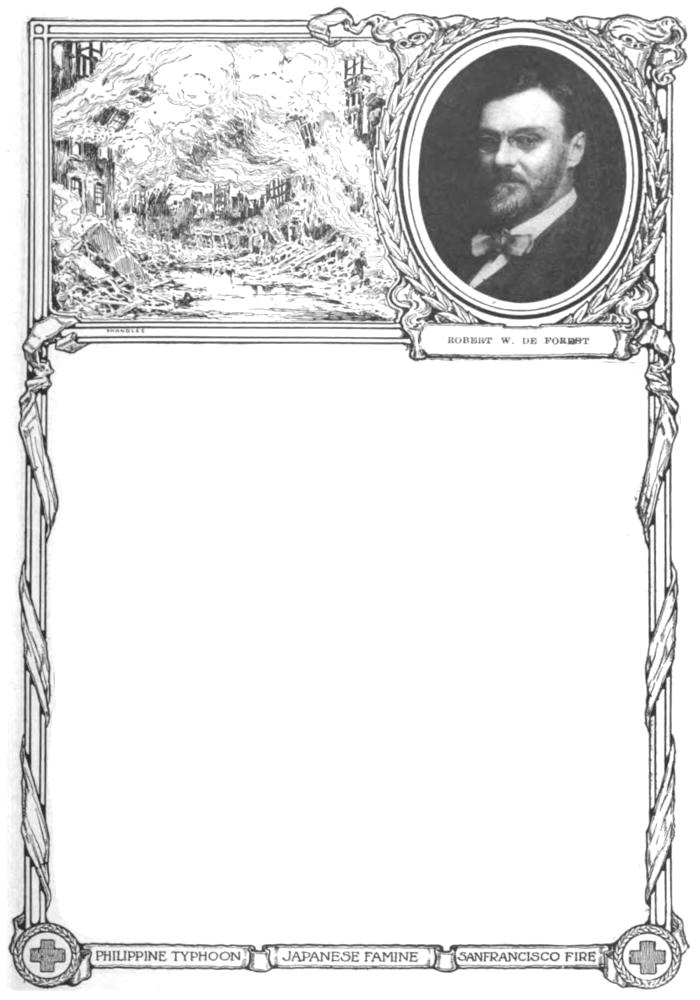
Vice-President, ROBERT W. de FOREST.
Treasurer,
HON. CHAS. D. NORTON.
Counselor,
HON. LLOYD W. BOWERS.
Secretary,
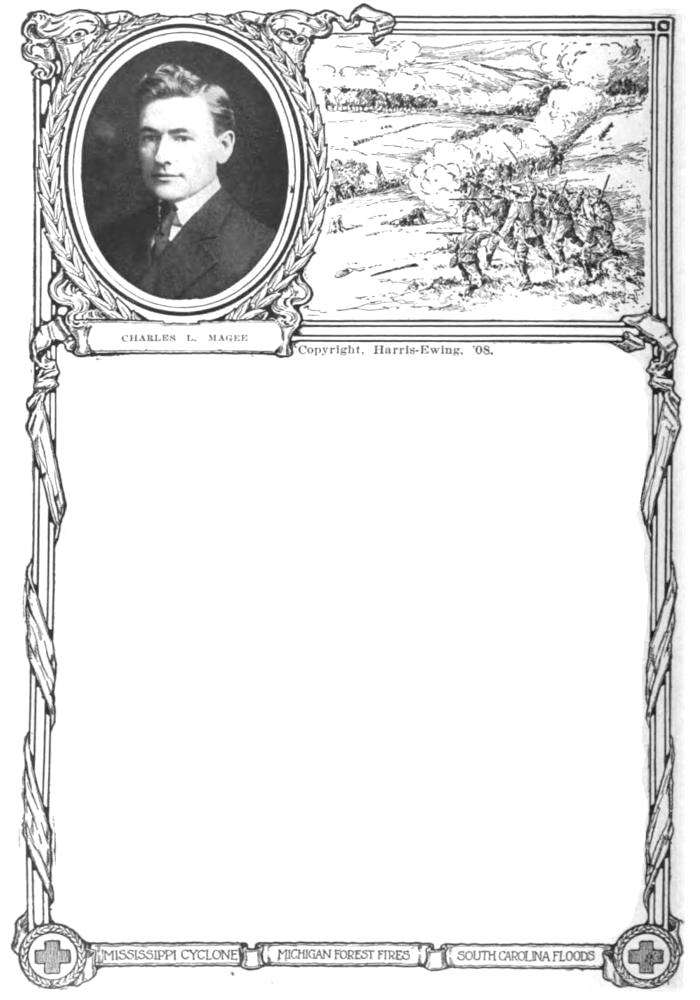
CHARLES L. MAGEE.
Chairman of Central Committee,
MAJOR-GENERAL GEO. W. DAVIS, U. S. A. (Ret.)
National Director,
ERNEST P. BICKNELL.
BRIGADIER-GENERAL GEORGE H. TORNEY,
Surgeon-General, U. S. Army.
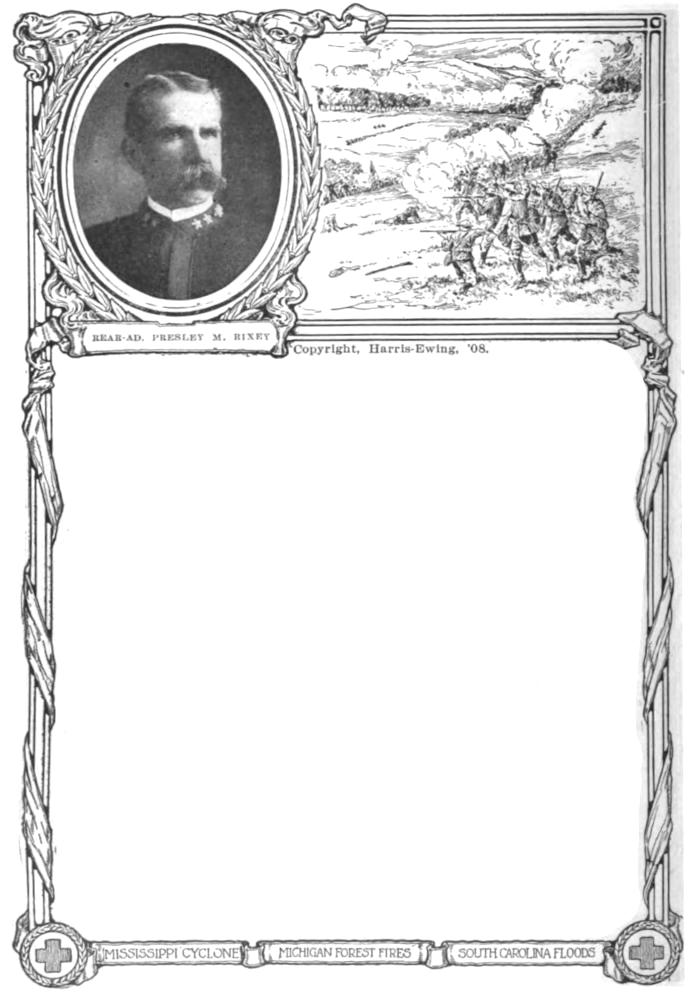
REAR ADMIRAL PRESLEY M. RIXEY,
Surgeon-General, U. S. Navy.
SURGEON-GENERAL WALTER WYMAN,
U. S. Public Health and Marine Hospital Service.
Major-General George W. Davis, U. S. A. (ret.), Chairman.
Brigadier-General George H. Torney, Surgeon-General, U. S. Army, War Department,
Washington, D. C.
Hon. Huntington Wilson, Assistant Secretary of State, Department of State, Washington,
D. C.
Hon. Charles D. Norton, Assistant Secretary of the Treasury, U. S. Treasury Dept., Washington,
D. C.
Medical Director John C. Wise, U. S. N., Navy Department, Washington, D. C.
Hon. Lloyd W. Bowers, Solicitor-General, Department of Justice, Washington, D. C.
President Benjamin Ide Wheeler, University of California.
Mr. John M. Glenn, 105 East 22d street, New York, N. Y.
Miss Mabel T. Boardman, Washington, D. C.
Hon. James R. Garfield, Secretary of the Interior, Washington, D. C.
Hon. A. C. Kaufman, Charleston, S. C.
Hon. H. Kirke Porter, 1600 I street, Washington, D. C.
Mr. John C. Pegram, Providence, R. I.
General Charles Bird, U. S. A., Wilmington, Del.
Col. William Cary Sanger, Sangerfield, N. Y.
Judge Lambert Tree, 70 La Salle street, Chicago, Ill.
Hon. James Tanner, Washington, D. C.
Mr. W. W. Farnam, New Haven, Conn.
Note—Attention is invited to the recent changes in the Officers and Central Committee
members.
The President of the United States has appointed Hon. Huntington Wilson, Hon.
Charles D. Norton, Brigadier General George H. Torney and Hon. Lloyd W. Bowers members
of the Central Committee to represent the Departments of State, Treasury, War and
Justice, respectively. The Executive Committee has elected Hon. Charles D. Norton Treasurer
and Hon. Lloyd W. Bowers Counselor to fill the vacancies caused by the resignations
of the former Treasurer and Counselor.
Entered at the Post Office, Washington, D. C., as second-class matter.
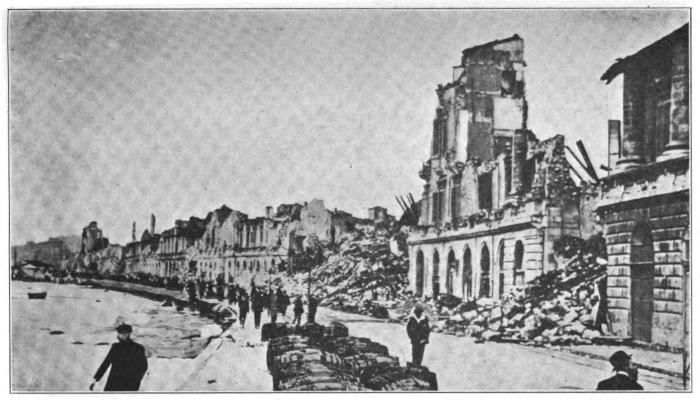
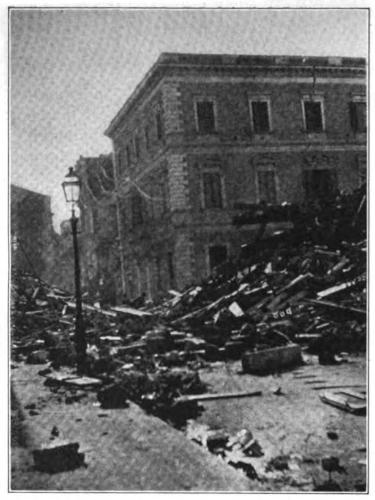
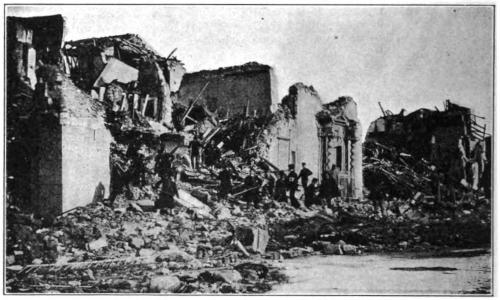
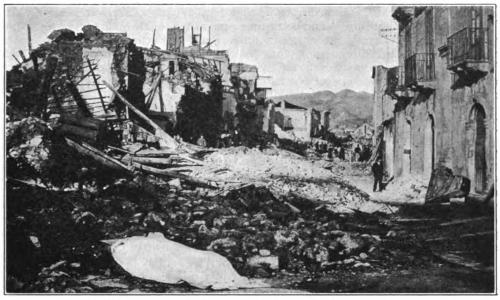
Messina—View
Showing Destruction Along Water Front.
(By courtesy of the New York World.)
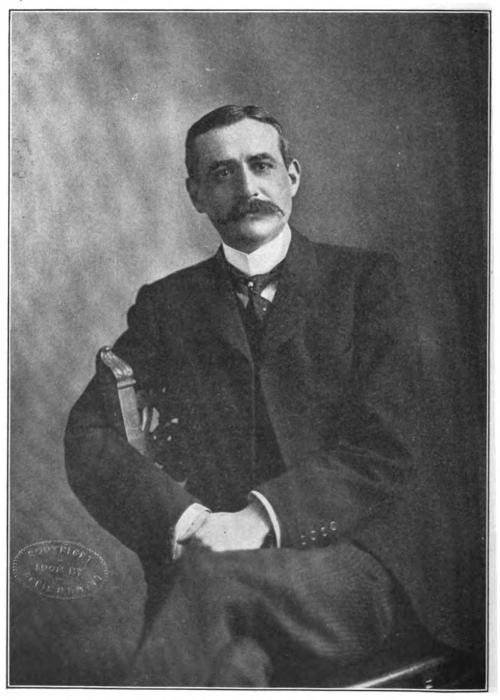
His Excellency, Lloyd C.
Griscom, American Ambassador at Rome.
PREFACE
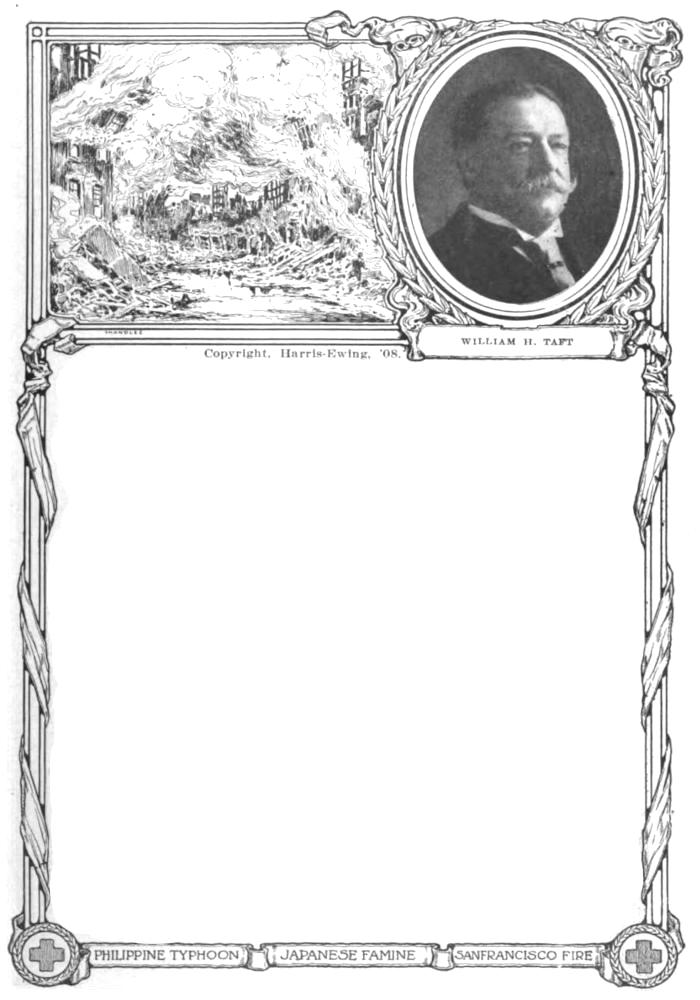
WILLIAM H. TAFT Copyright, Harris-Ewing, ’08.
The April Bulletin appears with a new cover, on the
front page of which is a symbolical figure representing the
Red Cross—a strong, womanly form, with arms outstretched
over the victims of battle and disaster. What it means to
any community devastated by some terrible calamity, and
what it means to the sick and wounded in time of war to
know that a great, strong, sympathetic organization stands
ready and prepared to bring them instant help, only those who
have taken part in active relief work can fully understand,
but everyone can have some realization of the uplift and encouragements
the Red Cross can bring in the terrible days
of suffering and depression that follow disaster.
Something of what our American Red Cross has been
able to do in Italy for the victims of the most terrible catastrophe
of modern times is told in this Bulletin. We are
glad to have been able to give our sympathy practical form,
and let the deeds of our Red Cross prove the solidarity of
international brotherhood.
The report of the Red Cross Christmas Stamp is given
in this number, showing how this little stamp of good cheer
has accomplished a very good and widespread mission.
MISS MABEL T. BOARDMAN Copyright, Clinedinst, ’08.
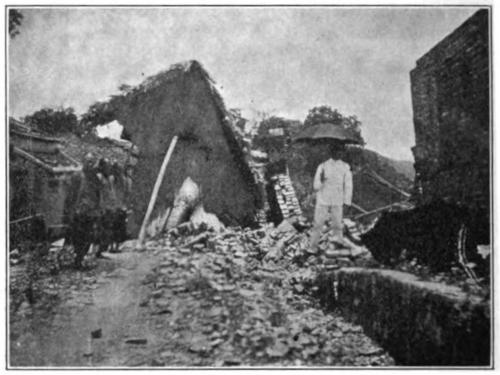
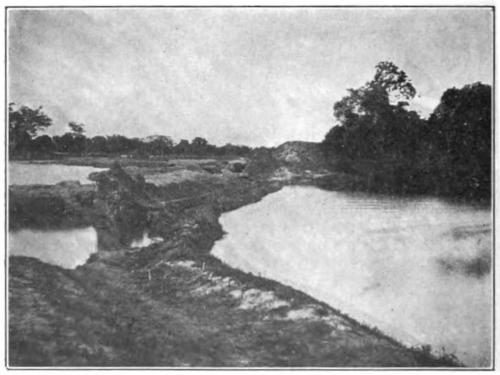
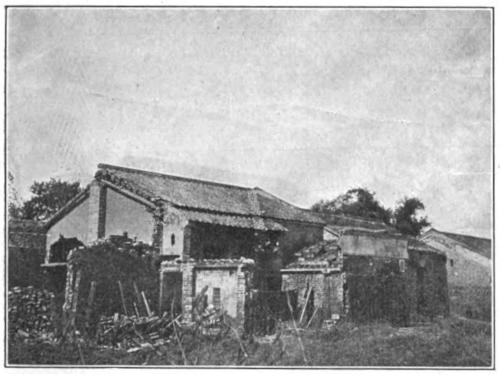
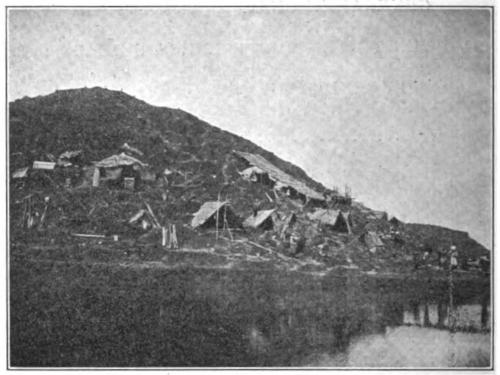
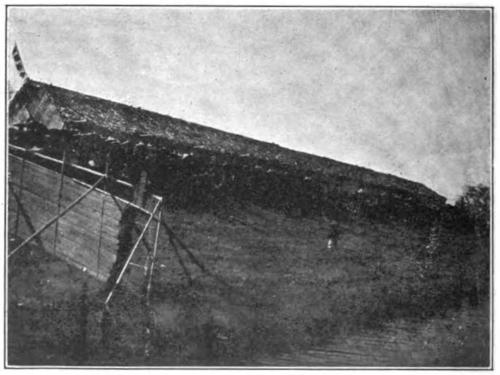
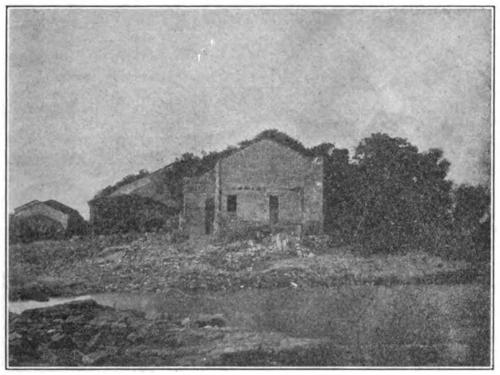
From China has come a report of the relief work, after
the flood, near Canton, last year, with illustrations forwarded
by the American Vice-Consul there.
A report of the Red Cross work at the time of the Inauguration
will be given in the July Bulletin.
Our people give so liberally when disaster arouses their
sympathy, but may we not hope that the time will soon come
when, by gifts and legacies to its Endowment Fund, our
American Red Cross may be possessed of such a certain income
that it can “continue and carry on a system of national and
international relief in time of peace, and apply the same in
mitigating the sufferings caused by pestilence, famine, fire,
floods and other great national calamities, and to devise and
carry on measures for preventing the same.” according to its
charter, and have always funds on hand with which to render
first aid when disasters occur, without having to wait until
contributions are received.
The patriotic men and women of other countries have
given millions of dollars in small and large donations and
legacies to the permanent funds of their Red Cross societies.
Will not our men and women show an equally patriotic and
humane spirit by doing the same for the American Red Cross?
“Messina and Reggio destroyed by an earthquake” flashed
over the wires and appeared in our press the last days of the
year. The terrible news, with its story of the fearful loss of
life and property, seemed too appalling to be true. The world,
though stunned by its magnitude, was yet to learn that no
pen could describe the horrors of a disaster unparalleled in
modern history, and that only those who saw the scene of
devastation soon after the catastrophe have any realization of
its terrible results. As for those who lived through the earthquake
and escaped, the mental fear and physical agony they
had undergone left their minds dazed and blank. When some
realization of the truth dawned upon the world a wave of
sympathy was awakened everywhere. It is especially for such
times of disaster that the Red Cross has its being, and the
call for help was immediately issued from headquarters at
Washington. The President and Governors of States were
notified that our National Society was ready to receive and
transmit the contributions our people were glad to make for
suffering Italy. President Roosevelt, in his cables to the King
of Italy, expressing his own and his countrymen’s sympathy,
stated that the “American Red Cross has issued an appeal for
the sufferers.” Many Governors of States issued proclamations,
asking that all contributions be sent through the American
Red Cross. How promptly and how generously, our people
expressed their sympathy in tangible shape is known everywhere.
Glad were we in America to do what we could to help
our suffering fellow-men in beautiful and well-loved Italy.
Something of what the American Red Cross, our national
member of that greatest of all institutions of international
brotherhood, has been able to do with the contributions it has
received is told in this Bulletin by those who in Italy have
helped to administer the funds. In all of this work the Society
has had the most valuable and untiring assistance of Mr.
Lloyd Griscom, the American Ambassador at Rome. It cannot
too strongly express its appreciation of all that he has
accomplished in the line of careful and prompt use of the
money it has sent. What our Red Cross has accomplished has
been done with a sincere desire to be of help, with a deep appreciation
of the complex and difficult problem Italy has had
and still has to face, and with the hope that the wounds of this
beautiful country, so recently devastated by this terrible calamity,
may soon be healed and the people re-established in a
happy and prosperous life.
MAJ.-GEN. GEORGE W. DAVIS Copyright, Harris-Ewing, ’08.
CONTRIBUTIONS TO THE ITALIAN RED CROSS
ERNEST P. BICKNELL Copyright, Harris-Ewing, ’08.
Knowing that the Italian Red Cross was especially well
organized for carrying on hospital relief work, because of its
field hospitals, fourteen hospital trains and equipment for two
ships’ hospitals, besides an active personnel, the American Red
Cross transmitted to it through our Ambassador at Rome
$320,000 to be applied to its relief work in the earthquake
district. The Italian Red Cross, in two previous Calabrian
earthquakes and at the time of the Vesuvian eruption, maintained
a number of hospitals and relief stations. At the time
of the latter disaster the American Red Cross received about
$12,000, which was transmitted to the Italian Red Cross.
Later a special report was made by this Society of the relief
work it performed at that time. A report of the relief operations
in Southern Italy will doubtless be issued sometime in
the future, but this must not be expected too soon, as experience
has taught how long drawn out is relief work after serious
disasters. Baron Mayor des Planches, the Italian Ambassador
at Washington, in speaking of the Italian Red Cross, said:
CHARLES L. MAGEE. Copyright, Harris-Ewing, ’08.
“As the representative of the Italian Government, I desire
to give the strongest indorsement of the Italian Red Cross,
with which the American Red Cross is in the most intimate
relation, and to say that my Government places absolute confidence
in this great national organization.”
On January 4, the following cablegram was received from
Count Taverna:
“The Italian Red Cross tenders sincerest thanks to American
Red Cross for conspicuous contribution of 1,538,500 Italian
lire, received through American Ambassador in Rome, toward
the relief of the distressed districts of Reggio, Calabria
and Messina, and begs to express its keen appreciation of the
feelings of solidarity and warm sympathy with the stricken
populations, which have prompted their generous act.
“COUNT TAVERNA, President Italian Red Cross.”
Since this despatch was received further remittances have
been made, bringing the total of the American Red Cross contributions
to the Italian Red Cross up to $320,000.
THE AMERICAN RED CROSS ORPHANAGE
ROBERT W. DE FOREST
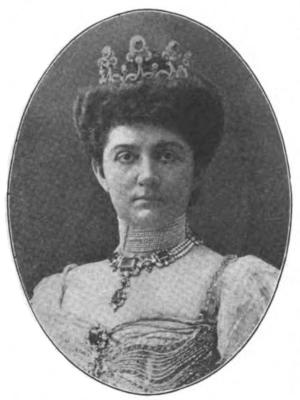
Queen Helena.
Hundreds of little
children were left
fatherless and motherless
amidst the ruins
of Messina and Calabria.
Scores of them
were even too young
to be able to give any
information in regard
to themselves or their
families. For years
these must be cared
for, and having been
left without property
or relatives, must be
so educated that, after
reaching mature
years, they will be
able to support themselves.
Helpless childhood
appeals strongly
to everyone, and the
Red Cross, which after
great calamities
aims when the first temporary aid is over, to rehabilitate
and place again upon their feet the victims of the
disasters, was ready to accept the suggestion of the Italian
Government that some of the funds entrusted to its administration
by the American people should be devoted to the maintenance
of an agricultural colony in Sicily or Calabria for the
care of a hundred or more of the orphaned children. In national
relief the American Red Cross does not permit the use
of its emergency funds for the purpose of any permanent endowments,
but in international relief it believes it wisest to
act under the suggestion of the American diplomatic representative,
the Government and relief committees in the country
where the disaster occurs. Therefore, when Mr. Griscom, the
Ambassador at Rome, after consulting with the Italian Government,
asked that such an agricultural orphanage colony
be maintained by a donation from the American Red Cross, the
suggestion was promptly complied with. Two hundred and
fifty thousand dollars are to be devoted to this purpose.
REAR-AD. PRESLEY M. RIXEY Copyright, Harris-Ewing, ’08.
The colony will be situated in Sicily or Calabria, and
will consist of model farms, where scientific agricultural
instructions will be given by agents of the Royal University
of Agriculture. The Italian Government will
furnish the land, and the Italian National Relief, under
the patronage of Queen Helena will provide the buildings.
It will be called “The American Red Cross Orphanage,”
and the American Ambassador is to be an ex-officio member
of its governing committee. It is to be a lay institution, and
not ecclesiastical. A yearly budget of its expenses will be
published, which must meet the approval of the Minister of
the Interior, who at present is also the Prime Minister. A
number of the poor women left widows and dependent by the
earthquake, and who in many cases also lost their little children,
will be given employment at this orphanage, and the care
of other little children will help to lift this sorrow from their
hearts. From these women the children will receive again
much of that mother-love and care of which this terrible disaster
has robbed them.
SURG.-GEN. WALTER WYMAN Copyright, Harris-Ewing, ’08.
Speaking of this orphanage, Mr. Griscom writes on February
19 to the chairman of the Central Committee of the
American Red Cross:
“I can assure you that this generous gift of the American
Red Cross has made a profound impression in Italy. I made
the formal presentation to Her Majesty, the Queen, on the
16th instant, and Her Majesty was overcome with emotion and
for a moment at loss to express herself. Finally she made a
beautiful speech and poured forth her admiration for the organization
of the American Red Cross.”
Ambassador Griscom, under date of February 18, forwarded
to the State Department for transmission to the American
Red Cross two letters from the Countess Spaletti Rasponi,
the President of the Patronato Regina Elena, and from the
Honorable Bruno Chimirri, President of the “Comitato di
Vigilanza,” respectively, expressing the gratitude of the Committee
and Council of the Patronato Regina Elena for the
gift of $250,000, for the establishment of the Orphanage. The
letters referred to follow:
MAJ.-GEN. R. M. O’REILLY Copyright, Harris-Ewing, ’08
“Excellency:
“The Council of the ‘Opera Nazionale di Patronato Regina
Elena,’ having known of the conspicuous offer of
1,300,000 lire made by the American National Red Cross in
favor of the children whom the recent earthquake has thrown
into the condition of orphans, has passed a vote of thanks to
the officers and to Your Excellency, to whose influential interest
it is due if so important a part of the funds collected
in America has been devoted to our institution.
“And I, interpreting the desire of the Council, warmly and
specially beg Your Excellency to kindly transmit to the meritorious
American Red Cross the expression of our profound
and heartfelt gratitude toward all the noble and great American
nation, not inferior to any other in all the manifestations
of human genius and solidarity.
“With the assurances of my highest consideration,
“The President,
(Signed) “COUNTESS SPALETTI RASPONI.”
HON. ROBERT BACON Copyright, Harris-Ewing, ’08
“Mr. Ambassador:
“I have the honor to offer you the warmest thanks of the
Committee and Council of the ‘Opera Nazionale di Patronato
Regina Elena’ for the generous offer which you have made
on behalf of the Calabrian and Sicilian orphans.
“I beg you to be good enough to be interpreter of our
very grateful sentiments to the American Red Cross, which
has completed, with its splendid gift, its relief work in Calabria
and Sicily.
“The Agricultural Colony, which will be named American
Red Cross Orphanage,’ will perpetuate the remembrance
of this charity, and will contribute to render continually more
close the ancient ties of sympathy and friendship which unite
Italy with your mighty Republic, ties which you called attention
to in your brilliant speech on the occasion of the centenary
of the great President Lincoln.
“Accept, Mr. Ambassador, the assurances of my high consideration.
(Signed) “B. CHIMIRRI.
“To His Excellency,
“Hon. Lloyd C. Griscom,
“Ambassador of the United States of America, Rome.”
HOUSES FOR ITALY
MED. DIRECTOR J. C. WIRE Copyright, Harris-Ewing, ’08
Our own experiences
after
serious disasters
in the United
States have
taught us that in
nearly all of
such cases one
of the most serious
problems to
be met is the
providing of
shelter for the
thousands—sometimes
hundreds
of thousands
of victims.
Italy has had
this same serious
problem to meet after the late unparalleled disaster
in Sicily and Calabria. The American Ambassador at
Rome was requested by the State Department to consult
with the Italian Government as to the best use
to be made of the $500,000 left by the Congressional appropriation
of $800,000, after the supplies on the Navy ships,
Celtic and Culgoa, which were sent to the scene of the disaster,
had been paid for. The reply came in the nature of a
request that this fund be expended in the purchase and providing
of materials for houses. This suggestion has been admirably
carried out by the Navy Department, which has
purchased and shipped, fully prepared, materials for the immediate
erection of 2,500 houses, including window sashes,
doors, etc., and the charter of four ships for their transportation.
Some eight expert carpenters and a large number of
tools have been sent on these vessels, that the erection of these
houses may go on promptly.
HON. JAMES R. GARFIELD Copyright, Harris-Ewing, ’08.
But the need of shelter will continue, for Mr. Griscom
writes that the homes of 1,100,000 persons have been completely
or partially destroyed and their mode of life
interrupted, so on his advice and that of the Italian
Government, the American Red Cross, with the kind
aid of Pay-Inspector J. A. Mudd, of the United
States Navy, who took entire charge of this matter,
purchased in New Orleans, at a cost of $100,000, the
materials for 550 complete houses, chartering for the purpose
of their transportation the S. S. Newlands, which sailed for
Messina on February 11. Besides the materials for these
houses, there was shipped a large quantity of lumber. No carpenters
nor tools were sent on this vessel, as those already
sent on the Government ships would be available for the work
of erecting these Red Cross houses, each of which will have
before it a little metal enameled placard in red, white and
blue, of which a reproduction is given at the head of this
article.
HON. HENRY M. HOYT Copyright, Harris-Ewing, ’08.
Ex-Governor Guild on January 26 informed the Red
Cross that forty-nine portable houses could be obtained in
Massachusetts from the Springfield Portable Construction
Company. These were purchased for $6,978, and shipped on
one of the vessels carrying the government lumber directly to
Messina, without expense. The Springfield Portable Construction
Company kindly returned to the Red Cross $500 of the
payment made on these houses as their contribution for the
relief work.
As the Congressional appropriation has been entirely
expended for house materials and the chartering of ships, the
American Red Cross, besides expending $10,000 for the erection
of the houses it has sent over, has transmitted $38,000
to pay for the erection of the houses to be made from the materials
purchased and shipped by the United States Government.
EARLY DAYS OF RELIEF — RED CROSS STATION. — AMERICAN CONSULATE. — TAORMINA. — BACK TO MESSINA. — BRITISH AND RUSSIAN SAILORS’ AID. — ARRIVAL OF THE “BAYERN.” — CATANIA. — SYRACUSE. — REGGIO. — PALERMO. — PROBLEMS OF RELIEF. — AMERICAN CONTRIBUTIONS.
HON. ELIHU ROOT Copyright, Harris-Ewing, ’08.
BY W. BAYARD CUTTING, JR. Special Representative of the American National Red Cross.
Mr. W. Bayard Cutting, the American Vice-Consul at
Milan, who was promptly sent to the scene of the disaster
by the Ambassador at Rome to look after American and consular
interests, was requested by the American Red Cross to
act there as its Special Representative, and $15,000 was placed
at his disposition to meet any immediate needs, especially those
of any Americans he might discover among the victims. Mr.
Cutting most kindly consented to act in this capacity. He
was on the scene within a few days of the catastrophe, and his
interesting article written for theBulletingives a graphic
description of the early days of the relief work. The Red
Cross is not only indebted to Mr. Cutting for this article, but
for the valuable aid he rendered to the Society.—Editor.
When the steamer Nord Amerika entered the harbor of
Messina on the morning of January 2, 1909, there was no
excited rush among the passengers to get a first view of the
town. We knew that we were about to have one of the
greatest impressions of our life, to see a panorama of desolation
and destruction such as the world has rarely presented
in the history of man. Amid that desolation we were to live
for days and weeks, and to perform trying duties; new sensations
would soon crowd upon us; curiosity would be satisfied
all too soon. Meanwhile there was no reason for hurrying
to a scene of horror. Thus we sat uneasily in the saloon, where
we had spent a night of seasick misery, and tried to munch
dry bread and ship’s biscuit, inventing pretexts for not going
on deck. We all dreaded the flames and the ruins, and the
corpses floating through the straits, up and down with the
tide. Then the engines stopped; we had arrived, and must
go ashore. Each of us stuffed a loaf or a biscuit into his
pocket, and had a look at his revolver. Those few who had
water-bottles filled them. With nerves braced to face any
horrors, we ascended the companion way.
HON. JAMES TANNER Copyright, Harris-Ewing, ’08.
We saw what the traveler to Messina has seen through
the centuries—one of the beautiful places of the earth bathed
in the light of the rising sun. We were close to the shore,
it is true, and could make out the ruins. The palaces fronting
along the stately Marina were roofless. There were gaps
between the palaces—white heaps of debris. Toppling buildings,
and houses without outer walls, like children’s doll
houses, could be made out. Here and there out of a roof came
flames and curling smoke. But to see all this one had to look
for it. What attracted the eye, and compelled attention
through the magical appeal of its beauty, was a broad expanse
of still water, protected from the sea by a projecting point
of land; then a flat water front, two or three miles long; and
behind, circle after circle of hills, bewildering in their rich
variety of form and color. This was the real Messina, you
felt, what an ancient phraseology would call its formal and
final causes. With those fertile hills, with this spacious harbor,
situated on a principal trade route, Messina would always
be a city. Houses and inhabitants there would always be to embody the Messina
idea, to fulfill the Messina purpose.
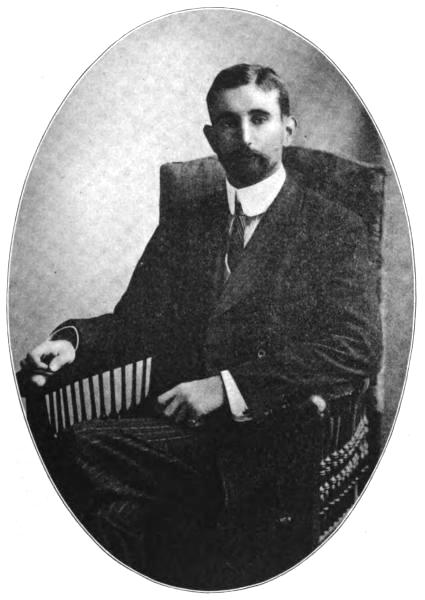
Hon. W. Bayard Cutting, Jr.
U. S. Vice-Consul at Milan.
Special Representative of the American Red Cross.
The port was filled with ships, flying the flags of many nations. Boatmen
in rowboats surrounded the Nord Amerika and offered to take us
ashore. There was nothing catastrophic or even dramatic in their appearance
and manner. I was almost disappointed to see them so well dressed,
and pleased, on the other hand, to observe that they did not attempt to
bargain. From the boatmen, as a matter of fact, when I talked to them,
I first derived that strong impression of the oriental affinity of the Sicilians
which deepened with every day of my stay in Messina. Their mood
was one of submission, unsurprised and unassertive, to the hard hand
of fate. They did not rebel nor complain, and on the other hand they
would not strive. Life had ceased to have any value; why trouble about
its prolongation? It was folly to think of building a comfortable house,
when there was no one left to occupy it; or to earn money which could
bring no sweetness. So most of them sat idly in the streets, or under
the roof of the market, and took what food was put before them; or
stood watching the soldiers dig in their own homes, where their families
were buried, without raising a hand to help. The few who worked, like
our boatmen, did not care what pay they received. A piece of bread
they were glad to get; but when it was a matter of money, one lira or
five was all the same.
This apathy of the native population, amounting to a kind of stupor,
since it abolished even begging, stood out sharply before us, when we
went ashore, in contrast to the activity of the military forces. As we
turned to the left down the long Marina—we had landed near the northern
extremity of the town and it was clear that the center of things
was far to the south—the way was so crowded that we could not walk
more than two abreast, and were often obliged to fall into single file.
The Marina is a broad promenade along the water’s edge; but at least
half its width was blocked with debris from the palaces at the back;
and on the water side the way was stopped by impediments of all kinds;
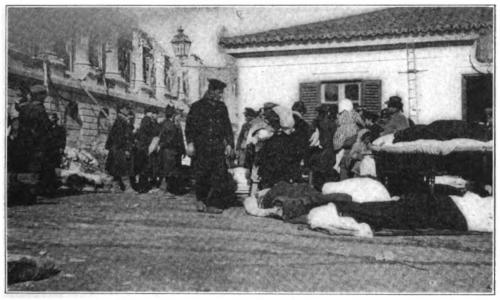
piles of lumber, blanket heaps and rude huts put up for temporary shelter—tarpaulins
spread over poles, for the most part. As we walked down
the middle, picking our way among the cracks and fissures in the ground,
we were constantly making way for troops of soldiers with spades and
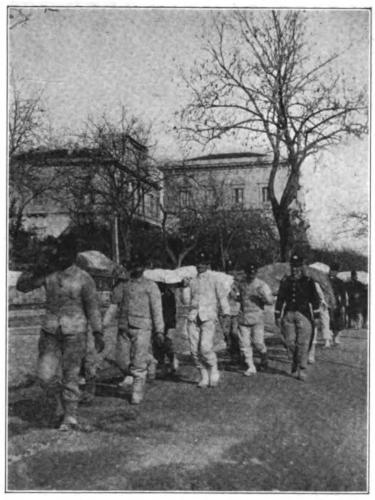
pick-axes over their shoulders. Almost equally numerous were the parties
bearing long lines of litters. They were marching in our direction
or else out of side streets to our right; and as they passed we looked
nervously at each burden, to see whether the face was uncovered. Sometimes
it was; occasionally even the occupant of the litter was raised on
his elbow, staring with uncomprehending curiosity at the crowd on either
side. More often no face was exposed; then we knew that the man
was one of those dead who encumbered the path to the living. No bodies
were touched, we knew, unless they actually impeded the work of rescue.
Otherwise they must be left alone; the living had the first claim. Yet
the line of litters was unending.
Illustrating the Capriciousness of the
Earthquake.
Soldiers Bearing a Wounded Man Rescued on the
Seventh Day After the Earthquake.
On our right the view of the town was screened by a line of fairly
intact house fronts. The principal palaces of Messina had flanked the
Marina; their outer walls had resisted bravely, on the whole. Such
glimpses as we got of the interiors made it clear that those walls were
mere shells; still they gave to the Marina a deceptive appearance of
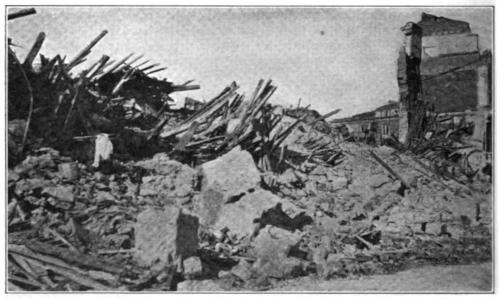
solidity. Between the palaces, however, came long heaps of mere debris,
thirty or forty feet high. One of them we knew must be our consulate;
but which? No one could tell us. No one could even direct us to the
military headquarters, or to the office of the Prefect. The Italian officers
knew less than the native inhabitants; they were strangers and newcomers
like ourselves. We walked ahead at random towards the curve
at the southern end of the harbor where masts and funnels were most
numerous. Occasionally, as we passed a side street less completely
blocked than the rest, we got a view of the interior of the town—an incoherent
extravagance of ruin such as no pen can describe. The street
always ended in a mountainous mass of wreckage; but the houses at the
sides had assumed every variety of fantastic attitude. Beams and pillars
crossing at absurd angles; windows twisted to impossible shapes,
floors like “montagnes russes;” roofs half detached and protruding, preserved
in place quite inexplicably. And then front walls torn away,
laying bare the interior of apartments. In the same house one room would
be a heap of wreckage, and its neighbor absolutely intact, with the music
open at the piano, a marked book on the table, and the Italian Royal
Family looking down from the walls. A third room perhaps held nothing
but a chandelier, but that chandelier in perfect condition, without a
broken globe. No two houses were alike; the earthquake had picked
its victims here and there, following no predictable rule. Sometimes the
victims could be seen lying in their own houses. Here and there a rope
of knotted sheets hanging from a window showed where someone had
escaped. And everywhere solitude and silence, save for the sound of
the pick and the shovel. Only the soldiers and officials were allowed
in the town: all others must remain on the Marina.
A little this side of the Municipio, or city hall, which we identified
through the flames and smoke in which it was enveloped, we came upon
a Red Cross station—a square building belonging to the Custom House.
Here, stretched out in the sun, lay the rescued of the day—five or six
only, for it was not yet nine o’clock. Opposite the Municipio was the
covered market, now the home of hundreds of survivors, and a place
where bread was distributed. Between the market and the Municipio
a marble Neptune of the eighteenth century still posed in nude absurdity.
The most trivial of figures in the most trivial of poses had been spared,
to the tips of his silly fingers, to stand between the flaming wreckage of
the palace and the human wreckage of the market. Still further along,
where the Marina widened again, we came upon the landing where the
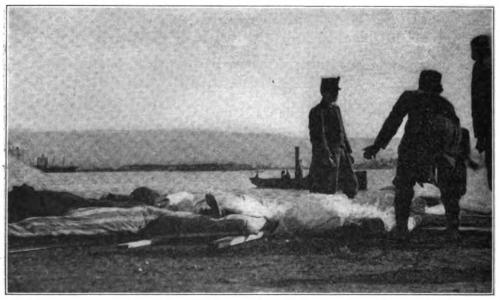
dead were laid out—men, women and children, all deposited in haste under
some inadequate covering; a ghastly sight. From time to time a
row boat would come up to the landing. The bodies were piled into
it, and rowed out to sea.
The Commander-in-Chief, we ascertained at last, could be found on
the Duca di Genova, a steamer of the merchant marine anchored at the
southern end of the harbor. Our struggle through the crowds to the
landing stage; our fruitless efforts to get a boat; our final success,
through the help of a friendly Italian officer; our visits to one ship and
another, to authorities military and civil; our vain attempts to extract
even the simplest information, such as the situation of our consulate
and the fate of our consul; all this would be as dreary to tell as it was
to experience. After three or four hours of ceaseless effort we returned
to the shore with the following net acquisitions: an order for a tent,
which we might pitch at a place to be appointed by the General in command
of the third sector; permission to send one short official telegram;
and a friend.
The friend was Mr. Baylis Heynes, a British merchant of Messina,
who represented the firm of Peirce Brothers. His house had been spared
by the earthquake. After taking his wife and children to a villa outside
of the town, he had hurried back without a thought for personal safety
or comfort and had thrown himself into the work of saving lives and
property. In the villa his wife was caring for more than fifty destitute
Messinesi, with such little food and clothing as she could procure. Mr.
Heynes meanwhile was indefatigable in the work of rescue; and his coolness
and intelligence at a time when everyone else was excited and flustered
had already proved of inestimable value. He now offered us his
house for a consulate, and the large garden behind for a Red Cross
hospital. They were situated at the extreme northern end of the town,
more than two miles from the headquarter’s ships. But the house was
solid and uninjured and the garden spacious; it was in fact the “Lawn
Tennis Club” of Messina. We accepted gladly Mr. Heynes’ kind offer,
and started back with him to inspect the premises.
Ten Wounded. Lying by the Red Cross Station.
Rescued on the Morning of the Eighth Day After the Earthquake.
It was no longer morning. The sun had been shining brightly for
many hours. The smell of the dead rose from the earth, unendurably
penetrating. It floated across the Marina on a light shore breeze; then
at places it became suddenly pungent, so pungent that you expected to
tread upon the cause. The ruined masses beside us took on a new horror.
Beneath them, close to the dead of whose presence we were unconscious,
were thousands of living, whose only air was the air we smelt.
How few the soldiers seemed, in comparison to the gigantic task of excavation!
And why were they all away? Poor men, they needed their
mid-day rest, perhaps the full three hours they were given; but could
there not be twice as many, working in relays?
Mr. Heynes pointed out the Consulate—perhaps the largest, solidest,
most hopeless mass of rubbish in the whole of Messina. Nothing deserving
the name of an object was discernable in the whole pile, except the
long flag-staff which protruded from the heap towards the street. The
Consulate had been a corner house on a side street; surely we ought
to be able to identify at least the remains of the stone arch which had
marked the entrance to the street. But the mass was absolutely compact
and uniform, obliterating every trace of an opening. It was not
astonishing that the soldiers had left that particular pile unexcavated.
Hundreds of men would be needed, for many days, to get to the bottom
of the mound; and what chance was there, at the end, of finding
a survivor? The fate of Dr. and Mrs. Cheney was already a tragic certainty;
the best that could be hoped was that their death had been instantaneous.
The Ruins of the American Consulate.
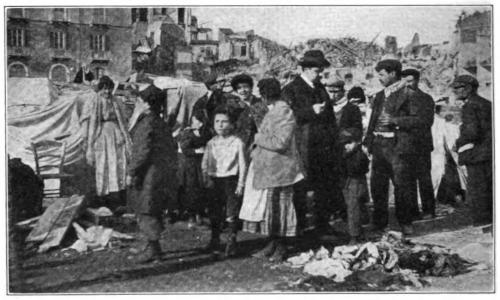
Not far beyond the Consulate, on a side street near the Piazza Vittoria
(now a large camp, filled with tarpaulin shacks), we saw the ruined
house of Mr. Joseph Peirce, who had been our vice-consul until six days
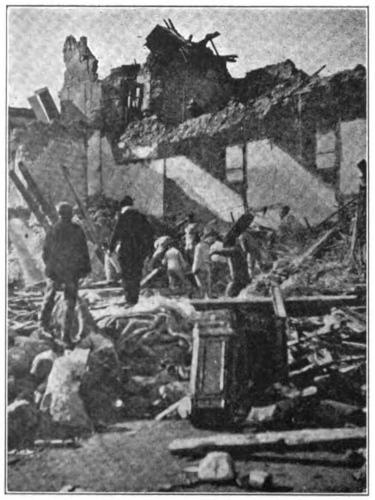
before the earthquake. A few soldiers were working in the heap; and
several of the former occupants of the building were standing by, each
waiting for some relative to be disinterred. One of the bystanders had
been two days buried under the house, but had worked himself near
enough to the surface to make himself heard, and had thus been rescued.
All had known Mr. Peirce; two said they had seen him on the second
day after the earthquake, his body buried and terribly crushed, his head
alone appearing out of the wreckage. They told us that his brother
had come to save him, but had not been able to remove the heavy pile
of masonry and beams. When all efforts proved unavailing the brother
had said goodbye to Mr. Peirce and stood there till he died. The body
was gone now, evidently the brother had removed it later.
When we had returned to the Marina, near the point where we had
first landed, we found our baggage heaped in the middle of the road.
To my servant, Antonio Alegiani, who sat upon the pile, an old man
was talking voluble English without noticing that he was not understood.
The stranger introduced himself as John B. Agresta, a naturalized
American, a pensioner of the Civil War and a very important person
at the consulate. He had been guide and interpreter. He had done
much work for Dr. Cheney. He would show us everything, the part
of the house where the Cheneys slept, the office, the safe; especially the
safe. In it we should find two thousand lire belonging to him (Agresta).
Why did we not come at once instead of wasting time talking to people
who knew nothing? Dr. Cheney was dead, of course, and Mrs. Cheney.
And Mr. Lupton? Yes, he was dead, too, and there was no doubt of it.
Agresta had seen him the night before the earthquake, and had since
seen his hotel, not a stone of it in place. Poor Mr. Lupton was certainly
dead.
Just at this moment a young man with a pipe in his mouth came
round the corner. “Why, hello, Agresta,” he said, “glad to see you alive.”
It was Lupton himself, our vice-consul. We thought he must have
stepped out of a ruin, or been dug out; in our greeting, no doubt, was
something of the awe with which one would salute a visitor from the
other world. Lupton soon explained that he had never left the earth,
nor even its surface. Half of his hotel had been spared; he had walked
down the stairs into the black street, and waded about in water up to
his knees till morning dawned. The story has been published in his own
words; I wish I could insert the anecdotes and reproduce the turns of
the phrases with which he made us see, as in a flash, that prodigious
morning of December 28th. We told him we had come to help him,
and put ourselves under his orders; he seemed glad to see us; we were
soon friends. Together we set out to inspect Mr. Heynes’ house and
garden.
It was a solid two-story building, one of an uninjured block; the
very house, as a tablet reminded us, in which Garibaldi had lived at the
time of his triumphant entrance into Messina at the head of the Thousand.
Over the door we set up the American shield, and hung out the
flag from a corner window. A week later the British flag flew beside
it. Mr. Heynes had been appointed acting vice-consul of his nation.
Meanwhile we turned the entrance hall below into a consular office, and
set up our beds in the large garden behind, under a tent, so soon as we
were able to obtain that coveted article. Sleeping upstairs was unsafe,
so long as we continued to have four or five shocks a day, some of them
severe enough to bring down a number of buildings.
Once settled, three problems confronted us; to excavate the old consulate,
to ascertain the fate of such Americans as had been in Sicily at
the time of the earthquake, and to bring relief to the suffering population
of Messina.
The first task fell almost entirely to Major Landis, our Military
Attachè at the Embassy in Rome. On the night of our arrival a squad
of thirty Italian soldiers, under a lieutenant, was put at his disposition
for the excavation of the consulate, and there he spent the work hours
of the next fortnight. Towards the end the Italian soldiers were replaced
by sailors from our own warships; it was the crew of the Illinois who
finally discovered the remains of Dr. and Mrs. Cheney. They were found
at the very bottom of the pile, only four feet above the street level, though
their bedroom had been on the second floor. They had been killed at
once and apparently without suffering; it was reasonable to hope that
no return of consciousness had broken the slumber from which they
passed into eternal rest.
Ruins of the House of Mr. Joseph Peirce,
Former American Vice-Consul.
Excavating the Ruins of Mr. Peirce’s House.
Our second duty was to find and succor Americans. Among the
survivors at Messina, besides Dr. Lupton and Agresta, we found only
one family, a naturalized American with the six small children of one
of his brothers who lived in Brooklyn. These we sent back to the
United States. But, what Americans had been killed? This question
we had no means of solving. We had brought with us long lists of
Americans known to be in Sicily, whose relatives were inquiring anxiously
about their fate. Something must be attempted in order to put
an end to the agonized suspense of so many families. Most of the persons
whom we wished to find were doubtless safe at one of the Sicilian
resorts. As for telegrams, none had yet arrived from any source, and
letters were not delivered until the eleventh day; there were no postal
clerks, we were informed, to distribute them. It was plain that the only
way to get information was to go and get it. Two of us were accordingly
detailed to take the train to Taormina.
After obtaining with some difficulty the military pass allowing us to
return, we walked to the railroad station and boarded a train. No one
knew whether it would start that day or the next. As a matter of fact
it began to move less than two hours after our arrival, and with surprising
speed considering its portentous length and its over-crowded condition.
In spite of long stops at every station, to take out wounded or
to let them aboard, the journey of thirty miles was completed in two
hours and a quarter. We were surprised to find that after eight or ten
miles all signs of destruction ceased. The first villages were in ruins, like
Messina; and in the fields soldiers were digging great rows of trenches,
in which they deposited lime: obviously the sea was no longer to receive
all the dead. But soon we came upon towns with only a few fallen
houses; before long a mutilated roof was a curiosity; and fifteen miles
from Messina the country presented a completely normal appearance.
We did not realize then that those villages between Messina and Taormina
were in greater distress than any district, probably, in the whole
of Sicily or Calabria. Thousands, perhaps tens of thousands, of refugees
from the city fled on foot to these little towns, imploring charity. The
inhabitants received them with true hospitality and gave them of their
best. But as the days and weeks passed the supply of food ran short.
Nothing arrived by rail; the trains were filled with cargoes for Messina
or else for Taormina or Catania; charity passed the little places by. It
was a month after the earthquake that two American gentlemen from
Taormina, Messrs. Wood and Bowdoin, discovered and reported the
incredible distress of this starving rural population. And now another
American, Mr. Billings, of Boston, is devoting himself to the relief of
this district and is spending there the principal part of the generous offerings
of Massachusetts.
Taormina was full of rumors. For a week the only news had been
supplied by wounded refugees, distraught with fear and misery; in their
description the earthquake had become almost a supernatural event.
Strange lights had blazed in the sky; a comet had struck the earth and
raised the waters of the deep. Luckily the wires to Catania and Syracuse,
and from Catania to Palermo, were open. By telegraphing to all
of these cities and by searching the hotel registers of Taormina, we were
able to find nearly all the names on our lists. There were many Americans
still in Taormina and many English. All of them were working
together, distributing relief and caring for the sick. A hundred and fifty
refugees were in the hospital of Taormina and three hundred and eighty
in the little fishing village of Giardini at the foot of the cliff. Our countrymen
were working night and day to help them, giving them food and
clothing; and instead of complaining of the heavy burden of so many
patients, they begged us to send more. One or two of them met every
train from Messina, to distribute bread to the hungry passengers. The
ladies devoted themselves chiefly to the hospitals, where they worked
with unremitting energy.
Our brief glance at the efficient relief of Taormina made the conditions
at Messina, upon our return, seem even more desperate than
before. Here the problem was vastly complicated by the dispersion of
the population and the lack of any registers of inhabitants. The scarcity
of houses had driven the population to take refuge, so far as possible,
in the hill villages surrounding the town. Here most of the families
were installed, not only the able-bodied, but the sick and wounded as
well. One of each family would spend the days in Messina, trying to
procure enough food to keep his relatives alive. The complete lack of
transport animals and the absorption of the soldiers in the work of
rescue, made relief expeditions to the villages impossible. For food distributions
in Messina the rule had been adopted; one man, one loaf.
The absence of registers made it possible for a strong man to push repeatedly
to the head of the line, and to get bread at all the distributing
places in succession. The result was a more or less disorderly rush for
bread at all the distributing points, and the exclusion of all but the
strongest, while many worthy families suffered from hunger in the midst
of comparative plenty.
On the evening of our first arrival at Messina, I had a chance to
talk to Senator Duranti, the chief of a hospital expedition sent by the
order of the Cross of Malta. I asked him what articles of food, clothing
and medical supplies were most needed, and how the American money
accumulating in Rome could be spent with most profit to Messina. He
told me that medical stores of all kinds were sadly wanted, and that
there was still a lack of food, bread, macaroni, olive oil, butter, and
especially milk—for the women and children—and also underclothes and
shirts. The milk should be sterilized, not condensed, because the ignorant
peasant women could not be induced to give their children an unaccustomed
food, especially if it had to be prepared or mixed. Acting upon
Senator Duranti’s advice, we telegraphed that night to the Ambassador
in Rome for the enumerated supplies. The U. S. despatch boat Scorpion,
which had just arrived from Constantinople, was starting for Naples to
coal. Her commander, Captain Logan, kindly took our dispatches to
the Ambassador, and brought back the supplies, which we received on
the 6th. At the same time we learned that an American relief ship was
being stocked in Rome, and would soon arrive with huge stores of food
and clothing, and that the U. S. S. Culgoa was due on the 8th from Port
Said with immense supplies of all kinds.
The arrival of our first stores—which luckily far exceeded our requests—brought
us face to face with the problem of direct distribution.
Messina was already more orderly. On the 6th or 7th the Marina was
first lighted by electricity—a fortunate occurrence, since most of the foreign
warships on whose search lights we had been dependent, had now
departed. To these ships Messina and Italy had good reason to be
grateful.
I do not know what words could adequately convey the extent of
service rendered by all the fleets, but especially the British and Russian.
As transports, store ships, refugees’ hospitals, telegraph stations they
had been invaluable: but it was as rescuers of the living that they
were pre-eminent. The Russian sailor was a revelation to those who
did not know the quiet common sense, the tactful sympathy and the unassuming
heroism of the moujik. The Russians were the only people
who always had everything on the spot. The saying got about that
they had ordered the earthquake and fitted out a fleet beforehand for
the purpose of relief. As to the British bluejackets, they had not a
reputation to make. They did exactly what was expected of them; and
in the expected way; that is with energy and courage, with easy practical
mastery of every kind of work, and with complete unconsciousness of
anything unusual or particularly meritorious in their performance. And
the English nation and press, instinctively realizing that silence may be
a higher tribute than praise, has accepted the fleet’s work at its own
valuation; as a task performed in the ordinary way of duty, and performed
well, as became British sailors.
About the same time or a little later, the water supply was connected
with a portion of the town. Lack of water had been one of our
chief discomforts. It could be procured at one place only, two miles
from the consulate; with great difficulty we had obtained a pailful each
day for our party. The streets had become filthy beyond description:
now it was possible to flood them. A train to Palermo crawled out of
Messina from time to time. The dead were being removed from the
streets, and many of them were buried instead of being taken out to
sea. On the fires in front of the tarpaulin houses stood pots of macaroni
cooking. The hospital ships which departed for Naples, Genoa or Catania
were no longer crowded to over-flowing. The people actually living in
Messina were comparatively comfortable. But every improvement in
organization brought out more clearly the needs which confusion had
obscured. Inside the city and out, no one had any clothes except what
he had been able to snatch from his house on the morning of the 28th;
and not two miles from the Municipio, in all directions, ran the hunger
line—beyond which lay the region of actual famine.
It must be remembered that Messina was in a state of siege. That
means that it was controlled in every department by a single central
military authority. The state of siege was necessary in order to maintain
order and health; but it entailed inevitable disadvantages in connection
with relief work. Effective relief should be decentralized; it
should operate through innumerable agents invested with responsibility
and discretionary power, who seek out the individual and have the means
to assist him. Government by martial law means that nothing can be
done or given except by permission of the military chief, and an order
for stores cannot be obtained in a minute. This was why the hospitals,
the Red Cross stations and relief agencies of all kinds were so frequently
short of supplies. Requisitions of particular articles which had run out,
such as brandy or antiseptics or milk, required too great an expense of
time; the workers were everywhere fewer than the needs: they could
not be spared. From our own experience in sending telegrams or procuring
permits we learned to appreciate the inevitable disabilities of a
system of complete centralization in dealing with a situation of such
chaotic complexity.
What part we could take as independent distributors was not evident.
Under the circumstances we decided to divide our supplies into
three parts. The first, consisting of medical stores, milk, butter, oil,
chocolate and underclothes, was given to the central medical officials,
for use in the hospitals. The second, of a similar nature, we took to
Reggio and San Giovanni, for distribution to the hospitals there. The
medical authorities of each place selected from our lists the articles of
which they were in need. The remainder of the stores we took to the
consulate and distributed ourselves.
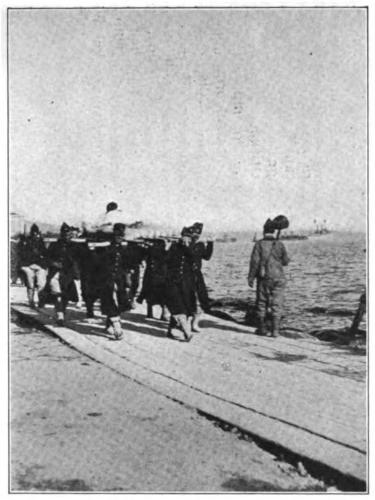
The Quay Where Corpses Were Laid Out, Awaiting Burial at Sea.
In picking out individuals to assist, we paid special attention to
residents of our own district, with whom we were beginning to become
acquainted, to persons known to Mr. Heynes, and to such inhabitants
of Messina as had some connection with America. We were constantly
asked by Messinesi to send telegrams to their relatives in the United
States, and if possible to help them rejoin those relatives. But as our
immigration laws forbid the importation of the destitute, we had to tell
the applicants that we could send their telegrams, but that we could not
provide passage to America.
The consulate soon became a busy place. Two soldiers stood at
the door to keep the line of applicants in order; inside, one of us investigated
the applicants, and registered the facts of each case in a book,
another took the written orders and brought back the stores, which were
handed out by a third. It is perhaps superfluous to add that in cases
of actual hunger no investigation was attempted. The help of Mr. and
Mrs. Heynes was invaluable throughout. It enabled us to send stores
to families at a distance, who had not heard of our consulate or were
unable to come. Other pitiable cases were brought to our attention by
the American and English newspaper correspondents, and by Mr. Frank
A. Perret, the seismic expert well known for his heroism at the time of
the eruption of Vesuvius in 1906.
Meanwhile the United States Warships Yankton and Culgoa, the latter
loaded with stores, had joined the Scorpion in the harbor. The sailors
were detailed to help us clean the house and garden and put up a number
of tents for a hospital. Colonel Radcliffe, the British Military Attachè,
to whose clear-headed determination is due the chief credit for
the admirable organization of British relief work, aided us in countless
ways. He was occupied at that time in searching for the body of Mrs.
Ogston, wife, of the British Consul. When the remains were found, it
was a party of American sailers from the Connecticut that formed the
funeral escort.
Then, on the evening of the 8th, arrived the American Red Cross Relief
Ship Bayern, with the American Ambassador aboard and the American Naval
Attachè, Captain Belknap, in command. I am still amazed at the intuitive
grasp of the situation displayed by the organizers of the expedition.
From inception to completion, in every detail of planning and execution,
the cruise of the Bayern was emphatically a success.
Messina was not the place, however, where the Bayern was needed.
A day ashore convinced the Ambassador and the committee that large
distributions of food and clothing were not advisable at the present time.
Supplies and a sum of money were given to the Archbishop of Messina,
for his hospital; the stock at the consulate was replenished; a trip was
made to the Calabrian coast, where the military authorities were given
what stores they requested; then, early on the morning of the 11th, the
Bayern sailed for Catania.
We went ashore, wondering whether we were needed. An hour
later we wondered whether it was worth our while to think of going anywhere
else. The situation at that time was simply appalling: it is appalling
today, five weeks after our visit. Catania and every house in
Catania had been swamped with refugees. Three thousand of them lay
in the five hospitals; two thousand in the three main refuges—converted
barracks or convents; and twenty thousand were scattered over the city.
One lady whom we met had sixty in her own house; another, thirty:
another, seventeen. The Prefect was spending 20,000 lire daily, a sum
barely sufficient to supply bread rations and to keep the hospitals running,
but quite insufficient to provide sheets or clothing for the patients.
Even the hospitals were short of mattresses; in the refuges the inmates
slept on heaps of straw. The little towns in the country districts were
as full of refugees as Catania and in still greater distress; at Catania
there was at least bread. Red Cross branches, municipal committees of
men and women, were working valiantly, but they were struggling with
absolute penury—a complete lack of funds. The money received by the
Prefect from the Government appeared to be the only cash from the outside
which had yet arrived at Catania. It was still only a fortnight since
the earthquake. Apparently no one in Italy had yet realized that money
was needed immediately in places like Catania. Food and clothing were
sent, for instance, but at Catania the food and clothing shops were well
stocked. The Bayern after giving away nearly its whole supply of clothes
renewed the supply by purchases at Catania for distribution at Reggio.
Obviously it would have been more economical to have given the Catanians
money to buy the clothes of which they were in want than to send
the clothes from Italy. The work of making up the clothes could have
been given to the refugees themselves, had there been money to pay
them. It is true that at Catania, as elsewhere, we found a general conviction
that nothing would make the refugees work. The women, it was
said, had their children to look after; the men could think of nothing
but returning to Messina to recover their property and the remains of
their relatives. All were plunged in a state of morbid apathy which
made work out of the question. This view, however plausible under the
circumstances, has been completely disproved; wherever the refugees
have been given work to do under proper supervision, they have worked.
But at Catania the point was not worth arguing. There was no money
to buy stuffs and sewing machines, or to pay wages; no rooms which
could be used as workshops. A movement might have been organized
to employ fifty or a hundred women, perhaps; but with 25,000 refugees
to keep from starvation and crime the city could not spare any of its
workers to organize an employment agency which, at the best, would
benefit only a few persons. Nothing but large sums of ready money
could have helped the situation; and ready money was not yet forthcoming.
The Bayern had brought a certain amount of money to distribute;
and I had funds of the American Red Cross. With what we had we were
able to give sums of cash to the committees, the hospitals, the refuges
and other charities.
The hospitals of Catania alone took almost all the clothes, blankets
and medical stores we had to give. Yet the hospitals were in an enviable
situation compared to the refuges. Here the inmates were in a worse
plight than when they had escaped, half-naked from the ruins of Messina.
A blanket, a heap of straw, and a daily bread ration, was about
all the average inmate had received since his arrival. Few of them had
changed their clothes or brushed their hair once: all were living in a
state of filth, which extended to their persons and their habitations and
which was a menace to the health of the town. Let no one think that
their plight was the result of neglect. The Catanians showed no neglect
or inefficiency. They worked hard and they worked with intelligence,
but they had no money.
A curious and by no means reassuring feature of the refuges was
the willingness of their inmates to stay where they were, or rather their
unwillingness to move. I noticed the same fact at Palermo, where the
condition of the refugees was similar, though perhaps less distressing.
The inertia induced originally by the complex action of physical and
moral shocks on an oriental fatalistic temperament increased rapidly,
alarmingly, under the influence of a life without interest, occupation,
pleasure or duty. Dependent squalor soon became pleasant, and any
return to independence uninviting. The hope of getting a cigar from
some visitor was enough to fill the day satisfactorily. Dirt, we know,
soon became endurable; as a philosopher once said, “Every man is clean
enough for himself.” What had happened already at the time of our
visit was that the inmates of the refuges had begun to regard their present
life as permanent, and had abandoned even the desire to change it;
they had been turned into paupers. Three-quarters of them spent the
days in aimless loafing and chatter; the other quarter lay gloomily on
the straw, thinking of the dead. Unless these people could be awakened,
unless someone should compel them soon to work and to be clean, there
were signs that they would become a permanent burden; and, what is
more, a permanent menace to the population. Criminals are easily made
in Sicily and when they are made they have no difficulty in finding occupation.
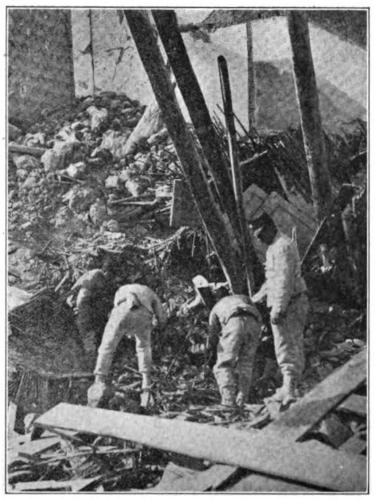
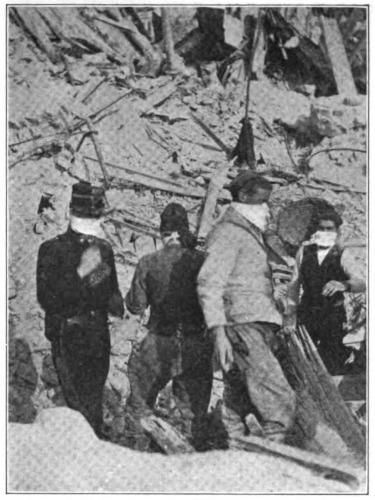
Italian Soldiers Disinterring a Corpse in the Ruins
of the Old Consulate.
Bearing Corpses Down the Corso Principe Amedeo.
The problem of the refuges, then, was less to make them more
comfortable than to abolish them as soon as possible and in the meantime
to compel cleanliness and induce work among the inmates. But
there was a scarcely less difficult and more elusive problem connected with
the thousands of refugees scattered about the town in private houses,
living in the garrets and stables. Many of them were skilled laborers of
various kinds; not a few belonged to families of merchants or professional
men and to the well-to-do classes. Their destitution was as complete,
of course, as that of the rest, and the relief awarded to them was
the same—a daily loaf of bread. Some of them were rich, if they could
only find their evidences of wealth. To enable them to do this, and to
support them meanwhile, the Catania business men had formed an association
to which we were glad to be able to make a small contribution.
The general impression created by our visit to Catania was that of
a problem too vast, too complicated, too closely connected with the habits
and temperament of the people for any outsider to solve. To “rehabilitate”
these thousands of peasants, artisans, professional men, merchants, landed
proprietors, would require a carefully matured plan, which must proceed
from the central authorities. But meanwhile, until the plan should be
matured, there was ample scope for beneficent foreign intervention, and
the most useful way to intervene was also the simplest—by direct money
gifts, not indeed to individual refugees, but to the local relief bodies
already organized by Italians. It was not necessary or even advisable
to make large donations to the central authorities of each place. The
system was already rather too much centralized than too little, as the
authorities were the first to recognize. Far from being jealous of direct
donations to the subordinate or independent institutions, they welcomed
anyone who would investigate the various needs, and give help when
help was most wanted. It appeared to us that the best way to dispose
of American money was to entrust it to an agent on the spot, who should
travel up and down the coasts of Sicily and encourage every well-directed
movement by immediate money gifts. In time such movements would
no doubt receive help from Rome; but in the meantime ready cash from
unofficial sources might make the difference between success and failure.
The Bayern spent three days at Catania. During that time I made
a trip of investigation to Syracuse. Here the refugees numbered only
3,000—one-eighth of the number at Catania; but 900 of these were hospital
patients. Syracuse, too, has only one-seventh of Catania’s population.
Its hospital accommodations at the time of the earthquake were
for one hundred patients. If Syracuse had succeeded better than any
other place in mastering the difficulties of the situation it was not because
the difficulties were insignificant. Syracuse was fortunate in a Prefect
and a Mayor of resource and capacity; in an unusually efficient body
of volunteer workers, with one woman of great ability at their head; and
in the fact that the importance of the work, as a moral and mental tonic
for the refugees, was realized from the very beginning. Syracuse was
the first place where refugees were set to work. The credit for this is
due to an American, Miss Katherine Bennett Davis, head of the New
York State Reformatory for Women.
When Miss Davis first thought of employing refugee women to
make clothes for the hospitals, relief work at Syracuse was just emerging
from a state of chaos. Four hospitals had been equipped after a fashion
for the reception of patients. The Municipal hospital was already in
good running order, through the efforts of Signor Broggi-Reale, head
of the local Red Cross; the Archbishop’s palace was being rapidly transformed
into a second hospital by a number of ladies; at the big barracks
conditions were more primitive until the arrival of a splendidly equipped
expedition of the German Red Cross. Most of the hospitals were short
of blankets; all needed sheets, and all were entirely unsupplied with
clothes for the patients. Of the two thousand able-bodied refugees, eight
hundred were maintained aboard the steamship Nord Amerika; the rest
were scattered about the town. A woman’s branch of the Red Cross
was being organized by the Marchesa di Rudini, whose activity covered
every branch of the work of relief and extended beyond the confines of
Syracuse, to all the towns of the province. Her position as wife of one
of the largest landowners of the province and daughter-in-law of Italy’s
lamented premier; her independence of any particular organization; her
skill and tact in uniting individuals and parties made her the most influential
person in Syracuse. To her is due more than to anyone else
the excellent organization of the Syracuse relief work.
Miss Davis was in Sicily in order to rest. The funds at her disposal
amounted to six hundred lire only. But she saw an opportunity to help
in the moral regeneration of the refugees and at the same time to supply
one of the most pressing needs of the city. She went to the mayor and
offered to employ refugee women in making clothes for the hospitals.
Like everyone else, the Mayor had been told that the refugees would
not work; but unlike everyone else, he decided to make the experiment.
He gave Miss Davis two of his own rooms in the Municipio, supplied
her with sewing machines, and promised to furnish all the necessary
materials. She opened her shop on January 8th and soon had fifty women
at work.
Miss Davis was not alone in her labors. Besides the support of the
officials and of Madame di Rudini, she had the direct assistance, from
the first, of Mrs. Musson, wife of the British clergyman, and later of
Mrs. Sisco, of Florida. When gifts of money from the American Red
Cross and from the Committee of the Bayern enabled Miss Davis to found
a second workshop at Santa Lucia, the quarter of Syracuse situated on
the mainland, Mrs. Musson became its manager. To supplement her
own scanty knowledge of Italian, Miss Davis employed as interpreter
and paymaster an English resident of Messina, Miss Smith, who had
escaped from the earthquake without any of her belongings beyond what
she could carry. The Syracusan ladies took an active interest in the
workshops; two of them, the Baronesses del Bosco, whose principal work
was in the hospitals, found time nevertheless to give much of their attention
to Miss Davis’ work, and assisted her particularly in the cutting-out
department.
The workshops were a success from the beginning. Under Miss
Davis’ unceasing supervision the women showed no tendency to idleness.
A piece wage which would have put the unskillful and the beginners at
a disadvantage was not found necessary; the women were paid by the
day, one lira and a lunch of bread, cheese and wine. The question naturally
suggested itself, could not the men also be induced to work? And
could not their work be made to contribute, like that of the women, to
supply their own wants?
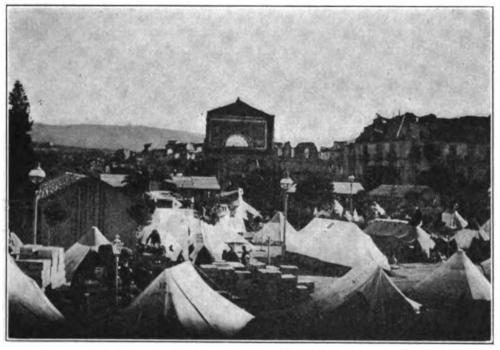
Refugee Camp in the Piazza Vittoria.
Miss Davis had now the money to carry out her plans. But she
had to face a new difficulty—the jealousy of the local artisans, who resented
any influx of labor. Miss Davis began with the shoemakers because
shoes, next to underwear, were the articles of clothing most needed
by the refugees. She found a number of shoemakers among the refugees.
These she induced the local shoemakers to employ by offering the following
advantageous terms: The local man was to supply the materials
and tools and to receive the price of the product, which Miss Davis
promised to buy. She was also to pay wages to the refugee worker.
Thus the refugee was employed, the local shoemaker profited and the
stock of shoes was increased. At a later date Miss Davis found employment
for all the carpenters, masons and painters among the refugees
by paying them to complete a large two-story building, of which only
one story had been built. When finished the building became an orphan
asylum for seventy-five refugee children. The money for this work was
furnished by Mr. Billings out of the Massachusetts funds.
So far only skilled laborers had been employed. But the persons
who most needed work, those who deteriorated most rapidly when idle,
were the common unskilled laborers belonging to the lowest classes. Even
in their normal condition nothing but hunger would induce these people
to work; now they were fed and were in a state of moral inertia. Miss
Davis’ proposal to the Mayor to employ a squad of sixty day laborers
in improving the roads seemed almost certain to fail. The Mayor, however,
decided to make the attempt; he was to supply tools, materials and
supervision; Miss Davis was to pay the wages. Once more the unexpected
happened; the men worked moderately well at first, then better
every day. In a short time all traces of idleness and discontent had disappeared.
From the point of view of actual achievement and also of example
Miss Davis’ feat at Syracuse seems to me the most important single
contribution to the problem of rehabilitating the sufferers from the Messina
earthquake. Her efforts were not limited, however, to giving employment.
With funds allotted by the Bayern Committee she opened
a pension or home for forty-two refugees of the better class, giving
preference to convalescents from the hospitals. Here for the first time
the refugees found soap, brushes, combs, clean clothes, all the articles
of first necessity of which they had been deprived since the earthquake.
The home was so successful that the Marchesa di Rudini devoted most
of the American money which had been given her, to spend at her discretion,
to founding two similar institutions at Nolo and Avola, small
towns of the province of Syracuse. These homes the Prefect of Syracuse
promised to support out of Government funds when the original donations
should be spent. In Miss Davis’ home at Syracuse the moral health
of the inmates was never forgotten. Before the home had been opened
a fortnight the women among the inmates were busy making clothes,
voluntarily and without pay, for less fortunate refugees. Every scheme
of Miss Davis served a double end—practical utility and moral rehabilitation.
Upon my return to Catania I found the Bayern ready to start for
Reggio. During her stay she had not only dispensed relief to Catania
and the environs, but had also supplied the wants of the Taormina and
Giardini hospitals.
Of our second visit to Reggio I need say little. It was the saddest
place of any, perhaps; nowhere else were the inhabitants plunged in
such a state of complete dejection. There were no adventurers or imposters
at Reggio: only the remains of families, sitting or standing mournfully
among the ruins of their own homes. There was no danger in giving
money to these people; their need was too obvious, their distress too
genuine. We distributed our cargo, gave what help we could, paid a
second visit to Messina and after two days proceeded to Palermo.
Conditions at Palermo were only less desperate than at Catania.
The refugees numbered about 11,000, of whom about 900 were in the
hospitals. Nearly all of the remainder were in refuges, very few having
been taken into private houses. All the barracks, the prison, half the
schools, several convents, several theaters, and even a number of churches
had been turned into refuges, of which the largest held as many as a
thousand inmates. The city is larger than Catania, with more wealthy
residents; it was therefore better off in many respects. But it suffered,
like Catania, from the want of money from the outside, from the scarcity
of intelligent workers, and from the particular dangers connected with the
refuges.
I have already described the refuge system. If work is necessary
for all the refugees, it is particularly necessary for those who live in
these large communities. At Palermo their idleness had already turned
to dangerous discontent. They complained constantly of their treatment,
but refused to leave the refuges. No work for them had been organized
when we arrived at Palermo. Enlightened by Miss Davis’ example,
we immediately offered money for the institution of workshops on the
same model as hers. The idea met with general approval. A beginning
was made at once in one of the barracks and in the prison. Mr. Bishop,
the American Consul, to whom we handed over the money for the enterprise,
labored energetically to broaden the basis and extend the scope
of the work. In a few days a ladies’ committee, of which the president
was Mrs. Bishop and the vice-president Countess Mazza, wife of the
General in Command at Messina, had founded workshops in five of
the principal refuges, and another refuge, the Caserna Garibaldi, was
organized on the same system by a parish priest, Father Trupiano, with
the approval of the Archbishop of Palermo. According to the latest reports
the Palermo workshops have been a success, like those of Syracuse.
Some concessions had to be made to the inferior moral condition of the
workers at the time when they were first employed. For instance, they
had to be paid by the piece instead of by the day. But they have not
proved idle on the whole, and such work as they have done has contributed
directly to a most important object—the increase of the supply
of clothing. Even if the Bayern committee had not been able to distribute
1,200 mattresses and 15 tons of food at Palermo, or to assist the
municipal charities, their short visit of eight hours to the city would
have been amply justified by the foundation of these workshops. With
the cruise of the Bayern ended my direct participation in the work of
relief. I have only a second-hand knowledge of the many other undertakings
of the American Red Cross in Italy. But I have seen enough
to have formed a few general opinions which may have a certain interest
for Americans who have contributed to the various relief funds.
The Italian government and the Italian Red Cross found themselves,
within a few days of the earthquake, in possession of enormous sums of
money. As the government had the sole access to the afflicted districts
and the sole authentic information about their needs, it was to the government
that all contributions, Italian and foreign, were naturally sent.
But there were several reasons why the government could not immediately
turn that money over to the persons who most needed it or who could
use it best.
In the first place, every consideration had to give place during
the early days before the imperative necessity of transporting troops to
the scene of disaster and of supplying them with the necessary food
and equipment. In the second place, government funds are always particularly
hard to protect from the suspicion of maladministration. The
Italian government may have remembered criticisms of the way in
which former funds had been distributed: at any rate, it determined on
this occasion to exercise all possible vigilance to prevent the waste or
misappropriation of a penny. The distrust of the Sicilians, traditional
in upper Italy, may have increased the tendency to send supplies rather
than money, and to give all orders from a single central source. In the
third place, the temporary feeding and clothing of the destitute was a
very small part of the total relief problem. The end which the contributions
must ultimately subserve was to restore the refugee population
to some kind of normal life, not merely to keep them alive for a
few months. But how to effect their rehabilitation was a question which
could not be answered until many things were known; their numbers,
for instance, the possibility of rebuilding the ruined towns, the amount
of property recoverable, the condition of the harbors, channels, docks—a
hundred facts which only time could reveal. Whenever a general scheme
should be devised, vast sums would be required for its effectuation: till
then it was important not to disperse the accumulating contributions.
This policy of prudence and circumspection, admirable as regards an
ultimate settlement, was defective as a means of relieving immediately
the wants of scattered localities spread over two large and more or less
inaccessible regions. What was wanted in order to supply so many needs
in so many places was a system of extreme decentralization, with large
funds at the unfettered discretion of individual agents. Such a system
was incompatible with the rigid supervision of expenditure which the
government felt to be necessary. It could not be adopted by the government.
But precisely for that reason it could be adopted with advantage
by independent and especially by foreign relief societies. By giving all
their contributions to the Italian central committee they would indeed
be helping in the general plan of rehabilitation which the central committee
was evolving, but they would not be doing the task for which
they were especially fitted and from which the central committee was
to a large extent excluded. If, on the other hand, they entrusted their
funds to agents in Sicily or Calabria, whose duty it should be to investigate
every town and every institution and to help quickly the most
useful and the most needy organizations, they would be doing what no
one else could do so well, and what no one else had done at all.
The objection to such a policy was the risk of giving just offense
to the Italian government and people by interfering in what was essentially
an Italian concern—a problem of internal administration. Such
an objection appears to me to rest as a misconception. The Italians
might well resent, and would very likely have resented, any interference
which took the form of independent relief organizations, with direct
pecuniary assistance of individuals. As a matter of fact, the German
Red Cross hospital at Syracuse was an organization of this kind and it
aroused nothing but enthusiasm. A hospital, however, is not like a distributing
agency. What the Italians would have objected to, and rightly,
would have been any attempt on the part of foreigners to decide Italian
questions; how a given body of men should be employed, where certain
orphans should be sent, what families should first be assisted; or to set
up independent relief bureaus to which individuals might apply, thus
duplicating or confusing the work of the Italians and opening an easy
way to imposters. But there could be no objection, and there was none,
to selective gifts by foreigners to Italian institutions. Such distributions
could not possibly conflict with the official scheme of relief, for all the
charitable institutions of every city were under the control of the prefect
or of the mayor. Certainly during my experience in Sicily no hint
was ever given that gifts to the hospitals, refuges or volunteer committees
were less acceptable than gifts to the prefect or the mayor. I
think it is safe to assert that neither the Bayern nor any other American
relief expedition in Sicily or Calabria has at any time given umbrage
to any local authority. The central authorities at Rome, meanwhile, have
done everything to assist and encourage the independent American expeditions.
The Bayern was organized according to the advice of the government
and with its approbation. Mr. Billings, before starting for Sicily
to distribute the Massachusetts funds, consulted with several of the Italian
ministers, with the head of the Central Committee, and with the President
of the Red Cross. Mr. Gay and Mr. Dodge were accompanied on
their trip to Calabria by an officer of the General Staff, and were recommended
directly by the Ministers of War and of the Navy to the commanding
officers of the different stations. The aim of the Americans
has never been to act independently of the Italians, but simply to put
at the service of the Italians their eyes and brains as well as their money.
Americans who have contributed to the relief funds of the American
Red Cross or directly to Italian funds can be satisfied that such part
of their donations as went to the Italian central authorities will be spent
with scrupulous probity in furtherance of a carefully considered and well
matured plan of permanent rehabilitation, and that such part as was
given by American agents has gone quickly and efficiently to the places
where it was most needed, without any interference with the management
by Italians of their own internal affairs. The problem is still in
its early stages. The populations of the destroyed cities are not yet
housed; the refugees are still living idly in the great towns. But that
is an Italian, not an American question. We can be satisfied, it appears
to me, with the system by which our money has been distributed hitherto,
and be content to apply it to the future contingencies. That system has
been for the American Red Cross to find out, through the American
Ambassador at Rome, the exact needs of the Italians, as expressed by
the government, and then to assign its needs for the enumerated purposes,
giving a part to the central Italian authorities and a part to the
Ambassador. What the Ambassador has received he has divided between
central institutions and the relief of local needs. He has kept in touch
directly with all the afflicted regions, through the consular corps, through
special agents and through the reports of workers, and he has at the
same time been in daily communication with the heads of all the official
distributing committees. In this way he has been able to gauge accurately
the needs of the situation. Certain American gifts, like the shipment
of the three thousand houses, and the foundation of an agricultural
school for one hundred children as a part of the Queen Elena Patronato,
have produced a profound impression throughout the length and breadth
of Italy because they have corresponded exactly to the necessities of
the moment.
Americans, then, need have no misgivings about the administration
of their donations. Italy cannot repair in a day the effects of so vast,
so overwhelming a calamity as the Messina earthquake; the wound is too
deep to heal quickly. Those only who have seen the misery which bows
down the inhabitants of Sicily and Calabria can realize the tragic helplessness
of all human succor. We must have patience till a way is found.
Our nation can rest satisfied meanwhile that their generous offerings
have directly and sensibly alleviated sufferings and kept hope alive, and
they can rejoice in the opportunity which has been given to them to repay
in part America’s and the world’s immeasurable debt to the land and people
of Italy.
Milan, Italy, February 20, 1909.
RED CROSS RELIEF SHIP “BAYERN” — PURCHASE OF SUPPLIES — PERSONNEL OF THE EXPEDITION. — RELIEF FACILITIES. — MESSINA. — REGGIO. — CATANIA. — PALERMO. — RETURN OF THE “BAYERN.” — DISTRIBUTION OF SUPPLIES AND MONEY BY “BAYERN.” — DISTRIBUTION OF CASH. — KIND AND QUANTITY OF SUPPLIES.
BY LIEUTENANT-COMMANDER REGINALD R. BELKNAP United States Navy
Rome, January 19, 1909.
Directly after the news reached Rome of the magnitude of the disaster in
Southern Italy our American Ambassador, Mr. Lloyd C. Griscom, organised
a committee of prominent American men in that city for the purpose of assisting
the Italian Government, Red Cross and National Committees in the immense
work of relief that required all the aid human sympathy at home and
abroad could provide. The fact that Messina was in Sicily; that the railroad
service had been seriously disorganised, and that the necessity of moving
troops to the scene of the disaster would largely employ what trains and what
lines were still available, led to the prompt conclusion that aid must be sent
mainly by sea. Acting under this conviction, the American Committee chartered
and equipped the steamer Bayern—a few of the members guaranteeing the
necessary amount so as to lose no time, while waiting to hear from Washington
if the American Red Cross would provide the $100,000 necessary for this purpose.
This our Red Cross, on receipt of Mr. Griscom’s cable, immediately consented
to do. Just sixty hours after this ship was chartered it entered the
harbor of Messina, under the command of the American Naval Attachè at
Rome, Lieutenant-Commander R. R. Belknap, U. S. N.
Fifty-eight thousand dollars in a few hours’ time had been expended for
the medical outfit, provisions and clothing, particular attention having been
paid to the selection of food for little children.
Before leaving on the Bayern Mr. Griscom was received by King Victor
Emmanuel, and notified His Majesty and the Minister of Foreign Affairs,
Signor Tittoni, who was present, that the steamer would fly the Red Cross
emblem. Both the King and the Minister remarked that his was an admirable
example to the world of international fraternity for the Geneva Flag to fly over
a ship carrying aid from one country to another in a period of disaster.
The following interesting report, somewhat abbreviated as to details, has
been received from Lieutenant-Commander Belknap, to whose ability, conscientious
work, deep interest and constant energy the American Red Cross is
greatly indebted for the success of this expedition.—Editor.
I have the honor to submit the following report of the cruise of the North
German Lloyd Steamship Bayern, which was chartered and fitted out at
Genoa by the American Red Cross, through the American Relief Committee
in Rome, and sailed from Civita Vecchia on January 7, with the Committee’s
expedition on board, to render aid at Messina, Catania and other
places in Sicily and Calabria to sufferers by the earthquake of December 28,
1908:
On Monday, January 4, about 6 P. M., the Bayern was engaged, to sail
in 36 hours (afterwards changed to 4 P. M., Wednesday, without actual loss
of time to the expedition), provisioned for 50 first-class passengers for 15
days and 1,000 steerage for 10 days; she was to carry a steam or motor launch,
and every effort was to be made to expedite her loading and sailing on time.
To the American Consul-General in Genoa, Mr. James A. Smith, the Committee
sent the following telegram at midnight, Monday:
American Consul, Genoa:
American Committee for relief work, Calabrian Coast, has chartered
German Lloyd steamer, Bayern, now in Genoa. You personally
urge agent make every effort get steamer off Tuesday night, fifth
instant, and arrive Civita Vecchia early Wednesday afternoon; also
arrange with steamer agent to purchase at Committee’s expense and
load on Bayern for relief distribution large quantity pasta flour, stockfish,
tinned milk and also especially all available sterilized milk, biscuits,
olive oil, hams, onions, sausages, beans, potatoes, salted pork,
cheese, lard, chocolate, beef extract in jars or tins, macaroni, sugar,
also 500 each blankets, trousers, coats. To cover these purchases
draw on American Relief Committee Fund Banca Commerciale Italiana,
Rome, up to 25,000 lire for food and 10,000 for clothing. Absolutely
necessary that steamer have a motor or steam launch on board
and other boats suitable for landing along the coast, as this is the main
purpose of the expedition. Committee depends upon your active interest
to forestall any delay of ship. Report progress Tuesday noon.
(Signed) GRISCOM, Chairman Committee.
Next day, Tuesday forenoon, the amount allotted to Consul-General
Smith for purchases in Genoa was increased to 85,000 lire. A very satisfactory
report came from him that afternoon, saying that the Bayern would surely be
ready for us at Civita Vecchia by eight o’clock Thursday morning.
Definite arrangements were now made for the transportation of the expedition
and the Rome purchases to Civita Vecchia. This matter was placed
entirely in the hands of Mr. Stein, the well-known Spediteur. The Italian
Government placed every facility at the service of the expedition, both on the
railway and at the port of Civita Vecchia; and the Navigazione Generale Italiana
also instructed its agents there and at all other ports to afford us every
assistance, at the same time giving me a letter of the same purport to present
to their agents, if necessary. With the way thus cleared, Mr. Stein was able
to carry out his part with entire satisfaction and in good time, notwithstanding
that Wednesday, the day when innumerable packages and cases had to be collected
from shops scattered all over Rome, was a fiesta. Much credit is due
Mr. Stein for his success in this.
During the final meeting of the Committee, before the departure of the
expedition, about six o’clock Wednesday evening, word was received from
Mr. Anniser that the Bayern had sailed from Genoa at 4 P. M. Thursday
morning, at 9.30 the expedition left Rome by special train, reaching Civita
Vecchia at 10.55. The Sub-Prefect, the Sindaco and the captain of the port
met the party and conveyed them on board the Bayern. Mr. Anniser, the
steamer agent, had come down by earlier train, and with the local agent of the
Navigazione Generale Italiana was attending to all remaining to be done before
departure of the steamer; the loading was progressing satisfactorily, and
expected to be completed in time for sailing at 4 P. M.
Dr. Bastinelli was not to accompany the expedition, but he had come down
to the ship to advise with Dr. Scelba, chief medical officer of the expedition,
and the ship’s doctor as to the best disposition of the space available for
hospital arrangements. It was decided by them to keep the medical departments
of the expedition and of the ship entirely separate, with the exception
of taking the two rooms allotted as ship’s hospital for use as isolation rooms for
any infectious cases that might develop. The necessary work of arrangement
recommended by the doctors was immediately undertaken.
Officers and Passengers Aboard the “Bayern.”
Directly on coming on board I conferred with Mr. Anniser, the agent, and
Captain Max Mitzlaff, commanding the Bayern, coming to the necessary understanding
as to the control and management of the vessel and work of
various kinds. Captain Mitzlaff promptly grasped the situation, and from the
first moment did all in his power to forward the work of the expedition. He
never made an objection; often suggested improvements that I was glad to
adopt; and what was most important of all, he communicated his own zeal
and interest throughout his entire ship’s company. Our relations throughout
were most cordial, and I feel that we were most fortunate in having Captain
Mitzlaff in command of the ship.
All guests were started ashore at 2.30 P. M., and loading was completed
at 4. The captain of the port very kindly procured for us three small boats
against the need of landing on an open beach, for which the ship’s boats were
less suitable, and at 4.07 the Bayern sailed.
Representatives of the American Committee on board—Mr. Griscom,
American Ambassador and chairman of the Committee; Lieutenant-Commander
Belknap, U. S. Navy, Naval Attachè at Rome; Mr. William Hooper, of
Boston; Mr. H. Nelson Gay, of Boston and Rome.
Executive Organization on board—Lieutenant-Commander Belknap, in
charge of the expedition; Mr. Gay, in general charge of arrangement and
distribution of supplies; Mr. Hooper, recorder, treasurer of the expedition
and in charge of the afterholds.
Assistants—Mr. Weston R. Flint, cashier, and in charge of the forwardhold;
Mr. Wilfred Thompson, supplies accounts and records of deliveries;
Mr. John Elliott, interpreter, assistant in afterholds and elsewhere; Mr.
Robert Hale, assistant in forwardhold; Avvocato Girodana, interpreter,
clerical work and translation, assistant with handling supplies, aide to
Lieutenant-Commander Belknap.
Medical Department—Dr. Cesare Scelba, Chief Medical Officer, in general
charge; Dr. Guido Egidi, Dr. Paolo Alessandrini; Miss Mary H. Lawrence,
head nurse; Miss Amy Claxton, second nurse; Miss Helen M. Moir, Miss
Frances E. Nelson, Miss Emily A. Tory, Miss Mable W. Shingleton, duty
nurses; Emma Niccolucci, head of Italian women nurses; women nurses,
Schiarmi, Negri, Consolati, Manganelli, Antinori; Lanzi, head of Italian men
nurses; men nurses, Neuci, Perfetti, Tondinelli, Guardabassi, Cascapera.
The Committee of the “Bayern.”
Comdr. Belknap and Messrs. Hooper (of Boston) and Gay (of Boston and Rome).
Additional, not permanently with the expedition—Mr. Earle Dodge, Jr.,
embarked at Civita Vecchia and worked industriously in the forehold for the
two days that he was on board. Mr. W. Bayard Cutting, Jr., American Vice-Consul
at Milan, on special duty in Sicily, came on board at Messina, and continued
from that time in close co-operation with the Committee to the great
advantage of the prosecution of the work of the expedition. Mr. Winthrop
Chanler came on board at Messina and remained until the second day at
Catania, rendering very useful service for which his experience and knowledge
of general and immediate conditions in the locality were valuable.
A few general orders were given, cautioning against the use of matches
and smoking below decks; to report when orders had been compiled with; to
apply for assistance from the ship only to the first officer or Lieutenant-Commander
Belknap and the like. Simple arrangements were drawn up and
posted also for stations for “Fire and Abandon Ship.”
Immediately on getting under way to Civita Vecchia, the work of arranging
our supplies began, so that we might know what, how much, and
where to lay our hands on everything. Fortunately, good weather favored us;
the work continued in the forehold until 10 P. M. on Thursday, and went on
all over the ship next day, so that by 4 P. M., when Messina was sighted,
we were in all respects ready.
Only a few hours from Civita Vecchia we narrowly missed a serious
handicap, Mr. Gay having a bad fall in the hold, breaking a rib. The loss of
one who combined the best knowledge of what was included in our outfit, with
tireless energy in getting it systematized, would have imposed a delay very
unpleasant to contemplate, but, happily, Mr. Gay was the only sufferer by this
accident, as he kept at work the same as before.
Summarizing, the Bayern’s relief facilities were:
1. Immediately available for sick or wounded, 105 berths; additional
berthing space available under proper shelter, 55 berths—total accommodations
suitable for sick with comfort, 160 berths.
2. Supplies, in considerable quantity, of clothing of all kinds, shoes,
blankets, sheeting, provisions, cooking and table utensils, picks, shovels, tools,
oil stoves and fuel, lanterns, candles, matches, cordage, tenting canvas, chocolate,
tobacco, and many other miscellaneous articles.
3. Money for relief distribution, amounting to 150,000 lire.
4. Accommodation for 1,000 steerage passengers.
Sailing from Civita Vecchia at 4.07 P. M. Thursday, the Bayern arrived
at Messina at 5 P. M. Friday, flying the American Ensign at the fore, the
Red Cross on the triatic stay between foremast and funnel, and the German
merchant flag aft. As we stood in, international signal was made “Have on
board American Ambassador.”
The ship was boarded by an officer from the captain of the port’s office, to
whom was given a detailed statement of supplies available.
About 9 P. M. General Mazza, in chief command of the military forces
in the Straits, having returned to his headquarters on board the steamer
Duca Di Genova, the American Ambassador, accompanied by Vice-Consul
Lupton; Lieutenant-Commander Belknap, U. S. N.; Major Landis, U. S. N.,
and Mr. Elliott, as interpreter, visited the General, explaining the nature of
the expedition, its approval by the King of Italy and the readiness of everything
on board for disposal as General Mazza might direct. General Mazza
expressed his warm appreciation of the offer and the spirit that had prompted
it, and recommended that the ship proceed to Catania and Palermo, possibly
also to Syracuse as these places had received many sick, wounded, and
refugees, but so far no help in proportion to their needs. At Messina the situation
was well in hand, and supplies were already available, sufficient for all
requirements.
The next day, Saturday, the Ambassador and others of the expedition
visited Messina, and during the course of the day landed several boatloads
of supplies for the American Consulate’s distribution there. The sum of 1,000
lire was also given to the archbishop.
At nine o’clock the U. S. S. Connecticut, flagship of Rear-Admiral C. S.
Sperry, U. S. Navy, Commander-in-Chief of the U. S. Atlantic Fleet, came
in and anchored. After a conference between the Ambassador and Admiral
Sperry, it was decided that the Bayern and the Culgoa should co-operate in
relief work along the coast. The Ambassador, accompanied by Mr. Dodge,
then quitted the Bayern, embarked in the Connecticut, and sailed in her at
5 P. M. for Naples.
Mr. Cutting and Mr. Chanler here joined the Bayern.
Digging in Ruins for Bodies at Messina.
(Photo by S. H. Chapman.)
About the time of the Connecticut’s sailing, staff officers from General
Mazza and Rear-Admiral Viale, Senior Italian Naval Officer present, called
on board the Yankton and Culgoa to state that supplies would be welcome at
Reggio as well as at Catania. Lieutenant-Commander Patton and I, therefore,
arranged to proceed to Reggio together next morning; and for easier communication
between us, he lent the Bayern a signalman and two wireless
operators from the Culgoa, who rigged up a small improvised wireless set
over night.
Sunday morning we left Messina about seven o’clock, reaching Reggio di
Calabria about 8.30. We were unable to see General Mazzitelli, as he was
ill, but Captain Cagni, commanding the Napoli, Senior Italian Naval Officer
present, received us in his stead. He showed much satisfaction in having our
supplies to draw upon, especially for women’s and children’s clothing, shoes,
oil stoves, tent canvas, cooking and table utensils, tools and nails. About four-fifth
of the Napoli’s crew had been sent away on relieving expeditions among
the outlying small villages, and our supplies were in good time for use in a
second expedition which was being prepared.
There were no sick or wounded needing to be cared for on board, nor any
refugees to be sent; but we were cordially thanked for our offer of these
facilities, as well as for our supplies. The latter made about 25 tons, in four
boatloads, which we were able to transfer that afternoon. The Bayern then
returned to anchor over night at Messina, there being no good berth at Reggio;
the Culgoa remained off Reggio to deliver provisions next day.
Red Cross Camp at Reggio.
(Photo by S. H. Chapman.)
Monday at 6 P. M. we left Messina for Catania, arriving at 10.30 A. M.
We were immediately boarded by an officer from the battleship Garibaldi, with
the compliments of Rear-Admiral Gagliardi, commanding the second division of
the Naval Force of the Mediterranean. The Admiral offered us any assistance
we might need; and when I made an official visit to him that afternoon he
inquired with much interest about all that could be learned of the situation at
Messina and Reggio, and about the expedition. He very kindly made it well
understood that we had only to ask to obtain any assistance at his disposal—an
offer that I was glad to avail of, for men to assist with handling supplies,
transmission of telegrams by wireless, and service of boats. The Admiral
returned the visit next day, inspected the ship with evident interest, and expressed
his approval of her organization and arrangements, especially in the
medical department.
As soon as the Bayern was moored inside the mole of Catania harbor,
Lieutenant-Commander Belknap, accompanied by Vice-Consul Cutting, Dr.
Scelba and Avvocato Giordana, called upon the Prefect Commendatore P.
Ferri and the Sindaco, Signor S. Consoli, placing the ship and her equipment
entirely at their disposal. We were welcomed and thanked with the greatest
cordiality, and in the afternoon, when the Sindaco, with Madame Ferri,
Baronessa Zapalla, and a number of other ladies and gentlemen prominent
in relief work came on board, he made a speech of thanks, and presented the
following letter:
Catania, January 11, 1909.
Commune di Catania:
With pleasure I express to you, gentlemen, and to all the expedition
of the American Red Cross, embarked on board the S. S. Bayern,
the heartiest thanks of the population of Catania and of the refugees
and wounded who have found here a shelter, for your generous offer
of medicines, clothes, food, etc.
The relief brought by you will be effective to lessen the sufferings
of so many wretched people, who have been deprived in a few
moments of their relatives, of their beloved native town, and of
every possession.
With esteemed consideration,
The Mayor,
S. CONSOLI.
To Signor Reginald Rowan Belknap, Lieutenant-Commander, Naval
Attachè to the Embassy of the United States of America in Rome.
To this the following reply was sent, both letters being published in the
local papers:
Expedition of the American Red Cross,
Steamship Bayern, Catania, January 12, 1909.
To the Mayor of Catania:
In response to your gracious letter conveying the thanks of the
citizens of Catania for our offer of assistance, I have the honor, in the
name of His Excellency the American Ambassador, and also of the
American Red Cross, to express to you the sincere friendship and
heartfelt sympathy which all our countrymen feel for this beautiful
land and its people, especially in this time of sorrow.
To have relieved in some small measure the distressing needs of
those we love is a cherished privilege, and the gratitude which you
have sent to the United States will carry there widespread thankfulness.
With distinguished consideration,
R. R. BELKNAP.
Lieutenant-Commander, Naval Attachè to the American Embassy,
Rome, in charge of the American Red Cross Expedition.
The party which came on board that afternoon inspected the ship and
were much pleased with the comfortable, spacious arrangements for the sick,
and our outfit and arrangement of supplies. Some light refreshments were
served on deck, causing one of the ladies to remark that they were enjoying
this visit very much, their first respite since the earthquake.
The Prefect was unable to come on board the day of our arrival, but he
did come Tuesday morning. I took this occasion to inquire particularly about
our taking refugees, to which he replied in the negative, saying that the
refugees did not wish to leave Sicily, as a rule, and that the authorities and
people at large did not wish to have them go. Accordingly it was definitely
determined that we should take none; and the order was shortly given to
knock down the steerage bunks, and add the lumber to that which we were
going to land at Reggio.
We discharged at Catania the greater part of our cargo, finding that
large quantities of our supplies would be put to immediate use. Medical
supplies, moderate amounts of clothing, milk and provisions were given direct
to the three hospitals, but the bulk of what was landed was turned over to the
Ladies’ Committee, in charge of clothing distribution, and provisions, medical
and miscellaneous supplies to the Municipal Committee, as requested by the
authorities. Then, as it was believed that a small amount of ready money could
be more conveniently applied by the authorities concerned than by anyone else,
Mr. Hooper, the treasurer, delivered 1,000 lire to each of the hospitals; 5,000
to Madame Ferri for application to individual cases needing relief other than
an immediate supply of clothing and food, and 25,000 to the Prefect for disposition
at the discretion of the committees having the relief work in hand.
A Ruined Street in Reggio.
(Photo by S. H. Chapman.)
Tuesday morning a committee, consisting of Miss Mabel Hill, Fraulein
Gasser, Mr. Charles King Wood and Mr. Harry Bowdoin, came on board from
Giardini and Taormina with a letter from the Mayor of Giardini. Upon their
representation of conditions in their district, work already done and still in
hand, and cases of need still unrelieved, about twenty tons of clothing, shoes,
blankets, provisions, medical dressings and miscellaneous articles were given
into their care for shipment by rail, and 10,000 lire to be spent at the discretion
of this committee in their work at these two places. We also sent, with this
shipment, all clean bed linen remaining on board, since it was now evident that
our reserve for patients would not be required.
The services of a nurse were also wanted at Taormina and Giardini, and
Miss Claxton was sent with this party on their return there, with the understanding
that the American Red Cross Committee would be responsible for
Miss Claxton’s expenses and her return to Rome. A letter has since been
received from Miss Claxton, saying that she is engaged as a district or visiting
nurse, and that all the supplies sent have proved very useful.
A further sum of 10,000 lire was entrusted to Messrs. Kin and Bowdoin,
both of them members of the American Red Cross, who undertook to arrange
for the expenditure of this money for the relief of the small villages outside of
Giardini and Taormina, between there and Messina, and to account for it to
the American Red Cross through the American Ambassador.
In response to an appeal from Acireale, Mr. Gay made a personal visit
among the relief workers there, after which some clothing and other supplies
and 5,000 lire were delivered to them. To the Little Sisters of the Poor 1,000
lire were given for their immediate assistance. A few bundles of clothing were
sent by rail to Messina, in care of Mr. Chanler, in response to a wireless
message from the U. S. S. Yankton. There were several other cases acted on
at Catania, as shown more in detail in the secretary’s report.
While lying at Catania, knowing that lumber was needed at Reggio, Mr.
Flint was sent ashore on Wednesday morning to buy such quantity as we could
get on board that day. Lighterage facilities were very scarce, as many steamers
were in the harbor discharging; but by the persistent efforts of the German
Vice-Consul, Mr. Jacob Peratoner, who very kindly devoted almost his entire
day in our behalf, we succeeded in getting on board enough lumber to build
25 houses, 13 × 13 feet, complete with floors.
On Wednesday afternoon Madame Ferri, escorted by Marchese di San
Juliano in his automobile, took Lieutenant-Commander Belknap, Dr. Scelba,
Avvocato Giordana and Mr. Elliott on a tour of the hospitals and some of the
refuges, in one of which alone 780 were then quartered. By this date, of
course, sixteen days after the earthquake, all was in good order and organization
as far as circumstances and available means would permit; to see so
much suffering and misery, among people of all conditions of life formerly,
was extremely affecting; but also it was impressive to note how much had been
done for their needs and comfort, and particularly to mark the affectionate
gratitude which these poor refugees demonstrated for their benefactress, who
seemed to have become familiar with the details of nearly every case.
The Prefect and Admiral Gagliardi, after we had sailed the next morning,
united in sending us a farewell message by wireless, as follows:
Signor Reginald Rowan Belknap,
On board Bayern, Reggio, Calabria.
With our hearts still vibrating with gratitude and admiration for
the work of fraternal solidarity and beneficience accomplished by you,
Mr. Commandant, together with your representatives of the American
Red Cross, we again repeat to you all, in the name of the Province
and the King’s Government, our heartfelt thanks. To all the gentlemen
on board the Bayern we send good wishes and greetings.
PREFECT FERRI GAGLIARDI.
To this the following reply was sent by telegraph to Prefect Ferri, and
by letter to Admiral Gagliardi:
To Commendatore Ferri, Prefect of Catania, and Rear Admiral
Gagliardi, Commanding the Second Division of the Naval Force
of the Mediterranean:
Your message sent me at Reggio by wireless telegraph has been
received, and I will have the honor to deliver it to His Excellency
the American Ambassador at Rome, for communication to the United
States Government and to the Red Cross of America.
The warmth of your appreciation of our efforts makes a deep
impression in our hearts. To be so cordially associated with the noble
work of the King’s Government and the devoted people of the
Province of Catania is an honor that will always be remembered with
pride and affection.
With distinguished consideration,
R. R. BELKNAP,
Lieutenant-Commander U. S. Navy, Naval Attachè at the American
Embassy, Rome, in charge of the American Red Cross Expedition.
Although no refugees were to be sent by us, we were asked, and properly
authorized by the Prefect, to take twenty-four orphan children, under charge
of a carabinieri, to Genoa for delivery there to representatives of the Provincial
Committee of the Province of Como, where we understood the children were
to be placed in families. The Little Sisters of the Poor also were glad to avail
themselves of the opportunity for transportation of six of their number, who
had been hurt in the earthquake or were completely worn out with their subsequent
efforts, and eleven old men and one old woman in their charge, all
bound for Rome or Naples. There was, besides, an Italian woman with three
children, wife of a naturalized American citizen in the United States, who was
to be taken to Genoa. All these were on board by the time our dinner was
over, so that we could have the pleasure of showing our departing guests the
children, all bathed and put into fresh beds, still wide awake, bright-eyed and
happy in the novelty of their surroundings. I am glad to say that the children
continue happy, as also the old people, throughout the voyage. They were
fitted out with additional clothing purchased at Palermo, and on arrival of the
steamer at Genoa they were safely delivered to the proper authorities.
After spending the first day in Catania, Mr. Cutting went by rail to
Syracuse, being requested by the Committee to look into conditions there, inform
us as to needs, and offer our facilities to the authorities. During the
succeeding day, however, the many demands made upon us at Catania and
from the surrounding country compelled us to abandon the idea of going to
Syracuse, as the amount of supplies remaining to be disposed of would be too
small to warrant the extra day’s steamer charges for such a detour. Mr.
Cutting was informed of this change of plan by telephone, and tactfully explained
it to the authorities of Syracuse; and upon his return on board the
Bayern Wednesday evening the Committee allotted 35,000 lire to Syracuse,
distributed according to Mr. Cutting’s recommendation.
Leaving Catania at 4 A. M. we arrived at Reggio about 8.30, finding the
U. S. S. Culgoa there, just returned from a coastwise trip, relieving small
villages. Lieutenant-Commander Patton and I again called together upon
General Mazzitelli and Captain Cagni, who said they had use for lumber,
women’s and children’s clothing, shoes and some provisions.
We lost a few hours off Reggio trying to find a suitable anchorage from
which we could discharge our lumber by rafting it down to leeward into the
small artificial harbor, there being no lighter available; but the Bayern was too
long and too light, so we remained underway while discharging on this day.
This delay did not make any ultimate delay of our movements, however. We
discharged a boatload of supplies for the Culgoa to deliver at Messina, and
two boatloads for Reggio, then ran over to Messina ourselves for the night,
arriving about eight o’clock.
The battleship Illinois had arrived at Messina during the afternoon, Captain
J. M. Bowyer, U. S. Navy, commanding. He kindly sent a steam launch
alongside, and I went on board, with Mr. Cutting and Dr. Scelba. There we
found Major Landis, our military attachè, who had a telegram from Mr.
Bishop, the American Consul at Palermo, desiring that the Bayern visit that
port. Captain Bowyer undertook to send a reply for us, that we would arrive
probably Saturday morning.
We obtained all the available shoes from the Illinois, 201 pairs of substantial
quality. At the same time a package of tetanus antitoxin, which had
been brought down from Rome by Mr. Robert Winthrop, was delivered, and
on the advice of Dr. Scelba was divided between Messina and Catania.
We also on this day returned to the Culgoa the three men lent to us, as
we expected to part company indefinitely. These men had behaved with
credit to themselves and their service were generally helpful, and had won the
good will of everyone.
Friday morning we got underway at six o’clock and by 8.30 were fast
to a buoy off Reggio and discharging cargo. Our best day’s work was done
here—not in amount delivered, but in the steady industry of all employed.
Four boats were filled with supplies and towed over to the depot steamer, and
later, as no men might be available to discharge them before dark, a working
party of men nurses and stewards was sent to discharge them. Meantime the
lumber was got out, each slingful lashed both ends before lowering over the
side; then six or eight such slingfuls were made up into a raft and towed by
our steam launch to a point about one-third of a mile distant, to windward of
the place on the beach where the lumber was wanted; then the tow was cast
off and it drifted ashore. This was a slow process, as our steamer was small
and unsuited to open water, but by steady work and no mishaps we finished
and left for Messina, the ship herself towing the last raft of lumber.
Arriving at Messina about 8.30, we found another telegram from the
Consul at Palermo. After visiting the Illinois again, we sailed for Palermo at
10.30 P. M.
We arrived at Palermo about 9.30 Saturday morning. The captain of the
port sent an officer on board the Bayern with the following message:
The captain of the port thanks Captain Belknap for the sentiments
of brotherhood and humanity which have brought him here, to
give aid to those who have just escaped from the disastrous earthquake.
The American Consul, Mr. Bishop, then took the Committee, Lieutenant-Commander
Belknap, Mr. Hooper, Mr. Gay, Vice-Consul Cutting, Avvocato
Giordana and Mr. Flint to call upon the Prefect, with whom we found the
Commissario Regio. Our remaining resources were placed at the disposal of
the authorities, who accepted them with warm thanks and appreciation of our
coming to Palermo with assistance. From the prefectura we were then escorted
to the municipal palace by the Commissario Regio, Commandatore
Avvocato Gennaro Bladier, who conducted us to his reception-room, where the
necessary arrangements were made for the transfer of our remaining supplies.
He took steps to have our discharging expedited so that our intended sailing
that evening might not be delayed.
We delivered at Palermo 1,200 mattresses and about 7,000 rations, leaving
nothing remaining on board that could be disposed of; also 20,000 lire to the
Municipal Committee and 10,000 for distribution by the American Consul.
In the afternoon, the Commissario Regio came on board, to return our
visit and inspect our ship, bringing the following letter, to which I replied
orally, stating that I would have the honor to bring it to the attention of the
American Ambassador:
Cabinet of the Commissario Regio,
City of Palermo, January 15, 1909.
In the name of the city of the Committee I have the honor to
represent, I accomplish the duty, heartfelt, of expressing to you a
great many thanks for your generous offer of 20,000 lire and of food
and mattresses, made through you by the American Ambassador for
the benefit of the unfortunate refugees.
Messina, Sicily and Italy, in this tragic hour of disaster, feel an
infinite sense of emotion before the universal spectacle of nobility and
human kindness, before the common impulse that moves, in aid of so
many sufferers from the reckless violence of nature, the generous,
munificent souls of the world.
I beg, therefore, to ask you to be the bearer of our intense
feeling to the illustrious American Ambassador, and to the American
citizens, to whose magnanimous work will always be united the undying
gratitude of this people.
Please accept, Illustrious Sir, on this solemn occasion, the highest
expression of my consideration.
The Royal Commissioner,
BLADIER.
To Captain Reginald Rowan Belknap, Naval Attachè to the Embassy
of the United States of America.
With regret that we might not prolong our stay, we sailed as soon as the
last slingful was over the side, at 7 P. M., arriving at Civita Vecchia at 4 P.
M. the next day, Sunday, January 17, after an absence of just ten days.
At Civita Vecchia we received a hearty welcome from the Sub-Prefect;
Sindaco, captain of the port: Mr. Page and Mr. Pasigli, of the Committee; Mr.
and Mrs. Billings, of Massachusetts, and Mr. Anniser, the Lloyd agent. There
was time enough to transfer our aged charges ashore comfortably, with the
expedition and baggage, to take the six o’clock train for Rome.
Drs. Egidi and Alessandrini, two Italian women and two men nurses
remained on board to care for the twenty-four orphans until they were given
over into other hands. Everything of our cargo, and more besides, taken from
the ship, had been distributed, as originally intended.
Written instructions were given Dr. Egidi, who was left in charge of our
party remaining on board, covering the delivering of children and return of
the doctors and nurses to Rome. Written instructions were also given to the
captain of the Bayern to proceed to Genoa, and releasing the vessel there
upon the delivery of the children into proper hands. Telegrams were sent to
the American Consul-General and to the Quæstor at Genoa, informing of the
coming of the ship with persons for them to receive. The American Ensign and
the Red Cross were then hauled down, at 5.15 P. M., and I came ashore with
the captain of the port.
The party were greeted at the landing by Mr. and Mrs. Griscom, accompanied
by Mr. Dodge, while a large crowd of the people of Civita Vecchia
were gathered outside the gates. Carriages were provided by the municipality
to convey the party to the station, with free passage by rail to Rome, the
Italian officials and people favoring us with every kind wish. The trip to
Rome was without incident.
Tuesday afternoon, the 19th inst., Drs. Egidi and Alessandrini reported
their return in person and their duty completed, bringing a receipt from the
Quæstor in Genoa for the twenty-four orphans. This receipt was turned over
by me to the secretary. Dr. Egidi also reported that the American Consul-General
at Genoa had taken charge of the woman with three children, bound
for America to join her husband. A letter concerning her case had been
written the Consul-General by Mr. Cutting. The active work of the relief
ship may therefore be regarded as completed.
Ambulance of Italian Red Cross in Naples.
(Photo by S. H. Chapman.)
Before closing this report I take the opportunity as executive head of the
expedition to express my appreciation of the admirable manner in which the
members, individually and collectively, performed their duties. Perfect harmony
prevailed throughout; there were no complaints, no questioning of orders,
no difficulties of any kind. If fatigue was felt by anyone, it was not
mentioned until after working hours.
The American Red Cross Relief Ship Bayern, leaving Civita Vecchia on
January 7 and returning to that port on the 17th, distributed 115,500 lire in
cash, and supplies to the value of 230,000 lire.
30,000 lire to the Prefect of Catania (5,000 to be distributed at the discretion
of Madame Ferri), 30,000 to the hospitals of Catania, 1,000 to the Little
Sisters of the Poor of Catania, 35,000 to Syracuse, 5,000 to Acireale, 4,000 to
Taormina, 6,000 to Giardini, 10,000 for distribution among small villages
outside of Taormina du Giardini, towards Messina, 1,000 to Archbishop of
Messina, 20,500 to Palermo.
2,000 metres tent canvas, 4,500 woolen blankets, 250 sheets, 1,400 metres
of sheeting, 1,230 woolen shawls, 2,130 overcoats, ulsters and capes, 1,570 pairs
of shoes, 2,100 suits of clothes for men and boys, 3,500 pairs of stockings, 350
skirts, 5,200 metres of dress goods and other cloth, 5,000 pieces of underwear,
700 shirts and blouses, 300 pairs pantaloons, 1,400 hats and caps, 5,000 kilograms
flour, 20,000 galletti (hard biscuit), 8,000 kilograms potatoes, 6,800 kilograms
macaroni, 3,180 tins of preserved meat, 60 cases of sterilized milk (50 quarts
per case), 1,200 litres olive oil, 530 litres marsala, 210 litres cognac, etc., 1,350
kilograms cheese, 1,000 kilograms dried fish, 351 kilograms tobacco, 530 kilograms
sausage, 1,225 kilograms of sardines, etc., 550 kilograms lard, 4,000
kilograms beans, 700 shovels, 700 picks, 300 galvanized iron buckets, 1,700
kilograms of rope, assorted size, 100 saws, 10 petroleum stoves, 50 cases petroleum,
1 ton candles, 2,000 cakes soap, cooking utensils, tableware, miscellaneous
tools, matches in large quantities, 27 cases of medical supplies, 1,200 mattresses
stripped from the bunks of the Bayern, 350 sheets and pillow cases,
230 coverlets.
At Catania lumber sufficient for the construction of 25 houses (13 × 13
feet, including flooring) was purchased, loaded on board the Bayern, and delivered
to the Italian authorities at Reggio.
Lieutenant-Commander Belknap commends in the highest terms the work
done by all the members of this Red Cross Relief Expedition, including Drs.
Bastinelli, Scelba, Egidi and Alessandrini, the nurses, Avvocato Girodana,
Messrs. Hooper, Gay, Cutting, Flint, Captain Mitzlaff, the other officers
and the crew of the Bayern and Mr. Anniser, the North German
Lloyd agent at Rome, for his personal assistance. The Navigazione Generale
Italiana also rendered much assistance at Civita Vecchia. To all of these
the American Red Cross extends its hearty thanks and appreciation of their
valuable aid in this relief expedition.—Editor.
OTHER MEASURES OF AMERICAN RED CROSS RELIEF
Besides the contributions to the Italian Red Cross, the sending of
a Special Representative—Mr. Bayard Cutting—the providing of the Relief
Ship, the maintenance of the Agricultural Orphanage Colony, the
purchase of materials for some six hundred houses and the construction
of these houses and those furnished by the United States Government, the
American Red Cross has sent to Mr. Griscom, our Ambassador at Rome,
$20,000 for Calabrian relief and $50,000 to be used at his discretion in
conjunction with the Minister of Foreign Affairs. Mr. Griscom says:
“After consultation, I asked him to appoint an Italian Committee to
do rehabilitation work on the lines we adopted at Chelsea. He appointed
his wife Chairman, and with her Countess Taverna, wife of the President
of the Italian Red Cross; the Duke of Teuanova, one of the largest land
owners in Sicily; the Marquis of San Fernando, one of the largest land
owners in Calabria, and Mr. Teneraani, the head of the principal charities
of Rome. This is a very strong Committee, and they are doing splendid
work—acting rapidly and efficiently. The Committee calls itself ‘Comitato
Offerto Americano,’ a ‘Committee of American Offerings.’ This Committee
operates wherever they find or hear of deserving refugees, particularly
professional men, and a considerable portion of this money is spent
at the scene of the disaster as well as in Rome, Naples, etc.”
From the Calabrian mountain villages came urgent appeals for help,
so Mr. Griscom—
“Sent Mr. Nelson Gay, who has lived in Italy for some years, to make
a tour of Calabria, and he was accompanied by an officer of the General
Staff. He had a wonderful trip and his report is the basis of our present
operations. As he went along he telegraphed me his needs and his requisitions
were filled in Rome or from France. The majority of his requests
were complied with and the goods delivered to him and to the Generals
indicated by him in Calabria within forty-eight hours after the receipt of
his telegram. This includes the twenty-four hour railway haul, so you
see we have our system of operations fairly perfected. The Director-General
of Italian Railways gives our shipments the right of way over
everything. After Mr. Gay had been there a few days with General
Parditi at Palmi, Calabria, the General telegraphed his appreciation of
what had been done there to the Prime Minister and the Secretary of
War. Mr. Gay visited about forty towns in Calabria, including the highest
and most inaccessible villages. To some he brought the first succor since
the earthquake.
“I am now sending Mr. Winthrop Chanler, who is accompanied by
four or five young Italian noblemen, to Calabria to carry out the most
elaborate piece of work yet projected. We are to rebuild one whole town—Gallina.
Calabria—about three hundred wooden houses, and to deliver
and build three hundred other houses of lighter construction in the highest
towns of the Calabrian Mountains. We work through the military authorities
and at their request, but we conduct the work ourselves. In the
meantime our young Italians will use our money to rehabilitate the
inhabitants in their trades and professions, under Mr. Chanter’s direction.
We are buying a shipload of lumber very cheaply in Naples and sending
it ourselves to the spot. This is the use I am making of the
last $20,000 the Red Cross has entrusted to me. From Gay’s report
three hundred houses are needed, at about $100 a house, which will
make $30,000. I have the recent grant of $20,000 and the unexpended balance
from the Relief Ship appropriation is $17,000, making a total of
$37,000. This leaves $7,000 for expenses of hospitals, etc. These operations
will all be done in the name of the American Red Cross. Mr. Chanler
will lay out the town, establish police and sanitary regulations and hurry
the building in accordance with a plan I have outlined. I am sending
down a young Italian doctor to establish a little hospital and keep the
place sanitary. We work through the military authorities, who supply
the carpenters and laborers except when we employ people for the sake
of giving them work. The rehabilitation is to go on while the houses
go up and the young Italians, with Mr. Chanler, are especially to do
this work. They are to search out the most deserving merchants and
give them a start. I sincerely hope this project of mine will appeal to
the Red Cross as it does to the Italian people. If a small part of my
expectations are realized the money will be well spent. I may say here
that the people in the earthquake zone have now plenty to eat and are
clothed so that the greatest remaining need is shelter. They are dying
from cold and its consequences—pneumonia, bronchitis, consumption, etc.
The wood we are sending from America is a drop in a bucket. Mr. Gay
reports that the military estimates of 600,000 homeless people are not
exaggerated. It would take $12,000,000 to provide them with cheapest
temporary houses, and the Italians have not this amount to dispose of.
In the meantime people are living in half-ruined homes in imminent peril
of being killed by any little earthquake, and the earth continues to quake
frequently. Our new work begins in two days and will take a month
or two.”
This letter was written February 21st. In referring to the Orphanage
Colony, Mr. Griscom says:
“Yesterday the Queen sent for me a second time to reiterate her
thanks.”
She expressed her deep interest in the American Red Cross and
desired to learn more about the Society.
In a previous letter Mr. Griscom, whose splendid work has done so
much to render Red Cross contributions of use, says in conclusion:
“I may say personally, I have had the most valuable and interesting
experience of my lifetime; and when I return to the United States I will
become one of the most loyal supporters in the Red Cross work in
America.”
ITALIAN RELIEF NOTES — MISS DAVIS AT SYRACUSE. — DR. METCALF AT MESSINA. — MISS BROCKIUS AT TAORMINA. — APPRECIATION OF ITALIAN OFFICIALS. — SOLIDARITY OF RED CROSS SOCIETIES. — THE POPE’S BLESSING AND THANKS.
All reports and private letters received by the American Red Cross
from the scene of disaster speak in the very highest terms of the
work done at Syracuse by Miss Katherine B. Davis, who happened
to be in Sicily at the time of the earthquake. Speaking of her work in
private letters, Miss Davis says:
“Of course, you know what the papers have told of the terrible disaster
to the towns along the Straits of Messina. I was at Girgenti the
morning of the shock. It was strong enough to wake me, but it was not
till thirty hours later that I, with the English ladies with whom I was
traveling, heard of the disaster. A priest with the Red Cross badge got
into a compartment on the train and told us.
“Yesterday and today a Russian and an English warship have brought
here six hundred of the wounded and more are expected tomorrow. It
is like what it must be after a battle. Many of them are horribly mutilated.
There are no hospital accommodations, and you cannot buy a ready-made
garment in the town. There is only one trained nurse in town—an
English girl, who escaped in her night dress from Messina. She is a
heroine and is working day and night assisting with the amputations.
I am afraid she will break down. I was with an English woman last
night who had to have both legs amputated at one o’clock this morning.
Her husband, two children, a brother and a sister were killed.
But I cannot stop to write you tonight of the many pathetic cases
I have seen. We have four thousand refugees, one thousand of
whom are seriously wounded. The German Red Cross, of Berlin, and
the Italian, from Brescia, got here on Monday of this week, the 11th.
They have taken over the barracks hospital, the worst of all, and
such a transformation! They are doing fine work, with splendid fellows
in charge. It was unspeakably horrible until they came. After the first
few days in the hospitals I found I could do better work in helping the
refugees to help themselves, and soon started the women from Messina
to making clothing.
“Fortunately, there is a sewing machine agency here, and the Mayor
of the town is of the right sort. He placed a room in the Municipio at
my disposal, and an alderman—or whatever corresponds to alderman—who
speaks some English, selected the women for me, and I pay them
a franc and a half a day. We now have sixty-eight employed, in three
different places. No ready-made garments could be purchased in the town,
and the need for clothing was extreme. I soon used up my own money
and what I could collect from people at the hotel, but, fortunately, Bayard
Cutting, Jr., came on Wednesday, and liked the work so much that he
gave me $600 from the relief funds to pay wages, and has had me appointed
the Red Cross representative here.
“I have persuaded the Mayor to start relief work for the men, road
building or what not, he to furnish the tools and oversight, and we (the
American Red Cross) will pay the wages. We begin tomorrow. In
short, I am organizing all I can on the good Charity Organization Society
plan of making the able-bodied needy work for what they get.
“My personal impression of the situation is that the worst is yet to
come, when the temporary relief ceases.
“I shall never forget the horrors I have seen and heard, and I was
not at Messina!”
Dr. Francis Metcalf, formerly of the United States Army, who, during
the Spanish War was a surgeon on the U. S. A. Hospital Ship Relief,
in a personal letter written January 15th from Capii to Surgeon-General
Torney, U. S. A., says:
Embarking the Injured.
Dr. Metcalf at Messina.
“Of course, I volunteered immediately to go to Reggio and Messina
and stated my former service on the Relief. I was accepted and was
the only American there, excepting a couple of correspondents and the
vice-consul. To avoid red tape and the questioning of orders I stuck
the old insignia (the Red Cross) on a riding suit. Technically I suppose
that violated the proprieties, but it wasn’t much of a time for technicalities
and it avoided a lot of palaver. At any rate, I didn’t discredit the corps
of which you are the head.
“Unfortunately, I was not able to do as much as I should have liked
to do. I did accomplish a little, though, more especially in the embarcation
of the wounded. They were all being carried up the longest and narrowest
sidestairs I have ever seen alongside a ship, sometimes head first, more
often with the head down and banged and jostled unmercifully. They
were lying alongside for hours, seasick and unhappy, until I tried the
old Relief trick. I enlisted the aid of the ships’ officers and used a boat
fall, clearing out the small boats in short order and sending the patients
up without suffering until I had every gangway crowded. Nothing you
have read in the papers nor experienced in San Francisco can give you
an adequate idea of the situation down there. It was just one infernal
smash and not less than a hundred thousand dead at Messina alone. The
wounded were in horrible condition, as gangrene was almost universal.”
Miss Brockius, in a letter to a friend in this country, writes:
“If I wrote for hours I could not tell you of the horrors we have
seen in the last three days. During the first the long trains came in
perhaps every hour with the wounded and the dying, huddled together
with the refugees, all with that frightened look of horror in their faces.
When they thought the people were dying they would be taken off at
our station and we had arranged the waiting room into a place to receive
them. When the tables were all full they would have to go on the
floor—poor, poor people, sometimes you could hardly see for the blood
that they were human beings, and they were mangled beyond words.
Some had both legs and both arms broken, and many had not eaten for
days, and their thirst was terrible.
“We worked over one poor thing for hours, for the doctor said she
had no bones broken, and she seemed very young and strong, but she
must have been injured internally, for she died without becoming conscious.
One man was taken off here who had been in the ruins for four
days, of course with nothing to eat. He had to be fed at first with a
drop of milk at a time, and in several hours he was able to walk to the
carriage. One young fellow’s eyes were glassy with hunger, and after
we had given him some hot broth we could see that awful look go away,
but, poor thing, he had lost his memory entirely, and did not even know
where he had been.
“It is so hard for us, not knowing much of the language, to tell
what they want. A poor dying soldier was begging me to let him kiss
something that was around his neck in a bag, and I couldn’t understand
until a priest told me what he wanted.
“Many were in open coal cars and, as it has rained almost constantly
since the catastrophe, the suffering must have been frightful.
“One man who went to Messina to help dig out the people told us
it was much worse than a field of battle, for there were so many children
lying there injured.”
Premier Giolitti, in speaking of the American people’s generosity,
said:
“What the United States has done on this occasion is magnificent,
and shall not be forgotten. The United States stands first, outdistancing
all others in sympathy and generosity.
“Our gratitude is so great that we cannot find words in which to
express it. Besides, appreciation on our part is heightened by the fact
that so many of our compatriots have found hospitality in America.
“With us it is traditional to consider Americans, who visit Italy
in such great numbers, as our best friends, since we love their country
and their race, because of its liberal organization and its progressive
principles.”
Signor Tittoni, the foreign minister, said: “Never before on any
occasion has occurred such a demonstration of sympathy as that of
America. It includes all classes and conditions from the President to
the humblest citizen. Nothing could more tightly bind together the two
countries or render their friendship closer.”
In a letter of February 2nd to the Central Committee of the American
Red Cross from M. Ador, Vice-President of the International Red Cross
Committee of Geneva, he says:
“The large contributions received by you for the victims of the
earthquake in Sicily and Calabria are a splendid testimony of your benevolent
activity and the solidarity which unites our Societies of the Red
Cross in times of peace as in times of war.”
The following is a copy of a newspaper clipping relative to the disbanding
of the American Relief Committee, at a meeting of which Mr.
Samuel L. Parrish stated that the Pope had bestowed his blessing upon
the American Society:
RELIEF COMMITTEE DISBANDS.
At 4 o’clock this afternoon there was a strong shock at Reggio.
Shocks are still occurring at Reggio and Messina.
The American relief committee, which was organized for the purpose
of directing the American charities in connection with the earthquake
sufferers, has been dissolved. The Italian authorities have now
everything well in hand.
In cash alone the relief committee on the steamer Bayern distributed
$30,000. The vast supply of provisions on board the steamer proved all
too small for the innumerable calls made upon the relief party’s resources,
but the distribution was made as widespread as possible.
During the sitting of the committee today Samuel L. Parrish informed
the other members that he had been received in private audience by the
Pope, who said that he admired especially the exemplary generosity of
the American Red Cross, and wished to have these sentiments conveyed
to that noble institution.
Mr. Parrish also said that, wishing to satisfy the desire of the Pope,
he had written President-elect Taft, the President of the American Red
Cross Society, reporting the result of the audience, and adding:
“The Pope gave his blessing to the American Red Cross, expressing
his gratitude and high appreciation of the work of that association.”
Mr. Parrish’s letter to the President follows:
Rome, January 15, 1909.
Hotel d’Europe.
HONORABLE WILLIAM H. TAFT,
President Red Cross,
Washington, D. C.
My Dear Mr. Taft:
I was this morning received in audience by the Pope, to whom
my sponsor, Monsignor Ugolini, explained in succinct form the
generous activity of the American Red Cross in connection with
the sufferers in the recent earthquake in Calabria and Sicily. The
Pope then gave his blessing to the American Red Cross, and while
expressing his gratitude and high appreciation of the work of the
Association, desired that his benediction might be known to its
members. In seeking to fulfill this request, I know of no better
method than to thus simply state the fact to you.
Yours sincerely,
(Signed) SAMUEL L. PARRISH.
AMERICAN RED CROSS RECEIPTS BY STATES
For Italian Earthquake Relief to
March 13, 1909, with Per Capita Contributions According to Census
of 1909.
Attention is particularly invited to the
remarkably generous contribution of California.
Mills per capita
New York
$316,836.57
43.53
California
200,996.82
135.34
Illinois
97,475.04
20.21
Missouri
40,809.42
13.13
Connecticut
39,459.66
43.43
Massachusetts
37,061.45
13.21
New Jersey
31,417.38
16.67
Wisconsin
26,934.83
13.01
Rhode Island
24,048.65
56.11
Pennsylvania
19,416.51
3.08
District of Columbia
16,538.90
59.33
Maryland
16,496.16
13.88
Ohio
14,343.97
3.45
Washington
13,734.76
26.50
Michigan
12,450.49
5.10
Iowa
10,749.98
4.81
Indiana
9,285.00
3.68
Utah
6,506.00
23.50
Virginia
5,892.95
3.17
Maine
4,269.75
6.14
New Hampshire
4,054.84
9.85
Alabama
3,907.77
2.13
South Carolina
3,902.32
2.91
Texas
2,109.68
.69
Nebraska
2,002.30
1.87
Nevada
1,955.92
46.20
Louisiana
1,864.00
1.34
Montana
1,781.71
7.32
Minnesota
1,777.16
1.01
Kansas
1,652.00
1.12
West Virginia
1,222.59
1.27
Vermont
1,153.90
3.35
North Carolina
1,148.35
.60
Delaware
1,076.00
5.82
Arizona
794.27
6.46
South Dakota
778.82
1.93
Colorado
653.95
1.21
Kentucky
407.90
.18
Tennessee
395.57
.19
Oregon
381.67
.92
New Mexico
309.75
1.58
Oklahoma
238.00
.59
Florida
222.48
.42
Georgia
205.86
.09
Mississippi
123.36
.07
Arkansas
83.04
.06
North Dakota
77.00
.24
Idaho
19.73
.12
Wyoming
16.26
.17
Porto Rico
5.00
“Anonymous,” not credited to States
11.25
Quebec
10.00
Mexico
5.00
British Columbia
1.00
Nova Scotia
1.00
“Christian Herald,” New York
55,000.00
Total
$1,034,073.74
HOW NEW YORK RAISED FUNDS FOR ITALY — AMOUNTS COLLECTED BY SUBDIVISIONS.
The experience of the New York State Branch in raising relief funds
for a considerable number of disasters shows that several simple
but indispensable things must be done in order to ensure adequate
contributions—adequate, that is to say, to the emergency needs, and, as
it will no doubt interest many Red Cross members to know what these
things are and how they have been done, a brief description of the last
appeal is offered.
When on the morning of December 29th last word came to the State
Headquarters in New York City from Mr. Magee, the national secretary,
authorizing and directing an appeal to the public for funds wherewith
to meet the needs of stricken Sicily and Calabria, the secretary of the
State Branch, Mrs. William K. Draper, and the state field agent were
with the office secretary. For such an emergency there is a recognized
program of work. The first thing to be done, of course, was to publish
the appeal. At once, within an hour, notices were sent to all of the local
newspapers. This notice stated that the American Red Cross had appealed
to the people of the United States in behalf of the earthquake
sufferers; that all funds sent to the State Treasurer, Mr. Jacob H. Schiff,
at the State Headquarters would be forwarded with the utmost expedition
through the federal state department to the Italian Red Cross, and
that all persons sending their contributions in this way would have the
fullest assurance that the money would reach the desired destination,
and would learn later from official Red Cross reports how it was spent.
Subsequently three ladies, members of the State Branch, visited all of
the newspaper offices in the city and enlisted the co-operation of the
editors in keeping before the public the function and record of the Red
Cross, and the name and address of its local treasurer. It was realized
that in order to get the best results the name and address ought to be
printed every day by the papers in a conspicuous position. Unless this
were done day after day, many persons inclined to give would forget
this detail and let the occasion pass.
The chairman of the state executive committee, Mr. Cleveland H.
Dodge, had meantime been notified. He satisfied himself by personal
inquiry that all necessary measures were being taken to give publicity
to the appeal and handle the contributions when received. The State
Branch has twenty subdivisions, and these in case of similar disasters
have been informed by letter, the small saving of time generally not
justifying the expense of telegraphing. In this important instance, however,
the chairman directed that the subdivisions should be notified by
telegraph. Within an hour or two, therefore, every subdivision secretary
in the state was advised of the appeal, and the morning papers in each
locality published it, together with the name and address of the local
treasurer, and a statement that the Red Cross, as the official emergency
relief organization, was the proper channel for the transmission of funds
to Italy. These telegraphic messages were followed by letters of formal
direction.
The Branch’s responsibilities were not discharged by these efforts.
We all know that a large portion of the public does not realize the significance
of the Red Cross, even in time of the most important functions.
Confused by the many claims on its attention, this portion of the people
hesitates as to the advisable course to take and ends by waiting for fuller
information. It was, therefore, of the greatest assistance to the cause
of practical relief that the President of the United States, in his proclamation
of the disaster, should point out the Red Cross as the proper depository
for popular contributions. When Governors and Mayors do the
same the representation is impressive and convincing. One of the earliest
acts of the Secretary of the State Branch, therefore, was to write to
Governor Hughes to request him to follow the example of the President
and direct the public to the Red Cross, though naming the Treasurer
of the State Red Cross. Communication with the Governor’s secretary by
long-distance wire followed. The Governor readily appreciated the wisdom
of the proposal and issued the following proclamation:
“To the People of the State of New York:
“The calamity which has visited Southern Italy and Sicily must not
only excite our deep sympathy with those so suddenly stricken, but our
desire to aid in the relief of their pressing necessities. To this we are
prompted by humane impulse and by our friendly interest in the people
so largely represented among our citizens.
“I recommend that contributions be made through the New York
State Branch of the American National Red Cross, which is in communication
with the Italian Red Cross and has undertaken to receive and
forward funds offered for relief.
“It may be hoped that the generosity of our people, which has had such
beneficent illustration in the past, may again have abundant expression.
“Given under my hand and the Privy Seal of the State at the Capitol
in the city of Albany this thirtieth day of December, in the year of
our Lord one thousand nine hundred and eight.
“(Signed) CHARLES E. HUGHES.
“By the Governor:
“ROBERT H. FULLER,
“Secretary to the Governor.”
“The New York State Branch of the American National Red Cross
has offices at 500 Fifth avenue, New York City, and contributions may
be made to its Treasurer, Mr. Jacob H. Schiff, there or at the address
of Kuhn, Loeb & Company, 52 William street, New York City.”
Mayor McClellan, of New York City, when similarly approached
issued an announcement, stating that the City Hall Fund then being
raised would be turned over to the Red Cross for record and transmission
and this was done.
Desirable as it is that all relief funds, however raised, should at least
be passed through the Red Cross in order to receive public and uniform
accounting and speedy transmission, the fact, nevertheless, is that not
a few associations and individuals desire to raise funds and themselves
forward them. On this account the Italians of New York City naturally
enough organized their own relief committee, with the Italian Consul-General,
Raybaudi Massiglia, and the American delegate of the Italian
Red Cross, Mr. Lionello Perera, represented on it. The New York State
Branch of the American Red Cross at once placed itself in communication
with this committee. Colonel Sanger, the President of the New
York State Branch, also at a later day paid a personal call. The funds
collected by this organization, however, were sent directly to Italy to
the Italian Red Cross, and not through the American Red Cross. Another
committee, called the American-Italian relief committee, was organized
and is still engaged in raising funds by the sale of memorial cards. It
forwards the funds direct to the Italian Red Cross.
Many benefit performances were given in opera houses, theatres and
public halls. To the managers of these performances and to the promoters
of every relief fund being raised in the city, as fast as announcement
of it was made the secretary wrote, asking that the funds collected
be sent through the Red Cross as the recognized channel for relief.
In some cases personal interviews were had with managers by the
Red Cross held agent. The desire in doing this was not, of course, to
limit the generosity or to discourage the independent collection of funds,
but, as stated, to procure a public, uniform and central accounting. Many
societies acceded to the suggestion of the Red Cross and funds collected
by churches, Sunday schools, associations, women’s clubs, schools, etc.,
were sent to Italy via American Red Cross. Several bankers, who cabled
contributions direct through their own Italian correspondents, were subsequently
impressed with the wisdom of the Red Cross arrangements,
and may be depended upon to make future remittances through it.
The first relief contributions began to come within twelve hours
after the issue of the appeal, and provision had to be made for the large
amount expected. The Christmas stamp campaign was just ended; only
the accounting remained to be done, and four salaried helpers were engaged
upon this when the Italian relief contributions began to pour in.
Two of these helpers were retained to assist in handling the heavy mail.
In addition two accounting clerks were furnished for a few days by members
of the executive committee, and greatly assisted in putting the accounts
in order. All contributions were receipted for as fast as received
and were also recorded in special books. A list of all the contributions
was sent daily to all of the newspapers for publication. The papers
were also supplied daily with interesting details of donations as reported
by visitors or in letters received.
Frequent demands were made to have the Red Cross take even a
more active part in raising funds than it had assumed. Several proposals
to issue relief stamps in imitation of the Christmas stamps were
not adopted for the reason that public interest in the Italian disaster
was felt to be already so high that no devices to stimulate it further were
deemed practicable or necessary. Contributions were being received many
times the amount which any stamp issues could possibly produce. Several
offers were made to turn over theatres and public halls for the purpose
of arranging benefit performances. But these, too, had to be refused
since, of course, such work is outside of the function of the Red Cross.
The public was so profoundly moved by the press’ circumstantial
accounts of the disaster and the appeal for immediate relief that it responded
almost instantaneously. Within twelve hours of the publication
of the first appeal the mail brought the first contributions. The first
day yielded $1,115, the second day $63,917.50. The total to date is $317,378.94.
In this amount were the contributions received by the different subdivisions
of the State. The amounts began to fall off after the first
week, but continued in considerable sums for a long time and are still
coming in. The appeal was withdrawn on February 4.
Albany County Subdivision
$ 4,500.00
Broome County
204.27
Chautauqua
301.36
Dutchess County
616.55
Glen Cove
165.25
New York County
255,701.04
Rensselaer Co.
2,952.19
Schenectady Co.
1,794.62
Ulster County
963.97
Brooklyn
9,278.70
Buffalo
1,947.74
Columbia County
311.00
Far Rockaway
10.00
Islip Township
140.00
Oneida County
1,323.30
Rochester
8,434.49
Syracuse
1,482.32
Westchester County
257.68
ORIGIN OF THE CHRISTMAS STAMP
Reproduction From an Original Envelope Bearing One
of the Stamps Referred to in This Article.
“What was the origin of the Christmas Stamp?” was a question asked of
Red Cross officials scores—doubtless hundreds—of times during the
holiday season. This much we knew: On a letter received two years
ago from Denmark Mr. Jacob Riis discovered a new and unknown stamp which
aroused his curiosity. Inquiries brought its story, which he told a few months
later in “The Outlook.” Miss Emily P. Bissell, the able and energetic secretary
of the Delaware Red Cross Branch, read the story, and to the Annual Meeting
of the Red Cross in 1907 brought a design for our first Christmas Stamp for
the benefit of the anti-tuberculosis work, asking permission that the Delaware
Branch might experiment with it, and so it had its birth in America. So successful
proved the little stamp this past year, it became a national stamp. The
story of its sale and success is told elsewhere. But what about its origin?
Was it first thought of in Denmark? No one seemed to know. Then came
the Tuberculosis Congress, and with it a report on Swedish tuberculosis work.
What a surprise it was to find in this interesting pamphlet the origin of the
“Charity Stamp,” as it is called, and still more of a surprise—a welcome
surprise—to discover that its invention is due to our own “Sanitary Commission”—that
precursor of the Red Cross. The Swedish report says: “The honor
of having invented the Charity Stamp must be given to America—that land
of inventions.” In the year 1862 the first Charity Stamps were sold at a
great charity festival in Boston. These stamps, which were called “Sanitary
Fair Stamps,” were sold to benefit the wounded in the war then proceeding
between the Northern and Southern States. The idea was not adopted in
Europe until thirty years later, when in 1892 Portugal produced the first
Charity Stamps (private stamps for the Red Cross Society). Since then
almost every country in Europe has used them and several hundred different
types have been called into existence. Some of those used in Sweden are
reproduced in this article. Learning this much from the Swedish report, Red
Cross Headquarters began an investigation of its own, and through the
librarian of the Boston Public Library was put into communication with Mr.
A. W. Batchelder, and through his courtesy received three of the original
stamps and a copy of the “American Journal of Philately” January, 1889, which
contains an interesting article on “Stamps of the United States Sanitary Fairs,”
by J. W. Scott. This article, much of which we quote, is illustrated by a
number of these Sanitary Fair Stamps. Thanks to the kindness of Mr. Joseph
S. Rich, of New York, who loaned to the Red Cross his collection of these
stamps, and to the Surgeon-General’s office, of the United States Army, which
photographed them, we were able to reproduce illustrations of many of these
stamps.
The following is taken from the American Journal of Philately, January,
1889:
“In conversing with non-philatelic friends we are frequently taunted with
the assertion that stamp collecting teaches nothing, commemorates no important
events, and, in fact, has none of those claims to recognition which are conceded
to the older science of numismatics.
“I wish to call your attention to a neglected series of
United States stamps, a collection which will fully vindicate
the assertion that stamps do commemorate national events,
and in that respect are not one whit behind their venerable
competitors, coins. The stamp before us has for its principal
design the American Eagle, the bird of all others
selected by our forefathers to represent the country. It is
a little unfortunate that their knowledge of ornithology did
not equal their love of freedom. However, he is now firmly
established as the national emblem, and we must take him
with all his faults and invest him with sufficient virtues for
his honorable position. The bird as represented clasps three arrows in his
right and an olive branch in his left claw; above is inscribed ‘Brooklyn Sanitary’
and below ‘Fair Postage.’ Unfortunately, the value is not given, but,
perhaps, this was intentional. The stamp is produced by lithography, and
printed in green on white paper.
“The stamp itself speaks volumes, and cannot fail to recall the time when
our country was torn by internecine strife. Three years of war had filled our
homes with mourning, our hospitals with maimed and crippled soldiers, and
exhausted the resources of the national Government to relieve their sufferings.
It was then that the ladies of the North organized fairs in the different cities
to raise money to supply the wounded with comfort and delicacies; to send the
convalescent to their homes, and to care for the widows and orphans of the
slain.
“The stamp was used in the fair held in the Academy of Music, in Montague
Street, Brooklyn, in 1864. But the spacious building was not large
enough to contain all the offerings of the people or the attractions provided to
tempt the dollars from the pockets of the thousands who filled the various
rooms, so a light wooden bridge was erected across the street to a building
on the opposite side. One of the most interesting features of the fair was the
model post-office, equipped with all the paraphernalia which appertains to
that useful institution. Here you could post a letter to any part of the world,
provided you placed the necessary number of Uncle Sam’s stamps on it, and
one of the fair’s labels to take it to the general post-office. This was not all.
If you inquired of the innocent young lady at the window if there was a letter
for you, you would certainly get one, for one of the clever lady assistants would
write a little note while you waited, rather than have you disappointed, and
even if there should be considerable postage due on it, for you certainly would
not refuse it on that account, for it might be from your ‘Long Lost Brother,’
or some fair one who had promised to be a sister to you.’ The Brooklyn
Fair netted over $400,000.00 for the benefit of the cause. Thus we find the
Sanitary Fair Stamps were a source of innocent amusement to the young
people, while they turned in considerable cash for the benefit of our wounded
heroes, and left behind fragments of history to be gathered up by the Bancrofts
of the future, to say nothing of the pleasure they have afforded to a generation
of stamp collectors.
“Of the second Brooklyn Fair I have been unable to
obtain any particulars other than that afforded by the stamp.
The design consists of a foundry cut of an eagle, with ‘Post’
above and ‘Office’ below, which is enclosed in a rectangular
frame inscribed, ‘Young Ladies of Brooklyn Bazaar’: a
figure five being in each corner. The stamp is typographed
in black on buff paper.
“Our next stamp is from New York, and is beautiful
in design and elaborate in detail. In the center we have
the American Eagle with outstretched neck and upraised
wings; he is standing on the United States shield, with flags
and stars in the background and national motto above; the
inscription is artistically entwined around and reads: ‘Great
Central Fair Postage Stamp, U. S. Sanitary Commission,’
with value above and below. The stamps are perforated and
of three denominations—10 cents, blue; 20 cents, green;
30 cents, black. They were engraved on steel by the
American Bank Note Co. This fair was held in Union
Square, New York City, where buildings were erected for
the purpose. It was opened from the latter part of April
to the end of June, and was presided over by the leaders in society, wealth and
beauty of the metropolis. It netted the enormous sum of $1,200,000.
“The next fair I call your attention to was held in the
city of Albany. Unfortunately, I have no particulars concerning
it except such as relate to the stamps. The first, of
elegant design and workmanship, was prepared by Gavit, the
well-known engraver of that city, but as the time drew near
it was found impossible to have a supply printed in time; the
plate was accordingly laid aside and never used. The design
is copied from the one-cent blue carriers’ stamp, the well-known
eagle on a branch to the left, with ‘Bazaar Post Office’
above, ‘Ten Cents’ below, the whole enclosed in a neat frame.
I have seen impressions in scarlet, blue and black on yellow
surface paper. The stamp actually used was much smaller, and
produced by lithography by the same firm. The design is an
eagle on a rock, with ‘Bazaar Post Office’ above and ‘Ten
Cents’ below, enclosed in frame of single lines. It was printed
in both red and black, and used during the fair. I may add,
that, as far as I know, this is the only stamp of the series that
has been counterfeited; the false stamp can easily be recognized
by the absence of shading around the eagle.
“Our next stamp takes us to Boston, where the most
successful fair in the Eastern States was held. It is interesting
to note that, while all the stamps issued in New York State
took an eagle for the device, those used in New England States
were adorned with figures of soldiers or sailors. The stamp
before us represents a sailor with a wooden leg, holding the
American flag in his right hand; the vignette is crossed by the
legend, ‘National Sailors’ Fair,’ on label above ‘Ten’ below
‘Cents.’ They are produced by lithography, printed in light
green and cut out by an oval punch with scalloped edges. The
fair was held in January, 1864, and realized $147,000 for the cause.
“The next stamp on our list comes from Springfield,
Mass., and I have no information other than that supplied
by the label itself. The design represents an officer bowing
to two ladies, probably welcoming them to the fair, the
figure 10, in rather large figures, being between them; in
the center above is the inscription, ‘Soldiers’ Fair,’ below,
‘Springfield, Mass.’; figure 10 in the left upper corner,
‘Chubbuck’ in small letters in the lower right corner. It
is evidently printed from a wood block in brownish mauve
ink in various shades. Not the least interesting part of this
stamp is the engraver’s name in the corner, ‘Chubbuck,’ the celebrated engraver
of the Brattleboro stamp.
“The last of the series is a remembrance of Stamford,
Conn. It represents a soldier on guard, with the name of
the town, ‘Stamford,’ in straight line at top; on arched ribbon,
‘Soldiers’ Fair’; below, in straight line, ‘Fifteen Cents.’
It is printed from a wood block in brown ink on white
paper. There were many other fairs held throughout the
length and breadth of the loyal States, but although I gave
special attention to the subject at the time, the above described
are all that I have been able to discover. The success
of the post-offices at the soldiers’ fairs induced other
charitable institutions to adopt like means of raising money, among
which may be named the Children’s Aid Society, the Orthodox
Jewish Fair, etc., etc., but as they lack the national element, I do
not think them worthy of collection; but the series I have described, which is
composed of thirteen stamps, all told, and considering the small number, the
interest attached to them and the great events they commemorate is well worthy
an honored place in the collections of American philatelists.”
So from their origin the Red Cross seems to have a special right to these
stamps. Their success will be apt to cause various organizations to desire
to copy this idea. This will lead to an unfortunate result. Such repetitions
will tire the public and the multiplicity of the stamps will create a lack of
interest and destroy their usefulness not only for these other charities, but for
the purpose for which they were revived in this country—the anti-tuberculosis
work of the American Red Cross. It is to be hoped that our unfortunate
American habit of “running a good thing into the ground” will not lead in this
case to the destruction of the usefulness of the Red Cross Christmas Stamp by
the overproduction of these charity stamps.
Some Charity Stamps of Sweden.
IF YOU ARE NOT A MEMBER,
WOULD YOU NOT LIKE
TO JOIN?
THE CHALLENGE
A Cartoon Appearing in the Philadelphia “Ledger,” Last November.
FUNDS RAISED THROUGH SALE OF RED CROSS CHRISTMAS STAMPS, 1908 AND OBJECTS TO WHICH THEY WILL BE APPLIED
The following is a brief statement of the results of last year’s stamp sale,
showing in general terms the manner in which the money raised will be applied.
The total fund secured so far as reports at hand show was $138,244.51.
California—
California Red Cross Branch and its Subdivisions
$4,530.49
To be applied to Sanatoria, educational work,
Day Camps, District Visiting Nurses, etc.
Colorado—
Associated Charities of Colorado Springs
$684.62
To be applied to establishing free sanatorium
for Tuberculosis patients.
Connecticut—
Connecticut Red Cross Branch
$5,677.18
To be applied to the establishment of Day Camps
and for individual cases of tuberculosis among the poor.
Delaware—
Delaware Red Cross Branch
$1,152.17
To be applied to purchasing site for dispensary
and salaries of two nurses.
District of Columbia—
District of Columbia Branch
$2,906.06
To be applied to maintenance of Day Camp.
Florida—
General Federation of Women’s Clubs, Jacksonville
$1,397.23
To be applied to an anti-tuberculosis campaign.
Georgia—
Atlanta Committee on Tuberculosis
$1,500.00
To be applied to salary of local efficient
secretary and educational work of anti-tuberculosis society.
Augusta Committee on Tuberculosis
$90.76
To be applied to day camp for Richmond County.
Illinois—
Chicago Tuberculosis Institute
$7,417.51
To be applied towards support of dispensary
department consisting of seven tuberculosis clinics and small
appropriations towards sanatorium patients’ milk and egg fund,
etc.
Indiana—
Indiana Red Cross Branch
$3,831.58
To be applied to the aid of two specific cases
of tuberculosis and balance will probably be expended in aiding
existing anti-tuberculosis organizations.
To be applied to educational work in Louisville
and general promotion and organization throughout the State.
Maine—
Maine Red Cross Branch
$2,500.00
To be applied to Day Camps, tuberculosis classes,
educational work, State Sanitarium.
Maryland—
Maryland Association for the Prevention and
Relief of Tuberculosis
$5,201.24
To be applied in educational work and in the
support of four special tuberculosis nurses and the special
tuberculosis dispensary maintained by the Association.
Massachusetts—
Massachusetts Red Cross Branch
$13,000.00
To be applied to Day Sanatoria, visiting nurses, etc.
Michigan—
Michigan Red Cross Branch
$3,344.17
To be applied to the erection of a Day Camp for
tubercular children on property owned by city.
Civic League, Bay City
$394.15
To be used in supplying nurses to tuberculosis
patients.
Minnesota—
State Board of Health (St. Paul)
$1,506.86
To be applied to educational work of State
Anti-Tuberculosis Association.
Missouri—
Missouri Red Cross Branch
$475.00
General work of organization, education and relief.
Nebraska—
Nebraska Association for the Study and Prevention
of Tuberculosis (Omaha)
$237.08
To be applied in educational work.
Eaton Laboratory (Lincoln)
$33.70
To be applied in educational work.
New Hampshire—
New Hampshire Red Cross Branch
$1,300.00
To be applied to educational work and expenses
of traveling nurse.
New Jersey—
New Jersey Red Cross Branch
$464.53
To be applied to the support of a Red Cross tent,
should the State have a camp for tuberculosis patients; otherwise
the proceeds will probably be given to the New Jersey State
Tuberculosis Society.
L. S. Plaut & Co., Newark
$235.00
Proceeds given to local Anti-Tuberculosis Society.
Mrs. S. C. Comstock, Montclair, by authority
of New Jersey Branch
$927.25
To be applied to support of Summer Day Camp or
to support of patients in other camps.
Anti-Tuberculosis Committee of the Oranges
$2,200.55
To be applied in Educational work.
Plainfield Society for the Relief of Tuberculosis
$37.35
To be applied to general fund being raised for
establishment of a camp.
New York—
New York Red Cross Branch
$21,174.67
To be applied generally to maintenance of Day Camps.
North Carolina—
Wilmington Red Cross Subdivision
$415.00
To be applied to educational work.
Ohio—
Cincinnati Subdivision
$1,203.02
To be applied to educational work through Cincinnati
Anti-Tuberculosis League.
Cleveland Subdivision
$8,869.96
Oklahoma—
Oklahoma City
$125.00
To be applied to diet for tuberculosis patients.
Oregon—
Visiting Nurse Association, Portland
$1,606.22
To be applied to Sanatorium, educational work
and instructive nursing for advanced cases.
Pennsylvania—
Pennsylvania Red Cross Branch (about)
$17,000.00
Purposes to which fund will be applied not
yet determined.
Dispensary Aid Society of the Tuberculosis
League of Pittsburgh
$3,976.00
To be applied to building and maintenance of
dispensary building on the grounds of the Tuberculosis Hospital
of the above organization.
Mrs. Charles L. Taylor (“Pittsburgh Red Cross
Circle”)
$175.00
Given to the Pittsburgh Tuberculosis Hospital.
Mrs. J. E. Roys (“Bloomsburg Red Cross Circle”)
$61.79
To be applied to anti-tuberculosis work in Columbia
County.
Rhode Island—
Rhode Island Anti-Tuberculosis Association
$7,763.66
To be applied two-thirds to local work (Providence)
and one-third to State Association, to start new associations,
educational work, etc.
South Carolina—
South Carolina Red Cross Branch
$141.65
Disposition not yet decided upon.
Tennessee—
Tuberculosis Committee. Memphis Civic League
$637.21
Given to city Tuberculosis Hospital.
Federation of Women’s Clubs, Nashville
$1,600.00
Principally towards support of State or Municipal
Sanatorium.
Chattanooga Woman’s Club
$105.31
Care of tuberculosis patients among the poor.
Texas—
Anti-Tuberculosis Association, Austin
$100.00
To be applied in educational work.
Utah—
Utah Federation of Women’s Clubs
$265.96
Application not yet decided.
Virginia—
Nurses’ Committee, King’s Daughters (Petersburg)
$164.06
To be applied to the starting of a fund to establish
a small hospital for local use.
Wisconsin—
Visiting Nurses’ Association of Oshkosh
$369.19
To be applied two-thirds for visiting nurse’s salary
and one-third for bed in sanatorium.
To be applied to educational and organizational work.
Women and Children at Red Cross Day Camp,
New York City.
Amusements at Red Cross Day Camp, Vanderbilt Clinic,
New York City.
Kitchen, Red Cross Day Camp, Roof Vanderbilt Clinic,
New York City.
Men’s Side. Red Cross Day Camp, Roof Vanderbilt Clinic,
New York City.
Morning Examination of Teeth and Finger-nails of Children.
COMPETITION FOR 1909 CHRISTMAS STAMP DESIGN
Report of Special Committee appointed to secure competitive designs
for Red Cross Christmas Stamp for “1909” issue, Committee consisting of
Miss Mabel T. Boardman, Washington.
Miss Emily P. Bissell, Delaware.
Mrs. Wm. K. Draper, New York.
Major-General Geo. W. Davis, Washington.
Mr. Joseph A. Steinmetz, Pennsylvania.
The Committee met at the call of the National Society at Washington
Headquarters on the morning of Tuesday, February 16th, and reported
as follows:
That the National Headquarters and all State Branches of the Red
Cross be instructed to give out information inviting the free competition
for the design for the Red Cross Christmas Stamp for 1909.
The State Secretaries and members of the Red Cross will address
Art Institutions and secure the co-operation of newspapers and magazines
and secure a wide public invitation for these designs.
There will be three main awards, consisting of the following cash
prizes, in order of merit:
$100.00
50.00
25.00
and there will be chosen out of the stamp sketches submitted, not to
exceed 10 other designs to be retained by the Red Cross as their property
as a matter of record and for such designs as will be retained there will
be a cash price of $10.00 each.
The wording shall read:
AMERICAN RED CROSS
1909
MERRY CHRISTMAS
HAPPY NEW YEAR
and the finished size of the stamp shall be ⅞ of an inch square.
It is preferred that the background of the stamp shall be “white,”
and that the emblem of the “Red Cross” shall be shown somewhere prominently
in the design. The Red Cross is a geometrical design, made up
of 5 equal squares, arranged in the form of a cross, and this proportion
must be strictly observed.
A design may be submitted in two or three colors, the ground work
not being considered as an applied color.
Artists’ designs submitted must not exceed 3 inches square, as it is
supposed that in a space 3 inches by 3 inches the design can be clearly
shown in proper detail, suitable for process reduction to size of the finished
stamp, which is ⅞ of an inch by ⅞ of an inch.
The competition closes at 6 o’clock P. M. May 15th and designs may
be submitted at any time up to that date.
There will be an Associate Committee of Artists to pass on the
designs, and it is hoped to have a public exhibition in Washington of the
designs submitted.
Designs may be submitted to Mr. Charles L. Magee, Secretary American
Red Cross, State, War and Navy Building, Washington, D. C., or to
the Secretary of any Red Cross State Branch.
The name and address of the artist must be subscribed on the back
of the design and shall not be visible anywhere in the design or on the
face thereof.
Respectfully submitted,
JOS. A. STEINMETZ, Philadelphia, Pa.,
Chairman of Stamp Committee.
SOUTH CHINA FLOOD RELIEF — REPORT TO W. B. HULL, ESQ., AMERICAN VICE-CONSUL-GENERAL IN CHARGE, AT CANTON, IN REGARD TO AID GIVEN TO FLOOD SUFFERERS, SUMMER 1908, By EXPENDITURE OF $2,000 GOLD, RECEIVED FROM THE AMERICAN NATIONAL RED CROSS.
The following report of the relief work in Southern China has been
received by the Red Cross:
American Consular Service, Canton, China, December 14, 1908.
CHAS. L. MAGEE, ESQ.,
Secretary National Red Cross Society,
Washington, D. C.
Sir—Referring to your letter of August 18 and my reply of September
18, 1908, regarding the $2,000 sent by your Society through the
Department of State for the relief of flood sufferers, I have to enclose
herewith a copy of a report just received by me from Dr. Charles K.
Edmunds, Secretary of the Canton Flood Relief Committee. I also enclose
eight photographs taken in districts affected by the flood.
I am, sir, your obedient servant,
WILLARD B. HULL,
Vice-Consul in Charge.
[Note.—$2,000 in gold in exchange gave $4,519.77 Mexican dollars for
relief work.]
Building Destroyed at Tsing Yuen.
Dykes Destroyed on the North River.
Houses Destroyed by the High Water.
Destroyed Dyke and Houses near Tsing Yuen,
North River District.
Amount Received
$4,519.77 Mex.
Disbursed in three lots:
A. To Rev. Mr. Roach, of the Baptist Mission on North River,
Yingtak
$1,000.00 Mex.
B. To Chinese Committee (per Kwong On & Co.), for West
River Relief
1,000.00 Mex.
C. To Rev. W. W. Clayson, London Mission, acting in
co-operation with Chinese Commission on North River, Tsing
Yuen and Sham Shui Districts
2,519.77 Mex.
The most needy districts were Yingtak and Tsing Yuen.
The money was spent in the following manner in the three cases:
A. Employment given to a daily average of 80-85 men and women
and 30 cents and 25 cents (Mex.) per day, respectively, during some forty
days, tiding them over the worst period of want until local officials came
to aid more effectively. Work was the repairing of a main public highway.
The Baptist Mission supplied the necessary road material, lime, etc. There
remains a balance of $200 Mexican on hand.
B. While in Yingtak it was thought wisest to give employment to
the needy as above described; along the West River it was deemed best
to give money direct. In this region rice and other foodstuffs were being
sold at a reduction of 30 or 40 per cent. through the agency of local gentry
of wealth, officials and the native benevolent institutions. One thousand
dollars was then distributed through the Native General Committee from
the United Churches of Canton, and some thousands of people supplied
with cash to buy food at these reduced rates.
C. In Tsing Yuen and Sham Shui Districts, Mr. Clayson personally
assisted the Native Committee in distributing tickets, which were redeemable
in cash at three centres, Tsing Yuen, Shek Kok and Sai Nam. Rather
thorough investigations were made so as to reach the most needy, and
especial attention was given to villages lying in from the river, which had,
in fact, suffered most from devastation of crops, and yet had up to the
time of this relief been least helped, because living back from the river
they did not know how to get relief, and had few chances of earning any
support.
The method of distribution adopted was very laborious, but it is
thought that it was the most satisfactory. Those wanting most relief
were reached and given tickets, and even if they were too weak to go
to the centre to get the money, they could be trusted to see that they
did get it. Those helped in these districts were mostly widows, the blind,
lame and diseased and aged. Two days around each centre were taken
to distribute tickets, and one day at the centre for distribution of money—with
which the people then bought foodstuffs at reduced prices from the
officials or Benevolent Societies—the latter turning their money over and
over as long as it lasted under this depreciating process.
The $2,519.77 (Mexican) which our Committee gave Mr. Clayson was
put with that of the Native Christian Committee, making a total of
$4,610.00, which was disbursed at the three centres as follows: Tsing
Yuen, $1,448; Shek Kok, $1,047, and in Sai Nam, $1,115.
It can confidently be said that but for the timely aid this money
made possible, several thousands of people on the verge of starvation would
have suffered worse agony than they did.
Our Committee wishes to offer our most sincere and appreciative
thanks to the Red Cross Society for this timely aid, and to you for your
kind offices in the matter.
Respectfully submitted,
C. K. EDMUNDS, Secretary.
To Hon. W. B. Hull,
American Vice-Consul in Charge.
Refugees Camped in Mat Sheds on the Hillsides Waiting for
the Waters to Recede.
Refugees on the Bank of the North River Waiting for the
Boats of the Relief Committee.
AN INSPIRATION BEING THE STORY OF ST. MATTHEW’S RED CROSS HOSPITAL.
By Nellie Olmsted Lincoln.
St. Matthews Red Cross Guild Hospital.
A beautiful thought of a wise and generous woman, like a fruitful
seed, has blossomed and borne fruit in an ideal, modern hospital,
just completed and given to the people of San Mateo.
Thursday, February 11, 1909, was a red letter day in the annals of
this lovely little California town, for on that day was formally opened
St. Matthew’s Red Cross Hospital, built and equipped by Mrs. Whitelaw
Reid in memory of her mother.
It was a happy combination of circumstances that made it possible
for four officers of the Red Cross to be present at the opening: Mrs.
Whitelaw Reid, Hon. Benjamin Ide Wheeler, President of the California
Branch; Mrs. John Merrill, Vice-President, and Mrs. Thurlow McMullin,
Secretary. Addresses were made by the Rt. Rev. William T. Nichols,
Bishop of California; the Rev. N. B. W. Gallwey, rector of St. Matthew’s;
President Benjamin Ide Wheeler, of the University of California, and
Mr. Paul Pinckney, thanking the donor in the name of the people of San
Mateo.
Dining-room of Hospital.
Two years and a half ago, immediately after the earthquake, Mrs.
Reid, feeling the great good a district nurse could do in the community,
sent from New York a nurse who could be called upon for emergency
cases and also to work among the poor. In providing for her, a house
was built in which there was a fine operating room and rooms for six
patients. Other nurses were secured, and in a short time one hundred
and one cases were cared for. It was soon found that the building was
inadequate, and Mrs. Reid immediately took steps to have it moved and
on its place erected the one just completed.
This is a charming building, with timbered and plastered exterior,
generous porches and accommodations for twenty-four patients, in three
wards and ten private rooms. The operating room is entirely in white
tiling, with an exceptionally fine light and every appliance for the use
of surgeon and nurse. Opening from it are two rooms, one a sterilizing
room with the finest of apparatus, and the other the room for anaesthetizing.
In the entrance hall is a modest bronze tablet, bearing the date
of opening and stating that the building is in memory of Jane Templeton
Mills, born August 1st, 1832, died April 26th, 1888.
The halls are wide and well lighted, and the elevator with its electric
motor can bring the patients from the lower floor to be wheeled upon
the two porches, where they can find new life in the California sunshine.
There is a special room for X-ray work, and there, as elsewhere, the
outfit is complete.
Ward of St. Matthews Red Cross Guild Hospital.
All the nurses are graduates, Miss Sarah M. Dick, of the Cook County
Training School, being superintendent, so that the care offered patients
is of the best; and to hold and attract the highest type of nurse, everything
connected with their rooms is as dainty as the rest of the hospital. Charming
pictures in sitting room and dining room add to the homelike appearance.
All physicians of the community are urged to bring their patients,
and there is no distinction of creed—everything is offered in the broad
spirit of the Red Cross.
Several beds have been endowed. Adjacent to the main building, yet
surrounded by larger grounds of its own, stands the maternity house, in
which there are also nurses’ rooms and headquarters for the district nurse,
one of whose duties is to hold classes for anyone interested in “first
aid.”
It seems as if Mrs. Reid had thought of every detail possible to make
the gift as near perfect as a mortal may, even providing one of the purest
specimens of radium. It is her earnest hope that similar hospitals will be
erected throughout the country, so that in times of emergency they may
be ready for immediate use for Red Cross purposes.
The affairs of the Hospital are administered by a Board of representative
women consisting of Mrs. Ansel M. Easton, Vice-President;
Mrs. Charles E. Green, Treasurer; Mrs. Lewis P. Hobart, Secretary; Mrs.
Ernest Coxhead, Corresponding Secretary; Mrs. A. M. Easton, Mrs. William
H. Crocker, Miss Jennie Crocker, Mrs. Frances C. Carolan, Mrs.
Walter Martin, Mrs. Laurence Irving Scott, Mrs. William Tubbs, Mrs.
E. D. Beylard, Mrs. N. B. W. Gallwey, Mrs. J. D. Grant, Mrs. Mountford
Wilson, Mrs. James Otis Lincoln. The president is Rev. N. B. W. Gallwey,
whose deep interest and able leadership have been of inestimable assistance.
Operating-room of Hospital.
Mrs. Reid is Honorary President of the Board, and as perhaps it
can be said of no other person living, this modest, generous donor has
in the completion of this work finished a golden circle around the world
of love and service for suffering humanity, for the Philippines, Paris,
London, New York and California now share in the ministering care
which she has provided.
THE STORY OF THE RED CROSS WAR’S AFTERMATH.
Improvised hospitals were organized in every straggling village,
but by far the largest number of wounded were brought to Castiglione.
There was an almost interminable procession of wagons, packed with
officers and soldiers—cavalrymen, infantry, artillery—all battered and
bleeding, covered with dirt and dust and blood, each jolt of the carts
adding to their suffering. Many died on the way, their bodies being transferred
from the wagons to the roadside, and left there for others to bury.
Such were reported as “missing.”
From Castiglione many of the
wounded were sent on to
hospitals in other Lombard
towns for regular treatment and
necessary amputations. As the
means of transportation were
very limited, long delays were
caused and the overcrowding
baffles description. The whole
city became one vast improvised
hospital. The convents, the barracks,
the churches and the private
houses were filled with
wounded. Others were placed
on straw in the open courts and
parks, with hastily constructed
roofs of planks and cloth. The
citizens of the town were seen
running from street to street,
seeking doctors for their suffering
guests. Later others came
and went with dejected air, begging
for assistance to remove the
dead bodies, with which they
knew not what to do. All the
physicians in the place were inadequate and most of the military surgeons
were forced to leave with their armies.
Napoleon III.
By Saturday following the battle the wounded who had been assembled
in the city became so numerous that the attempt to cope with the attention
they required became impossible, and the most terrible scenes followed.
There was food and water, but the wounded died from hunger and thirst,
for there were not hands enough to minister to their necessities. There
was lint in abundance, but not enough persons to apply it, nor to give
it out. To make matters even worse, a sudden panic occurred. A detachment
of hussars escorting a convoy of prisoners was mistaken by
some of the peasants for Austrians and the report rapidly spread that
the Austrian Army was returning. Houses were barricaded, their inhabitants
hiding in cellars and garrets, and the French flags were burned.
Others fled to the fields, and still others hastily sought Austrian wounded
upon whom to lavish care. Down the streets and roads, blocked with
vehicles of all kinds carrying wounded, raced frightened horses, amidst
a din of curses and cries of fear and pain. Indescribable confusion prevailed;
the wounded were thrown from the wagons and some were trampled
under foot. Many of those in the temporary hospitals rushed out
into the streets, only to be knocked down and crushed, or to fall exhausted
from their weakness and fright. What agonies, what suffering, were
undergone during those terrible days of June 25th, 26th and 27th! Wounds
infected because of the heat, the dust and lack of care became insufferable.
Poisonous vapors filled the air. Convoys of wounded still poured in.
On the stone floors of the churches men of different nationalities lay side
by side; French, Austrians, Slavs, Italians, Arabs, covered the pavement
of the chapels, their oaths, curses and groans echoing through the vaulted
roofs of the sanctuaries. The air was rent with cries of suffering—“We
are abandoned, we are left to die in misery, and yet we fought so bravely.”
In spite of the sleepless nights and the fatigue they had endured, they
found no rest. In their distress they cried in vain for help. Some struggled
in the convulsions of lockjaw. There lay one, his face black with
the flies which infested the air, turning his eyes to all sides for help,
but no one responded. There lay another, shirt, flesh and blood forming
a compact mass that could not be detached. Here a soldier entirely disfigured,
his tongue protruding from a shattered jaw, attracted M. Dunant’s
pitying attention, and taking a sponge full of water he squeezed it into
the formless cavity representing the man’s mouth. There, a miserable
victim, whose nose, lips and chin had been taken off by a sabre cut,
unable to speak and half blind, made signs with his hands, and M. Dunant
brought him water and bathed his wounds gently. A third, with cloven
skull, expired in a pool of his own blood on the floor of the church, a
horrible spectacle, and those about him pushed aside his body with their
feet, as it obstructed the passage.
By Sunday morning, though every household had become a hospital,
M. Dunant succeeded in organizing a volunteer corps of women to aid
the hundreds of wounded in the churches and open squares who were
without assistance. Food and drink had to be brought them, as they
were literally dying of hunger and thirst; their wounds had to be dressed;
their poor bleeding bodies, covered with dust and vermin, washed, and
all this in a terrible heat, in a nauseating atmosphere, and amidst the
cries and lamentation of the suffering. In the largest church of Castiglione
were nearly five hundred soldiers and a hundred more lay on the
pavement in front of the church. In the churches the Lombard women—young
and old—went from one to another, carrying water and giving
courage to the wounded. From the fountains the boys brought great
jugs of water. After the thirst of the suffering men had been assuaged,
bouillon and soup were provided. Before any lint had been obtained the
men’s underlinen had been torn into bandages to bind their wounds.
M. Dunant bought new linen and sent his carriage to Brescia for other
necessary supplies, for oranges, lemons and sugar, for refreshing drinks.
He secured some new recruits for his volunteer band of mercy—an old
naval officer, some English tourists, a Swiss merchant and a Parisian
journalist. Some of these soon found the work more than they could
endure and withdrew.
Pitiful are the stories M. Dunant tells of individual cases. Man after
man would cry out in despair, “Oh, do not let me die,” as they seized
the hands of their kind benefactor. “Oh, sir, please write to my father
to console my poor mother!” exclaimed a young corporal of only twenty.
M. Dunant took the address of his parents and in a few minutes the
poor boy was dead. He was an only son, and but for the letter M.
Dunant sent his parents they would never have learned his fate. An
old sergeant, decorated with many chevrons, repeated with great sadness
and with bitter conviction, “If I had only had care at first I should have
lived—and now I must die,” and death came to him at nightfall. “I
will not die! I will not die!” cried with almost fierce energy a grenadier
of the guards, who only three days before was well and strong and who
now, fatally wounded, struggled against this certain fate. M. Dunant
talked with him, and, listening, he became calm and consoled, and finally
resigned himself to death with the simplicity of a child.
On the steps of an altar, which were covered with straw, lay an
African Chasseur, wounded in the thigh, leg and shoulder. For three
days he had had nothing to eat. He was covered with dried mud and
blood, his clothing was in rags. After M. Dunant had bathed his wounds,
given him some bouillon and placed a blanket over him the poor fellow
lifted his benefactor’s hands to his lips with an expression of infinite
gratitude. At the entrance of the church was a Hungarian who kept
crying aloud for a doctor. His back and shoulders, lacerated by grape-shot,
were one quivering mass of raw flesh. The rest of his body was
horribly swollen. He could not lie down nor rest. Gangrene had set
in and the end came soon. Not far from him lay a dying zouave, crying
bitterly. The fatigue, the lack of food and rest, the horror of the suffering,
the fear of dying without any care developed among even the
bravest soldiers a nervous condition that reduced many to tears. Often
when not overcome by pain the dominant thought of the soldier was for
his mother, and the fear of what she would suffer when she learned of
his death. Around the neck of one of the dead men was found a locket
containing the portrait of an elderly woman, evidently his mother, which,
with his left hand, he had pressed to his heart.
On the pavement outside the church lay about one hundred French
soldiers. They were placed in two long rows between which one could
pass. Their wounds had been dressed and some soup given to them.
They were calm, following with their eyes M. Dunant as he moved among
them. Some said he was from Paris; others from South France. One
asked if he were not from Bordeaux. Each wished to claim him for their
own province or city. They called him “The Gentleman in White” because
of the white clothes he wore. The resignation of these poor soldiers
was pathetic; they suffered without complaint and died humbly and
quietly.
On the other side of the church were wounded Austrian prisoners,
fearing to receive the care they defied. Some tore away their bandages,
others remained silent, sad and apparently without feeling, but most of
them were thankful for any kindness received and their faces expressed
their gratitude. In a remote corner one boy, not yet twenty, had received
no food for two days. He had lost an eye and was burning with fever.
He had hardly strength enough to speak or to drink a little soup. With
good care he improved, and later, when sent to Brescia, he was almost
in despair at being parted from the good women of Castiglione, whose
hands he kissed while begging them not to abandon him. Another prisoner,
delirious with fever, and also under twenty, lay with whitened hair
from the horrors of the battle and his sufferings.
The women of Castiglione, noticing that M. Dunant made no distinction
because of the nationality of the wounded, followed his example,
caring for all alike, repeating with compassion: “All are brothers.”
All honor to these good women and young girls of Castiglione, devoted
as they were modest. They never considered fatigue, nor disgust,
nor sacrifice; nothing daunted nor discouraged them in their work of
mercy.
RULES FOR THE PREVENTION OF RAILROAD ACCIDENTS
(Upon the suggestion of a high official of one of the prominent railroads of the
country, a poster to be exhibited in railway passenger stations has been prepared by
the Red Cross. The poster is printed in two colors (red and black) on white cardboard.
A number of railways, in response to a communication from the chairman of the
Central Committee, have asked for from 25 to 3,000 copies each. Over 19,000 of these
posters have already been asked for by railroads).
The American Red Cross
William H. Taft
President
Robt. W. de Forest
Vice-President
Chairman of Central Committee
MAJ.-GEN. GEO. W. DAVIS
U. S. Army
CHARLES L. MAGEE
Secretary
Rules for the Prevention of Railroad Accidents
NEVER cross a railway at a grade crossing before making sure that no trains
are approaching.
NEVER jump on or off cars in motion.
NEVER stand on platforms of cars in motion.
NEVER put head or other part of person out of car window.
NEVER cross in front or rear of standing or moving train without first making
sure that there is no danger from some other train or cause.
NEVER disobey the cautionary rules for safety posted at stations, crossings, etc.
NEVER forget that carelessness on your part in regard to these precautions not
only endangers your life, but the happiness and welfare of those
most dear to you.
“Prevention of accidents and injuries by all legitimate means is a personal
duty which everyone owes not to himself alone, but also to his family.”
ISSUED JANUARY 1, 1909, BY THE AMERICAN RED CROSS
NOTES — CENTRAL COMMITTEE. — CALIFORNIA. — CANAL ZONE BRANCH. — IOWA. — MASSACHUSETTS BRANCH. — SOUTH CAROLINA. — BELGIUM. — FRANCE. — GERMAN RED CROSS. — THE CONGO. — The Red Cross Needs Members
With the change in the administration there occurs a number of
changes in members of the Red Cross Central Committee who represent the
Governmental Departments. It is with the very greatest regret that the Red
Cross loses from that committee such men as James R. Garfield, of the Department
of the Interior, Robert Bacon, of the Department of State, Beekman
Winthrop, of the Treasury, Henry Hoyt, of the Department of Justice,
and Major-General O’Reilly, of the War Department. The service that
these members have given to the Red Cross cannot be too highly appreciated.
Besides the time and thought they have expended at committee meetings,
they have done much special work for the Society. Mr. Bacon, at the
time of the foreign relief rendered after many disasters in other lands,
Mr. Winthrop as National Treasurer, Mr. Hoyt as Counsellor and General
O’Reilly as Chairman of the War Relief Board, and to all of these
members of the Central Committee of the American Red Cross our people
owe a debt of gratitude for their unselfish assistance and deep interest
in our National Society.
The new members to be appointed by the President of the United
States we feel will soon take a like interest in this great international institution.
A sketch of the new members will be given in the July Bulletin.
The War Department has prepared the following form of certificate
to be issued by that Department to such members of the American Red
Cross as are accepted for the volunteer active personnel in time or war.
Field Service Form 58 R
Series ____
No. ____
____________ 19__
This Certificate is designed to identify
________________________
a member of ____________ branch of the
American National Red Cross, who is attached to the sanitary
service of the Army of the United States and who does not wear
military uniform.
The bearer belongs to the personnel protected in virtue of
Articles 9, 10 and 11, International Red Cross Convention and has
fixed to the left arm a brassard with a red cross on a white ground,
delivered and stamped by competent military authority. The number
of said brassard is ____
__________________________ Medical Corps, U. S. Army.
Seal
The Central Committee has accepted as an affiliated body the New
York Red Cross Hospital, of which affiliation a report will be made in a
later Bulletin.
The Western Union and Postal Telegraph-Cable Companies granted
the Red Cross the free use of their wires and cables for all messages pertaining
to the Italian earthquake relief, and the Central Committee hereby
extends its thanks to these companies for this generous act, which has saved
to the relief fund a considerable amount of money.
The action of the South Carolina and Georgia Branches in returning
unexpended balances of their relief funds is most heartily to be commended.
Nothing will do more for our American Red Cross than
such illustrations of careful administration of the funds entrusted to it,
and the desire of the State Branches to turn back into the General Emergency
Fund of the National Red Cross all balances given for Emergency
Relief that such balances may be immediately available for future disasters.
The Central Committee desires to express its appreciation of this
act and the good work done by the South Carolina and Georgia Red Cross
Branches.
Los Angeles organized a division of the State Branch on February
18, 1909. The following officers were elected: Dr. Rose Burcham, Chairman;
Rev. Robert J. Burdette, First Vice-Chairman; Joseph Scott, Second
Vice-Chairman; Mrs. Berthold Baruch, Third Vice-Chairman; Mrs. George
H. Kress, Secretary; Perry W. Weidner, Treasurer. Committee members
will be named by Dr. Burcham next week, when an earnest campaign
to make the organization a substantial one will be commenced.
Bishop Thomas J. Conaty and Rabbi S. Hecht were the leading
speakers at the organization meeting. In addition to the committees for
routine work several of special importance will be appointed by Dr.
Burcham on the enrollment of physicians, nurses and a first aid legion.
On representation of Major Carroll A. Devol, Quartermaster’s Department,
now on duty at the Canal Zone, that in view of the bright
prospects of organizing a Red Cross branch on the isthmus, it would
be desirable to have Major Charles Lynch, Medical Corps, U. S. Army,
sent there to start the work, the latter officer was detailed for this duty
by the War Department on the request of the Central Committee of the
Red Cross. He sailed from New York on December 26, 1908, reaching
Colon on January 2, 1909. Major Devol and Mr. A. B. Minear, General
Secretary Young Men’s Christian Association, Canal Zone, had already
made arrangements for lectures by Major Lynch. These were fixed as
follows:
Monday, January 4th, Tivol Hotel, Ancon.
Tuesday, January 5th, Club House, Gorgona.
Wednesday, January 6th, Club House, Culebra.
Thursday, January 7th, Colon.
Major Devol and Major Lynch appeared at all these meetings, the
former explaining the special features of the Red Cross work on the
Canal Zone, and the latter discussing the achievements of the Red Cross
generally, with some special reference to first aid instruction. The various
lectures were well attended and a considerable amount of interest was
elicited in the Red Cross.
The Canal Zone Branch was organized on February 28th and on
March 2d the President, Major C. A. Devol, reported a membership of
1,020.
The Iowa branch of the American Red Cross has been organized
in Des Moines. J. B. Weaver, Jr., was elected President; W. W. Morrow,
State Treasurer, was named Treasurer, and Charles Hutchinson was
chosen for Secretary. An advisory board of seven influential men is made
up as follows: Harvey Ingham, D. S. Chamberlain, W. O. Finkbine,
Gov. Warren Garst, Lafayette Young, S. H. M. Byers and George F.
Henry. All of these, and others, became members of the Society by
paying the membership fee of $1.
As a means of raising funds for the Italian
earthquake relief the Massachusetts Branch, by
authority of the Central Committee, issued a special
stamp, a cut of which is shown here. The report
of Mr. Walter E. Kruesi, the Stamp Secretary of
the Branch, contains the following:
“I hope the Central Committee will make a
note (in the Bulletin) of the ‘Italian Red Cross
stamps’ of Massachusetts, issued with the authority
of the National Office. I think this is due to the members of the
Red Cross as an explanation of the authority for the issue of these stamps.
Between $1,100 and $1,200 worth of these stamps have been sold to date
(March 15th) and the funds are still being received. The expenses, as
I have stated before, were relatively heavy because we expected a much
larger sale and feel that we would have had it if other State Officers had
been urged in any measure to assist in the campaign. The receipts have
been very largely from people who said that they had been given no other
opportunity to subscribe.
“The Massachusetts funds were materially stimulated by the use of
stamps and by the advertisement the stamps gave to the general Massachusetts
relief fund. I send a cut of the stamp under separate cover, and
think many of your members would be glad to have a few as a souvenir.
They can also get the posters from us as souvenirs. These are very
handsomely executed and have been widely commented on because of
their artistic merit. The poster was painted by E. W. Kingsbury. We
sell them at ten cents each.”
Mr. A. C. Kaufman, President of the South Carolina Branch, on
January 18th wrote the National Secretary as follows:
“Treasurer Reeves will forward today a check for $333.21, balance
from the Southern Flood Sufferers’ Fund. This fund has been splendidly
handled by the Columbia and Marion Committees. The destitute have
been largely relieved by obtaining employment for the men, which did
not seem possible a month ago.”
Letter to President Taft.
Brussels, January 20, 1909.
Mr. President—The Executive Committee of the Belgian Red Cross,
at its meeting held on the 15th of December, 1908, decided by unanimous
vote to send a congratulatory address to Mr. W. H. Taft, President of
the American Red Cross, on the occasion of his election to the Presidency
of the United States.
The Belgians rejoice to see therein the sanction, by the vote of millions
of citizens, of their universally prevalent desire to have peace insured.
The international work of Geneva is a symbol of the union of
nations, and constitutes a most reliable guarantee of the maintenance of
humane principles throughout the world.
The choice of your high personality, whose generous sentiments are
well known, is for all a happy token of the great role which your country
will take in future in the domain of charity.
Again have the American people given to the world a beautiful example
of humane solidarity in preceding other nations in showing their generosity
to the populations afflicted by the Calabrian cataclysm.
Be pleased to accept, Mr. President, the expressions of our highest
consideration.
The President,
PRINCE DE LIGNE.
HON. WILLIAM H. TAFT.
President of the American National Red Cross.
As soon as the reports came of the disaster in Italy a meeting was
held of the Central Committee of the French Red Cross for the purpose
of considering what assistance it could render. Ninety Red Cross nurses
were promptly sent to the scene of the calamity.
Reports of what other Red Cross Societies have done for Italy will
be given after their bulletins and other publications have been received.
On January 6th the German Red Cross dispatched for Southern Italy
a number of physicians, trained nurses and relief corps men with the
equipment of a field hospital. The party proceeded from Naples first
to Catania, where the Austrians were rendering efficient assistance and
where a number of Greek ships, flying the Red Cross flag, were acting
as hospital ships, so it continued directly on to Syracuse, and was there
put in charge of a hospital established in a large barracks. In the same
barracks the Red Cross of Brescia was in charge of a hospital and another
was under a Florentine personnel. By evening the many patients had
been moved from the military cots to the comfortable Red Cross beds.
An operation room was put in order and promptly utilized, for it had not
been possible for the physicians of this small town to care for the hundreds
of wounded who poured in upon them.
The Congoese African Red Cross, after twenty years of existence
as a separate society with headquarters in Brussels, has, upon the annexation
of the Congo by Belgium, given up its existence. Its hospitals
at Banana and Leopoldville and its sanitarium at Banana, with its remaining
funds, amounting to some seventeen thousand dollars, have been
accepted by the Belgian Government, which, in its turn, has agreed to
maintain these institutions with their personnel.
Will You Not Be One?
Annual Membership,
$1.00
Life Membership,
$25.00
For Address of Your State Branch,
See 3rd Page of Cover
If There is No Branch in Your State, Send Your
Application to the National Secretary,
Room 341, State, War and Navy Building,
Washington, D. C.
Instantaneous
is the relief from the acute stinging pain of inflammations
and eczematous eruptions about the mucocutaneous
margins when Resinol Ointment is applied. And a permanent
cure is effected by this remedy with greater facility
in all skin affections where a local application is
indicated than by any other method. As a dressing for
Burns, Carbuncles, etc., there is nothing approaches it.
Resinol Soap is the great adjunct to the Ointment,
and renders the necessary bathing of the parts an
aid to the cure, where the ordinary application of
water and other soaps usually increases the trouble.
Resinol Ointment and Resinol Soap
Are Genuine Comforts to Physician and Patient Alike
SEND FOR SAMPLES AND TRY THEM
Resinol Chemical Company
BALTIMORE, MARYLAND
GREAT BRITAIN BRANCH:
97 New Oxford Street, London, W. C.
CHAS. MARKELL & CO.
Agents for Australasia, Sydney, N. S. W.
A HEALTH RESORT
WASHINGTON SEVENTH-DAY ADVENTIST SANITARIUM. TAKOMA PARK, D. C.
The first Sanitarium established by Seventh-Day Adventists was at
Battle Creek, in 1866. Since then institutions have been started in
many places. At present nearly sixty exist in various parts of the
world.
Washington is known as “The City Beautiful.” Much
has been written of the many beautiful and historic spots
around Washington, but one which is a revelation to all
who visit it, is the new Washington Sanitarium, located at
Takoma Park, on an elevation of 300 feet. The Washington Sanitarium
has only been in operation a little over a year. It already has
a splendid patronage; it is undoubtedly destined to become well known
not only for its beauty and delightful surroundings, but as a health resort.
During the fall and winter the climate is almost ideal; the
summer climate is good—no mosquitoes or other pests are to be found.
A Branch Sanitarium is conducted at Nos. 1 and 2 Iowa Circle.
The Branch Sanitarium has recently been overhauled, and extensive
alterations have been made. The surroundings of this health-home
are also attractive and restful. Both institutions are thoroughly scientific,
and employ the most modern methods in the treatment of patients.
Massage, electricity in its various forms, baths of all descriptions,
and special dieting are the agencies chiefly depended upon.
For further information, address
The Washington Sanitarium
TAKOMA PARK, WASHINGTON, D. C.
Phone, Takoma 127 and 128 Branch Sanitarium Phone, North 1325
Established January 1, 1843
Thos. Kent Manufacturing Co.
MANUFACTURERS OF
Woolen Goods, Blankets,
Flannels, Uniform Cloths
and Worsted Yarns
U. S. Standard Olive Drab Covert Cloths,
Flannels and Serges a Specialty
SPECIAL BLANKETS
For Hospitals and Institutions
UNION MILLS ROCKBOURNE MILLS
RUNNYMEDE MILLS
Bell Telephone, 160 Lansdowne, Pa.
Clifton Heights, Pennsylvania
Alpha
Photo-
Engraving
company.
Engravings for the Printer,
Merchant & Manufacturer
N E Cor Howard and Fayette Streets BALTIMORE, MD.
Army and Navy Academy WASHINGTON, D. C.
SPECIAL COACHING for the
U. S. Military and Naval Service Examinations
Candidates are thoroughly prepared, both in class and
by private individual instruction, for the following examinations:
WEST POINT, Military Academy, Entrance Examination.
ANNAPOLIS, Naval Academy, Entrance Examination.
U. S. ARMY, 2d Lieutenant, Entrance Examination.
U. S. NAVY, Asst. Paymaster, Entrance Examination.
U. S. MARINE CORPS, 2d Lieut., Entrance Examination.
REVENUE CUTTER, Cadet, Entrance Examination.
Remarkable Success in all the Service Examinations.
For Particulars Address M. DOWD,
Principal
1410 Harvard St.
“WE PRINT ANYTHING”
KOHN & POLLOCK, Inc.
Complete Book, Catalog
Railroad Printers
315-317 WEST GERMAN STREET
Baltimore, Maryland
AMERICAN SECURITY AND TRUST COMPANY
WASHINGTON, D. C.
COMPARATIVE STATEMENT FROM ORGANIZATION TO DATE
DEPOSITS
CAPITAL Surplus and Undivided Profits
ASSETS
Dec. 31, 1891—
$ 588,715
$1,320,238
$ 2,159,704
1893—
809,261
1,462,097
2,905,658
1895—
1,266,201
1,533,184
3,777,185
1897—
2,627,182
1,587,455
5,149,138
1899—
3,702,594
1,738,455
5,807,569
1901—
3,943,832
1,838,108
6,012,165
1903—
4,061,215
4,606,856
8,680,468
1905—
5,555,065
4,709,706
10,311,840
1907—
5,753,260
4,904,048
10,712,722
Nov. 30, 1908—
$7,450,174
Assets
$12,407,298
Amount Paid to Customers in Interest
$1,285,735.18
Amount Added to Capital for Protection of Customers
$1,750,000.00
Amount Added to Surplus for Protection of Customers
$1,967,124.47
From the foregoing it will be seen that the business of the Company has steadily grown from
year to year, and, while the shareholders have received a fair return on the capital invested, the
directors have always borne in mind that their first duty was protection to the depositors, which
they have accomplished by adding over four million dollars, making a guarantee fund to its
clients, including shareholders’ liability, of EIGHT MILLION DOLLARS, a record shown by few
banking corporations in the United States.
This statement does not include our Trust Department, the securities of which, under the law,
are kept entirely separate and distinct from the assets of the Company, and our relations being
of a confidential nature, no published statements are made. The growth has, however, been
much greater than the above.
Accounts Solicited Interest Paid on all Deposits, Large or Small
STATEMENT OF
The Commonwealth Title Insurance and Trust Company
PHILADELPHIA, PA.
AT THE CLOSE OF BUSINESS OCTOBER 31, 1908
ASSETS
Loans Secured by Collateral
$2,023,470.08
Bonds and Mortgages
316,643.00
Bonds
3,000,564.74
Ground Rents
18,000.00
Accrued Interest
46,185.86
Real Estate, Furniture and Fixtures, including Safe Deposit Vaults
1,358,679.90
Miscellaneous
87,367.33
Reserve—(Cash on hand, in Bank and Municipals)
937,865.33
Total
$7,788,776.24
LIABILITIES
Capital Stock
$1,000,000.00
Surplus
1,100,000.00
Undivided Profits
155,631.99
Miscellaneous
2,060.50
Dividend payable November 10th
60,000.00
Deposits
5,471,083.75
Total
$7,788,776.24
Trust Funds—Invested
$7,469,022.03
Trust Funds—Uninvested
57,635.91
Total
$7,526,657.94
DIMNER BEEBER, President JAMES V. ELLISON, Treasurer
The Safest Investments
Are those that do not fluctuate during disturbed
conditions of the money or stock markets.
First deed of trust notes (first mortgages), well
secured on real estate in the District of Columbia,
constitute “gilt-edge” investments. They
do not depend upon the financial responsibility
of individuals or corporations for their stability,
and are exempt from taxation as personal
property. We can supply such investments in
amounts from $500 upward. Send for booklet,
“Concerning Loans and Investments.”
Swartzell, Rheem & Hensey Co.
727 15TH STREET N. W. WASHINGTON, D. C.
Huyler’s
CHOCOLATES
BONBONS
FRESH
DELICIOUS
Fancy Baskets, Boxes and Novelties
filled with our Delicious
Candies make most acceptable
gifts.
1119 F St. N.W. Washington, D.C.
Telephone, N 4372
Great Bear
Spring Water
Fifty Cents per Case of
6 glass-stoppered bottles
New Warehouse and Office
322 R Street Northeast
Washington, D. C.
NATIONAL ENGRAVING CO.
Designers, Halftone, Line
and Color Engravers
Phone, Main 1679
Office, 506-508 Fourteenth Street, Cor. Pennsylvania Ave.
Washington, D.C., U. S. A.
QUALITY DISPATCH
SAFE DEPOSIT AND
TRUST COMPANY
OF BALTIMORE
CHARTERED
EIGHTEEN HUNDRED AND SIXTY FOUR
NATIONAL HOTEL
WASHINGTON, D. C.
Pennsylvania Avenue and Sixth Street
THE NATIONAL HOTEL, situated about midway on
the famous Pennsylvania Avenue between the Capitol
and the White House, is one of the largest and most centrally
located houses in Washington. The principal street-car lines
of the Capital pass the door, thus giving quick
and easy access to all public buildings and points of interest.
This house has just been thoroughly overhauled
and modernized throughout. Steam heat, electric light
and telephone in every room; new cafe and other modern
improvements, rendering it one of the most comfortable
hotels in the Capital city.
SCHEDULE OF RATES:
AMERICAN PLAN—$2.50 and $3.00 per day each person.
For rooms with private bath attached, $4.00
per day; two persons in room with bath, $7.00 per
day.
EUROPEAN PLAN—Rooms, $1.00, $1.50 and $2.00 per
day; Rooms with bath attached, $2.50 for one person
and $4.00 per day for two persons.
Very inexpensive, which, when dissolved in
water, makes a pleasant, non-irritating, non-poisonous
lotion, not staining the linen, and which
has a Specific Action against those peculiar pathogenic
germs which Infest the Genito-Urinary
organs (Male as well as Female); hence is a
VALUABLE REMEDY FOR ALL
CONDITIONS REQUIRING
ANTISEPTIC TREATMENT
If intelligently used, according to directions, it
will relieve all cases, including the acute cases
and the stubborn chronic ones as well.
Also very effective in Pruritus of the genital
regions.
Its use is most agreeable to the patient, affording
quick relief and proceeding steadily to a cure.
The formula, together with bacteriological and
clinical potency of the preparation, is furnished
the medical profession.
A two-ounce box of TYREE’S ANTISEPTIC
POWDER (enough to make two gallons of antiseptic
lotion) will be sent Free. This would make
about seven dollars’ worth of the usual bottled
antiseptic solutions. This is all pure capital—you
pay for no water. You can take it with you—no
liquids to carry.
J. S. TYREE, Chemist
Washington, D. C.
Woodward & Lothrop
New York—Washington—Paris
Columbia Theatre
The Leading Theatre of Washington, D. C.
COLUMBIA THEATRE CO.,
Proprietors
FRAME METZEROTT, PRESIDENT
OLIVER METZEROTT, TREASURER
FRED. G. BERGER, MANAGER
Washington, D. C.
Hotel Rudolph
ATLANTIC CITY, N. J.
American and European
JOEL HILLMAN,
Proprietor
Bailey, Banks & Biddle Co.
Designers and Makers of the OFFICIAL INSIGNIA for the
American National Red Cross for
National and State Officers
14-K. Gold and Enamel,
$10
Silver, Gilt and Enamel,
$5
Issued upon receipt of permit, which can be obtained
from Secretary Charles L. Magee, War Department,
Washington, D. C.
1218-20-22 Chestnut St., Philadelphia, Penna.
AN ABDOMINAL SUPPORTER IN HARMONY WITH MODERN SURGERY
The “Storm” Binder and Abdominal Supporter
PATENTED
IS ADAPTED TO USE OF MEN, WOMEN, CHILDREN AND BABIES
No Whalebones
No Rubber Elastic
Washable as Underwear
Light
Flexible
Durable
Comfortable
The invention which took the prize offered by the
Managers of the Woman’s Hospital of
Philadelphia.
The “Storm” Binder may be used as a
SPECIAL support in cases of prolapsed kidney,
stomach, colon and in ventral and umbilical
hernia; as a GENERAL support in
obesity and general relaxation; as a POST-OPERATIVE
Binder after operation upon
the kidney, stomach, bladder, appendix and
pelvic organs, and after plastic operations
and in conditions of irritable bladder to support
the weight of the viscera.
WOMAN’S BELT—Front View MAN’S BELT—Front View
Illustrated folder, giving styles, prices and diagram for measuring, and partial list of physicians
using “Storm” Binder sent on request. A comfort to athletes, especially horseback riders.
Of marked value in the prevention and relief of intestinal disorders.
Mail Orders Filled Within 24 Hours on Receipt of Price
KATHERINE L. STORM, M. D. 1612 DIAMOND STREET, PHILADELPHIA
EBBITT HOUSE
AMERICAN PLAN
WASHINGTON, D. C.
ARMY AND NAVY
HEADQUARTERS
H. C. BURCH
PROPRIETOR
ARTHUR P. GREELEY
Attorney and Counsellor in Patent and Trademark
Causes
Washington Loan and Trust Building
WASHINGTON, D. C.
R. Pluym
Ladies’ Tailor
Habit Maker.
1216 14TH STREET
PHONE, N. 6289 WASHINGTON, D. C.
Residence, 2018 First St. N.W. Tel., North 5749
ALEX. MILLER
Carpenter and Builder
2215 OHIO AVENUE N. W. WASHINGTON, D. C.
TEL., MAIN 1281
(Send for Nurses’ Catalog N)
APPAREL
FOR NURSES
Ready to Wear and Made to Order
UNIFORMS
APRONS
CAPS
GOWNS
COATS
BONNETS
COLLARS
CUFFS
All Prices
All Styles
Best Value
Excellent Cut
Excellent Work
Superior Quality
FOR MAIDS
CORRECT UNIFORMS
for
Cooks
Chambermaids
Housemaids
Waitresses
Etc., Etc.
FOR DOCTORS
HOSPITAL GARMENTS
for
Doctors
Nurses
Orderlys
Contagions
Etc., Etc.
(Send for Maids’ Cat. M)
(Send for Drs.’ Cat. H)
Nurses’ Outfitting Association
52 West 39th Street, New York
“Home Bureau” House Near Fifth Avenue
THE GREAT ATLANTIC & PACIFIC TEA CO.
Nine Stores and Market Stands
WASHINGTON, D. C.
325 STORES IN THE UNITED STATES 325
GEORGE ALLEN, Inc.
IMPORTER OF
Trimmed Hats, Bonnets, Ribbons, Silks,
Velvets, Millinery and Straw Goods
1214 CHESTNUT ST., PHILA., PA.
RUE BLEUE 3, PARIS
BELASCO THEATRE, WASHINGTON, D. C.
The Shoreham
WASHINGTON, D. C.
American and European Plan
Absolutely Fireproof
Located in the most fashionable part of
the city and within five minutes’
walk of the
EXECUTIVE MANSION, TREASURY,
STATE, WAR AND NAVY
DEPARTMENTS
John T. Devine, Proprietor
CUMBERLAND STEEL COMPANY
TURNED AND GROUND
HIGHLY POLISHED SHAFTING
CUMBERLAND, MD. U.S.A.
Not only perfectly straight, but round, true to size and highly polished
SEND FOR RED PRICE LIST N
What Shall the Patient Eat?
PRACTICAL DIETETICS
solves the question. It contains diet lists and what to avoid in
the various diseases, as advised by leading hospitals and physicians
in New York, Boston and Philadelphia. It also gives in
detail the way to prepare the different foods. Also appropriate
diet for the different stages of infancy. A book of great value
for the physician, nurse and household.
Pattee’s “Practical Dietetics”
Has been recommended by
Governments—United States and Canada (Adopted for use by the
Medical Department and placed in every Army Post).
Medical Colleges and Hospitals, Training Schools—(Adopted as a text-book in the leading
schools of United States and Canada).
State Board of Examiners of Nurses—(New York, Maryland, Virginia, Connecticut, Minnesota,
Indiana, North Carolina (included in their Syllabus)).
Public Schools—Boston and New York (Added to their authorized text-book list).
Fifth Edition just out. 12mo. 320 Pages
Price, $1.00 net. By Mail, $1.10. C. O. D., $1.25.
A. F. PATTEE, Publisher and Bookseller Mount Vernon, N. Y.
New York Office, 52 West Thirty-Ninth Street
PATENT SENSE
and Patents that PROTECT
yield our clients enormous profits. Write us for proof.
Inventors lose millions through worthless patents
R. S. & A. B. LACEY Dept. 55 Washington, D. C. Estab. 1869
The Inventor’s Universal Educator
Tells all about Patents, how to secure them. Has
600 Mechanical Movements, also
50 Perpetual Motions
Every inventor should have a copy. Price. $1.00 by mail
ADDRESS
FRED. O. DIETRICK, Ouray Building, Washington, D. C.
DUDLEY, BROWNE & PHELPS
Attorneys at Law and Solicitors of Patents
Patent and Trade-Mark Causes
PACIFIC BUILDING, WASHINGTON, D. C.
Patents
ALEXANDER & DOWELL
Attorneys at Law
918 F Street, Washington, D. C.
(Established 1857)
Procure Patents and Trade-Marks; render Expert Opinions
on Patentability of Inventions; Validity and Infringement
of Patents. Practice in all Federal Courts.
Will send Book 9 of Information on request.
Becker’s Leather Goods Co. (INCORPORATED)
Trunks, Traveling Requisites
Leather Novelties
Wedding and Holiday Gifts
1324-1326 F STREET NORTHWEST
Washington, D. C.
SAL HEPATICA
For preparing an
EFFERVESCING ARTIFICIAL
MINERAL WATER
Superior to the Natural,
Containing the Tonic, Alterative and
Laxative Salts of the most celebrated
Bitter Waters of Europe, fortified by
the addition of Lithia and Sodium
Phosphate.
BRISTOL-MYERS CO.
277-279 Greene Avenue,
BROOKLYN-NEW YORK.
Write for free
sample.
THE EVOLUTION OF THE TAFT SMILE.
Copyright, Harris-Ewing, ’08.
VICTORY CHEMICAL CO.
Manufacturers of Quick Death
INSECTICIDE AND
DISINFECTANT
312 N. Fifteenth St. Philadelphia, Pa.
Mail Orders Solicited Phone, Spruce 3605
J. E. CALDWELL & CO.
Jewelers and Silversmiths
IMPORTERS OF
High-Grade Watches and Clocks
DESIGNERS AND MAKERS OF
Loving Cups and Other Presentation Pieces
Among which we mention the Silver Services for the
U. S. S. Pennsylvania, Kentucky, Iowa,
Mobile and Mississippi
Makers of the Insignia for Buffalo Homœopathic Hospital,
U. of Pa. Hospital, Atlantic City Hospital,
Wilkes-Barre Hospital, etc.
CORRESPONDENCE SOLICITED
902 Chestnut Street, Philadelphia, Pa.
“The Velvet Kind”
PURE ICE CREAM
Washington, D. C.
PAPER
FURNISHED BY
F. N. McDonald & Co.
BALTIMORE
Government Positions
46,712 Appointments were made to Civil Service places during
the past year. Excellent opportunities
for young people. Each year we instruct by mail
thousands of persons who pass these examinations and a large share
of them receive appointments to life positions at $840 to $1,100 a year.
If you desire a position of this kind, write for our Civil Service Announcement,
containing full information about all government examinations
and questions recently used by the Civil Service Commission.
COLUMBIAN CORRESPONDENCE COLLEGE, WASHINGTON, D. C.
American Red Cross Membership
Any man, woman or child who desires to become a
member of the American Red Cross may do so by
filling in one of the application blanks at the bottom of
this page, and forwarding it, with the dues, to THE
AMERICAN RED CROSS, WASHINGTON, D. C.
Checks or money orders should be made payable to
THE AMERICAN RED CROSS.
The membership fee of $1.00 includes subscription
to the quarterly Red Cross BULLETIN.
Life membership fee is $25.00.
Application for Membership
American Red Cross, Washington, D. C.Date ____
I hereby signify my desire to become a member of the
American Red Cross. One dollar for membership dues and subscription
to the BULLETIN is enclosed herewith.
Name _________________________________
Address ______________________________
Buholz Artificial Limb Co.
1325 Arch Street Philadelphia, Pa.
These Limbs are made of compressed leather
The Limb you will eventually buy if you want comfort and
satisfaction
Huyler’s
CHOCOLATES
BONBONS
FRESH
DELICIOUS
Fancy Baskets, Boxes and Novelties
filled with our Delicious
Candies make most acceptable
gifts.
18-20 E. Baltimore St. BALTIMORE MARYLAND
AFTON HOUSE
1123-25 13th Street (Cor. Massachusetts Avenue)
A Select Boarding Place,
Centrally Located in One
of the Most Beautiful
Parts of the City—Excellent
Table—Convenient
to All Car Lines.
Phone, North 3136
Rates, $1.50 to $2.00 Daily
Founded 1824 by Jacob Reed
Incorporated 1905 by Allan H. Reed
Jacob Reed’s Sons
Men’s and Boys’ Wear, Clothing,
Furnishings, Hats, Custom
and Uniform Clothing
Automobile Apparel, Liveries
1424-1426 Chestnut Street Philadelphia
J. B. WEBSTER
Dealer in
General Merchandise
Railroad Ties
and Cord Wood
LORTON, VA.
Gum Gluten Flour
GUARANTEED UNDER THE FOOD AND DRUGS
ACT, JUNE 30TH 1906. SERIAL No. 5715
FOR SALE BY ONE LEADING GROCER IN
EACH CITY—WRITE FOR HIS NAME AND
BOOK OF RECIPES—MENTION PUBLICATION
The Pure Gluten Food Co.
90 West Broadway, New York.
“AMERICAN NATIONAL RED CROSS TEXT-BOOK
ON First-Aid and Relief Columns”
By MAJOR CHARLES LYNCH of the Medical Corps, United States Army
Being a Manual of Instruction for the Prevention of Accidents and What to do for
Injuries and Emergencies
PREPARED FOR AND INDORSED BY THE
AMERICAN NATIONAL RED CROSS
WITH A PREFACE BY
BRIGADIER-GENERAL R. M. O’REILLY Surgeon-General, United States Army
Illustrated With 74 Engravings Pocket Size, viii+244 Pages.
The Red Cross is in each country an organization recognized by the respective
Governments for the purpose of rendering aid to the medical services or armies
in time of war, and, furthermore, to mitigate the suffering caused by great calamities,
and to devise and carry on means for preventing the same. It has, therefore, an
important educational duty to perform.
For the purpose of further fulfilling this duty the American National Red Cross
has issued the FIRST-AID AND RELIEF COLUMNS TEXT-BOOK for use in
schools, colleges, Y. M. C. A’s., in the family, and for service in the training of nurses
and Red Cross Relief Columns. Major Charles Lynch, of the Medical Corps of the
United States Army, was especially requested by the Red Cross to prepare this text-book.
The author is a surgeon in the Army Medical Service, and has been especially
detailed by the War Department to act as the medium between that Department and the
National Red Cross. His duties are to study and suggest in what way the services of the
Society can be made the most available. Major Lynch was the United States Medical
Attachè to the Japanese Army during the Russian-Japanese War, and while there had
special opportunities for observing the improvised materials used by them in case of need,
and their manner of rendering first aid, which proved of such value in the preserving of
life during that war. He has been engaged in organizing First-Aid and Relief Columns,
lecturing before various branches of the Y. M. C. A., and otherwise devoting much time
to this special subject. He has, therefore, a large experience of the necessities and
practical value of such work and of the wants of those seeking instruction.
Beginning with the Anatomy and Physiology, the book succinctly deals with Germs
or Micro-organisms, First-aid Materials, General Directions for Rendering First-aid,
Shock, Common Accidents and Injuries, Common Emergencies, Occupation Accidents
and Injuries, Injuries and Emergencies of Indoor and Outdoor Sports, Transportation
of Wounded and Sick, Organizations for First-aid Instruction, First-aid Contests, closing
with a list of References and a very complete Index.
The preface by Surgeon-General O’Reilly gives not only due recognition to the
practical worth of the book, but points out the vast good which may be done by proper
organizations and knowledge in times of great calamities. He emphasizes the fact that,
so far as he knows, it is the first effort to teach the prevention of accidents.
For sale by The American National Red Cross, Washington, D. C.
Price, $1.00 per copy.
In answering advertisements please mention THE AMERICAN RED CROSS BULLETIN.
ADDRESS OF STATE BRANCHES.
Note.—Crosses Indicate
States and Possessions in Which Branch Societies Have Been
Organized.
CALIFORNIA: Mrs. Thurlow McMullin, Secretary, 2200 California Street, San
Francisco, Cal.
CANAL ZONE: Miss J. Macklin Beattie, Secretary, Ancon, Canal Zone.
COLORADO: Mr. L. L. Aitken, Secretary, Colorado Springs, Colo.
CONNECTICUT: Mrs. Sara T. Kinney, Secretary, P. O. Box 68, Hartford, Conn.
DELAWARE: Miss Emily P. Bissell, Secretary, 1404 Franklin Street, Wilmington,
Del.
DISTRICT OF COLUMBIA: Mr. W. A. Slater, Secretary, 1731 I Street, N. W.,
Washington, D. C.
GEORGIA: Mr. Allan Sweat, Treasurer, Savannah, Ga.
HAWAII: Mrs. W. W. Hall, Secretary, Honolulu, Hawaii.
ILLINOIS: Mr. Chas. H. Ravell, Secretary, 135 Adams Street Chicago, Ill.
INDIANA: Mr. Rowland Evans, Secretary, Indianapolis, Ind.
IOWA: Mr. Charles Hutchinson, Secretary, 916 Fleming Building, Des Moines, Iowa.
KANSAS: Mrs. B. B. Smyth, Secretary, Room 8, 4th floor, State House, Topeka, Kan.
MAINE: Capt. F. J. Morrow, U. S. A., 478½ Congress Street, Portland, Me.
MARYLAND: Mr. George Norbury Mackenzie, Secretary, 1243 Calvert Building, Baltimore,
Md.
MASSACHUSETTS: Miss Katharine P. Loring, Secretary, Prides Crossing, Mass.
MICHIGAN: Mr. Ralph M. Dyar, Secretary, 818 Penobscot Building, Detroit, Mich.
MINNESOTA: Mr. Edward C. Stringer, Secretary, St. Paul, Minn.
MISSOURI: Mr. Leighton Shields, Secretary, 1200 Third National Bank Building,
St Louis, Mo.
NEW HAMPSHIRE: Address of Branch, Mr. Wm. F. Thayer, First National Bank,
Concord, N. H.
NEW JERSEY: Mr. W. E. Speakman, Secretary, Woodbury, N. J.
NEW YORK: Mrs. William K. Draper, Secretary, 500 Fifth Avenue, New York City.
NORTH CAROLINA: Mrs. Theodore F. Davidson, Secretary, Asheville, N. C.
OHIO: Mr. R. Grosvenor Hutchins, Secretary, Columbus, O.
OKLAHOMA: Dr. Fred. S. Clinton, Secretary, Tulsa, Okla.
PENNSYLVANIA: Mr. Joseph Allison Steinmetz, Secretary, Independence Hall
Building, Philadelphia, Pa.
PHILIPPINE ISLANDS: Mrs. Victorino Mapa, Secretary, Manila, P. I.
PORTO RICO: Miss Josefina Noble, Secretary, No. 9 Tetuan Street, San Juan, P. R.
RHODE ISLAND: Professor George Grafton Wilson, Secretary, care Brown University,
Providence, R. I.
SOUTH CAROLINA: Mr. A. W. Litschgi, Secretary, 187 King Street, Charleston, S. C.
TEXAS: Mr. Raymond D. Allen, Secretary, 483 Bryan Street, Dallas, Texas.
VERMONT: Mr. Chas. S. Forbes, Secretary, St. Albans, Vt.
WASHINGTON: Rev. M. A. Matthews, Seattle, Wash.
WEST VIRGINIA: Miss Elizabeth Van Rensselaer, Secretary, Berkeley Springs, W. Va.
WYOMING: Mr. Chas. F. Mallin, Secretary, Cheyenne, Wyo.
Chinosol
(Pronounced Kinnosol)
THE ONLY
NON-POISONOUS, NON-IRRITATING, NON-ALCOHOLIC ANTISEPTIC WHICH IS
“MUCH STRONGER THAN CARBOLIC
ACID AND AT LEAST THE EQUAL
OF BICHLORIDE OF MERCURY.”
(Extract from Bacteriological Report from the Lederle Laboratories.)
A THOROUGHLY RELIABLE DISINFECTANT
SAFE EVEN IN THE HANDS OF CHILDREN.
There is no longer any excuse for running the risk of poisoning by
carbolic acid or corrosive sublimate.
PARTIAL LIST OF AUTHORITIES.
Imperial Board of Health of Germany.
Royal Scientific Commission for Therapeutics of Prussia.
Hygienic Institute of the University of Munich.
Royal University Clinics, Halle a. S.
Dr. Vogelius, Bacteriologist Laboratory University, Copenhagen.
In use in hospitals throughout all Europe.
Chinosol
DOES NOT INJURE MEMBRANES.
FREE FROM DISAGREEABLE ODOR.
Every physician approves of the prompt application of a proper antiseptic to a bruise,
cut, wound or burn, thus insuring surgical cleanliness until he can reach the patient.
CHINOSOL IS PRESENTED IN TABLET FORM. ONE TABLET TO ONE QUART
OF WATER PRODUCES SOLUTION OF PROPER STRENGTH.
WE ARE INTRODUCING CHINOSOL THROUGH THE DRUG TRADE OF AMERICA.
IF YOU CANNOT OBTAIN IT, REMIT TO US, IN POSTAGE, AND
WE WILL SEND YOU SUFFICIENT CHINOSOL TO MAKE
3 QUARTS FOR 10 CENTS.
Guaranteed by us to comply with National and State Pure Drug Laws—No. 2335.
CHINOSOL CO.—PARMELE PHARMACAL CO., Selling Agent, 54 South St., N. Y.