THE AMERICAN RED CROSS — Officers — Board of Consultation — Central Committee 1908-1909
President,
HON. WILLIAM H. TAFT.
Treasurer,
HON. BEEKMAN WINTHROP.
Counselor,
HON. HENRY M. HOYT.
Secretary,
CHARLES L. MAGEE.
Chairman of Central Committee,
MAJOR-GENERAL GEO. W. DAVIS, U. S. A. (Ret.)
National Director,
ERNEST P. BICKNELL.
BRIGADIER-GENERAL ROBERT M. O’REILLY,
Surgeon-General, U. S. Army.
REAR ADMIRAL PRESLEY M. RIXEY,
Surgeon-General, U. S. Navy.
SURGEON-GENERAL WALTER WYMAN,
U. S. Public Health and Marine Hospital Service.
Major-General George W. Davis, U. S. A. (ret.), Chairman.
Brigadier-General Robert M. O’Reilly, Surgeon-General, U. S. Army, War Department,
Washington, D. C.
Hon. Robert Bacon, Assistant Secretary of State, Department of State, Washington, D. C.
Hon. Beekman Winthrop, Assistant Secretary of the Treasury, U. S. Treasury Dept., Washington,
D. C.
Medical Director John C. Wise, U. S. N., Navy Department, Washington, D. C.
Hon. Henry M. Hoyt, Solicitor-General, Department of Justice, Washington, D. C.
President Benjamin Ide Wheeler, University of California.
Mr. John M. Glenn, 105 East 22d street, New York, N. Y.
Miss Mabel T. Boardman, Washington, D. C.
Hon. James R. Garfield, Secretary of the Interior, Washington, D. C.
Hon. A. C. Kaufman, Charleston, S. C.
Hon. H. Kirke Porter, 1600 I street, Washington, D. C.
Mr. John C. Pegram, Providence, R. I.
General Charles Bird, U. S. A., Wilmington, Del.
Col. William Cary Sanger, Sangerfield, N. Y.
Judge Lambert Tree, 70 La Salle street, Chicago, Ill.
Hon. James Tanner, Washington, D. C.
Mr. W. W. Farnam, New Haven, Conn.
PREFACE
With its January issue the Red Cross Bulletin begins its fourth year.
The fact that it is becoming of more general interest has led those in
charge of the publication to increase its size that it may conform
more to the appearance of other magazines. A new cover, symbolical of
Red Cross work, will be provided for the April issue. As the expense of
publishing the Bulletin has been a heavy drain upon the limited income
of the Society, it has also been decided to accept advertisements, so that
the Bulletin may in part pay for itself.
That, though elected President of the United States, Mr. Taft consented
to be re-elected President of the American Red Cross is a fact upon
which the Society is to be not only heartily congratulated, but for which
it is most deeply grateful; that, while assuming the great duties and
responsibilities of the highest office in the government, Mr. Taft still
desires to associate himself in an active way with the American Red Cross
is but another proof of his constant desire to be of service to his country
and also testifies to his belief in the usefulness of the Society. The Red
Cross has also been most fortunate in obtaining the consent of Mr. Robert
W. de Forest to act as the Vice-President.
This issue contains reports and illustrations of the last two fields of
Red Cross relief. A short sketch of the Russian Red Cross has kindly
been prepared by a member of the Russian Embassy in Washington.
The complete story of the Red Cross Christmas stamp can be told
only in the April Bulletin. Its remarkable success is a great satisfaction.
We trust our members will read the officer’s reports, the articles on
the Endowment Fund and the First-Aid Text-Books. The next problem
that our National Society has to meet, and must meet successfully, for it is
still young enough to have no such word as “Fail” in its lexicon, is the
raising of such an Endowment Fund as will put our Society on a permanent
basis and make it the equal of the great societies of the other
countries of the world.
The First-Aid Text-Book cannot be too highly commended. We
know too little what to do in case of accidents. When statistics show that
one person out of every seven of the inhabitants of the United States is
injured annually, and that in New York alone during the last three years
the annual average of accidents on the surface, elevated and subway traction
system has been 34,000, the necessity of the valuable information and
instruction this book contains should be realized by everyone. Mr. William
E. Curtis has kindly written for the Bulletin a review of the Text-Book,
and a further notice in regard to it is contained in the advertising
department.
Just as the Bulletin goes to press the Executive Committee learned,
through press reports and official channels, of the occurrence of an earthquake
in Southern Italy of unprecedented severity, and started its relief machinery
into motion by telegraphing the Red Cross Branches and the Governors of
several States, requesting that an appeal be issued and contributions received
for the relief of the sufferers. Reports of the work of relief and a financial
statement will be printed in the April Bulletin.
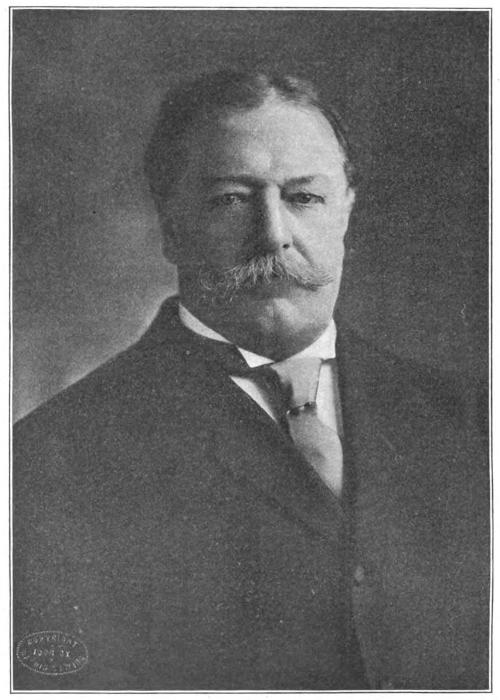
Hon. William Howard Taft,
President of the American Red Cross,
President of the United States, March 4, 1909.
THE FOREST FIRE DISASTERS
All the country knows of the forest fires which caused loss of life and
property in Michigan, Minnesota, Wisconsin, New York and other States,
in September and October, 1908. It has been estimated that the losses to
property amounted to $50,000,000, most of which lay in the destruction of
forests, of which thousands of square miles were swept by fire.
In their progress the fires destroyed several towns and villages and many
farm houses. Chisholm, Minnesota, a town of probably 5,000 population,
seventy-five miles north of Duluth, was destroyed in an hour. At 5:30 o’clock
in the afternoon of September 6, a sudden shift of wind deluged the place in
a moment with an overwhelming rain of burning leaves and embers. Almost
every building in the town took fire at once. The surprised and panic-stricken
people could do nothing but seize a few valuables and run for their lives.
When the fire died out it was found that only sixty-five structures of any kind
remained standing, but that not a life had been lost. Prompt relief measures
were taken, with a state commission in charge. A relief fund of about $130,000
was contributed. Mr. Ernest P. Bicknell, National Director of the Red Cross,
visited Chisholm and inspected the progress and methods of relief October
13 to 16, and reported that the methods were good and that normal conditions
were being restored rapidly. Hundreds of men were employed in rebuilding
the town and houses were going up like magic. Eighty-seven cottages have
been built by the relief committee. Employment in the iron mines surrounding
the town was not interrupted by the fire. This fact greatly simplified the
work of relief, as the usual income of that part of the population least able
to endure loss, was preserved.
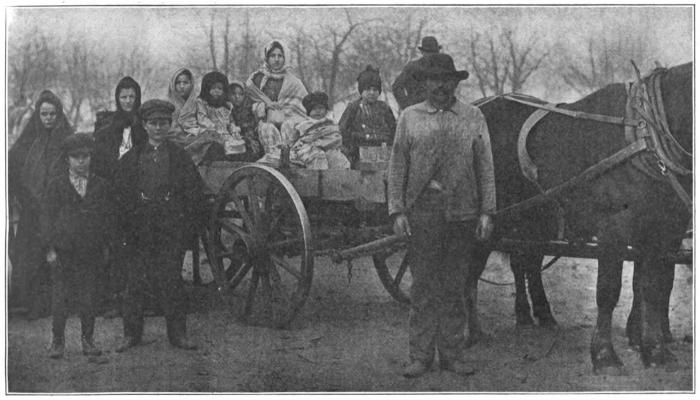
Michigan Forest Fires—Some of the Homeless.
While in Duluth on October 16, the National Director of the Red Cross
learned of a disastrous forest fire, which had occurred in the northern part
of the southern peninsula of Michigan on the preceding day. He hurried to
the scene, reaching there on the 17th, and for two weeks devoted his time to
the work of relief in that State. Following are extracts from the report of
the National Director covering this work:—Editor.
“The summer and fall had been excessively dry here, as elsewhere, and
there had been little wind. Farmers had been clearing up their lands,
burning logs and stumps and accumulated rubbish, as is their custom
at the end of the summer. In thousands of places fire was smouldering in log
heaps, and in the roots of stumps and in the peaty soil which, when dry,
will burn without flame and with little smoke until extinguished by rain.
“Early in the afternoon of October 15, a strong wind from the southwest
sprang up and almost in a moment these smouldering fires burst into
flames. The effect was as though the entire country had taken fire at once.
The wind, whose velocity is estimated to have been fifty miles an hour,
carried a vast wave of flame which destroyed everything combustible in
its path. Several men whose homes were destroyed assured me, with
entire seriousness, that the air was on fire. The area damaged extends
approximately seventy-five miles along the northeastern shore of the lower
peninsula and reaches back inland from fifteen to twenty-five miles. The
center and worst of the fire covered an area perhaps twenty-five miles long
and ten miles wide. Within this smaller area were the villages of Metz,
Posen and Bolton, surrounded by an agricultural country occupied by
Polish and German families in moderate circumstances. The Detroit and
Mackinac Railroad passes through this district and each of the villages
named is upon the line of the road.
“The village of Metz was completely destroyed, not a structure of any
character remaining. The village of Bolton was also completely destroyed
with the exception of a small church. Posen was saved by a desperate
fight. The open farming country offered little hindrance to the progress
of the fire, which in many instances leaped across treeless spaces of a
quarter of a mile or more, destroying all buildings and fences between.
The number of homes destroyed in an area ten miles square was 177. The
number of persons made homeless and temporarily destitute by the fire
in an area twenty-five miles long and ten miles wide was about 2,000.
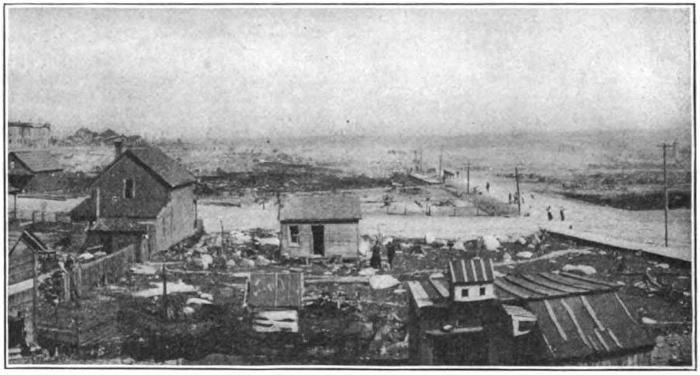
Ruins of Chisholm.
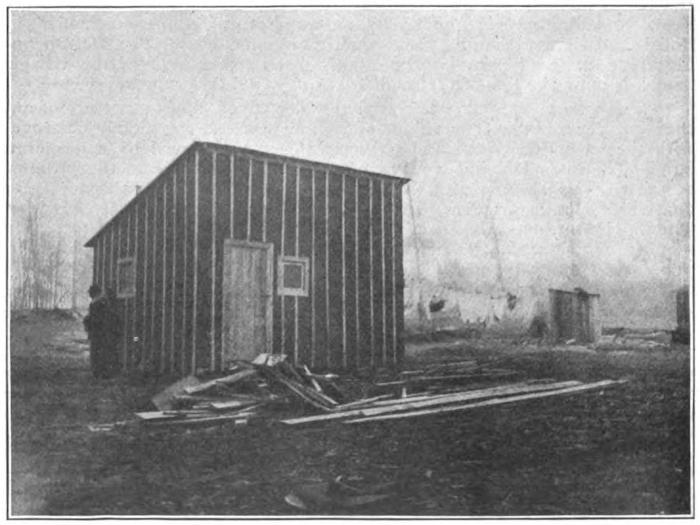
One of the Shacks Constructed by Relief Committee.
“When the people of Metz, early in the afternoon of October 15,
realized that the village was in danger, they telegraphed to the railroad
company for a relief train to carry the women and children to safety. At
2:30 P. M. an engine arrived with a steel gondola car—a steel box with
solid walls about four feet high and without roof. The danger did not
appear immediate when the train arrived and the people delayed to gather
up their more valuable portable property and load it into the car. The
trainmen urged haste, but the people were determined, and hours passed.
At 5:30 P. M. the train started with about forty-five women and children
huddled in the open car. Four trainmen were on board and a farmer and
his wife, who were trying to reach home where their children had been
left earlier in the day. Two miles from Metz a line of box cars stood on
a siding close to the main track. On the opposite side of the track was a
huge pile of cross ties awaiting shipment. Both box cars and cross ties
were burning. The heat had warped the rails of the main track, but the
dense blanket of smoke prevented the engineer from seeing what had happened.
The train dashed into the furnace between the burning cars and
the burning cross ties and was wrecked. Seventeen of those on board
were burned to death. The fireman and brakeman and the farmer were
among the killed. The rest were women and children. Those who
escaped clambered over the sides of the car and crawled along the ground
to an open place where they lay on their faces several hours until the fire
had subsided. The wreck occurred within fifty feet of the home of the
farmer. The farmer’s wife escaped from the train and reached the burning
house. She rushed in, in search of her children, and her bones were found
later among the ashes. The three children, the oldest nine, had fled to a
neighbor’s house near by and were saved. Many who escaped from the
train were terribly burned.
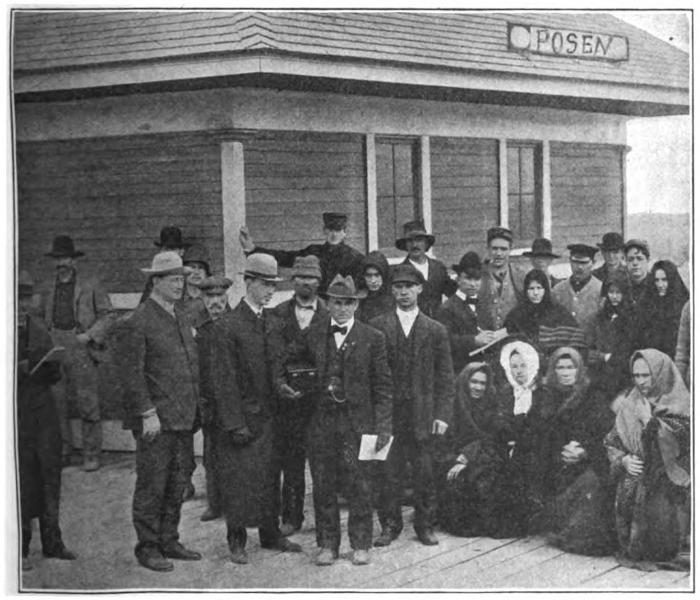
Refugees at Posen.
“The men of Metz, who remained to fight the fire, escaped without loss
of life. One of these men told me of his escape. He threw some small
valuables into a large wooden candy pail and started to run along the road
through the woods. Presently his hair began to burn and his face to
blister. He felt himself failing. He emptied the contents from the pail
and put it over his head. With this protection he managed to crawl along
the road to a field and escaped, with clothing on fire and many injuries.
“After driving about the region a few hours, in order to gain an adequate
idea of the extent of the loss, I took a train for Detroit for the purpose
of conferring with officers of the State Branch of the Red Cross, concerning
relief measures. Some relief supplies were already arriving, contributed
by the people of the City of Alpena, twenty-five miles to the east,
and hurried in by the railroad company. I found Detroit awakened to the
situation. Mr. Emory W. Clark, treasurer of the State Branch, and Mr.
Ralph M. Dyar, secretary, had been in conference the morning of my
arrival. Mr. Clark took me to call upon the Mayor, who requested me to
attend a meeting of business men, which he had called to assemble in his
office at noon. The result of the meeting was the appointment of a relief
committee. Mr. Clark was made the Red Cross representative upon this
committee. The committee appointed Mr. J. D. Hawks, president of the
Detroit and Mackinac Railroad, its representative in the field and requested
me to return to the fire district with him to help organize and direct the
work of relief. It was arranged that we should start to Metz that same
evening.
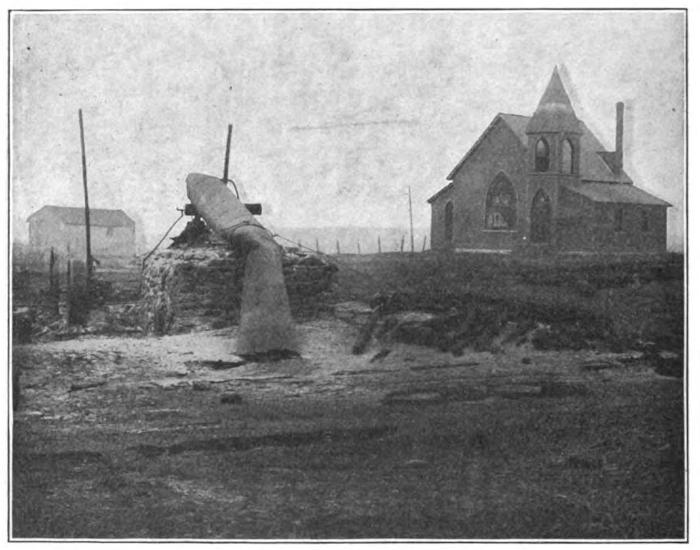
Only Building Left in Bolton.
“In the afternoon, this being October 19, the Red Cross opened a large
downtown room for the reception of clothing intended for the fire sufferers.
Mrs. R. McD. Campau, an active and enthusiastic member of the Red
Cross, took charge of the supply depot and plenty of volunteers joined her
staff. The afternoon papers announced the arrangement conspicuously
and before night supplies began coming in. In a week so much clothing
had been received that the supply room was closed and the public requested
to send no more.
“In the fire district three relief stations were opened at Metz, Posen
and Alpena. The Alpena relief committee, which was extremely active
and efficient, had charge of the relief station in that city. A committee of
women managed the clothing distribution, while the men’s committee
handled other supplies, including hay for live stock. At Posen the railroad
company gave the use of its freight house for relief headquarters.
At Metz the railroad company placed freight cars upon a siding for relief
supplies. The company also gave the services of a number of its capable
officers for the work of relief. For example: President Hawks, of the railroad
company, not only gave substantially all of his own time, but detailed
the General Superintendent of the road, the Chief Engineer, the District
Passenger and Freight Agent, and other men of proved ability. The railroad
company also facilitated in every possible way the shipment of
supplies of all kinds and put into service a daily relief train which transferred
supplies as required from one relief station to another, carried the
relief workers back and forth, etc.
“As the climate of northern Michigan is severe, and winter was close
at hand, the providing of shelter was of immediate urgency. Mr. Waterman,
the chief engineer of the railroad, designed a ‘shack’ which could be
built quickly and cheaply and the work of housing the homeless, who in
the meantime were crowded with almost incredible congestion into the
homes of their more fortunate neighbors, began promptly and went forward
with the utmost speed. The ‘shack’ consisted of unplaned lumber,
long, upright boards forming the walls, rough boards forming the roof and
floor, and the entire exterior of the structure covered with tar building
paper. Each ‘shack’ was 14 by 16 feet and contained three small rooms.
About twenty carpenters were gathered up along the line of the railroad
and brought into the relief work. The plan of procedure was for the
farmer to receive the lumber, paper, windows, hardware, etc., for a ‘shack’
and haul it to his farm. Then one carpenter would be sent to the place
to direct operations and with the farmer and his neighbors helping, the
‘shack’ would be quickly completed. If two or three ‘shacks’ were to be
in a group, one carpenter could supervise all at once.
“On October 29, exactly two weeks after the fire, thirty-eight ‘shacks’
were completed and occupied on the sites of burned homes and twenty-four
‘shacks’ going up. It was estimated that about 150 ‘shacks’ would have
to be provided by the relief committee and almost as many more for
horses and other domestic animals. These ‘shacks’ cost, complete, only
$50 each.
“On October 24, Governor Warner announced the appointment of a
State Relief Commission. It was composed of seven men, including Mr.
Emory W. Clark as a representative of the Red Cross. It also included
Mr. J. D. Hawks, president of the Detroit and Mackinac railroad. The
Commission met on October 26, and elected Mr. Frank Buel, a prominent
lumberman of Bay City, chairman, and Mr. B. M. Wynkoop, manager of
the Bay City Times, secretary. The State Commission requested me to
meet with it on October 30, and visit the fire district. This I did, and after
a day with the members, became satisfied that they were men of affairs
and that they had accepted appointment on the Commission for no purpose
other than a sincere desire to serve the State. At this meeting it was
decided to take over the relief work and put it upon a permanent basis
with men in charge who would be paid for their services, but continuing
substantially the same methods of administration then in use. As superintendent,
the Commission employed Mr. F. E. Merrill, who had had a
responsible position in the relief work from the beginning, and who was
given leave of absence by the railroad company for the purpose.
“From two sources should come help which will materially lighten the
burden of relief.
“First, from insurance. The total insurance upon the property burned
was $149,000. Of this amount $95,000 was upon village property and
$54,000 on farm property.
“Second, from the sale of lumber and from wages in lumbering
operations. The trees which were killed by the fire will produce good
lumber if sawed this winter, but if they remain longer they become almost
valueless, except for fuel. Thus in order to save their lumber, the farmers
must get their burned trees to the mill this winter. That will mean unusual
activity in the woods. Those who own timber will realize some
income from its sale and those who do not own timber will find employment
with those who do.
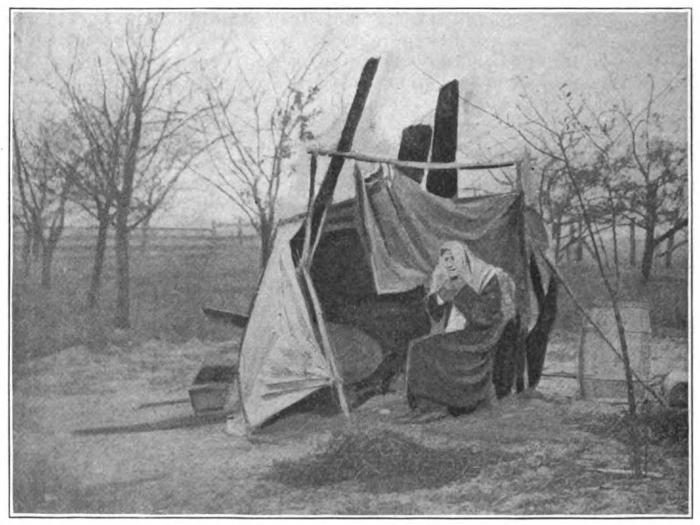
Hut Constructed of Blankets—Only Shelter of Two Women.
“The total amount of relief funds collected in the various cities
could not be accurately ascertained up to the time of my departure from
Michigan, November 1, but was approximately $50,000, including $5,000
given through the State Branch of the Red Cross. This, with the contributions
of provisions, clothing, lumber, etc., it is hoped will be enough to
carry the work through to completion. In the event that it does not suffice
to purchase seed grain for the farmers next spring, it is believed a small
additional fund may be obtained by an appeal to the public, or perhaps
through an appropriation by the State Legislature.”
SOUTH CAROLINA FLOOD RELIEF — THE CONGAREE AND WATEREE SECTION. — THE PEE DEE SECTION.
BY A. C. KAUFMAN
President of State Branch
About the end of last August, a flood more violent in its character
than any known to have visited these localities at any previous
period, swept down from the mountains of North Carolina, across
the Piedmont section of South Carolina, continuing with maddening rush
along the Congaree, Wateree and Pee Dee Rivers, overflowing vast tracts
of fertile lands in high cultivation. It laid waste completely these fruitful
fields—garden spots—smiling with luxuriant crops of cotton and corn,
wrecking comfortable homes of all their possessions—yes, their all indeed—the
property of a contented, happy and prosperous people.
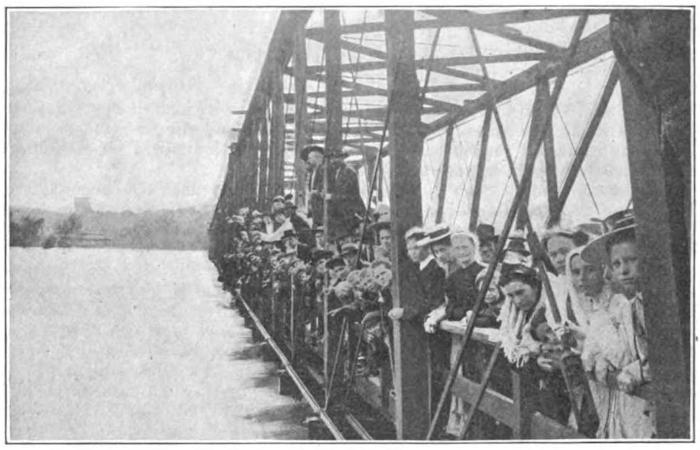
Columbia Bridge at Time of Flood.
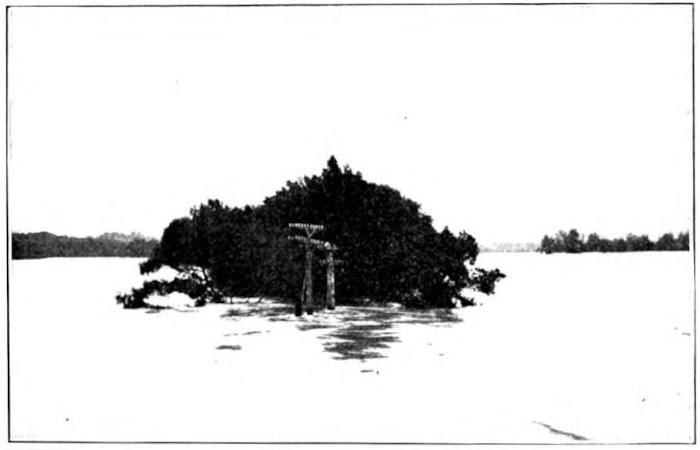
Congaree River—Island Submerged.
As soon as the extent of the disaster reached me, I immediately notified
the authorities at Washington and at once came a reply order, by
wire, to issue an appeal for help. This appeal was promptly issued as directed,
and contributions began to come in. With that noble spirit so
characteristic of the present management of the Red Cross, recognizing
the fact that instant assistance was needed, a message flashed by wire
from Washington, to draw upon the National body for three hundred dollars,
reached us, at the right time, and was used with marked effect. Following
this quickly came a check from Honorable William H. Taft for
one hundred dollars, forwarded to him from a prominent lady in New
York, to be devoted to this purpose. On September 11th another Red
Cross check for three hundred dollars was sent, and on October 17th
still another for one hundred dollars. These added to a check for fifty
dollars from Honorable Robert C. Ogden, of New York, made eight
hundred and fifty dollars contributed from sources outside the State.
Within the State $675.41 are credited, and of this $260.00 were the gift
of our colored fellow-citizens. The total amount, therefore, which our
Treasurer, John B. Reeves, has had in bank for this fund, as shown by
his books, is $1,525.41, reduced by payments to different committees to
$1,067.41. Credit must also be given to those who have sent in large donations
of wearing apparel, bed clothing, etc. These have been carefully
packed by active lady friends and shipped by Mr. W. E. Renneker, agent
of the Atlantic Coast Line, free of cost for distribution among the most
needy sufferers.
Another act of your body which has won our encomium was to furnish,
at our request, an expert to visit the devastated sections and report thereon.
The lot most fortunately fell on Miss Janet E. Kemp, a lady of culture,
refinement and business experience. Her report will best tell you of the
pathetic scenes and incidents that she encountered on her journey of investigation.
Her visit partook of the nature of an angel of mercy, and
I was blessed in having such an assistant in the time of peril.
The following graphic sketch taken from The News and Courier, of
Charleston, and The State, of Columbia, two leading and most influential
newspapers, giving an account of the conditions in the Congaree and
Wateree districts, may prove interesting to your readers:
“After spending Sunday and Monday,” says The News and Courier,
in its issue of September 23rd, “in Columbia, whither he had gone to institute,
as closely as possible, an investigation into the condition of the
flood sufferers, together with making provision to supply their present
necessities, as well as to plan for their relief during the winter months,
Mr. A. C. Kaufman, President of the South Carolina Branch, Red Cross,
returned to Charleston yesterday. ‘I had an opportunity,’ he said to a reporter
last night, ‘during my visit to consult with white and colored men
from the afflicted section of the Congaree and Wateree Valley, both as to
the extent of their losses and the extremity of their condition. Theirs
was, indeed, a harrowing story, enough to make the heart bleed. Some
of the sufferers are unable from childhood, age or infirmity to labor in
any shape or manner. The only kind of work most of those, able to do
anything, can do is to pick cotton in the fields. In remuneration for this
labor they receive 50 cents a hundred pounds for the cotton which they
gather. This will enable them to eke out existence until the middle of
November, and then will gaunt poverty haunt them, labor of all kinds,
to which they are adapted, being then at an end. Then will come to them
starvation and death unless the humane people of South Carolina place
in the hands of the Red Cross, working in co-operation with the local
committee of Richland County, the means to save their lives.
“‘A committee composed of three citizens of Columbia of the highest
character in connection with sub-committees, to be selected by them, have
agreed to handle the matter.
“‘The following article from The State, of Columbia, will give a
fuller idea of the business-like manner in which the Red Cross and the
committee propose to handle the situation:’”
The State, of Tuesday, says:
Col. A. C. Kaufman, of Charleston, the representative of the Red
Cross Society in this section, came to Columbia Saturday night and spent
Sunday and yesterday in the city, going over the ground in connection
with the Richland flood sufferers.
As a direct result of this visit, a central committee has been formed
in Columbia, its members taking part upon the special request and designation
of Colonel Kaufman. This committee contains but three members—Captain
William E. Gonzales, Editor of The State, Chairman; Mr.
W. A. Clark, President of the Carolina National Bank, Treasurer, and
Mayor William S. Reamer, of Columbia.
The duties of this committee will be to designate sub-committees
throughout the entire flooded district in Richland to secure an accurate
census of those persons who need assistance, to estimate the cost of relieving
distress until another crop can be procured and to receive and disburse
funds.
Mr. Gonzales requests that all moneys be sent to Treasurer W. A.
Clark, and it is necessary for the business-like and just distribution of
relief that those who have undertaken to extend relief in this section
shall work with the central committee, and there shall be an accounting
of all funds to the central committee.
As matters now stand it is not likely that much relief will be needed
from this committee for the next two months. During that time the people
affected, or most of them, will be able to earn a living by picking
cotton on the highlands, but from about the middle of November until
the next oat crop (in May, 1909) can be harvested, scores and scores of
families will be absolutely dependent upon assistance, and it is to prepare
for that time of need that the central committee and the sub-committees
to be appointed will now work. Of course, every effort will be
made to get these people to help themselves. There will be absolutely
no encouragement to idleness or pauperism, but there is no use attempting
to conceal the fact that later on in the winter there will be a real
problem to solve in caring for the destitute.
Columbia and South Carolina, it is hoped, will be able to care for
these needy people. What they fail to do the Red Cross will be asked
to supplement. The central committee represents Columbia and will
also act as agent for the Red Cross.
This visit was made on September 20, 21 and 22.
The account of the conditions in the Pee Dee sections is equally important:
On October 20th last I visited the City of Marion from which radiates
the principal business of the Pee Dee section. On my arrival I was met
at the depot by Mayor Miles, Associate Justice Woods, of the Supreme
Court of South Carolina; Congressman Ellerbee, and many other citizens
of prominence and distinction in South Carolina, and beyond her borders—an
evidence of their keen anxiety to put themselves in position to
provide relief for their unfortunate and crushed neighbors. Two meetings
were held that day—one in the morning, the other in the afternoon.
The matter was carefully discussed and weighed in every particular.
Mayor Miles presided at each meeting.
Hon. W. J. Montgomery, President of the Bank of Marion and Senator
from Marion County, spoke as follows:
“We are not so much concerned about the present, although there are
some serious cases we are forced to handle now. The problem most difficult
to solve, and which creates intense anxiety, is how these hundreds of
dependents, unable to find employment to which they can adapt themselves,
are to be fed during the coming winter. This can only be done with
the kind permission of the Red Cross, to draw upon our share of the fund,
which that worthy organization is endeavoring to swell through its urgent
appeals to the people of the whole State for money donations, added to that
furnished by local contributors.
“Another point,” said Mr. Montgomery, “which I wish to make plain:
The idea has gone abroad that the beneficiaries to this fund are only colored
people. This is a grave error. Many deserving white people, some of
whom were in comparatively easy circumstances previous to the flood, have
now become miserably reduced through this visitation of God. Help is
solicited for them because help is sorely needed. They ask bread; can we
give them a stone? We propose to care for the sufferers of both races.”
Mayor Miles also took a dismal view of the future unless help came.
To the Red Cross they look for it.
Mr. Davis, a large planter, spoke in a manly, yet pathetic vein. He
stated that his losses had been immense, but that to the best of his
ability he had been feeding from his scanty store his helpless, distressed,
starving neighbors, white and colored, in their fearful poverty and want.
He was willing, and intended to go as far as his circumstances permitted,
aye, to make sacrifices in this humanitarian work. That is the spirit which
pervades the neighborhood.
The Citizens’ Relief Committee, composed of their first citizens, has
the Honorable S. C. Miles, Mayor of Marion, as Chairman, and Mr. Albert
G. Woods, as Treasurer. In conclusion, the emergency may be thus
summed up: Our prospects are very discouraging. Money is superlatively
required. It must be had if human lives are to be saved. The final
analysis of the case reads thus: Food or starvation, life or death. Only
with money can the evil be averted. It would be unreasonable to expect
more from the Red Cross fund. Their provision has been bountiful. Our
treasury, however, needs replenishment. After help already rendered,
there remains in our treasury about $1,000. By January this amount will
be materially reduced, as the committees require aid without delay, and
must have it. This small sum is all we can count on to keep the wolf
of hunger from the doors of one thousand human beings for six months,
during the winter, the most trying season of the year. It does not take a
skilled mathematician to tell how far this will go. How long will this
last? Echo answers “how long?” Disasters of wider extent and affecting
more people are on record. Yet without an attempt at exaggeration,
I affirm that never has any been more severe.
REPORT OF INVESTIGATION IN FLOODED DISTRICTS OF SOUTH CAROLINA — Columbia. — Florence, S. C. — Marion, S. C. — RELIEF MEASURES, COLUMBIA, S. C. — Florence. — Marion and Marion County.
BY JANET E. KEMP
Special Red Cross Representative
The itinerary, as outlined by Mr. Kaufman, was to include Columbia,
Florence and Marion; each of these cities being the center of districts
which were reported to have suffered severely during the
recent disaster.
Arriving in Columbia late Monday night, I was met by Mr. Baker,
a representative of The State, which is Columbia’s leading daily paper.
The city is situated in the Congaree Valley, at the junction of Saluda and
Broad rivers.
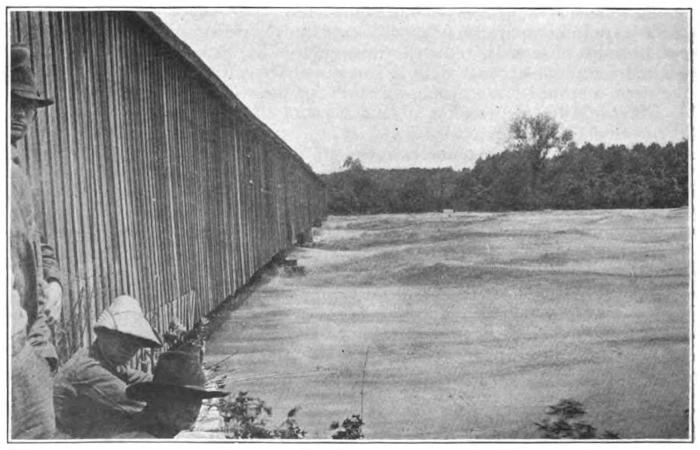
Broad River Bridge—Two Miles Above Columbia.
Columbia itself escaped with comparatively little injury; the city extending
at an elevation considerably above the flood level.
The power house of the street railway company and the city water
works situated near the river sustained considerable damage. The cotton
factories also located on low ground were obliged to suspend work for
a few days; the loss in wages said to be about $4,000.00.
Early next morning I had an interview with Captain William E.
Gonzales, editor of The State. Captain Gonzales estimated that there
were about two hundred destitute families in the flooded section between
Columbia and Kingsville. From information received later, I should
think this is probably an under-estimate.
The fertile “swamp” lands on each side of the river belong to a chain
of “plantations” extending from Columbia to Kingsville. On some of
these the owner lives, surrounded by his tenantry; others belong to non-resident
owners. Corn and cotton are the staple crops.
The destitution of which Captain Gonzales spoke exists mainly on
those plantations owned by non-residents who have no personal interest
in their tenantry; and among the negroes who are working their own
land. The flood sufferers living on land occupied by resident owners will
not, as a rule, need any outside aid, as their landlords, though themselves
very heavy losers, will provide for their pressing needs. The gravity of
the situation, even for those who are actually destitute, is mitigated at
present by the fact that for the next two months work will be comparatively
plentiful, in harvesting crops in sections untouched by the calamity,
and in repairing the damages occasioned by the flood.
Mr. C. B. Simmons, agent for a large plantation of 3,000 acres, drove
me out to see the conditions on his place, which are typical of those on
other places owned by non-residents. Mr. Simmons estimated that the
damage done to the crops would be about $12,000. There are 40 tenants
on the place, six of whom are white families. The crops are in many
cases practically a total loss; the whole year’s work has been swept away.
The only thing that will be realized will be a hay crop, which, under
favorable conditions, may be harvested before frost. Some of the men
had tried to get work in the phosphate mills near by, but without success.
The entire body of tenants gathered together by appointment to
meet Mr. Simmons, and each in turn gave detailed account of the loss he
had sustained.
Mr. Simmons said that the most direct and practical way to help
these people would be to provide them with seed-oats, which could be
planted in October, and would yield a crop early next June. About 700
bushels would be needed for the 40 tenants on the place.
On Wednesday morning, September 9th, I went to Lykesland by
train, a distance of about nine miles from Columbia. Here I was met by
Mr. William Lykes, who drove me out to see the conditions in a little
colony of negro swamp farmers.
There was not much room for possible exaggeration in the stories
we heard here; the white line of mud in the branches of the trees, often
12 or 15 feet from the ground, indicated the height of the flood. Fallen
chimneys and wrecked buildings showed the violence of the current. The
cotton was ruined, fit only to be plowed under to fertilize next year’s crop.
The corn was rotting on its stalks. The poor little, unpainted, windowless
frame houses were unspeakably desolate; the walls marked to the
very eaves with white mud left by the receding waters, and everything
within the homes—bedding, clothes, furniture—wrecked and ruined, and
saturated with mud. Nearly all the live stock had perished. They
showed us the stockade on a small knoll, a little higher than the surrounding
country, into which they had driven all their animals. Here
they had managed to save most of their mules, but even at this elevation
nearly all the cattle had been drowned.
The largest land-holder in the colony, a very intelligent negro, with a
reputation for honesty and industry, had lost 16 acres of corn and 16 of
cotton, 6 head of cattle and 10 hogs.
A week before, when Mr. Lykes first visited the colony after the
flood, he found the people literally starving. At one house the hungry
children were trying to eat the rotten corn. He at once secured $50.00,
through Captain Gonzales, from the South Carolina branch of the Red
Cross, with which he purchased provisions and supplies to meet the immediate
need.
The flood sufferers, who had at first seemed dazed by the calamity,
were now making efforts to rehabilitate themselves. Some were rebuilding
their chimneys and outbuildings; others had secured work; one man
had gone to work on a plantation five miles away, walking that distance
twice daily; the women and children had also begun to pick cotton on
neighboring plantations. The conditions on this little colony illustrated
the situation of the small land holder, who has no resources except the
crop, which he had hoped to harvest as the result of his year’s labor.
The flood also had seriously crippled the larger landowners, who
could ordinarily be looked to for the relief of their poorer neighbors. From
Mr. B. S. Rawls, who has a “general store” on the bluff road that parallels
the river between Columbia and Kingsville, we learned, that he had
lost 235 acres of his own crops, and would get practically no rent from
the 2,000 acres he had rented out. Worse than this he expected to be
“out” from $1,200 to $1,500 for supplies advanced to his tenants.
The next point visited was Florence, Florence County, 81 miles
from Columbia. Reports of heavy flood losses had come in from the
Lynches River section. A Relief Committee had been formed by the
Honorable Hartwell Ayer, editor of the Florence Daily Times and a small
sum of money raised.
After conferring with the committee, I concluded that it would be
desirable for me to make some investigation of conditions for myself, and
went down to Cowards, which is located in the flooded district, 16 miles
from Florence. Here, at the recommendation of the committee, I called
upon Mr. Z. C. Lynch, who keeps a large general store and supplies the
needs of over 200 farmers in that vicinity.
Immediately after the flood Mr. Lynch had spent three days in riding
around through the section that had been flooded, noting carefully the
conditions of the crops, and talking with the farmers. He gave me a
positive assurance that he had not met a single case of destitution, and
that, as a rule, the loss in that section would not average more than 10%
to 25% of the crop. After this frank statement from a man who is in a
far better position to get the exact truth than I could possibly be, I decided
to make no further investigation, but to await the report of Dr.
Hicks.
After spending two days in the flooded district, under circumstances
which enabled him to come into touch with representatives from every
point, Dr. Hicks returned with exactly the same report as that given by
Mr. Lynch. He said that while the losses had been heavy, and many
people were considerably crippled, there was no destitution and there
was not likely to be any that could not easily be met by local resources.
Proceeding to Marion on Friday night, with the expectation of being
able to complete the investigation in another 24 hours, I found a situation
which made it imperative that I should spend two or three days in that
section.
A very active and interested Relief Committee, with Mayor S. T.
Miles as chairman, was fully alive to the needs of the situation, and had
succeeded in raising a fund of over $500.00, in addition to what had been
sent by the Red Cross. I learned from this committee that the four townships
of Marion County had been practically submerged. These townships
form a tongue of land lying between Big Peedee and Little Peedee
Rivers. During the flood the water of Big Peedee had risen and flowed
clear over the intervening strip of land until they met the water of Little
Peedee. A sandy ridge extending North and South through the interior
ordinarily forms the water shed between the two rivers, and, at many
points, the water had covered even this comparatively high land.
Arrangements were at once made for me to proceed to Eulonia, the
home of Mr. S. U. Davis, who was said to be more thoroughly familiar
with conditions in the flooded section than any one else.
After dinner Mr. Davis drove me through several miles of flooded
country. It was a matter of regret with him that I had not come a week
earlier when—nearly two weeks after the flood—the whole country was
still under water, and boats were the only available means of transit from
point to point. At that time most of the homes were vacant, and the occupants,
with their cattle and household effects, were camping out wherever
they were lucky enough to find a spot that was “high and dry.”
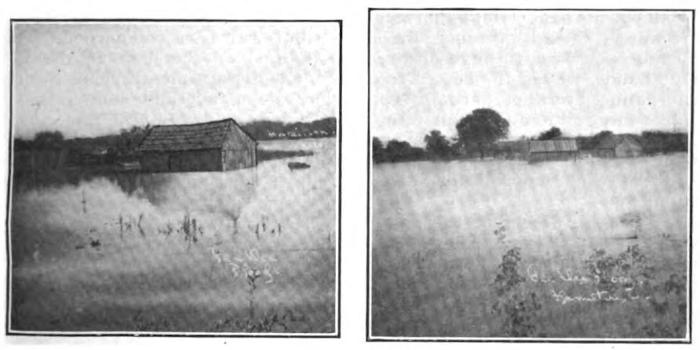
Pee Dee River Flood.
In a little two-room shanty, near Mr. Davis’ place, thirty-four people
found shelter at one time during the high water. One resourceful farmer,
when forced to move out of his home, which, though partially submerged,
was still the dryest spot on the farm, provided for his live stock by
tethering the cow to the cook-stove in the kitchen, and quartering his
five hogs on the bed. In another instance a couple, who were determined
to stay in their homes at all risks, themselves “camped out” on the bed,
and at meal times paddled over to the cook-stove on a hastily-constructed
raft.
That people who had suffered as these people had could still be brave-hearted
enough to dwell upon the humorous side of their tragedy, shows
that it is hard to drown out American “grit,” and the American sense of
humor. But the tragic side was ever present and needed no emphasis.
One woman, of whom Mr. Davis spoke, a widow with three small children,
had lost her entire crop. At the time of the flood she was desperately
ill, and, when rescued in a boat with the children, it was feared
that she would die as a result of the exposure. She was now, however,
recovering, but some provision would have to be made for her until another
crop could be raised. Throughout all this section there had been
comparatively little loss of household goods and effects, because most
of the people were warned in time to enable them to remove their belongings
to a place of safety.
We drove through acre after acre of rotten corn, and of cotton fit
only to be plowed under to fertilize the ground for next year’s crop.
Fences had been ruined and bridges swept away, and several times it was
necessary to make a wide detour, in order to find a safe crossing place.
One man with whom we talked, who, with his family, had just moved
back into their still damp house, said that he had nothing left, but a little
corn, a few chufas and a patch of cane. Every farm we visited in that
section was practically in the same condition.
The next day, Sunday, we started again at 10 A. M. over a road that
led down the sandy ridge that, for the most part, had not been covered by
the waters, though even here the lower points had been submerged. Then
turning eastward through the section marked on the map as the Low
Flat Lands, we left the beaten track and, for a long time, traveled through
alternating areas of partially submerged woodland, and sodden savannahs—the
South Carolinian term for meadow land. It was not easy to
follow the trail across the savannahs, and the drive through the woods
was even more difficult. As we lurched along through the water we never
knew at what moment the buggy might strike some submerged log or
stump.
We took dinner at the home of Mr. Fontaine Davis, a planter and
merchant at the lower end of Britton’s Neck Township, who kindly volunteered
to take me on down into Woodberry Township, as far as we could
go, while Mr. S. U. Davis rested his horse ready for the return journey.
The country we drove through at the upper end of Woodberry Township
had suffered severely from the floods, and the crops were an almost
total loss. We went as far as the road was open until we struck a point,
beyond which all the bridges had been washed away. Woodberry Township
forms a peninsula between the two rivers already spoken of. Fortunately
it is very thinly settled, and most of the farmers have their
homes on the comparatively high land in the center of the township. Mr.
Fontaine Davis said that he had only heard of five families in the section
below that which we visited who had suffered to any serious extent.
We talked with an old man, who for 43 years had lived on his farm
in the upper part of Woodberry Township. “I ain’t never saw anything
like it before,” he said, “and I don’t know how to figure it out. The
waters was five feet higher than they was in the Sherman ‘fresh’ of ’65.”
He said that within a radius of three or four miles there were eight or ten
white families, and ten or twelve colored families: all of whom had lost
practically their entire crop. He, himself, had lost all of his corn, most of
cotton, and nearly all of his live stock.
Mr. Richardson, whom we next interviewed, a man who owned 80
acres of land, 27 in corn, 35 in cotton, the rest in pasture, garden, etc.,
had lost everything. The cotton had been an exceptionally good crop, and
would have made a bale to the acre at the market price of about $40.00
a bale; this alone meant a money loss of $1,400.00. The corn upon which
he depended for food for his family and stock was also gone, and, as he
put it, “I don’t know what we are going to do for something to eat this
winter.”
The next house we passed was a deserted little negro cabin whose
wrecked chimney bore witness of the violence of the flood. This had
been the home of an honest, hard-working colored man, who, with his
family of five children, lived on the little rented patch of about 20 acres.
His nine acres of corn would have fed his family and his animals. His
seven acres of cotton would have yielded about three bales, which would
have given him $120.00 as the cash proceeds of his year’s labor. With
this he would have paid off his store bill of $50.00; $20.00 would have
gone for rent, and after making a payment upon the horse he had just
purchased, the husbandman would have had a small cash balance to see
him through to next crop time. Now corn and cotton are both swept
away; there is no money to settle the store bill, nor pay for the horse,
and there is no food for the family to subsist on through the long winter
months.
As nearly as could be estimated by those familiar with the local conditions,
there were fully 200 families in the lower end of Marion County,
renters and “lienors,” whose situation is about as hopeless as that of
the family just referred to. Many, who like Mr. Richardson, owned more
or less land, are in a position to obtain advances on their holdings, and
though seriously crippled, can probably weather the storm. But for these
other families, who are without such resources, some adequate relief
measures will have to be undertaken.
The attitude towards customers and tenants assumed by the merchants
and plantation owners bears high testimony to their generosity and
public spirit. It is taken for granted that no claim for rent will be made
and, as far as possible, credit will still be extended to the flood sufferers.
But it is too much to expect that these men can assume the whole of the
burden, for they have themselves suffered severely. Mr. Davis estimated
that in an area of several miles there was only one of the flood victims
who was not indebted to him for a larger or smaller amount. Some of
these debts would eventually be paid; many of them would never be recovered.
He said he had begun to figure out his losses, but they mounted
up so appallingly that he had stopped short before he was half way
through. I was told that he had advanced over $18,000.00 worth of fertilizer
to the farmers trading at one of his four stores. If this was true,
it gives some idea of the magnitude of his losses, and shows the impossibility
of expecting men, under such circumstances, to do all they would
normally be able to do for their poorer neighbors.
At the time of my visit to Columbia The State, in a paragraph announcing
that the agent of the Red Cross was in the city, stated that
Columbia would consider herself disgraced if she could not do all that
was needed for local flood sufferers, without further aid from the Red
Cross Association.
At the last census Columbia had over 21,000 inhabitants; its population
now numbers some 25,000 people. It is the State capital, and has
some thriving cotton mills. Taking Captain Gonzales’ estimate of 100
destitute families as being approximately correct, it would seem that with
employment easily obtainable in the fall and spring, it ought to be possible
for the people of Columbia and Richland County to undertake such
local relief measures as would make further outside aid unnecessary. The
dangers of creating a large relief fund, and extensively advertising its
existence, are very obvious, especially as most of the people affected are
negroes who would very readily accept a position of dependence.
Captain Gonzales told me that the securing of regular monthly subscriptions
towards the relief of cases of genuine need had been suggested.
This plan seems to be an admirable one, and would be less apt to result
in weakening any attempt at self help that might be made by the flood
sufferers. If properly and systematically managed, it would also probably
be adequate to meet the requirements of the case.
From the foregoing report of conditions in this section it will be
readily seen that no outside help is necessary at this point.
The activity and interest displayed by the local Relief Committee at
Marion have already been noted. Probably one reason why they had accomplished
so much more than had been done at the other points was
that the situation in Marion County was apparently much more serious
than in either of the other places.
Immediately following the disaster wagon loads of supplies had been
promptly dispatched to the districts affected. The men to whom the distribution
of these supplies was entrusted told me that they hoped nothing
more would be sent at present. Indeed, Mr. S. U. Davis had asked that
a contribution of $200 that had been offered be placed in bank and held
for later distribution. He and Mr. F. Davis know personally every family
in that section and both urged that no more relief be sent at present.
Mr. F. Davis said that as long as the supplies lasted that were sent to
his store, the negroes collected around and refused to do any work. When
work was offered they said, “We all don’t have to pick no cotton, do white
folks am gwine to feed us.” He also told of a white man who had $700
in bank but who, nevertheless, had sent his brother to see if Mr. Davis
did not have “something for him.” In this connection it may be noticed
that however poverty-stricken a colored family might be nothing would
induce any of the girls of the family to accept positions as house-workers.
Both Mr. S. U. Davis and Mr. F. Davis urged that hereafter relief be
sent direct to individual cases of distress, upon their recommendation,
after thorough investigation had proved that help was necessary.
It might be thought that possibly these statements were colored by
the anti-negro bias with which the Southerner is usually credited, but
though fully alive to the weaknesses of the negro, everyone with whom
I talked manifested genuine sympathy with all cases of real distress,
whether the sufferers were white or colored. Everyone with whom I
spoke agreed that during October and November, while work was plentiful,
all relief should be withheld, except in the special cases alluded to
above. After this will come the winter months when work is scarce and
there are few sources of income except a little fur trapping, or odd jobs.
Mr. Davis had already written to a lumber company which has extensive
timber holdings throughout the lower part of the county suggesting
that if they could see their way clear to commence operations in that
section at once the opportunities for employment that this would offer
would be a veritable Godsend to the community. But, however favorable
conditions may shape themselves and however generous may be the local
responses to the need for help, it still would seem to be a certainty that
outside assistance will be needed for this section. The destruction has
been so great—the committee estimated that from 1,500 to 2,000 bales of
cotton had been destroyed within the flooded area—and the loss has
fallen so heavily on rich and poor alike, that it does not seem possible
that the community can grapple with the problem unaided.
All relief work has been done, so far, through local committees who
are thoroughly familiar with every detail of the circumstances of those
who need help and if this policy be maintained there is very little possibility
that any funds will be unwisely applied.
In conclusion, I should like to say a
deeply appreciative word concerning the
kindness and courtesy of the Relief Committees
in the three cities. Though, during
the investigation, I traveled over
many miles of country, in no case was
it necessary to use Red Cross money in
hiring livery rigs, as all this was arranged
for by the committees and individuals
interested. I would make special mention
of the kindness of the committee at
Marion, who entertained me while I was
in their city, and of the courtesy of Mr.
S. U. Davis, at whose home I was entertained
and who spent a day and a half
in showing me the situation in Marion
County, placing at my disposal his invaluable
and intimate knowledge of local
conditions. I also take great pleasure in expressing appreciation of the
active and energetic co-operation of the State President, Mr. A. C. Kaufman,
who arranged my itinerary and who, by letters of introduction,
paved the way for me in every city visited.
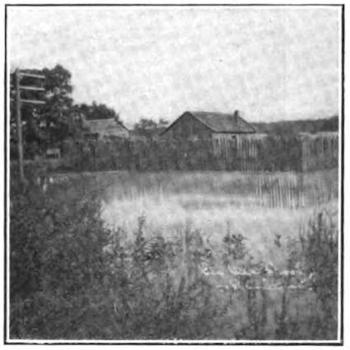
Pee Dee River Flood.
A SHORT SKETCH OF THE RUSSIAN RED CROSS
The first initiative to give private aid to the wounded on the battlefield
was taken in Russia in 1854, during the Crimean War, when
Grand Duchess Helen Pavlovina (a sister of Emperor Nicholas I)
formed a party of trained nurses, who, under the leadership of the afterwards
celebrated surgeon, Pirogoff, went to the war and cared for the
wounded.
In 1867 was formed a Society for the care of the wounded and sick
warriors, which changed its name in 1876 and was then called the Russian
Red Cross Society. From its very start the Society was taken under
the august protectorate of the Empress Maria Alexandrovina, wife of
Emperor Alexander II, and many persons of the imperial family and
prominent statesmen became its members.
At the very first, lack of funds prevented the Society from the activity
along the broad lines which it desired. Not being able at the start
to found its own communities of nurses, with its own hospitals and surgical
clinics, the Society for a number of years had to place its nurses, for
the purpose of training, in the military, civil and municipal hospitals.
Only after the Turkish War in 1876-77, in which the immense utility of
the Society’s activity was proved, was its popularity assured. Thus the
number of communities of Red Cross nurses from 5 in 1878 rose to 99
in 1906. The total number of hospitals and clinics of the Red Cross at
present amount to 148. In 1906 the number of persons cared for in these
institutions was 1,294,547.
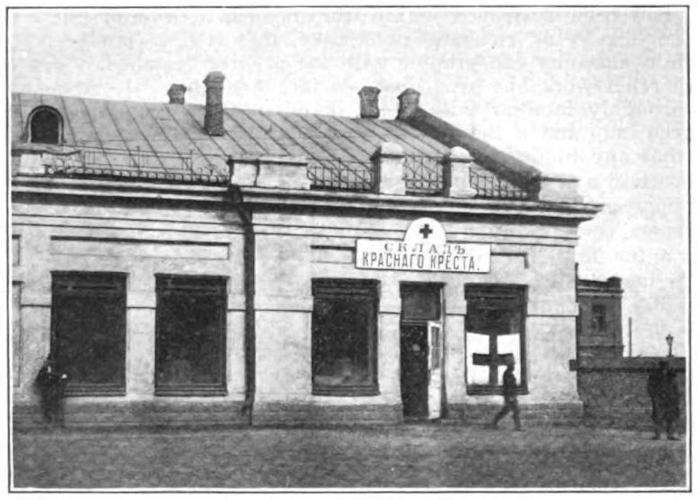
Russian Red Cross Depot of Supplies.
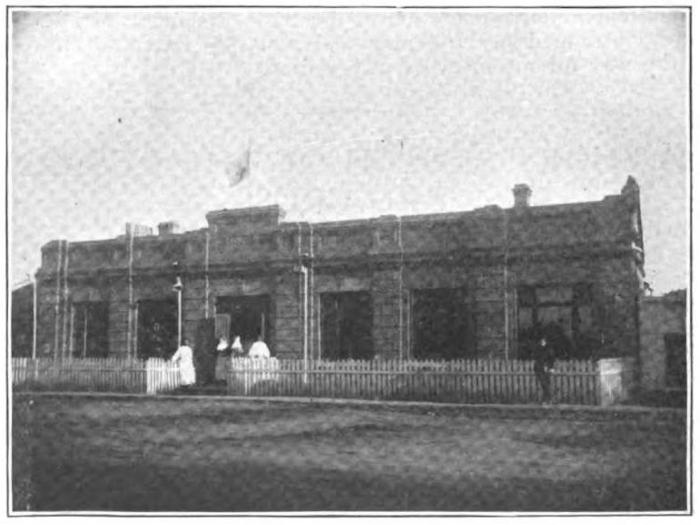
Red Cross Station.
In 1868 the Russian Red Cross had 35 institutions of all kinds and
in 1906, 920.
On the first of January, 1907, the Red Cross Society of Russia consisted
of the following institutions: 1 Chief Board of Administration; 8
Boards of District Administration; 95 local Boards of Administration; 509
local Red Cross Committees; 40 Committees of communities of Red Cross
nurses; 60 communities of Red Cross nurses; 90 ambulatory clinics; 6
emergency hospitals; 5 asylums for former Red Cross nurses; 1 asylum
for invalids; 9 asylums for crippled soldiers; 1 asylum for soldiers’ widows;
3 asylums and 3 sanitariums for children of disabled soldiers; 7 convalescent
houses; 1 maternity hospital.
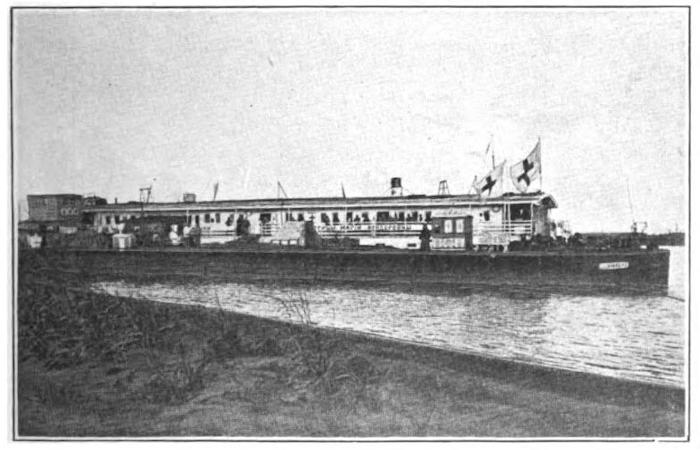
Red Cross Hospital Ship.
Any person entering into a community as nurse is not obliged to take
any kind of oath, but gives only the promise to submit to a vigorous discipline,
to acquit him or herself conscientiously of all duties and to nurse
the sick carefully. The feminine personnel is divided into two categories—sisters
of charity and nurses for surgery.
The surgical nurses have to pass a three years’ course, the sister of
charity a one-and-a-half year’s course of studies, according to a program
established by the Chief Board of Administration. The courses to be
followed are theoretical and practical, which consist chiefly of lectures
at the sick bed, held mainly in the hospitals of the Red Cross, and partially
in military, municipal and private hospitals, according to arrangements
between these hospitals and the Red Cross. Having finished the
courses, the surgical nurses enter either the institutions of the Red Cross
or hospital institutions maintained by the government or municipalities.
The sisters of charity are delegated to the military hospitals, which the
Red Cross has undertaken to supply with nurses, to other hospitals and
to private nursery. In 1906 there were 3,819 of these Red Cross sisters,
and since 1875 there have been graduated 2,000 of the higher class of
trained surgical nurses.
The care for disabled soldiers after the war includes the furnishing
of means for cures at health resorts, as well as furnishing them with warm
clothes, artificial limbs, crutches, etc., or provides for their care in asylums
of the Society.
The asylums for invalids in 1906 received 737. Among other sums
granted, the Society paid in 1906, 10,940 roubles to the former defenders
of Sabastopol, during the Crimean War in 1854.
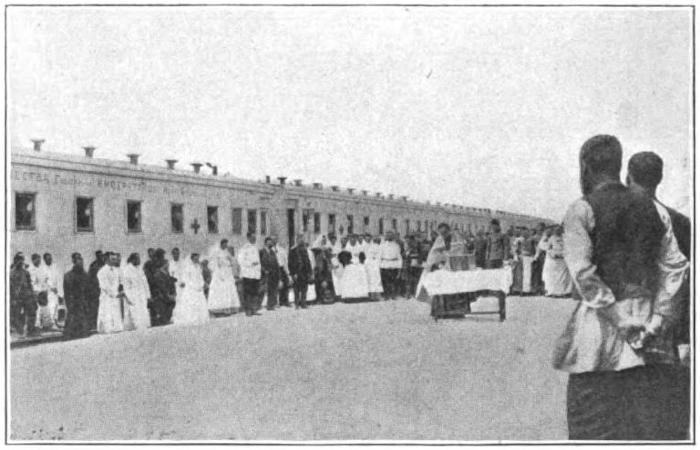
Red Cross Hospital Train.
In St. Petersburg the Society possesses six stations for help in emergency
cases, with twelve ambulances and sixteen attendants.
The Russian Red Cross Society has taken part in all wars and military
expeditions which have occurred since 1868.
During the Franco-Prussian war, the Russian Red Cross sent to Basel
a party of 30 surgeons and large quantities of supplies which were equally
distributed to the belligerents.
It sent a generous contribution to both parties during the Civil War
in Spain in 1873. In 1876 surgeons and nurses were sent for assistance in
the Turkish-Martemgian War, expending $42,000. During the Turkish-Servian
War it expended over $263,000 and sent 115 doctors, 4 pharmacists,
118 nurses, 41 medical students, 78 assistant surgeons, besides hospital
equipment for 200 beds.
At the time of the Russo-Turkish War in 1876, the Russian Red Cross
rendered wonderful service. Contributions flowed into its treasury, over
$8,000,000 was received and expended, and the gifts of supplies were
equally great.
During the war the Society transported on its ships and trains over
100,000 sick and wounded; 230,000 were cared for at the ports of evacuation,
and 18,000 severely wounded at the port. The Red Cross institutions
in Russia cared for 116,268 sick and wounded. In the troubles of
1879-81 in Asia, the Red Cross expended $300,000. In 1885 in helping
the sick and wounded of both Servia and Bulgaria, expended about $87,000.
It assisted Japan in the Chinese-Japanese War of 1894.
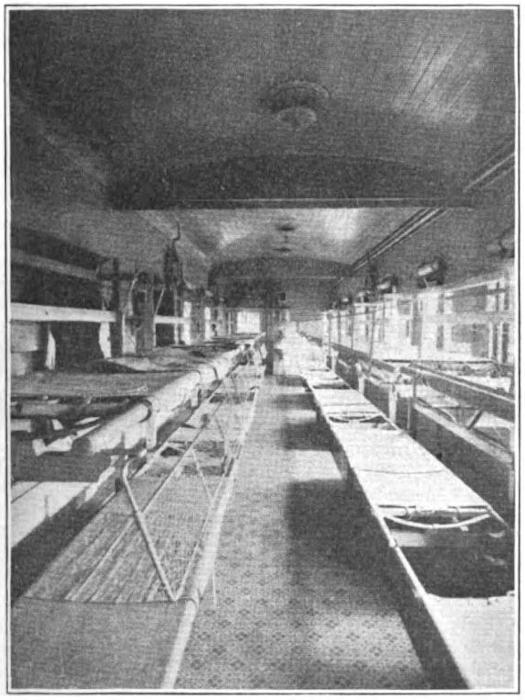
Interior of Hospital Train.
In 1896, as the Italian Red Cross declined assistance, it expended
$75,000 for Abyssinia relief, and in 1899, as the United States Government
declined its offer of assistance, it gave aid to the Spanish Red Gross for
the veterans of the war. As England declined assistance, it expended
some $56,000 for the Boers in 1899. During the Boxer trouble in China
the Red Cross provided most valuable assistance at a cost of over $600,000.
Its greatest work was rendered during the late terrible war with
Japan, during which it expended over $15,000,000 in relief work, providing
hospital trains, ships, field and reserve hospitals, a large medical nursery
and administration personnel.
THE STORY OF THE RED CROSS — THE HARVEST OF DEATH
Throughout the entire action the Emperor Francis Joseph remained
calm and composed. Towards the evening the Austrian
centre having yielded the left wing, not daring to face the position
of the Allies, a general retreat was decided upon and the head of the
House of Hapsburg, who throughout the day had watched the bullets
raining around him, withdrew with a part of his staff in the direction
of Volta. The Austrian officers had fought like lions, many in their
despair gave themselves up to death by the enemy’s hands, but not without
selling dearly their lives. Most of those who returned to their regiments
were covered with the blood of their own wounds or those of their
enemies.
The roads were filled with army
wagons, carts and reserve artillery.
The first convoys of Austrian
wounded, consisting of the less serious
cases, commenced to come into
Villa-Franca, the more seriously
wounded followed. The Austrian
medical staff dressed the wounds
hastily and in a perfunctory manner
gave a little nourishment to the
sufferers, and then sent them on by
rail to Verona, where the crowding
was most fearful. Although in the
retreat the Austrian Army sought
to carry away all the wounded possible,
and this at the price of much
extra suffering to the poor men,
thousands were left behind lying on
the ground, still drenched with their
blood.
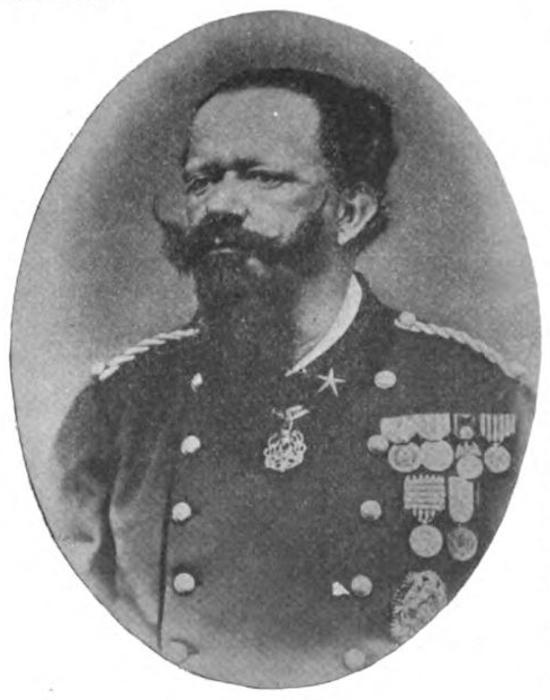
Victor Emanuel,
King of Sardinia, later King of Italy.
Towards the close of the day,
when the twilight shadows were
creeping over this vast field of carnage,
more than one French officer,
more than one French soldier wandered
here and there, seeking some
missing friend or compatriot, beside
whom, when found, he knelt endeavoring to restore him to consciousness, to
staunch the flow of blood, to dress the terrible wounds, to bind his handkerchief
around a fractured limb or to vainly seek for water to quench the agonizing
thirst. What silent tears must have been shed on that unhappy night!
During the battle flying ambulances were stationed on farms, in
churches, convents, in the open air, or under the shade of the trees, which
received firstly wounded officers and non-commissioned officers, attending
to them in great haste, and afterwards came the rank and file if the medical
staff had time to spare for them. Such as could walk betook themselves
to the ambulances; others were carried on stretchers and hand-barrows.
During the fight a pennant planted on a slight elevation marked the
position of the dressing stations for wounded and the field hospitals of
the regiments in action. But, unfortunately, the troops seldom knew
their own hospital pennants nor those of the enemy, with the result that
shells rained down, sparing neither doctors, attendants, wounded nor the
wagons conveying supplies of food and lint.
The heights extending from Castiglione to Volta were dotted with
the twinkling lights of thousands of fires fed with the debris of the Austrian
gun carriages, supplemented with the branches of trees broken off
by the cannon balls or during the storm. Round these fires the soldiers
made an effort to dry their soaking garments, then tired out they stretched
themselves on the stony ground to sleep.
There were whole battalions without a particle of food. Water, too,
was lacking and their thirst was so intense that soldiers and even officers
were content to drink from the muddy rain-pools, oft-times stained with
blood. Everywhere wounded men were crying piteously for “Water!”
In the silence of the night could be heard the groans, the stifled cries of
anguish, the despairing appeals for help. What pen can describe the
agonies of that horrible night!
The sun of June 25th, 1859, rose on one of the most frightful spectacles
that the most vivid imagination can conceive. The battlefield was
strewn with the bodies of men and horses, and with the battered forms
of men in whom the spark of life still remained, they filled up the roads,
they choked the trenches and the ravines, they lay piled in heaps in the
bushes and the fields, everywhere for miles around the village of Solferino.
The crops were utterly destroyed, the corn was trodden under foot,
hedges were piled up, orchards ravaged. Here and there were pools of
blood, formerly prosperous villages, now deserted, bore the marks of shot
and shell; apparently deserted houses, whose walls were riddled with bullets,
stood shattered, gashed and ruined. Their inhabitants, who for the
most part had passed the twenty-four hours during which the conflict
raged in their cellars without food or light, now began to issue forth
from their hiding places, the vacant expression and blank countenances
of these poor peasants witnessing eloquently to the reality of the fright
they had endured.
The ground was covered with wreckage of all kinds, broken weapons,
accoutrements, camp furniture, and blood-stained articles of clothing. The
unfortunate wounded who lay around were pale, livid, and utterly exhausted
with their sufferings. Some, very badly wounded, had an imbecile
expression, seemed not to understand when spoken to, staring with
haggard eyes at those who brought them succor, and others in a state of
nervous excitement shivered with a convulsive ague. Yet others, with
deep, gaping wounds, in which inflammation had already set in, were
delirious from their pain, and implored that they might be put out of
their misery, and with drawn faces twisted themselves into indescribable
positions in their supreme agony. Besides these there were unfortunate
men, who had been struck by cannon balls and grape shot, or whose arms
and legs had been shattered by pieces of artillery.
In many cases the bodies of the dead and wounded were robbed by
marauders, and thousands of poor fellows, who still lived, were thus despoiled
of all their savings, to say nothing of the little trinkets, the gifts
of mothers, wives and sweethearts.
Besides these tragic scenes were many dramatic incidents witnessed
by Monsieur Dunant himself of which he tells; there an old officer on the
retired list, General Breton, wandering over the battlefield in search of
his wounded son-in-law; here Colonel Maleville, wounded at Casa-Nova
quietly breathing his last, Colonel Genlis with a terrible wound that has
produced a high fever, Lieutenant de Selve, just out of St. Cyr, whose
arm has been shot away; a poor sergeant-major, whose two arms have
been shattered, and of whom he writes: “I saw him again at a hospital
at Brescia, but he died in passing Mont Cenis.” Officer after officer gave
up his life because of wounds in which gangrene set in through lack of
attention.
The scarcity of water was acutely felt, for the burning summer sun
had dried up almost all the moisture. Wherever the smallest spring was
found sentries were placed, who, with fixed bayonets, guarded it for the
need of the most urgent cases.
Wounded horses, that had lost their riders, wandered pitiably about
through the night. Whenever opportunity afforded they were mercifully
shot.
Among the dead were some whose features bore a calm and serene
expression, these were those who had been killed outright. But those
who had not immediately succumbed had their faces drawn and distorted
by the agony they had endured, their hands clutched the ground, their
haggard eyes were wide open and their teeth clenched.
Three days and three nights were occupied in burying the dead on
the field of slaughter. Some few bodies, hidden in the thickets, were left
unburied, not having been discovered until a fearful stench polluted the
air. Terrible as it may seem it is highly probable that in this haste some
of the living were interred in the same common grave with the dead.
Monsieur Dunant takes us over this dreadful scene. Here is a youth,
the idol of his parents, carefully brought up and well educated, whose
mother all his life had watched his slightest illness; there lies a gallant
officer, beloved of his family, who has left a wife and little children at
home; over yonder is a young soldier, who so short a time ago said
farewell to all his dear ones. Behold them, stretched out stark and stiff
in the mud and dirt, and drenched with blood. Knocked on the head,
the face of one is absolutely unrecognizable; he has expired after cruel
sufferings and his body, black, swollen, hideous, is cast into a hastily dug
trench, and barely covered with a little earth. Hands and feet protrude
and on these the birds of prey presently descend. The bodies of the Austrians
in their capots besmeared with mud and their white tunics dyed
with crimson stains, were strewn by thousands on the hills and valleys,
and hovering above them were clouds of crows ready to feast upon these
victims of man’s insensate enmity. Poor mothers in Austria, Hungary
and Bohemia, how terrible your grief when first you learned of the death
of your dear sons in the enemy’s country without care or aid, without
a caressing hand or any words of consolation.
REPORT OF CHAIRMAN OF THE CENTRAL COMMITTEE — December 2nd. — April 12th. — April 25th. — May 25th. — June 23rd. — August 5th. — October 1st.
Fortunately, most of the emergencies arising during the year were
not of a magnitude very much greater than were easily met and
suffering relieved locally. In several cases, however, national relief
was asked, and was freely and very promptly rendered.
A brief summary of the principal events respecting catastrophies occurring
during the year resulting in losses of life, personal injuries, destitution
and destruction of property may be thus stated:
A mine explosion at Monongah, West Virginia, killed 359 men, who
left about 700 dependents. For many weeks the Red Cross had an agent
there assisting the local committee and studying and planning for the
future of the widows and children, this help being gratefully acknowledged
by the local committee.
The Chelsea fire occurred, when the homes of 18,000 of its population
were destroyed. Miss Loring, the Secretary of the Massachusetts Branch,
took charge of the department of supplies and distributed about 120,000
articles. The local relief committee asked, and secured, the services of
Mr. Bicknell, our National Director, to advise on the completion of the
relief operation.
A cyclone of great violence wrought extensive havoc in certain localities
in Mississippi and other Southern States. Major C. A. Devol, and later
Major Wendell L. Simpson, of the Army, both of whom had much
experience with the relief operations in San Francisco, were sent
to the scene of the disaster by the War Department and kindly offered
to act for the Red Cross. Needing $2,000.00 for immediate use, this sum
was at once telegraphed and his requisition for twelve trained nurses
instantly filled; this number soon after raised to eighteen and supplied by
the New York, Pennsylvania and District of Columbia Branches. Hospitals
were established, and the injured and helpless, both white and
colored, properly cared for. The local authorities expressed their grateful
acknowledgments for the assistance rendered, which being more promptly
available than was the government relief, was especially appreciated.
A flood in the Trinity River, Texas, swept away many homes. Our
Texas Branch installed two emergency hospitals and secured locally the
necessary doctors and nurses to care for those requiring aid. This Branch
annually installs a hospital and tents at the State Fair Grounds. This year
1,000 persons injured or taken suddenly ill were treated in this emergency
hospital.
Upon a telegraphic call from the U. S. Consul at Canton, $2,000 was
cabled to the local committee for use in relieving the distress caused by
flood in South China. Later a surplus balance of $34,000 in the hands of
the United States and British Consuls at Shanghai, pertaining to the North
China Famine Fund, which was partly derived from Red Cross contributions
made last year, was forwarded to South China for relief of the sufferers
from the June inundations.
Fires in the Canadian forests wrought great distress to the inhabitants
whose homes were burned. The Red Cross made a contribution of $1,000
to their aid and received the thanks of the authorities.
Floods in the Carolinas and Georgia swept away the homes and crops
of many. The Red Cross promptly responded to calls for help.
The San Francisco Home for the Aged, Infirm, Poor and Helpless
Refugees, built and equipped by the Relief Corporation of that City at an
expense of $377,000 was on August 5th, 1908, formally transferred to the
City of San Francisco. This institution is dedicated “TO THE NATIONAL
RED CROSS AND THE PEOPLE OF ALL NATIONALITIES
WHO, BY THEIR GENEROSITY, RELIEVED SUFFERING
AFTER THE GREAT FIRE OF 1906.” It has a capacity for the
accommodation of 1,200 persons.
The Committee secured the services of an expert in relief work, who,
in the character of National Director, is able to proceed at once to the
scene of any disaster and concert with the local relief agencies those
measures which may be deemed requisite to meet the emergency conditions.
The lack of an agent to act for the Red Cross on such occasions
has often been felt. The Committee considered itself especially fortunate
in having been able to secure the services, as National Director, of Mr.
Ernest P. Bicknell, who for several years has been at the head of the
charity work in the city of Chicago.
Mr. Bicknell’s engagement dated from October 1st, and his initial
work was a visit to Minnesota and Michigan to carefully study the situation
in the territory devasted by forest fires. It is Mr. Bicknell’s belief
that the States and local agencies may be depended upon to render such
assistance as the conditions require.
The Central Committee has given much attention to a development of
an organization so as to better adapt it to the purposes for which the
Association was created.
The preparations required for the relief of suffering caused by war
will be generally confined to the elaboration by the War Relief Board of
plans for providing the requisite personnel, apparatus and supplies and their
application under the direction of military and naval authorities. For
emergency relief the instrumentalities of the Red Cross will unfortunately
be frequently called into activity, and we should be ready instantly the
catastrophe has occurred to have our agents on the spot with the requisite
personnel, supplies and resources to undertake the emergency work which
Congress has assigned to the Red Cross of America.
It is always the case that local, state and municipal authorities are
ready to either assume entire management of relief measures within their
jurisdiction, or to co-operate with those who bring help from abroad.
Sometimes the outside aid required is many times greater in magnitude
than the localities are able to provide. For two independent relief agencies
to operate for a common purpose at any scene of want and suffering means
duplication and waste and possible friction. It is to avoid such situations
that the Central Committee plans to elect the stronger and more efficient
charity organization societies as institutional members for the purpose of
securing their trained personnel to take charge under the National Director
of the necessary relief measure combined.
In furtherance of this general idea of better efficiency, and to provide
an authorized official channel through which the aid of the philanthropic
and charitable may flow, and be so applied as to yield the maximum benefit,
the Committee has organized an emergency relief board of fifteen persons
to be appointed by the President of the Red Cross and empowered to study,
prepare for and supervise emergency relief throughout the States of the
Union and exterior possessions.
Carrying out this general idea of specializing in work of the Red
Cross, it is expedient to commit to a separate board the study, preparation
for and supervision of relief applied in foreign countries. The organization
of such a Board at an early date is contemplated.
It was found by experience that the By-Laws adopted on February 8,
1905, require amendment in several important particulars. Accordingly the
necessary amendments were adopted at the annual meeting December 8th.
The general membership has been somewhat increased during the
year. This is largely due to the generous co-operation of several of our
members who contributed considerable amounts to a fund from which the
expenses of a propaganda were guaranteed. Large accessions, it was
hoped, would be secured by means of printed circulars and historical data
generally distributed. While the propaganda resulted in the accession of
several thousand new members, the net result of the efforts did not justify
the hopes that had been entertained of a very large increase in membership.
The cost of this work was paid from the fund created by the donors and
without any inroads upon the resources of the Association.
At the International Conference, held in London last year, it was
agreed that the Red Cross throughout the world should assist in the campaign
against what has been aptly called “The Great White Plague,” i. e.,
Tuberculosis. Several Day Camps have been established by our Branches
and are efficiently applying with most gratifying results the curative and
preventative means for combatting this disease that have been advised by
expert practitioners.
A Red Cross Christmas Stamp has been designed and will be sold during
the holidays at one cent each, the profits thereby secured to be applied in aiding
the tuberculosis campaign in localities where the stamps were sold.
A prominent military surgeon, who is a member of the Red Cross, has
prepared a handbook for the Association on First Aid to the Injured and
this book has been placed on sale. It is hoped that the Y. M. C. A. will
adopt this work as a text book, a wish there is reason to believe may be
realized and that every family in the country will be glad to have one. At
the request of a prominent railroad official, we are preparing, for travelers
and railroad employees, to be hung up in stations, a card containing suggestions
for preventatives and remedial measures in respect to accidents.
Special instructions of relief columns have also been commenced. A
plan is being developed through which the Federation of Trained Nurses
may become affiliated with the Red Cross so as to provide qualified nurses
as may be needed in cases of calamity, epidemics, etc.
The evidence is overwhelmingly convincing that where a great disaster
has occurred contributions of the people are willingly and generously
given to relieve suffering, but unlike the people of some foreign countries,
our own do not seem to be as ready to join the Association in great numbers
and by their annual dues supply the means for maintaining our
organization in a constant state of readiness to respond instantly on call
for help. Fortunately, the ordinary general expenses of conducting the
business of the Association in Washington are small, since we have no
rent to pay and no salaries to pay, save to the National Director, the
Secretary and Treasurer, and for one or two clerks, but the stationery,
Quarterly Bulletin, printing, telegraphing and postal charges are considerable.
The annual revenues available for administration, derived from
the half of the yearly dues, are not sufficient to properly conduct the work
entrusted to the Association. The income from the Endowment Fund is
also small because the fund is small and to the increase of this fund it
seems to the Committee special effort should be directed.
Considering to what proportion the endowments of certain public institutions
and beneficent organizations have grown through donations and
legacies, it does not seem to be an unjustified expectation that the Red Cross
Endowment should certainly reach a million dollars, yielding at least $40,000
a year, which sum, with other income, would be sufficient and ample to meet
all administrative expenses and leave a considerable balance for application
to emergency relief, before measures could be matured for securing gifts from
the general public directly appliable to such relief.
With respect to this matter the Committee does not ask for enlarged
powers, since the Central Committee a year since took action looking to the
appointment of a Committee on Endowment, but for reasons all appreciate
the time was not deemed propitious for undertaking the propaganda to this
end, but members of the Board of Incorporators can, in their individual
capacities, do much to forward the interests of the Association by their suggestion
and personal influence.
The statement presented by the Treasurer will show the financial history
of the Corporation for the year 1908.
RED CROSS FIRST-AID TEXT-BOOK
The Red Cross Society is becoming more and more practical, and is
getting closer and closer to the everyday life of the people. In the
past it has been distinguished by affording relief in times of great
calamities, famines, epidemics, floods, fires and plagues, but, as the organization
spreads throughout the country and becomes localized its merciful
missions reach the thresholds of the schoolhouse and the home. It
is now circulating a little pocket edition of “The American National Red
Cross Text Book; a Manual of Instruction; How to Prevent Accidents,
and What to Do for Injuries and Emergencies.” It was prepared by
Major Charles Lynch of the medical corps of the United States Army,
who distinguished himself as medical attache with the Japanese Army
during the late war with Russia and has recently been detailed to make
a special study of possibilities of Red Cross aid to armies in time of war.
The book is published for the Red Cross Society, and is being circulated
from the headquarters in the War Department with the hearty
indorsement of Judge Taft, who was president of the Red Cross Society
long before he was elected President of the United States. Brigadier General
R. M. O’Reilly, surgeon general of the United States Army, writes
the preface, in which he explains the necessity and the usefulness of the
booklet, which, he says, “will serve to fill a place of its own in the ever-increasing
movement for the relief of human suffering.”
“Notwithstanding the many excellent works already in existence on
first aid instruction,” continues Surgeon General O’Reilly, “none of the
writers so far as I know, have given much thought to teaching the prevention
of accidents. While this subject is necessarily treated rather
briefly here, at least enough is said to call attention to the importance of
prevention as contrasted with cure, and, for this reason, it seems to me
peculiarly appropriate that this book should have the indorsement of the
Red Cross, as the beneficent mission of that association, like that of the
good physician in treating disease, should be to go deeply into causes
which are responsible for the physical sufferings of humanity, rather than
resort solely to palliative measures.
“Another novelty in the present manual is that it treats not only of
first aid as given by the individual but also of relief columns, bodies designed
to administer first aid as organizations. Army conditions emphasize
the necessity for the creation of organizations in order that first
aid may be given with maximum efficiency. And there are many situations
in civil life, such as vast concourses of people, great fires, railroad
disasters, which equally demand first aid organizations instead of individuals,
who, however well taught they may be, must, under such
circumstances, work at cross purposes, unless they are united into a disciplined
body in which the special duties of each are carefully defined.”
Gen. O’Reilly might have added something about the importance of
the little book for the household, for it seems to contain directions for
every possible accident that may occur to human creatures from concussion
of the brain to chilblains. There ought to be a copy on every farm
and ranch, in every factory and workshop, on every football field and in
every gymnasium. There ought to be a copy in every automobile. Every
railway conductor and brakeman should be required to carry it in his
pocket, for it tells him what to do in every kind of accident. Organizations
seek such books for the instruction and guidance of their members,
but they must be brought to the attention of households, where, I think,
this will be most useful in preventing as well as relieving the little accidents
that occur daily and the little afflictions that children and grown
people suffer. These are often thought to be so insignificant that no attention
is paid to them, like mosquito bites, stings of insects, injuries to
the eyes, poisons from ivy, burns and scalds, wounds from fish hooks or
shotguns, and Dr. Lynch has explained what to do under every circumstance
and condition.
The Red Cross book should be used as a text-book in schools, for it
is full of practical physiology, and children can be trained to render effective
first aid to each other. The ordinary text-books on physiology are
doubtless full of important information, but as a rule they are too theoretical
to be applied to ordinary everyday accidents.
A copy of Dr. Lynch’s book has been placed by the District Red Cross
Society in every police station and engine-house in Washington. The
Cleveland society has done the same, and it would seem that every city in
the country might follow these examples with profit. The Red Cross relief
column at the time of the inauguration will be supplied with copies. The
book is compact and small, with flexible covers, so that it can be carried
in the pocket.
FIRST AID INSTRUCTIONS TO MERCHANT MARINE
BY FIRST LIEUTENANT C. H. RICHARDSON, M. R. C. & U. S. A.
Section 118 of the latest edition of the U. S. Navigation Laws, enacted
June 7th, 1872, amended by Revised statute 4569 of June 26th,
1884, and June 19th, 1896, reads as follows:
“Every vessel belonging to a citizen of the United States bound from
a port in the United States to any foreign port, or being of the burden of
seventy-five tons or upwards, and bound from a port of the Atlantic to a
port on the Pacific, or vice versa, shall be provided with a chest of
medicines.” ... The rest of the section relates to the use of lime or
lemon juice.
No mention, it will be seen, is made of what this “medicine chest” shall
contain nor whether there shall be any one on board capable of using its
contents.
Naturally there could be no uniformity in the equipment of these
chests for the law, not being explicit, left the matter entirely to the ship
owners who could use their judgment as to the requirements of their own
vessels.
Besides, in questioning several sea-going officers, I find that there is
no book on First Aid which is generally accepted as being a necessary
part of the chest’s contents. Many of them have only a book published in
1877, called “Ritter’s Manual,” the first edition of which was issued some
forty years before. The U. S. Public Health and Marine Hospital Service
published an excellent book in 1900, called the “Hand Book for the Ship’s
Medicine Chest,” but there is no law requiring its adoption by ship’s
owners and it is, judging from the opinions expressed by several men with
whom I spoke on the subject, considered too technical for the average ship
officers.
Many of the vessels sailing out of San Francisco provide themselves
with chests arranged by a prominent druggist of this city, and they contain
a small book, which he has published; it is to be expected that the special
preparations which he supplies are particularly dwelt upon.
While considering the subject, especially in regards to the needs of a
proper book on First Aid, I was impressed with the fact that whatever
book was adopted would be of service only to the degree that its contents
were understood and appreciated by those using it.
I therefore called upon the Secretaries of the “Masters, Mates and
Pilots Association” and the “Sailors Union,” of this city, and presented to
them for the consideration of their respective organizations, a plan whereby
a regular course of lectures bearing on First Aid and kindred subjects
should be given weekly to their members.
These gentlemen received me very cordially and I can best express
their opinions by submitting the letters they sent me which are quoted
in full:
California Harbor, No. 15, San Francisco, Cal., Nov. 17th, 1908.
Lt. G. H. Richardson,
M. R. C., U. S. Army,
Post Hospital, Presidio.
Dear Doctor:
After your talk last evening to the members of California Harbor, No.
15, it was decided to at once begin the course of lectures on First Aid as
suggested by you. It seems a good idea that the National Red Cross
should take up this matter for it will insure uniformity of instruction to
those interested all over this country.
The need of such a course of instruction has been apparent for some
time, but no one seemed to be able to devise a plan which was practical.
If convenient to you, would like to have the first lecture on Thursday
evening, December 3rd, 1908, at 7:30 p. m., at our lodge rooms.
I shall communicate with Golden Gate Harbor, No. 40, of this city,
and invite them to be present.
Thanking you for your kind interest in us and wishing you success in
your work, I am.
Respectfully,
(Signed) J. WALTER JOHNSON,
Secretary.
Sailors Union of the Pacific, San Francisco, Cal., Nov. 17th, 1908.
Dr. G. H. Richardson,
Lieutenant U. S. A.,
Presidio Hospital, City.
Dear Sir:
The kind offer of the California State Branch, of the American National
Red Cross Society, made through you, to arrange for a course of lectures
to members of this organization on First Aid to Injured, etc., has been
submitted to the Union, which accepts same, with thanks; has placed its hall
at your disposal any night of the week, excepting Mondays, and has
pledged itself to co-operate with you in any way it can, particularly in the
matter of securing large and regular attendance at the lectures.
If knowledge on the subjects to be discussed is desirable in people on
shore, I should say it is a necessity to the men who go to sea. Seamen
have had to endure untold suffering, and many of them have lost their
lives, or worse still, have become disabled for life, owing to ignorance of
the very first principles of First Aid. By law the vessels are required to
carry a medicine chest, but in the majority of cases not a single man in the
ship’s company knows anything about the properties of the medicine.
The proposed lectures will be a blessing to the sea-faring men.
If you will kindly let me know in advance when you propose to open
the course, I shall do what I can to advertise it.
Respectfully,
(Signed) E. ELLISON,
Secretary.
It seems to me that the national character of the American National
Red Cross makes it pre-eminently the best organization for doing this
work and to establish it in all cities where a Merchant Marine exists.
These lectures have been arranged for and the first of the series will
be given on December 3rd, 1908.
THE RED CROSS AND ESPERANTO
BY MAJOR P. F. STRAUB, U. S. A.
Medical Corps
Major Straub was the official delegate of the War Department at the
Esperanto Congress held at Dresden, Germany, in August last. The following
extract is taken from his report to the Adjutant-General, U. S. A.:—Editor.
From a military point of view, the most important application of Esperanto
at this time would appear to be in the sanitary service, and I
am of the opinion that the Government would be justified in giving it
official countenance. It is suggested that a beginning be made by introducing
it into the National Red Cross Association, where at first it might
be added as an elective study in the course of instruction for the Red Cross
columns that are now being organized, and it would appear that a two-fold
purpose would be served thereby, in that, the language might become
of great practical use in time of war and that it would help to hold the
columns together by an additional bond of mutual interest. The officers
of the European Red Cross organizations, especially those of France and
Germany, have taken an active interest in the propaganda, and many high
officials of their organizations were present at the congress. An exhibition
was also given by a Dresden Red Cross column, in which all of the
exercises were conducted in Esperanto.
Many efforts have been made in former years to introduce a series of
manuals for the sanitary personnel of the military establishments to facilitate
communication with sick and wounded prisoners of war, but such
efforts were unsuccessful, largely on account of the difficulty of learning
the proper pronunciation of foreign tongues. This objection cannot apply
to Esperanto, as there is no difficulty whatever in this respect, and it is
quite easy to understand it whether spoken by Russian, German, Turk,
Japanese, or American. Lieutenant Bayol, an officer of the French army,
has prepared a set of small pamphlets which give the questions that would
be asked by the nurse and patient and their appropriate answers, in French,
German, Italian or English, and in a parallel column the corresponding
Esperanto.
Recommendation: In view of the extensive use already made of
Esperanto in foreign Red Cross organization, it is recommended that it
be brought to the attention of our National Red Cross organization, so
that it may be included as an elective study in the course of instruction for
Red Cross columns.
Second Indorsement. War Department, Office of the Surgeon General,
Oct. 24, 1908. Respectfully returned to The Adjutant General of the
Army. The study of Esperanto in the military service should be encouraged
as it is believed that the proposed international language is
destined to play an important role in international intercourse. It is recommended
that the attention of the American National Red Cross Association
be called to the subject, and that authority be given to furnish it a
copy of this report.
R. M. O’REILLY, Surgeon General, U. S. A.
Fourth Indorsement. War Department, The Adjutant-General’s
Office, Washington, November 17, 1908. Respectfully returned to the
Surgeon-General, approved by the Secretary of War as recommended in
the second indorsement. The return of this paper is desired. By order
of the Secretary of War.
HENRY P. McCAIN, Adjutant-General.
NOTES — EXECUTIVE COMMITTEE. — CALIFORNIA. — DISTRICT OF COLUMBIA. — KANSAS. — MASSACHUSETTS. — OHIO. — RHODE ISLAND. — SOUTH CAROLINA. — TEXAS. — ARGENTINE. — CANADA. — FRANCE. — GERMANY. — GREAT BRITAIN. — ITALY. — JAPAN.
On Saturday, December 12th, there was a telegraphic report that a
hundred men had been killed by a dynamite explosion at Panama. Mr.
Taft, being at that time in Washington, on his suggestion an inquiry as
to the need of assistance was sent to Colonel Goethals. Fortunately the
report was exaggerated and as will be seen by the following dispatches,
aid was not required.
Col. Goethals,
Chairman Panama Canal Commission,
Panama.
Deeply concerned to hear of accident. The Red Cross Society expresses
much sympathy, and is prepared to furnish financial assistance for
relief if you deem it necessary. Answer.
TAFT.
To which Col. Goethals replied:
We greatly appreciate your kind message and offer of the Red Cross
Society. No financial assistance necessary, and Commission hospitals fully
equipped to care for wounded.
GOETHALS.
Bailey, Banks & Biddle, of Philadelphia, who have provided the
insignia badge for Red Cross officers, have been asked to prepare a design
for special medals to be awarded to those persons who have rendered special
volunteer and unremunerated services to the Red Cross at times of war or
disaster.
The Executive Committee are much indebted to the help that the
American Hospital Association has rendered to the American Red Cross
in its efforts to suppress the misuse of the Red Cross insignia by the passing
of resolutions against the use of this emblem by civil hospitals at the
annual convention held at Toronto, during last September. Dr. Babcock,
the Secretary, writes that the proceedings leading up to the adoption of
the resolutions will be published in the Transactions and also in The
National Hospital Record. So many hospitals have been using the Red
Cross on tags for sale on “Tag Day” that it is a satisfaction to report that
in San Francisco the officers of The Children’s Hospital, at the request of
the California Red Cross, consented not to use the Red Cross, but to substitute
in its place the Hospital or Green Cross on the tags and thereby
earned a rich and well-deserved harvest. The resolutions passed by the
American Hospital Association reads as follows:
Whereas, by the terms of the Treaty of Geneva, 1864, and the revised
Treaty of Geneva, 1906, the emblem of the Greek Red Cross on a white
ground, and the words Red Cross or Geneva Cross, were adopted to
designate the personnel and material of the medical departments of the
military and naval forces and of the recognized volunteer aid societies in
time of war, for the humane purpose of rendering them immune from
attack or capture; and,
Whereas, the United States, as well as all other civilized powers, is a
signatory to said treaties; and,
Whereas, the use of the Red Cross insignia by hospitals, ambulances,
municipal health departments and commercial houses, as trade marks and
otherwise, has become so general in this country as to materially and seriously
impair the usefulness of the emblem for the purposes for which it was
created and adopted;
Be it therefore Resolved, That it is the sense of the American Hospital
Association that the use of the Geneva Red Cross in connection with
the hospitals and ambulances of the country, other than those of the
Army, Navy and Red Cross Society, should be discontinued and some other
insignia, to be known as the “Hospital Cross” adopted and substituted; and,
Be it further Resolved, That the adoption of this resolution be given
as wide publicity as practicable in the medical journals of the country.
At the annual meeting of the California Red Cross, resolutions of congratulations
on his election as President of the United States were passed
and telegraphed to the Hon. William H. Taft, President of the American
Red Cross. Dr. G. H. Richardson, of the Army Medical Service, spoke
of the purpose of organizing in the Branch Relief Columns or a California
Legion of these columns. He said in part:
“Let us at all times be prepared for the work that the Red Cross must
do, either in time of war, or during the periods of peace. The purpose of the
Red Cross is more far reaching than the general public have any idea of,
and we must have a trained body of men in readiness at all times. We have
had wars, and they have found us only partly prepared. The disasters
throughout the country and the delays that have ensued would not have
occurred if we had had a trained force of men to take the field at once.
We should have our nurses where they can be reached at any moment, no
matter what the call for their services may be.
“Let us have an instructed body which will be able to cope with anything
that may arise.”
Report of formation of detachments of the Grand Legion of the Red
Cross in California. (Revised to Dec. 1st.)
The State Field Agent of the California Branch, working in connection
with Dr. W. S. Thorne, the Medical Director of the Legion, and assisted by
the Secretary of the Legion, has begun his official work of Legion formation.
Although the work has been begun without a Board of Administrative
Affairs that body will be formed immediately and what has been accomplished
submitted to its authority and approval. It is believed this
work will strengthen reflexly the California Branch, which has languished
somewhat for want of something to do.
The work has been undertaken in the universal, international, and
creedless spirit of the Red Cross. The organizations already in line and
to whom lectures will be given the first week in December are the
Sailors Union, the Masters, Mates and Pilots, the Columbia Park Boy’s
Club, and the two (!) Chinese detachments of the Chinese Native Sons.
The detachments in process of formation are the California Grays, the
Young Men’s Hebrew Institute, the Telegraph Hill Neighborhood Association,
the First Unitarian Church young men and the Emporium, a large
department store. The League of the Cross, an efficient Roman Catholic
semi-military society, is also forming a detachment in place of its hospital
corps.
The First Aid and Relief Column is popular with Jew and Gentile,
Buddhist and Confucian, Catholic and Protestant. Truly we have an International
Red Cross in miniature in San Francisco. It broadens and enlarges
one’s humanity to talk to them.
At one time it is the bluff, dominating toiler of the sea, jealous of his
authority even over his medicine chest, which in inexperienced hands
ignorant of First Aid, is a dangerous expedient at best. Often not a single
man in the ship’s company knows the properties of the medicines. In England
every master, mate and second mate must pass in First Aid before
he gets his license.
At another it is the Chinese Native Son’s silent, dignified, slow to
smile, yet courteous, listening to the interpreter with unfathomable receptivity.
Again the Japanese, restless, inquiring, keen, proud of Nippon, eager,
even greedy to learn.
Then the Jewish young man, reliable, loyal to liberty, patriotic as the
Spanish-American war proved. The Labor Unions are interested, and we
believe the idea will prove rational in the Police and Fire Department and
public schools.
Much educational propaganda is needed. There is much potential
sympathy which needs only to be cultivated. The Legion will naturally in
time become interested in great health movements through its lectures and
by its co-ordinated strength really become a force for national health.
Respectfully submitted,
WM. LATHROP McCLURE,
Secretary Grand Legion of Red Cross, California Branch.
At the annual meeting of the District Branch, Mr. Ernest P. Bicknell,
the National Director, spoke on the Michigan Forest Fire Relief, and Dr.
P. G. Smith on the Washington Red Cross Day Camp. An appropriation
was voted to provide a copy of the Red Cross Text Book on First Aid to
each fire and police station in the city of Washington. Plans were discussed
in regard to the organizing and training of Red Cross Relief Column
of young men, who at the time of public functions will go on active duty.
This column would at the time of the Inauguration be supplemented by
relief stations with Red Cross doctors and nurses in attendance. During
the year the District Branch had raised funds and supplies for several
disaster reliefs. It also provided courses in First Aid for men and in
Home Nursing for women. It built and maintained a Red Cross Day
Camp for Consumptives.
A box of magazines was sent to Fort Shafter, Honolulu and the following
letter was received in acknowledgment of the same:
“I take pleasure in acknowledging the receipt of a box of magazines,
weighing 186 pounds, and beg to assure you that the reading matter is very
much appreciated and will be used for the benefit of the sick. Thanking
you, I am very respectfully,
“RICHARD A. WOOD,
“Sergeant First-Class, Hospital Corps.”
The same officers were re-elected except the Treasurer, Mr. H. S. Reeside,
being elected for this position. Mr. Arnold Hague, Mrs. J. Ellen
Foster and General Henry G. Sharpe were elected delegates to the national
meeting.
The District Branch continues to send monthly to various army posts and
stations large quantities of magazines and other periodicals.
During the year the Kansas Branch reached a membership of 104, this
membership being largely in Topeka.
At the time of the State fair and Regular Army encampment, immediately
following, the Branch maintained a hospital relief tent at the
fair grounds in charge of Mr. Kilmaurs W. King; second Vice-President;
Christ’s Hospital generously provided the tent; also the physicians, Doctors
Kiene and Bowen, who made daily visits and the nurses who interchanged
regularly and furnished much of the equipment. About fifty cases were
taken care of in this Red Cross Emergency Hospital.
The Branch has also undertaken to assist in the crusade against tuberculosis.
The following State officers were elected November 21st.: President,
Governor E. W. Hoch; Vice-Presidents, P. H. Coney, K. W. King,
Rev. Dr. C. M. Sheldon; Secretary, Mrs. B. B. Smyth; Treasurer, John R.
Mulvane; Delegates to the National Meeting, Hon. D. R. Anthony and
Hon. Charles F. Scott
At the annual meeting of the Massachusetts Branch, the following
officers were elected: President, Dr. Herbert L. Burrell; Vice-Presidents,
Hon. W. Murray Crane, Dr. Henry P. Walcott, Hon. Charles C. Washburn,
Justice W. C. Loring, Dr. Arthur T. Cabot and Dr. J. F. A. Adams;
Executive Committee, Lieutenant Governor Eben S. Draper, Most Rev. W.
H. O’Connell, Dr. Alfreda B. Withington, Gardiner M. Lane, Katherine P.
Loring; Treasurer, Gardiner M. Lane; Secretary, Katherine P. Loring;
Directors, Mrs. Zenas Crane, General Francis H. Appleton, Dr. Homer
Gage, George D. Pratt, Dr. Cheever, Richard Saltonstall; Delegates to the
National Convention in Washington, Miss Amy Alexander, Mrs. W. Murray
Crane.
The Stamp Committee, under the chairmanship of Mr. Walter E.
Kreusi, has done very active work. The Berkshire and Hampton County
Divisions have both interested themselves in the sale of the stamp for their
local tuberculosis work. The latter Division at its annual meeting elected
the following officers: President, George Dwight Pratt; Vice-Presidents,
Richard Hooker, Miss Harriet Bacon, of Longmeadow, and Mrs. Charles
Blaisdell, of Chicopee; Treasurer, Ralph P. Alden; Secretary, Miss Amy B.
Alexander.
At the same meeting the Division voted to make an appropriation from
its local treasury of $50 towards the salary of a visiting nurse for tuberculosis
cases.
The Cleveland Division, by far the most active in the State, at its
annual meeting appointed a most active and capable stamp committee of
which Mr. R. L. Ireland was chairman, and a First Aid Instruction Committee
of which Dr. Crile is chairman for the providing of First Aid
Courses to the police of the city. The Division ordered a number of the
First Aid Text Books for the use of these classes.
At the annual meeting of the Rhode Island Branch the following
officers were elected: President, John C. Pegram; Vice-President, Bishop
William N. McVickar; Secretary, Prof. George Grafton Wilson; Treasurer,
Edward Aborn Greene; Executive Committee, President John C. Pegram
and Governor-elect Aram J. Pothier as ex-officio members, and Dr. J. M.
Peters, Dr. G. Alder Blumer and William P. Sheffield; Delegates to National
Red Cross, Senator George Peabody Wetmore and President John C.
Pegram; Alternates, Congressmen Adin B. Capron and D. L. D. Granger.
In a portion of his address the President, Mr. Pegram, said:
“The obduracy of this generous American people to the appeals of this
national and international charity for substantial, for adequate support, is
incomprehensible. The merits of the plan under the immediate supervision
of the War Department are so plain, the means of acquiring membership
and thus helping the cause are so easy (any man, woman or child in
America may become an annual member by the payment of one dollar
yearly) that it seems incredible that a people who in one small city in one
day—‘Tag Day’—should contribute between $16,000 and $17,000 to a local
charity, should not long ago have enrolled themselves universally throughout
the country as members of this noble institution. I cannot but believe
that the day must soon come when it will seem as natural to pay the small
annual due of the Red Cross as to pay a poll or a registry tax to qualify a
voter—God speed that day.”
The South Carolina Branch held its annual meeting on November
25th at which its president, Mr. A. C. Kaufman, read an interesting report
on the work for the relief of the flood sufferers, which report is given elsewhere
in this Bulletin.
Mr. A. C. Kaufman was again chosen president of the South Carolina
Red Cross, Mr. John B. Reeves was elected treasurer, and Mr. A. W.
Litschgi was elected secretary to succeed Mr. George Hoyt Smith, resigned.
The following is the executive committee, which was yesterday elected:
Henry P. Archer, Charleston; John F. Bennett, Charleston; the Rev. A. J. S.
Thomas, D. D., Greenville; Julius D. Koster, A. W. Litschgi, Charleston;
B. M. Lebby, M. D. Sumter.
The delegates elected to the annual meeting of the National Red Cross
are: Governor M. F. Ansel, Capt. Henry Buist, Jr., and Col. G. G. Greenough,
U. S. A.
Miss Nellie Chapman and Miss Annie Swinskey, enrolled Red Cross
nurses, have taken an active part in the Texas Branch Red Cross work ever
since this Branch was organized. They are both most popular and efficient
nurses, receiving calls from the doctors all over the State to take charge of
difficult cases, but busy as both of these nurses are, they are both so loyal
to the Texas Branch that unselfishly, for it means a large pecuniary loss,
they have always been ready and willing to work actively for the good of
humanity and the upbuilding of the Red Cross whenever needed. They
again had charge of the Red Cross Emergency Hospital during the State
fair in October. This hospital was thoroughly equipped with the latest
surgical appliances, wards for men and women and reception and rest room.
The Red Cross during these fairs has been a popular feature, and all of the
leading doctors take great pride in it and willingly give their services when
required.

Miss Annie Swinskey, Miss Nellie Chapman,
In Charge of Red Cross Hospital at Texas State Fair.
The Argentine Red Cross, though only lately organized, shows in its
report of funds and value of property some $36,000. The Society receives
from Congress an appropriation of $40 a month, and this will probably be
increased. One of the members of its Central Committee belongs to the
Senate and another is President of the House of Representatives, and both
have shown much interest in the Society. A committee of women has
been created whose duty it is to instruct the public in simple hygenic laws.
The Secretary of the American Red Cross received lately the following
letter:
Toronto, October, 26th, 1908.
Dear Sir:
As the Council of the Canadian Red Cross Society is considering the
matter of reorganizing, I would thank you very much if you would kindly
furnish us with about twenty copies of the Constitution of your Society in
order that I may send one to each of the members of the Council, as personally
I feel that the Canadian Society should be run upon lines somewhat
similar to our sister Society in the United States. I would also
thank you if you would kindly send me a set of the Bulletins that I may
have them bound and kept on file in this office. Thanking you in anticipation
of an early and favorable reply, believe me,
Yours very sincerely,
CHAS. A. HODGETH, M. D., Major A. M. C.
Honorary President of the Canadian Red Cross Society.
The desired literature was promptly and gladly sent. The American
Red Cross feels naturally a strong bond of sympathy with that of the
Society of so close a neighbor as Canada.
In recognition of the services of M. De Valence, representative of the
French Red Cross in Morocco, the President of the French Republic has
conferred upon him the cross of Knight of the Legion of Honor. The
Society has granted diplomas to 3,294 women, who have received instructions
in nursing at its dispensary schools. At the Chateau of Amboise,
now the Hospital of Enghien and Orleans, fifteen beds for convalescent
soldiers and sailors have been placed at the disposition of the Society by
the Duke de Chartres.
The first International Life Saving Congress was held at Frankfort,
Germany, in June, 1908. The Red Cross department was devoted to reports,
practical demonstrations of life saving by its Relief Columns. These
columns in Germany have a trained membership of 53,300 men, who during
1907 rendered first aid in 91,701 cases.
The British Red Cross has devoted much time to the forming of committees
whose duty it is to arrange for the creation of temporary hospitals
in time of war.
The funds and value of the Italian Red Cross Society amount to over
a million and a half dollars. The active personnel of the Society is permitted
to take part in the regular army manoeuvres.
In a letter lately received from Baron Ozawa, Vice-President of the
Japanese Red Cross, he says:
“Ever since my return to Japan, our institute has been trying to enlarge
its scope by establishing the Red Cross Hospitals in the Empire,
which today number ten altogether. In fact, my idea is to encourage our
members, numbering to this date over 1,400,000, to render their service in
time of peace for all kinds of charity work.”
During the late war the Russian Red Cross dispensed nearly seventeen
million dollars and at the end was left with a war reserve fund of some six
million dollars. The Society provided hospital ships and trains, reserve
and field hospital besides a large personnel and great quantities of supplies.