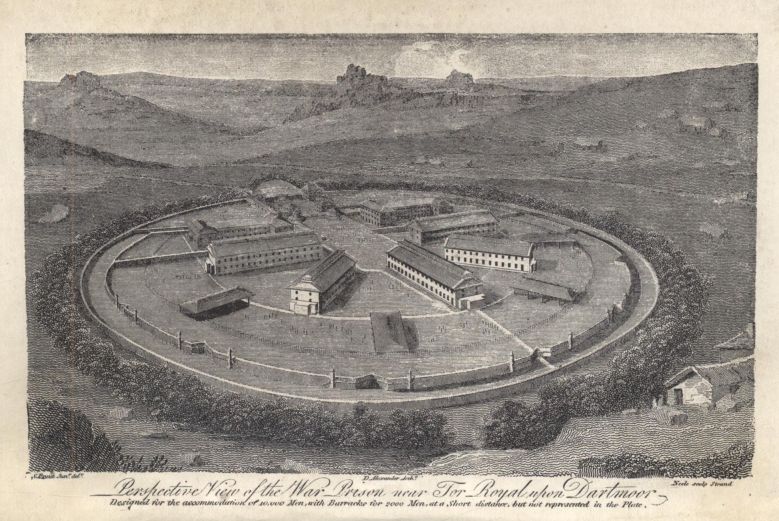
At the War Prison, in a crisis now rapidly approaching, it was
destined that the young man, Cecil Stark, should assume
sudden prominence. Thousands of French and American
prisoners were confined at Prince Town during this period;
and with the latter were herded a company of coloured men who
had been captured in the enemy's battleships or privateers.
Bitterly was this circumstance resented by the Americans; but,
worse than their slaves they found the presence of some seven
hundred French, who shared the granite hospitality of Prison
No. 4. These poor tatterdemalions had added to their necessary
griefs by personal folly. They had gamed away their very shoes
and blankets; and they were thrust hither by the hundred,
and kept alive, like cattle, with scarcely a rag to cover their
nakedness.
Many times the Americans protested with indignation against
this wrong, and implored that these forlorn French might be
removed from amongst them. But months elapsed before their
reasonable complaints were heard, and the baser sort of soldier
guards was wont to laugh and ask the Americans wherein their
own fantastic and ridiculous habiliments presented a better
appearance than the Frenchmen's skins.
Stark and certain of his companions were thus challenged on a
day in autumn as they patrolled together along the exercise yard.
Beside him walked Commodore Jonathan Miller, who had commanded
the United States frigate Marblehead when she was taken,
while behind them followed one William Burnham, a junior officer
on the same vessel, and James Knapps, sometime boatswain of
the Marblehead. These four men, together with three others
presently to be mentioned, formed a little community of
friendship, and had entered into a compact to share their means, and
make common cause against the hardships that encompassed
them. They were known as "the Seven" and their companions
held them in high esteem, for it happened that Stark was among
the fortunate and obtained regular advances from home. With
his money he did no little good, and not the Seven only, but
many more who suffered from poverty or disease, had found him
a willing friend.
A sentry perched before his box on the prison wall heard Stark
grumble to William Burnham and made a jesting remark.
"Don't the Frenchmen's skins fit 'em as well as your clothes
fit you?" he said.
Whereupon Burnham, a mere lad with red hair and a round
freckled face, made such a fiery retort that the soldier scowled
and fingered his musket.
"You ask that—you coarse-hearted lout? Their skins don't
fit 'em. Count their ribs; look at the bones sticking out of their
elbows and ankles. No prisoner's skin can fit him in this cursed
country, for you starve us; your agents rob us; you strip your
scarecrows to clothe us!"
They passed on, and Commodore Miller spoke.
"The Americans are treated better elsewhere, however," he
remarked. "At Chatham, and at Stapleton too, they receive
more considerate attention. There, at least, they obtain what
the British Government is pleased to give them."
"And the markets shut agin us—that's consarned robbery," said
James Knapps. "'Tis the loss of the market that angers me
most past bearing."
"A very great injustice," answered Miller sadly. "It cannot
be known. The French are permitted to trade with the people
of the country. Farmers and farmers' wives are admitted into
the great court and they barter regularly there. But we can only
get our cheese, or butter, or eggs for our sick folk through the
French, and they charge five-and-twenty per centum above the
market prices."
"So we are robbed every way," said Knapps. He was a
powerful, middle-aged man, of genial aspect and ordinary
appearance; but another American who now approached and walked
beside his friends, discovered a countenance that had called for
second glances in any company. He was tall, extraordinarily thin
and very high-shouldered. His eyes were of the palest grey, his
high cheek-bones seemed nearly thrusting through the skin. He
was almost bald, and his woollen cap came down over his ears.
A flat nose and a fan-shaped tuft of hair upon his chin completed
the man's physiognomy; and much bitterness usually sat upon
these strange features.
"What say you, Leverett?" asked Stark of the new-comer.
David Leverett, who had been a carpenter on the Marblehead,
and lost one hand in the engagement which ended that vessel's
career, waved his stump to the sky.
"I say 'tis small wonder that some on us enlist in the King's
service, damn his eyes! It's their dirty, devilish game ter make
us. They torture us and starve us and freeze us, till narry a one
but would Judas his own mother, if 'twas only for the sight of salt
water again."
Cecil Stark nodded.
"That is what they mean, sure enough. Another batch came
up yesterday from the Hector prison ship. Many, they say, have
gone into the King's service."
"'Tis the refinement of cruelty to make a man turn against his
motherland," mused Miller; "yet there were a few good Englishmen
on the Marblehead."
"Then there's Blazey," continued Mr. Leverett, who seldom
opened his mouth save to utter a grievance. "Call him an
Agent! One of the carved stone turrets we are going ter fix on
the church tower would be a better agent than him. I wish I
had the handling of the skunk."
"Lordy! Have done with your growling," said Knapps.
"What's the use of it? You only drive other hot-heads into
the enemy's ships. I miss faces every day as it is."
"Many are true enough," replied young Burnham. "There's
Mercer and Troubridge and our messmate, Caleb Carberry. You
miss them because they are all sick in hospital."
"Troubridge is dead," said Cecil Stark shortly; "and Matthew
Mercer is dying. I saw the doctor this morning. He said 'twas
all over with him. He's unconscious."
Leverett lifted his ribs in a deep sigh.
"They are out of it. I most envy 'em. There's no escape
from this cussed bowery except by way of the 'orspital."
None spoke; then upon their gloomy silence a black man
burst, in the very extremity of excitement. He was a big,
full-blooded negro—a splendid specimen of vigour, manhood and
health. Now he waved his arms and rolled his great brown eyes
and advanced upon them with a clumsy saltation.
"Waal, now, look at that black imp!" cried Knapps. "Come
here, Sam Cuffee! What's happened to you? Has anybody left
you a fortune, or a pair of wings?"
"Better dan dat, Jimmy Knapps! Good tings for all ob
us, please de Lord. Him coming, Sars. Ha, ha, ha! Him
coming!"
"Who's coming?" asked Leverett. "The Lord? Don't you
think it, Sam. There's no God nowadays ter keep his weather
eye lifting on the likes of us."
"'Tis vain to whine so, David Leverett," said Stark angrily.
"I'm weary of your eternal grumbling. If you chose fighting for
your business in life, you should expect hard knocks. You went
to be carpenter in a ship of war, and——"
Here a shout from Burnham interrupted the speaker, for
Mr. Cuffee had told his great news to the other officers.
"Yes, Sar—honour bright, Sar. Marse Jones, de turnkey, he
tell me. Marse Blazey—him coming to put all right dis berry
day, so I done run to tell you."
"Then you can call back your words, carpenter," said
Commodore Miller. "There's a God yet—only He takes His own
time—not ours."
"Blazey coming!" cried Knapps. "'Tis most too good to be
true. Some on you gentlemen had best think what to say to
him."
As he spoke, Captain Cottrell, Commandant of the War
Prison, appeared and advanced with a guard into the midst of
the patrol ground. A trumpeter blew a blast to summon the
wandering throngs, and when they had crowded in a dense circle
round him, the Commandant raised his voice and made a statement
from the midst of the bristling bayonets that hemmed him
about.
"I have to inform you, gentlemen, that your Agent, Mr. Blazey,
from Plymouth, will visit Prison No. 4 at three o'clock of
the afternoon to-day. Here in public he will meet you and hear
all your grievances, but there must be no private intercourse."
He departed, and the Americans, with joy upon their faces,
raised a cheer—not for Captain Cottrell, but his news. The
black men, who were grouped together apart, also lifted a shout
of satisfaction.
"One might think that peace was proclaimed rather than that
a paid official is merely about to do his duty," said Cecil Stark
with bitterness.
But Commodore Miller shook his head.
"Do not even assume so much, my lad. This man—well, a
sluggard in duty can never be trusted. If he discharges his task
reluctantly, he may also discharge it ill."
Great stir and bustle marked the next few hours. Light and
air were let into every dark corner; broken hammocks were
patched, and each granite ward was cleansed. Only the prisoners
themselves remained unchanged. No power could instantly alter
their thin, hungry faces or their disgraceful attire.
There came presently to Cecil Stark his friend and superior
officer, the Commodore.
"As one not quite unknown to them, they have called upon
me to be spokesman," he said.
"Of course, sir; you're the first man amongst us. Every
American knows that."
"But I've no gift of words, Stark, and my nerve is not what it
was. I declined the task; whereon they invited me to name a
speaker likely to address this Blazey with force and judgment.
I come to you. I hold it to be your duty. You must not shrink
from it."
Cecil Stark was much taken aback by this proposal.
"Think better of it, sir. Who am I to voice so many older and
wiser men than myself?"
"I wish you to do so. We must say much in little and hold
the Agent's attention. Be off now and collect your thoughts and
set your ideas in order," said the Commodore. "Look to it that
you justify my choice, for I shall bear the blame if you fail."
"'Tis a very great responsibility, but I'll assume it, since you
command, Commodore. Now let me meet the leaders."
After a brief conference with the prominent prisoners, Stark
vanished and, until the important person named Reuben Blazey
arrived at Prince Town, he secluded himself with certain papers
and prison orders, that he might prepare his speech.
Then, towards evening, a trumpet announced the arrival of the
Agent; the captives drew up in a dense double line, and
Mr. Blazey, with his staff and a guard of red-coats, appeared. He
was a short, stout man, clad in plum-colour, with a face of
generous purple that matched his clothes. His little black eyes
shot sharp glances everywhere as he advanced, hat in hand; his
clean-shaven mouth was of a coarse pattern, yet it lacked not
kindliness.
"Great God!" he said to a clerk at his elbow, "this is the
Valley of Bones; and they have come to life. But, indeed, I had
not dreamed there were so many."
"There are some five or six hundred of 'em, I believe,"
answered Lieutenant Mainwaring, who escorted the visitor. Then
he addressed the prisoners.
"Now who is to speak for the rest with Mr. Blazey?"
Stark instantly stepped forward and saluted.
"You!" exclaimed the soldier.
"Yes, my comrades honour me with this grave commission."
"Then be brief, young man," said Blazey, "for I don't want to
ride over Dartmoor in the dark."
"'Be brief!'" echoed Stark, with fire flashing to his eye. "'Be
brief!' Why, you——"
Here with an effort and in response to the murmur of warning
voices behind him, he curbed his temper and made another
answer.
"Our grievances can't be very briefly told, Mr. Reuben Blazey;
but I will set them out in as few words as possible. First and
worst, the scum and offscouring of the French prisons are poured
in upon us to our terrible discomfort. Next we desire to tell you
that our contractors are rogues. For five days in the week the
law directs that we receive one and a half pounds of brown bread,
one half-pound of beef, including bone—of which God knows we
get our share—one-third of an ounce of barley and salt, one-third
of an ounce of onions, and one pound of turnips. The residue
of the week we have one pound of pickled fish and coals enough
to cook it. These things are daily served by the contractors, and
we have watched them scrimp weight cruelly to fill their pockets
out of our starving bellies. Upon beef days we suffer most."
"Go on," said Mr. Blazey. He yawned, scratched under his
wig, and turned to a clerk.
"You are making notes, Mr. Williams?"
"Yes, sir—full notes."
"Next," continued Stark, "the printed regulations delivered to
us by Commandant Cottrell speak explicitly of what your Government
has undertaken to do on our account. We are not criminals,
but honest men. Why do not you understand that? We are
allowed each a hammock, one blanket, one horse-rug, and a bed
containing four pounds of flocks. Every eighteen months we are
to receive one woollen cap for our heads, one yellow roundabout
jacket, one pair of pantaloons, and a waistcoat such as you give
your soldiers. We are further promised one shirt and one pair
of shoes every nine months."
"And 'tis high time your tarnal thieves was delivered of them
shoes. Look at our feet!" burst out a voice from the ranks of
the captives.
"Silence!" cried Stark. Then he turned to Mr. Blazey.
"These things——"
"You have," interrupted the Agent. "Are you not attired in
them, you who speak?"
"Look at me!" answered Stark. "Regard these scarecrows
behind me and say if such a pandemonium of grotesque devils
ever filled human eyes outside a nightmare. Heaven knows that
we are thin enough, yet our yellow jackets might have been made
for skeletons. Look!" He stretched up his arms. "Mine comes
scarce below my elbows."
"You happen to be a giant," objected Blazey.
"Then why, in the name of God, don't you give him a giant's
jacket?" roared Knapps from the rear. He was silenced and
Stark proceeded.
"Our pantaloons you can study for yourself, Mr. Blazey. You
can note the space visible between them and our waistcoats. But
the shoes are still worse. They are made of wood and rotten
yarn, and these granite floors knock them to pieces in a week. I
pray you see to these things. Here surely are caricatures of men
that would make England weep if she could see them."
"Have you done with your facts, sir?" inquired the Agent.
"Very nearly. Now there are certain offices, such as sweeping,
shaving prisoners, cooking and the like, that receive payment;
and those who can execute mechanic arts here may daily earn
sixpence. Why are not our humbler folk allowed to share these
privileges? The French receive all these offices, though the
Americans are quite as deft as they. There is also the vital
matter of the market. The French traffic weekly with the
country people and so add fresh food to their store; we are not
permitted to do so—a cruel embargo. To sum up, I pray for
more food, more clothes, more generosity. We are men against
whom the authorities can find no real fault. Our cachot is always
empty. I was the last that occupied it. Our guards will tell you
that we are courteous, obedient, and patient. Then pray,
Mr. Blazey, help us. You know not the awful battle we have to fight
here—a battle worse ten thousand times than any between man
and man. We endure such cold as you have never endured,
sir; we eat such food as you have never eaten; we suffer from
such prison evils in shape of loathsome diseases as you will never
know. We are very sick and we daily die. How can starving
men battle with the reigning horror of smallpox? How can——"
But at the word "smallpox," Mr. Blazey's countenance assumed
a pallor under its purple and he woke from indifference to extreme
activity. His little eyes wandered wildly over the great sea of
faces before him. Then he screamed to Lieutenant Mainwaring.
"Is this truth that the man utters?"
The young officer took pleasure in Mr. Blazey's terror, and
oblivious of the prisoners or their welfare, made answer—
"True enough. The atmosphere you are breathing is pure
poison. Half these men are infected."
It was a lie, but the Agent believed it, and made an instant bolt
for the entrance.
"Then I should have been told. This is murder—deliberate,
cold-blooded murder, and you shall smart for it! Let me out for
the Lord's sake, before I've gulped any more of their filthy air!"
They made way and opened the gates. Then, before he
vanished, Mr. Blazey turned and bawled a word or two towards
Stark.
"I'll see what can be managed for ye. I'll do my best
endeavours. But I've no power, and no funds neither. Besides,
all exchange of prisoners is stopped for this year. So you'll do
wisely to bide quiet, and trust in God and the Transport Board,
not me."
He vanished, with his clerks and the soldiers after him; and
then for a moment silence, dreadful and solemn, fell upon the
captives. The haggard faces that had strained upon Blazey so
long as he was visible, turned each to gaze into his neighbour's
eyes; the gates fell to, the locks clashed, the sentries on the wall
resumed their eternal tramp. Some men, wrought up to a pitch
of mental excitement beyond their strength to conceal, shed tears
and sneaked in corners to hide them. The boys—powder-monkeys
out of captured ships—broke their ranks and went off whooping
to leap-frog; the negroes chattered and blubbered apart; some
Americans scowled and shook their fists at the blind doors; some
cursed their spokesman for bungling the matter; others walked
away mute, quite frozen by long suffering to a dead indifference.
Many fell to quarrelling among themselves, and their leaders,
including Commodore Miller and Stark, sat together and debated
upon the failure of this—their forlorn hope. In the dark
disappointment of the hour young Burnham lifted his voice against
his motherland.
"They have forgotten us!" he said. "We have lived for the
States, fought and bled for them; and now we are forgot."
"Nay, lad, don't think it," said Miller. "Your heart is low
and time drags into a daily eternity here; but remember that it
flies faster outside these walls than within them. Our country is
busy."
"'Tis that cursed Agent," growled Leverett to Knapps. Then
he scratched the red-grey wedge of hair upon his chin and turned
to Stark.
"I asked Blazey as he came in whether he had got our letters
and he nodded. He's in communication with both Governments.
"Thet 'ere man will hev the devil's toasting-fork in his guts
afore he's much older," prophesied Knapps. "He's a traitor."
"Please Providence smallpox will clutch the swine; then an
honester man may get his billet," said Leverett.
Thus they uttered folly and went stormily to their rest; but
upon the morning of the next day the Seven, strolling together,
listened to reason and formulated a plan of action. Their sick
mate, Caleb Carberry, was this day discharged cured from hospital,
and he listened to Burnham, who narrated the events of the previous
evening.
"We've done what we might by fair means. Now it remains
for us to trust to our wits and our right arms," said Stark.
"The wall men have built, men can climb," declared Burnham.
"What say you, Commodore?"
Miller gazed upward at the mighty ring of the inner
circumvallation, scarlet-dotted with the sentries.
"I'm with you—over—or under. At Chatham eighteen brave
lads escaped from the prison ship, Crown Prince, by cutting
through the side of her. Well, oak or granite, 'tis all one."
"If we no fly, we burrow berry nice, gentlemen," declared
Samuel Cuffee.
"Then 'tis our life's work from this hour to get out," said
Carberry. "By hook or crook we'll do it. And with a boss like
Commodore Miller, I lay the way will come clear."
"We don't want a lot o' poppy-cock talk, I reckon," added
Leverett. "'Tis just a secret for the seven of us—though," he
added under his breath to Carberry, "I'm consarned if I like
to work with a slave."
Caleb Carberry was a thin, feeble-looking young man who had
been cook's mate on the Marblehead. He glanced at Cuffee, to
whom Leverett referred, and answered aside—
"Sam's all right. No smouch him. Besides, Mister Stark
have had him for a servant ever since we sailed."
But Leverett shook his head.
"I don't trust no black man. I'm fearsome of him. He's
always snooking around; and so like as not he'll end by busting
on the show."
Despite the carpenter's distrust, however, a secret and desperate
determination henceforth actuated every member of the Seven,
Sam Cuffee included. What skill, energy and intrigue could do,
they meant to do. Miller and Stark had personal friends
quartered upon parole at Ashburton, some fifteen miles distant,
and their purpose now was to escape from Prince Town, enter
into communication with these Americans, and so win to the
sea-coast and to France.
"Hunger will break through a stone wall," said the
Commodore. "How much more may love of liberty do it!"
The result of their Agent's visit was manifested in various
ways to the American prisoners at Prince Town. Some
sank back upon despair and cursed each grey morning's light, as
it awakened them from the blessed oblivion of sleep; many
entered the British Service, and of these not a few were American
only in name, for their birthplace was England and they had
fought in the enemy's privateers, tempted thereto by handsome
payment. Others, like the leaders of the Seven, to whom such
surrender meant dishonour, dreamed of escape and occupied their
energies with projects and plots toward liberty.
But practical good ultimately accrued to the prisoners from
Mr. Reuben Blazey's brief appearance on Dartmoor. That
gentleman, perhaps in thanksgiving upon the discovery that he
had not taken smallpox, stirred himself to some purpose after all,
and not a few of the grievances that Cecil Stark had set forth
were presently redressed. The Transport Board sanctioned the
renewal of the market in Prison No. 4; the place was entirely
divided from its fellows for the greater comfort of those who
dwelt there; the French outcasts were put into durance apart,
and the negroes, with sole exception of Sam Cuffee, Stark's
servant, were also removed from among the Americans.
More than one of the little band that had sworn to escape, now
doubted whether, under this amelioration of circumstances, it
would be wise or politic to exchange the inside of the prison for
the outside. They held that Dartmoor rather than Prince Town
made the real prison, and that the great unknown wilderness,
with its morasses and precipices, its barren mountain-tops and
dangerous tempests, would be but a poor exchange even for
the misery of No. 4. But these doubtful ones were overruled
by Stark, Commodore Miller and the youngster, Burnham.
Carberry and Leverett most lacked courage; Knapps was
indifferent and ready to follow any man; Cuffee took his master's
view. That the negro should be permitted to join their secret
association had occasioned some natural opposition; but Cecil
Stark, whose ideas upon the subject were more than a century
ahead of his time, won permission to include the servant; and
Sam's personal fitness none questioned, for aboard the Marblehead
he had proved himself faithful and courageous. It was the
principle that awakened objections, not the man.
Soon the markets were again open, and finding that many of
the American prisoners had more money than the French,
discovering also that they spoke their own tongue and thereby
rendered bargaining more easy, the native Moor folk crowded
among them and opened a brisk traffic in fowls and eggs, cheese,
bacon and butter. No small amount of intoxicating drink was
also smuggled among them, though it generally paid duty to
some turnkey or sentry before reaching the prisoners. The
market stalls were arranged in a wide yard; the current market
prices were cried out, so that all might understand, and none
from the outer world were permitted to begin his business until
he had been carefully searched. But as time went on, and the
regular merchants became known to the guards, a little strictness
relaxed and relations became friendly. The means of the
prisoners varied much. Some were penniless, and made trinkets
carved of bone or wood serve them in place of money; some
received regular supplies from home, and these privileged ones,
Cecil Stark and Burnham among the rest, shared their funds with
less fortunate neighbours.
There came a day when, towards the close of the market hours,
Leverett and Knapps were standing at one of the stalls and
addressing the countrywoman who sat upon an upturned barrel
behind it.
"Where's your grandson of late, Mrs. Lee? I ha'n't seen him
with you for many a week."
"Nor won't no more," answered Lovey Lee. "He's gone into
sarvice—groom to a farmer's darter."
"Waal now! Do your farmers' daughters hev grooms?"
"Not often. She's a lady. 'Tis a newtake farm 'pon Dartymoor,
an' the man who started it has got more money than wits.
Jack takes good wages, an' I have half of 'em, as I ought, seeing
I brought him up."
Sam Cuffee came up at this minute.
"Missy Lovey Lee," he said, "you dun gib me my proper
butter yesterday for Marse Stark. I swear 'twas light, ma'am."
The tall woman, whose head, though she sat on the barrel, was
as high as that of Mr. Knapps where he stood beside her, stared
at the negro with scorn in her ferocious eyes.
"Get along with you, you black idol! Ban't eighteen ounces
to the pound good butter weight? You stole some yourself, I'll
swear, to oil your ugly face."
"You's a berry imperent ole woman, and I dun take no notice
ob your talk. Har come Marse Stark hisself, so you may just
speak to him, ma'am," answered Cuffee.
Stark, carrying a tray, appeared with Burnham. This signal
was concerted, and as soon as they saw him the other men moved
away together.
"Look here, Mother Lee, these won't do, you know. I must
take my custom elsewhere if you are not going to deal straight
with me," began the sailor bluntly.
"Eggs—well, what of 'em?" asked Lovey.
"The less said of them the better. Here are six—the remnant
of the last dozen I bought. Of the first six that Cuffee broke, I
ate none. So the second six you have got to take back and
give me six fresh ones from your basket."
But Lovey by no means saw the force of this suggestion.
"What next will you ax? To rob me right an' left be your
pleasure always; but I've been weak as a fly with you afore,
'cause of your curly hair. You'd starve a poor woman to death."
"Take them back, or I'll never buy another thing from you.
What's more, my friends shall not either," said Stark loudly.
Then, before she could answer, he added under his breath, "Take
'em and look at the yelks!"
Lovey instantly perceived that more appeared than was spoken.
She remembered also more than one conversation with Stark's
friends. Struck by her intelligence, unusual education and
extraordinary greed, Commodore Miller had called attention to the
old woman as being a tool ripe for their hands. Now the
preliminary approach promised well, for it was manifest that
Mrs. Lee had caught the speaker's meaning.
"I won't; I won't do it—'tis flat robbery, I tell you, an' you'd
not care if I starved on the Moor all alone in my hovel without
strength to lift a dying prayer. You are cruel devils—all of you,
and I'll go back to the French folks, as have got hearts in their
breasts. I'll——"
Then Stark, now alive to the fact that Lovey was only acting
for the benefit of the sentry, interrupted with threats. But still
Mrs. Lee argued, and only after much chatter, and a great deal
of disgraceful language, she took back the eggs and gave the
sailor six fresh ones in exchange.
"Now I must sell these to somebody else," she said, "or I
shan't get bit or sup inside my lips to-day."
"Better eat 'em yourself, Missis," said the sentry. "Anyway,
time's up now, so off you go."
A bell rang to clear the market, and the folk began to stream
out of the prison.
"Here, Sam!" shouted Stark jubilantly. "Take these to the
kitchen. I've near choked myself talking and swearing at that
old witch; but I've won my way. She's taken the bad eggs and
give me fresh ones instead."
Cuffee hurried forward.
"You was dam smart, sar. I dun fink nobody in de prison
could hah git around dat party 'cept you."
And Lovey Lee, grumbling and whining to the last, took
herself and her baskets back across the Moor; tramped home;
entered her hovel, and then turned with greedy curiosity to the
secret of the eggs. She was as safe from interruption in her lonely
cabin by Siward's Cross as she had been in the desert of Sahara;
yet caution and suspicion were a part of her; therefore she locked
her door and covered up her little window with an apron before
she turned to her basket. Then, one by one, she broke the eggs
into a basin, and her mouth watered at the sight of such food,
even while she mourned to see two pennyworth of marketable
commodity wasted upon herself. The fifth egg weighed normally;
but it was filled with dust, and, after all, Lovey made no rare
meal, for she spoilt the mess in the basin by pouring the dust on
top of it. A vital matter, however, she rescued, for in the dust
was a little roll of paper, and upon the paper a message closely
but clearly written.
"To mistress Lee, an offer of money in plenty if she will help
Cecil Stark to escape from the War Prison at Prince Town. Let
her sell two fowls next market day if she will serve him; let her
sell two ducks if she will not serve him. But if she betray Cecil
Stark, his friends will be revenged upon her."
To the young man from Vermont had fallen this first step in
the plot. Lots were drawn as to who should get the message to
Lovey Lee, for all agreed that one only need be inculpated until
it was certain that she would assist them. Now, if she proved
loyal to the authorities, Stark alone would suffer; but upon that
score little anxiety was felt, for Lovey had often expressed
sentiments much the reverse of patriotic, and had at all times made
it clear that money was the only sovereign lord she acknowledged
or served.
Upon the following market day two fine fat fowls were displayed
at Mrs. Lee's stall. She sat behind them on her upturned
barrel, and gave Stark an indifferent "good morning" as he
strolled past with the Commodore and James Knapps.
"Here's a nice brace of chicks, your honour," said Lovey.
But Stark laughed and shook his head.
"No luxuries to-day, ma'am; we're not made of money, you
know. They would look well upon Commandant Cottrell's table."
"I serve him, too," she answered. "But he likes his poultry
stuffed wi' marjoram an' wild thyme."
"And these?"
"They be stuffed different."
"Well, we won't quarrel as to that. Hungry men don't criticise
their sauces. What's the price?"
"You shall have 'em for half-a-crown."
"Lordy! Preserve us agin you greedy women!" cried Knapps.
"I reckon you'd make soup out o' stones an' sell it for ten cents
a pint if you dared."
"Come along, Commodore," said Stark, "we'll try Mrs. Luscombe
at the next stall. Lovey Lee's too grasping."
At that moment William Burnham approached and saw the
fowls.
"Just what I want," he exclaimed. "Poor Matthew Mercer
is still alive; but he can't eat any victuals, so we'll make some
chicken broth for him. What's your price, Mrs. Lee?"
Lovey glanced at Stark, and, seeing that he was not concerned,
understood that she might sell safely.
"Half-a-crown, an' I'd sooner fling 'em into the Moor for the
foxes than take a penny less," she said.
Commodore Miller turned to a sentry and asked the market
value of fowls. The man did not know, but a turnkey passing at
that moment answered him.
"Fowls are tenpence each—eighteen pence a pair to-day," he
said.
Whereupon Lovey called down lightning upon his head, and
behaved with such impropriety that the man turned round in a
rage and threatened to have her removed out of the markets.
Upon this she relapsed into sulky silence, and presently, after
some haggling, took the money that was her due, and almost
flung the fowls at Burnham.
Anon Mr. Cuffee departed with the poultry under his arm,
and, guessing what to expect, he made a careful examination. A
few words much to the point were scrawled upon paper and
packed within one bird. Lovey Lee had written an answer to
Stark's invitation.
"Right. Tell me what you want and what you'll give. Put
message in a chaw of baccy next week."
It sometimes happened that at those hours when the guard
was being changed, seconds and even minutes passed, during
which a sentry-box might be empty and a section of the inner
wall remain unguarded. It was proposed by the Seven to avail
themselves of such a moment in the dusky evening hour before
all prisoners were called upon to leave the exercise yard and pass
behind locked doors. Between the inner and outer walls of the
prison extended a space or patrol ground of ten yards in breadth;
but while the inner wall offered no special difficulties, as the
sentries' staircases were built into the side of it, the second wall
presented a harder problem. By climbing upon each other's
shoulders like acrobats it was hoped to scale it, but since the
message from the miser, this plan was abandoned in favour of
mechanical means.
For necessary apparatus the conspirators looked to Lovey Lee.
Her businesslike reply to Stark promised well.
"We must give her more to help us out than the authorities
would give her to reveal our plans," explained Commodore Miller.
"She would get but three pounds a head for us if she turned
traitor. Let her have ten pounds a head to free us and all will
probably be done that she can do. Lovey Lee sells herself to
the highest bidder. Her only steadfast principle is dollars."
"Suppose I was ter give her a tarnation fright, and let on as her
life wouldn't be worth a chip if she rounded on us?" suggested
David Leverett.
But Stark and Miller protested at such short-sighted policy.
"She won't be driven, and she won't be frightened," declared
the Commodore. "Her friendship is vital now. We've got to
submit terms, and they will need to be high."
"Best to offer a hundred pounds right off," said Burnham.
"The difficulty will be to get her to help us without the money
in advance," declared Stark.
Then came the great business of the communication to Mrs. Lee.
It was duly written and anon reached Lovey tight packed
in a huge piece of tobacco. Knapps apparently cut the quid
from a roll and handed it to her in exchange for a bundle of
watercresses. The woman put it into her cheek at once, and
kept it there until opportunity offered to hide it in her pocket.
Then, as before, she hastened home upon the completion of
market, locked her door, covered her window, and set to work to
read.
"We want
Item. A map or picture of the road from Prince Town to the
town of Ashburton.
Item. A letter to be delivered to the first prisoner on parole,
who shall be seen walking by you along that road, within
the measured mile from Ashburton.
Item. An answer to that letter acknowledging its receipt.
Item. A map or picture of the road from Prince Town to
your Cottage, so that if one escapes he may lie hid with you,
and thus be of service to his friends.
Item. Three hundred yards of thin copper wire in lengths
that can be wound up inside a fowl or other bird.
Item. Twenty very large iron nails that may be driven
between the stones of masonry.
We offer
One hundred English pounds. Ten will reach you from
time to time on market days during the next three weeks.
This will be placed between other moneys when we buy and
you sell. Ten will reach you on the day that the last of the
stipulated articles are received. Ten will reach you on the
day that the first man of us gets clear of Prince Town. The
balance will reach you when we are all free. There are
seven of us. We can only promise by the God of Heaven to
keep this contract. We place ourselves in your power, and
you must trust us as we trust you."
Lovey Lee reflected long upon this communication. Then she
put it aside and ate a meal of black bread and pickled snails.
The snails were salted down in a barrel, and she forked them out
of their shells and ate them with indifference. Her senses of
taste and smell were alike faulty. She cared nothing for food
and only drank tea made of wild herbs.
"'Tis a dreadful risk—an' me as never trusted a human soul
since I was short-coated!" reflected the miser. "Yet nothing
venture nothing have. A hundred would make up the thousand
down along to Hangman's Hollow. An' it might fall out that
after I'd got their money, 'twould be in my power to give 'em up
to the prison people again. Seven of 'em. That would add up
to twenty-one pound at three pound a head. There'll be ten
pound anyway—clean profit afore I do anything. Then I'll
make a journey, for I've got a bag full of small money waiting
to go."
She referred to her secret treasure-house in the Moor. Money
she never kept beside her, but conveyed to her hoard at such
times as the moon shone after midnight and she could count upon
creeping over the wilderness unseen.
Lovey Lee's answer was practical. Three days later she
tramped to Ashburton and walked ten miles to that town
and ten miles back again without weariness. Thus she
killed two birds with one stone, for she purchased a
hundred yards of thin copper wire, and she refreshed her mind
as to the road and its nature. Mile by mile the old
woman set down the track upon a sheet of paper bought at
Ashburton for that purpose. She marked the features of the
land upon it, wrote the names of the adjacent tors, and indicated
bridges and rivers across which the highway passed. As for the
wire, she purchased it ostensibly to make rabbit-snares, for which
purpose it was chiefly sold. A few of the prisoners upon parole
she also saw taking exercise, and knew them by their speech.
Upon the following market day, Lovey appeared at the Prison
with full baskets, and her big teeth closed tightly under her lips
as the turnkey, from some unusual prick of conscience or accession
of zeal, stopped her and overhauled her basket.
"Hullo, missis, what's this, then?" he inquired, looking at a
fine goose.
"Your brother," said Mrs. Lee promptly.
"Then best give him to me to bury decently, though 'twill be
a cannibal act. You shall have a shilling for him."
"A shilling! Look at the market rates? Geese be paid
according to weight—an' this ere bird's nine pound if it's a grain.
But ban't for you. I promised young Cecil Stark as he should
have a goose to his birthday."
"And so he shall then," said the turnkey. "Mr. Stark's a
gentleman. He made me a toy for my child last week. 'Twas a
clever little thing, fashioned like a windmill, out of mutton
bones. I lay he'll do summat with the skeleton of that goose."
The Americans greeted Lovey with their usual heartiness, but
she refused to sell her bird until young Stark and his friends
approached. Then, before he could make any remark, she
lifted up her voice to him.
"I've kep' my promise, young man, an' here's your birthday
feast, though you may think yourself lucky it have reached you,
for Mr. Turnkey there was terrible set upon it."
"Thank you, Mrs. Lee; and the price?"
"Half-a-crown, though a grasping party might ax three
shilling."
"You shall have three."
"'Tis but just. All the same, it ban't a very young bird—rather
old, in truth. An' I haven't drawn it, for their insides be a
bit wiry when they come to full growth."
"So much the better for our teeth," said Burnham.
"For that matter, we shall hev plenty of time to eat him,"
declared Knapps.
"Well, lads, to-morrow night we'll pick his bones, and if
Mrs. Lee can manage to get a bottle of brandy past our friend
there——"
The turnkey winked.
"If 'tis for physic——" he said.
"Certainly, certainly. Don't you wherrit about that. A jorum
o' drink for the sick folk. Narry a one on us would displeasure
you ter drink it ourselves, I'm sure," declared Leverett.
"And a noggin hot—for you yourself," said Stark. Then he
handed silver coins to Lovey Lee; and, feeling between them in
her pocket as she slipped them down, the old woman knew that
a half-sovereign had come also.
From that moment she conducted her business with most
unusual amiability. She jested with Burnham and Cecil Stark;
she cleared her baskets, and in a fit of reckless generosity
presented Leverett with a green apple, which remained when all else
was sold.
"Can't eat it," said the sailor. "My stomach have struck
work; but this here nig will let it down, no doubt."
"You'd do better to keep it for a love token," said the miser;
but Mr. Cuffee had already taken the fruit.
"Don't eat it; treasure it," she said. "Then you can tell
your black maidens when you go home-along that you had a
sweetheart in England who loved you so bad that her hair
growed white for you."
"I lub you too, ma'am. I lub anybody who gib me apples,"
said Sam. "You's de boofullest young ting I ebber see, and I
dun fink about no udder gal no more. And I marry you when
dey let me out ob dis dam bowray, I swar!"
At the same moment Mr. Cuffee opened his huge mouth and
the apple was gone. Mrs. Lee looked fixedly at him and laughed
a curious laugh.
"You clunk apples like a dog do swallow bones," she said.
"There's the bell; an' I shan't come no more for a week belike,
for I've got to get in my peat now, because winter will be
knocking at the door again afore long. Then we must have heat
about us, for once let the marrow freeze in your bones 'pon
Dartymoor, an' you'm dead."
She departed, and within the hour Mr. Cuffee made a careful
search upon the goose. Two skeins of wire were concealed
therein, and a scrap of paper, whose laconic message Stark
presently deciphered.
"I'll trust you since I must. Fifty yards wire along with this.
And in the apple I shall give to Leverett you'll find a map of the
road. Have your letter ready for they Ashburton chaps next time
I come."
Samuel Cuffee wept when he learned what he had done, and
vowed to atone for his greediness if only the Lord would offer
him an opportunity to do so; but the error was righted at
Mrs. Lee's next visit. On this occasion she brought a big red apple
for Stark. She also carried more wire concealed in a sucking
pig, and she took home with her a letter which the Americans
furnished. It was carefully hidden in a gift.
They had made Lovey Lee a new pipe with a piece of hard
wood for its bowl and a mouthpiece of goose-bone. Packed
within this hollow bone was a missive for a friend of Stark—a
gentleman who dwelt upon parole with an Ashburton farmer.
So, day by day and week by week the intercourse was continued,
until Lovey Lee found herself the richer by ten pounds, and the
plotters possessed maps, nails, wire, and certain communications
from their distant accomplices. These objects reached them in
pats of butter, in carrots or turnips, in ducks and fowls. Once,
when a sentry commented upon the fondness of the Americans
for poultry, Lovey Lee affected a furious indignation, accused the
man of paltering with her character, and insisted upon
disembowelling a bird under the public eye, that her innocence
might be established.
At length all preliminaries for their attempt were completed,
and only an opportunity and a twilight of grey weather remained
to wait for. But each day augmented their difficulties, for the
vigilance of Commandant Cottrell increased. Others beside
Cecil Stark and his friends had not only prepared but executed
remarkable escapes. Several men safely cleared the prison
precincts only to be recaptured; several were found drowned
in the rivers, whose crystal floods deceived them by their seeming
shallowness; a few vanished never again to be seen or heard of;
others made successful escapes, and finally reaching Tor Quay or
Dartmouth, got clear to France, and so home again. One young
man from Cecil Stark's State of Vermont went boldly forth in a
girl's clothes, which were smuggled to him by a farmer's daughter
under a basket of cabbages. A French prisoner nearly came off
by stealing a sentry's coat and hat. But as he whistled on the
way out, and adopted the air of the Marseillaise, a guard
challenged and the man was arrested. Many other instances,
successful and futile, were recorded. Therefore Stark and the Seven
exercised all caution and patience until fair conditions should
open before them and their undertaking promise a triumphant
issue.
Immediately without the War Prison stood a ruined cot,
and, distant some few hundred yards to the north-east beneath
it, a river ran. This stream, named Blackabrook, was crossed by
a pack-horse road that passed over Ockery Bridge; and here,
one hundred years ago, in place of the existing cottage, there
stood a neat little dwelling-house. Verandahs extended round it;
the walls were of granite, and the roof of reeds. Upon one side
a view of Prince Town spread, while southward its windows
commanded the valley of the river.
Here dwelt Captain Cottrell, Commandant of the prison settlement;
and now, together with a handsome, genial man clad in
black, he shall be seen sitting under his verandah and drinking
port wine after midday dinner. The Captain's visitor was of a
kindly countenance and pleasant voice.
"So much for that, then, Mr. Norcot. You'll send to us from
your mills at Chagford such quantities of flocks as Government
shall determine for the new mattresses."
"Exactly. I'm always gratified to oblige the Government."
"We can make them here—the mattresses, I mean. We have
a little world of skilled artificers within our walls. You see,
Holland is in league with Napoleon, and many of our captives
taken out of Dutch vessels are Eurasians, Malays and Chinese
from the service of the Dutch East India Company. The world
has sent us representatives of every civilised race, and among
them are craftsmen from each trade that man practises."
Peter Norcot nodded.
"'All sorts and conditions of men.' Do you recollect what
Shenstone says?
"'Let the gull'd fool the toils of war pursue,
Where bleed the many to enrich the few.'
You shall have your flocks and a good article. Since my lamented
senior partner's death I have been busy in certain directions.
Uncle Norman Norcot was a conscientious and a conservative
soul, and he regarded the new labour-saving contrivances with
the utmost suspicion. How he hated 'em! But amongst such
things there is a remarkable new flock-cutter. These matters,
however, will not interest you."
The Captain emptied his glass and rose.
"I'll take your word for all that. Now come along. You
desire a glimpse of our caged beasts and the Prison?"
"Even so—delighted to exchange my flocks for your herds."
An orderly brought round their horses and in five minutes
Peter departed with Captain Cottrell.
"Now enter the bear garden, Mr. Norcot, and do not fear the
growling. For reasons not known to me, my beasts have a hearty
hatred of their head keeper."
It was true, and Norcot observed that his guide won little
but scowls and indifference upon his way through the prisons.
Occasionally an officer among the captives would salute him; as
a rule the prisoners turned their backs.
"A strange and many-coloured assembly—of rags," commented
Norcot. "'Spectatum admissi risum tenatis amici?' But really
to the man of sentiment 'tis a matter for tears rather than laughter.
I observe you are unpopular, Commandant."
"The fate of most men who do their duty, sir."
"How true!"
"Not one fool amongst them has the wit to guess at my onerous
labours," continued Cottrell. "Old General Rochambeau, who
is living on parole with me at Ockery Bridge, will scarcely
exchange a civil word, and prefers to eat his meals in the seclusion
of his chamber. He is for ever abusing 'Les mirmidons de
Transport Service'; and yet the ancient ass makes me laugh
sometimes. He received letters recently, and one of them told
him that Napoleon would land in England on the twenty-third of
July last. Upon that day he appeared in full dress, booted and
spurred, with all his orders on—ready to welcome Boney should
he honour Dartmoor with a visit."
"He may come here yet—to stop."
"I hope so. Be very sure no parole will ever be granted to
one who has so often broke his oath."
They had now entered Prison No. 4.
"Here are my black sheep," said Captain Cottrell. "One
Yankee is more trouble than twenty Frenchmen. Never satisfied.
There are exceptional men amongst them—representatives of the
old American gentry; but the greater number are the very rubbish
and offscourings of the sea, swept here by our men-o'-war. I
believe that near half of them are Englishmen from the privateers.
They get high bounties for that work; but they are a reckless and
dangerous company. These men set the hulks on fire at Plymouth."
"Made the ships too hot to hold 'em? But they are safe
enough here. Tut, tut! Dartmoor would tame the Devil
himself, once he was on a chain."
The yellow-coated prisoners wandered about, and some exchanged
private jests as Cottrell passed, and some fell into silence
until he was out of earshot. Then a very tall, finely built man,
drew himself up and saluted the reigning power.
"You see there is a gentleman now and then to be found among
them."
"And that particular gentleman I have good cause to know,"
answered Norcot. "May I exchange compliments with him?
'Twas he who, in a moment of undue haste, broke my head."
Cecil Stark found himself summoned, and Mr. Norcot told the
Commandant of their meeting at the church.
"Then, like a lion, he felled me with his paw. I hope no fist
will ever hit me so hard again."
"He is prominent among them, and his influence is all for
good," said the Commandant carelessly in Stark's hearing.
"And a sailor; and doubtless good-hearted, like all sailors.
Well, Mr. Stark, your servant, sir."
Cecil Stark recognised the wool-stapler immediately, and shook
the hand extended to him.
"I hope I see you well, sir," he said, "and none the worse for
my stupidity."
"In excellent health, I thank you. My nose, as you see, stands
where it did. Yet I am much reduced from my usual level
humour by this sight."
"A dreary spectacle enough."
"You are probably unfamiliar with Cowper? It is your loss.
"'War's a game which, were their subjects wise,
Kings should not play at."
Neither kings nor yet Congresses. Perhaps, had you read Cowper,
you would have stopped at home, Mr. Stark?"
"It takes two to fight, Mr. Norcot. My kinsman, General
Stark—but I'll not prate of that, though this I'll say: 'tis a base
and a cowardly deed to deny parole to Commodore Miller and
his officers. We handled the frigate Marblehead like honest men;
and we had fairly beaten your Thunderbolt. She was about to
strike when the Flying Fish and the Squirrel hove in sight and
bore down. Then she fought on. We ourselves had hardly struck
to them before the Thunderbolt sank. These things I learned from
the prize crew that brought the Marblehead into Falmouth."
"I understand that there were technical reasons why parole
was denied to the officers of the Marblehead," explained Captain
Cottrell.
"You may understand, sir," retorted Stark, "but none among
us was ever made to do so."
Norcot nodded thoughtfully. True to his invariable custom,
he set himself the task of making a friend.
"You get supplies regularly?" he asked.
"He does—and shares 'em with the poorer folks," said Cottrell.
"He has great wealth, I believe," he added under his breath.
"You want parole, naturally—like any other officer and
gentleman. Why not?
"'Rash, fruitless war, from wanton glory waged,
Is only splendid murder,'
as Thomson very truly remarks. Yet even war has its laws."
"Most certainly. And Commodore Miller and his officers
possess a right to parole. Miller is one of the ablest men in the
navy of the United States," declared the young sailor.
"Ah—possibly that's where the difficulty lies. However, though
I cannot pretend to any considerable interest, yet some I have
with one or two very distinguished gentlemen of the British East
India Company. It has been my privilege to do them a service.
Maybe Peter Norcot will prove the mouse to nibble you lions out
of your granite cage. Who can tell? You have my word of
honour that I will endeavour to better your lot."
At friendship so gratuitous, Cecil Stark found himself much
moved. He hurried forward and shook Peter very warmly by
the hand.
"Thank you, thank you with all my heart and soul; and thank
God for sending you," he said. "'Tis not only for myself I speak,
but for better men. Miller is not young, and this terrible place
is making him old and infirm before his time."
"Well, I'll see; and recollect that I'm doing good for evil.
My mistress owes you little thanks, Mr. Stark, and I still less.
But all's well that ends in Christian charity."
"Are you going to marry that lovely young lady?" asked
Stark.
"That is my happy privilege. What is your fate to mine?
You suffer until the end of the war—perhaps not so long. But
I—Mistress Grace Malherb has transported me for life! Tut,
tut! You do not see the jest? How dense a sailor can be!
Well, God be with you, Mr. Stark. May you dance at her
wedding."
"'Twould be a glorious experience, Mr. Norcot. I hope your
fortune will prove worthy of you. May your life be a happy and
a blessed thing, for you are a noble man," said the youngster
earnestly.
"I will not contradict a gentleman," said Peter. Then he
bowed and went upon his way, to be rated and laughed at by
Captain Cottrell for conduct the Commandant held most
Quixotic.
With great good temper, Mr. Norcot explained his theory of
life, and denied that any human action was innocent of an
ulterior motive. Then, having seen the Prison, he rode on.
But home he did not go. His goal was Fox Tor Farm, and he
designed to spend a couple of days there before returning to
Chagford.
Much had happened to him since his last visit, and his
position in the Wool Factory was now supreme. The senior
partner—an elderly man and Peter's uncle—had fallen upon evil
times in his home. Finally, Mr. Norman Norcot's young wife
ran away with a neighbouring squire; whereupon the unfortunate
husband descended into gloom and darkness, and life grew a
weariness to him. At last he relinquished the burden, and,
going upon the Moor to shoot game, he destroyed himself—an
action that placed his nephew at the head of the famous business.
Now, conscious of these new dignities, Peter proceeded towards
Cater's Beam, and as he went he committed young Stark's
statement to memory.
"Marblehead fought and defeated Thunderbolt. Latter vessel
about to strike to the American when His Majesty's ships
Squirrel and Flying Fish appeared. Marblehead taken. Parole
denied to her officers. Why? Cecil Stark—related to General
Stark, conqueror of our General Burgoyne. Yet the pen is
mightier than the sword, as Burgoyne knew. Commodore Miller,
noteworthy American sailor."
In his mind Norcot was already dictating a letter to certain
friends who possessed interest at the highest quarters, when he
passed Siward's Cross. Then, lifting his eyes, he saw Lovey Lee
at work in a peat-cutting close at hand, and approached her with
a desire to be better acquainted.
"Well met, mother. A drink of milk for a thirsty man, I pray
you."
Lovey put down the glittering peat knife with which she toiled,
and rose to her full height.
"So 'tis! The gentleman as I seed with Grace Malherb?"
"The same. I hope I see you well."
Mrs. Lee did not answer, but started to fetch the milk, and
Peter followed her. Presently she produced a teacup and handed
it to him.
"I thank you. And here's a shilling; but you must let me
have some change—sixpence at least." This he said to try her.
Bitterly disappointed, Lovey returned to her den, and while
she was absent, Mr. Norcot, who had not drunk milk since he
was a baby, emptied his teacup into the heather. He was
apparently smacking his lips when the old woman reappeared.
"I've no change but these dirty coppers from the prisoners to
Prince Town. The hands that held 'em last was shaking with
smallpox, but of course you won't mind," she said.
"Tut, tut! Keep them, keep them, my dear woman. I only
jested. So you traffic in the prison markets with the French?"
"No—the Yankees. I understand their speech, and they've got
more money," said Lovey, stroking the coppers.
"Ah!—'tis an ill wind that blows good to nobody. So you
begin to get money, my poor soul? But be very careful, I beg of
you.
"'For Satan now is wiser than of yore,
And tempts by making rich, not making poor,'"
"Rich! Great riches mine! Look around."
"For my part I pray daily that these ghastly wars will soon be
over," said Peter.
"That's where we be of different minds, then," she answered.
"Different minds and different interests, Mrs. Lee. Well, I'm
glad to see you again. It may happen some day that you can do
me a service, or I can do you one."
"I see—with that maiden?"
Her eyes glittered, and she pointed down the valley to Fox Tor
Farm.
"Good gracious! No," said Peter, astonished that she had
guessed so near his thoughts. "The days of witchcraft and
love-potions are past, ma'am. Not that I want anything of that sort.
Grace Malherb adores me."
She looked at him with curiosity.
"My grandson be her groom now," she said; but did not add
that John Lee had confided to her the girl's dislike for Peter.
"It is a wise and rare maiden who knows her own mind,
mother. I may add that 'None but the brave deserves the fair,'
as Dryden so happily remarks. Farewell."
Lovey nodded, and he rode away.
"A strong, dangerous fashion of man," she thought with her eyes
upon him. "An' wants my friendship for his own ends. Well,
my friendship is always open to the highest bidder, Lord He
knows. An' the maiden be going to take a bit of managing by
the looks of it. John Lee had more in his mind than he spoke,
last time he comed to tell with me an' pay me half his wages."
Meantime Peter trotted forward, and presently he beheld the
raw stone walls and broken lands of the farm. He shook his
head at this display of much futile labour, then turned at the
thud of galloping horses and saw his sweetheart and her groom
approaching over the shaggy crest of the Beam.
John Lee dropped back quickly as Mr. Norcot stopped, but the
wool-stapler had sharp eyes, and he made a mental note of what
he saw.
"Well met, my lovely lady!" he cried a few minutes later.
"Of all maidens who sat a steed none ever became one as you do!
"''Tis well in stone to have three Graces
With lovely limbs and lovely faces;
But better far, and not in stone,
To have the three combined in One.'
Isn't that a pretty thing? I kept it to greet you with."
"Not your own, I'll wager," said Grace; "but never mind—don't
come nearer, please; 'Cæsar,' is fidgety. I hope that you
are well, Peter."
"Your groom was near enough as you came over the hill, my
treasure."
"Yes, 'Cæsar' knows him. We were talking about his grandmother."
"The horse's?"
Peter turned and beckoned to Lee; then, as John cantered up,
Mr. Norcot regarded him critically.
"What a picture! I never saw such a wonderfully handsome
lad—an Apollo's face. 'Disguised like a ploughman, Love stole
from the sky'—eh, Grace?"
The heart of Miss Malherb beat fiercely, but in secret.
"He's no ploughman," she answered.
"I'm jealous," continued Peter. "Tut, tut! I feel the green-eyed
monster's fiery breath scorching my liver!" Then he spoke
to the groom, who now approached. "Give you good day, lad.
And, John Lee, dost know that Mr. Bolitho of Ivybridge is seeking
an underwhip for his pack of hounds? Say the word, and I'll
commend you."
John's eyes flashed; he smiled and touched his hat.
"Thank you very kindly, sir—very kindly indeed; but I'm well
suited in Mr. Malherb's service."
"You mean in Miss Malherb's, you lucky dog!" said the man of
business. Then he winked genially, while Lee, reddening under
his clear brown skin, galloped forward to open a gate that led
into the outlying lands of the farm.
Had Mr. Norcot heard the conversation which he
interrupted between John Lee and Grace, it must have amazed
him exceedingly and reminded him of his lady's youth and
inexperience.
Those most concerned knew nothing of the relation that now
obtained between Grace and her servant, for that a daughter of his
could look upon a groom was an idea beyond the wildest mental
flight of Maurice Malherb; but humbler folks found themselves
not wholly ignorant of recent developments. Harvey Woodman
had hinted to his wife that the girl spent a great deal of her time
in riding with miser Lee's grandson, and Mary Woodman murmured
in secret upon this unquiet theme with Dinah Beer. The
question in their minds related to Mrs. Malherb.
"Ought us to tell her?" asked Mary. "Such a good, high-minded
lady as her be. An' Miss Gracie—so promising as a
March calf, bless her."
"'Tis a hard thing. I've nought against the boy for my part
either," declared Dinah. "He's civil an' smart, an' his face would
soften a stone. But they'm both young, an', loramercy! what
Nature teaches boys an' girls ban't wisdom, for sartain! Mr. Norcot
will never come it over her, for she hates him. Her told
me once, when I catched her crying all alone, poor maiden, that
she couldn't abide his shadow, an' when I said as her parents
knowed best about it, she talked treason wi' the fire in her cheeks.
'Love can't be made to order,' her said; an' when I telled
something about her duty, she cut me short an' axed, 'Do you love
your Richard, Dinah?' 'Ess fay!' I sez. 'An' if your faither
an' mother had told you to marry some person else—what then?'
she sez. 'There, Miss, let me get to my work,' I answered her;
but the truth—I couldn't tell it: that me an' Dick runned an' got
married against faither's orders, as meant for me to take a
cordwainer to Tavistock."
"Shall we tell Kekewich?" suggested Mrs. Woodman. "For
all his wickedness he'd never do an unwitty thing. He's terrible
wise—not after the event, when us all be—but in time."
"I couldn't," declared Dinah. "It do always bring a cloud to
my heart when I see his pain-stained face—such a prophet of evil
as he be."
"He never promises any good to anybody, so he's always
right," answered Mrs. Woodman, who was in a pessimistic vein.
"My husband don't like him, no more don't I," replied the
other woman. "Don't say nought to him—a baggering old Job's
comforter. He'd get John Lee turned off without a character.
Us have right an' reason to trust Miss Grace in such a thing.
Only I do wish the proper one would turn up. She never sees a
young man but him."
"A terrible pretty chap—Lee, I mean. Have 'e noticed how
mincing he gets in's speech?"
"Dick an' your husband was laughing at him for it last night.
He picks it up from Miss Grace."
"Which shows they must have a lot to say to one another."
Dinah nodded, and with an uneasy sense of guilt changed the
conversation. But the truth was in fact nearer their suspicions
than they guessed, and Grace Malherb, by slow degrees, had
come to make a close friend and confidant of John Lee. He
possessed other charms than beauty, for his mind was simple; his
heart was generous; his disposition kindly. Romance and some
mystery hovered round him; and Grace, left much to her own
devices, found the groom too often in her mind, his voice too
often upon her ear.
A critical conversation fell out between them upon the day of
Norcot's return to Fox Tor Farm. For three months Lee had
now served his new master, and attended Grace to all parts of the
Moor. Sometimes Mr. Malherb accompanied these expeditions,
and generally he superintended Grace's hurdle practice, for she
was to hunt during the coming season; but the father did not
always find himself at leisure to follow this pleasant task, and
Lee, whose first duty was to wait upon Miss Malherb, went far
afield with her alone.
From indifference Grace woke to pleasure at his delicate and
refined nature. She encouraged him to talk, and presently heard
as much of his scanty story as he himself knew. The narrative
fired her imagination, and lent him a romantic interest to her
mind. Gradually she divulged a few of her own secrets, and the
less he apparently desired to know, the more she found herself
telling him. His courteous reserve even piqued her upon occasion.
Once she quarrelled with him, and bade him retire. But
her apology upon the following day, brought him quickly to her
side.
"'Twas not indifference, God knows, Miss Grace," he told her.
"I held back for fear I might seem too forward in your affairs.
Every breath you draw is a thing of account to me. I do know
by the very light in your eyes whither your thoughts be tending—up
or down. An' I'm loth to call Mr. Norcot into your mind;
for his name brings a shadow over your face, like a cloud across
noon sunshine."
"I thought you yawned yesterday, John, when I mentioned
him. That is what angered me."
"'Yawned'! I've never yawned since I knowed you."
"Since you knew me, John. You are so slow to mend that
weak ending of the past tense. 'Tis a part of Devon
speech—a thing in their blood—but not in yours."
"I wish I knew all that was in my blood," he answered.
"You will some day. Light will come. Sometimes I think old
Lovey stole you, as gipsies steal little children. 'Tis monstrous to
suppose that you are kin of hers."
"Not so; her daughter was my dear good mother without a
doubt."
"'Tis strange how a man's heart warms to the very name of his
mother, though he has never known her," said Grace.
"Mine does, but I can only remember a white face and great
frightened eyes that belonged to her. And when I ask my granddam
for my father, she laughs—that laugh like tin beating on
tin—and tells me to look in the river and I'll see him."
"He was a very handsome man then. You've got about the
most beautiful ears I ever saw on anybody."
She spoke in a pensive and a critical tone with her eyes lifted
to the hills, as though she spoke to them.
"Good Lord, Miss Grace. Have I?"
And so they talked and daily drifted nearer danger. A
conversation of moment happened between them concerning Lovey
Lee. John ransacked his memory for Grace's benefit and told
her of early recollections, of his mother's funeral, of his arrival
with Mrs. Lee at Siward's Cross when a child, and of his first
labours upon the Moor.
"I had to collect the lichen of which they make dyes," he said;
"then I went wool-gathering, and grew very clever at setting briars
in the sheep-tracks. Later I learned to plait rexens, or rushes as
I should call 'em; then a man taught me how to ride. And as I
grew and got sense, my grandmother became a greater wonder
and mystery to me. She lived two lives, and of one I knew
nothing. Oftentimes I found that she went abroad by night.
Lying in my straw near the cattle, with their sweet breath coming
to me, I'd wake and see light in the slits of the boards overhead
where Granny slept. Then she would dout the flame—put it out,
I mean—and the boards would creak and she'd come down the
ladder and go out into the night. 'Twas moonlight she always
chose, and once, when I was a bit of a lad, up home twelve
years old, I reckoned I'd follow after and see what 'twas that took
her off so secret when all things slept. But 'twas a poor thought
for me. I followed 'pon a summer night in staring moonlight;
and half a mile from Fox Tor, under which she went, my foot
slipped where I was sneaking along a hundred yards behind her
and I fell into a bog. She heard me splash out of it, and afore I
could crouch down and hide, her cat's eyes had marked me and
she turned and catched me, breathless an' soaking wet to the
waist."
"Alack, John! And what did she do?" asked the girl, reining
up her horse to hear his answer.
"Well, 'tisn't too strong a word to say that she very nearly
knocked the life out of me. She changed from a woman into
a demon. She screamed like to a horrid vampire, and clapper-clawed
me from head to foot. 'You'd spy, you li'l devil!' she
said. 'I'll larn you to peep 'pon my doings; I'll tear your liver
out, I'll——' Then under her blows I went off fainty, an' she
scratched me like a cat-a-mountain, an', no doubt, left me for
dead. I was only a little boy, of course, and she was just the
same as she is now, only six years stronger. When I come to
again she'd gone; but I thought I'd waked to die, for there was
a dreadful bitter pang in my breast. I crawled back to the
cottage somehow, and next day, when she was out of the way,
I caught a donkey she had, and got up to Prince Town. The
doctor at the prison by good fortune passed me as I came, and
I made bold to tell him I was ill, and he had a look at me and
said two of my ribs were broken. They kept me at a cottage up
there, where Granny was known, and 'twas a round six weeks
afore I went back to her. Then first thing she said was that she'd
kill me and salt me down in her snail barrel if ever I spied on
her again; so you may be sure I never did."
The story fascinated Grace.
"How you must have suffered! But to think of the secrets
that horrid old woman has hidden! It makes my mouth water,
John. Father believes that she knows all about the Malherb
amphora—the priceless glass vase that vanished, you know—and
I believe she knows all about you. These things must
be discovered; and 'twill be your task to find them out, John
Lee."
"Ah! if I could find my father. But that's a search I'm almost
fearful to make. I——"
He broke off, and Grace felt the matter too delicate for
comment. Her interest in Lee grew daily, and, ignorant of love,
the girl now believed her emotion towards him must be called
by that name. He for his part loved indeed with all his young
heart and soul. Care clouded his life, because he knew that he
was wrong to think twice about his mistress. By night, when
alone, his courage sometimes increased; but daylight and duty
quenched it. Under darkness he dreamed dreams, yet when he
rose to hear rough men laugh at his amended speech, and see
Malherb order him hither and thither, as he ordered the rest,
John Lee's folly stared him in the face. He fought with himself
to relinquish his task and depart from Fox Tor Farm; he fancied
that he had conquered himself, and determined to go; then
would come a long, lonely ride with Grace, and a return to vain
unquiet hopes. His conscience urged him away; his power of
will proved insufficient to take him beyond temptation. As for
the girl, her tender feeling was an unconscious instinct of
self-preservation. She desired a strong protector rather than a lover;
and he who might secure her safety was sure to win her active
regard. Grace's delight in John Lee, her increasing admiration
for his goodness, honesty and chivalrous nature, she mistook for
love. The fatuity of such a conclusion was not impressed on
the girl's virgin mind; and the secret of John's parentage proved
no obstacle to attachment, but rather an incentive. That he was
a gentleman in every vital particular she perceived.
Upon this day a barrier fell down between them. She had
found herself sad and weak before the approaching shadow of
Peter Norcot; and John had waxed desperate, and forgotten
everything in heaven and on earth but the lovely, mournful maid
beside him. They were but seventeen and eighteen; of the
world they knew nothing at all; but his world was in her eyes,
and she believed that her future welfare and hopes of happiness
now rode at her elbow in the handsome shape of the lad.
"John," she said, exactly one hour before Mr. Norcot's horse
appeared nigh Cater's Beam—"John, he's coming to-day."
"I know it. I know the weather of your heart, Miss Grace,
as soon as I look upon you; for the eyes are the sky of the mind."
"Come closer," she answered; "come closer and comfort me."
"Mr. Peter is a great man now—head of the Wool Factory,
and worth many thousands of pounds."
"Cold comfort! If he was made of gold with diamond eyes
he would still be Peter Norcot."
"'Tis strange, but you are the only person in the world that
don't like him."
"And you," she said quickly, "you hate him too."
"Yes, I hate him well enough—because he's a coward and a
hard-hearted man at bottom to plague you so, when you've made
it clear you cannot love him. I hate him for that, I promise
you. I could believe dark things against him gladly. Do you
know what Tom Putt said?"
"No," replied Grace. "Not that Putt's opinion is of much
moment save in matters of salmon."
"He is courting a maiden at Chagford; and her brother—a
man called Mason—is an outdoor servant to Mr. Norcot. And
last Sunday, when the women were at church, Putt had speech
with this man, and they got merry over drink. Tom praised
Mr. Norcot mightily, and his servant said with great admiration
that he believed as like as not, Mr. Peter had killed his uncle
to get head of the Wool Factory. Mason said he couldn't pay
Mr. Norcot a higher compliment for skill and cleverness; but
Tom Putt was rather afeared about it, and he's in doubt now
whether to go on courting that man's sister."
"There was a mystery," declared Grace. "Peter Norcot last
saw his uncle alive on the Moor. Oh, John—to think of it! He
is cruel, for he sets man-traps and spring-guns in his woods. A
man who would do that would—he may be even a murderer!
Under all his rhymes and nonsense he surely has a tiger's heart!"
"You mustn't think of it—either that he could do so wicked
a deed, or that you are going to marry him. Most gentlefolks
put man-traps in their preserves nowadays. But, to be honest,
he don't, for I heard him tell master he didn't last time he was
here. And as for you, the right man must soon come. He——"
"Stop there, John! 'Tis like your kind self to talk so to me;
yet I know very well how it hurts you."
"Sweet!" he cried. "I have told you how I love you. I
couldn't choke it down longer. And you forgave me, and pitied
me a little. You must let me hope and pray for the right man,
since 'tis impossible I can ever be anything to you."
Grace was silent, and he continued.
"I've learned better since that moment. I'm not a fool. My
love at least is too big a pattern to offer it to you again."
"Can a man love a maid too much then?" she exclaimed.
"He may love too little and so offer himself. I love—there,
my love's all of me. But who am I to dare to lift eyes to
you?"
"'Tis just that, John," she said with a fluttering heart. "Who
are you?"
"Until 'tis known——"
"What difference can that make? Can a fact not known alter
a fact known? Mr. Norcot taught me that much. Facts never
contradict themselves, he said once; and the fact is—you love
me. If a king was your father, you still love me; and you are
you—honest and true, and generous. And—and you've got a
dear face like my dead brother's."
He stared in front of him, and Grace mused over his virtues.
Suddenly he spoke.
"You'll make me mad again!" he cried. "I ought to spur
away for dear life, and for honour and right; I ought to turn my
back and gallop to the ends of the world; but I can't—I can't
do it—more shame to me."
"You certainly love me with all your heart, John. Well, John
dear, I think I love you too!"
"No, no," he said. "You must not; it can't be; 'tisn't in
sober reason."
"So much more likely to be real," she answered. "True love
is not reasonable, John. And you must fight a great battle for
me, because all the world is against us."
"The world—the world's here—here! The rest I can put
under my foot and forget. You love me—oh! Grace, my
star—is it true?"
"Yes, for I've never felt so before, and I've done almost everything
but fall in love in my time. 'Tis quite a new thing—sure
it must be love; for what other name is there to give it? I love
your beautiful face, and your voice, and your gentle ways; and
I love you best of all for loving me, John."
"Every living thing loves you," he said solemnly. "Yet you
can come to a useless, poor, humble man like me, and trust me
with yourself!"
"Yes, I trust you, John," she said with gravity equal to his.
"I know not what may betide; but you must stand between me
and—and that man. Do you love me well enough to run risks
and dangers for me?"
"May time prove it!"
"Your love is shield and buckler both to me," she said.
"And yours such a blessing as God Almighty never poured
into any life before," he answered earnestly. "'Tis my prayer
henceforth that I may lift myself up to be worthy."
"I love you with all my heart, indeed. And some day, far
on, when the world rolls kinder and everybody's wiser, and
Mr. Norcot is an angel or a married man—then I'll be your wife,
John Lee."
The lad appeared more weighted by this mighty promise than
jubilant at it.
"Do 'e call home all it means, my lovely?" he asked. "Do
'e know that your whole beautiful life rests on whether 'tis a wise
deed or a vain one?"
Grace nodded.
"Love casts out all fear," she said.
"Then I can only fall back upon God to be on our side," he
answered. "'Tis my life and light and heaven on earth to hear
you say that. Ay—you shall be my song for evermore. I'll try
to live worthy of such bounty. There's no going back now—none,
for I'm only flesh and blood, and Michael and all his
angels shan't take 'e from me any more!"
Before she could speak he was close at her side and she felt
his arm about her waist, his kisses raining upon her cheeks.
"For ever and ever, Grace!"
"Oh yes, dear John. Love never dies."
"If we could ride away over the hills now——" he said,
dreaming his golden dream.
"We should meet Mr. Norcot, for there he comes," she
answered.
"I feel that I should like to go to him and take him out of
his saddle and crush him like an eggshell."
"My valiant sweetheart! You may indeed have to do so some
day. Drop back now, dear John, and let my cheeks cool. Oh,
how lovely a thing it is to have this mighty secret between us!"
"If I died now," he said, "I should have had far, far more
than my share of the good of the world."
"Talk not of dying. You must live for me."
"That will I—and die for you if need be."
"We'll live and die together, John. Now fall you back, my
own dear love—else Mr. Peter will grow jealous."
Thus it came about that when the manufacturer winked at
young Lee and called him "a lucky dog," he uttered a great
truth, although he was quite ignorant of the fact.
A company all clad in black assembled at the dinner-table
of Maurice Malherb. The family still mourned their hope,
while Mr. Norcot's loss was even more recent. He bore himself
with great correctness and resignation. The narrative of his
uncle's sensational death was held back until later in the evening;
out a matter more pressing filled Mr. Malherb's mind, and he
hurried the ladies from the table when dessert was done, that he
might open his project.
"How do you find Grace bear herself towards you now?"
began the farmer abruptly, when he found himself alone with his
future son-in-law.
"Alas! 'A fellow that lives in a windmill has not a more
whimsical dwelling than the heart of a man lodged in a
woman.' But I must be patient."
Malherb frowned.
"She's a fool—yet a fool may make the heart of the wise ache.
Who shall escape a fool's folly if that fool be his daughter?"
"Tut, tut! Don't call her a fool. She is young—still in her
halcyon hours. As Horace——"
"Listen to me, Peter. You are a reasonable man, and thank
your God that it is so, for they grow rare. Now you will readily
understand my feelings when my son died."
"I died myself when I pictured your sufferings, Mr. Malherb.
"'World-wasting Time, thou worker of our woes,
Thou keen-edged razor of our famous name.'"
"Even so. To be frank and avoid sentiment, I've put my life
and soul into this place. I've made it a strong fortress for those
to come. I have built and planted with my thoughts upon my
son. And then, while the mortar was a-drying and the young
larches getting their first root-hold, he fell. Think of what that
meant to me."
"My imagination can picture it. Death is so final. As Herrick
says:—
"'Man is a watch, wound up at first, but never
Wound up again: once down he's down for ever.'
I have sympathised with all my soul."
"Then you must be practical and prove your sympathy. I had
meant to write to you, but speech is more direct, and so I waited
until we met. Now thus it stands. My son has passed away;
my daughter remains."
"I have appreciated that. There was a verse writ on the
Duchess of St. Albans by the Earl of Halifax for the toasting-glasses
of the Kit-Cat Club. A word or two makes it exquisitely
applicable:—
"'The line Malherb, so long renown'd in arms,
Concludes with lustre in fair Grace's charms.
Her conquering eyes have made their race complete:
They rose in valour, and in beauty set.'"
"They mustn't set; that's the whole matter," answered Maurice
Malherb. "I have sworn to my heart that set they shall not.
My son is dead; my grandson remains a possibility—nay, a
certainty, so far as anything human can be certain."
"Your grandson! You amaze me. Tut, tut! Was Noel
married?"
"No! My grandson will be your firstborn. Where's the
amazement in that? Two years hence you will be the father of
a boy; and that boy I ask of you. Some might almost say I had
right of possession, circumstances being what they are; but I am
reasonable in my dealings, and just to all men. That boy I
ask—nay, I beg. My heart yearns to the unborn lad. I live in the
future always, for 'tis both true wisdom and true happiness to
look ahead. The present generally proves cursedly disappointing
to a sanguine soul. I gave you my daughter and you give me
your son—your firstborn son. He will come hither; his name
shall be Malherb; he succeeds me and founds the family which
my own son would have founded. You catch my sense? 'Tis
but a link missed in the chain. I cannot believe that I am asking
too great a thing. What say you?"
As a man of humour, Mr. Norcot always appreciated his present
host. Now he kept a judicial face and laughed out of sight. His
eyes were grave and his forehead wrinkled. He thought, of
course, of Grace, but he did not mention her.
"You are the most original and gifted man it has been my
fortune to meet. Even the crushing changes and chances of life
leave you quite unperplexed. You evade them in a masterly
manner by sheer quickness of perception. It is genius. Positively
you do more than deserve success: you command it."
"Sleep upon the proposition, Peter, if you find it too great
thing to decide instantly."
"I see no need. I seldom find myself in a difference of
opinion with Maurice Malherb. The phlegm with which I view
the advent of this unborn man-child quite surprises me. Your
idea is worthy of a big heart. I seem to feel it both just and
honourable. These walls must not fall into alien hands when
your work is done. That a son of mine should face the world
as a Malherb and follow his grandfather's footsteps—what a
privilege! To be honest, I have never much desired children,
though doubtless the bachelor's heart expands when he is
married, and the usual result follows. But now the case is
altered. Tut, tut!
"'Delightful task! to rear the tender thought,
To teach the young idea how to shoot';
and also how to ride, and to fish, and to be a gentleman. By
'young idea' I mean my son—your son. Yes, your son—to
grow as you would have him grow, in the traditions of the
Malherbs."
"Upon my soul, you might have been my son yourself!" said
Malherb with stern exultation; "for you're the most level-headed
man that ever I met."
"I have learned from you," said Peter modestly, "life is really
not half so difficult as people make it. Wise sacrifice is the secret
of success—nay, more, of happiness. Man cannot have his way
all round. He doesn't grow in a flower-pot alone, but in a jungle
of other living men and women—some stronger and some weaker
than himself. Then let him sacrifice where he can't succeed,
that where he can succeed he may succeed superlatively. Lop
off this limb, for that stout tree will bruise it; cut out these fine
twigs, they will never get to the sun. But keep such and such a
branch, for its way promises clear, and it can kill the weaker
things if you only make it strong enough. Limit your aspirations,
like a gardener limits his melons; but once determine where
lies your strength, then throw heart and nerve and every pulse of
life that way. Spare no pains, no brain-sweat, no toil there. Pour
your life's blood out for that purpose. So you have taught me."
Mr. Malherb nodded with a satisfaction hardly concealed. It
was a system remote from his own, as the unwavering light of
the moon from fitful marsh fires; but Norcot knew well that he
would not perceive the fact.
"Tenacity of purpose is vital to success," the elder man
declared.
"Yes, it is so; our parts must limit our plans. I cannot do
much. I have neither your intellect, nor education, nor power of
driving many horses together; yet, what I can do—is done. My
subjects are few, but I have mastered them and pursued them to
the present limits of human knowledge. My ambitions are all
gratified save the greatest."
"And you still short of forty! You were easily satisfied,
Peter."
"Forgive me, but you would speak with more authority on
that point did you know what my ambitions were. Accident
gratified my penultimate desire two months ago. To achieve the
supreme place at the Wool Manufactory was impossible by my
own act, because a human life stood between; but my uncle
perished; and now the thing I thought would be so sweet proves
otherwise. 'Tis a sermon on the futility of human ambition."
"He was unfortunate in his wife. You must keep that sad
story for the drawing-room. Annabel is most anxious to hear it.
And your last ambition is Grace?"
"She is, indeed. She will, at least, exceed my highest hope."
"Her mother presses for a season in town."
"'Tis but natural that Mrs. Malherb should do so. Then
'farewell, a long farewell' to Peter Norcot.
"'And too, too well the fair vermilion knew
And silver tincture of her cheeks, that drew
The love of every swain.'
You don't read Marlowe?"
"You have my word. She might marry a Duke for that
matter; but would a Duke make me a present of his firstborn
son?"
"One may answer with absolute certainty that he would not,
Mr. Malherb. In fact, the constitution of the realm—She is,
however, of the stuff that Duchesses are made; I know that
perfectly; while I can never hope to be more than a plain
man—perhaps a knight and a member of Parliament, if all goes
well—yet——"
"She is yours and she'll have an uncommonly good husband,"
said Mr. Malherb shortly. "Now talk of the farm. Did you
note my sheep upon the Moor?"
"I did. They look most prosperous."
"There's a rascally law here that denies me the right to pasture
more cattle on the Forest than I can winter upon the farm. For
the overplus I am called to pay as though a stranger to Venville
rights. A monstrous injustice, as I've told 'em. But to meet it
I must build new great byres. Did you note the work?"
"I saw no new byres," answered Peter.
"Nay—I forgot. They are not yet begun. But so clearly do
I view them in my mind, that for the moment I thought they
existed already."
"You incur tremendous expenses."
"Why, naturally so. One does not come to Dartmoor empty-handed.
To tame a desert and turn it into an important agricultural
centre calls for capital among other things. Now let us
join the ladies."
"Gladly," returned Mr. Norcot. "Those are the pleasantest
words I can hear spoken under this roof. 'Tis not always
so—but here. 'And beauty draws us with a single hair.' I wrote
that to Grace when I heard that she had caught her first trout.
She never answers my letters, by the way."
Presently the visitor told of his uncle's death. The story
proved dramatic, and Mr. Norcot's method of delivering it was
very deliberate and effective. Her kinsman's unhappy end
specially interested Annabel, who had known him intimately in
earlier days.
"You are to understand that the cloud fell upon my poor
Uncle Norman when his wife left him. Some might have held
her departure a happy circumstance, seeing the light nature of
the minx; he took his fortune differently. To us it may seem
strange that any circumstances would make life unendurable—apart
from the question of morals. Massenger has a word on
that—a sort of answer to Hamlet.
"'This life's a fort committed to my trust,
Which I must not yield up till it be forced.'
Poor verse, but good sense. Well, there came a day when I
made yet another attempt to lift my uncle from his deep despondency;
and I thought that I had succeeded, for he consented to
come upon the Moor and take his gun. I was to fish; he proposed
to shoot duck—his favourite amusement in the old times. I
rejoiced, little guessing his dark purpose. Indeed, who could
have done so with a mind so lofty? What does Blair say in
'The Grave'?
"'Self-murder! Name it not; our island's shame;
That makes her the reproach of neighb'ring states.'
It should be looked into, for the crime grows appallingly common.
But a female is too often at the bottom of it. My uncle
exhibited the utmost bitterness when his wife ran away from him.
'Women are all alike,' he said to me; and when a man says that,
you know his luck has been to meet the exception. Never did
Norman Norcot touch upon the deed in his mind, however,
though Parson Haymes has since told me that upon one occasion
he found it his duty severely to reprove my uncle for ideas
favourable and lenient to suicide.
"To resume, he threw off dull care, as I fondly supposed, and
went to the Moor for a day's holiday along with me. I took my
man, Reginald Mason; while a lad accompanied my uncle. Our
plan was that I should fish the River Teign where it runs into
the central vastness of the Moor beneath Sittaford Tor; while he
proposed to shoot up the valley of the little Wallabrook, a stream
that rises in the marshes beneath Wattern and joins the Teign
near Scorhill. We were to meet at a lone dwelling by Teign
Head, where lives a shepherd. There we designed to take
luncheon; and my sister Gertrude had packed a goodly basket
with such delicacies as we knew that our uncle most esteemed.
There was a bottle of French burgundy at my order. ''Tis bad
for him,' said Gertrude. 'I know it,' I replied, 'but 'twill do him
no hurt for once after hard exercise.'
"Mason left me at the junction of Teign and Wallabrook, and
proceeded up the river to the place where we were to lunch three
hours later. The boy, with uncle's great red dog and little black
spaniel, went up to the head of the lesser stream, for he told this
lad to work down towards him, and drive any birds that might
rise into the lower reaches of the river. This plan Uncle Norman
proposed, and I wondered at the time that he should make
arrangements so unusual. For myself, I set up my rod and was
a little impatient to get at the trout, for there chanced to be a
good morning rise. But my uncle desired me to stop with him
for a while, and of course I did so.
"At last we parted, and he made no ado about leave-taking,
but compared his timepiece with mine and promised to be
punctual at the luncheon tryst. I wetted my fly and had moved
a hundred yards when he called me back and asked me for some
string. 'My bootlace has broken,' he said. I had no such thing
upon me, but cut off a yard of my line; then restored the cast
of flies and left him apparently putting his boot in order. I
never saw him again alive. When I had reached what I call
'the pool,' where Teign lies in long, still reaches between two
waterfalls, I thought that I heard the faint report of a gun; and
I smiled with satisfaction, little dreaming what had occurred.
"Punctual to the appointed time, I met Mason at Teign Head
cot. But my uncle did not appear. An hour we waited; then
came the boy and the dogs. The lad had also heard one report
of a distant fowling-piece, but he had worked all the way down
to our starting-place without seeing his master.
"Still I found myself not anxious. I partook of food, then
went down the valley expecting to meet him at every turn. At
last I reached the place where we had parted, and then Mason
and the dogs together made that terrible discovery. You know
the rest. My unhappy relative was reduced to the primal, 'porcelain
clay of human kind.' He had slain himself by putting his
weapon to his throat and pulling the trigger with his foot. My
fishing-line had been used for that terrible purpose.
"'Ill news is wing'd with fate, and flies apace,' says Dryden.
Before set of sun, as though carried on magic pinions, the whole
little world of Chagford knew what had happened. It was a very
trying time for me. My spirit sank. But for thoughts of Fox
Tor Farm I could have relinquished my new responsibilities and
envied the eternal rest of the dead. I felt most dreadfully
unsettled. Nothing mattered. The dubiety of mundane affairs
was much borne in upon me. Reflections concerning the shortness
and darkness of man's days crowded down like a fog upon
my spirit. I felt as I never yet had felt, that
"'The world's an inn, and death the journey's end.'
Dryden again.
"There he lay in his life's blood—extinct and cold as ice. He
had chosen to destroy himself within a hollow worked by the
old-time miners. Great deliberation and forethought clearly
marked his actions. Yet I am thankful that they brought it in
as insanity; and, for my part, I am positive that the dear
gentleman's mind had given way under his misfortunes. But there is
no marrying nor giving in marriage where he is now."
Mrs. Malherb wept silently as Peter finished his story. Then
her husband spoke.
"He was a coward, and a coward is better out of the way.
No human tribulations can justify the evasion of suicide. The
man's duty had been to follow them, find his false lady, and,
with proper formality, blow her lover's brains out, not his own.
Go to the piano, Grace."
That night the weather changed from fair to foul. Dense
vapours descended upon the Moor, driving mists wrapped
hill and valley; scarce a mountain thrust its crown above the
gloom. For two days the rain prevailed and Grace was in some
fear that the change would delay Peter Norcot and lengthen his
stay at Fox Tor Farm; but when she whispered that belief to
Kekewich in the breakfast parlour on the morning of their visitor's
departure, the old man showed no fear.
"He'll go. He'm not the sort to change his plans for a scat
o' rain. You'll be rids of him by noon."
"Oh Kek, when shall I be rids of him altogether?"
"'Twill be wiser to get rids of your dislike of the gentleman,
Miss Grace. Master means to see you married by next
Whitsuntide."
"Somebody will have to run away with me."
"There's many would be very willing, I doubt not. But them
as runs away with a maid, will often run away from her come
presently. In this here vale o' tears, the hard deed be the wisest,
nine times out o' ten. You'm so butivul as a painted picture;
but your sort is often miserable in their lives, just because 'love'
be the first thought and only thought in every heart as sees 'em.
So you pretty ones get to think that love be the sole thing as
matters."
"I'm sure I don't, then; at least—I—oh, why do fathers plot
and plan for us so? Is it right? Is it fair?"
"A grown-up faither must be wiser than a young giglet not out
of her teens."
"Where's the wisdom of——?" began Grace; but her mother
appeared at this moment, and Mr. Norcot followed with the
master of Fox Tor Farm.
After breakfast the weather mended, and Malherb insisted that
Peter should ride round the estate with him—a performance of
which they had been disappointed on the previous day. Norcot
obeyed and admired all things, but he ventured to doubt whether
a plan for bringing water from a spring by way of an open conduit
would serve the purpose in winter.
"It is like to freeze or choke with snow," he said.
"Nonsense!" answered Malherb. "Everybody here is always
whining about what will happen come winter. Did not I see last
winter here myself?"
"A very unusually mild one."
"Well, I don't fear it. But my men shiver at the name of it.
It haunts their summer. They begin to see the phantom of it
before September. Woodman and Beer are always crying about
it. Is it not so, man?"
He addressed Mr. Beer, who was ploughing up potatoes with
a yoke of oxen. The stalks had been drawn and collected in
huge heaps, and now, with his coulter held close on the left of
each row, Richard flung up fine tubers at every step, while Tom
Putt, Mark Bickford, and several women, specially engaged for
this important business, followed and filled the carts.
The crop was heavy, and Mr. Malherb regarded it triumphantly.
"These will astonish some of our neighbours, I fancy," he
remarked.
"You must have brought this land with you!" commented
Peter; and the farmer was constrained to admit that the soil had
called for costly preparation.
The weather broke anon, and before midday the mist lifted
sluggishly to the crowns of the hills, sulked there awhile, then
prepared to roll down again.
At his parting meal Norcot had some speech with Grace and,
afterwards, succeeded in winning a little conversation with her
alone. She showed indifference and impatience. Then he
interested her by describing his visit to Prince Town.
"The hero of the chisel honoured me with his attention. I
am to do him a service if I can. He is a gentleman from the
State of Vermont. He congratulated me on my fortune and I
expressed a hope that he might be at your wedding. If I win
his parole for him, it is quite possible that he may be."
"I am resolved with all my soul and all my strength never,
never to marry you, Peter; and you know it; and you are
ungenerous and cruel to press it."
Mr. Norcot nodded thoughtfully.
"Nothing in the world like a hearty resolution," he answered.
"'I have seen a woman resolve to be in the wrong all the days
of her life; and by the help of her resolution, she has kept her
word to a tittle.' But not so Grace Malherb. She is too sensible
for that. I can leave my future happiness with absolute
confidence in her little hands."
"My happiness is of no account!"
"Your happiness is my own. But let us return to Cecil Stark.
A handsome and a gallant lad. He and his companions should
enjoy parole without a doubt; and it may be that I shall assist
them in that direction."
"You're a fool for your pains," declared Maurice Malherb, who
entered at this moment. "Are there not enough of his kidney
quartered all round about at Moreton, Tavistock, Ashburton and
elsewhere? Certain of the Americans have broken their parole as
it is. Conceive, if you can, the mind capable of such a crime.
A dog has more sense of honour than these people."
"There are both heroes and rascals among them as amongst us
all. You know my weakness for physical perfection. He was
such a magnificent lad—Stark, I mean. And sailors always get
upon the blind side of me. I find them so sterling and so
simple. Of course, 'they that go down to the sea in ships,
that do their business in great waters,' surprise one, since you
might suppose that no man of intelligence would willingly select
such a deplorable profession; yet I like 'em for their modesty and
humble behaviour. I shall release Commodore Miller and the
rest, I believe, if Lord Hamilton prove still my friend. He is
persona grata with the Regent."
"And so is Sir Thomas Tyrwhitt at Tor Royal. I am almost
minded to pit my influence against yours," said Malherb, half in
jest, half in earnest. "I am myself privileged to know the Duke
of Clarence, and at his table I was once honoured by meeting the
Prince and received some flattering attention from him when he
learned that I was a friend of Tyrwhitt."
"Oh, dad, don't!" pleaded Grace. "Let Peter free them if he
can."
"And what interest have you in the matter, my dear?"
"Why, didn't the young man nearly knock my brains out?
I have every right to be interested," declared his daughter.
Anon, Mr. Norcot set off for Chagford, and Grace, yielding to
her father's wish, rode with him for some miles. Behind them
followed John Lee and Thomas Putt. The former had come
to escort Grace home again; the latter carried Mr. Norcot's
luggage. As for Lee, Peter's well-knit figure and prosperous mien
quite filled the forefront of his thoughts. His own helplessness
especially crushed him when Norcot occupied his mind, and
while Peter and Grace exchanged ideas, John kept a dark silence
behind them, nor could Putt win any word from him.
At last Miss Malherb reached the turning-point and prepared
to take her farewell.
"I wish you could find a reason for your coldness," said
Norcot, as they drew up on the lonely heights of Believer. "I'm
a logical man. If you convinced me of error, it would be so
different. But I have yet to know why I shouldn't love you and
why you shouldn't marry me."
"I don't love you."
"Tut, tut! That's nothing. What a pitiful fellow should I be
to let so small an accident frighten me from a noble purpose!
Besides, 'don't' and 'won't' are very different words. Patience
is my strong point, and you can't remain a child for ever."
"Words—words, Peter! I often wonder what your real life is
behind so much talking."
"Marry me and find out."
"Never. You think I may love you presently. It is absolutely
impossible, so spare yourself the delusion, and spare me."
"As to that, delusion is half the joy of life, and at least three
parts of true love. Hear Waller. His address to the 'Mutable
Fair' might do you good.
"'For still to be deluded so,
Is all the pleasure lovers know;
Who, like good falconers, take delight,
Not in the quarry, but the flight.'
Farewell, sweet Grace, until we meet again."
He bent over her hand in a very courtly fashion, and then
set off for Chagford with Putt after him.
When they were out of sight Grace turned to her lover and
quickly felt his arm round her, his gentle kisses upon her
cheek.
"'Tis very well," she said; "but I can't live even on your
kisses, sweetheart. This man quite overclouds my spirit. I gasp
for air; I suffocate with quotations. You'll have to run away
with me, John."
"Whither, my lovely Grace?"
"Why—to your grandmother. I'll dye myself nut-brown and
pick snails for Lovey Lee."
Than her jest nothing had better served to show young John
the futility of his hopes.
He groaned aloud.
"I have been mad," he said; "each day, each hour shows me
how mad."
"Your love must find the way. Read some of my story-books.
I'll warrant they'll hearten you. You are meant to do dashing
deeds."
"Life falls out so different. What can I do? How shall I
set about proving that I'm worthy to tie your shoe-string? The
bitter truth is that I'm not."
"Now I see that Mr. Norcot has oppressed you as he oppresses
me. I always feel not good enough, nor great enough to breathe
the same air with him."
"But he is not good, nor yet great," John answered.
"Well, we stand where we did. You must see your grandmother
and be firm with her. You are a man now. Approach
her boldly upon the subject of your father. She knows all about
you—more even than I do—'tis not to be endured. And if you
cannot win her to our side, then I must. Just think how it
might chance if she has the amphora!"
Upon this fascinating problem they spoke at length, and with
such earnestness, that they forgot their love affairs for full five
minutes. Not until familiar landmarks warned them that they
neared their home again, did they become personal. Then John
Lee's soul grew glad once more, and hope woke within him at her
voice.
Peter Norcot, meantime, heard something of interest on his
homeward way. In a wild heath beyond Hameldon, he overtook
two old men plodding along together, and as he possessed a
remarkable memory, the horseman recollected one of them very
well, and offered him greeting.
"How now, Mr. 'Ha'penny for a rook, a penny for a jay'!
How wags the world with you? You forget me, but I remember
Leaman Cloberry who showed me my road to Fox Tor Farm
when I was fog-foundered a while agone."
"To be sure—an' they be reaping what they sowed there by all
accounts—I mean where I took you."
"Reaping what you sowed more like," said Putt wrathfully.
"If I'd catched you at your May-games wi' rats and moles
up-along, I'd have broken your wicked neck—old as you be."
"Stuff an' nonsense!" answered Cloberry, "I never went nigh
the place. 'Tis Childe's Tomb I speak of, not rats an' mice. 'Tis
pulling down of holy crosses wi'out more thought than an honest
man would draw a turnip. An' they lost their only son; and but
for the mercy of God might have had their throats cut last
night—eh, Uncle Smallridge?"
"'Tis so indeed, your honour," piped Uncle. "An' me the
first to tell the news; for if they'd escaped, 'tis odds but they'd
have fallen on man, woman, 'an childern; for they'm little better'n
Red Injuns by all accounts."
"What is this aged but animated earth chattering about?"
asked Peter.
"'Tis thanks to the watching Lord an' Cap'n Cottrell they
didn't," declared Uncle. "But they tried, an' they'd a' gotten
their devilish contrivances all ready; but the red-coats was too
clever for 'em; an' now 'twill be bloody backs for every one of
'em; an' sarve 'em right, I say!"
"The old chap overruns his subject, your honour," explained
Cloberry. "The matter be that last night but one, when the fog
blowed up so thick an' sudden, a party of them Yankees to the
War Prison concocted a wonnerful clever plan for escape. In the
thick of the dimsy light they popped over the first wall wi' a very
nice li'l ladder all made o' rabbit wire; but somehow—God he
knows how—afore they could scale the outer wall, up ran
Commander Cottrell an' his valiant men, as was snugly hidden away in
a covered shed there. The armed sojers made every man Jack
of 'em a prisoner in a moment. How the plot was found out an'
who told upon 'em ban't known; but somebody did for sure—else
they'd a' got clean off—all seven of 'em."
"Pegs! 'tis a merciful escape for Dartymoor!" said Uncle
Smallridge.
"Most interesting; but I hope 'twas not a young acquaintance
of mine," answered Peter, "else I much fear my efforts upon his
behalf will prove vain. Thank you, my men, for this remarkable
news. Now let us sing 'Long live the King,' and Cottrell, long
live he; and here's a trifle to cool your throats when you have
done so."
He handed a shilling to each man, and they clamoured blessings
upon him.
"Always knowed you was a gentleman. An' may it be your
turn next, sir," said Cloberry with great heartiness. "I only hopes
you'll be in a proper tight fix some of these days and 'twill be my
fortune to pull you out!"
"An' me, too," declared Uncle Smallridge, "for you'm one of
the Lord's chosen heroes if ever I seed one. You can take an
old man's word for't."
Within a fortnight, Norcot had succeeded in obtaining the
privilege of parole for Commodore Jonathan Miller, Cecil Stark
and William Burnham. But the boon arrived too late, for in
response to the order came a communication, telling how these
officers, together with four other men, had recently been captured
in a bold attempt to break out of the War Prison. In what
manner the authorities had learned their secret and hindered
them, none knew; but the result proved definite enough; for the
promise of parole was immediately withdrawn and all future hope
of it denied.
A week after his latest recorded ride with Grace, John Lee
visited Siward's Cross, to find his grandmother in a black
and savage temper. Not only had she lost her money, but all
chance of making more, because the Americans now firmly
believed that Lovey Lee was the traitress, since she alone, beside
the Seven, knew of their project and the time determined for it.
This woman was quite innocent; yet now, indeed, her sole regret
centred in the fact that she had not betrayed them. But an
unknown spy had taken the Government's money, and was richer
by twenty guineas, while Lovey went poorer every way. How to
regain the confidence of the prisoners was the problem before
her, and she had not solved it on a day when John Lee came to
her cabin. With him he brought some of his wages, and the
silver served to comfort Mrs. Lee. She was half tempted to tell
him her grievance, but natural caution arrested her. She held
her peace concerning her private affairs; then, by a sudden
question, unconsciously led him into his.
"How do Malherb get on with Norcot? You can tell him
from me that thicky chap be built to be his master."
"'Tis the daughter he wants to master, not Mr. Malherb.
She's promised to him. 'Tis all cut and dried in every mind but
Miss Grace's."
"They won't ax her."
"To think of such a maiden being flung to a man she hates!"
"Stuff! She'll come round same as her betters afore her.
He'll make her like him. Ban't he made o' money? Us all
know that he be."
"She's wept tears against him a thousand times. She's a
Malherb too, with all her father's strength of will and fifty times
his sense. She won't wed against her heart for any man."
"What do you know about her heart, Jack Lee? You'll be
wise not to open your mouth so wide; else you'm like to lose
your job."
"I'm not blind to hideous injustice."
"Nor me neither. The man who would rob the poor would
sell his darter to the rich. His damn stone walls stretch out all
around yon valleys now, an' my cows get the fat of the pasture
no more. I wish I could fret the flesh off his bones for it."
"Mr. Malherb has got his troubles and so much the more he
wants to have his daughter off his hands and be free of her. The
madness of the man! I learned from Kekewich, who is a very
good friend to me, that he has already asked Norcot for his
first-born to make him master of Fox Tor in the time to come. He
looks that far ahead."
"The fool!"
"It shan't be while I live and can stand between her and the
ruin of all her young life. I'm a man now—I——"
"Since when did you larn to talk so fine? An' who taught 'e?"
"Miss Malherb has been pleased to polish my speech. We—we
are very good friends, thank God."
Lovey reflected over this curious remark. Then the matter in
her mind was suddenly echoed upon his tongue and he put the
familiar question.
"Grandmother, when are you going to tell me my father's
name? I weary of asking you."
"You'm travelling fast," she answered; "long rides, an'
mended speech, an' what else? She finds you're fair to see—'tis
natural. Yet 'twill dash this crack-brained foolery when you
know what you crave to know. For years I've kept that secret,
hoping there was money hanging to it. But I don't see none."
"'Tis your duty to tell me now that I am a man."
"As to that— Do she want to know, or do you?"
"We both—at least——"
She caught him up.
"Ho-ho! An' what be you to her that she should care a rush
who your faither was?"
"Well—a secret understanding——"
"Unknown to her faither?"
"'Tis so, but for God's sake, grandmother——"
"Say it out, then, or I'll peach. Come now——"
"Will you swear before heaven to tell nobody—not a breath to
any living soul?"
"I'll swear hard and fast—may my liver rot if I whimper it,"
said Lovey, already speculating what the lad's confession might
be worth to Maurice Malherb.
"And you'll tell me my father's name?"
"As to that, yes. We'm prone to hunger after more truth
than's pleasant to taste. An' what you want to know won't make
you more light-hearted, nor yet that maiden, if she's been so daft
as to turn her eyes to you. Your mother was my daughter Jane.
Your faither was Norrington Malherb, the younger brother of
Maurice Malherb, as died long since. So you stand cousin,
wrong side the blanket, to that girl."
She watched his face grow pale and heard him groan.
"Only his faither, my old master, knowed, and that was why he
paid me anything at all—cussed miser that he was. You wince,
as if I'd thrashed 'e like I did when you was a boy. You'd
better have bided ignorant."
"No, by God!" he swore. "'Twas right that I should know.
My only grief is that you hid it so long. 'Twill break her heart."
Lovey jeered.
"If that's all your trouble, you can laugh again. Maids as
ban't hardly growed to see their bosoms rounded don't break
their hearts for men. You tell her, an' she'll find it very easy to
forget you."
"She has promised to be my wife!"
"My stars! The moonshiney madness there is in children!"
"She loves me—she always will. We can't be more than
mistress and man now. But she'll never think no worse of me;
for this is no fault of mine."
Lovey Lee did not answer, but her mind worked busily. She
was wondering whether she might be able to pluck profit out of
this folly.
"You'm a proper man—none can gainsay it. Have 'e the
pluck of a man? A church service an' the mumbo-jumbo of the
parsons never yet kept the rickets out of a weakly babe, nor
made the child of healthy folks more fair to see. Cuss the
world, as must needs drag God A'mighty in by the ears to their
twopenny-ha'penny plans an' plots an' marryings! Nature's made
you a fine, shapely mate for any female. Maybe this wench——"
"No," he said; "I'm a gentleman at least. I cannot marry
her now, and I will not. Fate has cast me into the world and
has given me good blood, but it has denied the only thing that
makes blood worth having. She can never be my wife; yet I
may fight for her against the world; I may serve her well, please
Heaven."
"Bah! What's the use of that knock-kneed twaddle? 'Tis for
you to fight for yourself against the world and beat it at its own
dirty games, not to whine about fate, just 'cause your faither an'
mother didn't happen to be yoked but by their own healthy
passions. Be a man! Ban't it better to have noble blood in 'e,
even o' the left hand, than wake and find yourself a labourer's
son—heir to nought? Here's such a chance as might find you
master of Fox Tor Farm in twenty years or less, if you was built
of fighting stuff. What's the bar? None at all to any but a fool.
There be Dukes of the Realm whose forbears comed in the
world when a King of England cuddled an actress. Larn what
happens an' take a big view of things. If you'm ashamed of
yourself, then slink away an' cut your throat comfortable behind
a haystack, an' get out of it. But if there's a pinch of your
faither in you—not to name your gran'mother—then pick up the
cards an' play 'em for all they be worth. Oh, I could almost
wish I was a pretty lad like you be, to have the living of your
life."
"I'm in a maze. I must get away with my thoughts; and I
must speak to her."
"But don't speak what I've told you. Don't be such a born
fool as that. Run away with her if there's one drop of lover's
blood in you. Marry her; then play for Fox Tor Farm after;
an' mind there's a lew corner by the fire for your poor starving
gran'mother come she gets old."
He left her and went out with his head hung low and abiding
grief upon his face. The woman's talk had not fired him; the
thought of fighting and conquering the world did not quicken his
pulses. He only saw the gulf for ever fixed between himself and
Grace Malherb, and he was crushed. He felt not even curious
to find out how she would receive the news. His own mind
assured him that his determination could not waver. He must
leave the farm, and that immediately. He debated whether he
should vanish away without a word. But such a step appeared
both cruel and weak. Therefore he decided to tell Grace
everything and then depart.
Lovey Lee meantime flung herself into the matter with great
mental zest and an itching palm. Come what might, a lively
promise of money rose out of this remarkable accident, and she
foresaw encounters such as her soul loved between the strong and
the feeble. Peter Norcot and Maurice Malherb were upon one
side; Grace and the boy upon the other. Her natural instinct
drew her to the powerful and the rich; then she reflected that in
the long run Grace Malherb herself might prove the best mistress
to follow. All depended upon the young woman's attitude
towards John Lee's information; for that he would tell her the
truth Lovey perceived, and that the girl's decision would presently
reach her own ears she was also assured. Dismissing the matter,
therefore, she returned to her former problems, and speculated
how to convince the American prisoners that she had acted in
good faith, and that the traitor to the enterprise must be sought
inside the War Prison, and not outside it.
Harvey Woodman was ploughing with a team of six
bullocks, and as he plodded behind them over the burnt
ground, he sang a strange song understanded of the cattle. It
cheered them at their toil, and the low, monotonous notes
sometimes broke suddenly, and leapt abruptly a whole octave upward.
When the song stopped, the steers also stopped, nor would they
resume their labour until the ploughman returned to his music.
Beside Woodman tramped his son to turn the team when necessary.
But they made poor ploughing through the heavy and
ill-drained ground, and Maurice Malherb, who watched the
operations from a distance, was alive to the fact. His personal
unwisdom prompted the enterprise, for he was engaged in
attempting to reclaim land that defied the effort; but, as usual,
he set all blame upon other shoulders than his own. Now he
approached Mr. Woodman and accosted him.
"You're not getting what you might out of those brutes. If
you'd sing less and watch your work closer——"
"Ban't that, your honour—devil a bit will they go unless a
man chants their proper song to 'em. 'Tis the nature of the
earth, not the cattle."
"Nonsense. The land is no worse than the rest aloft there,
that I've drained and pared and turned into fine fallow. The
cattle go uneasily. I'll wager that fool blacksmith at Prince
Town shoed them ill." He examined the hoof of an ox as he
spoke. The inside claws behind were left unprotected, but the
outer ones had been carefully shod with iron. Malherb
perceived that the work was good.
"Then he threw them carelessly, I'll wager. These big steers
should be thrown with the greatest skill."
"To be just, your honour, 'twas very cleverly done, for I
helped myself," answered Woodman.
The master turned away without another word. In his stormy
mind of late there had been growing a darkness foreign to it.
Dim suspicions, thrust aside only to reappear, shadowed his
waking hours and haunted his pillow. From cursing ill success
he had, by rare fits and starts, risen superior to his character and
asked himself the reason for it. With impatience and an oath
the answer was generally rapped out; but the question returned.
In secret arcana of his heart, Maurice Malherb knew that he had
acted with overmuch of haste. Thereupon he distributed the
blame of his enterprise right and left: and chiefly he censured
Sir Thomas Tyrwhitt, in that the knight had always prophesied
smooth things. Yet honesty reminded Malherb that while
pursuing the suggestions of local men where it pleased him to do
so, he had widely departed from the beaten track of experience
in many directions. He remembered a recent interview with the
owner of Tor Royal, and the words bluntly uttered then: that in
certain particulars of husbandry Malherb attempted the
impossible. The impossible, indeed, had always possessed a fatal
charm for him. He had of late despatched cattle to Bideford
Fair and sheep to that at Bampton—a matter of considerable
expense in those days. But no prize nor commendation rewarded
his undertaking. He was spending money still with but meagre
return for it. He saw his means dwindling, and already the
future of his family depended largely upon the success of a
midland canal, in which Maurice Malherb, fired by glowing promises,
had embarked a very large proportion of his capital. Canals
were the rage amongst speculators a hundred years ago, but few
sensibly succeeded; many were no more than the schemes of
rascals and existed only upon paper.
Now this man, conscious of gathering troubles, lifted a corner
of the veil that hid his spirit and looked upon himself. The
spectacle was disquieting and made him first impatient, then sad.
Angry he often was, but sadness before this apparition proved
something of a new emotion. For a few fleeting moments he
glimpsed the real and perceived that his own stubborn pride and
boyish vanity were near the roots of life's repeated failures. For
once, in the glare of a mental lightning-flash, he saw and
understood; then his troubled eyes caught sight of flocks feeding in
the bosom of Cater's Beam; and Malherb's misery lifted.
Scattered upon the hills like pearls, their fleeces washed to snowy
whiteness by recent rain, the farmer saw his sheep; and they put
heart into him, and dispelled the gloom begotten elsewhere. He
turned his back on Harvey Woodman and failure; he stopped
his ears to the cattle song, and looked out upon the Moor.
"The music of a sheep-bell rings my fortune," he reflected.
"There lies my strength; that wool means high prosperity
presently and an issue out of these perplexities."
Now his flocks represented the counsel of other men.
A moment later the master went his way with mended spirits,
and as he entered his farmyard a grumbler met him. Mr. Putt
revealed a face red to his sandy locks, while the rims of his eyes
were even pinker than usual. Consciousness of wrong stared
out of his face and he spoke with great feeling.
"I does my stint, God He knows. I work by night as well as
day, but 'tis too much to be agged into a rage six times a week
by they females, Dinah Beer an' t'other, just because I can't do
miracles. Ban't my fault things go awry in the fowl-house; ban't
in me to alter the laws of nature an'——"
"What's the matter? Despite your scanty vocabularies, all
you men take a wearisome age to say what might be said in
a minute. But if you had more words perhaps you would make
shorter speeches."
"Ban't vocableries at all, axing your pardon, sir," said Tom
Putt; "'tis rats—an' their breeding is no business of mine. I'm
at 'em all the time wi' ferrets an' traps an' terriers; but they will
have the chickens, for they'm legion. But what's the sense of
Mary Woodman using sharp words to me? I do all that a man
may. Look at the barnyard door next time you pass, your
honour, an' you'll see varmints of all sizes an' shapes nailed
against it. There's owls an' weasels, an' rats' tails by the score,
an' martin-cats, an' hawks. I can't do no more; an' Leaman
Cloberry hisself couldn't."
"Go your way. I'm satisfied that you work hard enough. We
shall get 'em under presently. As to Cloberry—the old moth-eaten
knave—let him not show his face to me while he shoots foxes."
"There was a brave gert fox round here two nights since," said
Putt. "I heard un bark, an' he got short in his temper, too, when
he found the ducks was out of reach. You could tell by the tone
of his voice that he was using the worst language he knowed.
An' I told Miss Grace; an' her laughed an' said she could wish
as he'd collared hold of a good fat bird for hisself and his family."
Mr. Malherb smiled grimly.
"Very right and proper," he said. "If any duck of mine will
help a good fox to stand before hounds, he's welcome to it.
Never touch a fox as you hope to be saved, Thomas Putt. Thank
the Lord cub-hunting begins in a fortnight."
Cheered by this reflection, the master proceeded about his
business, and Putt went the round of the mole-traps to find not a
few of Mr. Cloberry's "velvet-coats" dangling from the hazel
switches that he had set. As he returned he met Grace about to
start on her ride, and hearing of Mr. Putt's speech with the master,
she bid him take to heart what her father had said. Then, turning
to John Lee as they trotted out of sight into the wilderness,
she continued upon the same matter.
"To think that within a few short weeks I may win my first
brush! But a cub's little brush—it seems so unkind to kill the
baby things. Still the baby hounds must be brought up in the
way they should go—eh, John?"
But the young man's thoughts were far from foxes, because he
was now to tell his lady of the conversation with Lovey Lee.
"You're sad," she said, as they rode over the Beam and
descended into those heathery wastes that stretched south-east of
it. "Even the thought of my first brush wins no enthusiasm
from you. What's amiss, John? I fear that Lovey——?"
"Even so," he answered. "'Twas but the day before yesterday,
and yet it seems long years since I heard it—my death-knell."
"What a word!"
"The true one. I only ask your leave to go. Bide here I
cannot any more."
Grace looked very grave.
"What dreadful thing has fallen out?" she asked. "Whatever
you have learned, it cannot make you other than you are. And
it cannot surely make you love me less."
"My father was your father's brother, Grace—your Uncle
Norrington, who died."
She did not answer, but stared before her. A flush lighted her
cheek, but it was of exultation rather than dismay,
"You're a Malherb! How glorious."
He shook his head very sadly.
"Not I. My mother's name and my mother's shame is all my
portion."
"Poor John—'tis hard to smart for others so. Yet—you're
my own cousin."
"Don't think it. These things run by law, not by blood. I'm
mere fatherless dust—not worthy to be trod upon by you. I can't
live for you now, Grace; I might die for you; 'tis the highest
fate I hope for."
She reflected for some moments, then answered—
"I do not see that the case is much altered. We had guessed
at this, John; it hardly hurts me. We are still as we were. There
is nothing between us that prevents me from being your wife."
"How ignorant you are of this cold, cursed world! You argue
like an angel might that had never been beyond the gate of
heaven. But we must face facts now. All is changed."
"Except my word and yours. I've promised to wed you; and
a Malherb does not break promises. Don't I love you dearly?
Tell me that I do."
"Right well I know it."
"Then that's your weapon against this cold world you speak
of. You've got to make the world warm for yourself—and me;
you've got to make the world forget this accident of birth. How
are you different? You were born like any other. A man may
be born to power; but no man is born great. 'Tis but an extra
handicap and obstacle at the start. Oh, my brains are quick as
lightning to-day! You must conquer this thing, as many great
men have; you must see that it might have been ten thousand
times worse. Your father was my father's favourite brother. He
was a soldier and died in the wars. Now 'tis for you to make my
father your friend. Then he gets you a commission in the Army.
Then you go to the wars, and—oh, no, no—to think that I can
say that! I who still wear black for my brother!"
But he saw her vision of himself—grown great despite his birth.
He beheld himself winning a place in the world even worthy to
offer her. He was young and sanguine, and her words had thrown
a veil over the harsh truth. Yet his spirit sank.
"If such a thing could be!"
"Such things have been a thousand times. History is rich in
them."
"I might do something, yet never anything great enough to
offer to you."
"It must mean that you went far away, and I don't think I
could let you go. And yet——"
"The thought is too grand even for hope. Who am I that I
should ever win a commission in His Majesty's Army?"
"You are the son of a good soldier. The time cries for
soldiers; but no, I couldn't let you—oh, dear, gentle John, I
couldn't. Perchance Sir Thomas Tyrwhitt might—but I can't
plot the details in cold blood, and I wish heartily I'd never
thought of such a horrid idea at all. You shall not go to the
wars for me. You must shine in a peaceful part."
"Fighting's the only sure quick way to success in these days.
How to get Mr. Malherb's good word?"
"I've thought of that already. I've been thinking of it ever
since you told me, and hating myself for thinking with such a
hard heart. You've got a grandmother, and she is shrewdly
suspected of a great crime. If, indeed, she robbed dear father,
and you could prove it——"
"If I could find the amphora and bring it to him!"
"You must do so! That is what lies before you."
"But it may be all a dream, Grace."
"Then we must go on with the dream until we waken. Our
love's no dream at least, and if one way won't serve, we will seek
another."
"Honesty and right point the only way—for me: that leading
out of your life."
"You are downcast and you try to make me so; but you shall
not succeed, I promise you. Am I nobody, that you talk so
easily of the road that leads away from me? Do you want to
be off with the old love, John? Ah! Now I know what
has fallen out: you've found a pretty girl and one easier to come
by!"
"Don't—don't! 'Tis no time for jesting. My heart's breaking
to see my duty so cruel plain."
"Your duty lies where your love is, and honour bids you keep
your word to me before everything, John. And if you love me
well enough to go into the world and fight for me, you shall;
though 'tis my heart that will break, not yours, when I think of it.
Thus it stands: you must win my father to your way and if good
chance helps you to bring him back his treasure, then so much
the more quickly will you come to your reward."
"It may be so. Certainly there is some place that my
grandmother used to haunt by night, and I know the direction."
"As a child she nearly killed you for spying; now, as a man,
you must do the like again to better purpose. She can't whip you
now."
"You will jest."
"The amphora is no jest. Secure it, and my father is under
an eternal obligation."
"Would you have me ask for his daughter?"
"No, indeed; he would fling the amphora back in your face.
But you ask—oh, that I should say it—for a commission. Yet,
please God, the war will be done; and yet, again, if it is, whence
are you going to win glory?"
"Glory!" He sighed and said no more.
"To be frank," continued Grace, "dear father would not keep
the amphora now. He loves beautiful things, but he loves his
farm better. He needs money. He looks so far ahead, that the
present often finds him very straitened. Just now 'tis money
he most wants, and you have to begin the campaign by finding
twenty thousand pounds for him."
"I'll do my best—the Lord helping."
"And think not, dear John, that I am light of heart because
my tongue wags so fast. I laugh, but my spirit is low enough
when I remember all that these things must mean. Your life will
be full of fret and fever and action; I shall have nothing but
thought and hope to fill mine."
"I wish I could believe you. Your dangers will be real ones.
If I departed, who is to stand between you and Peter Norcot?
Since I am to fight, 'tis your battle, not the King's, that I long to
enter into."
Grace shook her head.
"Have no fear for me, John; I can take good care of myself—of
that I do assure you. Now tell me that no maid more practical
and sensible and brave than I, ever set sail to face a sea of
troubles."
Then fell silence between them for a long season, and there
was no sound but the rasp of the dry, burnt heather twigs against
their horses' feet.
John Lee entertained a very vivid recollection of the spot
where his grandmother had turned on a moonlit night under
Fox Tor, and beat him for daring to follow her. That her
hiding-place was still the same he doubted not; and now he
determined to track the old woman down again, but with more stealth
and skill than had marked his boyish operations.
Seven times he waited on the Moor beneath the hills, only to
find each vigil unbroken save by the familiar shapes and voices of
the night. Then two moons passed and the hunting season
opened in earnest. It now became Lee's duty to ride his master's
second horse, for Mr. Malherb was both a heavy weight and a
hard rider. As for Grace, she approached the sport with all her
father's ardour and quickly proved herself a brave and a brilliant
horsewoman. Oftentimes she made John's heart sink, for she
knew no fear; then Maurice Malherb cautioned her for incurring
of unnecessary risk, and in private John implored her to be more
cautious.
"You are magnificent," he said. "'Tis a grand thing to see
Mr. Malherb's face when he watches you; but you are made of
flesh and blood, not moonbeams; and your horse, fine though he
is, can only do what a horse may."
"'Tis so funny to hear dear father tell all men about his
wonderful system of teaching; while the sober truth is that you
have taught me what I know," she answered. "Father rides well
enough and with the courage of a lion; but you—I love to hear
them talk of it. Sir Thomas and the rest declare that you have
the most perfect style on Dartmoor. Father has to thank you for
much. You nurse his second horse marvellously."
"He is always most generous with his praise—and his
half-guineas. I hate to take them," replied John.
Grace Malherb got her first brush in November. Then came
a day when circumstances so fell out that she went to a meet with
Sir Thomas Tyrwhitt and the house party from Tor Royal. Upon
this occasion Mr. Malherb had business in Exeter and he rode
thither at dawn with John Lee. It was understood that Grace
might spend the night with friends at Holne, some miles from
Fox Tor Farm.
An incident trivial in itself needs this much of elaboration,
since mighty matters sprang from it. Maurice Malherb, his
business of purchasing a new hunter happily completed, set off
homeward in good spirits; while John Lee followed, riding his
own horse and leading the new one.
Upon his return the master found that Grace had not come
home; while John Lee, perceiving the night to be clear and lit by
the moon, determined once again to keep a vigil for Lovey. He
tumbled into bed soon after eight o'clock, slept soundly for three
hours, then, as he had often done of late, arose, dressed in his
thickest attire, left the loft wherein he lived and crept out of the
house. Slipping from a side door, John was startled to hear
footsteps, and, peeping cautiously over a gate that led to the
stable-yard, he saw his master, booted and spurred. A moment later
Maurice Malherb led a saddled horse from the stable, mounted it
and cantered away.
John kept invisible until the other was gone; then, full of
wonder at a circumstance quite beyond his experience, he left the
farm and entered the Moor. The moon shone clearly, and there
was frost in the air. Dew glimmered grey upon the dying herbage;
and below in the valley waters murmured softly from a dense
cloud of silver mist that hid them.
Now the object of Malherb's secret pilgrimage was one which
he would sooner have perished than declare. The man's soft
heart prompted him upon this mission; a simple matter of sentiment,
hidden jealously from every eye, took him forth into the
night. The morning kiss that he gave to Grace was always formal
and cold; and if sometimes he stroked her hair or patted her soft
cheek, he instantly assumed an attitude of indifference or said
some harsh word, as though contemptuous of his own weakness.
Annabel Malherb, affectionate and warm-hearted though she was,
possessed far more common-sense and infinitely more self-possession
in matters of human affection than did her husband. She
showed all that she felt and very properly passed for a gentle and
a tender-hearted woman; he secreted his emotions and banked up
volcanic fires out of sight. Thus he suffered as only those at once
self-conscious and deeply feeling can suffer.
Upon returning from Exeter, Mr. Malherb supped with his wife
and heard how Sir Thomas Tyrwhitt had called upon his homeward
way after hunting and taken a dish of tea and a cordial.
"'Twas a very good run—one hour and twenty minutes. They
killed upon East Dart, near Dury, and my lady Bastard had the
brush."
"What of Grace?"
"Sir Thomas saw her once, well up. Doubtless she returned
with the Fentons to Holne. Her things were sent in good time,
for Dinah Beer went in to market there and took 'em with her."
"Yes, yes, of course," said the farmer, and spoke of other
matters. Yet sleep refused to close his eyes; and while Annabel
slumbered placidly enough, well knowing that her daughter was
safe and happy, the father, equally sure of the fact in his reason,
found a paternal instinct above reason keeping him awake and
restless. He tossed to the right and left; he swore half-sleeping;
then he started into wakefulness and saw his window full of
moonlight. The illumination decided him. With a shamed face he
stole from the side of his wife, and ten minutes later was ready
to take the road. Creeping out of doors, he went to the stable,
saddled a hack and rode off towards Holne village with a sulky
and guilty satisfaction. The thought of any human eye upon him
had driven him into a furious passion at once. He was ashamed
of himself, yet well content to be upon this business.
Malherb trotted the four miles to Holne, fastened up his horse
at the edge of a wood, and proceeded cautiously to the dwelling
of the Fentons. Avoiding the front of the house, he presently
reached the back premises. All was still, and he passed
noiselessly to the window of the stables. The occasional thud of
hoofs and snort of nostrils reached him from here. Moonlight
illuminated the interior, and Malherb without difficulty saw what
he wished to see. His daughter's hunter stood comfortable and
asleep in its stall. For that sight alone the man had come,
because it revealed to him how all was well with Grace. Some
great dog bayed, and leaped to the length of its chain with a
rush and rattle, but before a sleepy voice from above bade it be
silent, Malherb was far away. He hurried back through the
trees to his horse, then returned homewards, happy. Other such
human secrets as this were locked in the casket of his heart, and
now, thinking upon the past, he remembered deeds to his account
as a young husband and father. He growled impatiently and
shook his head, for it vexed him that God's self should know
those things.
Into the thread of the night's incidents Malherb anon returned,
but for the moment it is necessary that we follow John Lee.
Proceeding along the accustomed way, he hid closely where,
beneath the inky blackness of a rock's shadow, it was possible for
him to survey the shining vast, himself unseen. The sky twinkled
with frosty stars to the horizon; the moon sailed high overhead.
Then, almost before he had settled to his vigil, there came a
sound out of the night, a rhythm of feet, that bore a lean
grey figure who seemed woven of light and mist. It crept
towards him; it promised to pass along the sheep-track within five
yards of him; and Lee, with a tremor of boyish fear suddenly
chilling his bones, shrank into the darkness and scarcely dared
to breathe. Then Lovey Lee went past, and the light was in her
eyes where they glimmered out of her white face, like jewels set
in marble. Her breath came a little short, for she was moving
fast. As one in sleep she swept along, staring before her, until
her tall shape was swallowed up again within the pearly dimness
of the Moor. The sound of her footsteps died upon his ear;
the vision of her faded.
John Lee gave his grandmother a few minutes' start before he
followed with extreme caution. For two miles he stalked the
shadow of her, then, perceiving that she must presently enter a
deep gorge known as Hangman's Hollow, where certain ruins of
old mining works and blowing-houses still stood, he made a wide
detour, mended his pace, and got to the neck of the coombe
before her. Here he concealed himself again beside one of the
rotting buildings, formerly used for smelting of tin. He hid
behind a broken wall, and through a chink in it kept watch upon
the ravine down which he had just hastened. Upon his left
yawned a disused gravel-pit, where a labourer had hanged himself
to a rowan tree and so given this sinister name to the spot.
Around about, dying brake-fern spread wanly under the night;
and here and there flashed the white of a rabbit's scut as it
bobbed from its hole to the open and back again. On the
watcher's right hand, deep sunk into the heather-clad earth, the
bulk of an old blowing-house still appeared; but one side had
bulged and broken out, so that the whole stood like a shattered
corpse of some habitation, and shone pallid there in its pall of
grey lichens and rusty moss.
While still he panted after his run, and was vexed to see
his breath steam into the moonlight, there came Lovey Lee
slowly descending. She passed him, and turned the corner of
the ruin where two broken walls rose with a shattered alley-way
between them. Above towered the dome of the blowing-house;
beneath was a wilderness of broken stone.
John heard no sound, so he took off his boots, and, keeping in
the shadow, peeped round the corner that Lovey had turned.
But he saw nothing. The place was a narrow cul-de-sac and no
visible exit offered from it; yet Lovey had quite vanished. Her
grandson rubbed his eyes, then crept forward, and, growing
bolder, searched every nook and cranny of the spot. But not
one evidence of life rewarded him. Beneath, green sward sloped
away at the embouchure of the combe, and a few sleeping
sheep appeared dotted upon it, all misty and silver-grey. No
shadow of his mysterious grandmother was visible. Again
he searched without avail, then turned homeward—in haste
to be gone. There was upon him now a cold and crawling
sensation of dread. Witches and devils, hobgoblins and
werwolves were dancing in his mind; each silent stock and stone
that stared moon-tranced upon him seemed to hide some
nocturnal thing of horror, some ghoul, or cacodemon. Impish
atoms of life twisted and wriggled under his feet; the owl's
cry uttered words of dark meaning to him; the night opened
sudden unexpected eyes, and spirits that he had never known
now jostled and elbowed poor John Lee. Even in his
superstitious dread he felt a wave of shame when he thought of
what Grace must say; yet he could not regain his courage
immediately, for every time that the problem of his grandmother's
disappearance turned uppermost in his mind there came an
unnatural solution to it.
But had John Lee waited patiently with his eyes upon the
ruin, instead of flying so fast away, his fears had been stilled, and
the mystery solved without any superhuman aid. Long before
he reached home again Lovey had already reappeared, and was
tramping back by the way that she had come.
Then the sound of a horse's feet fell suddenly upon her ear,
and knowing that it was no wandering pony, but a mounted
beast, she turned and saw the figure of Maurice Malherb
approaching. The old woman's first instinct was to secrete herself,
but time did not allow of it. The horseman had observed her
and now reached her side. Indeed, annoyance quickly gave
place to curiosity at this extraordinary apparition of him by
night; and he felt no less surprise on meeting the ancient woman
thus alone at such an hour.
"Lord defend us!" she cried. "What ghost be you stealing
here afore cock-crow thus?"
"You know me well enough," he answered. "And you, you
old miser? Going to visit your hoard, I'll wager—or else keeping
an appointment with the Devil."
"Ess; only I've missed my gentleman. He's too busy to meet
me this evening," she said; "but you'll do very well. An' so
you ban't weary o' Dartymoor; but love it so dearly that you
must wander here by night as well as day? Most of your sort
be sick of the place before the moss begins to grow on the silly
walls they build."
"There's no shepherd for sheep like the owner of them," said
Malherb. "A good wether was slaughtered not long since. I'd
pay handsomely to know whose belly bettered by him. There's
a man called Jack Ketch for that work, Lovey Lee."
"You be fond of promising me a halter. See your own cursed
temper don't thrust your head into one afore long. You be all
alike—your brother, an' him as be dead, an' my old skinflint
master—robber that he was. But 'tis idle to cuss the dust."
"You've no call to curse Malherbs—you with twenty thousand
pounds of my money stolen."
"You still think as I've got you're beggaring old pot?"
"I'll swear you had it; and I'd stake half its value that you
have it yet."
"An' if I had? What better way of filling your eyes with
twenty thousand pound all to once?"
"But not your own."
"Bah! If I had it, 'twould be my own, as much as my body
an' bones be my own—mine to make or mar—to cherish or put
under my feet."
"I'll swear your hag's eyes have mirrored it this night!" cried
Malherb. "I see you licking your lips as though you had just
come from a feast."
"If 'twas so, 'tis a feast as I won't ax you to share."
"Nevertheless, I shall share it some day unasked."
"You'm welcome; but the day you see the Malherb amphora
again will be the last day you see anything."
"You've got it then?"
"Why, as to that—since there be no witness here but your
horse—I can speak. Ess, I've got it safe enough. 'Tis my
family to me, my fire, my food, my heaven. I catch heat from
it in the cold; it feeds me when I be hungry; it fires my blood
same as liquor would. I hug it like a lover an' it makes me
young again. But you—you that have lifted walls between my
cattle an' their best grazing ground—you that have cursed me
and promised to hang me—you that be what is worst in every
generation of your race rolled into one—you may ax an' pray to
all the devils of hell for your amphora; an' they'll sooner give it
back to you than ever I shall!"
Malherb preserved a very remarkable restraint under these
insults.
"As usual, my judgment is confirmed," he said. "You hold
my treasure and deny me possession. So be it. But you must
die some day, Lovey Lee. Now let us discuss the future."
"Never—never," she screamed. "Die—who be you talking
to? I ban't built to die. I'm all steel springs and tough as
osiers. Not a sense failing, an' power to do a man's work when
I will. I'll last out you an' your brood, never fear; I'll live to
see your blasted walls in the dust yet an' your body resting on
the Coffin Stone up Dartmeet Hill. Don't fox yourself to think
I'm going to die afore you. An' when that time does come an'
I know that I've got to go, I'll scat your toy to little bits—pound
it to dust an' eat it—eat twenty thousand pounds! I've thought
of that—I, that live on snails an' efts, will make me such a meal
as no human has ever made. You! I'd rather fling the glass
under the hammers at the tin mine afore you should touch it or
see it more."
"A ducking-stool would do you good, you foul-mouthed old
witch," he said. "Be very sure your secret's out now and the
end of you is not far off."
"You're a fool to think so. You'll tell the world I've got your
amphora? And I'll say I have not. You'll say that I confessed
to it, and I'll ax when? You'll say upon the middle of Dartymoor
at a moonshiney midnight! An' the neighbours will reckon
another fool be taking to drink to drown his troubles. Get home
to your wife! Be you faithless to her, too, along of your other
faults? Go; throw over more crosses till the curse of God's ripe
for you! An' do me a hurt at your eternal peril. Your son be
took, but lift one finger against me, an' by the God as made us
both evil, I'll ruin your daughter's life. 'Tis in my power to do
it, so I can hit you harder than you can hit me."
She stood still a moment, then turned her back upon him, and
hastened down a stony place into the darkness. He watched her
climb out upon the other side and fade into night. For a moment
his rage prompted him to gallop after her, but he changed his
mind and turned homeward.
A grand problem filled the foreground of his life from that
moment. Daily his circumstances grew more straitened, and
that morning he had felt shamed in secret to spend fifty guineas
on a new hunter. Yet now twenty thousand pounds seemed
almost within reach again. He doubted not that his amphora
was hidden upon Dartmoor, and felt positive that the historical
jewel of the Malherbs must soon return to his possession.
Already he planned the spending of the money.
In olden times this man would have thought it no sin to
torture the truth out of Lovey Lee by rack or red-hot iron.
Now he concerned himself with other ways of solving the problem.
Stealthily he returned home, stalled his horse and rubbed
it down, then crept back to bed. His mind was occupied with
fair means to recover his amphora. As for the miser's threats,
they were forgotten. He had as yet met no woman capable
of opposing herself successfully to his determination.
While John Lee carried his experience of the night to
Grace at the first opportunity, Malherb told no man
of the nocturnal meeting with Lovey. He turned his secret over,
and between intervals of hunting and of work, held deep speculation
with himself how best to circumvent the miser. Vaguely he
dreamed of cunning traps and surprises, but such warfare was
foreign to Maurice Malherb, and his mind lent itself to no subtlety
in that sort. Nor would he ask assistance of any man; for,
though he thought upon Peter Norcot more than once, and might,
indeed, have made no better choice, yet pride rebelled before the
spectacle of himself seeking aid to outwit a woman. That he
would recover Lovey's stolen treasure the master felt positive;
but no means of doing so immediately appeared.
John Lee, meanwhile, had less than Malherb's knowledge in
one direction, much more in another. That the amphora was
actually in his grandmother's possession he did not guess; but
the locality of her hidden haunt he had discovered. All that
he knew Grace now learnt, and her mind awoke into great
enthusiasm.
"'And then she vanished'! No, no, dear John; people don't
vanish—not even mysterious, savage old misers like Lovey. She
went somewhere out of your sight and out of your reach for
the present; but flesh and blood cannot vanish," said Grace very
seriously.
"There were witches in the Bible, and there may be on
Dartmoor," he answered. "Not that I'm afeared any more. I'm
going to hunt Hangman's Hollow every moment of my spare time
henceforth. All the future depends on it for me, and for you,
and for Mr. Malherb also, since you say that without money
things must fall out hardly in a year or so."
Yet, despite John Lee's great resolutions, a chance unforeseen
came now to thwart them, and it was many weeks before any
human foot explored the desolate ravine that hid Lovey Lee's
secrets. As though to convince the master of Fox Tor Farm that
the moor-men did well to fear winter, terrific weather fell upon the
upland waste. Long weeks of sulky black frost ended in white
frost. From lowering skies the sun crept forth above the
undulation of Cater's Beam; but his direct rays proved powerless to
thaw the ground. Each night the frost bit deeper; each morning
the cattle byres were coated with ice from the frozen breath
of the kine. Work was suspended, and the world seemed a
thing perished and insensible to any further touch of life. Then,
alter a cloudless week, the wind, that had puffed fitfully as it
listed, yet never found a cloud to drive along the pale azure floors
of heaven, went north and stopped there. Now the frost abated
by a degree or two, but still remained severe and, from day to
day, feathers and films of cloud swept southerly. For some time
these vanished before nightfall; then they increased and a few
light snow-showers fell. They heralded a notable and terrific
blizzard, whose sustained fury burst upon the Moor, swallowed
its boundaries, buried its lonely heart and piled mighty barriers
of snow between the central waste and all civilisation. Fox
Tor Farm was well equipped for such a siege; but many an
isolated homestead, now surprised by weather beyond man's
memory to parallel, found itself much straitened until the
thaw.
At one place above all others this avalanche of snow brought
with it deep concern and anxiety. In the War Prison,
Commandant Cottrell and his staff, with ten thousand men to feed,
found great problems threatening their peace. Supplies promised
quickly to run short, and even the store of sealed provisions set
aside for any possible emergency, represented little more than
a week's fare for the hosts of Americans and French. Within
three days of the great isolation food was being nursed and rations
were decreased—a hardship terrible at such a time. But
unutterable suffering and woe beyond words marked these black
weeks at Prince Town. Infinite cold settled upon the waste,
and thousands of prisoners stuck all day to their hammocks,
leaving them only at the hour of meals. All buying and selling
had been suspended, for the country-folk now possessed nothing
they could part from. Within the War Prison order and
discipline were scarce maintained beneath the strain; death reigned
at the hospital, and nimiety of human misery found an end in
the frozen earth.
The tempest that followed upon this arctic weather deeply
affected the fortunes of the Seven. After some weeks of
imprisonment in the cachots, Cecil Stark and his companions
rejoined their compatriots in Prison No. 4. What had happened
to defeat their scheme they knew not, and no thought of treachery
amongst their comrades darkened a single heart, because every
man supposed that Lovey Lee had betrayed them. For a time
after their failure each held aloof from the rest, since suspicious
eyes now closely marked their actions. Then came a meeting
with Captain Cottrell, and immediately after their liberation, the
three officers, Miller, Stark and Burnham, were summoned before
the Commandant.
They appeared and for the first time learnt that Peter Norcot
had availed with the authorities.
"But those who break prison would break parole," said Cottrell
drily. "Therefore upon my report, gentlemen, and as the result
of your own folly, the privileges that a generous Government was
prepared to extend to you are now denied."
Commodore Miller answered for the Americans.
"Little need be said to what you tell us, Captain Cottrell.
We stand under a deep debt of gratitude to Mr. Norcot, for his
generous and disinterested effort on our behalf; and our failure
to make good escape will not unnaturally be punished by a
withdrawal of the privilege of parole. One other point only of
your remarks challenges my comment, and that I would willingly
avoid, since it is no wish of ours to quarrel personally with any
man in authority. But when you say that those who would break
prison would break parole, I declare that you speak for yourself,
and not for these gentlemen, or for me. We are honourable men
and the prisoners of an honourable country, but you—by these
words you have proclaimed yourself a mean and base soul, not
worthy either to have the control of gentlemen, or to mingle with
them."
The Commodore spoke with calm self-restraint, and upon the
silence that followed his rebuke struck Stark with somewhat less
careful choice of words.
"Every man has a right to regain his liberty at any cost; but
no man has a right to tell a lie and break a solemn oath. You
are much to be pitied, Commandant, in that you, who call yourself
an officer and a gentleman, can confuse such widely different
issues."
The soldier gnawed his moustache and grew red.
"I stand corrected," he said. "So many of your countrymen
have committed this crime of breaking their parole, that I assumed
the issues were not regarded as opposite in the American mind.
Commodore Miller, I pray that you will accept my apologies, and
I shall be very happy after the war is ended, to give you every
satisfaction."
"It is enough," said Miller. "I would that you could extend
your ready sense of justice to the parole now tended to us by
authority; but that, of course, is a question for your personal
judgment."
"In that connection no apology is needed nor will be offered,"
returned the other. "Had you escaped, the onus of the achievement
must have fallen upon my shoulders. I had possibly been
cashiered."
"Since we are on it, Captain Cottrell," said Stark, "may I, as
a sportsman and in good faith, inquire how you discovered our
enterprise and knew so punctually both when and where we
should endeavour to depart?"
"What! the informer's name? Surely you know that informers
are sacred in this world, whatever may be their fate in the next?"
"This much at least I beg you to tell us, if you hold it square
with duty. Was it from within or from without that we were
struck? We may desire to try again, and it is well to know
friend from foe."
Captain Cottrell laughed at the bold question. He reflected
a moment, then made reply.
"You've preached me a sermon on honour, and I'll pay for
it with a word of advice. A man's worst foes shall be they of his
own household. There's a seed to sow in your heart, Mr. Stark!
But since you will have it, then take it. At least I trust that it
may serve to break up a little family party of Seven which I
hear about. It will be better for all concerned that you respect
the prison regulations henceforth. Now, gentlemen, I wish you
a very good day."
In darkness and indignation they departed before this cynical
speech. Stark and Burnham were for disbelieving it utterly;
Commodore Miller, more cautious and more experienced, deemed
the assertion not one to ignore without serious reflections.
"'Tis a patent lie," declared Stark. "I marvel that you cannot
see it, sir. He actually dared to declare his object in uttering it.
He wishes to separate the Seven and scatter them finally. What
more certain way of so doing than by making each distrust the
rest?"
"We shall only doubt each other, however, if we believe him,"
said William Burnham.
"Yet I will not say offhand that he lied," answered the
Commodore.
Thus the cloud worked to bitterness from the outset. Four of
the Seven, their hearts fouled by racial prejudice, swore that
Cuffee was the culprit; while the Commodore supported poor
Sam, and Stark staked his own honesty and honour upon the
negro's. Acrimonious conversations passed among them, and
it seemed that Commandant Cottrell had fully effected his
purpose; but then came the awful weather, and certain necessary
relaxations called for by its severity, now drew the old friends
together again in hope of escape.
The cold had long reduced all exercise in the open, and through
the greater part of every day the prisoners collected by thousands
in the chambers immediately beneath the roof of each main
building. Here, through the windows, a wide survey of the
surrounding country offered, and Stark and his friends often
noted the visible contours of the land, and realised to some
extent the accuracy of Lovey Lee's maps. They learned also
of a matter more interesting and nearer at hand. The boxes
upon the inner wall were empty, for one soldier had already
perished of frost-bite on sentry-go, and two others were at the
door of death. To stand in the open air for half an hour was a
proceeding so dangerous that the inner wall now remained
unguarded save by its automatic protection of bells and wires.
Upon the occasion of the blizzard, while yet nature waited in
frozen silence and the north grew black at midday, six of the
Seven, taking their lives in their hands, made a second effort to
escape. David Leverett alone had no share in the enterprise,
for he was sick of a chill and kept his bed in the hospital.
Burnham and Stark demurred whether they might in honour repeat
their attempt without him, but Commodore Miller decided that
the greatest good to the greatest number must determine their
action. They were all sailors, and failing the apparatus of a wire
ladder, employed in their first experiment, they designed a living
ladder that could be quickly built up of their own persons. The
manoeuvre was not difficult, and they practised it out of sight of
the sentries until each man well knew his place and part in it.
At the fall of evening, while yet faint grey light marked the
western sky and the snow had only just begun to fall, many men
went into the yards for water. This, in the shape of ice, they
conveyed to the prisons, and each party in turn broke a portion
from their frozen conduits and fled back shivering into the fetid
warmth of the great buildings. The guards and the guarded
alike shrank from the open air, and in that hour before the storm,
a hundred men might have climbed out of the prison with no eye
to mark their going. But the weather made escape suicide; the
north wind and the snow were the gaolers of Dartmoor for many
a day henceforth.
Separating themselves from the throng, Commodore Miller and
his companions departed one by one and presently assembled
behind the angle of an empty cachot. From here they approached
the inner wall, and, while the blood was still warm in them, set
about their task. The square and solid shape of James Knapps
came first, Sam Cuffee leapt to his shoulders, Stark followed, and
then came Burnham, while the Commodore next worked his way
up the living ladder; and the light and weakly person of Caleb
Carberry brought up the rear. Once the warning bells jangled,
but the wind swept the sound away, and no turnkey heard them.
The darkness began to close in quickly, while far above ruddy
splashes of light blazed like fierce eyes from the squat windows
of the prison.
The difficulty of the ascension was quickly tackled and mastered.
With Knapps centred the chief strain, but despite his weight the
man proved nimble enough, and though he bruised both Cuffee
and Stark not a little as he clambered over them, soon Jimmy
reached the top. Then the negro, full of muffled regrets at his
clumsy feet and hands, also went aloft, and within three minutes
of the start the whole six had safely passed the inner wall.
Descent from this was easy, for steps rose upon the outer side of
it and communicated with the sentry-boxes along the top. Now
snow fell upon them in great solitary flakes, and they got a
glimpse of inky cloud-banks swallowing the Moor to windward;
then they hurried down into the great fosse beneath them, crossed
it and prepared to scale the outer wall.
Up they went, though more slowly than before, for the cold
began to touch them. Soon they crowded in a row aloft like
forlorn birds; then they felt the full force of the wind, and stood
aghast at the grim desolation spread beneath.
"Get to earth, lads, while we can use our hands," shouted
Miller. "Once free, we'll speak a word or two as we move south.
When we are down, each man must determine for himself his
course of action. We can either follow the wall round to the
main entrance and give ourselves up to the guard again, or we
can turn our faces to the night and trust in God."
No man answered, but the living ladder was formed, and
Knapps, taking a firm grip of the wall, lowered himself half over.
Cuffee slipped down and held the sailor's ankles, and the others,
one by one, thus lowered themselves to the ground. Then
Knapps, hanging to the full extent of his reach, let go, and those
on the ground stood by to break his fall.
Now, face to face with night and tempest, the character of
each among that little throng appeared, stripped bare by
circumstance.
Cuffee was the first to speak. He already wept and whined, as
the wind cut him to the bone, and the snow sweeping horizontally
over the heath stung through his rags.
"For de lub ob Gard, sars, I'se go back afore I've froze into
one lump ob black ice! Oh, gemmen, we run quick, else we
nebber run no more!"
"The chances of life are small," said Miller, "and no man
will think the worse of another if he turns to the gates. The
storm promises to be terrific, and though we might have reached
Lovey Lee's cottage in weather still and clear, 'tis but a forlorn
hope now. We are to hold on until we strike young plantations
of larch and beech. These we leave on our left, and then keep
south-east. 'Tis seeking a needle in a bottle of hay, and failure
must mean death. Let no man start in ignorance."
"For God's sake be moving, sir," pleaded Burnham. "Whatever
happens, we must get abreast of the main gates. Then
those who will may go to the Moor. We shall freeze here while
we stand. For my part I return. Life is sweet."
"An' me too," said Carberry. "I'm fearsome of this weather.
My lungs will fail me in a mile. 'Tain't no manner of use killing
myself for nought. I wants ter see the gate again. T'other side
the wall's only prison, but this side's death."
"I'se with you, Marse Burnham and Marse Carberry," chattered
Cuffee. "My legs is gwine so funny, like as if dey belonged
to some udder gemman."
"It's suicide, Stark," said Burnham, as they bent forward and
followed the wall. The wind now shrieked past them, and the
snow began to change its character. It had been very thick and
heavy, and the Moor was already an inch deep under it; but the
flakes ceased to fall, and dwindled into an icy dust that stabbed
like a rain of needles. Darkness increased; only by the wall
upon their right hands did they know their road.
"My cheek him froze hard!" cried the negro. "Oh, my poor
mammy!"
Stark, with his head down, spoke to Miller.
"What do you do, sir?" he asked. "I'm going to make a
fight for it; but dare you?"
"I'll come, lad, on one condition: that you do not stay a
single step for me. 'Tis each for himself. My life matters to no
man. And I take it into my hands with all reverence for the
Giver. If I die, I die a free man."
"'Tis so with me," answered the younger; "none will mourn
me, for sorrow of heirs is only laughter under a mask. But we'll
win, not lose. And 'tis victory either way, whether we live or die."
There remained James Knapps, and now Stark asked him his
purpose.
"Waal, I reyther guess I'll hold on," he answered. "I ain't
frightened of snow and never stopped hum nights when I could
go out. I was a trapper in the Rockies once. This weather is
old company, and no man kin tell what's behind sich a smother.
Death or life, 'tis no great odds to me; so I'm for going ahead."
"I hope it don't displeasure you us turning back," panted
Caleb Carberry to Stark; "but I'm very wishful ter get home
again some day. I've got a wife and family in Vermont——"
"Then you'd be a knave to hold on," said the other. "I've
got nothing in Vermont but a good solid chunk of the State
itself. The beavers won't miss me, nor yet the maple trees, nor
yet my cousins, I'll swear."
When the glare from a great lamp above the main entrance
was seen across the snow, three men huddled together in an
empty sentry-box near the gates, and three struck strongly
forward into the south-east. They held a steady course, and walked
in Indian file, with the storm on their left sides.
Sam Cuffee sobbed and screamed.
"Poor tings, dey got der marching orders! I nebber see
Marse Stark any more. I wish I born dead!"
"Shut your mouth, you black scorpion," said Burnham savagely.
His heart was with his friends, and now he smarted to think that
he had turned. If they lived, they would never respect him more.
So he believed. He had always entertained a lively jealousy
where Stark was concerned. He knew that his messmate was a
better man than himself and, eaten by envy, could not pardon
his superiority. Now in his heart there sprang a base and fleeting
hope that Stark had departed to die.
"I'se no scorpion," answered Cuffee. "I'se only berry dam
miserable nigger, sar."
"Be silent! Do you want the men in the guardhouse to hear
us? We're to give Commodore Miller as much law as we dare
without getting ourselves frostbitten. Then we can ring the bell
and sneak back to kennel—like the hounds we are."
"To the cachot," said Carberry. "I kinder guess we'll sleep
on granite to-night. Snow's softer and warmer, after all's said.
But if we sleep here, you bet we shan't wake no more."
"They'll have a pretty down on us now," answered Burnham.
"We were fools not to go and die with the others."
"De cachot—wid de snow coming in to bury us froo de naked
windows! Oh, I wish I dead and in hell—it warm dar. I no
care for twenty million debbils so long as dey take me into de
warm place."
"You'll be warm enough to-morrow. They'll flog us for this
when we refuse to say anything about the others," returned
William Burnham.
"Flogging's better'n dying. Durn the silly monkeys—they
might just as well have cut their throats as go," declared Carberry.
"I dare say every doodle of 'em's dead by now. Miller's a loss
to the country for sartain."
In silence they waited another minute; then Burnham
addressed Sam Cuffee.
"Ring the great bell, nigger; I can't lift my hand to it."
Soon the three were back again within the prison walls, and as
Carberry had expected, a cachot opened frozen jaws for them.
Untold misery they endured, although a soldier at his own risk
fetched them a bundle of straw to spread between their bodies
and the stones. Commandant Cottrell himself directed the
punishment.
"As for the others," he said, "we are well quit of the troublesome
rascals. They'll be out of further mischief before dawn.
Nothing could live in this, for Satan and all his angels are loose
to-night."
Now through the bursting heart of that great storm the
American prisoners struggled on their way. None spoke;
for all believed that death strode beside them and came closer
with each savage thrust of the northern wind. About them the
snow already lay in a heavy carpet and upon the Moor, in gorges
and old, deep ravines, an icy dust was piling into drifts that
would only vanish with the suns of April. The gale blew with
gigantic but irregular outbursts, so that it seemed as if fingers
invisible on cruel hands stretched out of the night to tear their
garments off them. The spirit of the storm escaped from its icy
chambers, swept chill around them, and each breath they drew
cut sharp to their lungs as the men panted onward.
South of Prince Town roll high and open heaths, whereon,
under the tremendous impetus of the tempest, the snow was
swept horizontally. It fell, only to be gathered up again and
launched forward in writhing wisps and veils. Along these level
heights Commodore Miller, Stark, and Knapps made their way;
then when each heart sank low and every sanguine pulse was
nearly frozen, they touched the skirts of the young plantations
at Tor Royal and hoped again. Half a mile distant the hospitality
of Sir Thomas Tyrwhitt had been at their command, and
the knight had gladly closed stout doors between the wanderers
and death; but of the establishment within these snow-bound
young forests they knew nothing. Their thought was the cabin
of Lovey Lee, concerning the position of which she had made
them clear; and now they held on to the end of the wood, then
turned a compass-point southward and faced the Moor again.
Cecil Stark at length spoke, and shouted into the Commodore's
ear.
"We're on the right road. We may pull through after all."
"Save your breath and keep together," answered the older
man. "I have some fight in me yet."
"And you, Jimmy?"
"I wish I was ter prison."
"Blame yourself that you're not," panted Stark.
"I duz," answered the sailor. "I s'pose there's no grizzly
bars snooking around these parts? I thought I squinted
something back away."
"No; but there are stone crosses; and one stands nigh Lovey
Lee's. Hit that and we're saved."
"Miss it and—but no use to wherrit. 'Tis a very good end. I
knew a chap as slept hisself out of life very comfortable on such
a night. Narry a pang; and I found him in the morning froze
to the marrow, and smiling about it, like he was a statue in
church. Better than a bagonet in your belly, anyhow."
"Drop that talk, bo'sun. We'll win yet!"
They fought on silently, but the pace became slower as their
force abated and the snow increased. Now they felt the full
strength of the wind, and nature instinctively made them turn
and edge away from it.
"Hold to your left, lads, or we are done for!" cried Miller.
"Keep the wind on the port bow."
"Be damned if I kin suffer it against my cheek any more,"
answered Knapps. "My ear and jaw are just frozen and my left
eye's bunged up with ice."
Twice more Stark addressed the sailor, but received no answer.
Then, turning again, he found one shadow beside him instead of
two.
"Is that you, Stark?"
"Ay, sir."
"Where's Knapps?"
"I'm afraid he's lost, sir. He would hold off a point. Had
I sought him, I must have lost you."
"Shout—shout with all your might. We may save him yet."
They lifted their voices, but the piping of them was gulfed in
the roar of the wind. The ice poured out of the darkness, and,
despite the snow-blink, an awful circumambient gloom hid all
things from their eyes. Only the wan upthrown illumination at
their feet told of the snow beneath.
"I implore you to be moving, sir. Right or wrong, we must
hold on now," cried Stark, for he saw that his companion seemed
to hesitate.
"Knapps may be right. Can we have got too far east? However,
'tis all one. Blessed sleep's ahead, my poor boy. 'Tis good
to die in the great Hand of God and not behind stone walls."
"Don't speak of dying, Commodore. Get closer; take my
arm and husband your strength as you may."
Stark closed up on the other's left hand between his friend
and the weather; but Miller appreciated the action and fought
against it.
"You shall not do this for me. I'm tougher, older, better
seasoned!"
"For love of life, speak no more," Stark answered. "Hold
close. We may save each other."
Now arm in arm, or sometimes hand in hand, but never apart,
they battled through a dread hour of agony. Often they fell and
bruised themselves upon ice and granite; often they dropped
headlong into some snow-hidden rift; then surmounting it, they
struggled on again, half blind, half strangled. Despite their
tremendous exertions, no warmth to fight the wind, no heat of
blood could either generate. They froze as they fought and their
progress became very slow. They grew conscious of sloping
land and passed where hills of stone rose to the right, while the
storm, from lower levels, leapt upwards as it seemed out of some
dark crater on the left of them. They had missed Siward's
Cross by miles and now wandered under Fox Tor above the
Mire. Each yearned to lie down and end it; and each knew
that a longing to yield was in the heart of the other. For a
moment they stood in deep snow where great rocks towered and
broke the wind. Then Commodore Miller addressed Stark, and
his dreamy, placid utterance sounded strange in the fury of the
hour. Shouts and a frenzy of fear or of energy had better,
chimed with the free and fearful forces of the air; but the
American spoke like a spirit and looked upon these material
phenomena of night and tempest as one already above their
influences and beyond their power.
"'Tis a great thought that you and I are bigger than this
weather. A man's soul can steer through the worst storm ever
loosed against earth—steer a straight course and fear no evil of
earth or sea. This dust of us will soon be ice, my lad. We shall
sink into this frozen wilderness as rain falls on a river; but we
ourselves——"
"Hope on, hope on," gasped the younger man. "We'll fight
the British weather as we've fought the British ships. There's a
shot in the locker yet!"
They crawled forward, and Stark, himself failing slowly, well
knew that the increasing weight upon his arm must soon bring
him to earth with his friend. Miller was nearly spent. He began
to speak fitfully, but rambled in his speech, and discussed men
and matters beyond his companion's knowledge. For ten minutes
they pressed on, but advanced little more than two hundred yards
in the time. Snow still fell, though less heavily, and it seemed to
Stark that the wind abated a trifle, but he could not be sure, for
sensation was almost dead. His legs felt nothing, even when he
struck them against the stones. They had followed a wide slope
of the land, and now stood in the very shadow of death where
Childe the Hunter's ruined cenotaph had risen, and where legend
pointed to the sportsman's place of passing even on such a night,
and in such an hour.
There was a sudden rent in the snow-clouds at this moment, for
out of heaven burst a blast so awful that it tore the inky curtains
of the storm, swept the air clear along its hurricane ways and
brought a fleeting glimmer of light to earth. In the black chasm
opened on high reeled suns, and the flames of bygone ages
flashed into the eyes of dying men. Then those silvery star-fires
were swallowed up again, and the tempest, shrieking like a fury,
tumbled its pall over them to lift it no more. Yet in that blast
another light than those of the indifferent universe had touched
upon Cecil Stark's fainting eyes. Dear as the smile of a friend,
as the sound of a voice, as the hand of a man stretched to save,
he had marked a ruddy flash from one little window high aloft on
the western face of Fox Tor Farm. Like a lighthouse lamp it
hung above the chaos. It flashed serene and steadfast; then the
blizzard thundered down again, and it vanished behind the snow.
"All's over, old fellow," said Jonathan Miller. "I'm done
for—fought and lost, and glad to go. My heart's stopping. Go
on—good-bye."
"Look, man, look! Right ahead! Ah! 'tis blotted again;
but I saw it clear enough—lifted above us—a light."
"I shall see it too—held out of Heaven to guide us. God is
kind. The road's always clear to Him."
"Be of good cheer yet! 'Twas an earthly light I saw—ruddy
and heart-warming! Don't—don't—give up the fight when we're
so near—one effort more—one——"
For answer the other's hand relaxed, and he fell suddenly face
downwards.
Stark instantly bent to raise his friend, but he could not.
Himself he dropped to his knees; then, with a great struggle,
stood again upon his freezing feet.
"Go, lad—go," said the fallen man. "By stopping you slay
us both. Hold on to the light if you can. Speed—speed!
Death is alongside now—ready to board——"
Stark knew the truth of this, and, striving in vain to note some
mark that should indicate where Miller lay, he turned whence the
light had shone.
"Trust me then. I'll get back in time! Don't sleep—keep
shouting—keep shouting. We'll save you yet!"
Stark spoke cheerily as though already in the company of other
men; but his hope perished as he turned and saw his friend a
silent spot in the darkness—already half obliterated by snow. A
sob rose in the man's throat, and he felt a tear like a spark of fire
upon his cheek.
"The end of him—the cruel, bitter end of a great sailor and a
good man. God's curse on those that murdered him!"
The cry came thickly and the shrieking wind carried it away.
Stark staggered against the hill, sometimes upon his feet,
sometimes on his knees. The light gleamed fitfully and directed him
across the storm. Now it vanished behind curtains of snow;
now it broke through once more, placid of flame and mellow of
hue. Higher it towered and higher, until it seemed to the
wanderer immediately above him. But even as he looked up to
it, the sailor fell into a little rivulet and struggled with fresh
bruises on to the further bank. A steep slope still subtended the
space between himself and the shining window. The light
beckoned him forward and forces unseen denied any further
advance. He could stand no longer, but grovelled on yard by
yard. Then a wall buried in the snow, raised a barrier,
mountainous to his feebleness, and he remained motionless beneath it
for a full minute. Peace was there and delicious silence. The
snow warmed him; the coverlet crept up and up. It was pulled
over his breast, neck, head, by gentle hands. He remembered
his mother and her cradle-songs in his childhood. "'Tis the
great Mother tucking me up," he thought. For a moment, as it
seemed, the glow of health and vigour drove his blood along.
Life was kissing him and saying 'good-bye.' His eyes shut;
all present things began to sink away out of his mind. He
smiled indifferently and, turning back along the pathway of
consciousness, retraced his life's short road and passed its
memories in final review. He remembered the defeat of the
Marblehead and felt the sharp grief of failure. He saw the
'Stars and Stripes' flutter down, as the dying see their last sun
sink; and that darkest emotion of his days reawakened now,
mercifully held force enough to shatter the snow-trance. He
opened his eyes, found an impulse of restored energy from his
short respite, saw the light clear and sharp above, and surmounted
the stone wall, but fell prone upon the other side. Then, with a
sort of savage thankfulness that the last stage in the long fight
was come, he rolled and crawled thirty yards more, and reached
within twenty feet of Fox Tor Farm.
Powerless to lift a finger more, he lay there, stared at the light
and blinked his eyes to keep the snow out of them, that the image
of that shining window might remain clear. Its radiance would
brighten his end, and the idea strangely comforted him. His
wits reeled again; he prayed a wild prayer: he began to long for
life with all his might, and the desire towards it poured in a frantic
torrent over him. A signal set within his eyes by man smiled
upon him, but he could not reach it. Thrice he shouted to
Miller to follow him; to shout for his own salvation did not
strike his mind; and whilst he cried aloud for the third time, the
storm, that had increased to sweep the snow clear of one bright
window, lulled, and for a moment drew a long, sobbing breath, ere
it shrieked again. In that oasis of silence the man poured out
his last cry to his friend; but only the raving voices from above
answered it, for Miller had long passed beyond sense.
And yet, behind the granite of the farm were wakeful ears.
Aloft Grace Malherb lay sleepless, while she watched a great heap
of snow gather upon her bedroom hearth. The taper that was
leading Stark to salvation beamed steadfastly to him; to Grace,
under her blankets, it staggered and reeled and guttered, and
fought strange draughts that crept through unknown chinks and
crannies. Then, the hour being eleven, there fell that awful
simultaneous suspiration of breath in the yelling throats of the
storm. A mysterious silence touched the night and in the
moment of it a human cry—wild and faint—reached the girl's
straining ear. No other heard it, for though Malherb walked
below, uneasy before the onset of this hurricane, his dwelling lay
between him and the lost man, while for the rest all that
household slept in peace.
Now did Death huddle close over Cecil Stark, hide him, muffle
his speech, and steal his senses one by one; yet with his last
throb of consciousness the sailor shouted on to Miller, and before
his voice stilled and his life was in the act to close, Grace
Malherb had reached her father where he walked and told her
news. He showed much doubt, yet lost not a moment, and the
last weak cry of the man in the snow saluted Beer and Malherb as
they crept round the southern front of the farm with a lantern.
"Miller! Miller! Mil——!"
Then they heard no more, but guided by the voice, struggled
across the snow to it and fell over a fellow-creature.
Battered, bleeding, apparently lifeless, Beer and his master
discovered Cecil Stark; and they picked him up and thanked
God and carried him into Fox Tor Farm.
For two days the great blizzard continued, and Cecil Stark
remained more or less unconscious. Sometimes he recovered
sufficiently to speak, and his friend's name was upon his
tongue when he did so; but the sick man could neither frame a
coherent sentence, nor make his desires understood to any listener.
At length, however, he began to mend, and Maurice Malherb,
who held himself something of a physician, pronounced that the
lad was out of danger. For this happy circumstance he took all
credit to himself, but Grace declared that she it was who had
saved the wanderer's life. As yet she had not seen him. Her
mother and Dinah Beer ministered to him during his unconsciousness,
obeyed the master in every particular, and, with most
assiduous care, steadily nursed Cecil Stark back into life after he
had said farewell to it.
The American prisoner's return to intelligent speech brought
no small annoyance for his host. Stark's clothes were bought
from a Jew pedlar, and had not betrayed him; but he made
all clear as soon as he was able to do so; and Mr. Malherb,
stamping into the parlour after his first conversation with the
invalid, announced a discovery with considerable wrath. As yet
no news of the outer world had reached Fox Tor Farm. It lay
separated from all things by impenetrable barriers and drifts of
snow.
"An American! A wretched prisoner who broke out of Prince
Town on the night of the storm. One Cecil Stark, by a vile
coincidence. Doubtless that rascal who came so near to braining
Grace in the summer. Himself and other blackguards climbed
over the walls, for our sentries had been moved and wrapped in
cotton wool, I suppose, to keep the weakly fools from freezing!
Once in the teeth of the storm, three of the six prisoners turned
tail and went back as fast as their legs would carry them. Three
held on. One—a common sailor—was soon lost; two—this lad
and another officer—struggled to within a hundred yards of my
mansion. Then the elder fell to rise no more, and the boy, with a
last effort, reached us. The rest you know. Thanks to Grace
and to me, he will regain his worthless life, and not lose a finger."
"But the other poor souls—how monstrous sad to think that
one perished almost at our doorstep! I pray you despatch
Beer, Woodman, and the rest instantly, dear Maurice," cried
Mrs. Malherb.
"Am I a stone?" he answered. "Already the men and dogs
are seeking this unfortunate creature. But he is far beyond all
help. It may be that we shall not find him before the melting of
the snows."
Mr. Malherb hastened off, and Annabel, taking Grace with her,
went to see their guest. Young Lee had been appointed night
nurse to the sufferer, and now John met Grace and her mother as
they arrived.
"Mr. Stark is sitting up," he said. "He finds himself too
weak to rise, but he awaits you very eagerly. I hear him
mumbling a speech that shall express his deep regret for all the
care he has given here."
"He shall say no such things," declared Mrs. Malherb; yet,
before she could prevent it, Stark began upon the theme at his
heart.
"Forgive me, madam, for this terrible trouble that I have
brought into your home. I had better far have died outside it.
Yet I bless you that I still live. To sharp ears and generous
courage and wonderful skill I owe my salvation, and 'tis beyond
human power ever to thank you for such goodness. Samaritans
indeed have you been to me. You have given me back my life."
"Then I pray you to set a better value on it, Master Stark,"
said Annabel, "for truly you rated it but low to venture it on such
a hazard."
"It shall be precious henceforth. When I grow desperate I
will consider the price of skill and trouble with which you and
your husband have redeemed it."
"And my daughter, sir; your best thanks are due to her, for
'twas she who heard your cry in the night."
Grace, gazing down, saw a strong, young face, with wild black
hair, a powerful neck, square jaw, and clean, firm mouth. Stark's
countenance was very thin, and the grey eyes that burnt out of it
appeared dim and weary. Their lids kept falling upon them. But
now into his face came a flush. He had not yet looked at Grace
Malherb, nor did he do so now.
"God bless your daughter, madam. And have they found
him—my friend—the Commodore? 'Twas to him I shouted, and
forgot that the cry might reach any other listener."
"I fear you must not hope——"
"No, no. I only trust that he may be found—his dust. Oh,
God of Mystery! to think that I led my friend directly to your
very gates and lost him then because my senses were sealed up.
Mayhap one word had saved him! And such a sailor as any
nation might take glory in! He lies there, frozen to death;
while I bide here alive, with angels to tend my good-for-nothing
body."
"He's gone to greater and better work, young sir," said
Annabel.
"There's no greater or better work on earth or in Heaven,
madam, than to fight for one's country," he answered wearily.
"And is not Heaven the Country of us all? What nobler task
than to fight for that? You shall find there—not Frenchmen,
nor Englishmen, nor Americans—but only happy souls at rest."
"Your land has killed a great man," he said.
"Alas, sir! Of what nation on earth can less be confessed?
The conqueror's path is often over noble corpses. You are young
and our terrible solitudes have not yet tamed you. We shall see
you again to-morrow. Meantime John Lee and Mrs. Beer are at
your beck and call by night and day. And accept my earnest
and prayerful thanksgiving that you are spared to do worthy work
in the world."
"And mine too, Mr. Stark," said Grace.
Then, for the first time, he lifted his eyes to her face and
recognised her. Thereupon his slight colour faded away, and he
seemed like to faint. Instead, he braced himself, sat up, regarded
her with deep emotion and spoke.
"I remember you! You have paid me good for evil, indeed.
I——"
But here his fortitude failed him, his spirit was shaken in
its present feeble state, and he turned his face away to the wall.
Annabel hastened her daughter out of the room and followed her
immediately.
"The poor young man is reduced to the utmost weakness,"
she presently told her husband. "He must have all the strong
and sustaining fare that we can bestow upon him to restore his
masculine serenity. 'Twas he whose chisel nearly destroyed dear
Gracie, and when he saw her and thought upon it, he hid his
face to weep. 'Twas a pitiful sight—happily only seen by
women."
"Death came so nigh that it robbed him of manhood—if
Americans have manhood—yet just missed to grasp at his life.
We must restore him to health and to prison as quickly as
may be. There is wine in my cellar—an elixir beyond reach of
any now, for none remains in the market. He shall be free of it.
Yet I hate to think that even in the name of humanity we have
suffered an American to cross this threshold."
"Our country's enemy, father, not ours," said Grace.
"And since when were my country's enemies not mine, chit?"
he asked.
"Yet you praised Monsieur Marliac, who is on parole at
Ashburton, for his riding in that noble run before the ill
weather."
"His riding, yes; not him. He happens to be a marvellous
fine horseman with British resource and courage. Some Englishman
doubtless taught him. Have done with that. When this
boy returned to consciousness, my first demand upon him was
that he should give me his parole. Needless to say, he instantly
agreed to do so."
The baying of a hound, the shrill barking of two terriers, and
the murmur of men's voices came through the window. Other
sounds there were not, for the snow had long muffled up the
earth and made its frozen surface dumb. Glancing out of the
casement, Malherb saw the sight that he awaited, bade Grace
and her mother retire, then solemnly went forth uncovered to
meet the dead.
An hour before, Thomas Putt, with Beer, Harvey Woodman
and Mark Bickford, had tramped out of doors to seek the body
of Cecil Stark's companion. The snow no longer fell; the sky
was clear, yet lacked colour; the wind, sunk from its sustained
fury, now uttered gigantic but irregular sighs and slept between
them. When it blew, snow-wreaths puffed aloft in little spirals,
and deep white snow-banks slipped and cracked. Like streams
of ink the rivers wound beneath, and every rush and briar beside
them bent under its proper weight of snow. The glare of the
earth upthrown made Mr. Putt's eyes smart. A bitter, steely
cold still held the Moor, and every man was wrapped up in such
thick garments as he possessed. Mr. Beer wore one of his wife's
shawls wrapped round his ears, while each labourer had fashioned
himself haybands to protect his legs. They held their task vain,
but hoped that the dogs might do what they could not. The
hound—a mastiff—rejoicing in its liberation, bellowed and
plunged dewlap deep in the snow, while the terriers tumbled
and rollicked after it until only their wagging tail-stumps were
visible.
Richard Beer growled at the evil times and speculated where
the farm field-walls might lie under this universal carpet.
"Us might so soon seek a storm-foundered sheep or steer as a
man," declared Putt. "I'll be tissicked up wi' brownkitty again
to-night, an' nobody to care a cuss whether my breathing be hard
or easy."
"Never seed any man wi' so poor a spirit as you," answered
Bickford. "Once you get cold to the bone an' you haven't the
pluck of a louse."
"I'm a poor tool when I'm cold, an' I know it," admitted
Putt. "Now us be all getting our death for nought. If there
was a live party lost 'twould be differ'nt—even though he was an
enemy of the nation. But this here chap's been food for foxes
these many days."
"'Twas a great sign of the love o' freedom said to be born in
'em, that they Yankees would rather take to the open on such
a night than bide any more pent in that den of Frenchmen and
prison evil," mused Beer.
"I'm the last to blame 'em," declared Woodman.
"They'm too blown up as a nation, however," added Beer.
"'Twas a very unhandsome thing to get in holds with us just
when we had our hands full wi' Boney."
"I reckon these chaps had to do what they were told, like us,"
declared Mark Bickford. "They'm sailor men, so I hear, an' 'tis
no use cussing 'em same as master do. They be only earning
their living. A sailor have got to do what he'm bid, like any
other warrior."
"God's word! but he makes my blood boil, no matter how
cold the weather be—master, I mean. I wouldn't speak to a dog
like he speaks to me. The manhood in me will blaze out some
day," declared Putt.
"Then you'll get turned off," said Mr. Woodman.
"'Tis very well for you; though Lord He knows how you can
stand the mouth-speech you suffer from him in his rash moments,"
retorted Putt.
"I stand it, like a donkey eats dachells:[*] I be built to. My
family's always had a marvellous power of putting up with hard
words from our betters. Not from smaller men, mind you, nor
yet from our equals; but what's simple impidence an' sauce not
to be borne from the common sort, be just greatness of mind in
the bettermost. They don't mean nothing. 'Tis only the haughty
blood in 'em."
"'Tis just their haughty blood that these here American chaps
won't sit down under no more," declared Mr. Beer. "There's no
bettermost among them, so I'm told. A man have got to work
his way to the top. He can't be born up top; though how it
answers to have no gentlefolks, I ban't witty enough to guess."
Malherb's great mastiff presently, by skill or accident,
discovered the thing that these men sought. Beside Childe's
desolated cenotaph the hound stopped, lifted up its head and
bayed. Then it began to dig, and the terriers, yelping loudly,
rushed to aid it. The men with their shovels made quick work,
and the corpse of Jonathan Miller lay revealed. Neither physical
agony nor mental grief clouded his features. His eyes were shut;
his countenance appeared placid under the gentle snow-slumber
that had led him through the Valley of the Shadow. All perceived
that they stood before one who had been their superior. Thomas
Putt touched his hat to the corpse. Beer dragged a bottle from
his pocket, then, appreciating the futility of troubling the dead,
prepared to put it away again with a sorrowful oath.
But Bickford proposed another course.
"He can't drink, poor hero, but us can. If you've brought
brandy, gi' me a drop, for I'm in a proper case for it. My feet
be just conkerbils of ice beneath me."
Therefore they all drank, and Woodman spoke as his turn came
for the bottle.
"Here's to the gen'leman," said he, "an' may he be out of
trouble for evermore."
"An' here's to his wife an' family," added Beer, wiping the
mouth of the bottle with his sleeve before he put it to his
lips. "You may be pretty sartain he's left a wife an' half a
dozen, for men in new countries allus get a quiver full, according
to the wonnerful wisdom of the Lord."
"An' I'll drink to the sexton," said Bickford, "because the
ground's froze two feet, an' the digging of this carpse's grave be
going to fetch out a proper sweat on some man."
"You take his honour's heels, will 'e, Woodman? An' walk
first. Me an' Putt will hold each a shoulder. You gather up the
tools, Bickford, an' keep back they dogs. Look at thicky baggering
hound! He knows he've done a clever thing an' wants the
world to know it."
So they returned and cast their features into a solemn mould at
the direction of Richard Beer.
"Us can't be axed to feel no more than the proper sorrow of
man for man," he explained, "but death's death; an' it might be
you or me as was going feet first an' shoulder high, but for the
goodness of God an' us being Englishmen."
"The poor soul's feet would make a merry-andrew sober," said
Woodman. "What he's suffered only him an' his Maker will
ever know."
"They'll be cured again afore his honour wants 'em," answered
Richard Beer. "He'll rise so well as ever he was at the Trump,
along with the best man amongst us."
That night a coffin was built and the dead American's remains
laid with reverence therein. A few papers and a watch were
found in Miller's pockets, and Malherb, making a packet of them,
handed all to the prisoner on parole. Then, two days afterwards,
when the weather was bright and the temperature had a little
risen, Stark found himself strong enough to rise and creep about
and reach the grave that had been dug for his friend.
Maurice Malherb selected a resting-place upon his own
domain; and to Bickford himself the task of sinking six feet into
the frozen soil was allotted. Thus within the bosom of Dartmoor,
as many of his countrymen before him, a good and wise son of
America was laid to rest; but his compatriots' dust mouldered
under the prison walls; the sailor slept on the central waste. And
still his pall is the solemn-moving and purple shadow of the
clouds in summer, and in winter the unstained snow; still his
knell is sounded in the musical echo of sheep-bells, or the cry of
birds by night. The life and activity of Fox Tor Farm have
vanished into the eternal past, and graves widely scattered hold
those who buried Miller then; but none sleep so grand, so
solitary as he in his forgotten tomb under the heather. A repulsed
civilisation has retreated before the severity of the land, before
the far-flung granite, hungry peat and rough greeting of winter
winds and storms; but these forces, harsh to living man, are the
patient watchers beside his grave; this earth and stone he cannot
tame, yet they open their hearts to him at the last.
The American was present as chief mourner at his friend's
interment; while Maurice Malherb read the funeral service, and
at his order all the human life of the farm assembled beside the
grave. Stark, now restored to strength, exhibited no trace of
emotion during the ceremony, and at the completion of it he
limped homeward with Mrs. Malherb and her daughter. This
he did by direct command.
"Your health and the weather do not permit me to allow you
to follow your wish," his host said curtly; "but I shall be proxy
for you in my own person."
Therefore Maurice Malherb waited beside the grave alone until
Putt and Bickford had completely filled it up.
In the restless eyes of Cecil Stark there seemed reflected the
hunger, ignorance and hope of a new-born nation, together
with the spirit of its genius and the solemn magnitude of its
destiny. He stood for young America; he typified that majestic
land over which the first silver of day had broken, whose
transcendent future, sung by the Sons of the Morning, already filled
with music a thrilling dawn. Dayspring had touched her eastern
shores and now, sweeping over her virgin bosom, warmed the
heart that beat there. It advanced with the speed of light, and
promised soon to illuminate her spirit, even as the sun himself
diurnally swept her being from ocean to ocean; then passed
beyond her Golden Gate, that he might dip in the Pacific and
behold the horizons of the East.
Against this lad's single heart and sanguine ardour now stood
the stern figure of Maurice Malherb; and he was not the best
type of Englishman to discuss with youthful America the questions
of that hour. Yet the master stood for more than British
conservatism and prejudice. He represented glorious traditions
and a significant past. Wise and tolerant exposition of their
differences had made Stark the man's friend; rational argument
and some allowance for the point of view had impressed this
young heir of the future and warmed a heart already full of
personal gratitude; but Malherb adopted an unwise position.
Calm discussion never distinguished his methods; to find in the
welfare and advancement of humanity at large a common ground
for nations, was no ambition of his. He did not point backward
to history and invite Cecil Stark to claim his glorious birthright
in the story of the Anglo-Saxon race—a course reasonable enough
one hundred years ago, before the American family became
hybrid. He did not indicate his guest's just right, title and
share in British story and glory; he did not remind Stark that
he was the fellow in blood of Drake and Raleigh, of Shakespeare
and Milton; but he denounced all Americans as traitors to their
fatherland, spoke of the Revolution, not of the Wars of
Independence, and blamed the New World with a rabid bitterness
that indicated his class-attitude and justified America more
thoroughly than any power of rhetoric or oratory could have
done.
Sometimes they agreed to differ, and dropped the subject
without heat; more often Malherb broke off with an oath and cursed
the weather for still keeping an enemy of England beneath his
roof. And yet, despite his flagrant passions and narrow sympathy,
he won Cecil Stark, as he won many others, by some magic of
character that rose superior to his temper and persistent pride.
Once the American summed the situation in a biting phrase,
that stuck with his country's foe long after the speaker had
forgotten it. They sat over their wine after dinner, and the lad
spoke with pride of the part that a kinsman had played in the
capture of the British General Burgoyne.
"Small credit to him," declared Malherb. "Burgoyne? The
man was better at making rubbishy pieces for the playhouse than
leading an army."
"But those matters that fell out after—they sum the difference—the
fundamental differences of ideas between the respective
countries, Mr. Malherb," said the sailor. "Simplicity—childish
simplicity, if you like—is our keynote, and we shall never depart
from it back into old-world pomp. When Burgoyne, clad in a
magnificent uniform covered with gold lace, surrendered up his
sword, he found the conqueror wearing an old blanket for a cloak
and a cotton cap stuck over one ear. There was the type of
monarchy triumphed over by a despised but an inspired race.
Afterwards Congress, in a sudden fit of reckless generosity,
presented General Stark with two ells of blue and one of yellow
cloth to make him a conqueror's coat, and six shirts of Dutch
linen to wear under it withal! But my father well remembered
the general complaining when he received his nation's gift that
the cambric for his cuffs was not provided!"
"What argument do you reap from beggarly poverty, sir?"
"Why, sir, who are you to flout it? The beggars won!
The beggars had the genius on their side. Your country calls
for millions on millions to grease the old, creaking wheels of
its social and constitutional machinery before they will turn at
all; America's unique simplicity only places a single sentinel at
the President's door."
"Our failure was an accident of men, not of system," declared
Malherb. "Fortune favoured a wicked cause as not seldom
happens. You had Washington—a man as great as a fallen
angel; we—well, it is idle to name names to-day. But it may
be permitted to allude to the Howes, who sacrificed to fraternal
affection the vital trust imposed upon them. It is granted that
we fought ill and taught you what to avoid; it is even allowed
that the scholar became as skilled as the master. Your
experience, courage and discipline are British; your treachery and
red-skin morality are your own. However, the last word is not
yet spoken. There are yet a great many Tories in America."
"Of whom I am one," declared Cecil Stark. "Those who
pretend to read the future," he continued, "see two great
tendencies amongst us—one towards democracy, t'other towards
aristocracy. The nation may become vulgar, or it may become
noble; but it must become great. None can say more of our
future than that by all laws of revealed religion and human
history, it should be glorious so long as our aims are pure. To
foretell that calls for no prophet."
"What religion sanctions the revolt of a child from its parent?
You were not of age. You had no right to think for yourselves."
"The old British fallacy," answered Stark. "Freedom of
thought can be denied to none. Deny all other freedom, if you
will. But freedom of thought is an immortal fact."
"And duty to your betters is also an immortal fact. Your
nation—so to call it—has disgraced itself at the opening of its
history. It has begun its separate existence in its father's blood.
For what prosperity and blessing shall the country seek that blots
the first page of its history with such a crime?"
"A revolt against ignorance, oppression, greed and dishonesty
is no crime. Your Parliament had become a hell of narrow-minded,
cold-hearted, cynical devils, and to spurn them was a
glorious achievement in itself, and the first step upon our path.
Slaves do not lift their eyes to the stars and play a worthy part in
the history of the world."
"Yet those of us who visited and reported upon you before
this war, told no great tale of progress."
"No; they told lies. They were dishonest rascals and did
more harm than enough by their falsehoods. You'll regret their
deliberate mendacity in the time to come; you'll lament the
bitterness of many broad-sheets when the weeds sown in your
heads bear fruit in your children's hearts. Pull them out while
you can, if you are wise, sir. 'Tis a mad policy to leave them
there. Our destiny is sure as the daylight; dark clouds hang
over yours. You are old, we are young, yet, when an American
is on your lips, your error is that of youth, for you are always
hasty and intolerant when you speak of us. It was no unnatural
revolt of child against parent, but the noble self-assertion of a
growing man, whose liberty, dignity and honour were threatened
by a tyrant. We were of your heart's blood; us you might have
buckled to you with bonds impossible save between those of one
race and one mother. But you spurned us; our welfare was of
no account; our power to fill your coffers was everything. You
treated us damnably by the hands of base politicians, who
lacked common intelligence and foresight. And you have your
reward."
"This is the parrot talk of your people, and your trashy
scribblers. Public opinion governs America as it must every
republic; and what is the public opinion of a nation of rebels
worth? You are poisoned by the circumstances of your birth.
You have built your stronghold on lawlessness; you spread false
reports into your backwoods and mountain fastnesses, your
pioneers will never know the thing their leaders did. There is
no purity in your public mind; every prejudice against England
is fostered until it festers. You are rotten at the roots, and time
must prove it."
"I do not think so," answered Stark calmly. "We are a very
dispassionate people, Mr. Malherb, and of most unbiassed
judgments. We would have listened to Burke; his sublime voice
was unheeded amidst the chorus of your ignoble leaders. It
pleases you, and those who think as you do, to impute to us a
hot-headed and fanatic attitude in our dealings with this nation;
but you have driven us into a corner and made us fight for our
lives and liberties. Were we to be to England what our black
people are to us? God forbid! We are unprejudiced. Prejudice
is a wasting disease of old countries; you shall not find it among
the infantile ailments of a young state."
"And will you crow as loudly of the justice of this present
shameful war, Mr. Stark? Will you dare hold America innocent
of a sinister object at this moment? This quarrel scraped on
false pretences, while we have France upon our hands—what
casuistry can justify that?"
"I deem it unfortunate, not unnatural. You have taught us
to hate you, not to love you. There's no hatred worse than that
of kin."
"Or of madmen, for what in sober sanity they should most
love and cherish. You're a mad people, and America at this
day is sunk to be the sink and lunatic asylum of the earth."
Stark flushed, then sighed.
"I hope you'll live to mourn the folly of such an utterance,
dear sir. And for your estimate of us, take mine of you: Great
Britain is becoming America's volume of reference—no more;
and soon enough at the gait she is ganging, she will be altogether
behind the van of progress."
"Not yet. We're writing history somewhat quickly. You at
Prince Town should know that!"
"The war's not over."
"Why, I think it is—all but the terms of peace. I wish I had
the making of 'em."
"Our turn will come. No country can conquer Time. A wise
man has said that nations crumble by the process of their own
up-massing, like sand in an hour-glass. The fall of every great
power is a natural corollary of its rise—as death must follow life.
It is not of vital importance to America whether England does
her justice now; but it is of vital and eternal importance to
England whether she does. We are separated, but the gulf in
space matters nothing; it is the gulf in thought that counts.
There will come a day when your country will curse those who
might have bridged that gulf and helped united England and
America to rule the round world. Now it is too late—successive
generations will drift further apart, until the bonds that unite us
are base and of utility alone. And God, Who judges Nations,
as He judges souls, will know how to measure blame when the
day of reckoning comes and the awful charge of setting back the
world's welfare is read at Doom."
It was this boyish utterance that made Malherb reflect and
shadowed his dogmatic certainties. But for a moment only was
he silent. Then he rated Stark's ardour and mourned his
hopeless ignorance.
They drank their wine and joined the ladies. Before Mrs. Malherb
and Grace, politics were not spoken, and intercourse
between Stark, his hostess and her daughter was of the friendliest
description. The women dispelled his mournful horror of life,
brightened existence, and made it a good, desirable, hopeful
thing again. They much softened the bitterness of his outlook
and appealed to the generosity and gentleness of his nature. To
them he spoke of his circumstances, since they showed a lively
and ingenuous interest concerning them. He told how that he
was an orphan, that he had an uncle of great wealth and
importance in his native state of Vermont, and that he was heir to
Allen Stark's lands and moneys. He described his youth beside
Lake Champlain; he explained his pleasures and ambitions, the
customs of his country and the social life of his order.
Cecil Stark's home interested Grace; the people in it attracted
her mother. He told them of the Green Mountains and declared
that his native land had something in common with their own
wild Dartmoor.
"Our great hills gather the water in their moss beds even as do
yours," he said. "Problems like these of the Moor on a larger
scale occupy the Vermont settlers. The intervales are a boon to
us—low, fertile lands about the rivers. Great floods overrun
them in spring and make them rich. But there is a wide
difference in other ways. We fight with forests, you with naked
wastes. We fell trees that the earth may receive the sun again
and grow warm and sweet; you plant them to shelter your lands
and homesteads. We hope in time to better our climate, make it
more equal and moderate and lessen the awful snows of winter."
"Then your hills are clothed, not naked as ours?" inquired
Mrs. Malherb.
"The Green Mountains are covered with aged forests of dwarf
evergreens; pine, spruce and hemlock, that spring above stone
and moss and winter grass," replied the sailor. "They rise green
into the blue sky; their great gorges and valleys are full of blue,
mysterious shadows; falling waters glimmer upon their sides and
make music there in summer and thunder in winter time."
"We have our Wistman's Wood," said Grace; "but no forests
now; and no lakes such as the glorious sheets of water that you
tell us of."
"The rivers leap down to them. My earliest childhood's
memory is a little boat on Champlain. Even then my small soul
longed for the greater sea. Other children would not believe in
it. I always did."
Stark told Grace of the natural things her soul loved.
"The brown beaver of North Vermont is a wonder of wonders,"
he declared. "'Tis the most social of living things. It regulates
and governs its ideal republic in a manner so marvellous, that I
think a beaver had been the best image for our banner and
emblem of our hopes. A pure and perfect constitution obtains
amongst 'em. Such harmony men will never know, but must
always covet."
He told of their dams and lodges, their arts of safety, their
home life. He added many startling facts believed a hundred
years ago concerning the beaver, but discredited to-day.
Malherb shook his head.
"You are too eager to flaunt the superiority of even your brute
beasts," he said. "You will praise the Red Indians next."
"They have their virtues, sir. Perhaps the man of America
has learned from them something of that passionate love of
freedom that inspires him. At least Vermont's history is glorious
in that respect. We played a notable part before an evasive and
temporising Congress. We preserved our independence. We
declined to sacrifice our rights, either to the intrigues of our
neighbours, or the threats of our supreme tribunal. We challenged
the impartial world in 1779, and refused once and for all to
submit our sacred liberties to the arbitrament of man. Vermont
existed independently of the thirteen United States, and was not
accountable to them for the Creator's gift of freedom. We spent
our best blood and treasure fighting for it. Were we to give up
all at our neighbour's bidding? Were we to hold a great frontier
for the States and be rewarded with slavery? We had rather
have cast in our lot with Canada—we had even rather have
made terms with England than bend under the yoke of New
York."
"A lifelong misfortune for you that you did not," answered
the farmer.
"No, no. The sequel justified all. To turn to England to
settle the rights of man in the Colonies would have been an
insane act in those days. Your Government was not then
competent to approach such a question as the rights of man."
"No politics, gentlemen," said Annabel; whereupon Cecil
Stark begged for pardon, and with sufficient tact turned to matters
of more personal interest. He told of sheep and the success
attending their breeding in Vermont.
"A wether of three years will weigh one hundred and twenty
pounds with us, and yield you three or four pounds of wool,"
he said. Then he discussed flax—a crop at that time grown
also upon Dartmoor—and he fascinated Grace with a description
of the maple sugar manufacture, of the precious juice flowing
from ancient trees, and of the gorgeous pageant of the maples
when Autumn's breath touched their foliage and lighted their
aboriginal forests with scarlet and purple and flaming gold.
At other times the lad awakened sorrow in sympathetic hearts
by his descriptions of the War Prison and the pitiful life there.
But he did not guess the secret pain he thus occasioned; he did
not know that Annabel Malherb often sighed when she looked
into the wintry Moor. Soon a journey to Prince Town would be
again possible, and Maurice Malherb much desired it. Neither
did the American imagine that Grace suffered dire unrest at
this period; nor dream that her maiden happiness slowly
foundered in a sea of new sensations, mostly miserable. Yet such
was the simple case. Sometimes she shook herself out of these
amazing and unprecedented trances with a blushing face and
beating heart. Then to the night she would cry softly, "I
love John Lee—I love dear John!" But why the fact needed
this nocturnal declaration oft repeated, and what antithesis of
ideas called it forth under the darkness, Grace Malherb as yet
imperfectly perceived.
Within the space of ten short days Cecil Stark was
turned from supreme indifference concerning life or
death to the contrary emotion. Existence for him had become
endowed with a lively charm, and if Grace Malherb's heart
fluttered in secret, the sailor's also now beat less steadily, and
played him pranks at her approach. He found in the maiden all
that love asks, and more by much than ever he had seen in any
other woman. Here did beauty, spirit, force of soul, music of
voice and graciousness of mien all merge in one lovely girl; and
Stark very rightly and properly went down like a man before the
irresistible. Now greedily he counted the hours and prayed that
the snow might endure. He hated the red sun that daily crept
above Cater's Beam and sank where Prince Town lay, for it
touched the drifts and changed their character. The expanses of
white glittered and settled down, while from their bowels snow-water
eternally trickled until the rivers roared, and black, boiling
streams, all splashed with yellow spume, thundered from each
great hill. Now sunlit streaks and spots of stone, heath and bog
broke the huge whiteness of the mountains, and Stark's glimpse
of Paradise was nearly over. Each morning at the breakfast-hour
he waited in fear for Maurice Malherb to pronounce sentence of
departure; each day he breathed again to find a few hours were
still left to him.
Grace Malherb proved such a listener as sailors love. She had
not imbibed many of her father's prejudices, and was too full of
the delight of life on one side, its personal problems and puzzles
on the other, to concern herself with politics or abstract ideas
touching the welfare of nations. Cecil Stark did what Grace's
father was powerless to do, and wakened in her an active interest
concerning war. She listened attentively while he rose to the
occasion and, inspired by her advertance, painted with all an
earnest lad's enthusiasm the cause for which he fought. She
watched from under lowered lids, and while he fancied that her
heart must throb to the cannon's roar or the crash of falling spars,
she was either comparing his powerful face with the more delicate
and more classic features of her lover, or contrasting the fire of
the fighting man with the dreamy disposition of John Lee. But
John Lee would presently be a fighting man also.
Little basenesses crept into the soul of poor Grace under this
ordeal. By night she wept bitterly at herself and marvelled to
behold her own meanness. She found herself secretly thankful
that Cecil Stark knew nothing of her engagement; then, heartily
ashamed, she probed this instinct, and imagined that it must be
caused by the American's superiority of position and of rank. In
reality she erred and the truth was far different; but this the girl
had not as yet discovered. Her misery was extreme, and she
blamed herself bitterly when she reflected how much of her
thoughts the American prisoner already owned. Indeed, all other
concerns swept headlong into a remote, unimportant past. And
it was so with the man; for his first love now lighted life with
wild, unrestful glory. Of the maiden's heart, indeed, he knew
nothing, but, impelled to do so by a vague hope as to the future,
he had made a clean breast of his own affairs and dwelt egotistically
upon them. Not seldom Mr. Peter Norcot's former assertion
clouded those moments in which Stark had sense to pause
and reflect, yet the other's name was never mentioned by Grace,
and he began presently to hope that the wish was father to Peter's
thought and declaration. There seemed no evidence that Miss
Malherb's future was already determined.
The sailor's ambitions Grace admired with enthusiasm; his
splendid future, his prospective flocks and herds, lands and
homesteads beside the Champlain, attracted her less keenly. But
more topics than one made the girl's eyes sparkle as he spoke of
them.
"You are such a Diana that you'd love Vermont," Cecil once
said. "Our folks, however, hunt for business rather than sport.
We had moose, deer, bears, foxes and wolves once, and peltry
was the great business of the trappers and pioneers. Even yet
our furs fetch near two thousand pounds every year; but the
beasts are being killed faster than Nature can restore them.
They will soon vanish."
"We had wolves here, too. I think the last was killed in
Tudor times. 'Twas an obligation under the old local laws that
the folk should slay them. Now we have little but foxes; and a
good, red Moor fox is the best in England."
"I never hunted, though I can ride sailor-fashion. Now I
should like to see you in the saddle, Mistress Grace!"
"Of course you hunt in the English way, if you have respectable
hound-fearing foxes?" she asked, ignoring his desire concerning
herself.
"Yes; many amongst us stick stoutly to New England ways,
which, indeed, are the same as old England ways for that matter.
But in states of society such as ours, the conditions make for
change. We are deeply interested in education and enterprise;
we marry early; we advocate equality of rights, because that is
natural where all men have the same interests. But equality
of power we never pretend to. The idea is nonsensical; Nature
herself shows that. Men are unequal in power and capacity—so
are all other animals. We are, I think, both economical and
hospitable. We resent control of religion, and hold liberty
of thought in that matter vital. We have an elastic mind in
affairs of government, and don't attempt to bind posterity to our
forms in your English fashion. In England men are full of
opinions and empty of information. We let opinions go hang
and never tire of learning. We keep fluid; we respect human
life very much. Instead of a hundred and sixty capital crimes, as
there are in Great Britain, we have but nine sins in Vermont for
which a man is punished by death. We marry early——"
"You said that before."
"Did I? Well—it's interesting."
"So it is."
"But I bore you to distraction—I am sure that I must do so,
Miss Malherb."
"Very far from it, Mr. Stark. You interest one and all of us.
It is marvellous to me how you tell each amongst us the sort
of things most likely to attract him, or her. You have made
every man your friend; and every woman too."
She dimly guessed his meaning when he dwelt so much upon
himself, and told of his honoured family, and of his future as the
survivor of the race.
Throughout the severe weather it was impossible for John Lee
to see more than a passing glimpse of his lady. The hardship
of this specially touched Grace's heart, and not seldom, after
intimate chatter with the American, she purposely sought
disconsolate John that she might cheer his loneliness and longing.
But in the vital matter of the guest, young Lee suffered less than
would have been supposed. Jealousy was no part of his nature.
He rejoiced heartily that Grace should have company so interesting
during the tedious days after the storm. In common with
Beer, Woodman and the rest, John appreciated Cecil Stark, and
found his own sentiments echo the sailor's on many subjects.
The labourers often discussed their visitor, admired the frank,
friendly spirit in which he came amongst them at their work, and
regretted the fact that he must soon return to prison.
Once in a morning hour Grace played her piano to the guest,
and upon opening a music-book, the ghost of a sprig of white
heather, now turned brown, tumbled out of it. Mr. Peter Norcot
had presented this trophy, and placed it to mark a song of
Herrick's, with Purcell's accompaniment.
Now Stark noted the flower.
"You like it not, I see," he said, for memory suddenly clouded
the singer's eyes.
"Dead heath," she answered; "and for me I vow that it
never lived. A gentleman placed it there because the song
pleased him."
"I'd give the world to know who 'twas, Miss Malherb."
"You shall hear for nothing. There is no secret. The name
will not be new to you, I think; Mr. Peter Norcot."
Stark's face fell, and the recollection of many things crowded
down bleakly upon him.
"He's a good man—a great-hearted, generous spirit," he
declared.
Grace did not answer.
"I have been blind lately," he continued. "My wits went
wandering in the blizzard and have never returned. It has pleased
me to forget Mr. Norcot too long. What might have been, Miss
Malherb! He won parole for us out of his own pure goodness
and love of humanity. But meantime we had tried to escape
and failed. A mad world! And but for that Jonathan Miller
might still be living. The man's name must be blessed by every
American that hears it—Norcot's, I mean."
Still Grace made no reply.
"Such a gentleman must be above possibility of error in such
a vital thing as he confided to me," pursued Cecil gloomily.
"I ought to have faced the fact sooner and not let my fool
thoughts—— So you are going to marry him, Miss Malherb?"
"Never, Mr. Stark."
"He told me so—truly he believed it."
"He is wrong. He is a most worthy person, and he very
seldom makes a mistake. But he is wrong for once when he says
that, or thinks it—wildly, utterly, hopelessly wrong."
"You do not love him?"
"My father does. He desires that I should wed him."
"But surely——?"
"'Surely I could do no better,' you were going to say?"
"Indeed, no. Surely your father's first thought is your future
happiness?"
"My future—not my future happiness. You see, one's parents
have got over our young delusions about people being happy.
Fathers and mothers forget that love matters. They hold it as
we hold the fleeting wretchedness of a toothache. They don't
even pity us. Yet my father was a grand lover, for my mother
has told me so; but he has forgotten."
"You honour me to divulge these sacred things about yourself.
Poor Norcot—and yet—in a sense—in truth from my whole heart
and soul, I mean. But how is this to the point? To sum up, you
don't love him?"
"That is exactly what I strive day and night to make clear to
everybody."
"Would it be beyond the limits of courtesy to breathe a
question on so great a subject? Yet I seem to know the answer.
It must be so. It sinks like lead into me; you love somebody
else, Miss Malherb?"
"Heyday! And if I do, why should you be miserable, Mr. Stark?
I love my mother, sir, and my father, and—and all who
love me—excepting only Mr. Norcot. I love him too—the Bible
bids me love him; but I don't like Him. The Bible is too wise
to order the impossible. It does not tell us to like anybody."
"Listen, if I may—at least——"
"Do you hear the river in flood? It is like the sound of an
angry sea by night."
"I hear it well enough. The snows are melting, and my
happiness with them. Oh, if I dared—before I left you! If I
had a pinch of my country's courage!"
"You do not lack for that, else you would never have seen
Dartmoor."
"That was the chance of defeat. But real bravery—— There's
such a madness here raging in me—such a hurricane
that——"
"Oh, dearie me! Even such nonsense does Mr. Peter Norcot
talk!"
"And so you answer him. Yet your eyes are gentler than
your tongue. I'll speak—I care not. I'm only a sailor swept
here by chance. Fate—at least Providence, I mean—to be plain,
I love you! I love you so dearly that I'd—but not until I'm no
longer a prisoner. After the war—could you listen then? I—oh,
my heart and my life, say I may come back again after the war!"
The lightning progress of this business burnt poor Grace like
fire. She gasped as he spoke. Her senses reeled. She had not
strength to draw from him the hand that he had clasped and now
passionately kissed. He was down upon his knees beside her,
and she saw his great chest rise and fall, she felt his eyes pierce
to her heart and read the truth there. Now she understood her
mistake. This was love, and all the past only a ghostly phantom
and mockery of it. She longed to give herself up to him. She
felt that he offered her life, that his voice woke the soul that
had slept until now within her. Then she blushed at the baseness
of her thoughts and spoke with levity to hide the first mighty joy
and the first master-sorrow that her heart had ached over.
"Come back if it pleases you, Mr. Stark. But not to me.
Worthless thing that I am, another already claims my love."
He released her hand reverently, then rose.
"'Twas an insult to you not to know that without being told.
I did right to say that I was mad."
"You'll never speak of this," she whispered; "your own act
forced it from me. I am proud to think that you could love me;
but you will keep my secret?"
"Trust me for that. As you'll keep my confession, so I shall
cherish yours. God knows how I can go on living any more. Yet
I'll even curse the end of the war that sets me free now, for free
in truth I'll never be again."
"Then I shall feel sad to think I have a slave against my will.
I shall suffer to remember that."
"Remember me no more at all. Only remember that you have
lifted me up and made my existence good and precious. You
saved my life and led me into a paradise. Now I must depart
again. Twice conquered by England am I; and blessed in
being conquered."
"You are generous and I do greatly esteem you, sir," faltered
Grace. "You have brought happiness and interest and knowledge
into my ignorant days. More knowledge than you think for! I
thank you for all your goodness, and I mourn to know you are so
ill-paid. Had it not been—at least—I shall never forget you."
"May God bless and keep you and the man you love," he said
earnestly. "You have been light in darkness to me; I shall
always love and worship you. And he who has won you has my
admiration and respect for ever. A king of men must he be!"
Annabel Malherb entered at this moment, and she came the
bearer of stern news for Stark. Yesterday her intelligence had
sunk him into the depths of tribulation; to-day he welcomed it.
Henceforth his prison was not of stone and iron, but built in
memory. To breathe the same air with Grace Malherb would be
his sole remaining privilege now, since closer common interest
he could never claim.
Maurice Malherb sent a courteous inquiry as to whether his
guest's convenience would be suited by early departure on the
following morning.
"If so," said Annabel, "my husband proposes that you and he
should ride together after breakfast to—to Prince Town, dear
Mr. Stark."
The sailor declared that he was ready.
"And to thank you, madam, would be a vain, impossible task,"
he said. "Your daughter saved my life; you and your husband
nursed me back to health, bore with me in my weakness and ill
humours, sympathised with my sorrows, treated me with a
consideration and kindness beyond belief. I shall never while I
live forget your goodness, nor forget to be grateful for it."
Upon the following morning Cecil Stark departed, and it was
a secret joy to Grace amid all her secret grief, that he rode upon
'Cæsar.' She steeled herself to the farewell, for now she knew,
indeed, that she loved him; now she found her desire towards
him a live, gigantic and ponderable passion, not the gauzy and
delicate understanding that she had maintained with John Lee.
Love took her by the heart-strings, shook her, banished sleep,
killed appetite, wrote care within her young eyes and revealed it
upon her looking-glass at dawn. Her future life, from a vague
shadow, half shunned, half spied upon, as in the past, now came
close and stared at her. She found the time to come hideous
and wished that she might die to escape from it. She looked ill
when she bade the American prisoner "good-bye"; and he
observed it and felt it hard to keep his voice steady.
Then Grace watched him ride away with her father, and
behind them trotted John Lee. He passed where she stood at
a wall on the farm boundaries and touched his hat to her, for he
could be seen by all. But only Grace was within reach of his
voice.
"At last, my darling dear! At last I shall kiss your sweet lips
again! Such news—such brave news, my Gracie! I've found
the hiding-place of the amphora!"
He passed on, and the girl, returning to her chamber, locked
the door of it and wept as she had not wept since childhood.
"Three—three men," she sobbed to herself. "Three grown
men can all love this wretched thing. And I hate one; and
I—I—love one; and good John Lee, handsome, humble, kind,
faithful John Lee; I would rather die a thousand deaths than
break my troth to you!"
In his own estimation Maurice Malherb had long since
mastered the mysteries of Dartmoor, and was now familiar
with its difficulties and dangers by night or day. But heavy
snow presented new problems; progress toward Prince Town
proved very difficult; many detours had to be made, and a chill
gloaming, lighted by the purity of the earth, already sank upon
the travellers before Siward's Cross was reached.
As they approached Lovey's cottage, Malherb called up his
groom and bade him ride ahead. Until the present John had
kept behind, for his master objected to take advice or profit by
the lad's local experience.
"Get you forward to your grandmother and order a brew of
hot drink, John Lee. A draught of milk with something from
my spirit-flask will not be amiss."
John cantered forward and Stark, as many a man had done
before him, admired the rider's perfect skill.
"How magnificently that fellow sits his horse," he said.
"Well enough; but it was not I who taught him—a natural
gift," confessed Mr. Malherb.
When they reached Mrs. Lee's hut, both dismounted and
entered the squalid den, to find a pan of milk already steaming
upon a great peat fire. Malherb showed by no word or sign the
nature of his last meeting with Lovey Lee, and the American
was similarly cautious. As for the miser, she treated them both
with equal indifference.
Cecil Stark gazed round him to see the salvation he had
fought to find in the storm. With better knowledge of the
Moor, his amazement grew at his own recent escape; and yet
a thing not less remarkable had fallen out on the same
tremendous night.
When Lovey Lee handed a cup to the prisoner, Malherb proposed
to add spirits from his flask, but the old woman objected.
"Put nothing in, young sir. There's a drop of cordial there
already. Think you I don't know what cold men need to warm
their vitals?"
Stark laughed but read the look in her eyes and took the
cup quickly. Then he saw that a hollow hazel-nut floated in the
milk and, familiar with Lovey's expedients, drank at once. The
nut he kept within his cheek and presently transferred to his
pocket.
Anon they went their way refreshed, and, commenting upon the
grim and starved object who had ministered to them, Stark listened
to new sentiments from Maurice Malherb, and saw a little deeper
into the gulf that separated their convictions.
"The peasant's mind has ever been my close study, and I
have endeavoured to supply his requirements all my life," declared
the older man. "His path is narrow, but well marked. To
attempt to draw him from it would be madness. Poverty is no
hardship in itself, and to teach a peasant to be other than poor
is no part of a wise man's work."
"But education——"
"Endangers the tranquillity of the community at large. It
unsettles their minds, loosens the bonds that holds them to
their native soil, provokes all manner of outrage. Think of the
Tories, the Peep-o'-Day Boys, the Hearts of Steel and other
ruffianly hordes of banditti that disturbed Ireland before the
rebellion."
"But education is the watchword of civilisation," exclaimed
Stark.
"You think so; but like every half-truth, the idea is abominably
dangerous. What do you do? Under the name of Liberty,
you invite to your naked shores the German, the Frenchman, or
any other needy and worthless adventurer who goes a-wandering.
You announce that the feudal services required by the great from
the humble in Europe are banished from your country. You tell
the new-come immigrants that lie—you, who keep your heel upon
the black and fill your pockets with the proceeds of his misery!
A race of slave-dealers to trumpet Liberty!"
Stark flushed and felt the hit.
"I grant some truth there. Please God, we'll live to see that
plague-spot healed. But our constitution is sound; we shall
throw our ailments off. To deny knowledge to your own
people—that is a worse disease. Consider the epidemic you will
breed!"
"You are ignorant of history, Mr. Cecil Stark. We have centuries
of experience on which to base our judgment. What think
you fostered the naval rebellion of fifteen years agone? As a
sailor that will interest you. Why, the pen-and-ink gentry aboard
His Majesty's ships of war! They made a mutiny with their
devilish doctrines scratched on paper and spread in secret from
vessel to vessel. How shall we suppress concerted action in the
multitude, if every Jack among 'em learns to read and write?
Consider the sedition that must spring from such an abandoned
state. No, let the poor work, not think. These people are
only too ready to believe that their penury is the result of our
oppression, and grows incompatible with the rights of man. Then
what follows?"
"They'll do as we did and cast off their chains for ever,"
declared the sailor.
"You would support anarchy then?"
"And yet you yourself, sir, give your own workers more than
the usual wage, and pay the women as women were never paid
elsewhere—so Kekewich informed me."
Malherb shook his head impatiently.
"They will be talking, damn them, instead of doing their work.
Don't argue from a particular case. I've my own private
opinion—especially as to women's labour on the land. That's neither
here nor there. I'm possibly wrong. Education takes the poor
to the devil. Enlarge their views and you distort their views.
They institute uncomfortable and improper comparisons; they
begin to confuse the rights of property; the sanctity of birth is
forgotten; the interests of the country are threatened: the State
totters and falls."
"Surely the sooner it falls, the better for England. A State
built on foundations of ignorance——"
"So you echo your specious people. Ignorance is the solid
and everlasting rock on which the prosperity of every State must
exist. If you believe your Bible, you will see from Genesis that
the Creator made happiness depend on ignorance. The Tree of
Knowledge is a very statesmanlike conceit. Preserve a
fundamental ignorance at any cost. Your own life depends upon it.
Once let knowledge in—'tis like the foul air in a mine—death
follows. The Church battens on that golden rule; so does the
State. The security of both lie therein. But our spiritual and
temporal lords are far too wise openly to proclaim what I tell
you."
"Then God help your country," answered the younger man;
"for a policy more cynical, more vile, was never uttered. I go to
prison now, but 'tis you who are in prison. I am free. This
State's a prison—a prison not made with hands, but with heads—a
prison of cruel prejudices, narrow distinctions, distrusts,
hatreds, and lies. But your prosperous errors shall not always
prevail against unpopular truths. Your time will come."
"I wish you had been better brought up," said Malherb.
"You feel deeply; there is character in you; but unfortunately
it has been poisoned at the source."
"And I wish that I could open your prison doors, sir, before
mine shut upon me. Stone and iron are only dust; they will
not endure; but the pride of Lucifer, the blind prejudice of the
Dark Ages, and such a damnable policy as you have this moment
uttered, make a prison-house for the spirit of man that it will
need a revolution to shatter."
"It is such windy nonsense that has led you there!" answered
Malherb.
He pointed where the grey walls of Prince Town, set in snow,
rose ashy against the twilight, and Stark's enthusiasm chilled a
little at sight of them.
They fell into silence; then the American shook his host's
hand and bade him a grateful farewell. A moment later he had
dismounted from 'Cæsar' and entered the War Prison.
Two surprises awaited the sailor. Within Lovey's hazel-nut
was a scrap of paper that told how, by miraculous chance, James
Knapps had escaped the blizzard, and, while turning from the
full force of it, in reality corrected his way and made a straight
journey to the hut by Siward's Cross. Thus wonderfully he
saved his life; and his eyes, at a crack in the boards of Lovey's
ceiling, had watched Cecil Stark beneath. Through Lovey,
Knapps now made urgent appeal to his friends, and the paper
in the nutshell called for money to pay the miser and for
instructions as to the future conduct of Mr. Knapps himself.
Heartened by this circumstance, Cecil Stark presently went
before the authorities; and then another sensation greeted him.
During his absence Captain Cottrell had been superseded, and a
new commandant now reigned over the prisoners.