Vol. XXXIII.
MARCH, 1879.
No. 3.
American Missionary Association.
We have told our friends that for the last three months our receipts, in common
with those of our sister societies, have been less than for the corresponding months
of the preceding year. January did better, but we would still have had some
anxieties if there had not come to us from an aged friend, who had given us no
reason to expect so large an offering, a check for ten thousand dollars. The letter
which accompanied the gift, referred to his observance of our efforts to reduce the
debt and our success in that direction, but asking us to expend this money, the
savings of a lifetime, in carrying on our work. It was a gift from the Lord by
the hand of His servant, and again, as often before, we are called to make record
of His faithfulness who has promised to help those who are in His work. Should
not this generous gift strengthen our confidence that God has yet other treasures
with which He will enable us to commend His love to the despised, and to preach
His gospel to the poor?
We thank our friends for their noble efforts to conquer the Debt. As we feared,
however, the help thus given has diminished the supplies for our regular and
pressing work. We have wrought with only one hand on the work and with the
other held a weapon. But now that the debt is well nigh vanquished, we must
gird ourselves not merely to repair the neglected gaps, but to push forward along
the whole length of the wall.
Relying upon the payment of the money pledged, our actual indebtedness is
reduced to only $6,440. Against this amount our Executive Committee has set
apart our remaining Iowa lands, which at a low valuation fully balance it, as a
sinking fund, to be held for this purpose only. The debt is thus provided for, and
we have no more pleas to urge for its extinction,—save as we suggest for this last
time, there is a noble opportunity just now for some generous friend to step in
and claim the honor of giving the finishing stroke to this Goliath, so setting free
those lands again to aid our current work. We praise the Lord that we can now
turn from this accomplished effort to other
The debt effort has enforced an economy in field work that has been rigid—nay,
hindering. For example, one of our higher institutions has become so full
that while it has accommodations for only 40 girls it has 60 in attendance, and
one of the recitations must be held in a bed-room. Another instance is found in
one of the brightest towns in Georgia, where we have planted a church and
opened a school. The place is so near our Atlanta University that its pupils
can readily supply it with both teaching and preaching force; but for the lack of
a few hundred dollars to erect a cheap, and yet adequate building for school and
church, both are hindered in growth and usefulness, and if the means be not soon
furnished, might as well be abandoned.
Our industrial schools suffer for want of funds. The colored students are so
poor that unless aid can in small amounts be furnished them, either by facilities
for work or by help in money, many of them must abandon the effort for an education.
These items as to school and church work are but samples of what come to
us from all parts of the field. But there are other calls of special importance.
No State in the South is growing more rapidly than Texas. A generous friend of
the colored race has purchased an eligible lot of eight acres in Austin, Texas,
and given it to us as the site of a colored institution. He and other friends have
added gifts amounting to nearly $10,000, towards the erection of a substantial
building. We shall begin the structure this spring, but will only enclose it, unless
the means are furnished to complete it. We will make no debt. We hope—nay,
we plead—that the money may be speedily forthcoming to finish this building
and prepare it for immediate use.
The noble offer of Mr. Arthington, of Leeds, England, to which we call attention
below, opens another avenue for the efforts of the Freedmen in the Evangelization
of the land of their fathers. The proposed mission lies in tropical Africa,
and is desolated by the slave trade. It thus appeals to our deepest sympathies as
the life-long opponents of slavery, and to the millions from whom we shall select
the missionaries who were themselves its victims.
In view of these facts, we press our appeal on the hearts of our friends. Let
us go forward in the work so well begun, and let us enter the new fields opened to
us in the providence of God. We ask not merely for special gifts for special objects,
but also for the regular work so well in hand, and needing so greatly the
means of enlargement.
The name of Robert Arthington, Esq., of Leeds, England, has already become
familiar to all good people who are interested in the evangelization of “The Dark
Continent.” His gift of £5,000 each to the Church Missionary Society and the
London Missionary Society, of £1,000 to the (English) Baptist Missionary Society,
and his offer last year of a similar amount to our own American Board of Commissioners
for Foreign Missions, all for the founding of new evangelizing agencies in
Equatorial Africa, have been among the most marked events in the recent history
of Christian giving. These various gifts and offers have all been parts in the prosecution
of a wisely comprehensive plan, which his subjoined letter clearly sets
forth, and in furthering which he has now come to our Association with an offer
of three thousand pounds ($15,000), and a plan for our occupation of an important
territory with an efficient mission.
The region which he carefully describes and commends to our care lies north
and east of the Victoria Nyanza Mission of the Church Missionary Society; west
and south of which lies the Tanganika Mission of the London Society; west of
this the region which he has asked the American Board to occupy, and the Baptist
Mission still further toward the western coast. These five divisions nearly cross
the continent between 10 degrees north and 10 degrees south latitude. Of course
they are large tracts, and only five starting points for evangelizing effort.
We have felt that there was a special claim on our Association, which has from
its beginning been so intimately associated with the African race, and which has
so long kept up its mission on the West Coast, to consider prayerfully and intelligently
the proposal to enter into the far-reaching plans of this steward of the
Lord. It is not a matter for hasty decision. The conditions which he imposes
in regard to the liquidation of our debt we believe will be fully met before we can
do more than consider and plan. The Executive Committee have appointed a
sub-committee consisting of four of its members, with three of its officers, who
will study into the matter with all care and report. The result of their investigations,
with a map of the region, may be looked for in the April number of the
Missionary, to which, in connection with the valuable letter of Mr. Arthington in
this, we ask the careful attention of all who are interested in the evangelization of
Equatorial Africa.
We print herewith a large portion of
Mr. Arthington’s Letter
.
In your thirtieth Annual Report, page 15, you indicate a desire, on the part of
your Society, to enter on some suitable field for missionary enterprise in Eastern
or Central Africa; and again, in the thirty-first Report, I find in the first pages of
the volume a similar desire expressed for extension, so as to bring the African
Continent within the range of the mighty power of the Gospel—Christ risen
again, in all his reality set forth as the power of God unto salvation to every one
that believeth.
If your Society can so enter into the scheme I am about to propose as to assure
me that the debt of your treasury—see the 31st Report—is extinguished, and
that your members adopt the proposal of it prayerfully in all faith, I am impressed
that I should be glad in the Lord to offer to your Society towards the carrying
it into execution the sum of three thousand pounds.
The unevangelized region of Africa to which I would call your earnest attention,
and invite you to accept as a field for missionary labors (to be conducted
with all energy in the Spirit—very judiciously fixing your positions for holding
forth the word of Life so as to command the whole area, and diffuse throughout
it the light of the Gospel—you and a great multitude of true believers continually
standing on the watch-tower of the church and fervently praying, “Thy kingdom
come!”) is situated and extends from the 10th parallel of north latitude to the
point southwards where the 40th meridian crosses or cuts the river Jub (or Godschob),
west to east from the right (east) bank of the White Nile to the said 40th
meridian, and from the parallel of longitude of that point on the Jub southwards
west and east from the White Nile to the right (west) bank of the Jub, down to
the 3rd parallel of north latitude, and from the 3rd parallel of north latitude
down to the 1st parallel of north latitude, west and east from the 35th meridian
to the Jub. We thus avoid Somali Land, which is not at present eligible as a
mission field. The territory south of the parallel 1 degree north latitude, it is
hoped, some other society will evangelize. West of the 35th meridian, from 3 degrees
north latitude and southwards, appears suitable for the Church Missionary
Society of England, in connection with the Victoria Nyanza district.
The general object of this method of arrangement is to assign the whole of
Africa, so far as not Mohammedanized, to different sections of the Christian
church, that they may see that their several areas are evangelized. You
would thus have a great and highly promising field for missionary labor,
the most important and interesting people of which are: 1. The decayed Christian
Remnants (remnants of the ancient Abyssinian church), Wolawo and Cambay,
Muger and Gurague, and the places Euarea, Kaffa, Susa, Tuffti, Kullu and Doko.
2. The great and wide-spread Gallas tribes. 3. Dinkas. 4. The inhabitants of
the Berri country. 5. The Latookas. 6. Fatiko and the Madi country.
The great interest and importance of the Christian Remnants and of the
Gallas tribes is well known. The Berri people it is especially desirable should be
early instructed in Christian truth. They are situated not very far to the east of
Gondokoro, outside of the traders’ route. They have never been reported, I believe,
but as a fine people comparatively, and are mentioned in Werne’s work,
published many years ago.
The Latookas will appear interesting when we peruse Sir Samuel Baker’s account
of them, and see “The Albert Nyanza,” 1866, vol. 1, pages 204-6, in which
he writes: “One of the principal channels, if not the main stream of the river
Sobat, is only 4 days’ march, or fifty miles, east of Latooka, and is known to the
natives as the Chol.” See also, for accuracy of the places, Sir Samuel Baker’s
“Ismailia,” the map. The east bank of that stream (the Chol) is occupied by
the Gallas. The Gallas (in their attack on the Latookas) were invariably mounted
on mules, &c., “the cavalry of the Akkara,” &c. In a note to me, dated August,
1878, Sir Samuel Baker says: “The Berri country has never been visited by
Europeans; although it is not far from Gondokoro, it lies out of the way of traders’
routes. It would be comprised between north latitude 5 degrees 20 minutes and 6
degrees 50 minutes, and commences in east longitude about one degree east of
Gondokoro, which is absolutely correct on the maps.” “Fatiko is a small district
situated in 8 degrees north latitude, in the Madi country. You will find all
places laid down with extreme accuracy in the maps in my last work, ‘Ismailia.’”
The linguistic aids for the evangelization of some of the tribes or populations—say
Gallas, Dinkas, Christian Remnants, People of Euarea, Kaffa, Susa, &c.—already
exist, I believe, in considerable degree.
The proffered gift, then, if accepted by you, should be regarded as a nucleus
to which the Church of Christ around you shall pour its offerings, and I think that
two thousand pounds of the amount should be specially applied towards the
purchase and perpetual maintenance of two river steamers, one to navigate the
Sobat and command the mission to the Dinkas—to such of the Gallas tribes as are
their neighbors on the east, between them and Euarea—to the Gallas tribes on the
Chol branch of the Sobat (east or right bank), and to the Latookas west or south-west
(of the Chol), if accessible from that river; and the other steamer to navigate
the Godschob (called the Jub at its mouth) and command the missions to the Christian
Remnants, Wolawo, &c., and to the Gallas, who are to be found in large
numbers in the country west of, and up to, the right or west bank of the Godschob.
And it is understood that the people of the Berri country shall claim a place
amongst your earliest evangelistic efforts. Fatiko, with the Madi country and
Lake Samburu and population, are included in the area, but need not claim a first
place in your labors. Possibly the Gallas on the upper course or waters of the
Ozi—if geographers are right as to the position of the source of this river—may be
reached from the Jub (Godschob) or from the Sobat. Your staff of missionaries
for this work, so full of promise of great results, should be a well-chosen band,
some of them men skilled in some of the arts, say two in the use of scientific instruments,
and they should be most thoughtfully and prayerfully selected.
I ask that two or three of your very best and ablest men—men of large hearts,
of enterprise and great faith, with several of the best maps before you—will study
the description of the area I have delineated, and if it is not in any point perfectly
clear, that you will at once ask for the missing details.
I really desire a thorough and permanent occupation of the field.
Yours most truly, in the Lord Jesus Christ,
(Signed)
Robert Arthington,
Leeds, England.
January 10th, 1879.
It will be remembered that Rev. Floyd Snelson was compelled to return to this
country, after a sojourn of about a year in our African mission, on account of the
rapidly failing health of his wife. He has resumed the care of the Midway
Church in Georgia, from the pastorate of which he was taken, against the wishes
of his people, for the foreign work.
It was deemed necessary to make good the vacated place as soon as possible.
In accordance with the expressed judgment of the missionaries on the field, the
first want was of a man specially adapted to take charge of the saw-mill and
other industrial interests at Avery Station, of which Mr. Jackson has had charge
as well as of the church and school. Inquiries were instituted at once among
our higher institutions for the right man, and we think we have found him.
Elmore L. Anthony was born a slave in Allen County, Kentucky, June 8th,
1848. Early in the progress of the war he ran away to join the Union army, but
being rejected as a soldier on account of his youth, he returned to his old master, who
was a stock trader, preferring, if he must be a servant to anybody, to serve him.
In 1863 he left again, and soon after entered the regular army, where he served
three years. He was promoted to be a sergeant, and while at Fort Duncan, in
Texas, was detailed to be superintendent of laborers, having the oversight of over
two hundred men. He says that he got on well in the army, simply because he was
perfectly temperate and sober. He bears testimonials from his officers as to his
moral character and faithfulness.
In 1870 he made his way to Berea, Ky., and entered the primary class. He has
been there ever since, teaching during the last six years in his vacations; and was
a member of the senior class when he came, at our call and by the advice and
hearty commendation of the president and faculty of the college, to give himself
to work in Africa. That he held, nearly from the beginning quite to the close of
these years, the trusted position of janitor of the Ladies’ Hall, is no small evidence
of the confidence which has been reposed in him. He is a man of stalwart frame,
has been medically examined and pronounced perfect in health. He seems to
us admirably adapted to the place as our “man of affairs,” competent at the same
time to fill a gap in school as teacher when needed, and while not a preacher
in any sense of the word, yet of such honest purpose to do good that he will be
no less a missionary for that. He sailed the 13th of February via Liberia.
It was a happy thought on the part of somebody to prepare a Sunday-school
Concert exercise, which should embody so much valuable information and afford so
great pleasure and holy joy, as does that of the Jubilee Concert exercise, prepared
by the Rev. G. D. Pike on substantially the same basis as that first introduced
by Rev. A. E. Winship, of Massachusetts.
It was my good fortune on Sunday, January 12th, to participate in the exercises
of a concert, conducted in accordance with this exceedingly well arranged
programme, in the Sunday-school of the Congregational church at Stamford,
Conn., Rev. G. B. Willcox, D. D., pastor. It was a glad day in that, to me, the
most attractive of all New England villages. If any other town in the East
can furnish a roll of better men, women and children than those who adorn the
beautiful Christian homes of Stamford, then I want to go there and attend a
Jubilee Concert exercise.
The preparation at Stamford was complete. All, from the excellent pastor
up to the oldest deacon, and down to the youngest child, took part. The able
and enthusiastic superintendent, Mr. Junius Smith, is a born missionary, and he
led his Sunday-school host into the work with great earnestness. The church
was filled at an early hour of the evening, and when the great throng sung that
sweetest of all Jubilee Songs, and one which has stirred the hearts of the best
people on two continents, “Steal away to Jesus,” that wonderful, weird, plaintive
melody fell upon my ears with almost the effect with which the Jubilee Singers
have a thousand times rendered it with their matchless voices and marvellous
power. Hon. Oliver Hoyt, one of Connecticut’s wisest and best senators, impressively
invoked the Divine blessing. The facts in relation to the organization, successful
progress and grand achievements for the Master of the American Missionary
Association were admirably brought out by the tersely-prepared exercises.
The pastor, superintendent, teachers and scholars all had their part and did
well. Rev. G. D. Pike, whose head and heart are crammed full of well-devised
plans for the up-lifting of the Freedmen, and through the uplifted Freedmen of
America the redemption of Africa, made one of his most forcible pleas in behalf
of the Association. The writer of this imperfect sketch followed with an
exhortation in his Methodist way. The collection was taken and a happy
day closed.
The Sunday-school Jubilee Concert exercise, if generally used, will be instrumental
in fixing facts in the minds of young and old. I bespeak for it the examination
of Sunday-school superintendents, and I most heartily bespeak the generous
consideration of all good people in behalf of the American Missionary Association.
PREACHED IN THE INTEREST OF THE A. M. A. TO THE 1ST CONGREGATIONAL CHURCH, JACKSONVILLE,
ILL.,
BY THE PASTOR, REV. E. CORWIN, D. D., DEC. 22, 1878.
Joshua xii. 8: “In the mountains and in the valleys, and in the plains and in the springs, and in the
wilderness and in the south country.”
We owe nobody an apology for following the example of the Great Teacher in
the latitude and longitude he allowed to himself in the use of Old Testament texts.
I honor by following a Divine example when I use this passage from Hebrew
history as marvellously suggestive of our broader heritage and of our responsibilities as a
people coming into fuller possession of a goodly land; in the mountains and valleys
of the Atlantic and Pacific seaboard; in the vast plains of the interior; in the
springs and great river sources of the lake region; in the wide reaches of wilderness,
comparatively worthless but for their exhaustless resources of mineral wealth;
and last, but not least, in the sunny south country.
If, with emotions of patriotic pride, Joshua, the great captain, could speak of
the wide extent and the varied resources of that goodly land, into the possession
of which he was leading the descendants of a whole nation of fugitive slaves, how
much more, with devout gratitude and patriotic pride, may we dwell upon the
wonderful resources and the wide reaches of a free empire in which there are forty
million sovereigns, and on whose territory you might place, in patch-work, three
hundred and twenty-eight states as large as Palestine, and have scraps enough left
over to cover the two dwarf sisters of the Union—Delaware and Rhode Island!
Corresponding most nearly in area with Maryland, five Palestines might find comfortable
quarters in the single State of Illinois; yet so wonderful was the fertility
of that land, now comparatively barren and desolate, that it at one time sustained
a population so dense that if the vast territory of the United States were thus
thickly settled, it should have not merely forty millions of inhabitants, but one
thousand one hundred and forty millions. Who doubts that such a population
might be sustained on the fat valleys of the interior and the plantations of the
south country, even though the waste places of the wilderness were left out of the
account as utterly unfit for the dwelling-places of men? And, as though this vast
heritage of ours were not enough for a free and industrious people, God has over
many portions of the land practically doubled its area; piling its resources of
wealth layer upon layer; rivaling and redoubling the riches of the surface soil by
the exhaustless stores of coal, iron and copper, lead, silver and gold, treasured up
for the use of many generations; for there is the hiding of His power who is the
bountiful God of Providence.
But my purpose is only so far to hint at the resources of this most favored of
lands, as to make the marvellous facts a basis for the proposition that ability is
one measure of our responsibility for the hearty and liberal doing of what we can
for the highest development of this whole land. And let us never forget that a
great, civilized and Christian State is made and measured, not by its physical resources
merely, not by its accumulated material wealth, but chiefly by the mental
and moral stature of its inhabitants. The best products and the richest resources of any
State are in its crop of men. If these, even on a sterile soil and under frowning
skies, are liberal, large-hearted, industrious, patriotic and pious, they make of the
desert a paradise, and amid the clefts of the rocks there may be rootage for great
ideas. If everywhere, for a single generation, such a populace could have and
hold possession of this planet, the old alien orb would shine so that the shortest-sighted
angel could see it without a telescope, and the inhabitants of other worlds
might intelligently covet it as a dwelling-place for the society which it would
afford. But wealth without good society is worthless. That city might be a hell
upon earth in which there were no churches and schools, though every man had a
gold mine in one corner of his cellar and a diamond mine in another. Mexico,
with its mountains streaked with silver, has but few attractions as the family residence
of a man who cares to live out more than half his days, or who esteems it
no luxury to live among an ignorant, bigoted and revengeful people. California
to-day, with all its discovered treasures, could not be so safe or so attractive a
place of residence as it was before those discoveries, but for the better class of enterprising,
intelligent, honest, law-abiding citizens, who have come into possession
of that land. Nor are political institutions, however desirable, of much practical
worth, except as they are worked by men of moral principle, not for the selfish
advantage of the few, but for the protection and enriching of all.
In considering the claims of the American Missionary Association to our prayerful
interest and our liberal benefactions, these preliminary thoughts have practical
force as applied to moral science; for it is distinctively the aim of this Association to
lift society as a whole by lifting at the lower stratum. Its work is confessedly not
with the most promising material, out of which the most may be made in the shortest
time, but with the most degraded, unpromising and despised of the outcast races.
This is the great alchemist among our charities; seeking to transmute the baser metals
into gold. For the transmuting of character the mission of Christ was a witness to
the universe that the last might be first, and that the lowest might be lifted to the
highest position of honor and glory, as the result of the Divine condescension, the
deep down-reaching love of the Son of God. He came not to honor the lordly, but
to lift up the lowly. For gaining influence and establishing his kingdom he sought
out not the ruling classes; but, himself despised and rejected of men, he knew how
to condescend to men of low estate. He dispensed his largest blessings to
the despised and the outcasts, who, conscious of their vileness, felt their need of
salvation. Not unfaithful to the self-satisfied Scribes and Pharisees, he came especially
to seek and to save those who felt themselves to be lost sheep of the house of
Israel. Read the record anew, with this thought in mind, and see if his special aim
was not to seek and save the lost, in the sense of the despised and abandoned,
who were, perhaps, without hope for themselves, and whose case might have been
regarded as desperate by others.
We are not the true followers of Christ if we are wanting in the Christ-like
spirit, and seek not to save the despised and outcast races who dwelt in the wilderness
and in the south country. Do you tell me, as an excuse for neglecting them, that
the Indians, instead of being the noble red men, such as the sickly sentimental
fancy of the poet and the moralist too often paint them, are, for the most part,
ignorant and vile, dirty and degraded, lazy, mean, treacherous and revengeful?
My familiarity with the better class of frontiersmen prepares me candidly to admit
it all as a statement of fact. But I draw from those facts a very different conclusion
than that they are not worth saving. All the more do they need to be saved.
I might, without encroaching upon the regions of romance, tell, by the hour, tales
of horror, as they have been related to me by reliable witnesses, that would make
the blood fairly curdle in your veins. And if I had the gift of eloquence I might
so vividly depict those horrors that you would find yourselves, right here in the
house of God, clenching your fist and threatening vengeance upon wretches so base,
upon savages so merciless, upon mockeries of manhood so gross and beastly.
But let me remind you that an intelligent Indian might with more eloquent
tongue inveigh against the crimes of those who profess to be better than savages.
He might truthfully speak of the perfidy of those who break the faith of treaties
almost before the ink is dry in which the plausible yet one-sided contract is written.
He might with indignant sneer point to the great army of vagrants claiming
better blood, as filthy and vile, as dangerous and degraded as the worst savages were
ever charged with being. But in saying all this he has not made out his case. No
criminal can make even a plausible defence in any court by the plea that he is no
worse than the worst men he can find in society; though, somehow, quite respectable
sinners do seem to gain some comfort from this sort of scavenger’s logic.
It is absurd to suppose that ignorant and brutal savages should be so much better
than civilized men that there should not be found in every tribe, as there are with us
in every community, a dangerous class, selfish enough to plunder and murder those
who have never wronged them, and desperate enough to take any risk and to
commit any crime. It were most surprising if it were not so. All the more, then,
I insist upon their need of saving. With all the stronger emphasis I urge that this
nation cannot afford, on its undefended borders, any more than it can afford in its
strong centres of population and of well organized police, to be indifferent to the
needless multiplying of such a class. Has our civilization much to boast of if
it admits that there is no better way for forty millions of people to deal with four
hundred thousand Indians than to exterminate them? If it were not true, as it is,
that it costs more to kill them than to civilize, convert and by moral forces control
them, what less than savages are we if we adopt the creed of the worst class
of frontiersmen as the creed of the churches; that the best thing we can do with
the savage is to kill him; and that there are no good Indians but dead ones?
Let us be intelligent enough to know, and candid enough to confess, that in
estimating their possibilities of social, industrial and moral development, we have
taken too much account of the exceptional cases in which they have made trouble,
and not enough of the many tribes that, for long years, have lived in peace,
grown thrifty, maintained self-control, cared for the education of their children,
and honored their profession of religion. What this and kindred associations
have successfully achieved among the Indians alone, entitles them to the gratitude
of the nation, and the liberal support of all who have faith in the Christ-like
work of saving the lost.
I have not time to speak at length of the work of the Association among the
Asiatic immigrants upon the Pacific coast. Many of you know how honestly and
earnestly I contend that in many respects this serf population that is sweeping in
upon our Western border is a most undesirable element, morally, socially and politically.
But by as much as they are, in the mass, vile and degraded, the worst
sort of stuff out of which to make American citizens, by so much the more are we
bound not to outdo them in violence that would dishonor a savage, and in intolerance
and prejudice that is worse than heathenish. Here, too, the argument of
this discourse finds its fullest illustration. It is the strongest proof of the bounty
of our religion that its brightest trophies are secured and its grandest victories
achieved upon the most hopeless fields, and in saving the very chief of sinners.
But the work of the Association among the Aborigines of the wilderness is as
nothing to their more important mission, and their more signal success among
the colored people of the south country. Here is a population vastly more numerous
and more dangerous if left in ignorance; for, wisely or unwisely, they have been
invested with the right, and in some places they freely exercise the power to vote.
Admit, now, all that may be said of the utter unfitness of the great majority of
them to exercise this privilege of freemen. Yet since, beyond recall, they have
the right, and in some way must be counted as a very important factor in the
forces that are to shape our destiny, we can no more afford to let them remain in
ignorance, than we can afford to let the same class grow up in ignorance and vice
among us, with so little sense of their responsibilities, and with so little self-respect
as citizens, that they can be bought like cattle by the highest bidder. The
more debased, indolent and ignorant they are, the greater the danger to our free
institutions, and the stronger the motive for seeking to elevate, educate and save
them. They constitute more than one-tenth of our population. If directly or
indirectly we were accessory to the placing of so dangerous a weapon in their
hands—a weapon, as respects their own interests, liable to kick back—we are bound
to help fit them so to exercise the right that they shall not be the ignorant tools
of corrupt and crafty men in either party as ignorant and unprincipled as themselves.
This the A. M. A. is striving wisely to do in accord with the sentiments
and sympathies of many of the former slave-owners, who in good faith accept the
situation, and sincerely desire the temporal and spiritual well-being of the colored
people.
But its highest aim and ours is such a spiritual elevation of the colored people
as shall carry all the most salutary influences into their social, political and
domestic life. Our honest and intelligent aim is to lift them out of their degradation
by bringing them to Christ. Our work among them is with no sectarian,
as it is with no partisan political purpose. We propose to help make them intelligent
and worthy Christian people. There our responsibility ceases. As to parties
and sects, they must learn wisely to choose for themselves.
Whatever the shading of their creed, we do care that they should be sincere in
their love to God, close in their following of Christ, and honest in all their dealings
with their fellow-men. We do care that their moral training shall be such
that their religion shall mean not emotion merely, but character; not noise and
bodily exercise, which profiteth little, but practical godliness, which leads one to
earn an honest living for himself and his household, and suffers the neighbor’s
chickens unmolested to roost low; not a religion of the lips and the tongue alone,
but of the head and the heart controlling the life.
Nowhere is a mere profession of godliness of much account, if virtues tried and
true are not the proofs of an intelligent love and a sincere devotion. No creed
can be accepted as a substitute for character. Christ must be wrought into the
life or we are not true Christians, and the more completely self-deceived we are,
the greater will be our surprise, when, by and by, he who is infallible in his
judgment shall say, “I never knew you.” The cross worn upon the neck, or perched
upon the steeple-tops, or set up at every crossing, is at best a mocking reminder of
our impiety; if ever so loudly we profess to be saints, and yet live as though our
religion were a polite theory with which to compliment our Maker, and to befool
our fellow men, and not a thing of practical worth, to help one stand fire in the
conflicts of temptation and in the furnace of affliction. Such a genuine religion,
warranted to keep in any climate, is wanted everywhere alike; in the East and the
West, the North and the South country. The lofty and the lowly, the honored
and the despised, the respectable and the degraded, we and everybody, need it.
It is the only kind worth propagating. For it, and it alone, of all the world’s religions,
has vital force and saving power enfolded in every root-fibre of doctrine,
and in every seed-germ of truth.
Greenwood, S. C.—School fuller than ever before;
boarding-school overcrowded. Mr. Backenstose is compelled to make arrangements in neighboring
families for students.
Orangeburg, S. C.—“Our school has 196 pupils enrolled. We have a large
normal class. Six are teachers now. We have some who have begun in music,
and this week we have resolved to form a choir. Can you help us with a musical
instrument? We greatly need one for the church. Our organ has been injured by
taking it back and forth to church.”
Macon, Ga.—Pastor Lathrop has printed on his “Gospel Press,” (given him
while a Home Missionary in Wisconsin by a lady at the East), a stirring pastoral
address. It includes a warm greeting, notice of services and invitations thereto;
also of the Lewis High School and the Sunday-school, enforced by appropriate
Scripture. We quote one paragraph:
“No sectarian gospel will be taught from this pulpit. The pastor heartily
believes, and endeavors to preach, the broad, liberal, helpful Gospel of ‘peace on
earth, good-will toward men,’ through our Lord Jesus Christ. This gospel of the
‘Prince of Peace’ does not agree with quarreling among Christians, or strifes
between churches. ‘If My kingdom were of this world, then would My servants
fight,’ said the Master. Our great aim will be to show how this glorious gospel
and this blessed Jesus will help every needy heart to bear all its burdens; how
every soul may be freed from the bondage of sin, and filled with love, meekness,
temperance, patience, purity, righteousness, and joy, ‘which the world knows
not, neither can give nor take away.’”
Talladega, Ala.—Some recent conversions and cases of special interest in
religious things are reported in the college. One student, at least, has declared his
desire to go to Africa some day, if the Lord shall open the way.
Selma, Ala.—A happy work of grace is reported from the Burrell school,
resulting in a considerable number of conversions.
—Senator Windom has introduced a bill providing for the colonization and
distribution of the colored people of the Southern States in new States and Territories
as they may select. Some interest and sympathy with the project has been
expressed by prominent colored men, though we think the great majority of the
most intelligent of them are persuaded that by patience and industry they can
conquer peace and a place for themselves anywhere.
—Henry M. Stanley, the explorer, was present at the recent meeting of the
Conference on the Civilization of Africa, and said that he would lead the Belgian
Exploring Expedition, which is soon to start for Africa.
—The Board of Indian Commissioners held its regular yearly meeting for the
preparation of its annual report in Washington last week. Besides the members of
the Board there were representatives of the religious bodies interested in the management
of Indian affairs through their missionary operations among the different
tribes, and also because many of the Indian agents are appointed on their recommendation.
From the tenth annual report of the Board to the President, it appears
that more than one-half of the Indians have discarded the blanket and donned
a civilized garb; that about one-half have moved out of their lodges and wigwams
into houses, the number of which has increased nearly threefold in ten
years; that the number of pupils in Indian schools has more than doubled; that
nearly one-sixth of the Indian population can read; that the number of acres of
land cultivated by the Indians is about five times as great as ten years ago; that
the production of wheat has increased nearly fivefold, of oats and barley nearly
fourfold, and of hay nearly ninefold; and that the Indians own about three times
as many horses and mules, six times at many cattle, seven times as many swine and
about seventy-five times as many sheep as they did ten years ago. The Board
remarks: “This exhibit of results is certainly encouraging, and presents a strong
argument against any radical change of policy.” The Conference urge three
measures upon the President and Congress: 1. That courts of law be established
on Indian reservations, with jurisdiction in all cases where both parties are
Indians. 2. That common schools be provided for Indians the same as for white
children, under some regular system. 3. That the homestead law be so modified
that an Indian may select his homestead within the limits of the reservation to
which he belongs.
—The joint committee, consisting of three Senators and five Representatives,
to whom the question of the transfer of the Indians to the War Department was
submitted, being equally divided, have made two reports. Congressional experts
have been trying to decide which of the two should have precedence as a quasi
majority report.
Senator McCreery and Representatives Scales, Hooker and Boone favor the
transfer. Their report claims that the present system actually prevailed even before
(in 1848) the Indians were given in care of the Interior Department, as the
War Department neither appointed nor supervised the agents, but only received
their reports. All past evils are therefore traceable to this system. The peace
policy in 1868 was a confession of its failure. The army control will be better,
because of the high character of army officers, and the system of accountability
to which they are subject, because it will cost less money and avoid wars.
Senators Sanders and Oglesby, and Representatives Stewart and Van Voorhes
report against the transfer, because of the abuses when the management
was in the hands of the War Department down to 1849; because the Indians
and the army officers agree in personally disliking the proposed transfer; because
of the progress in civilization already made; on the ground of economy
and appropriateness; and because not one-third of the Indians need
military supervision in any form. They ascribe the failures of the past to the
unwise recognition of the tribal relation, exclusion from the protection of civil
law, and of landed rights. They recommend that the Indian Bureau be made a
distinct department, with a Cabinet officer at its head, and that the President be
authorized to transfer temporarily the control of hostile tribes.
The proposal to transfer was rejected by a vote of 101 to 88.
—The Committee on Education and Labor has introduced a bill, which has
been passed in the House, forbidding the master of any vessel to bring more than
fifteen Chinamen at any one time to the United States, under a penalty of $100
fine for each passenger, and imprisonment for six months. We hope the Senate
will have the good sense to refuse its consent to such action, which is a slight
upon the Chinese Embassy here, and may easily lead to a withdrawal of the privileges
to American citizens in the Flowery Land, which it was thought worth a
good deal of effort to obtain.
We print with great satisfaction the two following answers to the question
about the training of nurses. The first tells what is being done in Le Moyne Institute;
the second lays down foundation principles.
I note with interest the “query” in the January Missionary relative to the
training of nurses. It is but one of many indications of a rapidly growing dissatisfaction
with the present system of education in this country. More and more
it is coming to be the feeling that education, in its true sense, is not designed, as
has been thought in the past, to fit people for “higher positions,” but rather to fit
them to make the most of life in the positions they do occupy, and which must, in
any event, be filled by some one. To satisfy this most reasonable feeling, more of
the things that pertain to practical life must be thought and talked and taught in
our schools. It is no doubt a serious question as to how a safe transition can be
made from the present highly artificial system to one that will have a more practical
bearing on the every-day life of the masses. In this case advice of a similar
nature to that which Horace Greeley gave about resumption will prove, at least,
the most reasonable. The best and only way to make the change is to change.
But for the query. At Le Moyne School, where we have one almost continuous
daily session from 9 A. M. to 3 P. M., at least an hour of this time each day
must be given by the pupils to some branch of practical or industrial knowledge.
We cannot wait for all the desired appliances in this work, or to have a beaten
track pointed out to us. We are beginning with such appliances as are at hand,
and we expect to learn from our own experience as well as from other sources; but
at any rate in time to earn success.
In the direct line of training nurses, each girl in the school, sixteen years old
or over, will devote the industrial hour, for two days in each week, to studies under
this head, including special lessons in anatomy, physiology and hygiene.
For the present, at least, no text-book is to be placed in the hands of the students.
They are to gain their knowledge from lectures, which are to be followed
by general and familiar conversation between instructor and pupils on the same
subject. Each girl will be required to take notes of the lecture, and to write out
what she can of the knowledge imparted. After a subject is completed, each member
of the class is required to prepare an essay, putting in the best possible form
her knowledge of the entire subject in all its bearings.
This is, in a general way, to effect the theoretical training. We hope to find opportunity
to give members of the class at least a little practice: First, in their
own homes or circle of friends; second, possibly in the woman’s ward of the city
hospital, located near us; third, in private families desirous of forwarding our
work; or fourth, among the destitute poor really in need of such services. Our
work is to commence with the simpler and more commonly occurring complaints of
this section, as colds, accidents that happen often, chills and fever, etc.
I should like to write more fully of our plans as they relate to other industrial
matters, but space forbids. We are thoroughly convinced, however, that in this
matter of practical teaching, something more effective than “tracts” is required
to make sure of accomplishing any great amount of good. We must come to
closer quarters in this struggle; it must be made a hand-to-hand conflict. Along
our part of the line we should have no fears of success if we could have placed at
our disposal the appliances really needed for the work. In the training of nurses,
we need and must have a good manikin, a human skeleton, some forms or models
of different organs of the human body, etc., etc. Who will come forward and
help us to them?
A. J. Steele,
Le Moyne Normal Institute, Memphis, Tenn.
The treatment which preserves health is the best treatment for its recovery.
We should lead our pupils to see that wholesome diet eaten at proper hours, and
sufficient sleep taken at the time which God appointed for sleep, will impart more
physical vigor than any other two agencies; and that a disregard for them is a
fruitful source of much sickness, especially among colored people.
Sunlight and pure air are important factors in making the sick well, and keeping
the well from being sick. The temperance pledge is also a cheap and safe medicine.
A knowledge of the chemistry of food, of digestion, circulation and respiration
is important, and may be taught to comparatively young pupils. Nature, like
a sensible dame, resents an insult; and sickness is the punishment she imposes to
avenge her injuries. Nor will punishment cease until reparation is made.
Amos W. Farnham,
Avery Institute, Charleston, S. C.
We are happy to make mention, which is all it would be proper for us to do in
this place, of the book for boys written by Gen. O. O. Howard. Our friends
are so largely his friends, that many of them will want to read “Donald’s School
Days,” published by Lee & Shepard, of Boston.
THE FREEDMEN. — SOME FIRST IMPRESSIONS. — THE CENTRAL SOUTH CONFERENCE. The Annual Meeting at Chattanooga, Tenn. REV. S. S. ASHLEY, ATLANTA. — GEORGIA. Atlanta University, Alumni and Students. PROF. J. F. FULLER, ATLANTA. — Revival among the Students. REV. C. W. FRANCIS, ATLANTA. — ALABAMA. Christmas Festival—Bearing One Another’s Burdens. REV. WILLIAM H. ASH, FLORENCE. — LOUISIANA. Straight University and the Central Church— A Week of Prayer and Work of Grace—Revival Incidents. REV. WALTER S. ALEXANDER, NEW ORLEANS. New Orleans, La., Feb. 1st, 1879. — TENNESSEE. Fisk University—The Day of Prayer, etc. PRES. E. M. CRAVATH, NASHVILLE. — Woman’s Work—Relief Fund—Health Matters— Cottage Meetings—Northern Helpers. MISS HATTIE A. MILTON, MEMPHIS.
REV. JOS. E. ROY, D. D.,
FIELD SUPERINTENDENT, ATLANTA, GA.
1. I find this school and church work
in more forward condition than I had
expected. I had known of the slow
process of building up educational and
church institutions at the West. I knew
of the greater difficulties in this line at
the South. I am gratified to find the
schools in such substantial buildings, and
almost all the churches in houses of their
own, some of them attractive, and some
very rough.
2. I find that these people handle the
Congregational system better than I had
expected. They even excel in parliamentary
tactics; and what is the course
of Congregational usage but the wise procedure
of a deliberative assembly? In
their reaction from the experience of
bondage they rejoice in the full liberty
of Christ’s house. If this system was
good enough to be given by the Apostles
to the early churches round about the
Mediterranean, which had not, as I believe,
been trained in New England,
and whose members had to take from
them some severe rebukes in the line of
morals, surely it is good enough for these
lowly people.
3. I find an improvement of feeling
among Southern people, both towards
the Freedmen and our work among
them. As the students come back from
vacation service to our several institutions,
they report this advance in good-will.
The people are learning that ours
is a philanthropic and missionary, and
not a political process, and so their prejudice
is abating. It is natural that some
worthy people should feel a little chagrin
at the slipping of this work out of
their hands; but not a few of them are
glad to see it carried on by anybody.
They say, now that these people have
been made citizens, they must be made
the best of citizens.
4. I find that the school work is the
almost indispensable prerequisite to the
church work. It fixes the place. It
draws out the material. It qualifies for
church activity. It is no gain to the
Kingdom for us simply to transfer the
old-time church members to our system.
Our work is to train up the youth, to develop
intelligence, and to organize a
fellowship of congenial material. A
judicious man of another denomination,
speaking upon this subject, said that the
Congregationalists could afford to wait
for the young; that his church could not
wait. It is surprising to see how rapidly
the young people come forward, for the
mass of our congregations are of that
class.
5. I find a philosophical reason for
our call to the church work. This people
have been taught to seek dreams and
visions at conversion; to think that there
can be no regeneration without a dreadful
physical process of “coming
through.” Now, there are not a few
persons of strong minds and strong
wills who say that they never can come
through in that way. Some such have
been delighted to find the quiet way of
submission and faith. Some of the
noblest natures now in our churches were
of that sort. Happy have been the
preachers and teachers who have led
them in this way of peace.
6. I see a wise Providence in the opening
of “Homes” for our workers. It
was impossible to get board among the
white people. The Freedmen had not
the accommodations. It became necessary
to provide “Homes” which should
be the property of the A. M. A. They
become castles of safety and abodes of
comfort. They also bring to bear the
example and influence of home, which
is a valuable adjunct to the missionary
scheme.
7. As the soldiers once took this
country, so now the women seem to be
taking it over again. In all our chartered
institutions, men are at work,
affording the masculine quality to the
workmanship. But in all these, ladies
are employed as teachers in the higher
as well as in the primary departments.
Many of the normal and high
schools are under the exclusive control
of ladies. In the earlier conflict their
sex was their protection. In all the
movement their patience and tact and
heroism, and their loving devotement to
the good of the people, have secured a
crown of success. Our country will
never know its debt to these patriotic
women.
8. That whatever in politic or personal
estate may betide the Freedmen, our
business is to keep pegging away at the
up-lifting process. Whether for the
time their vote is allowed them or not;
whether they be ku-kluxed or bush-whacked
or bulldozed; whether the South
favor this work or not, this one thing
we have to do—to go forward patiently,
kindly, and strongly in this rudimental
work of Christian civilization.
9. That we are not to repress the
emotional nature of this people, but to
give it a basis of intelligence. This
element, which is a beauty and a power
in the endowment of man, abounds in
the African mind; enriched by culture
it may yet add a glory to our civilization.
Barnabas Root and Prof. Blyden
both argued that we should develop
their race according to their idiosyncrasies;
and yet the tendency seems to be
that as they advance in cultivation they
re-act to the more severe and logical
style, and so lose somewhat of their
power. We ought not to contribute to
this result by our training process. Let
them sing some of their rich “spirituals.”
Give them our hymns and tunes that
have an enlivening glow. Be not afraid
to appeal to their hearts as well as to
their heads. Let them be allowed the
Pauline privilege of saying “Amen” to
the “giving of thanks.” It is a robbery
of this people to bring them down to the
intellectual severity of the Puritans. It
has been argued that we of the Caucasian
blood have weakened ourselves by this
ruling down of our emotional sentiments.
It was a friend who said at
Taunton, that what the Congregationalists
needed was consecrated emotion. At
the same place it was incorrectly argued
that our system was not adapted to the
freed people because of their tropical
nature. Was it so with the Oriental
nature 1,800 years ago?
10. That those who, in this work,
during the years past, have gone on in
the face of prejudice and ostracism and
persecution, have made the way comparatively
easy for those of us who
join them now.
This body held its annual meeting at
Chattanooga, Tenn., on the 15th, 16th
and 17th of January, the prevalence of
the yellow fever having prevented its
session at the regular time in November.
Owing to the withdrawal of most of the
Alabama and of all the Georgia churches,
to form conferences in their respective
States, the Conference now consists of
the Congregational churches in Mississippi,
Tennessee and Northern Alabama,
twelve in number. The churches
in Mississippi were not represented. Rev.
Horace J. Taylor, of Athens, Ga., was
chosen Moderator. Each evening of the
session was occupied with preaching;
Rev. S. S. Ashley, Dr. J. E. Roy and
Prof. H. S. Bennett officiating. Papers
were read as follows: “On the Diaconate,”
by Dr. Roy; on the “Congregational
Polity,” the Scriptural authority
therefor, and its advantages, by Rev. Temple
Cutler of Chattanooga; and interesting
discussions were awakened by them.
This Conference evidently believes that
the time has come to push Congregational
church extension in the South.
The experience of those who have been
long in this field is, that Congregationalism
is eminently adapted to the South.
The narratives of the state of religion
in the Conference developed several interesting
facts concerning Chattanooga.
That city was severely smitten by the
yellow fever. Through all the autumn,
business and meetings were suspended.
The citizens had largely fled away, and
the place was left to the sick, the dying
and the doctors. The Chattanooga church
consists of about eighty members; several
of them were smitten, but not one
died. “The Band of Hope,” a society
pledged to abstinence from intoxicating
drinks, tobacco and profanity, having
between two hundred and three hundred
members, lost only two members by the
fever. This “Band” was organized by
Rev. E. O. Tade some ten years since.
Its object is to gather in and hold under
strict New Testament temperance principles
the youth of both sexes. Some
twelve hundred names have been enrolled
upon its records. Its power has
been felt far and wide. A branch of the
mother band has been organized in
the city. It may be safely said that
through its agency Chattanooga is more
free from intemperance than any other
Southern city hereabouts. Its elections
are less noted for rioting and drunkenness
than those of the cities of Georgia.
Here is one result of A. M. A. work.
Every church should have connected
closely with it a kindred organization.
The steadiness of this church in Chattanooga
is largely owing to the temperance
principles of its members, adopted
while they were young.
Bro. Taylor gave the Conference an
interesting description of his former mission
field on the Gilbert Islands, pointing
out their peculiar coral formation,
the customs and character of the inhabitants,
and the success of Christian missions
among them.
Prof. Bennett gave encouraging statements
concerning Fisk University. Prof.
Spence is in Scotland; Prof. Cravath
at his post, and the machinery is running
smoothly. The number of students
is about as large as usual; the religious
interest not quite so decided as in
former years.
It was voted to invite the Congregational
churches of the South to meet in
convention at Atlanta in November,
1880.
This is the tenth year since the organization
of this school. The first class
graduated from the higher normal
course in 1873, and the first from the
college in 1876. Classes have graduated
regularly from both departments each
year since. The alumni number 52, of
whom, at graduation, 50 were professing
Christians. With the exception of three
who are now pursuing a higher course
of study, and one who has died since
graduation, these are all doing active
work for the Master among their own
people, and, with others who have left
school before completing the regular
course of study, are selecting and sending
to the University the more promising
of their pupils.
The present year shows a larger number
of students in attendance and of a
better class. Besides those already established
in different parts of the State,
over a hundred of the students teach during
the long summer vacation in the
public schools, and also engage in Sabbath
school work. It is estimated that
during the year 1878 over ten thousand
pupils in the State of Georgia were
taught by those educated at this University.
The influence of the school is
commensurate with the number of its
workers, and that influence, now very
marked, is constantly increasing. The
last catalogue shows 30 in the college
classes, 37 in the preparatory, 72 in the
higher normal, and 104 in the normal.
The buildings are of brick, plain, substantial
and convenient, but inadequate
to the present and prospective needs.
The grounds are ample—nearly sixty
acres—and beautifully located in the
outskirts of the city.
You will be glad to know that at this
school we are in the midst of a deep
and effective work of grace, which has
already brought into the kingdom a
goodly number of precious souls. There
has been a good degree of religious interest
since the school came together in
October, and during the week of prayer,
which we faithfully observed, that interest
was deepened; and since that time
some have been committing themselves
to Christ’s service. The day of prayer
for colleges, just observed, was an occasion
of deep and solemn interest, and a
considerable number took a step forward.
A few extra meetings have been
held; but, for the most part, affairs have
gone on as usual, with no interruption
of school work; and but for the greater
quiet and improved order and discipline
of the school, and increasing fidelity to
duty, an observer would not know how
thorough a work was going forward.
Our reliance has been mainly upon the
truth, earnestly and plainly presented,
rather than upon any unusual measures,
and our aim to reach the conscience, and
thus secure an intelligent and thorough
submission to the claims of God.
All the members of the classes to graduate
this year now profess to be Christians,
and we hope will be well prepared
to do effective work for the Master in
the wide and needy field open before
them. Some who have long withstood
every good influence are already affected,
and we hope will soon yield to
Christ’s claims; indeed, there are hardly
any in the family who are not ready to
acknowledge a deep interest in the subject.
We do not like to give numbers,
but we may reasonably hope that as
many as twelve have already begun the
new life, and more than as many more
are deeply serious. We hope for a greater
work and a deeper consecration, and
that the Lord may baptize afresh for
the great and growing work pressing
upon us. There are constantly, even at
this season, calls for teachers in all parts
of this State which cannot be answered,
and in almost all cases Christian character
is one of the first qualifications
sought.
From the depletion made in September
by many of our members going
to Kansas, a dark cloud for a time
gathered over the work here; but I believe
the crisis is past, and some that
were active in opposition are now working
in harmony with us, and endeavoring
to take part in every good work. The
faithful few are ever encouraged by these
cheering words: “But if it be of God,
ye cannot overthrow it; lest haply ye
be found even to fight against God.”
Up to the Sabbath previous to Christmas
we were undecided as to whether it
was best to have a Christmas tree; but I
found so many willing hearts and ready
hands eager to help, and particularly
some not members of the church, but
friendly to it, that I threw all my
influence in this direction to make it
a success. At first we planned to have
it in the church; but finding that the
building used for our Sunday services
was too small, it was removed to the
court-house, where we had ample room.
The church would only accommodate
about one-fifth of the people who came
with their children to receive the gifts,
for we had something for nearly every
Methodist and Baptist boy and girl, as
well as every Congregationalist in town.
On Friday night, the ladies of our
church gave an entertainment to aid in
defraying the expenses incurred by the
burial of a member of the church who
had died very suddenly. He would
have been buried by the town but for a
few loyal and faithful brethren who revolted
at any such idea, and at once assumed
the responsibility, though there
was not one cent in the treasury. At
the supper they cleared enough to pay
the debt, and quite a little sum in addition.
Our polity is guarded with the
same sacredness as in New England.
The terrible epidemic which held this
city in its relentless grasp for five months
and created general gloom and depression,
delayed the opening of the University
till December 1st. When we
closed the last term and planned for
another year—our first year in the new
University building—our hopes were
strong and enthusiastic, and we said,
“With the attraction and novelty of a
fresh, beautiful building in a central position,
and the tide of public sentiment
strongly in our favor, the new year will
be a marked period in the educational interests
of our State.” These brilliant expectations
were changed to grave uncertainty
and anxiety. But God is with
us, and our fears are already dissipated.
In the first place, the colored people were
wonderfully exempt from the ravages of
the fever. There were instances of the
fever, but the mortality was slight. The
only disadvantage was the uncertainty
regarding the time of opening the term,
which induced a large number to enter
into other school arrangements. At this
writing we have in the Academic Department
175, and in the Law Department
25. New students are enrolled every
week, and we have great occasion for
satisfaction and gratitude. Our friends
will be glad to know that the new University
building suits our needs to perfection.
We could hardly suggest a change
in the arrangement of rooms. In many
respects it is a model house. If our
friends could understand how earnestly
we desire to furnish our beautiful chapel
and two additional recitation rooms, into
which we are almost ready to “swarm,”
and how we long to see a neat fence surrounding
the lot, isolating and protecting
us, situated as we are on the grand
boulevard of the city, I am sure that some
good heart would suggest the means of
accomplishing these things. But this is
God’s work, and He will send relief if
we can only wait.
We shall graduate a class of six, of
whom five are young men. They all
have bright minds and are first-class
scholars. It is a real pleasure to teach
them. I hear them every morning in
Upham’s Mental Philosophy, and the
most exacting teacher would ask no
better recitations than are uniformly
given. The inducements for young
men and women to qualify themselves
for teachers of the highest grade are all
that could be desired. It is impossible
now to answer the demands for competent
teachers for the colored schools of
Louisiana. I have received an application
for a principal of a large parish
school, with a salary of $1,200, and two
are now in hand for lady teachers, with
salaries of $30 per month, in a town
where good board can be obtained for
$7 per month. This demand will constantly
increase both in Louisiana and
Texas. Two of our last senior class are
teaching in Texas, and receiving $50
per month.
When I returned to the church, after
an absence of more than five months,
the people greeted me with enthusiasm,
and said to me, “You find us a united
people. God has kept us together during
this sad summer. We are ready for
work. When will the revival begin?”
I told them we should begin special
meetings with the “Week of Prayer;”
but the time for earnest labor was already
at hand to prepare the people for
the work of grace, which I felt sure
God had in store for us. Our prayer
meetings were largely attended, and
I could see that the Church were
longing and praying for a glorious
revival. What a joyful duty it is to
preach to such a people! The “Week
of Prayer” came, and with a deep feeling
of dependence upon God we gathered
for our first special meeting.
Night after night the attendance increased.
Christians yielded themselves
to the spirit of the meetings; the flame
of religious fervor burned more brightly;
and when, in sympathy with the
Christian world, we had considered the
topics assigned by the Evangelical Alliance,
we felt ready to enter upon the
holy work of winning souls, and of directing
all our thoughts and energies to
this object. For four weeks we gathered
every night, with an attendance
ranging from 80 to 150, seldom falling
below 100. Members of other churches
flocked in; unconverted men and women
heard the good news and joined the
waiting throng. The result has been
joyful—blessed—glorious. In some respects
I have never witnessed a revival
of greater spiritual power. The work
has been quiet as the under-current of
a river, but deep, heart-searching and
vital. The number of converts has been
less than in some previous revivals; but
when the position and influence of those
who have been reached, one-half of
them heads of families, is considered,
the general result is highly important.
A few instances will illustrate the nature
of the good work. During a previous
revival a fair young girl was one of
the joyful converts. She has been a
steadfast Christian, honoring by a consistent,
holy life her vows as a church
member. One year ago she was married
to a young man of many attractive
qualities, and the centre of influence in
a wide circle of friends. During this revival
not only the husband, but the
mother have found Christ, and to-day
there is great joy in that household. On
the night when the mother uttered the exultant
cry, “Christ has set me free; I am
redeemed!” the child, who had prayed
for her husband’s and her mother’s conversion,
fainted from excess of joy and
emotion. Another mother is made happy
by the conversion of her son, and
expresses her joy with fast-falling tears.
Now a student from one of the country
parishes yields to conviction and takes
his stand as a Christian. Another, a
painter by trade, who says he knew
nothing of Christianity before, seeks
earnestly till he finds the Saviour. We
shall never forget his impassioned eloquence
when he announced his conversion.
It was the utterance of a deep,
overwhelming joy. A young man, whose
home teaching has been all wrong,
walks for days beneath the dark shadow
of doubt and fear. On one night he rose
in meeting, and weeping freely said,
“Why do I not find peace? Why will
not God have mercy? Oh, pray for me
and help me!” Such agony of soul
cannot continue long. It was the profound
darkness before the dawn. To-day
his faith is strong and joyful.
There came into our meeting a wife,
in whose conversion peculiar interest was
manifested. Listening with eager interest
from the first, she soon became intensely
engaged in her own salvation.
Near the close of one of our services
she exclaimed, so soon as her emotion
would permit her to speak, “God, have
mercy! Everybody pray for me!” Earnestly
she inquired the way of life, and after
a brief but bitter struggle the light
came beaming in upon her soul, and she
goes from house to house, spreading the
glad tidings and telling what great things
the Lord has done for her. Last year a
married woman—a public school-teacher—experienced
this blessed change of
heart, and the religion of Christ has
been the absorbing theme of her life
since. Now her daughter, an interesting
girl of sixteen, shares the faith of the
mother, who says, “Have I not reason for
loving God as I do?” One who became a
Christian years ago, but who, through
indifference, had lapsed from the enjoyment
of the Christian life, has been recovered.
When she sought my counsel,
I said, “Don’t expect to be converted
over again. Take your place as a Christian
woman, and live as a Christian
should live.” The change with her has
been like a new conversion. The cloud
has been dispelled, and she rejoices in the
restored favor of God.
On the last night of our special services
fully 150 people were present. I
think we shall begin another special
campaign the 1st of March. Pray for
us that a great light may be kindled
here, which God will never suffer to go
out. Oh, the progress of this dear church
these last three years! Their self-respect,
their pure lives, their faith in. God,
give cause for Christian confidence, affection
and recognition. The true church
of God will not withhold them.
The meeting for prayer for the Association
and its work was held on Monday
afternoon, January 6, at three o’clock, in
the chapel. The number in attendance
was very large, and there was an unusual
freedom in prayer and a deep and tender
interest in all the exercises. Prof. Bennett
spoke of the falling off in receipts, of
which you had made mention in a recent
letter to him, and this called forth very
earnest supplication that God would
move men’s hearts to liberal giving, so
that the good work among their people
might not suffer. The occasion was one
of unusual interest.
There have been two very clear and
interesting cases of conversion since
Christmas, and some among us are anxious.
There has not yet been so large an
increase in the number of students since
New Years as we had expected. The
weather has been intensely cold and
money seems to be very scarce.
The health of teachers and pupils is
good. At the Baptist Institute they
were compelled to suspend school on
Monday because of sickness resulting
from the unusual cold and exposure.
The outlook seems much more encouraging
this year than last, for several
reasons, one of the most important of
which is, that the relief fund gives us
access to many more families. Last Sabbath
five new scholars came to Sunday-school,
all from families which had been
benefited by the relief. One of the boys,
eleven years old, who belongs to a very
poor family, but who is quite a hero
among his neighbors, because of his
honesty and industry, I often met last
year with others on the commons, but
he could not come to Sunday-school
because he was so ragged. As he was
very anxious to attend, a suit of clothes
was given him last week, and Sabbath
morning he came to the church before
his teacher was dressed for breakfast,
and waited patiently during the three
hours until the exercises began, enjoying
his improved appearance.
The past few weeks have been very
cold for this climate, and many a widow
with her little children has been made to
rejoice as she gathered her family around
the bright fire and partook of the wholesome
food provided by the A. M. A. relief.
The yellow fever made terrible
havoc in many families—indeed in some
none are left to tell the tale of woe! For
a few days, now, the weather has been
very warm and there is much sickness,
and the death rate is very high among
the colored people—in many cases, no
doubt, resulting from want of proper attention.
A few days since I visited a
man suffering with indigestion and cold;
he had called a doctor, but was not relieved;
his wife was anxious to help him,
but knew not what to do; so she was
told to let the light in from behind, instead
of in front of the patient, as it
was very painful to his eyes, then to apply
cloths wet in hot water to the aching
head and chest, and hot bricks,
steaming with vinegar, to his feet. In
half an hour he was relieved and the next
day was almost well, only needing
directions about food and ventilation.
This is but an instance among many
of those who suffer for the want of such
simple remedies, of the use of which
they have no knowledge. As the demand
for nurses has been very great
during the past year, we propose giving
some attention to this branch in our
school, which has filled up since Christmas
and is doing well.
The industrial department is getting
in good working order. I have about
forty women and girls under my general
supervision, the more experienced assisting
me in teaching the others to cut
and make garments. They seem much
interested in the work. This department
is looked upon with approval by
most of the people, as but few mothers
are capable of teaching their daughters
these accomplishments, though they are
very anxious that they should learn
them.
My field of work is already twice as
large as last year. Members of the different
churches welcome me into their
houses, and invite their neighbors to
our cottage meetings, of which we have
five every week in different neighborhoods.
The pastor of the leading Methodist
church here gave me the names
of several members of his church who
would be glad to have me hold mothers’
meetings in their houses, which was a
great help in my work, as it did much
to remove the suspicion with which
they have regarded me. Some who are
not professed Christians have invited
me to their houses, saying they hope by
so doing they may see the way more
clearly. Many colored people look
upon the epidemic of the past season
as a judgment from God on account
of their sins, and try to be more religious
lest a worse evil befall them.
The Ladies’ Missionary Society, of
Roseville, Ill., have become interested
in this work, and have forwarded a box,
for which we are thankful.
The “Little Girls,” of Crete, Ill., who
last year sent a box, have this year
formed a society, which they have named
“The Milton Busy Bees,” have met every
two weeks, and with their friends have
prepared a box of very valuable clothing,
which has been received, and has
made many a heart beat warmer. May
God bless all our kind friends at the
North who aid us so much by these
substantial signs of their sympathy.
THE CHINESE. — Summary of Mission Work among the Chinese. REV. WM. C. POND, SAN FRANCISCO.
At the annual meeting of the California
Chinese Mission I was requested to
append to the report then presented an
account of the work of other missions.
I venture to hope that that account will
be of interest to the readers of the Missionary,
and offer it as my contribution
for this month. The facts were obtained
not from printed reports, but by
special inquiries.
The Presbyterian Mission reports four
evening mission schools, one in each of
the cities of San Francisco, Oakland,
Sacramento and San José, with an average
attendance of 70, 60, 35 and 24 respectively.
Four American missionaries,
speaking the Chinese language, are employed,
four Chinese preachers, and six
other teachers. There is also, in San
Francisco, a day school for boys and
girls, with two teachers, one English
and one Chinese, and an average attendance
of twelve pupils. There are six
preaching places, three in San Francisco,
three in Oakland, two in Sacramento,
and two in San José. Twenty religious
services are held each week, with an attendance
which varies from a very few
to one hundred. Two Chinese churches
have been organized, one in San Francisco
and the other in Oakland. The
former has 40 members, of whom two
were received the past year. The latter
has 29 members, of whom six were added
the last year. The San Francisco church
has been in existence many years, and
has received to membership from its organization
103 persons. In connection
with the Sacramento Mission, 21 Christian
Chinese have been received to the
Presbyterian Church of that city; fifteen
are still members of the church, and of
these, eight were received last year. In
connection with the San José school
there are seven Christian Chinese, members
of the Presbyterian church of that
city.
The Ladies’ Foreign Missionary Society
of the Presbyterian church sustains
in San Francisco a Home for Chinese
women, which has now eleven inmates,
who must, of course, be not only taught,
but sheltered and boarded, and, often,
protected from the brutes in human
form who claim to be their owners.
The total number of laborers connected
with the Presbyterian Mission is thus
seen to be fifteen. The total average
attendance at the schools, 212. The
total number of church members, from
the first, is 160, of whom 69 have been
removed by dismissal to churches in
China, by death, or by the dropping of
their names from the roll. The total
number who hear the gospel from the
lips of the missionaries or native preachers
cannot be estimated, but must run
far up into the hundreds, if not into the
thousands.
Of the Methodist Chinese Mission,
Rev. Dr. Gibson, Superintendent, makes
the following succinct and clear report:
“Five evening and day schools, with
a total average attendance of 149; five
Sunday-schools, with a total average
attendance of 246; four preaching places,
with a total average attendance of 170;
public preaching, daily prayer meetings,
praise meetings, class meeting and Bible
class, weekly, 78 Chinese members and
10 probationers; baptisms last year—adults,
19; children, 3; cost of girls’
boarding-school, $1,900; cost of all other
work, $7,600.
“One of our schools is a boarding school
for Chinese girls and women. We call
it the ‘Asylum.’ As to churches, our
plan is a little different from yours. We
have classes at different places, but all
are members of the one church at San
Francisco.”
At Los Angeles, from a Chinese Mission
School, which was sustained for many
years by the California Chinese Mission,
twenty in all have united with the Presbyterian
church in that city.
The United Presbyterian Church.—This
church, also, sustains a mission
school in Oakland, which has an average
attendance of about forty pupils.
The Woman’s Union Mission to Chinese
Women and Children has been in
operation nearly nine years. As its
name indicates, it is a union work, and
is sustained for the most part by ladies
in the different churches of San Francisco
and Oakland. The Society has
been aided materially this last year by
the Chinese themselves, having received
a gift in money from the “Six Companies,”
and also from the Chinese merchants.
The special work of this Mission is
among Chinese children, and for them a
day school is sustained in the second
story of the old “Globe Hotel,” at the
corner of Dupont and Jackson streets.
With this special work is also combined
visitation among Chinese families. The
number of scholars on the roll the past
year is fifty-two. Thirty-two of these
are boys and twenty girls. There are
two teachers employed, an English
teacher and a teacher of Chinese. The
running expenses of this Society are
about eighty-five dollars a month.
If, now, I add to this statement the
following statistics touching our own
Congregational Mission, the exhibit of
missionary work among the Chinese in
California will be complete.
We maintain 11 schools: at Oakland,
Petaluma, Sacramento; in San Francisco,
the Central, Barnes and Bethany;
San Leandro, Santa Barbara, Stockton,
Visalia and Woodland; in which 16
teachers are employed. 1,492 pupils
have been enrolled during the year. The
average attendance for the 12 months’
has been 244–647 being the largest
number reported in any single month.
93 profess to have ceased from idol worship,
and 75 give evidence of conversion.
There is, outside these organized missions,
considerable work done by the
churches in Chinese Sunday-schools, no
complete or reliable statistics of which
could be easily obtained. At those sustained
by Congregational churches the
total average attendance is, of pupils
about 250, and of teachers about 100.
There is furthermore, we may trust, in
Christian households scattered throughout
the State, a work done for Chinese
employed in them, which cannot be reported
here, but whose record is on high.
There, too, its fruit will appear, gathered
into everlasting life.
CHILDREN’S PAGE. — LITTLE SALLIE. PROFESSOR A. K. SPENCE, OF FISK UNIVERSITY. (Written from Dundee, Scotland.)
Little Sallie was born a slave, but became
free through the Emancipation
Proclamation of Abraham Lincoln. She
had learned to read elsewhere, but came
to the school connected with Fisk University
to pursue her studies still further.
There she soon saw she was a sinner,
and needed a Saviour. She sought long,
but did not find peace to her soul. She
was very sorrowful, and her trouble appeared
in her down-cast face. She often
sighed and sometimes wept. She prayed
much and read her Bible. Her
teachers felt sad for poor little Sallie.
At last light came. The Bible says,
“Sorrow continueth for a night, but joy
cometh in the morning.” Her joy was
great. Any one could see that she had
met a change. Her countenance was all
aglow. A sweet smile played on her
lips. Her voice was full of music as she
told what God had done for her. Her
eye kindled as she spoke of her dear
Saviour. All the affection of her young
heart was given to him. It was sweet
to listen to her prayers, in which she
often said, dear Jesus.
But Sallie wished to do something for
Him who had done so much for her.
All young converts feel in that way.
Old Christians feel so, too. Paul says,
“The love of Christ constraineth us.”
But what could she do? She was so
young, and only a girl. Even if she
were a woman, she could not go into the
pulpit and preach. Only men do that.
What could she do! This perplexed
little Sallie.
One of her teachers, knowing her
trouble, said to her, “Well, Sallie, you
can read, can you not?” “Oh, yes!”
she replied, for she was a good reader.
“There are many colored people who
were long slaves, and cannot read, are
there not? Would not you like to read
the Bible to some of them?”
This thought pleased little Sallie.
Soon after she put on her hat, took her
Bible, and went out, Christ’s little missionary.
She stood erect, she stepped
light, she looked happy; she was going
out to do good for Jesus. No doubt His
love was warm in her heart just then.
We always feel love to God when for His
sake we try to do good to men.
She did not know it, but the teacher
who suggested her mission followed to
see what she would do. When she
turned a street corner, he turned it soon
after her. At last she entered a little
house, such as many of the colored people
live in. It was made of boards, one
story high, and had only one room. The
day was warm. The door was open.
He went to it and looked in. I will try
to tell you what he saw.
Sallie sat in a chair with her Bible in
her lap, reading. One colored woman
was, seemingly, busy at a table, ironing
clothes. But her iron went back and
forth nearly in the same place, while
she looked away, eyes and mouth open,
to little Sallie, to whom she listened
attentively. Another had ceased from
her work, and, leaning against the wall,
looked down upon our little missionary
in a most loving, motherly way. A
third was sitting at her feet and gazing
with her great, dark face into the face
of Sallie, who, in a low, sweet voice, was
reading: “He was wounded for our
transgressions; He was bruised for our
iniquities; the chastisement of our
peace was upon Him; and with His
stripes we are healed.” Was it not
beautiful? You know this is a prophesy
of Christ, written many hundred years,
before the sufferings it describes, which
Jesus bore for us. Find the fifty-third
chapter of Isaiah and read it for yourselves,
my young friends, and think that
Sallie read it to those poor colored
women; and as you go over these verses,
may the same love and joy fill your
hearts as filled hers.
Remember, also, that you, too, may be
workers for Christ in some way. It may
not be in Sallie’s way. She used to sing
“There’ll be something in Heaven for
children to do.” There is something for
them to do on earth, too. Seek God’s
guidance and He will show you what.
Christ says that if we give even a cup of
water to any one, for His sake, we shall
not lose our reward. Sallie did not
work for pay, but she had her reward in
the consciousness that she was pleasing
Jesus and doing good to those women.
Many years have passed since the time
of this narrative. Little Sallie is now a
young woman. Through the aid of
kind friends she completed the course
of studies in the Normal department of
Fisk University, and is now teaching
colored children in the far-off State of
Texas. The freed people of the South
need such teachers; they need also ministers
of their own race; and many missionaries
are needed for Africa.
One way, my dear young friends, in
which you can serve the Lord, is this:
Help us to educate these young people.
When you put a little piece of money
into the box for this cause and for Jesus’
sake, He sees it and will say to you in
the last day: “Inasmuch as ye have
done it unto one of the least of these my
brethren, ye have done it unto me.”
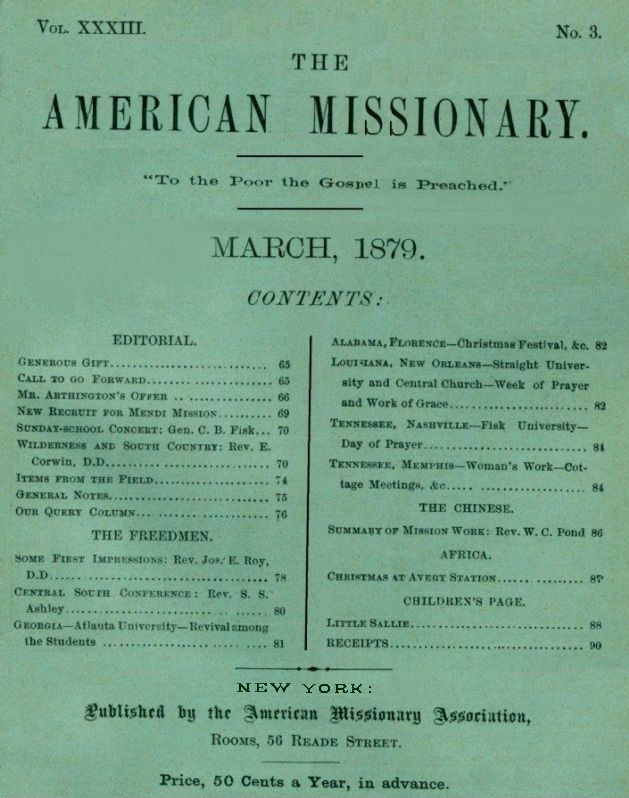
 Illustrated Catalogues sent free.