THE
AMERICAN
JOURNAL OF SCIENCE, &c.
The age in which we live is not less distinguished by a
vigorous and successful cultivation of physical science, than by
its numerous and important applications to the practical arts,
and to the common purposes of life.
In every enlightened country, men illustrious for talent,
worth, and knowledge, are ardently engaged in enlarging the
boundaries of natural science; and the history of their labours
and discoveries is communicated to the world chiefly through
the medium of Scientific Journals. The utility of such Journals
has thus become generally evident; they are the heralds of
science; they proclaim its toils and its achievements; they
demonstrate its intimate connexion as well with the comfort,
as with the intellectual and moral improvement of our species;
and they often procure for it enviable honours and substantial
rewards.
In England the interests of science have been, for a series
of years, greatly promoted by the excellent Journals of Tilloch
and Nicholson; and for the loss of the latter, the scientific
world has been fully compensated by Dr. Thomson's Annals of
Philosophy, and by the Journal of Science and the Arts, both
published in London.
In France, the Annales de Chimie et de Physique, the Journal
des Mines, the Journal de Physique, &c. have long enjoyed
a high and deserved reputation. Indeed, there are few countries
in Europe which do not produce some similar publication;
not to mention the transactions of learned societies and
numerous medical Journals.
From these sources our country reaps, and will long continue
to reap, an abundant harvest of information: and if the
light of science, as well as of day, springs from the east, we
will welcome the rays of both; nor should national pride
induce us to reject so rich an offering.
But can we do nothing in return? In a general diffusion of
useful information through the various classes of society, in
activity of intellect, and fertility of resource and invention,
characterizing a highly intelligent population, we have no
reason to shrink from a comparison with any country. But
the devoted cultivators of science, in the United States, are
comparatively few; they are, however, rapidly increasing in
number. Among them are persons distinguished for their
capacity and attainments, and notwithstanding the local feelings
nourished by our state sovereignties, and the rival claims of
several of our larger cities, there is evidently a predisposition
towards a concentration of effort, from which we may hope
for the happiest results, with regard to the advancement of
both the science and the reputation of our country.
Is it not, therefore, desirable to furnish some rallying point,
some object sufficiently interesting to be compassed by common
efforts, and thus to become the basis of an enduring, common
interest? To produce these efforts, and to excite this interest,
nothing, perhaps, bids fairer than a Scientific Journal.
Hitherto nearly all our exertions, of this kind, have been made
by medical gentlemen, and directed primarily to medical objects.
We are neither ignorant nor forgetful of the merits of
our various Medical Journals, nor of the zeal with which, as
far as consistent with their main object, they have fostered the
physical sciences. We are aware, also, that Journals have
been established, professedly deriving their materials principally
from foreign sources; that our various literary Magazines
and Reviews have given, and continue to give, some
notices of physical and mathematical subjects, and that some of
them seem even partial to these branches of knowledge: that
various limited efforts have been made, and are still making,
to publish occasional or periodical papers, devoted to mathematical
or physical subjects, and that even our newspapers
sometimes contain scientific intelligence. We are aware, also,
that some of our academies and societies of natural history,
either in Journals of their own, or through the medium of
existing magazines, communicate to the public the efforts of
their members in various branches of natural science.
But all these facts go only to prove the strong tendency
which exists in this country towards the cultivation of physical
science, and the inadequacy of the existing means for its
effectual promulgation.
Although our limits do not permit us, however much inclined,
to be more particular in commemorating the labours
and in honouring the performances (often marked by much
ability) of our predecessors and cotemporaries, there is one
effort which we are not willing to pass by without a more particular
notice; and we are persuaded that no apology is necessary
for naming the Journal of the late Dr. Bruce, of New-York,
devoted principally to mineralogy and geology.
No future historian of American science will fail to commemorate
this work as our earliest purely scientific Journal,
supported by original American communications.
Both in this country and in Europe, it was received in a very
flattering manner; it excited, at home, great zeal and effort in
support of the sciences which it fostered, and, abroad, it was
hailed as the harbinger of our future exertions. The editor
was honoured with letters on the subject of his Journal, and
with applications for it from most of the countries in Europe;
but its friends had to regret that, although conducted in a manner
perfectly to their satisfaction, it appeared only at distant
intervals, and, after the lapse of several years, never proceeded
beyond the fourth number.
The hopes of its revival have now, unhappily, become completely
extinct, by the lamented death of Dr. Bruce.[1]
This gentleman, with an accomplished education, with extensive
acquirements in science, and great zeal for promoting
it in his own country; advantageously and extensively known
in Europe, and furnished with a correct and discriminating
mind, and a chaste, scientific taste, was so well qualified for
the task which he had undertaken, that no one can attempt to
resume those scientific labours which he has now for ever
relinquished, without realizing that he undertakes an arduous
enterprise, and lays himself under a heavy responsibility.
American science has much to lament in the death of Dr.
Bruce.
No one, it is presumed, will doubt that a Journal devoted to
science, and embracing a sphere sufficiently extensive to allure
to its support the principal scientific men of our country, is
greatly needed; if cordially supported, it will be successful,
and if successful, it will be a great public benefit.
Even a failure, in so good a cause, (unless it should arise
from incapacity or unfaithfulness,) cannot be regarded as dishonourable.
It may prove only that the attempt was premature,
and that our country is not yet ripe for such an undertaking;
for without the efficient support of talent, knowledge, and
money, it cannot long proceed. No editor can hope to carry
forward such a work without the active aid of scientific and
practical men; but, at the same time, the public have a right
to expect that he will not be sparing of his own labour, and
that his work shall be generally marked by the impress of his
own hand. To this extent the editor cheerfully acknowledges
his obligations to the public; and it will be his endeavour
faithfully to redeem his pledge.
Most of the periodical works of our country have been short-lived.
This, also, may perish in its infancy; and if any degree
of confidence is cherished, that it will attain a maturer age, it
is derived from the obvious and intrinsic importance of the undertaking;
from its being built upon permanent and momentous
national interests; from the evidence of a decided approbation
of the design, on the part of men of the first eminence,
obtained in the progress of an extensive correspondence; from
assurances of support, in the way of contributions, from men
of ability in many parts of the union; and from the existence
of such a crisis in the affairs of this country and of the world,
as appears peculiarly auspicious to the success of every wise
and good undertaking.
As regards the subjects of this work, it is in our power to
do much in the department of the natural history of this
country. Our Zoology has been more fully investigated than
our mineralogy and botany; but neither department is in
danger of being exhausted. The interesting travels of Lewis
and Clark have recently brought to our knowledge several
plants and animals before unknown. Foreign naturalists frequently
explore our territory; and, for the most part, convey
to Europe the fruits of their researches, while but a small
part of our own productions is examined and described by
Americans: certainly, this is little to our credit, and still less
to our advantage. Honourable exceptions to the truth of
this remark are furnished by the exertions of some gentlemen
in our principal cities, and in various other parts of the
Union.[2]
Our botany, it is true, has been extensively and successfully
investigated; but this field is still rich, and rewards every new
research with some interesting discovery. Our mineralogy,
however, is a treasure but just opened. That both science
and art may expect much advantage from this source, is sufficiently
evinced by the success which has crowned the active
efforts of a few ardent cultivators of this science: several new
species of minerals have been added to it in this country;
great numbers of American localities discovered, and interesting
additions made to our materials, for the useful and ornamental
arts. The science of mineralogy is now illustrated by
courses of lectures, and by several good cabinets in the different
states. Among the cabinets, the splendid collection of Colonel
Gibbs, now in Yale College, (a munificent DEPOSIT for the
benefit of his country,) stands pre-eminent: it would be considered
as a very noble cabinet in any part of Europe: and its
introduction into the United States, and its gratuitous dedication
to the promotion of science, are equally advantageous to
the community, and honourable to its patriotic and enlightened
proprietor. Mineralogy is most intimately connected with our
arts, and especially with our agriculture.
Such are the disguises worn by many most useful mineral
substances, that an unskilful observer is liable to pass a thing
by, as worthless, which, if better informed, he would seize
with avidity; and, still more frequently, a worthless substance,
clothed perhaps in a brilliant and attractive exterior, excites
hopes altogether delusive, and induces expense, without a possibility
of remuneration. A diffusion of correct knowledge on
this subject is the only adequate remedy for either evil.
Our geology, also, presents a most interesting field of inquiry.
A grand outline has recently been drawn by Mr.
Maclure, with a masterly hand, and with a vast extent of personal
observation and labour: but to fill up the detail, both
observation and labour still more extensive are demanded;
nor can the object be effected, till more good geologists are
formed, and distributed over our extensive territory.
To account for the formation and changes of our globe, by
excursions of the imagination, often splendid and imposing, but
usually visionary, and almost always baseless, was, till within
half a century, the business of geological speculations; but
this research has now assumed a more sober character;
the science of geology has been reared upon numerous and
accurate observations of facts; and standing thus upon the basis
of induction, it is entitled to a rank among those sciences which
Lord Bacon's Philosophy has contributed to create. Geological
researches are now prosecuted, by actually exploring the
structure and arrangement of districts, countries, and continents.
The obliquity of the strata of most rocks, causing their
edges to project in many places above the surface; their
exposure in other instances, on the sides or tops of hills and
mountains; or, in consequence of the intersection of their
strata, by roads, canals, and river-courses, or by the wearing
of the ocean; or their direct perforation, by the shafts of
mines; all these causes, and others, afford extensive means of
reading the interior structure of the globe.
The outlines of American geology appear to be particularly
grand, simple, and instructive; and a knowledge of the important
facts, and general principles of this science, is of vast
practical use, as regards the interests of agriculture, and the
research for useful minerals. Geological and mineralogical
descriptions, and maps of particular states and districts, are
very much needed in the United States; and to excite a spirit
to furnish them will form one leading object of this journal.
The science of natural philosophy, with its powerful auxiliary,
mathematics, and the science of chemistry, the twin
sister of natural philosophy, are of incalculable importance to
this country. A volume would not suffice to trace their applications,
and to enumerate the instances of their utility.
As one which may be allowed to stand, instar omnium, we
may mention the steam engine; that legitimate child of physical
and chemical science—at once more powerful than the
united force of the strongest and largest animals, and more
manageable than the smallest and gentlest; raising from the
bowels of the earth the massy treasures of its mines, drawing
up rivers from their channels, and pouring them, in streams
of life, into the bosom of cities; and, above all, propelling
against the currents, the winds, and the waves of the ocean,
those stupendous vessels, which combine speed with certainty,
and establish upon the bosom of the deep the luxuries and
accommodations of the land.
The successful execution of this magnificent design was first
witnessed upon the waters of the Hudson, but is now imitated
in almost every civilized country; and it remains to be seen
whether they will emulate us by transporting, by the same
means, and against the same obstacles, the most formidable
trains of artillery.
The mechanical inventions of this country are numerous;
many of them are ingenious, and some are highly important.
In no way can a knowledge of them be so readily and extensively
diffused as in a scientific journal. To this object,
therefore, a part of our labours (should there be a call for it,)
will be devoted, and every necessary aid will be given by
plates and descriptions.
Science and art mutually assist each other; the arts furnish
facts and materials to science, and science illuminates the path
of the arts.
The science of mathematics, both pure and mixed, can
never cease to be interesting and important to man, as long
as the relations of quantity shall exist, as long as ships shall
traverse the ocean, as long as man shall measure the surface
or heights of the earth on which he lives, or calculate the distances
and examine the relations of the planets and stars; and
as long as the iron reign of war shall demand the discharge of
projectiles, or the construction of complicated defences.
In a word, the whole circle of physical science is directly
applicable to human wants, and constantly holds out a light to
the practical arts; it thus polishes and benefits society, and
every where demonstrates both supreme intelligence, and
harmony and beneficence of design in the Creator.
Art. I. Essay on Musical Temperament.[3]
By Professor Fisher, of Yale College.
It is well known to those who have attended to the subject
of musical ratios, that a fixed scale of eight degrees to the octave,
which shall render all its concords perfect, is impossible.
It has been demonstrated by Dr. Smith, from an investigation
of all the positions which the major, the minor, and the half-tone
can assume, that the most perfect scales possible, of which
there are two equally so, differing only in the position of the
major and the minor tone above the key note, must have one
Vth and one 3d too flat, and consequently the supplementary
4th and VIth too sharp, by a comma. In vocal music, and in
that of perfect instruments, this defect in the scale is not perceived,
because a small change may be made in the key, whenever
the occurrence of either of those naturally imperfect intervals
renders such a change necessary to perfect harmony.
But in instruments with fixed scales, such as the guitar, the
piano-forte, and the organ, if we begin with tuning as many
concords as possible perfect, the resulting chords above-mentioned
will be necessarily false in an offensive degree. Hence
it is an important problem in practical harmonics, to distribute
these imperfections in the scale among the different chords, in
such a manner as to occasion the least possible injury to harmony.
But this is not the only nor the principal difficulty which
the tuner of imperfect instruments has to encounter. In order
that these instruments may form a proper accompaniment for
the voice, and be used in conjunction with perfect instruments,
it is necessary that music should be capable of being executed
on them, in all the different keys in common use; and especially
that they should be capable of those occasional modulations
which often occur in the course of the same piece. Now
only five additional sounds to the octave are usually inserted
for this purpose, between those of the natural scale, which, of
course, furnish it with only three sharps and two flats. Hence,
when a greater number of flats or sharps is introduced, the
music can be executed only by striking, in the former case,
the sharp of the note next below; and, in the latter, the flat
of the note next above. But as the diatonic semitone is more
than half the major, and much more than half the minor tone,
if the additional sounds in the common artificial scale be made
perfect for one of the above employments, they must be extremely
harsh for the other. Hence arises the necessity of
adjusting the position of these five inserted sounds so that they
may make tolerable harmony, whichever way employed. A
change in these will require corresponding changes in the position
of the several degrees of the natural scale; so that it is
highly probable that the best scheme of temperament will
leave no concord, either of the natural or artificial scale, absolutely
perfect.
In adjusting the imperfections of the scale, the three following
considerations have been usually taken into view.
I. One object to be aimed at is, to make the sum of the temperaments
of all the concords the least possible. Since experience
teaches us that the harshness of a given concord increases
with its temperament, it is obvious that of two systems
which agree in other respects, the best is that in which the
sum of the temperaments is least.
II. When other things are equal, the best adjustment of the
imperfections of the scale is that which diminishes the harmoniousness
of all the different concords proportionally. The
succession of a worse to a better harmony, is justly regarded
by several of the best writers on this subject, as one of the
principal causes of offence to the ear, in instruments imperfectly
tuned.
III. When different chords of the same kind are of unequally
frequent occurrence, there is an advantage, cæteris paribus,
in giving the greatest temperament to that which occurs most
seldom. This important consideration has indeed been neglected
by Dr. Smith, in the systems which he recommends,
both for his changeable and the common fixed scale; as it is,
also, by the numerous advocates of the system of equal semitones.
But many authors on temperament, and most instrument-makers,
pay a vague regard to it. Their aim has been,
although in a loose and conjectural manner, to make the prominent
chords of the simplest keys the nearest to perfection,
whilst a greater temperament is thrown upon those which occur
only in the more complex keys. Thus Dr. Young, in the
Philos. Trans. for 1800, recommends a scheme which increases
the temperament of the IIIds, on the key note of the
successive keys, as we modulate by fifths from C, nearly in
arithmetical progression. Earl Stanhope assigns as a reason
for the small temperament which is given to several of the
IIIds in his system, that they are on the tonic of the simpler
keys. The irregularities in Mr. Hawkes's scheme may be
traced to the same cause. And, with the instrument-makers,
it is a favourite maxim to lay the wolf, as they term it, where
it will be most seldom heard.
But if the above consideration deserves any weight at all, it
deserves to be accurately investigated. Not only ought the
relative frequency of different chords to be ascertained with
the greatest accuracy, of which the nature of the subject is susceptible,
but the degree of weight which this consideration
ought to have, when compared with the two others above-mentioned,
should be determined: for it is plain that neither of
them ought to be ever left out of view.
Accordingly, the principal design of the following propositions
will be to investigate the actual frequency of occurrence of
different chords in practice; and from this and the two other
above-mentioned considerations united, to deduce the best
system of temperament for a scale, containing any given number
of sounds to the octave, and particularly for the common
Douzeave, or scale of twelve degrees.
All consonances may be regarded, without any sensible error
in practice, as equally harmonious in their kinds, when
equally tempered; and when unequally tempered, within
certain limits, as having their harmoniousness diminished in
the direct ratio of their temperaments.
As different consonances, when perfect, are not pleasing to
the ear in an equal degree, some approaching nearer to the
nature of discords than others, so a set of tempered consonances,
cæteris paribus, will be best constituted when their harmoniousness
is diminished proportionally. Suppose, for example,
that the agreeable effects of the Vth, IIId, and 3d, when
perfect, are as any unequal numbers, a, b, and c; the best arrangement
of a tempered scale, other things being equal, would
be, not that in which the agreeable effect of the Vth was reduced
to an absolute level with that of the IIId, or 3d, but
when they were so tempered that their agreeable effects on
the ear might be expressed by
m
n
a,
m
n
b,
m
n
c.
That different consonances, in this sense, are equally harmonious
in their kinds, when equally tempered, or, at least,
sufficiently so for every practical purpose, may be illustrated
in the following manner:
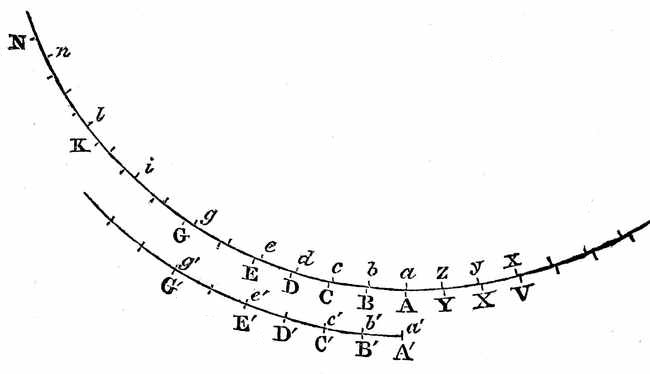
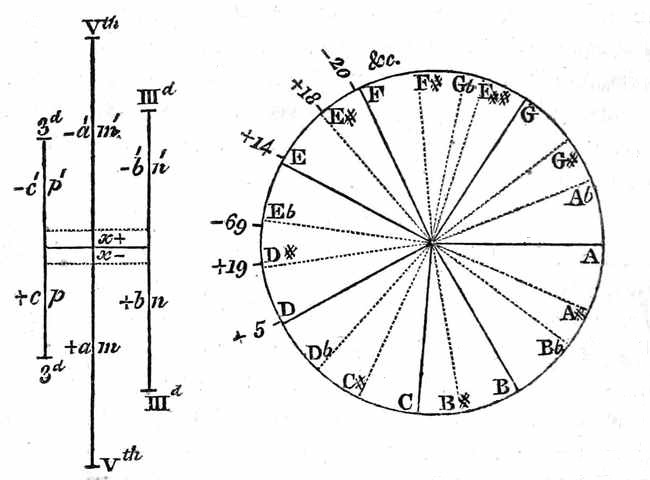
Let the lines AB, ab, represent the times of vibration of
two tempered unisons. Whatever be the ratio of AB to ab,
whether rational or irrational, it is obvious that the successive
vibrations will alternately recede from and approach each
other, till they very nearly coincide; and, that during one of
these periods, the longer vibration, AB, has gained one of the
shorter. Let the points, A, B, &c. represent the middle of the
successive times of vibration of the lower; and a, b, &c. those
of the higher of the tempered unisons. Let the arc AGN..VA
be a part of a circle, representing one period of their
pulses, and let the points A, a, be the middle points of the
times of those vibrations which approach the nearest to a
coincidence. It is obvious that the dislocations bB, cC, &c. of
the successive pulses, increase in a ratio which is very nearly
that of their distances from A, or a. Now if the pulses exactly
coincided, the unisons would be perfect; and the same would
be equally true, if the pulses of the one bisected, or divided
in any other constant ratio, those of the other; as clearly
appears from observation. It is, therefore, not the absolute
magnitude, as asserted by Dr. Smith, but the variableness of the
successive dislocations, Bb, Cc, &c. which renders the imperfect
unisons discordant; and the magnitude of the successive
increments of these dislocations is the measure of the degree
of discordance heard in the unisons.
If now the time of vibration in each is doubled, AC, ac, &c.
will represent the times of vibration of imperfect unisons an
octave below, and the successive dislocations will be Cc, Ee,
&c. only half as frequent as before. But the unisons AE, ae,
will be equally harmonious with AB, ab; because, although
the successive dislocations are less frequent than before, yet
the coincidences C′c′, E′e′ of the corresponding perfect unisons
are less frequent in the same ratio.
Suppose, in the second place, that the time of vibration is
doubled, in only one of the unisons, ab; and that the times
become AB and ac, or those of imperfect octaves. These will
also be equally harmonious in their kind with the unisons AB,
ab. For, although the dislocations Cc, Ee, &c. are but half
as numerous as before, the coincidences of the corresponding
perfect octaves will be but half as numerous. The dislocations
which remain are the same as those of the imperfect unisons;
and if some of the dislocations are struck out, and the
increments of successive ones thus increased, no greater
change is made in the nature of the imperfect than of the
perfect consonance.
If, thirdly, we omit two-thirds of the pulses of the lower
unison, retaining the octave ac of the last case, we shall have
AD, ac, the times of vibration of imperfect Vths, to which,
and to all other concords, the same reasoning may be applied
as above. It may be briefly exhibited thus; since the intermission
of the coincidences C′c′, E′e′ of the perfect unisons,
an octave below A′B′, does not render the Vth A′D′G′ a′c′e′g′ less
perfect than the unison A′c′ a′c′, each being perfect in its kind;
so neither does the intermission of the corresponding dislocations
Cc, Ee, of the tempered unisons, in the imperfect Vth,
ADG, aceg, render it less harmonious in its kind than the tempered
unison AB, ab, from which it is derived in exactly the
same manner that the perfect Vth is derived from the perfect
unison.
The consonances thus derived, as has been shown by Dr.
Smith, will have the same periods, and consequently the same
beats, with the imperfect unisons. It is obvious, likewise, that
they will all be equally tempered. Let m AB, and n ab, be a
general expression for the times of vibration of any such consonance.
The tempering ratio of an imperfect consonance is
always found by dividing the ratio of the vibrations of the imperfect
by that of the corresponding perfect consonance. But
m AB
n ab
÷
m
n
=
AB
ab
;
which is evidently the tempering ratio of
the imperfect unisons.
Hence, so far as any reasoning, founded on the abstract nature
of coexisting pulses can be relied on, (for, in a case of
this kind, rigid demonstration can scarcely be expected,) we
are led to conclude that the harmoniousness of different consonances
is proportionally diminished when they are equally
tempered.
The remaining part of the proposition, viz. that consonances
differently tempered have their harmoniousness diminished,
or their harshness increased, in the direct ratio of their
temperaments, will be evident, when we consider that the
temperament of any consonance is the sole cause of its harshness,
and that the effect ought to be proportioned to its adequate
cause. We may add, that the rapidity of the beats, in
a given consonance, increases very nearly in the ratio of the
temperament; and universal experience shows, that increasing
the rapidity of the beats of the same consonance, increases
its harshness. This is on the supposition that the consonance
is not varied so much as to interfere with any other whose
ratio is equally simple.
Cor. We may hence infer, that in every system of temperament
which preserves the octaves perfect, each consonance is
equally harmonious, in its kind, with its complement to the
octave, and its compounds with octaves. For the tempering
ratio of the complement of any concord to the octave, is the
same with that of the concord itself, differing only in its sign,
which does not sensibly affect the harmony or the rate of
beating; while the tempering ratio of the compounds with
octaves is not only the same, but with the same sign.
There is no point in harmonics, concerning which theorists
have been more divided in opinion than in regard to the true
measure of equal harmony, in consonances of different kinds.
Euler maintains, that the more simple a consonance is, the
less temperament it will bear; and this seems to have ever
been the general opinion of practical musicians.[4] Dr. Smith,
on the contrary, asserts, and has attempted to demonstrate,
that the simpler will bear a much greater temperament than the
more complex consonances. The foregoing proposition has,
at least, the merit of taking the middle ground between these
discordant opinions. If admitted, it will greatly simplify the
whole subject, and will reduce the labour of rendering all the
concords in three octaves as equally harmonious as possible,
which occupies so large a portion of Dr. Smith's volume, to a
single short proposition. Dr. Smith's measure of equal harmony,
viz. equal numbers of short cycles in the intervals between
the successive beats, seems designed, not to render the
different consonances proportionally harmonious, but to reduce
the simpler to an absolute level, in point of agreeableness, with
the more complex; which, as has been shown, is not the object
to be aimed at in adjusting their comparative temperaments.
But, in truth, his measure is far more favourable to
the complex consonances than equal harmony, even in this
sense, would require; and, in a great number of instances,
leads to the grossest absurdities. Two consonances, according
to him, are equally harmonious, when their temperaments
are inversely as the products of the least numbers expressing
their perfect ratio. If so, the VIII + 3d, whose ratio is 5/12,
when tempered 1/20 of a comma, and the unison, whose ratio is
1/1, when tempered 3 commas, are equally harmonious. But
all who have the least experience in tempered consonances
will pronounce, at once, that the former could scarcely be distinguished
by the nicest ear from the corresponding perfect
concord, while the latter would be a most offensive discord.
One instance more shall suffice. The temperaments to render
the VIII + Vth, and the VIII + 6th equally harmonious,
are laid down in his tables to be as 80 : 3. We will now suppose
an instrument perfectly tuned in Dr. Smith's manner, and
furnished with all the additional sounds which constitute his
changeable scale. In this system, the IIIds, and consequently
the VIII + 6ths, are tempered 1/9 of a comma; which, so far
from being offensive, will be positively agreeable to the ear.
This cannot be doubted by those who admit that the VIII +
6ths in the common imperfect scales, when tempered at a medium
nearly seven times as much, make tolerable harmony.
Yet, according to the theory which we are opposing, the
VIII + Vth will be equally harmonious when tempered nearly
a minor semitone. Now let any one, even with the common
instruments, whenever an VIII + Vth occurs, strike the semitone
next above or below: for example, instead of playing
C, g, let him play C, g ;
instead of A, e, let him play A, e
 ,
&c. and compare the harmony of these with that of the VIII +
6ths, if he wants any farther evidence that Dr. Smith's measure
of equal harmony is without foundation.
It may be thought, that even the measure of equal harmony
laid down in the proposition, is more favourable to the complex
consonances than the conclusions of experience will warrant.
But when it is asserted by practical musicians, that the
octave will bear less tempering than the Vth, the Vth less than
the IIId, &c., they doubtless intend to estimate the temperament
by the rate of beating, and to imply, that when different
consonances to the same base are made to beat equally fast,
the simpler are more offensive than the more complex consonances.
This is entirely consistent with the proposition; for
when equally tempered, the more complex consonances will
beat more rapidly than the more simple; if on the same base,
very nearly in the ratio of their major terms. (Smith's Har.
Prop. XI. Cor. 4.) If, for example, an octave, a Vth, and a
IIId on the same base were made to beat with a rapidity which
is as the numbers 2, 3, and 5, no unprejudiced ear would probably
pronounce the octave less harmonious in its kind than
the IIId.
To those, on the other hand, who may incline to a measure
of equal harmony between that laid down in the proposition
and that of Dr. Smith, on account of the rapidity of the beats
of the more complex consonances, it maybe sufficient to reply,
that if the beats of a more complex consonance are more
rapid than those of a simpler one, when both are equally tempered,
those of the latter, cæteris paribus, are more distinct.
It is the distinctness of the undulations, in tempered consonances,
which is one of the principal causes of offence to the
ear.
It will be proper to explain, in this place, the notation of musical
intervals, which will be adopted in the following pages.
It is well known that musical intervals are as the logarithms of
their corresponding ratios. If, therefore, the octave be represented
by .30103, the log. of 2, the value of the Vth will
be expressed by .17509; that of the major tone by .05115;
that of the comma by .00540, &c. But in order to avoid the
prefixed ciphers, in calculations where so small intervals as
the temperaments of different concords are concerned, we will
multiply each of these values by 100,000, which will give a
set of integral values having the same ratio. The octave will
now become 30103, the comma 540, &c.; and, in general, when
temperaments are hereafter expressed by numbers, they are
to be considered as so many 540ths of a comma. Had more
logarithmic places been taken, the intervals would have been
expressed with greater accuracy; but it was supposed that the
additional accuracy would not compensate for the increased labour
of computation which it would occasion. This notation
has been adopted by Dr. Robinson, in the article Temperament,
(Encyc. Brit. Supplement;) and for every practical purpose,
is as much superior to that proposed by Mr. Farey, in parts
of the Schisma, lesser fraction and minute,[5] as all decimal
measures necessarily are, to those which consist of different
denominations.
In adjusting the imperfections of the scale, so as to render all
the consonances as equally harmonious as possible, only the
simple consonances, such as the Vth, IIId, and 3d, with their
complements to and compounds with the octave, can be regarded.
It has been generally assigned as the reason for neglecting
the consonances, usually termed discords, in ascertaining the
best scheme of temperament, that they are of less frequent occurrence
than the concords. This, however, if it were the
only reason, would lead us, not to neglect them entirely, but
merely to give them a less degree of influence than the concords,
in proportion as they are less used.
A consideration which seems not to have been often noticed,
renders it impossible to pay them any regard in harmonical
computations. All such computations must proceed on the
supposition that within the limits to which the temperaments
of the different consonances extend, they become harsher as
their temperaments are increased. It is evident that any consonance
may be tempered so much as to become better by
having its temperament increased, in consequence of its approaching
as near to some other perfect ratio, the terms of
which are equally small; or perhaps much nearer some perfect
ratio whose terms are not proportionally larger. For example,
after we have sharpened the Vth more than 3 commas,
it becomes more harmonious, as approaching much nearer to
the perfect ratio 5/6. In this, however, and the other concords,
the value of the nearest perfect ratios in small numbers, varies
so much from the ratios of these concords, and the consequent
limits within which the last part of Prop. I. holds true, are so
wide that there is no hazard in making it a basis of calculation.
And if there be a few exceptions to this, in some systems, in
which the temperaments of a few of the concords become so
large as to approach nearer to some other perfect ratio, whose
terms are nearly as small as those of the perfect concord,
although they might become more harmonious, by having their
temperament increased, yet their effect in melody would be
still more impaired; so that the concords may all be considered
as subjected to the same rule of calculation.
But the limits within which the second part of Prop. I.
holds true, with regard to the more complex consonances, are
much more limited. We cannot, for instance, sharpen the
7th, whose ratio is 9 : 16 more than ½ a comma, without rendering
it more harmonious, as approaching nearer another perfect
ratio which is simpler; that of 5 : 9. Yet the difference
between these two 7ths is so trifling that they have never
received distinct names; and, indeed, their effect on the ear
in melody would not be sensibly different.
Again, the 5th, whose perfect ratio has been generally laid
down as 45 : 64, but which is in reality 25 : 36,[6] cannot be
sharpened more than ⅓ of a comma, before it becomes more
harmonious by having its temperament increased, as approaching
nearer the simpler ratio 7 : 10. At the same time, the
effect of this interval in melody would not be sensibly varied.
The limits, within which the harmoniousness of the IVth is
inversely as its temperament, are still narrower.
Hence it appears that no inference can be drawn from the
temperaments of such consonances as the 7th, 5th, IVth, &c.
respecting their real harmoniousness. The other perfect ratios
which have nearly the same value with those of these
chords, and which are in equally simple terms, are so numerous
that by increasing their temperament they alternately become
more and less harmonious; and in a manner so irregular,
that to attempt to subject them to calculation, with the
concords, would be in vain. Even when unaltered, they may
be considered either as greater temperaments of more simple,
or less temperaments of more complex ratios. Suppose the
5th, for example, to be flattened ⅕ of a comma: shall it be
considered as deriving its character from the perfect ratio
25 : 36, and be regarded as flattened 108; or shall it be referred
to the perfect ratio 7 : 10, and considered as sharpened
239? No one can tell.—On the whole, it is manifest that no
consonances more complex than those included in the proposition,
can be regarded in adjusting the temperaments of the
scale.
The best scale of sounds, which renders the harmony of all
the concords as nearly equal as possible, is that in which the
Vths are flattened 2/7, and the IIIds and 3ds, each 1/7 of a
comma.
The octave must be kept perfect, for reasons which have
satisfied all theoretical and practical harmonists, how widely
soever their opinions have differed in other respects. Admitting
equal temperament to be the measure of equal harmony,
the complements of the Vth, IIId, and 3d, to the octave,
and their compounds with octaves will be equally harmonious
in their kinds with these concords respectively; according
to the corollary of Prop I.
Hence we have only to find those temperaments of the Vths,
IIIds, and 3ds, in the compass of one octave, which will render
them all, as nearly as possible, equally harmonious. The
temperaments of the different concords of the same name
ought evidently to be rendered equal; since, otherwise, their
harmony cannot be equal. This can be effected only by rendering
the major and minor tones equal, and preserving the
equality of the two semitones. If this is done, the temperament
of all the IIIds will be equal, since they will each be the
sum of two equal tones. For a similar reason the 3ds, and
consequently the Vths, formed by the addition of IIIds, and
3ds, will be equally tempered.

In order to reduce the octave to five equal and variable tones,
and two equal and variable semitones, we will suppose the
intervals of the untempered octave to be represented by
the parts CD, DE, &c. of the line Cc. Denoting the comma by
c, we will suppose the tone DE, which is naturally minor, to
be increased by any variable quantity, x; then, by the foregoing
observations, the other minor tone, GA, must be increased
by the same quantity. As the major tones must be rendered
equal to the minor, their increment will be x – c. As the
octave is to be perfect, the variation of the two semitones must
be the same with that of the five tones, with the contrary sign;
and as they are to be equally varied, the decrement of each
will be
5x – 3c
2
; or what amounts to the same thing, the
increment of each will be
3c – 5x
2
.
The several concords of the same name in this octave are
now affected with equal and variable temperaments. The
common increment of the IIIds will be 2x – c; that of the 3ds
½ · c – 3x; and consequently that of the Vths
½ · x – c.
In adjusting these variable temperaments, so as to render
the harmony of the concords of different kinds, as nearly equal
as possible, we immediately discover that, as the Vth is composed
of the IIId and 3d, the temperaments of the three cannot
all be equal. When the temperaments of the IIId and
3d have the same sign, that of the Vths must be equal to their
sum; and, when they have contrary signs, to their difference.
Hence the temperament of one of these three concords is
necessarily equal to the sum of that of the other two. This
being fixed, the temperaments, and consequently, (by Prop. I.)
the discordance of the different consonances is the most equably
divided possible, when the two smaller temperaments, whose
sum is equal to the greater, are made equal to each other.
The problem contains three cases.
1. When the temperaments of the IIId and 3d have the
same sign, they ought to be equal to each other. Making
2x – c = ½ · c – 3x, we obtain x = 3/7 c, which, substituted in
the general expressions for the temperaments of the Vth, IIId,
and 3d, makes their increments equal to –2/7 c, –1/7 c, –1/7 c,
respectively.
2. Let the temperaments of the IIId and 3d have contrary
signs: and first, let that of the IIIds be the greater. Then
the former ought to be double of the latter, in order that the
temperament of the Vths and and 3ds may be equal. Hence we
have 2x – c = – 2 · ½ · c – 3x; whence x is found = 0; and
by substitution as before, the required temperament of the
IIId = – c; of the Vth – ½ c, and of the 3d ½ c.
3. Let the temperaments of the IIId and 3d have contrary
signs, as before; and let that of the 3d be the greater.
Making ½ · c – 3x = –2 · 2x – c, we obtain x = 3/5 c; which
gives, by substitution, the temperaments of the 3d, Vth, and
IIId – 2/5 c, – 1/5 c, and 1/5 c, respectively.
Each of these results makes the harmony of all the consonances
as nearly equal as possible; but as the sum of the
temperaments in the first case is much the least, it follows that
the temperaments stated in the proposition constitute the best
scheme of intervals for the natural scale, in which the harmony
of all the different consonances is rendered as nearly equal as
possible.
Cor. 1. In the same manner it may be shown that these
temperaments are the best, among those which approach as
nearly as possible to equal harmony, for the artificial scale;
provided that it is furnished with distinct sounds for all the
sharps and flats in common use. By inserting a sound between
F and G, making the interval FG equal to either of the semitones
found above, the intervals, reckoned from G as a key
note, will be exactly the same in respect to their temperaments,
as the corresponding ones reckoned from C. The same thing
holds, whatever be the number of flats and sharps. It is supposed,
however, that the flat of a note is never used for the
sharp of that next below, or the contrary; and hence this
scheme of temperament would only be adapted to an instrument,
furnished with all the degrees of the enharmonic scale;
or, at least, with as many as are in common use.
Cor. 2. This scale will differ but little in practice from the
one deduced, with so much labour, by Dr. Smith, from his
criterion of equal harmony; which flattens the Vths 5/18, the
IIIds 1/9, and the 3ds 1/6 of a comma. The several differences
are only 1/126, 2/63, and 1/42 of a comma. Hence, as his measure
of equal harmony differs so widely from that of Proposition I.
we may infer that the consideration of equalizing the harmony
of the concords of different names can have very little practical
influence on the temperaments of the scale. Should it,
therefore, be maintained that the criterion laid down in Prop.
I. is not mathematically accurate; yet, as it must be allowed,
in the most unfavourable view, to correspond far better with
the decisions of experience than that of Doctor Smith, the
chance is, that, at the lowest estimate, the temperaments deduced
from it approach much more nearly to correctness.
Hence it is manifest that equal temperament may be made,
without any sensible error in practice, the criterion of equal
harmony.
Although the foregoing would be the best division of the
musical scale, if our sole object were to render the harmony
of its concords as nearly equal as possible, yet the two other
considerations, stated at the beginning of the essay, must by
no means be neglected, as has been done by Dr. Smith. It
seems to be universally admitted, that the sum of the temperaments
may be increased to a certain extent, in order to equalize
the harmony of the concords; otherwise the natural scale of
major and minor tones, which makes the sum of the temperaments
of the Vths, IIIds, and 3ds but 2 commas, ought to be
left unaltered. Yet how far this principle ought to be carried,
may be a matter of doubt. If we make the IIIds perfect, and
flatten the Vths and 3ds each ¼ c, according to the old system
of mean tones, we shall have the smallest aggregate of temperaments
which admits of the different concords of the same
name being rendered equally imperfect; but this amounts to
2½ commas. Thus far, however, it seems evidently proper to
proceed. If we go still farther, and endeavour to equalize
the harmony of the concords of different names, it may be questioned
whether nearly as much is not lost as gained; for the
aggregate temperaments are increased, in Dr. Smith's scale,
to 2⅔ c, and in that of the above proposition to 25/7 c. The
system of mean tones, although more unequal in its harmony
when but two notes are struck at once, yet when the chords
are played full, as they generally are on the organ, never
offends the ear by a transition from a better to a worse harmony.
For every triad is equally harmonious; being composed
of a perfect IIId, and a Vth and 3d, tempered each ¼ c,
or of their complements to, or compounds with octaves, which,
in their kinds, are equally harmonious.
Again, if different chords, in practice, vary in the frequency
of their occurrence, this will be a sufficient reason for deviating
from the system of equal temperament. Suppose, for example,
that a given sum of temperament is to be divided between
two Vths, one of which occurs in playing ten times as often as
the other: there can be no doubt that the greater part of the
temperament ought to be thrown upon the latter. Hence it
becomes an important problem to ascertain, with some degree
of precision, the relative frequency with which different consonances
occur in practice. Before proceeding to a direct investigation
of this problem, it may be observed, in general,
that such a difference manifestly exists. In a given key, it
cannot have escaped the most superficial observer, that the
most frequent combination of sounds is the common chord on
the tonic; that the next after this is that on the dominant, and
the third, that on the subdominant. Perhaps scarcely a piece
of music can be found, in which this order of frequency does
not hold true. It is equally true that some signatures occur
oftener than others. That of one sharp will be found to be
more used, in the major mode, than any other; and, in general,
the more simple keys will be found of more frequent occurrence
than those which have more flats or sharps. These
differences are not the result of accident. The tonic, dominant,
and subdominant, are obviously the most prominent notes
in the scale, and must always be the fundamental bases of more
chords than either of the others; while the greater ease of
playing on the simpler keys will always be a reason with composers
for setting a larger part of their music on these, than
on the more difficult keys. It is observable, that the greater
part of musical compositions, whether of the major or minor
mode, is reducible to two kinds: that in which the base chiefly
moves between the tonic and its octave, and that in which the
base moves between the dominant and subdominant of the key.
The former class, in the major mode, are almost universally
set on the key of one sharp; the latter, generally on the natural
key, or that of two sharps. In the minor mode, the former
class have usually the signature of two flats, or the natural
key; the latter, that of one flat. Hence the three former
keys will comprise the greater part of the music in the major
mode, and the three latter, of that in the minor mode, in every
promiscuous collection. But if we were even to suppose each
of the chords in the same key, and each of the signatures, of
equally frequent occurrence, some chords would occur much
oftener, as forming an essential part of the harmony of more
keys than others. The Vth DA, for example, forms one of
the essential chords of six different keys; while the Vth
GD forms a part only of the single key of four sharps.
To find a set of numbers, expressing the ratio of the probable
number of times that each of the different consonances in
the scale will occur, in any set of musical compositions.
This can be done only by investigating their actual frequency
of occurrence in a collection of pieces for the instrument to be
tuned, sufficiently extensive and diversified to serve as a specimen
of music for the same instrument in general. This may
appear, at first view, an endless task; and it would be really
such, were we to take music promiscuously, and count all the
consonances which the base makes with the higher parts, and
the higher parts with each other. But it appears, from Prop.
I. Cor. that all the positions and inversions of a chord, when
the octaves are kept perfect, are equally harmonious with the
chord itself. The Vth, for example, which makes one of the
consonances in a common harmonic triad, is equally harmonious
in its kind, with the V + VIII, which takes its place in the
3d position of this triad, and with the 4th in its second inversion.
Hence, instead of counting single consonances, we have only
to count chords; and this is done with the greatest ease, by
means of the figures of the thorough base. The labour will
be still farther abridged by reducing the derivative chords,
such as the 6, the 6/4, &c. to their proper roots, as they are
taken down. But even after these reductions, the labour of
numbering the different chords in a sufficiently extensive set of
compositions, to establish, with any degree of certainty, the
relative frequency of the different signatures, would be very
irksome. A method, however, presents itself, which renders
it sufficient to examine the chords in such a set of pieces only
as will give their chance of occurrence in two keys—a major,
and its relative minor.
It will be evident to all who are much conversant with musical
compositions, that the internal structure of all pieces in
the same mode, whatever be their signature, is much the same.
There is scarcely more difference, for example, in the relative
frequency of different chords in the natural key, and in that of
two sharps, or two flats, than there is in different pieces on the
same key. If the Vth CG on the tonic has to the Vth EB on
the mediant in the natural key, any given ratio of frequency
m : n, the relative frequency of the Vth DA on the tonic, and
the Vth F C on the mediant in the key of two sharps, will
not sensibly differ from that of m : n. Hence, if we examine a
sufficient number of pieces to establish the relative frequency
of the different consonances in one major and its relative minor
key, and, by a much more extensive investigation, ascertain the
relative frequency of occurrence of the different signatures, it
is evident, that by multiplying this last series of numbers into
the first, and adding those products which belong to chords terminated
by the same letters, we shall have a series of numbers
expressing the chance of occurrence in favour of each of the
consonances of the scale, when all the keys are taken into
view.
It was judged that 200 scores, taken promiscuously from all
the varieties of music for the organ,[7] would afford a set of
numbers expressing, with sufficient accuracy, the chance that
a given consonance will occur in a single major, and its relative
minor key. Accordingly 200 scores were examined, 150 in
the major, and 50 in the minor mode, (as it will appear hereafter
that this is nearly the ratio of their frequency) of the
various species of music for the organ, comprising a proper
share both of the simpler and of the more rapid and chromatic
movements. As the selecting and reducing to their proper
keys all the occasional modulations which occur in the same
piece would render the labour of ascertaining the relative frequency
of different signatures very tedious, it was thought best
to consider all those modulations which are too transient to be
indicated by a new signature, as belonging to the same key.
This will account for the occurrence of the chords in the following
table, which are affected by flats and sharps.
The minim, or the crotchet, was taken for unity, according
to the rapidity of the movement. Bases of greater or less
length had their proper values assigned them; although mere
notes of passage, which bore no proper harmony, were generally
disregarded. The scores were taken promiscuously
from all the different keys; and were reduced, when taken
down, to the same tonic; the propriety of which will evidently
appear from the foregoing remarks. The following table contains
the result of the investigation.
TABLE I.
|
| Bases. | Common Chords. |
Flat Fifths. | 7ths. |
9-sevenths. |
| Major | Minor |
Major. | Minor. |
Major. | Minor. |
Major. | Minor. |
| mode. | mode. |
| B III | 5 | 8 |
— | — |
7 | — |
— | — |
| B | 3 | — |
163 | 55 |
11 | 17 |
2 | — |
| B | 4 | 4 |
— | — |
— | — |
— | — |
| A VII | — | — |
— | — |
— | — |
3 | — |
| A III | 19 | 8 |
— | — |
7 | 2 |
— | — |
| A | 166 | 588 |
2 | 1 |
26 | 5 |
2 | — |
| G | — | — |
3 | 38 |
— | — |
— | — |
| G 3 | 18 | 15 |
— | — |
— | — |
— | — |
| G | 965 | 93 |
— | — |
178 | 15 |
3 | — |
| F | — | — |
46 | 4 |
11 | 2 |
— | — |
| F | 352 | 60 |
— | — |
11 | 12 |
7 | 3 |
| E III | 26 | 271 |
— | — |
1 | 25 |
— | — |
| E | 32 | 25 |
5 | 1 |
8 | — |
1 | 4 |
| D III | — | — |
2 | 1 |
— | — |
— | — |
| D | — | — |
— | 4 |
— | — |
— | — |
| D III | 29 | 4 |
— | — |
49 | 7 |
— | — |
| D | 120 | 129 |
— | — |
55 | 18 |
6 | 1 |
| C | — | — |
2 | 4 |
1 | — |
— | — |
| C 3 | 2 | — |
— | — |
— | — |
— | — |
| C | 1769 | 275 |
— | — |
5 | 1 |
4 | 1 |
|
The following anomalous chords were found in the major
mode, and are subjoined, to make the list complete:
8 5ths on C, and 1 on D.
5 5/4ths on D, 2 on E, and 1 on G.
The left hand column of the foregoing table contains the
fundamental bases of the several chords. When any number
is annexed to the letter denoting the fundamental, it denotes
the quality of some other note belonging to the chord. E III,
for example, denotes that the various chords on E, which
stand against it, have their third sharped; G 3, that the third,
which is naturally major, is to be taken minor, &c. Of the two
columns in each of the four remaining pairs, the left contains
the number of chords belonging to each root, of the kind specified
at the top, which were found in 150 scores in the major
mode; and the right, the corresponding results of the examination
of 50 scores in the minor mode. The diminished triad,
which is used in harmonical progression like the other triads,
has its lowest note considered as its fundamental. The diminished
7th, in the few instances in which it occurred, was considered
as the first inversion of the 9/7th, agreeably to the French
classification, and was accordingly reduced to that head.
From this table, the number of times that each consonance
of two notes would actually occur, were the 200 scores played,
is easily computed. We will suppose three notes, besides
octaves, to be played to each chord. The octaves played
it is unnecessary to take into the computation, as it would only
multiply the number of consonances whose temperament is the
same, in the same ratio, and would have no effect on the ratio
of the numbers expressing the frequency of the different consonances.
In the chord of the 7th, which naturally consists of
four notes, we will suppose, for the sake of uniformity, that
one is omitted; and as the 7th ought always to be struck, we
will suppose the Vth and IIId of the base to be omitted, each
half the number of times in which this chord occurs. Considered
as composed of three distinct notes, neither of which is
an octave of either of the others, each chord will contain three
distinct consonances. The common chord on C, for example,
will contain the Vth CG, the IIId CE, and the 3d EG. The
9/7 on C will contain the VII CB, the IX, or (which must have
the same temperament) the IId CD, and the 3d BD. Reducing
all these consonances to their proper places, and adding
those of the same name which have the same degree for their
base, we obtain the following results:
TABLE II.
|
| Bases. | Vths, 4ths, and
Octaves. | IIIds, 6ths, and
Octaves. | 3ds, VIths, and
Octaves. |
Major.
| Minor. | Major. | Minor. | Major. | Minor. |
| B | 8 | 8 | 10 | 8 | 1141 | 214 |
| B | 3 | 6 | 22 | 19 | —— | —— |
| A | 195 | 607 | 22 | 10 | 626 | 663 |
| G | —— | —— | —— | —— | 32 | 310 |
| G | 1088 | 116 | 1090 | 125 | 22 | 23 |
| F | —— | —— | —— | —— | 78 | 10 |
| F | 395 | 78 | 486 | 301 | —— | —— |
| E | 59 | 308 | 40 | 284 | 1828 | 308 |
| E | —— | —— | 2 | —— | —— | —— |
| D | —— | —— | —— | —— | 7 | 9 |
| D | 197 | 156 | 60 | 7 | 403 | 213 |
| C | —— | —— | —— | —— | 26 | 12 |
| C | 1807 | 278 | 1959 | 870 | 4 | 1 |
|
| Bases. | 5ths, IVths, and
Octaves. | 7ths, IIds, and
Octaves. | VIIths, 2ds, and
Octaves. |
Major.
| Minor. | Major. | Minor. | Major. | Minor. |
| B | 256 | 265 | 25 | 17 | —— | —— |
| B | —— | —— | —— | —— | —— | —— |
| A | 2 | 1 | 34 | 7 | 3 | —— |
| G | 10 | 53 | —— | —— | —— | —— |
| G | —— | —— | 188 | 20 | —— | —— |
| F | 74 | 7 | 1 | 2 | —— | —— |
| F | —— | —— | —— | —— | 17 | 16 |
| E | 10 | 1 | 20 | 27 | —— | —— |
| E | —— | —— | —— | —— | —— | —— |
| D | 7 | 5 | —— | —— | —— | —— |
| D | —— | —— | 123 | 27 | —— | —— |
| C | 9 | 10 | 1 | —— | —— | —— |
| C | —— | —— | 5 | 1 | 10 | 1 |
|
Besides the following chromatic intervals:
| { | 8 extreme sharp 5ths on C |
| Major mode. | { | 1 ————————— D |
| { | 1 extreme flat 7th —— G |
|
| { | 4 extreme sharp 6ths on F |
| Minor mode. | { | 4 extreme flat 7ths on C |
| { | 3 ————————— G |
It was thought best to exhibit a complete table of all the
consonances which occurred in the 200 scores examined;
although (Prop. II.) only the concords in the upper half of the
table can be regarded in forming a system of temperament.
For the more frequent consonances, this table may be regarded
as founded on a sufficiently extensive induction to be tolerably
accurate. For the more unfrequent chords, and especially for
those which arise from unusual modulations, it expresses the
chance of occurrence with very little accuracy; and it is
doubtless the fact that a more extensive investigation would
include some chords not found at all in this list. But it must
be recollected, on the other hand, that the influence of these
unusual chords on the resulting system of temperament would
be insensible, could their chance of occurrence be determined
with the greatest accuracy.
But none of the numbers in the foregoing table by any means
expresses the chance that a given interval will occur, considering
all the keys in which it is found. For example, the
Vth CG on the tonic of the natural key, in music written on
this key, is the one of most frequent occurrence, its chance
being expressed by 1807; but in the key of two flats, it becomes
the Vth on the supertonic, and its chance of occurrence
is only as 197. Hence the problem can be completed only by
finding a set of numbers which shall express, with some degree
of accuracy, the relative frequency of different signatures.
An examination of 1600 scores, comprising four entire collections
of music for the organ and voice, by the best European
composers, besides many miscellaneous pieces, afforded
the results in the following table:
TABLE III.
Signatures.
| Major Mode. | Minor Mode. |
| 4s | 42 | 2 |
| 3s | 95 | 6 |
| 2s | 200 | 13 |
| 1 | 322 | 72 |
 | 176 | 121 |
| 1 | 180 | 97 |
| 2s | 70 | 77 |
| 3s | 116 | 8 |
4s
| 0 | 3 |
| Ratio of their sums 1201 : | 399 |
|
|
The chance of occurrence for any chord varies as the frequency
of the key to which it belongs, and as the number belonging
to the place which it holds, as referred to the tonic, in
Table II., jointly. Hence the chance of its occurrence in all
the keys in which it is found, is as the sum of the products of
the numbers in Table III., each into such a number of Table
II. as corresponds to its place in that key. To give a specimen
of the manner in which this calculation is to be conducted,
the numbers belonging to the major mode in the three first
divisions of Table II. are first to be multiplied throughout by
176, which expresses the relative frequency of the major mode
of the natural key. They are then to be multiplied throughout
by 322, which expresses the frequency of the key of one
sharp. But the first product, which expresses the frequency
of the Vth on the tonic, now becomes GD, and must be added,
not to the first, but to the fifth, in the last row of products.
The product into 59, expressing the frequency of the Vth on
the mediant, becomes BF, an interval not found among the
essential chords of the natural key. In general, the products
of the numbers in Table III. into those in Table II. are to be
considered as belonging, not to the letters against which these
multipliers stand, but to those which have the same position
with regard to their successive tonics, as these have with regard
to C. Whenever an interval occurs, affected with a new flat
or sharp, it is to be considered as the commencement of a new
succession of products. The IIId CE, for example, does
not occur at all till we come to the key of two sharps, and even
then only in occasional modulations, corresponding to the
IIId on B in the natural key, whose multiplier is 10. In the
key of 3 sharps it becomes another accidental chord, answering
to the IIId on E in the key of C, and consequently has 40
for its multiplier. It is only in the key of 6 sharps, that it becomes
a constituent chord of the key; when if that key were
ever used, it would correspond to the IIId GB on the dominant
of the natural key.
After all the products have been taken and reduced to their
proper places, in the manner exemplified above, a similar
operation must be repeated with the numbers in the second
column of Table III. and those in the second columns in the
three first divisions of Table II.
The necessity of keeping the major, and its relative minor
key, distinct, will be evident, when we consider that the
several keys in the minor mode do not follow the same law of
frequency as in the major; as is manifest from the observations
in Schol. Prop. III. and as clearly appears from an inspection
of Table III.
But in order to discover the relative frequency of the different
chords on every account, the results of the two foregoing
operations must be united. Now, as the numbers in the
two columns of Table II. at a medium, are as 3 : 1, and those
in Table III. are in the same ratio, although the factors are to
each other in only the simple ratio of the relative frequency
of the two modes, yet their products will, at a medium, be in
the duplicate ratio of that frequency. Hence, to render the
two sets of results homologous, so that those which correspond
to the same interval may be properly added, to express the
general chance of occurrence for that interval in all the major
and minor keys in which it is found, this duplicate ratio must
be reduced to a simple one, either by dividing the first, or by
multiplying the last series of results, by 3. We will do the
latter, as it will give the ratios in the largest, and, of course,
the most accurate terms. Then adding those results in each
which belong to the same interval, and cutting off the three
right hand figures, (expressing in the nearest small fractions
those results which are under 1000) which will leave a set of
ratios abundantly accurate for every purpose; the numbers
constituting the final solution of the problem will stand as
follows:
TABLE IV.
|
| Bases. | Vths and
4ths. | IIIds and
6ths. | 3ds and
VIths. |
Bases. | Vths and
4ths. | IIIds and
6ths. | 3ds and
VIths. |
| F | 67 | 29 | 1072 |
B | —— | —— | 4 |
| F | 639 | 924 | 66 |
B | 221 | 135 | 1161 |
| E | —— | —— | 12 |
B | 418 | 654 | 5 |
| E | 548 | 323 | 1151 |
A | —— | —— | 29 |
| E | 265 | 363 | ½ |
A | 870 | 568 | 1085 |
| D | ⅓ | ½ | 144 |
A | 52 | 78 | ⅕ |
| D | 1166 | 943 | 569 |
G | 5 | 4 | 365 |
| D | 1 | 6 | —— |
G | 1207 | 1197 | 567 |
| C | 25 | 12 | 581 |
F | —— | —— | ¼ |
| C | 816 | 1131 | 180 |
G | —— | ½ | —— |
|
Note. In this table, as well as the last, the Vths, IIIds, and
3ds are to be taken above, and the 4ths, 6ths, and VIths, their
complements to the octave, below the corresponding degrees in
the first column. And, in general, whenever the Vths, IIIds,
and 3ds are hereafter treated as different classes of concords,
each will be understood to include its complement to the octave
and its compounds with octaves.
The foregoing table exhibits, with sufficient accuracy, the
ratio of the whole number of times which the different chords
would occur, were the 1600 scores, whose signatures were
examined, actually played in succession, on the keys to which
they are set, and with an instrument having distinct sounds for
all the flats and sharps. Had the examination been more extensive,
the results might be relied on with greater assurance
as accurate; but the general similarity, not only in the structure
of different musical compositions, but in the comparative
frequency of the different keys in different authors; is so great,
that a more extensive examination was thought to be of little
practical importance.
(To be continued.)
Art. II. Review of an elementary Treatise on Mineralogy
and Geology, being an introduction to the study of these
sciences, and designed for the use of pupils; for persons
attending lectures on these subjects; and as a companion
for travellers in the United States of America—Illustrated
by six plates. By Parker Cleaveland, Professor of
Mathematics and Natural Philosophy, and Lecturer on
Chemistry and Mineralogy in Bowdoin College, Member
of the American Academy, and Corresponding Member of
the Linnæan Society of New England.
—— itum est in viscera terræ:
Quasque recondiderat, Stygiisque admoverat umbris,
Effodiuntur opes —— Ovid.
Boston, published by Cummings and Hilliard, No. 1,
Cornhill. Printed by Hilliard & Metcalf, at the University
Press, Cambridge, New England. 1816.
This work has been for some time before the public, and
it has been more or less the subject of remark in our various
journals. It is, however, so appropriate to the leading objects
of this Journal, that we cannot consider ourselves as
performing labours of supererogation while we consider the
necessity, plan, and execution of the treatise of Professor
Cleaveland.
An extensive cultivation of the physical sciences is peculiar
to an advanced state of society, and evinces, in the country
where they flourish, a highly improved state of the arts, and
a great degree of intelligence in the community. To this
state of things we are now fast approximating. The ardent
curiosity regarding these subjects, already enkindled in the
public mind, the very respectable attainments in science
which we have already made, and our rapidly augmenting
means of information in books, instruments, collections, and
teachers, afford ground for the happiest anticipations.
Those sciences which require no means for their investigation
beyond books, teachers, and study—those which
demand no physical demonstrations, no instruments of research,
no material specimens: we mean those sciences
which relate only to the intellectual and moral character
of man, were early fostered, and, in a good degree, matured
in this country. Hence, in theology, in ethics, in jurisprudence,
and in civil policy, our advances were much earlier,
and more worthy of respect, than in the sciences relating
to material things. In some of these, it is true, we have
made very considerable advances, especially in natural
philosophy and the mathematics, and their applications to the
arts; and this has been true, in some good degree, for very
nearly a century. Natural history has been the most tardy
in its growth, and no branch of it was, till within a few years,
involved in such darkness as mineralogy. Notwithstanding
the laudable efforts of a few gentlemen to excite some taste
for these subjects, so little had been effected in forming collections,
in kindling curiosity, and diffusing information, that
only fifteen years since, it was a matter of extreme difficulty
to obtain, among ourselves, even the names of the most common
stones and minerals; and one might inquire earnestly, and
long, before he could find any one to identify even quartz,
feldspar, or hornblende, among the simple minerals; or granite,
porphyry, or trap, among the rocks. We speak from
experience, and well remember with what impatient, but almost
despairing curiosity, we eyed the bleak, naked ridges, which
impended over the valleys and plains that were the scenes of
our youthful excursions. In vain did we doubt whether the
glittering spangles of mica, and the still more alluring brilliancy
of pyrites, gave assurance of the existence of the precious
metals in those substances; or whether the cutting of glass by
the garnet, and by quartz, proved that these minerals were the
diamond; but if they were not precious metals, and if they
were not diamonds, we in vain inquired of our companions,
and even of our teachers, what they were.
We do not forget that Dr. Adam Seybert, in Philadelphia;
Dr. Samuel L. Mitchill, in New-York; and Dr. Benjamin
Waterhouse, in Harvard University, began at an earlier
period to enlighten the public on this subject; they began
to form collections; Harvard received a select cabinet from
France and England; and Mr. Smith, of Philadelphia, (although,
returning from Europe fraught with scientific acquisitions,
he perished tragically near his native shores,) left his collection
to enrich the Museum of the American Philosophical
Society.
Still, however, although individuals were enlightened, no
serious impression was produced on the public mind; a few
lights were indeed held out, but they were lights twinkling in
an almost impervious gloom.
The return of the late Benjamin D. Perkins, and of the late
Dr. A. Bruce, from Europe, in 1802 and 3, with their collections,
then the most complete and beautiful that this country
had ever seen; the return of Colonel Gibbs, in 1805, with his
extensive and magnificent cabinet; his consequent excursions
and researches into our mineralogy; the commencement,
about this time, of courses of lectures on mineralogy, in several
of our colleges, and of collections by them and by many individuals;
the return of Mr. Maclure, in 1807; his Herculean
labour in surveying the United States geologically, by personal
examination; and the institution of the American Journal
of Mineralogy, by Dr. Bruce, in 1810;—these are among
the most prominent events, which, in the course of a few
years, have totally changed the face of this science in the
United States.
During the last ten years, it has been cultivated with great
ardour, and with great success: many interesting discoveries
in American mineralogy have been made; and this science,
with its sister science, Geology, is fast arresting the public
attention. In such a state of things, books relating to mineralogy
would of course be eagerly sought for.
No work, anterior to Kirwan, could be consulted by the
student with much advantage, on account of the wonderful
progress, which, within forty or fifty years, has been made in
mineralogy. Even Kirwan, who performed a most important
service to the science, was become, in some considerable degree,
imperfect and obsolete; the German treatises, the fruitful
fountains from which the science had flowed over Europe,
were not translated; neither were those of the French; and
this was the more to be regretted, because they had mellowed
down the harshness and enriched the sterility of the German
method of description, besides adding many interesting discoveries
of their own. It is true we possessed the truly valuable
treatise of Professor Jameson, the most complete in our
language. But the expense of the work made it unattainable
by most of our students, and the undeviating strictness with
which the highly respectable author has adhered to the German
mode of description, gave it an aspect somewhat repulsive
to the minds of novices, who consulted no other book.
We are, however, well aware of the value of this work, especially
in the improved edition. It must, without doubt, be in
the hands of every one who would be master of the science;
but it is much better adapted to the purposes of proficients
than of beginners.
The mineralogical articles dispersed through Aikin's Dictionary
are exceedingly valuable; but, from the high price of
the work, they are inaccessible to most persons.
The most recent of the French systems, that by Brongniart,
seemed to combine nearly all the requisites that could be desired
in an elementary treatise; and a translation of it would
probably, ere this, have been given to the American public,
had we not been led to expect the work of Professor Cleaveland,
which, it was anticipated, would at least possess one
important advantage over the work of Brongniart, and every
other; it would exhibit, more or less extensively, American
localities, and give the leading features of our natural mineral
associations.
Thus it appears[8] that the work of Professor Cleaveland was
eminently needed; the science, at large, needed it; and to
American mineralogists it was nearly indispensable. It appeared
too at a very opportune moment. Had it come a few years
sooner, it might not have found many readers. Now it is sustained
by the prevailing curiosity, and diffused state of information
regarding mineralogy; and, in turn, no cause could
operate more effectually to cherish this curiosity, and to diffuse
this information still more widely, than this book. Professor
Cleaveland is therefore entitled to our thanks for undertaking
this task; and, in this age of book-making, it is no small
negative praise if an author be acquitted of unnecessarily adding
to the already onerous mass of books.
With respect to the PLAN of this work, Professor Cleaveland
has, with good judgment, availed himself of the excellencies
of both the German and French schools.
Mr. Werner, of Fribourg, in some sense not only the
founder of the modern German school of mineralogy, but
almost of the science itself, is entitled to our lasting gratitude
for his system of external characters, first published in 1774.
In this admirable treatise he has combined precision and
copiousness, so that exact ideas are attached to every part of
the descriptive language, and every character is meant to be
defined.
It is intended that a full description of a mineral upon this
plan shall entirely exhaust the subject, and that although
many properties may be found in common among different
minerals, still every picture shall contain peculiar features, not
to be found in any other. It would certainly appear, at first
view, that this method must be perfect, and leave nothing farther
to be desired. It has, however, been found in practice,
that the full descriptions of the Wernerian writers are heavy
and dry; they are redundant also, from the frequent repetition
of similar properties; and from not giving due prominence to
those which are peculiar, and therefore distinctive, they frequently
fail to leave a distinct impression of any thing on the
mind, and thus, in the midst of what is called by the writers of
this school a full oryctognostic picture, a student is sometimes
absolutely bewildered.
Some of the modern French writers, availing themselves of
Mr. Werner's very able delineation of the external characters
of minerals, have selected such as are most important, most
striking, distinctive, and interesting; and drawing a spirited and
bold sketch, have left the minuter parts untouched: such a picture,
although less perfect, often presents a stronger likeness,
and more effectually arrests the attention.
This is the method of description which has been, as we
think, happily adopted, to a great extent by Mr. Cleaveland.
Mr. Werner, availing himself of the similarities in the external
appearance of minerals, has (excepting the metals)
arranged them also upon this plan, without regard to their constitution;
that is, to their real nature, or, at least, making this
wholly subservient to the other: this has caused him, in some
instances, to bring together things which are totally unlike in
their nature, and, in other instances, to separate those which
were entirely similar. Whatever may be said in favour of
such a course, considered as a provisional one, while chemical
analysis was in its infancy, the mind can never rest satisfied
with any arrangement which contradicts the real nature of
things; in a word, the composition of minerals is the only correct
foundation for their classification. This classification has
been adopted by several of the ablest modern French writers.
"It is believed," (says Professor Cleaveland, Preface, p. 7.)
"that the more valuable parts of the two systems may be incorporated,
or, in other words, that the peculiar descriptive
language of the one may, in a certain degree, be united to the
accurate and scientific arrangement of the other.
"This union of descriptive language and scientific arrangement
has been effected with good success, by Brongniart, in
his System of Mineralogy—an elementary work, which seems
better adapted both to interest and instruct, than any which
has hitherto appeared. The author of this volume has, therefore,
adopted the general plan of Brongniart, the more important
parts of whose work are, of course, incorporated with
this."
A happier model could not, in our opinion, be chosen; and
we conceive that Professor Cleaveland is perfectly consistent,
and perfectly perspicuous, when, adopting the chemical composition
of minerals as the only proper foundation of arrangement,
and, of course, rejecting the principle of Mr. Werner,
which arranges them upon their external properties, he still
adopts his descriptive language as far as it answers his purpose.
For to elect a principle of arrangement, and to classify all the
members of a system so as to give each its appropriate place,
is obviously quite a different thing from describing each member,
after its place in a system is ascertained. In doing the
latter, characters may be drawn from any source which affords
them.
In his "Introduction to the Study of Mineralogy," the author
has given a view at once copious, condensed, and perspicuous,
of all that is necessary to be learned previously to the study
of particular minerals. He begins with definitions and general
principles, which are laid down with clearness.
By way of engaging the attention to the study of this department
of nature, he remarks:
"From a superficial view of minerals in their natural depositories,
at or near the surface of the earth, it would hardly be
expected that they could constitute the object of a distinct
branch of science. Nothing appears farther removed from
the influence of established principles and regular arrangement,
than the mineral kingdom when observed in a cursory
manner. But a closer inspection and more comprehensive view
of the subject will convince us, that this portion of the works
of nature is by no means destitute of the impress of the Deity.
Indications of the same wisdom, power, and benevolence, which
appear in the animal and vegetable kingdoms, are also clearly
discernible in the mineral."
"It may also be remarked," continues the author, "that
several arts and manufactures depend on mineralogy for their
existence; and that improvements and discoveries in the latter
cannot fail of extending their beneficial effects to the aforementioned
employments. In fine, the study of mineralogy,
whether it be viewed as tending to increase individual wealth,
to improve and multiply arts and manufactures, and thus promote
the public good; or as affording a pleasant subject for
scientific research, recommends itself to the attention of the
citizen and scholar."
This introductory view of the importance and interest of the
science cannot be charged with the fault of exaggeration, since
it is most evident that neither civilization, refinement in arts,
nor comfort, can exist where the properties of mineral substances
are but imperfectly understood.
As regards this country, the argument admits of much amplification.
The more our mineral treasures are explored,
the more abundantly do they repay the research; and we
trust that the period is not far distant, when we shall no longer
ignorantly tread under our feet minerals of great curiosity and
value, and import from other countries, at a great expense,
what we, in many instances, possess abundantly at home.[9]
But to return to the plan of the author's work. Few persons,
unacquainted with the science of mineralogy, would suspect
that mere brute matter could exhibit many strong marks,
capable of discrimination.
It may, however, be confidently affirmed, that there is no
mineral which, if carefully studied, may not be distinguished
by characters sufficiently decisive from every other mineral;
an account of these characters ought, therefore, to precede
every system of mineralogy. Professor Cleaveland has, with
entire propriety, included them under the heads of crystallography,
physical and external characters, and chemical
characters.
He has given a clear view of the Abbé Haüy's curious discoveries
regarding the six primitive figures or solids which
form the bases of all crystals—the three integrant particles or
molecules which constitute the primitive forms, and of the
theory by which it is shown how the immensely numerous
and diversified secondary or actual forms arise out of these
few elementary figures.
This is certainly one of the most singular and acute discoveries
of our age. It is true, there is a difference of opinion
among mineralogists as to the practical use of crystallography
in the discrimination of minerals. Some dwell upon it with
excessive minuteness, and others seem restless and impatient
of its details. The truth seems to be, that those who understand
it, derive from it (wherever it is applicable) the most
satisfactory aid; and it requires only a moderate knowledge of
geometry to understand its principal outlines. On the other
hand, it is no doubt possible, in most instances, to dispense
with its aid, and to discriminate minerals by their other properties.
Of the external and physical characters of Mr. Werner, Mr.
Cleaveland has given a clear account, combining into the same
view the fine discriminations of the French authors, particularly
regarding refraction, phosphorescence, specific gravity,
electricity, chatoyement, and magnetism. The same may be
said of the chemical characters. We do not know a more
satisfactory and able view of the characters of minerals than
Professor Cleaveland has exhibited.
We would however ask, whether, in enumerating the kinds
of lustre, the term adamantine should not be explained, as it is
not understood by people in general, while the terms denoting
the other kinds are generally intelligible; whether in the enumeration
of imitative forms, lenticular and acicular should not
rather be referred to the laws of crystallization; whether reniform
and mamillary are synonymous; whether sandstone, as
being a mere aggregate of fragments, is a good instance of the
granular fracture; whether in its natural state (at least the
common ore of nickel) is ever magnetic, till purified, and
whether cobalt is ever magnetic unless impure.
Professor Cleaveland's remarks on fracture are uncommonly
discriminating and instructive, and would lead a learner to a
just comprehension of this important point in the characters
of minerals.
The section relating to the chemical characters is concise,
and professedly proceeds upon the principle of selection. It
might perhaps have been, to some extent, advantageously enlarged;
although, it is true, the author refers us to the particular
minerals for individual instances; still it might have
been well to have illustrated the general principles by a few
well-chosen instances, e. g. how, by the blowpipe, galena is
distinguished from sulphuret of antimony; carbonat of lead
from sulphat of barytes, or carbonat of lime; garnet from titanium;
plaster of Paris from soapstone, &c.; and, among trials
in the moist way, how by nitric acid and ammonia, iron pyrites
is distinguished from copper pyrites; and how, by acids, sulphat
of lime is known from carbonat of lime. As the acids are used
principally for trials on the effervescence of carbonats, most
of which form with sulphuric acid, insoluble compounds, we
should doubt whether sulphuric acid is so advantageously employed
as the nitric or muriatic, in such cases, on account of
the clogging of the effervescence by the thick magena, produced
by a recently precipitated and insoluble sulphat.
According to our experience, the nitric or muriatic acid,
diluted with two or three parts of water, is most eligible.
With respect to the blowpipe: it is a convenience to have a
mouth-piece of wood, or ivory, joined to a tube of metal, as
Mr. Cleaveland recommends; and some authors direct to have
the tube attached to a hollow ball, for the sake of condensing
the moisture of the breath; but every thing which adds to the
expense and complication of the instrument will tend to discourage
its use; we have never found any difficulty in performing
every important experiment with the common goldsmith's brass
blowpipe; and are confident, that, after the learner has acquired
the art, or knack, of propelling a continued stream of
air from his mouth, by means of the muscles of the lips and
cheeks, while his respiration proceeds without embarrassment
through the nostrils, he will need no other instrument than
the common blowpipe. Indeed it is a truly admirable instrument,
instantly giving us the effect of very powerful furnaces,
the heat being entirely under command, the subject of operation
and all the changes in full view, and the expense and
bulk of the instrument being such that every one may possess
it, and carry it about his person.
The chapter on the principles of arrangement is worthy of
all praise. This difficult subject is here discussed with such
clearness, comprehensiveness, and candour, as prove the author
to be completely master of his subject; and we are persuaded,
that, on this topic, no author can be studied with
more advantage. We forbear to extract, because the whole
should be attentively perused in connexion, and scarcely admits
of abridgement. We entirely agree with Professor
Cleaveland, as we have already said, that the chemical composition
of minerals is the only just foundation of their arrangement;
that next in importance is the crystalline structure, including
a knowledge of the primitive form, and integrant molecule;
and last and least important, in fixing the arrangement,
are the external characters: these last should be only provisionally
employed, where the two first are not ascertained, or
the second is not applicable. When the arrangement is once
made, we may, however, and we commonly shall, in describing
minerals, pursue precisely the reverse order; the external
characters will usually be mentioned first, the crystalline characters
next, and the chemical last of all. In description, the
external characters are often the most valuable; if judiciously
selected and arranged, they will always prove of the most essential
service, and can rarely be entirely dispensed with.
With regard to the NOMENCLATURE of minerals, we feelingly
unite with Professor Cleaveland in deploring the oppressive
redundancy of synonymes. Few minerals have only one
name, and usually they have several. With Count Bournon
we agree, that the discoverer of a mineral has the exclusive
right of naming it, and that the name once given should not be
changed without the most cogent reasons. What then shall
we say of the Abbé Haüy, of whom, whether we speak of his
genius, his learning, his acuteness, his discoveries, his candour,
and love of truth, or his universally amiable and venerable
character, we can never think without sentiments of the highest
respect and admiration? More than any modern writer
he has added to the list of synonymes, often exchanging a very
good name, derived perhaps from the locality or discoverer of
a mineral, for one professedly significant, but connected with
its subject by a chain of thought so slight, that considerable
knowledge of Greek etymology, and still more explanation, is
necessary to comprehend the connexion; and thus, after all,
it amounts, with respect to most readers, only to the exchange
of one arbitrary name for another. What advantage, for instance,
has grammatite, alluding to a line often obscure, and
still oftener wholly invisible, over the good old name tremolite,
which always reminds us of an interesting locality; how is
pyroxene better than augite, amphibole than hornblende, amphigene
than leucite, or disthene than sappar. Some of the Abbé
Haüy's names are, however, very happily chosen, especially
where new discriminations were to be established, or errors
corrected, or even a redundant crop of synonymes to be superseded
by a better name. Epidote is an instance of the latter,
and the new divisions of the old zeolite family into four
species, mesotype, stilbite, analcime, and chabasie, afford a happy
instance of the former. It were much to be wished, that by
the common consent of mineralogists, one nomenclature should
be universally adopted: for its uniformity is of much more importance
than its nature.
In expressing our approbation of the principles of arrangement
adopted by Professor Cleaveland, we have of course
espoused those of his TABULAR VIEW, which is perhaps as nearly
as the state of science will admit, erected upon a chemical
basis, like that of Brongniart, to which it bears a close resemblance.
Some of the subordinate parts, we could have wished
had been arranged in a manner somewhat different. In the
genus lime, it appears to us better to describe the species
carbonat first; because, being very abundant, and its characters
clear, it forms a convenient point of departure and
standard of comparison, in describing the other species
which have lime for their basis, and some of which are comparatively
rare. The same remark we would make upon
quartz, and its concomitant, pure silicious stones. There appears
to us a high advantage in making these minerals clearly
known first, before we proceed to those which are much more
rare, and especially which are much harder, and possess the
characters of gems. For example, if a learner has become
acquainted with quartz, chalcedony, flint, opal, chrysoprase, and
jasper, he will much more easily comprehend the superior
hardness, &c. and different composition of topaz, sapphire,
spinelleruby, chrysoberyl, and zircon, which we should much
prefer to see occupying a later, than the first place in a tabular
arrangement; and, although topaz, by containing fluoric acid,
appears to be in some measure assimilated to saline minerals,
it is in its characters so very diverse from the earthy salts, that
we have fair reason to conclude that the fluoric acid does not
stamp the character; and, as it bears so close a resemblance
to the ruby and sapphire, which evidently derive their principal
characters from the argillaceous earth, we perhaps ought
to infer that this (the topaz,) does so too. Indeed Professor
Cleaveland has sufficiently implied his own opinion, by giving
these minerals a juxtaposition in his table, although the same
reasons which induced the placing of the topaz next to the
earthy salts, could not have justified the placing of the sapphire
there. On these points we are not, however, strenuous; they
are of more importance if the work be used as a text-book for
lectures, than as a private companion. With respect to the
completeness of Professor Cleaveland's tabular view, we have
carefully compared it with the third edition of Jameson's
mineralogy; and although a few new species, or sub-species,
and varieties have been added in this last edition, they are
in general of so little importance, that Professor Cleaveland's
work cannot be considered as materially deficient;
and the few cases in which it is so, are much more than made
up by his entirely new and instructive views of American
mineralogy, to which no parallel is to be found in any other
book, and which give it peculiar interest to the American, and
even to the European, reader.
In another edition, (which we cannot doubt will speedily
be called for,) he will of course add whatever is omitted in this,
and we should be gratified to see a good article on the subject
of the ærolites or stones which have fallen from the atmosphere.
This subject is one, in our view, of high interest; and although
in strictness it may not claim a place in a tabular view of minerals,
(we must confess, however, that we see no important obstacle
to its being treated of under the head of native iron,)
there can be no objection to its being placed in an appendix.
The fall of stones from the atmosphere is the most curious and
mysterious fact in natural history.
It may seem perhaps too trivial to remark, that the annexation
of numbers, referring to the pages, would be a serious
addition to the utility of the tabular view. Very few inadvertencies
have been observed—the following may be mentioned:
Amenia, in the State of New-York, is printed (by a typographical
error we presume) Armenia; and Menechan, where
the menechanite is found, is mentioned as occurring in Scotland,
but it is in Cornwall.
Authors seem agreed that the black-lead ore is an altered
carbonat, but they seem not to have been so well agreed as to
the nature of the blue-lead ore. In the cabinet of Colonel
Gibbs, there are specimens which appear satisfactorily to illustrate
both these subjects. The black-lead is by the blowpipe
alone reducible to metallic lead; there is one specimen in the
cabinet referred to, which is blackened on what appears to
have been the under side, and seemingly by the contact of
sulphuretted hydrogen gas; that which was probably the
upper part remains unaltered, and is beautiful white carbonat
of lead; this appearance is the more striking, because
the piece is large and full of interstices, by which the
gas appears to have passed through. The blue ore is in large
six-sided prisms of a dark blue or almost black colour; where
the prisms are broken across, they present an unequal appearance;
sometimes they are invested; and sometimes slightly,
and at other times deeply, penetrated by sulphuret of lead, having
the usual brilliant foliated fracture. The part which looks
like sulphuret of lead is easily reducible by the blowpipe, but
not the whole crystal, as authors appear to imply; for if that
part of the crystal which does not present the appearance of
galena is heated by the blowpipe flame, it is not reduced, but
congeals into the garnet dodecahedron, with its colour unaltered:
these crystals are therefore phosphat of lead, and they
appear to be either an original mixture of phosphat and sulphuret
of lead, or the phosphat has somehow in part given
up its phosphoric acid, and assumed in its stead sulphur, perhaps
from the decomposition of sulphuretted hydrogen.
Professor Cleaveland will, of course, add new localities, even
foreign ones, where they are interesting, and domestic ones,
where they are well authenticated. Among the former, we
trust he will mention the lake of sulphuric acid contained in the
crater of Mount Idienne, in the Province of Bagnia Vangni, in
the eastern part of Java, and also the river of sulphuric acid
which flows from it and kills animals, scorches vegetation, and
corrodes the stones.[10] Among American localities, we beg
leave to mention violet fluor spar, abundant and very handsome,
near Shawnee Town, on the Ohio, in the Illinois Territory,
and galena, of which this fluor is the gangue;—sulphat of
magnesia, perfectly crystallized, in masses composed of delicate
white prisms, in a cave in the Indiana Territory, not
very remote from Louisville, in Kentucky; it is said to be
so abundant that the inhabitants carry it away by the wagon
load;—pulverulent carbonat of magnesia, apparently pure,
found by Mr. Pierce at Hoboken, in serpentine, where the
hydrate of magnesia was found;—chabasie, agates, chalcedony,
amethyst, and analcime, at Deerfield, by Mr. E. Hitchcock;—agates
in abundance at East-Haven, near New-Haven,
in secondary greenstone, like the above-named minerals at
Deerfield;—saline springs, covered with petroleum, and emitting
large volumes of inflammable gases, numerous in New-Connecticut,
south of Lake Erie;—magnetical pyrites, abundant
in the bismuth vein, at Trumbull, Connecticut:—very
brilliant fine-grained micaceous iron, in large masses near Bellows'
Falls; yellow foliated blende, in Berlin, Connecticut, and
near Hamilton College—the latter discovered by Professor
Noyes; it is in veins in compact limestone;—red oxid of
titanium, often geniculated, at Leyden, in Massachusetts, discovered
by Mr. E. Hitchcock;—red oxid of titanium, in very
large crystals and geniculated, imbedded in micaceous schistus,
at Oxford, 20 miles north from New-Haven;—silicious petrifactions
of wood, abundant in the island of Antigua, recently
brought by Mr. Pelatiah Perit, of New-York;—sulphuret of
molybdena, at Pettipaug, and at East-Haddam, Connecticut;—prehnite
abundant and beautiful, in secondary greenstone,
at Woodbury, 24 miles north of New-Haven, discovered by
Mr. Elijah Baldwin;—black oxid of manganese, in great
abundance, and of an excellent quality, near Bennington,
Vermont, and plumose mica, in a very fine graphic granite, in
a hill two miles north of Watertown, Connecticut.
The introduction to the Study of Geology, deserves a
more extended series of remarks than it would now be proper
to make, after so full a consideration of the previous parts of
the work.
Professor Jameson's elaborate exposition of the Wernerian
system, is too full, and too much devoted to a particular system,
for beginners: the sketches of geology contained in the systems
of Chemistry by Murray and Thomson, and in Phillips's mineralogy,
are too limited, although useful: the excellent account
of the Wernerian system, contained in an Appendix to Brochant's
Mineralogy, has, we believe, never been translated;
and we need not say that Professor Playfair's illustrations of the
Huttonian Theory, De Luc's Geology, and Cuvier's Geology,
are not well adapted to the purposes of a beginner; neither is
Delametherie's, nor has it been translated. An introduction to
geology was, therefore, hardly less needed than one to mineralogy.
Professor Cleaveland has performed this difficult duty
with great ability, and has brought this interesting branch of
science fairly within the reach of our students.
Although adhering substantially to the Wernerian arrangement
of rocks, he has, so to speak, blended Werner's three
classes of primitive, transition, and secondary rocks, into
one class; and where the same rock occurs in all the three
classes, or in two of them, he mentions it in giving the history
of the particular rock. This method simplifies the subject
very much to the apprehensions of a learner. A rigid Wernerian
would probably revolt at it, but the distinctions of Mr.
Werner may still be pointed out, and, we should think, ought
to be, at least by all teachers.
In Mr. Cleaveland's account of the trap rocks, we should
almost imagine that some typographical error had crept into
the following paragraph:
"But in modern geological inquiries, the word trap is usually
employed to designate a simple mineral, composed of hornblende
nearly or quite pure, and also those aggregates in which
hornblende predominates. Hence, the presence of hornblende,
as a predominating ingredient, characterizes those MINERALS to
which most geologists apply the name trap."
Now, it is not accordant with our apprehensions that trap is
ever at the present time employed to designate a simple mineral,
nor has Professor Cleaveland himself used it in his tabular
view, or in his description of simple minerals. In our view, it
is the classical word of modern geology, to designate that description
of rocks in which hornblende predominates, and perhaps a
few others of minor importance usually associated with them.
It is true, a rock composed of pure hornblende may be called
trap, but it is not true, vice versa, that this rock, considered in
its character of a simple mineral, is called trap. If our views are
correct, the section which is headed trap or hornblende, should
be trap or hornblende rocks, and greenstone should come in as a
subdivision, and not form a distinct section. With these alterations,
and with the substitution of rock in the first, and rocks
in the second instance, in the paragraph above quoted, instead of
mineral and minerals, we apprehend the view of this family of
rocks would be much more clear, and a degree of confusion,
which learners now experience from the paragraph, would be
prevented. If we are wrong, we are sure Professor Cleaveland
will pardon us; if right, his candour will readily admit the
correction.
As to the manner in which the work of Professor Cleaveland
is executed, the remarks which we already made, have in
a good degree anticipated this head.
We cannot, however, dismiss the subject without adding
that, in our opinion, this work does honour to our country,
and will greatly promote the knowledge of mineralogy and
geology, besides aiding in the great work of disseminating a
taste for science generally. Our views of the plan we have
already detailed. The manner of execution is masterly. Discrimination,
perspicuity, judicious selection of characters and
facts, and a style chaste, manly, and comprehensive, are among
the characteristics of Professor Cleaveland's performance. It
has brought within the reach of the American student the excellencies
of Kirwan, Jameson, Haüy, Brochant, Brongniart,
and Werner; and we are not ashamed to have this work compared
with their productions. In our opinion Professor
Cleaveland's work ought to be introduced into all our schools
of mineralogy, and to be the travelling companion of every
American mineralogist.
We trust that all cultivators of mineralogy and geology in
this country, will willingly aid Professor Cleaveland in enlarging
his list of American localities for a second edition; and
we hope that he will repay them, at a future day, by giving
us a distinct treatise on geology, with as particular a delineation
as possible of the geological relations of the great North
American formations. Mr. Maclure has, with great ability,
sketched the outline; but much labour is still needed in filling
up the detail.
Art. III. New Locality of Fluor Spar, or Fluat of Lime
and of Galena, or Sulphuret of Lead.
Mr. Joseph Baldwin, formerly of Connecticut, now
residing near Shawnee Town, in the Illinois Territory, has
given us some interesting specimens of fluor spar. They are
found not far from Shawnee Town, on the banks of the Ohio;
and a few miles below where the Wabash joins the Ohio.
The fluor forms the gangue of a lead vein, and we have pieces
in which the lead and fluor are intimately blended. The lead
ore is the common galena, or sulphuret, with a broad, foliated,
or laminated fracture, and a high degree of metallic splendour.
We reduced it to the metallic state, and it yielded a large product
of very soft lead. On dissolving it in nitric acid, and applying
the muriatic acid till precipitation ceased, the precipitate
formed was all redissolved by boiling water; nor, when
submitted to cupellation did the lead leave any thing upon the
cupel. We, therefore, conclude that it contained no appreciable
quantity of silver. It is said to be very abundant at
Shawnee Town.
The fluor spar is very beautiful. Its colours, chiefly,
very deep purple and violet; but still highly translucent; one
specimen was entirely limpid. Both kinds, when thrown in
coarse powder, on a red-hot shovel, in a dark place, phosphoresced,
and the violet specimens in a very striking manner.
Of the violet kind, we have a specimen nearly as large as a
man's fist, which is perfectly pure and sound, and appears to
have been a single crystal; the natural faces and angles were
unfortunately obliterated by grinding on a common grindstone.
We have others which are decidedly crystals of perfect regularity;
cubes, and passages between the cube and octahedron.
In some of the specimens, the disposition of colours, and the
transmission of light is such as to show very clearly that the
octahedron lies in the centre, as the nucleus or primitive
form.
The size and beauty of the specimens, and the abundance
of this mineral near Shawnee Town, (provided there is no
mistake in the case) clearly entitle this to be considered as the
most interesting American locality of this beautiful mineral.
Measures have been taken to investigate the subject more
fully, and to obtain a supply of specimens.
Quartz crystals appear to abound at the same place, besides
various other minerals.
Art. IV. Carbonate of Magnesia, and very uncommon
Amianthus, discovered near New-York.—Extract of a
Letter from Mr. James Pierce to the Editor.
New-York, May 18, 1818.
DEAR SIR,
I forward you specimens of straw and rose-coloured
amianthus I recently met with on Staten-Island, which I detached,
in strips, from a rock; it not appearing, as is usual, in
veins. It breaks up like flax, and may be spun and wove
without the aid of moisture; and in respect to tenacity, flexibility,
and length of fibre, it may be considered the best found in
this country, and perhaps equal to any hitherto discovered.
Staten-Island exhibits many minerals worthy of examination.
I subjoin, as requested, the following geological description,
&c.
Hoboken, where I discovered native carbonate of magnesia,
is situated opposite the city of New-York, on the western or
New-Jersey bank of the Hudson. It is a primitive, insulated
elevation, with a nucleus of serpentine; the ground gradually
descends in every direction except on the river side, where
mural precipices of serpentine rock are observed, extending
about 100 rods parallel with the water, and elevated from 60
to 100 feet above its level. The carbonate of magnesia I found
in horizontal veins of nearly two inches in breadth, and of unknown
depth, in a midway region of this serpentine ledge; I
extracted a considerable quantity with a spoon. When first
taken out it was soft, white, and very slightly adhesive, from
a little moisture; but, when dry, fell to powder without friction.
The nature of the mineral I immediately conjectured,
and treated it with diluted sulphuric acid, in which it entirely
dissolved with effervescence, forming a bitter fluid, and
leaving no sediment. Upon evaporation, well-defined crystals
of Epsom salts were formed. It differs little from the
manufactured carbonate of magnesia of the shops; but is
rather a super than a sub-carbonate. It has been analyzed by
Professor Mitchill, who found it exclusively composed of magnesia
and carbonic acid. Carbonates of magnesia, hitherto
discovered, have been, I believe, found impure, and in a state
of rock, requiring chemical process to render them serviceable;
this is, perhaps, fit for immediate use. When I first
mentioned the discovery to mineralogists, they were incredulous,
supposing it did not natively exist in this state, but I convinced
them by uniting it with sulphuric acid.
REMARKS.
The specimen of amianthus, referred to in Mr. Pierce's
communication, is uncommon. The fibres measure from 12
to 15 inches in length, and are as soft and flexible as fine
human hair.
It will be remembered, that in the rocks at Hoboken, Dr.
Bruce discovered the hydrate of magnesia, or magnesia combined
with nothing but water, in the proportion of about 70
per cent. of magnesia. This discovery gave a new and interesting
species to mineralogy; it is now admitted in the systematical
works on mineralogy.
Mr. Pierce's discovery is not less interesting; and we presume
he will be deemed correct in the opinion, that pure native
carbonate of magnesia has not been discovered before. The
serpentine of Hoboken, then, is memorable for affording these
two new species.
Art. V. Native Copper.
In Bruce's Journal, (Vol. I. p. 149.) mention is made of a
remarkable piece of native copper, found near New-Haven
many years ago, and weighing about 90lbs.
We have now to add, (and the fact is, indeed, mentioned
in Cleaveland's Mineralogy,) that another piece has been
recently found half a mile west of the Hartford turnpike
road, opposite the town of Wallingford, and twelve miles
from New-Haven. It was turned up in ploughing to repair a
road. The country is of the secondary trap formation, and the
rocks, at the particular place, are the old red sandstone of
Werner, which here occupies the plains, and runs under the
trap. The piece weighs almost six pounds; it is fine virgin
copper, with rudiments of large octahedral crystals of native
copper upon its surface, which is more or less incrusted with
green carbonate of copper and ruby oxid, very much resembling
that of Cornwall: the ruby oxid is particularly remarkable
in the cavities of the piece.
As it was found within three or four miles of the place
where the large piece of ninety pounds weight was discovered,
and as copper is known to exist in many places in these hills,
the facts should be kept in view, and may lead to something of
importance.
Art. VI. Petrified Wood from Antigua.
The mineralogy and geology of the West-India islands has
been, as yet, but little explored. The scientific world has,
however, been favoured with some interesting articles from
the pen of Dr. Nugent; and we are informed that he has described
also the geology of the island of Antigua. We have
recently become acquainted with one interesting production of
this island, and without waiting for Dr. Nugent's account,
(which we believe has not yet reached this country) we shall
lay it before our readers.
We are under obligations to Mr. Pelatiah Perit, of New-York,
for a collection of specimens of silicious petrifactions of
wood from Antigua. Their characters are indubitable; the
distinct ligneous layers corresponding with the annual growth,
the medullary prolongations, the knots formed by branches,
the cracks and the bark, are all distinctly visible. Some of
the pieces are ponderous portions of large trees.
As to the mineralizing matter, it is evidently silicious, and
the specimens are principally the holzstein of Werner; crystals
of quartz are apparent in the cavities; some parts are
agatized, and veins of chalcedony occasionally pervade the
fissures: they are not impressible by steel, and give fire with
it. According to the information of Mr. Perit, they are scattered
over the surface of the Island of Antigua, with a profusion
hardly less than that which Horneman observed of the
same mineral during his travels over the eastern part of the
great African desert.
It is much to be wished that our numerous intelligent navigators
and travelling merchants would, in imitation of this and
of a similar example, mentioned below, bestow some share of
their attention on the natural productions of the countries
which they visit. In this way they might, on their return,
render very essential services to the science of their own
country.
Art. VII. Porcelain and Porcelain Clays.
Through the kind offices of a friend, we have been furnished,
from one of the great porcelain manufactories in the
vicinity of Paris, with a series of specimens, to illustrate the
elegant art of fabricating porcelain. The specimens begin
with the raw materials, and exhibit them in all their principal
stages of advancement up to the perfect vessel, including the
materials for the glazing, and the colours for the painting, and
the application of both. At the request of the manufacturer,
through whose liberality we were indulged with this gratification,
we transmitted to Paris various specimens of American
porcelain clays. This gentleman has caused them to be subjected
to trials in the porcelain furnaces, and he finds that some
of them are equal to the French porcelain clays, and some
superior. As our specimens were all labelled with the names
of the places, in this country, from which they were obtained,
we hope soon to learn where to look for porcelain clays, equal
or superior to those celebrated ones from which the superb
French porcelain is manufactured.
As this subject is one of much practical importance to the
rising arts of this country, and as much interest has been
excited in Paris concerning our porcelain clays, we should feel
greatly obliged by the transmission to us of any specimens of
American porcelain clays, with memoranda of the place, the
quantity, the depth at which obtained, the difficulty of obtaining,
and, generally, all the peculiar circumstances. We will
take care that their value shall be ascertained, if they appear
promising, and a proper return shall be made to the proprietor.
To those of our readers who may not be familiar with this
subject, we would however take the liberty to remark, that
porcelain clays generally arise from the decomposition of granite,
and particularly of that kind which is denominated graphic
granite, and which abounds with feldspar. It is, therefore, in
the primitive countries that we are chiefly to expect them—such
as New-England, and part of the high country of the
middle and southern states.
It should be observed, that if a clay, otherwise apparently
good, burns red, it contains iron, and is unfit for porcelain;
although it may serve well enough for more common and coarse
earthen ware.
Art. VIII. Native Sulphur from Java.
Through the kindness of Mr. I. Huntington, recently
returned from Java, we have received from that Island some
fine specimens of native sulphur. They are very pure, of
an orange yellow, slightly shaded with white, and occasionally
with red; some of the cavities are lined with delicate crystals.
What gives them particular interest is, that they are believed
to be from that "large, and now nearly extinct, volcano,
about sixty miles from the town of Batavia, at the bottom of
which (of the crater) lie large quantities of native sulphur,
even many hundred tons." It is in the crater of this
volcano that the famous lake of sulphuric acid exists, and from
which it flows down the mountain, and through the country
below, a river of the same acid. (See Tilloch's Phil. Mag.
Vol. XLII. p. 182.) It is a most curious phenomenon, and we
believe entirely without a parallel. Another river, called the
White River, unites with this some miles below its origin: this
river, which is so called from the turbidness of its waters, its
salutary to men and animals; fishes live in it, and vegetation is
nourished by its waters; but after the junction it becomes clear;
the acid dissolving the earthy particles which discoloured it,
and it now becomes fatal to living beings: kills the fish, destroys
the vegetation, and corrodes the stones in its channel. This
remarkable river flows from Mount Idienne, in the province of
Bagnia Vangni, in the eastern part of Java.
Art. IX. Productions of Wier's Cave, in Virginia.
We are indebted to the Reverend Elias Cornelius, and to
Mr. John H. Kain, for a collection of the calcareous incrustations
of Wier's Cave, in Virginia.
The stalactites, and stalagmites, and various incrustations,
are of uncommon size and beauty. Some of the stalactites
have a delicate whiteness, and a brilliancy arising from their
crystallized structure, which, with the regularity of their forms,
give them a fair title to rank with those of the famous caverns
in the Peak of Derbyshire, in the island of Antiparos, &c.
In these stalactites, the structure is most remarkably distinct,
both in the fibrous and concentric lamellar form. In this collection
were observed many forms of the crystallized hard carbonates
of lime, of Count Bournon.
For a description of the cavern from which these specimens
came, we refer to the succeeding memoir, by Mr. Kain.
Art. X. Remarks on the Mineralogy and Geology of
the Northwestern part of the State of Virginia, and the
Eastern part of the State of Tennessee. By Mr. John H.
Kain, of Tennessee.
The most prominent as well as the most beautiful feature
of this country, is that succession of mountain and valley, ridge
and vale, which we meet with in traversing its surface. The
grand range of Alleghany mountains enters Virginia about the
39th degree of north latitude; and, pursuing a southwestern
course, spreads out upon the east end of Tennessee, and terminates
near the southern boundary line of that state, in the
Alabama territory; and about the 34th parallel of north latitude.
In this view are included the Blue Mountains, the
North Mountains, the Allegheny, (properly so called) the
Cumberland, Clinch, Iron, and Smoky mountains, together with
a variety of smaller mountains, spurs, and ridges, all running
parallel to each other, from the northeast to the southwest;
and all, I believe I may say, covered with forests, and presenting
to the eye of the naturalist a most interesting field for
speculation and improvement.
With a few exceptions, the geologist meets with none of
those remarkable appearances which indicate the changes and
convulsions which have been wrought by time, the great
enemy of nature. Occasionally we are presented with a view
of a sublime precipice, formed by a section which a river
appears to have made for itself through an opposing mountain;
and the large masses of ruins, which lie scattered around such
a place, seem, to the imagination of the solitary traveller, the
historical records of commotions, awful even in retrospect.
Most commonly, however, the mountains seem to have lain for
ages in undisturbed repose; and the streams of water, when
they have crossed them, have sought an easy passage through
the ravines, which do not so often divide a mountain, or ridge,
at right angles, as wind between the ends of two opposing
spurs, which pass each other, gradually declining into the
champaign country at their mutual base. Through this whole
extent of country we rarely meet with any remarkable falls
of water; the obvious reason of which is, that the rocks are
so soft that they are easily worn down to the level of the beds
of rivers. But shoals, or shallows, are frequent, and are
formed by beds of rounded sandstone, spread out into a broad
base, over which the water often rushes with no small violence
and noise.
The mountains are generally, though not always, sterile,
and produce nothing but forest trees; but the valleys are,
with hardly an exception, rich, and productive of every variety
of "grass and herb yielding seed, and fruit-tree yielding
fruit." Nor are they less favoured in the mineral kingdom;
possessing the greatest abundance of all the most useful and
necessary minerals, of which we shall now proceed to speak
in order.
All the country included under the boundaries mentioned
above, with the exception of some primitive ranges of mountains
on the southeastern side, is apparently transition. This,
it will be seen by a reference to Mr. Maclure's excellent map,
will extend the boundary of his transition class considerably
farther northwest, and make it include Cumberland Mountain
and all East Tennessee. This would be evident from comparing
the northwestern part of Virginia, which Mr. Maclure
has included in his transition tract with all East Tennessee.
Every mineralogist must observe the identity of the minerals
of the two countries as well as that of their stratification and
general formation. The limestone in the valleys, and the
sandstone on the mountains, lie in strata which make an angle
of from 25 to 45 degrees with the horizon. The limestone
bears the impressions of shells, but rarely, if ever, of vegetables,
and contains beds of hornstone, but not of flint, or what
can properly be called flint.
The rock which lies in the lowest valleys, and often rises
into pretty high hills, and is seen forming bluffs on the banks
of the rivers, is limestone: it is of a dark blue, approaching to
a gray, as it is exposed to the air, and often appearing quite
white. Its fracture is compact in one direction; in another it
is more or less slaty in its structure. It is interspersed with
veins of the crystallized carbonate of lime, more or less perfect,
and of a pure but opaque white. Another variety of this
limestone, not so abundant, is that which is white and red,
having the white and red spots intimately mingled. Its structure
is similar to the other kind.
Lying in beds of this limestone, parallel to, and imbedded in,
its strata, is a stone, which, from its globular form, its hardness,
and its colour, has been usually mistaken for flint. On comparing
it with the flint of chalk-beds, we find it much less translucent,
its colour darker, and its hues duller; and its rough
and irregular fracture, compared with the easy, smooth, and
conchoidal cleavage of the true flint, decides it to be hornstone.
It is found also forming considerable distinct beds on
the hills; and is seen in detached pieces, and irregular pebbles,
covering many of the ridges.
Alternating with the beds of limestone, and possessing the
same formation, is a soft clay slate. Soapstone is found in it.
As soon as we ascend the mountains, we meet with a slaty
sand-stone of various compactness, as it possesses more or less
iron, often forming an excellent iron ore. A variety of this
iron ore has been lately turned to a good use, in the manufacture
of a red paint, near Knoxville, Tennessee. Different
varieties of this sandstone possess different qualities. It is
converted by the inhabitants into millstones, grindstones, and
whetstones. Interspersed among the sandstone of the mountains
we often find very beautiful and interesting specimens of
hornstones, assuming a resemblance to all the silicious
stones, from the chalcedony to the jasper. In this extensive
range of mountains, many other minerals exist, of which we
shall treat more particularly hereafter. The limestone, slate,
and sandstone, as far as the writer's knowledge extends, so to
speak, form the country; the limestone and clay slate dipping
under the sandstone. Gypsum, coal, sulphate of barytes, &c.
are found in these, and we shall now speak of their localities.
Gypsum.—This valuable mineral production exists in Washington
County, Virginia, 20 miles north of Abingdon, in the
vicinity of Saltville. It is similar, in every respect, to the
plaster of Nova Scotia, and devoted by the farmers of that
part of Virginia, and Tennessee, to similar purposes.
Coal is said to exist in immense quantities in the Cumberland
Mountain. A bed of it is wrought near Knoxville, Tennessee.
It is of an excellent quality; but wood is so abundant
that it is used only in forges.
Sulphate of Barytes.—This mineral is found in Bottetourt
County, Virginia, near Fincastle; and in Sevier County,
Tennessee.
Hard Carbonates of Lime.—Stalactitical concretions abound
in all the caves so often described as existing in this country.
Those of Virginia are more perfectly crystallized than those
of Tennessee. Under the head of hard carbonates should be
mentioned an extensive bed or vein in Montgomery County
in the State of Virginia, near the seat of Colonel Hancock.
It appears to have been formed in a chasm, in the common
limestone of the country, by a calcareous deposition which
resembles, exactly, in all its characters, the calcareous concretions
which are found forming in the caves of the country.
The whole bed may, in fact, be regarded as a cave which has
been filled up in the progress of time, by this curious process.
Its width is various, from two feet to ten, or more, extending
along the side of a very steep ridge, for at least 50 yards, and
it is said to be continued seven miles farther.
The silicious carbonate of lime may be worth distinguishing
from the common limestone. It is found in a bed near Colonel
Hancock's, and was supposed to be gypsum. It phosphoresces
beautifully; it is white, and confusedly crystalline in its structure,
and much harder than the common limestone. Indeed
the limestone generally, on the east of the Alleghany, is somewhat
harder than that on the west.
Lead.—There are several localities of this mineral. A mine
of it is wrought near New River, 15 miles from Wythe, Virginia.
Another locality of the ore of lead is said to have been
discovered in Granger County, Tennessee, on land belonging
to General Cocke. It exists also, very near the surface, on
the plantation of the Rev. Mr. Craighead, near Nashville;
which, however, is out of our boundary.
Other metallic ores are said to have been found among these
mountains, and particularly those of gold and silver; but the
accounts are vague and uncertain, and not to be credited.
The numerous Caves of this country present attractions
to every, the least curious, traveller; and, in an eminent degree,
to the mineralogist. They are crevices, or large
chasms, probably worn in the rocks by the passage of water.
This will, at first view, perhaps appear a bold assertion; but
if it be recollected that they occur only in limestone, which is
a soft rock, and (under certain circumstances,) soluble in
water; that the rocks bear every mark of having been worn
by water; and that streams of water are always found in
them, it will not appear an improbable hypothesis. It is by
no means difficult to believe that a stream, after having worn
such a chasm as a cave presents, in the solid rock, may have
found another channel; and, forsaking the old, have left
room for nature to display some of her most beautiful works.
A description of one of these caves will be a description of
all; and we shall select Wier's Cave, in Rockingham County,
Virginia, as it is the most curious of any with which we are
acquainted.
The entrance of the cave is narrow and difficult. When
the cave was first discovered, the passage into it was impeded
by stalactites, which had formed perpendicular columns across
it; but these are now removed. As we advance, our course
is at first horizontal, but we soon descend fifteen or twenty feet
by a ladder, and find ourselves in a large echoing cavern. Stalactites
of a silvery whiteness are suspended from above, and
pillars of stalagmites are rising around us. Ledges of rocks
form our floor, and the uneven walls are incrusted over with
a beautiful brown spar, which is sometimes suspended from
the canopy in thin, shining, and translucent sheets. In passing
on over the rugged rock of our pathway, our attention is divided
between a care for our safety, and an admiration of the
surrounding wonders.
Proceeding on through a narrower crevice in the rocks, we
are soon introduced into other apartments, differing in shape
and size from the first, but resembling it in the irregularity of
its walls, floor, and covering, and in the calcareous incrustations
and concretions, which, assuming a thousand fantastic
shapes, and displaying a sparkling lustre, the more vivid as the
light is stronger, give to this whole grotto the power of charming
every beholder.
The cave is a mile and a half in extent, and extremely irregular
in its course and shape. Its perpendicular height varies
from three to forty feet, and its breadth from two to thirty. Its
dividing branches are numerous, forming a great variety of
apartments. The blue limestone appears frequently enough
to satisfy us that it is the groundwork of the whole; but it is
almost every where covered with incrustations of the hard
carbonates. These hang from the arched vault above in clusters,
and often reach the ground, forming massive columns.
Stalagmites again rise from the floor like so many statues; the
irregular sides of the ledges of rocks are often incrusted over
with white crystals of the carbonate of lime, and have the appearance
of banks of salt: at times we seem to walk on diamond
pavements; again our footway is of rounded pebbles,
and seems the bed of a river which had deserted its channel.
Often we pass small streams of water; and the water is continually
dripping from the ends of the stalactites, the echoing
sound of which, when it drops, forms the only interruption to
the profound silence which reigns throughout the cavern.
To give an idea of the diversified shapes which these concretions
assume in the progress of their formation, (and they
are constantly forming,) would be impossible. Suffice it to
say, that there is scarcely any thing on earth to which they
may not be supposed to form a resemblance; and yet, in fact,
they are unlike any thing but themselves.
It is generally known that the earth in these caves contains
the nitrates of lime, and potash, and other salts. The numerous
caves which have been found in the Cumberland mountains
and other parts of Tennessee, have been very productive
of the nitrate of potash. In the investigation of the causes
which have given origin to these salts, it may be recollected,
that wild animals burrow in these caves; that when pursued
by the hunter, they make them the places of their retreat, and
probably die there; that the aborigines have made them a place
of burial; and that the streams of water which flow through
them in wet weather, carry with them not only great quantities
of leaves but many other vegetable productions.
The natural bridge is celebrated as one of the greatest curiosities
of the world. Viewed by a geologist, it would probably
be considered as a cave (so to speak) unroofed in all but
one place. It seems improbable that if the ravine had been
made by a convulsion, which had split and separated the rock
to the distance of fifty or sixty feet, any part of it, and particularly
so large a mass as that which forms the bridge, should
have been left, without exhibiting any marks of violence. The
rock is limestone. It is known that this rock wears away
rapidly under the attrition of water; and the supposition does
not appear improbable, that, in the lapse of ages, so large a
creek as that which flows below the bridge, may have worn as
deep a ravine as that which now strikes us with so much surprise,
In short, may not a cave have been originally formed
where the ravine is now, and the pending portion of it have
fallen in at every place except that which now forms this celebrated
natural curiosity?
Mineral Springs.—The mineral springs of this region are
numerous and diversified. Chalybeate springs are promiscuously
scattered over the whole of it; and springs impregnated
with sulphuretted hydrogen are quite common. Salt springs
and licks are found more in the western than the eastern range
of mountains. That which was first wrought by William King,
is well known. The salt here is associated with gypsum. In
the same range of mountains, farther to the southwest, there
are now several other salt-works, and also one to the west, on
Goose Creek, in Kentucky, which has been very productive.
The Warm Springs.—These springs are situated in a country
which presents many attractions to the travelling geologist;
and much light, it is hoped, will yet be thrown on the geology
of our country, by a more minute and accurate examination of
it than has yet been made.
The warm springs ooze through the sand on the south bank
of the French Broad river, in the mountains which divide the
state of Tennessee from her parent state, about the 36th
parallel of latitude. The temperature of the water is about
95° of Fahrenheit.
On the opposite side of the river from the springs is a geological
curiosity. A limestone rock is seen dipping under the
sandstone which forms the country. Limestone is nowhere
else to be seen within six miles of this place. In this limestone
rock is a cave similar to others already described.
Paint Rock, in the vicinity of the Warm Springs, is interesting
on many accounts. It is a bold precipice on the bank of
French Broad river. At this place the river passes with a
very rapid current directly across the course of a mountain,
which terminates abruptly, and forms the precipice on the
north bank of the river. On looking at the rock, the opposite
end of the mountain, and the ruins around it, the mind is insensibly
carried back to the contemplation of some dreadful
commotion in nature, which probably shook these mountains
to their bases.
The rock is composed of a clay slate; and it is here again
remarkable, that this stone is not to be seen in any other place
within some miles. It has received its name from some red
paintings, (probably left on it by the Indians,) which have the
appearance of hieroglyphics.
To conclude. It will be seen from the above observations,
that this country presents a vast field of most interesting research,
and claims the attention of every traveller who is interested
at all in geological inquiries. If what has been said
will at all contribute to the enlargement of the general stock
of our knowledge on these subjects, the writer will be much
gratified; and it is his sincere wish, that the accuracy of his
remarks may be tried, and his mistakes corrected, by the researches
of succeeding travellers.
Art. XI. Notice of Professor Mitchill's Edition of
Cuvier's Essay on the Theory of the Earth.
The American scientific public are under obligations to
Professor Mitchill for bringing this book within their reach.
It is one of the most eloquent, impressive, and instructive
works on this grand but obscure subject, with which the world
has ever been favoured. The reader is no sooner drawn
within the current of Cuvier's eloquence, than he is borne
along almost without the power or wish to escape. It is believed
there are few intelligent and enlightened persons, whether
geologists or not, who would fail to be gratified by a book
which secures the understanding by a strict course of reasoning
from facts, and delights the taste by a style bold, terse, and
lucid, but at the same time rich and flowing.
The analysis of this work has been ably performed in Europe,
and there is, therefore, the less necessity to attempt it
here. While we take the liberty thus to recommend it, we do
not hold ourselves strictly bound to the admission of every one
of Cuvier's doctrines; and might, perhaps, wish that in a few
instances he had been somewhat more explicit, or somewhat
more qualified.
The additions by Professor Jameson, of Edinburgh, are
valuable and interesting, and are retained in the present
edition.
Those by Professor Mitchill will be perused with pleasure
and advantage. The learned author has assembled, in one
view, a great mass of facts, partly resulting from his own
journeys and observations, and partly deduced from other
respectable sources. We have no doubt that most of these
facts will be considered by the scientific world as very interesting,
whatever views they may entertain of the conclusions
built upon them. The author has occupied himself principally
upon those portions of the United States, which, by the organized
remains both of animals and vegetables, with which they
more or less abound, exhibit the most decisive and interesting
evidence of changes and catastrophes, whose history is to be
sought in the memorials entombed in the strata themselves.
We give no opinion regarding the theories of Professor
Mitchill, not intending to review the work, but merely to aid,
as far as in our power, in drawing the public attention to the
interesting subjects about which it is occupied.
If we have any remark to add, it is, that an adherence to
the technical precision with which most rocks are at the present
day described, appears desirable in mineralogical and geological
descriptions. When in the valuable additions before
us we read of schorl rock, we gain only the idea of a rock containing
that mineral; but as it occurs occasionally in several of
the primitive rocks, we are at a loss which is intended; we
believe it never forms a rock by itself. So with the slate
rocks: there are several varieties of them—mica slate, clay
slate, greenstone slate, &c. besides some subdivisions; and the
mere word slate does not always give us the precise idea.
But we are aware that, in the present case, it was less in view
to go into all the details of geological description, than to give
a view of our organized remains and of their supposed origin.
Art. XII. Notice of Eaton's Index to the Geology of the
Northern States, together with a Transverse Section of the
Catskill Mountain to the Atlantic.
The extensive collection of facts in this little book of fifty-four
pages, is creditable to the author's industry and discernment:
he informs us that he has travelled 1000 miles on foot,
while investigating the geology of the district concerning which
he has written. This district is certainly interesting, and
every attempt to diffuse correct information concerning it,
deserves encouragement. Mr. Eaton's account of the regions
he has explored, has every mark of verisimilitude; and we
commend his efforts to diffuse geological information, by short
courses of lectures, in different towns. In his arrangement of
rocks, he has deviated from Werner—has adopted some views
of Bakewell, and some of his own. Werner's arrangement of
rocks has, undoubtedly, its imperfections and its redundancies;
and yet it may be questioned how far his system has been
really improved by its different emendators. If Werner, by
mentioning argillaceous schistus only in the primitive class of
rocks, left us to dispose of it where we might, when we find it
at one time, covering or sustaining anthracite, with impressions
of ferns, and at another with impressions of fish and vegetables,
and in contact with bituminous coal; still those who, with
Mr. Eaton, throw argillaceous slate into the transition class, and
omit it in the primitive and secondary, embarrass us with an
equal difficulty; for we find argillaceous slate in contact, and
alternating with, mica slate, and without any impressions of
organized bodies, when we must, without a doubt, call it primitive.
This is the fact with the clay slate of the Woodbridge hills,
near New-Haven, which is primitive; that of Rhode-Island,
with anthracite, is transition; and that at Middlefields, west of
Middletown, with impressions of fish, is secondary. Slate then
appears to belong to all these three great classes of rocks.
As to the metalliferous limestone, we do not so much object
to the introduction of this term by Bakewell, although it appears
to us quite as well to say that certain limestones, those
of the transition class for example, are metalliferous. But is
Eaton correct in referring such limestone as that of which the
New-York City-Hall is built, to a metalliferous class? Is not
that limestone decidedly primitive? The fact mentioned of
its containing pyrites, hardly proves it to be metalliferous;
since most rocks contain more or less of pyrites. Some other
remarks of less importance we might add, but we prefer concluding
by recommending this tract to the perusal of those who
wish for information respecting the geological structure of
New-England; and we think that Mr. Eaton is seriously
aiding the progress of geology in the interior of New-England.
Art. XIII. Notice of M. Brongniart on Organized
Remains.
This distinguished mineralogist, so advantageously known
by his excellent work on mineralogy—his researches in company
with Cuvier, into the subterranean geography of the
environs of Paris, and his superintendence of the great porcelain
manufactory at Sevres, is attempting to form an extensive
collection of organized remains.
Through Professor Cleaveland, we have received from him
the following
NOTICE
Concerning the method of collecting, labelling, and transmitting
specimens of fossil organized bodies, and of the accompanying
rocks, solicited by M. Brongniart.
The study of fossil organized bodies appears to be of the
utmost importance in determining the relations of different
formations, one of the principal objects of geology.
In order more effectually to appreciate the value of this
method of investigation, it is necessary to multiply observations—to
endeavour to render them exact and precise—and
especially to make them upon a general plan.
M. Brongniart has been long occupied in such researches.
The essay published by M. Cuvier and him, upon the geology
of the environs of Paris, has afforded an example of their use.
He has laboured since this period to apply this method to
other formations, which contain the relics of organized bodies;
but he stands in need of much assistance, and he presumes to
ask it, not only of naturalists, but even of all persons interested
in the sciences. By means of the following instructions, he
endeavours to avail himself of the kindness of persons the least
conversant in the discrimination of fossils.
1. To collect all the fossil organized bodies which can be
obtained; especially the distinguishable impressions and remains
of vegetables from coal countries, and beds of wood, coal, and
others. The shells, crustaceæ, madrepores, fishes, &c. It is
not necessary that these bodies should be either large or entire,
but they must be sufficiently characterized to be capable of
being recognized.
It is useless to transmit large unmeaning pieces, which are
recommended only by their size—such as large ammonites—large
madrepores—large pieces of petrified wood—fragments
of the one, or small individuals of the other, are often sufficient.
We may avoid also collecting the inner moulds ("des moules
interieurs") of shells, because they are almost invariably
incapable of being recognized.
2. Petrifactions, isolated and detached from their rock, are
the most convenient in the determination of species; but when
they cannot be separated from the rock, we need not hesitate
to send them engaged; it is sufficient if a portion large enough
for discrimination is visible.
Among shells, those are preferable which have the mouth
or hinge in view; among madrepores, those on whose surface
the figures (les étoiles) are distinguishable; among vegetables,
those whose leaves are distinctly expanded, (expalmées.)
3. Upon the objects transmitted it is desirable to have, at
least in part, the following notices:
1. The exact place from which the object comes: this is
the most important circumstance, and the easiest to obtain.
2. The kind of formation in which it is found, and a specimen
of the stratum, or at least of the rock, which contained it.
It is desirable that this rock exhibit remains of petrifactions
similar to those found in the stratum from which it has been
drawn.
3. The nature of the formation of which this stratum or
rock composes a part, and specimens of as many of the superior
and inferior strata as can be obtained, designating the
order of superposition of the strata.
4. It is important to designate, by the same mark, all the
petrifactions unquestionably found in the same stratum, or at
least in the same formation. The specimens ought to be almost
square—about three inches or more on a side, and one and a
half thick.
5. It is equally important not to mix petrifactions found in
different formations, or in different strata of the same formation;
or if they are packed together, to distinguish them by
numbers, marks, or labels.
When the preceding notices cannot be obtained, the first
will suffice.
In order to collect the petrifactions, and to render them
useful, it is not necessary to know them, nor to be perplexed
to find them out; nor to be afraid of sending objects already
known or of little note. A part of the preceding indications,
connected with the most common petrifactions, will always render
them useful. The important point then is, not to mix
those which are found separate, nor to separate those which
are found associated in the same stratum.
This is easily attained, by designating by a common number,
letter, or any sign whatever, one particular formation or stratum,
and by marking with the same sign all the petrifactions
which are evidently found together.
The labels designating the place or the geological situation,
may be placed in the papers which envelope the specimens, or
a number, referring to an explanatory catalogue, may be attached
to each specimen.
As far as possible, it is necessary to stick the labels or numbers
to the pieces, by pasting; and the surest way is, to write
upon the piece itself, 1st, the place where it is found; 2d, the
number by which it is indicated in the historical notes above
requested.
If there is not time to make out as many numbers or labels
as there are pieces, it will be sufficient to unite in one box or
packet all the petrifactions of one particular stratum, and to
designate them by a general label.
It is necessary to pack the shells and other fragile pieces in
separate boxes, and to wrap each piece in a separate paper.
M. Brongniart cannot allow himself to prefer such requests,
except under the express condition, that a memorandum of all
the expenses which the transportation and packing of the
specimens may create shall accompany the letter of advice.
The objects destined for him may be sent by the common
modes of conveyance, with a letter of advice, to the following
address:
Mr. A. Brongniart, Member of the Royal Academy of
Sciences, Engineer of Mines, etc. Rue Saint-Dominique, Faubourg
Saint-Germain, No. 71, Paris.
Art. XIV. Observations on a species of Limosella, recently
discovered in the United States, by Dr. Eli
Ives, Professor of Materia Medica and Botany, in the
Medical Institution of Yale College.
This small plant was observed in flower in July, 1816, by
Mr. Horatio N. Fenn (now of Rochester, State of New-York)
in company with Dr. Leavenworth. The plant and the seeds
have been preserved by me, in a flower-pot, from that time to
the present. The plant was taken a few rods south of Mr.
Whitney's gun manufactory, on the margin of the river, where
it was covered by every tide. I have since observed the plant
in great abundance on the margin of the Housatonuck, in
Derby, and in those small streams in East Haven, Branford,
and Guilford, which empty into Long-Island Sound.
A specimen of the limosella (with some specimens of the
tillea) was sent to Z. Collins, Esq. of Philadelphia, who wrote
me that Mr. Nuttall had found the same plant, a few days previous
to the receipt of my letter, and that they had no question
on the subject of the generic character, but that it would probably
prove to be a new species.
In the transactions of the Medico-Physical Society of New-York,
page 440, it is described under the name of limosella
subulata. A description of the plant was published about the
same time, by Mr. Nuttall, in the Journal of the Academy of
Natural Sciences of Philadelphia. (See Vol. I. No. 6. p. 115.)
In the paper written by Mr. Nuttall is the following query:
"Does this plant, with a lateral mode of growth and alternate
leaves, germinate with two cotyledons?" The following
observations were made in answer to this question. In the
winter of 1816-17 this plant was kept in a situation exposed
to severe frost; yet whenever the weather became warm
for two or three days, it became quite green, but for the last
winter there was no appearance of life in the plant. In
March 1818, the vessel in which the limosella had been preserved
for two summers preceding, and in which were a great
quantity of seeds, was exposed in a warm situation to the sun.
There was no appearance of vegetation until the last of March,
when were observed several cylindrical leaves, some of them
evidently arose from bulbs which had formed the last summer,
on account of the dryness of its situation, which frequently
occurs when plants are removed from a moist to a dry
situation. In other instances single cylindrical leaves arose
from the earth, where no bulbs were to be found; these cylindrical
leaves were thought to arise from seeds, which, if it was
a fact, would prove that the plant vegetated with but one
cotyledon. In a short time the vessel was crowded with the
seeds of the limosella raised by the cotyledons. These were
carefully observed, and in every instance, when the coat of
the seed was cast off, two linear cotyledons were observed,
soon a cylindrical leaf arose from the centre of the cotyledons,
and when this leaf had grown to the length of half an
inch, a leaf of a similar kind arose laterally to a line made by
the first leaf and the cotyledons.
From the facts above stated, it is thought to be proved
that the limosella vegetates with two cotyledons. This was
the fact in every instance where the husk of the seeds was
obviously attached to the cotyledons, and in the few instances
where the plants appeared to vegetate with but one cotyledon,
it is probable that it arose from a bulb or some portion of the
old plant, in which life had not been extinguished, during
the past winter, which was made more probable by the fact
that several of the leaves arose obviously from bulbs. This
limosella,[11] with its congeners, hence will take its place in the
natural order of Jussieu lysimachiæ.
Art. XV. Professor Bigelow on the comparative Forwardness
of the Spring in different Parts of the United
States, in 1817.
We have been favoured with an ingenious memoir on this
subject, by the author, Professor Bigelow of Boston; it is a
part of the fourth volume of the Memoirs of the American
Academy of Arts and Sciences.
Professor Bigelow, availing himself of a hint given him
some years ago by the late venerable Dr. Muhlenberg of
Pennsylvania, ascertained, through the medium of correspondence
with accurate observers in different parts of North
America, the time of flowering, for "1817, of the common
fruit-trees and a few other plants"—"found in most parts of
the United States."
The peach-tree was the one most uniformly returned, and
the following table exhibits the time of its flowering, in places
sufficiently numerous and remote, to afford a fair specimen of
these observations:
| Places. | Lat. | Long. | Peach-tree in blossom. |
| Fort Claiborne, Alab. Ter. | 31° | 50′ | 87° | 50′ | March | 4 |
| Charleston, S. C. | 32 | 44 | 80 | 39 | | 6 | 12 |
| Richmond, Va. | 37 | 40 | 77 | 50 | | 23 | Ap. 6 |
| Lexington, Ky. | 38 | 6 | 85 | 8 | April | 6 | 15 |
| Baltimore, Md. | 39 | 21 | 77 | 48 | | 9 |
| Philadelphia, P. | 39 | 56 | 75 | 8 | | 15 |
| New-York, N. Y. | 40 | 42 | 74 | 9 | | 21 | 26 |
| Boston, Mass. | 42 | 23 | 70 | 52 | May | 9 |
| Albany, N. Y. | 43 | 39 | 73 | 30 | | 12 |
| Brunswick, Me. | 43 | 53 | 69 | 55 | | 15 | [12] |
| Montreal, Can. | 45 | 35 | 73 | 11 | | 12 |
Professor Bigelow infers, "that the difference of season
between the northern and southern extremities of the country
is not less than two months and a half." "Difference of
longitude does not seem very materially to affect the Floral
Calendar within the United States." It appears, that in the
same year peach-trees were in blossom at Valencia, in Spain,
about the 19th of March; the apple-tree near London, May
8th; the cherry-tree and pear-tree at Geneva, in Switzerland,
April 3d.
We hope that this research will be prosecuted in the manner
it has thus been happily begun. It evidently affords an
excellent criterion of the actual temperature, on a scale more
extensive than it is practicable to obtain from thermometrical
registers.
Floral Calendars kept in various parts of the United States
would afford very interesting information, as to the changes of
climate in particular places; a common topic of popular remarks
but generally with few and inaccurate data.
Art. XVI. A Journal of the Progress of Vegetation near
Philadelphia between the 20th of February and the 20th
of May, 1816, with occasional Zoological Remarks. By
C. S. Rafinesque.
The importance of observations on the annual progress of
vegetation is obvious, and, as connected with agriculture,
gardening, &c., eminently useful. Comparative observations
acquire a particular degree of interest, when made by skilful
observers, at the same time, but at different places. Dr.
Bigelow, of Boston, issued a circular, proposing that such contemporaneous
observations should be made in the spring of
1817; and I wish that his request may have been attended to,
when the collection of those observations may afford valuable
materials for an American Calendar of Flora. The blossoming
of plants is easily watched, but their foliation and budding
ought not to be neglected. Having been prevented, by various
causes, from keeping an exact record of the progress of vegetation
near New-York in 1817, I submit an accurate journal
which I had kept the year before, at Philadelphia, in which I
hope that some interesting facts may be noticed. Dr. Benjamin
Barton has published a sketch of a Calendar of Flora for
Philadelphia, in his Fragments on the Natural History of Pennsylvania;
by comparing it with mine, many material differences
may be traced, which evince a gradual change of temperature,
although the spring of 1816 was remarkably cold and late.
The greater quantity of species observed by me may, besides,
render this journal a sort of vernal Flora of the neighbourhood
of Philadelphia; and many species found by me are not to be
met in the Flora Philadelphica of Dr. William Barton.
February 20. The Hyacinthus orientalis begins to show its
flowers, and on the
24. In full blossom, as well as Convallaria majalis, in rooms.
25. The grass begins to look greenish in some parts.
26. Seen the first larva of insect in a pond.
27. The Motacilla sialis, or bluebird, is heard for the first time.
28. The first shad (Clupea sapidissima) is taken in the Delaware,
while on the same day, the first smelt (Salmo
eperlanoides) was taken in the Raritan, at New-Brunswick.
March 1. The Tulipa gesneriana, and Hesperis matronalis, are
in blossom at the windows: the suckers (genus Catostomus)
appear in the fish-market.
2. The catkins of the Alnus serrulatus begin to swell.
3. Those of Salix Caprea begin to appear.
4. The grass looks green by patches in the country.
5. The leaves of Veronica officinalis, Plantago virginiana,
Saxifraga virginica, &c. are quite unfolded.
6. The new leaves of Kalmia latifolia begin to appear.
7. The spathas of Spathyema fetida, or Fothos fetida, begin to
appear in blossom.
8. The Alnus serrulatus is in full blossom.
10. Found several mosses and ferns in blossom; these last
were covered with capsules or old fructification: they
were Asplenium ebeneum, Aspidium marginale, Asp.
acrostichoides, Polypodium medium, N. Sp., &c.
11. Seen the first spider, in the country, brown, oblong, walking.
A fall of snow at night.
12. Seen in blossom, at the windows, Narcissus tazzetta, N.
janguilla, and several saffrons, genus Crocus, &c.
14. The grass looks quite green; the Draba verna? is in
blossom in the State-House garden, the Viburnum tinus,
Primula acaulis, &c. in the rooms, &c. The following
fish are at market: white perch, (Perca mucronata, Raf.)
yellow perch, (Polyprion fasciatum, Raf.) mamoose sturgeon,
(Accipenser marginatur, Raf.) elk-oldwives, (Sparus
crythrops, Raf.) &c.
15. The Populus fastigiata, Lombardy poplar, begins to show
its catkins.
17. The big-eye herring (Clupea megalops) begin to be seen at
the fish-market.
18. Many plants begin to grow and show their leaves.
19. A fall of snow. The first shad (Clupea sapidissima) appear
in New-York: they are now common here.
20. Crocus aureus in blossom in gardens; likewise Iris persica, &c.
21. Betula lenta begin to show the catkins.
22. Galanthus nivalis, and Lamium amplexicaule, are in blossom
in gardens at Cambden.
24. Populus fastigiata, and Salix caprea, are in full bloom.—The
gooseberry bushes shoot their leaves.
25. Populus angulata in blossom at Cambden.
26. Salix babylonica begins to blossom and shoot the leaves.
Viburnum prunifolium is budding.
27. Draba verna? is in seed already in Cambden: the Rhododendron
maximum begins to shoot in gardens.
28. Juniperus virginiana is in bloom. Saxifraga virginica
begins to show its flowers. Laurus benzoin, and Cornus
florida, are budding.
April 1. In the morning, a large flight of wild geese went over
the city northwards, making a great noise. In the
afternoon there was a thunder storm from the southwest.
2. The frogs begin to croak. Found in blossom near Cambden,
Arabis rotundifolia, Raf., A. lyrata, Saxifraga virginica,
Draba verna? Betula lenta, &c. Pinus inops
is budding.
3. Seen the first swallow. Found in blossom on the Schuylkill,
Fumaria cucullaria, Anemone thalictroides, Saxifraga
virginica, many ferns and mosses.
4. The fresh-water turtle (Testudo picta) begins to show
itself.
7. Found in blossom to-day, Hepatica triloba, Laurus benzoin,
Sanguinaria canadensis, Spathyema fetida, Acer rubrum,
&c. The first bee is seen.
10. In blossom at the woodlands, Viola blanda, Luzula filamentosa,
Raf., Gnaphalium? plantageneum, &c.
12. In blossom at Cambden, Viola lanceolata, and Houstonia
cerulea.
14. The apricot-trees begin to blossom in gardens. Acernegundo
is in bloom at Gray's Ferry.
15. Seen the first butterfly—it was small and gray. Found in
blossom, near Cambden, Phlox subulata, Arabis parviflora,
Raf., and Vaccinium ligustrinum.
18. Seen in blossom, Epigea repens, Carex acuta, and Taraxacum
dens-leonis. In gardens, the peach and cherry
trees are in bloom. Observed many insects. The
Camellia, the Magnolia chinensis, &c. are seen in the
hot-house of the Woodlands.
20. The first snake is seen, Coluber trivittata, Raf. Also a
beautiful large butterfly, red and black. The Salix
vitellina, and Capsella bursa. (Thlaspi bursa-pastoris,)
are in blossom.
21. Found in blossom, near Gray's Ferry, Narcissus pseudo-narcissus,
and Sedum ternatum, both naturalized. Likewise
the Populus tremuloides, and Mespelus canadensis.
The leaves of Podophyllum pettatum are fully expanded.
23. Seen in full bloom in gardens, the pear-tree, plum-tree,
Riber grossularia, and R. rubrum.
24. Found in blossom along the Schuylkill, Aguilegia canadensis,
Hyacinthus botryoides, Ranunculus fascicularis,
Violapapilionacea. V. decumbens, Raf., Houstonia cerulea,
Cerastium pumilum, Raf.
25. Found in blossom near Cambden, Viola pedata, V. lanceolata,
V. ovata, Raf., V. primulifolia, Arabis parviflora,
Raf., Cerastium pumilum, Raf., Carex acuta, Meopilus
botryapium, Laurus sassafras, Cercis canadensis, Potentilla
simplex, Andromeda racemoca.
28. Seen in blossom in gardens, Calycanthus floridus, Syringa
persica, Phlox pilosa, &c. The leaves of Liriodendron
tulipifera, Æsculus hippocastanum, Populus fastigiata,
P. angulata, are unfolded.
30. In blossom on the Schuylkill, Obolaria virginiana, Anemone
trifolia, Hydrastis canadensis, &c.
May 1. In blossom in the Neck, Cerastium vulgatum? Veronica
serpyllifolia, V. arvensis, Ranunculus bulbosus,
Viola cucultata.
3. Found above the Falls of the Schuylkill, Viola striata, V.
concolor, V. primulifolia, V. blanda, Fumaria aurea, F.
cucullaria, Charophyllum procumbens, Uvularia sessitifolia,
U. perfoliata, Cercis canadensis, Arabis falcata,
Stellaria pubera, Erigeron pulchellum, Orchis spectabilis,
Hydrastis canadensis, Dentaria diphylla, Azalea nudiflora,
&c.
4. Found on the Vissahikon, Arabis bulbosa, Panax trifolium,
Viola pectata, V. rotundifolia, Cardamine pennsylvanica,
Krigia virginica, and several grasses.
7. Found in blossom over the Schuylkill, Laurus sassafras,
Viburnum prunifolium, Aronia arbutifolia, A. melanocarpa,
Fragaria virginica, Cerastium nutans, Raf., Convallaria
majalis, naturalized, and several species of the
genus Vaccinium.
10. Found below the falls of the Schuylkill, Floerkea uliginosa,
Viburnum acerifolium, Oxalis violacea, Cerastium tenuifolium,
lechoma hederacea, &c.: and the following
above the Falls—Trillium cernuum, Viola pubescens, V.
pennsylvanica, Hydrophyllum virginicum, Polemonium
reptans, Senecio aureus, Saxifraga pennsylvanica, Staphylea
trifoliata, Obolaria virginica, Caltha palustris, Ranunculus
abortivus, &c.
11. Seen the first bat.
12. Near Haddonfield, Bartsia coccinea, Helonias bullata, Trifolium
repens, &c.
15. Found between Cambden and Haddonfield, Trifolium pratense,
Silene virginica, Antirrhinum canadense, Lithospermum
tenellum, Raf., Festucatenella, Seleranthus annuus,
Oxalis biflora, Raf., Poa rubra, Vaccinium corymbosum,
Viola palmata, V. parvifolia, Raf., Rubus flagellaris, &c.
Also in blossom, Quercus rubra, Q. obtusiloba, Q. alba,
&c.
20. Found near Burlington, Plantago virginica, Euphorbia
ipecacuanha, Comptonia asplenifolia, Myosotis lappula,
Senecio obovatus, Scirpus acicularis, Lithospermum trinervum,
Raf., L. tenellum, Raf., &c.; besides several
Carex.
Art. XVII. Description of a New Species of North
American Marten, (Mustela vulpina) by C. S. Rafinesque.
The regions watered by the Missouri are inhabited by many
animals, as yet unknown to the zoologists, although many have
been noticed by travellers. A species of marten has lately
been presented to the Lyceum of Natural History in New-York,
which was brought from that country, and appears to
belong to a peculiar species, very different from the common
martens of Europe, Asia, and America, although it has, in common
with it, the character of the yellow throat; but the head,
feet, and tail, afford so many peculiar characters, that no doubt
can be entertained of its diversity. I have, therefore, given
to it the name of Mustela vulpina, or Fox Marten, owing to its
head and tail being somewhat similar to that of a fox.
Mustela Vulpina. Definition—Brown, three large yellowish
spots underneath on the throat, breast, and belly; cheeks,
inside of the ears, and a spot on the nape, white; tail tipped
with white one-third of total length; feet blackish, toes white.
Description.—This animal is of a fine shape: its size is
rather above mediocrity, being about half a foot high, and the
total length being twenty-seven inches, whereof nine form the
tail. The general colour of the fur is of a drab brown, and it
is neither coarse nor very fine. The head is elongated,
oblong, about four inches long, shaped like that of a fox; the
snout is narrow; the nose is black, notched, and granulated,
furnished on each side with black whiskers, two inches long:
there are three long black hairs, or vibrissa, above each eye,
and a few shorter ones scattered behind them on the cheeks,
chin, and tip of the lower jaw, which is white: the cheeks are
whitish, and there is a white spot on the nape of the neck:
the ears are large, broad, and white inside. There are three
large, oblong spots, on the throat, breast, and belly; this last
is the largest; that on the breast the smallest. The fore legs
are shorter than the hind ones, and have, behind, three very
long hairs or vibrissa: the feet and toes of all the legs are
covered with long fur; the former have a dark brown or
blackish ring, and the latter are of a dirty white: there are
five long toes to all the feet, of which the inner one is the
shortest; the nails are white, retractible, and shorter than
the fur. The teeth are as in the genus Mustela, and white;
those of the lower jaw are larger and stronger: the grinders
are four on each side; they are broad, trifid, with the middle
lobe sharp and very long: the tusks, or dogteeth, are very
strong, curved, and approximated, leaving a very small place
for the incisores, which are very small, very short, and flat;
the two lateral ones on each side are situated diagonally, the
second behind, and the two middle ones are only half the size
of the others. The tail is bushy, particularly at the top,
where there is a white pencil of long hairs; the brown of the
remainder is darker than on the body.
From the above accurate description, it will appear evident
that this animal is very different from the common marten of
North America. It must be a ferocious little animal, and very
fierce; which is indicated by the strength of the teeth.
Art. XVIII. Natural History of the Scytalus Cupreus,
or Copper-head Snake. By C. S. Rafinesque.
After the rattlesnake, the copper-head snake is the most
dreaded in the northern states, being the next largest venomous
snake: he is also more common in the cold parts, where
the former is very rare. Strange as it may seem, this conspicuous
and dangerous animal has escaped the notice of naturalists,
and is not found described in Shaw nor Lacepede.
Having seen two of them near Fishkill, in the summer of 1817,
I endeavoured to describe them completely, and investigate
their history. They were both killed in a meadow, and one
of them while sleeping coiled up near a fence; a slight stroke
of a rod was sufficient, as usual with venomous snakes. It
appears that they are killed much easier than the innocent
snakes; these are often seen to revive after an apparent death,
and do not really die until the next sunset; while venomous
snakes do not easily revive, particularly if the head is slightly
bruised.
This snake is known by a variety of names in different parts
of the State of New-York, since he has every where attracted
the attention of the inhabitants: these names are, copper-head,
copper-snake, chunk-head, copper-adder, copper-viper, copper-belly,
pilot-snake, deaf-adder, deaf-snake; and in New-England,
by the names rattlesnake's mate and red adder, &c. They
have all been given in reference to his colour, or to some presumed
peculiarities in his manners, &c. Chunk-head is a vulgar
expression, meaning thick-head or blunt-head. He has
been called sometimes pilot-snake, on a false supposition that
he was the pilot or guide of the rattlesnake; and he has been
considered as deaf, because he is easily surprised, and does
not appear to hear the noise of your approach.
It belongs to the genus scytalus of Daudin, &c., which differs
from the Boa of Linnæus, as the genus Vipera does from Coluber,
being provided with fangs. I have given to it the name
of Scytalus Cupreus, which means coppered scytalus. The
following definition of the species may be considered as comparative
and characteristic.
Scytalus Cupreus. Tail one-eighth of total length, with 45
caudal plates entirely brown; 150 abdominal plates, the last
very broad; head oval, coppered above, yellow underneath;
scales carinated on the back, which is coppered, with reddish
brown rings cross-shaped; belly variegated of brownish.
Description. Total length about three feet; body thicker
than in the innocent snakes. Head large, broad, oval, obtuse,
very distinct from the neck, nearly two inches long, flattened,
coppered brown above, and covered with large, smooth scales;
yellow underneath, as well as the neck, and with rhomboidal
smooth scales. Mouth very large; fangs yellowish white. Back
flattened anteriorly, a little angular in the middle, covered
with small rhomboidal, obtuse, keeled scales; those of the
sides larger and smooth, not keeled; centre of the back of a
brownish copper colour; sides of a bright copper; broad bands
or rings, becoming forked on each side, and assuming nearly
the shape of a St. Andrew's cross; they are of a reddish
brown: there is a round spot opposite to the sinusses, and the
scales of the sides are minutely dotted of brown. The abdominal
plates are 150, beginning under the head; the last,
covering the vent, is very broad, double the other: they are
of a shining, pale copper colour, with two longitudinal and
lateral rows of great, irregular, brown spots, with some light
brownish clouds between them, and each plate is marginated
of whitish. The belly is very flat and broad, about 1¼ inch in
diameter; and the skin may be distended on the sides, when,
the animal is not fed. Tail short, tapering gradually, about
four inches long, cylindrical, brown, without spots, with 45
plates underneath, and having at the end a small, obtuse, horn
claw, of an oblong, compressed, obtuse shape, and carinated
underneath.
This snake has many of the habits of the rattlesnake; he is
very slow in his motions, rather clumsy, owing to his thick
shape and short tail. He retires in winter into caves, hollow
rocks, and trees, where he lies, in a torpid state, from November
to April; several have been found coiled up together, the
head lying over the back: it is in the same situation he sleeps
in the fields. When found in the torpid state, they may be
carried without waking; but might wake in a warm room.
They do not eat during all that time: their food consists of
birds, frogs, mice, and even squirrels, which they catch by
surprise, as they do not climb on trees. They kill their large
prey by breathing a poisonous effluvia, crushing it in their
folds, and they swallow it whole after covering it with their
clammy saliva. They can remain a very long time without a
meal, and one meal is a long time digesting.
They are generally found in meadows, pastures, and the
edge of woods. They creep slovenly through the grass, and
if surprised by the sight of man, they assume an erect and
threatening posture, darting their tongue and swelling their
head; but they do not attack men, unless alarmed and struck.
They are considered more dangerous than the rattlesnake,
because they do not give notice of their vicinity, and lie concealed
in the grass; but they are easily killed, when assuming
the threatening posture, by a slight touch of a cane, spade, or
any other instrument. The effects of their bite is similar to
that of the rattlesnake, and cured in the same way, by the
prompt application of the Aristolochia serpentaria, Polygala
senega, Prenanthes serpentaria, Macrotry serpentaria, &c. and
other plants, bearing in consequence the name of snakeroots.
This snake is found in New-England, New-York, New-Jersey,
Pennsylvania, &c., and perhaps all over the United
States.
Art. XIX. On a Method of Augmenting the Force of
Gunpowder.
Extract of a Letter to the Editor, from Colonel George Gibbs.
I employed, the last year, a man in blowing rocks, and
having seen an account of a method of substituting a portion of
quick lime for a part of the gunpowder usually employed, I was
induced to make a number of experiments upon it. I now
send you the results in the certificate of the person employed,
whose statement might be relied on, even if I had not superintended
myself a number of the experiments.
"Sunswick Farms, Oct. 19, 1817.—I certify that, having been
employed by Colonel Gibbs in blasting rocks on his farm, I, by
his orders, made use of a composition of one part quick lime
and two parts gunpowder, and uniformly found the same charge
to answer equally well with a like quantity of gunpowder. I
made upwards of fifty blasts in this manner, as well as several
hundreds in the usual way, and can therefore depend upon the
accuracy of this statement. I found, however, that when the
powdered lime was mixed with the gunpowder the day before,
that the effect was diminished. It should be always used the
day it is mixed.
(Signed) T. Pomeroy."
This preparation was made generally in the morning, put in
a bottle and well corked, to prevent the access of the external
air. The rationale of the process was not explained in the
original recommendation, but it soon occurred to me, that it
must be owing to the desiccation of the gunpowder by the
lime.
The attraction of moisture by gunpowder, is known to be
very great: according to Rees's Cyclopedia, upwards of 16
per cent. has been absorbed, and that the removal, simply,
from near the fire to the corner of the room, produces a considerable
change in its weight. I presume, therefore, that
the lime, which in its caustic state has also a great affinity to
water, attracts a portion of it from the powder, and leaves it
in a state of dryness best fitted for inflammation. But if the
lime should remain too long mixed with the powder, it would
probably attack the water of crystallization of the saltpetre,
and, according to Count Rumford's idea, destroy a great part
of the power. If also left exposed, attractions of moisture would
take place from the atmosphere, the gunpowder would remain
surcharged with humidity as before, and the lime would be
only an inert mass.
The examination of this subject led me to consider the increase
of the power of gunpowder in various situations, and of
its use in the field. It is well known that after a few discharges
a cannon becomes heated, and the range is much
greater, as well as the recoil. The charge of powder is therefore
reduced about one quarter, to produce the original effect.
As I have not heard or seen any explanation of this fact I shall
take this opportunity of mentioning, that it appears to arise
from the same cause as the first explained, viz. the desiccation
of the powder. No person will dispute the heat acquired
by a cannon, or even a musket, after repeated discharges; and
this heat must volatilize or destroy a great portion of the moisture
combined with the powder, assist its speedy inflammation,
and perhaps add to its power, by causing a more perfect combustion
of the inflammable parts of the gunpowder. This
would cause a much greater volume of gas to be produced,
and the high temperature would also greatly augment its elasticity;
and it is well known that the effects of gunpowder
depend upon the rapid production and high degree of elasticity
of a great quantity of aeriform fluids or gases.
Art. XX. On The Connexion between Magnetism and
Light. By Col. Gibbs.
Extract from a Letter to the Editor.
I visited, the last year, the mine of magnetic iron at
Succassunny, belonging to Governor Dickerson of New-Jersey.
The mine had not been worked for a year past, and I did not
descend it. The proprietor, a gentleman of distinguished
science, informed me of a singular circumstance attending it,
which was too important to be left unnoticed. The mine is
worked at the depth of 100 feet; direction of the bed, northeast
and southwest; inclination nearly perpendicular. The
ore in the upper part of the bed is magnetic, and has polarity;
but that raised from the bottom has no magnetism at first, but
acquires it after it has been some time exposed to the influence
of the atmosphere. This fact, of which there is no doubt,
struck me as most singular. I could not recollect any similar
observation; and it is only lately that I have found that Werner
had observed, that iron sand, raised from the depth of 100
feet, had no magnetism. See Rees's Cyclopedia, Art. Sand.
I could only account for this circumstance by supposing that
magnetism existed not in the interior of the earth, as was supposed,
but only on the surface, and in such bodies as received
this principle from atmospheric, or celestial influence.
The late discovery of the magnetic influence of the violet
rays of light, by M. Morechini, a notice of which has since
reached us in the journals, connected with the above fact,
leads me to believe that light is the great source of magnetism.
A learned foreigner,[13] whose residence in this country has contributed
much to its scientific improvement, has also informed
me that other substances than metallic have been found, by
compression, to be magnetic.
It is well known that the violet ray is the most refrangible,
or has the most attraction to matter. But there are other
rays, which Herschel, who some years since discovered them,
calls invisible rays, which are still more refrangible, are next
beyond the violet, when refracted, and partake of most of its
properties, except that they are invisible. I have not yet
seen any account of the experiments of M. Morechini, other
than the notice in the journal; but I trust I shall soon be able
to determine whether those invisible rays do not possess the
magnetic power as well as the violet; or, perhaps, possess it
exclusively.
As the refraction of the atmosphere in the polar circles, is
at least ten times greater than in the tropics, a greater quantity
of the magnetic rays will there be separated and combined
than elsewhere; and of course arises excess of magnetism.
Hence the direction of magnetic bodies towards the northern
and southern extreme regions. The great absorption and
emission of light in the polar regions, by the ice and snow,
may cause the extraordinary illumination of that country during
the absence of the sun, and the emission of the magnetic rays
with electricity may, perhaps, give us the aurora borealis.
The coincidence of the diurnal variation of the compass with
the solar influence, deserves particular notice, and will have
considerable weight on this subject.
That there are many facts which cannot readily be explained
by the theory of light, I shall not deny; but in the infancy of
this system we may be allowed to hope that future observations
may enable us to remove present difficulties. One thing
must be admitted, that no theory has heretofore been published
relating to magnetism, which has received or seems entitled to
much confidence. In your next number I hope to be able
to furnish you with further remarks on this subject; but, I
have no doubt that philosophy will finally determine that we
owe to the solar ray light, heat, electricity, and magnetism.
G. GIBBS.
Sunswick, January, 1818.
Art. XXI. On a new Means of producing Heat and Light,
with an Engraving, by J. L. Sullivan, Esq. of Boston.
Boston, May 7, 1818.
To Professor Silliman.
Sir,
If the following account of a method of using tar and steam
as fuel, recently invented by Mr. Samuel Morey, should be
found sufficiently interesting to occupy a place in the Journal
of Science, I am sensible its usefulness will be much extended
through that medium of information.
The inventor, not unskilled in chemistry, and aware of the
attraction of oxygen for carbon, conceived it practicable to
convert the constituents of water into fuel, by means of this
affinity.
Whatever may be the fact, chemically considered, the operation,
in various experiments, promises to afford a convenient
method of applying to use several of the most combustible
substances, not hitherto employed as fuel. By the process
I shall briefly describe, all carbonaceous fluids may be conveniently
burnt, and derive great force from their combination with
the oxygen and hydrogen gases of water or steam, before or
at the moment of ignition.
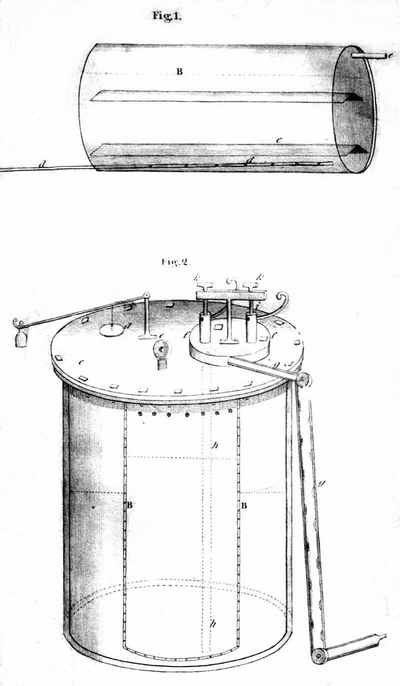
NEW FIRE APPARATUS.
Fig. 1. Fig. 2.
A tight vessel, cylindrically shaped, was first employed, containing
rosin, connected with a small boiler by a pipe which
entered near the bottom, and extended nearly its length, having
small apertures, over which were two inverted gutters, inclining
or sloping upwards over each other; the upper one longer
than the other, intended to detain the steam in the rosin, in its
way to the surface. The rosin being heated, carburetted hydrogen
gas would issue from the outlet, or pipe, inserted near the
top of the vessel, and being ignited, afforded a small blaze,
about as large as that of a candle; but, when the steam was
allowed to flow, this blaze would instantly shoot out many hundred
times its former bulk, to the distance of two or three feet.
It is presumed the steam was decomposed, and carburetted
hydrogen and carbonic oxide, or carbonic acid, produced as
the steam passed, very near the hot bottom of the vessel.
Another apparatus was constructed, consisting of two vessels,
one within the other, having a cover common to both; the
inner one to contain tar, (as a more convenient substance than
rosin;) the outer vessel to contain water, which surrounds
the other, and lies under its bottom; or, in other words, a
vessel of tar set into a vessel of boiling water. The boiler
has a lining of sheet copper, or tin, to promote the ebullition.
The tar vessel being riveted to the cover, holes are made
through its sides, near to the cover, to allow the steam to pass
in, and act on its surface. The cover being secured on, a safety
valve is provided for the steam vessel, and two cocks; one
over the tar, the other over the water, are fixed contiguously;
the first has a tube, or is elongated to reach nearly to the bottom
of the tar, which ascends, and is driven out by the pressure
of the steam on its surface. Both cocks conduct to a
pipe, wherein is placed a large wire, or metallic rod, which
about fills the tube, and is perforated obliquely, or zig zag, to
increase the length of the passage, and to mingle the tar and
steam more intimately. The gases, or vapours, issue from a
small orifice at the end of the pipe; and, being ignited by a
little fire, into which it is directed, an intense and voluminous
blaze is produced, and continues as long as the materials
remain unexhausted. A hot brick, instead of the fire, answers
the same purpose.
This apparatus contained but about one quart of tar, (which
must always be nicely strained,) and it lasted one and a half
hour, and the flame was sufficient to fill a common fireplace, if
not allowed to escape, by its violence, up the chimney. Its force
will be according to the elasticity of the steam. I regret being
unable, since, to make more exact and varied experiments, to
demonstrate the economy of this fuel. This point, however,
and the chemical facts, will be the subject of a future communication.
And probably a form of a stove may be devised,
wherein it may be used for the purposes of warmth, light, and
cooking; and another apparatus to light streets.
But this invention will be of more special use as fuel for
steam engines applied to navigation—the purpose principally
for which I have purchased the patent right.
This may be the subject of another communication.
Art. XXII. On the Changes which have taken place in
the Wells of Water situated in Columbia, South-Carolina,
since the Earthquakes of 1811-12. By Edward
Darrell Smith, M. D., Professor of Chemical and
Experimental Philosophy and Mineralogy in the South-Carolina
College.
To Professor Silliman.
Dear Sir,
In answer to your inquiry respecting the changes in our wells,
since the memorable period of the earthquakes, I would make
the following observations:
These tremendous convulsions of nature commenced in
December, 1811, and were continued, at intervals, until the
latter end of the succeeding month of March, with different
degrees of violence, in this and some of the adjacent states.
In November, 1812, I visited this town, and then understood
that the wells, which are generally very deep, had an abundance
of water in them. This continued to be the case for
about one year after; and in the College well, in particular,
which was a remarkably fine one, there were always about
twelve feet of water, notwithstanding its daily consumption by
more than two hundred persons. Shortly after this time, many
of the wells in the town began to fail in their usual supply of
water, although they were frequently cleaned out and occasionally
deepened. Their state became worse every year,
until, at length, about three years since, some of them proved
to be entirely dry, and most of the others had their water turbid,
and diminished to the depth of only two or three feet.
A little anterior to this period, what were called the dry years
had commenced, and there were, comparatively, very scanty
falls of rain until the last spring; since when there has been a
very large quantity. To elucidate the subject more fully, it
may not be amiss to give some topographical account of the
town of Columbia. About a mile from the eastern bank of the
Cogaree the town begins to be thickly built up, and at this
distance the elevation of ground is supposed to be one hundred
feet above the level of the river in its ordinary state.
The hill is then tolerably level for the space of a mile or more
in its western extent, and its soil is principally composed of a
loose, porous sand, with which few, if any, stones are intermixed
at any depth that has yet been penetrated. In attempting
to account for the failure of the well-waters, it was supposed
by some that the earthquakes had produced such changes
in the loose texture of the soils, that the veins of water which
used to supply the wells, had sunk beneath the level of these
reservoirs; but on this head it is to be observed, that there
was no remarkable failure of water for one or two years after
these changes were supposed to have been effected. Others
again, connecting the greatest failure of water with the concurring
dearth of rain, conceived that the fact might be explained
by the droughts occasioning a deficiency in the river-water,
and thus cutting off the supply which they supposed had
heretofore percolated from the margin of the river into the
wells. If their hypothesis was correct, it was believed that
the difficulty would be removed, either by deepening the wells,
or by subsequent large supplies of rain. Many wells were
immediately deepened from two to eight or ten feet, but the
remedy proved very inadequate. And since the great falls of
rain, within a year past, although there are somewhat larger
supplies of water in some wells, yet there is not the half as
much as existed before the earthquakes. The College well,
although deepened several feet, does not now contain generally
more than four or five feet of water. I must not omit to
remark, that two wells, situated in a longitudinal line from
north to south, with regard to each other, and also in a lower
spot of ground, never failed entirely, although they diminished
considerably, and now yield more copious supplies than any
others.
Whatever may be the cause of this phenomenon, the effects
are so inconvenient, and it is so generally believed that they
are likely to be permanent, that the inhabitants of the town are
beginning to build cisterns, in order to accumulate artificial
reservoirs of water.
Art. XXIII. Respiration of Oxygen Gas.
It is not extraordinary, when oxygen gas was first discovered,
and found to be the principle of life to the whole animal creation,
that extravagant expectations should have been formed
as to its medicinal application. Disappointment followed of
course, and naturally led to a neglect of the subject; and, in
fact, for some years, pneumatic medicine has gone into discredit,
and public opinion has vibrated to the extreme of
incredulity. Partaking in a degree in this feeling, we listened
with some reluctance to a very pressing application on this
subject during the last summer. A young lady, apparently in
the last stages of decline, and supposed to be affected with
hydrothorax, was pronounced beyond the reach of ordinary
medical aid. As she was in a remote town in Connecticut,
where no facilities existed towards the attainment of the object,
we felt no confidence that, even if oxygen gas were possessed
of any efficacy in such cases, it would actually be applied
in this case, in such a manner as to do any good. Yielding, however,
to the anxious wishes of friends, we furnished drawings
for such an apparatus as might be presumed attainable, and
also written and minute directions for preparing, trying, and
administering the gas. It was obtained from nitrate of potash,
(saltpetre,) not because it was the best process, but because
the substance could be obtained in the place, and because a
common fire would serve for its extrication. The gas obtained
had, of course, a variable mixture of nitrogen or azot, and
probably on an average, might not be purer than nearly the
reversed proportions of the atmosphere—that is, 70 to 80 per
cent. of oxygen to 20 or 30 nitrogen; and it is worthy of
observation, whether this circumstance might not have influenced
the result.
Contrary to our expectations, the gas (as we are since informed
by good authority) was skilfully prepared and perseveringly
used. From the first, the difficulty of breathing and
other oppressive affections were relieved: the young lady
grew rapidly better, and in a few weeks entirely recovered
her health. A respectable physician, conversant with the
case, states, in a letter now before us, "that the inhaling of
the oxygen gas relieved the difficulty of breathing, increased
the operation of diuretics, and has effected her cure. Whether
her disease was hydrothorax, or an anasarcous affection of the
lungs, is a matter I believe not settled."
Should the revival of the experiments on the respiration of
oxygen gas appear to be desired, it would not be difficult to
simplify the apparatus and operations so as to bring them
within the reach of an intelligent person, even although ignorant
of chemistry: and this task, should there be occasion, we
would cheerfully undertake to perform.
This interesting class of experiments ought to be resumed,
not with the spirit of quackery, or of extravagant expectation,
but with the sobriety of philosophical research; and it is more
than probable that the nitrous oxyde which is now little more
than a subject of merriment and wonder, if properly diluted
and discreetly applied, would be productive of valuable effects.
Art. XXIV. On the Compound Blowpipe. Extract from
the Journal de Physique, of Paris, for January 1818.[14]
CONCERNING HEAT.
"Heat, considered as one of the most important agents,
especially in relation to chemistry, and even to mineralogy,
has also been the subject of numerous labours, both with regard
to the means of augmenting and of diminishing its effects.
"To the former belong the numerous experiments made,
especially in England, with the blowpipe, supplied by a mixture
of oxygen and hydrogen gases. Mr. Clarke has evidently
been more extensively engaged in these researches than any
other person, as our readers have perceived in the extracts
which we have given from the labours of this learned chemist;
but it is proper also to give publicity to the protest
(réclamation) made to us in favour of Mr. Silliman.
"We have already stated that Mr. Hare, of Philadelphia, first
conceived the idea of forming a blowpipe with explosive gas;
but as we have not been conversant with the memoirs of the
Society of Arts and Sciences of Connecticut, we have not made
mention of Mr. Silliman.
"The fact is, that this chemist, Professor at New-Haven, published,
on the 7th of May,[15] 1812, a memoir containing the results
of experiments made upon a very great number of bodies, until
that time reputed to be infusible; and, among others, upon
the alkaline earths, the decomposition of which he effected.
"The experiments of Mr. Clarke were therefore subsequent;
but, having been made upon a still more extensive list of substances,
they are scarcely less interesting.
"It results then, from the experiments of Messrs. Hare,
Silliman, Clarke, Murray, and Ridolfi, that there is really no
substance which is infusible in the degree of heat produced
by this kind of blowpipe.
"In this new department of physics, it is attempted not only
to apply the blowpipe to a very great number of bodies, but
so to modify the instrument or apparatus as to give it the
highest degree of convenience, and especially to obviate the
danger of explosion."
pp. 38 & 39.
REMARKS.
As the results produced by Mr. Hare's Compound Blowpipe,
fed by oxygen and hydrogen gases, continue to be mentioned
in Europe, in many of the Journals, without any reference
to the results long since obtained in this country, we republish
the following statement of facts, which was, in substance,
first published in New-York, more than a year since.
It should be observed, that Mr. Tilloch has since published,
in the Philosophical Magazine in London, the memoir which
contained the American results, and there have been some
other allusions to it in different European Journals, and to
Mr. Hare's previous experiments; but still this interesting
class of results continue to be attributed to others than their
original discoverers.
Yale College, April 7, 1817.
Various notices, more or less complete, chiefly copied from
English newspapers, are now going the round of the public prints
in this country, stating that "a new kind of fire" has been
discovered in England, or, at least, new and heretofore unparalleled
means of exciting heat, by which the gems, and all the
most refractory substances in nature, are immediately melted,
and even in various instances dissipated in vapour, or decomposed
into their elements. The first glance at these statements,
(which, as regards the effects, I have no doubt are
substantially true,) was sufficient to satisfy me, that the basis
of these discoveries was laid by an American discovery, made
by Mr. Robert Hare of Philadelphia, in 1801. In December
of that year, Mr. Hare communicated to the Chemical Society
of Philadelphia his discovery of a method of burning oxygen
and hydrogen gases in a united stream, so as to produce a very
intense heat.
In 1802, he published a detailed memoir on the subject,
with an engraving of his apparatus, and he recited the effects
of his instrument; some of which, in the degree of heat produced,
surpassed any thing before known.
In 1802, and 1803, I was occupied with him, in Philadelphia,
in prosecuting similar experiments on a more extended scale;
and a communication on the subject was made to the Philosophical
Society of Philadelphia. The memoir is printed in their
transactions; and Mr. Hare's original memoir was reprinted
in the Annals of Chemistry, in Paris, and in the Philosophical
Magazine, in London.
Mr. Murray, in his System of Chemistry, has mentioned Mr.
Hare's results in the fusion of several of the earths, &c. and
has given him credit for his discovery.
In one instance, while in Europe, in 1806, at a public lecture,
I saw some of them exhibited by a celebrated Professor,
who mentioned Mr. Hare as the reputed author of the invention.
In December, 1811, I instituted an extended course of
experiments with Mr. Hare's blowpipe, in which I melted
lime and magnesia, and a long list of the most refractory
minerals, gems, and others, the greater part of which had
never been melted before, and I supposed that I had decomposed
lime, barytes, strontites, and magnesia, evolving their metallic
basis, which burnt in the air as fast as produced. I communicated
a detailed account of my experiments to the Connecticut
Academy of Arts and Sciences, who published it in
their Transactions for 1812; with their leave it was communicated
to Dr Bruce's Mineralogical Journal, and it was
printed in the 4th number of that work. Hundreds of my
pupils can testify that Mr. Hare's splendid experiments, and
many others performed with his blowpipe, fed by oxygen and
hydrogen gases, have been for years past annually exhibited,
in my public courses of chemistry in Yale College, and that
the fusion and volatilization of platina, and the combustion of
that metal, and of gold and silver, and of many other metals;
that the fusion of the earths, of rock crystal, of gun flint, of
the corundum gems, and many other, very refractory substances;
and the production of light beyond the brightness of
the sun, have been familiar experiments in my laboratory.
I have uniformly given Mr. Hare the full credit of the invention,
although my researches, with his instrument, had been
pushed farther than his own, and a good many new results
added.
It is therefore with no small surprise that, in the Annales
de Chimie et de Physique, for September, 1816, I found a
translation of a very elaborate memoir, from a Scientific
Journal, published at the Royal Institution in London, in
which a full account is given of a very interesting series of
experiments performed by means of Mr. Hare's instrument;
or rather one somewhat differently arranged, but depending
on the same principle. Mr. Hare's invention is slightly mentioned
in a note, but no mention is made of his experiments, or
of mine.
On a comparison of the memoir in question with Mr. Hare's
and with my own, I find that very many of the results are identical,
and all the new ones are derived directly from Mr. Hare's
invention, with the following differences.—In Mr. Hare's, the
two gases were in distinct reservoirs, to prevent explosion;
they were propelled by the pressure of a column of water,
and were made to mingle, just before their exit, at a common
orifice. In the English apparatus, the gases are both in one
reservoir, and they are propelled by their own elasticity, after
condensation, by a syringe.
Professor Clarke, of Cambridge University, the celebrated
traveller, is the author of the memoir in question; and we
must presume that he was ignorant of what had been done by
Mr. Hare and myself, or he would candidly have adverted to
the facts.
It is proper that the public should know that Mr. Hare was
the author of the invention, by means of which, in Europe,
they are now performing the most brilliant and beautiful
experiments; and that there are very few of these results
hitherto obtained there, by the use of it, (and the publication
of which has there excited great interest,) which were not,
several years ago, anticipated here, either by Mr. Hare or
by myself.
As I have cited only printed documents, or the testimony
of living witnesses, I trust the public will not consider this
communication as indelicate, or arrogant, but simply a matter
of justice to the interests of American science, and particularly
to Mr. Hare.
BENJAMIN SILLIMAN,
Professor of Chemistry and Mineralogy in Yale College.
Art. XXV. The Northwest Passage, the North Pole,
and the Greenland Ice.
In looking over the foreign journals, we find no articles of
intelligence so interesting as those which respect the three
subjects mentioned above. Indeed, as they have found their
way into most of our newspapers, it is now generally known
in this country, that, in consequence of the reported breaking
up of the Greenland ice, an expedition has already left England,
in two divisions, the one for the purpose of exploring a
northwest passage to Asia, around the North American continent,
by the way of Davis's Straits; the other, for effecting the
same object by passing over the north pole.
If Horace thought that man almost impiously daring who first
adventured upon the open sea, what shall we say of the hardihood
of the attempt to visit THE POLE?—the pole, which it is
impossible to contemplate without awe—which, in all probability,
has never been visited by any living being—where the
dreary solitude has never been broken by human voice—where
the sound of war has never been heard, and darkness and cold
exert an almost undisputed dominion! What must be the emotions
of that man who first stands upon the point of the earth's
axis! Who, no longer partaking of the revolution, in circles
of latitude, slowly revolves on the axis of his own body, once
in twenty-four hours—to whom the sun does not rise or set,
but, moving in a course very oblique to the horizon, makes
scarcely a perceptible progress in twenty-four hours, and at
the end of three months, when he has attained his noon, is only
23° 28′, on the arc of a vertical circle, above the horizon—to
whom longitude is extinct, and who can move in no possible
direction but south—to whom the stars are a blank, and to
whom the polar star, could he see it, would appear in the zenith.
Such are some of the most obvious results of a position on the
pole. The man who first establishes himself on this sublime
point, will have more reason for self-congratulation than he
who led the Persian myriads into Greece, or he who pushed
the Macedonians to the Indus.
On these interesting subjects, we beg leave to refer our
readers to a very able treatise in the Quarterly Review for
February, 1818, where all the topics at the head of this article
are discussed with much learning and ability.—We extract the
following passage:
"If an open navigation should be discovered across the
polar basin, the passage over the pole or close to it, will be
one of the most interesting events to science that has ever
occurred. It will be the first time that the problem was practically
solved with which the learners of geography are sometimes
puzzled—that of going the shortest way between two
places lying east and west, by taking a direction of north and
south. The passage of the pole will require the undivided
attention of the navigator. On approaching this point, from
which the northern coasts of Europe, Asia, and America, and
every part of them, will bear south of him, nothing can possibly
assist him in determining his course, and keeping on the right
meridian of his destined place, but a correct knowledge of the
time: and yet no means of ascertaining that time will be
afforded him. The only time he can have, with any degree
of certainty, as long as he remains on or near the pole, must
be that of Greenwich, and this he can know only from good
chronometers; for, from the general hazy state of the atmosphere,
and particularly about the horizon, and the sameness
in the altitude of the sun at every hour in the four-and-twenty,
he must not expect to obtain an approximation even of the
apparent time, by observation, and he will have no stars to
assist him. All his ideas respecting the heavens and the reckonings
of his time will be reversed, and the change not gradual,
as in proceeding from the east to the west, or the contrary,
but instantaneous. The magnetic needle will point to its
unknown magnetic pole, or fly around from the point of the
bowl in which it is suspended, and that which indicated north
will now be south; the east will become the west, and the
hour of noon will be that of midnight.
"These curious circumstances will probably be considered
to mark the passage by the pole, as the most interesting of the
two, while it will perhaps be found equally easy. We have,
indeed, very little doubt, that if the polar basin should prove
to be free from land about the pole, it will also be free of ice.
A sea of more than two thousand miles in diameter, of unfathomable
depth, (which is the case between Greenland and
Spitzbergen,) and in constant motion, is not likely to be frozen
over at any time. But if all endeavours to discover a passage
to the Pacific by either route should prove unavailing, it will
still be satisfactory to have removed every doubt on this subject
by ascertaining the fact. In making the attempt, many
objects interesting and important to science will present themselves
to the observation of those who are engaged in the two
expeditions. That which proceeds up Davis's Straits, will
have an opportunity of adjusting the geography of the northeast
coast of America, and the west coast of Greenland; and
of ascertaining whether the latter be not an island or an archipelago
of islands; and much curious information may be expected
from both.
"They will ascertain, what is as yet but very imperfectly
known, the depth, the temperature, the saltness, and the specific
gravity of the sea-water in those high latitudes—the velocity
of the currents, the state of atmospherical electricity in
the arctic regions, and its connexion, at which we have glanced,
with the inclination, declination, and intensity of force of the
magnetic needle; on which subject alone, a collection of facts
towards the upper part of Davis's Straits would be worth a
voyage of discovery. It has, indeed, been long suspected that
one of the magnetic poles will be found in this neighbourhood,
as in no part of the world have such extraordinary phenomena
been observed, or such irregularities in the vibration and the
variation of the needle.
"A comparison of the magnetic influence near the pole,
with what it has been observed to be on the equator, might
lead to important results; and the swinging of a pendulum as
near the pole as can be approached, to compare with the oscillations
observed in the Shetland Islands, and in the southern
hemisphere, would be a great point gained for science."
We have no room in this Number to consider the probability
of success in this attempt, nor the question, whether the breaking
up of the Greenland ice, and its passage to, and dissolution
in, the south, have been attended with a chilling influence on
the continents. That such a chilling effect might be extensively
exerted, is certainly credible. Approaching some of
the icebergs, in April 1805, on the shoals of Newfoundland,
we were rendered very sensible of the vicinity of such dangerous
neighbours, by the great chill in the air, long before
they were visible; and when we had passed them, the weather
again grew milder.
Perhaps it militates against the probability of finding the
northern polar basin free of ice, that Captain Cook, in his
approximation to the southern pole, in January, 1773, when in
latitude 67° 15′ south, "could proceed no farther; the ice
being entirely closed to the south, in the whole extent from
east to west-southwest, without the least appearance of any
opening." The advanced season of the year did not, however,
permit Captain Cook to ascertain whether he could coast
around this ice—whether it was ultimately attached to land, or
was a part of a vast field extending to the south pole. This last
is however highly improbable, because being found about 23°
from the pole, it is hardly credible that it would occupy so
extensive a region as to embrace the pole, and, perhaps extend
as much farther beyond; especially as in similar latitudes in
the opposite hemisphere, navigation is comparatively free, and
has been pushed even to more than 80° of north latitude.
The scientific, as well as the commercial world, will wait
with no small impatience for the termination of the two grand
arctic expeditions, which are among the most original and
daring, and may be among the most interesting and momentous
hitherto undertaken by man.
| Page |
| MINERALOGY AND GEOLOGY. |
| Art. I. Remarks on the Geology and Mineralogy of a section of Massachusetts, on Connecticut river, with a part of New-Hampshire and Vermont, by Edward Hitchcock, A.M. Principal of Deerfield Academy | 106 |
| Art. II. On the Prairies and Barrens of the West, by Caleb Atwater, Esq. | 116 |
| Art. III. Account of the Coal Mines in the vicinity of Richmond, Virginia, by Mr. John Grammer, Jun. | 125 |
| Art IV. Sketch of the Geology and Mineralogy of a part of the State of Indiana, by Mr. W. B. Stilson | 131 |
| Art. V. New localities of Agate, Chalcedony, Chabasie, Stilbite, Analcime, Titanium, Prehnite, &c. | 134 |
| Art. VI. Account of the Strata perforated by, and of the Minerals found in, the great adit to the Southampton Lead Mine, by Mr. Amos Eaton, Lecturer on Geology, Botany, &c. | 136 |
| Art. VII. On the Peat of Dutchess County, by the Rev. F. C. Schaeffer | 139 |
| Art. VIII. Notices of Geology in the West-Indies, by Dr. Nugent | 140 |
| Art. IX. Discovery of Native Crystallized Carbonate of Magnesia on Staten-Island, with a Notice of its Geology, by James Pierce, Esq. | 142 |
| Art. X. On a curious substance found with the native Nitre of Kentucky and of Africa, by Samuel Brown, M.D. | 146 |
| |
| BOTANY. |
| Art. XI. Description of species of Sponges observed on the shores of Long-Island, by C. S. Rafinesque, Esq. | 149 |
| Art. XII. Memoir on the Xanthium maculatum, by the same | 151 |
| |
| ZOOLOGY. |
| Art. XIII. Description of the Phalæna Devastator—the Insect that produces the Cut-worm, by Mr. John P. Brace | 154 |
| Art. XIV. Description of the Exoglossum, a new genus of Fresh-water Fish, by C. S. Rafinesque, Esq. | 155 |
| |
| PHYSICS, MECHANICS, AND CHEMISTRY. |
| Art. XV. On the Revolving Steam-Engine of Mr. Samuel Morey, communicated by John L. Sullivan, Esq. | 157 |
| Art. XVI. Cautions regarding Fulminating Powders | 168 |
| |
| USEFUL ARTS. |
| Art. XVII.[16] Account of a Parisian method of obtaining Gelatine from bones, by Mr. Isaac Doolittle | 170 |
| Art. XVIII. On the use of Distilled Seawater for domestic purposes—from the Annales de Chimie, &c. | 172 |
| |
| FINE ARTS. |
| Art. XIX. Essay on Musical Temperament, by Professor Fisher | 176 |
| Art. XX. Notice of Col. Trumbull's Picture of the Declaration of Independence | 200 |
| |
| INTELLIGENCE. |
| Art. XXI. An Address to the People of the Western Country | 203 |
| Art. XXII. Extract of a letter from Col. Gibbs, on the effect of light on the Magnetical power | 207 |
| Art. XXIII. On a new Lamp, without flame—from the Annals of Philosophy | ibid. |