Abbott, J. B: 245, footnote
Abel, Annie Heloise: work cited, 71, footnote, 191, footnote
Abolitionists: Indians’ slaves enticed away, 23;
charges against Calhoun, 30;
Quantrill in league with, 49;
desire Indian lands, 76, 118;
among Cherokees, 132;
Cherokees repudiate idea that they are, 225;
charges against, 291-294
Adair, W. P: 219, footnote
Address: of John Ross at Cherokee mass-meeting, 220
Agency system: under Confederacy, 179
Alabama: Creeks, Choctaws, and Chickasaws from, 20, 193, footnote;
Choctaws in, 20, footnote;
David Hubbard, commissioner from, 108
Alliance: Indians given political position in return for, 17;
reasons for southern Indians entering into, with Confederacy, 18;
Confederate State Department to effect, 140, footnote;
failure of Pike to effect, with Cherokees, 156;
Choctaw General Council authorizes negotiation of treaty of, 156;
Confederacy paid dearly for its Indian, 177;
nature of Seminole, with Confederacy, 197;
principles of active, inserted by Pike into treaties, 212;
McCulloch to accept Drew’s regiment of Home Guards as soon as treaty of, be consummated, 227;
conditions of, between the Indians and Confederacy, 280;
result of Battle of Pea Ridge on Indian, 284
Allies: Indian, 17;
hope of finding in Cherokees, 125
Allotment in severalty: suggested to Creeks, Choctaws, and Chickasaws, 58
American Baptist Missionary Union: 38
American Board of Commissioners for Foreign Missions: work among Cherokees and Choctaws, 39;
records of, 40, footnote;
missionaries among Choctaws remove themselves from patronage, 41, 42, 43, footnote
American Civil War: [See Civil War]
American Historical Association: Report, 20, footnote
American Revolution: effect upon Cherokee emigration to Texas, 20, footnote;
work of Committees of Correspondence in connection with, 83
Amnesty: provided for, 176
Annuities: negro and Indian half-breeds share Indian, 23, footnote;
Choctaw, distinct from Chickasaw, 34, footnote;
Indian, declared forfeited by Lincoln government, 145;
John Ross considers Indian, safe, 147;
payment of Indian, assumed by Confederacy, 163;
Indian, diverted from regular channels, 170;
to use, of hostile Indians, 274;
Crawford makes requisition for Cherokee, 307
Antelope Hills: 55, 136, footnote
Apucks-hu-nubbe: district of, 34, footnote
Arbuckle, General: 193, footnote
Arkansas: Choctaws and Cherokees tarry in, 19, footnote;
Indian Territory annexed to, for judicial purposes, 23, footnote;
and Indian patronage, 59;
and Indian participation in Civil War, 63;
interest in Indian Territory, 67;
Knights of Golden Circle active in, 68;
interest in Indian alliance, 83;
affairs reach crisis, 97;
Hubbard, commissioner to, 108;
sends commission to Indian country, 119;
sends Albert Pike as delegate, 132-133
Arkansas Baptist: 47, footnote
Arkansas Convention: Journal, 119, footnotes, 120, footnotes
Arkansas Historical Association: Publications, 106, footnote
Arkansas Legislature: House Journal, 103, footnote, 110, footnote, 111, footnote
Arkansas River: 67, 76, 97, 135, footnote, 162, 175
Arms: description of, needed for Indians, 190, footnote;
Choctaw-Chickasaw regiment not furnished with, 211;
scarcity of, 211, footnote;
Cherokees in, at Tahlequah mass-meeting, 217;
Ross able to bear, 137, footnote;
Creeks under, threaten hostilities, 138, footnote;
fear, for Indians will be taken by secessionists, 228, footnote;
Confederate difficulty in securing, 253 and footnote
Armstrong Academy: 40, footnote
Armstrong, William: 193, footnote
Asbury Mission: Indian amity compact concluded at, 69, footnote
Assinneboin: suggested Territory of, 32, footnote
Atchison, David R: letter to, mentioned, 33, footnote
Austin State Gazette: 80, footnote
Averell, William W: 101, footnote
Baker, George E: work cited, 58, footnote
Balentine, H: 79
Ball-playing: connected with secret organization of “Pins,” 86, footnote
Bancroft, Frederic: work cited, 58, footnote
Barnes, James K: 260, footnote
Barnesville: 245, 246
Beams’s Negroes: 23, footnote
Beaver Creek: 55
Beening, S. T: 102, footnote
Benjamin, Judah P: 140, footnote, 200, footnote, 215, footnote, 252, footnote
Benton, Thomas H: plan for a national highway, 28;
request, 33, footnote
Big Chief: merit chief of Great Osages, 238
Billy Bowlegs: leaves Florida, 20 footnote;
communications from, 198, footnote;
refuses to sign treaty with Confederate States, 198-199;
death of, 198, footnote;
regarded as good commander, 277, footnote
Bird Creek: battle of, 138, footnote, 255-256
Bishop, A. W: work cited, 67, footnote, 68, footnote, 133, footnote
Black Beaver: 101 and footnote, 303
Black Dog: see Shon-tah-sob-ba
Blackhoof, Eli: 209, footnote
Blain, S. A: 56, footnote, 57, footnote
Blankets: furnished Indian refugees, 261;
to be furnished Indian soldiers in U. S. A., 271, footnote;
Indians need, 310;
Leeper offers to give Kiowas, 318;
Rector urges Leeper not to promise, Kiowas, 332;
Kiowas receive from U. S. government, 343
Bloomfield Academy: 40, footnote
Bob Deer: 244
Boggy Depot: 91, 230, footnote
Bonds: 61, 145-146
Boone, A. G: 210, footnote
Boonsboro [Boonsborough]: 111 and footnote, 125
Boudinot, E. C: 119, 153, 156, footnote, 219, footnote
Bourland, James: appointed commissioner, 88;
report, 91
Branch, Harrison B: 182-183, 210, footnote, 228, 232-233, 249, 271, 279, footnote
Brazos Agency: 55
Bribery: William McIntosh guilty of, 236;
of chiefs to induce secession, 262, footnote
Brigade: jayhawking character of Lane’s, 233;
Lane’s gives John Mathews his deserts, 239;
Hunter asks permission to muster, of friendly Indians, 250;
Kile, quartermaster in 274;
proportion of white troops in Pike’s, 280
Brooks, Preston: 45, footnote
Brown, James: 217
Buchanan, James: administration charged by free-state Kansans with bad faith, 37;
endorses pro-slavery policy, 45, footnote;
distrusted, 47;
“no coercion” policy, 87, footnote;
patronage, given to southern men, 262, footnote;
work cited, 22, footnote, 29, footnote
Buckner, H. S: 92
Buffalo Hump: 305, 315, 330, 338, 348
Bureau of Indian Affairs (Confederate): 128, 141, footnote, 190, footnote
Burgevin, Edmund: 105, footnote
Burleigh, Walter A: 227, footnote
Burlington: 259, 260, footnote
Burroughs, B: 120
Burrow, N. B: 99, 298, 305, 330, 341
Bushwhackers: drive Caddoes out of Texas, 19, footnote
Butler, George: agent for Cherokees, 45, 47, footnote, 285, 290
Byington, Cyrus: 79
Cache Creek: 55
Caddoes: from Louisiana, 19, footnote;
Pike to meet, 189, footnote;
horses stolen by, 353
Calhoun, J. M: 90, footnote
Calhoun, John C: report, 27;
motive, 29;
political heresy, 133
Cameron, Simon: 234, 249, footnote
Campbell, A. B: 260, footnote
Canadian River: 55, 63, 67, 162
Cane Hill: 296, 327
Carolinas: Catawbas in, 20, footnote
Carroll, H. K: work cited, 37, footnote
Carruth, E. H: report, 84, footnote, 197, footnote, 198, footnote;
appointed by Lane, 242;
interviews Creek delegates, 245;
tries to arrange for inter-tribal council, 246;
letter, 267
Cass, Lewis: 193, footnote
Catawbas: admitted to Choctaw citizenship, 20, footnote;
in possession of northeastern part of Choctaw country, 20, footnote;
in South Carolina fight with South, 20, footnote
“Catron letter”: 29, footnote
Chah-la-kee: suggested territory of, 31, footnote
Chah-lah-ki: district of, 178
Chah-ta: suggested territory of, 31, footnote
Chahta Tamaha: 189, footnote
Chatterton, Charles W: 259, footnote
Checote, Samuel: 193, 194
Cherokee Declaration of Independence written by Pike, 137, footnote
Cherokee Executive Council, 136, footnote;
John Ross promises to call meeting of, 153;
meeting of, 216, 217;
communicates with McCulloch, 226
Cherokee Neutral Lands: location, 21, footnote, 64;
size, 21, footnote;
intruded upon, 35, 46, 285, 290;
project for selling, 50, 163;
McCulloch takes position opposite, 225;
Lane’s proposed camp in, 233;
Stand Watie ordered to take up a position in, 252, footnote;
Cowart sets out for, 294
Cherokee Outlet: 54, footnote, 63, footnote, 64
Cherokee Proclamation of Neutrality: 153-154
Cherokee Strip: location, 21, 64;
coveted by Kansans, 21
Cherokee Treaty: 157 and footnote;
declares allegiance to C. S. A., 159, footnote;
contains guarantee of autonomy, 159, footnote;
contains promise of representation in Congress 159, footnote;
navigable waters, 174;
admission to military academy, 180;
appointment of postmasters, 180;
considered by Provisional Congress, 206;
negotiated, 237;
Ross’s characterization of, 257
Cherokees: from Tennessee and Georgia, 20;
tarried in Arkansas, 19, footnote;
go to Texas, 20, footnote;
removal to Arkansas suggested by Jefferson, 20, footnote;
in North Carolina fight with South, 20, footnote;
“Eastern” in controversy with “Western,” 20, footnote;
character of constitution, 31, footnote;
visited by Sacs and Foxes, 36, footnote;
work of A.B.C.F.M. among, 39;
schools among, 39, footnote;
religious denominations among, 39-40;
desirable to have slaveholders settle among them, 42;
material progress due to slavery, 46;
search organization among, 48;
with Cooper as volunteers, 54;
antebellum relations with people of Arkansas, 64;
representatives at inter-tribal conference, 71;
visited by commissioners from Texas, 92;
in council with Creeks, Seminoles, Quapaws, and Sacs, 94;
Pike’s negotiations with, 134, footnote;
to be indemnified, 163;
made an exception, 168;
at Battle of Wilson’s Creek, 214-215, 214, footnote;
secession of, 217;
resolutions of, 223-225;
secret organization among, 291-293
Chickasaw: district, 34, footnote, 52
Chickasaw and Choctaw Herald: 56, footnote
Chickasaw Legislature: act, 68;
resolutions, 122, footnote, 155
Chickasaw Manual Labor School: 40, footnote
Chickasaws: from Alabama and Mississippi, 20;
character of constitution, 31, footnote;
domestic troubles, 34;
political connection with Choctaws, 34, footnote;
religious denominations among, 40, footnote;
construct government, 51;
as volunteers, 54;
country, 63;
not represented at inter-tribal conference, 71;
convention of Choctaws and, 91;
prevented from attending council at North Fork, 94;
take charge of property abandoned by Federals at Fort Arbuckle, 102;
appeal of Burroughs to, 120-121;
resolutions of Choctaws and, 130;
negotiations of Albert Pike with, 136, footnote, 196-197;
reported as anxious to join Southern Confederacy, 155;
treaty with, considered by Provisional Congress, 204-207;
E. H. Carruth communicates with loyal portion of, 246-247
Chilton, William P: 127
Chippewas: from Michigan, 19;
warriors, 227, footnote
Chi-sho-hung-ka: 238, footnote
Chisholm, Jesse: 313, 320
Choctaw-Chickasaw Regiment: 77, 207, 210, 211, 230, footnote, 252, footnote
Choctaw-Chickasaw Treaty: 157, and footnote;
declares allegiance to C. S. A., 159, footnote;
contains promise of representation in Congress, 159, footnote;
suggests ultimate statehood, 160, footnote;
recognizes Choctaw country as distinct from Chickasaw, 161;
transfers lease of Wichita Reserve to Confederate States, 162;
navigable waters, 174;
amnesty, 175
Choctaw Corn Contract: scandal involves Pike, 57, footnote
Choctaw General Council: act, 20, footnote;
resolution, 72-74;
under authority of Chief Hudson declares Choctaw Nation “free and independent,” 156, 196;
plan treaty of alliance and amity with Confederacy, 156;
communication from Pike, 187, footnote, 196, footnote
Choctaw Light Horse: 24, footnote
Choctaws: tarried in Arkansas, 19, footnote;
Catawbas wish to unite with, 20, footnote;
intimacy with negroes, 20, footnote;
in Mississippi fight with South, 20, footnote;
prepared to assent to territorial bill, 31, footnote;
domestic troubles, 34;
political connection with Chickasaws ended, 34, footnote;
religious denominations among, 39-40;
schools among, 40, footnote;
desirable to have slaveholders settle among them, 42;
ask relief, 57, footnote;
country, 63;
antebellum relations with people of Arkansas and Texas, 64;
not represented at inter-tribal conference, 71;
delegation, 74;
affairs, 75-79;
treaty with Confederate States, 78, 204;
convention of Chickasaws and, 91;
prevented from attending council at North Fork, 94;
resolutions of Chickasaws and, 130;
negotiations of Pike with, 136, footnote, 196-197;
reported as anxious to join Confederacy, 155;
enlist in army, 210;
Carruth in communication with loyal portion, 246-247
Chuahla: 39, footnote
Chustenahlah: battle of, 258
Citizenship: U. S. recommended for Indians, 31 and footnote;
Ottawas express preference for U. S., 36, footnote;
Indians to determine own tribal, 169;
Jim Ned’s right of, forfeited within Leased District, 306
Civil War (American): no adequate history of American, 17;
Indian allies of South in, 20, footnote;
in Choctaw-Chickasaw country threatened, 34 and footnote;
delays Indian removal from Kansas, 37;
corrupt practices of Democratic Party just prior to American, 45, footnote;
Stand Watie on Southern side in, 49, footnote;
responsibility of Texas and Arkansas for participation of Indians in, 63;
early interest of Texas and Arkansas in Indian country, 67;
see also Enlistment of Indians
Civilization Fund: 37
Clark, George W: 211, footnote, 240, footnote
Clover, Seth: 209, footnote
Cobb, Howell: 45, footnote
Cockrell, S. R: 119
Coe, Chas. H: work cited, 20, footnote
Coffin, William G: 80 and footnotes, 184, 245, 247, 259, 274
Colbert, D: 41, footnote
Colbert, Holmes: 261, footnote
Colbert, Winchester: 197, 201, footnote
Colbert Institute: 40, footnote
Coleman, Isaac: 186, footnote, 259, footnote
Collamore, George W: 261, footnote
Colley, S. G: 350
Collin (Texas): exodus of non-secessionists from, 95
Colorado: indigenous tribe, in, 19, footnote;
attempts to secure Indian coöperation, 83
Comanche Treaty: 157, footnote, 158;
amnesty, 176
Comanches: 51, 52, 55, 189, footnote, 200 and footnote, 201, 206, 313, 320, 323, 324, 331, 337, 347, 351
Commission: from Texas to Indian nations, 88 et seq.;
from Arkansas, 108, footnote
Concharta: 255
Confederate Contract: for supplying Indians of Leased District, 301-303, 347, 352
Confederate Military History: work cited, 103, footnote
Congressional Globe: work cited, 58, footnote
Connelley, W. E: work cited, 34, footnote, 49, footnote
Connor, John: 544
Cooley, D. N: 56, footnote, 134, footnote, 226
Cooper, Douglas H: citizen of Mississippi, 41;
fears abolitionization of Indian country, 41;
sends note to Superintendent Dean, 42;
sanguine as to slavery conditions among Indians, 45;
survey of Leased District, 53;
Choctaw Corn Contract, 57, footnote;
becomes colonel in Confederate army, 76;
regiment of Choctaws to be under command of, 77, 207;
absent from post, 82 and footnote;
apparently disapproves of Texan interference, 96;
receives suggestions from Rector, 106-107, footnote, 187;
instructions to, 147, footnote;
defection of, 186-187;
asked to continue as agent, 190, footnote;
wishes to be agent and colonel, 197, footnote, 212, footnote;
report concerning Indian enlistment, 211;
in battle with Opoethleyohola, 254 et seq., 312;
complains of not having more white troops, 280
Cooper, Samuel: 53, footnote, 147
Corn Contract: see Choctaw Corn Contract
Council: Cherokee, in session at Tahlequah, 50, footnote;
Choctaw at Doaksville, 77;
composition of Doaksville, 77;
at Fort Smith, 226-227, 241;
at Tahlequah, 237 et seq., 240;
Coffin holds, with representatives of non-secession element of various tribes, 267;
Agent Johnson holds, with Delaware chiefs, 272, footnote;
Indian refugees hold, at Fort Roe, 278, footnote;
Creek, demands payment of money, 289;
Cowart reports rumor of Cherokee, 294;
Cherokee, to meet, 296;
of each tribe to consider amendments to treaties, 323;
Leeper holds with Indians of Leased District, 346;
Comanches propose, to effect everlasting peace with Southern people, 347;
see also Inter-tribal Conference
Covode, John: 276
Covode Committee: 45, footnote
Cowart, Robert J: 46, 82 and footnote, 89, footnote, 114 and footnote, 184, 290, 295, 298
Cowetah: 69, footnote
Cox, John T: 261, footnote
Crawford, John: 183, footnote, 184-185, and footnotes, 190, footnote, 215, footnote, 216, 218, 219, footnote, 220, 223, 325
Creek Country: Seminoles accommodated within, 50;
proposal for giving southern Comanches home within, 51 and footnote;
proposal to allot lands in severalty, 58
Creek Light Horse: 218, footnote
Creek National Council: rejects proposal for allotment of lands in severalty, 58, footnote;
approves draft of treaty with C. S. A., 194
Creek Treaty: 157 and footnote;
Dole ignorant of existence, 157, footnote;
declares allegiance to C. S. A., 159, footnote;
contains guarantee of autonomy, 159, footnote;
contains promise of representation in Congress, 159, footnote;
model on subject of recognizing slavery, 166-167;
extradition, 173;
negotiation of, 192-195;
considered by Provincial Congress, 206;
clauses providing for active alliance, 212
Creeks: from Georgia and Alabama, 19-20;
assist in Seminole removal, 20, footnote;
mixture with negroes, 20, footnote, 23, footnote;
status of free negro among, 23, footnote;
Presbyterians among, 40;
desirable to have slaveholders settle among, 42;
repent giving home to Seminoles, 51;
location, 67;
representatives at inter-tribal council, 71;
visited by commissioners from Texas, 92;
in council with Cherokees, Seminoles, Quapaws, and Sacs, 94
Crime: unjustly charged against missionaries, 47;
charged against Reserve Indians, 52
Crutchfield, Major P. T: 111
Culbertson, Alexander: 210, footnote
Cumberland Presbyterians: 40, footnote
Curtis, Gen. S. R: 138, footnote
Cushing, Caleb: opinion as attorney-general, 22
Cutler, Abram: 229, footnote
Cutler, George A: 184, footnote, 249, footnote, 259, footnote, 266
Davis, Jefferson: influences Cushing, 22;
writes to Worcester, 23, footnote;
nominates Hubbard Commissioner of Indian Affairs, 128;
appoints Pike special commissioner to Indians, 130;
message, 202;
Marshall writes to, 207
Davis, John B: 23, footnote
Davis, John D: 199, footnote
Davis, William P: 199, footnote
Dawson, J. L: 193, footnote
Dean, Charles W: 42;
work cited, 35, footnote, 60, footnote
Debray, X. B: 102, footnote
Decotah: suggested territory of, 31, footnote
Deep Fork of Canadian: 254
Delawares: from Indiana, 19;
tarry in Missouri, 19, footnote;
free state men among, 35;
anxious to avoid white man’s interference, 36, footnote;
Baptist school on reservation, 38;
as refugees, 56, footnote;
Leeper to communicate with, 181, footnote;
Pike hopes to meet, 189, footnote;
wealth, 208, footnote;
treaty with, 231, footnote;
employed as scouts, 232;
appeal to, 268;
response of, 268;
and Shawnees attack Wichita Agency and kill Leeper, 329, footnote
Delegates: five great tribes should have, in Congress, 31, footnote;
Pike sent as, 132-133;
to be allowed in Confederate Congress, 159, 161, 177, 203, 204, 324;
Creek on way to Washington, 245;
Gamble to Confederate Congress, 312
Delegation: Choctaw and Chickasaw, gives assurance to Indian Office of neutrality, 74 and footnote, 75;
from non-secession element in various tribes, 265-266 and footnote, 267 and footnote;
from Leased District visits Kiowas, 353
Denton: exodus from, 95
Denver, J. W: 270
Derrysaw, Jacob: 69, footnote, 194, 218, footnote
Dickey, M. C: 209, footnote
Dickinson, J. C: 50, footnote, 296
Diplomacy: used to effect Indian alliance, 17;
and intrigue to effect Seminole removal from Florida, 20, footnote
District of Columbia: status of slavery in, 22
Disunion: Pike’s poem on, 133 and footnote
Doaksville: 39, footnote;
Choctaw constitution, 51;
Council at, 77
Dole, William P: 56, footnote, 74, footnote, 75, 80, 231 and footnote, 233, 241-242, 250, 266, 271, 273, 274
Dorn, Andrew J: 30, footnote;
takes charge of Neosho Agency, 35, footnote, 51;
absent from post, 82;
citizen of Arkansas, 82, footnote;
tells Neosho River Agency Indians to attend Tahlequah meeting, 241;
letter of, 295;
Rector complains of conduct of, 328
Dred Scott Decision: effect upon Indian interests, 29
Drew, John: 137, footnote, 214, footnote, 217, 226, 253, footnote, 255
Drew, Thomas: work cited, 30, footnote;
issues permits to peddle in Indian country, 60
Drouth: 57, 146, 208
Du Val, Ben T: 104, footnote
Dwight: Cherokee school at, 39, footnote
Echo Harjo: 58, footnote, 80, footnote, 192, 193, 243
Edwards, John: 78
Elder, Peter P: 81, footnote
Elk Horn Tavern: battle of, 138, footnote
Ellis, Jo: 244
Emigration: of Indians voluntary, 19, footnote
Emissaries: 83, 88, 89, footnote, 113 et seq., 114, footnote, 115, footnote, 132, 142, 148, footnote, 183, 208, 210, footnote, 218, footnote, 219, footnote, 242
Emory, William H: 96-102, 98, footnotes
Enlistment of Indians: Pike favors, 132;
McCulloch instructed to secure, 144, 147;
no intention of Confederacy to use as Home Guards exclusively, 148;
Pike objects to use outside of Indian country, 149;
Hyams urges, 155;
Chief Hudson authorizes, among Choctaws, 156;
Federal attitude towards, 227 et seq.,
compulsory, illegal, 228, footnote;
Lane resolves upon, 229-230 and footnotes;
Frémont favors, 231-232;
Delaware chiefs oppose, 232;
Lane persists in urging, 248;
urged by Hunter, 250;
to be resorted to by Federals in invading Indian Territory, 270-271 and footnotes, 272, footnote;
U. S. War Department reverses action respecting, 275, 279 and footnotes;
Coffin’s views on, 277, footnote;
muster roll showing, 344;
among Comanches abandoned, 350
Euchees: 52
Factions: among Cherokees, 49-50, 151 et seq., 215, 223, 240;
among Creeks, 192-194, 254;
among Seminoles, 198-199;
among Comanches, 306
Fairfield: Cherokee school at, 39, footnote
Fall Leaf: 231, footnote, 232 and footnotes, 233, footnote
Farnsworth, H. W: 229, footnote, 272
Fayetteville: 67, footnote, 184, 310, 326
Female seminaries: Indian girls attend, 67, footnote
Finch, John: 30, footnote
Finley, C. A: 270
Fishback, William Meade: 104, footnote
Fleming, Walter L: work cited, 108, footnote
Floyd, John B: 53, 296
Folsom, George: 23, footnote
Folsom, Israel: 74
Folsom, Joseph P: 77
Folsom, Peter: 74, 76, 196
Folsom, Sampson: 41, footnote, 76, 196
Food: Indian refugees need, 260;
to destitute Delawares from Cherokee country, 268, footnote;
Creek refugees destitute of, 273, footnote, 278, footnote;
supposed fraudulent character of contract for supplying, 285-289;
Confederate contract with Charles B. Johnson for supplying, 301-303;
for Comanches, 313;
to be furnished Indians in council considering amendments to treaties, 323;
receipt for, furnished, 345
Fort Arbuckle: 54, 87, footnote, 97, 135, footnote, 201, footnote, 297, 303, 345, 357
Fort Belknap: 88, footnote
Fort Caleb: 295
Fort Cobb: 82, footnote, 84, footnote, 96, 97, 98 and footnote, 189, footnote, 296, 332, 356
Fort Coffee Academy: 40, footnote
Fort Davis: 349
Fort Gibson: abandoned as military post, 53;
Major Emory and, 104;
distance from Fort Smith, 108;
Pike returns to, 137, footnote;
Armstrong to meet emigrating Creeks at, 193, footnote;
Cooper draws off in direction of, 256;
money at, 325
Fort Leavenworth: 88, footnote, 103, 208, footnote, 251, 259, 266, 267, 270
Fort Lincoln: 229, footnote, 230, 243
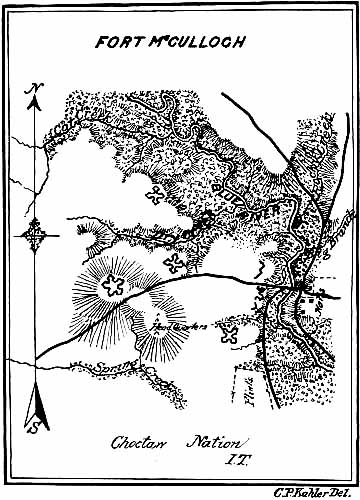
Fort McCulloch: 139, footnote, 284
Fort Randall: 227, footnote
Fort Roe: 259 and footnote, 275, footnote, 277, footnote
Fort Scott: 249, footnote, 266
Fort Smith: headquarters of southern superintendency, 64;
evacuated, 76;
W. G. Coffin fails to reach, 81, footnote;
Emory reaches, 97;
Emory tarries at, 99;
hot-bed of sectionalism, 103;
distance from Fort Gibson, 108;
J. J. Gaines reaches, 113;
Pike proceeds to, 138, footnote;
McCulloch at, 150;
talk of confiscating Rector’s property at, 182, footnote;
distance from Scullyville, 211;
fire at, 298
Fort Smith Council: 192, footnote, 226-227, 241
Fort Smith Papers: cited, 41, footnote, 43, footnote, 50, footnote, 104, footnote, 197, footnote, 198, footnote, 285-328
Fort Smith Times: cited, 47, footnote
Fort Sumter: 118
Fort Towson: 40, footnote
Fort Washita: 77, 91, 96, 189, footnote, 297, 303
Fort Wise: 210, footnote
Forty-niners: covet land in Indian country, 28
Frauds: William Walker, head chief of Wyandots, takes part in Kansas election, 22, footnote
Frazier, Jackson: 41, footnote
Free negroes: status among Creeks and Seminoles, 23, footnote;
among Choctaws, 24, footnote;
Leased District rendezvous for, 56-57
Free-soilers: 45, 46, 113
Free-state expansion: charge that Calhoun intended to prevent, 30
Free-state men: intrenched among Delawares north of Kansas River, 35
Frémont, John C: 214, footnote, 215, footnote, 231, 232, 233, footnote, 248, 312
Frontier: action along Missouri-Arkansas in Civil War, 17;
character of men of, 114;
Indians exploited for sake of men of, 170;
trouble on, to be expected, 183, footnote
Frozen Rock: 53
Fugitive Slave Law: operative within Indian country, 22, 166, 178
Gaines, J. J: 113, 115, footnote, 116
Gamble, James: 41, footnote, 54, footnote, 197, 312
Garland, Samuel: 74, 76
Garrett, William H: 58, footnote, 82, and footnote, 183, 184 192, 194, 212, footnote, 324
Georgia: Creeks and Cherokees from, 20, 193, footnote;
D. E. Twiggs from, 87
Grayton: exodus from, 95
Green, J. J: 105, footnote
Greenwood, A. B: 36, footnote, 45, footnote, 46, 48, 113, 192, 209, footnote, 291, 292, 294
“Grier letter”: 29, footnote
Griffith, Samuel: 119, 182, footnote, 183-184
Grimes, Marshal: 56, footnote, 57, footnote, 98, footnote, 336, 337
Hagerstown (Md.): Quantrill, native of, 48
Half-breeds: status of, 23, footnote;
generally slaveholders, 46;
influence sought in holding Indian country for South, 67;
planter class in Indian Territory, 67, 75;
white men and Choctaw, hold secession meeting, 77;
missionaries fear, 78;
hated by “loyal” Cherokees, 139, footnote;
attempt to force full-bloods into alliance with Confederacy, 216
Halleck, Henry W: 215, footnote, 275
Hamilton, Charles A: appointed commissioner, 88;
report, 91
Harris, C. A: 193, footnote
Harris, Cyrus: 41, footnote, 69, footnote, 80, footnote;
visited by commissioners from Texas, 91
Harris, Thomas A: 130
Harrison, James E: appointed commissioner, 88;
report, 91;
referred to by Governor Clark, 131, footnote
Helena (Ark.): 104
Hemphill, John: 100, footnote
Hester, G. B: 230, footnote
Hicks, Charles: 237, footnote
Hindman, Thomas C: 48, footnote, 105, footnote, 357
Hobbs, Reverend Doctor S. L: 79
Hotchkin, Ebenezer: 42, 76
Houston, Sam: 31, footnote, 90, 93
Howard, O. O: work cited, 220, footnote
Hubbard, David: 108;
letter to Governor Moore, 109-110;
nominated as Commissioner of Indian Affairs, 128;
Pike hopes for coöperation, 141;
receives instructions from Walker, 142-143;
ill-health, 143, footnote;
writes to John Ross, 144-145;
reply of John Ross to, 146-147;
instructed not to offer statehood, 161;
advice to Crawford, 308;
advises economy, 315
Hudson, George: 77, 80, footnote;
declares Choctaw Nation “free and independent,” 156;
dealings with Pike, 196;
proclamation, 196, 210
Humboldt: 243, footnote, 247
Humphreys, John J: 185, 218, footnote
Hunter, David: 248, 249, and footnote, 250, 251, 260, 266, 270, 275, 276, 312
Hyams, S. M: 155
Illinois: tribes from, 19
Indian adoption: 169
Indian camp: Lane plans establishment to prevent foraging into Kansas, 230;
to be located in Cherokee Neutral Lands, 233;
Cooper reaches, 254
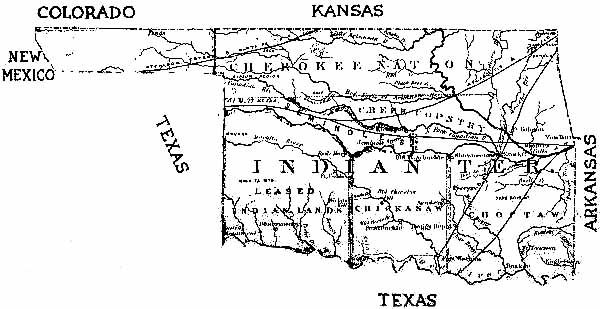
Indian country: west of Arkansas and Missouri, 19;
tribes within, indigenous and emigrant, 19 and footnote;
population, 20-21;
cut in two by Missouri Compromise line, 20;
reservation system established, 21;
listed with District of Columbia as strictly federal soil, 22;
Fugitive Slave Law declared operative within, 22;
presence of free negroes sometimes source of grave danger, 23, footnote;
constantly beset by difficulties, 24, 27;
likely to be greatly reduced in area by Manypenny treaties, 35;
intruders attracted by supposed mines of precious metals, 35, footnote;
rivalry among churches, 37;
intruders to be removed by Agent Cowart, 46;
practically no U. S. troops within, 52-53;
northern tribes of less importance politically than southern, 62, footnote;
slaveholding politicians work through halfbreeds to hold for South, 67;
strategic importance of, appreciated by Arkansas, 108;
military necessity of securing, 131;
Pike describes sojourn in, 134 et seq., footnote;
McCulloch to give military protection to, 148;
McCulloch lays plans for taking possession of, 149;
establishment of Confederate States courts promised by treaty with great tribes, 177;
postal system to be maintained throughout, 180;
U. S. War Department resolves upon expedition to, 270
Indian Home Guards: Pike in favor of Indians as, 132;
no evidence that Indians wanted exclusively as, 148;
individual Cherokees as, 149-151;
disposition to keep Indians as, 212;
Ross’s plan defeated by McCulloch, 226-227;
authorized by Cherokee Executive National Council, 226;
Drew’s regiment tendered to McCulloch, 227;
Drew’s regiment escorts Pike to Park Hill, 240
Indian Intercourse Law: difficulty in enforcing, 24, footnote;
Greenwood’s exposition of, 290;
Leeper asks for copy, 315;
Leeper reports troops necessary to enforce law within Leased District, 346
Indian Property Rights: put in jeopardy by pioneer advance, 28;
in trans-Missouri region, 29;
rendered secure by treaty promises, chap. iii
Indian Removal: policy, 19, footnote;
law for, 19, footnote;
indemnification for, 164-166
Indian States in Union: suggested by southern politicians, 31;
suggested by Texas newspapers, 31, footnote;
Confederacy promises to Choctaws, 78;
no assurance of, to be given by Hubbard, 143;
promised in treaties made by Confederacy, 160 and footnote, 161;
Davis calls attention to clauses in Indian treaties providing for, 203;
Provisional Congress modifies treaty guarantee for, 204
Indian Territory: small tribes find their way to, 19, footnote;
annexed for judicial purposes to Western District of Arkansas, 23, footnote;
in danger of being abolitionized,41-42;
only home for Indians from Kansas, 36;
drouth in, 58;
political status of tribes in, 62, footnote;
position with respect to Texas and Arkansas, 63;
topographical description of, 63;
early interest of Texas and Arkansas in, 67;
halfbreeds of, a planter class, 67, 75;
Knights of Golden Circle active in, 68;
Indians to be driven out of, 76;
cut off from communication with U. S. Indian Office, 81, footnote;
agents within, all southern men, 82;
Commissioner Dole urges reoccupation of, 241;
strategical importance of, 242;
included within Trans-Mississippi District of Department No. 2, 280
Indian trade: licenses for, 59-60;
regulations respecting, 169-171
Indiana: tribes from, 19;
W. G. Coffin from, 80
Indians: lands granted in perpetuity, 18;
participation in American Civil War inevitable, 18;
as emigrants, 19;
number of colonized, 20-21;
proportion of southern to northern, 21;
slaves enticed away by abolitionists, 23;
seized as fugitives by southern men, 23;
interests militated indirectly against by Dred Scott decision, 29;
territorial form of government for, 30, footnote, 31, footnote;
treaty rights likely to be seriously affected by repeal of Missouri Compromise, 34;
plan for colonizing Texas, 52, 55;
Knights of Golden Circle active among, 68;
condition of, reported by Texas commissioners, 94;
Choctaw and Chickasaw friendly to Confederate States, 100, footnote;
enlistment, 132, 147-149, 155, 181, footnote, 207, 210, 211-212, 227, footnote, 248, 250, 252, footnote, 270, 275, 279;
treaties with Confederate States, 157-158, 202-206;
judicial rights under treaties with Confederate States, 172-174;
military support secured early by Confederacy, 207;
use of, by U. S. as soldiers uncertain, 227 et seq.;
not subject to conscription, 228, footnote;
reported arming themselves on southern border of Kansas, 228, footnote;
conference with Lane at Fort Lincoln, 230;
totally abandoned by U. S. government, 262, footnote;
see also under names of individual nations and tribes
Interior Department: 53, 80, 218, footnote, 242, 265, 273
Interlopers: encourage slavery within Indian country, 22;
see also Intruders
Inter-tribal Conference: documents relating to, called by the Chickasaws, 68, footnote;
assembling of, at Creek Agency, 70;
attendance, 71;
action, 71-72;
action not officially reported to U. S. government, 82;
Motey Kennard and Echo Harjo in Washington at time, was planned, 192;
Indians solicit, 209, footnote;
Lane arranges for, to meet at Fort Lincoln, 243, 246;
Coffin desires, at Humboldt, 247;
plans for, at Leroy, 248;
Hunter instructed to hold, 250;
difference between, as planned by Lane and by Hunter, 250, footnote;
John T. Cox gives account of, 262, footnote
Interview: of Pike and McCulloch with Cherokee Confederate sympathizers, 135, footnote, 152;
of Lane with representatives of various tribes at Fort Lincoln proposed, 243, 246;
of Coffin with Carruth, 243, footnote;
of Carruth with Creek delegation, 245
Intrigue: and diplomacy to effect Seminole removal from Florida, 20, footnote;
Pike expected to succeed in, with Southern Indians, 86, footnote
Intruders: to be removed by Agent Cowart, 46;
interfere with slavery, 47;
Confederate military authority to supplement tribal in expulsion of, 169;
Agent Butler’s reports, 285;
Greenwood discusses matter with Rector, 290-291;
Cowart reports progress in removal of, 295, 296, 297;
Cowart gives notice to John B. Jones to leave Cherokee Nation, 296;
see also Interlopers
Iowas: 189, footnote
Irish, O. H: 227, footnote
Iyanubbi: Choctaw school at, 39, footnote
Jackson, Andrew: 19;
inducements offered to Indians, 58;
procedure of, 72;
opposed to political tenets of John C. Calhoun, 133
Jayhawking: of Lane’s brigade, 233, 234, 277
Jennison, C. R: 275, footnote
Jesup, Thomas S: 164, footnote, 165
Jim Ned: 306, 330, 341
Jim Pockmark: 306, 338
John Chupco: 198, footnote, 199
John Jumper: and Seminole removal, 20, footnote;
favors boarding schools for youth of tribe, 40, footnote;
approached by Albert Pike, 85, footnote, 197, footnote, 198, footnote;
signs complaint against General Jesup, 164, footnote;
signs treaty with Confederate States, 198;
signature attached to Comanche treaties, 200, footnote;
doing duty faithfully, 319;
letter to, 337
Johnson, Charles, B: 56, footnote, 98, footnote, 105, footnote, 190, footnote, 199, 287, 289, 301, 314, 323, 332, 352
Johnson, F: 231, footnote, 232, 248, and footnote, 329, footnote
Johnson, James B: 105, footnote
Johnson, Richard H: 47, footnote, 105, footnote
Johnson, Robert W: 31, footnote, 47, footnote, 105, footnote, 127;
correspondence with Albert Pike, 131, 132;
motion, 204;
Crawford serves by request, 308;
elected senator, 334
Johnson, Thomas: slavery-propagation work among Indians, 22, footnote, 39
Johnson, W. Warren: 303
Johnson: exodus from, 95
Jones, Evan: 47, 93, 135, footnote, 217, 218, footnote, 236, 240, footnote, 292, 293
Jones, H. P: 199, 348, 350
Jones, John: 309
Jones, John B: 47, 269, footnote, 296
Jones, R. M: 75, 77, 79, 197, 344-345
Journeycake, Charles: 231, footnote, 268, footnote
Jumper, John: see John Jumper
Ka-hi-ke-tung-ka: 238, footnote
Kannady, J. R: 125
Kansa: indigenous to Kansas, 19;
suffering of, 209, footnote
Kansas: Indian tribes in, 19;
agitation for the opening up of, 28;
compared with Choctaw country, 31, footnote;
suggested organization causes excitement among Indians, 33-34;
citizens encroach upon Cherokee Neutral Lands, 46;
drouth in, 58;
political status of tribes in, 62, footnote;
and Cherokee Outlet, 64;
Elder, citizen of, 186;
Pike desires to raise Indian battalion, 207;
Indians wish to fight, 227, footnote
Kansas Historical Society: Collections, 19, footnote, 34, footnote
Kansas-Nebraska Bill: effect upon Indian interests, 29, 35;
settlers demand Indians to vacate territory covered by, 36;
Seward’s speech on, 58-59
Kansas Territory: first districting illegally included Indian lands, 35;
free-state settlers charge Buchanan government with bad faith, 37
Kappler, C. J: work cited, 20, footnote, 34, footnote, 49, footnote, 50, footnote, 52, footnote
Kaskaskias: from Illinois, 19
Keitt, Lawrence M: 127, 129
Kennedy, John C: 211, footnote
Kickapoos: from Indiana, 19;
tarry in Missouri, 19, footnote;
denominationalism among, 37, footnote;
refugees, 56, footnote;
Leeper to communicate with, in name of Albert Pike, 181, footnote;
Pike hopes to meet, 189, footnote
Kile, William: 261, footnote, 274
Kingsbury, Rev. Cyrus: 40, and footnote, 43, footnote, 76
Kingsbury Jr., Cyrus: 79
Kiowas: 52;
Texans reported tampering with, 210, footnote;
messengers from, 309;
talk for, 320;
treaty with, to be effected, 323, 331;
delegation of, 324;
Big-head, chief of, 342;
Lone Wolf, chief of, 350;
E-sa-sem-mus, chief of, 350;
annual festival of, 351;
treaty with, 354
Knights of Golden Circle: probable influence with Arkansas Legislature, 68, footnote;
evidence of activity among Indians, 68;
halfbreeds belong to, 86, footnote
Koonsha Female Seminary: 40, footnote
Lands: plot to dispossess Indian of, 18;
pledged by U. S. government as Indian possession in perpetuity, 18, 28;
of Cherokees extended north of thirty-seventh parallel, 21;
of Indians coveted by Forty-niners, 28;
of Indians in Kansas excluded from local governmental control, 35;
allotment in severalty proposed to Creeks, Choctaws and Chickasaws, 58;
violation of treaties to cost Indians their, 86, footnote;
property rights of Indians guaranteed by Confederacy, 161 et seq.;
Indians to have right to dispose of by will, 172;
Cherokee halfbreeds fear designs upon Indian, 216
Lane, James H: 125, 229, 231, footnote, 233, 242, 251 and footnote, 265, 270, 276, 278
Lane, W. P: 357
Laughinghouse, G. W: 120
Leased District: 52 and footnote, 54, 56, 57, footnote, 63, 67, 96, 179, 199, 297, 340, 349
Lee, Robert E: 88, footnote, 98, footnote, 99
Lee, S. Orlando: letter, 75-79, 197, footnote
Leeper, Matthew: 57 and footnote, 82 and footnote, 96, 98 and footnote, 99, 180, footnote, 199, footnote, 303, 304-307, 311, 315-319;
removal of, asked for by Rector, 323;
death of, 329, footnote;
charges against, 333
Leeper Papers: cited, 57, footnote, 99, footnote, 102, footnote, 181, footnote, 186, footnote, 199, footnote, 200, footnote, 201, footnote, 329-357
Lee’s Creek: Cherokee school at, 39, footnote
Lefontaine, Louis: 208, footnote
Leroy: 248, 266
Lincoln, Abraham: 68, 76, 80, 86, footnote, 93, 95, 118, 122, footnote, 182, 185, 234 and footnote, 250, 265, footnote, 266, 274, 276, 278
Little Captain: 277, footnote
Little Rock: 103, 108, 190, footnote
London, John T: 104, footnote
Long John: 198, footnote
Love, Overton: 23, footnote
Lower Creeks: 50, 80, footnote, 192, 244
Lowrie, Walter: 75
“Loyal Creeks”: 192, footnote, 193, 194, footnote, 195, 199, 243-246, 250, 254, 259;
sufferings, 260;
measures for relief of, 260 et seq., 272;
annuities of “hostiles” to be applied to relief of, 274
Luce, John B: 125, 282, footnote
McCarron, Thomas: 311
McClellan, George B: 265, footnote, 275, 276
McCulloch, Ben: 85, footnote, 120, 135, footnote, 141, 143-144;
letter of Hubbard to, 144-145;
attempt to secure Cherokee help, 149-153;
communication with John Ross, 149;
reply of John Ross to, 150;
correspondence with Secretary Walker, 151, and footnote;
reports Choctaws and Chickasaws as anxious to join Confederacy, 155;
accompanies Albert Pike, 189, footnote;
gives authority for calling out six hundred rangers from Fort Cobb, 198, footnote;
objects to appointment of Garrett as colonel of Creek regiment, 212, footnote;
acts under direct orders from Richmond, 225;
promises to protect Cherokee borders, 227;
orders Stand Watie to take up position in Cherokee Neutral Lands, 252, footnote;
goes to Richmond, 257, footnote
McCulloch, Henry E: 99, footnote, 207
McCulloch, Thomas C: 210, footnote
McDaniel, James: 262, footnote, 268, and footnote
Machinations: secessionist sympathy of Indians not due to, of agents and others, 219, footnote
McIntosh, Chilly: 92, 140, footnote, 193, and footnote, 200, footnote
McIntosh, D. N: 92
McIntosh, James: 256 et seq.
McIntosh, Rolly: 193, footnote
McIntosh, William: 191, footnote, 193, footnote;
attempts to bribe John Ross, 236, footnote
McRae, John J: presents petition for removal of Choctaws, 20, footnote
McWillie, M. H: 207, footnote
Mails: insecurity, 116;
none in Indian country, 190, footnote;
irregularity, 230, 252, footnote;
must be provided for in Leased District, 309;
Rector has no authority to establish, 332
Malfeasance: Rev. Thomas Johnson suspected of, 39, 41;
few Indian Office officials free from, 56, footnote;
Washburn implicated in, 85, footnote;
Indian agents guilty of, 262, footnote
Manassas Junction: battle of, 216
Mandan: suggested territory of, 32, footnote
Manypenny, George W: 30, footnote;
Indian treaties made by, 33, footnote, 35;
promises to look into expediency of Comanche removal, 51, footnote;
suggests giving Indians control of trade, 170
Marcy, William L: 165, footnote
Marshall, F. J: 207
Marysville: 207
Mass-meeting: of Cherokees at Tahlequah, 217 et seq., 226, 234
Mathews, John: 235, footnote, 239
Mayers, Abram G: 56, footnote, 197, footnote, 230, footnote, 287, 288, 289, 312
Mayes, Joel: 214, footnote
Medicines: Texans seize, 305, 308;
Leeper’s requisition can not be honored, 330-331
Memphis (Tenn.): 97, 104, 134, footnote
Methodist Episcopal Church South: 37, footnote, 38, 40, footnote
Methodists: 38
Mexican War: effect upon Indian interests, 28;
service of Pike in, 132
Miamies: from Indiana, 19;
charges against Agent Clover, 209, footnote
Michigan: tribes from, 19
Mikko Hutke: 194, 244
Military Board of Arkansas: 190
Minnesota: territory of Decotah to be carved out of, 31, footnote
Mission: of Pike, 134 et seq.;
of Hubbard, 143 et seq.;
of Carruth, 242, 246-247
Missionaries: encourage slavery within Indian country, 22;
among Indians, 39 et seq.;
suspected of attempting to abolitionize Indian country, 41;
charged with inciting to murder, 47;
search organization among Cherokees due to, 48
Missionary Herald: cited, 40, footnote, 41, footnote
Missions: 39 et seq., 143
Mississippi: Choctaws and Chickasaws from, 20;
Choctaws in, fight on side of South, 20, footnote;
Cooper, citizen of, 41
Mississippi River: 17, 63
Missouri: Kickapoos, Shawnees, and Delawares tarry in, 19, footnote;
interests herself in Indian alliance, 83
Missouri Compromise: line approximately boundary between northern and southern Indian immigrants, 21;
encroachment upon northern rights under, 22;
as affected by Kansas-Nebraska bill, 30
Mitchell, Charles B: 97, 98, 334
Montgomery: 76, 87, footnote, 94, 109, 192, 196, 297
Moore, Andrew B: 108
Moore, Frank: work cited, 45, footnote, 125, footnote, 227, footnote
Moore, Thomas O: 155, 192, footnote
Moo-sho-le-tubbee: district of, 34, footnote
Moravians: 38
Morton, Jackson: 127
Motey Kennard: 58, footnote, 80, footnote, 92, 94, 119, 191, and footnote, 193, 199, 200, footnote, 218, footnote, 243, 337
Mound City: 230, footnote
Munsees: from Ohio, 19;
Moravians among, 38
Murphy, J: 119
Mus-co-kee: territory of suggested, 31, footnote
Navajoe: suggested territory of, 32, footnote
Ne-a-math-la: 193, footnote
Nebraska: indigenous tribes in, 19, footnote;
agitation for opening up of, 28;
drouth in, 57
Ne-con-he-con: 268, footnote
Negroes: Choctaws charged with mixing with, 20, footnote;
Creeks almost completely mixed with, 22, footnote;
Creeks possess no aversion to race mixture, 23, footnote;
no rights that white men are bound to respect, 29;
Quantrill plans to rescue, 48;
Indians agree to return fugitive, 166, footnote;
six hundred, seized by Kansans, 334
Neighbors, Robert S: 56, footnote
Neosho: suggested territory of, 31, footnote
Neosho River: 208, 277, footnote
Neosho River Agency: 30, footnote;
invaded, 35, footnote;
Elder put in charge of, 186;
Indians of, at Fort Smith Council, 241
Neutrality: McCulloch agrees to respect Cherokee, 136, footnote;
of Indians scarcely possible, 145;
Chief Ross gives reasons for preserving, 147, 150;
Chief Ross objects to violation of, 150;
majority of Cherokees favor, 153;
Chief Ross’s Proclamation of, 153-154;
discussion in Cherokee meeting at Tahlequah, 220 et seq.;
McCulloch orders Stand Watie’s men not to interfere with Cherokee, 227
New Hope Academy: 40, footnote
New Orleans Picayune: 32, footnote
Newspapers: 47, 75, 80, footnote
New York Indians: from Wisconsin, 19;
reservation invaded, 35;
members of Neosha River Agency, 51;
Refugees camp upon lands of, 260
North Carolina: Cherokees fight on side of South, 20, footnote
North Fork Village: 92, 94, 95, 157, 188, 192
North Fork of Canadian: 67, 136, footnote, 189, footnote, 254
Northern Baptists: 38, 39
Northern Indians: colonized within limits of great American desert, 18;
relative position of, 21;
Pike hoped to exert influence over, 208;
reported organized into spy companies by Federals, 306
Oak Hills, or Wilson’s Creek: battle of, 215, 216, 225, 257, footnote
Ochiltree, William B: 129
Office of Indian Affairs: plans for removal of Catawbas from Carolinas, 20, footnote;
takes measures for removal of Seminoles from Florida, 20, footnote;
refuses to remove Choctaws from Mississippi, 20, footnote;
unable to execute plan for removal of Texas Indians before 1859, 52;
reply of Creeks to proposals, 58;
patronage of, 59;
out of communication with Indian Territory, 81, footnote;
complaint filed at, 96;
in possession of documents incriminating D. H. Cooper, 186;
discontinues Indian allowances, 192;
supports War Department, 271
Ogden, John B: 89, footnote, 108, footnote, 115, footnote
Ohio: people of, desire information about Manypenny treaties, 33, footnote
Okanagan: suggested territory of, 32, footnote
Ok-ta-ha-hassee Harjo [Sands]: 194, 244, and footnote
Old Choctaw Agency: 211, footnote
Oldham, W. S: 100, footnote
Old Scottish Gentleman: 107 and footnote
Old Settlers Party: 49
Omaha Mission School: youths from, enlist in army, 227, footnote
Omahas: 227, footnote
Opoeth-le-yo-ho-la: 138, footnote, 193 and footnote, 194, 195, footnote, 198, footnote, 236, footnote, 243, 253, footnote, 254 et seq., 268, 278
Oregon: occupied, 28
Osage Manual Labor School: 38, footnote
Osage Mission: 182, footnote
Osage River Agency: 208, footnote
Osage Treaty: 157 and footnote;
lands, in Kansas guaranteed by, 162;
model on subject of rendition of slaves, 167;
navigable waters, 175;
negotiated, 237
Osages: indigenous to Kansas, 19;
Great and Little, 20, footnote;
reservation invaded, 35, 295;
determined to resist removal, 36;
Roman Catholicism among, 38 members of Neosho River Agency, 51;
negotiations with Pike, 137, footnote;
described as “lazy,” 208, footnote;
letter to, from John Ross, 235, 236, footnote;
bands of, 237
Otis, Elmer: 210, footnote
Otoes: 209, footnote
Ottawas: from Michigan, 19;
regard removal as useless, 36, footnote;
Baptists among, 38
Ozark Mountains: 19, footnote
Pacific Railroad Surveys: cited, 54, footnote
Pa-hiu-ska: 238, footnote
Panola: county of, 68, footnote
Pape, Henry: 182, footnote
Park Hill: Cherokee school at, 39, footnote;
residence of John Ross, 135, footnote, 188, footnote;
John Ross at, 150;
W. S. Robertson retires to, 218, footnote;
Pike invited to, 234;
treaties negotiated at, 237
Parker, Eli S: 228, footnote
Parker, Thomas Valentine: work cited, 49, footnote
Parks, Robert W: 355
Pas-co-fa: 198 and footnote, 319
Pawnees: purchase from, 33, footnote;
offer to enlist in U. S. army declined, 227, footnote
Pea Ridge: battle of, 138, footnote, 284
Pearce, N. Bart: 120, 131
Pegg, Major: 256, 257
Peoria, Baptiste: 235, footnote
Peorias: from Illinois, 19
Petition: of Representative John J. McRae, 20, footnote
Phelps, J. S: 81, footnote; 211, footnote, 240, footnote
Phillips, U. B: work cited, 134, footnote, 191, footnote
Piankeshaws: from Illinois, 19
Pickens: county of, 68, footnote
Pierce, Franklin: 41, footnote, 56, footnote
Pike, Albert: dislike of Van Dorn, 55, footnote;
concerned with Choctaw Corn Contract, 57, footnote;
and Choctaw commissioners, 78;
writes to Seminole chief, 84, footnote;
telegram, 105, footnote;
poem in honor of Elias Rector, 106;
correspondence with Robert Toombs, 129, 131, 134 and footnote, 152 and footnote;
appointed by President Davis special commissioner to Indians west of Arkansas, 130;
correspondence with R. W. Johnson, 131, 132;
writings, 132, footnote, 133 and footnote;
unjust to John Ross, 134, footnote;
commissioner from Arkansas, 190-191;
views on use of Indians as soldiers, 149;
continues intercourse with Ridge Party, 156 and footnote;
moderate in promises to strong tribes, 163;
assumes financial obligations in name of Confederacy, 163-164;
opens communication with Indian field service, 180-181;
offers post to Leeper, 180, footnote;
negotiates with Creeks, 192-195;
negotiates with Choctaws and Chickasaws, 196-197;
negotiates with Seminoles, 197-199;
negotiates with western Indians, 200-202, 200, footnote;
report submitted by President Davis to Provisional Congress, 202;
invited to be present at consideration of Indian treaties, 205;
desires to raise an Indian battalion from Kansas, 208;
informed of Cherokee willingness to treat, 234;
assigned to command of Indian Territory, 253-254, 322;
Van Dorn’s plans for, 280, 283;
retires to Fort McCulloch, 284;
continues Charles B. Johnson as contractor, 301-303;
receives Leeper’s apology, 356
Pike, W. L: 194
Pine Ridge: 43, footnote
Pins: 86, footnote, 135, footnote, 137, footnote, 138, footnote, 216
Pioneers: 18, footnote
Pitchlynn, P. P: 74, 77
Pitchlynn, W. B: 197
Policy: of U. S. government with respect to Indians, 18;
of Confederate States government, 147
Politicians: as influencing Indian policy of government, 18, footnote;
motives of, 21;
demands of, for Indians, 31;
reason for urging secession among Indians, 98, footnote;
unjust charges against Ross, 150
Polk, James K: work cited, 49, footnote, 166, footnote
Pomeroy, Samuel C: 231, footnote
Pontotoc: county of, 68, footnote
Pope, John: 105, footnote
Population: of Indian country, 20-21;
of southern superintendency, 211, footnote;
of Creek Nation as estimated by Agent Garrett in report to Hubbard, 252-253, footnote
Postal system: to be maintained by Confederate States throughout Indian country, 180
Potawatomies: from Indiana, 19;
Roman Catholicism among, 38;
Southern Baptists among, 38
Poteau River: 108
Presbyterian Board of Foreign Missions: 37, footnote, 40, footnote, 41, 79
Presbyterians (Old School): 38, footnote, 39, 40, footnote, 41
Price, Sterling: 138, footnote, 225, 257, footnote, 280, 283, 312, 326, 334
Prince, J. E: 98, footnote, 231, footnote
Proclamation: of Ross pledging Cherokee neutrality, 153-154;
of Hudson announcing Choctaw independence, 196, 210
Pro-slavery men: intrenched among Shawnees south of Kansas River, 35;
settled upon Cherokee Neutral Lands, 35, footnote
Protectorate: over Indian tribes suggested, 130, 142, 158, 190
Provisional Congress of Confederate States: act of, May 21, 1861, 130, 158 and footnote;
considers treaties with Indian tribes, 202-206
Pulliam, Richard P: 183, footnote, 184, 294, 295, 297, 311, 324
Pushmataha: George Folsom, chief of district of, 23, footnote;
District of, 34, footnote
Quakers: 39
Quantrill, Wm. Clarke: 48, 214, footnote
Quapaw Treaty: 157 and footnote
Quapaws: 51, 64, 67;
in council with Creeks, Cherokees, Seminoles, and Sacs, 94;
negotiations with Pike, 136, footnote, 235, footnote, 237
Quesenbury, William: 183, footnote, 184, 190, footnote, 194, 303, 323
Ray, P. Orman: work cited, 22, footnote, 34, footnote, 38, footnote
Reagan, J. H: 230, footnote
Rector, Elias: superintends removal of Seminoles, 20, footnote, 182, footnote;
demands for Indians, 31, footnote;
Cooper writes to, 42;
urges that Frozen Rock be converted into military post, 53;
enters into sort of private contract with Johnson and Grimes, 56 and footnote;
Grimes and, 57, footnote, 285-289;
relieved, 80, footnote;
seconds efforts of cousin, 106;
suggestion to Cooper, 106-107, footnote, 187;
gives letter of introduction to Gaines, 113;
gives information concerning Choctaws and Chickasaws, 120;
attempt of U. S. government to find successor to, 182;
uncertainty as to when entering Confederate service, 182, footnote;
interview with Pike, 190, footnote;
in company of Pike, 197, 198, footnote;
writes to Leeper, 199, footnote;
expense account of, 304;
complaint against Pike, 328
Rector, Henry M: 102, 112
Red Fork of Canadian: 67, 255
Red River: 55, 63, 77, 91, 95, 100 and footnote, 108, 139, footnote, 175, 347, 349
Refugees: Opoethleyohola, leader of, 195;
Coffin prepares to meet, 259;
take up station between Verdigris and Arkansas Rivers, 259;
approximate number of, 260 and footnote;
sufferings of, 260-261 and footnotes, 265, footnote, 272;
absolute destitution of, 273, footnote;
Dole furnishes supplies to, 274;
joint resolution for relief of, 274;
annuities of hostile Indians to be diverted to relief of, 274 and footnote
Regiment: Colonel Cooper’s filled with Texans, 78;
Choctaw-Chickasaw and Creek, 210-211;
Creek, to elect its own officers, 213;
Drew’s, organized, 226-227;
work and character of Drew’s, 240 and footnote;
of Choctaw-Chickasaw Mounted Rifles, of Creeks, and of Cherokee Mounted Rifles, 252, footnote, 262, footnote;
Drew’s deserts Cooper, 256;
only one white, in whole Indian Department, 280;
Leeper asks for at least one, to keep order on Reserve, 349
Reid, Alexander: 76, 78
Removal: of Indiana more or less compulsory, 19 and footnote;
slavery advanced as objection to Indian, 21-22;
makes no difference in matter of slavery among Indians, 22;
difficulties within Indian country incident to, 27;
Calhoun’s plan for, 27;
U. S. government slow to adopt policy of, 27-28;
settlers demand, of Indians from Kansas, 36;
certain tribes contemplating, 36, footnote;
of Indians from Kansas delayed on account of Civil War, 37;
Missionary Herald useful for history of, 40, footnote;
reasons for, 48;
project for, of Cherokees causes dissensions within tribes, 49;
of Texas Indians, 52;
Wichitas ask for immediate, 56;
guarantee of territorial integrity in treaties arranging for, 160-161;
indemnification for, 164-166;
Choctaw claims under treaty of, 196
Reservation: system, introduced into trans-Missouri region, 21;
Creeks disgusted with idea of individual, 58
Reserve Indians: see Indians of Leased District, Wichitas, Tonkawas, Euchees, etc.
Resolutions: of Choctaws, February 7, 1861, 72-74, 75;
of Chickasaw Legislature, May 25, 1861, 122-124 and footnote;
offered by Chilton of Alabama, 127;
offered by Toombs for appointment of special agent to Indian tribes, 129;
of Choctaws and Chickasaws showing friendly disposition towards South, 130 and footnote;
passed at Cherokee mass-meeting at Tahlequah, August, 1861, 218, footnote, 223-225;
joint, for relief of Indian refugees in Kansas, 274
Rhodes, J. F: work cited, 45, footnote, 129, footnote, 146, footnote
Richardson, James D: work cited, 129, footnote, 158, footnote, 202, footnote
Ridge, John: 47, footnote
Ridge, or Treaty Party: in favor of Cherokee removal, 49;
connives with Ben McCulloch to circumvent wishes of Chief Ross, 151;
minority party, 153;
Pike’s intercourse with, continues, 156;
attempts to develop public sentiment in favor of Confederacy, 215;
collision with Ross faction, 240
Robertson, W. S: 101, footnote, 192, footnote, 218, footnote
Robinson, Charles: 228, 234
Rock-a-to-wa: 231, footnote
Rogers, H. L: 332, 333, 336, 337
Rolla: W. S. Robertson fleeing from Indian country, reaches, 218, footnote
Roman Catholics: 38, footnote
Ross, John: correspondence, 69, footnote, uncle of Wm. P. Ross, 71;
instructions of, 71, footnote;
influence, 72;
character, 72, footnote;
letter of Dole to, 80, footnote;
no one firmer friend to Union than, 86, footnote;
correspondence with John B. Ogden, 89, footnote, 115, footnote;
called upon by commissioners from Texas, 93;
letter from Governor Rector, 112;
letter to Rector, 117;
letter from citizens of Boonsboro, 111, footnote, 124;
J. R. Kannady communicates with, 125;
issues proclamation of neutrality, 125, 153-154;
Albert Pike unjust to, 134, footnote;
letter of Hubbard to, 144-145;
reply to Hubbard, 146-147;
correspondence with Ben McCulloch, 149-151;
sincerity possibly doubted, 168;
declared shrewd, 189, footnote;
Ridge Party attempts to undermine popularity, 215;
attends meeting of Cherokee Executive Council, 217;
address, 220, 223;
suspected of not acting in good faith, 226;
notifies Pike of Cherokee willingness to treat, 234;
communicates with Creeks and Osages, 235;
called upon to rally Cherokees, 256
Ross, Lewis: 138, footnote
Ross, Mrs. John: 220, footnote
Ross, Mrs. William P: work cited, 71, footnote
Ross, William P: 71, 89, footnote, 116, footnote, 137, footnote, 139, footnote, 217, 223
Ross, W. W: 210, footnote
Ross Party: opposed to removal, 49;
majority party, 153
Round Mountain: 255
Route: of Opoethleyohola’s retreat, 261-262 and footnote
Rust, Albert: 105, footnote
Rutherford, A. H: 30, footnote, 190, footnote
Rutherford, Samuel M: 86, footnote, 183, 199 and footnote, 319
Sackett, Major: 98, footnote
Sacs and Foxes: of Missouri, 36, footnote
San Antonio: 52, footnote
Sands: see Ok-ta-ha-hassee Harjo
Schoenmaker, John: 182, footnote
Scott, S. S: 198, footnote, 201, footnote, 314, 321
Scott, Winfield: 88, footnote, 97, 249
Scottish Songs: work cited, 108, footnote
Screw Fly: work cited, 56, footnote
Scullyville: Choctaw constitution of, 51;
Creek regiment forming at, 211
Sebastian, William K: 106, footnote, 287
Secession: meeting held by white men and Choctaw half-bloods, 77;
Presbyterian ordained missionaries favor, 79;
Indian country threatened by advocates for, 80;
Indian agents active for, 82-83 and footnote;
mercenary motives in urging, 98, footnote;
sentiment in Arkansas, 103 et seq.;
Pike offers arguments for, 133;
secret organization of “Pins,” 135, footnote;
Stand Watie’s party afraid to raise flag of, 140, footnote;
large element within Cherokee Nation favors, 153;
Griffith appointed commissioner to interview Indians in interests of, 184;
Indian opponents absent from Pike’s meeting at North Fork Village, 192;
Jones most prominent of Choctaw advocates, 197;
traces of influence of, 208;
August mass-meeting of Cherokees ending in, 217
Second Seminole War: 20, footnote, 23, footnote, 164, footnote, 164-166
Secret Society: purpose of organization, 32, footnote;
in Missouri, 35, footnote;
among full-blooded Cherokees, 48;
“the Pins,” 86, footnote, 135, footnote, 216;
among Cherokees for abolition purposes, 291, 293;
Greenwood orders its dissolution, 292;
Cowart’s views upon schemes of, 294
Sells, Elijah: 186, footnote
Seminole Treaty: 157 and footnote;
declares allegiance to C. S. A., 159, footnote;
contains guarantee of autonomy, 159, footnote;
contains promise of representation in Congress, 159, footnote;
negotiated, 197-199, 197, footnote;
considered by Provisional Congress, 206
Seminoles: from Florida, 20;
removal in late fifties, 20, footnote;
status of free negro among, 40;
Presbyterians among, 40;
manifest only slight interest in education, 40, footnote;
given home in Creek country, 50;
destitute, 57, footnote;
representatives at inter-tribal conference, 71;
letter to chief of, 80, footnote;
condition reported by Carruth, 84, footnote;
in council with Creeks, Cherokees, Quapaws, and Sacs, 94;
negotiations of Pike with, 136, footnote;
complaint against General Jesup, 164, footnote;
Rector’s transactions with, 182, footnote
Seneca and Shawnee Treaty: 157 and footnote
Senecas: 51, 64, 67;
negotiations of Pike with, 136, footnote;
from Cattaraugus Reservation, 227, footnote
Senecas and Shawnees: 51, 64, 67;
negotiations of Pike with, 136, footnote, 237
Settlers: in Kansas demand that Indians vacate territory, 36
Seward, William H: reference to “higher law” speech, 42, footnote;
Chicago speech, 58, 75;
Senate speech, 58
Shawnee Manual Labor School, 38
Shawnee Mission: work of Rev. Thomas Johnson at, 22, footnote
Shawnees: from Ohio, 19;
tarry in Missouri, 19, footnote;
pro-slavery men among, 35;
reported by Agent Dorn as anxious to leave Kansas, 36, footnote;
Baptist school on reservation of, 38;
Southern Methodists among, 38;
as refugees, 57, footnote;
trouble over tribal elections, 209, footnote;
attack Wichita Agency, 329, footnote
Shon-tah-sob-ba [Black Dog]: 235, footnote, 238, footnote
Short Bird: 319
Shoshone: suggested territory of, 32, footnote
Siebert, W. H: work cited, 23, footnote, 49, footnote
Sigel, Franz: 215, footnote
Simon, Ben: 329, footnote
Sioux: uprising, 21, footnote;
warriors, 227, footnote
Slaughter, Thomas C: 208
Slavery: in Kansas, 22;
encouraged, 22;
among Southern Indians, 22, 292;
influence of churches upon, 37;
white men to prevent abolition among Indians, 42;
opposition among Choctaws and Chickasaws, 45;
is being interfered with by intruders, 47;
cause in jeopardy among Cherokees, 48;
North to exterminate among Indians, 145;
recognized as legal institution by treaties, 166 and footnote;
offers easy solution of labor problem, 219;
Cowart reports complaints of interference with, 293
Slaves: 22, 142, 143, 144-145, 165, 166, footnote, 167, footnote, 172, 216, 261
Smith, Andrew J: charges against, 41, footnote
Smith, Caleb B: 74, footnote, 183, 242, 271, 274, 275
Smith, E. Kirby: 100, footnote
Smith, John G: 192
Smith, William R: work cited, 108, footnote, 109, footnote
Snow, George C: 198, footnote, 199, footnote
Southern Baptist Convention: 39, footnote
Southern Baptists: 38, 39
South Carolina: 20, footnote
Southern Indians: 18, 21, 32, 34, 36
Southern Methodists: 38, 39, 40
Southern Superintendency: 30, footnote
Sparrow, Edward: 127
Spencer Academy: 40, footnote, 75, 76, 78
Springfield: 214, footnote, 217, 255, 283, 312, 334
Spy companies: reported equipped by Federals, 306
Stand Watie: 49, footnote, 137, footnote, 153, 156, footnote, 227, 240, 283, 324
Stanton, Edwin M: 276, 279
Stanwood, Edward: work cited, 106, footnote
Stark, O. P: 76
State Department (C. S. A.): Albert Pike, commissioner from, 134, footnote, 152;
Bureau of Indian Affairs, part of, 188, footnote
Stephens, Alexander H: work cited, 118, footnote, 119, footnote
Stevens, R. S: 209, footnote
Stevens, Thaddeus: 210, footnote
Stidham, G. W: 194
Stocks: 61, 76, 203, footnote
Stockton, G. B: 107, footnote, 186, footnote
Strain, J. H: 285, 287
Sturm, J. J: 199, 201, footnote, 330, 331, 353, 357
Sumner, Charles: 45, footnote
Sur-cox-ie: 268, footnote
Surveyors: 53
Tahlequah: 39, footnote, 93, 188, footnote, 217, and footnote, 218, footnote, 226, 234, 237, 293
Tallise Fixico: 194
Tatum, Mark T: 50, footnote, 104, footnote, 296
Taylor, J. W: 193, footnote
Taylor, N. G: 30, footnote
Tennessee: Cherokees from, 20;
John J. Humphreys from, 185
Tenney, W. J: work cited, 90, footnote
Tents: furnished to refugees, 261
Territorial expansion: 28, 58
Territorial form of government: 30, 31, footnote, 33
Texas: indigenous tribes in, 19, footnote;
Indians expelled from, 19, footnote, 52, 340;
Cherokees in, 20, footnote;
annexed, 28;
troops from, 53;
Indian patronage, 59;
Indian participation in Civil War, 63;
interest in Indian Territory, 67;
interest in securing alliance of Indians, 83, 88, 90;
interest in amnesty provisions of Indian treaties, 175-176;
commissioners from, 183;
attitude of northern countries of, 200, footnote;
desires Reserve Indians placed under her jurisdiction, 297
Texas Historical Association Quarterly: work cited, 20, footnote
Texas Superintendency: 56, footnote
Thomason, Hugh F: 202, 335
Thompson, Jacob: 45, footnote, 46, 54, 56, footnote
Tishomingo: county of, 68, footnote
Tonkawas: 52 and footnote, 189, footnote, 200, 201, footnote, 340, 353
Toombs, Robert: 129, 131, 134 and footnote, 135, footnote, 152
Totten, James: 103, 104
Traders: 22, 27, 59-60, 169 et seq., 193, footnote, 238-239, 319
Trammel, Dennis: 288, 289
Treat, S. B: 43, footnote
Treaties: 34, footnote, 37, footnote, 53, 78, 84, footnote, 102, 117, 122, footnote;
made with Indians as with foreign powers, 17;
Ohio desires information as to Manypenny, 33, footnote;
relations to U. S. in, 70, footnote;
obligation to abide by, 71, footnote;
reduction of forts violation of guaranties in, 97, footnote;
resulting from council at Tahlequah, 237 et seq.;
with the Cherokees in part the result of intimidation, 240, footnote;
with the Neosho Agency Indians, 241;
money due the Creeks under, 289;
Pike reports all ratified, 320;
amendments to, 323;
manuscript copies of, 329-330, footnote;
no Indian Department to be organized until ratification of, 331;
terms of the, with the wild Indians, 352;
Leeper makes a, with the Comanches, 354-355
Troops:
Confederate—in Cherokee country, 136, footnote;
no Arkansas, available, 253, footnote;
Van Dorn’s erroneous surmise as to proportion of white, in Pike’s brigade, 280;
Van Dorn’s plans as to disposition of, 283;
Leeper inquires when, may be expected, 310;
Pike’s confidence in white, 320;
lack of, in Leased District, 343, 349;
non-arrival of, 345.
Indian—Confederacy secure before negotiation of treaties of alliance, 207;
plans for distribution of, 207;
Cherokee, under McCulloch, 226-227;
Northern, offer to furnish U. S. with, 227, footnotes;
large and increasing number in Indian Territory, 252;
not possible to keep order, 346.
United States—few within Indian country, 52-53;
Secretary Floyd disposed to withdraw from Indian frontier, 53;
from Texas ordered to protect U. S. surveyors, 53;
number to be retained in Indian country queried, 72, footnote;
Carruth reports all gone from Indian Territory, 86, footnote;
ordered to leave, 87 and footnote;
disposition, reported upon by Texas commissioners, 95;
under Emory ordered to Indian Territory, 96 et seq.;
flee from Indian Territory, 101;
dissatisfaction at reported change in disposition in Arkansas, 103, 105;
to counteract influence of secessionists, 216;
method of warfare under Lane, 233;
Dole urges to re-occupy Indian Territory, 241;
sudden withdrawal spreads alarm in Leased District, 299
True Democrat: work cited, 47, footnote, 48, footnote, 106, footnote
Tuckabatche Micco: 51, footnote
Tuckabatchee Town: 193, footnote
Tulsey Town: 255
Turnbull, John P: 189, footnote
Turner, J. W: 260, 272, footnote
Tusaquach: 247
Tush-ca-horn-ma: district of, 179
Twiggs, D. E: 55, footnote, 87
Umatilla: suggested territory of, 32, footnote
Underground railroad: 40
Upper Arkansas Agency: 210, footnote
Upper Creeks: 50, 208, footnote, 191, footnote, 192, 193, footnote, 236, footnote, 244, 319
Usher, John P: 56, footnote, 228, footnote
Van Buren (Ark.): 64, footnote
Van Dorn, Earl: 55, 138, footnote, 280, 283
Vann, Joseph: 217, 223
Verdigris River: 259, 272
Wah-pa-nuc-ka Institute: 40, footnote
Walker, David: 116, 298
Walker, Leroy P: 119, 127, 142, 147, 151, 161, 200, footnote, 207, 215, footnote
Walker, William: head chief of the Wyandots, 22, footnote
Walker, William: 105, footnote
Wall, David: 23, footnote
Walnut Creek: 259
War Department: C. S. A., 128, footnote, 139, footnote, 140, footnote, 193, footnote, 257, footnote;
U. S. A., 52, 80, 87, 96, 228, footnote, 234, 241, 250, 264-265, 275
Washburn, J. W: 84, footnote, 164, footnote, 238, and footnote
Washita: Indians driven from country of, 19, footnote
Wattles, Augustus: 229, footnote
Waul, Thomas N: 127, 205
Weas: from Illinois, 19
Weber’s Falls: 86, footnote
Welch, George W: 84, footnote
West Florida: seizure of, 28
West Point: 215, footnote
Wheelock: Choctaw school, 39, footnote
White, Joseph: 209, footnote
White, S. W: letter of, 33, footnote
White Cloud: 227, footnote
Whitney, Henry C: 208 and footnote
Whittenhall, Daniel S: 350
Wichita Agency: site for, 54, 56, footnote, 136, footnote;
attack upon, 329, footnote
Wichita Mountains: 51, 55
Wichita Treaty: 157, footnote, 158, 163, 176
Wichitas: 52;
colonization of, 55;
subsistence given to, 57, footnote;
Leased District of, 63;
colonized on land claimed as their own, 166;
Pike hopes to meet, 189, footnote;
Pike fears hostility of, 200;
refuse to be cajoled or intimidated, 201
Wilson, Henry: work cited, 32, footnote
Wilson, William: 23, footnote
Wilson’s Creek: battle of, 225
Winneconne: 219, footnote
Wisconsin: tribes from, 19
Wolcott, Edward: 273, footnote
Worcester, Reverend S. A: 23, footnote;
opposed to slavery, 41
Wyandots: from Ohio and Michigan, 19;
William Walker, head chief of, 22, footnote;
initiate movement for organization of Nebraska Territory, 34;
interested in Kansas election troubles, 34, footnote;
Methodism, 38
Yancton Sioux: Agent Burleigh suggests that garrison Fort Randall, 227, footnote
Young, William C: 100
Yulee, David L: 238, footnote
Footnotes:
[1] Confessedly much to its discredit, the United States government has
never had, for any appreciable length of time, a well-developed and
well-defined Indian policy, one that has made the welfare of the
aborigines its sole concern. Legislation for the subject race has almost
invariably been dictated by the needs of the hour, by the selfish and
exorbitant demands of pioneers, and by the greed and caprice of
politicians.
[2] There were, of course, other indigenous tribes to the westward, in the
direction of Colorado and Texas, and to the northward, in southern
Nebraska; but only the latter were more than remotely affected, as far as
local habitation was concerned, by the coming of the eastern emigrants and
the consequent introduction of the reservation system.
[3] Kansas Historical Society Collections, vol. viii, 72-109.
[4] In scarcely a single case here cited was the old home of the tribe
limited by the boundaries of a single state nor is it to be understood
that the state here mentioned was necessarily the original habitat of the
tribe. It was only the territorial headquarters of the tribe at the time
of removal or at the time when the policy of removal was first insisted
upon as a sine qua non. Some of the Indians emigrated independently of
treaty arrangements with the United States government and some did not
immediately direct their steps towards Kansas or Oklahoma; but made,
through choice or through necessity, an intervening point a
stopping-place. The Kickapoos, the Shawnees, and the Delawares tarried in
Missouri, the Choctaws and the Cherokees, many of them, in Arkansas but
that was before 1830, the date of the removal law. After 1830, there was
no possible resting-place for weary Indians this side of the Ozark
Mountains.
[5] Some of the more insignificant southern Indians eventually found their
way also to Oklahoma. In 1860 there were a few Louisiana Caddoes in the
northwestern part of the Chickasaw country, most likely the same that, in
1866, were reported to have been driven out of Texas in 1839 by
bushwhackers and then out of the Washita country at the opening of the
Civil War. They continued throughout the war loyal to the United States.
In 1853 the Choctaw General Council passed an act admitting to the rights
of citizenship several Catawba Indians; and from that circumstance, the
Office of Indian Affairs surmised that the Choctaws would be willing to
incorporate Catawbas yet in the Carolinas. In 1857 there were about
seventy Catawbas in South Carolina on a tiny reservation. They expressed
an ardent wish to go among the Choctaws. In 1860 the Catawbas were in
possession of the northeastern part of the Choctaw country.
[6] For the detailed history of events leading up to Indian removals,
particularly the southern, see American Historical Association, Report,
1906, 241-450.
[7] Not all of the southern Indians had emigrated in the thirties and
forties. A considerable number of Cherokees removed themselves from the
country east of the Mississippi to Texas. This was immediately subsequent
to and induced by the American Revolution [Texas Historical Association,
Quarterly, July, 1897, 38-46 and October, 1903, 95-165]. Many Cherokees,
likewise, took the suggestion of President Jefferson and moved to the
Arkansas country prior to 1820. Moreover, there were “Eastern Cherokees”
in controversy with the “Western Cherokees” for many years after the Civil
War. Their endless quarrels over property proved the occasion of much
litigation. In the late fifties active measures were taken by the Office
of Indian Affairs to complete the removal of the Seminoles and to
accomplish by intrigue and diplomacy what the long and expensive Second
Seminole War had utterly failed to do. Elias Rector of Arkansas
superintended the matter and the Seminole chief, John Jumper, gave
valuable assistance, as did also the Creeks, who generously granted to the
Seminoles a home within the Creek country west [Creek Treaty, 1856,
Kappler’s Indian Laws and Treaties, vol. ii, 757]. Billy Bowlegs was the
last Seminole chief of prominence to leave Florida [Coe’s Red Patriots,
198]. In 1853 there were still some four hundred Choctaws reported as
living in Alabama and there must have been even more than that in
Mississippi. In 1854 steps were taken, but unsuccessfully, for their
removal. In 1859 Representative John J. McRae presented a petition from
citizens of various Mississippi counties asking that the Choctaws be
removed altogether from the state because of their intimacy and
intercourse with the negroes. The Office of Indian Affairs refused to act.
Perchance, it considered the moment inopportune or the means at hand
insufficient. It may even have considered the charge against the Choctaws
a mere pretext and quite unfounded since it was commonly reported that the
Choctaws had a decided aversion to that particular kind of race mixture.
In that respect they differed very considerably from the Creeks who to-day
are said to present a very curious spectacle of an almost complete
mixture. Choctaws from Mississippi and Cherokees from North Carolina and
Catawbas from South Carolina fought with the South in the Civil War.
[8] Other Indians made trouble during the progress of the Civil War, as,
for instance, the Sioux in the summer of 1862. The Sioux, however, were
not fighting for or against the issues of the white man’s war. They were
simply taking advantage of a favorable occasion, when the United States
government was preoccupied, to avenge their own wrongs.
[9] The existence of the “Cherokee Neutral Land” out of which the
southeastern counties of Kansas were illegitimately formed was not exactly
an exception to this. The Neutral Land, eight hundred thousand acres in
extent, was an independent purchase, made by the Cherokees, and was not
included in the exchange or in the original scheme that forced their
removal from Georgia. It was a subsequent concession to outraged justice.
[10] By far the best instance of missionary activity in behalf of slavery
among the northern Indian immigrants is to be found in the case of the
Reverend Thomas Johnson’s work at the Shawnee Mission [Ray’s Repeal of
the Missouri Compromise, footnote 207]. Johnson, like William Walker,
head chief of the Wyandots, was an ardent pro-slavery advocate [ibid.,
footnote 205] and took a rather disgracefully prominent part in the
notorious election frauds of early Kansas territorial days [House
Report, 34th congress, first session, no. 200, pp. 14, 18, 94, 425].
[11] Buchanan’s Works, vol. iii, 348, 350, 353.
[12] Siebert’s Underground Railroad from Slavery to Freedom, 284.
[13] The most interesting case that came up in this connection was that of
the so-called Beams’ Negroes, resident in the Choctaw country and
illegally claimed as refugees by John B. Davis of Mississippi [Indian
Office, Special Files, no. 277]. The Reverend S. A. Worcester interested
himself in their behalf [Jefferson Davis to Worcester, October 7, 1854]
and a decision was finally rendered in their favor. Another interesting
case of similar nature was, “In re negroes taken from Overton Love and
David Wall of the Chickasaw Nation by Citizens of Texas, 1848-’57”
[ibid., no. 278].
[14] Under the Intercourse Law of 1834, the Indian Territory had been
annexed for judicial purposes to the western district of Arkansas. The
Indians were much dissatisfied. They felt themselves entitled to a federal
court of their own, a privilege the United States government persistently
denied to them but one that the Confederate government readily granted. As
matters stood, prior to the Civil War, the red men seemed always at the
mercy of the white man’s distorted conception of justice and were,
perforce, quite beyond the reach of the boasted guaranties of theoretical
Anglo-Saxon justice since the very location of the court precluded a trial
by their peers of the vicinage. The journey to Arkansas, in those early
days, was long and tiresome and expensive. Complications frequently arose
and matters, difficult of adjustment, even under the best of circumstance.
Among the Creeks and Seminoles, the status of the free negro was
exceptionally high, partly due, with respect to the latter, to conditions
growing out of the Second Seminole War. As already intimated, the Creeks
had no aversion whatsoever to race mixtures and intermarriage between
negroes and Indians was rather common. The half-breeds resulting from such
unions were accepted as bona fide members of the tribe by the Indians in
the distribution of annuities, but not by the United States
courts—another source of difficulty and a very instructive one as well,
particularly from the standpoint of reconstructionist exactions.
Occasionally the presence of the free negro within the Indian country was
a source of grave danger. The accompanying letters outline a case in
point:
Head Quarters 7th. Mil: Dept. Fort Smith, March 5th. 1852.
Sir: By direction of the Colonel commanding the Department I transmit
herewith copies of a communication from George Folsom, Chief of the
Pushmataha District, to Colonel Wilson Choctaw Agent and one from
Colonel William Wilson Choctaw Agent to Brevet Major Holmes commanding
Fort Washita asking aid from the Military force.
As the letter from the Choctaw Agent is not sufficiently explicit as
to what he wishes done by the Military authority the subject is
referred to you, and if on investigation it be found that Military
interference is necessary to enforce the intercourse law, prompt
assistance will be rendered for the purposes therein specified, under
the direction and in presence of the Choctaw Agent. Respectfully Yr
Obt. Servt.,
Francis N Page, Asst. Adjt. Genl.
Colonel John Drennen, Superintendent W. T.
Inclosure
Choctaw Agency, February 9th 1852
Sir: The enclosed copy of a letter from Colonel George Folsom Chief of
Pushmataha District of the Choctaw Nation will put you in possession
of the facts and reasons why I address you at this time.
As the position of the free Negros and Indians alluded to in the
Chief’s letter seems to be of rather a hostile character, having built
themselves a Fort doubtless for the purpose of defending themselves if
interupted in their present location, it seems to me necessary that
they should be driven away if necessary by Military authority; and, as
your post is the most convenient to the place where the Negroes and
Indians are Forted I have thought that a command could be sent with
less trouble and at less expense to the government by you than any one
else. I would therefore most respectfully call upon you to take such
steps as you may think most advisable to remove from the Choctaw
country the persons complained of by the Chief, and if necessary call
upon Chief Folsom to aid you with his light horse, who may be of much
service to you in the way of Guides. Very Respectfully Yr. Obt Servt.
(Signed) William Wilson, Choctaw Agent
[Endorsement] A true Copy, Francis N Page, Asst. Adjt. Genl.
Inclosure
Pushmataha District, January 23. 1852.
Dear Sir: I spoke to you about those free negroes upon the head waters
of Boggy, when I last saw you, requesting to have something done with
them. I have just learned that the negroes and some Indians are banded
together and have built themselves a little Fort. There is no doubt
but that they will be a great trouble to us. One of our country judges
sent for the light-horse-men to go and seize the negroes, but I have
forbid them going, and many of our people wish to go and see them. I
have forbid any body to go there with intentions to take them. It will
no doubt be hard to break them up. You have probably just returned
home, and it may seem tresspassing upon you to write you about those
negroes and Indians, but you are our agent and we have the right to
look to you for help. It seems to me this affair wants an immediate
action on it.
I have simply stated to you how these negroes and Indians are Forted
up that you may better know how to deal with them. In purforming your
duties if I can in any way render you any assistance I shall always be
happy to do so. Very respectfully Your friend
(Signed) George Folsom, Chief Push: Dist:
Col: William Wilson, Choctaw Agent [Endorsement] a true Copy, Francis
N Page, Asst. Adjt. Genl.
[15] Buchanan’s Works, vol. x, “the Catron letter,” 106; “the Grier
letter,” 106-107.
[16] This was as it appeared to N. G. Taylor, Commissioner of Indian
Affairs, as he looked back, in 1867, upon events of the past few years. He
was then of the opinion that the very existence of slavery among the
southern tribes had most probably saved their country from being coveted
by emigrants going westward.
[17] One agency under the Southern Superintendency, the Neosho River
Agency, was, however, included in the scheme preliminary to the
organization of Kansas and Nebraska. See the following letters found in
Thomas S. Drew’s Letter Press Book:
(a) Office Supt. Ind. Affairs Fort Smith, Arks., Dec. 21, 1853.
Sir: Inclosed herewith you will receive letters from Agent Dorn, dated
the 1st and 2nd instant; the former in relation to the disposition of
the Indians within his agency to meet Commissioners on the subject of
selling their lands, or having a Territorial form of Government extend
over them by the United States: and the latter nominating John Finch
as Blacksmith to the Great and Little Osages. Very respectfully Your
obt. servt.
A. H. Rutherford, Clerk for Supt.
Hon. Geo. W. Manypenny, Comr Ind. Affairs
Washington City.
(b) Office Supt. Indian Affairs Fort Smith, Arks. Dec. 29, 1853.
Sir: ... I have also to acknowledge the receipt of letters from you of
the 2nd instant to the Commissioner of Ind. Affrs. upon the subject of
the Indians within your Agency being willing to meet Commissioners on
the part of the U. S. preparatory to selling their lands, or to take
into consideration the propriety of admitting a Territorial form of
Government extended over them &. ...
A. H. Rutherford, Clerk for Supt.
A. J. Dorn, U. S. Indian Agt., Crawford Seminary.
[18] In this connection, the following are of interest:
(a) The Choctaws, it is understood, are prepared to receive and assent
to the provisions of a bill introduced three years since into the
Senate by Senator Johnson of Arkansas, for the creation of the
Territories of Chah-la-kee, Chah-ta, and Muscokee, and it is greatly
to be hoped that that or some similar bill may be speedily enacted....
Their country, a far finer one than Kansas.... The Choctaws have
adopted a new constitution, vesting the supreme executive power in a
governor.... It is understood that this change has been made
preparatory to the acceptance of the bill already mentioned.
The foregoing is taken from the Annual Report of the southern
superintendent for 1857 and in that report, Elias Rector who was then the
superintendent, having taken office that very year, argued that all the
five great tribes ought to be allowed to have delegates on the floor of
Congress and to be made citizens of the United States; for the
constitutions of the Cherokees, Choctaws, and Chickasaws would compare
favorably, said he, with those of any of the southwestern states [Senate
Documents, 35th congress, first session, vol. ii, 485].
(b) The Fort Smith Times of February 3, 1859 printed the following:
Sam Houston and the Presidency
The following we take from a printed slip sent to us by our Doaksville
correspondent, who informs us that it was sent to that office just as
he sends it. We presume that it is the programme laid down by some of
the Texas papers, friendly to the election of Sam Houston to the
Presidency....
Re-organization of the Territories
1. The organization of the Aboriginal Territory of Decotah, from that
part of the late Territory of Minnesota, lying west of the State of
Minnesota.
2. To fix the western boundaries of Kansas and Nebraska, at the
Meridian 99 or 100; and to establish in those Territories, Aboriginal
counties, for the exclusive and permanent occupation of the Aboriginal
tribes now located east of that line and within those Territories;
also to provide, that said Territories shall not be admitted into the
Union as States unless their several Constitutions provide for the
continuation of the Federal regulations adopted for better government
and welfare of the Aboriginal tribes inhabiting the same.
3. To organize the Indian territory lying west of Arkansas, as “the
Aboriginal Territory of Neosho,” under regulation similar to those
proposed by Hon. Robert W. Johnson of Arkansas in 1854 for the
organization of the Indian territory of Neosho.
4. To purchase from the State of Texas all that portion of the State
lying north of the Red river and include the same in the Aboriginal
territory of Comanche or Ouachita.
5. The territory of New Mexico.
6. From the western portion of New Mexico to take the Aboriginal
territory of Navajoe.
7. From the western portion of Utah, to take the Aboriginal territory
of Shoshone.
Re-organize the eastern part of Utah, (the Mormon country), as an
Aboriginal territory.
Organize the western territory of Osage.
From Nebraska, west of the M.100, and south of the 45th parallel take
the Aboriginal territory of Mandan.
Organize the eastern half of Oregon, as the Aboriginal territory of
Umatilla.
Washington east of the M.118 to be the Aboriginal territory of
Okanagan.
Nebraska, north of the 45th parallel to be the Aboriginal territory of
Assinneboin. Emigration into these territories to be prohibited by law
of Congress, until the same shall have been admitted into the Union as
States.
In each territory, a resident Military Police to preserve order....
(c) Henry Wilson, in the Rise and Fall of the Slave Power, vol. ii,
634-635 says,
In the Indian Territory there were four tribes of Indians—Cherokees,
Choctaws, Chickasaws, and Creeks. Under the fostering care of their
governments slavery had become so firmly established that slaveholders
thought them worthy of political fellowship, and articles in favor of
their admission began to appear in the southern press. “The progress
of civilization,” said the New Orleans “Picayune,” “in several of the
Indian tribes west of the States will soon bring up a new question for
the decision of Congress.... It cannot fail to give interest to this
question that each of the Indian tribes has adopted the social
institutions of the South.” To concentrate and give direction to such
efforts, a secret organization was formed to encourage Southern
emigration, and to discourage and prevent the entrance into the
Territory of all who were hostile to slaveholding institutions. It was
hoped thus to guard against adverse fortune which had defeated their
purposes and plans for Kansas....
[19] With reference to the proposed organization the subjoined documents
are of interest:
C. Street, July 2.
Mr. Mix,
Dear Sir, Please have the western boundary of Mis. laid down on this
map, and the outline of the Pawnee, Kanzas & Osage purchases, and
the reservations, as they now stand within that outline. You need
not show each purchase, but the outline of the whole. Yours truly
Thomas H. Benton.
Letter of July 2, 1853, Indian Office Miscellaneous Files, 1851-1854.
Washington City, August 5th, 1854.
Hon. G. W. Manypenny Esq., Com Indian Department, Washington City.
Dear Sir, Many people of Ohio, as well as of the states west of it,
have for a long time been most anxious to learn through your
Department, the nature of the several treaties made by yourself in
behalf of the Government, with the several tribes of Indians occupying
the Territories of Nebraska & Kansas: particularly as to the
reservation of land made by such Tribes, its extent, where,
when, & how to be located, & within what time,—and also what
lands in both of said Territories by virtue of said treaties are now
subject to location?
I regret to inform you that much censure has attached to your
Department, in consequence of the delay which has attended the
promulgation of the above information, but which from my long
knowledge of you personally, and of the very prompt manner in which
you have invariably discharged your public duties, I believe to be
most unjust.
I seek the above information, not only for myself (contemplating a
removal to Kansas) but also in behalf of many persons in the western
states, who have solicited my intervention in that matter on my visit
to this City. Very respectfully your friend
S. W. White
Indian Office Miscellaneous Files, 1851-1854.
C. Street, Aug. 19, ’53.
To Geo. W. Manypenny Esq., Com. of Indian Affairs,
Sir, I have the honor to acknowledge the receipt of your note of
yesterday with the accompanying copy of a letter to the Hon. Mr.
Atchison, and make my thanks to you for this mark of your attention.
The reply will be immediately forwarded to Meas Ami, to be published
in the same paper in which your note to me covering the map on which
the Indian’s cessions & reserves west of Missouri, was published. Very
respectfully, Sir, Yr. obt. servant,
Thomas H. Benton.
Indian Office Miscellaneous Files, 1851-1854.
[20] Ray, op. cit., 86; Connelley, in Kansas Historical Society,
Collections, vol. vi, 102; Connelley, Provincial Government of Nebraska
Territory, pp. 24, 30 et seq.
The Wyandots took an active part in the Kansas election troubles. For some
evidence of that, see, House Reports, 34th congress, first session, no.
200, pp. 22, 266.
[21] By the treaty of 1837 [Kappler, op. cit., vol. ii, 486], the
Choctaws, for a money consideration as was natural, agreed to let the
Chickasaws occupy their country jointly with themselves and form a
Chickasaw District within it that should be on a par with the other
districts (Moo-sho-le-tubbee, Apucks-hu-nubbe, and Push-ma-ta-ha), or
political units, of the Choctaw Nation. The arrangement meant political
consolidation, one General Council serving for the two tribes, but each
tribe retaining control of its own annuities. The boundaries of the
Chickasaw District proved the subject of a contention, constant and
bitter. Civil war was almost precipitated more than once. Finally, in
1855, the political connection was brought to an end by the terms of the
Treaty of Washington [Kappler, op. cit., vol. ii, 706], negotiated in
that year.
[22] See Report of C. C. Copeland to Cooper, August 27, 1855.
[23] A secret society is said to have been formed in Missouri for the
express purpose of gaining the Shawnee land for slavery.
[24] Dean wrote to Butler, November 29, 1855 [Letter Press Book] saying
that the disturbed state of things in Kansas was having a very serious
effect upon the Cherokee Neutral Land. Early in 1857, Butler reported that
he had given notice that if intruders had not removed themselves by spring
he would have them removed by the military [Butler to Dean, January 9,
1857]. Manypenny approved Butler’s course of action which is quite
significant, considering that the federal administration was supposed to
be unreservedly committed to the pro-slavery cause and the intruders were
pro-slavery men from across the border.
[25] Andrew Dorn took charge of the Neosho Agency, to which these
reservations as well as the Quapaw, Seneca, and Seneca and Shawnee
belonged, in 1855 and regularly had occasion to complain of intruders.
White people seem to have felt that they could with impunity encroach upon
the New York Indian lands because they were only sparsely settled and
because the Indian title was in dispute.
[26] Apart from any sectional desire to obtain the Indian country,
would-be settlers seem to have been attracted thither from a mistaken
notion that there were mines of precious metals west of Missouri
[Commissioner of Indian Affairs, Report, 1858].
[27] As early as 1857, the Sacs and Foxes of Missouri were reported as
looking for a new home to the southward, in a less rigorous climate, and,
with that purpose in mind, they visited the Cherokees. When the Delaware
treaty of 1860 was being negotiated, the Delawares expressed themselves as
very anxious to get away from white interference, to leave Kansas. The
Ottawas thought and thought rightly, forsooth, judging from the experience
of the past, that removal would do no good. They declared a preference for
United States citizenship and tribal allotment [Jotham Meeker, Baptist
missionary, to Agent James, September 4, 1854, also Agent James’s
Report, 1857]. At this same period, Agent Dorn reported that the Kansas
River Shawnees were desirous of joining those of the Neosho Agency.
Greenwood replied, January 18, 1860, that the subject of allowing the
northern Indians to go south was then under consideration by the
department [Letter to Superintendent Rector].
[28] The evidence of this is to be found in a letter from W. G. Coffin to
Dole, June 17, 1861 [Neosho Files, 1838-1865, C1223].
[29] For information on this subject, see Carroll’s American Church
History, 19, 93, 253-254, 302.
[30] Feeling that, under the treaty of 1854, they were free to choose
whatever denomination they pleased to reside among them, the Kickapoos
expressed a preference for the Methodist Episcopal Church South, but the
Presbyterian Board of Foreign Missions was already established among their
neighbors of the Otoe and Missouria and Great Nemaha Agencies, their own
agent, Mr. Baldwin, was a Presbyterian, and so, before long, in some
almost unaccountable way, they found that the Presbyterians (Old School)
had obtained an entry upon their reserve and had established a mission
school there. The Kickapoos were indignant, as well they had a right to
be, and made as much trouble as they possibly could for the Presbyterians.
In 1860, the Presbyterian Board vacated the premises and the Methodist
Episcopal Church South took possession, Agent Badger favoring the change.
The change was of but short duration, however; for, in 1861, the Southern
Methodists, finding the sympathy of the Kickapoos was mainly with the
federal element, took their departure.
[31] Ray, op. cit., 86, footnote 107.
[32] The most flourishing schools seem to have been the Roman Catholic.
The Roman Catholics did not greatly concern themselves, as a church
organization, with the slavery agitation, and St. Mary’s Mission and the
Osage Manual Labor School were scarcely affected by the war and not at all
by the troubles that presaged its approach.
[33] The Baptist school among the Potawatomies closed in 1861. See
Appendix.
[34] House Report, 34th congress, first session, no. 200, pp. 14, 18,
94, 425.
[35] See Indian Office, Special File, no. 220.
[36] The work of the American Board among the Cherokees was discontinued
just before the war [Missionary Herald, 1861, p. 11; American Board
Report, 1860, p. 137].
[37] The four were: “Park hill, five miles south from Tahlequah; Dwight,
forty-two miles south-southwest from Tahlequah; Fairfield, twenty-five
miles southeast from Tahlequah; Lee’s creek, forty-three miles southeast
from Tahlequah”—Commissioner of Indian Affairs [Report, 1859, p. 173].
There had been a fifth, an out station.
[38] The Congregational schools among the Choctaws were: Iyanubbi, near
the Arkansas line; Wheelock, eighteen miles east of Doaksville; and
Chuahla, one mile from Doaksville.
[39] The Southern Baptist Convention had not been long in the county prior
to the Civil War. The Methodist Episcopal Church South had no schools but
several missionaries. The American Baptist Missionary Union had a number
of meeting-houses.
[40] The Presbyterians (Old School) established Wah-pa-nuc-ka Institute
for young women, forty miles north of Red River and one and one-eighth
miles west of the Choctaw and Chickasaw line; but differences arose
between the Presbyterian Board of Foreign Missions and the Chickasaw
authorities, neither institutional nor sectional, but purely financial,
which caused the Presbyterians to abandon the school in 1860 [C. H.
Wilson, attorney for the Presbyterian Board of Foreign Missions, to
Cooper, April 16, 1860]. The Presbyterian schools among the Choctaws were:
Spencer Academy, “located on the old military road leading from Fort
Towson to Fort Smith, about ten miles north of Fort Towson,” and Koonsha
Female Seminary. Both of them were under the Presbyterian Board. A third
institution, Armstrong Academy, belonged to the Cumberland Presbyterians.
The Southern Methodists had Bloomfield Academy, Colbert Institute, and the
Chickasaw Manual Labor School among the Chickasaws; and the Fort Coffee
and New Hope academies, for boys and girls respectively, among the
Choctaws.
[41] The Seminoles were late in manifesting an interest in education, and,
when interest did arise among them, John Jumper, the chief, declared for
boarding-schools and asked that such be established under the Presbyterian
Board, the same that had influence among their near neighbors, the Creeks.
[42] The American Board itself was inclined to be non-committal and
temporizing [Garrison, op. cit., vol. iii, 30]. The Missionary Herald,
so valuable an historical source as it proved itself to be for Indian
removals, is strangely silent on the great subject of negro slavery among
the Indians. Its references to it are only very occasional and never more
than incidental.
[43] Kingsbury was superintendent of the Chuahla Female Seminary.
[44] Worcester died, April, 1859 [Missionary Herald, 1859, p. 187; 1860,
p. 12].
[45] Missionary Herald, 1859, pp. 335-336; 1860, p. 12; The American
Board of Commissioners for Foreign Missions, Report, 1856, p. 195.
[46] Report of C. C. Copeland, 1860.
[47] Cooper was also Chickasaw agent. On the fifth of October, 1854, some
of the principal men of the Chickasaw Nation, Cyrus Harris, James Gamble,
Sampson Folsom, Jackson Frazier, and D. Colbert, petitioned President
Pierce for the removal of Agent Andrew J. Smith on charges of official
irregularity and gross immorality. A year later, Superintendent Dean
reiterated the charges. Smith’s commission was revoked, November 9, 1855;
and, in March, 1856, Cooper was assigned the Chickasaws as an additional
charge. Henceforth, the two tribes had an agent in common.
[48] This note itself bore no date but there is documentary proof that it
was received at Fort Smith, November 27, 1854. It is to be found in the
Indian Office among the Fort Smith Papers.
[49] The allusion is, of course, to the “higher law” doctrine expressed in
Seward’s Senate Speech of March 11, 1850.
[50] Commissioner of Indian Affairs, Report, 1859, pp. 190-191.
The letter of Dr. Treat referred to by Agent Cooper is herewith given. It
is accompanied by the letter that covered it and that letter, as it is
found among the Fort Smith Papers in the United States Indian Office,
bears a record to the effect that the copy of it was transmitted by the
southern superintendent to Washington, November 28, 1855.
Fort Towson Nov. 16, 1855
Sir: I have the pleasure to forward a copy of letter, addressed to the
Revd S. B. Treat, Corresponding Secretary of the American Board of
Commissioners for Foreign Missions, by C. Kingsbury and
others—Missionaries among the Choctaws—and request the same may be
transmitted to the Hon Comr of Indian Affairs for the information of
the Government of the United States.
The letter as you will perceive refers to an exciting and highly
important subject—in which the States adjoining the Indian Territory
are deeply & directly interested, as well as the Choctaw People.
I cannot refrain from the expression of my gratification at the
position assured in this letter by the old and valued Missionaries
among the Choctaws. The copy was handed to me by Revd Cyrus
Kingsbury, one of the signers to the original letter. Respectfully
Douglas H. Cooper, U. S. Agent for Choctaws
Hon. C. M. Dean, Supt. Indian Affairs,
Ft Smith.
[Inclosure]—Copy
Pine Ridge, Choc. Na. Nov. 15, 1855.
Rev. S. B. Treat, Cor. Secretary of the A.B.C.F.M.
Rev. & Dear Brother, When the Rev. G. W. Wood visited us as a
deputation from the Prudential Committee, he treated us, our views,
and our practice so kindly, and spoke to us so many encouraging
words, that we were constrained to meet him in a similar spirit of
concilliation. We were willing to re-examine the difference in views
on the subject of slavery, which for a long time had existed between
the Committee and ourselves, and to see if there was not common ground
on which we could stand together.
At the opening of the meeting at Good Water, Mr. Wood laid aside the
letter of June 22nd ’/48. This was a subject we were not to discuss.
He then introduced, by way of compromise, as we understood it, certain
articles to show that there were principles, or modes of expression,
in relation to slavery, in which there was substantial agreement. To
these articles, though not expressed in every particular as we could
have wished, (and after some of them had been modified by oral
explanations,) we gave our assent, for the sake of peace. We hoped it
would put an end to agitation on a subject which had so long troubled
us, and hindered us in our work. We took it for granted that the
Committee had yielded certain important points, insisted on in the
letter of June 22nd ’/48. This gladdened our hearts, and disposed us
to meet Mr. Wood’s proposal in a spirit of concilliation and
confidence. We are not skilled in diplomacy, and had no thought that
we were assenting to articles which would be considered as covering
the whole ground of the letter of June 22nd. The first intimation that
we had been mistaken, was from a statement made by Mr. Wood, in New
York, that the result of the meeting at Good Water “involved no
change of views or action on the part of the Prudential Committee and
Secretaries.”
In Mr. Wood’s report to the Pru. Com. which was read at Utica, the
Good Water document was placed in such a relation on to other
statements, as to make the impression that we had given our full and
willing assent to the entire letter of June 22d. The Com. on that
Report, of which Dr. Beman was chairman, say, “The great end aimed at
by the Pru. Com. in their correspondence with these missions for
several years; and by the Board at their last annual meeting; has been
substantially accomplished.”
This is a result we had not anticipated. We can not consent to be thus
made to sanction principles and sentiments which are contrary to our
known, deliberate, and settled convictions of right, and to what we
understand to be the teachings of the word of God. We are fully
convinced that we can not go with the Committee and the Board, as to
the manner in which as Ministers of the Gospel and Missionaries we are
to deal with slavery. We believe the instructions of the Apostles, in
relation to this subject, are a sufficient guide, and that if followed
the best interests of society, as well as of the Church, will be
secured.
We have no wish to give the Com. or the Board farther trouble on this
subject. As there is no prospect that our views can be brought to
harmonize, we must request that our relations to the A.B.C.F.M. may be
dissolved in a way that will do the least harm to the Board, and to
our Mission.
We have endeavored to seek Divine guidance in this difficult matter,
and we desire to do that which shall be most for the glory of our
Divine Master, and the best interests of his cause among this people.
We regret the course we feel compelled to take, but we can see no
other relief from our present embarassment. Fraternally and truly
yours,
(Signed) C. Kingsbury C. C. Copeland
C. Byington O. P. Stark
E. Hotchkin
[51] That the Buchanan administration did endorse pro-slavery policy and
actions requires no proof today. The findings of the Covode committee of
investigation, 1860, are in themselves sufficient evidence, were other
evidence lacking, of the intensely partisan and corrupt character of the
Democratic régime just prior to the Civil War. Of the officials, having
Indian concerns in charge, the Secretary of the Interior and the
Commissioner of Indian Affairs are, for present purposes, alone important.
Buchanan’s Secretary of the Interior was Jacob Thompson, who had formerly
been a representative in Congress from Mississippi and had thrown all the
weight of his influence in favor of the Lecompton constitution for Kansas
[Rhodes, J. F. History of the United States, vol. ii, 277]. After his
retirement from Buchanan’s cabinet, Thompson served as commissioner from
Mississippi, working in North Carolina for the accomplishment of secession
[Moore’s Rebellion Record, vol. i, 5]. A. B. Greenwood of Arkansas was
Commissioner of Indian Affairs in Buchanan’s time. He also had been in
Congress and, while there, had served on the House Committee of
Investigation into Brooks’s attack upon Sumner. He formed with Howell Cobb
of Georgia the minority element [Von Holst, vol. v, 324].
[52] Commissioner of Indian Affairs, Report, 1860, p. 129.
[53] Commissioner of Indian Affairs, Report, 1859, p. 172.
[54] Greenwood to Rector, March 14, 1860 [Indian Office, Letter Book,
no. 63, p. 128]; Greenwood to Cowart, March 14, 1860 [ibid., 125].
[55] Commissioner of Indian Affairs, Report, 1860. See also additional
documents in Appendix B.
[56] The following extract from the Fort Smith Times of February 3, 1859
makes particular mention of the Reverend Evan Jones:
In the True Democrat of the 19th inst., we find an article credited
to the Fort Smith Times, in which the Rev. Evan Jones, a Baptist
Missionary, residing near the State line, Washington county, is
handled rather roughly so far as words are concerned. He is said to be
an abolitionist, and a very dangerous man, meddling with the affairs
of the Cherokees, and teaching them abolition principles.
“As such reports will be circulated to the prejudice of the Southern
Baptists, we hereby request some of our Brethren in the northwest part
of the State to write us the grounds for such reports.
“Is the ‘Rev. Evan Jones’ connected with any Missionary Society and if
so, what one?
“We hope shortly to hear more concerning this matter.”
The above notice is from the first number of the Arkansas Baptist, a
new paper just published in Little Rock, P. S. G. Watson, Editor. It
was not our intention to cast any reflections on the Baptist Church by
noticing the Rev. gentleman named above, as we have great respect for
the Church. We deny, however, that Mr. Jones “is handled roughly so
far as words are concerned,” for there are no harsh words or epithets
in the article referred to; but he is handled roughly so far as
facts are concerned. He is a Missionary Baptist, and the society by
which he is supported, has, we believe, its headquarters in Boston,
Mass. Mr. Jones’ conduct has been fully reported to the Indian office,
at Washington, by a number of the Cherokees, and by their Agent, Mr.
George Butler, to whom we refer the editor of the Baptist, for the
truth of the charges we have made against him; and, if they are not
satisfactory we can give a full history of Evan Jones’ conduct for a
number of years, well known among the Cherokees.
In connection with the foregoing newspaper extract, it is well to note
that Richard Johnson was the editor of the True Democrat. Richard was a
brother of Robert W. Johnson who represented one faction of the Democratic
party in Arkansas while Thomas C. Hindman represented another. This was
before their devotion to the Confederate cause had made them friends.
Robert W. Johnson served in the United States Congress, first as
representative, then as senator. He was later a senator in the Confederate
States Congress. The Johnson family, although not so numerous as the
Rector family, was, like it, strongly secessionistic.
[57] Greenwood to Thompson, June 4, 1860 [Indian Office, Report Book,
no. 12, pp. 323-324].
[58] Connelley, Quantrill and the Border Wars, 147-149, 152.
[59] Siebert, Underground Railroad from Slavery to Freedom, 284.
[60] This party came to be known, almost exclusively, as the Treaty Party.
After the murder of John Ridge, from whom the party took its name, his
nephew, Stand Watie, became its leader. Stand Watie figured conspicuously
on the southern side in the Civil War.
[61] A good general account of these Cherokee factional disputes may be
found in Thomas Valentine Parker’s Cherokee Indians.
[62] Kappler, op. cit., vol. ii, 561; Polk’s Diary (Quaife’s edition),
vol. ii, 80.
[63] George Butler to Dean, January 9, 1857.
[64] “... The Cherokee Council is in session, tho they do not seem to be
doing much. It will hold about four weeks yet. I will stay till it breaks.
I think the Councilmen seem to be split on some questions. It seems as if
there are two parties. One is called the land selling party & those
opposed to selling the land (that is Neutral lands). They passed a bill
last council to sell it. Congress would not have anything to do with it &
in fact they got up a protest against selling it & sent it to Washington
City & they did not sell the land.”—Extract from J. C. Dickinson to
Captain Mark T. Tatum, dated Tahlequah, October 16, 1860 [Fort Smith
Papers].
[65] Kappler, op. cit., vol. ii, 388.
[66] Rector to Greenwood, June 14, 1860.
[67] Tuckabatche Micco and other Creek chiefs wished the southern
Comanches to be located somewhere between the Red and Arkansas Rivers.
That might or might not have meant a settlement upon the actual Creek
reservation. Manypenny promised to look into the matter and find out
whether there were any vacant lands in the region designated [Manypenny to
Dean, May 25, 1855, Indian Office, Letter Book, no. 51, pp. 444-445].
[68] Dean to Manypenny, November 24, 1856, and related documents [General
Files, Chickasaw, 1854-1858, D304, I400].
[69] For Choctaw political disturbances in 1858, see General Files,
Choctaw, 1859-1866, I933 and R1004.
[70] Some of the Tonkawas most probably went back to their old Texan
hunting-grounds upon the breaking out of the war and were found encamped,
in 1866, around San Antonio [Cooley to Sells, February 15, 1866, Indian
Office, Letter Book, no. 79, p. 293].
[71] The Leased District was designed to accommodate any Indians that the
United States government might see fit to place there, exclusive of New
Mexican Indians, who had caused the Wichitas a great deal of trouble, and
those tribes “whose usual ranges at present are north of the Arkansas
River, and whose permanent locations are north of the Canadian....”
[Kappler, op. cit., vol. ii, 708].
[72] The treatment of the Indians by Texas will be made the subject of a
later publication. The story is too long a one to be told here.
[73] Mix to Rector, March 30, 1859 [Indian Office, Letter Book, no. 60,
pp. 386-388].
[74] Annual Report, 1857.
[75] Samuel Cooper, the New York man, who was now in United States employ
but later became adjutant-general of the Confederacy [Crawford, Genesis
of the Civil War, 310], made, about this time, a very significant inquiry
as to how many Indian warriors there were in the vicinity of the various
settlements [Cooper to Mix, January 29, 1856, Indian Office,
Miscellaneous Files, 1858-1863].
[76] J. Thompson to J. B. Floyd, March 12, 1858 [Indian Office,
Miscellaneous Files].
[77] By this treaty, the Choctaws had surrendered to the United States all
their claims to land beyond the one hundredth degree of west longitude.
[78] Cooper to Rector, June 23, 1858.
[79] Cooper to Rector, June 30, 1858.
[80] Some of the Chickasaws came to Cooper under the lead of the United
States interpreter, James Gamble, later Chickasaw delegate in the
Confederate Congress.
[81] The Cherokees soon deserted Cooper, no cause assigned. Why they were
with him at all can not very easily be explained unless they were looking
out for the interests of the “Cherokee Outlet”. They may, indeed, have
been some refugee Cherokees who, in 1854, were reported as living in the
Chickasaw country and consorting with horse thieves and other desperadoes.
Under ordinary circumstances, Cooper had no authority to command the
actions of Cherokees and his call was to Choctaws and Chickasaws whose
agent he was and whose interests were directly involved in the survey then
being made.
[82] On the question of the proposed site, see Rector’s Report, 1859,
pp. 307, 309. For Emory’s familiarity with the region, note his report of
a military reconnaissance undertaken by him in 1846 and 1847 [Pacific
Railroad Surveys, vol. ii].
[83] Commissioner of Indian Affairs, Report, 1859, and accompanying
documents.
[84] It would seem that Van Dorn had been ordered by General Twiggs,
commanding in Texas, to explore the country between the one hundredth and
the one hundred and fourth meridians as far north as the Canadian River.
He was to do it quite irrespective of department jurisdictional lines. Van
Dorn had the Texan’s unrelenting hatred for all Indians and, as was to
have been expected, considering the latitude of his orders, soon got
himself into trouble. It is interesting to note in connection with this
affair and in view of all that followed when Van Dorn and Albert Pike were
both serving under the Confederacy, that their dislike of each other dated
from Pike’s condemnation of Van Dorn’s cruel treatment of the Comanches.
[85] The contractor was Charles B. Johnson of Fort Smith. Under the firm
name of Johnson & Grimes, this man and Marshal Grimes, also of Arkansas,
were able again and again to secure subsistence contracts from Rector and
always with the suspicion of fraud attaching. Whenever possible, Rector
and his friends eliminated entirely the element of competition. Abram G.
Mayers of Fort Smith seems to have been the chief informer against Rector.
As a matter of fact, and this must be admitted in extenuation of Rector’s
conduct, the Indian field service was so grossly mismanaged, officials
from the highest to the lowest were so corrupt, that it is not at all
surprising that each one [unless by the merest chance he were strong
enough morally to resist temptation] took every opportunity he could get
to enrich himself at the Indian’s expense; for, of course, all such
ill-gotten gains came sooner or later out of the Indian fund. Very few
Indian officials seem to have been able to pass muster in matters of
probity during these troublous times. Secretary Thompson and even
Ex-president Pierce were not above suspicion in the Indian’s estimation
[Article, signed by “Screw Fly” in the Chickasaw and Choctaw Herald,
February 11, 1859]. Mix was accused of dishonesty, so were Commissioner
Dole, Commissioner Cooley, and Secretary Usher, to say nothing of a host
of lesser officials.
[86] Supervising agent, Robert S. Neighbors, who had always befriended the
Indians when he conveniently could against unfounded charges, was killed
soon after the removal by vindictive Texans. S. A. Blain was then given
charge of the Texas superintendency in addition to his own Wichita Agency.
The consolidation of duties gave the Texans, apparently, a fresh
opportunity to lodge complaints against the Wichitas.
[87] These refugees were mostly Delawares and Kickapoos. There were other
“strays,” or “absentees,” scattered here and there over the Indian
country. There were Shawnees near the Canadian, Delawares among the
Cherokees, and Shawnees and Kickapoos on the southwestern border of the
Creek lands.
[88] Matthew Leeper was appointed to succeed S. A. Blain as agent, July,
1860. He had previously been special Indian agent in Texas.
[89] Among the Leeper Papers is found the following:
Notice: All free negroes are notified to leave the Wichita Reserve or
Leased District forthwith, except an old negro who is in charge of
Messrs. Grimes & Rector, who will be permitted to remain a few days.
[M. Leeper], U. S. Ind. Agt.
Wichita Agency, L. D. Sept. 26, 1860.
[90] The suffering among the Indians must have been very great. There was
a complete failure of crops everywhere. Subsistence had to be continued to
the Wichitas, the Seminoles were reported absolutely destitute, and even
the provident Choctaws were obliged to memorialize Congress for relief on
the basis of the Senate award under their treaty of 1855 [General Files,
Choctaw, 1859-1866]. Out of this application of Choctaw funds to the
circumstances of their own pressing needs, came the great scandal of the
Choctaw Corn Contract, in which Agent Cooper and many prominent men of the
tribe were implicated. In some way Albert Pike was concerned in it also;
but it must have been practically the only time a specific charge of
anything like peculation could possibly have been brought against any of
his transactions. His character for honesty seems to have been impeccable.
[91] In January, 1860, Agent Garrett asked the Creeks in their National
Council to consent to the apportionment of the tribal lands. Motty Cunard
[Motey Kennard] and Echo Mayo [Echo Harjo] sent the reply of the Council
to Garrett, January 19, 1860. It was an unqualified and absolute refusal.
[92] Cooper to Greenwood, March 31, 1860 [General Files, Choctaw,
1859-1866, C445].
[93] George E. Baker, Works of W. H. Seward (edition of 1884), vol. iv,
363; Bancroft’s Seward, vol. ii, 460-470.
[94] Congressional Globe, 33rd congress, first session, Appendix, p.
155.
[95] Dean to Manypenny, October 24, 1855 [Dean’s Letter Book].
[96]
INDIAN TRUST FUND
List of stocks held by the Secretary of the Interior in trust for Indian tribes
| State | |
Per cent | |
Amount |
| Arkansas | |
5 | |
$ 3,000.00 |
| Florida | |
7 | |
132,000.00 |
| Georgia | |
6 | |
3,500.00 |
| Indiana | |
5 | |
70,000.00 |
| Kentucky | |
5 | |
183,000.00 |
| Louisiana | |
6 | |
37,000.00 |
| Maryland* | |
6 | |
131,611.82 |
| Missouri | |
5½ | |
63,000.00 |
| Missouri | |
6 | |
484,000.00 |
| North Carolina | |
6 | |
562,000.00 |
| Ohio | |
6 | |
150,000.00 |
| Pennsylvania* | |
5 | |
96,000.00 |
| South Carolina | |
6 | |
125,000.00 |
| Tennessee | |
5 | |
218,000.00 |
| Tennessee | |
6 | |
143,000.00 |
| United States | |
6 | |
251,330.00 |
| Virginia | |
6 | |
796,800.00 |
| |
3,449,241.82 |
*Taxed by the State.
Commissioner of Indian Affairs, Report, 1859, p. 452.
[97] David Hubbard to Ross and McCulloch, June 12, 1861 [Official
Records, first ser., vol. xiii, 497].
[98] The position of the tribes in the northern part of the Indian
country, in Kansas, was considerably different from that of the tribes in
the southern part, in Oklahoma. Each of the great tribes to the southward
had a government of its own that was modelled very largely upon that of
the various states. The tribes to the northward had retained, unchanged in
essentials, their old tribal community government. Moreover, they had
already been obliged to allow themselves to be circumscribed by
territorial lines, soon to be state lines; their integrity had been broken
in upon; and now they were not of sufficient importance to have, either
individually or collectively, anything to say about the sectional
affiliation of Kansas. As a matter of fact, they never so much as
attempted to take general tribal action in the premises. Neither their
situation nor their political organization permitted it.
[99] An interruption to this came in the shape of the indefinitely defined
“Cherokee Outlet,” which lay north of Texas and in addition occupied the
northern part of Indian Territory.
[100] The subjoined map will illustrate the relative position of the
individual Indian reservations. Although published in 1867, it is not
correct for that date but is fairly correct for 1861. The “reconstruction
treaties” of 1866 made various changes in the Indian boundaries but the
map takes no account of them.
[101] Van Buren had a short time previously been the headquarters of the
Southern Superintendency.
[102] We find that this intimate intercourse extended even to things
scholastic; for, though there were plenty of female seminaries, so-called,
within Indian Territory, Indian girls regularly attended similar
institutions in Fayetteville [Bishop, A. W., Loyalty on the Frontier,
143].
[103] Bishop [Loyalty on the Frontier, 20] says that to the zeal of the
Knights of the Golden Circle, or “Knaves of the Godless Communion,” was
mainly attributable “the treasonable complexion” of the Arkansas
legislature that organized in November of 1860.
[104] The following documents include the act of the Chickasaw Legislature
and related correspondence:
Be it enacted by Legislature of the Chickasaw Nation, That the
Governor of the Chickasaw Nation, be and he is hereby authorized to
appoint four Commissioners, one from each county, namely:—Panola,
Pickens, Tishomingo, and Pontotoc County, on the part of the Chickasaw
Nation, to meet a like set of Commissioners appointed respectively by
the Choctaw, Creek, Cherokee, and Seminole Nations, to meet in General
Convention at such time and place That the Chief of the Creek Nation,
may set, for the purpose of entering into some compact, not
inconsistent with the Laws and Treaties of the United States, for the
future security and protection of the rights and Citizens of said
nations, in the event of a change in the United States, and to renew
the harmony and good feeling already established between said Nations
by a compact concluded & entered into on the 14th of Nov. 1859, at
Asbury Mission Creek Nation.
Be it further enacted That said Commissioners shall receive for their
services the sum of One hundred dollars each, and shall report the
proceedings of said Convention to the next session of the Chickasaw
Legislature for its approval or disapproval....
Passed the House Repts as amended Jany 5th 1861.
Passed Senate Jan. 5, 1861. Approved Jan. 5, 1861.
Indian Office General Files—Cherokee 1859-1865, C515.
Enclosed please find an Act of the called Session of the Chickasaw
Legislature, the object of which you will readily understand. Your
coöperation, and union of action of the Cherokee people in effecting
the object therein expressed is hereby respectfully solicited.
It will be left to the Principal Chiefs of the Creek Nation to appoint
the time and place of meeting, of which you will have timely notice.—
Cyrus Harris, governor of the Chickasaw Nation, to John Ross,
principal chief of the Cherokees, dated Tishomingo, C. N. January 5th,
1861 [ibid.].
You will please find enclosed a communication from the Govr of the
Chickasaw Nation & an Act of the Chickasaw Legislature calling upon
their Brethren the Creeks to appoint a time & place for a General
Convention of the Chickasaws, Choctaws, Cherokees, and Creeks. We
therefore appoint the 17th inst. to meet at the General Council Ground
of the Creek Nation—At which time & place we will (be) happy to meet
our Brethren the Cherokees.— Jacob Derrysaw, acting chief of the
Creek Nation, to John Ross, dated Cowetah, Creek Nation, February 4,
1861 [ibid.].
I was much surprised to receive a proposition for taking action so
formal on a matter so important, without having any previous notice or
understanding about the business, which might have afforded
opportunity to confer with our respective Councils and People.
Although I regret most deeply, the excitement which has arisen among
our White brethren: yet by us it can only be regarded as a family
misunderstanding among themselves. And it behooves us to be careful,
in any movement of ours, to refrain from adopting any measures liable
to be misconstrued or misrepresented:—and in which (at present at
least) we have no direct and proper concern.
I cannot but confidently believe, however, that there is wisdom and
virtue and moderation enough among the people of the United States, to
bring about a peaceable and satisfactory adjustment of their
differences. And I do not think we have the right to anticipate any
contingency adverse to the stability and permanence of the Federal
Union.
Our relations to the United States, as defined by our treaties, are
clear and definite. And the obligations growing out of them easily
ascertained. And it will ever be our wisdom and our interest to adhere
strictly to those obligations, and carefully to guard against being
drawn into any complications which may prove prejudicial to the
interests of our people, or imperil the security we now enjoy under
the protection of the Government of the United States as guaranteed by
our Treaties. In the very worst contingency that can be thought of,
the great National Responsibilities of the United States must and will
be provided for. And should a catastrophe as that referred to in
(your) communication, unhappily occur, then will be the time for us to
take proper steps for securing the rights and interests of our people.
Out of respect to the Chiefs of neighboring Nations, and from the deep
interest I feel for the peace and welfare of our red brethren, I have
deemed it proper to appoint a Delegation to attend the Council
appointed by the Creek Chiefs at your request, on the 17th inst. at
the Genl Council Ground of the Creek Nation, for the purpose of a
friendly interchange of the views & sentiments on the general
interests of our respective Nations.
In the language of our Fathers, I am your
“Elder Friend and Brother”
John Ross, Principal Chief, Cherokee Nation.
Extract from letter to Cyrus Harris, February 9, 1861 [ibid.].
Previous to the receipt of your Communication enclosing the
proceedings of the Chickasaw Authorities, I had received similar
papers from the “Governor of the Chickasaw Nation.”
And I herewith enclose for the information of yourself & people a copy
of my reply. I will appoint a Delegation to attend your Council for
the purpose therein stated.—Ross to Derrysaw, February 9, 1861
[ibid.].
I have received a communication from the Gov. of the Chickasaw Nation,
with a copy of an Act of their Legislature. And I presume a similar
communication has been received by you. Deeming it important that much
prudence and caution should be exercised by us in regard to the object
of the Governor’s communication, I have thought it proper to address
him a letter, giving a brief expression of my views on the subject, a
copy of which I enclose for your information.—Ross to the principal
chief of the Choctaw Nation, February 11, 1861 [ibid.].
[105] See preceding note.
[106] The Creek Agency was probably chosen because of its convenient
situation. It was at the junction of the North Fork and the Canadian and,
consequently, in close proximity to three of the reservations and not far
distant from the other two.
[107] See Mrs. W. P. Ross, Life and Times of William P. Ross.
[108] American Historical Review, vol. xv, 282.
[109]
... On your deliberations it will [be] proper for you to advise
discretion, and to guard against any premature movement on our part,
which might produce excitement or be liable to misrepresentation. Our
duty is very plain. We have only to adhere firmly to our respective
Treaties. By them we have placed ourselves under the protection of the
United States, and of no other sovereign whatever. We are bound to
hold no treaty with any foreign Power, or with any individual State or
combination of States nor with Citizens of any State. Nor even with
one another without the interposition and participation of the United
States....
Should any action of the Council be thought desirable, a resolution
might be adopted, to the effect, that we will in all contingencies
rest our interests on the pledged faith of the United States, for the
fulfilment of their obligations. We ought to entertain no apprehension
of any change, that will endanger our interests. The parties holding
the responsibilities of the Federal Government will always be bound to
us. And no measures we have it in our power to adopt can add anything
to the security we now possess. Relying on your intelligence &
discretion I will add no more.—Chief Ross’s instructions to the
Cherokee Delegation, February 12, 1861 [Indian Office General File;
Cherokee 1859-1865, C515].
[110] The Indian Office files are full of testimony proving John Ross’s
wisdom, foresight, sterling worth generally, and absolute devotion to his
people. Indeed, his whole biography is written large in the records. His
character was impeccable. Judged by any standard whatsoever, he would
easily rank as one of the greatest of Indian half-breeds.
[111] Official Records, first ser., vol. i, 682.
[112] The evidence of this is to be found in an official letter from
Commissioner W. P. Dole to Secretary Caleb B. Smith, under date of April
30, 1861, which reads as follows:
I have the honor to enclose herewith a copy of a letter, dated 17th.
Inst. from Elias Rector, Esq., Supt. Indian Affairs ... together with
copy of its enclosure, being one addressed to Col. W. H. Emory by
M. Leeper, Agent for the Indians within the “Leased District,”
having reference to the removal of the troops from Fort Cobb.
The Government being bound by treaty obligations to protect the
Indians from the incursions of all enemies, I would respectfully ask
to be informed, if it is not its intention to keep in the country a
sufficient force for the purpose.
The Choctaw and Chickasaw delegation—composed of the principal men of
those Nations—while recently in this City expressed great
apprehensions of attack upon their people, by Citizens of Texas and
Arkansas; and these delegations having assured me of their
determination to maintain a neutral position in the anticipated
difficulties throughout our Country, I would recommend that a depot
for arms be established within the Southern Superintendency in order
that the Indians there may be placed in the possession of the means to
defend themselves against any attack....—Indian Office Report Book,
no. 12, p. 152.
[113] General Files, Southern Superintendency, 1859-1862, L632.
[114] The letter can be found in manuscript form in Indian Office, Letter
Book, no. 65, pp. 447-449, and in printed form in Commissioner of Indian
Affairs, Report, 1861, p. 34.
[115] John Ross, principal chief of the Cherokee Nation; Cyrus Harris,
governor of the Chickasaw Nation; M. Kennard, principal chief of the
Lower Creeks; Echo Hadjo [Echo Harjo], principal chief of the Upper
Creeks; George Hudson, principal chief of the Choctaw Nation; and the
unnamed principal chief of the Seminoles west of Arkansas.
[116] It would seem that the letter was not given to Coffin immediately
but was held back on account of the insecurity of the mails [Dole to Creek
and Seminole chiefs, November 16, 1861, Indian Office, Letter Book, no.
67, pp. 78-79].
[117] The delay was not entirely due to the military situation. Coffin
went from Washington to his home in Indiana. He was there on the
twentieth, at Annapolis, Parke County, when Dole wrote urging him to
hasten on his way,
I herewith enclose a slip taken from the National Intelligencer of
this date, being an extract from the Austin [Texas] State Gazette of
the 4th Instant, by which you will perceive that efforts are being
made to tamper with the Indians within your Superintendency.
By this you will perceive the urgent necessity, that you should
proceed at the earliest moment practicable to the vicinity of the
duties in your charge, that from your personal knowledge of the views
of the Government in relation to these Indians as well as by the
instructions and communications in your possession, you may be able to
thwart the endeavors of any and all who have or shall attempt to
tamper with these tribes and array them in hostility to the
Government.
I deem it of the utmost importance that no time be lost in this
matter, as delay may be disastrous to the public service.—Indian
Office, Letter Book, no. 65, p. 473.
By the nineteenth of June, Coffin had managed to reach Crawford Seminary,
from which place he reported to Dole,
We have at length reached the Indian Territory propper.... I find Mr.
Elder the Agent absent. I learned on my way down here that he had gone
to Fort Scott with the view of locating the Agency there for the
present which I supposed when I wrote you from the Catholic Mission
might be propper from its close proximity to Missouri but as Mr.
Phelps district is opposit here and he a good Union man and has been
Stumping the district and I learn that the Union cause is growing fast
in that part of the State I think there is now at least no Sort of
excuse for removing, the buildings here are ample for a large family,
watter good....—General Files, Southern Superintendency, 1859-1862,
C1229.
The sequel showed that Agent Elder was right and Superintendent Coffin
wrong about the security of the region. Coffin never reached Fort Smith at
all and was soon compelled to vacate the Indian Territory. Indian Office,
Letter Book, no. 66, which covers the period from June, 1861 to October,
1861, contains scarcely a letter to prove that the Indian Office was in
communication with Indian Territory. Official connection with the country
had been completely cut off. Military abandonment and dilatory officials
had done their work.
[118] Official instructions were issued to Coffin, then in Washington, on
the ninth, and gave him permission to change his headquarters at
discretion. The following is an excerpt of the instructions:
You having been appointed by the President to be Superintendent of
Indian Affairs for the Southern Superintendency in place of Elias
Rector, Esq. ... You will repair to Fort Smith, Arkansas, as early as
practicable, for the purpose of relieving Elias Rector, Esq.
In your progress from Indiana to Fort Smith, should you deem it
expedient and advisable to pass down the Kansas line and among the
Indians in that section, you will make it your business to inquire as
to their sentiments and disposition with reference to the present
disturbances in the neighboring countries, so far as time and
opportunity will enable you to do so. On reaching Fort Smith you will
also inform yourself as to the condition of Affairs there and
surrounding country, and as to the prospect of the business of the
Superintendency being carried on without molestation or other
inconvenience, and should you find it necessary from the circumstances
that may surround you to remove the office of Superintendent from Fort
Smith you are authorized to do so, selecting some eligible point in
the proximate Indian Territory, or if required some point northwardly
among the Indians in Kansas as your best discretion may dictate. I
trust however that this discretionary authority may prove unnecessary
and that in the legitimate discharge of your duties, you may suffer no
interruption from any cause or source whatever. In a report from this
Office of the 30th Ultimo, with reference to anticipated Indian
troubles in your Superintendency consequent upon the removal of the
troops from Fort Cobb, the attention of the Hon. Secretary of the
Interior was called to the subject, and the enquiry as to the policy
of the Government to keep in the country a sufficient force for the
purpose of proper protection; and further calling his attention to the
expression of friendship and loyalty made by the Choctaw and Chickasaw
delegates lately in this City, recommended that a depot for arms be
established within the Southern Superintendency, in order that the
Indians there may be placed in possession of the means to defend
themselves against any attack. As yet no response to this report has
been received....—Indian Office, Letter Book, no. 65, pp. 442-443.
[119] Douglas H. Cooper, agent for the Choctaws and Chickasaws, was from
Mississippi; William H. Garrett, agent for the Creeks, was from Alabama;
Robert J. Cowart, agent for the Cherokees, was from Georgia; Matthew
Leeper, agent for the Indians of the Leased District, was from Texas; and
Andrew J. Dorn, agent at the Neosho River Agency, was from Arkansas.
[120] Telegram, Greenwood to Rector, January 19, 1861 [Indian Office,
Letter Book, no. 65, p. 104].
[121] For information showing what Indian agents became adherents of the
Confederate cause, see, among other things, an extract from a report of
Albert Pike to be found in Indian Office, Letter Book, no. 130, pp.
237-238; and a letter from R. W. Johnson to L. P. Walker, published in
Official Records, first ser., vol. iii, 598.
[122] The evidence on this point is not very convincing, either one way or
the other. A number of documents might be cited bearing some brief, vague,
or indefinite reference to the steps the Indians took from the beginning.
The closing paragraph of the following report from E. H. Carruth, under
date of July 11, 1861, is a typical case:
Sir: I know not that any person has given information to any of the
United States officers in regard to the position of the Indian Tribes
connected with the Southern Superintendency.
I am just arrived from the Seminole Country where for a year I have
been employed as [illegible] to induce the Seminoles to establish
schools. In Sept. last the chiefs applied to the Department to set
aside $5000 for this purpose, but never heard from their application,
and their Ag’t soon became too deeply interested in the politics of
the Country to pay much attention to the affairs of the tribe.
From the time the secession movement began to ripen into treason, the
Chief of the Seminoles has constantly sought information on the
subject, and whenever I rec’d a mail he would bring an Interpreter &
remain with me until all had been read and explained.
After the Forts west were taken possession of by the Texans, the
tribes living under the protection of Government around Fort Cobb came
into the Seminole Country, seeking the counsel of the Seminoles as to
what they should do, hostility to the Texans, being with them
strengthened by the recollection of recent wrongs. The Seminoles gave
them permission to reside on their lands, and advised them to
interfere with neither party, should both be represented in the
country.
The Texan officers sent several letters among them & left
Commissioners at Cobb to treat with them offering to them the same
protection before enjoyed while the Government of the U. S. was
represented among them. A letter was also sent to the Seminoles signed
by Geo. W. Welch, “Capt-Commanding the Texan troops in the service of
the Southern Confederacy” which asserted that the Northern people
were determined to take away their lands & negroes, that the old
Gov’t would never be able to fulfill her treaty stipulations and wound
up by asking them to place their interests under the protection of the
Southern Confederacy.
Very soon afterwards Capt. Albert G. Pike “Commissioner for the
Confederate States of America” wrote to the Seminole Chief from the
Creek Agency, asking that he should meet him at that place with six of
his best men fully authorized to treat with him. He also asked for a
body of Seminole warriors, & promised as “good perhaps better treaty”
than their old one. His letter was backed up by one from Washburn
(formerly Seminole Ag’t) who gave a glowing description of treason,
representing to the Indians that the U. S. could never pay one dollar
of the moneys due them, that European Nations were committed to the
cause of the Rebels, and entreated, prayed, almost commanded them to
take the step so essential to their political salvation. This Washburn
had once been engaged in a money transaction with two of the Chiefs
which swindled the nation out of many thousands of dollars, and while
they came near losing their heads in the operation, he escaped, &
still enjoys great personal popularity with the tribe. No man knows
better how to approach Indians. He was born among them of missionary
parents, & like all southern men, who regret their northern parentage,
he is the most rabid of violent traitors. The day after these letters
were rec’d the Chief (John Jumper) spent at my house. He felt true to
the treaties, & said that all his people were with the Government,
but, the Forts west were in possession of its enemies, their Agent
would give them no information on the subject, & he feared that his
country would be overrun, if he did not yield.
I told him plainly that Government was shamefully misrepresented, that
the treaties bound him to all the states alike, that the U. S. could
not fall with all the Army & Navy at her disposal, & that should the
South ever succeed in gaining her own independence the free States
would fight till not a man, woman or child was left, before yielding
one inch of Territory to the rebels. The war being entered into not so
much either for or against slavery in the states, as to protect the
Constitutional rights of Government in the Territories. The Chief told
me that all the full Indians everywhere were with the Gov’t, that he
did not wish to fight, nor did his people, they had hoped to be left
to themselves untill the whites settled their quarrels, his people had
enough of war in Florida, & were now anxious for peace. He would
however go to the Creek Agency & tell Capt. Pike & Ben McCulloch their
determination. I believe the object of Pike in drawing the Seminoles
to the Creek country was that he could thus bring Creek influence to
bear upon them. When Pike’s letter came, the Bearer sent word to the
Chief to meet him ten miles below, where they were read, but this
caution did not keep them out of sight, as the Chief immediately
brought them to me, to whom as clerk they should have come at first,
but a “white man” was declared to be the adviser of the Seminoles, for
whom a black jack limb would soon suffice. I knew it dangerous to
await the arrival of my ranger friends, & with my wife I left on
horseback, traveling in a Kickapoo trail, coming in above the Creek
country, as they had seceded—I was questioned a good deal in the
Cherokee Nation, but not interfered with as I was personally
acquainted with their leading half breeds, and my wife being fortunate
enough to have a Virginia birth and a brother in Missouri.
When within a half hour’s travel of the Neosho River, my shot gun was
taken by a company of men, organized that day—the 2d after Seymour
was killed—they said “to clean out Kansas Jay hawkers.”
The influence of Capt. Pike the Rebel Commissioner is second to no
man’s among the Southern Indians & I fear that he may succeed in his
intrigues with the other tribes, the Creeks, Chickasaws, & Choctaws
having already gone. The Cherokees refuse to go as a Nation, & no one
is a firmer friend to the Union than John Ross, their Chief, but
traitors are scheming, and the half breeds in favor of the South, want
an army to come in, in which event they promise to be “forced in” to
the Arms of Jeff. Davis, & the select crowd of traitors at Montgomery.
There are many true & loyal men even among the half breeds, some of
the Judges of their courts I know to be so, while all the full blood
element is with the Gov’t.
The half breeds belong to the K. G. C. a society whose sole object is
to increase & defend slavery and the full bloods have—not to be
outdone—got up a secret organization called the “pins” which meets
among mountains, connecting business with Ball-playing, and this is
understood to be in favor of Gov’t, at least when a half breed at
Webers falls raised a secession flag, the “pins” turned out to haul it
down & were only stopped by a superior force, they retired swearing
that “it should yet be done & its raiser killed” and now Sir, let me
say a word in behalf of the full Indians who make up in devotion to
our Gov’t what they lack in knowledge.
I sometimes hear rejoicing on the part of Northern people, that these
tribes are seceding, because they say such violation of their treaties
will lose them their lands, whose beauty & fertility have long been
admired by western farmers. I have been twelve years among these
tribes & I know the full bloods to be loyal to the Gov’t. That Gov’t
is bound by treaties to protect these nations, to keep up Forts for
that purpose. The forts are deserted, the soldiers are gone. The
Agents are either resigned or, working under “confederate”
commissions. The Indians are told that the old Gov’t is bankrupt, that
it must die, that England & France will help the South, That they are
southern Indians & own slaves, & have interests only with & in the
south, That the war is waged by the North for the sole purpose of
killing slavery, & stealing the Indian lands etc. etc. What have the
Indians with which to disprove this? The “Confederate” Gov’t is
represented there by an army & Commissioners, but the United States
have not been heard from for six months. Every battle is believed to
be against the old Gov’t & those who control the news know in what
shape it should go to have influence. The Seminole Agent, Col.
Rutherford, has never lifted his finger to give information or advice
to the Indians under his charge—He said before Mr. Lincoln took his
seat as President that he would not receive a reappointment from him,
but would serve until it should come, which means that his love of
money would enable him to make an occasional visit to the Agency
buildings, but his fear for & sympathy with Ark. rebels, would keep
him from doing anything to endanger their interests. A proper officer
could have kept the Seminoles from sending a delegation to Capt. Pike,
as well as in the Creek country one could have kept the Creeks loyal.
That there has been the most culpable neglect on the part of its
officers to the interests of the Genl Gov’t needs no
demonstration—The cry has been: “More favorable treaties can now be
made with the South than after the war, as it will show that the
Indians are at heart with the South”—No doubt is allowed to be felt
as to the issue of the war. The agents who hold Commissions from Mr.
Lincoln & go to Montgomery to have Jeff. Davis endorse them, show a
faith in the issue, that is not lost upon the Indians.
A Capt. Brown of the Chickasaw tribe was commanding at Arbuckle, in
the absence of Col. McKing who was at Tishimingo where the legislature
was in session. He informed me that the Texans would not come over
until the Choctaws & Chickasaws had given them to understand that “it
would be all right”—At the time these nations did not wish to invite
them, it would have been too palpable a violation of treaties, tho’
they took command of the Fort, whether under their national
authorities, or the “Confederate” I do not know which.
Letters now in possession of the Seminole Chief will prove much herein
stated. I told the chief to preserve those letters & all others which
he might receive of a like nature....—General Files, Southern
Superintendency, 1859-1862, C1348.
[123] Official Records, first ser., vol. i, 513.
[124] —Ibid., 515-516.
[125] The order was one of the many, dictated by the policy of “no
coercion,” that issued in the last days of Buchanan’s administration and
the first of Lincoln’s. A few of them, affecting or designed to affect the
frontier, may as well be listed in chronological order. On the thirteenth
of February, an abandonment of Fort Smith was ordered [Official Records,
first ser., vol. i, 654]. The citizens protested and the order was
countermanded [ibid., 655]. On the fifteenth of the same month, General
Scott ordered, in the event of secession, all United States troops from
Texas, via Fort Belknap and the Indian country, to Fort Leavenworth
[ibid., 589]. On the eighteenth of March, a similar abandonment of
Arkansas and the Indian country was arranged for [ibid., 667].
[126] Official Records, first ser., vol. liii, supplement, pp. 626, 628,
629.
[127] General Twiggs was then waiting to be relieved of his command,
having personally requested to be relieved, his sense of embarrassment
being strong and his unwillingness to take responsibility, extreme. Robert
E. Lee, brevet colonel, Second United States Cavalry, was relieved from
duty in Texas and ordered to repair to Washington, by orders of February
4, 1861 [Official Records, first ser., vol. i, 586].
[128] Commissioners of some sort had been sent to the Indians even before
this. They do not seem to have been, in any sense, agents of Texas,
indeed, the ones particularly in mind were from Arkansas; but Texas may
have taken her cue from their appointment. Their presence in the Indian
country is sufficiently attested by the following correspondence:
I have been informed today that persons purporting to act in the
capacity of Commissioners are now visiting the Indian nations on our
frontier—preparatory to forming an alliance with them to furnish them
with arms and munitions of war, in violation of subsisting treaties
and the laws of the United States. Occupying the position I do as a
Civil officer of the Government in discharge of my duty as well as
instructions, It is my duty to make inquiry and report such a state of
facts as may exist in relation to the same. And having no authentic
information in relation to this matter other than public rumor, I have
believed it my duty to address you knowing that if such projects are
in embryo or consummation that they cannot escape your vigilance; and
that from you I shall be informed of the same, that, they may be
communicated from a reliable official source to the authorities at
Washington for their action.—John B. Ogden, United States
commissioner, to John Ross, dated Van Buren, February 15, 1861 [Indian
Office, General Files, Cherokee, 1859-1865, O32].
I have received your communication of the 15th inst.—stating that you
have been informed that persons purporting to act in the capacity of
commissioners are now visiting the Indian Nations on the frontier
preparatory to forming an alliance....
It is currently rumored in the Country that Mr. R. J. Cowart—the U.
S. Agent—is officially advocating the secession policy of the
Southern States and that he is endeavoring to influence the Cherokees
to take sides and act in concert with the seceded States—At the same
time uttering words of denunciation against all the distinguished
Patriots who are exerting their efforts, to devise measures of
reconciliation in Congress as well as those in the Peace Convention at
Washington for the Preservation of the Union.
Mr. Cowart brought out with him from the State of Georgia a man
named—Solomon—who is a notorious drunken brawling disunionist. He is
strolling about Tahlequah under the permission of the socalled “U. S.
Agent”—and is creating strife & getting into difficulties with
citizens of the Nation—a perfect nuisance to the peace and good order
of society.
The conduct and general deportment of this man, also of the Agent
being in direct violation of the laws and Treaties of the United
States—they should be removed out of the Cherokee Country.
For further information as to such facts relating to the subjects of
your enquiry, I have to refer you at present to Mr. W. P. Ross for
what he may be in possession of....—John Ross to John B. Ogden,
February 28, 1861 [Indian Office, General Files, Cherokee, 1859-1865, O32].
[129] Official Records, fourth ser., vol. i, 322.
[130] Tenney, W. J. Military and Naval History of the Rebellion in the
United States, 134.
[131] Letter to the Alabama commissioner, J. M. Calhoun, January 7, 1861
[Official Records, fourth ser., vol. i, 74].
[132] “Report of a Committee of the Convention, being an address to the
people of Texas, March 30, 1861.”—Ibid., 199.
[133] Official Records, fourth ser., vol. i, 322-325.
[134] Leeper to Greenwood, February 12, 1861 [General Files, Wichita,
1860-1861, L373].
[135] Official Records, first ser., vol. i, 656.
[136] —Ibid.
[137] —Ibid., 660.
[138] —Ibid., 648.
[139] Official Records, first ser., vol. i, 656.
[140] The Indian Office protested against a reduction of the forts because
of treaty guaranties to the Indians [Dole to Smith, April 30, 1861, Indian
Office, Report Book, no. 12, p. 152].
[141] Townsend to Emory, March 21, 1861 [Official Records, first ser.,
vol. i, 659].
[142] Same to same, ibid., 660.
[143] Emory to Townsend, April 2, 1861 [ibid., 660].
[144] At the time, when it was intended to remove all the troops from Fort
Cobb for purposes of concentration farther south and nearer to the source
of danger, instructions were issued that the Reserve Indians, whose
peculiar protection Fort Cobb was, might remove within the limits of Fort
Washita; but the Choctaws and the Chickasaws objected and, in deference to
their wishes, Emory suspended the permission [Official Records, first
ser., vol. i, 663], his excuse being that Fort Cobb was not to be
abandoned anyway. The contractors, Johnson and Grimes, whom Superintendent
Rector had so much favored, had a good deal to do with the forming of this
decision. They told Emory that the Reserve Indians were not free to move;
for they had no means and that they were “hutted and planting at Fort
Cobb.” Quite naturally the food contractors did not wish the Indians to be
taken out of their reach within the limits of a military reservation.
[145] Matthew Leeper was very insistent. He not only wrote letters to
Emory arguing his case but travelled from his agency to Fort Smith to
interview him.
[146] Emory refused to grant the appeal of Major Sackett and Captain
Prince not to abandon Fort Arbuckle [Official Records, first ser., vol.
i, 666].
[147] This circumstance ought not, however, to be cited to the prejudice
of Colonel Emory; for it was while he was yet at Fort Smith that he
manifested some of the spirit that inspired Robert E. Lee, who, by the
way, was in command of the 2nd regiment of United States cavalry and had
been stationed, like Emory, in Texas, and who, whether he believed in the
doctrine of secession or not, put, as many another high-minded Southerner
did, the state before the nation in matters of pride, of allegiance, and
of personal honor. Such men as Lee belonged to quite another class from
what the self-seeking politicians did who, in isolated cases at least,
engineered the secession movement from hope of gain. Many of the Indian
agents and employees belonged to this latter class. Emory was unlike Lee
in the final result; for he did not ultimately conclude to go with his
state. It was he who later on commanded, as a Union brigadier-general, the
defences of New Orleans.
[148] See Appendix B, Leeper Papers.
[149] Very early, as has already been commented upon, the Texans bethought
them of securing the Indian alliance. Additional evidence is to be found
in such a request as Henry E. McCulloch made of Secretary Walker, on the
occasion of his brother Ben’s having passed over to him the charge
originally conferred upon himself of raising a regiment of mounted troops
for the defence of the frontier. Henry E. McCulloch requested Secretary
Walker to permit him
To use some of the friendly Indians in the Indian Territory, if I can
procure their services, in my scouting parties and expeditions against
the hostile Indians. These people can be made of great service to us,
and can be used without any great expense to the
Government.—Official Records, first ser., vol. i, 618.
[150] Letter of Carruth, July 11, 1861.
[151] As proof that the Texans regarded the Choctaws and the Chickasaws as
friends, the two following letters may be cited:
A letter from John Hemphill and W. S. Oldham, two of the representatives
from Texas in the Provisional Congress, to Secretary Walker, March 30,
1861, outlining a scheme of defence for Texas in which the admission was
made that, from the southwest corner of Arkansas to Preston on the Red
River, Texas needed no defense as her neighbors on that side were, “the
highly-civilized and agricultural tribes of Choctaws and Chickasaws, who
are in friendship with Texas and the Confederate States.”—Official
Records, first ser., vol. i, 619.
A letter from E. Kirby Smith, major, Artillery, Confederate States of
America, to Walker, April 20, 1861, to the effect that,
In considering the defense of the line of the western frontier of
Texas our relations with the civilized Indians north of Red River are
of the utmost importance. Numbering some eight thousand rifles, they
form a strong barrier on the north, forcing the line of operations of
an invading army westward into a region impracticable to the passage
of large bodies of troops. Regarding them as our allies, which their
natural affinities make them, the line of the western frontier reduces
itself to the country between the Rio Grande and Red River.—Official
Records, first ser., vol. i, 628.
[152] Between Fort Washita and Fort Arbuckle, Colonel Emory was overtaken
by William W. Averell, second lieutenant, Regiment Mounted Rifles, with
additional despatches from Townsend, ordering him, upon their receipt,
immediately to repair to Fort Leavenworth, “with all the troops in the
Indian country west of Arkansas” [ibid., 667]. Lieutenant Averell’s own
account of his experiences on the journey between Washington City and Fort
Washita, the hardships, difficulties, and delays, also the frenzied
excitement of the Arkansas people over the prospect of secession, forms an
interesting narrative [ibid., vol. liii, supplement, 488, 493-496].
[153] Black Beaver had served creditably as United States interpreter for
the Wichitas and recently Leeper had turned to him for help in allaying
their fears [Leeper to Rector, dated Wichita Agency, March 28, 1861,
Leeper Papers]. For services rendered on this expedition northward to
Fort Leavenworth [Letter of W. S. Robertson, September 30, 1861, General
Files, Southern Superintendency, 1859-1862, R1615], Black Beaver
brought a claim against the United States [E. S. Parker to J. D. Cox, July
1, 1869, Indian Office, Report Book, no. 18, pp. 417-418; and same to
same, April 25, 1870, ibid., no. 19, p. 321]. Evidently Black Beaver
served also in the Mexican War. He was then head of a company of mounted
volunteers, Shawnees and Delawares [George W. Manypenny to Drew, August 8,
1854], which had been called and mustered into the service by Harney [P.
Clayton, 2nd auditor, to A. K. Parris, 2nd comptroller, October 26, 1850].
[154] Emory to Townsend, May 19, 1861 [Official Records, first ser.,
vol. i, 648].
[155] Captain S. T. Benning to Walker, May 14, 1861 [Official Records,
first ser., vol. i, 653.]
[156] —Ibid.
[157] Leeper to Rector, January 13, 1862 [Leeper Papers].
[158] A note, communicated by X. B. Debray, aide-de-camp to the Governor
of Texas, to Walker and dated, Richmond, August 28, 1861, says,
The governor of Texas being convinced that the integrity of the soil
of Texas greatly depends upon the success of the Southern cause in
Missouri, and moved by an appeal to the people of Arkansas and Texas
(published at the beginning of July by General Ben. McCulloch) ordered
on the 25th ultimo the raising and concentration on Red River of 3,000
mounted men, besides the regiment commanded by Col. W. C. Young, which
has been occupying for several months Forts Arbuckle, Cobb, and
Washita, under authority of Texas, and at the request of the Chickasaw
Indians.—Official Records, first ser., vol. iv, 98.
[159] House Journal, Arkansas, 1861, p. 304.
[160] Confederate Military History, vol. x, 4.
[161] Confederate Military Hillary, vol. x, 7.
[162] Two letters found among the Fort Smith Papers may serve, in a
measure, to illustrate the point:
Little Rock, Arks, Jany 6, 1861.
Dr Thad: I received your letter a few days ago.... I am thankful that
there are a few righteous men left and particularly gratified that you
and Henry Lewis are true and faithful to the South.
I will endeavor to keep you posted so that you may hold your own with
the Union savers—in sober truth the question is not whether the Union
ought or can be saved but whether Arkansas shall go with the North or
adhere to the South. Neither Fishback or anybody can preserve the
Union—it now becomes us as wise men to put our house in order for the
impending crisis. I wrote to Porter last night—the Senate have not
passed the Convention bill and will not in anything like a right
shape....
Ben T. Du Val.
[Addressed to Capt. M. T. Tatum, Greenwood, Arks.].
Little Rock Ark, January 7th 1861.
Dear Thad. I enclose you a copy of the printed bill now before our
House to arm and equip the Militia of this State and to appropriate
100,000$ for that purpose.... We have passed a bill through the House
appropriating five hundred dollars to Porter to cover his losses to
some extent in money which he has paid out in recovering fugitives, it
ought to have been a good deal more, but I never worked harder for
anything in my life to get what we did. I think it will pass the
Senate. The news from South Carolina indicate a Tea party at
Charleston before many days. From the general signs of the times I
think a Compromise will be effect between the North and the South and
the Union saved. The Convention bill has not passed the Senate yet
but will in a few days I think. Give my respects to the boys generally
Your obt Servt
John T. London
[Addressed to Capt. M. T. Tatum, Greenwood, Sebastian County, Arkansas.]
[163] An interesting series of telegrams has a bearing upon that event.
February 1, 1861
J. J. Green, William Walker, Van Buren, Ark.:
Not possible to leave here. Southern confederacy certain. Arkansas
must save her children by joining it. Write by mail to-day.
Johnson and Hindman,
Official Records, first ser., vol. liii, supplement, 617.
Washington, February 7, 1861.
John Pope, Esq., Little Rock, Ark.:
For God’s sake do not complicate matters by an attack. It will be
premature and do incalculable injury. We cannot justify it. The
reasons that existed elsewhere for seizure do not exist with us.
Albert Pike, R. W. Johnson.
—Ibid., vol. i, 682.
U. S. Senate, Washington, February 7, 1861.
His Excellency H. M. Rector, Little Rock, Ark.:
The motives which impelled capture of forts in other States do not
exist in ours. It is all premature. We implore you prevent attack on
arsenal if Totten resists.
R. W. Johnson, W. K. Sebastian.
—Ibid., 681.
Washington, February 7, 1861.
R. H. Johnson, James B. Johnson, Little Rock:
Southern States which captured forts were in the act of seceding, were
threatened with troops, and their ports and commerce endangered. Not
so with us. If Totten resists, for God’s sake deliberate and go stop
the assault.
R. W. Johnson.
—Ibid., 681-682.
Washington, February 7, 1861.
Governor Rector, Little Rock, Ark.:
For God’s sake allow no attack to be made on Fort Totten.
A. Rust.
—Ibid., vol. liii, supplement, 617.
February 7, 1861.
E. Burgevin, Little Rock:
For God’s sake do not attack the arsenal. It can do no good and will
be productive of great harm.
C. B. Johnson.
—Ibid.
Little Rock, February 8, 1861.
C. B. Johnson, Washington:
Spoke too late, like Irishman who swallowed egg. Arsenal in hands of
Governor.
Edmund Burgevin.
Official Records, first ser., vol. liii, supplement, 617.
The senders and recipients of the telegraphic dispatches were, with one or
two exceptions, all relatives of each other, and all in public life.
Robert Ward Johnson and William K. Sebastian were, at the time, United
States senators from Arkansas; Thomas C. Hindman and Albert Rust were
Arkansas representatives in Congress; Albert Pike was in Washington,
prosecuting the Choctaw Indian claim; Edmund Burgevin was the
attorney-general of Arkansas and a brother-in-law of Governor Rector;
Richard H. Johnson and James Johnson were brothers of Robert W. Johnson,
the former being proprietor and editor of the Little Rock Democrat and
the latter, in future years, a colonel in the Confederate army. In 1868,
R. W. Johnson moved to Washington City and became the law partner of
Albert Pike. [Arkansas Historical Association, Publications, vol. ii,
268.] Hindman was the man who sneered at the precautions taken to insure
President-elect Lincoln’s safety [Stanwood, History of Presidential
Elections, 235]. Sebastian was expelled from the Senate because of his
southern sympathies; but, as he really took no active part in the
Confederate movements, the resolution of expulsion was rescinded in 1878.
[164] It would be interesting to know whether Elias Rector had as yet
formulated any such plan for personal aggrandizement such as must have
been in his mind when he wrote the letter to Douglas H. Cooper that called
forth from Cooper the following response:
Private & Confidential
Copy
Fort Smith May 1st 1861.
Major Elias Rector
Dr. Sir: I have concluded to act upon the suggestion yours of the 28th
Ultimo contains.
If we work this thing shrewdly we can make a fortune each, satisfy the
Indians, stand fair before the North, and revel in the unwavering
confidence of our Southern Confederacy.
My share of the eighty thousand in gold you can leave on deposite with
Meyer Bro, subject to my order. Write me soon. Cooper. Indian Office,
General Files, Southern Superintendency, 1863-1864, I435.
The foregoing letter of Cooper’s was one of those referred to in the
following telegraphic communication from Special Agent G. B. Stockton to
Secretary Usher, dated Fort Smith, Arkansas, February 20, 1864:
I have just found & have now in this office a large desk containing
indian papers treaties correspondence of Cooper Rector & others,
correspondence of W. P. Dole as late as May fifteenth 1861 vouchers
abstracts & correspondence convicting Rector & Cooper of enticing the
various tribes to become enemies of the U. S. The papers extend back
as far as 1834 will you please direct me what disposition to make of them.
Secretary Usher referred the matter to the Office of Indian Affairs and
Mix instructed Stockton to send the papers on to Washington [Letter of
February 20, 1864]. This Stockton did and notified the Commissioner of
Indian Affairs in this wise, by telegraph:
I have boxed the Indian Papers which I found at this place, and this
day send them by wagons to Leavenworth City, Kansas, to be thence
forwarded by the American Express Company.
There seems to have been considerable delay in their transmittal after
they had passed into the custodianship of the express company but they
eventually reached the Indian Office and to-day form part of the Fort
Smith collection.
[165] The melodious refrain of this,
That fine Arkansas gentleman,
Close to the Choctaw line.
unconsciously brings our one of the very ideas sought to be conveyed by
the present chapter; namely, the extremely close connection between
Arkansas and Indian Territory.
[166] This old, old song, “written on the model and to the air of ‘The Old
Country Gentleman’,” runs thus:
The song I’ll sing, though lately made, it tells of olden days,
Of a good old Scottish gentleman, of good old Scottish ways;
When our barons bold kept house and hold, and sung their olden lays
And drove with speed across the Tweed, auld Scotland’s bluidy faes,
Like brave old Scottish gentlemen, all of the olden time.
Scottish Songs, printed by W. G. Blackie and Company (Glasgow).
[167] The commissioners to whom Ogden referred in his letter of February
15, 1861, may have been the tangible evidence of Governor Rector’s first
attempt to influence the Indians.
[168] Fleming, Civil War and Reconstruction in Alabama, 46, footnote 1.
[169] Smith, Debates of the Alabama Convention, 443-444; Official
Records, fourth ser., vol i, 3.
[170] Governor Moore had appointed the commissioners, including Hubbard,
on his own initiative before the convention met. See his address, Smith’s
Debates, 35.
[171] House Journal, Arkansas, 38.
[172] House Journal, Arkansas, 314, 445.
[173] January 12, 1861.
[174] The resolution is found in House Journal, Arkansas, 167 and in
Official Records, fourth ser., vol. i, 307. Its text is as follows:
Resolved, That no money or property of any kind whatever, now in the
hands of the Superintendent of Indian Affairs, or of any Indian agent,
being placed there, or designed for the Indians on the western
frontier of Arkansas, shall be seized, but that the same shall so
remain to be applied to and for the use of the several Indian Nations,
faithfully, as was designed when so placed in their hands for
disbursement.
And the people of the State of Arkansas, here in sovereign convention
assembled, do hereby pledge the sovereignty of the State of Arkansas,
that everything in their power shall be done to compel a faithful
application of all money and property now in the hands of persons or
agents designed and intended for the several Indian tribes west of
Arkansas.
Adopted in and by the convention May 9, 1861.
David Walker, President of the Arkansas State Convention.
Attest. Elias C. Boudinot, Secretary of the Convention.
[175]
Boonsborough, Ark., May 9, 1861.
Hon. John Ross:
Dear Sir: The momentous issues that now engross the attention of the
American people cannot but have elicited your interest and attention
as well as ours. The unfortunate resort of an arbitrament of arms
seems now to be the only alternative. Our State has of necessity to
co-operate with her natural allies, the Southern States. It is now
only a question of North and South, and the “hardest must fend off.”
We expect manfully to bear our part of the privations and sacrifices
which the times require of Southern people.
This being our attitude in this great contest, it is natural for us to
desire, and we think we may say we have a right, to know what position
will be taken by those who may greatly conduce to our interests as
friends or to our injury as enemies. Not knowing your political status
in this present contest as the head of the Cherokee Nation, we request
you to inform as by letter, at your earliest convenience, whether you
will co-operate with the Northern or Southern section, now so
unhappily and hopelessly divided. We earnestly hope to find in you and
your people true allies and active friends; but if, unfortunately, you
prefer to retain your connection with the Northern Government and give
them aid and comfort, we want to know that, as we prefer an open enemy
to a doubtful friend.
With considerations of high regard, we are, your obedient servants,
Mark Bean,
W. B. Welch,
E. W. Macclure,
John Spencer,
J. A. McColloch,
J. M. Lacy,
J. P. Carnahan,
And many others.
Official Records, first ser., vol. xiii, 493-494; Indian Office, General
Files, Cherokee, 1859-1865, C515.
[176] Indian Office, General Files, Cherokee, 1859-1865, C515; Official
Records, first ser., vol. i, 683-684; vol. xiii, 490-491.
[177] Indian Office, General Files, Cherokee, 1859-1865, C515; Official
Records, first ser., vol. i, 683.
[178] In a letter to A. B. Greenwood, dated Fort Smith, February 13, 1861,
he says:
On the 11th Inst. I sent a dispatch to you asking for Troops and
yesterday rec’d an answer making enquiries as to the Object for which
they are wanted, and asking if the Governor’s Commissioner was here &
what was his Object.
I have just replyed in a Dispatch, that the Gov. has no Com. here and
has had none. I suppose you have been Tehlegraphed that there was a
Com. and that for mischief. Now the following are the facts in the
case as far as I have been able to learn them. On Saturday or Sunday
last there came a young man by the name of Gains called Dr. Gains from
Little Rock. He stated his object was to visit the Indian Tribes west
of this to cultivate with them friendly Relations and stated moreover
that he was authorized to do so by the Gov. of Arkansas. When I
returned your Dispatch I went to Dr. Gains and asked him in the
presents of witnesses if he was acting as Com. for the Gov. of
Arkansas he replyed that he was not, and now Sir I am sorry to learn
to day that a rumor is afloat that I am here to aid in taking this
post & that by having Troops sent from here to weaken the forces.
Nothing can be more false. In the first place, the Citizens have no
Disposition to interfere with this post in any way and the truth is I
see no persons but the Officers and I will not judge of their motives.
Them and myself are all friendly as far as I know except it may be
they object to a Speach I made here on Monday night last. I can say
and prove by all the best citizens of the Place that my remarks were
mild and conciliatory and could not be objectionable to any true
Southern man this the citizens of the City will bare me out, the truth
is the only objection they could make to my speech was that it was
unanswerable. I told you the same when in Washington. I appeal to the
Citizens for the truth of what I say. I desire troops to protect the
Cherokees from Abolition forays from Kansas & the Neutral land. I am
told that there are three times the No. of Intruders now that there
was there last fall and that violent threats have been made by Kansas.
In the next place I can do nothing without Troops there and a No. of
lawless murderers in the Nation that cannot without Troops, and I told
you those things when with you last and in addition to the above facts
the Troops can live and support quite as comfortable and for less
money out there than they can here.—Indian Office, General Files,
Cherokee, 1859-1865.
[179] The proof appeared in the correspondence of John B. Ogden,
commissioner of the district court of the United States for the western
district of Arkansas. On March 4, 1861, Ogden wrote from Van Buren to the
Secretary of the Interior the following letter:
Having learned on the 15th of Feby last from rumor the person
appointed as Comr had been sent by Gov. Rector of the State of
Arkansas to the Indian tribes upon our frontier for co-operation in
secession movements, and the same being in violation of treaty
stipulations and the laws enacted by Congress regulating trade and
Intercourse, I addressed a letter of inquiry to John Ross principal
chief of the Cherokee Nation in relation to the same, which letter
accompanies this with his reply—The letter to me I think was intended
to be confidential from its language and from my conversation with the
messenger who was the bearer of it to me, of this however I cannot
positively judge and have thought best to forward the same. John Ross
was unable to give me an imediate answer as he was not personally
advised of the subject matter. But upon the return of Mr W. P. Ross
who was a delegate from the Cherokees to a General Council being held
of the tribes West of Arkansas in relation to their own international
policy, he became advised of the matter of inquiry and for the purpose
of furnishing the required information sent Mr W. P. Ross the bearer
of this letter to Van Buren that he might fully communicate with me in
the matter. I learn from him that one Dr J. J. Gains late editor of a
secession sheet at Little Rock, did attend the said Council held by
the Indian tribes west of Arks in the Choctaw Nation, and that said
Gains announced to the Council his mission to be that of a Comr from
Arkansas accredited by the Govr to consult with them in relation to
co-operation with the seceding States—That he submitted a written
Statement to them in reference to their interests and future relations
in the event of a dissolution of the Union—but that he was guarded in
his propositions—You will learn from Mr John Ross’ letter that he
informs me officially that the present (agent) of the Cherokees “is
officiously advocating the secession policy of the southern States and
that his endeavoring to influence the Cherokees to take sides and act
in Concert with the Seceding States.”—I can state from my own
information that when said Agent is in Arks he is invariably to be
found upon the stump “open-mouthed and—” for disunion, to the great
anoyance of the good people of the Country. These people should be
heard and their grievances redressed and the causes removed, and some
man of correct constitutional morals appointed in his stead. We have
hosts of such men in this State, and as the Incoming Administration
are not advised of persons in this country, allow me to suggest that
on application to the Hon. A. B. Greenwood now of Washington the
selection of a suitable person could be named. I have no doubt, that
would be satisfactory—pardon this apparent officiousness—At this
time my great anxiety for the preservation of the Union must be my
apology for what I have said.
I also enclose you a copy of a permit furnished me by Mr Ross issued
by said agent.—Indian Office, General Files, Cherokee, 1859-1865,
O32.
Inclosures
1. John Ogden to John Ross, February 15, 1861.
2. John Ross to John B. Ogden, February 28, 1861.
3. Cherokee Agency, near Tahlequah, C. N.
Isaac G. Freeman, a citizen of what was formerly the United States and
a farmer by occupation has permission to remain with J. C. Cunningham
near Park Hill in said Nation and labor for the said Cunningham for
twelve months from this date subject to be removed by the Agent at any
time for cause.
R. J. Cowart, U. S. Cherokee Agent.
[Endorsement] A true copy from the original as taken by me March 1st
1861
Will P. Ross
4. Newspaper clippings, one containing the Choctaw resolutions of
February 7, 1861, and the other this:
Dr. J. J. Gains, (an old editor) dropped in upon us, last week, on his
way to Little Rock, from the Indian country. His mission was one of
peace, and not to “incite rebellion” as was telegraphed to
Washington City, by some officious person. We were glad to learn from
him, that our border friends are all right.
[180] General Files, Cherokee, 1859-1865, C515; Official Records,
first ser., vol. xiii, 491-492.
[181] Stephens says they were almost equally divided on the question of
secession [Constitutional View of the Late War between the States, vol.
ii, 363].
[182] On April 20, 1861.
[183] Stephens, op. cit., vol. ii, 375; Official Records, first ser.,
vol. i, 674, 687.
[184] Official Records, first ser., vol. i, 686.
[185] Journal, Arkansas Convention, 369.
[186] The importance of such an alliance seems never to have been lost
sight of. In his message of May 6, 1861, Governor Rector called attention
to the fact that Arkansas was the most exposed state in the Union, because
of the Indians on the west [Journal, 153]. In various ways, he
emphasized the strategical value of Indian Territory [ibid., 156].
[187] Journal, Arkansas Convention, 183.
[188] See page 183.
[189] Journal, Arkansas Convention, 189.
[190] —Ibid., 295.
[191] N. Bart Pearce had just been created by the convention
“brigadier-general of Arkansas, to command the Western frontier.”
[192] On the thirteenth of May, the Confederate War Department had
assigned Ben McCulloch to the command of the district embracing Indian
Territory.
[193] Journal, Arkansas Convention, 369.
[194] Official Records, first ser., vol. i, 691.
[195] These resolutions are found in the Official Record, first ser.,
vol. iii, 585-587 and are as follows:
Resolutions of the Senate and House of Representatives of the
Chickasaw Legislature assembled, May 25, 1861: Whereas the Government
of the United States has been broken up by the secession of a large
number of States composing the Federal Union—that the dissolution has
been followed by war between the parties; and whereas the destruction
of the Union as it existed by the Federal Constitution is irreparable,
and consequently the Government of the United States as it was when
the Chickasaw and other Indian nations formed alliances and treaties
with it no longer exists; and whereas the Lincoln Government,
pretending to represent said Union, has shown by its course towards
us, in withdrawing from our country the protection of the Federal
troops, and withholding, unjustly and unlawfully, our money placed in
the hands of the Government of the United States as trustee, to be
applied for our benefit, a total disregard of treaty obligations
toward us; and whereas our geographical position, our social and
domestic institutions, our feelings and sympathies, all attach us to
our Southern friends, against whom is about to be waged a war of
subjugation or extermination, of conquest and confiscation—a war
which, if we can judge from the declarations of the political
partisans of the Lincoln Government, will surpass the French
Revolution in scenes of blood and that of San Domingo in atrocious
horrors; and whereas it is impossible that the Chickasaws, deprived of
their money and destitute of all means of separate self-protection,
can maintain neutrality or escape the storm which is about to burst
upon the South, but, on the contrary, would be suspected, oppressed,
and plundered alternately by armed bands from the North, South, East,
and West; and whereas we have an abiding confidence that all our
rights—tribal and individual—secured to as under treaties with the
United States, will be fully recognized, guaranteed, and protected by
our friends of the Confederate States; and whereas as a Southern
people we consider their cause our own: Therefore,
Be it resolved by the Chickasaw Legislature assembled, 1st. That the
dissolution of the Federal Union, under which the Government of the
United States existed, has absolved the Chickasaws from allegiance to
any foreign government whatever; that the current of the events of the
last few months has left the Chickasaw Nation independent, the
people thereof free to form such alliances, and take such steps to
secure their own safety, happiness, and future welfare as may to them
seem best.
2d. Resolved, That our neighboring Indian nations—Choctaws,
Cherokees, Creeks, Seminoles, Osages, Senecas, Quapaws, Comanches,
Kiowas, together with the fragmentary bands of Delawares, Kickapoos,
Caddoes, Wichitas, and others within the Choctaw and Chickasaw country
who are similarly situated with ourselves, be invited to co-operate,
in order to secure the independence of the Indian nations and the
defense of the territory they inhabit from Northern invasion by the
Lincoln hordes and Kansas robbers, who have plundered and oppressed
our red brethren among them, and who doubtless would extend towards us
the protection which the wolf gives to the lamb should they succeed in
overrunning our country; that the Chickasaws pledge themselves to
resist by all means and to the death any such invasion of the lands
occupied by themselves or by any of the Indian nations; and that their
country shall not be occupied or passed through by the Lincoln forces
for the purpose of invading our neighbors, the States of Arkansas and
Texas, but, on the contrary, any attempt to do so will be regarded as
an act of war against ourselves, and should be resisted by all the
Indian nations as insulting to themselves and tending to endanger
their Territorial rights.
3d. Resolved, That it is expedient, at the very earliest day
possible, that commissioners from other Indian nations for the purpose
of forming a league or confederation among them for mutual safety and
protection, and also to the Confederate States in order to enter into
such alliance and to conclude such treaties as may be necessary to
secure the rights, interest, and welfare of the Indian tribes, and
that the co-operation of all the Indian nations west of the State of
Arkansas and south of Kansas be invited for the attainment of these
objects.
4th. Resolved, That the Chickasaws look with confidence especially
to the Choctaws (whose interests are an closely interwoven with their
own, and who were the first through their national council to declare
their sympathy for, and their determination, in case of a permanent
dissolution of the Federal Union, to adhere to the Southern States),
and hope they will speedily unite with us in such measures as may be
necessary for the defense of our common country and a union with our
natural allies, the Confederate States of America.
5th. Resolved, That while the Chickasaw people entertain the most
sincere friendship for the people of the neighboring States of Texas
and Arkansas, and are deeply grateful for the prompt offer from them
of assistance in all measures of defense necessary for the protection
of our country against hostile invasion, we are desirous to hold
undisputed possession of our lands and all forts and other places
lately occupied by the Federal troops and other officers and persons
acting under the authority of the United States, and that the governor
of the Chickasaw Nation be, and he is hereby, instructed to take
immediate steps to obtain possession of all such forts and places
within the Choctaw and Chickasaw country, and have the same
garrisoned, if possible, by Chickasaw troops, or else by troops acting
expressly under and by virtue of the authority of the Chickasaw or
Choctaw nations, until such time as said forts, Indian agencies, etc.,
may be transferred by treaty to the Confederate States.
6th. Resolved, That the governor of the Chickasaw Nation be, and he
is hereby, instructed to issue his proclamation to the Chickasaw
Nation, declaring their independence, and calling upon the Chickasaw
warriors to form themselves into volunteer companies of such strength
and with such officers (to be chosen by themselves) as the governor
may prescribe, to report themselves by filing their company rolls at
the Chickasaw Agency, and to hold themselves, with the best arms and
ammunition, together with a reasonable supply of provisions, in
readiness at a minute’s warning to turn out, under the orders of the
commanding general of the Chickasaws, for the defense of their country
or to aid the civil authorities in the enforcement of the laws.
7th. Resolved, That we have full faith and confidence in the justice
of the cause in which we are embarked, and that we appeal to the
Chickasaw people to be prepared to meet the conflict which will
surely, and perhaps speedily, take place, and hereby call upon every
man capable of bearing arms to be ready to defend his home and family,
his country and his property, and to render prompt obedience to all
orders from the officers set over them.
9th [8th]. Resolved, That the governor cause these resolutions to be
published in the National Register, at the Boggy Depot, and copies
thereof sent to the several Indian nations, to the governors of the
adjacent States, to the President of the Confederate States, and to
Abraham Lincoln, President of the Black Republican Party.
Passed the House of Representatives May 25, 1865.
A. Alexanan, Speaker House Representatives.
Attest: C. Carter, Clerk House Representatives
Passed the Senate.
John E. Anderson, President of Senate.
Attest: James N. McLish, Clerk of Senate.
Approved, Tishomingo, May 25, 1861.
C. Harris, Governor.
[196] See footnote 175.
[197] General Files, Cherokee, 1859-1865, C515; Official Records,
first ser., vol. xiii, 492.
[198] General Files, ibid.; Official Records, first ser., vol. xiii,
492-493.
[199] The text of this is to be found in various places. The most
convenient of such places are, Official Records, first ser., vol. xiii,
489-490 and Moore’s Rebellion Record, vol. ii, 145-146. A manuscript
copy of the proclamation may be found in General Files, Cherokee,
1859-1865, C515; and a synopsis of its contents in Moore’s Rebellion
Record, vol. ii, 1-2.
[200] Ross gave the citizens of Boonsboro their direct answer, May 18,
1861 [General Files, Cherokee, 1859-1865, C515; Official Records,
first ser., vol. xiii, 494-495].
[201] The official list of members of the Confederate congresses can be
found in Official Records, fourth ser., vol. iii, 1185-1191.
[202] Provisional Congress of the Confederate States, Journal, vol. i,
70.
[203] —Ibid., 81.
[204] Under the second section of the law of February 21, 1861, Indian
affairs had been left for general supervision to the War Department
[Provisional and Permanent Constitutions of the Confederate States and
Acts and Resolutions of the First Session of the Provisional Congress,
48]. The Bureau of Indian Affairs, created by the law of March 15, 1861,
was made a bureau of the War Department.
[205] Provisional Congress Journal, vol. i, 142; Richardson, Messages
and Papers of the Confederacy.
[206] Provisional and Permanent Constitutions, 133-134.
[207] Provisional Congress Journal, vol. i, 154.
[208] Hubbard had occupied other and earlier positions of importance; but
it must certainly have been upon the basis of the experience gained in
filling this one that his nomination for commissioner of Indian affairs
was made. Hubbard had been a state senator, a representative in the
twenty-sixth and in the thirty-first United States congresses, and
presidential elector on the Democratic ticket in 1844 and on the
Breckinridge and Lane ticket in 1860 [Biographical Congressional
Directory, 1774-1903, 608].
[209]
The Bureau of Indian Affairs ... has been organized.... So far this
Bureau has found but little to do. The necessity for the extension of
the military arm of the Government toward the frontier, and the
attitude of Arkansas, without the Confederacy, have contributed to
circumscribe its action. But this branch of the public service
doubtless will now grow in importance in consequence of the early
probable accession of Arkansas to the Confederacy; of the friendly
sentiments of the Creeks, Cherokees, Choctaws, and Chickasaws, and
other tribes west of Arkansas toward this Government; of our
difficulties with the tribes on the Texas frontier; of our hostilities
with the United States, and of our probable future relations with the
Territories of Arizona and New Mexico.—Extract from the Report of
Secretary Walker to President Davis, April 27, 1861 [Official
Records, fourth ser., vol. i, 248].
[210] Davis would have preferred to have had Toombs for secretary of the
treasury [Rhodes, History of the United States, vol. iii, 295, note 7].
[211] Journal, vol. i, 105.
[212] Both Pike and Toombs reached in time the thirty-second degree, or
Scottish Rite. Note Pike’s glowing tribute to Toombs, quoted in
Richardson, Messages and Papers of the Confederacy, vol. ii, 142.
[213] Journal, vol. i, 205.
[214] —Ibid., 225.
[215] Just what particular sets of resolutions those were I have no means
of knowing. The most important set of Chickasaw resolutions, those issued
under date of May 25, 1861 [Official Records, first ser., vol. iii,
585-587] had not yet been passed. The Choctaw resolutions presented may
have been and very probably were those of February 7, 1861 [ibid.].
[216] On the twenty-first of May, President Davis approved “An Act for the
protection of the Indian Tribes” [Journal, 263], it having gone through
its various stages of amendment and having passed Congress, May
seventeenth [ibid., 244]. Adjutant-general G. W. Andrews reports,
November 4, 1912, that nothing additional concerning the text of this law
is to be found in the Confederate archives.
[217] Journal, vol. i, 244.
[218] Governor Clark of Texas, also, at this time displayed great interest
in the matter. On the fifteenth of May, he wrote to President Davis that
he was constituting James E. Harrison, a man thoroughly conversant with
the whole subject, “the duly accredited agent of Texas to convey” the
Report of April 23, 1861 to Richmond [Official Records, fourth ser.,
vol. i, 322].
[219] See letter from Pearce to President Davis, May 13, 1861 [ibid.,
first ser., vol. iii, 576].
[220] Official Records, fourth ser., vol. i, 572-574.
[221] Pike was appointed under authority of a resolution passed by
Congress, March 5, 1861. See Message of President Davis, December 12, 1861
[ibid., fourth ser., vol. i, 785].
[222] To-day he is, perhaps, best known by his parody on “Dixie” and by
his singularly beautiful and pathetic “Every Year” [Poems, Roome’s
edition, 31-34].
[223] See Journal of Proceedings, no. 273 of Johns Hopkins University
Civil War Pamphlets.
[224] Bishop, Loyalty on the Frontier, 148-151.
[225] The poem is printed entire in Bishop’s Loyalty on the Frontier,
149-150. The first two stanzas are here given:
DISUNION
Ay, shout! ’Tis the day of your pride,
Ye despots and tyrants of earth;
Tell your serfs the American name to deride,
And to rattle their fetters in mirth.
Ay, shout! for the league of the free
Is about to be shivered to dust,
And the rent limbs to fall from the vigorous tree,
Shout! shout! for more firmly established, will be
Your thrones and dominions beyond the blue sea.
Laugh on! for such folly supreme,
The world has yet never beheld;
And ages to come will the history deem,
A tale by antiquity swelled;
For nothing that time has upbuilt
And set in the annals of crime,
So stupid and senseless, so wretched in guilt,
Darkens sober tradition or rhyme.
It will be like the fable of Eblis’ fall,
A by-word of mockery and horror to all.
[226] Official Records, first ser., vol. iii, 580-581.
[227] In a letter to Commissioner D. N. Cooley, under date of February 17,
1866, Pike said that Toombs requested him in May of 1861 to visit the
Indian country as commissioner. I have not been able to find out whether
Toombs made his request in writing or verbally. The correspondence of
Toombs recently edited by U. B. Phillips does not furnish any additional
information on this point.
[228] On one very important occasion, Albert Pike was not strictly fair to
the Indians. That occasion was after the war when the United States Indian
Office was endeavoring to make a settlement with the Cherokees on the
basis of their adherence to the Confederate cause. Pike was appealed to
and threw the weight of his influence against John Ross, but most unjustly
as it would seem. The letter embodying his views is a narrative of the
events of 1861 as they happened in the Indian country under his scrutiny,
and may as well be inserted here in full. It is to be found in the Indian
Office in a bundle labeled, “Loyalty of John Ross, Principal Chief of the
Cherokees: Letter of Albert Pike (original), Feb. 17, 1866—and Copies
of several of Ross’ letter—relative to his loyalty in 1861 & 1862,
etc.”
5. Albert Pike to the Commissioner of Indian Affairs
Memphis, Tennessee, 17th February 1866.
Sir: I have received, to-day, a copy of the “Memorial” of the
“Southern Cherokees,” to the President, Senate and House of
Representatives, in reply to the Memorial of other Cherokees claiming
to be “loyal.”
It is not for me to take any part in the controversy between the two
portions of the Cherokee People, nor have I any interest that could
lead me to side with one in preference to the other. Nor am I much
inclined, having none of the rights of a Citizen, to offer to testify
in any matter, when my testimony may not be deemed worthy of credit,
as that of one not yet restored to respectability and creditability by
a pardon.
But, as I know it to be contemptible as well as false, for Mr. John
Ross and the “loyal” Memorialists to pretend that they did not
voluntarily engage themselves by Treaty Stipulations to the
Confederate States, and as you have desired my testimony, I have this
to say, and I think no man will be bold enough to deny any part of it.
In May, 1861, I was requested by Mr. Toombs, Secretary of State of the
Confederate States, to visit the Indian Country as Commissioner, and
assure the Indians of the friendship of those States. The Convention
of the State of Arkansas, anxious to avoid hostilities with the
Cherokees, also applied to me to act as such Commissioner. I
accordingly proceeded to Fort Smith, where some five or six Cherokees
called upon General McCulloch and myself, representing those of the
Cherokees who sympathized with the South, in order to ascertain
whether the Confederate States would protect them against Mr. Ross and
the Pin Indians, if they should organize and take up arms for the
South. We learned that some attempts to raise a Secession flag in the
Cherokee Country on the Arkansas had been frustrated by the menace of
violence; and those who came to meet us represented the Pin
Organization to be a Secret Society, established by Evan Jones, a
Missionary, and at the service of Mr. John Ross, for the purpose of
abolitionizing the Cherokees and putting out of the way all who
sympathized with the Southern States.
The truth was, as I afterwards learned with certainty, the Secret
Organization in question, whose members for a time used as a mark of
their membership a pin in the front of the hunting shirt, was really
established for the purpose of depriving the half-breeds of all
political power, though Mr. Ross, himself a Scotchman and a McDonald
by the father and the mother, was shrewd enough to use it for his own
ends. At any rate, it was organized and in full operation, long
before Secession was thought of.
General McCulloch and myself assured those who met us at Fort Smith,
that they should be protected; and agreed to meet, at an early day
then fixed, at Park Hill, where Mr. Ross resided. Upon that I sent a
messenger with letters to five or six prominent members of the
Anti-Ross party, inviting them to meet me at the Creek Agency, two
days after the day on which General McCulloch and I were to meet at
Park Hill.
I did not expect to effect any arrangement with Mr. Ross, and my
intention was to treat with the heads of the Southern party, Stand
Watie and others.
When we met Mr. Ross at Park Hill, he refused to enter into any
arrangement with the Confederate States. He said that his intention
was to maintain the neutrality of his people; that they were a small
and weak people, and would be ruined and destroyed if they engaged in
the war; and that it would be a cruel thing if we were to engage them
in our quarrel. But, he said, all his interests and all his feelings
were with us, and he knew that his people must share the fate and
fortunes of Arkansas. We told him that the Cherokees could not be
neutral. We used every argument in our power to change his
determination, but in vain; and finally General McCulloch informed him
that he would respect the neutrality of the Cherokees, and would not
enter their Country with troops, or place troops in it, unless it
should become necessary in order to expel a Federal force, or to
protect the Southern Cherokees.
So we separated. General McCulloch kept his word, and no Confederate
troops ever were stationed in or marched into the Cherokee Country,
until after the Federal troops invaded it.
Before leaving the Nation I addressed Mr. Ross a letter, which I
afterwards printed, and circulated among the Cherokee people. In it I
informed him that the Confederate States would remain content with his
pledge of neutrality, although he would find it impossible to maintain
that neutrality; that I should not again offer to treat with the
Cherokees, and that the Confederate States would not consider
themselves bound by my proposition to pay the Cherokees for the
neutral land, if they should lose it in consequence of the war. I had
no further communication with Mr. Ross until September.
Meanwhile, he had persuaded Opoth le Yahola, the Creek leader, not to
join the Southern States, and had sent delegates to meet the Northern
and other Indians in Council near the Antelope Hills, where they all
agreed to be neutral. The purpose was, to take advantage of the war
between the States, and form a great independent Indian
Confederation—I defeated all that, by treating with the Creeks at the
very time that their delegates were at the Antelope Hills in Council.
When I had treated with them and with the Choctaws and Chickasaws, at
the North Fork of the Canadian, I went to the Seminole Agency and
treated with the Seminoles. Then I went to the Wichita Agency, having
previously invited the Reserve Indians to return there, and invited
the prairie Comanches to meet me. After treating with these, I
returned by Fort Arbuckle, and before reaching there, met a nephew of
Mr. Ross, and a Captain [Keld? sic] in the prairie, bearing a letter
to me from Mr. Ross and his Council, with a copy of the resolutions of
Council, and an invitation in pressing terms to repair to the Cherokee
Country and enter into a Treaty.
I consented, fixed a day for meeting the Cherokees, and wrote Mr. Ross
to that effect, requesting him also to send messengers to the Osages,
Quapaws, Shawnees, Senecas, &c. and invite them to meet me at the same
time. He did so, and at the time fixed I went to Park Hill, and there
effected Treaties.
When I first entered the Indian Country, in May, I had as an escort
one company of mounted men. I went in advance of them to Park Hill;
General McCulloch went there without an escort. At the Creek Agency I
sent the Company back: I then remained without escort or guard, until
I had made the Seminole Treaty, camping with my little party and
displaying the Confederate flag. When I went to the Wichita Country, I
took an escort of Creeks and Seminoles. These I discharged at Fort
Arbuckle on my return, and went, accompanied only by four young men,
through the Creek Country to Fort Gibson, refusing an escort of Creeks
offered me on the way.
From Fort Gibson eight or nine companies of Colonel Drew’s Regiment of
Cherokees, chiefly full-bloods and Pins, escorted me to Park Hill.
This regiment was raised by order of the National Council, and its
officers appointed by Mr Ross, his nephew William P. Ross, Secretary
of the Nation, being Lieut. Colonel, and Thomas Pegg, President of the
National Committee, being its Major.
I encamped, with my little party near the residence of the Chief,
unprotected even by a guard, and with the Confederate flag flying. The
terms of the Treaty were fully discussed and the Cherokee authorities
dealt with me on equal terms. Mr. John Ross had met me as I was on my
way to Park Hill, escorted by the National Regiment, and had welcomed
me to the Cherokee Nation, in an earnest and enthusiastic speech; and
seemed to me throughout to be acting in perfect good faith. I acted in
the same way with him.
After the treaties were signed, I presented Colonel Drew’s Regiment a
flag, and the chief in a speech exhorted them to be true to it: and
afterwards, at his request, I wrote the Cherokee Declaration of
Independence which is printed with the Memorial of the Southern
Cherokees. I no more doubted, then, that Mr. Ross’ whole heart was
with the South, than that mine was. Even in May he said to General
McCulloch and myself, that if Northern troops invaded the Cherokee
Country, he would head the Cherokees and drive them back. “I have
borne arms” he said, “and though I am old I can do it again.”
At the time of the treaty there were about nine hundred Cherokees of
Colonel Drew’s Regiment encamped near, and fed by me, and Colonel
Watie, who had almost abandoned the idea of raising a regiment, had a
small body of men, not more, I think, than eighty or ninety, at
Tahlequah. When the flag was presented, Col. Watie was present, and
after the ceremony the chief shook hands with him and expressed his
warm desire for union and harmony in the Nation.
The gentlemen whom I had invited to meet me in June at the Creek
Agency did not do so. They were afraid of being murdered, they said,
if they openly sided with the South. In October they censured me for
treating with Mr. Ross, and were in an ill humour, saying that the
regiment was raised in order to be used to oppress them.
The same day that the Cherokee Treaty was signed, the Osages, Quapaws,
Shawnees and Senecas signed treaties, and the next day they had a talk
with Mr. Ross at his residence, smoked the great pipe and renewed
their alliance, being urged by him to be true to the Confederate
States.
I protest that I believed Mr. John Ross, at this time and for long
after, to be as sincerely devoted to the Confederacy as I myself was.
He was frank, cheerful, earnest, and evidently believed that the
independence of the Confederate States was an accomplished fact. I
should dishonour him if I believed that he then dreamed of abandoning
the Confederacy or turning the arms of the Cherokees against us in
case of a reverse.
Before I left the Cherokee Country, part of the Creeks, under
Opoth-le-Yaholo left their homes, under arms and threatened
hostilities. Mr. Ross, at my request, invited the old Chief to meet
him, and urged him to unite with the Confederate States. Colonel
Drew’s regiment was ordered into the Creek Country, and afterwards, on
the eve of the action at Bird Creek, abandoned Colonel Cooper, rather
than fight against their neighbours. But after the action, the
regiment was again reorganized. The men were eager to fight, they
said, against the Yankees; but did not wish to fight their own
brethren, the Creeks.
When General Curtis entered North Western Arkansas, in February 1862,
I sent orders from Fort Smith to Colonel Drew to move towards
Evansville and receive orders from General McCulloch. Colonel Watie’s
Regiment was already under General McCulloch’s command. Colonel Drew’s
men moved in advance of Colonel Watie, with great alacrity, and showed
no want of zeal at Pea Ridge.
I do not know that any one was scalped at that place or in that
action, except from information. None of my officers knew it at the
time. I heard of it afterwards. I cannot say to which regiment those
belonged who did it. But it has been publicly charged on some of the
same men who afterwards abandoned the Confederate cause and enlisting
in the Federal Service were sent into Arkansas to ravage it.
After the actions at Pea Ridge and Elk Horn, the Regiment of Colonel
Drew was moved to the mouth of the Illinois, where I was able, after a
time, to pay them $25 cash, the commutation for six months’ clothing,
in Confederate money. Nothing more, owing to the wretched management
of the Confederate government, was ever paid them; and the clothing
procured for them was plundered by the commands of Generals Price and
Van Dorn. The consequence was that when Colonel Weer entered the
Cherokee Country, the Pin Indians joined him en masse.
I had procured at Richmond, and paid Mr. Lewis Ross, Treasurer of the
Cherokee Nation, about the first of March 1862, in the Chief’s house
and in the Chief’s presence, the moneys agreed to be paid them by
Treaty, being about $70,000 (I think) in coin, and among other sums
$150,000 in Confederate Treasury notes, loaned the Nation by way of
advance on the price expected to be paid for the Neutral land. This
sum had been promised in the Treaty at the earnest solicitation of Mr.
John Ross; and it was generally understood that it was desired for the
special purpose of redeeming scrip of the Nation issued long before,
and much of which was held by Mr. Ross and his relatives. That such
was the case, I do not know. I only know that the moneys were paid,
and that I have the receipts for them, which, with others, I shall
file in the Indian Office.
In May, 1862, Lieut. Colonel William P. Ross visited my camp at Fort
McCulloch, near Red River, and said to me that “the Chief” would be
gratified if he were to receive the appointment of Brigadier General
in the Confederate Service. I did not ask him if he was authorized by
the Chief to say so; but I did ask him if he were sure that the
appointment would gratify him; and being so assured, I promised to
urge the appointment. I did so, more than once, but never received a
reply. It was not customary with the Confederate War Department to
exhibit any great wisdom; and in respect to the Indian Country its
conduct was disgraceful. Unpaid, unclothed, uncared for, unthanked
even, and their services unrecognized, it was natural the Cherokees
should abandon the Confederate flag.
When Colonel Weer invaded the Cherokee Country, Mr. Ross refused to
have an interview with him, declaring that the Cherokees would remain
faithful to their engagements with the Confederate States. There was
not then a Confederate soldier in the Cherokee Nation, to overawe Mr.
Ross or Major Pegg or any other “loyal” Cherokee. Mr. Ross sent me a
copy of his letter to Colonel Weer, and I had it printed and sent over
Texas, to show the people there that the Cherokee Chief was “loyal” to
the Confederate States.
Afterwards, when Stand Watie’s Regiment and the Choctaws were sent
over the Arkansas into the Cherokee Country, and Mr. Ross considered
his life in danger from his own people, in consequence of their
ancient feud, he allowed himself to be taken prisoner by the Federal
troops. At the time, I believed that if white troops had been sent to
Park Hill, who would have protected him against Watie’s men, he would
have remained at home and adhered to the Confederacy: for either he
was true to his obligations to the Confederate States, voluntarily
entered into,—true at heart and in his inmost soul,—or else he is
falser and more treacherous than I can believe him to be.
The simple truth is, Mr. Commissioner, that the “loyal” Cherokees
hated Stand Watie and the half-breeds and were hated by them. They
were perfectly willing to kill and scalp Yankees, and when they were
hired to change sides, and twenty two hundred of them were organized
into regiments in the Federal Service, they were just as ready to
kill and scalp when employed against us in Arkansas. We did not
pay and clothe them, and the United States did. They scalped for
those who paid for and clothed them. As to “loyalty” they had none at
all.
I entered the Indian Country in May, and left it in October. For five
months I travelled and encamped in it, unprotected by white troops,
alone with the four young men, treating with the different tribes. If
there had been any “loyalty” among the Indians, I could not have gone
a mile in safety. Opoth-le-Yaholo was not “loyal.” He feared the
McIntoshes, who had raised troops, and who, he thought, meant to kill
him for killing their father long years before. He told me that he did
not wish to fight against the Southern States, but only that the
Indians should all act together. If Mr. Ross had treated with us at
first, all the Creeks would have done the same. If Stand Watie and
his party took one side, John Ross and his party were sure, in the
end, to take the other, especially when that other proved itself the
stronger.
So far from the Watie party overawing the party which upheld Mr. Ross,
I know it to be true that they were afraid to actively coöperate
with the Confederate States, to organize, to raise Secession flags, or
even to meet me and consult with me. They feared that Colonel Drew’s
Regiment would be used to harrass them, and they never dreamed of
forcing the authorities into a Treaty.
After the action at Elkhorn, murders were continually complained of by
Colonels Watie and Drew, and the Chief solicited me to place part of
Colonel Drew’s Regiment at or near Park Hill, to protect the
government and its records. I did so. There never a time when the
“loyal” Cherokees had not the power to destroy the Southern ones.
As to myself, I dealt fairly and openly with all the Indians. I used
no threats of force or compulsion, with any of them. The “loyal”
Cherokees joined us because they believed we should succeed, and left
us when they thought we should not. At their request I wrote their
declaration of Independence and acceptance of the issues of war; and
if any men voluntarily, and with their eyes open, and of their own
motion acceded to the Secession movement, it was John Ross and the
people whom he controlled. I am, Sir, Very respy, Your obt Svt
Albert Pike
D. N. Cooley Esq, Commissioner of Ind. Aff.
[229] In writing this letter, Pike most certainly addressed himself to
Toombs officially and with the idea in mind that he was holding his
commission under the Confederate State Department. That he was serving
under that department and that he did not get his appointment until May
seem scarcely to admit of a doubt, notwithstanding the fact that Judah P.
Benjamin, Secretary of War later in the year, December [14?], 1861, in
reporting to President Davis, could make the following statement:
At the first session of the Congress an act was passed providing for
the sending of a commissioner to the Indian tribes north of Texas and
west of Arkansas, with the view of making such arrangements for an
alliance with and the protection of the Indians as were rendered
necessary by the disruption of the Union and our natural succession to
the rights and duties of the United States, so far as these Indians
were concerned. The supervision of this important branch of
administrative duty was confided to the State Department, by which
Brig.-Gen. Albert Pike was selected as commissioner. At a later period
of the same session a Bureau of Indian Affairs was created by law and
attached to this Department, charged with the management of our
relations with the Indian tribes....—Official Records, fourth ser., vol. i, 792.
Now, if Benjamin was correct in his chronology, the appointment of Pike
must have antedated that of Hubbard, a very unlikely state of affairs
unless, indeed, the Confederate government from the start, taking
cognizance of the very advanced condition of the Indians under discussion
and of the very extreme delicacy of the situation, concluded it would be
wisest to act upon the assumption that the great tribes were independent
enough to be dealt with almost as foreign powers and so left everything to
the discretion of the State Department.
In November, 1861, the Provisional Congress considered the advisability of
transferring the whole Indian Bureau to the Department of State
[Journal, November 28, 1861, vol. i, 489]. The transfer was probably
suggested by the fact that the relations to date of the Confederate States
with the Indians had been conducted altogether upon a basis of diplomacy.
An added reason might have been, that the ordinary business of the War
Department was sufficiently onerous without the details of Indian
complications being made a part of it. Yet the transfer was never made.
[230] Official Records, first ser., vol. iii, 576-578.
[231] Hubbard’s ill-health, however, seems to have made it incumbent upon
Pike to assume much the larger share of official responsibility and
practically to do Hubbard’s work as well as his own; that is, so much of
it as was not transacted in Richmond.
[232] Adjutant and Inspector-General S. Cooper to McCulloch, May 13, 1861
[Official Records, first ser., vol. iii, 575-576].
[233] Hubbard to Walker, June 2, 1861 [ibid., 589-590].
[234] Official Records, first ser., vol. xiii, 497-498; General Files,
Cherokee, 1859-1865, C515.
[235] Rhodes, op. cit., vol. iii, 237-238; also Report of the Select
Committee to Investigate the Abstraction of Bonds Held by the United
States Government in Trust for Indian Tribes, being House Report, 36th
congress, second session, no. 78. Dole, in his Annual Report for 1861,
p. 27, urged that the government make the loss good to the Indians and
also appropriate money “to meet the unpaid interest on those trust bonds
of the revolted States yet in custody of the Secretary of the Interior.”
There ought never, either from the standpoint of national faith or of that
of political expediency, to have been any hesitation in the matter.
[236] The entire letter is to be found in Official Records, first ser.,
vol. xiii, 498-499; also in General Files, Cherokee, 1850-1865, C515.
[237]
War Department, C. S. Army, Montgomery, May 13, 1861.
Major Douglas H. Cooper, Choctaw Nation:
Sir: The desire of this Government is to cultivate the most friendly
relations and the closest alliance with the Choctaw Nation and all the
Indian tribes west of Arkansas and south of Kansas. Appreciating your
sympathies with these tribes, and their reciprocal regard for you, we
have thought it advisable to enlist your services in the line of this
desire. From information in possession of the Government it is deemed
expedient to take measures to secure the protection of these tribes in
their present country from the agrarian rapacity of the North, that,
unless opposed, must soon drive them from their homes and supplant
them in their possessions, as, indeed, would have been the case with
the entire South but for our present efforts at resistance. It is well
known that with these unjust designs against the Indian country the
Northern movement for several years has had its emissaries scheming
among the tribes for their ultimate destruction. Their destiny has
thus become our own, and common with that of all the Southern States
entering this Confederation.
Entertaining these views and feelings, and with these objects before
us, we have commissioned General Ben. McCulloch, with three regiments
under his command, from the States of Arkansas, Texas, and Louisiana,
to take charge of the military district embracing the Indian country,
and I now empower you to raise among the Choctaws and Chickasaws a
mounted regiment, to be commanded by yourself, in co-operation with
General McCulloch. It is designed also to raise two other similar
regiments among the Creeks, Cherokees, Seminoles, and other friendly
tribes for the same purpose. This combined force of six regiments will
be ample to secure the frontiers upon Kansas and the interests of the
Indians, while to the south of the Red River three regiments from
Texas, under a different command, have been already assigned to the
Rio Grande and western border.
It will thus appear, I trust, that the resources of this Government
are adequate to its ends, and assured to the friendly Indians. We have
our agents actively engaged in the manufacture of ammunition and in
the purchase of arms, and when your regiment has been reported
organized in ten companies, ranging from 64 to 100 men each, and
enrolled for twelve months, if possible, it will be received into the
Confederate service, and supplied with arms and ammunition. Such will
be the course pursued also in relation to the two other regiments I
have indicated.
The arms we are purchasing for the Indians are rifles, and they will
be forwarded to Fort Smith. Respectfully,
L. P. Walker, Secretary of War.
Official Records, first ser., vol. iii, 574-575.
[238] Official Records, first ser., vol. iii, 572-574.
[239] —Ibid., 583.
[240] See McCulloch to Walker, May 28, 1861, ibid., 587; also same to
same, June 12, 1861, ibid., 590-591.
[241] —Ibid., 591-592; also vol. xiii, 495.
[242] General Files, Cherokee, 1859-1865, C515; Official Records,
first ser., vol. iii, 596-597 and vol. xiii, 495-497.
[243] Official Records, first ser., vol. iii, 590-591.
[244]
Headquarters McCulloch’s Brigade,
Fort Smith, Ark., June 22, 1861.
Hon. L. P. Walker, Secretary of War:
Sir: I have the honor to transmit the inclosed copy of a communication
from John Ross, the principal chief of the Cherokee Nation.
Under all the circumstances of the case I do not think it advisable to
march into the Cherokee country at this time unless there is some
urgent necessity for it. If the views expressed in my communication to
you of the 14th instant are carried out, it will, I am satisfied,
force the conviction on the Cherokees that they have but one course to
pursue—that is, to join the Confederacy. The Choctaw and Chickasaw
regiment will be kept on the south of them; Arkansas will be to the
east; and with my force on the western border of Missouri no force
will be able to march into the Cherokee Nation, and surrounded as they
will be by Southern troops, they will have but one alternative at all
events. From my position to the north of them, in any event, I will
have a controlling power over them. I am satisfied from my interview
with John Ross and from his communication that he is only waiting for
some favorable opportunity to put himself with the North. His
neutrality is only a pretext to await the issue of events.
I have the honor to be, sir, your obedient servant,
Ben. McCulloch, Brigadier-General Commanding.
Official Records, first ser., vol. iii, 595-596.
[245] See Pike to Toombs, May 20, 1861 [Official Records, first ser.,
vol. iii, 580-581].
[246] On the twenty-ninth of May, Pike wrote to Toombs again and informed
him that he was leaving for Tahlequah that very morning [Ibid., fourth
ser., vol. i, 359].
[247] See McCulloch to Walker, May 28, 1861 [Ibid., first ser., vol.
iii, 587-588].
[248] See Pike to Cooley, February 17, 1866 [Indian Office, Miscellaneous
Files].
[249] —Ibid.
[250] McCulloch to Walker, June 12, 1861 [Official Records, first ser.,
vol. iii, 591].
[251] Official Records, first ser., vol. xiii, 489-490.
[252] Official Records, first ser., vol. iii, 585-587.
[253] —Ibid., 589.
[254] —Ibid., 587.
[255] —Ibid., 593-594.
[256] See Albert Pike to John Ross, June 6, 1861 and John Ross to Albert
Pike, July 1, 1861 in General Files, Cherokee, 1859-1865, C515.
[257] It would appear that, failing with John Ross, Pike tried to
negotiate with the disaffected Cherokees under the control of Stand Watie,
Boudinot, and others. See Office Letter to President Johnson, February
25, 1866. Pike himself says that he invited some of these men to meet him
at the Creek Agency. See Pike to Cooley, February 17, 1866.
[258] The text of the treaties is to be found in the Confederate
Statutes and also in Official Records, fourth ser., vol. i, as follows:
| Creek Treaty, 426-443 | |
Comanche Treaty, 548-554 |
| Choctaw and Chickasaw Treaty, 445-466 | |
Osage Treaty, 636-646 |
| Seminole Treaty, 513-527 | |
Seneca and Shawnee Treaty, 647-658 |
| Wichita Treaty, 542-548 | |
Quapaw Treaty, 659-666 |
| | |
Cherokee Treaty, 669-687 |
[259] Although the Creek Treaty was negotiated July tenth and was the
first to be negotiated, Dole was ignorant of its existence as late as
October second [Report, 1861, 39], which only goes to prove how very
slight was the Federal communication with Indian Territory through all
that critical time.
[260] President Davis, in his message of December 12, 1861, said,
Considering this act as a declaration by Congress of our future policy
in relation to those Indians, a copy of that act was transmitted to
the commissioner and he was directed to consider it as his
instructions in the contemplated negotiation. [Richardson, Messages
and Papers of the Confederacy, vol. i, 149; Official Records, fourth ser., vol. i, 785.]
[261] All the treaties of the First Class contain a Preamble, lacking in
the others, which specifically outlines the assumption of the
protectorate. In addition, those same treaties have a special clause
accepting the full force of the Act of May twenty-first.
All references to these treaties, unless otherwise noted, will be page
references to the treaties as found in the Statutes at Large of the
Provisional Government of the Confederate States of America.
[262] See Creek Treaty, Articles II and IV, pp. 289, 290; Choctaw and
Chickasaw Treaty, Articles II and VII, pp. 312, 313; Seminole Treaty,
Articles II and IV, Pp. 332, 333; Cherokee Treaty, Articles
II and V, pp. 395, 396.
[263]
Article viii (Creek Treaty). The Confederate States of America do
hereby solemnly agree and bind themselves that no State or Territory
shall ever pass laws for the government of the Creek Nation; and that
no portion of the country hereby guaranteed to it shall ever be
embraced or included within or annexed to any Territory or Province;
nor shall any attempt ever be made, except upon the free, voluntary
and unsolicited application of the said nation, to erect the said
country, by itself or with any other, into a State or any other
territorial or political organization, or to incorporate it into any State previously created [p. 291].
Compare with similar articles in the other treaties; viz., Article X of
the Choctaw and Chickasaw, p. 314; Article VIII of the Seminole, p. 334;
Article VIII of the Cherokee, p. 397; Articles VIII and XXVI of the Osage,
pp. 364, 367; Articles VIII and XIX of the Seneca and Shawnee, pp. 376,
377; Article VII of the Quapaw, p. 367.
[264]
Article xl (Creek Treaty). In order to enable the Creek and Seminole
Nations to claim their rights and secure their interests without the
intervention of counsel or agents, and as they were originally one and
the same people and are now entitled to reside in the country of each
other, they shall be jointly entitled to a delegate to the House of
Representatives of the Confederate States of America, who shall serve
for the term of two years, and be a member of one of the said nations,
over twenty-one years of age, and labouring under no legal disability
by the law of either nation; and each delegate shall be entitled to
the same rights and privileges as may be enjoyed by delegates from any
territories of the Confederate States to the said House of
Representatives. Each shall receive such pay and mileage as shall be
fixed by the Congress of the Confederate States. The first election
for delegate shall be held at such time and places, and be conducted
in such manner as shall be prescribed by the agent of the Confederate
States, to whom returns of such election shall be made, and he shall
declare the person having the greatest number of votes to be duly
elected, and give him a certificate of election accordingly, which
shall entitle him to his seat. For all subsequent elections, the
times, places, and manner of holding them and ascertaining and
certifying the result shall be prescribed by law of the Confederate States [p. 297].
Compare with Article XXVII of Choctaw and Chickasaw Treaty [p. 318], the
chief point of difference between the two being that, in the latter treaty
the delegate to which the two tribes, parties to the treaty, were entitled
jointly, was to be elected from them alternately. The Choctaw and
Chickasaw Treaty also stipulated that the delegate was to be a member by
birth or blood on either the father’s or the mother’s side. The
corresponding provision in the Cherokee Treaty, Article XLIV [pp.
403-404], said that the delegate should be a native born citizen. The
Seminole arrangement, Article XXXVII [p. 339], was, as might be expected,
exactly the same as the Creek.
[265] The Choctaw and Chickasaw Treaty was the only one that developed
this idea. We might presume that the Creeks were even opposed to it. This
is how it appears in Articles XXVIII, XXIX, and
XXX, of the Choctaw and Chickasaw Treaty [pp. 318-319]:
Article xxviii. In consideration of the uniform loyalty and good
faith, and the tried friendship for the people of the Confederate
States, of the Choctaw and Chickasaw people, and of their fitness and
capacity for self-government, proven by the establishment and
successful maintenance, by each, of a regularly organized republican
government, with all the forms and safe-guards to which the people of
the Confederate States are accustomed, it is hereby agreed by the
Confederate States, that whenever and so soon as the people of each
nation shall, by ordinance of a convention of delegates, duly elected
by majorities of the legal voters, at an election regularly held after
due and ample notice, in pursuance of an act of the Legislature of
each, respectively, declare its desire to become a State of the
Confederacy, the whole Choctaw and Chickasaw country, as above
defined, shall be received and admitted into the Confederacy as one of
the Confederate States, on equal terms, in all respects, with the
original States, without regard to population; and all the members of
the Choctaw and Chickasaw Nations shall thereby become citizens of the
Confederate States, not including, however, among such members, the
individuals of the bands settled in the leased district aforesaid.
Provided, That, as a condition precedent to such admission, the said
nations shall provide for the survey of their lands, the holding in
severalty of parts thereof by their people, the dedication of at least
one section in every thirty-six to purposes of education, and the sale
of such portions as are not reserved for these, or other special
purposes, to citizens of the Confederate States alone, on such terms
as the said nation shall see fit to fix, not intended or calculated to
prevent the sale thereof.
Article xxix. The proceeds of such sales shall belong entirely to
members of the Choctaw and Chickasaw Nations, and be distributed among
them or invested for them in proportion to the whole population of
each, in such manner as the Legislatures of said nations shall
provide; nor shall any other persons ever have any interest in the
annuities or funds of either the Choctaw or Chickasaw people, nor any
power to legislate in regard thereto.
Article xxx. Whenever the desire of the Creek and Seminole people and
the Cherokees to become a part of the said State shall be expressed,
in the same manner and with the same formalities, as is above provided
for in the case of the Choctaw and Chickasaw people, the country of
the Creeks and Seminoles, and that of the Cherokees, respectively, or
either by itself, may be annexed to and become an integral part of
said State, upon the same conditions and terms, and with the same
rights to the people of each, in regard to citizenship and the
proceeds of their lands.
[266] Abel, “Proposals for an Indian State in the Union, 1778-1878,” in
the American Historical Association, Report, 1907, pp. 89-102.
[267] Official Records, first ser., vol. iii, 577.
[268] Articles V and VI.
[269] Article VIII.
[270] Article XI.
[271] Article XII.
[272] Article VII of the Seminole Treaty [p. 334], and Article VII
likewise of the Creek Treaty [p. 291].
[273] Article IV of the Cherokee Treaty [pp. 395-396].
[274] In the matter of the guarantee of territorial integrity, the
treaties of the Second Class were strictly on a par with those of the
First Class. See Article VIII of the Osage Treaty [p. 364], Article XIX of
the Seneca and Shawnee Treaty [p. 378], Article VII of the Quapaw [p.
387].
[275] Article XLVII [pp. 407-408].
[276] Article V [p. 348].
[277] Article III [pp. 374-375].
[278] Article V [p. 291].
[279] Article I [p. 354].
[280] For an illustration of how the Seminoles had been preferring the
claim, see the following affidavit:
Be it known that on this 22d day of January, A.D. 1856, personally
appeared before me, J. W. Washbourne, United States’ Agent for
Seminoles, in open Council, the following named Chiefs and Head men of
the Seminole tribe of Indians, and deposed to the subsequent
statement.
That sometime during the war between the United States and the
Seminoles, Gen. Thomas S. Jessup, then commanding the U. S. troops in
Florida, issued a proclamation to the effect that all negroes
belonging to the hostile Seminoles who should come in and take service
under the Government against their masters, or in any way render
service to the United States against the Seminoles, or induce them to
sue for peace and emigrate west, they, the negroes, should be declared
free: That many negroes took advantage of said illegal proclamation
and did take service in Florida under Government, but that, by far the
larger number of negro slaves who took refuge under said proclamation
and thereby claimed their freedom, did so after the immigration west
was determined or consummated: That said negro slaves, in great
numbers and to the great injury of their owners, and against their
orders, took refuge within the United States’ post, Fort Gibson,
Cherokee Nation, where they were for upwards of three years protected
by the United States officers at that Post, although the Seminoles
claimed them, the negroes, as their lawful slaves, and protested
against this procedure of the U. S. officers: That while these negro
slaves were thus protected by military officers, it was impossible to
keep their slaves at home who were continually flying to Fort Gibson,
where they were beyond the reach of their masters: That this occurred
during the years 1845-’6-’7: That through the instrumentality of their
former Sub Agent and attornies employed by them, they after long delay
and at great expense and loss of slaves, presented the matter to the
attention of the Secretary of War, Hon. Wm. L. Marcy, and that finally
from him, as such Secretary of War, there issued an order bearing date
the 5th of August 1848, directed to the commanding officer at Fort
Gibson, enjoining him to protect no longer said negro slaves at that
Post and commanding him to deliver all of said slaves to the Seminoles
their rightful owners: That even after this order the nuisance did not
abate, for another order dated July 31st 1850 required the commanding
officer of Fort Gibson to give no further protection to these
“Seminole negroes”: That by this order of the Secretary of War, as was
just and right, the United States recognised the ownership of these
said slaves as being in the Seminoles, and that they were entitled by
law and right to said slaves and their service: That in consequence of
the withdrawal of the protection afforded them at Fort Gibson and from
their having so long considered themselves free, said slaves in great
numbers escaped, some of whom reached Mexico, some were killed by the
wild Indians, and the remainder were only captured at great and
ruinous expense: That the owners of these said negro slaves are justly
and equitably entitled to the service of said slaves, while unlawfully
and against the power and protests of the Seminoles, detained at Fort
Gibson for the space of more than three years, by U. S. officers: That
the number of said negro slaves so unlawfully detained and kept from
the service due their masters, as near as now can be estimated was Two
Hundred and Thirty-four or thereabouts: That the services of these
said slaves for these three years and upwards were amply worth at the
time Seventy five dollars each per annum, making the sum of Fifty two
Thousand Six hundred and fifty dollars ($52.650.00,) to which the
Seminole owners of said slaves are fully and fairly, in law and
equity, entitled, and which ought to be paid to them by the Government
of the United States.
John Jumper, P. Chief Seminoles X his mark
Pah suc ah yo ho lah, Speaker Council X his mark
Chitto-Tusto-muggee X his mark
Arhah-lock-Tusto-muggee X his mark
Noke-su-kee X his mark
Pars-co-fer X his mark
Tesi-ki-ah X his mark
Alligator X his mark
Talla-hassa X his mark
George Cloud X his mark
Ho-tul-gee-Harjo X his mark
Tar-hah Fixico X his mark
Sworn to and subscribed before me, in open Council Jany 22d 1856.
J. W. Washbourne U. S. Agent for Seminoles.
Witnesses: George M. Aud
[281] President Polk seems to have been of the opinion that negro slaves
could not be freed by military proclamation [Diary (Quaife’s edition),
vol. iii, 504].
[282] Slavery was not completely ignored even in the treaties of the Third
Class. In Article IX of their treaty [p. 348], the Wichitas promised to do
all in their power to take and return any negroes, horses, or other
property stolen from white men or from Indians of the great tribes. The
corresponding article in the Comanche Treaty [p. 355], was to like
purpose.
[283] Article XXXVII of the Osage Treaty, Article XXVIII of the Seneca and
Shawnee Treaty, and Article XXVII of the Quapaw Treaty.
[284] The following are the Creek clauses and the Choctaw and Chickasaw,
Articles XLV and XLVII, the Seminole, Articles
XXIX and XXXIII, and the
Cherokee, Articles XXXIV and XXXVII, are similar:
Article xxix. The provisions of all such acts of Congress of the
Confederate States as may now be in force, or may hereafter be
enacted, for the purpose of carrying into effect the provision of the
constitution in regard to the re-delivery or return of fugitive
slaves, or fugitives from labour and service, shall extend to, and be
in full force within the said Creek Nation; and shall also apply to
all cases of escape of fugitive slaves from the said Creek Nation into
any other Indian nation or into one of the Confederate States, the
obligation upon each such nation or State to re-deliver such slaves
being in every case as complete as if they had escaped from another
State, and the mode of procedure the same [p. 296].
Article xxxii. It is hereby declared and agreed that the institution
of slavery in the said nation is legal and has existed from time
immemorial; that slaves are taken and deemed to be personal property;
that the title to slaves and other property having its origin in the
said nation, shall be determined by the laws and customs thereof; and
that the slaves and other personal property of every person domiciled
in said nation shall pass and be distributed at his or her death, in
accordance with the laws, usages and customs of the said nation, which
may be proved like foreign laws, usages & customs, and shall
everywhere be held valid and binding within the scope of their
operation [p. 296].
[285] P. 369.
[286] Article XVII of the Cherokee Treaty [p. 399].
[287]
Article xv (Creek Treaty). The Confederate States shall protect the
Creeks from domestic strife, from hostile invasion, and from
aggression by other Indians and white persons not subject to the
jurisdiction and laws of the Creek Nation, and for all injuries
resulting from such invasion or aggression, full indemnity is hereby
guaranteed to the party or parties injured, out of the Treasury of the
Confederate States, upon the same principle and according to the same
rules upon which white persons are entitled to indemnity for injuries
or aggressions upon them committed by Indians [p. 293].
See also Article XXI of the Choctaw and Chickasaw Treaty and Article XV of
the Seminole Treaty.
[288] Manypenny to Dean, November 30, 1855 [Indian Office, Letter Book,
no. 53, pp. 94-95]. Dean to Manypenny, December 25, 1855 [Letter Press
Book].
[289] Compare Article XX of the Cherokee Treaty and Article XXIV of the
Choctaw and Chickasaw Treaty with Article XVI of the Creek Treaty and all
of these with Article XVI of the Seminole Treaty.
[290] See, for example, Article XVIII of the Seminole Treaty [p. 336].
[291] One other important right was conceded and that was the right of
free transit. The concession is well stated in the Creek Treaty and occurs
in connection with a prohibition against the pasturing of stock by
outsiders within the Creek country.
Article xxii. No citizen or inhabitant of the Confederate States shall
pasture stock on the lands of the Creek Nation, under the penalty of
one dollar per head for all so pastured, to be collected by the
authorities of the nation; but their citizens shall be at liberty at
all times, and whether for business or pleasure, peaceably to travel
the Creek country; and to drive their stock to market or otherwise
through the same, and to halt such reasonable time on the way as may
be necessary to recruit their stock, such delay being in good faith
for that purpose.
Article xxiii. It is also further agreed that the members of the Creek
Nation shall have the same right of travelling, driving stock and
halting to recruit the same in any of the Confederate States as is
given citizens of the Confederate States by the preceding article [p.
295].
[292] Article LXV of the Creek Treaty, Article XXVI of the Choctaw and
Chickasaw Treaty, Article XXXI of the Seminole Treaty, and Article XXII of
the Cherokee Treaty.
[293] Article XVIII of the Creek Treaty, Article XXV of the Choctaw and
Chickasaw Treaty, Article XIX of the Seminole Treaty, and Article XXI of
the Cherokee Treaty.
[294] Article LXV of the Creek Treaty and Article XXXI of the Seminole
Treaty.
[295] Tush-ca-hom-ma at Boggy Depot and Cha-lah-ki at Tahlequah.
[296] Article XXX of the Creek Treaty, Article XLIII of the Choctaw and
Chickasaw Treaty, Article XXX of the Seminole Treaty, and Article XXXV of
the Cherokee Treaty.
[297] Article XXVIII of the Creek Treaty, Article XLIV of the Choctaw and
Chickasaw Treaty, Article XXVIII of the Seminole Treaty, Article XXXIII of
the Cherokee Treaty, Article XXXVI of the Osage Treaty, Article XXVII of
the Seneca and Shawnee Treaty, and Article XXVII of the Quapaw Treaty.
[298] Article XXIX of the Cherokee Treaty and Article XXIII of the Choctaw
and Chickasaw Treaty.
[299]
Article xxxi (Cherokee Treaty). Any person duly charged with a
criminal offence against the laws of either the Creek, Seminole,
Choctaw or Chickasaw Nations, and escaping into the jurisdiction of
the Cherokee Nation, shall be promptly surrendered upon the demand of
the proper authority of the nation within whose jurisdiction the
offence shall be alleged to have been committed; and in like manner,
any person duly charged with a criminal offence against the laws of
the Cherokee Nation, and escaping into the jurisdiction of either of
the said nations, shall be promptly surrendered upon the demand of the
proper authority of the Cherokee Nation [pp. 401-402].
Note the development from the corresponding extradition clause in the
earlier treaties of the series. In the Creek and Seminole treaties,
extradition was as between Creeks and Seminoles exclusively. In the
Choctaw and Chickasaw Treaty, it was as between Choctaws and Chickasaws
exclusively. In this treaty of the Cherokees, all the tribes were to be
sharers in the extradition privilege; but it is difficult to understand
how a clause in the Cherokee Treaty could be made legally binding upon
other Indians than Cherokee.
[300] Article XXVI.
[301] It was also a one-sided affair in the treaties of the Second Class.
See Article XXXIV of the Osage Treaty, Article XXV of the Seneca and
Shawnee Treaty, and Article XXV of the Quapaw Treaty.
[302] Article XXXVII of the Choctaw and Chickasaw Treaty [p. 320], and
Article XXXII of the Cherokee Treaty [p. 402].
[303] Article XXXI of the Creek Treaty, Article XLVI of the Choctaw and
Chickasaw Treaty, Article XXXII of the Seminole Treaty, and Article XXXVI
of the Cherokee Treaty. Note that the enjoyment of the privilege by the
Seminole Nation was to be conditioned upon its own establishment of
regular courts.
[304] There were also secret articles to some of the treaties. The
indications are that such secret articles entailed the customary bribery
of chiefs and influential men upon whose support depended successful
negotiation.
[305] Article VII of the Osage Treaty [p. 364].
[306] Article XIII of the Choctaw and Chickasaw Treaty [p. 315].
[307] Article IX of the Cherokee Treaty [p. 397].
[308] Article LXVI of the Creek Treaty, Article XLIV of the Seminole,
Article LIII of the Cherokee.
[309] Article LXIV [p. 330].
[310] Article XL of the Wichita Treaty and Article X of the Comanche.
[311] Article XI of the Creek Treaty, Article XVI of the Choctaw and
Chickasaw Treaty, Article XI of the Seminole Treaty, Article XIII of the
Cherokee Treaty, Article IV of the Osage Treaty, Article V of the Seneca
and Shawnee Treaty, and Article IV of the Quapaw Treaty.
[312] Article XII of the Creek Treaty, Article XVII of the Choctaw and
Chickasaw Treaty, Article XII of the Seminole Treaty, Article XIV of the
Cherokee Treaty, Article V of the Osage Treaty, Article VI of the Seneca
and Shawnee Treaty, and Article V of the Quapaw Treaty. After the war the
posts in certain specified cases were to be garrisoned by native troops.
[313] The reference is the same as the foregoing with two exceptions;
viz., Article XXVIII of the Osage Treaty and Article XX the Quapaw Treaty.
[314] Article XIII of the Creek Treaty, Article XVIII of the Choctaw and
Chickasaw Treaty, and Article XIII of the Seminole Treaty.
[315] The provision in the Osage Treaty was one exception to this. It was
definitely said there that there should be no compensation.
[316] The details of this will come out in the chapter following.
[317]
Article xxxviii (Choctaw and Chickasaw Treaty). In order to secure the
due enforcement of so much of the laws of the Confederate States in
regard to criminal offences and misdemeanors as is or may be in force
in the said Choctaw and Chickasaw country, and to prevent the Choctaws
and Chickasaws from being further harassed by judicial proceedings had
in foreign courts and before juries not of the vicinage, the said
country is hereby erected into and constituted a judicial district of
the Confederate States to be called the Tush-ca-hom-ma District, for
the special purposes and jurisdiction hereinafter provided; and there
shall be created and semi-annually held, within such district, at
Boggy Depot, a district court of the Confederate States, with the
powers of a circuit court, so far as the same shall be necessary to
carry out the provisions of this treaty, and with jurisdiction
co-extensive with the limits of such district, in such matters, civil
and criminal, to such extent and between such parties as may be
prescribed by law, and in conformity to the terms of this treaty [p. 320].
Articles XXXIX, XL, XLI,
and XLII more specifically define the jurisdiction.
[318] See Article XXIII of the Cherokee Treaty, and, for the jurisdiction
of the court, see Articles XXIV, XXV, and XXVI.
[319] Article XXXV.
[320] Article XXVI.
[321] Article XXVI.
[322] In other ways than this, the treaties with the minor tribes stressed
the “peculiar institution.” Consider, for instance, in the matter of
extradition, how it was not the criminal generally, but only the fugitive
slave that was to be reciprocally extradited. Moreover, as a rule, the
weak tribes all pledged themselves to try to return negroes and other
property and were assured that negroes should come under the jurisdiction
of tribal laws.
[323] Article II [p. 395].
[324] Article LII [p. 410].
[325] Article XXXIX [p. 403].
[326] Without doubt some preliminary sounding of Leeper must have preceded
the accompanying document. Pike would hardly have written with such
assurance or given such instructions unless he had been very sure of his
ground.
Fort Smith, Arkansas, 26th May 1861.
Sir: I have been appointed by the President of the Confederate States
of America Commissioner to the Indian Tribes West of Arkansas, with
discretionary powers, for the purpose of making treaties of alliance
with them, and of enlisting troops to act with the forces of the
Confederate States.
In the exercise of the powers entrusted to me, I hereby authorize and
request you to exercise the powers of Agent for the Wichitas and other
Indians in the Country leased from the Choctaws and Chickasaws, until
you shall receive a regular commission therefor. Your compensation
will be the same as that received from the United States, to commence
from the day when you resigned as agent of the United States.
And you are hereby instructed forthwith to repair to your agency, and
to inform the Indians under your charge that the Confederate States of
America will take you themselves and fully comply with all the
obligations entered into by the United States in their behalf;
securing and paying all that may be due them from injury; and
especially that they will continue to supply them with rations, as it
has heretofore been done, until they shall no longer need to be
supplied.
You will also please inform them that I shall in a short time be among
them, to enter into a treaty with them, on the part of the Confederate
States.
You will impress upon them that the people of Texas are now a part of
the Confederate States, and must no longer be looked upon as enemies:
and if any troops from Texas should come within your jurisdiction, you
will particularly warn them against doing any harm to the Indians
under your charge.
You will make known to the Delawares, and if practicable to the
Kickapoos, that it is my desire, and I have authority, to enlist a
battalion of 350 men, of the Delawares, Kickapoos, and Shawnees, and
will especially assure the Kickapoos, that if they have any cause of
complaint against any of the people of Texas, it will be inquired
into, and reparation made, and that they must in no case commit any
act of hostility against Texas.
I shall be greatly obliged to you for all assistance you can render in
securing the services in arms of the Kickapoos and Delawares. They
will be paid like other mounted men, receiving 40 cents a day for use
and risk of their horse, in addition to their pay, rations, and
clothing.
I need not say that I place much reliance on your zeal and
intelligence and assure you that your services will not fail to be
appreciated by the Government of the Confederate States. Most
respectfully yours
Albert Pike, Commr, C. S. A. to the
Indian Tribes, West of Arkansas.
Matthew Leeper Esq.
Leeper Papers.
[327] It is not clear as to just when Elias Rector left the United States
service or when he entered the Confederate. The Indian Office in
Washington was communicating with him officially for some little time
after Griffith had been notified of his appointment. There seems no reason
to doubt that Rector was working in the interests of the Southern
Confederacy all through the spring of 1861; and, when he went over openly
to the South, he did not close his accounts with the United States Indian
Office. He was accordingly regarded as a defaulter and there was talk of
confiscating his property at Fort Smith [W. G. Coffin to Dole, January 29,
1864, General Files, Southern Superintendency, 1863-1864, I640; Dole to
Usher, February 2, 1864, Indian Office, Report Book, no. 13, p. 297].
In the course of his official connection with the United States government
Elias Rector had frequently been accused of irregularities and even of
crookedness [General Files, Southern Superintendency, 1859-1862, C1222].
As touching the Seminole removal from Florida, he had much that was
peculiar to explain away. Apparently he quite frequently made queer
contracts, was given to making over-charges for mileage and to favoring
his friends at the expense of the Indians and of the government. In 1861,
he rendered a voucher showing he had paid a certain Henry Pape $6000.00
for building the Wichita Agency house. On various matters connected with
his official record, see Rector’s Letter Press Book and Indian Office,
Letter Books, no. 64, p. 342; no. 65, P. 49; no. 66, p. 26. In 1865,
Rector made application to be allowed to straighten out his accounts [J.
B. Luce to Cooley, November 2, 1865].
Returning, however, to the subject of Rector’s incumbency: on the twelfth
of June, 1861, he wrote quite frankly to John Schoenmaker, principal of
the Osage Mission,
... I have no connection at this time with the Indian Department under
the old U. S. Government. I am now acting as Superintendent under the
Government of the Confederate States, and as no treaties have as yet
been concluded between the Southern confederacy and the tribes of
Indians with whom you are engaged I of course can say nothing to you
on the subject matter of your letter....—General Files, Southern
Superintendency, 1859-1862.
The Confederate southern superintendency had not at the time been filled,
but Rector seems to have been considered the most competent candidate.
Johnson, in recommending various men to Walker for various positions,
recommended Rector in strong terms of implied commendation,
Dr. Griffith wants to be appointed superintendent in place of E.
Rector. Do not allow this to be done. Hold everything as it is until
peace and unity are attained, and then make all the changes you think
proper; but not now—not now, by all manner of means.
I do earnestly beg you to keep your agencies as they were. They are
good and true men, and popular and qualified with the tribes and their
business. Restore and commission Elias Rector, superintendent; John
Crawford, Cherokee agent; William Quesenbury, Creek agent; Samuel M.
Rutherford, Seminole agent; and Matthew Leeper, Wichita agent; and if
Cooper has resigned (which I fear is the case), appoint Richard P.
Pulliam (who is the next best living man on earth for the place, I
believe) as agent of the Choctaws. With this programme you will have
peace and success; without it, no one can tell your troubles or our
misfortunes on this frontier....—Official Records, first ser., vol.
iii, 598.
[328] Dole to Robinson, April 9, 1861 [Indian Office, Letter Book, no.
65, 323].
[329] Dole to Rector, April 6, 1861 [—ibid., p. 317].
[330] General Files, Southern Superintendency, 1859-1862, G463.
[331] General Files, Southern Superintendency, 1859-1862, G463.
[332] Smith to Dole, May 4, 1861; Dole to Rector, May 9, 1861 [Indian
Office, Letter Book, no. 65, p. 440].
[333] Johnson to Walker, June 25, 1861 [Official Records, first ser.,
vol. iii, 598].
[334] Caleb B. Smith to Dole, April 6, 1861 [General Files, Southern
Superintendency, 1859-1862].
[335] Dole to Quesenbury [Indian Office, Letter Book, no. 65, p. 330].
In the middle of the summer, George A. Cutler became United States agent
for the Creeks [ibid., no. 66, p. 200].
[336] Dole to Crawford [ibid., no. 65, p. 331].
[337] Rector to Greenwood, August 31, 1860 [Letter Press Book].
[338] November 27, 1860, he voted in the affirmative on a resolution
against Lincoln’s election and against the advisability of Arkansas
members of Congress taking their seats during his administration [Arkansas
House Journal, thirteenth session, 1860-1861, p. 234].
[339] On the thirteenth of June, when Crawford wrote, resigning his
commission, he said in extenuation of his conduct,
I only accepted through the influence of friends knowing then the
Cherokee Indians was Southern in their feelings and did not wish a
Northern man sent among them to act as Agent & as the Government of
the Southern Confederacy has in their wisdom thought best to take
charge of all the Indian Tribes south of Kansas and the Indians all
being anxious to join in with the South and oppose to the bitter end
the course now pursued by the Northern Government—I most respectfully
decline acting as agent for the Cherokee Indians under the
Administration of A. Lincoln.—Crawford to Dole, June 13, 1861
[General Files, Cherokee, 1859-1865, C1376].
[340] Crawford to Dole, May 20, 1861 [ibid.].
[341]
The excitement here is at an alarming pitch for the last few days I
trust to God that those in power will do something to settle this
interruption in the government and something must be done soon or War
will ensue troops were drilling here last night at ten oclock, State
troops, strong talk of attacking Fort Smith the President of the
Convention has called the Convention to meet on the 6th day of May and
the State will seceed if there is not something done immediately
perhaps war will be commenced before you receive my letter though I
trust not. I should very much to know that the North and South were
engaged in a war, if you can do anything to have those troubles
settled use your influence with the President in calling a national
convention or something else to have peace....—Crawford to Dole,
dated Van Buren, April 21, 1861 [General Files, Cherokee, 1859-1865, C1044].
[342] Smith to Dole, April 20, 1861 [General Files, Wichita, 1860-1861,
I320].
[343] Some slight account of the Wichita Agency and of Agent Leeper’s
defection has already been narrated. A number of documents elucidating the
subject are to be found in the “Appendix.”
[344] Dole to Elder, April 29, 1861 [Indian Office, Letter Book, no. 65,
pp. 390-391]; Mix to Elder, August 22, 1861 [ibid., no. 66, pp.
283-284].
[345] See, for instance, Stockton to Usher, February 20, 1864 [General
Files, Southern Superintendency, 1863-1864].
[346] See Isaac Coleman, United States Indian agent, to Superintendent
Elijah Sells, a copy of which letter is retained in the Office of Indian
Affairs, the original having been sent to the office of the United States
attorney-general, October 10, 1865.
[347] Commissioner of Indian Affairs, Report, 1865, pp. 310, 345.
[348] The reference is, presumably, to a portion of the money that the
United States government had allowed the Choctaws in satisfaction of
claims arising under the treaties of 1830 and 1855 [Act of March 2, 1861,
U. S. Statutes at Large, vol. xii, 238]. The episode of the Corn
Contract was directly connected with the expenditure of the money. For
documents bearing upon it, see Land Files, Choctaw, 1874-1876, Box 39,
C1078, particularly documents labelled “N,” “O,” and “P.” Document “N” is
a communication from Albert Pike to the General Council of the Choctaw
Nation, received at the June session, 1861, and is most interesting as
showing how Pike mixed up private and public business and, indeed, gave to
private the preference.
Friends and Brothers: You are aware that since the year 1854 Mr John
T. Cochrane and myself, aided by Col. Cooper your agent and by your
delegates, have been engaged at Washington in prosecuting the just
claims of your people under the treaty of 1830 before the Government
of the United States.
We have succeeded in procuring a final award of the Senate, giving you
the net proceeds of all the lands which you ceded by that treaty, and
a Report from the Committee of Indian Affairs, estimating the sum due
you at over two millions three hundred thousand dollars.
At the last session of Congress, we succeeded in procuring an
appropriation on account of this debt of $250,000 in money and
$250,000 in bonds of the United States.
Owing to the unfortunate difficulties between the Northern and
Southern States, one hundred and thirty-eight thousand dollars, only,
of the sums, has been paid, $135,000 of which was placed in your
Agent’s hands, ostensibly to purchase corn; and most of it remains
unexpended.
Towards my expenses while prosecuting your claims and towards my fee,
I have received the sum of sixteen hundred dollars. My expenses alone,
in four years have been five thousand dollars.
I have had to abandon my other business, to attend to yours: and
unless some part of my compensation is paid, or my expenses repaid me,
my property will have to be sold to pay my debts. I am entirely
without money, and have you only to look to.
I have labored for you very faithfully; and am sure your Delegates
will tell you that, but for me your claims would never have been
allowed; and but for me, after they were allowed, the appropriation
would not have been obtained.
The whole of the claims will be paid whenever peace is restored,
either by the United States, or by the Confederate Southern States. I
shall take it in charge and never desert you until all is paid.
I respectfully and earnestly request you to cause to be paid to me,
out of the moneys now in the Agent’s hands, for my expenses, and on
account of my fee, such sum of money as you may think just and right;
and which I hope will not be less than seven thousand five hundred
dollars.
I also desire to inform you that I have been appointed by the
President of the Confederate States, a Commissioner to your Nation,
and all the other Nations and Tribes west of Arkansas; that I shall at
the proper time come among you to counsel with you, and that I shall
take your interests in charge, and see that your title to your lands,
and all annuities, and other moneys due you by the United States are
assumed and guaranteed by the Confederate States. On this you may
implicitly rely; as it is the promise of one who never breaks his
word.
Let your people therefore, and the Chickasaws remain perfectly quiet
until the proper time arrives, and look to me for advice. If any
emissaries from Arkansas come among you, hear them and say nothing. So
it is that wise men do. The State of Arkansas has nothing whatever to
do with you, and cannot protect you. The Confederate States are both
able and willing to do so; and when they have guaranteed your rights,
it will be time enough for you to act. Your friend
(signed) Albert Pike.
Office of the National Secretary of the Choctaw Nation.
[Endorsement] I hereby certify that the foregoing is a true copy from
the original letter from Albert Pike on file in the National
Secretary’s Office.
Given under my hand and official seal. Done at Chahta Tamaha, November
1st A.D. 1873.
(signed) Jno. P. Turnbull, National Secretary Choctaw Nation.
[349] Pike’s programme of operations is outlined in his letter to Toombs
of May 29, 1861:
Sir: I leave this morning for Tahlequah, the seat of government of the
Cherokee Nation, and Park Hill, the residence of Governor Ross, the
principal chief. Since 1835 there have always been two parties in the
Cherokee Nation, bitterly hostile to each other. The treaty of that
year was made by unauthorized persons, against the will of the large
majority of the nation and against that of the chief, Mr. Ross.
Several years ago Ridge, Boudinot, and others, principal men of the
treaty party, were killed, with, it was alleged, the sanction of Mr.
Ross, and the feud is today as bitter as it was twenty years ago. The
full-blooded Indians are mostly adherents of Ross, and many of
them—1,000 to 1,500 it is alleged—are on the side of the North. I
think that number is exaggerated. The half-breeds or white Indians (as
they call themselves) are to a man with us. It has all along been
supposed, or at least suspected, that Mr. Ross would side with the
North. His declarations are in favor of neutrality. But I am inclined
to believe that he is acting upon the policy (surely a wise one) of
not permitting his people to commit themselves until he has formal
guarantees from an authorized agent of the Confederate States. These I
shall give him if he will accept them. General McCulloch will be with
me, and I strongly hope that we shall satisfy him, and effect a formal
and firm treaty. If so, we shall have nearly the whole nation with us,
and those who are not will be unimportant. If he refuses he will learn
that his country will be occupied; and I shall then negotiate with the
leaders of the half-breeds who are now raising troops, and who will
meet me at the Creek Agency on Friday of next week. Several of those
living near here I have already seen.
On Wednesday of next week I will meet the chiefs of the Creeks at the
North Fork of the Canadian. I will then fix a day for a council of the
Creeks, and go on to meet the Choctaws at Fort Washita. When I shall
have concluded an arrangement with them I will go to the Chickasaw
Country, and thence to the Seminoles.
I hope to meet the heads of the Wichitas, Caddos, Iowas, Toncawes,
Delawares, Kickapoos, and Reserve Comanches at Fort Washita. I have
requested their agent to induce them to meet me there. The Creek
chiefs have a council with the wild Indians, Comanches and others,
high up on the North Fork of the Canadian, on the 10th proximo. I
shall endeavor, through the Creek chiefs, to have an interview with
the heads of the wild tribes at Fort Washita and induce them to come
in and settle on the reserve upon the False Washita River near Fort
Cobb.
As I shall be absent from this post some six weeks or more, it is not
likely that I shall be able to give you frequent advice of my
movements. There are no mails in the Indian country and I shall have
to employ expresses when I desire to send on letters.
We shall have no difficulty with the Creeks, Seminoles, Choctaws, and
Chickasaws, either in effecting treaties or raising troops. The
greatest trouble will be in regard to arms. Not one in ten of either
of the tribes has a gun at all, and most of the guns are indifferent
double-barreled. I do not know whether the Bureau of Indian Affairs is
a part of the Department of State, and of course whether this is
properly addressed to you. I do not address the Commissioner because I
understand he is on his way hither. The suggestions I wish to make are
important and I venture to hope that you will give them their proper
direction. I have already spoken of arms for the Indians. Those arms,
if possible, should be the plain muzzle-loading rifle, large bore,
with molds for conical bullets hollowed at the truncated end, which I
suppose to be the minie-ball. Revolvers, I am aware, cannot be had,
and an Indian would not pick up a musket if it lay in the road.
Our river is falling and will soon be low, when steam-boats will not
be able to get above Little Rock, if even there. To embody the Indians
and, collecting them together, keep them long without arms would
disgust them, and they would scatter over the country like partridges
and never be got together again. The arms should, therefore, be sent
here with all speed.
No funds have been remitted to me, nor have I any power to procure or
draw for any, for my expenses or for those of the councils I must
hold. It has always been customary for the Indians to be fed at such
councils, and they will expect it. I have borrowed $300 of Mr. Charles
B. Johnson, giving him a draft on the Commissioner of Indian Affairs,
for incidental expenses, and if I have a council at Fort Washita shall
contract with him to feed the Indians. I have seen Elias Rector, late
superintendent of Indian affairs at Fort Smith, and William
Quesenbury, appointed agent for the Creeks by the Government at
Washington, but who did not accept, and Samuel M. Rutherford, agent
for the Seminoles, who forwards his resignation immediately; and have
written to Matthew Leeper, agent for the Wichitas and other Reserve
Indians; and have formally requested each to continue to exercise the
powers of his office under the Confederate States. They are all
citizens of Arkansas and Texas and have readily consented to do so.
If we have declared a protectorate over these tribes and extended our
laws over them we have, I suppose, continued in force there the whole
system. Even if we have not we cannot dispense with the superintendent
and agents. I shall also see Mr. Crawford, agent for the Cherokees,
and request him to continue to act, as I have requested Colonel Cooper
to do as agent for the Choctaws and Chickasaws. Unless all this were
done there would be both discontent and confusion, and I therefore
earnestly request that my action may be immediately confirmed and
these officers assured that they shall be continued, and that their
compensation shall be the same as under the United States and date
from the day of the resignation of each or of his acceptance of office
under the Confederate States. And I also strenuously urge that no
changes be made in these offices. The incumbents are all good men and
true, competent, and honest, and are, or will be, very acceptable to
the Indians. To make changes will be to make mischief.
Mr. Charles B. Johnson is feeding the Wichitas and other Reserve
Indians under a contract which ends on the 30th of June. I have
instructed him to continue feeding them during the present season
under the same contract, i.e., on the same terms, which I know to be
reasonable.
It is very important that some funds should be at my disposition. The
State of Arkansas has furnished me an escort of a company and General
McCulloch has procured me transportation. To meet contingent expenses
it is necessary that at least $1000 should be placed here subject to
my draft; and, as I have several times urged, money should be placed
in the proper hands to pay a bounty to each Indian that enlists.
I wish I had more definite instructions and power more distinctly
expressed, especially power in so many words to make treaties and give
all necessary guarantees. For without giving them nothing can be done,
and I am [not] sure that John Ross will be satisfied with my statement
or assurance that I have the power, or with anything less than a
formal authority from the Congress. He is very shrewd. If I fail with
him it will not be my fault.
I have the honor to be, sir, very truly and respectfully, yours,
Albert Pike, Commissioner, &c.
Official Records, fourth ser., vol. i, 359-361.
[350] Pike to Cooley, February 17, 1866.
[351] Official Records, first ser., vol. liii, supplement, 688.
[352] A military escort had also been furnished by the Arkansas Military
Board to General McCulloch [ibid., 687].
[353] Motey, or Moty, Kennard is occasionally spoken of, in the records,
as the principal chief of the entire Creek Nation. The tribe was, however,
very sharply divided into the Lower and the Upper Creeks. Their
differences had been accentuated by the unpleasant and even dishonorable
and tragic circumstances of their removal from Georgia and Alabama. The
Lower Creeks represented the faction that had stood back of William
McIntosh and that had consented to the fraudulent treaty of Indian
Springs, the Upper Creeks were the dissenters [Abel, History of Indian
Consolidation, chapters vi and vii; Phillips, Georgia and State Rights,
56-57].
[354] Letter from Greenwood to the Delegation, February 4, 1861 [Indian
Office, Letter Book, no. 65, pp. 140-141].
[355] Commissioner of Indian Affairs, Report, 1861. Note that as early
as March 18, 1861, Secretary Smith had ordered the suspension of the
issuance of all requisitions to ordinary disbursing officers in the
seceding states. This order probably affected indirectly even the Indian
Territory [Smith to commissioner of Indian affairs, March 18, 1861,
Miscellaneous Files, 1858-1863].
[356] Governor Thomas O. Moore of Louisiana to President Davis, May 31,
1861 [Official Records, first ser., vol. iii, 588].
[357] See letter of W. S. Robertson to the Secretary of the Interior
[General Files, Southern Superintendency, 1859-1862, R1664].
[358] See statement of the “Loyal” Creek Delegation at the Fort Smith
Council, September, 1865 [Land Files, Indian Talks, Councils, etc.,
1865-1866, Box 4; Commissioner of Indian Affairs, Report, 1865, pp.
328-329].
[359] Opoeth-le-yo-ho-la was nevertheless a very prominent man among the
Upper Creeks and had been prominent even before the exodus from Georgia
and Alabama. At all events he was sufficiently prominent to protest with
others against the transportation contracts that had been made by the War
Department [Lewis Cass to Opoeth-le-yo-ho-la and other Creek chiefs, dated
Tuckabatchytown, Alabama, January 27, 1836]. Again in 1838,
Opoeth-le-yo-ho-la headed a party of protest, that time against the
selling of certain Creek lands left unsold at the time of emigration
[Creek Reservation Papers, 25].
Opoeth-le-yo-ho-la seems to have been one of the assassins of William
McIntosh; that is, if the subjoined statement of Acting-superintendent
William Armstrong is to be trusted:
Choctaw Agency August 31, 1836
C. A. Harris Esqr, Comr of Ind Affairs,
Sir: The first party of emigrating Creeks are now on the opposite side
of the river Arkansas, on their way up. I shall leave tomorrow so as
to meet them at Gibson; while there, I will see the McIntosh party and
endeavor to learn the state of feelings amongst the several parties.
Many threats have been made; and much dissatisfaction manifested by
both Chilly & Rolly McIntosh, the latter has sworn to kill
A-po-the-ho-lo who was concerned in taking the life of his Father.
Rolly McIntosh and the other Chiefs now over, are opposed to
Ne-a-math-la the Chief who is with the party emigrating, upon the
ground mainly that they may probably be superseded, or their authority
abridged. I will however report to you, fully, after I shall have
informed myself, of the state of feeling &c., and will endeavor with
Genl Arbuckle, to bring about a reconciliation. Respectfully Your
Obt Servt
Wm Armstrong Act Supt Westn Tery
War Department Files, A37.
Early in the forties, Opoeth-le-yo-ho-la posed as a trader in the Creek
country. He was the partner of J. W. Taylor, a white man. The company so
composed failed, in 1843, “to give bond and license” and so Agent J. L.
Dawson closed its store [Communication of J. L. Dawson, September 5, 1843,
War Department Files, I1537].
[360] G. W. Stidham was probably a half-breed. Naturally, being the
official interpreter, he signed as the interpreter and not as a member of
the tribe.
[361]
We the loyal Creek Indians represented by the Delegation now present,
solemnly declare that the Treaty of July 10, 1861 was alone made by
the rebel portion of the Creek Indians, and never was executed or
assented to by the Union portion of the Nation, and is, not now, and
never has been, obligatory upon them and the names to said treaty, of
the loyal party, was a forgery—Land Files, Indian Talks, Councils,
etc., Box 4, 1865-1866; Commissioner of Indian Affairs, Report, 1865, p. 330.
[362] The document herewith given presents one view of the case:
The undersigned Delegates from the Creek Nation would respectfully ask
to make the following statement concerning the alliance between the
said Creek Nation and the so-called Confederate States of America. To
the end that the Creek Nation may be put upon a proper footing in the
estimation of your honorable body and that there may be no
misapprehension on the part of the Government you here represent we
beg leave to state:
1st. The Alliance entered into by the Creek Nation with the
Confederate Government was entered into voluntarily, and without the
interference of any person or persons other than members of our tribe.
In taking that step the assembled wisdom of the Nation in council,
thought they were acting for the best interests of the Nation and of
their posterity.
2d. Hopoethle Yoholo the far-famed leader of those members of our
tribe who battled against us, was not at the time of the making of the
treaty with Albert Pike Commissioner on the part of the Confederate
States, a Chief, counsellor or head man in said tribe and had no voice
in the council, he was however present at the making of said Treaty
and give said Pike to understand that he fully concurred in the result
of our deliberations. After the making of the Treaty Hopoethle Yoholo
collected together his adherents, and for reasons entirely of a
domestic character and in no wise connected with the National question
at issue, withdrew from the country and assumed a hostile attitude.
With this exception the Creeks were united as one man in action and
were ever united as one man in principle on the National question then
agitated.
3d. Although the Nation we represent would not attempt at this time to
urge anything in palliation of the course of conduct they adopted in
this matter, other than to ask your honorable body to esteem the error
as one of the “head and not of the heart”—but we beg leave to state
that at the time of the forming of the Alliance above refered to
circumstances over which we could not possibly exercise control seemed
to demand an adoption of the course taken. The protection always
borne with the idea of allegiance, was taken from our Nation by the
withdrawal of the United States forces from the Indian Territory. This
movement left the Nations entirely without the support of the United
States government, and had they desired to remain neutral or to take
active measures on the side of the United States they could not
possibly have done so without having their Country desolated, or by
abandoning their homes. Surrounded by States, in a tumult of angry
excitement attendant upon a dissolution of their connection with the
United States, they were completely in the power of those States,
without having United States forces to call to their aid or
assistance. An alliance under such circumstances were [was]
indispensible to the safety of the country. Viewing the matter in this
light the Treaty was made, and once having linked our destiny with
those of the Confederacy, we could not in honor betray our trust. In
conclusion we beg leave to say that as long as events cannot be
controlled by human wisdom and foresight and until an honorable
adherence to promises made voluntarily, is dishonorable so long must
we deem ourselves in one sense at least—guiltless of any criminality
in this matter.—Land Files, Indian Talks, Councils, etc., Box 4,
1865-1866.
[363] They were also worried over rumors of sequestration:
Statements having found their way into some of the public prints, to
the effect that supplies purchased for the use of the Choctaws, have
been detained by citizens of the Northern States, which statements if
uncontradicted may engender hostile feelings between those Indians and
the Government, I have thought proper to forward to you the enclosed
copies of official correspondence in relation to this subject, that
you may be able authoritatively to contradict such statements and
satisfy the Choctaws that the Government intends faithfully to
preserve and perpetuate the amicable relations subsisting between
itself and those people.—Dole to Rector and same to Coffin, May 16,
1861 [Indian Office, Letter Book, no. 65, p. 458].
[364] Particularly by means of the resolutions of the National Council,
June 10, 1861.
[365] Official Records, first ser., vol. iii, 593.
[366] For evidence of this and for the fullest extant account of the
progress of secession among the Choctaws, see letter of S. Orlando Lee to
Dole, March 15, 1862.
[367] The following is found in the Fort Smith Papers:
Tishomingo, C. N. Nov. 26, 1861.
Gen. A. G. Mayers
Sir: Having been appointed as a Delegate from this Nation (the
Chickasaw) to the Southern Congress, am at a loss (to know) when the
Congress does meet. I have all along understood from newspaper
accounts that it was to be on the 22d of February, but some seems to
think it is sooner. Will you please inform me at your earliest
convenience at what time the S. Congress does meet. Your attention to
the above is respectfully requested. I am yours very Respectfully
James Gamble.
P.S. Please continue to send me the Parallel, I will make it all right
with you when on my way to Va.
J. G.
[368] In the list of members of the Confederate congresses, given in
Official Records, fourth ser., vol. iii, 1184-1191, no Indian delegate
is specified until 1863.
[369] Cooper to President Davis, July 25, 1861 [ibid., first ser., vol.
iii, 614].
[370] E. H. Carruth, in a letter to General Hunter of November 26, 1861
[Commissioner of Indian Affairs, Report, 1861, p. 47], would have us
understand that the Seminoles as a tribe did not negotiate with Pike, but
that the whole affair was as between Pike and Jumper, Jumper being
assisted by four chosen friends. The five were probably bribed. That Pike
was not averse to the use of money for such ends, his letter to Walker of
June twelfth would lead us to suspect [Official Records, first ser.,
vol. iii, 590]. We have, however, no definite proof of the same. John
Jumper was early rewarded by the Confederate government. By act of the
Provisional Congress, January 16, 1861 [Statutes at Large, p. 284], he
was made an honorary lieutenant-colonel of the army of the Confederate
States. Carruth further says that the family influence of Jumper “enabled
him to raise forty-six men, not all Seminoles, and Ben McCulloch
authorized him to call to his aid six hundred rangers from Fort Cobb, that
he might crush out the Union feeling in his tribe.”
[371] It is just possible that Rector had been with him all the time. At
all events Rector subsequently entered an expense account against the
C. S. A. for services from July tenth to August twenty-fourth inclusive. See
Appendix A, Fort Smith Papers.
[372] See letter of Agent Snow, dated March 10, 1864, and its enclosures,
one of which is a speech of Long John, who became principal chief when the
aged Billy Bowlegs died, and another, a speech of Pas-co-fa, who, provided
his signature to the treaty be genuine, eventually must have repented of
his Confederate alliance. He was soon, with Bowlegs and Chup-co, in the
ranks of Opoeth-le-yo-ho-la [General Files, Seminole, 1858-1867, S291].
[373] The report of the United States commissioner of Indian affairs for
1863 estimates the loyal Seminoles at about two-thirds of the tribe [House
Executive Documents, 38th congress, first session, vol. iii, 143], that
of the Confederate States commissioner of Indian affairs as fully one-half
[S. S. Scott to Secretary Seddon, January 12, 1863, Official Records,
fourth ser., vol. ii, 353].
[374] While at the Creek Agency, Pike had communicated, so it seems, with
John Jumper and had asked him to meet him there with six others competent
and authorized to make a treaty. Up to the time of hearing from Pike, John
Jumper seems to have been inclined to adhere faithfully to the United
States government. The excellent report of E. H. Carruth, July 11, 1861
gives full particulars of this whole affair.
[375] See supplementary Article [Official Records, fourth ser., vol. i,
525].
[376] See communications from Bowlegs [So-nuk-mek-ko] to Commissioner of
Indian Affairs, March 2, 1863 and May 13, 1863 [General Files, Seminole,
1858-1869, B131, B317]. See also Dole to Coffin, March 24, 1863 [Indian
Office, Letter Book, no. 70, pp. 208-209].
[377] Commissioner of Indian Affairs, Report, 1869 [House Executive
Documents, 41st congress, second session, vol. iii, part 3, p. 521].
[378] See letter of E. H. Carruth.
[379] William P. Davis of Indiana had been given the United States
Seminole Agency but he never reached his post [Dole to John D. Davis,
April 5, 1862, Indian Office Letter Book, no. 68, p. 39]. Consequently,
the Confederate States agent, Rutherford, had sole influence there. Not
until George C. Snow of Indiana became United States Seminole agent, did
the non-secessionist Indians get the encouragement and support they ought
to have had all along.
[380] See Appendix B—Leeper Papers.
[381] The Leeper Papers, printed in the Appendix, furnish convincing
proof of this. Note also that July 4, 1861, Rector wrote to Leeper from
Fort Smith as follows:
In the 3rd section of the law of the Confederate Congress, regulating
the Indian service connected with said government, and making
provision for the continuance in office of the Superintendent and
Agents heretofore connected with the original U. S. government, you
will be continued upon the same terms and at the same salary, as
heretofore received from the federal government, and before entering
upon your duties as such it will be your duty to take an oath before a
proper officer of a State of the Confederate States, to support the
Constitution of and accept a Commission from the Confederate States of
America....—Leeper Papers.
[382] Pike to Walker, dated Seminole Agency, July 31, 1861 [Official
Records, first ser., vol. iii, 624]. Writing to Benjamin, December 25,
1861 [ibid., vol. viii, 720], Pike said he had “64 men.”
[383] These two treaties are interesting in various particulars. They
contained fewer concessions, fewer departures from established practice
than any others of the nine. They were made primarily for the maintenance
of peace on the Texan frontier. That fact is only too evident from their
contents and from the circumstances of their negotiation. One of the chief
reasons, cited by Texas, for her withdrawal from the Union was the failure
of the United States to protect her from Indian ravages. It seems never to
have occurred to her to mention the fact that her citizens, by their
aggressions, had constantly provoked the ravages, if such we can call
them. The northern counties of Texas were not “Southern” in climate or
industries, so it was especially necessary to enlist their sympathy in the
Confederate cause by keeping the Indians of the plains quiet and peaceful.
The Comanche treaties were also interesting in the matter of their
signatures and of their schedules. The signatures included that of Rector,
of the Creek chiefs, Motey Kennard and Chilly McIntosh, and of the
Seminole chief, John Jumper. The schedules promised such things as the
following to the Indians but in amounts that were beautifully indefinite:
Blue drilling, warm coats, calico, plaid check, regatta cotton shirts,
socks, hats, woolen shirts, red, white and blue blankets, red and blue
list cloth, shawls and handkerchiefs, brown domestic, thread, yarn and
twine, shoes, for men and women, white drilling, ribbons, assorted
colors, beads, combs, camp kettles, tin cups and buckets, pans, coffee
pots and dippers, needles, scissors and shears, butcher knives, large
iron spoons, knives and forks, nails, hatchets and hammers, augers,
drawing knives, gimlets, chopping axes, fish-hooks, ammunition,
including powder, lead, flints and percussion caps, tobacco.
Two of a kind would have satisfied most of the requirements of these
schedules. The list of things is interesting from the standpoint of
domesticity and general utility and also from the standpoint of the things
that the same Indians had previously seemed to need in such immense
quantities. For illustration it would be well to note that when Agent
Leeper handed in his last accounts to the United States government, he
claimed to have issued during the second quarter of 1861 to the Indians at
the Wichita Agency, 550 pounds of coffee, 550 pounds of sugar, 650 pounds
of soap, 600 pounds of tobacco, etc.
In conclusion, with respect to these Comanche treaties, we may say that,
since the Choctaw and Chickasaw Treaty had put the Leased District under
the jurisdiction of the C. S. A., there was very little for the reservees
themselves to do, except take the protection and other things offered by
the Confederacy (the Comanches of the Prairie and Staked Plain had
promised to become reservees on the Leased District) and be content. Pike
did not bother about promising to make them citizens eventually or about
making them admit the legality of the institution of slavery. Their
political status had never been high and it was no higher under the
Confederacy than it had been under the Union.
[384] The Tonkawas seem to have been the ones who were the most completely
persuaded of all to adhere to the South and they continued unwaveringly
loyal thereafter to its failing fortunes [S. S. Scott to Governor
Winchester Colbert, dated Fort Arbuckle, November 10, 1862; Colbert to
Scott, same date; Moore’s Rebellion Record, vol. vi, 6; Commissioner of
Indian Affairs, Report, 1863, House Executive Documents, 38th
congress, first session, vol. iii, 143; Indian Office, Report Book, no.
19, pp. 186-188]. Apparently the Confederacy was rather careful in
carrying out its obligations to the Tonkawas. Among the Leeper Papers
are various documents proving this, such as an unsigned receipt for money
received from Pike, July 19, 1862, to carry out the terms of Articles XVI
and XVII of the treaty of August 12, 1861; and a copy of a letter, from
Leeper probably, to J. J. Sturm, commissary, dated November 30, 1861,
complaining that Sturm had not followed “instructions in making issues to
Tonkahua Indians.”
[385] Journal, vol. i, 565.
[386] Message of Dec. 12, 1861 [Richardson, op. cit., vol. i, 149-151;
Official Register, fourth ser., vol. i, 785-786].
[387] This report I have been unable to find.
[388]
The pecuniary obligations of these treaties are of great importance.
Apart from the annuities secured to them by former treaties, and which
we are to assume by those now submitted, these tribes have large
permanent funds in the hands of the Government of the United States as
their trustee. These funds may be divided into three classes: First.
Money which the Government of the United States stipulated to invest
in its own stocks or stocks of the States, and which has been partly
invested in its own stocks and partly uninvested, remains in its
Treasury, but upon which it is bound to pay interest. Second. Funds
invested in the stocks of States not members of this Confederacy.
Third. Money invested in stocks of States now members of this
Confederacy.... By the treaties now submitted to you the first and
second class are absolutely assumed by this Government; but this
Government only undertakes as trustee to collect the third class from
the States which owe the money and pay over the amounts to the Indians
when collected. It is fortunate for the Indians and ourselves that the
amounts embraced in classes one and two are relatively small, and the
obligations incurred by their assumption cannot be onerous, as the
amount due by States of the Confederacy on account of investments in
the funds of Northern Indians considerably exceeds the amount to be
assumed under this provision of the treaties. We thereby have the
means to compel the Government of the United States to do justice to
the Indians within the jurisdiction of the Confederate States, or to
indemnify ourselves for its breach of faith.
... I also submit to you the report of Albert Pike, the commissioner,
which contains a history of his negotiations and submits his reasons
for a departure from his instructions in relation to the pecuniary
obligations to be incurred. [The reference here is to a letter from
Pike to Toombs, May 20, 1861, Official Records, first ser., vol.
iii, 581.] In view of the circumstances by which we are surrounded,
the great importance of preserving peace with the Indians on the
frontier of Texas, Arkansas, and Missouri, and not least, because of
the spirit these tribes have manifested in making common cause with us
in the war now existing, I recommend the assumption of the stipulated
pecuniary obligations, and, with the modifications herein suggested,
that the treaties submitted be ratified.—Official Records, fourth
ser., vol. i, 786.
[389] Official Record, fourth ser., vol. i, 785-786.
[390] Journal, vol. i, 564, 565.
[391] —Ibid., 590-596.
[392] —Ibid., 590-591.
[393] Statutes at Large, 330.
[394] Journal, vol. i, 591-592.
[395] Statutes at Large, 331.
[396] Journal, vol. i, 597.
[397] —Ibid., 593.
[398] Statutes at Large, 367.
[399] Journal, 601.
[400] —Ibid., 598.
[401] Statutes at Large, 331.
[402] Statutes at Large, 331.
[403] Journal, vol. i, 610.
[404] —Ibid.
[405] —Ibid., 632-633.
[406] —Ibid., 634.
[407] —Ibid., 635.
[408] Official Records, first ser., vol. iii, 574.
[409] Chief Justice M. H. McWillie of La Mesilla, Arizona, was among the
number. See his letter to President Davis, June 30, 1861, quoted in
Official Records, vol. iv, 96.
[410] Official Records, first ser., vol. iii, 578-579.
[411] —Ibid., vol. i, 618.
[412] Letter to Johnson, May 11, 1861, ibid., vol. iii, 572.
[413] Letter to Toombs, May 20, 1861, ibid., 581.
[414] Commissioner of Indian Affairs, Report, 1861, p. 14.
[415] Act of March 2, 1861, U. S. Statutes at Large, vol. xii, 239.
[416] On the twenty-second of May, Whitney reported, generally, on the
condition of several tribes:
Owing to the extremely dangerous state of political affairs in
Missouri especially along the line of the H. & St. Jo. RR., I have
refrained from writing to you.... Although the Delawares were not
especially refered to in my instructions yet I visited the Mission &
Agent as it was quite convenient ... and ascertained to my complete
satisfaction ... that they were a wealthy tribe and that although many
of their individual members were necessitous yet they were not of
the destitute kind contemplated by your department: 2d. that the new
agent who had heard of this movement towards relief was very anxious
to make it appear that his tribe was very needy & to have large
amounts of relief furnished at his residence on the Missouri River
away from the agency & also from a central point....
I next visited the Osage River Agency and ascertained that all of the
tribes belonging to that Agency were in rather a destitute condition,
they having used and still (are) using their school fund in buying
provisions: the Miamis of that agency I found to be the most needy &
it might be said that they were suffering to some extent....
... In reference to the Neosho Agency, as that was such a long
distance I engaged three trains of wagons before leaving
Leavenworth....
Whitney speaks harshly of the Osages as lazy vagabonds and continues,
... The general famine throughout Kansas had but little to do with
their sufferings as they cultivate nothing of consequence ... and
therefore ... they are not morally & strictly proper objects of
government charity....
... Systematic and well planned solicitations had been and are being
made by Missourians to them to take up arms against the borderers to
which the people throughout this entire section feared they might be
induced on account of the neglect of Government [and because the
whites steal their ponies]—Land Files, Central Superintendency,
1852-1869, W223.
Note that Whitney thought the reports of border ruffian inducements,
though true in a measure, had been exaggerated. On the eighth of June, he
reported again,
When I got within reach of the H. & St. J. R. R. it became apparent
that my produce would be at best somewhat exposed to seizure by the
secessionists and that such hazard would be very greatly enhanced if
it was known to be government property and especially if it should be
known to be going to the Indians whom the Missourians were even then
as was reported upon authority endeavoring to excite against the
borderers....—Land Files, Central Superintendency, 1852-1869, W223.
Slaughter had less to report; but even he, on the twenty-first of June,
said, while insisting that the reports had been exaggerated,
I have no doubt overtures have been held out to them [the more
northern tribes], but whether from authorized parties from [the] South
no one can tell. It is all matter of conjecture. A general council of
the tribes it is understood has been solicited by some of the Southern
Indians, but I doubt whether it will be held.—General Files, Central
Superintendency, 1860-1862, S404.
Slaughter further surmised, from personal observations, that the northern
tribes would remain loyal to the United States. See his letter to Dole,
June 15, 1861. Other people were of the same opinion, although, in early
1861, the various tribes had much to complain of, much to make them
discontented and therefore very susceptible to bad influences. Some of the
Miamis were preferring charges against Agent Clover for misapplication of
funds and other things [Louis Lefontaine, etc. to Greenwood, January 13,
1861, Land Files, Osage River, 1860-1866]; the Kaws were suffering and
R. S. Stevens slowly working out the details of his preposterous graft in
the construction of houses for them [M. C. Dickey to Greenwood, February
26, 1861, General Files, Kansas, 1855-1862, D250, and same to same,
March 1, 1861, ibid., D251]; the Shawnees were having the usual troubles
over their tribal elections, Joseph White having recently been elected
second chief in place of Eli Blackhoof [Robinson to Greenwood, February
19, 1861, Land Files, Shawnee, 1860-1865]; and then, even farther north,
from among the Otoes, came additional complaints; for Agent Dennison, who
by the way, became a secessionist and a defaulter [Dole to Thaddeus
Stevens, May 26, 1862, Indian Office, Report Book, no. 12, pp. 388-386],
was withholding annuities and an uprising was threatening in consequence
[General Files, Otoe, 1856-1862].
[417] The alien influence extended itself even to the wild Indians of the
Plains. On the sixth of August, 1861 [General Files, Pottawatomie,
1855-1861, B704], Branch reported bad news that he had received from
Agent Ross regarding the hostile approach of these Indians and remarked,
I think there can be little doubt but what emissaries of the Rebels
have been and are actively engaged in creating dissatisfaction against
the government with every tribe of Indians that they dare approach on
that subject.
As soon as I can get the business of this office in a shape so I can
conveniently leave my office duties I propose visiting the most of the
tribes under this superintendency with a view to reconciling them and
enjoining peace....
Similarly Captain Elmer Otis from Fort Wise, August 27, 1861, and A. G.
Boone from the Upper Arkansas Agency, September 7, 1861, reported the
Texans’ tampering with the Kiowas [Land Files, Upper Arkansas,
1855-1865, O40, B772], who seem successfully to have resisted their
threats and their blandishments. The Comanches of Texas were also
approached but they fled rather than yield [Boone to Mix, October 19,
1861, ibid., B361]. They, however, importunately demanded a treaty from
the United States government in return for their loyalty. They were poor,
they said, and had lost their hunting-grounds. Boone made good use of them
as scouts and spies against the Texans [Letter of December 14, 1861,
ibid., B1006]. They were of the Comanches who had treated with Pike and
who had solemnly pledged themselves, under duress and temporary
excitement, to amity and allegiance. Secret agents from the South went
also among the Blackfeet and Agent Thomas G. McCulloch sent an ex-employee
of the American Fur Company, named Alexander Culbertson and married to the
daughter of the Blackfeet chief, as a secret agent to counteract their
influence [General Files, Central Superintendency, 1860-1862].
[418] Letter to Walker, July 18, 1861 [Official Records, first ser.,
vol. iii, 611].
[419] The scarcity of arms proved to be a serious matter. On the thirtieth
of July, the assistant-quartermaster general, George W. Clark, telegraphed
to Walker that arms had not yet arrived and that the Indians, encamped at
the Old Choctaw Agency, were, in consequence, showing signs of discontent
[Official Records, first ser., vol. iii, 620].
[420] Cooper probably spoke the truth, for the Choctaws and Chickasaws
together had a population of twenty-three thousand.
In 1861, the Indian population of the Southern Superintendency was, as
reported by Dole upon inquiry from Hon. J. S. Phelps of Missouri [John C.
G. Kennedy, of the Census Office, to Dole, August 9, 1861]:
| Chickasaws |
|
5,000 |
| Choctaws |
|
18,000 |
| Cherokees |
|
21,000 |
| Creeks |
|
13,550 |
| Seminoles (of which 1,247 were males) |
|
2,267 |
[Dole’s answer, August 10, 1861].
In April, the report from the Indian Office had been:
| Choctaws |
|
18,000 |
| Chickasaws |
|
5,000 |
| Total |
|
23,000 |
| Creeks |
|
13,550 |
| Cherokees |
|
17,530 |
| Seminoles |
|
2,267 |
| Neosho Agency |
|
4,863 |
| Leased District |
|
2,500 |
| Total |
|
63,710 |
[Indian Office, Report Book, no. 12].
[421] Letter to President Davis [Official Records, first ser., vol. iii,
614].
[422] Identical with Article I of both the Cherokee and the Choctaw and
Chickasaw, but different from the Seminole in that the Seminole provided
simply for “perpetual peace and friendship.”
[423] The corresponding Choctaw and Chickasaw Article [XLIX] stipulated
that the colonel of the regiment should be appointed by the president. Of
course, Douglas H. Cooper, was at this time, the one and only candidate
for the place and there is no doubt that the exception was made for his
especial benefit. However, Pike objected to his holding, in addition to
the colonelcy, the office of Indian agent [Official Records, first ser.,
vol. iii, 614].
Agent Garrett wanted the position of colonel in the Creek regiment and
Pike recommended him, but McCulloch objected saying,
I hope the appointment will not be made, for Colonel Garrett is in no
way qualified for the position, and from what I know of his habits, I
am satisfied that a worse appointment could not be made.—Official
Records, first ser., vol. iii, 597.
This was before the treaty had been negotiated and, after it had been
negotiated, Pike wrote to Walker as follows:
When I recommended the appointment of William H. Garrett, the present
agent for the Creeks, to be colonel of the Creek regiment, I had not
sufficiently estimated the ambition and desire for distinction of the
leading men of that nation, and I also supposed that Mr. Garrett,
popular with them as an agent, would be acceptable as colonel of their
regiment; but when I concluded with them the very important treaty of
July 10, instant, they strenuously insisted that the colonel of the
regiment to be raised should be elected by the men. As the public
interest did not require I should insist upon a contrary provision, by
which I might have jeoparded the treaty, I yielded, and the
consequence is that by the treaty, as signed and ratified by the Creek
council, the field officers are all to be elected by the men of the
regiment.
This being the case, I have this day written Colonel Garrett,
requesting him to inform the Creeks immediately, as I have already
done, that notwithstanding his appointment they will elect their
colonel. If he should not do so he will cause much mischief, and would
deserve severe censure; but I do not doubt he will promptly do
it....—Official Records, first ser., vol. iii, 623-624.
On the twenty-fourth of August, the matter was settled at Richmond by
Walker’s writing to Pike,
In order that there shall be no misunderstanding with the friendly
Indians west of Arkansas, this Department is anxious that the article
in the treaty made by you, guaranteeing to them the right of selecting
their own field officers, shall be carried out in good faith. The name
of Mr. Garrett will therefore be dropped as colonel of the Creek
regiment, and that regiment will proceed to elect its own officers.
The regiment being formed among the Seminoles will exercise the same
right. Reassure the tribes of the perfect sincerity of this Government
toward them.—Ibid., 671.
The corresponding Cherokee Article [XL] differed slightly from the Creek.
It seems to have taken certain things, like the choice of officers, both
company and field, for granted. It reads thus:
In consideration of the common interest of the Cherokee Nation and the
Confederate States, and of the protection and rights guaranteed to the
said nation by this treaty, the Cherokee Nation hereby agrees that it
will raise and furnish a regiment of ten companies of mounted men,
with two reserve companies, if allowed, to serve in the armies of the
Confederate States for twelve months; the men shall be armed by the
Confederate States, receive the same pay and allowances as other
mounted troops in the service, and not be moved beyond the limits of
the Indian country west of Arkansas without their consent.
[424] Identical with Article LI of the Choctaw and Chickasaw Treaty and
with Article LXI of the Cherokee.
[425] Identical with Article L of the Choctaw and Chickasaw Treaty, with
Article XLII of the Cherokee, and with Article XXXVI of the Seminole.
[426] Identical with Article LII of the Choctaw and Chickasaw Treaty and
with Article XLIII of the Cherokee.
[427] Frémont reported to Townsend, August 13, 1861, that Cherokee
half-breeds, judging from the muster roll and from the corroborating
testimony of prisoners, were with McCulloch in this battle, fought about
ten miles south of Springfield, August 10, 1861 [Official Records, first
ser., vol. iii, 54]. Connelley says, in 1861, Quantrill, returning from
Texas, lingered in the Cherokee Nation with a half-breed Cherokee, Joel
Mayes,
Who, many years after the war, was elected Head Chief of the Nation.
Mayes espoused the cause of the Confederacy and was captain of a
company or band of Cherokees who followed General Ben McCulloch to
Missouri.—Quantrill and the Border Wars, 198.
A letter, written by McCulloch to Colonel John Drew, September 1, 1861,
seems to indicate that individual Cherokees had joined him [Official
Records, first ser., vol. iii, 691].
[428] The Federal defeat was believed by contemporaries to have been due
to mismanagement, to army friction, to the incompetency and sloth of
Sigel, and to Frémont’s failure to reinforce the redoubtable Lyon, who
fell in the engagement. An investigation into Sigel’s conduct was
subsequently made by Halleck, Sigel’s bitter enemy. Halleck hated Sigel,
because Sigel so greatly admired Frémont, whom Halleck supplanted; and
because Sigel was the hero of the Germans, and one of them. For the
Germans, Halleck had a great antipathy. Many of them were
“pfälzisch-badischen Revolutionäre” and Halleck regarded them as
adventurers or as refugees from justice. They in turn referred to Halleck
as one of the West Point “bunglers” who were so numerous in the northern
army, the really efficient and capable West Pointers, so they said, having
all gone with the South [Kaufmann’s “Sigel und Halleck” in
Deutsch-Amerikanische Geschichtsblätter, Band, 210-216, October 1910].
[429] Even in the latter part of May, these were so serious as to threaten
a Cherokee civil war [Letter of John Crawford, May 21, 1861, General
Files, Cherokee, 1859-1865; Mix to Crawford, June 4, 1861, Indian
Office, Letter Book, no. 66, pp. 15-16].
[430] Ben McCulloch to Walker, September 2, 1861 [Official Records,
first ser., vol. iii, 692]; Pike to Benjamin, December 25, 1861 [ibid.,
vol. viii, 720].
[431] “Meetings and Proceedings of the Executive Council of the Cherokee
Nation, July 2, 1861” [General Files, Cherokee, 1859-1865, C515].
[432] See “Meetings and Proceedings of the Cherokee Executive Council,
August 1, 1861” [General Files, Cherokee, 1859-1865, C515].
[433] Pike to Ross, August 1, 1861 [ibid.].
[434]
A general meeting of the Cherokee people was held at Tahlequah on
Wednesday, the 21st day of August, 1861. It was called by the
executive of the Cherokee Nation for the purpose of giving the
Cherokee people an opportunity to express their opinions in relation
to subjects of deep interest to themselves as individuals and as a
nation. The number of persons in attendance, almost exclusively adult
males, was about 4,000, whose deportment was characterized by good
order and propriety, and the expression of whose opinions and feelings
was frank, cordial, and of marked unanimity.—Report of the
Proceedings at Tahlequah, August 21, 1861, transmitted to General
McCulloch by the Executive Council, August 24, 1861 [Official
Records, first ser., vol. iii, 673].
[435] Evan Jones of the Baptist Mission, Cherokee Nation, to Dole, dated
Lawrence, Kansas, November 2, 1861 [General Files, Cherokee, 1859-1865,
J503].
[436] W. S. Robertson, who for twelve years had been “teaching in the
Tullahassee Manual Labor School in the Creek Nation under the care of the
Presbyterian Board of Foreign Missions” [Robertson’s Letter of September
30, 1861, General Files, Southern Superintendency, 1859-1862, R1615].
Robertson says, that
Having witnessed the whole struggle between the Loyal & War parties,
when the latter prevailed, I was on the 25th of August ordered by a
party of the “Creek Light Horse” acting under the written orders of
Moty Kenard and Jacob Derrysaw, Chief of the Creeks, to leave within
twenty-four hours from the Creek country. I retired to my friends at
Park Hill in the Cherokee where the same struggle was going on.
At Park Hill I enjoyed every facility for knowing the feelings of the
people, the designs of the Executive.
When at last the Rebel flag flaunted over the council ground at
Tahlequah, I left the Cherokee country with my family, and after
encountering many dangers, succeeded in reaching Rolla, on the 23rd
Sept. without giving any pledge to the enemy.
Having written to the Sec. of the Interior (from St. Louis, Oct.
1st) stating my long residence among the Creeks and Cherokees, my
means of information, and my desire to give any information that would
benefit our Gov’t or my loyal friends among the Indians—and having
forwarded all the printed correspondence between the Rebels and Chief
Ross (except the last letter of the Rebel commissioner, Albert Pike)
together with Chief Ross’ speech at the Cherokee Convention at
Tahlequah, on the 21st of Aug. and the resolutions passed at said
Convention, without receiving any answer, I concluded that Col.
Humphrey’s (of Tenn.) mysterious movements were all right, that he was
loyal, and kept our Gov’t well informed as to the Rebel doings among
the Indians. That I had redeemed my pledge to loyal Creeks &
Cherokees.
Recent letters from St. Louis, & New York stating that “Gov’t agents
are seeking information everywhere,” and urging me to write to “Gen.
Hunter” & Washington, induce me to send you my address, to urge you in
the name of humanity and justice not to take decisive measures against
the betrayed and oppressed people, until you have heard all that can
be said in their behalf.—Letter to Department of the Interior and
referred to Commissioner of Indian Affairs, dated January 7, 1862
[General Files, Southern Superintendency, 1859-1862, R1664].
Mix answered it February 14, 1862 [Indian Office, Letter Book, no. 67,
P. 357].
In a somewhat earlier letter, the one from which the extract, in the body
of the text was taken, Robertson had said,
I am ... deeply interested in their welfare, acquainted with the
feelings of the people, well informed as to the men and measures which
have detached these nations from their allegiance to the U. S.
Chief among the traitors were not only the Superintendent of that
District, and the Agents under him appointed by the late
Administration but others claiming to have received commissions as
Indian Agents “since the 4th of March last” from the U. S. Gov’t.
On the 21st of Aug. last I was in Tahlequah, the capital of the
Cherokee Nation, at a convention of the Cherokee people called by
their Chief Jno. Ross....—Robertson to President Lincoln, dated
Winneconne, Wisconsin, December 12, 1861 [General Files, Southern
Superintendency, 1859-1862, R1658].
Concerning the responsibility attaching to government agents for Indian
defection, E. C. Boudinot and W. P. Adair wrote, January 19, 1866, to
Cooley,
The Southern Indians have repeatedly repudiated the idea that they
were induced by the machinations of any persons to ally themselves
with the rebellion, but accept the full responsibility of their acts
without such excuse.
The passage above quoted [meaning one from Coffin’s report of
September 24, 1863—“They resisted the insidious influences which were
brought to bear upon them by Rector, Pike, Cooper, Crawford and other
rebel emissaries for a long time.”] however does great injustice to
all the parties named, particularly to Genl Cooper, who had no earthly
connection with the Cherokees until several months after. Mr. John
Ross made the treaty with the so-called Confederate States.—General
Files, Cherokee, 1859-1865, B60.
[437] “Ross was overborne. It is said that his wife was more staunch than
her husband and held out till the last. When an attempt was made to raise
a Confederate flag over the Indian council house, her opposition was so
spirited that it prevented the completion of the design.”—Howard, My
life and experiences among our hostile Indians, 100.
[438] For the entire address of John Ross, see Official Record, first
ser., vol. iii, 673-675.
[439] Official Record, first ser., vol. iii, 675-676. A slightly
incorrect copy of these same resolutions is to be found in vol. xiii,
499-500.
[440] John Ross and others to McCulloch, August 24, 1861 [Official
Records, first ser., vol. iii, 673].
[441] Commissioner of Indian Affairs, Report, 1865. The Report of the
Commissioner of Indian Affairs to President Johnson, February 25, 1866, in
answer to the Cherokee protest against Chief Ross’s deposition contains
this statement:
As early as June or July, the exact date is not known, John Ross
authorized the raising of Drew’s Regiment, for the Southern army....
[442] McCulloch to Ross, September 1, 1861 [Official Records, first
ser., vol. iii, 690].
[443] —Ibid.; McCulloch to John Drew, September 1, 1861 [ibid., 691].
[444] In the course of the war, both inside and outside of Kansas, many
instances occurred of Indians’ expressing a wish to fight or of their
services being earnestly solicited. In late April of 1861, a deputation,
headed by White Cloud, came east and tendered to the United States
government the services of some three hundred warriors, Sioux and
Chippewas [Moore’s Rebellion Record, vol. i, 43].
Agent Burleigh, in charge of the Yancton Sioux, asked permission to
garrison Fort Randall with Indians [Commissioner of Indian Affairs,
Report, 1861, p. 118]. The Omahas manifested great interest in the war,
so their agent, O. H. Irish, reported [ibid., p. 65]. Towards the end of
the struggle a young recruiting officer, who went among them, persuaded
about thirty youths, mostly students at the Mission School, to enlist.
Their terms had not expired when the war closed, so they were sent out as
scouts to protect the Union Pacific Railroad, in course of construction
from Denver to Salt Lake City, against the Sioux who were attacking
workmen and emigrants. Even Senecas from the far away Cattaraugus
Reservation, New York, offered to enlist [Dole to Strong, December 7,
1861, Indian Office Letter Book, no. 67, p. 129]; and so did the Pawnees
from the great plains. The United States government, however, refused to
accept the Pawnees for anything but scouts and, in that capacity, they
proved exceedingly useful [Commissioner of Indian Affairs, Report, 1869,
p. 472]. Winnebagoes were in the United States employ [Indian Office,
Report Book, no. 13, pp. 276-277], as were also many individuals from
other tribes. Some Indians became commissioned officers and a number were
at the head of companies. Captain Dorion of Company B, Regiment Fourteenth
Kansas Volunteers was an Iowa [ibid., 261] and Eli S. Parker on General
Grant’s staff was a Seneca.
After the Enrollment Act of March 3, 1863 [United States Statutes at
Large, vol. xii, 731-737] was passed, several attempts were made to force
the Indians to serve in the army but Mix, the Acting Commissioner of
Indian Affairs, declared they were exempt from the draft [Letter to Agent
D. C. Leach, September 4, 1863, Indian Office, Letter Book, no. 71, p.
354]. On the sixteenth of July, 1863, the United States War Department
inquired very particularly as to the Indian eligibility for enrollment and
Secretary Usher took occasion to instruct Mix that the respective agents
should be
Directed to offer no resistance to the enrolling officers, after
notifying said officers of the fact, that the tribe or tribes under
their charge are composed of Indians who have not acquired the rights
of Citizenship, but immediately upon being informed of the drafting of
any member of his tribe, he will report the case to the Comr of
Indian Affairs, for such action as may be necessary to procure the
exemption of the Indians from military service.—Letter of Secretary
Usher, September 12, 1863, Miscellaneous Files, 1858-1863.
[445]
The bearer has a train of goods at this point en route for the Indians
on the western border of the State, containing quite a quantity of
arms & ammunition.
There is great excitement in the community with reference to arming
the Indians at the present time, as for several days past reports have
come to us that our frontier settlements are in danger of attack from
hostile Indians who are collecting in the neighborhood. I am daily
importuned to send them aid. Also, report says, and it seems very
reliable, that the Indians on our southern border are arming
themselves against our citizens. In addition to these Indian rumors it
is believed by many that these arms are in danger of falling into the
hands of secessionists, before reaching their destination. Quite a
number of that class of men have recently passed up this way (Topeka)
and through Riley County. In this condition of affairs I do not think
these arms & ammunition can be taken west without an escort, as the
rabble will be almost certain to waylay them as soon as they get on
the Pottawatomie Reserve. I can protect them while in this county &
will do so, but cannot follow them. Would it not be well, if you have
the authority, to direct the bearer to leave that part of his freight
in charge of the U. S. Marshal, or in my charge, until there shall be a
change of circumstances, or until further orders from Washington?
Although I would not undertake to oppose the action of Government in
the matter and would not interfere unless it should be to prevent the
property from falling into the hands of a mob, yet I do think under
the circumstances it is very bad policy to arm the Indians on the
border. I feel very sure from what I learn, they will be used against
our citizens within three months time. I am ready to co-operate at all
times with the U. S. authorities....—General Files, Central
Superintendency, 1860-1862, B479. See also Branch’s reply, May 23,
ibid.
[446] H. B. Branch to Mix, September 16, 1861, transmitting a letter from
Agent Farnsworth of September 16, 1861, enclosing communications from
Senator Lane, Captain Price, and others, “relative to organizing the
Indians for the defense of the Government” [General Files, Kansas,
1855-1862, B774].
Headquarters K.B. Ft. Lincoln, Aug. 22d 1861.
To Indian Agents Sac and Foxes—Shawnees—Delawares—Kickapoos—Potawatomies—and Kaws—Tribes
of Indians
Gents: For the defence of Kansas I have determined to use the loyal
Indians of the Tribes above named. To this end I have appointed
Augustus Wattles, Esq to confer with you and adopt such measures as
will secure the early assembling of the Indians at this point.
If you have the means within your control I would like to have you
supply them when they march with a sufficient quantity of powder, lead
& subsistence for their march to this place, where they will be fed by
the Government.
You can assure them for the Govt that they will not be marched out of
Kansas without their consent—that they will be used only for the
defence of Kansas.
I enjoin each of you to be prompt and energetic that an early
assembling of said Indians at this point may thereby be secured.
J. H. Lane, Commanding Kansas Brigade.
By Abram Cutler, Acting assistant Adgt-Gen.
The danger is imminent. Hordes of whites & half breeds in the Indian
country are in arms driving out & killing Union men. They threaten to
overrun Kansas and exterminate both whites & Indians. It it rumored
that John Ross, the Cherokee Chief is likely to be overcome unless he
is assisted.
The Osages also need assistance. Gen. Lane intends to establish a
strong Indian camp near the neutral lands as a guard to prevent forage
into Kansas. He is very solicitous that you should come if possible
with the Chiefs & see him at Ft. Lincoln on the Little Osage 10 miles
south of Mound City.
If you do come, please bring all the fighting men you can, of all
Kinds. Men are needed.
If you do not come, please authorise some responsible man to lead the
Indians as far as Ft. Lincoln where Gen. Lane will receive them and
give them a big war talk. Bring an interpreter. Expenses will be paid.
Congress will undoubtedly make suitable acknowledgements to the Kaws,
as an independent nation, for any valuable services which they may
render....
P.S. A Captain’s wages will be given to any competent man whom you may
appoint to take the lead of the band, provided there are fifty or
more.—Augustus Wattles to Major Farnsworth, dated Sac and Fox Agency,
Kansas, August 25, 1861.
Wattles had evidently not yet heard of the Tahlequah mass-meeting. Postal
connections with Indian Territory were, of necessity, very poor. Dole had
recommended, May 29, 1861, to Secretary Smith a new postal route through
southwest Missouri or southern Kansas instead of the old route through
Arkansas [Indian Office, Report Book, no. 12, p. 170].
The Confederates were similarly embarrassed. On the twenty-seventh of May,
the postmaster at Fort Smith had complained to the postmaster-general J.
H. Reagan,
Enclosed please find letter of G. B. Hester (a Choctaw who was made
quarter-master and commissary in the First Choctaw Regiment and, in
1865, “cotton agent for the Creek Indians who were at that time
squatting in the Chickasaw Nation.” See O’Beirne’s Leaders and
Leading Men of the Indian Territory) at Boggy Depot, C. N. You will
see they are without mails in that country. For three weeks the mails
for the Indian country have been accumulating in this office. I sent
forward all the mail that could be packed on a single horse.... I
cannot get men to carry the mail. They say they are afraid of being
robbed or murdered.... Our neighbours, the Indians must suffer great
inconvenience on account of the stoppage of mail facilities. All
tribes are in favor of the South except the Cherokees. A little good
talk would do them good, perhaps a little powder and lead might help
the cause. Ross and his party are not to be relied on.—Fort Smith Papers.
Mayers wrote Reagan in a similar vein a month later, on June 26, 1861,
Our mails throughout the Cherokee, Choctaw, Chickasaw & Creek nations
have all been stopped by the old mail carriers....—Ibid.
[447] On August 26, 1861, Wattles wrote Farnsworth from Lawrence,
I wrote you a few days ago concerning the employment of the Indians in
the defence of our frontier.
The necessity seemed imperative. But on hearing that the Commissioner
of Indian Affairs was in Kansas and will probably see you—I think it
best to say nothing to the Indians till he is consulted in the matter.
Gen. Lane has 60 miles of the Missouri border to guard, and an army of
at least double his to hold in check, which employs all his force
night & day.
Besides this, he has the Indian frontier on the south of about 100
miles. This he intends to intrust to the loyal Indians—I will add, if
the Commissioner agrees to it.
The stay of execution was not of long duration, however; for, September
10, 1861, J. E. Prince sent Farnsworth from Fort Leavenworth a circular
requesting immediate enrollment and an estimate of the strength of the
loyal Indians.
[448] The conduct of Lane was presumptuous, arrogant, dictatorial; but he
had interfered in yet other ways in Indian concerns. He must have had
quite a hold, political or otherwise, over several of the agents and they
appealed to him in matters that ought, in the first instance, to have been
referred to the Indian Office and left there. Thus, in July, Agent F.
Johnson had approached Lane on the subject of having Charles Journeycake
appointed Delaware chief in place of Rock-a-to-wa deceased. Both Pomeroy
and Lane endorsed the appointment but it was unquestionably entirely out
of their province to do so. Tribal politics were assuredly no concern of
the Kansas delegation in Congress.
[449] Dole had gone to Kansas in the latter part of August “to submit in
person the amendments, made by the Senate at its last session, to the
Delaware treaty of May 30, 1860” [Commissioner of Indian Affairs,
Report, 1861, p. 11].
[450]
I find here your letter to the Agent of the Delaware, requesting Fall
Leaf to organize a party of 50 men for the service of your
Department. Mr. Johnson the Agent called the tribe together before I
arrived here, and found the Chiefs unwilling that their young men
should enter the service as you desired. Since my arrival I have seen
the Chiefs and stated to them that the Government was not asking them
to enter the war as a tribe but that we wished to employ some of the
tribe for Special Service and wished the Chiefs to make no objection.
I could not however get their consent even to acquiesce in their men
Volunteering for the service as you desired, & Fall Leaf and several
of the tribe are here and determined to tender you their Services,
with my consent. I have advised them that they are at Liberty to join
you if they choose. Fall Leaf says he will be able to report at Fort
Leavenworth in a very few days with twenty to twenty five men. Should
you require more men, you will have probably to call on some other
tribe. Those men who volunteer against the advice of their Chiefs
should be particularly remembered by the Gov’t.—Dole to Frémont,
dated Leavenworth City, September 13, 1861 [Indian Office, Letter Book, no. 66, p. 485].
[451] —Ibid.
[452]
I am instructed to acknowledge the receipt of your letter of the 13th
inst., and to state that the Commanding General will accept with
pleasure the services of Fall Leaf and his men.
Other tribes will be applied to immediately. I have written to the
same effect to Mr. Johnson, at the Deleware Agency.—John R. Howard,
captain and secretary, to William P. Dole, dated Headquarters, Western
Department, at St. Louis, September 20, 1861 [General Files, Central
Superintendency, 1860-1862].
[453] F. Johnson to Dole, June 6, 1862 [General Files, Delaware,
1862-1866].
[454] Dole to Captain Fall Leaf, November 22, 1863 [Indian Office, Letter
Book, no. 72, p. 109].
[455] Report to Dole, October 22, 1861 [Commissioner of Indian Affairs,
Report, 1861, p. 50]; Report to Dole, September 17, 1862 [Commissioner
of Indian Affairs, Report, 1862, p. 98].
[456]
I send you a letter to General Fremont open that you may read and
understand its object. Fall Leaf will call upon you probably this
afternoon and receive from you such information as you see proper to
give him. I am disinclined to encourage the Indians to engage in this
war except in extreme cases, as guides. I have in this case used my
influence in favor of the formation of this Company, without any
knowledge of the views of Gov’t, supposing Genl Fremont was a
special need of them or he would not have made the request....—Dole
to Captain Price, dated Leavenworth, September 13, 1861 [Indian
Office, Letter Book, no. 66, pp. 485-486].
[457] Letter of August 15, 1861 [Commissioner of Indian Affairs, Report,
1861, p. 39].
[458] General Orders, no. 23 [Official Records, first ser., vol. iii,
539].
[459] Villard says, as early as 1856, rivalry had developed between
Robinson and Lane [John Brown, 108].
[460] Thomas to Frémont, October 14, 1861 [Official Records, first ser.,
vol. iii, 533].
[461] Lane to Lincoln, October 9, 1861 [ibid., 529].
[462] It would seem as if Lane were remotely responsible for the division
of the Western Department into the Department of Kansas and the Department
of Missouri. In his letter to President Lincoln of October 9, 1861, he
described the good work that his Kansas Brigade had done and asked that,
in order that it might be enabled to continue to do effective work, a new
military department be created, one that should group together Kansas,
Indian Territory, and so much of Arkansas and the territories as should be
advisable [ibid.].
[463] Ross’s Address to Drew’s Regiment, December 19, 1861 [Commissioner
of Indian Affairs, Report, 1865, p. 355]; Letter of Albert Pike to D. N.
Cooley, February 17, 1866.
[464]
“Chisholm” the well known interpreter has been sent to the Comanches,
Creeks to the Osages—Matthews to the Senecas Quapaws
&c. ...—Robertson in a letter, dated St. Louis, September 30, 1861
[General Files, Southern Superintendency, 1859-1862, R1615].
... In the fall of the same year Albert Pike called a General Council
of the same tribes to meet at Talloqua and in order to secure their
attendance stated that John Ross was to make a speech ... he sent Dorn
late U. S. Indian Agent to notify the Osages, Quapaws Senecas &
Shawnees that there was to be a Council at Talloqua and that Ross was
going to talk at the same time to tell them that the U. S. Government
was breaking up—that they would get no more money and that they were
about to send an Army to take their Negroes and drive them from the
country and pointed to Missouri in proof of it, when the Council met
at Talloqua instead of Ross the council was opened by Pike who told
them “We are here to protect our property and to save our
Country.”...—Baptiste Peoria.
Baptiste Peoria, in the spring and summer of 1862, went around as a secret
agent of the United States government among the southern Indians finding
out their real sentiments respecting the war. The report from which the
above extract is taken is dated May 1, 1862, and is in General Files,
Osage River, 1855-1862, B1430.
[465]
Fort Smith, Arkansas, September 19th 1865.
In a talk held at the rooms of the Commission, with Commissioners
Sells and Parker, the following statement was this day voluntarily
made by Shon-tah-sob-ba (“Black Dog”) the Chief of the Black Dog band
of the Osage Indians, relating to a treaty with the so-called
Confederate States. In answer to a question by Commissioner Sells,
“How did you happen to be in this Southern Country?” Shon-tah-sob-ba
(Black Dog) replied “I am glad you have asked that question, for I
wish to make some statements in explanation. We came down here upon
the invitation of John Ross, Principal Chief of the Cherokee Nation,
who sent us a letter asking us to attend a Council for the purpose of
making a treaty with Albert Pike”—
Commr Sells—Have you that letter now in your possession?
Answer: We don’t know where the letter is. It was sent to Clermont,
whose son had it in his possession when he died & we suppose it was
buried with him. But I have it here in my head & will never forget it.
John Ross, the Cherokee Chief, said in that letter, “My Bros. the
Osages, there is a distinguished gentleman sent by the Confederate
States who is here to make treaties with us. He will soon be ready to
treat, and I want you to come here in order that we may all treat
together with him. My Brothers, there is a great black cloud coming
from the North, about to cover us all, and I want you to come here so
that we can counsel each other & drive away the black cloud.” This is
all that he said & signed his name. All the Osages went. We were all
there together, Pike, John Ross and I, sitting as you are. Pike told
us he was glad that we had come to make peace & a treaty. All your
other brothers have made treaties & shook hands, & if you want to,
you can do so too. I will tell you what John Ross said at the time.
John Ross told us, “My Red Bros. you have come here as I asked you & I
am glad to see you & hope you will do what the Commissioner wants you
to do. The talk the Commissioner has made is a good talk & I want you
to listen to it & make friends with the Confederate States. You can
make a treaty or not, but I advise you, as your older brother, to make
a treaty with them. It is for your interest & your good.” After he
finished talking, John Ross told us we could consult among ourselves
over there (pointing to our camp near his residence) & decide among
ourselves. We consulted on the matter, & on the request of John Ross
we signed the treaty. He asked us to do it. He was the man that made
us make that treaty, and that’s how we came to be away from our
country.
The above statement was endorsed by Wah-tah-in-gah, Chief Counselor of
the Black Dog & Clermont bands of the Osage Indians.
The above is a correct statement as interpreted.
E. S. Parker Comr Geo. L. Cook Ass’t Secy.
Elijah Sells Comr
Papers relating to the Council at Fort Smith, September, 1865, Indian
Office Files.
[466] Commissioner of Indian Affairs, Report, 1865, pp. 353-354.
[467] These Creeks, of course, were the Upper Creeks, the anti-McIntosh
Creeks, the following of Opoeth-le-yo-ho-la. Some of the confidence that
Opoeth-le-yo-ho-la seems to have had in John Ross, in his discretion and
in his integrity, may have dated from the days when John Ross had refused,
as he must have refused, to share in the plan for a betrayal of his
country, at the instance of William McIntosh. The following document will
explain that circumstance:
Newtown 21th October 1823
My Friend: I am going to inform you a few lines as a friend. I want
you to give me your opinion about the treaty wether the chiefs will be
willing or not. If the chiefs feel disposed to let the United States
have the land part of it, I want you to let me know. I will make the
United States commissioner give you two thousand dollars, A. McCoy the
same and Charles Hicks $3000 for present, and no body shall know it,
and if you think the land wouldent sold, I will be satisfied. If the
land should be sold, I will get you the amount before the treaty sign,
and if you got any friend you want him to Receive it, they shall recd
the same. nothing moore to inform you at present. I remain your
affectionate Friend
Wm McIntosh
John Ross—an answer return
NB. the whole amount is $12000. you can divide among your friends.
exclusive $7000.
This letter is on file in the United States Indian Office and bears the
following endorsement:
recd on the 23rd Oct. 1823.
Mr John Ross President N. Committee
Letter from Wm McIntosh to Mr John Ross read & exposed in open Council
in the presence of Wm McIntosh Oct 24th 1823
J Ross
[468] Letters to Dole, October 31, 1861 [Commissioner of Indian Affairs,
Report, 1861, p. 42] and November 2, 1861 [General Files, Cherokee,
1859-1865, J503].
[469] Commissioner of Indian Affairs, Report, 1865, pp. 353, 354.
[470] Official Records, fourth ser., vol. i, 669-687.
[471] —Ibid., 636-646.
[472] —Ibid., 659-666.
[473] —Ibid., 647-658.
[474] The Senecas of the mixed band of Senecas and Shawnees were not
originally parties to the treaty, but provision was duly made for their
becoming so.
[475] Ka-hi-ke-tung-ka for Clermont’s Band, Pa-hiu-ska for White Hair’s,
Shon-tas-sap-pe for Black Dog’s, and Chi-sho-hung-ka for the Big Hill.
[476] For information concerning Washbourne [Washburne or Washburn] and
charges against him, see Dean to Manypenny, December 28, 1855, December
31, 1855 [Dean’s Letter Book, Indian Office]; and Elias Rector to
Secretary Thompson, October 1, 1859 [Rector’s Letter Book, Indian
Office]. Rector’s letter was as follows:
An important sense of my duty as Superintendent of Indian Affairs for
the Southern Superintendency compells me to recommend, most earnestly,
the immediate removal of the present incumbent of the Seminole Agency,
The performance of this unpleasant duty is forced upon me by the
following consideration,—
1st The neglect of duty and disregard of the orders and Regulations of
the Department in absenting himself repeatedly and for protracted
periods, from his Agency without authority for so doing; to the
prejudice of the public interests entrusted to him,—
On this point I presume it is not necessary for me to enlarge, or to
urge upon the Department my views of the paramount necessity of Indian
Agents residing at their Agencies and being at all times present at
their Stations as well to cultivate the respect and confidence, and a
just knowledge of the character and wants of the people entrusted to
their care, as to be in position to execute promptly the orders, and
to promote the views of the Department,—
2nd I consider him unworthy of the trust reposed in him from certain
facts connected with the late payment of money to the Indians under
his charge, which have come to my knowledge—
Of the $90,000 recently paid to those Indians, appropriated by
Congress expressly to pay such of them as should remove under the late
Treaty; for their improvements and to assist in defraying their
removal expences I have ascertained, and it is notorious, that
thirteen thousand Dollars or more passed into the hands of Mr
Washbourne, through Collusion with the principal Chiefs, $5000 of
which he received under a private Contract with Senator Yulee of
Florida for services in obtaining the consent of the Chiefs to the
payment of thirty thousand dollars of this money to Senator Yulee on
an old claim presented by him of long standing in behalf of one Gov
Humphreys of Florida. The balance of the $13000 received by Mr
Washbourne was probably awarded him in consideration of his permitting
the Chiefs to appropriate certain portions of the money they paid over
to them in trust for the legetimate claimants, to their own use and
benefit,
I have informed you in a late letter of the pains I took to make the
Chiefs acquainted with the true object of the appropriations. Having
been instructed to pay over the whole amount to the authorities of the
Nation, this was all I could do in furtherance of the intentions of
Congress; my efforts to accomplish which were thus frustrated by Mr
Washbourne and his advances.—
3d The breach of good faith in the Chiefs towards the Indians,
prompted by Mr Washbourne in the distribution of this $90.000 as
explained in my late letter, has incensed the Indians to such degree
that bloodshed has been threatened and is seriously to be
apprehended,—
4th The influence of Mr Washbourne over the Chiefs acquired through
his Collusion with them in this swindling the intended legal
recipients of this money is such that, the Chiefs have intimated that
they will not send a delegation to Florida unless Mr Washbourne shall
accompany them, and I have reason to believe that in case he is not
permited to accompany them, he is prepared to throw every obstacle in
the way of the accomplishment of this, so much desired measure of the
Government,
The conduct of the Chiefs and their Agent in the distribution of the
$90000 and the enclosed letter from Mr Jacoway U S Marshal of this
District, whose acquaintance you have made, taken in connection with
the declarations of the Chiefs, that they will not go without him (or
that they desire that he should go with and have charge of them)
justifies the apprehension that there is another scheme in embryo
between them to perpetrate another swindle. Should circumstances
favour its accomplishment; and if it is the intention of the
Department to charge me with conducting the negotiations of a
Delegation to Florida, I must decline the performance of this duty if
one in whom I have so little confidence is permited to accompany the
Delegation in the capacity of Agent; for I hesitate not to say, that
if disappointed in his hopes of making a profitable employment of his
influence he would exert himself to defeat any negotiations that might
be set on foot, and there is good reason to fear that he might be
successful,—
For these reasons I beg leave respectfully to urge upon the Department
the immediate removal of Mr Washbourne and the appointment in his
stead of some gentleman who will perform the duties of the office with
a high appreciation of the trust confided to him and with a view,
rather to the honest discharge of this trust, than to his own profit,
I make this communication direct to the Sec’t of Interior instead of
sending it through the Indian office for the reason that I learn that
the Comr Ind Affrs is absent on official acct.
[477] Agent Elder to Coffin, September 30, 1861 [Commissioner of Indian
Affairs, Report, 1861, p. 37]; Coffin to Dole, October 2, 1861 [ibid.,
p. 38]; Moore’s Rebellion Record, vol. iii, 33.
[478] We the loyal Cherokee Delegation acknowledge the execution of the
treaty of Oct. 7, 1861. But we solemnly declare that the execution of the
Treaty was procured by the coercion of the rebel army [Land Files, Indian
Talks, Councils, etc., Box 4, 1865-1866].
[479] Hon. J. S. Phelps to C. B. Smith, dated Rolla, Mo., October 3, 1861
[General Files, Cherokee, 1859-1865, P44].
[480] A difference of opinion seems to exist as to the original object of
the organization of Drew’s regiment. When Ross wrote his despatches to
McCulloch concerning the proceedings at Tahlequah, he sent them for
transmission to the C. S. A. quartermaster at Fort Smith, Major George W.
Clark, to whom he imparted the information that the Cherokees were going
to raise a regiment of mounted men immediately and place it under the
command of Colonel John Drew, “to meet any emergency that may arise.”
“Having espoused,” said he, “the cause of the Confederate States, we hope
to render efficient service in the protracted war which now threatens the
country, and to be treated with a liberality and confidence becoming the
Confederate States.”—Moore’s Rebellion Record, vol. iii, 155, Document
63½.
Those, who afterwards wanted to put the Cherokee position in the best
possible light, declared repeatedly that Drew’s regiment had no sectional
bias in the work mapped out for it, that it was nothing more than a home
guard. Writing to Dole, January 21, 1862, the Reverend Evan Jones said,
A regiment of Cherokees was raised for home protection, composed of
one company for each of eight Districts, and either two or three
companies for the District of Tahlequah. But these were altogether
separate and distinct from the rebel force.... The great majority of
officers and men, in this case, being decidedly loyal Union men Four
of the Captains and four hundred men, gave evidence of their loyalty,
in the part they acted, at the battle in which Opothleyoholo was
attacked by the Texan rangers & rebel Creeks & Choctaws, under
Cooper....—General Files, Cherokee, 1859-1865, J556.
[481] Commissioner of Indian Affairs, Report, 1865, p. 355.
[482] Cooley’s Report to President Johnson, February 25, 1866. This letter
was found in the loose files of the Indian Office and is not to be found
in Indian Office, Report Book, no. 15, where it would properly belong.
[483] Commissioner of Indian Affairs, Report, 1865, p. 321.
[484] Commissioner of Indian Affairs, Report, 1861, p. 35: Indian
Office, Report Book, no. 12, p. 176.
[485]
Enclosed pleaz find a coppy of a Commission given by General Lane to
E. H. Carruth together with coppies of Letters sent by him to the
various Tribes in the Indian Territory. I had an interview with Mr.
Carruth yesterday. I find him a very Inteligent man and thougherly
posted as to all matters relating to the Southern Indians he is very
confident that most if not all the Southern Indians written to will
Send deligations to Fort Scott as requested there ware three Creek
Indians came up to se General Lane who came to Iola for Caruthe to go
with them to General Lane which he did and they ware the barers of
letters of which the enclosed are coppies. I am going to Fort Scott
today and will make arrangements with Agent Elder to give the notice
imediately on their arrival or Bring them to Humboldt. I shall try to
secure the assistance of Mr. Caruthe tho he is now a voluntear in the
Home Guards for protection. I very much feer the service required of
me at the Sacks & Fox and Kaw agencies will take me to far off but
will try to attend to all if possible—General Files, Southern
Superintendency, 1859-1862, C1348.
[486] Manypenny to Dean, April 9, 1855 [Indian Office, Letter Book, no.
51, pp. 232-233].
[487] Extract from commission, dated Fort Scott, August 30, 1861, issued
to Carruth by authority of J. H. Lane, Commanding the Kansas Brigade
[ibid.].
[488] Commissioner of Indian Affairs, Report, 1865, p. 328.
[489] The loyal Creeks testified, in 1865, that they sent their “chief”
and others to Washington and leave the reader to infer that the chief
meant was “Sands;” but the accredited delegates were most certainly Mik-ko
Hut-kee, Bob Deer, and Jo Ellis. These three men signed their names, or
rather attached their mark, to an address to the president of which the
following is a certified copy:
Shawnee Agency, Lexington, September 18, 1861.
Sir, we the Chiefs, Head Men, and Warriors, of the Creek Nation of
Indians, in the Indian Territory, through our delegates, the
undersigned desire to state to your excellency the condition of our
people. Owing to the want of correct information as to condition of
the Country and Government our people are in great distress. Men have
come among us, who claim to represent a New Government, who tell us
that the Government represented by Our Great Father at Washington, has
turned against us and intends to drive us from our homes and take away
our property, they tell us that we have nothing to hope from our old
Father and that all the Friends of the Indian have joined the New
Government. And that the New Government is ready to make treaties with
the Indians and do all and more for them than they can claim under
their old treaties. they ask us to join their armies and help sustain
the Government that is willing to do so much for us. But we doubted
their statements and promises and went to talk with the Agent and
Superintendent which Our father has always kept among us but they were
both gone and then some of our people began to think that Our Great
Father had forsaken us and a very few joined the Army of the New
Government and our people were in great trouble and we called a Grand
Council of the Chiefs of Creeks, Cherokees, Chickasaws, Shawnees,
Senecas, Quapaws, Kickapoos, Delawares, Weas, Peankeshaws, Witchetaws
Tribes and bands of Comanches, Seminoles, and Cadoes. And after a long
discussion of the source of their troubles, decided to remain loyal to
our Government and if possible neutral. The Chiefs went among their
people (and as a general thing) counteracted the influence of the
emissaries of the New Government. But these emissaries are still among
us giving us great trouble, while our Government has no one who can
officially represent itself. And we most earnestly ask that some
person shall be sent here who shall meet the Chiefs of the above
mentioned tribes in Council at some suitable place, and then make
known to them the condition, policy and wishes of the Government so
far as the interests of the Indians are concerned. If your Excellency
should deem it best to comply with our request, we would suggest that
Humboldt Allen County Kansas be the place for holding the Council. A
notice sent to the Agent of the Shawnees, will immediately be
forwarded by a messinger to the Chiefs. Very Respectfully, your
Obedient Servants
White Chief X his mark
Bobb Deer X his mark
Joseph Ellis X his mark Interpreter
P.S. The Choctaws were not present at the Council and we have reason
to feer that they have gone with the Southern Confederacy. It will
take near forty days to notify the Chiefs and get them together after
the notice gets at this place.
White Chief X his mark
[490] They also saw Agent Abbot [Commissioner of Indian Affairs, Report,
1865, p. 330] and received new assurances from him.
[491] Perchance the same letter, either the original or a copy of which,
Superintendent Branch transmitted to Dole along with an explanatory letter
from Agent Abbott. The “talk” of the Creek chiefs was accompanied by a
sort of Seminole and Chickasaw endorsement. Dole replied to the Creek and
Seminole delegate appeals, November 16, 1861 [Indian Office, Letter
Book, no. 67, pp. 78-79]. This is what the Creek chiefs said:
Creek Nat. Aug 15, 1861.
Now I write to the President our Great Father who removed us to our
present homes, & made a treaty, and you said that in our new homes we
should be defended from all interference from any people and that no
white people in the whole world should ever molest us unless they come
from the sky but the land should be ours as long as grass grew or
waters run, and should we be injured by anybody you would come with
your soldiers & punish them, but now the wolf has come, men who are
strangers tread our soil, our children are frightened & the mothers
cannot sleep for fear. This is our situation now. When we made our
Treaty at Washington you assured us that our children should laugh
around our houses without fear, & we believed you. Then our Great
Father was strong. And now we raise our hands to him we want his help
to keep off the intruder & make our homes again happy as they used to
be....
I was at Washington when you treated with us, and now White People are
trying take our people away to fight against us and you. I am alive. I
well remember the treaty. My ears are open & my memory is good. This
is the letter of Your Children by
Opothlehoyola
Ouktahnaserharjo
The Seminoles also send the same word & the full Indians of the
Chickasaws too send to the P—
The reply to this letter was made by Dole, November 56, 1862. See Indian
Office, Letter Book, no. 67, pp. 79-80.
Pascofar the chief of Seminoles was present, he was not able to come
with us now but sent word. And if our Great Father want us we will
come to see him.
Miceo Hulka Jo Ellis
Rob Deer
General Files, Creek, 1860-1869, B787.
[492]
There is a delegation of the Creeks now at Gen’l Lanes Head Quarters.
We wish to see delegations from the tribes loyal to the U. S.
Government. You will send us a delegation who will report to the Head
Quarters of the Kansas Brigade where commissioners of the Government
will meet and confer with them.
You are probably aware of the falsehoods resorted to by the enemies of
the U. S. to induce the Indians to withdraw their allegiance from the
Government. Could you come in person it would be grattifying to the
Commissioners.—Letter of September 11, 1861 [General Files, Southern
Superintendency, 1859-1862, C1348].
[493]
Your letter by Micco Hutka is received. You will send a delegation of
your best men to meet the Commissioners of the United States
Government in Kansas.
I am authorized to inform you that the President will not forget you.
Our armies will soon go south and those of your people who are true
and loyal to the Government will be treated as friends—Your rights &
property will be respected. The Commissioners from the Confederate
States have deceived you they have two tongues.
They wanted to get the Indians to fight and they will rob and plunder
you if they can get you into trouble. But the President is stil alive
his soldiers will soon drive these men who have treacherously violated
your homes from the land they have entered. When your Delegates Return
to you they will be able to inform you when and where your monies will
be paid those who stole your orphan funds will be punished and you
will learn that the people who are tru to the Government which has so
long protected you are your Friends.—Letter to Opoth-le-ho-yo-ho,
Ho-so-tau-hah-sas Hayo, dated Barnesville, September 11,
1861.—General Files, Southern Superintendency, 1859-1862, C1348.
The author’s opinion is that the mistakes in spelling were made by the
illiterate Coffin, who probably made a copy of Carruth’s letters for
transmission to the Indian Office. He may also have made a slight
alteration in the date of the letter to the Creeks; for the original of
the letter, bearing the date of September 10, 1861, was found in
Opoeth-le-yo-ho-la’s camp after the Battle of Chustenahlah, December 26,
1861 [Official Records, first ser., vol. viii, 25].
[494] Official Records, first ser., vol. viii, 26.
[495] In his letter to the Seminole chiefs and headmen, Carruth reminds
them that he was with them when letters came from Pike and that Pike “is
the man who has tried so hard to get your lands sectionalized” and asks,
“who brought up a bill in Congress to bring your tribes under Territorial
laws, Johnson of Arkansas....”
[496] —Ibid., 26.
[497] Coffin to Dole, October 2, 1861 [Commissioner of Indian Affairs,
Report, 1861, pp. 38-39].
[498] Evan Jones wrote, October 31, 1861 [Commissioner of Indian Affairs,
Report, 1861, pp. 41-43] that he had found it impossible to get anyone
who would undertake to carry a message to John Ross. The risk was too
great.
[499] Dole to Hunter, November 16, 1861 [ibid., p. 44].
[500]
On consultation with Gen’l Jas. H. Lane he thinks an auxiliary
Regiment of Indians are necessary to the service and could be used to
great advantage in this department. If it meets with your approbation
I would like and ask the privilege of Raising such Regt which I think
I could do in thirty days. I have made my estimate of the number of
men which I think would be furnished by each tribe as follows
| Iowas & Kickapoos |
|
225 |
| Delawares |
|
125 |
| Potawatomies |
|
250 |
| Shawnees, Miamies, & Weas |
|
100 |
| Sacks & Foxes |
|
250 |
| Senecas & Wyandotts |
|
125 |
| | | 1075 |
This will be laid before you by Genl Lane in person I hope it will
meet with your approval and that you will grant the permission to
raise the Regt and if necessary I have no doubt but a Brigade of
Indians could be organized by embracing the Osages and Loyal Creeks
and Cherokees.—Letter of October 10, 1861 [General Files, Delaware,
1855-1861].
[501] Official Records, first ser., vol. iii, 553.
[502] I am not certain of the exact date of Lane’s departure for
Washington. Spring says [Kansas, 279] that he went there in November.
When an Indian delegation reached Fort Scott, seeking him, some time about
the middle of the month, he had already handed over his command to Colonel
James Montgomery and “had gone to Washington” [Cutler to Coffin, September
30, 1862, Commissioner of Indian Affairs, Report, 1862, p. 138]. Yet
Dole’s letter to General Hunter would convey the impression that Lane was
still in Kansas the middle of the month and expected to be there on the
twenty-fourth. I am also in doubt as to when Hunter reached his post. He
communicated with Agent Cutler from St. Louis, November 20, 1861 [ibid.,
1861, p. 44]. Hunter and Lane may very well have met even outside of
Kansas and have exchanged views and opinions that would have given a basis
for the representations that Lane must have made to Lincoln and Cameron
regarding Hunter’s approval of the “Jayhawking Brigade.” McClellan seems
to have advised the forward movement in the direction of the Indian
Territory; for he says, when writing to Hunter, December 11, 1861
[Official Records, first ser., vol. viii, 428]:
Immediately after you were assigned to your present department I
requested the Adjutant-General to inform you that it was deemed
expedient to organize an expedition under your command to secure the
Indian territory west of Arkansas, as well as to make a descent upon
Northern Texas, in connection with one to strike at Western Texas from
the Gulf. The general was to invite your prompt attention to this
subject, and to ask you to indicate the necessary force and means for
the undertaking.
It is only fair to say that Lane had always advocated a more southern
concentration of forces. He more than any other northern man seems to have
appreciated fully the importance of Indian Territory. He continually
recommended using Fort Scott as a base for such military operations as had
the protection of Kansas as their main object.
[503] Hunter to Thomas, dated Leavenworth, January 15, 1862 [General
Files, Southern Superintendency, 1859-1862].
[504] In January, 1862, Hunter deplored the fact that his request had not
been acceded to and said,
Had this permission been promptly granted, I have every reason to
believe that the present disastrous state of affairs, in the Indian
country west of Arkansas, could have been avoided. I now again
respectfully repeat my request—Ibid.
[505] Dole to Hunter, November 16, 1861 [Indian Office, Letter Book, no.
67, PP. 80-82; Commissioner of Indian Affairs, Report, 1861, pp. 43-44].
[506] Lane’s proposed conference called for the assembling of
representatives of Kansas tribes as well as of Indian Territory tribes.
Judging from Hunter’s letter to Agent Cutler of November 20, 1861
[Commissioner of Indian Affairs, Report, 1861, pp. 44-45], I infer that
Hunter’s conference was to be confined to the southern Indians. The
purpose of Lane’s must have been represented to the Kansas Indians as
Creek needs [Shawnee “talk” to the Creeks, November 15, 1861, ibid., p.
45]. Hunter intended to hold his conference at his headquarters, Fort
Leavenworth, which was making the southern Indians come a pretty long way
[Hunter to Cutler, November 20, 1861, ibid., p. 44; Dole to Cutler,
December 3, 1861, Indian Office, Letter Book, no. 67, p. 107].
[507] Official Records, first ser., vol. iii, 567.
[508] Major-general H. W. Halleck was to command the sister department of
Missouri.
[509] Abraham Lincoln, vol. v, 81-82.
[510]
I earnestly request and recommend the establishment of a new military
department, to be composed of Kansas, the Indian country, and so much
of Arkansas and the Territories as may be thought advisable to include
therein.—Lane to Lincoln, dated Leavenworth City, Kansas, October 9,
1861 [Official Records, first ser., vol. iii, 529].
[511] By the end of July, the First Regiment of Choctaw and Chickasaw
Mounted Rifles had been completely organized [Official Records, first
ser., vol. iii, 620, 624] and eight companies of a prospective Creek
regiment [ibid., 624]. By October twenty-second, when McCulloch ordered
him [ibid., 721] to take up a position in the Cherokee Neutral Lands,
Stand Watie’s battalion had apparently reached the proportions of a
regiment, the First Cherokee Mounted Rifles. On the twenty-seventh of
November, Pike who was then in Richmond informed Benjamin,
We have now in the service four regiments, numbering in all some 3,500
men, besides the Seminole troops and other detached companies,
increasing the number to over 4,000. An additional regiment has been
offered by the Choctaws and another can be raised among the Creeks. If
I have the authority I can enlist even the malcontents among that
people. I can place in the field (arms being supplied) 7,500 Indian
troops, not counting the Comanches and Osages, whom I would only
employ in case of an invasion of the Indian country....—Official
Records, first ser., vol. viii, 697.
A supposed report of Agent Garrett, sent to the United States Indian
Office under the following endorsement, is not without interest as bearing
upon the strength of the Confederacy within the Indian country:
The copy of a letter herewith, is without signature, but is said to be
in the handwriting of the late Col. Garret, who at that date, was U.
S. Indian Agent of the Creeks. It is not of much importance, but yet,
as historical and statistical, is nor without some interest. I
obtained it a few weeks ago, found among other papers at the Agency,
and I presume is a retained copy of the original.
Creek Agency C. N. Dec. 16th 1861.
Sir: I have the honor to acknowledge the receipt of your letter of the
2d ultimo, requiring certain information from me in regard to the
number of Creek Indians; and their relations or feelings towards the
Confederate States. Owing to the great irregularity of the mails, I
did not receive your communication as soon as I ought. The difficulty
at the time I received your letter in regard to answering it properly,
caused me to delay a few days, so that I might answer it definitely.
Incidental to the confusion here, I could not state to you who were
reliable, and who were not, for I did not know myself, and believing
that a battle would be fought in a few days where every one would have
to show his hand, I thought I could give you more reliable
information: and from the valor and fidelity of the Creeks engaged
then I can give you reliable information.
The Creeks number in all 14630, a portion of whom reside in Alabama,
Texas and Missouri, leaving about 13000 within the limits of the Creek
Nation:—From the best information I can get, there are among the
lower Creeks 1650 warriors, 375 of them are unfriendly—Among the
Upper Creeks there are 1600 warriors—only 400 of them are
friendly—to sum up the whole matter there are 1675 Creek warriors
friendly to the Confederate States and 1575 unfriendly—Of those
friendly there are in the service of the Confederate States 1375—One
Regiment is commanded by Col. Chilly McIntosh, numbering 400—and an
independent company commanded by Capt. J. M. C. Smith numbering 75
men, all in the service, and armed with a very few exceptions, and I
think from recent indications are willing to do service wherever
ordered, and circumstances justify it.
The Regiment, Battalion and Company were all mustered into service for
twelve months. This comprises nearly all the friendly warriors in the
Nation. I cannot answer you in regard to the number that are willing
to serve during the war. My opinion is, though, that the number now in
the service, and perhaps more, are willing to remain in the service as
long as they may be wanted. The Hostiles are headed by Ho path ye ho
lo who has engaged in his cause portions of several tribes viz a
portion of the Seminoles, Kickapoos, Shawnees, Delawares, Wichitas,
Comanches, and Cherokees—400 of whom deserted a few days before the
recent battle from Col. John Drews Regiment Cherokee Volunteers and
joined Hopathyeholo who is in communication with the federal forces in
Kansas, and has received goods and ammunition from them: His force is
estimated from 2500 to 3000—I would give you a more detailed account
of the battle, but I do nor think it proper in this communication and
I presume the commanding officer Col. Cooper has made his report of
the Battle to the Secretary of War—I may be mistaken to some extent,
in regard to the friendly and hostile Creeks, but I think I am not,
and it is correct from the best information I can get, and my own
knowledge of the facts. It will afford me much pleasure, to
communicate to you at any time anything of importance to the
Confederate States. Very Respectfully Your Obt Servt.
Hon. David Hubbard, Com. Indian Affairs
Richmond Va.
[512] Therein lay the whole difficulty. It was simply impossible for the
Confederate government to honor all requisitions for arms.
[513] The matter must have been even earlier under advisement; for, on the
twenty-sixth of October, J. P. Benjamin, Acting Secretary of War, sent
this notion to “General Albert Pike, Little Rock, Ark.:”
I cannot assign to your command any Arkansas troops at this moment.
Governor Rector is applying for return of the regiments in
Tennessee.—Official Records, first ser., vol. iii, 727.
[514] —Ibid., vol. viii, 690.
[515] Daily State Journal (Little Rock), Nov. 8, 1861.
[516] Colonel D. H. Cooper’s “Report” [Official Records, first ser.,
vol. viii, 5].
[517] Colonel D. H. Cooper’s “Report” [Official Records, first ser.,
vol. viii, 7, 709].
[518] Commissioner of Indian Affairs, Report, 1865, pp. 355-357.
[519] Extract from John Ross’s address to Drew’s regiment [Commissioner of
Indian Affairs, Report, 1865, p. 356].
[520] Commissioner of Indian Affairs, Report, 1865, p. 357.
[521] —Ibid.
[522] McIntosh, at the time, was in charge of McCulloch’s brigade,
McCulloch having gone to Richmond to explain to the authorities there why
he had persistently laid himself open to the charge of refusing to
coöperate with Sterling Price in his many Missouri ventures, planned
subsequent to the Battle of Wilson’s Creek. McCulloch’s orders from the
Confederate War Department were that he should guard the Indian Territory.
Price’s great idea was to occupy the Missouri River country. Had McCulloch
gone northward with Price, he would, as he ably argued, have removed
himself altogether from his base.
[523] Official Records, first ser., vol. viii, 11.
[524] —Ibid., 22.
[525] Official Records, first ser., vol. viii, 23-24.
[526] Commissioner of Indian Affairs, Report, 1862, p. 136.
[527] The agents were, George A. Cutler, Creek, Charles W. Chatterton,
Cherokee, Isaac Coleman, Choctaw and Chickasaw, G. C. Snow, Seminole, and
Peter P. Elder, Neosho River. Agent Elder did not report for duty.
[528] The Indian agents usually referred to it as “Fort Roe” but the
military men, with a few possible exceptions, when meaning identically the
same locality, spoke of “Roe’s Fork.” There is no such place as Fort Roe
given in the Lists of Military Posts, etc., established in the United
States from its earliest settlement to the present time, published by the
United States War Department, 1902. That list, however, is far from being
complete.
[529] Commissioner of Indian Affairs, Report, 1862, p. 138.
[530]
In compliance with instructions from Major-General Hunter, contained
in your order of the 22d. ultimo, I left this place on the 22d. and
proceeded to Burlington, where I learned that the principal part of
the friendly Indians were congregated, and encamped on the Verdigris
river, near a place called Roe’s Fork, from twelve to fifteen miles
south of the town of Belmont. I proceeded there without delay. By a
census of the tribes taken a few days before my arrival, there was
found to be of the Creeks, 3,168; slaves of the Creeks, 53; free
negroes, members of the tribe, 38; Seminoles, 777; Quapaws, 136;
Cherokees, 50; Chickasaws, 31; some few Kickapoos and other tribes,
about 4,500 in all. But the number was being constantly augmented by
the daily arrival of other camps and families....—A. B. Campbell,
surgeon, U. S. A., to James K. Barnes, surgeon, U. S. A., medical
director, Department of Kansas, dated Fort Leavenworth, February 5, 1862.
[531] These were purchased by Coffin, acting under the advice of Hunter
[Dole to Smith, June 5, 1862, Indian Office, Report Book, no. 12, pp.
392-396].
[532] Extracts from Agent Cutler’s Report, September 30, 1862. Various
reports, more or less detailed, descriptive of the intense sufferings of
Indian refugees in the first weeks of their sojourn in Kansas may be found
in the Annual Report of the Commissioner of Indian Affairs for 1862, pp.
135-175. Those of Turner, Campbell, Cutler, and George W. Collamore are
particularly good. Some of the reports originally accompanied Dole’s
Report of June 5, 1862 [Indian Office, Report Book, no. 12, pp.
392-396; Commissioner of Indian Affairs, Report, 1862, pp. 147-149;
House Executive Documents, 37th congress, second session, vol. x, no.
132], which was prepared in answer to a House resolution, calling for
information on the southern refugee Indians.
Collamore’s Report of April 21, 1862 is to be found in manuscript form
in General Files, Southern Superintendency, 1859-1862, C1602. Another
report, most excellent in character, issued from the pen of special agent,
William Kile, February 21, 1862. It is in Land Files, Southern
Superintendency, 1855-1870, K107. There are also a few good accounts of
the Creek exodus of 1861. One of them is a sworn statement, presented by
Holmes Colbert in a letter, dated March 25, 1868, and authoritatively
cited by Mix in an office letter to Secretary Browning, June 8, 1868
[Indian Office, Report Book, no. 17, p. 308].
Another account came from John T. Cox to W. G. Coffin under date of March
28, 1864, and, while not in the least detailed, is worth quoting because
of its tribute of respect to the loyal Indians. It runs thus:
Herewith I enclose a map of the route of retreat of the early Loyal
Refugee Indians, under Apoth yo-ho-lo, in the Winter of 1861.
With the facilities within my reach, for obtaining facts connected
with that remarkable exodus, I am fully warrented in saying, that the
history of the War does not furnish a parallel of patriotic devotion
to the Union.
The Rebels had managed so adroitly during the administration of
Buchanan, as to secure the appointment of, or favor of every
Government Official, or Employee, within the limits of the South
Indian Country, all sources of information were corrupted or poisoned.
Postmasters deplored the fall of the Old Government, as already taken
place, Indian Agents, and all others holding business relations with
the several tribes, used every means in their power to discourage them
and destroy their confidence in the Old Government, resorting to the
grossest Misrepresentations, Bribery of Chiefs, Headmen, &c.,
Malfeasance and Robbery—Military Posts, Government Stores, Ordnance
&c. &c. were surrendered or abandoned under color of the most dire
military necessity, and the apparent tardiness of the Old Government
to render them timely assistance, or in any way counteract those
influences, left them without counsel, and without friends, and
implied a total abandonment of the Indians. Yet under all the
discouraging surroundings a large portion of the Creeks, Cherokees,
Seminoles and others maintained their loyalty. The Chickasaws were
divided in their Councils, and the Choctaws went over almost entirely
to the Rebel Government.
In the month of March 1861, international councils were held, first at
the Creek Agency, next at North Fork, without affecting very
materially the fidelity of the Indians. But in the latter part of
April, the Choctaws and Chickasaws gave in full adhesion to the
Confederate Government. The remaining tribes were alternating between
the Counsels of Apoth-yo-ho-lo, McDaniel and others on the one hand,
and a swarm of Rebel Commissioners on the other.
The Rebel Government was pushing forward the organization of Indian
Regiments, under the McIntoshes, Stan Watie, Adair, Jumper, Smith and
others, while the Conservative element, forming a Cherokee Regiment
under Col. Drew, for armed neutrality, but in truth loyal to the
Union, while Apoth-yo-ho-lo headed the hostiles, as they were termed
by the Rebels.
In a Report dated Creek Agency C. N. Dec. 16th., 1861, addressed to the
Hon. David Hubbard, Commissioner of Indian Affairs, Richmond, Va., the
Creek Agent, Col. Garrett says, See Copy marked “A” (Garrett’s report
to Hubbard appears in another connection in the present work. It seems
to have come into the Indian Office from two independent sources). I
have noted this to show the attitude of the several tribes at the
beginning of the Rebellion.
The principal object of this report is to call attention to the real
claims of the Indians upon the Government, not only to sympathy, but
compensation for services from the time they abandoned their homes and
all they possessed, and took up arms in support of the Government.
Although they claim nothing of the kind, yet the moral effect of such
a tangible recognition of their early services, would insure fidelity
of all other tribes against any other future rebellion or disaffection
against our Government.
The history of their destitution, and terrible sufferings in their
pilgrimage of three hundred miles in mid-winter, is familiar to you
and not necessary here to relate [General Files, Southern
Superintendency, 1863-1864, C824].
[533] Others had reached that decision likewise. On the tenth of December,
McClellan had written to Halleck, “I shall send troops to Hunter to enable
him to move into the Indian Territory west of Arkansas and upon Northern
Texas. That movement should relieve you very materially”—Official
Records, first ser., vol. viii, 419. See also the letter of December 11,
1861 [ibid., 428].
[534] It was to this delegation, I have no doubt, that the Shawnees sent
their note of encouragement. It bears date November 15, 1861 and was
issued from the Shawnee Agency, Johnson County, Kansas. Its inspiring
passages are these:
Brothers, hold fast to the Union! Hold to your treaties! And now call
upon the United States government to fulfill their treaty stipulations
with you by protecting you in this your time of need, and save your
country to you first, and then, by so doing, save the whole of the
Indian country to the Union.
... And now our advice to you is, go immediately to Washington City,
lay your case before President Lincoln, state everything, and we
assure you that he will protect you, and that immediately; we think
that delay on your part will be ruinous to your people; we believe
that your agent ought to conduct you there. Put your confidence only
in the Union and you will be safe....—Commissioner of Indian Affairs,
Report, 1861, p. 45.
[535] Report of Agent Cutler, September 30, 1862 [Commissioner of Indian
Affairs, Report, 1862, p. 138].
[536] Montgomery to Lincoln, November 19, 1861 [ibid., 1861, p. 461].
[537] Hunter to Dole, December 1, 1861 [Commissioner of Indian Affairs,
Report, 1861, p. 49].
[538] Note that Hunter, when writing to McClellan, December 19, 1861
[Official Records, first ser., vol. viii, 450], professed that, previous
to the receipt of McClellan’s letter of the eleventh, he had not known
that it was expected of him that he should undertake an expedition for the
defense of Indian Territory. He declared that Thomas’ communication of
November twenty-sixth, touching the matter, had been vague in the extreme.
[539] Extract from letter of Carruth to Hunter, November 26, 1861
[Commissioner of Indian Affairs, Report, 1861, p. 49].
[540] It seems a little surprising that they did depart from Fort
Leavenworth in such good spirits; for, while there, they surely must have
heard rumors of the final attack upon Opoeth-le-yo-ho-la. Agent Cutler
tells us that he heard of the exodus a few days after his return to Kansas
with the delegation. He had then left Leavenworth, however, for he says
farther on in his letter that he went back there to confer with Coffin as
to what should be done.
[541] Extract from letter of Coffin to Dole, December 28, 1861 [General
Files, Southern Superintendency, 1859-1862].
[542] See letter of Mix to F. Johnson at the Delaware Agency, Quindaro,
Kansas, dated January 22, 1862, acknowledging Johnson’s letter of January
fourth, which enclosed
A copy of the reply of the Delaware Chiefs in Council to the letter of
the Creek Chief O-poeth-lo-yo-ho-la, inviting their coöperation
against the rebel States....—Indian Office, Letter Book, no. 67,
pp. 271-272.
[543]
On the 1st inst., I mailed you the letter of Opoth-la-yar-ho-la
Muscogee Chief to the Delawares asking for men and ammunition. On the
2nd inst. the Delaware chiefs in Council returned the following letter
in answer to Opoth-la-ho-la....—F. Johnson to Dole, dated Quindaro,
Kansas, January 4, 1862 [General Files, Delaware, 1862-1866, J543].
[544]
John Connor, Head Chief, Ne-con-he-con, Sur-cox-ie, Chas. Journeycake,
Assistant Chiefs, to Oputh-la-yar-ho-la, Muscogee Chief Warrior and
our loyal Grand Children dated Delaware Nation, Kansas Jan. 3rd 1861.
[545] James McDaniel seems to have been a Cherokee. On April 2, 1862,
Agent Johnson reported to Dole that forty-one Delaware Indians had
returned destitute from the Cherokee country and that he had given them
assistance and also “a refugee Cherokee chief, James McDaniel.” This idea
is further borne out by the following letter:
Office of U. S. Agent for Cherokees
Tahlequah, Ind. Ter. April 7, 1873
Hon. H. R. Clum, Acting Commissioner of Indian Affs
Sir: I beg leave to call your attention to the fact that in the fall
and winter of 1861 Opothleyoholo a Creek and James McDaniel a Cherokee
placed themselves at the head of the loyal Creeks, Seminoles,
Cherokees & others. Unsustained by any U. S. forces they gathered on
Bird Creek, in this Nation, to resist rebel conscription into their
army. They tried to avoid a fight, to make their way peacably to the
union army in Kansas, by a far western route. But Gen. Douglas H.
Coopper, & Gen. Stand Watie, with troops from Texas, & Arkansas, &
with rebel Cherokees, Creeks, Choctaws &c. pressed upon them, &
attempted to bring them into subjection to the Southern Confederacy.
They adhered to their loyalty. Fought the rebel forces in three or
four battles. At first vanquishing the rebel forces, but finally were
overcome, & compelled to flee to Kansas in mid-winter, with women &
children. In Kansas these men were organized into regiments, & on
arriving in the Cherokee Nation were largely reinforced by their
friends here, & in the Creek & Seminole Nations.
I have made this statement so that you may see the situation in which
these men are placed, & judge intelligently.
Now I wish to know if men wounded in those engagements, under
Opothleyoholo & James McDaniel, while fighting against the rebels, &
the widows of those who were killed, & those who were otherwise
disabled in those fights, & in the subsequent flight, are entitled to
the benefits of pension laws. Can they be pensioned under existing
laws?
If not, can you, through the Secretary of the Interior, prevail on the
President to have the matter presented to the next Congress, with a
view to having these persons placed on the rolls of the pension
office. I need say nothing of the propriety of the Government
rewarding as far as possible, such acts of loyalty & voluntary
fighting for the Government by full blood Indians—when all the
influence & power of faithless Indian Agents, & Superintendants, & the
Southern army from Texas & Arkansas, & the more wealthy & educated
mixed blood Indians, were arrayed against them. It should be rewarded,
as far [as] practicable, as an incentive to like faithfulness in any
emergency that may arise in the future. I have the honor to be Very
Respectfully Your Obdt. Servant
John B. Jones, U. S. Agent for Cherokees
[546] Official Records, first ser., vol. viii, 576.
[547]
Washington, D. C. January 3, 1862.
Major-general Hunter, Commanding Kansas Department:
It is the intention of the Government to order me to report to you for
an active winter’s campaign. They have ordered General Denver to
another department. They have ordered to report to you eight regiments
cavalry, three of infantry, and three batteries, in addition to your
present force. They have also ordered you, in conjunction with the
Indian Department, to organize 4,000 Indians. Mr. Doles, Commissioner,
will come out with me.
J. H. Lane.
Official Records, first ser., vol. viii, 482.
[548]
It being the intention of the Gov’t of the United States to take into
its military service 4000 Indians from the borders of Kansas and
Missouri, to be organized under Major Genl Hunter, you are hereby
made acquainted therewith. The different Agents in your
superintendency will be instructed direct from this Office to use
their best endeavors to engage the above number of Indians, taking
care that those so engaged are capable of good service and are well
affected towards this Government.
All the operations in this behalf should be conducted with dispatch
and as much secrecy as the nature of the measure will admit of.
I understand that the Government proposes to equalize the pay of these
Indian volunteers with that of other volunteers, but giving the chiefs
an additional compensation. Each man will receive a blanket, and those
not having arms of their own will be provided by the Government. Their
subsistence will be the same as that provided in Revised Regulations
No. 5, Section 39 of this Bureau, or the army subsistence, whatever
that may be. Where any of the Indians, thus engaged, shall die or be
killed whilst in service, their pay will be given over to their
families—Indian Office, Letter Book, no. 67, pp. 211-212.
[549] —Ibid., 215-216.
[550] Farnsworth wrote on the 21st, acknowledging Dole’s letter of the
sixth and saying,
Its contents has been explained to two trusty Indians, who will keep
the matter entirely secret until the time for public action comes. I
have sent for the Indians to come in. I think they will all be here by
the 30th or 31st of this month. I will enroll them as soon as
possible. I think I shall be able to enlist about 150 vigorous
warriors....—General Files, Kickapoo, 1855-1862, F335.
[551]
Your communication to this office of the 31st December last has been
received enclosing a letter which was brought to you by a messenger
from the South, as you were holding a Council with the Delaware Chiefs
of your Agency, and which letter you desired to be laid before the
President of the United States. Your communication also represented
the readiness of the Delawares and all the other Western tribes to
engage in military service on the side of the Government against the
rebel States.
With reference to all these Subjects, you will have an opportunity of
conferring with the Commissioner of Indian Affairs (who has perused
your letter in person) at Leavenworth City, for which destination he
left this City on Sunday last on public business.—Charles E. Mix,
acting commissioner, to F. Johnson, January 21, 1862 [Indian Office,
Letter Book, no. 67, p. 268].
[552] Commissioner of Indian Affairs, Report, 1862, pp. 26, 147-148.
[553]
I have the honor to inform you that Capt. J. W. Turner, Chief
Commissary of Subsistence of the Department, has just returned from
the encampments of the loyal Indians, on the Verdigris river, and in
its vicinity. Having made arrangements for subsisting these
unfortunate refugees until the 15th day of the present month.
In the neighborhood of Belmont and Roe’s Fort, there were, at the time
Capt. Turner left, about four thousand five hundred Indians, chiefly
Creeks and Seminoles. But their number was being constantly augmented
by the arrival of fresh camps, tribes and families.
Their condition is pictured as most wretched—destitute of clothing,
shelter, fuel, horses, cooking utensils and food. This last named
article was supplied by Capt. Turner in quantities sufficient to last
until the 15th instant after which time, I doubt not, you will have
made further arrangements for their continued subsistence.
In taking the responsibility of supplying their wants until the Indian
Department could make provision for their necessities I but fulfilled
a duty due to our common humanity and the cause in which the Indians
are suffering. I now trust and have every confidence that under your
energetic and judicious arrangements these poor people may be supplied
with all they need after the 15th instant, on which day the supplies
furnished by Capt. Turner will be exhausted.
I make no doubt that provision should be made for feeding, clothing
and sheltering not less than six thousand Indians, and possibly as
high as ten thousand, on this point however, you are doubtless better
prepared to judge than myself. I only wish to urge upon you the
necessity for prompt measures of relief.
P.S. Copies of the reports made by Capt. Turner and Brigade Surgeon
Campbell will be furnished to you by tomorrow’s post, in view of the
urgency of this case, and the fact that these Indians cannot be
supplied any further than have been done from the supplies of the
army, I send one copy of this letter to Topeka and the other to
Leavenworth City. Fearful suffering must ensue amongst the Indians
unless the steps necessary are promptly taken.
This letter was forwarded by Edw. Wolcott, at Dole’s request, to the
Indian Office [General Files, Southern Superintendency, 1859-1862,
W513].
[554] Coffin to Dole, dated Fort Roe, Verdigris River, Kansas, February
13, 1862 [General Files, Southern Superintendency, 1859-1862, C1526];
Snow to Coffin, February 13, 1862 [General Files, Seminole, 1858-1869].
[555] Commissioner of Indian Affairs, Report, 1862, p. 148.
[556] —Ibid.
[557] Dole to Dr. Kile, February 10, 1862. [Indian Office, Letter Book,
no. 67, pp. 450-452].
[558] Commissioner of Indian Affairs, Report, 1862, p. 148.
[559] Congressional Globe, 37th congress, second session, p. 815.
[560] United States Statutes at Large, vol. xiii, 562.
[561] It was, however, the beginning of a great deal of graft and misuse
of government funds. Citizens of Kansas, otherwise reputable, prepared to
reap a rich harvest, and government officials were not at all behindhand
in the undertaking. Presumably, immediately upon the departure of Hunter’s
commissary from Fort Roe, the Indians began to get into the debt of the
settlers and the sum of the indebtedness soon mounted up tremendously.
Coffin again and again urged payment [Coffin to Dole, May 12, 1862], so
did Colonel C. R. Jennison of the Seventh Regiment Kansas Volunteers, and
so did General Blunt.
The act of March 3, 1862, reinforced by that of July 5, 1862 [United
States Statutes at Large, vol. xii, 528] was re-enacted, in whole or in
part, each year of the war [Act of March 3, 1863, United States Statutes
at Large, vol. xii, 793; Act of June 25, 1864, ibid., vol. xii, 180].
In addition, special appropriations were made, like that of May 3, 1864,
for the refugees.
[562] Hunter to Thomas, December 11, 1861 [Official Records, first ser.,
vol. viii, 428]; McClellan to Hunter, December 11, 1861, [ibid.].
[563] Halleck to McClellan, January 20, 1862 [ibid., 509-510].
[564] Thomas to Hunter, January 24, 1862 [Official Records, first ser.,
vol. viii, 525-526].
[565] —Ibid., 529-530.
[566] —Ibid.
[567] Stanton had become Secretary of War, January 15, 1862. On the real
reasons for Cameron’s retirement, see Welles’ Diary, vol. i, 57.
[568] Lincoln to Stanton, January 31, 1862 [Official Records, first
ser., vol. viii, 538].
[569] Lincoln to Hunter and Lane, February 10, 1862 [ibid., 551].
[570] Hunter to Halleck, February 8, 1862 [Official Records, first ser.,
vol. viii, 829-831]; Halleck to Hunter, February 13, 1862 [ibid.,
554-555]; McClellan to Halleck, February 13, 1862 [ibid., 555].
[571]
My object more particularly in writing to you to-night is on account
of the orders that we learn here to-night from General Gennison to
General Hunter that no Indians are to be mustered into the Service we
have taken greate paines and have made flattering progress in
enrooling them according to the orders of your Selfe and General
Hunter nearly all of them set apart 10 Dollars out of their wages pr
month for their families and many that have no families leave it in
the hands of the Agents for their benefit after the war is over and
they are burning with revenge and spiling for a fight and I have no
dout at all but they would doo good Service there are two amongst them
at least perhaps many more that I think would make good Commanders
Billy Bowlegs & Little Captain the latter a Creek that commands in all
the Late Battles and they suposed that he was killed but he got in a
few days sinc Billy has also recently arivd I am fully of the opinion
that these Indians at least two Thousand of them for such a campaigne
as they are designed for or the one is suposed to be that is to go
South from here are as well calculated for as any Troops that could be
selected and it will make great trouble with them as they have their
harts set upon it and will be most cruelly disappointed if not
permettd to go and they should be got back as soon as posabl to their
homes as the planting season is near and if they do not get there in
time for putting in a crop the present Spring it looks like they will
have to be suportd by the Government til August 1863 or til a crop can
be maturd nex year which could not be sooner than August this would
entail a heavy expense upon the Indian department that I would like to
be avoidd I have had an Interview with General Gennison and he is very
sure that if they would arm these Indians and give him three thousd
other Troops he could put those Indians into their homes in time for a
crop this year all here are very much disappointed and mortified at
the course things are for their families will be no small Item in
lessening the expense of Subsisting them which with all the Economy we
can use will be very large.—Coffin to Dole, dated Humboldt, Kansas,
February 28, 1862 [General Files, Southern Superintendency,
1859-1862, C1541].
Since writing you from Humboldt Dr. Kile & my selfe have visited Fort
Roe to make arrangements for moving the Indians to the Neosho on
getting there we found that about 1500 of them had left for this place
they left Saturday noon it turned cold Saturday night and commenced
snowing and snowed hard most of the day Sunday and last night was the
coldest of the season the Indians all got to timber Saturday night to
camp and remained in camp Sunday but most of them ware on the Road to
day tho it was too coald to travel in the fix they are in I saw many
of them barefooted and many more that the feett was a small part of
them that was bare, these people realy seem to be doomd to suffer for
this Loyalty beyond measure, the goods and shoes ordered by Dr. Kile
and an order sent by myselfe before Kile’s arival have not yet reached
here. Kile remained at Fort Roe to Settle and close up business there
and assist in the araingements for starting them from there and I came
on to se to those on the way and make araengments for taking care of
them when they get here I found many of them Sick and not able to
leave camp till teams are sent to them to aid them. We find that we
cannot move them with less than about three Teams to the Hundred and
it may overrun that the weather is moderating now and we shall make a
vigorous effort to move them as quick as possible, we find it very
dificult to get Teams on government vouchers and may not be able to
move them in a reasonable time on that account the funds I brot down
three Thousand Dollars was nearly exausted before Kile arived we are
now nearly destitute of money if I find it as dificult around here to
get teams as I have between here and the fort I shall make an effort
to raise some funds for that purpose tomorrow with what success
remains to be seen we have kept them pretty well suplied with
Something to eat so far but that is all we can bost of, iff we ware to
say they ware well clothed there would be ten thousand square ft of
nakedness gaping forth its contradiction; they have been out of
Tobacco for Several days and I doo think one days experience in camp
would convince the most skeptical that with Indians at least the weed
is a necessity, the Indians of all tribs held a grand council last
Thursday at Fort Roe in regard to the war, at which they determined
with great unanimity to gather up and arm as best they could, all
there able bodied men and go down with the army on their own hook and
aid in driving out the Rebels from their homes in time to plant a crop
for this season and then gather all the Ponies they can and they think
they can capture enough from the Rebels with what they have to come up
for their families. Cannot the Government aid so Laudible an
enterprise as that at least with a few guns and some amunition they
appear to be in good earnest and are feeding up the best of their
Ponies for the Trip....—Coffin to Dole, dated Leroy, March 3, 1862
[General Files, Southern Superintendency, 1859-1862, C1544].
[572] Letter of January 28, 1861 [Official Records, first ser., vol.
viii, 534].
[573]
I have a despatch from Secretary Smith saying that the Secretary of
War is opposed to mustering the Indians into the service, and that he
would see the President and settle the matter that day (Feb. 6).
This as you will see disarranges all my previous arrangements, and
devolves upon me the necessity of revoking my orders to you to proceed
with the agents, to organize the loyal Indians in your Superintendency
into companies preparatory to their being mustered into the service by
Gen. Hunter. I have now to advise that you explain fully to the Chiefs
that no authority has yet been received from Washington authorizing
their admission into the army of the United States; but I would, at
the same time advise that you proceed to ascertain what number are
able and willing to join our army, and that you so far prepare them
for the service as you can consistently do, without committing the
Government to accept them, as I still hope for the power to get these
refugees if no others, into the service, it being one, and as I think,
the best means of providing for their necessities....—Dole to Coffin,
February 11, 1862 [Indian Office, Letter Book, no. 67, p. 448].
[574] Coffin had not been written to, Jan. 6, because the original plan
did not contemplate the employment of southern Indians. Not until he heard
of their presence, as refugees in Kansas, did Dole include them in his
list of possible soldiers.
[575] Superintendent Branch may have had something to do with the
opposition that grew up in Washington after Dole’s departure; for he was
there the last days of the month. Lane asked for his immediate return to
the west [Mix to Lane, January 27, 1862, Indian Office, Letter Book, no.
67, p. 293].
[576] Special Orders, no. 8, Jan. 10, 1862 [Official Records, vol. viii,
734].
[577] Van Dorn to Price, February 7, 1862 [Official Records, first ser.,
vol. viii, 749].
[578] Cooper to Pike, February 10, 1862 [ibid., vol. xiii, 896].
[579] Walker to Cooper, May 13, 1861 [Official Records, first ser., vol.
iii, 574-575].
[580] Report of Albert Pike, dated Fort McCulloch, May 4, 1862 [ibid.,
vol. xiii, 819].
[581] Van Dorn, Report to Bragg, March 27, 1862 [Official Records, first
ser., vol. viii, 283].
[582] Van Dorn to Mackall, February 27, 1862 [ibid., 755].
[583] Maury to Pike, March 3, 1862 [ibid., 763-764].
[584] Maury to Pike, March 3, 1862 [ibid., 764].
[585] Maury to Drew, McIntosh, and Stand Watie, March 3, 1862 [Official
Records, first ser., vol. viii, 764].
[586] This will be discussed fully in a later volume.
[587] Journal, vol. i, 640, 743; vol. ii, 19, 20, 51, 52; vol. v, 47,
115, 116, 151, 167, 210.
[588] The act was passed April 8, 1862 [Confederate Statutes at Large
(edition of 1864), 11-25].
[589] The writer of this letter was evidently Elias Rector, although the
document from which this copy was made is in the handwriting of Albert
Pike.
[590] The history of the collection that I have designated for convenience
of reference, the Leeper Papers, is outlined in the following letter
from F. Johnson, Delaware Indian Agent, to Dole, January 20, 1863 [Indian
Office, General Files, Wichita, 1862-1871, J62].
On or about the first of September last a company of Delaware &
Shawnee Indians numbering ninety-six, seventy Delawares and twenty-six
Shawnees, left Kansas on an expedition southwest from Kansas under the
leadership of Ben Simon a Delaware Indian.
He reports that the expedition traveled to the Neosho River in
southern Kansas where they halted a few days. From thence they marched
in a southwest direction seventeen days to the leased district in
Texas, they then traveled up the Wichita River, one day to the
neighbourhood of the Wichita Agency. Simon then sent Spies and Scouts
to the Agency who reported two hundred Indians well armed at the
Agency in the Service of the Southern Confederacy. On receiving this
intelligence the Delawares & Shawnees immediately proceded to the
Agency which they reached about sundown. On arriving at the Agency
they surrounded the buildings when the Agent a man large sized with
black hair came out of the house and asked them what was wanting.
Simon replied to him that he was his prisoner. At the same instant the
Indians rushed into the house when one of the Delawares was shot dead
and a Shawnee wounded—there was four white men at the Agency; when
the Indians saw their comrades killed and wounded they killed the
three men in the House and Agent Leeper who Simon had hold of at the
door—the Indians then took possession of the Property and papers
belonging to the Agency and burned the buildings. On the next morning
they found the trail of the Indians who had escaped from the Agency
and followed it to a grove of timber and found as they supposed about
one hundred & fifty Indians a part of whom was women and children whom
they attacked and report they killed about one hundred the Ballance
making their escape. The Delawares and Shawnees then turned homewards
with their Booty which consisted of about One hundred Ponies, Twelve
hundred Dollars in Confederate Money, the papers correspondence etc.
which is wrapped in a rebel Flag taken at the Agency Among the papers
taken I would respectfully call your attention to the treaties in
manuscript entered into between Albert Pike Commissioner on the part
of the Confederate States and the diferent Tribes of Southern Indians
as also the commission of Mathew Leeper Indian Agent from James
Buchanan President of the United States dated 1st of February 1861.
These Indians few in numbers marching upon a point more than five
hundred miles distant furnishing their own transportation forage and
provisions without cost to the Government certainly exhibits a great
degree of Loyalty daring and hardihood.
[591] J. J. Stürm, commissary for the Indians of the Leased District
[Rector to Stürm, July 1, 1861]. On Oct. 3, 1861, Stürm reported to
Leeper:
I arrived here over a week ago, and have been waiting for Maj. Rector,
who is absent making a Treaty with the Cherokees, and other Tribes at
Telequa.... No talk of anything but war here. Price has taken
Lexington, Mo., he took and killed over four thousand of Abe’s men,
with a great deal of war material....
[592] These two brief communications have a bearing upon Leeper’s case:
You are hereby ordered to remain at Fort Smith Arkansas from 10th.
January 1862 untill further ordered by the undersigned, as a witness
in the case of the Confederate States of America against M. Leeper,
Ind. Agt. on certain charges preferred.—James P. Spring,
commissioner, to J. J. Stürm; dated Fort Smith, Ark., December 22, 1861.
Spring may not be able to begin on Leeper’s case before Jan. 20—Is
obliged to leave city. If Leeper wants while Spring is away, [to go]
to Fayetteville, he may & Spring will telegraph him upon his
return.—Spring to Leeper, dated Fort Smith, Ark., December 23, 1861.
[593] William Quesenbury to Leeper, dated Fort Gibson, C. N., Nov. 28, 1861.
[594] H. P. Jones, late lieutenant-commanding to Brigadier-general A.
Pike, commanding Indian Territory, dated Washita Agency L. D., May 8, 1862.
[595] H. P. Jones to Pike, dated Washita Agency, May 8, 1862.
[596] Indian Office, Land Files, Upper Arkansas, 1855-1865, C1749.
[597] James Deshler to Leeper, dated Little Rock, Sept. 28, 1862.