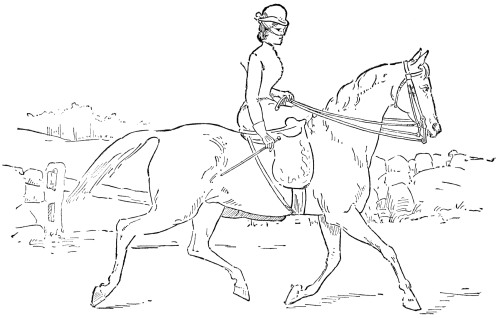
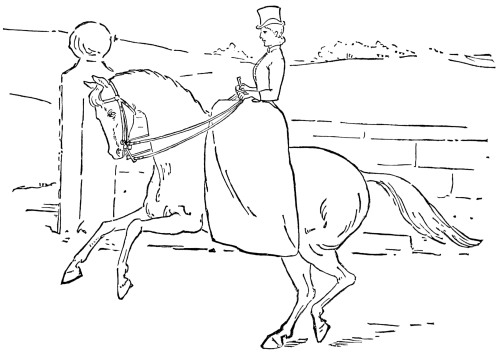
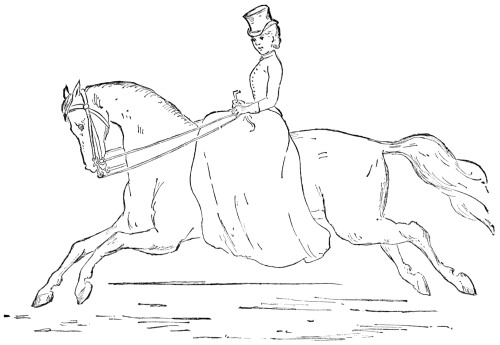
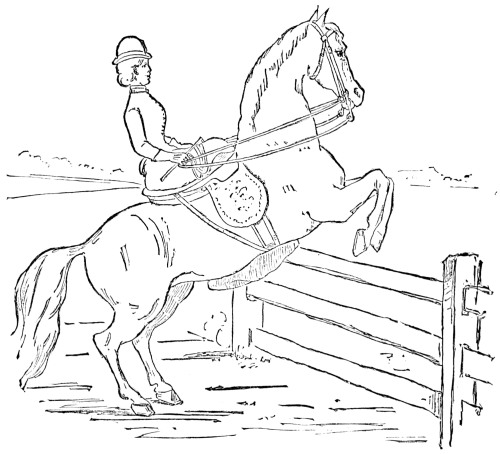
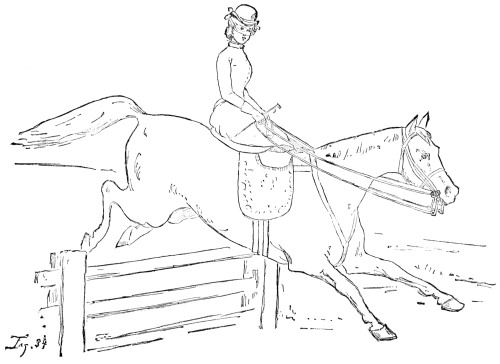
"Look, when a painter would surpass the life,
In limning out a well-proportioned steed,
His art with Nature's workmanship at strife,
As if the dead the living should exceed;
So did this horse excel a common one,
In shape, in courage, color, pace, and bone."
········
—"what a horse should have he did not lack,
Save a proud rider on so proud a back."
Venus and Adonis.
It is supposed that the original home of the
horse was central Asia, and that all the wild
horses that range over the steppes of Tartary,
the pampas of South America, and the prairies
of North America, are descendants of this Asiatic
stock.1 There is, in the history of the
world, no accurate statement of the time when
the horse was first subjugated by man, but so
far back as his career can be traced in the dim
and shadowy past, he seems to have been man's
servant and companion. We find him, on the
mysterious ruins of ancient Egypt, represented
with his badge of servitude, the bridle; he figures
in myth and fable as the companion of
man and gods; he is a prominent figure in the
pictured battle scenes of the ancient world; and
has always been a favorite theme with poet, historian,
and philosopher in all ages.
The first written record, known to us, of the
subjection of the horse to man is found in the
Bible, where in Genesis (xlvii. 17) it is stated
that Joseph gave the Egyptians bread in exchange
for their horses, and in 1. 9, we read
that when Joseph went to bury his father Jacob,
there went with him the servants of the
house of Pharaoh, the elders of the land of
Egypt, together with "chariots and horsemen"
in numbers. Jeremiah compares the speed of
the horse with the swiftness of the eagle; and
Job's description of the war charger has never
been surpassed.
Ancient Rome paid homage to the horse by a
yearly festival, when every one abstained from
labor, and the day was made one of feasting and
frolic. The horse, decked with garlands, and
with gay and costly trappings, was led in triumph
through the streets, followed by a multitude
who loudly proclaimed in verse and song
his many good services to man.
This adulation of the horse sometimes went
beyond the bounds of reason, as in the case of
Caligula, who carried his love for his horse, Incitatus,
to an insane degree. He had a marble
palace erected for a stable, furnished it with
mangers of ivory and gold, and had sentinels
guard it at night that the repose of his favorite
might not be disturbed. Another elegant palace
was fitted up in the most splendid and costly
style, and here the animal's visitors were entertained.
Caligula required all who called upon
himself to visit Incitatus also, and to treat the
animal with the same respect and reverence as
that observed towards a royal host. This horse
was frequently introduced at Caligula's banquets,
where he was presented with gilded oats, and
with wine from a golden cup. Historians state
that Caligula would even have made his steed
consul of Rome, had not the tyrant been opportunely
assassinated, and the world freed from
an insane fiend.
In the legends of the Middle Ages the knight-errant
and his gallant steed were inseparable,
and together performed doughty deeds of valor
and chivalry. In our present more prosaic age,
the horse has been trained to such a degree of
perfection in speed and motion as was never
dreamed of by the ancients or by the knights of
the crusades; and there has been given to the
world an animal that is a marvel of courage,
swiftness, and endurance, while, at the same
time, so docile, that the delicate hand of woman
can completely control him.
The Arabian is the patrician among horses;
he is the most intelligent, the most beautifully
formed, and, when kindly treated, the gentlest
of his race. He is especially noted for his keenness
of perception, his retentive memory, his
powers of endurance, and, when harshly or cruelly
treated, for his fierce resentment and ferociousness,
which nothing but death can conquer.
In his Arabian home he is guarded as a treasure,
is made one of the family and treated with
the most loving care. This close companionship
creates an affection and confidence between
the horse and his master which is almost unbounded;
while the kindness with which the
animal is treated seems to brighten his intelligence
as well as to render him gentle.
When these horses were first introduced into
Europe they seemed, after a short stay in civilization,
to have completely changed their nature,
and, instead of gentleness and docility,
exhibited an almost tiger-like ferocity. This
change was at first attributed to difference of
climate and high feeding, but, after several
grooms had been injured or killed by their
charges, it began to be suspected that there
was something wrong in the treatment. The
experiment of introducing native grooms was
therefore tried, and the results proved most satisfactory,
the animals once more becoming gentle
and docile.2 Since then the nature of the
Arabian has become better understood, and,
both in this country and in Europe, he shows,
at the present day, a decided improvement upon
the original native of the desert. He is larger
and swifter, yet still retains all the spirit as
well as docility of his ancestors. In America
his descendants are called "thorough-breds,"
and Americans may well be proud of this race
of horses, which is rapidly becoming world renowned.
Before purchasing a saddle-horse, several
points should be considered. First, the style
of the rider's figure; for a horse which would
be suitable for a large, stout person would not
be at all desirable for one having a small, slender
figure. A large, majestic looking woman
would present a very absurd spectacle when
mounted upon a slightly built, slender horse;
his narrow back in contrast with that of his
rider would cause hers to appear even larger
and wider than usual, and thus give her a heavy
and ridiculous appearance, while the little horse
would look overburdened and miserable, and
his step, being too short for his rider, would
cause her to experience an unpleasant sensation
of embarrassment and restraint. On the other
hand, a short, light, slender rider, seated upon a
tall broad-backed animal, would appear equally
out of place; the step of the horse being, in her
case, too long, would make her seat unsteady
and insecure, so that instead of a sense of enjoyment,
exhilaration, and benefit from the ride,
she would experience only fatigue and dissatisfaction.
If the rider be tall and rather plump, the
horse should be fifteen hands and three inches
in height, and have a somewhat broad back.
A lady below the medium height, and of slender
proportions, will look equally well when
riding a pony fourteen hands high, or a horse
fifteen hands. An animal fifteen hands, or fifteen
hands and two inches in height, will generally
be found suitable for all ladies who are
not excessively large and tall, or very short
and slender. In all cases, however, the back
of the horse should be long enough to appear
well under the side-saddle, for a horse with a
short back never presents a fine aspect when
carrying a woman. In such cases, the side-saddle
extends from his withers nearly, if not quite,
to his hips, and as the riding skirt covers his
left side, little is seen of the horse except his
head and tail. Horses with very short backs
are usually good weight-carriers, but their gaits
are apt to be rough and uneasy.
Another point to be considered in the selection
of a horse is, what gait or gaits are best
suited to the rider, and here again the lady
should take her figure into consideration. The
walk, trot, canter, and gallop are the only gaits
recognized by English horsewomen, but in
America the walk, rack, pace, and canter are
the favorite gaits. If the lady's figure be slender
and elegant, any of the above named gaits
will suit her, but should she be large or stout,
a brisk walk or easy canter should be selected.
The rapid gallop and all fast gaits should be
left to light and active riders.
The fast or running walk is a very desirable
gait for any one, but is especially so for middle-aged
or stout people, who cannot endure much
jolting; it is also excellent for delicate women,
for poor riders, or for those who have long journeys
to make which they wish to accomplish
speedily and without undue fatigue to themselves
or their horses. A good sound horse
who has been trained to this walk can readily
travel thirty or forty miles a day, or even more.
This gait is adapted equally well to the street,
the park, and the country road; but it must be
acknowledged that horses possessing it rarely
have any other that is desirable, and, indeed,
any other would be apt to impair the ease and
harmony of the animal's movements in this
walk.
The French or cavalry trot (see page 203)
should never be ridden on the road by a woman,
as the movements of the horse in this gait
are so very rough that the most accomplished
rider cannot keep a firm, steady seat. The
body is jolted in a peculiar and very unpleasant
manner, occasioning a sense of fatigue that is
readily appreciated, though difficult to describe.
The country jog-trot is another very fatiguing
gait, although farmers, who ride it a good
deal, state that "after one gets used to it, it is
not at all tiresome." But a lady's seat in the
saddle is so different from that of a gentleman's
that she can never ride this gait without excessive
fatigue.
A rough racker or pacer will prove almost
as wearisome as the jog-trotter. Indeed, if she
wishes to gain any pleasure or benefit from
riding, a lady should never mount a horse that
is at all stiff or uneven in his movements, no
matter what may be his gait.
The easiest of all gaits to ride, although the
most difficult to learn, is the English trot. This
is especially adapted to short persons, who can
ride it to perfection. A tall woman will be apt
to lean too far forward when rising in it, and
her specialties, therefore, should be the canter
and the gallop, in which she can appear to the
greatest advantage. The rack, and the pace of
a horse that has easy movements are not at all
difficult to learn to ride, and are, consequently,
the favorite gaits of poor riders.
In selecting a horse his temperament must
also be considered. A high-spirited, nervous
animal, full of vitality, highly satisfactory as he
might prove to some, would be only a source
of misery to others of less courageous dispositions.
First lessons in riding should be taken
upon a horse of cold temperament and kindly
disposition who will resent neither mistakes nor
awkwardness. Having learned to ride and to
manage a horse properly, no steed can then be
too mettlesome for the healthy and active lady
pupil, provided he has no vices and possesses
the good manners that should always belong
to every lady's horse.
It is a great mistake to believe, as many do,
that a weak, slightly built horse is yet capable
of carrying a woman. On the contrary, a lady's
horse should be the soundest and best that can
be procured, and should be able to carry with
perfect ease a weight much greater than hers.
A slight, weak animal, if ridden much by a
woman, will be certain to "get out of condition,"
will become unsound in the limbs of one
side, usually the left, and will soon wear out.
Before buying a horse, the lady who is to ride
him should be weighed, and should then have
some one who is considerably heavier than herself
ride the animal, that she may be sure that
her own weight will not be too great for him.
If he carries the heavier weight with ease, he
can, of course, carry her.
In selecting a horse great care should be
taken to ascertain whether there is the least
trace of unsoundness in his feet and legs, and
especially that variety of unsoundness which occasions
stumbling. The best of horses, when
going over rough places or when very tired
may stumble, and so will indolent horses that
are too lazy when traveling to lift their feet
up fully; but when this fault is due to disease,
or becomes a habit with a lazy animal, he
should never be used under the side-saddle.
 |
 |
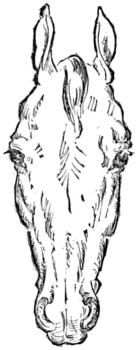
| Fig. 1.—Head of Arabian Steed. |
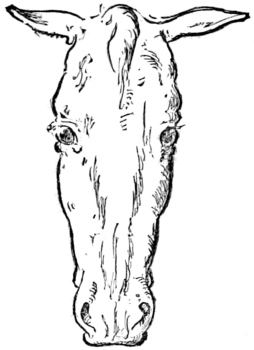
Fig. 2.—Head of Low-Bred Horse. |
If the reader will glance at Figs. 1 and 2, she
will observe the difference between the head of
the low-bred horse and that of the best bred of
the race. Fig. 1 represents the head of an Arabian
horse; the brain is wide between the eyes,
the brow high and prominent, and the expression
of the face high-bred and intelligent. Fig.
2 shows the head of a low-bred horse, whose
stupid aspect and small brain are very manifest.
The one horse will be quick to comprehend
what is required of him, and will appreciate any
efforts made to brighten his intelligence, while
the other will be slow to understand, almost indifferent
to the kindness of his master, and apt,
when too much indulged, to return treachery
for good treatment. The whip, when applied to
the latter as a means of punishment, will probably
cow him, but, if used for the same purpose
on the former, will rouse in him all the hot
temper derived from his ancestors, and in the
contest which ensues between his master and
himself, he will conquer, or terminate the strife
his own death, or that of his master.
Another noticeable feature in the Arab horse,
and one usually considered significant of an active
and wide-awake temperament, is the width
and expansiveness of the nostrils. These, upon
the least excitement, will quiver and expand,
and in a rapid gallop will stand out freely, giving
a singularly spirited look to the animal's
face.
The shape and size of the ears are also indications
of high or low birth. In the high-bred
horse they are generally small, thin, and delicate
on their outer margins, with the tips inclined
somewhat towards one another. By
means of these organs the animal expresses his
different emotions of anger, fear, dislike, or gayety.
They may be termed his language, and
their various movements can readily be understood
when one takes a little trouble to study
their indications. The ears of a low-bred horse
are large, thick, and covered with coarse hair;
they sometimes lop or droop horizontally, protruding
from the sides of the head and giving
a very sheepish look to the face; they rarely
move, and express very little emotion of any
kind.
The eye of the desert steed is very beautiful,
possessing all the brilliancy and gentleness so
much admired in that of the gazelle. Its expression
in repose is one of mildness and amiability,
but, under the influence of excitement, it
dilates widely and sparkles. A horse which has
small eyes set close together, no matter what
excellences he may possess in other respects, is
sure to have some taint of inferior blood. Some
of the coarser breeds have the large eye of the
Arabian, but it will usually be found that they
have some thorough-bred among their ancestors.
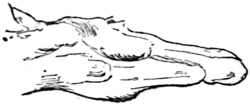
Fig. 3.—Width of lower jaw in the thorough-bred.
Width between the sides or branches of the
lower jaw is another
distinctive feature
of the horse of
pure descent. (Fig.
3.) A wide furrow
or channel between
the points mentioned is necessary for speed, in
order to allow room for free respiration when
the animal is in rapid motion. The coarser
breeds have very small, narrow channels (Fig.
4), and very rapid motion soon distresses them.
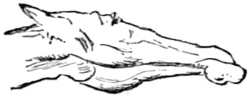
Fig. 4.—Width of lower jaw in the low-bred.
The mouth of the well-bred horse is large, allowing
ample room
for the bit, and giving
him a determined
and energetic,
but at the
same time pleasant,
amiable expression. The mouth of the low-bred
horse is small and covered with coarse
hair, and gives the animal a sulky, dejected appearance.
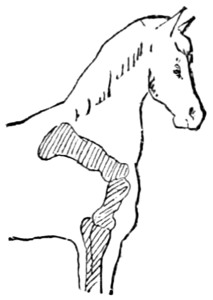
Fig. 5.—Oblique shoulder.
The angle at the joint being about 45°.
The light, elegant head of the Arabian is well
set on his neck; a slight convexity at the upper
part of the throat gives freedom to the
functions of this organ, as well as elasticity to
the movements of the head and neck; and
the encolure, or crest of the neck, is arched with
a graceful curve. But it is especially in the
shape of the shoulders that this horse excels all
others, and this is the secret of those easy movements
which make him so desirable for the saddle.
These shoulders are deep, and placed obliquely
at an angle of about
45°; they act like the springs
of a well-made carriage, diminishing
the shock or jar of
his movements. They are always
accompanied by a deep
chest, high withers, and fore-legs
set well forward, qualities
which make the horse much
safer for riding. (Fig. 5.)
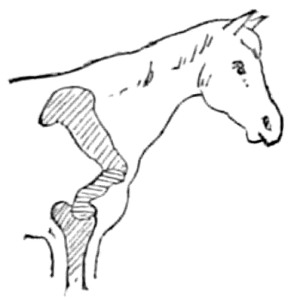
Fig. 6.—Straight or upright shoulder.
The angle at the
joint being more than 45°.
The animal with straight shoulders, no matter
how well shaped in other respects, can never
make a good saddle-horse, and should be at
once rejected. These shoulders are usually accompanied
by low withers, and fore-legs placed
too far under the body,
which arrangement causes
the rider an unpleasant jar
every time a fore-foot touches
the ground. Moreover, the
gait of the horse is constrained
and not always
safe, and if he be used much
under the saddle his fore-feet will soon become
unsound. This straight, upright shoulder is
characteristic of the coarser breeds of horses,
and is frequently associated with a short, thick
neck. Such horses are not only unfit for the
saddle, but, when any speed is desired, are unsuitable
even for a pleasure carriage. (Fig. 6.)
The haunch of the low-bred horse is generally
large, but not so well formed as that of the
thorough-bred. This portion of the Arabian
courser is wide, indicating strength, and force
to propel himself forward, while his tail, standing
out gayly when he is in motion, projects in
a line with his back-bone. His forearm is large,
long, and muscular,3 his knees broad and firm,
his hocks of considerable size, while his cannon-bone,
situated between the knee and the fetlock,
is short, although presenting a broad appearance
when viewed laterally.
On each front leg, at the back of the knee,
there is a bony projection, giving attachments
to the flexor muscles, and affording protection
to certain tendons. The Orientals set a great
value upon the presence of this bone, believing
that it favors muscular action, and the larger
this prominence is the more highly do they
prize the animal that possesses it. The pasterns
of the high-bred horse are of medium length,
and very elastic, while the foot is circular and
of moderate size.
In the preceding description, the author has
endeavored to make plain to the reader the
most important points to be observed in both
the high-bred and the low-bred horse, and has
given the most pronounced characteristics of
each.
Between these extremes, however, there are
many varieties of horses, possessing more or
less of the Arabian characteristics mingled with
those of other races. Some of the best American
horses are numbered among these mixed races,
and, by many, are considered an improvement
upon the Arabian, as they are excellent for
light carriages and buggies. The more they
resemble the Oriental steed, the better they are
for the saddle.
The lady who, in this country, cannot find a
horse to suit her, will, indeed, be difficult to
please. It will be best for her to tell some
gentleman what sort of horse she wishes, and
let him select for her; but, at the same time,
it can do no harm, and may prove a great advantage
to her to know all the requisite points
of a good saddle-horse. It will not take long
to learn them, and the knowledge gained will
prevent her from being imposed upon by the
ignorant or unscrupulous. Gentlemen, even
those who consider themselves good judges of
horse-flesh, are sometimes guilty of very serious
blunders in selecting a horse for a lady's use;
and should the lady be obliged to negotiate directly
with a horse-dealer, she must bear in
mind constantly the fact that, although there
are reliable and honorable dealers to be found,
there are many who would not scruple to cheat
even a woman. A careful perusal of the present
work, together with the advice of an upright
and trustworthy veterinary surgeon, or a
skilled riding-master, will aid her in protecting
herself from the impositions of unprincipled
horse-jockeys and self-styled "veterinary doctors."
In any case, whatever be the other characteristics
of the animal selected, be sure that he has
the oblique shoulder, as well as depth of shoulder,
and hind-legs well bent. Without these
characteristics he will be unfit for a lady's use,
as his movements will be rough and unsafe, and
the saddle will be apt to turn.
If it be desired to purchase a horse for a moderate
price, certain points which might be insisted
on in a high-priced animal will have to
be dispensed with; for instance, his color may
not be satisfactory; he may not have a pretty
head, or a well-set tail, etc., but these deficiencies
may be overlooked if he be sound, have
good action, and no vices. He may be handsome,
well-actioned, and thoroughly trained,
but have a slight defect in his wind, noticeable
only when he is urged into a rapid trot, or a
gallop. If wanted for street and park service
only, and if the purchaser does not care for fast
riding, a horse of this sort will suit her very
well. Sometimes a horse of good breed, as well
as of good form, has never had the advantages
of a thorough training, or he may be worn out
by excessive work. Should he be comparatively
young, rest and proper training may still make
a good horse of him, but great care should be
taken to assure one's self that no permanent
disease or injury exists. The Orientals have a
proverb, that it is well to bear in mind when
buying an animal of the kind just described:—"Ruin,
son of ruin, is he who buys to cure."
Always examine with great care a horse's
mouth. A hard-mouthed animal is a very unpleasant
one for a lady to ride, and is apt to
degenerate into a runaway. Scars at the angles
of the mouth are good indications of a "bolter,"
or runaway, or at least of cruel treatment, and
harsh usage is by no means a good instructor.
While a very short-backed horse does not appear
to great advantage under a side-saddle, he
may, nevertheless, have many good qualities
that will compensate for this defect, and it may
be overlooked provided the price asked for him
be reasonable; but horses of this kind frequently
command a high price when their action
is exceptionally good. Corns on the feet
generally depreciate the value of a horse, although
they may sometimes be cured by removing
the shoes, and giving him a free run of six
or eight months in a pasture of soft ground; if
he be then properly shod, and used on country
roads only, he may become permanently serviceable.
There is, however, considerable risk
in buying a horse that has corns, and the purchaser
should remember the Oriental proverb
just referred to, and not forget the veterinary
surgeon.
Before paying for a horse, the lady should
insist upon having him on trial for at least a
month, that she may have an opportunity of
discovering his vices or defects, if any such exist.
She must be careful not to condemn him
too hastily, and should, when trying him, make
due allowance for his change of quarters and
also for the novelty of carrying a new rider, as
some horses are very nervous until they become
well acquainted with their riders. Should the
horse's movements prove rough, should he be
found hard-mouthed, or should any indications
of unsoundness or viciousness be detected, he
should be immediately returned to his owner.
It must be remembered, however, that very few
horses are perfect, and that minor defects may,
in most instances, be overlooked if the essentials
are secured. Before rejecting the horse,
the lady should also be very sure that the faults
to which she objects are not due to her own
mismanagement of him. But if she decides
that she is not at fault, no amount of persuasion
should induce her to purchase. In justice
to the owner of the horse, he ought to be reasonably
paid for the time and services of his
rejected animal; but if it be decided to keep
the horse, then only the purchase-money originally
agreed upon should be paid.
The surest and best way of securing a good
saddle-horse is to purchase, from one of the celebrated
breeding farms, a well-shaped four-year-old
colt of good breed, and have him taught
the gaits and style of movement required.
Great care should be taken in the selection of
his teacher, for if the colt's temper be spoiled
by injudicious treatment, he will be completely
ruined for a lady's use. A riding-school teacher
will generally understand all the requirements
necessary for a lady's saddle-horse, and may be
safely intrusted with the animal's education.
If no riding-school master of established reputation
as a trainer can be had, it may be possible
to secure the services of some one near the
lady's home, as she can then superintend the
colt's education herself and be sure that he is
treated neither rashly nor cruelly.
The ideas concerning the education of the horse
have completely changed within the last twenty-five
years. The whip as a means of punishment
is entirely dispensed with in the best
training schools of the present day, and, instead
of rough and brutal measures, kindness, firmness,
and patience are now the only means employed
to train and govern him. The theory
of this modern system of training may be found
in the following explanation of a celebrated
English trainer, who subdued his horses by exhibiting
towards them a wonderful degree of
patience:—"If I enter into a contest with the
horse, he will fling and prance, and there will
be no knowing which will be master; whereas
if I remain quiet and determined, I have the
best of it."
The following is an example of the patience
with which this man carried out his theory:—
Being once mounted on a very obstinate colt
that refused to move in the direction desired,
he declined all suggestions of severe measures,
and after one or two gentle but fruitless attempts
to make the animal move, he desisted,
and having called for his pipe, sat there quietly
for a couple of hours enjoying a good smoke,
and chatting gayly with passing friends. Then
after another quiet but unsuccessful attempt
to induce the colt to move, he sent for some
dinner which he ate while still on the animal's
back. As night approached and the air became
cool, he sent for his overcoat and more tobacco,
and proceeded to make a night of it. About
this time the colt became uneasy, but not until
midnight did he show any disposition to move
in the required direction. Now was the time
for the master to assert himself. "Whoa!" he
cried, "you have stayed here so long to please
yourself, now you will stay a little longer to
please me." He then kept the colt standing
in the same place an hour longer, and when
he finally allowed him to move, it was in a
direction opposite to that which the colt seemed
disposed to take. He walked the animal slowly
for five miles, then allowed him to trot back to
his stable, and finally—as if he had been a
disobedient child—sent him supperless to bed,
giving him the rest of the night in which to
meditate upon the effects of his obstinacy.
To some this may seem a great deal of useless
trouble to take with a colt that might have
been compelled to move more promptly by
means of whip or spur; but that day's experience
completely subdued the colt's stubborn
spirit, and all idea of rebellion to human authority
was banished from his mind forever.
Had a contrary course been pursued, it would
probably have made the creature headstrong,
balky, and unreliable; he would have yielded
to the whip and spur at one time only to battle
the more fiercely against them at the first favorable
opportunity, and his master would never
have known at what minute he might have to
enter into a contest with him. That a horse
trained by violent means can never be trusted
is a fact which is every day becoming better
recognized and appreciated.
"A great many accidents might be avoided,"
says a well-known authority upon the education
of the horse, "could the populace be instructed
to think a horse was endowed with senses, was
gifted with feelings, and was able in some degree
to appreciate motives."... "The strongest
man cannot physically contend against the
weakest horse. Man's power reposes in better
attributes than any which reside in thews and
muscles. Reason alone should dictate and control
his conduct. Thus guided, mortals have
subdued the elements. For power, when mental,
is without limit: by savage violence nothing
is attained and man is often humbled."
The lady who has the good fortune to live in
the country where she can have so many opportunities
for studying the disposition and
character of her animals, and can, if she chooses,
watch and superintend the education of her
horse from the time he is a colt, has undoubtedly
a better chance of securing a fine saddle-horse
than she who lives in the city and is
obliged to depend almost entirely upon others
for the training of her horse. Indeed, very little
formal training will be necessary for a horse
that has been brought up under the eye of a
kind and judicious mistress, for he will soon
learn to understand and obey the wishes of one
whom he loves and trusts, and if she be an accomplished
rider she can do the greater part of
the training herself.
The best and most trustworthy horse the author
ever had was one that was trained almost
from his birth. Fay's advent was a welcome
event to the children of the family, by whom
he was immediately claimed and used as a play-fellow.
By the older members of the family he
was always regarded as part of the household,—an
honored servant, to be well cared for,—and
he was petted and fondled by all, from
paterfamilias down to Bridget in the kitchen.
He was taught, among other tricks, to bow
politely when anything nice was given him,
and many were the journeys he made around
to the kitchen window, where he would make
his obeisance in such an irresistible manner that
Bridget would be completely captivated; and
the dainty bits were passed through the window
in such quantities and were swallowed with
such avidity that the lady of the house had to
interfere and restrict the donations to two cakes
daily.
Fay had been taught to shake hands with
his admirers, and this trick was called his "word
of honor;" he had his likes and dislikes, and
would positively refuse to honor some people
with a hand-shake. If these slighted individuals
insisted upon riding him, he made them
so uncomfortable by the roughness of his gaits
that they never cared to repeat the experiment.
But the favored ones, whom he had received
into his good graces and to whom he had given
his "word of honor," he would carry safely
anywhere, at his lightest and easiest gait. Fay
never went back on his word, which is more
than can be said of some human beings.
The great difficulty in training a horse for a
lady's use is to get him well placed on his
haunches. In Fay's case this was accomplished
by teaching him to place his fore-feet upon a
stout inverted tub, about two feet high. When
he offered his "hand" for a shake, some one
pushed forward the tub, upon which his "foot"
dropped and was allowed to remain a short
time, when the other foot was treated in the
same manner. After half a dozen lessons of this
sort, he learned to put up his feet without assistance;
first one, and then the other, and,
finally, both at once. These performances were
always rewarded by a piece of apple or cake,
together with expressions of pleasure from the
by-standers. Fay had a weakness for flattery,
and no actor called before the curtain ever expressed
more pleasure at an encore than did Fay
when applauded for his efforts to please. That
the tub trick would prove equally effectual with
other horses in teaching them to place themselves
well on their haunches cannot be positively
stated. It might prove more troublesome
to teach most horses this trick than to
have them placed upon their haunches in the
usual way by means of a strong curb, or by
lessons with the lunge line. It proved entirely
successful in Fay's case, and a horse lighter in
hand or easier in gait was never ridden by a
woman.
Fay's training began when he was only a few
weeks old: a light halter and a loose calico surcingle
were placed on him for a short time each
day, during which time he was carefully watched
lest he should do himself some injury. When
he was about eight months old, a small bit, made
of a smooth stick of licorice, was put into his
mouth, and to this bit light leather reins were
fastened by pieces of elastic rubber: this rubber
relieved his mouth from a constant dead pull,
and tended to preserve its delicate sensibility.
Thus harnessed he was led around the lawn,
followed by a crowd of youthful admirers and
playmates, who formed a sort of triumphal procession,
with which the colt was as well pleased
as the spectators. Every attempt on his part
to indulge in horse-play, such as biting, kicking,
etc., was always quickly checked, and no one
was allowed to tease or strike him.
Nothing heavier than a dumb jockey was put
on his back until he was four years old, when
his education began in sober earnest. After a
few lessons with the lunge line, given by a regular
trainer, a saddle was put on his back,
and for the first time in his life he carried a
human being.
When learning his different riding gaits on
the road, he was always accompanied by a well-trained
saddle-horse, aided by whose example
as well as by the efforts of his rider he was soon
trained in three different styles of movement,
namely, a good walk, trot, and hand gallop.
Fear seemed unknown to this horse, for he had
always been allowed as a colt to follow his dam
on the road, and had thus become so accustomed
to all such alarming objects as steam engines,
hay carts, etc., that they had ceased to
occasion him the least uneasiness. This high
spirited and courageous animal had perfect confidence
in the world and looked upon all mankind
as friendly. His constant companionship
with human beings had sharpened his perceptive
faculties, and made him quick to understand
whatever was required of him. The
kindness shown him was never allowed to degenerate
into weakness or over-indulgence, and
whenever anything was required of him it was
insisted upon until complete obedience was obtained.
In this way he was taught to understand
that man was his master and superior.
Although it is not absolutely essential that a
lady's horse should learn the tricks of bowing,
hand-shaking, etc., yet the lady who will take
the pains to teach her horse some of them will
find that she not only gets a great deal of pleasure
from the lessons, but that they enable her
to gain more complete control over him, for the
horse, like some other animals, gives affection
and entire obedience to the person who makes
an effort to increase his intelligence.
Lessons with the lunge line should always be
short, as they are very fatiguing to a young
colt, and when given too often or for too great
a length of time they make him giddy from
rush of blood to the head; not a few instances,
indeed, have occurred where a persistence in
such lessons has occasioned complete blindness.
A lady's horse should be taught to disregard
the flapping of the riding-skirt, and it is also
well for him to become accustomed to having
articles of various kinds, such as pieces of cloth,
paper, etc., fluttering about him, as he will not
then be likely to take fright should any part
of the rider's costume become disarranged and
blow about him.
He should also be so trained that he will not
mind having the saddle moved from side to side
on his back. The best of riders may have her
saddle turn, and if the horse be thus trained he
will neither kick nor run away should such an
accident occur.
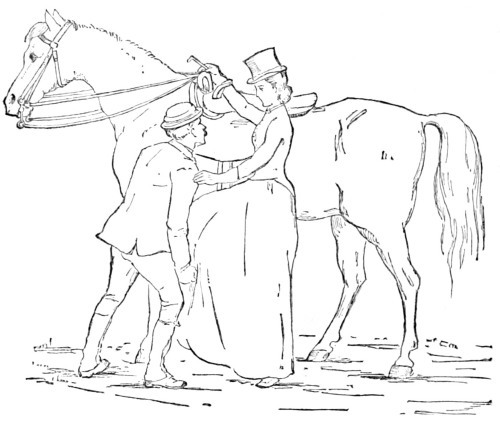
It is also very important that the horse should
be taught to stop, and stand as firm as a rock
at the word of command given in a low, firm
tone. This habit is not only important in
mounting and dismounting,—feats which it is
difficult, if not impossible, for the lady to perform
unless the horse be perfectly still,—but
the rider will also find this prompt obedience of
great assistance in checking her horse when he
becomes frightened and tries to break away;
for he will stop instinctively when he hears the
familiar order given in the voice to which he is
accustomed.
A lady should not fail to visit her horse's
stable from time to time, in order to assure herself
that he is well treated and properly cared
for by the groom. Viciousness and restlessness
on the road can often be traced to annoyances
and ill-treatment in the stable. Grooms and
stable boys sometimes like to see the horse kick
out and attempt to bite, and will while away
their idle hours in harassing him, tickling his
ears with straws, or touching him up with the
whip in order to make him prance and strike
out. The result of these annoyances will be
that, if the lady during her ride accidentally
touches her horse with the whip, he will begin
prancing and kicking; or, if it is summer time,
the gnats and flies swarming about his ears
will make him unmanageable. In the latter
case, ear-tips will only make the matter worse,
especially if they have dangling tassels. When
such signs of nervousness are noticeable, especially
in a horse that has been hitherto gentle,
they may usually be attributed to the treatment
of the groom or his assistants.
Most grooms delight in currying their charges
with combs having teeth like small spikes and
in laying on the polishing brush with a hand as
heavy as the blows of misfortune. Some animals,
it is true, like this kind of rubbing, but
there are many, who have thin, delicate skins,
to whom such treatment is almost unmitigated
torture. Should the lady hear any contest
going on between the horse and groom during
the former's morning toilette, she should order
a blunt curry-comb to be used; or even dispense
with a comb altogether, and let the brush
only be applied with a light hand. Grooms
sometimes take pleasure in throwing cold water
over their horses. In very warm weather, and
when the animal is not overheated, this treatment
may prove refreshing to him, but, as a
general rule it is objectionable, as it is apt to
occasion a sudden chill which may result in
serious consequences.
The stable man may grumble at the lady's
interference and supervision, but she must not
allow this to prevent her from attending carefully
to the welfare of the animal whose faithful
services contribute so largely to her pleasure.
When she buys a horse she introduces a new
member into her household, who should be as
well looked after and cared for as any other
faithful servant or friend. Indeed, the horse is
the more entitled to consideration in that he is
entirely helpless, and his lot for good or evil
lies wholly in her power. If the mistress is
careless or neglects her duty, the servants in
whose charge the horse is placed will be very
apt to follow her example, and the poor animal
will suffer accordingly.
Perhaps the lady, however, may object to
entering the stable, and agree with the groom
in thinking it "no place for a woman." Or
she may fear that in carrying out the ideas
suggested above she will expose herself to the
ridicule of thoughtless acquaintances who can
never do anything until it has received the
sanction of fashion.
For the benefit of this fastidious individual
and her timid friends we will quote the example
of the Empress of Austria, who, although occupying
an exalted position at a court where etiquette
is carried to the extremes of formality,
yet does not hesitate to visit the stable of her
favorite steeds and personally to supervise their
welfare; and woe to the perverse groom who
in the least particular disobeys her commands.
Many other examples might be given of
high-born ladies, such as Queen Victoria, the
Princess of Wales, the Princess of Prussia, and
others, who do not seem to consider it at all unfeminine
or coarse for a woman to give some
personal care and supervision to her horses.
But to enter into more details would prove tiresome,
and the example given is enough to silence
the scruples of the followers of fashion.
Like all herbivorous creatures that love to
roam in herds, the horse is naturally of a restless
temperament. Activity is the delight of
his existence, and when left to nature and a
free life he is seldom quiet. Man takes this
creature of buoyant nature from the freedom of
its natural life, and confines the active body in
a prison house where its movements are even
more circumscribed than are those of the wild
beasts in the menagerie; they can at least turn
around and walk from side to side in their cages,
but the horse in his narrow stall is able only to
move his head from side to side, to paw a little
with his fore-feet, and to move backwards and
forwards a short distance, varying with the
length of his halter; when he lies down to sleep
he is compelled to keep in one position, and
runs the risk of meeting with some serious accident.
In some stables where the grooms delight
in general stagnation, the horses under
their charge are not allowed to indulge in even
the smallest liberty. The slightest movement
is punished by the lash of these silence-loving
tyrants, in whose opinion the horse has enough
occupation and excitement in gazing at the
blank boards directly in front of his head. If
these boards should happen to be whitewashed,
as is often the case in the country, constant
gazing at them will be almost sure to give rise
to shying, or even to occasion blindness. If the
reader will, for several minutes, gaze steadily
at a white wall, she will he able to get some
idea of the poor horse's sensations.
Is it then to be wondered at, that an animal
of an excitable nature like the horse should,
when released from the oppressive quiescence
of his prison-house, act as if bereft of reason,
and perform strange antics and caperings in
his insane delight at once more breathing the
fresh air, and seeing the outside world. But,
while the horse is thus expressing his pleasure
and recovering the use of limbs by vigorous
kicks, or is expending his superfluous
energy by bounding out of the road at every
strange object he encounters, the saddle will be
neither a safe nor pleasant place for the lady
rider. To avoid such danger, and to compensate,
in some degree, the liberty-loving animal
for depriving him of his natural life and placing
him in bondage, he should be given, instead of
the usual narrow stall, a box stall, measuring
about sixteen or eighteen feet square. In this
box the horse should be left entirely free, without
even a halter, as this appendage has sometimes
been the cause of fearful accidents, by
becoming entangled with the horse's feet.
The groom may grumble again at this innovation,
because a box stall means more work
for him, but if he really cares for the horses
under his charge he will soon become reconciled
to the small amount of extra work required by
the use of a box stall. Every one who knows
anything about a horse in the stable is well
aware of the injury done to this animal's feet
and limbs by compelling him to stand always
confined to one spot in a narrow stall. A box
will prevent the occurrence of these injuries,
besides giving the horse a little freedom and
enabling him to get more rest and benefit from
his sleep.
Some horses are fond of looking through a
window or over a half door. The glimpse they
thus get of the outside life seems to amuse and
interest them, and it can do no harm to gratify
this desire. Others, however, seem to be worried
and excited by such outlooks; they become
restless and even make attempts to leap over
the half door or through the window. In such
cases there should, of course, be no out-of-door
scenery visible from the box.
The groom should exercise the horse daily,
in a gentle and regular manner; an hour or
two of walking, varied occasionally by a short
trot, will generally be found sufficient. Being
self-taught in the art of riding, grooms nearly
always have a very heavy bridle hand, and, if
allowed to use the curb bit, will soon destroy
that sensitiveness of the horse's mouth which
adds so much to the pleasure of riding him.
The man who exercises the horse should not be
permitted to wear spurs; a lady's horse should
be guided wholly by the whip and reins,—as
will be explained hereafter,—and in no case
whatever should the spur be used. If the lady
wishes to keep her horse in good health and
temper she must insist upon his being exercised
regularly, and must assure herself that the
groom executes her orders faithfully; for some
men, while professing to obey, have been known
to stop at the nearest public house, and, after
spending an hour or two in drinking beer and
gossiping with acquaintances, to ride back complacently
to the stable, leaving the horse to
suffer from want of exercise. Other grooms
have gone to the opposite extreme, and have
ridden so hard and fast that the horse on his
return was completely tired out, so that when
there was occasion to use him the same day it
was an effort for him to maintain his usual
light gait. Grooms who are always doctoring
a horse, giving him nostrums that do no good
but often much harm, are also to be avoided. In
short, the owner of a horse must be prepared
for tricks of all kinds on the part of these stable
servants; although, in justice to them, it must
be said that there are many who endeavor to
perform all their duties faithfully, and can be
relied on to treat with kindness any animals
committed to their care.
Should the lady rider be obliged to get her
horse from a livery stable, she should not rely
entirely upon what his owner says of his gaits
or gentleness, but should have him tried carefully
by some friend or servant, before herself
attempting to mount him. She should also be
very careful to see, or have her escort see, that
the saddle is properly placed upon the back of
the horse and firmly girthed, so that there may
be no danger of its turning.