The plants in this compartment will begin to assume
a different aspect, and air must be admitted every day
if practicable, giving large portions in sunshine by the
sashes regularly over all the house, opening those of
the front a little, and likewise the doors in fine mild
days. To perform this judiciously, give a little about
eight or nine o'clock, more at ten, and the whole from
eleven till twelve o'clock, shutting again by degrees.
Fire heat will now be dispensed with, but in frosty
nights have the shutters on about sundown. The sun
is now powerful, and the house can be early shut up in
the afternoon, and will gain as much natural heat as
will keep up the required temperature, viz. 36° to 40°.
Perhaps there may be uncommonly cold weather; at
such times be attentive to ward off danger by applying
artificial heat.
Look over the pots and tubs at least every alternate
day, to see where water is wanted. In watering, too
much caution cannot be used, especially during winter
and the commencement of spring. It was observed
last month what would be the effect of too much water.
It may be remarked, that if the exterior of the
pot is very damp, the soil inside is too wet, and in that
state is uncongenial to vegetation, which now begins
to start, and ought by all possible means to be encouraged.
People may be frequently observed watering
all plants indiscriminately, not taking the trouble to
look into or feel the state of the soil in the pots or tubs,
and by going over them three or four times in this
manner will be sufficient to put the plants in such a
state, that they will not be recruited for some months.
Hence the reason of so many sickly plants.
Caméllias, where there are collections, will continue
to flower. Treat them according to the directions given
last month.
Be sure they are not too wet, as too much humidity
as well as aridity causes their foliage to have a yellow
appearance, with this difference, that in the former
case the foliage is the same to the touch as when
green; but in the latter, it is soft and dry. We have
observed trees in tubs and half barrels, with holes all
round their sides. This is a ludicrous idea, having the
appearance of keeping the water from reaching the
bottom of the tub or barrel. For the best kind of tub
for large trees, see August under this head. If any of
the trees have stunted, straggling, or irregular heads,
about the end of this month, or beginning of next, head
or cut them down to the shape desired. The old wood
will push fresh shoots. You may cut close, or shorten
less or more, according as you desire young shoots to
arise; at the same time observe that you do not cut
below the graft or inoculation. Trees thus headed
down should be kept until May, and then planted in the
garden, (see May,) or if that cannot be done, turn it
out, and reduce the ball of earth by probing with a
pointed stick all round the sides and bottom of the
ball, cutting off any very matted roots. If any of the
roots are decayed, cut them into the sound wood. By
being thus reduced, it will go into the same pot or tub
if not a less one. Having a good supply of fresh earth
ready, put a few inches in the bottom of the pot or tub,
place the tree therein, and fill all round, at the same time
pressing it down with the hand or a stick. Give very
little water until there are signs of vegetation.
These, with similar exotics, may be treated as
above. If any of them have been infected with the
scaly insect, after heading down, &c. scrub the remaining
stems with a strong decoction of tobacco, heated
to about 100°. Afterwards clean with soap and water.
These will be growing freely. Keep them in airy
situations, so that they may not grow too weak, and
flower imperfect. To flower these plants strong, and
of good colour, they must not be too crowded together,
neither far from the light, and have plenty of air admitted
to them, when the weather is favourable. Keep
them free from the Green-fly by fumigating frequently.
Plants of this character will, by the first of the
month, begin to grow. The best time to divide and
fresh pot them is when the young shoots are about
one inch above ground. See under the head Shifting
in this month.
Cape Bulbs, such as Lachenàlias, Oxalis, Ixias, Gladìolus,
Watsònias, Babiànas, &c. will in many of the species
be showing flower. Keep all of them near the glass,
to prevent them from being weak and unsightly.
Hyacinths, Tulips, Narcissus, &c. Those that have
been kept in the Green-house during winter will be in
great perfection. Have all the flower stems tied up
neatly to small stakes, (which, if painted green, will
look much better,) and keep them from the direct rays
of the sun. In the front of the house perhaps will be
the best situation. They must be freely watered while
in flower. Where there is convenience, it will be essential
to keep the pots in saucers containing water;
it will strengthen both stems and flowers, and likewise
preserve them longer in perfection. Those that are
blooming should be put aside, and watered sparingly,
until the foliage begins to decay, when the pots may
be laid on their side to ripen the bulbs.
If you have any of the following plants that you
are desirous of encouraging, they should be repotted
this or next month at the latest. Large plants
will not require it, if they were done in August.
Pots one size larger than those that they are in, are
sufficient. Acacias and Mimòsas being now united into
one genus, there are above two hundred species.
About one hundred and thirty belong to the Green-house.
Amongst such a beautiful family, both for elegance
of flower and beauty of foliage, it will be difficult
to specify the most handsome and desirable for this
department. A. móllis, A. glaucéscens, A. verticilàta, A.
florabúnda, A. diffùsa, A. armàta, A. verniciflùa, A. decúrrens,
A. armàta—weeping variety, A. púbescens, A. leucolòbia,
A. decípiens, A. fragràns, A. pulchélla, A. lophántha,
A. myrtifòlia, &c. These will afford a great variety of
foliage, and are very desirable, flowering principally in
winter, or early in spring. The flowers of those belonging
to the Green-house are of a yellow or straw
colour; the most of those that are red or purple, with
the celebrated medicinal species, belong to the Hot-house,
for which see May. There are some of
the species very subject to the white scaly insect,
which must be attended to, that they may not get to
any extent.
Agapánthus, three species. They are all blue flowers.
A. umbellàtus is very celebrated, and well known in the
collections of the country. There is a variegated variety
of it highly desirable, the foliage being white
striped, and frequently the flower stem and the flower
are as good as the species. They have very strong
roots, and require plenty of freedom. Plants are
always large before they flower, and when the pots,
by frequent shifting, become inconvenient, the plant
should be divested of all the earth, and, if too large,
divide it, cutting off the strongest of the fibres; then
they will admit of being put into smaller pots. If the
above operation is performed in August or September,
it will not retard their flowering, which, when well
grown, is very handsome, the flower stem arising about
three feet, and crowned with twenty or thirty brilliant
blue blossoms, continuing to bloom successively.
Alonsòas, five species, all soft wooded, small, shrubby
plants, with scarlet flowers. A. incisifòlia is known
amongst us under the name of Hemímeris urticifólia,
and A. lineàris as H. lineàris. If well treated, they form
very handsome plants, and flower freely. They will
not bear strong fumigation; and, when the house is
under that operation, they must be put on the floor of
the Green-house, where they will not be so much affected.
They flower from May to August.
Aùcuba japónica is the only species. The flowers are
small and almost insignificant, colour purple; but the
foliage is a desirable object, being yellow spotted, or
blotched. It is tolerably hardy, and withstands our
winters. It prefers shade, and, if the situation was
such when planted out, it would grow more freely.
The hot rays of the sun are very prejudicial to its
growth. It is an evergreen shrub, and very desirable.
Anagyris, three species, evergreen, pea flowered
shrubs, flowers yellow, nothing very attractive in either
of the species. A. fœtida is found in many collections,
and we have no doubt but it may prove, in this country,
a hardy shrub.
Azàleas, seven of the China species, which are those
we shall enumerate here. The one that has been
longest known in the collections of this country is A.
índica, a most splendid shrub, with scarlet cup flowers
and dark spots. A. índica àlba, flowers of the purest
white, and rather larger than the former. A. índica
purpùrea pleno, double purple. This variety is not so
fine as any of the others. Properly it is not purple, or,
if it may be termed so, the colour is very light; the
flower irregular. A. índica phœnícea is magnificent.
The colour is darker, and the flower larger than A. índica,
and a free grower. A. sinénse, flowers large, yellow.
The wood is much stronger than any of those
previously mentioned. It bears a very high character
in Europe. It has not yet flowered in our collection,
but appears as if it would in the ensuing season (1832).
All the above ought to have a situation in every Green-house.
They flower from March until May. There
are two other varieties which have not come under our
observation. Do not shift or repot them, if they are in
flower, until the flowering is over. The pots must be
well drained; and the plants require a shaded situation.
If they are properly treated, they will be completely
covered with their showy flowers every year.
Aòtus, two species, both fine leguminose plants. A.
villòsa, is a native of Van Dieman's Land; and A. virgàta,
is from New Holland. The former is preferable.
Both have yellow flowers, and are small evergreen
shrubs.
Andersónia sprengelioídes, is the only species, and
closely allied to Epácris, flowers small, and of a pale
yellow colour. Drain the pots well; flowers from
March to August.
Arbutus, eight exotic species, and six varieties. They
are generally hardy in England; but we question if
they stand out in the middle states. A. unìdo rùbra has
the finest crimson flowers; A. serratifólia, the largest
panicles; and A. Andráchne, the finest foliage. They
flower in nodding panicles; the flowers are principally
white, tinged with green, and wax-like. They bear a
pretty fruit similar to a strawberry; hence it is called
strawberry tree, and the fruit will remain on the bush
a long time. They are very fine evergreens, and if any
of them become acclimated, they will be a great acquisition
to our gardens.
Bánksias. There are about thirty-two species, all
curious in flower, and handsome and various in foliage;
flowers in large heads and cone-shaped anthers, mostly
green, and continue a considerable time in flower; produces
a cone in shape of a pine, but not imbricate.
The substance is as hard as bone, and contains many
seeds. A cone of B. grándis in our possession weighs
one pound twelve ounces, and contains about 107 seeds.
Those most admired for the foliage are B. dentata, B.
æmula, B. serràta, B. latifòlia, B. grándis, which is the
largest. B. speciòsa has the longest foliage. B. Cunninghámii,
B. spinulòsa, B. palludòsa, and B. rèpens, these
will afford a good variety. B. verticillàta is entirely different
in appearance from the others.
They should be well drained, and placed in an airy
part of the Green-house. Great care should be taken
that they do not get too dry, for they seldom recover if
allowed to flag for want of water. This genus is named
in honour of Sir Joseph Banks, a distinguished promoter
of the study of natural history.
Bignònias. Those of this genus belonging to the
Green-house have been divided to Tecòma, and there are
only three for this department. T. austràlis known as
B. Pandòræ; T. grandiflòra, known as B. grandiflòra, and
has large and magnificent clusters of orange-coloured
flowers, flowering from May to October.
Tecòma capénsis is a very pretty climbing shrub, a free
grower, and flowers abundantly; flowers in dense panicles,
colour orange and red, continues for several weeks
in succession from April to August, greatly esteemed
in Europe where it is known; being now in a few of our
collections, will soon be generally admired.
Blètia hyacinthìna is the only species belonging to the
Green-house, once known as Cymbídium hyacinthìnum.
It is herbaceous, and when it begins to grow divide the
root, putting the best into five inch pots. The spike of
flowers are hyacinth-like, and of a beautiful purple,
flowering from April to July.
Borònia is a beautiful genus of New Holland plants,
contains about nine species; most of them have been
universally admired; the flowers are star-like, and rose-coloured,
and some of them sweet-scented. B. pinnàta
grows and flowers freely. B. serrulàta, foliage serrated
and very crowded, bearing the flowers on the extremity
of the shoot. B. alàta has a fine appearance, and
grows handsomely. The foliage is winged and pinnate,
of a hardy nature, and easy culture, flowers freely.
They are in flower about April and May, and continue
a considerable time; are subject to mildew if not frequently
syringed; drain the pots well.
Bouvárdias, two species. B. triphylla is well known
amongst us, has brilliant scarlet flowers, and when
well grown, will flower beautifully from May till September.
To keep the plants, they should be frequently
renewed; otherwise they are liable to grow straggling,
and become subject to the small white scaly insect.
B. Jacquìnæ we suspect has got confounded with
the former, being very little different, except the foliage,
which is more pointed. They flower from the
young wood, and often throw their foliage in winter.
Brachysèmas, two species, both evergreen climbers.
B. latifòlium has the best foliage, and large purple leguminose
flowers. B. undulàtum, flowers yellow, and
more plentiful than the former, continuing in long successions.
The pots require to be well drained; very
few plants of either in the country.
Burchéllias, two species. B. capénsis is a beautiful
dwarf evergreen shrub, with tubular scarlet flowers in
large terminate clusters; when well treated, grows and
flowers freely, and highly deserving of attention. B.
parviflòra differs from the above in the flowers being
smaller and paler, and the foliage more pointed.
Beaufórtias, only two species. B. decussàta is splendid;
the flowers come out of the wood with stamens
in fine parcels, colour bright scarlet, foliage decussate,
oval, and many-nerved, bloom persistent, and much
esteemed. B. spársa, in flower similar to the other,
colour light pink, foliage scattered, both easy of culture,
and flower abundantly.
Brùnias, about ten species, have heath-like foliage,
very fine, generally, on close observation, found to be
three cornered. The flowers are white and globular,
the plants when young are very handsome; the finest
are B. nodiflòra, B. lanuginósa, B. comòsa, B. abrotanoídes,
and B. formòsa. They require an airy situation, and
in summer to be protected from the powerful rays of
the sun. Drain the pots well.
Bósea yervamóra, Golden rod tree, leaves large, alternate,
ovate, acute, with purple veins and nerves,
flowers brown, in axillary dense panicles, grows strong
and freely.
Bæckias, above twelve species, of heath-like appearance,
and except for variety, are not otherwise desirable.
B. camphoràta is camphor-scented; B. pulchélla
is very neat; and B. virgàta flowers freely. Pots
should be well drained. The flowers of all the genus
are white.
Billardiéras, about five species, are desirable as
climbers, being of rapid growth, and abundant in
flower. B. longiflòra, fruits freely, and has fine blue
berries which look handsome. B. mutábilis is changeable
from purple to scarlet. The fruit of B. scàndens is
covered with down, flowers straw coloured. B. fusifórmis
differs in colour from the others, the flowers
being blue. They require to be well drained.
Calceolàrias, about fourteen species, besides many
hybrid varieties. C. angustifòlia, and C. integrifòlia are
the best of the shrubby species. C. plantagínea, C. corymbósa,
C. purpùrea, and C. hopiána, and of the hybrid
varieties, C. micàns and C. hybrìda are very fine; but
we understand they are numerous, and some of them
very splendid.
To grow any of these properly, they should be divided
a few weeks after they begin to grow; put them
in small pots at first, and enlarge them gradually.
Where there is a hot-house, after dividing them, it will
greatly promote their growth to keep them in it a few
weeks near the glass, until the weather gets mild,
when they may be removed to the Green-house. The
flowers are principally yellow. C. Fothergíllii, purpùrea,
and archnoidea are purple; the hybrids are spotted with
red and brown, and some of them streaked many colours.
They continue a long time in flower.
Calothámnus, four species. This genus is named in
allusion to the splendid appearance of the branches,
covered with scarlet flowers of curious construction,
which come out of the old wood. All the species are
of easy culture, and very like dwarf pines. C. quadríffida
has the largest flowers; C. claváta the most abundant.
They are all evergreens, and flower from April to
November.
Caméllias. There are about nine species, celebrated
over the known world as furnishing the domestic drug
called tea, in universal use, besides many flowering
trees and shrubs as universally admired. Oil may be
expressed from the seeds of all the species, and used
as that of hemp and poppy in cookery. C. víridis and
C. bohèa are said to be the species which supply the
tea. Some have asserted that there is only one shrub
used, but by examination it may be easily perceived
that there are leaves of various shape and texture, some
of them similar to C. sasanqua. Dr. Abel gives an explicit
detail of the growing and manufacturing process
of tea, from which, in compliment to our fair patrons,
we give a few extracts:
"The tea districts of China extend from the twenty-seventh
to the thirty-first degree of north latitude. It
seems to succeed best on the sides of mountains. The
soils from which I collected the best specimens consisted
chiefly of sand-stone, schistus, or granite. The
plants are raised from seeds sown where they are to
remain. Three or more are dropped into a hole four
or five inches deep; these come up without further
trouble, and require little culture, except that of removing
weeds, till the plants are three years old. The
more careful stir the soil, and some manure it, but the
latter practice is seldom adopted. The third year the
leaves are gathered, at three successive gatherings, in
February, April and June, and so on until the bushes
become stunted or slow in their growth, which generally
happens in from six to ten years. They are then
cut in to encourage the production of fresh roots.
"The gathering of the leaves is performed with care
and selection. The leaves are plucked off one by one:
at the first gathering only the unexpanded and tender
are taken; at the second those that are full grown;
and at the third the coarsest. The first forms what is
called in Europe imperial tea; but as to the other
names by which tea is known, the Chinese know nothing;
and the compounds and names are supposed to
be made and given by the merchants at Canton, who,
from the great number of varieties brought to them,
have an ample opportunity of doing so. Formerly it
was thought that green tea was gathered exclusively
from C. víridis; but that is now doubtful, though it is
certain that there is what is called the green tea district
and black tea district; and the varieties grown in
the one district differ from those of the other. I was
told by competent persons that either of the two
plants will afford the black or green tea of the shops,
but that the broad thin-leaved plant (C. víridis) is preferred
for making the green tea.
"The tea leaves being gathered, are cured in houses
which contain from five to twenty small furnaces, about
three feet high each, having at top a large flat iron pan.
There is also a long low table covered with mats, on
which the leaves are laid, and rolled by workmen, who
sit round it: the iron pan being heated to a certain degree
by a little fire made in the furnace underneath, a
few pounds of the fresh-gathered leaves are put upon the
pan; the fresh and juicy leaves crack when they touch
the pan, and it is the business of the operator to shift
them as quickly as possible, with his bare hands, till
they cannot be easily endured. At this instant he takes
off the leaves with a kind of shovel resembling a fan,
and pours them on the mats before the rollers, who,
taking small quantities at a time, roll them in the palm
of their hands in one direction, while others are fanning
them, that they may cool the more speedily, and retain
their curl the longer. This process is repeated two or
three times, or oftener, before the tea is put into the
stores, in order that all the moisture of the leaves may be
thoroughly dissipated, and their curl more completely
preserved. On every repetition the pan is less heated,
and the operation performed more closely and cautiously.
The tea is then separated into the different
kinds, and deposited in the store for domestic use or
exportation.
"The different sorts of black and green arise, not
merely from soil, situation, or the age of the leaf; but
after winnowing the tea, the leaves are taken up in
succession as they fall; those nearest the machine
being the heaviest, are the gunpowder tea; the light
dust the worst, being chiefly used by the lower classes.
That which is brought down to Canton, then undergoes
a second roasting, winnowing, packing, &c. and
many hundred women are employed for these purposes."
Kæmpfer asserts that a species of Caméllia as well as
Olea fràgrans is used to give it a high flavour.
C. oleíferia is cultivated principally in China for the
oil which is expressed from its seeds, which is much
used in the domestic cookery of the country; flower
single white.
C. Sesánqua, Lady Banks's. The foliage of this
species is very small, and paler, and the green not so
fine, as any of the others. It seeds freely, and is often
used as the female parent in producing new varieties;
flowers small white and single, with many anthers.
There are a Semi-double, and Double variety of it of
the same colour.
C. maliflòra is figured in the Botanical Register, under
the name of C. Sesánqua rósea. The foliage is about
the same shape as C. Sesánqua, but the appearance and
habit of the plant are completely different, growing very
freely and quite erect; flowers very abundant. A large
plant of it will continue in bloom for the space of three
months. The flowers are of about six weeks' duration,
colour and shape of Rose de meaux; has been
highly esteemed. One plant of it has been sold for
one hundred and eighty dollars.
C. Kíssii. We believe it is single white, has not come
under our observation, the only species that is a native
of Nepaul.
C. reticuláta was brought from China by Capt. Rawes.
The foliage is very characteristic, being rougher than
any of the other flowers, about five inches in diameter,
brilliant scarlet, and semi-double. It was introduced
into Europe in 1822, and is still very scarce. Twenty-five
dollars are paid for a small twig of it. From present
appearance, it will never be so plenty as many of
the others, being tardy of propagation; only a few eyes
on the extremity of each shoot make young wood,
and if these are cut off, the plant does not seem to
push afresh.
C. japónica, the original of many splendid varieties,
probably to the amount of one hundred. The true one
is in very few collections; it is single striped.
C. japónica rùbra is the single red of our collections,
and used as stocks to enarch, graft, or inoculate the
other varieties upon, being easily struck by cuttings.
It seeds very freely, when the stile is impregnated, and
the seedlings make the strongest and best stocks.
C. japónica álba, single white. It is mentioned in some
of our catalogues, as being very sweet-scented, though
not very perceptible to us. The foliage and wood are
very strong, being a free seeding variety, consequently
particularly desirable, as a stock to grow new varieties
from. Its flowers are large and abundant.
C. semidúplex. This is a flower with two rows of
petals. Some good varieties might be got from it,
if properly impregnated.
C. rùbro-plèno is a strong growing and free-flowering
variety. The flowers are large, double red,
petals irregular, with the anthers in bunches amongst
them; flowers are of long duration and showy.
C. cárnea, frequently known as Middlemist's blush.
Colour pink, one of the original varieties, and frequently
produces seeds; grows freely.
C. myrtifólia, known in some collections as involúta.
There are two varieties of it, major and minor; the
former is certainly the best, and has a very handsome,
large, and regular red flower; the centre frequently is
pink and purple; it is much the shape of Double white,
only the petals are more cupped. The flower is of
considerable duration. It is not properly named. The
foliage, though the smallest of the variety, is much
larger than that of any of our common myrtles, which
might make many mistake its character; and another
prominent feature is, the leaves are much recurved and
shining.
C. hexanguláris. The flower is six angled, very compact,
and dark red. It is an esteemed variety, and
there has unfortunately been another inferior, substituted
for it, in some of our collections. The foliage is
similar in shape to anemoniflòra, with the nerves more
sunk; the flowers are of an ordinary size.
C. atro-rùbens, Loddiges' red, is a very fine variety;
colour dark red outside, petals large inside, small and
irregular, forming a very distinct character; foliage
stiff; grows freely and flowers well; and of long duration.
We have seen a flower stand fresh on the plant
two months; however, that cannot be a rule, as it depends
on the situation.
C. anemoniflòra, or Waratah (from the central petals,
having the appearance of the Waratah plant, Telopìa
speciosissima.) This variety is very characteristic, both
in flower and foliage. The flower is dark crimson,
with five or six regular large outside petals; those of the
centre are very small, and neatly plaited, with the stile
(female organ) prominent; the foliage is large and oblong,
nerves very smooth, and the wood strong, bark
light. Had this kind not been found, we would have
been deprived of many most splendid varieties, which
have originated from it, and we have no doubt they may
become as diversified as the roses of the garden. This
variety in a collection for that alone is invaluable. It
seeds freely, and the pollen of any of the others applied
to the style of this, will produce a new variety,
which seldom fails of being double, provided the pollen
is from a double variety. It must be applied the first
day that the flower is expanded, for the flower is only
of a few days' duration. Those that are not acquainted
with the buds of this Caméllia, will take them to be
dead, because, before expansion, they are very dark
brown.
C. dianthiflòra, or Knight's carnation Waratah, is, when
well grown, a very beautiful flower; shape and size
same as anemoniflòra (and a seedling from it by Mr.
Knight, King's Road, Chelsea, London,) seemingly the
stamens are crowned with small petals, red and white
striped, appearing like a fine large carnation. The
style appears fertile, and there is no doubt but some
splendid varieties may be obtained from it.
C. blánda, or blush Waratah, flower in shape similar
to anemoniflòra, rather larger, and of considerable duration.
C. pompónia, or Kew blush, flowers very large, white,
with a tinge of blush at the bottom of the petals, which
has a good effect in setting off the flower. They frequently
bloom all blush, which appears rather curious
on the same plant; shape one or two rows of guard or
outside petals; those of the inside are short, stubby,
and generally irregular, continues long in flower, yellow
anthers among the short petals, and seeds when
the female organ is perfect; foliage narrower than any
of the others, a very fast grower, and flowers freely.
C. pæòniflora. The foliage, shape, and size of the
flower of this, is similar to the last mentioned, colour a
rich pink; we have never seen any of them vary from
this; and have seen it seed very double.
C. Walbánkii, has a very large white irregular flower,
by some called poppy-flowered. It is not so pure as
the common double white; the anthers show amongst
the petals, and the buds before expansion are very
round, inclining to flatness; the foliage long and shining.
The flowers are of considerable duration. We question
with lutea-alba.
C. alba-plèna, common double white, is admired by
the most casual observer, and is generally considered
a very superior flower, from the purity of its whiteness,
and the abundance of its large flowers, which are
thickly and regularly set with round petals. The
foliage is large, and the plant grows freely; we have
seen one shoot grow two feet in one summer. It was
imported into Europe from China, amongst the first of
the varieties, about eighty years ago.
C. flavéscens, Lady Hume's blush, and by some called
buff. It is a very double flower, and frequently hexangular;
the bottom of the petals are most delicately
tinged with blush; on looking into it, it shows more
like a blush vapour than nature, and is a great favourite,
and deservedly so, with the ladies: flowers and
grows freely, foliage rhomboid, elongate, nerves very
visible, surface smooth and pale green, distantly serrate.
C. fimbriàta. The size, shape, and set of the flower
same as alba-plena, and the white as pure, with the
edges of the petals deeply serrated, or rather fringed;
is equally as free in flowering and growing. It is universally
admired, and in great demand. Its character
is unique, foliage very like alba-plèno. [See Frontispiece.]
C. imbricàta, said to be a very double red, with imbricated
petals, and very handsome. We have not seen
it in flower.
C. variagàta, is one of the old standard varieties, and
very much esteemed. It is striped with red and white;
sometimes the ground is red, with white streaks or
blotches, and vice versa. The flower when well grown
is large, and very abundant; foliage very fine dark
green, similar to single white. We have had seed from
it. The petals are regular, with the anthers showing
amongst them; the flower double, though not so much
so as many of the others.
C. crassinérvis. We have not the smallest doubt but
this is the same as hexangularis, and in confirmation of
our opinion, we have lately had the best authority in
Europe to that effect.
C. conchiflòra, shell flowered, double, a very handsome
shape, petals round, stiff set, and in the centre
quite erect, red with occasional splashes of white.
C. rubricáulis, Lady Campbell's, very double, colour
very rich dark red, with stripes of pure white, beautifully
contrasted. The richness of this flower is very
striking, and much esteemed; flowers freely.
C. longifòlia is a single red, the foliage is large, and
longer than the generality of them.
C. chandlrerii, or versicolor, colour vivid scarlet with
occasional splashes of pure white; the flowers vary, and
are of long duration, from six to eight weeks; foliage
large and dark glossy green.
C. aitònia. This variety is a beautiful specimen of
a single flower affording a developement of the organ
of fructification; the petals are delicately penciled,
and the anthers very bold, colour pink, and the flower
very large; grows freely, and, in our opinion, is surpassed
by none of the single sorts, for raising fine new
varieties, if impregnated with the pollen from double
flowers.
C. althæiflòra, hollyhock-flowered, is a great beauty,
with large double dark red flowers, the veins are very
prominent, petals frequently irregular; foliage large,
and approaches to the foliage of single red; and is
much esteemed.
C. corallìna, coral-flowered, a very deep scarlet double
flower, and bears a high character.
C. insígnis, a most splendid double flower, large dull
red colour; a very free grower, and highly estimated.
C. anemoneflòra álba. Those that have seen the
common anemoneflòra will be disappointed in the appearance
of this, not being pure white, neither properly
anemone-flowered, though a very good flower, and
very distinct from any other; the petals are irregular,
anthers abundant, shape resembling pompone; flower
not so large.
C. heterophylla. The foliage of this varies very
much, a character that none of the others possess;
flower double red; and merits a place in collections.
C. Woódsii, flower fine double, rose colour; and
much has been said in its favour.
C. bícolor, a single flower, with a rose ground and
white streaks, very pretty, but not so large as many of
the single ones.
C. speciosa is a most splendid variety, has been called
China striped Waratah. The guard petals are large,
round, and bold; colour red with stripes of white; the
centre is full of small petals, (like anemoneflòra,) and
spotted; the foliage large and more heart-shaped than
any of the others; grows freely, flower persistent,
highly esteemed, and considered one of the finest of
the coloured Caméllias.
C. fúlgens, flower large, and very bright double red,
approaching to C. atro-rubens, but more brilliant; foliage
a lucid green, very smooth, young wood and wood
buds have a red appearance. We have no doubt but
it will seed; if so, it will be a first rate breeder.
C. grandiflóra, a very large single rich red flower, foliage
very large; a most splendid single variety, and
grows freely. It is recommended to all who wish to
improve their collections by raising new varieties.
C. rósa sinénsis, a very large double flower, colour
bright pink, petals long and full, a very distinct variety,
with a beautiful dark green shining foliage, grows and
flowers freely, and is highly esteemed.
C. intermédia, a very large flower, shape of C. pompònia,
outside petals streaked to the extremity with a
rich blush, ground colour pure white, and is in high
estimation; grows and flowers freely. It is in very
few collections in Europe, and only in three in the
United States.
C. rose Waratáh. The description of this flower is the
same as anemoneflòra, but differs in colour, and being of
longer duration, the foliage is uncommonly large.
C. Pressíi's invincible. It has been asserted that
it is the same as that known by C. punctata and C.
Pressíi. We have not seen it flower, but have seen a
drawing of it, the flower equally as large as double white,
and same shape, with the petals as regular; the ground
colour brilliant red, and spotted with pure white. It is
one of the newest varieties, and much valued for its
unique beauty; hence called Invincible; foliage large.
C. Rose Mundií, is like the garden rose of that name;
a large flower, ground colour pink streaked with white.
C. compàcta is a new double white, petals and flower
not so large as the common, but more compact, and is
considered a very fine variety.
C. gloriòsa, is said to be a fine dark double red.
C. Róssii, is said to be a fine rich double scarlet.
Callicòma serratifòlia, the only species and remarkable
for tufted yellow heads of flowers, which come out at
the axils, and continue from May to July. The foliage
is ovate lanceolate, deeply serrated, and opposite.
Carmichælia austràlis, the only species, has very curious
foliage, which the lilac leguminose flowers come
out off, and continue from April to June.
Cunònia capénsis, the only species, and a handsome
shrub, with large pinnated shining leaves, beautifully
contrasted by numerous dense elongated branches of
small white flowers, and twigs of a red colour, having
the habit of a tropical more than a Cape of Good Hope
plant.
Cléthra arbórea, and C. arbórea variagàta, are both fine
shrubs; the latter is preferable; leaves are oblong, accuminate,
and serrated with a gold edge; flowers white,
downy, in large branching racemose spikes, and sweet-scented;
grows freely.
Cotoneásters. Two of this genus are deserving a situation
in the Green-house, C. denticulàta, and C. microphylla;
the last is a native of the mountainous districts
of Nepaul, and may prove hardy; the flowers are
white, small, and solitary, but in the fall it is covered
with pretty red berries, and then looks beautiful; culture
very easy; will grow in any situation.
Cròwea solígna, is amongst one of the finest and
easiest cultivated plants of New South Wales. It
flowers at the axils of the leaves, colour pink, with five
petals, connected by entangled hairs; in flower from
April to December, and frequently through the winter;
foliage lanceolate, and a fine green. The plant grows
neat, and requires an airy situation; drain the pots
well.
Chorizèmas, about six species, foliage very like some
varieties of the Holly; flowers small and papilionaceous;
colour red and yellow; though small, they are
very neat. C. nàna and C. ilicifòlia are amongst the
best; if grown from seed, they will flower freely the
second year; drain the pots well.
Cineràrias, Cape aster, about twelve belong to the
Green-house. They are herbaceous, or half shrubby,
soft wooded plants. C. speciòsa, C. amelloídes, (now
called Agathæa cæléstus,) C. purpùrea, and C. lanàta, are
among the finest; flowers blue or yellow; the latter is
considered the handsomest of the genus. The exterior
petals are bright purple, and the interior ones
white, and with A. cæléstus, flowers most of the year;
flowers syngenesious and star-like. The herbaceous
species must be treated as previously mentioned for
that kind of plants.
Cístus, or Rock rose. There are above thirty species,
principally natives of Europe, consequently hardy
there, and form a great ornament to their gardens,
being very abundant and various in flower; but with
us they will not stand the rigour of winter. We have
no doubt, however, but, through time, some kinds may
be grown that will withstand the greatest cold of the
middle states; they are low shrubby plants of easy cultivation.
C. ladaníferus, C. monspeliénsis, C. sálignus, C.
popolifòlius, and C. undulàtus, are perhaps the best;
the flowers are of short duration, frequently only for one
day; but the quantity makes up this deficiency, being
constantly in flower in May and June, and sometimes
flower again in autumn. C. crèticus is most productive
of the Gum laudanum, which is secreted about its
leaves and branches. The flowers are generally five-petaled,
and some of them large; centre full of stamens;
the foundation of the natural order Cistinea.
Clématis, Virgin's Bower. There are only six of
these belonging to this, all climbing plants. C. aristàta
and C. brachiàta are the best; flowers in racemose
clusters, pure white; foliage small; and natives of the
Cape of Good Hope. The foliage of C. aristàta is
cordate and blotched.
Cobæa scándens, the only species. It is a climber of
very rapid growth, has been known to grow above
two hundred feet in one summer; large bell-shaped
flowers; when they are newly expanded, they are of a
pale green colour, and change to dark purple; will
grow in the garden during summer, bearing a continual
profusion of flowers, but will not stand frost.
When this plant becomes too large in the house, do
not cut it close to the root, except there is a young
shoot arising to carry off the superabundant sap, for
the old wood will not push, which will soon cause a
mortification.
The best method to adopt in such case is to turn
back a shoot, and lay it in the ground to root, when it
will become a young plant; which should always be
done as soon as it appears unsightly. It does best to
be planted in the ground, but will not give any satisfaction
as to flowering in a pot. It will flower as an annual
if sown in pots this month, and placed in a warm
room or hot-bed, and planted into the garden about
the end of May.
Coroníllas, a very few are fine species in the Green-house.
C. glaúca is a celebrated plant amongst us, as
a free and early flowering shrub. C. valentíana and C.
viminális are equally so, flower from April to June, colour
yellow; papilionaceous flowers in clusters; agree
best with shade. In summer they ought to be kept
behind a fence, or under a tree, as the sun would destroy
them in a few weeks. Drain the pots well.
Corréas, five species, all very pretty dwarf shrubs,
and flower profusely; foliage ovate, cordate, and
either rusty or downy beneath. C. álba and C. rúfa
have both white flowers a little tubular. C. pulchélla is
a very handsome erect growing plant, flowers large
and tubular, of a deep pink colour, and grows freely:
it is thought the finest of the genus. C. speciòsa has
been long admired as a splendid free flowering plant;
flowers same shape as C. pulchélla, but not so large;
colour red and yellowish green. C. virèns is a very free
grower, flowers same shape as the two last, colour entirely
green. These three last mentioned are abundant
flowerers, having a continued succession from November
to June, possessing the valuable requisite of
flowering through the winter, and ought to be in every
collection. They require an airy situation, and the
pots to be well drained. The plants in summer must
not be fully exposed to the sun.
Cratàgus. There are none of these belonging to the
Green-house; but there is a plant in the collections,
known as C. glabra, which is Photínia serrulàta, a native
of China, and is a very handsome plant, has long foliage,
deeply serrated, very shining. P. arbutifòlia, a native of
California, and is the finest of the genus; flowers in
large dense panicles, foliage larger than the former, and
not so deeply serrated; they are both comparatively
hardy, and we soon expect to see them acclimated.
Cupréssus may be desired in collections, as erect and
handsome growing evergreen shrubs. C. lusitánica, the
famed cedar of Goa; C. péndula and C. juniperoídes are
the most desirable; flowers are insignificant, and yellowish;
we have no doubt they may prove hardy. C.
lusitánica is the handsomest tree of the genus. Its
abundant, very long dichotomous branchlets, distinguish
it from all the evergreens of the conoferious
tribe.
Calámpelis scábra, once Eccremocárpus scáber, is a very
fine climber, where there is a convenience to plant it in
the ground. It will flower profusely from March to November;
foliage pinnate, with tendrils; flowers from the
axils on young shoots in a kind of racemose, and of a
golden colour; grows freely.
Celástris, staff-tree, about twenty-five species; of no
particular beauty. Some of them have numerous small
white flowers, in cymes and panicles; foliage generally
ovate, acute, and serrated. C. pyracántha, C. cymósa,
C. multiflòrus, and C. lúcidus, are the most conspicuous,
and all the genera are of easy culture.
Coòkia púnctata, Wampee-tree of China, named in
honour of the celebrated Capt. Cook. The fruit is
much esteemed in China, where it grows to about the
size of a walnut, in bunches; leaves pinnate, ovate,
lanceolate, accuminate; when rubbed, have a strong
odour; flower small white in racemose spikes, of slow
growth.
C. allistàchys. There are two of them very handsome
large growing shrubs. C. lanceolàta and C. ovàta,
foliage silky-like, and light coloured; flowers yellow,
papilionaceous, and very abundant.
Davièsias, above ten species, principally natives of
New South Wales, all yellow papilionaceous flowers.
D. ulicìna, D. latifòlia, D. aciculàris, and D. inricssàta, are
very fine species, flower and grow freely, and require
to be well drained; bloom from April to August.
Diósmas. This genus is now very much divided, and
only contains about thirteen species: the generas that
they have been given to, are Adenándra, Barosma, Acmadènia,
and Agathósma. We will enumerate a few of
the finest species of each. D. capitála, D. oppositifólia,
D. longifòlia, D. rùbra, and D. teretifòlia, are the most
conspicuous, all small white flowers except D. rùbra;
foliage small, and all handsome growing evergreens.
Adenándras, eight species. This genus is the most
select of those that have been subdivided. A. speciòsa,
A. umbellàta, A. álba, A. fragràns, and A. uniflòra, are
all splendid flowers: and all white except A. fragràns,
which is red. Pots must be well drained.
Barósmas, above ten species. B. serratifòlia, B.
pulchèlla, purple, B. fœtidíssima, blush, B. odoràta, white,
and B. dioíca, pink, are the finest.
Acmadènias, five species. A. lavigàta, A. púngens,
and A. tetragònia, blush, are good species.
Agathósmas, above twenty-five species, many of them
very celebrated free flowering shrubby plants. A. accuminàta,
A. hybrida, A. Thunbergiàna, A. imbricàta, A.
prolífera, A. pátula, and A. pulchélla, which is the finest
of the genus, the dried leaves of which the Hottentots
use as powder to mix with the grease with which
they anoint their bodies. Some travellers assert
that it gives them so rank an odour, that they sometimes
could not bear the smell of those who were their
guides. In fact the foliage of all the five last mentioned
generas, if rubbed by the hand while on the plant, has
a very strong smell, some of them very agreeable, others
disagreeable. They are all heath-like and evergreen
small neat growing shrubs. They require while growing
luxuriantly to have their young shoots topped to make
them bushy; drain all the pots well, and keep them in
airy situations, and not crowded with other plants, or
they will become slender and unsightly.
Dryándras. This genus is closely allied in character
and habits to Bánksia, and contains above sixteen
species. D. nívea, has a most beautiful foliage, very
long and deeply indented. D.formòsa, has a scent like
the fruit of an Apricot. D. nervòsa, D. floribúnda, D.
armàta, D. plumòsa, D. Baxtèri, D. nervòsa, and D. falcàta,
are the most conspicuous, and all highly desirable
plants in collections. They are very delicate of importation;
flowers are straw and orange coloured and thistlelike.
Seeds in small cones. Treat them the same as
directed for Bánksias.
Dillwynias, above twelve species, and plants very little
known. D. floribúnda, D. teretifòlia, and D. phylicoides,
are desirable plants; flowers small, papilionaceous, and
colour yellow. They are very liable to suffer from too
much wet; while dormant, therefore, the pots must be
effectually drained.
Dampièras, four species. The genus is named in honour
of Captain W. Dampier, a famous voyager, has
Lobelia-like flowers, either blue or purple. C. purpùrea,
C. undulàta, and C. strícta, are the finest; the two former
are shrubby; the latter is herbaceous; they all flower
freely.
Edwárdsias, about four species, very beautiful foliaged
plants and have very curious yellow flowers, but do
not flower until the plant becomes large. E. grandiflòra,
E. chrysòphylla, and E. meirophylla, are the best,
and are tolerably hardy, though doubtful of ever
being acclimated. The flowers are leguminose, foliage
ovate, pinnate, from eight to forty on one footstalk, and
appears to be covered with gold dust. The hardier they
are grown, the more visible it will appear.
Elichrysums. This genus is now extinct, and two splendid
species of it given to others. E. proliferum is now
Phænàcoma prolífera, and has beautiful purple everlasting
rayed flowers, and highly esteemed: the foliage round,
ovate, smooth, and closely imbricated. E. spectábile is
now Aphélexis hùmilis, has pine-like foliage, and large
light purple flowers and everlasting; care must be taken
that they are not over watered; drain the pots well.
Enkiánthus, only two species, both very fine. E. quinqueflòrus
has large ovate accuminate foliage, flowers
pink, and pendulous; very handsome. E. reticulátus, the
foliage is netted, and the flowers blush; they are liable
when dormant to suffer from wet. Be sure to drain the
pots well, and sparing in water while in that state.
Epácris, above twelve species, and all very ornamental.
E. grandiflòra has been celebrated ever since it
was known; the foliage is small, flat, and accuminate;
flowers tubular and pendulous, bright crimson, with a
tinge of white, and very abundant, in flower from January
to June. E. pulchélla is likewise a most beautiful plant;
foliage very small and closely set, flowers pure white, and
in long spikes, sweet-scented. E. impréssa, foliage impressed,
and flowers rose-coloured. E. paludòsa, flowers
white, and grows very handsomely. E. purpuráscens rùbra
is a good variety, with bright red flowers. They are mostly
erect growing plants; flower from March till June, and
a rough, turfy, sandy soil is found most congenial.
They are natives of the mountainous districts of New
South Wales. The pots must be well drained; the
roots will run with avidity amongst the potshreds.
Erìcas, heath. There are in cultivation in Europe
above five hundred and fifty species and varieties of
this magnificent genus. About sixty, years ago it consisted
only of a few humble British plants, with the
heath of Spain, E. Mediterrànea, which is at present
most common in our collections, though in a few years
we may expect to see it supplanted by others more
splendid.
In their native countries, they are adapted to a
great many useful purposes. In the north of Britain,
the poorer inhabitants cover their cabins or huts with
heath, and build the walls with alternate layers of it
and a kind of cement made with straw and clay.
They likewise brew ale, and distil a hot spirit from
the tender shoots; and it has been known to be used
in dyeing, tanning, and many other useful domestic
purposes. Encomium on their beauty is not requisite;
they are almost as diversified in colour as colour itself.
Many are graceful, and most elegant; hundreds
are pretty; a few noble and splendid; others grotesque,
curious, and odoriferous. To cultivate and propagate
them is one of the most delicate branches of horticulture.
Nevertheless, it has been said by a scientific
writer, that "those who complain of the difficulty of
growing the heath are ignorant people who have never
had a heath to grow." The most splendid collection
in Europe is under the care of Mr. M'Nab, of the
Royal Botanic Garden, Edinburgh, where there are
two large houses devoted to their culture; and through
the whole year a continued profusion of bloom is kept
up. Some of the plants are six feet in diameter, and
twelve feet high. The soil used is a coarse sandy
peat. Pots drained with potshreds, and pieces of freestone,
are put down the sides of the large pots and tubs:
where these can be had they are essential to the culture
of mountainous plants, preventing them from
being saturated with moisture, or from becoming dry,
they being retentive of moisture, thus keeping the roots
in a medium state; for if once the roots are allowed to
get thoroughly dried, no art of the gardener can recover
them. This may be the true reason why they are
said to be difficult of cultivation.
In the summer season the pots must be kept out of
the sun, for in a few hours the pot would become heated,
dry the roots, and cause death, or a brownness of
foliage which would never again become natural.
Too much fire heat will hurt them. They only require
to be kept free from frost, need a great deal of
air and plenty of light; consequently, should be placed
near the glass, that they may have the benefit of all
the air that is admitted. Their flowers are as varied
in shape as variety or colour, but they all partake of a
wax-like nature, and are very persistent. For the
finest and most select varieties, see the catalogue at
the end of this work.
Eròdiums, Heron's bill. There are about thirty species,
all of a Geranium character, and there are among them
some very pretty flowering, soft wooded, shrubby, herbaceous,
and annual plants. Only a few of them belong to
the Green-house, of which E. incarnàtum, E. crassifòlium,
and E. laciniàtum, are the finest; culture similar to Gerànium.
The flowers of these are scarlet, pentapetalous,
and veiny.
Eucalyptus, above fifty species of them, and the tallest
growing trees of New Holland; foliage very diversified,
generally of a hard glaucous texture. From their rapid
growth, they soon grow higher than the loftiest house.
The most conspicuous are E. cordàta, E. rostràta, E.
radiàta, E. pulvigéra, E. glòbifera, E. pulverulénta, and E.
resínefera. In Van Dieman's Land, a manufactory
has been established, where a tannin is extracted from
many of the species. The last mentioned produces
gum, like that which the druggists call Kino. They
ought not to be too much fostered, as it would in some
degree retard their growth. They are of a very hardy
nature. When large, the plants will flower freely, and
are similar in flower to Myrtle; many stamina proceeding
from a hard nut-like capsule.
Eupatòrium. There is only one species deserving of
cultivation in the Green-house; flowers syngenesious,
white, and in large flattened panicles; very sweet-scented.
The plant, when growing freely, in the beginning
of summer, should be topped, which would make it
more bushy; if not, it is apt to grow straggling. Known
as E. elegáns, in our collections.
Eutáxia's, two species. E. myrtifòlia is a most beautiful
free-flowering evergreen shrub; foliage small, but
very neat; flowers leguminose, small, and very many;
colour yellow and red; grows freely. The young plants
should be frequently topped, or they will grow naked and
unsightly. E. pùngens, similar to the other except in
foliage. They flower from March to June, and ought
to have a place in every Green-house. Culture very
easy.
Euchìlus obcordàtus is the only species: Flowers similar
to Eutàxia; foliage almost unique, being inverse,
cordate; time of flowering from March to June.
Fúchsias, Ladies' ear drop. About twelve species.
Several of them elegant and handsome shrubs. F. virgáta
and F. cònica are the most splendid of deciduous
Green-house shrubs; the nerves of the leaves and young
wood of the former are tinged with purplish red; the
large pendant flowers which are produced from the
axils of the leaves of the young wood continue during
the growing season. F. cònica grows strong, foliage
green, flowers pendant, corolla more spreading than
the other, and when in flower is a complete mass of
scarlet blossoms. It flowers all summer. F. coccínea is
a common and celebrated plant, and deservedly so. F.
microphylla is a neat glowing, small flowering species.
F. arbórea, has very large foliage, and rose coloured
flowers; a scarce species, but very desirable. F. gràcilis
and F. thymifòlia, are both fine; most of the flowers
are a bright scarlet, the stamens are encircled with a
petal of bright purple, and are of very curious construction;
they bear a dark purple berry, and are of the
easiest cultivation, but during summer they must be
carefully kept in the shade.
Gelsèmium nìtidum, Carolina jessamine, a most beautiful
climbing evergreen, flowering shrub. In the months
of April and May, it produces many large yellow trumpet-like
blossoms of delicious fragrance. If much
fostered in growth, it will not flower so freely.
Gnaphàlium, everlasting. This genus has got all the
beautiful Cape species taken out of it, and given to
Astélma and Helichrysum. Of Astélma there are above
ten species, most of them very splendid, everlasting
flowers. A. exímia has brilliant red flowers. A. spiràlis,
A. speciosíssima, A. frùticans, and A. imbricàtum, are
all very fine; pots must be well drained.
Helychrysums, above forty species, chiefly belonging
to the Green-house, all everlasting flowers. H. grandiflòrum,
H. arbòreum, H. orientàle, H. fràgrans, H. adoratìssimum,
H. frùticans, and H. fúlgidum, are all very
esteemed species, mostly soft white foliage. The pots
should be well drained, and the plants kept in an airy
situation, as they suffer from the least damp. If the
flowers are cut off before they fade, they will retain for
many years all the splendour of their beauty; but if
allowed to decay on the plant, they will soon become
musty, and all their colour fade.
Gompholòbiums, a genus of very pretty delicate plants,
all papilionaceous; flowers generally yellow with a
little red; foliage very variable. G. barbígerum, G. polimórfum,
G. latifòlium, G. grandiflòrum, and G. venústum,
are fine, the pots must be well drained, and care taken
that they are not over watered; they grow freely.
Genístas: a few of these are very pretty free flowering
shrubs. G. canariénsis, G. tricuspidáta, G. cuspidòsa, and
G. umbellàta, are the finest Green-house species. All
of them have yellow leguminose flowers in great abundance;
leaves small, lanceolate.
Gnídias, about ten species of pretty Green-house
shrubs. G. símplex, G. serícea, G. imbérbis, and G. pinifòlia,
flower the most freely; flowers straw colour, tubular,
and corymbose. G. símplex is sweet-scented, leaves
small; the pots must be well drained, and care taken
that they do not get either too wet or too dry, for the
roots are very delicate. The plants must be kept near
the glass, or they will be drawn weak.
Goodènia, a genus of about twelve species, with cordate,
serate, alternate foliage. G. stellígera, and G. suáveolens
are sweet-scented; G. ovàta and G. grandiflòra are the
best. They are principally small shrubs, with terminale
or axillary flowers, and flower during summer.
Gortèria personàta is the only species that belongs to
this genus, and is an annual. There are several plants
in our collections known as Gortèrias, but which properly
are Gazània, of which there are five species. G.
rìngens, when the flowers are fully expanded, (which
will only be while exposed to the sun, closing at night,
and opening again with the influence of the sun's rays,)
is a great beauty. The rays of the flowers are bright
orange, and the centre dark purple. G. pavónia has
handsome foliage; flower similar to G. rìngens, except
the centre of the flower being spotted, and is thought
to be the finest, but does not flower so freely. G. heterophylla
is of the same character, except the foliage,
which is variable, the colour orange and vermilion.
They are half shrubby dwarf growing plants, and during
the months of July, August, and September, are liable
to damp off at the surface of the earth, from the action
of heat, and too much water. Pots must be well drained,
and the plants kept partially in the shade. Their
flowers are syngenesious, and about two inches in
diameter.
Grevílleas, about thirty species. A few of them very
handsome in flower and foliage, among which are G.
punícea; G. acanthifòlia, (beautiful foliage); G. concínna,
very pretty straw and rose-coloured flowers; G. juniperìna,
green and straw-coloured; G. lineàris, white
flowers. The flowers of the whole are curious, though
not very attractive. Some carry their flowers in racemose
spikes, others on flowering branches, which are
recurved; the petals are very small and rugged; the
stile longer than the appendage. They grow freely,
flower and ripen seeds; all evergreen dwarf shrubs.
Hàkeas, about forty species, not generally so interesting
or attractive as the last genus; flowers all
white; construction similar to Grevíllea, but the foliage
more varied. H. gibbòsa, H. nítida, H. salígna, H. suavèolens,
sweet-scented, H. conculàta, and H. lambérti, are
the best, and afford a curious variety of foliage;
flower in June. Drain the pots well.
Hemerocállis, Day Lily. Only H. speciòsa of this
genus belongs to the Green-house; the flower is spacious,
and of copper colour. A native of Jamaica. It
has not found its way into our collections. It is herbaceous,
and while growing requires much water. The
plant known with us as H. japónica is now Fúnkia álba,
(and justly, for the most superficial observer could
have distinguished it as not belonging to Hemerocállis.)
It requires to be much fostered to flower well, and
plenty of water. If properly treated, it is a magnificent
flower, and continues flowering from July to September.
We doubt not it may prove a hardy herbaceous
plant, (the same as F. cærùlea,) if protected during the
first winter.
Hermánnias, a genus of about forty species, all natives
of the Cape of Good Hope, and not worth cultivating.
They have yellow cup-like flowers, and are of
the easiest cultivation. Several species are in our collections.
Hibbértias, about ten species. Three of them are
very fine climbing evergreen shrubs, viz. H. glossulariæfòlia;
H. dentàta; H. volùbilis, if closely approached
has a disagreeable smell; H. fasciculàta, H. salígna,
and H. pedunculàta, are evergreen shrubs; they have
pure yellow flowers of five petals, blooming from May
to September.
Habránthus, about ten species of small South American
bulbs, nearly allied to Amaryllis. H. Andersónii,
H. versícolor, and H. robústa are the finest; they are in
colour yellow, blue, and lilac. We have very little
doubt but these bulbs will do to plant out in the garden
in April, and be lifted in October. Keep them
from frost. Thus treated, they are very desirable
bulbs.
Hòveas, about eight species, pretty plants of New
South Wales, blue pea-flowering evergreen shrubs;
the finest are H. lineàris, H. rosmarinifòlia, H. longifòlia,
and H. Célsii, which is the most superb, and flowers in
abundance. They grow and flower freely; the pots
should be drained.
Hydrángea horténsis is a well known plant, and much
esteemed for its great profusion of very elegant, though
monstrous, flowers. They are naturally of a rose colour,
but under certain circumstances of culture they
become blue. If grown in brown loam with a little
sand, they will preserve their original colour; but if
grown in swamp earth with a little mould of decayed
leaves, they will become blue. The swamp earth and
vegetable mould being more combined with aluminous
salt than brown loam, is the cause of the change; and,
when first found out, (which was merely by chance,)
was thought a great wonder. It must have a very
plentiful supply of water when in flower, which is produced
on the shoots of the previous year. They will
neither grow nor flower well if they are not kept constantly
in the shade. When kept in the sun, the foliage
is very brown; and by being neglected in watering,
we have seen the flowers completely scourged. Being
tolerably hardy, when the winters are mild, by a little
protection in the open air, they will flower profusely;
the flowers will be very large, and in bloom from June
to October. They are deciduous, soft wooded shrubs.
Hypéricums, St. John's wort, about twenty species.
A few of them are very showy, and with few exceptions
have yellow flowers. H. monógynum, H. balearicum,
H. floribúndum, H. canariénse, H. ægyptìacum, and
H. cochinchinense, which has scarlet flowers, are amongst
the best, and all of them flower freely; five petals, filaments
many in three or five parcels. They are all of
very easy cultivation, and bloom generally from April
to September.
Ilex, Holly, of I. aquifòlium. There are above one
hundred species of them in cultivation in Europe, differing
in variegation, margin, shape, and size of the
leaves; some are only prickly on the margin of the foliage,
others prickly over all the surface. In Europe
they are all hardy, but with us few or none of the varieties
are so. If they become acclimated, they will be a
great ornament to our gardens, being all low evergreen
shrubs. The most common and conspicuous varieties
are the hedgehog, striped hedgehog, white edged, gold edged,
and painted; the flowers are white and small, berries
yellow or red; they do not agree with exposure to the
sun. J. Cassíne and J. vomitòria have very bitter
leaves, and, though natives of Carolina, we have to give
them the protection of a Green-house. It is said that
at certain seasons of the year the Indians make a strong
decoction of the leaves, which makes them vomit freely,
and after drinking and vomiting for a few days, they
consider themselves sufficiently purified.
Illíciums, Aniseed-tree, three species. I. floridànum,
has very sweet-scented, double purple flowers, and the
plant grows freely and systematically if properly treated,
and deserves the attention of the admirers of flowers.
I. parviflòrum has small yellow flowers; I. anisàtum is so
very like I. parviflòrum in every respect, as to make us
conclude they are the same, were I. anisátum not a native
of China, and the other two natives of Florida.
When the leaves and capsules of either of them are
rubbed, they have a very strong smell of anise;—they
grow very freely.
Indigófera; Indigo-tree, about twenty species, belong
to the Green-house, and are chiefly pretty free flowering
shrubs. I. denudàta, I. amæna, I. austràlis, I. angulàta,
I. càndicans, and I. filifòlia, are very fine; flowers papilionaceous,
in long panicles; colour various, red, blue,
yellow, and pink.
Isopògons, about ten species of Pròtea-like plants, all
natives of New Holland. They are very stiff shrubs,
with leaves very much divided, and cone-like flowers
at the extremity of the shoots. I. formòsus, I. anemonifòlius,
I. attenuàtis, and I. polycéphalis, are the finest;
flowers are straw, lilac, white, and yellow coloured;
the pots must be well drained, and the plants not over-crowded.
Justícias. Only a few of these belong to the Green-house,
and are very simple looking flowers. The most
beautiful of them belong to the Hot-house. J. nìgricans,
small striped flower; J. orchioídes and J. Adhátoda, Malanut,
are the only ones that are worth observation,
and are very easily cultivated. J. Adhátoda has good
looking foliage, but does not flower until the plant becomes
large; colour white and light purple.
Jacksònias. A genus consisting of five species.
The foliage is varied, and all natives of New South
Wales. J. scopària is similar to a plant in our collections,
called Vimenària denudata. J. hórrida, and J. reticulàta,
are the finest; the small flowers come out of the
young shoots, are yellow and papilionaceous; the pots
should be well drained.
Kennèdias, about nine species, all evergreen climbers,
of the easiest culture, and flower abundantly. K. monophylla,
blue flowered, and K. rubicúnda, crimson flowered,
are common in our collections. K. prostràta, (once
Glycine coccínea) one-flowered scarlet, and K. coccínea,
many flowered scarlet, are very pretty. K. Comptoniàna
has splendid purple flowers, and K. inophylla is
thought the most superb. It is very rare, and we have
not seen it flower. They are large purple. The
pots should be well drained; and if the plants are
much fostered, they will not flower so well; flowers are
either in racemose spikes, or solitary, which is rather
too much distinction for the same genus.
Lambértias, four species of very fine plants, natives
of New Holland. L. formòsa is the finest of the genus
that we have seen; flowers large and of a splendid rose
colour. L. echinàta is said to be finer, but has not flowered
in cultivation. L. uniflòra has single red flowers, and
L. inérmis orange coloured. They are rare plants in
the collections on this side of the Atlantic. Drain the
pots well; the foliage is narrow, and of a hard dry nature.
Lasiopètalums, only two species. There were a few
more, but they are now Thomàsias, plants of no merit
whatever, in regard to flower; foliage three lobed, small,
rough, and rusty-like. Thomàsia solanàcea and T. quereifòlia,
are the best species; foliage of the former is
large, cordate, and deep indented; they are all of the
easiest culture.
Lavándulas, Lavender, about seven species belong to
the Green-house, and a few of them very pretty soft-wooded,
half shrubby plants, and if touched, are highly
scented. L. dentàta has narrow serrated foliage, very
neat. L. formòsa and L. pinnàta are desirable; blue flowers
on a long spike; should be kept near the glass; they
are of the easiest culture.
Laúrus. A few species are Green-house plants.
This genus has been divided to Cinnamòmum; still
there are a few celebrated plants in the original. L.
nòbilis, sweet bay, though hardy, is kept under protection.
It will bear the winter with a little straw covering,
notwithstanding there should be a plant kept in
the house in case of accident by frost or otherwise;
there is a variegated variety of it. L. índica, royal bay,
L. fœtens, L. aggregàta, and L. glúaca, are favourites.
There is a species known in our collections as L. scábra.
The Camphire tree, known as L. camphòra, is
Cinnamòmum camphòra; the wood, leaves, and roots
of this tree have a very strong odour of camphire. It
is obtained by distillation from the roots and small
branches, which are cut into chips, and put into a net
suspended within an iron pot, the bottom of which is
covered with water, having an earthen head fitted in it;
heat is then applied, and the steam of the boiling water
acting upon the contents of the net, elevates the camphire
into the capital, where it concretes on the straws,
with which this part of the apparatus is lined. They
are all fine evergreens, (which the name denotes,) and
easily cultivated,
Lìnums, Flax, two or three species are very fine,
and flower freely. L. trigynum has large yellow
flowers in clusters, and L. ascyrifôlium, whose flowers
are large, blue, and white, and in long spikes. The
shape of them is very like the flower vulgarly called
Morning-glory.
Lobèlias. Several of them when well treated, form
most magnificent flowering plants; they are principally
herbaceous. L. Tùpa has the largest foliage, and fine
scarlet flowers. L. speciôsa, flowers light purple; L.
fúlgens, crimson flowers; L. spléndens, scarlet flowers.
The three last are of the same habit; the colours brilliant;
and to grow them well, they should be divided,
(if there are several shoots arising,) when they begin
to grow, putting them first into four inch pots, and
shifting them frequently, having them to flower in
those of nine or ten inches, which will be about the
end of June, or first of July, and they will continue
until October. The pots must be always kept in pans
or saucers filled with water; likewise give plenty to
the surface of the earth, which is to be done during
their time of growth and flowering. If this is attended
to, they will produce flower stalks from four to six feet
in height, and covered with branches and spikes of
flowers from bottom to top. The corolla is pentapetalous,
three down and two up; they require a little
shade. The genus consists of about eighty species;
seventy of them are exotics; many of them natives of
the Cape of Good Hope, with little flowers of brilliant
colours. L. cærùlea, L. Thunbérgii, L. corymbôsa, L.
pyramidàlis, and L. ilicifòlia, are very fine species, of
weak growth, but flower freely.
Lomàtias, about six species; flowers are white or
straw colour, and similar to Grevíllea, but the foliage
more handsome.
Lophospérmum scándens. This is a magnificent new
climbing soft wooded shrub, with purple, campanulate
flowers, which are produced from the axils on the
young wood; they bloom from May to September;
leaves large, cordate, and tomentose; grows rapidly,
and flowers abundantly.
Lachnæas, about five species, remarkable for their
downy heads of white flowers; leaves small, ovate, lanceolate.
L. glaùca, L. conglomeràta, and L. eriocéphala,
are the best species. The pots must be well drained,
and in summer the plants protected from the sun.
Leonòtis, Lion's-ear, four species. They have very
fine scarlet tubular flowers, orifice-toothed. They
come out in large whorls, and look elegant; but neither
plant nor foliage has an agreeable appearance.
They are of the easiest culture. L. intermédia, and
L. Leonùrus, are the best flowering species.
Leucospérmums, about eighteen species, of Proteacious
plants, chiefly low growing, and are mostly downy
or hairy; flowers yellow, in terminale heads. L. formósum,
L. grandiflòrum, L. tomentósum, and L. candicans,
rose-scented. These are fine species. For treatment,
see Pròteas.
Lipàrias, about five species, much esteemed for
their beauty of foliage; leaves ovate, lanceolate, downy
or woolly; flowers yellow, leguminose, and capitate.
L. sphærica, L. tomentósa, L. villósa, and L. serícea, are
the finest. L. vistìta and L. villósa are the same, although
put in many catalogues as different species.
None of them ought to be much watered over the
foliage, as it adheres to the down, and causes the
young shoots to damp off. Drain the pots well, and
keep the plants in an airy situation.
Lysinèmas, four species, closely allied to Epácris.
In every respect treatment the same. L. pentapítalum,
L. conspicum, and L. ròseum, are the best; the flowers
of the two former are white. L. silaifòlia has leaves
bipinnatifid and smooth, segments wedge-shaped and
cut. L. dentàta and L. ilicifòlia are the finest; the pots
should be drained.
Lonícera japónica. There is a plant in our collections
known by that name, which is now Nintooa longiflàra;
flowers of a straw colour, but come out white.
It has been known to withstand the winter, but does
not flower, and is frequently killed entirely.
Lychnis coroàta, is an esteemed Chinese plant;
flowers-in abundance, pentapetalous, large, and a little
indented at the edges; colour a red-like orange; flowers
terminale and axillary. The roots must be divided
every spring, or they will dwindle away to nothing.
Perhaps a good method of treatment would be to divide
the roots, and plant them in the garden; they would
flower well, and could be lifted in the fall, and put under
protection. We have no doubt that it may become
acclimated. If not done so, plant them in four inch
pots, and repot them into those of six inch in May. Do
not expose them while in flower to the mid-day sun, for
it will deteriorate the fine colour.
Leptospérmums, about thirty species, all pretty New
Holland evergreen dwarf shrubs, with small white
flowers. L. baccàtum, L. péndulum, L. juníperinum, L. ovátum,
L. stellàtum, L. grandiflórum, and L. scopàrium, are the
best of the species. The latter was used as tea by
Capt. Cook's ship's crew. It is an agreeable bitter,
with a pleasant flavour, when fresh. When young
plants are growing, they ought to be frequently topped
to make them bushy, and kept in an airy situation, or
they will be drawn and unsightly. They are of very
easy culture.
Leucadéndrons, Silver tree, above forty species, all natives
of Cape of Good Hope. They are evergreens with
handsome, silvery-like foliage. L. argentéum (once
Pròtea argentéa) is a great beauty; foliage white,
lanceolate, and silky. It is a plant that has been long
in cultivation, greatly admired, and much sought for,
and is the finest of the genus. L. squarròsum, L. stellàtum,
(once Pròtea stellaris) L. tórtum, L. servíceum, L.
margìnàtum, and L. plumôsum (once P. parviflòra) are all
fine species. The pots must be well drained, and the
plants never over-watered. They are very desirable
in collections for their beauty of foliage; flowers similar
to Pròtea.
Magnòlias. There are four species that require the
protection of our Green-houses; all the others are
hardy. M. fuscàta, and M. annonæfòlia, are very similar
in foliage and flower: the young branches and leaves
of M. fuscàta is covered with a brown, rusty-like down;
the other by some is considered merely a variety;
flowers small, brown, and very sweet-scented. M.
pùmila is very dwarf growing; leaves large and netted;
flowers semi-double, white, pendant, and fragrant. They
are natives of China. We have several others from
the east, but being deciduous are perfectly hardy. M.
odoratíssima, now Talàuma Candólii, a native of the
Island of Java, and said to be very odoriferous, but is
very rare even in Europe; said to have a straw coloured
flower. M. conspícua is desirable to have in the
Green-house, if enarched on a stock of M. purpùrea,
which will always keep it dwarf, and it will flower magnificently
in February and March.
Melalèucas, above thirty species, and a beautiful
genus of New Holland plants, of easy culture; flowers
come out of the wood like fringes. M. elíptica, M. fúlgens,
scarlet, M. decussàta, M. hypericifòlia, M. squarròsa,
M. linarifòlia, M. incana, M. tetragònia, M. thymifòlia,
are all very fine species, and flower freely if they
have been grown from cuttings; the singularity of flower
and diversity of foliage make them generally thought of.
Maurándias, three species, of very pretty climbing
Green-house plants, flowering from March to
October. M. Barclàyana has splendid flowers, large,
light blue, campanulate, and very abundant. M. semperflòrens
has rose coloured flowers, of the same character.
They will flower best if planted in the ground.
Myrsínes, Cape Myrtle, dwarf cape evergreen shrubs
covered with small flowers from March to May. M. retùsa
has green and purple flowers; M. rotundifòlia,
flowers white and purple. They will grow in any situation,
and are of easy culture.
Méspilus japónica. The plant, known under that
name, is now Eriabòtrya japónica, Loquat, is a fine plant
with large lanceolate, distantly serrated leaves, white
underneath; small white flowers on a racemose spike,
and produces a fruit about the size of a walnut, of a
fine yellow blush colour, and of delicious flavour. If it
flowers in the fall, it will require the heat of a Hot-house
to ripen the fruit. It is of very easy culture, and its
noble aspect is never passed unobserved.
Metrosidèros, about five species. Many have been
added to Callistèmon. M. flòrida, M. umbellata, and M.
angustifòlia, are the best species. C. salígnum, C. lanceolàtum,
variety semperiflòrens, C. glaùcum, once M. speciòsa,
has splendid scarlet flowers and C. formòsum;
these are all beautiful plants, with scarlet flowers. Other
two beautiful species with white flowers have been given
to Angóphora. A. cordifòlia, once M. híspida, and A.
lanceolàta, once M. costàta; these genera are very easily
distinguished from any other Australasian shrubs, by
the peculiar character of having both sides of the
leaves alike. The flowers consist of stamens, stiles,
and anthers, coming in hundreds out of the young wood
for the length of three or four inches, forming a dense
cone crowned with a small twig; leaving capsules in
the wood, which will keep their seeds perfect for a
great number of years. They grow freely, and the pots
should be well drained.
Myrtus, Myrtle, is a well known and popular shrub,
especially the common varieties; and was a great favourite,
(even to adoration,) among the ancients. It
was the mark of authority for Athenian rulers, and is
amongst the moderns an emblem of pre-eminence.
They are elegant evergreen shrubs, with an agreeable
odour. M. commùnis multipléx, double flowering, is a
very neat shrub, and flowers abundantly. M. commùnis
leucocárpa, White-fruited Myrtle, is quite unique,
when the berries are on it. M. itálica variagáta, striped
leaved; M. itálica maculàta, blotch leaved, are very fine
shrubs; and M. tomentòsa, Chinese Myrtle, is a magnificent
erect growing shrub, with a white down over the
foliage; the flowers are the largest of the genus. When
they first expand, they are white, and afterwards change
to purple, so that there are beautiful flowers of several
shades of colour on the plant. We have not the smallest
doubt but this species will become in many instances
as plentiful as the common myrtle. It is more
easily grown, but cannot stand much exposure to the
sun in summer. M. tenuifòlia is a very fine plant, and
a native of New South Wales. Myrtles in general
should be sprinkled with water in the evenings, to keep
off mildew and red spider.
Nandìna doméstica, the only species, and a popular
shrub in the gardens of Japan, where it is called Nandin.
It has supra-decompound leaves, with entire lanceolate
leaflets, a kind of foliage that is very rare; the
flowers are small, whitish green, in panicles, succeeded
by berries of the size of a pea; drain the pots well.
Nèrium, (Oleander,) is a genus of beautiful erect
growing evergreen shrubs, of the easiest culture, and
abundant in flower. N. oleánder is the common rose
coloured single flowering species, from which six varieties
have originated. At present the most popular is
N. oleánder splèndens, which has a double rose coloured
flower. There is one that has got in our collections
as double white which is only semi-double. We have
seen a white, variety as double as N. o. splèndens, and
have no doubt but in a few years it will be plentiful.
N. oleánder elegantìssimum, a most beautiful plant, with
deep silver-edged foliage; and the young wood is striped
white and green. We are not positive in respect to
the beauty of its flowers, but it has a high character.
We have heard of a double-yellow variety, but the reports
are not properly authenticated; and we doubt it
very much. There are likewise single yellow, single
white, and single blotched varieties of N. oleánder. They
are subject to the small white scaly insect, and should
be frequently washed, as has been directed, to keep it
off.
Oleas, Olive, about twelve species and varieties.
O. Europæa longifòlia, is the species that is cultivated
to such an extent in the south of France, and Italy. O.
Europæa latifòlia is chiefly cultivated in Spain. The
fruit is larger than that of Italy, but the oil is not so
pleasant, which is obtained by crushing the fruit to a
paste, and pressing it through a woollen bag, adding
hot water as long as any oil is yielded. The oil is then
skimmed off the water, and put into barrels, bottles,
&c. for use. The tree seldom exceeds thirty feet, and
is a branchy glaucous evergreen, and said to be of great
longevity. Some plantations at Turin in Italy are supposed
to have existed from the time of Pliny. It frequently
flowers in our collections, but seldom carries
fruit; flowers white, in small racemose axillary spikes.
O. cupénsis has a thick large oblong foliage; flowers
white, in large terminale panicles. O. verrucòsa, foliage
flat, lanceolate, and white beneath, branches curiously
warted. O. fragráns, foliage and blossoms are both
highly odoriferous; the plant is much esteemed in
China, and is said to be used to adulterate and flavour
teas. Leaves are elliptic, lanceolate, and a little serrated;
flowers white in lateral bunches. It is subject
to the small, white scaly insect, and ought to be carefully
kept from them by washing. O. paniculata is a
fine species. They are all very easily cultivated.
Oxylòbiums, seven species, plants very similar to
Callistachys, with ovate, cordate, light coloured, pubescent
foliage, with papilionaceous flowers. O. obtusifòlium
has scarlet flowers; O. retùsum, orange flowers;
and O. ellípticum, yellow flowers. They grow freely,
and should be well drained; flower from May to August.
Pelargòniums, Stork's Bill. This genus, so universally
known amongst us as Gerànium, from which it was
separated many years ago, is a family of great extent
and variety, for which we are principally indebted to
the Cape of Good Hope. By cultivation from seed
many hundred beautiful species and well marked varieties
have been obtained. There are about five hundred
species, with upwards of two hundred varieties.
They are of every character, colour and shade, of the
most vivid description. The easy cultivation of the
Pelargònium tribe, or Geràniums, as they are commonly
called, has rendered them very popular; also the
agreeableness of scent and fragrance of which many of
them are possessed, makes them favourites. If their
flowering season was of longer duration, the varieties
and species would be quite indispensable in collections;
but there is every appearance that in a few years the
aspect of them will be changed. The present prevailing
colour of the flower, (which has five petals, three
hanging and two erect, the erect petals being always
of the darkest shade,) is a white or pink ground, with
lilac, purple, or pink stripes, flakes, or spots, and
blooms from April to June; though they bloom profusely
in large bunches, the time is limited. The species
and varieties that have a red ground, with black
or dark crimson stripes or spots, generally bloom during
the whole summer. These, though scarce in the
collections of the country, will in a few years root out
those whose flowers are of such short duration, and
by their blooms charm us half of the year.
The tuberous and fleshy stemmed species are far
more interesting to the discriminating inquirer than
the common kinds. Their habit and constitution are
so peculiar, that we have frequently wondered that
they have not been separated into distinct genera.
The cultivation of them is more difficult, water being
very prejudicial to them when they are inactive.
When they are well managed, they flower beautifully,
and the colours are very superior and peculiar, having
frequently bright green and purple in the same flower.
If some of the colours of these could be compounded
with the large flowering kinds, those hybridised would
be magnificent.
The best method to adopt in impregnating these, is
to choose the female, one that has large flowers, of
easy cultivation, and as nearly allied in character and
other habits as possible. When a flower of the intended
female is newly expanded, take a pair of very fine
pointed scissors, and cut off the anthers before the
pollen expands; then as soon as the summit of the stile
divides, apply the pollen taken from the anthers of the
intended male plant on a very fine camel hair pencil,
or cut out the stigma entirely, and place the anther on
the summit of the stile, which, if correctly done, will
have the desired effect. As soon as the seed is ripe,
sow it in light sandy soil; and when it has come up,
take care not to over-water the soil, which would
cause them to damp off. When they are about one
inch high, put them into small pots, and treat as the
other varieties. Have them all distinctly marked until
they flower, which will be in the second year from the
time of sowing.
Phórmium tènax, New Zealand flax lily, the only species;
foliage resembling an Iris, and very thready. In
New Zealand and Norfolk Island, the natives manufacture
from this plant a kind of stuff like coarse linen,
cordage, &c.; the plant is very hardy, and we would
be no way surprised to see it stand the severity of our
winters. It bears exposure to the open air in Europe
in the 56th degree of north latitude. The flowers are
said to be yellow and lily-like; of the easiest culture.
Phylicas, above twenty-five species. Several of them
are very pretty growing evergreen shrubs, and of easy
culture. P. horizontàlis, P. squarròsa, P. imbricàta, P.
myrtifòlia, P. callòsa, P. bícolor, and P. ericoídes, are all
neat growing; flowers small, white, in heads; drain
the pots well, and keep them in an airy situation.
The foliage of several of the species is downy.
Pimèleas, about fourteen species. Most of them are
highly esteemed, and are not often seen in our collections.
P. decussàta is the finest of the genus, both in
foliage and flowers, which are red, and in large terminale
clusters; P. rôsea, P. linifòlia, white, P. spicàta,
and P. drupàcea, are all fine species. The latter has
the largest foliage, which is ovate and accuminate;
berry-bearing. They should be well drained. They
are very small evergreen shrubs, with white or red
flowers.
Pittósporums, about nine species, with handsome
foliage, and small white flowers in clusters, which are
fragrant. P. Tobìra is a native of China, and nearly
hardy; leaves lucid, obovate, obtuse, and smooth. P.
undulàtum, P. coriàceum, P. revolùtum, P. fúlvum, and
P. ferrugíneum, are very ornamental evergreens, and
will grow with the most simple treatment.
Platylòbiums, Flat Pea, four species of fine free
flowering plants; flowers leguminose; colour yellow.
P. formòsum, P. oràtum, and P. triangulàre, are the
best; the foliage of the two former is cordate, ovate;
the latter hastate, with spiny angles.
Pistàcias, seven species of trees, principally of the
south of Europe. There is nothing particular in their
appearance, except their productions in their native
country. P. terebínthus is deciduous, and produces
the Cyprus turpentine. P. lentíscus is the true mastich
tree, which is obtained by cutting transverse incisions
in the bark. P. vèra and P. reticulàta are good
species; leaves pinnated; leaflets ovate, lanceolate;
easily cultivated.
Plumbàgos, Lead-wort. There are only two species
of any consequence belonging to the Green-house, P.
trístis and P. capénsis. The former is a shy flowerer,
but the latter flowers freely; colour beautiful light blue,
and flowers in spikes; foliage oblong, entire, and a
little glaucous; of very easy culture, and continues in
bloom a considerable time.
Psoràleas, above forty species. A few of them are
worthy of cultivation, P. odoratíssima, P. spicàta, P.
aculeàta, P. argéntea, and P. tomentòsa. They have all
blue flowers, and leguminose. They are chiefly low
shrubs; and will flower and grow freely; the pots require
draining.
Podalyrias, about fourteen species of pretty Cape
shrubs; foliage oblong, obovate, and silky-like; the
flowers leguminose; colour blue or pink. P. serícea,
P. styracifòlia, P. corúscans, P. argéntea, P. liparioídes,
and P. subbiflòra, are the finest and most distinct species,
and flower abundantly.
Petsoónias, about sixteen species of dwarf evergreen
shrubs; leaves oblong, or lanceolate, hairy, or downy;
flowers axillary and solitary; the pots should be well
drained, and the plants in summer protected from the
sun. P. hirsùta, P. móllis, P. teretifòlia, and P. lùcida,
are the most distinct, and grow freely.
Pròteas, about forty-four species. The foliage of
this genus is very diversified; flowers very large, terminale;
stamens protected by an involucrum; many-leaved
and imbricated; which is very persistent. P.
cynaroídes has the largest flower, which is purple,
green, and red. P. speciòsa, P. umbonàlis, once P.
longifòlia, P. melaleùca, P. grandiflòra, P. coccínea, P.
cenocárpa, P. pállens, P. formòsa, P. magnífica, P. speciòsa
rúbra, and P. mellífera, will afford a very good
variety. It is almost impossible to describe their true
colour, it being so various; red, white, straw, brown,
green, and purple, are most predominant, and frequently
to be seen in the same flower; the plants must
be well drained; and during warm weather be careful
that they are not neglected in water, for if they are
suffered to droop, they seldom recover. For this reason
the pots ought not to stand in the strong sun; the
plants can bear it, but to the roots it is injurious.
Pultenæas, about forty species, pretty little dwarf
growing shrubs of New South Wales; flowers small,
leguminose, all yellow, with a little red outside of the
petals. P. villòsa, P. obcordàta, P. argéntea, P. plumòsa,
P. fléxilis, shining leaved, fragrant; P. cándida, and P.
strìcta, are all fine species, and esteemed in collections.
The leaves are all small; they require an airy exposure,
and the pots drained.
Rhododéndrons (Rose tree), a magnificent genus, and
contains some of the most superb and gigantic plants
that adorn the Green-house. All the Azàleas (except
A. procúmbens) both Chinese and American, have been
arranged under this genus. At present the most admired
is R. arbòreum, with varieties. R. arbòreum has
deep scarlet flowers, with dark spots and flakes campanulated,
and in large clusters; leaves lanceolate,
acute, rough, and silvery beneath. R. arbòreum albúm
is very rare. R. arbòreum supérbum, flowers same
shape as arbòreum, colour bright scarlet; foliage one
third larger, but not silvery beneath; grows freely, and
generally thought the finest variety. R. arbòrea álte-Clàrance
is also very superb. There are several other
varieties of minor note. A Green-house without some of
the scarlet varieties of that plant, is deficient of a flower
whose beauty and grandeur are beyond the highest
imagination. It is a native of Nepaul in India, and
when found by Dr. Wallach awakened the ambition of
every cultivator and connoisseur in Europe. There are
several other species brought from that country lately,
but none of them has yet flowered. They are highly
valued from the productions of the above; the species
are R. campanulàtum, R. anthopògon, and R. cinnamòmeum.
This is named from the colour of the leaves,
which are very peculiar and very handsome; the
flowers are said to be rose-coloured. These three last
cannot be purchased under an immense price; the
others have been rarely seen in our collections, but another
year or two will make them more plentiful. Their
beauty of flower is beyond description. The pots
should be well drained, and if they are large, put several
pieces of sandy stones or potshreds around the side, for
the fine fibres delight to twine about such, being mountainous
plants.
Roéllas, pretty leafy shrubs, with blue terminale funnel-shaped
flowers, lip-spreading; R. cilliàta, R. spicàta,
and R. pedunculàta, are the finest of the genus.
The pots must be well drained, and care taken that
they are not over-watered.
Sálvia (Sage), is an extensive genus of soft-wooded,
shrubby, or herbaceous plants; very few of them do
well in the Green-house, and many of them are very
trifling, having no other attraction than the flower, and
those of the tender species, when compared with S.
élegans, S. spléndens, S. cærúlea, and S. coccìnea, (which
in artificial climates constitute the standard of the
genus,) are not worth cultivation. These last mentioned,
if kept in the Green-house, will merely keep in
life, but a situation in the Hot-house would cause
them to flower frequently. The best method to adopt
with the summer flowering kinds, is to plant them in
the garden in May; they will grow strong and flower
abundantly, and in the fall they can be lifted, and preserved
during winter in pots. They neither grow nor
flower so well as when planted out, and even a slip planted
in the ground in moist weather will root in a few
days, grow, and flower in a few weeks. S. spléndens is
the best to select for the purpose. S. aùrea, S. paniculàta,
and S. índica, are fine species. The latter is white
and blue, with large leaves; flowers monopetalous, and
irregular; colour generally red or blue in spiked whorls.
All will grow easily with encouragement.
Senècios. Some species of this genus are pestiferous
weeds all over the world. They are found near the
limits of perpetual snow, where neither tree nor shrub
is able to rear its head. Yet there are three species
that are neat little plants, and are worthy of a situation,
viz. S. grandiflòrus, S. venústus, and S. cineráscens, with
the double white and red variety of S. élegans. The
two last varieties are free flowering, but if allowed to
grow several years, they become unsightly. Being very
easily propagated, a few cuttings of them should be put
in, in September, and in two weeks they will strike root,
when they may be put in pots to keep through the
winter, and then planted in the garden, continuing to
renew them. The other mentioned species should be
frequently done the same way. Do not keep them damp
during winter, or they will rot off. Keep them in an
airy exposure.
Schótias, a beautiful genus of six species, which will
require the warmest part of the Green-house to keep
them. The foliage is handsome; leaves compound:
leaflets oval-lanceolate, and in pairs from six to ten; S.
speciòsa, crimson, flowers nearly papilionaceous, and in
bunches, the most superb of the genus. S. alàta, S. latifòlia,
once Omphalòbium Schótia, and S. tamarindifólia, are
the finest; the flowers of the others are red. The pots
require to be drained, and the plants protected from
the hot sun.
Swainsònas, four species of free flowering, soft wooded
shrubs, natives of New South Wales. S. galigifòlia,
S. coronillæfòlia, and S. astragalifòlia, are red, purple,
and white; leguminose flowers in spikes from the axils,
are of easy culture, and deserving of a situation; the
foliage is pinnate; leaflets ovate, acute.
Scòttias, three species of valuable plants; S. dentàta,
with scarlet leguminose blossoms; leaves opposite,
ovate, accuminate, serrate; S. angustifòlia has brown
flowers; S. trapezifòrmus, leaves ovate, acute, serrulate.
We do not know the colour of its flowers; the pots
must be well drained, and the plants kept in the warmest
part of the Green-house, and near the light.
Sparrmánnias, are strong growing Green-house
shrubs. S. africàna, is a plant very common in our
collections, with large three lobed cordate leaves, hairs
on both sides; flowers from March to July. S. rugósa.
The leaves are rugged; flowers of both are
white, in a kind of corymb, supported by a long footstalk;
buds drooping, flowers erect. There is a plant
known in our collections, as the free-flowering Sparrmánnia,
(which is Entèlia arboréscens,) and is easily distinguished
from Sparrmánnia by the leaves being cordate,
accuminate, and otherwise, by all its filaments
being fertile, and the flowers more branching, and
blooming from November to June, profusely; very easily
cultivated, and desirable.
Sphærolòbiums, only two species of leafless plants,
with yellow and red leguminose flowers, which proceed
from the young shoots. S. vimíneum and S. médium.
They flower freely, and are easily cultivated. The old
wood should be frequently cut out where it is practicable.
Drain the pots.
Sprengélia incarnàta,, the only species, a very pretty
plant, allied to Epàcris; small foliage, long, accuminate;
flowers small, pink, bearded, and in close spikes; grows
freely, delighting in shade. The pots must be well
drained, and the plants, when dormant, watered sparingly,
for if they get sodden about the roots, they very
seldom recover.
Stylidíums, six species of pretty litte plants, with
small linear leaves, and remarkable for the singular
elasticity of the style or column, which, when the flower
is newly expanded, lays to one side, and on being
touched with a pin starts with violence to the opposite
side. S. graminifòlium, S. fruticòsum, S. laricifòlium, and
S. adnàtum, are all free flowering; flowers in spikes,
very small; colour light and dark pink; blooms from
April to July. S. adnàtum is half herbaceous, and
should, when growing, be kept nigh the glass, or it will
be drawn, and the flowers become of a pale colour.
They are all of easy cultivation.
Styphèlias, seven species of very showy flowers, with
mucronate leaves; corolla in a long tubular form, having
several bundles of hairs in it; segments reflex and
bearded. S. tubiflòra, crimson, S. triflòra, crimson and
green; S. adscéndens, and S. longifòlia, are beautiful
species. They grow freely, and should be well drained,
as too much water is very hurtful to them. In summer
they ought not to be much exposed to the hot sun, or
the foliage will become brown.
Salpiglóssis, four species of fine herbaceous Green-house
plants, natives of Chili. The flowers are tubular
and campanulate. S. pícta, flowers white and blue
painted; S. atropurpùrea, flowers dark purple, and S.
isnuàta, flowers crimson, are superb, and if planted in
the garden during summer will flower profusely. They
must be lifted in October, and taken under protection.
Tagètes lùcida is found in many of our collections.
The leaves are simple, oblong, and finely serrated.
When rubbed by the hand, they have an agreeable fragrance;
the flowers are syngenesious, small, and in terminale
bunches. It is herbaceous; and when about an
inch grown should be divided and potted into five inch
pots. Repot it again about the first of June. It keeps
in flower from July to November.
Testudinària, Elephant's foot, or Hottentot's bread,
two species remarkable for their appearance. The
root or bulb, if it may be so called, is of a conical shape,
and divided into transverse sections. Those of one
foot diameter are computed to be 150 years of age. It
is a climbing herbaceous plant, with entire reniforme
leaves of no beauty; flowers small; colour green. The
pots must be well drained, for when the plant is inactive
it is in danger of suffering from moisture, and ought
not to get any water. T. Elephántiphes and T. montàna
are the species, natives of the Cape of Good Hope,
and require the warmest part of the house.
Táxus nucífera, is the only species that requires protection,
and bears a small acorn; flowers are trifling;
an evergreen, with ovate, lanceolate foliage, thickly set
on the wood; will grow in any situation. There is a
plant in our collections known as T. chinénsis or T. elongáta,
which is Podocárpus elongàtus. It has lanceolate
leaves, erect growing, and very hardy; flowers mœonacious,
and of no estimation except to the curious.
Telopèa speciosíssimus, is the only species, and was
once called Embóthrium speciosíssimus. It is now called
Telopèa in allusion to the brilliant crimson flowers, which
from their great size are seen at a large distance, and
which render it one of the most conspicuous productions
of New South Wales. The leaves are oblong,
deeply toothed, veiny, and smooth; wood strong;
flower ovate, connate, and terminale, and of considerable
duration. There ought to be a specimen of it in
every collection. The pots must be well drained, and
the plant in the extreme heat of summer not too much
exposed to the sun.
Templetònia, a very pretty genus, containing only
two species. T. retùsa is an erect growing shrub, with
wedge-shaped green leaves. T. gláuca, leaves glacuous,
blunt, and a little apiculate; flowers of both scarlet.
They are leguminose plants of free growth, and should
be well drained; blooming from April to June.
Tristànias, seven species of evergreen shrubs. Several
of them require to be very large before they flower.
T. neriifòlia is a very neat little plant, and flowers abundantly;
colour yellow; shape star-like, and in clusters;
leaves lanceolate and opposite. T. conférta, white
flowers in spikes, leaves alternate. T. suavèolens, sweet-scented;
flowers yellow. They are all of very easy
culture.
Verbénas. A few of these are showy, herbaceous, Green-house
plants. V. chamædryfòlia, lately known as V. Melíndres,
is a beautiful plant of a procumbent habit; flowers
brilliant scarlet, in glomerated heads from the axils of the
young shoots; blooming from April to October. A large
plant will appear as a solid mass of scarlet. V. lambértii
and V. pulchélla are also very pretty; colour, rose and lilac.
A very good method of treating these plants, is, to plant
them in the garden in April; and give them copious
waterings in dry weather, and they will flower profusely,
lifting some of the plants before frost, to preserve
them during winter. They ought to be allowed to run
according to their nature; for if tied up, they will not
do so well, being in that way too much exposed.
There is a plant known in our collections as Verbéna
triphylla, which is Aloysia citriodòra. The flowers are
in long spikes, very small, and pale purple. The celebrity
of the plant is in the foliage, which is linear, lanceolate,
ternate, and it has the most agreeable fragrance
in the vegetable world. It is of very easy culture, and
has been known to survive the winter, in open air, in
Philadelphia. It is deciduous, and would do to plant in
the garden during summer, lifting it again before frost,
and putting it under protection through winter. When
large before it begins to grow, in spring cut it into a
neat shape or form.
Vibúrnums. A few of these are very ornamental evergreen
shrubs, and almost hardy. V. tìnus is the well
known Laurestine, (or what is commonly called Laurestinus,)
is of the easiest culture; flowers small white,
and in large flattened panicles; blooming from February
to May, and universally esteemed. It will stand
the winter by a little protection, but the flower buds
being formed in the fall, the intense frost destroys them;
consequently, it will not flower except by the buds,
which sometimes form early in summer. V. lùcidum is
a good species, and superior in flower and foliage to
the former, but does not flower so freely, when the
plants are small. When they grow large, they
flower profusely. There is a desirable variegated variety.
V. odoratíssimum has smooth evergreen, oblong,
elliptic, distantly toothed, leaves, and frequently a stripe
in them, is sweet-scented, and a free flowerer. V. hirsútum
has flowers similar to the above; foliage ovate,
with rough brown hairs on both sides, and very characteristic.
V. stríctum variagàtum is a very fine variety,
and upright growing. These plants are all very desirable,
blooming early in spring, and continuing for several
months; all easily cultivated.
Viminària denudàta, the only species. This plant is remarkable
for its twiggy appearance, but it has no foliage,
except when growing from seed. It has at the extremity
of the twigs or shoots, an ovate, lanceolate, leaf, disappearing
when the plant grows old; the flowers are small,
yellow, coming out of the young shoots, to the astonishment
of the beholder. It grows freely.
Virgília capènsis is a beautiful cape shrub, with a
compound leaf of twenty-five leaflets, ovate, lanceolate,
edges hairy; flowers in spikes at the axils; colour blue
and leguminose. The pots require to be well drained,
and the plants protected from the sun.
Volkamèria japónica. There is a plant known in our
collections under that name, which is Clerodéndron fràgrans
múltiplex. It keeps in a good Green-house, and
flowers well, frequently blooming during winter, and if
planted in the garden during summer, will flower superbly.
The flowers have a delicious fragrance; but
if the foliage is rubbed with the hand, the smell is not
so pleasant. The leaves are large, round, ovate, and
tomentose; flowers corymbose, compact, and terminale.
There are several fine plants in Clerodéndron belonging
to the Hot-house. This plant will not bear much fumigation.
Witsènias, four species. W. corymbòsa is a plant that
has stood in high estimation ever since it was known,
but unfortunately there is a very inferior plant, Aristèa
cyànea, got into our collections under that name. The
panicles of W. corymbòsa is quite smooth; those of Aristèa
are hairy, which is itself sufficient to detect them;
but otherwise the appearance of W. corymbòsa is much
stronger, and more erect growing, not inclining to
push at the roots so much as Aristèa. The foliage is
lanceolate and amplexicaule, the leaves having much
the nature and appearance of Iris. The plant is of
easy culture, and blooms from November to April; colour
fine blue. The true one has come into the
country lately. W. ramòsa is a very fine species, similar
to the above; flowers yellow and blue; plant
branching.
Westríngias, a genus of four species, very like the
common Rosemary. W. rosmarinifórmis, leaves lanceolate,
and silvery beneath; W. longifòlia is similar; both
have small white silvery flowers, and are easily cultivated.
Zàmias, about twenty species, eight of which belong
to this compartment. The foliage is greatly admired,
and is in large fronds, with oblique, lanceolate leaflets.
Several of them glaucous. It bears heads of flowers
of a brown colour in the centre of the plant, very like
large pine cones. Z. hórrida, the finest, Z. púngens, Z.
spíralis, and Z. latifòlia, are the most conspicuous.
They must be kept in the warmest part of the Green-house;
and give them large well drained pots. They
are imported from the Cape of Good Hope. All the
plants herein named requiring to be drained. In preparing
the pots, place first a piece of broken pot, or
any similar substitute, with the convex side on the
hole of the pot, and then put in a few, or a handful,
(according to the size of the pot,) of shivers of broken
pots, or round gravel, about the size of garden pease.
Those that we have mentioned in this Repotting, as to
be done in this, or beginning of next month, is not intended
to apply to plants in general, large and small,
but to those that are young, and require encouragement,
or to those that were not shifted last autumn.
The roots must not be disturbed, but the ball turned
out entire; and put as much earth as will raise the ball
within about an inch of the rim of the pot. Press the
earth down around it with a thin-narrow piece of
wood, frequently shaking it that no vacancy may be
left. If the roots are rotten, or otherwise injured, take
all such off. If this be the case, the plant will be sickly.
Give it a new pot of a smaller size, administering
water moderately until there are visible signs of fresh
growth. The plants must not be disturbed while
flowering; let the repotting be done afterwards. Plants
are, at certain stages of growth, if in good health, in
such a state that no one can err in shifting them when
desirous to hasten their growth. Those plants that
make two or more growths during the summer may be
repotted in the interim of any of these growths, and all
others just before they begin to push in the spring;
that is, when the wood buds are perceptibly swelled.
Never saturate with water fresh potted plants. There
are many kinds that, without injury, could be repotted
when growing; but it requires an experienced operator
to decide. It would be of no material service to enumerate
them here. When done potting, tie all up
neatly with stakes rather higher than the plant, that
the new shoots may be tied thereto during their stage
of growth, to prevent them from being destroyed by
the wind. There may be many that do not require repotting,
but would be benefited by a top-dressing.
This should be done by probing off all the surface
earth down to the roots, replacing it with fresh compost,
suitable to the nature of the plant.
When the above is done, arrange all the plants in proper
order, and syringe them clean; but if there are any
of the Green-fly, they must be fumigated previous to
syringing. Take an opportunity, on the first fine day,
to wash out all the pavement of the house, which should
be made dry before the evening if the nights are cold.
Thus every part of the house will be in order before
the hurry of the garden commences.
In this method of grafting, the scion is not separated
from the parent plant until it is firmly united with the
stock; consequently, they must stand contiguously.
We intend the following method to apply directly to
Caméllias, as they are the principal plants in the Green-house
that are thus worked. The criterion for the
operation is, just as the plants begin to grow, either in
spring or mid-summer. Place the stock contiguous to
the plant where the graft or enarch is to be taken from.
If the branches, where the intended union is to take
place, do not grow at equal heights, a slight stage may
be erected to elevate the pot that holds the lower.
Take the branch that is to be enarched, (the wood of
last or previous year is the most proper,) and bring it
in contact with the stock; mark the parts where they
are to unite, so as to form a pointed arch. In that part
of the branch which is to rest against the stock, pare
off the bark and part of the wood to about two or three
inches in length, and in the side of the stock which is
to receive the graft, do the same, that the inside rind
of each may be exactly opposite, which is the first part
where a union will take place. Bind them firmly and
neatly together with strands of Russia matting, and
protect the joint from the air by a coat of close composition;
clay of the consistency of thick paint, turpentine,
or wax, will equally answer. Finish by fastening
the grafted branch to the head of the stock or a
rod. Many practitioners make a slit or tongue into
the enarch and stock, but we find it unnecessary, more
tedious, and likewise more danger in breaking. Caméllias
are also grafted, and budded, but these two operations
require great experience and continued attention,
and seldom prove so successful as enarching.
When they have perfectly taken, which will be after
the first growth is over, begin to separate them by cutting
the scion a little at three different periods, about
a week apart, separating it at the third time. If the
head is intended to be taken off the stock, do it in like
manner after the second growth is over. By the above
method, many kinds can be grown on the same stock.
The same plan applies to all evergreens.
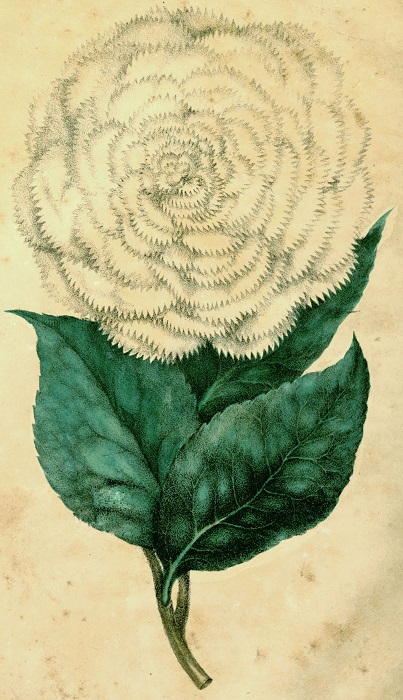 Camellia Fimbriata.