Mrs. Sellers returned, now, with her composure restored, and began to ask after
Hawkins’s wife, and about his children, and the number of them, and so on, and
her examination of the witness resulted in a circumstantial history of the
family’s ups and downs and driftings to and fro in the far West during the
previous fifteen years. There was a message, now, from out back, and Colonel
Sellers went out there in answer to it. Hawkins took this opportunity to ask
how the world had been using the Colonel during the past half-generation.
“Oh, it’s been using him just the same; it couldn’t change its way of using him
if it wanted to, for he wouldn’t let it.”
“I can easily believe that, Mrs. Sellers.”
“Yes, you see, he doesn’t change, himself—not the least little bit in the
world—he’s always Mulberry Sellers.”
“I can see that plain enough.”
“Just the same old scheming, generous, good-hearted, moonshiny, hopeful,
no-account failure he always was, and still everybody likes him just as well as
if he was the shiningest success.”
“They always did: and it was natural, because he was so obliging and
accommodating, and had something about him that made it kind of easy to ask
help of him, or favors—you didn’t feel shy, you know, or have that
wish—you—didn’t—have—to—try feeling that you have
with other people.”
“It’s just so, yet; and a body wonders at it, too, because he’s been shamefully
treated, many times, by people that had used him for a ladder to climb up by,
and then kicked him down when they didn’t need him any more. For a time you can
see he’s hurt, his pride’s wounded, because he shrinks away from that thing and
don’t want to talk about it—and so I used to think now he’s
learned something and he’ll be more careful hereafter—but laws! in a
couple of weeks he’s forgotten all about it, and any selfish tramp out of
nobody knows where can come and put up a poor mouth and walk right into his
heart with his boots on.”
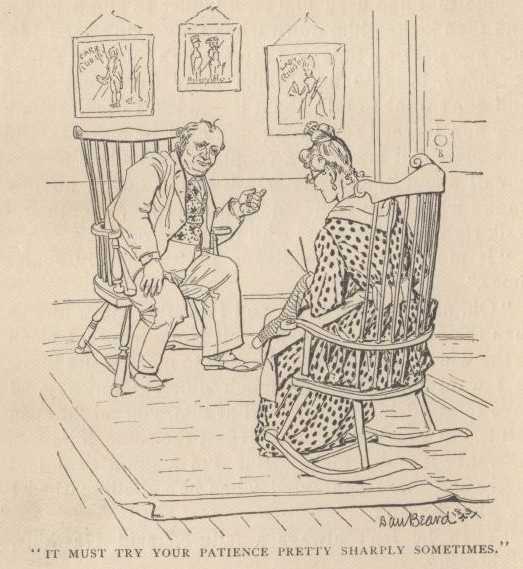
“It must try your patience pretty sharply sometimes.”
“Oh, no, I’m used to it; and I’d rather have him so than the other way. When I
call him a failure, I mean to the world he’s a failure; he isn’t to me. I don’t
know as I want him different much different, anyway. I have to scold him some,
snarl at him, you might even call it, but I reckon I’d do that just the same,
if he was different—it’s my make. But I’m a good deal less snarly and
more contented when he’s a failure than I am when he isn’t.”
“Then he isn’t always a failure,” said Hawking, brightening.
“Him? Oh, bless you, no. He makes a strike, as he calls it, from time to time.
Then’s my time to fret and fuss. For the money just flies—first come
first served. Straight off, he loads up the house with cripples and idiots and
stray cats and all the different kinds of poor wrecks that other people don’t
want and he does, and then when the poverty comes again I’ve got
to clear the most of them out or we’d starve; and that distresses him, and me
the same, of course.
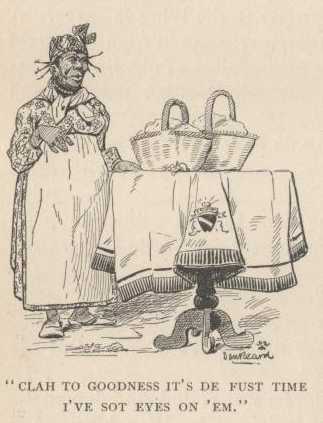
“Here’s old Dan’l and old Jinny, that the sheriff sold south one of the times
that we got bankrupted before the war—they came wandering back after the
peace, worn out and used up on the cotton plantations, helpless, and not
another lick of work left in their old hides for the rest of this earthly
pilgrimage—and we so pinched, oh so pinched for the very crumbs to
keep life in us, and he just flung the door wide, and the way he received them
you’d have thought they had come straight down from heaven in answer to prayer.
I took him one side and said, ‘Mulberry we can’t have them—we’ve nothing
for ourselves—we can’t feed them.’ He looked at me kind of hurt, and
said, ‘Turn them out?—and they’ve come to me just as confident and
trusting as—as—why Polly, I must have bought that confidence
sometime or other a long time ago, and given my note, so to speak—you
don’t get such things as a gift—and how am I going to go back on a
debt like that? And you see, they’re so poor, and old, and friendless,
and—’ But I was ashamed by that time, and shut him off, and somehow felt
a new courage in me, and so I said, softly, ‘We’ll keep them—the Lord
will provide.’ He was glad, and started to blurt out one of those
over-confident speeches of his, but checked himself in time, and said humbly,
‘I will, anyway.’ It was years and years and years ago. Well, you see
those old wrecks are here yet.”
“But don’t they do your housework?”
“Laws! The idea. They would if they could, poor old things, and perhaps they
think they do do some of it. But it’s a superstition. Dan’l waits on the
front door, and sometimes goes on an errand; and sometimes you’ll see one or
both of them letting on to dust around in here—but that’s because there’s
something they want to hear about and mix their gabble into. And they’re always
around at meals, for the same reason. But the fact is, we have to keep a young
negro girl just to take care of them, and a negro woman to do the
housework and help take care of them.”
“Well, they ought to be tolerably happy, I should think.”
“It’s no name for it. They quarrel together pretty much all the time—most
always about religion, because Dan’l’s a Dunker Baptist and Jinny’s a shouting
Methodist, and Jinny believes in special Providences and Dan’l don’t, because
he thinks he’s a kind of a free-thinker—and they play and sing plantation
hymns together, and talk and chatter just eternally and forever, and are
sincerely fond of each other and think the world of Mulberry, and he puts up
patiently with all their spoiled ways and foolishness, and so—ah, well,
they’re happy enough if it comes to that. And I don’t mind—I’ve got used
to it. I can get used to anything, with Mulberry to help; and the fact is, I
don’t much care what happens, so long as he’s spared to me.”
“Well, here’s to him, and hoping he’ll make another strike soon.”
“And rake in the lame, the halt and the blind, and turn the house into a
hospital again? It’s what he would do. I’ve seen aplenty of that and more. No,
Washington, I want his strikes to be mighty moderate ones the rest of the way
down the vale.”
“Well, then, big strike or little strike, or no strike at all, here’s hoping
he’ll never lack for friends—and I don’t reckon he ever will while
there’s people around who know enough to—”
“Him lack for friends!” and she tilted her head up with a frank
pride—“why, Washington, you can’t name a man that’s anybody that isn’t
fond of him. I’ll tell you privately, that I’ve had Satan’s own time to keep
them from appointing him to some office or other. They knew he’d no business
with an office, just as well as I did, but he’s the hardest man to refuse
anything to a body ever saw. Mulberry Sellers with an office! laws goodness,
you know what that would be like. Why, they’d come from the ends of the earth
to see a circus like that. I’d just as lieves be married to Niagara Falls, and
done with it.” After a reflective pause she added—having wandered back,
in the interval, to the remark that had been her text: “Friends?—oh,
indeed, no man ever had more; and such friends: Grant, Sherman,
Sheridan, Johnston, Longstreet, Lee—many’s the time they’ve sat in that
chair you’re sitting in—” Hawkins was out of it instantly, and
contemplating it with a reverential surprise, and with the awed sense of having
trodden shod upon holy ground—
“They!” he said.
“Oh, indeed, yes, a many and a many a time.”
He continued to gaze at the chair fascinated, magnetized; and for once in his
life that continental stretch of dry prairie which stood for his imagination
was afire, and across it was marching a slanting flamefront that joined its
wide horizons together and smothered the skies with smoke. He was experiencing
what one or another drowsing, geographically ignorant alien experiences every
day in the year when he turns a dull and indifferent eye out of the car window
and it falls upon a certain station-sign which reads “Stratford-on-Avon!” Mrs.
Sellers went gossiping comfortably along:
“Oh, they like to hear him talk, especially if their load is getting rather
heavy on one shoulder and they want to shift it. He’s all air, you
know,—breeze, you may say—and he freshens them up; it’s a trip to
the country, they say. Many a time he’s made General Grant laugh—and
that’s a tidy job, I can tell you, and as for Sheridan, his eye lights up and
he listens to Mulberry Sellers the same as if he was artillery. You see, the
charm about Mulberry is, he is so catholic and unprejudiced that he fits in
anywhere and everywhere. It makes him powerful good company, and as popular as
scandal. You go to the White House when the President’s holding a general
reception—sometime when Mulberry’s there. Why, dear me, you can’t
tell which of them it is that’s holding that reception.”
“Well, he certainly is a remarkable man—and he always was. Is he
religious?”
“Clear to his marrow—does more thinking and reading on that subject than
any other except Russia and Siberia: thrashes around over the whole field, too;
nothing bigoted about him.”
“What is his religion?”
“He—” She stopped, and was lost for a moment or two in thinking, then she
said, with simplicity, “I think he was a Mohammedan or something last week.”
Washington started down town, now, to bring his trunk, for the hospitable
Sellerses would listen to no excuses; their house must be his home during the
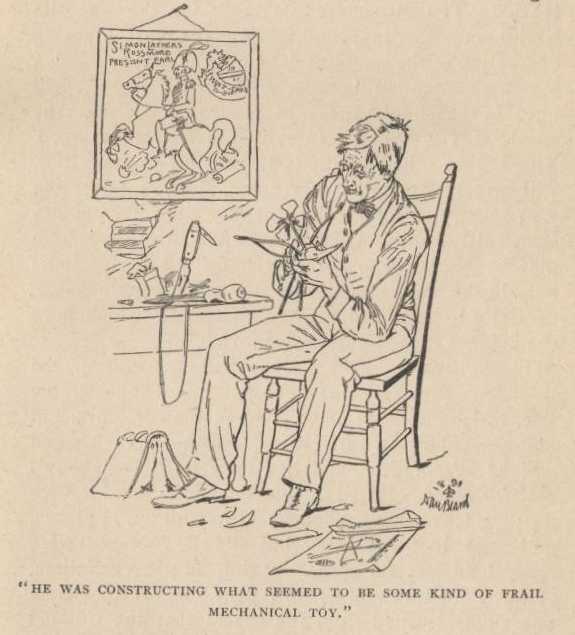
session. The Colonel returned presently and resumed work upon his plaything. It
was finished when Washington got back.
“There it is,” said the Colonel, “all finished.”
“What is it for, Colonel?”
“Oh, it’s just a trifle. Toy to amuse the children.”
Washington examined it.
“It seems to be a puzzle.”
“Yes, that’s what it is. I call it Pigs in the Clover. Put them in—see if
you can put them in the pen.”
After many failures Washington succeeded, and was as pleased as a child.
“It’s wonderfully ingenious, Colonel, it’s ever so clever and
interesting—why, I could play with it all day. What are you going to do
with it?”
“Oh, nothing. Patent it and throw it aside.”
“Don’t you do anything of the kind. There’s money in that thing.”
A compassionate look traveled over the Colonel’s countenance, and he said:
“Money—yes; pin money: a couple of hundred thousand, perhaps. Not more.”
Washington’s eyes blazed.
“A couple of hundred thousand dollars! do you call that pin money?”
The colonel rose and tip-toed his way across the room, closed a door that was
slightly ajar, tip-toed his way to his seat again, and said, under his breath:
“You can keep a secret?”
Washington nodded his affirmative, he was too awed to speak.
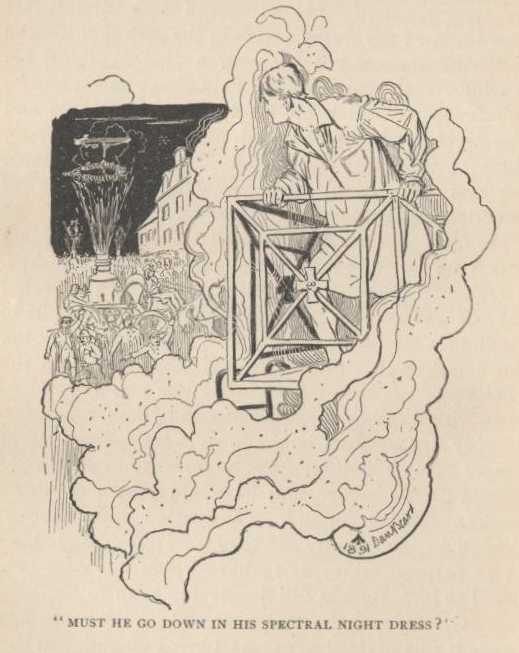
“You have heard of materialization—materialization of departed spirits?”
Washington had heard of it.
“And probably didn’t believe in it; and quite right, too. The thing as
practised by ignorant charlatans is unworthy of attention or
respect—where there’s a dim light and a dark cabinet, and a parcel of
sentimental gulls gathered together, with their faith and their shudders and
their tears all ready, and one and the same fatty degeneration of protoplasm
and humbug comes out and materializes himself into anybody you want,
grandmother, grandchild, brother-in-law, Witch of Endor, John Milton, Siamese
twins, Peter the Great, and all such frantic nonsense—no, that is all
foolish and pitiful. But when a man that is competent brings the vast powers of
science to bear, it’s a different matter, a totally different matter,
you see. The spectre that answers that call has come to stay. Do you
note the commercial value of that detail?”
“Well, I—the—the truth is, that I don’t quite know that I do. Do
you mean that such, being permanent, not transitory, would give more general
satisfaction, and so enhance the price—of tickets to the show—”
“Show? Folly—listen to me; and get a good grip on your breath, for you
are going to need it. Within three days I shall have completed my method, and
then—let the world stand aghast, for it shall see marvels. Washington,
within three days—ten at the outside—you shall see me call the dead
of any century, and they will arise and walk. Walk?—they shall walk
forever, and never die again. Walk with all the muscle and spring of their
pristine vigor.”
“Colonel! Indeed it does take one’s breath away.”
“Now do you see the money that’s in it?”
“I’m—well, I’m—not really sure that I do.”
“Great Scott, look here. I shall have a monopoly; they’ll all belong to me,
won’t they? Two thousand policemen in the city of New York. Wages, four dollars
a day. I’ll replace them with dead ones at half the money.”
“Oh, prodigious! I never thought of that. F-o-u-r thousand dollars a day. Now I
do begin to see! But will dead policemen answer?”
“Haven’t they—up to this time?”
“Well, if you put it that way—”
“Put it any way you want to. Modify it to suit yourself, and my lads shall
still be superior. They won’t eat, they won’t drink—don’t need those
things; they won’t wink for cash at gambling dens and unlicensed rum-holes,
they won’t spark the scullery maids; and moreover the bands of toughs that
ambuscade them on lonely beats, and cowardly shoot and knife them will only
damage the uniforms and not live long enough to get more than a momentary
satisfaction out of that.”
“Why, Colonel, if you can furnish policemen, then of course—”
“Certainly—I can furnish any line of goods that’s wanted. Take the army,
for instance—now twenty-five thousand men; expense, twenty-two millions a
year. I will dig up the Romans, I will resurrect the Greeks, I will furnish the
government, for ten millions a year, ten thousand veterans drawn from the
victorious legions of all the ages—soldiers that will chase Indians year
in and year out on materialized horses, and cost never a cent for rations or
repairs. The armies of Europe cost two billions a year now—I will replace
them all for a billion. I will dig up the trained statesmen of all ages and all
climes, and furnish this country with a Congress that knows enough to come in
out of the rain—a thing that’s never happened yet, since the Declaration
of Independence, and never will happen till these practically dead people are
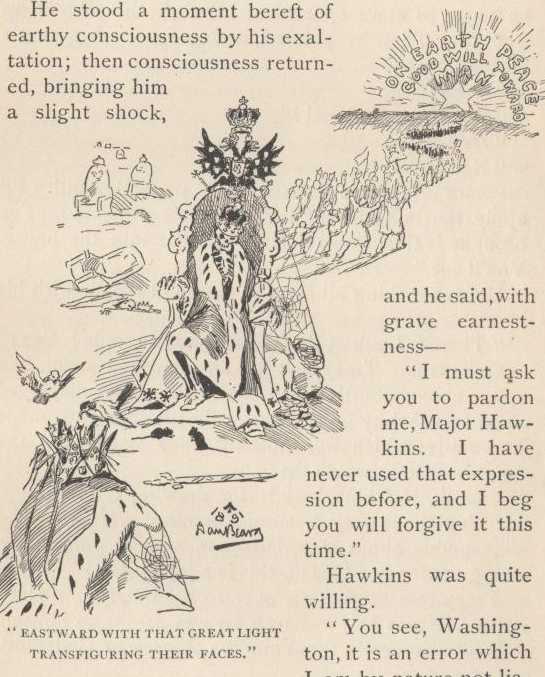
replaced with the genuine article. I will restock the thrones of Europe with
the best brains and the best morals that all the royal sepulchres of all the
centuries can furnish—which isn’t promising very much—and I’ll
divide the wages and the civil list, fair and square, merely taking my half
and—”
“Colonel, if the half of this is true, there’s millions in it—millions.”
“Billions in it—billions; that’s what you mean. Why, look here; the thing
is so close at hand, so imminent, so absolutely immediate, that if a man were
to come to me now and say, Colonel, I am a little short, and if you could lend
me a couple of billion dollars for—come in!”
This in answer to a knock. An energetic looking man bustled in with a big
pocket-book in his hand, took a paper from it and presented it, with the curt
remark:
“Seventeenth and last call—you want to out with that three dollars and
forty cents this time without fail, Colonel Mulberry Sellers.”
The Colonel began to slap this pocket and that one, and feel here and there and
everywhere, muttering:
“What have I done with that wallet?—let me see—um—not
here, not there —Oh, I must have left it in the kitchen; I’ll just run
and—”
“No you won’t—you’ll stay right where you are. And you’re going to
disgorge, too—this time.”
Washington innocently offered to go and look. When he was gone the Colonel
said:
“The fact is, I’ve got to throw myself on your indulgence just this once more,
Suggs; you see the remittances I was expecting—”
“Hang the remittances—it’s too stale—it won’t answer. Come!”
The Colonel glanced about him in despair. Then his face lighted; he ran to the
wall and began to dust off a peculiarly atrocious chromo with his handkerchief.
Then he brought it reverently, offered it to the collector, averted his face
and said:
“Take it, but don’t let me see it go. It’s the sole remaining Rembrandt
that—”
“Rembrandt be damned, it’s a chromo.”
“Oh, don’t speak of it so, I beg you. It’s the only really great original, the
only supreme example of that mighty school of art which—”
“Art! It’s the sickest looking thing I—”
The colonel was already bringing another horror and tenderly dusting it.
“Take this one too—the gem of my collection—the only genuine Fra
Angelico that—”
“Illuminated liver-pad, that’s what it is. Give it here—good
day—people will think I’ve robbed a’ nigger barber-shop.”
As he slammed the door behind him the Colonel shouted with an anguished
accent—
“Do please cover them up—don’t let the damp get at them. The delicate
tints in the Angelico—”
But the man was gone.
Washington re-appeared and said he had looked everywhere, and so had Mrs.
Sellers and the servants, but in vain; and went on to say he wished he could
get his eye on a certain man about this time—no need to hunt up that
pocket-book then. The Colonel’s interest was awake at once.
“What man?”
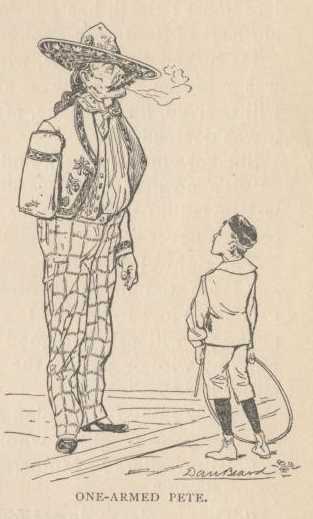
“One-armed Pete they call him out there—out in the Cherokee country I
mean. Robbed the bank in Tahlequah.”
“Do they have banks in Tahlequah?”
“Yes—a bank, anyway. He was suspected of robbing it. Whoever did
it got away with more than twenty thousand dollars. They offered a reward of
five thousand. I believe I saw that very man, on my way east.”
“No—is that so?
“I certainly saw a man on the train, the first day I struck the railroad, that
answered the description pretty exactly—at least as to clothes and a
lacking arm.”
“Why din’t you get him arrested and claim the reward?”
“I couldn’t. I had to get a requisition, of course. But I meant to stay by him
till I got my chance.”
“Well?”
“Well, he left the train during the night some time.”
“Oh, hang it, that’s too bad.”
“Not so very bad, either.”
“Why?”
“Because he came down to Baltimore in the very train I was in, though I didn’t
know it in time. As we moved out of the station I saw him going toward the iron
gate with a satchel in his hand.”
“Good; we’ll catch him. Let’s lay a plan.”
“Send description to the Baltimore police?”
“Why, what are you talking about? No. Do you want them to get the reward?”
“What shall we do, then?”
The Colonel reflected.
“I’ll tell you. Put a personal in the Baltimore Sun. Word it like this:
“A. DROP ME A LINE, PETE.”
“Hold on. Which arm has he lost?”
“The right.”
“Good. Now then—
“A. DROP ME A LINE, PETE, EVEN IF YOU HAVE to write with your left hand.
Address X. Y. Z., General Postoffice, Washington. From YOU KNOW WHO.”
“There—that’ll fetch him.”
“But he won’t know who—will he?”
“No, but he’ll want to know, won’t he?”
“Why, certainly—I didn’t think of that. What made you think of it?”
“Knowledge of human curiosity. Strong trait, very strong trait.”
“Now I’ll go to my room and write it out and enclose a dollar and tell them to
print it to the worth of that.”