MACMILLAN AND CO., Limited LONDON · BOMBAY · CALCUTTA
MELBOURNE
THE MACMILLAN COMPANY NEW YORK · BOSTON · CHICAGO
ATLANTA · SAN FRANCISCO
THE MACMILLAN CO. OF CANADA, Ltd. TORONTO
THE
AMAZING EMPEROR
HELIOGABALUS
BY
J. STUART HAY ST. JOHN’S COLLEGE, OXFORD
WITH INTRODUCTION BY Professor J. B. BURY, Litt.D. REGIUS PROFESSOR OF MODERN HISTORY IN THE UNIVERSITY OF CAMBRIDGE
MACMILLAN AND CO., LIMITED
ST. MARTIN’S STREET, LONDON
1911
PREFACE
The life of the Emperor Marcus Aurelius Antoninus,
generally known to the world as Heliogabalus,
is as yet shrouded in impenetrable mystery.
The picture we have of the reign is that of an imperial
orgy—sacrilegious, necromantic, and obscene.
The boy Emperor, who reigned from his fourteenth to
his eighteenth year, is depicted amongst that crowd
of tyrants who held the throne of Imperial Rome,
by the help of the praetorian army, as one of the most
tyrannical, certainly as the most debased.
Few people have made any study of the documents
which relate to this particular period, and
fewer still have taken the trouble to inquire whether
the accounts of the Scriptores are trustworthy or
consonant with the known facts.
To this present time no account of the life of this
Emperor has been published. Histories of the
decline and fall of Imperial Rome there are in
plenty; other reigns have been examined in detail;
German critics have sifted the trustworthiness of the
documents, few in number and all late in date, which
refer to other reigns; so far nothing has been done
on the life of Elagabalus.
The present writer started this study with the
view that the Syrian boy-Emperor was, in all
probability, what his biographers have painted him,
and what all other writers have accepted as being a
substantially correct account of the absence of mind,
will, policy, and authority which he was supposed to
have betrayed, along with other even more reprehensible
characteristics.
The first reason to doubt this estimate came
from the continually recurring mention of a perpetual
struggle between the Emperor and his female
relatives; a fight in which the boy was always worsting
able and resolute women, carrying his point
with consummate tact and ability, while allowing the
women a certain show of dignity and position, where
it in no way diminished the imperial authority or
his own prerogative.
This circumstance alone was scarcely consonant
with Lampridius’ account of a mere youthful
debauchee, who had neither inclination nor will for
anything, save a low desire to wallow in vice and
unspeakable horrors as the be-all and end-all of his
existence.
On further inquiry, another circumstance obtruded
itself, namely, that the boy had a vast
religious scheme or policy, which he was bent
on imposing on his subjects in Rome, and
indeed throughout the world. This policy was the
unification of churches in one great monotheistic
ideal.
Religion may be neurotic in itself, but the scheme
of Elagabalus was not essentially so. Certainly the
course of action by which he purposed to effect his
ideal was not that of a mere sensualist. It showed
understanding, persistency, and dogged determination;
it was not popular, because in the general
incredulity, the earlier deities had lost even the
immortality of mummies.
Yet another reason which forced one to disagree
with the usual summary of the character under
discussion was that, despite (1) the awful accounts of
the imperial orgies; (2) the accusations brought
against the cruelty and incompetency of the government;
(3) the announcement that all good men were
exterminated in the general lust for destruction of
such worthies; (4) the account of the class and
calibre of the men employed in all state offices;
(despite all this) the authors inform us that the state
did not suffer from the effects of the reign. This
was obviously an impossibility at the outset, and the
terminological inexactitude became even more apparent
when all the known good men were mentioned
as peaceably holding office, not only during the reign
in question, but in that of Elagabalus’ successor;
either they had been resurrected or had never been
exterminated.
Again, the account given of the military policy
is not that which would be the work of a weakling.
The fiscal policy may have been unchanged, but the
edict which enforced the payment of Vectigalia in
gold, showed a considerable amount of sense, in
demanding the payment of taxes in the one coin
whose standard had been maintained when all others
had been debased by preceding Emperors, and no
one had been worse than the great financier Septimius
Severus in this debasing of the currency.
In legal matters alone we are told that the period
was sterile, because only five decrees of the reign are
recorded by the editors of the Prosopographia. This
may be true, but it is quite possible, in fact more
than probable, that in later redactions much of the
work which Papinian, Paul, Ulpian, and other such
produced during this reign has been embodied in
later decrees or codifications, and one can scarcely
imagine that these men were entirely sterile for four
years in the zenith of their authority.
Again, it is most noticeable that in the mass of
abuse and obvious animus which the “life” exhibits,
there is not one definite act of cruelty reported; no
wanton murder is cited; no hint given that the
people were discontented with the appointments
made, or that they suffered from any of the misrule
which had been so prevalent for years past.
On the other hand, we are told that the people
considered Elagabalus a worthy Emperor, despite
all that could be said to his discredit.
Chiefly it was this too obvious animus, shown on
each page of the documents, which led the writer to
examine the opinions of German and Italian critics
on the measure of credibility which could safely be
attached to the Scriptores Historiae Augustae. It
was an agreeable surprise to find that their estimates
of the Scriptores ranged from those of men who
stigmatised the whole collection as an impudent and
unenlightened forgery to men who, like Mommsen,
contended that, though originally the lives might
have had some real historical value, they had been
so edited and enlarged as to lack the essential
weight of historical evidence, and contained, as
they stood, but a modicum of consecutive and
unvarnished fact.
Authorities being so far in accord, the present
writer set to work to sift the accounts which were
obviously quite unnaturally biased, and to separate
what was merely stupidly contradictory from what
was mutually exclusive.
This method has been applied merely to the first
seventeen sections of Lampridius’ work, the portion
which professes to contain a more or less historical
account of the events from Elagabalus’ entry into
Rome to his disappearance into the main drain of
the city.
In the latter portion of the life there is a wealth
of biographical detail, which, in plain English,
means an account in extenso of what has been already
described too luridly in the foregoing sections. It
is written in Latin, and has never been translated
into English, to the writer’s knowledge, nor has he
any intention of undertaking the work at this present
or any other time, as he has no desire to land
himself, with the printers and publishers, in the
dock at the Old Bailey, in an unenviable, if not
an invidious and notorious position.
Those, however, who are capable of reading the
Latin tongue, and therefore inured against further
corruption, will find an excellent edition published
in Paris by M. Panckoucke in 1847. The last three
chapters in the present volume are an attempt to
bring together all the material capable of publication
in these seventeen sections, and take the form of three
essays on the main figures of the Emperor’s psychological
imagination. They are in no way an endeavour
to expurgate the sections referred to, as
any such attempt would leave one with the numerals
as headings and the word “Finis” half-way down a
sheet of notepaper. It is better for the sapient to
read the chapters for themselves, and so all men will
be satisfied.
It has also been impossible, on the same grounds,
to criticise the statements here made; the greater
part are, like those in the biographical portion,
frankly impossible, when not mutually exclusive. It
is needless to say that the author accepts the whole
with all the Attic salt at his disposal.
Another anomaly that may strike the reader is
the fact that various names are used to designate the
Emperor. Tristran remarks that “they are as many
as the hydra has heads.” The present idea is to
use the titles which the boy bore at the different
stages of his life, rather than apply to him on all
occasions the nickname which was attached to him
after his death.
In the earlier part of the work I have referred
to the youth as Varius and Bassianus, the two names
which appear most frequently, in reference to his
reputed fathers, but have neglected Avitus, by
which title he is occasionally known, in reference to
his grandfather, as also that of Lupus, which is
sometimes found in Dion, because, as Dr. Wotton
remarks, there is no means of finding out whether
he was so called (if ever he was given the name at
all) on account of some ancestry, by reason of a
false reading, or on account of some other matter
now long laid to rest.
After the Proclamation, I have preferred to call
the Emperor by his official name, Marcus Aurelius
Antoninus, or Antonine for short, as this is the only
manner in which the coins, inscriptions, and documents
describe him. After his death, it seems
allowable to give him the nickname which his
relations and later biographers have applied to him,
namely, the latinised form of the name of his God.
I have nowhere adopted the later Greek spelling or
adaptation, Heliogabalus, either when referring to
the God of the Emesans or to the Emperor himself.
The only form in which the name occurs in inscriptions
is in describing the Emperor as “Priest
of Elagabal” or the Sun. Lampridius certainly
Hellenised its form a century later, on what grounds
is by no means clear, when one realises that neither
the boy nor his God had any trace of Greek blood,
tradition, or philosophy about them, and that the
identification of a particular Syrian monotheism
with Mithraism or general Sun worship is not
universally admitted as a necessary consequence,
either in the case of Elagabal, Jehovah, or indeed
in that of any of the other “El” claimants to exclusiveness,
though the balance of probability may
lie on the side of the identification. It is further
unnecessary to drag in the Hellenised form of
the Emperor’s name in order to pander to a
popular and erroneous conception of the reign,
which conception this book is designed to combat
and generally offend. Heliogabalus is nevertheless
the sole title by which this Emperor is known to
the world at large, in consequence of which I have
allowed the name to stand on the title-page, chiefly
in order that Mrs. Grundy’s prurient mind may
know, before she buys or borrows this volume, that
it is the record of a life at which she may expect to
be shocked, though she will in all probability find
herself yawning before the middle of the introductory
chapter.
As I understand the reign, the main object on
the part of the boy’s murderers in nicknaming him
Elagabalus after his death, was to throw discredit
on his memory by depriving him of the venerated
title Antonine, and substituting therefor the name
of a Syrian monotheistic deity, who by his exclusiveness
was an offence and a byword in the
eyes of the virile, pantheistic philosophy which then
held sway.
A word must also be said as to the attitude in
leaving untouched much of the scandal attaching to
this Emperor’s name. I have only been able to
deal with the public side of his character, as there
are no coins or inscriptions which refer to his private
life, and have in consequence been forced to quote
what the tradition, gained from his traducers’ writings,
states was his unfortunate abnormality.
These traditions may be true wholly or in part,
they certainly could only be disproved by the actual
persons implicated, who have written neither for
nor against the Emperor’s psychological condition.
The traditions, however, as far as they treat of the
public position and reputation of the Emperor, have
been shown to be grossly unfair where they are not
horribly untruthful, and may be—in all probability
are—of an equal value, when they discuss private
practices about which no one can have had
any particular knowledge except his actual accomplices.
Suffice it to say, that any stick is good
enough to beat a dog with once he is incapable of
defending himself, and in this case it has been laid
about Antonine’s shoulders with almost diabolical
ingenuity.
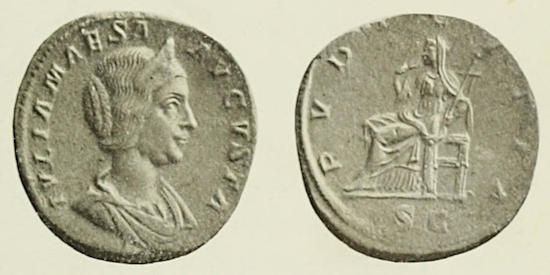
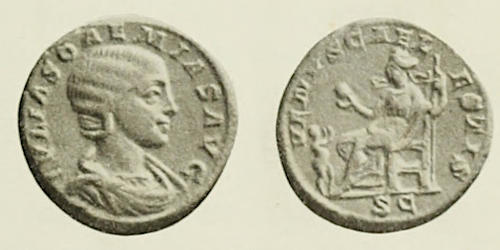
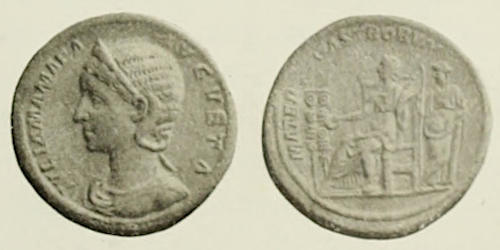
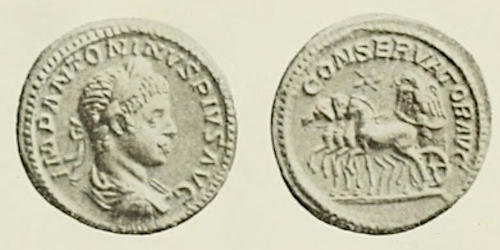
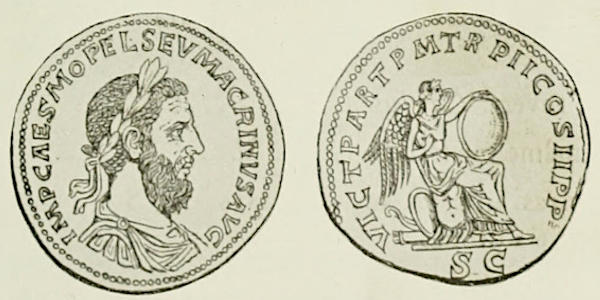
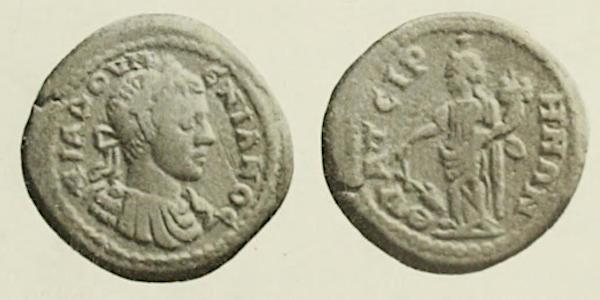
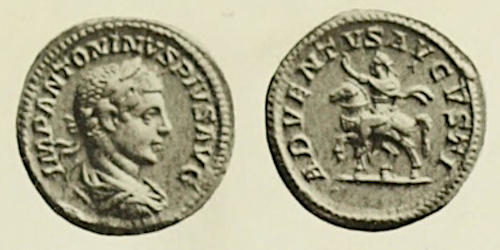
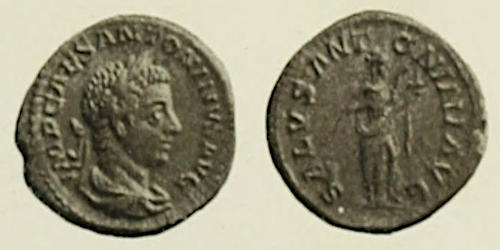
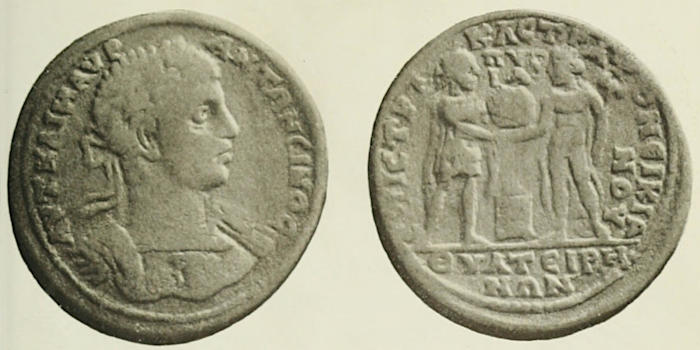
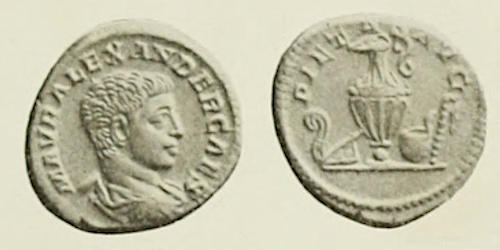
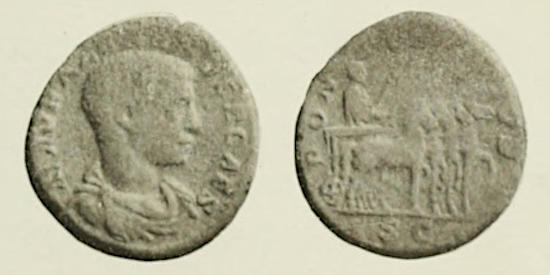
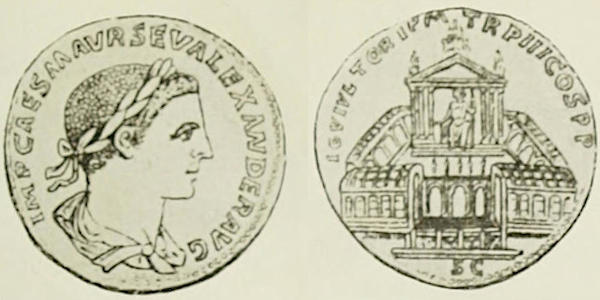
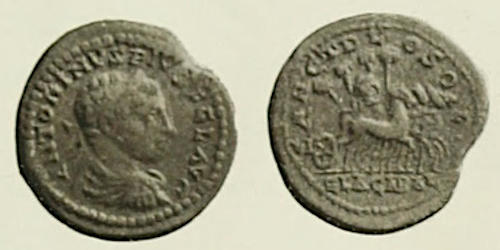
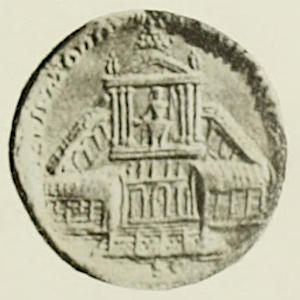
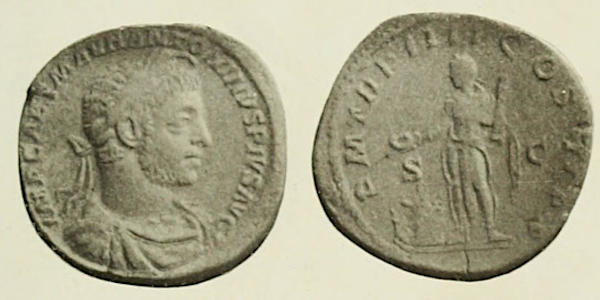
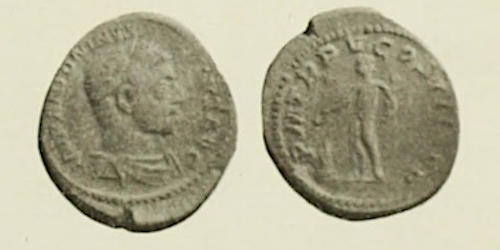
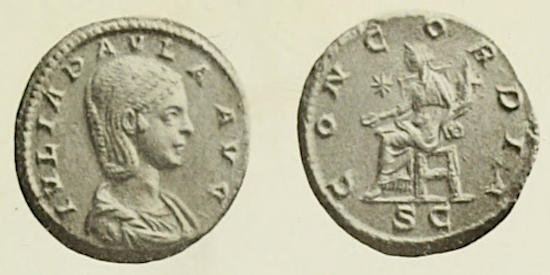
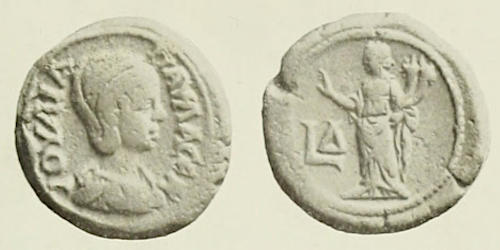
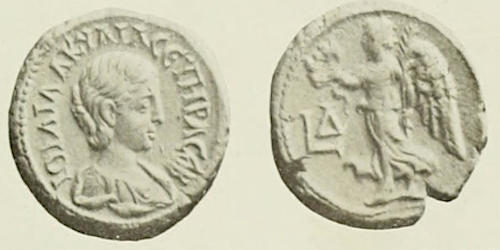
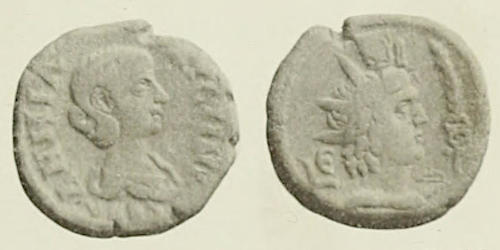
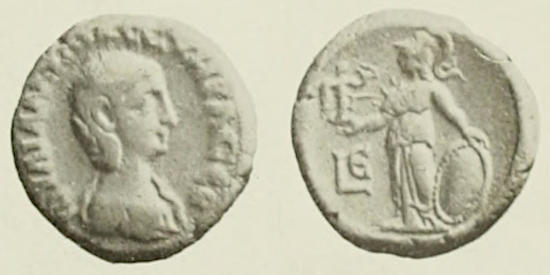
I much regret that I have been unable to find
any portraits of the Emperor for whose authenticity
Bernouilli will vouch. Alone of the whole family
there remain authentic busts of Julia Mamaea and
Julia Paula, neither of whom are important enough
to be included, since we are unable to give a portrait
of Elagabalus himself. I have therefore confined
myself to the use of coins, whose veracity is undoubted,
hoping that the reader will supply from
his imagination that charm and beauty which the
biographers have been unwillingly forced to allow
both to the Emperor and his mother.
In the preparation of this work I have had much
valuable and kindly assistance, for which I desire to
acknowledge my deep indebtedness here. First, to
Professor Bury of Cambridge, for his unwearying and
sage advice on my whole manuscript; also to Dr.
Bussell, Vice-Principal of Brasenose College, Oxford,
for his interest and kindly corrections; to
the authorities in the Bodleian Library; to the
assistants in the British Museum, especially to Mr.
Philip Wilson and Mr. A. J. Ellis for their continued
help in my work there, and to Mr. Allen
for the time and care he has spent in helping me
find the coins that explain the text.
I have also to acknowledge with sincere thanks
the permission of Mr. E. E. Saltus of Harvard
University to quote his vivid and beautiful studies
on the Roman Empire and her Customs. I am
deeply indebted to Mr. Walter Pater, Mr. J. A.
Symonds, and Mr. Saltus for many a tournure
de phrase and picturesque rendering of Tacitus,
Suetonius, Lampridius, and the rest. I also desire
to thank Dr. Counsell of New College, Oxford,
and Dr. Bailey of the Warneford Asylum, not only
for their help in correcting my proofs, but also for
their assistance in the preparation of my chapter on
Psychology.
To all these gentlemen I owe a great debt,
which, I hope, the general public will repay by an
appreciation of their work. We have endeavoured
to right a wrong; if our efforts are in any way
successful, the reader will acknowledge that this
mauvais quart d’heure, which has been stigmatised
as full of impossible situations and intolerable
surprises, is in reality a very human life which, like
our own, has its exquisite moments of which we
would as soon deprive ourselves as Elagabalus.
General sketch of conditions, 1.
The Augustan Histories and their writers, 2. Lampridius, author of the Life of
Elagabalus, 4. First attempts at
criticism, 4. Modern criticism,
4. Latin sources: Marius Maximus,
5. Greek sources: Dion Cassius,
Xiphilinus, 7. Herodian, 8. General attack on the authenticity of
the “Lives,” 9. Mommsen’s opinion,
10. Peter, Richter, Dessau, Seeck,
Klebs, Kornemann, 11-15. Italian
opinion, 15. General opinion of
the biographies, 16. Reasons
for the tainted sources, 18.
Church historians, 19.
Jurisprudence, 21. Numismatists,
21. Object of this work, 23.
Emesa, 24. High-Priest Kings,
25. Septimius Severus,
27. Julius Bassianus, 27. Julia Domna’s marriage,
28. Caracalla’s birth, 29. Septimius Severus, Emperor,
30. Julia’s court, 31. Maesa comes to Rome with her
family, 31. Marriage of Soaemias,
34. Birth of Elagabalus, 35. Paternity of Elagabalus, 35. Birthplace of Elagabalus, 36. Julia Mamaea, her marriage, and
her connection with Caracalla, 38.
Macrinus Praetorian Praefect, 41.
His plot against Caracalla, 42.
Election of Macrinus, 43. Julia’s
position, 43. Her work to recover
the empire, 43. Banishment and
death, 44.
Maesa’s return to Emesa, 46.
Macrinus’ weakness and tyranny, 47.
The legion at Emesa, 48.
Bassianus High-Priest, 49.
Worship of Elagabal, 50.
Bassianus’ religious outlook, 51.
Eutychianus and Gannys corrupt the soldiers, 53. Date of the proclamation of
Elagabalus, 55. Macrinus astonished,
56. The Empire in favour of
Bassianus, Julian’s expedition, 59.
Deserters to Bassianus, 61.
Macrinus at Apamea, and Diadumenianus’ elevation, 63. Macrinus retires to Antioch,
66. Bassianus wins allegiance
of soldiers at Apamea, 67.
Dion on the dates of proclamation and battle, 67. Arval Brothers’ meeting, 68. Wirth, 69.
Battle of Immae, 69. Antonine
at Antioch, 71. Macrinus’
escape, 72. Capture and death,
74. Character of Macrinus, 75.
Antonine’s refusal to allow the sack of Antioch,
77. Chief minister, 78. Antonine’s temperament, 79. Acts of the new Government, 81. Amnesty, 83.
Position of the Senate, 84.
Delight of Rome, 86. Dismissal of
troops, 87. Treasonable attempts
and pretenders, 88. Elagabal to
accompany the Emperor, 91. Journey
to Nicomedia, 92. Winter in Asia
Minor, 93. Illness of the Emperor,
94. Xiphilinus on Antonine’s
religion, 95. Monotheistic or
Mithraic not polytheistic, 96.
Death of Gannys, 101. Antonine’s
character, 102. His popularity and
his taxation, 104.
Date of arrival in Rome discussed, 107.
The entry into the city according to Herodian,
110. First marriage,
111. The temples, 112. The scheme for the unifying
of religions, 114. The
worship, 115. The Eastern
cults, 115. Date of scheme
discussed, 118. Reasons for
its failure, 118. Women in the
Senate, 119. Senaculum, 121. Lampridius on the Emperor’s
popularity, 124. Charges against
the Administration, 125.
Divorce of Julia Paula, 126.
Pastimes, 127. Summary,
128. Elagabal’s alliance
with Vesta, Antonine’s with Aquilia Severa, 129. Pomponius Bassus’ plot, 131. Antonine divorces Elagabal
from Minerva, himself from Aquilia Severa, 132. Sends for Tanit from Carthage,
133. Marries Annia Faustina, 134. Alliance of Maesa and Mamaea, 135.
Lampridius on Alexander, 137.
Seius Carus’ plot, 139.
Military expenditure, 140.
Maesa’s plan for the adoption of Alexander, 141. The Emperor’s reasons for
concurrence, 142. Name Alexander
accounted for, 144. Date of
adoption discussed, 145.
Position after adoption, 146.
Alexander’s titles, 147.
Antonine’s endeavours, 148.
Antonine’s resolve to divorce Annia Faustina and disown
Alexander, 150. Accusations
against the Government, 151.
Antonine’s attempt to assassinate Alexander discussed, 152. Antonine goes to Praetorian
camp, 154. Camp conference, 155. Hatred of Maesa and Mamaea
testified against Antonine, 157.
Mamaea’s precautions, 158.
Antonine’s preparations for suicide, 160. Alexander designated Consul,
160. The Emperor’s refusal and
reasons for his compliance, 161.
Lampridius on Julius Sabinus, 163.
Ulpian and Silvinus, 164.
Reasons for the murder and the various accounts, 165. Criticism on the above, 170. The treatment of Elagabalus’
body, 171.
The Emperor set free to further his cult,
173. The procession,
174. Mismanagement and
appointments, 178. Freedmen, 180. Return of Aquilia Severa, 183. Desire for military glory,
184. The names of the Emperor,
185. Activity in building, 186. Military disaffection, its
causes and result, 188. Date
of Elagabalus’ murder and length of reign discussed,
191. Date for renewal of
tribunician power discussed, 194.
Elagabalus’ interest in public affairs, 198. The treatment of inscriptions, 198. Outlook of the Roman world, 200.
Roman views on matrimony, 203.
Elagabalus’ marriage with Julia Paula, 205. Position of Julius Paulus, 206. Serviez, etc., on Julia Paula,
207. Dates of this marriage and
divorce, 208. Elagabalus’ marriage
with Aquilia Severa, 211. Vestals
discussed, 211. Roman religion, 212. Elagabalus’ lack of prejudice, 214. His explanation to the Senate,
215. Family of Aquilia Severa, 215. Probable dates of marriage and
divorce, 216-18. Maesa’s desire for
an alliance with the nobility, 218.
Annia Faustina chosen, her family discussed, 222. Her age and her divorce, 223. Further marriages discussed, 224. Elagabalus’ return to Aquilia, 225.
Lampridius’ Life of Elagabalus impossible,
227. Elagabalus a psycho-sexual
hermaphrodite, not wicked, 229.
The condition quite usual then as now, 229. Virtue a virile quality,
not a neurotic negation, 229.
The Phallus natural and omnipresent typifies joy and
fruitfulness, 230. Elagabalus has
strong homosexual nymphomania and every inducement to gratify
his feminine instinct, 231.
His nature incredibly open and affectionate, 232. Maesa an aggravating factor, 234. Modern authorities on similarly
inverted cases to-day, 234.
Biblical parallels, Greek instances, modern religious
tendencies, 234. Normal intolerance
largely hypocritical, 235.
The usual instincts of such natures, 235. Elagabalus’ love of flowers,
feasts, and teasing, 236.
His marriages psychologically considered, 238. His castration and desire for an
operation which might produce the female organs discussed,
238. Elagabalus’ marriage with
Hierocles, 239. Hierocles
and Zoticus discussed, 239.
Comparison with Messalina, 240.
Spintries, 240. Elagabalus’ love
of colour, 241. His frankness, 241. Greek love opposed to effeminacy,
242. Gulick on the psychology, on
Christianity, 242. Effeminacy, not
homosexuality, disgusts Roman world and gives reason for
Elagabalus’ downfall, 244.
Description of Nero’s golden house,
245. Elagabalus compared
with Nero, 246. Pastimes,
prodigalities, and dress, 246.
Extravagances of ritual, 250.
Congiaries and games, 251. Table
appointments and food, 252.
Maecenas’ feast, 254.
Perfumes, 256. Fish, 258. The spectacles described,
260. Gladiators discussed,
262. Elagabalus’ skill as a
sportsman, 263. The lotteries,
264. Elagabalus’ devices for
suicide, 265. The psychology of
extravagance, 266.
Elagabalus’ piety, 267.
Constantine the opponent of other monotheisms, 268. Theories of religion, 269. Civilised religion becomes
philosophical, 269. Rome both
atheist and credulous, 270.
Civic religion leaves the forces of sex and superstition
out of count, 270. Gods always
necessary to the superstitious, the more mystical the
more attractive, 271. Semitic
rituals attract the mob, 273.
Elagabal exclusive and absorbs other cults, 273. Elagabalus’ scheme
Erastian, compared with Tudor conception, 273. Elagabalus will not persecute,
276. Religion and castration,
276. Elagabalus no idolator,
277. His mistake in trying to
amalgamate the hated Judaism with Roman deities, 277. Marriages of Elagabal, 278. Human sacrifices discussed,
280. The column for the
meteorite, 281. Contest between
religion and dogma, 282. The
numbers of the mob prevail against the rationalists, 284. Rome bored with all Gods, hence
Elagabalus’ failure, 285.
The Emperor who is studied in this volume has
commonly been treated as if his reign had no significance,
unless it were to show to what deep places
the Roman Empire had sunk when such a monster
of lubricity could wield the supreme power. If the
chronicle of his naughty life has been exploited to
illustrate the legend that the pagan society of the
Empire was desperately wicked and infamously
corrupt, he has not been taken seriously as a ruler.
Yet Elagabalus appeared under too ominous a
constellation to justify us in dismissing his brief
attempt to govern the world as unworthy of more
than a superficial description and a facile condemnation.
His reign lasted less than four years; but
those years fell in a period which was critical for
the future of European civilisation, and he was
brought up in a circle intensely alive to the religious
problems which were then moving the souls
of men. Mr. Hay has broken new ground, and he
has done history a service, in making Elagabalus the
subject of a serious and systematic study.
The third century, so obscurely lit by poor and
meagre records, saw the Empire of Rome shaken
to its foundations. There was a manifest decline in
its strength and efficiency, marked by the insolent
domination of the common soldier, and luridly
illustrated by the statistical facts that from Septimius
Severus to Diocletian the average reign of an
Emperor was about three years and that there were
only two or three sovereigns who were not the
victims of a mutiny or a conspiracy. As one of
the efficacious causes of this decline has often been
suggested (most recently by M. Bouché-Leclercq)
the detachment of men’s interest from the public
weal by the attraction and influence of individualistic
oriental religions, which did not aim at securing
the stability of the state, like the old religions of
Rome and Greece, but undertook to save the
individual and ensure his happiness in a life beyond
the tomb. It is undoubtedly true that in this
period religious currents were stirring society to its
depths, and several rival worships were engaged
in a competition of which the issue was decided in
the following century. And if the state was really
weakened by a cleavage which had become sensible
between the private spiritual interests of the individual
citizen and the public interests of society,
if its cohesion was endangered by the tendency to
place the former interests above the latter, we can
understand the statesmanship of Constantine the
Great, who, by closely connecting the state with
one of those individualistic religions, conciliated
and identified the two interests. I do not suggest
that Constantine formulated the problem in the
general terms in which we may formulate it now;
he was pushed to his far-reaching decision by a
variety of particular social facts, which involved the
general problem, while they forced upon him a
particular solution. But the problem which he
solved had long been there, and a hundred years
before Constantine established Christianity, another
Emperor had attempted to solve it. That Emperor
was Elagabalus.
The religious currents of the age of the Severi
did not escape the notice, or fail to engage the
interest, of the Court. Julia Domna, Julia Mamaea,
Alexander Severus, were all under the influence of
the spirit of the time. These were the days in
which Julia Domna and Philostratus discovered for
the world a new saviour in the person of Apollonius
of Tyana. But the religious zeal of Elagabalus
was more passionate than the intellectual interest of
any of his house. He conceived a universal
religion for the Empire, and his abortive attempt
to establish it is examined by Mr. Hay with a full
sense of its significance and an unprejudiced desire
to understand it.
With all his unashamed enthusiasm, Elagabalus
was not the man to establish a religion; he had not
the qualities of a Constantine or yet of a Julian;
and his enterprise would perhaps have met with
little success even if his authority had not been
annulled by his idiosyncrasies. The Invincible
Sun, if he was to be worshipped as a sun of righteousness,
was not happily recommended by the acts
of his Invincible Priest. I have said “idiosyncrasies”;
should I not have said “infamies”? But
it is unprofitable as well as unscientific simply to
brand Elagabalus as an abominable wretch. His
life is a document in which there is something
demanding to be comprehended. If all men and
women are really bisexual, this Syrian boy was of
that abnormal type in which the recessive is inordinately
strong at the expense of the dominant sex;
he was a remarkable example of psychopathia sexualis;
but in his age there were no Krafft-Ebings to
submit his case to scientific observation. From
this point of view, which Mr. Hay has taken,
Elagabalus becomes an intelligible morbid human
being. And the young man, though so highly
abnormal and spoiled by the possession of supreme
power before he had reached maturity, was far
from being repulsive. A salient feature of his
character was good nature; he appears to have
wished to make every one happy. His pleasures
were not stained by the cruelties of Nero. It
amused him to shock people, but he was always
good-humoured. He is said to have genially
inquired of some grave and decorous old gentlemen
who were his guests at a vintage festival, whether
they were inclined for the pleasures of Venus. The
anecdote, if not true to fact, seems to be characteristic.
It is told in the chronique scandaleuse of
Lampridius, one of the writers of that Augustan
History round which a forest of critical literature
has grown up in recent times. The outcome of all
the criticism is generally to the discredit of these
authors, and Mr. Hay has the merit of having
strictly applied this unfavourable result to the Life
of Elagabalus.
But though the religious enterprise of this eccentric
Emperor was doomed to fail, it was not by any
means the wild project of a madman, which those
who judge post eventum—after the triumph of
Christianity—or who, like Domaszewski, see in it
merely eine Vergöttlichung der Unzucht, are apt to
take for granted that it was. In those days, it was
not in the least certain, as yet, that Christianity
would be chosen and its rivals left; this religion
was not, as its apologists would have us believe, the
only light in a dark world. To a disinterested mind
it would appear that Mithra or Isis might have
become the divinity of western civilisation. They
were certainly well in the running. We may guess
what circumstances aided the worship of Christ to
rise above competing cults, but for inquirers, like
Mr. Hay and myself, who hold no brief, and do not
accept the easy axiom that what happens is best,
it is unproven that Christianity was decidedly the
best alternative. Perhaps it was. Yet we may
suspect that, if the religion which was founded by
Paul of Tarsus had, “by the dispensation of Providence,”
disappeared, giving place to one of those
homogeneous oriental faiths which are now dead,
we should be to-day very much where we are.
However this may be, it seems that in the third
century the Christians were far from commending
their doctrine to the rest of the world by any signal
moral superiority in their own conduct. The bad
opinion which pagans held of their morals in the
time of Tertullian cannot be explained as a mere
wilful prejudice, and Tertullian’s reply that the
charge is only true of some but not of all nor even
of the greater number (Ad nationes, 5) is a significant
admission that, taking them all round, the
Christians were not then conspicuous as a sect of
extraordinary virtue. Moreover, there was nothing
in the ethics of their system which had not been
independently reached by the reason of Greek and
Roman teachers, and they are entitled to boast that
the success of their religion depended not on any
superiority in its moral ideals to those of pagan
enlightenment, but on its supernatural foundations.
Slander, with ecclesiastical authority behind it,
dies so hard, that I may take leave to add a remark
which to well-informed students of antiquity is
now a platitude. The offensive performances of
Elagabalus prove nothing as to the prevailing
morality of his time, just as the debauches of Nero
prove nothing for his. To judge the private morals
of the pagan subjects of the Empire from the descriptions
of Suetonius and Lampridius is even more
absurd than it would be to portray the domestic
life of Christian England from the reports of the
Divorce Court. The notion that the poor Greeks
and Romans were sunk in wickedness and vice
is a calumnious legend which has been assiduously
propagated in the interest of ecclesiastical history,
and is at the present day a commonplace of pulpit
learning. If pagans, in ignorance or malice, slandered
the assemblies and love-feasts of the early
Christians, it will be allowed that Christian divines
of later ages have, by their fable of pagan corruption,
wreaked a more than ample revenge.
Among readers of Gibbon, the very name of
“Heliogabalus” will always “force a smile from
the young and a blush from the fair.” But it may
be expected that, after Mr. Hay’s investigation, it
will be recognised that this Emperor made, according
to his lights, a perfectly sincere attempt to benefit
mankind, which must be judged independently of
his own moral or physiological perversities.
J. B. BURY.
PART I
CHAPTER I THE CRITICAL LITERATURE CONCERNING THE AUGUSTAN HISTORIES
The Scope of this Book
The age of the Antonines is an age little understood
amongst the present generation. The documents
relating thereto are few in number, and
for the most part the work of very second-rate
scandal-mongers. Like the Senate of the time,
these writers had so far lost their sense of personal
responsibility that they were quite willing to record
anything that their “God and Master” ordered.
The pleasures and vices of the age were lurid and
extravagant. The menace of official Christianity,
with its destruction of literature and philosophy,
was almost at the gates of the city. All which
facts serve to render this most magnificent period
of Roman history unreal and fantastic to men of
our more practical and rationalistic age.
The reign of Elagabalus is not a record of great
deeds. It shows no advance in science or in
military conquest. Save in the realm of jurisprudence,
it is not an age of great men, because
these are born in the struggles of nations. It is not
an age of poverty or distress. It is rather a record
of enormous wealth and excessive prodigality,
luxury and aestheticism, carried to their ultimate
extreme, and sensuality in all the refinements of its
Eastern habit. Such were the forces that swayed
the minds of these eager, living men, made idle by
force of circumstances.
It was a wonderful and a beautiful age, full of
colour, full of the joy of living; and yet, as we look
back upon its enervating excitements, who can
wonder at the greatness of the decline which followed
the triumph of so much magnificence? Rome was
at the apex of her power; the Empire was consolidated;
the temple of Janus was closed; the Pax
Romana reigned supreme, and with it order and
government in the remotest corner of that vast
dominion. What mattered the extravagances of a
foolish boy to the merchants of Lyons or to the
traders of Alexandria, so long as they were undisturbed
and taxation was at a minimum? What
mattered the blatant outburst of a Semitic monotheism,
when men’s minds—amongst the superstitious—were
already attuned to the kindred
mysteries of Mithra and the spiritual chicanery of
Isis? The harm had been done both to reason and
to ancient belief by the secret dissemination of
other superstitions, whose effete neuroticism, whose
enervating and softening influences had done
almost more to ruin the glorious fighting strength
of the Empire than all the luxury and effeminacy of
the bygone world.
It was a pitiful exhibition, the powers of ignorance
and mystery undermining the strength of
knowledge and virility, till the barbarians, whom
the very name of Rome had conquered and held
entranced, overthrew a greatness which, in the
age of reason, the world had found irresistible. It
is pitiful, but it is true, and the record of merely a
part will be found in the Augustan Histories.
The difficulties presented to the student of the
Scriptores Historiae Augustae are manifold and ever
increasing. Not the least of them lies in the variation
of standard by which this collection has been
judged, and in the diametrically opposing theories
which eminent scholars have drawn from the same
passages.
The criticism owes its origin to the confusions
which are bound to exist in any series of lives
covering a period of 167 years and purporting to
be the work of several—though none of them contemporary—writers.
The Biographies which have survived are nominally
the work of six authors, to wit, Aelius Spartianus,
Julius Capitolinus, Vulcacius Gallicanus, Aelius
Lampridius, Trebellius Pollio, and Flavius Vopiscus.
The author of the Life of Elagabalus in this series
is Aelius Lampridius, of whom personally nothing
is known. Peter[1] postulates that he was not a
plebeian, as he wrote at Constantine’s bidding, and
presumably, from the virulence of his attacks, with
some ulterior object in view. This was probably
an attack on the Imperial author of that species of
Mithraic worship which Constantine desired to
extirpate, as the most formidable opponent of his
own new religion.
Lampridius dedicates his Life of Elagabalus to
this Emperor, which at once shows us that at least
100 years had passed since the events recorded
had taken place, and calls for an inquiry into the
sources of Lampridius’ information. The text as
it stands to-day is at times incomprehensible,
largely through the efforts of scholars of the Bonus
Accursius and Casaubon type,[2] while Dodwell in
1677 played his part in corrupting, according to his
lights, what must always have been a document
whose need of further mutilation was highly unnecessary.
The first attempt at modern criticism
of the texts began in 1838, when Becker[3] of Breslau
endeavoured to reassign the various lives to their
respective authors, without very much success. In
1842 Dirksen[4] of Leipzig attempted to ascertain
the sources employed by the various Scriptores,
and their use or misuse of the material to their
hands. He founded his criticism mainly on the
recorded speeches and messages of the Emperors,
which, unfortunately for the theories then put forward,
were discovered by Czwalina,[5] in 1870, to be
largely spurious.
The next work of any importance was done by
Richter[6] and Peter,[7] when the former tried to date
the Scriptores themselves from internal evidence;
the latter threw light on the time when the actual
lives were written, and, amongst others, assigns
Lampridius’ Life of Elagabalus to a period in
or about the year A.D. 324. In 1865 the same
author[8] placed the study of the Scriptores on a
firmer basis altogether, by introducing the system
of textual criticism as applied to the sources, both
Latin and Greek, from which the writers had drawn
their facts.
Amongst Latin sources the chief name mentioned
was Marius Maximus, of whose works nothing now
remains. He was Consul under Alexander Severus
and a devoted servant to that Emperor, at whose
direction he attempted to complete Suetonius[9] by
a popular and scandal-mongering edition of recent
events. Mueller,[10] in 1870, after a careful investigation
of all the references to this author, concluded
that his work was the compilation of a volume
styled De vitis imperatorum, which contained the
lives of Nerva, Trajan, Hadrian, Antoninus Pius,
Marcus, Commodus, Pertinax, Julianus, Severus,
Caracalla, and Elagabalus. That the last of these
lives should have been written by the friend and
servant of Elagabalus’ murderers is in itself unfortunate,
as one immediately suspects that some
attempt will be made to justify the crime, or at any
rate that veiled malignancy rather than a true
historical portrait will be the result. It is easily
discovered from the shortest perusal of the wealth
of mere abuse which it contains that no veil was
considered either necessary or expedient, and that
if Lampridius drew his information of the Emperor
Elagabalus from Maximus, as a sole source, his
work was, historically speaking, as worthless a
caricature as that with which Maximus had bolstered
up Alexander’s government. Mueller, therefore,
propounded the theory that though Maximus was
the main Latin source, other authors were used
by the Scriptores in a supplemental way. In this
theory he was supported by Ruebel, Dreinhoefer,
and Plew,[11] who cite, amongst other names, that of
Aelius Junius Cordus, an author who is quoted
with considerable frequency throughout the lives.
This theory of one main Latin source—Maximus—held
ground until quite recently, when the work of
Heer, Schulz, and Kornemann, as we shall see, put
a somewhat different, if less satisfactory, complexion
on the matter. It may be remarked, in passing,
that Niehues,[12] in 1885, attributes the earliest life
of Macrinus and his son Diadumenianus—amongst
other Emperors whose period does not concern us
in this present inquiry—to Cordus rather than
Maximus, which may account for a certain amount
of impartiality about Macrinus’ life, there being no
special end to serve either way.
The Greek sources used by the Scriptores are
more easily fixed, for, though most of the authors
have perished, the work of Herodian is preserved,
and the abbreviation of Cassius Dio, which was
made by Xiphilinus of Trebizond for ecclesiastical
purposes, is still readable. It is perhaps necessary
to state Haupt’s[13] opinion that the Scriptores did not
actually transcribe the Greek sources, and that these
can only give one a certain idea as to how the writers
used their materials. Unfortunately for the reign
in question, neither of these two authors can be
considered as unprejudiced authorities. Indeed,
circumstances have conspired to obscure the history
of Elagabalus at every point. Cassius Dio is by
unanimous consent the best historian of the third
century, infinitely superior to Maximus as a man of
literary ability and historical insight; he is not
highly exciting, and has an annoying habit of
mistaking sententious platitudes for speculative
philosophy. His impartiality is certainly very
questionable, and his obviously superstitious credulity
notable. But these defects are easily overlooked
by the student, because his work does
embody a vast store of information on the workings
of the Imperial system. In all probability he was
absent from Rome during the reign of Elagabalus,
since he tells us (79-7) that Macrinus appointed
him Curator of Smyrna and Pergamum in the
year 218, from which posts he was not removed by
Elagabalus.[14] When next he appears it is as the
friend and servant of Maesa, at the beginning of
Alexander’s reign. He was then—successively—twice
Consul, Proconsul of Africa, Governor of
Dalmatia and Pannonia Superior, and presumably
died under Alexander at 80 years of age, as we
have no work from him after that date. As servant
of the dominant faction, Dio’s history must have
been compiled to support Maesa’s action in causing
the murder of Elagabalus, and to justify the succession
of Alexander, when once the women had
cleared the headstrong boy and his mother from
their path. Dio advances his information as that
of an eye-witness, and as such it was presumably
derived from the same source as that of Maximus—so
much so, that Giambelli[15] in 1881 tried to prove
that Dio’s main source for his history was Maximus
throughout and none other.
The other Greek contemporary is Herodian,
the facts of whose life are by no means certain.
Kreutzer[16] thinks that he came to Rome about the
beginning of the third century, and subsequently
held some minor administrative posts in the government.
He stands on a different plane from Dio,
as he possessed very small qualifications as a
historian. He narrates, it is true, salient features
of court life and current foreign affairs, though he
has small conception of their bearing and less
regard for their chronology. In this matter it is only
fair to remember that the ignorant emendations of
Bonus Accursius and a tribe of mediaeval scholars
may account for much that now looks so outrageous.
As regards the sources from which Dio and
Herodian took their facts, much has been written,
though the attempts[17] made since 1881 to show that
both used Maximus are at best poor and inconclusive.
Mueller[18] in 1870 pointed out with some
considerable weight that the similarities which exist
between the parallel accounts found in Herodian and
the Scriptores were probably due to the fact that
both had used Maximus. This line of argument
was developed by Giambelli and Plew[19] on the
basis of a supposition that Herodian had been
worked over before he was used by the Scriptores,
thus endeavouring to account for the discrepancies
between Herodian and Maximus, and supporting
the Maximus-as-root-base theory of both authors.
Boehme[20] in 1882 introduced the name of Dexippus
as the probable intermediate writer, and pointed
out that the references made by certain Scriptores
to Herodian, under the name of Arrianus, are
hard to understand if the scriptor had the correct
name before him. Certain passages can however
be shown to have been taken direct from
Herodian, on account of which Peter[21] entirely
rejected the Dexippus intermediary theory a few
years later. In the main, however, the general
authenticity of the sources, whether Greek or Latin,
was accepted up to the year 1889, though one or
two discoveries had been made which weakened
their hold and prepared the way for the general
attack.
The first was made by Czwalina[22] of Bonn in
1870, who declared that the documents and letters
in the Life of Avidius Cassius were spurious; and
in 1880 Klebs[23] destroyed the authenticity of those
at the end of Diadumenianus’ Life. Things were
more or less quiet until the year 1889, when
Dessau[24] opened his attack on the general authenticity
of the Scriptores’ work, asserting from the
strongest internal evidence, such as their mention
of persons and things—in lives dedicated to Constantine
as Emperor—which did not happen till
after his death, that the lives were the work of
a forger in the later part of the fourth century; a
man who had been stupid enough to give an
appearance of antiquity to his work by the use of
names and dedications borrowed from older sources,
but not smart enough to avoid the inclusion of
glaring anachronisms.
Mommsen[25] at once undertook to defend the
authenticity of the collection, asking saliently why
a forger of Theodosius’ time should undertake to
praise the extinct dynasty founded by Constantius.
The very patchwork, he says, is enough to prove
the collection no forgery. Again, the use of pre-Diocletian
geographical names, such as those
given to the legions, all date from a period prior
to Diocletian. Mommsen then proceeds to his
criticism, in the course of which he divides the lives
into primary and secondary, which to his mind
solved the problem, and on this basis he drew
entirely different conclusions from the facts which
Dessau had adduced as proofs of forgery. The
progress of Mommsen’s study forced him to
admit what he had so entirely repudiated at first,
that the lives do contain hints of a later period,
all of which, he asserts, can be accounted for by
the manner in which the collection took form.
Mommsen’s opinion, as finally stated, was that
about A.D. 330 an editor collected the available
material and then filled in the gaps with his own
work. Again, at a later time a reviser retouched
this whole collection and added the evidence of
the latest period, which has caused all the trouble.
By him also the work resembling Eutropius and
Victor was inserted. It is not the clearest of statements,
and had to be so modified, as it proceeded,
that it certainly has not the weight attaching to it
that others of Mommsen’s works carry.
During the year 1890 two works appeared, the
first by Seeck,[26] who attempted to assist Dessau,
the other by Klebs,[27] who had accepted a modified
Mommsen estimate of the authenticity of the
Scriptores. Seeck began by pointing out that a
work which was first heard of in the latter part of
the fourth[28] century was not likely to arouse sufficient
interest to induce any one to revise it during the
earlier part of that century. He attacked the work
attributed to Vopiscus, Pollio, and Spartianus in
particular, pointing out, in the case of Vopiscus,
that had he written under Constantine he would
not have put him second in the dedication,[29]
or, if Pollio had written in the third century,
when the title Mater Castrorum was commonly
given to the Empresses, he would never have
spoken of it as a speciality in Victoria’s case.[30] If
Spartian wrote under Diocletian, it is obvious that
he must have had a prevision of that Emperor’s
sudden change of plan as to the succession. Klebs[31]
in the same year further modified Mommsen’s
position, and explained the similarities to Victor
and Eutropius as due to the use of the same
sources by these authors and by the Scriptores, and
rejected the idea of a revision by a late hand on
the ground that no one would be so foolish as to
imitate the style of the original writers for the sake
of inserting nonsense; certainly not the most convincing
of the arguments which might have been
used by a man who presumably had at least heard
the history of the Gospel additions. A later article
(1892)[32] was more conclusive, as here he attempted
to prove that no one forger could have adopted
the variety of attitude towards both the Senate and
Christianity which we find expressed in the various
sections of the “lives,” while the presence of
geographical names and official titles, lost before
the beginning of the fourth century, point to earlier
authenticity, not later forgery.
Woelfflin[33] in 1891 supported Mommsen on
textual grounds. He traces the differences of style
to the fact that certain authors had used Suetonius,
others Maximus, while others again had trusted to
their own retentive memories, not altogether a safe
historical criterion. He states that the traces of
similarity running through the works are due
certainly to a reviser, but that the reviser was
Vopiscus,[34] which either puts Vopiscus at a much
later date than had ever been done before, or resigns
the idea of a late reviser in the Mommsen sense.
Dessau[35] in 1892 replied with a scathing attack
on this same Vopiscus, from the point of view of
his age and the impossibility of his having seen and
heard all he claims to have done. Seeck[36] in 1894
published a second article supporting Dessau with
six points culled from titles and names not known
till after the reputed dates of the Scriptores. He
now considers that plurality of authors, or forgers,
as the case may be, is certain, and that they wrote,
or forged, as Diocletian and Constantine gave command,
using for their work many sources, including
the Imperial Chronicle. But it is an inconclusive
article.
In 1899 an American, Dr. Drake[37] of Michigan,
published some studies in detail on the life of
Caracalla, which tended to establish the genuineness
of certain portions which had been thought
spurious. Heer[38] of Leipzig followed in 1901 with a
critical survey of the life of Commodus, dividing it
into two parts, the first chronological, the second
biographical, and came to the conclusion that,
though the chronological part was trustworthy, the
biography was derived from very poor sources, and
was only in part contemporaneous. Schulz[39] in 1903
applied the same methods to the lives from Commodus
to Caracalla, in 1904 to the life of Hadrian,[40]
and in 1907 to the lives of the house of Antonine,[41]
unfortunately leaving out Elagabalus.
Kornemann[42] in 1905 attempted to bring together
the materials of the lives from Hadrian to Alexander
Severus, much on the lines of Schulz’s work. He
points out that the characteristic note was to be
found in the author’s interest in the affairs of state,
as opposed to those of war, and how Alexander
Severus has been raised to his pinnacle of smug
propriety on account of supposititious favours to
the senatorial body, while extreme animus is
betrayed towards the warlike Emperors or those
who, like the paternal despots of the Antonine
House, trusted in the army and only used the
“slaves in togas” for ratifying any decree that
they might think necessary, a mode of procedure
in government to which that body had long been
slavishly subservient. Kornemann goes on to
suggest that this fondness for Alexander presupposes
the writer’s work having been published
during that Caesar’s reign, especially as no trace
is found of his work later. Kornemann then
invents a new name for our old friend Marius
Maximus, and calls him, with some further show of
scholarship, one Lollius Urbicus,[43] a theory which
still only interests Kornemann. Heer[44] in 1901
had given him a certain support, however, in refusing
to believe that any one could have credited
Maximus with any part in the chronological side of
the lives, and Schulz in his Life of Hadrian adopted
the same view, assigning the references to Maximus
to a later hand. It was Peter[45] who, in 1905, asked
pertinently why Maximus should be ousted from
the authorship of the chronological source in favour
of an unknown contemporary, though he admitted,
with some freedom, that many of the citations from
Maximus stood in passages of questionable value,
or seem to have been thrust into the text.
In 1899 Tropea[46] of Padua published a treatise on
the general literature of the S.H.A., in which he
shows that the aim of the collection was political,
and in the interest of the reigning house; in consequence
of which he postulates that it is either
falsified in fact, or wholly fabricated in the sense
that Czwalina had already suggested. Tropea was
followed by his pupil Pasciucco,[47] who examined the
life of Elagabalus in detail in 1905. The result of
this examination was to show that Lampridius had
not only failed to examine his sources of information,
but had exhibited a singular lack of order and
proportion in his imaginations. Pasciucco concluded
with the illuminating remark that Lampridius’
sources are either fabulous or of little value, and
answer only to the political complexion which that
writer had adopted.
In 1904 Lécrivain[48] published an admirable conservative
presentation of the available material,
which, with Schulz’s work on the Imperial House
of Antonine in 1907, leaves the textual criticism of
the sources in a sufficiently nebulous condition to
please the majority, at any rate for the time being.
In the light of the foregoing criticism and the
almost universal conclusion, drawn by both parties, as
to the obvious want of impartiality not only amongst
the sources but also in the lives themselves, the
scope of this work will limit itself to a psychological
criticism of the life of Elagabalus, as contained in
the Augustan Histories. These documents, as will
be remembered from the foregoing summary, are a
collection of heterogeneous and unenlightened compositions,
to which Lampridius, by no means the
ablest contributor, has added the life of the Syrian
boy-emperor Marcus Aurelius Antoninus. Lampridius
exhibits to a striking degree the want of
method and order, the vain repetitions and frequent
contradictions, the lack of historical insight and
love of petty detail which characterise the whole
collection. This he shows to such a degree
that it would be as obviously unfair to regard
his biographical compilation on Elagabalus as
historical fact, as the more than questionable
“Tendenzschriften,” which were his sources of information;
the perusal of which must have left the compiler
with a distorted view of events, even had he started
with a fair and unprejudiced mind. This certainly
was not Lampridius’ outlook, as is evinced by the
obvious animus against his subject portrayed on
every page both in his unsupported accusations
and in his puerile fault-finding.
In all probability this series of lives was never
intended to be more than a succession of scandal-loving
biographies, designed to take the place of
the improper little novels which used to be imported
from Greece, but whose supply was falling short
with the decadence of Greek literature.
In the result, the biographies of the Augustae
Historiae Scriptores are for the most part an
inartistic farrago of unordered trivialities, which
modern criticism has shown to be late in date, and
with little or no individual significance. Their
whole value depends on their source, or sources,
and these have been proved, at least biographically
speaking, to have been only too often untrustworthy.
The Life of Elagabalus, as caricatured by the particular
Scriptor, or forger, is not even an attempt
to portray historical events in either their chronological
or natural order; it makes no mention of
the origin of the Emperor, his claims to the throne,
his fight with Macrinus, nor yet of the facts of his
subsequent government. It is merely one vast
stream of personal abuse and ordures, directed against
the memory of the great exponent of that monotheism
which was the chief danger to Constantine’s
theories in a similar direction; while Lampridius’
sources are vitiated by the fact that they are
Imperial attempts to blacken the memory of a
murdered Emperor, whose popularity with the masses
made his murderer’s position insecure on the throne
of the world.
It may not be altogether fair to charge the young
Alexander personally with the murder of Elagabalus,
and even if one does, it is only right to remember that
he claimed a certain justification for the deed.[49] Alexander
affirmed that he had himself been in danger
of death at his cousin’s hand on more than one
occasion. Undoubtedly, the true instigators of the
murder were Mamaea, Alexander’s mother, and
Maesa, the common grandmother of the cousins.
Both of these women saw power and authority
passing from their hands, and could ill brook a
second place in the direction of the government.
By their machinations, bribery, and corruption, they
had endeavoured already three times to suborn the
Praetorian Guard. But the effort had failed.
Sufficient men had always been wanting for the project,
and only an unlucky chance threw the Emperor
into the hands of those few on the day of his death.
Alexander’s complicity in this crime might have
been overlooked, on account of his youth, had not
his strenuous efforts to justify the deed called attention
to his attitude, not of regret, but of exultation
in the crime. This attitude is most clearly seen
in the scandalous literary productions which alone
disgrace the name of Elagabalus, all issued from
the pens of Cassius Dio, Herodian, and Maximus,—or
Lollius Urbicus,—all three servants and bedesmen
of Alexander and his female relatives.
Surely if it had been possible to give proof of
cruelty, tyranny, bloodthirstiness, deceit, or guile,
the record of these deeds would have filled the
pages of the paid traducers; but contemporaries,
who loved Elagabalus too well for his generosity,
charm, and beauty, would know better. The only
course open to the writers, therefore, was to attack
personal habits of which the outside world knew
little and cared less, because they were habits that
affected no one save the boy’s familiars, who were
perfectly free to depart if they objected to his
manners or conversation.
As regards the later compilers of Imperial
histories, mention must be made of Zosimus and
Zonaras, the twelfth-century editors of Cassius
Dio, who, however, add little to our knowledge.
They are of a certain value because they omit many
of the scandals before produced, while the same may
be said for Aurelius Victor and the Breviarium of
Eutropius.
The Church historians make little mention of
the period; they were undisturbed by persecutions,
and had no emperor or praefect to abuse. They
were, in fact, so busy inventing the difficulty of the
diphthong and developing Pauline theories on the
doctrine and position of Christ, that they had but
little time for the real facts of life and progress around
them. Origen is a slight exception, but then his
pride had been flattered by a summons to Court,
where, Eusebius tells us, he discussed astronomical
theology with the now visionary Julia Mamaea—who
seems to have aped her aunt, Julia Pia, in
these matters. Origen’s pride was further flattered
by the dignity of a Praetorian escort on the journey
to Antioch—he does not mention the return voyage—which
was certainly a most astonishing honour,
for which one would like to have other than sacerdotal
confirmation.
Further literary authorities, such as Sextus
Rufus, Orosius, John of Antioch, and Jordanis, though
inferior in weight, have obviously got some of their
information from sources other than those open to
the Scriptores, and their statements may be accepted
with reserve, unless they can be shown to be
irrational and contrary to known facts.
When all is gathered in, the sum total of the
recorded history, as Mr. Cotter Morison[50] says, is
meagre to a degree. The investigation of the
various isolated records in the light of what is
known of the movements and tendencies of the age—combined
with the psychology of the boy’s character—is
and must be the key to much that at first
sight seems contradictory and obscure in the scandals
reported—none of which, as Niebuhr has said, are
capable of historical treatment with anything like an
assurance of accuracy. In this part of the biography
Lampridius himself is of considerable use. In the
course of his vituperation he is continually letting
fall allusions and observations revealing a character,
instincts, and religion which he is quite incapable
of comprehending, and can only malign with a
vitriolic vehemence worthy of a better cause. His
very vehemence is fortunate, since it has left the
way open for psychology and science to proclaim
the abuse, what we now know it to be, both malicious
and untruthful.
The evidences from the jurisprudence of the
reign are certainly unsatisfactory. Later codifications
have left us with but few dated laws of a reign
that stands in the golden age of Roman jurisprudence.
Ulpian, Papinian, and Paul were not
men to allow a break in the order of legal succession,
and though Ulpian was presumably banished
in connection with Alexander, it was not until within
a few months of Elagabalus’ death. Sufficient
remains to show us that the Empire suffered no
break in the perfect autonomy of jurisprudence,
justice, and government, throughout a period which
Forquet de Dorne[51] has dignified under the pseudonym
of the reign of military anarchy.
Cohen and Eckhel are of great importance in
fixing, as nearly as possible, the chronology of the
period, by their records of the medals and coins of
the reign. The same may be said of the inscriptions
which have escaped the vandalism of the
Emperor’s enemies. Duruy, in his great history, is
unwilling to give the medals much biographical
weight, comparing them to the governmental
journals of all times, which give only the account of
events as seen through official spectacles, and on
which as little reliance can be placed as on the
published bulletins of victories: witness the Parthian
medal of Macrinus, the record of a great victory for
the Roman troops over Artabanus; the real fact
being a colossal defeat followed by a peace, the
latter purchased in a manner disgraceful to both
the people and the arms of Rome.
Inscriptions are unfortunately few and far between,
owing to the fury with which Alexander and
his relatives pursued Elagabalus’ memory. Undoubtedly
it was no new thing to call upon the
Senate to execrate the memory of a murdered rival.
It was, in fact, one of that body’s most important
functions during the period under discussion.
Rarely has the work been done so thoroughly and
effectively, which says something for the zeal of
Alexander and the money he spent in extirpating
all reference to the memory of Elagabalus.
The works of Valsecchius[52] and Turre,[53] amongst
seventeenth-century scholars, are illuminating on
the subject of the length of Elagabalus’ reign.
Tristran’s[54] attitude shows the slavishness of tradition;
certain of Saumaise’s[55] emendations show the
same tendency despite his usual impartiality; in
fact, all have accepted the tradition of wickedness
without the least question as to its fons et origo.
This work proposes to take the texts as they exist,
and endeavour from their unwitting statements of
the boy’s psychology to convict them of untruth.
From their unsupported charges of secret crimes, to
show that real crimes were largely non-existent, and
to throw the burden of all the ordures which have
covered this Emperor’s name on to the shoulders of
his relations and murderers, to whom alone it was a
vital object to destroy his fair renown before a world
which loved him. That his world did love him, despite
all, there are manifold traces. The prodigal
Emperors always were adored; so were their successors,
the wicked popes. Man was too near to
nature to be aware of shame, and infantile enough
to like to be surprised. That was Elagabalus’
scheme; he amused his people and surprised them
at the same time.
The whole spirit of tolerance of the unusual
makes it difficult for us to picture Rome. Modern
ink has acquired Nero’s blush; yet, however sensitive
a writer may be, once Roman history is before
him although he may violate it, may even give
it a child, he never can make it immaculate. He
may skip, indeed; and it is because he has
skipped so often that you may fancy Augustus was
immaculate. The rain of fire which fell on the
cities that mirrored their towers in the Bitter Sea
might just as well have fallen on him, on Virgil, on
Caligula, Nero, Otho, Vitellius, Titus, or Domitian[56]
why, then, condemn Elagabalus alone unheard, save
for the fact that his relations hated him, and as
far as we can see, hated him without a cause, or
perhaps because he was growing too strong, and his
unfortunate disease gave them their opportunity to
gain that power after which the women were striving
like grim death?
CHAPTER II THE FAMILY OF THE EMPEROR MARCUS AURELIUS ANTONINUS
Great houses, says a historian, win and lose undying
fame in less than a century; they shoot, bud,
bloom, bear fruit; from obscurity they rise to
dominate their age, indelibly to write their names
in history, and after a hundred years give place to
others, who in turn take the stage, while they
descend into the crowd and live on insignificant,
retired, unknown. This is true, in some periods,
but not of the Imperial houses of Rome. Their
flight across the stage was meteoric in its rapidity.
A generation saw the rise and total extinction of
many of those families who aspired to the Roman
Purple, particularly the revived house of Antonine.
On the borders of the Orontes, in that part of
Syria which is known as Phoenicia, lies a small,
disagreeable, and melancholy-looking town, which
to-day bears the name of Homs, or Hems. It is a
construction of yellow and black stones mixed with
mud and broken straw, and is the rendezvous of
Curds, Bedouins, and Turkomans, a straggling
village, where dirt, squalor, and misery proclaim the
absence of trade, roads, or contact with an outside
world. A short distance away are the ruins of an
ancient castle, built by the Crusaders to dominate
the route to Antioch. Here alone is there a trace
of fruitfulness, a sort of oasis of green gardens, extending
along the river-bank towards what was once
the graceful and beautiful capital of the Elagabal
monarchy, the famous city of Emesa—celebrated
under the independent High-Priest Kings of the
family of Sohemais for the splendour of its palaces
and the magnificence of its temple, and because it
was the headquarters of the worship of the God of
Gods, Elah-Gebal, or Baal, which is the name more
familiar to Christian ears. For us the chief interest
in this wretched village lies in the fact that it is the
home of that race of Syrian Emperors who ruled
Rome during the period of her greatest renown and
prosperity—a period when the splendour of the
Purple reached its apogee. Rome had been watching
a crescendo that had mounted with the ages; it
culminated in the revived Antonine house; but the
tension had been too great, something snapped, and
there was nothing left. So it had been with Emesa;
her splendours endured sorrowfully until the twelfth
century, and then were engulfed, as her house had
long since been, in a great earthquake which
devastated that part of Syria, along with lesser-known
parts of the earth’s surface.
Little is known of the early history of the
hereditary High-Priest Kings of Emesa. Strabo
tells us that, like the neighbouring sovereigns of
Jerusalem, their origin was sacerdotal, to which
functions they had attached the title and jurisdiction
of secular rulers on the breaking-up of the Seleucid
monarchy.
The most famous princes of the Emesan dynasty
of High-Priest Kings were Samsigeramus and his
son Iamblichus, the friend of Cicero. In the war
between Octavius and Antony this prince found he
had taken up arms on the wrong side, and was killed
by Antony for fear of treachery. In the year 20 B.C.
Augustus re-established the kingdom of Emesa in
favour of the son of Iamblichus, which kingdom
certainly continued until the time of Vespasian,
according to Froelich, and probably until Antoninus
Pius, during whose reign we have the first known
Imperial coins of Emesa (Eckhel). The kingdom
was small, and the wealth, except the revenue
which came as religious offerings, insignificant—facts
which undoubtedly decided the rulers of the
time to yield gracefully before the advancing arms
of the universal Emperor, who, in return, left the
High-Priest Kings a certain amount of political as
well as their inherent religious authority, much in
the same way that he left the family of Herod
their nominal monarchy, along with the support of
a similar Babylonian religion. Certainly the fame
of the temple at Emesa and the oracle of Belos
at Apamea was widespread, and the hereditary
High Priest in the year of grace 179 was an astute
gentleman.
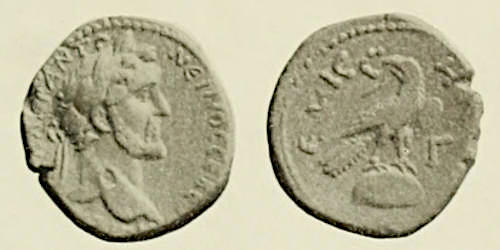
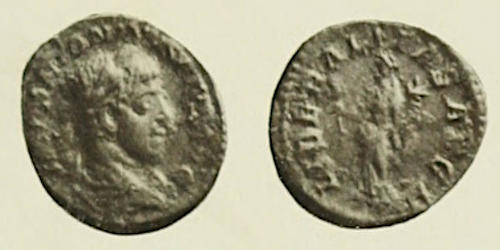
Coin of Antoninus Pius, struck at Emesa
(British Museum).
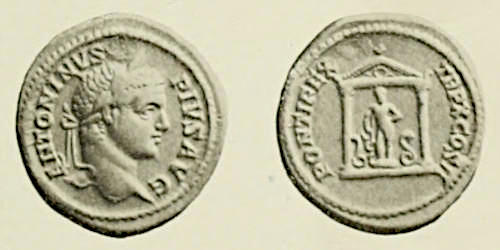
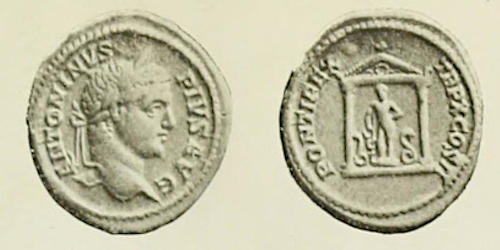
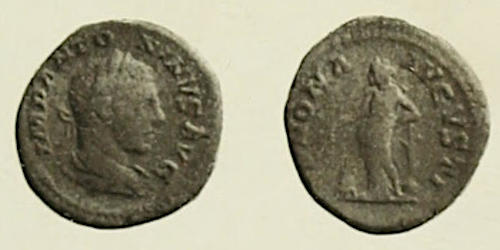
Coin of Marcus Aurelius Antoninus (Caracalla)
(British Museum).
In that first year of the reign of the Emperor
Commodus there was appointed to the command of
the fourth Scythian legion then quartered in Syria,
in all probability, as Peter thinks, at Emesa itself,
an African, one Septimius Severus by name, a native
of Leptis Magna in Tripoli, born in the year 146,
and therefore about the age of thirty-three years.
Whether or not he was a widower at the time is
uncertain. He had previously married a lady, by
name Marcia, but as no children by her are known
to have existed, it is probable that she was either
dead or repudiated by that year, added to which
his precocious inquiries as to the marriageable
young women in the neighbourhood presuppose
that the general was either free or at least travelling
en garçon.
The High Priest of the period was—according
to two references in the Epitome of Aurelius Victor—a
certain Julius Bassianus, descended in hereditary
line from the afore-mentioned Iamblichus. Certainly
he was not a plebeian, as Dion says, somewhat
sneeringly, when referring to his daughter’s origin,
unless, of course, Dion meant in point of comparison
with the rank to which she eventually attained.
It was certainly a happy chance that Bassianus
possessed not only a wise prophet, but also a superstitious
commander in the army of occupation, and
was astute enough to work both for the miraculous
profit of his house and lineage. Unfortunately he
had no daughter old enough for an immediate
marriage. She who is presumed the eldest,
Domna by name, was at the time only nine years of
age, having been born in the year 170, whilst her
sister Maesa was presumably somewhat younger.
But to return to the Oracle. In the year of
grace 179, when Septimus found himself in a peaceful
province, en garçon and very much admired, he
took an interest in the marriageable daughters of
important persons, like most young men of ambition
in their more calculating moments, and—being a
religious-minded man—he determined to consult
the gods, especially the famous voice which spoke
so near at hand. Here he learnt that to the
elder daughter of Bassianus was reserved, according
to her horoscope, the power of making the
man whom she should wed a king. It was an
ambitious height to which Septimius aspired, and
an ambition which would have cost him his life had
Commodus got bruit of the transaction. Nevertheless,
being a prudent man, and at the same
time ambitious, he resolved to let no chance slip.
He did what Bassianus expected—demanded the
lady’s hand and obtained the reversion thereof.
At what date the marriage took place is by no
means certain; there are two references in Dion
which are mutually exclusive. The first says that
the Empress Faustine (who, by the way, the
same Dion says, died in 175) herself prepared their
marriage bed in the precincts of the temple, which
sounds a highly unsatisfactory beginning to ordinary
matrimony. But as he has just told us that the
lady was of an age of five in the year above
mentioned, it is highly improbable that her nuptial
couch would be prepared by any one, or anywhere,
for some time to come, especially as there
is no indication that Septimius had heard of the
lady before 179, when he consulted the Oracle.
Again, Dion assumes that Marcia did not die until
Septimius was appointed Governor of Lyonese
Gaul about the year 187, so that her husband
could only have been playing with astrology, wise
prophets, and other things against the time when
the obex to solid matrimony should be removed.
Possibly even Dion is referring—when he drags in
the Empress Faustine—to Septimius’ first marriage,
or, as has been suggested, the whole thing was a
dream of either Septimius or Dion, probably both,
as both were much addicted to such proceedings.
Considering the so-called scandal against the lady’s
character, her proclivities, and the knowledge that
her eldest son Bassianus was born at Lyons on
April 4, 188, it is most natural to conclude that the
marriage took place some time in the spring of the
year 187, though the pledges may have been given
when the child was nine years old or thereabouts, and
the actual marriage deferred till Julia’s seventeenth
year, Septimius amusing himself in the interval,
after the manner of soldiers. It must be admitted
that, as the record of his scrapes is limited to
two, he was more discreet than the majority of his
profession.
His choice of a wife, if made on unusual grounds,
was more than successful. Few Emperors have
had more renowned ladies or more helpful spouses
than Julia Domna Pia, the daughter of Bassianus,
proved herself to Septimius. It was fortunate that
she had more than a horoscope to assist her in her
new position. Even the governorship of Lyonese
Gaul was an important post, and there she had
large scope for the use of her wit, learning, beauty,
and wisdom, in addition to her Syrophoenician
adaptability for amorous intrigues. By means of
which combination the family became people of
renown throughout the length and breadth of
Pertinax’s Empire, a circumstance which enabled
them, on the murder of that Emperor, to assume
the rôle of avengers, the deliverers of Rome, the
saviours of the Empire, which had now three heads
but no commander.
It was Julia, we are assured by Capitolinus, who
decided her husband to assume the Purple; it was
Julia who first amongst Empresses was Domna, or
Mistress, Mater Castrorum, Mater Senatus, Mater
Patriae, Mater Totius Populi Romani. Of course
she had the sad notoriety of being mother to
Caracalla, and late authors (vide Tertullian ad
Nationes) have reproached her with many indiscretions—have
even accused her of conspiring against
her husband; but Dion, who is by no means
partial to her, mentions neither accusation, and the
absurdity of the latter throws doubt, at least on
the public knowledge of the former story. In any
case her elevated mind, her four children, and her
rank, even when combined with her sun-warmed
nature, ought to have protected her from anything
except occasional amusements, of which she might
have preferred her husband ignorant. Julia’s real
fame rests on the basis of her character as a
mathematician, an astrologer, and a wise counsellor.
The fruit of her learning and philosophy has
been handed down to all time by her friend and
associate Philostratus in the dedication to her of
his Life of Apollonius, the miracle-worker of Tyana,
the Thaumaturge whose life and miracles are supposed
to form so large a part of the traditional life
of Jesus as it exists to-day.
In the palace Julia Domna had gathered round
her a circle of learned men, where all subjects were
discussed, and whence, in all probability, a contemporary
derived his idea of the Deipno sophistae.
It was a circle of rhetoricians, lawyers, astrologers,
physicians, philosophers, and historians, which included
men such as Cassius Dio, Ulpian, Papinian,
Paul, Galen, and Philostratus—one and all names
which speak volumes for the gravity of the lady and
the perfection of her taste. If, therefore, any truth
is to be attributed to the account of her frailties,
the worst that can be imagined of the pious Julia
is, that like the Virgin Queen of this country, she
took her recreations in those ways which nature
and temperament prompted, while the main business
of her life was social, political, and philosophical.
Many, like Bayle, have made merry over the carnal
anecdotes, though surely for a true judgment of her
character the preservation of a single conversation
with Philostratus of Lemnos would be worth the
record of a thousand dull intrigues—in surmise—for
which familiarity has bred contempt.
Besides which, Severus lived in the bosom of
his family, or rather of his wife’s family, the Bassiani.
With his two sons and two daughters there
had come to Rome about the year A.D. 193 the family
of his wife’s sister Julia Maesa, a lady for whom
fate had provided no Imperial horoscope, and who
in consequence had no right to be anything like
as ambitious as her sister the Empress. Maesa
was, however, equally beautiful, equally clever,
and equally determined to climb, if climbing were
possible. To her mind Rome was the place where
fortunes were to be made if you had an Imperial
connection, so to Rome Maesa came. She had
married, at an early age, the Proconsul Julius
Avitus, by no means an undistinguished government
servant. The fact that he held the governments
of Asia, Mesopotamia, and Cyprus successively,
and was Consul in the year 209, says
something for the trust which was reposed in him.
He seems to have been resident in Rome in his
own mansion on the Aesquiline—according to
Lanciani—from the year 193, a fact which presupposes
that he was already a man of wealth
and position, who considered himself justified—on
account of his relation to the Imperial home—in
resigning the government of the provinces, though
at no time was the proconsulship an unprofitable
possession, even for the most upright. Herodian
testifies most fully to the wealth of the family, leading
us to suppose that Maesa knew full well that
“poverty is no recommendation anywhere,” and
had amassed money accordingly.
At the period now before us Maesa’s political ability
seems to have had little or no scope. It was gold
she wanted at that time, and gold she was getting
together against an emergency. This emergency
fate provided under the Emperor Macrinus, and
she was thus enabled to use her stores of gold and
statecraft with much profit both under Elagabalus
and in the early years of Alexander’s reign. She was
then free, and showed herself in her true colours,
a sort of Dowager-Empress after the Chinese
pattern, greedy, with a terrible eagerness for power,
authority, and a command such as Julia with more
good sense had never thought of encompassing.
It was a longing that she had to satisfy at the
price of her treasure, her popularity—if ever she had
any—even at the price of her own children’s blood.
Maesa’s family consisted of two daughters, whose
sons were both to become renowned Emperors,
men whose names live by their very eccentricities,
though their deeds are but far-off fables
meet for the acrimonious discussions which make
historians famous. Of the two daughters, Soaemias,
or Symiamira, the elder, was less of the politician, had
less of the calculating, self-possessed individuality
which was so strong in both her mother and sister,
who were both women with the true courtesan
instinct, which could turn their very amours to
substantial account. Soaemias was certainly no
ruler. She was a living, passionate, human woman,
full of the joy of life, generous both for good
and evil, courageous too, according to Herodian.
By common consent, she was voluptuous, devoted
to those who loved her, willing to give her very
life for that of her well-loved son. A woman who
was bound to be popular with men, and hated by
her sisters for all time, both on account of her
qualities and her defects. To such a nature the
position Lampridius ascribes in the state would
have been utterly impossible. Nor is this borne
out anywhere by the existing inscriptions, which
always make Soaemias take a place second to
that of Maesa, except in the Senate on the Quirinal,
which was her special concern.
Soaemias married some time before the year
204 Sextus Varius Marcellus. He was, according
to Dion, a native of Apamea, and a man of some
considerable prominence. As early as 196 we
hear of him in the position of Procurator Aquarum,
and his advancement, presumably helped by his
connection with royalty, was very rapid. Through
the usual grades of procuratorships he reached the
rank of Praefect in early life, and thence the height
of ambition, the Praetorian class of the Senatorial
order. At the time of his death he was about
to complete his term of office as Legatus Legionis
III. Augustae, Praeses provinciae Numidiae, or may
just have vacated that position; at least such is the
reading of the inscription according to Domaszewski,
who puts his death some time in the year A.D. 217.
The young couple seem to have had an estate at
Velletri, a city some twenty-five miles south of Rome;
as here Varius Marcellus’ funeral inscription was
found some short time back. Whether or not her
husband’s praefectorial duties left Soaemias much
to herself can be judged by the statement, made
by all authorities, that she spent the greater part
of her time with her aunt at Court, which she could
scarcely have done had her husband been at
Velletri. There is a question raised by Eckhel
as to the number of her children; he cites from
a Bilingue Marmor, which contains the inscription—“Julia
Soaemias Bassiana cum filis,” but as this
is the only mention of any children, apart from
Bassianus himself, the others have passed into
obscure oblivion. Probably this mention is responsible
for more than one of the many scandalous
stories which centre round her name. She certainly
had one son, Varius Avitus Bassianus (sometimes
also called Lupus). Whether he was first, second,
or last, we have no sort of information. Various
writers give the boy different names in early life;
few agree even as to the year of his birth. Dion
says that he was born on October 1, 204. Herodian,
for no discoverable reason, puts it as early
as 201, while both Ammianus Marcellinus and
Julianus imply that his birthplace was Emesa, which
latter fact seems most improbable. Bassianus’
very parentage is obscure, on account of the reputation
which his mother had acquired during her
residence in Rome. Certainly her cousin Caracalla
admired her, but he admired most women of the type,
and if we can believe any of the scandals, Soaemias
was in no way averse to passing her time in
amorous converse with her very vigorous cousin,
or indeed with any other strong and healthy
soldiers who thronged the imperial ante-chambers.
This state of affairs seems to have been one of
which people in Rome were well aware, as was
testified by the vestal whom Caracalla, having impotently
failed to violate, burned alive, protesting
her innocence on the grounds that Soaemias had
put it beyond the power of Caracalla to violate her
when he tried.
In one way it was a misfortune for her son that
no one could fix exactly—perhaps his mother least
of all—the paternity of Bassianus, though, on the
other hand, this very uncertainty had its peculiar
uses at the psychological moment. Certainly the
discovery that she had other children, whilst Bassianus
alone comes to the front, lends countenance
to the official story that her attachment to Caracalla
was not unfruitful, while the name Bassianus, which
her son bore, was the name by which Caracalla was
always known until the time of his proclamation,
and even afterwards. At any rate there is nothing
unlikely in the imperial paternity which all authors
mention, some as conjectural, some even assuming
as a fact, with, however, very little chance of ascertaining
the arcana of the circumstances. There is and
can be, at any rate medically speaking, no truth in
the abominable suggestion of Lampridius, that the
boy was named Varius on account of the variety of
gentlemen who contributed to his mise en scène,
especially when Lampridius knew, if he knew anything
at all, that the lady’s husband was by name
Varius. What, therefore, was more natural than that
the lad should bear the family name along with the
other belonging to his natural father the Emperor
Bassianus?
The reputed birthplace is certainly a mystery.
Why Soaemias should have taken the long and tiring
journey to Emesa, when she could have enjoyed
herself so much better in Rome, has never been
explained. Even though the birth were an accident
which she wished to conceal from her husband,
why go to Emesa, where she was best known outside
Rome, and where people could talk just as
well as in the imperial city? Her husband may
have been absent on military or civil duty for
too long a time to stop people talking about the
interesting event (in some provinces the tenure of
office was five years), which would suggest things
best left undiscovered, but even then there were
many such accidents happening in the best-regulated
families. No one would be shocked, her family
was in too good a position to allow any such
expression of feeling; she was a married woman
and could claim the protection of that state of life
at Terracina, or Baiae, or any other seaside resort,
until the time was safely over. There seems no
suggestion possible that will accord with Julianus’
implication. It may be true, though we can see no
earthly reason for the journey, and, in the absence
of corroboration, we may conclude that in all probability
it is merely a loose way of saying that
the family of a man belongs to a certain village
or island, without necessarily implying that the
person in question was himself born there. It
may even be a backhanded way of disparaging the
birth of him whose memory had to be slighted,
by saying that he was a mere provincial nobody,
whilst the birth of his murderer and successor is
vaunted and raised to great splendour by circumstantial
untruth, in order to prove him fully capax
imperii.
The second daughter of Julia Maesa was Julia
Mamaea. While still abroad with her family, she
had married another Syrian, by name Gessianus Marcianus,
a native of Arca. Nothing is known of him
except from Dion’s statement that he had filled, more
than once, the office of Imperial Procurator. By this
marriage Mamaea incurred the capitis diminutio
on account of the inferior rank of her husband,
but by means of a privilegium from Severus and
Caracalla she was allowed to retain her own Senatorial
rank. Of this admirable woman none of the
frailties so common amongst her family and relations
are reported. She lived and died a model of
unswerving rectitude. This affectation she carried
almost to the Jesuit extreme, when she made use
of her reputation and wealth to obtain the murder
of the nephew of whom she so highly disapproved
and by whose murder she would benefit
so materially. There is, of course, the story of one
indiscretion with Caracalla, by means of which she
consented to gain popularity for her son. She, as
well as her sister, claimed the distinction of having
been Caracalla’s mistress, and Alexianus, as well as
Bassianus, was claimed as the result of that cousin’s
too amorous embraces. The admission was doubtless
due rather to a hypocritical affectation of
wickedness, prompted by the political exigencies
of the moment, than to the fact that her cold and
stately beauty had unbent to tempt a too ardent
cousin by the offer of those seductive attractions
which he could get so easily elsewhere. Especially
as the assumption of this rôle of temptress might
cause her in after-life all the reproaches of a misspent
youth, with little to show for the sacrifice.
Perhaps mention ought to be made of the opinion
of Dexippus, that the boys Bassianus and Alexianus
were cousins-german paternal, which, as we know
from theologians, when they are fitting facts to
theory, is the same thing as brothers by the same
father. Certainly Mamaea’s beauty is remarkable.
As we see it in her bust at the Louvre, she is a
younger edition of her aunt Julia, perhaps without
the humanity and gentleness expressed in that lady’s
portrait, which is to be found in the Rotondo at the
Vatican, but there is a real resemblance between
the two. Both, though Syrian by race, are remarkably
Western in type, whereas the features of Julia
Soaemias—in the statue representing her as Venus
Coelestis, also in the Vatican museum—are distinctly
of a more Oriental cast. Soaemias’ form is
most beautiful, though it must be confessed that her
head and arms would have pleased Rubens’ taste
better than they do our present pre-Raphaelite
ideas of attractiveness. Soaemias’ history, however,
leaves no doubt in our minds that all men
considered her the more attractive at the time;
and certainly, if but a tittle of the stories concerning
her be true, she must have been as fascinating as
the goddess in whose form she has been portrayed.
We have now before us the main personages
in the political revolution of the year A.D. 218, a
revolution which displaced the Moor, the beloved
of the Senate, and replaced the house of Severus,
the beloved of the army, upon that peak whereon
the young Emperors of old Rome balanced themselves—a
peak with a precipice on either side.
First, there is the Empress Julia Domna Pia,
clever, witty, sagacious, and beautiful.
Then her sister, Julia Maesa, Sanctissima,—for
so her religiosity is described—the widow of Julius
Avitus, wealthy, hard, crafty, and domineering, but
a woman with a policy and limitless determination,
as her later history shows. Then her two
daughters—
(1) Julia Soaemias Bassiana, the wife of Varius
Marcellus, beautiful, voluptuous, religious, neurotic,
the mother of Elagabalus, a woman with few, if any,
political aspirations, tendencies, or abilities.
(2) Julia Mamaea, the upright (except when
other things paid better), classic, cold, calculating,
philosophic, mildly interested in Christianity, and
devoted to the interests of her own family.
Finally, the two successive Emperors, their sons,
Varius Avitus Bassianus, the impulsive, affectionate,
headstrong child of about thirteen years, with all his
mother’s hereditary sexuality, neurotic religion, and
love of life; and Alexianus, a child of approximately
nine, Mamaea’s son, and bearing her reputation, of
whom more at a later time.
Let us follow in outline the actions and movements
of this family from the death of the Emperor
Antoninus Caracalla to the inception of the movement
which placed his, at least reputed, son in his
place.
Medal of Julia Domna Pia, Empress (British Museum).
Without doubt the family had lived securely and
delicately in Rome through the reigns of Septimius
Severus and his son, growing in wisdom, stature,
and prosperity, and, as far as we know, in favour
with God and man, until the tragic events of the
year 217 made it appear that the fortunes of the family
had come to a sudden and decided collapse. The
circumstances of the death of Caracalla were typical
of that age of sovereignty. As a general rule the
knife gave what a dish of mushrooms took away.
Caracalla’s government had been cruel and severe
in the extreme, but he was adored by the army, with
whom he lived and worked, not as Emperor, but as
comrade. For them he could never do enough in
the way of privileges, for them the treasury was
depleted, and cities turned into cemeteries that they
might have the booty. Fighting was as natural to
him as to a tiger cat; and fighting he died. It was
for the pursuit of a campaign against the Parthians
that the Emperor and Court had moved to Antioch
in Syria, where Julia, his mother, was acting as
Secretary of State, while the Emperor was bounding
like a panther upon the various cities of Mesopotamia.
In the pursuit of her duties, it happened
that there came into her hands certain letters
warning her of a plot against her son’s life.
With the army at that time was a praefect, Opilius
Macrinus by name, a Moorish lawyer of low birth
and pedantic habits. He had been procurator to
Plautianus, the so-called traitor, whom both Julia
and Caracalla had hated. Now Macrinus had been
honoured by Severus after Plautianus’ murder, and
still stood high in the imperial favour—though he
was treated by the Emperor, says Dion, as a sort of
buffoon. Macrinus had dreamed that the purple
should be his, and was supported in his wish by
the African astrologer Serapion, who was obliging
enough to prophesy the speedy demise of Aurelius
Antonine in Macrinus’ favour.
Julia immediately sent dispatches containing
the account of what was going forward to her son,
who, as usual, was absent from the city. When
these arrived in the camp, Caracalla was just
mounting his chariot, and gave orders that the
mail should be taken first to Macrinus, who would
sift its contents and only bring what was necessary
to the Emperor. Thus did Macrinus learn that
his treachery was discovered and a death-sentence
for real or supposed treason imminent, which unpleasant
certainty he resolved to obviate without
further delay. In a very few days he had discovered
a discontented person willing to do his work, one
Martialis, a centurion, whose brother, according
to Herodian, had recently been executed for some
military offence, or, in Dion’s version, because he
was angered at his own tardy promotion. These
two discussed the matter and resolved on the
extermination of their mutual grievance, Martialis
to do the deed.
The opportunity came on the 8th April 217,
when Caracalla was on a journey to visit the temple
of the Moon at Charrae in Mesopotamia. By the
way, he had occasion to dismount for purposes of
natural relief, and withdrew somewhat from his staff,
thus leaving himself unprotected. Martialis saw
his opportunity. On the pretext of having been
called, he rushed up and stabbed the defenceless
Emperor in the back, then made off, followed by the
German officers, who immediately got wind of what
had been done. He was the cat’s paw, and suffered
the penalty that Macrinus had foreseen would be
his. Four days later, and, faute de mieux, the army
offered the Empire to this same Macrinus, little
wotting for the moment what his part had been in
the tragedy they deplored, desiring only a leader
against the approaching forces of King Artabanus.
As usual, according to Herodian, the Senate breathed
a sigh of relief when the Emperor died. In their
effete condition they were only too anxious to change
masters as often as possible. With a want of political
sense and ability, which so well merited the
treatment they received at the hands of their tyrants,
that august body continually preferred—with an
entire lack of statesmanship—the unknown to the
known evils of their future.
At the time of Caracalla’s death, Julia’s chief
grief was at the loss of her influence. During the
last quarter of a century she had had the world at
her feet, and not the world of sycophants by any
means. Latterly she had enjoyed the supreme
power, and must have had enormous patronage in
her hands; naturally her nominees would be men
eager in her interest and support. Dion seems
to say that her first idea was one of suicide, as a
means of escaping her loss of prestige, but he shows
us that her fears proved groundless, since the
new Emperor left her in Antioch with the outward
marks of her dignity unaltered. It was certainly
not a wise policy from Macrinus’ point of view.
Julia, knowing at least of his treachery, and ably
assisted by her crafty sister, took advantage of the
mismanagement of the Parthian campaign, and the
insensate strictness with which this pedantic lawyer
immediately attempted to reform the manners of
his young soldiers, to suggest that she herself would
make a better ruler than this pedagogue (at least,
so one gathers from Dion, 78-23). It was a
chimerical scheme at best, and as Julia knew her
Rome so well, she must have realized that no
woman could have a chance, as sole ruler, in such
an environment. It is therefore more natural to
suppose that if she attempted anything at all, it
was to suggest some youth to the army in
whose name she could exercise the power she
loved; and who was more natural than the son
of Soaemias and Caracalla? It is conjectural, of
course, but the report of his paternity seems already
to have been abroad, and will account for the
extraordinary alacrity with which the troops received
the lad a few months later. At any rate,
something caused Macrinus to change his mind as
to the advisability of allowing Julia and her relations
to remain longer in the Eastern capital.
Thus he ordered them to return at once to Emesa,
whence they were sprung. Julia was too proud
to submit to the condition of subject under the
adventurer whom her family had raised from
nothing, or to become after so much grandeur
an object of public pity. She resolved, therefore, to
escape from her distress like a Stoic of ancient
days. Moreover, she was suffering from a disease
which is still considered incurable. Death was
approaching her; she went out to meet it, and
either allowed herself to die of starvation or pierced
her cancer with a poisoned dagger. The report
that Macrinus had ordered her suicide is quite
incompatible with his other dealings towards the
family of Bassianus.
Maesa, more prudent and more far-seeing, resolved
to obey the order literally, and returned with
her widowed daughters (Dion), their two sons, and
all her vast treasure to her native city of Emesa,
some 125 miles south of Antioch. Here, as we
have already pointed out, the family was of immense
importance, not only on account of their hereditary
position, but by reason of their wealth and imperial
connections. Macrinus’ short tenure of office is one
continual record of gross blunders, of which this is
about the most futile, comparable only with a few
similar acts perpetrated by our own Stuart dynasty
and the last hereditary kings of France. Emesa
was the one place in the Empire where Maesa had
real power and authority. A whole city would
back her pretensions and further her schemes with
a devotion that Macrinus could only expect from
the handful of Moors who formed his bodyguard.
CHAPTER III THE USURPATION AND FALL OF MACRINUS, 217-218
Steps to Empire
As we have suggested, Maesa saw more possibilities
in living than in assaying that better part
which can never be taken from men, which circumstance
shows that she at least was not tainted with
the growing superstition that a mythical eternity is
preferable to a certain present. She promptly
obeyed the edict of banishment which Macrinus
had published against the relations of the murdered
Emperor, and, as we have said, took with her to her
native city the whole of her wealth and belongings.
It was some time during the winter of 217/18 that
Macrinus ordered the family of Bassianus to leave
Antioch, and it was this very departure that eventually
cost him his throne and life. Certainly he must
have known that plans for replacing the house of
Antonine on the throne were rife. The final result
shows months of work, effected only by hosts of
agents. In fact, we may almost surmise that government
servants all over the Empire had never
acquiesced in the usurpation of Macrinus at all,
and were merely biding their time. There was only
one safe plan for Macrinus, if he wanted the loyalty
of the civil and military parties in the state, namely,
to extirpate the whole house of Antonine. Instead
of taking this sensible and necessary measure, he
merely banished the relations of Caracalla, whom
the soldiers regarded as their natural allies, most
especially the son and impersonator of that Emperor,
the young Bassianus, now aged about fourteen
years.
They had more than one grudge against
Macrinus. First, they felt the utter disgrace of
the Parthian campaign, and were disgusted at the
lying medal to celebrate a victory which all the
world knew to have been a colossal defeat. Next,
they were righteously annoyed at the restrictions
put on their usual liberty. Third, they were quite
unnecessarily relegated, on half rations, to uncomfortable
winter quarters, their pay reduced, and
their privileges stopped.
It is easy to imagine the soldiers’ disgust at
finding themselves subjects to a mere legal pedant,
in the place of their popular idol and born leader
Caracalla, subjects of a man whose prime object
seemed to be the infliction of harsh and unnecessary
punishments in all matters concerning the ordinary
enjoyments common to their state and life—a ruler
whose first reforms were to make criminal offences
those natural pleasures which were alone considered
to make the strenuous military life endurable.
Tristran, quoting from Dion, recalls a
law which ordained the burning alive of a soldier
and his mistress (junctis corporibus); or, as an act
of grace, their walling up together (in the same
interesting condition), and their being left to die of
hunger and suffocation. This feeling of rebellion
was by no means lessened when men knew that
the new Emperor was taking his ease at Antioch,
the Queen of the East, and they compared this
treatment with what they had received from their
friend and comrade the late Emperor. Macrinus
was full of regulations for others, but fully impressed
with the legal maxim that the lawgiver is above
the law. It is small wonder, all things considered,
if the prayers of that host were that the
Gods would favour their suppliants both in their
hatreds and in their lusts, prayers that were offered
in such right Davidic fashion that Forquet de Dorne
thinks the attempts made even during this period
against the Emperor’s life would have been successful,
if it had not been for the fidelity of
his fellow Moors. Macrinus, like other amateur
soldiers, did not recognise the power of the army
in the government of a military empire. He seems
to have thought that the best way to play up to his
electors was to adopt a title of Severus and display
it towards them in all its rigour. Not that Macrinus’
incapacity as a statesman and military leader ceased
here; he made a yet greater mistake in leaving a
large and discontented army in winter quarters in
Syria, partly at Emesa itself. These legions were
nominally for the protection of Phoenicia; actually,
they kept Maesa in touch with the outside world,
and were under the direct influence of her active
brain and limitless treasure, for to such Herodian
gives us to understand that her spoils approximated.
Little could the Moor have imagined what a volcano
he was preparing for himself when he left together
the discontented legionaries, the aunt of Caracalla,
and the representative of the house and name of
Severus: whose title to bastardy henceforward
became of prime importance to the family and their
fortunes.
Julia Maesa had not lived for twenty-five years
at the Roman Court for nothing. She knew the
men with whom she had to deal, she was accustomed
to observe and meditate; further, she had
gold which openeth the heart of man, and an intelligence
quite acute enough to know where it
could best be spent in order to yield the largest
return. Besides this, she had a grandson celebrated
for his remarkable beauty, his vivid intelligence,
and his admirable gaiety. For such a youth
employment must be found immediately. Here at
Emesa was the very thing ready to hand, the
sacerdotal position which was the property of the
family. Maesa knew that a high position in the
Church is an acquisition which, even in this life, is
of lucrative and social advantage to the holder.
The High-Priesthood of one of the most important
religions of Syria was Bassianus’ possession for the
mere trouble of undergoing the ordination rite,
while with it there still went a certain amount of
the former princely kudos of that house. No sooner
had the family, with apparent grief and tribulation,
covered the intervening miles, than Bassianus was
endowed with the family offices, dignities, and
emoluments, while his cousin Alexianus was most
probably associated with him as a sort of priest
or acolyte. A very fitting figure the boy made as
High Priest of the Semitic Elagabal or Sun God,
the God of Gods made without hands, supreme,
fecund, potent, and glorious. Elagabal was worshipped
under the symbol of a great black stone or
meteorite, in the shape of a Phallus, which, having
fallen from the heavens, represented a true portion
of the Godhead, much after the style of those
black stone images popularly venerated in Normandy
and other parts of Europe to-day. The
temple itself was of great renown; its celebrity
was gained from the fact that it represented the
greatest natural force of all time, and its magnificence
was in proportion to its renown. Gold,
silver, and precious stones had poured into it, not
only from the countryside and from Judea, but from
kings, satraps, and vassals all over the Eastern
provinces. Solomon’s temple, though nominally
the last word in barbaric ostentation, was easily
surpassed in taste, richness, and splendour at
Emesa. Herodian paints vividly the sensuous
beauty of the worship, the vestments, the music,
the dances, the sacrifices, and the mysteries, till
one has only to substitute Jehovah for Baal, and one
has a familiar scene; rather more splendid, rather
more cosmopolitan than the Jerusalem mysteries,
but equally designed to entrance the beholder and
to mystify the devout. But whereas Baal drew
all men within his warm, natural, fecund embrace,
Jehovah was at best a local deity whom no one—save
those urged on by tribal necessities—had
ever thought it worth while to propitiate, let alone
to serve, at least if we can form any idea of his
importance from the Semitic literature and philosophy
when compared with that of the Western
Empire.
Into all this power and sensuous beauty Bassianus
stepped proudly, as supreme lord, knowing
how well it became his own splendid magnificence.
He must have been warned that it was but a means
to an end, that here he had no abiding city; but
unfortunately he had a strong strain of mystical
devotion in his blood, and immediately became an
enthusiast for his deity. From the first moment
that he appears upon the scene the boy is always the
same, impulsive, enthusiastic, mystical, continually
dominated by that effete neuroticism which still
trades under the name of religion. Thus Bassianus
gloried in the beauty, which to his mind expressed,
however inadequately, the potency of his ineffable
deity. Here was a God who was able to make men
happy, and had taken him into a very specially protective
embrace; a God who was evidently supreme,
only, and alone, the God of the Universe. Further,
Bassianus gloried in his own beauty, the perfection
with which he had learnt to dance that indolent
measure to the kiss of flutes, robed in garments the
like of which he had not imagined during his residence
in the city of the Caesars.
Now, it will be remembered that Caracalla’s
soldiers were wintering, half-fed, loveless, and discontented
in that place, and, as is not uncommon with
simple men of that profession, they were easily
attracted by the mysterious and the unusual. Soon
they heard of this wonderful boy, in whose face was
the enigmatic beauty shared by Gods and women;
and further, it was rumoured that, unlike most religious
functionaries, this priest was more ready to
give than to receive. They came in scores to watch
and worship, and found, when they came, that he
possessed the charm of the dissolute and the wayward,
heightened by the divine. On his head was
a diadem set with precious stones, whose iridescence
sparkled like a luminous aureole about his brow.
His frail tunic was of clinging purple silk diapered
with gold, the sleeves were wide, after the Phoenician
fashion, and fell to his feet, and he was shod with
fine gilded leather reaching to his thighs. Many of
those who gazed upon him must have seen and
remarked his beauty in the great City of the
Empire, whilst those who ascended to the temple
and beheld its rites believed each day more strongly
(assisted, of course, by Maesa’s well-spent incentive)
that they beheld the child of destiny. Never had
his beauty appealed as now; never had the soldiery
felt the need of a deliverer as much as at present.
Still the numbers—attracted by rumour—grew
greater till the lad, feeling the return of Rome
to himself, ceased to dance, and strolled amongst
his beloved soldiers, surveying them with the
bold feminine eyes they loved. Amongst the
troops was a certain Eutychianus, called by
Xiphilinus, Comazon, because he took part in
mimes and farces. He was a soldier of some age
and renown who had served in Thrace under the
Emperor Commodus, and was a man of growing
influence and ability. Publius Valerius Comazon
Eutychianus was the full name of the man, who was
highly honoured for his part in the subsequent
proceedings. It is impossible to believe that
this man was merely an actor, indeed it is most
probable that the abridger of Dion has thought
fit to introduce a bit of gratuitously impossible
information when he remarks that Eutychianus
was only a freed man of the Emperor and an
actor. During the reign of Elagabalus he was
once Consul and twice City Praefect, and was
again appointed to this same office under the
Emperor Alexander.
This man and the tutor Gannys seem to have
been the means of forcing home on the neglected
legionaries two most important items of information.
Through them the soldiers were reminded
that Bassianus was their murdered comrade’s son
and heir, issue of the Emperor and his equally
popular cousin Soaemias—that fiery-eyed woman
of superb bearing, before whom fire had been
carried as before an Empress, and yet one whose
favours had ever been for the strong, whose predilections
were for the military. Here they found
her again, passionate as ever, banished on account
of her relationship to their dead leader, and banished
by the man they now knew to be his murderer.
And further, they found her rich. Sedulously she
caused the rumour of her generosity to circulate,
until all men knew about the lumps of gold she
was ready to give to any one who would place her
Antonine on the throne of his father. It may have
been that more than one in that camp could have
traced a resemblance to himself in the young
priest’s features, but none did, the lumps of gold
had a language all their own, a persuasive power
so potent that not only was Bassianus recognised
with a frenzy of loyalty, but his less attractive
cousin Alexianus was accepted as his half-brother,
a youth whose imperial paternity was at least as
possible as his own.
Now the question was, could anything be done
to put these protestations of loyalty to some
practical use? Bassianus was certainly accepted
by the legionaries early in the year 218 as the
legitimate bastard and heir of Caracalla; the true
Augustus, deprived of his throne and heritage by
the hated Moor,—the man who had killed their
idol, and was now oppressing them (which was
perhaps more to the point) with the multitude of
his civilian parsimonies.
Already Maesa’s plans (or were they those of
Julia Pia?) were taking shape in a manner almost
too good to be true, when, to the help of the youth
and his relatives, came the divine portents, which
were the accustomed foreshadowings of important
events. The great God veiled his face. Elagabal
signified his displeasure at the rule of the murderer
by an eclipse, and following on the eclipse came a
comet, a daystar from on high (another frequently
recurring sign of the rise of a redeemer and of the
rejuvenation of the world). These signs and portents
were doubtless adequately explained to the soldiers,
and seem to have decided them to redeem their
promises. Within four days, according to Wirth,
it was decided that Bassianus should repair to the
camp with his treasure, and be proclaimed Emperor
by the whole army in that province. Of course, all
this took time. Authorities differ, not only as to
the method adopted, but also as to the month in
which the proclamation took place. Dion states
definitely that Bassianus was proclaimed Emperor
at dawn on 16th May 218. Wirth, criticising Dion,
decides that the proclamation took place almost
immediately after the eclipse, which we know from
Oppolzer took place on 12th April. He quotes
Dion’s own words that the proclamation took place
ὑπὸ τὰς ἠμέρας ἐκείνας of the eclipse; therefore 16th
May is obviously a scribe’s error for 16th April, as
the phrase is quite incapable of bearing the meaning
within thirty-four days. Further, Wirth goes on
to explain that haste was an obvious necessity, as
no troops would ever be left in winter quarters till
the middle of May. The middle of April, in that
province, was more than late enough to account for
Dion’s statement that the troops had been unduly
delayed in winter quarters that year. Undoubtedly,
Wirth’s suggestion as to an earlier date of proclamation
than that stated in the present text of Dion
is the most likely; the difficulty lies in the fact that
from 16th April to 8th June, the date of the battle,
there is a period of seven weeks in which the active
Maesa apparently did nothing; but more of this
later. To continue with the story. When the
preparations were ready, and the portents of the
eclipse had decided the superstitious, Dion says that
Bassianus, Maesa, and the family of the Bassiani,
with wagons bearing their treasure, the ransom
of the Empire, left the city, and took up their
quarters within the camp on the night of 15th April
(or 15th May) 218. Herodian says that only Bassianus
and Eutychianus went, and by stealth, as
Maesa was ignorant of the final plans, though both
agree that at dawn on the next day the High Priest,
Bassianus, was brought out, shown to the soldiers,
habited in the clothes that Caracalla had worn,
and then, Macrinus having been deposed, Bassianus
was elected Emperor in his stead, under the title
of Marcus Aurelius Antoninus, Antonini Filius,
Severi Nepos, Augustus, Pius, Felix. Herodian
adds that the camp was at once fortified, both to
protect the young Emperor—who, like his putative
father, preferred the camp to the palace—and also
to withstand the punitive expedition which Macrinus
was bound to send as soon as he heard of the
revolt and mutiny. The news would take at least
a couple of days to reach Antioch, if not considerably
longer, considering that the soldiers had taken
care to keep the proceedings within the camp.
In due course Macrinus heard of their audacity.
He was astonished and disgusted, and frankly said
so. The account which he sent to the Senate
was not pleasant reading for any of those it concerned;
but except by means of the pen, the nominally
deposed Emperor did not think that much
need be done. Still, that a mere boy, with a handful
of women, should have seduced the defenders
of a province was preposterous. Something must
be done to show the soldiery that, though Caracalla
might have stood such freedom of choice (which
by the way he never did), he, Macrinus, was now
master of the Empire, and incidentally their master
as well. It was a veritable storm in a tea-cup,
of course, but really upsetting to the man who
thought that his troubles were now over, that rest
remained for the elect of the Gods. The remarkable
thing about Macrinus is, that he seems to
have been absolutely in the dark as to the state
of public opinion, and the extent of the plot for
replacing the Antonine House on the throne. As
we read the history of Bassianus’ phenomenal
rise to power, there is a ring of the English
Restoration. It is impossible to account for
his universal success except on the grounds that
the government officials everywhere as well as the
soldiers recognised in him a legitimate sovereign and
an obvious ruler. From the moment at which he
set up his standard there seems to have been
no sort of adequate opposition either from the civil
or military government of Macrinus; while, on
the other hand, Bassianus obviously had a party
organised in every city and province, which was
sedulously kept informed of his progress from day to
day. Not only a party, but the party, as there is no
instance—except at Alexandria, where the Antonines
were scarcely popular—of Bassianus’ legates being
received otherwise than with open arms. None
of which facts argue well for the position of the
Moor in the state. Macrinus was inclined to
overestimate his popularity, and he certainly underestimated
the influence of youths and women.
Perhaps he had no experience of female tactics,
and the persistency with which they prosecute their
own designs; he obviously thought a sententious
letter to the Senate, full of smug platitudes, abuse
of the army and the house of Antonine, was what
that august assembly wanted. So far he had not
missed his mark; but when he went on to inform
them that they would never have any desire to
wish him any hurt, one of the Senators, Fulvius
Diogenianus by name (who was obviously better
informed than the majority as to the likelihood
of their having to put up with Macrinus much
longer), answered immediately and with surprising
candour, “But that is what we are all longing for”;
whereupon the Senate sent word to the army that
their general and Emperor was not to be trusted
on several counts.
Macrinus, however, was not entirely idle; he
had at least begun to think. True, he had, for
himself, preferred the pen to the sword, and then
found that the pen was a double-edged weapon
like the sword, only rather more dangerous, because
it constituted documentary evidence. Still, he
would not let others err in the same way. He
sent for his Praetorian Praefect, Ulpius Julianus,
to attend at his silken couch and talk business.
The result of this conference was that Macrinus
resolved to strike fear, by proxy of course, into
the hearts of that “child and idiot,” his two women,
and the legion who supported him; and where, he
argued, would the revolt be when their hopes,
centred in a child, too young to know even the
rudiments of politics, were suddenly blighted? Of
course, he would like news, and yes, he thought
he had better say it, the boy’s head in a charger—stone-dead
hath no fellow. It would put the
Emperor quite at his ease once again to know that
his rival was dead. It was perhaps foolish to be
concerned about so effete a crew, nothing could
come of it all; but still he would feel relieved if
Julian would go at once to Emesa.
We are not told how long Julian took in his
preparations, or on the journey. From Macrinus’
attitude of disregard, probably he was not specially
pressed, though from his selection of troops Julian
must have thought the rising more important than
Macrinus had pretended in his letter to the Senate.
Julian’s chief anxiety was to secure loyalty to
Macrinus amongst the men he took for the suppression
of this revolt. Certain incautious speculations
amongst the men led to the execution
of several before the expedition started. From
his position as Praetorian Praefect, Julian would
take a fair contingent; his dignity demanded
it, and probably his knowledge of the state of
politics would tell him that a strong movement was
necessary at the outset. Apparently about three
legions went in all. Julian added to his forces a
large number of Moors, unless Herodian means
that he took the Moorish cohorts of the Praetorian
Guard as main body, and added other men to
these; in any case, it seems obvious that, even if
the government had not got wind of what was
going forward, the army had, and in consequence
the Moors, as Macrinus’ own countrymen, were
considered the most trustworthy soldiers for the
work, besides which they were never over-particular
in their methods. There is evidence that, no matter
how much he might belittle the movement in public,
Macrinus knew that the “Idiot” and his two women
were likely to have a full dog’s chance, and get
a good run for their money.
The journey from Antioch to Emesa is, as
we have said, a matter of 125 miles. The
report of the meeting inside the camp had to
reach Macrinus; he had to get his mind attuned
to the extraordinary circumstances; then appoint
Julian, who had to make his inquisition and
other preparations, and then get to Emesa. Conjecturally,
he could not have arrived with an
effective force much before the 28th of April, or
settled down to attack the fortified camp outside
the city till that day. On the first day, Dion tells
us that Julian all but took the camp in a long day’s
fight; but it was heavy work, and, contrary to
Macrinus’ expectation, the arrival of Julian had not
struck fear into the heart of the “effeminate and
debauched Syrian lad,” who was still with his
soldiers, and showed no intention of giving way
even when the sun began to decline in the west.
Coin of Marcus Aurelius Antoninus (Caracalla)
(British Museum).
Coin of Marcus Aurelius Antoninus (Elagabalus)
(British Museum).
Coin of Macrinus recording Victoria Parthica, A.D. 218.
(From a woodcut.)
Coin of Diadumenianus as Emperor, A.D. 218 (British Museum).
Unfortunately for Julian—and incidentally for
his master also, as things turned out—the Praefect
thought that “the night cometh in which no man
can work,” and gave his Moors leave to retire to
their lines at sunset. With them went certain
of the Emesan legionaries, displaying a hardihood
truly heroic, unless they were fairly sure of their
ground. All that night they worked, spreading
their evangel, talking, persuading, and promising on
behalf of Antonine and his gold; talking until even
the besieging Moors knew full well that those walls
held not only the son of Caracalla, but the limitless
wealth which he was ready to give to all those who
would assist him in reaching the throne of his father
and their hero. It was enough. When morning
broke, the vision of his Augustitude was seen above
the walls of the camp, dressed in garments which
they could recognize from their colour and shape as
having belonged to Caracalla, and surrounded by
his money bags. There he stood, boldly and
proudly, certainly in imminent danger of death
from the besiegers, but without fear, while all
around him rose a great shout, “Behold the image
of your benefactor! can you fight against him and
us, who stand by him for his father’s sake?” Now,
the resemblance, as shown on the coins given by
Cohen (vide coin 8, p. 324, and coin 1, p. 243, vol. iv.),
is quite remarkable; whether it was merely a family
likeness or entirely paternal, it was quite good enough
for men who at some little distance were already convinced,
and entirely anxious to share in the largess
that they had seen was already the prize of others.
There was no further fighting, for all Julian’s
orders. The soldiers threw down their arms and
refused battle against the popular idol. True,
there was still a question of heads, but the head
of the “Idiot” was not thought about in the old
connection; it was too valuable where it was. It
was the officers of Macrinus who suffered at the
hands of those who were candidates for their
offices, and to whom the position and property
of the defunct had been promised by the new
Emperor. The last to fall was Julian. That trusty
favourite of the deposed Emperor had managed to
escape when he saw the way that the tide was
flowing, but for a general commanding-in-chief
to escape is not easy, and there were doubtless
many aspirants for his responsibility and position.
Herodian tells a dismal tale of the Praefect found in
hiding, where he was given a short shrift, because
his head was wanted for a use other than that of
commanding the Praetorian Guards. The ingeniousness
of the conquerors had designed it as
an evangel, or announcement of good tidings to
Macrinus, impersonating the head he wanted, that
of Bassianus the Impostor.
But to return to Macrinus. Julian departed
on his mission, the Emperor seems to have got
more and more worried; people must have told
him things which he had never heard before, and
he appears to have worked himself into a fever of
excitement, a simple longing to do something, no
matter what, to get on the move, to propitiate somebody,
chiefly the soldiers whom he had neglected,
and well, perhaps, just a bit persecuted. It had all
been for their good, of course, but now he had to think
of his own good; and so he set out towards Emesa.
Not that he had any intention of endangering his
precious person by going anywhere in that vicinity
himself; but there was the second Parthian Legion,
enrolled by Severus, and very loyal to the house of
Antonine, which was wintering at Apamea, about
half-way between Antioch and Emesa. Perhaps it
would be as well to modify that precious title of his
by gifts, largesses, and other privileges, especially
in the case of this particular legion of Albano, as it
was called, a legion which was so near the danger
zone, and whose defection might simply mean flight
for Macrinus. Gold had worked miracles at Emesa,
but Macrinus was not so foolish as to expect miracles,
he only wanted mercenary service; neither did he
want any more talk of bribes, which every one
would accept very readily, and would as readily
repudiate the responsibility thereby incurred. But
surely what had paid at Emesa ought to pay at
Apamea too. If a boy Emperor Bassianus was
popular there, why not set up a child yet younger
than the impostor; in fact, why not make his own
son, Diadumenianus, Associate Emperor with himself?
The boy was quite ten years of age, and would
make a fitting set-off to the “Idiot” of fourteen,
whose youthful pretensions he had just derided so
conclusively before the Senate. Besides which, it
would be an additional security for his family if
anything untoward should happen, and would
furnish the occasion for a largess, which Macrinus
was wanting. It would be an occasion at which
no one could cavil, no one pretend to sneer.
Neither would it be a craven act, such as the
late dealings with Parthia had been stigmatised.
It was quite a budget that the ponderous lawyer
had thought out in so short a space of time.
Travelling, he knew not quite whither, had sharpened
his wits wonderfully, and he did more than plan; he
executed his design without delay. The legions
rejoiced once more in their demoralising privileges,
and in more than they could have hoped for in the
way of extra pay. Dion tells us that on the day
when Macrinus declared his son Antonine and
Augustus (with no senatorial patent, of course) he
promised to each legionary 5000 drachmae, of which
1000 were to be paid down. Further, in the letter
to the Senate which announced his son’s elevation,
he promised to each Roman citizen a congiary
of 150 drachmae. Obviously Macrinus was
changing his views; in his last letter he had played
up to the Senate and despised the army; he was
now playing up to the army, and showing the
Senate and sovereign people of Rome that he
estimated their worth at just one thirty-third of the
amount at which he valued a base soldier—a
man who would continually suffer himself to be
bribed, to the enormous hurt of the state, as
he had so recently enforced upon the senatorial
attention.
Macrinus was certainly not clever, his acrobatic
feats were never graceful, never gained him much
applause even from the gallery. The occasion of
this congiary and donative was certainly a good bid
for general popularity; rejoicings went on apace;
the obedient Senate, having taken their bribe,
poured contumely upon the house of Antonine
with a hearty goodwill, and declared its members
enemies to the state and commonwealth of Rome.
But somehow no one was quite satisfied, certainly
not Macrinus; the news he was expecting did not
come; the head he wanted had not yet been sent.
There is a certain difficulty about the date of
Diadumenianus’ elevation. Neither Dion nor
Herodian state definitely when it was effected.
Mommsen postulates that it must be late in May
on account of the scarcity of evidence on the point.
There are several known coins which call him
Emperor, one struck at Antioch, another at
Thyatira in 218; a third obviously earlier in the
same year omits the title. Certainly the writer
of Macrinus’ letters to the Senate places it after
the proclamation of Bassianus, and leads one to
suppose that it took place as given above, at
Apamea, and was the means adopted to conciliate
the legionaries.
Meanwhile at Emesa busy brains had been
busily at work. A gentle reminder of his perilous
position was on the way to Macrinus. By way
of showing him that Julian had forced a battle,
and was sending the spoil to grace the festivities
arranged for the Child Emperor’s elevation,
Eutychianus Comazon, the soldier whose persuasive
power and influence had been of such use
to Maesa, bethought himself of a pleasant surprise.
He took the Praefect’s head and wrapped
it in linen cloths, tied it with many and elaborate
cords, then, taking Julian’s own signet, he sealed
the bundle carefully and sent it by the hands of a
trusty and cunning soldier. “From the victorious
Praefect Julian to his august Emperor, with greeting.
The head and source of our offence, according
to the commandment.” Judge of the fright and
disgust which arose in the breast of that Moor on
discovering, when the bundle was opened, not the
features of his despised enemy, but the death-mask
of his trusty and well-beloved lieutenant, the man
who had saved him from Caracalla’s vengeance at
the outset of his own plot. Merely that, and no
further news to hand, because the bearer of the
tidings had departed without waiting for a reward.
Bit by bit the news trickled through: at least four
legions had deserted, and, greatest blow of all, the
very Moors in whom he had trusted. The hated
Antonine was triumphant and in the ascendant.
It was enough to wake even the comatose parody
of the great Marcus Aurelius. After waiting to
recover his senses, he took to his heels and ran—discretion
being the better part of valour—not,
however, as Herodian suggests, with characteristic
untruth, towards Emesa, but back to Antioch, as
Dion discreetly remarks, with Bassianus and his
paltry, though rapidly augmenting, forces soon to
follow. The boy and idiot was ready to fight the
Praetorian Guards, ready even to face the brunt of
opposition from the conciliated legion at Apamea
if necessary.
Bassianus’ army must have been enthusiastically
loyal and keen. It was a motley crew of men, with
new officers and a disorganised commissariat;
certainly it had no adequate head. Indeed, had
Macrinus taken the bull by the horns at once,
he was bound to have cut up Antonine’s forces
and silenced the revolt; but he escaped, hoping to
fight another day, and Bassianus instead came to
Apamea. Here Severus’ legion of Albano was
in no mood to offer opposition to the heir of
Severus, and promptly took the suggested oaths,
which added yet more strength to the rush that
was about to be made on Antioch, where Macrinus
was sheltering himself and shivering with apprehension,
having left the field clear to his adversary,
and given him just what he wanted, time for accession
of strength.
To return for a moment to the length of time
during which this campaign lasted. If we accept
Dion’s date of 16th May for the proclamation, there
will only be three weeks left before the battle, in
which time much has to happen. First, The news
has to be brought to Macrinus 125 miles away.
Second, Macrinus has to appoint Julian, who has
carefully to choose his men, to reach Emesa, and
lose his head in the effort to take Antonine. In
the meantime Macrinus has written to the Senate
to announce the revolt, and get that body’s condemnation
of the Antonine house. He has then
gone to Apamea with the court and baggage,
declared his son Emperor, and, as he thought,
pacified the legion and organised festivities, during
which festivities he receives ocular demonstration
of the failure of Julian’s attempt. He then writes
to the Senate a hurried letter announcing his son’s
accession, and receives an answer to his first letter
condemning the house of Antonine. He then
retires to Antioch, and here there seems to be a lull,
during which time the patrolling parties, for whom
Macrinus has sent, come in to Bassianus’ standard,
not Macrinus’. Herodian says that this happened
in driblets, but that these amounted to such a number
before the 1st of June, that Antonine’s generals
advised him to tempt a battle. All this, especially
the wait for gradual accessions of strength, would
have been impossible to fit into less than a fortnight.
But there is further evidence. According to
Henzen, the Collegio Fratrum Arvalium were
concerned on 30th May with the “precatio cooptionis
Antonini,” to be admitted a member of
the College. If the proclamation had only taken
place on 16th May, the Brothers could not have
known about it and arranged a meeting by 30th
May, especially when we consider that (according
to Dion) Macrinus’ letters to the Senate had caused
that august body to declare war on the family of
Antonine after that time. Had Bassianus been
proclaimed on 16th April and the Brothers heard
of his phenomenal success, they would naturally
hasten to be on the safe side by 30th May.
Within a month from that date they would have
heard of the defeat of Macrinus, so that in all probability
the meeting which admitted Bassianus and
sent Primus Cornelianus to announce his admission
was held about 28th June. On 14th July there
is the record of a third meeting, which merely
takes further vows for Antonine’s safety, as the
Emperor, who has been already admitted a member.
Dion’s date is, therefore, simply impossible.
Neither Macrinus nor Antonine could have accomplished
what they did in a fortnight, even three
weeks. Rome could not possibly have heard and
answered under five weeks, even by express post.
Bassianus could not possibly have got together
forces enough to assure success under that period.
We must therefore conclude that Dion’s date,
16th May, is a mere slip for 16th April, as Wirth
has postulated.
This is very forcibly brought home to us when
we realise (as Herodian tells us) that when Bassianus
did move on Antioch, it was with forces
scarcely inferior in number to those with Macrinus,
and by so doing he managed to frighten the Moor
out of his lair, because there was a fear that Antioch
might fall and he would be caught like a rat in a trap.
Thus was Macrinus forced out to meet the child.
Again the ancient Procurator-Fiscal made an error
of judgment by taking command himself. He would
have done better to stay in the city and give the
command to a trained general; but not a bit of it,
he was too anxious, too worried to trust any one.
When he heard that Antonine was nearing Immae
or Emma, not twenty miles from Antioch, he went
out suddenly, resolved to trust to his Moors and
Praetorians for the result.
In this battle the valour of both armies seems to
have been indifferent. Herodian tells us that the
soldiers of Antonine fought like lions, fearing the
results of doing anything else; preferring to die
like men than to be hanged like dogs; a report of
valour which was probably picked up from that
army itself. But the stars in their courses seem
to have fought against Sisera in the person of
Macrinus, while Deborah and her leman Barak,
otherwise Maesa and her similarly related Gannys
(neither of whom had ever seen red blood before
save in the circus) managed so to shut up the
forces of Macrinus in the narrowness of the village,
that their numbers and superior agility, divested as
they were of their cuirasses and bucklers for that
end, were of small effect. Nevertheless, the issue
of the battle would have been not a little doubtful
if Macrinus had not given it away by his cowardice.
The guards made so vigorous a stand, that Antonine’s
army turned to fly. It was then that Maesa
and Soaemias showed their bravery, according to
both Dion and Herodian, for, having leapt from
their chariots, they rushed into the midst of the
failing troops, and with tears and entreaties urged
them to return. The palm of victory seems, however,
to lie with the boy Emperor. Both Dion
and Herodian tell us of his bravery and the mighty
fury which (like a divine inspiration) breathed from
him, when, sword in hand, he galloped through the
failing ranks and cut down all those who showed an
inclination to turn from the fight. It was a good
beginning, and shows that the boy was not entirely
what his biographers have painted him—the craven,
miserable, religious sensualist known to common
report. He showed in this battle that he could
glory in his manhood, could forget that salvation
was by faith and prayer alone; could forget that
only the Gods can settle the great issues. It was
thus that Antonine carried his successful arms right
into the opposing camp, hoping to find the Moor;
but to the disgust of all that host, the Emperor had
vanished; being tired, he had gone home. His
Praetorians had sought for some time for the
ensigns that announced the presence of the Emperor,
but they had sought in vain, and deserters
had told Antonine the story.
Antonine now made a proposition to the opposing
host, namely, that they should turn and
become his guards, should retain the privileges
granted by Caracalla, and above all, should fight no
more for the craven. Nothing loath, they did as
they were bidden, and by nightfall on 8th June 218
the proclaimed Emperor Marcus Aurelius Antoninus
was the acknowledged head of the greater part of the
army, and ruler of the Roman world which acknowledged
Antioch as its capital. Maesa’s bold attempt
had succeeded beyond all her hopes. The one source
of trouble was that Macrinus was still at large.
The Antonine policy had never been that of
Macrinus. They had always eradicated the source
of their offence as far as they were able, and to
that end Marcus Aurelius sent messengers to take
the ex-Emperor’s person. From the battle-field
that caitiff had gone, first to Antioch, sending
heralds on ahead to announce their master’s victory
and the destruction of the Antonine host, lest the
populace should seize the city for Antonine and kill
him, or, as Xiphilinus puts it, in order to induce
them to receive him into their city at all. Had
there been time, we might have had another
medal, in correspondence with the Parthian fraud,
announcing the victory of Macrinus at Immae; but
stragglers began to come in, and with them the
news that Antonine would arrive shortly at the
head of the whole army, an announcement which
caused bloodshed and strife in the city, and decided
Macrinus to reconstruct his plans. He would not
stay, he decided, where he was not wanted; he
would make his way to Rome, in the hope that his
kindness to the Senate would at least secure them
as a bodyguard—though what use some 600 portly
and middle-aged gentlemen were going to be to
him against the legions of a military empire was a
question that had not yet occurred to his distracted
mind; but at any rate Antioch was no place for him
or his son. The latter he entrusted to Epagathos,
one of the few men on whom he could rely, with
orders to take him to the King of Parthia for safe
keeping; whilst he himself, having cut off his hair
and beard, and laid aside the purple and imperial
ornaments for his successor’s use, set out for the
capital city by the route used for the ordinary post.
It is a most significant fact that this man, the
acknowledged Emperor, should on the very day
of the battle itself have distrusted all his own
lieutenants, governors, and civil officials to such an
extent that he felt the only safe mode of progress
was, disguised as a countryman, to travel by the
public carriage. It presupposes that by this time
all men were merely waiting for his fall, which was
anticipated everywhere as a foregone conclusion,
the inevitable result of a weak usurper’s unsuccessful
attempt.
It is incredible that all the government servants
and other accredited agents of Macrinus would
have dared to give credit immediately to the
ambassadors of an unknown pretender, and only
in Alexandria (where the name of Antonine had
acquired an unenviable notoriety and there was a
personal friend of Macrinus as governor) were
Antonine’s ambassadors put to death as upstart
traitors. True, there have been fugitive kings
before and since, but never after one battle and to
make way for an utterly unknown child, who by
some miracle has got the whole functionaries of
imperial government, both civil and military, into
his own hands in less than a couple of hours,
without even the use of the field telegraph.
From Antioch, Macrinus went on horseback to
Aegae in Cilicia, and thence by the public post
through Cappadocia, Galatia, and Bithynia, with
great expedition, giving out that he was a messenger
from the Emperor Macrinus. He intended
to cross into Europe by way of Eribolus, and thus
to avoid Nicomedia, where the Governor Caecilius
Aristo was seeking his life to take it from him, in
favour of the new Emperor. The distance that
Macrinus travelled was, so we learn from the Itinera
Hierosolymitana, 750 Roman miles, covering in his
haste, so Friedländer thinks, about 130 Roman
miles per diem, which would bring him to Eribolus
(barring accidents, of course) about 15th June.
Thence, we are told, he took shipping and attempted
to reach Byzantium; but the battle was not to the
strong; the attempt was rendered abortive by the
avenging deity in the shape of a great north-west
wind, which threw him back upon the coast near
Chalcedon. There the well-informed agents of the
Emperor Antoninus came up with him, and discovered
his whereabouts by means of Macrinus’
imperial procurator, to whom, being short of funds,
the Moor had foolishly sent in his extremity.
The discovery was tragic; the lord of the world,
the man whose sceptre threatened the Gods and
commanded the sun, was discovered by his pursuers
hidden in a small house on the outskirts of Chalcedon,
trembling with a fever and fright, brought
on by the fatigues and emotions of his hurried
journey. He was promptly put into a chariot and
taken back towards Antioch by his captor Aurelius
Celsus. By the time the party reached Cappadocia
news was brought that Epagathos had failed in his
mission, and that Diadumenianus was killed, which
so utterly upset the poor gentleman that he deliberately
threw himself from his chariot, in the hope of
ending his disappointed existence and escaping a
worse fate. In so doing he broke his collar-bone
instead of his neck. There was certainly no luck
for Macrinus till he reached Archelais, about 75
miles from the frontier of Cappadocia, when, presumably
acting under fresh orders, the Centurion
ordered him to be put to death, a merciful release
from the sufferings which his stupidity and incapacity
had brought upon him. The date is not known,
though it was in all probability some time before
the end of the month of June. Dion allots fourteen
months less three days to his tenure of power,
counting to the day of the battle.
As far as we know, he left neither friends,
enemies, monuments (except the arch at Tana in
Algeria, erected by his compatriots), children, nor
evils to live after him. Certainly he meant well, and
acted in a manner more futile and less imperial than
any of his predecessors. There was no attempt of
any sort made to revive his memory; no resuscitation
of any party in favour of his rule; no enthusiasm or
even loyalty betrayed towards him from the moment
that Antonine claimed the throne. Antonine’s
campaign, on the contrary, was one triumphal procession,
feebly resisted by a counter-march on the
part of the reigning Emperor; after which time,
and without even waiting to hear of their Emperor’s
death or abdication, the whole governmental world
settles down without the least suspicion of disloyalty
under the headship of Antonine. Nothing is disorganised.
In less than half a day everything is
absolutely at his disposal throughout the empire,
and no further question is asked as to where the
late Emperor may be. Travel quickly as he will,
Macrinus was not able to take from men’s minds
what must have been a foregone conclusion, namely,
that he was doomed, and another was reigning in
his stead. It was an obvious case of a usurper
about whom no one cares sufficiently to make
further inquiries.
The Roman world had wearied of Macrinus and
his pretensions, just as it had wearied of Claudius;
both were fantastic, vacillating, abstracted, and
cowardly tyrants, declaring themselves to be of the
opinion of those who were right, and announcing
that they would give judgment in favour of those
whose reasons appeared the best. Slipshod and
tattered they both went through life; Emperors
whom no one obeyed and at whom every one
jeered; men who, when they heard that conspirators
were abroad, were not indignant, but merely
frightened. Perhaps it was the purple which had
driven so many Emperors mad, that made Macrinus
an idiot; certainly he acted like one, and made way
for yet another Phaeton for the universe: a prince
for whose sovereignty the world was too small, as
Tiberius had remarked of his nephew Caius, nicknamed
Caligula, the man without whom neither
Nero, Domitian, Commodus, Caracalla, or Elagabalus
could have existed. The lives of all are
horrible, yet analyse the horrible and you find the
sublime. The valleys have their imbeciles, from the
mountains poets and madmen come. Elagabalus
was both, sceptred at that, and with a sceptre that
could lash the earth, threaten the sky, beckon
planets, and ravish the divinity of the divine.
CHAPTER IV THE WINTER AT NICOMEDIA
Saluted by the whole army on the evening of 8th
June 218, the young Emperor, Marcus Aurelius
Antoninus, set out to cover the 20 odd miles which
separated Immae from Antioch, the Eastern capital.
Next morning, we are told by Dion, he entered the
city amidst the customary rejoicings. It had been a
principle with the late Caracalla to give conquered
cities over to the rapacity of the soldiers, and here
the conquering host imagined, nay, strongly urged,
that this laudable custom should be revived, but the
present Antonine saw no reason for any such proceeding.
With a singular lack of subservience,
which is, we are told, the first mark of a born sovereign,
he informed them that a regular toll would
be taken from the citizens instead, and each man
paid a sum of 500 drachmae from the imperial
exchequer; he thus satisfied their natural expectation
of reward, and promised the population that no
pillage would take place; that, on the other hand,
the ordinary contributions to the exchequer (the
marks of settled government in times of peace)
were sufficient, while pillage would suggest the wars
and disturbances which were now over.
It was certainly a bold act, this crossing the
will of the soldiers at the very outset, too bold for
either a woman or a boy of fourteen to have devised;
but Antonine intended to make that city his temporary
capital, and had in consequence more than
soldiers to conciliate.
As to the question of principal adviser and chief
minister, we have a most difficult matter to face from
the outset. Lampridius asserts that Soaemias was
in the position of absolute director of the Emperor
and his government, an assertion utterly ludicrous
to any one who understands that lady’s character,
as Lampridius himself has expounded it. Soaemias
would have been, psychologically speaking, quite
incapable of directing any operations other than
those of the nuptial couch; though she may have
thought out some of the details of costume, etiquette,
and precedence which later fell to her share as
president of the Senate on the Quirinal; besides
which, her name always follows that of Maesa on
inscriptions and records where the two names appear
together. Herodian, on the other hand, states that
Maesa was the ruling spirit, which is much more
likely. Maesa’s character is very different, if less
attractive; crafty, cunning, able, and persistent, she
had not schemed, fought, and expended her treasure
except for her own ultimate good, and to her the
ultimate good was the possession of power and
authority. Besides which, she was fully au fait with
all governmental procedure in Rome, and was, in
consequence, the fit and proper person to direct the
immediate policy.
But there was much to temper her power. There
was an element which even she, far-sighted as she
was, had forgotten, and left out of count, namely, the
Emperor himself. From the moment of his elevation
he showed that he had a mind and will of his own;
probably he had possessed them all along, but his
grandmother had never thought that they would get
in her way till she was brought face to face with them.
By nature Bassianus was gentle and affectionate,
with no other passions than an innocent fanaticism
for the cult of the only God, and a hereditary temperament,
which we know to-day is less of a vice
than a perversion; a temperament which Suetonius
assures us he shared with the majority of his predecessors,
and Dion says was common amongst the
Syrian clergy. Caracalla had, innate in his being,
jealousy, hatred, and revenge. Bassianus hated
no one; he was, in fact, only too prone to love his
fellows, but, like Caracalla, he had a strong and
imperious will. He had no sooner grasped the
limitless possibilities of the imperial position than
vertigo seems to have overtaken him. But fancy
the position! On a peak piercing the heavens,
shadowing the earth, a precipice on either side, the
young Emperors of Old Rome stood. Did they look
below, they could scarce see the world. From above,
delirium came; while the horizon, though it hemmed
the limits of their vision, could not mark the frontiers
of their dream. In addition, there was the exaltation
that altitudes produce.
The Emperor was alone; henceforward his will
was unopposed. His grandmother tried to make
herself felt; on each occasion she had to give way,
to retire beaten, till one can well imagine that lady’s
despair at the unforeseen development,—almost
anticipate the final resolve of that crafty old sinner,
to rid herself of the grandson whom she had set
up, fondly imagining him her mere puppet. Still,
advisers were necessary. From what we can see of
the available men (and a man would certainly be
Antonine’s choice) there is but one for whom consistently
through his life the Emperor had respect,
namely, Eutychianus. He had, so Dion states, conceived
the plot of the proclamation, and carried it out
by himself, while the women were still unconscious
of what was going forward. He was immediately
made Praetorian Praefect, later he was Consul, and
twice City Praefect, which frequent recurrence of
office, being unusual in one person, is put down by
Dion as a gross breach of the constitution—where no
constitution existed except the imperial will. The
sneer of Xiphilinus at his buffooneries is obviously
an untruth, considering the fact that we know of him
as a soldier as far back as Commodus’ reign. If he
had been a mere nonentity or a worthless person, it
is incredible that, in the proscriptions and murders
that followed that of Antonine, Eutychianus should
have been reappointed to the office of Praefect of
Rome for at least the ensuing year. Taking all the
evidence into consideration, it is probable that from
the outset the soldier Eutychianus was chief minister
and director of the government, and as such supported
Antonine against his grandmother. To him
therefore, as well as to Maesa, may be attributed
much of the sane common-sense work that was
done; work which, especially in the dealings with
the soldiers, shows a man’s hand, a soldier’s touch,
indeed that of a soldier who knows, by reason of
his position, just how far he can go.
The first recorded act of the new government
was to announce to the Roman Fathers the
restoration of the house of Antonine. Now the
Senate of the Roman people was in no very
pleasant position, considering the possibilities and
the knowledge that the imperial house had not a
few grudges to settle with their august assembly.
Rome, as we know from the record of the Arval
Brothers’ meeting held on 30th May, was expecting
some announcement almost daily, either of the
accession or extirpation of the late imperial connection.
The last communication from the East
had been signed by Macrinus. It was a distracted
and illiterate epistle announcing the elevation of his
small son to the empire, and the speedy fall of the
pseudo-Antonine. In all probability the news which
had reached the Arval Brothers was common property,
and the Senate was not so sure of the result of
the revolt as Macrinus would have liked them to be.
The main cause for anxiety was their answer, which
was probably still on its way to Macrinus: a dutiful
response to his demand—made about 20th April—that
the Antonine family should be proscribed and
declared enemies to the state. With their usual
subservience, the Conscript Fathers had decreed as
desired, had even gone out of their way to level
invectives and ordures against the memory of the
house of Severus, and this with a hearty goodwill
that showed their genuineness.
Now, if these tactless epistles, as the Fathers
feared, had reached Antioch either just before or
just after the new monarch’s arrival, they were
likely to cause an infinity of trouble, especially if
they fell into the wrong hands, which, as luck would
have it, they promptly did. This circumstance quite
decided Elagabalus on the amount of respect
which it was necessary to pay to the “Slaves in
Togas” either in his own or in any other state.
Judge of their apprehensions when an answer to
their obedient proscriptions was brought into the
Senate House, within the first fortnight of July, if
not earlier, by a herald declaring his mission from
the august Emperor, Marcus Aurelius Antoninus,
Antoninus’ son, Severus’ grandson, Pius and
Happy, Tribune and Proconsul, without so much
as by your leave or with your leave from the
assembled Fathers. (Dion omits the title of Consul,
despite the fact that there are inscriptions which call
Antonine Consul at that date.) Think how willingly
now the Fathers would have given their right hands
to repair the egregious mistake they had just made.
They had been too precipitate, too hurried altogether,
and they knew from past experience that
the house of Antonine did not visit such mistakes
in a chastened spirit.
At last the imperial message was laid before the
house. It was as though the Gods had been for
once propitious to human stupidity. The letter contained
gracious words, “dropping as the gentle dew
from heaven.” Was it a mere ruse, such as former
Antonines had played, or was it in reality the herald
of a new world to come? Surely yes, for it promised
amnesty, on the word of the Emperor, to the Senate
and people of Rome, for all words, acts, and proscriptions
formerly promulgated against the divine
Caesar, by command of the usurping murderer
Macrinus; to whom the same Senate and people
were commanded to give neither help nor assistance,
but rather to condemn and execrate, in the
precise terms they had so recently applied to the
divine Emperor now happily reigning. For was
he not an enemy to the state who had not only
murdered his master, whom he had been appointed
to guard, but also in that he, who was neither
Senator nor otherwise worthy, had pretended to
Empire, being a mere slave and gladiator, whom
Caracalla had raised to the rank of Praetorian
Praefect?
There was some more biting sarcasm on the
ease with which that august body had accepted the
pretensions of the ex-slave without question, and
had been persuaded to confirm him in the position
of his murdered master. For himself, Antonine
makes the mere announcement of his succession,
much as Macrinus had done on the occasion of his
son’s elevation, with the obvious implication that the
Fathers will confirm the accomplished facts with as
little delay as is compatible with the usual decencies.
He tells them that to err is human, but Antonine,
mirabile dictu, will forgive, on the conditions
mentioned, of course; which conditions taken as
fulfilled, the Emperor continues with an explanation
of the happy auguries for the commencement
of his reign. He was come, he said, a second
Augustus; like Augustus he was eighteen years
of age (an obvious lie, and they knew it, but an
Emperor of fourteen did not sound well); like
Augustus his reign started with a victory which
revenged the murder of his father, and the success,
with which both he and Augustus had met, was a
good omen for the people, who might expect great
things from a prince who proposed to unite the
wisdom of Augustus with that of the philosopher
Marcus Aurelius, and to rule after these truly admirable
examples. Another letter to the soldiers was
delivered at the same time, which contained extracts
from Macrinus’ correspondence with Marius Maximus,
Praefect of the City. In this the vacillating
duplicity of the late Macrinus and his opinion of
the army generally was made the most of, his
innate civilian distrust of the military held up to
ridicule and scorn.
To crown these admirable productions of literary
persuasiveness was a promise to the soldiers of
their immediate return to the privileges and conditions
existent under Caracalla in the case of each
and several of the Emperor’s beloved comrades.
They were certainly admirable letters, designed
to rejoice the hearts of both guards and people,
and to leave the Senate in pleasurable anticipation
of favours to come, if they took immediate advantage
of the opportunity now given them to change
their minds,—otherwise—well, the more stringent
methods of Augustus might have to be employed,
and orders were sent to Pollio, Consul Suffectus,
to this effect. Undoubtedly the Fathers made up
their minds with admirable promptitude—they do
not seem to have made a single inquiry as to the
fate of the Moor who was nominally reigning Emperor.
Never was their voice more willingly given;
public thanksgivings were decreed for the restoration
of the house of Antonine, and the acts of an
Emperor who had treated them as so much garden
refuse were lauded most fulsomely. Proscription
was the lot of the “Tyrant and Murderer,” who had
usurped the imperial styles, titles, and addresses;
in fact anything that lay in their power to oblige
with they were most happy to offer; more than
he had ever thought of asking the Fathers hastened
to lay at the feet of the child whose origin, whose
sentiments, whose feminine beauty, whose very
female relatives breathed divinity from every pore.
There is no better example of the vast comprehensiveness
of mind possessed by bodies of
men fulfilling the functions which Aristotle calls
the “collective wisdom of the many,” than this
instance of the wonderful facility with which they
are able to see all points of view in succession,
especially the more advantageous. Only a few
short weeks back the infallible wisdom had decreed
that the new deities were enemies to the state. Now
they knew that the existence of these very enemies
was only another way of stating the life and being
of the state itself. Their one regret was that they
had not known it sooner; as it was, they were
forced to admit that, if the well-bred can contradict
other people, the wise must contradict
themselves.
Of course the young Emperor was pleased with
the transports of loyalty with which Rome greeted
his accession; Maesa and Soaemias at the joint
title of Augusta which the Emperor and Senate
conferred upon them; but for precaution’s sake,
Pollio might as well keep the soldiers on the qui
vive, as a sort of reminder to the Conscript
Fathers that it would be as well to take no more
comprehensive views of the circumstances just at
present, especially as the Emperor had no intention
of proceeding to Rome just yet. But it was not
wise to talk, and the Fathers knew it; they were
content, for the present, to praise the Gods for their
safety, and to register any decrees which august
personages might see fit to send for their confirmation,
otherwise they decided to keep their mouths
tightly closed as to the inner thoughts of the heart.
The announcement of his succession having been
posted to Rome, and agents dispatched to secure
the person of the ex-Emperor, Antonine seems
to have turned his attention to rewards and the
management of the army. As was quite natural,
the first offices were bestowed on Eutychianus, the
man whom we have just mentioned. In all probability
it was to him that the success at Immae
was actually due; he was the soldier, the trained
leader, while Gannys, the boy’s tutor, to whom
Xiphilinus ascribes the victory, was admittedly an
effete and uxorious leman of both Soaemias and
Maesa, who could never have been a real leader of
men, even though he were personally popular with
the troops, as the Valesian Fragment states. It
is obvious that the work and abilities of the two
men (Eutychianus and Gannys) have got muddled.
Xiphilinus (78.31.1) ascribes the plot to Eutychianus;
later (79.6), still presumably quoting Dion, he states
that Gannys was solely responsible for the whole
plot. Dion (Frag. Vales.) states that Eutychianus
had contrived the whole revolution. Clearly some
scribe has erred in the insertion of names, or
Xiphilinus is not a trustworthy abbreviator. If we
can judge by results, we see that Eutychianus
was immediately appointed Praefect of the Praetorian
Guard in the room of Ulpius Julianus,
deceased, while Gannys, the personal favourite of
the Emperor and his women, got no sort of distinction.
Eutychianus’ elevation was not altogether
popular. Xiphilinus considered that he had no
right to the post (though he had just remarked
that he alone set the Emperor on the throne), and
that the frequency with which he was reappointed
was actually a constitutional scandal; but he certainly
did good and useful work throughout his
tenure of office.
The first move was to rectify the error of
Macrinus in keeping troops out in the field unnecessarily.
The new government sent back to their
quarters all the soldiers gathered for the Parthian
war by Caracalla, and that with expedition. There
are various inscriptions at Lambesa, in Pannonia, and
other places which testify to this, while at Moguntiacum
in Upper Germany there is a record of the
arrival of a legion as early as 23rd July 218, and
which, by the way, gives the Emperor the title of
Consul, as well as the other imperial addresses which
Dion has mentioned that he assumed as of right.
This dismissal of the soldiers was a prudent
measure. It not only pleased them, and gave them
something to do besides stirring up strife, but also
made it possible to preserve discipline without
resorting to the enormous gifts which had impoverished
the government heretofore. This may
certainly be traced to Eutychianus’ influence rather
than to that of Maesa, who would probably have
preferred to keep the soldiers a little longer, in
order to see how things settled down; whereas the
troops must have been sent back to their quarters
the very week of the battle, and before Macrinus’
death, in order to have arrived in Upper Germany
by 23rd July. This action, to whomsoever
attributable, shows the perfect confidence of the new
government in its own stability from the very outset.
It was also a bold measure, and a measure which
could only have been taken by a general who knew
his troops, who to keep and with whom to dispense,
because trouble was sure to arise through ambition
and similar causes.
Dion tells us of at least two notables who
thought themselves capax imperii, because they
imagined that the state was disturbed, the occasion
propitious. One was Verus, or Severus, tribune of
the third Gallic, another Gellius Maximus, tribune
of the fourth Scythian Legion; both were Senators
who aspired to empire and found futurity. The
same historian mentions three others, insignificant
persons; one the son of a centurion in the third
Gallic Legion (which legion, by the way, on account
of these two bids for notoriety, was practically disbanded,
the men being transferred to the third
Augustan Legion). Another was a clothier; the
third a mere private person, whose temerity led him
to an attempt, the object of which was to subvert the
fleet stationed at Cyzicus during the winter of 218-219,
presumably for the protection of the Emperor
when he arrived at Nicomedia. The attempts of
these persons met with the reward due to folly, and
did but strengthen the position of the Emperor by
giving him an excuse to put to death others, whose
complicity or sympathy pointed them out as perilous
to the state. They were all friends of Macrinus,
says Wotton, who were making difficulties for the
new government. All authorities state very clearly
that there was no man who suffered for any assistance
given to Macrinus; neither was there any
inquisition made after enemies or neutrals. The
heads of the opposition party were merely put to
death when they refused to acknowledge the fait
accompli; when they did so they were confirmed in
their offices as a matter of course. The number put
to death, besides the five aspirants to the imperial
position, is placed by Dion at eight—no enormous
holocaust, when one thinks of the legions of imperial
servants confirmed in their offices. The names
include Julianus Nestor, Captain of the Guards to
the late Emperor; Fabius Agrippinus, Governor
of Syria; Pica Caerianus, Governor of Arabia;
Aelius Decius Triccianus, a man of mean origin,
whose death the 2nd Parthian Legion demanded
on account of his cruelty towards them; Castinus,
a friend and officer of Macrinus; Claudius Attalus,
Lieutenant-Governor of Cyprus, a man who had
been expelled from the Senate by Severus and
stupidly readmitted by Caracalla. It was not clear
on what count this man actually suffered, and in
consequence the story of an enmity between him and
Eutychianus, during the campaign in Thrace—when
he is said to have cashiered the new Praefect of the
Praetorian Guards—is regarded as sufficient reason
for saying that Eutychianus demanded his death.
During this same winter there was another pretender
to kingship, helped by another governor friend
of Macrinus, a certain Senator Valerianus Paetus.
This man’s crime lay in the fact that, after the
imperial custom, he had coined gold pieces bearing
his own image and superscription, and distributed
these amongst the people of Cappadocia and Galatia,
which was considered tantamount to a declaration of
imperial proclamation. His defence, when apprehended,
was that the medals were actually intended
for the adornment of his mistresses. The court
found, however, that no sane man could reasonably
possess this luxury in sufficient numbers to justify
the coining of the amount of medals discovered;
besides which, his accomplice Sylla, Governor of
Cappadocia, who had just before been tampering
with the loyalty of the Gallic Legions, on their way
through Bithynia, was mixed up in the plot quite
inextricably. So the judgment given was, “guilty
of usurping imperial functions, and aspiring to
empire”; rather a larger count, all considered, than
the kindred count of “coining,” which merited death
in this enlightened and humane country up to the
year of grace 1832. Throughout the trials we are
given to infer that the usual course of judicial
procedure was adhered to; the condemnation was
after trial and just cause found; while those who
know anything of Roman legal procedure are aware
that every chance was given to the accused, and
that the burden of proof lay on the accuser.
But to return to the chronological arrangement
of the events during this sojourn in the East. As
we have said, on 9th June 218 Antonine entered
Antioch amidst the applause of the world. As far
as we can judge from Herodian’s statement, he must
have stayed there for some months. The pressure
of immediate government business would be enormous,
the various legates had to be sent forth, the
submission of governors received, and the army question
settled, along with other outstanding difficulties,
and in consequence the season was far advanced,
says Herodian, when the imperial family reached
Nicomedia, too late for them to attempt the crossing
into Europe. Besides the business delays,
much time must have been wasted by the Emperor’s
determination to take the image of the Great God
with him, and wherever he should reign, there to set
up the temple of that supreme ineffable Deity.
Duruy states that during his residence at Antioch,
or on the journey across Asia Minor, the Emperor
reconsecrated to Elagabal the temple of Faustina
which Marcus Aurelius had erected on Mount
Taurus. If this be so, it could only have been as
a temporary resting-place. The Deity, we are
assured, had no settled home after leaving Emesa
until the great temple or Eliogabalium was erected
on the Palatine. There was one person to whom
these delays appeared as highly unnecessary, namely,
the Dowager Empress Julia Maesa.
In the full flush of her newly acquired position,
she had every intention of wintering in the capital.
It was much more to her liking than the provincial
life to which the late Emperor had relegated her.
In consequence of this intention, we are led to
infer that the lady gave orders. Here the Emperor
showed his paternity. Maesa may not have fully
credited her own assertion before, henceforward
she was called upon to believe it whether she
would or no. Her grandson, perhaps merely self-willed,
perhaps wishing to settle business, certainly
intending to stay in the voluptuous East, told
the lady to be quiet, and revoked the orders.
She tried reasoning, but was told that it wearied
his youthful augustitude. She persisted further,
and then thought that she had triumphed, because
the Emperor, with true Antonine guile, packed up
and commanded the Court to set out for Rome. Not
that he had the slightest intention of facing the
Tramontana, possibly even snow, but it looked
gracious, and many things might be done en
route. For many reasons the journey was slow and
difficult; the dignity of the God had to be considered;
the procession across Asia would take some
weeks. We have no idea as to the route taken,
though Roerth has informed us of an inscription
from Prusias, where, he says, the Emperor stayed;
if so, it was probably his last halting-place before
Nicomedia, where he had decided to winter instead
of trusting himself on the billows of a wintry sea.
It was here that Antonine’s imperial life actually
began; here, under the eastern sky and surrounded by
the pomp and colour of the Orient, that the Emperor
shaped his reign, and developed the two main
features of his life—his religion and his psychology.
Before discussing either of these, however, it
will be well to sum up what we know of the work
done during this winter spent in Asia Minor.
According to Hydatius’ statement, drawn from the
Consularia Constantinopolitana, Antonine ordered
the records of indebtedness to the fiscus to be
burnt, which burning took thirty days. If the
story be true, it was either a foolish waste of
indebtedness to the government, or an acknowledgment
of the hopelessness of collecting the debts,
though how the new government could have grasped
this fact so quickly is not recorded; in any case, it
was a real bid for popularity.
Much time would also be spent in the legal
proceedings which settled the fate of the various
pretenders, malcontents, and traitors. Again, the
consideration of grants to legions, fitting rewards for
assistance given in time of need, in fact the thousand
and one things which occupy the official mind
in the ordinary course of events, let alone on the
restoration of a house banished and proscribed by
imperial predecessors, had all to be discussed and
would certainly take time. Cohen tell us of one of
these measures, of which we know nothing save
from the coins of 218, some of which bear the
legend “Annona Augusti,” which he says is a
reference to some measure relative to the grain
supply, instituted for the benefit of the people.
There was certainly enough to occupy every one’s
attention, but it does not quite account for the
whole Court staying at Nicomedia until May 219.
Cohen has, however, discovered a fact that no
historians mention, namely that during this period
the Emperor was unwell, as some of the coins of 219
bear the legend “Salus Augusti,” “Salus Antonini
Augusti,” which are supposed to announce his
recovery. If this illness had happened after he
arrived in Rome, we should probably have heard
about it, besides which it might have been a bar to
his matrimony; if in Nicomedia, as Cohen thinks,
it accounts for the length of the stay.
Business apart, of which they say little or
nothing (facts have to be culled from coins, inscriptions,
reports, etc., not from the pages of paid
traducers), the historians now begin their tirades
against the Emperor’s conduct and religion. The
obvious inference is that the self-willed boy was
already beginning to get on somebody’s nerves;
on whose more likely than on Maesa’s and his
sensitive aunt Julia Mamaea, who so ardently
desired her own son to occupy his room. Maesa
must have learned by now, from her own sense of
the fitting and the insistent representations of
Mamaea, that she would have been much better
advised, even from her own point of view, if she
had set up her younger grandson instead of this
headstrong youth who was flouting her at every
turn. Of course, it was a question whether Alexianus’
elevation would even have been possible, while
an elder and a more charming son of Caracalla was
known to the soldiers, nevertheless Maesa ruminated
and left records which her scribes have copied.
“One of the blackest of his crimes,” to quote
Xiphilinus, the monk of Trebizond, the abbreviator
of Dion Cassius, “was the worship of his God,
which he introduced into Rome (though it was a
foreign God), whom he revered more religiously
than any other, so far as to set him above Jupiter,
and to get himself declared his priest by decree
of the Senate. He was so extravagant as to be
circumcised and abstained from hogs’ flesh. He
appeared often in public in the habit resembling
that of the priests of Syria, which caused him to
be named the Assyrian. Is it necessary to mention
those whom he put to death without reason?
since he did not spare his best friends, whose wise
and wholesome remonstrances he could not bear.”
These are the sum total of the great crimes which
during this period Xiphilinus brings against the
Emperor, to which Herodian adds the accusation
of a disordered life. Let us examine the statements
in order.
“The blackest of his crimes was the worship of
his God and the introduction of a foreign God into
Rome.” To Xiphilinus the ecclesiastic, in all
probability the worship of any God except his
own was a foul and insolent crime, best dealt
with by the holy office of the Inquisition, or whatever
took the place of that most useful body (for
general purposes of extermination) at the period.
But at the moment the knowledge and worship
of Xiphilinus’ God was, for all practical purposes,
confined in Rome to washerwomen or to people
of their mental calibre. Xiphilinus’ idea that Rome
had no foreign Gods is equally ecclesiastical, since
only the wilfully blind did not know that Rome was
comprehensively, sceptically polytheist, and that she
admitted and was deeply attached to many similarly
monotheistic Eastern cults, notably those of Mithra
and Isis. Why then decry the worship of Elagabal
alone? One can see no reason except the
exclusiveness of that worship, the vast monotheistic
ideal to which the Emperor had attached himself,
and which he was minded to spread throughout
the length and breadth of the empire, by every
fair means in his power. It was this idea, later
centred in Mithraism, which was the most determined
opponent of the similarly monotheistic ideal
of Xiphilinus, and, as its strongest opponent, called
forth the monk’s hatred. Rome, however, had a
different reason for disliking Elagabal. It was
because he, like Jehovah, dethroned all other
deities. Rome would willingly have accepted the
Syrian Deity amongst the lupanar of divinities
whose residence was the Pantheon and whose
rites were obscene; but such was not Antonine’s
scheme, even primus inter pares was impossible.
Elagabal was over all supreme; even Jupiter
Capitolinus, Jehovah, and Vesta must serve the
one God. But Rome, whose atriums dripped not
blood but metaphysics, knew too well the futility
of all Gods to wish for any exclusive cult; such
must fall to the washerwomen, because they were
unwanted, unlearned, barbaric, and out of date. But
the Emperor persisted, which annoyed his grandmother
and other people hugely (she seems to have
been generally annoyed, however, so this may be
taken as said on other occasions). She had told
the boy at Emesa that religion was only a means
to the end, and he, with his usual contrariness,
had flouted her opinion, backed up by his mother,
and persisted in making it the main end of his life.
In so doing he went clean contrary to the Zeitgeist,
and eventually suffered for his folly in not hanging
up the fishing-net when once the fish was landed.
Xiphilinus makes another egregious mistake in declaring
that Antonine caused the Senate to declare
him priest of Elagabal, since it was the possession
of that hereditary rank or office which had paved
the way to empire at all. Again, we are asked to
believe that to this period belong his circumcision
and resolve to abstain from hogs’ flesh, whereas
Cheyne considers that these two religious peculiarities
were common to all Syrian religious, as well as
to the Egyptian and Semitic peoples, and dated with
him in all probability from the usual age at which
circumcision was performed, the age of puberty,
which corresponded with his assumption of the priesthood
in 217 or early 218. Lampridius, on the other
hand, dates the commencement of these observances
as part of the fanaticism of the later period in Rome;
when the Emperor formulated his scheme for
one universal church, which was to include the
distinctive rites of all religions, an inference which
is not by any means necessary. Antonine’s religion
was undoubtedly exclusive and fanatical, though
even here it was not peculiar, as the Christian
history gives us far more pitiable records of
these vices. Antonine’s religion was never cruel,
it never persecuted, whereas from the moment
that Christianity attained the ascendancy she has
considered persecution her especial rôle. There
may be joy in heaven over the sinner that repents;
in Christendom the joy is at his downfall. We can
fancy the difference with which the monk would
have treated this Emperor’s memory had he been
successful, had he even had the foresight to affiliate
his church with the kindred worship of Jerusalem,
to call his Deity Jehovah in the later adaptation
of the term, and had then died as other martyrs had
done, a victim to the conviction that in him resided
the fulness of the godhead bodily, and further, in
the prosecution of a scheme for monotheistic worship,
such as no Emperor had ever yet formulated. It
is a thousand pities for his reputation that he did
not see ahead. In that case, though he would not
have formed a fourth part of the ineffable Trinity,
his life would at least have become blameless, not
only by the baptism of blood, but also in the pages of
ecclesiastical historians. We might then have seen
St. Antoninus “Athleta Christi,” a holy martyr
worshipped throughout the length and breadth
of Christendom, as the upholder of monotheism
against the forces of his polytheistic surroundings.
In connection with this question, one act of pride
is recorded of the sojourn of Nicomedia, an act which
well shows the temper of the boy, namely, his assumption
of the latinized name of his God, Elagabalus
(though, apparently, this was not done for official
purposes, as it never occurs on the coins or inscriptions
of his reign). Earlier Emperors had been
deified at their death; latterly it had been customary
to accord divine honours during the lifetime of the
monarch. Elagabalus did not believe that, a senatorial
patent aiding, he could become a new God.
He did believe, unfortunately, like so many prophets
and other religious maniacs, that he could associate
himself with his God as his earthly emanation or
expression; and henceforward, says Lampridius,
none might address him officially except on the
knee. It was a weird fancy, but no uncommon
delusion, and the world has connived at his conceit
by giving him that title when all others are forgotten
save amongst numismatists. That Antonine
intended others to regard him in this light, and was
thus a constant menace to Christ, is certain from the
fact (recorded by Herodian) that he sent to the
imperial city during this winter his portrait, painted in
the full splendour of his Aaronic vestments, with
the command that it should be placed in the Senate
House, immediately above the statue of Victory, and
that each Senator on entering should offer incense
and an oblation to Deus Solus in the image of his
High Priest on earth. Herodian records another
effort, made during this winter, to introduce the
worship of Deus Solus into the minds of men.
This was an order sent to magistrates officiating at
the public sacrifices that this name should take the
first and most important place; an order which, we
are told, even Montanist Christians were able to
obey, especially as there were no penalties attaching
to the refusal.
It had obviously been a gross error of judgment
on Maesa’s part to introduce a boy of such a temperament
to a religion of any sort, much more so to
have made him the directing force thereof; but it
was done, and with it went the clothes she now
hated so cordially. At Emesa, Antonine had
accustomed himself to the clinging softness of the
silken raiment worn by that priesthood; now he
declined to lay it aside. He hated wool and refused
to wear it, neither did linen take his fancy. Silk
and cloth of gold encrusted with jewels was his
ostentatious conceit, and he was going to wear
what his soul delighted in, now that he was free to
indulge his proclivities, but what had been entirely
proper and fitting at Emesa would not do for the
War Lord of the Roman Empire. One knows that
circumstances alter cases, and can fancy the state of
Maesa’s mind when she contemplated the wide-eyed
astonishment which would greet the painted
priest as he made his entry into Rome the conservative.
The Emperor thought he knew better
than his elders; he had found the secret of popularity
with the army, and thought that similar attractions
would bring the city captive to his feet. Money,
beauty, and voluptuousness, says Capitolinus, had
brought him to the throne of the world, and he
had artistic taste enough to realise that his beauty,
height, and grace were enhanced when he was
robed in the silken garments of his choice. He
did not realise that the clothes were too rich for a
soldier; that bracelets, necklaces, and tiaras were the
means by which priests rule women, not soldiers
the hearts of men; that now he must put away
childish things, since he had begun to be a man,
the leader of armies. Again Maesa was right, but
she was overruled, and made more entries against
the day when the sum of this grandson’s iniquities
against her should be so complete that she might
put another in his room. It is only fair to state,
however, that Dion totally disagrees with this other
“eye-witness” when he remarks, that Antonine
always wore the Toga Praetexta at the games and
shows, thus restricting the use of the Syrian clothes
to religious and family appearances.
But, to proceed to Xiphilinus’ third charge, that
of putting men, even his best friends, to death
without reason. This almost certainly refers to
the death of Gannys, his mother’s and grandmother’s
obliging servant, and the Emperor’s tutor,
to whom, Herodian tells us, he was much attached.
Forquet de Dorne says that this man considered
himself authorised to remonstrate continually with
the Emperor on his conduct, just as though his
relations’ grumblings did not weary him sufficiently.
Further, Wotton tells us that a marriage had been
arranged between him and one of the imperial
ladies, and that there was an idea of declaring him
Caesar. Probably these two circumstances led to
the tragedy or accident which resulted in Gannys’
death, and which, we are told, Antonine always
bitterly regretted.
The tutor was nagging and pedagogic. Further,
a plot was unmasked. Gannys did not realise
that the Antonine temper, when developed, was
not a thing to play with. The Emperor forgot
himself, and in a fit of mad anger rushed at his
tormentor with his sword or knife drawn, struck,
and even wounded him. As was only natural,
Gannys drew to defend himself, and the guards,
fearing for Antonine’s life, interposed, and the
unfortunate man was no more. Gannys’ fault lay in
neglecting the boy’s training for amorous converse
with his female relations; putting off his duty of
moulding the plastic character until all was set,
hard as bronze, in a misshapen and distorted mould.
He had put everything off till a time when reformation
was impossible, and the reckoning must
be paid by the defaulter. There is no other murder
or act of cruelty, either recorded or hinted at by
any one of the men who were paid to ruin his
reputation. The worst that they can say is, that
his character was debased, and small wonder.
As we read this Emperor’s life, we are bound to
admit that his nature was debased; but we are
struck, not so much by this fact, as by the necessary
conclusion that he could never have had the opportunity
of being anything else. His faults are
admittedly the faults of children, magnified by the
fact that he was a child suddenly placed in the
unfortunate position where all restraint from outside
was impossible, and where his wayward petulancy
forbade any to tempt the trial. To him the possession
of supreme power meant the holding of limitless
privileges, with practically no training for the responsibilities
involved. The whole position calls for our
pity rather than our censure, if we realise that his
only training was neurotic or religious, and phallic
at that. All things considered, it is a marvel that
no deeds of murder, rapine, envy, hatred, or malice
have been laid to his charge, even by his enemies;
such as have been laid to the charge not only of his
predecessors, but even at the door of those whom
the world honours as the righteous, the salt of the
earth. No history is immaculate. If it were, it
would relate to a better world; unable to be immaculate,
history is usually stupid, more usually
false. Concerning Elagabalus, it has contrived to
be absurd, by means of the impossibility of the
statements for which it attempts to offer neither
proof nor likelihood.
It is during this period at Nicomedia, we are told
by the historians of the reign, that his popularity
disappears—a statement which, on the evidence of
the medals and inscriptions, as well as from what
we know of his extraordinary generosity, is and
must be utterly false. A further statement that the
soldiers already regretted their action in deposing
Macrinus is equally absurd, as they had no sort of
reason to do this, and, being largely returned to
their quarters, would know little or nothing of any
scandals of which they had fully approved a few
months previously. The impression left by the
adjectives used on inscriptions, medals and coins
is, that the Emperor was wildly popular, not only
with the military, but also with the civil population.
The titles are fulsome, the use of superlatives
unparalleled. The frequent use of the adjective
indulgentissimus tells its own story, explains what
Rome thought of his character. There is not the
smallest doubt that his generous prodigalities
endeared him to the whole population as few, if
any, of the Emperors were ever endeared, and the
adjectives are indicative of the popular sentiment.
Another reason for the popularity of the Emperor
was the Pax Romana which he brought to the
whole world. That such was popular and advantageous
is abundantly testified by the inscriptions
and many coins still known to us.
The fatal influences of peace were as yet unrecognized,
and a happy scepticism tranquillised the
mind, gave free play to the senses. Life was
nonchalant, though the world still had its one great
passion—Rome, its greatness and renown. The
wheels of empire were well oiled; they now ran
with wonderful smoothness, even in provinces which
the rigidity of the Republic had alienated. It was
a time when, even in far-distant Dacia, the lover
quoted Horace to his maid under the light of the
moon, a time when the toga protected the world.
Life was sweet, because of the abundance of its
pleasant things. The treasure of the world was
such as has never been realised since, the resources
of wealth wonderful. During three hundred years,
from Augustus to Diocletian, no new tax was
created, and at the beginning of the third century
the contributions of the citizens, fixed two centuries
earlier, had become so nominal, with the growing
power of money, that their weight was almost
infinitesimal. The Roman world owed all to its
Imperium; small wonder that its people adored the
youth who personified its all with such grace and
liberality.
CHAPTER V EARLY GOVERNMENT IN ROME
The Government in Rome to the Year 221 A.D.
To write the history of the years from 219 to 221
(as we have it in the Scriptores) is a task which can
only be undertaken adequately in a language not
understanded of the people. Not that these years
differed materially from those which had gone before,
or those that followed. “Every altar in Old Rome
had its Clodius”—so Juvenal has told us—“and even
in Clodius’ absence there were always those breaths
of sapphic song that blew through Mitylene. Rome
was certainly old, but Rome was not good—not, at
least, in the sense in which we use the word to-day.
Of this no one who has even sauntered through
the catacombs of the classics preserves so much as
a lingering doubt. This is because the Roman
world was beautiful, ornate, unutilitarian; a world
into which trams, advertisements, and telegraph
poles had not yet come; a world that still had
illusions, myths, and mysteries, one in which religion
and poetry went hand in hand, a world
without newspapers, hypocrisy, and cant,” a world
into which this boy Emperor, his mind attuned to
the whole surroundings, entered proudly during
either June or July in the year of grace 219.
The date of the imperial family’s departure
from Nicomedia is uncertain, on the information at
present available; and we can only approximate
to the date of their arrival in the city by means of
a comparison between the statement of Eutropius
that he reigned two years and eight months there,
and the statement of Dion that he reigned in all
three years nine months and four days, neither of
which is definitely certain, as they do not agree
with other authorities. If the date, if even the
month, of Antonine’s death were capable of definite
interpretation, the date of his arrival would be clear.
As it is, most authorities have placed his entry into
the city within the first fortnight of July; Wirth
suggests, on the foregoing data, 11th July, to be
precise. There are, however, various circumstances
which incline us to an earlier period, most probably
during the month of June.
It seems incredible that, unless the illness already
alluded to was of a most serious nature, the Emperor,
with Macrinus’ failure before his eyes, should
have stayed away from Rome for more than a year.
It will be remembered that the Emperor Caracalla
had been absent for some years before his death,
warring against the Parthians; that Macrinus had
spent the whole of his fourteen months’ precarious
tenure of the imperial power in or about Antioch
the voluptuous; and that the restored house of
Antonine had ruled with undisputed sway from 8th
June 218.
Rome had, therefore, been for about five years
without her Court and her God, the personification
of her greatness. All that time Rome had clamoured
and grown weary, waiting for her essential life to
vivify her magnificence. That Antonine was
wanted and wildly popular there can be no doubt,
both from the statements of Lampridius and those
of Eutropius, which record the spontaneity with
which both Senate and people condemned the usurping
house, and rejoiced at the restoration, as also
from the record of the warmth with which Antonine
was welcomed on his arrival. In fact, all men
seem to have been pleased; the army with their
Antonine; the Senate with their Aurelius; the
people with their Augustus, or their Nero, as the
case might be. Save for her strength, Rome had
nothing of her own. Her religion, literature, art,
philosophy, luxury, and corruption were all from
abroad. Greece gave her artists; in Africa, Gaul,
and Spain were her agriculturists; in Asia her
artisans. Rome consumed, she did not produce;
except for herself and her greatness, she was sterile.
She was bound to desire the fount of her greatness,
the embodiment of her power in her midst.
This is, of course, supposition of a merely circumstantial
kind, but there is more than supposition
that the family arrived earlier than July. There is
the record of the Emperor’s first marriage, which
must have taken place early in that month. This
is commemorated by Alexandrian coins dated LΒ,
i.e. prior to 28th August 219. The marriage took
place in Rome, and the news of its accomplishment
would take at least three or four weeks to reach
Egypt, after which new coin dies would have to
be cut, and the money, ordinary debased coins in
common usage, issued. The latest possible date,
therefore, at which the marriage could have taken
place, to find coins in circulation recording the
event, before 28th August, was the second week
in July. This leaves neither time to the Emperor
for the choice of his consort after his arrival—which
would, after all, have been only a natural wish on
his part—nor, which is more important, time to
make the necessary preparations for what Herodian
tells us were the most stupendous celebrations that
Rome the magnificent had yet witnessed. Wirth’s
date is just possible, especially if Maesa had chosen
the wife and had made the preparations beforehand;
otherwise, knowing Maesa’s propensity for management,
we must suppose an earlier date of arrival,
especially as no two of the biographers agree as to
the length of the reign, which is variously stated as
having lasted from six years (Herodian) to thirty
months (Victor).
Unfortunately, the one known inscription is
mutilated. It is set up to the Sun in honour of
the return of somebody and Totius Domus Divinae.
It was found in 1885 under the Via Tasso on a
pedestal, and bears only the date of its erection,
29th September 219, not the date of the return of
the house. It seems therefore safest, in order to
allow time before 21st July for the marriage and
festivities, to conjecture a start made either late in
April or early in May, which, after a journey of
1600 miles, would bring the family to Rome some
time in the early part of June. It is, of course,
conjectural, but allows time for the known events.
Once in Rome, we hear little good of the
Emperor’s life, conduct, administration, or abilities.
Unfortunately, we have to deal in the main with
Constantine’s friend, Aelius Lampridius, a man
whose biography is a cheap glorification of Alexander,
combined with ignorant and perpetual abuse
of Antonine’s religion and psychology. All his
statements in the way of fact could be compressed
into half a page of any ordinary book of reference,
and even these he manages to arrange so badly,
or to draw from such conflicting sources, that they
comprise simply a mass of futile contradictions.
The entry into the city is the record of a scandal
which only Herodian perpetuates. This writer,
as we have remarked, is nowhere famed for his
accuracy; he tells us that the cortège was a rabble
of women, eunuchs, and priests of the Sun who
surrounded the Emperor. The boy was dressed
in the silken robes worn by the priests of Syria.
On his head was a jewelled tiara of Persian
design, whilst his body was laden with rings, necklaces
of pearls, bracelets, and other signs of vulgar
ostentation; his cheeks were painted, his eyebrows
darkened; in fact he was the very picture of an
Egyptian or Assyrian courtesan. To finish with,
we have a bit of morality, which tells us how he not
only spoilt his real beauty by such extravagances,
but made himself ridiculous in the eyes of gods and
men by these borrowed plumes.
Coin of A.D. 219 commemorating the arrival of Elagabalus in Rome
(British Museum).
Liberalitas II. Coin struck in A.D. 219 for the Emperor’s marriage
with Julia Cornelia Paula. (From the collection of Sir James S. Hay, K.C.M.G.)
Coin struck in A.D. 219 concerning the grain supply
(British Museum).
Coin struck in A.D. 219 to commemorate the Emperor’s recovery
(British Museum).
This is all very circumstantial, obviously the
work of an eye-witness, but it is not supported by
the evidence of any coin struck to commemorate
the event. The Adventus Augusti shows the
Emperor riding into the city laurelled and habited
in military accoutrements. Nor is the scandal
mentioned by either Lampridius or Dion; which
means that, at least as far as Lampridius goes, his
source, Marius Maximus, the then City Praefect,
who would certainly be an eye-witness, had not
noticed anything unusual. This, one imagines, he
would have been only too anxious to do, since
he appears to have vacated this office immediately
afterwards in favour of the Emperor’s friend
Eutychianus, which circumstance was not likely to
be specially pleasing to Marius, and ought to have
encouraged him to keep his eyes open for indecencies.
Dion, too, as we have said, is silent,
and he has lost no other chance of recording
Antonine’s frailties. Surely, then, it is at least
allowable to relegate this record of inexcusable
folly to the limbo of other picturesque lies, and
proceed to sift the similar accumulation which
Lampridius has collected for our amusement.
Undoubtedly, the first act was to make an
alliance with the daughter of the well-known jurist,
Julius Paulus, and to celebrate the event with a
colossal magnificence. All the authors, with the
exception of Lampridius, who ignores the marriage
entirely, furnish picturesque details. They describe
the games, in which only one elephant and, to
balance him, fifty-one tigers were killed (the numbers
are peculiar, but incapable of verification); the
general distribution of wheat, the unusual magnificence
of the whole scene, and the congiary in
which even the wives of Senators took part. The
sums of money given are most noticeable; every
one in Rome received 150 drachmae per head,
except the soldiers, who only got 100, or very
slightly more—a diminution of the promised privileges
formerly granted by Caracalla, which could
scarcely have been pleasing to the Lords of Rome,
especially if, as Lampridius says, the Emperor had
already begun to lose his popularity with the army.
It almost presupposes a change of idea in the body
politic, and argues that the new government was
bent on the same reforms which had ruined Macrinus,
a circumstance which would not turn out advantageously
for all concerned. Certainly it was neither
wise nor conducive to peace thus to reduce the
donative on such an occasion; but of this more must
be said later.
Directly after the festivities in honour of the
arrival, and, as has been suggested, of the marriage
as well, because we can only trace one congiary
and one set of rejoicings during this year—which
circumstance rather leads one to suppose that the
extraordinary generosity cited did duty for the
two occasions—the Emperor set to work to provide
a shelter for his God. In point of fact, he
provided two. The first and most magnificent, was
on the Palatine; the other, almost as vast and
beautiful, was a sort of summer resting-place in the
suburbs. Wissowa considers that this second was
in the eastern part of the city, near the site of Sta.
Croce, near also to the Porta Praenestina, and that
it was built on a tract of land known as “Ad Spem
Veterem”; in other words, in the garden belonging
to Varius Marcellus, the Empress Soaemias’ late
husband, and, therefore, imperial property.
Concerning the position of the first temple,
we have more certain evidence. Baumeister has
identified certain ruins on the Palatine as the
Eliogabalium, and though his conclusions are not
generally accepted, all the Greek authors agree as
to the Palatine being the centre of the cult. Victor
tells us that the God was established in “Palatii
penetralibus,” and Sextus Rufus corroborates Lampridius’
statement that it was on the site of a temple
of Orcus (Pluto) on the Circus Maximus side of
the Palatine Hill.
Some idea of its general magnificence may be
gathered from a coin struck in the year 222, which
is described by Studniczka. “The temple,” he
says, “rises to a great height in a glorious symmetry
of columns, and is partly covered by the
figure of the Emperor and his attendant. Below
the group appears the entrance to the temple courtyard,
which is crowned with statues.” On either
side of the entrance are wing-halls, singularly
reminiscent of the Bramante porticoes at St. Peter’s,
eagles taking the place of statues as acroteria.
We must not suppose, despite Xiphilinus’ statement,
that the cult of this Sun God was first heard
of in Rome at this period. All the imperial money
coined at Emesa had borne his temple, stone, and
eagle on the obverse for many years past, besides
which the worship of Mithra, the Persian Sun God,
is considered by Cumont to have been the most
popular religion in Rome at this time. Septimius
Severus had built a temple on the Palatine in his
honour, doubtless with the help and counsel of the
family of Elagabal worshippers, and there seem to
have been many others in the city; a fact which
would tend to pave the way for Antonine’s scheme.
This however could not develop itself until the
temple was completed, which from the evidence
that can be gathered from coins and inscriptions
does not seem to have been an accomplished fact
until the late autumn of the next year, 220.
No sooner was the temple finished than the
scheme for the unifying of churches, which the
Emperor had himself conceived, and intended to
promote with the full strength of imperial command,
was put into operation. As we have said,
Antonine had no more idea of making Elagabal a
mere rival to the Roman Deities than Constantine
had of putting Christ into that unenviable position.
He intended that the Lord should swallow up all
other Deities, should make captive all the gods of
old Rome. To do this it was necessary, first, to
impress the world with the splendour, the beauty,
the power, and the magnificence of that being who
had so miraculously delivered the family of Bassianus
from Phoenician obscurity, and brought them
into the fierce light of the Roman noonday; secondly,
he had to make some alliance with the head and
centre of the old Roman worship of Vesta, the
one religion which symbolised Rome, its perpetuity,
and its undying fame; thirdly, he had to acquire
all the objects of sacred devotion, and transfer them
to Elagabal’s temple, as well to attract worshippers
as to stimulate devotion.
For the accomplishment of the first of these
objects he ordained the most magnificent worship
that had as yet been devised. He, as High Priest,
used to descend daily from the palace in order to
sacrifice vast quantities of oxen and sheep upon
innumerable altars laden with spices and odours.
The libations were more ample and more costly
than any that had yet been heard of. Herodian
further tells us how the rare and costly wines mingling
with the blood of the victims made great
streams in every direction; but even this waste was
insufficient: with Davidic persistency the Emperor
danced, encircling the altars, followed by the
Syrians, men and women, who formed his court,
while the display and waste of energy was accompanied
by the clashing of cymbals and other instruments
of music which had been brought from the
God’s home in the East. At these orgies the
Senate sat in a great semicircle, and were, fortunately,
mere spectators of the show. It was the
generals of armies, the governors of provinces, and
court officials of all sorts who were less fortunate.
These worthies Antonine habited in a replica of
his own trailing garments, and ordered to perform
menial offices about the altars of God, a proceeding
which caused them to gnash with their teeth
and run about the city declaring very plainly (to one
another, of course) that they infinitely preferred the
tents of ungodliness to all and sundry offices of
divine religion, especially in its Semitic forms.
From the very outset Elagabal was unpopular
with the upper classes. They had cause to dislike
this insensate show. With the populace it was
probably different, at least for a time. One can
imagine their joy at beholding, tier upon tier, the
Conscript Fathers assembled each morning as
most unwilling spectators of a show which they
abominated.
As we have already pointed out, other Eastern
cults were making considerable headway in Rome
amongst all classes, and had attracted not a few of
that august body. We have mentioned the worship
of the Sun God Mithra, which, with other similar
religions, had constantly increased in importance
since the year 204 B.C., the date of its introduction
into the city.
Now the Eastern cults were popular because they
supplied a felt want, namely, a personal spiritual
religion, whereas the religion of Rome, though fine,
virile and strong, was purely political. The God of
Rome was Rome, and concerned itself solely with
patriotism. With the individual, with his happiness
or aspirations, it concerned itself not at all. It was
the prosperity of the Empire, its peace and immortality,
for which sacrifices were made and libations
offered. The antique virtues, courage in war,
moderation in peace, and honour at all times, were
civic, not personal. It was the state that had a
soul, not the individual. Man was ephemeral, it
was the nation that endured.[57] Naturally, this was
unsatisfying to the uneducated; their Rome was
the abridgment of every superstition, their Pantheon
an abattoir of the Gods who presided over death and
whose worship was gore.
Added to this had come the worship of Isis, the
secrets of Mithra, of which the chief note was one
of mysticism. There was something terrifying and
yet alluring about the abluent functions, the initiations,
the secrets that it was death to divulge.
Now, the rites that Antonine introduced were
entirely blatant, Semitic, Syrian. They contained,
as far as we can judge, nothing specially
mysterious, either in the way of initiation or
progression, little which could even attract the
curiosity of the devout. All that Elagabal could
appeal to was the public curiosity; his worship was,
in fact, designed to appeal to such and nothing more,
at the outset; even with such an end in view it might
have become popular had it not been that Antonine
made this all-embracing deity too easy of access,
in consequence of which he became too cheap.
The Emperor seems to have recognised this early,
and to have evolved a scheme for uniting the already
popular mysteries of all other Gods with his own;
to which resolve we may attribute the stories of his
initiation into the priesthood of Cybele and the
rest; he thought that it would enhance his God’s
attractiveness and assure his popularity in the eyes
of the mob.
As far as we can judge from the evidence of
coins and medals, there was little or no parade of
Antonine’s religious ideals or his comprehensive cult
until the later part of the year 220, until, in fact,
the temple was ready and the necessary adjuncts to
hand. With its opening came the transference
thither of the most venerable objects of Roman
superstition: all the sacred stones, even the Palladium
from the temple of Minerva, the sacred fire
which was the symbol of Rome’s existence, even
the shields which had fallen from heaven, and to
which the oracles had attached the very destinies
of the city itself. But of this more in its proper
place.
Certainly, for all his attempts, Elagabal did not
become a popular divinity. Men began to fear his
propensity for swallowing other cults. His rapacity
in absorbing the deities of centuries made the
superstitious uneasy for the continued existence
of Gods whom, they believed vaguely, they might
some day need, and who would then have lost their
power and authority. But there was yet another
reason for Elagabal’s unpopularity, namely, the
Emperor’s attempt to unite the Hebraic and
Christian mysteries with those of his own God.
Neither Christian nor Hebrew was ever popular
in old Rome. Their characters, their rites, and
their machinations were sincerely disapproved of
both by the rulers and the governed; they were
generally known as robbers, thieves, liars, lawbreakers,
cannibals even, men who were lacking in
every virtue that Rome held dear; men who set up
their own specimen of a creed to the exclusion of all
others, the which was, generally speaking, subversive
of government, law and order. They were
men entirely displeasing to the high Gods, and
therefore to be spared only when the master of
Rome refused consent to kill.
Now, Antonine clearly protected these atheistic
vagabonds, citizens of no state, troublers of every
nation; nay more, he attempted to tolerate their
blasphemies by uniting them with his own religion.
As we have said, Rome was probably familiar with
Elagabal through the Syrian house and Emesan
coins, but with the other Judean religion they had
not a few disagreements, and had certainly no wish
to amalgamate it with the venerated cults of the
city, as Antonine seemed bent on doing. It was
certainly a bad day for the house of Severus when
the Emperor decided to mix himself up with the
hated Judaism.
We must here leave for a moment the history
of Antonine’s religious changes and aspirations to
recount the secular work accomplished between the
summer of the year 219 and the autumn or winter
of the year 220, it may be even up to the early
weeks of the year 221, when the Emperor made
that vital mistake in policy which threw him into
the hands of his family, to his undoing.
Amongst the “facts” recorded by Lampridius
concerning this period, we have two mutually exclusive
statements concerning the admission of the
Emperor’s mother and grandmother to the Senate,
and their governmental position in the State. The
first (in Sec. 4) states that at the very first meeting
of that august assembly Antonine sent for his
mother; that on her arrival he called her to take a
place alongside the Consuls; and that with them
she signed decrees, Senatus Consulta, and other
documents, an enormity which no other woman had
ever perpetrated, and which was certainly never
heard of again. He finishes with the remark that
she obtained the title of Clarissima, the only woman
who has ever had this honour conferred upon her—altogether
a most circumstantial account.
A few sections farther on (Sec. 12) he recounts
how Antonine always took his grandmother Varia
with him whenever he went to the camp or to the
Senate, in order to give him the authority and
dignity which he lacked, adding, that before her no
woman had been admitted into the Senate either
to give her opinion or append her signature. It
is significant, by the way, that Varia never was and
never could have been Maesa’s name—so much for
Lampridius’ ignorance of the family history.
Now, either Antonine took one, both, or neither;
Lampridius says both—each to the exclusion of the
other, as each was first, each the only woman, but
Soaemias was alone Clarissima. Cannot one see the
jealous wrath of the grandmother, the real politician,
at the promotion of her absolutely incapable
daughter over her head by means of that
coveted title (a title, by the way, which would have
bored Soaemias’ temperament inexpressibly), while
she was relegated to an inferior position?
The only conclusion to be drawn is that which is
recorded by all the inscriptions, namely, that Maesa
was the predominant factor, since her name always
occurs first where she and Soaemias are mentioned
together. Maesa, in all probability, did slip into
the Senate; she would have appreciated the dignity
of the position enormously, and the fact would give
a basis to some story or other that had got about.
Antonine would certainly have had no objection;
the Senate was no longer the government properly
so called; Maesa could do no harm there, and it
would be a sop to her for the small power she was
exercising in the actual development of events.
Soaemias, we can quite believe, was president of
the assembly on the Quirinal which Lampridius
sneers at as a foundation of Antonine’s, and yet tells
us had existed before his time. It was called the
Senaculum or Conventus Matronarum. Friedländer
says that it was an ancient and honourable
assembly as early as the year 394 B.C., when its
members voted their jewels to help raise the tithe
in connection with the spoils of Veii. Seneca refers
to it in his treatise De matrimoniis as a regular
assembly. Again, in the year 209 B.C., the matrons
met, in consequence of omens, to decide on expiation;
even in imperial times Suetonius says that
the Assembly met to reprove Agrippina for her
vagaries; and Hieronymus counts amongst the distractions
of Roman life the daily attendance at the
Matronarum Senatus. What, therefore, this petulant
and carping critic can find to grumble about in
this permanent assembly meeting to carry out the
provisions of the Lex Appia, one simply cannot
imagine, unless it be that, having been prejudiced in
early youth, he declined to listen to any arguments
for the furthering of either women’s rights or duties
in the State. At any rate, it is scarcely fair to stigmatise
as an immoral and reprehensible act, the
Emperor’s grant to this Senate of women of the
power to make necessary edicts on points which are
now very ably supervised by the Lord Chamberlain’s
department. The points discussed were those
relating to the length of a train or the Court
uniform of a guardsman; the precedence due to
rank; who must wait for another’s salutation; to
whom a carriage; to whom a saddle-horse; to
whom a public conveyance; to whom a mere
donkey-cart was a fitting means of progression;
who might use mules; or for whom oxen were considered
sufficiently rapid; for whom the saddle
might be inlaid with ivory; for whom with bone;
for whom with silver; or even when pointing
out what persons might fittingly wear gold and
jewelled buckles on their shoes without the imputation
of plutocratic ostentation.
To-day, despite the fact that we have progressed
by eighteen centuries, it is generally believed in
governmental circles that such matters are possibly
best settled by women, and such useful, not to say
necessary functions concerning the polite amenities
of civilised existence would be most readily conceded
by authority to their sex, if only such would
content and assuage that feline animosity which
has of late disturbed social gatherings, even the
intercourse between authorities in the state and
ladies seeking a useful outlet for their superfluous
energies. Alas, the world is grown older, and the
female mind now knows itself capable of regulating
both the social and political worlds, and has no
intention of satisfying its aspirations, like Soaemias,
with the social side of life, as long as mere man
opposes her entrance into the political sphere.
Surely, everything considered, this cavilling at
what was an ancient, and still would be a useful,
body, is only another proof of the spirit in which the
biographers have poured abuse on a boy who was
so obviously striving to satisfy his relatives by
giving them an outlet for their energies, while keeping
the essential powers of government in his own
hands. Of course he failed, mainly because his
grandmother was not satisfied with her function
in the state, she wanted to filch from Antonine
what was his right, and what she wanted she
determined to get at all costs. Whether she really
aspired to the Senate and got there is another
question. It is distinctly stated that under Alexander
Severus no woman ever sat in that assembly;
further, that decrees were passed forbidding their
presence there for ever. Now, Maesa was almost
sole ruler during the early years of that reign, and
one can never believe that she deprived herself of
one jot or tittle of a power which she had once
acquired. There is one occasion, and one occasion
only, on which we may well imagine, as the writers
state, that the women were all present, officially, in
the Senate, namely, at the meeting when Alexander
was adopted. At other times, we can believe that
they were there, just as the queen consort is present
in the House of Peers, but without any real political
significance.
To this period Lampridius assigns the winter
spent at Nicomedia, which is a very fair example
of this biographer’s egregious carelessness and
stupidity. Considering that both Dion and Herodian
are perfectly explicit as to the actual date, it is
monstrous that he should have put this period just
a year later than it actually occurred, nor, as we
have said, is it in this matter alone that he leads us
to mistrust his accuracy, where either fact or fiction
are at stake.
Lampridius, with a great show of moralising,
and having already stated that the Emperor had
lost his popularity shortly after Macrinus’ death,
re-ascribes its loss to this current year, namely,
from the summer of 219 to the autumn of 220, and
this without showing cause, reason, or mismanagement
which would justify the statement, if we
except the vague statement that he neglected public
business for religion, though, as far as we can see,
the Emperor did not begin to neglect the State
for the Church until his temple was opened. After
that time we can well believe that all his energies
were centred on his cult, an error which, like that
made by certain Stuart sovereigns of this enlightened
country, equally lost, the one his head, and
the other his crown. No act of cruelty is cited, no
accusation of glaring or vital mistakes made, until
the very end of the year 220.
Arrived at that period, there is much to be said—the
mismanagement of affairs grows apace. First,
there is his religion, which he makes a definite
eyesore; second, he is accused of selling honours,
dignities, and power, both with his own hands
and by those of his favourites; third, he appoints
Senators without any reference to either their age,
good sense, or nobility; fourth, he sells the offices
of praefect, tribune, ambassador, and general, even
those about the palace itself.
Now, all this may be perfectly true. Antonine
must have wanted money, but, as we have remarked
before, he had a passion for giving, not for receiving.
The most likely supposition is therefore, that he
gave offices indiscriminately to those who pleased
him, and that his favourites, often debased and unworthy
people, sold what they could get hold of
to the highest bidder. The accusation is vitiated
by the fact that no names are mentioned, no
instances given, except those of the two chariot
drivers, Protogenes and Gordius, intimates of the
Emperor and supervisors of his sports. It is quite
possible that he admired and liked these men for
their proficiency in sport, and that unwholesome
minds saw more in the friendship than was warranted.
Of Protogenes we hear no more. Cordus or
Gordius—probably the same person as the above—was
made Praefect of the Watch during the
next year; perhaps he was useful, perhaps he
was not; any way he was dismissed in the autumn
of 221.
Amongst the last events of this 220th year of
our salvation, or early in the year 221, occurred
the divorce of the august Julia Cornelia Paula,
Empress. We know that it was late in the year,
as there are coins in existence struck at Alexandria
after 29th August which bear her name, and others
struck at Tripolis in Phoenicia after October 220
(Eckhel). In all probability this lady was in no
way averse to retiring into opulent privacy, a woman
with both a past and a future.
Certainly her husband had neglected her scandalously
if even a tithe of Lampridius’ stories of his
infidelities are true, and, from what we can learn
of his psychological state, a certain number are
obviously so. Modern investigation of such psychopathic
conditions inclines us to admit that the
boy was a sort of nymphomaniac, if not entirely
homosexual, at least heterosexual, with a strong
homosexual instinct, and it would be unnatural for
any woman to appreciate this temperament in a
husband, especially when she knew, as she must
have known, since he was perfectly frank about
it, that he was already allied, by a species of matrimony,
with the chariot driver Hierocles—calling
himself wife and Empress—and that he was not
attached to this man alone but to many others, for
whom inquisition had been made throughout the
Empire, on account of their looks and ability to
satiate his mania more satisfactorily.
This is, of course, Lampridius’ version of the
Emperor’s character, and the same sources have
been used by both Dion and Herodian with similar
though varying degrees of grossness in expression.
Undoubtedly the boy was by nature abnormal,
as were almost all the Emperors of Old Rome.
Antonine had his moments when he imitated a
virgin at bay, others when he was a wife, still
others when he expected to be a mother, others
when he carded wool, others when he played the
pandore (an instrument of music with three strings
invented by the Assyrians, according to Pollux,
or, as Isidore remarks, attributed to the God Pan
himself). Again, he would play the hydraulic organ
of the period, and loved to dress himself in the
clothes of women, even in the customary undress
uniform of the courtesan, adopting the positions,
voice, and manner of the most expert.
Undoubtedly these pastimes were most reprehensible
and unpleasant, to be condemned one and
all; though somehow to-day we are not altogether
inclined to regard proficiency in music amongst
men as quite so censurable and disgusting an art
as the other foibles—to give them no worse a name—which
Lampridius so justly censures. Unfortunately,
many of these seem to have come quite
naturally to the Emperor on account of his untrained
and unrestrained nature, though Forquet de Dorne
thinks that it was not so much evil propensities as
his innate desire to please, combined with his
genuine efforts to spend all his energies for other
people, which have been misinterpreted by the evil-minded,
especially as this was not the only side to
the boy’s character, as the biographers would have
us believe. And this because we are told, amongst
the list of his enormities, that he loved driving
chariots both in the palace and in the circus, habited
in a green tunic, and that he was most dextrous in
the sport.
To-day, racing is considered as the sport of
kings; certainly it is not the obvious outcome
of an effeminate or degraded mind; rather the
reverse: it is a virile occupation, calling forth
nerve, pluck, courage, and other manly qualities.
In third-century Rome it was much the same, but
for purposes of disgusting posterity Lampridius
affected not to think so. He pointed out that it
was a calling proper only to coachmen and lackeys,
though he must have known, if he had thought
about it at all, that his readers would listen with
their tongues in their cheeks when he tried to
maintain that the courage, nerve, and pluck which
the boy showed in this sport were evidences of the
same degeneracy which he was decrying when he
recounted the carding of wool and the other feminine
occupations. Hosts of men, kings, and emperors
of all ages have indulged in the intoxication of
horse-racing. The mere fact of Lampridius putting
this story, with its palpably stupid and far-fetched
moral, alongside the really serious scandals would
be enough to make critics distrust, not only his
information, but even his ability to understand and
use such when he had got it.
To sum up, therefore, our investigations of the
months between June 219 and November 220, we
must admit that no gross act of folly had as yet
been committed. The Emperor had spent his time
in building his temples, and in restoring the Flavian
amphitheatre—which had been burnt down on 23rd
August 217,—in finishing the baths of Caracalla,
and in erecting his own splendid bathing establishments
in the palace and on the Aventine. He had
refounded the Senaculum, and built a hall for its
use; he was attending to business, helped by his
fellow-consul, Eutychianus, and was giving righteous
judgment, as all biographers admit, when he
attended the courts or the Senate. He was,
moreover, most popular, liberal, and generous,
though devoted to the pleasures of the table,
and unfortunately hermaphroditic in tendency,
which hereditary taint was certainly mitigated by
the fact that he was devoted to outdoor exercises,
especially those that demanded courage, nerve, and
strength of will. Underneath all this there is a
predominating religious feeling, and the simply
monotheistic obsession which drove him to his
doom.
The year 221 is the time of Antonine’s utter
failure. As far as we can judge from numismatic
evidence, one of his first acts was to divorce, as
we have said, the Empress Julia Paula, probably
in pursuance of his scheme for religious unity.
He had conceived a notion of rendering his God
absolutely supreme by means of an alliance with
the worship of Vesta. Now this Goddess and her
Sacred Stone or Phallus, called the Palladium, her
shields or bucklers, had been sent to Troy direct
from heaven. Aeneas had brought them to Latium,
and they were the head and centre of Roman
greatness. Pallas, or Vesta, was too powerful to
be absorbed in the ordinary way. Antonine therefore
considered that his God, being unmarried,
might well acquire possession of Vesta by a matrimonial
alliance. As Pontifex Maximus, he was
head of the Vesta worship, and had a perfect right
to enter her shrine when and how he pleased, a
circumstance which Lampridius entirely ignored
when he said that the Emperor forced his way
into the temple illegally. Antonine certainly did
go to her shrine at this time, and took the sacred
fire, carrying it to the Eliogabalium. Lampridius
asserts that the high priestess, being jealous of
the loss of her charge, tried to palm off a false
vessel upon him, but that the Emperor saw the
deceit and broke the jar in contempt for the foolish
fraud. He also transferred the sacred stone at the
same time, and in pursuance of his plan, celebrated
the nuptials on which he had set his heart. This was
bad enough for Roman susceptibilities, but he went
one worse. Being himself free, he decided to marry
one of the Sacred Vestals from the shrine of his
God’s new wife. He certainly seems to have been
vitally attracted by the charms of Aquilia Severa, a
woman no longer in the first flush of youth, to judge
by her effigy, but one whom his religious as well as
his personal predilections pointed out as a fitting
consort. Pallas and Elagabal were united in a
heavenly union like so many others amongst Syrian
and Egyptian deities; why, then, should not Antonine,
the chief priest of the Sun, and Aquilia, an
important priestess of Minerva, unite in a fruitful
union which would produce a demi-god meet for the
Empire?
The theory had its points. Unfortunately, Rome
did not see them. She stood obviously aghast,
thoroughly disliking the notion. Then, as now,
Rome disliked the public repudiation of vows; it
was an unforgivable scandal. As Clement VII.
remarked some years later to Henry Tudor, with
an equally genuine fervour, “Pray, please yourself
by all means, but don’t let me know.” That was
and always will be the true Roman attitude. Concubinage
amongst these ladies was perfectly natural,
but matrimony never; it offended the susceptibilities,
and hence the subsequent trouble. Antonine does
not seem to have grasped this fact, and, if any
one told him, he was too much enamoured of his
scheme to resign it without an effort. But even
the Senate seems to have protested, and a plot,
in which Pomponius Bassus and Silius Messala were
implicated (probably inspired by that upright lady
Julia Mamaea), was set on foot. It was an attempt
to substitute some other personage for the youth
who knew so little of Roman feeling as to commit
this act of sacrilege. These two men were well-known
busybodies, who had already dethroned one
Emperor, and were obviously anxious for further
employment in the same direction. Unfortunately
for them, the plan was discovered, and their secret
court, held to consider the Emperor’s actions,
raided. They were immediately arraigned before
the Senate, and condemned for the crime of lèse-majesté,
or treason, probably both, thus meeting
the fate they had so richly deserved; but of these
two men we shall have occasion to speak later
on.
There is still another thing to notice in connection
with this dual marriage (that of the two
Gods and of the High Priest and the Vestal),
namely, the erection of a shrine in the Forum to
celebrate the event, the which was probably built,
according to Commendatore Boni, somewhere in the
summer of the year 221. Certain pieces of a capital
discovered near that place between the years 1870-1872,
display the God Elagabal between Minerva
and Urania, his second wife, which leads one to the
conclusion that the union with Vesta, though no
longer of earthly, was at least considered as one of
spiritual duration.
But to proceed. By the spring of 221 Antonine
must have discovered for himself, even if his
friends had not told him, that his religious ideals
were far from popular. The very fact of the plot
was enough to show him how public opinion was
trending, added to which general pressure seems to
have been put upon the Emperor to rectify the two
glaring mistakes which he had just made, through
his perverse religiosity. We know from both Dion
and Herodian that neither marriage lasted any
length of time. Numismatic evidence of his third
wedding is dated prior to 28th August 221, which
presupposes that Aquilia Severa had returned to
her nunnery, while the celebration of the nuptials
between the Sun and Moon implies, what we know
to be a fact, that Minerva had returned to the
seclusion from which she ought never to have been
taken. It must have been a great blow to the boy,
thus to relinquish his hold on one of the chief parts
of his scheme, but he had seen that it would do
Elagabal no good to slight the religion with which
the destinies of Rome were inextricably mixed up,
and that he had merely thrown open the way to
his grandmother’s machinations. Again, as Borghesi
has pointed out, probably Eutychianus was
back at his side as City Praefect, in which position
that officer would be better able to judge of the
feeling which Antonine’s action had created, than
as Consul. The result was that the Emperor
published a statement, by no means conciliatory in
character, which announced, that his God liked not
so martial a wife, in consequence of which he had
decided to return her to her own shrine, and send
for Astarte from Carthage instead. Tanit of the
Carthaginians, Juno Coelestis or Magna Mater as
she was called in Italy, where she had grown in
importance from the third century B.C., when she
was first introduced, was probably a Phoenician
Goddess with a cosmopolitan tendency. Cumont
tells us that this maiden divinity was identified with
Diana, Cybele, and sometimes with Venus. Generally
she was called a moon goddess, certainly she
possessed a twofold nature—as queen of the
heavens she directed the moon and stars, and sent
down life-giving rains on the earth, and as the personification
of the productive force of nature, she
was the patroness of fertility. Latterly in Rome
she had been identified with the cult of Mithra, which
had taken such a hold on the popular mind and was
now at the summit of its power. Undoubtedly the
introduction of this Goddess into their midst,
especially since it could hurt no local superstition,
would be a popular move, and Elagabal would gain
the reflected glory; at least amongst the ignorant
and religious-minded to whom such arrant nonsense
would be sure to appeal. From the Emperor’s own
point of view the marriage was fitting, since the queen
of the heavens was, not only second in authority to
the Sun, but was also rich, and with her came the
whole of her treasure, according to Herodian. This
statement, however, Dion denies flatly, asserting
that the Emperor refused to take anything from
her temple except two golden lions, presumably
as a sort of protection for the journey, while
he himself provided her dowry by a general impost
on the whole Empire; so much for rival eye-witnesses.
About this same time, certainly (as we have said)
before 28th August, Antonine married again, presumably
at the instigation of his grandmother, and
to gain the allegiance of the patrician classes.
The bride was widow of that busybody Pomponius
Bassus, lately deceased. The alliance, like that of
the God, was sure to be popular with all classes,
and the lady, though by no means in her first youth
(from the portraits on her medals she leaves one
with the impression of being about forty-five years
of age) was of Imperial Antonine lineage. Undoubtedly
the Emperor soon tired of her charms,
which were scarcely likely to please a boy of
eighteen, and in consequence we are told he did not
keep her long. She was a friend of his grandmother,
a well-known and ambitious woman, who
was quite pleased to dry her eyes at once and fall
in with Maesa’s plan of appointing a sort of nuptial
guardian for the boy, which would naturally be
a great asset in the struggle that his grandmother
and aunt had fully decided upon, from the moment
when he made his mistake in underestimating the
popular antipathy towards his unfortunate religious
scheme.
Both Maesa and Mamaea were now working
together, for both were determined to consolidate in
their hands the power that was Antonine’s by right.
From this moment there is one continuous policy of
corruption, vilification, and grab, while the women,
their greedy claws ever stretching out, filch from the
boy his popularity, his friends, and his reputation.
Herodian tells us of the money spent to corrupt the
guards. Every word of the biographies tells the
same story. Even when they had encompassed
his death and put another in his room they could
not leave his memory in peace. The trump card in
this game was played by Maesa’s diplomacy; she
knew that the only way to win the boy was to attach
herself to his religious ideals, and she therefore seems
to have fallen in with his scheme for the union of
Elagabal and Urania. She sympathised with his
endeavour to make his God popular; indeed, was
not Elagabal her God also, hers by right of her
position as the eldest of his hereditary house of
priests? Very insidiously she wormed her way
into his boyish confidence, lulled his mind to rest,
and then suggested her great plan, the appointment
of Alexianus to help him in the government,
to assist in the secular affairs which so sadly
hampered the Emperor’s spiritual and sacerdotal
functions.
CHAPTER VI ANTONINE’S DEALINGS WITH ALEXANDER
Lampridius has given us, in his life of Alexander
Severus, a mass of undigested information concerning
the character and daily life of Mamaea’s son.
The narrative is as much concerned to prove the
virtues of Alexander as it is to represent the
degradation of his predecessor. Somehow the
panegyric misses fire; Lampridius has produced a
spasmodic and unenlightened discourse on trivialities,
together with a haphazard essay on his hero’s
moral qualities. He assures us that Alexander had
a regal presence, great flashing eyes, a penetrating
gaze, a manly appearance, and the stature and
health of a soldier. Now, the practice of idealising
the appearance of royalty is not unknown, even in
these days. Unfortunately, this description is in no
way borne out by the portraits still extant. Alexander,
in the Vatican bust, has certainly the appearance
of strength, but it is such as is possessed by a
lusty coal-heaver, with a bull neck and a thick skull;
the undecided features of the face, the weak mouth
and chin, the low forehead, half hidden by the hair,
all betoken mild-mannered vacuity rather than
manliness, while the eyes, so far from flashing, seem,
in the phrase of Duruy, to “stare without seeing.”
It is the figure neither of a Roman nor of a ruler of
men, but just that possessed by the family to which
he belonged, though cast in an effete and much-used
mould; it is the face of a half-caste Phoenician, such
as he chanced to be. Alexander was an absolutely
perfect tool for the purposes of his grandmother’s
scheme, and, in consequence, Lampridius records
the series of omens portending his royal nativity.
The entire menagerie of Egypt seemed to proclaim
him king. Surely, argued Maesa, such evidences
of suitability would convince the truly religious
Antonine; and so, primed with her proofs, the lady
repaired to carry out her scheme. But, as we have
said, the Emperor was used to her wiles; she had
tried cajoling him before and had failed; this time it
was on the score of religion, on the necessity that
he should devote his full energies to the furthering
of his great and all-embracing scheme, that she
attacked him. It is a pitiful sight for us, who
know the results, to watch the guile of the serpent
prostituting innocence for its own gain. Maesa
must at this time have been close on fifty years of
age, and we are assured on all hands that she was
in close alliance with her daughter Mamaea, who
had long since conceived a holy horror, not only
of the sins of her nephew, but also for the person of
the sinner. So strongly was she convinced of her
righteousness, that she had already thought it her
bounden duty, as well as her special privilege, to
attempt the corruption of the guards, and to support
the plots, all and sundry, which disaffected functionaries
might attempt against the person of the
Emperor.
Now, venality is a vice not confined to the
modern world; then, as now, it was possible
to find men who considered that their usefulness
was underestimated, and that their position
inadequately represented their merits. The
record of at least three such personages and their
attempts has come down to us: the first was that
instituted by Pomponius Bassus and his colleague
Silius Messala, who had adopted Mamaea’s line
of argument as to the inadvisability of allowing
Antonine’s mistaken religious policy to continue;
the second, that of Seius Carus, who in 221
attempted the corruption of the Alban Legion in
either his own or Alexianus’ interest—and in both
of these plots we are led to infer that Julia Mamaea
had a considerable finger.
The question of Seius Carus is one of considerable
interest from this point of view. The gentleman
was wealthy and of the patrician order, which
facts did not prevent him, according to Dion, from
spending his money freely amongst the soldiery,
obviously with an ulterior motive. Unfortunately
for him, he hit upon the wrong legion, the
body which was now quartered near Rome and
had joined Antonine so readily at Apamea in 218.
In the year 220 this legion had set up an inscription
to Antonine’s Victoria Aeterna, which monument
had expressed the greatest possible devotion
to the reigning Emperor, and gave the lie direct to
those stories of Dion and Lampridius, which assert
that, as early as the winter of 218, the soldiers
cordially hated Antonine, and placed all their
hopes on Alexianus. Lampridius gives a very
poor reason for this—because, forsooth, they could
not stand the thought that he was as ready as they
themselves were to receive pleasure through all
the cavities of his body. Dion relates Seius’ trial,
but ignoring the fact of the plot, which he had just
mentioned, he informs us that the gentleman
suffered for a crime which was absolutely unknown
to the imperial, as indeed to any other legal
system, unless it be the ecclesiastical—“on account
of his worth and abilities.” Unfortunately, Dion
does not point out why the millions of other men in
the Empire, equally worthy and equally able, were
allowed a greater longevity, though it is certainly a
point which might be considered with some show of
interest. But to return to the imperial ladies. As we
have said, they were spending much time searching
out disaffected subjects, and repeating stories not
conducive either to peace or tranquillity; further, they
were making use of Antonine’s most foolish resolve
to cut down military expenditure at the price of a
possible unpopularity, by giving a decided preference
to the civil element in the population, a
proceeding which, as we have remarked on more
than one occasion, was not only foolish but
under the circumstances criminally wrong. Despite
the manifold and splendid qualities which soldiers
possessed, it must be confessed that they were as
eager for gain as the average Hebrew grocer, and
almost as ready to accept coins from no matter
what tainted source they might come. “Money,”
as Vespasian had said, “has no smell,” a sentiment
with which most men were in entire agreement.
This is a very fair view of the state of politics
about the month of June, in the year of our Lord
221, at which time the Dowager-Empress propounded
her scheme; an attempt, she said, to
transfer the odium of Antonine’s neglect in secular
matters to other shoulders, and so to set the boy free
to carry out his great policy for the advancement
of religious unity throughout the world. Maesa
certainly agreed with her grandson’s point of view,
or said she did, which came to the same thing.
The work which he had proposed was great and
important, and it had been neglected for the good of
the state. Now, to neglect the great God angered
him to whom the family owed their position. To
neglect the affairs of state angered the people, and
gave rise to disturbances; of this Antonine had had
recent examples. Surely it would be advisable to
appoint a coadjutor in the affairs of state, and, for
obvious reasons, one of his own family, some one
who would naturally have no other desire than to
serve Antonine; there was a relative ready and
willing. Why did he not adopt Alexianus? Perhaps
the boy was insignificant! Well, so much
the better; but at any rate he might be used to
advantage. All this was most plausible, and may
have blinded the Emperor for the moment, but
we can easily understand, from what we know of
Antonine’s nature, that even if he saw through
the very specious pleas here put forward, he would
quite enjoy meeting his grandmother on her own
ground. He had done it before, and had played
the game successfully.
But the suggestion seems to have really appealed
to his sense of the fitting; he was hard pressed;
he was more anxious for the fate of his God than
for the fate of the Empire (a crime for which other
sovereigns have suffered similar fates at the hands
of infuriated populaces), besides which, Dion tells
us that Antonine loved his cousin, stupid and
namby-pamby as he undoubtedly was.
And there was yet another side to the suggestion
which commended itself to the Emperor’s favourable
consideration. In his present position Alexianus
was a distinct menace to the government. Since
Antonine’s mistake about Vesta and Severa, his
cousin had been used as a lever wherewith to raise
popular indignation. There had been two plots, as
we have pointed out, to dethrone Antonine; and,
presumably, as Julia Mamaea was behind both, to
replace him by Alexianus. Why not take the boy
into his own keeping, adopt him as Maesa suggested,
and, by taking their tool from their hands in
response to their own appeal, neutralise the influence
of both aunt and grandmother at one swoop?
He could then train him in his own way. Alexianus
was young—Herodian says about twelve years
old—and ought, if he were a natural child, to be
easily won by kindness, friendship, and joy. This
information of Herodian’s as to age is, for a
wonder, corroborated by several reliable sources;
not that Herodian knew he was right even in this
case, because he puts the adoption in the year 220
instead of 221, which would have made Alexianus
about eleven instead of over twelve years old, as he
states.
Thyatira Coin of Elagabalus (British Museum).
Coin struck to commemorate Alexianus’ adoption, A.D. 221
(British Museum).
Coin struck to commemorate Alexander as Pont. Max., A.D. 221
(British Museum).
This is the only rational view to take of the
Emperor’s apparent gullibility, as Antonine was far
too quick-witted not to have scented trouble in any
scheme, however specious, to which his aunt was
party. He had already heard of her dealings with
the soldiers, and of the money that she was spending
with a purpose: obviously he saw in the adoption
a loophole for his own escape, and at the same time
for her undoing. His friends may have warned
him to look out for rocks ahead. They knew that
the boy was dealing with two able and crafty women
made desperate by their continual disappointments;
if so, he must have refused to listen to them, for
some time early in July Antonine took his cousin
Alexianus to the Senate, and there, in the presence
of the women, this boy of sixteen summers went
through the ceremony of adopting the child of twelve.
He then solemnly declared his intention of training
his son himself, fitting him for the business of
Empire early, in order that he might be free from
solicitudes about a successor. Now, this was by no
means Mamaea’s plan, and caused endless friction
in the working.
Antonine obviously thought that some explanation
of his decision was needed, and had the
audacity to tell the assembled fathers that he was
acting on the commands of the great God, who
had designated Alexianus as the successor to the
name and Empire of Severus,—this on the basis of
a bastardy almost as probable as his own.
The name Alexander, which was then imposed
upon Alexianus, is accounted for both by Lampridius
and Dion by two equally untrue and mutually contradictory
stories. Lampridius says that the boy was
born in the temple of Alexander at Arca, on the
birthday of Alexander of Macedon, 18th June 208;
as a matter of fact he was not born until the
1st October of that year, and it was highly improbable
that a woman in the social position of
Mamaea would allow an accident of the kind to
happen in so public and unprepared a position.
Dion accounts for the new name by relating the
miraculous return from the dead of the Macedonian
king, and his spectral journey through Thrace, where
he buried a wooden horse which has not since been
found,—neither has the consonance of the story
been established, for that matter. The real reason
for the change of name was perfectly simple; it was
in memory of the devotion which Caracalla, his
putative father, had always testified towards King
Alexander of Macedon.
The ages of the two principal figures in this
ceremony form the peg on which Lampridius hangs
not a few jeers. Perhaps it was absurd, but far
more unnatural things had been extolled: witness
Septimius’ adoption of the defunct Marcus Aurelius
as his father, which was certainly an even less possible
performance in the natural order of generation.
If Lampridius jeered later, no one did so at the
time; in fact, we are led to infer that all men were
pleased. The soldiers, because Mamaea had made
it worth their while to adopt that attitude; the
Senate, because they expected consideration from a
little milksop brought up entirely at his mother’s
apron-strings; the people, because it was the
occasion for Antonine’s fourth congiary. Singularly
enough, there is again no mention made of a donative,
or distribution of money to the soldiers, which
seems unfortunate.
It is difficult to ascertain the exact date of the
adoption. Herodian’s statement of the year 220 is
easily refuted, both by epigraphic and numismatic
evidence. These give, as near as possible, 10th
July in the year 221, by means of the following
deductions:—(1st) The fasti of a priestly college,
probably the Sodales Antoniniani, dated either
2nd or 10th July in that year, describe Alexianus
as “Marcus Aurelius Alexander Nobilissimus
Caesar,” and either Imperii consors or heres, on
which discrepancy of words hangs a future tale;
(2nd) the earliest Alexandrian coins which call
Alexianus Caesar are dated LΕ, or subsequent to
29th August 221; (3rd) there is an inscription
found amongst those of the 7th Cohort of the
Vigiles, which was set up on 1st June of that year,
and commemorates the Imperatores Antoninus et
Alexander. The earliest date is therefore 1st June,
the latest the end of July or beginning of August.
The probabilities lie between the two, as the early
police inscription has been accounted for on the
grounds that, along with her money, Mamaea had
circulated a report of the adoption before it took
place. The numismatic evidence points to a middle
date, because, as far as we can judge, the Alexandrian
mint was most expedite in issuing its coins,
and here, if the adoption took place early in June,
they would seem to have allowed a month or so to
elapse between the time they got the news and the
first issue of the coins. Other mints also issued
their first coins, calling Alexander Caesar, towards
the end of 221.
The one official decree is that of the Sodales. It
is defective in its designation, and has caused much
disagreement both as to Alexander’s position once
he was adopted, as well as about the date of the
ceremony itself. At any rate, until more definite
information comes to hand, we are forced to be
content with the generally received date, somewhere
about 10th July. The next question is as to the
position of Alexander after that date, in the year
221. Certainly Maesa and Mamaea intended to
have him “Imperii consors.” As far as we can judge,
both from the statement in the Senate and from his
subsequent proceedings in the state, Antonine’s
intention was to adopt an “Imperii heres”; now,
this was a very different matter, and entirely
nullified the major part of the plan of the schemers.
Antonine certainly did defeat their plot in part
by refusing to give Alexander any governmental
powers. This is certain from the fact that on no
coin does Alexander appear with the imperial insignia
(the laurel wreath) before the month of March
222, though the titles which he received at his
adoption—Augustus, Imperator, and Caesar—are
frequently used before that date, because Antonine
never had the least objection to other people using
titles, so long as he kept the power. Maesa and
Mamaea must have been wild with rage at having
gained so little; they had shaken hands repeatedly,
and congratulated themselves so often because
Samson had at last delivered himself bound into
their hands and henceforth they were in permanent
possession of the administration, that it must have
been a very disagreeable awakening when they
found that their plan had not succeeded.
If we can believe anything that Lampridius says,
we would judge that Maesa was now genuinely
frightened. She thought that Antonine’s religious
mistake had created a real wave of bad feeling in
the city, and that, if anything should happen to the
reigning Emperor, her position would be gone for
good and all. Now, the last thing that she had a
mind to do was to return to provincial obscurity.
With a patience and determination worthy of a
better cause, she set to work to gain for herself, and
incidentally for Alexander also, what had not accrued
when the adoption took place. As far as we can judge
from the coins, Maesa had only managed at that time
to obtain his association with Antonine as Pontifex
Maximus, thereby lessening the Emperor’s authority
over the Roman cults, for which he had shown so
little respect. One thing was, however, satisfactory:
Alexander was “out”; people knew about him in
Rome; he was the heir designate, and, as such, a
most useful lever in the hands of the unscrupulous.
It was certainly not long before Antonine found
that his success had not been as unqualified as he had
imagined. Alexander was Caesar by decree of the
Senate; Severus by some utterly unconstitutional
decree of the army; Antonini filius and Severi
Nepos; but here it began and ended. The boy
was utterly unresponsive to the affection that
Antonine was anxious to lavish upon him; utterly
incapable, so the Emperor said, of any sort of training
for the position he was destined to occupy.
Undoubtedly a great mistake had been made, the
boy was a born prig, and the Emperor had given
his case away by adopting him at all, by putting
him into a position in which his popularity was
bound to increase amongst those who did not know
him personally. In fact, Antonine arrived at the
conclusion before the wine harvest that he had
played his aunt’s game and not his own, and in
consequence he became moody and uncomfortable.
Lampridius’ contrast of the two characters is, as
we have said, a caricature drawn for the laudation
of the younger, the reprobation of the elder. If
only a part is true, it must have been very annoying
for the Emperor of seventeen to be saddled,
through his own stupidity, with a nincompoop of
twelve, a boy who quoted proverbs to a purpose,
and the maxims of a detestable crowd of female
relatives at every turn. Of course, Lampridius’
likeness of his little hero is stocked with fulsome
adulation. One would think, on reading
it, that there was at least one person in the world
who did not deceive himself when he said that he
was without sin, and therefore ready to cast the
first stone. The account of his first meeting with
the Senate is simply ludicrous; no child, however
disgusting, could have displayed the unction and
greasiness which is recorded as having slipped off
his tongue. Were he one-half as nasty as Lampridius
asserts, we can well imagine that the whole
devil in Antonine was striving to get hold of his
cousin’s prejudices, trying to persuade him to run,
dance, play, to wake him up from the self-satisfaction
which so ill became his years. All of this, we
are told, Antonine did, under the generic terms of
corrupting his morals, which is after all the sum
total of Antonine’s enormities.
But here Mamaea stepped in. She had spoilt
her son’s youth, as many another parent has done
both before and since, and was not going to stand
by and see her work dissipated, blown to the winds.
Not that she need have feared. The Bassiani developed
young; Alexander’s character was moulded,
and he had no desire to change, to live his life
as a man, instead of as a vegetable, or enjoy the
gifts which the gods had given to men. Antonine
had thought that something might be done for
the cousin he pitied, by turning him loose; he
found it was no good, and soon lost patience.
He then realised the trend of affairs; he saw the
growing influence of the women, the stupidity of
the boy, and chafed more each day under both.
The nonconformist conscience, which was Alexander’s
chief attraction, and is still his only title to
fame, annoyed the Emperor continually. Friction
arose at every turn. It was Antonine striving to
minimise the influence of the women, and the
women striving to destroy the influence of Antonine,
together with his crew of wretched favourites.
Neither did the elderly Annia Faustina tend
to mend matters. She as well as Alexander had
been a mistake, and so the Emperor resolved to get
rid of both his troubles at one swoop. To do this,
however, he had to quarrel openly with his relatives,
and by a coup d’état regain paramount authority in
the state. The question was, would he be strong
enough? Would a boy of seventeen, surrounded
by friends who, however agreeable as sportsmen,
however able in the histrionic art were anything
but trained politicians, have much chance of
regaining what statecraft, diplomacy, and guile had
filched from him at a moment when he was comparatively
helpless?
His first act was to follow the same tactics that
he had adopted on 10th July. He sent to the
Senate ordering the fathers to withdraw the title
of Caesar which he had conferred on Alexander
and which they had confirmed. That august
assembly, we are told, preserved a discreet silence,
not quite knowing whom to please, or which way the
strongest cat was going to jump. Here, after all
that the author has said about Alexander’s popularity
and the general hatred testified towards Antonine,
occurs a strange statement. Lampridius says
they were silent because, “according to certain persons,
Alexander was popular with the army.” This,
as we see, is a much-qualified expression of opinion
when compared with those in the foregoing sections,
and put in conjunction with the Senate’s reluctance
to commit itself one way or another, it is certainly
significant, and points to the fact that the real
hatred towards the Emperor had yet to be worked
up, like the similar hatred towards the aristocracy
in this country. Another significant fact concerning
the Emperor’s honest and straightforward intentions
towards his cousin is, that right up to the last he
seems to have had command of the boy’s person,
and never took any decisive measure, either openly
or secretly—in the usual Antonine fashion—for
removing him to another sphere of usefulness in
realms celestial, despite the plots formed against his
own life, of which, before now, he had had ample
proof.
It is probable that about this time Antonine made
several official appointments which were considered
thoroughly bad by the older politicians. Names
are not mentioned, but we can well believe that the
Emperor had grown suspicious of his old advisers
ever since he had seen them paying court to the
young Caesar and his mother. We are told that
he put men into offices, especially those about the
palace, who, from a personal and too intimate
relation, he felt he could rely on. As ever, such
appointments are a gross mistake. As mere friends
such men would have tended to his undoing; as
officials they tended to revolution.
Following up his command to the Senate, Antonine
sent messengers to the army. These demanded
that the soldiery should relieve Alexander of the
title of Severus, or Caesar, or whatever designation
they had taken upon themselves to confer on the
boy, while the same messengers were ordered to
deface the statues and inscriptions in the camp, as
the custom was to treat those of dethroned tyrants.
Now, this was unwise, without so much as by your
leave, or with your leave, because the property
belonged to the regiments, and not to the Emperor.
Next in order comes the record of an attempt
made by Antonine to assassinate his cousin. It
is a story which requires careful examination,
because Herodian never mentions it at all, and
Dion only refers to it casually in the following
words: “Much as Sardanapalus loved his cousin,
when he began to suspect everybody and learnt
that the general feeling was veering towards
Alexander, he dared to change his resolution, and
did all in his power to get rid of him. He tried
one day to have him assassinated, and not only
did not succeed, but nearly lost his own life in
the attempt.” Lampridius is, of course, much
more explicit. This we might expect, because he
lived so much later and had a century of vilification
to work upon as well as Dion’s official story.
From him we learn that Antonine sent men to
assassinate Alexander, and also sent letters to the
boy’s governors (all of whom, be it remembered,
were of Mamaea’s appointment and consequently
were working for her, not for Antonine) with
promises of wealth and honours if they would
only kill their charge in any way they thought best,
either in the bath, by poison, or the sword.
This policy of bovine artfulness accomplished,
Antonine went to his gardens in the suburbs
(ad spem veterem) for an afternoon’s exercise in
chariot-driving, certainly without any sufficient
guard. At this juncture Lampridius stops his
fantastic story of the most futile attempt at assassination
ever recorded, in order to utter a few
sententious platitudes, which, however, cut both
ways. He remarks with a verisimilitude of
sincerity, that “the wicked can do nothing against
the innocent.” Now this is a maxim which is not
always regarded as a truism, even on the Stock
Exchange, but it was a convenient way of accounting
for the incomprehensible ending to this absurd
allegation.
Lampridius then continues that the promulgation
of these orders, as carried to the soldiers, did not
increase the popularity of the Emperor, at any rate
amongst that party who were in Mamaea’s pay;
besides which, fratricide was by no means a popular,
even when it was a fashionable crime. The result
of these two supposed epistles when communicated
to the soldiers (by whom or why is unfortunately
not mentioned) was to rouse them to the highest
pitch of anger. Quite spontaneously they ran,
some to the palace, where Alexander was living
with his mother, and some to the gardens, where,
also by some unexplained power of divination, they
knew they would find Antonine; their intention
being to carry out Mamaea’s wishes on the person
of the Emperor without further delay. Soaemias,
we are told, followed them on foot with the design
of warning her son concerning the danger that
threatened him. Antonine was preparing for a
chariot race when he heard the noise approaching,
and being frightened, says Lampridius, he
hid in the doorway of his bedroom, behind the
curtain; surely not a very safe place to hide when
thoroughly frightened by an angry mob, and
quite unlike his usual procedure in times of danger.
Next he sent his praefect Antiochianus to find
out the reason of the tumult. This man easily
managed to dissuade the soldiers from their murderous
designs, and recalled them to their oaths,
because, as Lampridius naïvely remarks, they were
too few in number; the greater part having refused
to leave their standard, which Aristomachus had
kept out of the treasonable attempt.
At last Antonine’s eyes were fully opened to his
danger. He now knew how far Mamaea’s money
and persuasions had gone, and whither the influence
of Maesa was tending. There had been a military
rising; not strong enough to effect its purpose,
it is true, but still able to cause confusion, strife,
and divided allegiance in the city, and set people’s
tongues wagging.
The Emperor seems to have made up his mind at
once as to his line of conduct. With a courage
almost unprecedented in a boy of his age, he went
straight to the camp, resolved to show himself
in their midst and settle this matter, once and for
all, with the Praetorians. It was undoubtedly one
of the finest acts of courage in his life, this going
alone and unprotected into the midst of a camp
which was supposed to be in mutiny; a camp where
he had just learnt that at least a section of the men
were in his aunt’s pay, and to which, if Lampridius’
statement is correct, his aunt, cousin, and grandmother
had just retired for safety. Surely to go
there utterly unprotected was simply courting the
assassination he had so narrowly avoided, was
making death absolutely certain, unless he knew
that the number of the disaffected was very small,
and that Lampridius’ statement about the imperial
family and their journey thither was pure fiction.
There is not much doubt, however, despite the
biographer, that they were still in the palace, and
would rather have died than go to the camp, lest
the Emperor should learn of their part in the
conspiracy.
There is yet another discrepancy between the
account of Dion and that of Lampridius; the latter
says that Alexander was in the camp for safety, the
former is equally sure that Antonine took him with
him when he went to find out the reason of the
disturbance. Be this as it may, Dion states that
the arrival of the Emperor put a stop to the
trouble, and that there was a conference, at which
Alexander’s name was never mentioned. The
subject of complaint and mutiny was, that certain
freedmen had been appointed to offices for which,
in all probability, there had been candidates better
qualified than the Emperor’s friends. With a considerable
amount of good sense, Antonine acceded
to the soldiers’ demands; he dismissed four out
of the five persons mentioned, amongst whom were
Gordius, from the praefecture of the night watch,
Murissimus, from an unknown office, and two other
friends, “who, mad as he was, made him madder.”
Hierocles’ name was also mentioned, but the
Emperor refused to listen to it; “he would die,” he
said, “rather than give up Hierocles, whatever
they might think of his usefulness,” and this was
all. Antonine had recognised a grievance and
remedied it; after which, in all probability, the
affair was dealt with by the regimental court-martial
as usual.
A comparison between Dion’s account of this
“terrible uproar” and Lampridius’ account of the
futility of the whole proceeding leaves one with the
impression that once again Mamaea had failed in a
dastardly attempt on Antonine’s life. It is unthinkable
that any assassin, however stupid, would have
warned the friends of his enemy concerning his
proposed attempt, as both Herodian and Lampridius
testify that Antonine did. Herodian, speaking
generally of Antonine’s plots against Alexander, says
that “the Emperor was of so shallow and wicked
a character that he announced openly and without
precaution what was in his mind, and did the same
without any concealment.” Lampridius says that
he had the foolishness to write to the boy’s
guardians and tell them to do the deed.
As to the whole arrangement being a plot of
Mamaea’s, there is much more to be said. It would
certainly not be to her advantage if Alexander’s
adoption was annulled: that project must be stopped
at all costs; why, therefore, should she not circulate
the report that Antonine was plotting a definite act
against his cousin on a certain day? She chose
a day when, as she knew, the Emperor would be in
a quiet spot and defenceless. She could pay for a
military rising, which, being quite a usual occurrence,
would account for everything, and then her
troubles would be over, her position secure for her
lifetime. Unfortunately for her, Soaemias heard
of the plan and went to warn her son. When she
got to the gardens, she found that Mamaea’s
money had not bought sufficient people, and that
the attempt was frustrated. If there had been
any real attempt made by an unpopular Emperor
against a popular associate, some definite arrangement
would have been come to as regards the
protection of the person threatened, but, as far
as we can see, things went on just as usual. The
Emperor still had command of the boy’s person,
after as before the rising, and the family still
lived on in the palace, trying to brazen out their
treachery, facts which give the lie to Lampridius’
remark that special regulations were made to keep
the boys apart, as well as for Alexander’s safety.
There is a phrase in Dion which is fairly
conclusive as to the attitude which his family
were adopting towards Antonine at this period.
It reads: “this time” (in the camp conference,
where it will be remembered that the soldiers never
mentioned putting their Emperor to death at all)
“he obtained mercy, though with difficulty, because
his grandmother hated him on account of his conduct,
and because, not being even the son of Antonine
(Caracalla), her inclination was veering towards
Alexander, as if he had been in reality the issue
of that prince.” This is a very fair indication of
the stories by means of which these women were
trying to ruin the boy; stories inspired by hatred.
It seems that they were perfectly willing to do anything,
to say anything, to contradict anything, they
had formerly said, to spend anything, if only they
could collect a faction strong enough to support their
schemes of replacing Antonine by Alexander. Here
is a good attempt to crush his popularity by denying
what they had formerly stated so enthusiastically—the
bastardy of Varius—and affirming instead that
of Alexianus as being the only genuine example;
in fact, they were limiting the performances of
Caracalla to the unattractive sister, and denying
Soaemias’ position. If they could do that, they
were more than capable of working up fury by
reports of a definite attempt on the only genuine
bastard’s life, and thus justify their attempt in the
Gardens of Hope. The net result of this plot, by
whomsoever instituted, was the retirement of Alexander
from public notice. Herodian states that he
was deprived of his honours. This, however, cannot
mean what the mendacious author seems to imply;
namely, that Antonine took from him his titles of
Caesar and Imperator, as both these occur on the
Monza military diploma issued on 7th January 222,
and on the majority of the coins issued up to the
death of Antonine in the spring of that year. Mere
empty titles were, however, of little or no use to
the imperial ladies.
Defeated as they had been in one scheme, their
ingenuity turned to yet another means of destroying
the Emperor’s authority. The attempt above
mentioned cannot be dated precisely, but we may
infer from Lampridius’ arrangement of his matter,
that it was between the wine harvest and the 1st
of January, on which date Mamaea made her last
and successful attempt to get her son into a definite
political position. During the interval, both Dion
and Lampridius assure us, with tears in their eyes,
that the Emperor made daily attempts on the life
of his cousin: a life so useful, so necessary to the
state.
To circumvent these Mamaea refused to allow
Alexander to eat anything from the imperial kitchens
and set up a kitchen and establishment of her own
in the palace, an arrangement which would scarcely
have been sanctioned by Antonine if he had had any
definite murderous object in view, because it would
have interfered too materially with such plans. But
there was obviously some gross negligence afoot.
Any resolute ruler, given a couple of days (even
without Locusta’s famous stew of poison and mushrooms,
which Nero, in allusion to Claudius’ apotheosis,
called the food of the Gods), would have given
the lie to that pious generalisation of Lampridius
about the impotence of the wicked, and done it in
much the same manner that Nero, Domitian, Commodus,
and Caracalla had done; not to mention others
whose names it would be invidious to bring forward,
but who still firmly believe that the wicked, when
suitably backed, have a certain power in this world
of woe, the wicked naturally being those whom we
personally dislike. Antonine seems to have been
quite indifferent as to what was going on; he knew
that his position was precarious; Syrian divines had
told him that his doom was near; in consequence of
which he prepared several devices for a unique
and splendid suicide; and lived his life, a life in which
the spintries—a form of amusement with which
Tiberius had refreshed an equally worried frame—figured
largely, along with other equally reprehensible
enjoyments.
Of the actual politics we know little or nothing
from the time of this so-called revolution, until by
some means or other, unknown to the Emperor,
Maesa got Alexander designated Consul for the
year of grace 222. Here Antonine struck. He refused
point blank to go to the Senate to be invested
with the dignity unless some one else were designated
instead of his cousin. He saw the game as clearly
as you and I can see it, and resolved to create a
deadlock in the constitution. There should be an
Emperor, but no Consuls, unless, of course, the
women and Senate were prepared to give way.
He was not going to give official position and
authority to enemies whose object he knew only too
well. Up to this juncture he had succeeded in
nullifying their machinations; did they think he was
going to give away his whole position now? Not
he, and so on, and so on. Here was a real
difficulty—Rome without Consuls was unthinkable.
Antonine without supremacy was almost as impossible
a suggestion; still the women resolved to
hold on, and try whether patience and diplomacy
would not appeal to his sentimental nature, and
thus overcome the last bit of opposition. After
all, he was young, and affection with children is
so much more powerful than reason.
This time Maesa herself does not seem to have
tried to influence the boy. If we can believe
Lampridius’ statements, that crafty old sinner had
already managed to worm herself back into the friendship
of the boy and his mother, by putting the odium
of recent troubles entirely on to the shoulders of her
daughter Mamaea. In consequence, it was with a
bold carriage that she appeared in public with the
Emperor, and in private used her influence with
Julia Soaemias, begging her to make it clear to the
dear boy that his refusal to take the consulship
would be his own undoing. Rome would never
endure such a breach of the usual order. The
obvious thing would have been for Antonine to go
away, but he seems to have thought, right up to
midday on 1st January, that the Senate and his
relations would give way first. Then, suddenly
yielding to his mother’s entreaties, he consented to
the plan, and, going to the Senate, he associated
Alexander with himself in the consular dignity,
thereby signing his own death warrant.
January 1, 222, was the beginning of the end.
It is very pitiful to see the multitudinous wiles by
means of which, all through his reign, craft circumvented
what the Emperor obviously knew was
his correct and proper course. Sometimes, as
we see, it was his zeal for religion to which they
appealed, sometimes his love for his mother. In
each case the result was the same, the Emperor did
what his political instinct told him was unwise, in
response to what he considered a higher motive.
The adoption had not carried with it the authority
which the women desired; the office of Consul was,
therefore, vitally necessary for Alexander’s promotion.
Antonine was bound to refuse his consent to
the plan; he was permanent Consul if he liked, and
would associate no one with himself of whom he
disapproved. What did it matter to him if people
talked of the discord; had they not done so ever
since Maesa and Mamaea started out on their electioneering
campaign? The truth would certainly be
better for him than his relations’ lies; for himself, he
was not afraid of danger, though Soaemias, the well-meaning
and artless, was, and for her sake Antonine
gave himself up, an unwilling victim, into the hands
of his enemies. It was shortly after midday when he
went to the Curia accompanied by the self-satisfied
little enormity, and there, in the presence of his
grandmother, he consented to give the women all
that official power and authority which they had
hitherto struggled vainly to obtain.
Henceforward, both Dion and Lampridius tell us
that the Emperor sought his cousin’s life to take
it from him. Not that the continual reiteration
of the accusation, when contrasted with the utter
futility of Antonine’s masterful inaction, is in any
way convincing; this we have already pointed out,
and can add nothing to the discussion here.
Lampridius recounts one quite amusing action,
which, if it were true, would give a certain probability
to his stories. Antonine, having resolved to
kill Alexander, because the tension of this continual
running fight had become too great for his nerves,
determined to dissolve the Senate first; fearing that,
should they be sitting when Alexander died, they
might elect some one else instead of the murderer.
The chief reason for doubting this story is that no
Antonine had ever yet had the smallest occasion to
fear anything untoward from the action of that
august assembly, and it is most improbable that
this Antonine was going to begin now. Emperors
had always taken the Senate’s concurrence in their
actions for granted, and had invariably met with
entire subservience.
But to proceed with the beautifully circumstantial
details, which, as usual, Lampridius makes
as glaringly mendacious as they are circumstantial.
The Senators, he says, were told to leave the city
at once; those who had neither carriages nor servants
were told to run; some hired porters; others
were lucky and got carriages. One only, a Consular,
by name Sabinus, the personage to whom
Ulpian had dedicated his works, and who, being
Severa’s father, one would have thought might
reasonably have remained, did not go sufficiently
rapidly for the Emperor’s liking; in fact, he stayed
in the city in defiance of the order, and must have
walked abroad very openly, for the Emperor saw
him, and whispered to a centurion, “Kill that
man!” Now, the centurion was deaf, and thought
the order was “Chase that man,” which order he
promptly executed. Thus the infirmity of a “mere
common centurion” saved Sabinus’ life, and gave
the world the works of Ulpian with the dedication
above mentioned. Now, if, as seems the case,
Ulpian’s dedication of his works to this Consular
is dependent on Sabinus being the man saved from
Antonine’s rapacity and cruelty, the whole story is
a lie, along with the palpable untruth about the
dedication. Ulpian never mentioned this gentleman,
either by name, implication, or in any other
fashion, which is just a bit awkward for Aelius
Lampridius, who might at least have taken the
trouble to consult the title-page of Ulpian’s works
or have asked somebody else to do the job for
him, if he was too tired with his former efforts at
inventing fiction. The name is certainly mentioned
in the commentaries which Ulpian wrote on the
famous jurist of Tiberius’ period, but that is naturally
another story altogether.
There is yet another effort made to drag
Ulpian into this same chapter, namely, when
Lampridius says that part of Antonine’s scheme
for the murder of Alexander was to deprive him
of his tutors, one of whom he banished (Ulpian),
while Silvinus, the distinguished orator, whom the
Emperor himself had recommended, was put to
death. Both of these men suffered because they
were great and good men. Now, Ulpian we know,
Julius Paulus we know also (though quite why he
was left by Alexander’s side when good men were
banished we are not told; unless it be that, for the
moment, he was hiding his light under a bushel);
but who on earth was Silvinus? His name is not
given amongst that exhaustive list of nonentities
marshalled out by Lampridius (Alex. Sev. vita,
xxxii.) as the men who had failed to teach
Alexander Latin, after an effort which lasted
from his earliest babyhood up to the time of
his death; neither is he mentioned in any other
place, either by this author or in any other record
of Antonine’s cruelties; on which account we feel
inclined to relegate him, with other doubtful blessings,
to the special limbo reserved for all similarly
inspired terminological inexactitudes, and proceed
to recount the rapidity with which Mamaea found
means to make up for lost time in acquiring her
authority.
Needless to say, even here Lampridius’ fabrications
are as difficult to reconcile with Dion and
Herodian’s stories as those two authors are impossible
to square with one another. Of course the
two last were both eye-witnesses of the scenes they
recount, and tell us so, with some pride, a circumstance
which in no way hinders them from seeing
things double, and calling them different aspects of
the same truth, after the manner of theologians
when they are in a conciliatory frame of mind.
For the murder of Antonine Lampridius assigns
no adequate reason, giving instead two suppositions
of his own—first, that the Praetorians feared Antonine’s
vengeance on account of the attack which
they had made on him some months previously, and
for which he had then and there forgiven them;
but, says Lampridius, despite this forgiveness, the
soldiers killed him in cold blood. Second, that on
account of the hatred he had testified towards them
(presumably in not seeing to their donatives), they
resolved to rid the Republic of this pest, and began
by putting to death, first, the friends of the Emperor
by various foul and indecent means, and then, having
got these out of the way, they openly attacked
Antonine in the latrinae, and killed him.
Dion’s account is more circumstantial, and brings
Alexander and Mamaea into the horrid scene.
His story is that the two Consuls, during a meeting
of the Praetorians, summoned on account of one of
the multitudinous plots against Alexander, went into
the camp, that their two mothers followed, fighting
one another more openly than usual, each imploring
the soldiers to kill her sister’s son. We are then
told that Antonine, quite contrary to his custom,
got frightened, rushed from the scene and disappeared
into a chest. This was apparently a foolish
and obvious hiding-place, whence he was soon
dragged in order to have his head cut off, while his
mother held him in her arms. Naturally, as the
operation of killing one without the other in such
a position was difficult, Soaemias perished along
with her son.
Herodian, always the most circumstantial and
picturesque liar, substitutes for the story of the
sudden dissolution of the Senate, a report which he
says Antonine caused to be circulated. It was to
the effect that Alexander was ill, so ill that he was
likely to die at any moment. By this means
Antonine hoped to keep the boy shut up in the
palace until the soldiers and citizens had forgotten
him, when he would be able to put him out of the
way quietly. Of course this would have been an
admirable plan if the boy had had no fond mother
or grandmother to look after his interests, but was
rather futile when one considers that these ladies,
after striving to rule for four years, had at last got
the power into their own hands by appointing
Alexander Consul. It was extremely improbable,
therefore, that both Maesa and Mamaea were
going to keep their mouths closed and say nothing
when, in the full flush of their triumph, they saw
their puppet, and with him their own power, being
put hors de combat in a slow and lingering manner.
As usual, Herodian never thought of these things,
and ascribed the whole action to the Praetorians.
These turbulent guardsmen, when they began to
miss the young Consul, decided to mutiny again, the
present form being a refusal to turn out the palace
guard until Alexander should reappear in the temples.
On the face of things, this was a most irrational
proceeding. If the Praetorians wanted to save
Alexander and suspected that foul play was about
to be perpetrated in the palace, surely they would
have gone to their posts as usual, and then used
their official position to rescue the boy, instead of
shutting themselves up in their camp, and leaving
him to his fate quite unprotected. This apparently
did not occur, either to the soldiers or Herodian,
who announces that when the guards refused to
come to the palace, Antonine (instead of finishing
the work and showing the dead body in the temples)
was simply penetrated with the usual fear—always
imputed and never lived up to, unfortunately for
Herodian. In order to demonstrate to the soldiers
just how frightened he was, the Emperor did the one
thing that no terrified person could possibly have
done, he set out in a litter for the camp—utterly unprotected,
of course, because he had no guards. The
litter is fully described, namely, the state litter, sparkling
with gold and precious stones. With Antonine
went Alexander, presumably, as the story develops,
in order to foster the hatred which the soldiers felt
towards the Emperor, and raise to a frenzy the love
they bore Alexander. It was as usual a journey
in which the Emperor courted death; in fact, the
number of times that Antonine imperilled his precious
life is simply astounding to any one who
studies these delightful romances. But to proceed.
When the litter arrived, the gates of the camp were
opened, and the Consuls were conducted to the
chapel, which occupied a central position in the enclosure.
This leads one to suppose, considering also
the magnificence of the carriage, that the visit was
one of an official nature, in which the two Consuls
were bound to go together. The chapel also was
an ominous place, as it was here that Caracalla had
played the farce of regretting his part in, if not of
exculpating himself from, the murder of his brother
Geta. Of course, things happened just as was expected;
the visit did foster loyalty to Alexander,
who was received as a deliverer with acclamation,
and raised to fever pitch all the evil passions
against Antonine, who was received with perfect
coldness. Despite this inauspicious reception, the
Emperor elected to stay the night in the camp
chapel, the better to meditate on his wrongs, which
was obviously an unlikely proceeding on the part of
the young Sybarite.
Next morning he held a court-martial to try the
soldiers who had made themselves conspicuous by
the warmth of their reception of Alexander. Herodian
and the Emperor seem to have quite forgotten
that the guards were mutinying, as we hear no more
of that story, though obviously they ought to have
been tried for that offence first. At any rate,
Antonine, still penetrated with terror, condemned
these men to death as seditious persons. The
soldiers, transported with rage at his treatment of
their companions, and filled with hatred of the
Emperor, conceived the notion of succouring their
imprisoned brethren by upsetting the dishonoured
Emperor. Time and pretext were admirable; they
killed Antonine and with him Soaemias, who was
present, both as his mother and as Empress; they
then included in the massacre all those of the
cortège who were in the camp, and known to be
Antonine’s ministers or accomplices in his crimes.
They then gave the bodies to the mob, to be
dragged about the streets of Rome, finally throwing
that of the Emperor into the Tiber from the Aemilian
Bridge. All this was presumably done under
the eyes of, and with the consent of Eutychianus,
the Emperor’s friend and chief minister, who was,
it will be remembered, in command of the Praetorians
at the time.
A careful comparison of these three stories reveals
the fact that none of the eye-witnesses saw the same
things, and none ascribe the deed to the same motive.
All agree, however, in shifting the responsibility from
the shoulders of the former conspirators on to those
of the Praetorians. No one except Dion Cassius
mentions either Maesa or Mamaea, and he merely
says that Mamaea and Soaemias both urged murder
each of her sister’s son. No mention is made of
Antonine’s supposed plot against his cousin; in fact,
all reference to plots against Alexander, Maesa, and
Mamaea is here carefully eliminated, surely with an
object; since it has been the great reason given
heretofore for the Emperor’s unpopularity, and
precarious position. But let us attempt to reconstruct
the events of this memorable day. From
Herodian we learn that the state litter was used;
that in it travelled the two Consuls, accompanied
by at least the Empress mother; Fulvius Diogenianus,
the Praefect of Rome; Aurelius Eubulus,
who, as chancellor of the exchequer, had made himself
extremely unpopular by robbing hen-roosts
(Dion), and was in consequence torn to pieces by
the mob; Hierocles, the Emperor’s friend and
husband (who had recently been designated Caesar,
presumably as a sort of set-off to Alexander), and
two out of the three Praetorian praefects.
Dion and Lampridius both suggest that the
Emperor tried to escape. Herodian, with the
fullest account, makes no mention of this fact;
neither Lampridius nor Dion agree, however,
as to the mode of Antonine’s proposed escape.
The incident of the latrinae, mentioned by Lampridius,
suggests a murder similar in circumstance to
that of Caracalla. What would have been easier
than for one of Mamaea’s party to seize the boy,
alone and unprotected in the latrinae? The
Emperor once gone, the obvious thing would be
for the conspirators to remove as quickly as possible
all those persons who might make things difficult
for his successor. Of these, Soaemias would
certainly be the most troublesome. Hot and
passionate, devoted to her son and to his memory,
if she had lived, Rome would have resounded with
the noise of the crime. It was obviously necessary
to close her mouth with expedition. Why
Eutychianus did not suffer the same fate is quite
incomprehensible. The only theory that has been
suggested is that neither Maesa nor Mamaea felt
themselves capable of undertaking the whole administration
alone; they felt that they must have at
least one man who knew the ropes at their back.
To account for the treatment of Antonine’s body
at the hands of the mob is certainly difficult. We
know that he had done nothing which could have
rendered him obnoxious to the populace. To ascribe
it to intolerance of his psychopathic condition
shows, not only ignorance of Roman susceptibilities,
but also a foolish ante-dating of popular prejudice.
We certainly have no record of this Emperor’s
sepulchre; and to dismiss as mere fable the one
point on which the authors all agree is equally
impossible. The probable solution lies in the
fact that Mamaea’s money, which had caused the
murder, invented this scheme for disgracing her
nephew’s memory, and thus averted trouble from
herself. It would raise a popular tumult, or at any
rate a disgust for the idol of the masses, if they
could have Antonine’s body dragged through the
city publicly, as the perpetrator of unmentionable
crimes, concerning which the populace knew nothing.
Suffice it to say that it did the work. Antonine
had the stigma of all crimes imputed to his memory;
and Alexander the good arose superior to all human
frailties. Then and not till then, Rome began to be
shocked. Men whose fortunes Antonine had made
by his liberality, the Senate, whom he had snubbed
so unmercifully, the army to whose donatives he had
not attended properly, all these found it advisable
to adopt the views of the new administration; their
education in ingratitude was complete. Instead of
the generous, fearless, affectionate boy whom the
populace had known, there emerged the sceptred
butcher ill with satyriasis; the taciturn tyrant, hideous
and debauched, the unclean priest, devising in the
crypts of a palace infamies so monstrous that to
describe them new words had to be coined. It was
Mamaea’s work, and for 1800 years no one has
had the audacity to look below the surface and
unmask the deception.
CHAPTER VII SUPPLEMENTARY MATTER CONCERNING THE YEARS 221-222
Antonine’s Government from 221 to 222 A.D.
The events of the years 221 and until March 222 are
mainly a record of internecine fights and struggles;
the Emperor was trying to retain his position in
the state, the women leaving no stone unturned
to possess themselves of power in Alexander’s
name. We have traced the events which led to
the adoption of Alexander, and noticed the small
amount of power which his position as heir to the
Empire actually put into the hands of Maesa and
Mamaea. We have seen further how the repudiation
of the adoption by Antonine lessened even this
modicum of power, and how the successful attempt to
make Alexander Consul gained for their puppet
the official position from which the terms of his
adoption had excluded him. Once that position
was secured, we have watched the successful plot
against the Emperor’s life, which placed Maesa and
Mamaea in actual command of the state under
the merely nominal headship of Alexander. It only
remains for us to follow the governmental acts of
these last months of Antonine’s life, as far as the
authorities will allow.
The first recorded action after the adoption of
Alexander was one of religion. The ostensible
object of the ceremony on 10th July, or rather
earlier, had been to free the chief priest of Elagabal
from his secular duties, in order that he might
further the worship of the Great God. To this
end, Antonine instituted a magnificent religious
procession through the city, taking his God from
the temple on the Palatine to that in the suburbs.
Herodian, with his usual inaccuracy, announces that
this ceremony took place each year at midsummer.
Now, the temple on the Palatine was not finished
by midsummer of the year 220, judging from the
coins which celebrate the expansion of the cult,
and that near the Porta Praenestina was even
later in its completion. The inference is, therefore,
that the procession could not possibly have taken
place in the year 220 at midsummer. Further
evidence is, however, forthcoming; Cohen mentions
certain Roman coins struck in honour of the procession;
they show the God on a car, and date from
the latter part of the year 221, by which time the
suburban temple was finished and the procession
certainly took place.
Jovi Ultiori. The Eliogabalium as reconsecrated to Jupiter, A.D. 224.
(From a woodcut.)
Coin struck to commemorate the Procession of Elagabal, A.D. 221
(British Museum).
Coin of A.D. 221 representing the Eliogabalium.
(From a photogravure.)
Before midsummer in the year 222, according to
Dion, Antonine was dead. He did not therefore
conduct the Elagabal procession, and as the authors
inform us that Alexander sent the God back to
Emesa with considerable expedition, after reconsecrating
the temple to Jupiter, it is very unlikely
that Alexander continued the public parade of an
unpopular worship, even though the God was still
in Rome at the time mentioned.
Despite Herodian’s statement that Alexander, as
well as Antonine, was a priest of the Sun, it is fairly
certain that the former was never actually associated
with his cousin in that priesthood, and was
not in the least likely to begin the worship after
Antonine’s death. The obvious inference is that,
as usual, Herodian was speaking without his book;
each year meant that there was one procession, and
one only, namely at midsummer in the year 221.
The correct interpretation of this function belongs
to specialists in Semitic mythology. There
are points about it, however, which incline one to
the idea that its institution in Rome was due to the
marriage of Elagabal and Juno Coelestis. Its real
significance lies in the fact that it took place at
midsummer. Ramsay tells us of many such processions
in the East, notably those held during
the month Tammuz, which (owing to the variations
of the local Syrian calendars) fell in various places
at different times between June and September.
Now, these processions celebrated the nuptials
of the divine pair Ishtar-Tammuz or Aphrodite-Adonis.
The worship of this pair centred at Bylus,
not 100 miles from Emesa, and from this shrine, in
all probability, Antonine got his idea of the great
procession, made memorable by the coins struck
during the year 221, and also by the inscription to
Hercules, erected either in the latter part of the year
221 or early in 222 (Domaszewski) by the Centurion
Masculinus Valens, the standard-bearer Aurelius
Fabianus, and the adjutant Valerius Ferminus, all
of the Tenth Antonine Cohort of the Praetorian
Guard. This inscription records their having taken
part in the sacred procession, which seems to have
been of a military as well as of a religious character.
The magnificence was extraordinary. The chariot
on which the God was transported was richly
covered with gold and precious stones; great
umbrellas were at each corner. It was drawn by
six white horses (the coins give them all abreast),
and the reins were so arranged as to make it appear
that the God himself was driving, while the horses
were actually guided by the Emperor, running backwards,
and supported on either side by guards lest
anything untoward should happen. Statues of the
Gods, costly offerings, and the insignia of imperial
power were carried, while the Equestrian order
and the Praetorian Guards followed.
The streets were strewn thick with yellow sand,
powdered with gold dust, and the whole route was
lined by the populace, carrying torches and strewing
flowers in the path of God. Precisely the
same thing may be seen to-day following the same
route and at the same time of the year. The
procession of the Corpus Domini is still a popular
function even in modern Rome, though its termination
is no longer the occasion for temporal
blessings such as Antonine’s liberality provided.
Herodian mentions this liberality, and condemns it
as a sort of diabolical plot for the extermination
of the citizens. He says that when the festival was
over, Antonine used to mount on towers especially
constructed for the purpose, and distribute to the
crowd vases of gold and silver, clothes and stuffs of
all sorts, fat oxen and other animals, clean and
unclean, except pigs, which were forbidden to
him by his Phoenician (not Jewish) custom.
Presumably the distribution was by tickets,
exchangeable for these gifts, of which he says each
was at liberty to take what he could seize. In the
scramble, many citizens perished either by crushing
one another, or by throwing themselves, in their
eagerness, on the lances of the soldiers. The consequence
was that the festival became a misfortune
to many families. But surely to make Antonine
responsible for the greediness of the crowd is as
absurd as to record the fiction that he smothered
people with flowers, or took luncheon in the circus
when he was interested in the games, and then
evince such harmless amusements as proofs of
cruelty.
As we recorded in the last chapter, it was
certainly not long before Antonine discovered that
he had made a vital mistake in adopting his cousin.
We are led to infer that the boys had not seen
much of one another for some time previously, as
Mamaea had kept them apart, fearing her son’s
contamination. Now that Alexander was actually
in the palace and in daily contact with the Emperor,
incompatibility of temper was the natural result,
though in several places we are informed that
Antonine loved his cousin at least up to 1st January,
which interesting fact may be doubted on psychological
as well as on the historical grounds already
recorded. His second mistake had been in marrying
his grandmother’s elderly friend Annia Faustina.
By the autumn of 221 the Emperor had resolved
(as we have already pointed out) to rid
himself of both encumbrances at once. For
Antonine, divorces, like marriages, were made in
heaven, an opinion which he had no desire to
hide from men. He therefore divorced Annia
Faustina without intending to live a single life,
even for a time, because he had grown weary,
was tired of this struggle with his relations.
Moreover, he wanted friends; the coup d’état by
which he had freed himself from the irksomeness of
Alexander’s sonship, or had at least tried to do so,
and by which he had at the same time got rid of his
third wife, had naturally caused a break with his
family; after which the Emperor seems to have
considered himself at perfect liberty to make any
appointments he chose, and to mismanage the state
much as a Claudius or a Macrinus might have done.
It was a period, according to Lampridius, when
Antonine was specially drawn to members of
the theatrical profession. Now such persons are
admirable in their proper place, but are not much
sought after in governmental positions. Unfortunately,
the Emperor did not know this fact, and,
considering himself emancipated, did as Nero,
Titus, Domitian, or Caracalla would have done: he
appointed his friends everywhere. The biographers,
of course, assume that the men appointed were of
loose character, as well as of base origin, without
supplying a tittle of evidence either as to who the
men were or what they did when in responsible
positions. The supposition is that they were
appointed on account of abnormalities; the result,
as chronicled, is that the state did not suffer from
their mismanagement.
We can quite see the point of view of a boy
feverishly anxious to regain the power and authority
which he had lost, and imagining that the one way to
do this was to put his own friends into office, whether
they were barbers, runners, cooks, or locksmiths.
Lampridius tells us that men from each of these
trades were appointed as procurators of the 20th,
though how many such appointments Antonine made
it is impossible to discover. In the autumn of this
year (221) the soldiers asked for the dismissal of four
such favourites, of whom the Chariot-Driver Gordius,
Praefect of the Night Watch, was one; Claudius
Censor, Praefect of the Sustenances, another. In the
same passage Lampridius reiterates the old lie about
Eutychianus Comazon, who had been reappointed
Praefect of the Praetorian Guard about January 222.
He again calls Eutychianus an actor, who changed
his offices as quickly as he would have changed his
parts on the stage, and records that it was the height
of folly to put him in command of the guards.
In all probability it was annoying to Mamaea, as
she might not be able to bribe the guards as freely
as heretofore. Now, we have already seen that
Eutychianus Comazon was a soldier as far back
as the year 182; that he had held this same office
(Praefect of the Praetorium) in 218; that he had been
Praefect of the City in 219, Consul in 220; again
Praefect of the City in 221, and that, when in the
murders and proscriptions which followed that of
Antonine, the then Praefect of Rome Fulvius Diogenianus
had met his end, Comazon was reappointed
to the city praefecture for the third time, and now
by Maesa and Mamaea. It is, therefore, pure
stupidity to condemn Antonine for appointing this
actor (!) to a post in 222 which he had already held
with honour, and which he was to hold again with
renown. If none of Antonine’s appointments were
worse than this of Eutychianus Comazon, it is small
wonder that the state suffered in no wise from
the mismanagement. A further charge brought
against the administration is, that the Emperor
appointed freedmen to the posts of Governors of
Provinces, Ambassadors, Proconsuls, and military
leaders, thus debasing all these offices by conferring
them upon the ignoble and dissolute.
Here is another wilful bit of misrepresentation.
A short perusal of Petronius on the position of
freedmen will disabuse any one’s mind of the idea
that they were either ignoble or essentially dissolute.
Patricians they were not, though they aped
the manners and extravagances of that class, much
as the plutocracy of to-day ape the aristocracy of
yesterday, both in their wealth and their exclusiveness.
Money in Old Rome carried much the same
kudos as it carries in England to-day. The democracy
could and did rise when they had acquired wealth;
they were then just as vulgar, just as ostentatious,
just as snobbish as their successors the plutocrats
of this latter-day world; they had the privileges
that wealth confers and none of the responsibilities
which aristocracy involves, and were, equally
with the modern plutocrats, without traditions or
heredity to guide them. But this was their misfortune,
not their fault. On the other hand, there was,
as a general rule, plenty of ability amongst the men
who had risen. They were clear-headed, far-sighted
politicians; men who, being free from traditions,
were best able to cut away the overgrowth of
centuries, because their respect for archaeological
institutions had not degenerated them into mere
fossilized curiosities of an antediluvian age. Certainly
they were not all ignoble, if they were plebeian
in origin, and it is mere supposition to say that
they were all dissolute; so indecent a suggestion
could only emanate from those who hoped to gain
in comparison.
There was one obvious reason why Maesa and
her party should object to any and every appointment
made by Antonine. Men thus appointed
would not be her nominees, and she could not
therefore demand the fees payable on such occasions.
This mention of fees brings one to the
second part of the charge against the Emperor,
namely, that he sold offices either himself or
through his favourites. It would certainly be
more satisfactory if we knew something as to what
he sold, to whom he sold it, or for how much he
sold it. Lampridius is careful not to mention such
trivial and minor details, he just brings the accusation,
without either proof or real likelihood to support
it. The main contention seems to be that the practice
is immoral; if so, immorality is as rife to-day
as in third-century Rome. Sovereigns, ministers,
cabinets, universities, churches, in fact every species
of authority confers its own offices, decorations, titles,
and sinecures, for all of which fees are still chargeable,
even exacted. This practice of royalties may
account for the charge, as it is unlikely, psychologically
speaking, that Antonine would ever have
sought to profit pecuniarily from his friends, and
certainly he would not have appointed enemies,
even for money’s sake; he had learnt too much
about the ways of such people in the bosom of his
own family. We have remarked in other places on
Antonine’s penchant for giving, and can well believe
that the boy bestowed favours broadcast; that he
sought to fill offices as they fell vacant, by the
appointment of friends, especially with men who
had endeared themselves to him, men from whom
he expected loyalty in return for his devotion and
generosity. Poor child, he had yet to learn that
sycophants are ever to be bought by the highest
bidder. Lampridius relates the trouble and increase
of difficulty which, by their disloyalty, venality, and
unbridled gossip, these men brought upon their
benefactor in return for his trust. Fortunately for
all parties concerned, they met their deaths (doubtless
unwilling victims) along with the master whom
they had betrayed. They thought they had secured
themselves, but found they would have done better
to secure him, which is not an unusual position with
traitors.
Amongst the number of appointments made for
his own pleasure during this period we must include
the return of Aquilia Severa to the position of wife
and Empress. Dion relates that, between the
divorce of Annia Faustina and the return of the
nun to connubial felicity, Antonine took two
women to wife; but adds sapiently that even he
does not know who they were, or when the marriages
took place. Now, as the time between the
divorce of Annia and the Emperor’s death cannot
greatly have exceeded three months, and as he was
obviously desirous of returning to Aquilia Severa
from the first, the story of the two odd wives may
be dismissed as not proven, another of those terminological
inexactitudes which seem to be inseparable
from the political amenities of every age; added to
which we must remember that Antonine was still
so passionately devoted to Hierocles that he would
willingly have died rather than be parted from him.
The return of the nun was the crowning point in
Antonine’s folly. Undoubtedly he was getting more
and more worried, was feverishly anxious to repair
the damage to his shattered power, was ready to catch
at any straw that would give him encouragement and
help. In his extremity he turned to the one woman
for whom he had ever cared,—if we except his
mother, who, poor woman, was of an artfulness so
bovine that her support was a much more useful asset
in his enemies’ game than to his own position. For
Antonine, unfortunately, Aquilia Severa was also
worse than useless; she may have cared for him,
but her return spelt his ruin and destruction.
Not that Antonine was by any means at the end
of his resources as yet. If he hesitated, no one
knew it. Like Caligula, he must have spent
nearly £400,000,000 of our money, and was radiant
because he had achieved the impossible. But he
was worried, and, again like Caligula, in the nick of
time he remembered the sure and certain way to
glory. As an Antonine at the head of a conquering
army he would again advance against the Marcomanni,
the men inhabiting Bavaria and Bohemia,
whom Commodus had reduced.
Now, the oracles had predicted that an Antonine
should finish this war, a circumstance which commended
itself to the Emperor from more points of
view than one. Like every religious person in the
Empire Antonine was superstitious. Zonaras recounts
that the boy wore 600 amulets; but, as he
was not there to see, and the contemporary authors
do not mention the fact, we can dismiss this with
similarly exaggerated stories. Not that the use of
these aids to piety or tickets to heaven is even now
extinct; the idea may still be found set forth, with
both precision and logic, in any manual of prayers
under the heading “Brown Scapular,” or “St. Simon
Stock.” More ridiculous and more wicked were the
figments of imagination, by means of which men tried
to dissuade Antonine from undertaking this war.
They told him that these Marcomanni had been
conquered by means of enchantments and magic
ceremonies, the sole property of Chaldeans and
other soothsayers. Remove these enchantments,
and those same enemies of the Empire would
break out into open rebellion once more. Antonine,
therefore, sought to know the enchantments and
how to destroy them, so that a pretext might be
found for recommencing the war, which he, as an
Antonine, was eager to finish, lest that honour
should fall to another. Here even Lampridius is
sympathetic; he says that a war would have enabled
the Emperor to merit the name of Antonine, which
he, along with nearly all the others, had sullied; but
the opportunity was not given him; death came too
soon to enable him to make the preparations.
Lampridius now enters upon a few more pious
reflections, and in the course of his argument a few
more terminological inexactitudes concerning the
Emperor’s name and family history. He states
that Antonine had not only usurped that august
name, but had profaned it, until it became a name
of public ridicule; that he was called nothing but
Varius and Heliogabalus. These remarks are both
unnecessary and untrue. The Emperor was never
called either Varius or Heliogabalus. The name
of his God, which he assumed at Nicomedia, was
never in any sort of way an official title; neither
does Varius appear on any known coin, inscription,
or document. This Emperor is frequently cited as
Priest of Elagabal, Priest of the Most High God,
which title was, by the way, often obliterated on the
monuments instead of the name Antonine, when
Alexander defaced, or partly defaced, these after
his cousin’s death.
Like the name Jahwe, the El of the Hebrews,
this name Elagabal, the El of the Emesans, was
in all probability considered too holy for common
use, at least during the Emperor’s lifetime. After
his death, it was applied to him as a sort of
nickname, just as Caligula or Caracalla had been
applied to former Emperors, or even like the term
“Romanist” was applied more recently to the last
Stuart King of this country.[58]
To this latter period of the reign we may ascribe
a certain amount of Antonine’s activity in building.
Lampridius mentions at least two monuments of
importance, the first a gigantic column which he
purposed to erect, a staircase inside, round which
should be engraved or chiselled, not the history of
the Emperor’s deeds, not even the history of the
family exploits, but a record of the miracles which
God had wrought, and for which men gave thanks.
Antonine was murdered before the project could be
fulfilled, and Rome lost the finest of those most
beautiful relics of antiquity—the columns which
still grace her forums and market-places. The
second was a high tower which he built in accordance
with the prophecy of certain Syrian priests, that
his death as well as his life should be violent. All
traces of this tower and its location have disappeared;
so have the sheets of gold covered with
jewels, with which he paved the court below, in
pursuance of his desire to perish magnificently.
The idea of this extravagance was that of a splendid
suicide, to be accomplished by throwing himself from
the summit of the tower on to the sparkling beauty
beneath, thus finding sensuousness even in death.
Antonine had read Iambulus; he knew the history
of the men in the Fortunate Isles, who, when they
were overtaken by the ennui of sheer happiness, lay
on perfumed grass which had the faculty of producing
a voluptuous death. His conception was not
so easy, but what it lost in ease it gained in
splendour.
In addition to these works, mention must be made
of the completion of the Antonine baths, now known
as those of Caracalla, the Thermae Varianae on the
Aventine, which are variously named by Pauly as
Thermae Syrae or Surae, and the hall built for
the Senaculum on the Quirinal. These are authentic
works, and there are many other instances cited by
Lampridius of this Emperor’s passion for building.
We hear of houses, baths, huge salt-water lakes,
built in the mountains and fastnesses of the country
districts. All these were erected, so the story goes,
but for a moment, as temporary shelters for the
monarch when travelling, and were destroyed when
once he had reached his next habitation. Even
Lampridius states that such records are obviously
false, the inventions of those who wished to malign
Antonine, once Alexander was possessed of the
supreme power, sycophants Lampridius calls them,
who makes such a poor show himself when occupying
that unenviable position at Constantine’s bidding.
There is yet another point which must be
examined in connection with the murder of this
Emperor, namely the so-called disaffection of the
soldiers. Time and again, throughout the history of
the reign, we learn from coins and inscriptions that
Antonine was popular with all ranks of the army.
On the other hand, we have the repeated assurance
of all authors, both Greek and Latin, that the
Emperor was continually losing his popularity.
More reliance could be placed on the written
testimony if the authors agreed as to when this
popularity was lost. As a matter of fact, Lampridius
ascribes the beginning, progress, and culmination of
this dislike to each separate year; on the later occasions,
seemingly, because he had forgotten that he
had already stated definitely that the affection for
the Emperor was a thing of the past. Nevertheless,
the story cannot be entirely dismissed as a mere
fable, since there were two military risings or disturbances,
in the second of which the Emperor lost
his life.
The question must occur as to whether these
are traceable to actual disaffection or to some
conspiracy. The side-lights which all authors throw
on the progress of events leave no doubt in our
minds that the two risings were definite conspiracies,
worked up by interested persons,—such wholly unsuccessful
plots as those of Seius Carus and
Pomponius Bassus may be left out of consideration
here, as they were at once discovered and as easily
frustrated. The fact remains, however, that
Antonine was killed, most probably in the Praetorian
camp, and that his body, having been dragged
about the city, was thrown into the Tiber, near the
Aemilian Bridge, or else cast down a drain which
ran into the river, in order to show contempt for
his sacred person. Again, there was no effort made
to punish the wrong-doers. The Praetorians themselves,
when they knew of the murder, made no
outcry, which circumstances tend to show a certain
amount of acquiescence on the part of the soldiers
and people. How, then, had Antonine alienated in
222 the men who in 220 testified such devotion to
his person and rule?
A considerable amount of disaffection can be
traced to the foolish neglect which the Emperor
showed towards his troops. He was their nominee;
to them he owed his throne. He had promised
them the money, privileges, and affection which
had been his father’s special care. Once in sure
possession of the Empire, this policy was changed.
The first congiary in 218 was undoubtedly accompanied
by a donative of satisfying amplitude. At
the second (on the occasion of his first marriage)
we are told that the Emperor gave more to the
humblest citizen of Rome, more to the wives of the
Senators, than he bestowed on the men who had
placed him on the throne a year previously. There
is no record of any other liberality until the early
part of the year 221, on the occasion of the dual
marriage, his own with Aquilia Severa and that of
his God with Vesta, the Madonna of Old Rome.
On this occasion no mention is made of any money
distributed to the military forces. The same may
be said for the fourth liberality, given in July 221, to
celebrate the adoption of Alexander.
These official liberalities were by no means the
only distributions by which Antonine endeared
himself to the civilian populace. On the occasion
of his taking the Consulate, he went out of his way
to bestow magnificent gifts on the populace. After
the great summer procession in 221 he distributed
a vast number of costly presents amongst the crowd.
He instituted two lotteries, one for the comedians,
one for the citizens. He gave to his friends and to
the poor more than they could carry away, but on
all of these occasions we are expressly told that he
limited his generosity to the civil population.
Obviously Antonine was tired of the army. And,
being Emperor, he decided to give to whomsoever
he pleased, to neglect whom he would. It was not
immoral, at least in our judgment, it was stupid,
which is far worse, and, as every one has discovered
for himself, stupidity brings greater penalties than
immorality.
Of the fourth and fifth congiaries, concerning
which Mediobarbus speaks, we can say nothing, as
in the opinion of competent numismatists (Cohen
and Eckhel) they do not belong to this reign at all;
there certainly are coins bearing the inscription
“Marcus Aurelius Antoninus,” and on the obverse
“Liberalitas V. VI.”; but science and discrimination
now assign these to the reign of Caracalla, not to
that of the Emperor under discussion.
There is certainly one point of view from which
this neglect of the soldiers appeared immoral, namely,
the military. Promises had been made and, as
is usual with promises, they had been broken.
Mamaea took advantage of this circumstance, and
small wonder if, her secret, though regular, distributions
aiding, the lords of Rome felt that their position
was ignominious when they saw others, actors,
sycophants, loafers, procurers, strumpets, and the
like, receiving what they felt was theirs by right;
small wonder if they listened to and profited by her
promises of the substantial gratitude which would
follow the substitution of Alexander for the ungrateful
civilian who now held the purse-strings.
It must be confessed that Mamaea’s money and
promises were of little effect while Antonine lived.
The Emperor was certainly well served. Each plot
was easily frustrated; never would sufficient men
turn out in rebellion. When he died, those whom
she had paid most liberally convinced the rest of their
proper attitude, and the first liberality of Alexander’s
reign was a sufficient pourboire to close most mouths.
Those who created disturbances followed their
master to the grave, or rather the cloaca.
The exact time of Antonine’s murder is, as we have
said, most uncertain. Dion ascribes to him a tenure
of power lasting 3 years 9 months and 4 days from
the day of the battle in which he gained supreme
command—8th June 218. This fixes the day of
his death as 11th March 222. It is a statement
with which the editors of the Prosopographia, Groebe,
Salzer, and Rubensohn, all agree. The Liber
generationis[59] gives 6 years 8 months and 28 days,
and is supported by the Chronicle of 354, which
gives equally explicitly 6 years 8 months and 18
days. The discrepancy is at first sight most disconcerting,
especially as the two latter statements
are both—at least nominally—official. The coins
limit the reign to four years at the outside, in consequence
of which some explanation has to be found
for the extraordinary addition of three years in both
the Chronicle and the Liber generationis. Mommsen
has suggested that a deflection of the two first
strokes of III in the number of the years has created
the error in both these documents. Later writers
have accounted for the difference between Dion’s
VIIII months and the VIII of the Latin sources, as
due to the omission of one stroke in the latter, the
confusion in the number of days by the fact that an
X has been omitted in the Chronicle. Mommsen’s
emendation seems perfectly plausible, but the absurd
quibbles used to bring into agreement what was in
all probability for some time a moot point can be
passed over without much mention.
Rubensohn has a much more reasonable conclusion,
namely, that the times given in the
Chronicle and Liber generationis refer not to the
date of the battle at all, but to the date of the proclamation
or to the date of Julianus’ defeat, some time
during the early days of May 218. Lampridius, of
course, chips in with another discordant note,
namely, that “A.D. pridie nonas Martias” the
Senate received their new Emperor Alexander with
acclamations, but for present purposes he may be
left out of count, as we have no confirmation of
this very late statement. Eutropius’ statement of
2 years and 8 months refers only to the residence
in Rome, and Victor’s 30 months is utterly out of
the question, as is also Lampridius’ statement that
this monster occupied the throne for nearly three
years. Still more disconcerting than the wild
statements of the biographers is the fact that right
up to 8th December 222 certain rescripts are dated
with the names of both Antonine and Alexander,
“Conss.”; two only, one in March and one in
October, appear with Alexander as sole Consul, and
this inscription occurs on a rescript dated “III non.
Febr.,” when, if any other evidence is to be
accepted, Antonine was still alive. It was on this
count that Stobbe based his assertion that Antonine
was killed, or at least put out of the government, as
early as 5th or 6th January, and that Mamaea used
her new power as soon as ever Alexander was
officially recognised as Consul. It is certainly a
theory for which something may be said, but would
entirely dispose of the circumstantial accounts which
the historians have left of the boy’s murder. If this
supposition is true, then Mamaea possessed herself
of the Emperor’s person by means of a riot in the
camp, immediately after Alexander became Consul,
deprived him of his friends and support, and
thus gradually accustomed the populace to his
absence, before she killed him. This would certainly
account for the placidity with which Rome
received news of his death at some later period, but
would not account for the discrepancy of the coins
and rescripts, the first of which make Alexander
sole Emperor by the early summer, the second,
which call Antonine Consul, presume that he was still
alive as late as December in the same year (222).
From a numismatic point of view there have
been further difficulties raised as to the length of
the reign, on account of Antonine having reached
his fourth Consulate and fifth tribunician year, but
these have been raised by persons who have neglected
Eckhel and have not always verified their references.
The regular coins tell us that Antonine had reached
his fourth Consulate and fifth year of tribunician power
when he died. Certain writers, notably Valsecchius
and Pagi, have postulated that the Emperors always
renewed the tribunician powers on the anniversary
of their succession, others, such as Stobbe, that
the date of the tribunician power would always be
put on each coin when that of the Consulship was
given. Neither of these contentions can be admitted
for an instant, as Eckhel has proved most
conclusively, and as can be further demonstrated
from the very coins these writers cite as proofs of
their several contentions. Valsecchius’ theory was
that Antonine thought he began to reign on the
murder of his father Caracalla, and dated his tribunician
year in consequence from 8th April 217. This
would make him in his second tribunician year by
8th June 218, and the coins should appear as “T.P.
II Cos.” Unfortunately for the theory, there is not
a single example of this aberration, as Turre pointed
out some centuries ago. Pagi, on the other hand,
thought that Antonine dated his reign from 16th
March 218, and renewed his tribunician powers
every year on that date; he accepted Dion’s date,
11th March, for Antonine’s decease, and, in consequence,
postulated that coins struck with the
legend “T PV Cos IIII” were struck in anticipation
of the event of 16th March 222. Against this
Eckhel urges that the whole theory is utterly unnecessary,
because it throws all the rest of the coins
out of date in order to make a setting for nine,
which are in reality perfectly regular.
The truth obviously lies in Eckhel’s theory, which
has been rejected by Stobbe because it is so simple
and obvious, namely, that Antonine renewed both
consular and tribunician powers on the same day,
1st January, a contention which the Fasti Romani
amply corroborate. Naturally, as we know from
Dion, the first year began on 8th June, when
Antonine’s name was substituted for that of Macrinus.
On 1st January 219 Antonine took his second
Consulship and second tribunician powers. On
1st January 220 the Emperor became Consul for
the third time, Tribune of the People third time.
On 1st January 221 Gratus and Seleucus were
Consuls, Antonine Tribune of the People fourth
time; 1st January 222 Antonine and Alexander
Coss. IIII and I, Antonine Tribune of the People
fifth time. All is duly set out on the coins in
regular order.
The basis for other theories was found by fertile
brains when Cohen listed a few irregularities in the
dating, notably three coins dated T.P. Cos. II, which
just inverted Valsecchius’ theory, and, said Stobbe,
showed that the Emperor had renewed his Consulate
on 1st January, and had not yet renewed his powers
as Tribune of the People. It was undoubtedly
plausible, but Stobbe omitted to notice another coin
whose date is T.P. Cos. IIII, which, on his own
theory of the number invariably affixed to T.P. as
well as to Cos., would signify that the Emperor had
never renewed his tribunician powers at all, or else
had renewed his consular powers four times in one
year, both of which ideas are demonstrably absurd.
Along with his supposition that the number would
always be affixed to T.P. whenever it also followed
Cos., Stobbe formulated another theory partly
based on the idea which had been enunciated by
Pagi concerning the date of the coins marked T.P.
V Cos. IIII, and supported his contention from
an example listed by Cohen as T.P. IIII, Cos. IIII.
It was to the effect that as the Emperors Septimius
Severus, Caracalla, Geta, and Alexander Severus
had renewed their tribunician powers about the
middle of January, Antonine had done the same,
and that the paucity of the coins marked T.P. V Cos.
IIII is due to the fact that he was murdered very
shortly after, if not before the issue was completed,
and the tribunicial renewal had taken place. Stobbe’s
proof lay in the fact that Cohen had listed these
three coins as above (T.P. IIII Cos. IIII), which,
this critic affirmed, were issued after January 1st
and before the tribunicial renewal,—about the
middle of the month.
Coin of A.D. 220, misread by Cohen as T.P. III Cos. IIII
(British Museum).
Coin of A.D. 221, misread by Cohen as T.P. IIII Cos. IIII
(British Museum).
But it was mere theory on both counts. As
Egbert showed later, the tribunicial renewal in the
case of Septimius, Caracalla, and Geta was not early
in January at all; it was on the 10th of December.
Macrinus’ renewal was early in January, so was
Alexander’s, but this was not conclusive evidence
that Antonine renewed his powers on the same
date. There certainly are coins, three of them,
listed by Cohen, two in France at the Bib. Nat.,
and one in the British Museum marked T.P. IIII
Cos. IIII. This was clear proof, said Stobbe, that
the tribunician powers were renewed after the
consular powers, and that T.P. V Cos. IIII were
later in the same year (222) than T.P. IIII Cos.
IIII. The French coins I have not seen, but I
have had the privilege of examining that in the
British Museum (Cohen, vol. iv. p. 342, No. 197),
and find that Cohen has misread the number affixed
to the Cos.; it is listed as T.P. IIII Cos. IIII, but is
in reality T.P. IIII Cos. III P.P. (i.e. the year 221).
The first P has been read into the number,—which
same inscription is most probably on the French
coins as well as on that in the British Museum, since
it appears gratuitous to impute a mistake to contemporaries
by way of making copy for later critics.
I have noted yet another mistake, namely, two
coins listed by Cohen as irregularities; they are
dated, T.P. III Cos. IIII (p. 344, Nos. 210, 211).
On these another admirable theory has been based,
namely, that Antonine was going to take the Consulate,
had his coins struck, and then backed out at
the beginning of 221, thus before he had renewed
his powers as tribune. Again very pretty, but the
British Museum has the coins, and they are not
dated T.P. III Cos. IIII at all; they are quite
ordinary—T.P. III Cos. III, or of the year 220, and
there is no need to transpose the numbers, which is
an alternative theory to that stated above.
The evidence from the coins is quite conclusive.
The Emperor renewed his dual powers either on
the same day, 1st January, or on a day immediately
succeeding. As Eckhel pointed out in 1792 there
is no coin which, if the date be correctly read, gives
any countenance to any other theory, while all such
are unnecessary and at variance with known facts.
Lampridius gives us a certain amount of evidence
that the Emperor took an interest in the affairs
of state all through his life, both by his account of
Antonine’s sagacity as a judge, and his desire to
appoint fourteen praefects of the city, under the
headship of the Imperial Praefectus Urbis or Urbi.
Naturally, the desire is attributed to base motives,
namely, in order to benefit unworthy persons. The
scheme, Lampridius tells us, was actually carried into
operation during Alexander’s reign, and is then
applauded as useful and necessary, an obvious bit of
special pleading on one side or the other.
It is with a singularly unanimous voice that the
authors announce the general execration against
the memory of Antonine, and the joy shown by the
populace in dragging his dead body about the city.
All are certain that the Senate made a general order
to deface the name of Antonine on all monuments
and documents through the Empire, as soon as that
dishonoured Emperor was safely out of the way.
The unanimity is wonderful; all the more wonderful
because so utterly unusual. Unfortunately, it
is in no way borne out by the inscriptions. We have
mentioned the rescripts which for the most part bear
Antonine’s name throughout the whole year 222.
This circumstance is hardly in consonance with the
senatorial action in ordering all mention of the
dishonoured Emperor to be expunged (i.e. while they
themselves continue to use his name publicly and
officially). Again, there is an inscription C.I.L. VI.
3015, set up in July 222, which commemorates both
Consuls as though alive; and another, though probably
a forgery of Ligorius, No. 570, in which the two names
appear on 13th April of the same year. Surely this
would have been impossible if Antonine were dead
and the Senate had ordered his name to be erased
everywhere. This order, however, cannot be taken
literally; an examination of the existing inscriptions
gives quite other results.
The name of Antonine is erased, but only in 40
known cases, while in certain places the name
Alexander is substituted for that of Antonine, which,
if usual, is rather a cheap way of getting the
honour and renown belonging to another. A few
African inscriptions blot out the Emperor’s claim
to be grandson of Severus, and a few in different
parts of the Empire blot out the title Priest of
Elagabal, witness the inscription at Walwick
Chesters. In 52 cases the names, styles, and titles
of Antonine are left intact, which makes it improbable
that there was any great campaign against his
memory, such as Lampridius would have us believe
that every one in the Empire was only too anxious
to institute.
Dion and Lampridius both tell us that Antonine
was called Tiberinus and Tractitius after his death,
in reference to the shameful treatment which his
body was supposed to have met with after his
murder, and the final act of throwing it into the
river in order that it should never be buried. Sardanapalus
is another epithet applied to him by Dion
and his copier Zonaras, who also call him Pseudo-Antonine,
in reference to his grandmother’s statement
made “through hatred” in 221, that not he but
Alexander was the only legitimate bastard; such
and the like were the taunting adjectives by means
of which the biographers sought to defame the
boy’s memory.
Here, for all practical purposes, Lampridius’
account of the Emperor’s life ceases. There are still
seventeen chapters of mere biographical scandal,
some of it illuminating, some hypocritically obscene.
Nevertheless, it has been possible to abstract from
these sections a certain amount of information
descriptive of the boy’s extravagances and their
setting, his psychology and its result, his religious
ambitions, and with them the reasons for his
downfall.
These are all obvious traits in Antonine’s character,
and can be discerned despite the mass of exaggerations
and hostility with which the pages abound.
To criticise these statements in any sort of detail is,
however, obviously impossible on the information at
present available, and furthermore, we are scarcely
competent to judge the period from our modern
standpoint of prejudice.
There is no period of history which fully corresponds
to these last years of imperial greatness; few
men who embody the spirit which breathed life into
all that splendour, and even fewer in the modern
world who understand the revived paganism of the
Renaissance. Here too there was a difference. In
old Rome it has been said that a sin was a prayer;
under Leo X. it was, rather, a taxable luxury. Sinning
is still a luxury, but no longer taxable; the
Reformation has set us free from such extortion and
restraint, and supplied us with hypocrisy and cant
to take its place.
From Suetonius we gather that the Roman world
sinned and sparkled; we still sin, but are perforce to
yawn in the process. The world of Suetonius was
the world où on s’en fichait. Our world is the
world où on s’ennuie. Hence our inability to grasp
the spirit of philosophical paganism, a spirit whose
morality does not consist in improper thoughts about
other people, but in a mind set free from terror of
the Gods, not very much caring what other people
do so long as they do not interfere with us.
It is thus that we must view Elagabalus. To
look at him through any other spectacles is to
examine the restless, frivolous, perhaps debased
dragon-fly as though he were a vampire, and then,
imagination aiding, describe him as a stampeding
unicorn with a taste for marrons glacés.
It is absurd, purely grotesque, this caricature
we have of Antonine; perhaps that is why the world
has left him alone, that they may gaze the longer on
a mask that allures. If these criticisms have done
anything to remove part of the accretions with
which the world has daubed his figure at the
bidding of his relations, the trouble is amply repaid.
Naturally, this monograph is not the last word; it
is, on the other hand, the first, put forward in the
hope that it may at least commend itself as a point
of view. Neither is it a compromise with the
proprieties, which are, after all, in the modern world,
little else save a compromise with either our neighbours
or the police; what one expects from them,
certainly not how much they may expect from
oneself, or even from Elagabalus.
CHAPTER VIII THE WIVES OF THE EMPEROR
This Antonine has been accused of building the
Cloaca Maxima, into which, a century later, all
Rome rolled, largely on the grounds that he
divorced at least three wives, and was himself
wife of the Chariot Driver Hierocles, amongst others
of his unusually numerous acquaintance.
The imputation of excavating in Rome cannot
be attributed to Elagabalus alone. Augustus had
done a little digging there, but hypocritically, as he
did everything else, devising ethical laws as a cloak
for turpitudes of his own; Caligula had done the same,
so had Nero, Hadrian, and Caracalla. Maecenas
divorced himself and remarried twenty times, as both
ceremonies were less expensive than they are to-day.
Suetonius said of Caligula that it was uncertain
which was the vilest, the unions he contracted, their
brevity, or their cause. With such examples, it was
inevitable that ordinary people should unite but
to part, and that insensibly the law should annul as
a caprice, a clause that defined marriage as the
inseparable life.
Under the Caesars, marriage became a temporary
arrangement abandoned and re-established at will.
Seneca said that women of rank counted their years
by their husbands; Juvenal, that it was in such
fashion they counted their days. Paul, in a letter
whose verbosity apes philosophical phraseology,
regarded the privileges of divorce as inherent in the
patriarchal theories of family life. Tertullian added,
somewhat sapiently, that divorce was the result of
matrimony.
Divorce, however, was never obligatory, matrimony
was. According to the Lex Papia Poppoea,
whoso at twenty-five was unmarried; whoso,
divorced or widowed, did not remarry; whoso,
though married, was childless became ipso facto a
public enemy.
To this law, as was obviously necessary, only a
technical attention was paid. Men married just
enough to gain a position or inherit a legacy;
the next day they got a divorce. At the moment of
need a child was adopted; the moment passed, the
child was disowned. As with men, so with women.
The Univira became the many-husbanded wife,
occasionally a matron with no husband at all;
one who, to escape the consequences of the Lex
Papia Poppoea, hired a man to lend her his name,
and who, with an establishment of her own, was free
to do as she liked; to imitate men at their worst;
to fight like them and with them for power; to
dabble in the bloody drama of state; to climb
on the throne and kill there or be killed. The
Empire had liberated women from domestic tyranny,
just as it had liberated men from that of the state.
Such was the position of matrimony when,
early in July 219, the Emperor Marcus Aurelius
Antoninus took to wife the Lady Julia Cornelia
Paula, of the well-known though by no means
patrician family of Cornelia. Her father was Julius
Paulus, probably one of the most famous jurisconsults
and lawyers Rome has ever known. As
father-in-law to an Emperor, his position was doubtless,
like that of Sylla, the father-in-law of Caesar,
somewhat heady. Unfortunately it impaired his
usefulness to a considerable degree. We learn
from the editors of the Prosopographia that there are
only five decrees on subjects of jurisprudence which
can be definitely assigned to this reign, and from
Lampridius that Paulus was appointed to the presumably
lucrative, though certainly uninspiring
office of usher to the young Alexander, on whose
bovine intelligence he could unfortunately make
no impression. It is doubtless wrong to promote
relations to Court sinecures when they can be better
and more usefully employed in arduous work for
the state, but it is a position to which even the best
of us aspire when fatigued with either a misspent or
a full-spent life.
According to Barrachinus, the family of Cornelia
came from Padua; Bertrand says they were from
Tyro; and in Pignorius’ estimation they may
even have seen light in Rome. Julius and his
daughter are the only two of the family who have
come into prominence. Unfortunately, we do not
know the date of the birth or death of either, nor the
year in which Julius began to climb; suffice it to say,
that he had published many volumes before the
death of Septimius Severus, in whose council,
according to Digest xxix., he had a place. His
first office seems to have been that of Praetor,
and thence by regular stages he climbed to that
of Praefect of Rome, finishing with the height of all
ambition, the Praefecture of the Praetorium, and as
such he was a Senator of the Empire. Tristran—who
knew about as much of the lady personally as you or
I can—has remarked that Julia was beautiful. His
taste is certainly not a modern one, as her effigy
represents her with a sharp beaky face, and a long
scraggy neck. This author, with some show of
fairness, attempts to justify his statement by a truism,
namely, that the Emperor was such a connoisseur of
beauty that he would never have chosen a lady
who had not this necessary qualification. Precisely,
but did Antonine choose the lady at all? The
probabilities are that she was well over thirty at
the time of the marriage, and that the Emperor
had neither seen nor heard of her before she was
presented to him by his relations, on his arrival
in Rome; in fact, that this marriage was a political
move by means of which the official classes were
closely allied with the imperial house.
We have already described the pomp and circumstance
with which this wedding was celebrated, the
games, with their lavish waste of animal life,
amongst the rarest of known beasts, the congiary
and donative. As this is the sole mention of such
splendour on the occasion of Antonine’s committing
matrimony, which holy estate he is said to have
attempted six times in two and a half years, it
inclines us to the opinion that this was his first
experiment in that direction, especially as the
evidence of coins and medals is perfectly conclusive
on this point. Tristran and Serviez, however, place
Annia Faustina as first wife, on Dion’s faulty
arrangement of the events at Nicomedia.
Cornelia Paula was, as we have said, a lady
of some renown and position. Serviez tells us that
it was generally believed she had been married
before; was already, in fact, a mother of children;
and Tristran adds, enceinte by some one else at the
time of the marriage. The Emperor’s pretext for
marrying her seems to lend support to this contention.
It was that he wished the sooner to provide an heir
for the Empire, though, as Dion says, he was not as
yet a man himself. Since Cornelia had no children
by Antonine, and the reason of her divorce, as given
publicly, was a secret blemish in her body, which
was only discovered after about eighteen months of
married concord, the presumptive evidence is against
Serviez’ theory; in fact, it presupposes sterility
rather than some corporal deformity, or even over-fruitfulness;
and it, of course, gives the lie to the
gratuitous assumption of Tristran that the lady
was enceinte when Antonine married her. What
amount of genuine feeling existed between Julia
Paula and her husband we cannot even surmise.
From a psychological point of view, one would be
inclined to predicate very little. The Emperor
was too much wedded to his friends, was too
feminine in character to appreciate a wife, other
than, as Lampridius says, “a strumpet who could
increase his knowledge of her art.” The family
of Julius Paulus rose to the height of power as
soon as a daughter of his house became Empress.
Lampridius is not by any means definite as to
the date of Julius Paulus’ domination in the state;
though it seems natural to suppose that, when
Eutychianus Comazon vacated the Praefectship of
the Praetorium in order to become Praefect of
Rome (July 219), the Emperor’s father-in-law was
appointed in his room, and vacated this office either
at the time of his daughter’s divorce, or more probably
at an earlier date, i.e. when his official year
expired in July 220.
The precise date of the divorce is unknown. As
we have said, there are coins struck at Alexandria
with Julia’s effigy and inscription, after 29th August
220, and others at Tripolis in Phoenicia, after
October in that year. The most likely supposition
is that Antonine divorced her somewhere in the
beginning of 221, after he had made up his mind to
take to wife the Vestal, Aquilia Severa, in accordance
with his religious scheme or ideal.
Julia Cornelia Paula is the only wife of Antonine
mentioned in inscriptions, and, as we hear nothing
of her in any other way, it is improbable that she
had much importance at Court. Possibly she was
found to be of no use either to Antonine, Maesa,
Soaemias, or Mamaea, each in their separate ways,
and as such was relegated to unimportant obscurity,
neglected as a cypher. Her coin types are equally
unimportant. They make reference to the Concordia
which was supposed to exist between the pair,
and introduce the deities protective of matrimony.
Her portraits vary from those of a woman of sixty
odd years to the representation of a woman about
thirty years old, which latter age is almost confirmed
by her so-called bust in the Borghese collection at
the Louvre; but no known author can really do
more than guess at what this lady was as careful
to conceal as her less fortunate sisters.
Lampridius tries to leave one with the impression,
that on the divorce of this Augusta (the Senate had
accorded the title at the time of the marriage) Julius
Paulus was banished. Unfortunately, he mentions
him a little later on as being tutor to Alexander (in
the beginning of the year 222). The inference is,
of course, that Lampridius took the two impressions
from conflicting sources. In all probability the
great jurisconsult, having exchanged his position as
Praefect of the Praetorium for a Court sinecure as
Alexander’s tutor, did not re-emerge into public life
until his thick-headed pupil was safely seated on the
throne. Quite what office he then occupied Pauly
has not determined. It may have been once again
the Praefecture of the Praetorium, a position second
only to that of the Emperor himself, and one which
carried with it practical sovereignty, in the Tudor
sense, only excepting the one element which went to
solidify Elizabethan greatness, the assumption of the
powers, dignities, and privileges of the ecclesiastical
headship.
Julia Cornelia Paula, shorn of her title and
position some time during the winter of 220-221,
retired into opulent privacy. No sane person would,
at that time, have pitied Julia’s lot, unless it were
because she was no longer enjoying the position of
Empress. Even in mediaeval times, when divorce
was an ecclesiastical privilege, and in consequence
most costly, it was not regarded as an unmixed evil.
Of course, it was rare, and, being ecclesiastical, carried
a certain stigma with it. Furthermore, as we have
said, it was a privilege for which there was not the same
need as in times of women’s greater freedom. No
one who, like the mediaeval husband, had canonical
permission to beat his wife when she annoyed
him, stood in vital need of dissolving the bond,
(vide Beaumanoir, lvii.: “Tout mari peut battre sa
femme pourvu que ce soit modérément, et sans que
mort s’ensuive”). During the epoch in question, it
was the most usual and ordinary circumstance of daily
life. It was continued interest in, not satiety with,
the charms of your spouse that created wonder
in old Rome; suffice it to say, that Julia retired, a
woman with a past, and the knowledge, that if she had
her wits about her, there was a considerable future to
look forward to. No one expressed regret at her
going, so in all probability Maesa was agreeable,
though we can scarcely think that the old lady knew
of the scheme which her grandson was concocting
when she allowed the mistake to be made without
an effort to stop his headlong swoop to ruin; a
flight which would certainly involve the whole family
on its way, unless they could dissociate themselves
from the new religious policy which dictated it.
Probably along with predilection Antonine had
seen and admired a lady, whom Dion describes, or
makes Antonine describe, as Chief Priestess of
Vesta. With this designation Preuner emphatically
disagrees, accounting for the ἀρχιέρεια on the grounds
that she officiated in the chief worship of Rome, not
that she herself was the chief priestess. It was in
the early months of the year 221 that Antonine,
having seconded Julia Paula, took from her nunnery
the Vestal Aquilia Severa, thereby thoroughly shocking
the susceptible. We have already discussed
the reasons for this act of folly. From a religious
point of view there was much to be said by the
Emperor, and undoubtedly he said it. From an
aesthetic standpoint it was a mistake. There are
still in existence a certain number of coins and
medals which bear her effigy; these give her the
appearance of a sinister and rather evil-looking
woman, utterly unlike the helpless Neophyte, young
and beautiful, whom various writers have depicted
in their efforts to excite our pity for the poor nun
forcibly ravished by an unattractive and debauched
Emperor.
The whole modern opinion of the community
of Vesta is founded on a mistaken view of their
position and usefulness. Our ideas of Vestals
are largely derived from the conceptions which
Egyptian anchorites bequeathed to the esoteric religious
communities which flourished during the middle
ages. The truth lies in the fact that the Roman
Vestals have but one point of contact with the
successors of the anchorites, namely, their reputation
for chastity, which was, however, grafted on
to an entirely different religious foundation. The
Vestals were a community of high-born Roman
ladies, whose duty it was to tend and preserve the
sacred fire which symbolised Rome’s existence, and,
while they worshipped the Phallus, to keep themselves
unspotted from the world, not otherwise from
its contact. In the performance of their public
functions they were admirable and most punctilious,
but they were not cloistered virgins, as we know the
race to-day. They were women of the world, with a
value enhanced by an often (according to Suetonius)
supposititious virginity; women who, clad in the
white linen garments of a blameless life, their hair
arranged in the six braids which symbolised chastity,
were the chief figures at all public functions, the
leaders of feeling at the games and gladiatorial
shows, and the arbiters of public opinion in all
that touched religion and morals, at a time when
religion and morals meant courage, bravery, patriotism,
and hardihood.
It would be as absurd to impute to these women
Christian ideas of religion and morals as it would
be to transfer the same neuroticism to the Spartan
communities of a still earlier age. The ideal was
not then suffering for suffering’s sake, not even
suffering to appease an offended deity, but suffering
for the sake of virility, patriotism, and strength.
As we have said, Roman religion was in the
third century what it always had been, purely political.
It was the prosperity of the Empire, its peace
and immortality, for which sacrifices were made; with
the individual, his happiness and prosperity, it concerned
itself not at all. The antique virtues were
civic, not personal. It was the State which had a
soul, not the individual. Man was ephemeral. It
was the nation that endured, and to secure that
permanence each citizen laboured. As for the
citizen, death was near, and so he hastened to live;
before the roses could fade, he wreathed himself with
them; immortality was, for him, in his descendants,
the continuation of his name, the respect for his
ashes. Any other form of futurity was a speculation.
In anterior epochs, fright had peopled Tartarus,
but fright had gone; the Elysian fields were
too vague, too wearisome to contemplate. “After
death,” said Cicero, “there is nothing”; and philosophy
agreed with him. Of such and kindred
religious theories the Roman statesmanship—realising
the danger of independent religions—had
constituted her Emperor supreme governor. As
Pontifex Maximus he held much the same position
as that which our Tudor Sovereigns created for
themselves as heads of the Church in England.
The Emperor was supreme over religious dogma
and practice, whenever occasion necessitated control.
The old faiths were crumbling, but none the less
Rome was the abridgment of every superstition.
The Gods of the conquered had always formed part
of her spoils; to please them was easy—from
Jehovah to the unknown Gods beyond the Rhine
their worship was gore. That the upper classes
had no faith goes without saying, but of the philosophical
atheism of the upper classes the people knew
nothing; they clung piously to a faith which had a
theological justification for every sin; and turned
with equal avidity to the Mithraic, Egyptian, and
even to the Nazarene religion with which Constantine
finally replaced the ancient worship, as long as
they were all the same thing under a different name;
the religion of the Empire with local or foreign
mysteries thrown in; the accustomed traditions,
miracles, feasts, and nature worship, unfortunately,
as men found after Constantine, grown contentious
and continually more expensive to maintain.
The Vestals were still the guardians and types
of the older theories they professed; they were the
link between philosophy and superstition, and as such
they played their part admirably: in private much
the same as other women, in public exact. Occasionally
there was a public scandal, but very rarely.
Domitian had recalled the archaic law and had
buried one defaulter alive. Claudius, referring to
Messalina, had told them that the fate which made
him the husband of impure women had destined him
to punish such. The lady whom Caracalla buried
alive protested, not against the imputation of a
broken vow, but because the vow had not been
broken satisfactorily enough for her liking.
Apparently Antonine was quite without Roman
prejudice in this, or indeed in any other matter.
He liked the lady; whether from a religious or an
aesthetic point of view is uncertain. If it were the
latter, and her portraits do her justice, Antonine’s
reputation as a judge of female beauty is irretrievably
gone. She was frankly old and ugly. Nevertheless
he wanted to marry her, and what he wanted he usually
got. Whether or not Aquilia Severa wanted him
is unknown, at any rate she was perfectly willing to
exchange supposititious virginity for the imperial
marriage bed on more than one occasion. Rome,
as we have pointed out, was shocked, frankly disgusted.
The Emperor had the report, probably
through the Senate, and thereupon pointed out to
that august body the essential piety of the proceeding:
a Vestal and the Chief Priest of the Holy God
were bound to produce children entirely divine.
It was a veritably Tudor argument, than which
nothing more specious, for the allaying of prejudice,
could have been produced by Henry, the Eighth of
that name. Unfortunately, Rome in the third
century enjoyed considerably more of that Tory
virtue, and was less bored with a religion which
affected no one personally, than England was in
the sixteenth century. Rome continued to object
to the Emperor shocking her prejudices. England
changed her mind, and with it her prejudices, at the
bidding of her sovereigns, and, sacerdotal extermination
aiding, she forgot in a generation what it had
taken her a thousand years to learn.
Needless to say, this union of the Emperor was
productive of nothing either human or divine, concerning
which, or as a sort of mild reflection thereupon,
Lampridius utters his psychologically illuminating
remark concerning the use this Emperor had
for wives and women generally.
The history of Severa’s family is obscure. Her
father was the notable jurist Aquilius Sabinus, who
had been Praefect of Rome both in 214 and 216.
He was the firm friend of Silius Messala, the kingmaker,
and possibly as a Senator, was one of that
gentleman’s judges when he was condemned for
treason against his sovereign. We hear further of a
son, one Fabius Sabinus, who, on account of his
wisdom and learning, has come down to history as
the Cato of his age. The daughter must have partaken
of the family ability. Her father’s senatorial
rank would, in all probability, have opened to her
the doors of that most exclusive of corporations to
which she belonged, but his position could scarcely
have raised her eyes to the imperial purple.
Coin of Julia Cornelia Paula Augusta (British Museum).
Coin of Julia Cornelia Paula Augusta, A.D. 220-21 (British Museum).
Coin of Julia Aquilia Severa Augusta, A.D. 220-21 (British Museum).
Coin of Annia Faustina Augusta, A.D. 221-22 (British Museum).
Coin of Julia Aquilia Severa Augusta, A.D. 221-22 (British Museum).
We can form no absolute judgment from the
records at our disposal, as to the precise date at
which this lady exchanged the practices of open
celibacy for those of problematical matrimony. The
most likely suggestion is that it was early in the
spring of the year 221, at a time contemporaneous
with the alliance celebrated between Elagabal and
Minerva. The Alexandrian coins bearing her
name are dated LΔ, subsequent to 29th August
220, while the coins “Aequitas Publica”—which
also bear her name—were issued early in 221,
obviously for the third distribution of money which
was held in honour of the double marriage. No
games or excitements such as celebrated Antonine’s
first alliance were at this time attempted; the
Emperor had quite enough to do in allaying the
trouble caused by the marriage itself, and in considering
projects for the furthering of his religious
schemes. Of the lady’s position and influence we
know nothing, though we can quite believe that she
was no friend of the elderly Maesa, or the cross-grained
mother of Alexianus, both of whom wished
her so ill. Serviez is by no means complimentary
to Severa, on account of the avidity with which she
changed her position. He calls her ambition unbounded,
though it is very doubtful whether, placed
in a similar position, any one of us would have
refused the flattery, and undoubted compliment
made to our superlative worth.
The title of Augusta, of which Julia Cornelia
Paula had been relieved, was conferred on Aquilia,
and doubtless the Emperor looked forward to some
considerable degree of felicity in the company of a
woman of whose marriage every one disapproved.
As we know, Antonine found out quite soon that
he had made a vital mistake; that he had attacked
the one superstition that Rome would not allow to
be touched, and, with extreme reluctance, he sent
both the Goddess and her Vestal back to their appropriate
dwellings. Antonine has been censured
right royally both for his marriage and for the consequent
divorce. Now, if the marriage were wrong,
as all the authors say, surely the divorce was right;
certainly Rome thought so, since his compliance
with national wishes seems to have won men over,
and appeased their minds, thus restoring the Emperor
to his popularity. Why then did he further
alienate them by remarrying Severa in the early
part of the next year, as Dion and the coins relate?
It is a mystery.
Antonine does not seem to have done anything
at all for the family of this wife; there is no record
of any offices held by them, or official appointments
given, taken, or received by men of their
name. Of course, they may have got jobs which
came under the generic term of “appointment of
unfit persons”; if so, we have no record of what
they got, while the duration of the marriage was so
abbreviated that there was scarcely time for any
scandal to develop. The date of the divorce, like
all the dates of the reign, can only be fixed approximately.
It was not before the early spring and not
later than the end of June, by which time Julia
Maesa had regained her power (what she had of it)
over the mind of Antonine, that she persuaded him
to return both Minerva and her personification to
their respective homes, to send for Astarte, for
Elagabal, to marry Annia Faustina himself, and,
above all, to adopt Alexianus; which latter ceremony
took place some time before 10th July 221. We
can well imagine the boy’s disgust at the failure of
his plans and at the early loss of a friend in Aquilia,
who, as both Dion and Herodian tell us, was
Empress for only a little time.
One of the greatest obstacles which the imperial
family had met with was their lack of connection
with the Roman nobility. No doubt this could
easily have been remedied. Maesa might have
tried to make her first alliance in this direction; she
seems to have imagined, however, that such persons
were extinct. They had died twice, we are told,
at Pharsalus and Philippi, and those who had not
died then had suffered for real or imaginary crimes
under succeeding Emperors. The absolutely necessary
step, therefore, which Maesa had to take in
this policy of alliance was to find the most influential
marriageable woman in Rome and put her into
the place that Aquilia Severa was holding to the
jeopardy of all concerned. The lady appeared as if
by a miracle. Amongst other persons who disapproved
of Antonine’s proceedings were the two
Senators Silius Messala and Pomponius Bassus, of
whom mention has already been made, as having been
concerned in a plot for dethroning the Emperor. Both
had been men of importance for years. Pomponius
Bassus had been Consul under Septimius Severus
and Governor of Mysia under Caracalla. In fact,
so important were they in their own estimation,
that nothing set bounds to their ambition. Already
between them they had contrived the deposition of
the Emperor Julianus, and the election of Septimius,
and, like the great Earl of Warwick of fifteenth-century
fame, they were by no means averse to
putting their heads together once again, in order to
rid the state of whomsoever they thought incapax
imperii.
Now, this was just the work that Mamaea
wanted. For other reasons, Maesa was not averse
to the plot. The gentlemen held a secret court to
examine into the Emperor’s actions, and presumably
they found him incapax, so set to work to
corrupt the guards in the usual fashion.
Unfortunately for Antonine, that infamous system
of informers which had flourished and been of such
vital use under former Emperors (under his father
Caracalla, to go no further back for an example)
was considered by his own government as harsh and
objectionable, an utterly intolerable practice in a good
and settled state. Antonine had, therefore, refused
to allow delators to assist the government. This
being the case, he ought to have apprehended all
known traitors himself. Messala and Bassus were
known for such; they had always been dangerous
persons. Nevertheless, Antonine left them at large.
True, as Lampridius tells us, he did send for Silius
Messala and probably also Pomponius Bassus to
come to him at Nicomedia, because he considered it
safer to keep these gentlemen with him in the East
than to allow their tongues to wag freely in Rome,
before such time as he had dictated his own terms
of government to the Senate and people. When
they returned to Rome, these men obviously
plotted freely in the accustomed way until they
approached too many soldiers, after which time
they were condemned by the Senate, and sent
to other spheres of usefulness, or, as they themselves
would have put it, to an endless nothingness,
where an absence of all energy could do neither
good nor evil. It is quite impossible to fix the
exact date of this execution. There is a tendency to
assign it to the early part of the reign, i.e., about
the beginning of the year 219, whilst the Court
resided at Nicomedia; this, on the very frail
evidence that their names appear amongst Dion’s
list of those who were executed during the reign,
which list was published amongst the acts of the first
winter. No cause has been shown, however, for
any plot to dethrone and murder the Emperor at
that date; indeed, until the religious mistake in
221, any such plot would have been utterly
impossible, though there is plenty of evidence
concerning the various attempts of the years 221
and 222, of which almost certainly this conspiracy
was one. The execution was obviously connected,
in Dion’s mind, with Antonine’s third marriage.
He says that the real reason, as every one knew,
was because the Emperor wanted to play David
to Bassus’ Uriah, with Annia Faustina taking the
hackneyed part of Bathsheba.
But it is a stupid story. Antonine was married
to a woman of his own choosing, and certainly did
not want the friend of his grandmother, even though
to please that relation he did take Annia almost as
soon as her husband was dead. This is again the
only possible explanation of Dion’s phrase that
“This inhuman monster (i.e. Antonine) would not
allow Annia Faustina to spoil her beauty by weeping
for her departed husband,” a story either adapted
from the similar lie related of Caracalla and his
mother, or designed to do honour to the work of the
unconscionable traitor Pomponius. It is quite
true that Maesa found ample means of drying any
tears that the usual decencies extracted from the
Lady Annia; but, as things turned out, no one
seemed more anxious than this scion of the imperial
house of Commodus to marry the present Antonine,
despite all his relations’ epithets, and, through these,
what later commentators have found to say against
the boy.
Annia Faustina was the only wife of Antonine
who did not assume the title of Julia; this,
presumably, because she was the only lady who
had a name of her own by birth. Her genealogy
is obscure, at least on her mother’s
side. Everybody is agreed that she was great-granddaughter
of the Emperor Marcus Aurelius
through his fourth daughter Arria Fadilla. This
lady married a certain Cn. Claudius Severus,
whose son Ti. Claudius Severus was Annia’s
father. Authorities disagree as to the wife of
Titus. Pauly does not mention any marriage,
presumably on the grounds that all are conjectural;
Ramsay, from an inscription found in Phrygia,
postulates that he married a second cousin, one
of the Cornificia family. Tristran asserts that it
was yet another cousin, Aurelia Sabina. Eckhel’s
genealogy is too obscure to be of much use, though
he also traces the descent of Titus’ wife to Lucilla,
yet another relation. The main contention is,
however, the same in all cases: Annia was descended
on both sides from the imperial house of Commodus,
unless the amours of the younger wife of the Emperor
Marcus Aurelius made it more probable that some
lusty soldier or gladiator, rather than her philosophical
husband, had been responsible for the
accidents of her children’s birth. Be that as it may,
Arria Fadilla had passed with the rest of the family
as an imperial child, and her descendants enjoyed
her worship and renown.
As usual, we are told that Annia was young and
beautiful, neither of which statements is borne out
by the coins extant; to judge from these one would
postulate that she was between forty and forty-five
years of age at the time of her marriage with
Antonine. Eckhel states definitely that she was
thirty-eight years old at that period. Pauly ventures
on neither the date of her birth nor death. It is,
therefore, most unwise to assert, as the biographers
do, what neither portraits nor authorities will in
any way corroborate.
As with her age, so with her life: Annia’s words,
deeds and political aspirations are quite unknown
to us. Obviously, coming at the political juncture of
Antonine’s mistake, and bringing the alliance with
the old nobility that Maesa wanted by way of
support, Annia was the friend of the Alexander
party in the state. As such, she must have been an
extraordinary annoyance to the Emperor and his
friends. Certainly, from Lampridius’ accounts, the
boy-husband was moody, distrustful, and generally
miserable during the whole of this period, which
does not presuppose connubial felicity.
There is no mention of Annia having taken any
special part either for or against her husband in the
network of treasonable attempts which his family were
continually trying. We do not even know how the
marriage was dissolved. The natural presumption is
that he divorced Annia, as he had divorced Cornelia
and Aquilia, though it is allowable in the absence of
the usual gibe at his inconstancy, or any suggestion of
foul play, to suppose that she died—allowable, but not
very probable. Antonine obviously took her as part
of his grandmother’s scheme, and got rid of her
when he tried to get rid of Alexander, by repudiating
the adoption. Dion relates that he then took
two nameless women to wife, finally returning to
Aquilia Severa. The first part of the statement is
obviously a fiction. All Antonine, or any one of his
temperament, wanted from a wife was friendship and
affection; this he certainly had in Aquilia, whom he
only divorced as a precautionary measure, and
whom he certainly took back just as soon as he
could get rid of Annia.
Of course, to divorce Annia, a really important
imperial lady, was a disagreeable step; it would
alienate the whole of the upper classes, unless he
could show reason for the change. Annia, by the
extreme eagerness with which she had jumped at
the chance of being Empress, was certainly not
going to be party to the divorce—not that her consent
was necessary in such times of freedom, when
divorce was of daily occurrence, even in the best-regulated
families. Cicero divorced his wife, we are
told, because she did not idolise him; Caesar his, on
the pretext that she ought to be above suspicion.
Certainly no actual misconduct was necessary, unless
the whim of the moment be regarded as such.
Antonine exercised this right to act on his whim, or
rather on his knowledge that the lady was an unnecessary
burden, but it cost him dear, the lady was
not born to take such snubs in a chastened spirit,
even if her imperial relations liked to adopt that
attitude, which is, to say the least of it, an unlikely
supposition.
The odd ladies may be ignored. Dion says they
were wives, not concubines. But time did not
permit of so many weddings and divorces; while the
Emperor’s inclination, continually veering back to
Aquilia, would not have let him try so many others.
Dion tells us that Antonine remarried this Vestal
before the last and fatal plot was set on foot; a
statement which is corroborated by certain Alexandrian
coins struck after 29th August 221. It was
a proceeding, as far as we can judge, more mad than
his first mistake. Admitting that Antonine knew
that his first error, in taking the nun to wife, had
angered the people, it is impossible for us to imagine
why he took her again, thus once more upsetting
the city. It was the most unaccountable blunder,
and one which would finally alienate those whom he
had so lately tried to propitiate. There may have
been goodness in the act, kindness towards the
woman, who had given up so much for his sake.
There is goodness everywhere, often the basis of
evil is in that virtue; certainly much madness may
be traced to it.
In reading the account of this epoch, one feels as
though one were assisting at the spectacle of a
gigantic asylum where the inmates were omnipotent.
From this disease of madness Rome might have
recovered, had not her delirium, which was fine,
turned to softening of the brain. Until a century
later, there was hope, because the guilt was
conscious; it was only when guilt became ignorance,
that Rome disappeared.
PART II
CHAPTER IX THE PSYCHOLOGY OF THE EMPEROR ELAGABALUS
“I would never have written the life of Antoninus
Impurissimus,” said Lampridius, “were it not that
he had predecessors.” Even in Latin the task was
difficult. In English it would be impossible, at least
Lampridius’ life. There are subjects that permit of
a hint, particularly if it be masked to the teeth, but
there are others that no art can drape, not even the
free use of Latin substantives. Our task therefore
is to deal, rather with their sins of omission, than
with the biographers’ offences against all canons of
good taste in recording the inexpressible. In his work
on the Caesars, Suetonius displayed the eccentricities
simply, without adding any descriptive placards;
therein lay Suetonius’ advantage; he was able to
describe; nowadays a writer may not, at least not
the character we possess of Elagabalus. It is not
that he was depraved, for all his house was; it is, that,
like many moderns, he made depravity a pursuit,
and the aegis of the purple has carried the stories
beyond the limits of the imaginable, let alone
beyond the limits of the real. Were we to accept
unexamined, the testimony of his traducers of the
Christian era, we would gather that “at the feet of
that painted boy Elephantis and Parrhasius could
have sat and learned a lesson,” that “apart from
that phase of his sovereignty, he was a little Sardanapalus,
an Asiatic Mignon, who found himself
great.” Of course it would have been curious to
see him in that wonderful palace, clothed like a
Persian queen, insisting that he should be addressed
as Imperatrix, and quite living up to the title. It
would not only have been interesting, it would have
given one an insight into how much Rome saw and
how much she could stand.
Lampridius himself drew breath once, to remark
that he could not vouch for the truth of the stories
he was committing to paper, but he was employed
to show the contrast between Constantine’s “execrable
superstition,” as Tacitus describes it, and
those of the ancient world, so went on to record
things even more impossible. Perhaps his remark
was unnecessary. His record has defeated its own
end. He has come down to posterity as the
biographer whose contradictory collection of scandalous
enumerations becomes monotonous rather
than amusing as he gets deeper into the mire. For
ages the world has secretly revelled over these
records, making no sort of effort to get at the truth,
perhaps because, in secret, men like to believe that
their predecessors were more inhumanly wicked
than they are themselves. Not that, in the light of
modern science, any physician would consider Elagabalus
inhumanly wicked, any more than he would
be inclined to apply the term to a man born blind,
or with the taint of leprosy in his system; in fact
even wickedness itself has been described as “a
myth invented by good people to account for the
curious attractiveness of those whom they dislike.”
The greater part of the dislike which men have exhibited
towards this Emperor and his faults comes
from the fact that he was psycho-sexually abnormal,
and was possessed of a genius for the aesthetic and
the religious that his historians wished to decry. He
was evidently abnormal, even in an age that produced
abnormalities like Nero, Tiberius, Commodus,
and Hadrian; further, he was frankly abnormal,
and to-day we know better than to be frank about
anything.
Since the world began, no one has been wholly
wicked, no one wholly good. The truth about
Elagabalus must lie between the two extremes,
admitting, however, a congenital twist towards the
evil tendencies of his age. He had habits which
are regarded by scientists less as vices than as
perversions, but which, at the time, were accepted
as a matter of course. Men were then regarded as
virtuous when they were brave, when they were
honest, when they were just; and this boy did,
despite his hereditary taint, show more than dashes
of these virtues. The idea of using the expression
“virtuous” in its later sense, occurred, if
at all, in jest merely, as a synonym for a eunuch.
It was the matron and the vestal who were supposed
to be virtuous, and their virtue was often
supposititious.
The ceremonies connected with the Phallus, and
those observed in the rituals of the city were of a
nature that only the infirm could withstand. Indeed,
the symbol of human life was then omnipresent.
Iamblichus, the philosopher, has much to say on the
subject; so have Arnobius and Lactantius. If
Juvenal, Martial, and Petronius are more reticent,
it is because they are not Fathers of the Church nor
yet antiquarians. The symbol was on the coins,
over the bakers’ ovens; as a preservative against
envy it hung from the necks of children; the vestals
worshipped it; at weddings it was used in a manner
which need not be described. It was a religious
emblem, and as such formed the chief symbol in the
training of the boy who was now ruler of the world.
By birth a Syrian, by profession High Priest of the
Sun, whose devotees worshipped the Phallus as his
symbol, was it likely that he, the chief exponent,
should remain cold, should take no interest in what
was an all-absorbing topic? Besides which, the
family was corrupted by the presence of a living
fire in their veins, engendered by the perpetual
heat of the sun. Consider the history of his relations,
and no one will wonder that he was by nature
voluptuous. But it was not his voluptuousness that
the world objected to; it was the abnormal condition
of his mind; because in the body of the man resided
the soul with all the natural passions of a woman.
He was what the world knew as a Psycho-sexual
Hermaphrodite.
In form he was attractive and exceedingly graceful;
his hair, which was very fair, glistened like gold
in the sun; he was slender and possessed of glorious
blue eyes, which in turn were endowed with the
power of attracting all beholders to his worship; and
he knew his power over men; he had first realised
it when the legionaries flocked to the temple at
Emesa attracted by the reports of this Prince
Charming. He was then just at the age of incipient
manhood, and his woman’s instinct taught him,
as no outside force could have done, that virility
and strength were the finest things in the world;
his religion, surroundings, and education told him
nothing about the restraint of, what was to him, a
perfectly natural, perhaps even an hereditary
passion, the exercise of which so endeared him
to the soldiers that they forthwith placed him upon
the throne of the world. As Emperor he had every
desire, and was under no compulsion to abstain
from gratifying the craving to study and exaggerate
that swift, vivid, violent age, when what
Mill in his Essay on Liberty desired was enjoyed
by the Augustitudes, “There was no check on
the growth of personality, no grinding down of
men to meet the average.” Not that any one has
ever accused Elagabalus of being average. In no
particular can he be considered mediocre. Perhaps
his life and habits were not those to which the virile
Roman world was addicted, despite the fact that
Hadrian had deified, in Antinous, not a lad, but a
lust, whose worship, a half-century later, Tertullian
noted was still popular; since which time Christian
diatribes of all kinds have been levelled against the
pagans of the decadence, merely because their
atriums dropped, not blood, but metaphysics.
Were it permitted to examine Elagabalus’ extravagances
in print, we should at once realise that
they are those common (in a greater or less degree)
to all animals at the age of puberty, where instinct
has not associated the developing powers with any
one special person or thing, but that they are, in this
instance, exaggerated by the traits of his heredity
and surroundings. What character should we expect
to-day from a child of nature if he were free
with an unbounded liberty, and rich beyond the
efforts of imagination, to say nothing of the possession
of a congenitally perverted instinct? The
more one sifts the records, the clearer it appears
that Elagabalus’ actions are those of an incredibly
generous person, instinctively trusting, open-hearted
and affectionate, a mighty contrast, both in his
pleasures and his punishments, to the persons who
preceded him, and to his successors, who mistook
new superstitions for progress in the development
of the world. The example he set in tolerance of
opinions not his own, and his reluctance, to punish
those who opposed him, must have led men to expect
great things from his manhood. Alone of all the
Emperors he stands out with the proud boast that
no murder for political or avaricious purposes can
be laid to his charge. There were a few executions,
amongst the adherents of Macrinus, rendered necessary
by attempts to take the crown from the new
Emperor; but despite the fact of serious provocation,
his amnesty to the Senate and to Rome, for
their participation in the usurpation of Macrinus and
his son, was scrupulously kept. In religious
matters—his special domain—no one can say that he
was apathetic, and yet there is no instance of persecution
recorded, even by Fathers of the Church.
His whole life was devoted to the introduction of a
fantastic eastern monotheism, designed to extinguish
the polytheistic atheism which permeated
Roman society. Undoubtedly opposition and bitterness
would have been raised if the Emperor had not
shown a moderation foreign to his years, unless he had
exercised a restraining influence over a mob which
was still thirsting for the blood of the Judaisers,
as later records demonstrate. In one particular,
however, we are told that Elagabalus was fierce,
namely, in the contradiction of his pleasures, none of
which can in fairness be said to have affected the
outside world. He might have been led; certainly
he could not be driven; what Antonine could?
His tutor Gannys found this out too late, and suffered
for his mistake.
With a singular lack of consistency, Lampridius
ascribes all Elagabalus’ moderation to his grandmother
Maesa, all his excesses to his own fault,
whereas psychologists can demonstrate from a mass
of similar cases that both his virtues and excesses
are those usually exhibited by one of his temperament,
and at any rate his relations were responsible
for his lack of early training and non-association with
sane, healthy-minded persons.
Undoubtedly Maesa’s influence, in the executive
government, was an aggravating factor; but considering
the state of autonomy which the machine
had then reached, and the large influence exerted
by favourites, it cannot be said that she was
supreme; indeed, on more than one occasion, we see
the boy of fourteen years opposing her influence most
strenuously, especially after she had hoodwinked
him into appointing Alexianus as his coadjutor in
the Empire. It was pitiable, then, to see the old
lady’s efforts to retain her position; this, however,
she only managed to do by persuading the troops
to mutiny and slay her grandson. There is not
much to be said for either party, but Elagabalus
obviously found relations a tedious pack of people,
and their influence, like drugs, best taken in small
quantities.
Quite a cursory study of authorities on psychology,
such as Krafft-Ebing, Bloch, Forel, Moll, etc.,
will show us that characters like Elagabalus have
occasionally appeared, and are still known in history.
They are almost curiosities of nature, and are rarely
if ever responsible for their own instincts, neither
are they cruel nor evil by nature.
To-day we are inclined to regard the romantic
friendships exhibited in the stories of David and
Jonathan, Herakles and Hylas, Apollo and Hyacinth,
to mention no others, as the outcome of somewhat
similar natures, and we decry some of the
noblest patriots, tyrannicides, lawgivers, and heroes,
in the early ages of Greece, because they regarded
the bond of male friendship as higher and nobler
than what they called the sensual love for women,
or because they received friends and comrades with
peculiar honour on account of their staunchness in
friendship. Nevertheless, psychologists have noted
that this tendency towards the more elevated forms
of homosexual feeling is still to be found, more or
less developed, amongst religious leaders and other
persons with strong ethical instincts. It is only
therefore when this tendency occurs in slightly
abnormal minds that we excite our passions against
men whom our imagination alone has branded as
debased criminals, men for whom the only fitting
reward is an application of the stake and faggot,
without further inquiry.
To the vulgar-minded, all persons who present
deformities, whether physical or mental, are subjects
of derision and hatred; to those who realise something
of the disabilities under which these unfortunates
are labouring, they are the objects of either
active or passive sympathy,—in the abstract, of
course; should the insane, the leprous, or even the
man of genius get in our way we, as normal persons,
feel ourselves justified in ridding the world of its
nuisance. It is thus that the instinct of fear, rather
than that of justice, spurs us on to use the collective
strength of the average, to exaggerate the abnormalities
of the few; but it is not a high or noble instinct,
this fear which has led men for many centuries
through a mire of cruelty, superstition, and deceit;
and it is under this lack of justice that the memory
of Elagabalus has long suffered. No credit has
been given him for the quality of mercy which he
displayed, though an absurd charge of cruelty has
been preferred, on the ground that he occasionally
took luncheon in the circus during the progress of
the games; his biographer gratuitously assuming
that it was only done when there were criminals
to be executed. Another absurd charge of cruelty
has been raised on account of Antonine’s passion
for flowers, of which, says Lampridius, such masses
fell from panels in the ceiling that many were
smothered; an obvious exaggeration, unless the
guests were paralytics or suicidal lunatics, and, as
even the author’s account mentions no compulsion
put on these gentlemen thus to die, he would seem
to invite a verdict of death by misadventure, rather
than by design, however aesthetic.
There was nothing sinister about Elagabalus’
feasts, nothing after the style of Domitian’s little
supper parties, where all was melanic, walls, ceilings,
linen, slaves; parties to which every one worth
knowing was ultimately bidden, and, as usual in
state functions, every one that was bidden came,
only to find a broken column inscribed with a too
familiar name behind his allotted couch, and Domitian
talking very wittily about the proscriptions and
headsmen he had arranged for each.
Caligula and Vitellius had been famous as hosts,
but the feasts that Elagabalus gave outranked theirs
for sheer splendour. His guests certainly suffered
from his passion for teasing, and to dine with the
Emperor in such a mood was no sybaritic enjoyment.
He might serve you with wax game and
sweets of crystal, the counterparts of what he was
eating himself, and expect evident signs of enjoyment
as you endeavoured to masticate the representation;
he would seat you on air cushions, and
have them deflated surreptitiously, thoroughly enjoying
your discomfort; but when that was over you
would be served with camels’ heels, platters of
nightingales’ tongues, ostriches’ brains (six hundred at
a time), prepared with that garum sauce which the
Sybarites invented, and of which the secret is lost.
Therewith were peas and grains of gold, beans and
amber, quail powdered with pearl dust, lentils and
rubies, spiders in jelly, fig-peckers served in pastry.
The guests that wine overcame were carried to
bedrooms; when they awoke, there, staring at them,
were tigers and leopards—tame, of course, but some
of the guests were stupid enough not to know it,
and died of fright. It might not be pleasant to be
promised adorable sirens, and to find oneself shut
up for the night with an elderly Ethiopian, but it was
not essentially cruel or debased, at least not from
the humorist point of view, as was proved by the
laughter of the Emperor at the sight of your disgusted
face when he let you out in the morning.
Unless you were fond of the water, it could not
have been a pleasant experience to take the part of a
water Ixion—tied to a revolving wheel—for the Emperor’s
lust of the eye; but if you submitted to these
things, you were sure of a reward more liberal than
any you had expected. Lampridius reports that no
guests left the Emperor’s presence with empty hands.
After dinner he would give you the gold and silver
plate from which you had eaten, or cause you to
draw lots for prizes which varied from a dead dog to
the half of his daily revenue. Elagabalus saw no
virtue in sending men away in the style of Domitian
with their heads under their arms,—it was too conventionally
the pose of the Christian martyr.
The description applied to Caesar’s sexual condition
can with equal justice be applied to this youth
of seventeen. He was a woman for all men, and a
man for all women, at least if one can judge by the
number of wives he married during his short reign
of less than four years. The number was six,
according to Dion Cassius. Three of them were
well-known women, one a Vestal, by whom he
designed to produce a demi-god. The others are
only referred to, their names are quite unknown.
By none of them, however, had he any issue, which
perhaps is as well, since he frequently remarked that
should he have children, he would bring them up to
his way of living, in his outlook on life, and the
world could scarcely have stood a successor of his
abnormal temperament. How far his marriages
were true matrimony we do not know, but the fact
of his going through the ceremony presupposes that
the statements of Lampridius and Zonaras to the
effect that he was initiated a priest of Cybele (in the
full sense) are exaggerations, and also that the
operation which would have made him a woman to
outward appearance as well as in sentiment and
affections, never took place; indeed, this is impossible
on both physiological and psychological
grounds.
Despite these marriages, the one romance of this
boy’s life was with the fair-haired chariot-driver
Hierocles. His identity is somewhat involved,
though Dion Cassius states that he was a Carian
slave, by profession a chariot-driver. This lad
found his fortune by a mere accident. One day he
was thrown from his chariot, right against the imperial
pulvinar, and lost his helmet. Elagabalus
was there and at once noted the perfect profile and
curly hair of the athlete. He had him transferred
to the palace, where on account of a similarity of
taste the intimacy soon ripened into love, and that
again, according to Xiphilinus, into a contract of
marriage.
Hierocles must have been the best, and certainly
was the most powerful, of that army of sycophants
and courtesans which had always thronged the Roman
Court. We have no complaints against his exercise
of authority, though Lampridius says that his power
exceeded that of the Emperor himself. His banishment
was demanded, with that of others, in the
first mutiny, but he was immediately allowed to
return, despite the fact that Elagabalus meditated
conferring the imperial title upon him. He
was a good son, and in his prosperity was in
no way ashamed of his mother. He openly purchased
her from her owners, and sent a company of
the Praetorian Guard to bring her to Rome, there
placing her amongst the women whose husbands had
been Consuls. He appears to have been proud not
only of his position, but also of the Emperor’s love for
him, as the story of the Smyrnian Zoticus related by
Xiphilinus and Zonaras well illustrates. They relate
how he gave the youth a drug which made him useless
to the Emperor during the first night, and thus procured
his expulsion from the palace, though probably
the story of Zoticus’ disgrace, on account of his
treachery and venality (Lampridius’ version) contains
as much truth as any other. Certainly Hierocles
had no just cause for fear; Elagabalus’ affection
was too feminine, too deep-rooted, to do more than
tease the man from whose hands, like many another
woman in history, he was more than willing to take
ill-usage and stripes, if only they were signs of
jealousy or proofs of affection.
Of course there were others. The Elagabalus of
whom Lampridius treats was a second Messalina in
the variety of his tastes, and in the frequency of
his visits to the various lupanars of the city, and
like this Empress he measured his attractiveness
by the amount of gold he could carry home after
such expeditions. He cultivated the class of person
who could discourse on the spintries with which
Tiberius had refreshed his jaded mind and enfeebled
frame, and made much of the man who could
invent new sauces or other species of Sybaritic
enjoyment. All such he treated with consideration,
teased them and excited them, it is true, but pampered
and fed them (sometimes, exclusively on
their own inventions, till they could produce something
more palatable), and loaded them with gifts,
honours, offices, dignities, until they learnt that the
condition of perfection is idleness, the aim of perfection
is youth. We can well imagine the fury of
the legitimate office seekers when they saw these
children of pleasure preferred before them.
In a discussion on his psychology mention must
be made of Elagabalus’ love of colour. To the
Roman, white in its cleanliness and simplicity was
the acme of an aesthetic taste, though the profusion
of purple borderings, the mingling of scarlet and
gold, showed his kinship with the children of the
south. Syria, and the East generally, loved that
mass of brilliancy which relieves the aridity of the
land; Elagabalus, posing as the aesthete of his
time, annoyed the Roman world by his love of
purple and shaded silk garments, by his passion for
green, in all its known shades, and for feasts in
which everything was in the deep azure of a cloudless
sky. To-day we still cultivate colour schemes
without much hostile comment, as it takes the
philosopher to discover their puerility, the prurient-minded
their wickedness and degeneracy.
We are told that the blatant discussions of his
amusements made right-minded men blush, causing
ultimate nausea for his tastes and opinions. But it
could only have been the few he had the opportunity
of disgusting; the majority had heard the same
before and showed no desire to be shocked. Other
Emperors had been as outspoken, be it said to their
reprobation as well as to his, but other Emperors
had not been so good-hearted, so filled with the
charity that thinketh no wrong. When they had
scented opposition they had removed the cause
forthwith; Elagabalus let it grow and strengthen
till it swallowed him up.
It may be that, as Lampridius says, his effeminacy
disgusted the virile Roman world. It was a
vice as reprehensible then as now. The genius of
the Greek and Roman friendships was all against
the weak softness of the Semitic races. Greek
love had been regulated “to strengthen hardihood,
to breed a contempt for death, to overcome the
sweet desire for life, to humanise cruelty, to which
powers almost as much veneration is due as to
the cult of the Immortal Gods,” says Valerius
Maximus, in his treatise De amicitiae vinculo.
It would have been small wonder if the whole
mass of healthy-minded individuals had turned
from Lampridius’ picture of this little painted
quean of seventeen years, who never showed in
himself any traits of manliness, except when he was
on the seat of judgment. If he had been portrayed
as wholly woman, or wholly man, we could have
understood him, but for this strange admixture even
the physicians are at a loss to account, almost to
understand. He had his good qualities and had them
in plenty, but overshadowing them all, like a terrible
blight, there was this organic affliction of the senses,
passions, and general outlook. Unfortunately, this
blight of femininity still exists in the world to a
certain extent, especially amongst religious persons.
Gulick holds that the reason why only 7 per cent of
young men attend the Christian churches is because
the qualities demanded are feminine not virile, such
as passive love, passive suffering, rest, prayer, trust;
whereas Confucianism and Mahommedanism attract
men because the demand is for virile qualities, and
the place for women is small. Such faiths make even
more than individual demands on the virtues of
courage, endurance, self-control, bravery, loyalty,
and enthusiasm. Gulick says also, that the able-bodied
boy who lacks the courage to fight is
generally a milksop, or a sneak, without any high
sense of honour.
In this epitome of the qualities demanded of
men we see the true grounds on which the world
has instinctively condemned Elagabalus, though
probably without quite knowing why they did so.
It is because they have been told that he possessed
the virtues, along with the mind, of the
woman, and a voluptuous woman at that, and had
nothing of what the world expects to find in the
male animal. His reign was short, so he left no
traces of his mind on the Empire, and what little he
did effect was reversed by his successor. His reign
of prodigal extravagance caused not one single new
impost; his government of the city and provinces
alike was one of peace and harmony. That infamous
system of informers under which the aristocracy
and plutocracy of Rome had suffered so direly
up to the death of Caracalla was never re-established
by Elagabalus; despite the fact that his rule
had been subverted, on more than one occasion, by
the existing aristocrats. The people was sovereign,
and it was important that that sovereign should be
amused, flattered, and fed. All was done that had
been done before by the demi-gods, and all was done
with an exaggeration unparalleled. His games in the
circus were such that even Lampridius admits the
people considered him a worthy Emperor, because
he was endowed with a sense of the grandeur of the
imperial position, and expressed it by his marvellous
prodigalities. They made him what he was,
and has ever remained in history, the Emperor of
extravagance. In him the glow of the purple
reached its apogee. Rome had been watching a
crescendo that had mounted with the ages. Its
culmination was in this hermaphrodite. But the
tension had been too great, even for the solidarity
of Imperial Rome; it was as though the mainspring
had snapped, and the age of anarchy, both military
and religious, did the rest: undermining the State,
till the Emperors, whose sceptre had lashed both
gods and sky, became little better than a procession
of bandits, coloured and ornate it is true, but
utterly lacking in that strength and virility which
is the essential of real government throughout the
world.
Thus did Rome make way for Attila, the scourge
whom God sent for the final extinction of art and
philosophy, and incidentally for the refurbishing of
the world under its mediaeval guise.
CHAPTER X THE EXTRAVAGANCES OF THE EMPEROR ELAGABALUS
The Rome of Elagabalus was a dream aflame with
gold, “a city of triumphal arches, enchanted temples,
royal dwellings, vast porticoes, and wide, hospitable
streets; a Rome purely Greek in conception and
design. On its heart, from the Circus Maximus to
the Forum’s edge, the remains of the gigantic
Palace of Nero still shone, fronted by a stretch of
columns a mile in length; a palace so wonderful that
even the cellars were frescoed. In the baths of
porphyry and verd-antique you had waters cold or
sulphurous at will, and these Elagabalus threw open
to all whose forms pleased him, men and women
alike” (a custom of mixed bathing which had been
abolished by Hadrian and was again proscribed by
Alexander Severus). “The dining-halls had ivory
ceilings, from which flowers fell, and wainscots that
changed at every service. The walls were alive
with the glisten of gems, with marbles rarer than
jewels. In one hall was a dome of sapphire, a floor
of malachite, crystal columns and red gold walls;
about the palace were green savannahs, forest
reaches, the call of the bird and deer; before it was
a lake, eight acres of which Vespasian had drained
and replaced by an amphitheatre, which is still the
wonder of the world.”
Into this profusion of aesthetic loveliness the
youth of fourteen summers stepped proudly, realising
how fitting a background it made to his glorious
beauty. It was Nero’s creation, and here was
a young Nero (in face and manner) suddenly reappeared
to enjoy what he had been prematurely
forced to leave.
In spite of everything, Nero was still the idol of
the masses. For years fresh roses had lain on his
tomb, the memory of his festivals was unforgettable,
regret for him refused to be stilled; he was more
than a god, he was a tradition, and his second
advent was confidently expected. The Egyptians
had proclaimed that the soul has its avatars; the
Romans had sneered in their philosophical fashion
at all ideas of soul migration till Elagabalus sauntered
from that distant Emesa, an Antonine at the
head of an adoring army; then they began to think
that the Egyptians were wiser than they looked, for
in the blue eyes of the young Emperor the spirit of
Nero’s magnificence shone.
All men were charmed; the Senate with their
Aurelius, the people with their Nero, the army with
their Antonine. Certainly in profusion Elagabalus
was destined to rival his prototype. His prodigalities
were more excessive, his mignons more blatant,
his wives more numerous, and his processions more
splendid. Only in cruelty (at which none can cavil)
did the resemblance fail. Nero had regretted his
ability to write when first a death-warrant was presented
for his signature; he appended his name and
soon found the taste for blood. Elagabalus wept at
the sight of suffering, poverty and misery to the end
of his life; and as he never avoided seeing it, he
must have wept often. In fact, a favourite pastime,
according to Herodian, was wandering disguised
through the purlieus of the city; sometimes he
would serve as potboy in the taverns, or as barber’s
assistant in the slums, as itinerant vendor of vegetables
and perfumes about the streets; which antics
assume a most reprehensible flavour in the mouth
of the historians after the Emperor had conceived
the notion of taking the world into his confidence
and had ordered paintings of himself in the plebeian
garbs above mentioned. Any way, Elagabalus
tried to alleviate distress, which was more practical
than tears, though an unusual extravagance amongst
the Emperors of the decadence.
From his infancy the boy had gloried in extravagance.
Even as a private citizen we are told that
he refused to stir without a procession of sixty chariots
following, a foible which had caused Maesa to gnash
her teeth instead of adopting measures which would
prevent the recurrence of such ostentation. He had
never even thought of austerity, simplicity, and poverty
as necessary evils, let alone as Christian virtues, to
be borne with fortitude and temperance. Once
when a friend asked him whether he was not afraid
that his prodigalities would land him in ultimate
necessity, he replied with an astounding self-complacency,
“What can be better for me than to be
heir to myself.” Like many a modern child, he
objected to woollen garments, and his parents were
foolish enough to give way to his whimsies; he
disliked the feel of wool, he said. Another prejudice
was against linen that had been washed. So dainty
was he that he never used the same garments, the
same jewels, the same woman twice (unless it were
his wife), says Lampridius. But in Rome wool was
necessary; Rome was never healthy. Maesa knew
it by experience, but was more than willing to tempt
providence by returning thither. The Tramontana
visited it then as now; fever too, and sudden death.
Wool was certainly necessary; besides, it was the
accustomed dress of the country, and Rome was
intensely conservative, she would not endure an
Emperor who came dressed as an Eastern barbarian;
the boy of thirteen years must adopt the clothes,
habits, and customs of his adopted country, of his
reputed father; thus the grandmother argued till
Elagabalus was bored with the discussion, and told
the lady so. He was devising, moreover, he announced,
garments more splendid and more bizarre
than any Rome had found outside the temple at
Jerusalem. His fancy was a frail tunic of purple
silk diapered with gold, or that even more resplendent
vestment which was woven throughout of fine
gold and encrusted with gems. Alone of the
garments he had seen, this enhanced his beauty and
gave dignity to his movements. The sleeves were
long and full, reaching to his heels, open to show
the rounded softness of his girlish arms; gilded
leather covered his feet and reached to his thighs; it
was softer than wool and certainly showed his form
to better advantage. Sometimes after supper he
would appear in public dressed in the stiff dalmatic
of a young deacon, calling himself Fabius Gurgis,
and Scipio, because the parents of these youths had
formerly shown them to the people in this costume
in order to correct their bad manners.
Encircling his curls (but in the palace only) was
a diadem of heavy gold, studded with jewels; not
the simple golden circlet known to the Roman world,
but one after a Persian design, first introduced by
Caracalla, rich, splendid, and brilliant with the
numbers of rubies, sapphires, and emeralds which
he thought became him. Unfortunately, his
taste for precious stones did not stop here. Lampridius
and Herodian pour deserved scorn on
the numerous bracelets, rings and necklaces, all as
rich and costly as could be made, with which he
decked his person; but, perhaps unnecessarily, on
his shoe-buckles, whose stones, engraved cameo
and intaglio, were the wonder of the beholder, and
their cry has been increased to a howl by later
commentators, who seem to consider it a species
of indecency that the Emperor’s shoes should be of
fine leather, his stones priceless, while theirs were
of ill-dressed cowhide, held together with buckles
of paste.
Of course, it is not a pleasant taste, this overlaying
of the body with an inordinate display of
wealth, even when done merely for the honour of
one’s God, as Elagabalus protested. Unfortunately,
it is still known both in the Plutocratic and Sacerdotal
worlds. Certain minds still revolt, still see its
snobbery, vanity and degeneracy, are even foolish
enough to imagine that the personal vanity of such
functionaries will one day renounce what is their
main means of attraction.
Elagabalus’ love of extravagance comes out most
strongly in his ritual of worship. Never in the
history of Rome had such daily waste of life and
liquor, such profusion of colour and gold, flowers,
music, and movement displayed the honour of God
or man. The Emperor’s one idea was to eclipse all
that his predecessors had imagined. It was a
stupendous task to surpass Nero in fantasy, Otho
and Vitellius in greediness; but he had read Suetonius,
and not an eccentricity of the Caesars had
escaped his notice. He knew, too, where to exceed
them, and still lives on the reputation of a work
accomplished.
The hecatombs of oxen and innumerable quantities
of sheep which came daily to the temple of the Only
God required a perfect army of butchers that their
slaughter might do homage to the Deity while daylight
lasted. These, with the spices, wine, and
flowers, were but part payment of the interest which
the high priest felt his family owed to Elagabal for
the past and present successes of his house, while
his most beloved title was that which styled him
“Invictus Sacerdos, Dei Soli.” There is a great
variety in his medals, both in those coined by the
Senate and in those struck by himself, whereon this
priesthood of his is described. Chief Priest and
Invincible Priest of Elagabal, or the Sun, are commonly
to be met with round his image, which stands
in a sacrificing posture, with a censer in his hand,
over an altar. It was in this supreme ineffable
spirit that the Emperor put his trust, to him he
ascribed his health, wealth, and security, together
with that of his whole catholic church militant here
on earth.
On his arrival in Rome in the year A.D. 219,
Elagabalus thought well to carry through the laudable
custom (for the poor) of bestowing the usual
congiary on the people. If Mediobarbus were to be
trusted, he gave six such during his short reign
of approximately four years, besides the soldiers’
donatives (which to his cost and undoing he foolishly
neglected as time went on). To-day such liberalities
on the part of a sovereign take the form of free
meals and a limited supply of beer, but are amiable
and satisfying methods of spending the public money
in an ingratiating fashion. What Elagabalus gave
was from the private funds of his house, and was
given in a manner quite his own. Formerly it had
been usual to distribute gold and silver (Nero had
added eccentric gifts, of course) on such occasions,
but Elagabalus signalised his assumption of the
Consulship by the distribution of fat oxen, camels,
eunuchs, slaves, caparisoned saddle-horses, closed
sedans and carriages, hoping, as he remarked, that
all men would remember these were the gifts of the
Emperor; as though any were likely to forget when
they found themselves saddled with a dromedary,
and expected to conduct it safely to their own backyard
through the crowded lanes of the city. Such
gifts were often more trouble than they were worth,
and the scramble at the distribution much what it
would be now, at least, according to Lampridius’
description of those yearly distributions which
followed the translation of the Great God to his
temple in the suburbs.
At times Elagabalus gave money; witness the
congiary and donative to celebrate his marriage
with Cornelia Paula, when, as Herodian tells us,
not only the people, but also the Senators, Equites,
and even the Senators’ wives partook of the
liberality, receiving 150 denares each, the soldiers
250, on account, presumably, of their superior
usefulness.
Had this boy’s megalomania stopped short at
donatives and congiaries, we should know little but
good of him; unfortunately, he considered that to
love oneself is the beginning of a lifelong romance,
and spent his money as best pleased his fancy
at the moment, which was always with a taste for
resplendency.
We can imagine the beauty of his reclining
couches, solid silver, richly chased, the cushions
upholstered in purple woven with pure gold. Entire
services in silver for table use, very massive; even
the saucepans were in the same metal, and elegantly
fashioned vases or cups containing 100 lbs. weight
of precious metal apiece, with the most obvious
indecencies engraved or repousséd on the sides; the
strange part of it all being that he took delight, not
so much in the possession of all this splendour as
in the giving of it to his friends, so much so that
the silversmiths could scarce keep pace with his
generosity. It is a good feeling that of giving
generously, better to give than to receive, and
what Elagabalus got in return cost the giver so
little pain.
To food and drink the Emperor was as much
addicted as the traditional city alderman, though his
imagination certainly surpassed that of the retired
tradesman, at least in quality and design. His chief
authority was Apicius, the renowned author of a book
entitled De re coquinaria, but he had other models
almost as famous, if not as long-lived, in the Emperors
Otho and Vitellius, and managed to outdo
them all in extravagance. Lampridius states that
no feast cost Elagabalus less than 100,000 sesterces,
and often reached the stupendous figure of 300,000,
tout compris. The number of dishes has been
reached, if not surpassed, by modern luxury, but to
Lampridius twenty-two courses sounded absurd;
not so, however, the ablutions and courtesans who
always attended and utilised the intervals in an
unbecoming manner. Occasionally these intervals
were of some length, caused by the removal of
whole services of plate to the possession of some
guest who had said the right thing at the psychological
moment. Another means of delay was
found in the practice, which Elagabalus instituted, of
taking each course in the house of a different friend,
an arrangement which necessitated the transference
of the whole party in their gold and ivory chariots
from the Capitol to the Palatine, thence to the
Coelian Hill, and again to another friend who might
live beyond the walls, or yet to another in Trastevere.
This, with the usual impedimenta, arriving
at the house of each, for the dishes in their order,
took time, and in such a fashion we can well believe
the chronicler who states that a single feast was
scarce finished in the daytime, especially as the
intervals for customary enjoyments were arranged
with due regard for the utmost desires of the guests.
It is charming to imagine a feast such as is
recorded of Maecenas, where “in ungirdled tunics
the guests lay on silver beds, the head and neck encircled
with amaranthe—whose perfume, in opening
the pores, neutralises the fumes of wine—fanned by
boys, whose curly hair they used as napkins. Under
the supervision of butlers the courses were served
on silver platters, so large that they covered the
tables. Sows’ breasts with Lybian truffles; dormice
baked in poppies and honey; peacocks’ tongues
flavoured with cinnamon; oysters stewed in garum—a
sort of anchovy sauce made of the intestines of
fish—flamingoes’ and ostriches’ brains, followed by
the brains of thrushes, parroquets, pheasants, and
peacocks, also a yellow pig cooked after the Trojan
fashion, from which, when carved, hot sausages fell
and live thrushes flew; sea-wolves from the Baltic,
sturgeons from Rhodes, fig-peckers from Samos,
African snails and the rest.” A full list of the dainties
set forth would weary the amateur, might even
make him envious of the times that are now long
dead, times when the ceaseless round of beef and
mutton would have been considered monotonous or
bad art, and year in year out plain boiled greens
were unknown; times when the Emperor served,
as we have recorded, grains of gold with his peas,
rubies with lentils, beans and amber, for the mere
pleasure of sight; though his salads of mullets’ fins
with cress, balm mint, and fenugreek, we should
probably have found no greater delicacy than the
undercooked vegetables of this twentieth century
of our salvation and discomfort.
As with food, so with wine, Elagabalus was a
glutton. Mulsum, that cup composed of white
wine, roses, nard, absinthe and honey, was vieux
jeu. The delicate wines of Greece were always
palatable; so was the crusty Falernian of the year
632 A.U.C., to those who were of an age to appreciate
its worth. The young gourmet thought otherwise, and
rendered them noisome by the addition of crushed
pine kernels and fir cones. It was a youthful taste,
such as we still distrust, but scarcely immoral in the
generally accepted sense of the term. As regards
a tendency to over-indulgence in good liquor, we
have no data; there is a passage in Lampridius
(though evidently faulty) which asserts that the
Emperor used to mix wine with the baths and then
invite the guests to drink, the basin from which he
had drunk being easily distinguishable by the fall
in its level; an utter impossibility, and not even
clever as a bit of scandal. Another extravagance
culled from the same biographer tells how this child
realised the summer by feasts at which all was of one
colour, food as well as fittings, and how he would
order all the dishes of a certain day to be composed
of a single sort of flesh: it might be pheasant under
twenty different garbs, fowls served on the same
scale, even fish, if the Court happened to be at a
distance from the sea. At another time you would
be served with a vegetarian diet, or occasionally
with nothing but pork, which sounds inconsistent
when we consider that the same author has sneered
copiously at the Emperor’s adoption of the Jewish
superstition in this matter. He further tells us that
it was not magnificent enough for this child’s fancy
to recline on silver beds, with covers fashioned in
cloth of gold; his cushions were of hare’s fur, or
down from under the partridge’s wing, whilst the
whole was strewn thick with flowers and perfumes,
those of important guests with saffron and gold dust.
Wherever he went were flowers strewing the way—lilies,
violets, roses, and narcissus.
No mention of psychological extravagance would
be complete without a certain disquisition on the
use of perfumes. Here, as everywhere else, Lampridius
tells us that Elagabalus contrived to outdo
his predecessors. The use he made of unguents
was little short of dissolute. As usual, the biographer
would have us believe that the failing was an
idiosyncrasy peculiar to the Emperor, whose life he
was decrying. He had obviously not heard of the
soporific nastiness of Solomon’s beloved, a lady
who is represented to us by the writer of the Canticles
as a cluster of camphire, a mountain of myrrh,
a hill of frankincense, spikenard and cinnamon,
additions which would not only have made her
sticky, but noisome to boot. Mahommed and his
pavement of musk was beyond Lampridius’ ken,
but he had certainly heard of the perfumes which
scented the temple at Jerusalem, and it would have
been no new sight for him to have watched Elagabalus
pour tons of aromatics upon the new altars
erected to the ancient gods.
Even to-day we know something about the
odour of sanctity and occasionally inhale its delights
by stealth, because, despite undoubted legal prohibition,
the clergy have persuaded us that the
Gods still love the smell of incense. Our point is,
however, that everything sacred and profane stank
horribly at the period. Thank heaven, the personal
use of mille fleurs which then obsessed the world
has now given place to a smell of the open. But
there was nothing unusual during the third century
in the fact that Elagabalus burnt Indian aromatics
instead of coal in his dining-rooms, balm instead of
petroleum in his lamps, and heated his stoves and
bathrooms with odours instead of the more commonplace
materials. What is repulsive is the
depraved use which the world made of perfume.
The tunics of men, their baths, beds, horses, rooms,
streets, servants, even their food smelt. Caligula
had wasted a fortune on perfumes. Nero had waded
in them. Myrrh, aloes, and cassia, saffron and
cinnamon, not to mention others equally objectionable
and even more costly; these all made life
heavy and cloying, turned conceptions of wrong
into right, made the unholy adorable, stained the
thoughts and depraved the mind, just as M. Huysmans
(in À Rebours) describes what he succeeded in
doing during his stay at Fontenay.
Not that Rome was as objectionable as Athens.
There, we are told that both men and women
painted their faces with white lead, their eyelids
with kohl, and their nails with henna; and in order
to draw attention to the depravity, they perfumed
their hair with marjoram, rubbed their arms with
mint, their legs with ivy, and the soles of their feet
with baccaris. In Greece this idea of attention to
personal beauty was a perfect cult—the latest
recipes for artificial adornments were engraved on
tablets and exhibited in the temples of Aesculapius,
and, this done, the state imposed a fine for a slatternly
appearance; but for all that it was decadent and
nasty. People, of course, still spend money on
their personal appearance, but patchouli, thank
heaven! has gone, even from Piccadilly.
The Emperor’s fondness for fish was tempered
by its rarity. He would never eat of its living
things whilst he sojourned near the sea; he would
have them transported to the immense salt-water
tanks he had constructed amongst the mountains
and in the interior of the country, both for their
preservation and his own amusement. We are told
that he invented a method of fishing in which oxen
figured, a conceit which later years has not revived.
First in history he conceived of sausages made
from lampreys’ roes, soft-shelled oysters, lobsters,
and crayfish, and fed the country peasants on the
same. Indeed, his generosity here, as in Rome,
was unbounded, the chroniclers relating how he
would throw from the windows as many dishes as
he offered to his own guests then at table. There
was nothing of our niggardly idea of charity here, no
notion that any crusts were good enough for the
hungry. His dogs were fed on foie-gras, his horses
on grapes, his lions on pheasants and parroquets—an
unnecessary and unpleasant waste when one
knows how much these beasts would have preferred
a more ordinary fare.
His fish sauce was a triumph of the culinary art,
which is utterly lost. It was a transparent bluish-green,
the counterpart of sea water, in which the
fish looked alive and natural, utterly unlike the
ragged ugliness which is now presented for our consumption.
So famous were his dishes that the
pastrycooks and dairymen of the day were wont
to reproduce them in their own particular wares,
selling the same as imperial affectations.
The menus also were his own conception, embroidered
on the tablecloth—not the mere list of
dishes, but pictures drawn with the needle of the
dishes themselves—which, of course, necessitated a
change of cloth with each service. He first, we are
told, made the public feasts, as well as private
dinners, great and magnificent. Formerly these
feasts had been of a military simplicity. Elagabalus
could not see why even political guests should not
enjoy themselves when they came to dine with him,
and served them with hydrogarum, the then last
word in Sybaritic enjoyment. His successor Alexander
thought differently, and reverted to the old
order, a proceeding which pleased no one save the
flatulent.
Elagabalus was, unfortunately, tainted with what
is perhaps natural in young people, though in
elderly plutocrats is an acquired vice, that of overt
snobbery. It is recorded by more than one of his
guests that he would often ask them to price his
dishes, in order to hear an excessive value suggested,
remarking that great cost gave a good
appetite, especially when one knew that dishes
were scarce and out of season. Of course, it was
bad form, even in a boy, but how much else that
happens is the same? There are other things in
plenty to cavil at.
It was not by food alone that Elagabalus drained
the treasury; he had other ways of flattering the
sovereign people of Rome. The spectacles which
he gave in the amphitheatre were unique. Fancy
80,000 people on ascending galleries, protected
from the sun by a canopy of spangled silk, an arena
three acres in extent, carpeted with sand, vermilion,
and borax, in that arena were naval displays on lakes
of wine, and the death of whole menageries of Egyptian
beasts (in one show, Herodian tells us, fifty-one
tigers alone were killed). There were chariot races,
in which not only horses, but also stags, lions, tigers,
dogs, and even women figured, till the spectators
showed a colossal delight. The magnificence of the
spectacle almost surpasses belief: from below came
the blare of a thousand brass instruments, and from
above the caresses of flutes, while the air, sweet with
flowers and perfume (for the Emperor had provided
saffron even for the cloaks of the crowd), was alive
with multicoloured motes. The terraces were parterres
of blending hues, when into that splendour a
hundred lions, their tasselled tails sweeping the
sand, entered obliquely, and anon a rush of wild
elephants, attacked on either side; another moment
of sheer delight, in which the hunters were tossed
upon the terraces, tossed back again by the spectators,
and trampled to death. By way of interlude,
the ring was peopled with acrobats, who flew up in
the air like birds, and formed pyramids together,
much in the fashion that we know them to-day.
There was a troop of tamed lions, their manes
gilded, that walked on tight-ropes, wrote obscenities
in Greek, and danced to cymbals, which one of
them played; a chase of ostriches and feats of horsemanship
on zebras from Madagascar. The interlude
at an end, the sand was re-raked. Then,
preceded by the pomp of lictors, interminable files
of gladiators entered, while the eyes of the women
lighted and glowed; artistic death was their chiefest
joy, for there was no cowardice in the arena. The
gladiators fought for applause, for liberty, for death—fought
manfully, skilfully, terribly too, and
received the point of the sword or the palm of
victory with an equally unmoved expression, an
unchanged face. It was a magnificent conception
on which the Romans, or, more exactly, the Etruscans,
their predecessors, had devised to train their
children for war and allay the fear of blood. It had
been serviceable indeed, and though the need of it
had gone, the spectacle endured, and, enduring, constituted
the chief delight of the Vestals and of
Rome. By its means a bankrupt became Consul,
an Emperor beloved. It had stayed revolutions,
because it was felt to be the tax of the proletariat
on the rich. Silver and bread were for the individual,
but these things were for the crowd. When
evening descended, so did torches and the Emperor
to take chief part in the ballet which he considered
as the culminating point in the performance.
In a robe, immaterial as a moonbeam, his eyelids
darkened with antimony, his face painted in imitation
of the courtesans who sat on high chairs and ogled
passers-by in the Suburra, he entered the arena,
and there, to the incitement of crotals, he danced
with his Syrians before the multitude, a protecting
claque of 80,000 persons toasting the performer
with the magnificent cry, “Io Triumphe!” whatever
they thought of its indecency. Lampridius
tells us of his importing from Egypt those little
serpents, known under the name of “good genius,”
and letting them loose amongst the audience, among
whom many were bitten, many killed, in the stampede.
It was quite a likely prank to play—is even
heard of to-day—but one cannot imagine that
Elagabalus wanted to disperse the audience, as
his biographer suggests, before they had witnessed
the magnificence which he had prepared for their
delectation. It would have been too foolish,
especially if he wanted an appreciative reception for
his own turn.
So much for his public appearances. Many of
his private pleasures are quite repeatable, though all
are extravagant, such as his chariot races in the
palace and in the Gardens of Hope, his teams of
great dogs to draw him from place to place, his
naked women for the same purpose, or when he
himself, in the attributes and customary undress
of Bacchus, was drawn by lions, tigers, and the
female sex. In driving, Elagabalus had a splendid
nerve, as we learn from the record of his chariot
races with camels and elephants even over the
Vatican and its tombs. He seems to have imagined
that others were possessed of the same daring and
hardihood. Witness his requests to guests that they
should drive chariots, to which were harnessed four
wild stags, through the porticoes in front of his
dining-rooms, which porticoes were strewn thick with
gold and silver dust, because he could not get
electrum. Many found the task most unpleasant,
especially if they were portly, or Senators whose
pomposity ought to have put such antics out of
the question; but Elagabalus was no respecter
of persons, unless, of course, they were young,
beautiful, and full of lust; to such he was ever
considerate, whether they were men or women.
One day, because they pleased him, he presented to
the courtesans and procurers of the city the whole
supply of corn for a year’s provision, and promised a
like amount to those dwelling outside the walls.
On another he collected the cocottes of the theatres
and circuses, and, having harangued them as
“companions in arms,” presented them with a
soldier’s donative of three pieces of gold, saying,
“Tell no one that Antonine has given you this.”
Elagabalus is the originator of lotteries, which
have since become a source of profit to European
states. There was one for the people, one for the
comedians. Of course, he provided the prizes, and
there does not seem to have been any purchase
of tickets. These were singular, as were all his other
gifts, and varied from 1 lb. of beef to 100 pieces
of gold or 1000 of silver.
In summer he had the audacity to erect a snow
mountain in his orchard, in order that cool airs
might relieve the oppressiveness of Sol in Leone.
Even in the relief of natural functions he was
magnificent, using only vases of gold, onyx, and
myrrhin. Whether this last is a metal or sort of
agate has been disputed, but Pliny had no doubt as
to its extreme worth. He tells us that a drinking
cup was sold for 70,000 sesterces, and a sacrificial
capis for 1,000,000, to his own knowledge.
The progresses of Elagabalus were a sight that
made even the citizens of Rome stare open-mouthed.
Nero had taken a train of 500 carriages, and the
boy Emperor was not to be outdone. He ordered
a following of 600 at a time, saying that the King of
Persia had a train of 10,000 camels, and for himself,
his numerous courtesans, procurers, and the rest,
whom he had bought and freed, all richly habited,
could not be accommodated with less, wherein he
showed a certain chivalry, as also in the case of the
very famous cocotte, whom he had bought for 100,000
sesterces, and then relegated to perpetual virginity.
The Syrian astrologers had told Elagabalus that
he would meet with a violent death, which information
seems in no way to have disturbed his equanimity;
it merely added to his extravagances, in that he
built a tower, from which he designed to throw
himself, when his hour was come, on to a pavement
of gold encrusted with gems, in order that
men might say, “qualis artifex periit.” To make
assurance doubly sure, he carried with him little
cases fashioned in emeralds and rubies, containing
deadly poisons, also cords of purple silk, with which
he might strangle himself if he were in any real
trouble, though the adulation of the people made
it doubtful if such could ever happen. Was it a
wonderful thing that the people loved him—the
originator of lotteries where no one but the Emperor
was the loser, the distributor of an incessant shower
of tickets that were exchangeable, not for bread or
trivial sums, but for gems, pictures, slaves, fortunes,
ships, villas, and estates? Such a one was bound to
be adored; indeed, his lavishness deified him in the
eyes of the sovereign people of Rome.
There is one record of wanton waste which
Lampridius has laid to his charge, namely, that
of sinking laden ships in the harbours in order
to show men at what a price he valued his wealth,
that it could pay any compensation, could stand any
strain. It is a foolish and criminal fault for a
statesman to squander the wealth of his country,
but an accusation which is still levelled against the
statesmen of our own time, and that not infrequently.
They may not attempt to realise the greatness
of their country by collecting cobwebs by the ton, as
Elagabalus once managed to do, saying that he wished
thus to realise the greatness of Rome, but they are
perfectly capable of ordering equally unproductive
labour and paying for it at an enormous price, which
is, ethically speaking, much the same thing. The
psychology of extravagance has not yet been
examined, so we are still free to condemn what
we do not fully understand. Megalomania we all
know something about and can all condemn as
experts. It was Elagabalus’ success, as it has
tended to the progress of other equally well-known
persons.
CHAPTER XI THE RELIGION OF THE EMPEROR ELAGABALUS
One of the main causes of complaint against the
Emperor Marcus Aurelius Antoninus was his
religion. Lampridius and Xiphilinus are unanimous
in their condemnation of its tendencies and
beliefs. Into these it is unnecessary to enter at
greater length than has been done in preceding
chapters. If there is one point on which all his
biographers are fully agreed, it is that the Emperor
was pre-eminently religious. God took the first
place in his calculations and designs.
Had he been a private person, no one could
have objected to this tendency. In general, piety
towards the Gods has been commended throughout
the world’s history. It is only when a man occupies
a public position and subordinates his civil to his
religious duties that the world is apt to look askance
at the latter. This is the position of Elagabalus, at
least in part; he is accused of neglecting the
business of the state for the sake of his conscience.
Other sovereigns have been likewise accused, and
have likewise suffered at the hands of a world even
more vitally religious than were the Senate and
people of third-century Rome. Similar instances
may be found not far from home which have perhaps
even less justification, when we consider that the
cause of offence here was ceremonies, not vital
creeds.
A word may also be said concerning the objects
which Antonine’s biographers had in view when
they condemned what we should—at first sight—have
expected them to have praised in the
Emperor’s life.
As we have already pointed out, Constantine’s
determination to impose Christianity on the empire
led to grave opposition, chiefly from the adherents
of the similarly monotheistic cult of Mithra, a cult
which was certainly identified with that of Elagabal,
the only God. It was—if on that account alone—obviously
necessary that, not only the opposing
religion, but also the chief exponent of that worship,
should come in for severe censure at the hands of
the fourth-century monotheism.
As one reads the story of Antonine’s life, one
is struck not so much by the record of his perverse
sexualities, about which no one can have known
anything definite, and which, even if the reports be
true, we are bound to regard as congenital, in the
light of modern research, as we are by the record of
his religious fanaticism. This trait is, and in all probability
justly, considered to be reprehensible. It
is not, however, restricted to the Emperor in
question; probably everybody has come across it,
in one form or another, during the course of his
life; some have even suffered under its potency.
Antonine was, as we have said, in a peculiar
position; he was young, powerful, and extremely
religious; he ascribed the success of his house to the
favour of his God, and desired to make some return
in the shape of coercing men to that God’s worship.
To this Emperor the possession of supreme power
meant limitless possibilities for the effecting of
his scheme. Further, as we have seen, he came of
a religious stock, or rather of a family whose
traditions were bound up with a very definite form
of religious worship, which is generally considered
as the same thing.
The origin of religion is a much-disputed point.
Some men have considered that the source of all
religion is fright; others prefer love; both of which
appeal to the superstitious instinct inherent in man.
It may be that these instincts breed reverence, fear,
or love for forces outside man’s control, and incomprehensible
to him; in any case, these forces
were the first things to be deified in the history of
religions, and took their precedence in the natural
order of their mystery or usefulness, becoming a
sort of aristocracy of talent, with a supreme head,
the God of Gods.
In process of time the older religions of Greece
and Rome gave way to philosophies; and the
thinkers having reasoned away the potency of
their deities, fought against what they considered
a decadent and sentimental, not to say a baseless
tradition, with all the aids that experience gave
them. Then it was that the signs, portents, and
miracles which had bolstered up the faith of the
ignorant, which had kept fright and superstition
alive, even the very prophecies and revelations
which were the sacerdotal proofs of inherent
genuineness became either natural phenomena or
debasing charlatanry, amongst men who knew their
origin and history, or had learned from Archimedes
the principles of mathematics.
Nevertheless, in imperial Rome the atmosphere
was charged with the marvellous, very much as
it was in Northern Europe until the time of the
Renaissance. The world was filled with prodigies,
strange Gods, and credulous crowds. The occult
sciences, astrology, magic and divinations, all had
their adepts, and commanded the respect which
kindred practices command amongst the credulous
to-day.
But the philosophy of the older religions was
undoubtedly hard and cold. Courage, moderation,
and honour were qualities that enforced the permanence
of the state, not of the individual. Men
laboured not for hope of reward, but for the sake of
duty; they knew that vice was part of the universal
order of things, perhaps an error of the understanding,
certainly an error which it was idle to blame,
yet righteous to rectify. But the older religions as
they had developed during the latter days of the
republic were far from satisfying the whole aspirations
of man.
The mind of man is not his only function, he has
physical parts and passions as well, such as fright,
superstition, attractions, antipathies, and sex. Some
men were incapable of thought, few were single
in aim, and there was a craving, it may be quite
irrational, but still human, which longed to create,
or at least to imagine, something higher than self,
something mightier than mind, something to which
the irrational and traditional side of man could
appeal; and so, as one God died, a newer and more
mystical personage took his place. Jupiter had
ceased to dominate the world with a visible potency,
Mithra, more mystical, more sentimental, took his
place as a power, so intimately connected with
man’s physical parts and passions, that the world
of philosophy, which dealt with the body through
the mind, could scarcely touch the fringes of his
garment.
There was, therefore, in Rome at the beginning
of the third century A.D. a party of men strongly
attached, for sentimental or neurotic reasons, to one
or other of the recently imported Eastern creeds;
but there was also a large party of conservatives
whose atheism was as cool and detached as that of
Horace; and a still larger party of ordinary people
whose attachment to the old practices of Roman
Polytheism expressed all that they considered either
necessary or expedient, from the point of view of
ordinary piety. But in each case the religion was
subordinated to a paramount political, not to an essentially
religious life, which life was evolving, as we
learn from nearly all authors, towards degeneration,
despite the fact that culture and literature
was still based upon the philosophy of intellectual
freedom.
Unfortunately, the very rule which had made for
political greatness was now robbing men of every
liberating interest, was leaving society sterile and
empty. As a consequence of this, each generation
was becoming less wishful to think, and less capable
of thought; not that the intellect of Rome had by
any means descended to that ultimate plane of intelligence
from which it was ready to enslave itself
under the retrograde tendencies of Eastern theistic
beliefs. Rome, the mistress of the world, had seen
good in all Gods; she had acknowledged and included
in her worship the philosophies and deities of
all nations, tribes, and tongues; every force, natural,
physical, and political, was represented at her altars.
Rome was comprehensively, sceptically Polytheist,
when to her palaces flocked the engineers, astronomers,
and philosophers of that vast empire. It was
only to the common people, possessed as they were
by beliefs in non-human powers, in beings that beset
life with malignity, that the restoration of cults
and ritual commended itself, and even they were
eclectic in their tastes and fancies.
Despite pulpit learning, we know that Rome
was no more attracted by those doctrines of the universal
socialistic brotherhood which had emanated
from Nazareth, than she was by the system of the
ecstatic visionary from Tarsus, who was destined—by
a more systematic and regular development of his
revelations—to capture the freedom of the earlier
intellectual religions, as soon as the world’s hoary
wisdom, having lost its virility, was involved in the
dotage of an unreasoning antiquity.
In the long run we know that the mob triumphed,
and that every religion of the West was orientalised,
every superstition and neurotic tendency developed,
and philosophy was brought to its knees utterly
debased, until its function was merely to be the
apologist of all that superstition taught or did. For
the present, rational thinking men were alive.
When they died, exclusive monotheism came,
carrying before it, like a flood, the greatness of the
former world. But the issue was still uncertain. Had
Elagabalus lived; had the beauty and impressiveness
of his Semitic ritual made its way; had time
been given for men to grasp his idea of one vast,
beneficent, divine power, into the empire of whose
central authority men might escape from the thousand
and one petty marauders of the spirit world, they
might have been attracted to the worship of life
and light instead of enmeshed by the seductive
force of obscure and impossible dogmas, tempted
by the bait of an elusive socialism and a problematical
futurity.
It was not that Rome, atheist or religious, objected
to the worship of Baal. She had her own
and a round dozen other Jupiters, as men conceived
him to be, and was quite ready to include him
amongst the number. The trouble was that rational
thinking men could not bring their minds to conceive
of any supreme potency in the world, outside
man himself; while religious persons had each his
own particular conceit in the way of deities, all
of which the new Emperor, with more zeal than
discretion, proceeded to make subject to his own
Lord’s will.
But there was obviously more than mere amalgamation
in Antonine’s scheme. We have already
pointed out the Emperor’s position of supremacy
over the old cults, and discussed the disintegrating
tendency of the mystical and independent monotheisms,
which was already apparent even in the city
itself. The danger which these new religions imported
into political life lay in the establishment of
an imperium over the souls of men, which, based on
superstitious terrors rather than on any appeal to
reason or logic, claimed an authority over the mind
equal to that of the State over the persons of its
subjects.
The main attraction of these forms of faith lay
in their ability to supply men with a personal
and spiritual religion, which, being free from
State intervention, was able to incite its adherents
to rebellion, against any policy of which its
priesthood disapproved, on spiritual or even on
financial grounds. Statesmen had long recognised
the danger, and were obviously attempting to cope
with the new forces. Antonine’s proposal was one
for the extension of his jurisdiction (as Pontifex
Maximus) to the new monotheisms, by the amalgamation
of these with the older worships over which
his authority as Pontifex Maximus was unchallenged.
If he had succeeded he would have exerted his
headship of religion in much the same fashion as
Elizabeth Tudor—claiming a similar headship—exerted
hers in the sixteenth century. This policy
meant the appointment of State officials endowed
with the wealth, titles, and a portion of the
vesture of those old prelates, who had by their
traditions and claims to magical powers, coerced,
and indeed still coerce the minds of the credulous
to the disintegration of the State. Antonine foreshadowed
what Tudor greatness effected; namely,
the erection of a State church, whose business it
was to replace an independent priesthood which
fostered fanaticism, by a race of civil servants who
would restrain and modify superstition, turning all
dangerous and harmful elements in the religious life
into useful and philanthropic energies, concerning
whose profit it would take an anchorite to disagree.
We have traced the steps by which Antonine
proceeded to carry out his policy of amalgamation.
The erection of that superb and gigantic temple
in the XIth region; the summer residence for
his God near the Porta Praenestina; and the procession,
in which all men and most of the Gods took
part, have been catalogued already. It was, however,
this very amalgamation to which Rome, atheist
and religious, objected. Antonine could have done
what pleased him in the way of introducing a new
worship; he might have caused all men to assist at
his ceremonies, and no one would have objected;
but to desecrate the older religions, and deprive
them of their treasured possessions, was an offence
against all canons of Roman taste.
There can be little doubt that one by one the
temples were despoiled of their chief objects of
veneration in order that these might contribute to
Baal’s glory, and attract more worshippers to his
shrine. It was in this way that the Emperor
designed to extinguish all the other cults in the
city, and so leave his God supreme; but persecution
would have been preferable to contempt. Elagabal’s
temple was indeed a perfect museum of ecclesiastical
relics, all ad majorem dei gloriam; still it
did not attract, because it was contrary to the whole
spirit of the time; no one demanded a monotheistic
creed, and, though all the worships of the city
should be comprehended in that of Elagabal, men
could not raise devotion towards an amalgamation
which, they felt, was neither good deity nor good
philosophy.
Undoubtedly the Emperor was most eager.
Why he did not persecute in order to attain his
end was a mystery, until men understood something
of his psychology. He would go (according to
Lampridius) to any lengths of personal inconvenience
in order that he might further his plan, but
would put no one else to unnecessary discomfort or
loss. We are told that his desire to obtain the
sacred objects from the temple of Cybele led him to
sacrifice fat bulls to that Goddess, with his own
hands, and, when that was not enough (as the
priests proved difficult), that he submitted himself
to their ordination (a ceremony which included castration)
in order that he might possess himself of
their sacred stone.
Lampridius has been understood to assert this
castration, using the words “genitalia devinxit,” but,
as Professor Robinson Ellis has pointed out to me,
devinxit usually means no more than “tied up.”
Aurelius Victor, being later, is naturally more explicit.
He says “abscissis genitalibus,” but despite
his fourth-century statement, there is considerable
ground for doubt as to whether the operation actually
took place, chiefly on account of the records which
his biographers have left concerning the Emperor’s
later proclivities—matrimony and the like—in which
he is supposed to have indulged until the last moment
of his life. And it would certainly have been a
miserable ending to a life of pleasure, as he understood
the meaning of the word. If it is true, it
certainly proves a zeal for the Kingdom of Heaven’s
sake which we are scarcely capable of understanding.
Towards idols made with hands Antonine had
no attraction. It was the acquisition of stones with
a claim to divinity on which he had set his mind,
even (according to a most faulty passage in Lampridius)
to the Laodicean statue of Diana, which
Orestes with his own hands had placed in its proper
sanctuary. These he made, one and all, servants of
the only God—some chamberlains, some domestics.
Early Christianity had much the same idea as
Antonine concerning the position of the older Gods,
but, with a singular lack of perspicacity, it turned
them into demons,—where they did not become
saints,—and by so doing created a power of evil out
of what had formerly been a powerful beneficence.
Undoubtedly, one of the Emperor’s chief mistakes
was his attempt to amalgamate the kindred
worship of Jerusalem, in its various forms, with that
of the Roman deities, and even though his circumcision
almost certainly belongs to the period when
he became High Priest of Elagabal (the period when
he attained to puberty), the connection of this ceremony
with the kindred Jewish observance was sufficient,
in the Roman mind, to brand Antonine as a
Hebrew innovator. The same odium would not,
however, have been attached to him when it was
reported that he had submitted to the triune baptism
practised by various of the Christian sects; since
this practice was well known to the Romans on
account of its inclusion amongst the ceremonies at
the Mithraic initiations. The ceremony, therefore,
would only become unpopular when men realised
that it was an outward and visible sign of their
Emperor’s inclusion of the Nazarene sect in his
grand reunion of churches.
Much has been said by persons, whose business
it was to find causes of complaint, against the foolish
and blasphemous proposal of the marriage for his
God. To our modern notions it was a scheme
quite unworthy of the great work the Emperor was
inaugurating. In the third century modern notions
of religion were as yet unborn. There was at the
time many a divine pair, both in Rome and in the
provinces, who attracted attention. The proposal
was, therefore, neither unusual nor sacrilegious. It
was certainly inadvisable to subordinate the chief
cult of Rome in the drastic fashion which Antonine
employed, and the Emperor paid for his temerity;
but when he proposed Urania as consort, no one
objected, and it was only the return of the Vestal to
connubial felicity that re-aroused the annoyance
which his compliance with Roman sentiment had
pacified. The idea of matrimony amongst the Gods
was quite usual, so much so, that the expressions of
the biographers betray wilful ignorance, not only of
contemporary religion, but also of the Emperor’s
scheme and purpose.
Concerning the magnificence of the worship all
authorities tell us something, and from them we
can gather that, accustomed as the Romans were to
a severe and simple ritual, the Syrian worship,
whether on the Palatine or in the temple at Jerusalem,
was a thing for fools to gaze at and wise men
to scorn. A few grains of incense, a few drops of
wine in libation, a perfect pentameter verse, and
the dignified Roman passed on. Here there was
one long succession of butchery, hecatombs of oxen,
and runlets of the finest wines, which, together
with clouds of incense, served to increase the feeling
of nausea caused by the smell of the victims. Nor
was this all. Round and round the countless altars
the wonderful painted boy, in whose eyes fanaticism
and mystery glowed, led men and women through
the latest and most approved terpsichorean
measures, to the accompaniment of a band whose
noise recalls that of Nebuchadnezzar; if there be any
truth in either record, as we have it. The psalms
and hymns which formed part of the worship were
equally unusual in the city of the Caesars; their only
place was in the Eastern religions which gave them
birth, because such a display of barbaric worship
had long been superseded amongst the intellectual
and progressive peoples of the West. Such useless
waste of life, such prodigality of movement, music,
and colour, was but little in accord with the Western
philosophy of religion, and it was with a sigh for his
sanity that wise men escaped from the orgy in
which their Emperor was taking chief part.
It was all so freakish that men might have looked
and listened quietly, if the High Priest—in accordance
with his scheme of reform—had not desired
the assistance of his great officers of state; naturally,
these men objected all the more strongly
because they were perforce to profess interest in
their new duties, and joyfully spread disaffection,
once they were amongst the conspirators and out
of the Emperor’s hearing.
Lampridius’ legend of Antonine’s human sacrifices
must be dealt with as another calumny. He says
that the Emperor used to sacrifice young boys of
the best families, preferring those whose parents
were alive, and, being present, would be most
grieved at the deed. In this case the refutation is
scarcely needed, since the author asserts that such was
the custom of the Syrian worship, whereas it is now
certain that Rome had caused the cessation of human
sacrifices long before the second century amongst all
Semitic peoples. It is in all probability the same
legend which was attached to the early Christian
mysteries, and with even less reason, for while the
Christian worship was in secret, and so might lend
itself to the supposition of nefarious practices, that
of the Sun God was public and blatantly open before
the world, following a well-known and approved
ritual.
No, Antonine may have been mad, but there
was a certain method in his madness, and this
form of lunacy would only have alienated the
very people he was striving so hard to win.
It was in the method he failed, not in the conception,
for monotheism was continually gaining
ground; Paganism was obviously falling asleep
quite gently; Isis was giving way to Mary, apotheosis
to canonisation, and saints succeeding
divinities. Antonine, with the true Eastern conception
of religion, strove to impress men with his
vivid monotheism by means of the magnificence of
the worship, the prodigal expenditure of a gorgeous
pageant. This he gave the world right royally, but
it was precisely this that the austere Roman could
not understand was meant to be connected with the
simple philosophy of his Western religion. Antonine
thought to make his God great by means of a pompous
show. He succeeded in presenting him as a
low comedian in the last act of a puerile melodrama;
unfortunately not the first, or last, deity who has
been thus presented before the eyes of an astonished
world.
It had long been a Roman custom to commemorate
the greatest of her victories by the erection
of gigantic columns in the forums of the city;
Antonine proposed to build the most magnificent
that had yet greeted human eyes. It was to be a
memorial to the triumph of the Lord over the
deities of chance and circumstance. Its summit,
which he designed should be reached by a stairway
inside, was to support the great meteorite. Death
intervened to spoil the plan and to deprive Rome
of a monument surpassing in grandeur any that the
city should ever see. Such were the methods by
which the boy strove to win acceptance for Elagabal,
and through him for the great monotheistic principle
in religion. It must be clearly understood
that the religion of Emesa was in no sense idolatrous.
It is true that the city possessed a huge
black meteorite, which it venerated exceedingly,
because it was a portion of the being of its God.
In shape, we are told, it was a Phallus, and as such
was the symbol of fecund life, typifying the great
force of light, joy, and fruitfulness, which men regarded
as the be-all and end-all of their existence.
Of this theory in religion Marcus Aurelius Antoninus
was high priest and chief exponent, and even
his boy’s mind could see the superiority of life to
death, of the supreme beneficent being to the lesser
deities who oppressed other peoples. Certainly he
was so impressed, and resolved to spread that
worship and knowledge by means of the vast power
which resided in his childish hands from the year of
grace 218.
Little, when the young Emperor undertook the
task of unifying churches, could he have imagined the
magnitude of the task, or the reason of the opposition.
As we have said, this opposition came from the fact
that an entirely different system of religion held sway.
To-day we would call the Roman system natural
religion and Antonine’s conception dogmatic truth.
He ascribed too much to his God, which is no uncommon
failing amongst the credulous; probably he
claimed a revelation from on high, and was inclined
to consign those who disagreed with him to that
special limbo which the ignorant have reserved for
all those who make them look foolish, for all that
spells truth contrary to their own limited imaginings;
if so, he would not have been unusual. The genius
of natural religion is that it is comprehensive, tolerant,
righteous and just. It has no dogma save the
individual experience of each. The genius of
dogmatic religion lies in the assumption to itself of
absolute exclusiveness; it alone contains truth, and
in its later editions, finality as well. Whether
Antonine’s form included this latter pretension we
do not know, certainly it claimed what no Roman
thinker could accord to any faith under the sun—the
proposition that God was one and God was supreme.
The Roman had been bred on Pyrrho, Epicurus,
Lucretius, and Cicero, and was more inclined to
postulate that God was the cosmic entity of spirit,
something as potent as, if not analogous to, the entity
of electricity in modern science. He had no relations
with the older deities who had made life terrible by
their persecutions of the human race, and had no
desire to submit himself again to a system which
would erect fright into yet another national deity.
He had long since grown weary of trying to propitiate
infinity, and now understood that he might
as well sacrifice to the animals in the Zoological
Gardens, in the hope of staying their hunger, as
make oblation to the deities in the expectation of
a return in kind.
This was no new struggle that Antonine proposed
to inaugurate in the city of Rome. It is
the contest between rationalism and dogma when
pushed to its logical conclusion. Doubtless there
is much to be said on both sides; certainly
much has been written and more has been said
during the history of civilisation. The rationalists
have set it forth as the struggle between ignorance
and reason; the dogmatists as that between
good and evil; certainly it was not a struggle on
which Antonine was either old enough or wise
enough to lay down any definite line of truth
for the future guidance of the world. Unfortunately,
this was just what he attempted to do.
He knew that the national deity of every nation
under heaven was fright, and forgot that its antithesis
was truth. He knew that fright was bound
to predominate; that men would continue to pay
their worship as they paid their taxes, lest a worse
thing should happen to them. It had been the
same in Homer’s day. Men had been brought up
to fright, and as one God died they demanded
another. The Prophets had given men Gods,
laughing the while at the divinities they created,
because they believed as little in the sacerdotal
fables as Tennyson did in the phantom idylls of
Arthurian romance.
The point is, that what the mass of men demand
they will get. It is the usual law of supply and
demand, where the man who can increase the
demand and satisfy it to any extent is the successful
founder of a new religion. This is undoubtedly the
business of the sacerdotal caste in every generation,
and their success is assured as long as they are
capable of increasing the supply, while they whet the
demand. They fail when some one else appeals to
popular imagination as more mysterious, or more
spiritual.
Now, Antonine seemed to think that mere
dictation of what was to himself obvious should be
enough to give his God a start, and, that done, all
men would discover the vital attraction for themselves.
Perhaps he was right; stranger things had
happened before his day, and were to happen not
long afterwards; we can never know, as the system
had no more time for a fair trial than had that of
Constantine’s successor Julian.
For the moment Rome was bored with all
Gods; they had found them so cruel, vindictive,
and malignant that the citizens had got irritated
and sceptical, had left their deities feeling that
already for too long time had blood and treasure
been spent without avail. Now at last, men said,
“dread has vanished and in its place is the ideal.”
Evemerus had asserted that the Gods were just
ordinary bullies who would cringe if men stood up
to them, and even the lower classes had agreed
with him.
This, Antonine felt, was a deplorable state of
affairs—rank atheism if not something worse. He
knew the potency of his God, and desired, by gentle
means, to set it forth to others that they too might
believe. Unfortunately, no one desired belief, and
he had to fight against rationalism as well as
convention. The Romans were not yet tired of
their chase after impossible delights; when they
were, another dogma presented itself, and as often
as not it was accepted, as being the line of least
resistance.
If Antonine had given them what Julian did, his
success would have been assured. Such was philosophy,
freedom, and beauty under the guise of a
God whose existence he admitted, but whose intervention
he denied. Antonine was not Julian; he
was an Eastern monotheist, far nearer to the worship
and doctrines of Jehovah than to those of any Western
mode of thought. He could not understand the
deification of attributes, because he wanted something
more tangible, real, and superstitious, something
that appealed to his neurotic nature and
erotic passions.
Thus it is that his vain efforts to unite all
worship, all religions in that dedicated to Deus
Solus are derided, as well by the monotheistic
Hebrew as by the tritheistic Christian. His fault
lay in the fact that he was too young for the work,
too unaccustomed to the circuitous and mole-like
burrowings by which a religion captures society.
But the scheme in itself showed purpose and a precocious
propensity for the mysterious, unnatural and
unhealthy in a child of his age.
Had Antonine been born in the twentieth instead
of the third century of this era, had he enjoyed the
advantages of a modern education, he would have
learned that religion and unusual propensities are
the last things a gentleman is expected to parade
before the world. Further, he would have certainly
emerged from the training—which though drastic is
certainly most salutary—with his waywardness
curbed, his mind and will strengthened, his lithe
and graceful body healthy and fit to bear the
fatigues and responsibilities which life was going to
lay upon his splendid shoulders. Unfortunately for
him, he was a Syrian with wonderful eyes and a
mystical temperament, and was born at a time when
the monarch’s wayward will was a law unto himself
and all the world besides; yet despite these drawbacks,
with so many of the elements of success to
hand, he might have triumphed, if the usual conspirators
had not been at work. “Rome was still
mistress of the world though she was growing very
old. A few more years and the Earth’s new
children fell upon her; then the universe was
startled by the uproar of her agony. Then and not
till then, where the thunderbolt had gleamed did the
emaciated figure of the crucifix appear, and upon the
shoulders of a prelate descended the purple which
had dazzled the world.”
BIBLIOGRAPHY
Accursius (Bonus). Vitae Caesarum. 1475.
Arnold (W. T.). Roman Provincial Administration. Oxford, 1906.
Audollent (A.).
1. Carthage romaine. 1901. École française à Athènes.
2. Mission épigraphique en Algérie. 1890. École française à Rome.
Aurelius Victor.
1. Historia Romana. 1819.
2. De vita et moribus imperatorum Romanorum, 1533.
3. Breviarium. Antwerp, 1579.
Baumeister (A.). Denkmäler des klassischen Altertums. München and
Leipzig, 1884.
Bayle (P.). Dictionnaire historique et critique. Paris, 1820.
Beaumanoir (Jean de). Variétés historiques et littéraires. (Reprint) 1855.
Becker (U.). Observationes in S.H.A.[60] Breslau, 1838.
Conybeare (F. C.). Myth, Magic, and Morals. London, 1910.
Corpus Inscriptionum Latinorum, vol. viii.
Coulanges (Fustel de).
La Cité antique. Strasbourg, 1864.
Histoire des insts. politiques de l’ancienne France. Paris, 1875.
Cumont (F.).
1. The Mysteries of Mithra. 1903.
2. Les Religions orientales dans le paganisme romain. (Conférences),
1906.
3. Textes et monuments figurés relatifs aux mystères de Mithra. 2 vols.
Brux, 1899, 96.
Czwalina (C.). De fide atque auctoritate epistularum auctorumque quae a
S.H.A. proferuntur. Bonn, 1870.
Daendliker (Karl). Die drei letzten Bücher Herodians. Buedinger
Untersuch. vol. iii. Leipzig, 1870.
Daremberg et Saglio. Dictionnaire des antiquités grecques et romaines.
Paris, 1873 and fol.
Dessau (Hermann).
1. Über die S.H.A. Hermes, vol. xxvii., 1892.
2. Prosopographia, Imper. Rom. vol. ii. Berlin, 1899, etc.
3. Die Überlieferung der S.H.A. Hermes, vol. xxix., 1894.
4. Über Zeit und Persönlichkeit der S.H.A. Hermes, vol. xxiv., 1889.
Dieudonné (A.). Revue numismatique. Paris.
Dill (Sir Samuel).
1. Roman Society from Nero to Marcus Aurelius. London, 1904.
2. Roman Society in the Last Century of the Western Empire. London,
1898.
Dion Cassius. History of Rome. Teubner Classics. 1863.
Dirksen (H. E.).
1. Die S.H.A. Leipzig, 1842.
2. Über Verfügungen der röm. Kaiser. Kön. Pr. Ak. Abhdl. 1846.
Domaszewski (Alfred von).
1. Geschichte der römischen Kaiser. Leipzig, 1909.
2. Abhandlungen zur römischen Religion. Leipzig and Berlin, 1909.
3. Die Rangordnung des römischen Heeres. Bonner Jahrbuch, vol. cxvii.,
1898.
4. Religion des römischen Heeres. Trier, 1895.
Drake. Studies in the S.H.A. American Journal of Philology. 1899.
Dreinhoefer (A.). De fontibus et auctoribus vitarum quae feruntur
Spartiani, etc. Halle, 1875.
Duruy (Victor).
1. Histoire universelle. 1846.
2. Histoire des Romains. 1879.
Duviquet (Georges). Héliogabale. Paris, 1903.
Echkel (J. H. von). Doctrina num. vet. vol. vii. Vienna, 1797.
Egbert (J. C.). Introduction to the Study of Latin Inscriptions. New
York, 1896.
Ellis (Professor Robinson).
1. Correspondence of Fronto and M. Aurelius. London, 1904.
2. Hermathena, vols. xiii. and xiv. Dublin, 1905-6.
Enmann (A.). Eine verlorene Geschichte der röm. Kaiser. Philologus,
Supplt. vol. ix. 1901.
Eusebius. Ecclesiastical History. Introduction by W. Bright. Oxford, 1872.
Eussner (Dr. A.). Bericht über die neueste Literatur zu den römischen
Historikern bis zum Schluss des Jahres 1877. Jahresbericht Forch.
Class. Alt. vol. xxii. 1882.
Eutropius (F.). Breviarium ab urbe condita. (Teubner Classics.) Leipzig,
1887.
Ferrero (G.).
1. The Greatness and Decline of Rome. London, 1907.
2. Characters and Events of Roman History from Caesar to Nero.
London, 1909.
Forel (A.).
1. The Sexual Question. New York, 1908.
2. Sexual Ethics. London, 1908.
Forquet de Dorne (C.). Les Césars africains et syriens, et l’anarchie
militaire. Angers, 1905.
Foster (H. B.). Dion Cassius. Troy, New York, 1905.
Frazer (J. G.).
1. Adonis, Attis, Osiris. London, 1907.
2. Totemism and Exogamy. London, 1910.
Friedländer (Ludwig). Darstellung aus der Sittengeschichte Roms.
Leipzig, 1888-90 and 1910.
Froelich (Franz). Die Mode im alten Rom. 1884.
Gemoll (Albrecht).
1. Die S.H.A.I. Leipzig, 1886.
2. Spicilegium criticum in S.H.A. Wohlau, 1876.
Giambelli (Carlo). Gli Scrittori della Storia Augusta. Rome, 1881.
Ginzel (F. K.). Spezieller Kanon der Sonnen- und Mondfinsternisse für das
Ländergebiet der klassischen Altertumswissenschaften. Berlin, 1899.
Glover (T. R.).
1. Conflict of Religions under the Early Roman Empire. London, 1909.
2. Studies in the Fourth Century. Cambridge, 1901.
Gourmont (Remy de). Introduction to Duviquet’s Héliogabale. Paris,
1903.
Groebe (P.).
1. Pauly-Wissowa, R.E. vol. ii., article on Alexander Severus.
2. Die Obstruktion im röm. Senat. Beiträge zur alten Geschichte, vol. v.
1905.
Gulich (L. H.). The Efficient Life. New York, 1907.
Habel (Paul). De pont. Rom. inde ab Augusto usque ad Aurelium.
Vrat., 1888.
Hall (Dr. G. Stanley). Psychology of Adolescence. New York, 1904.
Haupt (H.). Dio Cassius. Philologus, vol. xliv.
Havelock-Ellis (H.). Sexual Psychology. 1897 and 1899.
Haverfield (F. J.). Translation of Mommsen’s Provinces of Rom. Emp.
from Caesar to Diocletian. 1909.
Henzen (G.).
1. Acta fratrum Arvalium quae supersunt. 1874.
2. Inscriptions urbis Romae Latinae. Henzen and De Rossi, Soc. Reg.
Sci. Berlin, 1876-82.
3. Fasti consulares. Soc. Reg. Sci. Berlin, 1863.
Herodian. Herodiani ab excessu Divi Marci libri octo. (Bekker rec.,
Teubner Classics.) Leipzig, 1855.
Herzog (Ernst). Geschichte und System der römischen Staatsverfassung.
Leipzig, 1884.
Heer (J. M.). Der historische Wert der Vita Commodi. Leipzig, 1901.
And in Philologus Supplt. vol. iv., 1883.
Hieronymus. Letters and Select Works. Eds. Wace and Shaff. Oxford,
1893.
Hirschfeld (H. O.). Die Rangtitel der röm. Kaiserzeit. Sitzungsber. der
Berlin. Acad. 1901.
Hirschfeld (M.). Sappho und Sokrates. Leipzig, 1902.
Hitchcock (A. W.). Psychology of Jesus. Boston, 1910.
Hopkins (R. V. N.). Life of Alexander Severus. Cambridge, 1889.
Huelsen (C.).
1. Die Ausgrabungen auf dem Forum Romanum. Mitt. Deutsch. Inst.,
Röm. Abt., vols. xvi. and xvii. 1891-2.
2. Vierter Jahresbericht über neue Funde und Forschungen zur Topographie
der Stadt Rom. 1892-94.
Stobbe (J. E. O.). Tribunat der Kaiser. Philol. vol. xxxii., 1873.
Strabo. Geographica. (Ed. A. Meineke, Teubner Classics.) Leipzig,
1852.
Studniczka (F. J.). Mitt. Deutsch. Arch. Inst., Röm. Abt., vol. xvi.
Suetonius Tranquillus. Quae supersunt omnia. (Ed. C. L. Roth,
Teubner Classics.) Leipzig, 1908.
Symonds (J. A.).
1. Sketches in Italy and Greece. London, 1874.
2. Studies of Greek Poets. London, 1893.
3. A Problem in Greek Ethics. 1901. Privately Printed.
4. Essays Speculative and Suggestive. London, 1907.
5. In the Key of Blue. London, 1893.
Teuffel und Schwabe. History of Roman Literature. London, 1900.
Tristan (Jean), Sieur de St. Amant. Commentaires historiques contenants
l’histoire générale des Empereurs et Impératrices de l’Empire
romain. Paris, 1644.
Tropea (Giac.). Studi sugli S.H.A. Messina, 1899.
Turre. Dissertatio apologetica de annis imperii Marci Aurelii Antonini
Elagabali. Patav., 1713.
Valerius Maximus. Opera. (Ed. C. Kempf, Teubner Classics.) Leipzig,
1888.
Valsecchius. Dissertatio historica chronologica de Marci Aurelii Antonini
Elagabali tribunitia potestate. Florence, 1711.
Wahle (F. J.). De imperatore Alexandra Severo quaestiones hist. 1867.
Weininger (Otto). Sex and Character. London, 1906.
Whittaker (Thos.). Apollonius of Tyana and other Essays. London,
1906.
[10] “Der Geschichtschreiber Marius Maximus,” Untersuch. vol. iii., Leipzig,
1870.
[11] Ruebel, De fontibus quatuor priorum S.H.A., Bonn, 1872; Dreinhoefer,
De auctoribus vitarum quae feruntur Spartiani, etc., Halle, 1873;
Plew, Marius Maximus, als direkt und indirekt Quelle der S.H.A., 1873.
[12]De Aelio Cordo rerum Augustarum scriptore commentatio, Muenster, 1885.
[57] As Tiberius, “Principes mortales, rem publicam aeternam esse” (Ann.
iii. 6).
[58] The change of the name to its Greek and commonly received form is
100 years later than Elagabalus, in fact it occurs first in Lampridius, and
was seemingly born of the necessity, which had been suggested to Constantine,
of connecting the old worship of the only God with that of Mithra the Persian
Sun deity.
[59] The number of years in the Liber generationis is, however, debatable,
since Rubensohn gives three years in his edition.