The history of mountaineering contains
nothing more dramatic than the epic of the
Matterhorn. There is no mountain which
appeals so readily to the imagination. Its
unique form has drawn poetic rhapsodies from
the most prosaic. “Men,” says Mr. Whymper,
“who ordinarily spoke or wrote like rational
beings when they came under its power seemed
to quit their senses, and ranted, and rhapsodied,
losing for a time all common forms of
speech. Even the sober De Saussure was
moved to enthusiasm.”
If the Matterhorn could thus inspire men
before the most famous siege in Alpine
history had clothed its cliffs in romance,
how much more must it move those for whom
the final tragedy has become historical?
The first view of the Matterhorn, and the
moment when the last step is taken on to
the final crest, are two moments which the
mountaineer never forgets. Those who knew
the old Zermat are unpleasantly fond of
reminding us that the railway train and the
monster hôtels have robbed Zermat of its
charm; while the fixed ropes and sardine tins—[Those
dear old sardine tins! Our Alpine
writers would run short of satire if they could
not invoke their aid]—have finally humiliated
the unvanquished Titan. It may be so; but
it is easy enough to recover the old atmosphere.
You have only to visit Zermat in winter
when the train is not running. A long trudge
up twenty miles of shadowed, frosty valley,
a little bluff near Randa, and the Matterhorn
soars once more into a stainless sky. There
are no clouds, and probably not another
stranger in the valley. The hôtels are closed,
the sardine tins are buried, and the Matterhorn
renews like the immortals an undying youth.
The great mountain remained unconquered
mainly because it inspired in the hearts of
the bravest guides a despairing belief in its
inaccessibility. “There seemed,” writes Mr.
Whymper, “to be a cordon drawn round it
up to which one might go, but no further.
Within that line gins and efreets were supposed
to exist—the wandering Jew and the
spirits of the damned. The superstitious
natives in the surrounding valleys (many of
whom firmly believed it to be not only the
highest mountain in the Alps, but in the world)
spoke of a ruined city on the summit wherein
the spirits dwelt; and if you laughed they
gravely shook their heads, told you to look
yourself to see the castle and walls, and
warned one against a rash approach, lest
the infuriated demons from their impregnable
heights might hurl down vengeance for one’s
derision.”
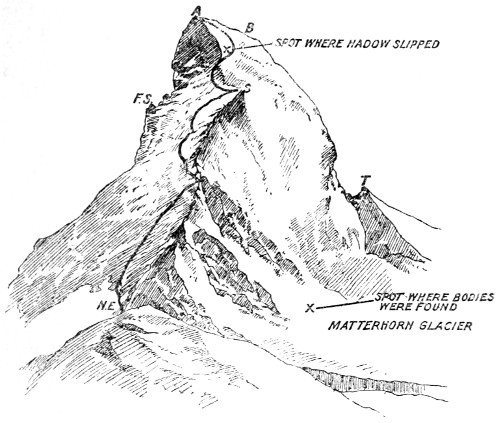
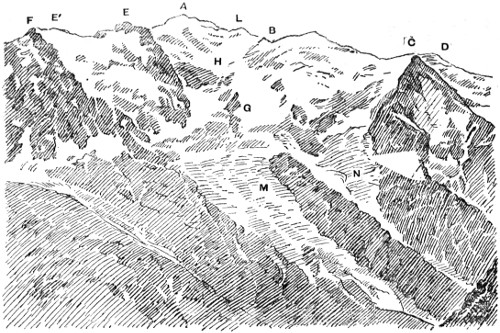
I.—THE MATTERHORN FROM THE NORTH-EAST (ZERMAT).
The left-hand ridge in the Furgg Grat and the shoulder (F.S.) is the
Furgg shoulder from which Mummery traversed across to the Swiss face
on his attempt on the Furgg Grat.
The central ridge is the North-east ridge. N.E. is the point where
the climb begins. S is the Swiss shoulder, A the Swiss summit,
B the Italian summit. The route of the first ascent is marked. Nowadays
it is usual to keep closer to the ridge in the early part of the
climb and to climb from the shoulder S to the summit A. Fixed
ropes hang throughout this section. T is the group of rocky teeth on
the Zmutt ridge.
Those who have a sense for the dramatic
unities will feel that, for once in a way, Life
lived up to the conventions of Art, and
that even a great dramatist could scarcely
have bettered the materials afforded by the
history of the Matterhorn. As the story
unfolds itself one can scarcely help attributing
some fatal personality to the inanimate cliffs.
In the Italian valley of Breuil, the Becca, as
the Matterhorn used to be called, was for
centuries the embodiment of supernatural
terror. Mothers would frighten their children
by threats that the wild man of the Becca
would carry them away. And if the children
asked how the Matterhorn was born, they
would reply that in bygone years there dwelt
a giant in Aosta named Gargantua, who was
once seized with a longing for the country
beyond the range of peaks that divide Italy
from Switzerland. Now, in those far off
times, the mountains of the great barrier
formed one uniform ridge instead of (as now) a
series of peaks. The giant strode over this
range with one step. As he stood with one
foot in Switzerland and the other in Italy, the
surrounding rocks fell away, and the pyramid
of cliffs caught between his legs alone remained.
And thus was the Matterhorn formed. There
were many such legends; the reader may find
them in Whymper and Guido Rey. They
were enough to daunt all but the boldest.
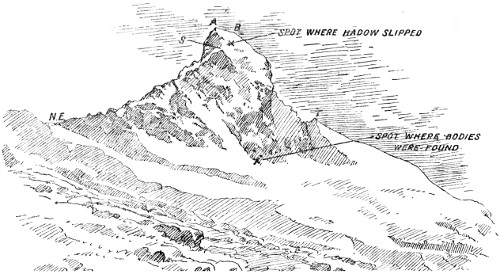
II.—MATTERHORN FROM THE NORTH.
The left-hand ridge is the North-east ridge. The points N.E., S, A, B, and T are the same as the corresponding
points in I. The North-east ridge, which appears extremely steep, in I., is here seen in profile.
The drama of the Matterhorn opens appropriately
enough with the three men who first
showed a contempt for the superstitions
that surrounded the Becca. The story of
that first attempt is told in Guido Rey’s
excellent monograph on the Matterhorn, a
monograph which has been translated by
Mr. Eaton into English as spirited as the
original Italian. This opening bout with the
Becca took place in 1858. Three natives
of Breuil, the little Italian valley at the foot
of the Matterhorn, met before dawn at the
châlet of Avouil. Of these, Jean Jacques
Carrel was in command. He was a mighty
hunter, and a fine mountaineer. The second,
Jean Antoine Carrel, “il Bersaglier,” was
destined to play a leading part in the conflict
that was to close seven years later. Jean
Antoine was something more than a great
guide. He was a ragged, independent mountaineer,
difficult to control, a great leader, but
a poor follower. He was an old soldier, and
had fought at Novara. The third of these
young climbers was Aimé Gorret, a young boy
of twenty destined for the Church. His
solitary rambles among the hills had filled
him with a passionate worship of the
Matterhorn.
Without proper provisions or gear, these
three light-hearted knights set forth gaily
on their quest. They mistook the way; and,
reaching a spot that pleased them, they
wasted hours in hurling rocks down a cliff—a
fascinating pursuit. When they reached
the point now known as the Tête du Lion
(12,215 feet) they contemplated the Matterhorn
which rose definitely beyond an intervening
gap. They looked at their great foe with
quiet assurance. The Becca would not run
away. Nobody else was likely to try a throw
with the local giant. One day they would
come back and settle the issue. There was
no immediate hurry.
In 1860 a daring attempt was made by
Messrs. Alfred, Charles, and Sanbach Parker
of Liverpool. These bold climbers dispensed
with guides, and had the wisdom to attack
the east face that rises above Zermat. All
the other early explorers attacked the Italian
ridge; and, as will be seen, the first serious
assault on the eastern face succeeded. Lack
of time prevented the Parkers from reaching
a greater height than 12,000 feet; nor were
they more successful in the following year,
but they had made a gallant attempt, for
which they deserve credit. In 1860 another
party had assailed the mountain from Italy,
and reached a height of about 13,000 feet.
The party consisted of Vaughan Hawkins
and Prof. Tyndall, whom he had invited to
join the party, with the guides J. J. Carrel
and Bennen.
In 1861 Edward Whymper, who had opened
his Alpine career in the previous year, returned
to the Alps determined to conquer two virgin
summits of the Alps, the Matterhorn and the
Weishorn. On arriving at Chatillon, he
learned that the Weishorn had been climbed
by Tyndall, and that Tyndall was at Breuil
intending to add the Matterhorn to his conquests.
Whymper determined to anticipate
him. He arrived at Breuil on August 28, with
an Oberland guide, and inquired for the
best man in the valley. The knowing ones
with a voice recommended Jean Antoine
Carrel, a member of the first party to set
foot on the Matterhorn. “We sought, of
course, for Carrel, and found him a well-made,
resolute looking fellow, with a certain defiant
air which was rather taking. Yes, he would
go. Twenty francs a day, whatever the
result, was his price. I assented. But I
must take his comrade. As he said this,
an evil countenance came forth out of the
darkness, and proclaimed itself the comrade.
I demurred, and negotiations were broken
off.”
At Breuil, they tried to get another man
to accompany them but without success.
The men they approached either would not
go or asked a prohibitive price. “This, it
may be said once and for all, was the reason
why so many futile attempts were made on
the Matterhorn. One guide after another
was brought up to the mountain and patted
on the back, but all declined the business.
The men who went had no heart in the matter,
and took the first opportunity to turn back.
For they were, with the exception of the man
to whom reference will be made [J. A. Carrel]
universally impressed with the belief that
the summit was entirely inaccessible.”
Whymper and his guide bivouacked in a
cowshed; and as night approached they saw
J. A. Carrel and his companion stealing up
the hillside. Whymper asked them if they
had repented, and would join his party.
They replied that they had contemplated
an independent assault. “Oh, then, it is
not necessary to have more than three.”
“Not for us.” “I admired their pluck and
had a strong inclination to engage the pair,
but finally decided against it. The companion
turned out to be J. J. Carrel. Both were
bold mountaineers; but Jean Antoine was
incomparably the better of the two, and was
the finest rock climber I have ever seen.
He was the only man who persistently refused
to accept defeat, and who continued to believe,
in spite of all discouragements, that the great
mountain was not inaccessible, and that it
could be ascended from the side of his native
valley.”
Carrel was something more than a great
guide. He remained a soldier long after he
had laid down his sword. He was, above all,
an Italian, determined to climb the Matterhorn
by the great Italian ridge, to climb it for the
honour of Italy, and for the honour of his
native valley. The two great moments of
his life were those in which he heard the shouts
of victory at Colle di Santiarno, and the cries
of triumph on the summit of the Italian ridge.
Whymper, and later Tyndall, found him an
awkward man to deal with. He had the
rough, undisciplined nature of the mountain
he loved. He looked on the Matterhorn as
a kind of preserve, and was determined that
he and no other should lead on the final
and successful ascent. Whymper’s first
attempt failed owing to the poor qualities
of his guide; and the Carrels were not more
successful.
During the three years that followed,
Whymper made no less than six attempts
to climb the Matterhorn. On one occasion
he climbed alone and unaided higher than
any of his predecessors. Without guides
or companions, he reached a height of 13,500
feet. There is little to be said for solitary
climbing, but this feat stands out as one
of the boldest achievements of the period.
The critics of solitary scrambling need, however,
look no further than its sequel for their
moral. In attempting to negotiate a corner
on the Tête du Lion, Whymper slipped and
fell. He shot down an ice slope, slid and
bounded through a vertical height of about
200 feet, and was eventually thrown against
the side of a gully where it narrowed. Another
ten feet would have taken him in one terrific
bound of 800 feet on to the glacier below.
The blood was pulsing out of numerous cuts.
He plastered up the wounds in his head with
a lump of snow before scrambling up into
a place of safety, where he promptly fainted
away. He managed, however, to reach Breuil
without further adventure. Within a week
he had returned to the attack.
He made two further attempts that year
which failed for various reasons; but he had
the satisfaction of seeing Tyndall fail when
success seemed assured. Tyndall had brought
with him the great Swiss guide Bennen, and a
Valaisian guide named Walter Anton. He
engaged Jean Antoine and Cæsar Carrel.
They proposed to attack the mountain by
the Italian ridge. Next morning, somebody
ran in to tell Whymper that a flag had been
seen on the summit. This proved a false
alarm. Whymper waited through the long
day to greet the party on their return. “I
could not bring myself to leave, but lingered
about as a foolish lover hovers round the
object of his affections even after he has been
rejected. The sun had set before the men
were discerned coming over the pastures.
There was no spring in their steps—they, too,
were defeated.”
Prof. Tyndall told Whymper that he had
arrived “within a stone’s-throw of the summit”—the
mountain is 14,800 feet high,
14,600 feet had been climbed. “He greatly
deceived himself,” said Whymper, “for the
point which he reached is no less than 800 feet
below the summit. The failure was due to
the fact that the Carrels had been engaged
in a subordinate capacity.” When they were
appealed to for their opinion, they replied:
“We are porters, ask your guides.” Carrel
always determined that the Matterhorn should
be climbed from Italy, and that the leader
of the climb should be an Italian. Bennen
was a Swiss and Carrel had been engaged as a
second guide. Tyndall and Whymper found
it necessary to champion their respective
guides, Carrel and Bennen; and a more or
less heated controversy was carried on in the
pages of The Alpine Journal.
The Matterhorn was left in peace till the
next year, but, meanwhile, a conspiracy for
its downfall was hatched in Italy. The story
is told in Guido Rey’s classic book on the
Matterhorn, a book which should be read side
by side with Whymper’s Scrambles, as it gives
the Italian version of the final stages in which
Italy and England fought for the great prize.
In 1863, some leading Italian mountaineers
gathered together at Turin to found an Italian
Alpine Club. Amongst these were two well-known
scientists, Felice Giordano and Quintino
Sella. They vowed that, as English climbers
had robbed them of Monte Viso, prince of
Piedmontese peaks, Italy should have the
honour of conquering the Matterhorn, and
that Italians should climb it from Italy by
the Italian ridge. The task was offered to
Giordano, who accepted it.
In 1863 Whymper and Carrel made another
attempt on the Matterhorn, which was foiled
by bad weather. In the next year, the
mountain was left alone; but the plot for its
downfall began to mature. Giordano and
Sella had met Carrel, and had extracted from
him promises of support. Carrel was, above
all, an Italian, and, other things being equal,
he would naturally prefer to lead an Italian,
rather than an English, party to the summit.
And now we come to the closing scenes.
In 1865 Whymper returned to the attack,
heartily tired of the Italian ridge. With
the great guides Michel Croz and Christian
Almer, Whymper attempted to reach the
summit by a rock couloir that starts from near
the Breuiljoch, and terminates high up on
the Furggen arête. This was a mad scheme;
and the route they chose was the most impracticable
of all the routes that had ever been
attempted on the Matterhorn. Even to-day,
the great couloir has not been climbed, and
the top half of the Furggen ridge has only
been once ascended (or rather outflanked on
the Italian side), an expedition of great danger
and difficulty. Foiled in this attempt,
Whymper turned his attention to the Swiss
face. The eastern face is a fraud. From
the Riffel and from Zermat, it appears almost
perpendicular; but when seen in profile from
the Zmutt glacier it presents a very different
appearance. The average angle of the slope
as far as “the shoulder,” about 13,925 feet,
is about thirty degrees. From here to the
summit the angle steepens considerably but
is never more than fifty degrees. The wonder
is that Whymper, who had studied the mountain
more than once from the Zmutt glacier,
still continued his attempts on the difficult
Italian ridge.
On the 8th of June 1865, Whymper arrived
in Breuil, and explained to Carrel his change
of plan. He engaged Carrel, and made plans
for his attack on the Swiss face, promising
Carrel that, if that failed, they should return
to the Italian ridge. Jean Antoine told
Whymper that he would not be able to serve
him after the 11th, as he was engaged to
travel “with a family of distinction in the
valley of Aosta.” Whymper asked him why
he had not told him this before; and he
replied that the engagement had been a long-standing
one, but that the actual day had not
been fixed. Whymper was annoyed; but
he could find no fault with the answer, and
parted on friendly terms with Carrel. But
the family of distinction was no other than
Giordano. “You are going to leave me,”
Whymper had said to Carrel, “to travel
with a party of ladies. The work is not fit
for you.” Carrel had smiled; and Whymper
had taken the smile as a recognition of the
implied compliment. Carrel smiled because
he knew that the work he had in hand was
more fitted for him than for any other man.
On the 7th, Giordano had written to Sella:
“Let us, then, set out to attack this Devil’s
mountain; and let us see that we succeed,
if only Whymper has not been beforehand
with us.” On the 11th, he wrote again: “Dear
Quintino, It is high time for me to send you
news from here. I reached Valtournanche
on Saturday at midday. There I found
Carrel, who had just returned from a reconnoitring
expedition on the Matterhorn, which
had proved a failure owing to bad weather.
Whymper had arrived two or three days
before; as usual, he wished to make the
ascent, and had engaged Carrel, who, not
having had my letters, had agreed, but for
a few days only. Fortunately, the weather
turned bad, Whymper was unable to make his
fresh attempt; and Carrel left him, and came
with me together with five other picked men
who are the best guides in the valley. We
immediately sent off our advance guard with
Carrel at its head. In order not to excite
remark, we took the rope and other materials
to Avouil, a hamlet which is very remote and
close to the Matterhorn; and this is to be
our lower base.... I have tried to keep
everything secret; but that fellow, whose
life seems to depend on the Matterhorn, is
here suspiciously prying into everything. I
have taken all the competent men away from
him; and yet he is so enamoured of the
mountain that he may go with others and
make a scene. He is here in this hôtel, and
I try to avoid speaking to him.”
Whymper discovered on the 10th the identity
of the “family of distinction.” He was
furious. He considered, with some show of
justification, that he had been “bamboozled
and humbugged.”
The Italian party had already started for
the Matterhorn, with a large store of provisions.
They were an advance party designed
to find and facilitate the way. They
would take their time. Whymper took
courage. On the 11th, a party arrived from
Zermat across the Théodule. One of these
proved to be Lord Francis Douglas, who,
a few days previously, had made the second
ascent of the Gabelhorn, and the first from
Zinal. Lord Francis was a young and ambitious
climber; and he was only too glad
to join Whymper in an attack on the Swiss
face of the Matterhorn. They crossed to
Zermat together on the 12th, and there discovered
Mr. Hudson, a great mountaineer,
accompanied by the famous guide Michel
Croz, who had arrived at Zermat with the
Matterhorn in view. They agreed to join
forces; and Hudson’s friend Hadow was
admitted to the party. Hadow was a young
man of nineteen who had just left Harrow.
Whymper seemed doubtful of his ability;
but Hudson reassured him by remarking
that Mr. Hadow had done Mont Blanc in
less time than most men. Peter Taugwalder,
Lord Francis’s guide, and Peter’s two sons
completed the party. On the 13th of July
they left Zermat.
On the 14th of July Giordano wrote a short
letter every line of which is alive with grave
triumph. “At 2 p.m. to-day I saw Carrel
& Co., on the top of the Matterhorn.” Poor
Giordano! The morrow was to bring a sad
disappointment; and his letter dated the
15th of July contains a pregnant sentence:
“Although every man did his duty, it is a
lost battle, and I am in great grief.”
This is what had happened. Whymper
and his companions had left Zermat on the
13th at half-past five. The day was cloudless.
They mounted leisurely, and arrived
at the base of the actual peak about half-past
eleven. Once fairly on the great eastern face,
they were astonished to find that places which
looked entirely impracticable from the Riffel
“were so easy that they could run about.”
By mid-day they had found a suitable place
for the tent at a height of about 11,000
feet. Croz and young Peter Taugwalder
went on to explore. They returned at about
3 p.m. in a great state of excitement. There
was no difficulty. They could have gone to
the top that day and returned.... “Long
after dusk, the cliffs above echoed with our
laughter, and with the songs of the guides,
for we were happy that night in camp, and
feared no evil.”
Whymper’s story is told with simplicity
and restraint. He was too good a craftsman
to spoil a great subject by unnecessary strokes.
They started next day before dawn. They
had left Zermat on the 13th, and they left
their camp on a Friday (the superstitious
noted these facts when the whole disastrous
story was known). The whole of the great
eastern slope “was now revealed, rising for
3000 feet like a huge natural staircase. Some
parts were more and others were less easy;
but we were not once brought to a halt by
any serious impediment.... For the greater
part of the way there was no need for the
rope, and sometimes Hudson led, and sometimes
myself.” When they arrived at the
snow ridge now known as “The Shoulder,”
which is some 500 feet below the summit,
they turned over on to the northern
face. This proved more difficult; but the
general angle of the slope was nowhere more
than forty degrees. Hadow’s want of experience
began to tell, and he required a certain
amount of assistance. “The solitary difficult
part was of no great extent.... A
long stride round a rather awkward corner
brought us to snow once more. The last
doubt had vanished. The Matterhorn was
ours. Nothing but 200 feet of easy snow
remained to be surmounted.”
But they were not yet certain that they
had not been beaten. The Italians had left
Breuil four days before. All through the
climb, false alarms had been raised of men
on the top. The excitement became intense.
“The slope eased off; at length we could be
detached; and Croz and I, dashing away,
ran a neck-and-neck race which ended in a
dead heat. At 1.40 p.m. the world was at
our feet, and the Matterhorn was conquered.”
No footsteps could be seen; but the summit
of the Matterhorn consists of a rudely level
ridge about 350 feet in length, and the Italians
might have been at the further end. Whymper
hastened to the Italian summit, and again
found the snow untrodden. They peered over
the ridge, and far below on the right caught
sight of the Italian party. “Up went my
arms and hat. ‘Croz, Croz, come here!’
‘Where are they, monsieur?’ ‘There, don’t
you see them, down there.’ ‘Ah, the coquins,
they are low down.’ ‘Croz, we must make
those fellows hear us.’ They yelled until
they were hoarse. ‘Croz, we must make
them hear us, they shall hear us.’” Whymper
seized a block of rock and hurled it down,
and called on his companion to do the same.
They drove their sticks in, and soon a
whole torrent was pouring down. “There
was no mistake about it this time. The
Italians turned and fled.”
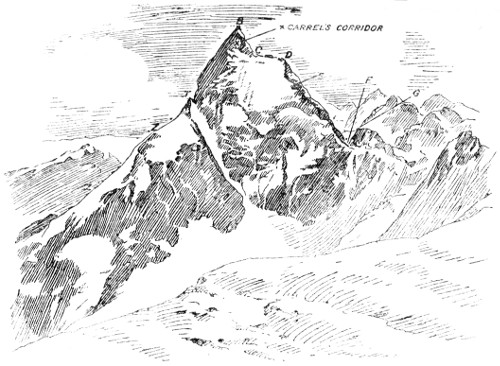
III.—THE MATTERHORN FROM THE NORTH-WEST.
T and B are the points marked T and B in I. and II. Z Z Z Z is the Zmutt ridge. B C D E F
is the great Italian South-west ridge. B is the Italian summit. C the point where Tyndall turned
back on his last attempt. D the Italian shoulder now known as “Pic Tyndall.” E the “cravette.”
F the Col du Lion, and G the Tête du Lion. The Italian route ascends to the Col du Lion on the
further side, and then follows the Italian ridge.
Croz planted a tent-pole which they had
taken with them, though Whymper protested
that it was tempting Providence, and fixed
his blouse to it. A poor flag—but it was
seen everywhere. At Breuil—as we have
seen—they cheered the Italian victory. But
on the morrow the explorers returned down-hearted.
“The old legends are true—there
are spirits on the top of the Matterhorn. We
saw them ourselves—they hurled stones at
us.”
We may allow this dramatic touch to pass
unchallenged, though, whatever Carrel may
have said to his friends, he made it quite
clear to Giordano that he had identified the
turbulent spirits, for, in the letter from which
we have quoted, Giordano tells his friends
that Carrel had seen Whymper on the summit.
It might, perhaps, be worth while to add that
the stones Whymper hurled down the ridge
could by no possible chance have hit Carrel’s
party. “Still, I would,” writes Whymper,
“that the leader of that party could have
stood with us at that moment, for our victorious
shouts conveyed to him the disappointment
of a lifetime. He was the man of all
those who attempted the ascent of the Matterhorn
who most deserved to be first upon its
summit. He was the first to doubt its inaccessibility;
and he was the only man who
persisted in believing that its ascent would be
accomplished. It was the aim of his life
to make the ascent from the side of Italy,
for the honour of his native valley. For a
time, he had the game in his hands; he played
it as he thought best; but he made a false
move, and he lost it.”
After an hour on the summit, they prepared
to descend. The order of descent was curious.
Croz, as the best man in the party, should have
been placed last. As a matter of history, he
led, followed, in this order, by Hadow, Hudson,
Douglas, and Peter Taugwalder. Whymper
was sketching while the party was being
arranged. They were waiting for him to
tie on when somebody suggested that the
names had not been left in a bottle. While
Whymper put this right, the rest of the party
moved on. A few minutes later Whymper
tied on to young Peter, and followed detached
from the others. Later, Douglas asked
Whymper to attach himself to old Taugwalder,
as he feared that Taugwalder would not be
able to hold his ground in the event of a slip.
About three o’clock in the afternoon, Michel
Croz, who had laid aside his axe, faced the rock,
and, in order to give Hadow greater security,
was putting his feet one by one into their
proper position. Croz then turned round to
advance another step when Hadow slipped,
fell against Croz, and knocked him over. “I
heard one startled exclamation from Croz,
and then saw him and Mr. Hadow flying downwards;
in another moment Hudson was
dragged from his steps, and Lord Francis
Douglas immediately after him. All this
was the work of a moment. Immediately
we heard Croz’s exclamation, old Peter and I
planted ourselves as firmly as the rocks would
permit: the rope was taut between us, and
the jerk came on us both as on one man.
We held: but the rope broke midway between
Taugwalder and Lord Francis Douglas. For
a few seconds, we saw our unfortunate companions
sliding downwards on their backs,
and spreading out their hands endeavouring
to save themselves. They passed from our
sight uninjured, disappeared one by one,
and then fell from precipice to precipice on
to the Matterhorngletscher below, a distance
of nearly 4000 feet in height. From the
moment the rope broke, it was impossible
to help them.”
For half-an-hour, Whymper and the two
Taugwalders remained on the spot without
moving. The two guides cried like children.
Whymper was fixed between the older and
younger Taugwalder, and must have heartily
regretted that he left young Peter the responsibility
of last man down, for the young man was
paralysed with terror, and refused to move.
At last, he descended, and they stood together.
Whymper asked immediately for the end of
the rope that had given way, and noticed
with horror that it was the weakest of the
three ropes. It had never been intended to
use it save as a reserve in case much rope had
to be left behind to attach to the rocks.
For more than two hours after the fall,
Whymper expected that the Taugwalders
would fall. They were utterly unnerved. At
6 p.m. they arrived again on the snow
shoulder. “We frequently looked, but in
vain, for traces of our unfortunate companions;
we bent over the ridge and cried to them,
but no sound returned. Convinced at last
that they were neither within sight nor hearing,
we ceased from our useless efforts; and,
too cast down for speech, silently gathered
up our things, and the little effects of those
who were lost, preparatory to continuing the
descent.”
As they started down, the Taugwalders
raised the problem as to their payment,
Lord Francis being dead. “They filled,”
remarks Whymper, “the cup of bitterness
to overflowing, and I tore down the cliff
madly and recklessly in a way that caused
them more than once to inquire if I wished
to kill them.” The whole party spent the
night on a miserable ledge. Next day, they
descended in safety to Zermat. Seiler met
them at the door of his hôtel. “What is the
matter?” “The Taugwalders and I have
returned.” He did not need more, and burst
into tears, but lost no time in needless lamentations,
and set to work to rouse the village.
On Sunday morning, Whymper set out with
the Rev. Canon M’Cormick to recover the
bodies of his friends. The local curé threatened
with excommunication any guide who
neglected Mass in order to attend the search
party. “To several, at least, this was a
severe trial. Peter Perrn declared, with
tears in his eyes, that nothing else would
have prevented him joining in the search.”
Guides from other valleys joined the party.
At 8.30 they got to the plateau at the top of
the glacier. They found Hudson, Croz and
Hadow, but “of Lord Francis Douglas nothing
was seen.”
This accident sent a thrill of horror through
the civilised world. The old file of The Times,
which is well worth consulting, bears tribute
to the profound sensation which the news of
this great tragedy aroused. Idle rumours of
every kind were afloat—with these we shall
deal later. For more than five weeks, not
a day passed without some letter or comment
in the columns of the leading English paper.
These letters, for the most part, embodied
the profound distrust with which the new sport
was regarded by the bulk of Englishmen.
If Lord Francis Douglas had been killed while
galloping after a fox, he would have been
considered to have fallen in action. That he
should have fallen on the day that the Matterhorn
fell, that he should have paid the supreme
forfeit for a triumphant hour in Alpine history—such
a death was obviously wholly without its
redeeming features. “It was the blue ribbon
of the Alps,” wrote The Times, “that poor
Lord Francis Douglas was trying for the other
day. If it must be so, at all events the Alpine
Club that has proclaimed this crusade must
manage the thing rather better, or it will
soon be voted a nuisance. If the work is
to be done, it must be done well. They must
advise youngsters to practise, and make sure
of their strength and endurance.”
For three weeks, Whymper gave no sign.
At last, in response to a dignified appeal from
Mr. Justice Wills, then President of the
Alpine Club, he broke silence, and gave to the
public a restrained account of the tragedy.
As we have said, malicious rumour had been
busy, and in ignorant quarters there had been
rumours of foul play. The Matterhorn accident
first popularised the theory that Alpine
ropes existed to be cut. Till then, the public
had supposed that the rope was used to
prevent cowardly climbers deserting their
party in an emergency. But from 1865
onwards, popular authors discovered a new
use for the rope. They divided all Alpine
travellers into two classes, those who cut the
rope from below (“Greater love hath no
man—a romance of the mountains”) and
those who cut the rope from above (“The
Coward—a tale of the snows”). A casual
reader might be pardoned for supposing that
the Swiss did a brisk business in sheath knives.
We should be the last to discourage this enterprising
school—their works have afforded
much joy to the climbing fraternity; but
we offer them in all humility a few remarks
on the art of rope-cutting by a member
of Class II (those who cut the rope from
above).
A knife could only be used with advantage
when a snowbridge gives way. It is easy
enough to hold a man who has fallen into a
crevasse; but it is often impossible to pull
him out. The whole situation is altered
on a rock face. If a man falls, a sudden
jerk may pull the rest of the party off the
face of the mountain. This will almost
certainly happen if the leader or, on a descent,
the last man down, falls, unless the rope is
anchored round a knob of rock, in which
case—provided the rope does not break—the
leader may escape with a severe shaking,
though a clear fall of more than fifteen feet
will usually break the rope if anchored; and,
if not anchored, the party will be dragged
off their holds one by one. Therefore, the
leader must not fall. If any other member
of the party falls, he should be held by the
man above. On difficult ground, only one
man moves at a time. No man moves until
the man above has secured himself in a
position where he can draw in the rope as the
man below advances. If he keeps it reasonably
taut, and is well placed, he should be
able to check any slip. A climber who slips
and is held by the rope can immediately get
new foothold and handhold. He is not in a
crevasse from which exit is impossible save
at the rope’s end. His slip is checked, and
he is swung up against a rock face. There is
no need to drag him up. The rest of the
party have passed over this face, and therefore
handholds and footholds can be found. The
man who has slipped will find fresh purchase,
and begin again. In the case of the Matterhorn
accident, the angle of the slope was about
forty degrees. There was an abundance of
hold, and if the rope had not parted Croz
and Hadow would have been abruptly checked,
and would have immediately secured themselves.
Now, if Taugwalder had cut the
rope, as suggested, he must have been little
short of an expert acrobat, and have cut it in
about the space of a second and a half before
the jerk. If he had waited for the jerk, either
he would have been dragged off, in which case
his knife would have come in handy, or he
would have held, in which case it would have
been unnecessary.
To mountaineers, all this, of course, is a
truism; and we should not have laboured
the point if we wrote exclusively for mountaineers.
Even so, Peter’s comrades at Zermat
(who should have known better) persisted
in believing that he cut the rope. “In regard
to this infamous charge,” writes Whymper,
“I say that he could not do so at the moment
of the slip, and that the end of the rope in
my possession shows that he did not do so
before.” Whymper, however, adds: “There
remains the suspicious fact that the rope
which broke was the thinnest and weakest one
we had. It is suspicious because it is unlikely
that the men in front would have selected
an old and weak rope when there was an
abundance of new, and much stronger, rope
to spare; and, on the other hand, because
if Taugwalder thought that an accident was
likely to happen, it was to his interest to have
the weaker rope placed where it was.”
One cannot help regretting that Whymper
lent weight to an unworthy suspicion. Taugwalder
was examined by a secret Court of
Inquiry; and Whymper prepared a set of
questions with a view to helping him to clear
himself. The answers, though promised, were
never sent; and Taugwalder ultimately left
the valley for America, returning only to die.
Whymper, in his classic book, suggested the
possibility of criminal dealings by publishing
photographs of the three ropes showing that
the rope broken was far the weakest.
Let us review the whole story as Whymper
himself tells it. We know that Whymper
crossed the Théodule on the eleventh in a
state of anger and despair. The prize for
which he had striven so long seemed to be
sliding from his grasp. Carrel had deserted
him just as the true line of attack had been
discovered. Like all mountaineers, he was
human. He gets together the best party he
can, and sets out with all haste determined to
win by a head. Hadow, a young man with
very little experience, is taken, and Hadow,
the weak link, is destined to turn triumph
into disaster. Let the mountaineer who has
never invited a man unfit for a big climb throw
the first stone. And, before he has thrown
it, let him remember the peculiar provocation
in Whymper’s case.
All goes well. The Matterhorn is conquered
with surprising ease. These six men
achieve the greatest triumph in Alpine history
without serious check. To Whymper, this
hour on the summit must have marked the
supreme climax of life, an hour that set its
seal on the dogged labours of past years.
Do men in such moments anticipate disaster?
Taugwalder might possibly have failed in a
sudden crisis; but is it likely that he should
deliberately prepare for an accident by carefully
planned treachery?
Now read the story as Whymper tells it.
The party are just about to commence the
descent. The first five hundred feet would
still be considered as demanding the greatest
care. The top five hundred feet of the Matterhorn,
but for the ropes with which the whole
mountain is now festooned, would always be a
difficult, if not a dangerous, section. Croz
was the best guide in the party. He should
have remained behind as sheet anchor.
Instead of this, he goes first. Whymper falls
out of line, to inscribe the names of the party,
ties himself casually on to young Peter, and
then “runs down after the others.” In the
final arrangements, young Peter, who was
a young and inexperienced guide, was given
the vital position of last man down. Flushed
with triumph, their minds could find no room
for a doubt. Everything had gone through
with miraculous ease. Such luck simply
could not turn. It is in precisely such moments
as these that the mountains settle their score.
Mountaineering is a ruthless sport that demands
unremitting attention. In games, a moment’s
carelessness may lose a match, or a championship;
but in climbing a mistake may mean
death.
As for Taugwalder, one is tempted to
acquit him without hesitation; but there is
one curious story about Taugwalder which
gives one pause. The story was told to the
present writer by an old member of the
Alpine Club, and the following is an extract
from a letter: “I had rather you said ‘a
friend of yours’ without mentioning my
name. I had a good many expeditions with
old Peter Taugwalder, including Mont Blanc
and Monte Rosa; and I had rather a tender
spot for the somewhat coarse, dirty old beggar.
I should not like my name to appear to help
the balance to incline in the direction of his
guilt in that Matterhorn affair. It was not
on the Dent Blanche that he took the rope
off; it was coming down a long steep slope
of bare rock from the top of the Tête Blanche
towards Prayagé. I had a couple of men
with me who were inexperienced; and I fancy
he must have thought that, if one of them let
go, which was not unlikely, he would be able
to choose whether to hold on or let go. I
happened to look up and see what was going
on, and I made him tie up at once. I don’t
quite remember whether Whymper tells us
how far from Peter’s fingers the break in
the rope occurred. That seems to me one of
the most critical points.”
There we may leave Taugwalder, and the
minor issues of this great tragedy. The
broader lessons are summed up by Mr.
Whymper in a memorable passage: “So
the traditional inaccessibility of the Matterhorn
was vanquished, and was replaced by
legends of a more real character. Others
will essay to scale its proud cliffs, but to
none will it be the mountain that it was to the
early explorers. Others may tread its summit
snows, but none will ever know the
feelings of those who first gazed upon its
marvellous panorama; and none, I trust,
will ever be compelled to tell of joy turned
into grief, and of laughter into mourning.
It proved to be a stubborn foe; it resisted
long and gave many a hard blow; it was
defeated at last with an ease that none could
have anticipated, but like a relentless enemy—conquered,
but not crushed—it took a terrible
vengeance.”
The last sentence has a peculiar significance.
A strange fatality seems to dog the steps of
those who seek untrodden paths to the crest
of the Matterhorn. Disaster does not always
follow with the dramatic swiftness of that
which marked the conquest of the eastern
face, yet, slowly but surely, the avenging
spirit of the Matterhorn fulfils itself.
On July 16, two days after the catastrophe,
J. A. Carrel set out to crown Whymper’s
victory by proving that the Italian ridge was
not unconquerable. He was accompanied by
Abbé Gorret, a plucky priest who had shared
with him that first careless attack on the
mountain. Bich and Meynet completed the
party. The Abbé and Meynet remained
behind not very far from the top, in order to
help Carrel and Bich on the return at a place
where a short descent onto a ledge was liable
to cause difficulty on the descent. This
ledge, known as Carrel’s corridor, is about
forty minutes from the summit. It needed
a man of Carrel’s determined courage to follow
its winding course. It is now avoided.
The rest of the climb presented no difficulty.
Carrel had conquered the Italian ridge. The
ambition of years was half fulfilled, only half,
for the Matterhorn itself had been climbed.
One cannot but regret that he had turned back
on the 14th. Whymper’s cries of triumph
had spelt for him the disappointment of a
lifetime. Yet a fine rôle was open to him.
Had he gone forward and crowned Whymper’s
victory by a triumph unmarred by disaster;
had the Matterhorn defied all assaults for
years, and then yielded on the same day to a
party from the Swiss side and Carrel’s men
from Italy, the most dramatic page in Alpine
history would have been complete. Thirty-five
years later, the Matterhorn settled the
long outstanding debt, and the man who had
first attacked the citadel died in a snowstorm
on the Italian ridge of the mountain which he
had been the first to assail, and the first to
conquer.
Carrel was in his sixty-second year when he
started out for his last climb. Bad weather
detained the party in the Italian hut, and
Signor Sinigaglia noticed that Carrel was far
from well. After two nights in the hut,
the provisions began to run out; and it was
decided to attempt the descent. The rocks
were in a terrible condition, and the storm
added to the difficulty. Carrel insisted on
leading, though he was far from well. He
knew every yard of his own beloved ridge.
If a man could pilot them through the storm
that man was Carrel. Quietly and methodically,
he fought his way downward, yard by
yard, undaunted by the hurricane, husbanding
the last ounces of his strength. He would
not allow the other guides to relieve him till
the danger was past, and his responsibilities
were over. Then suddenly he collapsed, and
in a few minutes the gallant old warrior
fell backwards and died. A cross now marks
the spot where the old soldier died in action.
In life the leading guides of Breuil had often
resented Carrel’s unchallenged supremacy.
But death had obliterated the old jealousies.
Years afterwards, a casual climber stopped
before Carrel’s cross, and remarked to the
son of Carrel’s great rival, “So that is where
Carrel fell.” “Carrel did not fall,” came the
indignant answer, “Carrel died.”
Let us turn from Carrel to the conquerors of
another great ridge of the Matterhorn.
Of others concerned with attacks on the
Italian ridge, Tyndall, Bennen, and J. J.
Macquignaz, all came to premature ends.
Bennen was killed in an historic accident on
the Haut de Cry, and Macquignaz disappeared
on Mont Blanc. In 1879, two independent
parties on the same day made the first ascent
of the great northern ridge of the Matterhorn
known as the Zmutt arête. Mummery and
Penhall were the amateurs responsible for
these two independent assaults. “The
memory,” writes Mummery, “of two rollicking
parties, comprised of seven men, who on one
day in 1879 were climbing on the west face
of the Matterhorn passes with ghost-like
admonition before my mind, and bids me
remember that, of these seven, Mr. Penhall
was killed on the Wetterhorn, Ferdinand
Imseng on the Macugnaga side of Monte
Rosa, and Johan Petrus on the Frersnay Mont
Blanc.” Of the remaining four, Mummery
disappeared in the Himalayas in 1895, Louis
Zurbrucken was killed, Alexander Burgener
perished in an avalanche near the Bergli hut
in 1911. Mr. Baumann and Emil Rey, who
with Petrus followed in Mummery’s footsteps
three days later, both came to untimely ends:
Baumann disappeared in South Africa, and
Emil Rey was killed on the Dent de Géant.
The sole survivor of these two parties is the
well-known Augustin Gentinetta, one of the
ablest of the Zermat guides. Burgener and
Gentinetta guided Mummery on the above-mentioned
climb, while Penhall was accompanied
by Louis Zurbrucken. In recent
times, three great mountaineers who climbed
this ridge together died violent deaths within
the year. The superstitious should leave the
Zmutt arête alone.