TO the purely Alpine traveller,
Volcanoes are not a matter of interest, because there does not exist a
single volcano in the Alps, nor, so far as I am aware, even the ruins of
one. Volcanic rocks there may be, but we are not concerned with rocks
except in so far as mountains are built out of them. To the
mountain-lover, however, in the broad sense—and it is for such I am
writing—volcanoes are as interesting as any other definite type of
peak, and I therefore propose to devote this chapter to a consideration of
them from the picturesque and climbing point of view. For the European
traveller there are volcanoes enough, both active and extinct, and that
without going to Iceland. Most people have seen Vesuvius. Etna and
Stromboli are frequently passed, and the former is not unfrequently
climbed. Auvergne is a good place for a holiday.
If ordinary tourists knew how well the
volcanic Eifel repay a visit, they would oftener turn aside to them.
Teneriffe is on the list of mountains most people hope some day to see. In
my own mind, when volcanoes are mentioned, there always rises first the
reminiscence of the great mountains in South Bolivia and Northern Chile,
with their stately grandeur of scale and grace of outline.
Every one who has climbed Vesuvius has some idea of the nature of volcano
climbing. It is by no means the best sort, and the Alps as a play-ground
are none the worse for lacking it. From a climber's rather than a
petrologist's point of view, volcanic rocks are liable to seem both very
hard and very brittle. They fracture with an astonishingly sharp edge,
which cuts, like a knife, the fingers and clothes of the climber.
Notwithstanding their apparent hardness, which seems to promise for them
an unusual durability, they crack up with great rapidity under the action
of frost or of blows, and rapidly subdivide into small angular debris. The
smoothness of the fractured surfaces, when fresh, reduces the friction
between the fragments much below that normal to the debris of ordinary
rocks, so that slopes of volcanic debris are very unstable. The foot sinks
into them, almost as into
sand, and they cut the boots and gaiters to pieces. To run down such a
slope is pleasant enough, but to wade up it is the worst kind of
purgatory, provocative too of more sins of language than it can possibly
purge in the time.
The novice at volcano-climbing approaches his mountain with a light heart.
However big it may be, it looks easy, and he promises himself a rapid
ascent. The lower slopes of volcanoes are frequently most fertile, so that
the first stages of the ascent may be along umbrageous paths or through
vineyards and olive gardens. Ultimately the naked mountain has to be
tackled, and then troubles begin, and they are the same all the world
over. All that a volcano produces is toilsome for the foot of man. The
slope continuously steepens. The disintegrated lava or the volcanic ash
are alike disagreeable. The mountain is sure to be voted a fraud from the
climber's point of view. Even Aconcagua, greatest of all volcanoes, is as
rotten as the rest. There is hardly a firm crag on its mighty face.
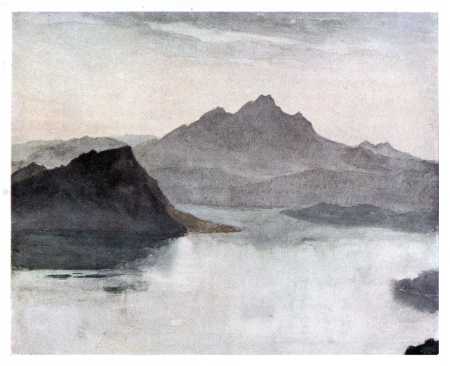
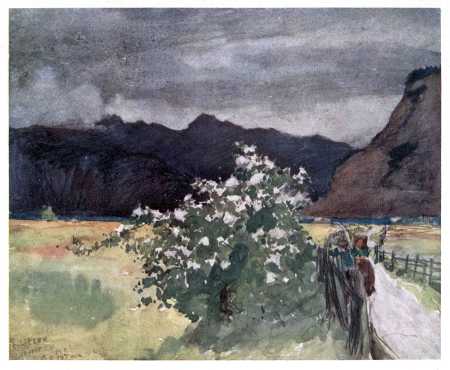
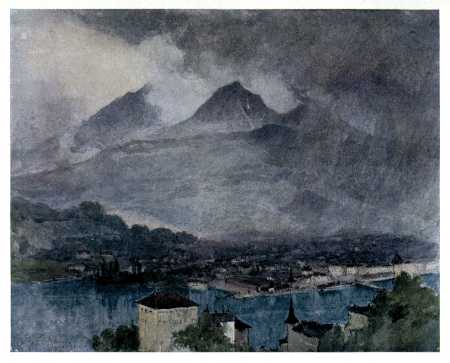
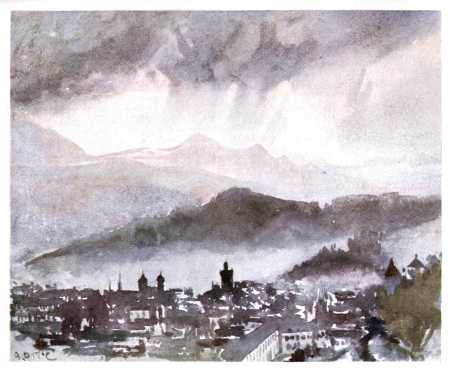
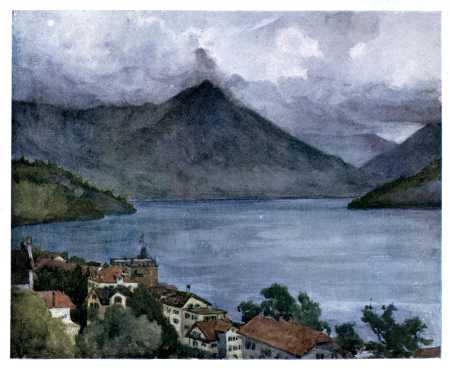
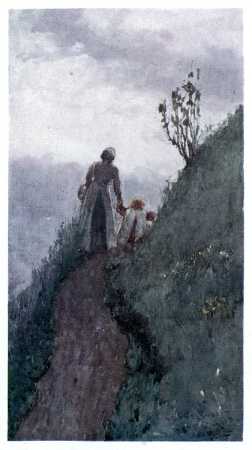
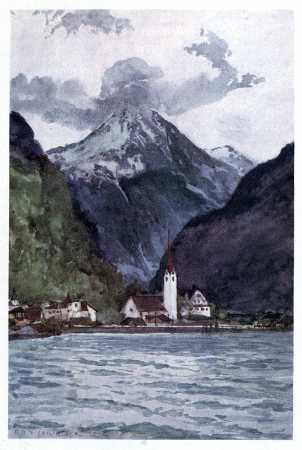
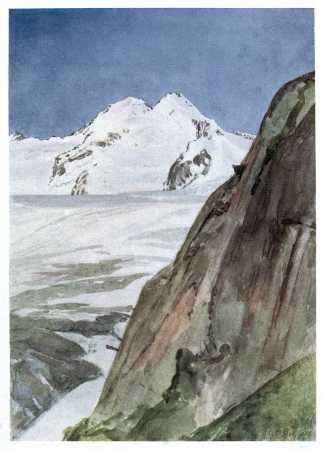
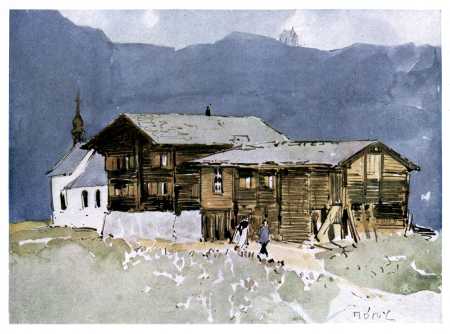
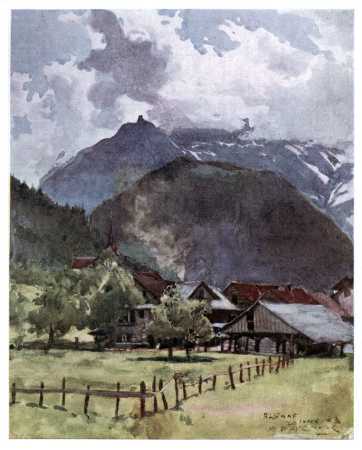
PILATUS AND LAKE OF LUCERNE FROM THE SLOPES OF THE RIGI
It follows that volcanoes are peaks of an unstable character. They are
upstarts by nature, and they are easily pulled down. Among mountains they
are the most short-lived. In their decay they lack the dignity of a peak
of crystalline rock, that
fights against disintegration and resists to the last, holding forth to
the sky its splintered crags like passionately protesting hands. There is
no protest in a volcano. It yields willingly to decay. The debris of its
upper rocks flow down its face almost like water. They grind together into
dust and are blown away by the winds. The old moraines of Aconcagua
ultimately turn into sand dunes.
Yet these mushroom monsters are not without their compensations. When
active they enjoy a magnificence of public advertisement that no other
kind of peak, even when it is the scene of a particularly ghastly
accident, can ever hope to rival. They grow in height, or are blown to
perdition, amidst earthquakes and terrific thunders. Lightnings flicker
about them like the dartings of a serpent's tongue. The storm-clouds that
envelop snowy peaks are nothing to the monstrous piles of smoke and
darkness that wreathe the brows of an erupting volcano. Blasts of fire
shoot from them, and for glaciers, their sides are flooded with molten
lava. Few of us can hope to see such sights in the fulness of their glory.
When the mountain is full-grown, and its days of activity are done, for a
while it reigns, a figure of perfect grace, a very queen for elegance and
beauty of form.
Who that has ever seen Vesuvius can deny this fact. Probably no snowy
peaks in the world are more absolutely perfect in form than the white-clad
giant volcanoes of Kamchatka, or, on a smaller scale, the peerless Fuji of
Japan. The outline of the cone, gently rising from the foot, and then
steepening in its incomparable logarithmic curve, is the gracefullest that
nature produces on a large scale. Even the effulgent domes of the greatest
cumulous clouds that, on a faultless summer afternoon, soar into the
clearest blue sky, are not to be compared with volcanoes at their best.
These have the aspect of works of art, made, as it were, expressly to
incorporate an idea of beauty. They possess the symmetry of a fine
crystal, but at the same time, a grace far beyond what is possible to any
crystalline form. And then, how they soar! How their beautiful heads seem
almost to float in the blue! How symmetrically the mists gather about
their summits! At one time the base will vanish in the bright opacity of
the lower air, and the top will be seen in sharp distinctness, like a
floating island in the sky. At another, the summit will fade away, and the
shadowed base will fill the vision with its purple solidity. And always
there hangs about a volcano the
memory of its fire-begetting, and the suspicion that all may not yet be
over. It is, as it were, an inscribed finger-post, warning us of the
molten core within. It is at once a memorial and a monition to those that
dwell beneath it. It is the witness of past and the herald of future
convulsions; yet, being such, it is itself in form the peacefullest and
tenderest in nature. No woman's robe droops more delicately over her bosom
than droops the once molten drapery of a volcano. Its aspect bears a
double and opposed suggestiveness. Such are volcanoes in the day of their
perfection, before the denuding forces have made inroads on the symmetry
of their form.
Yet even then it is not well to approach them too closely, unless you
would have the sense of their beauty supplanted by a different kind of
emotion. The nearer you approach a snow-mountain, such as Mont Blanc, and
the more intimately you penetrate its white recesses, and acquaint
yourself with its details of crevasse and sérac, the more conscious are
you of the perfection of its finish and the loveliness of its details. It
is not so with a volcano at any time of its career. When it is newly
fashioned and the lava streams are still in movement and smoking upon its
sides, and the
cinders and ashes of its recent ejection are piled upon it, to approach
them is to behold sights more provocative of horror than of admiration.
They appal, they create astonishment, but they do not attract. Cast your
eye over the remarkable series of photographs by Dr. Tempest Anderson,
published under the title "Volcanic Studies," and you will have ample
proof of this. Consider the Icelandic gorges, the outer crater of
Teneriffe, or the views of recent volcanic energies displayed in St.
Vincent—the mud-rivers, the sand-strewn valleys; here is enough to
interest and more than enough to appal, but the kind of beauty associated
with a distant view of a volcano is absent. There is no grace, no charm,
none of the sweet feminine outline which makes volcanoes the queens and
fair ladies among hills.
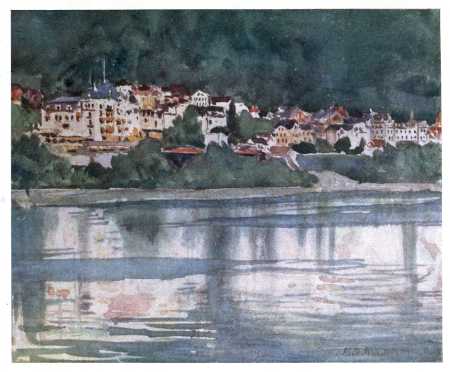
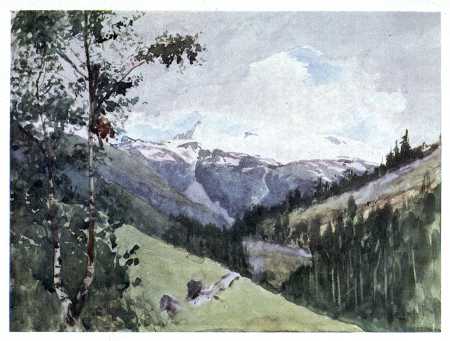
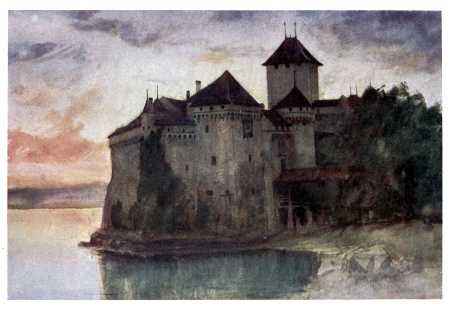
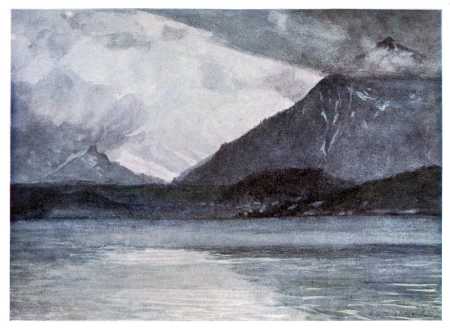
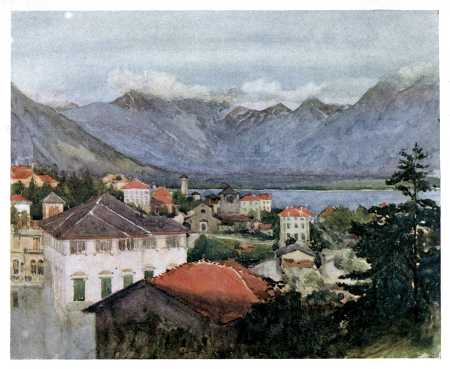
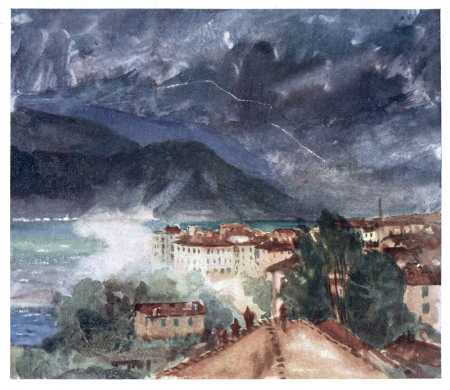
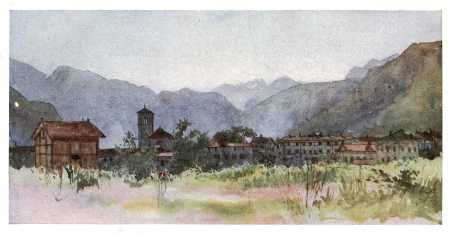
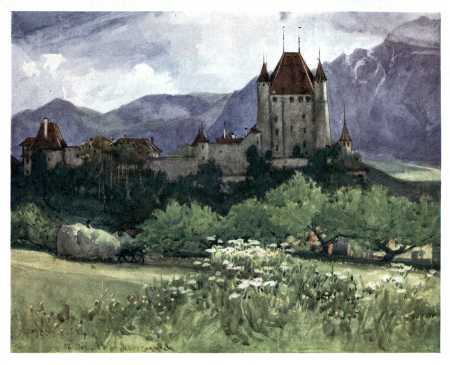
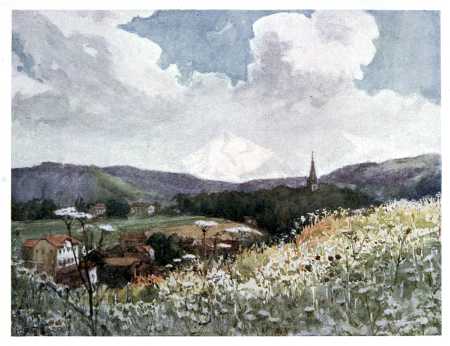
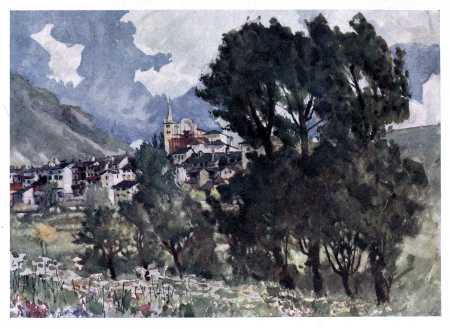
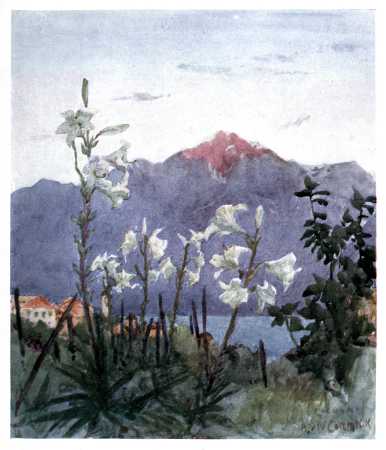
MONTREUX, LAKE OF GENEVA
But when all the dramatic stage of their existence is over, and the fires
are out and the earth around has ceased from quaking; when trees have
gathered over the lava torrents and rich vegetation has covered up cinders
and ash; when the sulphurous vents are become sapphire pools of clear
water overshadowed by foliage, and all the ghastly details of tragedy are
covered up by the splendid garments of tropical vegetation; then you may approach and
ascend if you please, but it will not be as a climber, for the climber is
one who seeks the naked places of the earth, and does not wander for
choice in grassy dells and tree-embosomed shades.
He, however, who should converse about volcanoes and say no more than
this, would leave a most false impression upon his hearers, for Nature
always provides compensations for her sincere and humble lovers, and even
in the barest volcano she has not failed. The very rapidity with which
they yield to destructive forces leads to results not discoverable in
stronger and more resolute peaks. Frost, winter, and snow breach their
sides with exceeding facility. Torrents dig gullies into them. The very
winds blow their substance away. Hence it comes that a volcano in active
process of destruction often provides detailed scenery of astonishing
grandeur and boldness. Its vertical-walled gullies, its cliffs, its
castellated ridges are like none other. There is no aspect of durability
about them, no signs of hoary antiquity, none of the dignity that belongs
to archæan rocks. They are visibly in rapid decay, yet, for all that and
even because of it, they are strangely imposing with a sort of rococo
grandeur. If the Meije and
Ushba are Romanesque, if the Matterhorn, Masherbrum, and Siniolkum are
Gothic, we may describe the world's shattered volcanoes as Flamboyant.
They boast a greater and more unusual variety of forms, a multiplicity of
details that bewilders. The spiry exuberance of Milan Cathedral can be
paralleled in the neighbourhood of Aconcagua. Nowhere are buttresses more
emphatic, points of rock in perilous precipitance of decay more plentiful,
cliffs more abrupt, the skeleton of the mountains more nakedly displayed.
Yet better deserving of note is the brilliancy and variety of the
colouring by which volcanic rocks are often characterised. The local
colouring of Alpine rocks is seldom rich. The Dolomites indeed have a
reputation for the richness of their tints, but it is mainly derived from
the sunrise and sunset colouring which they reflect so brilliantly that it
almost seems to proceed from them. The general effect of Alpine rocks is
some variety of grey or brown, the tone of which is deepened by contrast
with the snows. Except in volcanic districts, it is only in Spitsbergen,
and at one or two spots in the Himalayas, that I have observed the local
colouring of the rocks to
form a prominent factor in the beauty of a mountain view. There indeed the
red and yellow sandstones display their rich tints with great effect, so
that the colour, shining over the wide expanses of Arctic glacier and
snow-field, becomes a main element, and reduces the forms of the peaks to
a secondary consideration. Yet in Spitsbergen this only happens in a
relatively small area, within Kings Bay.
In volcanic districts, however, the colouring of the rocks is almost
always remarkable. It seems as though Nature had emptied her whole palette
upon them. Hardly any tint, from white to black, is missing. Other
mountains depend for their colour upon the atmosphere. These are
independent of that source. Their own colour is predominant. All they ask
for is transparent air and bright sunshine to display them. Their
combination is so unusual, their chord so unlike any to which we are
accustomed in ordinary natural surroundings, that they cannot fail to be
the chief element in the view. That is why photographs of volcanic scenery
convey an impression so different from actual sight. The normal blues,
greens, and browns of the temperate habitable regions; the black, greys,
and whites of the
snowy world; the blue sea, white sand, and red cliffs of a Devonian coast:
such chords of colour are usual; the eye expects them. Even a tropical
landscape, except for its occasional blazes of blossom, belongs to the
same category. Autumnal glories, first of golden harvest, later of
iridescent foliage, are an accustomed sight. But all these schemes of
colour belong to a wholly different category from that which volcanic
rock-masses display. They bring together, combine, and contrast a whole
series of unusual tints. Their purples are not the purples which we
elsewhere know. Their greens are not the greens of vegetation. Their
yellows are not the yellows of a blossoming field or a fading forest.
Were I to catalogue in a list the colours I have seen in a volcanic
panorama, it would little serve, for it is not the names that count but
the special significance of each, and that is not capable of brief
statement. Such a scene as I am recalling astonishes by the multitude and
close juxtaposition of an apparently countless number of coloured strata.
It looks as though Nature had kept changing her mind and staining each
successive ejection with a different tint. Sometimes there comes a
considerable thickness of a certain coloured rock, but above and below it thin
strata will succeed of all sorts of colours. If such a series of deposits
is intersected by a cliff, its face will be ruled across by a polychrome
multitude of bands. Oftenest, however, the whole mass will be riven into
gullies and weathered into pinnacles of all heights and varieties. Or
short cliffs and elbows will alternate with slopes of debris. In such
cases any sense of order in the succession of colours may be lost. A blue
pinnacle will stand before a yellow one, and that beside a red with a
green top. In one buttress purple may predominate, in another grey, in a
third orange.
The effect on slopes of debris is often most peculiar. Naturally they
derive their tint from that of the rocks above, out of whose fragments
they are formed. If those rocks are a mass of a single colour, such will
be the tint of the debris slope. But if they be fed by the splintered
fragments of two different beds, as for example one red, the other yellow,
the slope below will be a kind of orange, varying in tone according to the
supply of the two ingredients. Sometimes a slope will be, let us say,
purple throughout its upper portion till it comes down to a point where
white rocks
emerge. Below them it will be streaked as by splashes of whitewash. In the
floor of a valley, where all these ingredients mix together in sandy
intimacy, the general tone will be of a light neutral tint, the colour
being destroyed by the intimacy of the mixture, the minuteness of the
fractures, and the multiplicity of the incidence and reflection of light.
Where there is snow aloft its melting will enforce the local colour of the
rocks or debris over which it flows. Similar will be the effect of a
spring bursting out of the hillside. These waters will themselves be
brilliantly stained, and if they chance to flow over a bed of snow, they
will stain it in their turn. I have seen a blood-red area of snow produced
in this fashion.
The reader may not derive from the foregoing description an idea of any
effect produced by the reality save strangeness. One should be a
landscape-painter of remarkable skill to convey any other. But the actual
effect in nature, when the first shock of strangeness has worn off, is an
effect of remarkable beauty. The colours in their great variety and
multitude do in fact harmonise and agree together. Being fashioned in one
work-shop, the work-shop of Nature, the self-same that
fashions the eyes and intelligences of
men and implants in them the idea of beauty as part of nature's law, they
do not appear chaotic or inharmonious to the natural man. On the contrary
they are bonded together and informed by the sense of a common origin, a
common purpose, and a common meaning. When this unity is felt and
perceived by the eye, not only do the forms, for all their jagged and
splintered multiplicity, harmonise into compositions of remarkable
grandeur, but their rich and varied colouring ennobles and distinguishes
those forms.
Views of this kind affect the imagination and impress themselves upon the
memory more than most. Amongst the many wide vistas or actual panoramas
which a mountain-climber of a few years' experience must have seen, he
will doubtless freely admit that there are few which he can recall to his
memory with any completeness. The first he ever saw overwhelmed him with
their intricate elaboration. Later on, when he knew better what to look
for, his susceptibility to impression was already lessened. The same is
likely to be true of valley views. How many of them can we conjure up in
any detail? The Matterhorn from Zermatt, Mont Blanc from
Chamonix, and a few other similarly
well-known prospects we know by heart; but of how many valley views, that
we have only beheld once or during a short interval, can we form a visual
image in our minds. My own experience leads me to conclude, though without
making any allowance for a possibly large personal equation, that desert
views are more memorable than those in which fertility predominates.
Various views in the naked Indus valley are firmly fixed in my mind,
though none of them were more than briefly beheld. The same is true of the
scenery in the desert volcanic regions with which I am acquainted: the
neighbourhood of Arequipa in Peru, parts of the provinces of Oruro and
Potosi in Bolivia, the surroundings of the volcanoes of Ascotan in Chile,
and of Aconcagua in the Argentine. In all these districts the scenery I
beheld remains photographed in my memory with exceptional vividness, not
merely its strangeness but its beauty, and the element in the scenery most
vividly memorable is the element of colour.
In fact both colour and forms are strange to an eye accustomed to look
upon the fertile and normally habitable regions of the earth. This is true
not merely of the mountains themselves and their
constituent parts but of all their
surroundings. I have never looked down upon the boiling interior of an
active volcano, such as travellers to Hawaii are privileged to behold on
the top of Mauna Loa. That must be a sight passing wonderful. Nor have I
ever beheld an erupting volcano from near at hand. But I have seen enough
in the volcanic districts of South America to realise the marvels and
fascinations they contain. Let me be forgiven for quoting one or two
passages from my book on the Bolivian Andes, which were written when the
impressions were fresh, though not a detail of them has yet escaped me.
Near Ollague, on the Chile-Bolivian frontier, is an active volcano. It was
puffing steam in white jets from its top when I passed. All the hills and
ground beneath, utterly bare of vegetation, were red or yellow in colour,
or of white ashes dotted over with black cinders. Proceeding southward for
some 200 kilometres, this kind of scenery continued. We wandered in and
out among volcanoes, lava-streams, and great level sheets of white saline
deposit, like frozen lakes covered with snow. Most of the volcanoes were
extinct, but some retained the perfection of their form—wide,
infinitely graceful cones outlined by a pure unbroken curve against the clear
sky. The surface of the hills was often coloured in the most brilliant
fashion imaginable. The combinations of the rich colours and strange forms
rising beyond, and apparently out of, the large, flat, greyish-white
surface of the saline deposits were most beautiful. One white imitation
lake was framed in a margin of black volcanic dust and cinders, merging
upward into grey sand. White dust-spouts were dancing on its white floor.
A riven hill near by revealed streaks of blood-red, chrome yellow, and I
know not what other bright colours.
Presently came the smoking volcano San Pedro, with a smaller cone at its
foot, from which there stretched to a distance of two or three miles a
flow of lava, long cold, but looking as it lies on the sandy desert as
though newly poured out. It resembled a glacier with steep sides and snout
much crevassed and all covered with black moraine. With this strange
product of volcanic convulsion for foreground, the sunburnt and silent
desert stretching around, and volcanoes great and small rising behind, San
Pedro's head smoking over all, I thought I had never beheld a more weird
and uncanny scene. Yet it was
beautiful, beyond all question beautiful to a high degree. If a man could
be transported to the surface of the Moon, say somewhere near Aristarcus
or Gassendi, such, I imagine, might be the kind of landscape that would
salute his eyes.
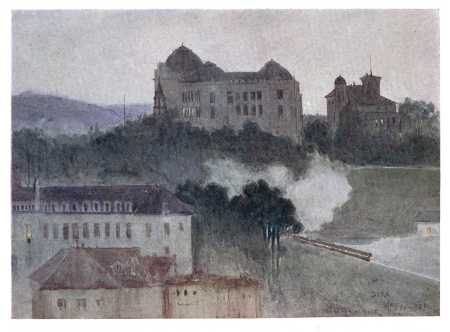
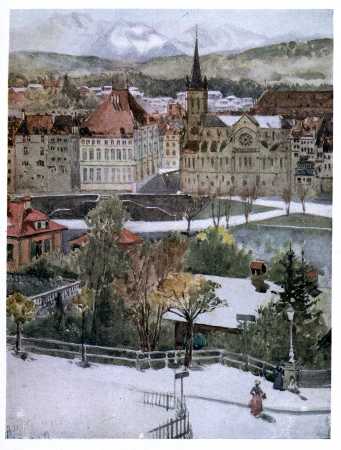
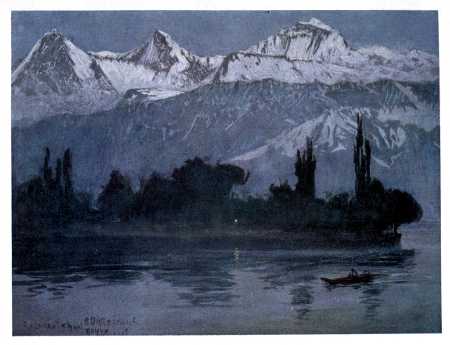
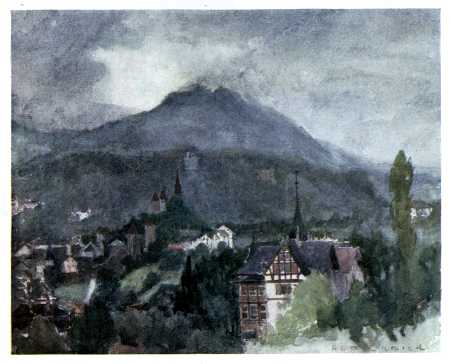
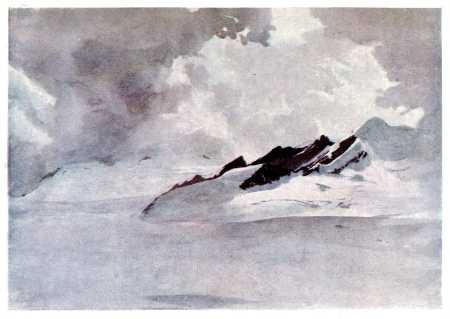
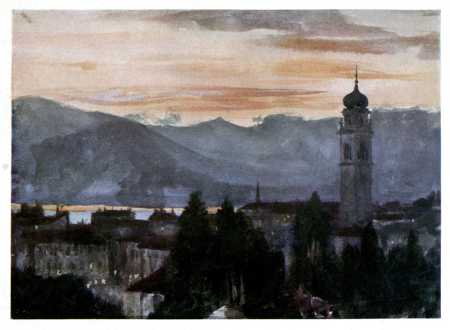
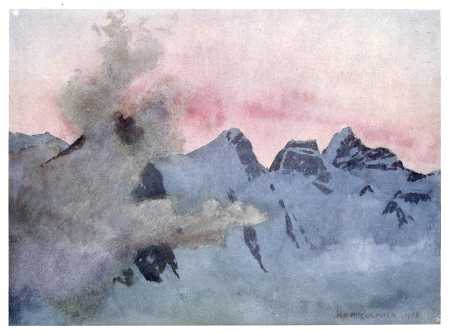
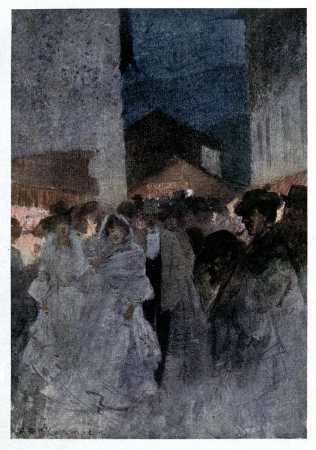
AFTER THE SUNSET
From the Schänzli, Bern.
Over against these mountains there rose on the other side of the valley a
polychrome hill, the Cerro Colorado, covered, they say, with magnetic
sand, which leaps into the air and flies about in sheets and masses when a
thunderstorm comes near—to the very natural horror of the local
Indians. At such times, amidst the roar of thunder and the electric
flashes, surrounded by a desert shaken by earthquakes and dotted over by
cinders, and with this dancing fiend of a hill close at hand, ignorant
people may be pardoned for imagining themselves possessed by a horde of
rioting devils.
Not far away is the blood-red cañon of the Rio Loa, 360 feet deep. I stood
at the edge of this profound meandering trench at an hour when the low
westering sun struck full on one face of it and a dark shadow fell from
the other. With this sanguinary hollow at my feet, I looked across a great
flat plain towards countless volcanic hills, many of them perfectly symmetrical in
form, shining in the mellow evening light. The sunset is the time to enjoy
to the fullest this clean lunar landscape, enriched by the world's fair
atmosphere, when the shadows are stealing across the flat and climbing the
opposite crimson hills, whence they seem to drive the colour up to the
soft still clouds, where it fades away in the purple pomp of oncoming
night.
Is it possible, I wonder, by any words to convey to the reader the least
notion of this sort of scenery? Picture to yourself a lake the size of
Zug, or Annecy, or Orta. It is not a lake for all its flatness and the
aspect of its shores, but a flat plain of salt, white as snow. Its banks
and surroundings are not green, but wide-spreading sand, that stretches
away and yet away till it vanishes perhaps into trembling mirage. Black
spots are dotted all about as though newly scattered from some enormous
pepper-pot. They are ashes. You can scarcely believe they are yet cold
from the fire, that ejected them, however, ages ago. Yellow, crimson,
green slopes rise nearer or farther away to form stately cones or ruined
lumps of the crude earth. Alas! the picture is not paintable by me.
Beheld, it smites the eye with a
single indelible impression. Described, it is a mere succession of details
and fragments, and there is no verbal lightning-stroke that will avail to
smite them for an instant into simultaneous visibility.
Strictly speaking, what has been written above has no place in an Alpine
book. Yet the interest of the Alps to me, or of any range of mountains,
lies in the fact that they are a specimen range, that they resemble more
or less other ranges from Arctics to Tropics, that they are examples of
one large category of mundane phenomena. To understand the position and
character of Alpine scenery in the scenery of mountains, we must consider
what the Alps lack as well as what they possess. Every range of mountains,
indeed, has its own special and purely local elements of character, but
outside of them it likewise possesses many more in common with other
ranges. The experienced Alpine climber will find himself, if not at home,
at all events not far from home in the mountains of Spitsbergen,
Greenland, or the Antarctic, in the Caucasus, the Himalayas, the Canadian
Rockies; even in the snowy Cordillera of tropical Bolivia, or in the
African groups of Kenya and Ruwenzori. The only kind of mountains, so far
as I know, that
will be wholly strange to him, and at first sight almost wholly
incomprehensible, are the desert volcanoes. It has been for the purpose of
bringing this fact clearly before his mind that I have felt myself
justified in devoting a brief space to the character of such volcanic
scenery.
Printed by R. & R. Clark, Limited, Edinburgh.

BLACK'S BEAUTIFUL BOOKS
This series of books is chiefly distinguished by its exquisite
illustrations in colour. There is no volume that one cannot turn to
again and again with renewed interest and delight. No expense has been
spared in reproducing the exact colourings of the artists, and the books
are beautifully printed and bound. Whether one regards them merely as
beautiful things to be looked at and admired, or whether one goes to
them for information and entertainment, one cannot but be pleased with
these books, which are the outcome of the united efforts of artists,
authors, printers, and publishers to place the best work before the
public.
THE 20s. SERIES
ALPHABETICALLY ARRANGED
Size 9X6-1/4 ins.
Painted and Described by
FRANCES E. NESBITT
Algeria and Tunis
70 FULL-PAGE ILLUSTRATIONS IN COLOUR
Described by SIR MARTIN CONWAY
Painted by A. D. M'CORMICK
The Alps
70 FULL-PAGE ILLUSTRATIONS IN COLOUR
By H. M. CUNDALL, I.S.O., F.S.A.
Birket Foster
100 FULL-PAGE ILLUSTRATIONS (OVER 70 IN COLOUR) AND MANY SKETCHES IN THE
TEXT
Text by MARCUS B. HUISH, LL.B.
British
Water-Colour Art, etc.
60 OF THE KING'S PICTURES IN COLOUR
Painted by
MORTIMER MENPES, R.I., R.E.
Described by DOROTHY
MENPES
Brittany
75 FULL-PAGE ILLUSTRATIONS IN COLOUR
Painted and Described by
R. TALBOT KELLY, R.B.A.
Burma
75 FULL-PAGE ILLUSTRATIONS IN COLOUR
Painted by WILLIAM MATTHISON
Text by M. A. R. TUKER
Cambridge
77 FULL-PAGE ILLUSTRATIONS IN COLOUR
Painted by T. MOWER MARTIN, R.C.A.
Described by WILFRED CAMPBELL
Canada
76 FULL-PAGE ILLUSTRATIONS IN COLOUR
Painted by HENRY B. WIMBUSH
Described by EDITH F. CAREY
The Channel Islands
76 FULL-PAGE ILLUSTRATIONS IN COLOUR
Painted by WARWICK GOBLE
Described by PROF. ALEXANDER VAN
MILLINGEN, D.D.
Constantinople
63 FULL-PAGE ILLUSTRATIONS IN COLOUR
Text by JOSEPH GREGO
Cruikshank's Water-
Colours
68 FULL-PAGE FACSIMILE REPRODUCTIONS IN COLOUR
By MORTIMER MENPES, R.I.
Text by DOROTHY MENPES
The Durbar
100 FULL-PAGE ILLUSTRATIONS IN COLOUR
Painted and Described by
R. TALBOT KELLY, R.B.A.
Egypt
75 FULL-PAGE ILLUSTRATIONS IN COLOUR
By HELEN ALLINGHAM, R.W.S.
Text by MARCUS B. HUISH
Happy England
80 FULL-PAGE ILLUSTRATIONS IN COLOUR
By DION CLAYTON CALTHROP
English Costume
73 FULL-PAGE ILLUSTRATIONS IN COLOUR AND NUMEROUS SKETCHES IN THE TEXT
Painted by A. HEATON COOPER
Described by WILLIAM T. PALMER
The English Lakes
75 FULL-PAGE ILLUSTRATIONS IN COLOUR
Painted by COLONEL R. C. GOFF
Described by MRS. GOFF
Florence and some Tuscan Cities
75 FULL-PAGE ILLUSTRATIONS IN COLOUR
Painted by JOHN FULLEYLOVE, R.I.
Described by REV. J. A.
M'CLYMONT, M.A., D.D.
Greece
75 FULL-PAGE ILLUSTRATIONS IN COLOUR
By M. H. SPIELMANN, F.S.A.,
and G. S. LAYARD
Kate Greenaway
75 FULL-PAGE ILLUSTRATIONS (51 IN COLOUR) AND NUMEROUS ILLUSTRATIONS IN
THE TEXT
By NICO JUNGMAN
Text by BEATRIX JUNGMAN
Holland
76 FULL-PAGE ILLUSTRATIONS IN COLOUR
Painted by JOHN FULLEYLOVE, R.I.
Described by REV. JOHN KELMAN,
M.A.
The Holy Land
92 FULL-PAGE ILLUSTRATIONS, MOSTLY IN COLOUR
By MORTIMER MENPES, R.I.
Text by FLORA A. STEEL
India
75 FULL-PAGE ILLUSTRATIONS IN COLOUR
Painted by FRANCIS S. WALKER, R.H.A.
Described by FRANK MATHEW
Ireland
77 FULL-PAGE ILLUSTRATIONS IN COLOUR
Painted by ELLA DU CANE
Described by RICHARD BAGOT
The Italian Lakes
69 FULL-PAGE ILLUSTRATIONS IN COLOUR
By MORTIMER MENPES, R.I.
Text by DOROTHY MENPES
Japan
100 FULL-PAGE ILLUSTRATIONS IN COLOUR
Painted by ROSE BARTON, A.R.W.S.
Familiar London
60 FULL-PAGE ILLUSTRATIONS IN COLOUR
Painted by W. L. WYLLIE, A.R.A.
Described by MARIAN AMY WYLLIE
London to the Nore
60 FULL-PAGE ILLUSTRATIONS IN COLOUR
Painted and Described by
PHILIP NORMAN, F.S.A.
London Vanished and Vanishing
75 FULL-PAGE ILLUSTRATIONS IN COLOUR
Painted by HERBERT M. MARSHALL, R.W.S.
Described by G. E. MITTON
The Scenery of London
75 FULL-PAGE ILLUSTRATIONS IN COLOUR
Painted by A. S. FORREST
Described by S. L. BENSUSAN
Morocco
74 FULL-PAGE ILLUSTRATIONS IN COLOUR
By AUGUSTINE FITZGERALD
Text by SYBIL FITZGERALD
Naples
80 FULL-PAGE ILLUSTRATIONS IN COLOUR
Painted by NICO JUNGMAN
Described by BEATRIX JUNGMAN
Norway
75 FULL-PAGE ILLUSTRATIONS IN COLOUR
Painted by JOHN FULLEYLOVE, R.I.
Described by EDWARD THOMAS
Oxford
60 FULL-PAGE ILLUSTRATIONS IN COLOUR
Painted by ALBERTO PISA
Text by M. A. R. TUKER AND HOPE MALLESON
Rome
70 FULL-PAGE ILLUSTRATIONS IN COLOUR
Painted by SUTTON PALMER
Described by A. R. HOPE MONCRIEFF
Bonnie Scotland
75 FULL-PAGE ILLUSTRATIONS IN COLOUR
Painted by NORMAN H. HARDY
Described by E. Way Elkington, F.R.G.S.
The Savage South Seas
68 FULL-PAGE ILLUSTRATIONS IN COLOUR
Painted and
Described by Edgar T. A. Wigram
Northern Spain
75 FULL-PAGE ILLUSTRATIONS IN COLOUR
Painted by SUTTON PALMER
Described by A. R. HOPE MONCRIEFF
Surrey
75 FULL-PAGE ILLUSTRATIONS IN COLOUR
Painted by WILFRID BALL, R.E.
Sussex
75 FULL-PAGE ILLUSTRATIONS IN COLOUR
Painted by MORTIMER MENPES, R.I.
Text by G. E. MITTON
The Thames
75 FULL-PAGE ILLUSTRATIONS IN COLOUR
Painted and Described by
A. HENRY SAVAGE LANDOR
Tibet and Nepal
75 FULL-PAGE ILLUSTRATIONS (50 IN COLOUR)
By MORTIMER MENPES, R.I.
Text by DOROTHY MENPES
Venice
100 FULL-PAGE ILLUSTRATIONS IN COLOUR
Painted by ROBERT FOWLER, R.I.
Described by EDWARD THOMAS
Beautiful Wales
75 FULL-PAGE ILLUSTRATIONS IN COLOUR
By MORTIMER MENPES, R.I.
Text by DOROTHY MENPES
War Impressions
99 FULL-PAGE ILLUSTRATIONS IN COLOUR
By CAPTAIN S. E. ST. LEGER
War Sketches in Colour
165 ILLUSTRATIONS (50 IN COLOUR)
Painted by FRED. WHITEHEAD, R.B.A.
Described by CLIVE HOLLAND
Warwickshire
75 FULL-PAGE ILLUSTRATIONS IN COLOUR
Painted by WALTER TYNDALE
Described by CLIVE HOLLAND
Wessex
75 FULL-PAGE ILLUSTRATIONS IN COLOUR
Painted by A. S. FORREST
Described by JOHN HENDERSON
The West Indies
74 FULL-PAGE ILLUSTRATIONS IN COLOUR
By MORTIMER MENPES, R.I.
Text by DOROTHY MENPES
World's Children
100 FULL-PAGE ILLUSTRATIONS IN COLOUR
By MORTIMER MENPES, R.I.
Text by DOROTHY MENPES
World Pictures
500 ILLUSTRATIONS (50 IN COLOUR)
A detailed prospectus, containing a specimen plate, of any volume in
this List will be sent on application to the Publishers.
☛ PUBLISHED BY A. AND C. BLACK ·
SOHO SQUARE · LONDON · W. AND OBTAINABLE THROUGH ANY BOOKSELLER AT HOME
OR ABROAD
THE 10s. SERIES
ALL WITH FULL-PAGE ILLUSTRATIONS IN COLOUR
Size 9 × 6-1/4 ins.
Painted by WILLIAM SMITH, Jun.
Described by A. K. HOPE MONCRIEFF
The Highlands and Islands of Scotland
40 FULL-PAGE ILLUSTRATIONS IN COLOUR
Painted by A. FORESTIER
Described by G. W. T. OMOND
Bruges And West Flanders
37 FULL-PAGE ILLUSTRATIONS IN COLOUR
Painted by NICO JUNGMAN
Described by G. E. MITTON
Normandy
40 FULL-PAGE ILLUSTRATIONS IN COLOUR
THE 7s. 6d. SERIES
ALL WITH FULL-PAGE ILLUSTRATIONS IN COLOUR
Size 9 × 6-1/4 ins.
Painted by WILLIAM SMITH, Jun.
Described by REV. W. S. CROCKETT
Abbotsford
20 FULL-PAGE ILLUSTRATIONS IN COLOUR
By C. LEWIS HIND
Adventures among Pictures
24 FULL-PAGE ILLUSTRATIONS (8 IN COLOUR AND 16 IN BLACK AND WHITE)
By GERTRUDE DEMAIN HAMMOND, R.I.
The Beautiful Birthday Book
12 FULL-PAGE ILLUSTRATIONS IN COLOUR DECORATIVE BORDERS BY A. A.
TURBAYNE
Painted by A. FORESTIER
Described by G. W. T. OMOND
Brabant & East Flanders
20 FULL-PAGE ILLUSTRATIONS IN COLOUR
Text by A. CROXTON SMITH
Painted by G. VERNON STOKES
British Dogs at Work
20 FULL-PAGE ILLUSTRATIONS IN COLOUR
Painted by JOHN FULLEYLOVE, R.I.
Text by ROSALINE MASSON
Edinburgh
21 FULL-PAGE ILLUSTRATIONS IN COLOUR
Painted and
Described by DION CLAYTON CALTHROP
English Costume
In Four Sections, each containing 18 to 20 full-page Illustrations in
Colour, and many Illustrations in the text:
Section I. Early English
" II. Middle Ages
" III. Tudor and Stuart
" IV. Georgian, etc.
Price 7s. 6d. net each.
Painted by GEORGE S. ELGOOD, R.I.
Text by ALFRED AUSTIN, Poet
Laureate
The Garden that I Love
16 FULL-PAGE ILLUSTRATIONS IN COLOUR
By LADY BUTLER
Painter of "The Roll Call"
Letters from the Holy Land
16 FULL-PAGE ILLUSTRATIONS IN COLOUR BY LADY BUTLER
Painted by JOHN FULLEYLOVE, R.I.
Described by A. R. HOPE MONCRIEFF
Middlesex
20 FULL-PAGE ILLUSTRATIONS IN COLOUR
Painted and Described by
MRS. WILLINGHAM RAWNSLEY
The New Forest
20 FULL-PAGE ILLUSTRATIONS IN COLOUR
Painted by ARTHUR GEORGE BELL
Described by NANCY E. BELL
Nuremberg
20 FULL-PAGE ILLUSTRATIONS IN COLOUR
Painted by H. J. DOBSON, R.S.W., A.R.C.A.
Described by WILLIAM
SANDERSON
Scottish Life and Character
20 FULL-PAGE ILLUSTRATIONS IN COLOUR
Painted by HELEN ALLINGHAM, R.W.S.
Described by ARTHUR H. PATERSON
The Homes of Tennyson
20 FULL-PAGE ILLUSTRATIONS IN COLOUR
By C. LEWIS HIND
Days with Velasquez
24 FULL-PAGE ILLUSTRATIONS (8 IN COLOUR AND 16 IN BLACK AND WHITE)
By OLIVER GOLDSMITH
The Vicar of Wakefield
13 FULL-PAGE ILLUSTRATIONS IN COLOUR BY AN EIGHTEENTH-CENTURY ARTIST
Painted by JOHN FULLEYLOVE, R.I.
Text by MRS. A. MURRAY SMITH
Westminster Abbey
21 FULL-PAGE ILLUSTRATIONS IN COLOUR
Painted by GEORGE M. HENTON
Described by Sir Richard Rivington
Holmes, K.C.V.O.
Windsor
20 FULL-PAGE ILLUSTRATIONS IN COLOUR
By GORDON HOME
Yorkshire Coast and Moorland Scenes
32 FULL-PAGE ILLUSTRATIONS IN COLOUR
Painted and Described by
GORDON HOME
Yorkshire Dales and Fells
20 FULL-PAGE ILLUSTRATIONS IN COLOUR
BOOKS FOR ANGLERS
Price 7s. 6d. net each
Size 8 × 5-1/3 ins.
Edited by F. G. AFLALO
Fishermen's Weather
Opinions and Experiences by 100 well-known Anglers.
CONTAINING 8 FULL-PAGE ILLUSTRATIONS IN COLOUR FROM PICTURES BY CHARLES
WHYMPER, F.Z.S.
By W. EARL HODGSON
Trout Fishing
CONTAINING FRONTISPIECE AND A MODEL BOOK OF FLIES IN COLOUR
By W. EARL HODGSON
Salmon Fishing
CONTAINING 8 FULL-PAGE ILLUSTRATIONS IN COLOUR, INCLUDING MODEL CASES OF
74 VARIETIES OF SALMON FLIES, AND 10 FULL-PAGE REPRODUCTIONS FROM
PHOTOGRAPHS
☞ PUBLISHED BY A. AND C. BLACK · SOHO SQUARE · LONDON · W. AND
OBTAINABLE THROUGH ANY BOOKSELLER AT HOME OR ABROAD
THE 6s. SERIES
ALL WITH FULL-PAGE ILLUSTRATIONS IN COLOUR
Painted by FRANCIS S. WALKER, R.H.A.
Described by FRANK MATHEW
Ireland
32 FULL-PAGE ILLUSTRATIONS IN COLOUR
Painted by MORTIMER MENPES, R.I.
Text by DOROTHY MENPES
Paris
24 FULL-PAGE ILLUSTRATIONS IN COLOUR AND NUMEROUS LINE ILLUSTRATIONS IN
THE TEXT
Painted by A. S FORREST
Described by JOHN HENDERSON
Jamaica
24 FULL-PAGE ILLUSTRATIONS IN COLOUR
Painted by J. HAMILTON HAY
Described by WALTER SCOTT
Liverpool
24 FULL-PAGE ILLUSTRATIONS IN COLOUR
Described by F. J. SNELL
North Devon
26 FULL-PAGE ILLUSTRATIONS IN COLOUR
MISCELLANEOUS BOOKS
ALL WITH FULL-PAGE ILLUSTRATIONS IN COLOUR
By MORTIMER MENPES, R.I., R.E.
Whistler as I Knew Him
SQUARE IMPERIAL OCTAVO, CLOTH, GILT TOP (11x8-1/4 INCHES).
PRICE 40S. NET
125 FULL-PAGE ILLUSTRATIONS IN COLOUR AND TINT OF WHISTLER OIL-COLOURS,
WATER-COLOURS, PASTELS, AND ETCHINGS
By MORTIMER MENPES, R.I., R.E.
Rembrandt
With an Essay on the Life and Work of Rembrandt by C. LEWIS HIND DEMY
QUARTO, CLOTH, GILT TOP (11x8-1/4 INCHES).
PRICE 12s. 6d. NET
16 EXAMPLES OF THE MASTER'S WORK, REPRODUCED IN COLOUR FACSIMILE BY A
SPECIAL PROCESS
By SIR WALTER SCOTT
The Lady of the Lake
LARGE CROWN OCTAVO, CLOTH, GILT TOP
PRICE 5s. NET
50 FULL-PAGE ILLUSTRATIONS (8 OF THEM IN COLOUR, FROM PAINTINGS BY
SUTTON PALMER)
By W. C. STEWART
The Practical Angler
or, the Art of Trout Fishing, more
particularly applied to Clear Water
12MO., CLOTH. PRICE 3s. 6d. NET
CONTAINING COLOURED FACSIMILES OF THE FLIES USED BY Mr. STEWART (6
PLATES)
THE PORTRAIT BIOGRAPHIES SERIES
Size 6-1/4x4 ins.
By MORTIMER AND DOROTHY MENPES
Sir Henry Irving
CONTAINING 8 PORTRAITS OF IRVING IN COLOUR
PRICE 2s. NET
BOOKS FOR BOYS AND GIRLS
ALL WITH FULL-PAGE ILLUSTRATIONS IN COLOUR PRICE 6s.
EACH
Size 8-1/4x6 ins.
By S. R. CROCKETT
Red Cap Tales
Stolen from the Treasure-Chest of the
Wizard of the North
16 FULL-PAGE ILLUSTRATIONS IN COLOUR By SIMON HARMON VEDDER
By ASCOTT R. HOPE
The Adventures of Punch
12 FULL-PAGE ILLUSTRATIONS IN COLOUR By STEPHEN BAGHOT DE LA BERE
ANIMAL AUTOBIOGRAPHIES
The Black Bear.
By H. PERRY ROBINSON
The Cat. By VIOLET HUNT
The Dog. By G. E. MITTON
The Fox. By J. C. TREGARTHEN
The Rat. By G. M. A HEWETT
EACH CONTAINING 12 FULL-PAGE ILLUSTRATIONS IN COLOUR
Others in preparation.
Translated and Abridged By Dominick Daly
The Adventures of
Don Quixote
12 FULL-PAGE ILLUSTRATIONS IN COLOUR BY STEPHEN BAGHOT DE LA BERE
Gulliver's Travels
16 FULL-PAGE ILLUSTRATIONS IN COLOUR BY STEPHEN BAGHOT DE LA BERE
BY JOHN BUNYAN
The Pilgrim's Progress
9 FULL-PAGE ILLUSTRATIONS IN COLOUR By GERTRUDE DEMAIN HAMMOND, R.I.
By P. G. WODEHOUSE
William Tell Told Again
16 FULL-PAGE ILLUSTRATIONS IN COLOUR BY PHILIP DADD
By G. E. MITTON
Children's Book of London
17 FULL-PAGE ILLUSTRATIONS IN COLOUR BY JOHN WILLIAMSON
By ELIZABETH W. GRIERSON
Children's Book of Edinburgh
12 FULL-PAGE ILLUSTRATIONS IN COLOUR BY ALLAN STEWART
By ELIZABETH W. GRIERSON
Children's Tales from Scottish Ballads
12 FULL-PAGE ILLUSTRATIONS IN COLOUR BY ALLAN STEWART
By the REV. R. C. GILLIE
The Story of Stories
32 FULL-PAGE ILLUSTRATIONS (FRONTISPIECE IN COLOUR)
By the REV. R. C. GILLIE
The Kinsfolk and Friends of Jesus
16 FULL-PAGE ILLUSTRATIONS IN COLOUR AND SEPIA
By HARRIET BEECHER STOWE
Uncle Tom's Cabin
8 FULL-PAGE ILLUSTRATIONS IN COLOUR AND MANY OTHERS IN THE TEXT
Kindly apply to the Publishers, ADAM AND CHARLES BLACK, Soho
Square, London, W., for a detailed Prospectus of any volume in this
list. The books themselves may be obtained through any Bookseller at
home or abroad.
PUBLISHED BY A. AND C. BLACK · SOHO SQUARE · LONDON · W.
Transcriber's Note: Original spelling variations have not been
standardized.