Chapter 16 has been omitted off the Contents list, so has been added.
Click on the [Listen to MP3] link to download and listen to the
music file. If you are reading this e-book in a format other than HTML
you may not be able to use the link.
SHE had not really minded being
an Alley Cat until the kittens
came. But every one who has
had children knows that one
feels being poor much more
keenly on their account, than on one’s own.
And the strawless corner of a deserted shed
did not seem a suitable bed for her mother’s
grandchildren.
The Alley Cat took no pride in her own
appearance. Indeed, it had been said when
she was born that her mother, the blooded
tortoise-shell of a beautiful home, had never
produced such a terrible kitten. She would
not have been allowed to live, if an accident
had not deprived her mother of the others.
And as she grew up even her own parent
saw that she was homely.
It may be thought that homely cats have
no feelings; but this is not the case, for
homely cats, like plain people, are sensitive,
and have even more feelings than others. So
one day when some particularly unkind remark
had been made about the brindled
kitten with yellow sides, she left her home
and ran away to become an alley cat.
She was sorry for this afterwards, of course,
like every other kitten that runs away. But
she would not go home, and slept all summer
in empty boxes and under the barns of people
who did not like cats. She visited garbage
pails, and learned to dash off with the others
when the maid opened the kitchen door. She
learned to walk on her stomach when crossing
the street, and by the time that winter came,
she had cobwebs in her whiskers, and looked
at everybody out of frightened green eyes.
She was naturally a good mouser, but when
the weather grew cold, people shut up their
barns, and every cat knows that the open-air
mice who live around unused sheds are very
poor eating. But she managed to get along
until the kittens came, and then she became
desperate enough to beg at back doors, and
purr for a piece of meat. But some people
cannot appreciate even the finest kind of a
purr, and the Alley Cat’s purr was hoarse and
miserable like herself.
“I once had a good soprano,” she told
the friendly barn cat who brought her a second
joint of rat. “But I’m out of voice
now, being up so much daytimes with the
kittens.”
There were only two kittens,—one ugly like
herself, and the other the very image of that
beautiful mother who had never loved her.
But the Alley Cat remembered this, and made
a point of loving the ugly kitten best.
It was soon after their eyes were opened
that the coldest weather came, and the Alley
Cat made her first acquaintance with The
Back Yard.
She had visited other back yards in her
time, but this was very different, because kind
children played there,—the children of a
mother who loved all helpless things. It is
true that she did not particularly yearn after
alley cats, and was glad when this one refused
to be tamed, and brought into the house.
But she said, “You may put some milk and
meat for her out on the coal box, Eunice.
She probably knows who she is, even if we
don’t!”
So very often after that, when the Alley Cat
leaped with a crash of snow and icicles to
the side fence, she would smell a nice warm
luncheon waiting for her on the coal box, and
go home with a happy, purring heart.
But just before Christmas, the family went
away on a visit and the house was closed, so
when the crash of icicles came, and an anxious
gray face looked over the fence, there was nothing
to be seen or smelled that a body could eat.
The pleasant barn cat who had brought her
the second joint of rat, came to tell his friend
of a place that he had found down-town behind
a restaurant, where many things could
be had without asking. He was really a very
kind cat, although he had but one hole in his
nose, instead of two, owing to the partition
having been torn through in a fight.
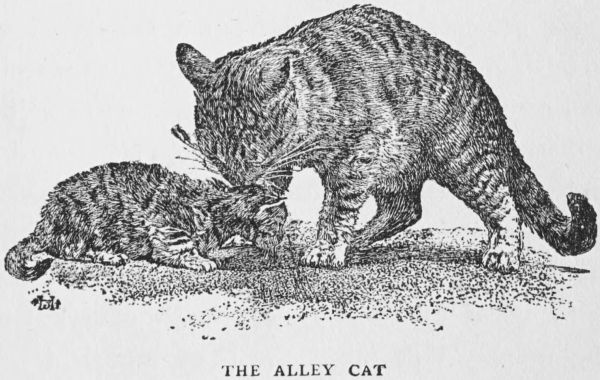
THE ALLEY CAT
But she could not move her kittens, and
indeed had told him very little about them,
fearing that he might not like children.
It was soon after this that the gray kitten
died, and the tortoise-shell kitten became so
thin that there was scarcely room on her sides
for all her beautiful tortoise-shell spots. But
it was not until the day before Christmas that
the family of kind children came home; and
that night, when the mother and grandmother
were out in the woodshed unpacking holly
wreaths, the Alley Cat came into the yard.
The mother of the children noticed her at
once, because there had been a heavy snow,
and her little dark figure showed quite plainly
against it. “Mother, that cat is carrying
something. I believe it’s a kitten!” she said,
and went to the door to look.
The Alley Cat came with her head held
high, for it was a heavy kitten, and her poor
little back strained under the burden. But
she managed to reach the shed, and laid her
baby at the feet of Her who loved all helpless
things, then turned and went out again into
the snow.
“Mother, did you see that? Ah, Mother,
look!” She took up the kitten with pitiful
hands, and held it to her cheek. Its little
nose was quite white with cold, and snow was
on its tail.
“Do you suppose there’d be any danger in
keeping it?” she asked. “Eunice wants a
kitten dreadfully, and has been praying for one
every night for a month.”
“Danger? what nonsense! I’ll disinfect
it,” Grandmother said sharply. “Somebody
heard that prayer, if the Lord didn’t, and the
cat’s come for Christmas morning.”
“It’s a perfect beauty, even if it is thin,”
said the children’s mother. “But it’s pretty
young to keep.”
“I kept my babies when they were younger
than that, and I’ll warrant this cat won’t make
half so much trouble. Besides, its mother
trusted you, so there’s nothing else to do.”
But it was not until after they had warmed
some milk for the kitten, and Grandmother
had wrapped her up in a First Aid bichloride
bandage, that they remembered how the Alley
Cat had gone out again into the night.
“She looked hungry,” said the children’s
mother, with tears in her eyes, “and I know
she must have been hungry. But she thought
she wasn’t wanted, and went away. Oh, poor
Alley Cat!”
She opened the outside door, and called,
“Come back, kitty, come back, poor kitty,
kitty! Come back, poor kitty-cat!”
But nothing entered except the wind and
the snow. And they never saw the Alley Cat
again.
CHAPTER TWO
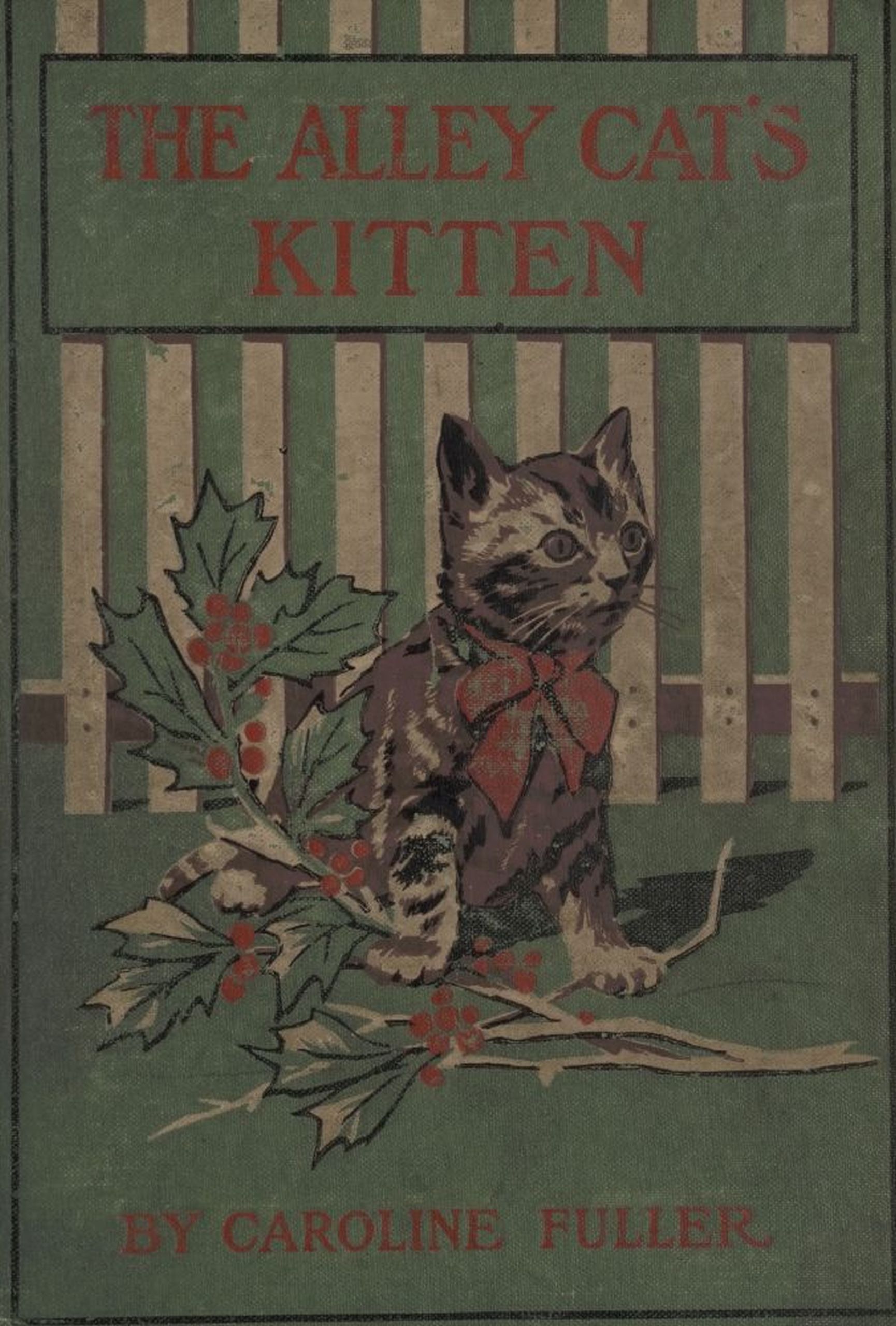
THE ALLEY CAT’S KITTEN
EUNICE and Kenneth were
allowed to get up at six o’clock
on Christmas morning, if they
would promise not to wake
anybody else. But this was a
very funny rule, because when they ran into
the play-room where the stockings were hung,
Mother and Grandmother were always there
before them; and Franklin, who had pretended
to be fast asleep, would give a wild
whoop from behind his door. This happened
every time, and for years afterwards the striking
of a match would set Eunice’s heart beating,
and she would think, “Oh, it’s Christmas,
and six o’clock has come!” when it might not
be Christmas at all, and she would have to
shake herself very hard to remember that she
was grown-up.
This morning Kenneth was the first to
reach the play-room, and so it was he who
first saw—but Grandmother grabbed him by
the seat of his legged nighty, and put her hand
over his mouth, saying, “Wait till Eunice
comes!”
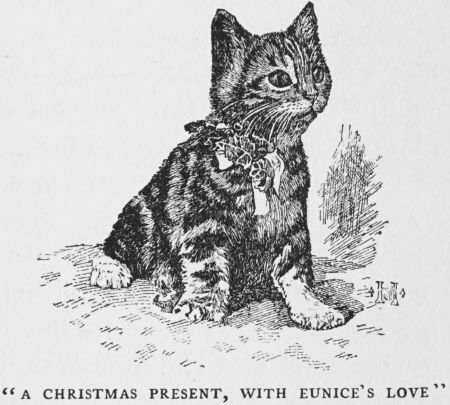
It was then that Eunice saw too, and gave
a little squeal of delight,—the kind that she
always gave when she saw one, although she
had never seen one looking out of the top of
a stocking before. And this one had a lace
ruff around its neck. Otherwise the stocking
was just as usual, all bunchy, with a queer, fat
foot made by the orange in the toe. But she
could not believe that what she saw at the top
of the stocking was true.
“Bang!” went Kenneth on one of his new
noisy presents that Franklin had given him;
and “E-ow!” went the thing in the top of
Eunice’s stocking. Then it was true after all!
“Do take her out, quick!” said Mrs. Wood,
laughing. “I’m so afraid she’ll stick to the
candy elephant underneath.”
“There, I’m glad that’s over!” said
Grandmother, with a sigh. “I wasn’t up
with her but seven times last night.”
“Aren’t you going to look at your other
things?” asked Kenneth, blissfully sucking a
hind leg of sugar dog.
“Oh, Mother, it has white toes!” Eunice
cried.
“Say, Mother, this is bully!” exclaimed
Franklin, from the other side of the room
where his table was set. Franklin considered
himself too old to hang up a stocking now.
“My present for Grandma’s on the breakfast-table,”
Kenneth explained. “It cost
thirteen cents. Eunice’s didn’t cost but
nine.”
“And a white end to its tail,” said Eunice.
“This book’s better than the one that other
fellow had,” said Franklin.
“And it spit at me—such a cunning baby
spit! Mother, did you hear it spit?”
“Well, I believe that I’ll take another
nap,” said Grandmother, with a yawn.
“I’ll go back and get dressed,” said Mrs.
Wood. “Kenny dear, sit off that gum-drop,
please. And don’t eat but three candy animals
before breakfast.”
“Eunice did!”
“Never mind what Eunice does. It’s your
business to look after Kenny. Yes, Mother,
I’m coming.”
And before the children had really looked
at all their presents, it was breakfast-time.
“What’ll you name your cat?” asked
Franklin over the oatmeal. All Franklin’s
rabbits had names, and could tell each other
apart.
“I don’t know yet,” said Eunice. “I think
I’ll have to wait and see what her yell is.”
Eunice had a language of what Franklin
called “yells,” in which she talked to all
animals, and the strange part of it was that
the animals seemed to like it. Some of these
yells were a kind of song, and others appeared
to mean certain things which the animals
understood.
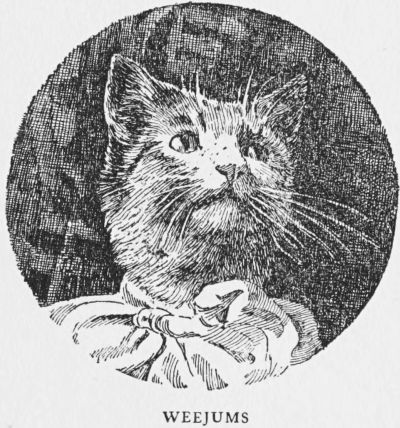
Eunice did not call her new Christmas
present “Kitty, kitty,” but “Wee-je-wee-je,
wee-je, kim-um-sing!” which meant “Come.”
So in a few days the kitten was known as
“Weejums,” and Eunice said that Weejums
had chosen the name for herself.
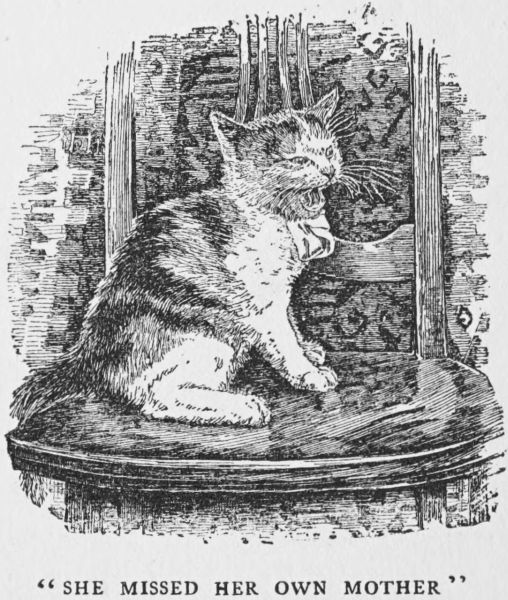
“SHE MISSED HER OWN MOTHER”
She was a very lonely little kitten at first,
and spit at everybody who tried to feed her.
But this was only because she missed her own
mother, and had not yet learned to trust these
new friends. She wept nights, and her baby
face sometimes had the look of quite an old
cat, it was so sad.
“And she never smiled,” Eunice said afterwards,
“until I learned how to make that same
pur-r-ow in my throat that the Alley Cat did.”
Then she decided that she had made a mistake
after all, and that Eunice was her mother.
She learned to come to Eunice’s door every
morning with a little soft “E-ow?” followed
by a very fierce “Wow!” if she was not let
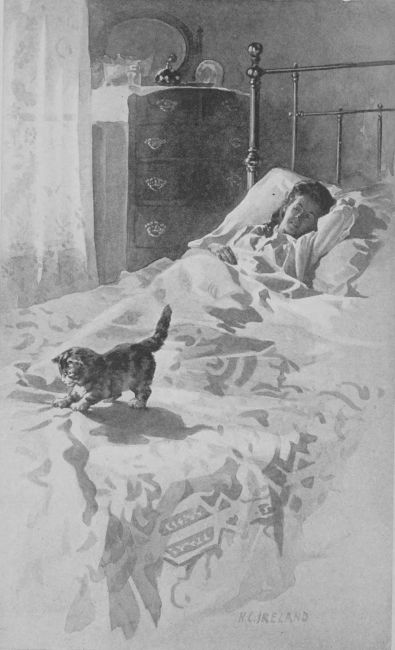
in. Sometimes she came so early that Eunice
would be sleepy, but there was never any sleep
after the kitten was in the room, for she was
one of the dreadfully playful kind; whenever
Eunice moved her toes, she would spring
at them, worrying the bedclothes with wide
bites, and soft thudding hind-kicks. And if
put down on the floor, she would leap back
instantly to dab at Eunice’s eyelashes, or tangle
herself joyously in her hair, chewing very hard
as the curls became caught in her teeth.
She never came to any other door, or spoke
to any other member of the family, and
seemed to know that she was Eunice’s cat.
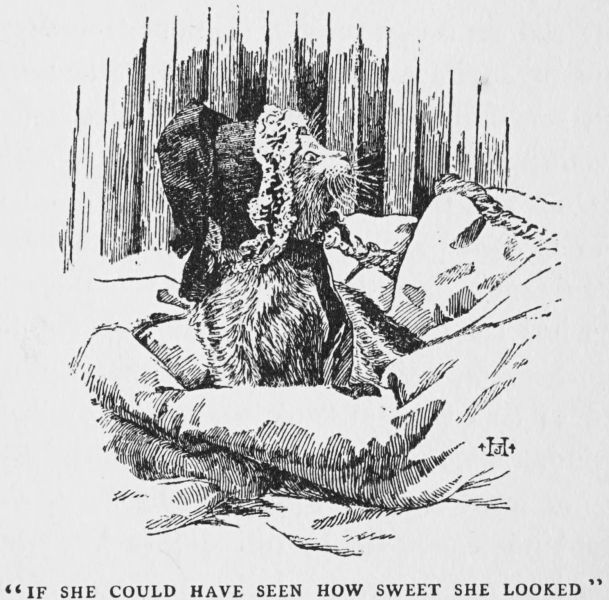
“IF SHE COULD HAVE SEEN HOW SWEET SHE LOOKED”
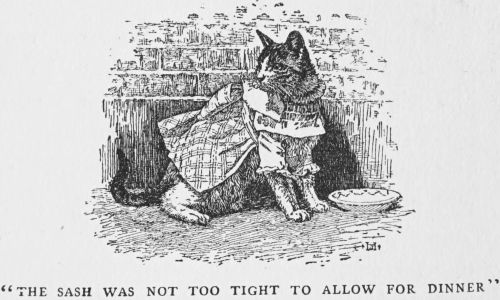
But she hated to be dressed in dolls’
clothes, and would switch her tail very hard,
and sit down “back-to,” whenever dolls were
mentioned. Of course if she could have seen
how sweet she looked with her paws sticking
out of a frilled sleeve, and her whiskers showing
daintily against the dark blue of a velvet
bonnet, she would not have minded at all.
But she refused to look in the glass when
held up to it, and only slanted back her eyes
and ears in a bored way that Eunice called
“Chinese dignity.”
One day Mrs. Wood was receiving some
very elegant people in the parlor, when Weejums
came, or rather rolled into the room.
She had on a sunbonnet, and a pair of dolls’
riding pants, which were so tight that her tail
had to be curled around inside like a watch-spring.
This gave her a most peculiar gait,
as her front legs advanced in stiff hops, and
her hind legs went to places that her front
legs had not planned at all.
Mrs. Wood’s back was towards the door,
and she did not see Weejums until the
Senator and his wife began to laugh. Then
she pounced on the kitten and carried her
out, feeling very much mortified, although
she knew that she should laugh herself when
the callers were gone.
But Weejums had reason to be glad that
she had run into the parlor that day, for it
put an end to the most uncomfortable part
of the dressing-up. After this, Mrs. Wood
forbade Eunice to dress the kitten in any
garment that was not built to contain a tail.
But Weejums still took part in all the plays
that Eunice thought of, and even went coasting
with her on the blue sled. Her tail
always swelled before they reached the bottom
of the hill, but it went back to its normal size
again soon afterwards, and she liked being
pulled up the hill on the sled, without having
to put her pink toes into the snow.
One Saturday afternoon, the children all
went to see “Uncle Tom’s Cabin,” and came
home talking very fast about Topsy and Eva,
and the real bloodhounds, “as big as calves,”
that chased Eliza across the ice.
“There will be scenes from ‛Uncle Tom’s
Cabin’ in the nursery to-day, at four,” Eunice
announced at breakfast one morning. “It
will be the first appearance of Weejums on
any stage.”
Mrs. Wood said that she would come, and
bring some ladies who were to call that afternoon,
and Franklin came, and brought some
boys who were helping him build the new
rabbit-house.
The price of admission was four pins; and
Cyclone, the dog, was tied near the door, with
a pincushion strapped to his back for a money-box.
Cyclone whined and looked miserable
whenever a pin approached, for he knew that
he had a sign, “Pay Here,” fastened to his
collar, and thought it meant that the pins
were to be stuck into him.
When everything was ready, Eunice threw
open the folding doors between her room and
the nursery, and said in a solemn voice, “First
Tableau. ‛Of such is the Kingdom of
Heaven!’”
The tableau was Kenneth, standing in a
high chair, buttoned into one of his mother’s
corset covers, which reached nearly to his feet.
The grown-up audience was wondering what
this had to do with “Uncle Tom’s Cabin,”
when Franklin said, “Oh, pshaw! that’s
wrong. That part doesn’t come in yet.”
“It does so,” said Eunice, putting her head
out from behind the door.
“Does so,” echoed Kenneth from the high
chair.
“Aw, you mustn’t talk,” jeered Franklin.
“You’re nothing but the nightmare Uncle
Tom saw in the last act.”
“Ain’t either!” said Kenneth, bursting a
button off the heavenly robe, in his wrath.
“I’m little Eva.”
“It’s no fair talking,” said Eunice. “Mother,
is it fair talking to the tableau?”
“Let’s have the next scene,” said one of
the ladies, applauding very hard.
“Oh, yes,” said Eunice, looking quite pleased.
“The next scene is Eliza crossing on the ice,
pursued by the fierce bloodhound.”
Eunice was Eliza, and Weejums was the
bloodhound, and the cakes of ice were newspapers
spread on the floor. Eunice, screaming
loudly, clasped her doll to her bosom and
jumped from paper to paper, then stopped
and wiggled a string, and the fierce bloodhound
followed, with gentle pounces and
wavings of a tortoise-shell tail.
But when the audience clapped its delight,
the tail grew so big with terror that you could
scarcely see any kitten at all behind it, and
dashed off the stage to hide under the nursery
bureau. And the whole audience left their
seats and crawled around on hands and knees
with the actors, trying to coax the fierce bloodhound
out.
But he wouldn’t come, and so they could
not have any more scenes from “Uncle Tom’s
Cabin,” as Weejums was to have taken the part
of Miss Ophelia and any number of others. So
the last tableau was announced as “A Sorrowful
Widow Weeping over her Husband’s Grave.”
Eunice was the widow, with a red tablecloth
over her head, which was the nearest she could
find to anything black, and Kenneth was the
grave, down on all fours, covered with a yellow
lamb’s-wool rug. He was dreadfully warm
and uncomfortable in this position, but behaved
very well, until Franklin gave a kind of
snort and said, “Ho, who ever saw a grave
with panties on!”
Then the grave turned a complete somersault,
and lay there chuckling wickedly, while
the sorrowful widow took off her red tablecloth
and scolded him.
The audience went away then, and Eunice
found that Cyclone had slipped the pincushion
around under his stomach, and chewed
all the bran out. And when Weejums came
out from under the bureau, she had to squeeze
herself so flat that she howled all the way, and
some black, yellow, and white hairs were left
behind. But this was because she was getting
to be a big kitten now, and could no longer
have gone into a Christmas stocking.
CHAPTER THREE
THE BLACK RABBIT WITH WHITE SPOTS, AND
THE WHITE RABBIT WITH BLACK SPOTS
THE children went East with their
mother that summer, and Weejums
stayed with Grandmother
and Cyclone at the farm. But
Eunice wrote to her quite often,
and learned from her replies that she was
having a splendid time chasing grasshoppers.
“I’d enclose one tender little one for you,”
Weejums wrote; “but your grandmother says
that they wouldn’t agree with you. It seems
a pity, because they have such juicy little red
legs.”
Eunice did not really believe that Weejums
wrote these letters herself, but was quite certain
that she thought all these things, even if
she never mentioned them.
When they came back in the fall, Grandmother
went down first to open the house, and,
of course, Eunice asked for Weejums almost
before she was inside the door.
“Well, she’s busy just now,” said Grandmother,
with a funny look; “but she sent word
for you to look behind the barrel in the woodshed.”
Eunice and Kenneth ran as fast as they
could, wondering why Weejums did not come
to meet them. And then they heard a purr—such
a loud, proud purr! Eunice thought
that they heard it in the dining-room; but
Kenneth said it was not until they reached the
kitchen. But it was Weejums’ purr, and it
came from behind the barrel in the woodshed!
Eunice looked at Weejums, and Weejums
looked at Eunice, and Mother and Grandmother
came out and looked at them both. Then
Eunice took three little squealing rolls of fur
into her lap, and kissed three tiny pink noses,
warm and moist with sleep. And Weejums
forgot all about her kittens, in the joy of seeing
Eunice again.
“They were born at the farm, two weeks
ago,” Grandmother said, “and came down in a
basket last night.”
“Don’t you think,” asked Eunice, in an awestruck
tone, “that she’s very young to be a
mother?”
“It really looks so,” said Grandmother, seriously;
“because she seems to love you a great
deal better than she does the kittens!”
Weejums was rolling over and over in her
delight, and jumping in and out of the box to
rub against Eunice’s face. And whenever she
jumped, her purr jolted up into a funny little
squeak that came down when she did.
“One is black with white edgings,” said
Eunice, in a rapturous whisper, “and one is
yellow and white, with mittens.”
“Yes, those are extra toes like a thumb,”
said Grandmother. “There’s a cat up at the
farm with toes like that.”
“And one is tortoise-shell like—no, not
like Weejums. Isn’t it a funny color,
Mamma?”
“Yes, if she was ever planned for a tortoise-shell,
her colors must have run.”
Eunice looked alarmed, and wondered if all
the other kittens’ colors would run together,
like the dyes of Easter eggs when they come
out wrong. But there was really nothing
strange about this kitten, except that where
her black spots should have been black, to make
her a regular tortoise-shell, they were a kind of
mixed brindle and maltese, with speckled and
drab lights. The rest of her was a nice yellow
and white, as it should be.
“She looks like my old laundry-bag,” said
Grandmother; “but I kept her for the sake of
that alley cat.”
“Oh, say, come out and see the rabbits try
the new house!” called Franklin at the shed-door,
and everybody but Grandmother hurried
out into the yard; for the rabbits had just
come home from “Beansy’s,” where they had
spent the summer, and were to begin house-keeping
in their new quarters.
Mrs. Wood was particularly interested in
the big rabbit-house, because she had helped
draw plans for the billiard and drawing rooms,
and herself suggested that there should be an
upstairs.
There were two rabbits, a black one with
white spots, and a white one with black spots,
and they were called Mercurius Dulcis and the
Overture to Zampa. Franklin had found the
first name on one of his mother’s medicine-bottles,
and admired it; but Mrs. Bun was
always called Dulcie for short. The Overture
was a fine, big fellow with muscular sides, and
a louder stamp of the hind leg than any other
rabbit in the Rabbit Club. Indeed, Franklin
had been made president of the Rabbit Club,
just because of the size and strength and
sound of the Overture’s feet. Even Beansy’s
white buck, Alonzo, was nothing beside him.
“You put Stamper in the front door,”
Franklin said to Beansy, for Stamper was the
Overture’s club name, “and I’ll put Dulcie
in the cupola. Then he’ll have to go up, and
she’ll have to come down.”
The cupola had a top that came off, something
like the cover of a baking-powder tin,
and Dulcie was thrust in, with a terrific kicking
and scrambling of resentful hind legs. But
she was no fun at all afterwards, for she sat
perfectly still in a frightened bunch, with her
nose wiggling very fast,and did not try to move.
“Stamper’s all right, though,” Beansy said,
with his face against the wire-netting. “He’s
going upstairs.”
He certainly was, although at first he had
proceeded cautiously around the drawing-room,
with long backward stretches of the hind legs.
But now he found the staircase,—made of a
board with little slats nailed across it,—and
scratched his way up very slowly, smelling the
air with little tosses of the head.
“He’ll find the celery now,” called Eunice,
delightedly. “I put a piece in Dulcie’s boudoir.”
Stamper ate the celery loudly, beginning
with the leafy end, and Dulcie heard him from
the cupola.
“She’s coming down!” Kenneth exclaimed.
“No, she’s stuck,” said Beansy. “Your
old cupola door ain’t big enough for her to get
out at.”
“Ho!” answered Franklin, with scorn,
“you just see!” And in a minute Dulcie had
squeezed her way through, and dropped down
suddenly on Stamper’s head, which surprised
him so much that he dropped the last bit of
celery,—the widest end,—and Dulcie ate it.
Then they sat looking at each other with wiggling
noses, as if they had never met before,
and each one was thinking, “Now who on
earth can this other rabbit be!”
“They’re all right now,” said Mrs. Wood,
turning back to the house; “but they’ll never
be able to get into that cupola after they’ve
had their dinner.”
Kenneth ran after his mother, Beansy went
home, and Franklin went into the shed to get
his tool chest.
“Let me hold Stamper while you fix the
door,” Eunice begged, for being Franklin’s
sister, she naturally regarded Stamper in the
light of a nephew.
“No, sir, he’ll stay below decks,” said
Franklin, taking the cupola off the house.
“But he’s trying to get out, Franklin. I
can see his ears coming upstairs.”
Franklin ruled out a larger door in the
cupola with his square, and began to saw.
“Franklin, he is coming out!”
“Oh, go play with your cats!” said Franklin,
impatiently. But Eunice had seen a pair
of wicked ears, erect as corn-stalks, peering
through the opening where the cupola had
been.
“He will get out!” she thought, and grasping
his ears firmly, hauled the big fellow into
her arms.
Stamper sat very still, as he was fond of
Eunice, and simply moved his wide ears back
and forth until Franklin began to pound.
Then he gave a mighty leap, kicked Eunice
in the stomach, and sprang to the ground.
“Franklin!” Eunice gasped; she was too
much out of breath to say anything else; and
Franklin only answered, “Oh, don’t bother!”
So before Eunice could make him look
around, Stamper had given three loud, slow
thumps with his legs, a kind of double-back-action
kick in the air, and was off across the
yard.
“Head him off! head him off!” called
Franklin, as he saw the scudding of a white
tail. “Round by the alley, quick, quick!”
Eunice ran as fast as she could, but before
they could stop him, the rabbit had dodged
under a barn and disappeared.
“Oh, thunder!” said Franklin,“we can’t
ever catch him now. How in the world did
he get out?”
Eunice went through a little struggle with
herself, and then said: “He—I was holding
him just a minute, Franklin. You see he was
most out himself, and so—”
“You didn’t try to hold him after what I
said!”
“Yes, I did.”
Franklin might have understood how hard
it was for her to tell this, but he didn’t, and
said angrily, “Eunice, you’re a naughty,
naughty girl, and you shall never even touch
one of my rabbits again!”
Eunice turned and went into the house without
saying a word, but Franklin heard a pitiful
wail when the door was closed, and thought,
“Hm—serves her right!”
He spent the rest of the morning looking
for Stamper, and putting Lost signs, with a
description of the rabbit, on all the barns in the
neighborhood. But he did not expect to find
him again, and dinner that day was not a cheerful
meal. Eunice’s eyes were red; Kenneth
was too awestruck to upset his glass of water
as usual; and Mrs. Wood looked grieved. But
Franklin did not see why she should expect him
to be anything but cross, when he had lost the
finest rabbit in the whole club, and all through
the fault of a meddling child,—her child too!
He decided that he had a right to be most
severe, and went out after dinner to whittle on
the side steps, which with him was always a
sign of great displeasure.
As he sat there, Weejums picked her way
daintily down beside him, and came out for her
daily airing. She gave a funny little jump and
spit, when one of the whittlings struck her, and
Franklin almost laughed, but remembered in
time that he was too angry, and sent another
whittling after her to see what she would do.
This time she smelled of it, to see if it was
something to eat, then finding that Franklin
was only joking, slanted back her ears, and
walked haughtily across the yard, with stiff
jerks of the tail.
The temptation to make her jump proved
too much for him, and he shied a small piece
of coal at her so neatly that it passed directly
under her, tossing the sand about her feet.
Weejums gave a wild spit, and tore into the
alley, with rising fur, looking around in vain for
the earthquake that had struck her.
“Come back, Weej—here, here,” called
Franklin, good-naturedly, for teasing animals
was not usually in his line. But then he was
cross to-day, and had not Eunice lost his rabbit?
He put down his knife, and went out into
the alley to bring Weejums back, but at that moment
something terrible happened. A baker’s
cart, followed by a fierce dog, jingled into the
alley, and the dog made a dash at Weejums.
Franklin ran for the dog, and Cyclone, who
happened to come around the house just then,
ran after Franklin. Poor Weejums could not
see that the second dog was a friend, and did
not recognize Franklin in the boy who was
chasing her. She left the alley and dashed
across the street into a vacant lot, where three
other dogs were nosing around among tin cans.
They gave a yelp of delight, and joined in
the pursuit, followed by several small boys,
who rushed along after Franklin, shouting,
“Ei-er there! Sick her, sick her!”
In a few minutes every boy and dog in the
neighborhood was on Weejums’ trail, and
Franklin could not stop long enough to explain
to them that he himself was not chasing
her. The hunt came to an end, when she
vanished under some tumble-down sheds, many
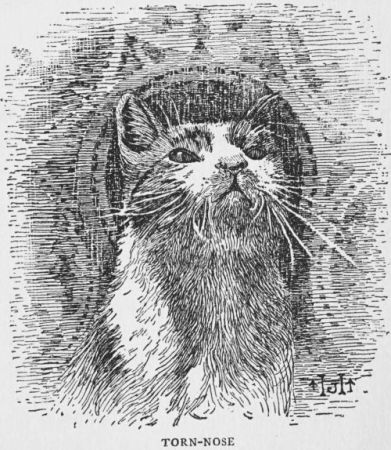
blocks away from home, where a friendly barn
cat, with a torn nose, hid her behind a soapbox.
“Don’t mention it,” he said, when Weejums
tried to thank him. “I once had a friend with
eyes like yours.” And he sighed. But of
course Weejums could not know that this
friend had been her own dear mother.
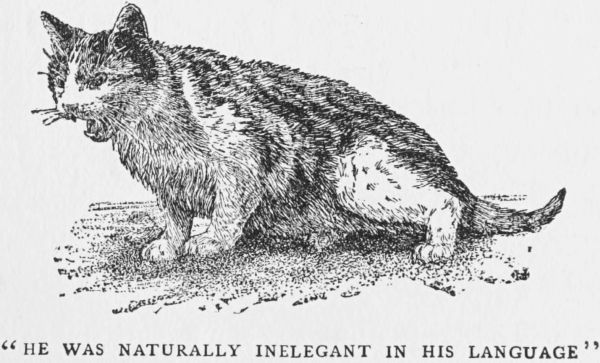
“Just watch me do stunts with that dog,”
the barn cat said. He was naturally inelegant
in his language, never having lived in refined
surroundings; but Weejums forgot this when
she saw him leap to the back of a certain yellow
cur, and claw maps on his skin, like the true
knight that he was.
All the other dogs, including Cyclone, turned
tail and fled, and the barn cat strolled back,
with that gentle expression on his face, which
it is said that great warriors usually wear.
“They didn’t see where you went in,” he
said, comfortingly; “the boys are looking
under the wrong shed.”
“I can never thank you for your kindness,”
said Weejums, with a little break in her yow.
“But I shall tell my mistress about you,
and I hope you will call.”
“Does your family keep a desirable garbage
pail?” asked the barn cat, thoughtfully.
“Unexcelled. But of course I eat in the
kitchen.”
“Ah!” said the barn cat, with another sigh,
“what it means to have a home! Now I presume
that they never throw hot dishwater at
you.”
“Never,” said Weejums, in horror; “I am
treated as one of the family.”
“Alas,” said the barn cat sadly, thinking of
his own life.
“But I’ve run away so far that I don’t
know how to get back, and fear that I shall
never see my dear little kittens again.” And
Weejums began to weep.
“Their age?” asked the barn cat, briefly.
“Two weeks,”
“Most unfortunate. I must try and find
your home for you. Remain here in the soapbox
until I return, and if any strange cat molests
you, say but the two words, ‛Torn-nose,’
and he will disappear.”
Weejums promised, and the barn cat slipped
out so quietly that she scarcely saw him go.
But all the boys and dogs were gone now, so
she did not mind being left alone.
“HE WAS NATURALLY INELEGANT IN HIS LANGUAGE”
CHAPTER FOUR
A CALICO CAT
FRANKLIN did not go home
after Weejums disappeared, but
wandered around the neighborhood,
wondering what he should
do if she did not come back.
“What do you mean by chasing my sister’s
cat?” he asked fiercely of one of the small
boys who followed him.
“Aw—go long! You was chasin’ it yourself.
Tie up your teeth!” was the insulting
reply. And Franklin realized that he could
never make them believe anything else. Then
he began to wonder if there was not a certain
amount of truth in what the boy had said. To
be sure, he had started out to rescue Weejums
and bring her home, but there had been a
strange and terrible joy in his heart, when that
seventeenth dog joined the hunt, and fell over
all the others.
“Pshaw! all cats come home,” he thought.
“She’ll find her way back all right. But rabbits
are different.”
He ground his heel angrily into the gravel,
and thought of Stamper; but somehow he could
not work himself up into as bad a temper as he
had before. He could not imagine what would
become of Eunice if Weejums were lost.
“But cats always come home,” he thought
again. “P’r’aps she’ll be there when I get
back.”
He had not noticed in what direction he was
walking, and suddenly found himself quite far
down-town, opposite the bird store. There
was a new assortment of very wobbly fox terrier
puppies in the window, and he could not
resist sauntering up to examine them. But
almost immediately he wheeled around, and
walked off very fast without looking back, for
in the bird store he had seen his mother and
Eunice.
They were buying a rabbit. He had seen
the man holding up one of the old store
rabbits, who was kicking dreadfully, and
whacking the white-mouse cage with his hind
legs.
Franklin knew that they charged a dollar
and a quarter for this rabbit, and that he was
not worth it.
“If they’re going to buy a rabbit, they
oughtn’t to buy one here,” he thought, in an
agony of anxiety. “There isn’t a rabbit here
that I’d put in my house.”
“If that bird-store man does Mother on that
rabbit, I’ll go down and settle him to-morrow,”
he added to himself. And then he remembered,
with shame, that he could never accept a
rabbit from Eunice, after he had chased her
cat.
He took a car home and looked eagerly on
the front porch, half expecting that Weejums
would be sitting there waiting for him with a
forgiving smile. But she did not appear, and
he went all around the alley again, calling her
in beseeching tones. Suddenly, under the
corner of a neighbor’s shed, he saw something
white move, and went into the house to get a
saucer of milk.
“I s’pose she’ll be afraid to come to me
now,” he thought, and the thought hurt, for
Franklin was not a cruel boy.
He set the milk down, very carefully, near
the place where he had seen the white thing
move, and presently it hopped out, with a great
flop of the ears, and began to drink. But it
was a white thing with black spots, and its
name was Stamper.
Rabbits love milk as well as cats do, so it
was easy for Franklin to grab the runaway by
his long ears, and bear him off to his box, with
a milky nose and an indignant heart. Then
he rushed into the house to see if his mother
and sister had come home. But they were not
there, and Franklin feared that they might
have gone to some strange and distant place
in search of a rabbit. He was much relieved
when a car stopped, and Mrs. Wood and
Eunice got off; for they were not carrying
anything but some bundles from the dry-goods
store, and five cents’ worth of candy for Kenneth.
There was no sign whatever of any
rabbit being concealed about them.
“Stamper’s come home,” he said, almost
before they reached the steps.
“I thought you told Eunice there was no
chance of his ever coming back,” said Mrs.
Wood, kissing Kenneth, who had run to meet
them.
“Well, I didn’t think there was,” said
Franklin, shamefacedly. “Eunice didn’t need
to cry.”
He suspected that his mother had very little
admiration for boys who made Eunice cry.
“There wasn’t one chance in a thousand,”
he added, “and I wouldn’t have caught him
then, if I hadn’t had the milk.”
“What were you doing with milk?” asked
Eunice, suspiciously.
Franklin did not answer, and looked so
uncomfortable that Mrs. Wood changed the
subject; for she made a point of never asking
one of her children embarrassing questions
before the others, and this was one reason
why they loved her so much.
After supper there came a loud thump at
the side door, and Franklin, who was studying
in the parlor, heard a delighted shout from
Kenneth. Then Eunice came running in with
a smile, and taking Franklin by the hand, said,
“I’ve got something for you, to make up for
your feeling so bad about Stamper.”
“But Stamper’s come home,” he said, giving
her a rough little hug. “And I can’t take
any present from you now, Sis, so run away,
and let me get my algebra.”
“I told her I thought you wouldn’t care
to,” said Mrs. Wood, looking relieved. “But
she said that she’d feel very badly if you didn’t
take them.” She was so glad that Franklin
felt he did not deserve them, although of course
she could not know yet just how much he
didn’t. “They” were on the dining-room
table, sitting in Eunice’s hat,—the most beautiful
little pair of maltese rabbits that Franklin
had ever seen. And all his life long he had
wanted a maltese rabbit!
“Those didn’t come from the bird store,
I know,” he burst out in delight, quite forgetting
that he was not to keep them.
“They came from the farm of the father of
a boy who works at Taylor’s,” said Mrs.
Wood, laughing. “The bird-store rabbits
were no good.”
“Oh, those bird-store rabbits are enough to
give a hand-organ sore throat! You’re just
a brick, Mother, and so is Eunice, but I can’t
take these little fellows, really. Eunice must
keep them herself.”
“Eunice will feel badly if you don’t take
them,” said Mrs. Wood again.
“Oh, but there’s reasons why I can’t,” said
Franklin, desperately. “I don’t want to tell
before the kids.”
“Well, they can be my rabbits for to-night,
then,” said Mrs. Wood, in her quiet way, “and
to-morrow we’ll decide whom they really belong
to. I shall feel dreadfully proud to own
some rabbits, even if I can’t have them but
one night.”
She smiled, and Eunice and Kenneth began
to laugh, thinking the whole affair a joke.
“But they’re too little to put with Dulcie
and Stamper, aren’t they, Mother?” Eunice
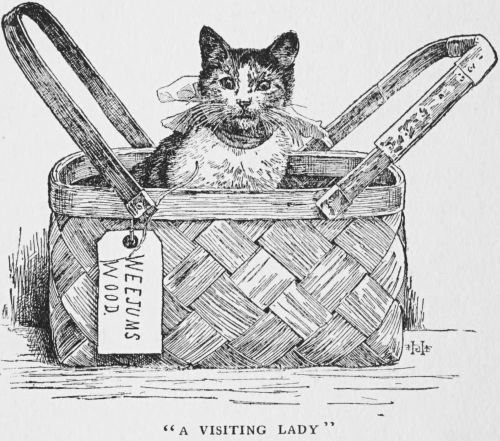
said. “We’ll have to put them with Weejums
and the kittens.”
“Oh, she’ll eat ’em up!” said Kenneth.
“No, she won’t,” said Mrs. Wood. “We’ll
watch her and see. They are not so different
from her own babies.”
But when they took the little bunnies to
Weejums’ box, there was no Weejums to receive
them, and the three kittens were crying
with hunger.
“I’ll go call her,” said Eunice, running
to the side door. But no distant “purr-eow”
answered to her call, and no tortoise-shell tail
waved a greeting from the top of fence or shed.
“Biddy, have you seen Weejums?” she
asked, coming into the kitchen.
“Shure, I have, and a very foine cat she is,
barrin’ her swate voice.”
“No, but have you seen her since dinner?
Biddy, please don’t tease.”
“Well, I gave her some dinner at two, and
she left my prisence directly afterwards, without
so much as sayin’ ‛thank you,’ and wint
for a sthroll.”
“Then she hasn’t come home! Oh,
Mother, do you suppose anything’s happened
to her?”
Mrs. Wood went back to the parlor to ask
Franklin if he had seen anything of Weejums,
and Franklin told her the whole miserable
story, or nearly the whole; for of course the
children came running in to interrupt.
“Don’t tell Eunice,” his mother said quickly.
“It would make it so much harder if she
thought you had anything to do with it.”
So Franklin did not tell, but he never liked
to think afterwards of those days that followed.
Eunice went around with a white face; while
Kenneth tore his clothes to shreds crawling
about under barns and fences. The loss of
Stamper had been sad, of course, for rabbits are
both desirable and attractive, but Weejums
was one of the family.
The kittens had to be fed with a spoon, and
gave furious strangled howls, as the milk was
poured into them.
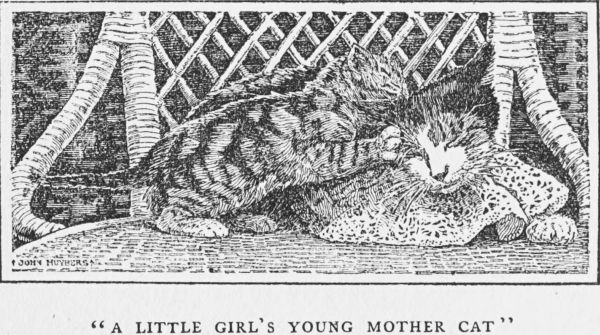
“A LITTLE GIRL’S YOUNG MOTHER CAT”
Eunice wrote out an advertisement to be put
in the paper:
“LOST.—A little girl’s tortoise-shell, young mother
cat, with pink toes and a sweet face. Answering to
the name of Wee-je, Wee-je, kim-um-sing.”
And Mrs. Wood put it all in, except the
last, about answering, saying instead that there
would be a reward of two dollars for any one
returning the cat to her home.
This notice appeared for three days, and on
the third, another one followed it:
“In addition to above reward offered for return of
young mother cat, will be given: Two fine, fat,
handsome rabbits in splendid condition, with one
palatial, airy rabbit-house, eight rooms, staircases,
cupola, and all modern improvements.”
“F. Wood, Esq.”
Mrs. Wood smiled as she read this, although
her lips trembled, and she thought: “That
must have broken Franklin’s heart.”
The next day something else left the family,
and this was no less than Kenneth’s beautiful
head of curls; but something much more important
returned in their place, when he came
marching home without them.
Grandmother was there for a few days, and
took him down to have them cut, because he
had been promised that they should go before
school began. Then she dressed him in his
first trousers, and brought him triumphantly
to his mother, who, instead of being delighted,
said, “Oh, Kenny, Mother’s lost her little
baby!” and looked so grieved that he broke
into a great roar of sympathy, and a little later,
when he strolled out into the street, a boy
called after him: “H’m, been cryin’ ’cause
your hair’s cut!”
“Say that again, will you!” said Kenneth,
removing his hands from the new pockets.
“I said you’ve been cryin’ ’cause—”
But the sentence was never finished, for
Kenneth had flown at him with all the confidence
those trousers inspired,—it is wonderful
to find how much more easily you can run
in them,—and the boy dropped down behind
a fence.
“I guess I’ll take a walk,” Kenneth thought,
with becoming modesty. “I guess I’ll just
take a walk around the block.”
“Round the block” was the extent of the
distance he was allowed to go away from home
by himself.
“I may meet some boys,” he added, trying
not to keep looking down at his legs.
But he did not meet any boys, because they
had all run to join a crowd that was gathering
on another street. And Kenneth ran too,
although he knew that it was much further
than around the block; but his new trousers
went as fast as they could, and so naturally
he had to go with them.
The boys were looking up at a tree, and
throwing things, and Kenneth caught his
breath, as he heard a most un-bird-like “E-ow”
from among the branches.
“Say, what color’d cat is it?” he asked of
a ragamuffin, who was preparing to throw an
ancient apple.
“Caliker cat,” said the boy. “Up
there. See?” and he closed one eye to
take aim.
“She ain’t calico. She’s tortoise-shell,”
burst out Kenneth, turning red with delight.
“She’s our Weejums, and I’m goin’ to take
her home.”
“Oh, she’s your cat, is she?” asked the
boy, dropping his apple and looking dangerous.
“Your cat?—when we chased it up
there? Well, I like that! Say, fellers, did
you hear that? Your cat, is it? Huh, your
cat! Calico cat! Tie up your teeth!”
“Don’t have to,” Kenneth replied.
“Say, you better run home to your Ma-Ma,
little boy. D’ye hear?”
“Don’t have to,” Kenneth responded.
“Calico cat!” sneered the boy, insultingly.
“Calico, I say. Old calico cat!”
“Tortoise-shell,” insisted Kenneth, politely
but firmly. “I’ll punch your head.”
The boy doubled up his fists with a snort of
rage,—he was bigger than Kenneth,—and said:
“Oh, you’ll punch my head, will you?
You’ll punch my head! I say, fellers, did
you hear him say he’d punch my head?
Boxey, you heard him say it?”
“I heard him,” said Boxey.
“Well, then, come along and do it. I just
stump you to come along and do it. Huh!
don’t dare do it!”
Kenneth had never engaged in a regular
fight before, but it is strange how different
trousers make one feel—especially that first
day. So he took off his new little coat,—it
was quite an old one before he reached home,—and
went for the boy. A ring formed to
see that there was fair play; for although they
all pitied Kenneth, they couldn’t help respecting
a boy who said, “Don’t haff ter,” to Patsy
McGann.
Everybody knows that there are two kinds
of strength in a fight,—one that comes from
training, and one from splendid rage, and Kenneth’s
was of the latter order. When his nose
began to bleed, he wept with fury, which was
very effective, as it made the blood seem ever
so much more. And when Patsy muttered,
“Calico,” between his blows, Kenneth answered,
“Tortoise-shell!” with all the vengeance of
which he was capable.
It was not a long battle, for the sound of
Weejums’ pathetic voice, from the tree, put
force into Kenneth’s rib-punches, and presently
Patsy McGann went down, with a waving of
grimy heels that called forth a storm of applause
from the onlookers.
“He’s licked him—he’s licked him! Give
him the cat,” called a larger boy who had
strolled up while the fight was in progress.
And all the others drew away from the tree,
while Kenneth coaxed Weejums down, with a
voice that she recognized, although she would
never have known his poor bruised little face.
And just as he had taken her in his arms, who
should come whistling up the street but
Franklin!
He understood the situation at a glance, and
striding up to Patsy McGann, seized him by
the shoulder, saying, “Did you lick him?
Answer me! Did you lick that little fellar?”
“Naw, he licked me. An’ just on account
of that old caliker cat you was chasin’ the
other day.”
“You shut up!” said Franklin, with his face
burning. But Kenneth had not heard the
whole of the sentence.
“What kind of a cat did you say it was?”
he asked, turning to Patsy.
“A cal—I mean turtle-shell cat,” said Patsy,
sullenly, walking off with his friends.
CHAPTER FIVE
MR. AND MRS. BLUEBERRY
FRANKLIN took Kenneth in at
the back door, and washed his
face, before letting any one see
him. Then they walked triumphantly
into the parlor, with
Weejums on Kenneth’s shoulder.
Eunice was practising at the piano, with
Mrs. Wood beside her, so they did not see
Weejums, until Eunice felt a little purring face
against her own, and screamed for joy. Mrs.
Wood exclaimed also, and turned very pale, but
it was not on account of Weejums.
“Was it a runaway, Franklin?” she asked
quietly, “or did he get under a street car?”
Just then Grandmother came into the room,
and Franklin led Kenneth up to her with
pride.
“Grandmother, look at your descendant!”
he said. “He ain’t but six, and he licked a
boy eight.”
“Hurrah for you!” said Grandmother, which
any one will admit was a very strange remark
for a grandmother to make.
“What was the fight about?” asked Mrs.
Wood, bringing some Pond’s Extract from
the dining-room. “Franklin, you didn’t get
him into this?”
“Course he didn’t,” said Kenneth. “’Twas
Weejums got me in, and Patsy McGann.
Ouch, Mother! don’t pour it in my eye.”
“It was an entirely necessary fight,” Franklin
explained. “Patsy McGann was throwing
things at Weejums, and calling her a calico
cat.”
“And she’s tortoise-shell,” Kenneth said.
“Well, they happen to be the same thing,”
said Mrs. Wood, patiently. “Mother, do you
think it’s so very desirable for a boy to come
home looking like this?”
“I’d like to get a glimpse of the other boy,”
said Grandmother, with a wicked twinkle in her
eye. Franklin gave a whoop of delight, but
Grandmother cut short his joy by beckoning
him into the other room.
“You said he licked a boy eight?” she
asked, taking up her work.
“Yes, and, oh, Grandmother—”
“Nothing strange about that, since he’s
a Wood. You whipped a boy eight when
you were six, didn’t you? Seems to me I
remember.”
“You bet!” said Franklin, with a joyous
flush of recollection.
“Yes, and so did your father. But now
you’re twelve, and I know a boy your own
age you can’t whip.”
“Well, I’d just like to have you bring him
out,” said Franklin, doubling up his fists.
“It’s yourself,” said Grandmother. “It
seems a pity that you’re not strong enough to
whip yourself,—when you want to chase cats,
and things like that.”
“Oh,” said Franklin, looking crestfallen.
“Now go and get ready for supper,” Grandmother
said quietly. “I’ve had my say.”
Franklin edged to the door, and then came
back, holding out his hand.
“Grandmother,” he burst out, “Grandmother,
shake! You’re a gentleman!” after
which he bolted upstairs.
“Where was Weejums going when the boys
chased her up a tree?” Eunice asked at the
supper-table.
“Don’t know,” said Kenneth. “Mother,
can’t I have three helps of cherries to-night,
’cause I’ve got a sore nose?”
“You may have four more cherries, Kenny;
but don’t throw the stones at Cyclone any
more. He may swallow them.”
“S’cuse me,” said Franklin, pushing back
his chair. “Come on, Eunice, and we’ll go
ask the boys about Weejums.” It was a treat
for Eunice to go out with Franklin, after supper,
and they were lucky enough to find the
boy, Boxey, at the end of the block.
“There was two cats,” Boxey said, eagerly,
“Yours, and an old tomcat with a game nose.
They was trottin’ along together, an’ when we
come up, he went under a porch, and she run
up a tree. He kep’ callin’ to her, and spittin’
at us, the whole time.”
“P’r’aps he was bringing her home,” Eunice
said. “Oh, Franklin, let’s go find that poor
tomcat, and put some vaseline on his nose.”
“It was a lattice-work place, under a porch,”
said Boxey, starting ahead. “I’ll show you.”
“Oh, it isn’t likely he’s there now,” said
Franklin, taking Eunice’s hand; “and if he’s
a friend of Weejums, he’ll turn up again, Sis,
so don’t you worry. We’ll go home and put
some stuff out in the back yard for him to
eat.”
That evening, Mrs. Wood sat laying some
lovely, sunshiny things away in a little box,
and thinking of how like the face of a dandelion
Ken’s dear head used to look.
“Mother’s lost her little baby!” she said to
herself, as she slipped the last one from her
finger, and kissed it softly before closing the
box.
“Oh, stuff and nonsense!” said Grandmother,
who was pretending to read the paper.
“You’ve got something better.”
But Mrs. Wood knew that Grandmother had
just such another box put away somewhere,—the
box that held the curls of him who had been
Kenneth’s father, and Grandmother’s little boy.
“I’m going to give Kenny my rabbits,” said
Franklin, the next morning. “’Twas in the
advertisement, and I promised.”
“Oh, but Kenny didn’t see the advertisement,”
Mrs. Wood said; “and Weejums is
going to buy him such a nice present this
morning. I wouldn’t give away the rabbits,
Franklin dear.”
“Well, but I promised, Mother.”
“Yes, but Kenny is such a little boy, he
could never begin to take care of all Dulcie’s
young families. Suppose that you give the new
little bunnies to the children, if you want to
give away something. I don’t believe Kenny
himself would want you to part with the rabbits
that you’ve had so long.”
“Well, I’ll think about it,” Franklin replied.
And that afternoon it was announced that
Eunice and Kenneth were to have a bunny
apiece.
Two wild shrieks of delight were followed
by a dash to Weejums’ box, where the strange-eared
visitors lay, cuddled in amongst the
kittens.
“I want the one that’s mostly maltese,” said
Eunice.
“No, I want the one that’s mostly maltese,”
said Kenneth.
“You never thought of it till I spoke.”
“Did so. Pig!”
Eunice promptly seized him by the hair, and
Mrs. Wood went to the rescue, saying, “Sister,
for shame! Kenny! you mustn’t kick Eunice,—and
now that you’re in trousers too!”
“I can kick ever so much better,” Kenneth
said.
“I put them on last night and kicked him,”
Eunice explained. “I know you can.”
“Well, you are both very naughty, and I
don’t think any rabbits will be given away to-day.
I’ll go explain to Franklin,” and Mrs.
Wood started to leave the room.
But both children rushed after her, calling:
“Oh, Mother, I’ll take the other Bun! I will,
Mother!”
“No, Mother, I’ll take the other Bun. I
like him. Please, Mother!”
“I think that Kenneth should have first
choice,” Mrs. Wood said patiently; “because
he brought Weejums home. So the mostly
maltese Bun can belong to him. But if I
hear another word of quarrelling about it, the
rabbits will go back to the farm to-morrow.”
There was a moment of awed silence, and
then Eunice said, with a sudden radiant smile:
“I shall call mine Mr. Samuel Blueberry!”
“Mine will be just Bunny Grey,” Kenneth
remarked. “Blueberries give me the stomach-ache.”
“Mother, can’t we have a wedding like
Cousin Florence’s, and let the little bunnies
get married? I’ll do it all myself.”
“Don’t you think they’re rather young
yet?” asked Mrs. Wood,—“only six weeks.”
“No, but I heard Auntie say it’s better to
be married young, because it gets you more
used to yourself.”
“How many children would you want to
invite?” asked Mrs. Wood, seriously.
“Oh, just Mary and Wyman, and their
animals. And Bertha and Annabel, and
Gerald and Myrtie Foster.”
Mary and Wyman Bates were the children’s
cousins who lived uptown. Bertha and Annabel
were Kindergarten friends of long standing,
and the Foster children were school companions,
whose father kept a fascinating grocery
store. Many were the striped jaw-breakers,
and flat “lickrish” babies, which Myrtie had
brought to her friend; while Kenneth could
not help admiring a boy who had a regular
house, built of tin cans, in which he kept
potato bugs.
“I suppose you will want them all to stay
to supper,” Mrs. Wood said; “and you know
our dining-room is small. Suppose that you
don’t ask Gerald and Myrtie.”
“Oh, Mother!” Eunice exclaimed.
And Kenneth echoed, “Oh, Mother!”
“I could ask them just for the ceremony,”
Eunice said. “Lots of people are asked to the
ceremony, who don’t come to the reception.”
“You’ll find that they’ll expect to stay, if
they come. But of course you can do as
you like. Perhaps they won’t mind being
crowded.”
The invitations were written and sent that
night.
“Mr. and Mrs. Overture-to-Zampa Wood
request the honor of your presence, at the marriage
of their daughter, Miss Bunny Grey, to
Mr. Samuel Blueberry, Esquire, on Wednesday,
September the 8th, at three o’clock in the
afternoon.”
And they were directed to Miss Mary Bates
and Kitten; Master Wyman Bates and Rabbits;
Miss Myrtie Foster and Kitten, etc., and
all were accepted with pleasure.
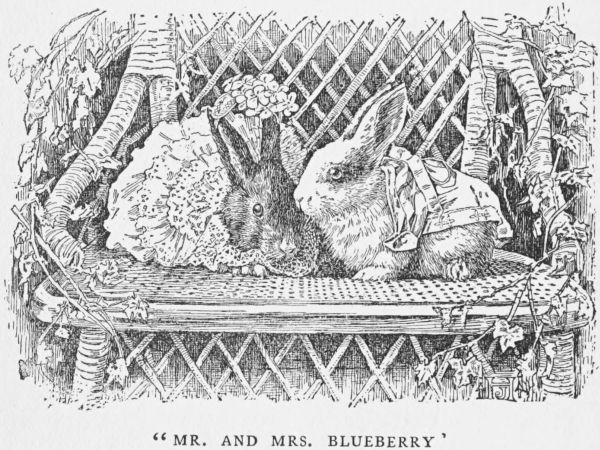
“MR. AND MRS. BLUEBERRY”
Eunice spent delightful hours in getting up
the wedding garments,—little white satin
blankets cut like dog blankets, except with not
so much “yoke,” as rabbits’ heads are screwed
so close to their bodies. Samuel’s dress-suit
was trimmed with pink baby-ribbon, laid on
plain, and the bride’s robe with lace; and she
wore a white veil, with orange blossoms, which
made her look a lighter shade of maltese than
she really was.
The effect was most beautiful until the groom
tried to eat some of the orange blossoms, and
they had to be pried out of his mouth with a
match, and sewed on again. This delayed the
final dressing a little; but when the guests
arrived, the bride and groom were—contrary
to custom—awaiting them on the hall
table.
Bertha Richmond’s cat was named “Grandmother,”
and wore a nice kerchief and frilled
cap, with paper spectacles fastened to the
border. Her presents were a bunch of young
turnips, carefully washed and tied with white
ribbon, for the bride, and the same effect in
red beets for the groom.
Annabel Loring’s cat wore a new blanket of
pale-blue cashmere, trimmed with swan’s-down,
and brought two bouquets of red and white
clover, done up in tin foil.
Mary and Wyman Bates had started out with
lettuce and carrots for their present, but had
been obliged to give most of it to their own
rabbits on the way down, to keep them still.
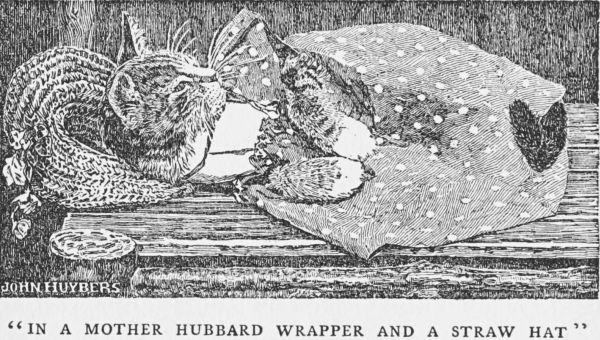
They had had an exciting trip on the street car,
for Mary brought also her two kittens, one
attired in a riding habit, and the other in a
Mother Hubbard wrapper and straw hat.
“IN A MOTHER HUBBARD WRAPPER AND A STRAW HAT”
Myrtie Foster had not been able to bring
her cat all the way, but arrived with a torn
apron and scratched thumb, which Mrs. Wood
tenderly bound up, to save Myrtie the trouble
of sucking it.
“It was while we was passin’ the drug-store,”
the little girl explained. “Malvina heard the
soda-water fizzin’ and thought ’twas another
cat.”
But Gerald had brought his yellow rabbit,
together with the crowning present of all,—a
monster cabbage tied with Myrtie’s Sunday
hair ribbon.
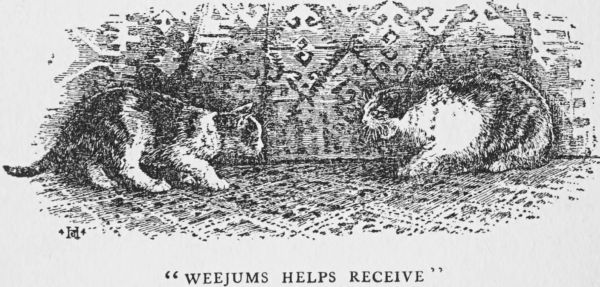
Weejums was supposed to help Dulcie and
Stamper receive the guests; but, instead of
being cordial, she flew at “Grandmother,”
who was the first to arrive, and clawed the
spectacles off her nose, making such rude remarks
that Eunice was obliged to shut her in
the china closet, where she sat and growled
through the entire ceremony.
When the wedding procession was ready to
start, Mrs. Wood played the Lohengrin March,
and the happy couple entered the parlor in
their squeaking chariot, which was Kenneth’s
express cart built up with a starch-box, and
covered with white cheese-cloth. A bunch of
daisies at each corner completed the solemn
effect.
“Now put them on the table, Franklin,”
Eunice said; “and remember to bob Sam’s
head at the right time.”
“All right,” said Franklin.
“E-ow-wow-fftz-fftz!” called Weejums from
the china closet.
“I’m the minister,” Eunice said. “Now,
Franklin, if you laugh you sha’n’t stay.”
“Well, I only meant to smile,” Franklin
explained, “but my face slipped.”
The minister unfolded a much-blotted piece
of paper, and began to read in important tones:
“Children, cats, etc., we are gathered together
to celebrate the wedding of these rabbits,
who have got to be married whether they
want to or not. Samuel, do you promise to
always give Bun Grey the best of the clover, to
cherish her from all attacks of rats, and never
to bite her tail? (Bob his head, Franklin.
No—no! That’s the wrong one; that’s Bun
Grey’s. Now bob Sam’s head. That’s it.)”
“Bun Grey, do you promise to take Sam for
your maltese husband, to give him the best of
the celery, and never to kick him in the
stomach? (Bob her head, Franklin; that’s
right!)”
A solemn pause, and then in a deeper voice,
“Now let the brass ring pass between you.”
A curtain ring, wound with white ribbon,
was pushed up Bunny Grey’s front leg as far
as it would go, and then Eunice said, in the
deepest voice of all: “I now pronounce you
rabbit and wife, and let no dog, mouse, weasel,
cat, or guinea-pig ever say it’s not so! Now
we will have supper.”
And the whole company filed out to the
woodshed, where an ample repast was set for
rabbit and cat. The menu included oatmeal
in an ear-of-corn mould, with clover sauce;
catnip fritters, with cream; stewed potatoes;
and a wedding cake with “B. G. and S.” in
red letters on the frosting.
The animals were held up to the table with
napkins around their necks, and ate their share
of the feast, while their owners ate the cake.
Then the bride and groom took a wedding trip
around the block, drawn in their white chariot,
and, contrary to custom again, escorted by
all the guests.
“Now we must sit for our picture,” Eunice
said, as Franklin brought out his camera, and
those of the guests who had gone to sleep during
the wedding tour were shaken awake again.
But it was dreadfully hard to pose them all, so
that their clothes and whiskers showed properly,
and just at the last minute the picture was
spoiled by Grandmother Richmond, who had a
fit, and ran up the screen door. There were a
few other legs and tails in the picture when it
was developed, but it was mostly Grandmother’s
cap and fit; and it seemed such a
pity, because all the other animals had such
pleasant expressions, and looked so charming
in the clothes they wore.
Everybody stayed to supper, and the
sliced peaches gave out; but they ended up
with canned ones, and nobody seemed to
mind.
“It was the nicest party I was ever to,”
Myrtie Foster told Mrs. Wood when she
went home; “and I shall tell Malvina what
an awful lot she missed! Our mamma
doesn’t have time to make parties for us.
She has to tend store.”
“It was lovely to have you,” said Eunice,
warmly; “only I’m sorry Weejums was so
rude. She mort’fied me very much.”
“Don’t you mind the least bit,” said Myrtie,
consolingly. “I’ve heard that somebody
always cries at a wedding!”
“WEEJUMS HELPS RECEIVE”
CHAPTER SIX
UNCLE CYCLONE
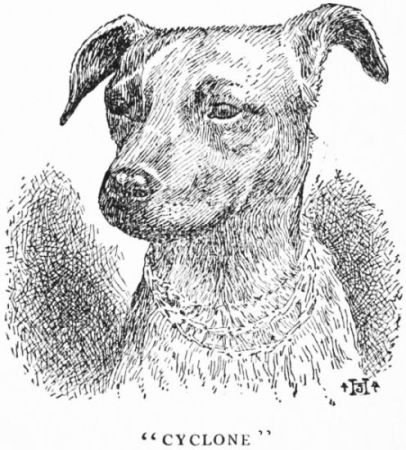
CYCLONE was a yellow dog of
no breeding, that Franklin had
begged from a man in one of
the parks.
“He was making horse noises
at him,” Franklin said indignantly; “and a man
who doesn’t know any better than to make
horse noises at a dog, doesn’t deserve to own
one.”
So Cyclone became a member of the Wood
family, and received his name because of the
way that a room looked after he had run
through it. He had his peculiarities from
the beginning, and one was not to bow to any
member of the family that he met on the
street. He preferred to take his walks alone,
and although Franklin met him in all sorts
of places around town, Cyclone would never
recognize him.
Soon after Bridget joined the family, she
nearly gave notice because of Cyclone’s rude
behavior.
“CYCLONE”
“It was comin’ out of church, I was,” she
said; “and there he was waitin’ for me on the
shteps as gintlemanly as you plaze. And
Father Malone, who’d been so kind as to pass
the time of day wid me as I came out, says,
‛Shure, Miss Donnahue, is that your little
dog?’ and sez I, ‛Faith he is! Just watch
and see how swate he looks at me.’ And then
if he didn’t turn his head away, and pretind he
was another dog! The shame of it, mum!
And before the praste too! I never lived
with folks before to be so treated.”
But at home Cyclone was quite a different
person. He became tenderly attached to
Weejums’ kittens, and allowed them to sharpen
their claws on his legs.
One day when Mrs. Wood was in the
kitchen, she saw Cyclone and two other dogs
trot around the house in single file, and enter
the woodshed. Cyclone led his guests to the
box where the kittens lay heaped in a downy
pile, with one little pansy face turned upward,
and wagged his tail. Then the two other
dogs also wagged their tails, for they saw
that it was the thing to do.
“Did you ever see anything so sweet in
all your life?” Cyclone asked.
“No, never,” they replied, and, turning
around, they all trotted off in solemn
style.
“Oh, Mother!” said Eunice, flying into
the parlor one day, “Clytie got out of the
box, and Cyclone put her back again.”
Clytie was the smartest of Weejums’ family,
and the first to stagger around on the soft
little paws that double up so uncomfortably
when one tries to hurry! But the others
soon followed, and came along behind with
high continual mews, and trembling tails held
straight up in the air.
Minoose was the black one, and his name
was supposed to be the Indian word for
“kitty.” Fan-baby, the third, was remarkable
for not knowing what color she was
supposed to be, or how to purr. She never
found out the color, and did not learn how to
purr until she was nearly three months old;
then she began to purr, and purred every
minute for two weeks. Strangers passing the
house heard her purring on the porch, and
the family was often amused by hearing
the purr coming through the halls after
dark.
She adapted it to meal-times, and invented
a lovely tremolopurr for drinking milk,
and a fierce staccatopurr for meat and other
chewed things. Finally Mrs. Wood grew
so tired of Fan-baby’s purr that she gave her
away to a nice little girl who owned a pug
dog, and it was the sight of this dog that first
taught Fan-baby how to stop purring.
Cyclone took great care of the kittens when
they were young, and brought them back from
all kinds of dangerous places. Minoose would
follow strangers down the street, and then forget
how to come home; and Clytie would
scramble up a tree in the back yard, and not
know how to get down. Cyclone would sit
under the tree, and bark sympathetically, while
Clytie tried first one front paw and then the
other, with no success, until Weejums would
come to the rescue, and explain that, of
course, you have to come down back-to.
Cyclone saved Weejums a great deal of trouble
in this way, by letting her know when the
children needed her.
But when they reached the large-eared stage,
and their blue eyes changed to the mature
green of older cats, Cyclone’s occupation was
gone. He looked in vain for a kitten to bring
home, and one day, after quite a long search,
he found one. It was a maltese kitten, very
thin and absurd-looking, and no one knew
where it came from.
“Oh, Mother, can’t we keep it?” Eunice
said in delight. “You know you always said
we should have a maltese kitten if anybody
gave us one.”
“Yes; but this wasn’t given to us, except
by Cyclone. Some little girl has lost her
kitten, and is probably crying over it now.
You remember the way you felt when Weejums
was gone.”
“Well, but how’ll we get it back to the little
girl? Cyclone won’t tell where he found it.”
“Perhaps it’ll be advertised,” Mrs. Wood
said. “We’ll wait a few days and see.”
But nobody claimed “Ivanhoe,” as Eunice
called him, and presently Mrs. Wood discovered
why he seemed so destitute of connections.
He had fits.
They were fearful maltese fits, and generally
took place while the family was at table, so
that they would all have to take up their feet
and sit upon them during the rest of the meal.
He was not encouraged to appear in the dining-room,
but, being a very thin cat, it was easy for
him to shoot in between Bridget’s feet when
she opened the door. Franklin called him the
slate pencil, and said that he had but one dimension;
and Eunice looked him over very
carefully to see if any part of him was missing.
But Mrs. Wood explained that Franklin
meant only that Ivanhoe was a very long cat,
and neither wide nor deep. Even his purr
was so long and thin that Franklin said it
could have been wound on a spool like thread.
There was none of the baritone richness that
one heard in Minoose’s purr when he was
chewing his plush mouse.
Minoose kept this mouse behind the guitar
case under the piano, and would scramble half-way
up the portieres with it, switching his tail
at the same time. But Ivanhoe did not admire
him for any of these little boy attempts to show
off. Ivanhoe had manners, and won Weejums’
heart because of his gallant ways, and
also because his tail was longer than those of
her own children.
But Mrs. Wood decided that he should go,
as soon as she could find some one who was
willing to own him; so one day, after the
cabbage-and-lettuce woman had called, Ivanhoe
was missing. But much to everybody’s surprise,
Eunice never even mentioned it, and went
around with her usual tranquil expression.
The explanation of this came two days later,
when the door-bell rang, and a strange little girl
announced proudly: “I’ve brought back your
kitty. He came to our house. We live out
of town.”
“Thank you so much, dear,” Mrs. Wood
said, trying to look pleased. “But how did
you know it was our kitty? Have you seen
him here in the yard?”
“Oh, I read the direction on his collar. It
was ’most rubbed out, but I read it. I’m in
the second grade.” And pulling Ivanhoe’s
head around until he meekly choked, she exhibited
some very fine printing on the frayed
orange ribbon that he wore. Mrs. Wood
remembered that Ivanhoe had worn this ribbon,
and that she had allowed him to keep it,
as a kind of trousseau, when he went away.
But she did not know that the ribbon said:
“Please return to Eunice Wood, 1132 Burnside
Ave.”
“Thank you very much for your kindness,
dear. But wouldn’t you like to keep the kitty
yourself? We have several more.”
“Oh, so have we! Our old cat’s hid ’em in
the barn; but we heard ’em squealin’. I guess
they’ll come out soon.”
Mrs. Wood sighed, but Ivanhoe had already
vanished behind the house, so she allowed the
child to depart, with a little cake, and a fresh
piece of that same orange ribbon for her own
kitty.
“Eunice, why did you write that address on
the collar?” Mrs. Wood asked, when her
daughter came in from school with Ivanhoe
under one arm.
“Why, you never told me not to,” Eunice
said. “You know you never told me not to,
Mother. I just thought if he happened to
run away from whoever you gave him to, he
might’s well come back here.”
Mrs. Wood’s eyes twinkled as they sat down
to dinner, but grew grave again as she heard
Ivanhoe plunging down the cellar stairs in his
most maltese fit of all.
“I suppose he ought to be killed,” she
thought; “but no cat’s fits are worth a child’s
happiness, and at least, fits aren’t contagious.”
“Biddy,” she said as the door opened, “do
you suppose Ivanhoe hurt himself just now?
He made such a noise!”
“Shure, mum, he’s all right now again.
He run straight into the ice-box while I was
fixin’ the melon. I tuk him out meself, and
the fit was off him.”
The cats all slept in the cellar, which was
nicely warmed by the furnace; but the rabbits
suffered when the cold weather came, and one
morning, after a severe snow-storm, there was
nothing to be seen of their house but the
cupola. Franklin dug it out with much
anxiety, fearing to find them frozen to death.
But instead of being dead, they were all piled
in one large warm heap on top of each
other, like popcorn balls, and seemed more
than ready for their breakfast. Mrs. Wood
thought it was a wonder that they had lived
through the night, and advised Franklin to
put them in the cellar while the cold weather
lasted.
So it happened that when Bridget did not
close the cellar door at night, Cyclone, who
slept in the kitchen, would be awakened by
strange tweaks and nips at his tail, which
called forth yelps of indignation. But not
being a hunting dog, he never attempted to
catch the wicked white heels that went scudding
back through the darkness. He had
decided that the rabbits were a new kind of
kitten, and had a claim on his indulgence as
uncle to the Wood family.
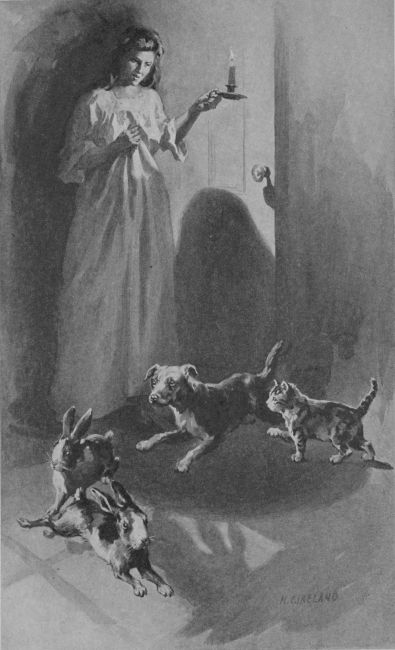
One night Mrs. Wood heard a most extraordinary
noise in the kitchen, and, creeping
down with her candle, interrupted a grand
game of tag between all the animals,—dog,
cats, and rabbits,—who were chasing each
other around the room in a mad circle, accompanied
by stamps, spits, and barks. It was so
evidently a game, that Mrs. Wood felt sorry
to have disturbed them, and sat down to watch
the fun. But her candle had broken the spell,
and like fairies when the cock crows, they
became once more their daytime selves;
indeed, most of them looked very much
ashamed of having been caught at such
antics.
“Perhaps they really are fairies,” Mrs.
Wood thought, going into the pantry after
crackers, “and have taken these disguises just
to play with my children and me. Very likely,
if I’d come down sooner, I might have seen
them in their real forms.”
When she returned, they all gathered around
her, and teased for crackers; while Samuel, the
pet of the bunnies, jumped into her lap. But
before all the crackers were gone, the candle
burned low and went out, and only the faint
light of the stove kept her from stepping on
any of the little soft paws that followed her to
the stairs.
“Fairies, good-night!” she called gently as
she left them. But only the friendly whack,
whack of Cyclone’s tail on the floor answered
her from the darkness.
“I think, Biddy,” she said the next morning,
“that it might be better to keep the kitchen door
closed at night.”
Soon after this there was a great thaw, and
one morning, when Bridget went down to the
ice-box, there were six inches of water in the
cellar.
“Oh, the poor animules!” she cried, wringing
her hands. And then she laughed so hard
that the children came running into the kitchen
to see what was the matter.
“Coom down! Coom down!” she called.
“All the rabbits do be floatin’ ’round on
boxes!”
Each rabbit was enthroned, sullen and
dignified, on a box of its own; while the cats
sat in a disgusted row on top of the coal-bin.
It was such a funny sight that the children
laughed even louder than Biddy, although
they were worried for the safety of their pets.
“How’ll we ever get them out?” Eunice
asked.
There was a pattering of feet behind them,
and Cyclone came down to join the party.
“Here—I know!” said Franklin, seizing
him by the collar. “Look, Cyclone! Seek—seek!
Go fetch ’em in.”
But Cyclone only ran up and down the
steps in terrible distress, not having the
slightest idea what Franklin wanted.
“Seek—seek,” Franklin said again, pointing
to the rabbits, and, after barking frantically
for a minute, Cyclone plunged into the water.
He reached the first box, and scrambled
up beside Dulcie, who, not appreciating his
company in the least, moved over as near as
she could to the edge, and bit him on the leg.
Cyclone yelped and leaped down again; while
the boat rocked and swayed dangerously from
his final kick.
This seemed to give him an idea; so planting
his nose against the box, he pushed it
gently towards the stairs, wagging his dripping
tail in response to the children’s shouts of
praise.
“Good old boy,—fetch, fetch!” Franklin
said, as Dulcie was safely landed, and Cyclone
struggled back after another.
In ten minutes more he had rescued all the
rabbits, and a board was laid across from the
stairs to the coal-bin for the cats to descend.
They stalked over in haughty silence, one
after the other, and ignored the whole proceeding
from that time forth. Indeed, Weejums
could never even bear to hear it mentioned;
perhaps because she felt that her dignity had
been compromised.
But Cyclone breakfasted with the family
that morning, and his extra bone was as sweet
as his heart was proud.
CHAPTER SEVEN
THE FAMILY IN THE PIANO BOX
WHEN Franklin went out into
the yard on his birthday morning,
he stopped and stared
very hard at something that
had never been there before.
It was a piano box, with an open space
fenced off at one side, and a square hole leading
into it, and at the end of the box was a
real door, high enough for a boy to use.
“Why, where—” Franklin began, and then
he heard a shout of laughter from Eunice and
Bridget and Kenneth, who were watching him
from the shed. Mrs. Wood was there, too,
smiling at his astonishment.
“They’re chickens,” she explained. “Grandmother
thought you didn’t spend enough
time out of doors.”
“When did they come?” Franklin asked.
“Last night. And the house was built
yesterday, while you were over at Fred’s.
That’s Grandma’s present too.”
“Well, I’ll be—thunderstruck!” Franklin
exclaimed. “Oh, I say, what a bully padlock!
Isn’t Grandmother a brick? Are they
in there now?”
“Go and see,” said his mother, handing
him the key.
Franklin unlocked the door, with shining
eyes and a new feeling of importance. There
was money in chickens, everybody said.
A fine young rooster was standing solemnly
in his pan of food, surrounded by five admiring
wives, who cocked their heads at Franklin
as he approached.
“Plymouth Rocks!” he exclaimed. “Oh,
Mother, these are first-rate chickens!”
“Let them out!” Mrs. Wood called.
“The little door lifts up.”
Franklin opened the door, and the fowls
strutted out in thoughtful procession, winking
their lemon-colored eyes at the sun. Then
the rooster drew a long breath, raised his head
to an alarming height, and, after several attempts,
indulged in a strange sound which
he had evidently planned for a crow. His
wives all looked impressed; but Franklin
laughed, and Eunice, who came running
out in her coat and red “pussy” hood,
asked: “Oh, Franklin, is that poor hen
sick?” Mrs. Wood and Kenneth came
out too, and discussed names for the new
arrivals.
“They ought to have colonial titles,” Mrs.
Wood said; “but I can’t think of anything but
‛Praise God Barebones,’ and that wouldn’t
be handy to call one by.”
“There was John Alden, Mother,” Franklin
suggested.
“Why, of course, and Priscilla—and Rose
Standish.”
“And Columbus!” added Kenneth, with
pride.
“They don’t all need to be Puritans,”
Franklin said, “I’d rather have some of
them more modern. Just see that one there
with the extra ruffle on her comb! I’m going
to call her Veatra Peck. And the stiff
one that does stunts with her toes every time
she puts ’em down,—doesn’t she walk like
Miss Hannah Wakefield? I’m going to call
her Hannah.”
“Hannah Squawk,” Eunice said. “That’s
a pretty name.”
“Uncle Edward sent word that he’ll pay
five cents apiece for eggs when your hens begin
laying,” Mrs. Wood said. “He always
likes a boiled egg for his breakfast, and can
never be sure that store eggs are perfectly
fresh.”
Franklin was delighted, and went up that
evening to talk business with Mr. Bates. His
uncle said that he knew of still another gentleman
who would pay as much for fresh
eggs,—indeed, he and this man had become
acquainted through sharing a bad egg at a
restaurant. They said that nothing made
people such good friends as having a common
enemy.
But Franklin’s hens did not begin to lay
until March, and then they seemed to have no
ideas at all about the proper place for eggs.
Franklin found them on the hen-house floor,
and out in the yard, and very often they were
broken. One hen persisted in laying what
Eunice called “soft-boiled eggs,”—those
without a shell,—until Franklin put crushed
oyster-shells in her food; and then she laid
ordinary Easter eggs like the others.
Somebody gave Eunice a bantam named
Flossy, who laid cunning little white eggs
like marshmallows, which Eunice had for her
breakfast.
Franklin received enough from the sale of
the eggs to buy wheat screenings, and other
food for his “birds,” as he called them; but he
made nothing more, and soon began to feel
the disadvantage of owning such idiotic pets.
“They never reason about anything,” he
complained; “and they haven’t any sense of
humor. They can’t see a joke even when it’s
on them.”
“I don’t like ’em,” Kenneth said; “they’re
not warm and cuddly like Weejums, or funny
like Cyclone. They’re not much different
from what they are fricasseed—’cept for the
gravy.”
Soon after the hens began to lay, they
showed a desire to sit, so Franklin bought a
dozen grocery-store eggs for Veatra Peck; but
had to move her into the woodshed, because
all the other hens tried to sit at the same time
in Veatra’s box. He felt rather surprised and
grieved that Veatra should stop laying while she
sat, but said, “I suppose she thinks she laid
all those grocery-store eggs, and feels that
she’s done enough.”
He waited until Veatra had sat for a week;
then a fit of impatience seized him.
“I don’t believe all those eggs are good,”
he announced at breakfast one day.
“It isn’t time for them to be out yet,” his
mother said.
“Yes, I know; but Veatra ought not to be
wasting her strength hatching bad eggs. I’m
just going to investigate a little, and see how
they’re coming on.”
“Of course you know that if you do that,
it will kill the chickens.”
“Not the way I’ve thought of.”
And that day after school the way was carried
into effect.
Franklin chipped a little hole in each shell,
and pasted court-plaster over the hole in those
eggs that contained chickens. The others he
threw away, and was quite triumphant to find
that there were only seven good eggs out of
the dozen.
“You see,” he told his mother, “it
would have been such a pity for Veatra to
sit another whole week on something that
was never meant for anything but an omelette!”
Mrs. Wood never expected the chickens to
hatch; but they did, every one of them,—this
is a true story,—and grew up to be exactly
the kind of chickens that one would expect
from grocery-store eggs. They were none of
them brothers and sisters, or even distant
cousins, and all seemed like dreadfully ordinary
fowls. But Franklin enjoyed them all
the more, because each one that came out was
such a surprise. He rose at five o’clock in
the morning when the first was due, and stole
downstairs in his nightgown to feel under the
hen. She responded with her usual angry
squawk, but at the same time he heard a little
soft, sweet sound like the note of a bird, and
drew forth a mouse-colored ball of down that
looked at him confidingly out of round baby
eyes.
“Say, you’re the fellow I came to meet!”
Franklin said, setting the thing on its tiny feet.
And he mixed some corn-meal mush for it,
which Veatra ate up immediately. After
breakfast there were two more chickens, and
before night the whole seven were cuddled
under Veatra’s wing.
“What’s that on the back of the stove?”
asked Biddy the next morning, as Eunice came
into the kitchen.
“Oh, that’s my incubator with an egg in it.
I’m goin’ to have some chickens, too.”
The incubator was an old candy box, stuffed
with cotton and hung on top of the range.
“Whin it hatches, you can have my bist
bonnet to raise it in,” said Biddy, disrespectfully.
But she was never called upon to keep
her promise, for the egg baked hard on the
next washing day, and Eunice ate it.
Franklin set Hannah on some home-made
eggs; but she used to leave them to fly at the
cats, and none of them hatched but an egg of
Flossy’s, which was named “Fairy Lilian.”
She afterwards grew up to be an enormous
white rooster, with shaggy legs, and a great
deal of manner.
When the warm weather came, the cats were
fed in the yard, and as the chickens were
always escaping from their own quarters, there
were many pitched battles over the food. The
hens stole things from the kittens, and pecked
them cruelly when they tried to interfere.
Once Eunice saw John Alden seize a whole
mutton-chop bone, and hurry around the
house with it, followed by all the cats. It
seemed too unfair, and Eunice wrote a note to
Franklin that day about it, in school.
Dear Franklin:—
I hate your hens.
Your loving sister Eunice.
But the next day something happened that
cured John Alden forever of imposing upon
those weaker than himself. He noticed a
strange cat taking dinner with the others, and
thought, “Ah, here’s the chance for me! The
natural shyness of this visitor will prevent him
from resenting any intrusion.” And, with a
haughty stride, he landed in their midst.
The strange cat looked up, planted one paw
firmly on the piece of fried potato he was eating,
and clawed out one of Johnny’s eyes.
The assault was so unexpected that Johnny
could only stagger one-sidedly away, and sit
down in the drinking pan to recover his balance.
He knew that no hen could ever
admire him again, and that the slowest caterpillar
would be able to evade his peck. It
was terrible.
Fortunately Biddy had seen the attack from
the window, and was able to testify that none
of the family cats had done it.
“It was a cat with a nose that dishgraced
the Hivin he sat under,” she said. “But, oh,
the shplendid foight in him! He was loike a
definder of innocence.”
Eunice was sorry for Johnny, but felt that her
cats had been avenged, and stole out that evening
to make friends with the defender of innocence.
He was skulking under a neighbor’s barn,
and peered out at her with unfriendly, suspicious
eyes set in scratched lids. Eunice had
seen “Thomas” cats before,—those with broad
bland noses who sit out in front of fish-shops
and have self-respect,—but she had never met
such a cat as this.
“He doesn’t seem to like me,” she thought,
feeling rather hurt. “Come, poor kitty, kitty,
and get some milk!”
But at this point the barn cat screwed up
his torn nose with a peculiarly threatening
effect, and gave one long slow spit, most terrible
to hear and behold. Eunice dropped her
saucer of milk and fled. She had not supposed
that she would ever live to hear a cat speak to
her like that.
He did not call on Weejums after this, excepting
at night, when everybody else was in
bed; and Eunice wrote a song about him that
she and Kenneth used to sing as a duet. Sometimes
one took the alto part, and sometimes
the other, but in any case the cat always fled.
He told Weejums that it was because it made
him feel so hollow.
I hear the voice of a poor, poor
cat, His voice is thin as a thin, thin
slat. I fear his stom-ach is just like
that, An emp-ty place in the poor, poor cat.
[
But one night Torn-nose relieved his emptiness
by eating one of Veatra Peck’s chickens.
“I’ll shoot that old barn cat, you see if I
don’t!” Franklin said furiously. But Mrs.
Wood said that it would mean one less chicken
for her to chase. To tell the truth, she was
getting rather tired of them, for every day,
while Franklin was at school, they caused misunderstandings
with the neighbors.
“If they’d only wait till he gets home,” she
said; “but they commit all their worst outrages
in the morning.”
No sooner would she sit down to her sewing
than there would come a polite ring at the
door-bell, and a certain Mr. Teechout would
say, “Pardon me, madam, but your fowls are
trespassing on my strawberry beds.”
And Mrs. Wood would apologize, and hasten
forth to drive the fowls from their unlawful
picnic grounds. But she would scarcely
have returned to the sitting-room before there
would be a thundering knock at the back door,
and she would hear Biddy’s voice raised in irate
argument with the woman across the alley.
“You just tell your missus, if she don’t keep
them chickens out of my cabbages, I’ll wring
their necks!”
Then the poor “missus” would have to
run out in the hot sun again, and jump
cabbages until her unruly brood had been
persuaded to return.
“I couldn’t take but three cabbages in one
leap at first,” she told Franklin; “but now,”
she added proudly, “I can do five!”
She knew that her son admired an athletic
woman, and talked a great deal among
the boys about having the only mother
who could drive a nail straight. But when
Franklin spoke of wanting a boat at the lake
that summer, she said that he could not
possibly afford to have one unless he sold
his chickens.
“But, Mother, I’m not going to buy the
whole boat! Our share will only come to
about thirteen dollars.”
“I don’t think we ought to afford even
half a boat, unless you sell the chickens. Nobody
loves them anyhow. It isn’t as if they
were ‛real folks,’ like the cats.”
Franklin thought it over, and decided that,
as he made no money from his hens, it might
be as well to get rid of them. It was true, also,
as his mother said, that nobody had loved them.
But then they were not in the least demonstrative
themselves, and did not seem to require
affection. Indeed, their reserve amounted
almost to coldness when any advances were
made. And in addition to this, they had
once caused Franklin to appear quite foolish
in school.
He had kept a little diary of their doings,
labelled “Plymouth Rock Record,” and one
day it happened to be on his desk when the
principal came by. She picked it up with much
pride, thinking that here was a boy who really
loved his United States History, and, turning
to the first entry, read: “Priscilla laid a hard-boiled
egg to-day.”
Franklin wondered why it was that she left
the room so suddenly, but suspected afterwards
that she had been laughing at him.
“There’s something silly about hens,” he
thought. “No matter what they do, if you own
them, you get drawn into it.”
He also told his mother that they were no
good to photograph.
“You mean that they won’t pose?” she
asked.
“Oh, it isn’t that! They’ll pose if you
tie their legs. But they haven’t any front
view to their faces,—only a right and wrong
side.”
A few days later when Mrs. Wood was
coming up the street, she saw people stop in
front of her house, look down at their feet, and
then go off laughing. She hurried home, and
found this sign tacked in the middle of the
sidewalk.
FOR SALE!
ONE LARGE, HANDSOME
PLYMOUTH-ROCK ROOSTER,
AND HIS FINE FAMILY OF LAYING HENS.
CHEAP! INQUIRE WITHIN. Also one pretty playful kitten—nice pet
for ladies and children—thrown in!
Mrs. Wood took up the notice, and went in
to tell Franklin that his cousins, Mary and
Wyman Bates, had offered to buy his hens. She
had been calling on their mother that afternoon,
who said that the family had decided to raise
their own fresh eggs, and would be delighted
to begin with chickens who were, in a way, related
to them.
So the next day Mary and Wyman came
down with their man and a cart, and took off
most of the hens. John Alden did not go,
because, at the last minute, Franklin decided
that he could not part with him, and Wyman
himself admitted that he would quite as soon
have a rooster with the usual number of eyes.
Eunice’s bantam Flossy also remained to
keep Johnny company, and as he was very
fond of her, he never missed his other wives
at all, or if he did, he never mentioned it.
And as Johnny had always been such a staid,
gentlemanly old bird, Mrs. Wood went to bed
that night feeling that all her troubles were over.
But she did not know him.
CHAPTER EIGHT
A LOSS AND SOME GAINS
BUNNY Grey had not been well since the time when the water came
into the cellar, and she afterwards developed a strange kind of bunny
“grip,” which made her most melancholy.
Franklin was too much absorbed in the sale
of his chickens to pay her much attention, and
one morning was startled to find Kenneth
tying a black stocking on the cellar door.
“I told you she was worse,” Kenneth sniffed,
and took Franklin down to see her still form
laid out in a grape-basket, with her hind legs
tied up with pink ribbon, and her head pillowed
in parsley.
“Yes, but I thought she was getting better,”
Franklin said. “She was gaining flesh. Just
see how round her stomach is!”
“Yes, but I did that,” Kenneth explained.
“She was quite thin before I began.”
“Began what?” asked Franklin, astonished.
“Blew her up with the bicycle pump. You
see she had sniffles, and couldn’t breathe from
the outside, so I thought if she was full enough
of air, she could breathe from the inside.
You don’t s’pose it hurt her, do you?”
Franklin opened his mouth wrathfully, to
tell Kenny what a cruel thing he had done;
but seeing how anxious the poor little red-eyed
face had become, said instead: “Well, I don’t
believe it did her any good, so I wouldn’t try
it again, if I were you. But very likely she’d
have died anyway. You see she looks quite
pale around the nose.”
Eunice and Kenneth had the funeral that
afternoon, with Cyclone hitched to the express
cart. But it did not end well, because Cyclone
got into a fight with another dog, and smashed
the cart, and some little street children ran
away with the grape-basket, thinking that Bun
Grey’s legs were asparagus. So none of the
funeral returned but the two chief mourners,
who planted some potatoes in the grave that
they had dug for Bun Grey.
“You see ’t would be such a pity to waste
that nice hole,” Eunice said. “I’m glad it
wasn’t Sam.”
Kenneth sniffed again, but said nothing, and
Franklin admired him so much for the way in
which he bore his loss, that the next day he
shook some of his hen-money out of the red
bank, and went down-town.
“More rabbits, I suppose,” Mrs. Wood
thought patiently, as she began to wrap up
dishes to go to the lake.
But it was not rabbits this time, it was worse;
and, as usual, it was something that Mrs.
Wood had never dreamed of telling him not
to get. Guinea-pigs had been discouraged, so
they were not guinea-pigs who greeted Kenneth
from behind the wire of their little box at
breakfast the next morning. No, they were
much smaller and more slender, particularly as
to tail, of which they possessed half a yard
apiece. And they were white and pink-eyed,
with what Eunice called “whittle-noses,” and,
in other words, they were rats.
“You see they’ll be so handy to carry
around,” Franklin said, with a beaming smile.
“They’re such small animals.”
And Kenneth’s joy was enough to make one
forget even that they were rats. His grief
over Bun Grey faded, in the contemplation of
those long pink tails. And when he found
that their owners would actually run up his
arm to his shoulder, and nip his ear, his delight
was complete. It was great fun, too, to watch
them scramble up and down inside the wire
netting. One caught such strange views of
their noses and chins.
“When you look up at a rat’s chin, it’s
weak,” Franklin said; “they must have been
made to be seen from above.”
Weejums left her two new little kittens,
Mustard and Elijah, to come and examine the
latest arrivals. They were rats, she decided,—her
nose told her that much,—but so pale
and peculiar! She wondered if pink eyes
would taste any better than black; but several
smart cuffs on the ears persuaded her that pink
eyes were meant only to look at, so she walked
off very stiffly, and sat down “back-to.”
School was closed now, and Kenneth played
with his new pets nearly all the time. They
grew so tame that he could put them down to
run on the floor, and catch them again quite
easily.
But one day, before the family started for
their cottage at the lake, one of the rats disappeared.
“I think he’s got into the wall,” Kenneth
said; “’cause I heard him scratching round in
there when I went to bed. Do you s’pose
he’ll starve to death, Mother? There won’t
be much to eat after we go.”
But Mrs. Wood said that she did not think
there was any danger of Snowdrop’s starving,
or even feeling hungry where he had gone, because,
although she never told the children,
she knew where that place was.
She and Biddy were sitting up late the night
before, finishing the packing, when they heard
some one in the kitchen say, “O-ow, yerr-or-wow-wow-O-wow!”
and Mrs. Wood recognized
the voice of her tortoise-shell grandchild,—the
reserved and haughty Weejums. She
went out to see what was the matter, and
found the cat writhing in what appeared to be
agonies of stomach-ache. “So that’s where
he went!” she said, rubbing the last resting-place
of Snowdrop with tender care. Castor-oil
and a hot-water bag followed, and the next
day Weejums was fit to travel. But as long
as she lived, the sight of a white rat was to her,
what the memories of watermelon and strawberries
are to certain people after a sea-voyage.
Weejums travelled in a separate basket, with
Mustard and Elijah, and as a new home had
been found for Minoose, there was only one
other basket of cats to go to the lake.
Minoose had gone to the principal of the
children’s school, accompanied by his plush
mouse, and she had immediately become as
foolish over him as any one could have desired.
Soon after leaving home he sent a
beautiful set of jewelry to Weejums—locket,
chain, and earrings—of the kind that comes
mounted on a card at the toy-shops, for twenty-five
cents. Weejums looked lovely in the
locket, but as her ears had never been pierced,
she was obliged to use the earrings as tail
clasps.
She wore them to the lake, and Clytie and
Ivanhoe wore bright worsted collars made on
a “knitter,”—Ivanhoe’s red, and Clytie’s
light blue. Clytie, being fair, usually wore
blue, although pale green was almost equally
becoming; and this being a great occasion,
Ivanhoe was allowed to wear his toy watch,
and the glass lion’s-head stickpin that had
come in a penny prize package.
Cyclone and the cats always travelled with
the family, but John Alden and the rabbits
had to go out on the load with the furniture.
“I couldn’t find a box high enough for
Johnny to stand up in,” Franklin said, as he
brought in his tool chest. “Guess he’ll have
to scooch this trip.”
But the limberness of Johnny’s legs when
he was turned loose at the lake showed that
the trip had not really injured him. The rabbits
also were allowed to run where they
pleased, and gave delighted skips and kicks
through the fern. Weejums cast one glance
at the carpenters who were finishing some repairs
in the house, and departed to the woods,
where she remained for three days. She had
never cared for the society of men, possibly
because there were none in the family.
While she was away, Mustard and Elijah
learned to eat fish, and spit at her when she
returned. They were orange-colored babies,
with corn-flower blue eyes, and looked like
nice, warm muffins.
Every morning, Eunice and Kenneth fished
off the dock, while Franklin pulled around in
his half of the boat, and put on airs. He
never went out very far unless some older person
was with him, for both Mrs. Wood and
Mrs. Lane had suffered so much from anxiety
over the boat, that she was named the
“Worry.” But Fred Lane came out from
town every night, and he and Franklin took
wonderful rows in the sunset, sailing with
umbrellas, taking the swells from the steamers,
and doing other delightful and dangerous
things.
“A NICE WARM MUFFIN”
Weejums was dreadfully afraid of the water
at first, and would run back and forth in the
road, howling, whenever the children went
down to the dock. She seemed to think there
was small chance of ever seeing them again.
But when she found that fish came out of the
water, her dislike of it changed to warm affection.
She would tease and coax until Eunice
went down to catch her a fish, and would begin
eating it almost before it was off the hook.
The first fish she always finished herself, and
the next she took up to the kittens.
Sometimes, when the boat was tied to the
dock, she would jump into it, and sit placidly
in the stern, enjoying the slight motion made
by the ripples, and apparently admiring the
view. When the door of the locker was left
open, she would creep inside for a nap, and
once or twice she went rowing with the boys,
before they discovered her presence.
Ivanhoe and Clytie preferred to play on
land, and indulged in regular gymnastic feats
through the trees and shrubbery. Whenever
Mrs. Wood went anywhere in the evening,
they both escorted her, and dashed out from
unexpected places with saucy tails, and whiskers
stiff with mischief. They liked to tease
Cyclone, by making him think that they were
weasels and woodchucks, and they frightened
people dreadfully who passed the house at
night. But the children’s interest in them and
their antics was soon lost in an event of greater
importance.
One evening when Mrs. Wood returned
from a day in town, she was met at the train
by Eunice and Kenneth, each wearing a look
of great excitement, and carrying a little rabbit.
She knew that Dulcie had a hidden
nest somewhere; but these rabbits were too
old to be Dulcie’s babies, so she concluded
that some one had been sending the children
presents.
“Mother!” began Eunice, in breathless
tones.
“Oh, Mother!” interrupted Kenneth.
“Mother!” they both said together.
“Yes, dears, they’re perfectly lovely. But
where did they come from?”
“Mother—” began Eunice again.
“But, Mother—” broke in Kenneth.
“Oh, Mother!” exclaimed both children
together, “they’re Sam’s!”
CHAPTER NINE
AT THE LAKE
IT was true that Samuel had
taken the family by surprise;
but no one thought any the less
of him for it,—indeed he now
commanded even more admiration
than before, although his name was speedily
changed to Luella-Marie.
“You see, all the animals behave so differently
at the lake from what they do at home,”
Eunice explained to a visitor, “that it’s not at
all surprising about Sam.”
The three little bunnies were named Vaseline,
Oliver Optic, and Sweetest Skipperty.
Vaseline was maltese, with the most wonderful
soft fur, and soft maltese eyes. Oliver was
black and white, and Skipperty a small copy
of his mother, as she had been at his age.
Oliver was Kenneth’s rabbit, as Eunice had
generously given him first choice of the three,
and Kenneth took Oliver because he looked
the strongest. Franklin had advised him to
choose this one, as, being homely, it would be
likely to live.
“I wonder what will happen next!” Mrs.
Wood thought. “So far, John Alden is the
only member of the family who has preserved
his usual dignity.”
She spoke of him to Mrs. Lane one day,
saying, “Do you know our rooster is so good,
he hasn’t made me a bit of trouble since we
came out here. He’s even stopped crowing
in the morning, because he found it annoyed
us.”
A peculiar expression upon her neighbor’s
face caused her to ask quickly: “Why, do
you ever hear him?”
“Well,—yes,” admitted Mrs. Lane, with a
smile. “He’s in the habit of crowing under
our windows on the other side of the house,
from four to six every morning.”
“Good gracious!” Mrs. Wood exclaimed.
“Why didn’t you mention it before? It
would have been so easy to shut him up at
night. This is really dreadful!”
“Well, I didn’t exactly like to complain.
And we generally go to sleep afterwards.”
“Dear me!” said Mrs. Wood, “Franklin
and I will build him a little house this afternoon.”
The house was a very simple affair,—only
a little pointed coop, like those made for hens
with chickens; but it was not so simple to get
Johnny into it at night. Franklin would
softly approach on his blind side, and put out
one hand very softly until it nearly touched
him, when the surprised fowl would give a
wild skip of terror, and scurry across the yard.
Then he would recover his dignity, remark,
“And-a-cut-cut-cut,” flap his wing, wink his
eye, and apparently forget the matter.
This would be repeated until Franklin
weaned of attacks by stealth, and bore down
upon him in open battle, assisted by the whole
family. They would chase him round and
round the house, going in different directions
to head him off; but when finally cornered,
he would duck and hop with great screeches
of wrath, and slip from under their very hands.
After a few of these bed-time races, his tail
feathers passed away, leaving him a fowl of
unclad and forbidding appearance. People
passing the house asked, “What kind of a
bird is that?” But nobody seemed to know.
“Poor Johnny!” Mrs. Wood said, “why
is it, Franklin, that you always catch him by
the tail?”
“Why, Mother, you must remember that
his tail is the last chance I ever get!”
The kittens liked to chase him in the daytime,
so altogether he took plenty of exercise,
and, it is to be hoped, rested well at night.
One evening, during the pursuit, he plunged
headlong into a neighbor’s cesspool, and
swam out a smaller bird than when he had
entered. But nobody tried to catch him that
night, and his crow was so hoarse the next
morning that the Lanes thought he must have
taken cold. The experience may have taught
him something, for the next time that the
family went out to catch him, he was nowhere
to be found. And it was not until Franklin
happened to fall over the chicken-coop, on his
return to the house, that a mottled sob from
within revealed Johnny’s whereabouts. He
had given up the fight, and gone to bed by
himself!
Flossy, the bantam, also developed strange
ideas in her new surroundings, and persisted
in going to roost every night on Mrs. Wood’s
foot. Her mornings she spent in playing
with the rabbits, and laying a great many little
white eggs.
Because of her small size, Samuel’s baby
bunnies took her for one of themselves, and
invited her to join in all their games, while
Skipperty became her dearest friend, and
would dig holes for her with his strong little
front paws. She would hunt through one
hole carefully for bugs, and then start scratching
in a new place, calling Skipperty, with enticing
hen-noises, to come and dig for her. The
two wandered all over the cottage together,—sometimes
appearing upstairs, where Eunice,
kept certain cigar boxes in which she was raising
beans and bananas. At least bananas had
been planted, but they never came up, and
something else was usually planted on top of
them. One day it was carrots, and the loveliest
little fuzz of green had begun to show
above the earth; but that same night it was
gone, and Eunice said, “It makes me feel as
if I’d pretended the whole thing. Biddy,
where do you s’pose it went to?”
“Well, I’m not sayin’ where it wint,” Biddy
replied, “but I’m thinkin’ it’s loikly to shtay
there.”
“Kenny, you didn’t touch it, did you?”
Kenneth regarded her with a scorn almost
too deep for words.
“I touch your fool old spinach? You
better ask Floss and Skip about it. I saw ’em
hopping downstairs this afternoon.”
“It was carrots,” Eunice explained.
“Well, it ain’t now,” grumbled Kenneth.
“You blame me for everything.”
When Eunice went out to feed the bunnies,
she would call, “Finny-fin, fin, fin, fin, FIN-ny!”
(the “rabbit yell”), and then there would come
a leaping and jumping of white tails, from every
direction. Little ears would stand up suddenly
from the grass, like swift-opening flowers,
and the ferns would tremble as with the rushing
of many winds. John Alden always hurried to
the scene, hoping every time that he might pass
for a rabbit; but Eunice addressed him with
contempt, as “Johnny-that-rooster-hum,” and
drove him off, heedless of his reproachful
squawks.
But Flossy and Skip ate together, for it was
quite useless to try and separate them.
“That’s a curious friendship,” Mrs. Wood
said; “I never heard of a case like it before.”
“I don’t think it’s strange at all,” Franklin
said. “She respects him because he can dig,
and he admires her because she can lay eggs.
I’ve known lots of fellows who hadn’t half as
much reason for friendship as that.”
But the greatest proof of their affection for
each other came at the time of the big storm.
Storms about Lake Minnetaska are sometimes
terribly severe, and one day, when the heat had
been intense and the darkening sky took on a
green tinge, Mrs. Wood told the children to
run for the cyclone cellar. This was a little
cave, built under the cottage, where the family
could be safe in case the cottage was blown
away. In ordinary weather it served as a cool
place for the milk.
The children were taught to watch for a funnel-shaped
cloud, and a regular cyclone drill
was arranged, so that each should do his part,
and not be frightened in case the cyclone came.
For Mrs. Wood said, “Being ready for an
emergency doesn’t make it come any sooner.”
And when at last it did come, the family was
able to reach the cellar in the very shortest
possible time.
Mrs. Wood took the family heirlooms,
Biddy, her best bonnet, and Franklin, the dog;
while Eunice and Kenneth had been cautioned
not to try and save anything but themselves.
Their mother had told them that the cats could
stick their claws into trees, or lie down so flat
that the storm would not even see them, and
the rabbits would run into their holes.
When the storm broke, not a cat was in
sight, but the kind-hearted Biddy found Mustard
and Elijah sleeping in a box near the
back door, and scooped them into her apron
as she ran.
It was quite dreadful waiting there in the
dark, with the shrieking of the wind above
them, and crash after crash coming as things
were blown down and swept away. Their cottage
was not taken; but another one was, and
the roof was ripped off the hotel. The piazza
chairs spun by them, and were hurled over the
tops of falling trees into a neighboring lot.
Johnny’s house, with Johnny in it,—he had
thought it was night, and gone to bed,—executed
a dance before the cellar door, and then
blew into the lake. Kenneth wept, and sat
down in a pan of milk. It was terrible.
But Johnny’s house was afterwards fished
out from under the dock, and Johnny himself
was found roosting in a tree near the bank,
for his house having no floor, he had been
able to grasp this branch with his firm yellow
legs, and allow his roof to take a swim without
him.
“I think he meant to stay there always,”
Franklin said, as he climbed the tree and
brought him down. “He didn’t seem to be
making any plans.”
Clytie and Ivanhoe turned up towards night,
with eyes quite black from excitement, and,
strange to say, Ivanhoe never had another fit
after that experience. Franklin said, “I suppose
the cyclone was so much bigger a fit than
he could ever hope to have, that it kind of
discouraged him!”
The children nearly stood on their heads
trying to see into the rabbit-holes, and, diving
into one of them, Franklin pulled out two
struggling balls of fur, that kicked mud in
every direction.
“Oh, the dear, dirty things!” said Eunice,
embracing Vaseline and Oliver, until her face
was well spattered from their indignant heels.
“Stamper’s all right,” said Franklin, peering
into the dark passage; “I saw his nose wiggle.
And there’s another one in there behind him.
I guess it’s Dulcie. She’d naturally be with
the youngsters.”
“Oh, Franklin, let’s hunt for Sam and Skip!
They must be here, somewhere.”
“I couldn’t see anything in Sam’s hole,”
Franklin said, going to the other burrow.
“Put your arm in. It can’t get any
muddier than it is.”
Franklin thrust in his arm, and drew it out
again with a great start.
“Snakes?” asked Eunice, turning pale.
“I don’t know. Something bit me.”
“Bit you! Oh, where?”
“I can’t find the place,” said Franklin, after
examining his hand. “The mud’s too thick!”
“Then the snake must have bitten mud instead
of you. But probably it’ll soak through.”
“I’m not sure ’twas a snake, anyhow.
There aren’t any poisonous snakes around
here.”
“Poke it,” said Eunice. “Here’s a stick.
Perhaps it’ll run out.” Franklin poked; and
from the hole came the outraged, but familiar
squawk of Flossy the bantam.
“How in thunder did she get in there!”
Franklin exclaimed, hauling her out in spite
of her angry pecks. But his question was
immediately answered by Skipperty, who followed
devotedly in the wake of his friend.
Luella-Marie’s head followed Skip’s tail, and
now the whole rabbit family was accounted
for.
“I think they’d have come out before,”
said Franklin, “if Flossy hadn’t stopped up
the hole.”
“Do you suppose Skip took her in there?”
“He must have. She’d never have thought
of it herself.”
“Franklin, why do you suppose Weejums
doesn’t come home?”
“Scared of the noise, I guess. She probably
heard the storm hammering around, and took
it for carpenters!”
“But the noise is all over now.”
“Then she’s likely to be home for supper.”
But Weejums did not come home for
supper, and she did not come home that
night.
“Mother,” said Franklin, after the younger
children were in bed, “the ‛Worry’ ’s gone.”
“What,—not sunk, Franklin?”
“No, just gone,—cleared, off the landscape.
I’m afraid she’s stolen. Some one must have
taken her right after the storm, when we were
all getting our breath back.”
“But you’ll be sure to find her,—you and
Fred between you. We can advertise.”
“Yes, I suppose we can. There are quite
a lot of things to do.”
But it was not a happy night for any one
in the cottage. Eunice was wakeful on
account of Weejums; while Kenneth dreamed
of sitting in cold milk-pans, and shivered in
his sleep.
Biddy dreamed that her best bonnet had
been blown into the lake, with a kitten tied
to each string, and woke Mrs. Wood with a
whoop. Everybody was glad when morning
came. And after breakfast Franklin made a
strange discovery.
Two boatmen who knew the boys, stopped
to say that they were passing just as the storm
broke, and seeing the “Worry” being thrown
against the dock, knew that she would be
dashed to pieces before the storm was over.
So they very courageously ran down and cut
her loose, before seeking shelter for themselves.
But as she was washed out into the
lake, they were much astonished to see a cat
creep out of the locker and run around the
boat in great distress.
“Weejums, by gracious!” said Franklin.
“Say, Fred, did you hear that?”
“I yelled out, ‛You’d better go below!’”
said the boatman; “and Joe, he put up his
hands like this, and called, ‛Reef that tail or
you’ll capsize!’ But we had to run for our
lives then, and I couldn’t see what the cat
did next.”
“I bet you she’s safe,” said “Joe,” as
Eunice hid her face on Franklin’s arm. “You
won’t catch any feline getting her paws wet,
when she’s got a dry locker to crawl into!”
“The first thing is to find the boat,” said
Franklin, patting Eunice’s curls. “That’s
a brave girl, Sis, not to cry.”
“P’r’aps she’s wrecked,” said Fred Lane,
who could think about such trifles as boats,
because he had never known Weejums.
“No, she ain’t!” said Franklin, fiercely.
“See here, Sis, we’ll borrow a horse and ride
along the shore to see if she’s beached
anywhere.”
“And we’ll tell all the steamboat captains
to look out for her,” added Joe.
“And me an’ Joe’ll do a little cruising
around, ourselves,” said the other boatman.
“Say, you’re mighty good,” said Franklin,
offering them his hand.
“We’ll never forget what you did for her,”
said Fred, meaning the boat.
“You will find her, won’t you?” said
Eunice, meaning the cat.
“And now for our noble steed,” said
Franklin. “We’ll be lucky if it isn’t a goat.”
They hunted for some time, but at last
succeeded in borrowing an ancient mule,
which they both mounted, and set forth on
their quest.
“Have you seen a stray boat with a cat in
it?” they asked, in agonized tones, of every
one whom they met, and could not understand
why so many people laughed at the
question.
“Was there an owl aboard too?” somebody
asked, “and was the boat pea-green?”
But no one had seen or heard anything of
the “Worry,” and it was not until that night,
when the “Belle of Minnetaska” was due
with her load of passengers, that Joe, the
boatman, rushed up to the cottage in breathless
haste.
“Skinner’s steam launch ‛Mehitable’ just
put in next dock. Spoke ‛Belle of Minnetaska.’
Says picked up boat with cat in it.
Boat in tow. Cat in ladies’ cabin.”
Even as he spoke, the nose of the great
steamer rounded the point, and through the
opera-glasses they could distinctly see a small,
dark speck dancing along in her wake.
“To the wharf,—to the wharf!” shouted
Franklin. And Mrs. Wood and Eunice
and Kenneth and Biddy all tore down the
road to the big hotel dock, just as the “Belle
of Minnetaska,” with band playing, and flags
streaming, came in.
Eunice wished to go aboard at once, but
had to wait until the passengers were off;
and just as she was beginning to feel that she
could not stand it another minute, down the
gangplank came the Captain himself, with
Weejums in his arms.
“Where’s the little girl that’s lost her
cat?” he asked. And all the passengers and
deck hands crowded around to see Weejums
restored to her family. Then “Three cheers
for the little girl!” some one called, and the
cheers were given with deafening enthusiasm.
“Three cheers for the Captain of the ‛Belle
of Minnetaska!’” And the Captain had to
bow, and take off his hat to every one.
“Three cheers for the cat!” And these
were the loudest cheers of all,—so loud,
indeed, that Weejums’ tail swelled out of all
proportion. But nobody saw it, for, before
the last cheer was over, Eunice was running
swiftly towards home, with the dear lost pussy
clasped tight to her little heart.
“The water took the color out of her
ribbon,” she announced at supper that night;
“but she’s goin’ to have a new one.”
CHAPTER TEN
ON THE FARM
WEEJUMS had not only one
new ribbon, but many; for the
story of her rescue came out in
the papers, and a number of
people sent her presents. Gifts
arrived also from several of the passengers on
the “Belle of Minnetaska” who had made her
acquaintance in the ladies’ cabin.
There were blue ribbons and pink ribbons
and Nile-green ribbons, and one whole bolt
of yellow-and-white striped ribbon with little
red flowers in the stripes. It sounds dreadful,
but was really most artistic; and Weejums
had on a large bow of it the day when she
met the polecat. No one saw the encounter;
but when she came home, the striped ribbon
had to be pulled off over her head with a pair
of tongs, while even her own kittens fled at
her approach.
“WEEJUMS HAD NOT ONLY ONE NEW RIBBON, BUT MANY”
“What on earth shall we do with her?”
Mrs. Wood said in despair. “She can’t come
into the house for a month,—for a year!”
“What would you do, if it was me?” asked
Eunice, reproachfully.
“If it was you? I’d take you out into the
grove, and undress you, and bury your clothes,
and wash you in twenty waters with carbolic
soap and lavender water, and tie you up in a
laundry-bag for a week.”
“Well, I can do some of that to Weejums,”
Eunice replied. “I’ll go bury her, right
away.”
“My dear child, don’t you know that it
would kill the poor cat?”
“I’m not a baby!” said Eunice, with
dignity. And Mrs. Wood went out to see
what she was planning to do.
First she dug a Weejums-shaped hole in a
sunny spot with the coal-shovel; then pounced
upon the unhappy cat, gathering her up in
an old flour sack. Weejums was rather
pleased than otherwise by the attention, as
of late her most friendly advances had been
repulsed. But when Eunice laid her in the
hole, and covered her very carefully with
earth,—all but the head,—her look of rage
was something comical. It was not that she
was uncomfortable, but seemed to feel the
implied insult, and growled like a little earthquake
all the time. Her only comfort was
that Torn-nose was not there to witness it.
Eunice poured a little earth over her head
and forehead without getting it in her eyes, and
when she was finally dug out, no one would
suspect that she had ever heard of a skunk.
But Mustard and Elijah distrusted her for
some time.
Grandmother had taken a great fancy to
Mustard when she came out on a visit, because
he spit at her bare feet the first time that he
met them. This was in the middle of the
night, when she went down to the kitchen after
a drink of water, and Mustard took her feet
for white, clipped poodle-dogs, and fought
them until they carried Grandmother out of
the room before she intended to go.
“I like that cat,” she told Eunice the next
morning. “You must give him to me, without
fail. Bring him up when you and Kenneth
come to the farm next month.”
“I was going to bring Weejums,” Eunice
said. “Just for a change of air.”
“Well, bring them both then. Any change
in Weejums would be desirable.”
This was because Weejums had refused to
roll in the catnip Grandmother brought her,
and had sneered at Clytie and Ivanhoe when
they rolled.
“I hope she’ll like the new house,” Eunice
said.
The family was to move uptown that fall,
and Eunice and Kenneth were to go with
Grandmother to the farm until things were a
little settled. When the day came, they took
luncheon with the Bateses, while Weejums
chased Mary’s cats out of their own kitchen,
and ate their chicken bones. Then she cuffed
Mustard for not being Elijah, whom she greatly
preferred, and Mustard lamented all the way
down to the station. People in the street-cars
tried to imitate his voice, but failed.
“Now stay here while I see about the trunk,”
said Grandmother, as they reached the waiting-room.
And the children stood admiring the
bunch of bananas that hung over the news-stand,
and the oranges piled in an open-work
wire dish.
“Wouldn’t it be fun to buy the whole
bunch?” whispered Eunice.
“I bet you it costs as much as a dollar,”
said Kenneth.
“I’d like to go up and say, ‛Just give me
a dollar’s worth of bananas.’”
“Well, I wouldn’t, I’d say, ‛How much
for the bunch?’ and he’d say, ‛A dollar,’ and
I’d say, ‛I’ll take ’em.’”
Just then there came a terrible outcry from
the cat-basket; Weejums burst open the cover
and, with one parting spit at Mustard, shot
through the station door. Eunice dashed after
her, and Kenneth made a grab at Mustard,
who dived under one of the seats and began
dabbing at the swinging legs of a child.
The infant did not understand that this was
only play and roared with fright; its mother
scolded, and just at this moment Grandmother
appeared. “Where’s Eunice?” she asked,
looking around.
“Weejums!” said Kenneth, pointing to the
door.
“What’s all this commotion about?”
“Mustard!” answered Kenneth, briefly.
“You stay here till I come back. And
take that kitten, or the woman’ll throw him
at us.”
The baby’s mother had dragged Mustard
out from under the seat through a cloud of
peanut-shells, and was holding him at arm’s
length by the back of the neck. His eyes
were closed, his tail curled meekly upward, and
his mouth was drawn back in a forced smile.
Kenneth stuffed him hastily into the basket,
just as Grandmother returned, leading Eunice
by the hand.
“No, we can’t wait over another train, and
there’s no time to look anywhere else. I’ll
telegraph Mrs. Teechout to let us know when
Weejums comes home, and Mother will go
down and get her.”
“But she won’t know the w-a-y,” said
Eunice, her voice vanishing upward in a squeak
of misery. “She was lost before, and couldn’t
find the way h-o-me.”
“That was because she was young, and
didn’t know the city. She’ll get back this
time, don’t you be afraid. Now wait here
while I send the telegram.”
When they were in the train, Grandmother
told Eunice all the stories that she could remember,
about cats who had been lost or otherwise
disposed of, and who reached home long
before the people that disposed of them. And
Eunice was so tired that she presently fell asleep
on Grandmother’s shoulder, and dreamed that
some one was saying, in a far-off voice, “Plague
take the cat, anyhow, it’s more bother than
it’s worth!”
Then she heard the regular click, click of
hoofs, like music through her sleep, and opened
her eyes on a sweep of golden prairie dipping
to meet the sky.
“Most ready for supper?” asked Cousin
David, laughing, as she struggled to sit up in
his lap.
“Oh, David, let me drive!” she said, “I
didn’t know I was here.”
Cousin David lived with Grandmother at
the farm, and had driven in, twenty miles, to
meet them.
“What’s the matter with Chucklehead’s
tail?” asked Grandmother, severely. “It
never looked like that before!”
“Just a little baldness, Auntie. You know
that tail’s seen a heap of service, and he’s
an old horse.”
“Stuff and nonsense!” said Grandmother.
But Kenneth thought that there were tears in
her eyes.
“Can’t we ride Ole after supper to-night?”
he asked.
“Yes, if Jansen’s willing, and you’re not
too tired.”
Ole was the herder’s pony, and the children
were allowed to ride him evenings, after
the cattle had been brought home.
When they reached the farm, the cattle had
just gone into the corral, and Jansen, the
herder, was holding a nervous young cow by
the nose, while somebody tried to milk her.
“Why, that’s my Ellen!” said Grandmother,
letting down the bars. “Poor Ellen! let go of
her, Jansen, and see if she knows me.” She
went fearlessly in through the crowd of horns,
and made her way to where Ellen stood, spluttering
in the herder’s grasp. Every eye of
every cow was fixed on her as she soothed and
petted the excited creature, until Ellen’s glance
became genial, and she rested her head on
Grandmother’s shoulder.
“Ellen’s kind of a pet with her,” David explained
to the children. “Aunt Eunice raised
her from a calf, and once last summer, when
Ellen was sick, and had to be tied in the barn,
Auntie used to go out and read to her.”
“Stories?” asked both children eagerly.
“Oh, anything! Ellen wasn’t particular.
One day I remember ’twas a cook-book.”
“What’s he been telling you?” said Grandmother,
laughing, as they went back to the
house.
Senator Hicks was waiting for them on the
porch, and delighted Eunice by coming to
meet her. He was a large, soft pussy with a
comfortable stomach, and limp white paws that
dangled adorably over one’s arm. And he
would purr, even when his mouth was pressed
against one’s ear,—a moist, windy purr, most
tickling and sweet.
The other farm cat was named Andrew
Banks, Jr., and no one had ever heard him
purr. He lived in the barn, and caught immense
rats, with his double toes like mittens.
But Eunice loved him in spite of his wild ways,
and felt sure that his purr, if one could only
hear it, would be fully equal to the Senator’s.
After supper Jansen saddled Ole, and the
children took turns riding him. Ole made no
objections, although he had been out all day,
but switched his white tail in a thoughtful
manner, when Eunice started out, for the third
time, down the road.
“I don’t need to hurry,” she decided, as
she saw Kenneth and Grandmother go back to
the house. So she cantered on still farther,
her little petticoats bouncing up nearly to her
ears with each rise of the horse.
It was splendid riding out into the sunset,
with no other person or thing in sight, and
feeling that she might gallop on forever and
ever to countries beyond the clouds.
“There’s a red horse in the sky, with a
mane like Ole’s,” she thought. And, indeed
Ole’s mane was quite crimson in the glow.
“I suppose he has a red tail too, if I could just
turn round and see it.”
Back in the farmhouse Grandmother had
begun to watch the road, and when the red
light faded, she became uneasy.
“Perhaps she’s slipped in some back way,
without my seeing her,” she thought, and went
out to ask the men.
But at the door she met David, looking
much disturbed, “Say, Auntie, I hate to tell
you,” he said; “but the pony’s come home,—without
any saddle, and we’re just hitching
up to go down and see what’s happened.”
Grandmother started off down the road on a
run, with Kenneth puffing frantically in her rear.
“Won’t you wait for the buggy?” called
David through his hands.
“No!” she answered. And Kenneth
thought he had never heard her voice sound
like that before.
“Oh, my baby, Grandma’s baby!” she
said once, under her breath, and tears began
to mingle with yellow dust on the face of the
small toiler behind.
“Kenny, hadn’t you better go home, dear?”
she asked at last, turning to the little companion,
whose spirit was willing, although his legs
were short.
“No!” he replied, in a voice that was an
echo of Grandmother’s own. “She may be
your granddaughter, but,” here he sniffed, and
rubbed more dirt into his eyes, “she’s my
sister, and don’t you forget it!”
“Come!” said Grandmother, holding out
her hand. “I’ll help you find your sister.
Isn’t that a wagon coming down the road?
Perhaps the driver will have seen her.”
“That isn’t a wagon,” said Kenneth, after
looking at it a minute in silence.
“Yes, it is, boy,—a two-horse wagon.
Don’t you see how big it is?”
Kenneth looked again, and broke into a
joyous shout. “It’s Eunice!” he said, and
darted off up the road.
“It can’t be!” said Grandmother. “No, it
isn’t—yes—no! Haven’t I lived in this
atmosphere long enough not to be fooled by
it again?”
For it was Eunice, and the reason that
Grandmother had taken her for a two-horse
wagon was, that she was carrying the saddle,—big,
heavy thing though it was,—and the
strange effect of the western air had made her
into a sort of mirage. As they approached,
she suddenly dropped to her natural size, and
hurried to meet them, with one long stirrup
trailing in the dust.
“I’m so sorry, Grandmother,” she said;
“but I turned around to look at his tail, and
the belt burst.”
“The girth, you mean. Then Ole didn’t
throw you?”
“No, he just swelled and broke the belt, and
then the saddle came off.”
“And you weren’t hurt?”
“Oh, no!” And Eunice laughed. “He
looked so s’prised when he saw me sitting in
the road,—just as if he didn’t know where
I came from. I tried to catch him, but he
wouldn’t catch. And then he seesawed with
all his legs, and started for home.”
“You can leave the saddle beside the road,
now,” said Grandmother. “David will come
after it.”
After they reached home, she said to David:
“I’m really glad that she wasn’t thrown. I
never knew a Wood to be thrown!”
In the excitement of her ride, Eunice had
almost forgotten Weejums, but was reminded
of her by Mustard, who suffered from shyness
under the cold stare of Senator Hicks, and
filled all the night with his corn-colored howls.
“You’ll have to take him to bed with you,”
said Grandmother. So Eunice and Mustard
went to sleep in each other’s arms, and shared
a common grief.
CHAPTER ELEVEN
THE SON OF SILVER BELL
IT seemed only a little later when
Mustard wakened Eunice by a
sudden jump, and she saw three
bars of light moving across her
wall. The light came from the
yard, and the person who carried it must have
been going toward the barn.
“Well, I suppose it’s morning,” she thought.
“They always milk early.” But when she
looked out, the stars were still shining, and
there was not a sound to be heard.
“I think I’ll go and see where that lantern
went to,” she thought, and slipping on
one of her own shoes, and one of Kenneth’s,
which were all that she could find in the dark,
she crept softly out through the hall to the
back door. To her surprise, it was unlocked,
and she picked her way carefully over the
lettuce beds, holding up her long night-dress
in one hand.
“It’s quite warm out,” she observed, from
the top of a large red cabbage, which could not
have told itself from a green cabbage at this
time of night.
Something black sprang past her as she
opened the gate, and leaped to the top of a
shed, with a great scratching of claws; then she
saw two little moons of fire watching her
through the darkness.
“I suppose Andrew Banks, Jr., is hoping
I’ll take him for a wildcat,” she thought, “but
I shan’t.”
Suddenly she tripped and fell headlong over
a wagon-tongue, scraping one little knee quite
badly. But Eunice had always made it a point
not to cry over anything unless it bled, and as
it was too dark to see whether this bled or
not, of course she could not cry. She went
on, and into the cattle-barn, guided by the
faint light of the moon, which showed her
the long rows of patient forms, lying in
their stalls and chewing the cuds that probably
served them as dreams. Some of them
knelt, and then struggled to their feet as
Eunice approached, tossing their heads in
fright.
She went to the stall of Wild-Eyes, the bull,
who shook his chains, and pointed his horns at
her until she spoke to him, when he thrust
out his head, with a long sigh of fragrant breath,
to be petted. Grandmother was the only
other person who dared to caress Wild-Eyes,
for he had not a cordial disposition, and dreadful
stories were told of his behavior in the
past.
Eunice pushed open the door that led to
the horses’ stalls, and there, in the great open
space of the barn, sat Grandmother on a pile
of straw, with the lantern beside her, and the
head of a sick horse on her lap.
“Good gracious!” she said, with a jump, as
Eunice appeared. “What are you doing
out here?”
“I saw the light. Oh, Grandmother, is
Chucklehead sick?”
“Colic,” said Grandmother, briefly.
“Has he got a hot-water bag?”
“No—one bag wouldn’t go far, when he
has several square yards of pain.”
“Are you giving him peppermint out of
that bottle?”
“Ginger-tea. Just as good.”
“Is he getting old, Grandmother? David
said so.”
“Not a bit too old to enjoy company, and
relish his meals. And that’s all that a horse
that’s worked as well as he has, ought to have
asked of him.”
“How did you know he was sick?”
“I woke up feeling that something was
wrong at the barn. That’s happened before.”
“And do you always find there is?”
“No, sometimes it’s what I ate for supper.
Come, we’ll go back to the house now. He’s
feeling better.”
She made a pillow for the horse’s head in
the straw, covered him with an extra blanket,
and took up her lantern.
“How did you find your way out here in
the dark?” she asked, as they reached the
garden.
“I don’t know,” Eunice answered. “I’m
not afraid of the dark.”
“I never knew a Wood to be afraid of the
dark,” said Grandmother, smiling.
They found Cousin David sitting in the
kitchen with Kenneth on his lap.
“Well, here you are at last!” he said. “Kenny’s
been scared to death about you. Poor
little chap, he’s been crying!”
“Ain’t neither,” said Kenneth, kicking his leg.
“Well, let’s have some bread and butter,”
said Grandmother, hanging up the lantern.
“David, you get some milk from the pantry,
and don’t disturb the cream pans.”
“Grandma,” said Eunice, as they sat eating
in the candlelight, “What makes you love
Chucklehead more than the other horses?
He’s the homeliest.”
“Oh, that’s a long story,” said Grandmother,
yawning. “I’m going to bed.”
“Can’t David tell it?” asked Kenneth.
“This is no time of night for stories,” said
David, taking a drink of milk. “’Specially
Injun stories.”
“Oh, is it an Indian story?” asked both
children in delight.
“Hadn’t you better wait till morning?”
said Grandmother, going to the door. “The
trouble with you children is, that you slept all
the afternoon.”
“Let us sit up fifteen minutes more, please,
Grandma!” said Eunice, and Grandmother
was too sleepy to refuse.
“Well,” began David, in a loud voice, “one
reason Aunt Eunice likes Chucklehead, is that
he’s the good-for-nothingest horse on the
farm.”
“That’s not so!” called Grandmother
from the other side of the door, and David
laughed.
“No,” he continued, as her footsteps died
away, “the real reason she likes Chucklehead,
is that he’s the son of Silver Bell, the finest
horse ever raised in this State.”
“Was she pretty?” Eunice asked.
“Pretty? She was a regular Christmas
card! and as full of airs as any mistress of the
White House. Why, her feet were so little
you’d scarcely know she had ’em, and her
mane was all crinkly and wavy like a lady’s
hair.”
“What color was she?” asked Kenneth.
“Brown, with a bell-shaped mark of white
on her forehead. And spirited? Why, she’d
sling Swedes all over the prairie, even when
she was an old horse. She didn’t take after
her son.”
“Tell the story about her,” said Eunice.
“Well, she belonged to a young woman who
came out here with her husband in Injun times,
and, as they hadn’t many horses, this Silver
Bell was a great pet. She’d come when you
called her, and kind of snuff round. She was
company for the young woman, too, when her
husband was off with the cattle, and there was
nobody but her and the baby in the house.”
“Go on,” said Kenneth. “Did the Indians
come?”
“Well, I just guess they did! One day
she heard a shot, and saw smoke coming from
a ranch four miles away. You know how
sound carries in this air, and the smoke looked
big, just as Eunice did the other night. So
she just grabbed her baby, and put a bridle on
Silver Bell, who came right up to the corral.
If Silver Bell hadn’t come when she was called
that day—”
“Well?” asked both children, breathlessly.
“Well—we mightn’t have been telling
this story here to-night.”
“Oh, go on!” said Kenneth, impatiently.
“Did the Injuns catch her?”
“No, but they would have, if it hadn’t been
for Silver Bell. Once, when they were down
in a hollow, the girl saw about a dozen
Injuns riding towards her as hard as they could
go, and she knew if she came out of that hollow
they’d see her for sure. But if she stayed in
the hollow, of course they’d find her when they
got there. So for a moment she couldn’t decide
just what to do.”
“Shouldn’t think there was anything,” said
Kenneth.
“Well, that’s just where you’re wrong.
There was Silver Bell. You see she’d trained
Silver Bell to do a lot of little tricks, and one of
them was to pretend to be a dead horse; and
as there was a real, dead horse a little way down
the trail, it gave her an idea. So she made
Silver Bell lie down across a little ditch at the
bottom of the hollow, and crept in under her,
so that she couldn’t be seen. Then she told
her to ‛be a dead horse,’ and Silver Bell never
moved a hair, even when the Injuns almost
jumped over her in crossing the ditch.”
“Then didn’t anybody get scalped?” asked
Kenneth, disappointed.
“Yes, lots of people; for this was the beginning
of the great massacre at New Ulm.
But the young woman got away safe and
sound, and all because of a horse. She often
said afterwards that if the baby had cried, or
Silver Bell had wiggled so much as an ear,
why—the Injuns might have guessed she
wasn’t any dead horse.”
“But how does Chucklehead come into the
story?”
“Chucklehead was Silver Bell’s last colt,
and when everybody else laughed at him for
being such a funny shape, and wanted him
killed, Aunt Eunice kissed his mother on the
forehead, and said, ‛You saved my baby once,
and I’ll save yours!’”
“But it was the other woman’s baby that
Silver Bell had saved,” said Eunice, puzzled.
“No, it wasn’t, kid. The young woman
that the story is about was Grandmother, when
she first came out here. And the little baby
that she carried in her arms that day was—”
David stopped a minute, and his voice grew
softer, as he said, “was your own father, children.
Now come to bed, for the fifteen minutes is more
than up, and I want a nap before milking-time.”
He tossed Kenneth on his back, took
Eunice in his arms, and tucked them both in
their beds, with the caution not to think any
more about “Injuns” that night.
Kenneth soon dropped asleep; but Eunice
lay awake for some time, wondering how it
would have seemed to be alive in Indian times,
when red danger might come riding to meet
one from over the peaceful prairie. And as
she fell asleep, she seemed once more to hear
David say, “And the little baby that she
carried in her arms that day was—your own
father.”
When she wakened, a sunbeam was creeping
across her quilt, and she heard the shouts of
the men at their work. She hurried into her
clothes, and went out to breakfast with the
back of her frock unfastened, as Kenneth, who
usually helped her, was up and away. But
Grandmother proved that she could pour
coffee, button Eunice’s dress, and give orders
to the men at one and the same time.
There was a rattle of harness in the yard,
and David put his head in at the door, saying:
“There’s a fellow just come out from town
with a telegram.”
“Tell him to unhitch and come in,” said
Grandmother. “Yes, dear, Kenny’s off with
Peterson and the Norman colt. Will you have
sugar on your mush?”
David came in, followed by the messenger,
who said, “Yes, I guessed it might be important,
and hustled for all I was worth. I’ve
been on the road since four.”
He handed Grandmother the telegram, and
she poured out his coffee before opening it.
“Anything serious, Aunt Eunice?” David
asked.
“Not serious, but most important,” Grandmother
said, and, turning to Eunice, she read:
Weejums has arrived. Will take her up to Mrs.
Wood to-morrow.
M. Teechout.
CHAPTER TWELVE
CLYTIE, THE CAT WITH MITTENS
CLYTIE was a cat who might
certainly be called young for her
age. She had frisked through
a thoughtless kitten-hood with
Ivanhoe, and now spent many
hours in playing with Neddy, the white rat, for
whom she had conceived an early passion.
Neddy’s real name was Editor, because he sat
up nights; and he differed from other rats in
having a sense of humor. Clytie did not know
this however; she only thought it must be fine
to have pink eyes, and a tail that never swelled,
no matter how embarrassed one might be.
Seated on the top of Neddy’s house, she
would draw her claws across the wire netting,
and Neddy would shoot out of his inner oatmeal
box, as if cheese itself had called. Up
and down he would chase the wandering paw,
until it vanished above his head, and then
there would be the large excitement of waiting
for it to come again. There was a knot-hole
in the top of the box, and one day Clytie’s tail
slipped down through it. Shortly afterwards
the family was summoned by howls of terror,
to find Neddy swinging merrily back and forth
on his furry chandelier, evidently not connecting
it at all in his mind with the owner of the
paw.
Clytie gave up playing with Neddy after
this, and devoted herself to the general good.
Every night Mrs. Wood made a tour of all
the bedrooms with a folded newspaper, killing
mosquitoes and flies, and after watching
her several times Clytie suddenly decided what
double toes were meant for. Bang! would go
the newspaper on the wall, and, thud! would
go the mittened paws beneath it. One fly for
the newspaper, and yes—two for the mittened
paws! Clytie did not stop to eat the flies, but
swept them into a little heap to serve as a
quick lunch later on. Ceiling flies had to be
brushed off, of course, but even the most high-roosting
flies adorned the heap before the swift
paws ceased their work. Clytie had at last
become a useful member of the family, and
Franklin said that it was because her experience
with Neddy had aged her.
When Eunice and Kenneth came back from
the farm, they found Weejums and Clytie in full
possession of the house,—Weejums with a
new family of two, and Clytie with a new air of
dignity and cathood. She was a very handsome
pussy, yellow and white, with lovely
brown eyes and a great deal of fur in her tail.
Several people had wanted to buy her; but
Eunice always answered: “No, she is Weejums’
eldest child, and not for sale.”
About a month after Weejums’ kittens came,
Clytie had some of her own in the barn, and
came in to tell the family about it. Eunice
met her first, and knew that the proud quiver
of her tail could mean but one thing.
“Biddy,” she said, “I know they’re there!”
“Well, whin it sthops rainin’ we’ll go out
and see,” Biddy replied.
Eunice hovered about the house in a great
state of excitement, making guesses as to the
number of kittens, and what color they might
be. Only two would be kept, she knew; but
suppose that there should be one tortoise-shell,
and one maltese, and one pure white!—which
would she be able to spare?
“Weejums, you’re a grandmother! You’re
a grandmother! Weejums,—do you understand?”
she whispered. And Weejums looked
up with what Eunice called “fumes” over her
eyes, and smiled.
“I want to go, too!” Kenneth said, as Eunice
and Biddy started for the barn.
“Me too,” Mrs. Wood added. So everybody
joined the procession, and Clytie led them
proudly across the yard to the barn, up the
steps to the barn chamber, and over some old
mattresses to an empty nest! There was the
little bed that Clytie had made for her babies,
but not one kitten was to be seen.
“Perhaps they’ve crawled under the mattress,”
said Franklin, lifting it up; but there
was no sign of a kitten anywhere in the room,
and Clytie’s surprise was at first greater than
her sorrow. Then, “Ow!” she remarked in a
melancholy voice, and “Wow!” came in echoing
tones from her mother on the stairs. “Yow!”
said Clytie again, and “Row!” answered Weejums,
sympathetically. “Come, let’s hunt for
them! Pur-r? Wur-r?” So all day long, and
all of the next day, the two cats hunted for
the missing kittens, calling them high and low.
But neither they nor any one else ever discovered
what had become of them. Some
members of the family thought it was rats,—others
that a certain morose neighbor who
rented a part of the barn for his horse, objected
to having so many cats on the premises. In
any case, Weejums’ grandchildren never turned
up, and after a two-days’ search Clytie decided
that she must have been mistaken about them,
and that Weejums’ kittens were hers. So she
walked in and took possession, and Weejums,
who had always disliked the confinement of
nursing, was very thankful to be rid of them.
She resumed her social evenings with the
family, attended midnight concerts, and chased
boot-buttons around the kitchen floor.
Meanwhile, poor Clytie became pale and
wan with anxiety, from trying to make month-old
kittens behave as if they were new. Of
course they liked to climb out of the box, but,
as fast as they reached the floor, she would
jump after them, and bring them back. She
also carried them all over the house, and they
became quite lazy from being carried, so long
after their own little legs should have done
the work. Their names were Paul Jones and
Proserpine,—Paul Jones, black, with white
nose, shirt, and slippers; and Proserpine, pure
white, except for two inky ears and one black
tail, most charming to behold. Proserpine’s
ears and tail did not show at all after dark, so
it looked as if she had none.
Both kittens grew up, thinking that Weejums
was their grandmother, and once, when
Torn-nose inquired whose they were, she replied
that they belonged to a yellow-and-white
cat living in the same house.
“To be sure,” Torn-nose said, “I might
have known that you could not have kittens
of so advanced an age.”
But this was only his way, for he knew perfectly
well that Clytie was Weejums’ daughter,
and even paid her compliments when her
mother was not looking.
The only times that Weejums showed any
interest in her children, was when a dog entered
the yard. Then both cats would fly at him,
and send him off, ki-yi-ing down the street.
They discovered so many new ways of scratching
a dog, that it became a kind of fancy-work
with them, and all the friends that Cyclone
invited to dinner, sent polite but firm regrets.
One day two strange-looking animals trotted
down the road, from some distant shanties, and
began nosing around the back door after food.
Weejums and Clytie decided that they must
be dogs, although they were stouter than any
dogs that they had ever chased, and made
astonishing remarks, in a language that they
failed to understand.
“Ooof—umph,” said the spotted one, who
had brown, red-rimmed eyes, trimmed with
white eyelashes.
“Humph—humph!” replied the white
one, who had but one eye, and no eyelashes at
all, except along the ridge of his spine.
“Wee, wee! Murder! Help! Help!” they
both squealed, as two spitting balls of fur
shot across the yard, and landed on their
backs.
“Hivin save us!” exclaimed Biddy, rushing
to the window, as two shrieking pigs, each
ridden by an angry cat, dashed past, and out
of the yard. The departure of the pigs
through a fence on the other side of the street,
caused the cats to dismount before they had
planned. But Franklin was so proud of this
feat, that he went around boasting among his
friends, that “his sister had a cat that could
lick anything on four legs.” So, of course, all
the boys were anxious to prove that his sister
had nothing of the kind.
“Bet you it couldn’t lick Boston’s bull-pup,”
one of them said.
“Bet you it couldn’t lick my thorough-bred
mastiff-poodle,” said another.
“Ho!” said Franklin, “Weejums would
claw up the pedigree of your dog, so that
you’d have to cart home the mastiff and the
poodle part of him, in separate loads.”
It was this remark that caused Boston’s bull-pup
to go in training for action, as it was well
known that no cat on whom he was set, ever
escaped him, and he had a shameful record of
little paws hushed in the beginning of their
play, and gentle purrs silenced through murderous
intent. For the bull-pup’s owner was
a cruel boy, and a boy’s dog always tries to be
like his master.
“THE SASH WAS NOT TOO TIGHT TO ALLOW FOR DINNER”
That fall, Eunice had begun dressing all her
cats in little blankets; and this naturally suggested
petticoats, and, later on, pantalettes.
The pantalettes were cut like cross-sections of
stove-pipe, and were held on the cat’s front
paws by a little suspender going over her
shoulders. Clytie had a charming pair made
of white flannel, feather-stitched with light
blue silk, and the effect of these, peeping
from under her Mother Hubbard blanket
with the guimpe, was most unusual. This
blanket did not fasten with a buttoned belt
underneath, like her plaid gingham ones, for
morning, but had two little slits in the side, for
a sash to come through, and tie in a huge bow
on top. When fully dressed, she looked like
a cross between a circus clown and a chrysanthemum.
But of course she could run about
perfectly well, and the sash was not too tight
to allow for dinner.
Eunice had just finished dressing her one
day, when a white dog with an ugly lower jaw,
came into the yard. Clytie saw him from the
window, and knew from the set of his legs that
he meant business. This was no ordinary cur,
to be frightened away by a spit, and a stiff
whisker; and she was just rejoicing that her
mother and kittens were safe in the kitchen,
when, oh, horrible! around the corner came
Weejums, alone, making straight for the dog,
without having stopped to consider his lower
jaw.
The dog saw her, and, as a low whistle
sounded from somewhere, rushed at her in the
deadly silence that is worse than a hundred
growls. Franklin also saw her, and rushed
out of the house with a hot poker, resolved
that if Weejums’ time had come, Boston’s
bull-pup should never live to tell the tale.
But he would have been too late if the dog
had not suddenly stopped in his wild charge,
and stared in horror at a strange, white object
that came tearing around the house, like the
enraged ghost of all the cats he had slain,—a
fearful ghost in panties and petticoats, and
with no head,—for the wind had tossed
Clytie’s Mother Hubbard skirt over her ears,—and
an orange tail, like flame.
Bodily terror could not have alarmed Boston’s
bull-pup; but this was something unearthly,
and beyond his experience. His lower jaw
weakened, and, with a yelp of dismay, he turned
and bolted from the yard. Franklin followed
with the poker, but the bull-pup was already
miles away, and for months afterwards he could
not be induced to chase another cat. Boston
finally sold him in disgust to some one who
wanted a tame, gentle dog, and spent the
money that he received for him in trying to
keep out of Franklin’s way.
CHAPTER THIRTEEN
TORN-NOSE
THE new house was not far from
the Children’s Hospital, and a
young doctor who often passed
that way, became much interested
in the attire of Eunice’s cats.
“Why does the long, blue one wear tennis
trousers?” he asked one day.
This was because Ivanhoe’s pantalettes were
not ruffled like Weejums’, but made of stiff
white piqué, with the trimming laid on plain.
“They’re more suitable,” Eunice replied.
And she called his attention to Ivanhoe’s
blanket, which was made from a gentleman’s
handkerchief, with a green and red border of
horseshoes and little whips.
“You get those down at the ‛Teapot’ for
six cents, don’t you?” said the doctor, nodding
intelligently. “The night-watchman has one.”
“Yes, they asked me if I wanted a lady’s or
gentleman’s handkerchief, and of course I said
a gentleman’s. It saves lots of trouble in the
hemming, ’cause you only have to cut out the
neck.”
“I wish you’d bring some of these fellows
up to the hospital, and show the children.
Those clothes would please them nearly to
death.”
“I’ll ask,” Eunice said, taking the doctor’s
hand. “You come and ask, too.”
But Mrs. Wood came out on the porch just
then, and when the doctor had assured her
that there were no “catching” illnesses at the
hospital, she said that Eunice might go.
“I’ll take Clytie,” Eunice said, “because
she’s the handsomest. And she can wear all
the clothes.”
“All at once?” asked the doctor, astonished.
“Yes, it keeps her from kicking, and it’s
the easiest way to carry them.”
The little crippled children spent a wonderful
hour in seeing Clytie dressed in her various
costumes, and there was a great deal of conversation
as to which became her most.
“I like her best in the satin ball-blanket,
with the make-believe roses,” said one.
“No, that ain’t no go. She looks a sight
han’somer in the caliky pants.”
“Does her mittens take off too?” asked a
very small voice from a corner, where somebody
who had been badly burned was trying
not to cry.
“No, those came with her. I’ll let you
feel ’em,” Eunice said, and the soft plush of
a white paw was laid in the little hand, while
eager fingers solved the puzzling question of a
cat with mittens.
“If you ever want to give her away,” the matron
said, smiling, as Eunice bade her good-bye,
“I hope you will let us have the first chance.”
“Oh, we shall never give her away!” Eunice
said. “You see she has mittens, and we love
her next to Weejums.”
But this shows just how little one can tell
about what may happen, for Clytie did go to
the hospital that very spring.
Mrs. Wood decided to leave Alleston, and
live East for the next few years, so that
Franklin could prepare for college at a certain
school that she knew of, and all the children
would receive many advantages from being
near a great city.
“Don’t say New York,” Grandmother said,
when the plan was being talked over. “New
York children have such thin legs!”
“I think we shall settle in one of the
Oranges, just out of New York,” Mrs. Wood
said. “Alec and Maude will look up a
cottage for us.”
“Your brother will spoil the boys,” said
Grandmother, disapprovingly; “only,” she
added, brightening, “I never knew a Wood
to be spoiled.”
“Will Cyclone go, too, and the rabbits?”
asked Kenneth, at his mother’s knee.
“No, dear, only Weejums can go with us,
for it’s a long trip, you remember, and there
are plenty of rabbits around New York.”
“But not Dulcie,” said Kenneth, with a
quivering lip, “or—Stamper!”
Perhaps the time when one first discovers
that pets are only pets, and not real people, as
one had supposed, is the saddest moment of
one’s little life,—especially when it often turns
out that the best-loved animal is not at all
valuable, and must be left behind.
Many tears were shed by the younger
children, and a few in private by Franklin,
as the rabbits were made over to “Beansy,”
and Cyclone was carried off triumphantly by
a boy who had long desired him. But Franklin
knew that all this meant a turning point in
his life, and laid aside the money that he received
for his pets to help buy school books,
and, as he said, “instruments,” for Franklin
was going to be a doctor.
Eunice and Kenneth recovered their spirits
at the thought of living within a short distance
of New York, where there would be matinees,
concerts, and immense toy-shops where one
could go in and hear the fur animals squeal,
without being expected to buy one. All the
wonderful wind-up toys came from New York;
it was their home, and the home of Huyler’s
chocolates, with their many different kinds of
linings.
But it was hard to leave Clytie at the
hospital, even if everybody was delighted to
see her, and the young doctor did show
Franklin the operating-room, and ever so
many things in bottles.
Clytie’s last night at home was quite pathetic,
because she thought, up to the last moment,
that the family was packing to take her to the
lake, and had begun to wash Paul Jones and
Proserpine for the journey. They were quite
big cats now, but, lacking younger sisters, had
to be washed as hard as if they were new.
“I must say I don’t care for travel,” said
Clytie to Torn-nose out on the fence; “Mother
does. But I’ve always been the old-fashioned
feline kind of cat that likes a home.”
“One sees a great deal of life,” said Torn-nose,
thoughtfully.
“Yes, but only the worst side. You have
told me yourself that those whom you trusted
often hurled banana skins at you.”
“I’m sorry you’re going to the lake,”
said Torn-nose. “Being round with you and
Weejums has given me more home comfort
than I have known since mother died.”
“You ought to give up being a travelling
man, and settle down somewhere,” said Clytie.
“Any one would be proud to own you, and
it’s the cat that makes the home.”
“I never had a home,” said Torn-nose, sadly.
“I’m what is known as a self-made cat.”
“Wow,—yow e-ow, pur-r-ow-ow-ow,” called
Eunice and Kenneth together from their window,
and Clytie heard Mrs. Wood say:
“Children, children, go to bed immediately!
Isn’t it bad enough to have a cat fight under
the window, without your joining in?”
“Imitation is the sincerest flattery,” called
Torn-nose from the fence, as Clytie vanished
in the darkness; “but how strange that they
should have thought we were quarrelling!”
TORN-NOSE
Splash! came a mug of water from Biddy’s
window straight into Torn-nose’s face, and
Clytie heard him plunge, with a great crash,
into a cold-frame in the next yard.
“Faith, I aimed at his yow,” said Biddy the
next morning, “and have rayson to think I
hit it.”
Biddy was to take Ivanhoe with her, because
she feared that no one else would have him,
and she had a married sister in the country
who had promised to be a mother to him.
And Elijah was sent to the farm to comfort
Mustard, who had not been able to get along
at all with Senator Hicks. But Paul Jones
and Proserpine were to remain in the house,
as the new tenants had expressed a desire to
keep them, and as these tenants were of the
kind who know how to arrange a most attractive
string and paper for one’s tail, the kittens
never missed Clytie at all.
Clytie missed them for a time, and then the
charm of being an only cat began to grow on
her. The doctors petted her; the nurses made
her a fine gingham collar of the stuff like their
uniforms, to show that she belonged to the
hospital staff.
Torn-nose came often to see her, and gave
her some valuable hints about keeping mice
out of the basements; it seems that there is a
certain way of catching them that saves time
and strength, when one has to do it by the
quantity.
“Why do you wear that kind of collar?”
he asked one night.
“To show that I’m a hospital cat,” Clytie
said. “I help care for the sick, like the
doctors and nurses, only I do different
things.”
A few nights after this Clytie was sitting up
alone in the hall with the night-watchman,
when she heard a mournful cry from outside.
It sounded like the voice of Torn-nose, but
there was something so sad about it, that she
jumped off the watchman’s lap, and ran as
fast as possible to see what was the matter.
“Pur-r-e-ow, Torn-nose, where are you?”
she called; but there was no answer, and, after
a long search, she found the poor old warrior
lying quite helpless on the grass, with a dreadful
wound in his side.
“Oh, what has happened!” Clytie cried.
“What cruel person has done this?”
Torn-nose tried to speak, but the words
died away in his throat, and only a faint purr
reached Clytie’s ears. But Clytie knew what
happened in the hospital, when people lay very
still, and did not answer questions—the doctor
was sent for; and as she listened, she could hear
the step of Dr. Haskell, the young man who
had been Eunice’s friend, on his night round.
Back she tore to the hospital, and up the
steps, just as the doctor came down into the
hall.
“Emergency case?” he asked playfully, as
Clytie rolled at his feet. “What’s the matter
with the cat, Michael?”
“Looks as if she wanted you to follow her,”
said Michael, watching her curiously. “If it
was a dog now, I’d say that’s what was
wanted.”
“Well, let’s try,” said the doctor; and as he
started for the door, Clytie bounded on ahead
of him, with the most imploring mews.
“Give us the lantern, Michael,” said the
young man, and he followed Clytie across the
lawn, to the place where Torn-nose lay.
“Gunshot wound, eh?” he said, bending
over his patient. “Lend a hand here,
Michael!” And Torn-nose was carried tenderly
into the hall, where his wound was
dressed as carefully as if he had been a person,
and he was put to bed in the night-watchman’s
room.
The day after this, Clytie had a little red
cross sewed on one side of her collar, and was
known ever afterwards as the “First Aid Cat.”
Torn-nose recovered, and when Dr. Haskell
left the hospital, went with him to be his office
cat.
“How did you happen to get shot?” Clytie
asked him, the day that he was first able to
sit up and take nourishment.
“No reason, whatever. I was merely removing
a broiled chicken from a kitchen-table,
and as I had left another one for the family,
they had no cause to complain.”
“You will never need to steal chickens any
more after this,” Clytie said. “Dr. Haskell
is a kind man, and will always be your friend.”
“A RED CROSS CAT”
This turned out to be true, for the doctor
grew fond, as well as proud, of his warlike cat;
and as Torn-nose gradually improved in conversation
and manners, he did his owner great
service in the office by entertaining patients
while they waited.
But of course all this happened long after
the Woods had left town, and Weejums had
entered upon the most astonishing of her
experiences.
CHAPTER FOURTEEN
A VISITING LADY
THE first day on the train Weejums
sat up in Eunice’s lap like
any other traveller, enjoying the
view, and spitting at the engines
that passed. And when the
sleeping-car conductor came along, she was
smuggled under the seat in the hopes that he
might not guess what that innocent-looking
lunch-basket contained. But he did, because
while he was examining the tickets, Weejums
got out of the basket, and sharpened her claws
on his leg. He jumped a little, and said,
“I am sorry, madam, but that cat will have
to go into the baggage-car to-night. We never
allow animals on a sleeper.”
“Then I’ll go, too,” said Eunice, promptly.
“We don’t allow little girls in a baggage-car,”
he said with a smile.
“But she’ll be so afraid,” said Eunice, in
distress; “she hates men—dearly.”
“I think she can defend herself,” said the
conductor, rubbing his leg. And in spite of all
that Eunice could say, he carried Weejums off
to the baggage-car, where she was much disappointed
at seeing so many locked trunks, when
they might so easily have been nice open ones,
with pink silk shirt-waists in the top tray for
her to lie on.
In the morning Eunice had scarcely finished
dressing when the train conductor came along,
and before Mrs. Wood could stop her, she had
seized him by the coat-tails, asking, “Oh,
have you seen my kitty?”
Now the train conductor is a very important
person, and as he has the charge of all the cars,
and all the passengers that are in them, it was
not at all likely that he would know anything
about a little girl’s kitty. But to Mrs. Wood’s
surprise, he laughed and said, “Yes, we just
stole some milk for her out of some cans that
were put on at the last station. Pretty cat,
isn’t she?”
“I think that you must have a little girl,”
said Mrs. Wood, gratefully.
“Two, madam,” he answered. “Tickets,
please.”
After breakfast Weejums was brought back,
and spent a happy day with Eunice and another
little girl, who was allowed, as a great favor, to
help put on the crimson flannel tailor-blanket,
stitched with pink, while the other passengers
offered compliments and sweet crackers. That
night they had to change cars, and this time
there was no friendly conductor to steal milk for
Weejums, but a savage-eyed expressman, who
charged seventy-five cents, and did not seem
to love cats. In New York, Mrs. Wood
was met by her sister-in-law, who had to follow
her into a crowded baggage-room, filled with
tumbling trunks and dozens of men, to ask
for “A cat, please.”
“What will you do next, Amy?” said Aunt
Maude, with a comical look. “I believe that
Eunice will be utterly spoiled.”
“A VISITING LADY”
Aunt Maude had no children of her own,
but loved the little Woods very dearly, and
explained to their mother quite often how they
ought to be brought up.
They were to stay a day or two with Mrs.
Wood’s brother, and then go to a boarding-house
in Montrose, to wait until their own
cottage was ready, for Mrs. Wood did not believe
in making long visits, with a family of
children.
Weejums was more than glad when they
left New York, for of course she had not
gone to any of the theatre and Eden Musée
parties with Uncle Rob, or been invited to
have an ice-cream soda. And it was not interesting,
either, to walk in a tiny brick yard
crowded with clothes-lines, or feel one’s way
along a fence so narrow that if another cat
came along, you either had to back away, or
stay and fight it out.
But the boarding-house in Montrose attracted
her because it had so large a yard, and she
thought it would be pleasant to lie always on
red velvet chairs, and walk through swinging
bead portieres that tickled one’s tail. But
this was before she had met Mrs. Winslow.
“I don’t care for tortoise-shell cats,—do
you?” asked one of the old ladies who did
fancy-work on the piazza.
“No, Mrs. Winslow is white,” said another.
“And a cat that won’t purr for strangers,
either,” added the first old lady, with a reproachful
glance at Weejums, who sat “back-to”
on the steps.
“MRS. WINSLOW”
“Mrs. Winslow will purr for any one,” said
the other.
In addition to this, it turned out that one of
Mrs. Winslow’s eyes was green and the other
blue, while both of Weejums’ were hopelessly
alike. It also appeared that Mrs. Winslow
had nerves, and could not eat her chop-bone
in the dining-room with Weejums’ commonplace
eyes upon her; so Weejums had to be
banished to the kitchen. But she afterwards
fought Mrs. Winslow in the pansy bed, and
when Mrs. Winslow returned to the house, her
blue eye was closed so tight that no one could
possibly have guessed it was not green.
“They say that’s a bright cat,” said Kenneth,
scornfully, “but the other day after she’d
eaten a mouse, she went around calling it to
come back, just as if ’t was a kitten.”
“They all sit in a row and admire her, while
she scratches her ribbon,” said Franklin.
“They like to watch the bow go round under
her chin, and up behind the other ear.”
“Then they say, ‛Oh, isn’t it cunning!’”
said Eunice.
“Children, don’t laugh at the people in the
house. We’ll see lots of beautiful pussies at
the Cat Show to-morrow, so you can afford to
stop insulting Mrs. Winslow.”
But that very afternoon came another mortification
for Weejums, and a triumph for the
enemy.
It happened that Mrs. Wood’s room was
supposed to be heated in winter from the room
below, and one day when the register was
taken out to be mended, she had folded a
shawl across the hole; because, as the hole
looked straight down into the room of the
queerest of the old ladies, it would naturally
be very hard for Eunice and Kenneth to keep
from trying to see what the old lady was doing.
But she had reckoned without Weejums,
who thought of course that the nice warm
shawl was placed there for her to lie on, and,
as Fate would have it, chose a time when the
old lady was sitting directly under the hole.
Shrieks of terror from below sent everybody
rushing to the old lady’s room, and as her
door opened, Weejums shot out with a swelling
tail, and her enraged victim in pursuit.
“Catch her—catch her!” screamed the old
lady, as Weejums bounded through the hall
into the dining-room, and between the feet of
a frightened servant, into the kitchen.
“Scat, now—scat!” said the cook, cuffing
her off a basket of clean linen into which she
had jumped,—without even giving her time to
explain that she had stopped there merely to
get her breath.
It was against rules for the boarders to come
into the kitchen, so Weejums heard the voice
of the old lady grow fainter and die away; but
she was still angry with the cook for cuffing
her, and, spying Mrs. Winslow behind the
stove, slapped her soundly on the closed eye.
This was too much for Hannah, who loved
Mrs. Winslow, and a little dipper of water
from the dishpan descended on Weejums’ nose.
She stopped to hurl an insult at boarding-houses
in general, and bolted for the pantry
door.
“Come out of there!” called Hannah,
angrily, and in her haste to reach the window,
Weejums skipped wildly through a pan of cranberry
sauce, terrifying the old rooster in the
yard by appearing suddenly before him with
red legs. As Weejums had never cared for
cranberry sauce, and always refused it on her
turkey, it was very trying to have to lap so
much of it off her paws, and she had scarcely
polished one toe, when for no reason whatever,
a boarder upstairs put her head out of the
window and called “Scat!” This was entirely
uncalled for, as Weejums had done and said
nothing; but the lack of sympathy in it disgusted
her so much that she slanted back her
eyes and ears in the most Chinese of “dignities,”
and jerking her tail stiffly, walked out
of the place.
She did not know, of course, that the boys
across the street were getting up a circus, or
she would not have ventured into their yard.
But they had always seemed like kind boys, so
she was not particularly alarmed when one of
them pounced on her and, holding her up,
called to the others, “Hi, come and see the
red-legged cat!”
“Red-legged cat! Red-legged cat!” they
exclaimed in delight, and the biggest one said,
“We’ll have her for the side-show. Ten pins
admission. Make the sign, Bob.”
So Weejums was carried into a kind of tent
made of sheets, where several freshly washed
guinea-pigs were whining in their box, and a
goat, with a cocked hat on, bore the label of
“Only Genuine Bearded Wanderoo—Fresh
from Africa.”
“Chain up the Duck-bill Platypus, quick
there!” called Bob, as a wretched little street
dog jumped and bit vainly at Weejums’ tail.
“Now then, big letters—” he ordered, as
the boys began to make the sign, “Like this,
I’ll show you: COME AND SEE THE
RED-LEGGED—”
But at this point Weejums escaped from
under his arm, and having stopped an instant
to claw the “Duck-bill Platypus,” departed in
great haste from the scene. The boys dropped
their sign and followed, but she soon left them
behind, and no one who came to the circus
ever found out who it was that had red legs.
Weejums visited no more yards after that,
but skirted along the edges of lawns, and when
any one looked at her, shot up a tree. But as
most of the people who appeared to be looking
at her were really looking at something
else, it is quite likely that she went up more
trees than were necessary.
Soon after she had washed off the cranberry
sauce, a little girl drove along in a dog-cart
with a lady beside her and a groom behind.
And this time Weejums did not run up a tree,
because the little girl’s curls reminded her of
Eunice.
“Why, Auntie, it’s Octavia!” she said, pulling
up her horse; “it’s Mrs. Slocum’s Octavia!
Some one must have stolen her and
brought her way out here.”
“My dear, are you sure?” asked the lady,
as the child scrambled out of the cart.
“Sure? Why every marking is the same!
The white nose, orange cape, and bronze lights
on the paws. Come, Octavia, come, dear
kitty—I’ll take you home!”
“I’m not Octavia,” mewed Weejums; “but
I’m tired of boarding-house life, and will be
glad to visit with you until my family gets
settled.”
“See, I believe she knows me!” said the
child whom the lady called “Marian.”
“We’ll take her right in on the train with us,—won’t
we, Auntie? And won’t Mrs. Slocum
be pleased?”
“Yes, she was terribly distressed last night,”
said Marian’s aunt. “You know she said that
Octavia had never run away before, and was
afraid she had been stolen. I suppose she
must have escaped from the people who carried
her off. Dear me, it’s fortunate we
found her! And the Cat Show beginning
to-morrow!”
“Mrs. Slocum will think it’s pretty dreadful
that they carried her out of town,” said
Marian.
“It’s natural that they should. She’s too
valuable to exhibit near home,” said the Aunt.
Now Weejums had not listened to any of
this, because she was watching the view from
the dog-cart, and wishing that Torn-nose
might see her; but when they stopped at a
grocer’s, and she was bundled into a covered
basket, she began to think that something
might be wrong. A little later she smelled
engine-smoke, and knew by the rattle and
noise that they were on the train, going she
knew not where.
After this came the jingle of street-cars, and
then a long, smooth ride in a queer kind of
carriage driven by some one up in the air.
“Number —, Fifth Avenue, Ma’am,” called
the man over their heads, and Weejums felt
herself being carried up steps to a door which
opened almost before the bell was rung.
“Oh, Fennels!” said Marian. “Is Mrs.
Slocum in? We’ve found Octavia! Only
think!”
“Very good, Miss. But the cat come home
last night, Miss. They’ve been bathing her
to-day for the show.”
“Octavia is back—is here? But she can’t
be, Fennels, because I’ve got her in my
basket.”
“Beg pardon, Miss Marian, but I don’t see
how that could be, as I just saw the cat in the
hall. But if you and Mrs. Armstrong would
come in, Miss, while I speak to Mrs. Slocum.”
“Then if Octavia is here,” said Marian, in
despair, “Auntie, what cat is it that we have
in the basket?”
CHAPTER FIFTEEN
OCTAVIA
THEY went in, and, uncovering
the basket, allowed Weejums to
stretch her cramped paws and
tail on the most beautiful plush
sofa that she had ever seen,—and
gaze with interested green eyes on the
pictures and statuary around her. There were
several long mirrors in the room, and Weejums
admired herself in each by turn, until
she came to what seemed another, when, greatly
to her astonishment, her own reflection slanted
back its ears and spit at her.
“What cat is this?” asked a strange voice,
and Weejums saw her reflection hastily picked
up by a lady in a lace gown, while the reflection
continued to spit and growl.
“We thought ’twas Octavia,” faltered
Marian; “but that must be Octavia in your
arms, and, oh, I’m afraid we’ve carried off
somebody else’s cat!”
“She’s the living image of Octavia, if you
have,” said Mrs. Slocum, kneeling down to
examine Weejums. “Where did you find her,
Marian?”
And the story of Weejums’ discovery was
told, while Mrs. Slocum thanked and petted
Marian for all the trouble that she had taken.
“It might be Octavia’s own kitten,” Mrs.
Slocum said, “except that Octavia never had
one so like herself.”
“Your house may be beautiful,” said Weejums
to Octavia; “but your manners are certainly
common,” and before any one could
interfere, she had dabbed Octavia on the nose,
with a most unlady-like spit.
“Fennels—Fennels!” called Mrs. Slocum.
“Marian dear, would you mind putting the
strange cat in her basket for a minute? That’s
right, thank you, dear. Now, if you don’t
know whose she is, why not take her back to
Montrose and put an advertisement in the
paper? Somebody must be feeling terribly at
losing her, and I should really like to know
where she came from.”
“Marian was going to spend the night with
me, and go to the Cat Show to-morrow,” said
Mrs. Armstrong. “I suppose there is no
great hurry about returning the cat. It isn’t
as if ’twas a baby.”
“Oh, Auntie, I hope no one will answer
the advertisement,” said Marian, squeezing
the basket. “Only think of having an Octavia
for my very own!”
“Well, we’ll see you to-morrow,” said Mrs.
Slocum, as her guests took their leave, and
parting spits were exchanged between the two
ladies of tortoise-shell complexion.
So it happened that when Mrs. Wood and
her children stopped, in utter joy and astonishment,
before Octavia’s cage at the Cat Show,
they received a cordial welcome from two
strange ladies and a little girl.
“It’s Weejums!” exclaimed Mrs. Wood,
and Franklin in the same breath.
“It’s Weejums!” said Kenneth. “Somebody
stole her and fixed her up for the show!”
“Doesn’t she look whacking!” said Franklin.
“They’re not going to keep her, though.
Somebody will be arrested for this!”
“It’s not, either,” said Eunice, struggling
to keep back the tears, for at first she too had
thought it was. “Don’t you see—her expression
is entirely different?”
It’s a wise child that knows its own cat,
and Eunice, the little mother, could not be
deceived in her Weejums.
“Have you lost a kitty?” asked Marian,
taking Eunice by the hand. “A sweet kitty
that looks just like this one? And do you
live in Montrose? I think I saw your brother
on the street.”
“Yes—yes, yes,” answered Eunice to each
question. “Weejums fell through the floor
on to an old lady’s head, and—” this was
almost too much to recount—“the old lady
chased her out of the house. She didn’t come
home last night.”
“Well, I found her!” said Marian, triumphantly;
“so don’t feel bad any more. I
found her—do you hear? She’s at Auntie’s
house now, and you can take her right home.”
“Would you mind telling me where you
got the cat?” asked Mrs. Slocum, politely, of
Mrs. Wood.
“In Alleston, where we lived,” was the answer.
“She came to us in such a strange
way—” and she started to tell the story of
the Alley Cat, but Mrs. Slocum interrupted
her quite excitedly.
“In Alleston, did you say? Why, we have
relatives in Alleston, and Octavia has visited
there with us, haven’t you, pusskins? And
she had some kittens there too, but they all
died, that is, all except a hideous brindled thing
that ran away. We’ve always felt ashamed of
that kitten.”
“Then if Octavia’s kitten was brindle,
our cat that the little girl found is Octavia’s
grandchild,” said Mrs. Wood; “we’ve always
felt that Weejums must have good blood,
although she is sometimes a little brusque in
her manners.”
“Can’t you all come home to luncheon
with me?” asked Mrs. Armstrong, “and see
your cat? After all, it may not be the same
one. It would be too extraordinary if it was.”
“We’ll come and see you with pleasure,”
said Mrs. Wood, thanking her; “but the
children were to meet their uncle for luncheon
at Dorlon’s. He has promised them a
lobster, and I’m hoping that this excitement
over Weejums will make them forget it.”
So after they had admired a few more of the
cats, particularly the Angoras, which looked,
Kenneth said, “as if their fur needed weeding,”
the whole party took the Elevated to
West 81st Street, and walked over to Mrs.
Armstrong’s house, opposite the Park, where,
in an upper window, lined with Nile-green
pillows, a familiar form was balanced upon
a pot of white azalea, catching flies.
“It is!” cried Eunice, giving Marian a
hug. “Yes, it is!”
“Are you sure?” asked Marian, a little disappointed.
“I was almost hoping it wouldn’t
be, so that I could keep her. She’s so sweet,
you know!”
“I know better than any one,” said Eunice,
seriously. “You see, she’s my cat. Of
course you wouldn’t exactly understand my
feelings about her—if you never had a cat.”
Weejums was delighted to see Eunice, but
howled wrathfully when, after luncheon, she
was thrust into her basket and carried back to
the hated boarding-house.
“It won’t be for long,” Eunice whispered
in her ear, as she was banished to the laundry,
instead of being allowed to spend the evening
in the parlor.
The children pleaded for her, and explained
to the old lady that it must have been much
more painful for Weejums to fall heavily on a
hard bald head, than it was for the head to
catch a nice furry Weejums. But when the
old lady took off her cap it really did seem,
judging from the appearance of the head, as
if Weejums had danced a hornpipe on it before
reaching the floor.
“The cat mustn’t come into the front of
the house again,” the landlady decided, and
was not at all moved when Eunice said pitifully,
“It’s an accident that might happen to
any one who tried to lie down on a hole.”
Both cats slept in the laundry; but, as Weejums
was in disgrace, Mrs. Winslow would not
speak to her, and, ignoring the other half of
their bed, went off and lay down gingerly on
some bars of soap.
It was in the middle of the night that Mrs.
Winslow waked herself with a great sneeze,
and saw Weejums sniffing nervously around a
crack in the floor.
“Mice?” asked Mrs. Winslow, quite forgetting
that they were not on speaking
terms.
“No, smoke,” answered Weejums, with contempt.
“It is evident that the two sides of
your nose don’t match any better than your
eyes.”
“There shouldn’t be smoke at this time of
night,” said Mrs. Winslow, uneasily, “should
there?”
“No,” said Weejums, “there never has
been before.”
“There’s a broken pane of glass in the outside
window,” said Mrs. Winslow, jumping up.
“The smoke is getting so thick we’d better
go out in the garden.”
“I think we ought to tell somebody about
it,” said Weejums.
“Why should we?” asked Mrs. Winslow,
lazily. “No one else sleeps in the laundry.
Besides you couldn’t get upstairs.”
“Yes, I could, through the hole where
they pass the dishes in the butler’s pantry.
Hannah left it open last night.”
“If I’d known that,” said Mrs. Winslow,
crossly, “we could have slept in the parlor
to-night. Why didn’t you—”
But at that moment a larger puff of smoke
came up through the crack, and Mrs. Winslow
made a leap for the window, found the broken
pane of glass, and was gone. Weejums ran
into the butler’s pantry, took a still higher
leap to the little window, and in another
minute was scratching and mewing at Mrs.
Wood’s door.
“Be still, Weejums!” she called softly, so
as not to wake the children. “Go downstairs,
bad cat!”
“Oh, please come!” called Weejums again
and again, “please, please come!”
And at last Mrs. Wood went; but before
Weejums could guide her to the laundry, she
had smelled the smoke, and in a few minutes
the household was roused. People bundled
out of their beds, and into the street just in
time, before the flames came up through the
laundry floor, and the engines were in the
yard. The fire was soon out, owing, as the
firemen said, to its having been discovered so
early, and all the boarders gathered around
Weejums with embraces and grateful tears.
“It’s bad to have your head clawed,” said
the queerest of the old ladies, who had left her
room attired in a flannel petticoat and a seal-skin
jacket, “but it’s much worse to be burned
alive.”
And before Weejums went away, all the old
ladies clubbed together, and bought her an
uncomfortable silver collar with her name on
it, and a jingling padlock that scared the mice.
But something had happened that more
than made up to Weejums for having to wear
this collar and seem grateful for it.
When the fire was over, Mrs. Winslow was
found in the back yard, up a tree!
CHAPTER SIXTEEN
CHRISTMAS EVE
IT was Christmas Eve again, and
Mrs. Wood sat alone with
Weejums before the fire downstairs.
Franklin had stayed up
to help fill the stockings; but
now he too was gone, and the ticking of the
clock sounded very loud.
It was the first Christmas Eve that she had
ever spent by herself, and her thoughts went
back to the time when the children’s father
had been with her, and the last few hours of
this day were the most beautiful in all the
year.
When Grandmother was there, she kept one
from thinking too much, although she too
may have remembered other Christmases, spent
with him who had been the children’s father,
and her little boy. But Grandmother was not
here to-night, and there was nothing to keep
one from thinking—nothing at all.
“A CHRISTMAS PRESENT, WITH EUNICE’S LOVE”
Down on the rug Weejums was busily washing
Octavius, the beautiful kitten who was to
go as a Christmas present, with Eunice’s love,
to Marian Armstrong. Weejums did not
know why he was named Octavius, or that
it was her own grandparent on whom she
had called in New York, and at whom she
had spit.
“Weejums!” called Mrs. Wood, softly,
“dear little kitty, come and speak to me!”
Weejums rose with an answering purr, and,
leaving Octavius asleep in a ring of his own
baby tail, leaped upon her lap. It seemed
to Mrs. Wood that Weejums’ attitude towards
the children had changed since she grew older,
and her kittens came. At first she had
thought Eunice was her mother; but now she
realized that Eunice was only a kitten, after
all, and that Mrs. Wood was nearer her own
age.
They sat watching the fire together until the
coals whitened, and the clock slowly struck
twelve. Then Mrs. Wood gave a few last
touches to the stockings hung in the shadows,
and went upstairs. But as she entered her
room, there was a sound of soft little paws
beside her, and a comforting “Pu-r-r-eow!” in
the darkness, for Weejums had left her kitten,
and gone with the companion who needed her
most.
“She never followed me like this before,”
Mrs. Wood thought. “Is it possible that
she knew I was lonely to-night,—that she felt
a difference?”
Weejums did not explain what she thought,
but when Mrs. Wood was in bed, curled down
beside her with a drowsy purr most soothing
to hear.
“I’m glad she’s here,” thought Eunice’s
mother. “I don’t feel much like sleep to-night,
and it’s nice to have—somebody.”
“Purr-pu-r-r,” said Weejums, softly. “Purr-r-r-r.”
“It was just six years ago to-night—” Mrs.
Wood began thinking.
“Pur-r-pu-r-r-r.”
Why, how loud that purr was growing! ever
so much more like an alarm-clock than a purr,
and it ended with a sharp “bu-r-r Ting!”
Mrs. Wood sat up and rubbed her eyes.
Yes, it was the alarm-clock that she had set
last night; Weejums was no longer there,
and she heard a joyous shout from Kenneth’s
room.
“Why, I’ve been asleep!” she said with a
laugh.
The Alley Cat’s kitten had done her
work; for it was six o’clock, and Christmas
morning.
WEEJUMS
New Books for the Young
IN THE MIZ
By Grace E. Ward. With eight pictures in color and
numerous illustrations in the text from pen-and-ink
drawings by Clara E. Atwood. Small 4to. $1.50.
Seven delightfully fanciful and humorous stories for young
readers, told in simple language. They deal with the impossible,
and have much harmless fun. Children who love
“Alice in Wonderland” will open wide their eyes when they
read of the marvellous transformations described.
LITTLE ALMOND BLOSSOMS
By Jessie Juliet Knox. With sixteen illustrations
from photographs of Chinese children in California.
12mo. $1.50.
A charming and original book of stories of Chinese boys
and girls, by an author who depicts them from life. The
scenes are laid principally in “Chinatown,” San Francisco,
and the experiences of the little Mongolians will delight all
juvenile readers. The books are faithfully illustrated from
photographs.
THE ALLEY CAT’S KITTEN
By Caroline M. Fuller. With full-page illustrations
by H. C. Ireland and cuts in text by John Huybers.
12mo. $1.50.
The alley cat leaves her kitten at the door of a hospitable
house, and it is presented to Eunice in her Christmas
stocking. The author has a strong sense of humor, a genuine
love for the feline race, and a thorough insight into the child’s
love of domestic animals.
THE NURSERY FIRE
By Rosalind Richards. Illustrated with full-page plates
and illustrations in the text by Clara E. Atwood.
Small 4to. Decorated cloth, $1.50.
These dainty and entertaining short stories are written
for children and about children. The author is a daughter
of Mrs. Laura E. Richards, the popular author of “The
Golden Windows,” “Captain January,” and the “Toto”
stories.
Popular Books for Girls
Miss Ray’s Final “Teddy” Story
NATHALIE’S SISTER. A sequel to “Ursula’s Freshman.”
By Anna Chapin Ray, author of “Teddy,
Her Book,” etc. Illustrated by Alice Barber
Stephens. 12mo. Cloth, $1.50.
The many lovers of Miss Ray’s delightful “Teddy” stories
will regret to learn that, with the publication of this, the
sixth book in the series, the records of the sayings and doings
of Teddy and the rest of the McAlister family come to an
end. The book is as charming, entertaining, and natural as
the previous stories, which have all become great favorites.
“Miss Ray’s work draws instant comparison with the best of
Miss Alcott’s,” says The Christian Register, Boston.
THE “TEDDY” BOOKS
TEDDY: HER BOOK PHEBE: HER PROFESSION TEDDY: HER DAUGHTER NATHALIE’S CHUM URSULA’S FRESHMAN NATHALIE’S SISTER
6 vols. 12mo. Illustrated. $1.50 each
First Book in Miss Reed’s New Series
IRMA AND NAP. A Story for Younger Girls. By
Helen Leah Reed, author of “Brenda, Her School
and Her Club,” “Brenda’s Cousin at Radcliffe,” etc.
Illustrated. 12mo. Cloth, $1.25.
A brightly written story about children from eleven to
thirteen years of age, who live in a suburban town, and
attend a public grammar school. The book is full of incident
of school and home life. Irma and Gertrude, the two girl
characters, are contrasts in disposition. Nap, a pet dog,
plays an important part in the story. The book deals with
real life, and is told in the simple and natural style which
characterized Miss Reed’s popular “Brenda” stories.
By the Same Author
BRENDA: HER SCHOOL AND HER CLUB BRENDA’S SUMMER AT ROCKLEY BRENDA’S COUSIN AT RADCLIFFE BRENDA’S BARGAIN
4 vols. 12mo. Illustrated. $1.50 each
LITTLE, BROWN, & COMPANY, Publishers
254 WASHINGTON STREET, BOSTON, MASS.
Recent Books for the Young
THE GOLDEN WINDOWS. A Book of Fables for
Old and Young. By Laura E. Richards, author of
“Captain January,” “The Joyous Story of Toto,”
etc. Popular Edition, with frontispiece and ornamental
initials. 12mo. Decorated cloth, $1.00.
“A charming book of simple but delicately imagined
and beautifully written stories,” says the Philadelphia
Press of Mrs. Richards’ new book of forty-four fables. The
Outlook (New York) says: “There is an original touch in Mrs.
Richards’ writing that gives fresh pleasure in this volume. It
is fitly named, for the book is a window into a realm as beautiful
as it is real.”
THE AWAKENING OF THE DUCHESS. By
Frances Charles, author of “In the Country God
Forgot,” etc. With illustrations in color by I. H.
Caliga. 12mo. Decorated cloth, $1.50.
“A charming, tender story of the awakening of a young
mother to her true self through the ministrations of
her half-forgotten child, told so simply that a child can
understand it,” is the Washington Star’s opinion of Miss
Charles’s latest story. The Literary News (New York) considers
the story “deeply touching in tender sentiment and
full of gentle humor. With its tinted illustrations, by I. H.
Caliga, and its pretty green and gold covers, the story is a
welcome exponent of the gospel of love and tenderness.”
A DAUGHTER OF THE RICH. By M. E. Waller,
author of “The Little Citizen,” etc. Illustrated.
12mo. Decorated cloth, $1.50.
The Boston Herald says that the author “has the genuine
Louisa M. Alcott sympathy with boy and girl life, and
the story is replete with interesting conversation and bright
incident;” and the St. Louis Globe-Democrat points out that
“the author has gotten away from many stereotyped themes,
and has introduced as her heroine a little girl—the child of
a rich father—who has to leave New York on account of ill
health.”
LITTLE, BROWN, & COMPANY, Publishers
254 WASHINGTON STREET, BOSTON, MASS.
New Illustrated Editions of Miss Alcott’s Famous Stories
LITTLE MEN: Life at Plumfield with Jo’s Boys
With 15 full-page illustrations by Reginald B. Birch.
“Little Men” has never been given to an admiring public in any form so charming as
this one. All that was needed to make the tale quite irresistible was such illustrations as
are here supplied, fifteen full-page ones instinct with life and movement and charm.—Boston
Budget.
LITTLE WOMEN: or Meg, Jo, Beth, and Amy
With 15 full-page illustrations by Alice Barber Stephens.
“Books may come and books may go, but ‛Little Women’ still remains the ideal book for
young girls, the best representation of bright, lovable girlhood,” says the Brooklyn Eagle.
“In drawing women of the Civil War period, Alice Barber Stephens is in her element,
and her illustrations are all that can be desired,” says the Philadelphia Telegraph.
AN OLD-FASHIONED GIRL
With 12 full-page pictures by Jessie Willcox Smith.
No better portraits of Polly and Tom could be imagined than those which appear in these
pages.... No book of its lamented author has more endearing qualities.—Boston
Saturday Evening Gazette.
JO’S BOYS, and How They Turned Out
A Sequel to “Little Men.” With 10 full-page plates by Ellen Wetherald
Ahrens.
“The young folks who have been charmed with Miss Alcott’s previous stories,” says the
San Francisco Chronicle, “will read ‛Jo’s Boys’ with avidity.” The illustrations are
in keeping with the spirit of the author.
EIGHT COUSINS; or, the Aunt-Hill
With 8 full-page pictures by Harriet Roosevelt Richards.
The little heroine and her seven cousins are real children.—Providence Journal.
ROSE IN BLOOM
A Sequel to “Eight Cousins.” With 8 full-page pictures by Harriet
Roosevelt Richards.
The best from its author’s pen since “Little Women” was
written.—New York Evening Post.
CROWN 8vo. DECORATED CLOTH. $2.00 EACH.
LITTLE, BROWN, & COMPANY Publishers, 254 WASHINGTON STREET, BOSTON, MASS.