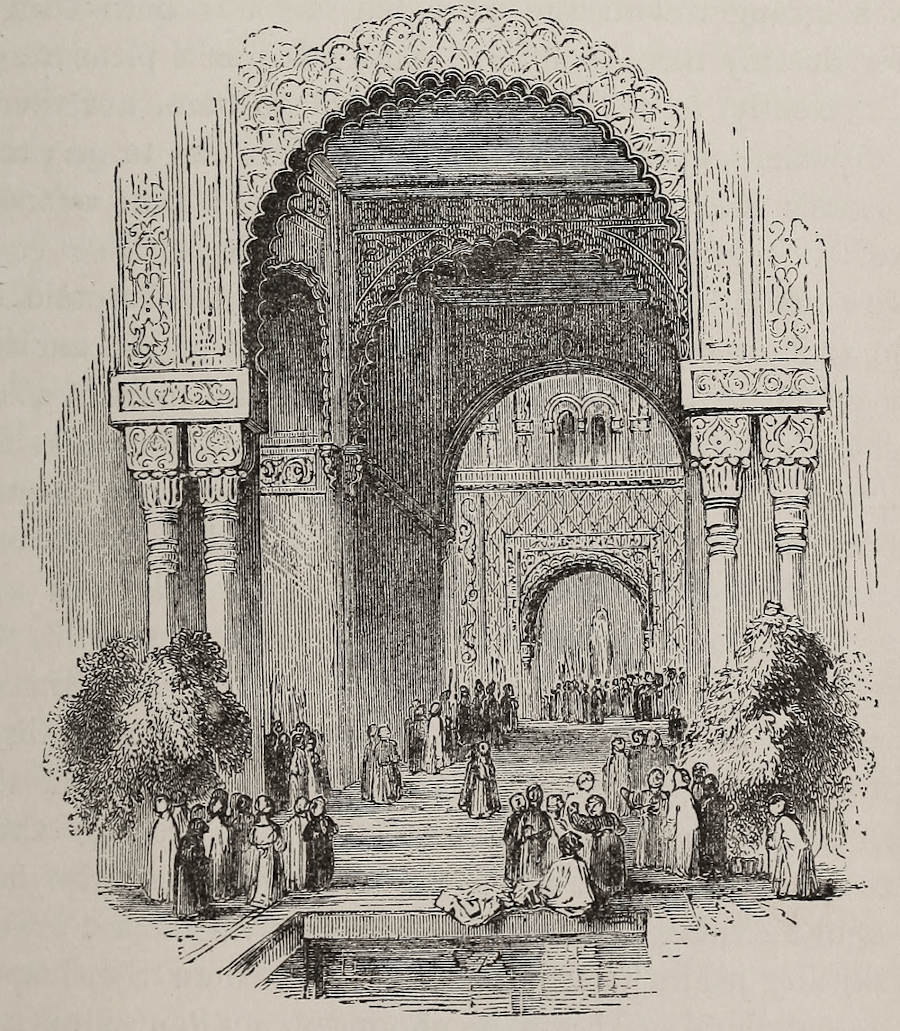
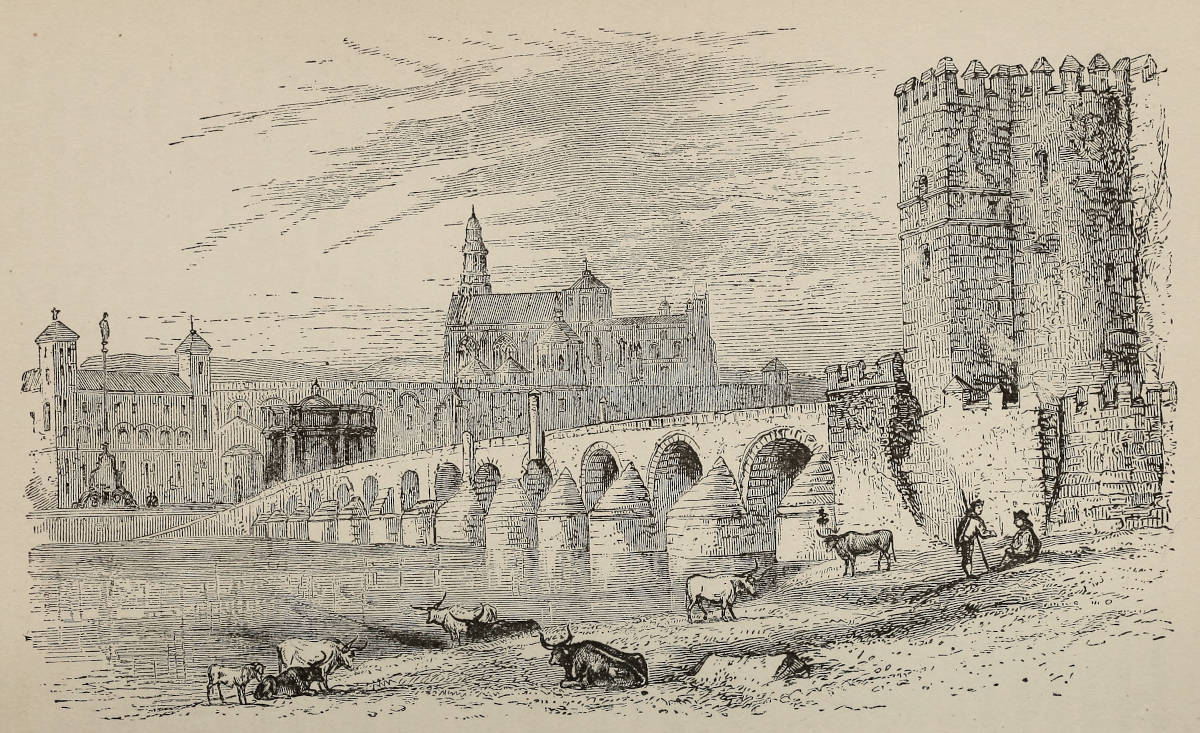
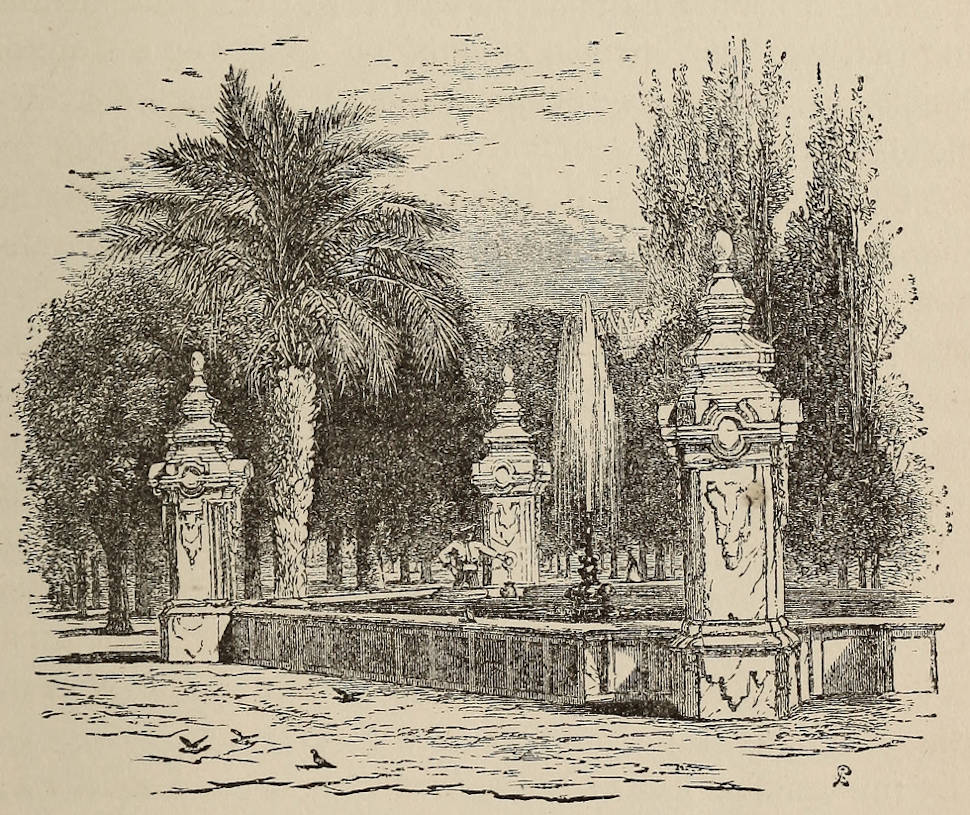
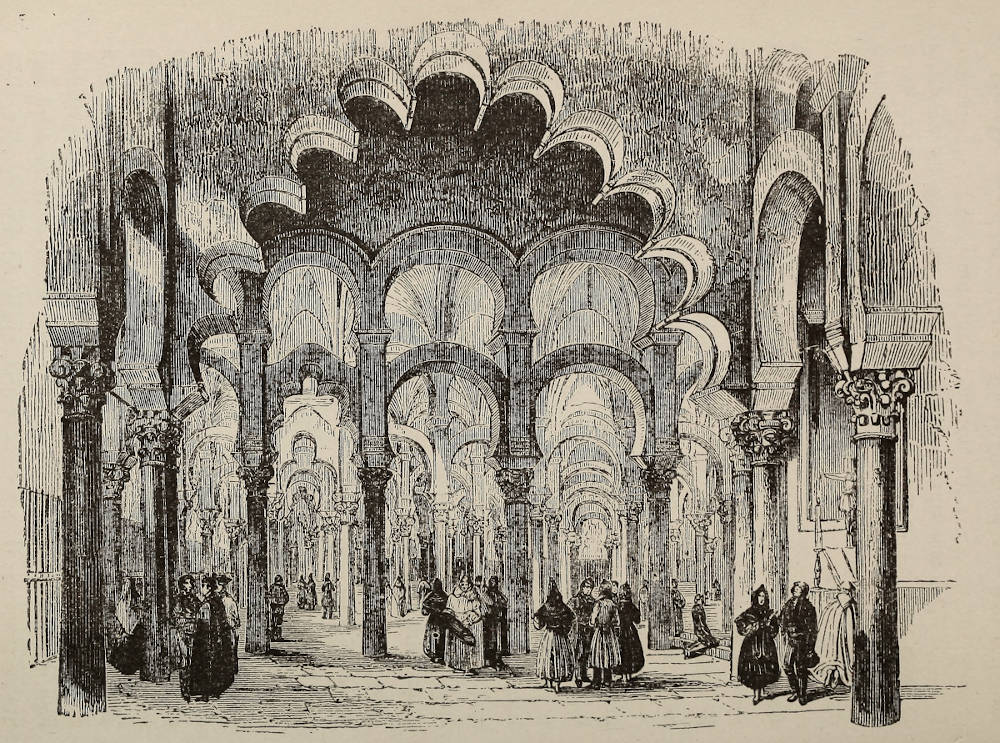
THE Alhambra and the Kremlin . — List of Illustrations.
The Project Gutenberg eBook, The Alhambra and the Kremlin, by Samuel
Irenæus Prime
Note:
Images of the original pages are available through
Internet Archive. See
https://archive.org/details/alhambrakremlin00prim
ii
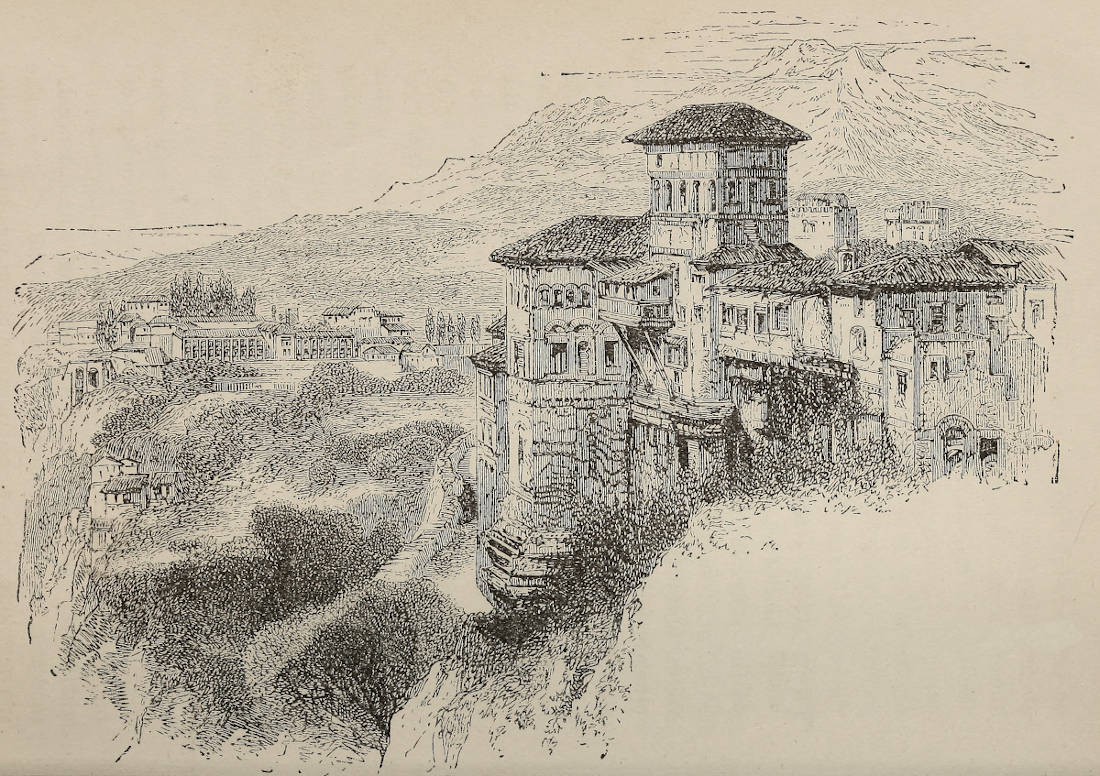
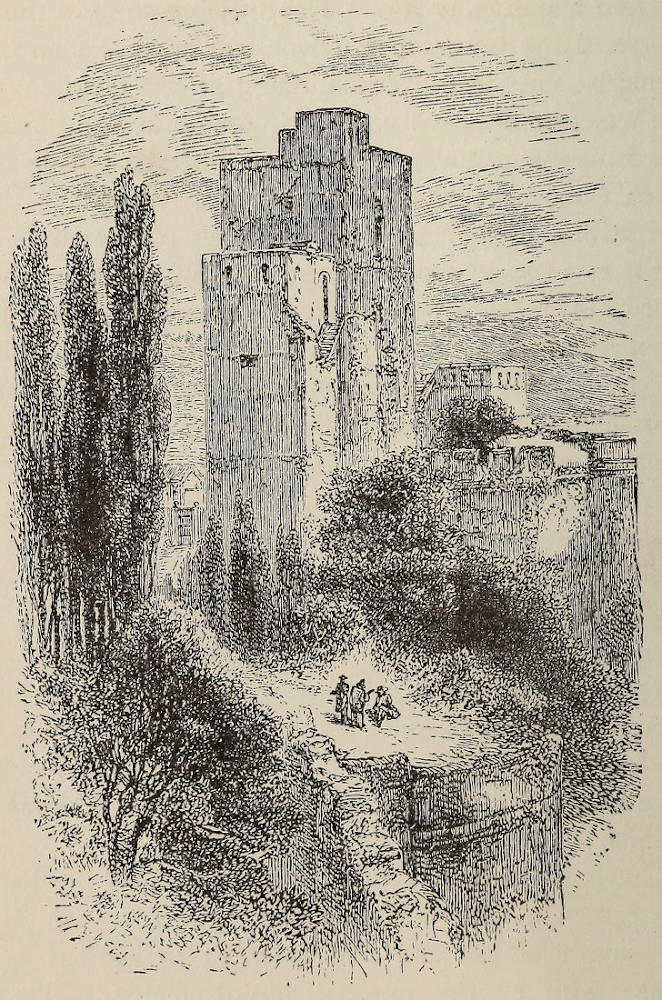
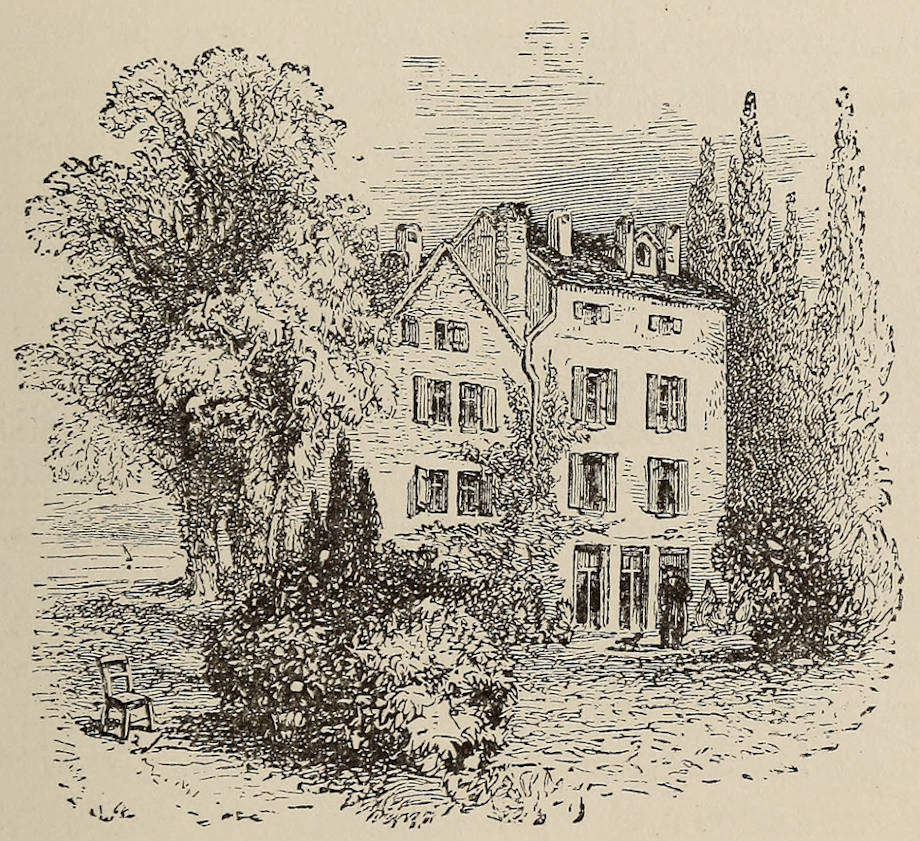
THE GENERALIFFE.
iii
THE SOUTH AND THE NORTH
OF EUROPE.
BY
SAMUEL IRENÆUS PRIME,
AUTHOR OF “TRAVELS IN EUROPE AND THE EAST.”
NEW YORK:
ANSON D. F. RANDOLPH & COMPANY,
770 Broadway.
ivEntered according to Act of Congress, in the year 1873, by
ANSON D. F. RANDOLPH AND COMPANY,
In the office of the Librarian of Congress, at Washington.
Press of
JOHN WILSON AND SON,
Cambridge.
Bindery of
ROBERT RUTTER,
82 and 84 Beekman St.,
New York.
vTO
MRS. E’LOUISA L. PRIME
THIS VOLUME
IS AFFECTIONATELY INSCRIBED.
vi
The South and the North of Europe are
contrasted in this volume. Not by any
formal comparison of the morals and
manners, the institutions and condition
of the peoples in different latitudes, but
by candid statement and description, I
have sought to give a fair view of life as it is in Spain
and Scandinavia.
Since the journey was made, the Queen of Spain has
fled, and the Emperor of France has perished from
among men. But the social life of the nations remains
the same from age to age.
viiiThe Alhambra is a type of the South. The Kremlin
is a symbol of the North. Both of them are fortresses
enclosing palaces: the glory of Spain in ruins, the pride
of the North in its strength and beauty.
Vague and indefinite ideas of these wonderful edifices,
and of the countries they represent, have been entertained
by many, who may find in these pages pictures
of things as they are, which the writer trusts are faithful
and portable.
Lodgings at the Alhambra.—Restoration.—Webs of Falsehood.—The
Sierra Nevada Mountains.—Fruits.—Progress
of the Peasantry.—The Moors.—Adam’s Visit to Spain.—Expulsion
of the Moors.—Decline of the Empire.—Railroads.—Mines.—Early
Settlers.—Iberians.—Phœnicians.—Goths.—Moors.—Waning
of the Crescent.—Capture of
Cordova.—Flight of the last Moorish King
Biarritz.—Chateau Eugenie.—Dangerous Coast.—Breakwater.—The
Virgin’s Partiality.—Bathing Grounds.—Couriers.—Antanazio.—His
Honesty and Zeal.—Crossing the Boundary.—Island
of Conference.—Spanish Courtesy.—The
Basque Provinces.—Peculiar Customs.—Ancestry.—The
Language.—Spanish Stupidity.—La Fayette.—St. Sebastian.—Duke
of Wellington’s Sack of the City.—Bull-ring.—Likeness
of the Country to Switzerland.—Physique of
the Inhabitants.—Productions.—Industries.—Primogeniture.—Tolasa.—Vittoria.—Wellington’s
Victory.—Miranda.—Roderick,
the last King of the Goths
A sleepy Town.—Origin of the Name.—Fusion of the Crowns
of Leon and Castile.—The Coffer of the Cid.—Swindling a
Jew.—Moorish Lies.—Hotels.—A Change of Base.—The
Cathedral.—Statues.—Carvings.—Verdict of Charles V.
and Philip II.—Devil beating the Railroad.—Carving by
Nicodemus.—Miracles.—Castle.—Engineer hoisted by his
own Petard.—Burgos Taverns.—Philip II. His Character.—Conception
xiiof a Palace, Monastery, and Tomb.—The
Escorial.—Dimensions.—St. Lawrence.—Turning-point of
his Life.—Description of the Palace.—Death of Philip II.—Mausoleum.—The
Sagrario.—A toe-tal Loss.—Cellini Crucifix.—Library
Napoleon’s Epigram.—Royal Palace.—Cavalry.—Military Parade.—Plains
of Castile.—Armory.—Swords of Gonzalo
de Cordova, Ferdinand, and Charles V.—Armor of Boabdil.—Revolvers.—Mighty
Men of War.—Toledo Blade.—Stables.—Spanish
Horses.—Merino Sheep.—Royal Equipage.—Crazy
Jane’s Carriage.—Her Effigy.—Mischievous
Display.—French Language and Influence.—Slow Coaches.—Cheap
Labor.—Architecture.—Banking-house.—Bank of
Spain.—Repose of Manner.—Gold at last.—Railroads.—Post-office.—Personal
Identity.—Rebel General.—Lost Letters.—Telegraphs.—Progress.—Picture-gallery.—The
Immaculate Conception.—Vision of St. Bernard.—Christ
sinking under his Cross.—Equestrian Portrait of Charles V.—Titian.—Correggio.—Mary
in the Garden.—Blas del
Prado.—Hidden Gems.—Murillo.—Material and Ideal
Art
TOLEDO.—ITS FLEAS, LANDLORDS, ANTIQUITIES, AND LUNATICS.
Progress.—Hotel Lino.—The wicked Flea.—Easy Manners.—Breakfast.—Model
Landlord and Waiters.—Toledo Butter.—City
xiiiset on a Hill.—Monuments of departed Peoples.—Romance.—Architecture.—Oldest
City in the World.—Mythic
Founders.—Perfidy of Roderick.—Reign of the
Archbishops.—Decline of Power and Glory.—Cathedral.—Descent
of the Virgin.—A fair Penitent.—Orthodoxy of the
Priesthood.—Burning of the Missals.—The Muzarabe.—The
dead Lion better than a living Dog.—Eloquent Epitaph.—Honors
paid the Virgin.—The Alcazar.—Derivation of
Mango.—Spanish Pride.—Peacocks.—Foreign Impressions.—Moorish
Gates.—San Juan de los Reyes.—Thank-offerings.—St.
Florinde.—Cave of Hercules.—Legend of
the Cid.—Café.—Toledo Blades.—Virtues of the Tagus.—Sword
of Boabdil.—Lunatic Asylum.—Don Quixote.—Crazy
Editors.—Statistics.—Causes of Insanity.—Spanish
Slowness and Temperance.—Sophomores
Smoking.—Cigarettes at Dinner.—Taking Sanctuary.—Retort.—Tobacco
Culture.—Cuban Monopoly.—Chewing tabooed.—Early
Smoking.—Children and Ladies.—Tobacco Factory.—Cigareras.—Flavored
Cigars.—Potash.—Soda.—Opium.—Intemperate
Clergyman.—La Mancha.—Don
Quixote.—Treeless Landscape.—Sheep.—Corn.—Primitive
Ploughing.—Husbandry.—Primogeniture.—Lands
of Church and Crown.—Agricultural Schools.—Periodicals.—Sierra
Morena Mountains.—Cautious Engineer.—Manjibar.—Pickled
Chicken.—Moving on.—Perfumes
of Arabia.—Resting-place.—Transatlantic Indigestion.—Andalusia.—Ignorance
and Crime.—Government Education.—Statistics.—Salamanca.—Influence
of Climate.—Population.—The
Aloe and Olive.—Oranges and Lemons.—Hills
of Andalusia.—Sheep
Cleanliness.—Paved Streets.—Bridge over the Guadalquiver.—Age
of the City.—Wholesale Butchery.—Government.—Mosques.—Baths.—Inns.—Schools.—Library.—Rural
Fête.—Departed Glory.—Palace of Abdurhama.—Beautiful
Evergreens.—Fruits.—Interior of an Ancient House.—Moorish
Style.—Cathedral.—Converted Mosque.—Gate of
xivPardon.—Court-yard.—Orange Grove.—Fountains.—Gold
Fish.—Elders in the Gate.—The Mecca of Europe.—Holy
Shrine.—Symbolism.—Indulgences.—Bronze Ornaments.—Inscription
in Gothic and Arabic.—Dimensions.—Precious
Stones.—The Mihrab.—The Kalif’s Oratory.—Mosaics.—Devout
Mussulmans.—Chapels.—Etching on
Stone.—Impressive Monuments
Delicious Climate.—Customs.—Exile of the Moors.—Consequent
Decay.—The Alcazar.—Barbaric Splendor.—A
Christian Kingdom.—Cathedral.—A House of God.—Giant
Columns.—High Mass.—Unconscious Worshipper.—Beautiful
Women.—Venus-worship.—Port of Seville.—Fruits.—Don
Juan.—Barber of Seville.—Murillo’s House.—Mosaics.—Moorish
Castle.—Auto-da-fé.—The Quemadaro.—Field
of St. Sebastian.—Circulation of the Bible.—Tower
of Gold.—Treasure House.—Prison.—Bins of Gold.—Decline
and Fall of Spain.—Demoralizing Influences.—Corruption
and Robbery.—Yellow Fever.—Guadalquiver.—Amphitheatre.—A
Delicate Lady.—Warlike Husband.—Her
Description of a Bull-fight.—The Ring.—Spectators.—Trumpet-blast.—Picadors.—Entrance
of the Bull.—Charge.—Horseman.—Terrible
Sight.—Chulos.—Banderilleros.—Squibs.—Matador.—Applause.—The
Ladies.—Different
Tastes.—Squeamish Husband
La Caridad.—Art Treasures.—St. John.—Miracle of the Loaves
and Fishes.—Moses striking the Rock.—Recovery of Pictures
at Waterloo.—French Thieves.—Venus de Medici.—Thoughtful
Amateur.—Museum Fees.—Guardian Angels
of Seville.—Martyrdom.—Murillo’s Pages of the Gospel.—Old
Masters.—Decay of Art.—Bull-fighting.—The Season.—Exaggeration.—Curious
Development.—Effect on
the National Character.—Street-plays.—Feats.—Demoralization.—Spanish
Pride.—Morality.—Contrast between
the North and South of Europe.—Costume of Andalusia.—Fashion.—Life
of the People.—Price of Labor.—Food.—Climate.—Beer.—Wine
xvcheaper than Water.—Sack.—Intemperance.—Physical
Circumstances.—Social Burdens.—Beautiful
Trait.—Obedience.—Veneration of the Aged
An ill Wind that blows no Good.—Curious Excuse for Crime.—Old
World like the New.—Resort for Invalids.—Genial
Clime.—Range of Thermometer.—Mineral Waters.—Sunshine.—Rainfall.—Heavenly
Skies.—Advice to Consumptives.—Grapes.—Raisins.—Wine
and Oil.—A Sabbath.—Service
at the British Consulate.—Mrs. Partington.—English
Chaplain.—Sermon.—Narrow Streets.—Sweet Memories
of Cologne.—Picturesque Moors.—Cathedral.—High
Mass.—Florid Architecture.—Fruits.—Prayer of a Dying
Moor.—Florinde.—Chronicles of Washington Irving.—Luxuries
of Travel.—Diligences.—Out of Malaga.—Obstinate
Mules.—Night.—Mountains.—Setting Sun.—Lovely
Scenery.—Orchards.—Armed Guards.—Gentlemen of the
Road.—Loja.—Inn.—Flock of Fleas.—A Stimulant.—Setting
out for Granada.—Santa Fé.—Its History.—Granada
at Last.—In the Grounds of the Alhambra
The Paradise of the West.—Rivers of Eden.—New Damascus.—Granada.—Origin
of the Name.—Fruits.—Mountains.—Skies.—Moorish
Empire broken.—Zawi Ibu Zeyri.—Alhambra.—Meaning
of the Name.—Extension of the Castle.—Original
Grandeur.—Its first Prince.—His Improvements.—Roads.—Colleges.—Hospitals.—Canals.—Arts.—Sciences.—Degeneracy.—Intrigues
and Murders.—Ruin.—Final
Overthrow of Moorish Power.—Ferdinand and
Isabella.—Columbus.—Fleas and Cake.—Blessing and
Gold.—New World in the West.—Bookstore.—Irving’s
Tales.—Gate of Judgment.—Plateau.—Desolation.—Court
of Myrtles.—Court of Lions.—Boabdil.—Abencerrages.—Treachery.—Hall
of Ambassadors.—Bensaken.—Walking
Cyclopedia.—Prudence.—Washington Irving.—Dolores.—Queen’s
Garden.—Hall of Two Sisters.—Harem.—Linderaka
Gardens.—Queen’s Dressing-room.—Gypsies.—Perfume
Bath.—Water Bath.—Governor’s Court.—Bowed
Slab.—The Morning Star
The poor Cobbler of Granada.—Spanish Rule of Living.—Xantippe.—Search
for Gold.—Messenger Dove.—Dreams.—Landslip.—Fever
cured.—Conversion.—The Watch Tower.—Magic
Bell.—Parapanda Mountains.—Reign of Law.—Gift
to the Duke of Wellington.—Bloody Pass.—Vega.—Water
Gates.—The Last Sigh of the Moor.—His Mother’s Reproof.—Moorish
Race.—Political Prisoners.—Birthplace of
Eugenie.—The Generaliffe.—Ancient Tree.—Suspected
Queen.—Women of Spain.—Sins of Climate
Troubadour and Gypsy Life.—Dwarf.—Horse.—Fair.—Physique
of the gitanos.—Habits.—Habitations.—Moral Principle.—Chastity.—Swindling.—Superstition.—Fortune-tellers.—Credulity.—Trickery.—Parisian
Spiritualist.—Gypsy
Creed.—Musings.—Causes of Astonishment.—Paintings
and Cathedrals.—Unworthy Ambition.—Silence in Church.—Cathedral
of Granada.—Chapel Royal.—Tomb of Ferdinand
and Isabella.—Tomb of Philip and Crazy Jane.—Obliging
Priest.—Fees.—Leaving Granada.—Disguised
Thief.—Seizure and Imprisonment.—Out of Granada
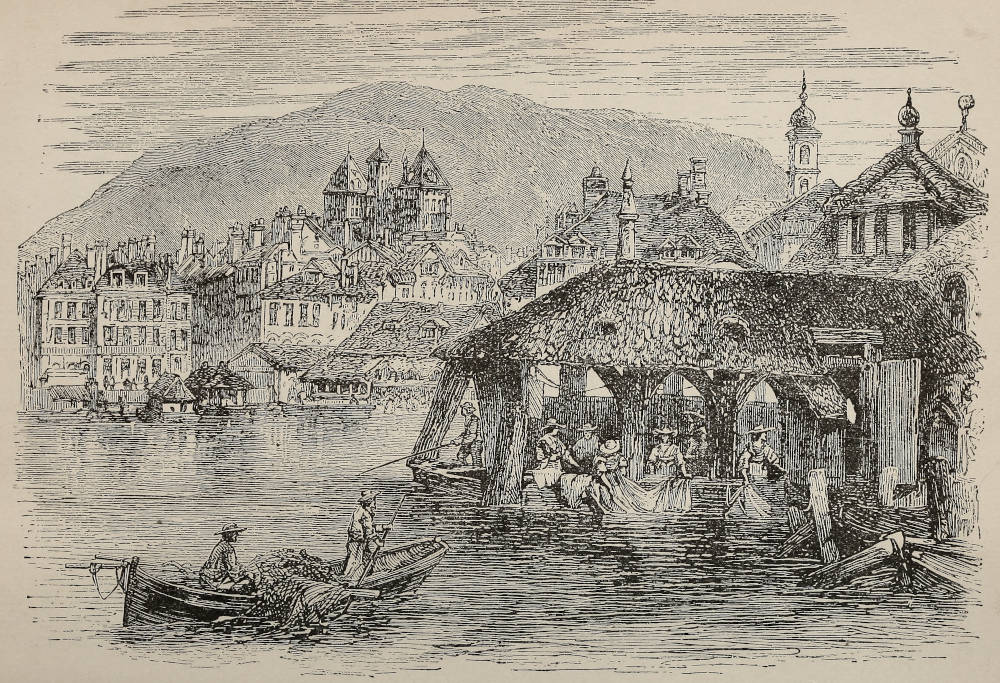
Geneva.—Color of the Rhone.—Cæsar’s Wall.—Cathedral.—Calvin.—Lady
Jane Grey.—Rousseau.—Voltaire.—Madame
de Stael.—Byron.—Jura.—Mont Blanc.—Celebrities.—Coppet.—Ninon.—St.
Protais.—Lisus.—Morges.—Grand
Muveran.—Diablerets.—Mont Rosa.—Mont Blanc.—Lausanne.—St.
Anne.—Sacred Rat.—Cathedral.—Convention
of Reformers.—Gibbon.—Classic Ground.—Chillon.—Bonnivard.—Torture
Chamber.—Hotel Byron.—Railroad.—Ice.—Swiss
Valleys.—Freyburg.—Suspension Bridge.—Great
Organ.—Cathedral.—Wonderful Music: its Power
and Sweetness.—Berne.—Morat.—Burgundian Custom.—Public
Bears.—Unfortunate Englishman.—Curious Clock.—Market Women.—Federal
Palace.—Swiss Cantons.—Bernese
Alps.—Thun.—Jungfrau
Pleasant Ride.—Interlaken.—Lakes Thun and Brienz.—Abendberg.—Faulhorn.—Giesback.—Illumination.—Ascent
of
the Brunig.—Vale of Meyringen.—Falls of Reichenbach.—Lungern.—Splendid
Courage.—Cheap Suffering.—Modern
Reformers.—Mount Pilatus.—Myths.—Lucerne.—Population.—St.
Leger.—Service.—Crucifix.—A Devotee.—Mass.—Organ.—Cloisters.—Lake
Lucerne.—Lion of Lucerne.—Dance
of Death.—Striking Scenery.—Gersau.—Brunnen.—Bay
of Uri.—Sir James Mackintosh.—Swiss
Patriots.—Chapel of Tell.—Cascades.—Fluellen.—Altorf.—Captain
Lott
A German Watering-place.—Land of Salt.—Salt Works.—Last
of the Barons.—Homburg.—Kursaal.—Palace.—Gaming.—Kreusnach.—Spas.—Salt
Springs.—Cure-house.—Kissingen.—Baths.—Cures.—Long
Sledge-ride.—Princess
of Mecklenburg.—Clerical Postman.—Whey-cure.—Grape-cure.—Rest.—Rheingraffenstein.—Ebernburg.—Relics
of Reformers.—French Cannon Balls.—The Bingen
of Poetry.—The Real Bingen.—Bishop Hatto’s Tower.—Maüse-thurme.—Southey.—Ehrenfels.—Rudesheimer
Vineyards.—Wine-making.—Shallow
Soil.—Johannisberg Vineyard.—The
Rhine.—Mayence.—Printing.—Guttenberg’s
Statue.—Cathedral
Tomb of Charlemagne.—The Dead Emperor.—Cathedral.—Consecration.—Holy
Shrine.—Healing Waters.—Palace.—Holy
Relics.—Remarkable List.—Septennial Exhibition.—Sultan
of Turkey.—Crowd.—Order and Devotion.—Sultan
and Suite.—Stolidity.—Priests and Women.—A
Crush.—Pageant opened.—Procession.—The Relics.—Puseyite
Priest.—On the Road to Rome.—Superstition.—Pictures.—Virgin’s
Garment.—Modern Style.—Holy Shirt.—Other
Relics.—Pilgrims.—Revenue.—Waters.—Fountain.—Music.—Invalids.—Kurhaus.—Social
Ease.—Baths.—Sulphur
Water.—Antiquities.—Tower of Granus.—Statue
of Charlemagne.—Bust and Skull
Historic Legend.—The Jesuits.—Partition.—Last Insurrection.—Nationality
crushed out.—Attempted Insurrection.—Defeat.—Warsaw.—Armed
Despotism.—Discontent.—Precarious
Prosperity.—Russian Rule and Language.—Fate of a
Spy.—Consequence.—Russian Soldiery.—Ill-manners.—Botanical
Gardens.—Observatory.—Palace.—Sobieski’s
Monument.—Grave Error.—Illumination.—Streets.—Drunkenness.—Climate.—Lutheran
Church.—Relics of
Romanism.—Mendicants.—Jewish Quarter.—Hospital.—War
of Religions.—Statue of the Virgin.—Little Russia.—Funeral.—English
Cock
Pretentious Hotel.—Splendid Bridge.—Polite Ticket-seller.—Cars.—Prairie.—Wretched
Peasantry.—Jews.—Railroad
Employes.—Lapy.—Mother and Son.—Bialystok.—Grodno.—Diet
of Poland.—Last King of Poland.—Jewish
Holiday.—Lithuania.—Plains.—Napoleon’s Hill.—Monument.—Wilna.—Ruins.—Insurrection.—Babel.—Dunaberg.—Captive.—Short
Night.—Serfs.—Reform.—Board
of Arbitrators.—Emancipation.—Pskof.—Lady Smoker.—St.
Petersburg
Searching Process.—Peculiar Costumes.—Rough Streets.—Russian
Bath.—Dinner.—Model Guide.—Elegant Diction.—Peter
the Great.—Catharine I.—Striking Contrasts.—Accommodating
Weather.—Palace of the Emperor.—Column
of Alexander.—Statue of Peter the Great.—Boy Czars.—Peter’s
Lawyers.—Devotion.—Cathedral.—Trophies.—Isaac’s
Cathedral.—Amazing Splendor.—Worship.—Offerings.—Holy
of Holies.—Behind the Scenes.—Careful Husbands.—Greek
and Romish Churches.—Lent.—Sabbath.—Exorcism.—Honors
paid the Virgin
Winter Palace.—Ways of Royalty.—Crown Jewels.—Orloff
Diamond.—Hermitage.—Art Galleries.—Curious Code of
Laws.—Royal Museum.—Peter’s Walking-stick.—Art
Culture.—Condition of the Masses.—Laborers.—Mechanics.—Prices.—Rent.—Food.—Dress.—Peculiar
Custom.—Polite
Bankers.—Despot.—Justice.—Verdicts.—Story
of Labanoff.—Siberia.—Abuses.—Academy of
Science.—Zoological Museum.—Sunset on the Neva.—Boatman.—Light
at Evening-tide
American Engineers.—Sleeping Arrangements.—Newspapers.—Drama.—Courtesy.—Lubanskaia.—Dinner.—Villages.—The
Volga.—Murdered Bishop.—Sleeping Car.—Ladder.—Russian
Jargon.—Pathetic Appeal.—Board.—Refreshments.—Greek
Ecclesiastic.—Patriarch Nicon.—New Jerusalem.—Profanity.—Tyranny.—Revolt.—Pope
of the
North.—Emperor’s Slight.—Nicon’s Humility.—Banishment.—Patriarchates.—Dead
Level.—Flight of Freedom
A Swiss Landlord.—Fleas.—Shrines.—Palaces, Cottages, and
Churches.—The Moskva.—Circular City.—Kremlin Walls.—Gates.—Chief
Entrance.—Picture of the Redeemer.—Respect.—Cannon.—Miracle.—Splendid
Scene.—Tower
of Ivan.—Bells.—Medium of Worship.—Holy City.—Pilgrims.—Bell-making.—Precious
Metals.—Silver Bells.—Chapel
of the Betrothed.—Music of the Bells
Cathedral of the Assumption.—Bones of the Patriarchs.—The
Iconastasis.—Sanctuary.—Archbishop’s Throne.—Coronation
Ceremony.—Tombs.—Cathedral of the Archangel
xxiMichael.—Religious Freedom.—Churches.—Cathedral of
St. Basil.—Archangel Cathedral.—Pilgrims.—Golgotha.—Sacristy.—Religion.—Holy
Oil.—Baptism.—Making
of the Holy Chrism
Royal Palace.—Empress’s Drawing-room.—Empress’s Cabinet.—Hall
of St. George.—Hall of St. Andrew.—Gold
Court.—Napoleon’s Descent.—Treasures.—Historical Curiosities.—Precious
Orb.—Foundling Hospital.—Mortality
of Foundlings.—Orphan Asylum.—Sheep’s Clothing.—Harvest
Season.—Jews.—Peasants.—Riding School.—Wax-show.—Ethnological
Society.—Travel.—Sydney
Smith’s Stick
Commercial Travellers.—Sparrow Hills.—Church of the
Saviour.—Simonoff Monastery.—Novo-Devichi Convent.—The
Moskva.—A Holiday.—Napoleon’s March.—Borodino.—Evacuation
of Moscow.—French Enthusiasm.—Triumphal
Entry.—Surprise.—Incendiarism.—Return of the French.—Horrors
of the March.—Russian Barbarism.—Public Kissing.—From
Moscow to St. Petersburg.—Fussy Ladies.—Klin.—Dinner.—Tver.—Beggars.—Night
without Darkness.—The
Fussy Ladies again.—Sunrise.—Marriage Customs
Americans.—Cronstadt.—Fortifications.—Vessels.—Smoking.—Wyborg.—Saw-mills.—Channel.—Ruined
Tower.—Submission
of Finland.—Religion.—Government.—Harvests.—Famines.—Army.—Wages.—Fens.—Lakes
and
Islands.—Drosky.—Huge Stones.—Excursion.—Eden in
the North.—Serpent in the Garden.—Long Bills.—Attentions
paid Strangers.—A Finnish Lady.—Fishermen.—A
Killing Man.—Gulf of Finland.—Fredericksham.—Sclava.—Hard
Case.—Social Customs
Harbor of Abo.—Swedish Customs.—Eating and Drinking.—Climate.—The
Baltic.—Stockholm.—Porters.—Hotel Rydburg.—Pleasant
Quarters.—Scandinavia.—Odin.—Sagas.—Christianity.—Lutheran
Religion.—King.—Congress.—Hospital.—Physicians.—Clergymen.—Education.—Religious
Toleration.—The Press.—Cost of Living.—Vice.—The
Riddarholm’s Kyrkan.—Tomb of Gustavus Adolphus.—Reformation.—Royal
Palace.—Picture Gallery.—Library.—Codex
Aureus.—King of Sweden.—Mimic War.—Standing
Army.—Order.—Thieves
Drottningholm.—Lake Malar.—Sigtuna.—Odin.—Superstition.—Pirates.—Rural
Life.—Professor Olivecrona.—Islands.—Chateau.—Commercial
Life.—Manuscripts.—University of
Upsala.—Codex Argenteus.—Icelandic Literature.—Standard
of Education.—Students.—Costume.—Cathedral.—Statue
of Thor.—Old Upsala.—Mora Stone.—Mass Meetings.—Graves
of Pagan Deities.—Temple of Odin.—Ancient
Tower.—Battle-field of Faith.—Deer Park Restaurant.—Social
Customs.—Swedish Homes.—Content.—Moral
Progress
Steam Canal.—The Oscar.—View of Stockholm.—Sodertelje.—St.
Olaf.—The Gota Canal.—Castles and Legends.—Soderkoping.—Tavern
xxiiiBreakfast.—Sabbath in Sweden.—Church.—Costumes.—Service.—Snuffing
and Nasal Singing.—Watering-place.—Physician.—College
of Health.—Baths.—Mineral
Waters.—Emigration.—Lodging
and Board
On the Gota Canal again.—Working-girl.—Lake Asplagen.—Swedish
Professor.—Lake Roxen.—Berg.—The Vetra-Kloster.—Graveyard.—Tombs
of the Douglases.—School-house.—Dinner
on the Canal.—Crops.—Lock-keeper.—Lake
Boren.—Motala.—Iron-works.—Lake Wetter.—Wadstena.—Pea-crop.—Peasantry.—Labor.—Cold.—Sunset.—Forsvik.—Russian
Gentleman.—Lake Wenner.—Trout.—Falls
of Trollhatten.—River.—Unfortunate Sailor.—Collection.—Hongfel
Castle.—Gottenburg.—Cheap
Lodgings.—Museum.—Daily News.—Training House for
Servants.—Philanthropy
Embarkation.—Breakfast.—Skager-rack and Cattegat.—Freidericksvern.—Christiania.—Hotel
du Nord.—Flowers and
Fountains.—Stove.—Norwegian Breakfast.—Museum.—Superstition.—Duel
of the Girdle.—Bridal Ornaments.—Heathen
Relics.—Learning and Letters.—Lake Mjosen.—English
Commercial Traveller.—Boat Library.—Sportsmen.—Church.—Fat
Pastor.—Remnants of Popery.—Costumes.—The
Lord’s Supper.—Service.—Devotion and
Reverence.—Oneness of the Church.—Lillehammer.—Cheap
Living.—Cripple.—Christiania.—Carriole.—Post
Horses and Boys.—Agershaus.—Robin Hood of Norway.—Benevolent
Institutions.—Grave of Bradshaw
Skager-rack and Cattegat.—Magnificent Sunset.—Elsinore.—Toll.—House
of Tycho Brahe.—Kronborg.—Treaty of
Vienna.—Danish Giant.—Fortifications.—Hamlet’s Grave.—True
xxivHistory.—Royal Castle.—Queen of Christian II.—Touching
Prayer.—Royal Forest.—Castle of Peace.—Denmark.—Her
History.—Valdemar II.—Schleswig-Holstein.—Christianity.—General
Intelligence.—Education.—Copenhagen.—Thorvaldsen’s
Museum.—Statues.—Vanity.—Hall
of Christ.—Gems and Bronzes.—Vor Frue Kirke.—Religion
and Art.—Church Service.—Baptism.—Love of
Amusement.—Theatres.—Public Gardens.—Museum.—Ruins.—Monuments.—South
American Gentleman.—Zealand.—Fleas.—Kiel.—Elmshorn.—Home
Again
462
1SPAIN.
CHAPTER I. GRANADA.
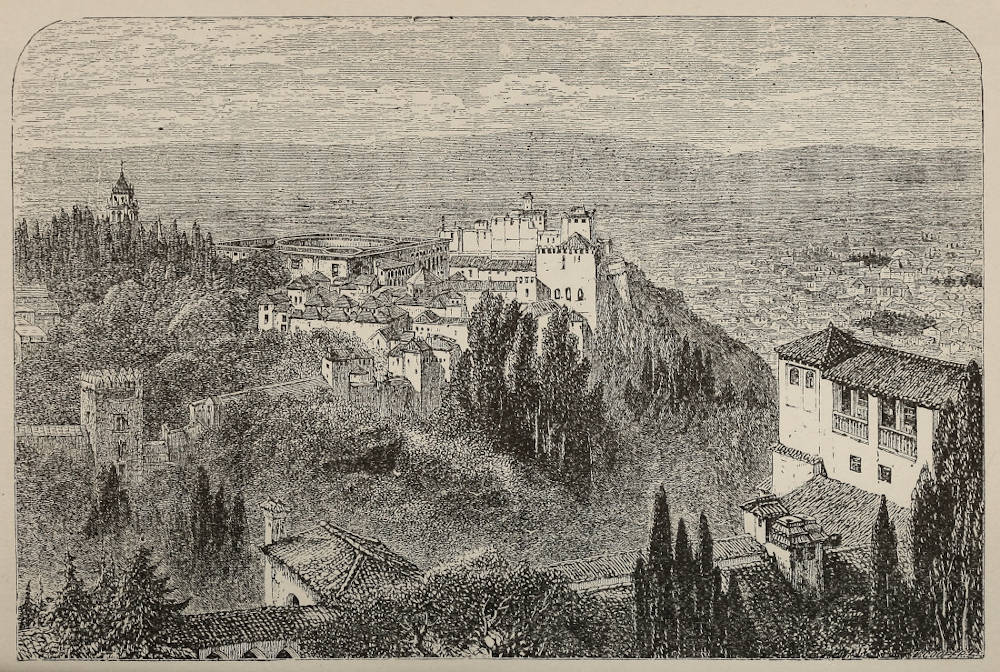
IN the grounds of the Alhambra, the ancient palace of the
Moorish kings of Granada, what time those conquerors
of Spain here held their right regal court, I have come to
sit down and to rest.
My lodgings are just under the walls of the old castle, in
sight of its crumbling towers, in hearing of its many falling
waters, and under the shadow of its English elms, which
the Duke of Wellington gave to Spain. At any moment a
few steps take me into the courts and halls and chambers
of the Alhambra. In years past, while this pearl of Arab
art and Oriental splendor was silently suffered to fall into
ruin, with the lapse of centuries, it has been the habit of
some travelled authors more addicted to romance than
others, to get the easy privilege of sharing lodgings with
the bats in some deserted chamber, and they doubtless
fancied themselves inspired with the genius of the place,
as they dreamed and wrote where fair sultanas with their
charms eclipsed the splendors of the fairy place itself.
As it is no part of my purpose to indulge in romance
while writing these sketches of the Alhambra and of Spain,
and as the walls of a comfortable inn are much more to the
taste of a weary traveller than the stone floors and open
2windows of a tumbling old castle, it is my preference to
take up my abode for the present with the good people in
the Alhambra Hotel, and not with the keepers of the palace
itself. Besides, there is no choice left. The government
has undertaken the work of restoring the Alhambra to its
pristine beauty, and this process is now going onward under
the direction of Sr. Contreras. He has already displayed
so much skill in imitating the arabesque decorations of the
walls, that only a practised eye perceives the difference when
the ancient and the modern art appear in the same chamber.
Architects as well as amateur travellers from all parts of
the civilized world, for centuries past, have made artistic
and pleasure journeys hither to study and admire the style
that has nothing like it except in Spain, and here only
where the Moors held sway. And perhaps no work of art
in the whole world has been more frequently and fully
described than the Alhambra of Granada. History, poetry,
and science have tried their several hands upon it.
Romance has been so busy with it that it is not an easy
task to disentangle the web of fiction, and get the only part
of the tale worth knowing. So dear is truth, the simple,
naked truth of history, to every true soul, that he is a great
doer of evil who seizes upon history, and while professing
to write it, weaves into his story the fancies of his own prolific
genius, and that so deftly and so charmingly that the
whole is accepted as veritable history, and the romance as
the most credible and interesting of the whole. Early
English history has thus been illustrated and inextricably
confused. The spell of the magician’s wand has thus made
the conquest of Mexico a poem rather than a reliable narrative.
And Spain, more than any other land, is now hopelessly
given up to legends and doubtful chronicles, modern
and antique, so that one who reads must have either the
credulity of a devotee, or the indifference of folly, to read
with satisfaction the ancient history of the Peninsula.
3But the Alhambra is here! Granada is where it was a
thousand years ago! The same deep blue sky, the bluest
sky that covers any land, hangs over its magnificent Vega
or plain, through which the Darro and the Genil, united,
flow! The hills, each one with a story that can be scarcely
heard without a tear, stand where and as they did when the
Moors were masters of this region, which they thought the
terrestrial paradise of man, and immediately under the celestial
mansions where the Prophet and the Houris await the
coming of all true believers. The Sierra Nevada, covered
with perpetual snow, seems close at hand, as it lies on the
eastern horizon, and in this cloudless sky and brilliant atmosphere
the long range shines like silver mountains in
the noontide, as it did when fleet horsemen brought its ice
in baskets to cool the drinks of Wali Zawi Ibu Zeyn, its
first Moorish king. Those snowy summits reminded the
Arabs when they came here of Mount Hermon, and this
plain seemed to them to surpass in fertility and beauty the
Vega around Damascus.
And to this day the palm-tree, the pomegranate, and the
fig, the orange and lemon, the olive and vine, flourish under
the genial sun. In these declining years of the nineteenth
century, with a railroad running into the city across the
heart of this paradise, and telegraphs linking it with Madrid
and London and Washington, the peasants still scratch the
ground with the root of a tree for a plough, and carry their
produce to market on the back of a donkey.
The creations of the Moors in Spain form the most
remarkable chapter in human art. To me, Spain has been
a new discovery; a sudden revelation of a world within a
world; the monuments of an extinct or departed race
standing alone in a desert. The generation that now possesses
the soil has nothing of the genius or taste or spirit
of the barbaric tribes that were once their masters. And
the Alhambra at Granada, the Mosque at Cordova, and the
4Alcazar at Seville, look like the wrecks of a stranded
empire, whose people live only in their glorious ruins.
In the language of a brilliant historian, “Spain stands to-day
a hideous skeleton among living nations.”
They have a legend here that Adam made a visit to the
earth a few years ago, to see how his farm was getting on.
He alighted in Germany, and found schools and colleges
and books, and the people intent on learning. He soon
left it for France, where the people dressed in fantastic
styles, and were mad upon works of art and improvements
unknown to our great ancestor. Disgusted with all he saw,
he came down to Spain, and, with delight, exclaimed, “This
is just as I left it.”
Adam was nearly right. Of all the countries in Europe
this is more as it was than any other. The greatest calamity
that ever happened to Spain was its expulsion of the
Moors; and it will be a century, perhaps many centuries,
before the arts and sciences will flourish on this soil as
they did before that year, so memorable for the discovery of
the New World by Columbus, and the overthrow of the
kingdom of Granada by Ferdinand and Isabella. Both
those events, forming the most momentous epoch in the
history of Spain, occurred in the year 1492, from which
period we may date the decline of an empire enriched by
the untold wealth of a new world added to its possessions,
and strengthened by the destruction of the last stronghold
of its former conquerors and masters. Foreign capital and
enterprise have forced railroads across her mountains and
plains, but the capital and enterprise of the world cannot
make them profitable, when the people have no industry
and no ambition. The mines of Spain are so rich that she
has no need of possessions in the gold fields of the western
hemisphere; and they have been known and worked ever
since the days of the Phœnicians, when Andalusia was the
Tarshish of Holy Scripture. Yet Spain is more distinguished
5to-day, as being behind the world, than for aught it
has done or is doing for itself or others. And it often
seems to a traveller here in Spain that he is in the Orient,
so many manners and customs, so many works, and, much
more, such a want of things he is wont to meet with in the
more civilized nations, remind him that he is among a
people who have derived much of what they have and are
from lands at the other end of the Mediterranean Sea.
It has a mixed race of inhabitants. It would not be
strange if it had a mixed government also. Successive
tides of people have swept over it, and the vestiges of all
are left on the surface of the nation. Very little, indeed, is
known of the days when the Iberians from Caucasus, and
the Celts from Gaul, were the rude settlers of Spain; but
the traces are more plain of the Phœnicians, who came here
1500 years before the birth of Jesus, and founded Cadiz and
Malaga, and Cordova and Seville. In the year 218 before
Christ the Romans came, and, of course, conquered all
Spain, and reigned here just six centuries. Then came the
Goths, sweeping the Romans out of Spain as they crushed
Rome in Italy. And the Goths ruled Spain precisely 300
years. Then came the Moors, and, in two pitched battles,
smote the Gothic Christian power to the earth; and, like
a hurricane from the African coast, rushed up from the
south, and never stayed its destructive course till the crescent
had supplanted the cross on every tower in Spain.
The Moors were lords of Spain just seven centuries. Gradually
the crescent waned, as the Catholic Christian kings
recovered strength, until St. Ferdinand captured Cordova,
in 1235, and Ferdinand and Isabella completed the work
at Granada, on the third day of the year 1492, and the last
of the Moorish kings fled from the Alhambra.
CHAPTER II. OUT OF FRANCE INTO SPAIN—THE BASQUE PROVINCES.
6
AWAY down in the south-west corner of France, on the
Bay of Biscay, was a hamlet on a rock-bound coast,
which has of late years suddenly sprung into the notice of the
world. The sunshine of imperial favor ripened the modest
bud of a humble village into a flower of remarkable beauty.
What was a short time since quite unknown, is now the
fashionable watering-place of France. Selected by the late
Emperor as his autumnal resort, he built a handsome
chateau, and named it Eugénie, and thus made the fortune
of Biarritz.
Here we spent a few days of rest after a long and wearying
journey. The coast is dangerous. The bay is rough
to a degree that has become a proverb. An attempt was
making under government direction to construct a breakwater,
so as to enclose a “harbor of refuge,” and one is
greatly needed. A process, new to me, but perhaps common,
was going on: that of building rocks, or blocks, to
make the projecting pier. Thousands of square feet of
rock are here in the hills, but, for some reason, it is preferred
to form a concrete mass with stone and cement.
These are made in cubes of six or eight feet, with two
grooves underneath them, and when they have stood long
enough to be proof against water, levers are thrust under
them, a derrick hoists them upon a platform which is moved
on a railway to the pier, where they are launched off into
7the deep. The fury of the waves at this point, especially
in rough weather, is frightful. The new breakwater was
recently swept away. Two or three workmen were caught
by the waves rushing higher than was expected, and the
poor fellows were carried off into a deeper ocean. This
terrified the others, and they declined to expose themselves
to such dangers. The priests came to the rescue. They
set up an image of the Virgin on an overhanging rock.
She looks down benignly on the work and the workmen.
Not one has been swept away since she stood there!!
Confidence is restored. The breakwater is gradually extending.
It will cost an immense sum, and if the Virgin is
so successful in saving the lives of the landsmen in building
it, one would think she might just as easily save the sailors,
and so render the harbor unnecessary.
On this stormy coast, where the surf breaks over huge
rocks, and sometimes rushes curiously through them by
passages worn in ages of incessant roll, there are several
coves where the beach slopes gradually to the sea, and the
smooth sand floor furnishes delightful bathing grounds.
Here, in the season, the court used to disport itself in other
robes than those of royalty, and among the crowds of fashionable
people, who in fantastic deshabille indulge in the
ocean bath, were daily seen the Emperor and Empress and
the remarkable boy who astonished the mayor by being the
son of an Emperor when only ten years of age!
A courier, or travelling servant, is usually more of a
nuisance than assistance, but I had to have one. He had
the Spanish name of Antanazio, was of course familiar with
the language, and he spoke French also, but not a word
of English. He was a half devout Catholic, and professed
to be very discriminating in his faith, rejecting many of the
notions of his countrymen, and swallowing others without a
strain. He was a big fellow, so big that he could easily
have taken me under one arm and my companion on the
8other, and marched into or out of Spain at any moment.
He was the terror of the cabmen and porters and waiters,
bullying, swearing, and pushing his way through the thickest
of the fight, in those struggles that attend every arrival of
a passenger in any part of the world. He was just about
as honest as the race to which he belongs. Every traveller
thinks his own courier a pattern of honesty. I have had
them in a dozen different countries, and never yet was able
to put the word honest into the certificate which they craved
at the end of the journey. Some are better than others.
Any one of them is worse than none, if you have a slight
knowledge of the country. Antanazio was in league with
every hotel man to get as much out of us as he could, and
he made up for his frauds on a large scale by an excess of
zeal to save a few coppers for us when a poor porter or
sacristan was to be paid for service. The gnat and the
camel were familiar to Antanazio. Yet he was one of the
best couriers to be found, and he shall have the benefit of
this notice.
Just before we leave France to go into Spain we pass a
village, here mentioned only to cite an eloquent epigram
inscribed around the dial of the clock on its tower: “Vulnerant
omnes, ultima necat.” Even so; each flying moment
wounds: the last slays. And after quitting the Hendaye
station, we dash across the river Bidassoa, which divides
the two kingdoms. It would take us the rest of the day
merely to read the history that invests this crossing with
interest for all time. A little dry spot is in the bed of the
river. There kings and queens and generals have met to
settle affairs of state as on neutral ground, and the petty
patch has come to be called the Island of Conference.
Here, in the middle of the dividing river, Louis XIV. of
France had his first meeting with Maria Theresa, daughter
of Philip IV. of Spain, and they were married in the cathedral
of St. Jean de Luz on the French side of the river. On
9the same spot the kings of France and Spain met in 1463
to negotiate; and here too, in 1645, Isabella the daughter of
Henry IV. was exchanged for Anna of Austria, the one to
be the wife of the king of Spain, and the other of France.
In 1526, Francis I., who was a prisoner of Charles V., was
here given up, and his two sons accepted as hostages in his
stead. We go thousands of miles to visit a spot that has
thus been made sacred and famous, yet one can hardly tell
why he looks with interest upon ground so sanctified. The
grass and the weeds grow just as freely, and the birds are
as careless in their songs, and the water flows on as it
always flows; but still no thoughtful traveller can pass
such landmarks in the march of great events, without pausing
to observe the effect which those events have had on
the history of the world. And this is one of the greatest
objects before us as we enter and traverse Spain. It is a
land of history: of romance too; and perhaps both are
equally interesting. For every line we cross, and every
city and province we visit, is rich in association, even if the
land is now but a great sepulchre of great peoples.
And we were in Spain. On the northern frontier, and in
instant contact with the people of France, is a race that is
Spanish only in name, and hardly that; a race that has,
through all the mutations of government in this unstable
country, maintained a sort of independence, with rights and
privileges, manners and customs so peculiar to themselves,
that they may be said to be in Spain, but not of Spain.
On the anniversary of the death of one of their number,
the friends gather at the grave, and offer to the departed
gifts of bread and fruit, as if they required supplies of food
for the endless journey in another world. On the holidays,
which are many in a year, they are wild in the dance, with
the tambourine and bagpipe and castanet, being far more
demonstrative in the height of their excitement than the
more southern inhabitants of Spain. They are a proud
10race, and more proud of their ancestry than any thing else,
the poorest peasant among the hills displaying on the door
of his hut a coat of arms, and claiming descent from some
ancient and illustrious house. As a race they have no
trouble in reckoning their pedigree back to Tubal and
Noah, and unless your tree of genealogy has branches
springing out of a trunk that bears the name of Adam,
these people are far ahead of you in the line of their ancestry.
They occupy the Basque Provinces, three divisions, small
in extent, lying among the Pyrenees and on the Bay of
Biscay. They are probably lineal descendants of the first
settlers of Spain, and may be correct in their boast that
they are not tainted with Roman or Moorish or Gothic-German
blood. They still speak a language so strange and
so formidable to a foreigner that it is said no one has been
able to master it. There is a tradition among them that
the devil himself spent five years in studying it, and was
able to learn three words only. But after much inquiry I
could not trace this tradition to any reliable source. In
fact, it is said that one or two bold and persevering scholars
have actually made some inroads into the language, but the
discoveries made were a very poor reward for the time and
labor spent.
Into this new yet ancient country we enter at once, for
it is the northern gateway of Spain. At the outset of our
journey we must “change cars,” for the Spanish government,
in granting license for a railroad to enter its domains,
refused to allow it to be made of the same width with that
of France, as it would in that case afford to the French
facilities for invasion in case of war! The idea is very
characteristic of Spain. And the same stupidity that dictates
such an impediment to travel forgets that every train
of passengers coming in from the north is an invasion that
is just as fatal to the regime of Spain as would be another
11incursion of Goths or Gauls. Ideas, rather than arms,
work revolutions now-a-days.
The mountains have stretched themselves across this
frontier to the verge of the ocean, and on our right as we
go south is a narrow pass between two precipitous hills,
and thus a safe and easily defended path for ships is made.
Within is a snug harbor, where the largest fleet may lie
unseen, and unreached by the storms at sea. Out of this
little port once sailed a man whose name is dear to the
American heart; for in the days that tried the souls of our
fathers La Fayette came here into Spain and took passage
to the Western world, to give his sword and his fortune and
his life to the cause of liberty. A little farther on, a high
castle-crowned hill defends the city of St. Sebastian. It is
the first place of any importance after entering Spain.
Being so near to France, and so easy of access by rail, it is
common for Englishmen and others to take a trip to St.
Sebastian, from Biarritz, which is only two or three hours
distant, and then they can say they have been to Spain.
There is nothing of interest here to attract the traveller.
The Duke of Wellington, after losing 5,000 men in storming
it, drove out the French, and when his army got possession
of the town, they sacked it, set it on fire, and enacted such
scenes of wild debauchery as are not remembered without a
blush of shame after the lapse of more than half a century.
To please visitors from the north, and to make their town a
fashionable resort in the season, the people of St. Sebastian
have a bull-ring, and exhibit on a small scale the national
entertainment of a weekly bull-fight. For it must not be
supposed that Spanish blood only is delighted with this
savage sport. The French love to see blood; and the English,
whose highest national sport is the prize-fight; and
Americans, who have been known to allow a prize-fighter to
be sent to their national Congress,—all take great pleasure
in seeing horses, bulls, and men, in one grand mêlée, wounded,
12bleeding, dying; and the fairest of some of the most delicate
little women of these Christian countries clap their hands
when the bull gets the advantage and tosses his bleeding
victim into the air.
We are now in the midst of the mountains. The road
gradually rises as we advance, and frequently makes its way
through the heart of the hills. The valleys lie sweetly far
below. If the road followed the line of the valleys it might
be exposed to frequent injury by floods. And as this range
must be crossed, it is better to make the ascent as easy as
possible. We might be in Switzerland, so like it are these
farms on the hill-sides and in the valleys; the sounds that
break on the ear are the same: the houses scattered in cosy
nooks, or clustered in little villages which the church crowns
with a blessing as of heaven. The oxen have their head
and necks covered with a sheepskin or a woollen blanket to
protect them from the rain. They drag a cart of which the
wheels are a solid block of wood secured with a tire. There
has been a fair to-day in some one of the villages, and men
and women are going home, leading cattle they have purchased.
The men are well formed, athletic, straight, and
good-looking. The women are a superior race, and even
when leading a calf the peasant woman steps proudly along
as if she were entering her drawing-room. Their hair is
their glory, worn pendant on their backs. Of their moral
and mental culture little is known, as they have slight intercourse
with the outer world. From the beginning they
have had a government of their own, sometimes being cut
up into republics, and managing the most of matters in
their own way. Even when they have claimed their own
congress, and tariff, and army, the Spanish government
has thought it the part of discretion to humor them. When
emerging from these provinces into Castile, our luggage was
searched to find any tobacco we might be smuggling: for
this is one of the privileges of the Basque Provinces, that
13they may import tobacco free of duty, but it is under a
tariff the moment we pass beyond. In this region the Indian
corn of our own country is the principal production.
Peaches, apples, and cherries are abundant. Iron mines
are worked, and furnaces are frequently seen in full blast.
Cloth and paper mills are in operation. The inhabitants
have an energy and enterprise far superior to that of the
people farther south. Many of them become seamen.
Some have made discoveries in distant seas. One of the
most peculiar of their ideas, and one that may account for
the lofty bearing of their women, is, that the right of primogeniture
exists among them, but it applies to the first-born
child, whether son or daughter! This often places the
woman at the head of the house, so that she can say, as
few women elsewhere can say, “What’s yours is mine, and
what’s mine is my own.”
Property is very widely diffused among the people; farms
seldom comprise more than ten acres, so that there can be
no great practical distinctions among them on account of
wealth. They divide their farms with hedges instead of
fences or walls, while in the more southern parts of Spain
they put up no fences of any sort, but merely mark the
bounds of land with a stone, which cannot be moved without
incurring a curse.
In a charming valley, among hills clothed with chestnut-trees,
and the meadows with orchards of apples and pears,
lies the village of Tolosa, and farther on we rested at
Vitoria, a famous city, the capital of the Province of Alava,
and celebrated as the scene of a great battle between the
English and the French in 1813. The Duke of Wellington
led the British and beat the French under Joseph Buonaparte,
who fled in such disorder and haste that all the
pictures he had stolen in Spain, and five millions of dollars,
fell into the hands of the Duke.
We are now leaving the Basque Provinces: Miranda is
14the first town in Castile at which we stop. An immense
railroad station is in progress of erection, showing the expectation
at least of a great amount of business. We hope
the hope may be realized. Crossing the river Zadorra, and
now the Ebro, and along the Oroncillo, we are again in the
midst of the wildest and grandest mountain scenery, as we
take our iron way through the frightful gorges of Pancorbo.
And even here the legends of Spain begin to invest the
crags and ruined castles with the interest of romance. For
on these heights are the remnants of the castle where
Roderick, the last king of the Goths, brought the beautiful
Florinda, whom he saw as David saw Bathsheba, and seeing
loved, not wisely but too well, and loving, lost his crown,
his honor, his kingdom, and his life.
CHAPTER III. BURGOS—THE ESCORIAL.
15
NOTHING purely Spanish comes in sight till we get to
Burgos. This old city is half-way from the frontier
to Madrid, and is just so slow, sleepy, and sluggish a town
as one should see to get a correct impression of Spain at
the start. About a thousand years ago, Diego Porcelos, a
knight of Castile, had a beautiful daughter, Sulla Bella, who
was loved and won by a German, and they founded this
city, calling it from a German Burg, a fortified place,
Burgos. For many long years it was independent, governed
by a council. Afterwards, Gonzales was made the
governor, as Count of Castile, who and his heirs reigned
until, under Ferdinand I., in 1067, by a happy marriage,
the crowns of Leon and Castile were fused into one.
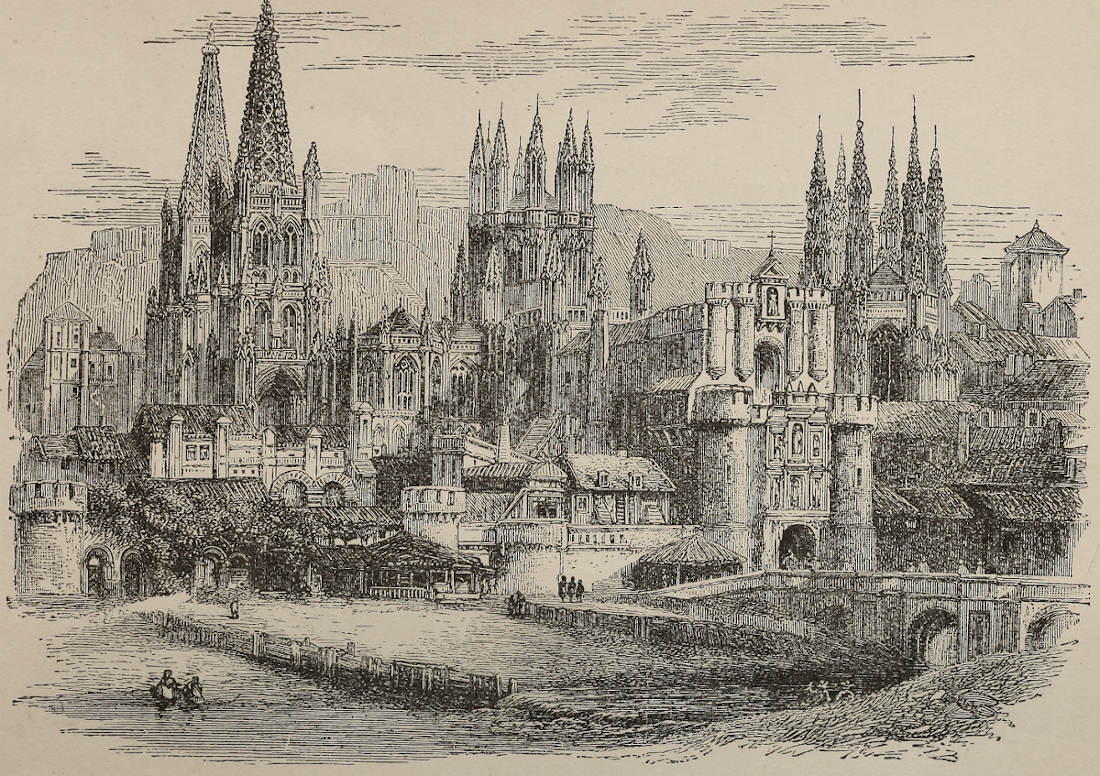
BRIDGE, GATEWAY, AND CATHEDRAL OF BURGOS.
The legendary hero of Spain, whose exploits are only less
than those of Hercules, was born in Burgos, and what is
more and better, his bones are here in the Town Hall; and
if any doubt is entertained of the fact that he actually lived
and died and was a wonderful man, between the dates of
his birth and death, such doubts ought to be dispelled by a
sight which I had of an old brass-bound, mouldering chest,
sacredly preserved in one of the inner and holy chambers
of the cathedral, and called the coffer of the Cid. Once on
a time the Cid had occasion to borrow a large sum of money
of two Jewish bankers in Burgos, and he left with them as
security this trunk, with, as he said, all his jewels and gold
in it. He did not pay the money when it was due, and the
16chest being opened by the lenders was found full only of
sand! It was thought in those days a merit to cheat a
Jew, and the Romanists show their estimate of the trick to
this day by keeping the swindling coffer among their precious
18relics. But it is hardly probable that a Jew ever lived
who would lend money without first seeing the security, and
the story therefore lacks probability. However this may
be, we are now in the city of the Cid, and though a Christian
knight, he had read the words of the Prophet of the
Moor,—“There are three sorts of lies which will not be
taken into account at the last judgment: 1st, One told to
reconcile two persons at variance. 2d, That which a husband
tells when he promises any thing to his wife; and 3d,
A chieftain’s word in time of war.” Such is the morality
of Mahomet, and there is not a little of the same Jesuitism
under other names.
The Cid.
The city has 25,000 inhabitants, and one of the most
splendid cathedrals of Europe; but not a hotel that is
decent. We went to the best, and its entrance was strong
with the smell of the stables. The first flight of steps inside
was littered with dust and straw, and it looked as if we
were to be led to a manger, which word is, indeed, the same
with the French salle à manger, a dining-room. Yet this
proved to be as fair a hotel as Spain at present offers to its
friends from abroad. They are all inferior to second-rate
hotels in France or Switzerland, and many that profess to
be first-class are execrable. The charges are higher than
in better houses in countries where living is dearer, so that
the business of entertaining strangers in Spain is an organized
imposition. The roads are now free from robbers who
formerly infested them and made travelling dangerous.
The robbers have evidently left the highway and gone to
keeping the hotels. They still rob travellers, with less risk
and trouble than in the olden time.
An Englishman by the name of Maurice, being high in
the favor of Ferdinand, the saint and hero, laid the foundation,
A. D. 1221, of the Burgos cathedral, which fairly
challenges comparison with any or all of the finest specimens
of ecclesiastical architecture in the world. Having
19been built in successive periods, and these at long distances
from each other, there is a want of harmony in the parts,
but this is observed only by the professional eye, while to
others, and especially on one who enters this first of the
great edifices of Spain, its interior bursts with a blaze of
grandeur covered with beauty, that fairly dazzles while it
awes and delights him. And after having visited and
leisurely studied half a dozen others, including those of
Toledo and Seville, I regard the cathedral of Burgos as
exhibiting a degree of perfection in detail, an elaborate execution
to adorn and embellish a sanctuary, not equalled by
any of its rivals in Spain.
And it is to Spain that we must come to see what the art
and consecrated wealth of princes and priests can do to
build temples in honor of God. Italy has nothing like
them. St. Peter’s is the largest Christian church in the
world, and perhaps more labor and money have been expended
upon it. But as a Christian church it is a failure,
without and within. Not so with any of these magnificent
monuments of human power and devotion. The towers of
this, at Burgos, with their graceful, open-worked pinnacles,
spring up as if seeking the sky. The gates are grand, and
surrounded and crowned with bas reliefs. Around the
towers are seventy statues, of prophets and apostles, and
over the transept are twenty-four life-size statues of female
saints, each covered with a canopy, as guardian angels on
this house of prayer. Moses and Aaron, in stone, stand by
one of the doors, with Peter and Paul, and in the vestibule
is the Saviour, and around him the four evangelists are
writing the holy gospels, while at least fifty statues, apostles,
angels with candlesticks, seraphs, and cherubs, add to
the ornament of this one gate.
It is quite impracticable to convey by words, and it is a
fact that drawings or photographs of interiors fail to convey
an idea of the view which one meets on entering a vast
20cathedral. The impression is on a devout mind, whether
of the same faith with that professed by the ministers at
these altars or not, the impression is one of solemnity and
sublimity. When the enlightened stranger comes near to
study the wretched additions which superstition has made
to the simplicity of Christian worship as established by its
founder, his taste and principles may be shocked and revolted
by what he sees and hears in gorgeous and glorious
cathedrals. But these are abuses that have crept in: fungi
on the trunks of grand old forest trees, under whose branches
it is a delight to sit and think of him who dwells in a nobler
temple not made with hands. Three hundred feet long, and
two hundred feet and more wide within, and chapels yet
beyond, each one large enough for a church, and two hundred
feet to the roof, which is supported by vast pillars of
stone, and each one of them wrought elaborately with garlands,
and fruits, and images of angels, and historic scenes
and incidents in Scripture,—such is the first grand view
that lies before us, as we enter the gates of this cathedral
in Burgos. It is in the form of the Latin cross, and at the
intersection, the crucero, as it is called in Spanish, the effect
of the vaulted dome, and of the whole minute and elegant
workmanship, is so exquisite that the Emperor Charles V.
is reported to have said it should be placed under glass, and
Philip II. pronounced it the work rather of angels than
men. I could discern nothing worthy of such exaggerated
eulogy, while admiring the harmonious proportions and the
graceful combinations that enhance the effect of elaborate
sculpture and ingenious decorations.
Four massive columns, embellished with allegorical sculptures,
form the transept, and above them the main arches
spring. Angels bear aloft a banner, inscribed, “I will
praise thee in thy temple, and I will glorify thy name, thou
whose works are miracles.”
Just here, for we were coming toward the high altar,
21Antanazio dropped upon his knees, on the marble floor.
A little bell had been rung, and all the Catholics in the
cathedral bent to the ground as the host was elevated for
their adoration in the celebration of the mass. We stood
before the high altar, resplendent above and about it with
wrought silver and gold and rich carving and sculpture, in
which the life and death of the blessed Saviour are inscribed
in mute yet expressive symbols. In the choir are more
than a hundred stalls or seats of carved walnut, each one
of them an elaborate work of art, rich with figures of men
and beasts, the virgin and saints in martyrdom and in
glory; and one of these saints is astride of the devil, in
memory of the fact that the devil did carry this saint from
Spain to Rome in one night. That’s better time than any
of the Spanish railroads can make.
We were led by a kind sacristan through the various
chapels, all rich in tombs of costly workmanship, and some
containing relics which, to the believer in their virtue, are
of priceless value; one of these precious treasures being a
statue of Christ on the cross, which we were expected to
behold with deep reverence. It is asserted and believed to
have been carved by Nicodemus just after he had buried
the Saviour. It is, therefore, an authentic likeness; and if
any doubt existed of its being a genuine work, it is removed
by the facts that the hair, the beard, the eyelashes even,
and the thorns, are all natural, real; that it sweats every
Friday; that it sometimes actually bleeds; and that it has
performed many miracles. It would have been more impressive
on my unbelieving mind if it had not been girt
about with a red petticoat!
THE ESCORIAL.
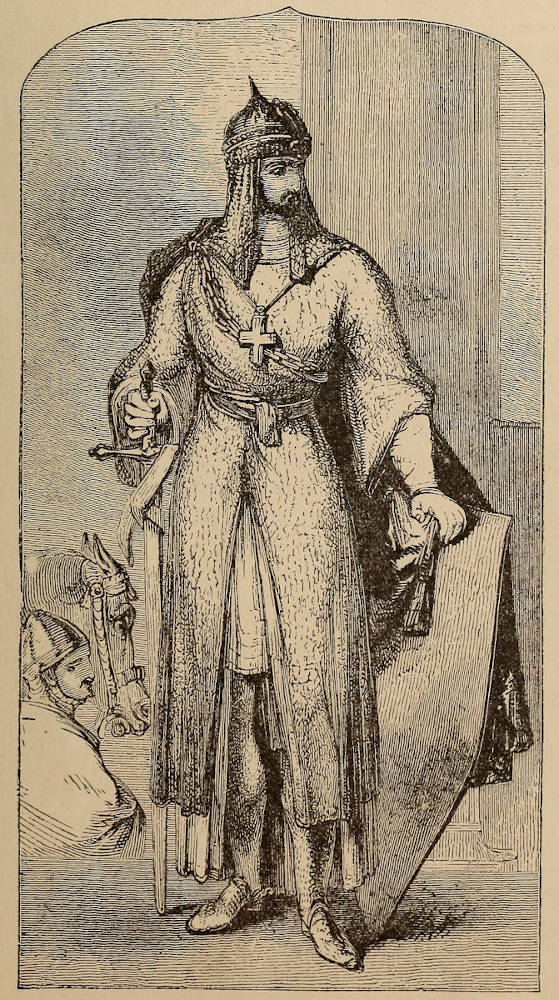
The castle has a history in which the names of all the
great warriors of the last thousand years have a part; it
has been the prison of some kings, and the bridal-chamber
of queens, and the birth-place of more. In modern times
Napoleon conquered it. And what is more remarkable,
22Wellington tried to drive out the French, and failed. It is
now a heap of ruins; for when the French abandoned it
they blew it up, but so bunglingly that some three hundred
of them went up with it. The explosion destroyed the
painted windows of the cathedral, an irreparable loss.
There is nothing in Burgos to see but the cathedral; and
that is worth going to Spain to see, though you may have
to put up at and with a Burgos tavern.
Philip II. came to the throne of Spain in 1556, less than
twenty years before the massacre of St. Bartholomew’s day
in France, and in the same century with the Reformation
led on by Luther. His history and his character are familiar
to the world. Cold, cruel, bigoted, intolerant, morose,
gloomy, superstitious, the grandson of a woman who was
known by the name of Crazy Jane, and who earned the
title, the son of the great Emperor of Germany, Charles V.,
who was also Charles I. of Spain, this Philip II., thus
descended and thus endowed, was less a king than a monk,
and in the cloister or the cell was more at home than on
the throne. He was the husband of Bloody Mary of England,
and, like her, verily thought to please God by persecuting
the saints and mortifying himself. Perhaps his
queer grandmother had put the idea of a palace and a monastery
and a tomb into his head. Perhaps his father, in the
gloomy hours when he meditated retirement and abdication
of his sovereignty, inspired the son with this strange purpose.
Or, more likely, the conception with him was original,
and as no monarch, before him or since, had such a
heart under the guide of such a head, it is only just to give
him all the credit of devising and achieving one of the most
stupendous follies and gigantic monuments that was ever
executed by the hands of men.
The Spaniards reckon the Escorial as the eighth wonder
of the world!
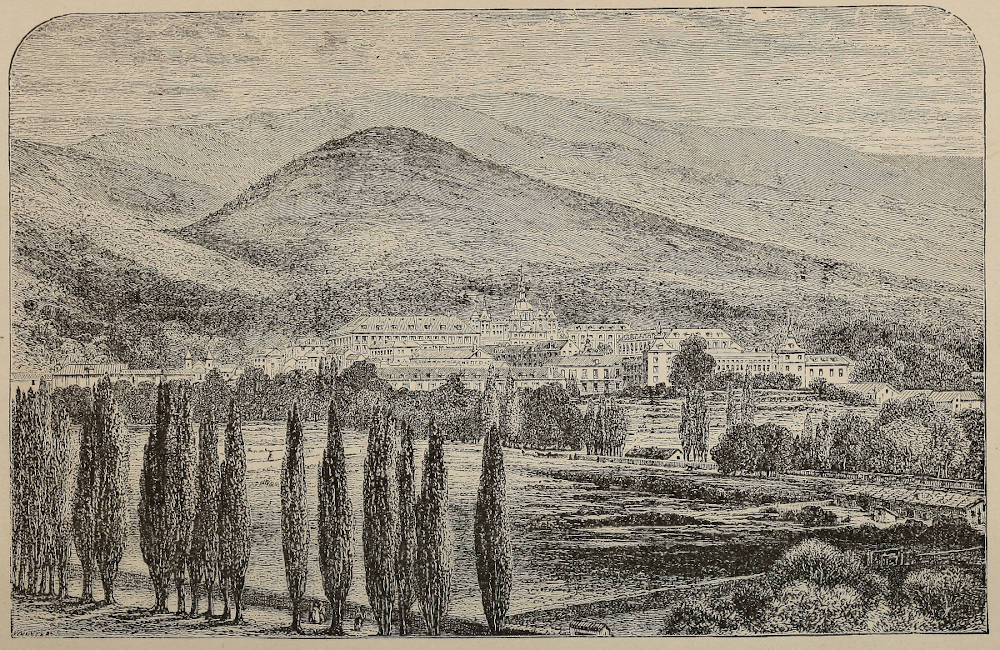
About twenty-five miles north of Madrid, in the midst of
24the dreariest wilderness of barren, rocky, all but uninhabitable
hills, a region where no beauty of scenery cheers the
eye, no silver river winds along through fertile vales, no
verdant slopes are covered with grazing herds, and no
forests with their cool shades invite the tired traveller or
the weary citizen to seek repose,—here, in the last of all
places for such an edifice, is placed the Escorial, the largest
and grandest edifice in Spain, and the most remarkable building
now standing on the earth. What Egypt had when
Karnak and Thebes were in their prime, what Babylon
and Nineveh knew in the days of their now buried glory,
we have but faint knowledge. This house covers a square
of five hundred thousand feet! It is about 750 feet long,
and 600 feet wide. It is a royal palace. It is a monastery.
It is the sepulchre of the royal family of Spain. It is a
church; and in that church, the chapel of this strange house,
there is more wealth lavished on the pulpits and altars than
on any other that I have seen, in this or any other country.
Yet all this is in a wilderness, far away from cities and the
abodes of men who might be supposed to admire and enjoy
such grandeur,—a temple in a desert, a palace and a
sepulchre.
Passing on by the rail from Burgos, we might stop at
Valladolid, once the most renowned of all the cities of Spain,
now so utterly decayed as to be of interest only to antiquarians.
Here Ferdinand and Isabella were married in
1469. Here Columbus, the worn and weary, died in his
own house in 1506. Here he slept in death six years, and
then his bones were removed to Seville, and again to Cuba,
that they might rest in the New World he found. Philip
II., whose Escorial we are going to see, was born here in
Valladolid, and after he grew to manhood had the pleasure
of seeing at one time fourteen Protestants, and thirteen at
another, burnt alive, in the Grand Square of the city: a
most edifying spectacle, which strengthened his faith so
25much that he afterwards dedicated his mighty structure to
the good St. Lawrence, who was broiled to death on a gridiron,
enduring his torments with so much fortitude that he
said to his executioners, “I am done on this side, perhaps
you had better turn me over,”—whence comes the expression,
“done to a turn.”
Philip II. made Madrid the capital of his kingdom, holding
his court there or at the Escorial, at his pleasure, for
they were only a few hours apart.
It is a long but pleasant walk from the station to the
palace, and it is better to stroll along the shaded avenues,
resting at times on the solid stone seats, looking upward at
the solitary pile ahead, and musing on the wonderful dead
past; the pomp and pageantry, the vast processions of
priests and kings and countless armies of Spain, of France,
of England, that have marched up this same street, in
triumph, in penitential grief, or in funeral array. Away
from the world, the world has often come hither, under the
many garbs the world wears, according as it is in glory or
in shame. Entering the grand quadrangle by the chief
gate, the colossal edifice presents its central front and the
two lateral projections in one view; the main façade is
adorned with statues of the principal personages in Old
Testament history. Crossing the court, paved with great
granite blocks, we enter, and the massive walls, the cold
damp halls, gloomy in their naked, solid grandeur, make
us feel that we are entering a fortress, and not a palace.
It would be impossible to find your way without a guide.
There are sixteen courts within, and out of each of them
long passages lead to eighty staircases, and up these we
may go, if we have time, to twelve thousand doors, and
look out of two thousand six hundred windows, and worship
at forty altars!! You wish to be excused from such climbing
and kneeling. Come, then, with me at once into the
church. It is more than 300 feet long, and 230 feet wide,
26and 320 feet high: of granite all; its columns are majestic
in their proportions, severe in Doric simplicity, supporting
twenty-four arches, so beautifully sprung that, wherever you
stand, the eye takes in the whole at a glance. The pulpits
surpass, in the splendor of their finish, any thing in Italy.
The richest, variegated, and most precious marbles, used as
freely as though they were common wood, are adorned with
gold and silver, strangely in contrast with the severity of
the church itself. The altar is reached by a flight of several
steps, and on the right, as we stand in front of it, a window
opens into a little chamber, which we sought with more
interest than any other apartment of this remarkable structure.
We went out of the church and into the room. It
was scarcely ten feet by six in dimensions; but it was the
favorite closet, the study and the bedchamber of the
monarch who built the whole. This was all he wanted for
himself. It was in sight and hearing of the service at the
high altar. At midnight and before daybreak he could rise
from his couch, and join in the service of the church. I
sat down in the plain old chair, by the table, the same that
he used, and put up my feet on the camp-stool that often
held his diseased and agonized limbs, and looked down from
the little window on the priests and people in the church
below. And here in this room death came and called for
Philip II. For long months he had suffered anguish not
less than that he had inflicted on better men than he. Let
us leave it for others to say if like Herod he was smitten for
his sins, and destroyed with the same disease. But when
he saw that his end was near, at his order his servants bore
him on a couch through the palace, and the monastery and
the church, that his poor dying eyes might rest once more
on all that he had done, and then they brought him back to
his lonely, comfortless cell, and left him to die. It was on
a September Sabbath morning, in 1598, while listening to
the service at this altar, and holding in his hand the same
27crucifix that fixed the dying eyes of the Emperor his father,
that Philip yielded his spirit into the hands of a just as well
as merciful God!
We left this sad chamber, and descending a flight of steps
made of precious stones, the walls lined with beautiful,
polished marbles, we stood in a subterranean chapel, a
mausoleum, shelves on each of the eight sides, and on each
shelf a bronze sarcophagus, and in each coffin a dead king
or queen. The name of each occupant is inscribed on the
outer shell. One of the queens scratched her name on her
coffin with a pair of scissors before she was put in. She
could not have well done it after. There is an altar in this
dungeon, and here the late queen of Spain, who is very
devout in her way, came once a year and had a service at
midnight. It adds nothing to the solemnity to have mass
here in the night, for at noonday we had to hold candles in
our hands to see our way in and out.
The Sagrario was a more interesting apartment than
this. It has some fine paintings. I valued them more
than the 7,400 relics which are here preserved with pious
care, including the entire bodies of eight or ten saints,
twelve dozen whole heads, and three hundred legs and
arms. It once had—but the fortunes of war have deprived
the house of the treasure—one of the bars on which St.
Lawrence was burnt, and one of his feet, with a piece of
coal still sticking between its toes! but the coal and the
toes are lost in toto.
One of the priests, who was leading a company of
strangers visiting the place, overheard me asking for the
Cellini crucifix, and immediately took us to the choir, and
opened the door of a closet in which this remarkable work
is carefully preserved. It is a Carrara marble statue of
Christ on the cross, and marked by the great Benvenuto
himself with his name and the date, 1562. He was the
first who made a crucifix in marble, and the patient toil and
28great genius expended on this work have made it justly
esteemed as his master-piece of sculpture.
Yet have I alluded to but one or two out of a thousand
things that fix the attention, and impress one rather with
astonishment than delight. I have not even mentioned the
library, which is the crown of the whole, designed to be the
repository of all learning, and in spite of all its sufferings by
violence, it is still rich in rare and valuable books and manuscripts.
The cases are of ebony and cedar. Jasper and
porphyry tables stand through the hall, about 200 feet long,
and allegorical paintings adorn the ceilings.
It was refreshing to get out of it, after walking through
the palace and the cloisters, and to enjoy the warm sunshine
beyond the gloomy walls. Two or three cottages have been
built among the groves planted here, and it seems a mercy
to children to provide a more cheery home for them than a
sepulchral palace could be, though of wrought gold.
CHAPTER IV. MADRID—A SABBATH AND A CARNIVAL.
29
A VALET-DE-PLACE who was leading us to church on
Sunday morning in Madrid, spoke very fair English,
and I asked him where he had learned it. He said, “At the
missionary’s school in Constantinople.” He was quite a
polyglot, professing to be able to speak seven languages
fluently. It was interesting to meet a youth who knew our
missionaries there, and entertained a great respect for his
old teachers,—and it gave us an idea, too, of the indirect
influence which such schools must be exerting, when youth
are trained in them, and afterwards embark in other callings
than those that are religious in their purpose.
He led us to the Prussian ambassador’s, where the chaplain
preaches in the French language. No Protestant
preaching was then allowed in Madrid,—none, indeed, in
Spain,—except under the flag of another government.
The ambassador, or the consul, had the right, of course,
to regulate his own household as he pleases; and, under
this necessary privilege, he has, if he is so disposed, a
chaplain, and divine service on Sunday, when his doors are
opened to all who choose to attend. The practical working
of it is that a regular congregation comes to be established
under each flag, if there are so many persons of that country
and of a religious tendency as to make it important. In
most of the great capitals of Europe there are people of
other countries resident for business, health, or pleasure,
and they find a place of worship in their own tongue.
30The Germans resident in Madrid speak the French
language, as well as their own, and the present chaplain
preaches in French. He is an earnest, excellent man, and
his pulpit abilities would make him greatly useful in a
wider sphere than this. In an upper chamber, that would
seat fifty persons, a little congregation, not more than
twelve or fifteen, had come together to hear the Word.
The desk, or pulpit, was habited after the fashion in Germany,
with black hangings, embroidered neatly by the
hands of the wife of the Prussian ambassador, and with
the words in French, “Go ye into all the world and preach
the gospel.” I was told that on Christmas and Easter
festivals of the church some two or three hundreds of German
Christians come to church and to the communion; but
the rest of the year their spiritual wants do not require the
weekly ordinances, and the congregation rarely exceeds
thirty people.
We went after church to the old Palace of the Inquisition.
It is now converted into dwellings. Over the main
entrance was the inscription, common all over these
foreign countries, as in some parts of our own, “Insured
against Fire.” The poor victims who in former years
were dragged under that portal would have been glad to
read such words, if they could be interpreted into an assurance
that they were to be safe from the fire of an auto da fe.
The Spanish Inquisition affords the saddest story in the
annals of the human race. Whatever the name or creed of
the persecutor,—Jew or Gentile, Roman, Greek, Protestant,
or Mahometan,—the saddest of all possible facts is
this, that man has put to torture and to death his fellow-man
on account of his religious opinions. Let God be
praised that in all the earth men now may worship him in
their own way, with none to molest or make them afraid.
And it is very well to bear in mind that persecution has
its spirit, and some of its power, even where the victims are
31by law insured against fire. In the press and in the pulpit
the venom of bigotry and the bitterness of intolerance may
be poured on the heads of those who are guilty of other
opinions than ours, and in God’s sight such persecution
may be as offensive as the rack and boot of the Inquisition.
The spirit of the Master rebukes the use of the
sword, even in the hands of Peter, to cut off a servant’s
ear, and the same spirit forbids us to be uncharitable
towards the meanest of those who have not the light of the
grace to see as we see, or to defend Christ in our way.
They have no cathedral in Madrid, but their churches are
many, and on Sunday morning they, women especially, go
to church. The Spaniards are more devout than the Italians.
There is a proverb that to go to Rome is to disbelieve.
The people in Spain have not seen Romanism as
it has been seen in Italy, until the popular mind is sick of
it. But they make short work in Spain of their devotions.
The Prado is their park, on the skirts of the town. And
this is not enough for them on Sundays. We saw the
crowds pouring out towards one of the gates, some in carriages,
but most of them on foot,—men, women, and children,
hundreds, thousands, in holiday attire,—and we
followed. Beyond the Alcala gate, near which is the bull-ring,
half a mile into the country, we came to the meadows
over which these pleasure-seeking Castillians had spread
themselves to enjoy their national and favorite pastime. A
little later in the season, when the weather is warmer,
thousands of these people would stop at the bull-ring, and
see the battle of men and beasts. It is too cool as yet, and
the bulls do not fight well except in hot weather. But it is
not too cool to dance out of doors, and for this divertisement
these thousands have come. On the wide meadows
there is not a house, not a shanty, not a shed or booth.
We have passed on the way scores of wine-shops; and there
the people can resort if they choose. But on the grounds
32there is nothing to be had but the pure and blessed air.
The people are distributed in groups all over the plain.
The grass is green. The sun, a winter sun, is kind and
genial. The city lies in full view, with palaces and domes
and pinnacles. And in the distance, but in this blazing
sun and lucid atmosphere apparently very near, long ranges
of mountains stand covered with snow, white, pure, glistening
like silver in the sunlight, and forming a magnificent
background to the gay picture at our feet. In the centre
of each of these many groups a dozen, more or less, of
young men and women are dancing to music. This is
furnished by one, two, or three musicians, strolling bands,
with guitars and violins. Often one is an old man, blind.
His wife and daughter are with him, with their instruments.
The airs are not wild, not even lively, as compared
with those of Italy. But they are spirited, and sometimes
familiar to a foreign ear; for the airs of music, like the airs
of heaven, travel all around the world. The dances are
pretty and modest, singularly tame, and far from being as
full of frolic and abandon as one would expect to see in the
out-of-door amusements of the common people. For these
are the lower classes only. It is the pastime of the sons
and daughters of toil, and perhaps want. They were not
ill dressed, and most of them were well dressed. But they
appeared to be the class of people who had but this day in
the week for pleasure, and were now seeking and finding it
in a way that cost them little or nothing. More were
looking on than danced. Yet the sets changed frequently,
and the circle widened as the numbers of dancers grew, and
there was always room for more; for the meadows were
wide, and the heaven was a roof large enough to cover
them all.
And the strangest part of this performance is yet to be
mentioned; more than half the men in this frolic of the
fields were soldiers of the regular army, in their uniforms,
33without arms, enjoying a half holiday. They and all the
rest, men and women, seemed to be as happy as happy
could be. If we had thought the people of Spain, and especially
of Madrid, where the government is felt and seen
more severely and nearly than elsewhere, to be gloomy,
sullen, discontented, miserable, and ready to rise in revolt,
such a thought would be put to rout by seeing these soldiers
and others, men and women, thousands and thousands,
making themselves so easily happy of a Sunday
afternoon.
In one of the circles of dancers two young men, better
dressed than the rest, were either the worse for liquor, or
were feigning to be tipsy. As the other dancers paid no
attention to them, and let them amuse themselves in their
own way, it is quite probable they were playing the fool.
These were the only persons in that multitude, of the lower
orders of the city, who gave any sign of having been drinking
any thing that could intoxicate. There were scores of
wine-shops on the street, within the easy walk of all who
wished liquors. It was necessary to pass them going and
coming to and from the city. And thousands doubtless
“took something to drink,” both going and coming. The
young men would treat the girls, and, of course, all would
have as much wine as they wished. For it is almost as
cheap as water,—cheaper than water in New York perhaps;
for there the tax that somebody pays for the use of Croton
is something, but here in Spain wine is so cheap that what
was left of last year’s vintage has often been emptied on the
ground, or used instead of water to mix mortar with! Yet
drunkenness is not one of the common vices of Spain.
And so passed my first Sabbath in Spain, worshipping in
French with a dozen Christians in the morning, and looking
at thousands of the people dancing on the green in the
afternoon.
Three days before Lent begins the people give themselves
34up to the wildest kind of frolic, with a looseness of
manner that to a grave and thoughtful foreigner unused to
such scenes at home is at first sight exceedingly foolish,
and then very stupid. The Carnival is a carne-vale, a farewell
to flesh; a grand celebration of the approach of Lent,
or the season when lentiles, beans or vegetables only, are
to be eaten for forty days. As the people see the time
coming when for more than a month their religion requires
them in a very special manner to abjure the world, the flesh,
and the devil, it seems to be their idea to give the last three
days of liberty to the enjoyment of these three forms of
mammon-worship. If afterwards they served the Lord with
half the zeal of these three days of devil-worship, they
would be the most pious people on the earth. But to one
whose religious prejudices are quite vivid against the nonsense
of a Catholic carnival, it seems the queerest way in
the world to get ready for serving God by plunging headlong
into a scene of mad revelry that utterly abjures all
sense and reason, and converts an entire city for three days
into a pandemonium.
Yet it is all in such perfectly good humor, so free from
riot and violence and drunkenness, that the only fault to be
found with it is simply this, that the whole community
make fools of themselves. The Romans had a proverb,
“It is well to play the fool sometimes,” and perhaps it is.
But when the whole town takes leave of its senses, and goes
frolicking day after day, if it is a good thing, it is too much
of a good thing, and that spoils it all.
Our windows look out upon the Puerta del Sol, the great
square of the city. From it radiate the eight chief streets,
and through it every moment the tide of life is flowing.
Now it is the great centre of the carnival. Along the
streets are seen parading small companies of men in masks
and fantastic costumes, with all sorts of musical instruments,
making harsh melodies as they march. Two or
35three of the set are constantly soliciting gifts from those
they meet, or holding a cap to catch money thrown to them
from the people in the windows and balconies, who are looking
down to see the sport. Some of these rangers are
women in men’s clothes; more are men in petticoats and
crinoline, ill concealing their sex, which a close shaven
chin and hard features too plainly reveal. In this disguise,
great liberties are taken. A young woman stops a man on
the sidewalk, claps him on the shoulder, asks him for money,
perhaps chucks him under the chin, and sometimes more
demonstrative still, she throws her arms around his neck
and gives him an affectionate salute in the broad light of
day on the most public and crowded thoroughfare. Even
this boldness is taken in good part, and seldom or never
leads to any quarrel. The men were polite to the women.
In no case did I see any rudeness offered by a person in
male attire to a female on the street. The maskers were
only out in hundreds, while the others, looking on and
enjoying, were thousands on thousands. These were in the
usual dress of ladies and gentlemen. They expected to
find walking somewhat rough, but they were prepared for
it, and would have been disappointed had it been otherwise.
The maskers wore costumes as various as the fancy of the
wearers or the makers could invent them. Some were
clothed in white from head to foot, with stripes of red or
black; their faces painted white like ghosts, or with horns
to look as much like devils as possible. Many were imitation
negroes, and this seemed to be a fashionable attire, as
if the African were popular among the Spaniards, who once
had a great horror of the Moors. Some wore a fantastic
head-gear that excited shouts of laughter as they passed.
One man strode along with a false head five times the life
size, so nicely fitted to his shoulders that it looked to be a
sudden expansion of his head into that of a monster. Solemnly
36the bearer of this prodigious topknot walked the
streets, apparently unconscious of the presence of the little-headed
race of beings who were laughing at his swelled
head.
Carriages, open, splendid barouches, and some with
seated platforms prepared for the purpose, drawn by four or
six horses, passed by, with six, eight, and even twelve
maskers, all clad in the most inconceivably ludicrous robes,
with queer hats and trimmings; and some of them with
musical instruments, singing, gesticulating, bowing to the
ladies in the windows, and exchanging salutations with the
people in the way. The drivers and postilions and footmen
were all rigged in livery to match the costumes of the company
in the carriage, who thus aped the nobility and even
royalty itself in its mockery of stately grandeur. And in
the midst of these maskers, carriages with elegant ladies,
in full dress for riding, go by, and among them, with his
legs hanging over the side of the carriage, is one of the
most fantastically got-up maskers, whose outlandish costume
and ridiculous situation call out tremendous applause.
On the Prado, the great park of the city, thousands of
elegant equipages are out in the afternoon, and the most
fashionable people of Madrid are in the frolic. The ladies
are loaded with sugar-plums to throw among the maskers,
and these gay fellows will rush up to any carriage, leap on
the steps, and demand a supply. On the walks, an old
dowager in a splendid velvet cloak and dress, masked and
representing an ancient belle, got up regardless of expense,
attracts marked attention as she displays her fan and
feathers, and struts as if in a drawing-room where she imagines
herself admired. An old monk hobbles along, as if
broken down with age and poverty. A procession of priests
mocks at religion itself, in a country where we had thought
it a capital crime to make fun of the priesthood.
37And there goes the Pope himself; a man has actually
mounted a hat like the Pope’s, and with white robes and
gold lace has made a disguise that tells its story instantly.
And the people laugh to see it. Nothing is too sacred nor
too dignified to be travestied here. A company of mock
soldiers pretend to keep order by making confusion more
confounded. By some strange metamorphosis a man has
turned himself into a very creditable goose, and waddles
along most naturally, having some wires at his command
with which he works his bill, his wings, and tail. A bear
on horseback rides up, and Bruin is received with bravos.
An ox is mounted also on a horse, and then a wolf; and
even the devil is represented on horseback, and a woman
rides astride behind him and her arms around him, a hideous,
incongruous, but exceedingly ludicrous spectacle. Her
hoops spread far behind, covering the horse’s hips and tail,
so that the figure is half horse, half devil, and the other half
woman. One man, as an orang-outang, leads and exhibits
another dressed in the same way. Parties of dancers, all in
these ridiculous costumes, form a ring and dance the fandango,
with castanets and cymbals and guitars, executing
the freest flings and giving themselves to the wildest abandon
in the public streets. Others, men and women, disguised
as if in their night-clothes and ready to go to bed,
are wandering about, pretending to be lost, and their appearance
is so comical that one almost forgets it is play, and
pities the poor wanderers.
But the description is growing more wearisome than the
scene itself. Nonsense all, but such nonsense as makes
one laugh at first and then feel sad that grown-up men and
women can find amusement, day after day, in such infinite
folly. And where the religion comes in, it is hard to see.
Yet we observe that our American and English friends who
have leanings through their own church towards the Church
38of Rome, take a wonderful interest in the carnival. They
have some associations with it, and the fast that follows,
that give to all this sport some significance quite incomprehensible
to the uncovenanted unbelievers in the outer
courts.
CHAPTER V. MADRID—PALACE—BANK—PICTURE-GALLERY.
39
WHEN Napoleon, as conqueror of Spain, entered the
royal palace of Madrid (it was in 1808, his brother
Joseph, the new-made king of Spain, being at his side), the
great captain paused on the splendid marble staircase; and,
as the magnificence of the mansion burst upon him, he
turned to his brother, and said, in his epigrammatic way of
putting his thoughts, “My brother, you will be better
lodged than I.”
It is far more splendid than the Tuileries, or any palace
in France, England, Germany, or Italy. It cost more than
five millions of dollars a hundred years ago; and that was a
much greater sum of money than now. It has been enlarged
and embellished from year to year ever since. When
we drove up to the grand court, it was so formidably filled
with cavalry that we thought the predicted insurrection was
imminent, and the army had been summoned to the defence
of the palace. Not at all. These mounted soldiers are
only the regular guard. In this inner court, or square, the
cavalry, in long line and fierce array, are ready for a fight
with the revolutionists, if they are brave enough, or mad
enough, to try their hands in a tussle with the troops of
government, trained and paid to defend the existing order
of things. From the windows of the armory this martial
parade was imposing, though there were but a few hundreds
of mounted men. The officers were clad in polished
steel back and breast plates, which flash brightly in the
40sun. The uniform is brilliant, and the riding splendid.
Artillery companies, with cannon mounted, drawn by
horses, manœuvre in the square, crossing and recrossing
constantly, under the eye of the royal household. A long
line of lounging people look on also; and, as they go and
come all day, an impression is certainly insinuated by this
military parade that the government is always ready to take
care of itself.
THE ROYAL PALACE, MADRID.
The palace stands on the verge of a height that commands
a wide and exciting view of the plains of Castile.
The thought of what those plains have seen in the last two
thousand years makes them of more than romantic interest
to one who takes in the past with the present. What successive
tides of conquest have there ebbed and flowed!
To know that Charles V. and Napoleon and Wellington
have followed one another up those shaded avenues to this
summit, with their legions, is enough to invest them with
grandeur.
And here in this armory is the very sword that Gonzalo,
of Cordova, wore, and the sword with which Ferdinand, the
saint and hero, smote the Moors; and the sword of Charles
V., and the complete suit of armor which the great emperor
often wore, and in which he was painted by Titian; and the
suit of armor worn by Boabdil, the last Moorish king who
sat on the throne in this Alhambra, and who left it behind,
doubtless, when he delivered his sword into the hands of
Ferdinand and Isabella, at the foot of the hill on which I
am writing. We had thought revolvers a modern invention,
but here are elegant pistols, on the same principle, used in
the seventeenth century, and now as good as new. A
crown, a sword, a helmet, or something else, illustrates the
life of all the heroes of Spanish history; and the number of
warlike memorials here displayed is about three thousand.
How men managed to fight while clad from head to foot in
these suits of steel armor is to me, a non-combatant, one
42of the mysteries of the art of war. We read of tournaments,
and—more to be wondered at—of battle-fields,
where all the knights are clothed from head to foot in the
identical garments that are now before us, or in others
made after the same pattern; and how, with such a weight
of steel and so constrained in the freedom of action, they
could manage to wield their swords and thrust their spears,
I do not understand. They were not men of more physical
power than our soldiers. Some of them were less than the
present average size of men. But they were mighty men
with the sword. The Toledo blade was quite equal to that
of Damascus; and the helmet was often insufficient to save
the brain, when the sword, in a strong hand, came down,
cleaving through steel and skull.
Two or three hundred horses stood in the stables; and
the grooms are only too happy, for a consideration to be
paid at every door, to show these pampered and famous
steeds. Each one of them has a name, in large letters,
over his head, and on his blanket. Spain has some celebrated
breeds of horses, but, like every thing else in Spain,
they are run out, and the stock is only kept up by importation.
It is so even with the Merino sheep, which belongs
to Spain, but would have been extinct ere this, if it had not
been perpetuated and improved abroad. You may see five
hundred finer horses any pleasant afternoon in the Central
Park, in New York, than any one of these pet horses of
royalty. But you will never see, I hope, such a wealth
and folly of equipage as the hundred carriages, and more
sets of harness, and plumes, and liveries, and coachmen’s
hats, and velvet saddles, and embroidered hammer-cloths,
which fill long apartments, and are shown together with the
gilded chairs of state in which the king or queen is borne
by hand in processions, and the chariot on which the royal
personage is enthroned, with a canopy overhead, trumpeters
below, and herald angels above, for the coronation parade.
43The carriages used by successive monarchs are here preserved
in long lines of antiquated grandeur, even to the one
in which Crazy Jane, the widow, carried about with her the
corpse of her handsome husband, Philip the First. Queer
woman that she was, jealous to insanity, she would not let
her husband be buried while she lived; and now she lies by
his side, down here in Granada, in the cathedral, and her
marble effigy gives her an expression so gentle and loving,
you would not believe she was ever the victim of the fiercest
and meanest passion that makes hell of a woman’s heart.
I have been taking you with me through the palace and
armory and royal stables, to give you a type of Spain. The
poorest of all the governments, compared with its population
and resources, it has these contrasts of wealth and
poverty that mark its want of judgment, principle, and
power. In the stables is invested a capital of more than
half a million of dollars! This prodigality is royal, but also
absurd. The people see it, and the world has gone by the
age, when gilt trappings and gorgeous pageants struck the
multitudes dumb with the reverence of royal glory.
The city of Madrid is well built, and has the appearance
of a modern French town. Indeed, it is more French than
Spanish in its out-of-door look, and the French language
is very largely spoken in the shops and private families of
culture. The intercourse now so frequent and ready with
France by means of the railway and telegraph, and the
abolition of all passport regulations and annoyances, have
given the Spanish capital a start, and it will undoubtedly
make rapid advancement.
But there is nothing rapid in Spain just yet. Opposite
the hotel in Madrid where I was staying, an old building
had been torn down to make room for another. Workmen
were engaged in removing the debris to renew the foundation.
You would suppose that horses and carts, or wheelbarrows
and shovels, would be in use. Such modern
44improvements had not reached the capital of Spain. One
man with a broad hoe hauled the dirt into a basket made of
grass, holding half a bushel; another man took the basket
and carried it a rod to another man, who handed it to
another a few feet above him, and he emptied it on a pile
of dirt up there, and sent the basket back to be filled again.
And so, day after day, a job that with our tools and appliances
would be done in a few hours, was here spun out indefinitely.
Yet the palaces and cathedrals and fortresses
of the southern climes have all been erected at this snail’s
pace, numbers and cheapness making up for enterprise and
force. In Paris, in the street, a small steam-engine was at
work to mix mortar, and the ease with which the process
was put through revealed the secret of the wonderfully
rapid transformations going on in that ever increasingly
beautiful city. Here in Spain, to this day, where there are
smooth, good roads for wheels, they still put a couple of
baskets across the back of a donkey, and fill them with dirt
or brick or stones, and so transport them, even when they
are putting up the largest buildings. The architecture of
Spain is more imposing than that of any other country in
Europe. It is the climate that makes men differ so much
in their physical as well as mental manifestations.
To see the mode of doing business in Spain, take the
simple story of one day’s work of mine in getting some
money in Madrid. Holding a “letter of credit” which is
promptly honored in any part of the world, and is just as
good for the gold in Cairo or Calcutta as it is in London, I
went in search of a Spanish banker to draw a hundred
pounds sterling, say five hundred dollars. Anastazio led
the way, and soon brought us to the house where the man
of money held his court. Being shown up stairs, through
two or three passages and an ante-chamber, we were at
length ushered into the presence. Señor Romero, the
banker, was a man of fifty, dressed, or rather undressed, in
45a loose morning gown or wrapper, a red cap on his head,
slippers on his feet, and a pipe in his mouth. A clerk was
sitting near to do his bidding. I presented my letter. It
was carefully read, first by the clerk, then by the principal.
A long consultation followed, carried on in a low tone, and
in Spanish, quite unintelligible to me, if it had been audible.
It was finally determined to let me have the money, and
after an amount of palaver sufficient for the negotiation of
a government loan from the Rothschilds, and taking the
necessary receipt and draft from me, I was presented with
a check on the Bank of Spain. When I had fancied the
delays were over, they had only just begun. The bank was
in a distant part of the city, and thither we hastened, taking
a cab, to save all the time we could. The bank is a large
and imposing edifice of white stone. In the vestibule was a
guard of soldiers. A porter stopped us as we were about
to enter the inner door. We must await our turn as some
one else was inside! One at a time was the rule. Benches
were there, and we sat down, admiring silently the moderation
of banking business in Spain. At length our turn
came. We entered a room certainly a hundred feet long.
Tables extended the whole length. Behind them sat clerks
very busy doing nothing. We were told to pass on, and on,
to the lower end of the room, where we entered another, the
back parlor, or private room of the officers. They were
closeted out of sight, smoking, of course, and giving their
wisdom to the business in hand. I presented the check at
a hole out of which a hand was put to take it. I saw nothing
more. We sat down and waited. Waiting is a Spanish
institution. Everybody waits. Nobody gets any thing without
it. We waited, and waited, and waited, and at last the
little hole opened again, the mysterious hand was thrust out
with the——money, you suppose; not a bit, but with the
check approved. We must present it at the table or counter
for payment. Returning to the long room, we presented
46the check, and were directed to the proper bureau. And
here, of course, we got the money. Not yet. Bills of the
Bank of Spain were given us, and when I required the gold,
I was told that gold was paid only at the bureau of the bank
in another street. Thither we now pursued our weary way.
It was a rear entrance of the same bank building. A long
line of gold hunters was ahead of us. We stood in the cue,
and at last were inside. In the ante-room we had to wait
so long that we took to the bench again. At last, admission
being granted, we were told that only one could be admitted
with a single draft. We sent Antanazio in, and returned to
the door. Here we were told that no exit, only entrance,
was allowed at the rear! Explaining the case, we got out,
and returning to the front, patiently as possible, we looked
for the appearance of Antanazio loaded with gold. At last,
for the longest delay has an end, the man emerged with the
money in his hands. It had cost me from two to three
hours in the middle of the day to draw this money, which
in New York, London, Paris, or any city out of Spain,
would have cost five minutes or less. And I have been so
particular in the detail, because it lets you into the mode of
doing business in the capital city, and the greatest bank of
this country.
Until the French and English companies pushed railways
into Spain, travel and mails were on the slow-coach system.
When the royal person made a journey, it was like the
march of an army, such was the retinue required for comfort
and display. And as the railways are now completed only
along a few great routes, the mails are largely carried in the
diligences and coaches expressly made for the purpose. It
is said, and there is no reason to disbelieve it, that down to
the year 1840, when a Spaniard proposed to himself the
danger and toil of a journey, it was his invariable custom to
summon his lawyer and make his will; his physician, to
learn if his health were adequate to the undertaking; and
47finally his priest, to confess his sins and get timely absolution.
It is not regarded now so formidable an excursion to
go across the kingdom, but the native travel is so little that
the railroads are very unprofitable. If it were not for freight
they would not be supported at all. They have, however,
greatly increased the correspondence of the country, and
the rate of postage has been reduced, so that it is about as
low as in other European countries. But the government
keeps a sharp look-out upon the letters that come and go.
In times when conspiracies are snuffed in every breeze, it
would be quite unsafe for any one to entrust a secret in a
letter going by mail. A government spy would be sure to
have his hand on it and his eye in it, before it reached its
address. The letters in the post-office at Madrid are held
four hours after the arrival of the mail, before they are
ready for delivery. The mail from the north, the London
and Paris mail, comes in at ten o’clock A.M. We must wait
until two o’clock P.M. for our letters. Then a list of all letters
not directed to some particular street and number, or to
some post-office box, is posted up in the hall of the office,—an
alphabetical list. You look over the list, and if you find
a letter for yourself, you ask for it at the proper window.
If you are a stranger, your passport is demanded. But you
had been told before coming to Spain that no passports are
required, and now you must have one merely to get your
letters. In default of a passport, you must in some way
establish your identity. This is not always easy in a foreign
country, but then nothing is easy in Spain. I got no letter
from the post-office addressed to me while I was in Spain!
The noted rebel, General Prim, was a dreadful bugbear to
the authorities, and all letters addressed to me were suspected
by the local postmasters to be intended for the
General. They were therefore sent to the government, or
otherwise disposed of. No efforts to recover them were
successful. Much good may they do the people who had
to read them. Some of them had hard work, I know.
48Telegraphs are spreading over Spain, as they are over
the world, civilized or not. Spain is one of the last countries
where they could become popular; but the business
of any kingdom that has relations with the outside world
must be armed with the telegraph, or it cannot hold its own.
In traversing wild and secluded parts of the Peninsula, I
have been surprised by finding the telegraph poles set up,
and the wire stretching on, over hill and dale. Spain is
slow, and the telegraph is not demanded here by the energy
and enterprise of the people as it is elsewhere. Despatches
of more than a hundred words are not sent. To or from
any part of the Peninsula ten words may be sent for about
twenty-five cents, twenty words for fifty cents, thirty words
for seventy-five cents; but the count includes each word
written by the sender, date, address, signature, and if a
word is underscored it counts two. Great precautions are
taken to insure accuracy in transmission, and a small extra
charge is made for delivery.
Before coming to Spain I had been told that the picture-gallery
in Madrid is the richest in the world. It seemed to
me an idle tale, the boast of boasting Spaniards, repeated
until perhaps somebody believed, as I certainly did not.
But having seen it, day after day, for a week, I cheerfully
cast a vote in its favor. It is superior to any other in
Europe; and, of course, in the world. It is not complete
in the series of art studies. There are gaps of time which
the student may desire to see filled. But there are few who
visit these great European galleries as learners. The world
comes to see them for the momentary pleasure to be found
in the contemplation of the pictures. And they will be
astonished to find that so many and so splendid pictures
have been gathered and preserved in the Spanish capital.
The gallery is open to the public only on Sundays, but
the director allows it to be shown every day to strangers,
who are expected to give a fee to the attendants. On rainy
days it is always shut; an obvious reason is, that visitors
49will soil the floors with their shoes, but a better reason is
that the gallery is so badly lighted that in gloomy weather
some of the pictures are quite invisible.
Who would suppose that sixty pictures by Reubens are
to be seen in one gallery in Spain! and fifty-three by
Teniers; and ten grand pictures by Raphael; and forty-six
by Murillo; and sixty-four by Velasquez, some of them very
large and magnificent; and twenty-two by Van Dyck; and
forty-three of Titian, who spent three years in Madrid, by
invitation of Charles V.; ten of Claude Lorraine; and
twenty-five by Paul Veronese; and twenty-three by Snyder;
and more than thirty by Tintoretto!!! There are more
than two thousand here. Among so many, of course, some
are good for nothing, as in every large collection. But one
gallery in the world has masterpieces only,—that is in the
Vatican. And there you have less than a hundred pictures,
all told. But they are all great. Here, as in Florence and
Dresden, good, bad, and indifferent have been hung together;
and perhaps the contrast makes the good appear
better, and the bad worse.
Murillo, the greatest of Spanish painters, is here in his
glory. We have associated his name with his “Immaculate
Conceptions” more than with any other of his works. One
copy was brought to America a few years ago, and is now
in the gallery of W. H. Aspinwall, Esq. A duplicate is in
the Louvre, at Paris. And still another is in Madrid.
These are three originals, undoubtedly, and they have been
copied in every style of human art, especially in Paris, until
they are as common as heads of the Saviour, all the world
over. Yet this is not the Murillo,—not his “Conception.”
It is a grand conception by the artist, but it is not the great
picture of that subject on which, more than any other, his
fame is founded. This is in another attitude, with another
expression; the Virgin is looking downward, and not gazing,
in an ecstasy, heavenward. The artist, in this picture,
50imagines the Virgin Mary at the moment she becomes conscious
of the fact that by the overshadowing of the Holy
Ghost she is to be the mother of the Son of God! The
accessories of the painting are of no account, but into the
countenance of the Virgin he would throw the expression
such as a spotless maiden might be supposed to have when
first alive to such a wondrous, awful, yet transporting and
delightful thought, “I,—I,—of all the daughters of Israel,
am the highly favored among women. Of me is to be the
Messiah! I am the mother of the promised Saviour!”
Not far from this is a picture of the Vision of St. Bernard,
exhibiting marvellous skill. The head is one of those
prodigies of the painter’s art, that is to haunt the memory
in after years. Like the “Communion of St. Jerome,” in
the Vatican, to see it is to have it photographed in the
mysterious chamber of the brain. Raphael painted one of
his most remarkable pictures, “The Christ sinking under
His Cross,” for a convent in Sicily. It is said by some to be
a greater work than the “Transfiguration,” which is held to
be the finest picture existing. To me, this in Madrid is
the most impressive, the most nearly perfect. It is taken
at the moment when Simon, the Cyrenian, attempts to lift
the crushing cross, while the patient sufferer, with a face
radiant with love and holy resignation, says to the weeping
women near, “Daughters of Jerusalem, weep not for me
but weep for yourselves and for your children.”
Titian’s equestrian portrait of Charles V. is sublime,—like
a majestic mountain, or a mighty rock in a desert.
The solemn grandeur of the picture is indescribable. The
man and his times, a whole volume of biography and history,
on one grand tableau, seen and remembered. Perhaps
it would be as well to forget the women that Titian seems
to have been fond of painting. Two of them here are not
less perfect, many think they are more perfect, than the
Venus of the Tribune. In other times the zealous priesthood
51condemned these nudities to the flames, with heretics,
as corrupters of the people; but some have been saved.
The picture that I desired more than any other to carry
away and cherish as a life-long treasure, is one by Correggio.
After his resurrection the Saviour appeared to
Mary, and she supposed it was the gardener; but Jesus,
turning, said to her, “Mary,”—and the truth burst upon
her, it was her Lord! That moment of transport is the
time the artist has seized for the representation of the
kneeling and rejoicing Mary and Jesus. The love and
tenderness in his look, the joy and reverence in hers!
What beauty, too: how the yellow hair falls in living lustre
on her fair shoulders, and her eyes speak the full expression
of her yearning soul. “Jesus said unto her, ‘Mary.’”
In another hall I found a picture of great merit, unmentioned
by the guide-book, and by a painter unknown to me
even by name before. It is a Virgin and Child, with four
venerable saints kneeling before them. The artist is Bias
del Prado. Few pictures in any gallery deserve more admiration
than this. The heads of the old men are done with
great power, and the thoughtful feeling in the face of the
Virgin shows that the artist had both the genius to conceive,
and the skill to create, an idea on the canvas, quite
equal to the best of many others who have won a world-wide
fame. And scattered through these long apartments,
in narrow halls and basement rooms, in bad lights, and
some almost in the dark, are many gems of rare value,
“blushing unseen,” and worth a better place, and deserving
wider renown. It would be tedious to read even a brief
mention of the celebrated pictures of the famous old masters
here, and that form so large a part of the attractions of
Europe.
There are very few minor galleries in Madrid. Probably
there has been a lack both of private wealth and taste to
make collections. In one of these we found Murillo’s
52“Queen Isabel of Hungary healing the Lepers,” a picture
that would be admired as one of his greatest and best, if it
were not so true to life as to make one almost sick to look
at it. But this is the height of the highest art. Birds have
been deceived by painted fruit. Bees have sought honey in
flowers on the walls. And perhaps this cheating of the
senses, even to disgust, is the perfection of human skill.
But the imitation of the material is easy. If portrait painting
were merely the reproduction of the form and features,
it is the lowest department of the art. But to conceive
the expression that belongs to the character of a saint, a
prophet, a hero, a sibyl, a Madonna, and thus to create an
ideal that will demonstrate its reality and truthfulness to an
unbelieving or indifferent world, challenging admiration
and asserting its own immortality, this is the attribute of
genius only, and such is not the birth of every day or age.
CHAPTER VI. TOLEDO—ITS FLEAS, LANDLORDS, ANTIQUITIES, AND LUNATICS.
53
Ignorant of the state of civilization in the ancient
city of Toledo, the capital of Gothic Spain, the glory
of the Jews and the Moors when they lived luxuriously on
its airy heights, we had imagined it easy enough to find
lodgings for a night. Unconscious of the fate awaiting
us, we put up at the Hotel Lino, the largest and best in
the city; and here we sought sleep. The search was vain.
For the fleas are always going about seeking whom they
may devour. We fell a prey to them and to the landlords
too. Surviving the bloody night, we left a weary, wretched
bed at eight in the morning, and ordered breakfast with
coffee. At nine it was announced as ready. In the room
where it was served three waiters attended us, each one
smoking a cigar in our faces, as we sat and they stood
around. The coffee was not on the table. On asking for
it we were told there was none in the house.
“And is there none in Toledo?”
“Perhaps so.”
“Well, we will wait until you bring it. Give us some
butter.”
“There is no butter in the house.”
“Is there none in Toledo?”
“None that is fit to eat; it is all rancid.”
TOLEDO.
After a time some wretched stuff for coffee was brought
from a restaurant, and we made a breakfast, paid as much
54for it as if we had been in Paris, and left the house in disgust.
The city stands on a hill; it is up, up, up, in a succession
of narrow, irregular, crooked, clean, and curious streets,
showing at every step the vestiges of successive stages of
civilization, and often suddenly revealing monuments of
departed peoples that arrest the attention and excite wondering
interest. The Goths succeeded the Romans. The
Moors drove out the Goths, and, like eagles perched among
these rocks, defied the storms of centuries. Here the
master of empires, the great Charles V., reigned in grandeur,
and gave laws to the world. It is a fitting place for
such a history as it has; and no other city has a more
romantic life. Indeed, romance has done so much to
embellish the story of Toledo, it is difficult to be in it, and
study it here on its own rocks, without asking for its
enchanted towers, and haunted caves, and knights, with
magic swords and spectre horses, and its 200,000 mighty
men and beautiful women, that once made this castle-crowned
crag the glory of Spain, and as famous in the
earth as Babylon or Damascus.
It is more Oriental in its appearance than any city we
have yet seen in Spain. But it is too far north, and too
far up in the air, to be adapted to the life of Orientals. Its
houses are usually low; and they have the court in the
midst of them, out of which doors open into the several
apartments. Many of them are very old, five hundred
years, at least, and repetitions of those that stood on the
same site before; for this reproduction of itself, from age
to age, is a feature of the peoples and climes with which
Scripture history has made us familiar. Many of these old
houses are fine specimens of the Moorish manner of building;
but with this, perhaps the predominant style, is
blended more or less of the Roman, the Gothic, and the
Saracenic, and every style except the modern; for Toledo
56is a city of the dead past, and no resurrection is before it.
The Spanish chroniclers claim that Toledo was founded at
the same time with the creation of the world, but who lived
in it before the human race was made they do not help us
to understand. Others less ambitious find that Nebuchadnezzar,
and others that Hercules, laid the first stones.
The last of the Goths who sat on the throne of Toledo
was Roderick. And when weighed down with the guilt of
a seducer and a betrayer of his friend, he went forth from
Toledo in his chariot of ivory, and, with his mailed legions,
marched to the banks of the Guadalquiver, and at Guadalete
encountered the flood of Moorish barbarism just then setting
in upon Spain, he disappeared, the city began its
downward career, and no emperors, no bishops, no kings,
have since been able to purge it from the sin and the shame
of the perfidious Roderick.
In after centuries, when the Moors were expelled and the
cross again supplanted the crescent, the archbishops of
Toledo were more than kings, and lived here in luxury, and
wealth, and grandeur, without a parallel in the history of
the church. Great patrons of art and science, they founded
universities and cultivated the arts of peace, while they
were often plunging the country into war, which they
waged with valor and skill. Under them the city reached
a degree of splendor unsurpassed in the dreamy reign of
Oriental voluptuousness and taste. But when it succumbed,
as it did to the great German Czar, and the court was
removed to Valladolid, its sun went down, never to rise
again.
The cathedral is a glory, even in Spain, which is richer
in cathedrals than any other country. Toledo has always
been favored by the Romish Church. It is believed by
many that the Virgin Mary came down from heaven, in
person, to attend the investiture of one of its archbishops,
and there is not to be found a grander and more beautiful
57Gothic temple than this. As we entered it the dim light
that was chasing away the shades from among the vast
columns and the lofty arches gradually brightened as we
became more accustomed to it, and a sense of majestic proportions
and solemn grandeur took possession of the soul.
A service was in progress, and we paused till it was concluded,
for it matters not what the form of religious worship,
and however much our views may differ from those engaged
in it, it is unseemly to be gazing at the temple while its
ministers are serving at its altar. In the midst of the service
a priest was receiving a young woman’s confession.
As she put up her lips to his ear to whisper her penitential
words, she beat upon her breast with one hand, as if she
were in agony of soul. Her tale of sin completed, she rose
from her knees, bowed low again, kissed her confessor’s
extended hand, and went away.
Toledo and its priesthood have been famous for their
devotion to the strictest orders and dogmas of the church,
till Rome itself scarcely stands higher for holiness and
orthodoxy. In the disputes that have at different times
agitated the Romish communion, they have not been afraid
to appeal directly to the judgment of God, and to claim his
verdict in their favor. In the great contest about the proper
form of words in the mass, when the old missals were used
in Spain, in spite of the orders to substitute the Gregorian
mass, or the Roman improved form, the first appeal to the
divine judgment was in favor of Toledo, and the early missals.
Again the trial was demanded; and the old and newer
missals were brought out, great folio volumes, into one of
the public squares, and, in presence of the city, fire was
applied to them. The older was burnt to ashes, and the
newer survived the ordeal. Toledo was not willing to abide
even by this very conclusive test, and finally it was settled
by blending the two masses into one.
Their richest and most sacred chapel in the cathedral is
58the Muzarabe, or Mixed Arabic; so called because it was
built to preserve the forms of the old Gothic service, such
as was used when the Goths consented to live under the
dominion of the Moors while allowed their own religious
rites. In this cathedral lie the ashes, and over them are
the tombs of some of the early kings of Spain, and several
of those grand archbishops whose reign was not less kingly
than that of kings. Cardinal Albornoz died in Italy, and
the Pope sent his body home to be buried here. To save
the expense of transportation, for there was no express
company, not even a steamboat then (1364) to bring it,—Urban
V. issued a decree granting a plenary indulgence to
all who would lend a hand in carrying the dead cardinal on
his long journey. Gladly did the poor peasantry bear the
body on their shoulders from one town to another till it
reached Toledo. In front of one of the chapels I was suddenly
arrested by a strange Latin inscription in a brass
plate in the pavement. It was in these words:—
“Hic jacet pulvis, cinis, nullus.”
Here lies dust, ashes, nothing else. Over the bones of
one of the most powerful cardinals who ever reigned in
Spain, and himself called a king maker, the epitaph is
eloquent: perhaps an affectation, however, of humility, a
virtue for which Fernandez de Portocarrero was not illustrious
in his life.
The Virgin Mary has been pleased to come from heaven
to this cathedral, as I have said, and if any one doubts it,
he can see the very stone on which she first set foot as she
alighted from her aerial excursion. And now the faithful
kiss this precious stone, touching with their loving lips the
very spot which her foot once pressed. Her image is clad
with gold and precious stones and costly raiment, crowns
and bracelets and chains, the gifts of royal hands, and the
greatest ladies of the kingdom are her maids of honor. On
59gala-days she is borne in state through the streets, and
honors are paid to her at every step, as the Queen of
Queens.
A sleepy old porter let us into the Alcazar. Al-casa-czar
is the house of Cæsar, or the czar’s house, the king’s
house, the palace.
The Alcazar.
The palace, or what was once a palace, crowns the summit
of the hill on which the old city of Toledo stands.
Around the base of the rock below the Tagus rushes
rapidly, and away in every direction stretches the wide
plain, gloomy, desolate, and yet grand in its storied past.
It is not certain that the Moorish, still less certain that the
60Gothic kings preceding them, had their royal residence on
this bleak height. But the Catholic kings for centuries
held their courts on this spot, and the prints of their hands
are visible everywhere. The porter who opened the door
for us is a model of a Spanish official. Too proud to be a
door-keeper, and, with nothing else to do, he would impress
even a stranger with the idea that he was born with a
higher destiny than to tend a gate. It was a pleasure to
him, evidently, to tell us we must not go here, nor there,
nor anywhere, except where it was of no use to go; and
the scanty information he was willing to impart was extracted
with difficulty, and worth nothing then.
We stood in the midst of a spacious square, the patio, or
court, and on its four sides rose the walls of the ancient
palace. Charles V. and Philip II. rebuilt the most of it on
the ruins holding some of the apartments that date as far
back as Alonzo X.; and in modern times the hoof of the
war demon has trodden the stairways and galleries and
gorgeous halls, until what with English and French soldiery,
and some of other nations more barbarous still, the
Alcazar of Toledo is a more comfortable residence for bats
and owls than kings and fair princesses. Two or three
proud peacocks were strutting in the warm sunshine of the
patio, displaying their gaudy plumes and arching their
graceful necks, reminding us of other beauties who had
often gone blazing through these doors, with radiant jewels
and shining robes, yet, in all their glory, were not arrayed
like one of these. This patio shows, on its four sides, two
rows of galleries, one over the other, supported each of
them by thirty arches, with columns crowned with Corinthian
capitals, embellished with the arms of the many
kingdoms that Charles V. had conquered. A staircase,
designed by Philip II. while he was in England, and built
under orders sent by him while there, leads up to the royal
apartments, long since deserted, and now worth seeing only
61because they were once the home of men and women
whose names are part of the history of the world.
An English gentleman said to me in the rail-car in
Spain one day, “I should be glad to have you tell me
what it is that impresses you the most in coming from
America and travelling in Europe.” I answered that it
required some time to make a fitting reply to so great an
inquiry. “Well,” he said, “will you take fifteen minutes
to think, and then give me the result?” I replied, “I am
ready to answer now: what impresses me more than all
else is, that these old countries, having been what they
once were, are what I find them now.”
It is the law of the earth, I suppose, and what has been
will be, and so on to the end of time.
We left the melancholy palace to its porter, its peacocks,
and the bats, and wound our way down and around the
corkscrew streets, narrow, close, and dirty, admiring the
ancient Moorish gates and doors, studded with iron balls.
The older doors have two knockers, one high for a horseman
to use without dismounting; and, the gate being
opened, he would ride right into the court. We were looking
for the Church of San Juan de los Reyes, and soon
found it, a church that dates back to the Moorish-Gothic
period, or the time when the severity of Gothic grandeur
was adorned with the more florid embellishments which
Moorish art introduced into Spain. On the outer walls are
suspended the massive iron chains which were found on
the limbs of the Christian captives when Granada was
conquered by Ferdinand and Isabella; and the rescued
prisoners hung up their chains on this church as thank-offerings.
And still farther down the hill we come to the
Bridge of St. Martin, and here are plainly the ruins of
the old Moorish castle and palace. A square tower on
the water’s edge bears the name, to this day, Florinde, and
tradition says it was here that Roderick unluckily saw her
62while she was bathing. The rest of the story we have
hinted at already.
Irving, in his bewitching Spanish tales, gives a marvellous
account of the Cave of Hercules, which is said to
extend three leagues beyond the river, and is full of
chapels and genii and enchanted warriors. To visit it
has cost kings their crowns; and the terrible sounds that
are heard, and the rushing winds assailing the bold explorer,
make the attempt too formidable for modern valor.
The entrance is from the Church de San Gines, but is now
walled up. In fact, it was never unwalled, except in the
fancies of romantic historians.
One day, long time ago, as the Cid was riding through
Toledo, his horse stopped suddenly, and knelt before a wall
built against a bank of earth. The hill was opened, and
within was found a niche, and in the niche an image of the
Saviour, with the same lamps burning in it which the Goths
had put there long centuries agone. A Moorish mosque is
standing opposite, which has been converted into a Christian
church, and in it the first mass was celebrated in 1085.
It takes its name from the legend of the Cid, and is called
Christo de la Luz. It is perhaps the smallest church in
Toledo, only twenty-two feet square, yet the quaintest and
most curious thing to be found in the city; short columns
support arches in the shape of a horse-shoe, and three narrow
naves, crossing each other, cut up the church into nine
vaults. There is nothing in it worth seeing.
It took us half an hour to find the sacristan to open the
door of Santo Tome, or St. Thomas, where we went to see
a famous picture by El Grecco, a burial scene, of considerable
power, and were it not that Spain has hundreds of
finer pictures than this, it would be worth the time it cost
us to see it.
Passing through the Zodocover, the largest public square
in the city, where in the “good old times” of torture for
63the church, the poor unbelievers in papal faith have been
made spectacles before the world, I met a boy with a pop-gun,
anxious to show his skill in shooting with that formidable
weapon. Yielding to his urgent desires, I set up a
bit of money which he was to hit and take. A dense
crowd, a hundred certainly, were the idle gazers on this
ridiculous scene, forming a ring around me and the boy!
I confess to a sense of great amusement when I stood
where cardinals and bishops and priests, with armed
soldiers and executioners, had burnt heretics in sight of
kings, and multitudes thronging the tiers of balconies that
look down into this square. It was certainly more human,
not to say Christian, for me to divert this idle crowd by
setting up coppers for a boy to shoot at with a pop-gun,
than for my illustrious predecessors to entertain the populace
of Toledo with the sight of martyrs burning at a stake.
Tired of walking, for Toledo is so up-and-down, that you
might as well ride on a ladder, we entered a café for refreshments.
In the wide, open court was a deep well sunk into
the solid rock on which the city stands, and the water
thereof was as cool and sparkling and delicious as that
which the woman of Samaria gave to him who told her all
things that ever she did. The saloon was fifty feet long or
more, filled with marble-top tables, and men were eating
and drinking, playing dominoes, and smoking. It was
toward the close of the day. Of all the people there, none
called for spirits, scarcely any asked for wine. Coffee and
chocolate were the principal drinks. There was no noise,
no gambling. It was chilly, and the servant brought in a
brazier filled with live coals, and set it near us. Others
drew around it, as they did in the high priest’s court-yard
when Peter denied his Lord. Many Oriental customs
brought in by the Moors are still retained in Spain. I
made an excuse for wandering up to the house-top, and
found the houses so closely built against each other, with
64no intervening spaces, that you could easily look into your
neighbor’s, and sometimes see what was quite as well not
seen.
While here we looked about for some specimens of the
famous blades, which have made Toledo as celebrated as
Damascus itself in this line. But we found nothing worth
seeing. The manufactory of arms is outside of the town,
and has no reputation beyond that of others in Spain.
England or Connecticut will furnish as perfect a sword
to-day as Toledo. Yet this is only another, and a very
striking illustration of what Spain is, compared with what
Spain was. As far back as under the Romans, Toledo had
a character for the perfection of its weapons of steel. The
Toledo blade has been a proverb for temper ever since.
The idea has prevailed, and the workers in metals in
Toledo have not been unwilling to encourage it, that the
waters of the river Tagus have virtues to impart peculiar
firmness to the steel that is cooled in them. The manufacturers,
of course, have long been constituted into a guild,
or corporation, and the secrets of the trade preserved with
care. So long ago as in the ninth century Abdur-rhaman
II. gave a great impulse to the art in Toledo, and its fame
was spread still wider. A thousand years have rolled away
since that time, and now, in the nineteenth century, they
do not make as good weapons as they did then.
In the museum at Madrid we saw the splendid swords
which the famous warriors of Spain have worn, and, in the
saloon of the Director of the Generaliffe, in Granada, the
identical sword of Boabdil, the last of the Moorish kings;
but they make no such steel now. Indeed, the steel they
use is imported from England, just as they keep up the
stock of horses and cattle and sheep, by importations
from other countries. It is very probable that long, thin
blades, that may be curled up like a ribbon, can be produced
in China, or Persia, or Sheffield, as well as here. The men
65of Milan and Florence made as good swords as these. The
use of fire-arms naturally diminishes the value of a sword
as a weapon of war.
Spanish people do not go CRAZY! Now and then there
is a lunatic in Spain, but, as compared with the United
States, or England, or France, the Spanish people manage
to keep what wits they have. Just outside of Toledo there
is a lunatic asylum. It is the successor of the one that
Don Quixote ought to have been kept in, and which is
mentioned in that knight-errant’s biography, the first work
of fiction that I ever perused, and which then, in childhood,
fired me with a desire to visit Spain. Don Quixote was
crazy; and there may be thousands crazy whom the world
do not reckon so.
In London the latest tables show that one person in
every 200 is insane. In Paris one in every 222 is in a lunatic
asylum, or ought to be. In Madrid, the capital of
Spain, only one in every 3,350. In the year 1860 there
were 2,384 lunatics in Spain, when the population was
15,673,481; and this would show one insane person to
6,566 inhabitants. In 1864 there were 3,818 persons in
houses for the insane, but they do not regulate these institutions
with the same strictness that prevails in some other
countries, and they confine in them many of those criminals
who would otherwise be let loose on the community to
pursue their career of crime under the cloak of monomania.
It would therefore appear, and there is no good reason to
doubt the fact, that comparatively little insanity exists in
Spain. One report of 1861 gives the following as the
percentage of the cases, when pathologically classified:
“Maniac exaltation, 31.91; monomaniacs, 11; melancholy,
6; derangement of mental faculties, 20.53; imbecility,
6.15; epileptic madness, 11; undetermined, 10.41.”
The medical faculty will understand this classification,
but I do not know the difference between some of the
66sections into which the victims are thus divided. But
when we come to the proximate causes of insanity, we are
in a region level to the uninstructed mind, and here we
find that moral and mental excitements growing out of love,
such as jealousy and disappointment, are prolific causes:
that physical ailments badly attended or wholly neglected
frequently result in derangement; and the political turmoils
of the State are followed by the same effects. But,
on the other hand, there are at least three common causes
of insanity in the United States, and probably in England
also, that have a limited, if any, influence in Spain. These
are religious excitements, haste to be rich, and intemperance
in drinking. In Spain they take things easily. The
people do not work the brain unduly in matters of religion
or trade. The church takes care of the souls of the people:
the law or the government excludes all disturbing elements
that might come from the efforts of others to proselyte the
people, and in their ignorance of any other way of getting
to heaven than the church teaches them, they are quiet
on that subject. Religion never made any one crazy;
on the contrary, it has soothed the madness and healed the
malady of many a crazed brain and distracted soul. But
the wild and unenlightened excitement, begotten of blind
fanaticism and erroneous teaching, has often driven men
and women mad, as statistics of American insanity fearfully
show. And in Spain there is not energy enough, not
life enough, to make speculation dangerous in philosophy,
morals, or even in money. I think it very unlikely that
they will ever go wild after tulips, or mulberries, or
petroleum. They are making railroads, but the French
and English furnish the capital and send the engineers.
And the great safety-valve, or rather the great preserver
of the people’s intellects, is found in the fact that they
are never in a hurry about any thing. The old Romans
had a good motto, Festina lente, hasten slowly; but the
67Spaniards never hasten at all. They despise punctuality.
An hour after the time when a positive appointment
had been made with me, a man in Seville said, when I
told him I had been waiting, “Why, the Queen never
comes till an hour after the time announced for her arrival.”
And this utter indifference to the value of time, which is
money all the world over, begets, or is begotten, for it is
hard to say if it be the cause or the effect, of that perfect
sense of ease, content with one’s condition, idle carelessness,
that dismisses all anxiety for the future. Such people
do not go crazy.
And far above all other immediate causes of insanity in
northern climes, is the use of spirituous liquors. The
scholar drinks to keep up his mental fire, and when he
becomes insane his malady is marked “excessive study.”
The banker or merchant drinks too much, and when he is
put into an asylum his madness is ascribed to his devotion
to his business. The millions of our people drink, drink,
drink,—and this vice of the north of Europe and of
America yields thousands on thousands of cases of insanity
every year. But in those countries where cheap wines,
with little alcohol in them, are the common drink of the
people, intemperance is comparatively rare. An English
engineer, employing hundreds of men in building and
repairing Spanish railways, assured me that intemperance
is wholly unknown among them. The class of men who
would be the most addicted to the vice with us in the United
States, are here more temperate than any class of people in
England or America. It is not to be supposed that this temperance
is the result solely of the culture of the vine and
the abundance of weak wine. It would be a false conclusion,
from very inadequate premises, to infer such an idea. It
is due in most part to the climate itself, which is at once
favorable to the vine, and unfavorable to that elevation or
excitement which strong drink begets. And in this delightful
68clime, where to live and breathe is a luxury, and to
keep cool is at once a virtue and a joy, the heating stimulus
of ardent spirits would not be sought as one of the pleasurable
vices of the land.
Therefore, and to this conclusion we are easily led, the
people here in Spain are not likely to be, as a general thing,
insane. And if we of colder climes could be so humble as
to take a lesson from poor, old, decrepit Spain, we might
learn from these facts to moderate our desires, to pursue
the good we seek with less haste and more speed, to use
the world as not abusing it, and resting now and then,
avoid the lunatic asylum on our journey to the grave.
At dusk we went to the station to take our departure
from Toledo. In the train going up to Madrid was a large
party of young men. Noisy, boisterous, rude, they cheered
every lady who came to the cars, calling out to the good-looking
ones to come to their apartment, and making sport
of others; and all this with a freedom and indecorum that
would not be tolerated even in our land of universal liberty.
I was surprised both at their impudence and its impunity,
and asked who the fellows were.
“Oh,” said Antanazio, “they are college boys: the same
all the world over!”
Even so, I do believe.
CHAPTER VII. LA MANCHA—ANDALUSIA.
69
AS I took my seat in a “first-class” car and left Toledo,
a gentleman in the same compartment asked me,
“Is smoking disagreeable to you?”
It was the first time that such a question had been put to
me in Spain. I had heard it proposed to a lady, some days
before, but generally no one pretends to ask the privilege of
smoking in the cars, or the parlor, or anywhere. Everybody
smokes, everywhere. It is not interdicted in any
department of any railway carriage. Occasionally, in some
hotels, I notice a rule posted in the dining-room, “Smoking
not allowed.” But nobody heeds it. An attempt to enforce
it would probably lead to the sudden departure of all
Spanish guests from the house. At the largest and best
hotel in Madrid, sixty or seventy persons, ladies and gentlemen,
were at dinner, (table-d’hôte), and in the midst
of dinner, between the courses, gentlemen lighted their
cigarettes, smoked them, and resumed their eating. Yet the
notice forbidding smoking was in full view, or was until
the clouds of smoke obscured it. In the reading-rooms of
the hotels, oftentimes small and unventilated, nine out of
ten are smoking all the time, and the thought never occurs
to one of them that this may be a nuisance to others. I
am told, that at the theatres in Spain, in the midst of the
play, the audience smoke in their seats, and if any managers
attain to such a moderate height of civilization as to
publish a rule restraining the odious habit, the Dons of
70Spain pay no sort of attention to it. All attempts at reform
end only in smoke.
I asked Antanazio if smoking is allowed in the churches
of Spain. “Oh no, no,” he answered, with a pious horror;
“it was shocking to think of such a desecration.” “Then,”
said I, “when I come to Spain to live, I will get a little
church for myself, for nowhere else in this country can a
man find refuge from this intolerable nuisance.”
“Ah, yes,” he replied; “but perhaps the incense will
make a smoke quite as disagreeable as the American weed.”
This was a double hit, as it reminded me of my Protestant
aversion to incense in churches, and also of the fact
that the weed and the habit of using it came from my part
of the world.
By this time the compartment was so densely filled with
smoke that I opened the window and put out my head for
breath, as a signal of distress, in the hope, but vain, of
enlisting the sympathies of the smokers, and inducing
them to forego their pleasures while I recovered. I detected
grim smiles of satisfaction on the dark faces of my
fellow-travellers, who puffed away the more vigorously, as
they looked on my woe-begone face.
Perhaps by advertising a reward for the discovery, it
might be possible to find a man in Spain who does not
smoke. Yet, strange to say, the culture of tobacco in
Spain is forbidden by law. The soil and climate are favorable,
and its cultivation has been a great success. But by
that kind of legislation or decree peculiar to Spain, and
constantly reminding one of the Chinese, the mother country,
Spain, is prohibited from raising tobacco in order that
the daughter, Cuba, may have the monopoly. The right of
importation is sold to contractors, who make a great business
of it. In the middle of the fifteenth century the
Spaniards began to get tobacco from America, and they
have been getting more and more of it ever since. In 1860
71they smoked seven millions of cigars, and cigars are not the
thing they usually smoke. They have their tobacco rolled
up in little bits of paper, and these they carry in their
pockets, with matches. Often they carry the tobacco and
the paper separately, and make a cigarette when they want
it, making one while smoking another. These interesting
manufactures are not peculiar to Spain; they are common
in our own country, but not so general. The weed is used
only for smoking and snuffing in Spain. I cannot learn that
it is chewed at all.
Children smoke at an earlier age in Spain than in other
countries. It is not uncommon for them to begin at six, or
even five years of age. And they never leave it off till they
die. Ladies smoke. Not often do we see them with a
cigarette in their pretty mouths on the street or in the
cars, but in the café and in the drawing-room they enjoy
it, as well as in the boudoir and the bath. By cool fountains,
in a marble-paved patio, among the orange-trees, or
lolling at noon on their silken-hung couches, they love to
smoke, and their lords have spoiled their own breaths and
taste too effectually to make any objection. Where both
eat garlic it amounts to the same thing.
In Seville we saw a tobacco factory, erected more than a
hundred years ago, at a cost of nearly two millions of dollars
then! It is 652 feet long and 524 feet wide. Five thousand
persons are at work in it all the time, putting the imported
tobacco into cigars or cigarettes, and making snuff,
and they use two millions of pounds of tobacco every year.
Most of these workers are women. Mothers who bring
their children have nursery arrangements provided for
them during the hours of work. But the most of them are
young women, a class by themselves, known as cigareras,
or cigar-girls. Smart at their business in the factory, they
are wild as hawks and gay as larks at the bull-fight on Sundays,
or the dance on the green. This is the largest establishment
72of the kind in Spain, and produces as good an
article as any other, but the cigars made in Spain are not
as popular with good judges as those brought directly from
Cuba. The manufacturers there prefer sending the best
to London, New York, or Paris, where they find a readier
market for the high-priced article. And the Cubans are as
cute in concocting peculiar flavors for their cigars, as the
French or the Italians for their wines, or Jerseymen for
their cider. The connoisseur in tobacco pays a quarter of
a dollar (more or less) for a “first-rate” cigar, and smokes
it with delicious enjoyment at his club, or after dinner in
his study, rejoicing in the dreamy, balmy languor that
softly steals upon his senses, soothes his nerves, and
makes him sweetly oblivious of the cares and toils of the
day just passed. He is sure it does him good. And he
does not know, and will not believe when he is told, what
every one knows who looks into the subject to learn, that
at the very root and source of the business there is as
much concoction of tobacco as there is of coffee or wine.
Potash and soda are in abundant use to impart peculiar
pungency to the plant. And many in the excited atmosphere
of New York or London life demand a sedative
cigar more soporific than the narcotic plant in its natural
state. For them, cigars are made of tobacco leaves steeped
in opium. Many of our clergymen, renowned for eloquence
and piety and learning, denounce with blazing zeal the
baneful practice of smoking or chewing opium, a habit
becoming almost as common in the United States as in
China. But these same excellent men are daily smoking
opium in their cigars, quite unconscious of the evils, physical
and mental, they are gradually but surely inhaling with
every breath they draw through this venomous weed. The
cigar burns freely when first lighted, its ashes are grayish
white, and the ring is faint at the end, the smoke rises
lightly, and the taste, if any, is nearly imperceptible; therefore
73they know it is a good cigar. But the opium-eater is
not more surely a suicide than they. Dyspepsia often follows;
and nervous debility, despondency, melancholy, insomnia,
maladies supposed to be relieved by what is their
producing cause. Epilepsy and apoplexy are not unknown
effects.
We now cross the wide pastoral regions of La Mancha.
Readers of Don Quixote recollect these plains as the scene
of many a gallant exploit by the knight-errant who took his
title from this province. And we had no sooner called him
to mind than we saw a windmill, and then another, and
soon many more, brandishing their huge arms, as when the
crazy hero supposed them to be challenging him to fight,
and with mad courage rushed to the encounter. Flocks of
sheep are roaming over the plains as when he mistook them
for hostile armies. His trusty squire Sancho proposed that
they should wait until they saw which side was likely to
come off conqueror, and join that; but the hero of the
windmill denounced the counsel as worthy only of a craven,
insisting it would be more becoming a valiant knight to
join the weaker side, and insure it the victory.
No trees are seen. This is the peculiar feature of the
Spanish landscape. Across vast plains that reach the
horizon the eye seeks in vain to find a single tree to relieve
the monotony of the view. And when the hills stretch
away in graceful lines, bending and rising with voluptuous
swells that seem to be carved and set against the sky, they
are destitute of trees. In centuries past these have been
stripped off, and none have been planted since; and the
country is as bare as the back of your hand.
The sheep are tended by shepherds, who migrate from
the higher to the lower pastures, according to the season
of the year. They constitute a large part of the wealth
of the people. Ten years ago there were seventeen millions
of sheep in Spain. The number is, doubtless, much
74greater now. The wool trade of Spain was at one time of
vast importance to the world, but England and Germany
now far outstrip it, and the trade with Syria, in the coarser
wools, has opened an outlet for the produce of Lebanon and
the plains of Mesopotamia.
Corn, including cereals of all kinds, does well in this
central part of Spain. It thrives in spite of the stupidest,
or rather the most primitive style of agriculture, still prevailing.
“Tickle the ground with a hoe,” and the crop
will spring. But there is little tickling done with a hoe.
They plough to this day with a tree, the root sticking into
the ground and scratching it a little; or they leave a branch
shooting out at an angle from the stem of the tree, and
sometimes they cover this stick with a bit of iron, and with
mules or oxen drag it along the field. They sow broadcast,
and plough it under. They use no harrows. It is barely
possible that one of the modern civilized ploughs has found
its way into Spain, but I saw none, and heard of nothing
better than the but-end of a small elm-tree. Yet agriculture
is the great business of Spain, suited to the habits
and genius of the people, who love the sun and enjoy the
open air, and dislike trade or mechanics of any kind. And
more than any other people in Europe the Spanish do as
their fathers did, despising all innovations as unworthy of
their ancestral dignity. The farmers of Virgil and Homer,
and the rural scenes which are described in the Old Testament
Scriptures, are the counterpart of what may be seen
in Spain to-day. I am reminded daily of the fields in Asia
Minor, in Syria, and Greece. If it were strange that improvements
in husbandry had made very little progress
there, much more surprising it is to find that all things in
this country continue to be as they were. They are so
near the rest of the world, and the means of communication
are now so ready, it is a marvel of marvels that they are still
in the same ruts their fathers were in a thousand years ago.
75But there are signs of better times. The law of primogeniture
has been abolished, and this new measure tends
rapidly to the multiplication of owners of real estate. The
lands of the church have been sold and divided. Vast
tracts held by the crown have also been distributed by law
among the people, at a moderate price. Agricultural societies
have been formed, and cattle shows and fairs are
becoming common. These things are in the right direction.
The government has established agricultural schools
and model farms. A few periodicals are published, with
the intent of spreading useful information among the
people; and those who can read will get some good out
of them.
After crossing the plains of La Mancha we reach the
Sierra Morena range of mountains, and are to work our
way through and over them. The daring of the engineers
who would push a road into such recesses is prodigious.
The precipices are frightful. Peaks of mountains start up
suddenly, and seem to pierce the clouds. Rocks of gigantic
grandeur rise abruptly, and sometimes stand apart in solitary
dignity. Deep gorges are to be spanned by the iron
road. Long and frequent galleries lead, in gloomy state,
through the bowels of the mountains. The road is sublime,
if safe, and it appears to be well made. We come to
a bridge under repairs. All the passengers are requested
to walk. In single file we march over the bridge, and then
await the train. It comes across, lightened of its load,
slowly and safely. It is quite likely that in America the
engineer would have put on all steam, and dashed across in
a second, or, if not, he would have gone down a hundred
feet, into a frightful chasm, and the verdict, if any were
sought, would have been, “nobody to blame.” Fret as we
do about the railroad management in Europe, it is safer and
surer than ours. They err generally on the safe side, provoking
us by their delays, but very rarely breaking our
76necks. And, on the whole, their way of doing things is
the best.
At Manjibar we stopped for lunch, or breakfast, or dinner,
whichsoever any one might call it. It was hard to say
where or when our last meal was, and what was the name
of this. Still more difficult was it to ascertain the names
of the dishes set before us. One dish had been chicken,
but in some advanced stage of its post-mortem existence it
had been consigned to a bath of pickle, and was now offered
for our consumption. A single taste sufficed. It probably
returned to its brine, to wait a bolder customer, with a
better appetite. Then they gave us a stew. I suggested
that it was hare. My companion thought it a cat. I gave
it the benefit of the doubt, and turned away. The price of
this meal that we tried in vain to eat, was the same as the
table-d’hôte dinner at many hotels in Paris,—four francs.
Sick, I went into the air. I sat down on a trunk outside,
sighing for other lands, and something to eat. A servant
came out and drove me off the trunk, saying, “It is
forbidden to sit here.” Into the waiting-room I directed
my steps. It was full of dirty, disgusting people, some of
them beggars, some gypsies, some in queer costumes, some
in rags. The fragrance was too much for me, and I walked
out again. Over the way was a table with candies and
liquors to be sold. It was in front of a door that opened
into the side of a hill. There was no other sign of a
house. I went across the railway, and entered the open
door. It let me into a small room, nicely cemented above
and on all sides; a fire in a neat arrangement for it, and a
chimney reaching out of the ground above. A man was
sitting by the fire; a babe was in a cradle; the wife was
bustling about. It was a very comfortable affair. Another
room was the bed-chamber; and a third was a storeroom;
and the three completed the underground cottage. In
other climates it might be damp. Here it was dry enough;
77cool in summer and warm in winter. I spent a few minutes
very cheerfully with these people, and they seemed to be
pleased with a visit from a stranger. It was a far better
house than the rude huts we had seen on the way.
We are now in Andalusia, and in one of the worst parts
of Spain. True, it is Andalusia, and the very sound of
the name is musical, suggesting beauty and pastoral
delights. But in the province of Jaen, and we are near
the city of that name, out of a population of 360,000, more
than 300,000 are unable to read; and as ignorance and
crime go hand in hand, the number of murders is between
350 and 400 every year, and nearly as many robberies.
Such is a picture of much of Spain. This is, perhaps, as
dark a picture as could be honestly drawn, but there are
hundreds of towns, of which the mayor or chief officer does
not know how to read or write.
Ten years ago, when the last census was made, in a
population of 15,613,536, there were actually 12,543,169
who could not read and write, leaving only 3,070,367 people
in Spain possessed of these accomplishments. In 1860
there were 1,101,529 children in the public schools of Spain,
and they must learn something.
It is encouraging to learn that the government is paying
increased attention to the subject of education. There are
25,000 primary schools in the kingdom, which ought to be
exerting a powerful effect upon the people. Spain has ten
universities, and the number of students in them is far
greater than one would expect under the low state of popular
education. They are thus distributed:—
Madrid
4,194
Barcelona
1,365
Seville
887
Valladolid
828
Granada
617
Valencia
624
Santiago
403
Saragossa
389
Salamanca
242
Oviedo
155
The course of study pursued in these institutions is substantially
78the same as that in other countries: 2,040 of the
students are in the Philosophical and Literary course, 1,617
in the Exact Sciences, Physics, and so forth; while Law,
Theology, and Medicine include the rest. Some of these
universities once had a reputation as wide as the civilized
part of the world, and students from all nations flocked to
them as to the purest and sweetest fountains of knowledge
in the earth. At Salamanca, where now there are less than
250 students, there were 10,000 in the fourteenth century,
and its reputation has been higher than Oxford’s. It was
at this university that the Copernican system of astronomy
was held and taught, when the Romish Church denounced
it as heretical and contrary to the Holy Scriptures. Yet
even here Columbus could make no impression in favor of
his theory of another continent, but all his arguments were
treated with the greatest contempt by the learned men of
the university of Salamanca. The professors of the modern
school, which still retains the name and distinctions of the
days of its glory, get $600 a year for their services, and
that is probably an index of the estimation in which learning
is held in these decayed and benighted regions.
The present population of Spain, making due allowance
for increase since the last estimate, is about 16,400,000.
It is therefore the eighth of the European powers in numbers,
Italy and Turkey being both ahead of it. The
increase of population in Spain is only at the rate of less
than the half of one per hundred annually. At this rate
the number would double only once in 181 years, placing
Spain behind every country in Europe, in this respect,
except poor Austria. She doubles once in 198 years; then
Spain; then France, once in 122 years; Holland, once in
80 years; Scotland, once in 46 years; Prussia, once in 41
years; England and Wales, once in 29 years.
One of the most curious questions in morals, politics,
and physiology, is started by these facts. They furnish
79food for thought. One class of speculators will find moral
causes to explain the circumstances, and they may easily
gather a pile of facts to sustain their positions. Climate,
too, has its influence. The civil government, with the
physical condition of the people, is to be considered. But
when the physical, the moral, the civil, and the social state
of Austria, Spain, France, Holland, Prussia, Italy, and
England is duly examined, it still remains to be ascertained
why it is that the number of inhabitants increased more
rapidly among the colored people of the Southern States
of North America while they were slaves, and now increases
more rapidly among the Irish portion of the American
population, than it does among these highly favored countries
of Europe. The statistics of births in New England
and other parts of the United States unhappily show that,
with the increase of the cost of living, and of luxury and
effeminacy, the number of children born is less and less
from year to year. There is no truth in social economy
better established by the comparison of an adequate number
of facts than this, that the diminution in the number of
births is attended by, if not consequent upon, the deterioration
of the health and the morals of any people. Oppression
which makes a wise man mad may depress the spirits,
exhaust the energies, and retard the increase of a population,
not supernaturally sustained as were the Hebrews in Egypt,
who, the more they were afflicted, the more they multiplied
and grew. But favored as the middle and southern countries
of Europe are by climate and soil, affording the people
an easy and comfortable subsistence, they might and would
increase in numbers as rapidly at least as the northern, if
they were so disposed.
We are now coming down into the region of the aloe, the
olive, the orange, and the vine. Since we have crossed the
Sierra Morena, the climate has softened. At this season
of the year (February), the vegetation is not far advanced,
80but the leaves of the olive are always green, and the orange
and the lemon bear leaves and fruit and flowers at the same
time. The orange should, in some climates, like this and
the south of France, remain on the tree, after it appears to
be ripe, for two years, before it is sweet. Much of that
delicious fruit which we have in our country is too sour to
be good, because gathered and sent to market before it is
fully ripe. Here, and all over the southern parts of Spain,
it is a glorious fruit. It is very large, very yellow, and very
sweet; and being abundant, is very cheap. A cent of our
money will buy the largest, and the natives get them much
cheaper than that. Sweet lemons are also common. But
they are not agreeable. They seem to me a miserable
attempt to be an orange. And the good sour lemons grow
to an enormous size. I got one in Cordova to measure,
and my hat would hold one lemon only! The skin was at
least an inch thick; the juice not so acid as of the lemon
generally, and there was no more of it than in one of ordinary
size. These large lemons are used in preserves, the
skin being the only available part of the fruit.
We are now on the plains, in sight of the graceful hills
of Andalusia. In the soft sunlight of this warm winter’s
day the hills appear to be sleeping and enjoying their
repose. All nature, even now, invites to rest. We begin
to feel the languor of the clime. There are no trees but
the olive. No birds are singing, or we should know that
summer is nigh. We stop frequently at little stations, to
leave and take the mail. The letters and papers are tied
up in a packet with a string, and are handed from the mail-car
to a boy or a woman on hand to receive them. The
letters from the place are delivered to the mail-agent in the
same way. No bag, no box, no lock or key, not even a
wrapper around the letters protects them. It is the way
they do things in this country.
Over these wide plains there are few or no habitations to
81be seen. The peasants must travel many miles to their
daily work, for they live in villages far away from the lands
they till. Few cattle are to be seen; now and then a flock
of sheep. More black sheep than white ones were in sight,
and many of the blacks were singularly marked, having but
one white spot on them, and that at the tip of their tails.
82
CORDOVA.
CHAPTER VIII. CORDOVA.
83
A NEW, but old world, a sudden vision of the Orient,
rose on the sight, when we reached the city of Cordova.
Never did I enter a city that filled me with a deeper
sense of the transient, temporal, and fleeting nature of all
things material. It is not in ruins. It shows no tokens of
decay to the coming traveller. A cleaner city is not in the
world. It was the first city in Europe whose streets were
paved, and the traditional habits of the people are so well
preserved, that although it was a thousand years ago (in
850, under Abdurhaman) that this work was done, it has
been done again and again, and the stones in the streets
are kept as clean as the floor of a house. The Guadalquiver
flows gently by the side of it, and under the shade-trees
planted on its banks the idle and the fashionable
have their favorite lounge and promenade. The bridge
over this widely famed river was first built by Octavius
Cæsar and rebuilt by the Moors. Standing on sixteen
arches, it is a striking monument of two departed dynasties
and forms of civilization. The city itself was great before
Christ came into the world, and Julius Cæsar writes of it as
it was in his day, when his armies swept over Spain. In
the civil wars of Rome, Cordova declared for Pompey, and
then Cæsar put 28,000 of its inhabitants to the sword.
After the Moors came over from Africa, and, in the
battle of Guadalete, struck down the power of the Goths,
this city was governed by the Caliph of Damascus, until it
84became independent and the capital of Moorish Spain.
Then began its career of glory. In the tenth century it
had 300,000 inhabitants (now 40,000), and for these devout
and cleanly and hospitable and learned Mussulmans
there were six hundred mosques, and nine hundred baths,
and six hundred inns, and eight hundred schools, and a
library of 600,000 volumes.
Outside of the city the people had gone in crowds to a
rural fête. Men, women, and children, old and young, rich
and poor, on foot, on horse, on mules or donkeys, and in
carriages,—any way to go,—all had gone to have a jolly
time in the country, as the custom is in Spain. It was a
gay sight, but rising among the grounds were scattered
here and there the remnants of ancient buildings, broken
columns, fragments of capitals, and blocks of stone, that lay
there silently speaking of departed glory. For here once
stood the fairy palace of the Moorish Abdurhama, which
that prince built for his favorite sultana, whose name it
bore, and whose statue stood above the principal gate.
The whole palace was of marbles and precious stones,
adorned with the florid architecture which the genius of the
East would invent. More than four thousand marble
columns did this luxurious monarch bring from France
and Italy and Africa to adorn his halls. And when he had
spent more than fifty millions of pounds sterling upon it,
he brought into his harem four thousand and three hundred
women! Guarded by twelve thousand valiant men, he
gave himself up to the pleasures of “the life that now is.”
The city of Cordova was the city for such a king!
It is Moorish, Oriental, languid, voluptuous, in its decay.
Walking along its quiet, almost noiseless streets, we looked
in upon the courts that form the central patio around the
four sides of which the house is built. In the midst, a
fountain springs, and the water falls back into a marble
basin. Around it shrubs with blooming flowers fill the air
85with fragrance and beauty. In some of them evergreen
trees, of unknown age, are growing, and these have been
trained so curiously, as to produce surprising effects.
Planted at the four corners of a square, their tops are
brought over to meet each other, the branches are joined,
the redundant leaves and twigs being pruned away, they
grow together, the whole four, like one tree of arch over
arch, a perpetually verdant bower. The windows of the
dwelling look down into this court; and in them, or on its
marble pavements in the heat of the day, the women sit
with their needle-work, enjoying the fragrant shade and the
music of the falling water. The gardens abound in oranges,
lemons, and limes, hanging over the walls in clusters of
extraordinary size.
The interior of these ancient houses is no less interesting.
One, to which we were invited, was said to be the best
example of the Moorish domestic architecture extant in
Cordova. A few jasper columns were standing under the
archway by which we passed from the court. The modern
whitewash had covered the most of the arabesque embellishments
upon the walls. We ascended a flight of broad,
brick steps, with a solid beam of wood at the outer edge of
each step, and at the head of the stairs the venerable master
of the house met us kindly and made us welcome. We
heard a piano as we were coming up the steps, but it suddenly
ceased, and a young lady flitted out of view. The
house is said to be more than a thousand years old. It may
be so, but the Moorish style is so imprinted on the tastes
of the people that they build age after age with substantially
the same models, and it is not safe to affirm that the hands
of the Moors laid any of these stones. The ceilings are
very low, the rooms small, the furniture, as in all lands, is
according to the taste or means of the owner, but Eastern
in its style, and adapted to the quiet, languid type of the
modern as well as the ancient inhabitants of this and all
such climes.
86The wonder of Cordova is also one of the wonders of the
world. Its cathedral has been a mosque of the Moors. To
see it once is an adequate reward for all one has endured in
travelling thus far through the most comfortless country in
Europe. To see it often, and study it in the minute details
of its extraordinary plan and finish, is to lay up a store of
imagery for dreams of memory through the rest of a lifetime.
At least so it seems to me now, since entering its
magnificent Gate of Pardon, and suddenly standing in the
midst of a thousand variously colored columns,—marble,
jasper, porphyry, granite,—all surmounted by Corinthian
capitals, a forest in a temple, a petrified grove of trunks of
majestic trees, enclosed in walls. Perhaps the memory of
it will fade, so that a year or two hence the impressions
of wonder, of sublimity, of vastness, will not be so strong
as they are now. But at the moment when the interior
first broke upon my sight, it was as strange to me that the
art of men could construct such an edifice, as that the great
Architect should build the walls over which the Niagara
rushes for ever.
Court of Oranges, Cordova.
Stepping out of the street through a gate in a solid wall,
we are in the midst of a court-yard some 400 feet long: an
orange grove, venerable trees that have been bearing fruit,
as now, a century or more; and three fountains send up
jets of waters that fall back into large marble basins filled
with goldfish which groups of children are feeding. Near
the gate, on benches, elderly men are sitting, smoking, and
enjoying the sunshine. The elders sat in the gate in the
Scripture times, and do now in Eastern towns, and here
also, where Oriental manners still obtain. In former years
this court became a great resort for the people who made a
mart, or exchange, as in all ages men have been tempted
to make the house of prayer a market-place, and so it often
becomes a den of thieves. Now, this Court of Oranges, as
it is called, is the resort of old men and children, who enjoy
87the warmth and shade and waters of the holy precincts.
Passing through this court we come to the sacred edifice
itself. Its history is as eventful as that of Spain. It was
built by the Moors as a mosque, and when the Christians
conquered Cordova, they converted the mosque into a
church, though they could not convert the Moors into
Christians. And this now-called cathedral is the one that
Abdurhaman began to build A. D. 786, and his son completed
in 796, pushing on the work with such tremendous
energy that in ten years he constructed one of the most
remarkable edifices in the world. His father’s idea was to
surpass every temple on earth in extent and strength and
splendor. It was to be the Mecca in Europe; and when
the Western world was subdued to Islam, as he and all the
believers believed it would be, the holy place to which pilgrimages
from all these lands would be made was Cordova.
88It is, therefore, the finest example that Spain possesses of
that peculiar style of architecture and ornamentation which
the Moors introduced, and which have been gradually disappearing
with the lapse of centuries. It doubtless has a
symbolism behind its material forms, and the student of art
and religious thought will read in the plan and a thousand
details, a meaning that does not meet the unanointed eye of
the simple traveller.
The Gate of Pardon is so called because, under the
Roman Catholic dispensation, indulgences were granted to
those who entered by it into the temple. There is one
gate of the same name in each of the cathedrals that I have
visited in this country. The bronze ornaments upon the
doors are very curious, the royal arms are displayed, and
while the Christian inscription, in Gothic letters, of the
word Deus, proclaims the true God, the Arabic letters also
testify that the Mahometans worshipped him, for they write,
“The empire belongs to God.”
Within the temple there is at first a sense of gloom,
almost of oppression, arising from the vastness of the area
and the want of height. The roof cannot be more than 40
or 50 feet high, while the floor stretches away 640 feet in
length and 460 feet in breadth. A thousand columns in
long lines, like trees planted in the garden of the Lord, are
each of one single stone,—the spoils of temples in the East
and the West, and some of them imperial gifts, and hence
a variety of colors and size, showing all sorts of marbles,
the green and red jasper, black, white and rose, emerald
and porphyry. Crossing each other, at right angles, these
rows of pillars form nineteen naves one way and twenty-nine
the other; long-drawn aisles, over which the horse-shoe-shaped
arches, standing one upon the other and supporting
the roof, produce a marvellous effect.
THE GREAT MOSQUE, CORDOVA.
The Holy of Holies in the mosque was the Mihrab, and
it has been preserved in the converted temple, with religious
89care, as at once a curiosity and a memorial that the Mahometan
has ceased to defile these courts. It is a recess in
the wall of the temple, in which the Koran was kept, and
where the Kalif came to say his prayers, looking out of a
little window toward Mecca. It is a small six-sided room,
about twelve feet across, the floor one piece of marble, and
the roof, in the shape of a shell, is also, we were assured, of
a single block, and up the six sides rise marble pilasters, the
whole adorned with strange Arabic art and mysterious
inscriptions. When Hakem was Caliph of Cordova, he
sent messengers into the East to ask for skilful artificers
in painting glass and giving this strange effect to tracery in
metals and stone; for there is in mosaic work, when well
done, something superior to the softest painting, and quite
incomprehensible. The workers in mosaic came, and their
skill now shines in this miracle of Oriental art, which has
been here since 965, and is as fresh and beautiful as when
it shone at the feast of the Rhamadhan, in the light of a
thousand lamps. In the marble floor is worn a deep groove,
by the knees of devout Mussulmans, who have thus gone
around it while at their devotions.
On the sides of the cathedral are many chapels, each with
its altar, its pictures, its relics, and its history. By one of
them, once a Moorish sanctuary paved with silver, is a rude
painting of a crucifixion, and an inscription in Spanish
which tells us that that—
“While the Mahometans celebrated their orgies in this temple, a
Christian captive uttered the name of Christ, whom he held in his
heart, and he engraved this image with his nails on the hard stone of
this pillar, for which his death has purchased this aureole.”
On the stone column is etched a crucifixion which tradition
says the prisoner scratched in with his finger nails.
The stone is very hard, and the story harder.
Come again and again, and this strange pile, with its
91thousand columns and its thousand years of history, grows
on you with every visit. We come from a land where all is
fresh and new, and these old temples fill us with awe. But
if we are impressed with a ruin as in Rome, where Paganism
built its temples to become the sites of Christian churches,
which themselves have been buried and again dug up to be
the wonder of the present age, how much more impressive
is a building still fresh and unbroken by the march of centuries,
where the pomp and ceremony of a religion, corrupt
indeed, yet recognizing God the Father as the only true
God, are perpetuated year after year till their number becomes
a thousand years.
CHAPTER IX. SEVILLE, ITS CATHEDRAL AND BULL-FIGHTS.
92
NOT until reaching Seville does one feel what a luxury it
is to live,—just to breathe,—to inhale the delicious
air and rejoice in being. Other climates had been cold, or
damp, or chilly; some hot, debilitating; but this was just
right, and when a man comes to the place where the
weather just suits him, it is time to sit down and enjoy it.
It was a privilege to be any thing that could breathe in this
delightful clime. It is the latter part of February. If one
of my lungs was out of order, or both of them, I would stay
here till they were well, or until the weather became too
hot for comfort, and that will be but a few weeks hence.
The city is clean, well-built, and in the evening the inhabitants
throng some of the streets so as to make it difficult
to walk. The courts around which the houses are
built are beautifully adorned with flowers and shrubs, and
trees; in warmer weather awnings are spread over them,
and here the family enjoy themselves with the piano and
guitar, the song and the dance. Here, too, the table is
spread, and all Seville, it is said, takes tea out of doors.
“LA GERALDA,” SEVILLE.
It was a dreadful day for Seville, and indeed for Spain,
when the Moors were driven out of the country; they had
conquered it, and ruled eight hundred years. Four hundred
thousand Moors, Jews and Arabs, left this city of
Seville in a few days after it was surrendered to St. Ferdinand.
Wealth, learning, taste, art, and the charm of
Eastern life went out with them, and Spain has been lower
93in the scale of morals and manners ever since. This is no
compliment to Mahometanism. To compare the present
condition of Spain with any thing that has gone before it,
and say that the former days were better than these, is saying
very little for the better times. In this old city of
Seville we found the Alcazar or palace, being the first specimen
of Moorish magnificence we had seen. It consists
of a group of palaces, on the banks of the Guadalquiver,
and exhibits the same style of architecture and mural decorations
that are so much admired and celebrated in the
Alhambra. Indeed, the pavements and columns and arches
and apartments have been preserved or restored with so
much greater care than the Alhambra itself, that the latter
appears to be a feeble example of Moorish taste and skill,
compared with these glorious rooms in Seville. Fancy
must people these chambers with men and women, of flesh
and blood; clothe them in Oriental and gorgeous raiment,
surround them with every luxury that gold and labor and
power can give; hang these passages with curtains whose
richness has not been excelled by any thing that modern art
has produced. When the sleepy janitor opens the outer
gate and leads you through these deserted and empty halls,
in which your footfalls make the only sound, into apartments
that for centuries have been silent as the grave, yet
on every hand is beauty of coloring and carving and curiously
wrought adorning that you must pause to admire;
even in the midst of admiration one cannot but mourn that
the barbaric splendor of Moorish glory has departed, and
the degenerate race of effete Spanish civilization has taken
its place. A thousand wives of a proud Moor once made
these walls jocund with their mirth, and the adjoining gardens
and the beautiful Guadalquiver were gay with their
revels and song, and the moral tone of the palace was as
high, and the happiness of the people just as great as
when a dissolute queen and a profligate court, and an ignorant,
95depraved, and impoverished people, constituted the
government and inhabitants of a nominally Christian
kingdom.
Instead of a mosque, is the cathedral of Seville. It is
the noblest example of the Gothic ecclesiastical architecture
in the world. St. Peter’s at Rome produces no such effect
on the soul when first you enter it. The Cologne cathedral
is nearer it in power. I have no superstitious feeling
that compels me to be awed by a place. But I cannot
enter this temple without worshipping! Instantly, as you
stand within its walls, its giant solemn columns rising
around, scarcely visible in the twilight at the noon of a
brilliant southern day, its vastness, its amazing height, the
roof like a firmament, and resting on arches, dividing it into
sixty-eight compartments, one feels that this surely ought
to be none other than the house of God. High mass was
celebrated during one of my many visits to the cathedral.
When the tinkling of the bell gave the signal for the
“elevation of the host,” the faithful, wherever they chanced
to be in the vast area, fell on their knees and silently
adored the idol which superstition had just held aloft for
the worship of an ignorant multitude. A woman entered
one of the chapels and knelt before an image of the Virgin
and poured out her soul in prayer. As if unconscious that
spectators were all around her, she wept and told her
beads.
She wept and told her Beads.
The women of Seville are celebrated for their beauty. In
the Central Park of New York, Hyde Park of London, or
the Bois de Boulogne of Paris, you notice that many of the
most splendid equipages carry very plain women, and one
often admires the compensation system that gives the signs
of wealth to some and saves the good looks for others. But
you may stand by the fashionable drive of Seville and the
first hundred carriages that pass shall have four handsome
96women in each of them. As “you would scarce expect one
of my age” to be a connoisseur in this matter, I will give
in the words of my guide the types of Spanish beauty:
“Deep blue-black eyes, adormilados sometimes, and at
others full of flashes, each a puñalada; a small forehead;
raven hair, long and silky, which they might almost turn
at night into a balmy soft pillow, and a long flowing mantilla
97by day; a peculiar meneo, sal, and indescribable charm,
naturalness, and grace in every movement, together with
liveliness and repartee,—form the principal features of their
appearance and character.”
The dance and the song, the bull-fight more than any
thing else in the season of it, make this city the home of
the gayest, wildest, most dissolute men and women in the
south of Europe. Corinth, in the days of Venus-worship,
was not more wholly given up to the lust of the flesh and
the pride of life than Seville to-day. Yet it was once the
emporium of the New World. From its port set sail the
fleet that carried Columbus to a land beyond the sea and
brought back the wealth of the Western Ind. It has been
the residence of kings; and successive dynasties, faiths, and
customs have in turn made Seville their capital and terrestrial
paradise. It is girt on every side by fertile plains, the
orange and lemon trees hang loaded all the year with their
golden fruit, and the silver river, whose name is poetry and
whose banks are haunted with the memories of Eastern
delights, washes the feet of this beautiful city.
If there was ever an original to Byron’s Don Juan, and
there was perhaps an original to him as to Cooper’s Spy or
Irving’s Schoolmaster, then the tradition may be true that
points to a low white-washed house, close to San Leandro,
and belonging to the nuns of that convent, where that
graceless scamp once lived. And the “Barber of Seville,”
of course, had his shop somewhere in town, and it has been
conveniently located in the same neighborhood, so that
when you visit the St. Thomas Square you can see them
both. They are nothing to see, unless you are at that age
when the poetry of Byron has charms they lose as you get
older and wiser.
The house of Murillo, the painter of Spain, and not far
from being the painter of the world, is an object of attraction,
98and Seville has it, and also some of the greatest pictures
of this master. The Queen of Spain would send the
Pope a present worthy of a sovereign to give to another,
and she sent two of Murillo’s paintings. The Pope had
them copied in mosaic, and sent the copies to the Queen of
Spain. It is surpassingly wonderful that stone can be set
so skilfully as to make a picture with all the softness of
shade and color that belongs to the finest work in oil. We
will look up some Murillos on our way, but just now we are
near the site of the Old Moorish Castle, which is not more
distinguished for the tales of Oriental life and love and war
than it is for being the place in which the Inquisition was
first established. What tales of horror its stones might tell
if they were permitted to cry out! Nowhere on this planet
has the notion of converting men to believe a lie, by roasting
them if they will not believe, been carried to a higher finish
than in Spain. In each of its chief cities a spot is still
cherished with affectionate regard by the faithful, where in
the good old times of their fathers the auto-da-fé was celebrated
with pompous processions, when priests and soldiers
and hosts of men and women marched to the public square
with a company of those who had been condemned to the
stake! The Quemadaro, or burning place of Seville, is
outside of the city, and the plain is called the Field of
St. Sebastian. Aceldama would be a more appropriate
name.
On the banks of the Guadalquiver, near the Moorish
Alcazar, stands a famous pile called the Tower of Gold, as
well so called from its ancient color as the uses to which it
has been put. Its summit gives an outlook far upon the
plain across the river, and in times of old it has been a
fortress of huge strength, to resist the enemy when threatening
the palace itself. It was built by the Moors as a
treasure-house. When the Spaniards got possession of it,
99Don Pedro made it a prison for his friends, men and women,
who fell under his disfavor. And then came a time when it
was wanted for the purpose of holding heaps of gold, for
when Columbus had gone from Seville to a new world, and
the stream of gold began to flow back to Spain, this Seville,
which had sent out the great discoverer, received the returning
treasures, and this tower became the reservoir to contain
it. Eight millions of ducats and more have been stored
here at one time, private and public funds, and the monarchs
of Spain often put their arms deep into the bins of
gold, and helped themselves.
The decline and fall of Spain would be the fitting theme
for another Gibbon, and the lesson it teaches might be
studied with advantage in the new world, whose discovery
had so much to do with enriching, and then destroying the
kingdom. It is very hard to speculate or philosophize on
the causes that led to the prostration of a great power like
this, when the element of religion is excluded from the
study. Without the demoralizing influences of a political
religion, there were causes enough to work the ruin of
Spain, and foremost among these was the influx of wealth,
that made every man greedy of a chance to get rich, at the
expense of the State. It is useful to recur to it now, and in our
own country, because the same causes are working mightily
in the same direction, and producing the same deplorable
effects. It was always so, but increased opportunities increase
temptation and multiply the consequences. Men
now seek and obtain office not for honor and the power of
usefulness, but to get rich. Government in the hands of
such men is an instrument of robbery, an engine of corruption,
and it has in itself disease and death. The influx of
gold from California has corrupted the American people in
the same way, if not to the same degree that the Mexican
gold and silver demoralized Spain.
100Antanazio proposed to drive out of town, along the banks
of the river, to the ruins of an ancient city. A charming
ride of an hour, in a delicious winter day, without the winter,
brings us to the ruins of an amphitheatre built by Scipio
Africanus, A. U. C. 546. Here, away in this end of the
then known world, three men were born, each one of whom
became a Roman emperor! The glory of nations was once
over all the palaces, temples, and theatres that distinguish
this spot. But now the ruins themselves are ruined. We
can mark, or rather we can believe when we are pointed to,
the places where the nobles sat to see the games of blood in
the arena of the amphitheatre, the dungeons of the wild
beasts are laid open, and the chambers where gladiators
stripped for the fight, that gladdened the hearts of men and
women two thousand years ago. Yet they were quite as
rational and refined, quite as Christianable and decent, as
the bull-fights of to-day.
“Have you been to see a bull-fight?” was one of the first
questions put to me by a delicate little lady-friend whom I
met.
“No; have you?” I answered and asked in the same
breath.
Her husband was sitting by; a splendid soldier-like looking
man, six feet high, and well proportioned, who could
take the bull by the horns when he pleased, and would do
it were there any occasion. He did not wait for his pretty
wife to answer my inquiry, but laughingly replied:
“Yes, she has, and I went with her, but could not stand
it; the sight made me sick, and I had to leave in disgust;
but she staid it out, and saw—how many killed was it,
dear?”
“Six bulls and five horses,” she said with a smile of
supreme delight.
“Killed!” I cried.
101
THE BULL FIGHT.
102“Yes, killed,” they both answered, and he went on to
say, “butchered;—horrid!”
“Tell me all about it, please; I would like to hear, at
least.”
“Well,” said the amiable husband, “if you are going to
talk bull, I will go into the reading-room and have a smoke.”
He went out, and she went on:—
“These men” she said; “but I ought to say, you men,
are so squeamish; you faint at the sight of a little blood;
what would you do in a fight, a real battle with bullets and
brains flying all about you and men bleeding to death by
hundreds, if you can’t bear to see a bull cut down or a horse
ripped up. Why, I saw a horse run all about the bull-ring
with his entrails trailing on the ground, and a bull with his
hamstrings cut, and making splendid fight on his knees.
You must go and see it; now there’s my husband, poor
fellow, he ought not to go to such places, it doesn’t agree
with him!”
“Well, I would rather have you describe a fight,” said I,
“than to go and see it. I have no particular taste for
blood, but any thing would be agreeable that you would
undertake to describe.”
“Thank you. You have seen the ring; every city in Spain
has its bull-ring: a circular theatre, open to the sky, with
seats rising from the arena in the centre. The seats on
the east and southerly quarters are covered to protect the
grandees, while the multitude sitting in the sun hold fans
before their faces or take it as it comes. This ring will
seat some fifteen to twenty thousand people, and a gayer,
grander sight it is rare to see, than these bright-colored,
dressy people; the women are the most beautiful in the
world; they are far handsomer than American women, you
know they are, don’t you?”
“Perhaps so, present company excepted, and one or two
103others: but pray go on,—I am more anxious to hear of
bulls than women.”
“A blast of trumpets sounds the hour for the spectacle
to begin, and the eager shout of the multitude shows their
impatience to see the fun. A great show precedes, the
magistrates riding in with a troop to give something like
dignity to the occasion, and when they have swept around
the circle and retired, the spectators sit in breathless silence.
Two mounted men, called picadors, ride in, each with a
long spear at rest, and take their position, some fifty feet
in front of the gateway through which the beasts are to
enter. All things being ready, and the breathless throng
thirsting for the fray, the huge door unfolds, and a fierce
bull dashes into the arena. The multitude greet him with
a shout of ecstasy. He makes straight upon the picadors,
if he is a bull of spirit. There’s a great difference in the
animals; some of them go scouring all around the ring, head
down and tail up, pursued by the picador; but a real bull
of Navarre—they are the fiercest and pluckiest—pitches
right ahead for the first enemy he sees. The horseman
levels his lance to meet the tremendous monster as he
comes; sometimes catches him on the shoulder, and the
blood spouts from the wound. But he does not stop for
trifles. It takes more than a scratch to stop a good bull;
he rushes on and sometimes buries the iron deeper in his
flesh, or tosses it off, and catching the horse on his horns,
hoists him and his rider into the air, and as they come down
in a heap, he drives on to meet other antagonists lying in
wait, and ready to do him mischief. The very last time I
was there, it was this sight that made my husband sick;
the horse scrambled up, and actually went trotting around
the ring, when there was more of him outside than in, he
was so terribly ripped open by that one lunge of those
splendid horns. I was in hopes that the bull would beat
104the whole of them; now he met the men on foot, with red
cloaks on their arms, which they shake to attract the excited
gentleman’s attention. He sees them and bears down gallantly
upon them like a Monitor or a Miantonomoh, and
the wily chulos, or cloakers, leap dexterously to one side,
and sometimes they jump over the barriers among the
spectators, where they have been followed by the raging
bull himself. This is not often, however. He has still
another set of fighters to drive out of the ring. These are
the banderilleros, who throw fiery darts into the bull’s
neck; these darts are provided with a powder squib which
explodes when it strikes in the flesh, and puts his majesty
into a horrid rage: by this time, the bull, hunted by all
these foes, charging upon one and speared by another, is
becoming exhausted, or the spectators are wearied with the
sameness of the fight, and want a new victim. The matador,
or chief butcher, then enters the field in a full court
dress, with a scarlet robe in one hand and a sharp stiletto
in the other. He brandishes the red skirt to draw the bull
on, and as he comes he aims a stab at his neck, and, if he
is a master at his work, takes him in the right spot, and
the huge fellow falls dead at his victor’s feet. Once I saw
the matador miss his aim, the bull wheeled suddenly, one
horn took him in the side, and he went over the head of
the bull and came down a mangled corpse. Then a shout
went up as if to shake the skies. I felt badly myself, but
these Spanish people seemed to relish it amazingly, and I
suppose they get used to it. But the bull generally gets
the worst of it. When he has had the finishing stroke, a
team of mules is driven in, the dead beast is hitched on by
a hook and chain and drawn out rapidly, and the ring is clear
for another fight. All this has not taken half an hour, and
a similar scene is repeated until four, five, or six bulls, and
often as many horses, are killed.
105“When a good hit is made the spectators rise en masse
and shout their applause. This is the triumph of the gladiators
in the sand. A little riband on the bull’s mane is a
prize which the combatant seeks to capture, and this he
presents to his lady-love as the evidence of his bravery and
skill. The ladies are evidently quite as enthusiastic in
their love of the national sport as the men, and they show
it by clapping their little hands or fans and crying bravo,
as eagerly as any.”
“And do you really find pleasure in this bloody spectacle?”
I inquired somewhat anxiously, for I had been quite
interested in her graphic description, and could readily see
that she had spoken with feeling.
“Well, I must say that I do like the excitement of it.
I never could see any sport in looking on when two or three
or four horses were thrashed to make them run faster; yet
many women think it the height of enjoyment to see a
horse-race. The noblest men of England delight to stand
in a ring around two men who beat each others’ faces into
a jelly, and they call it the ‘manly art’! The ladies of
New York go to theatres and operas with their necks and
more exposed to the gaze of men, and the ladies look at
the licentious dancing of ballet girls who have been tortured
into the art of showing themselves disgustingly to every
virtuous taste. And I have come to the conclusion that in
all parts of the world people have their own ideas about
amusement, and there is no great difference in the moral
of it. For my part I like a good fair stand-up bull-fight
more than any of them.”
My fair enthusiast rested; I thanked her for the information
she had given, and added:
“I agree with you entirely, my dear madam, as to the
moral of the sports you speak of; only I think the New
York amusements are the most corrupt and corrupting.
106And when I write on ‘Bull-Fights in Seville,’ I shall do
my best to put it in your words.”
“If you do,” said she, “send me a copy of your book;
I want my husband to read it. He can’t bear bullfights.”
CHAPTER X. SEVILLE. — CHAPTER XI. MALAGA.
107
DON MIGUEL DE MANARA, a Spanish rake, one
of many like the Don Juan who stands as type of his
race, having spent his life in the way rakes love to live,
undertook to be religious in his later years. He had sowed
his wild oats, and never got much of a crop, and now that
death was likely to call for him soon, he thought to get
ready for his coming by making over to some pious uses
what he had not spent upon his lusts. According to the
theory of that church which takes care of all Spanish souls,
he made a sure thing of it by founding a hospital, to which
was given the name of “La Caridad.” A brotherhood,
whose special vocation was to minister to persons sentenced
to death, and to bury their bodies, took charge of it. It is
famous far beyond Seville and Spain. Its patients are
tended by young men of good families in the city, who minister
by turns to the sick and dying brought to this Charity.
Perhaps some of the young gentlemen nurses, like the
founder, have an eye to a compromise of their own infirmities,
by giving attention to these miserably sick poor.
But the fame of the hospital is so great because it has
within its walls some of the noblest paintings in the world!
The building stands in an obscure part of the town, and
we had a long search to find it, Antanazio, our guide, being
quite unused to take his travellers to hospitals and out-of-the-way
churches, as theatres and bull-fights and fandangoes
among the gypsies are much more attractive. But we found
108it; an old woman janitor let us in, and led us to the chapel
where the art-treasures are to be seen.
This church is the guardian of the masterpieces of Murillo.
His manner is as distinctly marked as Raphael’s
or Titian’s, and the power of none of the Italian masters,
unless we except Leonardo da Vinci, is greater than his.
It was difficult to believe this in Italy, where Murillos are
comparatively rare, but here, where alone his greatest and
best works are to be found, it is easy to believe that he is
among the first. Several of his pictures in this church are
of St. John, and in one of them an angel assists the saint
in carrying a sick man, and in another the same saint washes
the feet of a pauper. The Miracle of the Loaves and Fishes
is a wonderfully faithful presentation of that sublime scene.
But the great picture, the one we specially came to see, is
“Moses striking the Rock in the Desert.” Its eloquence
tells and pleads its own story: a famished multitude pressing
to the gushing stream and gathering the precious waters
in their hands; mothers drinking, while their children, with
parched lips, are pleading for the life-saving draught; even
the beasts declare their joy at the sight of water, and gratitude
lights up the faces of the thronging Israelites. But
the central, majestic figure in the group, on which the
painter’s high art is lavished with a wealth of skill, is Moses,
with folded hands and upturned eyes, acknowledging the
goodness and the power which this miracle, almost as wondrous
to him as to his people, has so suddenly revealed.
Near him is his brother Aaron, scarcely less than Moses in
the scene, for he, priest-like, is still in the act of prayer.
And in the people every form and feature of human life
and feeling are portrayed, each after its own kind, with the
hand of a master.
There are several pictures here by others, as well as other
Murillos, that I have not space to mention. Marshal Soult
carried off five of the great pictures by Murillo, and two
109of them, “Abraham entertaining the Angels,” and the
“Prodigal Son,” were bought by the Duke of Sutherland.
Wellington recovered, at Waterloo, some of Soult’s spoils
of the galleries of Spain. The French are great thieves
when they get among pictures or statuary. They once had
the Venus de Medicis boxed and ready for Paris. War is
pretty much the same game all the world over, and always.
The picture-gallery of Seville was saved from French
spoliation by the forethought of a Spanish amateur, who
sent all the paintings to Gibraltar before the French reached
Seville. We found, to our disappointment, that the museum
was closed for repairs, and a special order from the governor
was necessary. Instead of sending the order, he
promised to send us a guide to conduct us through the
gallery the next day. An hour after the time he came, and
the only service he came to perform was to lead us to the
door of the museum, which was close to our lodgings, and
then to receive his fees for this needless service. That was
very Spanish. The porter then admitted us and received
his fees. Another led us across the court into the hall
where the pictures were standing along the walls, unhung,
and he received his fees. When the convents in Spain were
suppressed, the best pictures among them were gathered
into this museum. Murillo painted some of his finest works
for the Capuchin convent, which stood near the Cordova
gate. One of the sweetest and most perfect of paintings
is that of the two saints of Seville, the maidens Justa and
Rufina, who held up the giralda, or tower of the cathedral,
when it was likely to be blown down in a tempest. In the
days of Pagan Spain a procession was passing through the
streets bearing an image of Venus, to which the people
made homage. Two young women, lately converted to the
Christian religion, by name Justa and Rufina, refused to
worship the idol, and the multitude in their madness made
martyrs of them on the spot. When the Christians became
110masters of the city, the maidens became its tutelar saints,
and are painted as holding the giralda in their hands, in
honor of their kind interposition in a storm.
Here is Murillo’s first and last page of the gospel,—the
Annunciation is the first page, with the beauty and joyful
hope of the motherhood of him who is the desire of all
nations; the last page is the Mother of Jesus weeping over
the death of him who was to have redeemed Israel. The
St. Thomas giving alms, by Murillo, has been praised by
the best critics as not excelled by any of his works. Wilkie
placed it among the finest.
It is a question often asked, and never answered, Why can
we not have these pictures, or such as these, in the Western
World? Few of the many who would enjoy and appreciate
them ever can come to Spain or Italy, and must they live
and die without the sight of all these glorious works of art?
It would be an easy matter to have copies made of the most
celebrated and magnificent pictures, and transported to New
York, into a national gallery. Copies may be made so as
to challenge comparison with the original, and to give a fair
idea of the distinctive manner of each of the artists. It
does not require the same genius to make a perfect copy
that it does to conceive and give birth to the original. And
there are no living artists, and have been none in the last
three hundred years, to paint character, soul, thought, feeling,
as those men did whom we call the Old Masters. We
have as great painters now as they. But not in their line
of things. England and France and America have had,
and now have, artists whose works could not have been
produced by Da Vinci, Giotto, Raphael, Michael Angelo,
Titian, Carlo Dolce, or Murillo. But there is no one alive
now to paint the Last Supper, the Judgment, the Transfiguration,
the Charles V. on horseback, or the Smitten
Rock, comparable with those majestic transcripts of sentiment
which stand up in the world of art among man’s
111works, as Niagara and Mont Blanc are sublime among the
works of God.
After writing the account of the bull-fight in a former chapter,
it occurred to me that you might ask whether I went to
see the sport myself, or relied altogether on the descriptions
of the ladies and others. That is a fair question, and I am
therefore obliged to say that I did not; that I have never
seen a bull-fight. Three reasons prevented me from going.
First, they are usually to be seen only on Sunday, and I
never go to places of amusement on that day, at home or
abroad. Secondly, I have no taste for sights of blood, and
would rather go the other way than into the bull-ring at any
time. And thirdly and lastly, in the way of reasons for not
going, there was not a bull-fight while I was there! It
was and is yet the winter season, when the weather is cool
compared with spring and summer, and the bulls do not
fight well except when the weather is hot. The “season,”
which is even more distinctly marked than that of opera in
Paris or New York, begins the first Sunday after Lent, and
a performance takes place every Sunday afterwards, if the
weather permits, till the height of summer suspends it for
a few weeks when the heat is excessive. It is resumed from
the latter part of August until the first of October. Then
the fall and winter are made dull by its absence, and the
Spaniards long for the return of hot weather and the
beasts.
There is a great deal of exaggeration in the descriptions
given by those who enjoy the sport. The horses selected
for the sacrifice are miserable jades, that are fit for nothing
else but to be killed, and the bulls are rarely so fierce as to
be dangerous, unless goaded or provoked into phrensy by
the tricks of the combatants. The men who go into the
fight are all hired butchers or fighters, who are paid regular
salaries, like actors in a theatre, and they make a business
of it. And so universal is the rage of the people to see
112this, the national sport and pastime, that the ring must furnish
seats for ten, fifteen, or twenty thousand people, and
the price of admission for such a multitude readily supplies
the means to meet the great expenses of the entertainment.
One of the most curious facts developed by the bull-fight
is the fondness that women have for such scenes. It is no
fiction that ladies, whose refinement cannot be called in
question, are in raptures when the fight is the most savage
and bloody. It always was so. In the amphitheatres of
Italy, when martyr Christians were compelled to fight with
wild beasts, the fairest and proudest of women were among
the spectators, who looked on with delight when their fellow-creatures
were torn limb from limb. I have often heard it
said, here and elsewhere, that women are more fond of
these bloody spectacles than men are. We know they are
more sympathetic with suffering, and in the hospital and
chamber of sickness and anguish, they minister with a long-suffering
patience and fortitude from which the sterner stuff
that men are supposed to be made of revolts at once, or
soon shrinks worn out, “used up,” as we say.
What is the effect of these scenes of blood and butchery
on the national character? In the streets the boys play
bull-fight: one holds up a red handkerchief and shakes it in
the face of another boy, who makes a lunge at him with his
head, and then pursues him, and another sets off after him,
and so the bull-ring is enacted in the highway. As all the
large towns have bull-rings, and the poorest classes of people
manage to get money enough to see the show, and the
country boy can give his girl no greater treat than to take
her to a bull-fight, the thing is in the widest sense national,
and its influence reaches down to the lowest ranks, while
it is the pet of the nobility and gentry. And its effect
must be degrading, brutifying, and demoralizing. If there
were any thing in the Spanish character to work upon, for
good or evil, the influence of such a decided national pastime
113would be more distinctly pronounced. But the senseless
pride of the Spaniard,—pride with nothing to be proud
of; pride with idleness, ignorance, and poverty; pride of
the meanest and most contemptible sort,—is the warp and
woof of Spanish character, and there is hardly any thing
more in them than there would be in a nation of peacocks.
When you have excepted the vice of intoxication, and a
great exception it is, you have said all that can be said in
favor of the moral habits of the Spanish people. They do
not steal from one another, that I know of, any more than
other people do. But they certainly commit murders more
frequently than other nations do, unless the slayer is maddened
by drink. In estimating the comparative morality
of peoples, this matter of intemperance holds the balance.
It is the prolific parent of the greater part of the crimes of
a people where it is the prevailing vice, yet very few moralists
are disposed to reckon it the crime of crimes. In
Spain the women are said to be almost universally corrupt.
As a matter of course, the men must be just as bad. I
have been assured here in Granada, by those who ought to
know, having long resided here and become thoroughly
acquainted with the state of things, that there is no social
morality among men and women in Spain: that from the
highest to the lowest they have all gone out of the way,
and that they are known—the women are—as divided
into four classes, with different degrees of refinement in
vice, but all four classes lost to virtue and without conscience
of sin. It is quite probable that such a statement
is to be taken with many grains of allowance. But making
all deductions that one’s good nature demands, there still
remains a sediment of truth that one shudders to admit.
In this plane of inquiry we are met with the truth that
Austria, Italy, France, and Spain are the Roman Catholic
countries where the vice of licentiousness corrupts the
moral of social life. The Protestant countries of Europe
114are in colder climes, and intemperance is the vice that
among the poorer people breeds misery more ruinous to
their health and prosperity.
At the railway station, when we were leaving Seville for
the Alhambra by the way of Malaga, a group of natives in
the costume of Andalusia presented a picturesque and not
unpleasing appearance. In the cities of Europe it is rare
to see any thing national and peculiar in the dress of the
people. Fashion is an empire that extends over every
nation, and reigns in London, Berlin, Vienna, and Madrid
with resistless sway. The seat of government is in Paris,
and her edicts are obeyed in free America as well as in
France. But when you get into the rural districts, the
people cling to an ancient régime; a fashion, indeed, who
sat on the throne long years ago, and has never been put
aside by any revolutions of modern invention. These rural
Andalusians, in breeches and sandals, with red belt or sash,
and loose jacket, and conical hat and wide rim turned up
all around, are dressed as their great-grandfathers were,
and as their own great-grandchildren will be, and others,
for generations to come. They had been to the city on an
excursion, and were now going home again, none the better,
but a deal the worse for the change of life they had suffered
in town.
It was a good opportunity to learn something of the life
of these people, who form, after all, the great mass of any
nation, and the part of the people with whom every true
heart is in sympathy. The rich and the gay, the fashionable
people who throng in cities, can live as they please.
The poor, who live from hand to mouth, and cannot choose
for themselves, but must live as they can, these are the
people in every country whose condition we want to inquire
into; and when we have learned of their state, we know
what their country is. It is the average of human comfort
that we want to get at.
115And it is a real help towards one’s satisfaction with the
condition of a people to know that it does not take a vast
amount of the good things of this life to make one happy,
if he has never had any thing more or better than the little
he has been contented with. These Andalusians work on
the farms of large proprietors, and get six to ten cents a
day and their food, when they are working by the season.
This sounds small. The wages of laboring men who find
themselves, and who work by the day, will average forty or
fifty cents a day. To know what such pay is worth we
must know how they live, and what it costs to buy the food
they have. Their food is chiefly soup of bacon oil and vegetables,
with bread and fruit. They take a kettle of this
thick soup, more like a pudding than a soup, to the fields
with them; and day after day, year in and year out, eat
substantially the same thing. And this food costs the
peasants a very little more than nothing. The ground is
easily worked, the climate is so favorable to growth and
land so abundant, that what can be raised for food is almost
as accessible to the poor as if vegetables were spontaneous
and free to everybody. So it is that these poor people are
quite as well off, as to the mere physical comforts of life, as
those who get one, two, and five dollars a day in other lands,
and have to pay so much for food and lodgings as to be
sorely puzzled to do what a cat often tries to do,—make
both ends meet.
These Spanish peasants appear to be lively, intelligent,
and wide-awake. They give a reason for doing any thing,
when they are asked; and that is more than the Irish or
English peasantry can do at home, or in the land of the
soaring eagle. Except in Russia, there is not a people
on the continent of Europe that appear more stolid and
unthoughtful, more like mere cattle or machines, than the
farm peasantry of merry England. This may be in appearance
only; but the truth is that you can get more out of an
116ignorant laborer on the continent of Europe, whose language
you do not more than half understand, than out of
an English farm hand who is supposed to speak English.
Beer has something to do with this matter of stupidity.
These southern climates in Europe and this soil are favorable
to the culture of wine-grapes, and wine is the solace
and stimulus of the commonest people. You may buy as
good a bottle of wine for thirty cents in Spain as you would
have to pay three or four dollars for in New York. And if
you will not give thirty cents for it, you can have as much
as you want for little or nothing. Until the railroads were
built and transportation made easy and cheap, it was common,
when the new vintage came in, to empty the casks that
held what was left over of former years. And a church
was pointed out to me that was built with mortar made
with wine instead of water, there being a scarcity of water
in the vicinity but plenty of wine that was to be thrown
away. Sherry wine, which is the sack of Shakespeare and
Ben Jonson, is the leading wine of Spain, and is made
now and here just as wine was made in the times of Hesiod
and Isaiah; for in such climes as this the people keep on
doing things as their ancestors or others did in the same
place thousands of years ago. They drink wine as freely
as the English drink beer, and as Americans drink rum and
water. But they do not get drunk as our people do, and
they are not so stupid as the beer drinkers of England are.
They are stimulated, of course, and the exhilaration is carried
to excess sometimes. It is not true to say there is
no drunkenness in wine-growing countries, but the best
informed men, who had the most abundant opportunities of
learning the facts in the case, assured me that intemperance
is not common; that it is very rare among the working
people of Spain. This is not to be used as an argument in
favor of wine raising and wine drinking in America. It
would indeed be better for the health of the drinking men
117to drink pure wine than bad whiskey, or the vile compounds
that are sold as wine in our country. But if wine were as
cheap in the United States as in Spain, there would be just
as much intemperance in the United States as now. The
climate and the strife of such a country as ours furnish
causes for the use of stimulating drinks that do not exist in
Italy or Spain; and philanthropists who discuss and legislate
on the subject of temperance, without regard to the physical
circumstances of a people, are in the same case with the
traveller who reckoned his bill without his host. It is well
to multiply and fortify wholesome laws to restrain men from
evil indulgence, and it is our duty to ply all possible moral
agencies to reform and save our fellow-men; but our duty
does not end with legislating and preaching. There are
social burdens to be raised from the poor by the voluntary
action of the rich, and by the application of the gospel principle
of brotherhood, which will so ameliorate the condition
of the lowly that they will not be tempted as now, by the
pressure of weariness, care, and woe, to fly to the intoxicating
cup for help to bear their load, or to forget that it is
on them. But this disgression is getting dry, if it is on
drinking.
A beautiful trait of character and a lovely custom of the
Spanish peasantry appear in their love for parents. They
yield to them obedience, respect, veneration, and love, after
they are aged, and the children are men and women grown.
The married children delight to have their parents to direct
and govern them as in childhood, and these children even
quarrel among themselves to get and keep possession of
their aged parents. This trait of character is said to mark
a slow country, where the past, the ancient, is held in
honor; while progress has no such reverence for old
age. Would to God that we had a little more Spain in
young America, if it is Spanish to honor one’s father and
mother.
118
In the Alameda, at Malaga.
THE wind blowing from the north-west,—that is, a land
breeze, at Malaga, excites the nervous system so
much, that in courts of law it is held to be an extenuating
circumstance in case of crime. It is therefore of great
importance to know which way the wind blows when you
119are proposing to kill your neighbor or to commit a forgery.
In our country we have hardly got to that point, but in
Boston, where easterly winds prevail, the phrenologists set
up a plea in behalf of the Malden murderer that was quite
as absurd as the Malaga weather. In New York, the doctrine
of mental and moral disturbance is held to be an
extenuating circumstance in crime. And some of our eminent
citizens, merchants, bankers, lawyers, doctors, and
ministers have united in representing the strong excitement
engendered by stock speculation, as an excuse for
forgery. From all of which it is fair to infer that the guilt
or innocence of a man in the New World, as well as the
Old, depends very much upon the way the wind blows.
Malaga is one of the most celebrated resorts for invalids.
It is not a resort of fashion, like Nice and Mentone, and
perhaps Sicily is more sought by those whose maladies are
partly imaginary and the other part nervous. But Malaga
is a place to which intelligent physicians send hundreds of
patients who are in a bad way, and yet have a fair chance
of getting well if they spend a few winters in this uniform,
genial, mild, but not enervating clime. The warm south
wind comes in upon it from the sea, on whose shore it lies,
and the mountains in the rear shield it from the northern
blasts. In an ordinary room, without fire, the thermometer
(Fahr.) ranges all winter long from fifty-two to seventy deg.,
never higher or lower, unless when an extraordinary fit of
weather is on, and the average temperature is about fifty-five
deg. from November to March. It is six degrees warmer
than Rome, which is one of the dampest, chilliest, and most
disagreeable places for an invalid to winter in. I tried hard
to get well in Florence and Rome and Nice, and then fled
to Spain, and found what neither Italy nor Southern France
would furnish,—an equable clime; warm, but not debilitating.
Nature has a laboratory for making mineral waters that
chemists in vain attempt to imitate, and there are peculiar
120combinations of atmospheric elements in divers places, that
must be tried on the spot if you would get the good of
them. The invalid who wishes a climate that braces him
up without exciting him to cough, will have to breathe in a
great many places, perhaps, before he finds those opposite
qualities blended, and if an unprofessional opinion is worth
any thing, it is here given, that the south of Spain is the
paradise desired. But nothing is more important for consumptives
than uniformity of climate, and the argument in
favor of Malaga is complete, when you learn that the range
or variation of its temperature is less than that of any other
place on the continent of Europe! Pau, that beautiful
little nest in the Pyrenees, so sheltered by the hills that no
wind visits it too roughly, has a range of no less than sixty-eight
degrees during the year, and Rome has sixty-two, and
even Nice, fairest of watering-places for winter, ranges
sixty, but Malaga has only a range of forty-nine degrees
in the year.
It rained almost every day in Rome. It rains in Florence
implacably, just when you wish it would not. Nice is
fairer, but not always fair. Malaga is so uniformly pleasant,
that a day without sunshine is very unusual in the months
of November, December, and January. Good authority
says there are not, during the whole year, more than ten
days on which rain would prevent an invalid from taking
exercise. It seemed to me that the winter weather in
Malaga is more nearly like to that of Cairo, in Egypt, than
any other place, and there are but four degrees of difference
in the average temperature.
But take it summer and winter through, and in the last
nine years it has rained only 262 times, or thirty-nine
times in the course of each year: and think of it, O ye
dwellers in London, or Paris, or New York, it has been
foggy or misty but sixteen days in three times three years!
And this bright, beautiful atmosphere gives a blue sky so
121deep and pure, that it would take a poet of more than average
fancy power to invent a firmament of superior glory, or
to find a sunset in Greece or Italy to be mentioned in the
same day with the gorgeous splendors that clothe the skies
of Southern Spain at shut of day.
If you have consumption, or bronchitis, or any malady
that is working mischief with your breathing apparatus, do
not be governed, nor even guided, by the hasty generalizations
of a man who writes from what he sees and hears in a
tour for health and pleasure through half a dozen countries
in the course of a season. The most that he can tell you is
that such a climate as this is said to be excellent for those
who have consumption already, and is likely to engender it
where it is not; and if you cannot reconcile those two sayings
of the books and the people, it is well enough to know
that a sickly plant may be saved by being cared for in a
hot-house, that might have been made to droop if taken in
when it was in healthful vigor. Dr. Lee, whose opinion is
of great weight, regards the climate of Madeira, Pau, or Pisa
better than that of Malaga, for incipient tubercular disease,
in persons of an excitable habit. And so much caution is
to be used in deciding upon the means to be used for saving
life by change of clime, that I would not write a line on this
subject if I supposed that any one would be foolish enough
to make a voyage on the strength of it.
When a miserly client attempted to get an opinion out of
a lawyer by asking him at dinner, “What would you advise
me to do in such and such a case?” the lawyer answered,
“I should think the best thing you could do would be to
take advice.” And this is what I advise.
No finer grapes than those of Malaga do we enjoy at
home in the winter season, and the trade in raisins is enormous.
We have been familiar with a raisin-box, but it was
something quite novel to see extensive factories making
nothing else but these rude little cases, all to be used for
122packing raisins. The raisin stores or depots where the
boxes are waiting to be exported were so vast as to astonish
me, but when one thinks of the extent to which they are
distributed throughout the civilized world, it is only wonderful
that the trade is not far greater.
The country around is flowing with wine and oil. It
might easily be made to yield cotton and sugar enough to
supply the market of Europe. But it is in Spain, and
nothing thrives in Spain but Romanism and its sister.
Through a succession of streets so narrow that no wheel
carriages can pass, and designed only for bipeds and quadrupeds
to go on foot, reeking with smells that made fragrant
the memory of Cologne, we wound our way, meeting
Moors from Morocco, in their picturesque costume, caps,
togas, or shawls, with bare legs and sandals; meeting gypsy
women and gypsy men whose home is Spain, and whose
story is part of life in Spain, we plied our devious walk on
Sunday into the little square in front of the Malaga Cathedral.
Built of white stone, on the site of a mosque, and
still retaining part of the old Mahometan structure, it rises
in a mass about three hundred feet square, to the height of
130 feet, and the tower rises 220 feet above the roof. High
mass was celebrated when we entered, and few worshippers
were present: most of these were women of some “religious”
order, and some priests, not serving at the altar but
on their knees before it, on the beautiful pavement of blue
and white marble. Perhaps the interior is too light and
florid: the various decorations have been added at periods
so remote from each other that they lack harmony. But
what is wanting in severity and solemn majesty is made up in
the variety of ornament, portals, statues, and wood carvings.
The tribes of Jordan, in Palestine, once held this city and
region, reigning and rejoicing in the climate, the soil, and
the sea. They sent the luscious grapes away to China,
and Ibu Bathula, who was here in 1630, was quite as
123delighted with what he had to eat and see as we are, who
come 230 years after him, for he says: “I have seen eight
pounds of grapes sold for twopence; its pomegranates are
like rubies, and unequalled in the whole world; its courts
have no rivals in beauty, and are shaded by wonderful
groves of oranges.” He adds that he saw a preacher collecting
money to ransom some Moors whom a Spanish fleet
had captured. He rejoiced in the wine of Malaga, and all
the more, it is probable, because its use was forbidden by
the Koran: for we have the highest authority to say that
stolen waters are sweet. And is it not Al-Makkari who
tells the story of a dying Moor who prayed: “O Lord, of
all things which thou hast in Paradise, I only ask for two;
grant me to drink Malaga and Muscat wine!”
The old fortress once stood here, from which the beautiful
Florinde threw herself into the sea, and by her death
roused the rebellion that was headed by her father, and
drove from the throne her betrayer, Roderick, the last of
the Gothic kings. But all these stories, are they not written
in the chronicles of Washington Irving, and is there any
one so incredulous as to doubt the truthfulness of the thousand-and-one
legends of that fascinating and most learned
historian? For my part, since I have been dreaming here
in the Alhambra, I have no more doubt of the Spanish
tales that he told than I have of the verities of the Arabian
Nights or the legend of Sleepy Hollow.
What travel was in Spain before the invention of diligences
I know not, but probably the rich rode on horse or mule
back, and the poor footed it; now that railroads have
brought distant cities near each other, it is only occasionally
that you are treated to an old-time ride in a coach, and
perhaps you may be glad that once at least, in Spain, it was
necessary for us to undergo this species of locomotion.
Between Malaga, a great seaport, and Granada, the ancient
and glorious city of the Alhambra, there is no communication
124except by diligence. The time is fourteen
hours. And the hour for starting is six in the evening!
You have before you this luxury, of one long, jolting,
execrable night ride, with no rest, no change from dewy
eve till morn. You may be a delicate lady, or a feeble old
man, or a middle-aged invalid, seeking rest and finding
none; but you must go by the diligence, and go in the
night and all night, or hire a carriage for yourself, and then
there is no certainty that you will ever get to the other end
of your journey.
The Spanish diligence is divided into two inside compartments,
the berlina or coupe of three seats in front, and
interior of six. By waiting over a day or two, we were
able to get possession of the three seats in front, and
though the fare was more than in the interior, we had
the comfort of escaping suffocation by tobacco smoke, and
of seeing the fun ahead.
At least a hundred ladies and gentlemen, evidently of
the higher class, assembled at the coach office to take
leave of some one who was going to Malaga to hold an
office under government. It was a genteel and decorous
company, and a sight quite peculiar to the country. In
America or England, men are often escorted to and from
the station, but this was a social, rather than a public
ovation, and was a quiet and handsome farewell to a popular
man in society.
THE DILIGENCE.
Wherewithal shall I give you an idea of the team that
took us out of Malaga that lovely winter evening! Ten
mules, the most refractory, ill-mated, and discordant beasts
that have served a master since the days of Balaam, were
hitched together and to the diligence with rope harness of
primitive construction. On one of the leaders rode a
postilion: by the side of the midway pairs ran a man
whose duty and privilege it was to beat them; and the
wheel mules were guided by reins in the hands of the
125driver on the top of the diligence. The driver thrashed
the mules at his feet; the whipper thrashed the three
pairs in the middle of the team, and the postilion thrashed
the leaders. All thrashing at once as fast and as hard
as they could. All shouting at once at the top of
their voices, the lumbering vehicle is at last fairly launched
and away it goes. The postilion on the forward beasts
blows his horn to signal the people in the narrow and
crooked streets that the thing is coming. The driver
snaps his whip like a revolver, and after the snap brings
the lash around the flanks of the lazy brutes: the whipper
is now on one side and now on the other; whip, whip,
whip all the while; kicking, punching, shouting, the mules
spread themselves all abroad, never pulling in concert, but
each one on his own hook, and as we got along out of the
suburbs and into the broader ways of the country, the
rebellious creatures seemed to grow frantic under the ceaseless
blows rained upon them by their tormentors, and
plunged and kicked till one of them made confusion all
confounded by turning a somerset out of his harness and
bringing the whole concern to a standstill. It was a short
process, putting him in again, and then away they all
scampered, more like a drove of cattle than a harnessed
team, but the beating was redoubled the more they ran, till
I really began to think it was time for these dumb beasts
to open their mouths and speak some words of remonstrance.
And yet how soon we became so demoralized, as
rather to enjoy the excitement and frolic of the ride.
Night was drawing on. We begin to ascend the mountains
behind Malaga. The city lies at their feet, all glorious
in the golden light of a setting sun. The bay is a lake of
loveliness; and the sea, unbounded, stretches off under
the southern sky. Orchards of olives, always green, and
hills that are vineyards in the season of grapes, and
orange-trees, are around us,—evidence of a rich and fertile
127country. Yet every half mile or so an armed patrol guards
the road to make it safe for travellers, and we have two
or three on the top of the diligence with their guns loaded
to give a welcome to any “gentleman of the road” who
might be disposed to make free with unsuspecting travellers.
And so, with the excitement of the novel mode of
transportation, and listening with ears erect to the tales of
robbers with which Antanazio beguiled the mortal hours,
we passed a long and wretched night, winding among
craggy mountains on the verge of precipices, and crossing
deep ravines.
It was three o’clock in the morning when we reached
Loja, where we were to stop for refreshments! out of
the diligence tumbled a miserable set of people, sleepy but
sleepless, cross and hungry, and made a general rush to
the hostelry—by courtesy called an inn. Nobody was
up, but in the course of ten or fifteen minutes a dirty old
man brought in a pot of chocolate and put a plate of cakes
in the middle of a table which had been spread with a
cloth overnight. I noticed little black spots around on
the cloth, and putting my finger at one of them, away
hopped a flea, and a flock of them were soon in motion.
The chocolate was good, and the fleas were stimulating.
In twenty minutes we were caged again, and, with fresh
teams and good spirits, set off for Granada.
About six o’clock in the morning we were passing
through Santa Fé,—a large town—in the streets of which
hundreds of men and women were seen standing, about to
march off in gangs to distant fields to work. The inhabitants
do not live in scattered houses over the country,—here
and there a farmer’s cottage, as with us,—but, dwelling
for safety in villages, they must go miles and miles
away to and from their fields of daily labor. This Santa
Fé has a history. It was built by Ferdinand and Isabella
while laying siege to Granada, and here Columbus came
128and successfully made his plea for their royal favor and
help to go out into the ocean in search of a new world.
He found it that same year. Granada fell in 1492, and
the last of the Moorish strongholds yielded to Spanish
power.
As we rode across the wide and fertile plain that lies in
front of Granada, the lofty mountains appeared; the east
was in shadow, and the west tinged with the rising sunlight.
Soon the city on a hill rose on the right, crowned
with the Alhambra. One could not fail to be excited as
the dreams of childhood and youth were becoming real.
An hour more and we were in peaceful possession of
Granada, and comfortably lodged within the grounds of
the Alhambra.
CHAPTER XII. THE ALHAMBRA.
129
WHEN the followers of Berber, the Moorish chieftain,
some of whom came from the regions of Damascus
and the valley of the Jordan, first entered the plain that
lies in front of Granada, they imagined, in the fervor of
their Oriental fancies, that they had struck Paradise itself.
Perhaps they had come back to Damascus, the blessed
and glorious city of the East, but that and Paradise to
them were about the same thing. The wide and fertile
plain was and is watered by two streams like those that
flowed round about the Eden of sacred story, and if the
earthly gardens of man’s delight were to be an emblem and
foretaste of the flowers and fruits, the beauty and plenty
of the gardens of the skies, they were certainly now before
their eyes. They gave the name of “Damascus of the
West” to the city that crowned the hill, and shone in the
summer sun like the great dome to the temple of the King
of kings. This city was called Granada, from the granates,
or pomegranates, that then as now grew in abundance,
with luscious grapes, figs and citrons and olives, and all the
fruits of a southern and delicious clime. Near by, the
snow-clad Sierra Nevada reminded them of their own
Mount Hermon, and over all these was hung a canopy of
blue, so deep and pure and clear that the sea, reversed and
lightened by the sun by day, and set with stars at night,
could not have been more lovely to behold.
OUTER WALL OF THE ALHAMBRA.
When the empire of the Moors in Spain was broken into
hostile factions, preparatory to its final extinction, the city
130of Granada fell into the hands of Zawi Ibu Zeyri, who was
its first king, and established his royal residence here. The
towers or castle on the summit of the hill, and commanding
the whole city, were called Alhambra, which means red
castle, and to this color the stones turn after exposure to the
air, from the oxide of iron they contain.
Within the walls of this castle, covering an area of several
acres, the successive Moorish kings erected palaces, and
embellishing them according to their own tastes, joined
walls and towers, and courts and fountains and gardens,
until in process of time the great enclosure became filled
with the edifices which this luxurious and extravagant race
of monarchs desired for themselves, their wives and concubines,
and the hosts of servants and dependants which such
a style of life, in such a country, must demand. At this
moment, the palace of the Russian emperor holds five
thousand persons, all actually required to wait upon the
Czar and his household and one another. In the Seraglio
of the Sultan of Turkey 40,000 oxen were eaten yearly, and
400 sheep a day. An army would therefore be as easily
lodged as the family of a Moorish king in the palace at
Granada. What it was in the days of Abu-Abdallah, who
has the traditional honor of having built the palace itself, or
of Yusef I., who added lustre to its walls by his gorgeous
decorations, we can form but a faint conception from what
we see of it now that it is stripped of its purple and gold,
and has nothing of its former splendors but the mouldering
walls and shattered stairs and broken floors.
The first prince who took up his abode in the Alhambra
itself was Alhamar, from whom it has been by many supposed
that the palace itself was named. He was a wise,
gentle, and noble ruler, so widely differing from most of his
race that he actually preferred peace to war; and, to make
it possible for him to pursue without interruption his vast
beneficent plans for the improvement of the condition of
132his people, he consented to pay an annual tribute to Ferdinand,
King of Arragon. Alhamar constructed roads to the
distant parts of his empire, which then reached to Gibraltar;
he built colleges and hospitals; and the canals that
carried waters far into the plains for irrigation were the
work of this barbarian king. Under his reign the city rose
to its zenith of splendor. The arts and sciences flourished
as the vine and fig-tree in a genial soil. Wealth, learning,
genius, taste, and chivalry lent their aid to heighten the
attractions of this fair city. Yusef, one of his successors,
added many buildings to those that he had left, and others
were crowded into the arena in after reigns, so that for two
hundred and fifty years it was growing in such magnificence
and beauty, as the soft, languid, and effeminate tastes of a
luxurious, debauched, and decaying race of irresponsible,
licentious, and decaying monarchs, with a host of wives to
prompt them to indulgence in every whim of fancy, could
invent to add to the delights of their terrestrial paradise.
What could be looked for as the result of such lives but
the ruin of the empire. Kings had but short reigns, for
intrigue, lust, ambition, and murder made one after another
give place to a rival who sought his bed quite as much as
his throne. The usurper soon became the enfeebled voluptuary
of the harem, and the arm that was as strong as
Hercules in the battlefield became as weak as a woman’s
when love, not war, was the passion of the hour. A kingdom
divided against itself cannot stand. The cities of the
Moors no longer were in league, but each, jealous of the rest,
was in succession sieged and sacked.
At last Granada stood alone in its independence and its
impending ruin. Mohammed Ibu Otsman had bowed his
neck to the Queen of Castile, and the Alhambra was the
only Moorish gem which remained to be transferred to the
Christian crown. Ferdinand of Arragon, by marriage with
Isabella of Castile, formed at once a union of hearts and
133arms that prepared the way for the overthrow of the last
remnant of Moorish power in Spain. Columbus, repulsed
from his native country, had strangely sought aid in this
distracted land. As if a higher will than his own were
directing his weary steps, he had pursued these conquerors
of the Moors over the mountains, and found them in their
tents within sight of the red towers on the heights of
Granada. They had other conquests than of unknown
worlds in view. The prize they sought was gleaming, like
a sun, between them and the snows of Sierra Nevada.
They turned a deaf ear, in the din of war, to the tales of
the adventurous sailor. And he went away.
He had gone a day’s journey on his solitary way to
Seville and had reached Loja, where we had fleas and cake
for our lunch this morning, when a messenger from the
queen arrested his steps and brought him back to the royal
presence and favor. They gave him the blessing and the
gold he needed, and then they conquered the Moors, and
Granada, with its Alhambra, fell into their hands. And in
the same year Columbus gave them a new world in the
West.
Years and years since, even in the long time ago when
the sunny days of childhood were yet in the glow of their
noon, I remember wondering “what the Alhambra is.” It
had to me then, and all the way along the lengthening
years of life, a dreamy rather than a real existence, and if
at times I read its story, the “Tales of the Alhambra”
rather increased than weakened the sense of dream-life in
which alone it was to be enjoyed.
In Malaga I went into a Spanish bookstore and asked
for English books on Spain. The bibliopole sent me into
the garret of his shop, where in a corner was heaped a pile
of odds and ends of English literature, such as might have
been left behind by some poor invalids who had perished in
their perusal, while seeking to get a new lease of life in this
134delicious clime. But among them were several copies, in
paper covers, of Irving’s “Tales of the Alhambra,” whose
uncut leaves showed them to have been unread and kept for
sale to passing pilgrims like myself. I carried one off. It
would be pleasant to read on the spot: and I have read
them with fresh delight, while every court and wall and
tower, every fountain, stream, plain, hill is linked with the
stories that the old master told while he dreamed within
the ruins of the palace that his fiction has made more
famous than its history. But reading tales about the
Alhambra do not tell us what it is, and it is quite likely
that my account will give you no more intelligible an idea
of it.
We have ascended the hill through a long avenue shaded
with elms, and approach a massive gate, the gate of judgment,
a seat of justice in olden times, where in the open
air, as was common in Oriental climes, the magistrates, the
elders, were accustomed to administer the law. “Then he
made a porch, where he might judge, even a porch of judgment.”
I Kings, vii. 7. Many other passages of Scripture
allude to the same custom. A square tower surmounts the
gate, and the pillars are inscribed with Arabic legends.
The horse-shoe arch has a mighty hand in bas-relief, with
the fingers pointing upward, and on the second arch is a
key in stone, and the tradition is that the gate was impregnable
until the stone hand should take the stone key and
unlock the gate for the enemy to enter. Without waiting
for such a miracle, we pass through the two-leaved gates,
and by a winding and still ascending path we reach the
terrace on which the palaces and villas of the Moorish kings
were built. This plateau is about half a mile long, and
narrow, surrounded by red walls six feet thick and thirty
feet high, and made strong by many towers, each one of
which was the residence of some of the household of royalty.
The various styles of architecture within and on these walls
135are the best illustrations of the successive races and tastes
and power of the men who have ruled on this lofty eminence.
Rome and Carthage has each in its turn been master
here, and left his sign-manual in characters that time
has spared. More incongruous than any thing else is the
Tuscan palace of Charles V., and a modern parish church
has risen on the ruins of a mosque. Napoleon’s soldiers
were followed by the English, and modern war is not a
whit more mindful of the proprieties of art and sentiment
than the old savagery which we despise. Ruin, desolation,
decay is now the spirit of the place. It is impressive,
eloquent indeed; perhaps more so than those
ruins in Egypt and Greece and Rome that have the hoar
of more centuries upon them. It is not so strange, nor so
mournful, that the columns and walls should now be in the
dust that did their duty two, three thousand years ago. It
seems to be almost becoming that the temples of old paganism
should moulder in the dispensation of faith that worships
in spirit only. But it is painfully suggestive of the
transient nature of all human art and power that these
massive structures with gorgeous decorations, whose splendor
is only equalled by the fancies of romance, have had
their rise, their reign, and their ruin all within the lapse of
the last ten hundred years.
Antonio Aguilo ’y Fuster, Conseije del Palacio Arabe,
Alhambra, gave me his card, as we entered a small door in
the side of a plain wall, and were informed that we were
now in the palace of the Moors, the veritable Alhambra
itself! The important personage whose card was in my
hand was the guardian of this mysterious realm, and would,
for the usual consideration of a dollar to him paid, introduce
us to the several apartments. The contract was concluded,
and the porter led the way.
He brought us first into the Court of Myrtles. It is a
vast open oblong, 170 feet by 74, with a lake in the centre,
136surrounded by a marble pavement and myrtle-trees, from
which it takes its name. In this lake the wives of the
Moorish monarch bathed, of course secluded from all eyes
but his own, and the eunuchs, whose “sentry boxes” still
remain. Light and beautiful columns, with graceful arches
springing from the capitals, support a gallery on all sides.
Out of this court open many rooms, whose floors and walls
and ceilings, with their inscriptions, their delicate tracery
work, not worth the name of sculpture, but beautiful as
perishable, are the types of the race that revelled here in
the beginning of the fourteenth century. Right here Mohammed
III. had his head cut off, and his body was pitched
into the water where the usurper king Nasr often enjoyed
the luxury of a bath with his wives.
The governor, or more properly the janitor, made brief
comments on the architecture and uses of the various apartments,
and then led us to the Court of Lions. Above all
other portions of the Alhambra this gives the most correct
idea of the palace as it was in its ancient and early glory.
A process of restoration has been going on for some years,
under the direction of government, and Sr. Contreras having
the work in charge, has succeeded so happily that Yusef
himself, who was the first monarch to indulge in these Oriental
shawl-pattern tracery and tawdry designs, would have
been delighted to have the modern architect to help him
from the beginning. And the Emperor of Russia has heard
such reports of the wonderful restorative powers of this
skilful manipulator of plaster, that he has ordered an
Alhambra for himself, a copy of this series of ruined palaces,
which he will keep for a curiosity on the banks of the
Neva. In the midst of the court is a fountain supported
by twelve marble lions, in the centre of a vast alabaster
basin. Standing on the four sides of it are 124 white marble
pillars, sustaining a light gallery and a pavilion projecting
into the court, elaborately adorned with filagree-worked
137walls, and a domed roof that admits the tempered light
and excludes the heat of the sun. This fountain too has
been filled with blood, for here in the midst of all this
luxury of splendid decorations the children of Abu Hazen
were beheaded by the order of their own father. One only
was spared, and he lived to regret it; for he lived to be
the famous and unhappy Boabdil, the last of the Moorish
kings of Granada. The next hall into which we will enter
is that of the Abencerrages, an illustrious family, who fell
under suspicion of disloyalty to the throne. The wily monarch
invited all the leaders of this line to a feast, and when
they had been sumptuously entertained, they were invited,
one by one, to the Court of Lions, which we have just left,
and each man’s head was cut off as he entered. The dark
spots on the marble floor are, of course, kept sacredly dark
from year to year, in memory of the treacherous punishment
of imaginary treason.
The most magnificent of all the halls is that of the
Ambassadors. It is the largest of the apartments, and is
seventy-five feet high. It was the grand reception-room,
where the throne of the Sultan was placed, and around the
sides of the room are niches where each one of the ambassadors
of foreign courts was seated in state, on great occasions.
The ceiling is curiously wrought in different colors,—blue,
white, and gold, inlaid wood in crowns and stars
and wheels. All around are inscriptions celebrating the
praises of the kings, and couched in the panegyric imagery
of the Oriental style.
It would be tedious to read, if I had patience to describe,
the many courts and halls and baths, saloons and chambers,
the galleries leading to them, the little gardens where the
sun looks kindly down upon a few plants and flowers, and
to tell you of the thousand-and-one tales with which so
many of these towers and chambers have been made
historic. Murder has followed close on the heels of
138jealousy, in all ages, and under a system that makes
intrigue and lust the great amusement of life, the history
of the harem has always been a story of suspicion and
blood.
Portion of a Door.
Bensaken is the guide to the Alhambra. Others are
willing to lead you through the labyrinth, and will talk to
you as they go, in a mixture of Spanish, Italian, French,
and English, with a dash of Arabic, which they have
picked up from the translations of inscriptions on the
walls; but they are all ignorant fellows, who live by the
ignorance of those to whom they tell their stories. Now
139Bensaken is an Englishman, born in Gibraltar, and has
lived to be seventy years old in Spain; has been through
all these years adding to his knowledge of the country, its
history and its condition, especially all that relates to the
Moors, Granada, and the Alhambra, until he has grown
into a walking cyclopedia of Spanish lore. And this
learning of his he guards so cautiously that when other
guides and interpreters, with travellers so unhappy as to
have fallen into their hands, would come near to us while
our learned Bensaken was discoursing to us of the wonderful
mysteries of the Alhambra, its legends and its uses, he
would suddenly pause in his interesting narrations, and
begging pardon for his silence, would wait until they had
passed beyond hearing; for, said our veracious and most
agreeable Bensaken, “I cannot afford to let them fellows
know what I have been learning all these years of my life,
I have forgot enough to set all of them up in business.”
“Did you know our countryman, Washington Irving,
when he was here?” I inquired.
“Oh yes, and a nice, worthy gentleman he was: so kind,
so pleasant always; but he did not keep very closely to
the facts: to tell you the truth, those are very beautiful
stories of Mr. Irving, but the most of them are all in your
eye, sir.”
“He speaks of the good people who lived here when he
lodged in the Alhambra, and a fair maiden to whom he
gave the name of Dolores, and a noble young man, Molina,
or something like that; what ever became of them, can
you tell me?”
Bensaken gave a low little laugh, and said that Dolores
was a coarse and dowdy drudge, whom the warm imagination
of the author had invested with purely rhetorical
charms, and the other occupants of the palace had no
claims to distinction. One of them whom he mentioned
was murdered in a street brawl, and the whole family had
140passed into oblivion. Yet their names will live in the stories
of the Alhambra while the genial and smoothly flowing
pages of Irving are read as the pleasantest and most
reliable account of the traditions of this wondrous pile.
We went down into the garden of the Queen’s prison,
and on a little patch of green we stood while Bensaken
pointed to the gallery where she was permitted to walk
and take the air and enjoy the sunlight, but the various
chambers to which she was restricted had no exit. This
was not very close confinement, to be sure, but it becomes
intolerable, even the luxury of a palace, with a flower garden
in its court, and gorgeous hangings and gilded ceilings
and marvellous sculptures, if the royal lodger is a prisoner,
and hopes for no exit but through the gate that opens in
the tomb.
And then we visited the “Hall of Two Sisters,” so fancifully
named because of two immense marble slabs, which
form a part of the pavement. The decorations of this
apartment are exceedingly beautiful. The stalactite roof
is said to consist of 5,000 pieces, and though all this plaster
ornamentation is supported only by reeds, it remains
almost unbroken as it was when first put up. These were
the private apartments of the wives and slaves of the Sultan,
and were furnished with couches and divans, and the
walls are covered with love poems, in the glowing language
of the East, celebrating the sensual delights of these
voluptuaries of the harem. All that architecture and
upholstery, poetry and taste could supply for the embellishment
of chambers of pleasure, were lavished with
wasteful profusion here, or, to use the more familiar terms
of our Western phraseology, “they were got up regardless
of expense.”
Passing out upon a balcony we looked down upon the
Linderaka gardens, which once were the delight of a princess
whose name, Linda Raxa, was the same as Pretty
141Rachel; she became a Christian, and her story, if put into
the hands of a skilful manufacturer, would make a beautiful
romance, with more truth than is necessary for half a dozen
modern historical novels. The dressing-room of the Queen
in one of the towers has a look-out upon the surrounding
country; the Sierra Nevada, rising 11,000 feet, and so near
in this clear atmosphere that it seems close at hand, and
one feels the coolness of the snow-cliffs on its sides; there
is the house, now a college, where Christians suffered
martyrdom under Domitian and Nero; those huts in the
hill in front and those holes into the hill itself are the habitations
of gypsies, whose home is Spain, and who are very
numerous in these parts; the city of Granada itself lies at
our feet; once it had more than a thousand towers, and
now it has more than 500, and they are monuments of
departed glory. Yet there is nothing in the city so mournfully
eloquent of human folly and frailty as the ruin in which
we are standing. Here is a wide marble slab, pierced with
twelve holes, and below the slab is the chamber where the
perfume was prepared, and as it ascended the Queen stood
over these holes, and was made suitably fragrant! In the
days of Esther similar means were evidently in use, and
they were probably quite as salutary and agreeable as the
modern condensations which in a bag or bottle furnish the
necessary facilities for making lovely woman odorous to her
friends.
Down below was a suite of rooms where the baths for
the Sultan and the children were arranged, with pipes for
the supply of hot and cold water, as convenient as in “a
house with all the modern improvements.” Places for
couches, galleries for musicians whose melodies would
make the luxury of the bath more enjoyable; the pavement
is of white marble, the roof is pierced with holes like stars,
and the whole arrangement corresponds with the baths of
Turkey and Cairo at the present day.
142
The Vermilion Tower.
And the long passage through which we were now conducted
led to the dungeons of the castle; most of them are
walled up, but one was left open that we might see how
short and easy was the mode of disposing of an unhappy
victim of jealousy or revenge, who could be built into a
recess and find it a dying bed and grave. It was a long
subterranean walk till we came out to the governor’s court.
143Here I saw what I had not supposed to be possible,—a
marble slab bent into the shape of a bow by the weight of a
wall falling and resting upon it.
On every balcony and at every window the wise Bensaken
was ready with a tale of love, or blood, or gold; and it
would be hard to say in which he most delighted to indulge.
He was sure that out of this window the beautiful Zoraya,
the “Morning Star” of Abu Hazen, she that was once
Dona Isabel de Solis, a fair Christian captive who became
the favorite Sultana, and the mother of Boabdil, let him
down by a basket into an abyss from which he escaped and
saved his life, to become afterwards the last of the race of
princes here. But I must tell you one of his stories that
he knows to be true, and which has never yet been entered
into any chronicles of the Alhambra.
CHAPTER XIII. THE ALHAMBRA ( Continued ).
144
BLASICHO, or, in good English, poor Blas, was an
honest worker in leather, a mender of soles, in the
city of Granada. There are streets in this queer old town
wholly given up to one or another handicraft, and it is
rather pleasing than otherwise to see the rule disproved
that two of a trade can never agree. Perhaps it is easier
for a whole street full of cobblers, or tinkers, or carders, or
smiths, to live in peace, than it would be for only two rivals
in trade, who would be jealous of each other as natural
foes. It was curious to follow the walks along and see
the little shops, sometimes not more than five or ten feet
square, filled with the wares and the workmen, so that a
customer would have had hard work to wedge himself in
if he would be measured for a coat or boots, or examine
the goods for sale. It looked as if there were some people
willing to work, though we heard of a shoemaker who was
called upon by a traveller like ourselves to repair his dilapidated
shoe: the cobbler called out to his wife to tell him
how much money there was on hand, and learning that she
had enough to get them supper, he declined doing the
work. This was in literal compliance with the Spanish rule
which requires a man never to do to-day what can be put
off till to-morrow.
Blasicho had a hard time of it to get work enough to
earn the bread that his wife and his little ones must have
from day to day, and he hated work, as all his neighbors
did, and all his race do. If he had a wife with a cheerful
145temper, to cheer him as he beat his leather on his knee, perhaps
it would have been better for him and his, for it does
make work light and easy to have a good-natured woman
near at hand, to say a pleasant word and hear even one’s
complaints with a sympathetic smile. But the wife of
Blasicho was neither fair to look upon nor gentle in her
temper, and she led the poor cobbler a vexed and weary life
of it. His lapstone was not harder than the heart of his
spouse, and the blows that he gave it were more in number,
but not more severe, than she rained upon him, when their
words grew into quarrels that always ended in the thorough
discomfiture of the man of the house. Her great sorrow
was that she had not wealth: her sisters had found husbands
who could give them the best of every thing, and as
much as they required to make fine ladies of them, but she
had married a cobbler too poor to live without work, and
too lazy to work, and the only blessing they had in abundance
was a flock of children that grew in stature and
numbers every year, and demanded more and more to
keep them alive. She dinned her woes into his ears, and
his poor soul was worried to despair by the ceaseless
pother of her querulous tongue.
He wanted money. If California had been part of the
known world in the day of Blasicho’s misery, his greed
would have driven him to the mines in search of gold.
But gold he must have, or his wife would worry him to
death. He had heard that the Moors had left heaps of
gold in the earth all around him, and if he had some rod
to guide him to the sacred spot where the treasure was
concealed, it would be the making of him for life, to dig
it and carry it home to gladden the heart of his discontented
wife, and stop the everlasting run of her complaining
tongue. Day after day he walked around the hill of
which the Alhambra in its glory and decay is still the
crown, and he studied the projecting rocks and the graceful
146curves and gentle depressions, and the peculiar growth
of the citron and pomegranate, to discover some signs
of a place where it might be that in the olden time some
Moorish miser, or in later time some Spanish pirate coming
home from foreign pleasures, had buried his gold.
His hope was suddenly kindled into certainty. One sunny
morning he was taking his daily walk about the sacred hill,
and passing through the deep cut on the eastern side,
where far above his head the aqueduct with the waters of
the river run into the Alhambra with its refreshing and
ceaseless flow, he sat down to rest awhile and muse upon
his hapless lot, and the hopeless search in which he was
wasting his days. He looked up at the craggy side through
which the red rock cropped, and on the scanty soil in which
the almond shrubs were struggling to hold their own, and
he was wishing that one of those red rocks were a ruby or
even a lump of gold, when a dove, whose home was in the
Tower of Comares, flew down upon a projecting rock, and
cocking his eye most knowingly, looked below as if it saw
something there that would be worth having. Blasicho observed
the motion, and the thought came to him that the
dove was a messenger to point him to the spot where his
treasure lay. He took note of the rock, and drew a line,
with his eye, to the foot of the hill where the bird’s eye
had guided his search. A few feet from the path, up the
cliff-side, was a ledge of rock, and it was easy to see that,
a century or two ago, a man might have stood on it and
worked into the mountain and buried his gold. The ledge
would be the mark by which he could find it, and its height
was such that no one would suspect that such a spot would
be chosen as a hiding-place for money.
Poor Bias went home with his head full of the dove and
the gold. All day as he sat on his bench pretending to work,
the beautiful neck of the dove, with his head turned sideways,
and his one eye down looking to the ledge, was before
147him. That night he dreamed that he went there and broke
into the hill with a pick and found a heap of gold. The
next morning he went there and the dove came again, and
again she peered into the ledge from above, and again Blasicho
was comforted with the strengthened hope. He
dreamed the second time the same, and came the third
morning and the dove met him as before; and again, the
third night, he dreamed that he burst into the mountain
and was the possessor of more gold than his insatiable
spouse had ever dreamed of having. This was more than
the anxious cobbler could endure and be quiet. That night
in the darkness and alone, for there was no one in Granada
he could trust with his discovery, Blasicho sought the
ravine, climbed cautiously to the ledge with a bar of iron to
aid him in his burglary. He struck in vigorously, for it
might be a long night’s work, and time was precious. The
hollow sound that answered his blows quickened his heartbeats,
for it assured him there was a chamber within. The
débris was fast piling at his feet. He was already inside
the hill. He heard something grating, rattling above and
near him; he rose to his feet only to be struck with a
land-slip which his digging had started: it caught him,
dashed him off his perch, buried him, bruised him, half
killed him, at the foot of his golden hill. The poor fellow
struggled from underneath the mass of dirt and stones, and
luckily finding no bones were broken, but more dead than
alive, he crept home and went to sleep, while his wife was
dinging into his ears her reproaches for his bad habits of
being out late at nights. He was cured of hunting for gold
in the dark. He became a new man, a new cobbler. His
early hammer advertised his conversion. Business revived.
He had to have some more help in the shop. The shop was
soon too small. He wanted to enlarge it, and for that purpose
he got permission of his landlord to dig away the hill
in the rear to make room for an extension. This work he
148performed with his own hands after the day’s work in the
shop. That digging made him rich! What he found he
had wit enough to keep secret, even from his wife, for if
his landlord should hear of it, he would lay claim to it as in
his soil. But Blasicho went on with his cobbling and building.
He bought a few lots in one of the fashionable quarters
of Granada, and to each of his daughters, to whom suitors
came in numbers, now that he was evidently prosperous, he
gave a handsome house and portion.
More than all, and better, his wife’s temper improved.
He and she still lived over the shop, but the apartments
were embellished with all the comforts that the amiable
woman wanted, and she was proud, and not humbled, when
her sisters came to see her. None of them knew the source
of his sudden wealth, and indeed he was cunning enough
to develop gradually, so that it was attributed to his increasing
business, and his good luck in trade.
He knew that it all came of his being cured of money
digging, and sticking to his work. He had never heard of
the Latin proverb, ne sutor ultra crepidam,—let the cobbler
stick to his last,—but he knew the soundness of the principle.
And he taught his grandchildren, who were fond of
visiting him, that when he tried to get rich in a hurry he
got nothing but wounds and bruises; but when he worked
faithfully and steadily at his trade, prosperity followed his
labors, and his days were crowned with plenty, contentment,
and love.
An old woman sat at the foot of the stone stairway, and
took the fee that admitted us to the Watch Tower. On the
southern edge of the hill, and rising high above the rampart,
the broad flat roof of the tower affords an off-look that
scarcely has an equal for beauty of prospect and interest
in historical association. A bell swings in a turret; the
rope hangs within reach; and there is magic in the ring.
For the second day of January is a great fête day in Granada,—the
149anniversary of the capture of the city by Ferdinand
and Isabella in 1492,—and every maiden who ascends
this tower on that day, and rings the bell with her own hand,
is sure to have a wedding ring on her hand in the course
of the year. The bell therefore rings right merrily on the
fête day from early morn to set of sun, and the sign is as
sure as any of the many that love and folly have conjured.
And in the far west, across the plain, rise the Parapanda
Mountains, on whose top a cloud resting is a sign of
rain, and when it hangs there they say it will rain “if God
wills;” but if the cloud descends the mountain-side they
say “it will rain if God wills or no.”
There too, off on the verge of the plain, lies a farm of
4,000 acres which the Spanish government gave to the
Duke of Wellington for his expulsion of the French, and
his heirs now derive a revenue of some $20,000 annually
from the land.
And that gap in the mountains is the pass where Moor
and Christian, the Cross and Crescent, have encountered
each other in murderous fight, when knights in armor met
hand to hand, and in protracted battles far more bloody
and fierce than in our modern warfare they contended for
the possession of this beautiful vale.
It is called the vega, or the plain, and from the watch-tower
on which we are now standing we have the best
view of it. Two rivers, like those that watered Paradise,
flow across it,—the Darro, which the Moors called Hadaroh
and the Romans Calom, and the Genil, which the ancients
knew as the river Singilis. This fertile and beautiful
plain stretches thirty miles or more away from the city of
Granada, like a vast amphitheatre, a prairie sea: now
and then a white cluster of houses, a little village, like an
island on the surface of this great ocean of corn and wine.
The snow-clad heights of Sierra Nevada rise to the bluest
of blue heavens that cover it as an infinite dome, and
150the five-hundred-towered city stands on this rocky height
in the midst of this magnificent panorama, the green meadows
and vineyards of the vega below, the white-capped
mountains around, and the cerulean skies, so pure, so deep,
so lovingly bending over and embracing the whole.
But the bell on the watch-tower answers a better purpose
than merely to ring husbands for the lively Spanish
girls. This plain is to be watered by these rivers, and
they must be led away from their own banks by artificial
channels to the thousands of plantations into which it is
divided. But the rivers are not sufficient to allow the
continuous flow of water through all these canals for irrigation,
and the time and quantity of water are regulated
by law. Each man has his water-gate, through which the
stream is to come, and the hour when he is to open his
gate and when to close is announced from the tower. At
the stroke of one, all within a certain distance open their
gates, and the water flows in upon their fields, until
the bell strikes again, when they close, and the next open
theirs, and so the supply is extended from one to another
and the whole plain is watered.
The “Sigh of the Moor” is the name of that mountain
in the south-east horizon, on the way to the sea-coast, and
it gets its name from the tradition that when the last of
the Moorish kings, the unhappy Boabdil of whom we have
been speaking often, was flying from the city, he paused
here, and as he looked back upon Granada “he saw a
light cloud of smoke burst from the beautiful and beloved
Alhambra, and presently a peal of artillery told that the
throne of the Moslem kings was lost for ever. ‘Allah
Achbar, God is great!’ he exclaimed; and, unable to refrain
his grief, he burst into a flood of tears. ‘Weep not,’ said
his mother, the stern proud Azeshah, ‘weep not as a
woman for the loss of a kingdom which you knew not
how to defend as a man.’”
151As Bensaken pointed to the mountain of “El Ultimo
Suspiro del Moro,” and told this sad story of the Sigh of
the Moor, the tears stood in the old man’s eyes, and he was
actually in sympathy with the Moor Boabdil who ran away
from this tower nearly four hundred years ago.
Behind those hills, and in the valley beyond, there are to
this day villages inhabited by a race of people who retain
the Moorish manners and customs, mingling the Roman
and Mahometan forms of worship, using no knives or
forks, but eating with their fingers, in the Oriental style,
and preserving with traditional jealousy the prejudices of
the race that has been so long extinct in Spain. Rarely
does a traveller climb the heights that stand between those
settlements and the higher civilization of the plains and
cities, but the few who push their adventurous way into
those uninviting regions find themselves suddenly carried
back into life and times of which we read now-a-days as if
in the pages of romance.
Walking across the tower, we look down into a court,
where a guard of soldiers is keeping watch over a prison!
And, to our amazement, we find that we are in the very
midst of the walls that contain four or five hundred political
prisoners, who are here in durance vile for real or
suspected offences. It is not the fashion at present to
put to death political offenders, and the poor fellows that
are shut up in these walls, hopeless and helpless, are perhaps
on the whole disposed to think themselves better
off than if they had lost their heads. Once the late
queen punished the whole of her congress, some hundred
and fifty, and sent them to prison, or foreign parts, thinking
that their room was worth more than the advice
they were disposed to give her. Some of the prisoners
here confined are men of high social standing and of commanding
influence in the country, but in the miserable
strife for power and wealth, and the game of politics, which
152is more corrupt, if possible, here in Spain than in our own
country, they have fallen victims to successful rivals, and
are now wasting away in the dungeons of the Alhambra.
Some of them had obtained the special favor of working in
the gardens and among the flowers and shrubbery; and,
under the genial beams of the bright sun in winter, they
found a grateful mitigation of their sufferings.
We had seen enough for one day, and took a ride over
the city. Bensaken pointed out, as we passed the modest
mansion in which the late beautiful Empress of the French
was born. Her father, Count Montejo, fell in love with a
daughter of the British consul at Malaga, Mr. Kirkpatrick,
whose name unites Scotland and Ireland. The count married
her, and Eugenie is their daughter. Her grandfather
is therefore a Scotch-Irish-English gentleman. Some of
her relatives are not of much account. One of them
asked of me the gift of a glass of whiskey.
Not far from the Alhambra, and a pleasant walk across
the fields, is the Generaliffe, a pleasure-palace in olden
time, a retreat in the country from the more stately grandeur
and closer confinement of the citadel.
It has been preserved with greater care, or perhaps
restored from time to time, and is now one of the most
interesting remnants of the Moorish dynasty. Its courts
are paved with marbles, gladdened with fountains and flowers,
and from some of them tall cypresses rise, which in
other countries would rather adorn a burial-place than a
palace court. One of them is the famous tree under which
the beautiful Sultana Zoraya was sitting when one of the
Abencerrages came to prefer a petition, and being seen to
kneel before her, was suspected of making love, and her
life and that of all his family was the forfeit. Bensaken
was greatly provoked by the evident disposition of the
writers of historical tales to insinuate that the Queen was
actually receiving a lover, while he makes out a case of
153innocence and positively merciful virtue that would melt
a heart of stone.
But if Bensaken was kind in his judgment of the ancient
Queen, whose guilt or innocence will never be made the
subject of inquiry before a court of impeachment in this
world, he was less inclined to say a good word for the
women of Spain. And in this matter he was no harder
on them than others who have lived long enough in this
demonstrative country to know the facts in the case. The
women of Spain are, as a nation, more beautiful than those
of any foreign country in which I have travelled, and this
average beauty covers the peasant classes as well as the
better-born. This is to be mentioned in connection with
the fact stated by all who are familiar with Spain, that
virtue is scarcely known. It is impossible, without disregard
of the proprieties, to go into the statistics which
an illustration of this fact would require. I was repeatedly
assured that ladies would regard it as a reproach, an evidence
that they were slighted, if they had not an acknowledged
lover besides their legal lord. Of course the men
are worse than the women, if worse can be, and little or
no disgrace can be said to accrue when the vice is so common
that virtue is an exception, and is despised at that.
If it be asked, how can such a state of things be, when
the church embraces in its bosom all the people, young
and old, and confession is required of all who commune?
the answer is easy. The forced celibacy of the priests
tends to corruption, and they have no moral power over
the people, unless it be a moral power for evil. And this
vice is not necessarily a vice of a Roman Catholic people:
it is the vice of the climate: as genial to the south as
intemperance in drink is to the north. We must be charitable
in our judgments of our neighbors and our fellow-sinners
everywhere. It is a very common impression that
the sins of a people are fashioned by the type of the religion
154they profess; and that this vice, which prevails all
over the south of Europe, has some relation to the Roman
Catholic religion, which is also the ruling influence of
church and state. Doubtless the reformation of the
church would reform the state also, but human nature
will remain substantially the same, and the vices peculiar
to the climate would still discover themselves to a greater
or less extent. Under the Protestant influences of the
north of Europe, intemperance prevails fearfully. So it
does in our country, in spite of the highest moral culture
and the best opportunities of education. Religion in its
purest forms does not reach the masses of mankind in any
country so as to save all of them from vice, and in its
imperfect development, as in Romish or half-reformed
countries, it is even less powerful to deter the multitude
from evil.
CHAPTER XIV. GRANADA.
155
WHEN we came down this evening from the Generaliffe,
we found a curious group in the vestibule of the
inn where we were lodged, and a picture of troubadour and
gypsy life in Spain was before us suddenly. A dwarf, so
stout and short as to be a monster in his appearance, and
two or three girls to sing and play with a rude tambourine,
made hideous dancing. The landlord and landlord’s wife,
the two daughters of the landlord and their husbands,—two
lazy fellows who helped one another do nothing all day
long,—were seated around, enjoying the scene. The short
fellow was short mainly in his legs, which, indeed, were
not much longer than his neck; and the antics he cut up
were grotesque and ludicrous in the extreme. But who
could refrain from joining in the dance to the music, rude
as it was? The landlord’s daughters could not, and with a
little coaxing the dandy husbands were brought upon the
floor; other young people, hearing the fun, dropped in, the
frolic became general, and we were treated to an impromptu
Spanish fandango, of which I do not propose to be the reporter.
It was not amusing merely, but interesting also to
observe the phase of lower life among these people, and to
see how easily they could find entertainment without going
out of doors to get it. The ugly dwarf went through the
company, cap in hand, gathered a few pence, and with his
little troupe hobbled off to try his luck at some other place.
They told me that he lives in the mountains, many leagues
156away from Granada, but comes down to town, during the
season of company, to exhibit himself. And in this, too,
he is not unlike the degraded in other parts of the world,
who are always willing to make a living by their deformities,
if they can get a chance.
THE ALHAMBRA (From the Generaliffe).
The gypsies held a horse fair in Granada to-day. We
found them in great numbers, from distant parts of the
country. It was a new scene and phase of life. Gypsies
are seen in England, in America, in Germany, in Italy,
indeed there is hardly a country unvexed by gypsies.
Wandering over the world, having no continuing city or
abiding place, like the frogs of the land from which they
get their name, they find their way into king’s houses and
everybody’s house,—lying, cheating, stealing, peddling,
and meddling, a nuisance and a curse. But the gypsies of
Spain are a race by themselves, and not the ancestors nor
the children of the gypsies of the other lands I have named.
They have indeed a language with many words in common,
and their habits are similar all the world over, but these
gypsies of Spain are a race by themselves. Where they
came from, and who they are, it is hard to say. They are
usually spoken of as from Egypt, and being once called
Egyptians, then gyptians,—the name easily runs into
gypsies in the English tongue. But they are called gitanos
in Spanish, and the race has no relations with the wandering
tribes or families that roam throughout Europe and the
Western World.
They are, as a people,—at least they seemed to me,—larger
and stouter than the Spanish; and by no means so
well-favored. Dark complexions, black eyes, long straight
black hair, high cheek-bones, and short noses, they resemble
North American Indians more than any European
race. They are not cleanly in their persons, nor their
dwellings; their roaming habits lead them to eat and sleep
anywhere, with their dogs and donkeys; they dwell in
158caves if no better houses are at their command, and the
hill behind the city, which we see from the towers of the
Alhambra, is pierced with holes that lead into the chambers
where they make their homes. They have also one quarter
of the town where they have dwellings, but the walls of a
city are not agreeable to the freedom of their wills, and they
prefer the hills and the country.
They have no moral principle. There is but one virtue
known among them, and that is so rare in Spain, and so
remarkable among such a people, that it must be set down
to their credit at the very start. The women are chaste,
and that to a degree that perhaps no other people in the
world can claim. It is the one feature of their character
that redeems them from the curse of utter and hopeless
vagabondism, and, standing out as it does like an ivory
tower in the midst of a waste of moral ruin, its beauty is
the more lovely and its existence the more wonderful. I
cannot say what I would of the care with which mothers
guard their daughters from contamination with their own
race and the outside world; and I cannot add another word
in their praise. They live by fraud. Known to the world
as swindlers and liars and thieves, they are nevertheless
tolerated, and perhaps because feared; their ill-will being
dreaded, and their friendship supposed to be conciliated by
complying with their demands.
They get power over people in the same way that spiritualists
do: by appealing to that latent superstition which
lurks in almost every human bosom, and is much stronger
in some than others, and is often strongest in those who
would be the least suspected of such a weakness. Thus
the women of this gypsy race are fortune-tellers. The
young women of Spain, like the young women of every
country that I have seen, have some curiosity and credulity,
upon which a shrewd impostor will easily play and extort
money as the reward of her trickery. To these young
159women lovers are promised, and when the pride or the passion
of the young is tickled with the promise, the prophet
is not very sharply questioned or judged. One very common
trick performed by the gypsy women in Spain has been
reproduced in our country and in England again and again,
and will be repeated as long as rogues can find fools to be
duped. As love is the ruling passion of the young, avarice
is of older people, and to make a heap of money out of a
handful is the great desire of the soul. The gypsy woman
promises a lady to teach her how to make a trunkful of
gold out of a few hundred dollars. The lady is to take all
her gold, and to get as much as she can, and tie it up in a
white handkerchief in the presence of the gypsy, then to
keep it carefully by her side, night and day, for three days,
then the gypsy is to return and they are to deposit it in a
trunk over which the gypsy is to say her form of words, and
then the trunk is to be carefully locked and guarded for
three weeks, and when opened is to be found filled with
gold. The gypsy, returning after three days’ absence, comes
with a bundle of rubbish tied up in a white handkerchief
concealed under her mantle, and easily substitutes it for the
one which the lady has watched for three days, and after
the other is well locked up she disappears, to be heard of
no more in that quarter. A trick so stupid and silly one
would hardly believe could be practised once; but it is
played every year, upon many victims, in all countries.
Last summer a spiritualist woman in Paris assured a gentleman
that large treasures were buried in the grounds about
his house, and he spent thousands and thousands in tearing
up his place to find it. The woman got the most of the
money spent, and he is hunting yet. But these gypsies are
not mere fortune-tellers, they are traders and tinkers; they
deal in horse-flesh particularly, and are a striking illustration
of the curious fact that trading horses, buying and selling
horses, all the world over, has some affinities with trickery.
160Why it is, perhaps, the attention of psychologists has not
been sufficiently long directed to the subject to say; but
gypsies and jockeys are usually reckoned as belonging to
the same class, and nobody is expected to trust either.
Bensaken went with us among these strange people, and
as he understood their language, he made our visit among
them exceedingly entertaining, and the facts that we
gathered from him and them of their haunts and habits
are perhaps as reliable as those which Borrow and others
have furnished. I could not learn that they have any
religious system. They believe in one God, but they have
more to do with the devil, whether they believe in him or
not. They have no faith in anybody. Why should they,
or rather how could they? Intending to keep faith with
nobody, and living only to deceive, they cannot be expected
to believe. If they are not lineal descendants of Ishmael,
they are like the Arabs, a nomadic race, and their hands
are against every man, and every man’s against them.
I fell to musing over the change that three or four hundred
years had made in the state of things on this famous
spot. For we are within the grounds of the Alhambra.
And the time was when the splendor of Oriental courts
was shining here in its brightest array, and the luxury of
kings and queens was spread about these seats that are
now the scene of this low revelry and mirth. The vanity of
earth is impressed upon me by this miserable show. The
fashion of this world passeth away. And, indeed, the lesson
of the Alhambra is the strangest, saddest lesson that
ruins teach. Its walls, its towers, its turrets, its gates, in
their decay, as they yet linger on the heights overlooking
the city and the plain, seem to say, We are witnesses to-day
that the glory of kings is fleeting as the dew of the
morning:
“The cloud-capped towers, the gorgeous palaces,
The solemn temples—”
161have dissolved; and the wreck behind is the monument of
a departed race, an extinct dynasty, a better, wiser, nobler
race by far than that which now inhabits the land. For
when the Moors went out of Spain, they carried with them
arts, science, enterprise, energy, strength, and taste. They
left a people in possession ignorant, proud, bigoted, and
indolent: a people that now, in the midst of an advancing
age, is making no advance; a people who carry earth in
baskets instead of wheelbarrows, and wood on donkeys
instead of using carts!
Two things astonished me in Spain: the one, that
the pictures in her galleries were so great and good,
and the other that her cathedrals so far excel the rest of
European temples in the grandeur of their architecture.
Poor as Spain is now, we must not forget that it was
once the most powerful of kingdoms, and the mistress
of a world of its own. And the arts and sciences once
flourished here as they did in the brightest days of
Grecian and Roman glory. The paintings that are
gathered in Madrid are probably as valuable in the eyes
of the artistic world as those of any other gallery; and
there are half a dozen cathedrals in Spain that are not
equalled by the same number in all the rest of the Continent.
One who visited them will not be apt to forget
the florid beauty of the one at Burgos, the massive
grandeur of that in Toledo, the thousand columns that
sustain the arches on which rests the roof of the converted
mosque at Cordova, or, the most majestic of them all,
the vast and solemn pile that stands in Seville; nor will
he readily lose the impressions made upon his soul by the
cathedral at Granada, into which we are now entering, as
we are about to take leave of the Alhambra, and go to
the north of Europe.
It was the design of the founders of this temple to make
it the most splendid in the world; and this weak and unworthy
162ambition has doubtless given to us many noble
monuments of genius and labor which a less exciting
motive might have failed to produce. We are met with
a notice, on entering, that we are not to converse during
service; and it is a caution that might well be put up
in the Protestant as well as Catholic places of worship.
Five naves are divided with massive pillars; the pavement
is marble, and very beautiful; the interior 425 feet long
and 250 feet wide, with chapels on the sides, on which
private wealth has been lavished with a profusion that
seems absolutely incredible; one of them was built by an
archbishop, whose wealth was so great that he imitated
the royal manner of living, and preferred to be like his
Master a king, rather than like his Master a servant.
Charles V. called upon the artists of the world to come
and embellish this house, and to assist him in building the
sepulchres of his father and mother, and the kings of
Spain. The chapel royal is the most impressive mausoleum
in the whole kingdom; for here, in full view, are the
tombs, and upon them the images, in marble, of Ferdinand
and Isabella, and beneath these monuments repose the ashes
of those illustrious monarchs whose names are so indissolubly
linked with the history of our own distant land.
By them lie the relics also of Philip and his wife, who
was called Crazy Jane. There are no more elaborate
sepulchral monuments than these. Four statues of learned
divines and twelve apostles surround the royal tombs, as
if keeping eternal guard over the inevitable dust. The
statues of the royal dead are said to be good likenesses,
and I hope they are, for these people had so much care
and trouble in life, it is certainly pleasant to see them
looking so quiet in their stone beds. Even Crazy Jane,
the wife of Philip, is as calm and peaceful, in the effigy
that lies at our feet, as if she never had been in the habit
of carrying the corpse of her husband about with her from
163place to place, refusing to have it buried, and insisting on
the pleasure of embracing it whenever she took a notion
for so cold a comfort.
Isabella, the fair patron of Columbus, desired to be
brought here and buried; and here she lies, one of the
noblest women that ever sat upon a throne: a wonderful
contrast with the late Isabella who came from Madrid to
Granada, a few years ago, descended into the vaults, and
caused mass to be performed for the souls of the departed;
which souls are quite as well off without any masses as
hers will be with many. Her visit was made here in 1862,
and Ferdinand and Isabella took possession of the city in
1492, nearly four hundred years between the visits of the
two Isabellas; and there is as great contrast between
the characters of the two women as there is between
the condition of the country under the reign of the one
and the other.
A very obliging priest led us from chapel to chapel, and
pointed out to us the several distinguishing marks of
antiquity and sacredness that make the cathedral a joy
to the believer, and one of the most—in many respects
the most—sacred in Spain. He was not unmindful of a
trifling fee when we parted, and one cannot but be amused
with the solemn gravity with which this office of guide to
the holies is performed by the priests, who doubtless have
the mixed motive of displaying the charms of their sacred
places, and of getting the little money that grateful travellers
leave in their hands. It is best to have their services,
for they answer a hundred questions that without them
would be unanswered, and their weary life seems to be
lightened by the brief companionship of strangers.
In the evening we set off from Granada by diligence,
leaving the place in the same style that marked our
entrance. A crowd gathered at the office to witness our
departure. A woman at the window put down her money
164to buy a ticket to take a seat with us. Before she had
received the ticket, a couple of officers of justice rushed in
and seized her. They stripped off her bonnet and her
luxurious head of hair: they tore off her mantilla, and,
shocking to relate, her loosely-flowing dress fell at her
feet, in the midst of the derisive shouts of an admiring
multitude; and, thus stripped, she remained a well-dressed
man! He had helped himself freely to the money
in the shop where he was employed, got together all he
could borrow and steal of others, and, in the disguise of a
woman, was about to abscond to parts unknown! Probably
he was going to that happy land far, far away, which is
still believed by them to be the paradise of thieves. His
career was suddenly arrested. The crowd followed hooting
at his heels as the officers led him off to prison; the
horn of the postilion rang out its call on the evening air,
the dozen horses and mules at last consented to pull
together, and we plunged out of Granada.
CHAPTER XV. GENEVA—FREYBURG—BERNE.
165
BY a very circuitous route, over which I will not ask
you to follow me, I came to Switzerland, on my way
to the north of Europe.
When I was a boy of nine, I read in Cæsar’s Commentaries,
“Extremum oppidum Allobrogum, proximumque
Helvetiorum finibus est Geneva,” and rendered it into English,
“the farthest town of the Allobroges, and nearest to
the frontiers of the Helvetii is Geneva.” Out of the lake
flows the river Rhone, with waters so blue that they seem
to have been colored with indigo, and Sir Humphrey Davy,
who died here, attributed the deep color to the presence of
iodine. The outlet of the lake is crossed by several bridges,
and the city stands on both sides. The old wall on the
left bank was originally built by the men of Julius Cæsar,
as is attested by coins and other remains of those days, to
this day occasionally found. Its antiquity, its remarkable
history, its past greatness, and its present beauty, the many
eminent men who have here spent their lives, and more than
all its situation on this lake, give the city of Geneva an
attraction that no other place in Switzerland possesses.
The cathedral here in Geneva is the venerable edifice
in which John Calvin and his peers in the Reformation
preached the doctrines that are now working their way into
the minds of the entire Christian world, as the real basis
for civil and religious liberty and progress.
GENEVA AND THE RHONE.
As we entered it, we trode upon the nearly worn-out epitaphs
in the stones of the floor, to the memory of Roman
166Catholic dignitaries, who ruled here before the Reformation,
for the edifice is more than five hundred years old. A
chapel of the Virgin Mary, no longer needed for her worship,
holds the tomb of the Duke and Duchess of Rohan,
1638, and in another part of the church is the monument
to the memory of Agrippa d’Aubigny.
In the old library, just behind the cathedral, are many
interesting manuscripts of Calvin, forty-four volumes of his
168sermons, twelve of letters written to him, his own letter to
Lady Jane Grey while she was a prisoner in the Tower of
London, and 394 other letters by his own hand. Besides
these, there is nothing more than the severe simplicity and
solidity of the edifice, with its remarkable history and associations,
to make it interesting.
It appears like a slow old town. But the names of good
great men, and great bad men, are so identified with Geneva,
that it is never spoken of without being associated with
their works and influence. Calvin came here three hundred
years ago and more,—the three hundredth anniversary of
his death was commemorated a few years ago,—Rousseau
was born here, Voltaire and Madame de Stael and Lord
Byron have resided here; and a long list could easily be
made longer, of illustrious men, some of them flying from
religious persecution, some from the reach of the sword of
justice, some hiding from themselves, for it has been, and
still is, an asylum for all, of every name, faith, and aim,
who would be free to think and speak, while they yield
wholesome obedience to the laws. I was quite surprised
to-day when the excellent United States consul at this place
showed me in one of the infidel Rousseau’s works a note in
which that brilliant writer speaks in the highest terms of
John Calvin, not only as a theologian, but a statesman whose
views, he says, will be always held in reverence.
D’Aubigne’s Birthplace and Residence.
At the foot of the lake, and near the city, are many beautiful
villas, with the water in front of them, the Jura mountains
on the north to be seen by those on one side, and the
mountains of Savoy on the south-east in full view from the
other. Mont Blanc towers above them, “the monarch of
mountains,” his white head and shoulders seen above the
dark ranges in front of him, like the bare form of a giant
among the hills. Rev. Dr. Merle d’Aubigné, the historian
of the Reformation, Sir Robert Peel, and other eminent
men, have had their residences on the south-east side, and
169Baron Rothschild has a splendid palace on the opposite
shore. Voltaire’s house, and the residence of the Empress
Josephine, are also there. The shores, as we go up the lake,
are covered with vineyards, and every village that we pass
is marked with some features of historical interest. Madame
de Stael formerly resided at Coppet, a little village where is
a Roman tombstone with this inscription, “Vixi ut vivis:
morieris ut sum mortuus: sic vita traditur, vale viator et
abi in rem tuam.” Ninon is an old town that boasts of
Julius Cæsar as its founder, and under its castle are those
gloomy dungeons which are the terrible witnesses of the
cruel customs of past ages. On the left shore as we advance
we notice a village on the extremity of a cape, which
is called St. Protais; this saint was the Bishop of Avenches,
the Roman Aventicum, who died in 530, and was buried
here, tradition says, because “his body did not seem inclined
to go any further.” And in 1400, nearly a thousand years
170after his burial, it was proposed to remove him to Lausanne,
but he showed such signs of repugnance, that it was deemed
improper to disturb him any more. Near this was once a
town named Lisus, which was destroyed in 563 by a sudden
rise of the lake occasioned by the fall into its waters of an
entire mountain on the Savoy side. It was an important
place, as the remains of vases, statuary, and mosaics attest
to this day. As we reach the town of Morges the scenery
of the lake has opened upon us with grandeur and beauty
which is impossible to describe. The snow-clad summits
of the Grand Muveran, the rocks of the Diablerets, and the
tapering jagged peaks that are appropriately called teeth,
and have their several names, which one is scarcely expected
to remember, now rise in full view, and the excitement of
the voyage is fairly begun. Away in the distance is Mont
Combin, one of the stupendous Mont Rosa group, and there
are the mountains of Abondance and the cragged peaks of
Meillerie, while in the background, overlooking all, glows
and blazes in the splendors of this summer sun the everlasting
snow-crown of Mont Blanc.
That square tower in Morges is the old donjon of Wufflens.
It rises 170 feet, and towers above a group of turrets,
all of brick. It was built in the tenth century by Bertha,
whose memory is so sacred, the good queen of the Burgundians,
who visited every part of her kingdom on horseback
once a year, with a distaff in her hand, to set her subjects
an example of industry.
Lausanne, and the Lake of Geneva.
The most picturesque in its situation, and the most
famous city on the lake, except Geneva, is Lausanne, the
capital of the canton of Vaud, built on three hills, along
the slope of the Jorat, and dating back to the year 563.
And then, oh wonderful to relate! it became in 580 the see
of a bishop, the prelate Marius bringing hither the relics of
St. Anne, from whom the town is named, Laus Annæ, and
a part of the true cross, and some of the Virgin Mary’s
171hair, and, more than all, a rat,—a veritable rat, which had
devoured some of the bread after it was consecrated, and was
thus converted into the body of our Lord! These valuable
possessions drew immense numbers of pilgrims, and raised
the celebrity of the place, which afterwards had a remarkable
history, civil and religious. Its cathedral was consecrated
by the Pope himself. In 1479 the whole region was
overrun with a species of beetles like locusts, devouring
every green thing. The invaders were excommunicated by
the bishop, but the sentence had no effect! Farel and
Viret and Calvin, with other reformers, were here in convention
in 1536. Here Gibbon finished his work, “The
Decline and Fall of the Roman Empire,” and the principal
hotel bears his name, while the house he lived in and the
172terrace where he often walked, are pointed out as objects of
interest to travellers. We rode through the quaint old
place, and then continued our journey.
But if we pause even to mention the places on the
northern shore of the lake, and allude to the events that
have made them classic, we shall not get over the ground
or the water to-day. We have now reached the upper
section of the lake, and the mountains round about it have
been rising in sublimity and beauty as we advance. The
water is a thousand feet deep. On the right hand the
mountains rise precipitously from the water’s edge, and
on the left vineyards cover the sloping hills: sometimes
walls sixty and eighty feet high have been built to support
the soil, and on the terraces so formed luxurious vines are
flourishing, and in the days of the old Romans a temple to
Bacchus, the god of wine, was standing here, the ruins
remaining to this day. The view from Vevey is regarded
by many as the most delightful on the lake, and the situation
of the town is so picturesque and healthful, so cool in
summer and so warm in winter, that it is sought for as a
residence by strangers all the year round, and in this
strangely ordered region, in sight of everlasting snows, the
pomegranate and the rose-laurel and myrtle blossom in the
open air, as in the south of France. And now we come to
the upper end of the lake, and such an amphitheatre of
mountains, rocks, and hills, sure no other lake in the wide
world presents. The sun was low in the west as we approached
this eastern end, and a flood of golden light was
poured in upon the bosom of the waters, and covered the
stupendous battlements on either side with a living glory.
Close down on the edge of the lake is the old Castle of
Chillon, more than six hundred years of age, where the
Dukes of Savoy ruled with terrible power. Down into its
dungeons we were led, to one where on a flat rock the
condemned prisoners spent the last nights of their lives;
173to another where, on a cross-beam still here, they were
hung; to the stone column, one of the supports of the
castle, where for seven long years the Prior of St. Victor,
Francis Bonnivard, for his heroic defence of the liberty of
Geneva, was chained to a ring yet remaining in the pillar,
the chain passing around his body, and allowing him space
only to walk around it, year after year, or to lie down and
sleep by its side. In this dungeon many of the reformers
were imprisoned.
Castle of Chillon.
In an upper room we found the chamber of torture, in
which was a wooden column, to which prisoners were put
to the question, chained, and tormented with fire, or drawn
and stretched with rings and pulleys; and in another room
a trap-door is open, and a spiral stone staircase leads downward,—the
prisoner, unconscious of what was before him,
steps down three steps into the darkness, and the fourth is
eighty feet below, where he is dashed to pieces on the
174rocks. Yet in this castle, and near to these horrid places,
are the bed-chambers and parlors and dining-rooms of
dukes and duchesses, men and women like ourselves, who
could eat, drink, and be merry under the same roof with all
this cruelty and misery.
And this is at the head of the Lake of Geneva. Within
ten minutes’ walk is the Hotel Byron, one of the best
places to stop at in all Europe. It is in the centre of a semi-circular
sweep of beetling crags, and snow-peaked mountains,
and wine-growing hill-sides; it looks away down the
lake, and not another house, not a sound disturbs its deep
tranquillity, while nature, history, poetry, and art invite us
to repose.
Leaving Chillon in the morning by rail gave us a new
idea of the way that Switzerland is now explored by tourists.
When I was here, a dozen years ago, it was to be
seen only by footing it through the passes, or riding on
horseback, with now and then a lift in the diligence, or
antiquated stage-coach. Now railroads have been made to
connect so many of the principal places and points of interest,
that only the younger and more vigorous of travellers
strike out into the mountain fastnesses, and toil over the
hills where as yet no roads have been made. I inquired of
the porter this morning how to get across from Martigny
to the Vale of Chamouny. “You takes von leetel hoss,”
he said, from which I knew that the ponies still do the
work through that finest of all the day’s rides in Switzerland.
There are hundreds of interesting tours yet to be
made where no rail or coach will ever intrude, and no other
locomotive, unless Professor Andrews makes his air-ship a
success: in which case it would be admirably adapted to
travel in this country. One of the last places in the world
I should have thought practicable for a railroad is the border
of this lake, and yet here it is entering the valley where the
Rhone empties, and so extending to Martigny and to Sion.
175
THE LAKE AND CITY OF GENEVA.
176Penetrating secluded regions where frost has been king
since the world began, the rail has made even the everlasting
glaciers, these frozen cataracts, articles of merchandise.
As the quarries in the mountains are worked by the art
and spirit of man, so the icebergs that here grow from age to
age, and scarcely seem to melt at all, are cut into blocks,
and transported by the rail to Paris. The glacier of the
Grindelwald is drank in brandy punches at the Grand Hotel
and the Louvre. To get the ice, these mighty frozen seas
are excavated in galleries and chambers, and magnificent
saloons. The depths of snow on the surface exclude the
sunbeams, but calcium lights shed a brilliant lustre, reflected
as from a thousand mirrors of glass, and in small apartments
fitted up for the purpose, the furniture of a well
appointed parlor, sofas, chairs, and cushions, invite to cold
but not inhospitable repose. When the Mer de Glace is
taken by rail down into Italy, and thence by ship to the
East Indies, ice will be reasonably cheap in Calcutta. And
this will be more readily done than to tow an iceberg from
the North Pole.
As I said, we left Chillon in the morning, and retraced
our course a part of the way by the railroad which passes
on the hill-sides, away above the lake, through luxuriant
vineyards, and over stupendous gorges, spanned by stone
bridges, and arrived before noon at Lausanne. Here we
struck out into the interior of Switzerland. And I was at
once impressed with the great progress, even in this stationary
country, made in the last thirteen years. Then we
traversed this wild and wonderful country mainly over
paths that no wheel had ever marked, and sometimes by
ways that only the footstep of the most cautious traveller
might tread. Now, we take the coupé, or front compartment
of an elegantly fitted up rail-car. It has seats for
four persons only, with rests for the head and the feet, and
a table before you, and windows in front and sides, so that
177you can see all that is around you, or write of what you
see and feel. Before us are the peaks of untrodden hills,
all covered deep in perpetual snows, the pink color on the
white like the hues of roses, as the sun shines on but
never melts them; here, on the right, I see the lake that
yesterday we sailed through from end to end; now it is
smooth as a silver sea, and as beautiful; reflecting majestic
mountains, and cities and villages where wealth and art
and letters and taste have for ages delighted to dwell.
And on the other hand, and sometimes on both sides of
us, we see Swiss valleys teeming with a busy, peaceful,
happy people, whose homes suggest to me the thought
of contentment, and therefore happiness. The old city of
Romont we pass below, as it stands on a hill with an
ancient wall and towers surrounding it; good enough in
those old times when bows and spears and stones were
the weapons of war, but of no account in these times of
Columbiads and Paixhan guns. At the foot of the hill on
which it stands, the fields are laid off with walks and
garnished with groves, showing that the people of these
regions delight in those enjoyments that indicate culture
and taste.
The city of Freyburg, where we passed the night, is
remarkable as being the seat of the chief power of Romanism
in Switzerland. It has as many as ten convents
and monasteries and high seminaries of learning. The
suspension bridge is said to be the longest in the world,
nine hundred feet: it is not so beautiful as the one at
Niagara, but may be longer.
The organ of Freyburg has been long celebrated as one
of the best instruments in the world, and there is probably
but one superior to it. Yet the performances upon it
are so unequal, varying with the skill or the humor of the
organist, that very different reports are made of it by parties
hearing it at different times. Perhaps it was my good
178fortune to hear it under circumstances the most favorable.
Certainly the music was the most effective of any that I
have ever heard, more so than any I expect to hear till the
“nobler, sweeter strains” of the divine melodies break on
the spirit’s ear among the harmonies of heaven.
The cathedral dates back to 1285. Over the front
entrance is a queer old bas-relief, representing the last
judgment. The Father, God himself, done in stone, sits
aloft, with angels blowing trumpets around him. At his
feet, on the right, the righteous are led off in triumph to
their places in glory, and on the left a devil is weighing
souls in a pair of scales; another devil, with the head of
a pig, is carrying a lot of poor sinners in a basket on his
back, and is about to cast them into a great kettle where
others are boiling, while little imps are blowing the fires
with bellows, and hell itself, represented by the jaws of a
monster, yawns near, and Satan sits on his throne above.
We studied this strange device until the evening shades
were too dense to permit us to see it, and then entered
the portals. Darkness and silence reigned within. Two
candles on the columns near the altar gave all the “dim
religious light,” that only served to deepen the gloomy
grandeur of the venerable pile. A few persons had already
been admitted, and were conversing in whispers,
invisible and scarcely audible in the distance. We sat as
far away from the organ as we could, and where it was
probable it could be heard to the best advantage. As the
hour approached (it is played from half-past eight to half-past
nine every evening), the strangers, who pause here
on their travels, entered in little groups, and then a large
crowd of gentlemen, who, as I learned the next day, were
the teachers, professors, and other literary men of Switzerland,
came in together, filling every available place. They
were in Freyburg in convention, and by invitation were
now present to enjoy the musical feast. It may be that
179owing to this unusual attendance of the learned and cultivated
men of the country, we had the highest possible
development of the powers of the instrument and the
ability of the organist.
Something in the circumstances doubtless added to the
dramatic effect of the exhibition. The cathedral seemed
to be full of people, but a few only could be seen, and a
sense of solemnity, devotion, awe, began to steal upon me
as I sat waiting for the first notes of the organ, which was
lighted only by a single candle, and that unseen, so that
the instrument seemed away among the stars. Some of
its pipes are thirty-two feet long. They are 7,800 in number,
with sixty-four stops. As I looked up expectant, I
thought, “Oh, if it had only a soul!” And then, just
then, a breath of melody, so soft, so sweet, so soul-like,
came along on the still air, it might have been the first
notes of the advent song of peace that fell like this by
night over Bethlehem. This gentle stream of music rose
and swelled into a river of melody that soon burst its
banks and became a rushing torrent of sound, mighty in
its power, almost awful in its expression. This was but
the prelude. Then came, in successive anthems, songs
and passages of master-pieces of the great composers;
some of them familiar, all of them exquisite in their effect,
to illustrate the wondrous faculties of this uninspired,
untenanted mechanism, that was yet able to represent with
such fidelity the deep and lofty, the softest and strongest
emotions of the soul.
Now, the imitation of the human voice was so perfect,
it required an effort of the mind to believe that a living
being was not rendering those plaintive strains in some distant
chamber of this vast hall; and now, the ring of bells
broke musically on the ear, and the far-away toll of some
solemn church-bell added its voice to the harmony. The
Alpine horn, the flute, and other instruments were so distinctly
180given, it was hard to comprehend the truth that, in
the midst of one grand performance, on a single instrument,
so many and so distinct and perfect imitations of
others could be introduced. Perhaps nothing was more
beautiful than the tinkling of water dropping into a fountain;
yet, when one effect had been enjoyed, as if the
most complete, another soon succeeded, so delicate and
so touching, that it seemed as if the last were more lovely
than all which had been heard before.
It is quite impossible to speak of the closing performance
without being suspected, by those who have not
heard it, of exaggeration. And, indeed, so differently are
we constituted, that some will be charmed with a picture
or statue, ravished with eloquence of oratory or music,
and delighted with a landscape or waterfall, while others
exposed to the same influences are as unmoved as the
marble or the instrument. I know that I am not one of
them, thanks to him who made us to differ; and I know,
too, that they who sat near me, when the last grand movement
of this organ was made, are not of them. For when
the strong wind began to shake the walls of the old cathedral,
the rain to pour in torrents on the roof, the thunder
rolling in terrific majesty,
“Which, as the footsteps of the dreadful God,
Marching upon the storm in vengeance seemed,”
we bowed our heads, with such a sense of awe and adoration,
as could scarcely have been increased if the war of
elements had indeed been bursting on us, and the voice of
the Almighty had suddenly filled his temple.
I will not describe the effect of this music: how it
soothed, subdued, and melted the heart when its tenderest
utterances fell like balm on a wounded spirit; how it carried
me away to other days, and far-away lands, and lifted me
again to thoughts of heaven and the harmonies of the
181saints; and so pure, so holy were the strains and the associations
they brought with them, I wept that I had ever
lived but in the hallowed atmosphere of the Good, the Unseen,
and Infinite! Nor was this a transient sentiment,
fading when the hour of such strange teaching was ended,
and the gothic temple ceased to tremble with these majestic
tones. It has followed me for days and nights among these
stupendous mountain fastnesses, over ice-clad plains, where
“motionless torrents, silent cataracts,” proclaim the power
of him who “clothes them with rainbows,” only less lustrous
than the one around his throne. I hear the voice of God
everywhere, in this sublime and awful land. But if these
silent works of his are eloquent to speak his praise, how
much more is such a voice as that organ, the great achievement
of a mind and hand that God made, endowed, and
guided in their work.
I have thought in years past that words are not essential
to a train of thought: we think in words, always and only
in words. But now I know that we need no words to make
us feel, and words are not made that are capable of expressing
what we feel. As we sat in silence beneath the
majestic harmonies of this surpassing instrument, even so
it were better that I had made no attempt to portray with
pen what is not in the compass of words to utter. It is to
be heard and felt and enjoyed.
Just beyond Freyburg, as we go to Berne, is the battle-field
of Morat, which battle was fought four hundred years
ago, but is famous to this day: for the bones of the slain were
gathered into a heap, and some of them are still to be seen.
It was formerly the custom for every Burgundian who
passed to carry a bone home with him to bury in his own
country, and Lord Byron said that he took away enough to
make a quarter of a man. But they are mostly gone now,
and an obelisk is set up to mark the field.
Cathedral and Platform at Berne.
By stopping over from one train to another you will see
182all that is worth seeing in the quaint old city of Berne,—the
German for Bear,—the city of Bears, so called because it is
built on the spot where its founder, Berchthold, of Zahringen,
slew a bear long time ago. So the people keep three or
four of them in a stone pit, at the public expense, for the
idle and youthful to look at and feed and see them climb
a tree. It is amusing to see a city worshipping bears.
183Therefore go to see the bears, when you go to Berne. Do
not fall over the parapet, for if you do, the bears will tear
you to bits, as they did an unfortunate Englishman on the
3d of March, 1861. If you happen to be at the old clock tower
when it is striking the hour, you will see a curious procession,
which presents a very striking appearance; and, indeed,
every fountain and statue and mountain is deformed with
ugly bears, till you cannot bear to see them. You will be
quite willing to leave the city after walking through its
principal streets, where the second story of the houses projects
over the sidewalks, making a covered promenade, and
the shops are half-way in the street, and the market-women
sit all along the way with their baskets of vegetables, and
the chicken vendors are ready to cut off the heads of the
fowls over a drain that carries off the blood, and so forth.
Besides the hotels, the only notable edifice is the Federal
Palace, a new and truly beautiful building. Here the
National Diet, or Congress of Switzerland, meets annually
in July. There are twenty-two cantons, or states, in the
Swiss Confederation, and they are severally independent,
but unite in this council for purposes of mutual protection
and support. Each canton has a dialect, or patois, peculiar
to itself, and sometimes unintelligible to its neighbors; and
the French, the German, and the Italian languages are so
generally spoken in distinct cantons, that they are obliged
to have an interpreter in Congress to redeliver a speech, or
restate an argument in two other languages after a member
has made it first in the only one that he understands.
What a blessed thing it is that our congressmen understand,
at least, each other’s language, for if their speeches
had to be repeated three times, when would the assembly
ever break up?
The grandest sight in Berne is the range of Bernese
Alps, and a grander spectacle, perhaps, the country itself
cannot present. When that long, white, rifted, mountain-boundary
184of the world stands up in its majesty, lighted as
we saw it by a blazing noonday sun, it is sublime as well
as beautiful.
On the Lake of Thun.
It is only an hour by rail to Thun, and then we are on a
lovely little lake ten miles long, with lofty mountains on
each side of it; so lovely indeed is this lake, that days after
we had left it, when other views were spoken of, Thun
always had its admiring advocates, who claimed for it the
pre-eminence in beauty over all that we had seen. And
so in this land of glorious natural scenery, where every
valley is a subject for a picture, every mountain a study,
and every lake a gem, it is easy to exhaust the words of
185admiration, and then fail to convey any adequate idea of
the constant succession of splendors that greet the traveller’s
never-wearied eye.
Writing these last words, I look up, and before me is the
Jungfrau, clothed in white raiment from crown to foot.
The sky kisses her cold brow. As the mountains are round
about Jerusalem, so are the everlasting hills about her now
and ever. But no words can give to you, beyond the sea,
the faintest conception of what one feels who exposes his
soul to these visions of grandeur and beauty, and rejoices
as he thinks “My Father made them all.”
CHAPTER XVI. THE BRUNIG PASS—LUCERNE.
186
IF it were required of me to name the pleasantest day’s
ride thus far of this summer’s tour in Switzerland, I
should give the palm for beauty to the day that took me
with two friends from Interlaken to Lucerne by way of
Brienz and the Brunig Pass.
Interlaken, as its name implies, is between the lakes
Thun and Brienz. Thun is a beautiful gem of a sea; Brienz
is a little smaller, but fortified by formidable mountains and
scarcely less lovely than her sister Thun. Our carriage-road,
after leading us out from Interlaken,—that great
English boarding establishment with a road running through
it, and interesting only as a flat valley in sight of the Jungfrau,
and so full of people all summer long that you can
find no sense of quiet or retirement, though the hotels are
good, and the rides pleasant, and the mountain scenery
sublime,—our road led us along on the western shore of
Lake Brienz, and is cut into the hill-side so far up that all
the way along we were able to survey the whole lake. I
looked back to the Abendberg, a mountain which I once
climbed to visit the Institution for the Relief of Cretins, the
idiots of Switzerland, which Dr. Guggenbulre established
there. That remarkable philanthropist and physician, in
whom and his labors I became intensely interested when
here before, has since that time been removed by death,
and no one being found to carry on his benevolent and
self-denying work, it was suspended, and the building is
now a hotel.
187On the east side of the lake some of the finest mountains
in the country are to be seen, and the flat summit of the
Faulhorn is even more inviting than the Rigi, which now is
visited by scarcely more tourists. Cascades are leaping
frequently from lofty heights into the abyss below, and we
have scarcely exclaimed at the beauty of one before another
rushes into sight. By and by we come to one more imposing
than all the rest; at first we catch but a single fall; as
we advance it takes another plunge, and then another, and
soon the whole reach and all the leaps of the Giesback are
roaring and tumbling down the lofty precipices before us.
I had been under it and around it, at its base, but had not
before stood, as now, where its successive falls are all
blended into one, and the white crystal flood pours more
than a thousand feet, through the green fir-tree borders,
into the lake. If you have a night to spare, when you come
here, you may cross from Brienz and spend it at the Falls,
which are illuminated with Bengal lights, producing a spectacle
of enchanting and bewildering magnificence and
beauty. But if you have not time, get some one who has
just been there, and who knows that you have not been, to
tell you about it, and you will get an idea from his description
that will quite surpass the original!
After passing the little village of Brienz,—where the
English-speaking landlord of the Bear (Ours) will entertain
you well if you give him a call,—we soon began the
ascent of the Brunig mountain. It gives you at once some
conception of the immense expenditure of money, time, and
science of engineering required to construct these Swiss
roads. As smooth as those of Central Park, and as solid,
they are made to wind around and about so as to render the
ascent gradual. Sometimes we seem to be returning on
our track, but always singing Excelsior, and yet so gradually
that the strain is not severe on the horses, and you feel
no sense of danger as you are borne along without jolting
188or fatigue. And what a lovely vale is every moment in
view at the foot of the mountain! A rapid river sweeps
through it, and by its side a white, smooth road: sweet
Swiss homes in the midst of green farms dot the valley,
that may well be the pride of the whole land. Now we are
looking down into the Vale of Meyringen. For two or
three hours we have seen in the distance a splendid cascade,
and now that we have approached it, we find it the lower
leap of the celebrated Reichenbach Falls, and into the valley
so many are pouring constantly, that you are not surprised
to learn the inhabitants have often suffered sadly from the
swelling of these mountain torrents, which come down so
rapidly and fearfully as to bear away every thing before
them. A hundred years ago, almost the whole village of
Meyringen was buried twenty feet deep in the sand and
rocks and rubbish. A mark on one of the principal buildings
shows the height to which the waters rose in that
memorable deluge. And as we are wound along up the
Brunig, we enter the clouds and find the rain descending,
so that we are obliged to shut the carriage up till we pass
through the cloud, and emerge as we come down into a
sunnier region. At the foot, the village of Lungern offers
us dinner, and we rest. One of my friends had been suffering
all day with toothache, and had at last reached the
reckless determination to have it out, if a dentist, or even a
blacksmith, could be found in the place. I admired his
courage more than his discretion, but probably had only a
feeble sense of his suffering. The village doctor was summoned,
a fine-looking, self-reliant, intelligent young man.
The landlord stood with solemn face at the door of the
room where the dread operation was to be performed. The
landlady wrung her hands in sympathy. The head waiter
held the sufferer’s head. I held my peace. In a moment
it was done! And then the charge, it was one franc!
twenty cents!! Think of that, ye man tormentors, who,
189with forceps dire, tear a tooth by the roots from one’s
bleeding jaw and charge him two dollars, or five!
Lungern, where now lies the bone of one of my countrymen,
stands by a lake of the same name, which was once
much larger than it is now. But the people, more in need
of land than water, at the cost of $25,000 dug a tunnel
under a hill that held the lake, put 1000 pounds of gunpowder
at the end of the hole and touched it off. Away it
went, and away went the lake, and the village itself was
nearly whelmed too. Down went the lake 120 feet,
leaving several hundred acres of ground which is now
tilled. But not enough to pay for the work. God has
given the seas and the lakes their bounds, and man is a
poor tinker when he tries to blow the world up and make
it over. I sympathize with the poet who rejoices that the
sun and moon are swung out of reach,
“Lest some reforming ass
Should take them down and light the world with gas.”
The whole region beyond is historic, and the quaint
villages we pass through have their several stories of
battles, sieges, and victories. Every step of the way presents
a new picture of loveliness or sublimity. At last we
are brought into sight and now are riding along the base of
Mount Pilatus, his head as usual crowned with clouds and
storm. The tradition is,—and you must believe in all the
traditions of this country, or you lose half the interest of
travel in it: even the life and exploits of William Tell are
traditional rather than historic, yet who that lives here or
travels here thinks William Tell a myth? If he does, he
had better not tell anybody he doesn’t believe in Tell,—the
tradition is that Pontius Pilate, after condemning the Saviour,
wandered over the world with a conscience goading him to
death; that finally he committed suicide on the top of this
mountain, which is almost always, in consequence of this
190awful event, begirt with tempests. And the popular belief
that these storms were of infernal origin was so prevalent,
that for a long time it was forbidden by law to make the
ascent. But the mountain is the first great barrier the
clouds meet as they are marching southerly into the Alpine
regions. There they break, and around the peak of Mount
Pilate the thunder and lightning play with vengeance,
when elsewhere it is “clear shining after the rain.” The
carriage-path is now along the shore of Lake Lucerne and
at the foot of the mountains,—ahead of us it seems as
though we were coming to the sudden terminus of travel,
but the narrow way opens as we advance, and we sweep
securely under a frowning precipice, and over a solid rock
for the bed of the road, and having made the circuit of the
mountain we emerge upon a plain which lies between us
and Lucerne.
Pilatus, Lake of Lucerne.
The sun was just sinking to rest as we were bringing to
191a close our journey of ten hours, memorable for the picturesque
views that were constantly before us, the four lakes
that we had skirted in our ride, the uncounted waterfalls,
majestic mountains, alternate rain and sunshine, and that
pleasant friendly converse which an easy-going carriage
permits and encourages, when, with tastes to enjoy the
beautiful world that God has made, we sit all day under the
open sky and admire, wonder, and adore.
Lucerne is one of the most beautiful spots in Switzerland.
We have often laughed at the guide-books for calling
each and every place, castle, river, waterfall, temple, or
tower, the most beautiful, the oldest, largest, most romantic,
or something quite as superlative. But we get into the
same habit, and readers must make allowances for the
enthusiasm of travellers. Take off as much as you please,
and Lucerne is very lovely.
It was my first Sabbath, on this journey, in a place
almost wholly given up to Romanism. The population is
about 13,000, and less than a thousand are Protestants. At
nine o’clock in the morning, with two American friends, I
went to the cathedral or church of St. Leger, and found it
already crowded and a sermon in progress. The preacher
was arrayed with so much magnificence that I supposed
he must be some very distinguished personage in the
church of Rome. The Papal Nuncio, or representative of
the Pope of Rome, has his official residence in Lucerne,
but I presume he does not officiate as a preacher. The
audience filling the seats and thronging the aisles were
giving devout attention, each one on entering bending his
knee and crossing himself. The women occupied one
half, and the men the other, of the house. I could find no
seat, but a young man in a pew rose, gave me his seat, and
stood up himself, a politeness not common in any Protestant
church in any part of the world to which my weary
steps have been directed. The preaching was in German,
192and more unintelligible to me than if it had been in Greek
or Latin, so that I was at liberty to study the surroundings.
Over the altar was a statue of Christ crucified: the body
made of wood painted to the life, and life-size, suspended
so low that the face, with all its expression of intense
agony, was perfectly visible. The blood had settled all
below the knees and the lower part of the chest, and was
trickling from the spikes through the hands and feet. The
altar was richly adorned with gold, and candles were burning
on it. On either side of it were minor altars; over one
of them was an inscription in Latin recording the sacred
relics there treasured. These are to be found in all the
great churches on the continent, but have lost none of their
hold on the reverence of these superstitious people. The
toe-nail of the prophet Jeremiah would be the fortune of
any relic-hunter who should light upon it. Over another
altar, called Privileged, but why I did not learn, was a representation,
in full life-size, of the descent from the cross.
The weeping women had very sorrowful faces, and the
wound in the Saviour’s side was gaping fearfully, and the
blood still oozing out. As I was looking at it, a lady
elegantly dressed, leading two children, four or five years
old, entered a side door, and approaching this altar knelt
before it, and turning her face upward to these images of
the Saviour’s death, gazed long, and I suppose was praying.
The sermon was still in progress, but she gave no heed to
it. Perhaps, like myself, she was not able to understand it,
and had come to worship, not to hear. When she had
closed her protracted devotions, she took the little boy and
girl and made them both kneel, where she had been kneeling,
and look up as she had done, and when they had thus
performed the service which she evidently prescribed, she
led them out. Others cast themselves down before this
and other altars, and with no attention to the service in
progress, went on with their own prayers, and then left, or
193joined with the rest according to their pleasure. When the
sermon was ended, long, and well delivered, in a persuasive,
conversational tone, without notes, and with an evident air
of earnest feeling, another priest, in gorgeous apparel, came
to the high altar, and, attended by two or three boys to hold
up his robes and move his missal-book from place to place,
as he had to change his position, he proceeded to celebrate
the mass. The officiating priest was an elderly man whose
face indicated great intellectual force, and his appearance
was that of a student and man of learning. As he took a
golden chalice and laid his hands over it, and prayed, and
then lifted it up while all the people bowed themselves with
profound reverence, it filled me with amazement that such a
man as he seemed to be could suppose that the wine in that
cup had been miraculously and instantly converted into the
blood of the Son of God!!! And when he held up in the
same way a bit of bread in the shape of a wafer or thin
cracker, two inches or so in diameter, and again all the
people bent themselves in adoration, he himself, with uplifted
hands and downcast eyes and moving lips, appeared
to regard the ceremony as an immediate exhibition of a
present and new-born God. Then he took the cup again
and drank it, and drank once more, turning it bottom
upward over his face; and when this was done he took a
white napkin and dried the inside thoroughly, as if no drop
of the sacred blood must remain within, and the door of a
golden casket or closet on the altar being opened, he placed
it within, with the bread he had converted, and locked it
safely there. While this ceremony was going on, a priest
had emerged from behind the altar, and with a brush in
hand went up and down among the people, sprinkling them
with holy water. A splendid organ and a choir of singers
took part in the service, which was in all its parts imposing
to the senses, fitted to make a deep impression on the
ignorant masses.
194The cloisters that surround the church are filled with
tombs and memorial paintings and inscriptions, and the
windows on the south command charming views of the
lake and mountains.
From this service, which was rather to be called interesting
than edifying, we went to the English church service.
The Protestant Germans have a new and very
pretty edifice, which they permit the English-speaking
residents and travellers to enjoy for two services on the
Sabbath. The sermon we heard was on the nature and
blessed effects of prayer. It was evangelical and useful,
some passages very touching and impressive. The prayers
were read by a young American clergyman, and the audience,
which was quite large, filling the church, was probably
one-half American.
I have never found a more romantic, more sublime, more
classic and beautiful lake in the little part of the world I
have seen, than the Vier-Wald-Statter See, the Four Forrest
Cantons, or, as it is more often called, Lake Lucerne.
You will come to Lucerne, to the Schweitzer Hof, the
best hotel in Switzerland. From the wharf in front of it
steamers go five times a day the whole length of the lake
and return, making the excursion in five hours.
It is the lake of William Tell. Unbelieving sceptics intimate
a doubt that such a man as Tell ever lived; but the
apothecary in whose house I am lodging now has his scales
in the form of a cross-bow, with a gilt apple on the top,
to represent the great exploit of the hero’s life, and every
house has its memento of the man without whom there is
no Swiss history. You might as well tell me that George
Washington is a myth, and that he never hacked his
father’s cherry-tree with a hatchet. I have a piece of the
tree, and know it to be true. And every Swiss patriot
knows that William Tell shot the apple off his son’s head,
and the monster cruelty of the order that made him do it
195roused the fires of indignant resistance to tyranny, and
resulted in the independence of the country. It is necessary
to believe this, to enjoy the scenes made sacred by
the story.
Monument to the Swiss Guard. (By Thorvaldsen.)
You will leave the city of Lucerne, having seen the lion
cut in a solid rock as a monument to some Swiss soldiers
who were killed in Paris fighting for pay in 1792, and having
also walked through the covered bridge that is distinguished,
but not adorned, with a series of paintings by
Holbein, representing the Dance of Death; and after the
boat has gone from the landing about fifteen minutes, you
must look back on the crescent city rising from the water’s
edge, flanked by the ancient wall on which the useless
towers still stand; and on the spires of the cathedral whose
organ claims equal honor with that of Freyburg; and the
old tower in the centre of the river which was once a light-house,
196Lucerna, whence the name of the town; and on the
green hills, behind and on either side of the city, elegant
residences of opulent citizens, and of some who from Paris
and more distant parts come here to enjoy the summer in
a delicious and healthful clime. Naples is grander, but
hardly more beautiful, as she lies around her lovely bay,
with Vesuvius, like the Rigi, keeping watch over her
Italian charms.
For an hour or two out we are in the midst of the same
bold and striking scenery which is common to all the Swiss
lakes, with nothing of special interest except the historic
associations that cluster about the little villages at the foot
of the hills on the shores. We would be slow to believe
that a population even of a few hundreds could hold on
upon the sides of the mountains, or find the means of support
among those green meadows, where lies the little
village of Gersau, and there are only about 1,500 people in
it. Yet so tenacious are these Swiss of independence, that
this little, secluded, poor, portionless community, not more
than two miles square, maintained its existence as a separate
state for more than four centuries, and was then
swallowed up by the French in the devouring fires of 1789.
It is now part of one of the Swiss cantons. We cross the
lake again and come to Brunnen, where the figures of the
three historic patriots of Switzerland stand with each a
hand held up to heaven, on the outside of the Sustenhaus,
on the bank of the water. But when we leave Brunnen,
and through a narrow pass enter the Bay of Uri, the grandeur
of the view breaks instantly upon us with such a
power as to set at defiance the attempt at description unless
one has a bolder pen than mine. Philosophers have tried
it. Poets have done what they could to illustrate and repeat
it. So prudent, and yet so capable a writer as Sir James
Mackintosh says it makes “an impression which it would
be foolish to attempt to convey by words.” I will therefore
197not be foolish. Yet you may look with my eyes upon
precipitous mountains starting from the bosom of the lake
and pointing with silent and solemn majesty into the sky:
here and there as we pass are verdant meadows, few and
far between, but beautiful as they nestle at the feet or on
the breasts of these gigantic cliffs, not a human habitation,
sometimes for miles, to be seen, but all still, serene, and
impressive in its solitude, and awful in its manifestation of
the stupendous works of God.
A sharp rock rises perpendicularly from the water on the
western shore, and some foolish people have put a gilt letter
inscription on it: as if the words were of use to perpetuate
the histories of these shores. We come to a low
pasture, a narrow ledge, the most hallowed spot in Switzerland,
for here the three great patriots whose portraits we
saw at Brunnen,—Furst, Stauffacher, and Melchthal,—were
wont to meet to concert their plans. And here at
midnight, Nov. 7, 1307, they, with thirty trusty men whom
they had chosen, took the oath that bound them in a solemn
league to break the hated yoke of Austria, or die.
They fought and conquered, and they perished too, but
their names and deeds live, in revolving centuries, and pilgrims
from lands that were then unknown now come and
look with reverence upon the spot thus consecrated, for the
lands of Tell and of Washington are lands of liberty, and
the sons of each are brothers.
And across the See, a few miles on, is the chapel of William
Tell. It marks the spot where the hero jumped from
the boat to the rock and bounded away into the woods,
when the tyrant Gessler was carrying him to prison. A
storm had overtaken them: the tyrant, a coward of course,
was afraid, and, as Tell was an expert in the boat, he ordered
him to be unbound, that he might manage the little bark.
Tell steered her close to the rock, and leaped ashore, and
was gone. A little chapel, open on the lake front, is erected
198here, preserved with pious care, adorned with art and taste,
and once a year a long procession of Swiss, in boats, approach
the sacred place and listen to a discourse in honor
of their sainted hero.
Tell’s Chapel, Lake of Lucerne.
Adown the sides of these majestic mountains frequent
cascades leap and hang and play, and not far from the
chapel two fountains spring directly out of the mountain
side and pour two copious streams into the lake below.
They are said to flow from a lake in the valley on the other
side of the mountain; but whether this is true or not, it is
an illustration of the way in which the veins of water run
199along beneath the earth, rising even on the sides and summits
of the hills, and springing to the surface when reached
by art, or, as in this case, discharging by a natural outlet.
The earth has its mysteries yet unsolved. Some of these
bare mountain rocks are laid in convoluted strata, a few feet
only in thickness, but wrapped over and over, as if they
were a heap of great sheets once, easily thrown into these
forms. It is easy to say that they are of volcanic origin,
and that these hills were once flowing down in presence of
the Lord. But this explains nothing. The philosopher is
no wiser than the poet. And neither sees any farther into
the bowels of these mountains than the Christian pilgrim
who sits with me on the boat, and, as he sees the water
gushing out of the rock as if smitten by the rod of Moses,
he says: “Who hath divided a watercourse for the overflowing
of the waters? Out of whose bosom came the ice?
There is a path which no fowl knoweth, and which the vulture’s
eye hath not seen.” And this is the way the waters
go, through chambers cut in the rocks by Infinite skill, that
they may flow just where they are wanted to bless or beautify
the world.
Reaching the end of the lake at Fluellen, we enter at
once upon the highway over the St. Gothard into Italy.
Two miles on is Altorf, where William Tell shot the apple
on the head of his son. And still farther on is the place
where he finally lost his life, drowned while seeking to save
the life of a child. The road beyond is one of the grandest
and most historic of the Swiss passes, but I am not going
that way now, as Capt. Lott said. What did he say? Why,
this,—a passenger asked him why the ship was going so
slow: the captain told him the fog was too thick to make
much headway. “But,” said the passenger looking up,
“it’s clear enough overhead.” “Yes,” replied the Captain,
“but we’re not going that way just now.”
CHAPTER XVII. THE BLACK VIRGIN OF EINSIEDELN—LIFE IN SWITZERLAND, &c. — IN THE HOTELS AND ON THE ROAD.
200
MORE than a thousand years ago, a holy hermit, by the
name of Meinrad, of royal blood, sought the wilds of
Finsterswald, and here (for I am now on the spot) lived
in a hut, and spent his days in prayer, with a little black
image of the Virgin and Child which had been given him by
the Abbess of Zurich. But his piety and the Holy Virgin
did not shield him from the violence of wicked men. He
was murdered in his hut by two robbers, who would never
have been caught but for the interposition of the Virgin,
who sent two ravens after them. These birds followed
them to Zurich, and there hunted them till their guilt was
detected, and they were put to death.
The odor of Meinrad’s sanctity spread far and wide, and
the Benedictine monks came and established a community,
built a monastery and a church, and have flourished on this
spot ever since. So long ago as 948 the Bishop of Constance
came here to consecrate the newly erected church,
and in the night before the ceremony was to be performed
he was awakened by the music of angels filling the place,
and a voice from heaven came to him, saying that he need
not proceed with his holy services, for in the night the
house had been sanctified by the coming of the Saviour
in his own proper person. This was reported to the Pope,
who pronounced it a genuine miracle; and in obedience to
his decree a plenary indulgence is granted to all pilgrims
who come here, and on the church is inscribed, “Here is
201full remission from the guilt and punishment of sins.”
During all these thousand years that have since revolved,
this spot has been the shrine to which not less than 200,000
human beings each year, with heads and hands and feet
like other people, have journeyed, to bring their offerings,
and worship a black image of the Virgin Mary holding a
black baby in her arms. Why the image is painted jet
black I cannot learn. So great is the concourse of pilgrims
here, and so large are their offerings, that this monastery,
in a bleak Alpine vale, 3000 feet above the sea, and
off from all highways, has become one of the richest in the
world. One in Styria, one in Spain, and a third in Italy,
are, perhaps, more numerously visited. But the annual
revenue of this is immense. The abbot has his banking
house in Zurich, where he deposits the funds, and the investments
are constantly increasing. They are buying
lands largely in the United States of America, especially in
Indiana, and the order of Benedictines at Vincennes is in
constant correspondence with Einsiedeln.
Hither have I just made a pilgrimage, not on foot, as
many do. An old woman of seventy-five, carrying her
shoes in her hand and toiling up with bare, sore feet, said
the priest had bade her travel so to Einsiedeln, and her
sins would be pardoned. But I came by the steamboat
from Zurich to Ricksterwyl, and was then brought up the
hill in a nice covered carriage, a much pleasanter way of
doing a pilgrimage than walking barefoot, or even with
peas in your shoes. It is a two hours’ ride from the lake,
the ascending road being alive with travellers going and
coming, and public-houses to entertain the pilgrims invite
you to rest. The village itself consists of a multitude of
taverns and shops for the sale of images, crosses, medals,
&c. Passing through it, we come to a large paved square.
On one side of it, and at the foot of a hill which rises behind
it, stand the sacred edifices: a vast temple, with the
202monastic buildings on each side of it, imposing in their
appearance among these wilds of nature, where it seems
almost a miracle that they can ever have been reared and
enjoyed by man. The church itself is adorned with extravagant
pictures and marble chapels and shrines, and just at
the entrance stands the image of “Our Lady of the Hermits,”
the only black image of the Virgin I ever saw. She
and the Holy Child wear crowns of gold, and glitter with
diamonds and embroidered garments, their faces of ebony
shining in the blaze of jewelry and tinsel finery. Before
them, worshippers are always kneeling, counting their
beads. At the other shrines others are bowing and murmuring
their prayers. Painted skeletons of celebrated saints
lie exposed in marble shrines. The offerings of those who
have had their prayers answered hang around on the walls.
All sorts of prayers are here made, and they who make them
believe they are answered.
In the square in front of the church is a fountain with a
dozen jets of water, and each pilgrim drinks from each one
of them, to be certain that he drinks of the one out of
which the Saviour refreshed himself nine hundred years
ago!
The monastery is freely opened to strangers. Through
long halls on each side of which are guest-chambers where
their many visitors are lodged, we were led to a gallery,
adorned with several splendid paintings, presented by
Catholic monarchs: Louis Napoleon and his Empress, the
Austrian Emperor, and several historical pictures. Out of
this we walked into the reception-room, where the abbot
himself was so condescending as to meet us. He speaks
only German and Latin. A very large man, of commanding
form and presence; with a face shining like the sun
with good humor, good living, and content, he answered
perfectly to your idea of the abbot of a Romish monastery.
He gave me a cordial greeting, and understanding that I
203was from America asked if we enjoyed universal peace.
When I assured him we did, he spoke of the late contest in
Europe, which he pronounced “bellum atrocissimum,”—a
most atrocious war. Then he inquired about the President,
and produced from his private rooms a photograph of the
late Lincoln in the arms of Washington in heaven!
After a little further general conversation he withdrew.
He is by virtue of his office a prince of the Austrian
empire, and is so addressed by all the Roman Catholic
cantons of Switzerland. I was highly pleased with the
interview, and not less with one of the monks to whose kind
care I was now committed. He led me to the interior of
the monastery, where the cells of the monks are arranged
on the several stories or floors: each one is a comfortable
room, with one window looking into the walled garden and
the hill that rises behind. When we reached his own he
unlocked it and showed me in; placing its only chair, he
bade me be seated, while he went to look for the key of the
library. “While I am absent,” said he, “enjoy yourself as
you please, examine every thing, and be quite at home.” A
few books were in a case over his writing-desk, by which he
could sit or stand and the closets, shelves, every thing was
bare of paint, and plain as could be. A little bed was in
one corner near the door, simple enough for an anchorite.
No images, pictures, or crucifixes were in sight. In a few
minutes he returned, and led me through the cabinet of
natural history, into the library of 30,000 volumes, neatly
arranged in niches. When we came to the folios of the
fathers, I pointed to the works of Irenæus, and said: I
have the name of that father, my own father having
given it to me because he admired the writings of the old
author, the disciple of Polycarp, who sat at the feet of
the apostle John; I was thus in the line of the succession.
We took down the folio and looked at its imprint. Then
he asked me if I would like to see the manuscripts, and
204upon my expressing a strong desire to do so, he raised an
iron trap-door, and conducted me by a flight of stairs into a
room below, where an immense number are deposited, and
admirably preserved and disposed. None of them, however,
are very ancient.
A college of two hundred students is maintained in the
same range of buildings, and taught by some of the monks.
Of these monks there are about forty, besides the priests
who minister at the altars, and receive confessions in German,
French, Italian, and Romanesch languages, according
to the nationality of the pilgrims. The monks spend their
time in reading, writing, and in the refectory, where they
eat together, and enjoy the good things of this life as well
as other people. Some of them are quite old. Death
comes here as elsewhere, and closes up a life of apparent
indolence, yet possessing some strange fascination that is
hard to be comprehended by the outside world. It certainly
is not favorable to the highest usefulness, for these
men might be doing far more for God and their fellow-men
in the pursuit of some honest calling, preaching the gospel,
or working with their hands. They consume and do not
produce. Nor is this mode of life friendly to holiness.
Passions are part of man’s nature, and they are not
quenched or dwarfed by seclusion from intercourse with
the outer world. Human sympathies, which are cultivated
and refined by the practice of social virtues, and so tend to
make us better, are not apt to flourish in the cell of a
monk. And although the walls of this magnificent monastery,
in a sterile Alpine valley, shut out the pomps and
vanities of the world, they cannot be made so high or so
strong as to confine the wandering desire, which will sap
the foundations of the sternest virtue, and make the bosom
the seat of vice to which the soul consents, and therefore
suffers. The pure in heart see God. Not in the cloister of
the anchorite, the monk’s lonely cell, nor the hermit’s
205cave; but in the steadfast pursuit of the Good, the True,
and the Great, in the daily walks of life. It is virtue to live
above the world, while living in it. None but the children
of the Holy One can walk through the furnace without the
smell of fire on their garments.
Such were my thoughts as I left the monastery, shaking
hands with Father Reifle, the Benedictine, who had so
kindly waited upon me, and by his intelligent conversation
and lively interest in my enjoyment had won my warm
regards. He put the key into the lock of the iron gate at
the head of the stone stairs, and unlocking it let me out,
and we bade each other Adieu, as he stood within and I
without the door.
Returning to Zurich, and going thence to St. Gall, I
mounted a diligence, and rode an hour and a half into the hill
country, up hill all the way, to a place unheard-of in the
guide-books, and unvisited by travellers, unless business or
the search for solitude should call them there. It is at
least a thousand feet above the lake, of which a distant view
is had, and in the midst of beautiful high valleys, green pastures,
and thrifty villages, three or four of which are in sight,
each with its single church spire or tower. Not a boarding-house
was to be found in the place. There is a hotel, but
hotels had been my dwelling-place long enough, and now I
would have a home, and such a home as the people around
me enjoy. In a private family, the village apothecary’s, I
learned that, perhaps, a room could be had, and thither I
bent my steps. Happily for me, they were willing to take
me in, and in a short time the apartments were ready and I
was duly installed.
My quarters are a parlor and bedroom, on the front of
the house, first floor, up stairs over the shop. The floor is
uncarpeted, made of various Swiss woods laid in mosaic, in
diamond shapes, of three different colors. A large, earthen,
polished, white, monument-like thing, gilt at the corniced
206summit, stands on one side, and I soon learn that it is a
stove, the door of which is out in the hall, where the fire is
kindled, and now in the middle of August a fire is needed
all the time. On the corners of this ornamental as well as
useful pile stand two Parian busts, one of Goethe and the
other of Schiller. An engraving of Schiller reading one of
his poems to his friends hangs on the wall, and a portrait of
Columbus, and another of Luther and other celebrities are
around me. The windows extend without interruption over
the entire length of the room, and a row of flowers in pots
are on the sill outside, and embroidered curtains within.
The shutters are closed by raising them with a strap, as the
windows of a rail-car. A sofa, an easy chair covered with
leather, three tables, a divan, and a chair or two, with rugs
lying around, and little gems of art with books scattered
about, complete the furniture of this perfectly comfortable
and delightful room. The walls and ceiling are all panel-work
in wood, painted white, and as purely white as the
Alpine snows. In the bedroom, the floor, the wall, and
ceiling are as in the parlor, only the color is a light salmon,
very chaste and clean. The bed has a down comforter on
the top of it, and two pillows, with double cases, the inner
of figured green silk, showing at the open embroidered end
of the outer linen. It is almost too pretty to sleep in, in
the dark. Over the head of the bed is a beautiful engraving
of Uhland’s “Landlord’s Daughter.” On the stand at the
bedside is a little basket of confectionery, a porcelain transparency
of the Saviour standing among the clouds and
pointing heavenward; a china night-lamp burning with a
bowl of water over it, kept hot by the lamp; and every little
nick-nack that delicate taste and an appreciating sense of
what comfort is would be likely to suggest.
I am asked, before retiring, at what hour I will breakfast,
and I reply, “When the family do; and let every thing be as
you are in the habit of having it.”
207The times of eating and the food were not to my taste
the first day. It took me a little while to get adjusted to
the change. But in every country I would live as the well-to-do
people of the country live. And here I soon learned
that the number of meals and the hours of eating were
regulated by the climate, which is so bracing as to indicate
frequent eating and substantial diet. I am writing this at
ten o’clock at night, and I will give you the journal of the
day.
Breakfast at 7½ A.M., consisting of coffee, bread and butter,
with honey and cold meat.
Dinner at 12, noon, soup, fish, boiled beef, beef à la
mode, vegetables, salads, cucumbers, apricots, pears, plums,
apples, preserves, pastry, &c.
Lunch at 4 P.M., coffee, bread and butter and honey.
Everybody takes this meal as well as the others. They
come in from the fields and the shops to their coffee
at 4.
Supper at 8 P.M. I am almost ashamed to say that at
8 this meal was served in my parlor, for me only: soup
and a roast chicken, which disappeared, leaving scarce a
wreck behind. And I forgot to say that at six o’clock I
took tea out with a private family in the village, where the
table was spread with the richest cream, butter, strawberries,
currants, bread, and honey,—all but the tea being
the fruit of the gentleman’s own grounds. And at my
table there were presented several dishes not enumerated
above, the names of which were worse than Greek, and
the compound of a color and odor that did not enlist my
sympathies. However, I try a little of every thing, and
eat all the time. I understand there is a doctor in the
village, whose fame extends to distant cities, and ere the
week is out I may have to test his skill.
208
It is one thing to travel in a country, stopping only at the
great hotels, and quite another to get off the highways,
among the people, and live as they live. At the hotels, the
aim is to give you the kind and quality of food you are accustomed
to in your own land, to put you into a good bed,
and charge you just as much as you will pay. It is my way,
when I can, to get out of the beaten paths of travel, and
mingle, if possible, with the natives of the country, and
those, too, who are not in the habit of entertaining strangers,
and soon learning that they are fair game to be plucked
as long as they have any feathers.
More than half the guests in the Swiss hotels are Americans.
The English complain—John is generally grumbling—that
the Americans get the best rooms at the
hotels, and that travelling on the continent is not half so
agreeable. It was my misfortune to travel last week in the
same compartment of the rail-car with an English clergyman
and his wife [and, by the way, she called him hubby,
for husband, whenever she spoke to him,—an appellation
for the head of the house that was new to me, and not very
agreeable]. He said he would write a letter to the Times,—that
is an Englishman’s universal refuge when he thinks
himself imposed upon in travel. “I sholl write to the Times
about this country, and I sholl say that the cookin’ is exceedin’ly
mean, the scenery very dull, and the travellin’ decidedly
uncomfortable.” But he was as near being a fool as a
man could well be, and be at large. His tongue ran incessantly,
and he talked so loud that no other conversation
could be had, and everybody must listen to his twaddle and
complaints. “The ’ills were too ’igh” for him to think of
climbin’ any of them, and not “’igh” enough to interest him
in lookin’ at them; and on the whole he thought Switzerland
a failure.
209It is curious to observe how soon Americans are known
to be such, anywhere in Europe. In England, a hotel waiter
or a porter at a lodge or castle would know you to be an
American, certainly the moment you spoke, and perhaps
before. A woman said to me when I had said that I was
an American, “You don’t speak like one.” When I pressed
for an answer to the question, “What is the difference
between my speech and others,” she replied, after much
hesitation, “Why, I thought all your countrymen talked
through the nose.”
That educated Americans, and all of them accustomed to
good society at home, speak the English language with as
much propriety and purity as the most cultivated Englishmen,
is certainly true, and it may safely be added that the
masses of the people in America, born to the manner, speak
it far better. Small as England is, the dialects of the provinces
are so diverse, that one is often sorely puzzled to
understand a commonplace remark or inquiry. It was very
amusing, too, to perceive that many slang phrases, or technical
terms, that we had supposed to be of local origin and
use in the United States, were as common in England as
with us at home. “You’ll ’ave lots of time,” says the coachman.
“I’ll pop out your luggage,” when he would tell us
that it would be done instantly, said the conductor.
But the language is not more marked by its peculiarities
than the manners. There are all sorts of people in every land.
Some of each variety go abroad, so that we must expect to
meet them, and it is very absurd to judge of a country by
the few specimens you meet on the road. But while I am
heartily ashamed of some of my own countrymen who are
abroad, and make themselves ridiculous by an extravagance
of independence that amounts to a contempt of every thing
and everybody except themselves and their country, still I
think that, as a whole, they are the best behaved people
abroad. At the Baur du Lac Hotel, Zurich, day before
210yesterday, at breakfast, a German lady took her seat at the
head of a long table, rested both elbows upon it, and taking
a roll of bread eight inches long, held it in both hands, and
without taking it from her lips, or taking her elbows down,
she ate the whole of it from end to end. I sat next to her,
on the corner, and saw it done. She then took another
roll, a round one, and devoured that: all this while waiting
for her coffee. What more she ate, or how, I did not see,
having turned away in disgust. It is not probable that any
woman from America would go through such an exercise at
home or abroad.
Yesterday, in the rail-car in which I was riding, an English
gentleman and family entered the compartment in
which I was seated, the only passenger. There were four
seats, two on each side of a little table, on which we could
lay books or papers. Overhead were racks and pegs for
bags and bundles. He piled his, and his wife’s, and his
wife’s sister’s, on the top of the table, usurping the whole
of it, and utterly ignoring the right of anybody else to any
of it. Jonathan would put a thing in its place, and be
ashamed to interfere with the convenience of his neighbor.
John Bull looks out for number one. This selfishness extends
to neglecting those little attentions to women, on
which an American prides himself, and which makes it so
easy for women in America to travel alone.
On the French and Swiss railroads has been introduced
an improvement that may be commended to our directors.
In every train there is a car with one compartment, marked
on the outside, “For women unattended.” Into this carriage
ladies who have no male escort enter, and are properly cared
for by the conductor. They can travel in this way in seclusion
and with entire safety; but after all it is quite probable
that the women in America would be quite as willing
to take their chances with the men; and, perhaps, the
experiment, if tried, would be a failure. One thing the
211railway people might learn of us, and that is, to check the
baggage. In place of it, here they give you a slip of paper
with a number on it, and paste a corresponding slip on your
trunk, which is some protection, but not so safe nor so
convenient as our plan. In many respects the European
railroad system is far, very far, superior to ours. Its safety
is incomparably greater than ours. An accident is very
rare. I have not heard of one since coming abroad. The
connections are invariably made. The track is more solid
and secure. The road is made for ages. There are grades
of fare according to the accommodation. The first class is
better than any of ours. The second is not equal to ours,
and the third is inferior to the second.
CHAPTER XVIII. CANTON APPENZELL—SWISS CUSTOMS.
212
Peasants of Eastern Switzerland.
You have never been in Trogen. You have never heard
of Trogen. You do not know where on the map to
look for Trogen, and you probably would not find it, if you
looked for Trogen.
213Trogen is one of the little villages in Canton Appenzell,
in Switzerland. It is reached by carriage from St. Gall, a
large town on the railroad from Zurich to Constance. As
soon as you leave the line of the rail, you begin to ascend,
and it is all the way up, up, up, till you get here. We
passed a convent about half the way up, inhabited by
nuns, who were once expelled from St. Gall. They have
now a rich establishment, very secluded, and perfectly impenetrable
in its interior mysteries. You can see the reception
rooms and the chapel, and the grating that separates
the nuns from you and all the world: that’s all,—no, not
quite all; in the chapel they will show you a human skeleton,
decked with magnificent jewelry, enough to adorn a
princess; and this may teach you that the pomps and
vanities of the world are wasted on one who is soon to be
a bundle of bones.
When you reach the summit of the hill, a scene of extraordinary
grandeur and loveliness lies around and below
you. As far as the eye reaches, it is a succession of
green, cultured, and peopled hills, often crowned with
villages, but mostly marked by scattered dwellings in the
midst of beautiful farms, white roads winding around and
over the hills, and in the distance, through an opening, lies
the lake of Constance, a picture of silver in a fair setting of
emerald. Trogen is the largest of the villages; but there
are three more in sight, Speicher, Wald, and Rechdobell,
each with its single church tower; for the people are
all Protestants, and all Lutherans. In this village and
Speicher, close by, there is not one Roman Catholic family,
and I believe that is a very unusual fact in this country,
where there are nearly as many of the one as the other,
and they are mingled closely in many of the cantons.
Here there is only one church, and that German. Service
is held on Sunday at nine o’clock in the morning.
The church is a well-built edifice of stone, about one hundred
214years old, with frescoed ceilings, representing the
Ascension, Christ blessing the children, and other scenes
not intelligible to me. The women sat by themselves and
made three-fourths of the congregation. As each one
came in, he or she stood in silent prayer, reverently bending;
the women then sat down, the men remained standing.
They stood patiently till the minister came in and opened
the services, and they did not take their seats until the
sermon was begun. On this occasion there was an unusual
number of children present, as in one of the large
schools there had been during the week past the death
of a scholar, and now all the pupils came in procession,
and took their seats together. All the men, who were
relatives of the deceased, wore black bombazine gowns,
swinging loosely on their backs, a badge of mourning. The
service opened with a voluntary hymn by the children in
the gallery, well sung. Then the pastor read a psalm,
which was sung by the entire congregation,—there was no
organ. I should think every one in the house had a voice,
and used it with the spirit and the understanding also.
Prayers were then read by the pastor, all the people standing.
At the close, the minister announced his subject, and
then the people—the men for the first time—sat down.
He was a young man, clothed in a black gown, with a
blue silk or woollen ruffle about his neck. He read his
text, “On earth peace, good-will toward men,” and, shutting
the book, delivered his discourse without notes, with great
ease, fluency, animation, and much eloquence. His manner
was good, and the attention of the congregation was kept
closely fixed. His leading idea was that peace is to be
found only by union with God through Jesus Christ. And
he pursued this thought beyond the experience of the individual
to the wants of the community and the nation,
insisting with great earnestness that wars come from the
want of Christian love, that good-will which Christ came
215to bring, and he warned his people and the people of Switzerland,
that now, as in ages past, their only hope for
national unity and peace was in union with God, on whom
alone they could depend.
At the close of the sermon he read prayers again, the
people all standing. Then he proclaimed the names of certain
parties intending marriage, and also he mentioned the
names of any who had died during the past week. After a
hymn had been sung, he descended from the pulpit. The
people, still standing, bowed their heads reverently in silent
prayer for a moment, and just then a man in the body of
the church cried out an advertisement of an auction sale to
take place in the neighborhood. The women now left the
house, not a man sitting down, or moving from his place,
till all the females, old and young, had reached the door.
The minister next walked out, and the men followed. The
service was over in one hour and a half. An hour-glass
stood on the pulpit, but was not in use, as the large clock
was in full sight, and the bell clanged every quarter of an
hour, as it does day and night.
It was a kind and beautiful providence that turned my
weary footsteps to this remote and unfrequented canton of
Switzerland. Harper’s Hand-book, an invaluable guide for
American travellers in Europe, has not even the name of
the place in its index. Murray’s Hand-book, which all the
English go by, says “it is but little visited by English
travellers.” To get into it by any other than the easy road
through the north-eastern passage, you must cross the high
Alps and glaciers which bound it, and add as much to its
picturesque beauty as they take from the comfort of travelling.
But if you visit Constance,—where John Huss was
tried and condemned and burnt at the stake,—it is easy
to come to Appenzell.
And speaking of Constance leads me to that memorable
spot, on the border of the lake that for a week past has been
216always under my eye, a spot that deserves a monument,
a beacon to warn the church of the guilt and shame of
religious bigotry and intolerance. It is almost like a judgment
that the city itself, which for four years harbored the
ecclesiastical council that murdered John Huss and Jerome
of Prague, has now but one-fifth of the population that once
inhabited it. As I stood on the place where it is said the
martyr’s stake was planted, and remembered the glorious
truths which he witnessed in the flames, I thought how
little is the world improved even to this day, where the civil
and ecclesiastical powers are still in the same hands. For
as we travel in these European countries, the line that
divides the Protestant from the Roman Catholic canton, or
part of a canton, is just as clear as if a wall of adamant,
high as the sky, were set up between. Even Murray’s
Guide-book, which does not pretend to any religious
opinions, speaking of the two parts of Canton Appenzell,
says:
“A remarkable change greets the traveller on entering Roman
Catholic Inner Rhoden, from Protestant Outer Rhoden. He exchanges
cleanliness and industry for filth and beggary. What may be
the cause of this is not a subject suitable for discussion here.”
Yet the moral philosopher, the philanthropist, the patriot,
above all the Christian, even a Christian traveller, wishes
to consider “the cause,” whether it is proper or not for a
guide-book to discuss it. As travelling tends to promote
liberality of sentiment, to enlarge one’s charity, and to
convince even a strict adherent to his hereditary faith, that
many, far from his way of thinking, are just as sure of
heaven as he is, so travelling opens one’s eyes to the effect
of the different systems of religion upon the social, temporal,
political, as well as moral condition of men. And I
have been amazed to find how powerful is this effect upon
mere men of the world, men who have never given a
thought before to the influence of one religion rather than
217another on the face of society. Even the guide-books call
attention to the shameful fact that “filth and beggary” are
the distinguishing features of a part of one country that
differs from the rest only in being Roman Catholic. The
same laws, the same climate, the same facilities for acquiring
the means of living, and just as much soap and water
in one as the other, but the thrift and the neatness of one
are in brilliant contrast with the poverty and nastiness of
its neighbor.
Female Costumes in Appenzell.
The customs of the canton are somewhat peculiar. I
was informed that they still adhere to the use of the pillory
for the punishment of petty offences, and the machine
stands by the wayside, with a hole for the neck, a padlock,
and a chain. But I did not see any thing of the kind. Nor
did I see the bone-house, in any churchyard, where it is
218said the bones are deposited of those who have been buried
a certain number of years, and who must then give place to
others. Their bones are taken up, properly labelled and
laid away on shelves in the bone-house, so that their friends
can get them, or any part of them, when wanted. As the
graveyards are usually small, and no attention is paid to
the relationship of the parties buried side by side, it is
quite likely that, after the lapse of thirty or forty years,
there would be no objection to this arrangement, which
strikes us as exceedingly unpleasant, if not positively revolting.
Every evening at half-past eight o’clock the church bell
is rung, and all the children must immediately go home.
If they are abroad after that, they are taken into custody
by the patrol of the streets, and either delivered to their
parents, or, if frequent offenders, they are kept in durance
overnight. This is an admirable regulation, which I commend
to imitation in free America. It is adopted here in a
pure democracy, and works admirably well. In the cities
it would be a great moral life preserver, worth millions of
dollars and as many souls, that would be saved by the plan.
At eleven o’clock the watchman sings a set of phrases in
a clear, loud voice, which often disturbs me as he shouts,
just under my window, “Put out lights, cover up your fires,
lock your doors, say your prayers, and go to bed.”
I learned here a bridal custom of this region, so sensible
and proper, that I shall mention it for the benefit of the
young folks. The custom of making gifts to the bride prevails
here, as everywhere, but it is better regulated. The
bride makes out a written list of things that she will require
in beginning to keep house, especially those things that are
over and above what would naturally be furnished by her
parents. This list is taken by her friends, and one of them
says, “I will give her this,” and marks that as provided for;
another will give her that, and sometimes two or three or
219more will combine and furnish a more expensive present
than any one would give alone. After the wedding, the
couple usually start off on an excursion, and on their return
they find their dwelling filled with these presents, each
marked with the giver’s name.
These people are very fond of athletic sports and exercises,
games that call forth prodigious strength, and make the
inhabitants of this canton famous for their skill and power.
Every holiday, and many a Sunday, is given up to wrestling
and boxing. They are like the Scotch in hurling a
heavy weight. They will throw a stone of 50 or 100
pounds. A man some fifty years ago threw a stone ten
feet that weighed 184 pounds. But their great sport is
shooting for a prize. They are splendid shots. Shooting
matches are held every year in the villages, and sometimes
they are matches between the people of the whole canton,
and again of the whole country. As we travel we see the
targets standing at the foot of a hill, and buildings that are
put up for the purpose of accommodating the companies that
are formed for the encouragement of this national accomplishment.
So ignorant was I of the forms of government existing
in this part of the world, I did not know that six out of the
twenty-two cantons, or states, of Switzerland are purely
democratic in their government. It is true that this is
modified, in a measure, by their confederation with the
others, and that they have delegated to their general government
the power of declaring war, coining money, and
regulating a system of mails. And, by the way, postage
is cheap in Switzerland: five centimes, or one cent of our
money, conveying a letter anywhere within the country,
and, in all the villages and cities, delivering it at the
residence of the receiver. These several cantons are, in
other matters, independent of each other; and, in times
long past, have had fearfully bloody wars among themselves.
220They are at peace now, but from father to son
is handed down the story of the wars.
This canton, containing a population of about 50,000, is
a simple democracy, and as primitive and pure as ever
could have existed in the earliest days of Greece or Rome,
before an oligarchy or a monarchy was known. Here the
people, all the males over eighteen years old, actually
assemble, personally, and in one place, to choose the necessary
officers, and to make their own laws. This popular
meeting is held annually, in April, and on Sunday always.
On that day there is no preaching in any church in the
canton, except the one where the election is held. All
the ministers come with the people. At the close of the
morning service, the election is opened by prayer, and then
the people proceed to the discharge of this serious duty,
the act of their individual sovereignty. Every man wears
a sword by his side, a token of his being a freeman; for,
centuries ago, when serfdom prevailed, only freemen could
vote, and they wore swords. Now, all wear swords on
election day, for all are free.
The canton is not so large but that they can all come
and return on the same day, and, for the most part, they
come on foot. It is expected that they will all come. And
where the power of voting is equally distributed in this
way, and every man feels that he is an equal part of the
government, there is little danger of any one’s staying
away who is physically able to come. They meet sometimes
in one place, and sometimes in another, but mostly
in this village of Trogen, on the public square. Here a
platform is erected, and the officers chosen last year conduct
the proceedings. The landeman, or chief, presides, and
the clerk announces the name of any one nominated for
public office. All in favor hold up their right hands. All opposed
then do the same. If there is any doubt, a count
would be resorted to, but that is never necessary. Office
221is not sought with any great rapacity, and the people are
not divided into parties fighting for the spoils. The
several officers thus elected are charged with the execution
of the laws. A council is appointed, which meets
from time to time, in the state-house here, and consults
in regard to the internal affairs of the canton. If any new
legislation is necessary, they frame the law, put it into
print, and a copy of it is then placed in every house in the
entire canton. It is not yet a law; it is thus distributed
that the people, who are the law-makers, may examine it,
talk it over among themselves, and make up their minds as to
its expediency. If it is of importance sufficiently pressing
to require immediate action, a meeting of the people may
be held four weeks after the law has been proposed; but
generally this is avoided by having the measures submitted
to the annual assembly in April. Then the law is submitted
to the mass meeting, and they vote for or against it,
by the uplifted hand. As ample time has been given to
the people to discuss the matter, there is no call for long
speeches, nor would they be tolerated by an assembly that
was bound to break up and get home the same night. And
the laws thus adopted are put in force by the magistrates
appointed by the popular vote, and often at the same time
that the laws themselves are adopted.
Among the principal cares of such officers must be the
construction and repairs of the highways. Oh that our
American people would send a commissioner of their country
pathmasters over here! Within the last four years two
of these cantons have built a road along the eastern side of
Lake Lucerne that would do honor to Napoleon in the
days of his mightiest power. For miles it is cut into the
edge of solid rock, which makes the bed of the road, and
a parapet; sometimes it is a tunnel, and once a tunnel with
windows looking out on the lake. All are made by the
voluntary, self-imposed taxation of a hard-working people.
222And so far as I can judge or learn, this community, so
governed, is as orderly and happy as any other. Whatever
good government can do for a people is done for this, and
the people do it for themselves. Switzerland is an enlightened
country, and probably as moral a people as any
other. By law every child is required to attend school
from three to four hours every day till he is twelve years
old, and a certain number of hours every week afterwards
till he is sixteen. This makes education a necessity, unless
the children are incompetent to learn. And there is an
enthusiasm on the subject of education surprising even to
an American. The various grades of schools meet the
wants of all, and fit the young for any department of
life’s great work. In this village the cantonal college,
or high school, is located. Any parent may send his son
here from any part of the canton, and he is educated at a
trifling expense. Young men go from this school, at once,
into mercantile employment in Asia, in France, England
and America. And there are pupils in it from India, from
Smyrna, from South America, Mexico, and New York. I
heard a tramping in the street last evening, and, looking
out of my window, saw a host of boys marching by. I
learned, by inquiry, that they were a school of one hundred
and twenty, making a pedestrian tour through a part of
their native country, Switzerland. Accompanied by their
teachers, they thus walk day after day, getting health and
knowledge and fun, for they make play of it as they go.
Early this morning I was awakened by hearing them
again. They had been lodged, how I know not, at the
inns in the village, and now at three o’clock, A.M. (for I
looked at my watch), they were up and off. Just then they
struck up one of their merry songs, and serenaded the
sleeping villagers as they took their leave. And even now,
while I am writing these lines, I am called to the window
to look out again, and here is a large school of girls, some
223of them small, and others young ladies grown, making a
pedestrian tour. Both of these companies are three or four
days’ journey from their homes. They will be absent,
perhaps, a week or a fortnight. And they will be wiser,
healthier, and happier for the little tour.
I mention these pleasant incidents to show the interest
which teachers, parents, and pupils must take in the business
of education, when the school is thus made a part of
the pleasure, as well as the labor, of the young. Nor is the
moral culture of the young neglected. Far, very far from
it. These schools are not godless schools. Religious instruction
is not legislated out of education in this country.
In this canton they are nearly all Protestants. But in St.
Gall, where they are nearly equally divided, the Romanists
have their own schools, and the Protestants have theirs,
both supported by the same system, and working harmoniously,
so far as any co-operation is required, but kept
distinct in the matter of instruction.
If the treatment of women, of the higher or lower order
of creation, is a fair test of the civilization of a country,
this Switzerland will rank very low. Good roads are considered
an evidence of a high standard of civilization, and
very justly; yet there must be some exceptions, for here
in Switzerland, where they harness the cows and make
them draw heavy loads, the roads are first-rate, smooth as
a floor, and solid in all weathers.
Probably this glorious land that I am now rejoicing in,
can find some excuse for the sin and shame of making the
cows and women do so much of the hard and heavy work;
and they may pretend that the women like it, and the cows
are all the better for it. But it strikes me that nature has
required certain duties of the gentler sex, that are so
incompatible with the severer labors of the country, that
they may be fairly excused from a service that requires the
224greater strength which God has given to men and oxen.
In the beautiful city of Zurich, the most enlightened, cultivated,
and refined city in the interior of Switzerland, where
the most learned of her sons are educated, the city of
Zuingle and Lavater and Pestalozzi,—and that boasts a
monument to Nagel, a university, and polytechnic institute,—in
that fair city I met a team, composed of a horse and
cow, harnessed side by side, drawing a heavy load, the
driver walking by the side of the cow, whose side was in
welts, raised by the stout whip which he carried, and used
mainly on her to make her keep up with the horse. It is
more common still to see a single cow in harness drawing a
load, and a yoke of oxen is a sight that I have very rarely
seen in travelling here. Whether the males are more generally
sold for beef or not I cannot learn; but it does not
appear to any one here that it is out of the way to make
this use of the cows. And I was rather pleased than otherwise,
in conversation with a great and good philanthropist
and reformer, to find that he professed to be ignorant of the
fact that cows were put to such service, and when I
assured him that I saw one in harness going by his door
that day, he said it must have been an ox!
And to understand why it is that women work so much in
the fields, we must see what is the principal employment of
the people. I have seen forty women at work in the same field
here, and not a man among them. No sort of work on the
farm is considered too heavy for the women. How could it
be, when at Boulogne we had crossed the British Channel,
and landed in France, women rushed on board the steamer
to carry our baggage ashore! And here the women dig
the fields, when a plough would do the work far better and
more quickly. They carry out manure, or drive a cow that
drags a load of it, and spread it on the soil. They mow.
They rake and pitch hay. They plant and sow, and reap
225and pull, and manage the farm as they would do if the men
were all off at war. And where are the men?
They are not idle, nor dissipated, nor away from home.
They are at work, and in the house, not tending the baby,
nor baking the bread, nor washing the clothes; but they
are industrious, and what are they at? The Swiss are a
frugal, saving, thriving people. The amount of arable land
is not enough to meet their wants. They are a manufacturing,
not an agricultural people, though they export cattle,
butter, and cheese. Watches, jewelry, muslins, embroidery,
and carved wood-work, are the principal articles of manufacture
for export, and these, with a few other branches,
employ the most of the men; for the work is done in the
country very largely. The city of Geneva sells 75,000
watches yearly; but as you are riding in a diligence among
the mountains, a man will step out from a little cottage and
hand a neat, small package to the postilion, who puts it
carefully into a place prepared for such deposits. It is the
works of watches, or some jewelry, which the man has
made in his own house, and is now sending to his employer
in Geneva. In the retired village where I am now
writing, so secluded that if a man should commit a murder
and come here to live, the New York detectives would
never find him, even here the cellars of small houses are
filled with machinery to weave Swiss muslins, and to
embroider it exquisitely. The buyers from the Broadway
stores have learned where to come, and boxes are lying in
front of my window directed to Stewart, and to Arnold and
others in New York. The places where this delicate work
is done are damp and unhealthy; but unless it is done in a
damp room the gossamer thread becomes so brittle that it
breaks in weaving.
And all through the mountainous parts the carving of
wood is the great business of the people. Saw-mills are run
226to cut up the trees to be made into ornamental articles for
sale, and these extend from mantel clock cases worth
$1,000 to some gimcrack not worth a cent. The centre
tables and chairs, the game pieces and desks, knives and
forks, and whatnots, are far too numerous to mention; but
they display a degree of skill and taste in execution that
would do no discredit to Greece or Italy in the days when
sculpture was their glory. And all this mechanical work
is done by men, and men only.
The tendency of things is always to extremes, and here
in the working-classes, and nearly all are in those classes
in Switzerland, the men have pushed the women too largely
out of doors, usurping employments that women might
follow with success, while the men should take upon themselves
the labors that are too heavy for their wives. But
Switzerland itself is an exceptional country. It has no fair
chance in the world as a nation; and so large a part of its
surface is impracticable for the use of man, and it has become
so great a resort for foreign tourists, they are expected
to spend all the money they can afford in the works
of art which the natives produce.
Walking out with a young German friend, who did not
understand a word of the English language, I saw at a
little distance an enclosure, neat gravel walks and shrubbery,
with flowers showing through the iron railing that
surrounded it. I asked what the enclosure was, and the
answer, in German, struck me pleasingly: “Gottesacker.”
I had never heard the word for graveyard before in German,
though the English of it, “God’s Acre,” is familiar,
and has often been the theme of poetry and prose. Gottes
Acker is the acre or piece of ground that belongs not to
man of all the land in the earth that he claims as his own,
but is the Lord’s. And why is it his? The earth is the
Lord’s, and the fulness. The mountains and the valleys,
227the plains also, and all that are therein. Why is this small
enclosure, a petty piece of ground in the midst of a wide,
magnificent domain, alone called God’s?
Yes, it is his, because all who inhabit this place have
gone to him. We walked into the sacred enclosure, for
the gate was open, inviting the passer-by to come in. The
paths were neatly gravelled, and the plots surrounded with
flowering shrubs, and the graves not raised above the ground
as ours often are, but levelled, and each grave bordered with
boxwood and planted with flowers. Few were marked
with a headstone, but most of them had a staff set up in
form of a cross, and on it a plate with a brief inscription.
The centre of the graveyard was laid off in a circle, planted
with trees and furnished with seats, where friends could
sit in the shade, and meditate among the graves of departed
friends.
“And is Gottesacker the only word for this place in your
German tongue?” I asked.
“It is also called Friedhof.”
Fried means peace, and Hof is the yard or a court of a
house, and Friedhof is “the Court of Peace.” This was
another beautiful and fitting name. It speaks for itself,
and sweetly expresses the feeling of this place. It is
peace, all peace here. The battles of life are fought, and
there is no strife in this court of peace. The struggles,
cares, anxieties, rivalries, jealousies, fears, all that disquiet,
harass, fret, and annoy, all, all are buried here. The tramp
of a million men in arms awakens no sleeper here. The
church itself may be rent and torn and shaken to its base,
but its members in this court of peace are not distressed.
These hearts that once panted, burned, and bled in the race,
the stripes and sorrows of the world, are all at peace now.
Blessed is the rest that cannot be broken till the trumpet
calls.
228“That is a beautiful word,” I said; “and does your language
furnish any other than these two, Gottesacker and
Friedhof.”
“Yes, we sometimes speak of it as Todtengarten.”
The Garden of the Dead! And so they plant flowers
among the graves, and along the walks, and make the rural
village graveyard an attractive, not a repulsive spot, a garden
where friends, members of the same family, are at rest.
Jesus was laid in a garden when he was dead. His members
slept with him, and will blossom in the Paradise above,
where the flowers never fade.
Long before Abraham asked a burying-place to put his
dead out of sight, the living had their funeral rites and
ceremonies. And it is wonderful how widely they differ,
in different parts of the world. There is, doubtless, a great
difference in the customs of the various cantons of Switzerland,
for though the whole twenty-two of them would not
make a state larger than New Jersey, they have a costume,
or dress, peculiar to each, and many of their habits are
equally singular. If the weather will permit, it is customary
here to defer the funeral until Sunday, even if the person dies
on Monday; and thus it often occurs that there are two or
three on the same day, and sometimes more. In a population
of three thousand, all belonging to one church, and
the funerals being held in it, the number is frequently more
than one or two at the same hour. The average number
of deaths is about ninety in a year. Last Sunday there
were three funerals here. The friends of the several
deceased met in front of the respective houses where the
dead were lying. None but the relatives enter the house.
The three funerals were to be attended at the village church,
and all at the same hour, as early as nine in the morning.
The body is placed in a plain deal coffin, sometimes, but
rarely, painted. And the custom of the country forbids
229the rich to have a coffin more elegant than the poor; the
idea being that death abolishes all distinctions, and a plain
coffin is good enough to be hid away in the ground. At
the hour, the coffin with the dead is brought out of the
house, and on a bier is borne on the shoulders of the nearest
male relatives or friends. One of these funerals was
that of an aged mother. She left eight sons and two
daughters; six of the sons were grown men, and they bore
their mother on their shoulders to the grave. The three
processions met near the church, and the three coffins were
then borne in the order of the ages of the deceased, to the
church, but not into it. The body is never taken into the
church. But when the relatives and friends have entered,
the body is carried by the bearers immediately into the
Gottesacker, God’s Acre, the graveyard, which usually
adjoins the church. It is there buried, while none are
present except those who do the work. I stood at a little
distance while this melancholy service was performed. It
was not pleasing to me that the dead should be thus put
away unwept. And another custom was equally unpleasant
to me. The graves are arranged in regular order, without
any distinction of families, and as each person in the place
dies, he is buried in the grave next to the one who was
buried before him. It may have been a neighbor with
whom he was at enmity, but now in death they sleep side
by side, and know it not. Families are separated by the
grave, as well as by death, and no two of them, unless they
die together, may be laid together in the grave. This is
surprising when we notice the remarkable attention they
bestow on the Garden of the Dead. For when the dead
are buried, the friends come, day after day, and adorn the
grave with flowers, and surround it with a border of green,
and water it with their tears of love.
While the body is thus cared for by the bearers, the
230funeral service is proceeding in the church. This is similar
to the service in our own country, the prayers and
selections of Scripture being read, and a sermon preached,
the same discourse answering, of course, for all who are
buried on the same day. At the funeral, all the men in
attendance wear a black mantle, of bombazine or serge,
which they may get, for a trifle, of the undertaker, who
keeps them for hire. Persons of property have them of
their own, to wear only on funeral occasions, but the most
of the people hire them when wanted, and thus every man
at the funeral appears as a mourner. All the women dress
in black when attending a funeral, and they never go to
church in any other than a black dress. This is a very
peculiar custom, but is invariably followed by all the people
of this country. Not a light-colored dress appears in
the great congregation on the Sabbath-day, or at a funeral.
If I have not already spoken to you of the cultivation,
refinement, and manners of the intelligent, wealthy, and
“upper” classes of the people, I say that a very erroneous
and unjust opinion has been formed on this point, by travellers
whose observations have been confined to hotels and
highways, their only intercourse with men who make it
their business to get as much as possible out of all who
fall into their hands. It has been my pleasure this summer
to meet in social life among the Swiss some of the pleasantest,
most intelligent, and agreeable women and men that
will be found in any country. Their manners and minds,
as well as their persons, would grace any assembly, and
they appeared to be only the fitting representatives of the
best circles of society in this remarkable land. They admire
their own country. Patriotism burns as brightly among
these mountains as on our own shores. And when it was
mentioned that I might write a book on Switzerland, a
beautiful and accomplished lady bade me be careful, or she
231would make another and set me right if I failed to do justice
to her beloved Switzerland. I could only say to her,
in reply, that the threat was a temptation to error. But
any one who becomes familiar with the inner life of this
people, will find as much to admire and esteem as in any
European country.
CHAPTER XIX. GERMAN WATERING-PLACES—BINGEN ON THE RHINE.
232
A GERMAN watering-place, with its nauseous springs,
its inviting groves and garden and shady walks and
rustic seats and bowers, its conversation house, and sweet,
clean beds and airy rooms and quiet halls, was in our way,
and a Sabbath was just ahead of us. So we would rest
there according to the commandment.
I have been left alone, or with my little party only, in a
wayside inn, among the Swiss valleys, and have seen troops
of travellers, some of them with white cravats and straight
coat collars, go on their way of a bright, glad, summer
Sabbath morning, when it seemed to me the mountains
looked down with a divine benediction and invited us to sit
all day under their shadows and worship toward the holy
hill of Zion. And a Sabbath in a wilderness, alone, is well
spent, if the soul is at peace, and the wearied limbs of a
pilgrim are suffered also to have rest.
If a land impregnated with salt is cursed, this region
ought to be barren; but it is not. It is a rich, picturesque,
rolling country, and a beautiful river flows through
its waving harvest-fields, just now white for the sickle.
Sometimes a bold cliff stands majestically on the river-side,
and an old feudal castle hangs on the summit, where
once the lord of the domain held high revel and strong rule,
a robber on land and a pirate on the river he would be
called now, since his race has run out, and kings who do
the same things that he did are reckoned as the lawful
233plunderers as well as rulers of the people. So the robber
told Alexander, and the king couldn’t see it, but it was true
nevertheless.
They make salt curiously in these parts. The water is
pumped up from springs or wells into troughs, which are
raised on scaffolding thirty or more feet high; and below
these troughs a solid mass of brush is piled, a wall some
ten feet thick, standing on a reservoir; this brush wall
reaches hundreds and thousands of feet along, according
to the extent of the works employed. The pumps are
moved by water-power, and slowly and steadily, ceaselessly,
day and night, they raise the water into the troughs
above, through which it trickles upon this brush and drops
down, down, down into the basins below; this exposes the
water to the action of the air and rapidly evaporates it;
so that what runs through the heap and finally reaches the
reservoir below is exceedingly strong, and by completing
the process with boiling is readily converted into salt.
The vicinity of these works is a healthful resort for invalids,
who find the atmosphere more highly charged with
saline particles than the shores of the sea itself. In the
neighborhood of the mighty wall of wood are boarding-houses,
as at the sea-shore, and in the pleasant, shady side
the ladies sit with their needle-work or books in hand,
inhaling the invigorating air, and enjoying the quietest,
coolest, and most bracing climate in hot weather, and on
the outskirts of the fashionable world. On the bank of the
river we found a place to stay, and from it made excursions
into the regions beyond. A rock, rising one thousand feet
perpendicularly from the water, held on its giddy summit
the tottering remnants of the fortress of one of the petty
tyrants of the olden time, and a circuit of five or six miles,
in a broiling day, brought us by a path that no wheels can
traverse to the height. Tradition tells of the last of the
barons who held his court in these walls; how his daughter
234was loved and wooed by his rival chieftain, whose castle still
stands erect across the river a few miles below and in full
view of this; how the “cruel father” refused to give his
daughter to his foe, and the lover lured her by the arts of
love to aid him in his daring scheme to capture her father’s
castle and compel him to surrender her in exchange for his
liberty and his home; how the stratagem succeeded, and
the circumvented parent threw himself headlong from the
rampart into the frightful abyss, and the lovers, after destroying
the stronghold, removed to their castle below, and
became the ancestors of a distinguished family of an unpronounceable
German name. All this tradition tells, and to
write it all out would be perhaps worth the while of some
one who has nothing better to do.
Our next stopping-place was Homburg, one of the more
modern, but the most brilliant of the watering-places in
Europe. Like some of our own cities, it has rapidly rushed
into notoriety; that is just the word for the reputation it has
made for itself, and by which it has made its fortunes and
ruined the fortunes of thousands who have sought its
hospitalities.
A very few years ago a wide waste of marshy meadows,
swamps we would call them, lay around and over the spot
that now gathers and holds for the season the fashion and
style and rank of the gayest European capitals,—the largest
and most distinguished circle of “the upper classes” to be
found at any fashionable resort in the world. It is a city of
hotels, and these on a scale of elegance that is not surpassed.
But between these hotels and the waters of health
that first drew the crowds hither, are these original meadows,
now covered with young woods, and intersected by
numberless walks and drives, in which a stranger might
easily be lost, and left to wander hours and hours without
finding his way out. Beyond these shaded groves we come
to the springs, several, with various properties, very kindly
235arranged to meet the many maladies of man, and all of
them sufficiently disagreeable to be medicinal. Neatness,
order, elegance reign everywhere. Around the springs,
through the avenues overhung with venerable trees, along
the rows of beautiful lodging-houses and residences of
those who permanently pass the summer here, the quietness
of private life rests with a grace and charm quite rare
in a great watering-place. This gives to Homburg such an
attraction that thousands of the quietest class of people in
the world love to come here for refreshment and repose.
They need not go into the Kursaal, though that word
means cure-hall or cure-house. I would call it Kursaal, or
curse-all, because it is the curse of all who are drawn into
its vortex.
It is a palace. In its extent, its proportions, and appointments,
it is fit for a royal residence, all the arts of ornamentation
being exhausted to make it a splendid temple of
pleasure, instead of a hospital or asylum for the sick and
suffering. This palace, with its broad piazzas looking upon
beautiful gardens, where elegant women are sitting under
the shade, with their books or fancy needle-work, while a
German band fills the soft and fragrant atmosphere with
delicious waves of music; this palace, with its concert-rooms
and ball-rooms and reading-rooms, filled with all
the choicest periodicals of all nations, which studious old
men are diligently pondering; this palace, so still, so beautiful,
so gorgeous in its decorations, and so well fitted to
bear the inscription which Ptolemy Soter put upon his
library at Alexandria, “The Medicine of the Soul,”—this
palace was also the great gambling-house in Europe.
A grand saloon that stretches across the house holds two
long tables, around which are seated thirty or forty men
and women, intent, silent, more statue than life-like. With
your eyes closed you would scarcely be conscious that any
one was in the room. The clicking of gold and silver on
236the table, the few words of the manager as he decides a
point, an occasional deep-drawn sigh as pent-up emotion
finds escape, with now and then an involuntary exclamation,
evidently out of order and quite disagreeable to all concerned,—these
are the only interruptions to the solemn,
painful stillness of the Homburg gaming-table. I have
heard that something more startling than an oath or a
groan sometimes has interrupted the current of the play,
and that a gambler, in a paroxysm of rage and despair, has
blown out his brains at the table. But such incidents are
not of every-day occurrence. Besides, people who play
here have not many brains to blow out. They are not
insane. But as a class, they are below the average of the
human family in intellectual force, because they stake their
money with the knowledge that the chances are not even,
are always against them, and in favor of the bank, or
managers of the table. In playing roulette, or rouge et noir,
the two games which are constantly going on, a bystander
sees that the taker draws in more than he shoves out, and
that the tendency of things is steadily in favor of the bank,
while chance favors the victims just often enough to keep up
the hope that they will make a grand hit by and by and make
up all their losses. Yet the game is so transparently in the
hands of the managers, that one wonders any one can be
so big a fool as to lose all his money in such hopeless ventures.
The bank sets up a certain amount of money every
day, as the capital for that day, and stories are told of some
heavy gambler now and then breaking the bank, but that
means only that by a fortunate run he has cleaned out what
was set up for the time, and to-morrow it is all right again
with the same or a larger capital. But these stories are
mostly fictitious, set afloat by the bank itself, which, by
pretending to be broken, encourages the idea that it is just
as apt to lose money as those who are playing against it.
Some of these people are historic characters. One of
237them here now is the brother of the Viceroy of Egypt,
and he plays heavily, but stops when he has had excitement
enough. A fatalist by profession, he takes his chances
as decrees, and consoles himself with other pleasures when
these go against him. A German princess, who is the
model of all the virtues at home, gratifies a darling passion
during the summer months by wasting half her income in
this gambling-house. American travellers are the most
cautious of all the company; but now and then a dissipated
youngster takes a plunge into swifter ruin in the waters of
this terrible stream. Most pitiable it is to see fair women,
and sometimes women that are known to be exemplary in
society beyond the sea, trying it just once, tempting luck;
and if they lose they usually stop after the first loss, but if
they win they try again, and so on, until they lose all they
have about them and can borrow of their friends.
A few hours’ ride across the country brought us to
Kreusnach. The name of this watering-place had never
reached me before, and it added one more to the many
springs or spas with which Germany abounds. An army of
servants rushed out to the carriage, as we drew up to the
door of the Hotel Hollande, and in good English proffered
their services to take us and our luggage in. The luggage
we leave on the carriage until the rooms and the terms are
found agreeable, and as we could have a handsome parlor
and bedroom adjoining, on the front of the house, second
floor, for one thaler, or six francs ($1.20) a day, we were
not long in deciding that this was the place to stay in.
The salt springs of this region have long been known,
but only of late have the wonderful medicinal properties of
the waters been understood. Now some sixty thousand
persons come here annually, and the number is increasing.
The people, waking up to the idea that they have a fountain
of wealth as well as of health in the bubbling spring,
have erected a cure-house on an island in the river Nahe,
238and hotels and lodging-houses have sprung up along the
stream; a regimen has been prescribed, by which the
greatest good of the healing waters may be had, but it is
left to the choice of the visitor whether he will follow the
rules or disobey them, and go away no better than he came.
At Kissingen it is not so. In that delightful little town,
where royal blood comes to be purified, and nobles as well
as commons gather in great numbers every year, they are
so jealous of the honor of their waters, that no visitor is
permitted to tarry in the place who will not comply with
the rules of eating and drinking and bodily exercise which
are prescribed by the medical authorities. These rules are
simple and wholesome, and it will do you good to take the
course, but if you will not, they take their course with you,
which is to send you out of town forthwith, lest you should
lose your health by your imprudence, and so bring discredit
on the Kissingen waters. Fancy such a law as that
at Saratoga! It is said that more sick people go away
from the springs than come, but this is not to be affirmed
of Kissingen, beautiful Kissingen, the cheapest and prettiest
of the health-giving spas of Germany. A clergyman in
Paris told me that he spends a month in Kissingen every
summer, fifty dollars paying all his expenses,—going, staying,
and coming home!
You can live nearly,—not quite,—as cheaply here at
Kreusnach. The band, a fine German band, discourses
sweet music in the park near the spring, at six o’clock in
the morning; we drink,—faugh! yes, we drink the salt
and horrid water and return to breakfast at eight, after a
promenade in the groves; at eleven a bath is to be taken
in the hotel, to which the water is carried in barrels and
emptied into a reservoir, from which it is led into the baths;
it is artificially warmed to the temperature of the blood; it
is strengthened by the addition of the strong, boiled salt
water that remains uncrystallized at the salt-works in the
239vicinity; and this water, sold for this purpose, brings more
money, by a third, than the salt itself. This drinking and
bathing are good for scrofulous and all cutaneous complaints;
for bad livers, that is, for those whose livers are
bad; for dyspeptics, rheumatic people, and all kindred ailments.
Indeed, these German springs are a pretty sure
cure for almost any of the ordinary, perhaps extraordinary,
ills of the flesh, because the climate is good, the mountain
air is bracing, and the regimen requires a fair amount of
temperance and exercise; and he must be in a very bad
way who will not get well under the simple, exhilarating,
purifying, and strengthening influences of this kind of life.
Here in Kreusnach we meet with men and women from
the most distant parts of the Continent, attracted by the
fame of this salt water. A Russian gentleman and wife,
with an infant child, on whose account they came, had
travelled six weeks in a sledge to St. Petersburg. Their
children had died of scrofula, and they brought this live
one over that vast tract of country, through northern cold,
that its system in infancy might be renovated by this
modern Bethesda. The Princess of Mecklenberg is here
now, and last Sunday she proposed to attend the English
Church service. The good rector heard of her intention,
and thought it his duty to call and pay his respects. Unhappily
he could not speak a word of German, and when he
attempted to introduce himself at the door of the Princess’
lodgings, the servant understood him to be the postman,
and brought him the letters ready to go to the post-office.
His call was only deference to rank, and there was no need
of it, except as every sinner needs a pastor’s care, and the
Princess took no notice of it.
At a cell in the hill-side near the spring, whey is dispensed
to those who daily drink it for the whey-cure. It
has a great repute. So has the grape-cure in August and
September. Either of them is just as good as the salt-water-cure,
240and that is good beyond a doubt. I have great
faith in any kind of doctoring that includes rest from business,
with moderate eating and drinking, and plenty of
exercise in the open air. Give the waters the credit of it,
or the whey, or the grapes, or the doctors, it makes no difference
what or who has the credit, if you have the cure.
But stop this everlasting rushing after the world that is
perishing, and wait a little while at Kreusnach, or Kissingen,
or one of a dozen places I could name. Here take
your ease. Eat, drink, and be happy. Bathe your weary
limbs in these youth-renewing waters. Walk out among
these surrounding forests and hills. There stands the
ruined Castle of Rheingraffenstein, on a crag that overhangs
the Nahe; wind your way up one side, and when you have
rested on the height, pick your way down the other side to
a garden on the banks of the river; there refresh again;
then in one of the little boats be rowed down to Ebernburg,
the site of an ancient castle, which has now been remodelled
into a hotel; but the relics of Luther and other Reformers
who once were sheltered here are still preserved, as well as
the balls with which the French blew the old towers off the
hill into the waters below. Rusty swords, spears, chains,
and old keys are laid in heaps, as some slight index of the
good time coming, when spears and swords shall be turned
into ploughs and pruning-knives.
Where the Nahe flows into the Rhine, there or about
there, stands Bingen, and no amount of pretty poetry that
has been said or sung about “Bingen on the Rhine” can
make it any thing but a dull, dry, flat, dusty village, and
horribly disagreeable at noon on a scorching hot day, such
as this. We footed it half a mile from the station under a
blazing sun, as there was no way to ride, and found a cool
shade, while waiting for the steamboat to come up the
river. The sight was romantic and picturesque. In the
water, a little way above us, stand the ruins of Bishop
241Hatto’s tower, the story of which is too familiar to be told
again. He had hoarded corn in a time of famine, and the
rats pursued him for his wickedness. He fled to this
tower in the river. The rats swam out to it, ran up the
walls, found their way in, and cleaned the Bishop’s bones
for him. Southey has done the story into a ballad.
On the Rhine.
The Castle of Ehrenfels is on the side of the hill across
the river, and the Rudesheimer vineyards on the hill-sides
furnish that celebrated variety. All the Rhine wines are
named from the castle, chateau, or neighborhood where
they are made. The flavor depends more on the soil than
on the art with which the wine is made. The process is
substantially the same in all the vineyards, but the flavor of
242the liquor is decidedly different. The hill-sides are so
steep, and the rains are sometimes so heavy, that the soil is
often carried down into the bed of the rivers. It can then
be recovered only by scooping it from the bottom, and
carrying it up in baskets. This is done every year. We
might fear it would be spoiled by being carried into the
river, but the loss of strength is not enough to alter the
nature of the original. Some of the brands are famous, and
the prices vary accordingly; but the cheapness of these
wines here on the ground, compared with New York,
makes one readily believe that the importation of wines
must be among the most money-making of all kinds of
business. Vinegar and water is quite as good a drink as
much of this wine, and a little sugar added makes it better.
Prince Metternich owns the famous Johannisberg vineyard,
a little farther on, of seventy acres, of which many and
fabulous tales are told of the small quantity and great
prices of the wine, of the celebrated men who have owned
the vineyard, and how very costly the wine becomes by age.
But I will not weary you with them. The river itself is
identified with the history of Europe. Taking its rise in
the St. Gothard Pass in Switzerland, it receives tributaries
all the way down, yet it is a small and comparatively insignificant
stream. But kings have often fought for it, and it
was the late French Emperor’s highest ambition to water
his horses in the Rhine.
The art of printing makes Mayence immortal, and here
we stopped to look at the monument to Guttenberg, its
inventor, a grand statue by Thorvaldsen. It is the fate
of few inventors to get their due in their lifetime; some of
them want bread, and the public will not give them even a
stone till long after they have been starved to death. It
was the fate of Guttenberg to struggle hard for years
against rival claimants to the credit and the profit of his
invention, and so incredulous is the world of the truth,—though
243ready enough to believe a lie,—that his existence
was called in question, and his name has been pronounced
a myth. And to this day there are people who think that
Faust, who is popularly reported to be the—or in league
with the—devil, had more to do with the black art invention
than Guttenberg. They, that is Guttenberg and
Faust, were in partnership for a while, but that was long
after the real inventor had made the art a success, and the
claims of Faust and his son-in-law Schoffer, both of whom
were willing to be credited with the invention, have now
given way to the light of evidence, and Guttenberg holds
his own against the field. It is in legal proof that as early
as 1438 Guttenberg was at work with his press and movable
types. In 1450 he formed a partnership with Faust
to carry on the business of printing, and he died in 1468.
In a book published at Mayence in 1505, Johan Schoffer
states “that the admirable art of printing was invented in
Mentz (Mayence), in 1450, by the ingenious Johan Guttenberg,
and was subsequently improved and handed down
to posterity by the capital and labor of Johan Faust and
Peter Schoffer.” The writer of this was the son of Peter
Schoffer. He is mistaken in the date, for it is easily
proved that Guttenberg was printing many years before
1450, which was the date not of the invention, but of his
entering into partnership with Faust.
As I stood in front of this monument to a man whose
genius and industry gave to the world this great boon, the
statue itself appeared to be sublimely eloquent, as if from
those lips, representatives of the lips long since returned
to dust, was now going forth the streams of wisdom and
knowledge and power that make up the rivers of happiness
and usefulness in the art of printing as it has blessed mankind
for four centuries, and will continue to flow with
increasing volume to the end of time. Perhaps somebody
else would have invented the art if he had not. It may
244be that God would have made another man whose brain
would be the womb from which this grand invention would
have sprung. But there stands the man who first began
to print with movable types, and from his beginning the
work has gone forward, widening in its reach and power,
and is yet only in the infancy of its career. If he could
have anticipated even the present extent of its influence,
what mighty emotions would have swelled his heart! And
as I look upon this image of him, I feel that beyond any
other mere man who has ever lived in the annals of time,
he is entitled to stand pre-eminent as the benefactor of the
human race. And it is worth remarking that scarcely any
art has made so little real improvement for the last three
hundred years, as the art of type-making. The types were
as clear cut, and the impression just as perfect then as now.
We do work faster and cheaper, but not better.
I walked into the cathedral and fell to musing among the
ruinous tombs; a few children were gathered in one corner
and a priest was engaged in giving them instruction; the
setting sun was lighting up the colored arches and naves
of red sandstone, giving a peculiar effect to the shabby
temple, but there was nothing here to divert my thoughts
from the statue, the man, and the work commemorated.
It was glory enough for one city to have been the birthplace
of such an art. Pilgrims will come hither with increasing
reverence in far distant years. And I hope they
will have a cooler day than I had. The mercury is now at
96 in the shade.
CHAPTER XX. PILGRIMAGE TO AIX-LA-CHAPELLE.
245
Aix-la-Chapelle.
246
IT is now nigh upon a thousand years since King Otto
ordered the tomb of Charlemagne to be opened. The
floor of the cathedral of Aix-la-Chapelle was broken up,
the sacred mausoleum that cherished the remains of the
mightiest of emperors was entered; and there he sat in the
chamber of death, as in a hall of state, on a marble chair,
in the vestments of his imperial office, a sword at his side,
a crown on his head, and a Bible in his hand!
Charlemagne was born in this place in the year 742.
The cathedral is his monument, and under the central dome
is a slab in the floor with the simple inscription, “Carolo
Magno.” The cathedral was adorned with the richest marbles
the world could furnish, and the highest art of the age
was lavished in its structure and ornament. The windows
reach from the roof nearly to the ground, and with their
rich decorations give a peculiar beauty to the interior. The
city has again and again been ravaged by enemies; other
buildings have been razed to their foundations, but this has
steadily stood in the midst of war and fires and centuries
of decay and change. Long has it been the shrine of
Roman worship, for Pope Leo consecrated it in 804; and
thus, a thousand years and more, it has been gathering
treasures of wealth, of association, and interest. It is now
the most sacred shrine in the north, and, indeed, it is not
likely that any spot this side of Rome has half so much to
excite the veneration of the faithful.
Perhaps Rome herself has not more holy relics. This is
a bold supposition. But the list of sacred things here collected
is so long and so wonderful, and the estimate in
which they are held is so high, that the city fairly lays
claims to the first rank among the favored. Therefore
pilgrimages are made to these shrines as to the Holy
City itself.
My pilgrimage hither was accidental, or, rather, providential.
247As I came into it at the close of a summer’s day, the
streets were thronged with men and women, moving up
and down, apparently without an object, swaying like the
waves of the sea, and I asked if this was the usual crowd
on the streets of an evening. It was at the height of the
season for visitors to its famous fountains of water; for
long before it was a shrine for pilgrims coming to pray, it
was known for its mineral springs and their remarkable
healing virtues. What more could be desired than a charm
to cure diseases both of the bodies and the souls of strangers.
The old pagan Romans knew the efficacy of these
waters; and through all the centuries, since their rule, the
city has been a fashionable watering-place. It was once
the seat of empire, and the palace of Charlemagne, whose
name invests it with more than romantic interest, has now
passed away. Yet the city is frequented annually by thousands
from distant parts, drawn here by the well-established
reputation of the springs. It was, therefore, natural for me
to ask if these crowds were the usual concourse of people
on the streets of a summer evening.
The answer to my inquiry indicated as much surprise as
the disciples exhibited when they said, “Art thou only a
stranger in Jerusalem, and hast not known the things
which are come to pass there in these days?”
I was told that it was the last day but one of the pilgrimage
to the holy relics, and that this was the grand eve of the
procession, the most remarkable pageant that is ever to be
seen in these parts of the world. Of course this led to
further inquiries, and I found myself suddenly and accidentally
participating in one of the most extraordinary spectacles
that I had ever seen or heard of. It will be a long
story, but you must read it.
How the many precious relics came to be collected here
I cannot learn; but the antiquity and wealth of the cathedral,
and the vast power wielded for centuries by the
248Catholic emperors who were here crowned, would easily
make this spot the nucleus around which superstition and
faith would rally all their strength. So it came to pass in
the lapse of time that the number and value of the offerings
which popes and kings and others made to this shrine
became immense, and no money would now be considered
an equivalent for the priceless treasures. Here is a list of
them, to be read with all the faith you can summon:—
THE RELICS OF AIX-LA-CHAPELLE.
A. The superior relics,
known under the popular name of the “great” relics.
1. The white garment of the mother of our Lord.
2. The swathing-clothes of our Saviour.
3. The cloth in which was laid the body of St. John the Baptist after his
decapitation.
4. The cloth which our Saviour wore around his loins in the dreadful hour of his
death.
These superior relics are shown every seventh year only, or exceptionally
to crowned heads on their special demand.
B. The inferior relics are
5. The woven linen girdle of the Holy Virgin, in a reliquary (liburium).
6. The girdle (cingulum) of Jesus, made of leather, in a precious vessel.
7. Part of the rope with which our Saviour was tied in his passion.
8. Joined in a reliquary:
a. A fragment of the sponge that served to refresh our dying Lord upon the cross.
b. A particle of the holy cross.
c. Some hair of the Apostle St. Bartholomew.
d. Several bones of Zachary, father to St. John the Baptist.
e. Two teeth of the Apostle St. Thomas.
9. In a reliquary: Part of an arm of old St. Simeon, and in a vial of agate some oil
that once came forth from out the bones of St. Catherine.
24910. In a gothic chapel:
a. The point of a nail with which our Lord was nailed to the cross.
b. A particle of the holy cross.
c. A tooth of St. Catherine.
d. Part of a leg (tibia) of the Emperor Charlemagne.
11. In a shrine representing a gothic church, richly enamelled and adorned with
pearls and precious stones:
a. A fragment of the reed that served to make a mock of our Saviour.
b. A part of the linen cloth which was spread over his holy face in the grave.
c. Some hair of St. John the Baptist.
d. A rib of the first martyr, St. Stephen.
12. In a reliquary, in the form of a great arm, is enclosed the upper part of the
right arm of Charlemagne.
13. The bugle-horn of Charlemagne.
14. A bust of Charlemagne, containing a part of the scull of the great emperor.
15. A golden cross, containing a particle of the holy cross.
16. In a shrine representing a Greek chapel, the scull of the holy monk St.
Anastasius.
17. A statue of St. Peter the Apostle, showing in his hand a ring from the chain with
which this man of God, who has suffered so many persecutions and trials, was chained in
the prison.
18. Bones of the holy bishop and martyr Spei, in a little ivory chest.
19. A great gilt silver shrine, containing several bones of Charlemagne.
C. The principal works of art in the treasure of the cathedral.
20. A shrine, the depository for the great relics.
21. A chest richly ornamented, used when the relics are borne to the gallery for the
public show.
22. A vessel, containing the pectoral cross of Charlemagne.
D. Relics and other remarkable objects of the other churches of the town.
a. In the parish church of St. Adalbert.
1. The scull of the bishop and martyr St. Ethelbert, conveyed to Aix-la-Chapelle by
Otto III.
2502. A shoulder-bone and a leg-bone of St. Mary Magdalen.
3. Two small particles of the sponge with which our Lord was refreshed on the cross.
4. Two particles of the scull of St. Quirinus.
5. The scull of St. Hermetis, of which Henry II. made a donation to this church.
6. Bones of St. Nicholas, the Bishop of Mira.
7. The shoulder-blade of St. Laurence the martyr.
8. A leg-bone and a fragment of the coat of St. Benedict.
9. An arm-bone of St. Sebastian.
10. The hunting-knife of the Emperor St. Henry, founder of this church.
11. The veil of St. Gertrude.
12. A leg-bone of St. Agnes.
13. The jaw-bone with a tooth of St. Denis Areopagita.
14. A bone and some blood of St. Stephen.
15. A part of the coat of St. Walpurgis.
16. A part of the holy cross.
17. The arm-bone of St. Christopher.
18. A fragment of the crib in which our Lord was laid at his birth.
19. Some bones of St. Marcellus and other saints.
b. In the church of St. Theresa.
1. A piece of the linen cloth that covered the face of our Lord in the house of
Caiphas, when he was beaten, and asked, “Now, do prophesy us,” &c.
2. A “corporate,” reddened with the holy blood that an inattentive priest shed while
he was consecrating the chalice.
3. A linen cloth of the Holy Virgin. The knight-german of Randeraidt carried it from
the Orient, and by the intercession of the father Lector Arnold, of Wallhorn, it was
deposited in the convent of St. Augustin in Aix-la-Chapelle.
4. The scull of the holy martyr Theodore.
5. A piece of the linen cloth in which was laid the body of St. Laurence when taken
from the fire.
6. A part of the soutane in which deacon St. Laurence served at the altar.
7. Some oil that is recorded to have come from the bones of St. Elizabeth.
8. A part of the holy cross.
251c. In the parish church of St. John the Baptist at Burtschied, near Aix-la-Chapelle.
1. A cross containing two pieces of the holy cross, pieces of the clothes of Jesus
Christ, of the pillar and the whip serving at the scourging of our Lord, of the garment
of the Holy Virgin and bones of St. Paul and St. James the younger, and finally a piece
of the rod of Aaron and Moses.
2. A silver gilt bust, with a large piece of the scull of St. Laurence.
3. A silver gilt bust, with an arm-bone of St. John the Baptist.
4. A bust, with the scull of St. Evermarus.
5. The scull of the Holy Virgin and martyress St. Agatha.
6. A relic shrine, containing in its top a piece of the holy cross; in the centre,
bones of St. Andrew the Apostle, teeth and bones of the apostles Simon Juda, James the
younger, Matthias, and of the evangelists St. Luke and St. Mark, of the levites and
martyrs St. Timotheus, Vincent, of the martyrs St. Fabian and St. Sebastian, of St.
Stephen, St. Barbara, and the saints Vitus and Fortunatus; in the four corners, relics of
the saints John the Baptist, Donatus, Emerentia, Cornelius, the pope and martyr, of the
saints Cyprianus, Hermet, Aegidius, Pancratius, and Luzia; and in its base, a relic of
St. Adrian and an arm-bone of St Laurence.
7. A shrine, containing in its top a piece of the holy cross; in the centre,
different bones of St. Laurence, a piece of the scull of St. Sixtus; in the four corners,
relics of St. John Chrysostomus, of St. Calixtus, of St. Gregorius, and pieces of the
sculls and bones of St. Apolinaris, and of St. Maurice; in the base, relics of St.
Damasus and an arm-bone of St. Alexis.
8. A shrine, with bones of St. Maximus and his colleagues, viz.: Of the saints
Lambert, Gervasius, and Protasius, of St. Peter Justinianus, of the apostles St. Andrew,
Matthias, and Matthew, of the saints Gregorius, Chrysostomus, Servatius, Felix, Luzia,
and Elizabeth, mother to St. John the Baptist.
9. A shrine, with relics of St. Valerius and Germanus, St. Cosmas and St. Damianus,
St. Martin and St. Constantia, teeth of the apostles St. Peter and St. Paul, of St.
Cordula, teeth of St. Sixtus, St. Cassius, St. Juliana, St. Matthias, St. Evermarus, and
of the holy queen Binosa.
10. A pyramid, with relics of St. Barbara, St. Peter, St. Juliana, St. Apollonia, and
St. Apollinarus; in the base, a relic of the holy martyr Laurence.
25211. A pyramid, with a tooth of the holy apostle St. Matthias, bones of St.
Vitalis, of John the Baptist, and the apostles St. James and St. Bartholomew, and of St.
Marcellus and St. Laurence.
12. Little fragments of the swathing-clothes of our Lord.
13. A bone of the Holy Virgin and martyress Luzia.
14. The penitential coat of St. Margaret, royal princess of Hungaria.
15. In a small vial some blood of St. John the Baptist.
16. A portrait of the holy bishop Nicholas in Greek mosaic.
17. A grave wherein lie the bones and relics of St. Gregorius, son to the Greek
Emperor Nicephorus, who was the first abbot of this church, that once had been a free
imperial chapter.
18. A fragment of linen tinged with blood of the priest St. Francis, of Jerome, S. J.
19. A particle of the bones of St. John the Baptist.
20. A little box, containing a particle of the scull of St. John the Baptist,
particles of the bones of St. Raynerus, of St. Lewis, king of France, and of the Holy
Virgin, and martyress Catherine.
21. A fragment of the cloak of St. Francis, of Assisi.
22. A particle of the bones of the innocent children.
Several hundred years ago it was the custom to expose
these relics every year in the month of July; but it was
found that in some stormy war times the precious things
were in danger of being carried off, and it was ordered that
once in seven years they should be exhibited to the believers.
It was the year and the day of the septennial
demonstration when the Sultan of Turkey and I arrived at
Aix-la-Chapelle. The unbelieving Mohammedan did not
stay and see the show, but I did.
It was now dark; but I walked around the cathedral. All
the streets leading to it were thronged with people, and
through the crowds it was hard to thread one’s way. At
the door, which I finally reached, the people were coming
out, and the guards informed me that the only entrance was
on the other side. It was a long way, and not very pleasant;
but at last I gained the court, where the blessed pilgrims
were permitted to enter. Two lines of men, women, and
children, in single file, stretching far away into the darkness
and into some remote part of the city, were marching
253steadily into the cathedral, saying their prayers aloud as
they walked slowly, devout in their appearance, and full of
anxiety to get a sight of the precious treasures within. The
prayers they were repeating are prepared for this service,
and have reference to the sacred relics whose sovereign
virtues they are now hoping to enjoy. When the remains
of President Lincoln were for one day and night exposed
in the City Hall of New York, the public were admitted to
view them, and the line extended some miles up town, and
marched steadily into the park all night long. Except that
procession of gazers, I never saw a crowd intent on such a
sight to equal the number of these pilgrims. It was impossible
to enter the cathedral under these circumstances, and
I was told that by coming early the next morning I could
be admitted alone. But the next morning the gates were
closed against all comers, and preparations were on foot for
the grand septennial procession of the relics. The court
and the streets leading to it were filled with rude benches,
and thousands were seated where they could look with
reverential awe on the cathedral in which these holy things
were preserved. From the multitude there was rising on
the air, like the sound of many waters, the voice of prayer.
Away up one of the towers was a gallery passing around it,
and on that gallery a procession of priests was making a
frequent circuit, while the crowd gazed upwards with
evident edification, as the holy utensils and the cross were
borne aloft between them and heaven. There in the sun
they sat, and thousands stood gazing and praying, the perfect
embodiment of superstition, and the easy dupes of a
cunning priesthood. They were of the lowest class of the
population, if we could judge correctly by their dress and
appearance. Yet were they orderly and devout, and only
when some special spectacle led them all to rush to get the
best place was there any need of the many guards who
were on hand at all times to prevent disorder.
254The grand procession was to emerge from the cathedral
at two o’clock P.M. Then all these relics were to be
carried in pomp in the hands and on the shoulders of the
prelates through the streets of the city. “Good places to
see the procession” were advertised for sale on the walls
of the houses, and selecting one whose windows looked
out upon the court of the cathedral and near its great
door, I entered and hired half of one of the windows, taking
a ticket that was to secure my seat when I returned.
Thus sure of the wonderful privilege of seeing the
wealth of holy things which had brought these thousands
here, I went off, and “assisted” in a demonstration with
the Sultan of Turkey. He was on his way home from
England, and was expected to reach Aix-la-Chapelle in the
evening. But in consequence of delays on the road he did
not arrive until five o’clock in the morning. He was then
escorted to the palace, a modest mansion which the King of
Prussia occupies when he is here, a rare event. When the
Sultan had taken a brief rest and breakfast, he was to depart
for Coblenz at ten A.M., and the better part of the
city turned out to see him as he rode through the streets
to the railroad. He is a much better-looking man than
his predecessor on the Ottoman throne, whom I saw in
Constantinople some years ago. This man is stout, short,
grave, with heavy black beard, and very Turk in his appearance.
His visit to the west is regarded by his subjects
as a part of the great work he is supposed by them to have
on his hands,—the government of the world. To this day
the most of them believe that France and England simply
obeyed his orders when they came to the aid of the Sultan,
and that he has now been out west to look after his provinces
there.
In front of the palace and all along the streets dense
masses of people pressed to get a sight; two Romish
priests stood by me, and were intensely curious to see
255the Turk. After a dozen carriages with his suite had
passed, the state coach, with two fat horses and one very
fat coachman,—coach, horses, and coachman covered with
gold lace and trimmings,—came along with the solitary
Sultan inside. The people sent up a very faint cheer, but
he took no more notice of it than he would if the dogs had
barked; looked stolidly down into the coach and rode out
of sight.
At one P.M. I returned to my hired window. The
crowd was vastly increased, dense masses of humanity
filling every inch of space in sight of the line of march.
But the court of the cathedral had been cleared, and a
strong bar, guarded by soldiers, forbade the ingress of the
multitude. The house where I was to enter was opposite
to the door of the baptistery, and the whole court which
was to be the scene of the great display was in full view
from my window. I was early on the ground, and when I
took possession of the humble chamber was the only
person in it. To get to it I had to pass through the bedroom
of the house, and in that was a double bed, two or
three single beds, and a crib, in which the whole family
slept side by side. Presently three Romish priests and two
women entered, having also previously engaged places in
this eligible apartment. The priests appeared to be intelligent
men, and we conversed freely in French. They told
me they had come from Holland to see the holy relics, and
to participate in the solemnities of the occasion, and were
then going to make a tour in Germany. The women were
travelling in company. Presently one of the priests took
out his prayer-book, and, retiring to one side of the room,
entered upon his devotions. One of the women called my
attention to him, and, giving me a wink of the eye, put up
her finger to the side of her nose, and expressed the greatest
possible contempt of the man at prayer. She was very
lively, sometimes put her foot on the table, slapped her
256sister on the back heartily, drank three glasses of beer,
which the priests paid for, and said it was goot.
A band of musicians arrived, and took their stand in
the court. Officers in black dress with staves appeared.
The crowd pressed more and more densely on the bar, and
in the struggle to get nearer, I feared some would be
crushed to death. In years past, there have been many
disasters of that kind here. Roofs of houses, overloaded,
have sunk down with their living burden. And as far as
my eyes could see, the picturesque multitude swarmed and
heaved. Many in blue blouses; women with red shawls
over their heads; and every color was seen in their variegated
costumes, yet none but the commonest of the
common people were there.
At two o’clock, a few horsemen rode into the crowd and
opened a passage for the procession soon to emerge from
the church. Where the people were to retire, how they
could be compressed into a smaller space, it was impossible
to see. Walls on all sides, but down the streets they
had to go, and, as they were pressed against the houses,
fright was on the faces of many; children were held up
overhead to save them from being crushed; closer and
closer they were stowed away; women put up their hands
imploringly, but the horses tramped among them, and a
way was at last cleared through the solid mass of human
beings. It was not yet time for the procession to come
out: this was only to let the officiating ecclesiastics, and
servants bearing vestments, and boys in white with banners
to pass in. But the time wore on, and at last the
bells began to ring, a cannon was fired, a strong sensation
swayed the waiting multitude, there was a sound of martial
music, there was the roar of the voices of the crowds who
could not restrain their feelings, the door of the cathedral
opened, and the great pageant began.
In front marched a band of boys in white raiment, with
257banners in their hands; a few Capuchin monks came next,
in the coarse costume of their order; then followed a company
of ecclesiastics, in white robes, with prayer-books in
their hands, reading aloud as they walked; a large number
in red and gold embroidered robes followed; a choir of young
men singing; a brass band, making fine music; and then,
wonderful to behold! in the midst of all this pomp appeared
the dignitaries of the church, gorgeously attired, and bearing
in succession the various relics which have already
been named. They were enclosed in glass, some of them,
and others were in magnificent chests of gold and silver,
borne aloft on the shoulders of six men each, and surrounded
with the richest trappings, as if the wealth of the
universe might well be lavished on such precious treasures
as these. The sacred procession was greeted everywhere
as it proceeded with the prayers of the people, kneeling
while it passed them. It took its way up into the city,
through various streets by a prescribed route, in the midst
of living masses of people, the windows and roofs filled
with anxious spectators, who might never see the like
again, and thousands of whom had come from afar, and
had never seen it before. The march was about an hour
long, and then they returned to the same court. But the
procession was now largely increased. Two hundred “sisters,”
of some order, had joined in, dressed in white, and
perhaps as many of another order, in black; companies of
infirm old men and women, as if from some asylum, and
hundreds of lads in uniform, bearing flags, and four of
them in white, with branches of lilies and green leaves in
their hands. The procession entered the court, and, opening
to the right and left, filled the area; the holy relics were
borne into the midst, while the vast company lifted up their
voices in singing, the band played, the bells rung, the
cannon roared. It was a mighty choir in the open air,
under the walls of a cathedral that had stood there a
258thousand years; the vast multitude were hushed to silence
to hear the music of this holy band of monks and
priests and women and children, and while the whole
atmosphere was full of song, the pageant passed into the
temple.
My companions at the windows, the priests and their
women, took leave of me, as they were in haste to take the
railroad for Cologne. I stepped down into the court, and
on the heels of the procession entered the cathedral. The
relics were deposited in the holy places; the great golden
chests were placed in front of the altar, and high mass
was celebrated with the splendor of ceremonial becoming
this great occasion.
When the procession was finished, the holy relics in their
several repositories for another seven years, and mass duly
celebrated, I returned to the hotel to dinner. About twenty
persons were at the table. On my right sat a party of
French people, gentlemen and ladies, and the fun they
made of what they had seen on the street was immense.
They ridiculed as ludicrous in the extreme, and as the
very height of absurdity and nonsense, the idea that the
clothes and sponge and garments worn two thousand
years ago, and constantly exposed to air and all the
chances and changes of these eighteen centuries, should
be here to-day in good condition; and, of course, the
priests and church came in for a good share of denunciation.
In front of me, and on my left, was an English-speaking
party, the central and principal personage in the
group being an English priest. His garb was that of
Rome, and his conversation was becoming his garb; but
whether he had ever been received into the full communion
of Holy Mother, or was only aping her manners and wearing
her vestments, it is impossible to say. It makes little
difference, however. He was disgusted by the infidelity
of these French people, and, supposing none at the table
259understood the English, he went on to say that it was
highly improper to come into a foreign country and ridicule
the customs and faith of the people. “For my part,”
said he, “I think they are very stupid, as well as very ill-bred,
to make such remarks at a public table where there
are others who hold these relics in high honor as memorials
of their holy religion.” The ladies of the party joined
him fully in these sentiments, and, to my surprise, I soon
discovered that the two ladies between whom he was
sitting, and whom he always addressed as “My dear,”
were both Americans, and evidently destined to become,
if they had not already, excellent Romans. All of them,
and the party was six or seven in number, had been gazing
on the same spectacle that I had seen with mingled indignation
and pity, and these enlightened, cultivated English
and American people received the whole exposition as a
glorious manifestation to their eyes of the veritable objects
that were used at the time and in the midst of the
scenes of the sufferings and death of our blessed Lord,
and, therefore, justly to be held in reverence by all the
faithful in all coming time.
Pictures of the relics were for sale in all the shops, and I
bought a few as souvenirs of my pilgrimage. Particularly
I sought for a good representation of that one which is first
on the list and first in the admiration of the people. As
the Virgin Mother Mary is held in higher honor by all good
Catholics than the Son of God himself, so they likewise
venerate with a deeper reverence the linen garment that
she wore than the cloth which was around the loins of the
Saviour on the cross. Having found two or three good
copies of this peculiar garment, my curiosity was gratified
to see the style which the ladies of Judea wore it in the
year of our Lord 1 and onwards. Fashions change, and
with the ladies they change more frequently than among
the other sex. But the Virgin’s “linen garment” is exactly
260in the form and pattern of those in use in modern times.
It has short sleeves, reaching but a little over the shoulder;
it has a lace frill or something of the sort around the neck,
with a place for drawing strings in front. It looks, in fact,
like any other shirt with the sleeves cut off.
Now, just imagine, if you can, a company of fine-looking
men, fifty or sixty years old, in gorgeous costume, with the
symbols of priesthood and the pomp of kings, marching
through the streets of a city, and bearing aloft, for the admiration
of a gaping multitude, an old shirt. That is the mildest
way of putting it! That the Virgin Mary ever had it
on, there is not the slightest possible reason to suppose.
That such garments were then worn is contradicted by our
knowledge of the costume of the Orientals of the present
and former times. But to argue the question is as absurd
as to believe in the shirt. Faith in these relics comes not
by reason or argument, but is hereditary, blind, morbid, and
against the senses. To doubt is fatal, and nobody here
doubts. They believe in the holy linen of Mary, her girdle,
the rope, the sponge, Bartholomew’s hair, Thomas’ teeth,
Simeon’s arm, St. Catherine’s oil, Stephen’s rib, Peter’s
chain, and the child Jesus’ crib. If they believe in these
things, what will they not believe? And English and
American men and women come here and profess their
faith in the whole!
Pilgrimages to this shrine have been made for the last
six or seven hundred years. The number of believers
crowding in at one time has sometimes been so great that
it was found necessary to shut the gates of the city in order
to prevent the increase. Every pilgrim was expected to
pay a penny, and in one year these amounted to 80,000
florins, or 1,600,000 pence. In that year 142,000 persons
were present in one day. In that period the numbers
were so great that separate quarters of the town were
assigned to different nationalities, and they were allowed to
261see the relics in their turn. They approached the relics on
their knees, and in regular order, each bearing a pure wax
candle. Great preparations were required to feed these
multitudes, and it is not to be wondered at that it was
found too much of a job to have this thing going on every
year. Once in seven is certainly quite often enough. But
the same forms and ceremonies of opening and displaying
the treasures have been preserved from age to age. The
exhibition begins July 10th and terminates July 24th. The
rush became so great at one time that it was determined to
dispense with the farce. But the inhabitants of the city, who,
like the Diana smiths, make great gains out of the pilgrims,
raised such a clamor that the show was resumed; and it is
now as fixed in the routine of religious rites in this Protestant
country of Prussia as the toting of the Pope on men’s
shoulders at Christmas in Rome. Once in seven years the
people flock hither for two weeks in July, and on the 24th
the grand procession takes place.
But if the sight of these relics does the souls of the
pilgrims no good, you may rest assured that the waters of
these fountains will prove a Siloam to you if you have gout,
rheumatism, or any cutaneous disease. Perhaps it is not
well for me to prescribe without knowing the peculiar
symptoms of your case; but for so many centuries have
these waters been flowing for the healing of the people,
that I have great faith in their secret virtues. Over the
principal fountain is a temple, and from it extends a covered
walk. The visitors take the water early in the morning,
and, as it is too hot to drink off at once, they walk up and
down, glass in hand, sipping as they go. Near by is the
garden where, under shade-trees and by the side of fountains,
they sit and chat, or listen to sweet music which the
band discourses. As I was lounging here, a young Englishman
was helped in by his sisters, and he was placed near
me, so that I heard all their conversation concerning his
262progress toward being cured. Then a lady on two crutches
hobbled in, and, arranging herself as comfortably as her
evident lameness would permit, sought a little rest from
pain. An elderly man with his leg in splinters had two
servants to hold him up, and his condition seemed to suggest
that the waters were sought even for the benefit of
broken limbs. The variety of diseases is not so great
perhaps as at other springs; but the gouty, the lame, and
the halt, seem to lie around among these orange-trees,
flowery shrubs, gravel walks, and cool shades. But by far
the greater part of the visitors to the springs come for
pleasure only. There is a large Kurhaus, in which are rooms
for concerts and balls, for reading and conversation, and in
the court a beautiful garden, into which subscribers are
admitted. There the ladies take their work or their book,
and, around little tables on which is a cup of tea or glass of
light wine, they spend the afternoon, the gentlemen smoking
if they please, and an orchestra of splendid performers playing.
It is a scene of social and elegant ease, the dolce far
niente to perfection, with really more enjoyment in it than
is often to be found where people have nothing to do.
There is no gambling here, and that drives off a class of
men and women that infest every watering-place where
gaming-tables are licensed. The company is therefore
select, compared with the Badens and Homburg. And the
baths are splendid. They are furnished at all the hotels, and
there are establishments specially fitted up for them. Into
one of these I went to enjoy the luxury. Each bath has a
dressing-room adjoining it, out of which when ready you
go down four or five stone steps into a large cemented
bath, while the water from two large pipes is pouring in.
On a stone bench at one end of the bath you sit down till
the water comes up to your chin, and then it ceases to flow.
At first the smell of sulphur is strong; but this ceases to
be disagreeable. The temperature is perfect, the water
263abundant, plenty of towels, and a sheet besides, and the
price is about 25 cents. I enjoyed it exceedingly, and commend
it before all other bathing establishments this side of
Turkey.
The antiquary finds much to interest him in this old
town. It is something to be where Charlemagne was born
and buried, and to see the works of his mighty hand; to
visit the town-house, a tower of which still bears the name
of Granus, a brother of Nero, who is said to have built it,
and to have founded the city 124 years after Christ. In
this house is a great hall, where for many successive centuries
the Emperors of Germany were crowned. In front
of it is a statue of Charlemagne, and the priests carry a
silver bust of him in their septennial procession, with a bit
of his skull in the top of it.
CHAPTER XXI. FRANKFORT.
264
WITH faces at last fairly turned towards Russia, we
stopped to rest for a day at the old town of Frankfort—the
Ford of the Franks. Towards evening I wandered
out to an old graveyard.
Like some in our own cities, it had ceased to be used for
interments, and its walks and shade and vacant squares
had become places of recreation for the children of the
town. The gates were never shut, and, indeed, the walls
were broken, so that it was a public square for the living
rather than a quiet resting-place for the dead. A party of
little folks were amusing themselves with children’s plays,
and I paused in my solitary stroll to see them go through
the old-time game of “Oats, peas, beans, and barley grow,”
the same that our children from generation to generation
play with so much zest on the grass or the carpet at home.
It was pleasant to know that the young ones, in another
language, were singing the same simple song that millions
on the other side of the sea have sung and will sing in
their childish glee. It was a queer place for children to
make a playground. Our children would not fancy it. The
Germans have more pleasing associations with the burial-places
of their dead than we have. They indulge in cheerful
sentimentalism more than we do, in this direction.
These old graves are covered with flowering shrubs; some
of them are cared for by the children or friends of the
sleepers who have been here so many years that their names
265might be forgotten but for the tombstones. I read the inscriptions
on many, and sought and found names familiar
in history.
One grave was covered with wreaths and flowers. Yet
it was an old grave, and evidently some special interest
attached to it. I drew near and read in German,—
“The Grave of the Mother of Goethe. Born Feb.
19, 1731. Died Sept. 13, 1808.”
It was her request that this inscription should be put
upon her headstone. The mother’s pride is in it, but so
beautiful and so just! No man of this century has wrought
himself more thoroughly into the German mind, and only
one writer has led captive more minds in the world at large,
than Johan Wolfgang Von Goethe, whose mother lies under
this brick wall, with deep shade-trees hanging over her
grave, and fresh flowers lying on it, though she was laid
here sixty years ago. “From my dear little mother,” said
the poet in one of his poems, “I derive my happy disposition
and my love of story-telling.” And she said of herself,
“Order and quiet are my characteristics. I despatch
at once what I have to do, the most disagreeable always
first, and I gulp down the devil without looking at him. I
always seek out what is good in people, and leave what is
bad to Him who made mankind, and knows how to round
off the angles.”
If this saying of Goethe’s mother could be told in all the
world as a memorial of her, it is quite likely it would do as
much for the good of mankind as all that her son ever
wrote, though he was the prince of German poets, and the
master intellect of the age.
His coffin lies in the Duke’s vault at Weimar, or did
when I was there, by the side of Schiller, and not by the
side of the Duke, as royal etiquette forbade, even in the
grave, such common dust as that of these two great poets to
266be laid along with that of royal clay. Yet the Duke is
more honored by having had the friendship of the poets
than by his crown or kingdom.
Twelve years after the birth of Goethe’s mother, in 1743,
a Jew was born in Frankfort, whose name and power in
the world are quite as great as that of the poet. It is a
question for the debating societies, whether money or mind
rules in this age; but there is little doubt that the Rothschilds
have been more of a power in Europe during the
present century than Goethe and all the poets put together.
This man was named Anselm. He had five daughters and
five sons: all of the sons becoming bankers like the father,
and establishing themselves in various cities, London, Paris,
Vienna, and Frankfort, came to control the finances of
Europe, and to wield an influence before which the conquerors
of kingdoms were often compelled to bow. They
furnish one good lesson that is rarely mentioned or thought
of: the father and five sons, and their children, have continued
in one firm,—the five brothers were at one time the
firm,—and, thus standing by one another, have been strong
and prosperous; in this particular, Jews as they are, they
set an example for Christians to follow. So great is their
wealth and credit, that when the revolutions of 1848 in
Europe instantly robbed them of forty millions of dollars,
it did not disturb them, nor the confidence of the world in
their stability. Kings and emperors are their guests as
well as their customers; and this summer, one of them on
the banks of Lake Leman, and another at his palace in
Paris, has entertained royalty in right regal style. To us
sovereigns in our own right, this is nothing very remarkable;
but here, in the land of kings and princes, it is a
matter always of wonderment, and it is also just a little
detriment to dignity, when a crowned head condescends to
eat off the plate of anybody but a brother of blue blood.
This old city of Frankfort has had its ancestral pride
267sadly humbled in being swallowed by all-devouring Prussia.
A lady said to me, “I hate the Prussians; I know it is not
very Christian, but I do hate them; and I believe the royal
family will be poisoned yet!” This venerable city was
once the capital of the German empire, the seat of its
Congress; here the German emperors were elected, for
successive generations. The glory that invests a spot so
sacred has now departed; and the firm policy of Bismark,
and the unification of Germany, have reduced the proud
old town to one of the many second-rate cities of Europe.
A city, now-a-days, cannot live on the past. Trade and
travel will not obey traditions. Frankfort still holds a
financial importance that is fast passing away; and more
people will linger here for a day to see the marble Ariadne,
by Danneker, than to visit the “Hall of the Cæsars,” where
the portraits of the emperors are hung.
We left by rail at nine in the morning. The cars were
large, convenient, and elegant. For first-class passengers
they were divided into apartments for six, and were lined
with red plush. The second class were quite as good, but
lined with drab; and the chief difference was in the price,
which, being high in the first class, makes the company
more select. In all the cars smoking is allowed, unless notice
is posted on the outside to the contrary. In our compartment,
which was one of the interdicted, there were three
ladies and as many men, only one of them a smoker; and
he kept on, regardless of the notice and the company. The
third-class cars had plain board seats with no backs; but they
were clean, and very decent-looking people rode in them.
A fourth class were like our cattle cars, only not so good,
for ours are well ventilated, whereas these were close, and
were filled with dirty people, standing up, and getting what
air they could through one or two little windows. Yet
these people were generally smoking, their poverty compelling
them to ride like cattle, but not prevailing to make
them give up tobacco.
268We passed through large pine forests. Wind-mills were
frequent, as they are in flat countries, where no waterfall
power can be had. Women were at work repairing the
railroads; showing that here woman has her “rights,” as
the women reformers call the privilege of doing any thing
that men do. Of course they are degraded, as they will be
with us just as fast as public sentiment allows them to
assume the duties that do not belong to their sex. The
waiting-rooms at the stations are restaurants also, and beer
is guzzled incessantly. Little children drink beer with
their parents.
Vast tracts of level country are on our right and left.
Not a hill is in sight. The scenery is uninterrupted prairie.
Passengers are informed, by notice posted in the cars, that
they can have a dinner served at certain stations ahead,
and that the conductors will send on the order by telegraph
without charge. At all the stations cake and beer are
passed along by waiters at the windows of the cars, and you
may take in the dishes if you please, and leave them at the
next station.
Frankfort-on-the-Oder is a venerable town of 37,000 inhabitants,
memorable as the scene of a great battle in 1759,
when Frederick the Great was defeated by the Russians
and Austrians. We crossed the Oder at Castion, the
bridge being strongly fortified, as if war were imminent or
guns relied on as the best peace preservers. Immense
tracts of peat-beds are on the route, and women are at
work wheeling heavy loads of it just cut out, and men cutting
it, the women being made to do the hardest work.
Frankfort Dinner-Table.
At Krewz we stopped for dinner. We had sent forward
our names by telegraph, and were curious to see what was
the result. It proved to be a good soup, a stew of beef and
potatoes, roast veal with stewed prunes, and the usual condiments,
but no dessert or wine, unless extra. The tables
for dinner were set out on the platform, under shade, and
269every thing neat and clean, and the table furniture good.
Beautiful gardens are around the railroad stations: large
peonies and lilacs, seringas and roses, and other flowers like
our own, in full bloom. We met an excursion train with
two or three hundred people, who had left the cars at a
way-station to get water; and as our train came between
them and theirs, they were thrown into the greatest alarm
and confusion, lest they should be left behind. The cottages
of the peasantry are very neat and comfortable; no
signs of great poverty, no beggars at the stations. I have
270scarcely been solicited by a beggar in Germany. As we
are going north, the country appears less fertile: there is
more grass and less grain; few fruit-trees, some apples,
cherries, and pears; poplar trees, sycamores, and some willows
are seen. We have ceased to see forests on the line of
the road: we pass another peat-bed, and a dozen women
are working it, one man overseeing them.
At Nakal twenty peasants were standing, each with a
staff in hand, as if they had just arrived from a journey on
foot, and were waiting for a train to take them on to the
seaboard to emigrate. They were swarthy, stout, and well
clad. They will all be voters soon on the other side of the
sea.
Two hundred miles from Berlin, on our way to Warsaw,
we came to Bromberg. We had marked it down as the half-way
place, and here we were to pass the night. We found
an elegant railroad station; porters from three hotels, with
plates on their hats, begged the pleasure of our company at
their respective houses. The Englischer Hof had the honor
of taking us in, and we were hospitably and comfortably
cared for. This city was once in Poland. When the kingdom
was carved and partitioned, this fell to Prussia. But Polish
names predominate upon the signs, and the Polish language
still prevails. Its trade is in wool and iron and steel, by canal
connecting it with Oder and Wexsel. We went to the top of
a hill near the hotel, and found beautiful walks and seats,
commanding fine views of the town. The churches are both
Protestant and Catholic. We were near a cemetery, and all
the tombstones had their inscriptions in Hebrew. It was a
Jewish burial-place. Adjoining it was a dead-house, into
which every dead person of this people is brought, and
washed, and ceremonially prepared for the grave. A young
man showed us over the apartments. He seemed to be the
solitary dweller in this gloomy house. A fine monument in
the grove near by is in memory of the good citizen who had
271given the grounds, and embellished them, as a resort for the
people.
Only in Germany have we had bolsters in shape of a
wedge, hard, and designed to be laid with the edge under the
shoulders, making an inclined plane, from which one is
slipping down all the time. The old feather-bed comforter
on top is now dispensed with; but in place of it is a quilt
inside of a sheet, like a bag to hold it, and a very uncomfortable
thing to manage. It requires a deal of patience to
put up with the curious ways of other people; but when
one gets used to them, they are just as well as his own.
We were to take an early start, and the servant was so
anxious to do his whole duty, that he called us, as Samuel
the prophet was called, three times in the course of the
night, and finally succeeded in getting us out an hour too
soon. But that was better than to be an hour too late, and
so we had breakfast, and were off again by the rail at six in
the morning. By eight we were at the frontier of Poland,
now Russia. Our passports were demanded, and our baggage
searched. Even the little bags were taken out of the cars
and examined. The only article sought for was tobacco,
and nobody ever found a bit of that in any luggage of mine.
At the station signs of progress were evident. Carts drawn
by oxen were loaded with brick, each brick twice as large as
one of ours. Large iron pipes for aqueducts were lying
around. A photographic apparatus, of a pattern quite novel
to me, was in use, taking views of the works going on. The
names of all the passengers were copied from their passports
into a register; the passports were returned to their several
owners, then each passenger was asked if he had his passport,
and, the formality being over, we were allowed to proceed
after an hour’s detention.
We are now travelling in Poland. We soon pass miserable
dwellings, half under ground, and with stagnant water
about them, giving every appearance of unhealthiness and
272wretchedness. Yet the country was better tilled than in
Northern Germany. We are now on the Vistula. At one
of the stations we saw a meeting of friends, men kissing
each other; young people stooped down, and old men kissed
them on the back of their heads. Elegant parks and gardens
surrounded the villa of the Princess Racziwill. For
centuries it has been the residence of the titled and rich.
At half-past three P.M. we arrived at Warsaw. All the
passengers, as they left the cars, were required to give up
their passports again; were led into a room where all ingress
and egress was cut off; here to each person was given a
receipt for his passport, and he was required to give the
name of the house at which he intended to stay, also to
state when he expected to leave. He was then allowed to
go. At the door a metal check was handed him, having on
it the number of the hack in which he would ride; and thus,
with a deep conviction that we are at last in a country
where we are to be looked after, we were taken to our
hotel.
CHAPTER XXII. WARSAW.
273
ON the banks of the Danube, but just where the story
does not say, and when it is quite uncertain, lived three
brothers, whose names were Lekh, Teckh, and Russ. They
were of the Slavonian race. Ambitious to found distinct
dynasties of their own, they set off on their travels. Presently
three eagles appeared, flying in as many directions,
and the brothers instantly agreed to follow the birds and
the example. Russ went after one of the eagles, and the
region he went into he called Russia; Teckh went to
Bohemia, whose people were anciently called Teckhs; and
Lekh, led by a white eagle, came to Poland. The people
adopted the white eagle as their national emblem, and they
were called Polekhs, or Polaks, and in Shakespeare the
people of Poland are Polaks. In some parts of this country
the Poles are yet called Lekhs. The great importance of
this recondite history is not very apparent; but it is enough
to intimate that the origin of nations is often involved in
obscurity, and this is specially true of these northern
peoples.
The history of Poland, through its early centuries down
to 1772, is one of the most romantic in the “book of time.”
With the coming of the Jesuits into Poland came trouble,
as trouble always comes with those pests of the human race.
War with Russia followed, and the Polish territory east of
the Dnieper, or Little Russia, was subjected to the Czar;
and by and by, when the kingdom of Poland lay at the
mercy of three surrounding powers, it was “partitioned”
274between Russia and Prussia and Austria. This was but the
beginning of her trials. Never conquered, though always
overcome, fighting for independent existence again and
again, she has in her death-struggles shown a tenacity of
life that has commanded the admiring sympathy of mankind.
Three times she has been divided among these devouring
kingdoms; and at the settlement of 1815, after the
battle of Waterloo, when a new map of Europe was made,
it was decided that a part of Poland, Galicia, should belong
to Austria, Posen to Prussia, and the large part which
Napoleon had made into the Duchy of Warsaw, should be a
constitutional monarchy under the Russian Emperor as
King. In 1830 the Poles made another insurrection, and
when crushed they were deprived of their constitution,
their language was proscribed, and the last vestige of their
nationality was beaten out.
There is a savage wickedness in this cutting up of nations,
that does not touch the moral sentiment of the world as it
ought. To murder a man is something palpable, and so
obviously damnable. But to blot a nation out of being, to
strike down the life of a people and bury it out of sight for
ever, this is what has been done for poor Poland, and we
have only to drop a tear over her grave, enter a protest in
the name of human rights, and pass on. The most extensive
portion of ancient Poland is under Russia, the most
populous in the grasp of Austria, and the most commercial
is held by Prussia. Warsaw is the unwilling serf of Russia.
The present Emperor has sought to gild the chains that bind
this people; but the iron chafes them, and will. He restored
their language and schools; a council of state was formed;
all the local officers were Poles. But nothing will satisfy a
noble race but to be their own masters: in 1863 Warsaw
was again in insurrection; the men rushed to arms, the
women to the altars; the streets ran blood, the weak sank
under the strong, and the end came.
275The city of Warsaw has nearly 200,000 inhabitants. It
is a well-built town, modern in its appearance, with many
of its streets straight, and having large and handsome
houses. It stands on the Vistula. It is more gay and
attractive than you would expect to find it, under the heel
of an oppressor, and after years of fruitless struggle with a
crushing power. On every hand we see the signs of the
ruler’s presence, in the persons of his armed deputies, the
soldiers of Russia, who are here to keep order in Warsaw.
In our hotel, the dining-room is always occupied by soldiers,
who are eating and drinking, especially drinking. “Sherry
cobblers” in quart tumblers are in front of them, and they
are sucking at them diligently. Venice, under Austrian
rule, was not more vigilantly guarded than Warsaw is at
this day, after a subjugation that has been endured for forty
years! It will take two or three generations to make
Poland contented under foreign rule, and then the hereditary
love of nationality will remain, and rise to the surface
whenever it gets a chance for demonstration.
The city has a very unfinished appearance: there are
splendid public edifices near by others that seem only begun,
or neglected in the midst of building. Revolutions and the
fears of revolution have made its prosperity precarious, and
the inhabitants lack the highest stimulus to enterprise and
exertion, the hope of permanent possession and enjoyment.
The splendid government houses are in many cases the
palaces of the old Polish nobility, now decayed or extinct
families. Many of the former owners, who once rolled in
hereditary wealth, have long since been exiled to the desolate
wilds of Siberia, and their places will never know them
again. A pall, like a perpetual cloud, is on the face of
Poland, and by degrees the spirit of liberty will be extinguished.
The language and rule of Russia will become
universal. There is no hope in the future for the nationality
of Poland.
276In 1863 a spy of the Russian government was stopping
at the Hôtel de l’Europe in Warsaw, where we are now
writing; and, his business being suspected, the patriotic
Poles, who are not likely to abide the presence of such a
fellow if they know him, took the liberty of murdering him
in his bed. The Russian government seized the house,
shut it up, and for some years it has stood closed, a monument
and a warning. Russia will not allow her spies to be
murdered without visiting her vengeance on the house itself
in which the murder is committed. As this hotel was formerly
the palace of one of the noble Polish families, and
the only hotel of large proportions, it was a serious injury
to the city as well as to the proprietors. And I do not
apprehend that the Poles will be any more gentle in their
treatment of Russian spies, because their largest tavern was
shut up half a dozen years.
Out of my window I see a soldier standing with his back
against the wall; he has a soldier’s cap and long cloak
reaching nearly to the ground; he has been there five or
six hours, marching now and then a few rods and returning
to his post: five soldiers come and stand in front of him,
one of them takes off the cloak and puts it on his own
shoulders, and, stepping into his place, mounts guard; and
this process is continued and repeated all over the city, day
and night, year after year. Thousands of Russian soldiers
are thus quartered on the city continually: lazy, intemperate,
and licentious, they are a moral pestilence; using their
power to compel the subject people to submit to their insolence,
and corrupting by their example and association those
with whom they come into contact.
With this admixture of foreign and native people, it is
impossible to discriminate between them; but a more unmannerly
set of people I have never met at public places
than they are here. The servants have no manners but
bad manners. They enter your private room without
277knocking; they are grouty in their address, sulky in their
answers, and generally disagreeable. The same may be
said of the officers of the hotel: disobliging, inattentive.
The women appeared to be lively in each other’s company,
but the men of Warsaw are grave and thoughtful.
We rode in the afternoon through the beautiful parks
and meadows and groves where the Russian military exercises
are held, and through the Botanical Gardens, and to
the Observatory, for the pursuit of science has not been
arrested by the revolutions that have overturned the government;
and then we came to Lazienki, a splendid rural
palace, built by King Stanislaus Augustus Poniatowski.
Here the Emperor of Russia has his temporary abode when
he visits Warsaw, which, by the way, he does not often,
for his presence is not specially agreeable to the people.
Beautiful villas are scattered through the park, the residences
of persons connected with the court; fountains
play, a beautiful stream flows by, and a monument to Sobieski,
John III. of Poland, stands conspicuous, the sight of
which is said to have led the Emperor Nicholas, in 1850,
after the war in Hungary, to make the remark: “The
two kings of Poland that committed the gravest error are
John III. and myself; for we both saved the Austrian monarchy.”
It is hard to say whether such reflections are
sound or not; the rise and fall of kingdoms are all in the
plans of Infinite Wisdom, and what to us seems exceedingly
desirable may be the height of folly in the eye of Him who
reads the future. It is certainly not human wisdom that
has spared Austria or Turkey and sacrificed Poland, but the
end may yet be well.
It was dark when we returned to the city. A feeble
attempt at illumination was going on in some of the public
buildings. Dim lights were hung along some of the walls,
and now and then a private house had an extra lamp or two
in its windows! We inquired the cause of this miserable
278imitation of rejoicing, this abortive demonstration. The
telegraph had brought the intelligence that to-day an unsuccessful
attempt had been made to assassinate the Emperor
Alexander. The illumination was thus very satisfactorily
and exactly explained. The assassination was attempted
by a Polander, and Poland would have madly rejoiced if it
had been a success. I was at a loss to know whether the
illumination signified joy at the Emperor’s escape from death
or joy that his death had been so nearly accomplished. The
melancholy exhibition of lights was just enough to suggest
the two conflicting sentiments; and if the Russian soldiers
and officials and dependants did their duty in hanging out
the lamps, the inhabitants of Warsaw almost without exception
will go to bed regretting that the shot of the assassin
did not lodge in the heart of the Emperor whom they regard
as their oppressor.
The streets of Warsaw are badly paved; riding in some
of them is a protracted punishment. They are badly lighted,
and it is not unusual for an ordinance to be in force requiring
every one going out after dark to carry a light, under
pain of arrest.
The first drunken person I saw in the streets of a city on
the Continent of Europe was here. In the southern capitals,
as of Spain and Italy, and even of France, there was
gayety, but not intemperance. I had not been long in the
city before I saw a woman lying on the pavement dead
drunk. And nobody seemed to heed the spectacle, always
and everywhere disgusting as the most shameful exhibition
of fallen humanity. They have their favorite vices in the
south of Europe, but this of drunkenness is not one of
them. The use of wine, light wine, is not the cause of the
sobriety of the people, though it is a fact beyond all denial
that the wine-growing countries are the most temperate
countries in the world. Yet they are not temperate because
they have wine to drink. They would be just as temperate,
279and perhaps more so, if they had no wine. They are temperate
because the climate does not invite them to the
stimulus of alcohol. That’s all. It is not their virtue, nor
their wine, that makes them so. They are not tempted to
drink strong drink. As soon as we get into these northern
countries we find the people making free use of distilled
liquors and getting drunk: and intemperance is the prevailing
vice of the clime, as licentiousness is the vice of the
south of Europe. Climate is to be considered in all our
studies of the habits of a people, and it must be allowed its
proper effect when we are estimating the virtues and vices
of our fellow-men. Climate is no excuse for wrong-doing,
but it helps to know why people fall into one or another
class of sins.
On Sunday, after searching in vain to find the English
service which was said to be performed in an evangelical
chapel by a clergyman of the Church of England, we went
to the Lutheran Church. Its dome, rising from an open
square, is a prominent object in the city. The building
itself is a rotunda, and very large. The yard was filled with
all sorts of carriages, wagons, droskies, and carts, with
horses of various grades, by which the people had come in
from the surrounding country. Some of these vehicles were
the rudest kind of rustic wagons, and being covered with
mud, and filled with straw as the only seat, having no springs,
and long and narrow, indicated that the roads were bad, and
that the people had encountered some difficulties in getting
to the house of God. It is rare to see such a show of
teams about a city church. It was all the more interesting
in Warsaw, in the heart of the old kingdom of Poland.
I entered the porch, and it was crowded by people unable
to get into the thronged church. Looking over their heads,
I saw three successive galleries rising above each other;
and, following the winding staircase in the vestibule, we
reached the first, and, unable to get admission there, we
280mounted to the second, which was also full, and then to
the third, where there was plenty of room. A singularly
imposing spectacle was presented. The vast audience-room
was a perfect circle; the three galleries sweeping completely
around to the pulpit and organ behind it. The
pews on the ground floor were occupied by a class of persons
by their dress and manner more elevated in rank than the
others. The pew doors were kept locked, until the sermon
was to be commenced, when they were opened, and the
crowd in the porch were permitted to take those not occupied
by their owners. The first gallery pews were filled
with plainer people. The second gallery had a set of worshippers
whose coarse and humble attire indicated the
harder worked and poorer people; but their dress was
cleanly, and an air of comfort pervaded the whole assembly.
The third gallery, into which I found access, was not
seated, and the few persons in it stood at the front. It was
a sublime spectacle, this crowded sanctuary, perhaps three
thousand people, worshipping in a strange tongue, and all
animated with the spirit of the hour. Behind the pulpit
was a life-size statue of the Saviour on the cross. In front
of it four immense candles, each four feet high, were burning.
These candles and statue would lead us to suppose
that the Lutheran was not wholly reformed, and that some
relics of Romanism still lingered. The minister read a
hymn, and around the organ a large choir of young men
and boys, no females in it, stood up and sang,—the whole
assembly, men and women,—with the organ, singing with
a mighty noise. The sermon followed. The Polish is not
one of the tongues with which I am familiar, and I shall
not undertake to pass an opinion upon the eloquence or the
orthodoxy of the discourse. But the clear rich tones of the
preacher’s voice fell upon attentive ears, and the earnestness
of his manner spoke well for him, though I could not
understand a word.
281At the door, as I came out, there was a row of mendicants,
not asking alms, but willing and expecting to receive
the charities of those who passed, and they were remembered
by many. It was an inoffensive way of begging.
Whoever gave was moved to do a good thing without being
importuned.
The principal streets of the city had as many people in
them, going to and from church, as you would see in New
York, and so widely do the fashions of Paris prevail in the
west and east and north, that the fashionable people of Warsaw,
riding or walking, looked to be the same sort of people
that one meets in cities with which he is more familiar.
I walked into the Jewish quarter of the town. Their
Sabbath was yesterday; but to-day is one of their feast-days,
and they were all out of doors, “a peculiar people”
everywhere. The men wore long frock-coats reaching to
the ground. Their dwellings were mostly mean and low;
but we saw women going in and out of them dressed in rich
silks, with splendid velvet mantillas, and they were doubtless
as well off for this world as their people seem to be in all
countries where they have a chance to live and trade. They
have the best hospital in Warsaw. They retain their
nationality, the expression of countenance, the curve of the
nose, the faculty of making and keeping money wherever
they go. And they are strangely hated in the Christian
world since they crucified the Lord of Glory, as the serpent
has been among men since he tempted the woman in Eden.
Of the five or six millions of people in Poland, nearly one
million are Jews. This is a large proportion, perhaps larger
than any other country in Europe.
There are only about 300,000 Protestants in Poland, and
when you learn that of the Russian or Greek church there
are but five or six thousand, out of the five or six millions,
you will see one grand reason why Poland will never be
submissive to the rule of Russia. Their religions are at
282war. Poland is intensely bigoted in its Romanism. In the
public square we see a statue of the Virgin Mary, with an
iron railing around it; flowers in pots are kept before it,
lamps by night are burning in its presence, tumblers of oil
with lighted wicks in them, and an old woman to light them
as often as the wind blows them out, and here the people
are constantly coming and throwing themselves down on
the stones and saying their prayers: one young man was
so earnest in his devotions, that he prayed with a loud
voice, regardless of those around him, as if he knew the
statue was quite deaf and could hear no common prayer.
In 1863, the frightened people rushed to this image, when
they saw that the insurrection was not to be successful,
and the Russian troops charged upon the praying multitude
of men and women and scattered them on their knees.
Before one of the churches two crosses are erected, to
commemorate the union of Poland and Russia. Tradition
says that they also mark the scene of the strangest duel
that was ever heard of,—two brothers being jealous of each
other on account of their own sister’s love, fought here
and slew each other. The province of “Little Russia”
lies between Russia proper and Poland, and for the possession
of it the two kingdoms have fought till it has sometimes
been thought they would devour each other.
As I saw people going into a court-yard I followed them,
into a little chapel, where a corpse was lying in state. It
was of an old man; thirty or forty candles were burning
around him, but he was raised on a platform so high that
his face could not be seen. Leaving him, I came out and
met a funeral procession. The body was borne in a hearse,
surmounted with a gorgeous crimson canopy, and drawn by
six horses richly caparisoned and led by six grooms. The
Emperor could not have desired a more ostentatious funeral;
all hats were removed as the procession passed, and this
practice, which prevails on the Continent generally, and
283especially in France, is a beautiful and becoming tribute of
respect, which I would be glad to see prevalent at home.
They uncover their heads when the King passes by; and
what monarch is mightier than he to whom the stateliest
head must bow.
Ours were the only English names on the register of the
hotel, the largest in the city; we called at another hotel,
and not an English name was there, and during the three
days we were in Warsaw we did not hear a word of our
tongue, except when we spoke ourselves. We were not,
however, as much disturbed by this as the lady was in Paris,
who was out of all patience and spirits hearing nothing but
French day after day. One morning she heard a cock
crowing, and exclaimed, “Thank God, there’s somebody
who speaks English.”
Polish Peasants.
CHAPTER XXIII. FROM WARSAW TO ST. PETERSBURG.
284
WE were to leave Warsaw in the course of the forenoon.
At half-past eight we came downstairs, and found
the breakfast-room closed, and nobody up in the house who
could provide the morning repast. As time was precious,
we went out to another hotel, and it was still closed; when
at nine o’clock we succeeded in getting in, there was no one
stirring but the landlord himself, and he managed to get
breakfast for us with his own hands. Returning to our
own hotel we called for the bill, and found the prices for
rooms and board one-third more than we were assured they
would be, by the same man who now made the charges. I
mention all these little things to show the ways of the world
we are travelling in. We do not remember any country,
nor any hotel, where we were more systematically imposed
on, and where we got so little for so much, as at the Hôtel
l’Europe, the largest and most pretentious house in Poland.
We rode from the hotel across the Vistula, over a new
and splendid bridge, and found the railroad station a mile
beyond. It is put at this safe and very inconvenient distance
from the town to be secure against sudden outbreaks
of popular violence. The people are of the excitable order,
and this road is the grand route between Warsaw and
St. Petersburg, over which their Russian masters come to
govern the Poles. The young man selling tickets was civil,
and he was the first man who had spoken civilly to us since
we entered unhappy Poland. The Russian officials at the
285station were all civil. Before we could purchase our tickets
our passports were examined, and a “ticket of leave” was
given us, for which we paid thirty copakes, about twenty
cents. We paid a cent for the baggage check. The cars
were splendid; the first and second class had spring seats,
cushioned, with racks for parcels; and the second class was
quite as good as the first in France or Germany. The passengers
were very few; the train, the only one for the day,
had but three cars, and none were full. We had an apartment
for six entirely to ourselves, two of us.
We rush out into a vast prairie country, very sparsely
inhabited, but well cultivated; large herds of cattle were
grazing on the plains; pine groves were frequent; the
north side of trees was torn by winter storms; houses
were thatched with straw, and appeared to be miserable
abodes for the poor inhabitants; they became poorer as we
went north, sometimes partly under ground. They are
now more scattered; fewer villages; but they are doubtless
more frequent off the line of railroad, which may be laid
through parts of the country less settled than others. The
peasants in their rude working clothes had a wretched
look, and the women were all barefooted. We passed a
village that seemed to be Jewish, the men and boys being
clad in long coats, such as we saw on the Jews in Warsaw.
Once in every half-mile, on the road, was a neat
house for the railroad man, whose duty it is to see that
the road is in perfect order. These houses are numbered
in order, over the whole route; they are of brick or stone,
small, warm, and substantial, with a little ornament. The
idea is excellent. A man thus provided for is impelled by
his highest interests to be vigilant and faithful; and it
would be strange, indeed, if the road were ever suffered to
be out of order for a moment with such care. The road
is solid, a single track with frequent turnouts, and the
cars run smoothly. At every cross-road for wagons a man
286stands keeping guard. Accidents must be very rare on a
road so managed.
We stop at Lapy, on the river Narev, for dinner; they
give us good soup, stewed veal, and potatoes, and a ball of
forced meat, and charge us about fifty cents, two or three
times as much as it was worth, but they do not expect to
entertain you twice; certainly we do not expect to dine at
Lapy again.
At Bialystok, the next station, a lady left the cars and
was met by a young man, perhaps her son, in military
dress; they kissed each other four times, and he then
kissed her hand, and the salutations were completed.
Many Jewish women were out to-day, which is one of
their feasts; the cross-roads were thronged with Jews,
who seemed to be gathering there to see the cars passing;
they were not allowed on the track or on the side
of the railroad, but must keep themselves on the wagon-roads,
where they crossed the track. This town of Bialystok
is quite an important place of 16,000 people, on the
borders of the old kingdom, and in the cutting up of the
country it has sometimes been Prussia, sometimes Russia,
and aforetime Poland. It is now Russia, of course. We
come on to Grodno, with its 20,000 inhabitants, which is a
large town in Russia proper, and we feel a pleasant relief
in being within the bounds of the empire itself, though
even this was once in Poland, and the residence of some
of her kings. Here sat the diets, or congress, of Poland,
and even that most celebrated of all of them, the diet of
1793, which gave its consent to the partition of Poland.
Here, too, the last king of Poland, Stanislaus Augustus
Poniatowski, laid down his sceptre. We find the Jews,
in great numbers, out on a holiday; the grand-high-priest,
with his gorgeous breastplate on, with long hair, as if it
had never been cut and he were a Nazarene from his birth.
We are now travelling in Lithuania, once a duchy, whose
287duke married the Queen of Poland, by name Hedwiga, in
1386. This union made Poland powerful to resist the
Tartars and the Dukes of Moscow, and to maintain the
independence of the kingdom for a long series of years.
The union of Lithuania and Poland continued until the
third partition in 1795. The country appears poorer as
we advance; the soil is less fertile; there is more sandy
and barren waste. Pines and firs and white birches are
the trees we see now; the houses of the peasants are low
and poor; we have long since ceased to see improvements
about the railroad stations; we are getting into regions of
less civilization. As far as the eye reaches away to the
horizon, no hills are in sight. It was across these wide
plains that the great French captain led his hosts to invade
Russia, sixty years ago! We shall be frequently on
the track of that army’s awful march, and its disastrous
retreat. We have come to Kowno, where the rivers Vilia
and Niemen meet. Here the French army crossed the
Niemen, June 23, 1812, on their way to Moscow, and a
gentle rise of ground, on the bank, is still called Napoleon’s
Hill. It was a mighty host when it was here in
June. All the annals of war and of the world furnish
no parallel to the story of that campaign; it was an
epitome of Napoleon’s whole career. But it is rare that
marble is so modest as the monument which the Russians
have set up at Kowno to commemorate the miserable
failure of Napoleon’s stupendous plan of subjugating
Russia. In the centre of the market-place they have set
up a stone bearing this significant inscription,—
“In 1812, Russia was invaded by an army numbering 700,000 men.
The army recrossed the frontier, numbering 70,000.”
When Napoleon entered Wilna on his fatal march to
Moscow, he occupied the same rooms in the episcopal
palace that the Emperor Alexander had hastily vacated the
288day before. We shall not have the same apartments, but
we are here at the same season of the year; it was June
28, 1812, when the French army took possession of Wilna,
the Russians having evacuated it in the night.
We had been riding eleven hours steadily, yet the cars
were so comfortable, the road so smooth, and the motion
so easy and gentle, that we had suffered little fatigue.
The scenery had been improving. The country was
more uneven, rolling, and actually rising sometimes to
the dignity of hills, until we were able and obliged to pass
through a tunnel, being our first experience of the kind in
some days, so level had been the regions through which
we had travelled. Wilna is surrounded by hills, and enjoys
a river flowing out of the valley, and the ravines are
filled with birch and larches, giving something of the life
and beauty of verdure, which is quite inspiring in this
latitude. In the fourteenth century the people here were
pagans, and a fire was kept burning day and night at
the foot of one of the castle-crowned hills. The ruins of
the castle, which was reared in 1323, are still visible on the
summit. What a history of war, famine, and fire these
intervening centuries have seen. Thirty thousand inhabitants
were destroyed by famine in one year, 1710, and five
years afterwards nearly the whole town was burned. The
people are still impatient of the Russian yoke. They are
always ready for an outbreak. In 1831, they tried and
failed; and in 1862 they made a desperate effort, and the
leaders of the movement were summarily hung or shot.
The beauties of travel in Russia begin to be seen even
in the dark. We are in the station, in the midst of a crowd
of people, who seem to be talking all the languages of
Babel; such a jargon does the Russian, Polish, and German
make, when all are spoken at the same time by an impatient
multitude. We are to wait an hour for the train
to leave, and that will bring it near to midnight. If we
289spend the night here, there is no train until to-morrow
night at the same hour, and we shall therefore be as badly
off when it comes. It is better to go on and make a night
of it. Twelve hours will bring us to St. Petersburg, and
then we can rest. There are no sleeping cars. We must
sit up or lounge the best way we can. It is now eleven
o’clock and is getting to be dark. But we are so far north
that the days are long, and the night will be very short.
At midnight we curl up in the corner of the seat, and the
train starts as we go to sleep. At two o’clock in the morning
we awake, and it is broad daylight! At three we enter
Dunaberg, a large town of small houses; 27,000 inhabitants:
the most of the buildings are of wood, and only one story
high, like the little farm-houses scattered over the country.
It is well fortified, though it is hardly worth fighting about.
John the Terrible captured Dunaberg in 1577, and the
Swedes took it in 1600. The railroad station-house towers
above the dwellings, that look like ant-hills scattered
around. We stop a few minutes only, and push on through
vast quantities of charcoal and railroad fuel collected here,
and pine forest succeed, and white birch-trees, and over a
flat, uninteresting country. The sun rose between four and
five o’clock, and at a wayside station we were refreshed
with a cup of coffee. The night was over, and the shortest
I ever spent with my clothes on. We now pass tilled fields,
and at one time we counted twenty villages of low, small
houses in sight at one time, as we rushed along. The
grain is well up, and with a warm summer will come to
maturity. Wide tracts of land are destitute of vegetation;
and with the evidences of want of agricultural knowledge,
and the brevity of the summer, it is easy to see that these
crowded villages may be pinched for want of food in a bad
season. These famines have sometimes reached the cities,
and the sufferings of Moscow in 1600 were not exceeded
by the horrors of Jerusalem besieged by Titus. One hundred
290and twenty-seven thousand dead bodies remained for
some days unburied in the streets, and 500,000 perished.
The peasants are astir in the early morning at their work
in the fields. They are decently clad, and have the appearance
of being “comfortable;” they and their houses indicating
that they have time and inclination to take care of
themselves. They are no longer serfs. This term is not
the same as slave. The serf was sold with the land on
which he worked, not away from it, or without it. So long
ago as 1597, a decree was issued forbidding peasants to
leave the lands on which they were at that time employed.
This made every working-man a fixture on the land of the
landholder. At a date even earlier than this, they were
forbidden to leave except at stated periods, but the complete
attachment by statute of the husbandmen to the soil
did not take place until the sixteenth century. This continued
to be the established order of things until the accession
of Alexander II. to the throne in 1856. The serfdom
of Russia was not absolute slavery. It did not subject the
man to the unrestricted will of the master. The peasant
remained the tiller of the same soil, and changed his master
only when the soil changed owners. But the grievance
was inexpressibly great. In some cases it worked extraordinary
results. The serf sometimes by energy and ability
became a man of wealth and power. But he was under a
social ban that kept him down as color depresses the black
man. The reign of the present Emperor has been marked
by the introduction of great and beneficent reforms. Railways
were begun, and a new impulse given to trade at
home and foreign commerce. The manumission of the
serfs had long been discussed, but an opposition from the
nobility had been too formidable to make it safe. In 1838,
some of the nobles petitioned for the abolition. In 1859,
the nobles of Lithuania offered to free their serfs. A general
plan was then devised for the whole empire, and by a
291decree of March 3, 1861, about twenty-three millions of
people were raised to the enjoyment of civil rights. A certain
amount of land, varying in different districts from two
and a half to ten acres, was allotted to each peasant. He
is allowed to acquire more land by purchase. A board of
arbitrators, in different parts of the country, regulate the
price and terms of payment to the original owners. The
government advances the purchase-money to the peasant in
the form of a five per cent bond, and this the proprietor
receives for his land, and the government takes the payment
of the peasant by instalments, through a series of
years. The districts, or towns, being made responsible for
this repayment to the government, a wholesome restraint
is put upon the inhabitants, by which they are kept within
bounds until this debt is paid. Thus the entire population
is made interested in the accomplishment of the great
work. The nobles who were the proprietors of the soil,
receive government bonds bearing interest, and thus derive
a fixed income, while each peasant becomes an independent
landed proprietor. The change has been effected
with no convulsion, and is gradually becoming a settled and
peaceful state of things. A few outbreaks occurred at the
time, chiefly from want of understanding the plan, and on
the whole it has worked well.
This beneficent reform has been effected without passion,
and with the intelligent approbation of the masters who
were by a single decree deprived of 23,000,000 of bondmen.
The original owners of the soil are not reduced to poverty
by the emancipation of their men. The men are not
turned loose upon the world without means to earn their
living, and without incentives to industry. The government
is not made to bear the expense of supporting them,
or of finding work for them to do. The emancipated man
is at once put into a position to earn his living where he
has always lived. The master is left with a large surplus
292of soil, which he may cultivate with hired labor, which must
be abundant, when the peasants have but small farms of
their own, which are easily and chiefly tilled by the women.
And this work has been accomplished with so much moderation,
wisdom, and justice, as to compel the approbation of
every enlightened judgment and conscience. It is in most
aspects of the case a model plan of emancipation.
It seems strange to me that this rapid travel is hurrying
me on to St. Petersburg! The cathedral and churches of
Pskof are before us, and we stop for breakfast. We enter
the breakfast-room and find the dishes laid; each one helps
himself to whatever he wishes, and pays for what he takes;
not a word being necessary, except to learn the price of the
food.
A lady and gentleman were walking up and down on
the platform, both smoking. We are coming to a city where
smoking in the streets is prohibited by law. The peculiar
garb of the rustic Russian is seen on the men around the
station. They wear long woollen coats, reaching nearly
to the ground. A girdle is about the middle. The hat
is a low-crowned beaver, and rapidly expanding toward
the top.
CHAPTER XXIV ST. PETERSBURG.
293
WE were in Russia, at Warsaw. At that point in the
journey we were put through a searching process,
and the result having satisfied the officials that we were not
of the dangerous classes, and had no designs upon the life
of the Emperor, or the emancipation of Poland, we had
been allowed to enter. And now that we had come to
St. Petersburg, there was no need of overhauling us again,
for we had been certified to already. We were as free on
arriving at the capital as if we had come to New York.
At the station-house we were reminded at once that we
were in a strange land, by the peculiar costume of the porters
and drivers, who were as numerous and noisy as at
home. They wore low-crown hats, with bevelled rims;
long coats reaching to the feet, and a belt about their loins.
They were as clamorous for hire as in more civilized countries,
but they pulled and hauled less. It was easy to see
that the hand of government was upon this most ungovernable
class of men. We found the same kind of omnibuses
that run in our own streets, and on the one inscribed with
the name of the hotel to which we were bound we took our
seats, and were soon riding over the roughest paved streets
that ever disgraced a city. For a long series of years
St. Petersburg was unpaved. At length an imperial decree
was issued that every vehicle coming into the city should
bring a certain number of stones to be left for paving. If
each carriage had dumped its load, without regard to size
294or order, just where it happened, the result would have
been about the same as we found and felt the state of the
streets to be, as we were bounced and tumbled on our way
to the Hôtel de France.
SCENE AT RAILWAY STATION.
The manager of the hotel bade us welcome in good English.
We were grimed with the dust of thirty hours’ steady
railroad travel, and the luxury of a bath was more enjoyable
than bed or board. The Russian is a very different bath
from the Turkish, where to the preliminaries of warm air
to set the system into a perspiration is added the thorough
and plentiful scrubbing with hot water, poured on mercilessly.
The Russian is the vapor bath only, and its effect
is to open all the pores of the skin, to empty them completely
as the streams of perspiration gush from every little
mouth, and to incite a pleasurable languor, when all sense
of weariness, soreness, or stiffness is gradually steamed
away. The Russian dinner that followed was of the best:
soup, fish, cutlet, roast beef, partridges, vegetables, and
varied dessert. Wines or not, as you choose to order.
To see a city whose language is not one of your accomplishments,
you must have a guide, a commissionaire, a
valet de place. Now we knew precious little of the Russ.
We had picked up a little Polish—mark, I do not say polish—at
Warsaw, and had startled the natives by sudden
outbreaks in what we supposed to be perfectly proper language,
but which only served to awaken their pity or make
them laugh; but the Russian is another thing, and not
expecting to spend a winter here, nor to study the literature
of the country, we had given no time to the language. We
must have some one to be our mouth to the people, somebody
who could answer a thousand questions out of his
own stores of information, or serve as our interpreter when
we attempted to get it out of others.
In the city of St. Petersburg resides an old Englishman
whose name is Russel. He has an understanding with the
296hotel men that whenever a guide is wanted by travellers,
he is to be sent for, and at our intimation he made his
appearance, and very respectfully offered his services to
make us familiar with the lions of the town. Mr. Russel
is a venerable man in years, having completed his threescore
and ten some time since. Half a century of these
years he has dwelt in this capital of the Russian empire,
and toiled in this interesting service of expounding its
wonders to the visitors from other countries. Mr. Russel
has become so familiar with the objects of interest in his
adopted city, that he imagines his strangers to be equally
familiar with them, and in no need of being enlightened.
He is so far gone in the loss of his faculties, if he ever
had any great quantity to lose, that a question must be
proposed to him often and in many forms, before he comprehends
it, and when he answers, you are not sure that
he understood you, or that he knows any thing about the
matter. He never speaks except when he is spoken to,
unless to tell you something you knew before, or that was
not worth knowing. He would pass the most important
and interesting buildings or monuments or historic places
in the city, and not mention them, unless you asked him,—“What’s
that?” Yet he was very English. He dropped
the H invariably. He exaspirated his vowels most unmercifully.
Pointing to the tombs of the kings and royal
family, he said: “That’s the hare to the throne; that’s
his haunt, and there’s his huncle.” In a picture-gallery we
came to Danae, and he was kind enough to say, “That’s a
woman, I believe,” and there was not much room for doubt
on the subject; and in a group of mythological sculpture
he remarked for our information, “That’s Jupiter,—these
is all gods.”
This was the intelligent man who was to make us acquainted
with the city of St. Petersburg. If you are to
be told only what he could tell me, it would not be worth
297while to read any further. But we have eyes and ears of
our own, and already the barbaric splendor of this northern
capital is breaking upon us. You shall have our first impressions
and our last, for we have made two visits here,
and have become familiar with the city, if not in love with
it. It is not a city to go into raptures over. Perhaps it
will become beautiful one day. But nothing in it is finished.
Streets with palaces on them are still disfigured
with insignificant and miserable dwellings. Palaces are
not completed. Wealth has been lavished, but nothing is
done. It resembles our own capital in this, that its public
buildings are far apart, and the city is not half built up.
In the year 1703, Peter the Great began to build a city,
to be called after his own name. He selected a miserable
site on the banks of the Neva, and here he gathered a host
of Russians, Tartars, Kalmucks, and Fins, and set them
at this stupendous work. We expect to grow as the
people want houses to live in. Peter built a city, and
then looked for people to come and find it. The little
cottage that he built for himself on the shore is still
standing where he placed it, and the tools with which
he worked, with his own industrious and skilful hands.
For several successive years, 40,000 men were annually
raised by draft, as for an army, to come from distant parts
of the empire and build. The nobility of Russia came and
caused residences to be reared for them, when they saw
that Moscow was no longer to be the capital. Peter died,
and Catharine I. did not push on the work with energy.
Her successor, Peter II., loved Moscow more, and died
there. Anne, the empress, adopted Petersburg as her
residence, and it flourished under her reign. Catharine
strove hard to defend it from the inroads of the river, but
it lies so low that no art can avert inundations. It lies in
the midst of waters, a vast morass. Canals easily traverse
its bosom. Bridges and islands and quays are part of the
298streets and squares of the city. The houses are too many
for the inhabitants. The thoroughfares are never thronged.
You may walk long streets and scarcely meet a person.
Half a million is the number of its inhabitants, but there
is room for many more.
The contrasts are more sudden and striking than in
other capitals. The rich are very rich; the poor are very
poor. Society is rigid in its laws. The nobles have no
sympathies with the serf, though a serf no longer. Caste
is stronger in Russia than in England.
But I am impatient to be out in the town, sight-seeing.
It is a very hot day, and I asked Russel if they often had
such hot weather in June. “Well,” he said, “sometimes
it is ’ot as this, and sometimes not so ’ot: it depends very
much on the weather;” and with this profound observation
he led the way into the city.
It was but a step from our lodgings, under the arch that
divides and connects the state apartments into the grand
square in front of the Winter Palace, the residence of the
Emperor of Russia.
But before us rises a red granite column, the grandeur
and beauty of which instantly fix the eye. A single stone,
eighty-four feet high and fifty feet in circumference,—the
loftiest single shaft of modern times, only less in
height than Pompey’s Pillar,—stands in the midst of the
square, surmounted by an angel and the cross. The pedestal
bears a brief inscription, but it tells the whole story,—“Grateful
Russia to Alexander I.” Originally this stone
was cut out of the mountain, 104 feet long, and the order
was to make the loftiest monolith in the world; but from
fear that it was too long to stand firmly on its base, which
was fourteen feet in diameter, it was shortened to its
present length. With incredible labor it was erected upon
a pedestal twenty-five feet high, and there, polished, it
stands, perhaps the most splendid shaft that now presses
299upon the earth. It seemed to grow as I gazed upon it.
And daily as I caught sight of it from other parts of the
city, or as I drove into the magnificent area of which it is
the central figure, its simple majesty and exceeding beauty
impressed me more and more. What vast labor it cost to
bring this block from the mountains of Finland, and plant
it perpendicularly on the banks of the Neva, in the heart
of the city!
In the Admiralty Square is a more famous statue, and
one of which we have heard from childhood; pictures of it
had made it so familiar that it seemed an old acquaintance,—Peter
the Great, the founder of the city, its inventor
and builder, is on horseback, riding up a rock, to the verge
of which he has come, when he reins in his steed and sits
looking upon the river and the city he has raised upon its
banks. The horse is rearing, and the immense weight
rests upon his hinder legs and the tail, which touches a
huge serpent, coiled at the horse’s feet. This is deservedly
reckoned one of the finest equestrian statues, and it honors
the most extraordinary man of his age.
Two boys were together crowned as Czars of Russia, at
Moscow, by the Greek patriarch, on the 15th of June, 1682.
They were brothers, and one of them soon yielded to the
superior energy of the other, and resigning his share of
the government, left Peter the sole sovereign of an empire
but little above the range of barbarism. This Peter, who
became Peter the Great, was then but seventeen years
old. He was far in advance of every one, and his reign
marks the era of Russia’s rise to greatness among the
nations. Yet this man never rose to the conception of
what must be a nation’s true glory. His ideas all ran
in the line of material grandeur, and not in the direction
of moral and mental progress. He was a born mechanic,
and he built a nation. He thought to build a people just
as he built the city that bears his name. His superstitious
300nobles considered it wicked for him to go abroad, but he
had heard of the arts of civilization, that made France and
Holland and England glorious in the world, and he determined
to see for himself what it was that made them
so. He laid aside his imperial purple (if he ever had any),
and travelled into distant lands. Sometimes he concealed
his royal person in the garb of a common workman, and
wrought in the shops with his own hands. I have seen
many specimens of his handicraft that would do credit to
any artisan who earned his bread by his industry and skill.
He was a capital ship carpenter. Russia was in want of
a navy. Peter learned how to build ships, and made a navy
for Russia. In foreign countries he studied every thing,
but learned nothing truly great in the art of government.
Going into the courts of Westminster with a friend one
day, in London, and seeing many men with wigs, he asked
who they were.
“They are lawyers,” said his friend.
“Lawyers!” he exclaimed; “why, I have only two lawyers
in my dominions, and I mean to hang one as soon as I return.”
In all that he saw in England and Holland, where he
spent most of his time abroad, he never learned that mind
makes nations great; that intelligence is the security of
national progress and prosperity, and that the people, even
under despotic governments, have the power to help themselves
if their rulers will give them a chance. But he came
back with the idea of making his empire greater by making
it broader, and he took the sword as the instrument of success.
He was partially successful. After a reign of half a
century, he died and left his empire on the highway to
civilization and glory. It is wonderful that Russia has
made so little progress since his death in 1725. Yet no
monarch ever reigned who descended to such minute details
in legislating for his people. Inured to hardships himself,
301and possessed with the idea that nothing was invincible
which his will was set to overcome, he undertook to force
his subjects into sudden and astounding reforms, from
which they revolted. He could not make them see with his
eyes, nor work with his hands. He made his clergy shave
their faces, and the enemies of his innovations called him
the antichrist. No man ever lived who impressed himself
more indelibly upon a people than Peter the Great. His
name is held in honor second only to the Divine. The
relics of his handiwork are preserved with religious care.
Every museum has some specimen of his genius and industry,
and the lapse of a hundred and fifty years since
these things were made by imperial fingers invests them
with interest approaching reverential awe.
But the greatest of all his works, and one that is the
most characteristic of the man, is the city of St. Petersburg
itself. Why he selected such a site for it, it is impossible
to say, unless its very unfitness and apparent
impracticability developed that faculty for which he was so
remarkable, and impelled him to undertake what to others
was an impossibility. From the summit of a monument, or
the dome of St. Isaac’s Cathedral, the city seems to float in
the waters. And this would not be a fatal objection to the
site if it stood in such relations to the rest of the empire or
the world as to make it important to fix it here. But it
does not. Winter shuts it out from communication with
the sea about half the time.
As we were walking on the most thronged of the
thoroughfares in St. Petersburg, the Nevski Perspective,
a well-dressed gentleman paused, and, turning toward a
church which he was passing, took off his hat and offered
a silent prayer. What at first appeared the eccentricity of
a single individual, or excessive devotion, I soon perceived
was the practice of many, and indeed a custom of the country.
In passing a church, of course one passes an altar;
302and it may be, and indeed is, out of sight, but the devout
believer recognizes the fact by a token of reverence, slight
perhaps, but nevertheless sincere. Women hurrying by
with baskets of market stuff were often willing to put down
their burdens before the cross and pass a moment in thoughts
of their Saviour.
I went into the church, the Kazan Cathedral, with a
colonnade in feeble imitation of St. Peter’s at Rome. The
Greek religion is as nearly like the Romish as this church
is like St. Peter’s: it is a copy after it, and a good ways
after it, but still so near that it amounts to the same thing.
They do not make unto themselves graven images, because
that is forbidden by the second commandment; but they
do make the likeness of things in heaven and earth, although
that is forbidden, and they do bow down and worship these
likenesses, or pay apparently the same honors to a picture
of the Virgin that the Romanist does to a statue. The
distinction is without a difference. But when I entered the
cathedral, I saw a sight that never met my eye in Rome
or any Roman Catholic city. In the middle of the day,
and on a week-day too, respectably appearing, well-dressed
gentlemen were standing or kneeling before the altar offering
their devotions. Women were there numerously, and
the poor, whose garb denoted their poverty; and these
classes are largely represented in Romish churches everywhere;
but the Greek religion had such hold upon the
people of another set, as to excite remark. The same lavish
expenditure upon the churches is to be seen here as in Italy
and Spain, though the architecture is far from being so
effective as that which prevails in Spain and Italy. This
church was built sixty years ago, at an expense of three
millions of dollars then. A colonnade inside in four rows
extends from the centre pillars supporting the dome, which
is 230 feet above the floor, and from the three great doors.
These columns are fifty-six in number, each one a single
303stone, thirty-five feet high, with bronze Corinthian capitals.
In the midst of the main door the name of God is recorded
with precious stones, and a miraculous painting of the
Virgin blazes with gold and jewels of untold value. And
in the midst of this temple of religion, sacred to the worship
of the Prince of Peace, hung trophies of victories over
France, Turkey, and Persia.
But this church is not the wonder of the city. You
must go with us to the Isaac Cathedral, whose gilded dome
has attracted our eye from every part of the city, and whose
glittering cross above the crescent we have studied with an
opera-glass, again and again, at a distance. Peter the
Great built a church of wood just here, and Catharine
another when the first was destroyed, but that gave way to
this glorious pile, which was forty years in building, and
was completed in 1858. It is far more imposing in its external
appearance than St. Peter’s. Its proportions are
perfect and stupendous. Like all other Greek churches, it
is four square and in the form of the Greek cross. A
grand entrance on each side is approached by a broad
flight of red granite steps, vast blocks of stone from the
quarries of Finland. Each flight of steps is surmounted by
a peristyle, each pillar of which is sixty feet high, one solid,
polished, red granite column! Above them, thirty pillars
support the central cupola, and on the crown of this vast
hovering cupola is a miniature of the temple below, a beautiful
finish to the whole, on the summit of which stands the
shining cross.
Within, the splendor is amazing. Think of columns of
solid malachite fifty feet high! A bit of this stone is a gem
to be set in gold for an ornament on a lady’s dress. But
here it is in lofty pillars, and steps for altars, with lesser
pillars of lapis lazuli standing near. The worship is in the
form and manner of the Greek Church, and is strikingly
Oriental, more so than that we see in the Church of Rome.
304Men and women not merely bow and kneel and cross themselves,
touching their fingers to their foreheads and breasts,
but they prostrate themselves with their faces on the cold
stone floor, and lie there as if dead. Women thus lying in
a heap looked more like a bundle of rags or old clothes, than
human beings worshipping the Almighty. Others brought
candles and lighted them, to be burned before the images,
that is, the pictures of the Virgin Mary and the Holy
Child. Some of the people lighted the candles themselves,
repeating a prayer; the verger lighted them for others, and
presented them to the Virgin as he proceeded with the
service.
One woman brought a napkin or some cloth embroidered,
and gave it to the verger, who opened a golden door into
the Virgin’s panel, and placing the offering in it, locked it
again. This was as truly idolatrous as any worship you
would see in Romish churches, and wherein it differs from
offerings to idols in pagan temples I do not see.
A collection was now taken up, by assistants going
around with bags, and gathering from the multitude standing
before the altar. Every one seemed to put in something,
and their alms and prayers went together.
Three priests were officiating. One went about swinging
a censer with burning incense. A choir of men-singers
stood near the altar and made the responses with great
power and singular sweetness of tone. The sacristan came
to us and offered to show us the sacred things in the temple,
and when we objected that the service was in progress,
and we did not wish to be sight-seeing at such a time, he
assured us it was all right, and we need not stand upon
ceremony. He led us to the holy places, and pointed out
the sacred relics, which were useful to him in extracting a
fee from the stranger, and that is the only miracle they are
able to work. If they do this every day, and often enough
every day, they will be held in honor as long as the temple
stands.
305In the course of our wanderings under the lead of the
sacristan, we found ourselves behind the veil, or the hanging
curtain which was opened for the priests to go out and
in during the service. Fearful of intrusion, we were about
to retire, when one of the priests came from his place, and
invited us into the apartment where he was standing, and
responding as his associate read the service. The inmost
shrine, perhaps it may be called the Holy of Holies, is in a
round temple, whose dome is held by eight pillars of solid
malachite, and the walls and floors are of polished marbles
of various colors. The steps by which we ascend to it are
of polished porphyry.
The freedom with which a stranger was admitted “behind
the scenes” in the midst of the service was surprising to
me, and I had an opportunity not expected, of coming into
contact with the priests and ministers of the Greek religion,
while in their service. The priests are a very inferior order
of men; very unlearned, of low extraction, and in their appearance
and manners what you would expect after such a
statement. They are obliged to be married once, and if
the wife die, they are not allowed to marry a second time,
but the widower continues to serve at the altar as before.
It is said that the priests are very watchful of the health of
their wives, on the principle that a good thing which cannot
be replaced must be preserved with the greatest care.
This is better than the celibacy of Romish priests, which is
offensive to nature and good morals, a curse to the church
and the world. You cannot be long in any country where
the Romish priests abound without hearing of their bad
morals, but the reputation of the priests in the Russo-Greek
Church is better. In their religious services, the
most effective part is the singing, and indeed the praying
is intoning, which is a drawling kind of singing, now coming
into use in the ritualistic churches, which are only
feeble imitations of the Romish and Greek. Boys are employed
306in the choirs, and for some parts of the service, the
solos particularly, they get the deepest bass voices that can
be hired, and sometimes they render the sublime passages
with great effect. I have said the men, as well as the
women, appear to be religious in Russia. And it struck
me as very strange to see a fine-looking, full-grown man
coming in at noonday into a church, bringing a little wax
candle, walking up to a shrine over which is a picture of
the Virgin, kneeling before it, bowing his head to the floor,
crossing himself again and again, lighting his candle and
sticking it into a hole prepared for the purpose, and once
more prostrating himself to kiss the pavement, and then
retire! This lighting of candles is an emblem of life, and
is designed to keep the spiritual nature of man continually
in view. The Russians have no religious ceremonies without
this symbol of the Spirit. It is fast finding its way
into the churches of England and America that copy
after these Oriental customs, without apprehending their
meaning.
Nothing in the mode of worship distinguishes the Greek
from the Roman Catholic. I would not speak with confidence,
but it appeared to me that the people were more
deeply religious than they are in Roman Catholic countries.
It is not, as with the people in Italy and Spain, and more
especially in France, merely a matter of form to be gone
through with, and that the end of it. In the Romish
cathedrals, it was rare that I could get into sympathy
with the worshippers so as to feel devotional in a service
foreign from that with which I was familiar. For anywhere
on earth where men are worshipping God in their
way and we are present, from curiosity, or any other
motive, I would desire also to be a worshipper, and offer
among strangers the incense of a loving heart, touched
with a sense of sin, and longing for divine favor. There
is no danger of becoming an idolater by worshipping
307the only living and true God in the midst of idolaters.
The soul goes out to him who heareth prayer for those
who are bowing down to stocks and stones. And he
whom they ignorantly worship I would find in their temples,
for the way to him is through the open door in the
side of his crucified Son. But the Roman Catholics do
not get so near to God as these Greek Christians do, for
the former seem to be so much engrossed with saints and
the mother of Jesus, that they lose the joy and blessedness
of coming right to Christ, who is in the Father, and by
whom they are saved.
The Russians keep Lent very rigidly, and are also careful
to fast every Wednesday and Friday. They have four
great fasts in the year: Lent, Peter’s fast, Conception fast,
and St. Philip’s fast. The children are taught the catechism
of the Greek Church. The Sabbath is not observed
with any more regard to rest and worship than it is in
France or Italy. They make long pilgrimages to monasteries
and holy places. There are no pews or seats in the
churches; all stand, the rich and poor, the emperor and
empress, high and low alike on a level in the presence of
God. When the Emperor was assailed in the park by
an assassin, a few years ago, and escaped the blow aimed
at his life, he rode directly to this Isaac Cathedral, and
here in the midst of the thronging multitude, gave
thanks for his deliverance from sudden death. The language
of the church service is the Slavonic, and it is
quite as unintelligible to the masses as the ora pro
nobis and the rest of the Latin to the Roman Catholics
in our country. The whole service is quite as imposing
as the Romish, with processions and banners and
sonorous responses. Religious services are often celebrated
in private houses to cast out evil spirits; and
always the fortieth day after a person’s death is observed
in memory and improvement of the event. In
308one corner of every room that you enter from the street
is the image of the Virgin, and you are expected always
to remove your hat on coming in; at first, it seems to be
required as a token of respect to the persons in the house,
but it is solely to honor the Virgin in the corner. The
Russians are a very superstitious people, and they believe
in houses haunted with good and evil spirits, especially the
evil, and the constant presence of a pictured Mary is a
protection; at least they think so.
309
A RAINY DAY IN A RUSSIAN CITY.
CHAPTER XXV. RUSSIAN ART, CUSTOMS, AND MANNERS.
310
I HAD always supposed the Winter Palace of the Emperor
was an edifice prepared with some special reference
to the climate of this northern country. It is called the
Winter Palace only because the Emperor has, as a matter
of course, other palaces in the country in which to spend
the summer. This is a vast structure on the very border
of the river Neva, and in the midst of the city. It is built
of brown stone, and makes some pretence to architectural
elegance.
It, the palace, has five thousand inhabitants! I confess
that those figures of speech seem to be very large, and it is
a wonder how so many people can find employment in the
service of one household. But the ways of royalty are not
readily comprehended by mortals of common clay, and perhaps
if we knew how many servants there are who have
servants to wait upon them, how all these have families of
their own, and these are all to be fed and lodged within
these walls, we may begin to understand that one house
may become a village, and quite populous also.
But if this number of dependents exceeds that of any
other palace in Europe, as it probably does, it is safe to say
that it is the most gorgeously decorated and furnished.
Whatever extravagance the wit of man could devise to
adorn a house has been lavished here, and the result is
what might be expected,—a great display without that
quiet elegance which distinguishes true from meretricious
311art. The Russian is between the Eastern and Western.
The Russian is not a barbarous people, nor yet thoroughly
civilized. On the borders of the two, he delights in the
barbaric splendor of the Orientals, and has not yet reached
the point where simplicity imparts the highest charm to
elegance and grandeur. This accounts for the architecture
of Russian palaces and temples. More emphatically it
shows itself in the immense amount of gold which overlays
every thing they wish to adorn. Even the domes of their
churches blaze in gold, so that each one looks like a rising
sun.
The crown jewels of Russia are the chief object of interest
in the Winter Palace, for it is dreadfully tiresome to be led
over miles of polished floors to look through room upon room,
in endless mazes lost, seeing the same things substantially
everywhere, and hearing the same story over and over again
about the kings and queens that slept here and died there;
though, as it was built since 1840, there is little or no historic
interest about it. But the crown jewels are worth
seeing. One loves to look at a diamond worth a million,
though he cannot use it for a button. The Orloff diamond
is as famous as the Koh-i-noor, and was, perhaps, at one
time part of the same stone. Its history is romantic. It
was once the eye of an idol in a temple in India, and being
plucked out and stolen by a soldier, it passed through many
hands till Count Orloff bought it and gave it to the Empress
of Russia. It cost the Count or the Empress about three
hundred thousand dollars. It weighs 194 carats, being eight
carats more than the Koh-i-noor weighed when it came from
India. The Orloff is the largest of the crown jewels in
Europe. The imperial crown itself is radiant with the
most magnificent gems, forty or more in number, and the
crown of the Empress contains the most beautiful mass of
diamonds known to be set together; a hundred of them at
least. Some of the richest are precious stones presented
312to Russia by sovereigns in the East who would conciliate
this mighty power. And what are they good for, when
gathered into such a treasury? They are the playthings of
royalty; baubles that delight the eye, pure carbon that is
sold by the ton for a few dollars, but in the form of a diamond,
it has a value scarcely to be reckoned, when they lie
around in such heaps as we see them here.
The Hermitage is a palace near to the other, in which
are the Russian galleries of art. If it was surprising to
find in Madrid the most valuable collection of paintings in
Europe, it was not less astonishing to find in Russia such
magnificent pictures and so large a number of those that
deserve admiration. For many years past the government
has been spending large sums of money in the purchase of
pictures. It has had and has its agents in Italy, and in
every picture mart in Europe, ready to pay any price for
“an old master.”
And it has shown its good sense in this, that when it
cannot compass the original, it gets the best possible copy,
and hangs it on its walls, with its story fairly told. This is
the true way to cultivate the taste, and instruct the intellect
of the nation in art. Catharine the Great built a pavilion
on the end of the Winter Palace, to which she might
retire from the cares of State, and here she drew around her
the wits of the age. She called it the Hermitage, and that
it might be a real refuge, into which royalty and its stiltedness
could not intrude, she made a curious code of laws to
govern the company that she here assembled.
The Hermitage is now the Royal Museum, and its grandeur
and extent are unequalled. It is 515 feet long and 375
feet wide. The roof of this vast hall is supported by sixteen
columns, each one a single block of granite from Finland,
with Corinthian capitals of Carara marble. Successive
stories on the same scale are filled with statues and pictures,
and curious works of art, in which the genius and skill of all
313schools and nations are represented. Even to mention
them would take up more of your time than would be
proper for me to consume, and I let them pass unnoticed.
I was even more interested in Peter the Great’s gallery,
where his turning-lathes and other tools that he used with
his own hands are preserved; and what is even more remarkable,
the instruments that he manufactured for himself,
from a telescope to a walking-stick. His iron staff that
he carried about with him would not be credited as genuine,
were it not that a wooden rod tells of his gigantic stature,
and thus makes it quite probable that he could walk with a
rod of iron.
Art-culture in Russia has advanced to a far higher point
than we would expect to find. The painting and sculpture
of Russia in the Paris exhibition astonished the outside
world, and the galleries in the Hermitage devoted to native
art are marvellously illustrated with splendid achievements
of the chisel and pencil.
In all countries I am more interested in studying the
condition of the masses than the “upper classes.” In all
countries the rich and the titled, the “well-to-do in the
world,” can take care of themselves, and they are substantially
the same kind of people in all civilized lands. The
nobles of England, of France, of Germany, of Russia, have
plenty to eat and to drink and they know wherewithal they
are to be clothed, and when one is travelling in their country,
he has no need to ask whether or not they are enjoying
themselves after their own fashion, and have any need of
human sympathy. But when we pass through a Russian
town with a thousand huts in it, all about the same size,
and not one aspiring to the dignity of a respectable American
farm-house, and see vast tracts of land well tilled, but
not a house nor a man in sight, then I wonder how the people
live in these parts; what do they eat and drink, and do
they have enough? Are they contented and happy, or do
314they hunger and pine, and drag out a miserable sort of life
of it, here in these far-away lands?
In the agricultural districts of Russia, not very far away
from the chief cities, a laborer gets for a day’s work his
food and about fifty copeks, or, of our money, about forty
cents a day. A mechanic gets about one rouble, which is
a hundred copeks, or about eighty cents of our money, for
a day’s work, and he finds his own food. In the winter
season beef is sold in St. Petersburg for ten or twelve
cents a pound, and in summer it is as low as eight cents.
This will enable you to compare the rate of wages with the
price of food, and to see that there is not so great a difference
in the cost, to the poor, of living in that country and
ours, as might at first be supposed.
The rent of the hotel at which I am staying in St. Petersburg—and
it is one of the largest in the kingdom—is
about fifteen thousand dollars per annum, and that is
about seven per cent on the valuation of the property.
The food of the peasantry is largely composed of cabbage
soup, which is a great article among them, and they
consume it day after day, year in and year out, and are
always fond of it. This is one of the pleasantest compensations
of Providence, that people may continue to be
fond of a dish that they have to eat every day. Their
bread is black, and they have some meat, for it is not
costly, and on the whole they are comfortably fed. So
they are decently clothed. Their dress has the appearance
of warmth and comfort, too much for the hot weather
that is now raging; but they have so much cold and so
little heat, that they do not care to make a change for the
brief summer. A poor peasant swelters in a jacket of
sheepskin with the wool on it, or wears a fur collar if he
can afford it, and sticks to it under a blazing hot sun, as
well as in midwinter.
STREET SCENE IN A RUSSIAN CITY.
A peculiar custom is observed in Russia that I never
315noticed elsewhere. You are expected always to take off
your overcoat on entering the house to make a call, of business
or pleasure. Even when you call at the bank, to draw
or deposit your money, a liveried servant in the hall conducts
you to an anteroom, where you lay aside your overcoat
and hat, and then enter the business-room as if you
were to be presented to the lady of the mansion. My
bankers here are Wynken & Co., at the end of the iron
bridge over the Neva, and, upon entering, I was shown to
a seat, and my letter of credit taken by a clerk to one of
the firm, who immediately came out from his office, and
after a few complimentary inquiries, asked me what he
could do for me, and in a few minutes the business was
done.
A despot is the Emperor of Russia. We have come to
associate only a bad meaning with the word despot. It had
not such a sense as we liberty worshippers give it. Now
it means a tyrant, a hard master, one who has unlimited
power and uses it to oppress. Despotes is the Greek word
for master in the New Testament, and sometimes the Lord
himself is spoken of and addressed under this name. The
apostle Paul says: “Let as many servants as are under
the yoke, count their own despots worthy of all honor.” And
again: “they that have believing despots;” and again, he
commands servants to be obedient unto their own despots.
So Peter tells them to be subject to their own despots. And
good old Simeon cries; “Despotes, now lettest thou thy
servant depart in peace.” And Peter speaks of those who
deny the despotes that bought them; and in Rev. vi. 10, we
read: “Plow long, O despotes, holy and true,” &c. These
quotations show us the good sense in which the word was
once used; and now, when we speak of a despotic government,
we do not understand that it is necessarily an
oppressive government, but one in which the power is
concentrated in the hands of one man, who can use it at
his pleasure, unrestrained by constitution or legislature.
317Justice is administered under laws the issue of the sovereign
will, and liable to be repealed at his pleasure. Trial
by jury is of recent introduction, and may be considered as
an experiment. In the court-room I inquired of an intelligent
gentleman how it was working. He said, quite well;
and then related the following incident to show how the
royal will comes in, even to the smallest affairs of private
citizens: An officer under the government promised to
give a certain place of profit to a man, who was soon surprised
to find that it was given to another. Such mishaps
are not unusual in milder governments, I believe. But the
disappointed office-seeker sought the man who had promised
it to him, and slapped his face in open court, charging
him with a breach of faith. He was arraigned and tried by
jury for the assault and battery, and the jury brought in a
verdict of not guilty, or more accurately,—“Served him
right.” The verdict was received with great applause. The
Emperor gave the office-seeker and the office-holder also,
the striker and the struck, appointments in distant parts
of the empire, where neither of them wanted to go or to
stay, and thus he punished them both: one for breaking
his word, and the other for breaking the peace. There is
a vein of humor in such administration of justice.
“The bookkeeper of a mercantile house in Thorn was
arrested in the Russian town of Rieszawa, by the burgomaster
of that place, on a perfectly unfounded charge of an
intention to smuggle. Although the bookkeeper succeeded
in establishing his respectability, he was thrown into a
dirty prison cell, and kept there twenty-four hours. His
principal, of course, complained of this most unjustifiable
treatment, and has lately received an official communication
that the burgomaster has also been imprisoned twenty-four
hours, and in the same prison in which he had shut up the
unhappy bookkeeper.”
M. Andreoli, a Russian writer, who was exiled some
years ago to Siberia, is now contributing to the Revue
318Moderne, under the title of “Souvenirs de Sibérie,” his recollections
not only of Siberian but also of Russian life.
In the last number of the Revue he tells a story, the end of
which belongs to the present reign, the beginning to the
reign of Paul, of whose period it is strikingly characteristic.
The Emperor’s favorite was at that time a young French
actress, of whom he was madly jealous. One evening, at a
ball, he noticed that a young man named Labanoff was paying
her a great deal of attention. He did not lose his temper,
but at the end of the ball gave orders that Labanoff
should be arrested and thrown into the citadel. He only
intended to keep him there a few days, “to make him more
serious,” after which he proposed to reprimand him and to
appoint him to an office which had been solicited for him.
Labanoff, however, was forgotten. At the death of Nicholas,
Alexander II., then full of magnanimity, liberated all the
prisoners in the citadel, without exception. In a vaulted
tomb, in which it was impossible to stand upright, and
which was not more than two yards long, an old man was
found, almost bent double, and incapable of answering when
he was spoken to. This was Labanoff. The Emperor
Paul had been succeeded by the Emperor Alexander I., and
afterwards by the Emperor Nicholas; he had been in the
dungeon more than fifty years. When he was taken out
he could not bear the light, and, by a strange phenomenon,
his movements had become automatic. He could
hardly hold himself up, and he had become so accustomed
to move about within the limits of his narrow cell
that he could not take more than two steps forwards without
turning round, as though he had struck against a wall, and
taking two steps backwards, and so on alternately. He
lived for only a week after his liberation.
We often read such facts as these, and they are sad and
awful illustrations of what unlimited power may be left to
do. Recently there have been horrible stories of cruelties
inflicted by the agents of the Russian government, but
319they are not worse than have sometimes been perpetrated
in the name of liberty and justice in other and more enlightened
countries.
Look on the map of Asia and see that vast country of
Siberia, a part of the colossal empire of Russia. The tales
that are told of the exiles of Siberia have formed a large
part of the sensational literature of other days. In that
lone, distant, cold, inhospitable clime, is the region where for
many long years this government has sent its prisoners of
state, and many others who have incurred the despotic displeasure.
Banished for life is to all intents and purposes
death. The wife of the exile, if not allowed to go with him
and share his sorrows in a wretched land, is free to be married
again. His property goes to his heirs as if he were dead.
He has not even his own name in Siberia, but is known by
the number that he receives when he enters upon his new
estate.
It is terrible to think that one imperfect man holds in his
own hand such power. The mere possession of it tempts
to evil. And limit it as we may, divide it among many,
apply checks and balances, there will yet be abuses under
all systems of human government. Even our own boasted
democratic republican form has its defects. We have made
ignorance and vice too mighty in our popular elections, and
have come to know that no despot is more irresponsible
than the many-headed monster of a corrupt and unthinking
multitude.
Taking a boat on the Neva and being rowed across to the
Academy of Science, we made an interesting visit to the
Zoological Museum, which has some things of interest far
beyond that of any other museum in the world. Here we
have something more than fossils, we have the veritable
meat of the mammoth and mastodon and elephant, and
perhaps they may all belong to one and the same animal.
But the Siberian rivers have furnished ice-tombs in which
these beasts have been buried for centuries, and when they
320are brought to light by the change in the course of the
streams, or by accidental discovery, they are certainly the
most interesting of all the remains of extinct races. The
great mammoth in this museum was found in 1799, on the
banks of the river Lena in Siberia, and the flesh was so
fresh upon it that the beasts and birds of prey were ready
to devour it as soon as it was exposed.
The chief interest in this Russian collection lies in the
actual skin and hair and flesh of these animals so remarkably
preserved. Here is a rhinoceros, but of a species now
extinct, with its head almost entirely covered with the original
skin, and its feet also, the fine hair being still visible.
The seals and otters, sharks and sea-horses, sword-fish and
alligators, lions, tigers, bears, elks, and mooses; birds of
countless kinds,—make up an assortment wonderful in its
extent and variety, and the more interesting as the pursuit
of science has led to the gathering of splendid specimens
from the tropical regions, to be contrasted with the aboriginal
growth of these Arctic climes.
It was the edge of evening as we returned from this expedition,
and the declining sun was flooding the river and
the eastern shore with golden glory. We were tired; the evening
was cool and refreshing; the scene was beautiful, indeed
exciting, as other boats and barges and steamers swept by
us and ships and schooners swung listlessly in the stream.
The Winter Palace and the Hermitage, the Alexander
Column, the Admiralty Buildings, and other splendid edifices
were on the western bank, the fortress and arsenal
and academy on the east, and the domes of the Isaac and
Kazan Cathedrals hung like suns in the sky. We seemed
to be far away from home, and lost in an enchanted sea.
We rowed along under the stern of a vessel and read her
name, “Favorite, Arbroath;” it sounded Scotchy, and
hailing a sailor leaning over the ship’s side, I asked him,
“where’s Arbroath?”
“Aboot twelve miles from Dundee,” he said.
321“And what brings you here?”
“The ship,” he answered, and then added that the cargo
was fire-brick, made in England, and brought here for the
Russians, who make great use of it in their stoves. He did
not like the Russians, he said, and hoped he should never
have to come there again.
Our boatman landed us on the western shore, and as we
walked up and down the river enjoying the evening breeze,
he soon passed us with another company in his boat, and
taking off his cap saluted us as old customers with a grace
that would do credit to a Paris waterman.
It was half-past nine o’clock when we saw the last rays
of the sun on the spire of the arsenal church, and we then
went home. It is now eleven o’clock at night, and I am
writing by the light from the window opening into a court.
It would be easy to write all night without a candle.
A Russian Porter.
CHAPTER XXVI. FROM ST. PETERSBURG TO MOSCOW.
322
MY roughest railroad ride in Europe was from St.
Petersburg to Moscow. It did not improve the
road to be told, as I was, that it was built by American
engineers; but it did jolt me so naturally that I felt at
home as soon as we were under way. And there was a slight
infusion of a familiar morality in the excuse made for the
present condition of the road, that the managers of it under
the government were seeking to buy it, and were letting it
run down that they might get it at a lower figure!
A great throng of friends were at the station to take
leave of the passengers about to set off for Moscow. It is
a ride of about twenty hours; hardly a journey to call for
as much leave-taking as with us demands a voyage over sea.
The journey of four hundred miles includes the whole night
and part of two days, and only one train a day, with no good
place to stop for the night, so that we are literally shut up
to the necessity of going through at once. The arrangements
for sleeping are of the rudest kind. Into the cars
the passengers brought pillows and blankets, preparing to
make themselves as comfortable as circumstances would
permit. The fare through was $15, and my little trunk of
less than fifty pounds weight was $1.50 extra. As soon as
we were off, a man decorated with three medals entered
with an armful of newspapers for sale, and as many bought
them and read them as in a car going out of New York or
Boston. It was a good sign. Small thanks are due to the
323government from the press, however. It is subjected to
the strictest censorship. No foreign papers are allowed to
come into the country, unless they are subscribed for by
permission, and then they are interdicted if any thing dangerous
to the existing order of things is in them. Nothing
unfriendly to good morals is allowed to be printed, and an
excellent regulation requires the examination and approval
of all plays before they can be put upon the stage. These
barbarians of the north will not have the luxury of the
“dirty drama” which is so fascinating to the highly cultivated
Parisians and New Yorkers.
A lady and gentleman entered the car as we were just
starting, and could not get a double seat; it was a long car
like our own, with seats on each side of the passage. They
could find separate seats, but they were to ride all night, and
of course desired to sit side by side. They sought to make
exchanges, but in vain. Seeing their distress, my son and
I agreed to separate and surrender our places to them.
Their gratitude was equal to their surprise. “We were
French, they were sure.” Not at all. “Ah no, we were
English.” By no means. “And pray, would we tell them
of what nation?” Americans: and they were nearly overcome
with pleasure, and poured out their grateful acknowledgments.
At Lubanskaia we stopped to dine, and you will be more
amused by reading the names of some of the places we
touched in passing, than by the names of the dishes we
had for dinner. Thus we passed through Kolpinskaia,
Sablinskaia, Ouschkinskaia, Babinskaia, Tehondoskaia,
Volkhooskaia, Guadskaia, Mainvisheskaia, Bourgurnskaia,
Borooenskaia, Okouloviskaia, Zarebchenkeskaia, Kaloschkooskaia,
Ostaschkooskaia, Reschchilkooskaia, Paadsulnelchookaia;
but I am getting a headache in copying them
out of the time-table, and will spare you. Wales is nothing
to Russia for hard names.
324The station-houses are well built, and refreshment rooms
well supplied; so that you get comfortable meals on the
route.
At Tver we crossed the Volga, and here we had the first
sight of that famous river. It is at this point downward
navigable for steamers, and we might step on board of one
and steam away two thousand miles to Astrachan! Tver
is a place of remarkable historical interest, which lingers
around the cathedral and the monastery in which a bishop
was murdered by order of John the Terrible, though his
death was reported as occasioned by the fumes of a stove.
As night drew on we learned that one car in the long
train was fitted up for sleeping, and we were glad to pay a
couple of roubles apiece for the chance of a horizontal nap.
Toward midnight the process of reconstruction commenced.
The long car is divided into four compartments, each eight
feet square; across each side is swung a shelf, the seats
below are converted into berths, and two more are made up
on the floor; a pillow of homœopathic proportions is assigned
to each passenger, and unless a man is afraid it will get
into his ear he takes it. By a ladder of seven steps I
ascended to the topmost perch, and there sought to rest.
Alas! the search was vain. My refuge in sleeplessness is
to old-time hymns, and Watts often composes me to slumber
as his cradle lullaby did when the best of mothers sang
it in my infancy. But now the only lines that haunted me
were these, and perfectly descriptive of my present experience,—
“So when a raging fever burns,
We shift from side to side by turns;
And ’tis a poor relief we gain,
To change the place and keep the pain.”
For half a dozen Russians sat together in this little chamber;
all smoking, all laughing, all talking, and in that jargon
of a language worse to hear than any other that ever
325crashed upon my auricular nerves. There was no railroad
law to be invoked to stop them. We were two, they were
six. They wanted to smoke and talk all night; we were
invalids, fighting for a wink of sleep. As the night wore
on, they grew more earnest. At frequent stops by the way
they rushed out and returned fortified with strong drink;
the smoke, the breaths, the smells, the talk became intolerable.
I put my woe-begone visage over the edge of the
shelf, and arresting their attention by a groan, asked if any
of them spoke the French language? A military officer in
uniform rose and said he did. Then in tearful accents I
said, “You behold two American travellers who have paid
for these luxurious couches to get a little rest in their weary
travels. If you gentlemen are to keep up this discourse,
sleep is as impossible as if we were under the tortures of the
Inquisition; is it too much to hope that you will soon suffer
this discourse of yours to come to an end for the night,
to be renewed at some future day.” Before my speech was
finished he had begun to laugh, and assuring me of his regret
that we had been disturbed, he represented to his friends
the wishes of two Amerikaners, and they soon turned in.
In the morning, looking down from the shelf, I counted
thirty-two stumps of cigars lying on the floor, in one quarter,
and at least a hundred must have been consumed in
that one compartment.
At half-past seven we stopped for coffee. A forlorn-looking
set of men and women crept out for fresh air and refreshment.
They had been badly stayed with, all of them.
But the longest night has its morning, and so had this.
The coffee was good; we paid five times as much for it as
it was worth, even there, but we were comforted with the
beverage. At one end of the car was a wash-bowl and
water, and over it a notice: “Towel, 5 copakes; soap, 15
copakes,”—so for about 20 cents you could have the use of
everybody’s towel and soap!
326The face of the country improves as we get on. More
trees, more hills, more culture, and signs of thrift on every
hand.
Into the car came a venerable ecclesiastic of the Greek
type. A heavy gold cross was suspended from his neck
and hung on his broad breast; and his gray hair rested in
curls on his shoulders. The scarlet and gold on his robes
attracted the eye of the stranger, but he seemed to challenge
no special attention from the people with whom he came in
contact. We called him the Patriarch Nicon at once, for
he came in upon us as at Krukova, which is the station where
we would stop, if we had time to make a visit at the Monastery
of New Jerusalem, or Voskresenski, which, being interpreted,
meaneth Resurrection. This monastery was founded
in 1657 by the Patriarch Nicon, whose story is told by Dean
Stanley in his lectures on the Greek Church, and condensed
into the travel books in the hands of wanderers in these
wilds.
At this village of the Resurrection, Nicon, a patriarch
of the Greek Church, was wont to stop in his journeys
through the country, and in 1655 he built a church here,
and the Czar of all the Russias did him the honor to come
to its consecration and name it the New Jerusalem. Nicon
obtained a model of the Church of the Holy Sepulchre at
old Jerusalem, and he made one like it here. He found
hills and vales and brooks like those in the Holy Land, and
gave them names to correspond, which they bear to this day,
though two hundred years have since gone by. The river
Istra became Jordan, and he made a little one for Kedron,
and called a village at a distance Nazareth, and one nearer
by was Bethany; and with these sacred associations he
gathered around him the odor of sanctity, and with it
came dreams of power and glory, such as priests are apt
to have when they leave the service of God and substitute
their own imaginings for the teachings of his word. The
327Czar saw what he was at, and soon let him down from his
Jerusalem. The Patriarch began to claim civil as well as
sacerdotal power. Just as the Bishop of Rome became a
king as well as priest, so Nicon would sway a sceptre as
well as a shepherd’s crook. He put stringent laws upon
his inferior clergy, and they became restive under his authority.
He rode into town on an ass in profane imitation
of Christ, and the people could not see the sense of
being compelled to cast their garments in the way of him
who was so unlike the meek and lowly Jesus whom they
would have loved to honor. His tyranny drove them to
revolt, and many sects sprang up which even now continue
to maintain their existence in the empire and in a certain
hostility to the regular Greek Church of the empire. Nicon
grew more and more despotic, as his enemies grew
formidable in numbers and power. He seized in the
houses of the nobles, wherever he could find them, all
pictures not painted in the style that pleased his royal
will. In all his dealings with them he claimed the authority
of the sovereign. He was fast becoming the pope
of the north. At last the Emperor, no longer willing to
acknowledge the lordly assumptions of this proud subject,
refused to honor his festivals with the royal presence, or
to recognize the Patriarch as spiritual father. Nicon was
enraged at this slight, and thinking to humble the Czar,
threw off his robes of office, resigned his crozier, and
retired to his monastery at Resurrection. The sepulchre
would have been a more fitting place for retirement.
Hither he supposed the Czar would hasten, and with
apologies, penitence, and tears beseech him to return and
resume his reign. He reckoned without his host. The
Czar could make and unmake such ecclesiastics, and he
put another man in his place, and left poor Nicon to chew
the cud of regret in his ignominious solitude. He stood
it six years, and then sent word to the Czar that, after
328long fasting and prayer, he had been honored with a vision
of the prophet Jonah, in a dream, who had told him it was
his duty to resume his seat on the patriarchal throne of
Moscow. But the Czar could not see it. Jonah said
nothing to him about it, and he had an idea that unhappy
Nicon might, indeed, have had a great many
dreams of the same kind, but that Jonah was not the
man to make patriarchs for him. He called a council of
Eastern patriarchs, presided in the midst of it himself, and
this council came very naturally to the decision that Nicon
should be degraded and banished to a monastery in Novgorod.
The next Czar who came to the throne pardoned
Nicon, who soon after died.
Such was the sad career of a great genius, whose brief
reign was signalized by the aggrandizement of the Russian
Church, for he magnified five patriarchates,—Constantinople,
Antioch, Alexandria, Jerusalem, and Moscow.
And now his remains are lying in the Church of the
Holy Sepulchre, which he built, in the chapel of Melchisedek,
at the foot of the Golgotha, and over his tomb hang
the heavy chains which, to mortify his body, he wore
around his person, while he put heavier chains on the
souls of those whom he reduced beneath his ghostly
power.
I think there is a lesson in the life and death of such
a man, and that we may read in it the workings of
human ambition and pride, even under the garments of
holy offices; we see the conflict between church and state,
whenever they are allied, and the doom that awaits the
men who pervert the institutions of religion to their own
glory and the oppression of others.
We are now approaching Moscow. Two thousand miles
by rail we have come. The whole region over which we
are now passing seems to be one dead level of lowly toiling,
dreary living, without one sign of such enterprising
329life and energy as we would find in France or England,
not to speak of that young world in the West, to which
freedom seems to have taken her flight.
The train is moving slowly into town. We have come
to Moscow. We are at the gates of the Kremlin!
CHAPTER XXVII. THE KREMLIN AND THE BELLS OF MOSCOW. — THE KREMLIN OF MOSCOW.
330
M. BILLOT is a Swiss landlord, who keeps a good
hotel in Moscow. He has a charming wife and
family around him, a well-trained corps of servants, and
makes his house a home for American and English guests.
It is something for a weary traveller to find a home when
he gets to Moscow.
I have but one fault to find with Moscow’s bed and board.
Mind, it is not a complaint against mine host, M. Billot.
It is the fault of the city, that it is full of fleas. We
charged upon them with a flea powder, the second night of
our sojourn there, but the powder about M. Billot’s pillows
was as troublesome as the fleas.
We had heard of this house and landlord; for the Swiss
go into all the countries of Europe, and some others, to
keep the hotels. We found a connected line of them all
through Spain, and in Italy, and they commend travellers
to each other, as old neighbors ought to do. So, when we
arrived at Moscow, we gave our baggage to M. Billot’s
man, he put us into a carriage, and away we were whirled
over the roughest roads that we had ever endured in a city.
Moscow seemed to be too small for its people, as the people
appeared to be too sparse for St. Petersburg. The streets
were thronged with people in the pursuit of business, and
their market-places presented the liveliest scenes imaginable.
THE KREMLIN.
Frequent churches and shrines arrest us as we pass, for
every Christian crosses himself before each of them; even
331the coachman in front of us drops his whip from his right
hand, and makes the sacred sign on his breast, as he drives
by the holy place. Some stand before it and humbly bow
themselves at a great distance from the altar.
Our way was winding, through streets that had no aim
apparently, for after the city committed suicide in 1813, on
the coming of Napoleon, it was rebuilt in haste, without
plan or purpose, but to get shelter for living and trade.
But the city was spread out to a greater extent, and gradually
houses of more architectural taste arose, with gardens
about them, even in town. Here and there rises a splendid
palace in the midst of the white cottages of humble neighbors,
and the three hundred and seventy churches are interspersed,
with their green or gilded cupolas and shining
stars. We pass long rows of uniformly painted houses
that belong to some public institution, and then we break
in upon a wide square where the people seem to be gathered
for some special purpose, and out of this square the
streets extend on every side. Then we come to the high
banks of the river Moskva, which flows through the midst
of the city, and on either side of it are splendid edifices
crowning the hills that rise from its side. The map of the
city makes it appear circular. The circumvallation is twenty
miles in extent, and within this are two concentric lines of
fortification, rendered necessary perhaps for defence, as this
remarkable city is the outpost of civilization on the borders
of barbarism.
I never had a very definite idea of the Kremlin of Moscow.
It has been mentioned in books about Russia as a
part of the city that every one must understand. The
Acropolis of Athens and of Corinth, and the Capitoline
Hill of Rome, enclosed with a wall to shut them off from
the rest of the city, a refuge for the people in time of peril,
333the site for the most sacred temples and the most gorgeous
palace for the sovereign, would be the Kremlin of Athens,
or Corinth, or Rome. As far back as in 1340, walls of oak
enclosed these heights. A few years afterwards, to resist
the Tartars, the wooden walls gave place to stone, but treason
gave the fierce barbarian hordes possession of the
citadel, and the walls were destroyed. They were built
again and again, but in 1485, when it was needful to protect
the Kremlin against the attack of artillery, the walls
were rebuilt on a scale never before attempted. The solid
and lofty stone walls now enclose an area of about a mile
and a half in circumference. Five massive gates admit the
flow of life to the temples of religion and of justice within
this enclosure. The chief entrance is called the “Redeemer”
Gate. The passage through the wall by this gate is like
going through a railroad tunnel. It is a holy hole, for over
it is a picture of the Redeemer of Smolensk, and no one
may pass under it without taking off his hat. Formerly,
whoever was so hasty or forgetful as to neglect this mark
of respect, was punished by being compelled to prostrate
himself fifty times before the insulted picture. The Emperor
of all the Russias never fails to uncover his head as
he enters this gate. Hundreds were going in as I approached:
on foot, in droskies, in carriages, but all were
mindful of the place, and entered as if they were going
into a holy place. Between the Nicholas and Trinity Gates
are the arsenal and great cannons, some of them monster
guns, quite antiquated by modern progress, but formidable
in their proper place; and the long rows that are marked
as left behind by the French in their retreat, tell a grim tale
of the madness and folly of that disastrous campaign.
Through this very Gate Nicholas, the French troops under
Napoleon entered the Kremlin. Short as the stay of the
Emperor was in the city, it was long enough for him to
attempt to blow up the tower over this gate; but a miracle,
334as the superstitious Russians believe, was wrought to preserve
it; for over the gate is a picture of St. Nicholas, “the
comfort of suffering humanity,” and when the explosion
took place which was to blow this massive structure into
ruins, it made a rent indeed, extending upward to the frame
of the picture, and there it suddenly stopped, not cracking
the glass over the picture, nor the glass lamp hanging
before it! And Alexander I. caused an inscription to be
put up in memory of the miracle.
We ascend the hill and stand upon a wide paved plateau,
or esplanade, with a scene immediately around, before, and
below us, of interest, grandeur, beauty, and novelty. A
cloudless sky and a blazing sun are over us. All the buildings
are dazzling in whiteness, and the domes of thirty-two
churches within the Kremlin, and hundreds below and
around, are blazing at noon-tide in their gold and green.
Each one of three hundred and seventy churches has several
domes, and besides them there are theatres and palaces,
and convents and other public buildings, roofs painted
green, sides white, and gilt overlaying domes, turrets, and
spires. Gardens filled with trees, among the dwellings,
as in more Oriental cities, and the river circling its way
into and out of the town, give us some idea of what Babylon
or Nineveh might have been in their vast enclosure
and picturesque rural attractions within their massive
walls.
In the midst of the Kremlin, and above every other
structure in Moscow, rises toward the sky the white, solid,
simple Tower of Ivan; majestic in its simplicity and height,
as if it were the axis about which this fairy world of Moscow
was revolving, it stands sublimely there, with a bell of
444,000 pounds at its foot, and another of 130,000 swinging
in its crown.
PLAN OF THE CENTRE OF MOSKVA CITY. Scale of Feet.
A. THE KREMLIN.
1. Uspenski Sobore, or Cathedral.
2. Archangelskoi Sobore.
3. Annunciation Church.
4. Spass na Boru Church.
5. Birth of the Virgin Church.
6. Granovitaya Palata.
7. Court Church.
8. Uair the Martyr Church.
9. Constantine and Helen Church.
10. Ivanovskaya Kolokolnya.
11. Twelve Apostles Church.
12. Holy Synod Office.
13. Chudor Monastery.
14. Voznesenskoi Nunnery.
15. Our Saviour’s Gate.
16. St. Nicholas’ Gate.
17. Trinity Gate.
18. Borovitskiya Gate.
19. The Secret Gates.
B. THE KITAI GOROD.
1. Pokrovskoi Sobore.
2. Kazanskoi Sobore.
3. Iverskaya Chapel.
4-25. Churches and Monasteries; amongst which No 7 is the Church of the Mother of
God of Vladimir; and No. 15, the Church of the Mother of God of Georgia.
26. Varvarskiya Gate.
27. Ilyinskiya Gate.
28. Nikolskiya Gate.
29. Voskresenskoi Gate.
30. Monument of Minim and Pojarskii.
At the foot of the Ivan Tower, supported by a pedestal
of stone, is the largest bell in the world, and probably the
335largest that ever was in the world. A piece is broken out
of its side, and the fragment is lying near. The breadth
of the bell is so great,—it is twenty feet across,—that the
cavity underneath has been used as a chapel, where as
many people can stand as in a circle sixty feet around.
In Russia, the bell is an instrument of music for the worship
of God as truly and really as the organ in any other
country! This fact is not mentioned in the accounts we
have of the wonderful, enormous, and almost incredibly
heavy bells that have been cast in Moscow. But it is the
key to what would otherwise be difficult to explain. It
appears absurd to cast bells so large as to be next to impossible
for convenient use; in danger always of falling and
dragging others to ruin in their fall. But when the bell is
a medium of communication with the Infinite, and the worship
of a people and an empire finds expression in its majestic
tones, it ceases to be a wonder that it should have a
tongue which requires twenty-four men to move, and
whose music should send a thrill of praise into every
house in the city, and float away beyond the river into
the plains afar.
Moscow is the holy city of the Greek Church. Pilgrims
come hither from thousands of miles off, and on
foot, and sometimes without shoes. I have seen them
with staves in their hand, and their travel-worn feet
wound up in cloths, wending their way to the sacred hill.
And when they draw nigh unto the city, and on the evening
air the music of these holy bells is first borne to their
ears, they fall upon their faces, prostrate, and worship God.
If they could go no further, they would be content to die
there, for they have heard the bells of Moscow, and on
their majestic tones their souls have been taken up to
heaven. This is the sentiment of the superstitious peasant,
and it is a beautiful sentiment, ideal indeed, but all
the more delicate and exalted.
337As long as five hundred years ago, this casting of bells
was an art in Russia. It is one of the fine arts now. Perhaps
our great bell-founders will not admit that the founders
there have any more skill in their manufacture than
we have, and I am not sure that their bells have any tones
more exquisite than ours would have if we would put as
much silver and gold into our bell-metal as they do. But
so long as those precious metals are at the present premium,
little or none of them will find its way into our
church bells. We have not the idea of the Russian as to
the use of a bell. We use it to call the people to the house
of worship. They use the bell for worship. Our bells
speak to us. Their bells praise God. They cast their
silver and their gold into the molten mass, and it becomes
an offering, as on an altar, to him who is worshipped with
every silvery note and golden tone of the holy bell.
This one great bell is the growth of centuries. In 1553
it was cast, and weighed only 36,000 pounds. It fell in a
fire, and was recast in 1654, being increased to the astonishing
weight of 288,000 pounds. This was too vast a
weight to be taken up to the top of the tower, and it was
sustained by a frame at the foot of it. In 1706, it fell in
another fire and was broken into fragments, which lay
there on the ground about thirty years. It was recast
in 1733; four years afterwards a piece was knocked out
of the side of it, and it has been standing here on the
ground more than a century. It weighs 444,000 pounds!
In the thickest part it is two feet through. It has relief
pictures on it of the Emperor and Empress, of the Saviour
and the Virgin Mary, and the evangelists.
Ascending the Ivan Tower, we find on three successive
stories bells to the number of thirty-four. Some of these
are of a size to fill one with astonishment had he not seen
the giant below. The largest is on the first story above
the chapel, and weighs more than sixty tons. It swings
338freely and is easily rung. I smote it with the palm of my
hand, supposing that such a blow could not produce the
slightest vibration in such a mighty mass of iron, but it
rung out as clear and startling as if a spirit within had
responded to my knock without. Two bells are of solid
silver, and their tones are exquisitely soft, liquid, and pure.
It was exciting to go from one to another and strike them
with their tongues, or with your hand, and catch the variety
and richness of their several melodies.
The chapel below is dedicated to the patron saint of all
ladies about to be married, and it may be readily believed
that the bell that gives expression to their prayers will
have, at least to their ears, the sweetest tone of all the
bells in Moscow.
I came down from the Kremlin to my lodgings at Billot’s,
and, wearied with the wanderings of the day, have
been lying on the bed and looking out on the city. It is
just before sunset, and the day has been oppressively warm.
A delicious glow from the gorgeous west is bathing all the
domes and roofs with splendid colors, and silence is stealing
in with the setting sun upon the crowded town. It is
the eve of one of their most holy festivals of the church.
One vast church edifice is directly in view of my window
and but a short way off. As I lie musing, from this church
comes the softest, sweetest tone of an evening bell. Another
tone responds. A third is heard. The Ivan Tower
on the height of the Kremlin utters his tremendous voice,
like the voice of many waters. And all the churches and
towers over the whole city, four hundred bells and more, in
concert, in harmony, “with notes almost divine,” lift up
their voices in an anthem of praise, such as I never thought
to hear with mortal ears: waves of melody, an ocean
of music, deep, rolling, heaving, changing, swelling, sinking,
rising, overwhelming, exalting. I had heard the great
organs of Europe, but they were tame and trifling compared
339with this. The anthem of Nature at Niagara is
one great monotone. The music of Moscow’s bells is
above and beyond them all. It is the voice of the people.
It utters the emotions of millions of loving, beating, longing
hearts, not enlightened, perhaps, like yours, but all
crying out to the great Father, in these solemn and
inspiring tones, as if these tongues had voices to cry:
“Holy, holy, holy, Lord God Almighty, heaven and earth
are full of thy glory.”
CHAPTER XXVIII. THE CHURCHES OF MOSCOW.
340
WE were alone in the holiest of all the holy places in
the empire of Russia: a church and a sepulchre; the
place where the emperors crown themselves and the primates
of the church are lying in their grave-clothes all
around; the grandest of all earthly grandeur, and the
solemn evidences of the mightier power of King Death
staring at the pageant in mockery of all that man is and
does.
We were alone in the Cathedral of the Assumption; four
gigantic gilded and pictured columns in the midst of it support
five great domes; and on the sides are arranged the
huge sarcophagi in which repose the bones of old patriarchs
whose names are part of the history of the church, and
whose relics are thus kept near at hand impressing the
worshipper with something of awe, as one will feel it in the
presence of the dead. There was no attendant in the church
when we entered, and the deep silence reigning seemed befitting
the place. We were silent, for the grandeur of the
scene, the historic associations with the place, the evidences
around us that this spot is holy in the eyes and hearts of
the millions of this vast empire, made us solemn. Before
us is the Iconastasis, or screen for sacred pictures, and
behind this screen are the pictures of the patriarchs and
fathers of the church. No woman may enter this holy place.
It is very plain that the woman’s rights ideas of equality
have not penetrated this veil. Here, too, are views of the
final judgment scene, and of the life and death of the Virgin
341Mary. These sacred pictures surround the sanctuary, the
holy of holies, before it is the principal altar, and behind it
the throne of the Archbishop of Moscow. In the centre
of the church, with the four great pillars at each corner, is
the coronation platform, on which takes place the most
august ceremony known to the Greek Church or the Russian
people. We cannot enter fully into the sentiment of
awe that possesses the minds of a half-civilized race, who
receive their sovereign with a mingled conception of the
divine and human in his person. He seeks to perpetuate
this reverential sentiment. He secludes himself from the
world before he comes to take the imperial crown; he mortifies
himself by fasting and prayer; and when the appointed
day arrives for his investiture with the high office to which
God has called him, there is none in all his realm that is
high and holy enough to put on him the emblem of the
power he is to take. This cathedral is thronged with the
highest dignitaries of church and state, and the representatives
of other empires, eastern and western, with the richest
display of all that can illustrate the glory of this scene.
They surround this empty platform, and gaze upon it with
fixed expectancy. A solitary man enters and ascends alone;
he speaks, but it is to repeat the words in which is expressed
his faith in the doctrines of the church; he kneels to pray
for his empire; he takes his own golden crown, and with
his own unaided hands he places it upon his head; he descends,
and entering the holiest sanctuary takes the bread
and wine from the altar, and thus alone with God, whom
alone he confesses to be his superior, he consecrates himself
to the throne of Russia. Thus from Ivan the Terrible,
all the way down to the Alexander who was shot at in Paris
during the exhibition, have the Czars been self-crowned on
this sacred spot.
THE RUSSO-GREEK SERVICE.
In a side chapel near the altar lies Peter, the first metropolitan
of Moscow, with a nail of the Saviour’s cross and a
342part of his seamless robe. On the right is the coffin of
Philip, who had the courage to rebuke the Terrible Ivan, a
terribly brutal ruler, murdering his nobles without mercy,
and when Philip became too troublesome he murdered him.
Now the dead prelate lies here with one of his skeleton
hands exposed to view on his breast, and it is part of the
Emperor’s service, when he approaches this tomb, to kiss
the holy bone, that is left convenient for the purpose.
Very like this cathedral is that of the Archangel Michael
close by; and here lie the coffins and relics of the early
rulers of the Runic and Romanoff dynasties, all the way
down to Peter the Great. The tomb of Demetrius, son of
Ivan the Terrible, is the most sacred of all; he disappeared
mysteriously, and the country was plunged into a long and
bloody civil war; and, finally, his murdered body and coffin
were brought to view by a miracle, and the forehead of the
dead prince being exposed, or a hole about an inch in
diameter being cut through the coffin and the forehead
raised up to it, or what is just as good, a bone being put
across the hole, the people approach with reverence and
press their lips upon this holy and disgusting skull.
Our meditations among the tombs were disturbed by the
entrance of visitors, many of them natives of the country,
whose reverence in the midst of so much that to them was
specially sacred, we could not fail to respect. I cannot kiss
a bone with any enthusiasm; but there is no accounting
for the tastes of people; and disgusting as is the idolatry
of the Greek Church to me, I know that many English and
American Christians wish to have that church united to
theirs. I would like to see it reformed first.
There are no restrictions on religious worship in Russia!
On one street in the capital of Russia, where the Emperor
himself resides, and the Greek Church reigns in all its glory,
there are six churches of as many different religious persuasions,
all protected by the law.
344The English have a church of their own in Moscow, and
a rectory, for there are a large number of English-speaking
people in these cities, not only men in trade, but tutors and
governesses who are induced to come to Russia from England
to teach the children and youth the English language.
It is quite as great an accomplishment to speak English, as
with us it is to speak French. And such is the extension
of business westward, it is quite important that one who
is in commercial pursuits of any kind should understand a
language which more rapidly than any other is spreading
over the world. We meet more Russians speaking our
own tongue than of almost any other people.
During the Crimean war complaint was made to the
Emperor that the English chaplain in Moscow offered
prayers every Sunday that Queen Victoria might be victorious
over all her enemies, and the Emperor replied that
the chaplain might pray for the Queen or anybody else.
In the city of Moscow there are three hundred and
seventy churches of the Greek faith, two Roman Catholic,
and four Protestant; of these four, two are for those who
worship in the German language, one French, and one
English.
On the Sabbath I attended the Greek service in the St.
Basil Cathedral. The crowd was so vast that multitudes
were unable to get within the doors. A narrow door at
the side yielded to the touch, and the sacristan received us
as strangers and conducted us into the holy place where
the priests were performing service. A choir of five—two
old men, two young men, and a boy—made the responses
and sang parts of the service with an energy and power
that was exciting and astonishing as we stood by them and
saw the effort they made to give effect to their utterances.
The devotion of the crowded auditory was affecting. If
one may judge of emotion by what he sees of people worshipping
in a strange language, he must believe that these
345are truly devout, and deeply impressed with the services in
which they are earnestly engaged.
It is Trinity Sunday. Wagon loads of green branches
of trees are carried through the streets for sale. Every
house, shop, shrine, church, and station is adorned with
evergreens; windows and doors are garlanded; the humblest
house in the poorest quarter we passed through had
its sprig of green, and where the poverty of the person prevented
any display, it was evident that no one was ashamed
to do what he could in honor of the day. The women and
children carried flowers, the lily of the valley seeming to
be the favorite; and bunches of it were constantly offered
for sale, by those who would do a little business for themselves
and help the rest to worship after their fashion.
We went up the Kremlin to the Archangel Cathedral.
Thousands on thousands of people, a countless multitude,
were standing around the Ivan Tower and the big bell, unable
to gain entrance into any church, for these were all
filled to overflowing by the densest mass of sweltering
humanity. Many of this crowd were common and unclean
people, like the very poor everywhere; they were ragged,
unshod, and dirty. Those in better order had long frock-coats
on, reaching to the ground nearly, with high boots
over their pantaloons. These crowds were quiet, lounging
around as if they had nothing to do and were doing it
patiently, but not earnestly. They seemed to me a dull,
phlegmatic race, incapable of emotion; but this is a judgment
of no great account, for it is not unlikely the Russians
may be as easily roused to action, for good or evil, as the
Germans or English.
Work of all sorts was going on in the city, with not the
slightest indication that the day was a sabbath. It was
only wonderful that so many people could be busy with the
work of every day, and such multitudes at leisure to enjoy
a holiday.
346Now and then a procession of poor pilgrims passed along,
with sandals of bark bound upon the soles of their feet, for
they had come a long distance from the far interior to worship
in this holy city. Weary and foot-sore they were, men
and women, in scanty, but heavy clothing, even in this hot
weather, and wearing a look of solemn suffering as they
trudged along with staves in their hands. They have not
yet learned that the hill of Zion is now as near to them as
in the Kremlin, and that God is worshipped acceptably
only by those who worship in heart and truth. Some of
these pilgrims may be beggars so disguised, for here, as at
home, there is no form of swindling more common than
religious imposture. The Russians are very kind and tender
to idiots, and beggars go about barefoot even in winter,
pretending to be underwitted!
On the wide area in front of St. Basil is the Golgotha, or
skull place, a name given to a circular stone platform, said
to be the place of public executions in old times, but if so,
it has long since ceased to be used for any such purpose.
Here the Czar sometimes stands in the midst of myriads of
his subjects. Here the Patriarch blesses the people. Here
the Patriarch has mounted an ass and the Emperor of all
the Russias has led the beast by the bridle to the Cathedral
of the Assumption. But the church has no such
supremacy over the state now, as such a ceremony would
imply. The Czar is a devout member as well as head of
the Greek Church, and the Patriarch is his friend and coadjutor.
The progress of the truth on the great question
of religious liberty has made itself felt here as well as in
western nations, and with all the ignorance and despotism
and superstition, and the semi-civilization of this people, the
government does not obstruct the spread of the Holy Scriptures,
nor interfere with liberty of worship in any part of
the mighty empire.
One of the priests of this church very kindly led us into
347the sacristy of the former patriarchs and now of the Holy
Synod, where he would show us the treasury, the library,
and the vestry of the ancient metropolitans of Russia and
the patriarchs of Moscow. It was the same old story which
had been told us over and over again in the cathedrals of
the Romish Church, ad nauseam; and unless we had been
advertised of the fact, we would not have supposed that we
had taken a departure from Italy or Spain.
A reliquary containing a part of the purple robe which
the Saviour of sinners was clad with in mockery of his
kingship, and a bit of the rock of Calvary, are among the
most precious relics which this rich collection boasts; yet
they are not more admired by the faithful than the robes
which were worn by the metropolitans five hundred years
ago, and are now exhibited; a sakkos of crimson velvet,
covered with great pearls, rubies, emeralds, almandines,
garnets, and diamonds, making it weigh more than fifty
pounds. And it is said that the Czar John the Terrible
presented this priceless robe to the church as an expiatory
offering after he had caused his own son to be murdered.
The crimson garment, price of blood or not, is cherished
with religious care as one of the most valuable things in
the treasury of the Holy Synod.
But it is more wearisome to read of, than it is to see and
note the robes and mitres and images worn by the bishops,
figures of the Virgin and infant Saviour and St. John, cut
in precious stones, the crucifixion scene done on an onyx
stone, and others in gold and silver. Yet all these yield
in value and religious interest to a few pots and kettles
which are used in this chamber, and were now presented
to what were presumed to be our admiring eyes. It may
be that our instantaneous conversion to the Greek faith was
anticipated as the effect of the sight. We stood it unmoved,
and will venture to describe the things seen with
no expectation that the perusal will make a convert of you.
348Here is prepared the Holy Oil, or Mir, with which every
orthodox Russian subject is baptized. The same mixture
is used to consecrate every emperor who comes regularly
to the throne, and to sanctify every church in the empire
that is to be used for worship by the orthodox Greek communion.
Now, if all the oil to be used for all these purposes,
in an empire of sixty millions of people and by the
adherents of the same church in other countries, is to be
prepared in this room and by the priests here employed, it
is plain they must have their hands and kettles full pretty
much all the time.
The ceremony of oiling a child in the Greek Church, at
its baptism, is performed by the priest taking a little brush
or feather, dipped in the holy chrism, and touching with it
the mouth, eyes, ears, hands and feet, back and breast; the
eyes are thus anointed that the child may see only what is
good, the ears to prevent him hearing the evil that is in the
world, the lips that they may speak the truth, the hands
and feet that they may be always found in the right way.
Whence this oil that has such wondrous properties? When
Christianity was first introduced into Russia, Constantinople
furnished an infinitely little portion of holy oil that was
then in use in the church for these sacred purposes; and
this portion being used by the priests in preparing a large
quantity, and some of that being used in preparing more,
and thus from time to time each new supply being composed
in part of what was prepared before, it comes to pass,
on the strictly philosophical principle of the infinite divisibility
of matter, some of the same unguent that came from
Constantinople many centuries agone, is now used in anointing
the eyes, ears, and mouth of every child that is
baptized in Russia. If you do not believe it, it still comes
to the same thing, and I do not see that it makes any difference.
The holy chrism is made by the clergy during Lent,
349with great care and solemnity; about thirty different ingredients
being used, gums, balsams, and spices. These
are put into two large silver kettles and a huge caldron,
scrupulously clean; and when the mixture is thoroughly
made it is poured out into sixteen silver jars, which are
distributed among the several bishops of the empire. The
silver utensils used in this work, and all of which are exhibited
as the most sacred treasures of the church, are said
to weigh thirteen hundred pounds. And with them is a
vessel of copper with mother-of-pearl coating, that contained
the original oil as it came from Constantinople; and
each year a few drops are taken out of it, and as many of
the new mixture returned, so that the supply is always
kept good, and the faithful of the church believe that this
is the true succession of the oil with which Mary anointed
the feet of her Saviour.
CHAPTER XXIX. PALACE AND INSTITUTIONS OF MOSCOW.
350
IF you are weary reading of royal palaces, you will be
sorry to be invited to the one more gorgeously adorned
and illustrated than any other which you and I have entered
in company. You have often heard of, and perhaps
have seen, some specimens of barbaric splendor! You
have associated with the word barbaric, ideas of Oriental
and excessive magnificence, laid on without the more
refined and chastened taste of modern civilization. It is
a word the old Romans used to define foreign people, and
whatever came to Rome from foreign parts: all the world
was barbarous or Roman. We do not use the word in the
same sense as barbarous. But with it, in connection with
gold and pearls and decorations of the palace, we associate
a wealth of luxury and brilliancy of ornamentation, that
would suit the meridian of Persia rather than of Paris.
Not having seen the palaces of the interior of Asia, I
cannot draw a comparison between them and the royal
residences of European monarchs. But we are now on the
border between the East and the West, between Asia and
Europe, between barbarism in its best estate and civilization.
Take a map of the world and see where Moscow
stands! What vast, uncultured, desolate regions lie at the
east of it, and still further on, what empires and peoples
that make up the bulk of the human race! Out of the
barbarism of that eastern portion of the earth’s plane,
Russia is emerging, and Moscow is her frontier town; a
351wall and a monument: a sign and guide, signifying what
Russia has been, and leading on to something higher and
better, though the future is still in the depths of political
and moral uncertainties.
The Tartar hordes have in ages past been fond of making
raids upon Moscow, and leaving her palaces heaps of smoking
ruins. In old times the Russians built them of wood
for the most part, though one of stone erected in 1484 is
still standing. Then the Czars removed the capital to
St. Petersburg, and for a long time the Kremlin was without
a palace or an emperor. The celebrated Empress
Anne gave Moscow a palace, and her presence now and
then, and Catharine II. designed a royal residence so vast
and gorgeous as to rival the palaces of the world, but it
was never finished; its model is preserved as a curiosity in
the treasury. What she did build, the French wantonly
burned when they were compelled to desert the city which
its own inhabitants had consigned to destruction. This
house, at the doors of which we have been standing while
I have given you these historical facts, is the work of the
late Nicholas, and is only about twenty years old. It has
no likeness in the various orders of architecture; there is
no correspondence or harmony between the within and
without of it: yet the whole interior is a blaze of gold and
upholstery that leaves all rules of taste and art out of the
question. We pass through the Empress’s drawing-room,
hung with white silk, her cabinet in crimson, her dressing
and bath rooms with malachite mantels and priceless ornaments;
the Emperor’s cabinet, with magnificent paintings of
the proud French coming into Moscow, and the poor French
skulking out,—grim satires these on the horrors and fortunes
of war; the state apartments, with huge crystal
vases at the entrance; the Hall of St. George, with the
names of regiments and soldiers inscribed in gold upon the
walls, who have been decorated with this order for bravery
352on the field; the Hall of St. Andrew, hung with blue silk,
and inscribed with the names of heroes; the Emperor’s
throne, more ostentatious and imposing than any other in
Europe; the audience-chamber and banqueting-room, on
which is lavished the last resource of gilt and paint to
make a show,—and yet when we are ushered into the Gold
Court, all former magnificence is for the moment forgotten
in the dazzling splendor that fills the place, as if the walls
were blazing with living golden light. A flight of steps at
one end of the room, called “the red stair case,” is never
trodden upon but when the Emperor, on the greatest of all
occasions, goes to the Cathedral of the Assumption. This
is part of the old palace begun by Catharine, and has a history
running back to the time when John the Terrible stood
here and saw the comet that he construed into an omen of
his doom. And up this flight of stairs came Napoleon, the
greatest of actors, when he took possession of the palace
of the Kremlin. And when he went down these stairs he
began that descent which never stopped till he touched the
bottom of his tomb.
The right wing of the palace is the treasury building,
with the most remarkable collection of objects to be seen
in Russia. The Tower of London illustrates England as
this museum tells the history of the Russian empire. Her
past and present intercourse with the Asiatic nations, and
her more modern commercial relations with the West, have
made Moscow the emporium of all that distinguishes her
ancient and modern commerce, and exchange of presents
when treaties have been made. What riches of plate,
jewels, silks, manufactures, which China, India, Persia,
Armenia, and other powers, peoples, and tribes have poured
into the lap of this colossal power in the progress of centuries!
When the French were coming, the prudent Russians,
foreseeing the evil, removed these pearls and diamonds
and rubies, these vessels of gold and silver, these costly
353fabrics of art and toil which could never be replaced, and
concealed them far in the interior, where the feet of the
enemy would not be apt to follow them.
Among the historical curiosities here preserved with
religious care, the traveller from the land of liberty views
with sorrow and indignation the throne of Poland! Other
thrones, as trophies of conquered kingdoms, stand near.
One of ivory was brought from Constantinople in 1472.
Another is from Persia, taken as long ago as 1660. It
is covered with 876 diamonds, 1,223 rubies, and many other
precious stones. Blazing in front of these thrones is an
orb, which the Greek emperors, Basilius and Constantine,
sent to Wladimir Monomachus, Prince of Kief, with a
piece of the true cross! This orb is adorned with fifty-eight
diamonds, eighty-nine rubies, twenty-three sapphires,
fifty emeralds, and thirty-seven other stones, and with
enamels colored in the highest style of Grecian art, to
tell the story of King David, of the land of Israel.
One of the most wonderful institutions of Moscow is the
hospital for foundlings, into which about twelve thousand
children are taken yearly. As many, if not more, are
received into a similar institution in St. Petersburg. It is
said that no cities in the world surpass those of Russia in
the comforts provided for the care of these outcasts from
the birth, the most forlorn and helpless of all the objects
that appeal to human sympathy. The government makes
a yearly grant of about a million of dollars to this hospital
in Moscow, and it has large resources besides, so that
there is no lack of funds to meet the wants of these unfortunate
little people, whose fathers and mothers forsaking
them are taken up by the Lord.
In some cities I have seen a table made to revolve outside
the walls of the asylum, and in, so that a child could be
placed upon it outside, and on the door-bell being rung the
table would be set in motion, and the infant is gently rolled
354into the house. The mother or friend who brought the child
and laid it upon the table would thus be relieved of its
charge, and would silently depart, leaving the child, yet
utterly unseen and unknown. This system has its advantages,
and many attendant evils. But here in Moscow they
affect no such mystery about the matter. The hospital
receives the infant children of poor and honest parents
who are willing to give their babes to the state, and it also
takes the offspring of sin and shame who are brought by
their mothers or left on the highway and picked up by the
police or the wayfarer. A reception-room is always open.
A man or woman enters with a babe. No question is
asked but these:—
“Has the child been baptized?”
If yes, “By what name?” If it has not been baptized,
that sacrament is at once administered, and the name given
is registered opposite a number, which is hereafter worn as
a sign around its neck, and this number is handed to the
person who brings the child. This number entitles the
bearer to come back any time within ten years and claim
the child. The nurses are mothers who have left their own
children in the country, and come here to get the wages
and living in the hospital, which are far better than they
enjoy at home. And some of the nurses are the mothers
whose children are here, and as they have the number that
marks their own, they can easily change about till they get
the care of the babe they seek to watch, without its ever
being known to be theirs.
Nothing is now wanting that medical skill and good
nursing can supply to preserve the lives of these orphans.
We go from ward to ward, admiring the cleanliness,
order, and comfort on every side. The babes are bathed
in copper tubs, convenient in shape, and lined with thick
flannel. They are not laid on the hard knees or sharp
hoops of unfeeling nurses to be dressed, but they are suffered
355to lie on pillows of down while this operation is
performed. After four weeks of such tender care, and
when the child may be supposed to have gained some
strength, they are sent with their nurses into the country.
They are, however, exposed to such a climate, and
the fare of the peasantry is so coarse, that it takes a tough
child to weather the first year of life, and at least one-half
of them die before they are twelve months old. Half of
the remainder who survive the year fall by the way before
they grow up; and so it comes to pass that only one quarter,
twenty-five out of a hundred, of these children of the
state live to be men and women. This is a small proportion,
and it is quite likely that full as many of them
would have lived to grow up, if there had been no hospital
to care for them.
Another institute we find here in Moscow that has
nothing to match it, and cannot have in our democratic
country. The female orphan children of servants of the
Emperor are taken into it, and eight hundred are constantly
receiving an education to fit them for being teachers!
They are bound to devote six years after they leave the
institute to the business of teaching in the interior of the
empire. They have a small salary, and thus provide for
themselves while they are doing a good work for the state.
No foundlings are admitted into this house. The orphans
are all supposed to be children of honest parents, and this
supposition keeps up a higher tone of self-respect than
would be possible among a thousand children who did not
know who their parents are.
Wolves in sheep’s clothing we have read of in the figure
language of the Bible, but men in sheep’s clothing I had
never seen till I met them to-day, in midsummer, in the
market-places of Moscow. They could have but one suit
of clothing, and to cover their nakedness must wear it
summer and winter. It was made, “coat and pants,” of
356sheepskin with the wool on, and was worn by some with
the wool outside, and by others with the wool in. On a
day like this of sweltering heat, when it was not safe for
us to walk in the sun without parasols, these natives of the
north, with their winter clothes on, were not apparently
oppressed; and it was a comfort to believe that they had
become accustomed to it, and had no idea of any thing
more enjoyable than an indefinite degree of heat.
As winter is the longer half of the year, it is the harvest
time for those who are in the line of buying and selling
meats and all provisions that are preserved by frost. As
soon as the cold weather fairly sets in, the fatted cattle and
pigs and poultry are doomed to die by the hands of the
butcher. The carcasses are instantly frozen and sent to
market. Here it is packed up in enormous heaps, and
families who are able to buy at wholesale prices lay in their
winter supplies, and those who live from hand to mouth
can buy at any time fresh meat that was killed in the fall.
The weather is so uniformly cold that little danger of a
thaw is apprehended, but if it comes, away goes the meat.
And it must at any time be cooked immediately on thawing,
so that it is rather a precarious mode of preserving
provisions. But it is adapted to the country and climate,
it saves packing and salting, and has the advantage of
furnishing fresh meat, at moderate prices, at all times.
The fish from the White Sea are also kept, like wood-piles,
in heaps with oxen and sheep and deer. The flesh
of mammoths and elephants of past ages has been found
in perfect preservation in the icy regions of the north, and
it is certainly one of the remarkable provisions of nature
that cold, which is so destructive of animal life, should also
be the preserver of flesh, for indefinite periods, after the
life principle has been extinguished.
The Jews in Chatham Street, New York, who press
their wares upon the notice of passers by, are modest
357compared with the vendors of old clothes and miscellaneous
matters in the markets of Moscow. It was hard to get
away from them without making an investment in the most
undesirable of all worldly goods,—a coat that somebody
else had cast off. And such a jumble of things! reminding
one of the sign on the country store window-shutter
of an alliterative dealer: “Bibles, Blackball, Butter, Testaments,
Tar, Treacle, Godly-books, and Gimlets, for sale
here.” Ironware, pot-metal, in the shape of utensils for
cooking, seemed to abound; and if the poorer people, who
are the buyers here, have any thing to cook, it is very
pleasant to know it. Their food is mainly milk, eggs,
pickles, cabbage, and black bread, with beef and mutton
according to their ability to buy it. As a general thing the
Russian peasants are not underfed; the land being so
largely in the immediate care of the laborer himself, he
can manage to get food for himself and family. And as
they clothe themselves in the rudest and most primitive
way, literally using skins of beasts, and in their natural
state, they ought to be able to live comfortably without
handling much money.
The “Riding School” of Moscow is the building in
which a remarkable museum is gathered. This building
is one of the longest with an unbroken area in the world,
the roof, without a column to support it, covering a space
560 feet long and 160 wide. It is constructed on this enormous
scale for the exercise of regiments, cavalry and foot,
in winter, when the weather is so severe as to render drills
out of doors impossible. The Ethnological Society of the
North of Europe had selected this place—and it was my
good fortune to be here at the time—for the exhibition of
the Slavonic races in wax! Here they are in all their
varied employments, according to the climate, habits, and
necessities of the several peoples; with their actual surroundings
of forest, ice, snow, sea, river; the men, women,
358and children, with dogs, poultry, oxen, reindeer, and sledges,
hunting and fishing, freezing and trying to keep warm,
marrying and trading and travelling; here are Albanian
costumes, and there a cavern and human skeletons sitting
in it, telling a story I could not understand, and here a
cottage out of whose roof the smoke curls gracefully,
and the open door and chickens and children playing near,
need no interpreter to speak of comfort and content.
If one were writing a volume of the manners and customs
of the Slavonic races, he would learn more of them by the
study of this museum than in months of travel among the
people. The society is composed of learned and thoughtful
men of Russia, Poland, Hungary, Bohemia, &c., who
meet annually for the collection and diffusion of useful
knowledge on the subject of their own race specially and
the family of man. We are very apt to think that, outside
of our own English-speaking countries, there is little doing
to promote the civilization and thus the happiness of the
human race. Travel takes this and many other conceits
out of a man. One of the first things he learns, if he is
capable of learning any thing, is that he knows very little
of what is going on in the world. Then he finds that
people whom he thought slow and only half civilized are far
ahead of him in many things, and by degrees he comes to
the conclusion that there is much in the world to be learned
that he had never dreamed of. But if he sticks to it that
what he does not know is not worth knowing, like my fellow
countryman who insists that there is more art in
Illinois than in all Europe, then you may be sure that he
answers to the cane shown to Sydney Smith by one of this
sort of travellers who said:
“This stick, sir, has been all around the world, sir.”
“Is it possible,” replied Mr. Smith, “why it’s nothing but
a stick for all that!”
CHAPTER XXX. FROM MOSCOW TO ST. PETERSBURG.
359
A COUPLE of English commercial travellers arrived
to-day and were very conversable at dinner. No
class of men one meets abroad are more free to impart what
they know, than these agents of trading houses in England,
who infest all countries, and push their way into every
company that is willing to hear their ceaseless flow of talk.
At dinner one of them asked a Frenchman in what country
of Europe Egypt was situated, and the Frenchman did not
know; they discussed the subject for some time, neither of
them thinking it was not in Europe at all. But the two
having failed to settle the geographical position of Egypt
came back to matters nearer at hand, and the invasion of
Russia by the French and the downfall of Napoleon, made
the conversation lively. For when did or will a Frenchman
and Briton agree upon the character, the genius, or the
deserts of the Man of Destiny. And this led to the mention
of the Sparrow Hills, and to an excursion thither,
from which we have just returned.
On our way out of the city, we passed the church of the
Saviour, the largest church in Moscow, with the most
splendid dome, which, being covered with gilding, looks like
a mighty sun rising. The church has been in process of
building more than fifty years, and is far from being finished
yet. It is intended as a memorial of the French invasion
and its awful fate; and it was begun in the year 1812, so
memorable for that critical event in the history of Russia,
360of France, and of mankind. And it was on the Sparrow
Hills that Napoleon first saw Moscow.
An hour’s ride from the hotel brought us to the Simonoff
Monastery, which has been here through all the storms of
weather and war these last five hundred years. Rich in
lands with thousands of serfs, and the treasury into which
emperors and princes poured their royal gifts, it has been
sacked again and again by invading hordes, but has lived on,
with six churches within its walls. A lake near by is
reached by an underground passage, and miracles of healing
are said to be wrought upon the sick who come here
with faith, and stay until they get well. In the midst of
the enclosure rises a tower more than three hundred feet,
and a blind bell-ringer delights in leading you to the look-out
loft, and answering every question you can ask respecting
every object in your sight. You may be sure that
he is right in his answers, though he is blind as a bat.
The Novo-Devichi Convent, with six churches and a romantic
history, the Donskoi Monastery, and the Novospaski
Monastery, are scattered through this region, and are
all visible and accessible in the visit to the hill country
around Moscow. But the roads are wretched and the
weather hot; the sun is getting low in the west, and we
are in haste to enjoy the glories that are to burst upon our
sight when we come to stand where Napoleon stood at the
head of his proud legions and first saw Moscow!
At the foot of the hill flows the river Moskva, and row-boats
are plying back and forth to carry the many passengers,
chiefly of the humbler classes of people, who are going
to and from the hills, on this feast-day in the Church, and
so a holiday for them all. Leaving the carriage, we were
ferried across and then climbed the hills, where hundreds
of the Muscovites were enjoying themselves on the green
slopes, eating, drinking, and laughing gaily, playing tricks
upon one another, and making themselves merry, as the
361same class of people do in every part of the world. And
it is pleasant to think that other people have “a good time”
as well as we, in what clime soever they chance to live, and
however much they lack the things that we think indispensable
to enjoyment. Some of them were playing cards
on the ground, some were drinking quas, a strong spirit;
and some who had already taken too much for their manners,
called out saucily to us to come and take a drink of
gin.
Before us, as we turned on reaching the brow of the hill,
stood the holy city of Russia, its ancient capital, the border
city between the Eastern and the Western worlds! The
sun unclouded and intensely glowing is behind us, and
shedding its golden radiance in floods upon the domes and
pinnacles of three hundred and seventy churches, countless
towers and roofs and walls, the Kremlin standing above
the rest in its majesty, with its crown of cathedrals and
palace, a constellation of splendor rarely equalled in the
cities of the world. The river makes a circular sweep
through the plain at our feet, and then flows through the
city.
It was June, 1812, when Napoleon, at the head of the
French army, crossed the Niemen and pushed on to Wilna,
from which the Russian army retired, drawing him on in
pursuit, and, with masterly foresight, involving their enemy
in more and more hopeless difficulties. Napoleon would
have been glad to meet the Russians in signal battle, but
the leader of the Russians understood his ground too well
to risk an engagement. The Emperor Alexander, however,
had not the sagacity to perceive nor the patience to bear
the policy of his general, and, displacing him, put another
man in his place, who gave battle at Borodino on the first
day of September, when 80,000 men were killed or wounded,
and the Russians retired to Moscow. The French were
sadly crippled by the losses in this battle, and their provisions
362were now nearly exhausted. They were hastening on
to the capture of Moscow to save their own lives. On the
12th of September the Russian army silently marched out
of the city, carrying with them every thing that could be
removed. Of three hundred thousand inhabitants, only the
convicts and a few others remained to take the chances of
war.
On the very next day, the advance of the French army
reached the brow of the hill where we were standing a few
hours ago; and Napoleon, excited by the sight of the sunny
domes and roofs of the golden city, cried out, “All this is
yours.” The soldiers caught up the cry, “Moscow! Moscow!”
and it ran like fire along the ranks till the whole
army shouted in concert, “Moscow! Moscow!” An hour
or two more and they made their triumphal entry into a city
whose gates were open without a defender, and to the dismay
of the conqueror the city was a desert without food or inhabitants.
Through the deserted streets and up to the sacred
gate of the Kremlin the conqueror took his silent and sullen
way, and ascended the steps of the palace which was left
ready for his reception. He had reached the end of his
awful march of two thousand miles, but one was before
him more terrible by far. His army was starving, and
the city was empty. On the morning following his occupation,
a fire broke out and defied all efforts to arrest it.
Perhaps the wretched remnant of inhabitants were the incendiaries.
This is not a settled question. But the soldiers
sought to save the city, and could not. The hospitals,
in which 20,000 wounded had been left, were consumed.
The glorious churches were now shining in flames. The
palaces and houses of the rich were given up to the soldiery,
and the sacredness of temples and altars was no
protection against the lawless rabble that rioted in the ruin
and plunder of the town. The liberated convicts and ragged
poor ravaged the homes of princes and the vestries of
363priests, and now roamed the streets in furs and robes.
What the fire spared the battle-axe destroyed. Works of art
and elegance and luxury, the vast accumulations of wealth
and ages, all went down in the vortex of remorseless war.
And now Napoleon sought to make peace with the enemy
whose chief city he had in his possession. But his enemy
was his master, and refused to hear of peace. After a
month of delay, and the dreadful winter of the North at
hand, he set off with his shattered hosts to return. And the
story of that return is frozen into the memory of man. Its
horrors the pencil has sought to portray, and no pen can do
it justice. The frost and snow made havoc with the miserable
soldiers: they froze by thousands and died on the march.
Wild disorder reigned, and death was the only commander
whom officer or man obeyed. Napoleon, always true to
himself, deserted his faithful army and fled to Paris. Of
the half a million of men who composed his troops when he
began the invasion of Russia, about 200,000 were made
prisoners, 125,000 were slain in battles, and 130,000 perished
by cold, hunger, and fatigue! A disaster without a parallel
in the annals of the race.
And this was the beginning of the end. The powers of
Europe combined against him, and the world knows the
story.
Moscow is a city of so much historical interest, and it is
so peculiar in its architecture, plan, and people, that we
have lingered longer than perhaps has been agreeable to
you. But the time was when Moscow was far more of a
city than it is now. Two hundred and thirty years ago
(it is written in history), Moscow had two thousand
churches; but the statements of the former population of
this city are so astounding as to be scarcely credible. In
1600 the plague made such ravages here that 127,000 persons
were dead in the streets at one time, and 500,000 died
in the city. All of these stories, including the number of
364the churches, must be greatly exaggerated, and yet they
are some index to the former extent and power of this splendid
capital. But all this greatness must have been when
the people were only a little removed from barbarism. Dr.
Collins, physician to the Czar, says in 1670, “the custom
of tying up wives by the hair of the head and flogging them,
begins to be left off.” It was certainly time, though it was
two hundred years ago. No traces of that ancient custom
remain. The doves that inhabit the streets, are held to be
sacred birds, emblems of the Holy Spirit, and more of the
spirit of love, than would be indicated by such rough treatment
of wives, may be counted upon as prevailing within
the houses where these peaceful birds are cherished. In
no country that I have been in, is there more kissing done
in public. At the railroad stations and in the market
places, when a party of friends meet, they rush into each
other’s embrace, and all kiss; the men the men, the women
the women, and the men and women kiss each other.
These are the peasants. I could not say that it is common
among the more cultivated people.
Our host, M. Billot, sent us to the station with extra style;
his wife was going into the country to see her children at
school, and in her private carriage we were to ride to the
depot with her, as a special mark of attention. During our
stay in Moscow the family had done every thing in their
power to make the visit agreeable, and it was crowned with
this last act of attention, an escort to the station when we
took our leave.
There is but one train in twenty-four hours from Moscow
to St. Petersburg, and as it is to be a ride of twenty hours,
it is important to have some accommodations for sleeping.
Our experience in going to Moscow had been so unhappy
that we sought to improve upon the matter on the return
trip. We learned that the first-class cars were arranged in
compartments for six persons, and that the seats at night
365were to be converted into berths, so that each passenger
buying a ticket was also the holder of a berth for sleeping
in. The compartments were elegantly fitted up, and
we (two of us) found ourselves upon setting off, on one
side, and two Russian ladies on the other. They spoke
the French language, and being as innocent of English, as
we of Russ, the conversation that soon sprang up, was in
the only tongue we could use in common. The apartment
was hot to the verge of suffocation. We put up a window,
which in a bright June day would be considered pleasant
in any country, but the ladies gave instant signs of apprehensions
that they would take cold. Soon one of them
shut the window with a decision that forbade appeal. We
ventured to set the door open to admit the air from the
open window across the passage, but this was too much
for the sensitive women, and we had to close it. I found
the same dread of cold in hot weather to be common to
all the natives. An omnibus, the body of which was made
of sheet iron, which I was riding in on a blazing summer-day,
was heated literally like an oven. I was obliged to
leave it, but the people evidently enjoyed the baking. They
have it so cold in cold weather, that the brief hot season
seems to be refreshing, and the hotter the better they like
it. At four P.M. we stopped at Klin for dinner—thirty
minutes—all seated at table, and dinner was decently
served: soup, boiled chicken and rice, quails, vegetables,
jelly: price one rouble (sixty-four cents), wines and fruit
extra. The natives at table were well mannered, with just
such exceptions as you meet with in all countries; one
man left in disgust because there was too much confusion,
and another refused to pay for his dinner until after he had
eaten it. But the order, the dinner, the price of it, and the
time to enjoy the meal, were all more agreeable to travellers
than they would have been on most of the routes in
our own beloved and well-regulated country.
366At Tver, on the Volga, we halted for a few moments
only. A little girl, four or five years old, barefoot and
poorly clad, came before the car window begging. She
bowed to us as if before a picture of the Virgin, crossed
herself, touched her forehead, bent her head low, the hair
falling over her face, and then, raising her head quickly,
threw the hair back, and so amused the people. We threw
her money, which she caught in her lap, crossed herself,
blessed us, and asked for more. Three girls came up and
joined her, going through the same motions, and got some
coppers; and now a big boy made his appearance and put
in his claims which proved unsuccessful. Then he turned
upon the little girl, knocked her about for a minute, robbed
her of her alms and fled. Boys are boys all the world
over. I wish the cars would wait long enough for me to
catch the little rascal, and recover the money for the girl.
This is a city of nearly 30,000 inhabitants; its splendid
domes and beautiful Greek temples, as seen in passing,
speak of a city of unusual culture.
Night came, according to the watch, but no darkness.
Nine, ten, twelve, no signs of night, except that sunshine
was gone. We wished to go to sleep. But here an unexpected
difficulty arose. The two ladies declared it to be
impossible for them to sleep in the cars, and therefore they
did not wish the seats disturbed. We proposed to the conductor
to arrange ours into berths, and let the others remain
in statu quo ante bellum. He said they must be
worked together: all or none. In vain we argued the case
with these implacable women; and, when we found that our
appeals to their pity and their sense of justice were alike
without avail, we gave it up. Each of us four settled into
a corner, and the two ladies soon gave certain infallible
signs that they were sound asleep, and so they continued
until long after the break of day. The truth was, and the
conductor understood it, but we did not, there was an
367extra charge for making up the berths, and the ladies saved
the money by sleeping perpendicularly.
At midnight it was as light as noon often is with us. I
could write at any hour, and these lines you are now reading
are written at half-past two o’clock in the morning.
At three, the east began to glare with the rising splendor
of another day. The heavy clouds that skirt the horizon
are robes of fire. Gorgeously the colors of the rainbow
are painted one by one on these shifting scenes,—orange,
red, purple, violet, I could count them all. How mean,
tame, pale, all earthly pageants seem: the domes, the minarets,
the golden-jewelled orbs and crowns of Czars, compared
with this wasted wealth of glory that the King of
kings scatters from his full hand with the rising of each
day’s sun. I had never seen the sun rise in a latitude so
far north. Its splendors charmed me out of all my hard
feelings towards these sleeping Russian dames, who deprived
me of a night’s repose and gave me such a magnificent
morning.
Sitting up all night with a couple of Russian ladies
might, or might not, suggest the idea of telling you something
of the marriage customs of this strange country.
A French writer, whose name I forget, has said “the Russians
are a nation of polite savages,” a remark that is not
very apt, but it helps us toward a proper understanding of
the social condition of the people. The rich are very rich;
the poor are very poor. The nobles are courtly, polite, and
as refined in manners as those of the same social class in
Germany; but the serfs, or those who belonged to the
nobles with the soil, before the emancipation, are rude, and
not half civilized. The two classes, or rather the extremes
of the two classes, would justify the description of the
Frenchman, who, like many writers of his country, would
not be specially tied by the truth, if he wished to point an
epigram.
368It was no uncommon thing in those days of serfdom for
the proprietor to order this matter of marriage among his
people, telling the young men to get a wife when he thought
it time, and providing them, if the young men were slow in
making their choice. And in the peasant class the marriage
was liable to all the caprices and irregularities to be
expected in a state of things where the will of the master
was scarcely restrained by law or custom, so that he had
the social happiness of his people very much in his own
hands. In such a country, and under such circumstances,
it would not be strange if some social evil was suffered.
Almost as soon as a girl is born, in the better ranks of
society, her parents begin to prepare the dowry she must
have when she goes to her husband. For this is indispensable
in the eyes of any Russian young gentleman who
proposes to be married. She must furnish every thing for
an outfit in life, even to a dozen new shirts for her coming
husband.
I have just heard of a lady of rank and wealth who had
prepared a costly dowry of silks, linen, jewels, plate, &c.,
for her beloved daughter, who died as she came to be twenty
years old. The mother resolved to endow six girls with
these riches, and actually advertised for them. A host of
applicants came, and she selected six. None of them had
lovers. But now they had a respectable dowry secured,
each girl was speedily engaged, and with the husband took
the dowry, and paid the rich lady by promising to pray for
the repose of her daughter’s soul.
In no country is this arrangement of terms carried on
with more caution and completeness than in Russia. The
young man goes to the house of his proposed bride, and
counts over the dresses, and examines the furniture, and
sees to the whole with his own eyes, before he commits
himself to the irrevocable bargain. In high life such things
are conducted with more apparent delicacy, but the facts
369are ascertained with accuracy, the business being in the
hands of a broker or a notary. The trousseau is exposed
in public before the wedding day. And this publicity has
long been as unblushing as the customs that are now
becoming fashionable in New York. The publication in
the newspapers of intended marriages; of descriptions of
bridal dresses and presents; of the names and toilettes of
guests at fashionable parties; the value of jewels worn,
&c., now common and approved in the highest circles of
American society, is the same thing with the exposure to
the public gaze of a bride’s dowry in Russia.
At Whitsunday there is a curious custom, which is gradually
giving way with the advance of civilization. The
young people of a neighborhood come together, and the
girls stand in a row, like so many statues, draped indeed,
and not only draped, but dressed in their best, and painted
too; for the young ladies, and the older ones also, of this
country use cosmetics freely, and a box of lady’s paint is a
very common present for a young man to make to the girl
he likes. Behind the row of girls are their mothers; the
young men having made known their choice, the terms are
settled between the parents of the parties.
The ladies in Russia are very anxious to marry, because
they have no liberty before marriage. They are kept constantly
under the maternal eye until they are given up to
the husband, and then they take their own course, which
is a round of gayety and dissipation, only regulated by their
means of indulgence. The Greek Church, like the Roman,
permits no divorce, but the Emperor, like the Pope, can
grant special dispensations.
The marriage ceremonies vary, as in all countries, according
to the rank and wealth of the parties. A procession is
sometimes met in the streets; and the Emperor’s carriage
would, at any time, turn out and give the right of way to
a bridal party.
370It pleases me always, in a strange country, to find that
social enjoyments are so equally distributed over the earth,
varying in kind and degree, indeed, according to the religion
and civilization of the people, but still all of them having
their own ways and means of making themselves happy.
CHAPTER XXXI. FINLAND.
371
AT nine in the morning we were to be on board the
steamer Wyborg, Captain Nystrom, to go from St.
Petersburg to Finland, and thence to Sweden. When we
reached the wharf, so great was the crowd of passengers
and the crush of luggage and the pressure of freight, that
it seemed doubtful if we should be able to get on board.
It was summer time, very hot, and the people who had not
yet escaped from the city heat, and were able to, were rushing
to their rural residences on the sea-coast. They are as
much in the habit of this, as our rich people at home are
of flying in midsummer to the hills or the sea-shore.
Americans are abroad. Four or five families from the
city of New York met on the deck of this steamer, all of
whom were making this northern tour, and none of whom
were known to each other as away from home. As the
boat was to be our hotel for several days, this sudden accession
of neighbors was very agreeable, and made the prospect
of the excursion more pleasant. And gradually this
circle widened, till it embraced Russians and Finns and
Swedes and English, with whom our own tongue was more
easily a means of communication than it was in Italy or
Spain.
We are steaming out of one of the four mouths of the
Neva, as it widens into the Gulf of Finland, and for several
miles the intricate channel is staked out with care. Cronstadt
is the famous port of St. Petersburg, one of the
372strongest fortifications in the world, and we had expected
to see a frowning precipice, a long and lofty range of rocks,
defying attack, a Gibraltar in the north of Europe. There
is no rock at all. The fortifications are low, and all the
more impregnable for that; but we were taken down by
their appearance, the situation being so widely different
from our anticipations. Napier came here with the British
fleet, at the opening of the war that was afterwards called
the Crimean, for the very good reason that when the Admiral
hurled the whole power of the navy of England against
Cronstadt in vain, the war was prosecuted to its close in the
southern part of the Russian empire, the Crimea.
The approach to Cronstadt is difficult, and the channel
easily defended by the immense fortifications which successive
emperors have constructed, well knowing that this is
the northern gate of the empire. The dry docks are on a
gigantic scale, to meet the demands of a first-class naval
power, which Russia is not, and will never be till she moves
her seat of government and field of operations to the Bosphorus.
Forests of masts, denser forests of masts than we
had seen since leaving New York, stood along the docks of
Cronstadt. A steamer crowded with passengers, from stem
to stern, passed us as we were lying here; she was bound to
Revel, and all the Russian coast of the Gulf of Finland.
The people are apparently as given to travel as the Americans.
By this time we had begun to get accustomed to the
people around us. The Russian children had fur caps on
and the ladies wore woollen cloaks, though the weather
was so hot as to make the shade of an awning indispensable.
Smoking was strictly forbidden, but the captain and
all who chose, smoked in the face of the signs that were
posted up to prohibit the practice. The Gulf of Finland,
on which we are now, is smooth as a summer lake; the
day is lovely, skies bright, the breeze delicious, the air
373bracing; if we have associated chills and fogs and ice and
bitter cold with Finland, we must come in winter to find
them, for the Hudson River in summer was never more
quiet, nor its banks more brilliant in the noontide, than
this region to-day. The day has been one to be remembered,
among pleasant memories of travel, and toward sunset
we run into the harbor of Wyborg. The ancient city
stands on an arm of the gulf that sets up six or eight miles,
the lumber station of Tronsund being at the mouth. Near
this are saw-mills that cut up 160,000 logs in a year, and
ships from all parts of Europe come here for lumber; one
vessel, rejoicing in the name of Pius IX., was lying at anchor
waiting her turn to get northern pine to carry home
to Italy. The channel was obstructed in 1854 to prevent
the British under Napier from getting up to Wyborg, and
now the trouble is just as great for friends as foes, only
that the Russians have put the poles into the water, each
pole being made to hold a flag above the waves, to designate
the tortuous channel. Two large islands lie in front
of the town, and make a safe, snug harbor. An arm of the
sea stretches away between the lines of fortification and
the old town, and in the midst of the water a mighty rock
rises majestically, crowned with a tower of other times,
partly in ruins now, for the storms of heaven and the storms
of earth and sea have often beaten upon it in peace and
war. Its roof is gone, but it is a prison still, and its hollow
sides have secrets never to be revealed till the final
day. The sun is in the west, as we approach the city, and
its domed churches blaze in its setting glory. The old
castle, now in ruins, has a history of just six hundred years,
a history of courage, endurance, and heroism, while it resisted
the might of Russia, until in 1710 it yielded to Peter
the Great. Then followed, with an interval of a few years
only, the submission of Finland to the yoke of Russia,
which it still wears.
374Finland is a Protestant country, Lutheran being the
established religion of the country. The Greek and Roman
churches are regarded with equal dislike. All native Finlanders
are obliged to have their children baptized in the
Lutheran Church. They must also be able to read before
they can be married, or take any part in the government of
the country.
The public officers are appointed by the Russian government,
but the Finns pay no tribute to Russia, except the
support of the civil list for their own officers. The Grand
Duke of Finland is the Emperor of Russia himself. Under
him are four orders, the nobles, clergy, citizens, and peasants.
Each of these orders is represented in the legislature
of Finland, meeting annually to regulate the domestic affairs
of the state, subject to the veto of the Emperor of Russia.
For the last ten years every harvest has failed, being cut
off by untimely frosts. Great famines have therefore prevailed,
with diseases incident to want, and many have perished.
Men on salaries have voluntarily paid fifteen per
cent of their incomes to feed the poor, and they will do so
for a few years more; but if the same destitution should
continue five years, the country will be depopulated. So
severe has been the distress, that the inhabitants have
eaten the bark of trees, and as little or no nourishment can
be found in bark, they are rapidly dying out. The Russian
government is preparing to transport all who are willing to
go, to some portions of Russia where there is land in
abundance, and a population is wanted.
The Emperor is popular among the Finns, who have
ceased to regard him as a conqueror, and now look up to
him as a protector and friend. He is bound by an oath to
preserve the integrity of their constitution, and they trust
him. The Finns are not drafted into the Russian army.
They enlist in it freely, under the temptation of bounty
money. But they have a strong national feeling of their
375own, refusing to be called Russian, or to admit that they
are part of that empire.
Wages are very low. A skilled mechanic gets only
about a rouble (eighty cents) a day, and a farm hand is
glad to earn ten cents a day. But with this terrible state
of things, poor pay and no food, emigration is not allowed,
either by Finnish or Russian law, and there is no prospect
before the peasantry but to perish on the ground.
The country is more thoroughly sunken in the water
than any other inhabited part of the globe. It seemed to
me that the inhabitants might have been called Finlanders,
because they ought to be amphibious. But the name comes
from the ancient fen, or fennen, which is also an English
word for bog or morass. The Laplanders were the original
settlers on the southern shore of the Baltic, but they have
retired to more northern regions still. The interior of the
country is almost filled with lakes, irregularly shaped, and
making travelling by land exceedingly tedious, as one must
wind his way far around these arms and branches. There
is one lake, Saima, two hundred miles wide, in which there
are a thousand and more of islands. The largest is called
Amasara, or mother-island; on this island there are seventy-seven
lakes, and in these lakes fifty islands. This great
lake is connected with Lake Ladoga, in Russia, and, by a
canal here at Wyborg, with the Gulf of Finland. Now it
will pay you to take a map, and, with this description, see
what a stretch of water communication extends through
Finland into Russia. If you were to go by this canal to
Lake Saima, and so to Lake Ladoga, you would not see
much of the people, but you would find it easier and
pleasanter getting through than to take the only other
conveyance, that of the drosky. This is a low sulky, in
which only one person can sit, though a driver, if you must
have one, manages to get a seat by the horse’s heels. The
horses are small, nervous, and wiry, and have learned from
376colthood to go on the jump all the time, up hill and down
hill, and on a level. Ladies who come travelling here must
and do adapt themselves to this unsocial mode of travel,
and ride all day alone, or with the company of a ragged
boy, who speaks no word the traveller understands, and
spends his time in walloping the beast, to quicken his
rapid canter. Between the lonely post-houses it is rare to
meet a human being, or to pass a habitation; but the
solemn pine-trees make the gloom more gloomy, and huge
boulder stones rise, like towers of giant builders waiting
for their masters to return. Some of them have been
utilized by the progress of art and science. It was one
of these great boulders that was cut into the splendid
Alexander column we saw in St. Petersburg, the largest
monolith in the world. The enginery required to move it
from its place, where, perhaps, the deluge left it, and transport
it to the heart of a distant city, fairly rivals the skill
of the Egyptian pyramid builders, or the men who set
Pompey’s Pillar on its base.
A crowd of five hundred people or more were on the
dock at Wyborg waiting for the steamer, when we touched
the shores of Finland. At least a hundred droskies and
other conveyances, with little horses attached, swelled the
concourse. Many of the persons were expecting to receive
their friends who were coming by the steamer, and
as there are but two arrivals from St. Petersburg in a week,
every steamer brings a goodly number. Many were well
dressed, “fashionable” ladies and gentlemen, who welcomed
their friends with cordial greetings, the kissing
being quite as affectionate and common as in Russia. But
more of the people on shore were the poor, the toilers,
looking for a little something to do; and the drivers of
the droskies were as importunate and impudent as the
donkey boys in Alexandria or the hackmen in New York,
and none in the wide world are worse.
377A gentleman of Wyborg, with whom we had formed a
speaking and very agreeable acquaintance on board, proposed
an excursion through the town into the country, as
the steamer was to lie at the wharf till after midnight. It
was now only nine o’clock at night, and there was plenty
of time before sunset to take a ride of a few miles into the
interior! A long line of droskies was therefore engaged,
and in single file we set off, at a break-neck pace, but
according to the custom of the horses and the country.
The town of Wyborg has about six thousand inhabitants,—Swedes,
Russians, Germans, and Finlanders. The
churches are numerous, the Lutherans being more in number
than all the rest, which are chiefly Greek for the
Russians. The town is ancient and uninviting in its
appearance, with nothing to indicate enterprise or progress.
Through it we were carried, all flying, by the tower or
castle or prison of the year 1300, and out into the country
where villas were here and there planted, and some little
culture was displayed. Our destination was the summer residence
of Baron Nicolai, a wealthy Russian, who has made
himself the possessor of a peninsula, and here has laid out
a park and grounds with the novel and beautiful idea of
making a miniature Finland,—a little representation,
with the aid of nature and art, of the lakes and islands, the
rocks and hills, of the very country of which this princely
domain is an insignificant part. At the gate we were very
properly required to pay an entrance fee, which goes to the
relief of the poor of the neighborhood, and the visitor is
not forbidden to enlarge his fee to any amount more agreeable
to himself. The villa we soon pass has nothing imposing
in its aspect, but in the midst of a park of ancient
shade trees has an air of quiet contentment that justifies
the name its first owner gave it, “Mon Repos”—My Rest.
Passing it we pursue the shaded walks, by the borders of
little lakes and along running streams, till we come to a
378wooded islet, reached by a foot-bridge and crowned with a
monumental tomb, and this is the family sepulchre. Fittingly
did the master of all these grounds call the spot to
which he had retired “My Rest;” for he who spent such
vast sums of money to convert these rocks and wilds into
a garden of Eden now sleeps in the tomb, and his son
reigns in his stead, rarely, however, coming here, and only
for a few days in summer.
Such had been our associations with Finland, that we
were more than surprised to find so much culture and taste,
elegance indeed, within an hour of landing on its coasts.
And as we emerged from the woods in our walks we came
suddenly upon the shore of the bay, and the glorious sun
was sinking to his “repose” at ten o’clock! It seemed very
late for the sun to be going to bed; he keeps earlier hours
in our country, and it is odd to be out sight-seeing at this
time of day!
Yet in the midst of this Finnish paradise there was a
pest as bad as the serpent in Eden. We were nearly
devoured by mosquitoes! They beset us behind and before
and bit us horribly. With handkerchiefs over our faces,
and with bushes to drive them away, we were pursued as if
they were starving like the other inhabitants, and they sent
in their bills with no more mercy than landlords in Spain.
I would not take the place, with all its splendor and natural
attractions, for a gift, if it were encumbered with the condition
of being obliged to live in it through the summer
season. But some people get used to these little plagues.
Nature is fond of setting off one thing against another,
and it may be that the inhabitants of mosquito regions
have some compensating advantages that make these evils
a luxury rather than otherwise. They do prevail in the
cold climates of the north, as well as in malarious southerly
regions, and there is good reason to believe that they
are not very troublesome to the settled inhabitants, however
379savage they are upon strangers. For I have observed in
the United States, and within a very few miles of New
York, if a man purchases a home, a “Mon Repos” like
this we are now visiting, and says to himself, “this is my
rest,” he is able to say, in answer to the inquiries of friends
as to mosquitoes, “We are not troubled with them at all.”
And if the fever and ague has been there through all
generations, he is free to declare, “There is nothing of it
around us.” From which we infer that mosquitoes and
other plagues like them, and the chills, respect the manorial
rights of the owners of the soil, and only draw the
blood and shake the bones of strangers, who in all ages and
countries have been considered as lawful prey.
We stood on the shore and saw the sun go down in
clouds of glory, and then returned, in the same style in
which we came, to our ship. A great amount of freight
was to be left and more taken in, and this kept the vessel
in such confusion that sleep was quite out of the question.
At two o’clock I was sitting at my cabin window writing
without a candle, and a carriage came to the wharf with a
gentleman and lady to come on board. No one would have
thought of its being night to see the arrival. It was difficult
to adjust one’s mind to the fact that we had come into
such a latitude, that night could be told from day only by
looking at your watch.
The ride to “Mon Repos” brought our steamer passengers
into pleasant relations. We had come to feel less like
strangers, and more like acquaintances, not to say friends.
I came on deck early this morning, and had a cup of coffee
at the same little table with a lady whose grace and beauty
had rendered her somewhat a point of attraction yesterday.
Two little children were playing at her feet, and a nurse for
each was in waiting. I soon learned from her, as we fell
into conversation naturally, that she spoke all the languages
of northern Europe, as Russ, German, Swedish, Finnish,
380and the French besides, but not a word of English, and
this she regretted all the more, she said, since so many
Americans are now travelling through her country. Her
native tongue was Finnish, and her education would have
been finished had she known mine.
Rarely in any country is a lady to be found with a wider
culture and more accomplished manners than this Finland
wife and mother has. She reads the English language, but
has never attempted to speak it; and the standard authors
of our country and of England were her study and delight,
as the best French and Italian writers are familiar to
educated persons among us.
The company by degrees came on deck, and all nationalities
were soon merged into one family. Two or three
from the capital are talking in English to an English party
on their way to the interior of Finland, going a-fishing.
Norway is farmed out to English gentlemen, so that it is
hard to find a good stream for salmon and trout that is not
the private property of some one in England, who keeps it
for his own enjoyment. Finland is now persecuted by these
piscatorial parties. One of the English gentlemen was loud
in his praises of the fish of Finland, and his own wonderful
skill in “killin’ of them.” The streams are very swift,
and the true sportsman uses only the fly hook. This gent
said, “I kill them loyally, with fly only; sometimes, when
they will not rise to it, I take a bait, but in that case I
throw them back into the water, even if they weigh twenty
or thirty pounds. It’s the pleasure of killin’ of them that I
enjoy; it’s not for the fish, it’s the killin’ of them.” The
“parties” expect to enjoy two or three months in Finland
fishing and shooting. It was an entertainment to note the
pleasurable anticipations of these pleasant people, on their
way to enjoy what to me and many must be about as great
a bore and punishment as could be endured in the name of
sport.
381The Gulf of Finland, as we are running along the coast,
is full of islands, to the very edge of which our vessel often
comes,—romantic, rocky, hilly islands, to the right of us
and left of us, without the sight of an inhabitant. The
weather is glorious, cool, bracing, breezy, a cloudless sky
and a brilliant sun covering the smooth water and these
green isles with a blaze of beauty as we plough our way
northward. How widely does all this differ from what we
had expected when meditating a cruise along the coast of
Finland!
We come to Fredericksham by a tortuous channel, among
islands and rocks strongly fortified; but, verily, it seems
scarcely worth while to make special provision to prevent
people from coming up into these regions. The domes and
spires of the city tell us that God is worshipped there; and,
as the morning sun tips the temples with fire, we send up
our matin prayers with the people of the town, whose God
is also ours.
We passed the ruined fortress of Sclava, of some importance
once, but now only a monument of the times when
Russia and Sweden were fighting for the poor bone of Finland,
from which all the meat, if it ever had any, was picked
before the war was over.
The war is nominally over, and Russia is the master
now; but the people keep up the old spirit of patriotic love
for the mother land and tongue. The Russ is the language
taught in the schools. If a scholar speaks in his own
language the teacher flogs him, according to law; and if
the scholar speaks in the Russian language, the other boys
flog him when the school is out. So that flogging would
seem to be the fate of speaking at all.
We chatted freely with the ladies respecting the social
customs of Finland. There is much less freedom of social
intercourse among unmarried young men and women, in
polite circles, than in England, or even France. Parties of
382young men by themselves are common, and of young ladies
by themselves; balls for dancing bring them together, and
their parents come with them, but one young lady said
archly, “They are not always near enough to hear what we
say.” These fashions are common to Russia and Finland,
and other countries in the north. I had seen it written, in
an English book of travels, that at dinner parties the ladies
sit by themselves, apart from the gentlemen, but have met
with nothing of the kind, and am assured it is a mistake.
Yet it is true that the ladies generally enter the dining-room
by themselves, in advance of the gentlemen, and then sit
promiscuously. There is more freedom of manner and less
stiffness and formality than in the same social rank in
England or Germany.
It is not probable that the practice of bringing up children
in this exclusion from social intercourse tends to
improve their morals or manners. On the contrary, it
makes matters worse. In well-ordered households, where
the virtues are inculcated in the first lessons that youthful
minds receive, and where parental example, more powerful
than lessons or discipline, is such as children may safely
follow, it will be found that as boys and girls are apt to be
mixed up in the family, so they should be in social life.
383
Helsingfors.
CHAPTER XXXII. FINLAND ( Continued ).
AT the close of a delightful day’s sail along the coast of
Finland, we reached the harbor of Helsingfors. The
distant sight of the city is imposing, and one’s admiration
is doubtless heightened by the surprise he feels when first
finding such splendid structures in this part of the world.
The Fortress of Sweaborg, commanding the approach to
the city, is rather a series of fortifications than a single fort.
The works of nature have been turned to as good an account
at this point as in the Straits of Gibraltar. Seven
islands were placed by the Great Maker in just the right
position for the purpose of being fortified to protect the
city, and they have been so strongly fortified as to defy the
force of any foe. The combined fleets of France and
England tried their guns upon it in 1855, and retired from
the trial, quite content to get away.
384Peace is reigning now. The fortress fell into the hands
of the Russians in 1808, after the garrison was reduced to the
last extremity by famine, and it was the last stronghold
that Sweden held in Finland. When this was gone, all
was gone, and the Finns changed masters. But their subjection
is rather nominal than real, as we shall see when
we enter the town. On the shore where we land is the
“Society House,” or, as we should call it, “The Company’s
Hotel;” and we find similar houses in many parts of
northern Europe. They are hotels built by the company
running the steamers, or by associations, and they combine
many of the features of the first-class hotels at
watering-places in England or America. Near it is the
palace in which the Emperor of Russia, who is also the
Grand Duke of Finland, resides when he makes his brief
visit, now and then, to this remote and “outlandish” part
of his empire. His accommodations here are very narrow,
but just as comfortable as those in the Winter Palace of St.
Petersburg, holding five thousand people.
On the ship we had formed the acquaintance of a gentleman
of Helsingfors, whose pleasant manners and intelligent
conversation had greatly interested us during the voyage.
As we had now reached his home, and were going ashore,
he gave us a warm invitation to his house, which, of course,
we declined, and then he insisted upon being our guide to
see the famous old town. It is one of the richest in historical
interest in the north.
On a grand square stand the chief public buildings, and
they present an appearance that would be commanding in
Paris or London. The senate-house stretches across one
side of the square, the Lutheran church adorns another,
the university fills a third, and from the fourth a broad
avenue opens, half a mile long, to the foot of a hill crowned
with an OBSERVATORY.
The University of Finland! In our ignorance, we had
385associated Finlanders with the Laps and the Esquimaux, and
had never thought of letters and science and art in connection
with this race. Among the pleasures of a visit to Finland
we had not reckoned an introduction to a venerable university,
endowed, sustained, and flourishing on a par with those
of Germany. In fact, very few of the German universities
have accommodations and advantages equal to this at Helsingfors.
It would be considered first-class in England or
France, and there is nothing comparable to it in the United
States. It has a magnificent stone edifice of architectural
proportions and finish, that make the building a perpetual
lecture on the beautiful and sublime in art; and within is
the most complete system of rooms for every department
of knowledge here pursued,—for museums, laboratories,
lectures, recitations. The professors were in session in
the great audience-room as we entered it; the place was
adorned with a full-length portrait of the Emperor Alexander
I., who is styled, in the Latin inscription, “the father
of his country and the university.” The prophecy is
added that art will preserve his features, and his fame
will fill the whole earth. The professors seemed an earnest
set of men, mostly young, all fine-looking and well
dressed. I took them to be happy and successful in their
calling, and I wished much that I understood their language,
so as to enter into the sympathies of a set of
scholars giving their lives to the pursuits of science in
Finland.
The university has five separate departments, law, medicine,
theology, &c., with thirty-one professors, and it is
older than any university in Russia. It was founded in
1630 by the Empress Christina, eleven years before the art
of printing was introduced into Finland. Its charter was
signed by Axel Oxenstiern, a famous name in his country’s
annals. The library contains 200,000 volumes, in all languages
and in every realm of human learning. It is admirably
386arranged in a series of beautiful rooms, in niches
and galleries, having an air of repose and seclusion inviting
to quiet study, such as Ptolemy anticipated when he put
over the Alexandrian doors the fitting inscription, “The
food of the soul.”
And the halls, floors, walls, and the whole interior, are
kept with a scrupulous neatness unknown in any institution
of learning claiming the dignity of a college, or university,
that my feet ever entered, in the most enlightened, civilized,
and beloved land in the world. Yet there is little in the
way of literature in the Finnish language, which is spoken
only by the peasants, the Swedish being the language of
law and social life among the other classes. Some rich
treasures of popular poetry have been discovered floating
about in the memories of the people, and these have been
gathered as curious specimens of an unlettered, but imaginative
race. Kalewala, an epic poem, was first printed
in 1835, and an earnest effort has been made to rouse
young Finland to seek laurels in the fields of song. Two
of the professors deliver lectures in Finnish. Schiller and
Shakespeare have been done into the native tongue of the
Finns. And the imperial decree has gone forth that after
1883 the Finnish language shall be the official tongue of
the country. If Russia would be as kind and considerate
of the feelings of Poland, she would conciliate her southern
subjects as readily as she has her northern.
We were now led to the Senate-house. The Diet, or
Congress of Finland, consists of four chambers, the nobles,
the clergy, the citizens, the peasants. Each of them has a
hall of its own for meeting; that of the nobles has a large
chamber, with two hundred or more handsome chairs. On
the walls is placed the coat-of-arms of each noble family in
Finland, with the name inscribed upon it, an ostentatious
display indeed, but very interesting. We came upon one
familiar name; it was that of our friend who was our
387guide. His brother is the head of the family, and, in his
absence, the next in order, our friend, takes his seat in the
senate.
We rode out of town a mile to the beautiful Botanical
Garden, one of the resorts of the ladies and gentlemen of
the city. Here they come toward evening, and enjoy
themselves in social intercourse, and take a cup of tea in
the grounds. The park is laid out tastefully,—beautiful
shaded avenues, green meadows, banks of flowers, and the
walks lead up to rocky heights overlooking the bay and
sea; and these heights have been fortified to resist the
coming foe. The guns, which were brought up here in the
Crimean war time, are now lying about useless; but they
are doing as much service when dismounted and rusting on
the ground as they did in the fight, for they were not big
enough to reach the ships of the enemy, whose bombs went
easily over these heights into the town.
Below, and in front of a beautiful “House of Refreshments,”
tables are scattered about in great numbers, and at
one of these our company sat, to enjoy the hospitality of
Herr Edelfelt, our new-made friend, who insisted upon
entertaining us at tea in the Finland fashion out of doors,
as we had declined his invitation to his own house. This
custom of taking dinner, tea, or supper at a garden or
restaurant is prevalent among respectable people in many
parts of continental Europe, and, by the accession of
Europeans into the United States, is gradually becoming
an accepted custom there.
Near to this garden is a health establishment of great
repute. All the medicinal springs of Europe and America,
and of Asia and Africa too, I presume, are reproduced by
skilful doctoring, and whosoever drinks may be cured of
whatsoever disease he has, provided the disease is curable
by any of the waters of the world. To this many-mouthed
fountain of life thousands resort in the morning and drink
388the waters. As they are required by the rules of health to
take a brisk walk up the heights and down again, before
and after taking the refreshing draught, there can be no
manner of doubt that strangers resorting hither must derive
great benefit. The air is salubrious, the scenery magnificent,
the climate bracing, the regimen judicious, and the morning
exercises quite as edifying for invalids as those prescribed
by Dr. Jay, of Bath. It is quite probable that this artificial
fountain in Finland has cured as many patients as Baden
or Kissingen, and yet it has not been celebrated half so
widely. Besides drinking, bathing is plentifully enjoyed;
and his case must be hard that is not softened somewhat
by the internal and external application of pure cold water,
with plenty of exercise in the open air, on the heights of
Helsingfors, in Finland. I drank none of the water, inhaled
the air, took the constitutional walk, and was perfectly well
when I came away. As I stayed there only about an hour,
the inference is fair that if I had used the waters and remained
a week or two, I should have been competent to
give the cure a first-rate certificate.
We are now at the sixtieth degree of north latitude,
eighteen degrees further north than New York city, or
more than a thousand miles nearer the North Pole. We
have returned to the ship, and night is nominally about us,
but no darkness settles on the world. We can read and
write all night without a candle, if we are so disposed. And
there is no sleep to be had, for all the livelong night the
natives are pouring on board with freight; passengers are
coming; they fill up the cabin and spend the parting hours
with friends, eating, drinking, laughing, and talking obstreperously;
and the leaving-taking, with the inevitable indiscriminate
kissing, keeps the place in a constant uproar, that
knows no alleviation until at four in the morning we put to
sea, and find rest in the cradle of the deep.
We are now going further north, by narrow passages
389among islands simply masses of rocks, utterly barren,
washed by the waves till they are perfectly smooth; and
not a tree, nor shrub, nor blade of grass is in sight upon
them. The channel is very tortuous, marked by poles, and
sometimes it is so near the rocks that we seem to be grazing
their precipitous sides. The weather is cool, clear, and
delightful; though midsummer, the overcoat or shawl is
agreeable; and the exhilaration of the day and the passage
among the islands became general among the passengers,
who throng the hurricane-deck to enjoy the scenery. Some
of the islands that we pass in the course of the day have some
available land and a few inhabitants, whose chief pursuit
is fishing. And these scattered islands, and the adjoining
shores on the mainland, furnish sailors that enter the service
of other countries, and are among the most hardy,
healthful, and valuable seamen to be found. The subjects
of the Russian government, either here or in any other
part of the empire, are not allowed to expatriate themselves
at their own pleasure, as thousands would gladly do, if they
could make their way into some more hospitable portion of
the globe. But they can often find opportunities to get on
board merchant vessels as seamen, and they are not slow to
avail themselves of such opportunities. The soil does not
give them food. They have no market for the fish that the
sea would furnish. They are therefore very poor, and in
bad seasons famine overtakes them. The people that have
money, the well-to-do people,—and there are many such in
Finland,—have plenty of dried salmon, and fresh too, beef
and potatoes, which, with bread and butter, make good
enough living for anybody; and to these staples they add
some of the luxuries that money will command anywhere.
But the poor are very poor, and they constitute the masses
of the people,—the great multitude whose condition we go
to look into when we visit foreign lands.
Abo is pronounced Obo. It is the name of the northernmost
390town of any note in Finland, and a famous old town
it is. We were told that the hotel is the farthest north of
any hotel in the world. Away up above us on the borders
of the Gulf of Bothnia,—and Abo is at the dividing line
between the Baltic and Bothnia,—is Bjonneborg, and Christireestad,
and Wasa, and Uleaborg, and Tornea on the very
head of the gulf, where there is something in the way of a
house of refreshment for travellers, I have not a doubt.
Perhaps this is the last that aspires to the distinction of a
hotel on the European plan, and we will enjoy the comfortable
satisfaction of thinking that, as we are going no farther
north, there is no place of rest and entertainment to receive
us if we should.
A large crowd of people was standing at the wharf to
see the steamer, to greet friends expected, and to hear the
news. They were quiet, orderly, and well-looking. There
was no rush to the gangway, no pulling and hauling to get
on, or get baggage and passengers, though there were hundreds
waiting for any kind of a job by which a little money
could be made. The hotel—the Society House, as it is
called—is close by the landing, and affords all the substantial
comforts a traveller requires.
The old castle, historic, romantic, and famous, is in full
view; a massive stone tower on which the storms of centuries,
in war and peace, have spent their fury. The streets
of the town are wide and the houses low, and one looks in
vain for the appearances of a city that was founded by Eric
the Saint, who reigned from 1157 to 1160, the time when
the Sun of Christianity first softened the rigor of this
northern clime. The castle was founded then, and for long
centuries held in check the Russians who sought the conquest
of Finland.
The cathedral has been an object of intense interest for
ages past, as the first monument of Christianity in this
region, and the burial-place of the most illustrious persons
391in the history of the country. One of the tombs
bears the name of Catharine Monsdotter, who was taken
from humble life and married to the King of Sweden, and
by one of those strange reverses, now ceasing to be strange,
she returned to Finland and died in obscurity, and her husband
perished in prison. Her remains repose among queens
and princes, but she finds no compensation in this for the
loss of a diadem. Two white marble statues, life-size, stand
on a sarcophagus in one of the chapels, over the dust of a
man and wife who were celebrated for their wealth and
noble birth, having the blood of kings; and the statue of
the wife is even now decked (not adorned) with necklace
and bracelets,—gaudy jewelry indeed to garnish a whited
sepulchre.
In 1827 an awful conflagration swept over this city of
only 20,000 inhabitants, and consumed two-thirds of all the
houses in it; the inside of the cathedral was destroyed, the
university and its great library, and the chief public edifices
fell a prey to the flames, and the town will never recover
from the disaster. Its university was removed to Helsingfors,
where we have already visited it. Its trade is now of
no account. The interior of the country furnishes little or
nothing for export, and the glory of Abo—for it once had
some glory—is departed for ever.
The Gulf of Bothnia extends six degrees to the north of
Abo, but there is no trade or travel that requires a steamer,
and ours is now to strike across the gulf, through the Aland
Isles to Stockholm. We are bound there to visit Sweden
and Norway. Those who have not this trip in view, and
wish to see more of the country, can remain at Abo and go
back to Wyborg and St. Petersburg by land. There is
semi-occasionally a coach for travellers in Finland, but the
more excellent way is by private carriage, or carriole, the
carriage of the country; a narrow low sulky, with room
enough for one, hardly for two, besides the driver. It has
392no top; but there is another trap called a kibitka, a long,
narrow wagon with no springs, and a leathern hood which
you can draw over you in case of rain, and with a bed in
the bottom of it, on which, if not too long, you can stretch
yourself out, while the driver attends to the little animal
ahead, that tears up and down hill, through the sand, at a
fearful pace, regardless of an occasional break-down and
turn-over. This is a Russian innovation, and in the Paris
Exhibition there were several very handsome specimens of
the vehicle, which is far more pleasant to read about than
to ride in. The bondkara is still another wretched contrivance,
about the same thing as our buck-board; with this
essential, not to say fatal difference, that ours has four
wheels, and the board extending from the forward to the
hind axle makes an agreeable spring; an experienced driver
sitting before, and the passenger behind him, holding on
with both hands, can ride astride and not suffer much.
The bondkara of Finland has but two wheels, and the bench,
without a back, is fastened to the axle-tree, the driver before,
the traveller behind; the equilibrium must be preserved
with care or the load goes to the ground, and when the
wild horse tears down hill as if running away, the passenger
must hold on tight with both hands on the sides of the
seat, and the other—but he has no other, unless he’s a
little behindhand, in which case he would do well to use it
as best he can. The average speed of ten miles an hour
is made, and that is pretty well in such a country as this.
It is very strange that the intercourse of nations does
not lead to the more rapid adoption of improvements which
have been found to be useful. Nations are slow to learn
of one another. We in America have railroad arrangements
that Europeans know, but will not introduce. They
have many things in their system that we ought to apply,
but will not. People of different countries have an idea
that what they do not know is not worth knowing, and so
393they prefer a poor way of their own to a better way of
others. But we have nothing to learn from Finland in the
line of travel. Patient endurance is something, and the
people of Finland deserve credit for the spirit with which
they have borne themselves through the long period of
their dreary history. They are not numerous, the entire
population amounting to but 1,800,000 souls: 40,000 are
members of the Russian or Greek Church; the rest are
Protestants, mostly Lutherans. It embraces only 6,844
geographical miles of surface, and no other country is so
much covered with water. Yet it has a splendid university,
with thirty-one professors; it abounds in churches, it has a
peaceful, moral, and intelligent population, and some of the
gentlemen and ladies whom it was my pleasant fortune to
meet were among the most agreeable and cultivated persons
I have encountered abroad.
CHAPTER XXXIII. SWEDEN.
394
The day was bright as we left the harbor of Abo, and
struck out into the sea among the Aland Isles. The
wind was strong, but not enough to disturb the weaker
brethren who are easy victims of the sea. Breakfast was
served at ten and a half o’clock, and already the Swedish
customs at meals began to show themselves. Before sitting
down to the table, or immediately on taking a seat, as you
prefer, little glasses of gin schnapps are passed around, and
each one is expected to take a nip as an appetizer. The
same at dinner. Ditto at supper. Also after meals a punch,
not like the American drink of that name, but something
that looks thick, oily, amber-colored, and inducing a smacking
of the lips, which, without uttering a word, say, “It ees
goot.” Breakfast, after schnapps, comprised radishes sent
around as the first course, with Bologna sausages, tongue
and dried beef, salt fish, bread and butter, beefsteak and
potatoes, ham and eggs, with coffee if you insisted on having
it. There is evidently no need of starving when you get all
that for breakfast, and about four hours afterwards sit down
to dinner and take soup (if you can), with fish following,
and beef, poultry, game, salad, cucumbers, puddings, fruit,
nuts, &c., and wine at your order. Eating is one of the
principal institutions in these northern climates. There is
but one other institution more highly valued, and that is
drinking. They keep at one or the other or both pretty
steadily. Besides the four regular meals, lunch and supper,
395in addition to those I have named, they are fond of intermediate
refreshments, and a drink never comes amiss. The
amount of strong liquor they can carry without apparent
inconvenience is something wonderful. And it is more remarkable
as we get along into the north toward the Pole.
They say it is the bracing climate which induces such an
expenditure of vital force, that the supply must be replenished
with nourishing food and stimulating drink.
We were crossing the Baltic. It was warm off the coast
of Finland. It was cold in the middle of the sea, so cold at
noon that we had to wrap up with shawls and blankets, and
then be uncomfortable on deck, and were finally driven
below. But when at four o’clock we ran in among the
islands off the Swedish coast, we found it warm again. So
there are belts about the globe itself.
We approach Stockholm through a thousand isles and
more, so near each other that we seem to be winding our
way along a narrow river. Now and then a tower, solitary
and sublime, starts up from some grand cliff. An ancient
castle stands among the rocky headlands. Suddenly the
city rises, like Venus or Venice, from the bosom of the sea,
beautiful in the sunlight that gilds her palaces and domes.
The entrance to Stockholm is magnificent. I have not been
more impressed by the approach to any other city but
Constantinople.
As our steamer touched the wharf the captain’s wife and
children and a few friends came on board to welcome him
home. He had been absent nearly two weeks! Had crossed
the Baltic and sailed or steamed along down the coast from
Abo to Petersburg and back again, and his friends were
here to receive him as if he had been around the world!
And it was good to see the greeting. His young and
beautiful wife the captain was proud to present to his new-made
friends on the ship, while two charming children
clung to his legs as if they would not let him go again.
396Porters from the hotels were ready to take the luggage,
and the passengers, ladies and gentlemen, went ashore and
walked up the streets at their leisure. There was a quietness
about this quite refreshing. No bustle, no pulling and
hauling, no loud talking and swearing; the landing in
Sweden was a pleasant contrast to that of more highly cultured
countries, our own for instance.
Stockholm Steamers.
Hotel Rydburg received us,—large enough to entertain
two or three hundred guests,—and a curiously arranged
house it was, the geography of which I have not learned,
after its careful study of several days. I know that to get
to my room I have to go up two flights of stairs, then out
upon a balcony, then down one flight of stairs, then ring
397a door-bell and get admission into a room that is not mine,
then across this apartment into my own, which is a spacious
and handsomely furnished room,—sofa, lounge,
ottomans, piano, secretary, bookcase containing a set of
Voltaire’s works in seventy French volumes, pictures,
engravings, stuffed birds, and other specimens in natural
history, all suggesting the idea that the mysterious passages
through which I have been conducted have led me out of
the hotel proper into some private house attached, and that
some Swedenborgian philosopher has rented his premises
to the hotel. He certainly has things comfortable if such
be the fact, and I will use them as not abusing them while
I stay.
Scandinavia includes the peninsula of which Sweden is
but a part, Norway and Denmark making up the rest of it;
and its history, is it not all written by Pliny and Tacitus in
pagan antiquity times? and a thousand years after they
wrote of it, did not Saxo Grammaticus the Dane, and
Snorrow Sturleson, of Sunny Iceland, bring down the
story to their times? Not far from the same time when
the Saxons invaded England, the Gothic tribes under Odin
migrated to Sweden, and founded an empire on the borders
of Lake Malar, with Sigtuna for its capital. Odin
was a god, in his own esteem and that of his followers, and
he combined in his sublime and mysterious person all the
offices of priest and king and teacher; he was the law-giver
and judge. With lofty aspirations for power, he conquered
by his will, his arms, and his address, and finally he became
the object of religious worship through the north of
Europe. The Sagas, or sacred books of the ancient Swedes,
give us the fullest insight into the views of the Scandinavians
in religion, as to the creation of the world, the
government of the universe, and the destiny of man. It
was in the ninth century that Christianity was openly
preached in Sweden for the first time, and the dynasty of
398pagan kings did not terminate till the beginning of the
eleventh century, when Eric V., in 1001, being converted,
destroyed the great temple at Upsala, where, to this day,
are the graves of Thor and Woden and Freytag, on which
this Eric, the first Christian king, was slain by his pagan
people in their fury, excited by the destruction of their
temple.
The history of Sweden since Christianity became its religion
has been glorious among the nations, although she
has been a small and inconsiderable power. Under Gustavus
Wasa, in 1529, the Roman Catholic religion was
abolished and the Lutheran established, and just one
hundred years afterwards, Gustavus Adolphus, the grandson
of Wasa, was called upon by the Protestant powers of
Europe to put himself at their head to resist the Roman
Catholic movement to obtain universal dominion in Christendom.
He was triumphant in his masterly generalship,
and fell covered with glory at the battle of Lutzen. His
name is now inscribed with that of Washington, among
the noblest characters the human race has ever produced.
At the present time the King of Sweden must be a
Lutheran, the government is a hereditary constitutional
monarchy, restricted in its descent to the male line. The
congress is composed of four separate houses,—nobles,
clergy, burgesses, and peasants; and the unanimous consent
of these four houses, and the approbation of the king,
are required to make any alteration in the constitution,
which is therefore not likely to be very suddenly amended.
In other measures a majority in three houses may pass a
bill, but if two houses vote aye, and two vote no, then a
committee of eighteen, from each house, takes the subject
in hand, and their decision, approved by the king, is final.
This arrangement works well for conservatism, but is not
favorable to progress. It is easy to retard legislation, and
difficult to press things through.
399Having a letter to Dr. Stolberg, of Stockholm, I was
directed to call at the Caroline Institute to learn his address.
A walk of a mile into the outskirts of the city
took me to what proved to be a hospital, with ample
grounds and excellent arrangements. A woman answered
my ring at the door, and led me to the study of one of
the professors, and left me there to await his coming. It
was so simple in its furniture, and yet so well fitted up for
business, I could plainly see it was for work, not rest, that
he had that den made. And when he came, a thin, bent,
pale student, cap on his head and pipe in his mouth, and
working-wrapper on, I felt at once that he lived in his
books and his thoughts. He would have me go to his
chemical laboratory, and when he found me interested in
the experiments he was making, he became enthusiastic in
his descriptions, and would have cheerfully given up the
day to the “pursuit of science” with a stranger from a
distant land. Yet I had but one question to ask him, and
he was able to give me the address of the man I was
seeking.
Here was a hospital, or rather an asylum for invalids,
into which, on easy conditions, a poor body could get admission,
and be kindly cared for at the expense of the
state. Many of these institutions are scattered over the
world, the fruit of Christianity, and when I find them in
places where I least expect, they tell me that love works
the same results everywhere. I soon found Dr. Stolberg,
in a modest dwelling, in a garden retired from the street,
and he received me with great courtesy and warmth.
In Sweden a physician makes no charge whatever for
medical attendance; and, what is more remarkable still,
very many of the people who can afford to pay for the
services of a doctor are willing to avail themselves of such
aid without paying any thing for it. One physician told
me that of ninety-six cases that he had treated within a
400certain time, only six paid him at all! It is customary for
those who do pay to pay by the year, and fifty-six dollars,
or about twelve American dollars, would be a large sum for
persons in good circumstances to give for the benefit of a
physician’s counsel for a whole year. There is, therefore,
no great inducement, in the way of profit, to go into the
medical profession. Nor is it an introduction to society,
the physician not being in this respect materially above
the apothecary in social standing.
The clergy, as a profession, are not materially better off
than the physicians. Their pay comes from the state, but
their salaries are very small, and, with only here and there
an exception, they have very little influence, social or political.
They are not men of learning, and perhaps they
are as influential as they could be expected to be. The
established religion is Lutheran, with one archbishopric,
eleven bishoprics, with 3,500 clergymen. They are said to
be “highly educated,” but I was assured that there is a great
lack of education among the clergy, and the very small
salaries which even the dignitaries receive would confirm
the statement that the church does not retain the aid of
learned and able men.
The press is free, and when a man is called to account
for the abuse of this freedom, the case goes to a jury,
whose action is final, and there is no appeal from it.
Only one in a thousand of the population is ignorant of
letters; they can read, and nearly all can write.
A common laborer gets about twenty-seven cents of our
money for a day’s work, and a mechanic at his trade earns
a little more. The cost of living must be very little, where
the working classes can support themselves and families on
incomes so small as these!
Yet they do live comfortably, and if it were not for
drinking intoxicating liquors, they would be well off.
They are, as a people, as little given to other vices as in
401any country of Europe, perhaps I might say, in the world.
The statistical tables show that many, very many, children
are born into the world whose parents are not lawfully
married, and it is therefore set down to the discredit of
Sweden and Norway that they are very lax in their social
morals. There is this, however, to be said on this delicate
subject, the law forbids the marriage of any parties who
have not taken the Lord’s Supper, and many do not wish
to become communicants in the church, who are also quite
willing to be married. But the church will not sanction
their union, and they live together in the marital relation,
true to each other, but without the blessing of the church.
Their children are returned in the census to the discredit of
the morals of Sweden! Here is an interesting point for
moralists to study. The practice is wrong, and so is the
law that has made the practice so common.
The mysterious words, Riddarholm kyrkan, provided
always your education has not extended into the language
of Sweden, are used to define a kyrkan or kirk, the Riders’
or Horsemen’s or Knights’ Church in Stockholm, decidedly
the most peculiar and interesting of all I have seen in the
north of Europe.
Divine service is celebrated within its walls but once a
year. It is not a house for the living to pray in, but for the
dead to lie in. It is not for the dead of common clay, but
for the dust of kings only,—a royal mausoleum. It is a
structure of nameless architecture, once Gothic doubtless,
but worked over until small trace of its original design
appears. A spire once almost reached the clouds, and when
the lightnings played too fiercely on it, it was replaced by
one of cast iron, which tapers finely to a lofty height, and
defies the thunders.
It is a symbol, the whole church is, of a rude age and
land. The doors were opened at noon of a bright summer
day, and yet as we entered, a sense of gloom, of ruin, of
402vast antiquity, and the utter emptiness of this poor life of
ours, came over me like a thick cloud. Every stone of
uneven, broken pavement was a tomb, and the inscriptions
long since were worn away by the feet of strangers. In
dumb silence, for centuries the royal remains of successive
dynasties have been resting here, and their names are forgotten,
rubbed out, and unwritten elsewhere. The flags,
spears, drums, swords, guns, and implements of war unused
in modern times, are hung around the walls, as if this were
an arsenal and not a sepulchre. In front of the high altar,
with recumbent effigies of ancient kings, and in the midst
of inscriptions hard to read and some still harder to understand,
was one epitaph in these words:—
Justitiæ Splendor
Patriæ Pater
Vivas in Eternum
O Magne Beate.
On either side of the door, and on elevated pedestals, are
equestrian statues, cased, both horse and rider, in solid
armor; and that of Charles IX. is said to have been made
by Benvenuto Cellini. The armor is more interesting from
its association with the name of its maker than the king
who wore it. Such is fame.
On the right of the high altar, and within the choir, is
the tomb which every Protestant who comes to the north
visits as a shrine,—not to pray for the repose of a soul, but
to testify his reverence for the name of Gustavus Adolphus.
The trophies of his victories adorn his sarcophagus of green
porphyry, which was made in Italy to receive his remains.
His own “garments rolled in blood,” in which he fell while
fighting on the field of Lutzen, November 16, 1632, are
preserved remarkably in their stains, for more than two
centuries! His epitaph is short and fitting: “Moriens
triumphavit,”—
“Dying he triumphed.”
403The cause of truth, religious liberty, and the rights of
man, all denied and crushed by the Papal power,—the
cause which woke the soul of Luther and inspired the
Reformation for these three centuries,—has been struggling
on toward the universal empire of the human soul.
That was the cause in which Gustavus Adolphus died
covered with wounds and glory, and his epitaph says that
he triumphed when he died. I think he did. True, the
battle goes on still, and many a hard field is to be fought
over yet, before He whose right it is shall reign unquestioned
in His dominion over the souls of the race. But the
grand foe of the Church of Christ was then the civil power
of the Papacy. Rome had the armies of all papal kings at
her command, and they moved at her ghostly will, propagating
her religion, like that of the Moslem, by the sword.
It was to roll back this tide, more terrible than the waves
of the Crusades, that Gustavus Adolphus was called to lead
the armies of the Protestant powers, and the result was
complete success. There is not now one crowned head
on earth that acknowledges the supremacy of the popes.
Austria has cast off its allegiance, and it was Austria that
led the South of Europe against Gustavus Adolphus. Italy
is independent of Rome. And Spain, the birthplace of the
Inquisition, and the most abject to the Pope, has cast
out the principle of intolerance, and proclaimed the rights
of worship. What Luther did for the truth in the
pulpit, Gustavus Adolphus did for the same cause in the
field.
We went down the stone stairway, worn deeply by the
tread of generations, into the lower regions, where lie whole
rows of dead kings turned to dust, coffins tucked away on
shelves and in niches, reminding me of the Bible words:
“All the kings of the nations, even all of them, lie in glory,
every one in his own house.” What’s the glory, though,
of such a resting-place, it is hard to say. Their dust is no
404better than that of other men. Their names, even among
kings, have ceased to be distinguished from other names.
No man could go among these walks of tombs, these
shelved kings, and pick out one or another, and say who is
who. And if he could, I do not see that it would be any
particular satisfaction to the quiet gentleman on the shelf.
If the visitor should say, “Is this the man that made the
earth to tremble, that did shake kingdoms?” no answer
would come back from the tomb.
We did not set foot within the gates of his majesty, the
King of Sweden, and this neglect was much to the disgust
of some of our Swedish friends, who consider the royal
residence a marvel of architectural grandeur and beauty.
We could not see it, even when they pointed to its magnificence
with the same exalted opinion of its splendor that
possessed the Jews in sight of their temple. The Lion’s
Staircase, rising from the water’s edge and leading to the
main entrance, adorned with two bronze, and therefore
quiet, lions, presents a grand front to the palace, and
within the same interminable suites of apartments, and the
same gaudy furniture, and the same sort of pictures and
statuary, with nothing that has a title to any distinction
above what is common in all palaces.
The picture-gallery has some five hundred paintings,
some by Van Dyck, Paul Veronese, Domenichino, and
others equally well known to fame, and the sculpture
gallery boasts a sleeping Endymion, and a few other gems;
but we are out of the enchanted zone, and must not
expect to be charmed with the brush or the chisel in
Sweden. We shall find Thorvaldsen when we come to
Denmark.
But the royal library has 75,000 volumes, and if it had
the library that Queen Christina sent to the Vatican at
Rome, it would be still a greater wonder, and then would
be increased if the ancient collection made by Charles X.,
405and consumed by fire in 1697, had been preserved. The
Codex Aureus, a Latin manuscript of the gospels, dating in
the sixth or seventh century, “is written in Gothic characters
of gold, on folio leaves of vellum, alternately white
and violet.”
“This book is additionally interesting, from its containing
an Anglo-Saxon inscription, of which the following is a
translation: ‘In the name of our Lord Jesus Christ, I,
Alfred Aldorman (Senior or Prince), and Werburg, my
wife, got up this book from a heathen war-troop, with our
pure treasure, which was then of pure gold. And this we
got for the love of God, and for our souls’ behoof, and for
that we would not that this holy book should longer abide
in heathenesse; and now will we give it to Christ’s Church,
God to praise, and glory, and worship, in thankful remembrance
of his passion, and for the use of the holy brotherhood,
who in Christ’s Church do daily speak God’s praise,
and that they may every month read for Alfred, and for
Werburg, and for Alhdryd (their daughter), their souls to
eternal health, as long as they have declared before God
that baptism (holy rites) shall continue in this place. Even
so I, Alfred, Dux, and Werburg, pray and beseech, in the
name of God Almighty, and of his saints, that no man shall
be so daring as to sell or part with this holy book from
Christ’s Church, so long as baptism there may stand.
(Signed) Alfred, Werburg, Alhdryd.’ No trace appears to
exist of the history of this volume from the time it was
thus given to Canterbury Cathedral until it was purchased
in Italy, and added to this library. Here also is a huge
manuscript copy of the Bible, written upon prepared asses’
skin. It was found in a convent at Prague, when that city
was taken by the Swedes during the Thirty Years’ War. A
copy of Koberger’s Bible, printed at Leyden, 1521, and the
margins of which are filled with annotations by Martin
406Luther. Besides these, the library is rich in manuscripts
and rare editions.”
The King of Sweden is the most affable and approachable
monarch in Europe. In his daily walks, or while going
about in the public steamers that ply through the waters
of the city, as omnibuses do in New York, he enters freely
into conversation with the people. To strangers, especially
Americans, he is exceedingly kind, or, as his subjects would
say, gracious. I saw him frequently while he was riding,
but came no nearer to his Majesty. He had one of the
most splendid reviews that I had ever seen, when the
whole of the Swedish army that is stationed in this part
of the country, together with the militia, all liable to be
called on to do military duty, are put through a drill for a
few days and nights every year, in the summer season. A
vast open country, hill, wood and plain, is chosen, tents
pitched, and for a few days mimic war goes through all its
motions, saving and except that there is no blood shed.
This annual exercise does something to keep up a martial
spirit, and makes a few grand holidays, when the whole
city is agog with the excitement. A fête day in Rome, an
emperor’s day in Paris, or Derby day in London, would not
exceed the annual review in Stockholm. The nobility and
fashion, the beauty and folly, the masses of people in all
sorts of conveyances, and more on foot than on wheels,
were out at the parade. The squadrons were set on the
hills, so far apart that a telescope was needed to see what
was going on, and the marching and countermarching
made a pretty show that delighted the people, and gave
the soldiers a taste of the amusements they would have
when rushing into battle under a blazing sun, and blazing
guns in front of them.
The wars of Sweden occupy a large place in European
history. Yet when we see how small the population, how
407limited the resources, and remote the situation of the
country, it seems incredible that human wisdom has been
so foolish as to permit a race of kings to waste the lives
and wealth of a nation of honest men, in the miserable
game of war.
But the genius of Sweden is seen in a very clever
arrangement to make the burden of soldiering as light
as possible. The standing army proper is very small
and has little to do at present. But the reserve is
large, and consists of men who are distributed about the
kingdom and quartered on the government lands, which
they work in time of peace, and thus earn their own support.
If the crown lands are leased to others, a certain
number of these soldiers is set apart for, or quartered on
the land; and the lessee has their labor, and is responsible
for their support. In this ingenious way the government
makes its land pay the expenses of its army in peace.
We might take a leaf out of the royal book of Sweden,
and, by a wise administration of our vast national landed
property, make it contribute something to the support of
the government, while we improved its value. That would
be certainly more statesmanlike than to give it away by
millions every year to speculators. The Swedish soldiers
are also employed in making roads, and on other public
works, as ours might be, greatly to their own moral benefit,
and to the advantage of the country.
It strikes me that there is more order and less crime in
this northern part of Europe than in any other country I
have yet visited. I see little evidence of abject poverty
and low vice. By night or day I have not seen a person
on the streets at Stockholm who seemed to be of the
abandoned class. Longer acquaintance may correct this
impression and reveal another state of facts. Two American
travellers were robbed of their watches and money,
408at the hotel where I am lodged, but a few days ago. It is
not at all likely the thief is a native of these regions.
He has probably followed the travellers, or, what is quite as
likely, been one of their travelling companions. The landlord
paid the losses without a lawsuit, and the Americans
went on their way.
CHAPTER XXXIV. SWEDEN ( Continued ).
409
BY the beautiful island of Drottningholm, on which the
king’s mother resides in a palace within a park, that
seems the abode of peace and plenty, and along the shores
of other islands small and picturesque, but lovely to look
on as we pass them on our way, we sail out into Lake
Malar.
It is a wide, winding, beautiful sheet of water,—one of
the many noble lakes that Sweden holds in her bosom.
Two islands in it come so nearly together, that a drawbridge
for a railroad stretches across, and opens for us to
pass through, and then we sweep out into another expanse
of water, the shores skirted with pines and hemlock; no
hills in sight, but the scenery is lovely, though lacking
grandeur. We are going into the heart of Sweden. Now
the shores are cultivated to the water’s edge, and fine farms
rise to view, with here and there a red cottage, with a tile
roof: all the peasant houses and fisherman cottages are
painted with red ochre, cheap, but unpleasant to the eye.
Now the shores are bolder, rocky, and great forest trees,
fir and spruce, are abundant.
The oldest place in Sweden, and that carries us back into
far antiquity, is Sigtuna, and we have come to it, on the
shores of Lake Malar, about four hours from Stockholm.
We are in the midst of the remains of the old pagan worship
of Scandinavia, where the altars to heathen deities,
whose graves (!) we are going to see to-day, have smoked
with human sacrifices.
410Odin or Woden (whence comes our Wedensday or Wednesday),
a hero of the north,—in time to which history, at
least reliable history, runneth not back,—here established
the seat of his power, and it took its name from his original
title, which was Sigge, and Tuna, which is our word town.
Here Sigge, or Odin, reared stone temples, of which the
ruins are before us. Here his power became so great, and
such the reverence of rude peoples for power, that the
temples and altars which he reared to gods whom he worshipped,
became, in the eyes and hearts of the people,
dedicate to him, whom they came to revere and worship
as a god. From this spot the worship of Odin, and afterwards
of his son Thor (whence our Thursday), spread
through the whole of the North of Europe, and, in spite of
the subsequent triumph of Roman Christianity, and then
of the Lutheran Reformation, the Odin superstition—a
secret, unconfessed, but controlling reverence for those
heroic human deities, the hero worship of the human soul—still
obtains among the more ignorant classes of the people
over all this northern country. The legends that have come
down from sire to son, keep alive in successive generations
the hidden fear of these false gods, and form the largest
part of the unwritten poetry and romance of all Scandinavia.
Pirates from Finland came here and laid waste the fortified
town of Odin, and it has again and again been built and
destroyed; but here is the remnant of an ancient temple or
church, and three towers, which have the highest interest
of antiquity (whatever that is) hanging, like mantling ivy,
all about them. No one but an antiquary would wish to
spend more than a moment in Sigtuna, among its 400
inhabitants. Tyre and Sidon on the sea coast are not so
desolate as this spot, which seems accursed for its pagan
crimes and impostures in days long since gone by.
Sweet pictures of rural life in Sweden were seen this
411morning as we sailed through this Lake Malar. Opposite Sigtuna,
and a little farther on, we touched the shore, and landed
Professor Olivecrona, of the University of Upsala, with his
wife and a party of English friends. He had been to
Stockholm to meet them, and bring them up the lake to
his country residence in summer. It was a beautiful mansion,
very near to the water’s edge, in the midst of woods
and delightful walks. The children and servants came
down to the landing just in front of the house, to a private
wharf, and as the parents went ashore, and four lovely
children in their light summer dresses welcomed them, and
greeted the friends coming with them, it was a scene of
domestic beauty and happiness that quite touched an old
man’s heart some three or four thousand miles from home.
More islands, among which our boat makes its tortuous
course, coming so near to the rocks that we might easily
scrape them; now and then a bare white rock holds its
peak solitary above the water, and a bird of prey perches
on its top, looking into the deep for his dinner. Now the
shores are clothed with green forests, and again we emerge
among meadows, and in the bright sun the contrasts of
light and shadow, as we pass by the pines and fir trees, are
constantly pleasing. An air of infinite quietude pervades
the region, and it is painful to believe that it was once a
“habitation of cruelty.”
Suddenly a grand old chateau, the ancient residence of
the Brahe family, one of the oldest and most illustrious in
Sweden, opened on our view. It was built in 1630, and
each one of its four towers is surmounted by an orrery, in
honor of the famous astronomer whose name alone has
made the family famous. A boat comes off from the shore,
and takes passengers who wish to visit the house. Its
library and museum and galleries of art make it a popular
resort. On its walls are portraits of Tycho, and the Ebba
Brahe, whom Gustavus Adolphus loved, and would have
412married but for more ambitious schemes of her mother
that never came to pass.
During this delightful passage of six hours through Lake
Malar, in one of the loveliest days of summer, we have not
seen a sail nor a steamer, except the return boat of the
line that has brought us. And this fact is sufficient to
show the utter stagnation of commercial life in the interior
of Sweden.
I confess to surprise on coming to Upsala and finding the
ancient university here in high prosperity, with all the appliances
of education that first-class institutions require.
Linnæus, the great botanist, was professor here, and his
statue is one of the ornaments of the university. The
Hospital,—a new and extensive building,—a royal palace
on a hill, the Agricultural College, the Library, &c., with a
Botanical Garden and ample parks, suggest to the traveller
that in Sweden one might find a home to his mind, if his
lot had been cast in this part of the earth.
You have a fondness for old books and manuscripts.
Here they are in abundance; not of the sort, perhaps, that
most antiquarians would run after, but, nevertheless, very
precious and costly.
Bishop Ulfilas, toward the close of the fourth century,
translated the four gospels into the Gothic language, and
his translation was copied in letters of silver upon vellum
of a pale purple color, in characters very like the Runic.
This manuscript is the very oldest extant in the Teutonic
tongue, and was probably made by the Ostro-Gothic scribes
in Italy. It was once owned by an abbey in Westphalia.
Then it was treasured up in Cologne; then by the fortunes
of war it passed to Konigsberg, and to Amsterdam, with
Vossius, on whose death the Swedish chancellor bought it
and presented it to the University of Upsala. It is known
among biblical scholars as the Codex Argenteus, or Silver
Copy, from the style of the lettering.
413
Upsala.
If you have a taste for Icelandic literature, so refreshing
in the heats of summer, here you can find the oldest and
coldest of the Eddas; and alongside of them is a Bible with
the marginal notes of Luther and Melancthon. Students
in and out of the university have free access to these treasures,
and the reading-room is a pleasant resort for those
414who love to refresh themselves in the midst of a hundred
thousand books, in all tongues and every realm of human
thought.
About fifty professors and fifteen hundred students compose
the faculty and attendance of this famous university.
It was founded in 1477, and has but one rival in Sweden,
that at Ludd, founded in 1666. The expense of a student’s
education, including board, fees, &c., is about three hundred
dollars a year.
No one can be admitted to practise in any of three professions,—law,
medicine, or divinity,—without taking his
degrees at one of the two universities. This ensures a high
order of acquirements in professional men, and when we
state one fact in addition, that one male person in every
688 in Sweden enjoys an education at the universities, it
will be seen that these institutions reach the whole people,
and extend their advantages into the midst of the masses.
Sweden, and in this respect she is not singular in Europe,
has not made the mistake which we in the United States
have been making, of multiplying little colleges, and little
theological seminaries, one-horse institutions, with the idea
that, by bringing a school to the door of every man, or of
every church, we should be enlarging the area of education,
and multiplying the number of educated men. Thus
we have reduced the standard of fitness for professorships.
Thus we have diminished the number of students. Lowering
the mark to which scholars should aspire, we have
cheapened education, suppressed literary ambition, made
the professions less attractive, and filled them with an inferior
order of men, compared with what they would have
been had the standard of great universities, with their high
qualifications of professorships and degrees, been maintained.
If all the money which has been expended in the
maintenance of feeble and famishing colleges and divinity
schools had been applied to the education of youth in two,
415three, or four universities, they would have been far better
taught, and the surplus of money over and above the expenses
of their education would endow a new university
as often as the extension of territory and the increase of
population render it necessary.
A student of the university is required to wear a cap of
peculiar make, to distinguish him, not in the university
town only, but wherever he may travel in Sweden. The
cap is white, with a black border, and a rosette of the
national colors in front. This requisition is useful in keeping
the student upon his good behavior, and also as a peripatetic
advertisement of the educational institutions of the
country. It is only by slow degrees that our people come
into the habit of putting classes into uniform. It is but
recently that the police were so clad: now we have letter-carriers,
railway officials, &c. The clergy formerly were
generally known by a white neckcloth, but that has ceased
to be their distinction.
The old cathedral had the appearance of neglect; it was
out one side from the busy haunts of men, and this was in
its favor, but it seemed to be neglected. Twenty-four
whitewashed columns support the roof. In side chapels are
the tombs and the remains of the old kings of Sweden.
And when I had spelled out some of the Latin inscriptions,
and had linked the names of these sleepers with the old-time
stories of the land, the venerable cathedral began to
take upon itself the form of a great monument of the dead
past. And well it might, for the first stones were laid for
its foundation in the year 1289, and it was consecrated in
1435. Its dimensions rise into the sublime, for it is 370
feet long, 141 feet wide, and 115 feet high.
The columns within are capped with carvings of grotesque
beasts, strangely out of taste in the house of God. Linnæus
lies buried here, and a splendid mural tablet and bronze
medallion portrait of him adorn the wall. Here lie Gustavus
416Wasa and two of his wives, and a long series of fresco
paintings in seven compartments celebrate the great events
in the life of this illustrious man. Here, too, is a tomb of
John III., remarkable for this,—that it was made in Italy,
was lost at sea on its way here, was fished up sixty years
afterwards, and brought to this spot.
The sacristan was very kind in revealing to our not very
reverent eyes the precious things here kept for special exhibition
to those who would pay for the privilege. With this
understanding we were permitted to behold crowns and
sceptres, a gold cup two feet high, a dagger that had been
stuck into a king, and a statue of the old god-king Thor!
This last is not worshipped here, but is cherished as a
memorial of the times when paganism was prevalent, and
as a trophy of the triumph of Christianity over the powers
of darkness.
About three miles north of Upsala, the seat of the great
university, is Old Upsala, more sacred than any other spot
in Sweden: for here are the lofty mounds which tradition
has consecrated as graves of the gods,—the gods who
aforetime were held in reverent awe and honor by the
Scandinavian race, and who, to this day, hold some sort
of sway over the rude masses of the North.
We rode out in carriages from the university, and
passed in sight of the house which covers the Mora Stone,
on which the kings of Sweden were chosen and crowned.
It is made of about twelve different stones joined and inscribed
with the names of the monarchs who have been
elected by the voice of the people. In 1780 the house was
built over it by Gustavus III., but that was seven centuries
after the first inscription upon it; for here it is written
that Sten Kil was chosen in 1060, and seven others, down
to Christian I., in 1457. Gustavus Wasa met his subjects
here in mass-meeting and addressed them from this stone
in 1520. The hoar of ages, with all the memories of the
417revolutions of these centuries, gathers on this spot. It is
now only a shrine for pilgrims with antiquity on the brain,
who wander the world over to see what the world has been.
I have a large development of that weakness, and it has a
great gratification in this part of Europe: more, indeed,
than it had in Egypt; less than in Palestine. In the Holy
Land the sacred associations with the religion we love
makes every acre of it dear to the heart: we take pleasure
in every stone, and favor all the dust of Judea. With less
awe,—indeed, with no awe,—but with wonder, we now
come to Old Upsala, to the graves of the pagan deities.
They are three conical mounds, about fifty feet in height,
very regular in shape, with a broad plateau at the summit,
and the unvarying tradition of the country is, that the
largest of the mounds is the grave of Odin; the next,
that of Thor; and the smallest, the grave of Freytag,
Odin’s daughter. In all probability these are natural hillocks
artificially reduced to these regular forms, and superstitiously
set apart in the minds of the people as the graves
of persons to whom their ancestors paid divine honors.
To this hour, the name of Odin is used as that of a demon
king, and “Go to Odin” is the profane execration which
answers to the modern imprecation, “Go to the devil.”
On this spot the great temple to Odin was erected, and
his worship maintained with horrid rites and ceremonies.
The altars here have smoked with human blood and burnt
sacrifices. In the sacred groves that surrounded the temple
these savage deities were propitiated with all manner of
offerings, parents laying their children with their own
hands upon the altars, and slaying them in the face of
heaven. A record still exists of seventy-two bodies being
seen suspended at one time from the limbs of trees in this
grove; men, and lower animals than men, if any animals
are lower than such men, being offered in company to
please the deities of the wood.
418We entered the old church, the tower of which is said
to be a part of the temple. This tower is the most ancient
building in Scandinavia. A rude stone image of a human
being, uncared for and lying in total neglect and dirt, was
pointed out as an idol of Thor, that had once and often
been worshipped on this spot and honored with these human
sacrifices. It seemed more likely that it was a bogus
image, and, therefore, all the more fitting to be presented
as one of the false gods of a superstitious race, whose
reverence is not yet so thoroughly extinguished as to prevent
them from leaving hay on the highway at night, to
feed the horses of Odin when he comes riding through the
country on his missions of destruction.
On the reach of the Reformation to this region, the great
battle of faith was fought on this spot. Here Gustavus
Wasa, in his robes of royalty, addressed the crowds of
pagan people, and besought them to turn from their idols
to the living God. They replied with sullen rage, and
threatened him with death. He finally flung off his robes,
and told them they might have Odin for their king if they
would, but he would not be their king unless they would
worship the Lord God Almighty and his Son Jesus Christ.
This was the decisive hour and word. They yielded, but
only an outward obedience, a lip service, and it required
long years and generations to extirpate the pagan worship
from the minds of the people. One king of Sweden,
Domold, was actually offered in sacrifice on Odin’s altar to
propitiate the gods when the people were suffering by
famine. And when Eric V., in 1001, embraced the Christian
religion and destroyed the temple, the tower of which
is said to be standing now as part of this church, the people
in their fury put him to death.
From Odin, or Woden, as he was called, comes our
Weden’s-day, and from Thor our Thur’s-day, and from
Fry-tag our Fri-day; and these every-day words make links
419of association to connect our times with those fearful days,
now past and gone for ever.
I was surprised by finding the practice of dining out of
doors in summer quite as common here as in France. On our
return from Upsala to Stockholm, Dr. Scholberg went with
us to spend part of a day at the Deer Park, a vast tract of
land in easy reach from the capital, that has been set apart
for the use of the people. It is entered through a grand
gateway, ornamented with a bronze deer on each side; within
are villas and cafes, and theatres and concert-rooms. Long
drives over country roads take us under majestic old trees,—oaks
and elms, pines and spruce; and now and then we
pass parties taking their mid-day or evening meal under
the trees, or among the beautiful gardens that surround
their houses. Our ride takes us up and down hill, in sight
often of the sea: one has a taste of the country, rare
indeed to be had so near the town. The quickest way to
get there is to take one of the many little steamers that
ply, like our omnibuses or street-cars, among the waters of
this northern Venice; but many of them do not hold as
many passengers as a horse-car carries. They are just like
a large row-boat, with sharp bows and stern, and a boiler in
the middle. They require but very little coal, and, being
driven with great care, very seldom, if ever, blow up the
people sitting so near to the boiler and all its works, as to
suggest continually the idea that it would require no great
effort to scald the company. If our American people could
do any thing with moderation, they might introduce these
little iron steamers with great usefulness into the North and
East Rivers, and, indeed, into the waters of all our great
cities. We often availed ourselves of them, for they run
everywhere, and the fare is lower than in our city cars. A
few minutes of fast running brought us to Deer Park, and
our Swedish doctor led us to what was considered the
best restaurant in the place. Hundreds of people were
420already there to dine, and at the middle of the day. It did
not speak well for the industry and habits of the people,
that so many of them could thus quit business at such an
hour and go off out of town to their dinner. And Stockholm
is the only city in the North where there is such a
class of people. The city has the name of being very like
Venice in this matter. And here they were in the middle
of the day, hundreds of people, away from home, and making
a business of eating and drinking.
Dinner was a study and an art. They had some science
in it. There was an ante-prandium and the prandium, and
the dessert and the post-prandium, and more post that I did
not see; but what I did may be set down to give you an
idea of the Swedes at dinner. First, every gentleman steps
to a side table and takes a glass of schnapps, or gin, or
other liquor that he prefers, and appetizes himself by eating
of salt fish, dried tongue, cold meats, bread and cheese,
making a very satisfactory snack or lunch, which would
serve most of men for a fair dinner. The second course is
soup, and one who is recently from Paris needs a little education
to make it pleasant to his taste. Then follow salmon,
chicken, roast beef, pudding, ice cream, jellies; and with
these dishes, which are served one after another, and all to
be eaten, are the usual trimmings of bread and butter, with
vegetables to any extent. When this bill of fare—a dinner
to order, and exquisitely cooked and served in good style—is
disposed of, you are expected to indulge in the national
punch, an oily, fiery, pungent liquor, that should not be
taken without medical advice; yet it may be that it assists
digestion after the organs have been overladen with such a
dinner as I have just eaten and described. Now, it is not
unlikely that such dinners are very largely enjoyed by the
people, for all that I have mentioned may be had for
seventy-five cents! And as you pay for just what you
order, and no more, it is possible to make a sufficient dinner
421for half the money, and thousands do. We protracted our
stay till the evening (not the dark) came on, and rode to
the charming rural retreat for the royal household, and had
the pleasure of gratifying our democratic eyes by seeing the
ladies of the family taking their tea out of doors, so much
422in the same way that other people take theirs, we should
not have suspected them of being any thing more than
common, had we not been told of it, and actually had seen
the august servant, with a white wig and pompous strut,
bringing the “tea things” out to the little table in the
garden. So many other little family circles did we see
enjoying themselves in the same way, that we could readily
see it was a national habit, and quite in harmony with those
domestic pictures which Frederika Bremer has made us so
familiar with in her letters about Swedish homes.
Costumes of Sweden.
One thing impressed me daily in these north countries of
Europe,—the general content and comfort of the people.
The climate has not helped them to this, for it is far less
favorable to general enjoyment than that of the south. But
there is an amount of industry, intelligence, and morality,
that make a contrast easily marked between the people
of Sweden, Norway, and Denmark, and the inhabitants
of Spain and Italy. I find no such masses of squalid
vice and misery here, as one may easily see in Naples or
Seville.
Sweden has all the elements of a great and good people.
She is making progress, too, in moral and intellectual culture,
and her people are rising in the scale of social enjoyment.
I notice these things in the rural districts even
more than in the cities, which are so much the same all
the world over.
CHAPTER XXXV. SWEDEN ( Continued ).
423
WE are going across the kingdom, from Stockholm to
Gottenburg. We might be carried through by rail
in a day; but what should we see of life in Sweden if we
went flying over it in that style? We will take the slower
and better way, by the raging canal. This canal is the Erie
of Sweden. It extends from lake to lake, and so connects
sea with sea, the Baltic with the Atlantic; it leaves Malar
lake, and takes lakes Wetter and Wener in its way, and all
the chief towns of the interior; and as the travelling is
rationally moderate, the pauses frequent and long, we have
a fine opportunity to study the country and the people
whom we have come to see.
It is a steam canal; that is, a canal for steam navigation,
as the Erie and other canals of our country ought to
be, and might be, but for the penny-wise and pound-foolish
policy of politicians. The steamers are small. We embarked
for this inland voyage on the Oscar, a royal name.
The cabin had ten state-rooms, with two berths in each; a
wash-stand in the middle had a movable cover, making a
table, on which I am writing. The boat is furnished with
great simplicity, but is comfortable. It is crowded with
passengers; several families, with children and luggage
immense, probably emigrants on their way to the land of
promise. Their friends in troops thronged the wharf to
see them go, and when the hand-shakings and hugging and
kissing were finished, the boat was off, and the tears and
waving of rags continued as we steamed away.
424The clouds wept too, for a few moments, and then, like
the passengers, dried up; smiles and the sun came out
again, and beautiful Stockholm seemed more beautiful as
we left it than it did while we were in it. The green
slopes around the city were joyous in the sinking sun.
The iron steeple of the Ridderkolm, and the white palace,
and many spires, glistened in the light. Gems of islands,
with pretty bridges uniting their shores, neat villas, with
lawns carpeted with rich verdure, abodes, we may hope, of
sweet content and comfort, are on either hand, and now
and then, from a window or balcony, a white handkerchief
greets a friend on board, who responds, and we have a telegraphic
communication at once with the people we are
leaving. I do love to find in strange lands, and among
those whose language is all unknown to me, the same ties,
the same loves and hopes, that fill our own hearts at home.
It makes me know that all these people are my kin, children
of my Father.
We have been passing across Lake Malar. But now, at
seven in the evening, we enter a lock, and the Gota Canal
begins. The village of Sodertelje receives us here. So
sweet does it seem to be, in its quiet repose, that every
house appears to invite you to stop and make a visit. It
was at this point that St. Olaf, when a viking, was shut in
by the fleets of the Swedes and Danes, and he cut his way
out, not through the enemies’ fleets, but by digging a canal
to the Baltic! This was in the eleventh century, and no
such feats of rapid canalling were known from that time
down to the Dutch Gap ditch, during the late war in America.
The story of the saint is history, and the other one
will not be forgotten.
The passage of the lock from the lake to the canal is
tedious, but in the mean time the villagers come on board
and greet friends, the children, as in all other countries,
ply their sales of cake and fruit, till we are out and enter
425the Gota Canal. The banks for some time are fifty feet
high, but they slope away gradually, and are beautiful in
their green sod. Neat cottages and wooded walks and
gardens, signs of taste and culture, and plenty, are on our
right hand and left; and these dwellings are so near that
the canal seems a street like those of Venice, where you
step from the gondola to the marble threshold of your
house. Passengers on board recognize their acquaintance,
and exchange salutations. Now and then an old mansion,
with many out-buildings, shows that an extensive farm is
behind; and occasionally we pass a village which appears
to be of modern creation, as if progress was making even
in Sweden. We are following the course of the very same
canal that St. Olaf, the viking, cut in such a hurry eight
hundred years ago, and we soon come to the end of it, and
run again into the sea, or a bay of the Baltic, and keep
along the coast, among a wilderness of islands, touching
now and then at one of them to drop or take a passenger.
Heaps of rock on the points are painted white to guide
us in the mazes of these intricate passes, and sometimes
trees have been moored in the water to mark the pathway
of the ship. Ruins of castles, each one of which
has its legends as romantic as those of the Rhine, still
haunt these rocks. Stegeborg Castle is the most picturesque
in its solitary grandeur and desolation, and the traditions
of the country associate it with many a hard-fought
fight in times so far gone by that history is rather too
romantic to be credited.
The night is now about us, but in these latitudes it
makes little difference for seeing the country whether it is
night or day. There was no sleeping to be done, for some
of the rising generation rose all night, and made the little
cabin vocal with their cries, so that only those who enjoy
the music of sleepless babes could be said to have a pleasant
night in that vicinity. Out of my little window I see
426the islands, with their stunted firs, shores rarely rising so
as to be entitled to the dignity of hills, sometimes a forest,
and here and there a house, red and neat, with no signs of
slovenliness or poverty.
It was very early in the morning when we left the canal-boat,
and in the midst of a drizzling rain followed a porter
who had been directed by the captain to take our luggage
to a hotel, the best hotel in the village of Soderkoping.
This was the village we had selected as a quiet, retired,
obscure, but pleasant place to pass a sabbath in, to see
the Swedes in their rural churches and in their humble
homes.
It was so early when we came to the little wooden
tavern that no one was astir. We went around to the
back door, as the porter led us, and there knocked long
and loud, till a maid thrust her head out of the window,
and made signs that she would come down and let us in,
which she did. The American language was of no use
now. French was no better. But we managed to let her
know, morning as it was, we wanted beds. She led us to
the chambers, and when we pointed to the sheets as having
already seen service since the last wash, she took the
hint in a moment, and, pulling them off, supplied their
places with linen without wrinkles. After a few hours
sleep we rose for breakfast, taking what should be set
before us. It proved to be comfortable. Coffee with
delicious cream, bread and beefsteak on a novel plan,
chopped fine, made into cakes and fried in butter with
spices.
It was our first sabbath in Sweden. An ancient brick
church with a spire, a venerable structure, stood near a
swiftly flowing stream of water, embowered in majestic
trees, and surrounded with the graves of buried generations
of those who had worshipped within its old walls. It was a
solemn, yet beautiful spot, and all its surroundings were in
427keeping. The graveyard was laid off in little plats, and the
graves were bordered with flowers. On some graves pots
of flowers were set, and on others fresh-plucked flowers
were strewn, soon to wither and to be replaced. The bell
was tolling and the people were assembling; all came on
foot and by walks leading through the yard from various
parts of the village. Some had come evidently from a distance
in the country, with books in their hands. All were
decently devout in their deportment as they came; even
among the young there was no levity, they were on a
solemn errand, and were sensible of the time and place.
The sexton sat at the door, with a big key in his hand,
and opened the door to let the people in, but locked it when
prayer began, and kept it locked till prayer was ended,
and then admitted those who had gathered. Earthen
pitchers or jugs stood on stools near the door to receive
the offerings, and many cast in what they had. The floor
was of stone, and many were tombstones, the inscriptions
worn by the footsteps of the living, so that the names of
the dead were illegible. Eight immense whitewashed pillars
supported Gothic arches on which the roof rested.
The pulpit was of wood, elaborately carved, with Scripture
scenes and figures. A sounding-board above it was ornamented
with quaint devices, and surmounted by a human
figure, perhaps an image of the Saviour. On the front the
word Jehovah, in Hebrew letters, was inscribed. The
pews were very plain, unpainted slips, with doors locked
until the owners came, whose names were on slips of paper
attached. On the sides of the church, long rude seats were
free. We occupied them. The congregation was very
slow in getting in. The same variety of dress that would
mark one of our rural churches was apparent. Rich and
poor met together. Some of the ladies were dressed elaborately
with the flat French bonnet; others in a costume
of the country, a small black shawl or kerchief thrown over
428the head and pinned under the chin. The men were all
rustic in garb and manner, accustomed to out-of-door hard
work. All appeared devotional, respectful; old and young,
on coming in, bowed in silent prayer; all stood in singing.
The service was Lutheran, the established religion. All
had books of the service, which was read with a loud voice
and much intonation by the clerk. The preacher was a
handsome young man, with great energy of voice and no
action. His text had the name Jesus Christ in it, and
the words were often repeated with tenderness and earnestness.
I could understand no other words, and could only
hope that as even those were sweet to my ears, the preacher
was commending him to the congregation as the chief
among ten thousand, the one altogether lovely.
Many of the men took snuff. The man on my right, two
on my left, two in front of me, held the box under their
noses to catch what fell back in the operation. They also
offered the same boxes to me. One of the men sneezed
immoderately four or five times. The sexton going up the
aisle, and standing on the tombstone of some old saint,
blew his (the sextons, not the saint’s) nose with his fingers,
wiped it with a blue cotton handkerchief, polished it off with
the back of his hand, and then walked up to the pulpit to
do his errand.
Bating the snuff-taking and the nasal twang in the singing,
the service was pleasing even to us who heard no words
that we could understand. We worshipped in spirit, and
felt at home among the children of our Father, not one of
whom knew that two strangers from beyond the sea were
in their village church on this pleasant summer sabbath
morning.
Soderkoping proved to be more of a place than we had
anticipated. It was, and is even a watering-place. Pleasantly
planted on the banks of the great canal, with historic
and towering heights rising by its side, and rejoicing also
429in the possession of a mineral spring, whose healing virtues
have been spread among the people of this and other
countries, it has become a resort for invalids. It maintains
at one end of the village a series of bathing-houses, and
modest lodgings for visitors, and a “conversation hall” of
moderate dimensions, and some hundreds of the ill-to-do
may be carefully cared for, and, perhaps, cured at the same
time. But there is no hotel, nor any thing worth the name.
The village is primitive, simple, neat as a new pin, not the
sign of a new building going on anywhere. It might
have been finished years ago, and kept in order to be looked
at as a curiosity. The dwellings are, all of them, low, unpretending,
small, and usually of wood.
Dr. Gustaff Bottiger, physician and surgeon, called at
our lodgings in Soderkoping. He spoke the French well,
and English tolerably, and we were able to get on with him
delightfully. He is a fine looking man, accomplished in
manners, and superintendent of the “Water Cure.”
The mineral waters of this locality have had a reputation
in Europe through the long period of eight hundred years.
They were formerly resorted to by invalids from Italy and
Spain, as well as other countries. But in the course of
time, and after the discovery of other springs, and the invention
of more, the fame of these in Sweden declined.
The town declined also. But when the modern water-cure
idea sprang into being, an establishment was opened here,
which has proved to be a wonderful success. It is resorted
to by a thousand persons every year, who come as patients,
and patiently submit to the hydraulic, hydrostatic, and
hydropathic, and all the hydra-headed processes of scientific
treatment requisite to purify the system and make the
patient clean inside and out. The cure is sure for nearly
all diseases to which flesh is heir, but is specially efficient
in expelling such monsters as rheumatism, gout, and dyspepsia.
The College of Health in Sweden, a national institution,
430has the establishment under its control, and the
company that have taken out a royal charter, and built
the bath and packing houses, have made provision for
ninety patients, who are constantly lodged, fed, and water-cured
at public expense, and one hundred and thirty more
are treated gratuitously, with the use of the establishment,
while they pay for their board and lodging. Six hundred
patients can be supplied with baths at one time.
The establishment thus combines the advantages of a
free and pay hospital, as do many of our asylums for the
afflicted in America. But I am not aware that any of our
States have made provision for sending their invalid poor
to water cures. Our inebriate asylums may be called water
cures in the best sense of the term, and it is quite certain,
whether intemperance be a sin or a disease, or both, there
is no hope of a cure without the use of cold water.
Here at Soderkoping the rich and the poor are so mingled
and packed and purified, that the distinction is not
palpable, and the institution is a model of social and medical
propriety and equality.
Dr. Bottiger is enthusiastic in his pursuit of the grand
idea he is here set to work out, and the patients catch his
enthusiasm, believe in him and in the cure, and that helps
the cure amazingly. It is not worth while to discuss the
reason of the thing, or to inquire whether the mineral
water here flowing at least eight centuries, and probably
eighteen and many more, is any better for the cure than
other waters. I am inclined to believe that there is
superior virtue in the springs. But any waters are good
enough, with the advantage of air, exercise, temperance,
and recreation, to make most people whole who are only
partially broken down. Nine-tenths of these invalids,
especially of the richer classes, are victims of their own
imprudences. God gave man reason, but he makes a poor
use, or rather no use of it, when he works his brain so
431much as to overwork it, and loads his stomach so as to
overload it, and by neglect of the laws of health, which are
just as well defined as the moral laws of God, brings upon
himself dyspepsia, and that long catalogue of evils that
haunt the victim. He must be a bad liver who has a diseased
liver. It was his own fault, in the first place, and
the warning that he had he neglected, and now when he
comes to Soderkoping, or goes to Kissingen, Spa, or Kreusnacht,
for the benefit of his health, he is suffering the
penalty of his own indulgence or neglect. If an ante-mortem
coroner’s inquest should be held on his arrival at
the springs, the verdict would be served him right.
There are six or eight water-cure establishments in
Sweden, one in Norway, none in Denmark. The system is
popular in this part of Europe, and in Germany. Patients
appear to be attracted to them not so much by advertisements
of special advantages, but by the reports which
patients spread abroad, when they go away relieved of their
maladies.
Just after the doctor left us a young man called who had
heard that two Americans were here, and he wished to get
information respecting the United States. He brought
with him a phrase-book in German and English, or rather
in German and American, for the book was called “The
Little American,” and was made to teach the American
language. The most it could do was to aid the young to
pick up a few phrases of the language, and to stimulate
their desire to emigrate to the western world. The book
was evidently issued by the steamship or emigration companies,
for it gave all needful directions as to the expense
and mode of getting to America, and it held out the most
encouraging prospects to those who might be tempted to
go. The desire is wide-spread—to seek a home in the New
World. Books and papers and pictures are industriously
spread among the village and rural population to stimulate
432this desire. The wages of labor are represented as so great
in contrast with their own earnings, while nothing is said
of the cost of living,—the price of land is said to be so
low in comparison with land here, which is not to be bought
at all,—that they are filled with the idea of going to a
country where they suppose they may get all they want for
little or nothing. To what a sad reality they wake up when
they set their feet on our shores, and find themselves in the
midst of the harpies of New York!
Our bill for boarding and lodging, every thing included,
at this village tavern, where we were well cared for, and had
all that we could reasonably desire, was less than a dollar a
day for each person. Board at private houses can be procured
for much less. And if you are not able to pay any
thing, and have the dyspepsia, it is quite likely that I could
give you a line of introduction to the doctor, who would put
you on the free list, pack you, duck you, all but drown you,
cure you, and send you on your way rejoicing, with refreshing
memories of Soderkoping.
CHAPTER XXXVI. SWEDEN ( Continued ).
433
WE went on board the canal steamer very early in the
morning, and found the deck covered with passengers
taking their coffee as comfortably as if they were at
home. This was not breakfast, that was to come by and
by; but they turned out early, and all wanted coffee immediately.
The steamer was large, adapted to the canal, the lake,
and sea, for all these waters are to be ploughed in going
from Stockholm to Gottenburg. One of the sailors hearing
us speaking the English, addressed us in the same language,
for he had been in the British service until he
spoke the English as well as his own tongue. Indeed, I
have rarely heard the English spoken by a foreigner so
well as by this Swedish sailor; yet he had acquired it
solely by the ear.
Locks are now frequent, and the passage very slow.
One of them was tended by a comely maiden, not more
than sixteen years old, dressed neatly with an embroidered
petticoat, which she had to expose in pushing the beam
around to open and close the lock. This was a novel application
of female influence, but not very pleasing, being
the first thing I had seen in Sweden that was uncivilized
and offensive. Lock after lock, slowly and tediously we
made our way through a pretty country, the fields well
tilled, woods and green meadows interchanging often, and
the land fenced off into smaller divisions than we had
434noticed in any other country. The soil appeared to be
good from the abundance of the growth. The houses
were neat, and the out-buildings numerous and well arranged,
showing signs of thrift and taste. The look was
that of a farming people well to do.
We enter another lake, short, but very pretty, by name
Asplagen, with richly cultivated shores and sweet homes
nestling among the trees; and on the rising grounds we see
beautiful pictures of Swedish life, rich and prosperous residences,
where it is evident that the good things of this life
are enjoyed, and plenty of them.
An elderly Russian gentleman and a Swedish professor
of physics in Stockholm were among the passengers; the
Swede had travelled in America, and was very happy to
meet an American, while the Russian was greatly interested
in learning of that wonderful country. He spoke five languages,
and he said that his countrymen, if educated at all,
could speak both English and French. While these gentlemen
were my constant companions on board, they cordially
hated each other’s country, the old antipathy of
Russian and Swede cropping out continually, and making
it a difficult task to keep the peace between them.
Roxen Locks.
Another stretch of the canal brought us to Lake Roxen,
a wide and beautiful expanse, the passage through it requiring
an hour. At the western end of it is the town of
Berg, where a hill is to be surmounted by a series of locks,
eleven in number, opening one into another, and the process
requires so much time that we can leave the ship and make
an excursion to an interesting and ancient church in the
neighborhood. It is the Vetra-Kloster, Gothic in style, and
built in 1128, when Inge II. was king in Sweden, and he is
buried in it. The Douglas family of Scotland, in the time
of Cromwell, came to this place to find a safe retreat, and
they became famous in the wars of Sweden. They are interred
right royally in this sanctuary. The mansion they
435occupied stands conspicuously on the borders of the beautiful
lake, commanding splendid views of this lovely scenery.
Villages are scattered over a rich country, and the spires
of churches pointing heavenward tell the pious hopes of a
people whose God is the Lord. The church stands in
the midst of a large graveyard, and this is filled with
flowers and shrubs and shade trees, and the monumental
stones bear dates of great antiquity. The portal of the
church was once the prison of a convent which was attached
to the church, for this was built when Romanism
ruled this region as well as southern Europe. The floor
is of stone, and the aisles are of tombstones bearing inscriptions
in German, Swedish, and Latin; epigrammatic
436and striking some of them are, and have silently preached
to the passer-by for some centuries. “Mors certa, hora
incerta,” and “Hodie mihi, cras tibi,” are not very sententious,
but they have their point on a gravestone.
In a stone sarcophagus of very singular form, with a long
inscription upon it, lies the body of Inge II.; wooden
effigies of unknown personages, divine or human alike unintelligible
to me, keep the dead monarch company in his
sleep of the ages. Another chapel contains two sarcophagi,
in which side by side through successive centuries the
royal ashes rest of those whose names are now forgotten, but
might be spelled out, if it were worth the trouble. And in
another chapel are the tombs of the Scotch Douglases, who
fled their own country and found glory and graves, that’s
all, in this retired spot in the heart of Sweden. For this
is purely a rural church, far from the town and all the
busy haunts of men, a fitting place for worship, and a
comely spot for graves. It has been used for both, more
than seven hundred years. The avarice of man has not
encroached upon its acres, nor coveted its stones.
Returning from our excursion, we heard the sound of
children’s voices, and were led to a neat school-house in a
pleasant enclosure, retired from the street, and being in
the pursuit of knowledge we turned in to see and hear.
About fifty children were receiving instruction from a master,
who courteously bade us enter, and proceeded with his
work. All the scholars, and they were of both sexes, were
standing, and reading in concert from a history of Sweden.
The reading being finished, the teacher put questions to
them on the portion they had read, which they answered
promptly, and showed lively interest in the lesson. Around
the walls were suspended maps of the world and of the
several countries, and there were black-boards and all needful
appliances, such as would belong to a well appointed
school. In the Universal Exhibition at Paris I had seen a
437Swedish school-house with its furniture, &c., and had remarked
that no country made a better exhibition of the
apparatus for educating children than Sweden.
Returning from the visit to the Vetra-Kloster, and its
graves of the kings and the Douglases, we found that the
boat had made its way through the eleven locks and was
once more fairly launched on the peaceful bosom of the
grand canal. It was the hour for dining, and the table
was spread on deck, awnings overhead and at the sides to
shelter us from the cool wind while eating. The Swedish
dinner, even on a canal-boat, was good, preceded by the inevitable
schnapps and radishes and other appetizers, and
followed by a tolerable soup, fine fish, veal, puddings, and
various trimmings needless to mention. I give you the
bill of fare merely to show that there is enough to eat all
the world over, and that you are not likely to suffer for
want of comfortable food, even on a canal in the heart of
Sweden.
We pass through many villages, each with its venerable
church, and houses shaded with overhanging trees, farms
well tilled, and now smiling with growing harvests and
heavy clover. I saw no Indian corn, though I looked for it
often. Probably the warm weather is too short-lived for
the crop to ripen. No women were working in the fields.
But we came to a drawbridge, and whistling for some
one to open it, a woman ran from her house with the lever
in her hand, ground away as for dear life, and by the time
we reached it the draw was open for us to pass through.
The poor woman was exhausted by the severe exertion, her
lips were white as snow, and she looked ready to faint as
we glided by her, and the pilot gave her a caution to keep a
better lookout next time.
And now we cross another lake, Boren by name, the
most beautiful of any we have yet seen. This frequent
change from the monotony of the canal to the lovely
438scenery of these lakes, imparts a charm to the journey
across the country which we did not anticipate. We now
come to Motala, where the greatest Swedish iron-works are
located. An English company has possession of one of
the most valuable iron-mines, and the Swedish government
has set up a vast establishment here for the building of locomotives,
iron-clad steamers, monitors, &c., which are said
to be equal to any that are made in the world. The boat
had to lie here for freight long enough for us to go through
all the works, which were freely open to our inspection.
We enter Lake Wetter, one of the largest lakes in Europe.
We are soon out at sea, at least so far that we
cannot see the land. It is very rough, with high wind.
One of the sailors assured me that old salts, for whom
the ocean itself had no terrors, are sometimes made sick
by the pitch and toss of Lake Wetter. We touch at Wadstena,
a large town from which our good ship takes its
name: a place of great importance in the commerce of the
country, with shops on the docks, like those of a seaport.
What I supposed were bags of grain, lying in great heaps
to be taken on board, proved to be dried peas, and they,
with beans, must be largely grown in these parts. In the
suburbs of the place were elegant residences, with fine
parks and beautiful gardens, old and wide-spreading trees,
flower-beds and ornamental shrubbery, some of them evidently
public resorts for the people, and others the appendages
of private residences. Wealth, culture, and
enjoyment were thus revealed, and I had that pleasure
which so often greets me in travel,—the consciousness
that a new and strange people, whom I shall probably
never see again, are taking just as much comfort in life,
and working out the ends of living just as well as the inhabitants
of other lands with whom we are more familiar.
The Swedish peasantry live well, generally, and are not
exposed to the evils of want, as the hard-working classes
439in Poland and Russia. Labor is cheap, and provisions are
cheap also. The houses of the well-to-do people are often
made with double windows; they are rarely more than one
story high, the ceilings are low, and thus they are more
readily kept warm in winter. Indeed, I am assured that
the inhabitants in these northern countries, including Russia,
often suffer more from heat than cold in their houses
during the severe weather of their cold season. Education
is generally diffused in Sweden, nearly all being able
to read and write; and, taken as a whole, the people being
moral, industrious, frugal, and contented, what could they
have more?
The captain came to my cabin, where I was writing, and
asked me on deck to see the sunset and the loveliest view
as we approached the village of Forsvik. It stands at the
head of a small lake, and is embosomed with field and
forest—a sweet picture; the manor-house, whose owner is
also at the head of the iron-works, is large and elegant.
Here we pass into the canal again, and through a dense
forest, the banks of the canal being bold and rock-bound,
and we just graze them as we pass; indeed, we seem to
be more on land than water; and in fifteen minutes we
have cut through the woods, and rush out into another
lake, coming soon to the highest level between the two
seas. We are three hundred and twenty feet above the
sea level, all of which has been surmounted by locks, and
now we must begin the descent by the same means, seventy-five
locks in all being required to take us up from one sea,
on one side of Sweden, and set us down in another sea, on
the other side.
The evening had been delicious on deck, but as it drew
nigh to midnight, I would turn in. My companion for the
night was the Russian gentleman whose friendship I had
secured during the day. His long, white beard had commanded
my respect. He had asked me innumerable questions
440of my country and myself, all of which I had answered
to the best of my ability. He had learned my name,—which
he pronounced Preem, as all the continental Europeans
do,—and somewhat of my profession, and he determined
to do the polite thing, and in English too, before
going into retirement for the night. His berth was on one
side of the little cabin, mine on the other. We could shake
hands across, but we did not. He arrayed himself in his robes
of the night: a red night-cap surmounted his head, making
a fiery contrast with his snow-white beard. Sitting up on
his couch, he addressed me with great dignity and formality:
“My Reverend Preem, I wish you good-night,” and
subsided into the pillow.
In the course of the night we steamed out of the canal
into Lake Wenner, the largest in Sweden, and the third in
size of all the lakes in Europe. Even in bed we could perceive
that we were at sea, for the roll of the ship was as if
we were on the Mediterranean. But we made the most of
the passage before morning, and touched the next day at
Johkoping, one of the most important inland towns in the
kingdom.
This Lake Wenner abounds in trout, and to catch them
of the modest weight of forty pounds is nothing remarkable.
It would have been remarked, however, if we had had the
luck to catch one of that weight, or any thing like it.
A Swedish ship-captain entertained me with stories of his
life on this canal, with vessels worked by sails, pulled by
man, and sometimes bullock power, creeping cautiously
through the lakes, and running in shore whenever the wind
was up. He said that he had lived all his days in this way,
and was now taking his ease. All day, as we were making
our way slowly along, we had been hearing the praises
sounded of the Falls of Trollhatten, which we were to reach
in the afternoon. The scenery had been improving, rising
sometimes into the grand, and always picturesque and
441pleasing, as we passed well-tilled farms and the abodes of
prosperous peasants. A range of locks must be worried
through to get by the Falls, and this gives us the time we
want, to see and enjoy one of the finest cataracts in Europe!
You know they have nothing very great in that line. I have
seen them all, and written them up as much as they would
bear, but they do not amount to any thing very wonderful,
nothing indeed to be compared with ours. We have half a
dozen falls that would outleap and outroar all theirs, and we
must praise them as an off-set to their palaces and pictures
and stone women. They have marvels of art; we, wonders
of nature, especially Niagara. Foreigners enjoy a description
of Niagara by one who has seen it more than to hear
of any thing else in America. But they have often been
sullenly incredulous when I have assured them that a mighty
river, with the water of half a dozen inland seas, gathers
itself within banks a mile asunder, and then makes one
prodigious plunge over a precipice 150 feet deep, into an
unfathomed gulf!
Trollhatten does not attempt such a feat. But the river
is caught among a mass of rocks in a narrow gorge, just
where the mountains break down to the valley, and the
stream comes roaring, tumbling, foaming, rushing headlong
with power, fury, madness, indescribable. Water in
motion is always beautiful, and when a mighty volume of it
is struggling with resisting forces, tearing its way over and
down the jagged rocks, and among the green trees of overhanging
precipices, what is beautiful becomes sublime and
fearful, and admiration rises into awe. In one place the
rocks have been actually cut away by art to allow the passage
of the water for use, and then the torrent leaps seventy
feet at one bound into a frightful abyss. One lofty rock,
with a broad, smooth face, like a great tablet, is inscribed
with the names of kings, and the dates of their visit to this
romantic and interesting spot.
442We are now to take the river. The canal is at an end for
us. Already we have a taste of more exciting navigation.
To get the steamer into the river the sailors are working
away as if for dear life. One poor fellow is caught by the
leg in a hawser-line, carried overboard, and when brought
on deck is found to have one of his legs broken. It was a
sad termination to our pleasure excursion of three days.
We had been brought into such constant intercourse with
the men that we knew them all, and felt a personal interest
in the poor seaman now stretched helpless on the deck. He
was carried to the forecastle, and put away to be taken to
the hospital at Gottenburg, but we could not put him out of
mind so easily. After the excitement was over, I asked the
captain what the owners would do for a sailor thus injured
in their service, and learned that they would pay his hospital
charges, and nothing more; in the mean time, while he was
getting well, his family must look out for themselves. I
then proposed to the captain and the Swedish professor that
we should take up a collection among the passengers to help
the man’s family in their want. To my surprise, they said
it was a thing unknown among them, and would not meet
with any favor if attempted. They regarded the idea as
quite fanciful and preposterous. Well, I said, “In my
country the passengers would do it; if you will interpret
for me I will make a little speech, and you will see that
they will not only give, but be greatly pleased with the opportunity
of doing something.” The professor consented
to be the interpreter, and we called the passengers together.
I told them that “two or three Americans travelling with
them through their beautiful and interesting country had
greatly enjoyed the pleasant voyage of the last few days;
but its pleasure had been marred by the sad accident that
had just occurred to one engaged in our service. Though
he was unknown to us, he was a man and a brother, and in
the country from which I came, when such an event took
443place, we were in the habit of showing our sympathy for
the injured by giving him money to lighten the calamity
that had befallen him. You would gladly do so if you were
permitted, and we propose to go around with a hat and let
every one who is disposed contribute what he or she is
pleased to give.” The professor turned the speech into
Swedish, or at least said as much in that tongue, probably
more and better. I could not understand a word; but his
remarks were received with lively applause, and at his allusions
to the Americans I nodded most intelligently, taking
it for granted that he was saying something complimentary.
We then received the gifts, and I believe that every passenger,
male and female, gave something, and with a cheerfulness
beautiful to observe.
A lone tower, rising above a mass of ruins, with a single
wall surmounted by a heap of stones, strikingly resembling
a huge lion, is all that remains of Hongfel, one of the most
extensive of the old-time castles of Sweden. Here the
river divides into two. We enter the left branch, passing
near a fertile island; and, as the sun is going down behind a
bank of threatening clouds, the city of Gottenburg, a seaport
on the German ocean, rises upon our view with commanding
beauty as we approach, and see the towers of its
churches and the roofs of its principal buildings glistening
in the last rays of the summer’s setting sun. The harbor
is well protected, and the forest of masts presented all the
appearances of a busy seaport. The usual crowd was on
the wharf as our boat came to, but perfect order prevailed.
No rush was made for baggage or passengers, but each one
waited to be called for,—a model of good breeding that
might be shown to advantage in the wilds of western civilization.
Those of us who had become well acquainted in
three days’ companionship now shook hands and bade each
other farewell in our several tongues, the broken-legged
sailor not being forgotten, as he lay in his bunk waiting to
444be taken to the hospital. We were soon distributed in our
several directions, and parted, perhaps not to meet again,
certainly not all of us, in this world.
It will give you an idea of the prices that rule in this
country if I tell you that at the wharf we stepped into a
carriage with two horses, our luggage was put on, we were
driven to the hotel Gotha Kallare, the luggage was taken
up to the chambers, and the price for the whole service was
less than fifty cents of our money. Sweden still bears the
palm of cheapness over all the countries I have seen.
Gottenburg proved to be an interesting place, though
noted more for its commerce with Britain and America than
for any thing else. The Merchants’ Exchange is a model in
its way, combining a hall, and rooms for social entertainments,
concerts, &c., which are managed by municipal
authority. A museum of antiquities, illustrating the history
and condition of the country, is well arranged, and
would profitably detain the traveller a day or two to study
it. The paintings are also interesting, where they preserve
the memory of men and things belonging to Sweden, and
of these there were many. The landlord of our hotel having
learned from some of the Americans in our party that I
was connected with the press, took pains to bring me into
contact with my brethren of that fraternity in Gottenburg.
Mr. Rubenson called and led me to the office of the Daily
News, a paper devoted chiefly to the interests of merchants
and sailors. I went through their press-rooms, composing
and editorial apartments, and found them remarkably like
those I was quite familiar with at home. This paper has a
circulation of 8,000 daily, and on Saturday is published an
edition of 3,000 extra, because on that day the poorer
classes buy a paper for Sunday reading.
Mr. Rubenson took me to visit an institution the like of
which I never heard of in any other city, and yet so useful
in its object and result, that I had great satisfaction in
445visiting it. I am very anxious to have it known to the
ladies of my own afflicted land. It was established by the
energetic benevolence of one of the ladies of the city, who
succeeded in getting a building specially erected and fitted
for the purpose of giving young women instruction and
practice in the arts of domestic life.
Impelled by a desire to benefit both the servant and the
mistress, by improving the qualities of the one, and adding
thus to the comfort of the other, this Swedish lady, with
charity equal to her countrywoman Jenny Lind, or Fredrika
Bremer, established this school. Girls of good moral character,
who wish to go out to service, are received, and, under
the direction of a competent matron, are made adepts in
the sublime mysteries of the kitchen and laundry. The
establishment takes in washing and baking and cooking for
private families, hotels, and restaurants, and the money thus
earned goes far toward paying the current expenses. The
girls are taught to put their hands to every thing that must
be done in the household. By turns they wait upon table,
and the matron is at its head to give instruction, that they
may become expert in serving the dinner as well as in cooking
it, and those who sit at table may also learn to be
decent in eating it.
And it was pleasant to learn that admission to this training-house
is regarded as a great privilege. It is even secured
as a reward for proficiency in the free schools; so
that a young woman who has distinguished herself for good
conduct in school, is entitled to still further education in
this house as a reward of merit. These young women are
in constant demand by families, who are ready to pay them
higher wages, because they are graduates of a training-school
where they have learned the theory and practice of
household labor.
One of the greatest enjoyments of wanderings in foreign
lands has been found in the discovery that there are good
446people all over the world; that they are toiling and praying
for the good of their fellow-creatures, trying to make
society better, the burden of the poor more easy to be
borne, and this by helping them to help themselves. The
future of these northern countries is more hopeful because
of the enlightened philanthropy of such as the friends I
have just met.
CHAPTER XXXVII. NORWAY.
447
UP in this part of the world you must be very careful
to look out for yourself, in all matters that require
certainty as to times and ways of travel. It was hard to
learn when a steamer would go north from Gottenburg, and
all that we did learn from captains and porters and landlords
proved to be erroneous. But at last it was settled
that a boat would be along the next morning from Copenhagen,
bound to Christiania, and if we were at the
wharf at fourA.M. we could go! We were called at
three, and it was just as light as noonday. The luggage
was taken by hand-carts, and the travellers, a goodly company,
trudged to the wharf, a sleepy, grumbling set of
Americans, who were sore vexed at being waked so early;
four families, who met at Gottenburg, and were now embarking
on the German Ocean to visit Norway. We suffered
on deck from the cold, and were obliged to seek
shelter in the cabin, but every berth, settee, chair, and peg,
were occupied, so great was the crowd of passengers on
the Viking to-day. Breakfast was served early, beginning
with Norwegian cheese, quite equal to basswood, followed
by eggs, caviar, beefsteaks, salt fish, and other things, and
by the time this was over, the day was fairly opened; one
of the brightest and most beautiful, with its cool, bracing,
stimulating air, that we had ever seen. The Skager-rack
(we had been familiar with the Skager-rack and Cattegat
in the geography from school-days) stretched away to the
horizon, seemingly to our own loved land in the west.
448At Freidericksvern we landed a large number of our
passengers. This is a naval station, and the residence of
officers with their families. The hills about the picturesque
town are attractive to the mineralogist, and the “crystals of
shining feldspar are seen at a distance.” I did not see
them. Entering a bay, and keeping near to the rock-bound
coast, we steamed up a river for several hours,
touched at Moss, crossed over to Hosten, a great naval
station, and found a host of people on the wharf, to wait
the steamer’s arrival. Here the fiord, or bay, divides into
two, one leading to Dremmen, and the other, which we
pursue, to Christiania, the capital of Norway. The mountains
on the left are bold; sometimes lofty perpendicular
rocks rise from the water. The sight is striking, grand
indeed. Night approaches, but not darkness. It is nine,
ten, eleven o’clock, and still the daylight lingers. At midnight
we arrived at our destined port. We have been steaming
almost due north twenty hours. Our baggage must be
searched, for Norway has its own customs, though under the
same crown with Sweden. But the search was slight and
soon over. Perhaps you will be as much surprised to hear
as I was to see that the city of Christiania is so much like
other cities; if I had awoke out of sleep and found myself
in it, I would not have supposed myself in the northernmost
kingdom of Europe, and on the confines of the frozen
zone. It has indeed a frigid look, a barrenness of ornament,
a precise, severe, and perfectly plain style of building, if
that may be called a style which is no style at all. But
there is nothing about it to excite observation, except it be
that it is more of a city, with greater attractions in objects
of interest to visit, than one would look for in Norway.
The house at which I am stopping, Hotel du Nord, has
rooms for two hundred guests; it is a hollow square, with
a balcony on the four sides of the quadrangular court
within, and each room on the balcony has a door opening
449upon it. On the piazza of the central building is a platform
covered with awning, and surrounded with shrubs and
flowers, with a fountain of water playing in the midst. I
find in these hyperborean regions the people take pains to
adorn their houses with plants and blooming flowers, to
cheat themselves with the pleasing delusion that they are
just as well off as those who dwell in more genial climes.
This is true of the dwellers in the cities, and in the rural
villages also, where I have noticed that windows are filled
with plants exposed to the sun and the passer’s eye.
The stove in my room is of cast iron, and wood is the
fuel. As it is now midsummer (July 6), we do not intend
to use it, but it is a curiosity. It is four stories high, the
lower one for the fuel, and the others are chambers to hold
dishes for warming, and also to increase the surface for
radiation of heat. We enjoy the sight of it, hoping that in
the dreadful weather to come some of our successors may
enjoy the heat thereof.
This morning we took our first breakfast in Norway, and,
according to our usual custom of giving you a bill of fare
in each country, to let you know how we live in strange
lands, I will just mention that we had for our simple repast
coffee, cold lobster, beefsteak, ham, tongue, corned beef,
fried sole, boiled salmon, herring, with bread, butter, cheese,
strawberries, and all other things needed to make out a
meal.
The city has about fifty thousand people in it, and makes
progress very slowly. It has a palace, which I positively
did not visit, having made a resolution not to be tempted
to go through any more, and a museum, which greatly
entertained me for an hour or two.
In these Scandinavian countries (meaning Sweden, Norway,
and Denmark), they are very curious to discover and
to preserve all remnants of the heathen worship of Odin
which once prevailed, and this museum has some very
450precious relics of that dead past. A massive gold collar,
and various ornaments, which were found buried in the
earth, are very naturally referred to the days of idolatry,
when they adorned a statue of Odin. And I am more
and more convinced that to this day there is a lurking
reverence among the ignorant peasantry for the deity of
those old-time heroes, whom their fathers worshipped. So
prone is human nature to superstition, and so hard is it to
blot out of the popular mind and heart those ideas which,
even in remote generations, got firm hold.
Another very remarkable memorial of past times and
customs treasured in the museum is the girdle and the
knives which the gentlemen of Norway used in the good
old days, now lost, when they pitched into one another in
duels. First, each one of the combatants took a butcher-knife
(we call them bowie-knives now), and plunged it as
deep as he could into a block of wood. The blade, so much
as was not in the wood, was then wound round tight with
strips of leather, and the knives were cautiously drawn
out, and each man took his own. It therefore had now a
longer or shorter point, according to the strength he had to
plunge it into the wood. Their girdles were then fastened
together, so that they could not get away from one another.
Now they went at it hip and thigh, cut and slash, till one
or both were killed. If modern duellists were put to such
tests of strength and courage, there would be few challenges.
Much more pleasant to look upon, and a memento of a
very curious and perhaps a pleasing custom, which, however,
is not of the by-gone times, but still common in Scandinavia,
at least in the Bergen district, is the crown and
girdle and frontlet worn by the bride on the wedding day.
But all brides are not allowed to wear such ornaments as
these: only brides who have been good girls all the time
before. If they have been naughty, they must be married
451without these distinctions, and we may well believe that
they are therefore very highly esteemed among young
women in the north country. It seems to intimate, also,
that it is not altogether a rare thing for a bride to be deprived
of the privilege of being thus distinguished, for it is
hardly possible that such a state of society can exist anywhere
as to have an advertisement made at a wedding
that a bride is no better than she should be. But the
manners and customs of the world are very queer to the
notions of those whose manners and customs are very
different, and in no part of domestic life are these habits
so monstrously diverse as in the matter of wedding ceremonies.
While wandering through the museum I found that the
collection of heathen relics was comparatively small. They
are often found by the peasants in their tillage of the land,
but they keep them secret and sacred, attaching peculiar
value to them as charms and medicines, averting evil and
healing diseases. So powerful still is this hereditary heathenism
in the vulgar mind.
The university is beautifully situated, and handsomely
appointed for the instruction of about a thousand students,
that great number flocking here to enjoy the lectures of its
distinguished professors. But Norway has done very little
for science or literature, though such names as Holberg
and Wessel are well known abroad. The men of learning
in Norway generally publish their writings in the German
language, to find readers. Norway would furnish a limited
field. Education is general, and it is rare to find a person
who cannot read and write. Nearly every town has its
newspaper, and at the capital there are reviews and magazines
which evince learning and ability.
In the afternoon we set off to go by rail and boat a
hundred miles into the interior, to spend the sabbath among
the natives in the heart of the country. Going north from
452Christiania we found the scenery tame, but cheerful, as we
passed among well-tilled farms, through small villages, with
low but comfortable houses, and in each village a neat
church, which told us, as we rode by, of two good things,
first, that the people were Christians, and, secondly, that
they were not split up into sects. Long may it be before a
little village in Norway, with five hundred inhabitants, shall
require five places of worship! Now and then in the open
country a white mansion gave evidence of wealth and taste.
A stream of water and frequent ponds, with saw-mills, rafts
of logs and piles of lumber, showed the staple of this
region; and we saw forests of fir, pine, spruce, and birch,
the hardy natives of the North. Occasionally we caught
fine views of distant hills, with long intervals of field and
forest and villages.
At Eidsvold we came to Lake Mjosen. You can’t pronounce
the name of the lake? Well, you must do as well
as you can. The lake is a beautiful expanse of water
sixty miles long, four or five wide, full of salmon and trout,
and navigated by steamers, on one of which we are speedily
embarked. The company is a curious mixture. Three or
four American families, some English, many natives, and
all social and friendly, for they are beyond the restraints of
society, and are willing to give and take, as people should
be, but are not, all the world over. We do not know how
many kind-hearted neighbors we have in travel or at home
until we break our respective shells and speak out.
The English commercial traveller is everywhere, and, of
course, was on this boat. He is altogether ahead of the
smartest, cutest, and most inquisitive Yankee. He will ask
more questions and tell you more of his business than our
communicative countrymen are disposed to mention. One
of them was near me this afternoon; he was on his annual
excursion among the inland towns of Norway, to get orders
for his employer’s house (iron goods was the line of trade)
453in England. When he began his travels, a few years ago,
he was the only agent from the city where the business was
located; now, he said, there are twelve houses in the same
trade, each one of which has its “commercial traveller”
persecuting the natives of Norway into buying their goods.
They must learn the language, of course, and then go from
village to village all the summer, driving their business with
energy, followed by other travellers of other houses, in other
lines of traffic. So the shops of England are open at the
door of every trader in the most obscure parts of this secluded
country. So the iron and cotton and woollen goods
of Sheffield and Birmingham and Manchester are forced
out of the little island of their production into all the earth.
I presume we do our share of the same kind of pushing;
but John Bull is the master of the business.
On this boat were files of newspapers and a neat library
of well selected books in Norse, and German, and in
English, for the use of passengers. The large number of
volumes in our own tongue showed that they made special
circulations on having English-speaking travellers. Indeed,
in the summer season Norway is taken possession of by the
English. All the streams are bought or hired by sportsmen
in England, who come annually, and thus secure the exclusive
right to catch the fish in them. Many who are not aware
of this “pre-emption” come to Norway, and are disappointed
of their sport.
Close by the hotel stands an ancient church, well preserved,
and very interesting. The pastor resides five miles
away; but he arrived at the hotel before service, for the
good people of the inn were his parishioners, and they make
him welcome every Sunday morning for a little refreshment
after his ride and before his labors begin. He was a very
fat man, with a face that did not bespeak the scholar and
divine any more than did the faces of my lamented friends
Bethune and Krebs, both eloquent and learned, but not
454spirituel in their physique. He spoke neither English nor
French, and our conversation was, therefore, only of the
most general character, patched out of German and Latin.
At eleven o’clock we went over to the church. It is built
of logs, in the form of a cross; the logs fitted nicely together,
and boarded rudely on the outside. No plaster or
paint was on the inside. Pine-tree branches, with projecting
sticks, were convenient hat stands. In front of the
pulpit the altar was railed off, and over the railing was the
national coat of arms. Over the altar were little images, a
crucifix, Virgin Mary, and such signs of lingering superstition
as the Lutheran Church in these countries still retains.
The women sat on one side of the middle aisle, the men
on the other. The men were fine looking, generally of good
height and stalwart. The women were not good looking.
They wore no peculiar costume. Many had bonnets on.
Some had only a handkerchief on their heads, of white,
yellow, red, or spotted, as the taste of each suggested. Some
elderly ladies wore white lace or muslin caps, extending in
front, and some had a black silk cap on the back of their
heads. The men wore plain, black clothes, coarse, but clean
and decent.
They were devout in appearance and very attentive. The
preacher was earnest, and in his manner patriarchal, pastoral,
affectionate. He had no Bible, and no notes before him, but
discoursed with great fluency and fervor.
After sermon the Lord’s Supper was celebrated. The
whole congregation communed. The house was packed
full of people, and it appeared to me that every individual
came forward to partake. They went up in successive
groups, knelt, and the pastor placed his hand on the head
of each one and pronounced words of absolution. When
this was done the assistant came out and put a white gown
on the pastor, over the black with a white ruff, in which he
had preached. The assistant said a prayer while the pastor
455was kneeling, and then intoned a service, in which there
were no responses, except from the organ. Each communicant
received, while kneeling, both bread and wine from the
hands of the pastor.
The service was very long, and it appeared longer to us
who did not understand a word of the language used. But
it was very affecting. There was so much earnestness and
devotion in pastor and people; they approached with such
evident solemnity and becoming fear, and yet with such
strong desire, and the venerable pastor, like a father in the
midst of his children, gave them the emblems of redeeming
love with such gracious kindness of tone and manner that
I was constrained to ask my companion what he thought of
it, and he answered, “I should like to go and join them.”
This would not have been proper, as we were strangers to
all present, and it may be that it would have been inconsistent
with their rules to receive us. But our hearts were
with them, and we came away refreshed. We had been in
communion with them, though they knew it not, and with
our common Lord and Master, whose table in Norway is
the same, and spread with the same simple but delicious
fare in the north as in the south. And when we all come,
as we shall come, from the east and the west, and sit down
with Abraham and Isaac and Jacob in the kingdom of God,
I hope to meet my Norway pastor and his people at the
Supper of the Lamb.
It made very plain to me the essential oneness of the
church on earth. What did they,—these simple-hearted
Christians in the heart of Norway,—what did they but
testify their faith in Him whose sacrifice is their salvation?
It was pleasant to observe that the village was throughout
the sabbath as quiet and orderly as any place in our
own or any land could be. The scenery around it is picturesque
and beautiful. Sombre mountains, sweet valleys,
romantic waterfalls, green hillsides, these are the natural
456features of this secluded region, where I came to get into
the very heart of Norway, and spend a sabbath among the
people.
Cheap as living is in Sweden it is cheaper in Norway.
In Lillehammer,—this pleasant village at the head of Lake
Mjosen, in the midst of beautiful scenery, where a fire is a
luxury in midsummer, and the windows of the cottages
blossom with flowers, and the streams laugh loudly as they
tumbled along among the hills, where the linen on the beds
and the table is as white as the snow of the long winters,—here
in Lillehammer I spent one day and two nights, and
my hotel bill for five meals, two sleeps, and three rides, was
three dollars of our money. That is cheap enough, I am
sure; for the eating and sleeping and riding were just as
good as you would get at Niagara Falls, where the prices
are so high that the Falls appear low in comparison.
Early in the morning we returned to the steamboat on
the lake, to go back to Christiania. A young woman, a
cripple, was brought in an arm-chair by two men, and
tenderly placed on board. The care they seemed to take
of her was touching, and her gentleness made me wish that
I had the Norse language at command that I might learn
something of life among the lowly and the suffering, in this
part of the world.
At Eidsvold we touched, and saw the people launching
an iron steamer, for lake navigation, of course, and it was
new to me to see a vessel launched sideways.
TRAVELLING IN CARIOLES IN NORWAY.
At Christiania a large party of Americans—and we were
certainly in the midst of them—spent the afternoon in
seeing the sights of the town, and riding about in the
carioles of the country. A cariole is not a carry-all, for its
capacity is to hold one, and no more. A boy may hang on
behind to hold the little horse when you stop, but you ride
alone and drive. Not much driving is required; you take
your seat in this low, uncovered, rattling, comfortless concern,
457and away goes the rat of a horse, tearing along like
mad; and as each person has to have a machine to himself,
a dozen of them make a long string of vehicles, which,
dashing over the stones, create a sensation. Young ladies
from America are fond of this exciting exercise. It is
almost equal to horseback riding. Some English ladies of
title and wealth are making the tour of Norway this
summer with no attendants, travelling only in the cariole.
The government makes all needful provision for travellers
that they may not be imposed upon by the post-keepers.
Licensed houses are planted along the highways at intervals
of about ten miles, where the keeper is obliged to keep a
certain number of horses for hire, and if all are out, when a
traveller comes he is required to get horses from his neighbors.
You buy your cariole,—a cheap and miserable thing
it is,—hire a bit of a horse, and are off. At the first post-house
you leave your horse, take another, paying the legal
price for its use, enter your name in a book with any complaint
you may have to make of the treatment you have
received, which the Government Inspector is to read when
he comes in his regular tours. These post-houses could, at
a pinch, give you something to eat and a place to sleep in;
and a few days and nights of travel in Norway will make
fare and quarters tolerable, at which you might have slightly
elevated your nose in Paris or Broadway. I have been in
several countries and have passed some years in travel, but
never spent twenty-four hours in my life without food convenient
for me, and a better place to sleep in than his who
had not where to lay his head.
So we set off from the tavern in the capital of Norway,
in a dozen carioles, rushing amain down the rough streets
and out into the country to Oscar Hall, and marvelled exceedingly
at the taste and beauty of its decorations within
and without: nature adorned by art, in lovely grounds
about the house, and the views of the Fiord, the mountains
and plains.
459The castle of Agershaus commands magnificent views,
and keeps in its strongholds the regalia of Norway and the
records of its romantic history. Old guns, relics of an effete
system of warfare, bear on their faces rude pictures in brass
of barbarians in war. The old castle is a prison now. And
if you suppose that it takes an Englishman or even a United-Statesman
to make a cute rogue, just read the story of the
Robin Hood of Norway.
In the castle of Agershaus, in Christiania, in a cage of
thick iron bars, is immured for life, Hoyland, the Robin
Hood of Norway. His robberies were always confined to
the upper classes, while his kindness and liberality to
those in his own rank of life rendered him exceedingly popular
amongst them. His crimes never appear to have been
accompanied with personal violence. He is a native of
Christiansand, where he began his career. On being imprisoned
for some petty theft, he broke into the inspector’s
room, while he was at church, and stole his clothes; these
Hoyland dressed himself in and quietly walked out of the
town unobserved and unsuspected. He was subsequently
repeatedly captured, and imprisoned in this castle, and often
made his escape. On one occasion he was taken on board
a vessel just leaving the Christiania Fiord for America.
Previous to his escape, all descriptions of irons having been
found useless, he was placed in solitary confinement in the
strongest part of the basement of the citadel—his room
was floored with very thick planks. Here he had been
confined for several years, when one night the turnkey
said to him, “Well, you are fixed at last, you will never get
out of this, and you may as well promise us you will not
attempt it.” To this he only replied, “It is your business
to keep me here if you can, and mine to prevent your doing
so if possible.” The following day, when his cell was
opened, the prisoner was gone, apparently without leaving
a trace of the manner in which he had effected his escape.
460After a repeated and careful search, on removing his bed,
it was found that he had cut through the thick planks of the
flooring. On removing the planks cut away (and which
he had replaced on leaving the cell) it appeared he had
sunk a shaft, and formed a gallery under the wall of his
prison—this enabled him to gain the court-yard, from
which he easily reached the ramparts unseen, dropped into
the ditch and got off. No trace of him could be found.
About twelve months afterwards, the National Bank was
robbed of 60,000 dollars, chiefly paper money, and in the
most mysterious manner, there being no trace of violence
upon the locks of the iron chest in which the money had
been left, or upon those of the doors of the bank. Some
time afterwards a petty theft was committed by a man who
was taken and soon recognized to be Hoyland. He then
disclosed how he had effected his last escape, which had
taken him three years of steady patient labor to accomplish;
while others slept he was at work, and with a nail for his
only tool. Having money concealed in the mountains he
was sheltered in Christiania—disguised himself—made
acquaintance with the porter of the bank—gradually, without
his knowledge, took impressions of the various locks—made
keys for them—and thus committed the robbery
before mentioned. He is said to carve beautifully in wood
and stone, but is no longer allowed the use of tools. His
sole occupation is knitting stockings with wooden pins.
Twice during the day, while the other prisoners are not at
work, he is allowed to leave his cell for air and exercise,
and he occasionally gets the amusement of a chat with the
governor, by writing to him that he will disclose where
the rest of the bank money is concealed which he did not
get rid of while at liberty.
Then we rode on and took a look at the Asylum for the
Deaf, and Dumb, and at the Home for the Aged, and at the
Orphan Asylum, and at the Workhouse, and all these institutions
461had the appearance of being the fruit of intelligent
philanthropy and Christian charity.
Manufacturing villages were in the immediate vicinity of
the city, with cotton and iron mills driven by water power,
and every thing about them suggested thrift and comfort.
We rode out to the oldest church of the city, and found
in the adjoining cemetery the grave of Bradshaw, whose
guide everybody carries and nobody understands. I thought
he was living and working in London, but it seems that
several years ago he came up here, with one of his own
guides, and found a grave.
462
CHAPTER XXXVIII. DENMARK.
WE are coming down to Denmark. Down from Norway
and along the coast of Sweden. First through
the Skagerack and then the Cattegat, in the steamer Excellent
Toll, by name, with twenty American passengers.
Fleets of sailing vessels were in sight, the crews
engaged in the mackerel fishery, a great business off this
coast. The day was as lovely as the suns of Italy ever
show, and the sunset revealed such splendors as I never
saw except in Mantua, under Italian skies.
The sun went down as if into the western ocean, where
poets often tell us he “quenches his beams.” A few clouds
were lying along the horizon, in long rifts stretching a quarter
of the way around the great circle of the heavens.
463They were burnished with golden splendors, and among
the rifts the sky seemed painted with the hues of the rainbow.
The passengers stood on the upper deck, and all
were in raptures of admiration gazing upon the magnificent
scene. Long after the sun was gone the great
picture hung on the northern sky, and we watched it till
the many-colored painting gradually and finally faded into
the sombre tints of evening. The moon then gave us
silver for gold, and for some hours after sunset it looked
as though the sun were rising!
We passed the night on this voyage, touching at Gottenberg
at midnight, for an hour only. The next day (July
10) was equally brilliant with the first, and the run along
down the coast was exciting and pleasant. About midday
we entered the Sound and soon came to Elsinore, where
we had no Sound duties to pay. From time immemorial—so
long that the date of the origin of the custom is lost
in the fogs of the region—the Danes have been accustomed
to demand and receive toll from every vessel passing
Elsinore. No end of trouble was the result of this. The
Vienna treaty of 1815, after Napoleon’s downfall, confirmed
the Danes in their enjoyment of this imposition. Some
nations afterwards commuted with Denmark, and the whole
thing was abolished in 1857.
In the time of Tycho Brahe, the famous astronomer, whose
house we saw on one of the lakes in Sweden as we were
going to Upsala, the Danes built a mighty castle here,
called Kronborg, and mounted big guns, so as to sweep
the Sound and make it very desirable for vessels to stop as
they were going by and pay their toll. If they refused to
do so they were spoken to by these guns. And sometimes
it was a word and a blow. This castle is famous in the
legends and history of Denmark, and within the last hundred
years it has held distinguished and royal prisoners,
who have exchanged dungeons for the scaffold. Down in
464the subterranean casemates a thousand men may be stored
away—soldiers to defend the castle, or prisoners to pine in
captivity. In one of these secret hiding places, where
neither light nor pity finds its way, a noted mythical
giant of Danish story is said to reside. He never comes
up to the surface of the earth, but when the State is in
danger, and then he takes the head of the army and leads
it on to victory. His grasp is so strong that his fingers
leave their imprint on an iron crowbar when he holds it in
his fist.
The views from the castle and from any of the elevations
in Elsinore embrace the town, the fortifications, Helsingborg
on the other side of the Sound, the Great Belt, the
Baltic dotted with sails,—a grand panorama indeed.
Shakespeare was kind enough to make this vicinity classic
and famous by his Hamlet, whose grave is said to be
here, and travellers come to find it, as they look for Romeo
and Juliet’s at Verona. In vain we are told that
Hamlet did not live nor die in these parts; that Jutland
and not Zealand, was his country. But they pay their
money and they take their choice, and most of people
choose to believe that Hamlet was buried hereabouts, and
any heap of stones with Runic characters upon them
would answer the purpose, but they cannot find even
this. Drop the letter H and we have Amlet, and that
signifies madman, and so you have the beginning of the
story on which the tragedy was founded. And the story
runs in this wise in the gossipy guide-books, so useful to
travellers, and especially to those who have to write about
their travels.
According to the Danish history of old Saxo Grammaticus,
Hamlet was not the son of a Danish king, but of a
famous pirate-chief, who was governor of Jutland in conjunction
with his brother. Hamlet’s father married the
daughter of the Danish king, and the issue of that marriage
465was Hamlet. Hamlet’s father was subsequently
murdered by his brother, who married the widow and succeeded
to the government of the whole of Jutland. As a
pagan, it was Hamlet’s first duty to avenge his father. The
better to conceal his purpose, he feigned madness. His
uncle, suspecting it to be feigned, sent him to England,
with a request to the king that he would put Hamlet to
death. He was accompanied by two creatures of his
uncle, whose letter to the English king was carved upon
wood, according to the custom of the period. This Hamlet
during the voyage contrived to get possession of, and
so altered the characters as to make it a request that his
two companions should be slain, and which was accordingly
done on their arrival in England. He afterwards
married the daughter of the English king: but subsequently
returning to Jutland, and still feigning madness,
contrived to surprise and slay his uncle, after upbraiding
him with his various crimes. Hamlet then became governor
of Jutland, married a second time to a queen of
Scotland, and was eventually killed in battle.
I wish we could stop at Frederiksborg, but we must
come back to it from Copenhagen. For here is the royal
castle of Denmark, built in 1600, and now the repository
of works of art and objects of antiquarian interest connected
with the reigning house. It was in this castle that
the unfortunate queen of Christian VII. died at the early
age of twenty-three, a broken-hearted victim of slander and
conspiracy. In one of the private rooms in which this
beautiful woman was a prisoner, she wrote with a diamond
upon the window pane this touching and self-sacrificing
prayer:—
“O keep me innocent, make others great.”
The woodland scenery around the castle is charming.
The Royal Forest covers a vast extent laid out with lovely
466walks and drives, and the whole island of Zealand is preserved
for royal pleasures in forest and field.
A drive through this forest brings you to the Castle of
Peace, so called because a treaty of peace was concluded in
it with Sweden; and perhaps it keeps its name the more
fittingly, as the palace is now cut up into apartments which
are occupied by families, once rich, now poor, belonging to
the aristocracy. They find it very convenient to live in a
palace free of rent, and as the neighbors are all in the
same condition with themselves, they are not mortified by
the fact that they are dependents of the State. We would
call such a place the royal poor-house. In England, the
splendid palace at Hampton Court, which Cromwell built
and gave to his king for fear he would take it without, is
used for decayed families of the British aristocracy, who
live genteelly in kings’ houses at very little expense.
Denmark is not one of the great countries of the earth,
but very far from being least among the kingdoms. It has
a history, and a future too, civilization, religion, science,
art, and enterprise. It made a fine show at Paris in the
World’s Industrial Exhibition, and has no reason to be
ashamed of her agriculture, manufactures, and fish. I was
surprised to notice in the fields so many of the productions
common in the northern States of America. A kitchen
garden looked homelike, with its pease and beans and cabbage
and potatoes and turnips, and all the ordinary vegetables
cultivated in the same way with our own; and the
crops on the broader farms, wheat and rye and oats; so
that the children, playing the games of the country and
singing as they played, were doubtless familiar with the
farmers’ song,—
“Oats, pease, beans, and barley grow.”
Let us study the history of Denmark for a moment.
Time was when Denmark was the ruling power in Scandinavia,
467which name includes her and Norway and Sweden.
Time was when Denmark conquered all England, and
Sweyn I., the king of Denmark, was on the throne that the
Georges and Victoria have since filled. Canute the
Great was also king of Denmark and England, and a line
of kings after him swayed the same double sceptre. This
was when the Christian era was in the 1000’s, and perhaps
Denmark has never had a more illustrious period of history
than in the first part of the eleventh century. Then
England and all the north, with part of Prussia, were
under her crown.
She fell. And not by the superior prowess of any rival
foreign prince, but through the treachery and violence of
one of her own subjects. Those were turbulent times
doubtless, and it is wonderful that the mighty monarch of
such a kingdom could be seized, as Valdemar II. was (by
one of his own subjects) while he and his son were hunting
in the woods, carried on board a sloop and off to a foreign
castle and immured in prison for three years. The proudest
king in Europe was thus insulted and bearded and
degraded, while Europe looked on without raising a hand
to deliver him. At length the Pope threatened, and one
word from him did what the kings of the earth could not.
Valdemar was released and restored, but his prestige was
destroyed and he never recovered from the effects of his
fall. Provinces revolted and became independent. England
set up for herself again. In 1387, Queen Margaret
came to the throne of Denmark and Norway, and subdued
Sweden. For a hundred years the three Scandinavian
countries were under the same government. In 1448, the
king of Denmark died, and for a whole century no male
heir was left by any sovereign for the throne. Then the
German dynasty came in, and the Duchy of Schleswig
was united with Holstein, which was annexed to Denmark
under Christian I. There begins that Schleswig-Holstein
468question, which bothered Europe and has plunged the
country into war even in our day. The very next king,
Christian II., lost Sweden; and then Denmark became a
little monarchy, all by itself, which you will find embracing
a peninsula and several islands on the north-west coast of
Europe.
England and Denmark have been good friends notwithstanding
the unpleasant relations that once existed. Three
or four times the royal families have intermarried, and the
Prince of Wales of the present day depends far more on
the popularity in England of his Danish wife, than on any
merits of his own for his future success on the British
throne. These pleasant relations were disturbed in the
early part of the present century when the British destroyed
the Danish fleet and commerce; and, since that
time, Denmark has cultivated the arts of peace, making
for herself a name better than the glory of arms or
extent of territory.
Christianity fought with paganism in Denmark during
the eighth and ninth centuries; and, after a terrible struggle,
triumphed over Thor and Odin, whose superstitious power
is still felt in the minds of the more ignorant of the people.
Then the Romish religion reigned, until the Luther
reformation came with healing in its beams, and Protestantism
became the religion of Denmark. The Lutheran
form of worship is established, but, under the constitution,
toleration is enjoyed.
In no one department of public interest have I been more
pleased to be disappointed, than in the general intelligence
prevailing among the people of these northern countries of
Europe. They are Protestants, and, therefore, knowledge
is diffused; the people wishing it, and the government
encouraging it. No Roman Catholic government favors
free schools and the universal elevation of the people. The
Danes have a school in every parish, and every child is
469obliged to go to school and learn to read and write. There
are higher grades of schools in all the towns, and two universities,—one
at Copenhagen and one at Kiel. Thus the
means of education being brought within the reach of the
humblest, the whole country is enlightened.
A Domestic Scene in Denmark.
470The women are good-looking, and in this matter there
are national peculiarities worth noticing. At a fair or
public entertainment, where men and women of the working
classes are brought together in great numbers, the women
of Denmark will be pronounced above the average for good
looks, and, perhaps, the same thing would not be said of the
men.
Copenhagen is the capital of Denmark, and the capital of
Copenhagen is Thorvaldsen’s Museum. Copenhagen has
other and many attractions, but this museum is the crown
and glory of Denmark. Art has her victories, and those of
war are not so enduring in their glory as the fruits of genius
and peace. Here in this ancient and beautiful city, in 1770,—a
hundred years, save one, ago,—was born Albert Thorvaldsen,
the son of an Iceland ship-carpenter. Poor, obscure,
and friendless, but inspired with the genius of his future
art, the boy made his own way to Rome. He found employment
in the studio of Canova, and his talents soon
commanded respect. But he lacked the aid of a patron and
friend, and he was about to abandon Italy in despair, when
an English banker, by the auspicious name of Hope, appreciated
the artist, ordered a marble statue of Jason, which
was standing in the clay, and from that glad hour his career
was onward and brilliant, till he attained wealth and fame
unsurpassed by any sculptor of ancient or modern times.
He loved his native Scandinavian climes, and often visited
the city of his birth, which he enriched with the noblest
creations of his marvellous hand. But he dwelt in Rome,
unmarried, save to his art; and when he returned, at the
age of sixty-eight, to Copenhagen, he was received as a
conqueror, was domiciled in the palace, and, six years afterwards,
died in the midst of the lamentations of the people,
who loved him and whom he loved.
Façade of the Thorvaldsen Museum, Copenhagen.
As he made the people the heir of his glorious works—in
large part the models of the statuary he had executed for
471kings and nations and wealthy individuals—it was resolved
to erect a monument to his name, which should be at once
a museum of his creations and a mausoleum for his remains.
In the midst of the city, and on an open square, a building—a
vast parallelogram with a court-yard in the centre of
it—has been reared; the successive stories filled with
the productions of the genius of this one man, including
the minutest specimens, up to the model of his “Christ,” the
highest achievement of his, not to say of human, art. In the
midst of the little court-yard, surrounded on its four sides
by the walls of this museum, so that every window on the
inner side looks down into the court, there lie in solemn
and sublime repose the ashes and bones of the man who
made all these things! It is silent; but oh! how eloquent
the lesson of the greatness and the vanity of genius! It
is something, it is a grand thing, to have made all these
marbles for the joy and instruction of mankind; and it is
sweet to die with the consciousness of leaving for after
generations the works that shall teach them lessons of
virtue and strength and beauty. But to die and leave them
472all! To lie and moulder in the midst of them! To be
rotting while even the clay that one’s fingers moulded into
life-like shapes is admired—this makes the cup of life
an insipid draught, and the wise man cries it is vanity, all
vanity, after all. Yet not so vain after all! No man liveth
unto himself; and one would gladly take the pay that a
good, great man gets, who adds to the material wealth of
the world the glorious creations of art for all time to come,
and then dies in the midst of them. It is more also to be
useful than to be great; and he who lives to make others
happy, though not an artist in stone or oil, lives to a noble
purpose, and his mausoleum is in the hearts made glad by
his kindness while he lived.
On the outside of this museum the walls are covered
with fresco paintings illustrating the mechanical processes
by which the statuary was brought to its place. This is the
antique Grecian, and even Egyptian, idea of celebrating an
historical event. It might be called Thorvaldsen’s triumph.
Within the frieze of the grand hall is the triumph of Alexander
the Great. The Hall of Christ contains the casts of
the Saviour and all his disciples—that wondrous group
which in marble illuminates the chief church in Copenhagen.
And as we ascend from floor to floor, and pass
through successive chambers—all of them filled with the
handiwork of the same great artist who sleeps in sight of
every window—one is filled with admiring awe, while
charmed with the beauty of the design and execution.
Beauty is not the word, though much here is very beautiful.
Thorvaldsen was one of the first to appreciate and
encourage our own sculptor Powers, whose works are more
beautiful than the Dane’s. Strength, majesty, power—these
are the attributes that cover as with a garment the
face, the head, the limbs of the heroes whom Thorvaldsen
by his magic chisel turned into stone. The divine is revealed
in his conception of the Redeemer of men. The
473god-like is in Moses and Peter and John the Baptist; and
his ancient heroes are inspired with a sentiment that is
easily drawn from the mythology of Scandinavia, in which
the worship of Thor and Odin seems to be incorporated
ineffaceably.
Portrait of Thorvaldsen. (By Horace Vernet.)
Away in the farthest corner of the museum is a collection
of gems and bronzes and vases and coins and antique sculpture,
which his taste and money had gathered in Italy. Here
is the furniture of his sitting-room as it was the day he
died, and here is a cast of Luther, which on that day of
his death he had begun to work! Here are sketches he
had made with pen and pencil, the dawn of his gigantic
conceptions, afterwards made perfect in marble—now interesting
as the outlines we have of the first thoughts of
Raphael and Michael Angelo and others on their immortal
works!
Never was an artist so honored by his countrymen;
never was one’s fame more precious in the memory of his
474fellow-men. And I may easily convey to you an impression
of the reverence in which he is held by saying that Thorvaldsen
is to-day in Denmark what in our country is the
name of Washington.
Vor Frue Kirke, the Notre Dame, the Church of our
Lady, is the royal church—the Cathedral of Copenhagen.
I worshipped there yesterday; and of all the days in the
year, and of all the churches in Europe, not one could have
been selected more crowded with interest to a traveller
whose tastes flow in the channels of religion and art.
For as I came to it there were standing on one side of
the portal a statue of David, and on the other one of
Moses, in bronze, both of them by the hand of Thorvaldsen,
and sublime with the inspiration of his power. I stood
a few moments before them, and thought of the royal poet
and the inspired law-giver, and wondered at the art which
could embody and express their spirit and mission with
such silent eloquence. And then I entered the church itself,
and it was all ablaze, not with five thousand candles,
as I had seen at St. Peter’s at noonday, not with flaring
gaslights, nor even the glorious sunlight alone, but with the
greatest of modern statues, the Christ in marble, standing
over the altar, and the twelve apostles, six on one hand and
six on the other, along the sides of the house (Paul being
put in the place of Iscariot), and all by the hand of the
same master. Thorvaldsen chose this sanctuary as the
place to be made beautiful and glorious with his works,—his
triumphs. The Saviour is represented with extended
arms, as if he were saying the sweetest of all his words,
“Come unto me,” and on the face of his disciples rests the
expression that sacred art might desire to present as characteristic
of each one of the chosen group. In the middle
of the chancel a marble angel, of loveliness unspeakable,
is kneeling and holding in his hands a shell, which is the
font for baptism. Copies of this are multiplied till the
world is familiar with it. Near the door is a group representing
475a child walking with his face heavenward, and an
angel follows, pointing with his finger over the child’s head.
And on the other side of the door is a Mother’s Love in
marble.
Those who worship here from day to day become familiar
with all this sculpture, and are not distracted, if they are
not aided by the beauty and the majesty of such a wealth
of art. But a stranger within the gates, for a morning
only, seeing it all at once for the first and the last time,
would find it difficult to withdraw his soul from the marble
and contemplate for an hour the unseen and eternal.
And this would be more difficult when the worshipper is
unable to understand a word of the service.
The church was full of people, going out and coming in,
as in Romish churches. The officiating minister had on a
white robe, ruffles, and red mantle, with a broad gilt cross
on his back. He stood before the altar, on which was an
image of the crucifixion, and two candles four feet high,
and burning. After a brief service and sermon, he administered
the sacrament of the Lord’s supper to a few who
remained to receive it, kneeling; he gave them the bread,
with a few words to each, and an assistant followed, putting
the cup to the lips of the communicant. The formalities
of the ceremony, the tones of the priest, the tergiversations,
the responses of the choir, &c., were similar to the
forms in use in the Church of Rome.
When this sacrament was concluded, I was about leaving
the house, which was now nearly deserted, when I
noticed something going on in the chancel. Twenty
mothers, each with a babe in her arms, and a female
attendant, entered and arranged themselves in a large
circle around the kneeling marble angel holding the baptismal
font. Twenty women, twenty babes, twenty female
friends, not nurses, but god-mothers; not a man appeared.
It was a beautiful spectacle; perhaps it would be impossible
to invent a more lovely tableaux. The mothers, the
476infants, the friends, all clothed in white, all before the altar
in a circle, in the midst of which was this white angel
kneeling, and above the whole the finest statue on earth
of Jesus, with open arms, as when he said, “Suffer little
children to come unto me.”
The priest read a form of baptism, and then, passing
around the circle, made the sign of the cross on the face
of each child; he then read again; again he went to each
child, and laid his hand upon its head as if in blessing:
then he read again. The service was now so protracted
that the mothers were allowed to sit down, and then, one
by one, each came up with the attendant, and, the cap
being removed, the babe was held over the font, the priest
took water and poured it three times from his hand upon
the head of the child, pronouncing its name and that of the
Triune God.
This being concluded, and as I was coming out of the
church, a carriage arrived with an elegantly dressed lady
and her attendant with a babe, to be baptized after the
people of the humbler class had received the sacrament.
Alas! I said to myself, is aristocracy in religion the same
everywhere?—and cannot the noble of this world be
humble before God? So I would not return to the baptism
of this “better born” infant, but went on my way
praying that all alike might be washed in the blood of
Christ, and made children of the kingdom.
It will surprise you—it certainly did me—to find that
the people of these northern countries of Europe give far
more time to mere amusements than the Americans do. I
was struck with this on coming to Sweden, and saw something
of it, but not so much in Norway; and here in Copenhagen
they are as much given to it as the Athenians
were to news.
Perhaps the French and Italians are more disposed to
make themselves merry in crowds. But on recalling the
habits of the masses as they are seen in public places in
477Paris and Florence, I think that I was never in any city in
the world where so many people in proportion to the whole
number go from home to be amused. On the outskirts of
the city—but not so far away as to be difficult of access—there
are large gardens, so called, laid off with walks
and shrubbery and fountains, and in the midst are all sorts of
spectacular games and plays, combining in one enclosure
theatre, circus, gymnastics, music and dancing, concerts,
orations, and whatever is usually found scattered in different
parts of a city, and to be visited only after paying a fee
for each admission. To enter this garden—for one is a
type of many—you pay about ten cents, and that gives
you the entrée to nearly all the shows. The theatre may
charge another trifling fee, but the one admission makes all
these amusements open to the visitor. Around every stage
are little tables and chairs, and refreshments are served,
if you choose to call for them, at an extra charge. To such
places as this thousands upon thousands of respectable people
resort night after night, usually coming before dark, for
the days are long and nights short; men bring their
wives and children, and take their evening meal together
in little stalls provided for the purpose, and go home in
good season. This is their refreshment after a day of toil,
and it is not unlikely that it helps them to bear with patience
the burdens of a working life.
These gardens are the institutions of Copenhagen, for
the entertainment of the people. They are cheap, so as to
be within the reach of all; and they are cheap, as one of
the proprietors told me, because low prices bring more
money than high. Doubtless there are other and more
intellectual enjoyments provided for those who prefer
them; but when you consider the enormous expense incurred
to fit up and furnish every night such entertainments
as these, you see it requires the attendance of many
thousands, at the insignificant charge, to make them pay
at all.
478On certain days, the Royal Picture Galleries and Thorvaldsen’s
Museum are thrown open to the people, and the
throngs of working people, evidently in very humble life,
as their dress and manner indicate, who pack the halls and
rooms, show that the people have also a taste for something
higher and better than plays. Something might be said of
the effect of so much amusement upon the morals of the
masses; but it is not safe for a transient visitor to speak
with certainty of any thing but what he actually sees as he
goes along. To me it is a pleasant, and only a pleasant
reflection, that the people in these northern countries, who
do not accomplish much beyond making a decent subsistence
from year to year, find both time and money to spend
in amusements that are not in themselves as demoralizing
as the sensual and intoxicating pleasures which so many of
our own poor pursue to their ruin.
You would have to go far and search long before you
would find a more interesting museum than that of Northern
Antiquities, which occupies part of the Christiansborg
Palace. This northern country abounds in curious
relics of past ages, defunct systems of religious worship,
modes of warfare now wholly unknown; and by law all
these remains, wherever found, belong to the crown. In
every parish in Denmark the minister is made the agent
of government, to have every thing discovered, and that
promises to be of any interest, sent to the museum, where
a fair price is paid for it to the finder.
There is scarcely an end to the number and variety of
these curious objects, illustrating the manners and customs
of the long-buried past. Weapons of war form the most
conspicuous feature of such an exhibition, and stone is the
material from which the most formidable are made; clubs
and axes, arrow-heads of flint, chisels and knives most singularly
and beautifully wrought; urns from ancient sepulchres,
with bones of other animals than human, are here;
and tradition tells us that the old Norse heroes were buried
479with their dogs and horses, to bear them company in the
world of spirits. It is hard to say what part in the funeral
rites a sieve could perform, but it is often found in the
ancient tombs.
The Runic monuments are the most remarkable objects
in the collection; and the one that has excited the closest
scrutiny came from Greenland, in latitude 73, and is said to
bear a date 1135.
Among the fire-arms of the earliest years of their use,
we have old cannons to be loaded at the breech, and guns
on the revolving principle, though we have been in the
habit of thinking that both of these are inventions of our
own times.
Besides these collections, there is the Royal Arsenal, and
the Museum of Natural History, and the Royal Museum,
and many others, which are but the repetition and extension
of these and like objects of interest,—interesting,
indeed, to look at for a few hours, tiresome after a while;
and I will not weary you with the details.
Setting off by rail from Copenhagen to Hamburg, I encountered
a gentleman who claimed to be a countryman of
mine, because he hailed from South America. He was
German born, in England bred, and he went to Uruguay,
S. A., where he had been twenty-four years in business.
He was now travelling with his family in the North of
Europe. He was a shipping-merchant, and vessels in
which he was interested come from Hamburg and Havre
and England with furniture, tin-ware, and a thousand manufactured
articles, and carry away hides, tallow, and so forth.
It was easy to see that he had an eye to business in the
midst of his pleasure travel, and that he was learning what
wants of the North of Europe could be supplied from the
South of America. My conversation with him developed
the beautiful relations of the different parts of the earth to
each other: the climate, the soil, the position of one country
supplementing another, and showing that no country
480“liveth unto itself” any more than a man lives to himself.
There is a thorough mutual dependence running through
society and the whole world.
Hamburg.
Our rail ride was across the island of Zealand—flat, poor,
wet, cold soil; the peasants’ houses were low, of stone, and
thatched. The windows were so few and small, they must
be ill ventilated, and probably unwholesome. Mustard was
481growing in large quantities, fields of rye were fair, and
grass was looking well. Cattle abounded in the meadows,—not
on the hills, for those were not in sight.
At ten o’clock at night, and while it was yet light, we
reached the steamer at Corseow. It was a large, commodious,
and well-furnished vessel, excepting that it had no
state-rooms. The berths were good, but were all in one
open cabin. The decks were crowded with live-stock,—pigs,
calves, cows,—whose squeals, bleating, and moaning
were to be our serenade till the morning light. A bountiful
supper was served,—tea and coffee, meats, eggs, &c.,—and
the charge for the whole was twenty-seven cents! And
this being over, I spent the livelong night fighting, not
wild beasts, nor the tame ones overhead, but those pestering
fleas, which seem to be one of the pet annoyances of
the travelling world.
We arrived at Kiel very early in the morning, and went
ashore through mud and rain; and the only way to ride
was on the outside of an omnibus, to the railroad station.
This is a famous seaport, and like all other seaports, so that
Kiel will not have a sketch. We make no stay, but by rail
set off for Hamburg. Wheat and rye and buckwheat cover
the fields. Little Indian corn is raised in these countries,
where the soil and climate are as well suited to it as parts
of our country where it flourishes. The gardens are filled
with the same vegetables as our own,—potatoes, pease,
beans, lettuce, radishes, beets, carrots, cauliflower, cabbage,—making
it pleasant to know that the good things at home
are just as abundant here. The flowers, too,—roses and
lilies and lilacs, others wild, and cultivated,—make the
wayside and the court-yards of the humble dwellings smile.
All the fields of grass and grain are ridged, and a ditch is
made about every twenty feet for a drain. Small tiles are
used for underground draining. Few evidences appear of
high cultivation; very little attention is paid to scientific
482preparation of manures, which might greatly enhance the
value of the land.
At Elmshorn,—a very pretty village where we stopped
a few moments, and large numbers of people gathered about
the train, as if they were quite at leisure,—old women
brought baskets of strawberries and cherries to the cars
for sale; as large and of as fine a flavor, and of such varieties
as were quite familiar to the eye and taste.
The train moves slowly on, and the spires of Hamburg
appear in the distance. We are now fairly out of Scandinavia.
With hearts full of thanksgiving to Him who has
safely led us through our journey, we turn away from the
land of Odin and Thor, and in a few weeks are
Home Again.
Cambridge: Stereotyped and Printed by John Wilson and Son.
Transcriber’s Note
This book uses inconsistent spelling and hyphenation, which were retained
in the ebook version. Some corrections have been made to the text, including
adjusting spelling in the table of contents to match the main text and
normalizing punctuation.
Further corrections are noted below:
p. 62: in it the first mass was celebrated in 1805 -> in it the first mass was celebrated in 1085
p. 179: and the ablity of the organist -> and the ability of the organist
p. 230: to wear only on funeral occasious -> to wear only on funeral occasions
p. 265: Order and quiet are my chracteristics -> Order and quiet are my characteristics
p. 289: vast quantites of charcoal -> vast quantities of charcoal
p. 323: poured out their grateful ackowledgments -> poured out their grateful acknowledgments
p. 400: fifty rix dollars, or about twelve American -> fifty-six dollars, or about twelve American
p. 447: followed by eggs, carviar, beefsteaks -> followed by eggs, caviar, beefsteaks
p. 470: Copenhagen has other and many attactions -> Copenhagen has other and many attractions
p. 476: Suffer little little children to come -> Suffer little children to come
The cover image was created by the transcriber and is placed in the public domain.