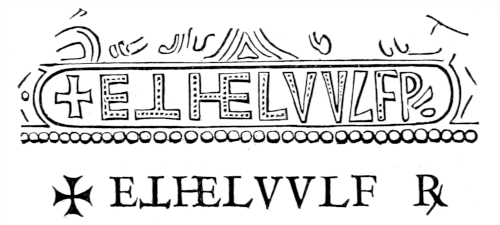
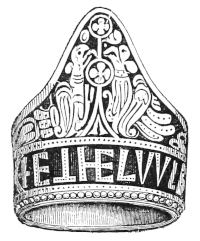
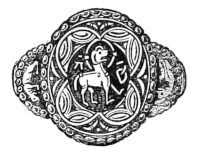
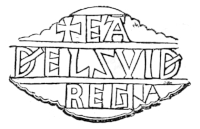
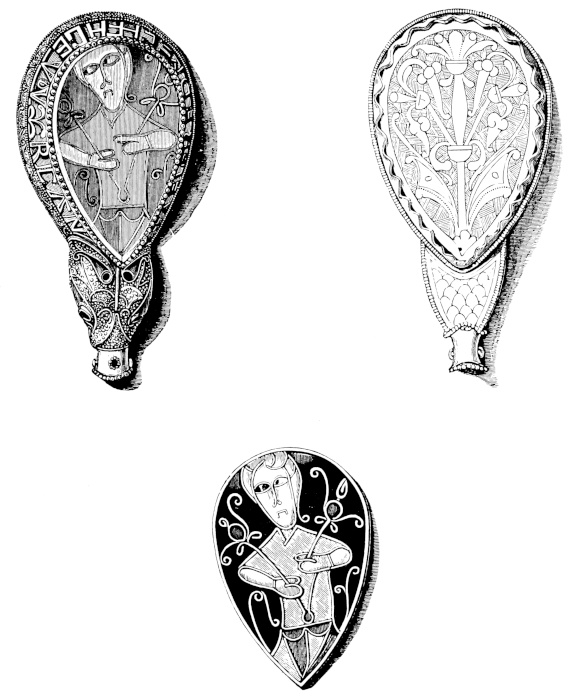
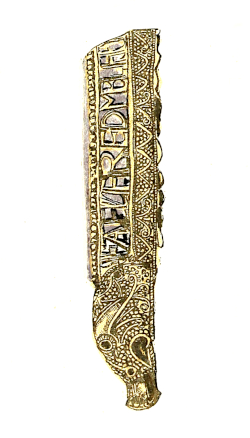
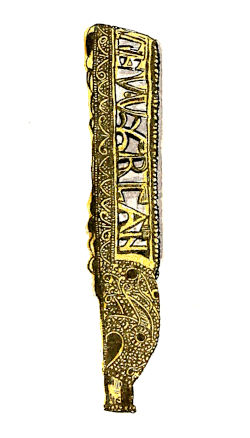
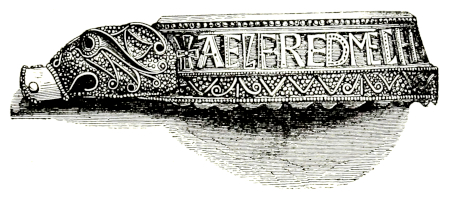
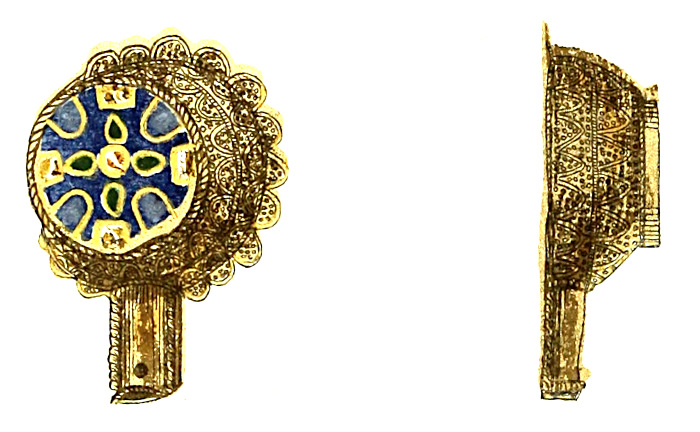
When we have described the form and symbolism of the Alfred Jewel, and
reviewed the various interpretations which it has evoked, and when we
have moreover analyzed its design and considered each several feature,
we have not as yet exhausted the matter of our theme. An important
part of the problem remains to be discussed, and that is the place
of its discovery, the how and the why of its deposit there, and the
possibility of light to be derived from the historical associations
of the locality. It was found near the Isle of Athelney. This looks
like a piece of circumstantial evidence tending to identify the Alfred
named in the
Epigraph, and to associate the Jewel with the chief and central
episode in the career of our national hero. The momentous crisis which
is thus reflected in the Jewel seems to open a wider view, and to
demand some enlargement of this Essay, so as to embrace a glimpse of
that eventful story.
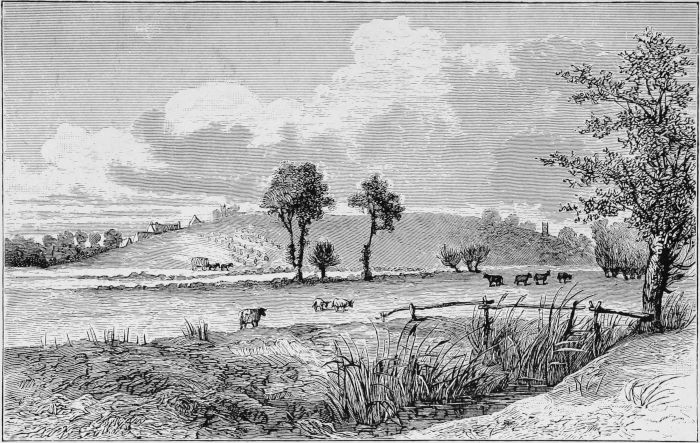
THE ISLE OF ATHELNEY.
Of all this we now, after the lapse of a thousand years, speak as
men who know the sequel, and (because we do know the sequel) it is
the harder for us to appreciate the intensity of that crisis. We are
helped by the occurrence of an opportune discovery. Just when our
nation was beginning to be ripe for historical reflection and capable
of entering into the struggles of our remote forefathers, there was
‘dug up’ in the locality where Alfred took refuge in the year 878, a
personal ornament bearing his name in impressive characters. It is to
us now as if the king himself had but recently passed that way under
such stress of circumstances as constrained him to hide his royal
insignia, and as if we somehow by this chance were brought nearer to
the burden of his lot, and were made sharers not only in the
fruits
of his triumph, but also in the toil and the joy of his achievement.
By the sudden surprize with which the Danes had broken the peace and
come upon him at Chippenham in the dead of winter, they had almost
fulfilled their design and taken him captive. But he had fled, and
they had Wessex at will, and were proceeding to divide and occupy the
land. The king, with a few companions, had escaped into Selwood, and
thence by wood and by fen, like hunted creatures, they eluded pursuit,
but were never secure until they had passed beyond Pedrida.
What were his reflections on finding himself suddenly an outcast in
the winter, a fugitive in the wild? He had experienced hair-breadth
escapes, but none like this! He had trusted Guthrum’s oath, had
thought him in earnest this time! And even now he was loth to charge
this last perfidy upon him. No! this trick was not his, it came from
those buccaneers in the Severn Sea. Mad at the defeat of last summer’s
combined scheme, which they had come from far north to support, they
had forced Guthrum’s
hand, and compelled him to join them in this
winter raid. And they would not stop there! Finding that he had
given them the slip, they would certainly be down upon some part of
the coast of Somerset or of Devon, and preparations must be made to
receive them. Odda will surely be stirring: he is safe to be on the
alert! I must find out what he is doing, and we must work on a plan;
he in Devon, and I in Somerset!
It was now twelve years since he had come to the front, and had taken
his stand by the side of his brother Æthered. The moment when he had
begun to share in public affairs had coincided with a great change in
the situation. That was the time when the invaders acquired a footing
in East Anglia: they made there a centre of operations from which they
went out and to which they came in—it had become the head quarters
of an invading host which manifested a settled design of conquest.
Previously the incursions of the Northmen had been desultory, but from
that time they had become methodical. This change had coincided with
the death of Æthelbriht in 866, and the accession of Æthered.
In the following year had
died Alhstan, that vigilant patriot, the old warlike bishop of Sherborne.
Æthered and I were the two youngest of the family, and our relations
had been peculiarly close. Before we were united by public cares, we
had been partners in our private concerns. Our several estates had
been kept in one and worked in common, under agreed conditions, so
that they had remained undivided. Our names had been coupled together
by the common voice of the nation. The style was ever thus:—Æþered
cyning and Ælfred his broþur.
Oh what a fearful time it was for Angelcynn, that five years
of Æthered’s reign! Northumbria, that old imperial kingdom, was
crushed; Mercia reduced to make a peace with the heathen, which was
the best we could effect by marching in force to Nottingham to support
Burgred and Æthelswith! And, worst of all, the East Angles defeated in
battle, the good king Edmund slain (he fought like a hero, and died
like a martyr); the land conquered, possessed, and turned from an
Anglian into a Danish kingdom!
It was our turn next. All was at length ripe for the subjugation of
Wessex, and on this aim they brought all their strength to bear. We
made a gallant stand at Ashdown against overwhelming odds; we slew
their kings and jarls, and made their practised braves fly before
the rustic militia of Ecgberht. Eight pitched battles in that year,
besides smaller fights without number. But Æthered died at Easter.
Rightly the people revere him as a saint. So I was left to continue
the struggle single-handed.
Since then they have established themselves in the possession of
London, and they have banished Burgred and set up for king in Mercia
a tool of their own; also Halfdan has abolished the kingdom of
Northumbria and partitioned the land. And amidst all this, what a
destruction of religious houses, seats of piety and learning and
education—Lindisfarne, Wearmouth, Jarrow, York, Ripon, Bardney, Ely,
Crowland, Medeshamstead, and many others.
They have destroyed the powers of Northumbria and Mercia; but there
they had a point in their favour which is against them here. The Welsh
at the back of those nations were
always ready to co-operate with
the invader, but that is not so here in the west. The Cornish have
never made common cause with the heathen since the battle of Hingston
Down, in which that coalition was quashed by Ecgberht. And we have a
still better guarantee in the constant policy of Wessex ever since the
days of Ina and Aldhelm. The territorial quarrel was then appeased,
and the religious difference too. The West Welsh were conquered, but
they were never wantonly humiliated, no man was ejected from his own.
They appreciated the respect and even honour that was shown to their
favourite church of Glastonbury. Therefore I have good hope of the
support of the men of Somerset.
True, we have to count upon the hostility of the Welsh on the opposite
shore of the Severn Sea, where the Danish fleets find harbour and
all friendly countenance. Still, that is not quite the same thing
as having an active enemy behind your back upon the same stretch of
territory. Here in this west country the people differ only in degrees
of allegiance, none are actively hostile. This is the weak point in
the position of the invaders. This is the one little
bit of advantage that still remains to us. I must improve it to the utmost!
But first of all we must provide against a sudden descent on the
coast. For the last two years events have succeeded one another at a
quickened pace: surprize on surprize! There, under the opposite coast,
lies a heathen fleet, ready to be down upon us without notice! The
coast-wardens must be kept up to the mark, and I not to be seen in it!
The mobility of these troopers defies calculation! How unexpected and
startling was that occupation of Wareham last autumn! How daringly
defiant of gods and men that breach of their most sacred oath! When by
that perjury they had lulled our mistrust, they made a sudden rush for
Exeter! Perfidy is part of their tactics. How wonderful, how divinely
providential, that storm off Swanage, which wrecked the perfidious
plan! And now, not to be baulked, they pounce upon Chippenham in time
of truce and in mid-winter, thinking to capture me! How great in war
is the unexpected! Without perfidy, I too must learn to meditate
surprize; I must contrive how to
distract their calculations, and strike where least expected.
With some such a strain of thought as this (if I have followed him
aright) now ruminated the undaunted king, in whom thought was the
spring of action. Moreover, he reasoned thus with himself: ‘So long
as winter lasts, they cannot follow me with the host by the way that
I have come, but if they learn my whereabouts, they may easily find
adventurers who would undertake to kill me. Wherefore I must not make
myself too freely known, but proceed cautiously, and make proof of men
before I trust myself to them. To most I must appear like some mounted
yeoman hunter who follows the high deer that abound in the forests
about these hills. And as for this sacred toy, this personal enigma,
this Jewel of ceremony, which many eyes have beheld, I must no longer
carry it about me, lest peradventure it make me known unawares. I will
bury it in some convenient spot!’
The western boundary of Wessex had for centuries been the Great Wood
of which the
ancient name still survives as a specific element in the
historic designation of Frome Selwood.
This great wood was also called Wealwudu, a very natural and
appropriate name, because it had long been the barrier between the
Saxon and the Welsh populations. Here lies the most fitting scene for
the story of Denewulf. In the time when the king was a fugitive, he
found this man keeping swine in the forest, and he discovered in him
a great natural capacity and aptness for good, and after his return
to power he educated Denewulf, and made him bishop of Winchester.
This story does not run on all fours, because according to the best
authorities Denewulf became bishop of Winchester in 879, and if he was
keeping swine in 878, being already of mature age, it smacks rather
of hagiology than of history. But it may be that the marvel has been
enhanced in transmission; or if we choose the lowest estimate and call
it mere fiction, still it is worth while observing what manner of
stories were invented about king Alfred.
Behind this barrier the Danes had never been
able to get a footing.
As if aware how greatly this was needed for the success of their
designs upon Wessex, they had made several attempts. Two great efforts
which imply this aim were made at the end of the reign of Ecgberht.
The force of thirty-five ships which that king repelled at Charmouth,
on the coast of Dorset, seems to indicate something more than merely a
plundering incursion.
In 835, a great naval armament (micel sciphere) came to the Cornish
coast and were joined by the West Welsh, and they gathered in force
at Hingston Down, where they probably intended to fortify themselves;
when Ecgberht appeared with an army, and dispersed them.
The next recorded attempt of the kind was in the year 845, in the
reign of Æthelwulf, when the Wicengas entered the mouth of the Parret,
and were met by the posse comitatus of the two shires, Somerset and
Dorset, under their two ealdormen, and Alhstan the warlike bishop of
Sherborne.
Only in the very last year (877) their land-force had, by a perfidious
surprize, seized Exeter,
acting in concert with a fleet of one
hundred and twenty ships, which were to sail up the Exe and co-operate
with them—but they were wrecked in a storm off Swanage
[30]. This
disaster, combined with the promptitude of the king in assault, had
compelled them to capitulate, and had dislodged them from Exeter.
Of the same nature and motive was the attempt of this spring on the
coast of Devon at a place which Asser calls Cynwit, with a force of
twenty-three ships, which were wintering on the opposite coast of the
Severn Sea. The repulse was complete and the blow decisive, but the
name of the English leader is not given by the contemporary annalist.
A hundred and twenty years later, Ethelwerd calls him Odda the
ealdorman of Devonshire. The reticence of the Chronicle suggests that
this achievement was conducted by Alfred while he was keeping
in the
background, lest the place of his retreat should become known.
Gradually and by the spontaneous action of natural causes, the western
barrier of the Saxon was moved from the line of Selwood to the fenland
of Pedrida. This barrier was deeper bedded in the soil, was harder
to pass, and has left behind it memories more indelible. The first
explicit notice of this virtual transfer of the western boundary meets
us seventeen years later than the epoch with which we are now engaged,
and it may be worth while to go so far out of our way in order the
better to realize the import of Pedrida.
In the last decade of Alfred’s reign, when he was in the agony of that
supreme crisis which tested the value of his institutions, a great
muster of force was called for, and the extent of the contributing
area is sketched by the annalist as matter of amazement. ‘There
gathered Æthered aldorman and Æthelm aldorman and Æthelnoth aldorman,
and the king’s Thanes who were then at home in the fortifications,
from every garrison east of Pedrida
(whether west of Selwood or
east), likewise also north of Thames and west of Severn:—moreover some
part of the Welsh nation[31].’
Here we mark the startling novelty that the Welsh in 894 are seen
aiding the Saxon against the Dane; and we can hardly forgo a passing
cry of wonder and pleasure at this signal token of the imperial
success of Alfred’s policy. But our present concern is with the
recognition of Pedrida as the westernmost limit of Wessex proper
instead of Selwood, and the implication that the change was recent.
We see that Selwoodshire (as the intervening district was popularly
called) was by 894 quite assimilated and included in the military
administration of Wessex, but that beyond Pedrida some other rule was
operative at that time. Such a fact reflects back an illustrative
light upon the year 878, and helps us to estimate the situation of
Alfred when he was in Somerset beyond Pedrida.
The political division here indicated has left traces which may
still be recognized, particularly in the dialect and in folk-lore. Of
the dialect we have a remarkable monument in Mr. Elworthy’s works,
The Dialect of West Somerset, and his West Somerset Word-Book.
Especially to be noted is the ‘u’ of the West Country, which is
radically one with the Welsh ‘u’ and with the French ‘u,’ while at
the same time it has a very distinct local character of its own.
Every Englishman who is conversant with the French language knows how
hard it is to acquire the utterance of the French ‘u’ after the age
of infancy. A like strangeness is experienced by English people born
east of Pedrida, when they attempt to reproduce the western ‘u.’ In
fact, this vowel-sound is Keltic; it is a legacy from our British
predecessors.
Not that this British ‘u’ is absolutely confined to the western
promontory: it may be occasionally heard in other parts of the country
by a cultivated and observant ear. Mr. Mayhew once told me that he had
heard it in the Corn Market at Oxford. But though not confined to the
lands west of Pedrida, it is in a peculiar
manner concentrated there.
It is chiefly in Devonshire that this peculiar vowel has wakened wider
attention, but this is simply because that county has been the most
frequented as a place of holiday resort.
The so-called Devonian ‘u’ and its contiguous sounds have been
described many times from first to last, but it has been mostly
in that perfunctory vein which contents the summer tourist. It is
rare to catch such a plain and solid illustration as the following,
which is quoted from the preface to Mr. Elworthy’s West Somerset
Word-Book:—‘I was a passive listener at Brandon’s while a bonnet was
being discussed, and when making the payment ventured to remark to the
young lady, “You must have been a long time in London.” “Oh yes, ten
years; but why do you ask?” “Only for information,” said I. “And did
you come straight from Teignmouth?” With much surprise at my supposing
she came from Devonshire, she said at length that she was a native
of Newton Abbott. I could not pretend to define the precise quality
of her two, but it was only in that one word that I recognized her
locality.’
If the vocabulary of this dialect were minutely examined by a
competent Welsh scholar, some British words might be detected. Among
those which would deserve early attention are plum (soft, as a bed),
pilm or pillum (dust), welt (to beat, thrash).
Another local characteristic of the West Welsh promontory is this,
that it is the peculiar haunt of a race of whimsical or mischievous
sprites called Piskies or Pixies. In South Devon and Cornwall any one
whose conduct is strange and unaccountable is said to be pisky-led.
This is a branch of the numerous kindred of that versatile Puck, whose
memory is kept fresh by the Midsummer Night’s Dream. In an Anglo-Saxon
perambulation of land at Weston by Bath, we meet with a Pucan Wyl,
Puck’s Well[32].
The English Dialect Dictionary preserves the name
of Aw-Puck for Will-o’-the-Wisp or ignis fatuus, a compound which
imports that he is the most dangerous of the species. This name was
current in Worcestershire, but is now obsolete
[33].
These are the more obvious extant traces of the long isolation of
the trans-Pedridan world: others there are which have attracted
inquiry, such as peculiar customs, implements, songs and song-tunes,
which latter have been investigated by Dr. Bussell and the Rev. S.
Baring-Gould.
The Somerset to which Alfred retired was widely unlike the Somerset
of to-day. In this respect three points may be taken: (1) Differences
in the distribution of land and water; (2) differences in the trees
and woods and game; (3) differences in the political aspect of the
population.
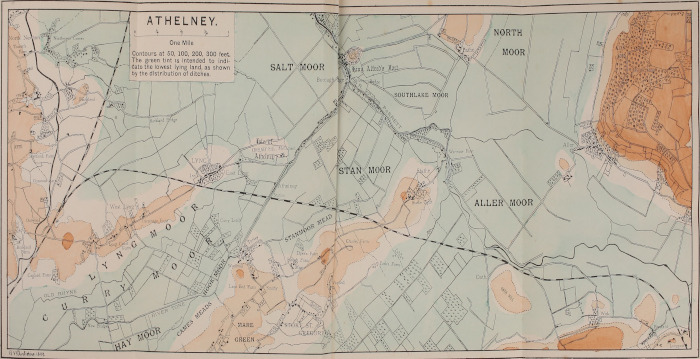
1. West Somerset was separated from East Somerset by wide inland
waters: the beds of the Brue and Parret were lakes in the winter, and
only passable in summer to those who knew the ground. Pedrida was
regarded as a natural limit, like the sea itself, dividing nations;
it was spoken of in like phraseology. Thus we read in 658 how Cenwalh
warred against the
Welsh and drave them even unto Pedrida[34];
and, in 682, how Centwine drave the Bret-Welsh even unto the
sea[35].
The cause of that expanse of water and large area of fenland happened
far back beyond historical chronology, and we can only date it by
using the geological method of reckoning time. Far back in the
sub-glacial era a subsidence of the land took place which affected
the coast of Somerset and North Devon. Proof of this is found in a
submarine forest extending along the south coast of the Severn Sea,
which has long been known. ‘That portion of it visible at Porlock
was described in 1839 by Sir Henry de la Beche, and more recently by
Mr. Godwin Austen in an essay read before the Geological Society in
1865[36].’
Subsequently the Rev. H. H. Winwood and Professor Boyd Dawkins
verified the discovery by a thorough examination of the forest-bed.
Near Minehead the forest consists of oak, ash, alder, and hazel,
which grew on a blue clay. An ancient growth of oak, ash, and yew is
found everywhere underneath the peat or alluvium in the Somersetshire
levels. Throughout this wide area the trees were destroyed by the
growth of peat, or by the deposits of the floods, except at a few
isolated spots, which stand at a higher level than usual, in the great
flat extending between the Polden Hills and the Quantocks. One of
these oases, a little distance to the west of Middlezoy, is termed the
Oaks, because those trees form a marked contrast to the prevailing
elms and willows of the district. In the neighbouring ditches, that
gradually cut into peat, and then into silt, prostrate oaks are very
abundant[37].
Subsidence of the land at a remote geological period was the cause of
the impassable state of these levels in the time of king Alfred, and
the modern system of drainage which was carried out at a later date
has been the cause of the improved condition which we see now, and
which has made the Vale of Taunton Dean proverbial as the Garden of
England.
2. In Alfred’s time the eye was greeted by a variety of trees which
are not observable now. The elm predominates all over the plain. I
asked the occupier of Athelney Farm about the trees on his land, and
he said there was hardly anything but elm. Of other kinds he had
only two ash-trees and one beech; ‘but (he added) we find bog-oak
in the moors, and it makes good gate-posts.’ The elms have driven
out both oak and ash, and whatever other sorts they touched in their
‘wrastling’ progress. These sombre grenadiers dress up their lines so
close as to leave little room for other trees. They suck the fruitful
soil more than any other tree, and they repay their costly nurture
with timber of inferior value. Introduced by the Romans to serve as
stakes and props in the culture of the vine, they have overrun the
land like the imported rabbits in some of our colonies. In Alfred’s
day these hungry aliens had not yet usurped the field, and there
was still room for the display of the rich variety of nature—oak,
ash, beech, fir, maple, yew, sycamore, hornbeam, holly, poplar,
aspen, alder, hazel, wych-elm, apple, cherry, juniper, elder, willow,
mountain ash, spindle-tree, buckthorn, hawthorn, wild plum, wild pear,
service-tree, &c. But now, the fair places of the field are encumbered
by the tall cousins of the nettle, and the most diversified of English
counties is muffled with a monotonous shroud of outlandish and weedy
growth.
In the animal world, likewise, the lapse of a thousand years has
brought change. In the pastures the most frequent animal is the cow,
and only on rare occasions, as we view the moors from some elevated
‘tump,’ have we the chance to see a little company of antlered deer
careering over the open plain, clearing the rhines with an airy bound.
In Alfred’s time too, cow-keeping was a stock industry, and we read of
the king as entertained incognito by one of his own cowherds
(apud quendam suum vaccarium).
But the proportion of wild to domesticated animals was far greater
then than it is now. The whole stretch of country from Pedrida to the
end of Exmoor, fifty miles long and twenty miles wide, was then almost
a continuous forest, abounding with game of all kinds, but
especially
with red deer, which still continues, though in diminished numbers.
This noble creature is thus described by Bewick:—
‘The Stag or Red Deer. This is the most beautiful animal of
the deer kind. The elegance of his form, the lightness of his motions,
the flexibility of his limbs, his bold, branching horns, which are
annually renewed, his grandeur, strength, and swiftness, give him a
decided pre-eminence over every other inhabitant of the
forest[38].’
The red deer still lives and breeds along the southern coast of the
Severn Sea, and this is I believe the only part of Great Britain in
which this right royal animal still ranges at large in all the freedom
of nature. I am informed by my friend Mr. Townshend that in Ireland
they are kept as an ornament in some gentlemen’s parks, but that in a
free state of nature they survive only in the mountains of Killarney.
Here it will be useful to read Leland’s notes of travel across the
lowlands of Somerset, especially as they touch some places with which
we are concerned. (I quote from the Proceedings of the Somersetshire
Archæological and Natural History Society, No. xxxiii, ‘Leland in
Somersetshire, 1540–1542.’)
‘Thens to Cury-Malet a 3. Miles, wher is a Parke longging to
Chambernoun of Devonshire.
I left this Parke a litle on the lift Hand, and sone after cam over a
great Brook, that resith West South West, and rennith East North East
into Ivel a 2. Miles above Michelborow by Estimation.
(Here I cam from the Hilly Ground to the Low and Marschy Ground of
Somerseteshir.)
Thens to North Cury stille by low Ground aboute a 2. Miles or more.
The Chirch of Welles hath fair Landes here.
And hereabout is Stoke Gregory, wher the Chirch of Welles hath
Possessions.
Thens about a Mile to the Ripe of Thone Ryver, by the which I
passed by the space of half a Mile, and then I went over Thone by a
Wood Bridge.
Athelney lyith half a Mile lower on Thon, and ther is a Bridge
of Wood to entre thabbay[39],
and beneth that almost at the very
Confluence of Thone and Ivel is another Wood Bridge over Thone.
Thonetoun alias Tawntoun is a 5. Miles by South West from
Athelney.
Ther is a great Bridge on Thone at Basford a Mile lower then
Thonetoun.
From this Bridge by Athelney I rode by a low Marsch Ground a 2.
Miles to Pedertun Park.
Here at Pederton the soyle Westward and South West rysith agayn and
ys not fenny.
There ys a great Numbre of Dere longging to this Park, yet hath it
almost no other Enclosure but Dikes to let the Catelle of the Commune
to cum yn.
The Dere trippe over these Dikes and feede al about the Fennes, and
resort to the Park agayn. There is a praty Lodge moted yn the Parke.
There cummith a praty Broke thorough the Park, and half a Mile beneth
the Park it goith ynto Ivel.
This Brooke is caullid Peder, and risith West South West yn the
Hylles aboute a 2. Myles of. First it cummith by Noth Pedreton, a
praty uplandisch Toun, wher is a fair Chirch, the Personage whereof
was impropriate to Mynchin bocland.
Then it touchith on South Pederton, in the which Paroch the Parke
standith, and so to the Ryver of Ivel.
From the Lodge in Pederton Parke to Northpedertun a Mile.
From Northpedertun to Bridgewater 2. Miles. The way or I cam ynto
Bridgwater was caused with Stone more then half a Myle.’
Here we may observe that Leland appears to know of no river Parret; to
him it was ‘Ivel.’ It would be curious to learn when and how a minor
tributary gave its name of Parret to the
lower waters of the Ivel.
It may be surmised that Pedrida was never the name of a river, but of
a belt of country, and that it may have meant ‘the passage or ford
of the Peder,’ Leland’s ‘praty broke.’ The name seems to contain the
Welsh rhyd, a ford. At first it may have denoted the ford of the
Peder, and then by natural extension it may have come to designate the
whole fenland of the lower Ivel.
3. Racial differences were still seen and felt. The West Welsh had
been conquered, and were now living in peaceful subjection, and
forming an outlying part of the kingdom of Wessex; but still they were
imperfectly assimilated.
The old internecine quarrel between the races had in this western land
been hushed and calmed; and on no other border were the British living
and mingling with their conquerors on such amicable terms. There was
a very great difference between the disposition of the West Welsh
towards the Saxon and that of the ‘North Welsh’ on the opposite coast
of the Severn Sea.
These pacific relations were not of recent date; they appear as a
deliberate policy in the reign of Ina before the end of the seventh
century, and even earlier indications of this tendency may be gleaned
which carry us back two hundred years behind the reign of Alfred.
When in 665, Wina[40],
bishop of Winchester, consecrated Ceadda (St.
Chad), he had with him two British bishops as his assistants. These
two bishops must have belonged to the West Welsh. Further, there is
reason to believe that Ceadwalla, though descended from Cerdic, and
king of Wessex, was half a Briton. Again: the legendary tales about
Ina’s legislation which are embodied in the so-called Laws of Edward
the Confessor, however unhistorical, have possibly a traditional value
as characterizing the attitude of Wessex towards her British subjects
in the seventh and eighth centuries. In this apocryphal text it is
said that by Ina’s enactment ‘the British were declared politically
equal with the English, and that as he himself had set the example of
a Welsh marriage, so he would that connubium between the two races
should be legally recognized.’ These are distorted reminiscences of
the historical fact that Ina maintained a conciliatory policy towards
the conquered British, and in this course he was well supported
or perhaps guided by Aldhelm, abbot of Malmesbury, who in 704 was
requested by a synod to write a letter to Gerontius (Geraint), king of
Damnonia, and exhort him and his people to conformity with Catholic
usage in the time of keeping the Easter festival. The letter was
sent, and it is still extant. It is addressed, in respectful and
courteous language—‘To the most glorious prince, swaying the sceptre
of the Western realm, whom I, the searcher of the heart is my witness,
do embrace with brotherly charity—to king Geraint and to all God’s
priests dwelling in Damnonia, Aldhelm, &c.[41]’
And when, shortly afterwards, Hædde, bishop of Winchester, died, and
the moment had arrived for the long-contemplated division of the vast
diocese of Wessex, Aldhelm became bishop ‘to the west of the wood,’
over a province which (as Ethelwerd tells us) was commonly called
Selwoodshire. Aldhelm died in 709 upon one of his episcopal journeys,
at the village of Doulting on the western brow of Mendip, between
Wells and Frome. His memory has been locally revived in the present
century by the discovery of a small Saxon church in Bradford-on-Avon,
which has been identified by competent judges with the ecclesiola
which William of Malmesbury says that Aldhelm built in that place.
To him was probably due the preservation of the British monastery at
Glastonbury and its endowment by king Ina.
That spot was dear to the British patriot as the mysterious sojourn of
their hero, who in due time was to return and revive the ancient glory
of the British name. The extant books in which this legend is recorded
are later than the time of Alfred, but the romance itself is of the
sixth century. Our oldest English form of it is of about a.d.
1200.
THE PASSING OF ARTHUR
(From Laȝamon’s Brut, line 28,582.)
There to him came a youth
Constantin hehte the cnaue;
Constantine hight the youth;
where he lay on the ground,
Constantin thu art wilcume,
Constantine thou art welcome,
And ich wulle uaren to Aualun,
And I will fare to Avalon,
to the fairest of all maidens;
And seothe ich cumen wulle
lo came from sea wending,
that wes an sceort bat lithen,
that was a short boat sailing,
and heo nomen Arthur anan,
and they took Arthur anon,
and aneouste hine uereden,
and straight him bore away,
and softe hine adun leiden,
and softly down him laid,
and forth gunnen hine lithen.
and forth with him to sea
Then was it come to pass,
that Merlin seide whilen:
what Merlin said whilome:
that there should be much curious care
when Arthur out of life should fare.
with the fairest of all elves;
and lokieth euere Bruttes ȝete,
still look the Britons for the day
of Arthur’s coming o’er the sea.
All this history was known to Alfred and went to swell the stream
of his meditations, which tended to assure him that he had a fresh
and promising field before him, and to mature in him the purpose of
exerting himself to win the hearty attachment of this well-affected
but still half alien population.
Between Twelfth Day and Easter Day of the year 878 there were barely
eleven weeks, for Easter fell early that year, namely on March 23. Of
Alfred’s doings in that interval we have no information, except in
so far as it seems to be indicated that the affair of Cynwit was not
conducted without his intervention. And we may add the traditional
story of the cakes, a story which probably dates from Alfred’s day,
as we have reasonably good evidence that it was current in the tenth
century. Nor may we omit his espial of the Danish camp in minstrel
guise, a legend which, though not found in early authorities, yet
does claim some credit from the book in which it is narrated, namely
the Book of Hyde—a book in which we might expect to find some early
traditions of New Minster, one of king Alfred’s foundations.
But while we desire to make the most of these items, it must be
admitted that they constitute an inadequate furniture for eleven
weeks of Alfred’s time in the most intense crisis of his life. At any
other point in Alfred’s career, the silence of so many weeks might
not provoke remark, but at this moment it makes a sensible void. If,
however, we rightly apprehend the situation of the fugitive king,
his hopes and his fears, his aims and his resources, we may (in the
light of the great result) indulge a sober imagination without fear of
considerable error.
Among the pieces of genuine tradition which seem to greet the explorer
in Asser’s Life, there is perhaps none on which we may more
confidently lean than a certain fragment in the paragraph beginning
‘Interea tamen rex[42].’
The drift of this context is that with all his wars and frequent
interruptions, Alfred ruled his kingdom, and ‘practised every
branch of the craft of venery; directed his goldsmiths and all his
artificers; did moreover instruct the falconers and hawk-catchers and
dog-trainers; and by his own novel engineering constructed buildings
beyond all former wont, statelier and more costly; had Saxon books
read to him, and commanded others to learn Saxon poems by heart, &c.’
In this passage I seem to recognize a true historic note; and I think
that in this picture of the range of his powers, and the roll of his
accomplishments, his vast activity and versatility, we have some
genuine reminiscences of the personality of Alfred. In the emphasis
here laid on hunting, we may recognize the king who, some years
later, sent a present of wolfhounds to the archbishop of Rheims, and
such dogs, too, that their quality and breed was accentuated by the
receiver in his grateful acknowledgement[43]. And when to this we add
that he could make and sing a song, could tell a good tale, could
make choice of men and win their confidence, we need little aid from
imagination to perceive how this mysterious visitor might captivate
the British hearts of all Somerset like one man, and perhaps set them
wondering whether it could be their own ideal king Arthur come back to
them again.
During nearly three months of that eventful year his aim was to
cultivate closer relations with the people of that outlying territory,
desiring that they might become attached to him with sentiments of
loyalty and friendship. To devote himself to this undertaking was at
once his duty, his interest, and his delight. For such an achievement
as this he had advantages both natural and acquired. Apart from war,
there is nothing like hunting for making comrades, if a man have a
genial soul and be himself a mighty hunter. Alfred was a mighty
hunter and a genial soul, and close at hand there was one of the
finest hunting-grounds in the world.
Immediately from the Pedridan swamp the ground began to rise to north
and north-west towards a run of hilly and woodland country forty miles
long, and from ten to twenty miles broad; a country which remains
singular to this day for its natural breed of red deer and its chase
of the great game. This royal sport survives on Exmoor and in the
Quantocks, and there are Minehead people who can tell you that they
have seen the stag-hunt scamper through their main street in full cry.
At the entrance of this country, at a point which is conveniently
situated for uniting activity inland with a constant observation of
the line of Pedrida, is a village which is now called North Newton,
with which Petherton Park had been so long and closely linked that it
went by the popular name of Newton Park. I am led by a number of small
indications to infer that this is the place where Alfred had his chief
residence during those early months of the year 878.
When Easter came, his action began to be overt; he dropped personal
disguise, and stood forth as Ælfred cyning. ‘When Easter
came, king Alfred, with a small force, constructed a fort at Athelney,
and out of that fort was warring against the invading host, he and
the men of Somerset, that portion of them which was nighest[44].’
This is the action of a commander who has made sure of his following,
and is now beginning his operations against the enemy. He fortifies
himself on the east side of the bridge, where a conical hill offers an
opportune position; and from that basis he opens a guerilla warfare
with the invaders. He does not show his hand: he rather wants to be
thought weak. This naturally draws away from head quarters more and
more of the hostile force, who think that they shall presently deal a
last blow to the Saxon resistance. And so with a petty and apparently
futile display of military force, he continues to amuse and distract
the enemy for the next six weeks.
The impression made on the mind of the people by these events is
traceable in two names: Athelney, which now represents Æthelinga Eig,
the island of princes; and Borough Bridge, which means the bridge
at the fortification. The fort which Alfred made in 878 is well
preserved, the entrenchments occupying the summit of a conical hill
near the east end of the bridge which spans the Parret, after its
junction with the Tone.
How the king had employed the unrecorded months is manifest in
the result. His muster-roll at Brixton Deveril, in the words of a
contemporary, is brief yet eloquent: ‘Then in the seventh week after
Easter he rode to Ecgbrihtes Stân, on the eastern side of Selwood, and
to meet him at that place came the men of Somerset, all of them, and
the Wiltshire men, and of Hampshire the part that was on the hither
side of the sea; and of him fain they were.’ This passage of the
Saxon Chronicle seems to render a satisfactory account of the manner
in which the king had employed his time from Epiphany to Easter in the
year 878.
Absorbed in this supreme effort, where his all was at stake, he may
well have found no time for recovering his buried Jewel, and he may
never have revisited the spot until his marks were all obliterated.
From the land beyond Pedrida, which had hitherto counted to the crown
of Wessex only as a recent territorial acquisition, now started up
around the fugitive king an army of devoted warriors, who resolutely
threw their weight into the scale, and rescued the dynasty of their
conquerors.
Such was the nature of the force which Alfred now with a swelling
heart perceived to be entirely at his disposal, and he buckled to the
task of employing them to the best advantage. From the entrenched hill
by Borough Bridge he prosecuted the war against the Danes, whose basis
was at Chippenham, and this he continued for six weeks. This he could
do with a small force, as he had great advantages of position. Between
him and the foe lay the fenny channel of the Brue, which he and his
people were expert in crossing. So it was comparatively easy for him
to harass them and retire to his fort.
This kind of warfare, continued for six weeks, must have had the
designed effect of drawing off from the strength of the foe in
Wiltshire, and causing them to concentrate their attention upon this
feigned line of attack. For all this was only to amuse and distract
the enemy, and so to facilitate the execution of a very different
project, which the king was preparing. What was passing in Alfred’s
mind may (in all essentials) be read in Lord Roberts’s narrative of
his preparations for attacking the Afghans, when they were entrenched
on the Peiwar Kotal in December, 1878[45]. By making display of
reconnoitring parties and other preparations as for a front attack,
carrying this on to the extent of raising batteries and mounting guns,
till he had caused the enemy to make counter dispositions accordingly,
he with the utmost secrecy by a circuitous night march made a flank
attack, taking them unprepared, and promptly dislodged them from an
apparently impregnable position. So Alfred, while waging the six
weeks’ war, had his trusty messengers abroad all through Wiltshire and
Hampshire, preparing for the tryst at Ecgbrihtes Stân.
Well may we exclaim with Sir Walter Besant—‘What follows is like a
dream!’ Yea, verily, like a dream in its sudden transformation of
the whole face and prospect of things, and equally unaccountable
too; for no attempt to explain it by natural causes will ever match
the stupendous result. It is not in order to dispel an illusion that
we seek to trace the plan and the process—the illusion cannot be
dispelled. No, rather it is in order to penetrate further into the
action of a life that has kindled our admiration. Of that life we have
a mirror in the enthusiasm with which his presence had fired the Welsh
of Somerset beyond Pedrida. It is surely no mere accident that in the
memorandum of that resolute force which mustered for his restoration,
the first item should be—Sumorsæte alle.



 .
 .