These stories are the newest and most up-to-date. All Aeroplane details
are correct. Fully illustrated. Colored frontispiece. Cloth, 12mos.
Price, 60 cents each.
The Airship Boys Series
By H. L. SAYLER
I.
THE AIRSHIP BOYS
Or, The Quest of the Aztec Treasure.
II.
THE AIRSHIP BOYS ADRIFT
Or, Saved by an Aeroplane.
III.
THE AIRSHIP BOYS DUE NORTH
Or, By Balloon to the Pole.
IV.
THE AIRSHIP BOYS IN THE BARREN LANDS
Or, The Secret of the White Eskimos.
V.
THE AIRSHIP BOYS IN FINANCE
Or, The Flight of the Flying Cow.
VI.
THE AIRSHIP BOYS’ OCEAN FLYER
Or, New York to London in Twelve Hours.
These thrilling stories deal with the wonderful new science of aerial
navigation. Every boy will be interested and instructed by reading
them. Illustrated. Cloth binding. Price, $1.00 each.
The above books are sold everywhere or will be sent
It was a few minutes of eleven o’clock at night.
One of the many editions of the great New York
Herald had just gone to press. But in the big,
half-lit room where editors, copy readers, reporters
and telegraph operators were busy on the
later editions to follow, there was no let-up in the
work of making a world-known newspaper.
There was the noise of many persons working
swiftly; the staccato of typewriters, the drone of
telegraph sounders and now and then the sharp
inquiry of some bent-over copy reader as he
struggled to turn reportorial inexperience into a
finished story. But there was no confusion and
none of the wild rush and clatter that fiction uses
in describing newspaper offices; copy boys were
not dashing in all directions and the floor was not
knee deep with newspapers and print paper.
Calmest of all was the night city editor. With
a mind full of the work already done and in progress,
he was as alert mentally as if he had just
reached his desk. Five hours yet remained in
which New York had to be watched; five hours, in
any one minute of which the biggest news on
hand might fade into nothing in the face of the
one big story that every editor waits for night
after night. And the night city editor, knowing
this, dropped his half-lit pipe when his desk telephone
buzzed.
“Stewart? Yes! Yes!” he answered quickly
in a voice so low that not even his busy assistants
heard him. “Where are you? What are you
doing?”
“In Newark,” came the quick response, “and
we landed it. It’s a peach. That aeroplane tip
you know. It panned out all right.”
The night city editor had seemed perplexed
for a few moments but at this his face cleared.
“How big? What’s new?”
“Biggest airship ever made; biggest planes;
biggest engines—cabin and staterooms; two hundred
miles an hour—”
“See it yourself?”
“Been workin’ in the factory three days;
American Aeroplane Works; got story cinched.
Machine flew to-night first time. It’s a beat.”
“Got talks?”
“Not straight, but I’ve heard ’em talkin’.”
“What’s the idea? Is it a war ship?”
“Got everything but that. Will some one take
it by phone? I can get to the office quarter after
twelve; got some stuff ready.”
“Who’s back of it? Whose machine is it?”
“Aerial Utilities Company; those Chicago
boys, Napier and Hope and their friends.”
The editor thought a moment, glanced at the
clock on the wall where the hands pointed to
eleven and then said:
“If you can be here by a quarter after twelve,
hurry in. If you can’t make it, phone. Get up
all the stuff you can. Are Napier and Hope at
the factory?”
“They made a test to-night. I know where
they went. I was outside the yard. They were
gone from ten o’clock till ten twenty-five; were
all over New York and forty miles to sea. It—”
“Grab the eleven fifty express and hustle
in,” interrupted the man at the telephone. “It’s
good stuff and’ll stand a couple o’ columns.”
Hanging up the receiver, the night city editor
settled back in his chair, finished lighting his pipe
and then, his head leaning in his clasped hands,
seemed to be in a reverie. But this did not last
long. While he had talked to “Stewart in Newark”
three young men had hurried to his desk and
laid on it stories or parts of stories on which
they had been working. These reporters were
now standing a few feet away awaiting further
orders or dismissal for the night.
“Dick,” exclaimed the editor as he suddenly
unclasped his hands, leaned forward over his desk
again and shuffled the copy on it into a little bundle,
“we’ll want about two and a half columns
in the last edition.” As he spoke, a middle-aged
man in his shirt sleeves—for the night was mid-June—leaned
backward from a near-by big table
at which a dozen men were busy cutting, rewriting
and pasting copy, and took the little bundle of
manuscript from his superior’s hands.
The waiting reporters groaned inwardly. They
knew that this was probably the death warrant
for their own evening’s work. Dick, the man addressed,
asked nothing and made no inquiry. He
knew that something big had turned up. As
head copy reader the securing of this “something”
was no business of his. Nor did the nature
of it stir his calloused curiosity. His orders
were to save two and a half columns of space and
this he would do. When the story came, he and
his assistants would see that it was two and a
half columns long and no more.
But this was not the attitude of the three
reporters yet waiting near the editor’s desk. This
man was no longer in a reverie. In those few
minutes he had “blocked out” his big story; he
already saw it in print and, unlike Dick, he was
now ready to go after it.
“Anything more, Mr. Latimer?” asked one of
the reporters eagerly, for each of them had now
scented a “beat” and all, forgetting the probable
fate of their earlier evening’s work, were eager to
be in on it.
Mr. Latimer arose and without reply hurried
away in the direction of the night editor’s desk.
When he returned, his pipe now sputtering viciously,
he called: “Dick, make that two columns.”
Then he turned toward the still lingering
reporters. They moved to his desk, each
trying to attract special attention.
“Chambers,” said Mr. Latimer to the youngest
of the trio, “get Governor’s island on the phone
and see if they’ll put you on Colonel Fred
Grant’s wire. If you can’t raise him by phone
go down to the Ship News office and have the boys
take you over in the boat. We want a good talk
with him on this idea: What military prestige
will it give the country that is the first to perfect
an airship that can travel two hundred miles an
hour—an aeroplane that can actually carry men
and bombs? Point out that this means across the
Atlantic in fifteen hours. Make him talk new
stuff, practical, and cut out the Jules Verne patter.”
Chambers, young and inexperienced, hurried
away without a question, knowing well enough
that this interview was to fit into another story
and that it was his business to get it, and the earlier
the better.
“Glidden,” said the night city editor, turning
to the oldest reporter of the three, “didn’t you
write a Sunday story a few weeks ago on ‘The
Limit of the Automobile’?”
“Yes, sir,” was the prompt reply of the
pleased young journalist.
“Have you some ideas on the possibilities of
the aeroplane?”
“I have,” was the prompt reply. If Glidden
had gone further he would have added, “I’m
getting up another story on that line now.”
“That’s good,” broke in Mr. Latimer. “We’re
going to print a big aeroplane story in the morning.
I want a ‘lead.’ The man on the story can’t
write it. I can’t tell you anything except that
this story concerns the first real airship. Give
me half a column of what a real aeroplane ought
to do—”
“It ought to go ten miles up in the air,” broke
in Glidden impulsively as if anxious to demonstrate
that he really had some ideas, “and the
time will come when the flying machine will stay
in the air more than five days. It will carry fifty
people, cross the Atlantic or Pacific and sail two
hundred miles an hour—”
“That’s enough,” laughed the editor. “Our
machine does two hundred miles. Go to it.”
Glidden, who should have had Stewart’s assignment
on the aeroplane story, wanted to ask more
but he was too wise to do so. A few minutes later
he was back at his typewriter, nervous and excited
over the part he was to take in the making
of the next morning’s “beat.”
The work of the third man was better known
to Mr. Latimer.
“Winton,” he began as if sure that his orders
would be carried out to the letter, “you’ve heard
of the Airship Boys—those Chicago youngsters
who have been starring in aeronautics for several
years?”
“I know Bob Russell personally,” answered
Winton. “He’s the newspaper man from Kansas
City who has been with the boys in all their
stunts.”
“Did he ever work in New York?” inquired
Mr. Latimer.
“I think not. I believe he’s in business with
the Airship Boys. Used to work on the Kansas
City Comet.”
“Couldn’t get hold of him?”
“If it’s about some new project of these
boys,” laughed Winton, “it’s not worth while.
They’re all clams concerning their own affairs.”
“But is this the outfit that interested Mr. Morgan
in the Universal Transportation Company
last summer?”
“I never worked on the story except once when
I tried to get Russell to talk and couldn’t. They
had a suite of offices in the Waldorf last July.”
“Call the Waldorf and see what you can find.”
Five minutes later Winton was back at Mr.
Latimer’s desk.
“Five or six persons connected with the Aerial
Utilities Company had apartments and offices in
the hotel until the middle of last August. Then
the offices were moved to Chicago. There seems
to be a group of these people, all interested in
aeroplanes on a big scale and their headquarters
I think are in Chicago.”
Mr. Latimer touched a button and hastily wrote
a note.
“Hand this to the telegraph editor,” he said
to the messenger as he gave him this message:
“Craig, Tribune, Chicago. Rush anything on
Aerial Utilities Company, organization and business.
Also matter concerning Airship Boys, Napier,
Hope and Russell.”
Then he turned to Winton again.
“Story in to-night about those boys and a big
aeroplane. Napier and Hope and maybe Russell
are not in Chicago, but somewhere in Newark.
Their newest idea was manufactured by the
American Aeroplane Company in Newark. Call
the works on a chance; like as not you won’t find
any one there. Look up the head of the company.
Raise him on the phone. If he won’t talk about
the new airship make him tell you where the Airship
Boys are. Try the hotels by phone. Must
have something about these young men. The
man on the story missed a talk with ’em.”
Winton rushed to the telephone room and Mr.
Latimer, with another glance at the clock, put the
Newark “beat” aside for a moment while he gave
his attention to the accumulating copy received
from the local news bureau and late evening
assignment men. With instructions for each, he
had “covered” an East Side tenement fire by
rushing four men to the scene and had personally
called up and talked to a leading financier on a
financial story when Winton returned.
“J. W. Atkinson is president of the Aeroplane
Company,” Winton reported. “No one at works.
Got Atkinson on phone. He won’t talk but acknowledges
Airship Boys are in Newark. Won’t
say where. Can’t find ’em at hotels.”
Without answering, the night city editor turned
to his telephone.
“Get me the Newark office,” he ordered.
“Nathan, if he’s there. Go to the library,” he
added, speaking to Winton, “and dig up a story
on these kids. There’s plenty there. Get half a
column. See if we have any pictures.”
While Winton hurried away on his new task,
the telephone rang.
“Newark?” asked Mr. Latimer. “Is that Nathan?”
“Mr. Nathan’s out eatin’ supper,” replied a
juvenile voice.
“Go get him. Tell him this. Ready? Put
down J. W. Atkinson. Got it? J. W. Atkinson,
president American Aeroplane Company. Tell
Nathan to see Mr. Atkinson at his home and find
where Ned Napier and Alan Hope can be found.
Put the names down: Ned Napier and Alan Hope.”
“I know ’em,” interrupted the youthful voice.
“Them’s the Airship Boys.”
“Tell Nathan not to leave Mr. Atkinson until
he learns where those boys are stopping: where
they are in Newark. Got it?”
These events had taken place within fifteen
minutes. At ten minutes after eleven Mr. Latimer
again put the Newark story aside temporarily
and gave all his time to rounding up his
part of the next edition. At eleven thirty
o’clock Glidden, who was to provide the material
for a general “lead” to the big “beat”—none of
the details of which he even knew, turned in five
hundred words. Mr. Latimer paused in his other
work and glanced hastily at the pages. Then he
looked at the clock, leaned back in his chair and
read each page.
“Good stuff,” he announced without even a
smile as he finished. “That’s the idea; just
what I wanted. Stewart is coming in from Newark
with the story a quarter after twelve. Get
your supper and be back by that time. I want
you to help him shape up his stuff. Chambers
and Winton will have ‘adds’ to the story.”
A quarter of an hour later Winton reported
with his sketch of the Airship Boys. His superior
did not read the matter—he was sure enough
of Winton—but spiked it with Glidden’s copy.
“No pictures,” explained the reporter, “except
one in the Scientific American of last July showing
working drawings of a steel monoplane—the
one they used in the New York-Chicago flight.”
“Get it and take it to the picture man. Tell
him to make a two-column cut of it. No pictures
of the young men?”
“Not on file.”
“That’s good,” said Mr. Latimer with his first
smile of the evening. “It’ll make a good ‘follow’
to-morrow. By the way, did you get a story of
these youngsters right up to date?”
“No,” answered the reporter, somewhat regretfully,
“I couldn’t find anything about them
after their record flight in a steel monoplane between
New York and Chicago last July. I know
they were in New York at their Waldorf offices
until August. But I can’t find anything about
them since that date. If they’ve got a new idea,
they’ve had since last August to work on it unmolested
by the newspapers.”
Mr. Latimer was shaking his head as he refilled
his pipe.
“Get your supper and hurry back. Stewart’ll
be here in fifteen or twenty minutes. Then we’ll
see what we can all do to find out what they’ve
been doing since August. The story is gettin’ to
look good.”
Winton was about to hasten away when his
interest got the better of his judgment and he
violated one of the unwritten rules of the Herald
office: he questioned his superior.
“I know it isn’t my business, Mr. Latimer,”
he began, hesitatingly, “but didn’t Stewart say
they have made a new machine that can fly two
hundred miles an hour?”
The night city editor nodded his head.
“And he has the details of the machine?”
“All of them,” replied the editor. “But he’s
missed the main thing—the story. What are
they going to do with such a craft? Why should
they test it out in secret—under cover of night?”
“And that’s what we are trying to find out?”
asked Winton, showing confusion.
“Certainly,” was the response. “The mere
account of a new aeroplane isn’t worth two columns
in the Herald. That’s only half the story.
Its purpose and possibility make the real story.”
Winton leaned over the desk, his face flushed.
“I know what those boys have done in the
past,” he said in a low voice. “There’s only one
thing left for them to do now. If you can’t find
them and don’t know what that is I’ll make a
guess for you: they’re going to cross the Atlantic.”
“Certainly,” was Mr. Latimer’s response.
“My own idea precisely. And that is the story
the Herald is going to print in the morning.”
But the night city editor was wrong. The
Herald did not print such a story in the morning,
as will be set forth in the next chapter.
CHAPTER II
WHAT A REPORTER SAW IN THE DARK
Stewart, the reporter who had been working in
the American Aeroplane Company’s plant for
several days and who had telephoned the tip on
the first flight of the wonderful new machine,
reached the Herald office a few minutes ahead of
his schedule. He was hot and excited. As he
hurried to Mr. Latimer’s desk he drew from his
pocket a wad of copy—a part of his story already
prepared. The night city editor looked at the
clock—he seemed always watching the clock.
“Twelve ten,” Mr. Latimer began without
question or comment and waving back the proffered
manuscript. “We want a column. Take
an hour and do it right. Tell what you saw—don’t
speculate. Tell about the new machine, and
don’t be technical. We’ll make the ‘lead’
when we see what you’ve got—”
“This is ready now,” interrupted Stewart,
mopping his brow. “I did it on the train.”
“Use it in your story; put it together yourself.
It’s for the last edition. By the way, you didn’t
find what they’re going to do with the new airship?”
“Everything but that,” confessed Stewart.
“No one in the factory seems to know. But it
seems to me that they’ll certainly use it first to
cut down the time on that New York-Chicago airship
line. Four or five hours to Chicago would
be quite a card.”
“Why not fifteen hours across the Atlantic?”
asked Mr. Latimer with a significant twinkle in
his eyes.
“You’re right,” exclaimed Stewart. “I hadn’t
thought of that. Say, that’s great; first airship
across the ocean. Sure! They can do it.
That’s the idea. That’s my ‘lead’—”
The night city editor raised his hand.
“Don’t bother about the ‘lead.’ Do what I
told you: write what you saw and a description
of the machine. And you might start right away
if you like.”
Stewart, coat off and pipe going, was just well
into his story when Chambers reported from Governor’s
Island. He had seen Colonel Grant.
“But,” explained the reporter to Mr. Latimer
over the telephone, “he said it was too late to talk
to-night. He’s offered to prepare a statement
for me to-morrow.”
“What did he say to-night?” snapped the night
city editor.
“Well, he said America ought to be proud of
its advance in aeronautics; that there were great
possibilities in aerial navigation—”
“Yes,” broke in Mr. Latimer, “but did you
think to mention what I told you to ask him?
What military prestige it would give a country
to own the first aeroplane that could fly two hundred
miles an hour?”
“Yes, sir,” was the prompt answer, “but he
said he’d rather not be quoted on that.”
“What was it?”
“He said he rather thought it might give prestige
to any one of the great nations and that if
America had such a ship that it ought to keep it
and not let some European government snap it
up. He said, as a nation, he thought we were
rather behind the other powers in the development
of the airship in a military and naval way.”
“Did you promise not to quote him?”
“No, sir. But—”
“Glidden,” called Mr. Latimer to that young
man, who had just returned, “here’s Chambers
on the wire at Governor’s Island. He’s had a
talk with Colonel Grant: hot stuff about neglect
of government to develop airships for naval and
military purposes: thinks our new aeroplane
gives us balance of power among the big nations.
Take it and get up a good story on it. Here’s
Glidden, Chambers,” he continued, turning to the
telephone again, “he’ll take your stuff.”
A moment later Glidden was at a desk and the
waiting Chambers had been switched to him.
With almost one movement the more experienced
Glidden caught up the receiver and, with a piece
of paper rescued from the floor and a stub of a
pencil borrowed from a man next to him, was
ready.
“Shoot it, Chambers,” was his salutation and
the interview was under way.
Several pages of Stewart’s story had now
reached Mr. Latimer’s desk. Before he gave it
his attention, he took up Winton’s matter on the
Airship Boys and glanced hurriedly through it.
This apparently called for no comment and he
passed it at once to Dick, the head copy reader.
“Here’s the first of that two-column story for
the last edition. It’s the last ‘add.’ Use all of
it. There’ll be a talk with Colonel Fred Grant
to follow the main story.”
Dick shuffled the sheets together without a
glance at the words on them, spiked the pages on
a spindle, readjusted his pipe and raised his green
eye shade.
“Who’s writin’ the story?” was his only response.
“Stewart,” said Mr. Latimer.
“A cub?” grunted Dick as he looked at the
watch on the blotter before him. Then he jerked
his head to show the contempt all old copy readers
feel for inexperienced reporters. “It’s
twelve thirty,” he added as a part of his groan.
“He may not be a cub after to-night,” was Mr.
Latimer’s tart rejoinder as he at last tackled
Stewart’s copy.
“At ten twenty o’clock last night,” Stewart’s
story began, “an airship that is undoubtedly destined
to make the first flight across the Atlantic
ocean, was given a secret test from the yards of
the American Aeroplane Company’s plant in
South Newark.
“That the experimental flight was successful
in every way is attested by the fact that this newest
and most complete aeroplane was in the air
twenty-five minutes and attained a speed of between
180 and 200 miles an hour. The flight was
cloaked in mystery and the only spectators were
the inventors and owners of the airship, the superintendent
and the president of the Aeroplane
Company and a reporter for the Herald.
“While every effort has been made to keep any
intelligence of the new marvel from reaching the
public at the present time, the record breaking
test made last night was observed and timed.
This mechanical, sky-piercing meteor was driven
by man thirty or forty miles out to sea and, concealed
by the shadows of night, it returned successfully
and unseen directly over the skyscrapers
of New York.”
Without reading further Mr. Latimer reached
for a pad of copy paper, a pencil and his shears.
In a few minutes Stewart’s carefully prepared
story had been transformed by scissors, paste
pot, interlineations and new lines into this:
“This mechanical sky-piercing meteor last
night set what may be the ultimate record for
man’s aerial flight. Three miles in sixty seconds
or one hundred and eighty miles an hour, is the
last proof of man’s complete conquest of the air.
With London but fifteen hours from New York,
the crossing of the Atlantic is assured. And, in
the language of Colonel Fred Grant, ‘this assures
the superiority of the United States as a naval
power.’
“This new marvel was given its initial test last
night. At ten twenty o’clock the airship that is
destined to revolutionize aeronautics, rose mysteriously
from the yards of the American Aeroplane
Company’s plant in South Newark.
Within the next twenty-five minutes it had darted
forty miles straight out to sea and then, concealed
by the shadows of night, returned successfully
and unseen, directly over the sleeping skyscrapers
of lower New York.
“This historic flight, cloaked in darkness, was
made with no spectators other than the inventors
and owners of the airship, the superintendent and
the president of the aeroplane works and a reporter
for the Herald. While every effort had
been made to keep intelligence of the wonderful
invention from the public at the present time, an
account of the secret test as well as a complete
description of the aeroplane itself, is given herewith
in detail.”
By the time the copy boy had laid Stewart’s
next batch of copy on the night city editor’s desk
Mr. Latimer had passed all of the first “take,”
marked “lead to come,” over to Dick, the head
copy reader, and the big aeroplane “beat” was
on its way into print. Few changes were made in
the rest of Stewart’s story. Having finished his
first few pages and reached the real narrative, he
wrote rapidly and easily.
The inexperienced young reporter had done his
work well. For several days he had been in the
service of the Aeroplane Company as a common
workman in the yards. In that time, with his
eyes open and by skillful questioning, he had succeeded
in striking up an acquaintance with one of
the skilled enginemen working on the new car.
From this man he had wormed the general details
of the aircraft and learned that a test of the
completed aeroplane was to be made.
These things were not told in his story but he
did describe graphically and in a way that made
Mr. Latimer nod his head in approval, everything
to be seen by the eye from the time the great tandem-planed
sky vehicle was rolled out into the
yard and lifted itself cloudward until it sank in
the same spot again twenty-five minutes later.
When those pages of his story reached the desk
Mr. Latimer rose and hurried to the busy writer’s
side.
“How did you know they were going to pull
this off to-night?” he asked.
“I didn’t. But I guessed it would be at night.
I meant to watch each night—”
“Where were you?”
“On the roof.”
“You’re doing very well. Good stuff,” was his
superior’s comment. “Get it in a column.”
There wasn’t a great deal that the young reporter
could write of the actual flight. The ship-like
structure had been wheeled out of the gloom
of the canvas-sided setting-up room into the
yellow glare of half a dozen yard torches. It
rumbled heavily—more like a heavy truck than
the flimsy airships Stewart had seen. Then, for
some minutes, several persons had passed back
and forth by means of a step ladder into an enclosed
part of the great, metallic-glinting structure.
From the lights that flared up and died out
in the big torches he knew that his first night’s
vigil was to be rewarded with something.
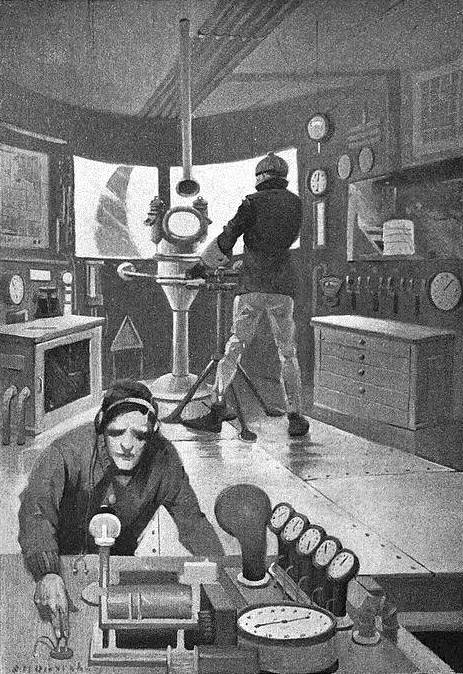
“At ten fifteen o’clock,” he described in his
story, “only a vast expanse of metal, cables and
truss could be seen vaguely as those busy about
the towering superstructure moved a torch or
climbed into or out of the mammoth enclosed
frame. Just before ten twenty o’clock an engine
started suddenly somewhere within the ship-like
body of the winged wonder. A little later, a brief
burst of light within the central enclosure threw
into sudden view two rows of flashing portholes.
Like the bow of a miniature ocean steamer, the
front of the shadowy structure stood, for a moment,
clearly defined in the night.
“Halfway up the side of the vessel extended
a railing-protected gallery that indicated two
decks. Along the lower of these ran a second gallery.
The forward part of the upper deck was
plainly a pilot house, from the rounded front of
which, through two small heavily glassed openings,
shot antennaelike feelers of light into the
black factory yard. Behind this section the skeletonlike
gallery led astern along what were apparently
three more rooms. Passing these, the
gallery ascended the rounded side of the giant car
and disappeared sternward in the form of a protected
path or bridge. The front of the lower
deck resembled the dark hold of a freight vessel.
In the rear, a door opening from this gallery revealed,
through a glare of light, an engine room,
now the center of much activity.
“Herein two young men hung over a puzzle of
levers, wheels and valves while a third was just
climbing into the gallery by means of a drop ladder
or landing stage.
“‘What’s the use of all this illumination?’
called the young man just mounting the machine.
‘Why not send out cards?’ he added, laughing.
“One of the boys in the engine room stuck his
head outside, glanced about and chuckled. As he
disappeared within again, there was a snap and
the lights outlining the air machine turned black.
Then came the renewed sound of feet hurrying
back and forth on metal runways; doors opened
and closed and, where deck lights had flooded the
strange craft, only the thin rays of electric hand
torches indicated persons moving about. One of
several men on the ground below now made his
way up the ladder to the landing stage and by
this to the lower deck gallery, where two of the
moving lights were suddenly focussed. Words
passed in low tones and, in a few moments, the
glow of a green-shaded light appeared through
the suddenly reopened door of the pilot house.
“Almost at the same time, but from the distant
offices of the aeroplane factory, broke out the
staccato of a wireless sender in operation. Those
on the lower gallery waited in silence until a voice
called from the pilot house:
“‘All right, Ned; fine and dandy; the operator
says success and speed.’
“‘Good,’ was the quick response. ‘Come on
down, Bob; we’re off.’
“As the light in the pilot cabin winked out, the
same voice continued, ‘Good-bye, Mr. Osborne.
We’ll be back in half an hour. Stay by the wireless.
We’ll keep in touch with you every few
minutes.’ ‘Good-bye,’ called another voice and
then the man who had just mounted the landing
ladder made his way quickly to the ground.”
When Stewart’s account of the aeroplane test
had reached this point, Dick, the copy reader,
shuffled the pages of the last “take” like a deck
of cards and snorted.
“This is fine,” he said, with a despairing look,
addressing Mr. Latimer, “but I thought he was
goin’ to tell something. Here’s six hundred
words and he hasn’t got anywhere yet—”
“Let it stand,” was Mr. Latimer’s snappy order.
“It’s good stuff.”
“Simultaneously,” continued Stewart’s story,
“the sound of the engine in operation deepened
into an almost inaudible note. Then this was
doubled as if a second power had been put in
operation. A shaded light shone in the engine
room and the pilot house door opened and closed.
There was the tap-tap of swift footsteps on the
lower gallery, one of those aboard sprang up the
steps to the top gallery and then a light flashed
at intervals along the ladderlike runway on the
rear truss. Some one was inspecting the shadowy
bridge.
“Far in the rear the hurrying figure dropped
through what seemed a small manhole in the truss
frame. Half within the tapering, spiderlike construction
the person appeared to press a button.
There was a sharp buzz in the pilot cabin. Then
the figure with the light ran swiftly forward inside
the hollow frame of the tail of the airship and
disappeared through a self-closing door into the
engine cabin.
“Two powerful engines were apparently in full
operation. There was the sound of a quick voice
in the engine room as if someone were shouting
through a tube.
“‘All ready here and astern, Ned,’ could be
distinguished. Then, at the resonant single tap
of a gong in reply, powerful clutches must have
been instantly applied. The aeroplane’s propellers
began their wide sweep. Faster and faster
they moved, until, as the closed engine room
door opened once more and one of the young men
passed out onto the gallery, the wide-reaching
metal bird suddenly sprang forward. But it was
only for a short distance. Within fifty feet, it
lifted in the air and, once off the ground, its bow
darted skyward like the beak of a frightened
bird.
“‘Don’t forget your lights!’ yelled the figure
on the gallery as the airship swept upward, ‘and
keep the wireless goin’.’ While he was speaking
the swift propellers had already carried the car
beyond hearing.”
CHAPTER III
THE VETERAN TAKES OFF HIS HAT TO THE CUB
The rest of reporter Stewart’s story of the
mysterious airship flight, together with his elaborate
account of the construction of the aeroplane
as it had been described to him, ran much over a
column. Old Dick, the copy reader, groaned and
even Mr. Latimer began to wonder how he was
to get his “beat” into two columns without “killing”
Chamber’s “talk” with Colonel Grant,
Winton’s account of the Airship Boys or Glidden’s “lead.”
The latter Mr. Latimer had already thrown out
conditionally but he was determined to use the
interview and the account of the earlier adventures
of the daring boys. There could be only one
solution of the difficulty: he must have more space
if he had to choke it out of the night editor.
Meanwhile, he began to put some pressure on the
wordy reporter.
“It’s good stuff, old man,” he said to the perspiring
reporter as the latter pounded his typewriter,
“but you know this isn’t a magazine and
other things have happened to-night.”
Stewart was only a beginner. As yet he knew
only a part of a reporter’s trade. He could write
but he hadn’t learned how to tell it in a “stick.”
The editorial admonition fell on him with little
effect. He seemed unable to omit any detail.
Page after page came from his machine to tell
how for twenty-five minutes the four or five men
in the Aeroplane Company yards waited for the
return of the flying car.
He told how a movable searchlight was stationed
at the landing place and how the watchers
then betook themselves to the wireless office of
the works. With good judgment he refrained
from telling how he concealed himself just without
an open window, and one reading his narrative
might conclude that the prying reporter
was a guest of the watchful group.
Some of the messages from the moving aeroplane
he heard and of these he told. Most of
them he missed, as his vantage point was somewhat
removed. He could tell that the busy wireless
operator was in almost constant communication
with “Bob” on the airship. But the most
important message he did hear, because when it
came the excited operator repeated it as if reading
a bulletin to anxious thousands.
“On board Ocean Flyer,” he read, “10.24 P. M.
Estimate forty miles from Newark at sea. Big
steamer beneath. Turning. Better time returning.
Look out. Bob Russell.”
It required but a moment’s calculation when he
heard this to make Stewart gasp with amazement.
At that rate the Ocean Flyer was doing one hundred
and eighty miles an hour. Not even this
speed had been predicted by his talkative fellow
workman. And at this rate he knew that the
marvelous airship might be expected in the Aeroplane
Company yards again by ten forty-five
o’clock.
The reporter made his plans at once. He knew
that it was both futile and inadvisable, if he was
to attempt to score his news “beat,” to wait in
an attempt to interview either the Airship Boys
on the aeroplane or to get more exact particulars
from the Aeroplane Company officials. Therefore,
making his way out of the yards, he hurried
along switch tracks until he was in the vicinity of
the street car terminal.
With watch in hand, he waited in the suburban
stillness and gloom while he searched the eastern
sky. He knew the Ocean Flyer carried no outside
signal yet he hoped for a possible glimpse of
the shaded green pilot or engine room light.
More than once he fancied he could hear the peculiar
low note of the big craft’s engines. And
all the time he kept an eye on the vertical shaft of
the searchlight at the works, for by this beacon he
knew the returning craft must guide itself to a
safe landing. But neither sound nor returning
light could he detect. When it was exactly a
quarter of eleven o’clock he began to regret his
attempt to save time and was debating the advisability
of returning to the plant. In doubt, he was
aware suddenly of a new note in the hum of the
mosquitoes and other marsh things about him.
Was it mosquitoes or was it the hum of the unseen
airship? The sound ceased suddenly. Almost
immediately the shaft of the warning searchlight
swept earthward and disappeared.
Instinctively the nervous reporter glanced at
his watch. It was a few seconds of ten forty-six.
A trolley car was just starting. With a gulp of
exultation the happy Stewart dashed forward and
flipped the car. He knew that the Ocean Flyer
had made a successful flight and had safely returned.
He knew also the distance it had traveled
and the time it had taken to do it. His only object
was now to call his office by telephone and
deliver the story. All these details his rapidly
written copy told later, omitting the personal
part. When it was complete a column of matter
was on Mr. Latimer’s desk.
As Stewart noticed the number of his last page
and realized how much he had written, he paused
aghast. The bigger part of his story was yet to
come—all the details of the ingenious creation
remained to be written. Frightened by his failure
to obey orders he hastened to Mr. Latimer’s desk.
Here, three tired and nervous men, with the marks
of a night’s grinding work on their faces and
linen—unlit pipes or half consumed, fireless cigars
gripped in their set teeth—were gathered in
sullen debate.
“There’s two columns of it now and more to
come,” the night editor was saying decisively.
“We can’t give you another inch.”
Mr. Latimer saw Stewart approaching.
“How much more of that story is there?” he
asked appealingly.
“A column, I think.”
The night city editor sighed and the telegraph
editor laughed sarcastically.
“Any one who can see three columns in an airship
story to-day must have forgotten they’re
already back numbers,” exclaimed this executive.
“Lift a column of cable rot,” suggested the
night city editor. “This can’t be cut; it’s a big
story and it’s a ‘beat’.”
“Give him the paper,” went on the telegraph
editor wearily.
“You’ll have to get along with two columns,”
answered the night editor, “unless you think the
paper is elastic or that we ought to have another
page.”
Mr. Latimer slapped the desk with the last
“take” of Stewart’s copy.
“You fellows don’t know news when you see it.
What does the average reader care about English
elections and French champagne riots? Every
man and boy in the United States is interested in
aeroplanes. And this story tells about the final
thing in airships. It’ll be read all over the world
to-morrow. It’s big, I tell you, and worth a
page—”
“That’s what they all say,” sneered the telegraph
editor.
“And I’m goin’ to print it all—every word of
it—if I have to take it up to the old man himself.”
“That’s your cue,” broke in the night editor
as he excitedly attempted to relight his dead
cigar. “That’s where you’ll have to go. You
don’t get but two columns from me.”
“It’s twenty minutes after one o’clock,” remarked
a sour voice from the near-by copy reader’s
desk. “If there’s any more of that Newark
stuff you’d better hump it along.”
Without replying, the night city editor tossed
old Dick the last of Stewart’s story describing
the departure and return of the Airship Boys’
newest wonder and then arose with fire in his
eyes.
“Give me all you can write up to two fifteen,”
he snapped to Stewart, “and—” Just then his
telephone rang.
“Yes,” he answered in a tired voice while the
telegraph and night editors yet lingered by his
desk. “Nathan? You seem to have taken plenty
of time for your supper. Well? Oh, they did.
All right. You don’t know where they are stopping?
Good-bye.” Then he arose and glared
once more at his nightly enemies—the telegraph
and night editors. “Winton,” he called sharply
to that reporter, who was sitting near by with his
feet on a table. “These Airship Boys left Newark
on the express just after Stewart. Nathan
says they’re in town. Take a flyer through the
hotels. Land ’em if possible. Make ’em talk.
Phone me if you locate them.”
“’S that mean more of this flyin’ machine
stuff?” grunted the head copy reader.
“It means I’m attending to my own business,”
retorted Mr. Latimer, and with no further word
or look for his office associates, he walked hurriedly
toward the door. As the sailor “goes to
the mast” or to the captain of the ship in a last
appeal against unfairness or injustice, Mr. Latimer
was on his way to the “old man” or the managing
editor on his customary protest against the
machinations of the night editor. Stewart hastened
to his typewriter and resumed his tale of
the aeroplane.
“The problem of how to build an aeroplane
large enough to carry passengers hundreds of
miles—possibly across the Atlantic—and at the
same time develop speed enough to hold its own
against storms, seemed unsolvable until two discoveries
were made last winter. Both of these are
now well known to scientists and both are unknown
as yet to the layman. It was the almost
simultaneous discovery of the new metal magnalium
(due to the development of the electric
converter by the steel works in Chicago) and a
final determination of the law of the propeller
by Professor Montgomery of California.
“With this new magnalium it is at last possible
to make an all-metal car with light but rigid wings
or planes. This metal, a magnesium alloy with
copper and standard vanadium or chrome steel,
at once assumed a new place in metals.” (These
facts Stewart had secured from a German metallurgical
quarterly in the Newark Public Library.)
“Magnalium is not only extremely light but it
has a molecular cohesion never before attained.
Its peculiar toughness gives it a capacity for being
worked slowly that is ideal for aeroplane
uses. It turns the edge of the hardest chisel
driven against it, yet the same drill, under slow
pressure, will cleave it almost as easily as aluminum.”
Marking this much of his new story “more,”
to indicate to the copy readers that more was to
come, and heading his next page “Add 1 Description
Aeroplane,” Stewart rushed the prepared
“take” of copy to the city editor’s desk and
continued:
“It is from this new metal that the car, planes
and truss of the Ocean Flyer are constructed.
The aeroplane is modeled in general after the
body and wings of a gull in full flight, insuring,
by its peculiar construction, not only the greatest
speed, but, by an ingenious adaptation of the
same gull’s wing, the automatic stability long
striven for by aeroplane builders.”
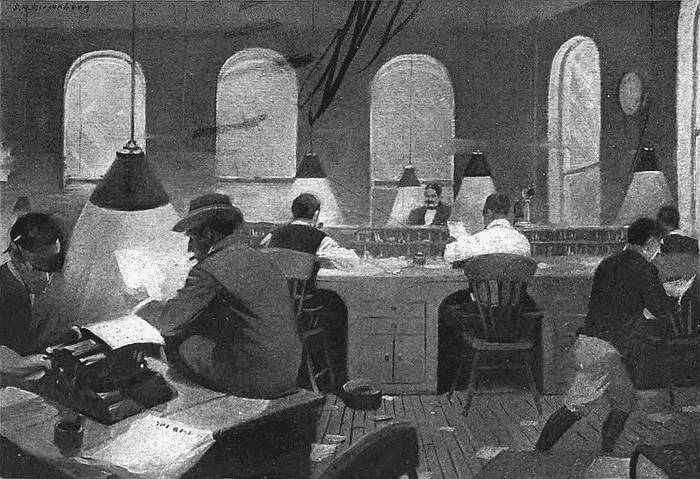
IN THE “LOCAL ROOM” OF THE NEW YORK HERALD.
“Three sets of follow or tandem planes project,
with slight dihedral angles, for from
eighty to forty feet on each side of the body of
the craft, a wing width never before attained.
Yet, in flight, the enormous craft is readily held
aloft, with all its load, by wings that are no more
than seven and one-half feet in chord—from front
to trailing edge. Although it will be incomprehensible
to many how such small lifting surface
can elevate such a heavy structure, this becomes
apparent when the airship is seen at rest. The
moment the air pressure due to rapid flight is
lessened to a certain point by descent or cessation
of motion, the narrow wing surfaces automatically
spread till they are twenty-one feet from
front to back.”
Glidden, the only airship man in the office, who
covered all the aviation “stunts,” had long since
finished his interview and was now lounging on
the desk next to Stewart’s.
“Great!” was his comment, as he read this
part of the story page by page. “Some one is
strong with the Jules Verne stuff. Go to it, kid.”
The busy Stewart scarcely heard him.
“This was accomplished,” went on the young
reporter, shouting for a copy boy and hustling to
the desk another section of the story that was
destined never to be printed, “in a simple manner.
Near the leading edge of each wing is installed
one of the new German pressure gauges
with small openings just under the dipping edge.
These small appliances, of compact construction,
are easily concealed in the depth of the wing.
Ordinarily these powerful gauges operate a needle
to record pressure. Those used on the planes
of the Ocean Flyer are made on a heavier scale
and operate directly on a spring drum. From
these, light cables extend to movable sections of
the wings.
“These movable sections of the planes, the first
unique feature of the new airship, telescope
within and without the standard sections of the
wings. By means of the gauge and spring drums
they are extended automatically when the machine
is not in swift flight. When the craft has
made an ascent and attained a speed sufficient to
create a vacuum under the dipping or front edge
of the planes, the suction or reverse pressure on
the gauges allows the drums to reel in the extension
surfaces. When in full motion, as these
come in, speed is naturally increased and all the
extensions are housed securely beneath or over
the main section of the wing.”
“How about the wing trusses?” broke in the
skeptical Glidden.
“Corrugated rigidity,” replied Stewart
promptly, remembering the phrase he had heard
applied to the long, untrussed wings.
“The first section or extension,” his story continued,
“running in its grooves, so closely overlaps
the outside of the main section as to appear
to be its proper covering. The rear section, with
separate leaves, like the feathers of a bird’s
wing, likewise disappears, leaving only the long
narrow wing which has always been the ideal
speed machine.
“To drive this huge craft, whose body consists
of two stories or decks with pilot house, staterooms,
fuel chambers, engine room, bridges
above and protective galleries, a much higher
percentage of motor power than ever secured before
had to be turned into propulsive energy.
The waste, or ‘slip’ of the ordinary propellers
not only allowed a great deal of the motor’s
power to escape, but it applied the remaining
power so far from the shaft of the propeller that
the resultant leverage greatly reduced the actual
thrust.” (As Stewart finished this sentence,
after several pauses and corrections, he turned
the page over to Glidden with some pride. Then
he paused while the older reporter read it.)
“Is that right?” asked Stewart with a curious
smile.
“Absolutely,” answered Glidden. “What’s
next?”
Stewart’s typewriter began clicking again.
“The new French ‘moon propeller’ does away
with this ‘slip’ and allows the full power of the
engine to be applied advantageously. Viewed
sidewise this new form of propeller looks exactly
like the new moon, its tips bending ahead of its
shaft attachment. Its object is to gather the air
at the outside of the circle,—”
“Periphery,” suggested Glidden, who was
reading over the writer’s shoulder. Stewart
made the change and continued: “compress it in
accelerating degrees as it is forced toward the
shaft and there, at the broad, ugly-looking middle
section of the blade, exert the full force of the
motor on the compressed air. The result is to increase
the efficiency of the engine by two hundred
and fifty per cent. The massive, eleven-foot propellers,
with a section five feet broad at the center,
give opportunity for the application of this
great force.”
“How about the engine?” exclaimed Glidden
as this paragraph was finished. His smile of
skepticism was not as marked now.
“This force,” continued the younger man, “is
secured by a chemical engine in which dehydrated
sulphuric ether and gasoline or either may be
used. Since the experiments with sulphuric
ether, made last fall, engine makers have watched
the rapid development of this form of engine
with the greatest interest. Magnalium cylinders,
sustaining the shock of the tremendous explosions
as the cylinders revolve past the exploding chamber,
have developed a power previously only
dreamed of. Each of the two huge engines used
on the Ocean Flyer is six feet in diameter with
four explosion chambers cooled by fans which
feed liquid ammonia to the cylinder walls in a
spray and then furnish power for its liquefaction
again. In form, each engine is a great wheel or
turbine on the rim of which is a succession of conical
pockets or cylinders. These are presented to
the explosion chambers, receive the impact of the
explosion and then, running through an expanding
groove, allow the charge to continue expanding
and applying power till the groove ends in an
open slot which instantly cleanses the cylinders
or pockets of the burnt gases. By this arrangement
there is only a twentieth part of the engine
wheel where no power is being imparted, thus
giving practically a continuous torque.”
“How’s ‘torque’?” laughed Stewart as he inserted
a fresh sheet of paper in the typewriter.
“Torque,” responded Glidden without even a
smile, “is exceedingly good. As to the rest of
your mechanical details all I can say is I take off
my hat to you and whoever handed you this. It
is exceedingly warm.”
“The joke of it all,” commented the other reporter,
who was not without his own sense of humor,
“is that these absurdities all happen to be
practicalities. There’s a little more.”
“Weighing 520 pounds each,” continued Stewart,
“and with a speed of 1,500 revolutions a minute,
these big turbines generate 972 horsepower,
natural brake test, and this may be raised to
above a thousand horsepower without danger.
Revolving in opposite directions they do away
with dangerous gyroscopic action. Power is applied
to the propellers by magnalium gearing.
These are geared up, instead of down, as has always
been the practice, and the new ‘moon propellers’
gain in thrust with high speed instead of
losing it. This is because of greater compression
of the air and a vacuum set up ahead of the blades
by reason of their high speed. The car itself—”
At this moment—now after two o’clock—Mr.
Latimer suddenly appeared at Stewart’s side.
“Needn’t write any more,” he said sharply.
“The story isn’t going to be printed. The managing
editor wants to see you at once.”
CHAPTER IV
THE AIRSHIP BOYS MAKE THEIR APPEARANCE
To be ordered to the office of the managing
editor in this summary manner at half-past two
o’clock in the morning was enough to set an older
reporter than Buck Stewart guessing—Buck because
his given name was Buckingham. Buck’s
first thought was that he would now be asked to
explain why he had persisted in expanding a column
story into twice that space. Somewhat to his
gratification Mr. Latimer escorted him to the
office of the head of the paper.
The young reporter had never even seen his distantly
removed superior. He had heard that the
august editor looked like a preacher. He knew
that the “boss” was one of the greatest journalists
in the world. Then, instead of speculating
on the cause for his summons, he began to wonder
how the “M. E.” happened to be in his office at
that late hour. The real reason was that the
editor had entertained friends at the theatre and
lingered long at the supper after. But in Buck’s
mind, it could only be because the books on “How
to be a Journalist” all said the real newspaper
man is always at the right place in a news crisis.
Without a question to his guide, the young
newspaper man deferentially followed Mr. Latimer
down the long, half-lit hall, through the
ground glass door into the anteroom where, in the
day time, a colored Cerebus sat in state, and
thence into the not over-large room of the director
of the great paper. The managing editor, in
evening clothes and a crumpled shirt, was slowly
exhaling the smoke of a cigar while he examined
a large wall map of America and Europe—tracing
with a long, white finger a curved red line that
marked some steamer course. On the approach
of Mr. Latimer and Stewart, the editor turned,
motioned Buck to a chair and seated himself in
the one at his own desk. There was no introduction.
The night city editor took a leaning position
against a big table in silence.
“This is Mr. Stewart, I believe,” the managing
editor began with a smile as he leaned forward
and nervously tore a strip of paper into bits. The
smile rather increased Buck’s alarm. He was
sure he was in for nothing but criticism and the
smile made him fearful that this was to come in
ironical words.
“Yes, sir.”
“You discovered this new aeroplane—wrote
the story about it?”
“Mr. Latimer sent me out on it. I tried to
write a story but I guess—”
“At least you know all about it?”
“I think so. Yes, sir. There are some things
I couldn’t learn, but I found out considerable.”
“And it was made by the young men they call
the Airship Boys?”
“Yes, sir.”
“Do you think any one else knows what took
place to-night?”
“I’m sure no one does.”
“Or the details of the new airship; the nature
of it and what it can do?”
“They seem to be trying to conceal everything.
I think no outsiders knew anything about it.”
“And this machine can travel at the rate of
one hundred and eighty miles an hour?”
“It did it to-night and kept it up for twenty-five
minutes.”
Buck’s questioner leaned back in his chair and
gave Mr. Latimer a peculiar look. He seemed
about to speak to his assistant but turned toward
young Stewart again, took a long, reflective puff
on his cigar and continued:
“Have you any reason to believe this machine
could cross the Atlantic?”
“I think it could. I believe its makers think so.
They call it the ‘Ocean Flyer.’”
What had been a smile on the editor’s face
turned into straight, set lips. Again he turned to
Mr. Latimer.
“These boys are somewhere in the city you
say?”
“Newark says so,” was the night city editor’s
prompt response as he slid from the table and took
a step toward the desk. “Nathan says they came
in from Newark on the midnight express. I’ve
got a man out after them now.”
“Haven’t heard from him?”
Mr. Latimer stepped to his superior’s desk and
took up the telephone.
“See if Winton is back yet,” he asked sharply.
“Mr. Winton called a few minutes ago,” was
the instant response from one of the switchboard
operators. “He says them parties is at the Breslin
but he ain’t seen ’em yet. He wants as you
shall call the Breslin what he shall do.”
Mr. Latimer turned to the head editor, the telephone
yet in his hand:
“Yes, sir; they are at the Breslin. Our man
hasn’t seen them. They’ve probably turned him
down.”
The managing editor thought a moment, in
which interval of silence he relit his cigar and
then nodded an approval.
“That’s all,” answered the night city editor to
the operator, “no message now.” And he replaced
the receiver. Mr. Latimer’s attitude
seemed to indicate that he knew something important
was about to happen. Buck, himself—only
temporarily relieved that the storm had not
yet broken on him—also cudgeled his brain to account
for his interrogation.
“You’ve stopped the story?” continued the
managing editor at last.
“Yes, sir,” answered Mr. Latimer ruefully,
“although most of it is in type. It was a beat.”
“I understand,” said the editor instantly and
in a consoling tone. “Perhaps we can get a bigger
beat.” He began tearing another bit of
paper. Then throwing the pieces suddenly from
him, he sat upright, grasped the arms of his chair
and said to Latimer:
“I must see these boys to-night—at once if
possible. Can you bring them to me? To this
office?”
“Certainly,” replied the night city editor without
a falter or a doubt in his voice. “I’ll go myself.”
“Get them if you can; it is important.”
Without a question Mr. Latimer hastened doorward.
Stewart arose to follow him. The managing
editor waved Buck to his seat again.
“I want you to tell me the story you wrote to-night:
all you know about this new airship.”
Buck now made up his mind that, whatever
might be the meaning of the managing editor’s
sudden interest in his aeroplane story, it was not
directed toward him personally either in the way
of commendation or criticism. Something had
developed the possibility of a bigger “beat,” the
manager had suggested. As the reporter received
the order to tell the whole story he reseated himself.
He also had a new thought: “This means
something good,” he said to himself, “and while
I’m talking I’m not goin’ to forget Buck Stewart.
If something is to come out of this I want
to be in on it.”
Before he could begin his story his chief executive
resumed, suddenly:
“These Airship Boys—did you see them?”
“No,” replied the reporter. “I was totin’
lumber in the yards—”
“You are from the south?” interrupted his listener.
“Kentucky,” answered Buck.
“How long have you been with the Herald?”
“Six months.”
“You are about twenty-one years old?”
“Twenty in the fall.”
“How did you get your job?”
“I worked on the Paducah News-Democrat
until I had money enough to get to New York.
Then I came here and asked for work. They put
me on.”
“Right away?” went on the managing editor
with an incredulous smile.
“No, not at once. I think it was after two
weeks.” Buck became a little embarrassed and
shifted his position. “At first the city editor told
me there wasn’t any chance; that he couldn’t
even try me out until I’d had some city experience.
I told him news was news, whether it was
in the ‘tenderloin’ or in Paducah. But he didn’t
seem to hear me. Then I found out when the city
editor came to work and I showed up at the same
time each day for two weeks. He was pleasant
enough for a few days. Then he began to look
bored. At last he used to scowl at me.”
“Then what?” laughed the editor softly.
“Well, one day he seemed more out of sorts.
He looked as if he had a notion to kick me. Then
he groaned and said ‘report to Mr. Latimer to-night
and keep out of my sight.’ I haven’t seen
him but two or three times since.”
The editor seemed to chuckle but Buck could
not be sure. Then the manager returned to the
Airship Boys after a few moments of silence.
“What do you know about these young men,
the Airship Boys?”
“Only what I’ve read,” was Buck’s answer.
“They’ve been in the papers for several years.
They are from Chicago.” Then he recalled Winton’s
assignment—the sketch this reporter had
made of the young aviators to be used in the now
abandoned story. “There’s a story of them in
proof by this time, I think,” he added. “Mr.
Winton wrote it to use in the morning.”
“Get it for me, if you will,” said the editor.
“And the proof of any other matter on this story
that has been set.”
In a few minutes Buck was back with a handful
of Mr. Latimer’s proofs. As he passed through
the big local room he noted that it was two thirty-five
o’clock. The managing editor was lighting a
fresh cigar when he returned and was again on
his feet intently examining the big wall map, the
principal part of which seemed to be the Atlantic
Ocean.
“Ever been abroad, Mr.—Mr.—?” was the
editor’s rather irrelevant greeting to Buck as he
reentered the room.
“Yes, sir, to England,” was the reporter’s response.
Buck did not bother about reminding
the great journalist that his name was Stewart.
His questioner, whose head was twisted sideways
as if he were trying to make out the printed words
or figures on the scores of steamer routes, looked
up in surprise. “My grandfather lives in London.
I’ve been there twice with my mother.
When I was fifteen I rode a wheel from Liverpool
to London. We spent a summer there.”
The managing editor looked Buck over as if
making an inventory of him.
“Is your story in proof?” he asked at last as he
returned to his desk and picked up some of the
proofs.
Buck, standing by the editor’s side, began nervously
to look over the galley slips. Some were
yet damp. The more experienced eyes of the
older man detected Winton’s story of the Airship
Boys. Extracting it from the bundle he passed
the other slips back to the reporter and gave his
own attention to Winton’s “insert.”
“The Airship Boys,” the story began, “now
known everywhere in America, are not unknown
in Europe. Ned Napier and Alan Hope, who first
attracted attention under this pseudonym, are
Chicago products. Robert Russell, who, from
constant association with Napier and Hope, is
now generally reckoned as the third of the trio
who have gained fame under that title, is the oldest
of the three and hails from Kansas City,
where for some time he was a reporter on the
Comet.
“The greatest achievement of Napier, Hope
and Russell was the creation, elaboration and institution
of a system of aerial navigation which
resulted in the present Chicago-New York air
line.”
“I see that one of these young men, Russell, is
a newspaper man,” commented the editor, lifting
his tortoise-shell nose glasses inquiringly.
“Yes, sir,” answered Buck, “and a good one, I
guess. Winton knows him. Met him in New York
last summer when Russell and Napier and Hope
were here floating the New York-Chicago airship
line—the Universal Transportation Company.
You remember the ‘Flying Cow’ mystery, sir?”
“And these are the youngsters?” exclaimed
the editor with new illumination, replacing his
glasses and resuming his reading.
“Napier,” Winton’s account continued, “is the
son of a Chicago lawyer—now dead—who was an
amateur aeronaut. The father became interested
in dirigible balloons about four years ago and contracted
to make one for an amusement park.
The father dying before the completion of the
contract, his son Ned assumed it, finished the craft
and then undertook to operate the balloon.
Through a series of adventures he attracted the
public eye and his career began.
“Early in the following year Napier and a
chum, Alan Hope—a lad of mathematical turn—were
employed by an ex-army officer, Major Baldwin
Honeywell, to construct a large balloon—one
capable of a five-day flight—for the purpose of
locating a hidden Aztec temple in Navajo land in
Arizona. In this adventure Robert Russell, then
representing the Kansas City Comet, joined the
boys and when the details of this highly interesting,
novel and profitable project reached the
public the title of the ‘Airship Boys’ was coined
by the newspapers.
“It was in this flight over the mountains and
desert that liquefied hydrogen was used for inflation
purposes, probably for the first time. Although
the big balloon used at this time was left
in the mountains it was rescued later by a second
expedition organized in the same year. At this
time young Napier and Hope encountered one of
their most marvelous adventures. While they
were attempting to ascend from one of the mesas
of Navajo land, their balloon was caught in an
aerial maelstrom, swept westward to the Pacific
Ocean and finally wrecked on a water-logged derelict
lumber vessel. On this, within ten days, the
young aeronauts turned aviators by constructing
an aeroplane out of the remnants of the car of
their dirigible balloon.”
Buck had what proofs he could find of his story
and stood waiting but the managing editor leaned
a little further toward his desk light and continued
to read.
“Escaping from the abandoned wreck, the improvised
aeroplane made a three hundred mile
flight to land and came down in the highlands of
Mexico where the daring aviators added further
flavor to their novel experiences by rescuing a
blind man, long a prisoner among an unknown
tribe of Mexican Indians, and preventing his immolation
as a human sacrifice on the summit of
a prehistoric pyramid.”
The absorbed editor paused and, without lowering
the slip he was reading, glanced at Buck
over the top of his glasses.
“Are you familiar with the story of how these
boys made an aeroplane on a wrecked vessel in
the Pacific?” he asked.
“Yes, sir,” responded Stewart. “It has been
told in the newspapers. There are several books
about it and other adventures of these young
men.”
“I wish,” continued the editor, “if you know
the titles of them, that you would step into some
book shop to-morrow and have all of them sent
to me.” Then he resumed his reading.
“In the summer of the following year the Airship
Boys, including young Russell, the reporter,
sailed from San Francisco on a novel Arctic trip.
One of the backers of this expedition was Major
Honeywell and another was J. W. Osborne, of
Boston, a millionaire manufacturer interested in
copper mines in North British America. For
traveling over the ice a dirigible balloon was carried
along. The car of this was a practical
aeroplane and ice yacht. This little-heralded
dash to the north is said to have reached to within
a few miles of the pole. The return was made by
way of northern British America where the aeroplane
part of the aeronautic outfit was used to
discover a marvelous copper mine on an uncharted
island in Coronation Gulf.
“Out of their interest in this mine and the profits
of their previous flights, the Airship Boys
were able to take up the study of scientific aeronautics.
This resulted in several marvelous inventions,
including the ‘rocket’ engine of ‘Flying
Cow’ fame and the subsequent organization last
summer of the Universal Transportation Company
which was underwritten by J. P. Morgan &
Co. Little has been heard of the celebrated aviators
since then. That they have not been idle the
above story attests.”
When the managing editor finished the galley
proof of this brief account of Ned Napier and his
chums, he removed his glasses, lighted his cigar
once more, reached out his hand for Buck’s story
and then laid it on his desk.
“Tell it to me yourself, briefly,” was his order.
“If you ever read what I wrote,” began Stewart
attempting to conceal some chagrin, “the
‘lead’ isn’t mine. I guess it was rotten. Some
one rewrote it.”
The listener only nodded his head and waited,
smoking slowly and swinging his glasses expectantly.
Thereupon Buck began and, much better
than he had written it, told the story of the new
aeroplane: how he had secured work in the plant,
ingratiated himself into the confidence of the
workmen, used his eyes and ears and finally witnessed
the night ascent. In the midst of his rapid
narrative the telephone rang. The listening man
responded, smiled, replied in approval and then
returned to the graphic narrative. Toward the
close of the description the editor arose. As
Buck finished, the editor laid a hand on his shoulder
in silence. Then, as if recalling the written
story, he stepped to his desk, picked up the proof
and gave it swift inspection. Without reading it
all he turned to the young reporter.
“I don’t know what your wages are, my boy,”
he said kindly, “but whatever they are, they are
now doubled. It is probably the last time any of
your copy will have to be rewritten. I am glad
you are on the Herald. Good night.” He held
out his hand. “Don’t think your unprinted story
is wasted. I may want to see you to-morrow.”
As Buck, his cheeks aflame, shook hands there
was the sound of footsteps in the next room.
“Thank you, sir,” Buck began. But he found
no time to say more. The door was thrown open
and Mr. Latimer and three young men entered
the office. The sudden invasion threw the retiring
reporter into the background. And yet, before
he closed the door on himself, he paused a moment
to observe the managing editor hastening
toward his visitors.
“Mr. Napier, Mr. Hope and Mr. Russell,”
announced Mr. Latimer in a tone that was not
without a little pride.
“Clear the stage for the real stars—the Airship
Boys,” said Buck to himself and closing the
door, he hurried down the hall.
CHAPTER V
A BEWILDERING PROPOSITION
There was no marked sign of cordiality in Ned
Napier, Alan Hope and Bob Russell as chairs
were brought from the anteroom and the Airship
Boys were asked to seat themselves. It was three
o’clock in the morning (the giant presses below
were just starting on the big last edition of the
paper) and the visitors were yet to be given an
explanation of why they had been asked to get
out of bed after but two hours asleep, and hurry
by taxicab to the office of the Herald. Even their
brief rest had been broken into by reporter Winton’s
persistent telephone calls. Not even the
just before dawn coolness of the streets had
aroused the boys into daytime alertness.
“I am obliged to you, gentlemen,” said the
managing editor after the conventional salutations.
“I would have come to you myself, but the
matter in hand is so new to me and so important
that I am just now prepared to talk to you intelligently.
What I want to discuss with you I had
not heard of at one o’clock. I have been studying
it ever since. I hope you will pardon me.”
Napier—just between boyhood and young manhood—spoke
for the visitors. The slight frown
on his face relaxed.
“We have no idea what this business can be,”
he responded with a smile, “but of course it is
no foolish errand. If we seem a little stupid
please have patience with us. I’m hardly awake
now.”
“Thank you,” responded the editor. Then he
paused while he carefully scanned each member
of the party. As if to gain further time in which
to frame his ideas into words, he offered his cigar
case. Only Bob Russell and Mr. Latimer accepted
a cigar. In the interval of lighting these,
Ned and Alan adjusted their disheveled clothing.
In age, Alan was slightly older than his chum.
Russell had just attained his majority. Each
boy was typically Western. All were in comfortable
light clothing and soft shirts, the former
trim and natty enough originally no doubt but
now somewhat sagging in the pockets because of
note books, pencils, pens and folded papers.
Ned wore a new straw hat, Alan had thrown off
a cap, and Bob’s hat, on the table, was a felt, light
and soft after the Western style. A fresh spot of
oil on Ned’s light coat seemed to annoy him,
probably because of the formal and spotless
attire of their host. The main differences between
the boys were in their faces. Russell had the imperturbable,
frank—even bold stare of the typical
reporter, which was only lost when he smiled.
Napier’s, boyish and yet intense, wore at times
the soft look of a dreamer or poet. Hope, always
alert and quizzical, had not even smiled as yet.
Alan’s character was well indicated by Ned’s
frequent phrase: “the boy wonder who has to be
shown.”
The managing editor’s examination of the
three young men did not seem to make his coming
explanation any easier. “They were just three
boys,” he explained later to a friend, “but I
knew in a moment they were not ‘kids’ mentally.”
While Ned coolly smoothed his hair the editor
finally began.
“I may as well be frank as a preliminary.
The Herald is in full possession of the facts concerning
what has taken place this evening.” Not
a boy batted an eye.
“If you don’t mind,” said Ned in the pause
that followed, “would you be a little more explicit?”
“I mean that a Herald reporter watched the
Ocean Flyer leave the Aeroplane Company’s
yards to-night and saw it return twenty-five minutes
later. We are advised that it traveled forty
miles seaward and returned safely at a rate of one
hundred and eighty miles an hour. We have reasonably
full details of the construction of your
new airship and, I believe, exact accounts of its
unique features—the triple tandem planes, their
automatic adjustment, the new ‘moon propellers’
and the enormous turbine sulphuric ether
engines.”
There was a silence following this speech that
was dramatic. As if schooled for such emergencies
not one of the three boys looked at the
other. When the silence was broken it was by
Ned.
“As you say, your information is reasonably
correct.”
Another pause followed.
“I assume,” continued the editor, “that you
recognize that these facts make a good newspaper
story, particularly when they are known to
one paper alone.”
The first response to this came from Bob Russell,
the reporter. But it was not spoken. Recrossing
his legs, he thrust his hands deep in his
coat pockets and gazed determinedly toward the
ceiling.
“And I assume,” spoke out Alan Hope at
last, “that you did not call us here to tell us
that.”
“Incidentally,” said the editor at once. “I may
add that, despite the excellence of this story as a
piece of news, the Herald is not going to print it.
Here,” he added picking up the bundle of proofs
from his desk, “are the proofs of nearly three
columns of matter telling this story. It is in type
and ready for the press. The last edition of the
Herald is now on the street without a word of it.”
The surprise caused by this statement seemed
almost as great as that caused by the editor’s first
speech. Still the cautious boys gave no outward
signs of deep concern.
“Perhaps I ought to return your frankness,”
said Ned at last after it had become doubtful who
would speak next. “When we entered your office
I suspected just what you have told us. The
young man who left it as we came in, I recognized.
He is a skillful reporter. We thought we owned
our new car and its ideas. At least we paid considerable
money to develop them. We also had
reasons of our own why the matter was not to be
made public. The Herald has been clever enough
to get our story. I suppose we are helpless.”
The managing editor waved his hand as if this
sort of irony was an old story to him.
“You don’t want the story printed?” he said
laconically.
“We do not,” replied Ned in the same tone.
“We are not printing it.”
Ned bowed his head as if to say: “Well, why
not?”
“Let me be still franker and ask you: ‘Why do
you object to the story being printed?’”
“Perhaps,” answered Ned, “if I may be
equally candid, that is our business.”
The editor smiled unmoved.
“Are you not curious as to why I suppressed
it? Why I did not see fit to print it?”
Not one of the boys, apparently, had taken this
view of the situation. All, at once, felt a little
abashed.
“I think I’ll have to ask your pardon. Of
course you had a reason.”
“Purely selfish,” was the quick response of the
manager. “Let me ask you one more question.
Your secrecy suggests some particular plan or
purpose. Do you care to tell me what that is?”
“It is a long-concealed secret,” explained Ned
after a look at Alan and Bob. “I don’t see just
why we should talk now!”
The head of the Herald nodded as if in entire
approval, leaned back in his chair for a moment
and then, much as if it had been under discussion,
remarked:
“At the speed you have secured and with the
protected car the Ocean Flyer carries, why don’t
you cross the Atlantic?”
Ned eyed his questioner a moment and then,
with a glance at his two chums, broke out laughing.
“And make good our name?” he asked, apparently
glad to get into his usual vein of joviality.
“And make good your name,” repeated the
editor.
“Perhaps we may,” went on Ned impulsively.
“Now that you’ve betrayed me into that
confession, whatever you do with your story of
our new machine, I hope you’ll say nothing of
this. That is our object.”
“To reassure you,” answered the editor, “I
have only to tell you that I hope your secret will
be the Herald’s.”
“What do you mean?” broke in Alan.
“You can cross the Atlantic, you ought to cross
the Atlantic and I hope you will cross the Atlantic—for
the New York Herald.”
“For the Herald?” exclaimed Bob. “For a
prize?”
The editor nodded his head.
“Not for a prize,” he replied soberly, “but on
a news assignment—the biggest news ‘beat’ ever
pulled off by a newspaper.”
The Airship Boys forgot the irritation of their
abrupt summons, the chagrin over their stolen
secret and all the languor the late hour had been
working on them. With hurried glances at each
other they faced the managing editor wonderingly.
In the silence a book dropped from the
table with a crash. Night city editor Latimer
had fallen against it and stood with bulging eyes
and mouth agape. Not until that moment did
even he suspect the plans of his chief.
“A news assignment?” mumbled Ned finally.
“I don’t know how much thought you have
given the possibilities before you,” answered the
editor, “but I have thought very hard on the subject
for an hour. As I understand it, your metal
airship can maintain a speed of one hundred and
eighty miles an hour for a protracted period. It
is, in a direct great circle course, a little over
three thousand miles from this city to London.”
“Which we could cover in seventeen hours,”
boasted Alan.
“Precisely,” went on the editor. “In other
words, for our purposes, you can cross over in
twenty-two hours and come back in twelve hours
or less.”
“Twelve hours or less?” exclaimed Mr. Latimer
speaking for the first time.
“Certainly, in a way,” laughed Ned. “There
is a difference in time you know of five hours
coming west. We gain that. We’d be in the
air seventeen hours actual time but by the clock
not over twelve hours.”
“For instance,” interpolated the managing
editor, “if the Ocean Flyer left London at two
o’clock in the afternoon and came to New York at
the rate of one hundred and eighty miles an hour
it would reach this city in seventeen hours. Allowing
five hours for the difference in time, instead
of reaching here at seven o’clock the next
morning it would arrive when our clock hands
were pointing to two o’clock.”
“In the same way,” explained Alan, “we would
have to add five hours to our clock time going
east. That is,” he added edging forward in his
enthusiasm, “if we left New York at two o’clock
in the afternoon, instead of reaching London
seventeen hours later or at seven in the morning,
the clocks would be striking noon when we got
there. Oh, we’ve figured all that out many
times.”
“That being true,” resumed the managing editor,
“and this marvelous annihilation of space
and time being at last a possibility, as I conceive
it, I have decided that the Herald ought to
assist in announcing the fact to the world by giving
a practical illustration of what may some day
be a commonplace.”
“You mean the Herald wants to share in the
glory of our ocean flight if we make it?” asked
Ned, his brows knitted.
“I do,” was the response. “You boys have
the airship that can do this and I think you have
the daring to try it. If you do it with no other
purpose than to show that a flight across the Atlantic
is a possibility, you will get for it glory
and fame—both empty rewards. Cooperate with
the Herald and I will see that your success brings
you not only fame but substantial pecuniary reward.
The Herald is prepared to pay you, not a
reasonable sum but an extravagant reward.”
“What if we are satisfied with fame alone?”
asked Ned.
“It will not be less because you act for the
Herald.”
“What is there in it for your paper?” asked
practical Alan.
“Let me finish my proposition,” continued the
editor drawing his chair forward into the half-circle
of alert boys. “By the way, the Ocean
Flyer is finished and ready for flight at any time,
I take it?”
“Practically so,” answered Alan guardedly.
“This is Thursday, June 17. One week from
to-day King George V will be crowned King of
England. It will be a ceremony that will attract
attention throughout the civilized and savage
world. As a news story, it is an event to test the
news-gathering ability of the greatest newspaper.
The dramatic repetition, on a modern stage, of
feudal forms and priestly rites, may never again
be repeated. The Herald’s best writers are already
in London. Our photographers are now
there to graphically illustrate the unique picture
of royal pomp and power. It is the aim of the
Herald on this occasion, as on all others, to present
a better story, a fresher narrative and more
perfect pictures of this event than any other
newspaper in the world.”
“Not counting the London Times?” suggested
Bob as the editor paused.
“Not counting the London Times!” repeated
the great journalist slowly and significantly.
“And to-night I have decided that we can do this
with the assistance of the Airship Boys and the
Ocean Flyer.” The speaker now showed his first
enthusiasm. As he gripped the arms of his chair
he continued with precision. “I want the Ocean
Flyer to leave London at two o’clock on Coronation
Day, June 22, and bring to the Herald office
in New York the best writers covering the coronation
and the photograph films made of the royal
procession and such other pictures of the actual
coronation as our photographers may secure. I
want these men and pictures delivered at the
Herald office or its vicinity by two o’clock the
next morning. If you can and will do this you
may name your own price.”
It would have been difficult to tell on whom this
astounding proposition fell with the greatest surprise:
the Airship Boys or Mr. Latimer, the
night city editor. The latter’s immediate wonder
seemed to turn almost at once into an envious
admiration for the man who could conceive such
a bewildering idea. In this, he was apparently
joined by Bob Russell upon whose face there was
a frank look of exhilarating amazement. Alan,
elated but puzzled, turned slowly to Ned. The
latter gazed at the author of the daring conception
as if partly hypnotized.
“That is the reason I killed to-night’s story,”
continued the editor in a low voice. “I could not
take the chance that another newspaper might
attempt to do the same thing. Only those in this
room know what is possible. We can make this
effort in secret. What you planned to do you
will do. What I propose will only add to the
glory of your success.”
“It is not easy to give you an answer,” almost
whispered Ned at last as he wetted his lips. “It
upsets all our plans and we have had no time to
consider it.”
“Do you want time for that?”
“It’s a tremendous thing to decide in a few
minutes.”
“Is it the amount of compensation?” asked
the elder man.
“I think that will not decide us.”
“What is it that makes you hesitate?”
“I hardly know. Alan,” said Ned turning to
his chum, “you haven’t said anything.”
But Alan made no reply. Gazing at the floor,
he sat as if lost in thought.
“You could carry these men; two writers and
a photographer?” asked the editor.
“Oh, there’d be no trouble about that; that
many and enough persons to operate the car. I
think we could even give the photographer a
dark room,” answered Ned. “What do you say,
Bob?”
“I’m on from the start, if you put it up to
me,” exclaimed Russell who had now wholly recovered
his equanimity. “We could do it without
turning a hair.”
Every one smiled, while Ned drew his chair
closer to Alan’s.
“Let me add another detail,” resumed the editor.
“On the day before the coronation the evening
edition of the Herald will print a special
coronation edition—American tributes to the
King and Queen. Two sets of the stereotype
matrices of this edition will be made at two
o’clock that day. These are paper and light, as
you know. On your eastern flight you will carry
these to the office of a London paper and deliver
them at noon of Coronation Day. With the London
evening papers we will issue the complete
New York Telegram of the day before.”
The listening, newly excited boys all arose and
stood together. Mr. Latimer walked to the window
and raised the shade. The soft gray light of
a June dawn flooded the room and paled the
yellow electric lights. It was four o’clock. A
sleepless night had left its traces on all. The
managing editor was again tearing a paper strip
into bits. The night city editor turned out the
light bulbs and, biting at his short mustache,
walked nervously back and forth. Suddenly the
editor brushed the torn paper from his lap, arose
and went to the big wall map. The three boys
followed him.
“We had planned to start from St. John’s in
Newfoundland,” Ned began in a tired voice.
“The distance from that point to Fastnet Light
or Cape Clear in Ireland is less than seventeen
hundred miles. That was our plan. It seemed
to us to be a big thing to undertake.”
The editor did not argue. Turning to the map,
his form straightened. A smile of assurance
seemed to blot out the traces of night. With a
sweep of his arm he described a wide curve from
New York to London. His smile deepened.
Dropping his other hand on Ned’s shoulder he
exclaimed:
“There is your real course. You are next to
one of the greatest achievements ever accomplished
by man. Do it or attempt it in good faith
and the Herald stands ready to pay you $50,000.”
The figures were staggering but the three boys
were now almost beyond fresh sensations. While
no one spoke, Mr. Latimer threw up a window.
A wave of cool, fresh air that burst into the room
seemed to arouse the bewildered boys more than
the editor’s last words. It was day and time for
clearer thought. As the hesitating boys turned
to drink in the refreshing air, on a sudden all was
decided. The telepathy of boy comradeship
passed the message without spoken words.
“We don’t want the money unless we do what
you ask,” said Ned turning to face the managing
editor, “but we’ll try to do it.”
“Thank you, gentlemen,” exclaimed the worn
editor. “Say that we meet at the Knickerbocker
at one o’clock for luncheon and then to business.
Good night.”
As the three boys took their departure the
editor seated himself at his desk again and
reached for a pad of cable blanks.
CHAPTER VI
AN OLD HOME AND A MODERN BUSINESS
The full significance of this unique proposition
did not appear to the Airship Boys until they had
cleared their brains with several hours of sleep.
In the preceding few days, as the Ocean Flyer
came to completion, the three boys had put in
long hours at the aeroplane factory. And the
final test—the flight in the dark to sea and back—had
been a strain that left them exhausted and
ready for rest. Losing this by being aroused
from bed at two o’clock, put them in a nervous
and easily irritated condition. There was little
time given that night to a consideration of what
was to come.
This was not true of the man who had suggested
the daring venture. Long after the boys
had left him and while they were soundly asleep
in their near-by hotel, he remained at his desk
elaborating his plans and taking further steps
towards their early execution. Long cablegrams
in cipher accumulated on his desk. These were
to the London office and mainly devoted to instructions
and injunctions to the men already in
the field and at work on the coronation program.
Many of his messages asked questions necessary
to an intelligent cooperation between the
aviators and the London representatives. Not
the least important was the one asking for a description
of the best landing place and an account
of land marks and signals by which this might
be easily discerned. Motor cars were to be in
readiness to carry the matrices of the special
edition to Fleet street, special police permits were
to be secured and arrangements made for the
printing and circulation of the transported paper
in London.
At ten thirty o’clock the next morning Ned was
taking his bath. Remembering their luncheon
engagement with the managing editor of the
Herald he looked over his unpressed clothing
with a smile. The oil spot on his coat seemed
even bigger than it had the night before. The
fact was the boys had come to New York unexpectedly
and had meant to return to Newark on
the noon train. The new aeroplane having demonstrated
the complete success of their latest
ideas it had seemed right to report their experience
to Major Baldwin Honeywell, the treasurer
of the Universal Transportation Company and
their closest adviser.
“We’ll have to get a move on us to see Major
Honeywell before noon,” exclaimed Alan who
soon joined his chum. “What do you suppose
he’ll say about it?”
“What do you say yourself?” asked Ned as he
manipulated the big bath towel. “It comes to me
like a dream.”
“I’m afraid we didn’t give it enough consideration,”
answered the other boy. “I’m not so
warm in my feet on the subject to-day.”
“That’s all right,” panted Ned. “You’ll
work into it. I think we did the right thing. We
meant to try to do it anyway. Why not have an
object?”
“And $50,000,” added Alan.
“That’ll help some,” replied Ned. “Advertising
must really pay,” he continued, “when a
newspaper gives up that much money just to
make the world talk about it.”
“How can a paper afford it?” mused Alan.
“It could transmit by cable all the copy those
men can write coming over; and cheaper and
quicker too.”
“But the pictures!” suggested Ned. “That’s
what it’s really for. That’s the big thing.
They’ll stand out like the first telephone or the
first electric light. I reckon the stuff the Herald
reporters write on the Flyer may seem fresher
and better but you can bet the pictures are what
the paper is after. They’ll beat the other papers
by six days. You know what that means.”
“What’s what mean?” sang out Russell,
flouncing into the room. “Mornin’, gents. Hustle
along. I’m starved.”
He was told what Ned had been discussing.
“It means that the publication of those pictures
the next morning—pictures made at noon
one day in London, printed the next morning in
New York—will put a crimp in every other sheet
in New York. Those are the things that give a
newspaper a place in history. It’s the way one
newspaper gets to be known above another,” volunteered
Bob.
“How about us gettin’ a little place in history?”
asked Ned as he got into his clothes. He
held up his rumpled trousers. “We may get a
place in history,” he went on laughing, “but it
won’t be in the ‘History of Fashions.’ We’re a
fine bunch to be dining at the Knickerbocker in
these togs.”
“Don’t you bother about your clothes,” broke
in Alan. “We’re not parading to-day. All you
need worry about is that $50,000 contract.”
“And breakfast,” added Bob. “A little coffee
and a cool cantaloupe’ll set you up. By the
way,” he added with a new laugh, “you can get
a new outfit in London—some o’ those swell Piccadilly
rags.”
“I suppose you know how long we are to be in
London?” interposed Alan. “An hour or less.”
“That’s all right,” persisted Bob, “buy ’em
ready made. If they don’t fit that’ll be one proof
we’ve been to England.”
“Well,” exclaimed Ned with another look of
disgust at his grease-spotted coat, “I’m ready.
Now for some breakfast. Then we’ll hurry over
and have a talk with the Major. After that,
we’ll meet our new friend at the Knickerbocker.
Meanwhile, get your heads working. There are a
lot of details to be arranged—if the Herald don’t
change its mind—and we’ve got just six days in
which to get things ready.”
Seated in the Breslin Hotel restaurant—the
busy Broadway throng passing just outside the
window—while melons, cereals and ham and eggs
fell before the attacks of the three boys—each
individual head began “working.”
“First and most important,” began Alan, “excepting
the details of the contract of course,
we’ve got to decide how we are to get away with
those matrices; that is, how are we to pick ’em
up without losing the time to send ’em over to
Jersey or out to the suburbs? We certainly can’t
make a landing at the Herald office in the city.
And if we can’t do that in New York we can’t
do it in London. Where do we land in London
within a few minutes motor run of Fleet Street?”
“And we’ve got to have a fourth man,” added
Bob. “Are we going to select him or will the
Herald want to send one of their own men?”
“Those things’ll work out,” exclaimed Ned.
“But they’ll have to be worked out and we
haven’t any time to waste. I think we ought to
invite the Herald man out to see the machine.
He’ll certainly want to meet some of the business
men we know.”
“Let’s bring Major Honeywell to luncheon
with us. He expects to go over to Newark with
us to-day. Then we’ll get a big car and motor
out early in the afternoon. With that off our
minds we can get down to business,” suggested
Alan.
“Say,” exclaimed Bob, “I don’t see any need
to bother about picking up that bundle of matrices.
That’s easy.” To the looks of inquiry
he responded, “You know the postal crane that
young Roy Osborne planned for use on ocean
steamers? Well, the model is finished. He figures
on installing it on liners so that passing ocean
aeroplanes can swoop alongside, toss off the latest
London or New York papers with the mail bag,
and pick up the ship’s mail as the express trains
do on land.”
“That’ll be all right when the time comes,”
laughed Alan, “but I don’t know any liner that
needs to spend money now on such an equipment.
It’s a little previous isn’t it?”
“Just in time,” exclaimed Bob. “We need it
now. At two o’clock when these sheets are ready,
they can be tossed into a fast motor, whirled to
the Battery, thrown on the Herald motor boat,
rushed out into the sound and delivered to our
ocean tug in fifteen or twenty minutes, maybe
less.”
“And then?” asked Ned.
“And then?” repeated Bob contemptuously.
“Why, there is Osborne’s postal crane rigged up
on the tug and waitin’ for our ‘pick up arm.’”
“Simplest thing in the world,” Ned chuckled.
“Great! Check off that problem.”
“And meanwhile the Flyer loses twenty minutes
soaring around over the bay,” suggested
Alan. “You ought to allow for that in the contract.”
“Lose nothing,” went on Bob. “We won’t lose
a second. We can come from Newark to the
Sound in eight or nine minutes. We’ll be all set
and ready to start at two o’clock. When the
matrix bundle is hustled into the automobile, the
Herald will notify us—”
“Wireless!” suggested Ned.
“Sure,” exclaimed Bob. “Ten minutes after
the auto leaves Herald Square, they’ll give us
the signal by wireless. Then we’re off. Eight
minutes later, we ought to grab the bag off the
tug and drop our ‘good-bye.’”
“How about London?” asked Alan.
“I pass that up,” replied Bob. “What I don’t
know about London is a whole lot. That’s up to
some wiser head than mine.”
“That suggests something,” said Ned after a
period of thinking. “We’ve generally planned
to make Roy Osborne our companion and fourth
operator.”
“He’s the best young man at the works,” Alan
condescended to admit.
“But,” went on Ned shaking his head, “I can
now see that our other man ought to be an Englishman
or at least some one who knows London
inside and out. Remember, we never planned
flying into London. Now, we’ve got to do that
and go as far as we can toward the center of the
city. Maps and charts won’t help much if we are
going high or at anything like full speed.”
“We’ve got six days to find an Englishman,”
argued Alan.
“And even if we have one who puts us just
where we ought to go it’s a cinch we’ll be
pinched,” suggested Bob. “I reckon they’d do
just that thing here in New York if we tried to
use Central Park as an aviation field.”
“That’ll be up to the Herald,” announced
Ned, “and we’ll have to talk it over. I have an
idea that the newspaper can arrange for some
special permit. If it can’t there’ll have to be
some figuring.”
“We can’t chance that,” urged Alan.
“There’ll be trouble enough without fighting the
London police. Two or three hours conversation
in some police station would upset everything.”
“Well,” announced Ned as he paid the check—he
was usually the banker for the three boys—“we
can’t settle anything sitting here. Let’s
hurry down to the office.”
Calling a taxicab, the trio hastened down
Broadway to Fifth Avenue and south on that
street to an old fashioned brick residence yet
standing almost within the shadow of the Flatiron
building. There was nothing on the windows to indicate
the nature of the business of the house.
Hurrying inside, the boys paused for a few moments
in a large room at the right, the front windows
of which looked out on the avenue. They
were apparently familiar with the place, the contents
of which no longer left a doubt as to the
kind of business transacted in the house.
Framed photographs, wash-drawings and scale
plans of aeroplanes hung on all walls. On the
old-fashioned marble mantle was a confusion of
odds and ends: samples of balloon cloth, rubberized
silk, gossamerlike aeroplane covering; thin
bars and blocks of steel; a bundle of strips of
wood that had apparently been scientifically
tested. Above these, tacked to the wall, was a
small white flag or burgee on which, in faded red,
appeared the word “Cibola.” This was the flag
carried on the first aerial craft made by Ned and
Alan, the dirigible balloon with which the Aztec
temple was discovered on the hidden mesa in
Navajo land.
On one side of the room two desks, their tops
down and locked and covered with dust, bore end
plates marked “Mr. Napier” and “Mr. Hope.”
On the other side of the room was a flat desk.
The top was a special map of the United States,
Canada and Mexico covered with a sheet of beveled
glass the exact size of the desk. On an adjoining
small desk stood a covered typewriter.
While Ned and Alan opened their desks, Bob left
the room and made a tour of three rooms in the
rear. In the two middle rooms a half dozen
elderly and sedate men were busy on books. All
showed deference to Bob above his years. But,
beyond shaking hands as if he had been some days
absent, there was little conversation.
In a rear room it was different. A square
shouldered man was in charge. Between the windows
was a breast-high, glass-encased, recording
instrument ticking off the seconds of Washington
Naval Observatory time. Over this, the second
hand of a large clock jerked forward monotonously.
At one side, on a table, reposed several
compasses. On two desks were small engineering
instruments, books, nautical almanacs and drawing
tools.
“Well, Lieutenant,” exclaimed Bob, “how’s
the ‘old calculator’?”
“Oh, the major seems to get a new idea
each day,” responded the man, shaking hands.
“How’s the Flyer?”
The details of the previous night’s test were
described.
“I suppose you boys will be back now on commoner
things for a while. Pretty lonesome here.
I haven’t seen one of you in ten days.”
“You worked out that great circle from St.
Johns, Newfoundland, to Cape Clear in Ireland, I
suppose?” went on Bob throwing a leg over a
desk. When the man nodded, the boy added,
“Well, that’s all changed. We’re goin’ to start
from Newark and head straight for London.
You’ll get a request to route us on that line.”
“It won’t make much difference,” answered the
calculator as he opened a portfolio and selected
an outline sheet covering the Atlantic ocean. “As
I remember it, a great circle course connecting
Fastnet Light off Cape Clear and St. John’s harbor,
if you continue it west, will pass just south
of New York harbor.”
“Then St. Johns wouldn’t be much out of our
way?”
“Almost on your path.”
“There’s a new deal on,” explained Bob.
“Get busy and project the new course. And you
might as well get down to all deviations; we’ll
be goin’ in a few days.”
When Bob came back down the hall both Ned
and Alan were busy at their desks, in which all
sorts of mail had accumulated.
“Hey,” called Ned as Bob passed the door on
his way upstairs. “Here’s an idea. There isn’t
one of us really fit to go up there and have luncheon
with the Herald man. Let’s ask him down
here. This is the place to talk it over; we’ll cut
out the eatin’.”
“It may happen to be just our host’s time for
eatin’,” laughed Bob.
“I’ll chance it,” answered Ned, “on the theory
that newspaper men can always go without food.
If I can catch him, I’ll try to call it off and have
him come down here.”
A little later all three boys met in a sunny front
room on the second floor, the comfortable office
of Major Baldwin Honeywell, treasurer of the
Universal Company. The white haired, military
looking, elder man tried to absorb and digest three
lines of talk; the result of the previous evening’s
experiment, the prospects of the new airship;
matters in abeyance in relation to the Universal
Transportation Company; the experience in the
Herald office, the unique proposal, its acceptance
and the coming contract.
“We were goin’ to carry you up to the Knickerbocker,”
explained Ned. “Now our man is
comin’ here at one o’clock. It’s up to you, Major,
to see that every thing is all right.”
Again Bob was off and up on the third floor.
One following him would have known at once that
in the back room that overlooked a grass plot in
the rear, telegraph instruments were busy. A
chief operator and two assistants were recording
reports. One of the assistants sat at a wireless
desk.
“Get the works at Newark,” exclaimed Bob
with a good-natured salutation for all. “I want
to hold some conversation with Tom.” A moment
later he was busy with the key of the wireless.
CHAPTER VII
NED NAPIER ADVANCES SOME THEORIES
Neither J. W. Osborne, president of the Universal
Transportation Company, nor Major Baldwin
Honeywell, its treasurer, had any financial
interest in the new airship. This had been
planned and manufactured under the supervision
of and paid for by young Napier, Hope and Russell.
The cost, approximately $25,000, did not
include any pay for the services or ideas of the
projectors.
After a trial of the novel airship it was understood
that the machine was to be sold to the
Aerial Utilities Company in which the Airship
Boys and the underwriter of the Universal Transportation
Company were the sole stockholders.
In the few minutes that Ned and Alan were together
in their office on the first floor they decided
that the sale of the new Ocean Flyer to the Aerial
Utilities Company should not be consummated
until the transatlantic flight had been made.
In the progress of their hasty talk, however,
Ned managed to read several personal letters.
One, in a feminine hand and postmarked Chicago,
he did not throw back on the desk for his files.
This one he carefully put in his pocket. It was
signed by Alan’s sister, Mary Hope.
“Your letter is here,” it read, “but I do not
share in your enthusiasm over the near completion
of the new aeroplane. We are not happy to
know that Alan and you are to risk your lives
again in a new experiment. While you do not
say so, Alan has written to father that it is your
intention to make a long water flight in the
Ocean Flyer if it proves a success. I know what
that means. I remember the speech you made at
your birthday party last summer about crossing
the Atlantic! Don’t you think that you and my
brother have enough fame and reward to stop
these risks? I suppose it is presumption for me
to attempt to interfere in any way with what you
and Alan look on as your ‘profession,’ but don’t
you believe your families ought to receive some
consideration? And I’m sure it would make us
all very happy to hear that you are not going to
try to cross the ocean in an airship even if you
did make the machine yourself. Please send me
word that you are not going to do it.”
Ned neither showed the letter to Alan nor referred
to it. In fact, he had recently reached a
point in his acquaintance with Mary Hope that
did not inspire conversation in relation to her—least
of all with his chum, her brother. When
the three boys met in Major Honeywell’s office
a busy hour followed. There was not only much
talk concerning the new airship but the temporarily
postponed business of the Universal Transportation
Company demanded consideration.
When the matter of the Herald project came up
for analysis Major Honeywell and the boys discussed
it in all its phases.
When the Herald manager arrived, a little
after noon, the visitor was first escorted through
the various offices. Although he was acquainted
in general with the importance and magnitude of
this newly organized company, the details of its
operating machinery astounded the journalist.
For some time after the Herald manager reached
Major Honeywell’s office, he insisted on additional
information on this astounding aeroplane
transportation service. The route maps, latitude
and longitude tables for all cities, magnetic variation
and compass deviation tables for aviators,
photographs of the newly completed metal monoplanes
and the air-line hangars on the 750 mile
route to Chicago almost drove the proposed ocean
flight out of the newspaper man’s mind.
“At least,” he said, “what you’ve shown,
proves to me that we can’t fail in what we’re
about to attempt. I’m mighty glad I missed my
luncheon. I’ll not be satisfied now till I’ve seen
your latest aeroplane.”
“This afternoon!” responded Ned with enthusiasm.
“Mr. Russell has just been in wireless
communication with the factory. Daylight didn’t
show a scratch on the Ocean Flyer. We’d like
to have you and Major Honeywell go out with us
this afternoon.”
“Delighted,” responded the managing editor.
“We’ll pick up a bite on the way. And as that
is to be pleasure, let’s get down to business. Of
course you’ll want a contract.”
“Only a memorandum,” answered Ned. “Not
so much a contract as a record of what we are to
undertake.”
Thereupon Ned reviewed the talk he and his
friends had had at breakfast, the journalist making
brief notes. The plan for picking up the matrices
at the start was received with enthusiastic
approval. The boys were to deliver the Osborne
postal crane to a sea tug to be furnished by the
Herald, which was to install the device under
young Osborne’s supervision. The question of a
landing in London was a harder nut to crack. On
this there was prolonged debate. The boys felt
forced to put the arrangement of this up to the
newspaper.
“I have had but one idea on that,” explained
the manager. “It may not be wholly feasible
but it is all I have in mind. Hyde Park is the biggest
open place near the ‘city.’ It is only about
two miles from Fleet Street or ‘newspaper row.’
There is plenty of room in this park to make a
landing and a new start just north of the Serpentine—that’s
a long, irregular bit of water
you know.”
“Will the police permit it?” asked Alan.
“They can’t prevent the landing,” laughed
Bob, “but we may all be in the police station
when it’s time to start back.”
“I’ll have to undertake to arrange that,”
volunteered the manager. “Our men in London
ought to have enough influence to get a special
permit.”
“That’s a point that’ll have to be covered in
the contract or memorandum,” suggested Major
Honeywell. “The boys being strangers to London
can not undertake to guarantee this privilege
to themselves. If detained by some power beyond
their control, the project might fail
through no fault of theirs. This contingency
should be anticipated.”
“I concede that,” said the Herald representative.
“And yet, naturally, an accident of that
kind would defeat the main purpose of the project.
We might be paying our money for a practical
failure.”
“Why not arrange a sliding scale of compensation?”
suggested Major Honeywell.
“Don’t misunderstand me,” continued the editor
smiling. “The mere crossing of the Atlantic
on a mission for the Herald is valuable advertising.
But, since so much depends on the time of
the return trip, I’d like to make an extra incentive,
if possible, for its exact fulfillment.”
“In other words,” exclaimed Ned, “you feel
that part of the responsibility of successfully getting
away on the return trip ought to be on us.”
“Perhaps that is the plain way of putting it,”
announced the editor.
“I don’t know but what that’s fair,” responded
Ned. “It’ll make us stir our stumps at
least. Let’s make it a sliding scale.”
“On that basis,” said the journalist quickly,
“I’ll make a better offer than I submitted last
night—I’ll add $10,000 if the scale covers both
the east and west voyages. What do you suggest?”
Major Honeywell was already figuring. In a
few moments he read the following: “For picking
up Telegram matrices from Herald sea tug on
East River between 2 P. M. and 2:20 P. M.
Thursday, June 21, and carrying them by aeroplane
for the Herald directly to European soil
within not more than eighteen hours, the sum of
$25,000; for delivering the same, within the same
period, in England, $10,000 in addition; for delivering
the same within the same period into the
hands of the Herald representatives in Hyde
Park, London, $5,000 in addition. For conveying
from London, between the hours of 1:30 P. M.
(London time) June 22 and 2 A. M. (New York
time) June 23, three representatives of the Herald
and delivering the same within ten miles of the
Herald office, the further sum of $25,000. In case
of a failure to carry out the conditions of the last
clause, the party of the second part is to receive a
bonus of $5,000 if the representatives of the
Herald are delivered on American soil within
twenty-four hours.”
“In other words,” explained Major Honeywell,
“if the Ocean Flyer, carrying your matrices,
reaches any European point within eighteen
hours, the boys get twenty-five thousand dollars.
If they reach London successfully they
are to be paid ten thousand dollars more or
thirty-five thousand dollars. If they make the
trip back in the same time, carrying your three
people, they get another twenty-five thousand
dollars or sixty thousand dollars altogether.”
“That is the idea.”
“And if they fail to get back on time they get
only five thousand dollars for the return trip.”
“I’ll do better than that,” added the editor.
“I have with me our cashier’s check for $10,000
payable to the Airship Boys. The above terms
are agreeable to me. If they are satisfactory to
the young men, I’ll pay over the check now, unconditionally.
It will have been earned if a start
is made in good faith.”
Ned at once waved the check aside.
“We’ll sign the contract and we’ll start not
only in good faith but in good hope. But we’ll
call for our money on the morning of June 23,
and,” he added, his eyes twinkling, “when you
may as well have a check for sixty thousand dollars
ready. We’ll earn it.”
While Major Honeywell’s secretary prepared
a duplicate copy of the memorandum contract
Alan raised another point:
“Has any one figured where and how we are to
deliver your reporters, their copy, the photographer
and his pictures? Remember, it will be
about two o’clock in the morning.”
“Can’t you drop the manuscript and the pictures
somewhere out in the bay near the Herald
boat if it shows prearranged signals?” asked the
editor.
“Why not show the same signals on the Herald
building?” asked Bob. “Our customary green
diamond?”
“But we can’t drop the reporters,” laughed
Ned.
“If you can land our stories and our pictures
on the Herald roof,” exclaimed the editor with
new interest, “you may dump the reporters in the
Jersey flats and let ’em swim.”
“We’ll come over and look at the roof,” exclaimed
Ned smiling. “The men can take a
chance with us.”
“Now,” began the editor in a new tone, “with
these business details out of the way, I want to
ask something. I wish you’d explain to me how
you are going to travel one hundred and eighty
miles an hour.”
“To confess the truth,” answered Ned
promptly, “it’ll be two hundred miles an hour.
One hundred and eighty is our minimum.”
The editor’s face wore a puzzled look.
“This rate of two hundred miles an hour,” explained
Ned, “involves no new ideas. That is the
natural evolution from the sixty mile an hour rate
due to a better built machine and more powerful
engines. All aeroplanes will reach that speed in
time just as railway trains go faster with more
powerful engines, heavier road beds, better tracks
and more daring engineers. But the Ocean Flyer
has possibilities far beyond two hundred miles
an hour—theoretically at least.”
“More than two hundred miles an hour?”
gasped the journalist.
“Mathematically,” answered Ned. “I can
hardly say how near practice will coincide with
theory.”
“And how fast mathematically?” asked the
Herald manager quizzically.
“Anything up to eight hundred miles an hour.
Possibly one thousand.”
Even Major Honeywell started with astonishment.
The newspaper man shook his head.
“Beyond sixty miles an hour,” he replied in a
puzzled tone, “speed doesn’t mean much to me.
I can’t realize what it means to travel one thousand
miles an hour.”
“Here’s an illustration,” volunteered Alan.
“At one thousand miles an hour, an aeroplane
could circumnavigate the globe, in the latitude of
Paris, in seventeen hours.”
“And beat the sun?” exclaimed the newspaper
man.
“Mathematically,” repeated Ned, his smile
broadening.
“I don’t believe you could travel at the rate of
two hundred miles an hour and live,” argued the
editor.
“Oh yes you can,” retorted Alan. “How do you
suppose birds cross the ocean without food or
water? Don’t you know that there are birds that
migrate the length of the Pacific ocean? There
are Arctic birds that winter in the tropics and
fly to the polar regions in the summer—birds that
are never seen on land between those zones.”
The newspaper manager and the major were
listening intently. “German scholars have discovered
that many migrating birds fly at such a
high altitude that they can be seen only by means
of a powerful telescope. The flight of some of
these birds has been measured. Four miles a
minute or two hundred and forty miles an hour is
not uncommon.”
The surprised manager made no comment.
“The mathematical possibilities of airship
speed,” resumed Ned, “are based on height or
altitude. The maximum of speed at or near sea
level is no indication of what may be accomplished
miles in the air. Let me explain. Say we have an
airship such as the Ocean Flyer that can fly two
hundred miles an hour near sea level where the
air pressure is greatest.”
“Yes.”
“Then imagine the same airship seven miles in
the air.”
“You’d freeze. Or if you didn’t you’d die
from lack of oxygen.”
“Balloonists have gone that high. They were
cold enough but they carried oxygen with them
and didn’t die.”
“Well!”
“At seven miles in the air the air pressure is
reduced one half. The forward speed of your airship,
assuming that it is flying on the same angle,
ought to be doubled. You’d be advancing at the
rate of four hundred miles an hour.”
“I thought the buoyancy decreased with the
pressure,” broke in Major Honeywell who had
absorbed more or less of the terms of aeronautics.
“So it does,” explained Ned, “but the buoyancy
of an aeroplane is due wholly to its rapid
flight. If we are going at the rate of two hundred
miles an hour and are then able to double
this, we have compensation for the loss of half
our buoyancy. So, all other things being equal,
we have a theory that like a migrating bird, the
higher we ascend, the faster our flight. And, one
other thing. The faster you rise from the earth
the less the force of gravity. At eight miles altitude,
where the air pressure is one fourth that at
the sea level, and where, mathematically,” he
looked at the astonished editor mischievously,
“the two hundred mile an hour aeroplane would
be traveling at the rate of eight hundred miles an
hour, it has already been calculated that the specific
gravity of the airship would be two per cent
less than at sea level. Do you understand what
that means?”
“That the force of gravity would be less,” answered
the editor.
“And that the centrifugal tendency would be
greater,” continued Ned. “In other words there
would be an appreciable inclination of the airship
to fly away from the earth.”
“Oh, I see,” exclaimed the journalist. “We
have at last come around to Jules Verne’s cannon
ball that was fired at the moon.”
“Only that in this instance,” replied Ned soberly,
“we have a guidable, continuously propelled
cannon ball.”
“Didn’t an aeroplane man go up eleven thousand
feet?” queried the Herald manager suddenly.
“Did he fly faster?”
“On the contrary,” explained Ned, “he had
great trouble in maintaining his position and in
controlling his machine. But that wasn’t because
the mathematics of it was wrong,” and again he
laughed. “All other conditions changing at that
enormous height, your mechanical appliances
must also change. Propellers made alone for the
heavy air of the lower altitudes are not adapted to
use in the rarefied atmosphere seven or eight miles
up. The Ocean Flyer has propellers that compress
the thin air of the upper levels. Gasoline
engines doing their best work when ordinary air
is used in the explosion chambers are far less efficient
when air at one-half or one-fourth pressure
is used. The Ocean Flyer has an arrangement for
compressing air. Its liberated, exploded gas expands
even better in thin air. Present-day aeroplanes
and their engines and propellers are made
for sea level work. Hoxie, who did that eleven
thousand elevation feat skyward had no excuse
for such a flight.”
“And you think you can live at that altitude?”
“We’ll carry oxygen, of course,” went on Ned,
“but we won’t even need that. The Ocean Flyer
has the first enclosed car or cabin used on an aeroplane.
The compartments of its two decks connect
with each other but all can be made one airtight
whole. Even the engines are within an airtight
compartment. Attached to the point or bow
of the car is a large, metal funnel with a wide
flange. Tubes leading from the small end of this
pass into each room. Flying at sixty miles an
hour causes the air to rush into this funnel with
such force that all or any one of the compartments
are soon full of compressed air. At a speed of
two hundred miles this would be so great that, instead
of having too little air, we would have too
much unless the pressure gauges were watched
and the flow shut off from time to time.”
The great editor looked on the young aviator as
if the latter possessed some of the mysterious
power of a wizard.
“That does seem reasonable,” was his comment
at last.
“At least mathematically,” went on Ned with
the same smile. “This will not only give us
breathing air but the pressure ought to give us
sufficient heat to prevent frost bite. It will certainly
do another thing. If we are driven to use
our engine at such a height, we can draw the air
for mixing with its gas directly from the engine
room where it can be regulated to sea level pressure.”
“Major,” suddenly exclaimed the puzzled and
not unexcited editor, “send me those contracts
when they are ready. I’m going over to Newark
and have a look at this Ocean Flyer. I think I’ve
made the best bargain of my business life.”
CHAPTER VIII
THE Ocean Flyer CREW IS COMPLETED
Before the arrival of the big automobile, Ned
and Alan had a conference with the man in the
rear room on the first floor. In all their aeronautical
experience, one constant annoyance had
been their inability to estimate exactly the
speed at which they were traveling. Advancing
either with or against the wind—which is always
in motion a few hundred feet above the ground—they
always had to take the readings of the
anemometer with allowances. With the airship
speeding into the wind, the pressure set up by
the aeroplane itself was increased by the force of
the encountered wind. The flight of a balloon
directly upward is accurately determined by the
barometer. But the drift of a dirigible is largely
a matter of judgment or deduction from the anemometer
readings.
Because of this the boys had been utilizing the
reserve monoplanes of the Universal Transportation
Company and some of the lighter, standard
aeroplanes of the manufacturing company, to
make experiments in flight speed and how to determine
this speed with exactness. Alan, the
mathematician of the young partners, had made
deductions based on their accumulated data and
these he had recently submitted to the engineering
department of the company. In the light of
the new project this phase of their work had an
added importance.
At times, when there was no appreciable breeze
(and the boys were always on the lookout for
these infrequent occasions) quick flights had been
made and the speed of the aeroplane in relation
to propeller revolutions had been exactly timed
by land marks. Records were also made of the
anemometer register on these trips, the latter
giving, in the absence of wind, the real pressure
on the instrument due to the rush of the aeroplane
through the air. At other times, flights were
made in the wind, both with and against it. The
movement of the atmosphere was carefully measured
before these flights and from these figures,
compared with the wind gauge readings recorded
when the aeroplane was under power—at all
speeds of the propeller—tables were made of
pressure due wholly to the wind and that caused
by the flight of the air craft. Different forms of
propellers were used and out of this mass of statistics
the engineer of the company and Alan had
worked out formulas for speed computation.
“We’ve got to know the wind, Lieutenant,” exclaimed
Alan as the boys looked over the engineer’s
neatly recorded calculations. “If we don’t
know and can’t measure that, we’re as helpless
as the old sea dog who navigates ‘by guess and by
God.’ We may guess right on its velocity when
we start a flight, but in a little while the whizzing
sound dulls your sense of speed. You may make
a bad mistake in rising or ‘banking’ and you
won’t know where you are—especially at sea.”
“‘Bird sense’ is all right for race track
stunts,” added Ned, “but it won’t do when
you’re out of sight of land. We’ve got to have
something that is automatic; something, at least,
that we can use as a guide for figures.”
Upon his desk and at other places in the engineer’s
room were aneroid barometers, a new
pocket device in shape like a watch especially
interesting the young aviators. A barograph
for automatically recording air pressure and indicating
height in the air, not only received attention
but was at once repacked in its case to be
taken to Newark. A new aerometer was also
wrapped up for the same purpose.
“This barograph looks like a good thing,” the
engineer explained. “It has a recording cylinder
that revolves by clockwork and the indicator
needle bears on a series of levers which communicate
their displacements to a pen arm. Each movement
of the mercury is then recorded on the cylinder.
On that you have a graphic story of your up
and down journey.”
Compensated and gyroscopic compasses, statoscopes
for measuring equilibrium, thermometers
and shaft speed indicators were also to be seen.
But with the new barograph and the new aerometer,
Ned and Alan seemed to content themselves
for the time.
“Mr. Russell tells me the new ‘Flyer’ did all
you expected of it,” said the engineer.
“It’ll do two hundred miles at sea level when
it’s tuned up,” answered Ned proudly.
“Then you’ll certainly make your ocean
flight?” suggested the engineer.
The boys immediately explained in brief the
new program. The engineer heard them soberly.
“In that event,” he said at once, “you’d better
take several days for experimenting with the
wind and speed pressure of the new car. I can’t
guarantee that the figures made for the other machines
will apply to this one. I’ll come to the
works in the morning and make the kite and
ground records while you young gentlemen get
me the flight pressures of the ‘Flyer’ under all
conditions.”
“Fine,” exclaimed Alan. “You know you’ll
have to project a new ocean course for us with
all the variations, sailing rhumbs and course alterations.”
“From New York to London?” asked the engineer
nodding his head. “I wish you could have
counted on the stops at St. Johns and Cape Clear
in Ireland. I’d have felt better about it,” he
continued turning to his desk and opening a large
portfolio. “That chart is ready.”
“Let’s have a look,” exclaimed Ned.
On a United States Hydrographic Office “Pilot
Chart of the North Atlantic Ocean,” the boys
traced a slightly circular line reaching from St.
Johns in Newfoundland to Brow Head and Cape
Clear, in Ireland just below which appeared the
little dot indicating Fastnet Light, the first old
world signal to passengers from America. Far
north of any steamer route, the seeming curve
of the lieutenant’s projected line of flight was
seen to be really a succession of straight lines—the
sailing variations and compass courses from
hour to hour.
In neat engineering letters, in a vacant place
on the map, was this memorandum: “From St.
Johns, Newfoundland, to Fastnet Rock, Ireland,
by great circle is 1666 miles. Initial course is N.
66 E. true. Final course is S. 81 E. Therefore
you port one-eighth of a point every seventy-five
miles easting.”
Alan made a few figures with his pencil on a
corner of the chart. “A point,” he said aloud,
“is eleven degrees and fifteen minutes. One-eighth
of that is one degree and twenty-four
minutes. Every seventy-five miles we port one
degree and twenty-four minutes.”
“Exactly,” replied the lieutenant, “and that’s
why you’ve got to be right on your speed measurement.
Then, knowing the distance covered,
you can navigate by compass.”
“The machine is out here eatin’ her head off,”
shouted Bob at this juncture. “Get a move on,
youse ducks, I’ve wired the works to have lunch
ready for us.”
“In a minute,” answered Ned. He turned to
the engineer again. “Did you work out those
distances and the time from St. Johns to New
York by rail and steamer?”
In some of the preliminary talk on the possibilities
of a transoceanic aeroplane service it
had been suggested that the actual air flights be
between Brow Head or Cape Clear in Ireland and
St. Johns in Newfoundland. But the boys had
been so busy on the new sky-craft that they had
not gone into the shore ends of this suggestion.
“I’m afraid the company would beat itself by
doing that,” answered the engineer. “However
fast you flew from Cape Clear to St. Johns, you’d
lose so much time by finishing the trip on land
that the big liners would almost beat you in. It’s
eighteen hundred and forty-five miles from St.
Johns by rail through Nova Scotia up to Montreal
and down to New York and the present train
schedule calls for seventy-four hours to cover it.”
“How about rail to Halifax and then by
steamer to Boston and New York?”
“Worse,” laughed the lieutenant. “That
would take nearly eighty hours.”
“That settles it,” announced Ned picking up
the barograph case. “It will be New York to
London direct. We can’t afford to hustle over
the Atlantic at two hundred miles an hour to lose
one hundred and fifty miles an hour on a slow
fifty mile an hour express train. Lieutenant,”
he added affectionately, patting their skilled assistant
on the shoulder, “we’ll be glad to see
you to-morrow and we’ll do all the experimenting
you suggest. But, sometime in the next six
days, just piece out that ocean course and hook
London and New York on the ends of it.”
“That’s almost what I’ll do in reality,” was
the prompt answer of the engineer. “Until you
figure it, you’d hardly believe that a direct east
or true great circle sailing course between London
and New York would pass over St. Johns.
But it’ll come mighty close to it. The route I’ve
projected,” he explained pointing to the sweeping
curve on the chart, “if extended on the same
lines, will pass just south of New York bay.”
Alan had the new aerometer under his arm but
at this suggestion he laughed, put it down and
opened an atlas of the world. Turning to the
map of Ireland with his finger he followed the
southern shore line until it came to Cape Clear.
Nearby he made out a small town from which he
traced the Cork, Bandon and Southern Railway,
connecting through Cork with Dublin on the east
coast. Then he slammed the book shut and exclaimed:
“All aboard, in Aeroplane Number One, for
St. Johns, Newfoundland, Skibbereen, Ireland,
and London. First stop St. Johns. All aboard.
Ocean Flyer leaves in one minute.”
Major Honeywell and their guest now appeared
and Ned and Alan hurried with them to
the automobile. In the trip to the ferry and
across the Hudson river Ned entertained the
Herald manager with an account of what a flight
across the ocean meant.
“Ordinarily,” said the journalist at one time,
“all I have seen to-day and what you are telling
me would make very good newspaper reading—to
say nothing of what we threw away last
night.”
“And I’ve been livin’ in that kind of stuff for
over three years,” volunteered Bob, “without
writing a tenth of what I knew.”
“I’m afraid your reportorial instincts are a
little dulled,” laughed the editor.
“No, sir, not by a jugful,” retorted Bob.
“When I do break out it’ll be good and proper.
They’ve had me for three years just where they
had the Herald last night.” Evidently Bob was
a little touched by the comment of the editor. “If
you’ll excuse me, I’ll make a guess you’ve
found out considerable to-day that you ain’t
goin’ to print.”
“You’re right,” laughed the editor heartily.
“I’ll withdraw what I said. Your friends seem
wonderfully successful in keeping their business
to themselves. You’re quite right. The Herald
is going to print nothing that will detract from
the spectacular finish of what we shall try to do.”
“We’ve been counting on that, of course,”
broke in Ned. “And even after we make the
trip,” he went on, “I hope the Herald will never
print anything more than we tell its reporters.
There are some ideas that we can only protect by
secrecy.”
“You mean that what I have personally seen
and been told to-day is confidential? Of course.
Feel perfectly free, while I am with you, to say
what you like. All editors must be able to distinguish
between conversation that carries news and
the free talk of friends.”
The car was speeding out of Jersey City on the
marsh road westward toward Arlington.
“If every flight we have made over these
marshes had left a mark in the air,” remarked
Alan, “that sky up there would look like a
waffle.”
“Are all three of you equally old in this aviation
business?” asked the editor smiling and
unconsciously looking skyward as if he really
expected to see a maze of aerial paths.
“Bob is what we call an auxiliary,” explained
Alan. “He hasn’t flown as often as he wanted to
but he’s no tenderfoot. However, his chance is
comin’. He’ll have to make a full hand on this
ocean trip.”
“Will it require three of you to operate the
machine?” the editor asked.
“Four,” answered Ned. “There’s a young
man out at the works, Roy Osborne—the son of
the chief engineer—who has had experience all
over the country. He’ll probably be the fourth
member of the crew.”
“Tell me what each one does,” asked the editor
straightening up and grasping his Panama to
make sure the speeding car did not tear it from
his head. “Talk about two hundred miles an
hour,” he added with a grimace as he saw forty-five
miles indicated on the speedometer, “this is
enough for me.”
“Me too,” announced Ned to the editor’s surprise.
“There’s more sense of speed right now
in this car goin’ forty-five miles an hour—and
more real danger too,” he added positively—“than
there is in an airship going sixty miles an
hour. In the air, our road bed is perfect. Here
a rut may pitch the whole machine over the fence.
High up in the air you have no objects along your
path to measure flight. The ground is so far
away that it is no criterion. In the air, at your
highest speed, there is almost no sense of motion.
It’s like a swiftly ascending balloon in which you
can only judge your flight by tossing paper overboard.”
“Tommy rot,” broke in Bob, “you talk as if
you were selling aeroplanes. Ruts in the road!
There are more ‘ruts,’ ‘holes,’ ‘pockets’ and
‘chasms’ in the air than you’ll find on the worst
roads on the ground. And that ain’t all! You
can’t see ’em till you’re in ’em. The death record
this year tells what they mean too. As for
bein’ no danger, give me an automobile and a
place to fall even if it is hard.”
“Then you’re not going?” asked the editor
wonderingly.
“Sure,” answered Bob. “That’s one reason
I’m goin’. And that’s the reason the Herald is
goin’ to give us $60,000. You can bet you
wouldn’t give us that for drivin’ an automobile
to San Francisco—even at top speed. It’s the
chances we take of strikin’ one of these ‘gullies’
up in the sky and turnin’ turtle just where the
Atlantic is deepest and wettest.”
“He’s all right now,” was Alan’s quiet comment
when Bob had finished. “Bob always blows
off under pressure.”
“Well,” said the editor in turn, “I had an
idea—a suggestion—but Mr. Russell’s speech
almost killed it. Still—”
“What is it?” insisted Ned.
“You said you had not definitely made up
your crew. For a time I was prompted to ask if
all your operators had to be persons of experience
with aeroplanes.”
“They should be, on a trip like this,” explained
Ned, “but not necessarily so. They must have
coolness, however, and nerve and endurance.”
“Would it be out of the way for me to send a
representative with you?”
“If you had the sort of man we could use, that
is, one that could stand watch with us and who
was not merely a passenger,” answered Ned looking
at Alan and noting that the latter approved,
“it would not only be proper but we’d be glad to
make him our fourth man.”
“I’m sure I have such a young man,” continued
the editor quickly, “and he is just about
your own age. I never saw him until two o’clock
this morning.”
“You mean the guy that tipped us off to the
Herald,” exclaimed Bob impulsively.
The editor nodded his head with a smile.
“The young man we saw leaving your office as
we entered it?” asked Ned edging forward.
“Buckingham Stewart, a Herald reporter,”
answered the editor. “He seems to me to have
all the qualities you name. I don’t know that
he’ll care to take the risk. If he does, I offer him
as my representative.”
“Don’t you worry about him not goin’ if he
gets a chance,” volunteered Bob.
“Alan,” said Ned with a broad smile, “if this
fellow was smart enough to find out all he did
about the Flyer without a look at it in the daylight
or a word from us, it’ll take him about
fifteen minutes to understand it when he really
sees it. I say, take him.”
“I’m agreeable,” answered Alan and the crew
was complete.
CHAPTER IX
DUTIES OF THE Ocean Flyer CREW
President J. W. Atkinson of the Aeroplane
Company, was always ready to offer chance visitors
noon-time refreshment. In fact, for over
ten days, the Airship Boys had not left the factory
in the middle of the day but had devoted the
resting hour to a hasty luncheon and talk with
Engineer Osborne, his son Roy, an experienced
aviator, and other skilled employes. Therefore,
at two thirty o’clock, as on their previous busy
days, the boys were at luncheon in the same place
with their guests. Mr. Atkinson sat with them
and kept Major Honeywell and the Herald managing
editor company over their cigars.
In spite of the injunction of the engineer of the
Universal Transportation Company (which by
the way had no business connection with the
American-Aeroplane Company although Mr. Atkinson
was a heavy stockholder in each) that experiments
should be made for several days to
ascertain the wind pressure on the new airship in
flight, it was at once agreed that these voyages
must be made at night.
“The first appearance of such an unusual
craft,” the editor argued, “would certainly attract
wide attention. Publicity is bound to follow.
The car ought never to appear by day until
the real flight is made.”
This being conceded, Bob immediately sent a
wireless message to New York notifying the engineer
to report that night at the factory. The
chef at the factory was not an unskilled one. The
day was hot and a cooling drink he had invented
and served received so many compliments that
Chef Jasper was summoned from the kitchen. To
be openly and personally congratulated by such
a celebrity as the director of the New York Herald
disconcerted Jasper. For a time he could not
explain the composition of his unique beverage.
But at last the pleasant mystery was revealed.
“Mah wife Lindy,” Jasper finally made plain,
“she jes’ done git a bucket o’ fine, ripe, sweet
churries an’ she pits ’em and biles ’em till de
juice is jes lak ’lasses, puttin’ plenty o’ sugar
in ’em till de surup is sweet ’nough an’ not too
sweet. An’ dats all. When yo’ desiahs to make a
churry coolah you done take a big col’ glass an’
fill it plum up full o’ crush ice, dry an’ powdah
lak. Den yo’ takes a half a cup o’ de juice and
dreen it down trew de white ice. When de ice
’gins to melt yo’ pour de glass full o’ ginger ale
an’ let her fizz an’ bile. But not no Jersey City
ginger ale. You wants English ginger ale cause
Jersey ginger is sweet lak ’lasses.”
“I suppose,” said the delighted editor to the
boys, “that you won’t really need one of Jasper’s
‘cherry coolers’ on your ocean voyage.”
“We’ve made several trips in the air,”
laughed Ned shaking his head, “in which we had
to do a good deal of figuring on the food supply.
This time this will give us little trouble. Sandwiches,
bread and butter, some tinned beans,
meats and made coffee for heating over an alcohol
stove will be about our only supplies. It’ll
be such a short voyage and such a busy one that
eating will be the least of our troubles.”
“Wait till the regular transatlantic service
begins,” laughed Bob. “You ought to see the
sketch of the passenger car with its dining compartments.
No ‘short order’ service; soups,
roasts, salads, ice cream. And the sleepin’ car—”
“But that’s to come,” interrupted Alan.
“Meanwhile, we have a rather comfortable car
out here in the setting-up room. It’s ready for
inspection.”
“Just one minute,” suggested Major Honeywell.
“Your guest asked you a question on the
way out here that has not yet been answered. He
wants to know the duties of the four members of
the operating crew.”
As they arose from the table Ned volunteered
to explain.
“First, we must have a pilot constantly at the
wheel. But his duties are not simply to keep a
lookout ahead. His chief concern is to watch the
control of the machine by counteracting the influence
of unexpected air currents and those atmospheric
obstructions that Bob calls ‘ruts.’ It
can’t be denied that there are unexpected and
indistinguishable puffs of air that will bump an
aeroplane just as a rock or a piece of wood will
bounce an automobile in the air.”
“You are the pilot, I take it?” commented the
editor.
“One of ’em,” smiled Ned. “Mr. Hope is the
other. We find it good policy to take three-hour
tricks. The strain of a longer watch unnerves
one. The pilot also controls the engines. But
that does not relieve us of the need of a man in
the engine room. This engine man, who on this
trip will be Mr. Russell, who really knows more
about an aeroplane than his conversation suggests,
has enough to do. He watches the automatic
fuel and lubricator supply feed pipes; the
compressed air gauges and pipe valves; the signal
and illuminating light motor, the oxygen tanks,
the plane valves, and if the rudders go wrong, he
is the man who goes out and fixes them. In this
instance he is also the wireless operator.”
“When does he sleep?” asked Major Honeywell
chuckling.
“When everything is going all right,” answered
Ned, “or when one of the pilots spells him
off for an hour.”
“And the fourth man?” asked the editor.
“Everything seems provided for.”
“The rear of the pilot room,” went on Ned,
“resembles a laboratory. It is the observation
and record office of the ship. The observer in
charge keeps the log of the flight, records the data
that gives the pilot his bearings and enables him
to find his way through unmarked space, prepared
at any minute to sound warnings of perils
ahead or behind that the eye can not detect.
His record of the pressure of the aerometer gives
the speed of the machine as nearly as instruments
can show it. These figures, with our own tables
of wind and flight pressures under all revolution
speeds, give us approximately the exact rate of
advance. He must watch and keep in operation
the barograph or self-recording altitude gauge
which takes the place of the usual barometer; as
a check he also notes and records periodical readings
of the regular barometer; he keeps constant
watch on the car equilibrium by means of the
statoscope; he records the compass course, sets
down the latitude and longitude by following the
compass bearing and the advance in miles; is the
pilot’s clerk and keeps a record of the pilot’s
changes of course—”
“Is that the job my reporter is booked for?”
interrupted the astonished editor.
“That’s the plan. It’s really Mr. Hope’s
work; he has the experience and he is personally
acquainted with figures,” answered Ned with a
smile. “But I’d like to have him to work with
me. Of course we give a lot of attention to this
work ourselves, as we’re right alongside.”
“Then don’t take him because I asked it,” said
the journalist hastily. “If you want him, take
him of your own accord. I wouldn’t recommend
any one for that job.”
Bob, passing a window on his way to the door,
sprang forward suddenly, grasped the open window
ledges and then turned as hastily toward
those behind him. His face was a study.
“There he is, now,” Bob stuttered. “He’s
here again.”
“I saw his face,” shouted Bob pointing toward
a young man in new overalls and cheap gloves
who was running down a little tramway on which
a car carried some castings.
“Was it Stewart?” panted Ned equally excited.
“Sure’s you’re born,” exclaimed Bob. “He
certainly has nerve. Hey, you!” yelled Bob out
of the open window.
Their older companions having joined them
there was a quick explanation.
“A Herald reporter!” almost shouted President
Atkinson.
“And he’s been here four or five days trying
to get a line on the Ocean Flyer,” broke in Alan
angrily.
Mr. Atkinson started on a run for the door but
a word from the Herald manager halted him.
“The horse is stolen now,” began the editor,
smiling. “Any way, I’ll guarantee you against
the young man’s causing any trouble. Have some
one bring him here. We’ll see what this means.
He’s certainly persistent.”
“All of that,” replied Mr. Atkinson coldly.
“We don’t care much for spies around here.”
“Nor I, anywhere,” replied the editor in a
tone that made the manufacturer turn. “He
probably thinks he is doing his duty. At any
rate, he has done no harm.”
The party passed out of the dining room into
Mr. Atkinson’s office. In a few minutes a clerk
ushered the overalled young tram car conductor
into the room. His inquisitors were all seated.
“Buck” Stewart looked at them wonderingly.
His face wore no smile but he did not seem especially
alarmed.
“Isn’t your name Stewart?” asked the editor
sharply.
“Buckingham Stewart,” was the only answer
but, as the young man made a closer inspection
of those about him, a look of recognition came
into his face. As he met Ned’s glance there was
even the ghost of a smile on his lips.
“What are you doing here?” went on the editor.
“Workin’.”
“What for?”
“To increase my fund of information.”
“By sticking your nose into other people’s
business,” added President Atkinson warmly.
“I expect that’s true,” answered Stewart as
he drew off his gloves and revealed two very
white hands. He also made an attempt to clear
his wet face of perspiration. “I’m a reporter—or
almost was,” he added, his smile broadening
into a magnetic grin.
The editor held a whispered talk with Mr. Atkinson
which turned the manufacturer’s irritation
into a milder mood.
“Were you sent here to-day?” resumed Stewart’s
superior brusquely. “I told Mr. Latimer
I might want to see you.”
“Then he forgot it,” exclaimed Stewart
promptly. “I asked for orders last night and
was told there were none.”
“But Mr. Latimer was in my office until after
four o’clock,” went on the editor pointedly.
“I waited for him.”
“And he said—?”
“‘Nothing doin’, young man.’ Then I asked
if I could come out here to-day and get my
things.”
“What things?” asked his questioner.
“My gloves and my new overalls,” answered
Buck without a smile.
“Have you been getting these all day?”
“I asked the foreman if I could get off to go to
New York,” responded Buck solemnly, “and he
laughed at me.”
“And meanwhile—?” began the now almost
smiling journalist.
“Meanwhile, I twice just escaped bein’ sent
into the shed where the ‘Ocean Flyer’ is.”
Despite his efforts, the straight face of the editor
was breaking into a laugh.
“Your story’s dead,” broke in Bob with a professional
tone. “What are you hangin’ around
here for?”
“I don’t know officially that it’s dead,” responded
Buck. “I have an idea it isn’t. Any
way, I thought I’d finish the job. But I just
missed it.”
“What would ‘finish’ your job?” asked Ned
suddenly and with animation.
“One good peek at your new airship.”
“Come with us,” exclaimed Ned laughing outright.
“We’re just goin’ to look it over.”
“Stewart,” said the editor recovering himself,
“you’d better get your time from the foreman.
I am now on this assignment myself. We
don’t want to make it a case of too many cooks.”
“Yes, sir.”
“When you’ve cleaned up, follow us. The
Herald has another assignment where you and I
won’t clash.”
The puzzled Buck watched the editor withdraw,
trying to decide just what this meant. Ned and
Alan taking charge of the older men, Bob held
back a moment.
“You’re Russell, ain’t you?” exclaimed Buck.
“My name is Stewart. I’m in the business too.”
“I’ve heard all about you,” answered Bob.
“You came near makin’ a mess o’ things by
tippin’ our hand.”
“I reckon I ought to say I’m sorry but you
know the game. It’s all right now; I’m fired
from the job. And I guess it don’t necessarily
mean I’m promoted, either. The city editor
didn’t tell me to quit. So I stuck another day.
Now I’m holdin’ a fine, large empty sack.”
Bob leaned over and caught Buck by the shoulder.
The grimy Stewart was instantly alert.
“Say, kid,” said Bob in a half whisper, “there’s
something doin’. Wash up and get on our trail.”
“Am I in wrong with the old man?” asked Buck
eagerly in the same tone, catching Bob’s hand.
“Not so’s you could notice it,” answered Bob
with a significant wink. “Trail us.”
The aeroplane setting-up room of the factory
resembled a union depot in floor surface. Its
south or yard front was a drop of heavy canvas
with roof supports at one hundred feet intervals.
Within this far-reaching compartment,
and dwarfing all other forms of aircraft, stood
the Ocean Flyer. A heavy tarpaulin, partly covering
the big central car, gave an added air of
mystery to the gigantic machine. Its unusual
weight was indicated by the fact that the big airship
was not resting on its extra size automobile
landing wheels but was supported on temporary
jacks.
“How do you get it in and out?” was the editor’s
instant inquiry as he noticed the one hundred
foot wide entrances and the wing spread of
one hundred and seventy feet.
“The landing wheels turn to any angle,” responded
Ned as he threw off his coat. “We
move them sideways, push out one of the wing
planes, turn the wheels back to a right angle and
then ‘the tail follows the dog.’”
While the three boys sprang on the side galleries
of the car and began to draw off the protecting
cover, the visitors advanced under the
high, wide, spidery planes and gazed in wonder at
the metal marvel. One after another, on each
side, the dull, gun-metal colored planes reached
out in unbelievable length and lightness. Braces
reaching from the bottom of the car and metal
cables from the top partly supported the vast
expanse of magnalium steel sheets. But, toward
the outer ends, the wings extended unsupported
in apparent defiance of all mechanical construction.
“It’s the corrugated structure and the stiffness
of the metal alone,” explained Major
Honeywell.
The decreasing length of each plane, the first
eighty feet, the second sixty and the last forty
feet, did not detract from the majesty of the
structure and only added to its birdlike appearance.
Each plane, made of three separate, telescoping
fore and aft sections, measured twenty-one
feet in depth. The immense pressure gauges,
almost concealed under the curved front of the
main plane, by which the rear sections were
drawn in by cables on a spring drum until the
chord of each of the three planes—or its depth
from front to back—was reduced to seven feet,
were almost concealed by the artfulness of their
construction. Yet the spring drums and their extended
cables were in sight, beautiful illustrations
of the unique method by which the ingenious
boys were able to provide pressure surface when
they needed it and contract it when soaring speed
demanded only a maximum of front or cutting
edge. The curious, golden tinted “moon propellers,”
like the thick, heavy wheels of a liner,
suggested nothing of the long, oar-bladed propellers
commonly in use. These, one on each
side of the car, were located just beneath and forward
of the front edge of the long planes. Powerful,
magnalium chain drives connected these with
the shaft in the car. Behind the chain drives a
light metal causeway extended twelve feet from
the car to the propeller bearing so that the latter
might be reached while the car was in transit, by
an operator for adjustment and oiling.
“All right,” exclaimed Alan from the car gallery
above. “Stand by to come aboard.”
The visitors hastened from under the shadow
of the planes and looked up. The lead colored
hull of a ship rose before them. A completely
closed car, pierced with ports and doors, twelve
feet wide, thirteen feet high and thirty feet long,
extended between the first planes and disappeared
in a maze of metal truss work in the rear—a magnalium
braced tail seventy-three feet more in
length, not counting the twenty foot rudder at its
stern.
“And you mean to tell me that heap of metal
can actually fly?” exclaimed the editor at last,
unable longer to conceal his amazement.
“Like a gull and as fast,” answered a new
voice and Buck Stewart, in straw hat and natty
summer clothes, joined the group.
CHAPTER X
BUCK STEWART RECEIVES NEW ORDERS
“Come aboard,” called out Ned, giving the
young Herald reporter a look that also included
him. The managing editor paused, seemed about
to open a conversation with Buck and then said
nothing. The smile of the latter was a combination
of assurance and of gentlemanly modesty
and breeding. Added to this was the charm of a
faint southern accent. Buck was not exactly superficial
but his peculiar and animated face
never betrayed a lack of knowledge.
“Up the ladder,” added Alan, and Major
Honeywell led the way up a step-ladder to a short
flight of landing steps lowered from a side gallery
along the lower deck. Reaching this little
metal gallery or walk, the boys led the two visitors
astern to the end of the enclosed part of the airship
and up a stairway that passed around the
after part of the car to the second deck and from
that to the top, where a protected walk or bridge
extended the length of the airship car.
Bob, rushing ahead, caught up a metal jack
staff from its cleats on the bridge rail and unfurled
a blue flag on which were the words
“Ocean Flyer.”
“I think we ought to carry another flag now
with New York Herald on it. We can carry the
colors aft where they belong and put the Herald
burgee on the port staff.”
The editor seemed pleased. Looking from one
boy to the other as if to get approval, he did not
notice the look of sudden intelligence that flashed
over Buck’s face. Since two o’clock that morning
Buck had been trying to answer the question:
“Why had the Herald killed his story?” He knew
there was a reason. For the last fifteen minutes
a new problem had mystified him: “Why was
his managing editor so interested in the new aeroplane?”
The cross examination he had undergone
the night before gave him many clues. The
instant Bob Russell spoke of a Herald burgee for
the Ocean Flyer, Buck’s mental short circuit
was repaired: “They’re goin’ to represent the
Herald,” he concluded instantly—not stopping
to reason,—“and this car is goin’ to cross the
Atlantic. Whatever these kids meant to do, the
boss has now hooked up with ’em. The biggest
thing they can do is to fly to Europe. The boss
stopped the story to pull off the stunt in secret.
I’ve got to go with ’em.”
The car on which the inspectors were standing
resembled, in front, both the bow and the stern of
a yacht. Seven feet from the bottom, the curving
side lines ended in a cutwater edge. Above this,
for six feet, the front was rounded and pierced by
heavy, glass protected ports. Four feet from the
bottom of the car, a shaft extended through the
cut water carrying a third or auxiliary propeller,
moon shaped like the side propellers, but seven
feet instead of eleven in length. This reserve propelling
force was for use in case either of the
other propellers became disabled, in which event
both side propellers would of course have to be
shut down.
The heavy glass ports marked the pilot room.
Directly over this and extending forward from
the top of the car like the headlight of an old-fashioned
locomotive, was the air compression
funnel. This dull finished aluminum adjunct resembled
a fog horn, and its functions were explained
by the young aviators with considerable
pride.
“We’ll carry oxygen of course,” Ned said, “but
we are so sure that our compressor will furnish
us with enough air, that we’re counting on it
if we attempt a high altitude. Whether we go
above a thousand feet depends on the weather
conditions. On that level we can fly one hundred
and eighty miles an hour. And that’ll put us
over in seventeen hours.”
Buck was listening with both ears. At these
words he knit his brows as he checked off figures
on his fingers and then, with a pencil, did a problem
on an envelope.
The party had just made a close examination
of the funnel compressor and the two double acting
acetylene and electric search lights. As its
members turned, Ned came up with Buck.
“Can I help you?” he asked mischievously,
noting Buck’s calculation.
“Yes,” answered young Stewart. “Let me go
with you.”
“Where?” asked Ned looking directly at Buck.
“Wherever you carry the Herald flag and
wherever one hundred and eighty miles an hour
takes you in seventeen hours which is 3060 miles
from here—London it might be.”
The major, the editor and Alan were advancing
out on the tail runway to examine the big equilibrium
plane and the gigantic rudders. Instead
of answering Buck, Ned said:
“Do you usually use a pencil to find how much
seventeen times one hundred and eighty is?”
“You don’t reckon I’m a lightning calculator
do you?” answered Buck. “I use a pencil for
anything above the ‘nines’ when I want to be
sure.”
“Can you subtract sixty-eight degrees and
forty-five minutes from seventy degrees and
fifteen minutes?” asked Ned without a smile.
“Forty-five minutes from fifteen minutes?”
repeated Buck twisting his pencil. “That don’t
seem right. Oh yes, you borrow, of course. One
degree,” he went on, “that’s—” and he hesitated.
“You know how many minutes there are in a
degree, don’t you?” prompted Ned, smiling at
last.
“Three hundred and sixty,” exclaimed Buck
proudly.
Ned held up his hands in amazed despair. Buck
didn’t seem the most promising material for a
competent observer. And yet there was something
about the Herald reporter that made Ned
anxious to take him along.
“I suppose there isn’t such a job as steward or
galley boy on this ship,” went on Buck with his
engaging smile. But Ned could only answer him
with a shake of the head. Then, leading the way
to the gallery of the second deck all passed into
the pilot room. In no way, except in size did it
differ from the wheel house of an ocean liner.
The compass box, with its compensating magnetic
mechanism beneath and its shaded lights
above, stood just in front of the steering wheel,
beneath which, parallel with but not connected
with it, was the larger plane elevating and depressing
wheel. Both the steering and plane
wheels operated indirectly, utilizing compressed
air cylinders to move the big rudder and wing surfaces.
At the right of these wheels was the engine
control; a lever board containing the starting
and stopping levers for each engine and the
gear clutch for each wheel. At the left, in compact
semicircular form, was the signal board, the
automatic indicator which gave at all times a record
of the position of each plane, the set of the
rudder, the speed of the engines and, below this,
the air craft chronometer.
Hanging at the pilot’s left side and on a line
with his face was a speaking tube. But it was on
the rear of the pilot that indicators and gauges appeared
in confusion. This was the observer’s station.
On each side of the room a small door
opened onto the side galleries. Aft of the door on
the port side a metal ladder led through the floor
into the compartment beneath. On the starboard
side, between the gallery door and the aft partition,
stood the observer’s desk. Here all readings
were recorded, the detailed log continuously
set down and the observer performed his duty as
assistant to the pilot.
Many of the instruments were enclosed in an
outside case open to the weather and wind.
Heavy glass doors gave the observer access to this
case but his observations were to be made, in the
main, through the glass. The aerometer, attached
to the top of this outer case, registered on the observer’s
desk. The automatic barograph, the
checking barometer and a self-recording thermometer
were housed in the exposed case. Within
the room the equilibrium statoscope, the compressed
air gauge for all compartments, interior
thermometer, chart racks, hooks for pressure and
speed tables and indicators to show the consumption
of fuel and lubricating oil, covered the walls
except in the center of the rear bulkhead where a
door gave access to the next compartment.
In this pilot room, the heart of the gigantic airship,
Ned turned lecturer. The place was small
and hot but no one seemed to mind these things.
“How about your compressed air funnel?”
asked the major pointing to the bank of aluminum
tubes that passed along the roof of the
cabin. “Has it been tested?”
“That’s different,” answered Alan. “That
proposition stands like the answer to two plus
two. We all concede this is four.”
“And you mean to say that you may send this
thing seven or eight miles up in the air where a
bird couldn’t live and where it may be sixty degrees
below zero, on the theory that your funnel
will gather in air for you and make heat enough
to keep you from freezing?” added the editor.
“Just that,” laughed Ned, “although, of
course we don’t have to stay up there. If anything
goes wrong we’ve got our oxygen and we’ll
have clothing, too, that Peary or Cook might have
used.”
“But it will work,” went on Alan with equal
enthusiasm, “and the man at that desk, with his
air-pressure gauges for each room and his stop
cocks for each compartment, will keep us as comfortable
as if we were at sea level and he’ll keep
our engines running without a break.”
“Stewart,” suddenly exclaimed the apparently
embarrassed editor turning to his reporter, “your
story about this marvelous craft was killed last
night because the Herald hoped to make an arrangement
with these young men, its designers
and owners, to make a trip across the Atlantic to
London in the interest of the paper. This has
been made. I think the assignment will be the
biggest newspaper beat ever achieved. What you
are now hearing is confidential.”
“Yes, sir,” responded Buck. “Can’t I go
along?”
“I was just about to say,” went on the editor,
“that, for a short time, I was disposed to ask the
privilege of having a representative on board and
that I meant to select you—”
“And you can’t find a place for me?” Buck interrupted
with the fetching little twist of the
mouth that had caught Ned.
“The only place open was this desk,” explained
Ned.
“I can do it,” exclaimed Buck.
“You mean you’d try,” said Ned.
“That’s it,” went on the editor. “I now see
that I have no one who could be useful here. I
withdraw my request. At least, young man,” he
added, turning to Buck, “I have shown my appreciation
of your work by complimenting you
with the suggestion.”
“What’d you have to do to these things?” persisted
Buck, undefeated, after he had blushingly
acknowledged his superior’s compliment.
“Something more difficult than multiplying
one hundred and eighty by seventeen,” announced
Ned with a laugh.
His good natured smile yet showing on his
lips, though puckered in chagrin, the disappointed
Buck followed the party through the rear
cabin door into the next compartment, “Stateroom
No. 1.” This little apartment, six feet
high, eight feet wide and the same in depth, had a
door and a window on each side and the metal
frame work of a cot, six feet in length, against the
rear wall, the remaining two feet of space being
devoted to another door opening into a similar
room. The compartment walls were of metal and
perfectly bare. Beneath the cot was a metal tank
six feet by three feet by three feet, in which fifty-four
cubic feet of fuel could be stored.
“There are three of these rooms,” explained
Ned. “In each are electric lights, compressed air
cocks and exhaust pipes. We’ll put thin mattresses
and bed clothing in each.”
“Put in some skeleton tables for typewriters
and some camp chairs,” suggested the editor. “I
don’t believe the men will have time for sleeping.”
“And the last room, Number three,” went on
Ned, “we’ll rig up as a dark room for your photographer.”
Buck could restrain himself no longer. Stepping
to his superior’s side he asked appealingly:
“Are you going to send Herald men on this
trip?”
“They’re not going,” answered the editor a
little irritably as if this were getting too close to
the real object of the trip. “They are coming
back.”
“Three or four of ’em,” persisted the reporter.
The editor nodded his head slightly as if out
of patience.
“Let me go across then,” pleaded Buck. “If
these men can come back I certainly wouldn’t
make much difference goin’. I may come in
handy, somewhere. And I’ll stay, when I get
there. Dump me out anywhere. I won’t care.
I know London like a book.”
“You know London like a book?” exclaimed
Ned instantly.
But Buck was at last too agitated to respond.
His lips were twisting in an effort to show his
usual composure.
“I say,” repeated Ned. “Do you actually
know London and its surroundings?”
“I’ve lived there,” answered Stewart, “and
driven my grandfather’s motor over every road
I could find.”
“Why didn’t you say so?” almost shouted
Ned. “You’re booked right now, young man,
and this’ll be your room east bound.”
“Me?”
“And we’ll carry you three thousand miles to
use you fifteen minutes or less. You’re our landing
pilot and what you don’t know about London
you’d better find out in the next six days.”
Buck took off his straw hat, wiped the perspiration
from his face, hitched his trousers and then
made his speech in two words. “Thank you,” he
said and for the first time he seemed absolutely
confused. Ned and Alan had hurried on and the
elder men were crowding through the narrow
door into the stateroom when Buck held out his
hand and stopped his fellow reporter, Bob.
“Russell,” he whispered, “what’s the game?
You’re on!”
Bob glanced toward the door and then, in a
low voice, answered:
“We’re goin’ to pick up three staff men in
London at two o’clock on Coronation Day and,
while they’re knockin’ out the big story, shoot
’em over the Atlantic in twelve hours with the
Herald’s next day leads. While they’re clickin’
these off, the picture man in the back room is
gettin’ ready all the parade stuff with snaps of
George and Mary and flash lights of the show in
Westminster—”
Buck eyed him open-mouthed.
“Ain’t you in on this?” he asked breathlessly.
“I’m the engineer in overalls.”
Buck’s vacant stare suggested a vain attempt
to think.
“Don’t worry,” laughed Bob, “you’ll be
dumped in London.”
“And you and I don’t get a look in?” went on
Buck, still absently.
“I’m used to it,” answered Bob. “My long
suit is missin’ big stories.”
“And I’ve made a good start,” added Buck
ruefully. “But,” and suddenly the old twitch of
his lips came back, “I’ll stick around as long as
I can.”
The two reporters met the inspection party at
the rear of the enclosed car where the extra gasoline
and ether tanks under the companionway
leading to the tail truss were being examined.
Then all descended to the lower deck and
entered the sixteen by eight foot engine room.
Through the center of this, in bearings, ran the
big propeller shaft and next to the rear wall stood
the powerful, unique engines that were to make
success or failure of the perilous project. Fuel
and lubricator gauges and indicators, shaft revolution
recorders, an electric generator, a signal
board duplicating the one in the pilot room above,
racks of electric hand lights, tools and oil cans, the
compressed air pipes on the ceiling, fixed, green-shaded
lights over the two circular engines,
switch boards for the compartment, port and
starboard signal lights and the forward search
lights, acetylene gas tanks and the heavy emergency
clutch levers seemed to fill the compartment.
Yet, Ned led the fascinated visitors through
this seeming confusion and for fifteen minutes attempted
to make clear the mechanical complexity
of the hitherto unheard of ether gas turbine
double engine. When he tried to make clear how
gasoline and sulphuric ether were to be combined
to make a new explosive fuel of infinitely greater
power than gasoline alone, and how this enabled
them to economize in the amount of gasoline
carried, the editor surrendered.
“I’m glad to sign that contract,” he exclaimed
with relieved expression, “so long as I am the
party of the first part that merely pays and you
are the party of the second part that works this
thing.”
“And you’ll use it yourself,” was the boy’s
confident answer, “before another year passes.”
There was a look into the now vacant store room
just forward of the engine compartment and the
perspiring party made its way down the landing
ladder. Ned spoke to his journalist guest.
“Mr. Stewart,” the editor immediately announced.
“You are under Mr. Napier’s orders
until you receive other instructions.”
CHAPTER XI
SHAPING A NEW COURSE
The program planned for the next six days was
a full one. It was complicated somewhat by the
fact that Ned left for Chicago a day later and
was gone from Saturday morning till Monday
morning, making a stay in the western city of five
hours. That this was not a business trip was indicated
by the fact that he did not visit the local
office of the Universal Transportation Company.
Mr. Napier and Mary Hope rode to the depot with
Ned when he boarded the Sunday afternoon Limited.
His last words to them were: “All right, I
promise. We can’t possibly put this thing off.
But when we get back I bring Alan home and
we’ll all take a good long vacation and go somewhere—not
in an airship.”
The Herald editor examined the Ocean Flyer
Thursday, June 15. When he left in the motor
car that evening, he took Buck Stewart with him,
the arrangement being that the latter was to return
the next morning and from that time do all
he could to help the busy young men. One specific
duty was to stand guard over the new airship as
an additional precaution against unexpected and
undesired publicity.
Thursday evening, much to Buck’s regret, Ned
and Alan made a late-hour experimental flight,
the company calculator having arrived. While the
Airship Boys, assisted by Roy Osborne, who was
now formally booked as a member of the crew,
made speedy flights in all directions, even venturing
out to sea again for a short distance, the engineer
was busy in the “weather” tower of the
plant. This important part of the works was a
fifty foot tower rising from a flat-roofed corner of
the setting-up room. Instruments in the tower
automatically recorded wind direction, duration
and force. From the roof below, kite experiments
were also frequently in progress. From these,
important meteorological tables were made.
Small captive balloons might also be seen anchored
from this roof at nearly all hours. On several
occasions, the kites had been sent up 19,000
feet by use of metal cables and power-driven
drums. The engineer’s work in the night tests
was to elevate small balloons to the level of the
Flyer in flight and get exact data on the wind pressure.
From this and the anemometer variations
recorded on the flying aeroplane, it was possible
to estimate the actual advance of the airship under
all aerometer readings.
Thursday night, Alan acted as engineer. Roy
Osborne took the observer’s post and Bob was in
charge of the wireless. This was located in the
after part of the store room on the lower deck.
The antennae of the outfit followed the cables
bracing the wing planes. But these, it was decided,
were to be altered and rigged on masts
erected on the top deck and tail truss.
The Airship Boys had been living in a private
hotel. Before retiring that night, future accommodations
had also been provided for Buck.
When Ned awoke the next morning, a fuller significance
of what had happened in the previous
twenty-four hours seemed to present itself to the
boy. He threw open the door of Alan’s adjoining
room.
He began by announcing that he meant to go to
Chicago the next day and would be gone over Sunday.
There was a time when Alan would have answered
this statement with some facetious inquiry
about his sister Mary. But that time had passed.
“Got anything else on your mind?” was his only
reply.
“Several things,” responded Ned. “We
haven’t told the Herald yet about the London
supply of gasoline and ether.”
“It’s ‘petrol’ over there,” explained Alan.
“Don’t you reckon they’ve plenty of each?”
“Sure,” answered Ned a little contemptuously.
“But we’re goin’ to be there less than an hour.
We ain’t goin’ to have time to go out shoppin’ for
our fuel. And how are you goin’ to take over
half a ton of ‘petrol’ on board? In quart cups?
There must be a good supply of it and there must
be some sort of hose and pump.”
“That’ll have to be arranged for by cable.”
“And don’t forget this,” went on Ned. “You
can’t count on finding dehydrated sulphuric ether
for sale like peanuts.”
“They don’t sell peanuts in London,” suggested
Alan soberly.
“And they don’t generally sell this kind of
ether,” answered Ned. “This is one of the things
on my mind. This ether must be specially made
and it should have been ordered by cable yesterday.”
“Righto,” answered Alan, who seemed in a
specially good humor. “Why don’t we take on
some gasoline at St. Johns?” he added. “We can
stop there.”
“Because we won’t need it,” explained his
chum. “And we ain’t goin’ to load up with anything
we don’t need. I’ll run into town and see
the Herald about these supplies. When Stewart
comes out you can tell him he’s in charge of the
larder. And I wish we could get that new sailing
chart at once. The lieutenant ought to go to the
office and work on it in the afternoon. He can
come over here in the evening for the pressure
tests.”
Plans for certain alterations in the ether tanks
having been talked over while at breakfast, it was
decided that Ned should go to New York on an
early train and have a personal conference with
their journalist patron while Alan and Bob went
to the aeroplane factory and started the work on
the airship. While waiting for the editor to
reach his office Ned did some shopping in the
clothing line, and at a sporting goods outfitter,
laid in special outdoor underwear, felt boots, wool
jackets, fingered mittens and heavy caps for five
persons. He also made a note of what the returning
Herald men would need, to be given to the editor
to be included in his many other cabled instructions.
“It’s a pity,” said the editor a little later when
Ned met him, “that we did not get together a few
days earlier. We should have sent a man across
on the steamer with full instructions. However,
we have five days and our own cable. Don’t hesitate
to tell me all you need.”
Ned carefully went over every preparatory detail,
made memoranda of the supplies needed, described
the grade of gasoline and sort of ether
needed, and drew up suggestions how these articles
were to be delivered to the Flyer in Hyde
Park. There were also instructions to the men as
to typewriters, what facilities could be expected
aboard, the kind of clothing needed, the absolute
necessity for promptness in reporting for embarkation
and a list of food supplies for the return
trip. Then the editor and Ned reviewed the
plans for shipping the Telegram matrices in New
York bay.
Close figuring showed that, while it was a fraction
under ten miles from the Aeroplane Company’s
yards in Newark to the point off the old
Battery in East River, where the sea tug would be
waiting, it would be advisable to allow the newspaper
operators at least twenty minutes for
transporting the forms to the Ship News wharf
and to start the Flyer on signal about ten minutes
before the expiration of this period. This
meant that the double set of matrices would leave
the Herald office on a fast motor at two o’clock;
that the Flyer would leave Newark about two ten
and, advancing under slow speed, pass over the
waiting tug at two twenty.
“If everything is ready and the packages are
in position when we approach,” suggested Ned,
“show a white flag. If there is delay, show a red
flag. Then we will veer off and return when the
white flag is shown.”
“And the return?” asked the editor. “Getting
away seems simple enough and landing in Hyde
Park, London, ought not be difficult, barring police
interference, which I hope to prevent through
influence, but what can we do to help you at this
end on your return trip?”
“We’re going to try to deliver the copy and
pictures right at your door,” laughed Ned, “to-wit,
on the roof of the Herald building. It isn’t going
to be so difficult to pick up New York at night
although we may be flying pretty high. The coast
lights will be our guides until we are in sight of
the glare of the city. Then we’re going to take a
chance and drop right down over it. We’ll keep
to the north and avoid the sky scrapers. Fortunately,
the Herald vicinity is pretty free of tall
buildings. All you can do is to show us our signal:
a green diamond. Rig up four search lights
on the roof and let the lights point upward from
midnight till we get there. And keep the roof
clear when you see our lights. I’m hopin’ to drop
your copy and picture bags between one and two
o’clock.”
The editor was aglow with enthusiasm.
“And the men?” he asked.
“Our signal will be showing at the Newark
works and a motor will be waiting there. Your
men may be with you an hour later. And keep
your wireless man on duty. We may be calling at
any time after we are within two or three hours
of the coast.”
After nearly two hours of close conference Ned
and his patron adjourned for luncheon, at which
another phase of the coming experiment was discussed:
“Do you think the perils of the voyage will upset
our men?” asked the editor.
“They might,” answered Ned, “if the machine
was the fragile aeroplane commonly in use. But
I’ll see that the men have no excuse for getting
panic stricken. Before we start, I’ll put them in
their staterooms and lock the doors. They’ll
hardly know when we get away. They’ll know
nothing as to our height or speed. All they’ll
have to do is to pound on their stories, eat when
they’re hungry, and sleep when they get tired.”
“Are you going to lock young Stewart in a
room?” inquired the Herald manager.
“Not him,” chuckled Ned. “He ain’t that
kind. He’s been promoted already to the position
of chef. Don’t worry about that boy. I
wouldn’t be surprised if he turned out an able
‘birdman’ before we get away.”
As Ned was to leave the next morning for Chicago,
not to return until Monday morning (the
Flyer was to sail Wednesday, June 21, at 2:10 P. M.,)
he took a taxicab to the New York-Chicago
office after leaving the editor. It was his intention
to have a look at his mail, a talk with Major
Honeywell, and then catch the three o’clock train
for Newark to see how Alan and Bob were progressing
with the alterations. To his surprise he
found the engineer in his office. He had followed
Alan’s suggestion at once and reached New York
some time before noon.
“I thought I’d make your new chart to-day,”
he explained, “so that you could see it before you
leave for Chicago.” The lieutenant’s big flat
drafting table was covered with United States hydrographic
Atlantic Coast charts and English Admiralty
maps of the Irish and English sea lines
and harbors. The officer himself was at another
table busy with logarithms, trigonometry and almanacs
of latitude and longitude.
“Fine,” exclaimed Ned, to whom such details
were always fascinating. “What have you
found?” In another instant he had thrown off
his coat and was perched on a corner of the lieutenant’s
desk.
“I’ve found something that may surprise you,”
answered the engineer laying down his pencil.
“The continuation of the other St. Johns, Newfoundland
and Fastnet Light, Ireland, course
won’t do at all. A great circle course from New
York is going to take you miles north of St.
Johns. And it’ll pass far to the north’ard of
Fastnet Light.”
“Is that so?” responded Ned, not a little
amazed. “What’s the distance?”
“Something over 3,200 miles.”
“Good,” exclaimed Ned. “That’s fine. Much
over?”
“Exactly three thousand two hundred and eighteen
and one-tenth miles. And that beats a
steamer course about two hundred miles. It figures
eleven hundred and sixty miles from New
York to where you leave the American shore line
and it’s two thousand and fifty-eight and one-tenth
miles from that point to the center of London,
three thousand two hundred and eighteen
and one-tenth miles of traveling.”
“Better and better,” exclaimed Ned.
“And now I’ll really surprise you, I think,”
went on the engineer, resuming his pencil. “In
all of that first eleven hundred and sixty miles
you’ll hardly be out of sight of land. You’ll have
capes, islands, buoys and lights as steering points
nearly all the time.” Ned’s eyes opened and the
engineer arose and led him to a big, great-circle
chart of the Atlantic ocean. “I suppose,” continued
the calculator, “that you think, after leaving
New York harbor, you’ll pass out to sea at
once.”
“Of course,” exclaimed Ned. “Where else
could we go?”
“You’ll go east on Long Island sound to S.
Norwalk, Connecticut. Then, you’ll start over
the land, cross Connecticut a little south of Hartford,
pass over Massachusetts ten miles north of
Boston and come to water again off Ipswich, Massachusetts,
near Cape Ann. From that point
you’ll begin to take a calculated course, shaped
from Thatcher Island lights, and steer over the
Gulf of Maine N. 65-1/2° E. till you raise Matinicus
Island. There you’ll veer to E. N. E. 1/4 E. till
you’re over Grand Manan in the mouth of the
Bay of Fundy. Sailing ahead E. by N. you’ll
pass up the north arm of Fundy to the town of
Amherst in Nova Scotia. A new course E. 1/2 N.
will take you across Northumberland Straits and
Prince Edward Island to Cape Anguille in west
Newfoundland, and then to the east coast at Fogo
Island.”
“What’s that?” asked the interested Ned.
“Only a name,” was the engineer’s answer.
“But it ought to be better known for it is the exact
place where a direct line from New York City
to London cuts across the easternmost sea line
of our part of the world.”
“And then?” continued his rapt listener.
“Fogo Island is 50° 5´ west longitude and 49°
43´ north latitude. With an initial true course
from this point of E. 1/4 S. you’ll hit one of the
Arran Islands in Galway Harbor, west coast of
Ireland. In these short courses across the states,
the Gulf of Maine, Nova Scotia and Newfoundland,
a true course is exact enough considering
your land and sea marks—you’ll pass over
islands and light houses every few miles. But,
when you leave Fogo it is another story. By
night I’ll have you a plotted chart of your ocean
leg showing the magnetic variations and the alterations
you must make in your true course.”
“Then it’s almost a land journey for the first
thousand miles?”
“On which you can watch summer guests at
Mt. Desert Island, shore yachts along the Maine
coast and, like as not, deers scampering over the
pine tree covered rocks of New Brunswick. You
could almost do it without a compass.”
CHAPTER XII
HOW THE FLIGHT WAS TO BE MADE
When Sunday came, Alan, Bob and Buck were
glad enough to ease up on their work. Supplies
to be used on the flight were now accumulating in
a corner of the setting-up room. All the boys
took luncheon with President Atkinson this day.
In the early afternoon the manager of the Herald
got Alan on the telephone and a long talk followed.
At its close Alan announced a surprising
development.
“The editor,” Alan explained, “has a new
proposition. I didn’t agree with him because I
want to talk it over with Ned. I’ll wire him at
Pittsburgh this evening and in the morning I’ll
board his train and go on into the city with him.
If it comes to anything you fellows will be interested.”
“And we’ve got to wait till to-morrow to
know?” asked Bob.
“He wants to get up the story of the Flyer and
what it’s goin’ to do, and spring it the night we
get back.”
“My story?” asked Buck. “The one that
wasn’t printed?”
“The real story,” added Alan nodding his head,
“for I reckon you’d get a different angle on it
now.”
“You’re talkin’ now,” sighed Buck. “My, but
I’d like to have another chance at it.”
“The Herald may give you all the chance you
want,” went on Alan, “if we agree to the plan.”
“Spit it out,” broke in Bob, his eyes dilated.
“Well, the idea is this. Neither the Herald nor
Ned and I want to do any talkin’ if this thing
ain’t a go. If we stick our nose in the Jersey
marshes or drop into the Sound we’ll let the other
fellows guess at what we were tryin’ to do. But
as the Herald suggests, if we reach London and
get back, there isn’t any reason why the story
shouldn’t be told and told right. The editor
wants to get up a full account of the Flyer, its
motive power, pictures of it, the program of its
proposed voyage, the route and a sketch of its
‘brilliant’ crew, and have it all ready to print the
moment we return.”
“But what if we don’t quite do it?” broke in
Buck.
“There won’t be any story to print,” laughed
Alan.
“How are we interested, specially?” asked Bob,
pointing to young Stewart and himself.
“You’ll have to write the story, that’s all,”
answered Alan. “Who else could?”
The young Kentuckian sprang to his feet.
“I told you I’d stick around,” he cried. “I
told you something would turn up.”
“Say,” added Bob skeptically, “don’t get excited.
I’ve been on the point of almost puttin’
over a story about those wise young fellows a
good many times. But don’t you count on ’em.
Don’t forget they haven’t consented yet. I’m
not goin’ to believe there’s any job like that
comin’ to me till it gets here.”
“The way things look now,” continued Alan,
laughing, “I think I’m in favor of the idea. If
Ned is, it’ll probably go through.”
Neither of the reporters waited for formal orders.
During the afternoon they persuaded Alan
to have the giant aeroplane hauled out into the
deserted factory yard, and Bob photographed it
from every angle, getting views in general and
in detail. Alan was also pictured in a half-Arctic
costume. That evening, borrowing typewriters
from Mr. Atkinson’s business office, Bob and Buck
began writing a story that they hoped would be
wanted.
“I know the machine, now,” suggested Buck.
“I thought I did once before but now I do. I’ll
tell about it; how it was made and all about their
nightly experiments. You tell about the trip,
how it’s to be made and how the thing is to be
navigated. And don’t forget to get in an account
of the Airship Boys.”
Not being under the pressure of a press hour,
neither reporter finished his work that night. In
the morning their duties in the setting-up shed
called them to the plant. But at noon, when Alan
told them over the telephone that the new plan
had been approved and that they were to report
at the Herald office at once, they were off on the
first train, their pockets stuffed with manuscript
and camera films. Ned and Alan left for Newark
on the three o’clock train with the engineer’s
completed sailing charts and at eight Buck and
Bob had completed almost nine columns of the
big story.
This work was not done in the big local and
telegraph room of the paper but in an adjoining
editorial office. It was in charge of Mr. Latimer,
the night city editor of the Herald, who for four
days, representing both the Herald and Telegram,
had been preparing for the great event. He told
Buck and Bob of the special edition which contained
features of all kinds that might interest
Englishmen or represent the good wishes of
Americans from Canada to the West Indies.
The engineer’s final report on the direct or “as
a bird flies” route between New York and London
was complete in all details. To Alan, a mathematician
and calculator himself, it appealed as
a fine picture interests an art connoisseur. Although
the company expert gave the initial direction
from the Battery (magnetic course N. 67° E,
and the compass point as E. N. E.), and the names
of the larger towns in Connecticut and Massachusetts
over or near which a direct line to Ipswich,
Massachusetts, would take the aerial navigators,
he left this portion of the line of travel to be
worked out for land marks and other details by
the boys themselves.
For the use of the pilot he had furnished full
directions covering the trip between Ipswich and
Fogo Island, off the east coast of Newfoundland,
and for the ocean voyage proper, a North Atlantic
Pilot Chart plotted on rhumb lines, and a
table of true and magnetic courses with latitude
and longitude indicated. The directions and table
were carefully printed that they might hang
in front of the pilot. The chart was mounted so
that the observer could check off the advances.
As soon as Newark was reached the two boys
provided themselves with large scale maps of
Connecticut, Massachusetts, Newfoundland, Nova
Scotia, Ireland and England. Late that evening
when the elated journalists reached the hotel, Ned
and Alan were yet busy with rule and dividers
locating land points, towns, railroads, rivers, hills
and lakes. The data on the water voyage and the
big northward bend of the charted ocean route
instantly mystified Buck.
“Do you mean to tell me,” began the astounded
Bob, “that when we start for London
we’re goin’ to begin by crossing over Connecticut?”
“Forty miles up the sound,” explained Ned.
“Why don’t we go right at it and hit the
water?” added Buck. “What’s the use of losing
time to make that big curve? Want to keep over
the land as long as you can?”
“Say,” laughed Alan, “you fellows didn’t
happen to try to tell anything about our course in
your story, did you?”
“Certainly,” answered Buck, “I said we’d sail
east as the crow flies.”
“Well,” responded Alan, “we’ll never sail exactly
east. Do you know what a great circle
course is?”
The good natured Buck blushed and shook his
head.
“It’s an imaginary line that shows the shortest
distance between two parts of the world and it’s
curved because the maps we generally use represent
the curve of the globe and a straight line on
these wouldn’t show the shortest distance,” volunteered
Bob promptly and proudly. “But I
didn’t know it ran over Connecticut.”
“Correct,” exclaimed Alan.
“But what’s all these figures?” went on Buck.
“They’re to keep us on our course. You’ll
find the same charts in the navigating room of
every liner. With these and our compass we hope
to cross the Atlantic without attempting an astronomical
observation for our bearings.”
“But out here on the Atlantic you’ve got a
path laid down in ink. And between Ipswich and
where you leave Newfoundland you haven’t any
path!” continued the inquisitive Buck.
“For this reason,” explained Ned. Then,
pausing, he continued, “Bob, you ought to understand
this. You were with us in Bering Straits
and Beaufort Sea. You tell him why.”
“Pie,” grunted Bob. “Maybe you think I
don’t know. On short legs,” and he winked,
proud of his nautical record, “where there isn’t
much variation in the compass—”
“You know,” volunteered Alan, “that you
can’t pick out a compass direction and stick to it
for a long voyage. You’ve got to allow for the
lessening tendency in the compass needle to point
directly toward the magnetic pole.”
“I’d have got to that in a second,” protested
Bob. “Well, where the distances are not great
and you have land marks or lighthouses or buoys
to bring you up if you go wrong, sailors generally
set a course by compass and allow nothing for the
variation of the needle. They may shy off a few
miles but a headland or a known lighthouse will
bring ’em right again. But, on the high seas, it’s
a different story. When they begin a voyage a
course is laid to an imaginary point—say three
hundred miles out. You can pretty nearly tell
when you’ve covered this on a steamer by the
speed of the engines. On a sailing vessel it’s often
necessary to find the point with an observation
for longitude and latitude. When that point is
reached, the course is altered and a new point
taken. The direction of this is marked down by
compass. That’s called the ‘true course.’ Then,
knowing your latitude and longitude, you’ve got
to calculate what the magnetic variation will be
in that place and from that you get what’s called
a ‘magnetic course.’ That’s the one you sail.
And you do this over and over till you get there.”
Poor Buck shook his head, not much better off
than before. Ned picked up the engineer’s table
of courses for the ocean flight.
“Look here,” he began, pointing to the chart.
“Let me try. See Fogo Island up here—where
we leave Newfoundland?” Buck wrinkled his
forehead and looked. “Well, the bearing of that
is known—it’s 54° and 5´ west longitude and
49° 43´ north latitude. Our course from that looks
like a curve but the curve is really made up of
short straight lines. We make our first straight
line end at a convenient place on our curve. The
first one stops at 50° west longitude and 54° 40´
north latitude. For a navigator it is now a question
in mathematics to find the true direction between
these two bearings. In this instance you’d
reach the end of the first straight line by sailing
N. 67° E., from Fogo Island. That is, you would
if it were not for the variation in the compass due
to the magnetic pole. In this latitude and longitude
the variation would be 33-1/2° W. Then it’s
a question of more mathematics and your true
course of N. 67° E., becomes a magnetic course of
S. 79-1/2° E., or, by compass, E. by S.”
“I ain’t goin’ to be called on to do that figurin’,
am I?” asked the alarmed Buck.
“It’s all done,” laughed Ned, “thanks to our
engineer.”
“Well, or try to understand it?” persisted
Buck. “For I might as well let you in on a secret:
I don’t understand a bit of it. If you can
start goin’ N. 67° E., and then go the same way
by runnin’ S. 79° E., you’ve got my goat.”
“Oh, you’re not so much wiser,” exclaimed
Alan when Ned and Bob laughed at Buck’s perplexity
and frankness. “Neither of you could
make one of these calculations.”
“Right,” retorted Ned, “but you watch me
use ’em.”
Bob had been studying the Ipswich-Fogo
courses and data.
“I think I could almost do this part of the trip
myself. It’s pretty plain sailin’.”
Ned took up this section of instructions and
produced a map of the Gulf of Maine and the Nova
Scotia peninsula. A straight line had been drawn
on it from Ipswich harbor to Fogo Island.
“We can start from Ipswich almost any old
way, so long as it’s seaward,” he began with another
laugh. “But, when we pick up the two
lighthouses on Thatcher’s Island off Cape Ann
they ought to lie ten miles abeam to the south.”
“What’s abeam?” asked Buck innocently.
“Anything at right angles with the deck,” explained
Bob learnedly. “That means when a vessel
is nearest to an object it’s passing. In other
words, when you don’t see it forward—I mean
for’ard—or astern.”
“At that point,” continued Ned, “we simply
bring our vessel on a plain compass course of E.
N. E., and buckle down to it. If it were night,
when a little later we passed a red and white
flash light eight miles abeam to the north—”
“Nor’ard,” corrected Bob.
“To the nor’ard,” repeated Ned, “we’d know
exactly where we were—fifteen miles from
Thatcher’s Island and off the Isle of Shoals. And
so it goes across the Bay. Ninety miles farther,
or a half hour’s flight, ought to put Montigan
Light twelve miles abeam north of us, if we are
on our course. Then it’s 105 miles to Matinicus
with its two fixed white lights.”
“Oh, I see,” commented Buck with a chuckle.
“You’ve got a mile post every hundred miles or
so.”
“Every half hour or so,” replied Ned significantly.
“And a height from which we can see fifty or
sixty miles in a pinch,” added Alan.
“That may make a difference,” acknowledged
the reporter.
“Then, something comes every few miles,”
went on Ned, “points abeam, north or south, but
always in sight; thirty-two miles to Mt. Desert
rock, Great Duck alongside; seventeen miles to
Petite Manan, sixteen miles to Moosabec, nine
miles to Libby, seven miles to Machias Seal Islands,
nine miles to Cutter’s Harbor and then
twenty miles to the east end of Grand Manan, a
big island. At Matinicus we change our course
from E. N. E. to E. N. E. 1/4 E., and when we pass
the fog horn on Long Eddy Point at the east end
of Grand Manan, we change again to E. by N.”
“When do we get there?” asked Buck soberly.
“That’s about five hundred and fifty miles
from New York,” replied Ned in the same tone.
“Allowing a safe margin, if we leave New York
on schedule, at two twenty P. M., we ought to lay
Eddy Point abeam before six o’clock or better.”
“What’s the good o’ all the lighthouses in the
daytime?” commented the reporter.
“A lighthouse usually stands up in the air,”
Bob put in, “and in many cases, they’re white.
Besides, and you may as well keep this in mind,
we’ll be returning that way the next evening
sometime about nine o’clock when the lights are
working.”
“Very good,” responded Buck. “I understand
that at least.”
“Got enough?” asked Ned, yawning and looking
at his watch, which marked after midnight.
“Go on,” exclaimed Buck with alacrity. “Acquiring
information is my long suit. When do we
get to Nova Scotia, the ‘Land of the Blue
Noses’?”
“From that on,” answered Ned, “we’ll follow
its shore, for we’ll be over the north branch of
the Bay of Fundy where the tides come from—the
‘fog factory.’ On our north, we’ll pass the city
of St. Johns, New Brunswick, forty-five miles
farther east, and then for seventy-five miles the
rocks and trees of New Brunswick will be almost
beneath us. At the town of Amherst, where the
Bay of Fundy ends, the Flyer will have fifteen
miles of Nova Scotia to cross.”
“We ought to have supplies there,” broke in
Alan.
“No stop scheduled,” commented Ned tartly.
“On the east side of the peninsula of Nova Scotia
we’ll strike Northumberland Straits at Cold
Spring Harbor. At Amherst we alter our course
again to E. 1/2 N. Northumberland Straits are
twenty-five miles wide. Then it’s Prince Edward
Island, which we cross. That puts us over the
Gulf of St. Lawrence with a one hundred and
sixty-five mile glide to Cape Anguille on the west
side of Newfoundland. There’s a light on Anguille
Point. A last run of two hundred and forty
miles across Newfoundland brings us to Fogo and
the real start. Then it’s ‘ho for Galway Bay’ in
Ireland and London Town.”
“It says we change our course to E. 1/4 S. at
Anguille,” added Alan, who was following the
directions.
“That ought to make it easy,” remarked Buck
with one of his grins. “Do we stop at Fogo?”
“Not so you could notice it,” said Ned with a
snap. “Good night.”
CHAPTER XIII
ROY OSBORNE’S “PICK-UP CRANE”
Just before one o’clock on the afternoon of
June 21 ten persons sat down to luncheon in the
private dining room of the American Aeroplane
factory. President J. W. Atkinson, of the company,
and Mrs. Atkinson; Chief Engineer Osborne
and Mrs. Osborne; Night City Editor Latimer,
of the New York Herald, and the five members
of the crew of the giant aeroplane—the
Ocean Flyer. These were, Ned Napier, captain
and pilot; Alan Hope, first officer and pilot; Roy
Osborne, observer and calculator; Robert Russell,
engineer, and Buckingham Stewart, “assistant
engineer” and “English pilot.”
Not a member of this crew had been in bed less
than ten hours the night before. And, as an athletic
trainer would have expressed it, there had
been only “light work” that morning. One after
another, the Airship Boys and their associates
had met at the setting-up room of the big plant
where, from time to time, many of the older employes
of the works had also gone for a last inspection
of the aerial craft that was soon to start
on its astounding voyage seaward in an attempt
to cross the Atlantic—to make good its projector’s
prophecy of “New York to London in Twelve
Hours.”
“But, remember,” explained Captain Napier
more than once to those who persisted in crowding
around him, “I’m frank to confess we’re
going to take advantage of a technicality in our
attempt to do this. And the twelve hour trip, if
we can make it, will be from London to New York—not
eastward. At the speed we have planned
to make, we couldn’t do it; we’d have to be in
the air seventeen hours. Going over, we’ve got
to add five hours and a fraction to this because of
the time we lose; that’ll make us twenty-two
hours going. We ought to reach London between
twelve and one o’clock to-morrow. But coming
back,” and Ned’s face showed a grin, “look out!
We’ll gain five hours in clock time. We’re goin’
to start back at one thirty P. M. We’ll be in the
air seventeen hours again but we’ll get here in
twelve hours by the watch—at one thirty the next
morning.”
So far the big aeroplane had not made a single
daylight flight. Every test had been made under
cover of darkness. And in spite of the long voyage
now about to begin and all the activity that
this had necessitated, the secret of the Ocean
Flyer had not passed beyond its makers and their
friends. With fuel, chemical and lubricator tanks
full, every tool and appliance in place, provisions
and clothing aboard, the final inspection of the car
took place just before noon when Mrs. Atkinson
and Mrs. Osborne went aboard.
Roy Osborne, the young professional who was
to act as observer and assistant to the pilot,
hardly needs a description. About the age of Ned
and Alan, he was already an experienced aviator.
More than once he had represented the Aeroplane
Company on daring and dangerous airship expeditions.
When not so employed he was the factory
expert testing new machines. He also had a
national reputation, and considering his mother’s
aversion to having him undertake the present
trip, the boys were doubly fortunate in signing
him as a member of the crew. Mrs. Osborne had
only consented after her husband, Chief Engineer
Osborne, had decided that there wasn’t a mechanical
defect in the new aeroplane and that, in
his judgment, it had better than an even chance
to make a successful flight.
In spite of some forced joviality the luncheon
was not very lively.
“Don’t eat too much, boys,” suggested Buck
Stewart. “The pantry is well stocked. I’m going
to serve tea about five o’clock, dinner at seven and
supper at midnight, wind and weather permitting.”
“You mean Captain Napier permitting,” suggested
Bob. “We’ll probably eat and sleep when
he gives the word.”
“In less than an hour, Roy,” spoke up Ned,
evading comment on the statement, “we’ll find
out all about your ‘pick up crane.’ If it don’t
work,” he went on with a smile, “and our freight
is dumped into the sea, we’ll come about, hang
you through the engine room trap and make you
pick it up with your hands.”
“Give me the wheel,” answered Roy with
spirit, “and I’ll pick it up. But my crane won’t
reach out and grab your bundle unless you put the
machine where it ought to go.”
These references were to the devices installed
on the Herald’s sea tug and on the airship for
picking up the matrices while in flight. A somewhat
enlarged copy of Roy’s land crane had been
selected. The tug, of twenty-foot beam, was
equipped with two twenty-foot masts stepped
abaft the engine house. These provided a space
of fifteen feet in the clear between their tops.
Some experience in tackling a foot ball dummy
had given Roy the idea for the equipment of these
spars. On the top of each, to which it was elevated
by a block and tackle, was a spring hook
that released instantly under sharp pressure. Between
these hooks extended a looped rope or
cable, to the center of which was attached the
article to be taken aboard by the flying car.
On the aeroplane, well to the front, a hinged
metal arm dropped about ten feet below the car
bottom. It was in the shape of a long, acute letter
V with one side against the bottom of the airship
and the other pointing forward on a wide angle
at its mouth. The acute end of the arm ended at
the trap door in the bottom of the engine room.
Rushing toward the freight to be loaded, suspended
between the masts and held by the spring
hooks, the metal V crane would be lowered in
place. As its arm passed under either the freight
itself or the cable holding it, the metal crane
would guide the package or cable swiftly along
the angle until the narrowing slot of the apex
caught and held the object. At the impact, the
spring hooks released the suspension cable and the
motion of the aeroplane held the freed article
until it could be secured through the trap door.
At the apex of the crane the arms were jointed
and held in place by a bolt. By loosening this, the
lower arm could be folded parallel with the upper
one and thus made fast against the car bottom
until needed again.
“I’d think you’d have a net, like those on
street cars,” suggested Buck.
“When you can tell us how to use a net without
danger of knocking your freight farther from
you, we’ll be glad to try it,” answered Roy.
“You can’t pick up a passenger with it, can
you?” went on Buck, who was desperately trying
to make conversation.
“No,” answered Roy, “and I don’t know any
way to take on and land passengers when trains
are going sixty miles an hour.”
When some one commented on the absence of
Major Honeywell from the luncheon it was soon
explained that he would be on the Herald tug,
preferring to get the latest possible view of the
departing Flyer. At half past one o’clock Mr.
Atkinson’s telephone called Ned. It was the
Herald editor who only wished to give the voyageurs
good luck, to ask if everything was ready
and to announce that the program of the Telegram
would be carried out on the minute.
“You have the Herald code book,” were his
parting words. “Try to send me advices from
Ipswich and Nova Scotia if you can. In London,
the Herald representatives will look after your
arrival. Don’t bother about anything but getting
safely across and back. You have the best wishes
of the Herald. Good-bye and good luck.”
Ned and those about him did not know that the
great editor, as he hung up his receiver, sighed
and for a moment leaned his head in his hand.
The journalist realized that he was sending five
young men on a mission in which there were overpowering
odds of death unnoted in time and unmarked
in place. Then he thought of the time
when, as a young reporter, he rode six days with
the thermometer forty below zero to interview
Sitting Bull, and he was an editor again.
Since it had also been decided that the Telegram
as printed in London was to contain matter
describing the Ocean Flyer and a brief “advance”
story of its plan of flight, it was accepted as inevitable
that these details would return to all
American newspapers in time for publication the
same morning that the Herald printed its own
elaborate account. It was planned, therefore,
that the Herald was to arrange to publish a much
fuller and better story by using, in addition to the
story in hand, the log of the Flyer for the description
of the actual flight, and to augment this by
adding the particulars of the start in Newark as
well as a graphic account of what took place while
the aeroplane was in London.
This accounted in part for Mr. Latimer’s presence
at the luncheon. He had assigned himself
the duty of preparing the story of the start. He
had also another mission. While making his first
inspection of the aircraft that morning he had arranged
with Bob Russell for a lively account of
both flights to be ready on the return and to be
delivered with the great coronation story.
“I ain’t puttin’ anybody’s nose out of joint, am
I?” asked Bob at once when first approached on
this subject.
“Whose nose?” asked Mr. Latimer wonderingly.
“Stewart’s, of course,” answered Bob. “He’s
the Herald man, you know.”
“But I thought Stewart wasn’t coming back!”
said the night city editor.
“I know he isn’t,” answered Bob with a wink.
“But what if he does?”
“In that event,” replied Mr. Latimer, smiling,
“he won’t need any instructions. We can count
on him for twice what we can use. And we’ll
run it as ‘The Only Passenger’s Story.’”
By two o’clock, each of the crew—except Ned—had
gone through the final formality of farewell
and mounted into the car. The big aeroplane,
silent and strong, stood on the starting-ways facing
the east, as if anxious for the touch that was
to start its planes into vibrant life. Just within
the open window of Mr. Atkinson’s office Mr.
Latimer sat at the telephone, watch in hand. Just
without, his shirt sleeves rolled to the elbows but
with a heavy gray sweater on his arm, stood Ned.
And, as in all crucial moments, the editor and Ned
were speaking of the thing least related to their
real thoughts. As if wholly unconcerned with the
things about them they talked of trout fishing in
Wisconsin.
When the telephone rang and the newspaper
man responded he turned to Ned again with no
excitement in his voice.
“The last form has gone to the stereotyping
room,” he remarked almost casually.
“One fifty-six,” replied the boy outside.
“Correct,” answered Latimer. “They’ll be
on time.”
Three minutes later the instrument called him
again.
“It’s off,” he announced in a low voice. “We
won’t hear from them again.”
At that instant the wireless operator rushed
from the adjoining room and the coatless and hatless
Bob—already in overalls—sprang onto the
Flyer lower gallery.
“They’ve started,” yelled both, almost together.
Ned smiled and held out his hand to the night
city editor.
“Until we meet again,” he said.
“Remember me to the king,” was the journalist’s
only reply as he shook hands and Ned walked
slowly toward the mounting steps. Part way to
the car he paused, turned and hurriedly retraced
his steps. Mr. Atkinson, watch in hand, was approaching
from a group of several hundred employees.
Ned lifted his cap to the assembled onlookers
and then caught the president by the
sleeve.
“I don’t know that we’ll need it,” he said with
a laugh, “but I just remembered we haven’t any
money. Have you a thousand dollars in the
office?”
The two entered the office. At six minutes after
two o’clock Alan appeared on the upper gallery,
watch in hand and an expression of concern in his
face. About the same moment Mr. Atkinson and
Ned reappeared, the latter carrying a package of
bills.
“Don’t leave without me,” called out Ned, waving
his arm to show the money. “I almost forgot;
we may have to pay some fines in the big
town if we’re arrested.”
“It’s eight minutes after two,” was Alan’s
anxious reply.
“Don’t worry,” called back Ned as he advanced,
“feeling” the direction of the breeze with
his raised hand. “I’d rather be a little late than
too early.” Then, at the foot of the ladder, he
turned to Mr. Latimer again. “As I was saying,”
he continued, addressing the night city editor,
“when we get back, if you’ll take about ten days
off, I’ll show you the best fishin’ spot in Wisconsin.”
If those congregated near the airship had the
impression that Captain Napier would start with
some ceremony or formality they were disappointed.
Although Alan, Bob, Roy Osborne and
Buck were now on the gallery above, each in some
stage of excitement or concern, Ned made his way
up the ladder as calmly as if preparing for one of
the nightly tests.
His first words aboard were, “Buck, you seem
to have less to do than any one else. We’d better
make you purser as well as steward. Here’s a
thousand dollars,” and he shoved the bills into
the reporter’s hands. “Take care of it till we
need it. And now a last word to everybody: the
rolling and plunging of a vessel on the water is
steadiness itself compared with some of the sudden
motions the Flyer may make; do not pass
from one part of the ship to another except when
necessary and do not fail, on the galleries or top
deck, to keep a hand on the rail. It’s a few minutes
after two o’clock. All hands stand by their
stations for the signal and we’ll be off.”
Just as Alan and Roy sprang up the store room
ladder to reach the pilot house and Bob and Buck
were entering the engine room, an employee
rushed from Mr. Atkinson’s office.
“The Herald wants Mr. Latimer,” he shouted.
The latter glanced at Ned inquiringly and the
boy nodded his head.
“Go ahead,” exclaimed Ned. “It’s probably
an O. K. message for us. We’ll wait.”
Within two minutes—Ned’s associates having
once more appeared on the upper and lower galleries
with no attempt to conceal their impatience—the
night city editor hurried toward the car
again.
“From the office,” he said in a low tone to the
boys above him, for as yet none of the spectators
were advised of the mission of the aeroplane.
“They’ve just received word that the English
government authorities have prohibited airship
flights over London during the coronation exercises.”
“London—the big London—or just the city?”
inquired Captain Ned.
“Over London: that’s the message. The office
wants to know if you’ll wait till it talks with the
managing editor down at the marine office.”
“I’m afraid it’s too late,” answered Ned.
“Two twelve,” exclaimed Alan, whose watch
had not been out of his hand since two o’clock.
“It’s too late,” repeated Ned. “Tell your
folks everything stands as it was. We’ll put it
over. Are you all ready, Mr. Engineer?” went
on Ned. Bob’s eyes snapped.
“All ready, sir.”
“Start your engines.”
As if an electric button had been pressed, first
one and then the other big turbine began moving.
With neither jar nor noise the circular engines
spun faster and faster until the ceaseless, muffled
explosions fell into a soft, continuous purr of
power. For a few seconds Ned stood at the engine
door. Then, with a slight wave of the hand
to those standing almost breathless on the ground
below, Captain Napier walked forward until he
was beneath the open door of the pilot room
above.
“Are you ready, Mr. Hope?”
“Two, twelve, twenty-eight,” came from the
pilot house.
“You may start at once.”
Slowly and gently, like the Alpine pebble that
starts the avalanche, the eleven foot “moon propellers”
began moving. Taking time to draw on
his sweater, Ned hurried aft on the gallery to the
companionway leading to the upper gallery and
thence to the top deck. As he appeared on this
the propellers had already attained a speed that
drove the near-by spectators to flight. Then, suddenly,
the streams of compressed air began to
sing in the terrifying moan of a coming cyclone.
As Ned made his way forward on the narrow elevated
deck the storm broke; the cyclone burst.
Under the most powerful propellers ever made,
the Ocean Flyer surrendered. It ran forward
twenty yards as if trying to escape the terrific
power grasping it, tossed its head sideways two
or three times and then, the ingenuity of man
annihilating gravity, the heavy airship left the
ground. As if falling from a great height, it
plunged forward at increased speed. The seventeen
hour flight had begun.
CHAPTER XIV
CAPTAIN NAPIER’S NERVE IN MID-AIR SAVES THE CARGO
When Captain Ned, leaning backward over the
lower gallery rail, gave the order to start, his eye
caught sight of the Herald burgee flying from the
jack staff above. By deduction he guessed that
the Flyer’s own flag was also displayed. In fact,
both had been raised by Bob at the last moment.
With a frown Ned had hurried to the top deck.
To fly over New York Bay with these emblems
prominently displayed in the breeze was a plain
advertisement to any observer of the identity of
the aeroplane and its connection with the paper.
While the airship began to rise to a steadier flight
Ned dropped each flag and, without waiting to
furl or make them fast, sprang down the ladder
again.
“We started two minutes and twenty-eight seconds
late,” exclaimed Roy as Ned at last entered
the pilot room. “To reach the tug we ought to
do a mile in forty-four seconds.”
“Take it easy,” answered Ned. “If they are
ready on time, a minute or two won’t make any
difference. They can wait. How is she?” he went
on in a more concerned voice, turning to Alan who
was taking the first trick at the wheel.
“All right,” was the only response from the
associate pilot, who did not even turn his head,
and whose strained expression showed that his
mind was on but one thing—the waiting tug and
its valuable freight. This first stage of the overseas
flight was too short and too low to call for
either observation or compass reckoning and
Roy, the observer, was standing at the open port
door.
“I think you’ve got your eight hundred feet,”
was his sudden, experienced comment.
Alan merely nodded his head, with a quick
glance below, and then brought the airship slightly
off the southeast breeze. There was a small dip to
port, enough to make Ned and Roy “give” in their
legs like old sailors on a pitching deck and the
starboard door flew fully open. As the craft
righted on a level keel again Ned explained:
“Take the lookout below, Osborne, and if we
miss, pass the word to Alan at once by tube. I’ll
attend to the crane.”
“If you don’t mind,” responded Roy, “I’d like
to take charge of the pick-up, this time at least.
Then, if it fails, it won’t be because the operator
don’t understand it.”
“Get busy then,” responded Ned, granting the
request with a wave of his hand. “When you’re
ready let Stewart pass the word.”
As Roy slid down the ladder into the store room
to open the engine room trap door and drop the
metal crane into place, Ned stepped onto the port
gallery at the bow of the car, from which station
he had an unobstructed view below. Their objective
point was in sight. Just before them rose
the jagged sky line of New York’s skyscrapers.
Where these ended on the south, the spidery arch
of the big bridge sprang seaward to drop in the
less distinct Brooklyn. In spite of the hot, sunny
day, a haze seemed partly to obscure the bridge,
their landmark, yet it was toward the center of
this, dimly to be seen, that the Flyer was now
headed.
To Ned, Alan and Roy, the sensations that come
with a flight at a high altitude were not new. But,
to Buck and Bob—although the latter had made
a few flights,—the experience was a thing to
hasten their heartbeats. By this time the airship
was gliding ahead on a level keel, its metal humming
in the breeze. As Roy got the crane in place,
working through the open trap door of the engine
room, Buck got a direct view of the earth beneath.
It was only salt marshes and winding waterways
that he saw but they were enough to show him
that he was traveling far faster than any limited
train had ever carried him.
“We’re a mile high and the ground’s flyin’
backward!” he gasped to Bob, who sat with his
eyes fixed on the signal board, fuel and lubricator
gauges.
“Get out on the gallery,” ordered Roy, “and
give me more room—it’s crowded here. But
stand by to bear a hand when I call you.”
As Buck edged to the cabin door and passed
into the gallery, Roy dropped his crane and then
threw himself on the floor to get an unobstructed
view of the region below. Buck, clinging to the
frame of the door, had another full view of the
world spreading out beneath. Far in the west
the Orange mountains rose in green and gray
walls, over the tops of which heavy shadows told
of unseen clouds and possible rain.
Cities and towns to the north and south, like
pawns upon a giant chessboard, were known only
by their clouds of smoke, the glimmer of metal
roofs and squatty spires. There was no life and
the silver estuaries of the sea, winding snakelike
in the green of the salt marshes below, confused
the eye. To the east the ribbon of the Hudson
glistened in the sun while the great city beyond
lost its dull browns and reds in the haze of smoke
lying low in the almost breezeless June day.
As the Flyer increased its speed, Buck pulled
his cap lower. From where he stood on the engine
room gallery, the port planes or wings, stretched
horizontally over his head far from the body of
the car. Swaying slightly beneath the pressure of
flight, they sounded a constantly changing note of
vibration. Beneath the forward plane the giant
propeller caught and fixed his eye. He could no
longer make out its blades but the heavy chain
drive ran smoothly back and forth with all the
fascination of an endless waterfall. Spell-bound,
Buck held to the door frame and gazed until a
sudden new lunge almost tore his grasp loose.
The sea was almost beneath. New York had
risen in the air as if fresh new scenery had been
pushed upon the stage. The big ocean steamers
in dock at Hoboken and Jersey City lengthened
from black lines to port pierced and big funnelled
leviathans of the sea. Just to the north, round
shaped ferry boats, drifting with the tide, were
churning their way back and forth across the
river. Then the great sky craft dropped once
more. All the world seemed rising as if to meet
the speeding aeroplane. Buck grasped the door
and with the other hand caught the gallery rail.
“Stand by,” came a sharp command from
within the cabin. Although holding to the ship
with both hands in his new alarm, Buck had sense
enough to realize this meant him. Scarcely knowing
how he did it, the young reporter got into the
engine room.
“Aye, aye,” he responded rather feebly. Just
then the Flyer tilted still further forward. It had
reached New York harbor and its vigilant pilot
was now preparing to pick up the waiting cargo.
Buck saw the gently heaving tidewater as he took
his post. Had either Roy or Bob looked at him
they would have seen a sort of pallor creeping
into his face. Bracing himself against the downward
dip of the car Buck awaited further orders—his
teeth set and his lips compressed as he
fought his first attack of “sky sickness.”
“All right,” came suddenly through the speaking
tube—the prearranged signal to Roy—and
before Bob could repeat it he saw the speed indicator
begin to drop. The Flyer was gliding toward
the water and Roy’s head sank lower
through the open space. On the upper forward
gallery, Ned stood with a pair of binoculars in his
hands. He had moved back opposite the open
pilot room door. Ned made neither suggestion
nor comment to his chum at the wheel. But, with
a busy glass, he swept the opening of East River
now dead ahead.
“See her?” called Ned when he first made out
the “Fanny B.”
“In mid-river?” answered Alan.
“With a small black boat lying alongside,”
continued Ned.
“Make out her two black-banded stacks?”
asked Alan.
“And the signal too,” announced Ned. “She
has a white flag at her stern.”
Alan made no reply, as these marks were not
yet distinguishable by the naked eye. Yet he
headed toward the craft in the middle of the river.
“I got her,” he exclaimed at last, giving the
signal of caution through the tube at this time and
beginning to decrease his speed. “She’s headin’
with us. Make out any one aboard?”
“Quite a bunch,” reported Ned without lowering
his glasses. “Most of ’em on the roof of
the engine house. There are two persons well aft
standing by the hawser run in the stern.”
“Better come in and catch the time we pass the
Battery,” suggested Alan and from that time he
gave no more heed to his companion. Ned saw
that the powerful ocean tug had already advanced
some distance up the river. This made no difference
in their plans so far as the catching of the
cargo was concerned. But it did in another way,
for their calculations for time and their latitude
and longitude made the Battery their real starting
point. In a moment he was at Alan’s side
with the chronometer before him and his eyes
looking through the port door.
Captain Ned knew that the tug was rising and
falling just ahead and stern on. He had seen the
black-hulled Herald despatch boat veer off as if
for a better view of what was to come. He thought
he made out the figures of Major Honeywell and
the managing editor standing apart in the stern.
Then, like the painted panorama he had once seen
of “Departure from New York harbor,” the old,
round, familiar Battery in its little setting of
green flashed into view.
“Two, twenty-one, seventeen,” exclaimed Ned
and once more he disappeared through the starboard
door. All was now so plain that Ned almost
shrank back. As if shooting at a target,
Alan held the airship directly on the rapidly expanding
mark. One less familiar with the young
aviator’s skill could have seen nothing but disaster
ahead. In a constantly lowering curve the
Ocean Flyer seemed doomed to an inevitable collision.
There was a frightened scurrying on the tug.
Those on the engine room roof were scrambling
to the deck. The two men in the stern were waving
their arms. But the cool-headed pilot had no
eyes for these. Between two slender spars hung
the rubber encased package of matrices that
twenty-one minutes and seventeen seconds before,
had come hot and steaming from the stereotyping
room of the Evening Telegram. It was Alan’s
business to pick up these paper forms and in seventeen
hours carry them to the heart of London
on the other side of the world.
The skill with which he laid his nerveless hand
to this task meant the possibility of success or
immediate disaster. To fail in his course by
inches meant the wreck of all their cherished
hopes and possibly the death of five persons. To
Ned, on the gallery without, peering downward
and crouching forward as rigid as bronze, the
strain was no less. And yet, he remained silent.
What one could do, two might not. Nothing of his
own skill was missing in Alan. He rested his own
fate, that of his companions and that of the great
machine, in the hands of Alan and waited.
At the precise moment when the still rapidly
moving airship seemed about to drop into the
spray of the choppy waves—when, in fact, the
lowered arm of Roy’s crane had already touched
the water—there was a sudden movement for
which only Ned and Roy were prepared. As Bob
stumbled against the signal box and Buck’s weakened
legs gave way beneath him, the propellers
shot into high speed and the chug of the compressed
air valves told that the big planes had
been altered violently. There was only the hint
of a check in the downward sweep of the aeroplane
and as a din of cheers sounded ahead the birdlike
Flyer sprang forward on a new course.
Alan, driving the ship, could not see at the moment
of contact the object he was to pick up. Nor
was Ned able to keep his eye on the waiting package.
Roy alone of those on the aeroplane was in
a position first to detect success or failure. From
the instant the hurtling machine jumped on its
upward course the tug and its masts disappeared
from Alan’s sight. But all this was carefully calculated.
It was easier to clear the tug’s masts
with a lifting tail-piece than it was to avoid them
on a downward swoop. But, more important, the
checking of the swift flight for a moment put the
aeroplane over the tug masts at a lessened speed.
There was no time to examine the persons on
the tug. Like a moving picture, Alan and Ned
caught a glimpse of the major and the newspaper
man. The latter seemed to be calling, for his
hands were at his mouth. But no words reached
the aviators. A cloud of steam burst upward
like the discharge from a gun and Alan’s last view
of the boat beneath made out the face of the tug
pilot as the man thrust his head from the small
pilot house with one hand inside yet grasping the
wheel. Ned saw these things but as he clung
stoutly to the rail his eyes also swept the river
ahead. For a second his thoughts left the question,
“Would they pick up their valuable
freight?” Before he could even realize a new
fear that suddenly possessed him, there was a
shock and the Flyer threw its bow downward.
But the momentum of the machine and its altered
planes acted as rudders. The dart seaward
died almost instantly and the airship rose again
on its upward course. With the shock had come
a strain and then Roy saw the tug beneath him
dip by the bow while the two masts bent forward
under a heavy strain. The “pick up crane” had
done its work but the spring hook on the starboard
mast held until the strain of the pulling airship
tore it loose. While it held, the powerful car
veered to the right and then, as the hawser between
the masts tore itself free, there was a new
crash, a new shock and the Flyer cleared the bobbing
tug beneath.
PICKING UP THE MATRICES.
“The engine room!” rang out in the pilot room
and Ned, balancing himself securely, sprang into
that apartment. “The engine room!” cried Alan
a second time. As he moved his head toward the
hanging speaking tube, Ned understood and slid
down the ladder into the store room. In the engine
room he found Roy and Bob bending over
the trap door opening. Near them, steadying
himself against the wall of the compartment, was
Buck—his face ashen and the picture of despair.
Buck pointed feebly to the opening, almost blockaded
by Roy and Bob.
“Jammed,” panted Roy, his face red with exertion,
when he realized that Ned had arrived.
“She came back in the crane so hard,” explained
Bob, breathing quickly, “that we can’t
get the bundle loose.”
Ned threw himself on the floor and got a look
below. The compact bundle of matrices, enclosed
in waterproof oil cloth, had been caught by the
crane and, as planned, had been shot up into the
narrow V of the crane. But it had traveled with
such speed that the metal arms of the V had
sprung and were now closed on the bundle with a
grip that the two boys could not loosen. While
attempting to do so Roy had also been forced to
maintain a hold on the cord holding the V point
of the crane up against the car opening. To
loosen this meant that the crane would drop many
feet below the bottom of the airship and that the
valuable package might be dislodged and lost.
Without comment or inquiry Ned plunged into
the store room and almost instantly reappeared
with the light but strong rope landing ladder. The
end loops of this he snapped into two rings on the
engine room floor and while the passengers on the
now fast receding tug on the river beneath could
yet make out the details of the rapidly ascending
airship, they saw what seemed to be a rope drop
suddenly through the bottom of the aeroplane.
Then they saw a figure crawling down the rope.
It was Ned on the swaying rope ladder. When
this nervy young man crawled through the door
and risked his life on a few slender strands, it
was to make fast a line on the wedged bundle. He
could only work with one hand but he had done
the same thing on a dirigible balloon and there
was no nervousness to delay him.
“All fast,” he shouted after a few moments
and Bob and Buck hauled away on the line. And
they were just in time. Roy was nearly exhausted.
As the new line took the strain off him
and Roy straightened up to rest, the deep impress
of the crane cord on his hand showed the
weight he had been sustaining. But Ned’s work
was not done. Still hanging to the fragile, swaying
ladder, he tugged at the caught package until
at last it began to move toward him.
“Stand by up there,” Ned yelled again. “All
take a turn on the rope—she’s comin’.”
With another violent jerk the package came
loose, slid forward on the crane and struck Ned’s
legs. The hanging ladder flew forward while Ned
caught himself with hands and legs and the bundle
dropped free, swinging wildly back and forth.
Twice, the human, swaying target was struck by
the plunging package while Ned hooked his legs
and arms desperately around the ladder, and
then those in the engine room managed to draw
the whirling parcel up to the trap door. Quick
hands grasped and dragged it into the car.
The precious packet safe, Roy turned to assist
Ned in mounting the ladder and re-entering the
cabin. One glance and a frightened cry came
from him. There was no one on the rope ladder.
Ned had disappeared.
CHAPTER XV
IN WHICH NED’S LIFE IS SAVED
While Roy’s wild cry of alarm yet filled the engine
room, other words broke on the ears of the
dazed boys.
“What’s the matter with Ned!” came in a
shriek through the pilot room tube.
Bob was already at Roy’s side, crowding the
trap opening in gasping alarm. Nearly 2,000 feet
below them the haze of Brooklyn thickened into
a cloud. Sweeping backward in the rush of flight
the empty rope ladder told of their companion’s
fate. The “sky sick” Buck seemed desperate.
Weak and trembling as he was, the tragedy that
seemed to paralyze Roy and Bob galvanized him
into action. Forgetting the illness that was on
him, he pushed Roy and Bob aside and forced his
head through the door.
“All right, old man; you’re all right!” heard
the boys in the car. “We’ll get you in a second;
you’re safe; keep your head. He’s all right,”
shouted Buck drawing his head into the car.
“He’s in the crane; he’s all right; it’s safe;
it’ll hold him: Get a line,” he went on, breathless
but cool and determined now. “Get a line—quick!”
“Hurry up here,” came a second agonizing cry
from Alan in the pilot house, “some one! What’s
the matter? Quick.”
“He’s all right,” yelled Bob in answer. “He’s
on the crane. We’ll have him in a minute.”
“Send Roy here,” came back instantly.
“Quick!”
His pallid face yet stamped with fear, Roy understood.
He was the only one to take Alan’s
place. Without even a look below he rushed into
the store room and up the ladder. Almost before
he grasped the pilot wheel Alan had dropped
to the deck below. But he was not quicker than
Bob and Buck. The latter’s feet were already
through the trapdoor and on the ladder rungs.
From its hook on the port gallery just outside the
engine room door, Bob had caught up one of the
buoy life lines. It was fragile looking but tested
to 750 pounds. Bob did not yet fully understand
the situation but he had acted instantly on Buck’s
orders.
“The line!” came again from the young Kentuckian,
one of whose hands could now alone be
seen. As Buck’s fingers grasped the rope Alan
tumbled into the room.
“He’s on the crane,” panted Bob.
“Come back, let me down there,” shouted Alan
dropping over the trap.
“Pay out that line,” was Buck’s only answer.
“Gimme me more of it.”
“Don’t try that,” yelled Alan anew as he tried
to grasp Buck’s swaying body, “I’ll do it. Come
up!”
If the tense Buck heard these injunctions he
gave no sign of obeying. The tenderfoot who,
five minutes before, had been writhing in the
miseries of “sky sickness,” was now clinging to
the swinging ladder with his feet and his left
arm. With death defying recklessness he did not
even grasp the rung of the ladder with his hand.
His left arm thrust between two rungs, he was
using his left hand and his free right hand to draw
the life line through the trap and coil it in a loop.
Then, catching the circles of the line in his right
hand, he grasped a ladder rung with his left and
balanced his body to cast the coiled rope.
“Stop! Stop!” called Alan again. “Wait till
we get a rope around you.”
But Buck seemed deaf to appeal or command.
He had thoughts only for the figure beyond him
swinging helplessly back and forth, caught on the
long, pendulumlike crane. With each movement
of the airship the twenty foot metal arm swung
forward and backward as if to shake Ned from
his hazardous hold. And with each swing of the
fragile crane, the spidery ladder and Buck moved
back and forth like a shadow. Cold with fear,
Alan and Bob were helpless. To follow Buck on
the ladder was impossible.
“Make a landing,” cried Bob hoarsely. All
had happened so quickly that no one had even
thought of this. “Hold on,” he yelled through
the door, “we’re goin’ down.”
Alan was already at the tube.
“Put her down,” he screamed, “or they’ll
both be killed. Quick! Put her down—in the
water!”
He sprang to the pilot house ladder and then
stumbled back and threw himself on the floor at
the door. The panic that had seized him and Bob
was lessening. His muscles still numb with sickening
fear, his mind had begun to work.
“Another line,” he panted to Bob, “the starboard
buoy, Stewart,” he added quickly, “don’t
throw till we make you fast. Wait!”
But the reporter gave him no heed. Buck, who
had not yet cast his life line, hung poised like a
cat.
“Keep your nerve, Ned,” called out Alan
hoarsely, “we’re goin’ down. We’ll get you in
a minute. Hold on!”
The boy hanging between life and death, made
no response. Alan, his head through the trap,
saw that Ned had no thought but for Buck and the
coiled rope. He seemed not to hear the words
meant for him. Then Alan saw for the first time
that his chum’s lips were set. His face was
distorted as if by pain.
“Hurry!” shouted Alan again as Bob threw
an end of the starboard buoy line from the gallery.
Even Roy in the pilot room above, despite
the vibration of the planes and the noise of the
engines, heard the cry. It was needless so far as
he was concerned. From its height of nearly two
thousand feet the Flyer was already on the first
downward sweep of a huge spiral.
Grasping the new line Alan prepared to lower it
to Buck. He had quickly doubled it for added
strength and was looping it to drop over the
nervy reporter’s head and arms when the Flyer’s
first dip was felt. With the first sensation of it
Alan was at the tube.
“Stop! stop!” he yelled, “or they’ll both be
lost.”
When the bow of the car dropped, both the
crane and the ladder swung forward violently.
The metal to which Ned was clinging in apparent
desperate pain, dropped far below his would be
rescuer and both Ned and Buck grasped their
fragile supports anew.
“Don’t!” shouted Buck. “Don’t! Keep her
up. I’ll get him. Don’t do that.”
For the first time Ned spoke. Far forward and
low beneath the car, he looked up and caught
Alan’s eye. First, he shook his head while he
seemed almost to groan with pain.
“Even keel—” he began and then stopped.
Alan saw him, gripping his steel supports, vainly
attempt to raise his body. One of his legs was
free. The other was between the narrowing arms
of the V. It was caught as if in a vise. While
this had saved the victim from instant death,
every dart or movement of the flying car wedged
Ned’s leg tighter. With Buck’s words in his ears,
and the sight of Ned’s predicament before him
Alan sprang to the tube once more.
“Stop her and hold her!” he called, his voice
husky with a return of sickening apprehension.
“Level and steady!”
Bob now had the looped line which he extended
in vain for Buck’s use. The reporter on the ladder
neither looked above nor gave attention to the
rope that might safeguard his position. The
swaying crane and ladder had lessened their
sweeping flights and Buck had gripped his coil
anew.
“Here she comes!” he shouted suddenly.
“Look out!”
With the words he cast the loops of the line
toward the still moving crane and Ned. The latter’s
left arm shot toward the circling line but
the rope fell short. At the same instant Roy in
the pilot room shifted his planes; the car came on
a level keel and the crane and the ladder again
swept forward in a nauseating sweep. Alan was
desperate. Speechless and ashy white he pushed
his feet through the trap as if to join Buck on the
dizzily bobbing ladder rungs.
“You’re crazy,” shouted Bob. With all his
strength, Bob caught the distracted Alan by the
shoulders and hurled him to the floor of the engine
room. “You can’t do that,” he panted.
“You’ll kill Buck and yourself too. Buck’ll get
him. Buck,” he called anew, putting his face to
the opening again, “put this line under your arms
before you try again.”
As before, there was no answer from Buck.
The gritty reporter had taken his old position—his
left arm between the ladder rungs—and was
again coiling his line. Alan had drawn himself
to the opening and lay beside it as if dazed. The
giant car was now horizontal—shooting ahead
with meteorlike speed—but without a jar and
almost without vibration. Where they were, not
one of the boys knew or cared. Even Roy above,
with his gaze riveted on the compass, had only
thought and ears for what might be happening
below. To leave his post meant certain death
for all.
“Here she comes again, Ned!” sounded once
more from beneath the car.
“He’s got it; he’s got it,” cried Bob almost
hysterically as he clasped dazed Alan by the
shoulder. “Brace up, old man—brace up.
You’ve got to help now. He’s all right—brace
up.”
Just as Buck had forgotten his illness in the
sudden crisis, Alan now rose to the emergency.
Sick at heart as he was, he again threw off his
nervousness and almost forced Bob from the aperture.
One look at Ned made him doubly ashamed
of the condition that fear had wrought in him.
The steel-nerved Ned, though racked with pain—with
nothing but a slender steel bar between him
and certain death—had already taken a turn of
Buck’s line around the steel uprights between
which he was caught. At that moment he was
passing the free end of the light cable about his
own body beneath his arms.
The three pairs of eyes that watched every
movement needed no signal to tell them when the
suffering boy had done all he could. One glance
by Ned said plainly enough: “Do what you can
to save me.” Then his rescuers saw him grip
the steel anew and close his eyes.
The first strain of his efforts at an end, Buck
now seemed almost incapable of further effort.
He held his end of the line above his head but it
did not quite reach the outstretched arms of
Alan.
“A little more,” urged Alan, “careful now; a
little more!”
As if the panic of fear had at last reached him,
Buck looked up in silent appeal.
“Shut your eyes. One foot at a time,” went
on Alan. “You’re all right.”
Slowly, as if his body weighed hundreds of
pounds, Buck’s foot arose to the next rung.
Hampered by the precious line, which he must
not lose, he drew himself up a step. Again and
again he repeated the effort—the perspiration
standing on his forehead—until, at last, his
trembling fingers got the rope to Alan’s low reaching
hand.
“Hadn’t I better stay here and guide the
arm?” almost groaned Buck.
Both boys above saw the impossibility of this.
Stewart had done his work. They knew he could
do no more.
“Come on,” urged Bob hoarsely. “You’re
doin’ fine. Easy now. We need you up here!”
Twice more and the weak Buck was within reach
of the boys in the cabin. Together they caught
his shoulders and almost lifted him into the
cabin.
“Right,” gasped Buck, “we’re all needed—here.
I—” and the exhausted reporter rolled
over on the floor. The trap-opening clear of
Buck’s form Alan looked below once more. Ned,
his eyes yet closed, was waiting for the effort that
meant life or death to him.
“You’re all right, old man,” called Alan reassuringly.
“Keep your nerve and you’ll be
with us in a second. Hold tight. All ready.”
“Can we do it?” whispered Bob as the two
boys braced themselves for the strain that was
to draw the crane back in place.
“We’ve got to do it,” was Alan’s reply. “And
the line mustn’t give an inch. I’ll draw in and
you take a turn each time around that deck
post—” pointing to a metal upright about three
feet astern of the opening. “All ready!”
With one foot against the inside edge of the
trap door aperture and the other beneath him,
Alan and Bob, the latter with a single turn of the
line about the deck post, and his feet against it,
both lay back on the first heave of the cable that
meant so much to all of them. While Alan held
the first hitch steadily for Bob to take up slack,
a form crowded close behind him.
“I’ve got it,” said a low, weak voice in Alan’s
ear. “Get a new hold. I’ve got it,” and Buck
Stewart came once more to the rescue.
With Buck’s help the line came in slowly, hand
over hand, until, suddenly, the opening was darkened
by Ned’s body. Another heave to bring the
silent form close to the trap and Alan, panting
with exertion and his arms trembling, whispered:
“Make fast, Bob! Hold her, Buck.”
When he felt that the line was secure he released
his hold and without a word to Ned, who
seemed only partly conscious, Alan slipped a
double thickness of the other line about his chum’s
body. Almost with the same motion, he caught
the short cable on the end of the crane used to
hold it in place. There was a heavy belaying cleat
just outside the opening, attached to the bottom of
the car and on this, with a few swift turns, he
made fast the crane cable. All this time Alan had
been gripping Ned’s coat as well as he could with
his disengaged hand. Then he realized that the
prisoner in the V had spoken no word.
“Both of you on the line,” the fear stricken
Alan shouted as, with both hands now free, he
threw his arms about Ned’s body. Almost lying
on the lower arm of the pick-up contrivance and
tightly grasping the upper arm, as Alan attempted
to lift him, Ned gave no sound save a groan. His
leg yet held in the viselike narrowing arms.
Driven to desperation Alan thrust his own legs
through the trap opening and, catching the rope
ladder with his feet, wriggled his body past the
inert form of the boy just below. Releasing his
hold on Ned only long enough to get an arm between
two ladder rungs, he anchored himself on
the slender support and with both arms again
caught helpless Ned about the waist.
“Keep the line tight,” he cried. “Don’t let it
give.”
Buck and Bob knew well enough what this
would mean. They saw at once that Alan was
about to pull Ned’s body backward from the
clutches of the steel arms. If he freed the boy
and Ned should drop only a few inches, the fall
might tear the line from their grasp. If not that,
the shock might easily hurl Alan from the ladder.
The boys in the cabin drew on the line until the
victim at its other end groaned again.
“Now!” muttered the rescuer on the ladder.
One pull and Ned shrieked with pain. But the
anguish that this carried to those above and below
him did not lessen the grip of Buck and Bob
or deter Alan.
“Again!” came from Alan as he threw himself
backward, Ned’s waist in his arms. The body of
the suffering boy slid forward on the steel arm,
only an inch or so, but so quickly that Alan had
to cling to it to keep from falling. The leg released
at last, Ned’s body turned sideways. The
almost unconscious boy grabbed mechanically at
the steel arm below him but Buck and Bob, with
all the muscle in them, acted as quickly. The
middle of Ned’s body rose upward as Alan released
it and caught in turn the steel arm himself.
With one pull the almost helpless Ned was drawn
to the door and while he hung there, Alan sprang
up the ladder. But, before he could give further
assistance, the strong grip of the boys in the cabin
had drawn their commander to safety. The same
hands also caught Alan as his head reached the
opening, and the fight was over.
On the floor, with his eyes closed, lay Ned.
While Bob slammed fast the trap door, Alan
sprang to the tube, breathing hard and supporting
himself with the deck upright.
“It’s all right, Roy; we’ve got him. The
course is straight up the sound. Head away.”
Then he rushed to his chum’s side. Buck and
Bob were already loosening Ned’s clothing. Alan
caught his hand and began chafing it.
“You’re all right, old man,” he exclaimed,
rubbing the prostrate boy’s hand.
Ned opened his eyes, groaned and then closed
them again.
“You’re safe—in the cabin,” announced Bob.
“Thank you,” answered Ned weakly. “My
leg?” and he moved his arm toward his right
leg.
Bob ran his hands over the injured member and
lifted it, despite Ned’s groans.
“It isn’t broken,” he announced. “It’s only
bruised.”
“Then,” said Ned suddenly as he fully opened
his eyes, “every one to his station. I’ll be all
right in a few minutes. Keep the ship on her
course.”
CHAPTER XVI
AN UNEXPECTED TRIBUTE
Alan gave little heed to these words. If Ned
had sustained a severe injury the flight of the
Ocean Flyer would come to an end at once. When
the boys had removed his clothing, the first sight
of the rescued boy’s leg was alarming. Midway
between the knee and the thigh of the right leg
there was almost a complete band of red bruised
flesh, the indentation so deep and vivid that it resembled
a cut. But the skin was not broken and
there was no blood.
“It’ll be sore,” explained Bob; “good and
sore. But there’s nothing to be scared about.”
This he explained to the exhausted Ned. “And,
with a wash of alcohol, a little massaging and
rest,” he concluded, “he’ll be all right in a few
hours except for a limp.”
While the boys washed and applied a light
bandage to the bruised leg Ned told what had
happened.
“Your ‘pick-up crane’ is a frost,” he attempted
to call above to Roy in the pilot room as
his spirits returned. “At least, it’ll have to
be improved. It catches all right but it holds
too good.”
“Too good?” laughed Alan who was already
bringing circulation in Ned’s stiffened leg with
gentle rubbing. “I reckon it wasn’t ‘too good’
for you. If it hadn’t held as it did you might
have been ornamenting some Brooklyn church
spire by this time.”
“Any way,” persisted Ned, “unless it is
changed so that it releases its prey easier, we’ll
have to add a platform below to carry an extractor.
A rope ladder is a little risky for that
work. I’ve had enough.”
“The crane fell and hit you, I suppose?” suggested
Alan.
“It did,” answered Ned, “although it was all
done so quickly that I didn’t get the full details,”
and he laughed feebly. “When you fellows
grabbed the package I let go and braced myself
on the ladder to get my back under the bundle.
While I was doin’ this something gave my legs a
wallop. The crane had got loose and it fell. I was
only payin’ attention to the ladder and the crane
made a sneak on me. Anyway, the next thing I
knew, to keep from fallin’, I had grabbed the
crane and, talk about your trapezes! I made a
swing with it that was a wonder.”
“That’s when I saw you,” exclaimed Alan. “I
was just gettin’ the machine on her course up the
Sound when that crane swung out in front of the
car. I ain’t over it yet. You weren’t graceful
and your hair was flyin’ but you were stickin’ all
right.”
“When I went out the first time,” went on
Ned, now recalling the details of his horrifying
flight through the air, “I was holdin’ on to the
arm of the crane. But it was smooth and I
couldn’t stick. I had to slide down. When I
got to the bottom my leg was inside.”
“It’s all that saved you,” repeated Alan.
“It’s the closest call I ever had,” went on
Ned. “I hope I didn’t delay things—much.
What time is it?” he asked suddenly as he lifted
himself into a sitting posture. Alan looked at his
watch and then called to Roy, through the tube,
for chronometer time.
“Two, thirty-three, thirty-five,” came the instant
response.
“We passed the Battery at two, twenty-one,
seventeen,” said Ned, calculating. “We’ve been
on our way twelve minutes and eight seconds.
Are we on the course, Alan?”
“What’s the course, Roy?” called Alan again.
“Northeast by East one-half East,” came the
sharp answer.
“Good,” exclaimed Ned. “And what are we
doin’ in the way o’ speed?”
“To tell the truth,” laughed Alan, “we’ve
been just a trifle busy down here and Roy has
been alone. I haven’t made an observation since
we left. But we’ll know in a few minutes. Norwalk
is only forty miles out.”
Without immediate reply Ned began to get on
his feet. He did so at last and by leaning on Alan
was able to stand. Suddenly he caught his chum’s
shoulders.
“Now,” he exclaimed, “I remember what was
on my mind! I’ve been tryin’ to remember it ever
since I made my swing for life. When Roy
called for help down here I was watchin’ Brooklyn
bridge just ahead of us. Did you go under
it or over it?”
“Over it. Why?”
“I knew we were so close to it that I was afraid
you couldn’t get up quickly enough. And then,
just when I figured out that you’d go under it,
those Sound steamers and tugs showed up.”
“I had to go over,” explained Alan, “but there
wasn’t much to spare. It took all our surface
and a sharp lift. But we made it.”
Ned was now standing in the store room door
with a hand on the pilot ladder. Suddenly his
face changed and livened up as if he had just
taken a plunge in his morning tub.
“Boys,” he exclaimed, “I reckon I’m a fine
example of selfishness. Buck, and you too Bob!
I reckon you’re thinkin’ I’m goin’ to write you
letters to thank you for what you’ve done. I’ve
pretty near made a failure of our start and I’ve
put you boys where you had to take big chances.
I’ll have to be pretty good the rest of the trip.
I won’t say much to Bob because he knows. But
Buck, you’re all right. Gimme your paw!” As
Ned tried to walk to Buck’s side he limped and
would have fallen had not Stewart caught him.
“You know why I did what I did?” laughed
Buck. “I didn’t know what I was doin’. I was
crazy, out o’ my head from ‘sky sickness.’ I
never knew where I was nor what I was doin’ till
it was all over. And then I flunked.”
“You got scared when you’d done the trick,”
exclaimed Alan. “And if you were crazy when
you did your lariat act, I’d like to see you in
action when you have your senses.”
“Right,” exclaimed Bob, slapping Buck on the
shoulders. “Old top, you’re a brick. You’re It
and you belong. That’s all I’ve got to say except
that we’ve all lost a lot o’ good time not knowin’
you sooner.”
“Were you sick?” broke in Ned. “Sick from
the motion of the car?”
“I certainly was,” replied Buck. “Good and
sick.”
“And how are you now?” went on Ned sympathetically.
“I guess it’s like hiccoughs. You must have
scared it out of me. I’m fine.”
“You’re all right, Buck,” exclaimed Ned,
catching the reporter by the shoulders anew.
“Bob’s right. I hope you’ll stick to us. And
you’ve got a big credit with me. But now, why
don’t you subordinates follow instructions?
Didn’t I order you all to your stations? Get
busy. We’ll talk this over when we’ve got time
to spare.”
Bob laughed, saluted and hurried aft to the
purring engine. Buck looked about for a moment
in an embarrassed way, having no specific duties,
and then, his eyes falling on the life buoy lines
lying tangled on the floor, he fell to getting them
in order. Ned, stumbling to the ladder with
Alan’s assistance, was about to draw himself up
when he paused.
“I’ve just thought of it,” he remarked with a
smile. “Major Honeywell and the Herald must
have thought us a jolly lot.”
“Why?”
“From what I can recall, there wasn’t an answering
hail or a parting salute from the Flyer
when she passed over the tug. Was there?”
“I guess you’re right. I didn’t see it after I
got the crane on the line. As a matter of fact,”
continued Alan, “I haven’t had a look below
since we picked up the baggage. I don’t know
how high we are nor what is below us, land or
water.”
“In that case,” said Ned, drawing himself
slowly up the ladder, “after we passed, it must
have looked as if the Flyer had no one aboard.
We should have dropped a message or waved a
handkerchief or dipped our colors. By the way,”
he added, “the baggage is all right I suppose?
Where is it?”
“Buck,” called out Alan, “stow that package
away safely. It’s a valuable bundle.”
As Ned drew himself stiffly into the pilot room
and Alan was about to follow up the ladder Buck
called to him.
“There’s two bundles. One of ’em is nearly
loose.” Alan dropped back and stepped into the
engine room. For the first time he examined the
carefully wrapped parcel that had nearly cost
Ned his life. Lashed to the stout cords tied
around the big bundle was a small, oblong pasteboard
box—now crushed and flat.
“Looks to me as if this is what caused the trouble,”
commented Alan as he cut the strings holding
the small package and saw a deep mark across
the box’s top where the arm of the crane had undoubtedly
cut into the extra package. As the
broken box fell apart, a bunch of crushed and torn
roses fell to the floor. The box bore the name of
a well known New York florist who caters to the
steamship trade. Among the fragrant fragments
was a waterproof envelope in which Alan found
a card. It bore his sister’s name, “Miss Mary
Hope.” And, written in a small hand above this,
the words: “To the crew of the Ocean Flyer with
my earnest wishes for a safe voyage.”
In spite of the smile on Alan’s face there was
a little thickness in his voice when he tried to
make a joke of the affair to Bob and Buck.
“I guess she really meant ’em for Ned and
you,” said Bob, “but I’m goin’ to take her at her
word. She’s been thinkin’ of this for a long
time. It kind o’ sets me back. But it’s like her.
She’s a dandy, Alan.”
There was a sudden sound at the speaking tube.
“Hurry along, Alan. Roy’s got to get at his
work. Tell Buck to rig up something for me to sit
on. Get a move on you!”
“In a minute,” replied Alan, chuckling.
“We’ve just found a box of flowers tied to the
big package.”
“Flowers?”
“Yes. Roses for the crew of the Flyer.”
“From the Herald?”
“Got Mary’s card in ’em.”
There was no response but a scrambling on the
metal floor of the pilot room and a sight, through
the open store room door, of a pair of legs on the
ladder made all the boys smile.
“Don’t come down,” shouted Alan. “I’ll
bring ’em up. We’ve got too much to do to be
botherin’ with flowers.”
As Alan smiled, crowded the fragments of the
blossoms back in the crushed box and hurried
away, Buck looked inquiringly at Bob.
“Sure,” said the latter with a wink. “You bet
your life. Bad too.”
In the pilot room there was not much time for
admiring flowers. With a slight blush and a few
words of appreciation both boys gave quick attention
to the car, its course and the work before
them. The Sound bridges and even the tallest of
New York’s skyscrapers had long since disappeared.
Quick glances at the land and water beneath
and at the compass showed Ned and Alan
that Roy knew his business: he was on his course
to the fraction of a degree and he was keeping
close to the two thousand foot level as directed.
Over the operator’s table hung Course Chart
No. 1. On this the distance between the Battery
in New York harbor and Ipswich, Massachusetts,
was set down as 187 nautical or 215 land miles.
And the first leg of this course ended at South
Norwalk on the Sound. The true course by compass
to Ipswich was N. 51° E. But, with a magnetic
variation of 11 degrees W., this made the
magnetic course N. 62° E., or, by compass points,
N. E. by E. 1/2 E.
Roy repeated his direction, his estimated height
and the time by chronometer.
“Very good,” answered Ned. “Keep her so.”
Then he seated himself at the operator’s table
and, for the first time, made use of the tables prepared
by their office calculator.
“It’s hardly worth while,” he explained to
Alan, “since we’re in sight of known landmarks,
but I want to see how it comes out.”
He noted the automatic register of the anemometer
for speed, averaged this for speed per minute
since they started, deducted the loss in forward
flight caused by the quartering southeast
breeze as set down in their calculated tables and
then figured the actual flight. When he had done
this part of his work he frowned.
“Two miles a minute,” he exclaimed. “Pretty
slow.”
“It is,” explained Roy, “but it isn’t a fair test.
I was down to three-quarters speed during our
little unpleasantness and we lost time pickin’ up
the package and gettin’ up over the bridge. I’ll
keep her there till you pass over Norwalk so you
can check her speed.”
“It’ll be beneath us in less than five miles,”
announced Ned. “My figures were made at two
o’clock, thirty-eight minutes and forty-seven seconds.
We were seventeen and a half minutes out
and had done thirty-five miles. Beyond Norwalk
we’ll have to hit her up. If we can’t do three
miles a minute we may as well call it off.”
“When’ll that bring us to Ipswich?” asked
Roy. “Here’s Norwalk,” he added quickly.
Before he joined Roy and Ned for a look at the
brisk Connecticut town with its factory stacks,
long fishing wharfs and deep river harbor, Alan
made a calculation himself to answer Roy’s inquiry.
“We’ll cover the distance to Norwalk by two
forty-one o’clock. From there to Ipswich it’s
one hundred and seventy-five miles. If the Flyer
has a three mile a minute gait in her, that’ll take
us less than an hour—fifty-eight minutes and
twenty seconds. We’re due at Ipswich and the
ocean again at thirty-nine minutes and twenty seconds
after three o’clock. Call it three forty to be
safe,” he added laughing.
“Got your land chart ready?” asked Ned.
“Everything is in place,” answered Roy.
“Alan,” exclaimed Ned, “take the wheel and
finish your trick. Roy, you had better begin your
observations and log. Norwalk is just below us.
Take your station and give your orders.”
Each boy sprang to his work, Alan to the wheel
and Roy to the desk. As Alan saw the little city
spread out beneath him, 2,000 feet below but
sharp and distinct in the now clear, sunshiny June
mid-afternoon, he reported:
“Town beneath; two, forty-one, seventeen
o’clock and the course is northeast by east one-half
east.”
“Make it so,” responded Roy instantly. Then
he entered the time on his log and went through
the form of checking the course. “Steady ahead
and keep a lookout for town of Derby, twenty
miles. Landmarks, red water tower north of town
and small park with two cannon near center of
town.”
“Aye, aye,” was Alan’s reply and the new
watch was set.
“I’ll take a look over the ship,” said Ned.
“Give her all she’ll take. It’s full speed from
now to the end.”
Stepping out into the gallery the young commander
sighed. Able to walk only with difficulty
he stationed himself near the instrument case
and the aerometer. As the wind cups of this flew
faster and faster he watched them as if fascinated.
He knew from the gale pushing against
him that their speed was increasing. Then he
hobbled back into the pilot room and stood by the
speed register. It had increased to two and one-third
miles a minute. Never had any other man
driven vehicle passed through the air at that
speed. But it was not enough. Slowly, the indicator
arm trembling, the needle reached a shade
over two and one-half miles and then paused.
“Is that your best?” asked Ned calmly and
slowly.
“She’s got it all,” responded Alan, his eyes
on the compass binnacle and his hands gripping
the rudder wheel.
“Very good,” answered Ned as if in deep
thought, “hold her to it.”
CHAPTER XVII
WHAT HAPPENED AT THREE FORTY-THREE P. M.
The pilot room of the Flyer contained no loose
furniture. The only chair was that at the observer’s
desk. When Buck appeared with a camp
chair for Ned—one of those stored below for use
in the state rooms on the return trip—Captain
Napier laughed.
“I meant something that I can use at the
wheel,” he explained. “I’ll be takin’ my trick at
the wheel at six o’clock. See if you can’t fix me
up a stool.”
Buck hurried away and Ned limped out into the
gallery again. The responsibilities of commandership
had at last begun to worry him. The
Flyer was not making the speed he had planned.
Something had gone wrong. And if the trial trips
and calculations had not deceived him, it was
something to be remedied at once or the great experiment
was a failure before it was made. In
its trials the monster airship had attained a speed
of three miles a minute. Crawling to the door of
the first stateroom Ned entered and seated himself
on the cot. In his note book he turned to the
pages of figures he had made, erased, added to
and revised for a week.
From New York to Ipswich was 205 miles.
From Ipswich to Fogo Island it was 787 more.
Nothing was plainer than the total of the sailing
courses from Fogo Island to Galway in Ireland,
1709.1 miles. Adding that and the three hundred
and forty-nine miles between the Arran Island
lights in Galway Bay and London there was a
voyage of 3050.1 miles to be covered. Checking
these figures again Ned shook his head.
“We’ll even have to beat three miles a minute
by a fraction,” he said to himself, beginning a
new calculation, “and we’re doing only two and
one-half a minute. At that rate it’ll take us
twenty-one hours and thirty minutes to sight
Hyde Park. Add to that, five hours for corrected
time goin’ east and we’ll eat up over twenty-seven
hours. Let’s see,” he added, making an addition.
“That means we’d land fifty-one minutes and a
fraction after four o’clock to-morrow afternoon—practically
five o’clock. A fine time for our paper
to be issued. And that isn’t the worst. If we
started back in an hour it’d take us as long to
reach New York. Even subtracting the five hours
in time we gain, we’d reach New York sixteen
hours and thirty minutes later. That means,
leavin’ London at six P. M., we’d get to New
York at half past ten the next morning. We
can’t loaf along at that rate. We’ve got to do
one hundred and eighty miles an hour—and
better!”
He jammed his book into his pocket and started
painfully toward the pilot room. On the gallery
he paused a moment to look over the Flyer—hurling
itself like a comet toward the distant sea—and
at the panorama beneath. So great was the
nervous tension of all on board and so insistent
were the duties of each that hardly a moment had
been given to this picture. Ned saw it all but his
mind was not on it. Even as he looked, his alert
ears were strained for the rhythmic beating of the
propellers and the low note of the vibration of the
mammoth planes. But his thoughts were, “Three
miles a minute or better; three miles a minute or
better.”
Yet, he could not fail to notice the town-spotted
earth, its web of roads and railroads, moving
specks that might be people walking or motor
cars—at the speed the great aeroplane was flying
there was no comparison of speed with objects
below, and even express trains seemed standing
still. Colors played before his eyes; the emerald
green of fields, endless ribbons of chalky
white roads. The great black bat moving over
towns and fields he knew to be the shadow of the
airship. Far to the north the mountains of New
England lay on the horizon in bands of misty
color that faded from green to gray. Above
them, distinct in the far distance, soft, cottony
clouds piled themselves heavenward.
Reaching the pilot room door Ned paused
again. His eyes were now fixed on the world of
clouds above him. His abstracted look had disappeared.
His eyes swept the sky from west to
east. Just above him, fleecy banks of motionless
clouds seemed suspended, great umbrellas to protect
the earth from the glistening sun. Their
tumbling turrets turned to translucent pearl by
the sun, below they joined to make one canopy of
fleeting gray. Here and there, through rifts in
this, Ned had seen that which made him halt
again. Then he hurried to Alan’s side.
The town of Derby had been passed and Roy had
just cautioned the pilot that Middleton lay twenty-five
miles ahead with Hartford ten miles
abeam to the north.
“What’s she doin’?” asked Ned.
“Ain’t had a hitch. But I’m up a little—seems
to handle easier.”
“I hope so,” answered Captain Ned soberly,
and he hobbled over to Roy’s desk. One look at
the speed register and the look of concern on his
face deepened. The needle was yet vibrating just
beyond the two and one-half mile figure. Then
he went back to the wheel and for some moments
studied the gauges showing the propeller revolutions
and the engine development. The propeller
speed had lessened but the engines were doing
the same work that had already driven the car
one hundred and eighty miles an hour. Alan
knew what was going on in Ned’s mind and he
chuckled.
“Don’t get scared before you’re hurt,” he
said, laughing. “I guess you’re a little upset
yet. Go back there and lie down a while. We’re
doin’ all right.”
“We’re a half mile slow,” answered Ned.
“We’ll have to go up right away. There’s a fast
drift above this bank of clouds and it’s all in our
favor—”
“Up nothin’,” laughed Alan again as he turned
his wing wheel slightly and brought the Flyer on
an even keel again. “Go look at the register! Do
you know what we did between Norwalk and
Derby?”
“Better than we are doin’ now?” asked Ned.
“It’s twenty miles. We reeled it off in six and
a half minutes. What’s that figure out?”
“One hundred and eighty-four miles an hour,”
volunteered Roy with alacrity.
“But,” began the astounded Ned pointing to
the speed indicator.
“I told you I was liftin’ her a little,” explained
Alan. “Look at her now.”
Another glance showed Ned that the aeroplane
had found herself. The indicator showed a speed
of practically three miles a minute. The nervous
young commander threw himself into Buck’s
camp chair.
“I—I see,” he said at last, “but what did it?
She had all you could give her when I went out.”
“Sure,” explained Alan without turning his
head. “But we didn’t get any help from the
breeze comin’ up the Sound. You’ve got to remember
we’re gettin’ a little slant of it now. If
there’s a fair breeze higher up and this ain’t fast
enough for you I can go up and do better—”
“This’ll do,” answered Ned a little hysterically.
“I guess you’re right,” he added soberly.
“I think I’ll lie down a few minutes and try to
pull myself together.”
As Ned disappeared into the state room Alan
said to Roy:
“That’s the first case of ‘nerves’ I ever saw in
Napier. But he’s certainly excusable to-day.
That little swing of his was enough to give any
one the rattles. When he comes out of that room
he’ll be the boss again. Stand by for Middletown
with Hartford on the port beam,” he concluded.
And silence once more fell on the wind swept pilot
room.
There seemed no longer any question as to the
stability or speed of the Ocean Flyer. All that
those in charge of it now had to fear, so far as
they could see, was an accident—an unlooked for
storm, the breaking of machinery or a bit of
carelessness that might end disastrously before
it could be corrected. When Ned retired to the
stateroom Roy took the wheel a few moments
while Alan went below.
He found Bob installed on a camp stool by the
emergency engine levers, a bit of waste in his
hands and his eyes on the speed indicators, clock
and signal board. Buck, now wholly recovered
from his illness and his face and clothes spotted
with oil drippings, was on his knees at the silent
dynamo cleaning and polishing its exposed parts.
There was already a hot, greasy smell in the engine
room. But there was not a discordant sound,
not a jar to alarm the second officer.
With a quick feel of the main bearings for possible
heat, Alan looked over the fuel and oil supply
gauges and then motioned to Buck to follow
him.
“Leave your cap in here,” he suggested with a
smile. Taking up an oil can he passed to the gallery
and led the way aft to the tail truss. On the
long, narrow gangway reaching through this,
protected only by slender cables on each side, he
made his way toward the big twenty foot parallel
rudders.
“Don’t look down,” he suggested to Buck,
“and hang on to the cables. It’s worse than
walkin’ a rope, for a tight rope don’t fly up to
shake you off.”
“I’m all right,” responded Buck. “I’ve been
initiated. Go ahead.”
Unlike a wind, with its varying gusts and puffs,
the air hurled rearward by the propellers struck
the two boys with a steady pressure. Clothing
clung to their bodies like a wet glove. Their hair
was plastered down as if with pomade. With
shoulders stooped and legs bent under the strain,
Alan led the tenderfoot Buck slowly out over the
void beneath—now nearly 3,000 feet.
“You may have to do this to-night,” yelled
Alan bringing his mouth near to Buck’s ear.
“But never try it unless the lights are on. And
never let go the cable. The rudder bearings need
oil. They’ve been workin’ like a barn door with
rusty hinges.”
Reaching the end of the truss gangway, Alan
braced himself and oiled the bearings. The lower
ones were accessible from the lower gangway.
The upper ones he reached by crawling through
a manhole to the top of the truss, along which ran
another exposed and unprotected gangway. By
means of this the big balancing plane could be
reached in emergencies.
“But don’t let me ever catch you up here,” admonished
Alan as he dropped down again.
“Very good, sir,” responded Buck with a twinkle.
“But you’ll trust me with this work?”
“Only when you are ordered to do it.”
“How about the propeller bearings?” went on
Buck eagerly. “Don’t you reckon they need a
little oil?”
“Look here,” replied Alan. “Get that notion
out of your system at once. I wouldn’t even let
Russell go out there. When the propellers need
attention we’ll attend to them. The rear of those
wheels isn’t anything but the tail of a tornado.”
Reaching the engine room again, Alan explained
in detail to both boys what had already
been done on the voyage, the ground covered and
the speed. With renewed instructions he disappeared
above.
For some minutes no sound came from the pilot
room except, now and then, the slight jar of adjusting
planes as the pilot shifted slightly with
the wind. Buck, balancing himself at the starboard
door—across which the guard rail had now
been dropped—listened always for the monotonous
but fascinating words of the pilot and observer
as land marks were passed and the hour
was compared and noted.
“Webster,” repeated Buck to the unmoving
Bob at one time. “Three, fifteen, twelve o’clock,”
Buck added, listening for more.
“Right,” repeated the vigilant engineer noting
his own time.
“Thirty-four minutes from Norwalk,” went on
Buck as he heard Roy make the announcement
above.
“What was the speed?” asked Bob. “It’s
three miles now,” he added as he examined his
own register.
“Average speed between Norwalk and Webster
for ninety-five miles, two and eight-tenths miles
a minute,” called Buck excitedly.
“Great,” cried Bob. “We’ve jumped four-tenths
of a mile. It was two and a half on the
first leg to Norwalk.”
Buck was again listening.
“He says we should have been over Webster at
six minutes after three and that we’re eight minutes
late,” he repeated.
“It’s fifty miles to Woburn,” volunteered Bob,
consulting a memorandum book into which he had
copied the land parts of their early flight. “Look
out for old Bunker Hill when we get to Woburn.
Boston’ll lie ten miles abeam on the starboard.”
A few minutes later observer Osborne came
down the ladder and confirmed jubilantly what
Buck had reported. He also told Bob and Buck
for the first time of Ned’s nervousness and how
he was then resting in the state room above.
“That’s good,” commented Bob. “I think
his leg hurt him a good deal worse than he let
on.”
“Don’t bother about that stool for him,” went
on Roy. “Alan and I’ll take the wheel. Ned can
sit in on my trick at the desk.”
“But it’s ready,” explained Buck pointing to
an empty tin provision box to which he had lashed
a camp stool. “And you and Alan can’t keep
awake till to-morrow afternoon!”
Roy only smiled and turned to the hooks in the
store room on which were hung extra clothing.
Selecting an aviator’s close fitting hood he put it
on and adjusted it about the neck.
“Gettin’ cold?” asked Buck wonderingly.
“I’m goin’ to take a stroll while Alan runs the
shop,” answered Roy laughing. Selecting a can
of special lubricating oil, he loosened its screw cap
and then, pausing at the store room door to call
“all ready” to Alan at the wheel, he stepped onto
the gallery and, climbing lightly over the rail,
caught the guard cable in his left hand and made
his way out on the suspended gangway leading to
the starboard propeller.
The moment Roy reached the edge of the terrific
gale shooting rearward from the heard but
unseen propeller blades he gripped his support
anew, and while the fragile looking but strong
ropelike bridge swayed dizzily in the gale, made
his way without hesitation to the propeller frame.
Buck and Bob almost held their breaths while
they watched Roy, crouched to break the force of
the compressed atmosphere, raise the oil reservoir
lid and pour the liquid into the supply tank.
He returned in safety, Alan regulating the equilibrium
as he did so and then, adding a pair of goggles
to his outfit, repeated the same work on the
port reservoir.
“Are you going to do that to-night?” asked
Buck thoughtfully.
“About three times,” answered Roy, removing
his protecting appliances.
“If you’re busy,” volunteered the ambitious
Buck, “I can do it. I’ve already got orders to
look after the rudder bearings. I’d like to be
something. ‘Chief Oiler’ would suit me!”
“Like as not,” answered the amused Roy.
“But, you see, you’re a sort of guest. They don’t
take chances with guests. And I’m a paid hand.”
The speed of the Flyer was so terrific that there
seemed no long view of any one point. No sooner
was a hill or town plainly sighted than the lightninglike
airship seemed over it and, in a few more
minutes, the place had faded into gray astern.
The moment Alan announced to Roy that Woburn
was in sight Bob called to Buck:
“Then Boston’s also in sight ten miles abeam.”
“And the sea!” shouted Buck.
When the Flyer shot over Woburn all knew that
it was but twenty miles further to Ipswich where
the real flight over the sea was to begin. Ned had
not yet appeared. At exactly forty minutes and
twenty seconds after three o’clock the Flyer
passed over the main wharf of Ipswich at an elevation
of 2,800 feet. Beautiful summer homes
stretched along the bay on each side of the town.
In the rear lay the bare granite hills and the derricks
of great quarries.
Breathless with excitement, Buck once more
took station on the gallery. He could distinctly
hear the puffing of little derrick engines and the
business like “tamp—tamp” of quarry drillers.
A strange feeling came over him. It seemed to
him, as was natural to a reporter, that some ceremony
should attend the moment. But, above him,
Captain Ned lay quietly in his state room. Alan
stood at his wheel stolid and silent. At the desk,
not even rising to take a look at what was below,
Roy bent low over his work. In the engine room,
Bob Russell, as if unconcerned, sat at his gauges
and signal board.
As the little city fled backward Buck saw a
squat stone-boat making its way up the crooked
bay. At the same moment, on a distant stretch of
white beach, he made out a group of bathers.
Would he and his friends ever come to home and
harbor again? Would they ever again come back
to a world of pleasure and safety? In these minutes
the Flyer was five miles at sea.
“Two lighthouses on the starboard beam,” he
heard Alan exclaim suddenly.
“Plum Light eight miles abeam and Thatcher’s
Island Light off Cape Ann,” called back the observer,
checking the time.
“Three, forty-three o’clock exactly,” went on
Alan with precision.
“Three-forty-three o’clock,” repeated Roy.
“And the course is north, sixty-five and one-half
degrees east.”
“East, north, east by compass!” replied Alan.
“East, north, east it is,” repeated Roy. “Make
it so.”
And in this wise, with the blue sea beneath
them at last and a shore line fast fading in the
west, the real voyage of the Ocean Flyer began.
CHAPTER XVIII
THE RACING PIGS OF FUNDY
The next land the Ocean Flyer would pass over
was the fifteen mile wide peninsula of Nova Scotia
lying between the north arm of the Bay of Fundy
and the Straits of Northumberland. The town of
Amherst at the head of the Bay of Fundy was the
next objective point. By the Route Chart it
should be reached a little after six o’clock. The
course between Ipswich and Amherst lay across
the Gulf of Maine.
Islands and light houses, with glimpses now
and then of the mainland, made the work of the
pilot easy. Yet, Roy persisted in his work, and
the routine of the time record and the checking
and confirming of known landmarks was not relaxed.
In this manner the Isle of Shoals, Montigan,
Matinicus, Mt. Desert, Great Duck, Petite
Manan, Moosabec, Libby, Machias Seal Islands
and Cutter’s Harbor were passed, the latter
sighted at twenty-eight minutes after five o’clock—the
weather so far clear and fair and the barometer
steady.
Not one of these islands was directly in the airship’s
course, all of them showing either abeam to
port or starboard and frequently only to be located
in the distance by their lighthouse towers
or their high, rocky bluffs. Cutter’s Harbor was
an important point, for from it the sharp-eyed
Alan got his first glimpse of the Grand Manan,
the big rock pile thirteen miles long that guards
the entrance to the Bay of Fundy. A few miles
east of Cutter’s Harbor the pilot picked up the
southwest light of Big Manan. Then the West
McQuoddy Light appeared four and a half miles
abeam to the south. When Long Eddy Foghorn
was made out on the white cliffs at the north end
of Manan, the Bay of Fundy lay dead ahead.
“I was afraid of this,” shouted Alan after he
and Roy had made their reports and checked
them. “We’re runnin’ into the ‘fog factory’ and
it looks like a change.”
“It’s been gettin’ cooler for the last half
hour,” answered Roy. Both now noticed that the
glare had gone out of the sun and that the clouds
had lost their fleeciness.
“I hope, if it’s fog,” went on Alan, “that it’ll
hold off till we pass Amherst. If we could have
clear weather to Fogo Island it would be better.
Towns, islands, lights and rivers are beautiful
checks on our compass course. We get to Fogo
at seven thirty-two and it’ll be daylight yet.”
For some time Roy was silent. He was consulting
the estimated time of reaching various
points and figuring. Finally he arose and braced
himself at Alan’s side, an alarmed look on his
face.
“The engineer’s table estimates we’ll reach
Fogo Island at seven thirty-two o’clock traveling
at three miles a minute,” he said, consulting his
notes again.
“That’s five hundred and forty-six miles from
New York.”
“What’s wrong?”
“It’s six hundred and fourteen miles from
here to Fogo Island—”
“What are you gettin’ at?” interrupted Alan
somewhat excitedly.
“Only this: you can’t get to Fogo by seven
thirty-two o’clock this evening.”
“We can’t?” exclaimed Alan. “Why not?
Those are the figures. What’s wrong?”
“The trouble seems to be,” continued Roy,
“that someone didn’t check his figures. The list
of distances between points is footed up as nine
hundred and ninety-two miles from the Battery
to Fogo. Well, it’s eleven hundred and sixty
miles!”
Alan looked at him with eyes popping.
“It’s one hundred and sixty-eight miles farther
than was figured. We can’t get to Fogo till
nine o’clock as I figure it.”
“How much later is that?” asked Alan finally—his
lips set.
“One hour and twenty-eight minutes.”
A long whistle escaped the pilot’s lips. He
tried to keep his composure by forcing a smile but
it was a failure.
“Do you suppose there can be a mistake in our
ocean chart?” he continued at last.
“Probably not. Your man wouldn’t likely
make two errors.”
“When’ll that bring us to London—an hour
and twenty-eight minutes late?”
“Thirty-eight minutes after one o’clock to-morrow
afternoon, allowin’ for the difference in
time,” replied Roy promptly.
“Then we’ll never come back in twelve hours,”
announced Alan decisively. “Unless—” and he
paused.
“Unless what?”
“Unless we make no stop in London—or fly
faster. But say!” he exclaimed suddenly, “How’d
you figure there’s a mistake? How’d
you know it’s eleven hundred and sixty miles
to Fogo? I checked those figures. If the distances
are right you can bet it’s nine hundred
and ninety-two miles.”
“Did you ever calculate the distance from New
York to London on a great circle?”
“Sure. It’s three thousand two hundred and
eighteen and one-tenth miles.”
“That was by latitude and longitude, wasn’t
it?”
“Certainly.”
“What did the same kind of calculation give
you between Fogo and London?”
“Two thousand, fifty-eight and one-tenth
miles,” answered Alan, the figures at his tongue’s
end.
“The difference is eleven hundred and sixty
miles. That’s the distance Fogo is from New
York. The chart shows nine hundred and ninety-two
miles. Where’d you get those figures?”
Alan indicated to Roy to take the wheel. Stepping
to the table and sailing chart he studied the
latter some minutes. When he arose he noticed
that a mist was perceptible even in the pilot room.
As he resumed his place at the wheel he growled:
“We did this first leg of our flight on tangents
with parallel rulers. We got the distances from
the map scale of miles with dividers. I reckon
the dividers were loose. That’s all.”
“That’s hardly navigation,” said Roy with a
half smile.
“Not even common sense,” snapped Alan.
Off St. John’s, New Brunswick, the mainland
should have been in plain view but the outer buoy
in the harbor, over which the Flyer passed, was
made out with difficulty. But, when its vague
shape was at last sighted the hour was noted as
five fifty-one P. M., and the course was immediately
altered to E. by N. The fog was now gathering
fast and the rocks and trees of the rugged
New Brunswick coast soon disappeared from
sight. Watching closely for Cape Chignecto Alan
headed the airship for Amherst at the tip of
the Bay of Fundy, seventy-three miles distant.
A problem now confronted the pilot. The fog
soon thickened to a mist that resembled a drizzling
rain. The flight of the aeroplane hurled this
chilling vapor through the pilot room. Alan was
debating what to do. It was possible to ignore
the land beneath and to begin the long compass
flight to London at once. But it was wisdom to
check their flight, as long as possible, with points
beneath. In the fog these could not be distinguished
at the height they were flying.
“We’ll have to drop to five hundred feet or
less,” he suggested to Roy, “if we expect to pick
up Amherst or any of the Prince Edward Island
marks. What d’ you say?”
“I’d come down and I’d stay down till it’s
too dark to make out the land. That’ll be about
Cape Anguille on the west coast of Newfoundland.
Then we’ll cut loose and say good-bye to
America.”
Calling below to Bob to close the engine room
doors and ports, Alan was about to head down
when he suggested to Bob to see if the ports in
Ned’s state room were closed. At Roy’s first step
within the room Ned sprang up wildly. In another
moment, wincing from the pain in his stiffened
leg, he was by Alan’s side.
“What time is it?” he began as he looked with
dismay out on the blinding fog.
“A few minutes after six,” answered Alan with
a smile.
“Six, three,” corrected Ned looking at the
chronometer himself. Then he stepped heavily
to Roy’s charts. “Are we on time? Why’d you
let me sleep?”
“We’re on time, goin’ without a slip, just
passed St. Johns and—because you needed it.”
“St. Johns?” repeated Ned. “You’re droppin’!”
“Ready to get a bearin’ on Amherst, Nova
Scotia, when we pass. Everything’s fine—exceptin’
the fog.”
“I went to sleep,” exclaimed Ned who was yet
a little dazed.
“That’s right,” said Alan. “I’ll take my
turn later.”
“I didn’t mean to,” persisted the other boy.
“Didn’t you need me?”
“Movin’ like clockwork,” insisted Alan, trying
to placate the disgruntled Ned. “The weather
was fine up to Big Manan. I think it’ll clear before
we reach Fogo Island.”
“Did you say we’d just passed St. Johns?” interrupted
Ned excitedly, almost himself again.
“We ought to have been there over an hour ago
if it’s after six!”
This necessitated the explanation of the error
in the Gulf of Maine sailing chart and then the
explosion came. In time, when Ned had calmed
down and had gone over the figures himself, he
became philosophical.
“I don’t mind bein’ an hour and a half late
goin’ over,” he said at last, “but we’ve got to
come back in twelve hours.”
“I’d like to,” said Alan. “We can save some
of it by shortening the stop in London.”
“We’ll save all of it!” announced the young
captain decisively.
“We may catch a fair wind,” suggested Roy.
“Fair wind or not,” exclaimed Ned, “we’ll
come back on time if we have to go up above the
clouds to do it.”
By this time the Flyer was only a few hundred
feet in the air. In the silence that followed Ned’s
positive assertion a strange sound fell on the ears
of all. On the instant, Alan’s face paled and the
wing wheel sped around to throw the airship upward.
It was the unmistakable, frightened
grunting of pigs.
“Off our course,” yelled Roy springing forward
to examine the compass.
“Then the chart’s wrong,” exclaimed Alan.
“We’re on our line within half a point.”
Ned burst out laughing.
“Aren’t you hugging the shore along here?”
he asked, still chuckling.
“All the way,” answered Alan quickly, “but
over the water—not over barn yards. Them’s
pigs. The course is wrong.”
“And you’re on the Nova Scotia side of the
bay aren’t you?”
“We ought to be. But it looks like we’re
sailin’ over a lot of Blue Nose Cajan farms. And
there ain’t no farms called for by my chart.”
“I once read a book about Nova Scotia, ‘Among
the Blue Noses’—and now I’m glad I did,” went
on Ned. “Don’t get scared. You’re all right.
The forty-foot tide of old Fundy is just comin’ in—that’s
all. Drop her down again. You’re in
no danger.”
“Do tides squeal like pigs?” almost sneered
Roy, his face a blank.
“Listen to a bit of natural history,” went on
Ned. “Be it known that this shore of Fundy is a
succession of small farms. Each farm supports
its share of pigs. But this support is not corn, of
which there is none to spare. The pigs must forage
for themselves. From living on the sea shore
the porkers have learned that clams are succulent
and fattening. When the tide is in, there is no
beach on which to pick up a dinner. When it is
out, it is good and out. The forty feet that it rises
gives a beach two or three miles wide in places
when the tide is out. Seeking the freshest and
fattest clams, the Blue Nose pigs follow the receding
tide as far as they can. Then occurs something
that proves one is right when he calls another
a pig—meaning the other has a pig intellect.
However old they grow, these clam chasing pigs
never learn by experience. They are always astonished
when the tide turns. They doubt the
fact until the rising water swashes their noses.
But they have learned one thing—unless they
beat old Fundy they’ll need no more clams. They
fly before the swift tide and race for the farm.
Their grunts are expressions of astonishment and
anger. You’ve just heard the racing pigs of
Fundy. For further details consult the skipper
of any old New Brunswick lumber lugger.”
For a few moments Alan and Roy eyed Ned in
silence.
“I guess you’re right again,” said Roy soberly
as he turned to his desk and took up his
chart.
“If you’re quite through,” said Alan in turn
without a smile and bringing the Flyer toward
the sea again, “I suggest you ask Buck to bring
up some food.”
“That must be Amherst now,” exclaimed Ned
sobering instantly as the noise of a puffing engine
sounded through the fog. In a moment there was
no doubt of it. The Flyer, less than four hundred
feet in the air, shot over the edge of the little city.
Ned threw open the port door and hung over the
gallery rail to get more details. As the fog rolled
in Alan shouted:
“Come in here, you Blue Nose pork, and shut
the door.”
“Well, it’s Amherst, anyway,” answered Ned
laughing as he hobbled in again, “I made out the
brick yard on both sides of the railroad track.”
Alan and Roy gave him little attention. They
were busy confirming time, speed and location.
“New course, east by one-half north,” exclaimed
Roy.
“East by one-half north,” repeated Alan.
“Make it so,” quickly continued Roy in a tone
of pride that was plainly meant for Ned. “Cold
Springs in Northumberland Straits, twenty miles
ahead. Weather cool and foggy,” he concluded
as he entered the same in his log.
“Sounds like a yacht,” remarked Ned, still
laughing. “I guess I’ll go below.”
“Hurry up some supper,” repeated Alan who
was again intent on the flight ahead. “Buck
must be asleep.”
But Buck wasn’t asleep. For four hours, almost
without quitting his chair, Bob had not left
his gauges and indicator board. He was still
there, the close room now hot and stifling with its
closed doors. Buck, on the contrary, since half
past four, had been busy in the storeroom in the
forward end of which was the galley.
“How’s the eats, Buck?” called out Ned
opening the door to the galley. There was no
need to ask. The odors that rolled out were positive
evidence that, whatever might be Buck’s culinary
skill he was at least a miscellaneous and
prodigal provider.
“How you feelin’?” were Buck’s first words.
“I guess you needed a bracer worse than I
did,” answered Ned.
“Gettin’ scared don’t hurt. I’m all right.”
The embarrassed young men faced each other
a few moments in silence.
“There’s pea soup and hot crackers, hot pork
and beans, steamed frankfurters with rye bread
and pickles, orange marmalade and some o’ them
fancy preserved pears, hot plum puddin’, coffee,
and strawberries. How’ll that do?” exclaimed
Buck wiping his perspiring forehead with a black
looking handkerchief. “Bob says I ought ’a’
cut out the puddin’ but I put that in for myself.”
“Where are we goin’ to eat it?” roared Ned.
“You got to come down here near the stove.
That’ll be best,” suggested Buck. “There’s
chairs and a foldin’ table right there in the store
room. Ain’t no way to get these hot things up
stairs or I’d ’a’ rigged up a spread in a state
room.”
“You’re doin’ great, Buck,” laughed Ned,
“and you’ll either save us from starvation or kill
us with pickles and plum pudding.”
Ned went to the ladder and called off the entire
bill of fare to the busy boys above.
“What’ll you have?” he concluded soberly.
“All of it,” yelled Alan and Roy together.
“And what’s the matter openin’ some o’ those
olives?” added Alan.
Within a few minutes Ned had the dynamo going
and the lights glowing in the store room.
Then two of the folding tables were set up and at
half-past six o’clock, Roy having announced Cold
Spring Harbor on Northumberland Straits, Chef
Buck yelled “First call for dinner on the Ocean
Flyer.”
Relieving each other at the wheel and engine,
in an hour the five boys had all dined. In that
time the fog had partly lifted. At seven thirty-seven
o’clock it was possible to confirm their bearing
by a glimpse of their first lighthouse rays, the
flashing white light on Cape Anguille in Newfoundland.
In that time the Flyer had crossed
Northumberland Straits, twenty-five miles wide;
passed over Prince Edward Island, a stretch of
twenty-six miles and then over water again as the
Gulf of St. Lawrence was reached. Many towns,
and even great summer hotels had been in sight
during the latter part of the afternoon but here
Ned, then at the wheel, saw the last settlement—the
fishing village of Tracade Harbor on Prince
Edward Island.
For thirty-four miles the airship followed the
bend of Prince Edward east. In the misty evening
glow East Point Light was just noted to the
south with Magdalene Island lying to the north.
“It’s almost like runnin’ on a track,” said Ned
to Alan, who relieved him a little later. “To
make sure we don’t get lost, ninety miles out there
in the gulf you might pick up St. Paul’s Island
Light. But it’s twenty miles south of our course.
I reckon you won’t see it in the fog.”
When Ned had finished his dinner St. Paul’s
Light had been passed unseen on the starboard
beam and the fog was lifting rapidly. When
Cape Anguille Light suddenly winked like a pale
star, almost dead ahead, Ned summoned Buck to
the pilot room. Then he went below to the engine
room and relieved the faithful Bob.
“You boys go above,” he ordered. “You’re
both reporters and you love the picturesque and
dramatic. We’ll be over Newfoundland in a few
minutes. Then it’ll be only two hundred and forty-one
miles over the last land we’ll see till we
reach the old sod of Ireland. I want you to see all
you can—you may need the impressions in your
newspaper stuff. I’ll run up when you sight
Fogo Island.”
When Newfoundland’s dark pine forests, its
lakes and rivers, its rocky wilds where yet the
moose lives and multiplies, had filled the circle of
the horizon beneath the birdlike aeroplane, it was
eight o’clock. Just then the long obscured sun
broke through the mist clouds. A brilliant orange
and red sky suddenly darkened the lakes and
woods beneath. Then the uninhabited world
turned to a sunset glow as if the day had been
born again.
“It’s the longest day in the year,” exclaimed
Buck. “We’ll see Fogo!”
At ten minutes of nine Alan announced:
“Fogo Island, almost dead ahead to port.”
Bob and Buck were on the port gallery when
Ned joined the excited pair.
“Gentlemen,” exclaimed Ned taking out his
watch, “we shall lose five hours by the time we
reach London. Since our next points of bearing
will be reached under London time we may as well
change our watches now as later. When we pass
Fogo Island I suggest we move our time pieces
ahead five hours.”
“Fogo Island and eight fifty-nine P. M.,” exclaimed
Alan a few minutes later.
“Fogo Island and one fifty-one A. M.,” announced
Ned laughing.
And as the hands of four watches flew to the
new time, the flight over sea began.
CHAPTER XIX
A CHANGE OF PLANS BY WIRELESS
Fogo Island, bleak, uninhabited and wave
drenched, is now known for nothing except that
it is the only island cut by the great circle or
shortest course between New York and London.
In time it will be known as the intermediate land
station on the aerial route between these two
great cities. It lies in 50° west longitude and 50°
40´ north latitude.
At one minute of two o’clock on the morning
of June 22, by the altered watches, and eight
o’clock and fifty-nine minutes by the unaltered
chronometer, the Ocean Flyer cleared this vague,
rocky point and headed S. 79-1/2° E. at an elevation
of 2,500 feet. For 146 miles the airship was to
hold this course. It seemed strange to Buck to
see the compass showing a course east by south
which, in his judgment, presaged a landing in
France.
“If it wasn’t for the magnetic variation,” explained
Alan, “we would sail north, sixty-seven
degrees east. But the magnetic variation in this
place is thirty-three and one-half degrees. We’ve
got to subtract this variation. As there are
only ninety degrees in a quadrant this sixty-seven
degrees north of east changes to seventy-nine and
one-half degrees south of east. Or, by compass
points, east by south. The first is the true course.
The last is our magnetic course.”
“And the rest of our journey,” added Ned, “is
made up of eleven straight flights across the Atlantic.”
He showed Buck the pilot chart on which these
lines were indicated with the altered courses for
each and the tabulation for the pilot’s use. These
were now spread out on the operator’s table ready
for the night’s long vigil. The tabulated matter
was a maze of figures in this form:
Fogo Island to London—Rhumb Line Course:
MILES:
146 to 50° W. and 50° 40´ N.; True course N. 67 E.
Variation 33-1/2° W.; Magnetic course S. 79-1/2
E. or E. by S. Time 8.59 P. M.
199.6 to 45° W. and 51° 45´ N.; True course N. 71 E.
Variation 35° W.; Magnetic course S. 74 E., or
E. S. E. 1/2 E. Time—.
206.7 to 40° W. and 52° 35´ N.; True course N. 76 E.
Variation 35-1/2° W.; Magnetic course S. 68-1/2 E.
or E. S. E. 1/8 E. Time—.
177.8 to 35° W. and 53° 15´ N.; True course N. 77 E.
Variation 35° W.; Magnetic course S. 68 E. or E. S. E. Time—.
169 to 30° W. and 53° 40´ N.; True course N. 81-1/2 E.
Variation 34° W.; Magnetic course S. 64-1/4 E.
or S. E. by E. 3/4 E. Time—.
191 to 25° W. and 53° 50´ N.; True course, N. 87 E.
Variation 31-1/2°; Magnetic course S. 61-1/2 E.
or S. E. by E. 1/2 E. Time—.
180 to 20° W. and 53° 50´ N.; True course E.
Variation 28° E.; Magnetic course S. 62 E. or
S. E. by E. 1/2 E. Time—.
215 to 15° W. and 53° 35´ N.; True course S. 85 E.
Variation 25-1/2° W.; Magnetic course S. 59-1/2°
E. or S. E. by E. 1/4 E. Time—.
180 to 10° W. and 53° 10´ N.; True course S. 81-1/2 E.
Variation 22-1/2° W.; Magnetic course S. 50°
E. or S. E. by E. 1/4 E. Time—.
192 to 5° W. and 52° 30´ N.; True course S. 78 E.
Variation 19-1/2° W.; Magnetic course 58-1/2° E.
or S. E. by E. 1/4 E. Time—.
201 to 0° W. (London) and 52° 30´ N.; True course S. 72 E.
Variation 16-1/2° W.; Magnetic course S. 55-1/2°
E. or S. E. 7/8 E. Time—.
2,058.1 Miles Fogo Island to London.
1,160. Miles New York to Fogo Island.
3,218.1 Miles New York to London.
“Not for me,” sighed Buck. “And that’s
what you thought I could do? Not in a thousand
years. Take it away.”
“Here’s a little one that is easier,” went on
Alan pointing to a smaller card while the other
boys laughed.
“Looks better than the alphabet and funny
marks and figures,” conceded Buck. “What’s
that?”
“This is another land chart,” explained Alan.
“It tells us where we ought to strike Ireland—sort
o’ postscript to the other chart. With it and
your knowledge of London’s vicinity we ought to
be able to shut up the compass later. Look at it!
It won’t bite.”
This smaller table was:
Arran Island (Galway Bay) Ireland to London Air Line Route
Fogo Island (Newfoundland), to Arran Island (Ireland)
1,665.1
Miles
Arran Island (North Light) to Gorey (Wexford)
123
"
To line off shore between Arklow Bank and Blackwater Bank
8
"
To Cardigan Bay Lightship
56
"
Cardigan Lightship to New Quay, Wales (England)
41
"
New Quay to London, passing south of Hereford, over Cheltenham, between Oxford and Abingdon and south of Harrow to Hyde Park
165
"
————
Total
2,058.1
Miles
“Find Oxford,” was Buck’s only comment,
“and I’ll show you the way from that town. If
that’s all for the present I’ll go below and wash
the dishes.”
The Flyer being now well on her new course
there was a conference and a program was made
of the night watches. These were divided into
three-hour tricks beginning at ten o’clock (“or
three o’clock, which ever you like,” suggested
Ned laughing). Bob had already instructed Buck
as to the things to look out for in the engine—that
the gasoline and ether supplies were free and
working, that the lubricating cups were full of
oil and, most essential, that the bearings were not
hot. The two reporters were to alternate in the
engine room, Buck going on at ten o’clock and
giving Bob an extra hour on the first trick which
would give the latter four hours straight sleep.
“Here are notes on the best time we can make
to each change of course,” suggested Roy. “If
some one will call me before the altering time I’ll
get enough sleep between legs. The pilot can
watch his own barometer and I’ll note everything
about once an hour.”
This was agreed upon, Ned insisting on giving
Roy three hours undisturbed sleep between one
and four o’clock, when Alan relieved him. Ned
and Alan were to manage the wheel, generally
taking three hours on and three off. This arrangement
being agreeable to all Roy took the wheel
while the captain and Alan made a complete survey
of the airship. Each detail of the engines
was scrutinized and further explanations made
to Buck. Then, drawing on sweaters, for the sea
air was cold and damp, the Airship Boys examined
each plane and its supports and finally oiled
the rudder bearings and refilled the propeller
lubricators.
They returned to the engine room and the
acetylene gas was turned on and with only a low,
shaded light over the engine gauges, Roy’s desk
and the binnacle, the dynamo was shut down.
Ventilators were opened and all ports and doors
closed. Everything shipshape, Bob was persuaded
to turn in. This he did in stateroom number
two. Roy kept at the desk until the end of
the first sea leg was reached, took the readings,
gave the new course and then entered the new
time figures—“forty-seven minutes and thirty-six
seconds after nine o’clock.” Then he settled
himself for his first doze while the aeroplane
reeled off its next leg, 199.6 miles.
“It’s ten o’clock,” said Ned to Alan, “and
your bed’s ready. Tumble in.”
But Alan, although he surrendered the wheel,
only moved to the lookout and peered into the
night in silence. The sea was so far below as to
be out of view. The sky was clear with stars
showing. With nothing outside to distract the
eye the rush of the Flyer’s own body through the
air made it seem as if a spectral tornado were trying
to hold the airship back. And the roar of it
seemed to increase when the last glow of day blotted
out the sea.
“I’ve been thinkin’,” Alan said at last, “that
we made a mistake. We’re goin’ to have trouble
in London. We’ll be able to deliver the matrices
but it’s going to be another story to take
on our passengers and get away again. The
police are always too curious.”
“Don’t forget that the Herald’s back of us,”
answered Ned, his eyes on the compass, for there
was now no need to keep a lookout ahead. “I’m
countin’ on their men to arrange that; to get a
permit for us.”
“And if they don’t?” went on Alan skeptically.
Ned shrugged his shoulders.
“And, worst of all,” went on Alan. “As I
understand it, Hyde Park is pretty exclusive with
its Serpentine and Rotten Row. How are we
going to be sure our gasoline and ether and lubricator
oil supply wagon or dray will be allowed in
the park?”
“That’s a thing I’ve been leavin’ to the Herald
agents,” answered Ned slowly, “although I
rather wish we hadn’t.”
“That’s it,” exclaimed Alan. “Maybe it ain’t
too late to take charge ourselves.”
“Wireless?” asked Ned, turning to Alan in surprise.
“If we only had to deliver the matrices in the
park,” went on Alan nodding his head, “we
could do that with a slow down. Then we could
be off and give the ‘bobbies’ the laugh.”
“But our passengers and the supplies?” urged
Ned.
“We ain’t goin’ to get to London before half
past one,” resumed Alan taking a position in
front of Ned and laying a pocket map of London
and its suburbs on the binnacle where the light fell
on it. “Those picture makers will be through
their work when the royal procession has reached
Westminster and the exercises begin or as soon
as they’ve had a few shots inside the building—if
they expect to do that. Any way, they ought to
be free before half past twelve if they cut out
the return parade. Bob says the men doin’ the
coronation can leave any time after they’ve had
a look at the crowd. They know the program to
the last word. And the supplies will be ready at
any time.”
“Well,” commented Ned. “I think I get you.
But, go on!”
“These men and our supplies ought to be out
in the western suburbs of London—far out.
Then we’d throw out the matrices, get away before
any one could stop us and make a landing
where our passengers are waiting for us. They
ought to be able to sneak out twenty or twenty-five
miles in a good motor and the supplies could
be sent early in the day.”
“Then we could stop in peace and safety,”
broke in Ned enthusiastically, “long enough to
overhaul everything and start again in good
shape. Were you figurin’ on the wireless?”
“Yes,” answered Alan. “If we could pick up
a liner either on this side or close in on the other
it could forward the message. I don’t think our
outfit is strong enough to do much more—”
“Why not try a Labrador station?” interrupted
Ned with enthusiasm. “We can’t be more
than three hundred miles from a Marconi office
there. I know there’s a telegraph line to Chateau
Bay. Surely there’s a station just behind us at
Heart’s Content where the cables end in Trinity
Bay, Newfoundland. And that’s not over three
hundred miles either.”
“Bob ought to be good for three or four hundred
miles,” suggested Alan, his eyes sparkling.
“Shall we?”
“What’s the outfit for?” retorted Ned. “We
can’t lose. If we don’t raise any one we’re no
worse off. Rouse him out!”
When the soundly snoring Bob was pulled from
his bed and at last made to understand the sudden
plan, sleep fled from him. In five minutes the
dynamo was in operation and Bob was at the little
desk in the store room. As the lightninglike
blue and green flashes in the condenser sounded
through the airship, Bob, with his ear-set in
place, bent low over the tuner. Before him, just
showing in the small circle of his one shaded light
bulb, lay his code and signal books for all systems
on the far northern American coasts and the calls
for all northern route steamers.
“I’ll raise something,” he shouted with eagerness.
“Get your message ready.”
Buck had already been summoned from the
engine room. With the first bark of the condenser
Roy was awake. Only Ned stood to his
post while Alan, Roy and Buck got out the detail
maps of England, London and vicinity.
“Now,” almost shouted Alan to Buck, “get
busy.” And he explained the situation. “These
places all look alike to us. You know London and
the country around it. We want the least settled
place nearest to Fleet street that can be reached
quickly by motor. Some open, smooth spot where
the police are asleep. Some place that the Herald
men will know without description. You’re the
English pilot, as well as cook and rudder greaser.
Now show us what you can do.”
“‘Acton,’” exclaimed Buck before he looked
at the map. “We’ll pass it goin’ in. And it isn’t
over five or six miles from Fleet street. It’s quiet
as the grave. There’s even a cemetery near by.
There are open fields with walks. Why,” and he
reached for the map, “there’s some old ruins, a
‘moat’ they call ’em, about a quarter of a mile
from the railway station. That’s a good meetin’
place. Let’s see,” and he ran his pencil over the
big red, blue and green chart. “It’s on the Great
Western Railway,” and he pointed to a square
green spot, “at the north end of Horn Lane, and
there’s a fine road right out to it, from Horn
Lane into High Street; then east to Acton Vale
and then Uxbridge Road. You know they give a
new name to a London Street every few yards,”
he explained laughing. “Then Notting Hill and
Bayswater Road bring you right to Hyde Park.
The place was made for just such a trick.”
“That’s good,” chuckled Alan. “Now for the
message. If we can get this to the Herald to-night,
it’ll go to London by cable at once.”
“How’ll you know?” asked Buck.
“Don’t need to,” announced Ned from the
wheel. “But you might put in that we’ll be
within two hundred miles of Ireland, off Galway,
at ten thirty in the morning. They might get us
an answer there.”
“Get your message ready,” yelled a voice
below.
“Heard any thing yet?” shouted three boys
springing to the ladder opening.
“Not yet,” replied Bob, “but when I do I
want to break right in while I got ’em.”
For some minutes Alan scratched away at
Roy’s table. Then he submitted the following:
“Herald, New York. Wire reporters photographers
be at Acton suburb old moat one thirty
London time with all supplies. Have motor for
forms northeast corner Hyde Park from twelve
thirty. Men carry white handkerchiefs. No stop
park.”
When he had read this Ned laughed.
“Can’t you imagine the Herald will be just a
bit curious as to whether we are in the air or the
sea?”
Alan added:
“All well. On time. Left Fogo eight fifty-nine.
This forwarded at —— o’clock (‘that’s for
Bob to fill in if he ever gets it off,’ Alan explained).
At ten thirty P. M., about 240 miles
off N. F. Napier, Ocean Flyer.”
“Cut out the ‘Napier,’” ordered Ned, “and I
think it’ll do.”
Alan did so but when he handed the message to
Bob he instructed him to reinsert the name.
“And now,” he added to the wireless operator,
“do your best. Meanwhile, as I can’t help you
I’ll turn in.”
Despite the “bark, bark” and “snap, snap”
of Bob’s condenser Alan and Roy were soon fast
asleep. Later, the increasing cold awoke Alan.
Dazed for a moment he at last got his bearings.
He thought first of Bob and the wireless.
Then he realized that there was no sound
from the condenser. Springing up he hurried
into the pilot room. There was no light over the
operator’s table but in the gloom he made out the
sleeping figure of Roy, his head on his arms. At
the wheel, silent and rigid, stood Ned.
“What’s the hour?” asked Alan sleepily.
“Nearly two o’clock,” came the answer in a
low voice. “Don’t wake up Roy.”
“Where are we!”
“On the fifth leg, nearly eight hundred miles
out.”
“And the wireless?” whispered Alan.
“Where’s Bob?”
“Asleep. He got Heart’s Content just after
twelve. Put her through.”
“Great,” exclaimed Alan. “Let me take the
wheel. I’m an hour late.”
“Stand by for a new course,” was Ned’s only
answer in a low voice.
“Aye, aye, sir,” sounded instantly from the
operator’s table and as the light flashed, Roy
was on duty again.
CHAPTER XX
THE FIRST SIGHT OF LONDON
On the morning of June 22 a fog lay on the
Irish Coast until nine o’clock. Between that hour
and ten o’clock the fog turned into a misty rain
and it was not until nearly eleven o’clock that old
Donald O’Meara, keeper of the north light on
Arran Island off Galway bay, applied himself to
the work of cleaning the outside metal and glass
of the light house. At twenty minutes after
eleven o’clock “Captain” O’Meara, sweeping the
horizon as he recharged his little clay dudeen,
made out a strange object in the west high above
the sea.
“Captain” O’Meara was the first European to
sight the first airship that crossed the Atlantic
ocean. It was a few seconds after twenty-eight
minutes after eleven o’clock when the Ocean
Flyer passed the Arran light. As the giant airship
approached this tower, the aeroplane seemed
swooping toward the island as if to perch thereon.
When the swift incline suddenly turned to
horizontal and the dull metal wings carried the
aeroplane ahead only a few hundred feet above
the dazed light keeper’s head, O’Meara could
make out no person aboard.
Although the veteran light keeper sprang into
the tower when the roar of the cyclonelike propellers
reached his ears and fled down the steps
to his cottage below, the Flyer was yet in plain
sight when he reported what he had seen, by telephone
to the mainland. Within thirty minutes
this information and similar reports had reached
the Galway evening newspapers from a dozen
sources.
“She looks like a big French aeroplane,” came
one message from Bullyvaughan on the south
shore of Galway bay. “Like as not lost in the
fog early to-day.”
No observer suspected or suggested that the
strange vehicle had actually crossed the Atlantic
ocean. And the telegraph messages that hastened
to London, receiving little attention in the midst
of the coronation exercises, were not even repeated
to America. Within the apparently untenanted
car of the big air craft there was little
excitement and almost no activity. The nerve
tension of the long trip had resulted in a spiritless,
almost tired condition that did not even
prompt enthusiasm in the crew over the first
glimpse of the long looked for shores of the old
world.
Ned and Alan were both at the wheel. They
had picked up the Galway bay light with no other
comment than “There she is!” And Roy, heavy-eyed
but wide awake, had made his observations
and set down his figures as mechanically as if
yet far a-sea. In truth, as the Flyer had made
her night-long swift flight eastward, hour by
hour holding to its course in unvarying response
to the powerful engine that never faltered, the
surprise would have been not to see the landmark
that spelled success and victory.
The arrangement of the night watches had been,
in the main, carried out as planned. At two
o’clock Alan relieved Ned at the wheel. About
four thirty o’clock Ned took charge again and
Alan was off till seven. From that time until
ten o’clock Ned slept and at ten both boys were
together to stick to the end. Roy, at the observer’s
table, got along with his three-quarter
hour cat naps till seven o’clock in the morning
when Bob spelled him off until ten o’clock. At
this time Buck threw himself on the floor of the
store room and was only called when the Arran
light came in sight.
When the stars faded at four o’clock in the
morning and Alan felt the snappy night air
changing to a colder moisture he feared a fog.
Ned came on watch at seven o’clock to find every
indication of heavier weather. Hoping that the
fog, if it grew worse, would lift when the land
was reached, the young aviators made the best
of a bad prospect and Alan prepared to turn in.
“I’d stick now, to the end,” he explained, “if
it wasn’t for what’s comin’. It’s a long haul
back, old man,” he added as he patted Ned affectionately
on the shoulder, “and that’s goin’ to
be the real test.”
“In more ways than one,” replied Ned significantly.
“But I’m feelin’ fine. Get what rest
you can. We may have to stand a straight watch
to-night.”
“Isn’t it surprisin’,” exclaimed Alan, “that
we’re not throwin’ up our hats and yellin’?
We’ve practically crossed the ocean at last and
there don’t seem to be any excitement. What d’ you
think we’ll do when we really sight the
land?”
“If it’s Arran light,” answered Ned with a
smile, “as I hope and reckon, I’ll bet our first
thought’ll be ‘Are we on time?’”
No member of the crew had been busier during
the night than Bob. Only a part of his “watch
off” had he given up to sleep. In his eagerness
he was frequently at the wireless, as the night
wore on, watching and waiting for some answer
to his earlier message. In mid-ocean this had
been an almost useless precaution. The Flyer
wireless outfit was hardly powerful enough to
make a fifteen hundred mile connection. But Bob
had a theory that the answer might come by way
of some liner; that it might be picked up by the
operator on some large steamer and thus relayed
to the Flyer.
As the airship approached the Irish coast the
keen young reporter was on the alert for a direct
message from the station at the Lizard. At ten
o’clock in the morning no word had been received
and it was Bob’s turn for a few more hours’
sleep. As they must now be not much over two
hundred miles from the land, Bob wanted to get
off another message directly to the Herald office
in London.
“There’s time yet,” he explained, “even if
the other message went wrong. They’ll have
three hours to change their plans—they can even
send the fuel and oil wagon out to that place in
three hours.”
Alan rather opposed the idea.
“We’ve got trouble enough ahead,” he suggested.
“I don’t suppose the government would
know about it and of course the wireless people
wouldn’t interfere with a private message. But
we can’t send it without telling about our plans
again and I don’t like the idea of so many persons
knowin’ what we’re tryin’ to do. If there’s
a leak anywhere, you can bet the police ain’t
goin’ to go to sleep on the job.”
“I’m not afraid of the message becoming
known through the wireless office,” said Ned,
“but there are hundreds of amateur operators
always on the lookout for practice. If one of
these caught us he might not hesitate to tell all
he knew. Wait a little while. We may hear
something.”
Disappointed, Bob surrendered and retired to
a state room. However, Ned knew something
about the working of the wireless and two or
three times during the next three hours he
sleepily arose and listened for a possible call.
At ten o’clock Bob turned out for the long watch
and, relieving Buck, alternated from that time in
keeping an eye on the engines and an ear on the
wireless receiver. At 10:30 o’clock all were relieved
by a shout from Bob and almost before
the three boys on duty could question him, the
wireless operator was filling the store room with
loud “barks” of the wireless condenser. Bob
had received a call and was pounding his key
in response. Suddenly the wire ceased. A few
moments of silence and then Bob threw off his
head piece and shouted:
“New plan O. K.; new plan O. K. They got it.
Message is a Marconi from the Lizard. Signed
Herald.” “Any answer?” he yelled as he sprang
to the instrument again.
Ned examined the chronometer.
“Roy,” he announced, “it’s ten thirty-two
o’clock. How near in are we?”
The vigilant Roy made a quick calculation.
“We’re less than one hundred and seventy
miles out.”
“Send this,” called Ned to Bob: “‘Herald,
New York. Ten thirty-two A. M. One hundred
and seventy miles off Irish coast. Light rain.
London one thirty P. M. Message received.
Flyer.’”
At various times during the night the constantly
changing watches of the airship had partaken of
cold luncheon and hot coffee. Between ten thirty
and eleven o’clock Roy and Bob between them had
prepared an ample breakfast and when the lookout
finally saw the Arran light and sang out “There
she is!” Roy, Bob and Alan were at breakfast below.
It was then that Buck was aroused and all
climbed above to feast their eyes on the point to
which they had been making all night.
While the Flyer, speeding forward over the
lakes and rivers, white highways, thatched cottages
and little stone fenced villages of Ireland,
carried its crew nearer the great metropolis, all
was made shipshape aboard. The staterooms
were arranged for the return passengers. The
boys aboard had no plans for further sleep or rest
except such as they could snatch while on duty or
in the short stop before their start on the return
trip. The program called for a departure from
London at two o’clock or before. And the flight
to New York was to be made in twelve hours “or
less” as Ned put it.
The boys in turn freshened themselves with
sponge baths and, when the Irish Sea hove in
sight at twelve o’clock, every one was newly alert
and as spick and span as if the voyage was just
beginning.
“The Arklow Light five miles abeam to port,”
cried Ned a few minutes later.
“Blackwater Light five miles to port,” chimed
in Alan in great spirits.
“Nine minutes after twelve o’clock,” shouted
Buck standing by the chronometer.
“Two hundred and twenty-six miles to London,”
called Roy from his table. “Stand by for
Cardigan Light Ship and the Welsh coast.”
When the village of New Quay in Wales had
been laid astern at twelve thirty-three o’clock and
the Ocean Flyer at last had English soil in sight
ahead there was new activity. Ned, Buck and
Bob tried the engine room trap door; the rope
ladder was attached to hooks at the door’s edge
and the landing ladder was got in readiness on
the starboard gallery. Then a thirty foot length of
line was procured and made fast to the matrix
bundle. With this line the package was to be suspended
below the car and dropped at the right
moment rather than to take the risk of hurling the
bundle from the slackened airship.
Alan returning to the pilot room, Ned sat down
at Roy’s table and wrote a message to be cabled
to the Herald. Using what time he had before
Oxford was reached, Buck also prepared a cablegram
for his manager. Suddenly, all aboard
seemed to have new duties. Only Alan had the
time to examine the new land below. Welsh
mountains soon gave way to the English country
side of history and fiction. Almost unconsciously
Alan brought the Flyer nearer the moors
and woods of the outlying counties.
“They’re all here, boys,” he shouted. “I’d
know it without Roy’s chart.”
“A little strange,” answered Roy, “to go to
London, turn around and leave England again
without putting foot on the soil.”
“You may have a chance to stretch your legs at
Acton,” broke in Ned. “We’ll be there nearly a
half hour.”
“Think I can run over to the village?” continued
Roy.
“What’d you want to do there?” asked Alan.
“No soda water in England you know.”
“I thought I’d mail the folks a picture postal
card,” laughed Roy. “That’ll be one way to
prove we’ve been here.”
“But a better way to put in your time,” interrupted
Ned again, “will be for you and Bob to
take charge of the men who are to go back with
us and get ’em aboard and in their staterooms.
Buck,” he announced, “you get the new supplies
and water aboard and store ’em away. Alan and
I’ll be busy with the fuel and oil. If we’ve got
any time left after that, we’ll stretch our legs and
rest.”
“Hereford, by the chart,” was Roy’s only
reply. “Stand by for Cheltenham and Oxford
dead ahead.”
Buck, somewhat nervous over his coming pilot
duty, was hastening to finish his report. When
Roy announced Cheltenham a few minutes later,
Buck hastily ended his copy, sealed and addressed
it and sprang to Alan’s side by the wheel.
“The shore pilot is aboard, sir,” exclaimed
Alan turning toward Ned and speaking with assumed
dignity.
“Very good,” answered Ned. “Turn the ship
over to him.”
Roy, continuing the joke, turned his land chart
face down on the desk and arose with a smile,
stretching his arms.
“I suppose I’m off duty now, sir.”
“Until we leave Acton at two o’clock,” was
Ned’s sober reply.
“Bring her down to seven hundred feet,” came
a sharp order from Buck.
All looked up in surprise and Ned even chuckled.
It was apparent that the new pilot had taken
charge in reality. Before Oxford was reached
the shadowy east had formed itself into the cloud
that always hangs over a great city. The moors
and farms of west England had long since merged
into the park like places and estates in which rose
the country homes of wealth and the nobility.
Even at 700 feet these fled beneath the speeding
car until all detail was lost. Railway lines, vine-clad
stations, the picturesque cots of rural hamlets
were almost a blur. But they all meant one
thing—London was near.
As the silver thread of the Thames at Oxford
crossed their flight there was a new order from
Buck. Ignoring the chart course of S. E. 7/8 E. he
moved his hand to the right, peering ahead, until
he gave the word “hold her!”
Alan at the wheel seemed in doubt and showed
it.
“I’m doin’ this,” exclaimed Buck. “See those
two towers dead ahead? Well, they’re Windsor
Castle.” Ned and Roy sprang to the lookout.
“Was that bunch of gray towers Oxford?”
asked Buck craning his neck astern.
“And that’s Windsor ahead?” inquired Ned
with no less interest. “This is certainly a fine
way to study a new country.”
“I wouldn’t reckon Windsor was on our
course,” argued Alan.
“It isn’t much off it,” explained Buck. “But
you’ve got to remember I know London suburbs
from the ground—not from the sky. It’s twenty-one
miles from Windsor to Fleet Street. And it’s
twenty-one miles of as windin’ roads and streets
as ever were made; suburbs and cemeteries,
prisons and gas works, remnants of old parks and
flower spotted new ones; old mansions goin’ to
ruin in a world of tradesmen’s villas and bungalows;
electric trams and windin’ railroads—”
“You don’t mean to say you don’t know the
way in?” broke in Ned.
“I’ll get you there,” answered Buck undisturbed.
“And to be sure of it I’m goin’ by way
of Windsor because you can’t miss its towers.
There we’ll pick up the Great Western railroad
and then we can’t miss our way.”
“Sure you know the railway?” asked Alan
anxiously.
“Throw me off if I don’t,” was Buck’s answer.
“Where does it end?” asked Ned not wholly reassured.
“At the great Paddington Station.”
“Then how do we get to Hyde Park?” was
Alan’s next question.
“It’s in sight. Before we’re well over the
station I’ll point out the Marble Arch gate at
Oxford Street and Park Lane.”
At Windsor the Thames was wider but there
was no time for scenery now. It required only a
motion for Alan to pick out the railway and then
with a wide swerve the Flyer headed into the thin
haze ahead.
“What time is it?” asked Roy reopening his
log.
“One fifteen o’clock,” answered Alan, his voice
trembling, “English time.”
“It’s twenty-one miles to Fleet Street,” said
Buck at once. “It must be about three miles to
the Arch from Fleet Street. You’ve got eighteen
more miles—”
“That’s ten minutes,” exclaimed Ned. Catching
Roy by the arm he motioned to the store room
ladder. “We’ll go below and get ready. When
you pass Paddington lift her to about one thousand
feet and then do a wide spiral. Unless we give
you the word through the tube you’ll have to
stop. If they’re ready for us Roy’ll pass the
word ‘go ahead’ and I’ll drop the stuff. Then
hit it up for Acton. Keep your place, Buck. If
we stop, both stand by the wheel. It may be a
race with the police. Don’t leave the wheel, either
of you. Bob’s at the engine. Roy and I’ll do the
work below.”
In a few moments the engine room trap was
open and Captain Ned was on the floor getting
his first view of London.
CHAPTER XXI
THE MARBLE ARCH GATE, HYDE PARK
When Buck Stewart finally pointed out the long,
black train sheds of the Paddington station and
Alan began lifting the Flyer to the thousand foot
level, the eyes of every one aboard the airship—except
Bob at the engine—were searching for the
Mecca of the three thousand mile voyage, the
celebrated Hyde Park.
“There,” announced Buck at last pointing over
a mass of irregular brown buildings between
which, here and there, rose clumps of green where
little squares and crescents gave color to sooty
chimney pots and roofs of drab. “See the
trees?”
Beyond a row of these, marking Bayswater
Road, lay a vast oasis of shrubbery. With a long
curve to the east and north Alan followed Buck’s
continued directions and in a few moments all
made out the landmark that each had fixed in his
mind—the Marble Arch gate that stands at the
Oxford Street and Park Lane entrance to the
park. The second thing that caught Alan’s eye
was the mass of people in the park all moving
slowly over its open commons as if moved by one
impulse. The great coronation was at an end;
the royal procession had returned to St. James—on
the far side of the park—and West London
was making its way homeward.
Ned, below, saw something else. In Oxford
street, just without the gate, stood a long, gray
motor car. In it sat a chauffeur and standing on
the rear seat, a man with a pair of binoculars.
The Herald representatives were on the ground.
As Ned looked, the man dropped the glasses on
the seat, sprang from the car and hurried through
the ponderous arch. Not until that moment did
the people in the park appear to notice the on
rushing car. But the exclamations of those first
sighting it swelled in an instant into a roar.
Ten thousand persons rushed forward and then
surged backwards as the airship, pausing in its
course, began a giant circle.
Just within the gates the murmuring thousands
herded on the “People’s Forum,” the worn bit of
grass where for many years proletariats—socialists,
anarchists, the advocates of all new philosophies
and ’isms—have been accustomed to
make their Sunday stands. To land among these
was impossible. To fly along the ground just
above them was perilous. The man who had
hastened into the park from the motor car was
in plain sight. He was already in company with
two other men who had bands of white on their
arms.
“What are you goin’ to do?” called Alan
through the tube. “We can’t land here. And
you’ll kill someone if you drop the bundle.”
Ned was at his wit’s end. Before he could
reply, keeping his eye on the two white-marked
men and the one who had used the glass—who
seemed to be in charge—he noted that the latter
was waving his arms upward and pointing to the
gate.
“Keep her up,” Ned called back—Roy repeating
the message. “Take another turn or two.”
The three men in the park now made their way
quickly to the arch and all sprang into the waiting
motor, their leader meanwhile pointing west
toward Bayswater Road. With only the loss of a
few moments the car turned onto Hyde Park Terrace.
Here, in the torrid noonday sun, the hordes
coming from the park were keeping in the shade
of the trees. The wide, smooth terrace stretched
away almost free of vehicles.
“Get over ’em and ahead,” shouted Ned—for
by this time all were watching the motor and its
occupants. “The street’s wide enough. Drop
down and pass ’em. Get as close as you can.”
As if out for a leisurely tour of the park the
gray car moved west on the terrace. With one
more wide swing Alan brought the Flyer to the
west and then, as if on a toboggan, the condorlike
airship slid directly toward the motor. When it
seemed as if the aeroplane would crash into the
automobile there was an upward swerve. As if
balanced in the air the Flyer hung in equilibrium
an instant. Those in the motor sprang aside as
if to escape the impending blow from the suspended
bundle. At that instant the black package
dropped directly into the car.
Ned’s shout of “All right!” was not needed.
The checked airship had to go ahead. And before
the order reached Alan the Flyer had hurled
herself forward again. Barely averting a cab,
whose driver was too dazed even to hurl at them
a cabby’s imprecations, the aeroplane skimmed
skyward.
“Up!” shouted Roy through the tube, “Up!”
Knowing then that the precious matrices had
been delivered, for better or for worse, Alan threw
his wheel over and while Ned lay on the floor
watching the astounded occupants of the motor,
the airship began climbing skyward with straining
planes, the engines at full speed again. Not
a word had been spoken to the men in the automobile.
None was necessary.
As the Flyer mounted upward and forward Ned
could see the motor beneath stop for a moment
and then turn quickly in the broad road. A policeman
was hurrying toward the motor but the latter
did not pause. While the officer ran by its
side the motor suddenly jumped ahead and Ned,
chuckling, knew it was on its way to Fleet Street.
Laughing, he arose and closed the trap door.
Then, suddenly, his face became thoughtful. He
seemed almost frightened.
For the second time a big crisis in their perilous
voyage had been passed with a laugh. A
week before, the thought of this moment would
have come to Ned as the climax of a ceremony.
Now, he had just done that for which he and his
friends had risked their lives, with the ease that a
bag of peanuts might have been tossed into a
monkey cage.
When Ned reached the pilot room Roy had already
repeated all the details of what had happened.
Both Alan and Buck were elated.
“What’s the matter with you?” exclaimed
Buck as soon as he saw Ned’s face.
“Nothin’,” answered Ned as he took his place
at the lookout. “Nothin’ at all. It worked out all
right, didn’t it?”
But there was a good deal the matter with the
young leader. He had just realized what it meant
to cross the Atlantic ocean over night and the
thought that the Flyer had just accomplished an
undreamed of feat in the delivery of the Telegram
matrices almost unnerved him. The great, busy
London beneath, scarcely attracted his attention.
But his reverie lasted only a few moments.
Buck and Alan were picking out the route to the
country rendezvous and Roy’s activity aroused
Ned. Throwing open and latching the pilot room
doors they quickly reviewed the program for the
stop.
“We’ve been seen, good and plenty,” said
Alan, “and we’ll likely be followed. If the authorities
interfere they mustn’t be allowed to get
away with it. Buck,” he added, “you know police
and their ways. Stall off anybody till we get our
people and the fuel aboard—if the ‘bobbies’ show
up. And we’ll make the shift in rag time.”
Buck had never seen Acton and the place was
far from being an ideal landing place. But it was
not wholly bad. And there was no need to waste
time searching for the best ground. Hardly had
Alan and Buck decided that they were approaching
the agreed upon spot when Buck’s eye caught
sight of a waiting automobile about a quarter of a
mile north of the suburban depot. Just beyond,
in the midst of market gardens and on what
seemed to have once been a cricket ground, now
awaiting the gardener’s plow, an auto-truck and
another automobile were in sight.
“These folks certainly ain’t goin’ to be lonesome,”
smiled Buck. “I’ve counted eight men.
One o’ the cars is a motor truck!”
As Alan began a swinging volplane, Buck, his
pilot duties ended, closed his lips and hastened
down the store room ladder. Ned was on the port
gallery examining the land beneath and the waiting
group.
“Ned,” began Buck somewhat embarrassed,
“what are you goin’ to do with all the money you
brought along?”
“Probably nothing. I hope so, at least,” answered
Ned, his eyes still squinting to make out
the details of the waiting party still far below.
“But why?”
“I don’t want to ask these folks for money. I
don’t know ’em. And I haven’t enough.”
“Enough for what?” asked Ned, turning to
Buck at last.
“Well, I thought—you know you said—I mean
I said—I’d get off here if you’d bring me along.”
THE END OF THE FLIGHT, LONDON.
“You—” began Ned, open-mouthed.
“I know you’ve got a big load goin’ back. I’m
expecting to get off here.”
“You—” repeated Ned and he stopped.
“I thought may be you’d think I was countin’
on goin’ back with you.”
“You get ready to yank those supplies on
board,” Ned managed to say at last, “and shut
up.”
That was the end of the episode so far as Buck
was concerned. But when Ned came to talk it
over with Alan, the recollection of how Buck had
saved his life was enough to make Ned’s words
short and choky.
When the heavy Ocean Flyer at last sank to the
ground and came to a stop—the first in eighteen
and one half hours’ constant flight—it was plain
that for a few moments at least its crew need
fear no molestation. Spectators had not yet begun
to collect. One machine stood on the hard,
white highway. From it, as the Flyer came to a
stop, a figure sprang out and rushed across the
green. The man who greeted them, Mr. Phillips,
the business representative of the Herald, seemed
to be under greater strain than any of the young
aviators who now dropped from the silent Flyer.
There was an instant confusion of presentations
in which Ned managed to discover that Mr.
Arthur Ballard, a man of about forty-five years
with a closely cropped beard and heavy spectacles,
and a Mr. Fred Clarke, a younger man of something
over thirty, were the reporters who were to
be taken to New York. Each had his typewriter
and Mr. Ballard carried a case of clothing and a
heavy coat.
The younger man’s equipment ran largely to a
big pipe and some very heavy English tobacco.
These were in marked contrast to the silk hat and
elaborate afternoon clothes which he yet wore.
Clarke had just come from the coronation exercises
in Westminster Abbey with no time to
change his clothes. And, in the ten minutes’ wait,
he had been busy on his typewriter with the beginning
of his big story.
“Haven’t you a coat?” was Ned’s first inquiry.
“I haven’t even an extra handkerchief,” responded
the younger reporter. “My stuff is at
the office. They picked me up and brought me
here directly.”
“It’s all right,” responded Ned, laughing,
“We’ve plenty.”
Then, while the fusillade of questions rained on
the boys, inquiries about the trip and its incidents,
Ned and Buck turned over their messages for the
Herald and, answering as best they could, began
the important work of taking on supplies.
“Just a moment,” shouted a voice, “I’d like
to get all of you. Mr. Napier, would you mind
taking Mr. Phillips’ hand? It’s a good stunt to
raise your hats a la Stanley greeting Dr. Livingstone.
‘Mr. Phillips greeting Captain Napier at
the end of the marvelous flight.’ What? Please,”
he added.
“It’s Bowman, the photographer,” explained
Mr. Phillips laughing. “And he’d have put it to
King George the same way. We’ll have to do
it.”
Raising his hat, Mr. Phillips stepped toward
Ned with outstretched hand. As Ned, a little embarrassed,
did the same, Mr. Phillips exclaimed,
grasping the boy by the hand:
“Captain Ned Napier I believe!”
There was a snap.
“Once more,” shouted Mr. James Bowman, the
irrepressible picture maker and again the London
manager and the Flyer’s commander were
“snapped.” Without taking the time formally
to meet those who were to carry him across the
sea, Mr. Bowman instantly plunged into a heap
of cameras, selected another kind and began a
series of photographs of the big airship.
The London party had come to Acton in two
motors. Mr. Phillips, his chauffeur and the photographer
with his cameras, were in one, and the
two journalists and a chauffeur were in the other.
The supply auto truck carrying the Flyer’s stores
and an agent was early on the ground. It was
now one forty o’clock. Bob and Roy took charge
of the London writers while Ned, Alan and Buck
threw off their coats and prepared to get the gasoline,
carboys of ether and lubricating castor oil
aboard and in their proper tanks.
Ned and Alan had no time to act the hosts to
the London party. But it was in good hands.
Clambering gingerly up the landing ladder Mr.
Phillips and the well known reporters went
aboard. As their luggage was being stored in the
state rooms Mr. Ballard remarked:
“I’m afraid we’re taking up some one’s
sleeping apartments. But, sleeping rooms in an
airship! Fancy!”
“Don’t you bother about that,” answered Bob,
with a smile. “We loafed, comin’ across; took it
easy and got some sleep. We’re goin’ back on
express time. We’re going to be there by two
o’clock to-morrow morning,” he added nonchalantly.
“I reckon we won’t have much time to
sleep—any of us. Will you?”
“I won’t if I’m not sea sick,” answered the
older journalist. “But I never miss, going or
coming.”
Leaving the two journalists and Mr. Phillips to
Roy’s care, Bob hurried to the assistance of Ned
and Alan. The latter put him to work on the engines,
still hot from the long strain. The supply
store representative was a valuable aid. He had
brought with him pumps, pipes and strainers and
in a few minutes the engine gallery of the airship
looked like the oil room of a liner. The gasoline
was tested by the airship’s own gauges and then,
with the usual precautions, rapidly pumped
aboard. Within ten minutes several hundred
persons had collected, among them several suburban
police. But as these seemed only interested
in the details of the big air vehicle and gave
no signs of molesting the crew of the airship the
preparations for a new flight were continued
without excitement.
Buck’s work was the handling and storing of a
few new supplies and fresh water. This done he
joined the London journalists. He received with
thankfulness a package of morning and early
afternoon papers and then he assisted Bowman,
the photographer, in getting his outfit into the
third state room and in checking over the requirements
for a dark room. The photographer had
brought developing pans, “hypos” and other
liquids.
“If you need a lot of water,” suggested Buck,
“you’d better lay it in now. After we get goin’
it isn’t easy to run back and forth to the store
room.”
“Good,” exclaimed the photographer, “but I
won’t need it till dark. I’m goin’ to get every
kind of a shot before we leave the land. And you
can bet I’ll run back and forth unless we’re
standin’ on end. I’ve done pictures in balloons
and snapped mountain sheep. Don’t bother
about me.”
Neither Ballard nor Clarke seemed to be specially
keen about their coming trip but as it was
an assignment each went to it as readily as if he
had been ordered to the front in battle. Mr. Phillips
was joking with them when Ned and Alan reappeared.
“Are you ready, gentlemen?” Ned asked, looking
at his watch.
It was six minutes of two o’clock. Mr. Phillips
began shaking hands. The other men nervously
drew out their own watches and each smiled.
“We are a little ahead of time but the visitors
are gettin’ thick. We are ready,” continued Ned.
The London manager took Ned’s hand.
“I wish you the best of luck,” he said soberly.
“Wish us all the highest speed,” exclaimed
Ned with a smile. “We’ve got a job ahead of us
that calls for it.”
With another good-bye all around Mr. Phillips
clambered down the ladder and instantly it was
drawn up with a bang.
“Won’t you gentlemen go into your rooms
until we are under way?” asked Ned with something
of authority in his voice.
As they did so each member of the crew went
to his post. Alan and Buck took the starboard and
port galleries and with insistent demands drove
the spectators back. Again and again they yelled
until all was clear about the Flyer.
“All clear forward,” called Alan at last.
“All clear below,” yelled Buck in turn.
Slowly the propellers began to move. Then
faster until the great ship began to tremble.
“Good-bye,” came Mr. Phillips’ parting words.
“Good-bye,” answered Alan waving his cap as
the Flyer lifted its huge shape into the air. “Report
our departure two one P. M.”
The real test of the Ocean Flyer had begun.
CHAPTER XXII
EXTRACTS FROM THE LOG OF THE Ocean Flyer
“June 22, 2.1´ P. M. Left Acton (London).
Fair S. W. wind. Thermometer 88°. Mr. Hope
at wheel. Magnetic course, N. 55° 30´ W. (N. W.
7/8 W.) Altitude 800 ft. Speed 176 miles per
hour.
“June 22, 6.47´ 12´´ P. M. Finished fourth leg
W. bound. Heavy S. W. wind. Thermometer
68°. Mr. Napier at wheel. Magnetic course, N.
62° W. (N. W. by W. 1/2 W.) Altitude 2,800 ft.
Speed, 165 miles per hour. East bound speed average
of three miles per hour dropped to 2.75
miles. Distance covered, 788 miles. Mr. Napier
and Mr. Hope in consultation over loss due to increasing
S. W. wind. At 4 P. M., Mr. Ballard
was too ill to work. Mr. Clarke busy writing.
Mr. Bowman working under difficulties owing to
the motion of the ship. Mr. Stewart served dinner
at 5.30´ P. M. Mr. Ballard did not appear.
Mr. Bowman, the photographer, has been forward
many times. Interesting descriptions by him of
the royal pageant.
“June 22, 7.15´ P. M. At present rate of speed
New York will be reached in 19 hours and 30 minutes.
Deducting time gained, in 14-1/2 hours or at
4.30´ A. M., June 23. Wind strong and steady S.
W. Thermometer falling, 65°. Present speed,
2.72 miles per minute or 163 miles per hour. Mr.
Napier and Mr. Hope have gone over all calculations.
“June 22, 7.25´ P. M. Mr. Ballard has asked
that Mr. Stewart be assigned to take dictation on
his newspaper work. Seems very ill. Mr. Clarke
complains of the cold and has borrowed a
sweater.
“June 22, 7.30´ P. M. Captain Napier has decided
to rise above wind which continues strong.
Passengers not notified.
“June 22, 9.48´ P. M. Finished seventh leg
W. bound. Got above wind at 7.40´ P. M., rising
to 4,000 feet; light breeze on that level S. by E.
Speed 180 miles per hour. Mr. Hope at wheel.
Magnetic course N. 68 W. (W. N. W.) Altitude
6,000 feet. Five hundred and forty miles have
been covered since 6.48´.24´´ total, west bound,
1,328 miles. Miles to New York, 1,890.1. Difficulty
calculating speed owing to quick rise and
special pressure in anemometer. Mr. Napier and
Mr. Hope in frequent consultation. Mr. Russell
is preparing newspaper copy at his engine post.
Mr. Stewart yet engaged with Mr. Ballard.”
These brief and colorless notes by Observer
Osborne give little indication of what was occurring
on the Flyer. When the last calculation was
made just before ten o’clock it was plain, unless
a change came at once that the great experiment
was to be, in part at least, a failure. With only
one thousand three hundred and twenty-eight
miles covered in seven hours and forty-eight minutes
the problem before the aviators was hard
enough.
Although by taking the 6,000 foot level at seven
forty o’clock they had escaped the stiff southwest
breeze and had since averaged three
miles a minute they were now so far behind their
schedule that one hundred and eighty miles an
hour would not save them from defeat. In addition,
the higher flight was telling on all. Mr.
Clarke had borrowed an overcoat and was working
in gloves. Mr. Ballard was buried under
blankets.
“We’ve got eighteen hundred and ninety miles
before us,” explained Captain Ned. “If we can’t
beat a three mile a minute gait for that distance,
it’ll be nearly half past three o’clock in the morning
when we land. That makes it impossible to
get anything—stories or pictures—in the regular
editions. And the biggest card of our assignment
is to get these things in the regular editions. An
‘extra’ will take the edge off success.”
“Well,” said Alan determinedly, “you know
we always have a last resort. It means compressed
air and polar temperature. But, there’s
the high altitude!”
“A shade under three miles and a half a minute
will do it,” Ned announced.
“That’s over two hundred miles an hour,”
suggested Roy.
“It’s three and forty-two hundredths miles a
minute,” added Ned, “or two hundred and five
and two-tenths miles an hour. We’ll try it!”
“Can you watch the compressed air tubes and
gauges and keep up your other work?” asked
Alan, turning to Roy.
“We’ll have to do that,” broke in Ned. “Let
Roy stick to his work. He’s got to watch the
aerometer readings and the wind pressure chart.
We’ll all know when the air is wrong, but his
speed figures must be watched.”
“Are you goin’ to tell our passengers?” asked
Roy.
“We’ll have Buck watch their rooms and open
the foul air exhausts when it’s necessary,” suggested
Ned. “Bob can watch the lower compartments—”
“How about the temperature? If we get down
below freezing, they’ll know that something is
wrong,” Alan exclaimed.
“We’ll cross that bridge when we reach it,”
argued Ned.
This decided, Ned hastened below to advise Bob
of the desperate chance to be taken. Together
the two boys overhauled the heavy clothing in the
store room and got it into the pilot house.
“I hope it won’t get too cold,” Bob said in the
midst of their efforts. “I’m workin’ on my story
of the trip across and back.” He showed Ned a
bunch of neat copy. “I’m keepin’ it down but
it’s a pretty big story.”
When Buck was summoned from Mr. Ballard’s
stateroom, he received the notification of what
was to be done, with no excitement. It was apparent
that his present work almost wholly engrossed
his thoughts.
“How’s your patient?” asked Alan laughing.
“Mr. Ballard? Oh, he’s all right. I mean he’s
all wrong. That is, he’s still sick. He’s been
asleep.”
“Asleep?” exclaimed Ned. “And what have
you been doin’ meanwhile? Holdin’ his hands?”
“Why, I’m writin’ his story.”
“While he’s asleep?”
“Sure! Why not? Someone has to do it. But—ssh!
Don’t say a word to that fellow Clarke!”
“How are you writin’ if he’s asleep?” persisted
Ned curiously.
“Oh, he told me a lot himself and then there’s
the papers they brought aboard—”
“And you’re makin’ a story out of that?
When you weren’t near the place!”
“Mr. Bowman was!” went on Buck chafing his
stiffened fingers. “And I think he saw more than
Mr. Ballard did. I’m gettin’ along all right.”
“Well,” exclaimed Alan, “be sure that our
guests do. We’re goin’ up considerable and if
you get too busy ‘assisting’ Mr. Ballard you may
kill ’em all. Watch your exhausts in the three
rooms. Don’t suffocate yourself and them—”
“What time is it?” broke in Buck, his mind
back on his work already.
“Ten o’clock!”
“Oh, that’s all right. I’ll be through by one
or half past—maybe.”
“And at twelve o’clock,” said Ned, “remember
that coffee and food is due.”
With a last examination of all ports and doors,
at ten o’clock, Ned at the barometer and barograph
and Roy at the aerometer and statoscope,
Alan headed the Flyer still further skyward. At
twelve o’clock, midnight, the following entry appeared
in the Flyer log:
“June 22, 12 midnight. Have made 439 miles
since 9, 48´ 24´´. Time between observations 2, 11´
36´´ or 3.33 miles a minute. Between 3.40 and 3.50
miles a minute expected on 1,451.1 miles yet to be
covered. All suffering from cold. Thermometer
6° above zero. Altitude 24,612 feet. No trouble
with fuel or oil. Lubricator heaters turned on at
10.30 o’clock. Air funnel working well but must
be watched closely. On instructions from Captain
Napier New York time now substituted for
London time. New York time of this entry is
7 P. M.”
For seven long hours after this entry was made
in the log of the Ocean Flyer, the giant airship
sped like a shooting star toward the distant west.
Above the clouds and above the unseen sea, it held
its course with never a lessening beat of its ceaseless
engines. To most of those within the spectre
shape, time and distance had now lost their meaning.
Each port and window was heavy with frost
and each occupant was shivering from the intense
cold. By ten o’clock few sounds were heard except
the heavy purr of the engine and the vibrant
notes of the great wings as they cracked in the
wintry air. Talk had ceased except in the few
low words that passed at intervals between the
man at the wheel and Roy at the observer’s table—the
limbs of the latter stiff under the furs he
wore but his brain active under the pressure of
the work that meant so much to all.
Mr. Ballard was yet silent beneath extra clothing
and blankets. In the next room the photographer
shivered beneath the doubled bed covers.
Buck and Mr. Clarke sat with Bob in the engine
room, cold but philosophical, making talk of the
journey and what it meant. After thirteen hours
of work, the coronation story and Mr. Bowman’s
pictures were ready for the Herald. Copy and
pictures, carefully marked and sealed, were enclosed
in wrappings. Four hours more and the
strain would be at an end—or worse.
A stupor had fallen on the physical activity of
Ned, Alan and Bob. But their mental alertness
had not dulled. With no more words than were
necessary, the three young men guided the wonderful
craft onward as they steeled themselves
against the dread of failure and the numbing
cold. Just after ten o’clock, New York time, Buck
served hot tea to the silent ones in the pilot room.
“We’re almost over the ocean, aren’t we?”
he asked, chattering.
“I think we were over Newfoundland about
nine thirty o’clock,” answered Ned in a tired
voice. “What’s the time, now?” he asked abruptly
of Alan who was then at the wheel.
“Ten six,” was the brief answer.
“And the course?” he added, facing Roy.
“West, one-half south,” answered Roy without
spirit. It was the third time he had announced
this in the last half hour. By his figures the
Flyer was over Fogo Island at 9:36 P. M.
“What d’ you know about that?” yelled Buck
climbing awkwardly down the ladder. “We’re
over America again—a half hour ago.”
“How far is it now?” asked Mr. Clarke, slowly
as if the words were an effort.
“Only eleven hundred miles,” answered Bob.
“Eleven hundred—?” sighed the London reporter.
Then he became silent and his head sank
between his numb, gloved hands.
At eleven o’clock Buck and Bob prepared food—soup
and coffee. Mr. Ballard and the photographer
were the only ones who ate nothing. The
Flyer was now at an altitude of 31,000 feet and
Captain Napier took his coffee standing with his
eyes on the compressed air gauge. A few pounds
too much pressure and all felt the extra supply
by the pains in their chests and heads. The thermometer
had now dropped to two degrees above
zero.
When the chronometer showed twelve thirty
o’clock, Roy prepared to make a new calculation.
He climbed down the ladder for a cup of tea to
quicken his brain. Bob alone was awake. But he
sat gazing stolidly at the engine and did not even
notice Roy’s entrance. The London reporter and
Buck sat crouched together and sound asleep.
With a supply of tea for Alan and Ned, Roy returned
to his desk. Wearily getting the time
again—and the thirty-four hours in which he had
been doing this constantly, seemed a week—he
read his aerometer, calculated the wind pressure
charts and then, to his last figures, added the advance.
“Captain,” he said at last, “we’re only a little
over three hundred miles from New York.”
For a moment this seemed to have no special
significance. Then Ned aroused himself.
“It’s only two hundred and five miles from
New York to Ipswich. Are we goin’ to make it?”
“It’s twelve thirty o’clock now,” was Roy’s
answer. “Our calculated position is three hundred
and nine miles out.”
“And what can we do that in?”
Rousing himself again, Roy figured a few moments.
“One hour, thirty-four minutes and forty-eight
seconds,” he reported.
“That’s nearly five minutes after two, isn’t
it? Well, it’s close enough.”
“Hadn’t we better come down?” asked Alan
as he tried to warm his left hand under his arm.
Ned looked at the barograph. It marked 29,640
feet.
“To one thousand feet,” he responded.
“Watch your gauge and pressure,” suggested
Alan and, as he depressed the Flyer’s bow, Ned
recharged the ship with compressed, polar air.
Gradually the airship sped toward the earth. In
two minutes the crisply glittering stars winked
out and the Flyer was in an opaque mist. In two
minutes more a patter on the frost covered windows
alarmed the boys. Then Roy arose and unlocked
the port door. A gust of rain swept into
the room. At the same moment the cabin lights
paled and then a fog filled the compartment. The
boys lost sight of each other and of the instruments
near them.
“We’re in a fog bank!” exclaimed Roy.
“It’s our own,” shouted Ned. “We’re near
the ground and it’s June. The car was filled with
zero atmosphere. It’s condensing.”
“Everything’s covered with water,” added
Alan.
Ned groped about and threw open all ports and
doors. The fog cleared almost as quickly as it
came. In four minutes the thermometer jumped
from 2° above zero to 65°. As the comparatively
hot wave rolled into the car Alan dropped lower,
looking for lights or landmarks. The quick drop
again interfered with Roy’s figures but at 12.45
o’clock Alan relieved all doubt.
“Two fixed white lights,” he shouted. “Looks
like Thatcher’s Island lighthouse. Hold the
wheel while I peel these togs.”
At the same moment the door of the adjoining
state room opened and Mr. Arthur Ballard, encased
in sweaters and a fur coat, exclaimed:
“The roof is leakin’. I’m soaked through.”
The thermometer was now 78°. “Where are we?”
“Ipswich, Massachusetts,” exclaimed Roy.
“Change cars for Boston.”
Tossing his polar garments to the floor Roy
made this entry in his log:
“June 23; 12, 59´ 11´´ A. M. Thatcher’s Island
light abeam to starboard. Between 12.30 and
12.40 A. M. descended from 29,640 feet altitude to
700 feet. Temperature rose from 2° above zero
to 78°. Rain falling and weather sultry. Ipswich,
Mass., lights ahead. Course for New York,
Battery, S. 79° 30´ E. (E. by S.) Last leg 210
miles. Low level speed 180 miles an hour. Probable
time of end of journey 1, 10´ plus 12, 59´ 11´´
or 2, 9´ 11´´ A. M. Mr. Napier at wheel again.”
With a word to Ned and a nod in reply, Alan
hastened below. Those in the engine room were
yet swathed in extra clothing and calling for explanations.
Seizing Bob, Alan announced the situation—to
the relief of all—and then instructed
Russell to attempt to get in touch by wireless with
the Herald. The store room was soon aglow from
the flashes of the snapping condenser. In fifteen
minutes Bob’s call was answered. Then, with
short interruptions, this message was forwarded:
“Ocean Flyer west of Ipswich one o’clock on
time all well Ballard Clarke Russell stories ready
pictures O K best time two hundred five two-tenths
miles hour highest altitude thirty-one
thousand feet coldest weather two degrees above
zero reach office few minutes after two congratulations
Herald enterprise answer.”
Within a few minutes came this message in reply:
“Congratulations unparalleled success presses
waiting, estimate exact time arrival if possible.
Herald.”
“Two ten,” flashed the answer.
Then, a little later, followed this wireless to the
Herald operator:
“Forward Chicago Mary Hope Beverly Hills.
In America again safe and well. Alan and Ned.”
But the wireless figures were not exactly correct.
Picking out lights, the detour to find South
Norwalk, a slow-down in the Sound as the bridges
were approached and then the rise as the Flyer
headed over the sleeping metropolis to trace its
way north by the winking lights of Broadway,
threw Roy out in his calculations. When the
green lights marking the signal diamond on the
Herald roof flashed out no one on board noted the
hour. Checking and sinking between the buildings
on either side, the Flyer floated over Herald
square. As a bag dropped on the Herald roof
with a crash the manager of that newspaper
glanced at his watch. It was twelve minutes after
two o’clock.
At the moment Ned whirled the wing wheel for
a new lift a loud voiced boy dashed from the rear
of the Herald building.
“Here y’ar; extry papia; all ’bout big airplane
crossin’ ’Lantic ocean; papia, double extry
Hurld!”
On the first page of the damp sheets under the
boy’s arm—and the first loaded wagon of extras
was now rattling down Broadway—was the story
Buck and Bob had written three days before. In
display type above this was printed this bulletin:
“The first aeroplane to cross the Atlantic
Ocean reached the Herald office at ten minutes
after two o’clock this morning. It left London at
one minute after two o’clock yesterday afternoon.
Distance traveled 3,218.1 miles. Time, twelve
hours and eight minutes. Highest speed, 205.2
miles an hour. Greatest altitude, 31,000 feet.
Lowest temperature, 2° above zero. The monster
triple-planed Ocean Flyer, with a daring crew of
five men, has conquered the air at last. Under
the auspices of the Herald and Telegram, Captain
Ned Napier and his associate Alan Hope,
left New York Wednesday, June 21, at one o’clock,
twenty-one minutes and twenty-two seconds in
the afternoon. Their monster aeroplane successfully
crossed the Atlantic—traversing Massachusetts,
the Gulf of Maine, Nova Scotia, Newfoundland,
1,709 miles of trackless water, Ireland, the
Irish Sea—and delivered the plates of the Telegram’s
special coronation edition safely to the
Herald representatives in Hyde Park, London, at
twenty-five minutes after one o’clock the next
day. The story of the preparations for these
marvelous feats, with a full description of the
Ocean Flyer, its unique ideas and a detailed account
of its now celebrated crew, appears below.”
Then followed a full page of the matter that
Bob and Buck had written and a graphic story,
written by night city editor Latimer, of how the
Herald discovered the Ocean Flyer, of the “beat”
that was not printed and a full account of Ned
Napier and Alan Hope, the “Airship Boys.”
When the Ocean Flyer reached the yards of the
aeroplane factory in Newark fifteen minutes later
and came to a final stop, there was no more demonstration
than might have followed a half hour’s
flight out over the marshes. President Atkinson
was awaiting his friends. As he took Ned’s hand
he handed him a telephone message just received.
It read:
“Heartiest congratulations to Captain Ned
Napier and his associates on accomplishing the
greatest feat of the age; an airship journey from
London to New York in twelve hours. Consider
contract carried out. Editor Herald.”
This is the sixth story in the AIRSHIP BOYS
Series. The seventh is entitled THE AIRSHIP
BOYS AS DETECTIVES Or, Secret Service in Cloudland.
This worthy successor of the OCEAN FLYER
deals with the fascinating task of guarding both
frontiers of the United States, bringing into play the
most modern and effective means—the airship. Accurate
information—exciting situations—rapid action—thrilling
adventures—make this story one every
boy will want to read.
For other titles in this Series see Page 2.
Transcriber’s Notes:
Punctuation has been standardized.
Minor spelling and typographic errors have been corrected silently
except as noted below. Hyphenated words have been retained as
they appear in the original text, except as noted below.
The inconsistent spelling of "employe" (versus "employee") has been
left as is.
The inconsistent capitalization of "Fleet street" versus "Fleet Street"
has been left as is.
The inconsistent usage of "air craft" versus "aircraft" has
been left as is.
In several places throughout the book, inconsistent usage of
the degree symbol (°) has been left as is.
On page 31, "shiplike" changed to "ship-like" to be consistent
with other usage in the book.
On page 31, "inclosed" changed to "enclosed" to be consistent
with other usage in the book.
On page 67, "day-time" changed to "daytime" to be
consistent with other usage in the book and with contemporary
usage of the time period.
On page 129, "trans-atlantic" changed to "transatlantic" to be
consistent with other usage in the book and with contemporary
usage of the time period.
On page 186, "sustention" changed to "suspension"
in "...the spring hooks released the sustention cable...". While
"sustention" was used in that time period (and is still), it has
a somewhat different meaning that what is implied in the sentence.
On page 201, "skysickness" changed to "sky sickness" to be consistent
with other usage in the book.
On page 268, "Fogo Island and one fifty-one A. M." has been
left as is, although the stated time calculation should
yield "one fifty-nine A. M.".
On page 269, the chapter number has been changed from "IX" to "XIX".