CHAPTER V THE PERSIANS AND JUSTINIAN'S FIRST WAR WITH THEM
THE AGE OF JUSTINIAN AND THEODORA
ON the death of Justin the absolute control of the
Empire became centred in the hands of Justinian.
Nine years of virtual sovereignty during the lifetime of his
uncle had familiarized him with Imperial procedure, and
nullified the influence of a bureaucracy which might aspire
to govern vicariously by taking advantage of his ignorance
of affairs. His tutors in the art of autocracy were dead or
superannuated, and his present subordinates owed their
elevation to his favour and judgment. The new Emperor
was a man of middle stature, spare rather than stout, and on
the verge of becoming bald and gray. His features were
sufficiently regular, his face was round, his complexion
florid, and he wore neither beard nor moustache.[1] Those
whom he impressed unfavourably were fond of pointing out
that he bore a striking resemblance to Domitian.[2] He
affected a pleasant demeanour, appeared always with a set
smile,[3] and was so studious of personal popularity that even
the meanest of his subjects might hope for an audience of
his sovereign. With an unbounded belief in his own capacity
for discrimination, he was always ready to listen, but
never to be convinced. His assurance communicated itself
to those with whom he came in contact, and his associates
rarely ventured to dispute his opinions.[4] His mode of life
tended strongly towards asceticism, and he yielded no indulgence
to his natural appetites. In his diet he restricted
himself to the barest necessaries, he seemed to exist almost
without sleep, and there is no evidence that he was ever attracted
sexually by any woman except Theodora. Without
commanding abilities, his mental activity was incessant, and
he was perpetually busy in every department of the state.[5]
He plunged into politics, law, and theology, with the conviction
that he could master every detail and deal effectively
with all questions which might arise for decision. Yet he
was credulous and lent a willing ear to those who brought
in doubtful reports, which he was generally prone to act
upon without due inquiry as to their authenticity.[6]
The Empress Theodora,[7] after her elevation, still presented
in most aspects of her life and character a marked
contrast to Justinian. She was devoted to the care of her
person, and a great part of each day was given over to the
mysteries of her toilet.[8] She trusted especially to sleep for
the preservation of her beauty, and passed an excessive
number of hours, both day and night, upon her couch.
Gratification of the senses absorbed most of her time, and
she indulged herself in the luxury of a table always spread
with the rarest delicacies. The air of the city was uncongenial
to her, and she resided during the greater part of the
year at the Heraion,[9] a palace over against the capital on the
Asiatic shore of the Bosphorus, where a second centre of
Imperial state was maintained for her benefit with lavish
magnificence. But she was ever vigilant in preserving the
closest relationship with the machinery of government, and
in her retirement she meditated persistently on the exigencies
of the autocracy. Her numerous emissaries were to be
observed continually passing and repassing the strait which
separated the Heraion from Constantinople, regardless of
tempestuous weather, and even of a ferocious whale which
had long infested the vicinity and made a practice of attacking
the small craft sailing in those waters, often with fatal
result to the occupants.[10] The personal relations of the
royal partners during the whole course of their joint reign,
continued to be of the most intimate description. Justinian
not only deferred habitually to the judgment of his consort,
but took every opportunity of making a public profession of
his indebtedness to her co-operation. In Imperial acts and
edicts she appeared constantly as the "revered wife whom
God had granted to him as the participator of his counsels."[11]
It may, indeed, be assumed as certain that the resolution
and verve to be found in the character of Theodora supplied
some real deficiencies in the imperturbable and less acute
nature of her husband;[12] and Justinian was well inclined to
justify his extraordinary marriage by insisting that exceptional
advantages accrued to the state from his choice of
so able a consort. Although the spectacle of a Roman empress
electing to lead the life of a prostitute was almost a
familiar one in previous history,[13] that an actual courtesan
should be raised to the throne, was a unique event in the
annals of the empire. Nor was Theodora at all exercised to
veil her ascendancy in the affairs of government; on the
contrary, she scarcely refrained from proclaiming publicly
that her will was predominant in the work of the administration.[14]
Her pretensions were generally allowed, and those
who sought preferment through Court influence regularly
crowded her ante-chamber, with the assurance that success
depended on winning her favourable regard. Unlike Justinian,
Theodora made herself difficult of access, and an
assiduous attendance for many days was an indispensable
preliminary to obtaining an audience of the Empress.[15]
Doubtless but a small portion of each day could be spared
from the seclusion she imposed on herself for the nurture
and elaboration of her person. As both Emperor and
Empress by an un-hoped for chance had leaped to the Imperial
seat from the obscurity of plebeian life, they were
proportionately jealous of their authority in the lofty position
to which they had attained without the qualifications of rank
or lineage. Hence they exacted the most servile respect
from all who approached them, and emphasized more than
at any former time humility of speech and abject prostration
in the presence of the sovereign. Any subject, without the
exception of patricians or even of foreign ambassadors, on
arriving at the foot of the throne was compelled to extend
himself on the ground with his face to the floor and then to
kiss both feet of the monarch before he was privileged to
deliver his message or to make a request.[16] On such occasions
the titles of "emperor" and "empress," as expressing
a merely official hegemony, were considered to be insufficient,
and it was expected that, by substituting the terms
"master" and "mistress," the subject should confess himself
to be the actual slave of his sovereign.[17] In previous
reigns the forms of adoration had been reserved for the
Emperor, but Theodora ignored such precedents and
claimed for herself all the homage due to an independent
potentate. In one respect only did the conjugal harmony of
the Imperial couple appear to be seriously disturbed; while
Justinian was strictly orthodox in religion, Theodora gave an
uncompromising support to the Monophysites. The public,
however, refused to believe in the reality of this dissension,
and attributed the seeming discord to an astute policy which
obliged the conflicting sects to give their united support to
the throne.[18]
The war with Persia, which had developed in a desultory
fashion under Justin, began to be waged with determination
at the outset of Justinian's reign. A thousand years before
this date the Persian Empire, founded by Cyrus the Achaemenian,
had reached from the frontiers of India to the
shores of the Mediterranean, and had even held Egypt precariously
as an integral province. Diverse nationalities
marched under her standard, and immense hosts of Asiatics
were habitually mustered for the achievement of foreign
conquest. But this monarchy proved to be short-lived, and
was destroyed in less than two centuries, after the invasion
of Greece by Darius and Xerxes had disclosed the fact that
a few thousands of patriotic Hellenes were of more martial
worth than the vast and heterogeneous armies led by the
Persian king. Less than ten years of actual warfare sufficed
to bring the Achaemenian Empire and its dependencies
under the rule of Alexander; and the indigenous races were
kept in subjection by the Graeco-Macedonian invaders for a
longer period than the kindred dynasty established by Cyrus
had endured. The Persian Empire, in its widest extent, as
it existed under the Achaemenidae, was never restored; nor
did any subsequent conqueror issue from the west to repeat
the exploits of Alexander. The Asiatic successors of that
monarch, the Seleucidae,[19] were gradually ousted from their
dominions by a wild race which attacked them from the
north, and became known historically as the Parthians.
Under their native rulers, the Arsacidae, they might have
restored the empire of Cyrus, but the simultaneous growth
of the Latin power in Asia Minor and Syria for ever confined
the Parthians to the eastern bank of the Euphrates. The
policy of Rome, as defined by Augustus, forbade the extension
of the empire beyond the limits assigned to it after the
battle of Actium; but at least one emperor, the indomitable
Trajan, was ambitious of emulating the prowess of Alexander
and designed to advance on India. Although not uniformly
victorious, he transformed the kingdom of Armenia into a
Roman province, and almost reduced Parthia to the condition
of a vassal state.[20] Death, or the more pressing claims
of home affairs, imposed a term to his activity in the field,
and his great schemes of conquest were never again entertained;
but several later emperors, notably Severus, Carus,
and Galerius, often demonstrated the superiority of the
Roman forces under competent generalship over their
Oriental antagonists.[21] But after the Graeco-Roman supremacy
had declined to the stagnant mediocrity of Byzantinism
this ascendancy could no longer be maintained; and
as often as East and West came into collision the honours
of war almost invariably rested with the Asiatic power.
For more than five centuries after the overthrow of
Darius by the armies of Macedon the remnants of the
Persian race languished in the Province of Persis, a small
state lying east of the Persian Gulf, to which was allowed a
semi-independence by the supreme government. Here was
the original home of Cyrus, and here he matured his plans
for the conquest of Media. From thence was derived the
name of Persia, which was applied by the western nations
to the whole land of Iran, the native appellation of the
extensive plateau ranging from the Hindu Kush to the river
Tigris. In Persis was situated Persepolis, the traditional
capital of the Persians, where the sacred fires of the Zoroastrians
was kept perpetually alight in a temple by the Magi.
In a drunken freak, or perhaps as a signal to all Asia that
he had succeeded to the sovreignty of Iran, the ancient city
had been committed to the flames by Alexander;[22] but
eventually a capital was reinstated on the old site, and
in later centuries became known as Istakhr.[23] About 200 A.D.
a reawakening of Persian aspirations became apparent, and
a new Cyrus arose at Istakhr to lead his nation to the
reconquest of their former empire. Ardeshír was the grandson of
Sásán, who by a fortunate marriage had united the
pre-eminence of the priestly caste with that of the princely
house of Persis. Having gained possession of the local
throne by his superior energy, he began to exercise himself
in active warfare by attacking the neighbouring states,
whose princes, like himself, were the vassals of the Parthian
king. At first his operations were disregarded, and not
until he had made himself the lord of a considerable territory
was he summoned by his suzerain to explain his
encroachments. His reply was a defiance and a challenge
to battle. In the war which ensued Artabanus was overthrown
by Ardeshír, and the Parthian dynasty of the
Arsacidae was replaced by that of the Sassanidae (c. 227).
The Persian now assumed the title of Shahinshah, that is
"King of Kings," which had usually been affected by the
potentates of all Iran, and established himself at the Parthian
capital of Ctesiphon on the Tigris, a position more
suitable for the seat of government than the remote Persepolis.
The empire thus regenerated by the Sassanians,
held its own among the surrounding powers for four hundred
years, until the general irruption over Asia of the fanatical
hosts of Islam.[24]
The dominions of Ardeshír and his successors covered
an area almost equal to that of the Eastern Empire, but
were probably much less populous. The table-land of Iran
is far from being so well adapted for the sustentation of
animal and vegetable life as the countries amalgamated into
a single state by the Roman arms. More than a fourth of
the surface is occupied by desert and salt swamps;[25] while
the greater portion of the remainder is broken up by immense
mountain ranges, some of which rise to a height of
18,000 feet. The prevailing population of this region
within the historic period has always been a division of the
Aryan race, of the great Indo-Germanic family of mankind,
who at some early epoch spread themselves across two continents,
from the frontiers of Burmah to the Atlantic seaboard
of Europe. Originally the possessors of a common language,
the elements of their speech are to be found in the
Sanskrit, once colloquial throughout the valley of the Ganges,
and in the Erse of the Irish peasant, who inhabits the
wilds of Connemara. Although the face of the country has
been scarred by the march of numerous invaders, and even
by religious revolution, the sociological condition of these
Eastern lands has scarcely changed at all during the millenniums
of recorded history; and the Persian citizen or rustic
of to-day is almost a counterpart of those who looked out
on the progresses of Darius and Xerxes.[26] The primitive
Iranians were an agricultural people, and as such showed
an attachment to the cattle which composed their farm
stock almost amounting to veneration. But the tiller of the
soil in Iran was often exposed to harsh conditions in the
effort to draw his livelihood from the ground. The land
was not uniformly fertile, climatic severity not seldom
hampered the labourer, and predatory bands of nomads,
who raided the country from the north, were a frequent
cause of disaster.[27] Life was a series of vicissitudes, circumstances
of time and place were in general sharply contrasted,
and the normal activities of nature seemed to the peaceful
native to be the outcome of perpetual strife between spirits
of good and evil. In Bactria, the north-eastern tract of
Iran, all these conditions were most typically presented.
About 1000 B.C. that region was ruled by King Vistaspa,[28]
under whom flourished the prophet Zarathushtra, the
original redactor of the religion and ethical system accepted
by the Persians. He gave a distinct expression to the philosophical
tendencies of his age, and refined the loose polytheistic
conceptions at first held by the Aryans to the
complete dualism in which Ahura-Mazda, the Lord of
Wisdom, and Angra-Mainyu, the Devisor of Evil, became
the essential factors of a definite theological faith.[29] On this
foundation an Avesta or Bible of Mazdeism was elaborated,
which laid down the law for the whole conduct of human
life.[30] Among the primitive deities most reverence had been
paid to Mithra, the sun-god, to Spenta Aramaiti, the earth
spirit, and to Anahita, the goddess of the waters.[31] As subordinates
of Ahura-Mazda, these divinities still held an
established place, and were made the immediate objects of
the rites and ceremonies imposed on the pious Iranian.
Hence the sanctity of fire, earth, and water became an
article of faith, and it was believed to be a heinous crime to
contaminate them with any impurity. Whatever was evil
was esteemed to be impure, and, therefore, the work of
Angra-Mainyu. The Druj Nasu, a female demon, personifying
the lie, was regarded as his universal agent, and as
being present imminently under all adverse circumstances.
Such were the principles of Mazdeism, the rigid application
of which, and they were rigidly applied by the Magi, was
productive of many curious sociological phenomena strangely
at variance with the customs of other nations.[32] Death was
considered to be the greatest of calamities, and hence a
corpse became possessed of the Druj, and the most active
of all sources of contamination. That so foul an object
should be placed in intimate contact with the holy elements
of fire, earth, or water, was sacrilege in the highest degree.
Cremation and burial were, therefore, held in abhorrence,
and a deceased person had to be borne to some isolated
spot, far from fire and water, there to be exposed on an
elevated bier with the intention that the flesh should be
devoured by wild dogs, birds, etc.[33] Disease was, of course,
a grade of demoniacal obsession, so that sympathy for the
sick was almost alienated by superstition. If an ordinary
soldier were taken ill on the march he was abandoned by the
wayside, some provisions being left with him, and also a
stick, with which to beat off any carnivorous animals.
Should he recover, on his reappearance all fled from him as
from an apparition risen out of the infernal regions; nor
could he resume intercourse with his relations until he had
undergone a rigorous purification by the Magi.[34] Owing to
the holiness of water great reverence was felt for rivers,
which were protected by law from all defilement; and no good
Zoroastrian would travel by ship lest he should pollute the
sea with his normal excrement.[35] For purposes of cleansing
water was used very charily, and it was sinful to take a bath.[36]
The vegetable productions of the earth were viewed with
profound admiration, wherefore the cultivation of gardens
and parks was among the greatest delights of the Persians.[37]
The estimation in which cattle were held was the cause of
some singular legislation and ritual enactments. Thus the
urine of the cow was habitually collected and made use
of daily for the purification of the body by washing.[38] The
sheep-dog was an object of extreme solicitude, so much so
that the penalty exacted for manslaughter was only half as
onerous as that inflicted for the crime of giving bad food to
such a precious animal,[39] but even the latter was a mild
offence compared with the infamy of killing a water-dog,
the name by which the otter was identified, as the wretch
convicted was sentenced to be beaten to death.[40] On the
other hand, noxious animals were regarded as the creation
of Angra-Mainyu, and the Magi made it a religious duty to
kill them with their own hands, especially ants, serpents,
reptiles in general, and certain birds.[41] In some cases it was
permitted to the subject to take the law into his own hands
and to slay the guilty person on the spot. Such culprits
were the highwayman, the sodomite, the prostitute, and
anyone caught in the act of burning a corpse.[42] On the
whole, however, capital punishment was infrequent, and
almost any trespass, even murder, could be atoned for by
making a money payment to the Magi.[43]
In the sociology of Mazdeism the strangest phenomenon
that developed itself was the tenet that affinity by blood was
the highest requisite in a marriage contract. This principle
was inculcated by the priests to an extreme degree, so that
the closer the relationship the more acceptable was the
union affirmed to be in the eyes of the Deity. Not only
could brother and sister marry under religious sanction, but
even father and daughter;[44] and, most repugnant of all to the
common inclinations of humanity, the nuptials of mother
and son were expressly enjoined as a righteous act by the
Avesta. This anomalous association of the sexes was justified
partly by the false analogy of certain physiological facts
supplied by the animal kingdom, and partly by an appeal to
precedents to be found in the Iranian mythology. Hybrids
were notoriously infertile, and the congress of horses with
asses engendered mules who were impotent to propagate
their kind. Hence the mingling of family blood was indicated
as essential to preserving the integrity of the race.
Further, it was pointed out that the primaeval man, Gaya
Maretan, impregnated Spenta Aramaiti; that is, his mother
earth, the result of this conjunction being a son and a
daughter. By this union the brother and sister became the
progenitors of the whole human race. At least one Parthian,
and probably several of the Achaemenian and Sassanian
kings, may be noted as having chosen their own mother for
their consort on the throne.[45] Such marriages were not
merely ceremonial, although in some instances the chief
inducement may have been to insure the support of the
Magi for a disputed succession.[46] Incestuous offspring were
not unknown, and the case of Sisimithres, a provincial
potentate subdued by Alexander, is specially mentioned as
that of one whose mother-wife had borne him two sons.[47]
Rich Persians indulged themselves with several wives, besides
maintaining numerous concubines, but, as monogamy
only was contemplated by the Avesta, the senior wife was
the undisputed mistress of the household.[48]
The Parthians found it politic to assimilate their supremacy
to that of the Greeks whom they had displaced; and
thus to attract to themselves the influence which had so
recently been predominant throughout Iran. They, therefore,
distinguished themselves by the epithet of "Philhellen,"
and continued to impress their coins in Greek
characters with that affix, even after the Romans had become
most potent in the East. By degrees, however, the memory
of the Greek dominion faded, and before the middle of the
second Christian century orientalism was completely re-established.
Legends in the Pahlavi, or Parthian language,
were adopted for the superscription of the currency, upon
which the Hellenized Serapis now yielded his place to
Mithras or the Mazdean fire-altar.[49] As a scion of the house
of Sásán, Ardeshír was naturally much swayed by priestly
influence, and relied on the support of the Magi as the chief
element of his power. By his edicts and inscriptions he proclaimed
himself to be a Mazdayasn, or devout servant of
Ahura-Mazda, and the dynasty he founded was always noted
for its firm adherence to the national religion.[50] On his accession
Ardeshír undertook the restoration of the Avesta, a
great part of which had been neglected or altogether lost,
and under the supervision of the Magi he caused a purification
or reformation of the faith of Zarathushtra to be begun.[51]
This work was continued by his successors, but, as no canon
of scripture had been formed, there were many conflicting
sects, and not until the reign of Sapor II[52] (c. 330) was the
text of the sacred book fixed beyond dispute. Then Adarbâd,
a holy man, produced his recension of the Avesta among
the assembled Magi, and offered to submit himself to the
ordeal of fire in proof of its strict orthodoxy. Molten brass
was poured upon his breast, he passed the test unscathed,
and his reading of the tenets of Mazdeism was never afterwards
contested.[53]
Ardeshír did not, however, base his message of fortune
solely on an appeal to the mystical emotions of his nation;
but he also sought to attach them to himself by stimulating
their patriotism. He professed that he would avenge the
murder of Darius on the inheritors of Alexander, and
asserted himself to be the rightful ruler of all western Asia,
which had been unlawfully wrested from his ancestors.
Thus the Persian empire, as restored by the Sassanians, was
inspired with sentiments which urged it to maintain an inveterate
conflict with Rome.[54]
Although there is evidence of constant religious commotion
in Persia under the Sassanidae, it does not appear that
any considerable number of the historical adherents of
Zarathushtra ever swerved from their faith. The numerous
priestly tribe of the Magi not only surrounded the throne,
but were fully disseminated throughout the provinces as the
guardians of Mazdeism. The valley of the Euphrates and
Tigris, however, the most densely populated district of the
empire, was the site of a very heterogeneous ethnology, with
archaeological records which extend backwards for some
thousands of years prior to the descent of the Arians into
Iran. There had existed the kingdoms of Sumer and Akkad,
having an ancient mythology of their own, which was liable
to be diversified by the infiltration of Semitic elements from
the south-west.[55] In this region Mani flourished and was
enabled to spread his doctrines, but as soon as he threatened
to pervert the loyal Zoroastrians his downfall was brought
about by the resentment of the Magi.[56] Here also Christianity
essayed to penetrate into Persia, but with the same result,
and we possess some details of the cruel persecution to
which Christians were subjected whenever they came into
collision with the established religion of the state.[57] In some
instances, however, Roman heretics, such as the Nestorians
who fled before the face of an orthodox Emperor, were
accorded an asylum in Persia by a politic Shah.[58]
Towards the end of the fifth century a serious ferment in
the ranks of the Zoroastrians themselves was occasioned by
the preaching of a fanatical demagogue named Mazdak.
This reformer aimed at nothing less than a subversion of
the existing sociological status by the induction of a communistic
partage of women and property. All practical class
distinctions were thus to be swept away, so that a level
affluence should prevail throughout the land. It appears that
in the early years of his reign Cavades found himself greatly
hampered by the arrogant pretensions of his nobles, wherefore
he lent a favourable ear to the new propaganda, and
gave public encouragement to Mazdak. But the power of
the throne was unequal for the achievement of such a revolution;
the Magi and the nobles met in council, deposed
Cavades, and, with some hesitation conceding to him his
life, caused him to be imprisoned in a stronghold called the
Castle of Oblivion. From this durance he was shortly released
through the devotion of a handsome sister-wife, who
seduced the fidelity of the gaoler by the promise of her
person. Being allowed to sleep for one night in her brother's
apartment, she had him carried out next morning enrolled
in her bed-furniture, for the exemption of which from inspection
she invented a plausible excuse.[59] Cavades now
made good his escape to Bactria, where he spent a couple
of years as a guest of the King of the Hephthalites. Ultimately
he obtained the loan of an army from that monarch,[60]
with which he drove his brother Jamâsp, who had been
created king in the meantime, from the throne. As for
Mazdak, it seems that for the next quarter of a century he
was allowed a free hand to propagate his opinions, an attitude
of neutrality being adopted by the Shah and the Magi. His
gospel was accepted by an increasing number of the Iranians,
whom he persuaded that his communism was the only mode
of life which accorded with the precepts of Zarathushtra.
At length the growing transformation of the social system
began to be viewed with alarm; a generation of children
had sprung up who were ignorant of their parentage, and in
all directions the ownership of property was falling into
abeyance.[61] It was resolved, therefore, by the Shah and
priests in council that the Mazdakites should be extirpated
by the sweeping Oriental device of a general massacre. In
order to achieve this object an assemblage of all the members
of the sect was convened by Chosroes, the designated
heir to the crown, who had ingratiated himself with Mazdak
and his disciples under the pretence of being a convert to
their doctrines. It was represented that Cavades on a certain
day would abdicate in favour of his son, who would at once
reinstate the throne on the principle that for the future
the Mazdakites should be its chief supporters. The ruse
succeeded; Cavades received the leaders in state surrounded
by the Magi, asserted his imminent retirement, and desired
them to muster their whole following in a place apart.
There Chosroes would join them and institute the new
régime with due formality. They obeyed, and were immediately
surrounded by a division of the army, who cut them
to pieces. The remnants of the sect throughout the provinces
were afterwards hunted down, and got rid of by burning at
the stake.[62]
The moment we turn our attention to the Persian court,
and begin to observe the material and ceremonial attributes
of the monarch, we discover the prototype of almost the
whole fabric of Byzantine state as displayed at Constantinople.
In the East was found the model of those accretions
which gradually transformed the unassuming Roman Emperor
of the Tiber into the haughty autocrat who overawed
his subjects with pageantry on the Bosphorus; but the
native sobriety of Europe always stopped short of the pronounced
extravagance and hyperbole of Orientalism. The
throne of the Sassanians stood between four pillars which
upheld a ciborium.[63] On sitting down, the Shahinshah inserted
his head into the crown, a mass of precious metal
and jewels suspended by a chain, too ponderous to be worn
without extraneous support.[64] No epithet was too lofty for
the Persian monarch to assume in his epistles; he was
brother of the sun and moon, a god among men, and in
merely mundane affairs the King of kings, the lord of all
nations, as well as everything else expressive of unlimited
power and success.[65] When he made a progress out of doors
the streets were cleansed and decorated in the manner
already described as customary during the passage of the
Eastern Emperor.[66] Personal reverence was, of course, carried
to the extreme point, and even officials of the highest
rank kissed the ground before venturing to address the
Shah.[67] The succession
to the throne was strictly hereditary
and, although several revolutions occurred during the four
centuries of the Sassanian rule, in every instance the crown
devolved to a prince of the blood of Ardeshír.[68]
A Persian army of this date was very similar to a Roman
one, but there were some essential differences. With the
exception of the Royal guards, which, like those of the
Achaemenians, included a body of ten thousand, called
"the Immortals,"[69] and necessary garrisons, a standing army
was not maintained.[70] On each occasion, therefore, the
fighting force had to be levied afresh whenever a campaign
was in prospect, but, as a traditional part of Persian education
was that every youth should be taught to ride and to
become an efficient archer,[71] the new recruits were not necessarily
deficient in military training. During a battle, in
fact, they relied chiefly on their missiles, and a Persian
horseman was provided with two bows and thirty arrows.[72]
Less importance was attached to the infantry, but they also
consisted of bands of archers. The cavalry were generally
almost as numerous, and in addition a troop of elephants
was often a prominent feature in a Persian army.[73]
The revenue of Persia previous to the sixth century was
mainly derived from agricultural industry; and every inhabitant
who cultivated the ground handed over to the state
collectors a tithe of whatever economical growth his land
produced. Cavades, however, from personal observation became
impressed with the disadvantages of this system, which
often seriously hampered his subjects in providing for their
daily wants, and deprived them of the full benefit of the
newly ripened crops.[74] Thus the rustic population feared to
be accused of falsification if they ventured to supply their
present needs before the arrival of an official whose duty it
was to inspect the produce of the soil and of the fruit-bearing
trees while still in position, and to deliver to them their
note of assessment. Cavades, therefore, decided on the
abolition of tithes in favour of a land-tax, a sweeping reform,
beset with many difficulties, which engaged his attention for
many years, and was only fully established by his successor.[75]
With the inhabitants of towns and villages, who did not
subsist by agriculture, the Persians adopted the usual expedient,
in this age, of imposing a poll-tax.[76]
The Sassanian Empire did not distinguish itself in the
realm of art; and the scanty remains which have been discovered
indicate that their architectural productions owed
much to Byzantine co-operation.[77] As temple worship was a
minor feature of the Zoroastrian religion, which consisted
almost wholly in forms of private devotion,[78] no ruins pertaining
to buildings of that class have been found;[79] but in
several places portions of dilapidated palaces exist, which
enable us to estimate accurately the artistic proficiency of
the Sassanians.[80] The residence of the Shahinshah was a
quadrangular edifice built around a central court. Externally
the walls were diversified by two or three superimposed
rows of slender columns, those rising from the ground being
much taller than the upper ranges. The distinctive part of the
architectural design was an arched entrance, wide and lofty,
which led into a great domical hall, from whence small
doors gave access to the various chambers of the palace.
All the apartments, at least those of any size, were covered
with a domed roof. To the rather tasteless exterior decoration
of these palaces the remains of an unfinished one discovered
at Mashita, on the edge of the Syrian desert,[81] offers
a striking exception. For several feet from the foundations
the walls are covered with an intricate tracing of carving, in
which lions, tigers, and doves, appear entangled amid the
leaves and contorted branches of some luxuriant vegetation.[82]
A considerable number of bas-reliefs have come to light
among the ruins of Sassanian palaces, some of them illustrating
the achievements of the dynasty during its wars with
Rome and various powers, others representing hunting
scenes in which are shown the methods of the chase and the
magnificence of the monarch on such occasions amid his
attendant throng of courtiers and guards. The execution of
these works cannot be spoken of as art in the Hellenic
sense, but in chiselling the forms of animal life some
approach to excellence may sometimes be noted, especially
in the case of elephants.[83] As for literature, it appears that
the Sassanians produced little or nothing national, with the
exception of priestly elaboration of the Mazdean scriptures,
but in the last days of the empire, a crude history under the
title of Shahnameh, that is, a Book of Kings, was compiled.[84]
The first important commission entrusted to Belisarius by
Justinian, after his accession to undivided power, was the
construction of a fort at Mindo, a village on the Roman
frontier between Dara and Nisibis.[85] As soon as the news of
this bold measure was announced to Cavades he determined
to prevent the execution of the work by every means in his
power. He had already despatched a considerable army
under two of his sons through Persarmenia in order to make
an incursion into Lazica. This force he now diverted from
its original purpose, and directed them to march with all
speed to the scene of the offensive operations.[86] Information
of the impending attack was immediately transmitted to the
Emperor. He promptly resolved to frustrate it by a counter-move
of a similar kind. The troops posted in the province
of Libanus under the brothers Cutzes and Butzes, two young
Thracians, were therefore ordered to hasten northwards to
strengthen the hands of Belisarius. Their arrival was well-timed,
and the Persians found themselves intercepted before
they could make an onslaught against the works. The
Orientals halted and proceeded to encamp themselves
methodically over against the Romans. They then took the
precaution to cover their line secretly with a series of pits,
at the bottom of which they fixed stakes, and afterwards
restored the surface so as to give the appearance of unbroken
ground.[87] The young Thracians, rash and inexperienced,
neglected to observe the precise movements of the enemy,
nor did they delay to take counsel with Belisarius, but
pushed forwards impetuously to join battle with their opponents
as soon as they were able to dispose their forces in
order for an attack. The Persians calmly awaited the assault
until the Byzantines had entered on the treacherous ground,
and became disorganized by falling into the numerous traps
which had been prepared for them. An indiscriminate
slaughter then ensued, most of the officers being killed, but
some of them were taken prisoners, among the latter being
Cutzes. No effort could now avail to save the fort, which
was at once abandoned by Belisarius, who, with the wreck
of the army, made good his retreat to Dara.
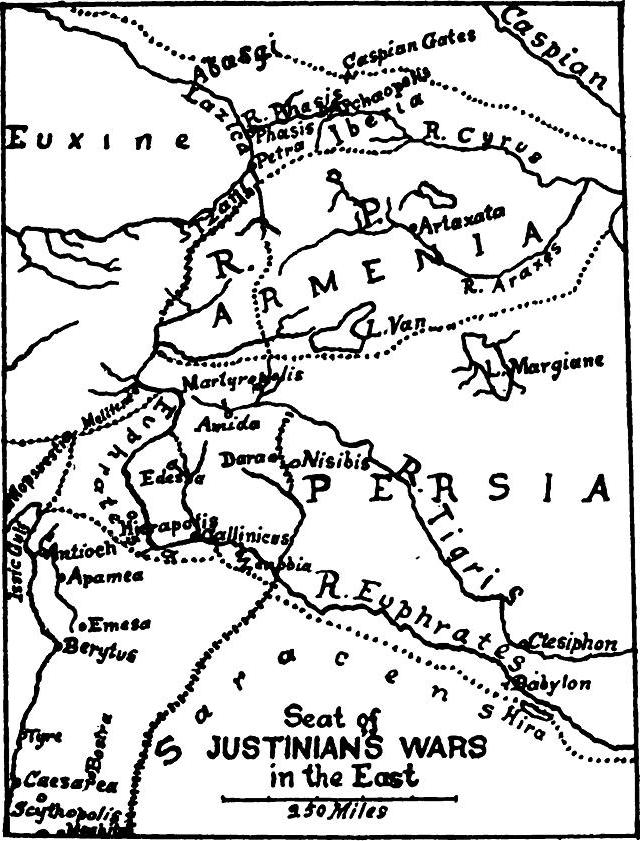
Seat of JUSTINIAN'S WARS in the East
After this disaster Justinian promoted Belisarius to the
rank of Master of the Forces in the East, and authorized
him to levy an army of the greatest possible strength.
In this task he joined with him Hermogenes, Master of
the Offices, whom, with Rufinus, a patrician, he despatched
to the theatre of war. The latter was well known as a
legate at the Persian court, and he was directed to take
advantage of the customary suspension of hostilities during
the winter, which was now at hand, to make overtures to
Cavades for the conclusion of a peace. An interchange of
propositions on the subject was kept up for some months,
during which the Shah maintained an equivocal attitude,
until, on the approach of spring, scouts brought in the
intelligence that the Persians were advancing with a great
army, evidently counting on the capture of Dara. In a short
time a taunting message was brought to Belisarius from
Perozes, who was in chief command, charging him to prepare
a bath in the town against his arrival on the following
evening.[88] This Perozes was one of the elder sons of
Cavades,[89] and his insolent confidence was inspired by the
success of the recent action, in which he had borne the
principal part. His notice was taken as a serious warning,
and the Roman generals at once set about disposing their
forces in order of battle, anticipating a decisive engagement
on the following day. Their army consisted of about
25,000 men, most of whom were mounted, and they were
drawn up within a stone's throw of the wall of Dara.
Belisarius and Hermogenes, surrounded by their personal
guards, posted themselves in the rear, next to the town.
Immediately in front of them was ranged the main body of
their troops, in a long line, made up of alternating squads of
horse and foot. A little in advance of these, at each end,
was stationed a battalion of six hundred Huns.[90] Such was
the centre to which, but at some distance forward, wings
were supplied, each one composed of about three thousand
cavalry. A trench, interrupted at intervals for passage and
dipping in to meet the centre, covered the whole of this
formation in front, but excluding the two bodies of Hunnish
horse standing at each reentrant angle.[91] Lastly, advantage
was taken of a small hill lying on the extreme left to form
an ambush of three hundred Herules under their native
leader, Pharas.
As soon as the Persian host had established itself on the
field, they were perceived to be much more numerous than
the Romans, amounting to quite forty thousand men. The
Mirrhanes, such was the military title borne by Perozes,
drew up his forces in two lines with the design that when
those in front were exhausted they should be replaced by
fresh troops from behind, the movement to become alternating,
if necessary, with intervening periods of rest for each
line. The wings were composed of cavalry, the famous
band of Immortals being stationed on the left, whilst
Perozes himself led the van, supported by the heaviest mass
of combatants. On the first day that the armies stood
facing each other the Persians' left wing suddenly improvised
a skirmish with those opposed to them, but retired
after a brief collision with the loss of seven of their number.
Later on a Persian youth of great prowess rode into the
interspace and defied any Roman to meet him in single
combat. No soldier seemed inclined to respond, but at
length one Andrew, the tent-keeper of Buzes, lately a
trainer of athletes at Constantinople, took up the challenge.
The adversaries charged each other with poised lances, the
Persian was unhorsed, and Andrew, quickly dismounting,
cut his throat with a knife. The Romans shouted with
delight, whilst the Persians, chagrined, determined to retrieve
the mischance, and soon presented another champion.
A horseman, middle-aged, but of great weight, advanced
cracking his whip and calling out for some confident opponent.
Still no response from the military on the Roman
side. At last Andrew, despite the express prohibition of
Hermogenes, advanced again and braced himself for the
encounter. The pair charged, their lances glanced aside,
but the horses crashed against each other breast to breast,
and both animals rolled over on the turf. The riders
essayed to rise, but the athlete anticipated his heavy opponent
and despatched him before he could regain his feet.
It was now almost nightfall, and both armies withdrew
from their positions, the Persians to their encampment, the
Romans within the walls of Dara.
Next day the troops were drawn out on both sides in the
same order, but the Roman generals, relying on the peace
proposals, which they considered to be still in progress,
deemed it possible that a conflict might be avoided. They
addressed a letter, therefore, to the Mirrhanes, representing
the uselessness of further bloodshed at a time when their
respective sovereigns were bent on the resumption of amicable
relations. In his answer Perozes accused his adversaries
of ill faith, and declared his disbelief in the genuineness
of their overtures on behalf of peace. To this Belisarius
replied that Rufinus would shortly be at hand with letters
which would convict the Persians of a wanton rupture of
their engagements, and that they should be fixed to the top
of his standard at the outset of the battle. The rejoinder
of the Mirrhanes closed the parley; he expressed unbounded
confidence, and reiterated his mocking request that a bath
and a suitable repast should be prepared for him forthwith
within the city. His assurance was, in fact, increased at
the moment, for, that very morning, a reinforcement of ten
thousand men had joined him from Nisibis.[92]
As a prelude to the battle the opposing leaders mutually
harangued their men. "The recent encounter," said the
Byzantine generals, "has taught you that the Persians are
not invincible. You are better soldiers than they, and
it is easy to see that on former occasions you suffered
because you disobeyed your officers. The enemy knew it,
and came on here trusting to profit by your want of discipline,
but since their arrival they have been awed by your firm
array. You see before you an immense host, but the
infantry are contemptible, wretched rustics, and mere camp-followers,
fit only to dig beneath the walls or to strip the slain.
They carry no arms to assault you with, and merely cover
themselves with great shields to avoid our darts. Bear
yourselves bravely, and the Persians will never again dare
to invade our country." On the other side, Perozes bade his
troops to take no heed of the skilful tactics now first
observable among the Romans. "You think," said he,
"that your adversaries have become more warlike because
of this imposing formation. On the contrary, the ditch
they have covered their positions with proves their increased
timidity; nor have they, though thus protected, ventured to
attack us. But never doubt that they will fall into their
accustomed confusion the moment we assault them; and
remember that your conduct will hereafter be judged of by
the Shahinshah."
Shortly after midday[93] the action was begun by the Persian
archers, and, until the quivers were exhausted, showers of
arrows were discharged from each side so thick as to darken
the sky. The rain of missiles from the Orientals was heaviest,
but an adverse wind rendered it less effective, so that the
Byzantines suffered no more than they inflicted. On its
cessation several thousands of the Persians bore down on
the left wing of the Romans and threw it into disorder.
Already the flight had commenced, when the six hundred
Huns held in reserve on that side charged the left flank of
the enemy; and simultaneously the three hundred Herules,
rushing down the slope of the hill from their ambush, fell
upon them behind. Terrified by these unforseen attacks
the Persians turned and fled indiscriminately, whereupon
the Romans joined in a triple band to take the offensive,
and inflicted on them a loss of fully three thousand before
they could reach their own lines. Considering it unwise,
however, to proceed too far, the Romans soon desisted from
the pursuit, and retired to their original positions.
A moment later the Persian left wing, including the whole
regiment of Immortals, made a fierce descent on those
opposite them, and succeeded in beating them back to the
wall of Dara. At the sight of this defeat, however, the
Byzantine generals ordered the Hunnish reserve just returned
from pursuit to join their fellows of the right wing,
and launched the whole twelve hundred, together with
their personal guards, against the enemy's flank. As a result
that wing of the Persians was cut in two, the after portion
being arrested in its charge, and among these happened to
be the standard-bearer, who was slain on the spot. Alarmed
at the collapse of the ensign, those who were fighting in
advance, being the majority, now turned to attack the mass
of troops who had gained possession of the ground in their
rear. The discomfited right wing of the Byzantines, thus
freed from danger, immediately rallied and dashed forward
after their lately victorious adversaries. Simultaneously the
general of the Persian wing in action fell before the lance of
one of the leaders of the Roman reserves and disappeared
from his saddle. A panic then seized on the Orientals, and
they thought of nothing but escape by flight. From all sides
the Romans rushed to make an onslaught on them, they
became hemmed in by a circle of steel, and were slaughtered
without resistance to the number of five thousand. A general
rout of the Persian army ensued; the infantry, on seeing the
destruction of the cavalry, threw away their shields and fled,
but they were quickly overtaken, so that a great majority of
them perished. Belisarius and his colleague, however, fearing
lest the reaction of despair in so great a host might lead to
some disaster, recalled their forces as soon as they judged
the defeat of the enemy to be complete. Such was the
victory of Dara, the achievement of which appears to have
been due mainly to the military talents of Belisarius, whose
age at this date (530) was probably under thirty.[94] For the
rest of this war the Persians always avoided fighting a pitched
battle with the Romans.[95]
During the succeeding summer desultory hostilities were
carried on in Armenia, where, as a rule, the Byzantines had
the advantage; and two fortified posts of some importance,
Bolum and Pharangium,[96] in the Persian division of that
country, fell into their hands. At the same time three Persarmenians,
who held commands in the Persian service, deserted
and fled to Constantinople. There they were received
and provided for by a fellow-countryman of their own, the
eunuch Narses, who at the moment filled the office of Count
of the Privy Purse, the same who afterwards attained to great
military celebrity.[97] This part of the war was conducted by
Sittas, who had become the husband of Comito, the sister
of Theodora.[98] He also had been promoted to the rank of a
Master of Soldiers.
In the meantime Justinian was still desirous of concluding
a peace, and towards the close of 530 his ambassador,
Rufinus, succeeded in gaining an audience of Cavades. In
reply to a general appeal the Persian monarch complained
bitterly that the whole responsibility of guarding the Caspian
Gates had been thrown on his shoulders, and that the
fortress of Dara was maintained as a constant threat against
his frontier. He also adverted to the fact that Persia was a
poor country, and accused the Romans of penuriousness in
money matters. "Either," said he, "let Dara be dismantled,
or pay an equitable sum towards the upkeep of the Caspian
Gates."[99] He showed no inclination, however, to agree to
any specific terms, and dismissed the Roman emissaries in
the evident expectation that some decisive success would
enable him to dictate the articles of a treaty. He was encouraged
by the fact that he was entertaining at the time
several thousand refugees of the Samaritan sect, who had
been driven from their homes in Palestine by religious persecution.
Such internal disorders must lessen the offensive
powers of his rival, whilst the expatriated sectarians were
even anxious to bear arms against their late oppressor.[100]
In the beginning of spring (531) it became manifest that
the Persians had been maturing a plan of campaign based
on a strategical diversion, by which they hoped to surprise
the enemy and possess themselves of a rich booty before
their operations could be arrested. The originator of the
scheme was Alamundar, his Saracenic ally, who pointed out
to Cavades that if a descent were made on Euphratesia, the
overlying province of Syria, they might advance to the walls
of Antioch through a populous district teeming with wealthy
towns but slightly guarded, and totally unapprehensive of
their security being threatened. "Antioch itself," said he,
"the richest city of the East, is always given over to public
festivities and theatrical rivalries, and is divested of a garrison.
Well might we capture it and make good our retreat to
Persia without meeting with a hostile force. In Mesopotamia,
to which the war has been confined hitherto, the
enemy is prepared for us, and we can inflict no damage on
them without engaging in a perpetual series of battles." His
advice was acted upon, and a Persian general, Azarathes,
invaded Euphratesia with fifteen thousand horse, supported
by a numerous body of Saracenic auxiliaries. The news of
their entry on Roman territory was speedily conveyed to
Belisarius at Dara, and he resolved to proceed at once by
forced marches to meet the raiders. His army consisted of
about twenty thousand men, including cavalry and infantry,
and he moved with such rapidity that he succeeded in
bringing the enemy to a stand at Gabbulae, before they had
had time to commit any serious depredations.[101] Azarathes
and Alamundar were taken aback at this encounter, which
falsified all their calculations. They were devoid of confidence
in their power to resist a Roman force, especially
when led by a general who had so lately proved his
superiority; and they, therefore, decided to abandon the
expedition and to retrace their steps with all haste to their
own country. Belisarius, on his side, was well satisfied when
he perceived that his adversaries were anxious only to beat
a retreat, and he determined to leave them unmolested, but
to follow their movements until he saw them safely over the
border of the province. The two armies were separated from
each other by about a day's march, and they proceeded for
several days in an easterly direction along the bank of the
Euphrates, which lay to the left of their route. Each evening
the Byzantines spread their tents on the same camping
ground which had been occupied by the Orientals during
the previous night. They began to cross the northern extremity
of the Syrian desert.[102] In the meantime, however,
the Roman troops had become inflamed with the desire to
attack an enemy whom they saw constantly flying before
them; and at length they broke into open murmurs against
their general who, from sloth and timidity, they exclaimed,
was restraining them from a glorious success. Belisarius
strove to repress their ardour by urging that no fruitful
victory was possible under the conditions present, whereas
the enemy, if driven to desperation, might inflict a defeat
which would restore to them their liberty of action, and be
attended with disastrous consequences to the surrounding
country. He also represented to his men that their strength
was sapped by incessant marching, and especially by the
fasts imposed on them by the season of Lent, through which
they were passing; finally, that a portion of the army had
not yet arrived. At last he was overborne by their clamours,
in which many of his officers joined, and even expressed his
confidence that a general could not fail to conquer when in
command of troops so eager to be led into action.[103]
On Easter Eve the Romans overtook the Persians, and
the two armies encamped in sight of each other at a short
distance from the town of Callinicus on the Euphrates. The
day was observed as a strict fast, but nevertheless on the
Sunday morning Belisarius drew out his forces and disposed
them in order of battle. His infantry he placed on the left,
so that their flank should be protected by the river. The
centre was composed of cavalry, among whom he took up
his own station, whilst the right wing was allocated to a
body of Saracens under Arethas, a sheikh who had been
induced to become an ally of the Empire as a counterpoise
to the power of Alamundar. On the other side two divisions
only were made, the Persians occupying the right and the
Saracens the left. As usual the engagement was begun by
the archers, who consumed nearly two-thirds of the day in
emptying their quivers. The Persians, however, shot out
weakly with relaxed strings, and their darts were to be seen
continually leaping backwards after impinging on cuirasses,
helmets, or shields. But the Byzantine bowmen, though
much fewer in number, were more robust, and almost always
succeeded in transfixing those whom they struck with their
arrows. A determined charge on the Romans by the best
troops of the enemy ensued, upon which the tribesmen led
by Arethas, cowed by the superior prestige of Alamundar,
fled almost without striking a blow. As a consequence Belisarius,
with his cavalry, was surrounded on three sides, and
subjected to a fierce attack which it was impossible to resist.
A band of two thousand Isaurians, who had been among
those most eager for a conflict, scarcely dared to use their
weapons, and nearly all of them were slain on the spot. A
large number of the centre, however, exhausted though they
were with fasting, defended themselves strenuously, and inflicted
great loss on their opponents. When at length
Belisarius saw that there was no hope for the residue of his
cavalry but annihilation, he drew them off rapidly to the
left, and joined those of the infantry who still held their
ground on the river's bank. There, with great presence of
mind, he improvised a phalanx, dismounting himself and
ordering all his horsemen to follow his example. With
serried shields and projecting lances they formed an impenetrable
mass which every effort of the enemy failed to
break. Again and again the whole body of the Persian horse
rode down upon the bristling phalanx; but the Romans
drove them back with lance thrusts, and so terrified the
animals by clashing their shields, that they shook their riders
off. The conflict was only terminated by nightfall, when the
Persians returned to their camp, and Belisarius, having
obtained possession of a ferry-boat, transferred the remnant
of the army to a safe retreat on an adjacent island of the
river. Next day he summoned a batch of transports from
Callinicus, and in a short time all were securely lodged
within the town.[104]
Soon after the battle on the Euphrates Justinian recalled
Belisarius to Constantinople and entrusted him with the
organization of an expedition which he contemplated against
the Vandals in the west. The chief command in the east
then devolved on Sittas.[105] As for the Persian generals who
had been opposed to Belisarius in the two leading engagements
of the war, they incurred almost equal odium in the
eyes of their royal master. The Mirrhanes was deprived of
the rich insignia of an order of nobility which conferred a
dignity second only to that of the throne; whilst Azarathes,
who claimed the honours of a victorious general on his reappearance
at court, could produce no evidence of his success
and, after a muster of the troops, was upbraided by Cavades
for having lost the half of his army.[106]
At this juncture Justinian seems almost to have despaired
of obtaining a peace on any equitable terms from Persia,
although he kept his legates, Rufinus and Hermogenes, on
the confines of both empires in continual readiness to institute
negotiations. He began, therefore, to devise some means
of neutralizing the injurious effect of being in perpetual conflict
with his impracticable neighbour. To provoke a hostile
incursion against his antagonist from some remote frontier
might force him to suspend his assaults on the Empire;
whilst the serious interference with Byzantine commerce due
to the import of silk across his enemy's dominions being in
abeyance would disappear if the trade in that indispensable
commodity could be diverted to some friendly route. The
geographical and political situation of Aethiopia or Axum
and the amicable relations of that kingdom with the Empire
seemed to satisfy all the conditions essential to the success
of this project. The civilization of Axum and part of its
population had originally been derived from the Arabian
province of Yemen, on the opposite side of the Red Sea.
In the course of time the offspring prospered and turned
upon its parent; and by the middle of the fourth century
the Negus[107] of Axum had become the overlord of his less
powerful neighbour, the king of the Homerites or Himyarites,
as the inhabitants of that district of Arabia were called in
this age. Christian missions began to penetrate these regions
shortly after the reign of Constantine, and at the present time
the Axumites were enthusiastic votaries of that religion and
of Rome. Himyar, however, was full of Jews who had fled
before Hadrian and his predecessors after the subjection of
Palestine and the destruction of Jerusalem, and, therefore, of
religious dissension; and the championship of the Cross
more than once furnished an occasion for the Aethiopian
despot to carry his arms into the Arabian kingdom for the
maintenance of his rather precarious suzerainty. Only recently,
in the reign of Justin (c. 524), the Negus of the day,
Elesbaas,[108] had
crossed the gulf, expelled a Jewish ruler, and
established Esimphaeus, a Christian, in his stead.[109]
To Elesbaas, therefore, Justinian determined to apply, and
forthwith detached an ambassador named Julian to enlist his
aid against Persia. The embassy, provided with a letter and
suitable presents, took ship for Alexandria, navigated the
Nile to Coptos, crossed the desert to Berenice, and from thence
sailed down the Red Sea to Adule.[110] The Negus was transported
with joy as soon as he heard that a party of Roman
delegates was approaching Axum, and advanced from his
capital to meet them sustained by all the excess of barbaric
state. He was standing on a lofty car adorned with plates of
gold, which was drawn by four elephants. His guards
crowded around him, each one armed with a pair of gilded
spears and a small gilt shield, and a company of musicians
blew with exultant strains on their shrill pipes. The dusky
potentate himself was almost devoid of clothing proper, but
was decked from head to foot with a profusion of precious
ornaments. On his head he wore a white turban interwoven
with gold thread and four golden chains hung from it on each
side. A linen mantle weighted with pearls and golden nails,
open in front, flowed from his shoulders; and a kilt seamed
with precious metal was dependent from his girdle. A necklace
and bracelets of gold, with arms similar to those borne
by his guards, completed his equipment.[111]
Julian knelt and presented his letter, but was immediately
bidden to rise, whilst the Negus kissed the seal of the missive,
and listened to its contents as read by an interpreter.
He at once promised compliance with all Justinian's requests;
an army of his vassal Saracens should march against
the Sassanian realm, and the cargoes of silk from Malabar
should be diverted from the Persian Gulf to be discharged
at Adule.[112] After the lapse of a year another envoy was
despatched from Constantinople, and Nonnosus, one of a
family of legates, familiarized with these regions by constant
visits, traversed not only Axum, but Yemen, in order to
stimulate the execution of these important schemes.[113] In
the end, however, the project failed of achievement; the
tribes of Himyar shrunk from entering on a long and
arduous journey over the sandy wastes to attack an enemy
whom they believed to be more bellicose than themselves,
while the shipmasters could not be induced to avoid the
Persian ports, where they found eager buyers for all the silk
they could procure.[114] The death of Elesbaas occurred shortly
afterwards, but not before an interior revolt had freed Himyar
for a time from the Aethiopian supremacy.[115]
In the next phase of the war, martial activity centred
around Martyropolis, a fortified town of Roman Armenia,
situated on the river Nymphius. A considerable Persian
army, under several veteran generals, beset the stronghold
with all the engines proper to a determined siege in the warfare
of the period. At the same time Cavades, octogenarian
though he was, resolute in his purpose to do all the damage
possible to his adversaries, provoked an artificial irruption
of the Huns into Roman territory, and opened the Caspian
Gates to a great host of those barbarians. At his instigation
they carried their depredations rapidly to the south, and in
the autumn of 531 effected a junction with the Persian forces
around Martyropolis. Buzes and Bessas commanded the
garrison of the town, but without confidence in their powers
of resistance to the assault; for not only were the walls
easily surmountable in many places, but the beleaguered
were ill supplied with sustenance, and with warlike machines
to repel the assaults of the enemy.[116] Nor had the Byzantines
any troops in the field with whom they could hope to raise
the siege; and Sittas, though posted at only one day's
march from the scene of hostilities, feared to approach
nearer with the slender army at his disposal.[117] From time to
time successful sallies were made by the besieged, and
Bessas, who was a bold cavalry leader, now, as on former
occasions, found opportunities of inflicting considerable loss
on the foe; but nevertheless it was felt that a crisis disastrous
to the Romans could not long be delayed.[118] In this
impass a stratagem was concerted and carried out effectively,
which blunted the ardour of the siege and eventually
saved the town. As in all ages, it was the practice to maintain
spies in an enemy's camp; and between both nations
there was a habitual interchange of renegades who were
anxious to betray the secrets of their country, attracted by
the substantial rewards which generally accrued to such
treason. A man of this class was now at hand, one whose
reliability had been tested by the Emperor himself, and he
was instructed to reveal to the Persian generals with professed
good faith his pretended discovery that the Huns,
corrupted by Byzantine gold, only awaited an opportune
moment to change sides in their warfare. The spy executed
his commission faithfully, and his communication was listened
to with consternation by the military council.[119] The
Orientals, distrustful of their uncongenial allies, relaxed
their energies, and the siege was protracted until the severity
of the weather compelled a cessation of arms for the season.
The Persians gladly agreed to a truce and retired into
winter quarters, but the Huns, now freed from control,
began to work their way towards the south with Antioch as
their goal, plundering every assailable habitation which lay
in their track. They were pursued unremittingly by Bessas,
who cut up marauding bands, captured their spoils, and
finally succeeded in chasing the survivors out of the
country.[120]
In the meantime an event had occurred which produced
an immediate change in the relations of the two empires,
and virtually ended the war before the advent of spring
called for a resumption of hostilities. Early in September
Cavades was suddenly prostrated by illness, whereupon he
summoned Chosroes, and caused him to be crowned hastily
at his bedside. A few days afterwards he expired, at the age
of eighty-two in the forty-fourth year of his reign.[121] As usual
in Oriental successions the new Shah was unable to seat
himself firmly on the throne without making away with
several of his near relatives who formed a nucleus around
whom malcontents might cluster.[122] Preoccupied, therefore,
with his domestic affairs, he was anxious to be relieved from
the onus of a foreign war, and signified shortly to the
Roman legates his willingness to negotiate a treaty.[123] Rufinus
was credited with being a peculiarly grateful personage to
Chosroes owing to his having consistently advised Cavades,
during his long intimacy with him, to elevate his third son
to the throne. It was also reported that the Persian queen-mother
was in secret sympathy with Christianity and, therefore,
used her influence over her son to promote peaceful
relations with the Byzantines.[124] But the lessons of the war
had not been lost on Chosroes, and he felt strong enough to
impose conditions so exacting that the Roman plenipotentiaries
were unable to accept them on their own responsibility.
Invasion of the empire in force had been the distinctive
feature of every campaign and, while Persian territory
had been subjected only to some desultory raids, the
brunt of the war had been borne by the Byzantines on their
own ground. Under an obligation to perform the double
journey in seventy days, Rufinus posted to Constantinople
to hold a special conference with Justinian. He returned
with a virtual consent to all the effective demands of Chosroes,
and in less than a year after the death of Cavades a
treaty was ratified under the reassuring title of "the Perpetual
Peace." By this convention the substantial captures
made by each party were to be exchanged; the fugitive
Iberians were to be allowed the option of residing peacefully
in their own country or of remaining under the protection of
Justinian; Dara was not to be demolished, but the military
Duke of Mesopotamia was to remove his headquarters from
thence to an unimportant town at some distance from the
frontier;[125] and the
Caspian Gates were to be left in the sole
charge of Persia. The two last articles were concessions on
the part of the Shahinshah, to counterbalance which the
Romans agreed to pay an indemnity of one hundred and
ten centenaries of gold (£440,000).[126] Rufinus deposited the
amount in specie at Nisibis, and the war was thus terminated
with some military glory to the Byzantines, but with no
inconsiderable loss of their material possessions, which
accrued for the most part to the advantage of the Orientals.
During the whole of this period the barbarians to the
north of the Danube and Euxine were kept in a state of
active commotion by various influences; and, if at any
moment the countless wild hordes, who peopled that immense
region, could have been moved by a unanimous impulse
to hurl their combined force against the Empire, it
seems impossible but that the Byzantine administration
must have succumbed at once and finally to the irresistible
shock. But there were always three forces in being which
co-operated to avert such a catastrophe, and saved the Empire
for many centuries from sudden annihilation. Its
lengthened preservation in this connection was due to the
diverse powers of arms, of wealth, and of religion. Conversion
to Christianity was continually inspiring a proportion of
these semi-savage races with a desire to enter into amicable
relations with the Roman Emperor, in whom they saw the
prime source of the mystical lore which they had just been
taught to regard with awe. Rich presents were despatched
to the most accessible of the barbarian rulers, who were thus
induced to pledge their allegiance to the Byzantine state.[127]
These various influences not only protected the Empire from
many impending assaults, but, by animating the barbarians
with invidious feelings against each other, often caused dissentient
tribes to engage in the work of mutual self-destruction.
Lastly, the residue who actually crossed the frontier
with hostile intent were met by the Masters of Soldiers, and
with varying success checked in their advance, or cut to
pieces.
The influence of religion, at the same time conjunctive and
disruptive, has already been exemplified in connection with
Lazica and Iberia; and a couple of nearly similar instances,
occurring shortly after the accession of Justinian, will be
noticed explicitly in a future chapter.[128] An illustration of the
advantage derived by the Emperor from the judicious bestowal
of treasure on barbarian potentates is also brought
before us during this war with Persia.[129] Two Hunnish kings,
subsidized by Cavades, were on the march to join the Persian
army with an auxiliary force amounting to twenty
thousand men. But a queen of the Sabirian Huns, named
Boarex, who had been the recipient of Justinian's liberality,
was able to put a hundred thousand of her nation under
arms. This martial female did not hesitate to attack her
kindred; but, falling on them before they could reach their
destination, destroyed the expeditionary force, slew one of
the leaders, and sent the other to Constantinople, where he
was impaled on the shore at Sycae, by order of the Emperor.[130]
On the Illyrian frontier the Masters of the Forces
in that region were in almost perpetual conflict with barbarian
raiders. Previous to 529 the command on the Danube had
been entrusted to Ascum, a Christian Hun, but, being captured
by a marauding band of his own race during a skirmish,
he was carried off and permanently retained by them
in their native abodes. He was succeeded by Mundus, a
Gepœd of royal race, who had formerly been in the service of
Italy. After the death of Theodoric, however, he placed his
sword at the disposal of Justinian, to whom he proved a
faithful servant not only in the defence of Illyricum, but
shortly afterwards at a critical period of his reign in the
capital.[131]
[1]
The minute description of Justinian's personal appearance is due to
Procopius (Anecd., 8), and Malala (xviii, p. 425), whose descriptions
seem to correspond fairly. There are several representations of Justinian,
but it is doubtful whether any of them rise to actual portraiture. Those
found on a large gold medal formerly in a museum at Paris (stolen 1835)
were probably the best (reproduced by Isambert, op. cit.; Diehl, op. cit.,
p. 23). He appears in the great mosaics at Ravenna (see p. 91), and
also in a half-length figure in St. Apollinare of the same town. Further
there is a MS. sketch at CP. (Mordtmann, op. cit., p. 65). In addition
there is the current coinage, especially the copper, on which his image
is impressed. Generally the face is pronouncedly round, but, one and
all, these likenesses are too crude to convey any physiognomical information.
See also p. 308.
[2]
Procopius, Anecd., 8. He relates that after the butchery of Domitian
all his statues were broken to pieces, but his wife afterwards fitted
the fragments of his body together and caused a new figure to be sculptured
from them. There is an almost perfect statue of Domitian in the
Vatican, which may be the one he alludes to, if there is any truth in his
story.
[3]
Jn. Malala, xviii, p. 425; Chron. Paschal, an. 566. "You would
have taken him for a man with the mind of a sheep," says Procopius,
Anecd., 13.
[4]
His character and manners can be collected from Procopius (Anecd.,
6, 8, 10, 13, 15, 22, etc.) and Zonaras, xiv, 8. His personal influence
is well illustrated by the incident already related (p. 303) of his rescuing
a patrician from the mob although at the time he was only a Candidate;
and by his deliberate mésalliance with Theodora being permitted without
a murmur from Church or State. His stolid conviction may be compared
to that of Robespierre, of whom, when he first began to speak on
public affairs, Mirabeau remarked, "That young man will go far; he
believes every word he says."
[5]
Procopius, Anecd., 8; 13. In many of his enactments he emphasizes
his unremitting assiduity in the interest of his subjects, e.g.: "We
shun no difficulties, continually watching, fasting, and labouring for our
subjects, even beyond what can be borne by the human frame"; Nov.
xxx, 11; cf. viii, pf.; lxxx, pf., etc.
[6]
Procopius, Anecd., 22. "He was excessively senseless and like a
dull ass that follows whoever holds the bridle," ibid., 8. "As to his
opinions he was lighter than dust, and at the mercy of those who wished
to urge him to one side or the other," ibid., 13.
[7]
There is but one representation of Theodora, that in the companion
mosaic to the one above-mentioned at Ravenna, but the face is too unfinished
and expressionless to give any idea of her features or character.
[10]
Procopius, Anecd., 15. This Porphyrio, such was the popular name
bestowed on the monster, must have been a cachalot or sperm whale,
which inhabits tropical and sub-tropical seas. It grows to a length of
50 or 60 feet. The males fight viciously among themselves. Small ships
have been damaged by the animal when provoked by an attack.
[11]
Nov. viii, 1. Officials, on taking office, had to swear to Justinian
and Theodora conjointly; ibid., jusjur.; cf. Nov. xxviii, 5; xxix, 4;
xxx, 6, 11. Zonaras remarks, "In the time of Justinian there was not
a monarchy, but a dual reign. His partner for life was not less potent,
perhaps even more so than himself," xiv, 6; cf. Paul Silent., i, 62.
The reign has been compared to that of Louis XIV; but the character
of that monarch was more evident in Theodora than in her husband.
[12]
"In fact she was much abler than he was and highly ingenious in
finding new and varied expedients." Zonaras, loc. cit.
[13]
As Messalina, the elder Faustina, Soaemias, etc.; see chap. iv.
[20]
The campaigns of Trajan are very imperfectly recorded in the only
extant account, that of Dion Cassius as preserved in the careless epitome
of Xiphilinus; Zonaras, xi, 21. It is certain that he took the twin
capitals of Parthia, Seleucia and Ctesiphon, which faced each other
from opposite sides of the Euphrates, and advanced to the Persian Gulf.
He marched into Arabia, but the evidence that he penetrated to the
Indian Ocean, as Tillemont thinks, is insufficient.
[21]
The capture of Seleucia by Avidius Cassius (165), and his brutal
massacre of 300,000 of its inhabitants, mostly Greeks, is often alluded
to as an irreparable blow to Western civilization in the East; Dion Cas.,
lxxi, 2, etc. Severus took Ctesiphon in 199; Herodian; Hist. August. In
283 Carus also took Ctesiphon; Hist. August.; Aurelius Vict. Under
Diocletian, Galerius extended the Empire beyond the Tigris; Aurel.
Vict.; Eutropius, ix.
[22]
See Plutarch's account of the affair and his general remarks on it;
Vit. Alex.
[23]
In the vicinity of Shiraz; described by modern travellers as a garden
of fertility.
[24]
Most information as to the rise, etc., of Ardeshír (Artakhshathr on
coins, that is, Artaxerxes as adapted to their language by the Greeks),
will be found in Tabari with Nöldeke's commentary; op. cit.; cf.
Zotenberg, op. cit., ii, 40. The great value of Nöldeke's book consists
not so much in the flimsy text as in his notes and excursuses which bring
together all collateral information to be found in other writers of the
period. Zotenberg's version is, of course, from the Persian, the translation
of a translation.
[25]
The Great Salt Desert in the interior of Persia is somewhat triangular,
each of the sides measuring about 400 miles.
[26]
Modern Orientalists are of opinion that the pictures of Persian life
given by James Morier (Hajji Baba of Ispahan, 1824, etc.) may be
applied without much loss of truth even to the age of the Achaemenians.
When we reflect that till 1888 Persia had no railway, and now only
eight miles, the verisimilitude of the statement will be apparent.
[27]
See the first Fargard of the Vendidâd where the "Kine's soul,"
representing mankind, bewails her hard lot before the supreme being.
Generally the primitive conditions of life in Iran are well set forth by
Max Duncker, Hist. of Antiquity, Lond. 1881, vol. v.
[28]
His actual date is unknown, and his existence at any time not certain,
but Duncker surmises this period.
[29]
The Iranian mythology is summarized at length by Duncker, but
the person of Zoroaster is altogether shadowy, and his date can only be
fixed by conjecture. He is, of course, done away with altogether by
some Orientalists, e.g. Darmsteter. In later times, as among the modern
Persians (Parsees), the names of the opposing gods were abbreviated to
Ormuzd and Ahriman.
[30]
The Persian Bible is written in a language without a name, and, it
may be added, without an alphabetical character. The name Zend,
however, is now firmly attached to it among Western scholars through a
mistake of the first investigators, who, always finding it coupled with
Avesta, thought it must apply to the language of the sacred text. It
actually means commentary. Zend is a sister tongue of that spoken in
the same age across the Indus, and the oldest specimens (the Gáthas of
the Avesta) by slight systematic alterations can be turned into good old
Sanskrit. The alphabet applied to it, as now preserved, is that of the
Middle Persian or Pahlavi, which was the language spoken by the Sassanians.
Old Persian, the speech of Darius and Xerxes, was written in
cuneiform (Behistun inscription, etc.), like the impressions on the well-known
clay tablets, etc., of the long-previous literature of Babylonia.
The Avesta originally consisted of twenty-one nasks or books, but less
than a quarter is now extant. There is, however, an epitome of it in the
Dinkard, a religious compilation of the eighth century. The book was
unknown to the Greeks and Romans, but Pausanias (v, 27) mentions
that the Magi had a volume from which they read. Darmsteter (Sacred
Books of the East, Lond., 1895, Introd. to Vendidâd) considers that
the composition is almost in its entirety of a date subsequent to Alexander.
The sacred books of the Parsees, as far as they have been translated,
are to be found in Max Müller's series (Lond., 1880, etc.), just
mentioned, vols. iv, xxiii, xxxi (Zend-Avesta), and v, xviii, xxiv, xxxviii
(religious treatises in Pahlavi).
[31]
Mithra, so-named, long enjoyed a supremacy among the Aryans
both in India and Persia. Spenta Aramaiti is one of the Amesha Spentas
(later Amshaspands, that is, "Holy Immortals," or Council of Ormuzd,
but, although they appear in the Avesta, Darmsteter (loc. cit.) argues a
Platonic and, therefore, late origin for them. Thus Vohu Manô ("Good
Thought"), their chief and the premier of Ormuzd, appears to be an
exact counterpart of the Philonic Logos. Anahita stands for the Vedic
Varuna, the waters of the sky, but the name is that of the Babylonian
Venus, and her attributes are partly of the concupiscent type.
[32]
The Vendidâd ("laws against the evil ones") is the nask which
contains all the legislation respecting rites and ceremonies, offences,
crimes, etc., punishments to be inflicted, means of expiation, etc. Like
parts of the Pentateuch, it is all in the form of a dialogue between the
prophet and the Deity.
[33]
These Dakhmas, or "Towers of Silence," for the disposal of the
dead are well-known to the Anglo-Indians who have resided at Bombay,
which almost all Parsees, the present-day Zoroastrians, have adopted as
their native city. They number about 60,000.
[34]
This account is due to Agathias, ii, 23; cf. Herodotus, i, 138.
[35]
Agathias, ii, 24; Herodotus, loc. cit. Contrary to former belief
(Rawlinson, etc.), the Parthians were pious Mazdeites, as Darmsteter
has shown. Thus, when Tiridates visited Nero, he and his retinue, including
several priests, journeyed overland to avoid defiling the sea;
Justin, xli; Pliny, Hist. Nat., xxx, 17.
[36]
One Shah, Balâsh, was, in fact, dethroned by the Mohbeds (Magi)
for having erected public bath-houses; Jos. Stylites, op. cit. (Wright).
[37]
Xenophon, Oeconom., iv, 13; Xerxes, on his way to Greece, arriving
at a handsome plane tree, adorned it with jewels of gold, and left
one of his personal guards as a custodian of it; Herodotus, vii, 31.
[38]
The Bareshnûm, or great ceremony of purification, lasted nine days
and consisted chiefly in the systematic application of nirung or gomez
(urine of kine) to different parts of the body; see West's translation of
the rubric, Sacr. Bks. of the East, xviii, 431.
[39]
Vendidâd, xiii, 24 (63). The manslaughterer got off with sixty
stripes, but the bad feeder became a peshotanu and received two hundred,
the maximum, it seems, actually inflicted.
[41]
Vendidâd, xiv, 5 (9). Part of the expiation for the murder of an otter
was to kill 10,000 of every sort of noxious animal. The punishments,
or tasks imposed in lieu of, are sometimes so extravagant, that they can
only be intended to emphasize the heinousness of the sin, a useful principle
to elevate the authority of the priesthood; cf. Herodotus, i, 140.
[42]
Vendidâd, viii, 26 (74); 74 (233); xviii, 61 (123); cf. iii, 38 (130);
iv, 47 (130). As will be seen from these passages a proselyte to Mazdeism
began a new life with a clean slate. Thus a member of an alien faith
could commute the severest penalty by announcing himself as a convert
to the religion of Zerdusht.
[43]
Vendidâd, xiv, 2; cf. Herodotus, i, 137; vii, 194. Punishment was
inflicted with a sraosha (sort of whip), and each stripe was valued at six
rupees. In practice the maximum was 200 stripes for a peshotanu or
culprit of the worst class, whatever the nature of the crime, but when it
was really meant to decree the death penalty the allotted number was
much greater, even up to 10,000; see Darmsteter, op. cit., p. lxxxv.
In the entourage of the monarch, however, the same cruel punishments
were maintained as have always been associated with Oriental despotism,
viz., flaying alive (Ammianus, xxiii, 6; Agathias, iv, 23), and even "the
boat" (Plutarch, Artaxerxes; Damascius, Vit. Isidori).
[44]
See Herodotus, iii, 81; Plutarch, Artaxerxes.
[45]
Phraates V of Parthia. His mother was Thea Urania Musa, an
Italian slave girl presented to his father by Augustus; Josephus, Antiq.,
xviii, 2. The relations of Parysatis to Artaxerxes and of Sisygambis to
Darius Cod. were very close, but are not known to have been actually
conjugal.
[46]
These filio-maternal marriages have been generally discredited by
modern historians (Rawlinson, Oriental Monarchies, ii, 351; even partly
by Max Duncker, op. cit., v, 220) through their not being in possession
of all the classical evidence and having apparently none of the Oriental.
Probably the first to make the practice known in the West was Quintus
Curtius, and lastly Agathias. But the evidence of Chrysostom alone, a
Syrian reared on the borders of Persia, would be conclusive. As usual,
he anatomizes the subject. Preaching against sexual abandonment, he
says: "Love, you maintain, is not a matter of will.... Whence does
it arise, then? From a beautiful form which strikes the wound, you
answer. Your excuse is an idle one.... Were not Joseph and David
handsome, the latter especially so in the eyes, which is the most attractive
style of beauty? But was any man enamoured of them? By no
means, for love does not arise from mere admiration. Many have
mothers most distinguished for their beauty, but do their sons, therefore,
fall in love with them? Perish the thought! They admire them,
but do not yield to a disgraceful passion. Ah! you will urge, this is a
law of nature. Of what nature, tell me? Because they are our mothers,
you say. Do you not know that the Persians, without any compulsion,
cohabit with their mothers? Not one or two, but the whole nation.
Whence it is evident that this disease is not inspired by beauty, but by
a vice of the mind"; In Epist. ii ad Cor. Hom. vii, 6 (in Migne, x,
451). Contemporary Parsees also wish to repudiate the idea that their
forefathers solemnized these incestuous nuptials, and treat it as a libel of
the Greeks, as modern Mazdeism yields to no closer union than that of
first cousins. The whole question, however, of consanguineous marriage
has been threshed out from the evidence of the Pahlavi texts by West
(Sacr. Bks. of the East, xviii, 389 et seq.), who shows how strenuously
the Mohbeds laboured to inculcate the practice as a pious duty. A
special term in Pahlavi, Khvêtûk-das, meaning literally "a giving of
one's own," was applied to it. There is no clear reference to the custom
in the extant part of the Avesta, but in the Dinkard epitome (ix, 60;
Sacr. Bks. of the East, xxxvii) great stress is laid on the merit of adhering
to it, and in the same theological compilation a long chapter (iii,
82, 431) is devoted to the defence and exposition of Khvêtûk-das. As
West observes, however, it is evident from the amount of space and
argument expended on the subject that the priesthood had some difficulty
in bending an unwilling laity to comply with their injunctions.
We may note that the Persians were not the only race addicted to such
marriages. According to Strabo (IV, v, 4), they were habitual among
the Irish of his time ("mothers and sisters"); and even the aboriginal
Macedonians favoured them, so that when the Oedipus Rex of Sophocles
was played in that country the audience jeered at the distress of the
titular character. An amusing dialogue between actor and audience then
ensued; see Tertullian, Ad Nat., 16.
[48]
Herodotus, iii, 68, 88; Athenaeus, xiii, 3, etc.; Ammianus, xxiii, 6.
As usual in the East, women were kept out of sight; Plutarch, Themistocles.
Still, Queen Statira used to drive about openly in public; ibid.,
Artaxerxes. Cf. Max Duncker, op. cit., v, 219.
[49]
See Gardner's Parthian Coinage, Lond., 1877; cf. Mordtmann,
Zeits. f. Numis., iv, vii.
[50]
See the letter of Tansar to the king of Tabaristân (Ilyrcania);
Journal asiatique, 1894, i (text and French transl.). This, according to
Darmsteter, is the earliest and most authentic document of Zoroastrianism.
The best MS. is in the East India House. From it we learn that
under the Parthians the unity of Iran was gradually dissolved into a
number of principalities, in which each king claimed a practical independence
and set up a fire-altar of his own. Ardeshír extinguished all
these subordinate fire-altars and made himself supreme in his capital of
Istakhr. The letter has been largely interpolated at a later date, especially
by the long apologue of the King of the Apes. Partly against Darmsteter
see Mills' Zoroastrianism, 1905, etc.
[51]
He treated the traditions of the old religion pretty freely and
abolished whatever did not accord with his scheme of restoring the
empire of the Persians; ibid.
[53]
See Darmsteter, op. cit., p. xlvii. The story of Arda Viraf's visit to
heaven and hell (part of the lost Spend Nask) under the influence of a
narcotic in the presence of a great conventicle of the Magi, in search of
spiritual guidance for the restoration of Mazdeism, seems to be a mere
legend to be referred to the sixth century rather than to the times and
intention of Ardeshír. It has been cited as serious history by some
former writers.
[54]
Letter of Tansar, ut supra, cf. Herodian, vi, 3. H. is generally
treated as a romancer, but in this instance he is confirmed by independent
evidence. His statement that Ardeshír had the best of it
in a great battle with Alex. Severus is rejected in favour of that of
Lampridius (Hist. Aug.), who says the Roman was the victor. The
war on this occasion, as often subsequently, was probably quite indecisive.
[55]
See Sayce's Babylonians, etc., Lond., 1900, and other works of that
class which condense the results of the excavations in progress on that
site.
[56]
See p. 267. Fragments of the Manichaean Bible recently discovered
in Central Asia show that Mani was a native of Babylon.
[57]
Sozomen, ii, 9; Theodoret, v, 39. Some were partly flayed, on the
face and the hands, or the back. Others were thrown bound into pits
with mice, etc. The first of these persecutions seems to have sprung
from the religious fervour caused by Sapor's zeal for the faith; the
second was originated by a fanatical Christian bishop, who attacked
and destroyed a Pyreum or Fire-temple. See Hoffmann's Akt. Pers.
Märt., Leipsic, 1880.
[58]
Asseman, Bibl. Orient., iii, 2. They had the ear of the Shah as
against any of the Orthodox in Persia; John Eph. Com. (Land, etc.),
p. 52.
[59]
Nöldeke, op. cit., p. 145; Zotenberg, op. cit., ii, 148. They were
soiled by her menstrual flux, she said. To touch anything of the kind
would have subjected him to a ceremony of purification and, perhaps, a
flogging; Vendidâd, xviii, 5. The scene reminds us of that in The
Merry Wives of Windsor, where Falstaff is carried out in the foul-clothes
basket. Procopius relates that she changed clothes with him, and the
Shah walked out disguised as a woman; De Bel. Pers., i, 6.
[60]
This was not his first sojourn with the Hephthalites. His father
Peroz, who ultimately perished in a battle with these Huns, had left
him in Bactria as a hostage for the payment of an indemnity. In Tabari
the story goes that on his journey thither he stopped incognito at the
house of a noble (N.) or peasant (Z.), where he was accommodated
with a daughter of the family as an informal wife. When Balâsh was
dethroned (see p. 379), he returned to take up the succession by the
same route and found that the girl had become the mother of a boy, the
same who was afterwards known as Chosroes, his favourite son (see
p. 314).
[61]
"Hence he set the lower against the upper classes; wretches of
every sort were mingled with the best blood; and it became usual for
those who coveted other people's goods to seize on them; for the disorderly
to riot around; and for libertines to gratify their passions and
approach the noblest women, whom previously they never had a thought
of intimacy with"; Tabari, p. 154 (N.). This passage with the context
is not in Zotenberg.
[62]
The details of this affair are incompletely known. The Greeks
seem never to have heard of Mazdak, but confound his followers with
the Manichaeans. The above account is based on that of Theophanes,
modified so as to accord with Nöldeke's views; op. cit., p. 457 (Excurs.).
He thinks the surname of Nushirvan ("the blessed") was bestowed on
Chosroes for the part he played in this massacre. Existing Manichaeans
were also involved in it.
[63]
Theophylact. Sim., iv, 7; cf. Athenaeus, xii, 8.
[64]
Nöldeke, op. cit., p. 221. He was concealed with "clothes"
until he settled himself in a dignified position. But in Zotenberg
(p. 205) the clothes become merely a covering to keep the dust off the
jewels. Such differences are perpetual throughout the two versions of
Tabari. On coins and sculptures the Shah wears a crown surmounted
by a pedunculated ball of considerable size. At the siege of Amida
(359) Sapor wore a golden ram's head instead of a crown; Ammianus,
xix, 1. Theophylactus (who is noted for his turgidity) gives a description
of Hormidz IV sitting in state on his throne (590). "He was
clad with a regal robe of precious material. His tiara of gold and
jewels was brilliant with the effulgence of carbuncles. A profusion of
pearls glittered around the crest, scintillating on a sea of smaragdite, so
that the eyes were almost blinded by the dazzling exuberance of the
gems. His trousers, a priceless sample of the weaver's art, were embroidered
on cloth of gold"; iv, 3. Cedrenus (i, 721) also furnishes
some curious details as what was found when Heraclius broke into the
treasure city of Gazaca and rifled the palace of Chosroes Parviz (622).
The contents of a private fire-temple astonished them. "On entering
the spherical chamber he found the impious effigy of Chosroes sitting,
as it were, in the heavens among the sun, moon, and stars, whom
the fanatic worshipped as gods. Sceptre-bearing angels stood around,
and the wretch had devised machines which discharged water like
rain, and emitted a sound as of thunder. All this was consumed by
fire."
[65]
Ammianus, xxiii, 6; cf. Menander, Leg., p. 335; Theophylact.,
iv, 8; letters in which Chosroes, Nush. and Parviz, assume all their
titles.
[71]
Herodotus, i, 136. Jn. Lydus (loc. cit.) says the whole nation was
trained to arms, and always ready to enter on a campaign.
[72]
Tabari (N.), p. 245. In Zotenberg (p. 228) the number is given as
eight score, which would probably weigh the horse too heavily. Some
injunctions as to armour are given in Vendidâd, xiv (32). Here also
thirty arrows are recommended. For slingers, thirty stones each man is
the fixed number. The horse and his rider were so well shielded with
metal that Ammianus speaks of them as an "iron cavalry"; xix, 1;
cf. xxv, i.
[73]
Ammianus, xxv, 1; Procopius, De Bel. Goth., iv, 13; Aedif., ii, 1.
[74]
In Zotenberg, the reason why Kavádh was led to reform the
taxation is accounted for by an anecdote (p. 241). One day while
hunting he became separated from his party, and sat down to rest himself
near a peasant's cottage. While there, he noticed a child bringing
two or three grapes to its mother, who at once seized them and with
great concern ran to attach them again to the vine, exclaiming that the
inspector had not yet been round to assess the amount of the crop.
The absurdity and harshness of the tithe law was thus practically
exemplified to the Shah. Both versions relate that a strange scribe who
ventured to dispute the soundness of the proposed financial change in an
assembly convened to hear it announced, being convicted of starting a
futile objection by Cavades, was thereupon, at a nod from the monarch,
belaboured by his fellow scribes with their ink-horns till he expired.
His point was that the relations of the land and its owners would vary
continually, and he was met by the statement that there would be a
yearly survey to readjust the burdens.
[75]
Tabari (N.), pp. 152, 222; Ibid. (Z.), p. 241.
[77]
Besides the objective evidence, there is a direct statement of the
fact; Theophylactus Sim., v, 6.
[78]
The practical application of the doctrine of the Avesta has been
described at considerable length by Max Duncker (op. cit., v), but the
school of Darmsteter would aver that his exposition applies with more
accuracy to the age of the Sassanians than to that of the Achaemenians,
whom alone he deals with.
[79]
Some remains, almost certainly those of fire-temples, exist, but
they are architecturally insignificant, being, in fact, merely low stone
towers a few feet square. The interior was only a cell with just room
enough to accommodate a small altar, on which a perpetual fire was
kept up; see Ferguson, Hist. Archit., Lond., 1874, i, 202; cf. Perrot
and Chipiez, Persian Art, i, 892.
[80]
The chief work which gives representations of Sassanian architecture
is that of Flandin and Coste, Voyage en Perse, Paris, 1851. Many
have been copied by Rawlinson, op. cit.
[81]
About twenty miles due east of the northern end of the Dead Sea.
[82]
See Tristram's Land of Moab, Lond., 1873, and for a restoration,
Ferguson, op. cit., i, 392. The slabs have now been removed to a
Berlin museum, where they are attributed to the Ghassanides, an Arab
dynasty.
[83]
See the reproductions in Flandin and Coste, etc., op. cit.
[84]
The work on which the well-known poem of Firdausi was founded
(c. 1,000). There is much theological exegesis in Pahlavi, but, except
the Avesta and its commentaries, this is post-Mohammedan. Much of
it has been translated by West, as stated above. The chief works in
the collection are the Dinkard, a sheaf of treatises in nine books; the
Bundahish, or "Story of Creation," a sort of Iranian Genesis, but of
greater length; and the Sad-Dar, a controversial work, in which the
follower of Mazda is taught to refute the "twaddle" of Christians and,
guardedly, of Mohammedans.
[85]
For the details of this war we have the first-rate account of Procopius
(De Bel. Pers., i, 12-22), an eye-witness of a great part of it.
Additional information on some events can be gleaned from Zachariah
Myt. (ix, 1-7) and Jn. Malala, both nearly contemporary. The later
chronicles are practicably negligible.
[86]
Jn. Malala, xviii, 441; the inference may be drawn by comparing
the passage with Procopius.
[87]
Zachariah Myt., ix, 2. The exact wording of the sentence is doubtful,
but the intention is clear.
[89]
Malala calls him the eldest son, but in Procopius Caoses is the
name given to the eldest; loc. cit., 11; see p. 314.
[90]
Hunnish Foederati. According to Ammianus (xxxi, 2) they almost
lived on horseback, often not dismounting even to sleep.
[91]
See Oman (op. cit., 28) for a plan of the battle with remarks. It
does not quite accord with the phraseology of Procopius, but I find it
impossible to understand him in any other way.
[93]
The enemy, says Procopius, kept the Romans standing in line all
the forenoon to prevent their having their midday meal; they themselves
did not eat till sundown.
[94]
Bury (op. cit.) makes him only twenty-five, but later, in 562, represents
him as being near seventy. His age can only be guessed at from
Procopius, De Bel. Pers., i, 12.
[95]
If we adopt Oman's interpretation of the tactics of Belisarius (which
requires the interchange of "ἀριστερᾷ" and
"δεξιᾷ" the subsequent
evolutions of the battle become quite clear. Following the text as it
stands it seems to me that they would have been impossible. But in
the first case "left" is due to an evidently stupid emendation of Maltretus
("δεξιᾷ"" now restored by Haury).
[96]
Gold mines worked by the Persians were at Pharangium, and the
place was betrayed by the commandant in order that he might embezzle
the stock of ore which he happened to have in hand; Procopius, loc.
cit., 15. Jn. Malala (p. 455) seems to be partly in conflict with the
above. He says the output was formerly divided between both nations,
but in the time of Anastasius was wholly ceded to the Romans.
[98]
Jn. Malala, xviii, p. 430: "He became engaged to her at the house
of Antiochus, near the Hippodrome." This was probably an Imperial
appanage or the house of some noble to whose guardianship the sisters
had been confided on the elevation of Theodora.
[99]
Cf. Procopius (loc. cit., 16), with Malala (pp. 449-450). He harked
back to the old quarrel with Anastasius over the loan; see p. 176.
[100]
Jn. Malala, pp. 445, 455; Procopius, Anecd., 11, 18. I pass over
events in which religion was the chief question at issue, as the whole
can be treated most instructively in a special chapter; see below,
chap. xiv.
[101]
Procopius, loc. cit., 18; cf. Malala, p. 462. The latter gives some
details as to the mischief already done by the marauders, and states that
the Antiocheans began to fly in terror to the sea coast. Gabbulae was
about ninety miles east of Antioch.
[102]
They were at this time almost exactly on the track of Xenophon
when he accompanied Cyrus nearly a thousand years previously through
a country then strange to the Greeks, but now become a part of their
native land. His description is familiar to those of the old school: "In
this place the earth was smooth all over, like the sea, and full of wormwood.
Every other kind of shrub or reed was sweet-smelling and of the
class of aromatics, but there was nothing in the way of a tree....
With the Euphrates on the right we arrived at Pylae. In these stages
many of the beasts of burden perished of hunger; for there was no grass,
nor any sort of tree, but the whole country was bare," etc.; Anabasis,
i, 5. He adds that the only occupation the inhabitants had was digging
up mill-stones, which they took to Babylon for sale.
[103]
Hermogenes was also present at this time, but only through having
fallen in with the army as he was on his way to Hierapolis, where Rufinus
was constantly stationed as the most convenient post from which to open
up diplomatic relations with Ctesiphon. Zachariah Myt. relates that
Azarathes begged Belisarius to postpone the battle on account of the
"Nazarenes and Jews" in the Persian army, who were also keeping the
fast.
[104]
Malala (p. 464), however, shows up Belisarius in a very unfavourable
light. As soon as he saw that the day was lost, he seized his
standard, jumped into a boat, and rowed away with all speed to Callinicus.
But Sunicas, the leader of the cavalry he had abandoned, dismounted
and sustained the attack of the enemy as described by
Procopius. It is safest to believe the latter.
[105]
Here again Zachariah and Malala (p. 466) differ from Procopius,
and assert that Belisarius was superseded on account of his failure on
the Euphrates. But subsequent events show that P. is more to be
trusted, and that Justinian attached small blame to Belisarius.
[107]
"Nejâshi" is the nearest transliteration of the Semitic title; see
Nöldeke, op. cit., p. 195; Zotenberg, op. cit., p. 182, etc.
[108]
Ela-Atsbeha is the correct name as found on coins; see Schlumberger,
Rev. Numismat., 1886.
[109]
Most information about these nations will be found in Godefroy ad
Cod. Theod., XII, xii, 2, and Act. Sanct. (Bol.) lviii, 660-762
(Mart. Arethas). For a clue to recent additions see Diehl, op. cit.,
p. 392 et seq., and below, chap. xiv.
[110]
Jn. Malala (p. 457) indicates that the regular route to Axume was
still the same as that described above from earlier writers when I was
sketching the commercial activities of the age; see p. 190. He places
the embassy before the action on the Euphrates, but his chronological
sequence is often wrong. From Procopius (loc. cit., 19, et seq.) it seems
to have been before or at least about the same time. The Berenice
mentioned by Procopius (De Aedif., vi, 2) is not that on the Red Sea
(see p. 190), but on the Great Syrtis.
[111]
We owe this description of Soudanese pageantry to Jn. Malala
(xviii, p. 457), who professes to be copying a report published by the
ambassador himself.
[115]Ibid., 19. Further details in Tabari, for which see chap. xiv
below.
[116]
Procopius, loc. cit., 21. It should be noted that P. is not now relating
his own experiences, as he returned to Constantinople with
Belisarius.
[117]Ibid. He was at Attachae, not far from Amida; cf. Zachariah Myt.,
loc. cit., 6.
[118]
The exploits of Bessas are dwelt on by Zachariah Myt., loc. cit., 5
et seq. Most details of the siege are given by Malala (p. 468 et seq.),
which, however, I omit here as we shall have more interesting opportunities
later on of studying the mode of procedure at sieges in this age.
[120]
He became rich through these successes, says Zachariah Myt. It
seems that in such cases the spoils became the property of the army,
and no attempt was made to restore what was recaptured to the former
owners.
[121]
Orientalists consider that Malala (p. 471) is best informed here.
Procopius relates that Cavades left a will, on the strength of which
Chosroes was elected Shah by an assembly of the nobles in opposition
to the claim of the eldest son, Caoses; loc. cit., 21. Sometimes Theophanes
seems to copy Malala, but in this case he is so ignorant as to
make Chosroes succeed in 525!
[122]
Some details of this dissension are given by Procopius; loc. cit., 23.
A party conspired to set up a younger Cavades, grandson of the elder
through his second son Zames, who was debarred by reason of his being
blind of one eye. Ultimately this Kavádh fled to CP. (c. 546), and it
is supposed that he is the authority whence Procopius derived his knowledge
of Persian history. The historian, however, gives vent to his
suspicion that this fugitive was an impostor, the real pretender having
most probably perished.
[123]
Procopius, loc. cit., 22; Jn. Malala, p. 471. According to the first
the Roman legates sued for peace with cringing flattery, whereas Malala
states that Justinian's reply to an announcement from Chosroes that he
had ascended the throne was, "We do not acknowledge you as king of
Persia, nor do we permit our legates to visit you." Moreover he taunted
Chosroes with having invited the Huns, and only after the latter had
repudiated all responsibility for their acts were diplomatic relations
established.
[124]
Zachariah Myt., ix, 6, 7. He says that she was privately a convert
to Christianity after a cure wrought upon her by a hermit when
physicians had failed.
[125]
To Constantina: cf. De Aedif., ii, 5. A great deal of money was
then spent in rendering it worthy of its increased importance. It appears
to have been about eighty miles west of Dara.
[126]
The terms of the peace are only clearly expressed by Procopius,
loc. cit., 22; De Aedif., ii, 5.
[127]
Justinian's policy is well exemplified in a letter said to have been
written by him to a Hunnish chief: "I sent presents to you, intending
to honour the most powerful of your nation, and taking you to be that
one. But, while the presents were on their way, I hear that another has
seized them, asserting himself to be the most potent among you. Now
see to it that you prove yourself to be his superior. Take what you have
been deprived of and revenge yourself on him. Otherwise we shall consider
him to be the first, and he shall be favoured by us accordingly,
and our presents will be lost to you." As a result of this attitude of the
Emperor intestine wars broke out among the Huns, who thus mutually
destroyed each other; Jn. Antioch. (Müller), fg. 217; Alemannus,
p. 400.
[129]
Jn. Malala, pp. 427, 430; Theophanes, an. 6,020, etc.
[130]Ibid. Malala says she was won over by "gifts of hospitality, a
collection of silver vases, and a considerable present in money."
[131]
Jn. Malala, p. 450; Procopius, De Bel. Pers., i, 24.
CHAPTER VI THE SCHOOLS OF PHILOSOPHY AT ATHENS AND THEIR ABOLITION BY JUSTINIAN
THE systematic teaching of philosophy at Athens had
its origin in the dialectic of Socrates, whose mental
bias impelled him to a persistent search after the fundamental
truths which underlie the sociological organization
of mankind. His constant effort was to discover what principles
should be instilled into young men in order to render
them worthy members of the community; and in pursuit of
this object he made a practice of perambulating the city
intent on applying his method of question and argument to
all persons accredited with any kind of knowledge. Thus he
laboured unremittingly in earnest effort to elicit sound
opinions or to convict of fallacy. Every Greek town was
adorned with a gymnasium, and large cities, such as Athens,
possessed several institutions of the kind. Established for
the physical training and athletic development of youth, a
gymnasium consisted of covered halls, of porticos provided
with sculptured stone seats, and of a small park or exercise
ground shaded with plane and olive trees.[132] Ultimately the
gymnasiums assumed something of the form of the colleges
of a modern university, and were resorted to habitually by
teachers of young men, sophists, rhetoricians, and philosophers,
in order to procure pupils, and to lecture to classes
already formed. In such localities Socrates found most
scope for his activities,[133] but, after his death by a judicial
sentence in 399 B.C. as an innovator and theological sceptic,
his system of inciting the youth to seek after genuine knowledge
was not publicly professed for a number of years. In
the course of a decade, however, the Athenians repented of
their severity, and Plato, who had been his principal
disciple, was allowed to resume Socratic instruction in a
suburban gymnasium called the Academy,[134] situated on the
north-west of the city. This institute proved to be the first
permanent school of philosophy founded at Athens, and was
always known as the Academy, although Plato soon removed
his classes to a private garden which he acquired in the
vicinity, where he built a Museum, or Hall of the Muses,
for their accommodation.[135] Plato had numerous successors,
all of whom continued to teach in the same garden, which
was inherited regularly for many centuries by the chief of
the Academy.[136]
The most remarkable pupil of the original Academy was
Aristotle, a native of Stageira, but he, after protracted
studies, finding that his thirst for knowledge remained
unsatisfied by the dreamy and inconclusive philosophy of his
master, determined to follow a more practical path of
inquiry according to the bent of his own genius. Observation
and correlation of facts, sociological, zoological, and
physical, assumed the greatest importance in his eyes, and
he thus became the founder of natural science in the widest
sense. The Stagirite essayed to teach in various places,
and was successful in impressing his views on many of
those with whom he came in contact. His growing reputation
attracted the attention of Philip of Macedon, who
soon claimed his services for the tuition of his son
Alexander, and embellished his native town as an inducement
for him to open a school there.[137] In a few years,
however, the young prince passed from his class-rooms to
the throne, and Aristotle migrated to Athens, where he
fixed on the Lyceum,[138] a gymnasium in the eastern suburbs,
for the scene of his prelections (c. 355 B.C.). More than
half a century had elapsed since the foundation of the
Academy, and Plato had now been dead for many years. In
the shady walks of the Lyceum Aristotle continued to give
instruction for a dozen years, and it is understood that he
usually kept on foot, moving about while discoursing with
his disciples, whence the sect received the name of Peripatetics,[139]
that is "promenaders."
The third philosophical school at Athens was established,
about twenty-five years later than that of the Peripatetics,
by Zeno of Citium, in Cyprus, who is reputed to have been
inspired by reading treatises emanating from the followers
of Socrates.[140] Zeno convened his disciples in the heart of
the city, in a colonnade called the Painted Stoa or Porch,
whence the name of Stoics became attached popularly to
his philosophical coterie.[141] As the founder of Stoicism
was an immigrant from the near East his mind was overcast
by the Oriental sense of resignation under oppression;[142]
and an ethical doctrine of doing and suffering in a world of
adversity was the gift of the Porch to the humanity of the
period. The circumstances of the times created and
gradually increased the need for such a philosophy in the
West. Grecian liberty passed under the despotic sway of
Macedon, and later, under that of Rome, whilst the Latin
Republic at length succumbed to the ambition of its military
chiefs, and an arbitrary emperor usurped the place of a
spirited democracy. Thus the tenets of all those ardent
souls who shunned the servility of a court, and chafed
under political restraints which they were powerless to
throw off were derived from Zeno.[143]
The foregoing schools were essentially of a theological
cast, and inculcated more or less dogmatically an attitude
of veneration and piety in respect of a divine providence,
but the leading feature of a fourth, founded about the same
time as that of the Stoics, was a frank repudiation of any
form of religious ritual. Epicurus was an Athenian by
blood, but his youth had been passed abroad;[144] and he
claimed to have originated, without the aid of a master,[145] the
rule of life which he taught to his disciples. At the age of
thirty-five he settled in his ancestral city (306 B.C.), within
which he purchased a garden for the reception of those
whose inclinations were in harmony with his peculiar doctrines.[146]
The vanity of human effort, and the superiority of
a simple life of ease and contentment, formed the burden
of the Epicurean didactic. In seclusion the tranquil mind
might apply itself to intellectual pleasures, as oblivious of
the gods as they themselves evidently were of the restless
race of mortals. Death was merely the term of life, and no
anxiety as to a hereafter should ruffle the placidity of a man
of philosophical temperament. As "Know thyself" was the
germinal thought of the Socratic school, so "Live unknown"
was that of the Epicurean. An asceticism of this
hue, which advocated the suppression of all energy, whilst
allowing a mild, but aesthetic indulgence of the passions,
was extremely acceptable to the average man of the period,
for whose sensuous nature it afforded the consolations of
Stoicism without the strain inseparable from that vigorous
doctrine.[147]
The philosophers of these four sects maintained their
position at Athens as dictators of human thought for more
than five centuries before their vitality began to be chilled
into immobility by the new life which was arising in the
widely Christianized Empire. When Marcus Aurelius
halted at Athens in 176, on the return from his Asiatic
expedition, he found the schools in a flourishing condition,
and gave them a firmer constitution by bestowing a fixed
salary of 10,000 drachmas (£400), payable by the Imperial
treasury, on the heads of each of the four.[148] It is improbable
that this subsidy was assured to them for long after the
death of that emperor (180), or that they could have claimed
it successfully in the disorganization of the Empire which
followed the murder of his son Commodus (192). But
Pagan philosophy was still independent of state aid, and
the first step in the dissolution of these schools had its
origin within when their individuality was submerged by the
tide of eclecticism, upon which Neoplatonism rose to pre-eminence
about the middle of the third century.[149] Henceforward
Athens had a serious rival in Alexandria, and
somewhat later in Pergamus,[150] whence the mysticism and
theurgy of Plotinus and Iamblichus enthralled the senses of
almost all non-Christians by the fervent hopes to which they
gave birth. The teaching of the Academy, of the Peripatetics,
and of the Porch, were the soul of Neoplatonism,
but the Epicureans were abhorred by the new school as
being most hostile to their vivid theistic aspirations, and at
this juncture that sect must have rapidly become extinct.[151]
Subsequently to 425, the year in which the Auditorium at
Constantinople was founded by Theodosius II,[152] the
Athenian rhetoricians, so famous in the youth of Julian
and Gregory Nazianzen,[153] appear to have suffered greatly in
prestige, but long before that date the teaching of philosophy
was in the way of becoming a lost art at Athens. The
disappointment of Synesius at finding no trace of the
schools, when he landed in Attica about 410, has already
been adverted to.[154] If, however, he had carried his investigations
a little deeper he would have discovered that in at
least one quarter the traffic in the honey of Mount Hymettus
was not the sole care of the dwellers on the Cephisus. The
garden of Plato, even at that date, was still possessed by the
philosophic succession,[155] and the actual occupant, the
venerable Plutarch,[156] had achieved a reputation which deserved
the devotion of several eminent disciples. Yet the
school was languishing, and even after the murder of
Hypatia, the holder of the professorial seat, Syrianus, was
apprehensive lest he should find no worthy successor.[157] But
a movement of recuperation was at hand, and surviving
Neoplatonists soon began to turn their eyes towards Athens
as the appointed retreat of the sect. A new votary had
arisen, gifted with the genius to revive their hopes, and
to infuse a fresh enthusiasm into their almost moribund
philosophy.
One evening in the summer of 431 a youth of nineteen,
having made the voyage from Alexandria, disembarked at the
Piraeus and was received on the shore by Nicolaus, a
countryman of his own, and some other friends who had
been apprised of his coming. Proclus belonged to a Lycian
family, but was born at Constantinople, and he had already
won a reputation as a student of extraordinary powers and
promise. This youth was regarded as the last hope of the
expiring school, and when the custodian at the entrance of
the city exclaimed, "I should already have shut the gates,
had I not seen you approaching," the utterance was hailed
as an omen symbolical of its resuscitation. Before entering
Athens, Proclus complained of thirst and fatigue, and by a
fortuitous circumstance rested in a seat and had a drink
from a fountain, which were known as those of Socrates.
Such auspicious occurrences redoubled the expectations
which were kindled by his advent, and even the aged
Plutarch issued from his retirement to superintend the
initiation of the new pupil.[158]
The general doctrines of Neoplatonism, as a practical
religion, had been fixed by Plotinus and his immediate
successors, and nothing remained for later devotees but to
elaborate the details of the system by analysis and disquisition.
The execution of this task fell to the Athenian
school, and for more than a century its members busied
themselves in spinning a fine web of scholasticism around
the fundamental principles of their faith. Its roots were
traced backwards to Plato and Aristotle, and the complexity
of every fibre was demonstrated by the aid of certain mystic
hymns, supposed to be of ancient date, termed Orphic and
Chaldaean oracles.[159] Proclus, as had been anticipated, succeeded
to Syrianus, and from his labours in this field
resulted a second summer of Neoplatonism, which bloomed
for fully fifty years.
The theology of Plotinus had been comparatively simple,
but it became more complicated in the hands of Iamblichus,
whilst in those of Proclus it assumed a comprehensiveness
and extension which enabled it to find a place for all metaphysics
and mythology within reach. The great conception
of the Lycian philosopher was his ternary system, by which
he succeeded in deducing the whole invisible world, as well
as the objective universe, in a series of triads from the
supreme One to the remote apogee of matter itself.[160] All
these speculations he embodied in a number of vast treatises,[161]
several of which are extant and have been rendered into
modern languages by some thinkers of the last century, who
found his cosmology more illuminating than that of the
creed of Christendom.[162]
The life of Proclus was written by his disciple and
successor Marinus; and from this document we gain some
insight into the mode of life of a pious Neoplatonist. The
Athens of that day seems to have retained at least the
external aspect of the classical capital as it has been described
by the early topographers. The principal monuments of
polytheism were still erect, and Proclus had the satisfaction
of occupying a house between the temples of Aesculapius
and Dionysus, from which he could behold the Parthenon.
The sect was strongly inclined to vegetarianism; and abstinence
from animal food, though not strictly enforced, was
advised in deference to the possibility of metempsychosis.[163]
They worshipped the heavenly bodies and practised daily a
set form of adoration to salute the sun and moon at their
rising, meridian, and setting. Every month a ceremonial
bath in the sea was considered to be essential as a tribute of
respect to the divinity of that element, Poseidon. Although
celibacy was not enjoined, it was approved by the example
of the great lights of the sect, who never married, but they
were not on that account precluded from illicit sexual
indulgence to a moderate extent.[164] The life of Proclus was
an exceptionally busy one owing to the interminable ritual
he imposed on himself; for, in fact, he declared himself to
be the "priest of all religions,"[165] and he laboured incessantly
to act up to that character. As a teacher he was indefatigable,
lecturing five times daily, apparently to crowded
audiences in a theatre, whilst his evenings were devoted to
philosophic colloquies. He was, of course, reputed to be
highly favoured by the gods, and his biography is almost as
full of marvels as a Christian Gospel. Celestial visions were
frequently vouchsafed to him, especially on the occasion of
the sacrilegious removal of the statue of Athena from the
Parthenon by order of the state officials. The goddess incontinently
appeared to Proclus and announced that henceforth
she would dwell with him in his own house.[166] He was
an adept at incantations, by means of which he procured a
rainfall in time of drought and arrested the progress of an
earthquake which threatened destruction to Athens. The
sick were often restored by his prayers, which, however, he
seems to have relied on merely for the purpose of invoking
success on the orthodox medical treatment. Proclus attempted
to wield some power in local politics, and at one
time incurred the enmity of the predominant party, doubtless
the Christians, so that he deemed it wise to retire into
exile for a twelvemonth.[167] He died at the age of seventy-three
(485) and was buried near Mount Lycabettus in a
bilocular sepulchre with his master Syrianus, for whom he
always entertained the greatest veneration.[168]
After the death of Proclus, the Neoplatonic school of
Athens was probably somewhat eclipsed, but considerable
activity was still maintained, and votaries continued to be
drawn to it from Alexandria and other parts of the Empire.[169]
Although it was recognized by the devotees that the evolution
of metaphysical doctrine had reached its final stage,
the endless task of commenting on Plato and Aristotle still
kept their pens busy, and they continued to exercise their
ingenuity in reconciling the views of those masters.[170] In 529,
however, their labours were abruptly brought to a conclusion
by a decree of Justinian that there should be no more teaching
of Pagan philosophy at Athens.[171] The piety or enthusiasm
of Proclus had led him to declare that he would welcome
the destruction of all writings except the Timaeus of Plato
and the oracular hymns,[172] a confession which reminds us that
devotion to some special study is apt to blind our perceptions
to the value of all extraneous knowledge. An Imperial
Proclus would doubtless have emulated the example of the
Emperor Julian and aimed at the suppression of Christianity.
Justinian was a devout student of the Nicene theology, and
arrogated to himself the chief place among the doctors of
the Church.[173] He was naturally proclive to fanaticism, and
it could scarcely be expected that his mind would be less
warped by his restricted studies than that of the Pagan
philosopher, nor that he would display a tolerant disposition
on finding himself in the seat of power. It became his
settled conviction that profane learning was an idle pursuit,
and he decided to enrich his treasury by forfeiting the
grants which still continued to be paid to physicians and
professors of liberal education.[174] As the result of this policy
a general illiteracy began to pervade the Empire,[175] but ultimately
Justinian was induced to restore the stipends.[176]
When the philosophers of the day found themselves
reduced to silence by an Imperial prohibition they took
counsel together and resolved to desert an empire in which
their only prospect for the future was isolation. As they
glanced around them in search of a new sphere of activity,
the West, almost relapsed into barbarism, presented no
aspect hospitable to philosophy. From the East, however, a
ray of illumination had recently penetrated to their classic
retreat and warmed them with the hope of being received as
welcome immigrants at the court of the Persian monarch. In
that kingdom, it was rumoured, the posture of affairs was
one of such ideal felicity that the dream of Plato,[177] as to the
occupant of a throne being at once a prince and a philosopher,
was fully realized. Everything was under the sway
of the just and honourable; thieves and bandits and perpetrators
of iniquity were no longer born there; so that the
most precious property might be left unguarded in the
desert with the certainty of its remaining intact until the
owner should reclaim it. The youthful Chosroes, whose
accession had lately been announced, was the author of this
beatific revolution. An enthusiastic student of Greek literature,
he had applied himself to the study of Aristotle with a
zeal equal to that of Demosthenes when he made repeated
transcriptions of Thucydides. The works of Plato were not
less familiar to him; nor could the subtleties even of the
Timaeus and the Parmenides escape the acuteness of his
intelligence. This alluring picture determined the most
eminent representatives of the proscribed school to seek
their fortune in Persia. They formed a band of seven, the
chief among them being Damascius and Simplicius, who are
known to modern philosophers through some treatises of
value which have survived to the present day.[178] But no
sooner had they crossed the Euphrates than their disillusionment
commenced. Everywhere criminals were numerous
and crime was very imperfectly repressed. Those
in authority showed themselves to be pompous and arrogant,
and oppressed their inferiors without measure; whilst,
although polygamy was permitted, the sexual instinct could
scarcely be gratified without the added zest of adultery.
Already they felt repentant of their migration, but they
pushed onwards until they arrived at the court. There,
indeed, they were received with marked distinction by the
Shahinshah, who condescended to converse with them
affably, and encouraged their attendance on his person. In
philosophy, however, they found that he had tasted merely
the rudiments, and had never approached the sublimities of
their fine conceptions. The political views common to
barbarian monarchs had been in no way modified by his
superficial knowledge, nor did it avail to induce even a
semblance of agreement during the discussions they held
with him. Chosroes was proud of their apparent homage,
and would have retained them with him at any cost, but the
ethics of the Orient were insufferable in their eyes, and the
party gave the most convincing proof of their sincerity by
declining his generous proposals and electing to return to
the precarious life of their native land. At the moment of
their departure the peace negotiations with Justinian were
pending, and Chosroes showed no little magnanimity by
insisting that the treaty should contain a clause granting
them the right to occupy their former abodes and to indulge
their metaphysical speculations secure from official molestation.[179]
No long time elapsed before the Shahinshah was consoled
for the loss of Damascius and his companions by another
Byzantine immigrant, who was more fitted to play the part
of court philosopher than the earnest Neoplatonists. A certain
Uranius, nominally a physician, having skimmed the works
of the philosophers, pretended to a profound acquaintance
with them, and made a somewhat unenviable reputation at
Constantinople by his garrulous and argumentative disposition,
as well as by his usually dissolute mode of life. Having
managed to attach himself to Areobindus, the ambassador
elect to Persia, he arrived there in his suite, and soon captivated
the ear of Chosroes by the glibness of his rhetoric
and his pliability in adopting fulsomely the sentiments of
the despot. He discoursed with the Magi, and flattered
them by admitting that their ontology was in perfect accord
with that of the deepest thinkers of the West. Chosroes
avowed that he had never met with his equal, and made him
the recipient of the unprecedented distinction of sharing his
viands with him at the royal banquets. After Uranius returned
to Constantinople the monarch opened a familiar
correspondence with him, and retained him as his intellectual
adviser. The glorification of this charlatan at the Persian
court guides us to estimate accurately the extent of the
philosophical acquirements of the Shahinshah, and indicates
how far his amateur studies contributed to his mental
elevation.[180]
The extinction of the Neoplatonists as a religious fraternity
followed the compulsory closure of the Athenian school.
The surviving members continued to work in seclusion at
their favourite theses, and even produced some commentaries
to which students still resort in order to elucidate the
history of philosophy.[181] But, although Neoplatonism was
objectively defunct, the soul of the movement was irrepressibly
vital, and many of the Catholic ecclesiastics had
long been in secret sympathy with the mystical tenets of the
sect. Some of the Christian fathers had been nurtured in
the same intellectual atmosphere as the first Neoplatonists,
and had sat in the same class-room with Plotinus as hearers
of Ammonius at Alexandria. A stealthy admirer of Proclus
had adapted his ternary system with great ingenuity to the
Christian hierarchy, and produced his treatise as the composition
of Dionysius the Areopagite, who was known to
have been a companion of St. Paul. The Pagan triads of
the Athenian scholarch reappeared under Biblical names,
and a long array of Cherubim, Thrones, Principalities,
Virtues, Powers, Archangels, and Angels, were ranged in
orderly sequence as a heavenly host proper to intervene
between the homoousian Trinity and the earth.[182] The moment
Neoplatonism became obsolete as a visible creed, the Greek
fathers did not recoil from giving a welcome acceptance to
this gorgeous fabric, which in due time travelled westwards
to be promulgated among the Gallic churches by the famous
Scotus Erigena. Throughout the Middle Ages the spirit of
the Alexandrian School was rife among the German mystics,[183]
and later even among English Platonists.[184] Nor scarcely was
it repressed in the nineteenth century until the growth of
physical science and evolutionary philosophy gave a deathblow
to the belief that knowledge could be drawn from our
inner consciousness by processes of mental incubation in
the closet.
[132]
Vitruvius (v, 11) is the source for the topography of the gymnasium,
Becker-Göll's Charicles for the elaboration of scattered details.
[133]
The liveliest picture of Socrates debating in a gymnasium will be
found in Plato's Lysis.
[134]
Diogenes Laert., Plato, 9, 14; Pausanias, i, 30; cf. Pliny, Hist.
Nat., xii, i.
[139]
Zeller, in his History of Philosophy, prefers this explanation of the
name. It is also held that they were so designated merely because
A. taught in the περίπατοζ or promenade of the gymnasium.
[147]
The chief Roman Epicureans were Lucretius, the poetical expositor
of his system, Horace, Atticus, and the younger Pliny.
[148]
Dio Cass., lxxxi, 31; Philostratus, Vit. Soph., ii, 2. The action
in Lucian's "Eunuch" is laid at this time, and seems to represent a
real contest. The castrate claimed one of the salaried positions, but an
outcry arose in view of his emasculated condition. The most obvious
objection taken appeared to be that a philosopher should be adorned
with a long beard. "In that case," he retorted, "your best plan would
be to elect a goat." The litigation had to be referred to Rome, but
with what result we are not told.
[150]
In the time of Julian Pergamus was the most active centre of
Neoplatonism; and his principal tutors, Aedesius, Chrysanthius, and
Maximus, taught there. For their ridiculous practices, half charlatanism,
half fanaticism, see the lives by Eunapius.
[151]
"Away with every word of Epicurus and Pyrrho!" exclaims Julian.
"Thanks to the gods, most of their books are now lost." Frag. Epist.
(H., p. 386).
[153]
Among the most noted of these teachers was Proaeresius, who is
described as a colossus, nine feet high. During a visit to Rome he
made such an impression that a statue was erected to him with the inscription:
"The Queen of Cities to the Prince of Eloquence." He,
however, was a Christian, and, therefore, was forced to resign by Julian.
By way of a set off to this giant, another very able rhetorician, Alypius,
was a pigmy; see their lives by Eunapius.
[158]
Marinus, Vita Procli. The schools of rhetoric were not extinct at
this date, as they are stated to have made overtures to Proclus, but he
refused to engage himself to any of them.
[159]
It is generally agreed among scholars that the writings of Orpheus
now extant are spurious productions emanating from the Neoplatonists
themselves, who, as a pious fraud, expanded very scanty relics to considerable
bulk with the object of providing an old traditional basis for
their theology. In this age the daughters of philosophers, like Hypatia,
often worked with their fathers, and, when advanced enough, gave
instruction to the classes. Thus Aclepigeneia, the daughter of Plutarch,
was the only one versed in the so-called Chaldaean lore, and she in that
department became the preceptress of Proclus; Marinus, op. cit. The
work of Damascius (Vit. Isidor.) is dedicated to a certain Theodora
who, with her sisters, had been pupils of himself and Isidorus. The
course of study is shown to have been prolonged and comprehensive,
extending sometimes over a decade or more. It included rhetoric,
dialectic, literature in prose and verse, mathematics, and astronomy
(Ptolemy's system), besides the philosophy of Plato, Aristotle, and the
Neoplatonists; Photius, Cod., 181. From a passage in Olympiodorus
(Creuzer, Frankf., 1820, ii, pp. xii, 141), it seems that to the last the
school continued to be open free to students as in the days of Plato
himself. The fact is also indicated by the anecdote related of Proaeresius
and his friend Hephaestion. Armenians both of them, they arrived at
Athens so destitute that they possessed between them only clothing
sufficient for one person. When, therefore, one went out to hear a
lecture, the other had to remain within wrapped up in some old bed
coverlets; (Eunapius in Vit.). Presents must, however, have been
received, as it is mentioned (Damascius and Suidas, loc. cit.) that under
Proclus the funds of the Academy rose to the amount of 1,000 gold pieces.
[160]
Vacherot has arranged a table, in which the numerous divinities
admitted by Proclus are seen according to their roll of precedence;
Ecole d'Alexandrie, Paris, 1846, ii, p. 378. A comprehensive work by
Jules Simon with the same title came out almost simultaneously. Zeller
(Philos. d. Griech., v, pp. 548, 808) defines the position of matter
according to the views of Plotinus and Proclus. The first considers it
to be the original evil, but with the latter it is neutral, and bad only in
relation to that which is better. These notions, however, are embedded
in pages of refinements, so that no real finality is attained.
[161]
By the age of twenty-eight Proclus had finished his commentary on
the Timaeus, which exceeded in bulk the whole writings of Plato.
Half of it is lost, but the portion preserved makes a ponderous tome.
[162]
Victor Cousin and Thomas Taylor. The latter professes himself to
be a complete convert to the religion of Proclus, and the former, who
was a leader of thought, almost goes as far. The difference in theological
standpoint between Christians, Stoics, and Neoplatonists is
explained by the historians of philosophy. The Christian triune God
exists apart from the universe, which he produces by his own voluntary
act. With the pantheistic Stoics the Deity is pervasive without limit,
and in all best things most immanent. Thus the good man may be his
most perfect manifestation, and in no degree less than Zeus himself.
But the essence of Neoplatonism is the Oriental conception of emanation,
and in this pantheism everything is viewed as progressively inferior
in proportion to its distance from the transcendent source, i.e., the One.
In this system the good man cannot be equal to the Deity; he can only
endeavour to elevate himself to reunion with his source by ecstatic
detachment from all lower grades. In the other systems the world had
a beginning and end in time, but the eternity of the cosmos was a
necessary dogma of Neoplatonism.
[163]
See Porphyry's elaborate treatise, De Abstinentia ab Esu Carnium.
He tries to prove the quasi-humanity of animals; they have a language
of their own, which some men have understood, etc.
[164]
Proclus, like Plotinus, acted the part of a father to all the young
people of his acquaintance. Porphyry, somewhat late in life, married a
widow named Marcella, stating that he only did so in order to fulfil the
paternal office towards her children. Yet fornication was not a Neoplatonic
sin, and even Proclus resorted to it restrainedly. A letter of
Porphyry to Marcella, a condensed manual of ethics, is extant, and has
recently appeared in an English dress.
[165]
Or literally, "the hierophant of the whole world."
[166]
Marinus also informs us that he was on terms of great cordiality
with Pan, but according to another authority this god had died some
centuries previously. Plutarch (De Defect. Orac., 17) tells us, on the
report of "a well-known man of very sound character," that a vessel
sailing in the Ambracian Gulf touched one evening at the Isle of Paxae.
Shortly, a voice from the land thrice summoned Thames the Egyptian,
one of the crew, and gave him the injunction, "When you come to
Paloda, announce that the Great Pan is dead." The mandate was
obeyed, they put in at a deserted spot, and Thames, standing in the
bows, shouted the required information. Immediately the whole ship's
company heard "a deep groan, proceeding as it were from a multitude
of men." The news was carried to Rome, and Tiberius, after interviewing
Thames, decided to hold an inquest. All the savants of the
Court sat on the deceased, and, without viewing the body, pronounced
him to be Pan, the son of Hermes and Penelope. The witness in this
case was doubtless of the same class as those who from time to time
contribute marvels to the reports of the Psychical Society and the
Occult Review.
[167]
The alumni of the school went and taught in other places; for instance,
Agapius, a hearer of Proclus, under whom Jn. Lydus studied
(De Magist., iii, 26), the same, perhaps, who was the "big wig" of
the medical faculty at CP., about that time, and made a large fortune,
as related by Damascius and Suidas. Damascius (Vit. Isidori) gives an
account of the practice of Jacob Psychristus, an eminent physician of
the latter part of the fifth century. He trusted chiefly to purgations,
baths, and diets, used the knife and cautery sparingly, and repudiated
bleeding. On visiting CP. he found the profession there neither experienced
nor learned, but relying on a routine derived from their predecessors,
which they followed in a blind and careless manner. Pamprepius,
one of the ablest disciples of Proclus, deserted the Academy
for the Byzantine court, and attached himself to Illus, the great rebel in
the reign of Zeno; but ultimately he was executed by his patron for
having ventured on predictions which were falsified by the event;
Suidas, sb. nom. (Malchus); Theophanes, an. 5976, etc.
[169]
Of this period there is a sort of chronicle extant in the form of a life
of Isidore of Gaza, who became scholarch next after Marinus. The
whole work has been abridged from the original of Damascius by
Photius (Cod. 242), and portions of it are given by Suidas, apparently
in full, under various biographical headings, e.g. Aedesia, Archiadas,
Asclepiodotus, Domninus, Hegias, Hermeias, Hierocles, Pamprepius,
Salustius, Serapion, etc., all philosophers of this later time. The narrative
is stuffed with nonsense to an even greater extent than the life by
Marinus, and gives instances of prophecy by crystal-gazing, of casting
out of devils, etc. Curiously enough, it contains some of the earliest
recorded observations of electric phenomena, viz. an ass of Tiberius and
a horse of Severus that emitted sparks; that fire issued from the body of
Walamir, father of Theodoric the Goth, without singeing his clothing,
etc.
[170]
Syrianus had devoted himself particularly to this task, and his extant
commentaries are a necessary part of the armament of the modern
Aristotelian.
[171]
Jn. Malala, xviii, 451. Alemannus (op. cit., p. 459) cites an anonymous
Greek chronicle, in which astronomy as well as philosophy is
prohibited.
[174]
Procopius, Anecd., 26. Olympiodorus (op. cit.), writing probably
just before the closure of the schools, notices that these confiscations
had been going on for some time. It seems that Justinian began systematically
to seize on the property of all teachers he disapproved of.
[176]
The Pragmatic Sanction addressed to Pope Vigilius (554) indicates
the restoration; sect. 22. It would seem that state aid must have been
in abeyance for twenty years or more, as the evidence of Procopius extends
to 550.
[178]
The commentaries of Simplicius on Aristotle, besides being of considerable
bulk, are the most valuable of that class of writings which
have come down to us. They have been repeatedly published since
1499.
[179]
The narrative of this migration to Persia is due to Agathias (ii, 28,
et seq.), who does not, however, mention that they were driven out by
legislation, but represents them merely as dissatisfied with the religion
of the Empire. He speaks of them with the greatest respect; they were
the "fine flower" of the philosophy of his age.
[180]
Agathias, loc. cit. Quicherat (ad calc. Dübner's Plotinus, Paris,
1855) endeavours to refute Agathias in respect of his low estimate of
the intellectual attainments of Chosroes. In the first place he relies on
a Syrian MS. discovered by Renan in the British Museum, which is an
epitome of Aristotle's Logic, purporting to have been made by Paul the
Persian, a Nestorian priest, for the use of Chosroes. This neutralizes
the objection of A. that the niceties of Greek philosophy could not be
rendered in the rude Pahlavi, it being known that the Shahinshah was
obliged to have recourse to translations. Syriac, however, is a language
of considerable literary refinement. Further he publishes a MS.—not
long unearthed at St. Germains—a Latin version by Scotus
Erigena(?) of the solutions given by Priscian, one of the seven, to certain
"doubts" entertained by Chosroes. The work is incomplete, but
nine of the questions which puzzled the monarch are dealt with, viz. the
soul, sleep, dreams; the routine of the seasons; why doctors differ; the
tides; rain and lightning; variation of animal and plants after removal
to a different climate; and the venom of serpents. Indisputably Chosroes
was a very able ruler, and it is clear that he evinced great curiosity
in every department of knowledge, but that he could have studied with
the assiduity necessary for the attainment of erudition is a scarcely
tenable supposition; and the episode of Uranius falls in very aptly with
what we should predicate as likely to be the outcome of his desultory
inquisitiveness.
[181]
Damascius profited by his Persian experiences to give an account of
Babylonian dualism in one of his treatises. This work has received
considerable attention of late. See books by Ruelle, Paris, 1889, and
Chaignet, Paris, 1898.
[182]
See Bigg's Neoplatonism, Lond., 1892, for a tabulated synopsis.
There were also earthly triads, which included the sacraments and the
various orders of priests, etc.
[183]
Simon and Zeller stop short at the fall of the school of Athens, but
Vacherot has devoted a third volume to tracing out the diffusion of Neoplatonic
ideas in Western thought throughout the Middle Ages until
recent times. Mystics such as Jacob Boehme, Molinos, Madame
Guyon, etc. (Quietists), are connected with this stage of the fantasy.
[184]
Cudworth, one of the "Cambridge Platonists," is the central figure
of this group. In his True Intellectual System of the Universe (pp. 900,
fol., 1678, an inceptive fragment of a larger(!) work never completed)
he appears as a modern Plotinus labouring in the realm of metaphysics
under the obsession of Hebrew and Orthodox mythology in which he
had been nurtured, but in verbosity and expansiveness he well outdistances
his prototype. He is inclined to believe in ghosts, and thence
to draw a theistic proof of the existence of a "supreme ghost," i.e. the
Deity. See Tulloch's Rational Theology in England in 17th Century,
1874, ii, p. 240 et seq.
CHAPTER VII THE INTERNAL ADMINISTRATION OF THE EMPIRE: INSURRECTION OF THE CIRCUS FACTIONS IN THE CAPITAL
THE keystone of Justinian's administration was his
lavish expenditure of money. Every enterprise that
could engage the attention of a monarch incited him to
emulation, and in arms, legislation, civil reform, public
works, and religion, he aspired to equal the achievements of
the greatest princes. Hence the persistent need for a well-filled
treasury, and the constant injunction to the Rectors in
the provinces. "Above all things apply yourselves to gathering
in the imposts"; whilst the subject is urged by the frequent
reminder, "Pay up your taxes promptly, our great
undertakings cannot be accomplished without money."[185]
For centuries, as we have already seen,[186] a latent anarchy
had prevailed throughout the Empire, but the evils of such
a condition had always been less apparent under a quiescent
administration. Moderation in the bureaucracy in the capital
gave a measure to the proceedings of its deputies in the
provinces, and doubtless had a restraining influence, at least
that of example, over the rural aristocracy who almost arrogated
to themselves a local sovereignity. The considerate,
though firm rule of Anastasius, appears to have reduced to a
minimum the most flagrant abuses, whilst his studied parsimony,
which led to the accumulation of large reserves,[187] must
have lessened the severity of fiscal oppression. The latter
advantage was extended into the reign of Justin, and, while
Justinian was dissipating the great funds left by his uncle's
predecessor,[188] his reputation for benignancy
was not imperilled
by rapacity in collecting the tributes. Soon after his
accession, however, to undivided power, he found himself
without other resource than the property of his subjects for
the supply of his financial requirements. Then the maintenance
of the exchequer assumed the highest importance
in his eyes, and every conceivable device for swelling the
revenue was resorted to, while little or no regard was paid
to the equity of the means employed.[189] As an inevitable result
all the worst features of the Byzantine political system
underwent an exacerbation during the first few years of
Justinian's reign. The species of effectivity demanded by
the Emperor induced the rise of the most unscrupulous
persons to high office; a statesman became the equivalent
of an extortioner, and the native venality of the governing
class showed exuberant throughout all its grades. Assured
of the Emperor's favour as long as he could be noted for his
zeal in directing the flow of gold towards the treasury, every
servant of the state grasped at private affluence by means of
illicit exactions, or an overt accessibility to bribes.[190]
As a consequence of his unexpected advent to power,
Justinian was scarcely affected by the prejudices peculiar to
monarchs born in the purple; and hence, disregarding conventionalism,
he usually chose the most direct and practical
methods for carrying out his designs. He was willing on
occasion to usurp the functions of any of his subordinates,[191]
and, in the selection of his instruments, he promoted the
most likely candidates to the highest posts without reference
to their rank, seniority, or antecedents. Among his earliest
coadjutors in the capital were two remarkable men, Tribonian,
a lawyer, and John of Cappadocia, a financier, whose
activities became the leading feature in the politics of the
age. The former was a native of Pamphylia,[192] and began his
career as an advocate in the praefectural courts of Constantinople.[193]
As Master of the Agentes-in-rebus[194] he attracted
the notice of the Emperor, who soon claimed him as his
personal assessor, and raised him to the quaestorship.[195]
Tribonian was a man of great learning in the law and an
assiduous reader, whence he was led to form a library of
legal books such as existed in no other custody at the time.[196]
He was gifted with a remarkable suavity of manner, and
was so artful a flatterer[197] that, although he had not become
a convert to Christianity, and was even said to be an atheist,[198]
Justinian deferred to him as his favourite minister. Tribonian,
however, was beset by the vice of avarice, and, though
his forensic erudition was invaluable to the Imperial council
in relation to the subject, he resorted to it for no other purpose
than to make a traffic of justice. His legal decisions
were always at auction, and, under ordinary circumstances,
his interpretation of the law was fitted ingeniously to meet
the requirements of the highest bidder.[199]
The approach to the Imperial tribunal had to be sown
with gold before a suitor could advance within sight of an
adjudication on his appeal. To pass the sentries who were
on guard at the portals necessitated the disbursement of
a tangible sum.[200] Then the attention of the referendary, or
attorney who put the case into shape prior to its being
submitted to the court, could not be captured until he had
been largely bribed.[201] Lastly, the Quaestor had to be satisfied
pecuniarily in a ratio adequate to his assessment of
the value to the claimant of a favourable decision. Justinian
was initiated early in the artifices by which legal
chicanery could be made to subserve to undue gains, and
became a prime sharer in the profits to be drawn from this
mercenary jactitation of the law.[202] Hence the venality of the
Emperor's Court of Appeal soon incurred obloquy in the
capital, and a resentment was kindled among the citizens
against his administration.
Yet the ills inflicted on the community by distorted
judgements were slight and partial in comparison with the
financial tyranny of John of Cappadocia after he had
attained to the rank of Praetorian Praefect. Devoid of
literary education, and even inefficient with the pen,[203] this
man began his career in an unimportant clerical post under
the government.[204] While serving in this capacity he came
in contact with Justinian, whose favour he courted with an
astuteness popularly supposed to be the distinguishing
mark of natives of his province.[205] Having a singular aptitude
for figures, and being extremely ready with expedients for
solving any knotty question,[206] he won over the Emperor by
laying before him many subtle schemes for amplifying the
incidence of the taxes and proportionately swelling the
revenue.[207] These allurements assured
him a speedy promotion
to the position of logothete, from which he ascended
with little delay to the dignity of an Illustrious, and soon
made an easy conquest of the praetorian prefecture of the
East.[208] Once in the supreme seat of deputed
power he had
to justify his elevation to the Emperor by the signal success
of his methods; but he was no less intent on making his
potent office inordinately profitable to himself.[209] Every fiscal
enactment which had ever passed into law was unearthed
from the archives of the Empire, and applied factitiously to
compass the transference of the money of the subject to the
coffers of the state.[210] The discovery of a name sufficed for
the creation of a claim, and demands were issued for an
endless succession of duties, tolls, tallages, censuals, cess,
and customs, together with arrearages and apportionments
of unpaid imposts, which foreshadowed the reduction of
every possessor of property to a common level of indigence.[211]
All persons of means were noted by the agents of the fisc,
and called on to pay according to the impression formed as
to their resources. No excuses were accepted, protestations
of inability were disbelieved, and, in order to meet the case
of recalcitrant subjects, a torture chamber was fitted up in
a secluded spot of the Praetorium. Here was collected an
assortment of chains, manicles, pedicles, instruments of
compression for the hands and feet, in short, every kind of
apparatus which was suitable for subjecting the members to
a state of painful strain or constraint. To this den defaulters
were hurried, and by means of rackings and suspensions
were forced to surrender whatever they possessed unless
actually killed by the severity of the torture.[212] Such was
John's method of procedure at his own headquarters, but
for the provinces he picked out emissaries of approved
brutality, and despatched them into all districts with injunctions
to follow his example.[213] Under this régime the
Court of Appeal of the Praetorian Prefect was, of course, as
venal as that of the Emperor and Tribonian; and the formalities
of a trial were almost dispensed with, so that a
hasty dispatch of the cases might facilitate the gathering in
of the bribes.[214]
The infamy of the Cappadocian, as an officer of state, was
almost surpassed by his mode of life as a private citizen.
He rapidly accumulated wealth, and at once applied himself
to spend it in gastronomical and libidinous excesses of
the most unbridled description.[215] His first care was to erect
a palace of such vastness and magnificence that, in the
hyperbolical language of an official of the period, it could
only be characterized by the epithets which writers on the
wonders of Egypt had applied to the architectural piles
reared by Sesostris and the Pharaohs.[216] In the halls of this
resplendent edifice he passed his time in a continuous round
of feasting and sensuality, only terminating his orgies with
the rise of Lucifer, whilst his attention to business was
deferred until the appearance of Hesperus.[217] Surrounded by
a throng of courtesans and debauched youths, he gorged
himself with the most costly delicacies until his overloaded
stomach ejected its contents over the marble pavements or
the persons of those who sat next to him.[218] To glut his
appetite the woods of the Euxine were depopulated of their
pheasants, whilst the sea was raided for luscious fish to such
an extent that, according to the conceit of the same author,
the molluscs, expanding their shells to serve as wings, fled
through the air instead of through the water, to escape the
voracious Cappadocian.[219] As for his religion he made no
account of Christianity, but pinned his faith to sorceries
and incantations. If ever he appeared at church he did so
in the habiliments of a pagan priest, and ministered to
himself with the mummeries of some occult cabbalism
instead of following the established ritual.[220]
The appointment of John to the office of Praefect of the
East took place early in 530, and before the end of the
following year his system resulted in producing a state of
misery and destitution throughout the Empire unparalleled in
any former age. The visitations of his agents became more
dreaded among the rural population than an incursion of
barbarians.[221] Everywhere the adaeratio of
the annones[222] was
carried to excess; and, while money was demanded instead
of the contributions in kind as usually accepted, the agricultural
produce was often left to perish on the ground.[223]
Injudicious measures of retrenchment were the principal
cause of this evil. By a false economy the public posts
and the military train were in great part suppressed, with disastrous
results. A limited supply of asses was substituted
for the considerable number of horses, camels, and mules
formerly maintained.[224] Hence, while the department of
public intelligence and the commissariat of the army were
seriously affected, the farmer also suffered from the greatly
lessened demand for fodder. With the crops left unexpectedly
on their hands, and the means of carriage almost
abolished, the wretched rustics were driven to despair in
their efforts to dispose of their stock. Thus the roads were
constantly filled with straggling bands of women, heavily
laden, and often with infants at the breast, obliged to cover
a long route in order to effect a shipment at the sea-ports;
whilst the wayside was littered with the unburied corpses
of those who succumbed under the excessive toil.[225]
Such were the hardships the Byzantine population had to
suffer as a consequence of the obligations imposed on them
directly by the Imperial government, but these were largely
aggravated by their being forced to minister to the private
needs and even lustful passions of all those in power throughout
the Empire. Every impost was augmented by an overplus
which went into the pocket of the agent who exacted it
or through whose hands it passed. The Rector of the province,
generally an impecunious aspirant to place and fortune,
had paid a large sum to the bureaucracy, and borrowed it at
usury, for the bestowal of his codicil.[226] He proceeded, therefore,
to his local seat of power accompanied by a body of
creditors to whom he had guaranteed the liquidation of their
claims out of the revenue of his vicegerency;[227] and he had,
moreover, to make a provision from the artificially swollen
taxes against the time when he hoped to retire from office
into a position of leisured affluence.[228] When an army passed
through a district, not only were the soldiers quartered on
the inhabitants, who for the time being were expelled from
their proper dwellings, but contributions for the support of
the troops were levied under every sort of false pretence,
even by persons who had no authority whatever to collect
funds for the commissariat.[229] To all this was added the constant
oppression by the local magnates of their weaker
neighbours, whose lands they seized, advertising by notices
fixed to the ground that they assumed them as their own
property.[230] At the same time the owners were claimed as
serfs, bound for the future in service to an overlord.[231] In the
main these proceedings were quite arbitrary, and differed in
no way from professed brigandage, but as a rule they were
conducted under the shadow of legality by giving them the
form of distraints or evictions in respect of money lent.[232]
Attended by a numerous body of armed retainers the
wealthy landowners made a descent on the coveted homestead,
plundered the household, drove off the cattle, and
abducted wives and daughters for the purpose of concubinage.[233]
But not in all cases without resistance being
offered; where such attacks were anticipated, the small
farmers prepared for them, and with the aid of the local
peasantry joined battle with the raiders. Thus the provinces
were almost constantly the scene of a miniature warfare.[234] In
the midst of these disorders the Rector held the balance of
justice and inclined the scale towards whoever weighted it
with the heaviest bribe. Often, in fact, he was himself one
of the worst offenders; and in his capacity as collector of
the revenue, or under the pretence of giving police protection,
he plundered and committed outrages in every direction
throughout the country.[235] And in such license he was
usually afforded countenance and example by the logothetes
and other officers, who were superior to him in authority,
during their special visitations as agents of the fisc.[236] These
harpies resorted to every imaginable device for embezzling
money, and especially by presenting long bills to the
decurions for public works which were never executed.[237]
They also invented legal pretexts to commit outrages on the
families of the debtors, and wives, virgins, and youths were
regularly debauched by them.[238] In some localities even the
collection of the tributes was regularly opposed and attended
with bloodshed.[239] As for convicted criminals, even they could
feel no assurance of having to suffer only the statutory
punishments, but according to the temper of the judge they
had to undergo a penalty, and hands and feet were lopped
off continually, with little or no regard to law or humanity.[240]
All the evils and abuses of the Byzantine system were
magnified and multiplied by the ruthless policy of John,
and at Constantinople the widespread discontent began to
show signs of tending to a crisis. Every class was more or
less affected, and the numberless sufferers were increasingly
associated in the capital. Advocates went without employment,
since it was considered useless to protract trials by
pleadings or the examination of witnesses.[241] The shipping
interest was ruined by the imposition of onerous port dues
and the establishment of custom-houses at the approaches
to the city, both in the Hellespont and the Bosphorus.[242] As
a result numbers of those engaged in maritime commerce
burnt their vessels, and a shortage of foodstuffs distressed
the inhabitants.[243] At all times the briskness of trade was
sapped for the mercantile class by the privileges granted to
the religious orders and their abuse of the concessions. Not
only were there eleven hundred shops free of excise belonging
to St. Sophia,[244] but all other churches, as well as
monasteries, hospitals, poorhouses, and orphan homes,
claimed a like immunity. Nor did the list end even here,
for the three grades of nobles arrogated to themselves an
equal right to trade with remitted taxes.[245]
The Blue Faction were favoured by Justinian and his
consort, who accorded them such indulgence that they considered
themselves to be above the law. Their affiliation to
the throne caused them to enjoy great credit among the
ordinary citizens, wherefore they decided to distinguish
themselves objectively by adopting a peculiar uniform.
Thus they discarded the use of the razor and wore full
Persian beards, allowed their back hair to grow long, in
imitation of the Huns, and donned richly embroidered tunics
furnished with sleeves which bellied out in an extraordinary
fashion from the wrist up to the shoulder. Secure of impunity
for any excesses they might commit, the more vicious
members carried weapons day and night, ostensibly for the
purpose merely of chastising their sworn enemies, the Green
Faction, but in reality with the intention of robbing and
murdering peaceful inhabitants. Under the pretence of
carrying on their historical feud, they assassinated in the
streets, despoiled private houses of their valuables, and even
outraged wives and daughters. Similar enormities on the
part of the Greens were severely dealt with by the magistrates,
but they were terrorized by the dominant Faction into
ignoring their misdeeds. Those who defied the malefactors
by acting impartially paid for their integrity with their lives.
The better spirits of the Blue Deme bewailed the lawlessness
of their fellows, and the Emperor made fitful efforts to repress
the disorders, but Theodora resisted any attempt to
restrict the licence of her favourite clan.[246] Numbers of the
Greens were driven from their homes by the ceaseless persecution,
and, finding themselves everywhere in discredit,
avenged their wrongs on society in general by taking to the
road and practising brigandage by the most merciless
methods.[247] In a lesser degree every city
of the Empire presented
a scene of confusion similar to that which reigned at
Constantinople.[248]
Into a capital thus agitated by numberless grievances of
its own, a varied crowd of fugitives from the provinces began
to pour, in the autumn of 531. Their proper abodes had
been made uninhabitable for them, and they fled in terror
from the local tyrants to seek redress at the hands of the
autocrator. Peasant farmers with their wives, priests, monks,
and nuns, often accompanied by their lawyers, thronged the
city as they pressed onwards to lay their appeals at the foot
of the throne.[249] They clamoured incessantly in all the public
places, so that to meet the emergency it became necessary
to revive a number of forgotten magistracies, praetors and
quaesitors,[250] who might hear complaints and appease the
rising tumult. On all sides the populace reviled the bureaucracy
who had brought about such an impass, and, as the
old year went out, a general feeling prevailed that the existing
order of things must come to an end.[251]
With the opening of January, 532, the season of the
Consular Festivals was at hand, but both in this year and
the previous one ardour for parade had been deadened
by political distraction, and the appointment of a consul
was passed over. Preparations were made, however, for a
display in the Circus, and it was hoped that something of
the deepening gloom might be lifted by the diversion thus
afforded. But the result disappointed expectation, and the
assembly of the people in the vast area provided an opportunity
for the actively smouldering discontent to work its
way to the surface and to burst into flame. The possibility
of the throne becoming vacant had been brooding in the
minds of the Factions, and, as usual, when confronted with
that contingency, there was a tendency to a temporary
accord between the Blues and Greens.[252] On a Sunday, the
eleventh day of the month, Justinian, with the customary
pomp, took his seat in the Cathisma.[253] A protest against the
administration had been previously concerted, and the
Greens, as being frankly discountenanced by the Emperor,
were most forward to evince their hostility. At first a respectful
tone was adopted, and the Autocrator was acclaimed
with the usual formulas, "Many years to Justinian Augustus!
May you be victorious!" The Greens then raised a cry that
the people were oppressed, and prayed to be delivered from
their sufferings. A heated dialogue between the throne and
the demagogy then ensued, which ended in bitter recriminations
passing from side to side. On such occasions the
Emperor made use of an officer called a Mandator as his
mouthpiece, whilst the Demarch acted as spokesman for the
Faction concerned. At the outset one Calopodius was
named as the object of complaint, doubtless the executive
officer of the Praefect of the City, whose brutality in preserving
order had awakened the resentment of the masses:
D. "I am oppressed; I can bear it no longer, God knows."
M. "Who is in fault? we know of no one." D. "Thrice
August, I fear to name him." M. "Of whom do you complain?
We have no idea of the person meant." D. "Master
of us all, it is Calopodius the centurion." M. "Calopodius
is not in authority." D. "May the lot of Judas be his! God
will pay him out." M. "You have come here to insult the
magistrates, not to look on at the games." D. "I say, may
he suffer like Judas!" M. "Hold your tongue, Jews, Manichaeans,
Samaritans!" D. "Oh, you call us Jews and
Samaritans! Holy Virgin, be with us!" M. "I do, and bid
you all to get baptized in the name of the One."[254]D. "Oh,
bring the water; let us be baptized as you say." M. "I will
have your heads cut off." D. "Oh, we must not speak the
truth for fear of losing our heads. Take no offence, Emperor,
I have some right to liberty." M. "Rascals, will you
risk your lives?" D. "Would that Sabbatius had never been
born! Then a son of his would not have been a murderer.
Who killed the wood-seller at the Zeugma?" M. "You killed
him." D. "Who killed the son of Epagathus?" M. "You
killed him also, and you say the Blues did it." So far the
Blues had maintained a sullen silence, but at this suggestion
some of them were roused to taunt the Greens. Presently
the latter all trooped out of the Circus, exclaiming, "Goodbye
to justice! We will turn Jews; better to be a Pagan than
a Blue." Thus Justinian and the Blues were left alone at
the performance.[255]
In the evening of the same day Justinian determined on
an effort to quell the sedition by making an example of
those who had been most insolent to him in the Hippodrome.
Seven persons, drawn from both factions, were seized
by Eudaemon, the Praefect of the city, and led off to execution.
Four were decapitated and the remaining three were
hung; but in the case of two of the latter the rope broke,
and the culprits fell to the ground. At the sight of this
moving accident the bystanders were greatly agitated, and
an outcry for pardon arose, whereupon some monks interposed
and carried off the men by boat to the monastery of
St. Laurence. One of those rescued was a Blue, the other a
Green; and the circumstance caused the union between the
factions to be more firmly cemented. On hearing of the
rescue, Eudaemon placed a guard of soldiers outside the
sanctuary, but did not dare to violate it.[256] On the following
Tuesday the spectacle was resumed in the Circus, and,
during the whole time of the exhibition both factions
clamoured conjointly to the Emperor for the release of the
prisoners, intermingling cries of "Long years to the wretched
Blues and Greens," with their prayers. But Justinian remained
sternly irresponsive, and the assembly had to disperse
without receiving any indication of Imperial sympathy.[257]
The popular rancour now rose to fever-heat, and the leaders
of the Demes counselled extreme measures. In order that
all who were on the side of the insurgents might have a
means of recognizing each other, the device of a countersign
was adopted, and the word Nika, that is, "victory," was
chosen for the purpose, whence the movement was known
ever afterwards as the "Nika revolt."[258] First a rush was made
to the Praetorium of the City Praefect to demand the removal
of the guard from the monastery, but no answer could
be obtained. At this moment a slight concession might have
appeased the rage of the multitude, so that the ferment
would have been modified for the time. Obduracy, however,
inflamed their passions beyond measure, the Praetorium was
set on fire, and an irruption was then made towards the
Augusteum with the object of assailing Justinian himself. A
number of soldiers encountered on the way were butchered
by the mob,[259] firebrands were hurled into the Chalke, and
soon the external chambers of the palace were all in flames.
The conflagration spread rapidly, the principal buildings in
the square became quickly involved, and during the evening
the Baths of Zeuxippus, the Senate House, and the great
church of St. Sophia were reduced to a heap of smoking
ruins.[260]
On the following day the rioters came out early in greatly
increased numbers, and all those who had previously been
disaffected to the government now ranged themselves openly
against it. At the same time people of every class who
wished to stand aloof during the rebellion fled from the city
and hid themselves in places of safety on the opposite continent.[261]
The Demarchs convened a meeting in the Forum of
Constantine,[262] where they were joined by a considerable body
of nobles and senators. The ministers were denounced, the
deposition of Justinian was agreed upon, and it was resolved
that Probus, one of the nephews of Anastasius, should be
proclaimed as Emperor. With the multitude surging after
them the leaders then proceeded to the house of that general,
which was situated near the harbour of Julian. His presence
and acceptance of the dignity was demanded, whilst, as he
was known to possess a private arsenal, cries arose from the
throng that they should be supplied with arms. Probus,
however, was found to have disappeared, and, on ascertaining
the fact, the mob set fire to the premises and retired.[263]
Simultaneously heralds were announcing, on the part of
Justinian, that the games in the Hippodrome were to be
continued; but the populace responded by injecting fire into
the arena, and refused to enter, exclaiming that he merely
wished to catch them in a trap.[264] The leaders were now at a
loss what step to take, for Hypatius and Pompeius, the two
other nephews of Anastasius, were not only believed to be
loyal to the Emperor, but were actually on duty as members
of his staff within the palace. The general concourse, however,
did not hesitate as to how to act, but yielded to their lust
for revenge, and rushed off shouting, "Down with Tribonian,
John of Cappadocia, and Eudaemon," determined to seek
them out and lynch them as soon as they could be found.[265]
The Emperor now became anxious as detailed information
came in as to the havoc already wrought in the capital, and
he began to realize the extent of the defection. The wild
uproar, harping incessantly on a special note, reached his
ears, and he sent an officer to ascertain what the people were
vociferating.[266] As soon as an answer was brought to him he
decided to yield, hoping that conciliation would induce an
immediate calm. The three obnoxious officials were displaced
from their posts, and others, popular for their well-known
integrity, were appointed in their stead. Effective
measures were taken to announce the change publicly, but
the concession failed to appease the tumult.[267] The provisional
government of the insurgents felt that they had gone too
far to retreat with safety, whilst their secret emissaries
had already been at work endeavouring to entice Hypatius
from the palace with the promise of his elevation to the
purple.
During the next three days the devastation of the metropolis
continued, and Constantinople assumed the aspect of
a city taken by the enemy.[268] The only hope for the government
now lay in its being able to suppress the revolt by
force, but the Byzantine soldiery showed signs of disaffection,
and it was recognized that even the Excubitors, of
whom Justinian himself had held the command, could not
be trusted.[269] Within the precincts of the Palace there was,
however, a considerable body of barbarian mercenaries, as
well as several of the Imperial generals who remained loyal
and were ready to act against the rioters.[270] On the Thursday
Belisarius issued forth with a body of Goths and Herules,
and a fierce battle ensued around the Milium and in the
adjoining streets.[271] The rebels defended themselves furiously,
and, while the men fought below, women, posted in the
upper chambers of the houses, hurled stones and tiles through
the windows on the heads of their military antagonists.
Numbers of these Amazons were among the slain.[272] At a
certain hour of the day an attempt was made to restore
order by priestly intervention, and a train of ecclesiastics,
presenting the sacred books and holy images to the eyes of
the combatants, descended into the scene of the conflict.
The Byzantines might have been influenced, but the barbarians
took no account of their presence, and the strife
raged without abatement.[273] The civil war in the streets was
continued for the two succeeding days,[274] ineffectively on the
part of the authorities, while the confidence of the insurgents
increased. The work of incendiarism went on, and now on
both sides, for the soldiers tried to dislodge those who assailed
them from the domiciles and public edifices by firing
the buildings.[275] The wind often assisted the conflagration by
sweeping the flames along.[276] Among the architectural monuments
consumed during this period of the sedition were the
Octagon,[277] the church of St. Irene,
[278] the Hospital of Sampson
with its infirm inmates,[279] the House of Lamps with its rich
wares,[280] the Palace of Lausus with its
irreplaceable art
treasures,[281] and the porticos ranging between the Augusteum
and the Pavement.[282]
In the meantime Justinian and the Imperial party within
the Palace began to despair of their fortunes. The Excubitors
and the other corps of domestics did not break
into open mutiny, but their faces appeared lowering and
indifferent, and it was evident that their sympathies were
veering steadily in the direction of the rebels. That the insurgents
were intent on replacing him with Hypatius was
well known to the Emperor, and he became apprehensive
lest at any moment his own guards might consummate their
wishes by the seizure of his person and the proclamation of
his rival.[283] He summoned the nephews of Anastasius to his
presence, and urged them to leave the palace in order to
safeguard their own households. They protested that it was
their duty to stand by their sovereign in such a crisis, but
he suspected their loyalty and insisted peremptorily on their
departure. They obeyed with reluctance, and quitted the
Court on the Saturday evening.[284] At the same time Justinian,
anticipating that a successful assault might be made on the
Palace, heaped all his most precious possessions into a swift
galley, which lay in the Imperial harbour, and held himself
in readiness for a precipitate flight to the Thracian town of
Heraclea.[285]
Early on Sunday morning the Emperor resolved on making
a final effort to win back the allegiance of his subjects.
By assuming an attitude of contrition, and proving his
sincerity by a promise of universal amnesty, he might yet be
able to save his throne. Holding the Gospels in his hand,
he proceeded at dawn to the Hippodrome, and established
himself in the regal seat. A proclamation was made, and
the people, now confident in their own strength, came flocking
in on all sides, attracted by the belief that something
unusual was about to take place. Justinian advanced, and
protending the sacred volume, adjured the assemblage:
"By the might of this hallowed Word I condone everything
that has happened. None of you shall be arrested; only be
pacified. My sins have brought about this impass; no blame
attaches to you. On me the guilt for not answering your
appeal for mercy." Murmurs of approval were heard for a
moment, but a general hooting quickly drowned them, and
loud cries of "Ass, thou liest!" were repeated by a myriad
of voices.[286] Finally the tumult resolved
itself into persistent
calls for Hypatius. The Emperor persevered no further, but
retired in silence to the Palace.
The news spread rapidly that the disinherited princes
were at liberty, and the revolutionaries immediately thronged
to their residence. Hypatius was demanded, and in despite
of the outcry of his wife, who foreboded disaster, was forced
along to the Forum of Constantine. There the usual forms
of a coronation were enacted; he was hoisted on a shield
and crowned with a golden necklace. Exulting in this
achievement, a wave of excitement swept over the crowd,
and all clamoured that the new Emperor should be borne
in triumph to the Circus and installed in the Cathisma,
whilst a determined effort was being made for the capture
of the Palace. A senator named Origen protested warmly
against this move as being too rash and hasty. "Have
patience for the present," said he, "let us fortify ourselves
in another palace, of which there are several in the city.
Whilst his resources are being frittered away, Justinian will
be tired out and fly of his own accord; or at some opportune
moment we shall be able to take him without risk." His
prudent counsel was, however, cried down; Hypatius was
hurried along reluctantly, and compelled to usurp the Imperial
seat, whilst the people thronged the arena and acclaimed
him with reckless enthusiasm.[287] But he contemplated
his sudden rise with dismay, and felt profoundly insecure in
his new position. Taking his opportunity, he privately
despatched a Candidate to assure Justinian that he was
involuntarily acting a part, and was only too anxious to
repudiate the unwelcome honours thrust upon him. In a
short time his messenger returned with a joyous air; as he
strove to enter the Palace, the chief physician had accosted
him: "Where are you going," said he, "there is no one
within, the Emperor has taken his departure." "Master,"
exclaimed the Candidate, "God wishes you to reign; Justinian
has fled and the Palace is empty." At this announcement
Hypatius resigned himself with some confidence to his
fortune.[288] The populace went on applauding
him tumultuously,
whilst they were loud in their vituperation of Justinian
and Theodora.[289]
The report that Justinian had virtually abdicated by
abandoning his post was false, but the author of it may
have supposed that he was speaking an imminent truth, as
that event seemed on the point of being realized. Hesitating
to commit himself to the irrevocable step, the Emperor
paused to throw a last glance at the situation. He initiated
a debate, but his advisers were despondent, and their
opinions half-hearted and divergent. Of all those concerned
Theodora felt most deeply the ignominy of flight, and,
unable to restrain her indignation at their halting resolution,
burst into a passionate remonstrance. She deprecated the
assurance of a woman in presuming to address a body of
men, and pleaded the exigences of the moment as her
excuse. "Even at this adverse crisis," said she, "I think
the alternative of flight is out of the question. Though he
may be permitted to live in safety as an exile, the master of
an empire should not survive the loss of his dignity. As for
myself, may I never live to see the day when this purple
mantle shall fall from me, and people no longer salute me
as Empress. I hold no sentiment so dear as that old saying,
'Royalty is a fine thing to be buried in.'"[290]
By this bold speech Theodora infused her own intrepid
spirit into the Imperial party. No longer wavering in their
counsels, they resolved to assume the offensive, and thought
only of how to strike with most effect at the usurper and the
rebels who supported him. The barbarian mercenaries congregated
in the Palace still amounted to three or four
thousand men, and several reliable officers were at hand to
lead them. These troops were divided into two brigades and
placed under the command of Belisarius and Mundus the
Goth respectively.[291] At the same time Narses, the Chief
Eunuch, opened negotiations with the Blue Faction, and by
extensive bribery succeeded in detaching a large number
of them from their associates. Some dissension in the
Hippodrome resulted, voices were raised in favour of
Justinian, and Hypatius was no longer the object of unalloyed
enthusiasm.[292] And now Belisarius, supported by his
colleague, determined to make a direct onslaught on the
Cathisma, which was crowded with the improvised guards of
the newly constituted emperor.[293] He essayed to pass by the
Cochlea, but found the way blocked by the Excubitors, who
had adopted a neutral attitude, and decided to be deaf to all
orders as long as the fortunes of the rival parties hung in the
balance. Seeing that any effort in that direction would be
futile, he abandoned the scheme and, somewhat disheartened,
returned to consult Justinian. A different plan of attack was
then concerted with Mundus. Both generals made their way
out with some difficulty over the ruins of the Chalke, and
drew up their men in a compact body in the Augusteum.
Marching around from thence they inspected all the inlets
of the Circus, but saw that those on the north were held in
force by the armed adherents of Hypatius. On arriving at
the sphendone, however, Belisarius noticed that the way lay
open into the arena, where the unarmed mob were collected
in a dense throng. With a sudden impulse he called his
men to arms and rushed on the crowd with vengeful determination.
A remorseless massacre followed, and was continued
as long as the barbarians found any living being
within their reach. As for Mundus, the moment he perceived
how Belisarius had become engaged, he swept rapidly
round the southern circuit of the Hippodrome and made a
similar irruption through the opposite entry, that called the
Gate of the Dead. The doomed people, thus caught between
the two brigades of infuriated troops, were cut off from all
chance of escape; and, when at length the slaughter ceased,
it was computed that at least thirty-five thousand citizens
had been slain in this military execution.[294]
At the sight of the massacre consternation seized on the
immediate partisans of Hypatius, and their confident union
was completely dissolved. All felt that the cause of the
upstart emperor was lost, and thought only of falling off
from his perilous proximity in order to ensure their individual
safety. A corresponding sense of assurance quickly
spread among the inmates of the Palace as soon as they
became aware that the rebels massed in the Hippodrome
were undergoing extermination. Justus and Boraides, two
young relatives of Justinian,[295] seeing their opportunity,
placed themselves at the head of a small body of faithful
guards and made an impetuous rush to the Cathisma. No
one daring to withstand them, they ascended at once,
seized on Hypatius and his brother, and hurried them
before the Emperor. They were submitted to a brief
examination, during which Hypatius maintained a dignified
attitude, and asserted his consistent loyalty, asseverating
that they had merely acted under popular compulsion. On
the other hand, Pompeius, a man less experienced in affairs,
broke down utterly, and abjectly bewailed his misfortune.
Justinian remanded them in custody, and consulted with
his ministers as to their fate.[296] He suggested clemency, but
the Empress intervened with her usual vehemence, and
insisted on the infliction of the death penalty.[297] She bore
down all opposition, and next morning they were handed
over to the soldiery, who executed them and threw their
bodies into the sea. Their property was confiscated to the
state, as well as that of the other men of rank who had
associated themselves to the Nika, but after a short time a
partial restitution was made to their families.[298] That Justinian,
though often severe, and even reckless in punishments,
was not vindictive, is shown by an incident which
occurred in connection with Probus, who just escaped being
involved in the insurrection. A few years previously he was
accused of treasonable utterances against the Emperor,
whereupon a court of inquiry was held, at which the charge
was brought home to him. The finding of the judges was
delivered in writing to Justinian, but he, tearing up the
document in the presence of the delinquent, said, "Probus,
I forgive you; pray to God that he may do likewise."[299]
Some years after the riot, John, a son of the unfortunate
Pompeius, was in favour at Court, and married into the
Imperial family.[300]
By the fortuitous suppression of the Nika revolt the
despotism of Justinian was established on a foundation
unassailable by any popular commotion. A few thousands
of barbarian mercenaries maintained in the heart of New
Rome had sufficed to coerce the democracy in the capital,
and to stifle the indignation of the whole Empire against a
shameless and rapacious tyranny. Justinian's first care was
to proclaim his victory over the usurpers and the rabble
who supported them throughout the provinces,[301] and then
to restore the bureaucracy to its former efficiency for fiscal
exaction.[302] The ministers nominated under compulsion of
the vulgar outcry were soon displaced, and Tribonian and
John returned to their seats at the heads of their respective
departments, where they reverted to their old methods of
statecraft and extortion.[303] The infamous Cappadocian
resumed his sway over the Emperor and the Empire, and
during the next decade almost all public Acts were headed
with the superscription, "To John, the Most Glorious
Praefect of the Sacred Praetorium of the Orient, ex-Consul
and Patrician."[304]
Theodora, on her side, to express her sense of assured
supremacy, made a triumphal progress through the country
to the hot-baths of Pythia,[305] in Bithynia. A crowd of patricians,
illustrious officials, eunuchs, and officers of rank
attended her, constituting a retinue amounting in all to
over four thousand persons. At every halting place she
made munificent donations to the public institutions of the
vicinity; and churches, monasteries, and hospitals benefited
largely by her ostentatious liberality.[306]
We should certainly do Justinian less than justice if we
asserted that his regard for the welfare of his subjects was
limited to a desire that no one should plunder them but
himself. That statement, however, might not be an unfair
definition of his objective attitude towards them. Three
years after the rebellion he began the issue of a series of
enactments intended to work a complete administrative
reform throughout the Empire. He had in the meantime
waged a successful war in the West, and for the moment the
treasury was redundant with the rich spoils. His scheme of
reform was doubtless influenced by this fact, and he legislated
in the temporary belief that for the future the national
burdens might be lightened.[307] His measures were directed
to three principal requirements, viz., (1) to fortify the
authority of his local vicegerents; (2) to elevate their ethical
motives by abolishing venality; and (3) to invigorate the
collection of the taxes.
1. In order to achieve the first of these objects he began
to reverse, in great part, the provincial policy elaborated by
Diocletian and Constantine.[308] In a number of provinces he
dispensed with the dual control, and united both civil and
military power in the hands of the Rector.[309] Enhanced rank
naturally followed this increase of authority, and thus the
former Clarissimus rose to be a Spectabilis, whilst, at the
same time, he was granted the emoluments of both offices.[310]
A loftier official title was also necessitated by these changes,
and hence a simple Praeses or Judex became a Moderator,
Praetor, or Count, and in three instances was elevated to
the almost regal dignity of a Proconsul.[311] In some of these
cases, however, the promotion of the Rector was due chiefly
to the extension of his authority over a wider area. Some
of the smaller provinces lying adjacent were annexed to
each other, and received a single governor, especially those
which had been previously known as "First" and "Second"
of the same name.[312] In general the power of those Rectors
who did not take over the military command was augmented
by granting them an official guard sufficient to render them
incontestably superior to such of the local magnates as had
previously terrorized the district by the multitude of their
armed retainers.[313] As the ordinary judge, the Rector's position
was also improved by opening his tribunal to lawsuits
in which greater pecuniary interests were at stake.[314] Some
control was also conferred on them over agents of the fiscs,
whom they were enjoined to restrain from collection of
funds for public works, unless they presented an imperial
commission for doing so.[315] Justinian further directed his
vicegerents as to the official pageantry by which they were
properly distinguished, and urged them not to be lax in the
matter of public display. They were reminded of their
right to wear a purple robe of a certain form and hue, to sit
in a silver chariot and to be preceded in their progresses by
an officer bearing the axe and fasces.[316] The Emperor himself
was, indeed, unusually prone to ostentation, and when
instituting these reforms he showed no little pride by enacting
that all the newly created dignities should be denoted
by the epithet "Justinian."[317]
Another sweeping change made by Justinian at this time
increased the importance of the individual Rectors by
limiting their subservience to intermediary authorities, and
placing them in more direct dependence on the bureaucracy
of the capital. He abolished the division of the Empire
into dioceses, and the six groups of provinces which had
hitherto obeyed an administrator in chief ceased to be
regarded officially as being thus connected. The title of
Vicar became obsolete, and the four vicegerents who had
borne it were resolved into simple Rectors of their residential
provinces.[318] The magnificent Count of the East was
detached from his great array of provinces, and restricted to
the governorship of Syria,[319] still an enviable charge, since he
reckoned Antioch as his capital; and the Augustal Praefect
resigned the control of all Egypt for that of Alexandria and
the adjacent country.[320]
2. The foregoing reconstruction was neither difficult to
conceive nor inapplicable in practice, but when Justinian
determined to quell the greed for illicit gains among his
subordinates he struck at the most vital part of Byzantine
officialism. With no halting judgement he began by directing
the lethal weapon against his own breast, and decreed
that in future no candidate should be permitted to secure
an appointment as Rector by purchasing the interest of any
of his great officers of state or their dependents.[321] Henceforward
the Rector, having won his commission simply by
proving his fitness for office, would proceed to his government
unhampered by debt, and no longer compelled to
despoil the tributaries in order to liquidate his heavy
obligations. With paternal benignancy he would mete out
strict justice, and administer his charge with "pure hands,"[322]
eschewing sordid gains, and content with the stipend
allotted to him by the state.[323] He would show no mercy to
homicides, adulterers, or abductors of virgins; would sternly
suppress brigandage, and never quail before the most
potent and wealthy delinquent in his province.[324] Titles
affixed to a neighbour's land, when found, were forthwith to
be detracted and broken over the head of the offender,
whether agent or principal.[325] Before his departure from the
capital he was obliged to attest his allegiance to the Emperor
and Empress by a solemn oath, swearing at the same time
that he had not obtained his post by bribery, and that his
conduct should be in every way exemplary towards the
subjects committed to his care.[326] On arriving at his seat of
government he was enjoined to convene the clergy and laity,
and read to them the Imperial ordinances under which he
had accepted office, a copy of the same to be posted also in
every district under his jurisdiction.[327]
Justinian did not, however, confine himself to exhortation
and verbal obligations to ensure the observance of his precepts,
but he also had recourse to material precautions
against the Rector's deviating from the path of rectitude.
In the first place local supervision of his actions was provided
for in three different quarters. Primarily the bishops
were authorized to receive complaints against the Rector,
and even to test their validity by sitting on the bench with
him to hear causes in which his ruling had been impugned.[328]
A mandate was also addressed to the Defenders of the
Cities, whose office had fallen into disrepute, reviving and
extending their powers and animating their energies.[329] The
Rector was deprived of the right of dismissing them from
their posts, and they were directed to report him at headquarters
if he presumed to interfere with their functions.[330]
Lastly the Emperor gave full force to the old injunction of
Zeno that a retiring governor should remain for fifty days
within his province, exposing himself to the accusations of
all who should deem themselves aggrieved by his improbity.[331]
Nor did Justinian dispense with a system of rewards and
punishments to encourage the upright, or to deter the faithless
Rector. Having won golden opinions from his official
superiors, the former should expect to retain his position
for a longer period and subsequently to be promoted to a
higher charge with authority over a greater population.[332] On
the other hand, confiscation and exile, stripes and torture,
were to be inflicted on the transgressor as the penalty of his
misdeeds.[333]
Still further to safeguard the welfare of his subjects the
Emperor enacted comprehensive measures to facilitate the
administration of justice. In the provinces the legal status
of the Defenders of the Cities was raised, and the inhabitants
were directed to bring all minor cases before them instead
of crowding to the Rector's court from the outlying districts.[334]
At the same time courts of appeal were multiplied
by conferring on the Spectabiles intermediate jurisdiction
between the Rectors of lesser rank, the Clarissimi, and the
illustrious functionaries of the capital.[335] Thus the overwhelming
influx of the provincials into the Imperial city, to
lay their grievances before the supreme courts, was materially
diminished. Similarly at Constantinople the activity of the
puisne judges was much increased, and they were required
to sit in the Royal Basilica "morning, noon, and evening"
to determine lawsuits of lesser import.[336] A permanent
Quaesitor was also appointed to deal specially with the
throng of immigrants, to ascertain the propriety of their
appeals and direct them to the proper courts; or, should it
appear that they had come on a futile errand, to relegate
them back to their provinces with letters commending them
to the notice of the Rector.[337]
With a view to the repression of crime and the moral
depuration of the capital Justinian also took some active
measures, in which Theodora co-operated with him as far
as the feminine element was concerned. Under the title
of "Praetor of the People" the office of Praefect of the
Watch, formerly an important post in the Roman municipality,
was restored, and a posse of soldiers and firemen
was placed at his disposition.[338] To this praetor, who might
be a noble of illustrious rank, was assigned the duty of
organizing a patrol of the streets day and night for the
protection of life and property. At this time the traffic in
prostitution had grown to enormous dimensions, and the
country was overrun by panders who bought young maidens
from poor parents for a small sum in order to devote them
to public debauchery. Girls in their tenth year and upwards
were enticed by promises of fine clothes and ornaments to
become inmates of proprietary brothels, and were even
paraded about the streets as decoys for the dissolute. The
newly appointed praetors now received a mandate from the
Emperor to suppress these vile habitations and to drive
those who maintained them from the city.[339] The Empress
herself had been for some time engaged in the work of
reclaiming these unfortunates, whom she redeemed from
their owners by paying a stipulated price in each case.[340] A
disused palace on the Bosphorus was converted into a Magdalen
asylum, which she called "the Penitentiary"; and
here a considerable number of former courtesans were
immured in the hope of their moral reformation. Some
scandal, however, was occasioned by the conduct of several
of those rescued, who, driven to despair by the monotony
of their new life, preferred to throw themselves from the
windows at night into the water to enduring the unaccustomed
restraint; but we may assume the comparative
rarity of this untoward result.[341] Justinian also pronounced
very sternly against paederasty, and even made a public
example of certain bishops who were convicted of that
offence.[342] He further forbade the making of eunuchs within
the Empire, threatening confiscation, exile, and retaliative
castration against those who infringed his prohibition.[343] Consistently
he ordained that eunuchs of servile condition should
for the reason alone of their defect become free men.[344]
3. In the midst of his most earnest efforts at reform
Justinian never failed to impress on all concerned that with
himself and his Imperial partner the rights of the crown
and the maintenance of the revenue were of paramount
importance.[345] At the head of their codicils the Rectors
were admonished to make it their study above all things
to expedite the fiscal exactions; whilst the tributaries were
warned that no matter how vehemently their governor had
enforced payment of the imposts, no cause of action was
granted to them against him.[346] On the contrary, they were
to conduct him with all deference from the province at the
end of his term, and, should they presume to molest him
during his fifty days of postponed departure on that account,
they would be subjected to penalties of exceptional severity.[347]
The Emperor deplores the diminution of Roman territory
which has resulted from the inactivity of former rulers, and
calls attention to his own energy and prowess by which the
repair of their errors has been begun.[348] Military operations,
however, are expensive, and hostile incursions can only be
repelled if people respond freely to the demands of the tax
collectors.[349] Justinian asserts that he disdains
to imitate the
example of his predecessors who sold the offices of the
state, thus depriving themselves of the right to expostulate
with unjust administrators who embezzled the national
funds.[350] But a new era has now dawned, government with
pure hands is assured for the future, and liability will be
limited strictly to the legitimate imposts. Therefore let all
alike sing hymns of praise to God and the Saviour for the
passing of these new laws.[351]
Justinian, notwithstanding his professions, was mainly
influenced by the hope of pecuniary gain when he essayed
to reverse the administrative system of his predecessors.
He calculated that the rooted abuses which they had tolerated
for centuries were a cause that only one third, possibly,
indeed, not more than a fourth, of the taxes collected
found their way to the Imperial treasury.[352] Hence his
ministry of the interior soon resolved itself into a mere
organization for the invention of legislation which would
conduce to the raising of money.[353] The devices which
suggested themselves from time to time as financial expedients
were multifarious and of the most unrelated character.
Some of these have been already alluded to,[354] but a
few others which were productive of more signal changes
require particular notice. Roman Armenia was joined to
the less important region of that name on the west of the
Euphrates and reduced to the level of an ordinary province,
with a Proconsul for its principal Rector.[355] Consequently
taxes were imposed, and the inhabitants found themselves
racked for payments which they had previously escaped.[356]
In the time of Justin, Justinian added four troops to the
Scholars of the Palace, and received from each new member
a premium for his position in the force. Soon after his
accession he disbanded them as a measure of retrenchment,
but retained the purchase money. Subsequently he made a
practice of ordering these carpet soldiers for active service,
with the understanding that they would buy themselves off
the dreaded prospect by surrendering a quota of their pay.[357]
Every opportunity was taken to consolidate trade monopolies
to the advantage of the government;[358] and this was
especially the case with respect to silk. Justinian pretended
to be indignant when a rise of price was operated by the
deficient supply, and decreed that the maximum retail cost
should be eight solidi (£4 10s.) the pound.[359] Confiscation
was the penalty for contravening this regulation, but the
traffic was still carried on in secret. Here Theodora found
an opening for the exercise of her talents, and through
private channels succeeded in discovering the merchants
who were implicated. Thereupon a fine of 100 lb. of gold
(£4,000) was imposed on each of them.[360] Soon the factories
at Tyre and Berytus, the headquarters of the commerce,
began to languish, the operatives were thrown out of work,
and ultimately the Praetorian Praefect possessed himself of
the whole manufacture. Exorbitant prices were then fixed
which yielded an immense profit to the Imperial exchequer,
but numberless persons were ruined during the process of
transfer.[361] Like results obtained in relation to the corn
supply of Egypt through manœuvres at Alexandria, by
which the Praefect of the City was constituted the sole
purveyor of that commodity. A scarceness and dearness
of bread was the natural consequence of this innovation.[362]
Another fiscal move, far-reaching in its effects, was the
diversion of the separate revenues of the municipalities[363]
into the hands of the Emperor. The local curiae being no
longer permitted to deal with them, public works were
neglected and the inhabitants ceased to be entertained by
the popular spectacles.[364] A blight seemed to fall on the
Empire, says the contemporary historian, and people had
no resource but the discussion of present calamities and the
expression of their fears for the future.[365] Related to this
policy was the formal abolition of the Consulship with its
attendant train of festivities which enlivened the opening
of each year. During the space of a decade the office had
only been filled in a desultory manner, but the last Consul
was actually seen in 541, and soon afterwards that link
between the Byzantines and the glories of the old Republic
was severed by a definite Act.[366] To tamper with the currency
has always been an inviting procedure with needy princes,
and Justinian did not resist having recourse to this artifice.
By giving a fictitious value to copper he managed to rake in
the gold coinage at about five-sixths of its actual worth.[367]
Such are the chief methods by which in this reign the
revenue was inflated beyond its normal proportions, and, to
complete the list, reference may be made to ill-advised
economies effected by the suppression of pay and pensions
usually granted by a state and to forfeitures of private
property constantly decreed on slight pretexts.[368]
If Justinian's studied scheme of reform could have been
applied successfully in practice, it is possible that fiscal
oppression might have been banished from the Empire.
But the Autocrator at Constantinople was scarcely more than
a suzerain in the provinces, and his fiat was but slightly regarded
by those who occupied any position of power in districts
remote from the capital.[369] Doubtless his technical
enactments as to the rank and territorial jurisdiction of
diverse Rectors were received as indisputable, but at the
same time they marked the limits of his power to work a
change in methods of local rule which had been practised
for centuries. Once invested with authority, the provincial
governor departed to tread in the footsteps of his predecessors,
while the same futile prohibitions continued to issue
periodically from the mouth of the Emperor, secluded in his
distant Court.[370] Before the lapse of a twelvemonth Justinian
resigned himself to ignoring his own self-denying ordinance,
and a candidate for office was noted only in relation to his
ability to pay at the moment, and the magnitude of his promises
for the future.[371] His repeated denunciations of the
venality of his vicegerents represented no more than his
formal recognition of the lamentations which continually
reached his tribunal, or his exasperation at a prospective loss
of revenue from the flagrant excesses of some reckless extortioner.[372]
He was also extremely parsimonious in remitting
arrears of taxation, even in districts which had suffered from
hostile invasions or other calamities. Thus numbers of the
small landowners were allowed to languish under the apprehension
that at any moment their whole property might be
seized in order to wipe out their liabilities.[373]
A river of wealth flowed through the Byzantine exchequer
at the bidding of the Emperor. The sources were exhausted,
and the reservoir was discharged under the influence of the
same will. The people, who formed the well-head, suffered
untold miseries in contributing under compulsion to the
supply, but they possessed no control over the ultimate distribution
of the stream. These activities have now been
sufficiently considered on the one side; it remains for us to
turn our attention to the other. During the twenty years
which followed the Nika rebellion the reign of Justinian was
distinguished by a series of magnificent achievements both
at home and abroad; great works were accomplished within
the Empire; beyond its borders aggressive wars were waged
and a moiety of the Western Empire was restored to the
dominion of the East. But the background of this brilliant
scene was always of the same gloomy tint, such as has been
described in the present chapter, and these splendid successes
were obtained at the cost, but not to the advantage of the
Greek nation in general. While Justinian went on adding
magniloquent epithets to his name indicative of conquest
and triumph over alien races in the West,[374] his immediate
subjects continued to be afflicted by the harshness and
rapacity of the administration, as well as by the tyranny of the
local aristocracy. Concomitantly the barbarians in Europe
and the Persians in Asia sapped the vitals of the Empire
and impoverished or enslaved its inhabitants. Victory and
acquisition abroad by the aid of mercenary troops were
nullified by defeat and exhaustion at home; and the extended
Empire which Justinian handed down to his successors was
inferior in political vigour and sociological prosperity to the
smaller dominions which he had inherited from Anastasius.
[188]
Jn. Lydus (De Magistr., iii, 51) confirms the statement of Procopius
(Anecd., 19) that the immense savings of Anastasius were dissipated
during the reign of Justin. He supplies a reason, viz., that the
Emperor and his nephew were averse to bearing hardly on their subjects.
There seems, however to have been a sinking fund kept up
under the name of Anastasius, which continued to exist as a small reserve;
Jn. Ephes. (Smith, Oxford, 1860), p. 358.
[189]
"He spared no expense, still less did he spare the property of his
subjects"; Zonaras, xiv, 6.
[190]
"Justinian was insatiable in his lust after gold, and coveted his
subjects' property to such an extent that he sold them all in a body to
his officials and tax-collectors"; Evagrius, iv, 30; cf. Procopius,
Anecd., 21 et passim.
[196]
Cod., I, xvii (Tanta and Dedit nobis, 17), or Pand., praef.
[197]
He affected to live in apprehension that Justinian would be suddenly
snatched up to heaven on account of his more than mortal virtue,
like Elijah said the Christians, like Romulus thought the Pagans;
Procopius, Anecd., 13; Hesychius, De Vir. Illust., 67; Suidas,
loc. cit.
[198]
Hesychius and Suidas, loc. cit. The statement is doubted, but
Hesychius was a contemporary.
[199]
Procopius, De Bel. Pers., i, 25; Anecd., 20; Suidas, loc. cit.
[202]
Procopius, Anecd., 14. A referendary named Leon is said to have
first opened his eyes as to the feasibility of selling his decisions and to
have leagued with him for that purpose. Tribonian seems to have made
his chicanery profitable to himself alone.
[208]Ibid. He quotes a current epigram to the effect that "Cappadocians
were always bad, worse in office, worst in love of money, and
worse than worst if mounted in a grand official chariot." The Praetorian
Praefect wore a purple robe which only differed from that of the Emperor
by being cut short at the knees. His office was adorned with a
golden inkstand, weighing a hundred pounds; Ibid., ii, 13, 14.
[209]
Jn. Lydus, loc. cit., iii, 62; Procopius, loc. cit.
[210]
Jn. Lydus, loc. cit., 66-69; cf. Procopius, Evagrius, and Zonaras,
loc. cit. Owing to his ignorance of Latin he worked for the abolition of
that language in governmental documents. Under Theodosius II, one
Cyrus, an Egyptian, being similarly ignorant, attempted the same, but
lost the praefecture by it. There was an oracle that fortune would desert
the Romans should they forget their native tongue; Jn. Lydus, loc.
cit., ii, 12; iii, 42.
[212]
Jn. Lydus, loc. cit., 57. Lydus says that he himself saw an old man
of his acquaintance, who was suspected of having a private hoard, hung
up by the hands with stiff ropes until he expired.
[213]Ibid., 58. As an instance Lydus describes the conduct of another
Cappadocian, nicknamed Maxilloplumacius ("Puffy-Cheeks"), from his
peculiar aspect, who raided Asia for the fisc. He began at Philadelphia,
the native town of Lydus, where he established himself in
great state, and indulged himself in unbounded luxury, licentiousness,
and cruelty. One Petronius, a man of rank and culture in the town,
being possessed of some handsome jewels as heirlooms, was ordered to
deliver them up. On his refusal he was loaded with chains, beaten with
rods, and shut up in a stable. The Philadelphians were deeply grieved
and the Bishop was moved to intercede on his behalf. Bible in hand,
at the head of several of his inferior clergy, he appeared before the
tyrant, but was at once assailed with foul and abusive language. He
retired in dismay, but Petronius, at last reduced to despair, promised
everything, and, on being let out, took his jewels and other valuables to
the Praetorium, where he threw them in a heap in the vestibule. In
another case an old soldier was racked for twenty solidi which he could
not pay, but, anxious to be released at any cost, finally asserted that he
had them in concealment. Being accompanied to his dwelling, and
allowed to search apart, after some delay he was found to have hanged
himself. The body was then kicked into the street, and the wretched
premises gutted by the apparitors.
[217]Ibid., iii, 64; but according to Procopius (loc. cit.) he spent the
early part of the day in pillaging the citizens, and then flung himself
into dissipation. Different periods of his career may be indicated. At
first he would be more brisk in making his public appearances.
[218]
Both Procopius and Lydus notice this addiction to surfeiting.
[224]Ibid., 61; Procopius, Anecd., 30. According to the latter the
direct route to Persia was not tampered with. The celerity of some of
the couriers by these posts was remarkable. Of one Palladius Theodosius II
used to say that the area of the Empire seemed to be contracted
to a small space, he came and went so rapidly between distant
frontiers. His time from CP. to the Persian border was three days,
about 230 miles a day; Socrates, vii, 19.
[227]
"All can see that he who buys his office for gold, and that money
borrowed at usury, must be beset by many whom he is obliged to satisfy
from his province so that he may be liberated from debt," Ibid. "They
(the Rectors) had to be rapacious and have but one thought, to satisfy
creditors following them and threatening them on all sides. Thus our
subjects have been sold," etc.; Nov. xxviii, 4.
[228]
"He must also think of putting by something for the future when
no longer in office"; Nov. viii, praef.
[231]
Cod., XI, liii; Nov. xvii, 13, 14, etc.; see p. 202.
[232]
Nov. xxxii; xxxiii; xxxiv. "On account of the avarice of creditors
who abuse the poverty of the times (535) and acquire the allotments of
the unfortunate peasants, retaining all their property in return for a
little sustenance, we enacted," etc. This (Nov. xxxiii) is addressed to
the Praetorian Praefect of Illyricum, an official seldom heard of, who
seems to have been almost destitute of political influence as compared
with his potent colleague of the East.
[233]
"We are almost ashamed to refer to the conduct of these. Men of
great possessions, with what insolence they range the country; how
they are served by guards, so that an intolerable crowd of men follow
them; how daringly they pillage everybody, among whom are many
priests, but mostly women," etc.; Nov. xxx, 5. "What can be more
trying than the driving off of oxen, horses, and cattle in general, or even
(to speak of small matters) of domestic fowl ... whence a multitude
appeals to us here (CP.) daily; men, women, hustled from their homes,
in beggary, sometimes to die here"; Nov. lxix, 1; cf. Edict viii.
[234]
Nov. xvii, 2; lxxxv, passim; Edict viii, praef., etc.
[235]
The conduct of Rectors is often described in detail. "They dismiss
many culprits, selling to them their offences: very many innocent people
they condemn in order to benefit obnoxious persons, and not only in
money actions, but in criminal cases"; Nov. viii, praef. "We hear how
unjustly the provincial judges act for the sake of lucre, declining their
duties as to wills, attestation of facts, marriages, settlements, and even
burials" (without bribes); Nov. cxxxiv, 3. "He abstained from no
sort of actual depredation, plundered towns and returned to this happy
city loaded with gold, leaving the region in the utmost poverty"; Edict
xii. Also by giving a licence to agents: "They are not to despatch
'pursuers of brigands' or 'inhibitors of disorder,' rather to be called
thieves and rioters who, using the occasion as a cloak, are guilty of the
worst excesses"; Nov. viii, 12. "As to curators and tractators, we
abolish the very names, looking back to the injuries they have inflicted
in the past on the wretched tributaries"; Nov. xxx, 2. Another expedient
was to plant deputies (vicarii, loci servatores,
τοποτηρηταί) in
every part of his province, to whom the Rector delegated his full powers,
thus becoming a hundred-handed Briareus to rack the provincials;
Nov. viii, 4; xvii, 10; cxxxiv, 1; Salvian, writing in the West, c. 450,
complains that the Rector commits himself every crime which he sits to
punish as a judge; and, what he thinks even worse, continues in the
same courses after he has retired into the position of a rich and powerful
private citizen; De Gubernat. Dei, vii, 21. For the benefit of readers
not familiar with the Corpus Juris Civilis I may mention that in referring
to "Novels" I am quoting Justinian's own words, or at least the
Acts composed under his eye. Much of their text is clearly direct from
his pen. But owing to the verbosity of the original I am sometimes
obliged to condense.
[237]
Nov. xxiv, 3; xxv, 4; xxvi, 4. They are enumerated as "repairs,
of walls, roads, statues, bridges, harbours, and aqueducts; clearing of
public sites, demolition of buildings improperly located, and laying out
of gardens."
[238]
Jn. Lydus (loc. cit., 58) describes the doings of Maxilloplumacius in
this respect also, comparing him to Phalaris for cruelty, to Busiris as a
slayer of guests, and to Sardanapalus for luxury and licentiousness. The
institution of slavery and the absence of a Habeas Corpus under a
despotic government opened the door to most of this infamy.
[239]
Nov. xxiv, 1. This applies to Pisidia, where the natives are characterized
as being peculiarly bloodthirsty and rebellious.
[240]
Nov. cxxxiv, 13. He points out that mutilation of the feet, by interfering
with locomotion, is a much severer penalty than removing the
hands and forbids it (against Constantine, who ordained it in the case of
fugitive slaves; Cod. VI, i, 3).
[248]
Both Procopius (Anecd., 17) and Evagrius (loc. cit.) mention the
case of Callinicus, governor of Cilicia, who was impaled for vindicating
the law by the execution of two murderers of the Blue Faction.
Procopius (Anecd., 29) also recounts an émeute at Tarsus, in which the
Blues were the principals. In both these cases the part of violent vengeance
was played by Theodora. Evagrius lies under the suspicion of
having read the Anecdotes of Procopius. If so, the fact that he makes
no protest against the picture there given of the Empress proves his
belief in its truth. In a parallel case he strongly defends Constantine
against the strictures of Zosimus; iii, 40, 41. Zonaras also seems to be
influenced by the work. Indeed it is difficult to see how he could have
avoided knowing it since it was familiar to "Suidas" before his time.
[249]
Jn. Lydus, loc. cit., 70; cf. Nov. xxiv, 2; xxv, 3; xxx, 9; cxxviii,
praef.; cxlv, praef. Most fully in Nov. lxxx, e.g., "We find that the
provinces are being gradually despoiled of their inhabitants; our great
city here is populous with crowds of diverse men, chiefly farmers who
have left their townships and lands." Also specified as men, women,
clerics, monks, nuns, and advocates of outlying places.
[253]
By a comparison of Jn. Malala (xviii, p. 473) and Theophanes
(an. 6,024), the fact of the day being a Sunday can be determined.
[254]
This taunt evidently means, "You are not fit to be Christians;
abandon the Trinity and join the infidel monotheists."
[255]
This dialogue exists only in Theophanes (an. cit.), but is alluded to
in Chron. Paschal.; an. 532. I have only sampled it, as, beyond the
animosity shown on each side, there is little pregnancy in it, and the
whole would be merely tedious to the ordinary reader. It has often
been translated at length, by Isambert, Hodgkin, Bury, Diehl, etc.
[256]
Malala and Theophanes, loc. cit. According to the latter they were
strung up a second time, and again fell.
[267]
Procopius, Malala, and Chron. Paschal., loc. cit. The new Praetorian
Praefect was named Phocas, whose excellent character is eulogized
by Procopius (Anecd., 21), and especially by Jn. Lydus, De
Magistr., iii, 72.
[283]
Marcellinus Comes (an. 532) dwells on this aspect of the insurrection.
In his view it was all a conspiracy of the three brothers, who
had bribed the seditious elements of the populace; they were dissimulating
within the Palace, etc. Jn. Lydus (loc. cit.) alone shows how the
revolt originated from the congested malcontents in the capital, but
Zonaras gives an inkling (loc. cit.). M. C. was long associated with
Justinian as the officer (cancellarius) of his legal court (Cassiodorus, De
Inst. Div. Lit., 17) and his account was probably inspired by the
Emperor as most politic.
[284]
Procopius, loc. cit. Most probably, but according to Chron. Paschal.
(loc. cit.) it was the next morning.
[285]
Theophanes, loc. cit.; Procopius (loc. cit.) more vaguely.
[286]
Chron. Paschal., loc. cit.; with less detail by Malala, p. 475.
[287]
The coronation, etc., of Hypatius is told most circumstantially by
Procopius (loc. cit.), but some further details are to be found in the
briefer accounts of the later chronographists.
[290]
The eximious conduct of Theodora on this occasion is known to
us through Procopius only (loc. cit.), but nevertheless I accept it frankly,
and do not attempt to argue its improbability; cf. M. Ducas, p. 495
("καλὸν ἐντάφιον ἡ τύραννιζ"; Isocrates,
Archidamus, 44; "Βασιλεία"; Procopius).
[292]
Jn. Malala, p. 476; Chron. Paschal., loc. cit., etc. Procopius
seems to know nothing of the part played by Narses, although he was
possibly in the Palace with Belisarius all the time.
[293]
Two hundred and fifty of the Greens, armed and mailed; Chron.
Paschal. and Theophanes, loc. cit.
[294]
Procopius, loc. cit.; some of the others make it more.
[295]
Procopius, loc. cit. Generally assumed to be nephews of Justinian
ex fratre ignoto. Procopius alone seems to know of the assistance they
rendered, or the exact details of the attack in general.
[296]
Jn. Malala, loc. cit., etc. They are represented as pleading,
"Master, we designedly massed your enemies into the Hippodrome,"
to which Justinian replies, "You did well, but why not before the city
was consumed by fire?" As all the damage was done while they were
still in personal attendance on him, this taunt seems illogical.
[297]
Zacharia Myt. (ix, 14) is the only one to mention Theodora's
implacability. "She became enraged and swore by God and him
(J.)," etc.
[298]
Procopius, loc. cit., etc. According to Chron. Paschal., the body of
Hypatius was thrown up again, and Justinian ordered it to be buried
under an epitaph, "Here lies the Emperor of the Wolves" (see Ducange
on Λούππα). In my account of the Nika I have followed Bury's
chronology; Journ. of Hellen. Studies, 1897. The sources are sometimes
in direct conflict, and have to be reconciled by collating them
attentively.
[303]
Tribonian oscillated between various posts. Now he came back as
Master of the Offices (Cod., I, xvii, 2), but in 535 we again find him as
Quaestor; Nov. xvii. In 545 he appears as Praefect of the City;
Edict ix (heading queried).
[306]
Theophanes, an. 6,025, but Malala puts it in 528 (p. 441).
[307]
He was in a very exalted frame of mind at this time, e.g., "We
have to thank God ... for having vouchsafed to us so many advantages
and so great, beyond what He ever granted to our predecessors";
Nov. xxviii, 4; cf. Cod., I, xvii, 2, etc.
[309]
He gives as his reason that the military Dukes and the civil
governors were always quarrelling; Nov. xxiv, i; xxvi, praef. Thirteen
Dukes are named in the Notitia, but under this change nine Rectors
appear as officers of both sword and gown; Nov. viii; xxiv-xxviii;
xxx; xxxi; xli; l; cf. Nov. xx.
[311]
The new Proconsuls took their titles from Cappadocia, Armenia,
and Palestine; Nov. xxx; xxxi; ciii. As Spectabiles, however, their
precedence was only nominal, the Praetors, etc., being also of that
grade.
[312]
Cappadocia I, II; Nov. xxx. Palestine I, II; Nov. ciii. Libya I;
II; Edict xiii, 19, 22, etc. Helenopontus to Pontus Polemoniacus,
Nov. xxviii. (Here we get some geographical information as to the
limits of the Empire on the N.E. J. remarks that Pityus and Sebastopolis
are rather military outposts than towns proper.) Paphlagonia to
Honorias; Nov. xxix. A peculiar enactment, apparently without precedent,
was the creation of a "Praefect of the Islands" with civil and
military command over five scattered provinces of both continents, viz.,
Scythia, Mysia, Caria, the Cyclades, and Cyprus; Nov. xli; l; see the
remarks of Jn. Lydus on this appointment; op. cit., ii, 28. There seems
also to have been a junction of Dardania and part of Macedonia;
Nov. xi; cxxxi. For all we know the provinces may have been dealt
with seriatim from first to last. Numberless Acts have been lost, as
exemplified by the rescript of Anastasius discovered in the Cyrenaica,
1827, and that of Justin and Justinian in Pisidia, 1889, the former
annotated by Zachariä (Sitz-Ber. d. Berlin. Akad., 1879, p. 134), and
the latter by Diehl (École d'Ath., Bull. de Corr. Hel., 1893, p. 501.)
It will be perceived that in these new arrangements there is something
of a return to the regional dispositions of the early Empire; and, in
fact, Justinian expresses himself in that sense more than once in these
Acts (see p. 132).
[313]
Paphlagonia; Nov. xxix. Arabia; Nov. cii. Palestine; Nov. ciii.
Later Arabia was renamed Palestine III; Procopius, De Aedif., v, 8.
[314]
500 solidi (£280) was now the usual maximum; Nov. xxiv, 5,
etc. But the proconsul of Palestine could decide as high as 10 lb. of
gold (£400); Nov. ciii, 1.
[316]
Nov. xxiv, 3; ciii, 1, etc. Probably they were so intent on embezzlement
that they did not trouble about the externals of office.
[317]
As "Proconsul Justinianus Cappadociae"; Nov. xxx, 5.
[318]
The Vicar of Asia became Count of Phrygia Pacatiana; V. of
Pontus, Count of Galatia I; Nov. viii, 2, 3; V. of Thrace, Praetor of
Thrace; Nov. xxvi. The Vicar of Macedonia is not accounted for;
perhaps his office was in abeyance owing to barbarian inroads.
[322]Ibid.; Nov. xxiv, 1; xxv, 2, etc. His favourite and frequent
expression.
[323]
Nov. viii, 8; xvii, 1; xxv, 2, etc. The salaries allotted seem to
be very small, e.g., Praetor of Pisidia, sol. 300 (£165), Count of
Isauria, sol. 200 (£115), but the Moderator of Helenopontus gets
sol. 725 (£410), the Proconsul of Cappadocia, 20 lb. of gold (£800), and
for Palestine, the same.
[333]
Nov. viii, 7; xxx, 9. The Defenders of the Cities are similarly
cautioned; Nov. viii, 7, Edict 1.
[334]
Nov. xv, 3, 6; lxxxvi, 7. The limit of his court was 300 solidi
(£165). Generally the Bishops also had judicial functions, and like the
rest are threatened, as not being always above suspicion; Ibid., 6. The
clerics were instructed to resort to them in the first instance, and only
afterwards to the civil judges if the question proved to be beyond their
legal acquirements; Nov. lxxxiii; cf. lxxix.
[336]
Nov. lxxxii. A dozen of these pedanei judices are mentioned by
name. In the capital they were mostly nobles, and of all ranks.
[337]
Nov. lxxx. If they were proved to be idle or unemployed persons,
work was to be found for them in the state factories, cripples and the
aged excepted; Ibid., 6.
[338]
Nov. xiii; cf. Procopius, Anecd., 20; Jn. Lydus, De Magistr.,
ii, 30. Twenty soldiers and thirty matricarii (firemen?) were allotted to
him. As we have seen (p. 81), there was from the first a regional band
of the kind; but perhaps this new body was general and supervisional.
[342]
Nov. lxxvii; cxli; Procopius, Anecd., 16, 20, etc. They were
subjected to amputation of the offending member and exhibited publicly
in their mutilated condition; Jn. Malala, p. 430. Isaiah of Rhodes and
Alexander of Diospolis are mentioned as Bishops thus treated. "Il
leur fit couper les reins, qu'il fit exposer à un poteau.... Un héraut
criait," etc. Michael Melit. (Langlois), p. 193. J. was remonstrated
with on the cruelty of the procedure, whereupon he replied, "If they
had committed sacrilege, would you not have cut off their hands?"
Zonaras, xiv, 7.
[352]
Nov. viii, praef. This is his first great Reform Act, to which the
rest are expletory. He opens by celebrating his public spirit and
philanthropy. "Day and night alike we devote to lucubrations and
cogitations respecting whatever may be of utility to our subjects, so
that they may be able to live peacefully and free from all anxiety," etc.
But he soon begins to let the cat out of the bag—"We find that many
causes of injustice have crept in whereby our subjects are reduced to
indigence, so that they cannot pay the proper tributes.... Protected
from the oppression of the governors, they will thrive, and hence the
state and treasury will overflow, having rich taxpayers at its disposal,"
etc.
[353]
Procopius, Anecd., passim; Jn. Lydus, De Magistr., iii, 57-70;
Zonaras, xiv, 6.
[355]
Nov., xxxi. Even the tract known as Armenia Minor, on the
proximate bank of the river, which had long been an integral part of
the Empire, was ruled by "Satraps" in an almost kingly fashion, and
a semi-regal costume was permitted to them. Four were abolished by
Zeno on account of disaffection (Procopius, De Aedif., iii, 1), and the
very name was now rejected by Justinian as being "un-Roman."
[361]Ibid. The rise in price was so great (nearly forty to one) as to be
almost incomprehensible, but the manuscript was corrupt, and has been
emended on conjecture by Alemannus. It appears, however, that the
value of ordinary silk returned to what it was under Aurelian (see p. 133,
its weight in gold), while the Imperial purple (holovera; cf. Cod. Theod.,
X, xxi; Cod., XI, ix) was rated at four times that amount.
[362]
Procopius, Anecd., 26. The panis gradilis (see p. 81) was now
abolished at Alexandria.
[366]Ibid. The text of the decree has not come down to us, but
Basilius was the last Consul, and subsequently official documents are
dated as "An. I, II, etc., post Basil." Yet only five years before
Justinian drew up elaborate rules for the observance of the consular
season: Nov. cv. Beginning from Jan. 1, he apportioned to each day
of the week its quantum of processions with scattered largess, horse
races, hunts with dogs in the amphitheatre, boxing and wrestling, man
and beast fights, and theatrical displays in which the loose feminine
element predominated.
[367]
Procopius, Anecd., 25. He enacted that only 180 pence (follis,
about 5-4d.) should now be given for the solidus, instead of 210, as
formerly. See p. 122.
[368]
Procopius, Anecd., 19-22. A particular impost called the "aerikon"
(windfall) worked by the Praetorian Praefect, produced 3,000 pounds of
gold (£120,000) annually. It seems to have been an income tax levied
on governmental employees. Ibid., 21. The epibole (waste land tax; see
p. 151; Cod. Theod., XIII, xi, 12; Cod., XI, lviii; Nov. clxv, etc.)
was pushed to the most oppressive extreme in this reign. Ibid., 23.
One special instance of the subterfuges resorted to for confiscating
private property may be cited. A lady of Ascalon, married, inherited
considerable wealth from her father, and subsequently as a widow, by
the death of her only child, became heiress of her husband's property.
Forthwith Justinian seized on the whole estate, declaring it iniquitous
that the old lady, as she had now become, should be enriched by both
father and husband. He, however, granted her a pension of one solidus
a day, explaining that he did so "for the sake of piety, and because it
is my custom to act in a holy and pious manner." Ibid., 29. Other
examples in same chapter.
[369]
Speaking of Egypt, he remarks that "matters have been so confounded
down there that what is enacted in the province cannot be
known here [CP.]"; Edict xiii, praef.
[370]
In 548 he re-established the Vicar of Pontus on account of the
ineradicable disorders. His jurisdiction included all the northern
region of Asia Minor from the coast opposite CP. to the borders of
Armenia. His task is, as usual, to restrain every sort of outrage on
women and property, the culprits being men of all ranks, "priests,
magistrates, nobles, and plebeians."—Edict viii. Command of the army
is given him for the purpose. In 545, and even twenty years later, the
injunction as to the fifty days' delay is still being launched at the Rectors;
Nov. cxxviii, 23; clxi, 1. In 556 an all-round diatribe denounces the
time-honoured malpractices of local rulers, the bishops even being
included in the prohibitions; Nov. cxxxiv. Imperial decrees were
generally accompanied by a threat that a fine of 10 pounds of gold
(£400) and dismissal would be inflicted on the official to whom they
were addressed, if he neglected to publish and give them full force;
Nov. x, etc.
[372]
That Justinian and his consort were held in general detestation
during the greater part of their reign by a majority of their subjects, who
vented "curses, not loud, but deep" against them, appears to be
indicated clearly by the expressions of Procopius. "Wherefore I, and
most of my acquaintances, did not consider them to be human beings,
but pernicious demons, such as the poets call vampires," etc.; Anecd., 12.
"His mother is said to have told her friends that he was not the son of
Sabbatius, nor of any man, but that before her pregnancy a species of
demon came to her"; Ibid. "That he was not a man, but a demon in
human form, any one could prove by the magnitude of the ills which he
brought on the human race"; Ibid., 18. Jn. Lydus, however, always
represents Justinian as being "good and kind," "long-suffering," etc.,
and as quite ignorant of the doings of John, who bullied his subordinates
so that none of them would have dared to breathe a word against him;
De Magistr., iii, 57, 69, etc. Lydus was a clerk in the civil service, who
rose to be the head of a department, but he complains that he never
received his pay; Ibid., 66, 67, etc.
[373]
Procopius, Anecd., 23. He made no concessions whatever, according
to our author, writing in 550. His first, and apparently his only,
remission of arrears was, in fact, not made till 553; Nov. cxlvii. Malala
(p. 437) records that in 528 he abolished some tax, a subsidy to the
Gothic foederati. The defaulting tax-payer was put on a level with the
homicide, and denied the right of sanctuary in a church; Nov. xvii, 7.
To the Rectors he says, "You must see that exaction of the public
tributes be decently effected, even in the Temples ... the ecclesiastics
will aid you," etc.
[374]
His fullest style is: "Imperator Caesar Flavius Justinianus,
Alemannicus, Gothicus, Francicus, Germanicus, Lazicus, Alanicus,
Vandalicus, Africanus, pius, felix, gloriosus, victor ac triumphator,
nunquam non colendus Augustus"; Nov. xliii; cf. Chron. Paschal.,
an. 552, etc. If he could have added "Persicus" in the beginning of
his reign, it would have been worth all the rest.
CHAPTER VIII CARTHAGE UNDER THE ROMANS: RECOVERY OF AFRICA FROM THE VANDALS
THE Vandalic settlement of Africa (in Imperial nomenclature
the name was officially reserved to the north-west
portion of that continent) was more keenly resented
by the Romans than the barbaric occupation of any other
province of the Western Empire. In other instances disintegration
had been gradual and the territory had been
resigned to the new possessors with a sense of political
inability to retain them, whilst a semblance of fealty to the
Eastern Emperor indulged his pretensions to supremacy;
but Africa had been snatched away by a sudden conquest,
and became a hostile centre from which depredations against
the opposite shores of Europe were for long the avowed
object of its ruler.
Subsequent kings of the Vandals found the means to
cement an alliance with the Empire, and Justinian himself
was in amicable relationship with the contemporary member
of the dynasty. Internal dissensions, however, had recently
effected the abrupt overthrow of his ally and the Emperor
vainly intervened on his behalf. A rupture of diplomatic
relations followed, smouldering enmities were rekindled, and
the question of despatching a military force for the reconquest
of Africa was seriously mooted at Constantinople.
Justinian felt strongly impelled to the execution of the project,
and brought the subject up for discussion in his
Consistorium. There his proposals were received with tacit
disfavour, the remembrance of a former expedition, which
had ended in disaster, weighed on the minds of the nobles
in attendance, and the army contemplated with dread the
idea of a campaign of which a long sea voyage and naval
warfare seemed to constitute the essential features, whilst
the Counts of the Treasury trembled at the prospect of an
expenditure which their funds might be inadequate to meet.
But none dared to appear in open conflict with the manifest
wishes of the Emperor, until at length John of Cappadocia
rose and delivered a definitely adverse opinion. Interlarding
his discourse with much that was deferential to Justinian
and laudatory of his political capacity in general, he urged
with bold logic the most obvious objections. The journey
would occupy more than four months, wherefore news as to
the progress of the war could not reach the capital in less
than a year after the start. Should the announcement of
victory at last break the suspense, it must at once be felt
that the distant province could not be held in permanent
subjection owing to Italy and Sicily being under foreign
domination. On the other hand, should ill success attend the
operations, the enmity of a powerful kingdom would have
been provoked, and the limits of the Empire would have to
be defended against hostile reprisals.[375]
Justinian assented to these arguments, and for the time
smothered his resentful ambition to punish the offending
power, but after no long delay the question was finally
determined by a point of religion. The Vandals were odious
in the eyes of the ecclesiastics of the East, Arian heretics
who had gained the upper hand over an orthodox Christian
population; and a fanatical bishop, indignant at the failure
of the deliberations, hurried from his see in Asia Minor to
the Imperial Court. There he represented to the Emperor
that in a divine vision he had been ordered to reprimand
him for being deterred by vain fears from his righteous
purpose of upholding the Church. God had spoken to him
in definite language, and said, "Tell the Emperor that I will
be with him and will reduce Africa under his dominion."
Justinian was convinced immutably, and made all haste with
his preparations so that the expedition might be ready to
start in the proximate summer (533).[376]
The country which Justinian was now about to invade, a
vast and fertile region sufficiently spacious to form a separate
empire, has always within the historic period been the seat
of a prosperous, though fluctuating civilization, yet never of
indigenous growth. Successively Phoenician, Roman, Vandal,
Byzantine, Mohammedan, and French, during the long tract
of three thousand years, the numerous native population has
invariably been a subsidiary and more or less disorderly
element of the political entity.[377] At one of the most picturesque
moments of antiquity we are presented with the
scene of Caius Marius sitting as an exile amid the ruins of
Carthage.[378] That incident occurred more than half a century
after the destruction of the city (146 B.C.) owing to the subjugating
animosity of Rome, but about thirty years previously
a decree for the colonization of the deserted site had passed
the Senate, and one of the Gracchi had actually conducted
a party of six thousand settlers to rebuild and re-people the
Punic capital.[379] Official sanction, however,
was shortly withdrawn
from the enterprise owing to a recrudescence of
superstition, or rather, perhaps, to a shift of political power,
and for nearly a century the district was abandoned to decay
before an earnest effort was made to restore it to affluence
and order. The actual rebuilding of Carthage was due to
the initiative of Julius Caesar and the action of Augustus;[380]
and the resuscitated city rose to importance so rapidly that
in the time of the elder Severus it was regarded as second
only to Rome.[381] A Proconsul, the only deputy of that rank
in the Western Empire, governed the province in which it
was situated, and was held to be a magistrate of superior
consequence[382] to the Vicar of Africa, under whom five lesser
governors controlled the country, with the exception of the
westernmost district, which was in administrative conjunction
with Spain.[383] The seven provinces of Africa thus constituted
extended for fifteen hundred miles in a straight line along
the basin of the Mediterranean and included the modern
divisions of Morocco, Algiers, Tunis, and Tripoli. Southwards,
the uncertain delimitations of the Atlas mountains
and the Libyan desert allowed the Romanized region a
breadth which varied from fifty to two hundred miles.[384]
Carthage was situated on the shore of a small bay, and
faced to the east, over against the Hermaean promontory,[385]
looking towards Sicily from a distance of one hundred and
twenty-five miles. Being essentially a maritime capital it
was distinguished by the extent of the accommodation it
offered to shipping; and for more than a mile along its seaward
aspect was bounded by a line of quays protected by a
series of breakwaters from the violence of the waves.[386] On
the south an inner harbour, called the Mandracium, artificially
constructed, was entered by a narrow channel defended
by the usual device of a chain.[387] Still lower down a natural
expanse of water, land-locked and of considerable area,
known as the Stagnum, was capable of receiving a vast congregation
of vessels.[388] The Mandracium was circular in form,
and contained in its centre a small island of the same shape.
The annular channel thus formed was bordered all round on
both sides by colonnades which extended into the water. A
double ring of covered docks was thus constituted, the space
between each pair of adjacent columns being adapted for
giving shelter to a single vessel.[389] The palace of the Praefect
in charge of the navigating interests rose from an elevated
spot in the centre of the island, and was used as a post
of observation from whence he could survey the activities of
the port.[390] From the northern extremity
of the line of quays
a stairway of great width and proportions, bounded and
divided by ornamental balustrades, ascended by more than
a hundred steps, and formed a grand approach to the city
proper, which was built on ground somewhat raised above
the sea level.[391] A broad marble-paved terrace, from which
the inhabitants could overlook the quay and the water,
formed the marine limit of the city at this higher altitude.[392]
It was called the New Plaza.[393] Roman Carthage was adorned
with all the usual components of a great capital in this age;
a spacious forum lined with porticoes,[394] colonnaded streets,
and public buildings suited to the needs of the governing
class. The latter occupied the citadel, a lofty mound
centrally situated, the transformed Punic Byrsa.[395] As special
features the main thoroughfares were shaded by rows of
trees,[396] and a remarkable street was devoted
solely to the
trade of the money-changers and silversmiths.[397] Spacious
halls for the accommodation of professors of the liberal arts
and philosophers,[398] churches, public baths, theatres,
a hippodrome,[399]
and a substantially constructed aqueduct more than
fifty miles long,[400] completed the equipment of the African
capital. A remnant of jealous apprehension, inherited by
successive generations of Romans, decreed that Carthage
should remain without walls, and only in the first quarter of
the fifth century was the defect supplied by the younger
Theodosius.[401] Soon after the establishment of the Empire
Africa became the granary of Italy, and, as later Constantinople
was dependent on Alexandria, the arrival in the
Tiber of the corn fleets from Carthage was a matter of vital
importance at Rome.[402]
The character of the Africans has been painted in the
blackest colours by more than one writer of this age, and it
appears to be indisputable that for the extremes of luxury,
vice, and perfidy they were justly censured by their fellow
subjects. It was possible, we are told, that, owing to the
populousness of the country, a few virtuous citizens might
be found;[403] but the most obvious impression was that all
without exception were addicted to drunkenness and immorality
of the vilest form.[404] The prostitution of both sexes
had attained to a degree elsewhere unknown; and the
streets of Carthage were thronged with males, who unsexed
themselves habitually by adopting the manners and costume
of the opposite sex.[405] Ethnologically it is certain that the
population was extremely mixed, and the Semitic factor was
well represented for many centuries after the Roman conquest.[406]
Hence the Latin language had not displaced the
Punic tongue, even among the higher classes, as late as the
reign of the Antonines.[407] Again, the native races, known as
the Moors, Kabyles, or Berbers,[408] were more prone to live by
war and rapine than to bow to the Roman sovereignty. On
several occasions, therefore, the African provinces had been
the scene of serious revolts which had to be suppressed with
all the force of the Imperial arms.[409] Christianity spread
rapidly among this heterogeneous and hot-blooded population
and, as might have been anticipated, assumed a very
contentious character. Thus the fiercest schismatics and
sectarians who arose in the West, the Donatists and the
Novatians, had their origin exclusively or mainly at Carthage.[410]
A fair proportion of the eminent men by whom the Latin
half of the Empire was distinguished were Africans by birth,
and, perhaps, by blood. Among the Pagans we find the
incomparable dramatist Terence, who flourished during
the time of the Republic; the last of the great soldiers
who ruled the Empire integrally before it began to succumb
to the barbarians, the Emperor Septimius Severus; and the
elegant writer Apuleius, whose apologue of Cupid and
Psyche has secured a place in the literature of all modern
languages. The Christian Africans also produced perhaps
the most notable of the advocates and authors who illustrated
the early centuries of the Church; the vehement Tertullian,
whose fierce style would lead us to suspect him of
kinship with the restless autochthons of the land; the
scarcely less ardent Cyprian, the masterful champion of
episcopal vigour, who suffered martyrdom under Valerian;
and the diligent Augustine, devout, mild, and imaginative,
to whom the theology of the West owes its distinctive
character.
The romantic story of the loss of Africa, the veiled rivalry
of Aetius and Bonifacius, and the treachery of the former,
so fraught with evil to his country, is an oft-read tale to
which a passing allusion will suffice for this page. The
Count of Africa, being led to believe by his insidious friend
that the Empress Placidia meditated his ruin, attempted
to secure himself by inviting Genseric,[411] king of the Vandals
in Spain, to share with him the sovereignty of the seven
provinces (429). Bonifacius discovered the deception, but
too late to retrieve his error; the barbarian monarch had made
good his footing in the country, and the Roman general,
having failed to arrest his progress in battle, was ultimately
driven out of Africa.[412] During ten years Genseric worked his
way to the east, gradually possessing himself of the provinces,
and in 439 crowned the success of his adventure by
the capture of Carthage.[413] A score of years later the Emperor
Majorian fitted out an expedition for the expulsion of
the Vandals; but the treason of his own officers brought
about the destruction of his fleet in the bay of Carthagena,
and the enterprise collapsed.[414] A decade elapsed and Genseric
was again threatened by the eastern Emperor Leo, who
massed together ships and troops at an immense expenditure
for the reconquest of Africa. Owing to the incapacity or,
perhaps, the perfidy of the commander, Basiliscus, the
brother-in-law of the Emperor, this expedition also resulted
in a disastrous failure.[415] During his long reign of nearly forty
years Genseric was the terror of the Mediterranean, and in
455, incited by another unpatriotic invitation, invaded Italy
and sacked Rome at the instance of the ex-Empress Eudoxia.[416]
The orthodox Christians suffered much from the persecution
of their Arian conquerors,[417] but under the mild rule of
Hilderic, who succeeded in 523, the peace of the Church
throughout the Vandalic dominions at length became assured.[418]
At their advent into Africa the simple barbarians
were revolted by the manners of the inhabitants; and, as
soon as they had secured themselves in their conquest, proceeded
to assimilate everything to their native ideas of
chastity and temperance. Within the first decade of their
supremacy they had worked a general reformation at Carthage;
exterminated the androgynous males, suppressed the
brothels, and settled all the courtesans in a state of legitimate
nuptials.[419] This ideal dispensation was, however, by no
means permanent, and later generations of Vandals gradually
became dissolved in the luxury, and yielded to the
sexual allurements which had been abolished by their stern
forefathers. Thus by the beginning of the sixth century the
rude nomads had been transformed into untiring votaries of
the theatre, the circus, and the chase, into revellers clad in
silken vestments, who had planted themselves gardens and
orchards, where they consumed their days in feasting and
abandonment to sexual gratifications.[420]
Between Hilderic and Justinian a firm and friendly pact
had been cemented during the lifetime of Justin, and the
alliance was maintained from year to year by a liberal interchange
of costly presents.[421] The unwarlike character, however,
of the Vandal king and the defeat of his deputy by the
Moors, had rendered him unpopular among his subjects, a
circumstance which was taken advantage of by his cousin
Gelimer, a grand-nephew of Genseric, and heir presumptive
of the crown. He began by assuming an arrogant state, as
if he had already succeeded; and, having reduced the
authority of Hilderic to a nullity, in the seventh year of his
reign persuaded the Vandal nobles to elect him king in his
stead. Soon the deposed monarch, with his immediate supporters,
was consigned to a prison, whilst the Byzantine
alliance was repudiated as being hostile to the succession of
Gelimer. On hearing of this revolution, Justinian despatched
a letter of remonstrance to the usurper, urging him to allow
Hilderic the nominal occupation of the throne, and to content
himself for the present with the realities of kingly
power. Hilderic, he reminded him, was advanced in years,
so that his legitimate succession could not be long delayed.
The reply of Gelimer was curt and insolent: "he had not
seized on the crown, but had been duly elected by the
accredited chiefs of the Vandal nation: the wisest monarchs
were those who attended assiduously to their own affairs and
refrained from interference with those of other people." At
the same time he imposed a stricter durance on Hilderic,
and blinded his nephew Hoamer, who had been his principal
minister. Justinian was now deeply offended and burned
with the desire to coerce Gelimer by force of arms. How
the question was debated at Constantinople, and the Emperor's
wishes were shaped to a reality has already been
related circumstantially.
On the midsummer's day of 533 the Byzantine fleet was
assembled in the harbour of the Palace, in readiness to start
on its voyage to the African coast. Belisarius, the commander-in-chief,
accompanied by his wife Antonina and his
secretary Procopius, was in occupation of the admiral's ship.
As an auspicious rite a Christian proselyte, fresh from the
baptismal font, was received on board at the hands of the
Patriarch, who invoked the blessings of heaven on the
expedition. The Emperor directed the departure from the
shore, and the whole fleet, following in the wake of the
admiral's ship, made sail for Heraclea in Thrace. There
they remained several days in order to complete the supply
of horses, which were delivered to them from the Imperial
herds pastured in that country. The transport service consisted
of five hundred ships, in which were carried the
effective force of the expedition, ten thousand foot and five
thousand horse. Twenty thousand sailors manned the
vessels, and, in view of naval warfare, they were convoyed
by ninety-two roofed dromons, served by two thousand
rowers.[422] On putting out from
Heraclea the voyage was fully
entered on; and by the judicious use of sails and oars,
according to the exigences of weather and locality, the
fleet moved onwards to its destination. Belisarius and his
staff were accommodated in three ships, which chose the
course and led the way for all the rest to follow. Red sails
by day and lights borne on lofty poles at night rendered
them conspicuous objects on the water. They anchored at
several places on their route, and the signal for leaving port
was given by the blowing of trumpets. The city of Abydos,
in the Hellespont, the promontory of Sigeum on the coast
near Troy, Cape Malea in Laconia, the point of Taenarum,
the town of Methone in Messenia, and the island of Zacynthus,
marked stages of their voyage until they arrived in a
deserted bay of Sicily at the foot of Mount Aetna.[423] At
Methone a lengthened stay was necessitated by the incidence
of a calamity which resulted from the criminal parsimony of
the Praetorian Praefect John. In his eagerness to save the
cost of labour and fuel he had stocked the commissariat with
imperfectly baked biscuit. After the lapse of two or three
weeks this unsuitable provision fell into a state of poisonous
decay, so that the troops who partook of it were seized with
intestinal inflammation. Before the cause could be recognized
five hundred had perished, and the spread of the
disease was tardily checked by Belisarius, who procured a
supply of proper bread from the shore. As soon as the
Emperor had cognizance of the disaster he commended the
conduct of the general, but took no steps to punish the
guilty minister.
While in the Sicilian harbour a wave of doubt and depression
swept over the minds of the Romans. They feared
that an engagement might be imminent with a strange and
formidable foe. "Where were now the Vandals, and what
was their method of fighting?" was asked on every side.
"Were they lying in wait to attack the expedition before it
could arrive on the African coast?" The Byzantine military
were scared at the prospect of a naval battle, and made no
secret of their intention to avoid such a contingency by a
precipitate flight. More enlightenment as to the task before
them was, therefore, imperatively needed; and Belisarius
decided to despatch Procopius on a mission of inquiry to
Syracuse. Fortune was propitious to the messenger at the
outset; meeting with an old friend who was connected with
the shipping trade, he found that one of his slaves present
had left Carthage only three days previously. The man was
produced and proved to be well informed as to the position
in the Vandal kingdom. Gelimer was totally oblivious as
to the approaching invasion, and had retired to his country
house at Hermione, a distance of four days' journey from
the coast, whilst the flower of his army had just departed
for Sardinia with the object of quelling a revolt in that
island against the Vandal authority. Elated by this gratifying
news, Procopius hastened back to the fleet, which in the
meantime had moved down the coast to Caucana, within
twenty-five miles of Syracuse. Confidence was at once
restored by his favourable report, and without further delay
Belisarius made sail for the African coast. They were now
well provisioned, unusual facilities for the purpose having
been granted to them in Sicily by Amalasuntha, the Queen-Regent
of Italy, with whom Justinian had entered into
amicable relations. Halting on the way at Melita, they
arrived at Caputvada in the province of Byzacium just three
months after they had set out from Constantinople. Carthage
lay almost due north of their position, distant by land about
one hundred and thirty miles.
A council of war was now held in order to decide as to
the most advisable method of conducting the campaign.
The question for discussion was whether Carthage should
be approached by land or by sea. Archelaus, one of the
lieutenant-generals, argued that they should sail along the
coast with the object of entering the Stagnum, in whose
ample space the whole fleet would be effectively sheltered
from wind and waves. From thence the capital could be
assaulted with facility, and, in view of the unprepared state
of the enemy, its speedy capture might be expected. Belisarius,
however, pointed out that should a storm arise in the
meantime, they must either perish on the coast or be driven
far away from it; whilst in any case the delay which must
ensue would give the enemy time to collect his forces. He
also dwelt on the fact that his men had already asserted
their determination to fly rather than fight a naval battle.
He counselled, therefore, that they should forthwith disembark,
with all their arms and horses, and fortify themselves
in a camp on the shore. The advice of Belisarius
was unanimously approved and immediately acted upon.
At the outset their spirits were raised by a fortunate occurrence
which they regarded as a typical omen of their
future progress. In digging the trenches they struck a
copious supply of water, a phenomenal circumstance in
Byzacium, which was an exceptionally arid region.[424] As to
the fleet, a small complement of each ship's company was
left on board, just sufficient to navigate the vessels or to
repel a hostile attack.
The next step of Belisarius was to take possession of
Syllectum, a seaport which lay about thirty miles to the
north. The town, like all others in Africa except Carthage,
was unwalled in accordance with the policy adopted by
Genseric, who had rased all fortifications throughout the
country.[425] The capture, therefore, was facile,
and was accomplished
without bloodshed. Here the general produced
letters from Justinian explanatory of the invasion, and caused
reports to be circulated which were likely to enlist the support
of the inhabitants. To the Vandals he said that they
had come merely to vindicate the rights of their legitimate
king, who had been dethroned by a usurper; to the Romans,
upon whose racial and religious affinities he counted, that
the army would pay its way and no forcible seizure of private
stores would be made. A favourable impression was at once
created, and the procurator of the public posts handed over
to Belisarius all the horses at his disposal.
The march towards Carthage was now begun at the rate
of ten miles a day, with a methodical disposition of the
troops. Two miles in front they were preceded by an advance
guard of three hundred horse under John the Armenian.
On the left six hundred Huns, all mounted archers, at an
equal distance, kept watch against a surprise. To the right
their safety was assured by the proximity of the sea; and on
that side the fleet was ordered to follow the movements of
the army as they advanced along the coast. Each night a
camp was formed or quarters were taken up in such towns
as were conveniently situated on the route. Proceeding in
this manner they passed through Leptis and Hadrumetum,
and arrived at Grasse, which lay within forty miles of the
capital. Here they found a palace of the Vandal kings, in the
orchard of which they encamped amid trees laden with fruit
in such profusion, that after the soldiers had regaled themselves
there was no perceptible diminution of the supply.
In the meantime Gelimer had news of the invasion, whereupon
he sent an order to his brother Ammatas at Carthage
to slay Hilderic with all those affiliated to him, whilst he
himself was to levy an army of the best attainable materials
at Decimum, a suburb less than ten miles out from the
city. Simultaneously the usurper started from Hermione
with all his available forces in pursuit of the Romans, of
whom he happened to be in the rear.
On the evening of his halt at Grasse scouts sent out by
Belisarius collided with parties of Vandals on a similar
errand, and thus did he first become cognizant that the
enemy were active at his heels. The Byzantines continued
their forward march, and in four days came to a stand in
sight of Decimum. For a short time previously they had
been out of touch with the fleet, as the coast had become
broken and precipitous, whilst now their ways were divergent;
but Archelaus, who was in command, had been
instructed to round the Hermaean promontory and come to
anchor in a position not less than twenty miles off Carthage.
At this juncture the Romans were beset by three divisions
of the Vandal forces, but, owing to a want of concerted
action, the combination failed. Ammatas sallied forth from
Carthage, his troops straggling after him in detachments,
and was unexpectedly brought up by the advance guard of
three hundred. A sharp skirmish ensued; the Vandal leader
was slain, his men fled, communicating their panic to those
who were following on, and thus all returned to take refuge
in the city. On the left Gibamundus, a nephew of Gelimer,
at the head of two thousand cavalry, fell in with the Hunnish
horse, who charged them incontinently and put them to flight
with great slaughter. The Vandals were, in fact, stricken
nerveless at the sudden appearance of these warriors, whom
they had never encountered, but who were known to them
by reputation. Before the news of these engagements could
reach him Belisarius had gathered all his cavalry about him,
and advanced from the camp in expectation of meeting the
enemy. He ordered a considerable part of his forces to
explore in front, and these, after no long march, found
themselves in sight of a great concourse of horse commanded
by the Vandal king in person. A desultory conflict,
in a region diversified by low hills, followed; the barbarians
attacked with skill and bravery, and in the result the Byzantines
were routed, nor did they relax their flight until
they succeeded in rejoining Belisarius. At this moment the
Vandals might have been victorious had they been led by a
general who knew how to conquer. But Gelimer, neglecting
his advantage, abandoned himself to lamentations for the
death of his brother, of which information was just then
brought to him, whilst the Roman general rallied his troops
and bore down upon his adversaries with irresistible vigour.
The Vandal leader, with all his forces, now fled indiscriminately,
and, solicitous only for immediate safety, chose the
unfrequented road to Numidia instead of retiring strategically
on the capital.
Belisarius was now master of the situation, though himself
unaware of the full extent of his success. Within Carthage,
in fact, owing to the great preponderance of the Roman
element, a bloodless revolution had already taken place.
The gates had been thrown open on the Vandal defeat
becoming known, and, at the sight of the fleet in the offing,
the chain of the harbour had been withdrawn, whilst the
bulk of the citizens awaited with joyful expectation the
moment when they might fraternize with the victors. The
Vandal officials fled into hiding or sanctuary; the gaoler of
the prison on the citadel unbolted the doors and gave exit
to all the political suspects whom the distrust of Gelimer
had incarcerated; and even the Arian clergy abandoned
their churches to the possession of the Orthodox bishops.
Next day the Roman general broke up his camp, and, still
keeping his line of battle, advanced with considerable caution
to the capital, where at length he realized how completely
he had won the day. A portion of the fleet was already
moored in the Mandracium, the patency of which had been
discovered accidentally through the temerity and disobedience
of one of the subordinate officers.[426] The soldiers were
received into quarters throughout the town, while Belisarius,
with his staff, ascended the Byrsa and established himself in
the royal palace.[427] The same evening a banquet was spread
for the Romans by the servants of Gelimer, when the
victorious general occupied the throne of the defeated king.
Belisarius now applied himself energetically to restoring
the fortifications of Carthage, which had fallen into a ruinous
condition, as he felt assured that before long he would have
to defend his conquest against a siege. In an incredibly
short time he repaired all the breaches in the walls, and
surrounded the city with a fosse protected by a stout palisade.
His foresight was amply justified, and it was soon found
that the outlying districts were beset by the adherents of
Gelimer to such an extent that no Byzantines could venture
outside the city without the certainty of being cut off by
some hostile band.
In a few weeks the Vandal king had collected a force
which he deemed sufficient for the recovery of his capital;
and, moreover, he attacked the city insidiously by means
of secret emissaries whom he employed to seduce the allegiance
of the Arian barbarians, who were numerous in the
Roman army. His camp was situated at Bulla on the
Numidian frontier, about one hundred miles to the west
of Carthage. Here he awaited his brother Tzazo, the leader
of the Sardinian expedition, whom he had summoned to
take part in the war against the invaders. His approach
was signalled, and, as soon as a landing was effected, the
impulsive barbarians threw themselves into each other's
arms and bewailed with tears and lamentations the sudden
misfortunes which had overtaken their race.[428]
The siege of Carthage was now begun, and Gelimer's first
hostile act was to cut off the main water supply by making
a breach in the aqueduct. No military assault was attempted,
nor did the Vandals raid the country, as they looked on
everything as their own property. A passive beleaguerment,
by isolating the inhabitants from the outside world, seemed
to them to be sufficient to bring about the submission of the
capital. Belisarius on his side at first maintained an equal
quietude, deferring active measures until the walls had been
fully consolidated. He was also distrustful of the Huns
under his command, whose murmurs against their protracted
absence from home augured ill for their loyal bearing in the
event of a battle.
After the lapse of a few weeks the fortifications were
rendered secure, and then the Byzantine general marched
out with all his forces to seek the enemy. Gelimer's encampment
was soon discovered to be at Tricamerum, seventeen
miles beyond the city. Belisarius hastened to the spot
with all his cavalry, which on his arrival he disposed in
three divisions opposite the hostile camp, he himself occupying
the centre with his standard-bearer. The Huns
drew themselves up apart, according to their custom, and
in this instance meditated treachery should the fortune of
the day prove adverse to the Byzantines. The infantry were
halted at some distance in the rear. A rivulet now separated
the two armies, and on the following morning the Vandals
ranged themselves in order of battle on the opposite bank.
Tzazo, with the veterans from Sardinia, led the van, whilst
Gelimer rode along the line exhorting his troops to rely
solely on their swords. First of all the Armenian John, with
a small band, dashed across the stream against the Vandal
centre, but was repulsed. He returned to the charge with a
larger following, and was again repulsed. For the third
onslaught Belisarius undertook the attack in person; the
Romans sent up a great war-shout, and the Imperial standard
was swept along as the whole centre drove down impetuously
on the barbarians. A powerful impact resulted; the Vandals
made a strenuous defence, but Tzazo was soon slain, whereupon
they desisted and betook themselves to flight. All the
Roman horse now put themselves into motion, including the
vacillating Huns, and the enemy were hotly pursued, until
they saved themselves by plunging into their camp. This
victory cost the Byzantines only fifty men, but of the Vandals
eight hundred fell.
On the evening of the same day Belisarius advanced with
both horse and foot to assault the enemy's camp. On
arriving he found, however, that Gelimer had hurried away
secretly with a few friends, intent on hiding himself in the
recesses of Numidia, and that the Vandal host, on perceiving
themselves to be deserted by their King, had dispersed,
eager only to preserve their lives. Thus the derelict
camp, with its whole contents, became the immediate prize
of the victors. It was found to be replete with wealth, the
accumulated treasures of the Vandal nation, which had
been amassed during the raids of Genseric on every part of
the Roman dominions. Such an immense hoard of money,
it seemed, could never before have been brought together
into one repository. Pillage now became the sole object of
the Byzantine soldiery, all discipline was ignored, and the
army was only discernible in the form of numerous pairs of
companions who overran the district engaged in rapine.
This abandonment continued throughout the night, and at
dawn Belisarius, with great difficulty, collected his men,
when all returned to Carthage laden with immense booty.
Besides valuables, the seizures comprised women and boys,
all men who seemed to belong to the hostile nation being
butchered. It was now the middle of December, and just
three months since the Byzantines had entered the African
capital.
To secure the person of Gelimer was a matter of prime
importance, and John, the Armenian, with a company of two
hundred, had been despatched in pursuit of the fugitive.
For five days they hurried after him on his track, and then,
by a deplorable mischance, the leader was transfixed and
mortally wounded by an arrow discharged from the hand of
one of his own men. Belisarius was at once informed, and
hastened to the locality, but the unavoidable delay enabled
the flying King to make good his escape. On inquiry,
it was elicited that he had taken refuge among the Moors
of Pappua, a rugged and almost inaccessible mountain in a
remote corner of Numidia. Belisarius followed on, and,
having made a survey of the stronghold, decided that it
was impregnable to an attack. He therefore appointed one
of his officers, Pharas, a Herule, to blockade the outlets
and cut off supplies to the refugees. He himself returned
to Carthage by way of Hippo Regius, where he had
the good fortune to capture the reserve treasures of the
Vandal King in a weather-bound ship, which had failed
to convey them to the custody of Gelimer's ally, the King
of the Visigoths in Spain. Belisarius now sent a legate
to Sardinia and Corsica, who displayed the head of Tzazo,
and secured the submission of those islands to the suzerainty
of Justinian. Wherever the Vandals had ruled missions
were despatched to announce the circumstances of the
conquest, and thus the whole of North Africa, together
with the islands of Ebusa, Majorca, and Minorca, were
transferred to the dominion of the Eastern Emperor.
In the meantime the blockade of Pappua had been
rigorously maintained, and Gelimer had been reduced to
the greatest straits for the want of proper provisions. At
length Pharas expostulated with him on his obduracy, and
tempting proposals were made to him should he surrender
himself to the clemency of Justinian; the rank of a Roman
patrician fortified with a liberal endowment of lands and
money. Gelimer replied that he would never accept a
favour from one who had conquered him in an unjust war,
and implored the officer not to aggravate his sufferings
by the repetition of such offers. His letter concluded with
the words, "I beg of you, my dear Pharas, to send me
a lyre, a loaf of bread, and a sponge." At a loss to understand
this seemingly strange request, Pharas interrogated
the messenger, who explained that the musical instrument
was required in order to accompany a dirge in which the
Vandal King bewailed his misfortunes; that the hard fare
of the Moors did not include such a luxury as baked bread;
and that the sponge was intended to bathe the eyes of the
sufferer, which had become inflamed by weeping. The
officer compassionately acceded to the prayer, but maintained
his guard as strictly as before. After the lapse of
three months the pride and resentment of Gelimer became
subdued, chiefly through his being a spectator of the hardships
entailed on those who had attended him to his comfortless
retreat; and he signified his willingness to resign
himself to the custody of Belisarius. He was conducted to
Carthage, and shortly afterwards the Byzantine leader, with
his principal captives and all the spoils of the war, set sail
for Constantinople. Belisarius was, in fact, glad that the
time had come for him to take his departure, as envy and
slander had lately begun to be rife about him; and it was
insinuated at Court that he had assumed a regal state, as if
he contemplated an independent sovereignty, a line of
conduct which was wholly foreign to his temperament and
aspirations.[429]
On an appointed day in the autumn of the same year a
scene was enacted in the Imperial capital which recalled
the triumphs of former ages, but so modified as to exalt the
glory of the Emperor far above that of his most conspicuous
subject. Belisarius, accompanied by the deposed King,
his relatives and nobles, moved through the city, on foot, at
the head of a procession in which were displayed all the
precious resources and costly appurtenances which illustrated
the recent magnificence of the Vandal Kingdom, and
were now become the prize of the conqueror. Golden
chairs, state carriages, a profusion of sparkling gems, cups
of gold, all the appointments of the royal banquets, myriads
of silver talents, and the heirlooms of plate which had
adorned the palace, were borne along the streets to the
Hippodrome, in the area of which they were accumulated
to make a dazzling exhibition. Among them were the spoils
of Jerusalem, translated to Rome by Vespasian and Titus,[430]
and afterwards pillaged from thence by the insatiable
Genseric, who carried them off to Carthage. Justinian sat
aloft upon his throne, and Gelimer, still invested with the
insignia of a King, was conducted to his feet. There he
was stripped of his purple robe and forced to kiss the
ground before the triumphant monarch. After his illustrious
captive the victorious general rendered a similar homage to
his Imperial master. Throughout the ceremony the Vandal
King maintained a dignified composure, but he repeated
aloud continually the words of Scripture, "Vanity of vanities,
all is vanity." Subsequently ample estates in Galatia
were conferred on him, but the patriciate was withheld, as
he declined to abjure his Arian faith. All the scions of
Vandal royalty had been transported to Constantinople, and
among them were the daughters of Hilderic, who in the
female line were the direct descendants of the last Emperors
of the West. These princesses were consigned to the care
of Theodora, and the ultimate representatives of the dynasty
founded by the great Theodosius became the pensioners of
the fortunate prostitute.[431] As for the treasures of the extinct
Hebrew nationality, a Jewish spectator of the pageantry inferred,
within the hearing of Justinian, that the retention of
these sacred relics had brought destruction to Rome, and
determined the doom of Carthage, whence he foreboded
that the Byzantine capital would fall under the ban of the
Almighty should they remain inside its walls. No resting-place,
he asserted, would be found for them unless where
Solomon had consecrated them to the worship of Jehovah.
The Emperor was struck by the admonition, and decided
to divest himself of these fateful valuables by sending them
to be deposited in the Church of the Holy Sepulchre, at
Jerusalem. In the following January Belisarius was honoured
with the Consulship of the year (535), and a large amount
of the booty, which had fallen to his lot at Carthage, was
distributed as largess among the populace. His reputation
had now risen to such a height that he seemed to be too
great to remain in the position of a subject; and the
Imperial couple thought it prudent to extract from his
complaisance a solemn pledge that he would never aim
at the sovereignty during the lifetime of Justinian.[432]
When it was reported to the Emperor that the Kingdom
of the Vandals was overthrown, he at once drew up a
scheme for the local government of this accession to his
dominions. A third Praetorian Praefect, with a salary of
100 lb. of gold (£4,000), was created to administer the
Diocese of Africa, as it was now denominated. His official
seat was at Carthage, and under him seven Rectors were
nominated to rule the minor divisions of the country.[433] The
island of Sardinia was included in this disposition, and
formed a separate province.[434] The civil and military powers
were kept apart, and a Master of Soldiers, with five local
Dukes, was appointed to command the army corps required
for the protection of the Diocese.[435] The Roman system of
taxation had been suppressed by Genseric, and under the
Vandal supremacy the inhabitants had been almost relieved
from the burden of the imposts; but on the restoration
a pair of logothetes were commissioned to survey the
country, and assess the population for the benefit of the
treasury. Much displeasure was felt by the Africans at this
recurrence to the old methods of exaction, which they had
become oblivious of during their remission for nearly a
century.[436]
Although the Vandal power in Africa was annihilated by
the victories of Belisarius, the peaceful settlement of the
Diocese was deferred for more than ten years owing to the
insubordination of the army of occupation and the unwillingness
of the Moors to submit to the Byzantine yoke. In
two instances leaders of the rebellious soldiery promoted a
mutiny with such effect that for the time being the recent
conquest was virtually severed from the Empire. The
episodes of Stotzas and Gontharis may be briefly recounted.
1. In the first sedition three distinct parties were conjoined,
who, through circumstances peculiar to each one, were inspired
with animosity against the government. A large
number of the Roman military found fortune in Africa by
the capture of wives and daughters of Vandals who were
either slaughtered at the time or expelled from their possessions.
The newcomers married these women, and installed
themselves in the lands and dwellings previously held by
their male relatives. By Imperial decree, however, the
estates of the conquered were confiscated to the crown; and
thus the impromptu settlers in a short time found themselves
exposed to summary ejection. Such was the most considerable
complement of the malcontents. To these were added
the Arian barbarians, numbering about a thousand, who had
taken part in the expedition. The fanaticism of the latter
was inflamed by the dispossessed Vandal clergy, to whom
the practice of Christianity according to their heretical rites
was now interdicted. The third contingent consisted of a
remnant of the Vandal army, which had taken refuge in the
Aurasian mountains on the south of Numidia.[437] This party
was made up almost wholly of fugitive prisoners of war who
had been transported to Constantinople, whence it was
decided to distribute them among the garrison towns of the
East. They were despatched by sea to their destination, but
on arriving at Lesbos about four hundred of them seized the
ships in which they had been embarked and made good
their escape to the African coast. Communication and conjuration
between the first two sections was established at
Carthage, and it was agreed that on Easter Sunday (536)
Solomon, the Master of the Forces, who had replaced
Belisarius, should be assassinated in church. The rebels
would then seize the reins of government. The secret of the
conspiracy was well kept, for even the unaffiliated reserved
their suspicions, being privately elated at the prospect of
rapine; but the assassins elect shrunk from perpetrating the
murder on the first, and even on a subsequent occasion.
Noisy recriminations in the public places followed, and it
became evident to everyone that there was a plot. The conspirators
now threw off all disguise, having discovered that
they were in a majority, and applied themselves to looting
the city and suburbs. Solomon, with Procopius as his companion,
under cover of night fled to the coast and made sail
for Syracuse, where Belisarius was known to be engaged on
a mission. The three returned with the utmost speed, and
found that the rebels to the number of eight thousand, including
the fugitive Vandals, had massed themselves on the
plain of Bulla. They had chosen as their leader a guardsman
of vigorous character named Stotzas. A march on
Carthage was contemplated, but Belisarius, having levied as
many loyal troops as possible, intercepted the project and
forced them to give battle. Although his forces were quadrupled
by those of the enemy, the prestige of his name, their
indecision, and an adverse wind which blew in their faces,
enabled him to win a victory. The sedition, however, was
merely demulced for a time and Belisarius had to return immediately
to Sicily. Later on Justinian despatched his
nephew Germanus to Africa, and this general, by tact and
blandishments, succeeded in winning back nearly half of the
supporters of Stotzas. A battle was fought in which the
rebel leader was utterly defeated and his followers scattered,
with the loss of all the valuables they had collected in their
camp. Stotzas himself fled to Mauritania, where he settled
down with a daughter of one of the petty princes as his wife;
but a few years afterwards (545) he reappeared in arms,
fighting on the side of the Moors. In an encounter he was
slain tragically by the Roman general opposed to him, who
pierced him with one of his arrows, but was himself struck
down forthwith by a mortal wound. The two antagonists
expired almost in sight of one another, each one expressing
his welcome acceptance of death in view of the gratification
afforded by that of his rival.[438]
2. About this time Areobindus, the husband of Justinian's
niece Prejecta, was appointed to be Master of the Forces in
Africa. He was a man of a timid disposition, and totally unversed
in war, to such an extent that he had never been
present at the most trivial engagement. Under this inefficient
hegemony, Gontharis, Duke of Numidia, aspired to be a
despot with the aid of the factious soldiery and the Moorish
insurgents. By a league with Antalas, the most potent of the
native chiefs, he agreed to surrender to him the province of
Byzacium and half the treasures of Areobindus as the price
of his support in making himself king over the rest of the
country. At first he proceeded insidiously and associated
amicably with the Master of Soldiers at Carthage, where he
simulated a capture of the city by the Moors in the hope of
so terrifying Areobindus that he would see nothing left but
to escape by flight to Constantinople. This project was just
baulked by the sudden rise of a tempest, which arrested the
departing general. Shortly afterwards the designs of Gontharis
were fully penetrated, and he thought it wisest to
proclaim himself boldly as the head of the government. An
attack on the usurper was then organized, and the hostile
bands met in the precincts of the palace; but at the sight of
the first blood drawn Areobindus lost his nerve and fled to
a fortified monastery near the harbour. Gontharis was now
supreme, and received the submission of all the officials in
the capital from the Praetorian Prefect downwards. The
late commander-in-chief was lured from his retreat by threats
and a promise of safe dismissal to Constantinople with his
household and property. He presented himself to the despot
in the dress of a private citizen, leaning on the bishop as he
held forth a Gospel, and made an abject profession of his
acquiescence in the situation. Gontharis treated him deferentially,
and retained him to supper the same evening. After
the meal, however, he went out and sent in the captain of
his guard, who slew him, regardless of his pitiable appeals
for mercy. Africa was now to all appearances restored to
independence as completely as if the conquest had never
been achieved by Belisarius. The tyrant next attempted to
substantiate his position by forming an alliance with Prejecta,
whom he induced to send letters to the Emperor, in which
the murder of Areobindus was represented as the wanton act
of an insolent subordinate. But the foundations of his
authority were insecure, and a counter-conspiracy was soon
formed by the adherents of the Imperial government, whose
allegiance was a mere pretence resorted to under the pressure
of expediency. Among those who affected to support him
cordially was Artabanes, the commander of an Armenian
regiment, and a deserter from the Persian service, in which
he had risen to some distinction. He and his associates
were ambitious of recovering Africa for Justinian, and they
concerted a plot for the assassination of Gontharis during a
banquet. Artabanes had been invited by the usurper, and
he entered the dining hall attended by two or three of his
guards, whose customary duty it was to stand behind their
master's couch during a meal. A number of their fellows he
desired to loiter about the approaches, mixing with the guards
of the palace, as if waiting on his orders. The soldiers in the
city, when not equipped for war, were forbidden to wear
defensive armour, and allowed to carry only a sword. To
obviate this difficulty, Artabanes instructed his men to make
a pretence of playing with the shields of those on guard in
the vestibule, as they lay ready for use, but to snatch them
away altogether should they hear any commotion within. It
had been agreed that Artasires, one of the guards in waiting
at the couches, should strike the first blow; and he ingeniously
protected his left arm by fastening the halves of a split
arrow-shaft inside the sleeve of his tunic. At a certain
moment it was judged that Gontharis was obfuscated by his
potations, signs passed, and then Artasires, sidling towards
him with his drawn sword hidden under his arm, aimed a
sudden stroke at his head. An instant counter-stroke by the
contiguous guard of the despot was parried by his shielded
arm, and the man was laid low by a return thrust. Simultaneously
Artabanes had sprung up and finished Gontharis
with a stroke of his sword as he attempted to rise from his
couch. A general clash of arms ensued, and many not in the
plot joined the liberators. The rebel guards without, deprived
of their shields as planned, were massacred, and soon a cry
of "Justinian the Victor" was sent up. A raid on the
adherents of the usurper was then undertaken, and they
were exterminated in every part of the city. The tyranny of
Gontharis had lasted only thirty-six days. Artabanes won
great renown by this exploit, a splendid donation in money
was bestowed on him by Prejecta, and shortly afterwards
the Emperor's commission arrived, creating him Master of
the Forces in Africa. To his immediate petition, however,
Justinian conceded him the equivalent of his rank at Court,
and he left the country without delay. He was, in fact, enamoured
of the young princess (she is referred to as a girl),
or, at least, of her Imperial connection, and he eagerly
followed her when she returned to Constantinople.[439]
For fifteen years after the conquest of the Vandals continual
uprisings of the Moorish clans troubled the settlement
of Africa, and a fitful warfare, sometimes furious, was waged
between them and the Empire. Swarms of these nomads
often appeared in the field, but their jealousy and distrust of
each other was so inveterate that their forces could on no
occasion be mustered to act in combination. Their internecine
feuds were never allayed, and during most of their
revolts great hosts of them elected to fight as allies of the
Byzantines in order to suppress the efforts of their own kin.
On each side more than one hundred thousand often appeared
in arms simultaneously, but to the disciplined and mail-clad
soldiers of the Empire their martial equipment always
seemed contemptible. Notwithstanding their contiguity to
the Romans for so many centuries, they had not profited by
their observation and experience to imitate the methods of
warfare which had invariably proved effectual against themselves.
A burnous of white linen enveloped their head and
body, leaving the legs and arms bare; a small leather shield
formed their sole defensive armour; and their only weapons
of attack were a short sword and a couple of javelins.[440]
When at war all the members of a tribe, accompanied by their
flocks and herds, marched in conjunction to the battle-field.
To the women was entrusted the duty of tending the cattle,
sharpening the weapons, building huts, and entrenching the
camp. A great circle was enclosed by a living rampart consisting
of the domestic animals. Externally ranks of camels,
linked together twelve deep, formed the main defence;
within were ranged the oxen, sheep, and goats. Women,
children, and old men, in charge of whatever valuables they
possessed, were congregrated in the central space.[441] At the
approach of an enemy the Moorish infantry packed themselves
in the interstices of the camels' limbs, whilst the
cavalry took advantage of whatever cover was afforded by
the adjacent woods and hills. On the arrival of the hostile
troops javelins were hurled from the entrenchments, the
warriors on horseback poured down on each side to assail
the enemy's flanks, and the women flung stones, balls of
lead, and lighted torches from the interior of the camp.
Horses were repelled by the sight and scent of the camels,
and refused to carry their riders forward to the attack.
Under the circumstances the only expedient was to dismount
the cavalry and assault the men and animals determinedly
on foot. On one occasion Solomon, by the slaughter
of about two hundred camels, cut his way into the camp,
whereupon the Moors fled precipitately in all directions.[442]
On another, the enemy had posted themselves in immense
numbers on the level top of Mount Burgaon, but the
Romans climbed the sides during the night, and at break of
day suddenly appeared above the crest on both sides of the
horde. A panic ensued, and a wild rush was made in the
direction of a proximate summit. But the fugitives were
intercepted by an unsuspected gulch, into which all dashed
headlong, urged by the irresistible pressure from behind.
Men and horses rolled down until the gap was filled to the
level of the opposite side. The rest then saved themselves
by passing over the bodies of those who had perished in this
manner, to the number, it was estimated, of 50,000.[443] After
such victories all the occupants, contents, and constituents
of the camp became the prize of the conquerors; and the
slave market for Moorish captives at Carthage was so overstocked
that a youth could be purchased for the same price
as a sheep.[444] The final pacification of Africa was due to
John Troglita, the successor of Artabanes, who, in several
campaigns extending over three years, inflicted many defeats
on the Moors, and drove the most turbulent tribes beyond
the Roman frontier.[445] His deeds of valour provoked so
much admiration among the Africans, and were of such
signal benefit to the country, that one of their number,
Cresconius Corippus, was impelled to celebrate his career
in an epic poem designed to place him in the same niche
of glory as the heroes immortalized by Homer, Virgil, and
Claudian.[446]
As a result of his conquest of Africa, Justinian came into
collision with the Visigoths of Spain, an event which led to
a permanent occupation of a portion of the south-east coast
of that peninsula by the Byzantines. The castle of Septem,
on the headland to the south of the Straits of Gades, was in
the hands of these barbarians, wherefore a brigade was sent
by Belisarius to capture it.[447] Shortly after they had succeeded
in doing so, Theudias, King of the Visigoths, despatched a
counter expedition against the Byzantines, but this force was
soon destroyed through being attacked unexpectedly on a
Sunday.[448] Nearly a score of years
afterwards (554) a religious
war broke out in Spain through the Arian King, Agila, wishing
to coerce his Catholic subjects, whom he besieged in their
principal stronghold of Cordova. The leader of the rebels was
a noble[449] named Athanagild, and, as the Roman prestige
was now supreme in the West, as well as because of the
religious affinity, he applied to the Emperor for aid against
the Arian persecutors.[450] Justinian responded, and sent
Liberius,[451] a general who was then engaged in the reduction
of Sicily,[452] with the result that Agila suffered a
crushing defeat at Seville.[453] He fled to Merida, hoping to
find a refuge among faithful subjects, but the fallen king had
become an object of contempt and fell a victim to a plot
which was speedily hatched for his assassination. The Visigoths
then surrendered to the prestige of his rival and elected
Athanagild as king,[454] whereupon a compact of tolerance was
ratified between the two parties.[455] They now wished to dispense
with the services of the Byzantines, whose proceedings
struck them with alarm, as, instead of preparing to evacuate
the country, they seemed to have settled themselves permanently
in those fortresses to which they had gained admittance
through their alliance with the Catholics. A summons
to depart having been disregarded, a petty war ensued;
and, although the King gained some battles, he was ultimately
obliged to acquiesce in the Byzantine occupation of several
notable cities[456] in the south-east, among which were Cordova,
Carthagena, and Malaga.[457] Such are the facts, so far as they
are known, relating to this campaign, which is sometimes
dignified by the title of "Justinian's conquest of Spain."[458]
[379]
Plutarch, Caius Gracchus. The name was changed to Junonia, lest
its proper designation should be ill-omened.
[380]
Appian, Hist. Rom., viii, 136; Solinus, 27, etc.
[381]
Strabo, XVII, iii, 15; Herodian, vii, 6; Ausonius, De Clar. Urb.,
etc. Scarcely second to CP., according to the latter. Salvian (c. 450)
calls it "the Rome of Africa"; De Gub. Dei, vii, 16.
[382]
"A Consul in power and prestige," says Salvian (loc. cit.), "though
only a Pro in name."
[384]
Named consecutively from east to west the seven provinces were
Tripolis, Byzacium, Zeugitana ("Proconsular Africa," cap. Carthage;
now Tunisia), Mauritania Sitifensis, M. Caesariensis (these two constitute
the modern Algeria), and Tingitana (now Morocco). All lay
along the irregular coast.
[386]
The remains of these works are still to be seen under water. They
were so considerable in Bruce's time that he fancied most of Carthage
must have been submerged; Travels, etc., 1790, i, p. xxi. The best compendious
guide to the existing ruins of Carthage is Babelon's Carthage,
Paris, 1896. He was one of the excavators, and gives a large map which
indicates everything remaining on the site.
[388]Ibid., 15, etc. Now the Lake or Lagoon of Tunis. Carthage was
at the north-west corner, Tunis diagonally at the opposite one. About
two miles long, one and a half wide.
[389]
See Appian's description of the Punic harbours, the Cothon, etc.;
viii, 96. The entrance at this time was probably that artificially excavated
by the Carthaginians after Scipio had blocked that in previous
use. The harbour was most likely restored by the Romans to very much
its former state. Rambaud has adopted this view in his archaeological
restoration of Carthage (c. 690), which he put into novelistic form;
L'Empereur de Carthage, Paris, 1904. Dureau de la Malle argues from
texts that Carthage was not "rased to the ground," as the formal expression
is, but merely dismantled; Topog. de Carthage, Paris, 1835,
p. 103, et seq. Certain ponds now in existence seem to represent the
inland ports, but an opposition view has been taken; C. Torr, Classical
Rev., 1891.
[390]
The island apparently is still there, but no remains of buildings have
been uncovered so far. For what has been done see Babelon, op. cit.
[391]
Some ruins still remain and sufficient of the structure to present an
imposing appearance existed well into the last century. Being quarried
for later purposes, the relic has gradually lost its distinctive form; see
Beulé, Fouilles à Carthage, Paris, 1861, p. 29.
[392]
Victor Vit., De Persec. Vand., ii, 5 (written c. 487, and proves the
existence of the stairway, etc., in the fifth century).
[399]
Generally see Salvian, op. cit., vii, 16. The remains of the Circus
are still in evidence; see Babelon, op. cit.
[400]
Much of it still remains; figured in Babelon (op. cit.) and Davis's
Carthage, etc., London, 1868, with other Roman ruins of the region.
The populousness of Africa is indicated by the amphitheatre of Tipdrus
(100 miles south of Carthage), capital of Byzacium, which still exists in
great part. It was second only to the Coliseum.
[401]
Prosper Tiro, Chron. (424). Diocletian, however, carried out extensive
works here, part of which may have been protective; Aurel.
Victor, in Vita.
[402]
Tacitus, Hist., iv, 38, etc. In the time of Vespasian it was feared
that a revolt in Africa would lead to the capital being starved out.
[404]
Salvian (op. cit., vii, 13) is copious in his condemnation of the
Africans and concedes them no merit whatever. "The Goths are perfidious,
but continent; the Alani incontinent, but less perfidious; the
Franks are liars, but hospitable; the Saxons are cruel and barbarous,
but wonderfully chaste. In almost all Africans I know naught but evil.
If inhumanity is blamable, they are inhuman; if drunkenness, they are
drunken; if falsity, they are most false; if dishonesty, they are most
fraudulent; if avarice, they are most avaricious; if perfidy, they are most
perfidious. But they are immoral beyond the measure of all these taken
together." In his own Aquitain the complaint is that the nobles have
their houses full of maidservants whom they use as concubines.
[406]
When Mithradates attempted to overthrow the Roman power in the
East (88 B.C.) they were considerable enough to send him an embassy
proffering their aid; Athenaeus, v, 50.
[407]
Thus the son-in-law of Apuleius at the age of twenty could speak
only Punic; Apology; cf. Procopius, De Bel. Vand., ii, 10. There were
in Numidia, he says, two white columns on which was inscribed, "We
are those who fled before the face of the robber, Joshua, the son of Nun."
Some notion of the dress of the Carthaginians under the Empire may
be formed from mosaics unearthed of late years and preserved in French
museums. There was nothing very characteristic, but I may quote the
following summary of what is to be seen. "Hommes en longue dalmatique
verte ou blanche ornée de larges bandes de broderies, avec le manteau
triangulaire de laine brune enveloppant le buste, et l'orarium passé
autour du cou; femmes en étroites robes collantes brodées au cou et au
poignet, serrées à la taille par un ceinture rouge et que recouvre une
ample tunique aux larges manches de couleur éclatante, avec les bijoux
sur la poitrine, l'écharpe claire flottant sur les épaules et parfois encadrant
le visage; enfants en culottes collantes alternées de jaune et de rouge,
ou courtes tuniques blanches à bandes de couleur"; Diehl, L'Afrique
Byzant., Paris, 1896, p. 392. A mosaic found in Numidia shows a
Roman mansion with horses, etc., and might pass for a view of an
English manor-house; Tissot, Géog. Comp. d'Afrique Rom., Paris,
1884, p. 360.
[408]
An exhaustive treatise has been devoted to the manners and customs
of this people by Hanotaux and Letourneux, La Kabylée, 3 vols.,
Paris, 1892.
[409]
One of the most important revolts was suppressed by Theodosius,
father of the first emperor of that name; another by Stilicho, the famous
general and father-in-law of Honorius; Claudian, De Bel. Gildonico.
[410]
They are dealt with at length in all church histories; the sources
are chiefly Optatus Mil. and Cyprian's Epistles.
[411]
The story is told most fully by Procopius, De Bel. Vand., i, 3;
cf. Jordanes, De Reb. Get., 33. Boniface was a friend of Augustine,
who reproaches him for his conduct (Epist. 220). The name of the
Vandal king is found variously as Genseric, Gizeric, and Gaiseric.
[412]
The sequel to the story seems to be historical. After his return the
Count of Africa met Aetius in battle, but, though victorious with his
troops, received a mortal wound from his rival's lance.
[413]
Procopius, loc. cit.; Marcellinus Com., Chron., an. 439, etc.
[415]Ibid., 6. He gives the cost of the expedition as 130,000 pounds of
gold (£5,200,000).
[416]Ibid., 4, 5; cf. Jordanes, op. cit., 45. She was the daughter of
Theodosius II and widow of Valentinian III, her cousin. She was
incensed with Maximus, who assassinated her husband, usurped the
purple, and paid her unwelcome attentions. Genseric married Eudocia,
one of her daughters, to his son Huneric.
[417]
A special ecclesiastical account of this by Victor, Bishop of Vita;
De Persec. Vand.
[423]
The rate of movement through the water may be calculated from
the statement that sixteen days were occupied by the voyage from
Zacynthus to Sicily, a distance of three hundred miles; Procopius, loc.
cit., 13.
[424]
Procopius again refers to this miracle, as he seems to think it, many
years after; De Aedif., vi, 6.
[426]
The sailors refused to hold off as Belisarius had directed, asserting
that a "Cyprian" was imminent (an easterly gale). Hence Archelaus
reluctantly steered for the Stagnum, but a lieutenant, on his own
responsibility, made a bold dash for the Mandracium; Procopius,
loc. cit., 20.
[427]
The gaol, as usual, formed part of the palace, and both were on a
lofty site, which can scarcely have been other than the Byrsa. The
position is clearly indicated by some of the details. Thus the gaoler
came to the prisoners and said, "What will you give me if I release
you?" All promised, according to their utmost ability. "I ask nothing,"
said he, "but that you promise to befriend me should you hereafter see
me in danger." Thereupon he unbarred an outlet and showed them the
Roman fleet crossing the bay. Forthwith he opened the prison, and all
went off together; ibid.
[428]
With this incident Procopius ends the first book of his Vandalic
War.
[429]
The good fortune which attended Belisarius, and the fortuitous
character of most of his success in this campaign will be evident to the
most superficial reader. The Byzantines themselves seem to have been
fully alive to the fact, and Procopius (op. cit., i, 18; ii, 7) indulges in
some reflections which may be exactly represented by the words of
Hamlet (v, 2):
"Rashly,
And praised be rashness for it, let us know,
Our indiscretions sometimes serve us well,
When our deep plots do pall: and that should teach us,
There's a divinity that shapes our ends,
Rough-hew them how we will."
To the credit of the Roman General it must be remembered that his
heterogeneous and ill-disciplined army fell far short of being an efficient
fighting machine; but he seems to have incurred needless risk both at
Decimum and Tricamerum by drawing his cavalry away from his
infantry, whilst his being unaware for many days that he was surrounded
by the enemy's troops on the march from Caputvada seems wholly
inexcusable. But the incapacity of Gelimer to lead an army with skill
and determination, his want of foresight and unpreparedness, neutralized
the gravest errors. The water was left open for the enemy's fleet at a
time when the semblance even of an attack by sea would have dispersed
them for good. He failed to push his splendid success at Decimum, and
on the night after Tricamerum, when a muster of the Vandal troops
might have annihilated the Roman forces in detail, he had deserted the
scene of action. Again, the task of Belisarius was much lightened by
the timely revolt of Sardinia and by a simultaneous rising in Tripoli,
whereby the resources of his adversary were considerably diminished.
Though of little moment after the land successes, the preservation of the
Byzantine fleet was due, perhaps, to its making for port, in opposition
to the injunctions of Belisarius, instead of remaining exposed on the
incommodious coast. For an exhaustive critique of the campaign, see
Pflugk-Hartung, Belisars Vandalkrieg, Hist. Zeitschrift, Munich, 1889.
[430]
70 A.D.; Tacitus, Hist., v; Josephus, Bel. Jud., v, vi, etc. The
objects were figured on the Arch of Titus, the most conspicuous being
the seven-branched candlestick.
[431]
See p. 500. Their mother was Eudocia, daughter of Valentinian III
and Eudoxia, the former the grandson, the latter the great grand-daughter,
of Theodosius I.
[435]
Cod. I, xxvii, 2. This is an elaborate act descriptive of the new
administration, and dealing with the duties and pay of its several
members. The Praetorian Praefect and the Master of Soldiers are often
mentioned by Procopius in the second book of his Vandalic War. For
long the government of Africa was practically a military despotism, and
the civil chief was merely the first secretary of the general in power.
[437]
"The Aurasian mountains," says Procopius "resemble no other
place on earth. They have a girth of three days' journey, and on all
sides the ascent is precipitous. On the top is a level plain easily traversed,
diversified by flowery meadows, gardens planted with trees, thickets of
aromatic shrubs, fountains gushing from rocks, and rivers rolling noisily
into still lakes. The fertility is admirable, luxuriant crops and trees laden
with fruit are produced here in an abundance unknown in any other
part of Africa"; De Aedif., vi, 7; De Bel. Vand., ii, 13.
[445]Ibid., 28; De Bel. Goth., iv, 17. Among the innumerable Johns
of this age he is distinguished by Procopius as "the brother of Pappus,"
and by Jordanes (De Reg. Suc.) as "Troglita."
[446]
The Johannis, in eight books, but the latter part is lost. It contains
much information respecting the Moors and their mode of fighting, but
exactitude is generally sacrificed to the necessary vaguity of poetical
description. Important works by Cagnat (Paris, 1892) and Pallu de
Lessert (Paris, 1896) on Roman Africa terminate at the Vandal
conquest.
[454]Ibid. A gloss says that "A. was secretly a Catholic," but the storm
and stress of fanaticism was past and, after a few flickers breathed by
the irreconcilables, the Visigothic Kingdom became wholly Catholic in
587, just twenty years after the death of A. A. was the father of that
Brunechilda who, by her marriage with Sighebert, King of Austrasia
(N.E. France and Belgium etc.), afterwards played a prominent part in
Frankish affairs. She became the rival of the infamous and successful
Fredegonda (harlot first and always, ultimately queen) and, after many
vicissitudes, ultimately perished, lashed, like an early Mazeppa, to a
wild horse (614). She, however, outlived her female antagonist by nearly
a score of years.
[457]
See H. Gelzer ad George (properly Gregory) of Cyprus (Teubner),
p. xxxii, et seq. Surmise rather than fact.
[458]
It will be seen from the references given that none of the Byzantine
historians, not Procopius, nor Jn. Lydus, nor Agathias, seems to have
harboured a suspicion that Justinian ever "conquered" Spain. The
last, however, names Spain incidentally among the places where troops
were stationed (v, 13). Such as it was, the conquest lasted no more
than eighteen years for, at the end of that period, Leovigild (c. 572,
Johannes Biclar) expelled the Byzantines from Cordova, their only
important stronghold. For another century or so they probably languished
on the coast till the coming of the Mohammedans (c. 709) who
in the course of a decade made an actual conquest of Spain to the
Frankish border, which endured for nearly eight centuries. Through
Egypt, after wresting Syria from the Byzantines, they wound their path
of victory westwards along the African seaboard until the inviting
proximity of Ceuta to the northern mainland determined their entry into
Europe. Simultaneously the Arabs achieved the extinction of Christianity
in all these regions, where, after the lapse of more than a thousand
years, a renewal of Western civilization now seems to be steadily progressive.
Generally on the subject of this section see F. Dahn, Die
Könige der Germanen, v, p. 123 et seq. (Würz., 1870); Dict. Christ.
Biog. (Smith), sb. Leovigild; and Gibbon (Bury), v, p. 471 et seq.; also
the Spanish and French historians.
CHAPTER IX THE BUILDING OF ST. SOPHIA: THE ARCHITECTURAL WORK OF JUSTINIAN
WHILST it is evident that the distinctive character of
Justinian impelled him to be incessantly active in
every branch of the monarchical profession, the devastation
wrought at Constantinople by the Nika rebellion might
have awakened a passion for building in the breast of the
most phlegmatic Emperor.[459] A mass of sightless ruins had
taken the place of those architectural adornments which are
the essential feature of a capital and the foundations of the
dignity of a throne.
The restoration of the precincts of the Palace was the
most pressing necessity, and Justinian applied himself to
the task without a moment's delay. At the same time he
determined that the new buildings should surpass in beauty
those which had been destroyed, and he devoted himself to
the restoration of the great metropolitan church with
especial zeal. More fortunate than Constantine, he had not
to complain that architects of reputation were undiscoverable;
and in Anthemius of Tralles and Isidorus of Miletus,[460]
he found men who were capable of conceiving and executing
great designs. Neither history nor modern research enables
us to explain with fullness the origin and evolution of that
variety of ecclesiastical building which is recognized as
typically Byzantine, and of which the church of St. Sophia,
erected by Justinian, remains to the present day as the only
decided prototype. The accounts which have come down
to us of the construction of this edifice indicate clearly that
the architects engaged in the work were attempting to do
something which had not been done before; or, at least,
that their design, if not original, had never to their knowledge
been put into practice on so large a scale. Failure,
therefore, was a contingency with which they had to reckon,
and, until their scheme was completed, they had to be prepared
to modify or even to abandon their plan.[461]
The Emperor had resolved that the proportions of the
new church should be much greater than those of the old
one, and therefore the extension of the site was the first
requirement of his undertaking. On the south side the
ground was clear, but the open space of the Augusteum
barred any encroachment in that direction. On the other
three sides, however, the area was hemmed in by various
buildings, and several of these were private property. Some
of the difficulties encountered at the outset, therefore, arose
from the obstinacy of adjacent owners, who refused to sell
their lots at a reasonable price or to part with them on any
terms whatever. Obstacles of this class were the origin of a
crop of stories which obtained currency among the populace,
who were amused by hearing of the ruses adopted to
defeat the wilfulness of certain occupants. Their truth
cannot now be tested, and in general they may be disbelieved;
but there seems to be some foundation for the
anecdote related of a widow named Anna, who stubbornly
declined to negotiate for the sale of her house. Nobles
waited on her without result, and at length the Emperor
came in person and begged of her to name her terms.
Upon this she fell on her knees and declared that she would
accept no money for her freehold, but entreated him to take
it as a gift to St. Sophia on condition that she should be
buried in the corner of the church whereon her dwelling had
stood. Her proposal was agreed to, and in after ages the
area in question continued to be pointed out as the "widow
Anna's lot."[462] That trouble of this kind might be real
enough may be inferred from the absence of any legislation
providing for the compulsory sale of property required for
public purposes in accordance with the decision of a board
of expert arbitrators.
As soon as the architects had matured their design for
the construction of the great edifice, the collection of the
materials required to bring their conceptions into substantial
existence was in itself an arduous task. The church
was to be built of brick, but its richness was to be derived
from the liberal use of pillars and slabs of polished marble
in every available situation. An Imperial rescript was despatched
to the Rectors throughout the provinces, desiring
them to search their districts, and transmit to the capital
any relics of ruined and deserted temples which might be
suitable for the Emperor's purpose. In response to this
appeal it is particularized that eight porphyry columns, the
remains of a temple of the Sun, were sent from Rome, and
eight of green marble from Ephesus;[463] and we may assume
that a large quantity of such mementoes of polytheism were
amassed at Constantinople about this time, which, if not
used for St. Sophia, were employed in the restoration of
other parts of the disfigured city.[464] Much new marble was,
however, quarried in various localities widely distant in
order to obtain the variety of tints and variegated patterns
needed to make a brilliant display when placed in position
throughout the building. From Carystus came a light green,
and from the Phrygian mountains a rose-coloured marble
diversified with streaks of deep red and silver. Sparta supplied
an emerald green, and the Iassian hills a blood-red
species veined with a livid white. Much porphyry was
floated down the Nile; in Lydia was found a bright-tinted
marble seamed with lines of red, and in Numidia a crocus-stained
variety which shone like gold. Atrax yielded a
green and blue marble resembling grass sprinkled with cornflowers;
and lastly there was an abundant supply of the
coarse white kind in the adjacent Isle of Proconnesus.[465]
Having cleared and surveyed the site, the architects drew
out the plans of the church and fixed the interior measurements
at 270 × 230 feet. The central portion of this area
was to be covered by a dome having a diameter of 107 feet,
which should overhang the pavement at a height of 160
feet. No roof of any magnitude, elevated in this manner,
was known to them, of which the dome was not upheld by
frequent supports, so that free movement from end to end
of the building was obstructed by their presence. Anthemius
and Isidorus, however, determined that the nave of their
church should lie open for its full width in a clear sweep
from the main entry to the apse, in which stood the
Patriarch's throne.[466] In the central area, therefore, at the
corners of a quadrangular space, they raised four piers of
massive proportions to uphold an equal number of arches,
each of which was to have a span of 100 feet. Blocks of
stone were used for the construction of these piers, and,
instead of mortar, melted lead was poured into the interstices
to knit them more firmly together.[467] At each corner,
the triangular intervals left above the junctions of the arches
were filled up with brickwork, and thus were formed four
pendentives to sustain the base of the dome.[468] To resist the
thrust of the great arches, four lesser ones, two on each
side, crossed the aisles of the church to the external walls,
which in that position were provided with heavy masses of
masonry to receive them.[469] Forty windows ranged in a great
circle perforated the base of the dome, which was divided
by an equal number of ribs converging from the circumference
to its vertex. From the base of the dome the roof
was led down by a pair of semi-domes to the east and west
walls, and completed on each side by vaulted archings which
joined the lateral walls. The nave was separated from the
aisles by rows of lofty columns with sculptured capitals, on
which rested a series of arches to support the women's
galleries. From them lesser pillars, more numerous,[470] reached
to the roof; and each corner of the nave proceeded by a
semicircular sweep to meet the Royal Door and the apse.[471]
On the west a narthex[472] extended all across the church, and
above it the galleries became continuous in an area posterior
to the nave.[473] The building was flooded with light from
windows which in great number passed through the external
walls in every direction.
As soon as the containing structure was completed, the
decoration and furniture of the interior was pursued with
equal zeal. All vacant surfaces in the lower part of the edifice,
including the floor, were invested with slabs of marble,
showing the greatest diversity of hue and pattern; and the
roof was coated with gold mosaic[474] relieved in prominent
positions with coloured figures of a sacred type. A cross appeared
at the highest point of the dome, and colossal cherubim
occupied the four pendentives. Angels at full length were
depicted in suitable spaces, and the whole was bordered by
intricate designs in variously-tinted mosaic.[475] For the consecrated
furniture of the church, the precious metals and
gems were requisitioned at great cost. The iconostasis, fifty
feet wide, which crossed the apse to shut off the Bema, was
completely encased in silver. It stood by means of twelve
pillars arranged in pairs, back to back, the intervening portions
of the screen being encrusted with images of angels and
apostles with the Virgin in the centre. The holy table was a
mass of gold and precious stones, and was covered by a
ciborium resting on four pillars, the whole being of silver.
Silken curtains, richly embroidered with appropriate designs,
hung between the pillars.[476] Beneath the dome was placed an
elaborate ambo of unusual dimensions, approached on the
east and west by flights of steps. It was built of marble,
elevated on pillars, and enclosed by a circle of short columns
rising from the pavement.[477] Countless lamps suspended by
rods and chains from the roof illuminated the church at
night.
After five and a half years of labour St. Sophia was opened
at Christmas (537),[478] and made the occasion of a great popular
festival with a liberal scattering of largess. The Patriarch
Menas rode in the royal chariot to the entrance, while the
Emperor walked alongside of him among the people.[479] Filled
with enthusiasm, Justinian advanced to the ambo, and, looking
around, with his arms extended, exclaimed, "Glory be to
God for thinking me worthy to finish such a work; Solomon,
I have excelled you!"[480]
While her consort was absorbed in the erection of St.
Sophia, Theodora interested herself especially in the restoration
of the Church of the Holy Apostles, which had become
dilapidated through age. A different design was here followed,
the form of a cross being given to this edifice, which
was surmounted by five domes, one in each of the branches,
and a central one at their intersection.[481] Church building
now became one of Justinian's habitual pursuits, and for
many years he continued to embellish the Empire with these
samples of his religious devotion. In the city and its immediate
suburbs, on the Golden Horn and the Bosphorus,
new or renovated places of worship continually rose into
sight.[482] At Jerusalem a church
to the Virgin was constructed
with exceptional magnificence, and the numerous religious
bodies congregated in that city were handsomely housed by
the Imperial exchequer.[483]
The Emperor's contributions to secular architecture were
not less noteworthy than his pious foundations. The vestibule
of Chalke was restored in a very costly manner as a
quadrangular hall, with an imposing roof made up of arches
and vaults supported on four square columns. This chamber
was constituted as a memorial of the wars of Justinian,
and the walls were covered with scenes of battle and triumph
executed in mosaic. In a prominent position the Imperial
couple were depicted as standing among the members of
their Court, while the captives and trophies of victory were
displayed before them by Belisarius.[484] The Emperor also
commemorated his reign by raising public monuments in
the capital to himself and his partner on the throne. In the
Augusteum, a pyramidal pedestal, rising by steps from a broad
base, supported a pillar on which stood an equestrian statue
of Justinian in martial costume, holding in one hand the
globe and cross, whilst the other was extended with a warning
gesture towards the land of the Persians.[485] On the eastern
margin of the city, where the Bosphorus meets the Propontis,
Justinian laid out an esplanade, marble-paved and
colonnaded, which he adorned with a variety of sculptures
wrought by artists of the period.[486] A splendid pedestal of
porphyry, fit to support an empress, occupied the centre,
upholding a handsome statue which portrayed the "ineffable
beauty of Theodora, as nearly as a mortal chisel could express
it." This figure was a gift from the citizens, in grateful
recognition of the construction of this pleasure-resort.[487] To
increase the water storage of the capital, two underground
cisterns were excavated on a larger scale than had been attempted
by any previous Emperor. The first of these, on
the west side of the Hippodrome, was formed beneath the
deserted palace of Illus, the notorious rebel in the reign of
Zeno, with a roof upborne by 224 crudely-fashioned pillars.[488]
The second, of much grander conception, was situated at a
short distance to the north, contiguous to the Royal Court
of Justice. With 420 columns, whose capitals were sculptured
in conformity with the rules of Greek art, this cistern
conveyed the impression of a submerged palace rather than
of an interior designed to exist in perpetual obscurity.[489]
Justinian was also indefatigable in beautifying provincial
towns and in executing such works of public utility as might
relieve the inhabitants from any disadvantages of topographical
position. In fact, the multiplicity, variety, and
magnificence of the buildings which emanated from the
constructive zeal of this Emperor induced the chief historian
of the period to devote a separate treatise to the
enumeration and description of them, an honour which
does not seem to have fallen to the lot of any other sovereign.[490]
One of his earliest cares was the aggrandisement
of his birthplace, and the hamlet of Tauresium
was transformed into the fortified outpost of a flourishing
city created by the fiat of its illustrious son. Under the
significant title of Justiniana Prima Scupi was elevated to
the rank of capital of Illyricum, and endowed by the Emperor's
munificence with everything requisite to render it
worthy of its new importance. A praetorium, churches,
squares, porticoes, baths, and an aqueduct, built with lavish
expenditure, illustrated the site; and, to complete its dignity,
the archbishopric of the Diocese was transferred to, or reconstructed
in its name.[491] In the same district he founded a
town to perpetuate the memory of his uncle, and called it
Justinopolis. He was, however, liberal to excess in the bestowal
of his own name or that of his wife on all places indebted
to him for restorations or improvements; and about
a score of towns had their identity concealed under the appellation
of Justinian, whilst almost half as many found
themselves represented as specially Theodorian.[492]
Among the most important works of Justinian in Asia
Minor was the protection of towns from river floods, to
which the conformation of that country rendered many districts
peculiarly liable. To obviate disasters of this kind ingenious
feats of engineering were carried out in several instances.
Dara, Circesium, Edessa, Zenobia, Helenopolis,
Juliopolis, and Tarsus, were the worst sufferers in respect of
their fluviatile vicinage.[493] By means of walls, embankments,
dams, cutting away of obstacles, and the provision of emergency
channels these towns were secured for the future from
damage by inundation. As a specimen of the magnitude of
some of these operations the case of Edessa best deserves to
be cited. The course of the river Scirtus, as it approached
that city, was restrained on one side by a rocky and precipitous
bank, whilst a tract of low ground extended for a
considerable distance on the other. Hence, in flood time, a
vast volume of water rolled over the flat and, entering the
town, swept everything away before it. The abolition of this
source of destruction was effected by reversing the natural
relations of the river banks. Along the shallow margin a
wall was built of sufficient strength to resist the overflow,
and the rocky boundary opposite was broken away until the
ground was made level with the surface of the water. From
this side a canal was then cut, which skirted the city and rejoined
the Scirtus after its issue from the walls.[494] Bridge
building was also undertaken successfully, the most notable
examples being that over the Sangaris near Nicomedia,[495] and
one of stone which replaced the old wooden bridge across
the Golden Horn.[496]
Fortification engrossed much of Justinian's attention, and
his constructions in that category exceeded, perhaps, in
bulk all the rest of his architectural work. The repair and
rebuilding of walls, the substitution of effective for inadequate
mural defences, and the strategical modification of
sites, went on continually throughout the Empire. Constantina,
the new post of the Duke of Mesopotamia, was
raised to the rank of a first class fortress,[497] but the most
elaborate works for the purpose of martial defence were
executed at Dara, which still existed as the main bulwark
against Persian invasion. The fortifications of Anastasius
had been hastily built, and consisted of an uncoursed stone
wall, laid without mortar, about fifty feet high. The town
was exposed to attack over one stretch of ground only, as in
its greatest extent it lay along the edge of a rocky declivity
unassailable by an enemy. Justinian consolidated the original
wall, closed its battlements so that they became mere loopholes,
and raised it thirty feet higher. The towers were
similarly treated and elevated until they overtopped the wall
to an equal extent. A covered gallery ran through its whole
length, from which the soldiers could assail the enemy with
their arrows from the numerous loopholes. For still greater
security, however, a second wall of smaller dimensions than
the first, also with towers, but solid, was erected at a short
distance in front of the first, and from the top of this rampart
the main body of the military were active in repelling
an assault. Lastly, a moat was excavated and led along so as
to make a crescentic sweep from one end of the assailable
wall to the other.[498] In addition to fortifying cities the Emperor
built very numerous forts along the frontiers, and more
than six hundred of these are named as being in the vicinity
of the Danube.[499] Where the configuration of a region
favoured it, whole provinces were shut off by defensive walls
against hostile inroads. This was especially the case at the
pass of Thermopylae, the isthmus of Corinth, and the entrance
to the Thracian Chersonesus, where existing barriers
were now restored to efficiency.[500] The Long Wall of Anastasius
has already been mentioned,[501] but this bulwark proved
less obstructive to the barbarians than had been anticipated,
owing to its having been made permeable continuously from
end to end. Justinian, therefore, divided it into sections,
each of which he separately garrisoned, so that an enemy
could not by the capture of one portion obtain the command
of the whole, and thus win a free passage into the suburbs
of the capital.[502]
[460]
Some personal and family details of these professionals are given by
Agathias, v, 6-9. He also recounts an anecdote which shows that something
of the power of steam was understood in those days. It appears
that Anthemius had a next-door neighbour, a rich man, who incommoded
him by additions to his mansion which interfered with some
ancient lights, etc. The architect determined to revenge himself by
terrifying the offender while in the act of entertaining a party of friends
at a banquet. For this purpose he hit on the expedient of carrying pipes
from large covered caldrons into the roof of the mansion, where he
packed every outlet, and at a fitting moment applied fire to the vessels
when full of water. Thus, after the steam began to rise and high pressure
was induced in the confined space, a great commotion was occasioned
which shook the mansion and caused the banqueters to rush out into the
street exclaiming that there was an earthquake. Subsequently, when
the affair was generally understood, Anthemius got the reputation of
being a man who could produce artificial earthquakes. A work by
Anthemius on Mechanical Paradoxes was published at Paris in 1777.
[461]
Procopius alone (De Aedif., i, 1) gives any reliable details as to the
progress of the reconstruction; but a much longer account (Anon.,
Banduri and Codinus, differing somewhat) composed in a later age
exists, most of which is of a legendary character. It might be appropriately
called "The Gospel of the Building of St. Sophia," it is so replete with
marvels, some of which read like an extract from the New Testament
and others like an episode from the Arabian Nights.
[462]
The place was shown to a Russian pilgrim, Anthony of Novogorod
(twelfth century; Soc. Orient. Latin. Sér. Géog., v). Other tales in the
legendary account refer to a eunuch who yielded on being locked up to
prevent his seeing the Circus games, and to a cobbler who stipulated to
be saluted as Emperor, etc.
[464]
We have seen that the City of Constantine was fitted out on the
ready-made system (p. 67, etc.), and no doubt something of the same
kind took place now. Gregorovius accepts the statement of the Anon.
that Athens contributed art relics to St. Sophia; Athen im Mittelalter,
1889, i, 60.
[465]
These details as to the marbles are drawn from the safe authority of
Paul the Silentiary (617, et seq.), whose poem descriptive of St. Sophia
is copious and exact. Lethaby and S. (op. cit., p. 235, et seq.) try to
identify the marbles as far as they are known to modern commerce.
[466]
The raising of domes in masonry was well understood throughout
the Empire at this time. The knowledge had probably been brought to
Rome in the second century B.C. as a result of her conquests in the East.
The dome of the Pantheon, built or restored by Hadrian (c. 120),
measures one hundred and forty-two feet across, but this is a circular
hall which supports the dome all round. Anthemius himself, probably,
had lately finished the church of St. Sergius and Bacchus in Hormisdas
(now called Little St. Sophia), but in this case eight pillars were given
to the dome, and he was doubtless dissatisfied with the effect. Earlier
domes in Syria are noticed in Voguë's work. By the use of iron or steel
frame-work, much greater domes have been erected in modern times
than anything known in earlier ages, e.g., Vienna Exhibition, 1873,
360 feet. In London we have the Albert Hall and British Museum (219
and 140 feet), the latter a reproduction of the Pantheon.
[467]
Procopius, loc. cit.; Paulus, 479. According to the Anon., relics of
saints and martyrs were deposited in cavities of the masonry in various
places.
[468]
The earliest known dome on pendentives is a Roman mausoleum in
Palestine of the second century; East. Pal. Mem., 1889, p. 172
(Lethaby and S., op. cit., p. 200).
[469]
Procopius (loc. cit.) gives some indications of the difficulties they
had to contend with through the piers threatening to give way, etc.
The Anon. remarks that the dome was said to be made of pumice stone,
but that it was in reality of bricks from Rhodes, one-twelfth the weight
of ordinary bricks. The main theme of Choisy's work (L'Art de bâtir
chez les Byz.) is that domes were built without "centreing" (wooden
proppage), simply by working in circumferentially till closure.
[470]
One hundred and seven pillars altogether are counted, but only
fifty-four are visible as bounding the nave.
[471]
Technically such corners are called exedras, and their shell-like
roofs, conchs. In these corners six pillars stand over two, at the sides
over four.
[475]
Salzenberg's great coloured illustrations (Berlin, 1854) must be
inspected in order to get a vivid notion of the interior, but it is doubtful
if any mosaic of Justinian's fixing now remains. Anything pictorial is
generally covered up with Mahometan whitewash, but in 1847 extensive
repairs had to be undertaken, of which Salzenberg, commissioned by
the Prussian government, took advantage.
[476]
Everything is minutely described by Paulus Sil. Procopius (loc. cit.)
says the silver alone consumed in fitting up the Bema amounted to
forty thousand pounds (Troy).
[477]
The latter part, nearly half, of the Silentiary's poem is devoted to a
panegyric on this elaborate pulpit.
[485]Ibid., 2. It was repaired by Michael VIII, c. 1270; Nicephorus
Greg., vii, 12 (with note). Gyllius saw the last of it, c. 1550; Top.
C.P., ii, 17. An old drawing of the horseman is reproduced by
Mordtmann, op. cit., p. 65. The reputation of the great Theodosius, or
at least his statue, was now obsolete, so Justinian demolished it and set
up his own in its stead, substituting base metal for the silver one (see
p. 59) of 7,400 pounds (Troy); Zonaras, xiv, 6. He also recovered
much lead at this time (543) by doing away with an underground water
conduit; ibid.
[486]
If we accept the judgment of Procopius, "you would have taken
these objects for the productions of Phidias, Lysippus, or Praxiteles";
op. cit., i, 11.
[488]
Jn. Malala, xviii, p. 435; Chron. Paschal., an. 528. The Binbir
derek ("Thousand-one pillars") long supposed to be the cistern of
Philoxenus (see p. 74) is now with more probability recognized as this
reservoir. The identification rests on the pillars having heads of the
"impost" variety, which is not known to have been in use for long
before the sixth century. See Forscheimer, etc., Die byzant. Wasserbehälter,
1892; cf. Lethaby and S., op. cit., p. 248.
[489]
Procopius, op. cit., i, 11. The Yeri-Batan Seraï ("Underground
Palace") still in existence and full of water; for details, see Forscheimer,
op. cit. Views of both cisterns are given in all modern popular works
on CP.
[490]
Procopius, De Aedificiis, in six books. Evagrius (ii, 18) mentions
that in Africa alone, after the conquest, J. dealt with 150 cities on a
more or less extensive scale.
[492]
See Alemannus, op. cit., p. 397 et seq. He has made out a complete
list of every place or thing distinguished by the names of one or other of
the royal partners.
[493]
Procopius, op. cit., ii, 3, 6, 7, 8; v, 2, 4, 5. The preservation of
Palmyra, which seems to have been on the road to effacement, demanded
a great deal of attention; Ibid., ii, 11; Malala, p. 425.
[498]Ibid., 1 (Texier and Pullan, op. cit., p. 57).
[499]Ibid., iv, 4, 11. These protective castles consisted of a wall about
seven feet thick and from thirty to forty feet high, to which towers were
attached externally of nearly double the height. Most frequently the
space enclosed was a quadrangle of about one hundred feet, but might
be much larger and of irregular shape. They have been studied mostly
in French Africa, where numbers are still found in good preservation.
A large portion of Diehl's Afrique Byzantine is occupied with a minute
description of them, accompanied by views, plans, etc.
CHAPTER X ROME IN THE SIXTH CENTURY: WAR WITH THE GOTHS IN ITALY
IN the third quarter of the fifth century, the Teutonic invaders
of the Western Empire had established themselves
firmly in all its provinces, and wielded a predominant power
in the government. In the year 476 Odovacar was the head
of the barbarians in Italy, whilst a youth named Romulus
Augustulus was formally recognized as Emperor.[503] The
potent barbarian abolished the Imperial throne and relegated
its occupant to a decent exile in the castle of Lucullus in
Campania.[504] At the same time he deprecated the anger of
Zeno, the Eastern Emperor, and forwarded the Imperial
regalia to Constantinople in token of his submission to him
as a vassal.[505]
A few years later Theodoric, the young King of the East
Goths, exercised an ascendancy in Thrace almost equal to
that of Odovacar in Italy, and ravaged the country up to
the gates of the capital. Zeno effected an accommodation
with him, nominated him as Master of Soldiers at Court,
and even honoured him with the Consulship (484).[506] Theodoric,
however, was impatient of control; and he proposed
to the Emperor that he should march against Odovacar with
his countenance, and reign independently in Italy under his
suzerainty should he succeed in conquering that country.[507]
Zeno, glad to dispense with his formidable service, at once
assented, and the Gothic King departed forthwith on his
enterprise (488).[508] For two years Odovacar opposed the invader
in battle, but the fortune of war declared for his adversary;
and at last he found himself immured compulsorily
within the walls of Ravenna. For three years he held this
stronghold against the Gothic King, until the misery caused
by the siege rendered him willing to treat. A compact was
made that both kings should rule jointly, and Theodoric
was allowed to establish himself in the city.[509] Shortly it was
whispered that Odovacar was engaged in a plot, a danger
which his colleague met by devising another. In this contest
the Goth again became the victor. The associate King
was invited to a banquet, his movements were hampered
under the pretence of calling his attention to a written petition,
and Theodoric dealt him a death stroke with his
sword (493).[510]
The Goth now secured for himself the allegiance of all
the barbarians in Italy, and sent an embassy to apprize
Anastasius, who had been raised to the throne in the meantime,
of the final success of his enterprise. The new
Emperor replied with congratulations, and returned to Theodoric
the Imperial insignia which had been sequestered at
Constantinople.[511] The reign of the Gothic king lasted for
thirty-three years, and was characterized by beneficence and
religious toleration towards his Roman subjects. His court
was upheld politically by the most eminent men of Latin
race whom the West produced in his time. He retained, as
his chief ministers, Boethius and Cassiodorus, men of literary
attainments, whose works have come down to us and are
still read for pleasure and instruction. But in his last days
the alien king became distrustful of his officials of native
lineage, and Boethius, with his father-in-law, Symmachus,
fell a victim to his morbid suspicions.[512]
Theodoric was succeeded by his grandson Athalaric, the
son of his daughter Amalasuntha, a boy only ten years of
age. The mother, a beautiful and accomplished woman,
became queen-regent; but she soon incurred the enmity of
a powerful section of the Gothic nobles by educating her
son according to the scholastic discipline usual among
civilized nations.[513] They insisted that the use of arms was
the only fit training for a Gothic youth, asserting that "the
boy who had trembled beneath a rod would never endure
the sight of a sword." As a result his tuition in letters was
abandoned, and Athalaric was left free to follow his own
devices. If he died in his eighteenth year, after a short
career of dissipation and debauchery, we may feel assured
that he was incapable of either arms or letters, and the issue
need not be attributed to his emancipation from tutorial
control.[514]
Having despaired of her popularity among the chief men
of her nation, Amalasuntha began to nourish treacherous
designs against the Goths. While her son was in apparent
health she concerted a flight to Constantinople, with the interested
connivance of Justinian, contingent on her failure to
destroy a faction whom she believed to be seeking her own
destruction. When his decease was in prospect she went
further, and meditated the total surrender of her kingdom
into the hands of the Eastern Emperor. Justinian listened,
but the scheme was only remotely feasible, and the Gothic
queen made an effort to repair her feminine disability by
assuming her cousin Theodahad as her partner on the
throne. She offered him the name of King, with the convention
that in her alone should be resident the regal prerogative.
He accepted, but in bad faith and with a private
reservation as to his own prepotency.
Theodahad was a married man of middle age, and has the
distinction of being the first recorded scholar of the great
German nation whose work in literature and science has so
much contributed to the progress of knowledge in modern
times. He was a devoted student of Latin and Greek philosophy,[515]
but he was also noted for his avarice; and, as the
possessor of large estates in Tuscany, laboured to accumulate
wealth by unflinching extortion. Previous to this time
Amalasuntha had been forced to deal sternly with him in
order to repress his unscrupulous exactions. Exasperated
by her interposition, he also had contemplated the betrayal
of his countrymen; and was at the moment in treaty for the
delivery of his province to Justinian in return for a position
of honour at the Byzantine Court, and a commensurate gift
of money. As soon as he was associated to the throne he
leagued with the enemies of Amalasuntha, and made away
with some of her chief supporters. His next step was to seize
the person of the queen, whom he incarcerated in an island
castle of the Volsinian lake in Tuscany. At the same time
he sent two legates, members of the Roman Senate, to explain
the matter to the Emperor. They assured him that the
prisoner would suffer no personal injury, and presented
a letter, written under constraint by Amalasuntha, in which
she spoke resignedly as to her captivity.
Immediately after the successful issue of the Vandal war
Justinian became ambitious of adding the kingdom of Italy
to his dominions; and it is probable that his wishes in this
respect were more or less openly expressed. Hence the
overtures insidiously made by Amalasuntha and Theodahad,
who must have read clearly that any proposals of theirs,
which conduced to his cherished design, would be welcomed
by the Emperor. Justinian was, therefore, on the watch to
find a case for war, even in occurrences of little moment,
which would ordinarily be settled by a diplomatic conference.
While Gelimer was still a fugitive, a force was sent to
occupy Lilibaeum, a fortress at the western extremity of
Sicily, on the grounds that it had been granted as a depôt
to the Vandals, on the marriage of Theodoric's sister to one
of their kings.[516] The lady, however, had been imprisoned
and ultimately executed by Hilderic, and the Goths had resumed
possession of the post.[517] Consequently the proposed
Byzantine garrison was refused admittance.[518] Further, ten
Hunnish deserters from the Imperial army had been
received in asylum at Naples; and the Goths, while opposing
an inroad of the Gepaeds at Sirmium, had inflicted some
damage on a neighbouring town of the Empire. The queen-regent
replied by pointing out the triviality of the complaints,
and the shadowy nature of the claim to Lilibaeum;
and concluded by maintaining that the Vandal expedition
would have been a failure only for the liberal succour she
had afforded to it as they lay off Sicily. These questions
were agitated ostensibly with the view merely of fixing the
attention of the Gothic nation; and when the Imperial
legates repaired to the court of Ravenna their real mission
was to discuss the possibility of annexing Italy to the
Empire.[519] On their return to Constantinople
the ambassadors
had to communicate, not only the measures concerted
with Amalasuntha, but also the proposals of Theodahad, by
whom they had been secretly approached during their stay
in the Gothic kingdom. Justinian was overjoyed at the
receipt of their message, and began to hope for an early
realization of his project. Without loss of time, therefore,
he despatched another legation, more studiously constituted,
at the head of whom was Peter Magister. Events, however,
had been proceeding rapidly in Italy, and they started in
ignorance of the death of Althalaric, the elevation of Theodahad,
and the deposition of Amalasuntha. In Macedonia
they were arrested by the Queen's emissaries, on the coast of
Epirus by those of the King: they halted and referred back
to the Emperor. A supplementary instruction was given
them; they were to declare in no uncertain tone that
Justinian would defend the interests of Amalasuntha.
On his arrival at Ravenna Peter found Theodahad beset
by a cabal who demanded the death of the ex-queen as
essential to their own and his safety; and, notwithstanding
the preponderant presence of the Imperial legate with his
special mandate to the point, it was shortly made public
that Amalasuntha had been privately executed. Peter denounced
the act with vehemence, and apprized the Emperor,
who promptly resolved on war. In the year of his Consulship
(535) Belisarius sailed for Sicily with a moderate force, professing,
however, that he was on his way to Carthage. Such
was the prestige of his name that the Goths evacuated the
island almost without striking a blow.[520] On the last day of
the year the Roman general entered Syracuse to lay down
his Consulship, which he did with much popular applause
and scattering of largess. At the same time Mundus, the
master of soldiers in Illyricum, had been commissioned
to attack the enemy in Dalmatia, where he quickly achieved
a success by the capture of Salona. Justinian now declared
himself openly as the regenerator of Italy against the Arian
heretics, who had wrested it by force from the Empire; and
he sent letters to the Franks, who were Orthodox, claiming
their assistance in his enterprise. The specific permission
granted to Theodoric by Zeno, and the ratification of his
title by Anastasius were ignored, and the Goths were presented
in the same light as the heterogeneous horde of barbarians
whom they had displaced. As in the case of Africa
the religious sympathies of the native population in this war
were on the side of the Byzantines.
Notwithstanding this state of active warfare, Peter had
attached himself to Theodahad, seeking an opportunity to
extract from him a formal deed of abdication. During
these negotiations the Gothic King showed himself to be a
vacillating and incapable administrator. He signed a treaty
in the most abject terms, reserving to himself merely the
name of King, and dismissed the ambassadors. He became
fearful, saw himself in the place of Gelimer, recalled them,
and tendered a second document, in which his abdication
was made absolute; but he imposed an oath on Peter not
to reveal it unless his first terms should be rejected.
Justinian, however, was soon made aware of the alternative
proposals, whereupon he chartered a commission to take
over the government of Italy. But in the meantime the
Goths had massed their forces in Dalmatia, defeated and
killed Mundus, and regained their ascendency in that
province. This success effected a reversal in the attitude of
Theodahad; he received the Byzantine deputies haughtily,
cited historical precedents to show that the person of an
ambassador was not always strictly inviolable, and finally
committed them to custody on the charge of harbouring
treasonable designs against the head of the State.
The conquest of Italy was now undertaken in earnest,
and, while a new general repaired the Roman disaster in
Dalmatia, Belisarius crossed over to the continent and laid
siege to Naples. Having drawn up his fleet and army in a
threatening position, he called on the citizens to surrender
the town. Colloquies were held by the townspeople, and,
while one party urged that the example of Sicily be followed,
another argued that the vengeance of the Goths, to whom
they had given hostages, was more to be dreaded than the
attack of Belisarius. Ultimately it was decided to defend
the city, and messengers were sent to solicit extraneous aid
from Theodahad. More than a fortnight had been consumed
in futile assaults and repulses, when the chance
observation of an Isaurian soldier suggested a means of
capture by surprise. While curiously exploring the aqueduct
he noticed that the water entered the town through a
natural mass of solid rock, which had been bored to give it
admission. The channel, however, was too narrow to allow
the passage of an armed man, but would do so readily if
slightly enlarged. A few men, therefore, repaired to the
place secretly, and, by dint of working away the stone
noiselessly with sharp tools, they opened a passage of sufficient
width into the city. Under cover of night four hundred
select men entered the channel, and followed the
course of the aqueduct through the town in quest of a
place of exit. The waterway was a vaulted gallery roofed
with brick, but at length they arrived at a point from
whence they could see the sky. On each side, however,
they were confined by high walls not easy to scale. With
some difficulty a man, stripped of his armour, clambered
up, and noticed a mean house close by, inhabited by a
solitary old woman. He reached it by the aid of a tree,
which grew alongside, and terrified the occupant into
silence. He then attached a rope to the tree, and threw
the free end into the aqueduct. One by one the soldiers
drew themselves up and descended, till all had arrived
safely on the ground. The party then made a sudden
onslaught on two towers of the south wall, according to a
prearranged plan, slaughtered the guards, and took possession
of their posts. In the meantime Belisarius and the
army were keeping watch outside, where they strove to
monopolize the attention of the garrison by shouting to
them continually to capitulate. Suddenly a clangor of
trumpets rang out; it was the preconcerted signal, and announced
that a portion of the wall was occupied by the
surprise party. A rush with ladders was made to the place,
several bands ascended, gates were seized and thrown open,
the whole army poured in, and Naples was at the mercy of
the Byzantines. On the spur of the moment a massacre was
begun, especially by the auxiliary Huns, who burst into
houses and captured women and youths, but Belisarius soon
succeeded in imposing a check on the inflamed soldiery, and
peace was established within the walls before the outrages
had time to become general.
The fall of Naples provoked universal indignation among
the Goths, and they became filled with resentment against
Theodahad. They determined to depose him, and a military
conventicle was held in the vicinity of Rome, where the
bulk of their forces were encamped. Vitigis was elected
King, a man of no birth, but a general of proved capacity,
who had distinguished himself in wars with the outer barbarians
under Theodoric. On the receipt of this news
Theodahad fled hastily to Ravenna, but he was hotly pursued,
on the part of the new monarch, by a Gothic officer,
who owed him a private grudge. He was overtaken on the
way and remorselessly slain by his personal enemy, and thus
ended his career after a reign which had lasted three years
(536). Vitigis now held a council of war, at which it was
resolved to march northwards in order to effect an accommodation
with the Franks, Venetians, and all external tribes
with whom there were disputes, by making liberal concessions
in each case. The Gothic troops occupied in such
regions could then be withdrawn and concentrated into one
great army, with which to return to the south and encounter
Belisarius. Rome in the interval was to be entrusted to
a small garrison of four thousand men, while the inhabitants
were to be reminded that they had always been dealt with
liberally by the Goths, and should therefore adhere to them
loyally.
These resolutions were acted on, and, while Vitigis
retreated northwards, the way was left open for Belisarius
to march on Rome. The Byzantine general lost no time,
and his progress through the Campania was soon announced.
His reputation had preceded him, and the fate
of Naples had struck terror into the citizens of the Capital
of the West. A meeting of the Romans was convened by
the municipality, and, chiefly at the instigation of Pope
Silverius, it was decided to submit without resistance to the
representative of Justinian. Thereupon the Gothic garrison,
recognizing that their position was untenable, made up their
minds to abandon the city and betake themselves to
Ravenna. Belisarius was met by a deputation which invited
him to take possession of Rome; and it happened
that while the Imperial army entered the city from the south,
by the Asinarian gate, that named the Flaminian was being
kept open on the north to give egress to the Gothic brigade.
The day was the ninth of December, in the year 536, and
just sixty years since the metropolis had fallen into the
hands of the barbarians led by Odovacar.[521] On this occasion
the formality was gone through of sending the keys of the
city to the Emperor at Constantinople.
Rome at this time, notwithstanding the vicissitudes it had
experienced, had lost, to the superficial eye, but little of its
Imperial splendour. A numerous population, amounting
probably to more than one million,[522] still maintained itself in
affluence within the ample circuit of walls built two centuries
and a half previously by Aurelian.[523] The construction of
those walls had been necessitated by the expansion the city
had undergone since the age of the Republic and the first
emperors. Fourteen principal gates provided for communication
with the surrounding country, and an equal number
of lofty aqueducts, in many situations architecturally decorative
and imposing, supplied water to the interior from
various outlying districts within a circumference extending
to sixty miles.[524] The transformation of Rome from a city of
dingy and tasteless aspect, which had arisen on the borderland
of civilization, to a handsome capital adorned by all
the resources of unapproachable Greek art, had been begun
and almost accomplished by Augustus.[525] The pride and
magnificence of his successors, in their spirit of absolutism
and self-adulation, had continued his work lavishly until the
seven hills, with their disjunctive valleys, were hidden
beneath a labyrinth of sculptured stone and marble:—[526] pillared
temples and palaces, great halls upheld by endless
ranges of ornate columns, continuous porticoes, colonnaded
squares occupied by lofty figured monuments and Egyptian
obelisks, public baths of immense area decorated inside
with fresco and mosaic,[527] theatres and circuses on a vast
scale, stupendous triumphal arches spanning the main
thoroughfares at frequent intervals, splendid fountains, a
crowd of statues almost equalling in number the people to
be seen moving along the streets,[528] and, lastly, even sepulchres
of a magnitude and elaboration not surpassed by
edifices intended for a concourse of the living.[529] In their
private sphere the great nobles emulated the work of the
emperors, and constructed such extensive and costly dwellings
that they were compared to reproductions in miniature
of the city without.[530] Beyond the walls the suxburban area
was so thickly populated as scarcely to be distinguished from
the fortified enclosure. In vain had Constantine striven to
create a new Rome on the Bosphorus which should rival in
grandeur the historic capital; to the last a native of
Constantinople would be struck with wonder and admiration
on beholding the city of the Tiber.[531] From some elevated
post, such as the Capitol, crowned with its massive temples,
an observer might comprehend in a glance some of the
main features of the world-subduing metropolis. His eye
would be riveted in succession by the huge bulk of the
Coliseum, girded with pillars and statues rising in four tiers
to a height of one hundred and sixty feet; by the tall
embossed columns of Trajan and Antonine projecting above
their respective peristyles; by the expansive dome of the
Pantheon sheathed with bronze tiles; by the Mausoleum of
Hadrian, a commanding pile on the river side, also encircled
by superimposed rows of pillars and statues; and by
the tomb of Augustus, a lofty mound ascending from a
cylindrical base by a slope planted with evergreen trees,
and surmounted by a colossus of that emperor.[532] Yet were
a Roman, who had lived in the age of the Caesars, to
revisit the capital in the sixth century, he would be struck
by some remarkable changes. Traces of the religious revolution
which had culminated in the fourth century were
everywhere apparent; Paganism effete, and Christianity
bursting into bloom. Deserted temples, neglected and often
verging to dilapidation, their columns tottering and sometimes
fallen to the ground, offended the artistic sense. On
the other hand Christian basilicas had sprung up, and
in some localities were great and conspicuous objects.
Below the Coelian hill the Lateran gardens were occupied
by the Constantinean Cathedral of the Saviour; and the
original basilica of St. Peter had taken possession of the
Vatican mount. Without the walls, on the south, the great
church of St. Paul had been built to supply the religious
needs of the teeming population of the suburbs.[533]
An observant historian, resident in the West during the
latter part of the fourth century, has left us a striking picture
of Roman society in his time, which, with essential modifications,
may be applied to illustrate the manners of the
Italian capital under the rule of Theodoric. The national
aspirations and energies of the Roman people, having been
nurtured and gratified progressively by success during several
centuries, arrived at the stage of inflorescence in the pre-Augustan
age. The long-continued training and encouragement
of intellectual activity was then producing those fruits
which are characteristic of the highest degree of material
prosperity; men experienced in war, habitual conquerors
ambitious to rule; accumulations of wealth in the hands of
numerous private persons; and a lively interest in literature
and art. Hence sprang civil wars ending in despotism,
boundless luxury, and new creations in the realm of poetry,
history, painting, and sculpture. But the outcome of the
autocracy was a cessation of mental activity, emulation
became extinct, and a period of stagnation set in, tending
gradually towards settled apathy and indifference to all purposive
effort. About two centuries after the foundation of
the Empire these results began to be fully apparent, and an
aimless abandonment to pleasure became the distinctive
mark of the age. Thus arose the sociological phenomena
which at the end of the fourth century have been recorded
by the historian of the period. The nobles revelled in the
enjoyment of their great wealth; the lower orders became
seditious unless they were provided with sustenance and
amusement without having to earn them by work. The rich
devoted their time to receptions at which they were waited
on by a crowd of interested flatterers eager to win substantial
proofs of their favour. They never tired of boasting
to their audience of the extent of their possessions and the
revenue they derived from them.[534] Through lack of any
legitimate occupation their dormant energies could find no
outlet except by taking an overwhelming interest in the
routine of petty acts necessitated daily by physical existence.
Meal-times, most of all, absorbed their attention; a multitude
of servants stood around, and the introduction of every
dish was an event of grave importance. Fish, birds, and
dormice were the chief constituents of their fare; and as
each cooked animal was placed on the table it was subjected
to the keenest observation. Should anything excessive in
the way of size or plumpness be apparent, all present ejaculated
their admiration. A weighing-machine was sent for
in order to ascertain how much it would scale, and a secretary
brought a book in which to register the particulars of
the astounding occurrence.[535] The intervals between their
repasts were given over to gambling, less frequently to music,
and on rare occasions to reading. A game of skill with dice
was the favourite pastime, and one who had mastered all the
shifts and trickeries of this diversion, even though of base
origin, received universal homage as a man of eminence and
distinction.[536] Musicians were often entertained with honour
in rich houses, singers being in great request, as well as
performers on the hydraulic organ or the lyre, which had
been increased to such a size as to exceed the modern harp.[537]
The era of light fiction had not begun, but some solace was
found in perusing the satires of Juvenal, who attracted by
his indecencies in spite of his ethics, and the compositions
of Marius Maximus, the author of copious and scandalous
biographies of the Caesars.[538] In their excursions out of doors
both men and women of the wealthy classes assumed the
pomp of a royal progress. The noble occupant of an ornate
gilded coach was attended by stewards who marshalled all
the servile members of the household in a lengthy procession.
First came the handsome and finely-dressed slaves
addicted to light employments; then a grimy crew of those
who were busied about the kitchen; and lastly a company
of eunuchs in two bands, those in front being old men with
wrinkled and distorted features, and behind a troop of boy
castrates who were prized for their fresh appearance.[539] Costly
apparel was the special extravagance of a certain class; and
when walking they displayed themselves clad in layer upon
layer of fine mantles, held at the neck only by a jewelled
clasp, so that the loose folds constantly flying open might
exhibit their variegated embroideries picturing the forms of
different animals.[540] While such men would pass an ordinary
citizen without notice or with a supercilious glance of recognition,
a noted courtesan would be greeted with effusive
compliments and caressed with flatteries as if she were
Semiramis or Cleopatra.[541] No section of the community was
more esteemed than the dancing-girls, and of these three
thousand were constantly figuring on the boards of the
theatres. On one occasion, when a dearth of provisions
seemed imminent, and foreigners, including many professors
of the liberal arts, were suddenly expelled from the city, the
question of dismissing these sylphs, together with their
trainers and slaves, in number much greater than themselves,
was never once brought up for consideration.[542] In
such a state of intellectual torpor the slightest journey was
regarded as an enterprise demanding extraordinary fortitude;
and if a noble paid a visit to his provincial estates or
undertook a short voyage in a painted pleasure-boat to the
watering places of Baiae or Cajeta, he afterwards extolled
his achievement as if he had performed something worthy
of Alexander or Caesar.[543] As for their religion, although
they scoffed at every formal belief, they were earnest votaries
of magic, and apprenticed slaves to professed sorcerers in
order to encompass the art of injuring or influencing other
persons by means of mystical operations.[544] Nor were they
willing to arrange their meal-times, their baths, or their
appearances in public, without consulting an almanac with
the view of ascertaining the station of Mercury or the position
of the moon among the constellations.[545] In the reign
of Valentinian I an epidemic of poisoning became rife, and
all inconvenient relatives were got rid of by the administration
of deleterious drugs.[546] These excesses were rigorously
repressed by that irascible emperor, who even executed
some men of senatorial rank for being concerned in magical
practices.[547] At the same time adultery and seduction were
dealt with by capital punishment, and both men and women
of noble rank perished for these crimes.[548] As for the common
people, they were indolent and dissolute, spent their time
in wine-shops and brothels, were addicted to gambling, and
in their lower sphere imitated the pride of their masters by
pretending to high-sounding names and descent from illustrious
families, even though without shoes to their feet.
Their devotion to the games of the Circus was as intense as
that of the Constantinopolitans, but the factions of the
Blues and Greens were not of such political weight or such
breeders of riot as their fellows of the Byzantine capital.[549]
But the Roman populace were more expectant of public
gratifications in the way of amusements, largess, and bread,
and broke into violent seditions when there was any prospect
of their being limited or withheld. If the corn-fleet were
delayed their animosity was directed against the Praefect of
the City; if the public spectacles were parsimoniously provided
for, against the Praetor of the Games; and, unless
those officials found means to assuage the tumult, their
houses were liable to be attacked and burnt by an infuriated
mob.[550]
Such was Rome at the beginning of the fifth century.
Secluded in the heart of Italy, her tranquillity had never
been disturbed by the commotions which the turbulent
barbarians were for ever exciting on the distant frontiers.
But in 410 the Visigoths raided Italy, and Alaric forced
Rome to capitulate. Forty-five years later the city succumbed
to Genseric, but in these cases, beyond the abstraction
of a large amount of treasure, it does not appear that
any material damage was inflicted. At the nominal fall of
the Western Empire the capital was peacefully transferred
to Odovacar, and under Theodoric the Senate was maintained
in its privileges,[551] whilst the municipal officers continued
to be selected and appointed with studious regularity.[552]
Repairs of the walls and public buildings were executed
systematically,[553] and the Circus was kept up as formerly under
governmental supervision.[554] But Roman pride must have
been sullied by the frequent submissions to barbarian hosts;
and the settlement of the intruders all over Italy on private
estates must have reduced the affluence of the nobles to
moderate proportions. The glowing picture of Roman life,
as it comes from the hand of the fourth-century historian,
must therefore be received with large abatement before it
can be accepted as delineating society in the capital as it
was when entered by the Byzantines.
After the departure of Vitigis, Belisarius sent his lieutenants
Bessas and Constantine into Tuscany to test the
attitude of the inhabitants, and they soon had the good
fortune to receive several submissions, among them the
towns of Varnia, Perusia, and Spoleto. During this period
he himself was busy in repairing the walls and replenishing
the granaries of Rome. In the meantime the Gothic king
had established himself at the court of Ravenna, where he
took active measures to consolidate the affairs of his nation.
The Franks, who had already given pledges to Justinian,
were won over to a secret alliance by the cession of Gallia;[555]
and he repaired his defect of birth by coercing Matasuentha,
a maiden in her teens, the daughter of the late queen, into
a hasty marriage with him. He now infused all his energies
into the war, and, having despatched a fleet with reinforcements
to Dalmatia, marched on Rome at the head of one
hundred and fifty thousand men. As the forces under
Belisarius were reported not to exceed a tithe of that
number, he advanced with great confidence, his only fear
being that before his arrival the Byzantine general should
have saved himself by flight. While he was on his way,
Bessas and Constantine, at the call of their chief, returned
to Rome with their brigades, having left a small garrison in
each of the captured towns.[556]
The first collision with the enemy was brought about by
Belisarius himself, who went out to reconnoitre their approach
accompanied by a thousand horse. Having blocked
the Milvian bridge over the Tiber, a mile and a half to the
north of the city, with a tower, he expected that Vitigis
would be delayed for some days before he could improvise
means for crossing the river. But the guards of the tower
fled at the first sight of the enemy, who at once broke
through and poured into the plain. Hence before he could
effect a retreat he found himself confronted by their cavalry
in force, and a desperate encounter immediately ensued.
Mounted on a dark charger dashed with white over the
forehead, the Master of Soldiers, more admirable than prudent
in his conduct, threw himself into the fight with the
utmost ardour. The horse, trained for the battle-field, shared
his rider's zeal. Belisarius was soon recognized by some
deserters, and the word ran through the Gothic ranks that
the fortunes of the war were identified with the most conspicuous
combatant. He at once became the central mark
for javelins and spears, while the bravest of the Goths rode
to the spot, eager to fell him with their swords. With untiring
energy, wielding his sword, now on this side, now on
that, he struck down all who came within reach of his arm,
while his guards, with irresistible bravery, closed around
him and repelled the assailants. At length their unyielding
determination won the victory; the Goths broke and fled
to their camp, leaving nearly a thousand of their number on
the field. The Romans pursued them, but were soon driven
back by a mass of infantry, and with difficulty regained the
walls of the city. There they clamoured loudly for admittance,
but those within were afraid to open the gates lest
the enemy should enter along with the fugitive band. It
was now nightfall, and the hero of the day, who was reported
fallen, was unrecognizable in the dusky air under a
coating of blood and dust. Belisarius now rallied his men,
and they turned with a great shout against the attacking
party, who thus received the impression that reinforcements
had issued from the city and beat a hasty retreat. They
were permitted to depart unmolested, and then, the gates
being opened, all were enabled to reach their quarters in
safety. Notwithstanding his titanic exertions Belisarius had
escaped without a wound.
Both sides now matured their dispositions for pressing on
and sustaining the siege. Belisarius posted divisions of the
garrison at each gate, drafting into the service all the available
citizens, and walled up the aqueducts at their place of
entry, lest the enemy should be tempted to imitate his own
successful stratagem at Naples. At the same time he exhorted
the townspeople, who were inclined to jeer at his
temerity in defying such a huge army, to be of good cheer,
as he had excellent reasons for predicting that he should be
victorious over the Goths. On his side Vitigis disposed his
forces in seven fortified camps on the north of Rome, one
being across the river near St. Peter's by the Vatican. In
each case he dug a foss and cast a rampart, the top of which
was defended by a line of stakes. Every channel by which
provisions could enter the city was blocked, and all the
aqueducts were cut through in order to produce a water
famine. A variety of machines for storming the fortifications
were also constructed: battering-rams; wooden towers as
high as the battlements, rolling on four wheels and drawn
by oxen; ladders in great number; and bundles of sticks
and reeds to fill up the moat and thus give access over level
ground to the walls. To resist such attacks engines for
throwing heavy stones and darts were placed on the top of
the walls by the besieged; huge beams, provided with teeth
and worked by ropes, were hinged to the gates so as to beat
down the enemy if they attempted to force the portals; and
the towers were brought to a standstill by killing the draught-oxen
with arrows.
During the first few weeks of the siege many determined
efforts to scale the walls were made by the Goths, who expected
to overwhelm the small garrison by their superior
numbers. The most notable of these attacks was that made
on the Aurelian gate, which stood on the river bank and was
connected by a bridge over the Tiber with the quadrangular
base of the Mausoleum of Hadrian. Constantine, with a
small detachment of the garrison, occupied the walls and
the monument, from which a colonnade extended to the
church of St. Peter. Under cover of the portico the Goths
were able to advance to close quarters without fear of missiles
shot by hand or from the engines. They emerged from
beneath in great force, protecting themselves with large
shields and carrying numerous ladders. Some strove to
ascend the monument; others crossed the bridge to scale
the city walls. As soon as they appeared in the open their
attack was hotly contested by the Byzantines, who aimed at
them with arrows and stones from the engines. By a sudden
impulse, those who defended the Mausoleum seized on the
statues with which it was decorated, broke them in pieces,
and hurled the fragments with both hands on the heads of
the assailants. Thus for some time the battle raged furiously,
but at length the Goths were repulsed.
As the siege proceeded, weekly sallies from the gates
were studiously organized by Belisarius; and in these encounters
the Goths almost invariably suffered in extraordinary
disproportion to what might be expected from the
paucity of combatants arrayed against them. On one occasion,
for example, in a battle at the Salarian gate, thirty
thousand of them are stated to have been slain, while the
wounded totalled a still larger amount. Having by such
results proved his forecast that victory would incline to his
side, Belisarius condescended to explain to his staff why he
had expressed himself so confidently at the beginning of the
siege. The Byzantine army, he pointed out, was composed
almost entirely of skilful horse-archers, especially the Huns,
whilst the Gothic cavalry were provided only with swords
and spears, being, moreover, without protective armour.
Hence, they were powerless except in a hand-to-hand fight;
but in conflict with his mounted bowmen most of them were
brought down before they could come to close quarters.
Such was his demonstration, but nevertheless, as weeks
rolled over, the Roman general found that his position was
becoming precarious owing to the diminutive size of his
army and the immense host which they had to resist. The
Goths also, taught by experience, ceased to attack the walls
in a densely packed throng, a proceeding which was the
prime cause of their being repulsed with such huge slaughter,
since every missile aimed at them told with deadly effect.
He began to fear, therefore, that in the end his task might
prove to be greater than he could cope with, and set about
devising expedients to lighten the situation. In one way the
besieged were not so hard pressed as might have been anticipated;
owing to the extensive circuit of the walls, even the
very numerous forces of the Goths were unable to maintain
a strict blockade. Thus communication with the outside
world, though not devoid of risk, was still facile. Belisarius
now forwarded an earnest entreaty to Justinian, praying for
reinforcements, and representing that the hardships endured
by the Romans might induce a renewal of their allegiance to
the Goths. He also determined to empty the city of all
inhabitants who were useless for its defence; and this was
done one night after the enemy had returned to their camp.
An immense multitude—women, children, and slaves—were
cast adrift, and some by boats down the Tiber, others on
foot along the Appian Way, fled to the south, ultimately
finding a refuge in Campania or Sicily. For a different
reason Pope Silverius and several senators were dismissed,
as suspicions were aroused that they had begun to treat
clandestinely with the Goths.
After this departure, however, the horrors of the siege
began to be felt more acutely on both sides. Vitigis, seeing
that his efforts were being frustrated, stationed a body of
troops at the mouth of the Tiber to prevent supplies reaching
the city by water; and he also transformed some of the
arches of each aqueduct into guard-houses so that they might
intercept the import of provisions from the surrounding
country. Inside Rome the agitation grew to an extreme,
and, as famine and pestilence became rife, a recrudescence
of Pagan superstition began to be manifested. In the night
some eager hands essayed to open the temple of Janus in
the Forum, but the brazen doors, long rusted upon their
hinges, refused to turn; and a gaping at their junction was
all that attracted notice next day to indicate the ineffectual
attempt. At the same time, all who were fit to bear arms
clamoured to be led out against the Goths. Soon, however,
fresh forces began to arrive from Constantinople, and a
regiment of fifteen hundred succeeded in entering the city.
Later on, a fleet manned by three thousand Isaurians reached
Ostia and hovered about the river mouth to convoy provision
ships which were preparing to run the blockade. Procopius
and Antonina had, in fact, been sent to Naples to
organize relief measures, and they returned before long with
copious stores. A number of small boats navigated the
Tiber and revictualled Rome unopposed, although observed
by the Goths, either because they had become apathetic, or
because overtures for peace had already been made by their
King.
The siege had commenced in March, and such was the
progress of events during the succeeding nine months.
When December had already been entered upon, Vitigis
found that his position was becoming desperate, whilst the
capture of Rome seemed more hopeless than ever. An
almost endless succession of defeats, together with disease
and deficiency of food in his camp, had been productive of
enormous losses to the Gothic army; and it was now
rumoured that both by land and sea a great increment of
forces was on the way from Constantinople. He resolved,
therefore, to make peace with the Empire, if any reasonable
terms could be obtained from his adversaries. A conference
in Rome between three Gothic delegates and the Master of
Soldiers was the result of his decision. With the tone adopted
by the Byzantine Court at the beginning of the war rankling
in their mind, the representatives of Vitigis recapitulated the
story of Odovacar, Theodoric, and the Emperor Zeno; and
thence inferred the injustice of the present invasion of Italy.
Founding his arguments on the most arrogant pretence or
ignorance, Belisarius, in reply, asserted virtually that Theodoric
had been merely a general employed by Zeno to restore
Italy to his dominions, and charged him roundly with
perfidy and ingratitude for setting himself up on an independent
throne in that country. In the face of such insolent
or ignorant assurance, expostulation was evidently futile, and
the Goths could only proceed to mention hesitatingly their
bid for peace. They would cede Sicily, Campania, and
Naples, and would pay a yearly tribute to the Emperor. He
thanked them ironically for their generosity; they would
give away what was no longer theirs; Britain in return should
be presented to the Goths; a much finer island than Sicily;
it had once belonged to the Romans. "At least," they
urged, "let us communicate with the Emperor, and let
there be a truce for three months until we receive his
answer." To this proposal he gave a careless acquiescence,
and the deputation then withdrew.
Belisarius, however, had no intention of not pushing his
advantage in arms. Reinforcements had been arriving in
batches, whilst the enemy had relaxed their vigilance in the
belief that hostilities had practically ceased. Finding himself,
therefore, with a surplus of troops at Rome, he began
to throw detachments into every town of the neighbourhood,
which was not in a state of active defence. At the same
time he ordered John, a nephew of Vitalian, to proceed
northwards with two thousand horse, cautioning him in a
tone of levity not to begin raiding the country at once, but
to await instructions. Seeing that the attitude of the Roman
general amounted to no more than a farcical observance of
the truce, Vitigis, on his side, began to ponder over some
insidious stratagem by which he might capture Rome.
First, he attempted a nocturnal entry through a subterranean
aqueduct; but after exploring its channel for some distance
into the city, his men were brought up by the recent
obstructions and had to retreat. Then he bribed some of
the purveyors of wine to the garrison to ply the sentinels on
the river wall, where they were fewest in number, with
drugged liquor, but one of his intended agents betrayed the
plot. He even tried to rush the walls at the Pincian gate
by a sudden onset with ladders and fire during the dinner
hour, but the approach of the surprise party was signalled,
so that they were met and repulsed.
Through the Goths being seduced into these attempts by
his own enterprises, Belisarius found the opportunity he was
looking for, and paid no further heed to the factitious truce.
He now, therefore, gave the expected cue to John, who at
once began to devastate central Italy, in a chase from
Auximum to Urbinum, and shortly arrived within sight of
Ariminum on the Adriatic. Here was another traitress,
ready to betray her nation for the sake of personal pique and
vexation; and John soon received a message from Matasuentha,
the unwilling wife of the Gothic king, proposing that
the city should be surrendered to him with her collusion.
This treachery was quickly consummated, and the lieutenant-general
took possession of that important stronghold.[557]
Seat of JUSTINIAN'S WARS in the West
As had been foreseen, consternation spread through the
Gothic camp before Rome the moment the news arrived
that their families and homesteads to the north were being
looted by the Byzantines; and Vitigis, himself in great concern
at the malevolence of his wife, decided at once to raise
the siege. With the least delay possible the barbarian host,
having fired their encampment, put themselves in motion
and marched northwards on their return to Ravenna. The
unusual activity was soon observed by the Romans, whereupon
Belisarius discharged all his available forces through
the Pincian gate to assault the retreating enemy. A sharply
contested battle ensued, but the Goths shortly took to flight
and made all haste to cross the Milvian bridge. There the
crush became excessive, with the result that numbers were
drowned in their armour as they attempted the narrow passage,
whilst those in the rear were falling under the weapons
of their adversaries. Thus ended the siege, having lasted for
one year and nine days, during which time sixty-nine battles
were fought between the besieged and the besiegers.
Belisarius was now free to undertake the conquest of
central and northern Italy, and the next eighteen months
were occupied by his efforts in that direction. While he was
still pent up within the walls of Rome the Bishop of Milan
and several of the chief citizens had waited on him with a
request that he would send a small garrison to take possession
of their city, and relieve them from the dominion of the
Goths. One of his first cares was to act in accordance with
their suggestion; and thus the greatest city of the West,
after Rome, surrendered voluntarily to the Byzantines. Subsequently
many other fortified towns, including Ancona,
Urbinum, Faesulae, Civita Vecchia and Auximum were captured
or submitted as a matter of choice. The Goths, on
their side, were continually active and not always without
success; but they failed in their efforts to recapture Ariminum,
the beleaguering force having fled precipitately at the
simultaneous appearance of Belisarius on land and of a
Roman fleet in the bay. Throughout this war the Romans
had the command of the sea, sometimes with much inconvenience
to the Goths, who were thus liable to have their
supplies cut off, but no naval battle was fought.
One of the most notable occurrences of this year (538)
was the advent into Italy of Narses, Count of the Sacred
Largesses, with a command of seven thousand men. The
Illustrious rank of this official, and his brilliant position at
Court, seemed to unfit him for a subordinate post; and immediately
on his arrival doubts arose in the minds of many
as to whether he should not be regarded as the commander-in-chief.
Although a eunuch, he had proved himself to be
a man of exceptional energy, and had won a reputation for
sagacity which placed him in the foremost rank among the
statesmen of his time. The two leaders met at Firmum, and
Narses at once adopted an attitude of independence by
pronouncing an opinion which was in conflict with that of
the Master of Soldiers on a vital question. Ariminum was
hard pressed by the enemy, and appeals had been sent out
for succour. But the intervening country was held in force
by the Goths, and Belisarius thought a march to the place
too risky to be undertaken. In addition, his scheme for the
defence of the town had been nullified by John's refusal to
follow his instructions, and he was inclined to mark his sense
of the infraction of discipline by leaving him to his own
resources. But the eunuch pointed out that the loss of such
an important stronghold, defended by a general of the first
rank, might be an irreparable blow to the Imperial prestige,
whilst it might be considered that John had been sufficiently
punished by having been reduced to such a strait. Belisarius
yielded, and the town was relieved successfully, as stated
above; but John, on his release, declined to express any
thanks to his chief, declaring that to Narses only was his
gratitude due. After this incident the army was split into
two factions, one of which adhered to Belisarius, whilst the
others ranged themselves around Narses. Being anxious for
unity, the former convoked a meeting of the staff, and,
having presented his plan of campaign, called upon the
eunuch to second his efforts with loyal consistency. Narses,
however, dissented from his views, and expressed his intention
of leading the forces which were at his disposal to a
different part of the country. Thereupon Belisarius produced
a rescript from the Emperor, in which all were
enjoined to obey him as sole commander-in-chief, whilst
Narses was excluded by a special clause from having any
claim to exercise such authority. Nevertheless the dissident
party, distorting a formal expression of the rescript by a
verbal quibble into permission to do as they liked, seceded
from the Master of Soldiers, and decamped with the Imperial
treasurer to wage war according to their own judgment
in the province of Aemilia.[558]
The greatest calamity which befell Italy during this war
was the recapture of Milan by the Goths, a disaster which
appeared to be a direct result of the counsels of Belisarius
having been rendered inoperative by Narses. As soon
as the dedition of that city was announced to Vitigis, he
detached one of his generals to beset it with a large force
of Goths and ten thousand Burgundians sent to his aid
clandestinely by Theodebert, King of the Franks. Belisarius
wished to despatch one half of the Byzantine army at once
to its relief, but Narses disputed the necessity, so that his proposal
fell to the ground. A small force which was sent feared
to advance beyond the Po because of its manifest insufficiency,
and when at last Narses had complied with an earnest
request of Belisarius to supplement it effectively, it was too
late to avert the capture. The city had been ill provided to
stand a siege, and, while the inhabitants were reduced to feed
on dogs and mice, the garrison, being at the last extremity,
were induced to accept terms as to their own safety from the
Goths. Thus Milan was delivered up, and the barbarians,
being incensed beyond measure with the Milanese for their
defection, massacred them revengefully to the number of
three hundred thousand. When Justinian heard of this
catastrophe, he recalled Narses to Constantinople, recognizing
that an injurious division of authority was an inevitable consequence
of his presence at the seat of war.[559]
Early in the next year (439) Theodebert launched himself
on a remarkable enterprise, and, having crossed the Alps,
appeared suddenly in Northern Italy at the head of one
hundred thousand men. With the exception of the King and
his staff, all these warriors consisted of infantry, their only
arms being a sword, a short-handled axe, and a shield. Their
method of fighting was to project the axe with the utmost
force against their opponent's shield, which was thus rendered
useless by fracture, and then to attack impetuously
with the sword. This formidable host crossed the Po, and
soon came in sight of the Gothic camp, from which joyful
acclamations were forthwith sent up in anticipation of the
splendid assistance which was about to be rendered them by
their ally. Soon, however, they found themselves involved
in a deadly tumult, myriads of axes were flung, and their
disabled comrades were slaughtered on every side, until the
whole Gothic army was routed and hurried with headlong
speed towards Ravenna. Shortly the disordered bands of
Goths were noticed flying across the country by the Roman
forces engaged in that district, among them being the redoubtable
John, and they immediately concluded that Belisarius
had fought a successful battle, and was in hot pursuit
of the beaten enemy. All rose expectantly and advanced in
the direction of the impulse, when they also found themselves
in collision with the invading host, which bore down
on them in an irresistible mass. Overwhelmed by the immensely
superior numbers, they turned and, abandoning all
their positions, hurried by forced marches to join Belisarius
in Tuscany. The reason of this extraordinary incursion was
now clearly apprehended; believing that the Romans and
Goths had reduced each other to a state of inanition, the
King of the most faithless of nations (the Franks are so
characterized) thought the moment opportune to possess
himself of a large tract of Italian territory. A remonstrance
was at once addressed to him by Belisarius, who appealed
to the obligations of probity, and the compelling nature of
his previous engagements to divert him from his purpose.
But a better argument was at hand: bivouacked in an exhausted
country, with a deficient commissariat and no water
supply but the tainted stream of the Po, an epidemic of
dysentery soon pervaded the teeming multitude, and they
hastened to regain their own habitations after losing a third
of their number.[560]
Before the summer of this, the fifth year of the war, the
Goths had been driven from nearly all their principal strongholds,
and Vitigis, with the bulk of his troops, had been
obliged to take refuge in Ravenna. But the outposts of the
Gothic capital, Faesulae and Auximum, both strong by
nature, and munitioned with especial care, had to be reduced
before the blockade of the regal seat could be safely undertaken.[561]
Several months were consumed in these operations,
and the Byzantine army was so distressed by the protracted
defence of Auximum, which was attacked by the Master of
Soldiers in person, that the troops were on the verge of
mutiny. At length the garrison was induced to capitulate
with the honours of war, and Belisarius was free to devote
all his strategy to the capture of Ravenna. That city was
built in a swamp near the sea-shore, about forty miles below
the estuaries of the Po, and was unapproachable on all sides
by an army in force.[562] It was necessary, therefore, to produce
a famine within the walls in order to bring about its surrender.
Under the circumstances, however, the Byzantine
general possessed every facility for achieving this object.
The Goths had neither an army nor a fleet which could
succour them from without, and hence the Romans were
unhampered while making their dispositions for cutting off
supplies from every direction. The environs were hemmed
in by their land forces, whilst their fleet rode at anchor off
the harbour. At the same time the transit of provision boats
down the Po from the fields of the north and west was
blocked by guards stationed on the river banks.
Directly Theodebert heard that Vitigis was in a critical
position, he made a diplomatic attempt to encompass the
subjugation of Italy. A legation arrived with the proposal
that the two kings should reign as joint sovereigns, and
contingently an army of fifty thousand Franks, which had
already surmounted the Alps, should at the first onset annihilate
the Byzantines with their axes. A companion embassy
from Belisarius, who had been apprized of the intended
debate, was received in audience at the same time. By them
the Gothic king was warned not to put his trust in numbers,
but to believe that the Imperial army would find means to
deal with a multitude of Franks as effectively as it had
already done with his own very numerous forces. Moreover,
he urged, the perfidy displayed by the recent invasion proved
that no compact would be binding on the Franks. After
consultation with his nobles Vitigis decided that he would
open peace negotiations with Justinian, and dismissed the
envoys of Theodebert with a negative reply. Legates were
then despatched to Constantinople, ready to accept any
terms of peace which should be granted by the Byzantine
Court.
Belisarius now became intent on reducing the Goths to
the direst necessity through shortage of foodstuffs. Externally
the exclusion of supplies had been carried to perfection,
but he had been informed that the granaries of Ravenna
were well stocked. Bribery of miscreants, effected
through the agency of Matasuentha, the vindictive queen,
removed this obstacle to the speedy capitulation of the city.
Incendiaries were set to work, and the public storehouses
were suddenly consumed by fire. At this juncture plenipotentiaries
arrived bringing the Emperor's answer to the
peace proposals, which afforded complete satisfaction to the
Goths. Vitigis was to reign beyond the Po, and to retain
one half of the regal treasures, while the rest of Italy, and
the other half were in future to be subject to Justinian. It
was essential, however, that the Master of Soldiers should
ratify this treaty, but when the legates presented themselves
in his camp for the purpose he refused to be a party to it,
feeling assured that he would soon be master of Ravenna,
and of the person of the Gothic king with everything appertaining
to him.
The Goths now became filled with distrust, and despaired
altogether of their fortunes. Vitigis, as an unfortunate
leader, had lost their confidence, and they feared that surrender
would result in their all being deported to some
unwelcome habitation in the East. To their anxious cogitations
one way out of the impass at length presented itself:
Belisarius should be their King, and under his strenuous
rule prosperity would be restored to the Goths in Italy.
Acting on the impulse, they made the proposition formally
to the general, and at the same time a private intimation
was conveyed to him from Vitigis that he was ready to abdicate
in his favour. But his ambition was not of the autocratic
order, and subservience to authority was one of the
main features of his character. The promise he had given
ingenuously he intended loyally to keep; and in the offer of
kingship he saw no more than an incident which enabled
him to serve more promptly his Imperial master. He prepared
then to profit by the obsequious mood of the Goths
towards himself, and to gain his end by an astute policy of
compliance instead of by a protracted struggle in arms. His
assurances, couched in somewhat ambiguous language, were
deemed by the Goths to be tantamount to an acceptance,
believing, as they did, their offer to be so tempting as to
constitute in itself a guarantee of his good faith. Belisarius
now removed from the vicinity of Ravenna on various
commissions, all officers with their commands, whom recent
events had taught him to distrust, retaining only those
troops in whose attachment to himself he had full confidence.
With the latter he entered the city and at once
proceeded to arrange everything apparently in the sole interest
of the inhabitants. He was cordially received, but
the Gothic women were disappointed at the appearance of
the Byzantines, and were inclined to rate their own male
relatives for allowing themselves to be beaten by men of
inferior physique to themselves. A plentiful market was introduced
by sea, and all the surplus Gothic forces were dismissed
with a safe conduct to their respective homes.
Having thus equalized the Roman and Gothic troops in the
town, Belisarius repudiated his supposed sovereignty, and
declared himself to be merely the faithful vicegerent of
Justinian. He completed his measures by placing Vitigis
amicably in nominal custody, and took possession of the
palace with all its valuable contents.
As soon as the proceedings of Belisarius were disclosed
to the Gothic nation in general, they immediately elected a
new King, choosing Ildibad, a man of the first rank, for
promotion to that dignity. At the same time the Master of
Soldiers was being criminated at the Byzantine Court, the
worst motives being attributed to him by his adversaries;
and his recall was shortly issued, but ostensibly merely that
he might be at hand in view of the threatening activity of
the Persian monarch. When this news was brought to the
Goths, they assumed his imminent disgrace, and made
another determined effort to induce him to accept the kingship.
In him they saw the potential saviour of their race,
and even Ildibad was moved to declare that he was ready to
deposit the crown and purple at his feet. But Belisarius remained
firm in his resolution: they reminded him of his late
breach of faith, even taunted him with preferring servitude
to independence, all to no purpose. Nothing could shake
his conviction that while Justinian lived, he was in honour
bound to shun any semblance of rivalry with his authority.
For the second time Belisarius returned to Constantinople
with a captive king and all the precious externals of majesty
in his train. On this occasion, however, no public spectacle
was decreed to celebrate the extension of the Empire, and
the success of its arms. Perhaps that event was now considered
as merely normal by the Court; perhaps the
Emperor had felt insignificant in the popular eye when
compared with the victorious general who piled the spoils
of victory before his throne. The Senators were gratified
with a sight of the treasures of Theodoric heaped up within
the palace, but the multitude were excluded from contemplation
of the exhilarating display. Yet the name of Belisarius
was on every tongue; and in his daily progresses
through the capital he was gazed on with admiration by the
inhabitants. He moved about on horseback amid a concourse
of his personal guards, all mounted like himself,
whom he maintained to the number of seven thousand.
Vandals, Moors, and Goths swelled their ranks, and indicated
by their distinctive visages with what a variety of
nations he had fought. Belisarius was tall and handsome,
with a countenance of singular dignity, equalled only by the
modesty and affability of his address. In war he was determined
and resourceful, but never oblivious of humanity, and
always mindful of the interests of those dependent on him.
His soldiers were known to him severally and constantly
observed, their valour richly rewarded, their losses repaired,
whilst they were firmly restrained from all excess. Hence he
was adored by the rural population who came in contact
with him, since the grain crops and fruit trees were preserved
from damage under his generalship. He was not less
distinguished for temperance than for his other virtues; and,
although the camp was often thronged with beautiful female
captives, he never even bestowed a concupiscent glance on
them; nor in the use of wine did he ever exceed the
strictest moderation.[563]
[512]
Procopius, loc. cit. The administration of Theodoric is fully displayed
in the so-called Epistles of Cassiodorus, his quaestor, which
form in reality a book of the Acts or rescripts of the Gothic King.
Everything in Italy was maintained according to the Imperial system
of Rome, and Theodoric differed only from the obsolete Western Emperors
by the modesty of his title and the limited extent of his
dominions.
[513]
Theodoric himself was illiterate, and is said to have used the same
device as Justin (see p. 303) for signing his name; Anon. Vales. A critic
suggests that the four letters were LEGI.
[514]
For the events narrated henceforward in this chapter, there is
generally no source but Procopius (De Bel. Goth., i, ii). Some jottings
occur in Marcellinus Com. and Jordanes, but the Liber Pontificalis is
indispensable as regards the local Church history.
[515]
Procopius, De Bel. Goth., i, 3. His own professions as to his devotion
to literature, etc.; Ibid., 6. The five last books of Cassiodorus,
written after the death of Theodoric, contain letters supposed to have
been dictated by Athalaric, Amalasuntha, and Theodahad, etc.
[519]
Procopius, De Bel. Goth., i, 3, whence the narrative continues as
below.
[520]
They held out at Panormus, but by means of archers hoisted in
boats to the mastheads of his ships, Belisarius overtopped the sea-walls,
and forced a speedy surrender.
[522]C. 400 Rome contained 1,797 palaces of nobles, etc., and 46,202
insulae; Notitia Occid. Including slaves, the first would account for at
least 100,000 inhabitants, and the latter (large apartment houses) for
something like 2,000,000. This is about the best basis for guessing at
the population.
[529]
The Notitia gives 423 temples, 11 great baths, 11 forums, 36
triumphal arches, 6 obelisks, etc.
[530]
Olympiodorus, p. 469. A private circus was an essential part of
such establishments; and, of course, a temple, perhaps more than one.
[531]
As in the case of Constantius II on his visit to Rome in 356; Ammianus,
xvi, 10.
[532]
Strabo, V, iii, 8. The ring of wall which formed the base still exists,
and has recently been used as a circus.
[533]
The churches said to have been built by Constantine are referred
to in the life of Pope Sylvester; Lib. Pontif. (Duchesne). St. Peter's
and St. Paul's are mentioned by Procopius, De Bel. Goth., i, 22;
ii, 4, etc.
[536]
Ammianus, xxviii, 4. The modern craze for "Bridge" may be
compared, and with the aid of Father Vaughan's denunciations of the
"Smart Set" at the West End, the parallel might be carried further.
But all this is merely a subsidiary part of our social fabric.
[540]
Ammianus, xiv, 6. Garments of this pictorial class were of course
common to the whole Empire, and were inveighed against in the East
about the same time by Asterius, Hom. 1 (Migne, S. G., xl, 165).
[551]
Cassiodorus, Var. Ep., i, 13, 27, 42; iii, 12; v, 41, etc.
[552]Ibid., vii. This book consists of forms of instruction to newly
appointed officers, from Consuls and Praetorian Praefects downwards.
[553]Ibid., i, 25, 28; iii, 31, etc. Procopius (De Bel. Goth., iv, 22)
remarks that the Romans were proud of their buildings and took great
care of them.
[555]
A small part of southern France, modern Provence.
[556]
Procopius, De Bel. Goth., i, 11-14, whence the narrative proceeds
as below.
[557]
I forgot to mention that when Belisarius was merely on his way to
Naples, Ebrimuth, the son-in-law of Theodahad, came over to the Byzantines.
He was sent to CP., where he became a patrician, etc. There
were other unnecessary transfers of allegiance, showing that many of
the Goths were incapable of remaining true to themselves. In general,
indeed, the barbarians were dazzled by the glory of the Eastern Emperor,
and when they had been formed into cohorts under the title of
"Justinian's Goths," "Justinian's Vandals," etc., their ambition was
gratified to the utmost.
[558]
Of the misery caused throughout Italy by the protracted war, Procopius
has some anecdotal illustrations to give about this time. In one
case a fugitive mother had to abandon her infant in its cradle, whereupon
the family goat, attracted by its wailing, entered the hut, and
managed to suckle the child effectively. This lasted for some time till the
villagers returned, when the maternal solicitude of the animal for its
anomalous nursling became a spectacle for exhibition in the district. As
agriculture was brought to a standstill in many places famine was often
urgent, and he mentions the instance of two women killing and eating
seventeen men whom they had received as guests, but they were
detected and killed by the eighteenth; De Bel. Goth., ii, 17, 20.
[559]
It is curious that among the conquests of Narses in this campaign
should be mentioned "the island of the Vulsinian Lake," that is the
scene of Amalasuntha's death; Marcellinus Com., an. 538.
[560]
At this date the French Kings alone, of the potentates outside the
Empire, issued a gold coinage bearing their own effigy. Even the
Shahinshah stamped his image on the silver currency only. The reason
of this restriction was that all but Byzantine gold, denoted by the figure
and superscription of the Eastern Emperor, was excluded from commerce
as suspect; Procopius, De Bel. Goth., iii, 33.
[561]
Here we are informed that the Byzantine infantry used a trumpet
made of wood and leather, the cavalry one of brass. They were, however,
merely blown on occasion to make an impressive noise. Procopius
makes a great point of his having suggested that the latter should be
used to sound an attack, the former a recall. Belisarius summoned a military
meeting, and formally adopted his suggestion; De Bel. Goth., ii, 23.
[562]
The description of Strabo (V, iii, 7) shows that Ravenna was a
town like modern Venice, built in the brackish lagoons on piles, etc.
While the vine flourished in the vicinity, potable water was scarce and
valuable. Hence the joke (Martial, iii, 56, 57) that wine was cheaper
than water at R. Sidonius Apol. (Epist., i, 5, 8, c. 470) inveighs against
the bad water, turbid canals, stinging gnats, incessant croaking of bullfrogs,
etc. But the sea was receding, and even at that time much new
land was being recovered from the water; Jordanes, De Reb. Get., 29.
[563]
Procopius begins the third book of his Gothic War with this characterization
and eulogy of Belisarius.
CHAPTER XI THE SECOND PERSIAN WAR: FALL OF ANTIOCH: MILITARY OPERATIONS IN LAZICA
WHILE Justinian was thus conquering in the West
and substituting his own rule for that of barbarian
potentates, the tide of war was rising in the East, and almost
similar disasters to those he was inflicting were impending
on the integral territory of the Empire.
The triumphal progress of the Imperial arms in Africa
and Italy was watched with the keenest solicitude by Chosroes,
and he began to fear that the power and resources of
his hereditary rival were being so formidably increased that he
would soon be able to make an irresistible attack on his own
dominions. Even before the formalities of the Perpetual
Peace had been completely adjusted the news arrived of the
virtual subjugation of the Vandalic kingdom; and Chosroes,
while congratulating the Emperor by his legates, jestingly
put forward a claim to share in the spoils, which, he observed,
could not have been won but for his own ready
assent to the Roman suit for peace. Justinian, however,
took his banter seriously, and presented him with a large
sum of money as a conciliatory gift.[564]
Chosroes is represented by the historian of the period as
a man who talked humanity and philosophy in a most engaging
manner, but with treacherous intent, and who never
failed to take advantage of his opponents after he had lulled
their suspicions by an outward show of sympathy and benevolence.[565]
Whatever his individual inclination may have
been in 539 as to the expediency of entering on a war with
the Empire, ample incitement from without was not wanting
to induce him to bend his mind intently to the question.
While Vitigis was struggling to retain his kingdom the
natives of Roman Armenia were in revolt against Justinian's
newly imposed taxes and stricter system of local government.[566]
Hoping to divert the armaments of the Emperor
from themselves, both parties successively sent legations to
Chosroes urging that in his own interest he should make
war on their oppressor. If he did not take up arms in time,
they argued, his encroachments would continue unchecked,
and Persia would shortly find that no option was left to her
but that of being devoured last. To such representations
the Persian monarch was quickly responsive, and in each
instance the emissaries departed feeling satisfied that their
object had been attained.[567]
In the autumn of 539 Chosroes made up his mind to
wage war with the Romans, and cast about him for some
plausible pretext to begin his military operations. He
accused Justinian of tampering with the allegiance of his
Saracenic ally Alamundar by pecuniary inducements, of
bribing the Huns to invade Persia, and finally he instigated
the Arab sheikh to make a raid into Syria in order to provoke
a declaration of war from his rival. Justinian, however, was
very anxious to keep the peace, and addressed a dignified
expostulation to the Persian Court, in which he exhorted
the Shahinshah to deal with him in good faith. To this
appeal Chosroes deigned no reply, but retained the ambassador
till he had matured his preparations for invading the
Empire. In the spring of 540 he crossed the Euphrates in
great force, and advanced along the river for four hundred
miles until he arrived in the vicinity of Callinicum. During
the latter third of this march he was on Roman territory,
where he exacted a pecuniary ransom from some small towns,
and destroyed others. At this point he dismissed Justinian's
legate, telling him simply to go and inform his master in
what part of the world he had left Chosroes, the son of
Cavades.
The whole of Syria was now at the mercy of the Persian
King, and deputies arrived on all sides to inquire what
amount he would accept in order to leave their districts unmolested.
A small force stationed at Hierapolis was deserted
by its commander, Buzes, who disappeared suddenly and
forgot to leave his address. Chosroes soon appeared before
the walls, but he allowed himself to be bought off for two
thousand pounds of silver; and from thence he proceeded
further on his depredations, but his price rose as he went
along. At Beroea, a much smaller place, having been paid
a similar sum, he demanded more, and, in default, ended by
sacking and burning the town. At the same time he was
convened by a bishop on the part of the Antiochians, who
offered him a thousand pounds of gold (£40,000) to quit
the country. To these terms he agreed, but when the bishop
returned to Antioch to clinch the bargain, he found that
legates had arrived from Constantinople, who issued a
prohibition against the Syrians continuing to buy back the
Emperor's cities from the Persian monarch. Having received
an intimation, therefore, consonant to this decree, Chosroes
marched with all speed against the city.
Antioch, with a previous history of eight centuries, was
the great commercial emporium between the Far East and
the West; and it is supposed that the term Ta-Thsin,[568]
which represents the Roman Empire in Chinese annals, is a
travesty of the proper name of the overflowing Syrian mart,
of which alone they had any practical cognizance. Under the
Empire, its history is especially dignified by the names of
Julian, Libanius, and Chrysostom. But it must have been
shorn of much of its splendour by the disastrous earthquake
of 526, an account of which has been given on a previous
page.[569]
The city was situated in a plain about two miles wide
between the Orontes and Mount Casius. On the north the
river, which flowed past the walls, afforded adequate protection,
but on the south two spurs from the mountain projected
to such an extent that part of the city was built on
their declivities and in the valley between them. On that
side, consequently, the fortifications were disposed in two
loops, which rose over the hills with a dip in the interspace.
The moment information as to the hostile irruption was
conveyed to Justinian, he sent his nephew, Germanus, with
a small brigade, to the seat of war, promising him that large
forces should follow with the least possible delay. On his
arrival, Germanus inspected the fortifications, and observed
that on the summit of one of the hills masses of rock arose
at a short distance outside the walls, which they almost
equalled in height. Hence an enemy, by occupying this
elevation, could dominate that part of the town. He advised,
therefore, that a deep foss should be excavated so as to
render the walls inaccessible on that aspect, or that a huge
tower conjoined to the wall should be built opposite the
rocks, which could thus be rendered untenable by showers
of missiles. The local engineers, however, decided that
there was no time to undertake works of such magnitude,
whilst an unfinished attempt would only advertise the enemy
as to the weak point in the line of defence. Shortly afterwards,
Germanus, having no news of a Byzantine army being
on the route, retired into Cilicia, giving as his reason that
the presence of a prince of the blood would be an incentive
to Chosroes to exert all his force to capture the city.
When Chosroes reached Antioch, he was still willing to
accept a ransom, but the citizens were now in no mood
to meet his proposals. A certain number, the most timid,
had already fled, but those who remained were suddenly
reassured by the arrival of six thousand troops from the
south under the military governors of Libanus. Having
encamped his army along the Orontes, the Shah sent forward
an interpreter to interrogate the municipality as to a
ransom, but a mob congregated on the walls immediately
overwhelmed him with jeers and insults; and shortly he had
to run for his life in order to escape from a shower of stones.
Burning with resentment, Chosroes now commanded that
the siege should be pressed on all sides with the utmost
ardour. He himself, with the most strenuous body of troops
he could select, ascended the southern hill, where he took up
his position on the rocky plateau, from whence, with all the
advantage of being on level ground, his men began to discharge
their arrows with tireless energy against the defenders
of the wall. On their side the garrison had improvised a
means of doubling their powers of resistance by erecting a
wooden platform above the battlements in the interspace
between the pair of towers which confronted the threatening
ridge of rock. From thence soldiers commingled with citizen
volunteers, in superimposed ranks, launched their darts
against the enemy. The battle with missiles raged hotly for
some time, when suddenly the wooden platform, imperfectly
sustained, gave way with a loud crash, and precipitated all
those who were supported by it to the ground. A senseless
panic then ensued, a cry was raised that the Persians had
forced the wall and were pouring into the city, whereupon
the newly-arrived garrison descended and leaped on to their
horses, which were tethered below, and rushed to the gate
of Daphne on the opposite side of the town. Their leaders
rode at their head, and, wishing to get away without hindrance,
scattered the news that Buzes was at hand with an
army of relief, which they were hastening to admit into the
city. But the citizens thronged after them excitedly, and a
fatal crush occurred in the vicinity of the gate, where people
of all ages were trampled to death by the horses of the
flying cavalry.
In the meantime the Persians, seeing the walls deserted,
brought up ladders, and, ascending in great numbers, took
possession of the battlements. There they remained for
some time, for Chosroes, seated outside on a high tower,
having noticed the flight of the military, thought it wisest to
give them time to evacuate the city, instead of provoking
them to rally by an untimely attack. As soon as the tumult
appeared to have subsided, the Persians began to descend
and make their way into the level part of the city with some
difficulty, as the tract adjoining the south wall inside consisted
for the most part of precipitous crags. In a short
time, however, they unexpectedly found themselves in conflict
with a large mass of the youth of Antioch, members of
the Circus factions, who had assembled in the Forum, some
armed in military fashion, others provided only with stones.
The first bands of the Orientals were severely repulsed, and
already the Syrio-Greeks began to sing the pæan of "Justinian
the Victor," when large forces arrived and extinguished
their resistance. A ruthless massacre then followed,
neither age nor sex being spared, until the Shah thought fit
to give the signal for its cessation.
Previous to the commencement of the siege, the Roman
legates had been received in the Persian camp, where they
vainly endeavoured to dissuade Chosroes from continuing
the war. He now summoned them to his presence, and, in
a lacrymose tone, delivered a homily on the diversified
nature of human fortune. The ruin of this noble capital, he
remarked, was a sad spectacle, which he had done all in his
power to prevent. By their rash defence with unequal forces,
the citizens had brought this calamity on themselves, but he
had restrained the incensed soldiery and given time for great
numbers to escape. The arrogance of mortals, he continued,
was visited with condign punishment by the Deity, who
sought to restrain them from encroaching beyond their
proper sphere. He pointed at Justinian, on whom he cast
the whole onus of originating the war. But to his hearers it
seemed that only wanton aggression had impelled him on
this campaign, whilst all understood that he had delayed
the assault discreetly lest his own army should incur needless
risk.
The fate of Antioch was presently decided. All the
remaining inhabitants were seized as captives, and the
buildings were given over to pillage and fire. Treasures of
gold and silver and works of art in marble were accumulated
for the special benefit of the Shah, who departed, leaving
incendiaries in the city to complete the task of destruction.
Ultimately, however, Chosroes showed himself as a benignant
master of the Antiochians whom he had carried off. In the
vicinity of Ctesiphon he built a new city, to which he gave
the name of Chosroantioch, and furnished it with everything
appertaining to a Roman town, including a circus and
public baths. Here the captives were housed under the eye
of the monarch himself, with no intermediary satrap, and
endowed with many privileges which were not enjoyed by
his Persian subjects. Moreover, if any of the relatives of the
inhabitants, who had been enslaved, succeeded in escaping
to this town, they were granted a permanent asylum, so that
their masters could not reclaim them, even should they be
nobles of the court.[570]
It might be said, without much sacrifice of accuracy, that
the war which had now broken out between Rome and
Persia only terminated a century later, when the Sassanian
dynasty was extinguished by the votaries of Mohammed.
There were interruptions to hostilities, vicissitudes in the
martial relations of the two empires, yet no stable peace.
But the Saracens then became the neighbours of Rome on
the Euphrates, as they had always previously been on the
Arabian frontiers; and, viewing the conflict as one between
East and West, between Grecian and Oriental civilization, we
might traverse a millennium and aver that the war never
ended until 1453, when Mohammed II made his victorious
entry into Constantinople. Henceforward Justinian was
almost perpetually engaged in desultory and indecisive military
operations on the eastern marches; and the repair of
damages inflicted by his restless compeer constituted a
permanent drain on the resources of the Empire.
After this signal success there was a lull in the activity of
Chosroes, and he showed a disposition to grant a peace.
He discussed the subject with the Byzantine envoys, and
finally dismissed them with a precise statement as to what
terms he would accept.[571] He then took a pleasure trip to the
sea at Seleucia, the port of Antioch, visited the grove of
Daphne, after which his greed for acquisition returned, and
he bethought himself of the rich city of Apamea, which was
in the vicinity. He appeared before the gates, but, as an
informal truce was supposed to be in existence, he professed
himself to be an amicable visitor, desirous only of viewing
the objects of interest in the town. He was admitted with
a guard of cavalry, and presided in the Circus in imitation
of the Byzantine autocrat. Hearing that Justinian favoured
the Blues, he announced himself in opposition as a partisan
of the Greens. As, however, his temper was uncertain, it
was thought prudent to conciliate him with a gift of a
thousand pounds of silver before his departure; but, still
insatiate, he insisted also in appropriating the treasures of
the cathedral.[572] He now discarded all respect for the peace
negotiations, and resumed his career of subjugation. Ransoms
were exacted as before, and he decided on the blockade
of Edessa, but was deterred by the evil omen of a boil on
his cheek. He then laid siege to Dara, and drove a tunnel
beneath the walls. His design, however, was betrayed, and
frustrated by a counterwork on the part of the besieged,
whereupon he abandoned the enterprise and returned to
Persia for the winter.
Justinian now repudiated the peace convention, which
had been made by his legates, on the ground that Chosroes
had violated the conditions; and in the spring of 541 Belisarius
arrived at Dara to organize the defences of the country.
The result of a military council was an advance, with
all the forces which could be mustered, on Nisibis. Here
the usual round of skirmishes were fought outside the walls,
but at length it was decided that the fortress was impregnable,
and the Roman army retired. A conflict with the
Shah had been expected, but he was reported to be occupied
with a Hunnish incursion, and did not make his appearance
on the Euphrates this year. After directing some raids on
Persian territory, in the course of which Sisauranum, an
important fortress, with its garrison, was captured, Belisarius
returned to Constantinople for the winter. Arethas, the
Saracen sheikh, with a large following, took part in this
expedition, and even crossed the Tigris into Assyria; but,
being ill-directed and supported, rendered little effective
service. The Persian soldiers who had been taken as
prisoners of war, about eight hundred in number,[573] were sent
to Italy, there to do duty as combatants against the Goths.
In the meantime Chosroes had really absented himself on
an expedition which he had undertaken insidiously against
Byzantine commerce in the Euxine Sea. After the Lazi
and Iberians had taken refuge in the arms of Rome,
Justinian had proceeded to make his suzerainty practical by
building a strong fortress on the coast of Lazica. Founded
among inaccessible rocks, and approachable from the plain
on one side only, this stronghold received the appropriate
name of Petra. A pair of military Dukes, distinguished as
usual for rapacity, were placed in charge, and they immediately
created a monopoly in their own favour of the imports
by sea, on which the Lazi were almost wholly dependent.
The region, in fact, was devoid of agricultural produce and
salt.[574] For such necessaries
they bartered slaves and skins.
Soon the fiscal oppression became so intolerable that
deputies were secretly despatched to implore the Persian
King to take up arms on behalf of the Lazi and expel the
Romans. Chosroes seized the opportunity, and, giving out
that he was marching against the Huns, proceeded with a
numerous army to the occupation of Lazica. The country
was shut in by precipitous mountains, but level passes
existed, which, however, were blocked by a dense forest.
With the aid of native guides and a strong body of pioneers,
a route was quickly opened; and Gubazes, the King, met
and adored the Shah on his arrival. The Persians poured in
rapidly and disposed themselves for an assault on Petra.
At the onset they suffered severely through a ruse of the
Byzantine commandant, who withdrew all his men from the
battlements so as to give the fortress a deserted appearance.
The Orientals, therefore, crowded up carelessly, and began
to arrange their siege engines in suitable positions, when
suddenly the gates were flung open, and the garrison,
charging impetuously, drove them back with great slaughter.
Within a few days, however, the resourceful author of this
success was slain by an arrow, and thereafter the defence
became languid and ineffective. Two great towers were the
chief bulwarks of the town, and the Persians, without being
observed, bored a tunnel which terminated under the base
of one of them. Then the stone foundations were cautiously
removed and substituted by a mass of inflammable wood.
On fire being applied, the ponderous pile soon collapsed;
whereupon the besieged gladly accepted the terms offered
them to surrender. The treasures of John Tzibus—such was
the name of the Duke who had been in command—which
he had amassed by his extortions to a large amount, fell
into the hands of the victor, who then evacuated the principality,
leaving a Persian garrison in the fortress. Chosroes
was now in a position to ruin Byzantine commerce in the
Euxine, but it was first essential that he should build a fleet
in order to make his conquest of Petra effective for the purpose.
In order to guard his retreat during this expedition,
the Shah had impelled an irruption of Huns into Roman
Armenia, but they were met and defeated by the Master of
Soldiers in that region, who, however, neglected to follow
up his success, being ignorant or misdirected as to the
opportunity of intercepting the Persians on their way through
the mountain passes of Lazica.[575]
The insufficiency of the Byzantine forces in the East was
such that next year (542), when Belisarius returned to the
seat of war, he was obliged to trust to a ruse to stop the progress
of the Persian army. Chosroes again led the invasion,
and this time with Jerusalem as the object of his cupidity,
when he heard that a Roman camp had been formed on the
river, south of the frontier, so as to intercept him should he
return by his usual line of march. Thereupon he sent an
exploratory legation, ostensibly to interrogate the Master of
Soldiers as to Justinian's intentions with respect to a treaty.
Having named a day for their reception, Belisarius advanced
from his camp accompanied by six thousand of his tallest
soldiers, chosen from as many diverse nationalities as possible.
When the time of meeting was at hand, he appeared
reclining in an extemporized tent, as if resting after a hunting
expedition, whilst in various directions, as far as the eye
could reach, were seen Thracians, Mysians, Goths, Herules,
Vandals, and Moors, all in undress, hurrying to and fro,
seemingly busied with matters relating only to the chase.
On the opposite side of the river a thousand cavalry were
disposed, making as much show as possible by their evolutions.
When the Persians came up, Belisarius, regarding
them in a questioning manner, with an air of repellant surprise,
inquired what might be the object of their visit to his
camp. At the same time the men, passing and repassing,
one with a horse-whip, another with an axe, a sword, or a
bow, gave them a look of careless and contemptuous scrutiny,
and went on as if too intent on their occupation to notice
them any further. In reply to the general, the chief legate
said that the Shah was indignant at Justinian's not having
sent an ambassador with a definite answer as to the proposed
treaty. "It is not customary," said Belisarius in a haughty
tone, "for people to act like Chosroes—to invade a neighbouring
kingdom with a great army, and then to inquire
what pacific measures would be most acceptable. Withdraw
your forces; we decline to treat with you unless upon equal
terms." Making a gesture of dismissal, he then turned
away and began to occupy himself with something else.
Duly impressed by this burlesque, the envoy reported to
Chosroes that he had never met a general so decided and
authoritative, nor seen soldiers of such splendid proportions,
whilst the main army must be very numerous, since so many
could be out of arms at one time as a mere hunting party.
Moved by this report, the Shah thought it prudent to retreat
across the Euphrates at the spot where he found himself instead
of retracing his usual route to Ctesiphon. Thus was
Palestine saved; and by many Belisarius was credited with a
finer achievement than when he led Gelimer or Vitigis captive
to Constantinople. Yet it was the last occasion on which he
held a command in the Orient; and his activities in future
were to be confined to Italy and the vicinity of the capital.
Even on this occasion, however, the Persian monarch did
not regain his capital empty handed, but, finding on his way
back that Callinicus was poorly fortified, he took it by a
sudden assault, and made a clean sweep of everything worth
removing from the site.
During the following year, owing to the prevalence of a
fatal epidemic, Chosroes remained inactive; but the Romans
penetrated into Persarmenia, where they carried on the war
with little success, and sustained at least one decisive defeat.
In 544, however, the Shah again emerged from his boundaries,
this time resolved on the capture of Edessa, a city
which affirmed itself to possess a direct guarantee from the
Deity that it would never be taken by an enemy, and a
passage to that effect from a letter, said to have been written
by Jesus to Abgar, a former ruler, was inscribed over the
gates. But Chosroes was ambitious of disproving the validity
of this safeguard, and, therefore, set about beleaguering the
city in a manner which should exclude the possibility of
being unsuccessful. His ardour in this undertaking was
sustained by the fanaticism of the Magi, who, having adored
Jesus at his birth, ever afterwards regarded him as an impostor
most obnoxious to their religion. A preliminary
skirmish, however, having turned out unfavourably for his
arms, he began to dread the disgrace of failure, and proposed
a ransom; but the amount was so exorbitant that the citizens
elected rather to endure a siege. Preparations for capture
were, therefore, pushed on energetically; and first of all the
Persians began to construct an immense quadrangular
mound, from the flat top of which they intended to dominate
the city with their missiles. Trunks of trees, stones, and
earth were congested together, in the beginning at a distance
beyond bow-shot from the walls, but as the work progressed
towards the town, the builders became attainable by
the arrows and engines of the garrison. The discharge was
at first effective, especially that of flaming darts, but the
Orientals soon erected huge screens made of hides, under
cover of which they were able to work in safety. The
citizens now became seriously alarmed, and sent a further
deputation to Chosroes, but in vain, fifty thousand pounds
of gold (£4,000,000) being the lowest price he would
accept to raise the siege. All hope of an accommodation
being now lost, the engineers of the city began to devise
means to counteract the hostile operations. First they tried
to raise a mound, conjoined to the walls, to oppose that of
the enemy, but the task proved to be beyond their powers,
and so they desisted. Then they bored a tunnel, which
reached as far as the centre of the mound, designing to
destroy it by fire from below, but the Persian sentinels heard
the excavators at work, and the scheme was frustrated by a
counterboring. Another tunnel, which only attained the
proximate part of the mound, was achieved with better success,
and a cavern was hollowed out, into which a vast
quantity of dry wood impregnated with oil, sulphur, and
bitumen was introduced. Here a fire was kept burning constantly
by fresh supplies, whilst the enemy's attention was
diverted from the rising smoke by an incessant discharge of
blazing arrows and pitch-pots. After some days, however,
as the fire pervaded the viscera of the mound, volumes of
smoke betrayed the real nature of the conflagration. The
Persians then essayed to extinguish it with earth and water,
but, failing to check it, they decided to abandon this siege
work. A surprise attack by night with ladders was the next
manœuvre, but the Romans were too vigilant, and the coup
only led to a slaughterous repulse. During the whole period
of the beleaguerment, sallies were regularly organized by the
garrison, and generally with considerable loss to the besiegers.
Finally Chosroes nerved himself to make a supreme effort
with all his powers to storm the city. With this object in
view, myriads of adobes were moulded and laid over the top
of the smouldering mound. The assault was begun in the
early morning, and at first bid fair to be successful, the
defenders of the wall being comparatively few; but, as the
day wore on, the whole effective population—men, women,
and children, crowded to the battlements. Then improvised
projectiles of every available substance were hurled,
cauldrons of oil were brought up and fired along the top of
the wall, and, with the aid of suitable sprinklers, drops of
the burning liquid were rained down on the escaladers.
After a prolonged and vigorous attack, the besiegers retired
and informed the Shah that they could make no headway.
He raged, and drove them back again; they returned to the
assault with reckless fury; ladders, towers, and engines of
every description were rushed up to the walls, but for the
second time the ceaseless torrent of missiles put them to
flight. Chosroes then resigned himself and left his post of
observation, while the townspeople hurled their taunts of
defiance after his retreating figure. The siege of Edessa had
failed; and, with the slight compensation of five hundred
pounds of gold (£20,000), he broke up his camp and
departed.
Shortly after Justinian's legates again convened Chosroes
and in 545 he granted a truce for five years in exchange for
two thousand pounds of gold (£80,000), and a Greek
physician, whose skill had formerly relieved him from a
painful malady.[576] Yet such was his ill faith that when he sent
a plenipotentiary to conclude the pact at Constantinople, he
commissioned him to attempt the capture of Dara, while on
his way, by a stratagem. But for the wariness of the inhabitants
of that fortress, the emissary would have gained
admission with a large retinue, fired the houses in the night,
and opened the gates to the army of Nisibis, which was to
lie in waiting outside the walls.
Notwithstanding the establishment of peaceful relations,
a desultory warfare was still carried on in Lazica. A twelve-month's
experience of Persian domination convinced the
Lazi that there was something even worse than Byzantine
extortion, and they prayed to be received again into the fold
of a nation which was at least Christian like themselves.
Nor could the Romans endure the loss of Petra, but sent an
expeditionary force into the country to retake it. They were
opposed by a Persian army, and for many years the principality
was the scene of numerous petty successes and defeats.
Chosroes imported a large quantity of material for
the purpose of building a fleet on the Euxine, but it was
suddenly consumed by lightning, whence it happened that
the command of the sea in these regions was never obtained
by the Persians.
Intermittently the siege of Petra was pressed for eight
years before the stronghold again came into the hands of the
Byzantines (551). The successful general was Bessas, who,
though above seventy years of age, was the first to ascend
the scaling ladders at the last assault. The defence of the
fortress had been persisted in by the Persians with extraordinary
fortitude; and out of seven hundred and thirty
men of the garrison, who were taken prisoners, it was found
that only eighteen had not received a wound. Five hundred
of the survivors took refuge in the citadel, and in spite of an
earnest exhortation by Bessas, preferred death by fire to
surrender; whence all of these perished in the flames with
which the Romans consumed the buildings. The fortress contained
a store of provisions calculated to last for five years,
and the reserve of arms and armour would have sufficed to
fit out each man of the garrison five times over. But the
captors were chiefly amazed at seeing a copious flow issuing
from an aqueduct, although every channel of water supply
had apparently been cut off. In the only possible track a
surface conduit had been divided, but for long afterwards
no signs could be detected of a lack of water in the town.
Evidently there must be a second supply; they dug down
and came on an underground conduit beneath the first, and
that also was severed. Only after the capture of the fortress
was it discovered that at a still greater depth a third watercourse
for the supply of the inhabitants had been constructed.
Petra was now abolished by Bessas, who razed
every building to the ground level, and departed with his
prisoners to the capital.[577]
Two years after the beginning of this war an outbreak of
bubonic plague, the first circumstantially recorded in history,
was manifested in the Eastern Hemisphere. The
phenomena of the disease were first noted at Pelusium,
whence it spread throughout Egypt on the one hand, and
Asia Minor on the other. In the spring of the next year
(543) it reached Constantinople, where it raged for four
months. At first few persons were stricken, but the epidemic
became intensified gradually, until at the height of its
virulence as many as ten thousand victims died in one day.
The cessation of all normal activities of social life, and
the changed aspect of the Imperial capital have been described
by Procopius,[578] who was present there at the time.
Deserted streets, except for those hurrying to bury the dead
without religious rites; the oppletion of all ordinary sepulchres
and cemeteries; the digging of graves in every available
patch of ground in the suburbs; the ultimate difficulty
of disposing of the corpses by any recognized method, when
some were projected into the sea, and others were hurled
down the wall towers of Sycae, the roofs having been temporarily
removed for the purpose; the stench afterwards
pervading the city when the wind set from that quarter; the
wailing of the bereaved and the fearful who betook themselves
to the churches; the opulent households in which
sometimes a few slaves were the sole survivors of the
family; the dying left untended and those who fell dead in
the thoroughfares while conveying their relatives to the
tomb; finally the obliteration of the feud between the Circus
factions, and their dejectedly working in harmony for
the removal of their own dead and those of others; such
were the main features which denoted the state of hopeless
desolation prevailing during this calamitous visitation.
The symptoms of this plague have been described by the
contemporary historian with an accuracy which leaves little
to be added by a modern physician having a clinical acquaintance
with the disease. In typical cases the victim at
some unexpected moment felt a sharp stab, almost invariably
in the groin or the axilla; whence the superstitious
declared that they had seen a demon who at the critical instant
approached and struck them. Fever, with the development
of a bubo at the sensitive spot, rapidly set in; coma
or delirium then supervened, and death occurred in three or
four days. Black patches often appeared on the body, and
were premonitory of an immediately fatal ending. Among
the worst signs, vomiting or spitting of blood was also observed.
In the most violent attacks the patient without
warning fell down in contortions and died before other
symptoms became apparent. Some rushed madly through
the street, others flung themselves from windows or roofs.
The disease was not contagious, and those who handled the
infected bodies were not on that account more liable to be
seized. Recovery was forecasted by ripening and suppuration
of the buboes, whilst indolence of those tumours was
surely indicative of a fatal termination. The medical faculty
dissected the corpses with assiduity, but found neither explanation
nor remedy. In their prognosis also they were
often wrong, some recovering whom they had given up, and
others dying, of whom they had entertained the best hopes.
Having once manifested itself, the plague became endemic,
and more than half a century afterwards continued to be
one of the chief causes of mortality.[579]
[565]
Procopius, De Bel. Pers., ii, 9. The veneration of the Persians for
truth has been referred to in a former chapter, but in actual fact deceitfulness
was a prominent characteristic of the nation. Thus Horace alludes
to the "lying Persians" ("infidi Persae," Od., iv, 15) as the verdict
of common experience. Truth was rare and precious in Persia, and
esteemed accordingly. The opinions of modern travellers coincide. See
Müller, Encycl. Brit., xxii, p. 663; cf. Palgrave, Ibid., ii, p. 248.
[566]
In this rebellion they managed to kill Sittas, Theodora's brother-in-law,
and, it was said, by the hand of Artabanes, who joined the
Imperial service soon after, and so much distinguished himself in Africa.
See p. 522.
[567]
Procopius, De Bel. Pers., ii, 2, 3, whence the narrative proceeds as
below.
[569]
Founded and developed by Macedonian Kings of Syria, beginning
at 300 B.C. For a full history, see Mülller, Antiq. Antioch., Götting.,
1839. For a topographical and sociological account the bulk of the
materials are to be found in Libanius, Chrysostom, and Jn. Malala.
[570]
On the taking of Antioch, etc., cf. Jn. Lydus, De Magistr., iii, 54.
Not a taxpayer was left in Syria, he says, but nevertheless the Rector
had to extort the revenue out of the province in some way.
[571]
Five thousand pounds of gold (£200,000) paid down, and five
hundred (£20,000) annually. The latter was for the upkeep of the
Caspian gates, which he, like his father, chafed at having to guard
without specified assistance from the Romans; Procopius, loc. cit., 10.
[572]
Apamea was one of those places where a log of wood, said to be a
fragment of the true cross, was preserved and venerated. On this
occasion it was brought out and paraded, a miraculous light following
the Bishop as he went on his round with it; Procopius, loc. cit., 11 (by
hearsay); Evagrius, iv, 26, who says he was taken to see it himself
when a schoolboy. Chosroes did not allow his soldiers unbounded
licence. Thus, when a citizen of Apamea complained that his daughter
had been ravished, he hanged the man, in spite of the prayers of his
comrades.
[577]
Procopius, De Bel. Goth., iv, 11, et seq.; where he continues his
history of the Persian war after the record closes in his work specified
to that subject.
[578]
De Bel. Pers., 22 et seq. The great plague at Athens (430 B.C.) was
probably the same, but the historian (Thucydides, ii, 47, et seq.) does
not give the pathognomonic symptoms with exactitude.
[579]
Evagrius, iv, 29. A long and lugubrious account of the plague is
given by John Ephes. (Hist. ad calc. Com., p. 227, et seq.), not only
at CP., but in Asia and Egypt. It lacks, however, the precision of
that of Procopius.
CHAPTER XII PRIVATE LIFE IN THE IMPERIAL CIRCLE AND ITS DEPENDENCIES
WHILE the diplomacy of Justinian and the strategy
of Belisarius were apparently dictated only by
motives of state policy and military expediency, there were
private influences at work, which modified considerably the
execution of their projects. The feminine proclivities and
prejudices of Theodora and Antonina on more than one occasion
diverted both men from the course which their better
judgment inclined them to follow. Distinctive as were the
characters of the Emperor and his most renowned general,
in the quality of uxoriousness their similarity was complete.
In order that the power exercised by the women in question
over the destinies of the Empire at critical periods may be
realized, it is necessary to refer to some domestic incidents
which exemplify the extent of their conjugal gynarchy.
When Belisarius and his wife set out for Africa they were
accompanied by a young Christian proselyte named Theodosius,
whom they had affiliated as their adopted son. Of
this youth Antonina became intensely enamoured, and succeeded
in establishing an illicit intercourse with him, which
was obvious to every member of the household except her
too trusting husband. During their stay at Carthage Belisarius
entered fortuitously a remote chamber of the palace,
where he surprised his wife in company with Theodosius,
whose dress was disordered in a manner which indicated
unmistakably the nature of their commerce. The general
was about to express himself indignantly, when Antonina,
with perfect assurance, explained: "I have just come here
with this young man in order to hide the most precious objects
in our share of the booty from the cupidity of the
Emperor." Her husband stifled his suspicions and, blind to
the evidence of his senses, retired submissively, leaving the
youth in the act of adjusting his clothing so as to accord
with the requirements of decency.[580]
This intrigue went on, therefore, indefinitely, but at Syracuse
a slave-girl, named Macedonia, vengeful or indignant,
revealed it in precise terms to Belisarius, and produced
two of her fellow-slaves to corroborate her evidence. The
general was convinced, and swore not to betray his informants;
and thereupon charged some of his military intimates
to make away with Theodosius. They, however, more
solicitous as to the favour of his wife, gave the paramour a
warning in consequence of which he fled to Ephesus.[581] At
the same time Antonina managed to persuade her husband
that she had been calumniated, with the result that he surrendered
the three witnesses to her discretion. They perished
by a cruel death at the hands of their mistress, who
killed them by torture, and had their bodies thrown into the
sea. In the next phase of the intrigue we see Antonina in
conflict with her son Photius, whose animosity against
Theodosius was such that the latter refused to return to the
embraces of his mistress unless he were expelled from the
household. This end was achieved by domestic persecution,
and the paramour was shortly afterwards reinstated with
the connivance of Belisarius himself. When the Master of
Soldiers was sent into Mesopotamia against Chosroes, Antonina,
contrary to precedent, remained at Constantinople
to enjoy the society of her lover. Dreading, however, the
interference of her son, she plotted to encompass his death.
In self-defence he brought forward irrefragable evidence of
the adulterous life that his mother was leading, whereupon
Belisarius engaged him by a solemn compact to punish the
enemy of his conjugal peace.[582] With this design Antonina
was summoned to join her husband, and consequently, as
had been foreseen, Theodosius betook himself to his retreat
at Ephesus, where he had attached himself to a religious
fraternity. Photius followed on and, having made himself
master of his person, caused him to be detained under strict
surveillance.
It was in this year (541) that Chosroes undertook his
expedition into Lazica, thereby denuding Persia of his most
effective troops. For an enterprising Roman general the
way lay open through the richest part of Assyria to Ctesiphon,
where were congregated the captives and spoils of
Antioch, within reach of a strategical march. But Belisarius
could not persuade himself to quit the vicinity of the
frontier, intent as he was on settling his relations with his
wife; and on hearing of her approach he retreated with his
forces to a position which enabled her to join him. Subsequent
events in this connection now become merged in
occurrences which I have yet to relate.
Chosroes, on his side simultaneously, was beset with untoward
circumstances. Owing to the barren nature of Lazica
his army was ill provided with necessaries, and many of his
soldiers had perished through disease and want. A mutinous
spirit became rife, and during their retreat, hearing of the
successes of Belisarius and Valerian, they feared to be cut
off in the rocky passes commanded by heights accessible to
a hostile force. The Shah was assailed with reproaches for
having entered unadvisedly on a war with a nation of so
much political competency, and he began to be alarmed for
the security of his throne. In this strait his good fortune
had provided him with a remedy of a peculiar kind, which
emanated from the assumption and indiscretion of the
Byzantine Empress herself. Zaberganes, his most influential
adviser, had received a letter from Theodora, to whom he
was personally known, imploring him to incline his master
to grant considerate terms of peace. "Should you achieve
this object," she added, "I can promise you a splendid
recompense on the part of my husband, who is absolutely
dependent on my advice." Having read this epistle Chosroes
inquired of his staff whether a state could be efficiently
governed in which a woman exercised such a preposterous
ascendancy. They agreed unanimously that such an adversary
did not deserve to be considered seriously, and acquitted
the Shah of having acted rashly in embarking on a war with
them. Confident, therefore, in the imbecility of the Byzantines,
they resumed their march and soon arrived safely
within the borders of their own country.
So far in the course of my narrative we have often seen
the names of Theodora and Antonina coupled together, but
merely in juxtaposition. As I proceed in my attempt to
elucidate the sequence of events we shall arrive at a point
of time when their lives actually become mingled. Some
retrogression, however, is necessary in order to enter on the
political track of Theodora nearer its beginning before we
can reach those entanglements in her secret machinations
where concerted action between the two women becomes
apparent. I have already alluded cursorily to the circumstances
under which Queen Amalasuntha met her death,[583]
but the most effective cause of that crime was one which
remained hidden from the public. In addition to her royal
descent, which was derived from a long line of kingly ancestors,
the Gothic queen was a woman of great personal
charm, of cultivated mind, and of an age scarcely exceeding
that of the Eastern Empress. Justinian was much impressed
at the prospect of a princess of her rank placing herself
under his protection, and he prepared a temporary establishment
at Epidamnus, in a style suitable to her dignity, in
anticipation of her being obliged to fly from the soil of
Italy. Later on he expected to receive her at Constantinople,
where he doubtless intended that she should be housed
permanently in one of the palaces adjacent to the Court.
This project, so grateful to the Emperor, was viewed with
more than equal abhorrence by his consort. That Amalasuntha,
pre-eminent by her birth, her talents, and her
beauty, would receive unremitting homage and admiration
from Justinian and his nobles, and eclipse the Empress in
her own halls, might be foreseen as an inevitable result of
such an arrangement. While this affair was under consideration,
and might at any moment be realized, another
woman appeared on the scene, to whom the rivalry of the
Gothic queen was at once as odious as it threatened to
become to Theodora herself. Gudelina, the wife of Theodahad,
participating in her husband's elevation, assumed
the attributes of royalty at the Court of Ravenna, where she
immediately found herself outshone by her brilliant cousin,
whose prerogatives and merits were so much superior to her
own. An instinctive alliance between the two women, the
sting to whose vanities was projected from the same source,
was quickly formed. Letters passed between them, cautiously
expressed, but clear to the mind of each; and
Theodora infused some of her own determination into the
mind of the nominal queen in the West.[584] The details of the
plot which ensued are lost to us, and we can only see that
the daughter of Theodoric, probably without apprehensions
as regards those for whom she had been the author of fortune,
was ensnared by a coalition of her foes, and under
some specious pretence deported from her own court. By
this consummation the Gothic clique might, perhaps, have
been appeased; but the Empress was no advocate of half
measures, and when Peter departed on his embassy to Ravenna
he was intrusted by her with a secret mandate to
encompass the death of Amalasuntha. Instead, therefore,
of acting on behalf of Justinian, he obeyed Theodora, and
through his insidious counsels the unfortunate princess
perished forthwith in her obscure prison.[585]
Hitherto Theodora and Antonina had pursued their respective
courses at a distance from each other, but they
were on convergent paths, which after the outbreak of the
Gothic war necessarily became united. Although she had
previously viewed her with dislike, the Empress now found
that the wife of Belisarius was the only congenial agent she
could employ for the furtherance of her underhand designs.
Whether through policy or prejudice, Theodora had always
been a zealous partisan of the Monophysite sect, and she
was anxious to wring some concessions from the Catholics,
which should conduce to the union of Christendom. To
promote a willing instrument to the Papal chair was the
leading move towards this end; and as a first step Silverius
had to be removed to make room for such a pliable occupant.
After the capture of Rome the opportunity occurred,
and the commission was given to Antonina. By her artifices
the Pope was accused of collusion with the Goths and
banished to the lonely isle of Palmaria. There shortly afterwards
he ended his life at the hands of an assassin suborned
by the same intriguant. By her address and success on this
occasion Antonina conquered the favour of the Empress,
who for the future deigned to make use of her whenever
some object had to be attained by means of bold and deceitful
assurance. Her skill in such diplomacy was soon to
be tested in a more delicate enterprise.
On his restoration to office after the Nika riot John of
Cappadocia attained to the summit of his power. He accumulated
wealth to a prodigious amount, and at length his
mind became inflated by the possession of vast resources to
such an extent that he deemed nothing less than the purple
to be an adequate reward of his merit. He had recourse to
soothsayers, who predicted for him the highest fortune he
could desire; and he displayed himself to an expectant
element of the populace in dazzling apparel and surrounded
by extraordinary state. To publish his importance to the
utmost he went on a progress through the Orient, where he
enthralled the vulgar by his magnificence, and appalled the
sober-minded by the unscrupulousness of his extortions.
Having fulfilled his purpose by this expedition, he returned
to the capital, and made a triumphal entry escorted, or
rather borne along, by a pageant of female nudity, thinly
veiled by a diaphanous material which exposed more than
it concealed of their beauties.[586]
Notwithstanding his singular talents and versatility in
devising expedients, there was one relationship in which
John showed himself to be obtuse and indiscreet in the
highest degree. Overpowered by his own conceit, and feeling
that the Emperor reposed unlimited confidence in him,
he was unable to appreciate the fact that Theodora exercised
a boundless dominion over her husband. He, therefore, not
only neglected to pay his court to the Empress, but, contemning
and resenting her interference in affairs, met her
with a hostile countenance, and even went so far as to asperse
her in conversation with Justinian. Becoming fully aware
of his sentiments towards her, Theodora soon came to hate
him with an intensity she displayed towards no other member
of the bureaucracy. His ruin was long uppermost in her
thoughts, and she sought assiduously for some opportunity
of killing him without incurring the odium of the deed. On
his side the Cappadocian was keenly perceptive of the
enmity he had kindled against himself in the breast of his
Imperial mistress, and lived in continual dread of her murderous
intent. Although he was encompassed by thousands
of private guards, such as no Praetorian Praefect had ever
before maintained, and his palace was paraded by wakeful
sentinels every hour of the day and night, he was unable to
sleep without rising from time to time to explore with his
eye every passage leading to his bedchamber, fearful lest
some barbarian might be lurking in the dark ready at any
instant to deal him his death-blow.
Such was the posture of affairs in relation to John until in
the tenth year of his magistracy the inevitable catastrophe
befell him. It was in 541, when Belisarius left his wife
behind him at Constantinople, that Theodora unbosomed
herself to her confidential friend, as that lady had now become,[587]
as to her grievances against the insolent Praefect.
The wile-weaving Antonina immediately evolved a plot to
deliver her royal mistress from her pet aversion. Euphemia,
an only child, was the daughter of the Cappadocian, and for
her he cherished a deep affection. In sympathy with her
father, the girl abhorred the Empress as the source of his
disquietude; and would have welcomed eagerly a change of
sovereignty. Intuitively conscious of her sentiments, Antonina
approached Euphemia with blandishments, and, by
professing a fellow feeling, soon captured her confidence.
She bewailed the lot of her husband, whose magnificent
services had been ill-requited by Justinian, and simulated a
demeanour of hopeless discontent. "But why, my dearest
friend," exclaimed the girl, "when you have the remedy in
your own hands, the devotion of the army, do you hesitate
to redress your wrongs?" "In the camp," replied the temptress,
"we could do nothing unless we had a powerful coadjutor
in the capital; but, were your father to join our party,
we should doubtless effect what God wills with the greatest
ease." The Cappadocian was at once informed by his
daughter of all that had passed, and she expressed her belief
in the sincerity of Antonina with warm enthusiasm. He was
captivated by the brilliant suggestion, which seemed to him
to signalize the providential fulfilment of the prophecies on
which he relied. He, therefore, instructed Euphemia to
prepare an interview between himself and Antonina for the
following day, but first to extract from her an oath, in the
form most sacred to the Christians, that she was acting in
strict good faith. Antonina perjured herself without hesitation
in the most impressive manner,[588] but represented that an
immediate colloquy in the city would be perilous. She,
however, was about to join her husband in the East, and
would halt on her way at their suburban residence, where a
meeting might take place without arousing suspicion.
Hence it was agreed that on a certain date John should repair
by night to the place indicated, where mutual pledges
could be given and their plans matured for execution. Justinian
was now quietly informed that John was engaged in
a plot against the throne, whereupon he ordered Narses,
with a company of guards, to be present at the meeting, in
concealment. Should John be overheard to utter anything
treasonable, they were to rush in and cut him down on the
spot. At the same time, such was his attachment to the
man, he sent a secret emissary warning him to have no
clandestine relations with Antonina. The caution was,
however, disregarded by the ambitious conspirator; the interview
took place, and he expressed his intentions clearly
in the hearing of the eunuch. He was attacked forthwith
by the soldiers, but his own guards, who had also been
lying in wait, flew to his assistance, and in the scuffle which
ensued he made his escape. Had he even now sought the
presence of the Emperor he could have saved his credit by
some plausible explanation; but he acknowledged his guilt
by hastening to take sanctuary in a church, and thus gave
Theodora time to elaborate all her charges in due form.
A sentence of degradation and confiscation was now
passed, and John was banished to Cyzicus, where, under the
Gospel name of Peter, he was forcibly ordained as a cleric.
A bishopric, however, he declined—criminals of lofty rank in
that age were punished by being made bishops—still indulging
himself in visions of restoration, and chose to remain in
the unattached orders of the ministry. Shortly, in fact, he
began to live in his old style of splendour, for Justinian had
not exacted a rigorous surrender of all his property, whilst
he was also able to draw on large reserves which he had
hidden away. Nevertheless further trials awaited him; an
unpopular bishop of Cyzicus was murdered, and he was accused
of the deed. A commission of Senators repaired to
the place, and, although his innocence was proved, old
charges of peculation were raked up, and in the end he was
stripped of everything, and turned out as a mendicant with
a single garment. He was then shipped to Alexandria, where
he was forced to beg his bread; again under some pretence
he was seized and imprisoned for three years; yet, while
living as a vagrant, he often had the audacity to try and
raise money by claiming arrearages from defaulting debtors
of the treasury.[589]
We are now in a position to take up the thread of our
narrative as regards Belisarius, whom we left, in a state of
mental distraction over his wife's irregularities, in Mesopotamia.
As soon as he came up with her he placed her under
guard in strict seclusion, divested of the honours due to her
rank, and began to prepare a process for the severance of
their relationship for the future. But he vacillated, postponing
any decisive step; and at length a will more powerful
than his own intervened to deprive him of all option
in the matter. The news of her confidant's disgrace was
quickly carried to Theodora, and she resolved that her right
to do as she pleased should be vindicated in the most
complete and effectual manner. All her adversaries were
arrested at a single coup, and Belisarius was commanded
peremptorily to make his peace with his wife. Photius was
seized and submitted to the torture, but he kept his faith
steadfastly, and refused to disclose where he had sequestered
Theodosius. Theodora, however, put her agents on his
track, and in no long time succeeded in unearthing him from
his enforced obscurity. Only after several years of suffering
did Photius escape from the prison he had been consigned
to, and, making his way by secret paths to Jerusalem, at
last freed himself from persecution by becoming a monk.[590]
In the autumn (541) the Master of Soldiers and his wife
returned to Constantinople, where the reception accorded to
them at Court was in conformity with their respective
merits in the eyes of Theodora. At the first convenient
moment the Empress received her friend in private and addressed
her: "Dearest Patrician Lady, a jewel fell into my
hands the other day, the like of which no one ever saw
before; but, if you wish to see it, I shall be pleased to show
it to you." Antonina begged effusively to be permitted to
see the treasure; when Theodora, passing her hand behind
a curtain which veiled the entrance to another apartment,
led out Theodosius and presented him to his mistress. The
raptures which ensued, and the expressions of gratitude
bestowed by Antonina on her benefactress, surpassed description;
but the reunion of the lovers was of brief duration.
Theodosius, for whom the Empress was meditating great
honours, was shortly afterwards seized with a dysentery, and
disappeared from the ranks of the living.
Much deeper humiliation, however, was in store for Belisarius.
Next year, when he was absent with the army in the
East, a report was spread that the Emperor, resident in the
plague-stricken capital, was himself in the throes of a fatal
attack of the malady. The question of the throne becoming
vacant was anxiously debated by the generals, and some of
them observed that, if the people of Constantinople proceeded
to elect a successor, he should not have the allegiance
of the army. Justinian, however, recovered unexpectedly,
and the attitude adopted by the military council
was divulged at Court. Theodora was especially enraged,
as she assumed it to be part of her prerogative, in the case
of her husband's death, to nominate the next occupant of
the throne.[591] When the generals returned to Constantinople
for the season, she instituted an inquiry, and chose to see
in Belisarius, though without proof, the leader of the
culprits. She denounced him in the bitterest terms to the
Emperor, who was doubtless only too pleased at finding a
pretext to subdue the excessive popularity of his eminent
subordinate. He was forthwith deprived of his post of
General of the East; his veteran guards, who had followed
him into so many battles, were divided into parcels and
assigned to various magnates of the Court, and his fortunes
were seized for the benefit of the fisc. As a mere private
citizen he might be seen daily walking dejectedly alone
between his house and the Court, where he was viewed with
neglect and disfavour, but feared to absent himself lest a
worse fate might befall him. In the meantime Antonina
enjoyed the highest favour with the Empress, whilst the
intercourse between husband and wife was of the coldest
description. For several weeks the great general languished
in the abject condition to which he had been reduced,
although it appeared that his wife, being possessed of such
powerful interest, should be regarded as the arbiter of his
fate. On a certain day he left the palace, where he had
been treated with such contumely, even by minions of low
grade, that on the way home he glanced around involuntarily,
fearful lest assassins should be posted in some
obscurity with a mandate to terminate his life. On his
arrival he threw himself on his couch, despairing of any
alleviation of his lot, while in an adjacent chamber he heard
his wife's footsteps as she walked to and fro restlessly, under
the influence apparently of some painful agitation. It was
already dark when some one from without was heard
demanding admission, and shortly an emissary was announced
as the bearer of a despatch from the Empress.
Belisarius shuddered and drew himself up, anticipating him
to be the messenger of death. A letter was then presented
to him, which he opened and read as follows: "You are not
ignorant, my good sir, as to what your conduct has been
towards us. But I am extremely indebted to your wife, and
for her sake I pardon you, and make her a present of your
life; look upon her as your saviour, and remember that our
favour towards you in future shall be strictly measured by
the amiability of your disposition towards her." A sudden
revulsion of feeling was produced by the perusal of these
words; he rushed to his wife and knelt before her. He
kissed her feet and protested that he owed her everything;
for the future she might call him her slave, and he should
never again claim to control her as a husband.
After this crisis Theodora dealt definitely with the fortune
of Belisarius, which he had amassed during his wars. His
money and valuables were estimated to amount to six
thousand pounds of gold (£240,000), and of this she made
two portions—one half to be returned to the owner, the
other she presented to the Emperor. Jealous even of so
much wealth remaining in private hands, she now sought to
cement a marriage between a young relative of her own and
Joannina, the only child of Belisarius.[592]
The general now petitioned to be reinstated in his military
rank, in order that he might march against the Persians,
but Antonina protested that she would never again visit a
country where she had been subjected to such outrageous
treatment. He was appointed, therefore, to the equivocal position
of Count of the Stables, which left the rulers of his destiny
the option of employing him on any opportune service.[593]
The sequels of two episodes related in a previous portion
of this work may form a fitting conclusion to the present
chapter. The first concerns the son of Theodora, who, as
an infant, was apprehensively removed from the custody
of his mother. In the remote province of Arabia the child
grew up to manhood under the tutelage of his father, who
watched with interest the career of his former mistress, but
without revealing to the youth the secret of his birth.
Being on his death-bed, however, he thought it right to communicate
to him all the details as to his origin. After his
father's decease, therefore, John set out for Constantinople,
expecting that his mother would recognize his claims and
provide for him accordingly. On his arrival he introduced
himself among her servitors, stating plainly who he was, and
awaited her pleasure. But Theodora was alarmed lest the
knowledge of this amour and its result should come to the
ears of Justinian, and determined that all trace of it should
be effaced. Hence she received her son in strict privacy,
and at once commended him to the attention of certain
satellites of hers, who were generally regarded as the authors
of unexplained disappearances. What method of suppression
was adopted remained uncertain, but, whether alive or dead,
nothing further was ever seen of this John.[594]
When Artabanes returned to Constantinople (546) after
his signal exploits at Carthage, he was received with great
applause, and immediately promoted to the rank of Master
of Soldiers at Court. He was much exalted by his good
fortune, and especially at the prospect of marrying the
Emperor's niece, Prejecta, on whose account he had resigned
his independent vicegerency of Africa. With the acquiescence
of all parties, the brilliant nuptials were being prepared,
when, at the last moment, an unexpected obstacle
intervened to shatter his impassioned hopes. A wife of his
youthful days, long since repudiated and forgotten, still
languished in his native land. In the times of his humble
fortune she was indifferent to the relationship, but, learning
by report of her husband's eminent success in the Byzantine
service, she became eager to enjoy the benefit of his advancement.
Abandoning Armenia, therefore, she arrived opportunely
in the capital, and became informed of the projected
union which would exclude her for ever from his life. She
presented herself at the Palace with her sad story, and
prayed for an audience of the Empress. Theodora, who
always evinced a lively desire to act as the special providence
of distressed women,[595] readily granted her admission, and
resolved to interfere on her behalf. She did so with her
usual effectivity, the imminent marriage was broken off, and
the unwilling Artabanes was forced to establish his rejected
consort in her conventional position as the head of his
household. As for Prejecta, she was shortly consoled with
another partner, and became the wife of John, son of the
luckless Pompeius, who had perished more than a dozen
years before in the Nika rebellion. But Artabanes was so
exasperated that he was induced by some malcontents of his
own nation to join a conspiracy which had for its object the
assassination of Justinian and the elevation of Germanus to
the throne.[596] The plot, however, was quickly betrayed, and
proved such a complete fiasco, that, after a commission of
the Senate had sat on the offenders and passed a nominal
sentence, the Emperor lost all interest in the matter.[597] Even
Artabanes within a twelvemonth was lifted out of his disgrace
and given an active appointment as Master of the
Forces in Thrace.[598]
[580]
Procopius, Anecd., 1. Except where indicated, nearly the whole of
this chapter depends on the first four sections of this work.
[581]
On this occasion Constantine, a sub-general, who has been mentioned
(pp. 564, 567), remarked: "I should rather have got rid of the
woman than of the young man." During the siege of Rome by the Goths
this Constantine was summoned before Belisarius on a charge of appropriating
some valuable spoils. An altercation ensued, and the offender,
concluding rather hastily that he was about to be condemned to death,
made a rush at the Master of Soldiers with his drawn sword. He was
immediately seized and slaughtered in the antechamber at the command
of Belisarius, or, at least, with his acquiescence. This somewhat arbitrary
execution was attributed to the vengeance of Antonina, to whom the
above remark had been reported; Anecd., 1; De Bel. Goth., ii, 8.
[582]
Anecd., 2. Belisarius earnestly exhorts his step-son to co-operate
with him, claiming his allegiance as due to him in return for the care he
had bestowed on him during his youth. Cf. De Bel. Goth. i, 5.
[585]
Procopius, De Bel. Goth., i, 4, with the elucidation in Anecd., 16, 24.
In a letter from Gudelina to Theodora (Cassiod., loc. cit., 20), we find
the statement, "Your remarks respecting a certain person have reached
our ears with titillating effect (titillatio). Well, I may tell you that we
are going to do what will please you." There is no plausible explanation
of these sentences except that the two jealous women were plotting
against Amalasuntha. Soon after (Ibid., 23) Gudelina again writes: "I
am glad you approve of what has lately taken place in this Kingdom";
a palpable allusion to the death of the Queen. The lightest warning
from Peter to the shuffling and scared Theodahad would have deterred
him from any hostile act against his royal colleague; but he never spoke
it, and, when the King affirmed that the murder was perpetrated without
his knowledge or consent, it is most probable that he was stating a
truth. It may be taken as certain, therefore, that the death-blow of
Amalasuntha was aimed from Byzantium.
[587]
On winning the favour of Theodora she received a Court appointment,
viz., "Mistress of the Wardrobe," in modern phraseology;
Codinus, pp. 108, 125.
[589]
Procopius, De Bel. Pers., i, 25, where all the circumstances relative
to the fall of John are narrated at length. His disappearance, however,
was in no way a public benefit, as, after a few months Peter Barsymes
took his place. Although a man of higher stamp, his hand weighed just
as heavily on the taxpayers; Anecd., 22, 25.
[590]
Photius now disappears for ever from the pages of Procopius; but
he turns up again in John Ephes. (Hist., p. 66, Smith), who says that,
having taken the tonsure for some reason, he afterwards went up to
Justinian in his monkish habit and received from him a military command
in Syria, where he made himself obnoxious to the "orthodox"
(Monoph.) by his harsh treatment of them.
[592]
His name was Anastasius, and he is represented as her grandson by
a daughter. The young people, one or both, were apparently not of
marriageable age, and so the wedding was put off. But they had arrived
at puberty by 547 at latest, so the birth of Theodora's daughter could
not have been later than 515. See below. Here is further evidence as
to the antiquity of the relations of Justinian and Theodora. If she could
try to bury her past in this way, perhaps Justinian never knew of it.
Hence a long interval may have separated her dissolute life from their
first meeting. But a daughter born in 515, before Justinian could
have thought of the succession? If we have the facts correctly, Theodora's
age should be much greater than is generally supposed. In John
Ephes. (Hist., pp. 51, 53, 59, Smith) the youth is called Athanasius,
"the son of Queen Theodora's daughter." Possibly this was another
illegitimate child (see p. 343) who was born before her meeting with
Justinian. This Athanasius appears in Church history as the founder of
a peculiar heresy.
[593]
Procopius, Anecd., 3, 4, where the details of this collision with
Theodora, chiefly re Antonina and her incontinence, are given at length.
Without this revelation we should be puzzled to understand the subsequent
career of Belisarius, his never returning to Persia, etc. Cf. Marcel.
Com. an. 545. This title of Comes Stabuli, that is, Constable, was afterwards
a very lofty one in the West, e.g., the Constable of Bourbon, etc.
[594]
Procopius, Anecd., 17. Procopius (Anecd., 16) states that Theodora
kept a number of spies, who reported all that was said about the
Court in the public places and in private mansions. When she wished
to get rid of some one of position secretly she had him seized late at
night, and conveyed, with his head veiled, on board a ship, by which he
was carried to some distant place of confinement. Such persons generally
succumbed to harsh treatment, but occasionally obtained the forgiveness
of the Empress and reappeared in society.
[595]
Irrespective of rectitude, as shown by the case of Antonina; and
not invariably, as seen in the instance of Amalasuntha. On another
occasion she forced two noble ladies to marry men of low rank, through
some caprice or spite. Although they took sanctuary in a church, she
succeeded in starving them out; Anecd., 17.
[596]
He married Matasuentha, widow of Vitigis, who died two or three
years after his exile to CP.; Procopius, De Bel. Goth., iii, 39.
Jordanes calls this a union of the Amalian and Anician families (De
Reb. Get., lx), which shows that this ridiculous adulation as to
Justinian's pedigree was practically rife in the West.
CHAPTER XIII THE FINAL CONQUEST OF ITALY AND ITS ANNEXATION TO THE EMPIRE
NOTWITHSTANDING the signal success of Belisarius
in his Italian campaign, the Gothic Kingdom
was even further from being actually subjugated to the
Byzantine power than was Africa after the capture of
Gelimer. The first care of Justinian was to appoint
Alexander, an eminent Logothete, popularly known as "the
Scissors," to supervise the financial administration of the
country. His distinguishing sobriquet had been acquired
through his remarkable dexterity in clipping round the gold
coin according to an ingenious method of his own, which
left the margin apparently intact. This noted extortioner
descended on the Italians and sacked them mercilessly for
suppositious debts, so that in a short time the public allegiance
was wholly alienated from the victors. Even the army
of occupation was defrauded of its pay to such an extent
that the soldiers began to view the hostile operations of the
enemy with complete indifference.[599]
After the departure of Belisarius, Ildibad applied himself
to revive the spirit of the remnants of the Gothic forces, and
to attract to his standard all the malcontents among the
Italians. He made Ticinum[600] his headquarters, and soon
found himself strong enough to join battle with the only
Roman army which was willing to take the field. He defeated
these troops with great slaughter, and was on the way to
win a reputation in arms, when, as the result of a private
feud, he was assassinated at a banquet. To him succeeded
Eraric, but his elevation was displeasing to the Goths in
general, and in a few months he also was killed insidiously
to make room for Totila, a nephew of Ildibad.
Totila, or Baduela,[601] the most illustrious King of the Goths
in Italy after the great Theodoric, had already made his
submission to Justinian, when the messengers arrived to
offer him the crown of his nation. He was in command of
Tarvisium, and explained to them candidly his position, but
promised that, if they should take off Eraric by a certain
day, before his truce expired, he would accept the sovereignty.
The distasteful king disappeared; he was already a traitor,
and had stated his price to the Emperor, and the election of
Totila was unanimously ratified by the Goths (541).
For many years Totila engaged himself in the reconquest
of Italy, during which time he traversed the peninsula from
north to south, and recovered nearly all the towns which had
been lost to the Goths. The Byzantines failed to put an
army into the field which could oppose him, and in two
minor engagements they were defeated with considerable
loss. The first blood was drawn at Faventia, whither Totila,
in the year after his accession, hastened to meet the enemy.
His whole force amounted to five thousand men, the relics
of two hundred thousand whom the Goths had at their command
eight years previously at the outset of the war. The
Romans were twice as numerous, and the battle was begun
by a single combat between Artabazes, an Armenian general
of the Persian contingent transported from Sisauranum, and
a strenuous Goth who proposed himself as a champion.
The Armenian was the victor, but received a fortuitous
wound, which ultimately proved fatal. A general collision
followed, when a skilfully posted ambush created a panic
among the Byzantines, who were dispersed with great carnage
and the loss of all their ensigns.
The year after this success, to which was added the capture
of several towns and districts, Totila laid siege to Naples.
In general he adopted a policy of clemency towards those
communities which fell into his hands, a disposition which
disarmed resistance, and often much facilitated his progress.
Thus he approached the Neapolitans with liberal promises,
but they were influenced by the Roman garrison to decline
a surrender. A blockade was established, therefore, in regular
form. After some time, when the inhabitants began to
be severely pressed by famine, an attempt to raise the siege
was made by Demetrius, a Master of Soldiers who had just
arrived from Constantinople. A few hundred infantry constituted
his sole force, but he endeavoured to make the most
of his slight resources by putting into Sicily, and, while there,
loading a large number of freight vessels with provisions.
Having given this fleet the semblance of conveying numerous
troops, he set sail for Naples, whereupon the small
Gothic army were thrown into consternation, believing that
he was advancing against them with an overwhelming force.
Hence they were on the point of breaking up their camp,
when he, not being resolute enough to push the enterprise
to a practical issue, declined from his course and steered for
the port of Rome. There he essayed to transform the semblance
into a reality by enlisting soldiers from among those
who had crowded to the capital, where John, nephew of
Vitalian, was in command. Their experience of the Goths,
however, had lately been discouraging, wherefore they refused
to associate themselves to his expedition. He was
obliged, therefore, to proceed to the relief of Naples without
any increment of force. But in the meantime, Totila, having
become enlightened in the matter, posted a number of war-galleys
in hiding, and attacked the provision ships as soon
as a landing was attempted. All the vessels were taken, the
crews were mostly captured or slain, whilst the residue, including
Demetrius, managed to escape in small boats. Later
on, another effort was made, which was even more disastrous.
A newly-created Praetorian Praefect, in command of a considerable
war fleet, manned by Thracians and Armenians,
was despatched by Justinian to regulate the affairs of Italy.
As a purely civil official he was incapable of maturing any
plan of campaign, and, after wasting much time on the
voyage, at length arrived at Sicily. Here he yielded to urgent
pressure, and entrusted his forces to Demetrius, who
again made sail for Naples. A storm arose, however, and all
the vessels were cast ashore in confusion in the vicinity of
the Gothic camp, where they at once became the prey of the
enemy. The general himself was taken prisoner, and immediately
utilized by Totila to bring about a surrender of
the town. With a rope round his neck he was led before
the walls and compelled to proclaim to the citizens that all
hope of relief for them was at an end. Shortly afterwards
the Gothic King himself came up and harangued a meeting
of the Neapolitans to induce them to desist from their futile
resistance. He represented to them that on account of their
determined defence against Belisarius he not only regarded
them with no animosity, but was even grateful for the loyalty
they had shown on that occasion. He besought them,
therefore, to let him take peaceful possession, and to receive
him as a friend whose intentions were wholly amicable.
They asked for thirty days; he replied by granting them
three months; but in a short time they surrendered voluntarily,
glad to be relieved from the intolerable state of destitution
to which they had been reduced. Totila then acted
with the greatest benignancy. The small Byzantine garrison
were dismissed safe and sound, and even assisted with horses
and supplies to enable them to make their way to Rome.
As for the inhabitants, he was so solicitous about their health
that he posted guards at the gates to see that foodstuffs
were at first introduced sparingly, lest a sudden surfeit of the
long-famished stomachs should engender a fatal illness
throughout the city. His last procedure was to level the
greater part of the walls to the ground, a method of treatment
he applied to all other strongholds when captured, in
order to deprive the Byzantines of places of shelter from
which they could safely carry on the warfare.
In those cases, however, where Totila considered severity
to be expedient he showed himself to be as relentless as the
most tyrannical monarch. Thus, among his prisoners was
one Demetrius, the commissary of Naples, who during the
siege had thought fit to provoke him by the most unlicensed
insults if he came within earshot of the walls. This man he
punished by excising his tongue and amputating both his
hands, after which infliction he set him at liberty. In another
instance an Italian complained to the King that his
daughter had been ravished by a Gothic guard, who happened
to be a soldier of distinguished prowess. He was at
once committed to custody, but his companions pleaded
earnestly on his behalf. Thereupon Totila made them a
speech in which he dwelt on the necessity for the Goths to
adhere to the principles of rectitude and to maintain an
honourable reputation among the people of the country.
He also referred to the case of Theodahad, who by his
iniquities had become the prime cause of the present war.
Having persuaded his hearers by these arguments, he had the
culprit executed, and assigned his possessions to the girl
who had been outraged.
Totila now began to turn his attention to the recovery of
the capital, and his first move towards that object was to
address a letter to the Roman Senate with the view of pre-disposing
their minds in his favour. He reproached them
gently with having forgotten the generous treatment they
had received at the hands of Theodoric and his successors,
and contrasted the behaviour of the Byzantines since they
had gained a footing in Italy with that of the Goths. At the
moment, indeed, he was able to use as an object-lesson, not
only the reinstituted financial oppression, but the conduct
of the army of occupation, who were leading a dissolute life
in the fortresses among prostitutes, whilst they pillaged the
people of the neighbourhood without compunction for the
supply of their wants. The King followed up this missive
by causing agents who were in collusion with him in the
city to post up notices full of liberal promises to the Roman
citizens should they return to the Gothic allegiance. Whatever
effect these overtures may have had on the minds of
the Romans, they were not immediately fruitful to Totila,
and the Byzantine garrison continued to retain a firm hold
on the capital.
Not for another twelvemonth, however, was a Gothic encampment
again seen before the walls of Rome (545); but
in the meantime Totila had elaborated his preparations so
as to render a siege effective to the utmost. By capturing
the fortress of Tibur, situated on the Anio, twenty miles to
the north-east of the capital, he was enabled to command
the fluviatile navigation and to prevent supplies reaching
Rome from the fields of Tuscany. On the other hand, by
posting numerous war-galleys among the islands off the
coast, in the track of the corn-ships which sailed from
Sicily, he cut off all possibility of the Roman granaries
being replenished by sea-borne provisions. Bessas was now
governor of Rome, but the garrison under his command
amounted to only three thousand, and their ardour was
soon damped by the result of the first sally against the
enemy. A band of Goths approached the gates and drew
upon themselves the attack of two eager lieutenants, who
chased them in simulated flight until they fell into a skilfully-contrived
ambush, from which few of them returned.
After this mishap, which was incurred against the advice of
Bessas, no more sallies were made by the besieged.
Such was now the prosperous position of Totila's affairs.
Yet a twelvemonth had already elapsed since Belisarius had
received a commission from Justinian to go to the relief of
Italy. But he dismissed him to this command without resources
from the state, telling him coldly that out of his
own great wealth he was to provide for the expenses of the
expedition. The Constable, for such he is now to be called,
travelled slowly through Illyricum and arrived at Salona
with four thousand recruits, whom while on his way he had
induced with difficulty to join his standard. He now embarked
for Pola in Istria, from whence after a short delay
he arrived at Ravenna. At the former place he was met by
a group of Gothic spies, who explored his camp and then
returned to Totila with the report that his martial equipment
was contemptible. They deceived the general by
presenting a forged letter pleading for help on behalf of
Bonus, the governor of Genoa, who was said to be in a sore
strait. At Ravenna Belisarius issued a proclamation expressed
in seductive terms, inviting Italians and Goths to
join him, but his appeal met with no response, for the
reputation of the Byzantines was at the lowest ebb throughout
the country. From the time of his arrival at Pola he
had begun to send out small bands both by land and sea
to attempt something against the enemy, but success had
generally been counterbalanced by disaster. He now decided
to apply to the Emperor for assistance; and he intrusted
his despatch to John, whose place at Rome he filled
by transferring Bessas from Spoleto. His petition was conceived
as follows: "Most puissant Prince, we have arrived
in Italy, and, if nothing but the presence of Belisarius were
necessary, the country would now be subjugated to your
dominion. For here I am in the midst of the Italians—but
without soldiers, horses, arms, or money. If such resources
be requisite to carry on warfare it must be allowed that I
am totally unprepared. As I passed through Thrace and
Illyria I enlisted a few volunteers, but they are only raw
recruits, who shun the enemy, desert their horses, and fling
their arms on the ground. We have no money at command;
the Goths have already collected whatever was due to us
from the taxpayers. If I essay to address the soldiers my
mouth is stopped by knowing that they are hungering after
their pay; whilst numbers, who should be with us, have
gone over to the enemy. I beg of you to send me my
veteran guards, and at the same time as many troops of
Huns and other barbarians as possible. Funds also are
urgently needed."
These representations produced no immediate result, and
nearly a year passed away before the desired reinforcements
began to arrive. In the meantime Belisarius had returned
to Dalmatia, where he established his headquarters at
Epidamnum. His main object was now to take action for
the relief of Rome, but he seemed to have lost much of the
energy and enterprise which formerly characterized him.
As soon, however, as he had received an increment of force
he sent two of his lieutenants to Portus, at the mouth of the
Tiber, where a strong fort was still held by the Byzantines.
From thence, with the co-operation of Bessas, they were to
assail the Goths, both parties acting simultaneously from
opposite sides. They made two attacks, in accordance with
their instructions, but nothing could move Bessas to emerge
from his shelter; and on the second occasion the Goths,
having been forewarned, caught them in an ambush with a
fatal result to almost the whole band, including the leaders.
So far military assistance had failed, but an effort to re-provision
the capital was now made from another quarter.
Vigilius, the Roman Pontiff, was at the moment staying in
Sicily, where he possessed large estates. He, therefore,
freighted a fleet of corn-ships and directed them to sail up
the Tiber by the way of Portus. But while they were still a
long distance off their approach was signalled to the Goths,
who thereupon came down in effective force and concealed
themselves near the mouth of the river. The movement was
observed by the garrison of the fort, who at once climbed to
the highest points of the battlements, and by waving of hands
and garments tried to warn the convoy off. The ships'
crews, however, mistook the gesticulations and imagined
that their advent was being hailed with rejoicings, wherefore
they redoubled their energies in order to complete the
voyage. Hence they steered straight into the ambuscade of
barbarians and were all captured without a chance of being
rescued. Among the prisoners was a bishop, whom Totila
relieved of both his hands, as the penalty of answering
falsely to his interrogations.
At the beginning of the next year (546) the Romans were
hard pressed by famine, and began to debate the advisability
of surrender. As a preliminary they sent an envoy to Totila
to ask for a short truce on condition that if succour did
not arrive in the interval they would give themselves up.
Pelagius, the chosen deputy, was a man who acted a considerable
part on the ecclesiastical stage, and was already
well known to Justinian, at whose Court he had resided for
several years as Papal legate. The Gothic king received
him warmly, but interrupted him, as he was about to begin
his exhortation, in order to enter on a justification of himself.
First he warned Pelagius that there were three things
which it would be useless for him to solicit, viz., clemency
towards the Sicilians, to spare the walls of Rome, or to
deliver up fugitives who had joined his army. He went on
to picture the happy state of Sicily when the Goths first
conquered the peninsula, abounding in wealth through the
splendid fertility of its soil, and able to export copious supplies
for the sustenance of Rome. At the prayer of the
Romans Theodoric had left the island almost ungarrisoned,
lest the inhabitants should be disturbed in their peaceful
occupations to the detriment of the capital. Yet when a
small Byzantine force landed they were received everywhere
with open arms and the island was allowed to become a
base for the invasion of Italy. As for Rome itself, the
Greeks had shut themselves up there and harassed the
Goths by artifices and stratagems without ever daring to
march out and meet them fairly in battle. The citizens, he
added, would profit by the destruction of those walls which
were the cause of their being reduced to destitution while
the hostile armies were intent on their schemes of attack
and defence. In reply to this harangue Pelagius merely
protested that he had not been permitted to deliver his
message, and, on his return to the city, declared that he
had found the King in too impracticable a mood to be
influenced by any entreaties.
The Romans now felt desperate and approached Bessas
and his staff with supplications that he would either provide
them with food, turn them out of the city, or at least end
their sufferings by killing them at once. His only answer
was a recommendation to contain themselves for the present,
as Belisarius would soon be at hand with an army of relief.
Thus the reign of famine was prolonged until the last stages
of starvation were reached. Money and every kind of
property were sacrificed to buy any residue of corn that
could be discovered or the meanest description of animal
food. When horses, dogs, and mice were consumed, the
people took to feeding on nettles, which grew in profusion
among ruins and around the inner circuit of the walls.
Deaths and suicides from the unbearable distress were of
frequent occurrence. Nevertheless the garrison was fairly
nourished, for Bessas had stored a large quantity of grain in
well-guarded granaries, from which he not only maintained
his men, but sold portions regularly to the richer citizens.
Thus he kept on amassing wealth at a rapid rate, and was
unwilling that the siege should be raised as long as his
lucrative trade continued. In the direst extremity some
citizens purchased from the soldiers the right to escape, for
the last payment they were able to make; and, ultimately,
large numbers were turned adrift to perish by the wayside or
to be seized and slain by the Goths.
By this time Belisarius, having been joined at Epidamnum
by as many troops as he saw any prospect of obtaining,
determined to proceed with all his force against Totila.
John had at last returned,[602] and with him he concerted his
measures of transit and attack. The former, with a portion
of the army, was to land at Hydruntum,[603] and make his way
northwards with Rome as his objective; while the Constable,
with the bulk of the troops, was to sail round the
peninsula, and make a descent on the enemy from the
waters adjacent to the capital. As for the part played by
John in this campaign, it may be dismissed at once by saying
that after landing he carried on a desultory warfare in
southern Italy, made marches and counter-marches through
being impeded by the enemy, but never arrived within
striking distance of Rome.[604] Belisarius, however, soon
achieved his proposed voyage, and appeared at the mouth
of the Tiber, where he at once began offensive operations
against the Goths. One of his first steps was to relieve himself
of the delicate charge of his wife, and to have her
guarded in a place of safety. He, therefore, consigned her
to the fortress of Portus, under the charge of one of his
lieutenants named Isaac, whom he enjoined to devote all
his attention to shielding her from harm. "Remain at your
post," said he, "even should you hear that I am slain."
The most pressing necessity was now to revictual Rome,
and this Belisarius essayed to do by carrying a fleet of provision
ships up the Tiber. He had at his disposal two
hundred war-galleys, which he loaded with foodstuffs and
also equipped most effectively with a view to forcing a passage.
Thus on the forecastle of each vessel he constructed
a wooden bulwark after the pattern of mural battlements,
from the shelter of which his marines could safely discharge
their darts. As Totila had foreseen that such attempts
would be made he had long taken measures to render them
ineffectual. Across the river, at a narrow part about three
miles up, he had raised an obstruction in the form of a
wooden bridge, at each end of which on the bank he built
a large tower, also of timber. In addition chains were used
to close the passage over the water farther down. With a
view to assailing this structure the Roman general joined
together laterally two of his vessels, and on them he erected
a tower, high enough to overtop those constructed by the
Goths at the sides of the stream. A boat filled with combustibles,
pitch, sulphur, resin, was placed on the summit of
the tower; and this fabric he caused to be navigated in advance
of his flotilla. His spare cavalry and infantry he drew
up on the river bank near the sea; and he notified Bessas
to make a diversion by sallying forth and assaulting simultaneously
the Gothic camp.
Everything prospered as had been intended; the chains
were broken through, the defenders of the wooden bridge
were severely smitten by the arrows which were showered
from the galleys, and the floating tower was brought into
close contact with the obstructive barrier. Then the boat
was set alight and launched on to the top of one of the
enemy's towers, which took fire and was consumed with two
hundred of its occupants. One detail only of the manœuvres
failed of accomplishment; Bessas never moved, wholly
engrossed as he was with his mercenary avidity.
Suddenly, when success appeared to have been almost
attained, the operations were abandoned and Belisarius drew
off his forces without attempting to push his advantage.
Antonina, though unwittingly, was the cause of this disastrous
collapse. While the assault was proceeding a glowing
account of the victorious progress of the Byzantines was
brought to Portus, whereupon Isaac, inflamed with ardour,
collected a hundred cavalry, and made a dash for a section
of the Gothic army which was encamped near Ostia. At
first the enemy were dispersed, but they shortly rallied, and,
recognizing the paucity of their adversaries, charged them,
with the result that many were slain, while Isaac and some
others were captured. A few, however, escaped, who rode
full speed to Belisarius and informed him that Isaac was
taken prisoner. The general, without stopping to inquire,
immediately sounded the signals of retreat, and made all
haste to Portus, concluding that his wife had fallen into the
hands of the Goths. There he learned the true details as to
the temerity of Isaac, which affected him so deeply that he
became seriously ill, and was incapacitated for some time
from taking the field. Such was the last effort to save Rome
from being retaken by the Goths, and before long Totila
succeeded in making himself master of the city.
Nothing could have been more languid and ill organized
than the defence of Rome under Bessas. The garrison lost
all sense of discipline, no strict watch was kept, and the
officers rarely went on their rounds to see that the sentinels
remained awake at their posts. Under these circumstances
four Isaurians, who were on guard at the Asinarian gate,
conceived the possibility of making their fortunes. Choosing
a quiet hour of the night, they let themselves down the wall
by ropes, and paid a visit to the barbarian King in his camp.
There they explained to him with what facility they were
able to pass in and out, and proffered to introduce Gothic
soldiers in the same manner. He promised liberally, but
distrusted his informants and sent back two of his men to
put the matter to the proof. They passed in and reported
favourably, but still Totila hesitated, suspecting a stratagem.
A few nights later the Isaurians returned and made the
same representations, whereupon the King repeated the
experiment by the agency of two other spies. They also
entered the city, and explored the feasibility of the scheme,
but Totila delayed taking any decisive step. The question,
however, was talked over in the Gothic camp, and soon
after a Roman patrol, coming on a group of the enemy
loitering near the walls, seized them and brought them
before Bessas. On being examined they confessed that they
had hopes of the city being betrayed by some Isaurians, but
he dismissed their statement as being not worth considering.
For the third time the traitors approached Totila, and he
now sent two officers of his staff, in whom he reposed the
utmost confidence, to investigate the proposal. On their
confirming the previous reports he decided to act.
One evening after nightfall Totila got all his men under
arms, and marched in silence to the Asinarian gate. Four
Goths, selected for their strength and courage, surmounted
the wall by means of ropes let down to them by the
Isaurians. Inside they attacked the gate with axes, and cut
away all the woodwork in which the locks and bolts were
fixed. The portal was then thrown open, and the King
entered with his troops. Still apprehensive of some deception,
he drew them up in close order in the nearest open
space and waited for daylight. Insensibly a report as to
what had happened spread through the city, upon which
the garrison crowded to Bessas, and all fled through one of
the opposite gates. Of the citizens a few nobles and about
five hundred of the proletariat were all that remained within
the walls; and these, emaciated by famine, dragged themselves
with difficulty to take refuge in the churches. As
soon as morning broke the Goths laid aside their suspicions
and began to scour the streets, when a few soldiers, who had
remained, and about threescore civilians, fell victims to their
rage. Totila wended his way to the church of St. Peter,
with the intention of offering up a thanksgiving, and was
met on the threshold by Pelagius, who adjured him by the
Gospels which he held in his hand, to spare the Romans.
"Still a suppliant, Pelagius!" exclaimed the King. "Yes,"
replied the priest, "since God has made me your servant."
The victor now issued his commands to stay all further
massacre, but, with reservations as to his own share, permitted
his soldiers to spoil the houses. Much wealth came
into his hands from the palaces of the nobles, and especially
the immense treasures accumulated by Bessas as the gains
of his nefarious traffic. Such poverty now prevailed at Rome
that members of the noblest families might be seen in mean
apparel begging their bread through the streets from the
enemy. Among these was Rusticiana, the daughter of
Symmachus and widow of Boethius, who had expended all
she possessed in relieving the indigent. Some time previously
she purchased from the Byzantine rulers at a great
price the privilege of overthrowing the statues of Theodoric
in revenge for his having executed her father and husband.[605]
The Goths would now have retaliated, but Totila saved her
from their hands, and also restrained them from violating any
of the females found in the city.
The day after the capture the Gothic King convened his
forces, and preached them a sermon on the advantages of
ethical conduct in warfare. He pointed out to them that in
the first campaign, although numerous and rich, they had succumbed
to seven thousand Greeks, because they shrunk from
no excesses and committed every crime that seemed expedient
at the moment. Now, however, through adhering to the principles
of rectitude, although diminished to a mere handful
with slight resources, they had triumphed over twenty thousand
of the enemy. He also addressed the Romans in the
same sense as his former despatch and proclamations, reproaching
them for their ingratitude to the Goths, and again
expressing his amazement at their indiscretion and prejudice
in preferring the oppressive rule of the Byzantines.
Totila's next procedure was to send a legation, of whom
Pelagius was the chief, to solicit an equitable peace from
Justinian. They were the bearers of a letter in which he
prayed for a restoration of the amicable relations which had
prevailed between Anastasius and Theodoric; but they also
had verbal instructions to threaten the total destruction of
Rome, the massacre of the Senate, and a Gothic invasion of
Illyricum. In response the Emperor did not enter into any
negotiations, but merely indicated that Belisarius was his
plenipotentiary, through whom only he was willing to treat.
When this answer was conveyed to Totila, he resolved to
raze Rome to the ground, and transform the area into a
sheep pasture; after which he planned a march into Southern
Italy against John, who had lately inflicted some damage on
the Gothic forces in that region. He began by ruining the
walls, of which he had levelled about a third part of the circumference,
when he received an expostulation from Belisarius,
who had been apprised of his design. "Men of wisdom,"
wrote the general, "have always been characterized
by the desire to build great cities, but to ruin them can only
be described as the work of fools. Rome, by reason of its
extent and magnificence, is the most excellent of all the
cities of the earth; built gradually in the course of many
ages by a long series of emperors, with the assistance of
numerous architects and artificers; the realization of immense
resources brought together from every part of the
world. Destroy this splendid creation, and you will incur
eternal obloquy in the memory of succeeding generations.
But pause and reflect that the issue of this war must be one
of two events: either you conquer or are defeated. In the
first case you will find that the injury is your own, and you
have demolished the proudest ornament of your kingdom. In
the second you have aroused the just resentment of the victor,
and can expect no clemency at his hands." Totila was persuaded
by these arguments, and refrained from doing any further
damage to the capital. The Senators, however, he placed
under guard in his camp as hostages, and the residue of the
inhabitants he deported into Campania. He then removed
from the neighbourhood to inspect the progress of his affairs
in other parts of Italy. Rome was thus left wholly deserted.[606]
As soon as Belisarius heard of the departure of Totila, he
determined to re-occupy the vacant capital. He brought all
his men up from Portus, therefore, and set them to work in
rebuilding in a temporary fashion the ruined stretches of
wall. The stones, which lay scattered around, were collected
and placed in position, without mortar, as accurately as possible;
stakes were planted outside; the fosse was cleared;
and the adjacent ground was plentifully sown with calthrops.
In three weeks the work was completed, and, before long,
many of the Romans, eager to occupy their old domiciles,
returned, for whom the general laid up a copious store of
provisions. When Totila heard of this procedure, he was
much annoyed, and hastened back with all speed to recapture
the city. The Goths delivered several assaults, but
were invariably repulsed with loss, notwithstanding that they
had torn down and destroyed all the gates, which had,
therefore, to be defended by bodies of men packed in the
open passages. Seeing no prospect of success, the Gothic
King soon retired with his army, from whom he had to endure
many reproaches for not having adopted more effective
measures to render Rome untenable. In his retreat on this
occasion he destroyed all the bridges over the Tiber except
the Milvian. Belisarius now fitted new gates to the city and
again went through the form of sending the keys to Justinian.
During the next year (547) the hostile armies frequently
came into collision, but no decisive success was won. In
548 Belisarius recognized that the peninsula could not be
conquered without much greater forces than he had at command,
but Justinian appeared to be lukewarm in the matter,
and the contingents he despatched from time to time were
barely sufficient to counterbalance the losses. The Constable
resolved, therefore, to send his wife on a special
mission to Constantinople, hoping that, if she brought the
question before the Empress, her exceptional influence
might obtain for him the needed reinforcements. Antonina
arrived at the Imperial capital, but only to learn that the
Augusta had died a few weeks previously, whilst Justinian
was immersed in theological studies to such an extent that
his administrative energy had completely deserted him. She
acted, therefore, on the alternative, which doubtless had
been proposed by her husband, and petitioned the Emperor
for his recall. Her request was readily granted, and
thus terminated the second campaign of five years which
Belisarius had conducted in Italy. This time he returned
home without martial honour, but with a considerable accretion
of wealth, which he had exacted with little scruple
from the Italians, according to the usual practice of the age,
whenever an opportunity offered.[607]
After the departure of Belisarius, Totila breathed more
freely, and determined to devote all his energies to the recovery
of Rome. During the last year of his stay the Constable,
by hovering around Southern Italy with his fleet, had
confined the attention of the Gothic King to that quarter,
while the capital had been committed to the charge of an
excellent soldier named Diogenes, with a garrison of three
thousand picked men. Early in 549 the third siege of Rome
by the Goths was begun, but the city was now well provisioned,
and the governor vigilant, so that for several
months the enemy made no sensible progress. There was
still, however, among the defenders a band of Isaurians, to
whom was entrusted the custody of a gate on the south, that
named after the Apostle Paul; and they also conceived the
idea of betraying their charge to Totila. As the reward of
their treachery, they saw some of their former comrades
abounding in wealth, whilst the arrears of pay due to the
Byzantine army already extended over several years. They
opened up communications, therefore, with the King; and
in collusion with the traitors a plan of capture was soon
agreed upon. But the circumstances were now very different,
and an elaborate scheme had to be devised in order to
attain to the same result. Success, however, was made commensurate
with the greater complication of detail. The
Tiber was now entirely at the command of Totila, as he had
recently taken the fortress of Portus; whilst the only stronghold
in the vicinity still held by the Romans was Centumcellae,
a seaport nearly forty miles to the north. Having
posted a strong ambush on the road to the latter place, the
King led the bulk of his forces secretly in the first watch of
the night to the neighbourhood of the gate in question. At
the same time he instructed two boats carrying trumpeters
to row quietly up the river, and, as soon as they arrived at
the north wall of the city, to begin sounding their instruments
with all their force.[608] Everything turned out as had
been anticipated; when the garrison heard the blast of the
trumpets, all rushed to the proximity of the Aurelian gate,
thinking that a surprise assault was being delivered on that
side. Thus the Isaurians were left in sole charge of the gate
of St. Paul, which they immediately opened for the admission
of the Gothic army. The news quickly circulated that
the enemy were within the walls, with the usual consequence
of panic and flight by those gates which were remote from the
vicinity of the hostile troops. Centumcellae was the destination
of most of the fugitives, where they expected to find a
safe retreat, but on the way they fell into the ambuscade
set by Totila, so that almost all perished. Four hundred of
the garrison, however, fortified themselves in the tomb of
Hadrian and nearly as many took refuge in the churches,
but they were soon induced by Totila's liberal promises to
give themselves up. A majority of them even took service
with his forces.
Totila now did all in his power to restore Rome to its
pristine splendour, as he had lately been taunted by Theodebert
with not being the actual sovereign of Italy, since his
capital, besides being held by the Greeks, was partly in
ruins. He had sought an alliance with the Franks through
marriage with one of the King's daughters, and on these
grounds the hand of the princess had been refused to him.
Hence he re-established a Senate composed of Italians and
Goths, and tried to repatriate as many as possible of the
inhabitants who had been scattered in various directions.
At this period the Gothic King again attempted to compose
a peace with Justinian, but his overtures were treated
with unconcern. It is probable that at this juncture the
Emperor would have been willing to ratify a treaty, but he
had at his side an adviser who urged him persistently not
to abandon Italy to the dominion of the Arian heretics.
Pope Vigilius had been for a couple of years resident at the
Byzantine Court, and, as the representative of Orthodox
Italy, he could by no means endure that the Papal seat
should be under the control of the Goths. Germanus was,
therefore, appointed to be commander-in-chief, but he died
on his way through Illyricum, and for the next two years the
war continued to be waged by land and sea on the same
indecisive lines. The principal exploit of Totila was the
reconquest of Sicily, but he left it incomplete; and shortly
afterwards Artabanes virtually recovered the island for the
Empire.
In the autumn of the year 551, a naval battle off Ancona,
disastrous to the Goths, again induced Totila to approach
the Emperor with peace proposals, but Justinian remained
obdurate, and seemed to be possessed with a rooted prejudice
against entering into any convention with the Goths.
The name had become odious to him, and, after so many
years of quasi-occupation of Italy, he doubtless looked on
that nation merely as heretic rebels who disturbed the peace
in an integral part of his dominions.
In this naval engagement, the only express conflict on the
water in this century, the Romans were provided with fifty
warships of the utmost capacity, the Goths with forty-seven.[609]
John was in chief command on the side of the Romans,
Indulfus, a renegade officer of Belisarius, on that of the
Goths. The fight was begun with great ardour on both
sides, and conducted as nearly as possible in the form of a
battle on land. A cloud of arrows was interchanged by the
hostile crews, and then the ships were impelled against each
other in order to facilitate the use of swords and spears.
The Byzantine fleet, however, was manned by sailors who
were skilful in manœuvring their vessels, but the barbarians,
not being a maritime nation, could not dispose of crews who
were versed in nautical evolutions. On the one side the
ships were navigated methodically and kept in just array,
while on the other they were urged indiscriminately to the
attack. Certain groups of the Gothic fleet were marshalled
with an excessive interspace, and among these the Romans
drove in, isolating the vessels, and easily sinking them by
their combined action. In other positions the ships of the
barbarians were packed together so closely that they hampered
each other's progress and checked the use of the oars;
and in such cases their efforts were perverted into a contest
to regain their freedom of movement. Hence the battle
resulted in thirty-six vessels being destroyed by the Byzantines,
whilst the remaining eleven escaped to the shore,
where they were burnt to save them from the enemy. The
preservation of Ancona for the Empire was the immediate
result of this victory.[610]
After the death of Germanus the Emperor decided to
appoint Narses to the command of the war in Italy, although
the eunuch was now a very old man, and, according to
evidence which cannot be ignored, probably almost an octogenarian.[611]
We are also told that he was short of stature and
slightly built, but mentally strenuous and decisive in character
to a remarkable degree.[612] As soon as the question was
broached of ordaining him to the conduct of the Gothic
war, he declared frankly that he would not accept the commission
unless he were granted resources adequate to the
magnitude of the enterprise. Justinian yielded, with the
result that an invasion of Italy was planned by the eunuch
on a scale which was a revelation to those habituated to the
fitful and partial efforts of the last dozen years. Not only
did he levy an army commensurate with the undertaking,
but he insisted on being provided with funds to liquidate
the arrears due to the half-hearted troops who had languished
in the country for so long without receiving their pay.
Narses set out for Italy in 551, but he was delayed on his
route by an eruption of the Huns, which it was no part of
his duty to arrest. He established a camp, therefore, at
Philippopolis, and waited calmly until the barbarians had
divided into two streams, one of which bore destruction to
Thessalonica, and the other in the direction of the metropolis.
The Illyrian frontier, was, indeed, the training school
of Byzantine generals, and the eunuch himself was one of
those who had often been engaged in the task of resisting
barbarian raids by which the Danubian provinces were
continually pillaged and depopulated. His progress was
also impeded somewhat by a deficiency in the commissariat,
which arose from a convoy of provision ships having been
captured in the Adriatic, previous to the battle of Ancona,
by Totila's fleet. Early in 552, however, he was able to
concentrate all his forces at Salona, where the vital problem
of transit into Italy began to be discussed. Besides a
numerous Byzantine army of the conventional type, he had
been joined by fully ten thousand barbarian auxiliaries from
tribes not regularly drawn upon, as Foederati for the Imperial
Service. Lombards, Herules, Huns, and Gepaeds crowded
to his standard, and he even disposed of a considerable
Persian contingent led by Cavades, the real or reputed
grandson of the late Shahinshah.[613] All those who made a
profession of arms among the Byzantines or their allies,
both officers of rank and private soldiers, were eager to take
part in this expedition; the one class attracted by the
illustrious dignity held by Narses at Court, the other by the
munificence displayed by him towards the armies he had
commanded, and because of the benignancy of his personal
bearing among the troops.[614]
Totila, on his side, had not been idle, but had made
himself well acquainted with the extent of the hostile preparations
which were impending against him, and he, therefore,
employed every means that foresight could devise to
render the invasion of his kingdom difficult and dangerous.
He knew that the prime objective of the Byzantine general
would be Ravenna, but he had ascertained that he did
not possess such a fleet of transports as could convey the
whole army at once across the Ionic Gulf. Should the
troops, however, sail by detachments, he expected to be
able to cut off the separate brigades when they were in the
act of disembarking. On the other hand, should Narses
elect to march by land, it was necessary for him to round
the head of the Adriatic Sea and pursue his route along the
foot of the Alps through the plains which stretched past the
city of Verona. To the latter district, therefore, he sent his
most able general Teïas, instructing him to render the
passage arduous and impracticable by every art known to
the military engineer. Thus Teïas obstructed and broke up
the ground in the vicinity of the Po in all conceivable ways.
Over a width of several miles trees were felled and strewn
in the paths of access, broad and deep trenches were excavated,
precipitous gulches were delved, and extensive areas
were hollowed out, into which water and mud were allowed
to run from adjacent streams. On the proximate side of
this rudely diversified barrier the Gothic general awaited
the Byzantine army, to attack them with his troops should
they venture to pass.
Having determined to march overland, Narses advanced
with his army from Salona to the north of Istria, where he
halted on the border of the Venetian territory. Under the
semblance of a friendly pact with the Goths, the Franks,
still cherishing the design of extending their dominions,
were in occupation of Transpadane Italy in its whole
breadth. A recent legation from the Emperor to win them
over as allies against Totila had failed; and, if the Byzantines
were to pass by the route of Verona without being
harassed by the Franks, it was obligatory to have some
prior understanding with them. The emissaries, however,
sent by Narses to the generals of that nation returned with
a specious refusal, but at the same time informants arrived
who made him aware that the permission, if granted, would
have been futile owing to the obstructive dispositions of
Teïas. A military council was now held; there was still a
third way of entering the peninsula, which Totila had left
unguarded, beset as it was by obstacles which seemed to
preclude the passage of an army. By proceeding along the
coast they would be secure from hostile interruption, but
the land line was irregular, marshy, and broken by numerous
estuaries of navigable rivers. By the advice of John, however,
whose experience of a decade in the country qualified
him to act as guide, this seemingly impassable route was
undertaken and successfully accomplished. All the available
ships and boats followed the army close to the shore;
and by means of them, as often as the mouth of a river was
reached, a floating bridge was improvised, over which the
troops passed in safety.
After Narses arrived at Ravenna he gave the whole army a
nine days' rest, during which time he received a further
accession of strength through being joined by all the Byzantine
detachments remaining in that region.[615] Just as the
work of recuperation was completed the Gothic governor of
Ariminum, Usdrilas by name, taking umbrage at his apparent
inactivity, addressed him a sharp, provocative letter. "After
filling all Italy with rumours of the terrible host of barbarians,
which you are bringing against us," said he, "you
now stay loitering behind the walls of Ravenna. Come out
at once and show your spirit to the Goths; no longer tantalize
us, who are eager to meet you in the field." The
eunuch smiled at the bravado of the Goth, and shortly
afterwards resumed his march with all his forces. The first
skirmish with the enemy occurred at the crossing of a small
stream near Ariminum, from whence Usdrilas came out at
the head of a troop of horse; and the Romans were elated
by the happy omen, as they considered it, of the boastful
Goth being slain in this encounter. Narses now pushed
onwards with all speed, having the Flaminian Way on his
left, and began to move through the Apennines towards the
fields of Tuscany.
In the meantime Totila, having effected a junction with
Teïas in the vicinity of Rome, pressed forward to meet the
invaders at a distance as far as possible from the capital.
As soon, however, as news was brought in of their rapid
progress, he called a halt and pitched his camp near the
village of Taginae, among the western slopes of the Apennines.[616]
Before long the approach of the Byzantine army
was signalled; and when Narses found himself within a
dozen miles of the enemy's camp he sent forward his legates
with an invitation to the Gothic king to surrender peacefully,
representing to him that he could not hope to resist
the whole force of the Roman Empire. As an ulterior proposal,
should they find him resolved to fight, he was to be
asked to name a day of battle. Being admitted to an
audience they submitted the prescribed offer, to which
Totila replied angrily that he would accept no terms, but
that they must prepare for a conflict. Thereupon the legates
at once propounded the request: "Appoint a time then,
good lord, to decide the matter by arms." "On the eighth
day from the present," said the King, and dismissed his
interrogators.
On receiving this response Narses immediately began to
instruct his line of battle, anticipating that Totila would
advance to the attack without delay, in the hope of finding
him unprepared. Nor was he deceived, for on the following
day the whole Gothic army poured into the neighbourhood
and drew themselves up not farther than a couple of bowshots
from his own position. The site of hostilities was a
small plain surrounded by eminences, which were popularly
supposed to be the sepulchral mounds of a Gallic host who
had been slaughtered here by Camillus in the early years
of the Republic. Hence the place was named the "Graves
of the Gauls." Close to the Roman army on the left was a
low hill, which protected them from being assailed directly
on that flank, but which, if held by the enemy, might become
the source of a deadly play of darts. The night was
tempestuous, and, while it was yet dark, the eunuch sent a
squad of fifty infantry to occupy this elevation. Directly
day broke Totila saw the advantage which had been gained,
and determined to dislodge the occupants. A troop of
cavalry were sent against them, but what with the adverse
slope, the discharge of arrows, the spear thrusts, and the
clashing of shields, which terrified the horses, the Goths
could make no headway, and had to retire discomfited. A
second, and a third time, Totila urged a similar attack, but
nothing could overcome the strenuous resistance offered by
the Byzantines, and at length he had to desist from his
efforts.
The time of the main battle was now at hand, and on
each side the generals delivered an exhortation to their
troops. Narses lauded the superiority of his own men and
spoke of the enemy with contempt, asserting them to be
mostly renegades from the Imperial service, whose best
prospect was to perish while making a desperate onslaught.
Totila encouraged his army by impressing on them that this
was the critical day of the war, and by a present victory they
would irretrievably crush the power of the Emperor. As for
the forces opposed to them he pointed out that they were
only mercenary barbarians, who would be chary of risking
their personal safety merely in exchange for the high pay
by which they had been allured.
Both armies were now marshalled over against each other
in a long and deep array. Narses collected all his barbarian
auxiliaries, with whom he was unfamiliar, into the centre,
and made them stand dismounted from their horses. The
flower of the Roman troops he placed in the wings, four
thousand foot-archers in front, and behind them fifteen
hundred cavalry in each division. On the opposite side the
Goths were ranged in two lines, all their cavalry being in
front and the infantry behind. The two generals now rode
along their respective battle fronts, uttering words of encouragement;
and Narses added the objective stimulus of rich
jewels, armlets, necklets, and golden chains, displayed aloft
on the points of spears, and promised the bestowal of them
as the rewards of valour. As in most cases, there was a
single combat in the interspace, the champions this time
being a Roman renegade and an Armenian, when the
triumph of the latter infused an access of confidence into
the Imperial troops. Totila, however, was anxious for a
short delay, as he was awaiting the advent of two thousand
horse, whose approach had just been intimated to him. In
the meantime he essayed to divert the attention of the
enemy by exhibiting his address in equitation and play of
arms. He was dressed with regal magnificence, and his
weapons and armour were resplendent with gold. Purple
plumes flowed from his helmet and lance, and he was
mounted on a charger of faultless proportions. He began
to caracole along the front of his line, wheeling his horse in
circles and pulling him up short at one instant or another
to turn in a different direction. Simultaneously his spear
was tossed into the air and caught dexterously with interchanging
hands, now by one part, now by another. In this
saltatory exercise he frittered away the whole forenoon; and
then he sent a herald to ask for a parley with Narses. The
eunuch, however, replied that it was mere trifling for him
to propose a debate on the field, which he had declined at
the fitting time.
It was now announced to Totila that the expected accession
of cavalry had arrived, whereupon he retired to his tent
and passed the word for his troops to fall out and partake
of their midday meal. With a swift change, however, all
returned to their ranks, and the Gothic cavalry at once
began an impetuous charge against the enemy, thinking to
catch them in disorder. But Narses had suspected a ruse,
and therefore had restrained his men from breaking into
loose order or laying aside any part of their equipment. At
the same time, lest they should suffer by fasting, he caused
them to be served with refreshments while standing in line
with their eyes fixed on the movements of the enemy. As
soon as he perceived in what manner the battle had begun,
the Roman general executed an evolution which was fatally
adverse to the chances of the attacking troops. The wings
were signalled to deploy towards the centre, and thus in a
moment the Byzantine army assumed a crescentic formation,
which embraced the Gothic cavalry between its extended
horns. From each side the four thousand archers poured
their arrows into the dense squadrons of horse, who
by some strange perversity or misjudgment had been
ordered to rely solely on their spears and the force of their
charge to overthrow the ranks of the enemy. A small proportion
only of the Gothic horsemen succeeded in reaching
the Roman line, most of them falling or becoming disabled
the moment they entered the deadly interspace between
the two fires. Nevertheless they maintained their efforts
with tenacity till the decline of day, when the Byzantine
army by a unanimous impulse began to move forwards
against them in firm array. Gradually the Goths were
pushed backwards, becoming more and more disordered as
they retreated, until they again came in contact with their
own infantry. In proportion as the enemy yielded the
ardour of the Romans had become inflamed; men of all
arms attacked fiercely, and soon the retreat became a rout;
whilst the Gothic infantry, seeing the defeat of their main
force, attempted no defence, but fled wherever the way
seemed to lie open for escape. Six thousand of the Goths
were slain on the field, and, in addition, a large number of
the Imperial troops, who, during the last decade, had from
time to time deserted to their standard.[617]
The life and fortunes of Totila were forfeited on the day
of Taginae, but the mode of death of the Gothic King is
wrapped in some uncertainty. At the outset of the battle,
according to one account, a chance arrow pierced him with
a mortal wound, and compelled his removal from the field.
After his departure, the Goths engaged the enemy without
tactical direction, and failed through being deprived of his
skilful supervision. Another version relates that as soon as
the catastrophe was complete he fled through the darkness
with a few followers, when he received a lance-thrust from the
hand of a barbarian, who was unaware that he had struck
the King. Whatever may have been the immediate cause of
the fatality, it seems certain that on that night he arrived at
Caprae, about ten miles from the scene of the battle, in a
dying state. There he shortly expired and was buried by his
companions, who at once left the neighbourhood. Soon
afterwards a Gothic woman, resident on the spot, who had
seen the occurrence, told some Roman soldiers that the
King was dead, and indicated to them his grave. Disbelieving
her story, they disinterred the body and found
that she had spoken the truth.[618] Before they restored the
corpse to the earth they stripped it of its regal apparel,
which they brought to Narses. He, in his turn, forwarded
the spoils to Justinian.[619] Such was the inglorious end of the
reign of Totila, whose martial talents and civil magnanimity
deserved a better fate; and we would fain believe that version
of his death which elucidates by an inevitable mischance
the infelicitous result of this ill-conducted battle so
unworthy of his previous reputation.
Narses now marched on Rome, receiving on his way the
submission of several towns which had been taken and retaken
during the present war. At the same time the remnant
of the Goths mustered at Ticinum, which Totila had
fortified as the repository of his treasure in North Italy, and
there they immediately elected Teïas as King. When the
eunuch arrived before the capital, he found the Gothic garrison
prepared to offer a vigorous resistance; but their dispositions
were unskilful, and they were far from being able
to foresee the various possibilities of capture. The siege,
therefore, was of brief duration, and they were shortly circumvented
by a simple strategical ruse. Three simultaneous
assaults were made on distant portions of the wall; and the
defenders allowed their attention to be concentrated on
these points, whilst leaving the rest of the wide circuit
vacant. Then Narses, seizing a favourable moment, ordered
one of his lieutenants named Dagisthaeus, supported by a
strong brigade, to make a sudden attempt with scaling
ladders on one of the deserted stretches of wall. They ascended,
meeting with no obstruction, gates were thrown
open, and the Imperial standard was displayed from the
battlements; whereupon the Goths abandoned the defence
and saved themselves by every available outlet.[620] Thus for
the fifth time in less than a score of years was Rome captured
by one or other of the contending nations; and again
on this, the third occasion, the Emperor had the gratification
of receiving the keys of the city from one of his generals.
Yet the subjugation of Italy was still far from complete;
and an arduous task had still to be executed by Narses
before he could proclaim the peaceful settlement of the
ruined Gothic kingdom to be an accomplished fact. Desperate
bands of Gothic marauders now pervaded the country
and wreaked their vengeance uncontrolled on the Italians
for the ill success of their arms. All the Roman senators
were murdered in Campania, where for their own safety they
had been located by Totila; and even at Ticinum a band of
hostages, selected from the noblest families, were slaughtered
by order of the new Gothic King. And Teïas, notwithstanding
his limited resources, was not in the least inclined to
make his submission to the victorious eunuch, but determined
to oppose him to the last by every means in his
power. First, he tried to win the alliance of Theodebald,
who had lately succeeded his father on the throne of the
Franks, but that monarch declined to identify himself with
a failing cause.
The prime object of contention between the hostile
generals was now the city of Cumae in Campania, where
Totila had deposited the richest complement of his treasures
and on that account provided it with a strong garrison. At
first John was sent into Tuscany to obstruct the avenues of
approach from the north; but Teïas eluded his vigilance,
and, by pursuing devious and unfrequented paths in the
vicinity of the Adriatic coast, penetrated into Campania
before the Byzantines had become aware of his escape.
There he fortified his camp on the distal side of Mount
Vesuvius, close to the Bay of Naples. The position chosen
by the Goths was the south side of a bridge over the
Draco, a small river flowing between steep banks, impassable
even for infantry. On this spot they built wooden
towers and constructed military engines, by means of which,
owing to the difficulty of access, they were able to withstand
the efforts of the whole Roman army for two months. With
their fleet in proximity they held the command of the sea,
so that they suffered from no lack of provisions. At the end
of that time, however, the ships were betrayed to the enemy
by a traitorous Goth who was in charge of them, and thus
their supplies were cut off. They now took refuge on the
Lactarian Mount, which rises from the ridge of land separating
the Bay of Naples from that of Salerno. Here they soon
found themselves in danger of being starved out, and resolved,
therefore, to make a desperate effort to regain their
freedom. Unexpectedly they came down on foot in a solid
mass, and threw themselves on the Byzantine troops. Teïas,
in the forefront of the battle, performed prodigies of valour,
and soon became the central aim for his adversaries. A
dozen spears became fixed in his shield, so that he could no
longer wield it freely to shelter himself. He called loudly
for his armour-bearer, and an attempt to exchange it was
made, but for a moment his body remained unprotected and
he received a fatal wound. Nevertheless, his men fought on
till night terminated the conflict. At the dawn of day the
fight was resumed, and again persevered in till night. At
last they sent a deputation to Narses, proposing that they
should be allowed to possess themselves of whatever funds
they had deposited at their homes in various parts of the
country, upon which they would leave Italy to go and live
according to their own laws among other barbarians. Following
the counsel of John, Narses made a convention to
that effect; whereupon the Goths agreed to surrender all
their remaining strongholds and to evacuate the peninsula.[621]
Such was the end of the dominion of the Ostrogoths in
Italy, but Narses still had a considerable war to wage, partly
owing to the convention not being strictly carried out, but
chiefly because the Franks were firmly convinced that they
could make themselves masters of Italy. Their resources
were great, but for more than a decade they had been witnesses
of the successful resistance offered by Totila with his
small army to the anxious efforts of the Emperor; and hence
they were itching to find a plausible pretext for invading the
country in force. Theodebald was a feeble youth, evidently
tottering to the grave, and two nobles of his court, the
brothers Leuthar and Butilin, professed to rule both the
King and the nation. As soon, therefore, as it became
patent that the power of the Goths in Italy was irretrievably
shattered, they affected to be moved by the prayers of a few
refugees of that people, who had dwelt in the Transpadane
region, and had not been directly concerned in the compact
with Narses. Hence they quickly levied an army of over
seventy thousand men, and suddenly appeared in North
Italy under the semblance of being zealous allies of the
Goths, but in reality because they believed the country to be
without a master. The Roman general had not yet received
the submission of Cumae, whilst some thousands of Gothic
soldiers had fortified themselves at Compsae under a bellicose
Hunnish leader, named Ragnaris; but on hearing of
the Frankish invasion he abandoned his operations against
them, and marched into Tuscany. Here he stayed to accept
the capitulation of a number of towns, but sent on the
greater part of his forces to block the way of the invaders on
the southern bank of the Po. Some slight successes were
obtained, but the eunuch was really incapable of opposing
the Frankish host, and he soon retired to the shelter of Ravenna
for the winter (553). Italy was now virtually lost
again to the Empire had the barbarians who invaded it been
capable of organizing a government or founding an administration.
But to indulge themselves in rapine was the only
course that was intelligible to them, and they possessed the
country as brigands, not as civilized conquerors. The bulk
of their army was, in fact, composed of German tribes, who
had not yet been converted to Christianity. Even the
Goths recognized shortly that they had nothing to hope
for from such allies; and before long, Aligernus, the brother
of Teïas, journeyed voluntarily to the north and presented
himself before Narses with the keys of Cumae in his
hand.
At the first flush of spring Leuthar and Butilin roused
themselves to prosecute their raid, and made a rapid and
destructive march through Central Italy until they arrived
on the south of Rome. The brothers now divided their
forces, and, while one half carried their ravages down to the
Sicilian strait, the other devastated the eastern tract of the
peninsula until they were brought up by the waters of the
Mediterranean. The churches were broken into and rifled
of all their precious ornaments by the heathen Germans,
but the Orthodox Franks abstained scrupulously from any
such sacrilege. The summer was already at its height, when
communication was reopened between the Frankish leaders;
and Leuthar announced his decision to return home forthwith
in order to enjoy the fruits of the expedition. He exhorted
his brother to follow his example, and not stake the
rich spoils of Italy on the doubtful event of a war with the
Romans. Between Butilin and the Goths, however, a bond
had been executed in precise terms, by which it was prearranged
that, should he succeed in ousting the Byzantines,
he should become their king. He, therefore, remained in
Campania, whilst his brother proceeded to retrace his steps
to the north. On the way a foreguard of three thousand
men fell into an ambush, contrived by Artabanes at Fanum,
with disastrous results, but the main army continued its
march unopposed, crossed the Po, and pitched their camp
at Ceneta, in Venetia. Here they bewailed the loss of
much of their booty on the long route, and gave themselves
up to a life of indolence and relaxation in compensation
for their protracted predatory exertions. Soon,
however, a pestilence invaded the camp, emanating doubtless
from an ill-ordered commissariat and defective sanitation,
by which most of them perished, including Leuthar
himself.
As for Butilin and the moiety of the host which remained
with him, they also succumbed to disease in considerable
numbers. The plenteous supply of grapes in Campania induced
them to indulge too freely in a raw wine of their own
concoction, and hence many of them fell victims to a fatal
flux from the bowels. Since Butilin hoped to obtain a permanent
seat in the country, he decided to fortify himself in
a strong position, and await the development of events. At
Casilinum,[622] on the river Vulturnus,
he found a suitable spot,
and there he fixed his camp within an enclosure strongly
fenced by wagons and stakes. Their front was defended
by the river, and wooden towers which they built at the foot
of an adjoining bridge. His army amounted to about thirty
thousand men, and he was also expecting reinforcements
which had been promised by his brother as soon as he had
deposited his treasures in a place of safety.
Narses now thought himself strong enough to meet the
diminished host of Franks in the field; and he therefore
came down from the north and encamped on the other side
of the river, almost in sight of the enemy. His whole force,
however, did not exceed eighteen thousand men, a great
many of the barbarians, who had accompanied him into
Italy, having been dismissed to their homes shortly after the
defeat of Totila. He began hostilities by cutting off the
foraging parties, on which the Franks were dependent for
supplies, a proceeding which harassed them so much that
they decided to end the molestation by a battle. When the
Roman general noticed that the enemy were preparing to
attack him he disposed his forces in order, placing all his
infantry in the centre, and his cavalry on the wings. A certain
number of his troops who were armed only with
missiles, bowmen, and slingers, he posted at the rear, and
he also concealed a detachment of horse in an adjacent
wood. The martial equipment of the army opposed to
him was very incomplete. All were infantry who bore no
defensive armour, except shields and an occasional helmet;
and their only offensive weapons were a sword, a barbed
javelin, and a two-edged axe. They drew themselves up in
the form of a wedge with the apex in front, and when the
order to charge was given they drove down on the Roman
centre with an impetus which carried them right through
the troops opposed to them, so that they seemed to be on
the way to capture the camp of their adversaries. Narses
now signalled for his wings to wheel round towards the
centre, until they faced almost the reverse way, and then to
empty their quivers into the unprotected backs of the enemy.
At the same time they were assailed in front by a brigade
of Herules who had not arrived at their place in the centre
before the sudden onslaught of the Franks. The result of
these tactics was the practical annihilation of the barbarian
host, along with whom Butilin himself perished. While
most of them were slain and many driven into the river, it
is said that only five escaped death on the field of battle.
Of the Romans only eighty were killed, and these were the
men who stood in the ranks where they had to withstand
the first shock of the Frankish charge. Shortly after this
victory Narses proceeded to the reduction of Compsae,[623]
where the number of recalcitrant Goths, who had taken
asylum with Ragnaris, now amounted to seven thousand.
The fortress was blockaded during the winter; and at the
beginning of spring (555), after their leader had been slain
in a chance encounter, the occupants surrendered unconditionally
to the eunuch, who sent them to Constantinople,
so that their services might be utilized for the future in the
defence of the Empire.
After a war of twenty years Justinian at last felt himself
to be the veritable sovereign of Italy; and he drew up forthwith
a comprehensive Act for the future government of the
country. The title of this document, the legate to whose
hand it was entrusted, and the place chosen for its promulgation,
were all worthy of its importance. In the autumn of
554 the exiled Pope Vigilius quitted the Imperial capital to
annunciate the Pragmatic Sanction from the throne of St.
Peter as the Emperor's message of amity to the Italian people.
Yet the concessions made to the inhabitants by this Constitution
were, perhaps, not worthy of the name; and many
who benefited, through the adoption of a definite Imperial
policy, did so at the expense of others. Not altogether inequitably,
however, as the main object of the Emperor was
to restore the status quo before the accession to power of
Totila. The Pragmatic Sanction, therefore, enacted a universal
reinstatement of, and restitution to those who were
the losers by the interior administration of that monarch.
In his efforts to consolidate his power he had made, or
winked at, sweeping transfers of real and personal estate to
his supporters from those who were disaffected to his cause.
Now everyone was called on to take his own again wherever
he could find it, without being troubled to make out his
claim in conformity with the niceties of legal practice, it
being conceded that there might have been an indefinite
loss or destruction of instruments of title during the general
upset. Lands and cattle, houses and movables, were to revert
to their original owners; slaves of both sexes, who had
obtained or assumed their freedom in the laxity of the
times, were to return to the hand of their masters; and even
the marriage tie was declared to be a nullity if contracted
under the altered social conditions. Thus, husbands and
wives who relapsed into servitude could be repudiated by
their hymeneal partners; and even nuns, who had tasted of
matrimony, had the option of re-entering their convents.
On the other hand, Justinian did not encroach on the
liberty of his new subjects by depriving them of advantages
which they had formerly enjoyed; for instance, the provincial
Rectors were to be chosen locally by the prelates of
the Church from among the Italians themselves; and the
salaries customarily paid at Rome for the promotion of
liberal studies, literature, rhetoric, law, and physic, were to
be continued to the professors. He also invited the Roman
senators to visit him at the Byzantine Court whenever it
pleased them to do so; and enacted that travellers might
pass without let or hindrance between Italy and the rest of
the Empire. The usual formulas as to the efficient collection
of the taxes and against fiscal oppression were, of course,
prominently expressed in this Constitution; and in this department
we may be sure that the Gothic rule was often regretted.[624]
[599]
Procopius, De Bel. Goth., iii, 1 (whence the narrative proceeds as
below). Cf. Anecd., 24, 26.
[601]
Baduela on coins, but the Greeks always call him "Tõtilas,"
perhaps phonetically.
[602]
He had delayed at CP. to celebrate his nuptials with the daughter
of Germanus; Procopius, loc. cit., 12.
[603]
Now Otranto, the nearest point to the opposite coast of Greece.
[604]
He was really afraid to be in the vicinity of Antonina, says Procopius
(Anecd., 5), as he believed that she had a mandate from Theodora
to make away with him, the latter having an inveterate enmity against
Germanus and his family.
[606]
In a later part of his work, however, Procopius says (loc. cit.,
iv, 33) that Totila also burnt many of the buildings at this time. Marcellinus
Com. (an. 547) corroborates, and says that for forty days there
was neither man nor beast within the city.
[607]
Procopius, De Bel. Goth., iii, 35; Anecd., 5. He left Italy this
time as in surreptitious flight, glad to abandon his task. In this year
(548), Procopius tells us (De Bel. Goth., iii, 29), the great whale Porphyrio
(see p. 368) was found stranded near the mouth of the Euxine.
It had got into shallow water, too eager in its pursuit of dolphins. The
measurements were 45 by 15 feet, but some doubted it to be the same
animal as had been known in the Propontis for fifty years. Procopius
does not, however, mention the "wonderful dog," who visited CP. in
530, and runs through all the Chroniclers from Jn. Malala to Zonaras.
Rings and coins placed in a heap on the ground he restored to their
owners, or fetched according to their value correctly. He also indicated
to order among the bystanders pregnant women, brothel-keepers, bawds,
adulterers, misers, and benevolent persons.
[608]
Perhaps this is the origin of a statement by Paul Diac. (Hist.
Miscel., xvii) that on capturing Rome T. kept his trumpets sounding all
night to warn the citizens to take sanctuary from his turbulent soldiery.
"He lived among the Romans," says that historian, "like a father with
his sons." (The same passage occurs in Lib. Pontif., Vigilius.) "The
teaching of St. Benedict," he adds, "had moulded his character to this
clemency."
[609]
Altogether, however, Totila had equipped a war fleet of three
hundred first class ships (Procopius, loc. cit., 22); with these he made
some successful descents on the opposite coast of the Adriatic.
[610]
These Italian campaigns had evidently caused the Byzantines to
develop their naval power, and caused a reversal of the state of things
which prevailed at the beginning of the Vandal war. See p. 503.
[611]
Just previously he had built a church and monastery in Cappadocia,
to which he intended to retire for the rest of his days (John Ephes.,
Hist. (Smith), p. 75).
[614]
This campaign of Narses occupies the latter part of the fourth book
of the Gothic War of Procopius. More than the first half of that book is
devoted to Persian affairs, and would properly be called the third book
of the Persian War.
[615]
It will be observed that Ravenna was never captured unless by
stratagem. Both Theodoric (p. 545) and Belisarius (p. 581) entered by
a pretended treaty with the occupants.
[616]
"Taginae lies just below the central watershed of the Apennines,
near the modern Gubbio" (Oman, op. cit., p. 32).
[617]
Founding on Theophanes, an. 6044, and Cedrenus, i, p. 659,
this battle must have been fought in July, or at latest the beginning of
August.
[618]
Procopius (loc. cit., iv. 32) gives both stories of his death, the first
vaguely, the second, which he appears to believe, circumstantially.
[619]
Jn. Malala, xviii, p. 486; Theophanes, loc. cit.
[620]
Procopius (De Bel. Goth., iv. 33) notes a curious parallel between
the careers of Dagisthaeus and Bessas. The latter, as we have seen,
disgraced himself at Rome, and subsequently distinguished himself by
the capture of Petra (p. 601). But just before Dagisthaeus had been
deported under arrest from Lazica, where he had held the command,
on the charge of accepting bribes from the Persians. He now retrieved
his disgrace by the capture of Rome.
[621]
This is the last scene in the historical work of Procopius. Agathias
now takes up the narrative and begins with an epitome of his predecessor.
In his first and second books he treats of the further warfare of
Narses.
[622]
Modern Capua, the ancient town, retaining its name, having been
moved to this site.
[623]
Apparently a town near the Aufidus, on the northern border of
Lucania.
[624]
The Pragmatic Sanction is found at the end of all editions of the
Corpus Juris Civilis. In the affix Narses is named as the Praepositus of
the Sacred Cubicle, that is Grand Chamberlain, or Chief Eunuch, the
title under which he became military governor of Italy. He was provided
with a Praetorian Praefect. There is a fragment of a later Act in
which J. legalises a composition pro rata between debtors and creditors,
having regard to the losses caused by the Frankish invasion.
CHAPTER XIV RELIGION IN THE SIXTH CENTURY: JUSTINIAN AS A THEOLOGIAN
THE reign of Justinian in its theological aspect was a
long contest between the Dyophysites, that is, the
Orthodox Christians according to the creed of the dominant
hierarchy, and the Monophysites. Although the Emperor
was devotedly attached to Orthodoxy, he was above all
things desirous of finding some common ground on which
the conflicting sects could meet and be reconciled. From
the opposite side Theodora was animated by a similar
policy; she warmly espoused the Monophysite doctrine, but
was equally anxious with her husband to promote a general
union of the Christian Church. The Monophysites at this
time were divided into two parties, viz., the uncompromising
Acephali, who would concede nothing, and those who accepted
the Henoticon of Zeno (482). The former, almost
all Egyptians, anathematized the Council of Chalcedon; the
latter, chiefly Asiatics, pretended to tolerate that synod with
the reservations expressed by the Henoticon.[625] Thus, in the
East there was a partial agreement between the Orthodox
and Monophysites; but the Christians in the West were as
uncompromisingly Orthodox as the Acephali in Egypt were
dissident: the Patriarch Acacius, the author of the Henoticon,
had been excommunicated for that piece of work by the
contemporary Pope, Felix.[626]
After the death of Anastasius, the hierarchies of Rome
and Constantinople had resumed friendly relations, owing to
the policy adopted by Justin and Justinian of persecuting
the Monophysites;[627] but under the influence of Theodora,
or because of the Emperor's discouragement at the results
of these harsh measures, the opening of the new reign wore
a much more benign aspect toward the heretics. Amicable
discussion of the points of controversy and mutual concession
became the prevalent sentiment of the Court; and
soon Monophysites of every grade in the priestly office
began to crowd into the capital. Justinian received them
with condescension and Theodora afforded them material
hospitality, finding them quarters according to their rank in
the house of Hormisdas and even in the Imperial palace.[628]
The Emperor argued questions of doctrine with them as a
prelate might do with his inferior clergy, and convened representative
meetings of both parties with a view to the resolution
of differences.[629] His success, however, was limited
to the addition of one of the less contestable formulas of the
Monophysites to the Catholic theology, viz., that "God was
crucified for us,"[630] but this step did not meet with universal
or permanent approbation.[631] Yet Theodora was able to push
her influence to such an extent that she procured the translation
of Anthimus, Bishop of Trebizond, who was known
to have heretical leanings, to the Patriarchate of Constantinople
(535).[632] This appointment was such a triumph for
the dissident sect that they assumed their advent to power
to be actually realized; and the recognized leader of the
Monophysites, Severus, the deposed Bishop of Antioch,
who had previously repulsed Justinian's advances as being
illusory, now issued from his retreat and appeared among
the dependents of the Byzantine Court.[633]
This ascendancy, however, rested on no solid ecclesiastical
foundation, but was sustained merely by the breath
of Court favour, as directed by Theodora. At the moment
when the prospects of the Monophysites seemed brightest it
is probable that disaster from some quarter was imminent
and inevitable, but the immediate cause of their ruin was a
fortuitous circumstance arising in connection with Justinian's
foreign policy. In the beginning of 536 Pope Agapetus
arrived at Constantinople, commissioned by Theodahad to
effect some favourable accommodation for him with the
Emperor.[634] Among the more intimate members of his suite
were two deacons of noble family, Vigilius and Pelagius.
The Catholic prelates, who were indignant at the elevation
of Anthimus, immediately surrounded the Pope and induced
him to refuse communion with the new Patriarch unless he
should prove his Orthodoxy.[635] Agapetus, therefore, challenged
Anthimus to a debate on the articles of the faith
in the presence of Justinian, and easily convicted him of
flagrant error. Excommunication, notwithstanding the menaces
of Theodora, at once followed, and the Emperor
could not resist the Pope's demand that he should be expelled
from his see.[636] The Empress at once took him under
her personal protection, and gave him private apartments in
the Palace.[637] At the same time she began to intrigue for his
restoration, and the course of events seemed to shape itself
very fortunately in her favour. The Pope died in the spring
of the same year before he could set out on his return
journey; and concomitantly Belisarius was making brilliant
progress in his invasion of Italy. Vigilius was a recognized
candidate for the see of Rome, and had, in fact, been irregularly
nominated before the consecration of Agapetus.[638]
Theodora approached him with bribes and threats; he
should be Pope, and receive also a large pecuniary grant, if
he agreed to adopt the policy she defined for him. Vigilius
gave her all the assurances she required; he would condemn
the Council of Chalcedon and communicate with the three
leaders of the Monophysites, Anthimus, Severus, and Theodosius
of Alexandria, the only one who was in occupation
of a see. At her dictation he at once wrote a letter to these
prelates, confessing the same faith as themselves;[639] and then
he departed for Italy with a mandate for Belisarius directing
that he should be installed in the Papal seat.[640] He joined
the Master of Soldiers at Naples, and, after the capture of
that city, accompanied him to Rome.[641]
In the meantime, however, Theodahad had filled the
vacancy, and caused Silverius to be created Pope in due
form. When the Byzantine army entered the Western capital
after the flight of the Goths, as already related, Belisarius
took up his abode in a palace on the Pincian Hill;[642] and, in
concert with his wife, who was better versed than himself in
such matters, endeavoured to carry out the ecclesiastical
policy of the Empress. At first, persuasion was tried, in
order to induce Silverius to adapt himself to altered circumstances,
but he was a strenuous upholder of Orthodoxy and
would make no concession. It was decided, therefore, to
find a pretext for deposing him, and with that view libels
were circulated, insinuating that he was now acting in collusion
with the Goths. His residence was in the Lateran
palace near the Asinarian gate, and he was accused of plotting
to admit the enemy through that portal. He repudiated
the charge and removed his habitation to an interior part of
the city.[643] A letter was then forged,
in which his treasonable
relations with Vitigis were set forth in precise terms;[644] whereupon
he was summoned to the presence of the general on
the Pincian. He found Belisarius sitting at the feet of his
wife, who was reclining on a couch; and the moment he
entered, Antonina addressed him with: "My Lord Pope,
what have we done to you and the Romans that you should
wish to betray us to the Goths?" She had scarcely finished
speaking, when a pair of subservient deacons stripped him
of his pallium, and hastily enveloped him in a monkish
habit. He was then hurried away to exile, while the information
was spread among the populace that the Pope had
been made a monk.[645] After his deposition, Vigilius was consecrated
without delay or difficulty, little or nothing being
known at Rome of the pledges he had given at the Byzantine
Court to apostatize from the Catholic faith. Theodora
soon claimed the fulfilment of his promises, but in the West
he found himself in an atmosphere where no departure from
Orthodoxy would be tolerated, whilst in the East the tide
was running so strongly against the Monophysites that no
neutral ecclesiastic could be so indiscreet as to espouse
their cause. He, therefore, put her off with professions of
inability and evasive replies, so that the heretics were as far
off as ever from being countenanced by the Papal chair.[646]
Vigilius even thought it prudent to purge himself of any suspicion
of heresy by writing to Justinian and the Patriarch
Menna, who had succeeded Anthimus, in terms which left
no doubt of his orthodoxy.[647] As for Silverius, his first place
of exile was Lycia, and from thence reports were sent up to
the Court representing that he had been wrongfully accused.
Justinian was thus influenced to issue a mandate for him to
return to Italy, and clear himself, but, as he drew near to
Rome, he was again arrested and deported to the isle of
Palmaria, where he died within the year.[648] It was generally
believed that he perished gradually through inanition, the
result of his being kept on a very meagre diet by Vigilius;[649]
but the definite statement of Procopius that he was made
away with by one Eugenius, an assassin suborned by Antonina
at the instance of Theodora, has the strongest claims
on our credence.[650]
After the death of Silverius, the theological peace of the
West remained undisturbed for several years; but Justinian
and Theodora at New Rome never flagged in their efforts to
approach from opposite sides the goal of union between the
two great Christian sects. After the deposition of Anthimus,
however, the Emperor felt that he had been too yielding to
the heretics; and he now allowed the Orthodox bishops of
the East to give practical effect to their abhorrence of the
Monophysites. It must be admitted, indeed, that the members
of that sect who had flocked to the capital under the
impression that the injunction against their teaching had
been for ever rescinded, went far beyond the limits of
moderation; and entered on a tireless mission which seemed
to aim at no less than to proselytize the whole mass of the
Constantinopolitans to their creed.[651] One of the first acts,
therefore, of the new Patriarch, Menna, was to convene a
Council under the Imperial sanction, at which more than
three score bishops and a number of inferior clergy received
protests from all parts of the Empire, and pronounced sentence
of deprivation against their opponents, wherever they
might be found.[652] A general flight of the sectaries, who had
shown themselves to be so irrepressible in the city, ensued;
and a repetition of the persecution which marked the accession
of Justin was reintegrated throughout the Asiatic
provinces.[653] Nevertheless, the Empress provided
secure refuges
for numbers of those who were pursued, and even determined
by her active interference the tenure of the Patriarchate
of Alexandria. That city was the stronghold of the
Acephali, and when the episcopal throne became vacant in
536, an extremist named Gaianus was immediately elected
to fill it by the most powerful local faction.[654] Theodosius,
who accepted the Henoticon, was the nominee of the local
government, as inspired by Theodora, but his confirmation
was resisted by violent riots. The Empress at once despatched
Narses to establish her candidate by the aid of the
military; and the eunuch had to wage a civil war in the streets
of the hostile city, amid showers of missiles launched from
windows and from roofs of houses by infuriated women,
before he could achieve his object.[655] Yet the Orthodox party
had become so reinvigorated that the very next year the
presence of the Egyptian primate was commanded at the
Imperial capital, where he was offered the option of accepting
fully the Council of Chalcedon, or of deposition from his
see. He chose the latter alternative, and was banished to
the Castle of Dercos in Thrace, which had been chosen for
the seclusion of Monophysites who were unable, or who had
not deigned to escape.[656] Shortly, however, there was a lull in
the storm of Orthodox rancour; and a flourishing brotherhood
of Monophysites was permitted to exist at Sycae, where
a monastery had been built for them, and liberally endowed
by Theodora. To this establishment Theodosius returned
before a twelvemonth, and continued for more than a quarter
of a century to be the head of it.[657]
Early in the fifth decade of the sixth century the great
theological question which agitated the subsequent years of
Justinian's reign, had its origin. Paul, the Alexandrian
Patriarch who had replaced Theodosius, became involved
shortly after his accession in a scandal connected with the
unwarrantable execution of a deacon by Rhodo, the Augustal
Praefect. The Emperor and his consort were much
affected by this circumstance, and decreed that Paul should
be tried for his share in it by an ecclesiastical court.[658] The
Patriarch was convicted, deposed, and one Zoilus appointed
in his stead, but these occurrences were merely collateral to
the main event. Among the ecclesiastics in favour at the
Byzantine Court were Pelagius, the Papal nuncio, and
Theodore Ascidas, Bishop of Caesarea in Cappadocia.[659]
Their rivalry for the Imperial patronage was keen, and they
were mutually desirous of damaging one another in the estimation
of the sovereign. The court which tried Paul
assembled at Gaza (542), and was summoned for the purpose
by Pelagius, acting as Imperial Commissioner. Certain
monks of Jerusalem availed themselves of his proximity and
authority to forward a petition to the Emperor against an
antagonistic fraternity who were earnest disseminators of the
doctrines of Origen.[660] The brothers complained of emanated
from the New Laura in that region;[661] and it happened that
Theodore Ascidas had formerly been one of their associates.
Knowing, therefore, that he would be zealous in the defence
of Origen, Pelagius eagerly accepted the advocacy of the
complainants as a means of injuring his rival; and on his
return to Constantinople at once apprised the Emperor as
to the teeming crop of error which threatened to befoul the
sources of the faith in Palestine. Justinian listened with
avidity, and forthwith began an assiduous study of the
works of Origen with a view to the disclosure of noxious
passages. As that father had lived before any definite creed
of the Christian faith had been specified, and had been
deeply imbued with notions derived from Egyptian and
Oriental mythology, Justinian was shortly successful in unearthing
a mass of glaring heresy from his writings. This
material was then systematically drafted into canons, which
were embodied in a formal requisition from the Emperor to
the Patriarch that Origen should be anathematized in a
council of bishops.[662] In the meantime Theodore, anxious to
retaliate against Pelagius, and to disturb the convictions of
the Orthodox in general, as well as to divert attention from
Origen to a greater issue, had devised a skilful attack on the
Council of Chalcedon. The action of the Roman legate
had created a precedent for reviewing and censuring the
opinions of ecclesiastics long since dead; and his adversary
perceived that this new method could be applied effectively
to damage the authority of the synod in question. Two
bishops, who had incurred the charge of Nestorianism, had
been expressly approved at Chalcedon; whilst a third, who
was infected, had been passed over without animadversion.[663]
Besides being an Origenist, Theodore was a temperate
Monophysite;[664] and he now persuaded the Emperor that a
qualified condemnation of the defunct prelates would purge
the Council of every blemish and win for it the acceptance
of all of his creed. Justinian again applied himself to his
studies, and soon convinced himself that the theologians indicated
had been tainted with flagrant impiety; upon which
he published an edict wherein their respective errors were
reprobated in three sections.[665] In the East but little commotion
was occasioned by this document, as the objections
were familiar to those accustomed to read the Greek Fathers,
but among the Latins the Church was agitated violently
because nothing was comprehended[666] except that the Council
of Chalcedon, the decisions of which had been dictated
by Pope Leo, was convicted of fallacy. On that side of the
Empire, therefore, controversy and stubborn resistance was
at once manifested against the Emperor's proscription of
the "Three Chapters," the title conveniently bestowed on
the matters in dispute.[667]
Justinian, as usual, was determined to carry his point;
and he now concluded that the most effective means of attaining
his end was to procure a Papal ordinance in confirmation
of his own edict. But Vigilius at Rome was
beyond the power of persuasion, and might soon not be
amenable even to force. His presence at Constantinople
was, therefore, an urgent necessity; and when the Emperor
expressed himself to that effect he was eagerly seconded by
Theodora, who was anxious to arraign the Pope for having
broken faith with her. With the decision that was habitual
to her she resolved that he should be compulsorily deported,
and at once despatched an officer with strict injunctions to
seize Vigilius wherever he should find him, with the single
exception of St. Peter's Cathedral.[668] The Italian capital was
not yet beset by the Goths, and the orders of the Empress
were executed to the letter (545). In broad day, while
celebrating the holy office in the church of St. Cecilia, the
Pope was arrested by a company of guards and hurried
through the streets to a ship which lay waiting in the Tiber.
A concourse of people thronged after him, and, as soon as
they saw him standing without restraint on the deck of the
vessel, they clamoured for a benediction. He acceded to
their request, and when he had finished, the ship began to
put off from the shore. Only then did they realize that he
was actually about to leave them, whereupon their demeanour
changed suddenly, and they gave a striking proof
that they were inspired by two natures. Stones, sticks, and
old pots were hurled after the receding pontiff, whilst they
yelled abusive epithets at the top of their voices: "Famine
and death go with you! You have done badly by the
Romans; may you fare ill wherever you go!"[669]
Vigilius did not now complete the voyage to the Imperial
city, but, being landed at Syracuse, remained there about a
year,[670] as Justinian was not yet prepared
to push the question
to a crisis. In 547, however, Emperor and Pope met at
Constantinople, and embraced each other with the greatest
seeming cordiality.[671] For some time they worked together in
perfect concord, while Justinian entirely won over the head
of the Western Church to his views; and in the next year a
papal decree was promulgated, under the title of the
"Judicatum," in which the Three Chapters were anathematized
in the terms dictated by the Imperial theologian.[672] But
this decisive act was the signal for Western indignation to
rise to its height; and Vigilius was stricken with awe at
finding that he could scarcely count on a single adherent in
the Roman half of the Empire.[673] Latin ecclesiastics at once
began to compose and circulate elaborate treatises in which
they contravened the Imperial and Papal pronouncements
and maintained that the proceedings at Chalcedon had been
infallible in every detail.[674] Vigilius, therefore, withdrew his
Judicatum without reserve, a measure which caused the tension
of opinion between Emperor, Pope, and Patriarch to
become acute. The arch-priests excommunicated each
other,[675] and Justinian became desperate
at finding himself
defied at the moment when he believed himself to be in
touch with the goal. He issued a new edict (551), condemning
the Three Chapters, and insisted that the Pope
should sign it.[676] But Vigilius had now been joined by some
Western bishops and clerics, and especially by the resolute
Pelagius, who thought the contest demanded his presence
in the East. With the support of these coadjutors, Vigilius
persisted in his refusal to sign, while the attitude of the Emperor
became more and more threatening from day to day.
At length, fearing that personal violence would be resorted
to, he fled from his residence in the palace of Placidia to
take sanctuary in the adjacent church of St. Peter in
Hormisdas; and here the Pope with some of his supporters
sought to save themselves by clinging to the columns of the
altar. As soon as this flight was announced to Justinian, he
commanded a praetor with an armed guard to arrest the
fugitives in the sanctuary, and drag them to his presence.
The military entered the church, followed by a popular concourse,
and proceeded to execute their orders. The lesser
clerics were soon detached, but Vigilius embraced the pillars
of the altar with all his might. The soldiers laid hold of
him, some by the feet, some by the hair and beard, and
strove to bear him off by main force, but the massive structure
gave way and would have crushed the pontiff in its fall
had its collapse not been prevented by some of the deacons
standing by.[677] A groan of horror arose
from the crowd of onlookers;
the assailants then desisted from the struggle and
released their victim. Fearing that he might have gone too
far, the praetor now called off his men, and retired to inform
the Emperor of what had occurred. On hearing his report
Justinian decided to proceed no further by compulsion, and
sent a deputation to give the Pope assurances that he might
return to the Placidian palace without fear of being again
subjected to physical coercion.[678] Vigilius acted according to
these representations and left the sanctuary; but a few
months afterwards his apprehensions were renewed and he
again determined to vacate his secular residence. One
night, just before Christmas (551) he crept out at the back
of the premises, scaled a half-built wall, and made his way
to the water's edge. A boat was in waiting which carried
him across to Chalcedon, and there he took refuge in the
Church of St. Euphemia. Within the same walls a century
previously had been held the famous Council, of which he
had involuntarily become the champion. In this retreat a
body of delegates, headed by Belisarius, soon arrived, bearing
protests from the Emperor as to his pacific intentions,
and offering every inducement for the Pope to return to the
capital. Vigilius, however, would listen to no entreaties, but
drew up a history of his sufferings in the cause of orthodoxy,
which he embodied in an Encyclical and published to the
whole Christian world.[679] Justinian now decided that perseverance
in violent hostilities would be futile, and that a
personal reconciliation with the Pope on any terms would
best serve his Church policy. He, therefore, sent Menna
and Theodore to offer ample apologies for all that had
passed, and to promise Vigilius that he should in future be
free to follow his own course with respect to theological
doctrine. The Pope accepted their professions, and, after a
mutual withdrawal of anathemas, returned to his quarters in
the palace of Placidia.[680]
Justinian now resolved that his reign should be distinguished
by an Œcumenical Council, at which the Catholic
faith should be postulated in accordance with his own
theological bias. Almost all the Bishops of the East were
willing to confirm his edicts relating to Christian doctrine
in a general synod; and those who acted in opposition to
him did so at the peril of being ejected from their sees. In
the spring of 553, therefore, the assenting prelates poured
into Constantinople from diverse regions to the number of
one hundred and sixty-five; and the great assembly was
held in one of the collateral halls of St. Sophia in the month
of May of that year.[681] The clerical concourse were extremely
anxious that Vigilius should take his seat with them at the
Council, but he was immutable in his resolution to uphold
the Three Chapters. Several deputations waited on him,
with whom he held colloquies, but to their invitations he
replied invariably that the Oriental bishops were many,
whilst in his own following there were but few.[682] In vain they
urged that a very small number of Occidental prelates had
attended the previous Councils, for he had, in fact, prepared
a document, which he denominated his "Constitutum,"[683] to
be published before the meeting of the synod, in contravention
of its decrees. The Pope had now about him seventeen
Latin bishops, as well as Pelagius and other clerics, who
inspired his determination and appended their signatures to
the Constitutum. That decretal was a lengthy composition
which included the responses of Vigilius to sixty propositions
of Theodore Ascidas, but the tenor of it was summed
up in a single sentence: "That it was not lawful to subvert
anything constituted by the Holy Council of Chalcedon."[684]
The Fifth Œcumenical Council, therefore, was held without
the presence of the Pope, although he was for the moment
resident at its gates; and the discussion of his hostile Constitutum
formed an important part of its transactions. The
Emperor quoted passages from his Judicatum,[685] whereby he
demonstrated that Vigilius was in contradiction with himself;
and ultimately the Council decided that he had associated
himself with impiety and voted that his name should
be erased from the sacred diptychs. At the same time they
asserted that their union with the Apostolical See of Rome
remained intact, notwithstanding that they dissociated themselves
from the person of the occupying pontiff.[686] Fourteen
canons against the Three Chapters were then proposed and
ratified,[687] and a further rule of credence
was thus established
for the Christian Church, which Justinian at once proceeded
to enforce with all the resources of his sovereignty. A number
of recalcitrant ecclesiastics were deprived and banished,
or placed in durance, among the latter being Pelagius.[688] As
for Vigilius, since Rome and Italy had now been brought
permanently under the dominion of the Emperor by the
victories of Narses, he was anxious to return to his see with
the Imperial countenance; and within a year after the sitting
of the Council he effected a reconciliation with Justinian by
the issue of a second Constitutum, by which he retracted
the first, and again advocated the views he had professed in
his Judicatum.[689] Being thus restored to Court favour he was
entrusted with the Pragmatic Sanction and set out for
Rome, as related above; but he was now broken by years,
and illness compelled him to interrupt his voyage at Syracuse,
where he died in the spring of 555.[690] The Emperor
now judged sagaciously that the vacant Popedom was an
allurement which would dissipate the most assured theological
convictions; and he determined to test its potency
on the man who above all others was best fitted for the
Papal seat. When an intimation was conveyed to the redoubtable
champion of Chalcedon, Pelagius, that the pontificate
was the prize of his recantation, the weapons with
which he had so long defended the Three Chapters escaped
from his nerveless grasp; and, while he accepted the tiara
of the West with one hand, he signed with the other a
convention that his faith was assimilated in all respects to
that of the princely donor.[691] The report of his defection
preceded him to Rome, and on his arrival there the influence
of Narses scarcely availed to induce three ecclesiastics
of sufficient rank to perform the ceremony of his
consecration. He had covenanted with Justinian to enforce
the decrees of the Fifth General Council in the West with
the authority which attached to the occupant of St. Peter's
chair; but the hostility of the Latin bishops was so positive
that he was obliged to shelter himself behind ambiguous
utterances and pronouncements as to his unfaltering allegiance
to the Council of Chalcedon. He organized a solemn
procession to St. Peter's, and, standing before the high
altar with the Cross and Gospels held above his head, and
the Imperial vicegerent at his side, affirmed his innocence
of all the charges which had been made against him.[692] He
also addressed an Encyclical "To All the People of God,"
in which he expressed his reverence in detail for everything
held sacred in the West, and his especial veneration for the
memory of "the Orthodox bishops, Theodoret and Ibas."[693]
By these asseverations he won over the Italian people and
hierarchs in general to his side, but the sees of Milan and
Aquileia for long maintained a schismatic attitude to the
pontificate, and the Church of Gaul declined communion
with Rome for more than half a century.[694]
The Fifth Oecumenical Council was totally ineffective in
procuring a union between the Monophysites and the
Catholic world. For more than a decade before that synod
the heretics of the One-Nature had been a spreading sect,
and they ultimately established themselves as one of the
permanent Churches of the East. This result is, perhaps, to
be attributed to the steady patronage bestowed on them by
Theodora. From the monastery at Sycae, with which she
zealously associated herself, emanated several prelates, whose
missional activities brought over whole districts and even
nationalities to their creed; and especially that extraordinary
man, Jacob Baradaeus, in recognition of whose prodigious
efforts, sustained for more than thirty years, the title of
Monophysites was abrogated in favour of that of Jacobites.
After an ascetic seclusion of fifteen years at Constantinople
he was (in 543) ordained Bishop of Edessa by Theodosius,
the exiled Patriarch of Alexandria; and thereafter he pursued
his labours untiringly throughout the Asiatic provinces,
returning continually from his round to the Imperial or
Egyptian capital, where the centres of the sect were maintained.
Concealed under a variety of disguises and penetrating
the most inaccessible regions, he walked thirty or
forty miles daily to win over converts. During all this time
he eluded the vigilance of those who were eager to capture
him, either to obtain the reward offered by the Emperor, or
to satiate the rancour of the Orthodox. The ordination of
two Patriarchs, twenty-seven bishops, and one hundred
thousand lesser clergy is recorded as the fruit of his activities.[695]
About the same time, Theodora, in conjunction with Theodosius,
despatched a missionary to Nubia, who was successful
in gaining the favour of King Silco of that country, and
even caused a rival, who was acting in the interests of Justinian,
to be dismissed with a rebuff.[696] At the petition of
Arethas, prince of the Ghassanides, the Empress also procured
the ordination of a bishop for Bostra, a populous
town in the north of Arabia.[697] Thus, before her death in 548,
she had the satisfaction of seeing her favourite sect dividing
the allegiance of the population with the Catholics throughout
Asia and Africa.[698] Thenceforward, the Orthodox in the
East were called Melchites ("Royalists"), in contradistinction
to the Jacobites, as representing the Imperial party in
religion.
In his relations with religion, Justinian is presented to us
in no less than six different aspects. We have seen him as a
builder of churches, and as an ecclesiastical statesman; it
still remains for us to consider him as a hierarch or clerical
legislator, as a persecutor of heretics, as a missionary or
converter of the heathen, and as a theologian or Christian
metaphysician.
1. In the first department the Emperor enacted Constitutions
dealing with clerical life and authority in every
relationship, his maxim being that the salvation of the State
and the individual depended on the Church being maintained
in its integrity.[699] In the case of a bishopric becoming
vacant, three candidates were to be nominated, and the most
fit elected by the votes of the ecclesiastics and the principal
citizens of the locality; but, if obtained by bribery, the election
was annulled. Essential qualifications of a bishop were
that he should be above thirty years of age and have no
children or grandchildren, whereby his attention might be
distracted from his sacred duties. It was necessary also that
he should not be addicted to a curia, unless he had gained
his freedom from the same, through having spent fifteen
years in a monastery.[700] In the exercise of his office he was
authorized to supervise almost all the activities of civil life.
He could demand an account of expenditure from all persons
charged with public works, such as baths, roads, bridges,
statues, aqueducts, harbours, and fortifications, selecting
three experts to assist him with their experience; and he
could call on the Rector with his cohort to help him in
dealing with recalcitrants.[701] He was enjoined to prohibit
gambling,[702] and to visit the prisons every Sunday
in order to
inquire into the cases of those under detention.[703] It was his
duty to see that legacies left to the Church or to charities
were properly applied by the heirs or trustees;[704] and at one
time Justinian allowed such bequests to be exacted even
after the lapse of a century, but he subsequently reduced
the limit to forty years.[705] Litigants could choose him as a
judge of first instance, or they could appeal to him from the
Rector; but they could also, if dissatisfied with his decision,
appeal to the provincial governor.[706] A bishop was immune
from charges which were incumbent on ordinary citizens,
that is, trusteeships of all kinds. He need not accept the
post of tutor or curator to young relations, nor the care of
those who were demented;[707] nor could he be compelled to
attend in court as a witness.[708] The ethics of a bishop's life
were scrupulously regulated by law. No woman could be
resident in his house, except a wife, a sister, a daughter, or
a first cousin.[709] He was not permitted to indulge in any
gambling game, nor to attend the spectacles of the circus or
the theatre.[710] He also laboured under the disability of being
unable to make a will or execute a deed of gift, so that his
mind should be wholly free from worldly concern.[711] The
lesser clergy, that is, presbyters, deacons, and sub-deacons,
were obliged to live under the same stringent rules as far as
applicable to their rank; and only for the lowest grades of
the ministry, viz., chanters and readers, was marriage lawful.[712]
But even to them second nuptials were forbidden, under the
penalty of forfeiting all claim to promotion in the service of
the Church.[713] The children of illicit marriages contracted by
clerics were ignored by the State so far that they were not
even entitled to the privileges of bastards.[714] Nor would the
Emperor tolerate idle ecclesiastics, but enacted that all should
perform a part methodically in prayers and psalmody for the
benefit of the laity.[715] Women of fifty could be ordained as
deaconesses in the Church, but after some time Justinian
reduced the age to forty.[716] The constitution of monasteries
was also minutely regulated by legislation. Not the senior,
but the most suitable person, was to be elected as abbot or
abbess. The segregation of males and females was to be
rigidly carried out, and only one old male servitor was to be
employed in a nunnery.[717] Husband or wife might elect to
lead a religious life without incurring any of the penalties
for the neglect of family duties to which an ordinary citizen
was exposed.[718] By entering a monastery the individual divested
himself of all his worldly goods in favour of the religious
community, but not to the prejudice of wife or children,
who were still entitled to their legal share of the estate.[719]
Abduction of a nun, even with her own consent, rendered
not only the ravisher liable to capital punishment, but also
any persons who harboured or aided him in the crime.[720]
Alienation of Church property, as well as of that of monasteries
and charitable foundations, was carefully guarded
against, and leases were to be granted only to the rich.[721]
Ruins, however, and surplus treasure in the form of vessels
and vestments might be sold to allow of the funds being
applied to some more useful purpose.[722] But an exception
was made in the case of money being required for the redemption
of captives, "since it was only reasonable to prefer
human souls to material valuables."[723] Some relief with respect
to the incidence of the taxes was also granted to religious
bodies in recognition of "the distinction existing between
things divine and human."[724] Clerical criminals were punished
by expulsion from the cloth and surrendered to be dealt with
by the secular arm; in minor cases by relegation to a monastery
for three years, there to be subjected to a stringent
discipline.[725]
2. The attitude of Justinian towards those of his subjects
who did not profess the Orthodox faith was one of the most
complete intolerance. A heretic[726] was scarcely fit to live, and
it was only strict justice for him to be "deprived of all
earthly advantages, so that he might languish in misery."[727]
Hence the legal enactments against such religious dissidents
subjected them to civil and sometimes to physical death.
They were accordingly excluded from all offices of dignity
in the State, as well as from holding any magistracy "lest
they should be constituted as judges of Christians and
bishops."[728] Similarly, the liberal professions
were barred to
them, "for fear of their imparting to others their fatal
errors."[729] Wills made by them were not recognized in law
unless in favour of Orthodox children or relatives, and, if
they had none such, then the Treasury instituted itself as
their successor.[730] The testimony of heretics was not received
in court against the Orthodox,[731] and they were forbidden to
hold Christian slaves.[732] Hence, the slaves of heretics possessed
the power of self-emancipation by professing themselves
converts to the Orthodox faith. There were, however,
degrees in heresy, and the proscriptive laws were not pressed
with equal force against all. Manichaeans, Pagans, Montanists
and the various sects of Gnostics were the most odious,[733]
whilst Arians, Nestorians, and Monophysites were not pronounced
against by name in the first decade of Justinian's
reign.[734] The disciples of Mani were frankly condemned to
death wherever found, "so that their very name might perish
from among the nations."[735] It was a crime to possess their
books and not hand them over to a public official in order
that they should be burnt.[736]
Such were the principles which were laid down in the
Byzantine state for dealing with heretics, but in practice the
penalties were not always strictly enforced, and the law often
slumbered unless some special stimulus set it in motion. A
couple of years after Justinian's accession his zeal for Orthodoxy
inflamed him with a desire to encompass a general
conformity in religion throughout the Empire. He issued a
decree, therefore, that all heretics of the flagrant type would
lie under the extreme penalties of the statutes unless they
accepted Christianity within three months.[737] As a result,
many votaries of polytheism were discovered in the capital,
and several high officials were dismissed from their posts.[738]
At the same time, a numerous body of inquisitors pervaded
the provinces in order to enforce the edict, whereupon many
conformed through fear, whilst others who were fanatically
attached to their belief fled to distant regions or even committed
suicide.[739] Among the most insensate devotees of the
latter class were the Montanists of Phrygia, who shut themselves
up in their churches and then set fire to the buildings,
so that all perished together.[740] Prior to this decree Jews and
Samaritans had enjoyed the ordinary protection of the law
in their own communities, and only suffered the disabilities
of heretics when legally opposed by Catholics; but now the
latter sect was included among those upon whom the State
religion was to be enforced. In their case the measure was
carried out with the greatest harshness, and their synagogues
were closed, emptied of their contents, or altogether ruined.[741]
As the Samaritans were very numerous in Palestine, they
soon congregated together, and broke into open revolt. A
brigand chief named Julian was chosen as their King, and
under his leadership more than twenty thousand of the
rebels assembled. Doubtless they were very inefficiently
armed and equipped, but they proceeded at once to retaliate
on the Christians by pillaging their property, massacring
those who came in their way, and setting fire to the churches.
Scythopolis and Neapolis were the chief scenes of their depredations.
At the first news of the riots the Emperor became
very irate and ordered the immediate execution of the
local governor, but when subsequent accounts indicated that
the movement had attained to the magnitude of a rebellion,
he commanded the military Duke of the province to attack
Julian with all the forces he could muster. After some preliminary
skirmishes a considerable battle was fought, in
which the Samaritan King was slain, and his army routed.
The head of Julian, encircled with the diadem, was sent as
a trophy to Constantinople; and the wretched sectaries were
exterminated wherever they could be found among the
mountains in which they had taken refuge. Altogether,
twenty thousand are said to have perished by the sword; the
young of both sexes to an equal number were captured by
Arethas, and sold into slavery among the Persians and
Indians; but the majority escaped by abandoning their
homes and offering themselves as subjects to the Shahinshah.[742]
The devastation and depopulation of Palestine, which resulted
from this civil war, had reduced a great part of the
country to a desert, but, nevertheless, Justinian made no
sign that the fiscal precept, for which the province was
assessed, would be remitted. Thus the Christians, who had
been despoiled by the rebels, were now presented with
demand notes for a greatly increased amount.[743] Extreme
destitution was induced, and an appeal to the Emperor
became a matter of urgent necessity. The Patriarch of Jerusalem
headed the movement, and it was decided that Saba,
an anchorite whose reputation for sanctity was greatest in
that age, should be the bearer of the petition. He was the
founder of the Great Laura in a wilderness near the Jordan,
and was now upwards of ninety years of age. He undertook
the mission with alacrity and departed for the capital (530),
where the rumour of his approach preceded him, and occasioned
a great commotion. A fleet of war-vessels, having
the Patriarch Epiphanius and several Illustrious officials on
board, sailed down the Propontis to meet him; and on his
arrival at Court Justinian embraced him with joy and tears.
Yet the Emperor was alarmed at the prospect of a reduction
of the revenue, and attempted a diversion by offering the
saint a large sum for the monasteries in which he was interested.
But Saba was immovable and imperturbably pressed
his petition for five concessions, remission of taxes, rebuilding
and subsidies for ruined churches, the foundation of a
hospital at Jerusalem, the completion of a church to the
Virgin in that city, and the erection of a fort in the desert to
protect his monasteries from the Saracens. Finally Justinian
yielded at every point, and the Holy City was enriched with
an infirmary to receive two hundred sick and a magnificent
church to the Theotokos, which it took twelve years to
build, as a part of the tangible outcome of the mission.
Saba was also brought into the presence of the Empress,
who saluted him with the deepest reverence and solicited
him to pray for her that she might have a son. But to this
request he replied simply, "God save the glory of your
Empire," and left her in a very tristful mood. Her depression
being noticed, some of the ecclesiastics questioned
him, to whom he explained, "Believe me, Fathers, God
does not will that there should be any issue of her womb,
lest he should vex the Church worse than Anastasius."[744]
As for the Samaritans, those who survived the blast of
persecution, either by pretended conformity or temporary
seclusion, formed a considerable multitude. As soon as the
penal laws became dormant, they crept out of their hiding
places and gradually settled down in their old haunts, so
that after the lapse of a decade they again appeared as a
conspicuous section of the Palestinian population. In 542
Justinian thought it wise to conciliate them by a formal
amnesty, and he published an Act by which they were virtually
restored to all their civic privileges.[745] Yet fourteen
years later, they fomented an insurrection at Caesarea in
conjunction with some Jews, murdered the Proconsul, and
the same scenes of violence against the Christians and their
churches were repeated.[746] A similar wave of oppression,
though probably only of local origin, was doubtless the
cause of this uprising, but the sedition was soon quelled by
a special commissioner, who was sent down from the capital
and punished the ringleaders by impalement, decapitation,
mutilation, or confiscation of property, according to the
degrees of guilt.[747] Early in the next reign, however, their
turbulence appeared to be so incurable as to call for a re-enactment
of almost all the disabilities under which they
lay after Justinian's first decree against them.[748]
It was, of course, a foregone conclusion that in Africa
and Italy after the conquest the Arians should be a proscribed
sect. No sooner had the Vandal Kingdom passed
under the Byzantine rule than the same measure was meted
out to the previously dominant religionists, as the African
Catholics had generally received at their hands under Genseric
and most of his successors. Dispossessed of all their
churches and divested of civil rights, they were directed by
the Emperor's edict to "consider themselves as humanely
treated in being suffered to live at all."[749] In Italy the revulsion
was less decided as, owing to the tolerant policy of
Theodoric, the Orthodox Church in that country had not
been disturbed. No special legislation, therefore, is extant,
and it appears that the Italian Arians were only despoiled
on occasion under some specious pretence in order that
their riches might go to swell the treasury, as frequently
happened in the case of their conquerors of the East.[750]
Although Jews were held in abhorrence by the Emperor
and his Catholic subjects, they were allowed to adhere to
their traditional faith within certain limits.[751] Thus such a
blasphemous departure from the creed of the State as denial
of resurrection and judgment, or the creation of angels, was
not permitted to them; and they were compelled to use a
version of the Old Testament according to the Septuagint
in Greek or Latin, and not any Hebrew text of their own.[752]
In one instance, however, a community of Jews at Borium
in North Africa were forced to become Christians; and their
synagogue, which they declared to have been built by
Solomon, was accordingly transformed into a church.[753]
3. Having the power of compulsion in his hands, the
efforts of Justinian to convert heathens to Christianity are
not easily to be distinguished from persecution. As a rule
his chief argument was the sword or the stake, but, as
difficulties sometimes stood in the way of applying that
mode of persuasion, he was obliged occasionally to have recourse
to milder methods. The only notable instance, however,
is that in which he appointed John, the Monophysite
Bishop of Ephesus, to preach the Gospel in the wilds of
Caria, Asia, Phrygia, and Lydia. It seems that in those
provinces there were many small communities interspersed
among rugged and barely accessible mountain tracts, who
were still addicted to some primitive form of idolatry. Some
peculiar fitness recommended the heretic prelate to the Emperor
for this arduous task; and doubtless it was not
intended that the rude proselytes should imbibe any nice
theological distinctions. According to the account of the
missionary himself his success was very great, and seventy
thousand persons were baptized, for whom a sufficient number
of churches and monasteries were built in the sequestered
districts which they inhabited.[754] It is probable that
this mission conduced to the spread of civilization, and that
the regions dealt with were opened by various public works
to a freer intercourse with the more advanced dwellers in
the plains. Two other examples of Justinian's propagation
of the Gospel are rather to be classed as military subjugation
and enforced conversion. On the outskirts of the
Empire between Armenia and the Caucasus lived a number
of predacious tribes, offshoots of a common stock, called
the Tzani. Their homes were situated in mountain fastnesses
hemmed in by dense forests, and at an elevation which
rendered agriculture impossible. Their sustenance was derived
from cattle, and from incursions for the sake of rapine
into the surrounding districts. A punitive expedition, however,
was undertaken by the Byzantine soldiery, who penetrated
to their retreats, and reduced them to submission.
The permanency of the conquest was then assured by the
clearing of avenues for facile access and by the building of
forts. Instruction in Christianity naturally followed, and the
wild men, who had previously deified groves and birds, were
taught to resort to churches which were erected for their
accommodation.[755] Near the eastern extremity of the new
Praefecture of Africa a numerous people existed who maintained
a magnificent temple served by a throng of hierodules,
in which the divinity claimed by Alexander was still adored
in conjunction with that of Jupiter Ammon. By a mandate
of the Emperor this obsolete religion was abolished, and
Christian worship in a church dedicated to the Virgin was
substituted for the Pagan rites previously held in honour
there.[756]
It is uncertain whether the arrival of barbarian princes at
Constantinople, petitioning to be baptized under Imperial
patronage, is to be attributed to missionary activity, to the
prestige of the Empire, or to accidental persuasion by
Christian devotees.[757] From whatever cause, however, such
occurrences were not uncommon, and two further instances
may be noticed.[758] In 527 a king of the Herules presented
himself at the Court, with a numerous retinue, and begged
to be made a Christian. All were baptized, Justinian himself
acting as godfather to the King, whom he dismissed
with handsome presents, and an intimation that, for the
future, he should rely on him as an ally.[759] A similar case
happened shortly afterwards, which was attended with unfortunate
consequences for the royal neophyte, who was a
Hunnish chief reigning in the vicinity of Bosporus. On his
return, assuming too hastily that all his subjects were ready
to follow his example, he seized on the idols of the tribe,
which were cast in silver and electron,[760] and transmuted
them into coined money. The native priests, however, were
indignant at this act, and, having transferred their allegiance
to his brother, quickly procured his assassination. The new
ruler then marched against Bosporus, and massacred a
small Byzantine force which was habitually stationed there
in order to guard the interests of trade with the Huns.
This outrage necessitated the despatch of a punitive force
across the Euxine, but the barbarians contrived a hasty disappearance
without risking a battle, and thereafter the peace
of the region remained unmolested.[761] With these cases may
be classed that of the Abasgi, who dwelt beyond Lazica on
the north-east of the Euxine. They worshipped woods and
groves, but under Justinian received an impulse which
caused them to embrace Christianity. They were ruled by
a dual kingship, the associates in which made a practice of
seizing and castrating all handsome boys, whom they sold
in great numbers within the Empire. They lived in dread,
however, of the Roman power, and hence slew the fathers
of such boys, lest they should be moved to appeal to the
Emperor against their tyranny. But when a deputation of
the Abasgi appeared at the Byzantine Court to solicit that
a bishop should be sent to them, Justinian not only granted
their petition, but published and enforced an edict that no
more eunuchs should be made in that country. He also
built a church to the Virgin among them, so that they
should be permanently retained in their attachment to the
rites of their new faith.[762]
4. As a doctor of theology Justinian believed himself to
be the superior of any of the prelates of the Church who
lived in his time.[763] He pored over the ponderous tomes of
the Fathers whose subtle disquisitions on the divine nature
had inspired the decrees of the four great Councils, and assumed
the rôle of a priestly expositor of the Catholic faith.
As his age advanced, his pious ardour increased, and he
pursued his studies far into the night, closeted with venerable
ecclesiastics in his library, a circumstance which caused
him to incur some contempt among the more active political
and military spirits.[764] Thus, when the plot, in which Artabanes
was involved, was organized, the conspirators based
their hopes of success chiefly on the facility with which he
might be surprised during such nocturnal vigils, bereft of
guards, who had been dismissed lest they should disturb
his devout researches.[765] Several of his theological treatises
have come down to us, which, though not voluminous,
might have sufficed to give him a respectable rank among
ecclesiastical authors, had not his royal position rendered
him independent of such distinction. As a specimen of the
intellectual activities of an age, in which philosophy and
science had been abandoned as worthless pursuits, it may
be interesting to quote two passages from Justinian's writings,
wherein damnable heresy may be seen opposed to the inestimable
conceptions of orthodoxy. In the first he exposes
the pernicious errors of Origen, in order that they may be
anathematized by an episcopal council; and in the second
he defines the true views which must be held as to the ineffable
conjunction of the two natures in the Saviour. The
Palestinian monks, who cherished the Alexandrian Father,
he urges, were engaged in ruining souls by infusing into
them ideas assimilated to those of Pythagoras, Plato, and
Plotinus, thus perverting them towards the tenets of Paganism
and Manichaeanism.[766]
"... They say," expounds Justinian, "that there were originally
an innumerable host of minds united in contemplation and
love of God. But, being subdued by satiety, their devotion cooled,
and hence they became associated with bodies and names of a
higher or lower nature in proportion to the degree of their falling
off. Those who were least deteriorated passed into the sun,
moon, and stars; a lower class into gross bodies like our own;
whilst those affected with the greatest perversity coalesced with
the frigid and fuliginous matter of which demons are constituted.
One only remained unchanged in love and contemplation of the
Deity, and that one was Christ. But all bodies are liable to
perish utterly; and he, becoming at once God and man, first
threw off his body; and all bodies will ultimately do likewise,
returning into unity and again becoming minds. Hence impious
men and demons will at last attain to the same celestial state as
the divine and saintly. Thus Christ differs in no manner from
other living beings. But Pythagoras said that unity was the
beginning of all things; and Plato taught similarly, and asserted
that souls were sent into bodies as a punishment. Wherefore he
called the body a sepulchre and a chain, as being that wherein
the soul was buried and bound. And the soul of a philosopher
which pollutes itself with paederasty and iniquity performs a triple
circuit of chastisement in a millennium, and in the thousandth
year becomes winged and takes its flight.... Therefore I exhort
you, holy fathers, to examine and condemn in general synod all
who think like Origen."
The next extract I draw from his lengthy exposition of
the principles of Catholicism with a view to the condemnation
of the Three Chapters. In this document he relies
mainly on the interpretation of Scripture by Athanasius,
Cyril of Alexandria, Basil the Great, Gregory Nazianzen,
and Gregory of Nyssa[767]:
"... And when we say that Christ is God, we do not deny
him to be man; and when we say that he is man we do not deny
him to be God. For should he be only God, how should he
suffer, be crucified, and die? For such is alien to God. Wherefore
when we say that Christ is composed of both natures,
divine and human, we introduce no confusion in the union, but
in the two natures we confess Jesus Christ, the Incarnate Word.
When we say that there is a composition, we must allow there
to be parts in the whole, and the whole to consist in its parts.
The divine nature is not transmuted into the human, nor the
human into the divine. Rather is it to be understood that, each
nature abiding within its own limits and faculties, a union has
been made according to the substance. The union according
to the substance signifies that God the Word, that is, one substance
of the three substances of the Deity, was not united to a
previously formed human body, but created for Himself in the
womb of the Holy Virgin from her substance the living flesh,
which is human nature."
He then drew up a number of canons against the Three
Chapters and heretics generally, to which he appended a
diffuse argument to prove the necessity for their being
anathematized. These canons are virtually the same as the
fourteen adopted by the Fifth Oecumenical Council.[768]
[625]
The gist of the Henoticon was that all being devoted adherents of
the Nicene Council, they repudiated anything which was in conflict with
its decisions, whether promulgated "at Chalcedon or elsewhere";
Evagrius, iii, 14.
[627]
The correspondence between Justin and Justinian and the Holy See
of Rome (Baronius, Concil., Migne) has lately been re-edited in Script.
Eccles. Lat., Vienna, 1895, xxxv, from the Avellana Collection.
[628]
John Ephes. Comm. de Beat. Or. (Laud, etc.), pp. 127, 154.
[629]
Concil., viii, 818 et seq. The Collatio consisted of five or six bishops
of each side. They were convened by Strategius, Count of the Sacred
Largesses, who said they were called together, not under Imperial compulsion,
but as in response to a "paternal and priestly exhortation."
Afterwards they were met by Justinian, who invited them into Hormisdas,
where he addressed them "with Davidian kindness, Mosaic patience,
and Apostolic clemency."
[631]
Abrogated by Council of 692, can. 81. At this time (533) J.
addressed several letters to the Church and the public laying down the
lines of Orthodoxy (Cod. I, i, 5-8).
[632]
Marcel. Com., an. 535; Theophanes, an. 6029, etc.
[633]
Zachariah Myt., ix, 16, 19; letters passed between Anthimus and
the Monophysite leaders, in which he accepted the Henoticon, "enacted
to annul the Council of Chalcedon and the impious Tome of Leo" (ibid.,
21-26). The latter was the document which decided the rule of faith at
Chalcedon. In it Pope Leo I demonstrated the two natures of Jesus
from the Gospels. Thus when he performed miracles he called upon his
divine nature, but when he felt human passions, hunger, thirst, sorrow,
etc., he allowed himself to be influenced by his human nature (Concil.,
v, 1359; Evagrius, ii, 18). The confession of Eutyches, the father of the
Monophysites, was "I acknowledge that our Lord originated from two
natures, but after the union I confess only one nature" (ibid., i. 9); cf.
Liberatus, Brev., 21.
[634]
Zachariah Myt.; Lib. Pontif., Agapetus, etc.
[636]
Liberatus, 21; Lib. Pontif., loc. cit., J. also threatened at first,
whereupon the Pope compared him to Diocletian. Victor Ton. (an. 540)
says that Agapetus even excommunicated Theodora.
[640]
According to Liberatus Antonina forced him to write the aforesaid
letters from Rome; but I cannot help thinking that Theodora extracted
something better from him than mere professions before she despatched
him to the West with such a powerful instrument in his hands.
[646]
Lib. Pontif., Vigilius. She wanted him to restore Anthimus, but he
said he was idiotic when he made such promises, etc.; cf. Victor Ton.,
and Liberatus, loc. cit.
[651]
Concil., viii, 885. The most determined propagandist was the monk
Zooras. His life in John Eph., Com., p. 11. "What can I do with
a truculent man, who fears no one?" said Justinian, when asked to
restrain him.
[653]
John Eph., Com., p. 157 et seq. Ephraim, who had been Count of
the East, and had been raised to the Patriarchate by a popular vote,
was the great persecutor; ibid., pp. 204-207; cf. Evagrius, iv. 6.
[654]
When Severus was banished from Antioch and Julian from Halicarnassus,
on the accession of Justin, they fled to Alexandria, and there
Julian began to inculcate the heresy that the body of Jesus was incorruptible.
He was opposed by Severus, and shortly the Alexandrians
were divided into two parties, the Corruptibles and Incorruptibles.
The latter were in a great majority, and now constituted the Gaianites.
Zachariah Myt., ix, 9-13; Liberatus, 19, 20.
[655]Ibid. The soldiers were beaten, but Narses "won by fire where
iron could not," that is, he burnt them out.
[656]
John Eph., Com., pp. 14, 114 et seq.; Victor Ton., an. 540, etc.
[657]
John Eph. Com., pp. 11, 66, 154, etc. It was opposite Blachernae.
She also had a refuge for proscribed Monophysites in the island of
Chios; ibid. Zooras was at first head of the monastery at Sycae, but
he ended his days at Dercos.
[661]
The N. L. was founded by sixty rebels against the rule of Saba;
Cyril Scythop, St. Saba, 36.
[662]
Concil., ix, 487, 395; Cedrenus, i, p. 660 et seq. (c. 544). After
this J. wrote a bulky pamphlet against Origen (Jn. Migne, S. G.,
lxxxvi). Some of the notions of Origen condemned were, that human
souls pre-existed as holy spirits; that at the resurrection human bodies
will be globular; that the sun, moon, and stars, etc., are animated;
that Jesus will be crucified again for devils; that punishment in hell
will not be eternal, etc. It is scarcely certain that the council was held.
[663]
Theodore of Mopsuestia, Theodoret, and Ibas. An open letter of
I. spoke of the "blessed Theodore," and said that Cyril, Patr. of Alex.,
arrived first at the Council of Ephesus (431), and "filled their ears with
poison and blinded their eyes." Hence Nestorius was condemned
without "judgment or question." This document was read and passed
at Chalcedon; Concil., vii, 242; xi, 297; cf. Evagrius, ii, 18.
[664]
Liberatus (24) says he was an Acephalus, the only authority.
[666]
Pope Vigilius himself confesses that he did not understand Greek;
Concil., ix, 98.
[667]
Facundus, Contr. Mocianum; Liberatus, 24, etc.
[668]
Lib. Pontif., Vigilius. "If you fail," said she to the officer, "I'll
flay you alive." I have no doubt she held this sort of language to her
servants; but the Lib. Pontif. is a very poor authority.
[680]
Concil., ix, 61 et seq. (also in Col. Avellana). According to Lib.
Pontif. he was seized in St. Euphemia and dragged round CP. till evening,
with a rope round his neck, by order of Theodora—four years after
she was dead!
[694]
See his Epistles; Hefele, Hist. Councils, iv, 343, etc., for details of
the schism. According to Liberatus (24) Theodore Ascidas gave it as
his confidential opinion that he and Pelagius ought to have been burnt
alive for the trouble they had brought into the Church over Origen and
the Three Chapters.
[695]
Two lives of him in John Eph., Com., pp. 160, 206. A modern
life by Kleyn, Leyd., 1882.
[696]
The particulars in John Eph., Hist. (Smith), p. 250 et seq.
[697]
John Eph., Com., pp. 162, 206. In the Semitic, Arethas = Harith-ibn-Gabbala.
Duchesne has treated of Christian missions to the south
of the Empire at some length; Mis. chrét. au sud de l'emp. rom.,
1896.
[698]
She died of cancer of the breast, according to Vict. Ton. (an. 549),
who regarded the disease as a penalty of her heretical impiety.
[744]
Cyril Scythop., St. Saba, 70-72. Saba prophesies that J. will conquer
Rome and Africa, which, if the biographer can be relied on,
indicates that as early as 530 the idea of recovering the Western Empire
was being mooted.
[750]
Agnellus, Lib. Pontif., Agnellus, 2; Procopius, Anecd., 11. At
Ravenna all the Gothic churches, with their contents, were handed
over to the Catholics. Presumably there were very few Arian congregations
left in Italy. The Exocionite Arians at CP. (Goths) were
always respected; Cod., I, v, 12; Jn. Malala, p. 428.
[753]
Procopius, De Aedif., vi, 2. It is only fair to note that Justinian,
for the most part, only re-enacted or confirmed laws formulated by his
predecessors, beginning with Constantine; but he sometimes enforced
them more zealously.
[754]
John Ephes., Hist. (Smith), pp. 159, 229 et seq.
[755]
Procopius, De Aedif., iii, 6. Sittas was the general. Cf. Nov.
i, pf.
[757]
As an illustration of the way in which Christianity was spread
unofficially, through captives carried off by the barbarians, etc., see
Zachariah Myt., xii, 7.
[763]
John Ephes., Hist. (Com.), p. 249. In 543 he brought a party of
grammarians, advocates, ship-masters, and monks from Alexandria, and
held séances in which he argued to convert them from the Egyptian
Monophysitism; "for," says the historian, "he thought none of the
bishops or others equal to him in the art of argument."
[768]
Three considerable monographs treat of religion in the sixth century:
Duchesne, Vigile et Pelage (Rev. d. quest. hist., 1884); Knecht,
Die Relig. Polit. Kais. Justin., Würz., 1896; and Hutton, The Church
in the Sixth Cent., Lond., 1897. Gasquet's De l'autor. impér. en mat.
relig. à Byzance, Paris, 1879, also contains matter germane to the subject.
CHAPTER XV PECULIARITIES OF ROMAN LAW: THE LEGISLATION OF JUSTINIAN
THE mutual relations of the members of a community
naturally fall into two divisions, that is, public and
private.[769] In the first we have to consider
the activities of
the citizens politically, or with reference to the work of the
government or administration, which enacts, or sanctions
and enforces, the laws under which they live. In this sphere
of sociology the connection of the individuals with each
other arises only through their dwelling in contiguity within
some circumscribed area, and thus, while being obliged to
exist under the same human influences, they may for the
most part be personally strangers to each other. In this
department, then, the tie of natural affection, which originates
in blood or sexual relationship, or, perhaps, from friendly
association, is in general wanting. In the second category
the community must be regarded as consisting of an aggregate
of natural groups, that is, families, the members of which
are so intimately connected as to be affected at every moment
by each other's acts. Such groups in their mutual relations
are necessarily subject to the laws of the state; but in the
privacy of the family circle it is also essential that the individuals
should conform to a minor system of law, which
may vary in every household according to the expediency of
its particular circumstances. Of the latter code of conduct
it will be unnecessary to speak further; it might be identical
in part or wholly, in ancient and modern times, and among
different nations, or differ considerably in families living in
the same age and adjacent to one another. But statute law
affects similarly all persons subject to its jurisdiction, and it
is of this only we have to treat.
The origin of, and necessity for, law, humanly enacted,
arises from the gregarious tendency of mankind, through
which the desires and acts of the individual become circumscribed
with reference to those of his neighbours. At a very
early stage in civilisation the conception of individual rights
is awakened by each person becoming keenly perceptive of
self-interest; and hence those in a neutral position feel inclined
to resent that another should suffer a wrong to which
they themselves would be unwilling to submit. Thus the
germs of altruism are sown in a community, and the general
utility of some rule of justice being enforced soon becomes
apparent to all. Yet each one is loth to abandon advantages
which he finds to be within his grasp; and the abuse of
power leads to oppression, injustice, and crime. Power is
of various kinds, and consists in the ability to take from
another some valued thing by open force, by strict legality,
or by stealth. The last-named is theft, and, in its various
aspects, creates the necessity for almost all criminal law; but
the former are with difficulty dealt with by, and sometimes
form the paradox of legislation. Thus, by a general convention
the greatest injustice may be enforced within a state,
and that in two relationships, viz., as regards the members
of other states, and with respect to its own citizens. In the
category thus indicated I propose to advert only to two
phenomena in Roman sociology, namely, slavery and debt.
1. In modern times the only slavery recognized in Western
civilization has been that of some degraded race, whom
nature seems to have created as almost akin to the lower
animals. Hence it was considered to be no injustice to
subjugate or domesticate them as such, and to pass them
from owner to owner at a price. But the Roman slave, as a
rule, was not racially distinguishable from his master; and
might even be his superior in natural endowments and
education. For the latter advantage, however, he would
almost invariably be indebted to his owner. He was generally
a member of a foreign state, most probably a captive
taken in war, or the descendant of one; but sale by parents
within the Roman dominions and kidnapping were not uncommon.
In the early ages of the Republic the master had
as much power over his slave as over his ox or his ass, and
lay under no penalty if he should choose to kill him; but
the position of the human commodity was gradually ameliorated.
The advance of humane conceptions, which attained
their most emphatic expression in the Stoic philosophy,[770]
soon exerted its influence on the servile condition; and even
under Augustus a master could not imperil the life of his
slave without first obtaining magisterial sanction.[771] Half a
century later it was enacted by Claudius that a man who
wantonly killed his slave should be guilty of murder.[772]
Hadrian[773] and the Antonines[774] legislated in the same spirit
to protect them from cruelty, and gave them the right of
being compulsorily sold when they had just cause of complaint
against their actual owner.[775] It has already been mentioned
that Constantine,[776] although a slave could have no
legal relatives, forbade that servile families should be separated
by sale to different persons; but, nevertheless, in the
sixth century the abolition of slavery was never contemplated
as a social possibility. A Roman slave wore no badge of
servitude, and when on one occasion it was proposed that
they should do so, the proposition was negatived on the
grounds that it would be hazardous to provide them with a
means of recognizing how very numerous they were.[777]
Such, in general, was the position of slaves within the
Empire when Justinian came to the throne; and in many
important details they were indebted to him for an increase
of their privileges. That emperor was a busy law-giver in
every department of the state; and, when not blinded by
fanaticism or financial greed, his measures tended to the
extension of liberty and the removal of technical restrictions.
Obstacles were placed in the way of the manumission of
slaves, and in many the freedom bestowed was only partial.
Justinian abolished such irksome distinctions, and decreed
that all freedmen should enjoy the full rank of Roman
citizenship irrespective of their previous status or formalities
in the mode of manumission.[778] By a law passed in the time
of Augustus a man could not by will confer liberty on all his
slaves, but only on a proportion of them;[779] and a youth who
was considered to have attained to manhood, that is, to
fourteen years of age, so that he could legally make a will,
yet was denied the power of manumitting a slave. The first
of these enactments was abrogated,[780] the second modified by
Justinian.[781] In the case of a slave being
in the joint possession
of two or more persons, and one of the owners desiring
to manumit, he made it compulsory that the others should
sell their share to that one;[782] and if a free woman married a
slave he enacted that she should retain her liberty, contrary
to previous law on the subject.[783] He also forbade the prostitution
of female slaves, to whom in such case he ordained
that freedom should at once accrue as a consequence of the
offence.[784] In general he declared himself
to be the friend of
liberty,[785] and endeavoured to expedite the solution of all
legal difficulties in wills, and the wishes of testators in favour
of the slave being speedily emancipated.[786] Finally he deprived
the slave of the option of remaining in servitude, stating that
no one had the right to reject the gift of Roman citizenship.[787]
He asserted, however, very strictly that a freedman should
fulfil his duties towards his patron, that is, his former master,
to whose generosity he owed his liberty, and threatened him
with relapse into servitude should he prove himself to be an
ingrate.[788] But he relaxed the rule
which compelled a freedman
to leave half his property to his patron; and in ordinary
cases relieved him altogether of the obligation,[789] whilst he
also attempted to institute some legal relationship among the
emancipated by tracing the connections of a family through
those still retained in slavery.[790] Another liberal provision of
this Emperor was that if an unmarried man kept one of his
slaves as a concubine and died intestate, she and her
children forthwith became free instead of passing into the
hands of the heirs as part of the inheritance.[791] He also pronounced
against foundlings being reduced into servitude,
either as slaves or serfs,[792] on the assumption that they were
not free born. By the same rule a slave cast out or abandoned,
the fate sometimes of those who had become useless
through illness or decrepitude, became free.[793] Yet the colons
or serfs of an estate gained no step towards freedom in this
reign; on the contrary Justinian confirmed the laws which
bound them to the soil and interdicted them from migrating
to another locality under pain of forfeiting their chance of
being emancipated.[794] In this connection he feared, doubtless,
lest anything which might hamper the profitable cultivation
of estates would lessen the returns to the fisc.
2. The very harsh laws of debt, which prevailed among
the primitive Romans, were one of the chief sources of civil
commotion in the first centuries of the Republic. The defaulting
debtor might be seized by his creditor, imprisoned,
and sold as a slave; and the terms of one law of the Twelve
Tables have been held by many jurists to indicate that joint
creditors were legally empowered to hew the body of their
debtor in pieces in order that each of them might take
possession of a section.[795] The various popular measures
which were passed from time to time with the view of relieving
the citizens of debt and restraining the oppressive
creditor are treated of at length by the Latin historians.[796]
Such enactments compelled a spirit of moderation among
those who practised usury, and many debtors were assisted
by arrangements comparable to modern bankruptcy. Ultimately
the increase of power and wealth in the Republic, and
the concessions granted to the overflowing population by
aspirants to personal dominion effaced most of the hardships
which were so galling in the primitive community; but no
permanent legislation was ever devised which effectually
curbed a creditor prone to drastic exaction of money due.
Thus in the eleventh year of this reign we find Justinian
forbidding that the corpse of a debtor should be impounded
with the object of forcing immediate payment of a debt from
his heirs, the attached penalty being confiscation of the sum
owing, together with a third of the fortune of the offending
person.[797] And nearly twenty years later he was obliged to
enact that creditors should not seize the sons of debtors and
retain them in slavery as a gage of the amount owing being
paid.[798] In this case the delinquents
were to forfeit the debt
and also an equal sum to the youth kept in bondage, and in
addition were to be sentenced to a flogging by the local
Rector. At the same time the Emperor decreed that securities
given by women in respect of their husband's debts
were to be void of effect; whilst under no circumstances
were females, even when liable to the fisc, to be sent to a
common prison for debt. They were only to be immured in
monasteries or ascetic establishments, where they would be
in charge of custodians of their own sex.[799] Justinian also
legislated in restriction of interest on money lent, which in
this age seems generally to have been calculated at twelve
per cent. per annum. He now fixed the precise amount
which he considered it fair for lenders to receive in proportion
to the risk they ran and the importance to them of the
transaction. Thus nobles of Illustrious rank were allowed to
take only four per cent.; but ordinary citizens were to be
entitled to six. Merchants in legitimate trade, if they lent
money, might demand eight per cent.; but the investor in
any risky venture, such as nautical enterprises, was permitted
to stipulate for twelve per cent.[800]
The despotic power exercised by a Roman father over his
family, expressed by patria potestas, was almost peculiar to
that nation, but in practice it seems to have been very rarely
abused. By this convention wife and children were subjected
to the male parent almost as completely as if they had been
his slaves; but at the same time sons of mature age had all
the rights of citizens with respect to voting at elections,
holding magistracies, and commanding armies. By tacit
consent, however, this exaggerated jurisdiction was gradually
abandoned, and in the time of Justinian had become more
nominal than real.[801] Thus already, during the reign of
Augustus, it was agreed that a father could not inflict more
than ordinary chastisement on a son without obtaining
magisterial sanction;[802] whilst Constantine publicly decreed
that a parent who killed his child should suffer death by the
paradoxical method invented to emphasize the unspeakable
atrocity of the crime of parricide.[803] But two centuries previously
Hadrian had pronounced it to be "illicit and disgraceful"
for a father even to sell his children.[804] Justinian
began early to limit by definite legislation the extent of
paternal absolutism, and in 533 decreed that patricians
should be released from it, on the grounds that it was
"intolerable for one whom the Emperor had chosen to be
his father" to lie under such a disability.[805] At the same time
he forbade parents to oppose by any overt act the resolution
of any of their offspring who should elect to lead a religious
life; providing, however, that if the latter should tire of
asceticism and return to the world, the special favours shown
to them should be withdrawn.[806] Six years later he followed
up the principle by declaring the exemption of practically
all high officials, viz., consuls, ordinary or honorary, praetorian
prefects, and those of the two Romes, masters of soldiers,
and, of course, bishops.[807] Justinian also abolished the power
of the father to surrender his children to those upon whom
they had inflicted an injury in lieu of compensation.[808] Further,
he issued Constitutions in which he reiterated more emphatically
the prohibition against the exposure of infants.[809]
Originally a son could have nothing of his own during the
lifetime of his father, but in the reign of Augustus an exception
was made in favour of whatever he might gain in
military service.[810] In the first half of the fourth century the
right was extended, and the privilege of retaining anything
received as pay from the government was bestowed on
officials of the civil service.[811] Justinian went a step further
and enacted that a son's independent or extraneous earnings
should be his own, but yet he permitted the father to have
the usufruct of any capital thus acquired.[812] Later (541), he
made another concession that a son might inherit anything
from a relative, as part of his separate estate, if left to him
with a proviso that it should not come under his father's
control.[813]
The artificial conception of blood-relationship which prevailed
among the Romans, whereby those connected through
females were excluded from all legal rights in a family, had
been modified in some of its most inequitable features before
the sixth century. In the earliest times if a citizen died
intestate having no agnates to inherit, that is, persons related
to him through males, the property was divided among his
gens. The latter consisted of all those of the same stock or
name as himself, being the reputed descendants in the male
line of some common ancestor. Possibly, however, by this
dispensation some of his heirs might not even be of the
same blood, owing to adoptive children having conferred
upon them all the legal rights of those naturally born to the
father by whom they had been assumed. Thus it happened
that the children of a married daughter could claim nothing
of their maternal grandfather's estate; and, as a rule, their
mother would be in the same position. A mother could not
inherit from her sons and daughters; whilst emancipated
children, that is, those who had been relieved by their father
from the semi-servile condition in which they stood towards
him, thereafter became as strangers to their own family in
the eye of the law. The narrow conceptions of the primitive
laws as defined in the Twelve Tables (462 B.C.) were productive
of much flagrant injustice of this kind, as it appeared
to the Romans themselves as time wore on.[814] After the lapse
of about a century, a new magistrate, second in authority
only to the Consuls, was created under the title of Praetor,
and his functions gradually evolved themselves into those of
the chief justice of the Republic.[815] Although legislative
powers were not bestowed on him, he became virtually a
legislator, and in his court equity was administered in accordance
with the current development of public opinion.
Thus he became a special providence for all those who found
themselves hard pressed by the cramped enactments of the
old laws, which were sometimes supplemented, sometimes
evaded by a legal fiction or subterfuge in the Praetor's Court.[816]
On taking office, each Praetor published an edict in which
he stated the views he took of debatable questions in law;
and his rules and decisions, though caduciary, were often
confirmed and fixed by Imperial legislation.[817] By the reign
of Hadrian a considerable body of law had been thus concreted,
which that emperor ordered to be codified by Salvius
Julianus, and thus a collection of statutes, called the Perpetual
Edict, was permanently approved and took the place
of the variable practice of successive Praetors.[818]
While in Republican times the rights of succession to an
intestacy had been constrained within narrow limits of
agnation and male precedence,[819] the laws of inheritance as
ultimately settled by Justinian became the most liberal that
the world has seen. Priority of birth had never been recognized
as constituting a title to preference in Roman law;
and now every notion of any prescriptive claim being inherent
in sex was abolished. The state of the deceased was divided
equally between male and female children, grandchildren, of
course, subdividing a predeceased parent's share. By this
disposition a wife took her marriage settlement, but if there
were none such she ranked as one of the children, as did
also a husband. If the intestate left no issue, but several
brothers and sisters, the property devolved on them according
to the same principle, but to them the parents of the
deceased, if living, were preferred. Thus the degree of affinity
by blood was alone considered in regulating heirship. Under
this system adopted children inherited from their natural
parents as if no such formality had taken place, but they also
had a claim, in the absence of near kindred, to succeed to
those who had adopted them.[820]
In the earliest times a Roman could bequeath his property
to any member of the community he pleased, but not to a
foreigner. In the time of Augustus, however, a law was
passed, in completion of previous tentative efforts, which
made it compulsory for him to leave a fourth part of his
estate to his children, otherwise he had to state expressly
why he disinherited them.[821] Justinian confirmed and reduced
legislation of this class to a compact form, defining the relations
of parents and children to each other as regards the
disposition of their possessions in precise terms. Fourteen
causes were enumerated, which the law would recognize as
just grounds for a parent to disinherit a child, and eight
which would confer the same right on the latter. Among
these, lapse into heresy holds the most prominent place, and
also neglect to ransom if the parent or child should be taken
captive by an enemy.[822]
The dissolute tendencies of society under the early Empire
induced the promulgation of laws which imposed a penalty
on celibacy, and granted privileges to those citizens who
were fertile in offspring. Legal incapacity to inherit was inflicted
on a bachelor, whilst in the division of an estate larger
amounts were assigned to the heirs in proportion to the
number of their children.[823] With the introduction of Christianity
and asceticism, qualities of this kind began to occupy
reversed positions; and, if marriage did not fall altogether
into disrepute, second nuptials, at least, were ranked almost
as a crime deserving to be visited with penalties comparable
to those decreed against heretics.[824] Justinian modified this
stringency, remarking that natural passion might fairly lead
persons of both sexes to re-marry, and that free procreation
of children was ultimately for the benefit of the state.[825]
Legitimation of children by subsequent marriage had long
been recognized, and Justinian extended the principle by a
decree that a woman seduced under promise of marriage
could compel her lover to complete the contract, or, in
default, to endow her with a quarter of his property.[826] By a
law of Anastasius, illegitimate children were called on to
inherit the estate in the case of an intestacy without legal
offspring, but in the second year of Justin this rule was
abrogated. At the beginning of his reign, however, Justinian
restored the former claim to the extent of one half, and later
he supplemented it by enacting that a father could leave all
his possessions to his natural children if he had none who
were legitimate.[827]
From the first ages of the Republic liberty to divorce his
wife was considered to be the inalienable right of every
Roman, but the privilege was rarely, if ever, taken advantage
of in the primitive community. This strict attachment, however,
to the conjugal contract gradually disappeared, and in
Imperial times the marriage bond was tied and loosed on
many occasions in their lives by persons of unstable character.
Not until the fifth century did the Christian emperors attempt
to impose any stringency on the freedom of divorce, when
the younger Theodosius published a list of offences, in the
absence of one or more of which repudiation of the nuptial
tie by either husband or wife would be legally insufficient.[828]
From the moment of his accession Justinian began to
elaborate legislation of this kind,[829] and in 541 went so far as
to forbid the dissolution of marriage by mutual consent,[830] a
right with which no previous emperor had ventured to interfere.
The restriction, however, was probably inoperative and
highly unpopular, and one of the first acts of his successor
was the repeal of the obnoxious measure.[831]
The difficulties which in this age beset the practice of the
law courts, owing to the confused condition of legal literature
and the consequent absence of attainable information, on
forensic questions, has already been adverted to. The pressing
need of rescuing the elements of jurisprudence from the
two thousand volumes in which they were entombed had
been felt by previous emperors, but, if they apprehended
the possibility of executing it, they shrunk from the magnitude
of the task. No sooner, however, was Justinian seated on
the throne than he engaged in this enterprise and nominated
a commission of ten jurists to prepare a code in which all
extant and effective Acts of various emperors should be
repeated and arranged in lucid order. Tribonian was included
among these commissioners, as an adjurant rather
than as a principal, but during the execution of the work it
is certain that he proved himself to be the master spirit of
the undertaking. The materials which had to be manipulated
consisted of the Theodosian Code, in sixteen books, composed
under the auspices of that feeble-minded prince, whose
simple piety assumed that all but the laws of Christian
emperors should be expunged from the statute book. This
ineffective performance, therefore, left unnoticed all legislation
previous to Constantine, but there were two other extensive
compilations, the Gregorian and Hermogenian Codes,
of private origin, in which had been amassed a multitude of
Imperial constitutions, beginning with those of Hadrian.
The work was begun in February, 528, and finished by April
of the following year. It was then announced to the Praefect
of the East as the "Justinian Code," to which alone for the
future reference was to be made in order to ascertain the law
of the Empire; and he was directed to give it effect from the
next month. If, the Emperor added, certain enactments
were found to have been altered in tenor by additions,
detractions, or verbal changes, such modifications had been
necessitated by the exigences of the age; and it was forbidden
that anyone should thereafter cite such passages as they
appeared in previous books, with the view of inducing decisions
not in conformity with the new Code.[832]
The capacity and erudition of Tribonian, which had been
revealed during the preparation of the Code, inspired Justinian
to undertake in the next year a work of much greater magnitude,
which it was anticipated would demand fully ten years
for its achievement. It was proposed to extract all the
essential pronouncements of jurisprudential law to be found
in the two thousand volumes, which emanated from the
recognized legal luminaries of the previous fourteen centuries,
and dispose them categorically in fifty books, so that they
should be readily available for forensic consultation. The
Constitution which enjoined the preparation of this comprehensive
work, to be called the "Digest," or "Pandects," was
addressed to Tribonian alone, and he was left untrammelled
in the choice of coadjutors in the stupendous task.[833] Nowhere
throughout the Empire, indeed, was there known to
be a legal library which contained all the books necessary
for the compilation of the Pandects, except in the collection
which had been formed with vast pains and accurate judgment
by Tribonian.[834] He now made choice of sixteen
associates, and all engaged assiduously on the materials at
their disposal. To their surprise, they found that the work
advanced much more rapidly than had been expected, and
at the end of three years they were able to announce that
the Digest had assumed a practical shape. The three million
sentences had been reduced to one hundred and fifty
thousand, which were distributed in an orderly manner
throughout the fifty books in seven categories. Among these
were to be found all the matter required to enlighten the
hesitating lawyer as to official duties, judicial functions,
pledges, contracts, usury, nuptials, wills and codicils, legacies
and trusts, relations of slaves and freemen, heirship, intestacy,
liabilities of those occupying land and dwellings, crimes and
punishments in "two terrible books," public works, and
miscellaneous definitions.[835] Having achieved this great work
Justinian became apprehensive that it would be corrupted
by copyists, wherefore he ordained that no abbreviations
should be used in writing out the original or reproductions.
But he was still more alarmed lest his concentrated text
should be overwhelmed by commentators, so that after the
lapse of a certain period there might be a return to the
former state of things, when administrators of the law should
again suffer bewilderment amid the overplus of legal literature.
Commentaries, therefore, were forbidden, and, should
any persons attempt them, they were warned that they would
be considered as perverters and falsifiers of the law. Should
any doubts arise, reference was to be made to the Emperor,
as the sole legislator and interpreter of the law.[836]
When the Pandects were approaching completion, Justinian
decided on the issue of a third work, which should form a
handbook for the law-student and ground him in the principles
of Imperial jurisprudence as set forth in the two
ponderous Codes. Under the name of the Institutes this
little treatise soon took shape in four books, being for the
most part a remodelled edition of a similar work by a certain
Gaius, which had been in circulation for several centuries.
This compendium was then announced to the student as
furnishing him with as much legal information in a small
compass as he could have attained to previously after a four
years' investigation of the diffuse compositions to which he
was obliged to have recourse. "Take these our laws," said
the Emperor, "and study them assiduously, encouraged by
the bright hope that your proficiency will one day enable
you to govern our Republic in some province which may be
entrusted to your care."[837] At the same time Justinian mapped
out the work of the class-rooms for legal education, in which
the new law books were to supersede all texts previously
placed before the student during his five years' course. The
first year was to be devoted to the Institutes, the next three
to Pandects, and the last to the Code. He also directed that
the freshmen were henceforward to discard their ridiculous
cognomen of Dupondii, and enter on their career under the
dignified title of "New Justinians." He also sternly prohibited
the rough games which students had been wont to play off
on one another, on rude novices, and even on professors, such
reckless proceedings having sometimes eventuated in actual
crimes. Finally he decreed the abolition of the law schools
of Alexandria, Caesarea, and elsewhere, since he had heard
that in those places unskilful men with insufficient licence
had been engaged in imbuing their disciples with adulterated
doctrine. For the future, as previously, Berytus was to be
the chief academy of jurisprudence, but the Royal Cities of
Rome and Constantinople were also sanctioned to continue
as centres of legal instruction.[838]
No sooner had Justinian completed his reintegration of
the legal profession than he entered on an active career of
new legislation which rendered much of his former work
obsolete. The close attention paid to law during the preparation
of the Digest had revealed a number of disputed
questions, and these the Emperor determined to decide
once for all by virtue of his own Imperial inspiration. When
they had accumulated to the number of fifty the list seemed
to be exhausted, and thereupon a fasciculus of "Fifty Decisions"
was published to settle the law on these moot
points. This supplement seemed to antiquate the Code,
and hence it was resolved to abolish it in favour of a revised
edition, which should be perfected by the inclusion of all
more recent legislation. A new Code was, therefore, published
in 534 with an injunction that the first should be
consigned to oblivion, and never again opened in the law
courts.[839] Still, however, Justinian found
an unlimited field
for his legislative proclivities, and every year saw the promulgation
of new Acts, until his energy began to succumb
to senility. Most of the new enactments were called Novels,
and many of them were elaborated at great length. For
these compositions the Greek language was almost invariably
used, but a contemporary Latin translation was
made. More than one hundred and sixty of them remain,
but some of them are in a fragmentary condition. In addition
thirteen other pronouncements, named Edicts, are
extant, and also the Pragmatic Sanction, of which an analysis
has been given in connection with the annexation of Italy.
Such are the four complements of Justinian's legislation, of
which in bulk his own productions constitute about one
fifth, but some considerable portion of the latter has probably
been lost.[840]
[786]
Cod., VI, xxxv, ii; VII, ii, 15. He quotes a sentiment of Lucan,
"To think nothing accomplished while anything remained to be done,"
àpropos of some legislation of Marcus Aurelius, which he essays to
complete.
[814]
Generally see Muirhead's Private Law of Rome (by Gould), Edin.,
1899, pp. 163, 270 et seq., and the reconstruction of the XII Tab. thereto
appended; also Gaius, iii, 18, etc.
[817]
The way in which the Prætor gave relief to those hard pressed by
the letter of the law, is expressed very clearly throughout the Institutes,
especially in iii, 1, 2, 9, etc.
[818]
Eutropius, viii, 9; Cod. I, xvii, Tanta (Δέδωκεν), etc.
[819]
By the XII Tab., as J. points out, males and females, apart from
agnation, had equal rights in successions; Cod., VI, lviii, 14.
[820]
Nov. cxviii; cxxvii; cf. Instit., i, 11; iii, 1.
[821]
The Lex Falcidia, concerning which there is much matter in Code,
Pand., and Nov., etc.; cf. Gaius, ii, 226.
[822]
Nov. cxv. Other causes for disinheriting were a son going on the
stage, or a daughter under twenty-five refusing to marry a certain person,
etc.
[823]
Lex Papia-Poppaea, Pand., XXXVIII, xi; XXIII, i, and commentators;
Gaius, i, 178, etc.
[825]
Cod., VI, xl; Nov. xxii, 43. He speaks of a law said to have been
passed by one Julius Miscellus, but there was no such person. For a clue
to the muddle, see Daremberg and S. Dict. Antiq. sb. Lex, where the
best list of these old laws will be found.
[826]
Nov. lxxiv, 4, etc. He excuses these lapses by "nothing is stronger
than the fury of love, and how can those so affected resist the blandishments
of those they love?"
[827]
Cod. V, xxvii, 6, 7, 8; Nov. lxxxix, 12, 15, etc. Incestuous children
are, however, barred from all such privileges.
[829]Ibid., 11; Nov. xxii. Some of Justinian's just causes of divorce are
procuring abortion and bathing in the public baths with men. Wife-beaters
are not divorceable, but must make large pecuniary compensation;
Nov. cxvii, 14.
[834]
As mentioned in Cod., I, xvii, 2, 3 (Tanta and Δέδωκεν).
[835]
Thirty-nine legal writers were excerpted, but many others are referred
to incidentally. A sketch of the origin and development of
Roman law, as well as the names and connection of the chief practitioners
from Pomponius, is included; Pand., I, ii, 2.
[836]
Cod., I, xvii, 2, 3; cf. I, xiv, 12. It was part of the scheme that
no antinomies or contradictions should occur. Several such, however,
have been detected by later jurists.
[839]
Cod., præf., 3. The fifty Decis. are scattered through the Code
without clue to their location. One Merillus spent twenty years in trying
to solve the crux of identifying them.
[840]
Some jottings as to the practice of the bar in this age occur in
Ammianus, xxx, 4; Jn. Lydus, De Magistr., ii, 17; and Agathias, iii,
1. From the first it seems that there were a great many pettifogging
lawyers, who made a practice of fleecing clients by involving them in
interminable litigation.
CHAPTER XVI THE LAST DAYS OF JUSTINIAN: LITERATURE AND ART IN THE SIXTH CENTURY: SUMMARY AND REVIEW OF THE REIGN
IN the spring of 550, when the five years' truce with
Persia expired, Justinian became anxious to effect a further
pacification with Chosroes, and Peter Magister, with
whose diplomatic work we are already familiar, was entrusted
with the negotiations. The Shah, however, declined to
formulate any definite terms at the moment and dismissed
him with a promise that he would shortly send a plenipotentiary
of his own to the Byzantine Court, who should
have full powers to draft a treaty in accordance with the
best interests of both nations. He was as good as his word,
and the Persian embassy soon arrived at Constantinople,
headed by Isdigunas, a man insufferably pompous and
arrogant, who brought with him in his train such an immense
following that he seemed to be advancing to the
battlefield rather than conducting a peaceful mission. He
was accompanied by his wife, children, and a brother; and
also by two members of the highest Persian nobility, who
displayed themselves in public wearing golden diadems on
their heads. The Byzantines resented the overwhelming
magnificence of this legation, regarding it as an intolerable
assumption of superiority by the Orientals; and they were
especially indignant when they saw Justinian receiving them
with an effusive ceremony which suggested that he conceded
everything to their pretensions. These negotiations were
protracted over eighteen months, during which the multitude
of Persians were allowed to pervade the city with the utmost
freedom, engaging in every sort of commerce as if they were
natives of the place; and, contrary to custom, subjected to no
supervision which might restrain them from gaining information
of strategic value. At length a second truce for five
years was purchased from Chosroes for two thousand pounds
of gold (£80,000), whilst, as compensation for the cessation
of arms since the arrival of the ambassador, a further sum
of six hundred (£24,000) was agreed upon. The Emperor,
judiciously enough, wished to pay by annual instalments, so
that he might retain a pledge in his hands to ensure the
faithful observance of the compact, but the idea was abhorrent
to the Byzantine populace, who considered that
they should thus become tributaries of the Persian monarch.
The amount was, therefore, paid down in full, and Isdigunas
returned home, the bearer on his own part of a splendid
pecuniary gift from Justinian.[841]
In the meantime the subsidiary war in Lazica went on
continuously, as Chosroes was unwilling to relinquish his
hold on the principality, and professed that his pacific engagements
did not apply to that outlying region. Thus the
capture of Petra by Bessas, as already related, was an
occurrence of the same year as the renewal of the truce with
Isdigunas. After those events the Persian occupation was
still maintained by Mermeroes, who had already been many
years in the country, and contested the supremacy of the
Byzantines with varying success. His most notable effort
was the siege of Archaeopolis, the capital, in 550, when, after
many strenuous attempts, he tried to capture the town by
bribing one of the natives to fire the granaries. He thought
by this means to divert the attention of the small garrison
from the walls, so that the attacking force should be unresisted
while effecting an entry. Contrary to expectation,
however, the Byzantines were just prepared for a sally; and,
leaving a few of their number within to extinguish the
flames, they burst out suddenly on the besiegers. The
latter, taken by surprise, suffered such loss that Mermeroes
forthwith raised the siege and retired to another part of the
country.[842]
Mermeroes died in 554, and was replaced by Nachoragan,
whose career was short and unfortunate. In the following
year he essayed the siege of Phasis, a town by the sea at the
mouth of the river of the same name. He had an army of
sixty thousand at his disposal, while the Roman forces,
under Martin and Justin the son of Germanus, did not
amount to a third of that number. As the town was built of
wood the Persian general expected an easy conquest, and
resolved to destroy the walls by fire. On the south, where
not defended by river and sea, an external muniment had
been improvised in the shape of a fosse, filled with water
from an adjacent lake, and a palisade. On the water were
stationed a number of vessels with baskets fixed to the
mastheads; and from these, as from towers, darts and missiles
were shot or hurled. The Orientals, who had rendered
their line of blockade continuous by a bridge of boats
across the Phasis, were provided with elephants, having
towers on their backs, and had constructed machines for
attack of every description. After a few days' work the fosse
had been levelled up to the ground by the ingestion of
various materials; and Nachoragan, at the outset of a determined
assault, said to a band of two thousand pioneers
whom he was despatching to a neighbouring wood to bring
up further supplies of timber, "When you see the smoke
rising you will know that the Roman defences are in flames,
and may hasten back to aid in the work of destruction."
On the morning of the same day Justin, by a divine
inspiration, as we are told, had stolen out of the town with
five thousand cavalry and a brigade of infantry, in order to
pray at a church of great sanctity in the vicinity. Subsequent
events now become shaped by a prior incident which
I have next to mention. Fearing that his men might lose
heart by comparing the paucity of their numbers with the
multitude of the enemy, Martin had a few days before
caused a travel-stained messenger to arrive ostentatiously
amid a concourse of the soldiery and hand him a letter,
which he opened and read aloud. The missive purported to
come from the Emperor and to convey a notice that large
reinforcements had arrived within a score of miles and would
shortly join the garrison. "Tell them," said he, with assumed
indignation, "that their aid is not required: just as
we are about to discomfit the enemy, their coming will
snatch from us the glory of victory." The ruse succeeded;
his action was acclaimed by the troops; and not only were
they inspirited, but some anxiety was communicated to the
besiegers, to whom the affair was reported, and a considerable
body of men was detached to watch the route by which
the visionary army was expected to arrive. The Persians attacked
vigorously on the land side, and were resisted with
equal energy by the Byzantines. A great clamour arose, and
Justin, on the return from his pious errand, became aware
that a fierce battle was raging. He found himself in the
rear of the assaulting force, when, with sudden determination,
he ordered his ensign to be raised and charged the
enemy in the back. The Romans routed those upon whom
they swept down, and a panic quickly spread through the
Oriental troops. The army of relief, whose propinquity had
been credited, was assumed to be actually present, and a
general flight ensued. Justin followed on hotly, and ten
thousand of the Persians were slain before the pursuit was
abandoned. At last he collected his men and returned to
Phasis, where all the siege engines now appeared, scattered
around, as deserted by the enemy. Their destruction by fire
was at once resolved upon, and the column of smoke rose
in proximity to the walls. To those engaged felling timber
in the distant wood it seemed to indicate the consummation
of their general's designs; whereupon the two thousand
pioneers at once threw down their implements, and hastened
impetuously to the town, fearing to be too late to deserve a
share in the predicted success. Thus they unwittingly ran
into the arms of the Byzantines, who slaughtered them to
the last man.[843] As soon as the news
of this disaster was conveyed
to Chosroes he was filled with rage against Nachoragan,
whom he immediately recalled and ordered to be
flayed alive. His skin, torn off in one piece from head to
foot, so as to retain the shape of the body, was sewn up and
inflated like a bladder; and then suspended from the summit
of a lofty rock to signalize the fate which should befall
anyone who fled before the enemies of the Shahinshah.[844]
Among the most notable incidents during this period of
the war in Lazica was the affair of King Gubazes. The
mother of that prince was the daughter of a senator, and
before his succession he had borne arms for some years as a
silentiary at the Byzantine Court. Shortly before the death
of Mermeroes, owing to an error of judgment on the part
of the Roman generals, a section of the army had been
severely handled by the Persians; and the Lazic king had
taken upon himself to report the matter to Justinian as resulting
from the incapacity of his officers. Martin and two
of his subordinates, the brothers Rusticus and John, were
those chiefly concerned; and in their minds much animosity
was excited against Gubazes. They concerted a plot, therefore,
to encompass his death; and John made a special
journey to Constantinople with the object of accusing him
to the Emperor. Owing to his former defection to the Persians,
Justinian was easily persuaded that he was again
meditating a similar treachery; wherefore he ordered that
he should be arrested and brought to the capital for interrogation.
"But," queried John, "should he resist your mandate?"
"Then," said the Emperor, "you may kill him as an
open enemy." Armed with this authority in a written warrant
John returned to Lazica; and the brothers at once sent
Gubazes an invitation to meet them at a certain spot, using
as a pretext that they wished to confer with him as to an
attack upon the Persians. Unsuspectingly the King advanced
with a few unarmed followers to the place indicated.
With the knowledge of the other generals, who contemplated
merely an arrest, Rusticus and John, accompanied by an
armed band, proceeded to meet him. The plotters, however,
knowing that an interrogatory would reveal their
treachery, had it in their minds to provoke Gubazes by an
altercation, and then to assassinate him in pretended compliance
with the terms of their warrant The parties met,
and the brothers challenged the King to join them in an
expedition against the common enemy. But he declined,
saying that, until they had retrieved their errors and proved
themselves to be capable leaders, he would not follow them
to the battlefield. This attitude was taken as sufficiently
evincing a determination to resist the Imperial authority;
and John struck him with his sword, causing him to fall
from his horse. Then as he lay on the ground, at the bidding
of Rusticus, some of the guards standing by consummated
the murder.[845]
This foul deed aroused the utmost indignation among the
Lazi; and the nation decided forthwith to transfer their
allegiance to the Persians. A public debate, however, was
held, at which moderate counsels ultimately prevailed; and
it was resolved to send delegates to demand justice of the
Emperor. On their arrival at the Court they asserted the
criminality of the assassins, and defended Gubazes from
their imputations. They also solicited that Tzathes, his
younger brother, then resident in the capital, should be appointed
King in his stead. Justinian accepted their assurances
and acceded to their request; and he at once commissioned
Athanasius, a senator of the highest rank, to
proceed to Lazica in order to bring the culprits to trial. A
judicial court was constituted in public with great pomp to
impress the natives; the senator occupied a lofty throne
surrounded by guards and legal assessors, and Rusticus and
John were produced loaded with shackles. Advocates of
the Lazi, who were versed in Greek, conducted the prosecution,
and demonstrated that the innocence of Gubazes was
beyond question. The written commission of Justinian was
read, by which it was shown that only armed resistance to
arrest would have justified what was done. The prisoners
made an elaborate defence, asserting, but without a shadow
of proof, that the King had been a traitor, and maintained
that they had acted with the cognizance and assent of
Martin. Athanasius summed up the case calmly, and concluded
that Gubazes was acting within his rights when he
refused to join the proposed expedition in view of the
adverse opinion he had formed as to their military competency.
He, therefore, pronounced the brothers to be
guilty, and condemned them to be decapitated. They were
forthwith mounted on mules, and paraded to the place of
execution, whilst a herald announced their delict and proclaimed
the supremacy of the laws (555). As to Martin, his
complicity was not investigated openly, but it was considered
prudent to supersede him in his command, and relegate him
to a private position. Justin was then appointed to be principal
general in Lazica.[846] After this date the Lazic war
flagged, and within a year or two the two monarchs gladly
agreed to a cessation of arms, with the understanding that
each was to retain those positions in the country of which
they happened at the moment to be in occupation.[847]
The defence of the Danubian frontier against the scarcely
remittent barbarian raids was very inefficiently maintained,
at least during the latter years of Justinian's reign. Hence
the safety of life and property in Thrace and Illyricum was
in continual jeopardy. In 549 the Slavs were first emboldened
to cross the river, when a horde of three thousand
rushed headlong against the Roman forces, whom they
utterly routed, though considerably more numerous than
themselves. They then pursued their course, devastating
the country mercilessly, until they arrived at Toperus, a town
of sixty thousand inhabitants, and the most important seaport
of Thrace. By a ruse they enticed the garrison to
make a sally, and, having massacred them, soon captured
the town by means of scaling ladders. The whole adult
male population, amounting to fifteen thousand, was slaughtered,
and the women and children were reduced to servitude.
The Slavs then returned to their own abodes, leaving
their track littered with the unburied corpses of their victims,
whom it was their custom to kill by transfixing them to
the ground by means of stakes driven through their bodies.[848]
Less than ten years later a populous nation of barbarians,
the Avars, appeared on the west of the Caspian, who were
destined during the next couple of centuries to become
troublesome enemies of the Byzantine Empire. Justin still
held the chief command in Lazica, and to him they made
overtures that they should be received into the Roman
alliance. He forwarded a chosen legate, Candich by name,
to Constantinople, who boastfully informed the Emperor
that he belonged to the greatest nation of the earth, who
were capable of annihilating all his enemies. But they demanded
rich presents, a yearly subsidy, and the bestowal of
a fertile region for them to inhabit, before they entered the
service of the Empire. Justinian, as the historian informs
us, was now broken by years, and there remained to him
little of the force of mind which he had displayed when he
conquered the Vandals and Goths. He was tired of war and
desired to avoid it by any pacific means. He at once accepted
the suggestion of the Avars, and despatched an
ambassador to them, the bearer of golden chains, silken
vestments, and numerous other costly gifts, which Justin
was instructed to distribute judiciously and to direct the
hostilities of the recipients against various turbulent tribes.
This was done effectively, and severe chastisement was inflicted
in many quarters. The Avars, however, refused a
grant of land in Pannonia, as being too distant from their
ancient seats. Subsequently the Chagan, such was the title
of the Avar chief, sent a numerous deputation to the capital,
but, after long detention, they were dismissed without
definite result. Their strange appearance was one of the
spectacles of the city at this time, and the populace wondered
at their long hair, plaited and tied up with ribbons.
During their stay they took the opportunity of purchasing a
large quantity of arms, and the Emperor notified Justin that
they must by no means be allowed to import these safely
into their own district. The weapons were seized, therefore,
while in transit, by the military; and the circumstance was
the origin of the bitter hostility which was afterwards displayed
by the Chagan and his subjects towards the Empire.[849]
In 559 the most alarming barbarian invasion which occurred
during the reign of Justinian is recorded. Zabergan,
an enterprising Hunnish leader, conceived no less a design
than to subvert, or, at least, to pillage the whole Eastern
Empire. The statement suggests the irruption of a vast
horde of barbarians, who would spread themselves far and
wide over the country and sweep everything before them in
their destructive course; but such was the deplorable condition
of the defences of the Empire, that this bold scheme
was undertaken with an army which could scarcely have exceeded
fifteen thousand horse. With this force Zabergan
crossed the Danube on the ice in the month of March, and
when he had penetrated the interior for a sufficient distance,
divided his army into three sections. To the first was allotted
the conquest of Greece; the second was impelled towards
the Thracian Chersonnesus, from whence it was contemplated
that it should pass the Hellespont and overrun the Asiatic
provinces; whilst with the third division, consisting of seven
thousand cavalry, the leader advanced against the metropolis.
This plan of campaign was entered on without hindrance,
as the provinces were almost destitute of soldiery. Those of
the military who were in an opulent position abandoned
themselves to dissipation, devoting their time to the Circus,
the theatre, and courtesans, while the rank and file of the
army deserted the colours and tried to make a living as
civilians. Such was the result of the conduct of the pay-masters
and commissaries, who embezzled the funds apportioned
to the military establishment; and here again, as a
second historian tells us, the senile ineptitude of the Emperor
was manifested. As Zabergan pursued his course the districts
through which he passed were devastated savagely on every
side. Private mansions and convents were broken into,
women of all classes were seized and subjected to the brutal
excesses of his followers, and infants were scattered about
the fields to become a prey to dogs and vultures. The Long
Walls were dilapidated, and even those of the city itself; the
damage being chiefly the effect of earthquake shocks, which
had been severe during recent years. The barbarians passed
through the former, therefore, and encamped on the river
Athyras, less than twenty miles from Constantinople. In the
meantime the capital became filled with consternation, which
was increased by crowds of fugitives who rushed thither from
the outlying tracts. From the Golden Gate to Blachernae the
suburban churches were emptied of their precious ornaments,
cartloads of which were borne within the walls. There was
no regular garrison to occupy the battlements; the Scholars
and other Palace guards, who had been ordered out to defend
the Long Walls, fled at the sight of the enemy, and the
multitude of civilians and rustics were devoid of military
instinct and unable to wield the weapons which were supplied
to them; nor had the government a single officer with
the slightest capacity for active warfare at their disposal. In
this strait the Emperor found that he had no resource but
to commission Belisarius to undertake the defence of the
city. The veteran general, long unemployed, had already
succumbed to age and infirmity, but he obeyed with alacrity,
and again appeared in the martial attire which he seemed to
have laid aside for ever. With difficulty he collected three
hundred soldiers of those who had served under him in his
wars, and with these as his main force, he proceeded to
employ as effectively as possible the unwarlike rabble. They
were instructed to post themselves behind a long trench
which he caused them to excavate, and numerous fires were
lit to indicate the presence of a great host. At the approach
of the enemy they were also enjoined to raise a huge din by
clashing together their swords and shields. Zabergan, however,
was led to suspect the real state of the defenders, and
directed a mass of two thousand cavalry to make an impetuous
dash against the Byzantines. Belisarius, forewarned, divided
his veterans into three equal bands, one of which he retained
about his own person, whilst the others were concealed in
the woods, so as to attack the enemy on the flanks as they
passed. These tactics were put into practice effectively; the
general charged the Huns in front as soon as they came in
sight, and simultaneously the ambushed troops fell on them
from each side. An immediate rout of the barbarians was
the result, and they fled back with all speed to their own
camp. Four hundred were slain in the pursuit which ensued,
whilst among the Romans no single life was lost. When
Belisarius returned to Constantinople he was acclaimed as a
saviour by the populace, but from the magnates of the
bureaucracy he experienced nothing but repellent looks and
invidious utterances, and he relapsed at once into the
obscurity from which he had emerged for the moment like
a meteor.[850]
As for the further efforts of Zabergan's expedition, they
may be dismissed in a few words. At the Pass of Thermopylae
the Huns were brought up by a wall from which they
were repulsed by the garrison; and at the entrance to the
Chersonnesus their career was similar checked. In the latter
case, however, they constructed a fleet of rafts, by means of
which six hundred of them tried to land on the peninsula
from the waters of the Hellespont; but they were attacked
by a number of Byzantine galleys during their perilous
navigation, and almost all perished by drowning. Ultimately
the survivors of both failures rejoined their leader, who still
maintained his ground and proclaimed that he would not
quit the Roman soil until he had been paid a large sum in
gold. His captives were then reviewed and assessed at so
much a head, and with the ransom thus accumulated
Zabergan retreated to the Danube. Justinian, however, was
determined to prevent his escaping at so little cost to himself;
and he forthwith despatched an emissary to Sandichl,
chief of another tribe of Huns, who had been heavily subsidized
for guarding the approaches to the Empire from the
north. Having upbraided him for negligence, he informed
him that the funds which should have been his had now
been paid out to Zabergan, wherefore he must be satisfied
to lose the amount unless he could recover it by force.
Hence an internecine war broke out between the two tribes,
who were named Utigurs and Cotrigurs respectively, in the
course of which they mutually destroyed each other, much to
the advantage of the Byzantines.[851] At the same time a fleet of
biremes was sent up the Danube to assist in the retaliative
operations. Soon after the departure of the enemy, a great
concourse of citizens, with the Emperor himself at their head,
although now probably in his seventy-seventh year, went out
from the capital to survey the Long Walls; and Justinian
continued to reside in the vicinity all the summer engaged
in supervising the restoration of that bulwark.[852]
In 562 a definite and comprehensive treaty was at last
concluded with Persia, by which Chosroes agreed to relinquish
all claim to Lazica in consideration of an annual payment
of thirty thousand solidi (£17,000). This peace, which
was to remain in force for fifty years, was the final diplomatic
achievement of Peter Magister, who died soon after, on his
return to Constantinople.[853] During the next year Justinian
undertook a pilgrimage to Myriangeli, a holy place in
Galatia, at a distance of three hundred miles from the capital,
being the longest journey he had made since he mounted
the throne.[854] On his return, octogenarian though he was, a
conspiracy to assassinate him was promoted by some officials
who had access to the Palace, but the design was betrayed
by one of the associates of the plot. Many arrests were made,
and some of the prisoners tried to save themselves by pretending
that they had merely been suborned by Belisarius.
The general was summoned before the Imperial council for
interrogation, and, although there was no evidence to substantiate
the accusation, he was degraded from his rank and
ordered to be detained as a prisoner in his own mansion.[855]
This formal incarceration was not relaxed for over six months,
but at last Justinian became persuaded of his innocence and
allowed him to resume his position at Court.[856] About eight
months afterwards the great soldier died, having had nothing
but disregard and ingratitude for his lot during the final years
of his life, but there is no foundation for the story of later
centuries that he was actually reduced to indigence and used
to sit as a mendicant in the streets of Constantinople, protesting
his blindness and begging a copper of those who
passed along.[857] After his death, we read that his fortune was
raked into the coffers of the state,[858] whence it is inferred that
his daughter Joannina, the only relative he is known to have
possessed, must have predeceased him. The death of his
stepson Photius is mentioned as having occurred a decade
or so previous to his own,[859] but his wife Antonina, notwithstanding
that she was so much his senior, appears to have
long outlived him and to have ended her days in the odour
of sanctity. It is recorded that the pious widow went to live
with Vigilantia, the sister of Justinian, and at her suggestion
restored a church which had been destroyed by fire.[860]
In the closing scene of his life Justinian is exhibited to
us as agitated by his ruling passion, devotion to theological
subtleties, and as expending his last breath in an attempt
to impose on the Church a heresy which he had rejected
when his faculties were more acute. With one foot in the
grave he became convinced that the Aphthartodocetae or
Incorruptibles had arrived at the true view as to the properties
of the flesh of Christ; and the octogenarian Emperor
embarked on the enterprise of elevating this tenet to the
rank of an Orthodox dogma. The resistance of Eutychius,
the Patriarch of Constantinople, who had presided at the
Fifth General Council, was punished by expulsion from
his see; and Anastasius, the Patriarch of Antioch, was
threatened with a similar fate. To enforce conformity with
the Emperor's most recent conviction an edict was prepared,
which would have excited a commotion among the
Orthodox communions throughout the Empire, but its issue
was prevented by the unexpected death of its author.[861]
Justinian died in November, 565, at an early hour of the
morning, in the thirty-ninth year of his reign, and the
eighty-third of his age.[862] The news was at once conveyed to
the Senate, who forthwith aroused Justin, the son of
Vigilantia, and besought him to accept the Crown. He
occupied the post of Curopalates, or intendant of the
Imperial household, and his succession had doubtless been
privately arranged for some time previously. After his
formal acquiescence the funeral rites of the deceased monarch
were the first care. The body was placed upon a
golden bier in a hall of the Palace, and Sophia, the wife of
Justin, and a niece of Theodora, herself enshrouded it in a
purple robe, on which were pictorially embroidered all the
great events of Justinian's reign. By sunrise the people had
become informed, and the assemblage in the Hippodrome
followed in accordance with time-honoured precedent.
Justin appeared, was acclaimed and hoisted on a buckler,
and all the customary preliminaries of a coronation were
enacted. The new Emperor made a speech, in which he
promised to reform all abuses, and gave a practical earnest
of his intentions by announcing that his uncle's debts would
be paid forthwith. A band of notaries, accompanied by a
gang of porters bearing bags of gold, then entered the arena,
and all creditors who presented themselves had their accounts
settled. The completion of the obsequies was the
next duty to be accomplished. The people thronged the
hall where the corpse lay in state; the bier was lifted up and
borne away amid a crowd of mourners carrying wax lights,
and a choir of virgins who intoned hymns as the procession
moved along. The Church of the Holy Apostles was its
destination, and when that edifice was reached the body
was deposited in a golden sarcophagus which had been
prepared for its reception by Justinian himself. A popular
festival followed; the city was decorated with flowers, fruits,
reeds, and olive branches; a variety of musical instruments
resounded from every quarter amid popular applause and
rejoicings; and the reign of Justin II was inaugurated with
all the illusive hopes which foresaw the return of the Golden
Age in the accession of the new monarch.[863]
With respect to literature and art in this age, a few remarks
may be added to what has already been said upon
the subject in a previous chapter of this work. But in
relation to the productions of the Eastern or Later Roman
Empire, the words literature and art must be used in a
modified sense, because there were no Byzantine classics
and no artistic masterpieces. Greek poetry ended with
Menander and Theocritus, nearly three centuries before the
Christian era; the last Latin poet was Claudian, who
flourished more than a century before the time of Justinian.
During the succeeding millennium, however, there were
many versifiers at Constantinople, but no poet. Yet we
could rarely spare their works, as they are often valuable
for the historical or other information which they contain.
As regards prose, of course, the position is different; for
in that domain highly meritorious works can be produced
without the aid of genius. The chief Byzantine writer there
is Procopius, to whose compositions, considerable in bulk
as they are, we are indebted for almost all detailed history
of the sixth century. He was, as we have seen, for the most
part the companion of Belisarius in his wars, not in a
military capacity, but as a civil adjutant; and hence he is
generally describing events in which he himself took an
active part. He appears to be absolutely truthful, and it is
improbable that he has given currency to any deliberate
falsehood. In recondite matters he is sometimes corroborated
by other historians, and he has never been contradicted.[864]
Close critics of his text are able to point out that he used
Herodotus and Thucydides as his models.[865] He was a man
of abundant common sense, well informed for his epoch, and
less superstitious than any typical specimens of his contemporaries.
In religion he was a freethinker, believing in a
Providence, which, however, had not become concrete in
the form of any personal being in his mind.[866] When making
use of previous writers he adopts their accounts with little
discrimination, though he sometimes suggests that the
reader may disbelieve if he sees fit to do so.[867] Three terms
may be distinguished in his literary career. During the first,
which extends to about 550, he was actively engaged in the
Persian, Vandalic, and Gothic wars, and wrote his account
of them in seven books. In the meantime he had opportunities
of becoming intimately acquainted with the system
of government and personality of the bureaucracy; and his
observations led him to feel a strong repugnance for the
administration and all connected with it. In the second
term he resolves to register in a secret work his adverse
conclusions and private information respecting the actors in
the scenes which were passing around him, in the hope
that it may lead to their being one day shown up in their
true colours for the common benefit of humanity, when the
dangers of such a publication shall no longer exist.[868] In 550,
therefore, he writes his Secret History or Anecdotes, which
he anticipates will attain the desired end.[869] He then turns
his attention to the more recent operations of the Persian
and Gothic wars, in which he had not himself borne a part,
and describes them by adding an eighth, and final, book to
his historical compositions. Gradually his literary work
becomes generally known, and its merit recognized; the Emperor
himself becomes one of his readers, and concludes
that Procopius is the historian by whom his name will be
handed down to future ages. He becomes personally interested
in him, and the third term sees him enjoying the
sunshine of Court favour. Justinian, proud of his extensive
building achievements, is anxious that his activity in this
sphere shall not perish in obscurity, and employs the
historian to compose a work in which all his notable architectural
works shall be described in realistic detail. For
this compilation the Emperor himself affords information,
and has the book written under his own eye in the flattering
style usually adopted by courtiers when referring to the
sovereign. Procopius, not indifferent to material advantages,
complies with established formalities, and receives the
meed of his talents and industry from the Emperor impersonally,
as the state official who acts as the deputy of the public.
Later on he is promoted to the post of Praefect of the City;
and it falls to his lot to become custodian of his former chief
when arrested on suspicion of conspiracy.[870] He had no
biographer, and of his private life and connections nothing
is known except that he was a native of Caesarea, in
Palestine.[871]
As literature, all other Byzantine authors are practically
negligible, but their value as sources of historical information
has been sufficiently evidenced in the course of this
work. At no subsequent period did a second Procopius
arise, but a few words may be said about his immediate
continuator, Agathias. He was an advocate by profession,
in modern phrase, a briefless barrister, whose tastes were
literary rather than forensic. He attempted poetry with
slight success, and finally hoped to find his vocation in
writing history in emulation of Procopius.[872] Not being a man
of action like his predecessor, nor occupant of a post which
enabled him to base his narrative mainly on personal experience,
he wrote as a student rather than as an observer
of events. He is thus better acquainted with books than
with men, more widely read than Procopius, but studied,
diffuse, deficient in personal convictions, and lacking in
historical insight. His short history, which was interrupted
by death, is, however, invaluable as being a sole
source; and it is unlikely that, had he not undertaken
it, anyone else would have filled his place and done it
better.[873]
The sixth century in the West was not altogether an age
of darkness and ignorance, but was illuminated by two
writers—who have already been mentioned as intimates of
Theodoric—Cassiodorus and Boethius. The latter was a
voluminous and able author; and his Consolation of Philosophy,
composed in the prison from which he was released
only by a death sentence, is well known to modern readers,
and has every title to rank as one of the Latin classics.
Cassiodorus, also a prolific writer, though of no great talent,
is important in the world of letters as having been the
founder of literary monkhood, which he originated in a
monastery erected by himself at Squillace, whither he retired
after his political career.[874] He is understood to have survived
there for thirty years, and almost to have become a centenarian
in the enjoyment of learned leisure. St. Benedict
also flourished in the first half of the sixth century; and the
well-known order instituted by him, the Benedictines, ultimately
took up the work initiated by Cassiodorus, and
produced some of the most erudite contributors to knowledge
of the ancient classics.
When treating of Byzantine art the question must always
arise whether that term can be applied to productions which
in previous or subsequent ages would not have been
accepted as competent work. The renaissance of art in
Italy is a phrase virtually synonymous with emancipation
from Byzantine methods, but the latter, as already explained,
ultimately became rooted in a conventionalism which was
not typical of earlier efforts.[875] In the time of Justinian there
is no evidence that painting and sculpture in the higher
sense existed at all. We know of no pictorial representations,
with the exceptions of miniatures in manuscripts and
mosaics on the walls of sacred edifices,[876] while the glyptic
art seems to have been almost confined to columnar capitals
and carving on plates of ivory.[877] Of the former class it can
only be said that all specimens are not bad, of the latter that
there is some meritorious work.
The Byzantines were great builders, and in this sphere
alone are their artistic creations really worthy of consideration.
The features of classical Greek architecture, which
with certain variations subsequently became Roman, are
familiar to all. A Hellenic city of the best period was a
chaste arrangement in white marble, in which the simplicity
of the straight line was applied to define the form of all
public buildings. Rows of accurately proportioned pillars,
supporting a continuous entablature, invested both edifices
and open spaces, and formed sheltered colonnades which
were a defence against extremes of weather at all seasons.
The architectural conception originated at some time far
back when timber was the only material used for construction.
Geometrical curves were rarely if ever seen, except in
fluted columns, but the diversity of form to be found in the
undulating lines of nature was profusely represented by
foliaceous capitals, and in pediments, friezes, and metopes
sculptured with the various figures of animal life. The Byzantine
Greeks, however, completely reversed the conceptions
of their ancestors, and abandoned the purity of classical
style. Interest in form was gradually lost along with the
capacity to execute it; and the taste of the age found its
refuge in an overwhelming attachment to diversity and
brightness of colour. To satisfy this craving recourse was
had to variegated marbles, of which lavish use was made,
for pillars in the mass, and in thin slabs for mural decoration.
For the latter purpose also every available space was
invested with glaring mosaics, the gaudy hues of which compensated
for the absence of grace and natural proportions in
the gaunt figures with which they were crowded. But these
methods were applicable only to interiors, whence the
building itself came to be considered as merely a packing-case
into which was to be stuffed the wealth of meretricious
adornment. Thus a temple, that is a church, became a
ponderous and shapeless mass of brickwork, with an appearance
appropriate, perhaps, to a barrack or a barn, instead of
being a civic ornament of light and beauty. The Romans
had the secret of a form of construction other than the continued
entablature, and were attached to the method of
sustaining superimposed masses by means of the arch, akin
to which was the dome, which they probably adopted after
their arms had penetrated to the East. On the Tiber, therefore,
the straight entablature began to be displaced by a
series of arches; and vaulted roofs were occasionally seen
under the first emperors. In the new Byzantine architecture,
which originated, or, at least, came to maturity under Justinian,
both these methods of building were developed to
the fullest extent. Among the lost arts at Constantinople
about this time, seems to have been the skill to sculpture
capitals after the Corinthian or Ionic patterns, the place of
which was taken by clumsy inverted pyramids, quadrangular
and truncated, which were used to effect a junction between
the pillars and the superimposed structure.[878] It is possible,
as suggested,[879] that this device may have been first adopted
to support the roof in the obscurity of an underground cistern,
but it was afterwards transported to the upper air and
employed, as at St. Sophia, to complete the columns in the
most decorative edifices. In these positions it was necessary
to abolish the crudeness of such capitals, and, as there was
a partial revival of art under Justinian, this object was accomplished
with some success by cutting the surface of the
pyramid over with a tracery of vegetable foliage, in the
midst of which simple monograms were often interspersed.
As such shapes are not produced in any strict conformity
of outline, they are usually imitated with facility, and a
measured or geometrical treatment is, in general, satisfactory
to the eye.
In the sixth decade of this century, three incidents occurred,
which were of more or less importance in connection
with the subject of this section. In 551 some Asiatic monks
introduced themselves to Justinian, and informed him that
it was in their power to solve the difficulties which oppressed
him with respect to the silk trade. Having resided long in
China, they had become familiar with the method of rearing
the silkworm, and they explained that if the eggs were
transported to Europe they could be hatched in dung, so
that a native manufacture of silk could be established. The
Emperor promised to reward them liberally if they should
succeed in the enterprise; and the next year they again
presented themselves, furnished with a stock of the eggs,
which, as some say, they had been obliged to carry away
furtively concealed in hollow canes. Successful incubation
followed; the worms were fed on mulberry leaves; and from
this beginning dates the active propagation of the insects
throughout Southern Europe, from whence nearly half the
quantity of silk in commercial demand is supplied to the
markets of the world.[880] In 554 a severe earthquake occurred,
the violence of which was chiefly operative along the Syrian
coast. The city of Berytus was totally wrecked, and many
persons, including numbers of law students, perished in the
ruins. The law school was then removed to the neighbouring
town of Sidon until Berytus should be rebuilt, but,
although the restoration was effected satisfactorily, there is
some doubt as to whether the city regained its celebrity as
a centre of legal education.[881] Another disastrous earthquake
happened in 557 and wrought much havoc at Constantinople.
One of the results of the catastrophe was that the
dome of St. Sophia collapsed, bringing destruction to many
of the elaborate and precious structures which occupied the
floor of the church. The original architects were dead, but
a younger Isidorus was entrusted with the work of reinstatement,
and a new dome was constructed, having its
altitude increased by twenty feet. At the re-opening a grand
ceremony was enacted comparable to that which had taken
place on the first occasion a score of years previously.[882]
It appears that the requisites for the welfare of a nation
might with general consent be defined as peace abroad, and
prosperity at home. We have seen that the reign of
Justinian was one of incessant activity, but we fail to discern
that the continuous ferment, the motive impulse of which
emanated from Constantinople, was in any way beneficial to
the human race. For nearly forty years war was almost
peripheral with respect to the dominions of that Emperor;
in Africa, in Italy, aggressive; on the Danube and on the
Euphrates, defensive. It is possible that the lot of the
Orthodox Christians in Africa may have been ameliorated
by the expulsion of their Vandal rulers; but we are told by
an eye-witness that the country, which had previously been
flourishing and populous, was thereby reduced for hundreds
of miles to a desert, and that as an ultimate result the Byzantine
invasion might be credited with the annihilation of
fully five millions of the inhabitants.[883] There is good reason
to conclude, however, that before the time of Justinian, the
religious rancour which had prevailed between the Arians
and the Orthodox in the African provinces had been subdued
to the level of mutual toleration, so that in the best
interests of that region a continuance of the Vandal administration
would have been desirable. If there be any doubt
as to whether the Vandal war was really harmful to the people
chiefly concerned, there can be no question but that the
invasion of Italy was an unmitigated calamity for the inhabitants
of that peninsula. It would be difficult to define
an age, even prior to the dissolution of the Roman Republic,
during which the Italians could be said to have lived in
the uninterrupted enjoyment of peace and prosperity. From
the foundation of Rome the peninsula was distracted for
more than twelve centuries, first by ethnical and then by
civil commotion, and ultimately by barbarian devastation.
But for nearly forty years under the rule of Theodoric, a
settlement was reached, when beneficent government without
fiscal rapacity went hand in hand with religious toleration.[884]
It must be conceded that the successors of the founder of
the Gothic monarchy were true neither to their own interests
nor to those of the Italians, but the wanton warfare
carried on so persistently by Justinian for nearly two decades,
whilst he neglected the defence of his own dominions,
was more fraught with disaster to Italy than the transient,
though determined, barbarian irruptions: and we have it
from the same authority that the depopulation of the country
was even more evident to the contemporary observer
than was that of Africa.[885]
The incapacity of the Byzantine administration to create
and protect a thriving population, has been sufficiently exemplified
in the foregoing chapters, wherein we have seen
the results of fiscal oppression and of ineffective preparations
for repelling the Persians and barbarians.[886] A glance at the
course of events after the time of Justinian will complete
the picture, and illustrate more fully the imbecility of the
empire which that monarch attempted, but failed to consolidate.
Scarcely three years had elapsed from the death
of Justinian until the Lombards invaded Italy, and in a
short time the greater part of the peninsula as far south as
Naples was permanently wrested from the Byzantines. It is
said that this irruption was provoked by Narses himself out
of revenge for his having been treated with contumely by
the Byzantine Court. He sent samples of fruits and agricultural
produce to King Alboin, and counselled him to migrate
southwards with his nation in order to enjoy the fertility of
Italy.[887] But, being soon repentant,
the eunuch died at Rome
shortly afterwards at the age of ninety-five (568).[888] The fifty
years' peace with Persia lasted only ten years, and in 572
Chosroes again crossed the Euphrates, ravaged the Roman
provinces, and made himself master of Dara. Later on,
however, he was successfully opposed by the Emperor
Tiberius, and in 579 he died of chagrin, as it is said, at the
ill success of his arms.[889] But early in the seventh century
Chosroes II overran Syria and Asia Minor, taking Damascus
and Jerusalem, and established his camp at Chalcedon,
in sight of Constantinople. About 622, however, the fortune
of the Byzantines was restored by the notable campaigns of
the Emperor Heraclius; and in 650 the Saracenic successors
of Mohammed conquered the Persian empire. But
a decade before that event, they had overthrown the Byzantine
armies, and had taken permanent possession of Syria
and Egypt. In the meantime the Imperial capital itself had
been severely oppressed by the martial activities of the age;
and between 625 and 680 had undergone several sieges by
Persians, Avars, and Saracens. Such was the state of the
Eastern Empire less than a century after the death of Justinian.
One third of its home territory had passed into the
hands of the Mohammedans, and half of the appanage of
Italy into those of the Lombards. Before the year 700 the
Arabs had worked their way to the extreme West, and the
whole of Christian North Africa had been effaced by the
votaries of Islam. If the Vandal kingdom had been left undisturbed,
there is no reason to suppose that it could have
withstood the conquering fanatics who were inspired by the
Apostle of Mecca; although the existence of a flourishing
Western civilization for more than seven hundred years between
the Red Sea and the Atlantic proves that states of the
highest European type might be permanently established in
those latitudes. The subject need not be pursued into further
detail; the samples given illustrate sufficiently how the
Græco-Roman power became progressively dilapidated, with
occasional intervals of better fortune, until in the fifteenth
century the Byzantine Empire became synonymous with the
area circumscribed by the walls of Constantinople. In 1453
the city was taken by the Turks, and the fact announced to
Christendom that civilization and progress in the modern
sense had become extinct in three-fourths of the countries
which lie around the basin of the Mediterranean.[890]
Shortly after his accession we find Justin II reprobating
in the old strain the rapacity of the Rectors,[891] deploring the
fact that they buy instead of earning their appointments as
the reward of having proved their capacity, and reiterating
the futile injunction that they are to delay their departure
from the provinces for fifty days after laying down their
office. In the exordium to this Constitution he characterizes
in a pregnant allusion the administration of his
predecessor, and may be said to pronounce the epitaph of
Justinian:
"The mere promulgation of admirable laws is not
the sole essential in a state, but the enactments
must be zealously maintained and enforced, whilst
delinquents are subjected to condign punishment.
For what can be the utility of laws which appear
only on paper, and are not rendered beneficent to
the subject by being practically applied?"
[847]Ibid., 30. An incident in the Lazic war may serve to illustrate the
usual manners of the soldier of the period. A band of forty beset a
mountain fortress inhabited by a tribe in league with the Persians. It
was called the Iron Castle from its supposed impregnability. A single
rocky path, steep and narrow, led to the gate, where some huge stones
were poised, capable of sweeping the track from top to bottom in their
downward course if set in motion. In the darkness of the night, the
Romans essayed the capture. Eight sentinels were seen at their posts,
but all asleep. One of the ascending party slipped and made a racket
with his shield, which roused the guards, who snatched up torches and
gazed in every direction. But the Romans stood stock still, and escaped
notice in the dark. The sentinels returned to their slumbers, and were
at once attacked and slain. The Romans then rioted through the town,
set fire to the houses, which were of wood; massacred women who
scurried around; even a lady of rank, jewelled and elegantly dressed,
who stepped out with a torch, was received with lance thrusts in the
abdomen; children were flung into the air and transfixed by being caught
on the points of pikes; until all seemed to be exterminated. The
Byzantines then rested carelessly, as assured of safety, but the enemy
collected from another quarter and, observing their fewness, killed nearly
all by an unforeseen attack; Agathias, iv, 15 et seq.
[848]
Procopius, De Bel. Goth., iii, 38. It was about this time, after the
death of Theodora, that John of Cappadocia returned to the capital, but
he had fallen into too great disrepute to be reinstated in any creditable
post by the Emperor. Being reduced to great poverty, he found that at
last he must take seriously to the priesthood. At the ceremony of his
ordination, not having a decent cassock, a monk named Augustus, who
was standing by, lent him his garment. Shortly it was noised through
the city that the prophecy as to John's exaltation had been fulfilled, and
that he had now really "assumed the mantle of Augustus"; De Bel.
Pers., ii, 30.
[860]
Codinus, p. 108. On her return to Constantinople after the death of
Theodora, Antonina broke off the match with Anastasius, although, in
order to make sure of the alliance, the Empress had caused the young
people to cohabit during their betrothal; Procopius, Anecd., 5.
[861]
Evagrius, iv, 39, et seq.; Eustathius, Vit. Eutychii, etc.
[863]
The funeral and coronation scenes are described by Corippus in his
poem, De Laud. Justini Min., i, 226, et seq., iii, 28, et seq., etc.
Theophanes Byz. mentions a general of the East, "Theodore, son of
Justinian," who is generally supposed to be a son of the Emperor by a
concubine after the death of Theodora. Procopius gives an account of
a youth whom the latter was attached to, but treated cruelly. He seems,
however, not to have been a lover, but merely a protégé; Anecd., 16.
Justinian figures in Dante's Paradise (vi), and has a whole canto to himself.
He summarizes Roman history both before and after his own times,
and confesses that he owes his salvation to having been converted from
Monophysitism by Pope Agapetus.
[865]
A fallacy seems to have gained currency that Procopius is pedantic
because he nearly always calls Constantinople Byzantium. He could
not do otherwise without being singular: the new name is scarcely ever
used, except in official documents and ecclesiastical writers. It is to this
persistence of the original title of the city that we owe the survival into
modern times of the epithet Byzantine.
[866]
See p. 514; cf. De Bel. Pers., ii, 9, 10; De Bel. Goth., i, 3,
etc.
[867]
The general ignorance of this age is well illustrated by the ridiculous
account Procopius gives of Britain; De Bel. Goth., iv, 20. The island,
he says, is divided longitudinally by a wall on account of the diversity
of climatical conditions which prevail on the different sides. To the
east the country is genial and salubrious, fertile with corn crops and
fruit trees, and thickly populated. But on the west of the wall everything
is the contrary, and no man could exist there, even for half an hour.
The region is thronged with vipers, serpents innumerable, and poisonous
beasts. And, what is hardly credible, if anyone should cross the wall,
he at once succumbs fatally to the pestilential air—as the natives relate.
But he thinks it must be altogether a fable when they say that the
villagers on a certain part of the Gallic coast, who live as fishers and
farmers are absolved from payment of taxes on condition of their ferrying
the souls of the dead across the ocean to this adjacent isle of Britain.
In tempestuous weather, at the dead of night, they are summoned from
their beds, and have to rush to the sea-shore. There they find numbers
of apparently empty boats. They have to seize the oars and row for a
day and a night. When they start, the vessels are weighed down to
the water's edge, but on returning, they are so light as barely to skim
the surface. Yet all the time they see no one; but when landing the
souls, they hear a voice calling out the names and titles of each of the
deceased.
Procopius also makes an excursion into British history, which is,
perhaps, no more authentic than his ghostly narrative. The Franks, he
informs us, claimed some extent of suzerainty over the island, and when
they sent a legation to Justinian in 548, they included, for the sake of
ostentation, a number of Angles in the party. He goes on to relate that
a prince of the Varni, a nation occupying lands to the north of the Rhine
over against Britain, had betrothed his son Radiger to a British maid,
the sister of the King of the Angles. He had himself recently taken, as
his second wife, a sister of Theodebert, the Frankish monarch. Soon
afterwards, finding himself on his death-bed, he exhorted his son to
marry his step-mother, a connection permitted by their law, as being
more to the interest of the Varni than the British alliance. On his
father's decease, Radiger obeyed these instructions, whereupon the
British princess, indignant at being jilted, assembled an army of one
hundred thousand, under one of her brothers' generalship, and invaded
the country of her faithless lover. Procopius explains that all this
force consisted of infantry, since the islanders had never even seen a
horse. A great battle was fought, in which the Varni were defeated and
put to flight. Radiger being taken prisoner, was brought before the
martial princess, who reproached him severely for his conduct towards
her. He excused himself by pointing out the various necessities
which had weighed upon him, but expressed his present willingness to
fulfil his first contract of marriage. His offer was accepted, and ultimately
the nuptials of Radiger and the English princess were peacefully
solemnized; ibid.
[869]
He mentions (Anecd., 18, 23, 24), that he is writing thirty-two years
after Justinian came into power, meaning 518, the date of the accession
of the superannuated Justin; see p. 304. The credit of pointing out the
very obvious fact that Procopius ignores Justin as a cypher, is due to
Haury, Procopiana, Augsburg, 1891.
[870]
Jn. Malala, loc. cit. The name was not uncommon, so that the
identification is only highly probable.
[873]
For an expanded account and appreciation of Byzantine writers, see
Krumbacher's Gesch. d. Byz. Lit., 2nd ed., Munich, 1896; also the
introduction to Diehl's Justinian, and his Études Byzant., 1904. Useful
summaries and jottings on various points are also to be found in the
appendixes to Bury's Gibbon, especially vol. iv.
[874]
See his tracts for educational purposes, some of which are referred
to on p. 212.
[875]
See Agincourt's pictorial series, which exemplifies the perfection of
Greek and Roman art, traces its decay, and finally illustrates its rehabilitation
in the fifteenth century. In Diehl's Justinian there are
many excellent photographs of sixth century productions.
[876]
The mosaics of Ravenna can be examined in the South Kensington
facsimiles, and their crudity recognized by comparing them with modern
work of the same kind executed on the walls of the museum. One of
the faces in these tableaux, that of Maximian, Bishop of Ravenna, who
stands besides Justinian, gives the impression of being a faithful likeness;
which is probable, since the work was executed under his own supervision
(c. 545). This was a man of some force of character, who gained
considerable repute in his day. Of him an amusing story is told: it is
said that he discovered a great treasure, which it was his duty to hand
over to the Emperor, but, as he wished to retain a portion for his charitable
obligations, he hit on the following expedient. Having killed an ox,
he emptied the abdomen and stowed a quantity of the gold inside. He
then took a pair of boots and filled them with a further amount. With
the rest of the treasure he set out for Constantinople and, on his arrival,
presented it to Justinian. The Autocrator immediately inquired, "Is
this the whole of what you discovered?" "All," said Maximian, "except
what I put in the belly and the boots." By this answer he is supposed
to have hoodwinked the Emperor, who imagined him to allude
merely to his sustenance and travelling expenses while on the road;
Agnellus, Lib. Pontif., in Vita.
[877]
There is one very pleasing example, the well-known diptych of the
archangel Michael in the British Museum, but it seems of unique merit.
[878]
A century or so before Justinian, however, very fine capitals of a
Corinthian type were being sculptured at Thessalonica; see the pictorial
exposition of the churches in that city by Texier and Pullan. Some of
those done in the sixth century are represented, and seem to be very
inferior, as are those at St. Vitale.
[886]
It appears that Justinian kept up an army of no more than 150,000
men, whereas for the Eastern Empire alone twice that number at least
was considered necessary by former rulers. Agathias, v, 13; see p. 167.
Thus, notwithstanding the numerous forts he built ostentatiously, he
neglected to garrison them, both in Europe and Asia; (Procopius, Anecd.,
24; see p. 541), whilst the lavish subsidies paid to the barbarians constituted
a standing invitation for the most distant tribes to present themselves constantly
in order to receive those gratifications (Ibid., 8, 11, 19). As for
the Long Walls, they were so devoid of troops that, as Agathias remarks
(v, 13), they were not even so well protected as a farm yard, where at
least a watch-dog's bark might be heard.
[887]
It is said that in his latter days he incurred the enmity of his subordinates
through parsimony, whence they petitioned for his recall. On
his refusal to return to the capital in obedience to a mandate, Sophia
taunted him by writing, "Come and take up your proper place among
the handmaids who ply the distaff in the women's apartments," to which
he replied, "I will find a yarn for her to spin which she will not be able
to get through in her lifetime"; Paulus Diac., Hist. Miscell., xviii, etc.
[888]
Agnellus, Lib. Pontif., Agnellus, Peter Sen.
[890]
The history of the Empire up to the fall of Constantinople, has been
narrated by Gibbon, and at greater length by Finlay. The fullest account
of the siege is that of Pears, Lond., 1896.
[891]
Nov. clxi. At all times and places the Byzantine system was so
oppressive, that even the Abasgi and Tzani, who were supposed to have
found salvation in Christianity (pp. 700, 702), revolted to the Persians and
had to be reconquered; Procopius, De Bel. Goth., iv, 9; Agathias, v, 1.
Notwithstanding his Roman experience, his having retrieved his character
at Petra, and his age, Bessas at once entered on another campaign
of fiscal extortion in Pontus and Armenia; Procopius, De Bel. Goth.,
iv, 13. Justin also, the son of Germanus, countenanced a subordinate
in harrying the farmers for military stores which they could not supply,
in lieu of which they had to buy off their liability for an exorbitant sum;
Agathias, iv, 22.
Pp. 19, 744, notes. See a letter of mine in The Athenæum, 30th June
1906, p. 798, in which I show that, almost without exception, Byzantine
writers use the old name even as late as Photius and Anna Comnena.
Cf. note to p. 632 infra.
P. 20, for 446 read 409.
P. 34, n. 2, insert, the elephants are.
P. 49. There is an ivory carving thought to represent a religious procession
passing the Chalke, c. 552: reproduced in Strzygowski, Byzant.
Denkmäler, iii, 1903, p. xviii; also in Beylié's work and others. The
identifying feature is a bust of the Saviour above a portal (see text).
P. 61, for xv, 7, read vii.
P. 66, n. 7, add Suetonius, Augustus, 96.
P. 67, n. 4, for 325 read 334.
P. 80, n. 4, for xiii read xviii.
P. 87. A monograph on the headdress of Byzantine ladies has been
written by Molinier (Etudes hist. du moyen âge, 1896). It was a usual
fashion to puff up the hair in a great roll or crown such as is often
noticed in the miniatures of medieval MSS.
P. 88, n. 2, for 21 read 181.
P. 90. The difference between the Patricians created by Julius Caesar
(Suetonius, J. C., 41) and those by Constantine is that the former were
hereditary, the latter only life peers.
P. 91, n. 4, read Hefner-Alteneck.
P. 110, add Jn. Lydus, De Magist. i, 32 et seq.
P. 114, n. 6, add Cod. III, xxxviii, 11.
P. 126, n. 4, for 770 read 792.
P. 133, n. 3, readΚαρξιμάδεζ.
P. 167, n. 3, add They were under the Master of the Offices.
P. 169, n. 6, read Marcellinus.
P. 188, n. 1, for 330 read 530.
P. 191, n. 1, for xii read XII.
P. 202, n. 1, add cxxviii.
P. 216, n. 3, for A to E read a to e.
P. 222, n. 3, read Juliana. The miniatures in this work have been
critically discussed by Diez in Strzygowski's Byzant. Denkmäler, 1903.
P. 232, n. 1, add on its way to resolution into the formless protyle
or ether.
P. 237, note, read Olympius.
P. 238, n. 2, read Peripatetics.
P. 245, read currents for; n. 1, read of Abonoteichos.
P. 265, l. 8, read and Iranian ... those.
P. 273, n. 1, for the two read Pagan and Christian metaphysics.
P. 281, n. 4, add Some others, and especially one Paul of Thebes,
assumed the eremitic life previous to Anthony, but their example did
not become conspicuous enough to set the fashion; see the life of Paul
by Jerome.
P. 283, read the outposts.
P. 300, n. 6, add cf. Jn. Malala, xxiii, p. 430.
P. 330, n. 2, read VIII, vi, 20.
P. 332, note, add Suetonius wrote the lives of Roman meretrices, but
the work is lost; Jn. Lydus, De Magist., iii, 54. Not known otherwise.
P. 342, n. 2, read 497 as the date of her birth.
P. 482, n. 3, for Minor read Major (Roman). See the collection of
Armenian historians (in French) by Langlois, Paris, 1864-69. According
to Moses of Chorene (iii, 42) the partition into Roman and Pers-Armenia
was made by Sapor and Arcadius. But the Persian here concerned must
have been Shapur III who, (Nöldeke) reigned 383-388. Hence the
Roman potentate could be no other than Theodosius the Great. All
the Armenian writers mention the division (as Faustus, Byz. vi, 1), but
do not name the contracting rulers. Persarmenia comprised the eastern
two-thirds of the country. Theodosiopolis, the seat of government in
the Roman third, was built c. 420 by Theodosius II (?). Procopius, De
Aedif., iii, 15, Moses, iii, 59. Needless to say Nöldeke's dates do not
agree with St. Martin's.
P. 523, last line, read "girl." Apparently then she was not an old or
even a mature woman.
P. 612. After could desire, read he should wear the robe of
Augustus, etc.
P. 632. Epidamnum. Procopius always uses this name, but twice
adds, "they now call it Dyrrhachium" (De Bel. Vand., i, 1, etc.),
meaning, I presume, locally, his readers knowing only the original
name. The Greeks as a nation never took to these new names. Thus
he makes a similar remark about Antioch (De Aedif., v, 5, etc.) which
never became Theopolis to the general. Dyrrhachium was about fifty-five
miles down the coast from the southernmost point of Dalmatia.
P. 675, l. penult. Date 535 according to Brooks, Byzant. Zeitsch.,
xii, 494, 1903.