THE OCCUPATION OF CABUL—THE BRITISH BESIEGED
AT SHERPUR—DISPERSAL OF THE TRIBES.
Introduction—The Cavagnari Mission—Yakub Khan’s Evasion of the Gundamak Treaty—Turbulence
of the Herat Regiments—Nakshband Khan’s Warning—The Outbreak—Yakub
Khan’s Behaviour—Reception of the News in India—The Seizure
of the Shutargardan, and Preparations for the Advance upon Cabul.
The Treaty of Gundamak had for its chief object the direct
representation of the British Government at the Court of the
Amir Yakub Khan, and, in pursuance of the terms of the Treaty,
Sir Louis Cavagnari, K.C.B., C.S.I., was received at Cabul, as
Resident, on July 24th, 1879. Mr. William Jenkyns, of the
Indian Civil Service, accompanied him as secretary to the Mission.
An escort of twenty-five sowars and fifty sepoys of the Guides’
Corps was the only means of protection at the Embassy’s command,
implicit faith being placed in the Amir’s promise to guard
the lives of his guests. Lieutenant Hamilton was in command
of the escort, and Dr. Kelly, surgeon of the Guides, was the
medical officer attached to the Mission. Including servants and
followers, there were in all some 200 souls gathered in the Residency
in the Bala Hissar from July 24th until the outbreak of
the Herat regiments on the morning of September 3rd. It would
2be out of place to describe at length the course of events which
culminated in the Massacre, but from the tone of Sir Louis
Cavagnari’s letters there can be no doubt the Amir was never
anxious to carry out to the strict letter the terms of the Gundamak
Treaty. Taking the official diary sent weekly from Cabul
to the Indian Government, it appears that every outward honour
was paid to the Embassy upon its arrival, but that Yakub Khan
was so suspicious of his Ministers and Nobles, that he told off
men to watch the Residency. These spies furnished the names
of all who visited Cavagnari without the Amir’s knowledge.
Then came rumours of petty chiefs having been punished for
their friendship to the British during the late campaign, although
one of the main points of the Treaty was directed against this very
contingency.[1] The Amir always avoided reference to this subject,
and as Sir Louis Cavagnari could not obtain direct evidence
of the amnesty clauses being departed from, no redress could be
obtained. Apart from palace intrigues, which are always rife in
Cabul, there seemed no direct element of discord at work in the
capital until the troops from Herat reached Sherpur Cantonment
on August 5th. These regiments had not shared in the humiliation
of the defeats suffered by the Cabul soldiery at Ali Musjid
and the Peiwar Kotal; they taunted their comrades in arms with
cowardice, and boasted of their own prowess; and their turbulence
soon assumed a dangerous form. A ressaldar-major of one of our
cavalry regiments, Nakshband Khan, an old and tried soldier, was
spending his furlough at his village of Aoshahr, two miles from
Cabul, and he seems first to have caught the alarm. When the
Herat regiments marched, or rather swaggered, through the
streets of Cabul, with bands playing, many of the soldiers abused
the Kafir elchi (ambassador) by name, calling out to the populace,
“Why has he come here?” and showing too clearly that their
passions were dangerously excited. Nakshband Khan learned
from a fellow-countryman in the ranks that the soldiers had
been ordered so to shout in the streets. Full of this news, he
3went to our Envoy and warned him of the coming storm. Sir
Louis Cavagnari was a man notorious for his disregard of personal
danger: he was brave to a fault, and this turbulence among the
Afghan soldiery scarcely shook his composure. “Never fear,”
was the answer to the Ressaldar; “keep up your heart, dogs that
bark don’t bite!” “But these dogs do bite; there is real danger,”
urged Nakshband Khan. The reply was characteristic of the man:
he had taken up his post and nothing could break down his determination
to remain at all hazards; he quietly said, “They can
only kill the three or four of us here, and our death will be
avenged.”
This is the story as told by the Ressaldar, who can scarcely be
romancing; but no word of the warning is given by Cavagnari in
his letters to the Viceroy, all of which are full of sanguine hope
even as late as August 30th. His last message was sent on September
2nd, and concluded with the words “All well,”—and this
within twelve hours of the attack upon the Residency. He trusted
altogether to Yakub Khan—for what could an escort of seventy-five
men avail against an army?—and almost his last written
words were: “Notwithstanding all people say against him, I
personally believe Yakub Khan will turn out to be a very good ally,
and that we shall be able to keep him to his engagements.” This
blind trust in the Amir was soon to be rudely broken down, for
Yakub was found wanting even in willingness to save the lives
entrusted to his care.
The story of the outbreak in the Bala Hissar, and the massacre
of the Envoy and his followers, is written at length in the Bluebooks.
The tale is too well known to bear reproduction: the
heroic struggle against overwhelming odds has, perhaps, rarely
been equalled, for there were only four British officers and a handful
of native soldiers to meet an army. Yakub Khan sat in his
palace, vacillating and sullen, with the noise of the fight ringing
in his ears, and the roar of the soldiery and the fanatical populace
surging into his council-chamber: but he made no sign. There
were councillors who urged prompt chastisement of the mutinous
sepoys: there were regiments at Bala Hissar which might have
loyally obeyed orders; but the man who had pledged himself to
preserve our Envoy only took the cunning precaution of sending out
4Daoud Shah, his commander-in-chief, to “remonstrate” with the
armed rabble. It was like remonstrating with a tiger when the
hunter lies at his mercy: like giving the word “halt” to the incoming
tide: Daoud Shah was thrust back by the first men he
met, but they used their bayonets tenderly, and his wounds were
slight. And when it was all over, when the excited crowd roared
through the Bazaar, with Cavagnari’s head held on high, there
seems to have come upon Yakub that fear of vengeance which he
had hitherto thrust aside. Forty years before the body of another
Envoy had been hung on the butcher’s hooks in that same Bazaar;
treachery had scored a success which promised to be lasting; but
Pollock had come with a victorious army from Peshawur, while
Nott fought his way from the south, and the Char Chowk was
soon a heap of ruins. How soon would the vengeance of an outraged
nation again fall upon Cabul?
Shortly after midnight of September 4th Sir Frederick Roberts,
who was in Simla, engaged on the work of the Army Commission,
was called up to receive a telegram. It was from the Kurram
Valley, and conveyed the first news of the Massacre, which
he then and there hastened to carry to the Commander-in-Chief.
The shock was so terrible that men were paralyzed for the moment,
but the next day the machinery of Government was put in motion,
a council of war was called, and on the afternoon of September 5th
the following instructions were sent to Brigadier-General Dunham
Massy, then commanding the Kurram Field Force at the Peiwar
Kotal[2]:—
“From the Quarter Master General in India to Brigadier-General
D. Massy, commanding Kurram Field Force; dated
Simla, 5th September, 1879.
“Move 23rd Pioneers, 5th Ghoorkas, and Mountain Train to
Shutargardan, crest of pass; to entrench themselves there and
await orders. Ten days’ supplies.”
In accordance with these instructions, Swinley’s Mountain
Battery of six 7-pounder guns, escorted by the Pioneers and
Ghoorkas, moved upon the Shutargardan, which was occupied
5without opposition on the 11th of September. Colonel Currie, of
the 23rd Pioneers, commanded this small force. The 72nd Highlanders
and the 5th Punjab Infantry followed in a few days to
secure the road between Ali Kheyl and the Pass, while the 7th
Company of Bengal Sappers and Miners was ordered up from
Shulozan (near Kurram) to improve the road beyond the Shutargardan.
In the meantime, the following appointments had been
made:—Colonel Macgregor to be Chief of the Staff to Major-General
Sir Frederick Roberts, Commanding the Force; Brigadier-General
Macpherson, C.B., V.C., to command the 1st Infantry
Brigade; Brigadier-General T. D. Baker, C.B., to command the
2nd Infantry Brigade; Brigadier-General Dunham Massy, to
command the Cavalry Brigade; and Brigadier-General Hugh
Gough, C.B., V.C., to be Road Commandant. On September 12th
General Roberts arrived at Ali Kheyl. On the 13th General
Baker took command of the troops in the Shutargardan; which
Pass, by the 18th of the month, was held by the troops which had
moved up originally, together with the whole of the 72nd Highlanders
and the 7th Company of Sappers and Miners. The position
was strongly entrenched and every precaution taken against a
surprise by the neighbouring tribes.
Having secured the Shutargardan, Sir Frederick Roberts cast
about for means to complete his transport, it being intended to
move 6,000 men upon Cabul with as little delay as possible.
With the usual carelessness which marks the operations of Indian
armies, and perhaps with a desire to curtail expenditure, the
transport of the Kurram Valley Field Force had, upon Cavagnari’s
departure for Cabul, been allowed to dwindle down to insignificant
proportions. There were in the Valley, when the news of the
Massacre was received, only 1,500 mules, 500 sickly camels, and
800 pack-bullocks. These were just sufficient to enable the Commissariat
Department to furnish supplies to the winter garrison
of the Valley. Without loss of time all the available animals in
Peshawur and near the frontier were ordered to be sent to Ali
Kheyl, and eventually the army was provided with almost 2,000
mules, between 700 and 800 camels, and upwards of 600 bullocks.[3]
6The Gajis, Turis, and local Ghilzais were induced to send in
animals with drivers, and this “local carriage” was of great service.
Padshah Khan, the most influential of the Ghilzai chiefs,
declared himself willing to aid us in the collection of supplies, and
his friendship at this critical moment was all-important. On the
14th of September the Nawab Sir Gholam Hassan Khan, who had
started from Candahar to join Cavagnari at Cabul, reached the
Shutargardan. He had heard news of the Massacre and had
turned off the Ghazni Road and made for our most advanced post.
The fact of his non-molestation on the road proved that the Logar
Valley was quiet, and this was confirmed by a reconnaissance on
the 16th, when General Baker went as far as the Shinkai Kotal,
half-way between Kushi and the Shutargardan. On the 22nd
the Mangals to the number of 200 or 300, raided upon a small
convoy carrying telegraph stores near Karatiga, east of the Pass,
killed six sepoys of the escort (originally only eleven men), and
twenty-one coolies and linesmen. They also succeeded in carrying
off eighty-four mules. This showed that our convoys would probably
he attacked daily, and General Baker ordered that no escort should
be less than twenty-five armed men to 100 transport animals.
Letter from the Amir—Baker’s Advance to Kushi—Arrival of Yakub Khan in the
British Camp—The State of Cabul—Excitement along the Line of Communication—Departure
of the Last Convoy from Ali Kheyl—Narrow Escape of Sir F.
Roberts—The Amir’s Attempt to delay the Advance—Durbar at Kushi—The
Advance ordered—Instructions to the Troops.
The news of the preparations at Ali Kheyl and the Shutargardan
reached Cabul very rapidly, and a letter from General Roberts to
the Amir was also safely received. In reply Yakub Khan wrote
as follows:—
“To General Roberts. I have received your letter of the 7th,
and was much pleased. I fully understood what was written.
Complete confidence was restored, and a sense of relief felt in the
friendship shown by the Viceroy, as my prosperity found favour in
7his sight. I am dreadfully distressed and grieved at the recent
event, but there is no fighting against God’s will. I hope to inflict
such punishment on the evil-doers as will be known worldwide;
and to prove my sincerity, I have twice written on this
subject, and the third time by my confidential servant, Sher
Muhammad Khan. I now write to say that for these eight days
I have preserved myself and family by the good offices of those
who were friendly to me, partly by bribing, partly by coaxing the
rebels. Some of the Cavalry I have dismissed, and night and
day am considering how to put matters straight. Please God, the
mutineers will soon meet with the punishment they deserve, and
my affairs will be arranged to the satisfaction of the British
Government. Certain persons of high position in these provinces
have become rebellious; but I am watching carefully and closely
every quarter. I have done all I could to ensure the Nawab
Ghulam Hussain’s safety. I trust to God for the opportunity of
showing my sincere friendship for the British Government, and
for recovering my good name before the world.”
The Amir’s anxiety, or perhaps terror it should be called, had
reached a climax at this time. On the one hand were the Sirdars
who had thrown in their lot with the mutinous troops, and were
trying to persuade him to raise a jehad, or religious war; and, on
the other, General Roberts and his army, already on the move from
Ali Kheyl. With the idea that he might save his capital from
destruction, or, as was afterwards suggested, that he might delay
our advance until the tribesmen had assembled at Cabul, Yakub
Khan resolved upon throwing himself into the British camp, and
claiming such protection as we could afford. Before doing this
he sent two members of the Cabul Durbar to Ali Kheyl, viz., the
Mustaufi Habibulla Khan and the Wazir Shah Muhammad, or,
as we should describe them, his Chancellor of the Exchequer
and his Prime Minister. They bore a letter in which their sovereign
announced his intention of flying from Cabul and placing
himself in General Roberts’s hands. Before this took place, however,
the advance from the Shutargardan had begun, General
Baker having pushed forward the troops at his disposal in the
following order.
On 24th September.—Four guns No. 2 Mountain Battery.
812th Bengal Cavalry. One company 72nd Highlanders. 5th
Ghoorkas.
On 25th September.—F-A Royal Horse Artillery. Seven companies
72nd.
On 26th September.—Two guns No. 2 M. B. 23rd Pioneers.
7th Company Bengal Sappers. Six companies 5th Punjab
Infantry.
On 27th September.—14th Bengal Lancers.
On 28th September.—One squadron 9th Lancers. 5th Punjab
Cavalry. 92nd Highlanders.
On the 27th, Sir F. Roberts had moved his head-quarters from Ali
Kheyl westwards, and on the same day the Amir, with a considerable
escort, arrived at Kushi. He was received with every mark
of respect, and a guard of honour, furnished by the 92nd Highlanders,
was placed at his tent. His camp was pitched at a little
distance from the British army.
Having joined General Roberts at Ali Kheyl on the evening of
September 26th, I may take up the story of the advance from about
that period. I will therefore give my letters as they were published
at the time:—
Ali Kheyl, 28th September.
The unexpected news of the arrival of the Amir Yakub Khan
at Kushi last night has been received with general satisfaction,
as affairs are much simplified as regards the military position.
There has been much doubt all along as to the sincerity of
Yakub’s protestations, and it was not easy to determine the line
of action when Cabul should be finally reached. But the Amir’s
authority has plainly crumbled to the dust in his capital; and, if
not a fugitive, he must have come as a suppliant to us to reinstate
him on the throne, at the same time that we avenge the
Massacre of the Embassy. It seems far more probable, however,
that he is a fugitive; for it is stated that Cabul is in a state of
anarchy, which can only mean that the populace have fraternized
with the mutinous troops and have driven out a sovereign who had
made terms with the Kafirs. If this be really so, the fate of the
city, in case any opposition is shown when our army moves forward,
should be sealed. The only argument an Afghan understands
is direct and severe punishment for offences committed, and the
9punishment should now be dealt out without stint, even if Cabul
has to be sacked. Not a man in the force that is now about to
make the final advance would feel other than the keenest pleasure
in seeing Cabul burn, for it is hopeless to expect an armed rabble,
such as that which now holds the city, to show a steady front
when General Roberts’s army closes with them. They lack
leaders to direct their movements, and though arms and ammunition
may be plentiful in their midst, their organization is about
equal to that of a European mob suddenly placed in power after
a long period of strict government. Their capacity for mischief
is as limited as that of any other rabble, for their future movements
are all dependent upon outside influences. If left to their
own will, they would probably split up into factions, of which the
strongest would eventually sweep away all rivals; but when menaced
by a stronger power, they must either dissolve, or by sheer doggedness
attempt to dispute possession of that which they have gained.
The Cabul mutineers are not of a type which “die but never
surrender,” and although they may risk a brush with the British
forces, they will most likely seek safety in flight before any severe
thrashing can be given them. It will be most aggravating if this
proves to be the case, but until the Amir has explained in detail
the course of events from the time of Sir Louis Cavagnari’s death,
an exact estimate of the position at Cabul cannot be arrived at.
The conference which is sure to take place with Sir Frederick Roberts
in a day or two will settle what course is to be taken, and it is to
be hoped no undue tenderness will be shown in laying down the
lines upon which the policy of the next few weeks is to be carried
forward. By Wednesday at the latest a completely equipped force
of over 6,000 men will be at Kushi, and on the following morning
the march will begin. Sunday next should see the British troops
encamped before Cabul, and then will begin the punishment of a
city which is only connected in the saddest way with the expansion
of our power in Asia.
Sir Frederick Roberts did not reach Karatiga, his first march
from here, yesterday, without a warning that the tribes are
determined to do mischief so far as lies in their power. The
warning was conveyed in the practical way of his party being fired
upon at Jaji Thana in the Hazara Darukht defile near the end of
10the journey, and I am sorry to say Dr. Townsend was hit in the
face, and is reported to be severely wounded. As the telegraph
line has since been cut we have not been been able to learn full
particulars of the attack, or with what loss the assailants were
driven off. No other casualties occurred in General Roberts’s party,
but a detachment of the 3rd Sikhs, who were sent down from the
Shutargardan to patrol the road, were not so fortunate. They
were attacked by a large body of tribesmen and lost five men.
There has been considerable excitement all along the line from
Thull to Shutargardan during the last forty-eight hours, as reports
of intended attacks by Mangals and Zaimukhts have been sent in
by friendly villagers. The camps at Ali Kheyl, the Peiwar Kotal,
Kurram, &c., are very weakly guarded now, as so many troops
have been sent on, and this fact is evidently known to the tribes,
who are bent upon mischief. It is impossible to foretell when an
attack will be made; but so serious did the chance seem yesterday,
of large numbers of the Mangals coming down in this
direction, that the 67th Foot, who were to march to-day for
Karatiga, have been detained. It was fully expected that the
Peiwar Kotal would have been attacked last night, and as only
two companies of the 8th Regiment were there, the chance of
a smart fight was looked upon as certain. But nothing came
of the alarm, so far as I can learn, and the post will be
strengthened by men from Kurram, as soon as possible. The
31st N.I. must now be well on its way to the Valley, and as
soon as it arrives, better arrangements can be made to protect
the camps. The Mangals are said to have asked permission
from a friendly tribe in the valley between this and Peiwar Kotal
to pass through their territory, and this request can only have
been made with a view to harass our communications. The
camps are so large—having hitherto been garrisoned by considerable
bodies of men—that with reduced strength commandants
can scarcely be expected to guard every yard of sungar[4] that has
been raised for defence. With the 85th Foot and the 31st N.I.
available for use from Kurram to the Shutargardan all would be
well, but the date of their arrival here is uncertain. I do not
think, however, that these petty annoyances will hinder the all-important
11advance upon Cabul, as General Roberts’s army will be
so equipped as to be able to operate independently for some
time to come. It is too strong to fear anything that may be in
front, and once on the move the reality of our progress to Cabul
will present itself in very striking colours to the restless tribes.
The efforts of the moollahs, who have unquestionably been at
work for some time, may bring about results which will cause
much trouble to our garrisons, but beyond this there is nothing to
be feared. The ensuing winter will probably see an expedition
on a large scale against the Mangals and Zaimukhts, for when
once the passes are closed between this and Cabul there will be no
necessity for stationary camps, and six or eight regiments, with a
due complement of artillery, may march into the Mangal and
Khost country, and once for all settle old scores with the tribes
that have so troubled us. Nearer Thull the road is by no means
safe, another man having been killed on the Kafir Kotal between
our frontier station and the first post westwards. The cowardice
of the assailants is so marked that the post bags and convoys are
left untouched, though the escorts are very small. There seems
at present no plan in the attacks that are made, though assemblies
of 2,000 or 3,000 men are reported to have taken place
among the more resolute sections of the Mangals. The Hazara
Darukht defile is the favourite spot at which attacks are made,
the difficulties of the road rendering rapid passage impossible.
The 67th Foot march to-morrow morning for Karatiga, and if
attacked in the usual place they will doubtless give a very good
account of themselves. They are escorting ammunition and baggage,
but even with these encumbrances they will have strength
enough to handle very roughly any number of assailants.
Karatiga, 29th September.
Early this morning the final complements of the Cabul Field
Force left Ali Kheyl, and they have now reached this post, which
is near the foot of the Shutargardan. To-morrow they proceed to
Kushi, and then the army which is to march upon Cabul viâ the
Logar Valley will be complete. As early as three o’clock this
morning the troops began to turn out in the upper and lower
camps at Ali Kheyl, and as there was a large convoy to be marshalled,
12all officers were busily engaged in putting things ship-shape.
Two companies of the 67th Foot were started off at an
early hour and marched to Drekila, to which place half a dozen
elephants, under an escort of two companies of the 21st P.N.I.,
had been sent the previous evening. Before daybreak the troops
began to move out of Ali Kheyl. They consisted of the remainder
of the 67th Foot, and the 21st P.N.I., G-3 Battery R.A.,
two Gatling guns, and details of various native cavalry regiments.
In all there were about 1,300 men, and the convoy itself consisted
of about 1,500 laden animals, camels, mules, bullocks, and
ponies. Besides the baggage of the troops marching, there was a
large quantity of ammunition being sent up, and it was a matter
of no little anxiety to get all well forward. General Macpherson
was in command, and among the other officers going on were
Colonel Macgregor, General Hugh Gough, and Colonel Heathcote,
Chief Transport Officer. It took about four hours to start the
whole line, but once on the move little time was lost. The road
lies up a river bed, and the stream had to be crossed and recrossed
times innumerable. In many places nothing but a mere track
over stones and boulders was forthcoming, and the pace was necessarily
slow. The 67th men marched in such fine form, that
halts had frequently to be called in order to enable the baggage
animals to close up, for it was quite possible that an attack in
force might be made upon the convoy by the Mangals. The occurrence
of Saturday, in which five of the 3rd Sikhs were killed, and
Dr. Townsend, of General Roberts’s staff, wounded, has shown
that the local tribes had come down; and it was not unlikely that
they would attempt to cut so long a line as that which had to be
formed between Ali Kheyl and Karatiga. Accordingly General
Macpherson so arranged the escort that armed men were scattered
from end to end of the convoy, in addition to there being a strong
advanced guard of the 67th, and an equally strong body of the
21st P.N.I. in rear. On the troops from Ali Kheyl reaching
Drekila—a post on the road overlooked by some curiously shaped
peaks, rain-worn so as to resemble rudely an artificial fortification,
with a suspicion of stunted minarets thrown in—the elephants
were started off, and the main body of the convoy followed, the
guns with their escort halting for an hour. Then the whole line
13was again put in motion, and the Hazara Darukht defile was made
for. This defile is certainly one of the worst that troops could
ever hope to pass in the face of an enemy. The road still follows
the river bed, which is shut in by steep hills clothed with fir-trees,
offering splendid cover. The hills are so precipitous that it would
be impossible in many places for men to scale them, and a handful
of resolute soldiers could check an army with but little
trouble. It was about Jaji Thana, two or three miles from Karatiga,
that an attack was expected, and it was there that General
Roberts had been fired upon, but singularly enough the greater
part of the convoy had reached the camping ground before a shot
was fired. Then a small party of tribesmen appeared, and though
they succeeded in scaring a few sowars they retired very smartly
when the escort opened fire. A company of the 5th N.I. doubled
out of the post here when the alarm was given, but their aid was
not needed. The whole convoy at the time I am writing (9 P.M.)
is now safely encamped here, and early to-morrow it will move
on to Kushi. The battery of artillery was to have made the Shutargardan
this evening, but they arrived too late for the march to
be attempted. To-night strong picquets are posted on the hills
which command Karatiga on three sides, and we have made ourselves
as comfortable as possible.
It is unlikely, however, that any attempt will be made to harass
us, as the Mangals received a severe castigation on Saturday.
The explanation of the firing upon General Roberts and his staff
on that day is very simple. A large party of tribesmen cut
the telegraph wire near Jaji Thana, almost within sight of
Karatiga fort, and then waited in ambush for the party sent
out to replace the wire. This party was guarded by twelve of
the 3rd Sikhs, and no sooner had they reached the point where
the line had been cut than they were fired upon from a high
wooded hill on their right. One sepoy was killed at the first
volley, and while directing their fire to the hill the men were
attacked in rear by some Mangals who had previously crossed
the road. Four Sikhs were killed in all, and as the hills were
swarming with men, a party of eighteen of the 92nd Highlanders,
under Colour-Sergeant Hector Macdonald,[5] and forty-five
14of the 3rd Sikhs were hurriedly sent out. The enemy
were very strong, but the Highlanders got them well within
range, and it is calculated that at least thirty were killed and
many more wounded. They were driven over the hills in full
retreat. Another large party fired a volley at General Roberts
and his party, of whom Dr. Townsend was wounded. The
General had only with him the head-quarters of the Cavalry
Brigade, a squadron of the 9th Lancers and the 5th Punjab
Cavalry, as he was riding hard to reach the Shutargardan, but
very fortunately twenty-five men of the 92nd Highlanders, who
had been sent from Karatiga to act as his advance guard, joined
him near Jaji Thana. These and some dismounted Lancers held
the Mangals in check until the 28th Punjab Infantry, on baggage
guard in rear, came up and cleared the heights. To-day there
was no large gathering, as I have said, but the narrow escape of
our General made us extra vigilant.
Camp Kushi, 1st October.
The whole of the Cabul Field Force has passed beyond the
Shutargardan, and to-morrow morning at eight o’clock the real advance
upon Cabul begins. General Massy is now at Zerghun Shahr,
eight miles from here, with the 12th and 14th Bengal Cavalry,
two guns R.H.A., two companies of the 72nd Highlanders, and
the 5th P.N.I. General Baker’s and General Macpherson’s
brigades will join him, and General Sir F. Roberts and head-quarters,
accompanied by the Amir and his retinue, will also
start for this advanced camp to-morrow. The force will then be
concentrated, and the three marches which remain to be made
before Cabul comes in sight will take place without delay.
Sunday, the 5th,[6] will see us before the walls of the city, but
whether serious opposition will be encountered is quite a matter
of conjecture. The latest news here is, that the four regiments
sent by the Amir to quell the rebellion in Badakshan are returning
in hot haste to Cabul, but their feelings are not known. It is
only reasonable, however, to suppose that they are anxious to share
in the display of hearty enmity against the British, and if this be
15so, there will be about eleven regiments to be met, excluding
artillery and cavalry, which do not count for much. At the outside
there would be 5,000 regular infantry; and as our force
consists of over 6,000 men of all arms, any opposition the
mutineers may make cannot he of long duration. If they
obstinately cling to Cabul and defend it according to the best of
their ability, the city may perhaps take us some days to capture;
but it would be fearful weakness on their part to allow themselves
to be caged within walls from which there can be no escape. The
Amir, who is still in camp here, had an interview with Sir F.
Roberts this evening, and pleaded that nothing should be done
hastily, evidently fearing that his capital stood a very fair chance
of being destroyed. But the present temper of our policy runs
directly contrary to all delay, and it was useless to urge that there
were many waverers in Cabul who had not yet joined the mutineers,
but who were deterred by fear from attempting to favour the cause
of others—which in this case is the cause of an Amir who has
thrown himself into the arms of a late enemy. Sir F. Roberts
told the Amir distinctly that not even a day’s delay would take
place, and that to-morrow would see the whole army on the way
to Cabul. In deference, however, to the Amir’s wishes, a proclamation
would be issued and circulated in advance, in which all
liege subjects of the Amir would be asked to declare themselves,
and due notice of punishment be given to such as continued
rebellious. At this announcement the Amir and his nobles seemed
much pleased, though its value may prove practically nil. If
Cabul has not been sacked by the mutineers, but is still held by
them, it would be a dangerous matter for the Amir’s adherents to
come out, as they would inevitably be cut down as traitors. As a
test of the disposition of the citizens, it may be useful in deterring
the soldiers from attempting to defend the place, as their
position would be untenable were the feeling of the people shown
to be against them. From all points of view it is obviously to
the advantage of our policy that Cabul should be quickly occupied:
on the one hand, to punish the mutineers severely, if, in the heat
of their fanaticism, they resolve to fight; and, on the other, to
prevent it being looted, if they consider it safer to load themselves
with booty and make for some of the independent khanates.
16As a sign of the times, it must be noticed that Wali Mahomed
Khan[7] and his friends, who treasure up the traditions of Dost
Mahomed’s rule, have left Cabul in order not to be implicated in
any actions of the rebellious troops, and are now at Zerghun Shahr.
They form unquestionably a powerful faction in Cabul, and it will
perhaps be a difficult matter to keep them from intriguing, if they
see that Yakub Khan is suspected of treachery by the British.
When General Roberts met Wali Mahomed yesterday, the Sirdar
was most profuse in his professions of friendship; but it was plain
that the friendship was dictated by self-interest. The turn of the
wheel may, in Wali Mahomed’s own opinion, throw Yakub Khan
out of power, and a new ruler must be cast about for. Such a
ruler would only govern under the shadow of our arms, and to
meet us half-way before the crisis comes is a deep stroke of policy.
How far it will succeed no one can yet tell, but our faith in the
Amir so far is not sufficiently shaken to justify the countenancing
of a pretender. Wali Mahomed was ordered to remain with
General Massy in the camp at Zerghun Shahr, but to-morrow he
and Yakub Khan may meet, and much discretion will be needed
to keep up a show of amicable relationship between them. The
story of the Massacre has yet to be sifted in all its details, and
Wali Mahomed may be among the witnesses cited to give evidence.
With Yakub Khan and his sirdars in Kushi, and Wali Mahomed
and his followers only eight miles away, the position is a delicate
one, and it will be interesting to watch its development.
From what I can learn, the following would seem to have been
the order of things at the so-called Durbar on September 29th.
At 11 A.M. Sir Frederick Roberts and the principal officers of
his divisional staff (with whom was General Hills, C.B., V.C.),
rode to that part of the camp where tents had been pitched
for the Amir’s use. The veteran Daoud Shah met the party,
and after general hand-shaking conducted them into the durbar
tent where the Amir was waiting. The usual formal ceremonies
and inquiries were gone through, and Sir Frederick
Roberts then left. At four o’clock in the afternoon the Amir
with the heir-apparent and his sirdars returned the visit. A
guard of honour of the 92nd Gordon Highlanders was drawn
17up to receive him; the band played, and every attention was
scrupulously shown. There were many British officers from the
various regiments present, who watched rather critically the display
of ceremonial politeness which, as a matter of course,
followed. The Amir was lost in admiration of his guard of
honour, and he may well be pardoned for his earnest study of the
men: the Gordon Highlanders are in physique and bearing perfect
specimens of British soldiers. When the visit came to an
end the Amir mounted his horse (one of those presented to him
at Gundamak), and rode to his own camp, outside the British
lines. The band of the Gordon Highlanders followed him and
played before his tent, and directly afterwards he was visited by
Generals Baker and Hills. Several officers also strolled down to
the camp and found much food for amusement in the demeanour
and costume of the 300 horsemen who form the escort of Yakub
Khan. These include such novelties as mounted Highlanders,
who ride madly about camp on the least provocation. At dusk a
guard of the 72nd Highlanders, under a British officer, was
mounted over the Amir’s tent, and the same attention has been
paid to him day and night since. It is a sign of our loving-kindness
towards him, and of our deep anxiety that his personal
safety should be assured. After having come to us as a guest, it
would be the height of inhospitality not to show him all honour,
whatever little accounts may have to be settled hereafter in our
camp at Cabul.
The following order has been issued by Sir F. Roberts:—
“The Government of India having decided that the Kurram
Field Force shall proceed with all possible despatch to Cabul in
response of His Highness the Amir’s appeal for aid, and with the
object of avenging the dastardly murder of the British Representative
and his escort, Sir F. Roberts feels sure that the troops under
his command will respond to this call with a determination to
prove themselves worthy of the sacred duty entrusted to them,
and of the high reputation they have maintained during the recent
campaign. The Major-General need address no words of exhortation
to soldiers, whose courage and fortitude have been so well
proved. The Afghan tribes are numerous but without organization,
the regular army is undisciplined and whatever may be the
18disparity in numbers, such foes can never be formidable to Her
Majesty’s troops.
“The dictates of humanity require that a distinction should be
made between the peaceable inhabitants of Afghanistan and the
treacherous murderers for whom a just retribution is in store, and
Sir F. Roberts desires to impress on all ranks the necessity for
treating the inoffensive population with justice, forbearance, and
clemency. The future comfort and well-being of the force depend
largely on the friendliness of our relations with the districts from
which our supplies must be drawn; prompt payment is enjoined
for all articles purchased by departments and individuals, and all
disputes must be at once referred to a political officer for decision.
“The Major-General confidently looks forward to the successful
accomplishment of the objects of the expedition and the reestablishment
of order and a settled government in Afghanistan.”
As regards the military position here, it is scarcely necessary to
enumerate the regiments now on the ground, as, with the exception
of those at Zerghun Shahr, under General Massy, all the troops
detailed for the Cabul Field Force are now mustered ready for
the march. The march of the 67th Foot, 21st N.I., G-3, R.A.,
and the Gatling guns from Karatiga to Kushi occupied two days,
General Macpherson considering it wise to halt the 1,500 baggage
animals on the Shutargardan last night and give them an extra
feed, so as to prepare them for future hard work. This was an
excellent idea, for the poor beasts are in the worst condition, and
good food can alone make them equal to the heavy loads they have
to carry. The Shutargardan is indeed a bleak wilderness even
now, and the road which descends to the bed of the river would
try the stamina of the best pack animals in the world. The thin
line of the convoy was, however, worked safely down, and all day
it wound its slow length along through narrow gorges, over the
stony river bed, up the steep Shinkai Kotal (surely the most
desolate spot in all the desolation of Afghanistan), and thence
along the broad road traversing the open plain, which spreads out
in stony barrenness from the foot of the mountains. There was
a large amount of ammunition being brought up, and so jealous
were we of the valuable boxes, that special guards were told off to
all animals carrying them. But nothing was seen of any hostile
19clansmen until late in the evening, when a few shots were fired,
and some marauders succeeded in carrying off three mules. Taking
into consideration the length of line of the convoy and the
difficulty of the way, such a loss is most insignificant, although
every brute that can bear a load is now of exceptional value. It is
believed that the larger bodies of Mangals and independent
Ghilzais who had assembled on the route have dispersed to their
homes, and only stray robbers are now about. These, however
are capable of much mischief. A syce was shot through the leg
yesterday, and several camp followers have been cut up.
This camp will be broken up to-morrow, as all the troops are
under orders to leave for Zerghun Shahr, and for the next fortnight
or so no attempt will be made to keep up the line of communication
between the advancing force and the old Kurram stations.
Heliograms of course will be sent by Captain Straton’s signallers,
and the post will be carried as regularly as the conditions of the
runner service permits, but beyond this we shall be in our own
little world, self-contained, and self-supporting. As much local
carriage as possible has been hired, and the influence of the Amir
upon neighbouring villages has been freely exercised. Grain paid
as tribute has also come in, and this has been handed over to the
Commissariat, which has also purchased largely of all who are
willing to sell. At present all is favourable to a rapid and successful
advance. The days are clear and warm, and a bright moon
renders night surprises impossible. The weather is so mild that
the camp-followers can live in comfort without additional warm
clothes being served out, and the whole force is very healthy. To
say that the men are anxious to advance and are all in high spirits
is scarcely necessary. They are too good material to need any
such praise.
20
The March to Zerghun Shahr—Proclamation to the People of Cabul—The Composition
of the “Avenging Army”—March to Sufed Sang—Transport Difficulties—Hostility
of Villagers—March to Charasia—Cavalry Reconnaissance—The Battle of
Charasia—Defeat of the Afghans.
Zerghun Shahr, 2nd October.
The camp at Kushi was all astir early this morning, for it was our
first day’s march, and the capacity of our baggage animals had
yet to be tested. It is true we had only to march eight miles to
Zerghun Shahr, where General Massy had been in camp for
some days; but still there were large quantities of stores and
ammunition to be moved. General Baker’s Brigade was the first
to move, and at eight o’clock they followed in the wake of the
5th Punjab Cavalry, which was ordered to cover their front and
flanks. The greatest anxiety was regarding the baggage, but the
arrangements were well made by the transport officers, and as
the animals had an easy road to follow the march was a very
satisfactory one.
With one or two exceptions the line was well kept, and the
baggage reached its destination pretty rapidly. The 5th P.C.
advanced as if in a country swarming with enemies, the advance
guard being thrown out a mile in front, and flankers working on
either hand over the stony hills which traversed the plain. Following
the cavalry were F-A, R.H.A., a small party of signallers,
the 23rd Pioneers, the 72nd Highlanders, No. 2 Mountain Battery,
5th P.I., one company Sappers and Miners, Baggage, Field
Hospital, Engineer Park, 5th Ghoorkas (as rear-guard), and a few
troopers of the 5th P.C. All the troops looked very fit, and they
marched with an élan that could not be mistaken. The road
taken was over the stony plain which extends for two or three
miles on either hand, and the march was absolutely without
incident. Zerghun Shahr was reached before noon, the troops
halting for half an hour about four miles out, and the regiments
filed off to their camping grounds on the open plain. The village
21lies a few hundred yards to the west of the road, and is of very
small dimensions. A running stream supplies the camp with
water, the principle of the karez (the sinking of a continuous line
of wells, connected by an underground channel, carrying the
water to a lower level) having been largely applied. With the
exception of the fruit trees in the village there is no vegetation
anywhere to be seen, and the country is nearly a repetition of
that previously passed over; bare hills looking down upon stony
plains which do nothing but reflect the sun’s rays upon unlucky
travellers. The desolate aspect of everything is most distressing,
but we are hoping for better things after another march.
To return to the march from Kushi: General Macpherson’s
Brigade left at ten o’clock, Sir Frederick Roberts and staff
starting about an hour later. With them was the Amir and his
Sirdars, who could not fail to be impressed with the compactness
and fitness for any kind of work of the soldiers before him.
Every effort was made, too, to keep the baggage animals well
together under strong escorts, so as to show His Highness that
our army was not careless on the march, and would not lay itself
open to surprise. When such grand regiments as the 67th,
72nd, and 92nd are on the move, it is not likely there will be any
slackness, for the men are of the old stamp, and know what
discipline and smartness mean. The Amir upon arriving here
was shown to his encamping ground, which is well away from
that of Wali Mahomed, meeting between the two at the present
juncture being studiously avoided. The camp is overrun with
wild-looking Afghans, generally galloping at headlong speed
without any special object in view, and but for the sturdiness of
our sentries these mangy horsemen would invade the privacy of
even head-quarters and brigade camps. Our soldiers bear them
no goodwill, and usually return their look of insolent braggadocio
with a frown which expresses a good deal. Tommy Atkins is on
the whole a very honest sort of fellow, and his ire is now roused
against these swaggering cowards, who were in Cabul when our
Embassy was attacked, and would not raise a finger to aid the
handful of men who perished. Poor old Daoud Shah is perhaps
entitled to some little respect; but for the others contempt is
almost too good. The Amir is our guest—a guest perhaps upon
22whom a friendly watch is kept as a matter of precaution—and we
cannot therefore give expression to our feelings very frankly, but
if the Camp were canvassed the general opinion would be one of
rather a strong kind as regards his vacillation and cowardice on
the 3rd of September. However, he is now in the midst of an
army which will soon be at the gates of his capital, and then he
will have to sit down quietly until our policy is duly shaped—this
time simply in accordance with our own aims, and utterly
regardless of his protestations. He is now profuse in his thanks
for the proclamation which is to go before us to Cabul; at the same
time he is doubtful of its effect upon the mutineers. His tone
might change, perhaps, if he could see any way out of his present
difficulties other than that to be made by our bayonets.
The proclamation alluded to was dated October 2nd, and was
sent off to-day to Cabul. It is as follows:—
“Proclamation to the People of Cabul.
“Be it known to all that the British army is advancing on
Cabul to take possession of the city. If it be allowed to do so
peacefully, well and good; if not, the city will be seized by force.
Therefore all well-disposed persons who have taken no part in the
dastardly murder of the British Embassy or in the plunder of the
Residency are warned, that if they are unable to prevent resistance
being offered to the entrance of the British army and to the
authority of His Highness the Amir, they should make immediate
arrangements for their own safety, either by coming into the
British Camp or by such other measures as may seem fit to them.
And as the British Government does not make war on women and
children, warning is given that all women and children should be
removed from the city beyond the reach of harm. The British
Government desires to treat all classes with justice, and to respect
their religion, feelings, and customs, while exacting full retribution
from offenders. Every effort will therefore be made to prevent
the innocent suffering with the guilty. But it is necessary that
the utmost precaution should be taken against useless opposition.
Therefore, after the receipt of this proclamation, all persons found
armed in or about Cabul will be treated as the enemies of the
23British Government; and further, it must be clearly understood
that if the entry of the British force is resisted, I cannot hold
myself responsible for any accidental mischief which may be done
to persons and property, even of well-disposed people who may
have neglected this warning.
“Signed, &c., F. Roberts.”
Two sowars belonging to the 12th Bengal Cavalry, who were
spending their furlough at Cabul, arrived here to-day, and report
that the mutineers mean to fight. We have just heard of an
unsuccessful attack upon the Shutargardan by Mangals and
Ghilzais.[8]
The force is now concentrated, for the first time, for the march
onward to Cabul. It is made up as follows:—
| Cabul Field Force, October 1879. |
| |
| |
British
Officers. |
Other Ranks. |
| |
|
British. |
Native. |
| Divisional and Brigade Staff |
60 |
- |
- |
| F-A, R.H.A. |
7 |
118 |
- |
| G-3, R.A. |
7 |
137 |
- |
| No. 2 Mountain Battery |
3 |
- |
223 |
| 9th Lancers |
4 |
118 |
- |
| 5th Punjab Cavalry |
7 |
- |
325 |
| 12th Bengal Cavalry |
6 |
- |
328 |
| 14th Bengal Lancers |
7 |
- |
407 |
| 67th Regiment |
18 |
686 |
- |
| 72nd Highlanders |
23 |
746 |
- |
| 92nd Highlanders |
17 |
717 |
- |
| 5th Punjab Infantry |
8 |
- |
610 |
| 23rd Pioneers |
6 |
- |
671 |
| 28th Punjab Infantry |
8 |
- |
636 |
| 5th Ghoorkas |
7 |
- |
574 |
| 7th Company Sappers and Miners |
3 |
2 |
93 |
| Two Gatling guns |
1 |
34 |
- |
| Total |
192 |
2,558 |
3,867 |
There are about 6,000 “followers” and some 3,500 baggage
24animals. Fourteen days’ supplies are being carried, with tea and
sugar for two months. Lieutenant-Colonel B. L. Gordon, R.H.A.,
commands the artillery (twelve 9-pounder and six 7-pounder guns,
with two Gatlings); and Lieutenant-Colonel Æ. Perkins, R.E., is
in command of the Engineers. The Cavalry Brigade is of course
commanded by General Massy; while the Infantry are brigaded
as follows:—1st Brigade (General Macpherson), 67th, 92nd Highlanders,
and 28th P.I.; 2nd Brigade (General Baker), 72nd Highlanders,
5th Ghoorkas, and 5th P.I. The 23rd Pioneers are not
attached to any particular brigade.
Sufed Sang, Zahidabad, 4th October.
Yesterday the march was continued, and Macpherson’s Brigade
with the cavalry reached Sufed Sang in the evening, after a march
of nearly fifteen miles. The same open plain was traversed, but there
were more signs of cultivation as the Logar River, which was hidden
from sight at Zerghun Shahr by a range of hills, was neared.
Along its banks are villages scattered at short intervals, and the
orchards of these form a very pleasant relief to the bare barrenness
of the Ghilzai Hills on our right. The Logar River is spanned
by a narrow bridge near Zahidabad village, but it was found impossible
to get wheeled guns across it, and the ford adjacent to the
bridge was not so shallow as it should have been, the villagers having
turned a large volume of water into the stream from a neighbouring
irrigation channel. This was the first sign of the latent hostility
of the people in the Logar Valley, but as the maliks (headmen)
of Zahidabad and the near village of Sufed Sang came in
and paid their respects, we could do nothing in the way of punishment.
The troops forded the river, the baggage being sent by
way of the bridge. Some of the men were swept off their feet by
the force of the current, but as the stream was only fifty or sixty
yards in width, no lives were lost. The Prince of Bokhara, who
is a refugee at the Amir’s Court, met General Roberts at Zahidabad.
He had followed Yakub Khan’s example, and had fled from
Cabul in the night. He reported that the troops were being incited
to fight by certain disloyal Sirdars, but that no general rising of
the people had taken place: the flight of the Amir had prevented
any great tribal combination so far.
25Our camping ground is in the midst of cultivation, and we are
halted here to-day awaiting the arrival of General Baker’s Brigade.
Yesterday it was found that the carriage of the force was quite
inadequate to carry all the stores and ammunition, now that the
whole army had been concentrated, and accordingly General Baker
was ordered to halt his brigade at Zerghun Shahr for the night
and guard the Commissariat supplies and the Ordnance park. This
he did by forming a rude sort of laager, within which the transport
animals were placed. He was not molested during the night.
The call upon the Transport of the Force to do double work was
answered with great alacrity by Lieutenant-Colonel Mark Heathcote
and the officers working under him. After the heavy march of fifteen
miles the beasts were well fed and given a few hours’ rest; but at one
o’clock in the morning all the strongest camels were paraded and
marched off to Zerghun Shahr. There they were loaded up, and with
as little delay as possible began the return journey to Sufed Sang—forty-five
miles in thirty-six hours.[9] On the previous evening some
shots had been fired near the Logar Bridge, but no mischief was
done; and we took but little notice of this expression of enmity,
except to station strong picquets and warn the sentries to show
extra vigilance. This evening, however, a determined attack was
made upon the rear-guard, the villagers of Kuti Kheyl and other
hamlets creeping up, under cover of darkness, and hiding themselves
in nullahs and behind orchard walls. Fortunately they were badly
armed, and although they kept up a desultory fire at close quarters,
Major Stockwell of the 72nd Highlanders drove them off by firing
volleys and by throwing skirmishers out to protect his left flank. As
the rear-guard crossed the river the villagers grew bolder and followed
them up pretty closely, but no baggage was lost; and a few
companies being sent from camp to hold the bridge the firing died
away, and now (10 P.M.) all is again quiet. The halt to-day has
been of service in enabling us to get in a few supplies, but the
transport difficulty is a serious one, as it is now clear only one
infantry brigade can march daily, and the baggage animals must
he sent back day by day to bring up the stores and reserve ammunition.
26To-morrow General Baker’s brigade will move on to
Charasia, and the 92nd Highlanders will probably be added to the
regiments composing it. There is news to-day from Cabul to the
effect that the mutinous regiments have not yet left, but are busy
looting the arsenal in the Bala Hissar, wherein are stored many hundred
rifles, and an enormous quantity of small-arm ammunition.
Camp Charasia, 5th October.
The village of Kuti Kheyl was chiefly responsible for the attack
upon General Baker’s rear-guard last night, and we have now a
number of prisoners in our hands who were captured in that
neighbourhood, and who are said to have been concerned in the
skirmish. This morning (Sunday), before striking camp, a small
force was sent out with two mountain guns. A squadron of cavalry
surrounded Kuti Kheyl, and upon the 9th Lancers finally
going in, several men showed fight. Three were run through, one
just as he was levelling his piece at an officer, and five were captured;
two of whom were wounded on the head with lance-butts.
The maliks of the village were also brought in, but were released
after receiving a warning as to their future behaviour. The five
prisoners were sent on with the advanced guard here, and were
tried this afternoon by drum-head court-martial. One of them
was a sepoy of the Amir’s, and he, with two others, was sentenced
to death for being in unlawful rebellion against his sovereign.
The other two were released, no doubt much to their astonishment.
As the march to Charasia was only a short one of six miles
from Sufed Sang, we did not start until ten o’clock. Early in the
afternoon the encamping ground was reached, and tents were
pitched on the fallow fields which stretch to the foot of the hills on
either side. The road followed a due northerly direction, through
a cultivated tract of country, for about three miles, to some very
low hills which traverse it at right angles, and near which is the
village of Childukhteran.[10] On crossing these hills, a long valley
lay stretched before us in the shape of a parallelogram; and at
the farther extremity could be seen the village of Charasia, with
its orchards stretching in front of it, with clumps of trees dotted
27farther to the west. Beyond was the mass of hills which shut in
Cabul, and hinder any view of the city from the valley. The
hills to east and west also close in; and the valley cannot be much
more than two miles across. It is all under cultivation by means
of irrigation channels. The hills overlooking Charasia are, first,
a low range of a light-coloured slaty character, then a higher
series of rocky heights, and in the immediate rear, forming the
sky-line, is a precipitous range with four or five peaks standing
out in bold relief. This range runs sharply down, on the east, to
the road which leads direct to the old Cabul camping ground and
the Bala Hissar, and, with another high range sloping similarly
down on the other side of the road, forms the Sang-i-Nawishta
defile, which, if held in strength, would be very difficult to force.
Through this defile the Logar River passes into the Cabul Valley.
Our encamping ground is south of the village, the head-quarters
of Sir F. Roberts being a mile or more from the orchards. The
ranges of hills east and west of us are very high and steep; but
directly to our left front is only a gradual slope, over which lies the
beautiful Chardeh Valley, filled with orchards, and apparently rich
in cultivation. A road skirting the hills leads through the valley
into Cabul. There is a third road among the hills immediately in
rear of Charasia.
A cavalry reconnaissance to-day did not cause any of the enemy
to show themselves; but perhaps to-morrow, when more ground
is covered, there may be a different result. Emissaries from
Cabul are said to have been in the Charasia village yesterday, and
the difficulty we have had in getting supplies this afternoon is a
proof of their efforts to influence the villagers against us. However,
only a few shots have been fired at our cavalry, and we are
resting in camp, which is protected by strong outlying picquets.
To-morrow morning 1,500 baggage animals go back to Sufed Sang
to bring up the rest of the stores, and this delay will cause us to
halt here a day. General Macpherson, with the 67th Foot, 28th
N.I., three guns, and a squadron of cavalry, has been left behind
to take charge of to-morrow’s convoy. He will draw in his camp
as much as possible, as the affair at Kuti Kheyl has shown how
badly disposed the villagers are towards us.
The Amir and Wali Mahomed have come in with us, but the
28former does not seem to have—or will not exercise—control over
the villagers we have to deal with. There is plainly much trimming
of sails among them as to their immediate attitude, but we
are wide-awake enough not to trust them in any way. In case of
any check, there cannot be the least doubt that the groups which
now watch us marching past would shoulder their jhezails and turn
out to harass us on all sides. The men with us who know the
local character best are strong in their assertion that until we
have occupied Cabul we shall be annoyed by these tribesmen, who
are loth to let long strings of baggage animals pass through their
midst without trying to loot some of the riches they carry. Even
to-day a kahar in charge of a mule-load of baggage was cut up.
He had wandered from the road, and had made no sign when the
rear-guard passed. Half a dozen men watched their opportunity,
and when the coast was clear they killed the kahar and walked off
with the mule and its burden.
The news that the regiments in Cabul looted the arsenal yesterday
would seem to indicate that they mean fighting, and this intelligence
is the best that we have had for a long time. The only
way in which they can be punished lies in resistance when we
advance; for, if they run away, it will be difficult to chase them
all over Afghanistan, even if we were disposed to do so. The
health of the troops is excellent, although the sun has laid up a
number of men with fever. It is of the mildest kind and soon
passes off.
Camp Beni Hissar, 7th October.
We are now encamped within a few miles of the Bala Hissar
and the city of Cabul, the mutinous troops having yesterday been
defeated and driven from the heights above Charasia, which
they had occupied with the idea of barring our further advance.
The details of the action are as follows:—At daybreak yesterday
morning (October 6th) a strong working party was sent
out to improve the road through the Sang-i-Nawishta defile, but
before they had gone two miles from camp the cavalry patrol in
advance reported that the enemy were in great strength on the
hills, and had guns in position commanding the road. The working
party consisted of the 23rd Pioneers, under escort of a wing of
29the 92nd Highlanders and two guns of No. 2 (Swinley’s) Mountain
Battery; and upon the cavalry patrols being fired at and
falling back, this party received orders to halt and act on the defensive.
As the morning advanced it was seen that not only was
the Sang-i-Nawishta held in force, but the hills beyond Charasia,
from the Chardeh Valley to the Logar River, were crowned with
armed men. It was plain that our farther progress towards Cabul
was barred, and as there was only one brigade available for the
attack the position was not an encouraging one. Fortunately the
92nd Highlanders had been detached from General Macpherson’s
brigade for the time being, and this gave us another British regiment
to fall back upon. Sir Frederick Roberts deemed it wise to
attack without delay, as to remain inactive before the mutinous
regiments now facing him would probably encourage a general
tribal rising, and instead of 10,000 we should have 50,000 men to
deal with. Already the hills to right and left of the camp had a
few white-clad men upon them, plainly sentinels sent from the
near village to watch the progress of the fight and aid in the pursuit
if our army were driven back. General Macpherson had to
make his way from Sufed Sang to Charasia, and as his baggage
train was seen stretching along the valley, the tribesmen grew
bolder and opened a desultory fire upon the escort. This was the
signal for many men to join the sentinels I have spoken of, on
the hills, and so numerous did the gathering become that a squadron
of cavalry was sent back to reinforce General Macpherson,
who was further ordered to make all possible haste to Charasia.
In the meantime the camp was astir with preparations for the
attack upon the enemy in front, and the men were full of enthusiasm
at the prospect of meeting face to face the regiments which
had brought about Cavagnari’s murder. The following troops,
under the command of Brigadier-General Baker, marched out of
camp towards the village of Charasia about eleven o’clocko’clock:—
Four guns of No. 2 Mountain Battery, under Captain G.
Swinley, R.A.
Two Gatling guns, under Captain A. Broadfoot.
7th Company of Sappers and Miners, under Lieutenant C.
Nugent, R.A.
72nd Highlanders, under Lieutenant-Colonel W. H. J. Clarke.
30Six companies of the 5th Ghoorkas, under Major A. Fitz-Hugh.
200 of the 5th Punjab Infantry, under Captain C. McK. Hall.
This force was strengthened by 450 of the 23rd Pioneers, withdrawn
from the road leading to the Sang-i-Nawishta defile;[11]
while at the same time our right attack was also modified. Major
White, of the 92nd Highlanders, assumed command in this direction,
the troops entrusted to his charge being:—
Three guns, G-3, R.A., under Major S. Parry, R.A.
Two squadrons of cavalry, made up of detachments of the 9th
Lancers, 5th Punjab Cavalry, and 12th Bengal Cavalry, commanded
by Major Hammond, 5th P.C.
A wing of the 92nd Highlanders, under Major Hay.
100 men of the 23rd Pioneers, under Captain H. Paterson.
This force was to keep the enemy in play at the Sang-i-Nawishta
by rapid artillery fire, and so to distract their attention that they
would give time for our main attack to be delivered on their right,
where they had no guns in position, and had not a narrow gorge
to defend. The old tactics of turning their flank and taking their
main line in reverse were to be followed; and knowing the Afghan
inability, as a rule, to make a counter-attack, General Roberts
weakened his right, so as to concentrate a strong infantry force for
the outflanking movement over the hills overlooking the Chardeh
Valley. Sirdar Nek Mahomed Khan (son of Dost Mahomed), who
was in command of the Afghan troops, seemed to think we should
make a determined effort to force the Sang-i-Nawishta Pass, and
he had accordingly posted on the heights overlooking the road
twelve guns, while three or four Armstrong-pattern breech-loaders
were on the plain below. The enemy’s disposition seemed to
indicate that if we tried to force the Pass their guns would have
held us in check, while their right was swung round to take us in
flank, the series of ridges which they covered offering a good
manœuvring ground for such a movement, while the undulating
plain below, with its belt of trees round about Charasia, would
have given excellent cover. The accompanying map will show the
31relative positions, and also make clear the strength of the defending
force which was able to cover so much ground.
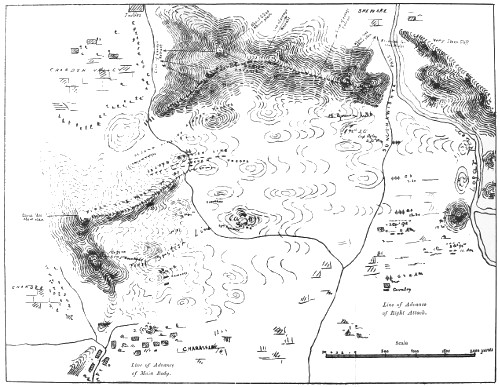
Plan of Engagement on Heights near Kabul, 6th October, 1879.
After leaving the camp, General Baker made for the village of
Charasia, which consisted of a number of detached walled enclosures
such as are common all over the country. There were numerous
orchards and gardens adjoining these, so that his first movements
were well concealed from the enemy, whose attention up to this
point was directed chiefly to Major White’s movements on the
Cabul Road. Seeing how greatly he was outnumbered, General
Baker took the precaution of occupying a strong walled enclosure
on the outskirts of Charasia, and here he placed his reserve
ammunition and his field hospital. The temper of the villagers
was so uncertain that he telegraphed to General Roberts for another
regiment of infantry to strengthen his reserves, and 100
men of the 5th Punjab Infantry hurried out at once and joined
the hospital and reserve ammunition guard. The remainder of
the regiment were sent out soon after, although this left the camp
very weakly guarded, only 1,000 cavalry and infantry with six
9-pounder guns being left at head-quarters. However, as General
Macpherson was coming up with his brigade, the risk was well
worth running, as failure on General Baker’s part might have
meant disaster to the whole army. The 72nd Highlanders led
the way out of Charasia, and bullets soon began to drop among
their ranks while the enemy’s picquets were seen to be retiring up
the ridges. As the brigade pushed forward with the intention of
outflanking the main line of hills lying between Chardeh and
the Sang-i-Nawishta, their progress was checked by a strong
position on their left front on which the Afghans had raised sungars,
and from which they began to open a heavy musketry
fire. Two mountain guns replied to this, and the 72nd extended
in skirmishing order, one company under Captain Brooke-Hunt
turning off to the left, while the main body of the regiment
worked away to the front, the ground affording but slight cover.
Captain Hunt’s company scaled a hill 500 or 600 feet high, climbing
over difficult rocks, which hindered their rapid advance. The
enemy were exceedingly numerous on their extreme right, another
and steeper hill enabling them to pour a heavy fire upon the
company. Two more mountain guns and the Gatlings were
32ordered to open fire upon this hill, and upon such bodies of men
as were visible on the near ridges; but the Gatlings were in such
bad order, owing to their defective make, that after a few rounds
the drum “jammed” and they had to be taken out of action.
Our true attack had now been recognized by Nek Mahomed and
he hastened to reinforce his right; a stream of men was seen
pouring along the rearmost ridges from the direction of the Sang-i-Nawishta,
and standards borne by Ghazis began to thicken on
our left. General Baker lost no time in pushing forward part
of his reserves, in order to force their first position before it could
be strongly reinforced. The 5th Ghoorkas, and 200 men of the
5th Punjab Infantry, doubled forward, while the enemy’s fire
increased in intensity. Captain Hunt’s company was strengthened
by two companies of the 5th Ghoorkas, under Captain John Cook,
V.C.; while two more companies of Ghoorkas and 200 of the
5th P.I. joined the advanced skirmishers of the 72nd in the main
attack. The skirmishing line was thus extended so as to outflank
the left of the ridge, which the Afghans still clung to with great
obstinacy, as it was the key of the position on their right flank.
This was at 1.30 P.M., when our troops had been engaged for an
hour and a half without having made much impression upon the
enemy. With the strengthening of our advance success was soon
declared: the hill on the extreme left, from which a flanking fire
had been directed on our skirmishers, was carried in splendid style
by the company of the 72nd and the two companies of the 5th
Ghoorkas, while the other companies of the two regiments, by a
series of gallant rushes, turned the enemy’s left. At two o’clock
our advanced line was enabled to direct a cross fire upon the 2,000
men who held the ridge, and who now showed symptoms of wavering.
A general advance was ordered, and the 72nd, 5th Ghoorkas, and
5th P.I. were in a few minutes in possession of the Afghan’s first
line. But not without loss, for the enemy were chiefly armed with
Snider and Enfield rifles, and their fire was rapid and continuous.
Fortunately they had so little knowledge of the principles of musketry
that their bullets mostly passed over our men’s heads as the
rush uphill was made. The 72nd Highlanders bore the brunt of
the fighting, and their casualties amounted to thirty-six. They had
on several occasions to cross open ground, and in spite of the
33exposure they rushed forward with an élan that could not have
been surpassed. Private MacMahon, one of their number, particularly
distinguished himself on the left. Almost single-handed
he scaled a hill on the crest of which was a sungar filled with men:
loading and firing as he went, his coolness incited four or five
Ghoorkas to follow him; and when he finally leaped into the sungar
its defenders took to flight and were shot down as they ran.
MacMahon is to be recommended by General Baker for the Victoria
Cross, his gallantry having been observed by the General and his
Staff as well as by the officers engaged in the attack. It was such
incidents as these which caused General Baker to express his
great satisfaction with the behaviour of the troops under his command.
After their first position had fallen into our hands, the enemy
rallied on some low hills 600 yards in rear and re-opened fire, to
which our mountain guns replied, while our men were resting on
their arms. A company of the 23rd Pioneers, under Lieutenant
Chesney, was thrown forward on the right, while two companies of
the 92nd, under Captain Oxley, which Major White had detached
to hold in check any flanking movement the enemy might attempt
on General Baker’s right, also came into action. The enemy’s
second position was attacked by the 72nd Highlanders and the
5th Ghoorkas, aided by the three companies just mentioned, and
at three o’clock the Afghan right had been broken up, and their
regiments were flying towards the village of Indikee. The mountain
guns fired shrapnel into their midst, and the Gatling guns,
for the few moments they were able to work, also did some
execution, while volleys from the 72nd at long ranges caused the
fugitives to hasten their flight. Major Stockwell, with a wing of
the 72nd, followed them rapidly until he reached the open ground
leading down into the Chardeh Valley, when his further advance
was stopped by General Baker, as the turning movement along the
ridge towards the Sang-i-Nawishta had to be made. The want of
cavalry was here painfully apparent, as the retreating masses of
the Afghans could easily have been overtaken, the sloping ground
between Indikee and the hills being admirably suited for a pursuit.
While Major Stockwell had thus been completing the defeat of
the enemy’s right, two companies of the 23rd Pioneers had gained
34a footing on the main ridge itself, whence the enemy were rapidly
retiring as they recognized that their line would in a few
minutes be taken in reverse. General Baker swung round his
left, ordered a general advance, and at 3.45 P.M. the ridge was in
our hands without any serious opposition having been met with.
Not that they had not shown great determination before, for
bands of ghazis had made good their footing behind the
sungars until our bayonets had forced them down. The 5th
Ghoorkas were charged by a number of these madmen, but they
met the rush by a counter bayonet charge and cleared all before
them.
Leaving General Baker with the main body of his force sweeping
over the high ridge in the direction of the Sang-i-Nawishta Gorge,
I must now turn to Major White’s movements on our right, where
had been done one of the most gallant feats of the day. The
feint in this direction had been turned into a successful attack,
resulting in the capture of twenty guns, although our infantry
numbered only a few hundreds, and our cavalry were unable to
act. Skirting the east of Charasia, Major White found the enemy
scattered about among the trees, and also holding the hills to
right and left of the defile. The three guns of G-3 were soon in
action, and a few shells well placed, with the fire of skirmishers
thrown out among the trees and gardens, drove back the more
venturesome of the enemy to the shelter of the sungars in the
hills, and behind some boulders in the bed of the Pass. Our
guns were then moved forward and made beautiful practice, the
answering fire from the enemy’s artillery being quite harmless.
One of our shells struck an Afghan field-piece, dismounted it,
and killed two of the horses standing near, while another struck
a standard in a cluster of men. In fact, the 103 rounds fired by
G-3 were of the greatest value in preparing the way for the
infantry attack. This attack was led personally by Major White,
who at the head of only fifty Highlanders charged the first hill
on the right, where several hundred Afghans were posted. Our
men went up with a rush under a severe musketry fire, and the
enemy waited as if to receive them at the point of the bayonet.
With such odds in their favour, and a sungar to aid them,
European troops would have swept back the handful of men
35attacking with scarcely an effort; but Afghan courage and steadiness
are very limited. When the Highlanders were within five or
six yards of the sungar the enemy turned and fled, and were shot
in the back as they made for the next hill. The success thus
gained was mainly due to Major White’s personal gallantry, one
striking instance of which may be quoted. Not caring to expose
his men in a particularly steep bit of ground, which was enfiladed
by a few Afghans well placed in rear of some rocks, he took a
loaded rifle from one of the Highlanders and “stalked” the
enemy single-handed. By cautious climbing he reached the rocks
behind which they were concealed, and as he showed himself they
jumped up and ran, no doubt in the full belief that the single
figure they saw was only the leader of a number of others. One
man stayed to fire, but missed his aim, and as he turned Major
White shot him through the head. Unfortunately, he had no
more cartridges with him, or some of the others would have
fallen. This hill is to be called “White’s Hill” in memory of his
gallantry. The capture of this point enabled the guns to be
advanced still further towards the entrance of the Pass, but Major
White was not content. Having given his men breathing time,
and being reinforced by another fifty men from below, he again
went forward and captured two lower hills on the right, in the
same grand style, and with only trifling loss. It was by these
movements that he was able to send Captain Oxley with two companies
well to the left, to co-operate with General Baker’s Brigade.
Six Armstrong guns fell into Major White’s hands on the open
ground below the hills; and when our turning movement in the
Chardeh direction had been completed, and the enemy began to
evacuate the main ridge, the cavalry were sent forward, and the
infantry occupied the hills commanding the Sang-i-Nawishta Pass
on the left. Here twelve more guns were captured in position,
while the cavalry found two more abandoned on the road. The
twenty guns brought out from Sherpur, therefore, to fortify the
Pass have all fallen into our hands. Upon Major White gaining
the ridge to the left he could see no further sign of the enemy,
who had stampeded to the Bala Hissar. The cavalry could not
follow as the Pass narrows, and the narrow paths beyond are not
adapted for a body of horse charging. Our information was to
36the contrary, it being stated that the road opened into a plain,
and our cavalry being accordingly sent to the right to cut off the
retreat of the enemy when driven towards Cabul by General
Baker. As events occurred, the two squadrons would have been
invaluable if they had accompanied the General. The progress of
the brigade along the main ridge was very slow, as the ground
was rugged and difficult; and it was not until nightfall that a
junction was effected with Major White. The 23rd Pioneers and
the 5th P.I. moved down into an open bit of ground beyond the
Pass, while the 72nd Highlanders, the Ghoorkas, and mountain
guns remained above, throwing out strong picquets over the range
of hills. Major White’s force bivouacked on the ground they had
occupied when their last movement was made.
It is worth mentioning that two elephants, three camels, and
200 mules carrying stores, &c., were safely piloted over the
precipitous hills which were taken, and the men were thus able to
bivouac in comfort. Not the least important arrangement of the
day was that of signalling. Captain Straton had parties of men
with General Baker and Major White, and a third batch of
signallers was sent to a high hill to watch the Chardeh Valley,
and the movements of large bodies of tribesmen, who lined the
crests of the range overlooking the camp from the west. Heliograms
were exchanged between these points and the head-quarters
camp, and General Roberts was kept fully informed of all that
was happening in these directions. This focussing of all information
upon a common centre enabled the General to make his
dispositions with accuracy and effect: without the signallers
dangerous delays might have occurred. The heliographing was
so thoroughly well done that Sir F. Roberts complimented Captain
Straton personally on the success of his arrangements. The only
drawback was a succession of small sand storms, which swept
across the camp and blotted out everything for the time being.
The attitude of the tribesmen in our immediate neighbourhood,
i.e., on the ranges of hills east and west of the camp, was one of
expectancy modified by an earnest desire to harass our picquets by
spasmodic firing. Their ill-will was first shown by firing upon
the signallers on the hill, and the party had eventually to be withdrawn.
Two guns were sent down and a few shells pitched
37upwards, which caused these guerillas to withdraw to a safe distance.
The convoy from our last camp at Sufed Sang, Zahidabad,
was also fired upon, and General Macpherson had to throw out
skirmishers to protect his baggage animals. At least some hundred
men appeared on a high peak to the east of the camp, and
fired upon a picquet of the 92nd who were on a lower level. A
brisk fire was kept up for some time, and the enemy driven off to
higher ground.[12] As they re-opened fire the R.H.A. were
ordered to try a shot at the peak. The first shell dropped a little
short, but the second burst on the point occupied, and the next
instant it was quite clear, its late occupants running in disorder
into the valley beyond. There were several of the Amir’s soldiers
among them, still wearing his uniform. The camp after this was
left undisturbed: tents were struck at sunset in readiness for the
early morning march which it had been decided to make to Beni-Hissar,
just beyond the Sang-i-Nawishta Pass.
The enemy are believed, in this action, to have had 9,000 or
10,000 men on the ridges, including thirteen regiments of regulars.
They left 300 dead on the field, but their total loss in killed and
wounded must have been much greater. Our loss was twenty
killed and sixty-seven[13] wounded, among the latter being Lieutenant
Fergusson, 72nd Highlanders, bullet contusion, left leg, slight;
Dr. Duncan, 23rd Pioneers, bullet wound in the chest, severe; and
Captain Young, 5th Punjab Infantry, bullet wound in the left
thigh, severe. Of the British Infantry regiments the 72nd lost
three killed and thirty-four wounded; and the 92nd three killed
and six wounded. Among our camp followers five dhoolie-bearers
were killed and four wounded, returns which show that the kahars
were well under fire in carrying off the injured.
38
Effect of the Action of Charasia—Advance to Beni Hissar—Cavalry Reconnaissance—The
Bala Hissar Deserted—The Sherpur Magazine Blown up—Attitude of the
Amir—Operations of the 8th and 9th of October—Capture of Sherpur Cantonments—The
Affair of the Asmai Heights—Cavalry Pursuit towards Ghazni—The
Force moves to Siah Sung—Leaders of the Mutinous Regiments.
Camp Beni Hissar, 8th October.
There can be little doubt that the action at Charasia has broken
up the combinations against us, and that Cabul is now at our
mercy. It cannot be too fully borne in mind that, but for the
promptness with which General Roberts decided to attack, instead
of allowing the enemy to gather strength by our own inaction,
serious consequences might have ensued to our compact little army
now within three or four miles of the Bala Hissar. Not that defeat
was to be feared in any sense of the term, but that the slightest hesitation
or check in our advance would have raised against us crowds
of enemies whom we should have had to deal with in, perhaps, as
difficult a country as could be fought over. It was a bold bid for
all doubtful and wavering hearts to join them—this move of the
mutinous regiments seven or eight miles out of Cabul right across
our path; and if they had been allowed to hold the hills even for
twenty-four hours, there can scarcely be a doubt that their numbers
would have been doubled, and our loss in dislodging them proportionately
greater than that which even now we have suffered.
I have described the position of our camp at Charasia in my
last letter, and from this it would be seen that our best route to
Cabul was by way of the Sang-i-Nawishta defile on our right front.
At daybreak yesterday we moved out of Charasia camp, and at the
mouth of the defile Sir F. Roberts was met by Major White, who
explained the positions occupied by the enemy, and the action he
had taken in dislodging them. The General congratulated him
heartily on his success, and then passed on to where General
Baker had bivouacked at the northern end of the defile. High
hills shut in the road on either hand, the Logar River, here a
39deep stream, also running to the right of the path, which at times
is very rough. Two or three men had hidden themselves behind
rocks on the steep hillsides to the east, and they now fired down
as the troops filed along. Their shots were wide of the mark,
and our men firing freely back soon silenced them. Rounding the
corner of the hill on our left, we came upon General Baker’s
bivouacking ground, and here followed more congratulations; Sir
F. Roberts hearing in detail from his Brigadier an account of the
action upon the success of which so much had depended. General
Baker with his brigade was left to keep open the Pass while the
baggage and stores were passing through, and he remained there
until this morning, by which time the ground at Charasia had
been cleared.
In the next three miles to Beni Hissar the road runs among
rich corn-fields, irrigated by the diversion of the stream, and the
route to the Bala Hissar was followed by our troops until the
ground fixed upon for the camp was reached. This was just under
the walls of some gardens belonging to the Amir and his Mustaufi
(Minister of Finance), where water was plentiful and trees
afforded shade. While the Infantry were marching in, General
Massy went forward with the cavalry through Beni Hissar village
and into the fields beyond. The hills to the left shut out for a
mile a view of Cabul, but after ten minutes’ riding the Cabul plain
was reached, and before us was the Bala Hissar and the fortified
ridge running upwards and commanding it. The heights were
crowned by a wall fifteen or twenty feet high, and the line of
fortification could be seen following the sky-line, until the hill
dipped down to the bed of the Cabul River to the north of the
city. Again, the ridge rising on the left bank of the river presented
a similar sight, the zig-zag wall being apparently endless.
Our videttes rode out well towards the Bala Hissar, and, accompanying
them, I had a good view of the fortifications, but could
not see a single soldier lining the walls. All was deserted, and
we knew that the mutineers, if they meant fighting, were not
foolish enough to allow themselves to be caught in a trap such as
the Bala Hissar would have proved. The small portion of the
city that could be seen also lay as if abandoned by the inhabitants,
and we made up our minds that the fortified camp at Sherpur,
40lying over the low Siah Sung hills which blocked our view to the
north-east, was the position taken up by the enemy for a final
struggle with our force. The plain on which our cavalry reconnoitred
was all under cultivation, rich fields of clover and lucerne
relieving the general brownness of the land, the crops of which
had been lately reaped. Cultivation extended as far as the eye
could reach on the right, while on all other sides high hills blocked
the view, the gigantic Hindu Kush lying away in the distance to
the north, keeping sentinel over Afghanistan as impassively as the
Himalayas look down upon Hindustan.
We returned to camp to speculate upon the chances of further
fighting, and in the afternoon we had to listen to the many stories
brought in by local friends of the Amir and merchants from
Cabul, who came to pay their respects to Sir Frederick Roberts.
In the evening the firing of heavy guns was heard in the direction
of Sherpur, and it was surmised that the rebels were marking
out ranges; but when a tremendous explosion succeeded it soon
became known that the magazine at their fortified camp had
been blown up, and it was then concluded that they were discharging
guns before abandoning them. Accordingly this morning we
are not astonished to hear that Sherpur Camp is deserted, and a
force of cavalry is now going out under General Massy in search
of the enemy. This force I am accompanying, as it is most probable
some of the fugitives—if the regiments have really decamped—will
be overtaken. To-morrow we move camp to the Siah Sung
ridge directly overlooking Cabul.
The attitude of the Amir is not altogether satisfactory, and he
is plainly afraid that the soldiery will make a stand in the city,
and that Cabul will be stormed and destroyed by our army. He
assured us that we should not meet with any resistance at Charasia,
and yet it is now believed that Nek Mahomed visited him in our
camp, told him of the force ready to fight, and appealed to him
to desert the British and head a national rising. All Yakub Khan
vouchsafed to tell the General was that the Bala Hissar was
no longer in the possession of people whom he could trust, and
that his own family had been moved into the city. He now confidently
explains that the mutinous regiments have dispersed, and
that we have nothing more to expect in the way of opposition.
41Camp Siah Sung, 10th October.
The force of cavalry sent under General Massy on the 8th
instant, to cut off the retreat of the enemy, who was said to
have abandoned Sherpur entrenched camp after blowing up the
magazine on the previous evening, was made up as follows:—102
men of the 9th Lancers, 140 of the 5th Punjab Cavalry, 260 of the
12th Bengal Cavalry, and 220 of the 14th Bengal Lancers,—in
all 722 lances and sabres. I accompanied this force, which left
Beni-Hissar camp at eleven o’clock in the morning, passed through
the village adjoining, and then took its way across the Cabul plain
(leaving the Bala Hissar and the city on the left) to the Siah
Sung ridge, on which we are now encamped. This was easy going
for the horses, who were pushed on rapidly until the ridge was
crested on the extreme right, and a gradual descent led us towards
Sherpur. Soon the level plain lying north of Cabul was reached,
and rich cultivation was passed through, the ground being everywhere
intersected by watercourses and irrigation channels. The
Cabul river, at this season a shallow streamlet only a few yards
broad, was crossed, and on our right, at a few hundred yards’ distance,
was the long line of wall, with bastions for heavy guns at
regular intervals, which marked the fortified camp of which we
had heard so much. Our scouts found it quite deserted, and their
first prize was a heavy gun which had been dragged some distance
across the fields, no doubt with the intention of using it in another
position. There were no guns at the embrasures in the bastions;
but General Massy had the good luck to find seventy-five pieces of
various calibre parked within the walls. These guns were in very
good order, but little damage having been done to them. There
was not much ammunition left with them, the Afghan troops
having carried off a large quantity; while the magazine itself had
been blown up to prevent the remainder falling into our hands.
The guns included four English 18-pounders, one English 8-inch
howitzer, and two Afghan imitations of this weapon; and forty-two
bronze mountain guns (3-pounders) with part of their equipment.
This fortified camp of Sherpur is built at the base of the low,
stony Bemaru hills, running for about two miles at a slight angle
42to the general direction of the plain itself. It has only three
sides fortified, the hill in rear being quite sufficient to shield it
from attack in that quarter, as an open plain stretches away to
the hills of the Koh-Daman and Kohistan. The main wall is
about a mile and a half long, with three strongly-guarded entrance-gates,
and from each extremity the fortification is carried at right
angles till it reaches the ridge in the rear. There is a fourth
gateway on the western flank. The plan followed throughout
is a thick mud wall (25 feet in height) built with bastions for
guns, and a low parapet to shield troops manning the outer
wall. The entrance-gates are lofty structures, with comfortable
quarters on either side for officers, and are so wide that four
or five men could ride through them abreast. They are each
defended by a curtain built in the same way as the outer wall.
Inside the cantonment is an open space quite clear of buildings,
exactly answering to an English barrack-square, and on this
20,000 men might be paraded with room to spare. To the right,
on the hillside, is the small village of Bemaru, with the usual
flat-roofed houses, burnt brown by the sun, and with but little
sign of life in it. The novel feature in this cantonment is the
arrangement of the barrack-rooms. At about 20 feet from the
outer wall, and parallel to it, is built a range of rooms, extending
along the three sides of the place. Each room would hold at a
pinch twenty men, and there are some hundreds of these dormitories,
which are snug enough even for a variable climate such
as this. Along their front is a narrow verandah-like space, pucca
brick pillars and arches supporting the flat mud roof, which rests
on strong beams and unhewn poles. This arrangement has a
very pleasing effect when viewed from within the cantonment, the
regularity of the arches and their supports grouped in threes
before each room, with a wider span then following, giving the
appearance of a long colonnade. Broad staircases lead at certain
intervals to the roof of the barracks, which would give a second
line of musketry fire in resisting any attempt to storm. Open
spaces are left at rare intervals between the rooms to admit of the
passage of men and guns to the outer wall. Altogether this
fortified camp could, if properly victualled and garrisoned, be
defended for an indefinite period against any force without
43artillery. The water supply is from streams diverted from the
fields and carried by low culverts underneath the walls; but
if this were cut off, wells, no doubt, could be sunk to supply the
deficiency. From the absence of trees and the utter barrenness
of the space enclosed by the walls, with the stony hills in the rear,
the place must be insufferably hot in summer, though at this
time of the year it would be much better than tents. When
our cavalry rode through the gates into the middle of the cantonment
there was no sign of an enemy, and it must have
been deserted many hours before. A few cartridge papers were
lying about, and the rude fireplaces of the men were still
black with smoke; but beyond this nothing could be seen. In
one or two places an attempt had been made to burn the barracks
down, but the fire had not obtained sufficient power over
the timbers for this to be accomplished. Doors and loose woodwork
had been looted by the villagers, who claimed to have put
the fire out; but their story was a very questionable one.
People were passing freely through the place as we entered, but
they did not show much interest in our proceedings. In the
north-west corner the wall had been partly blown down, and the
ruins of the magazine were strewn in every direction.
It was upon arriving opposite Sherpur Cantonment that we
sighted the enemy; the Asmai Heights to the left, overlooking the
old Afghan quarter of Cabul, being crowded with men. We were
3,000 or 4,000 yards away, and at that distance they did not consider
us worth a shot, though their guns could be distinctly seen.
A halt was called, the cavalry forming up at the farther end of
the cantonment; while General Massy heliographed back to Sir
F. Roberts the news of the enemy having been found occupying
a position of strength. We were told, in reply, that General
Baker was leaving Beni Hissar with infantry to attack the heights,
and we accordingly hurried on, skirting the hills and passing
through grain-fields and meadows, with here and there a country
villa in its fertile garden surrounded by huge walls. Our object
was to reach a break in the hills and to pass over into the Chardeh
Valley, so as to cut off the enemy from taking the road which
leads to Ghazni, Bamian, and Turkistan. We worked round
almost on the arc of a circle, of which Cabul might be the centre,
44keeping the ridge occupied by the enemy at first on our left rear,
then on our left, and, finally, on our left front, when we galloped
through the break we had been making for, near the village of
Aoshahr, and faced round towards Cabul itself. The rich Chardeh
Valley was all before us, and we passed down into it, and could
then see the disposition of the men General Baker was to attack.
We had learned that they numbered three regiments and had
eleven guns in position, and this information was fairly accurate.
They had 2,000 regulars, besides 700 or 800 untrained men who
had joined them, and had twelve guns. Videttes were thrown out
right across the plain, and a rapid reconnaissance made. An old
ressaldar of Fane’s Horse, who was accompanying us as guide,
stated that three roads led from the valley and united to form the
chief road to Bamian. The 5th P.C. were accordingly sent well
on to the right to block the road there; two squadrons were sent
back into Sherpur plain to watch a path leading down from the
hills in that direction; another squadron returned a mile and a
half to Aoshahr, so as to prevent the fugitives escaping along the
crest of the hills down the dip we had passed through; while the
General and Staff remained in the open with the rest of the
cavalry, including the 9th Lancers. We had mounted signallers
with us, and heliographic communication was opened with the
high Takht-i-Shah Peak overlooking the Bala Hissar Ridge.
Captain Straton thence signalled down that the enemy’s working
parties had been strengthening their sungar on the Asmai Hill,
and that some of General Baker’s troops were on the same side
of the ridge as ourselves. We could see the enemy distinctly on
the hillside, and at its foot was their camp, made up of forty or fifty
tents. These were close to the village of Dehmazung, half-hidden
by orchards, and a gun was slued round and pointed at us as soon
as we appeared. The 9th Lancers withdrew 1,000 yards just as
the enemy fired a few shells at our videttes. The shells buried
themselves in the soft ground and never exploded. We could not
push farther forward, as deep watercourses cut up the fields at
every few score yards, and the rows of closely planted willow-trees
along these would have broken any cavalry formation. In the various
villages, too, large bodies of the enemy were gathered, who could
have shot our horsemen down from the towers and walls without
45at all exposing themselves. A narrow road to the left led along
the foot of the hills to the enemy’s camp, but only three men
could have gone abreast, and it was commanded on the left and
front by the guns, and on the right by the troops in Dehmazung,
underneath the walls of which it passed. At a quarter to four we
heard the first gun fired, and from that time to dark we watched
for the infantry attack to develop. Some of the 92nd Highlanders
were seen to our right centre among the trees of a village a mile
from Dehmazung, and a small party of the 9th Lancers was sent
by General Massy to open communication with them. These
found the enemy swarming in the orchards they had to pass
through, and after being fired upon from several walls they had to
return. The mountain guns with General Baker, posted upon the
high ridge commanding the Bala Hissar, were shelling the Asmai
Heights lined by the enemy, whose guns returned the fire shot for
shot. Having twelve guns to General Baker’s two mountain guns,
they had much the best of it, though the range was so long that
little real damage was done on either side. The ridges upon
which this shell practice was going on form the defences of Cabul
from attack from the Bamian direction. Running up from the
Bala Hissar, and following every dip and rise of the hillside, is a
strong wall ten or twelve feet high, pierced for musketry. This
wall is continued at right angles along the crest of the Sherderwaza
Ridge and down the precipitous hillside of the gorge through
which the Cabul River runs. It ends a few yards from the broken
arches of a bridge spanning the stream—at this time reduced to
very small dimensions, by being largely drawn upon for irrigation
purposes in the Chardeh Valley—but begins at once on the opposite
side of the river. A strong tower, with a base of stones fifteen
feet high, raised on the solid rock, is the starting point on this,
the northern side of the river, and the wall zig-zags up just in
the same way as that in continuation of the upper Bala Hissar.
The line of fortification extends along the hill top, and then turns
down for some distance along a spur facing towards Sherpur. On
the crest of this ridge (the Asmai Heights), three white standards
were flying near the guns of the enemy, who had one heavy piece
on the summit, the report of which made the bark of the mountain
guns sound quite contemptible. The line of fire on both sides
46was at right angles to the bed of the Cabul River, the shells flying
over the gorge and bursting on the opposing heights. From our
position in the plain below we could watch the artillery and judge
pretty accurately as to the fall of the shells, and it was annoying
to see that as it was “end-on” firing, the enemy were receiving but
little injury. Their policy was plainly to hold on till nightfall and
to attempt to escape under cover of darkness; and as the sun
sank slowly behind us, it became obvious that unless the infantry
attack was soon delivered, they would succeed only too well. Our
chagrin was great that there were not guns with our cavalry, as
we could see men in little clusters of 50 or 100 lying under the
lee of the rocks on our side of the ridge, perfectly sheltered from
General Baker’s shells. General Massy had applied for horse
artillery before leaving Beni Hissar; but it was reported that the
country he would have to pass over was cut up by deep irrigation
channels which would hinder the guns from keeping up with the
cavalry. It was decided therefore not to send out artillery. With
a couple of R.H.A. guns we could have made the enemy’s camp
and the hillside quite untenable, and the 2,800 men gathered
there would either have had to come down into the plain, where
our cavalry would have chosen their own ground to charge them, or
to take refuge in Cabul city, which they could easily have reached.
An old native officer, a Cabuli, who saw service in the Mutiny,
was much struck with our plan of cutting off the retreat; and
when he saw the cavalry debouch into the Chardeh plain, he said
in his fervent thankfulness:—“God has delivered these budmashes
into your hands even as the Embassy was delivered into theirs.”
And it certainly did seem as if these three regiments, which were
said to have been chief in the attack upon the handful of men
under Sir Louis Cavagnari in the Bala Hissar, were about to be
exterminated. But night fell, and still our infantry attack was
not delivered. General Massy ordered his videttesvidettes and the chain
of cavalry to be maintained until it was quite dark, so as to induce
the enemy to believe the cordon would be maintained during the
night; but he would not run the risk, in such an awkward country,
of his men being shot down in detail. He therefore withdrew
them eventually within two or three of the rude forts in the plain
and waited for daylight. It seemed almost hopeless to intercept
47in the darkness men who had a valley six or seven miles across,
with hills on either side, to escape by. That they did escape is
now a cause of much heartburning in the force. If, like Joshua,
we could have made the sun stand still, say, for only two hours,
the day would have been as grand a success as the 6th at Charasia;
as it was, it can only be looked upon as one of great disappointment
to all concerned.
The only troops available for despatch with General Baker were
320 of the 92nd Highlanders, two companies of the 72nd Highlanders,
and seven companies of the 23rd Pioneers. With these
were two mountain guns and one Gatling. The road up to the
ridge commanding the Bala Hissar and the passage over the Kotal
down into the Chardeh Valley were so difficult, that although this
force moved out of Beni Hissar at noon, it was a quarter to four
before the mountain guns got into action, and it was some time
later before the 92nd Highlanders reached the village to the west
of Dehmazung. The enemy were in greater force than was expected,
and as the 92nd men were unsupported, they were ordered
to wait for reinforcements before making any attack. They were
directed to take up a position on a spur of the Sherderwaza
Heights, parallel to the Cabul River, and this they did without
loss, although the enemy opened fire from two breech-loading
field-pieces in their camp. The shells and round shot were pitched
too high, and greatly amused our men. Marksmen were posted at
sheltered points, and their aim was so good that the Afghans soon
retired from these two guns, leaving them in the open. The two
companies of the 72nd were at this time on the hillside nearest
to Beni Hissar, and the 23rd was in reserve. A gun in the tower
I have mentioned fired occasionally, and the Gatling was tried at
this; but the drum hitched after a few rounds, and the gun had
to cease firing. General Baker had made up his mind to attack
the instant his reinforcements—consisting of a wing of the 67th,
two companies of the 5th Ghoorkas, and four more mountain
guns—arrived. These, however, did not reach him until half-past
five, and it was then quite hopeless to think of storming the
heights in the dusk. The troops accordingly bivouacked where
they stood, and a very cold night they had of it. General Macpherson
arrived at 6.30 A.M. with the remainder of the 67th, the
4828th P.N.I, and four horse artillery guns on elephants. He
started with some infantry and guns to follow General Massy.
There is no doubt the enemy began evacuating their position as
soon as it was dark; and when a strong patrol crept into their
camp at midnight they found all had fled. Guns, tents, camp
equipage, &c., fell into our hands. Seven bodies were found
buried on the heights, and three others were lying on the rocks.
Whether the fugitives carried off others, we have no means of telling.
There were no casualties on our side. General Baker sent information
to General Massy of the flight of the enemy, and the cavalry
started off on the Bamian Road at 5.30 A.M., but only one small
party of twenty-one was overtaken on the Kotal-i-Takht. These
took refuge on a low hill and fought desperately, the good luck of
surrounding and shooting them down falling to the 5th P.C.
The single combat between Rahmat Ali, a native officer, and the
leader of the party, was a pretty piece of business. The Afghan
tried to escape on a fast pony, but was overtaken by Rahmat Ali,
who, after warding off two blows from his opponent’s tulwar, got
well down upon the man’s head. Unluckily his sword snapped at
the hilt, but the blow had knocked the fugitive off his horse, and
he was pistolled before he could recover himself. It was the
hardest day’s work the cavalry have had for a long time, over thirty-six
miles being covered in the day. The men were without food
both days they were out, but they behaved splendidly, not a
grumble being heard. For instance, the 9th Lancers started
on the morning of the 8th, after having received one loaf to every
three men. They carried no food, as only a reconnaissance was
intended, and at night some sheep were killed for them, and they
tried to eat the flesh after roasting the animals whole. They had
nothing but their swords to use in cutting up the carcases, and
they found it quite impossible to eat the flesh; so on the 8th they
went supperless to bed. On the 9th they were in the saddle from
5 A.M. to 9 P.M. (when they reached this camp), and the pursuit
and return were made in such quick time that again there
was no chance of their getting food. Horses and men of all the
regiments out with General Massy were quite exhausted when they
at last reached their quarters here. Some score of horses were lost on
the road, having literally died in harness. There was no slackness
49in the pursuit when once it began, but the enemy had too great a
start to be overtaken, and it now seems probable they dispersed to
the hills and made for their homes, many doubtless taking refuge
in the city. One piece of experience was certainly gained, and
that was that the villagers about Cabul are hostile to us almost to
a man. Five of them belonging to Aoshahr were made an example
of by Colonel Ross, of the 14th Bengal Lancers. They
treacherously fired into the Lancers, after having salaamed to
them as they passed. The ruffians were captured with their guns
still in their hands, and were shot without further parley. It is only
by such severity, and by taking no prisoners in action, than any
impression can be made upon the Afghan mind. Such prisoners
as are brought in are tried by a military commission, and the great
majority are shot. There is just a fear that too much leniency
may be shown, as the work is rather distasteful to British officers;
but as we are an “avenging army,” scruples must be cast aside.
The army moved into this camp yesterday afternoon. It was
only about a four miles’ march from Beni Hissar, and the 72nd
were left in charge of all stores that could not be got off by the
transport animals in the day. On the night of the 8th there was
some lively firing by small bodies of budmashes, who tried to
shoot down men on picquet and sentry duty; but, as is usual, the
bullets did no mischief. Last night there was news of what
threatened to be a better organized attack by local villagers and
tribesmen. Mounted sowars, it seems, were sent round to the
tribes in this neighbourhood asking them to gather in force and to
attack the camp, as much loot could be got, and only a few men
had been left in camp. The exemplary severity we have shown in
shooting all the men caught in arms against us, deterred the
villagers from combining together, and no attack was made. The
72nd had drawn in their camp well under the walls of a garden
overlooking the ground, and had formed a kind of laager with
flour bags, &c., but not a shot was fired all night. The 72nd were
ready for any number of assailants, and from behind their barricades
of flour bags they would have read the Afghans as sharp a
lesson as the Zulus received when trying to storm the mealie
redoubt at Rorke’s Drift. The whole of the stores were brought
in here to-day. The 5th Ghoorkas hold the ridge overlooking the
50Bala Hissar, and the 5th Punjab Cavalry are in the Sherpur
Cantonment, to prevent the barracks there being destroyed by the
local peasants for the sake of the woodwork and other material.
In two or three days we shall probably move into the Bala Hissar,
in which five months’ provisions are to be stored. The city is
quiet, and the camp is quite thronged with petty traders, who bring
in food, clothing, &c., for sale, and move freely among our troops.
Sir Frederick Roberts inspected the Sherpur Camp and the
captured guns to-day, but no movement of troops took place. In
a short time a small force under General Gough will march back
to the Shutargardan to re-open communications in that direction,
pending further news of the Khyber Force, whose advance seems
to be very slow owing to transport difficulties.
Cabul itself is quite open to us now, and we can enter it whenever
we choose. The guns captured on the Asmai ridge were six
field-pieces and six mountain guns. Two field-pieces were also
found in camp, and an immense store of ammunition. Thirty
camels, four elephants, and several mules and ponies also fell into
our hands.
It is now well established that the leaders of the mutineers are
the Amir’s most trusted friends. Kushdil Khan, who was sent
specially by him to meet Cavagnari at Shutargardan, was a prominent
leader both at Charasia and on the heights yesterday.
Mahomed Jan, a general in Yakub’s army, and of some importance
among the powerful Wardak section of the Southern Ghilzais, is
also mentioned. There is no doubt of concealed action among
the Amir’s officers, and unluckily none of the leaders have been
taken. Sirdar Nek Mahomed Khan is really the head of all. It
now appears that only one quarter of the magazine in the Bala
Hissah was looted, and there are now in that fortress about twenty-six
guns in perfect order and several rockets, old presents of the
Indian Government. Nawab Khan, colonel of artillery, came in
yesterday to know what orders General Roberts had to give about
them, and was told they were to remain there for the present. No
one can suppose any captured guns will be given to the Amir, who
is still with us.
It was rumoured that 800 sepoys had kept together in a body,
but this story is now said to be false, all having dispersed except
51100 who escorted their leader, Mahomed Jan, towards Turkistan.
The three regiments at Ghazni are reported to be only five miles
out of that place, while four days ago our force from Candahar
was at Makr, four long marches from Ghazni. The enemy has
been extremely well informed of all our movements, though their
source of information cannot be absolutely fixed upon. Regular
news was probably given by some of the Amir’s retainers, who see
all that goes on in our camp.
The political situation shows no development; the Amir coinciding
in all that is done, now that the flight of the mutineers has
removed his apprehension of Cabul being sacked. If the attack
on the 8th had been made earlier in the day, the only outlet for
Mahomed Jan and his 2,000 troops would have been to Cabul
itself.[14] The city would then of course have been taken by storm,
and, as Sir Frederick Roberts said in his proclamation, we could
not have been held responsible for the consequences. At present
the strictest orders prevail against any one entering the city, which
perhaps even now may harbour many mutineers.
Visit to the Residency—Description of the Bala Hissar—The Ruins of the Residency—Probable
Plan of the Attack and Defence—The Amir’s Palace—Formal Occupation
of the Bala Hissar, and Proclamation to the People of Cabul—The Punishment of
the City—Arrest of the Amir’s Ministers—Text of the Proclamation.
Camp Siah Sung, 11th October.
To-day Sir Frederick Roberts and his Staff visited the ruins of
the Residency within the walls of the Bala Hissar. The visit was
52made quietly and unostentatiously, only a sufficient escort being
taken to guard against such accidents as a ghazi running amuck,
or a handful of quondam rebels making an attack upon the leader
of the army that has punished them. There is so much of
historical interest attaching to the fortress which guards Cabul,
and this interest has been so intensified by late events, that all of
us who rode from Camp yesterday were full of expectation as to
what we were likely to see. Following for half a mile the
Jellalabad Road, lined on both sides with closely-planted trees, we
turned sharply to the left when nearing the city, and were soon
underneath the walls of the Bala Hissar itself. The shallow bed
of the moat supposed to surround the city is nearly dry, and the
road runs only a few yards from the foot of the rock against which
the walls are reared. The masonry is crumbling to decay, but
there are still signs of great stability in it, and the natural features
of the ground have been so utilized that a precipitous face of 30
or 40 feet is presented to any enemy. This is on the eastern side
to the right of the entrance-gate, just where Shere Ali’s palace,
with its zenana, tops the wall. The road rises some 10 or 12 feet
to the gate itself, which must once have been of enormous strength,
as solid masonry 20 feet thick still remains. Here, again, there
is evidence of ruin, the inner supports having crumbled away and
the defensive position overhead lost its protecting parapets. The
lower Bala Hissar once entered, one comes upon the usual narrow
winding lanes and commonplace mud buildings of all eastern
cities. The place looks filthy and uncared for, and the doorways
leading to the courts of the tumble-down houses give a view of
squalor and dilapidation suggestive of worse to follow. The few
shops are miserable specimens of their kind, and their owners are
in keeping with the general associations of the place. There is
nothing better to describe than dust, dirt, and dreariness, on every
hand; and even the small square, where a few guns were standing
in front of a dozen dirty tents used by the gunners, gave as
little idea of the interior of a fortress as a few grains of sand
would of a desert. Six field-pieces and as many mountain guns
were parked in the square. This was part of the artillery-quarters,
and a few gunners with a trumpeter were standing near the guns.
The men wore no uniform and looked like unwashed coolies. They
53saluted as Sir Frederick Roberts rode up, and the trumpeter
welcomed us by blowing monotonously for several minutes upon
his instrument.
It must be more than thirty-five years since British infantry
marched through the filthy streets of this much-vaunted citadel;
and our only regret was that they had now entered it so peacefully.
Sir Frederick Roberts was accompanied by the Mustaufi, the
Wazir, and Daoud Shah, the Commander-in-Chief. After a few
minutes’ stay in this square, we retraced our steps and entered a
narrow lane with a high wall on the right, shutting in the Amir’s
garden. On the left were the stables in which the horses of the
Royal household were tethered in the open air, rude bins being
made in the mud walls on a pattern which is common where
Afghan cavalry are quartered. The lane led to the high ground
on which the buildings assigned to Sir Louis Cavagnari and his
companions stood. From this the city could be seen lying at our
feet, to the north.
Our first view of the Residency was of the rear wall, still intact,
but blackened on the top where the smoke from the burning ruins
had swept across. At each angle where the side walls joined were
seen the loop-holes from which the fire of the little force on the
roof had been directed against the overwhelming numbers attacking
them. Every square foot round these loop-holes was pitted
with bullet-marks, the balls having cut deeply into the hard mud
plaster. The western wall, which faced towards the Upper Bala
Hissar, commanding it, was scarred with these marks, proving
only too well how severe had been the fire from the higher level
occupied by the mutineers in the Arsenal. At this end the
Residency was of three stories, but the present wall does not
indicate the height of more than two, the upper part having
collapsed when the fire obtained a mastery over the building. A
lane six or eight feet wide runs between this wall and the buildings
on the right in which the Guides were quartered. Plans hitherto
published have made the Residency and these quarters one block;
but this is a mistake; they were quite distinct.
Riding along the lane we came to the southern end of the
Residency, built upon the edge of the wall looking towards Beni
Hissar, and here were two graves marked by neatly-piled stones in
54Mussulman fashion, each with its head-stone, but no inscription.
Whether any bodies are buried beneath remains to be seen; it is
suspected these neat mounds may have been raised as “a blind.”
The Kotwal stated that two sahibs were buried there, Lieutenant
Hamilton and Mr. Jenkyns; but this does not coincide with the
story told by Taimus, a sowar of the Guides, who says the bodies
were buried some distance to the west of the Residency. Passing
through a narrow gateway, half-blocked with rubbish, just in rear
of these graves, we entered the main court of the Residency, and
were soon thoroughly able to appreciate the fate of its defenders.
The southern end on our right hand was standing untouched, and
consisted of rooms built on wooden pillars so as to form a kind of
oblong pavilion. The mud basement is three or four feet from the
ground, and the whole structure, except a few partition walls and
the roof, is of wood, and, from the dryness of the climate, very
inflammable. It is neatly whitewashed, and the upper rooms,
being open on both sides, must be cool and pleasant. These were
Sir Louis Cavagnari’s quarters, and from them the rich Cabul
plain beneath can be seen stretching away to the Tezin Hills.
The courtyard of the Residency is about 90 feet square, and at its
northern end, where formerly stood a three-storied building like that
I have just described, are nothing but the bare walls, blackened
and scarred by fire, and a huge heap of rubbish, the ruins of the
walls and roof which fell in as the woodwork was destroyed.
Portions of the partition walls still remain, jutting sullenly out
from the mass of débris, and these only serve to make the place
more desolate. The whitewashed walls on the left are here and
there bespattered with blood, and on the raised basement on which
the building stood are the remains of a large fire, the half-charred
beams still resting among the ashes. The ruins are still smouldering.
Whether, as suggested, any bodies were burned there, is
still an unsettled point; but in one room into which I went there
can be no doubt fire had been used for such a purpose. The
ashes were in the middle of the chamber, and near them were two
skulls and a heap of human bones, still fetid. It would seem as
if a desperate struggle had taken place in this room, the bloodstains
on the floor and walls being clearly discernible. The skulls
are to be examined by surgeons, as it is possible they may be
55those of Europeans. The Residency was looted so thoroughly,
that not even a peg has been left in the walls. In Sir Louis
Cavagnari’s quarters the windows overlooking the Bala Hissar
wall have been torn out even to the sashes, and a few bits of glass
on the floor alone remain of them. The chintz hangings and
purdahs have been stripped away, a fluttering bit of coloured rag
on a stray nail being the only sign of such cheerfulness as these
once gave. Bare cross-poles and rafters, floors rough with dirt and
defiled with filth, staring white walls with here and there a bullet-mark—such
are the once comfortable quarters of our Envoy.
The view over the Cabul plain is still as peaceful as when poor
Jenkyns described it so enthusiastically; but all else is changed.
The one consolation is that a British army is encamped within
gunshot of the walls.
It is still difficult to make out the point at which the mutineers
obtained entry into the Residency buildings, unless it was by a
hole in the eastern wall, a little to the right of a small doorway leading
to a lower range of houses adjoining. Round this hole are
scores of bullet-holes, and their direction seems to show that the
defenders on the roof fired down as the men streamed in, in the
vain hope of checking them before they could rush forward and
set fire to the woodwork. Once the lower part of the three-storied
building was in flames, nothing could save the brave men
on the roof, as all retreat was cut off. We viewed the scene of
desolation for some time from the roof of Sir Louis Cavagnari’s
quarters; and General Roberts gave orders that nothing should be
disturbed until careful sketches had been made of the interior of
the Residency and its surroundings. Careful excavations for
bodies will also be made among the ruins. It is absurd to talk of
the Residency being a safe place for a garrison; it is commanded
completely from the walls of the Arsenal in the Upper Bala
Hissar, and also from the roofs of some high houses to the south-west.
In addition, houses closely adjoin it on the eastern side;
and an attacking party sapping the walls would have perfect cover
in this direction the whole time: this may account for the breach
in the walls through which I have suggested the mutineers made
their rush. Riding into the quarters occupied by the Guides’
escort, on the western side of the lane, I found but few bullet-marks
56on the walls. Facing was a high door firmly closed and
seemingly uninjured; but on going into the Sikh quarters on my
right, and following a broad passage which turned at right angles
towards the wall, a huge breach was visible. This was where the
Afghans had blown in the gate after Lieutenant Hamilton’s noble,
but ineffectual, efforts to check them. Three times he charged
out, killing many men with his sword and pistol, but what could
one hero do against a mob of fanatics? No doubt when it was
seen that a breach was made the Guides withdrew to the Residency
proper, and there made the last stand, first in the courtyard guarding
the doors and afterwards on the roof.
On returning we stayed for a short time in the Amir’s garden,
where fruit and tea were served to us. Afterwards we visited Shere
Ali’s palace on the wall near the gate. Two or three dark passages
had to be traversed before a staircase was gained which led to his
State rooms. Persian carpets of value were spread in two rooms,
in the second of which hung gaudy glass chandeliers, while on
the ground (as if purposely placed out of harm’s way) was a
collection of glassware of sorts showing all the colours of the rainbow.
A few cheap prints, including one of the Czar Alexander,
hung on the walls, and on a chair near was a Graphic folded so as
to show a portrait of Cavagnari. On taking this up I came across
a diary of Sir Louis Cavagnari’s, which seemed to have been used
chiefly for recording lists of visits and visitors. The book was
handed over to Major Hastings. Two or three maps of Central
Asia were also among the papers; but it is doubtful to whom they
belonged.
Camp Siah Sung, 12th October.
This morning the first formal declaration of our occupation of
Cabul was made by the troops taking possession of the Bala
Hissar, followed by a durbar, at which the terms imposed upon
the city were announced. As I have before said, there was
nothing to hinder us marching into the fortress the day after the
battle of Charasia, for our cavalry videttes were within 200 yards
of the walls, and not a sentry could be seen within the fortifications.
They had been abandoned in hot haste by the mutineers,
who had first of all drawn off to the Sherpur cantonments and
57thence betaken themselves to the Asmai Heights, from which they
fled on the evening of the 8th. But there was no occasion for
haste: our camp on the Siah Sung Ridge dominates the city, and
we could have shelled it at our leisure if any signs of discontent,
or an armed rising, had been observed. Besides, in dealing with
Afghans, there is always the element of treachery to be considered,
and it was not impossible that mines might have been laid ready
to be sprung if we occupied the place precipitately. The explosion
of the magazine at Sherpur, on the night of the 7th, had shown
the desperate character of the men we were fighting against, and
it was well to be on our guard against any surprise. It is
impossible to say what vast stores of gunpowder may be hidden
in the Upper Bala Hissar, where the Arsenal buildings are situated;
and until we have thoroughly examined the godowns and vaults
within the walls we are in the position of “playing with fire,”
which may at any moment pass beyond our control. Sir F.
Roberts’s visit to the ruins of the Residency yesterday went off quietly
enough, and the fortress seemed deserted, save for the few Afghan
residents in the houses within the outer walls; but a few reckless
men may still lurk about waiting for an opportunity to work serious
mischief.
This morning all the troops in camp paraded at eleven o’clock and
marched down with bands playing to the Jellalabad Road, which
they at once lined on either side. The men were arrayed in
their gayest uniforms; and although many were worn and travel-stained,
the general appearance of all the regiments was very
smart and soldierlike. At noon word was brought to Sir F.
Roberts that all was ready, and, accompanied by his Staff and
Brigadier-Generals Massy, Macpherson, Baker, and Hugh Gough,
and Major-General Hills, he rode down the Siah Sung Ridge, and
took the road to the Bala Hissar. The cavalry lined the road for
the first half-mile nearest to camp, the lances of the 14th Bengal
Lancers glittering among the branches of the trees until they
merged into the line of sabres of the 12th Bengal Cavalry, who
looked none the worse for their late hard ride on the Bamian Road.
Two rows of crimson turbans marked where the 5th Punjab
Cavalry were drawn up; while the handful of 9th Lancers,
gorgeous as on a parade at home, closed the cavalry array. First
58in the Infantry line were the scarlet coats of the 28th Native
Infantry, contrasting vividly with the dull khaki uniform of the
23rd Pioneers—as fine a fighting and working regiment as ever
drew batta. The mountain guns were next in order, looking down
each other’s muzzles from either side of the road; while flanking
them were the 5th Punjab Infantry, well known for good service
on the frontier. The 7th Company of Sappers and Miners,
stalwart men, bestrapped with spade and shovel, were then passed;
while near them were the two Gatling guns, quite overpowered
by their neighbours, the nine-pounders of G-3 Battery of
Royal Artillery, which made themselves heard with good effect at
Charasia. The Highland regiments, forming two living walls
stretching far away towards the city, were the great representatives
of British Infantry; the 92nd Gordon Highlanders, kilted and
gaitered, resting on the 72nd, more warmly clad in tartan trews.
Nothing could exceed the splendid form in which these regiments
turned out, the bronzed and bearded faces of the soldiers showing
that but few “six-year men” were in their ranks. The F-A
Battery of Royal Horse Artillery was drawn up in a field just off
the road, ready to fire the salute, and the post of honour next to
the gate was assigned to the senior regiment, the 67th Foot, a
well-set-up body of men, equal to any amount of work. On the
ridge above the fortress we could see the dark figures of the 5th
Ghoorkas, six companies of which had moved down and occupied
the Upper Bala Hissar. As the General rode slowly down the
long line of troops, the trumpets of the cavalry brayed out a
fanfare and the band of each infantry regiment played right
heartily, the men presenting arms with automatic precision. A
halt was called just below the entrance to the Bala Hissar; and as
the Union Jack was run up over the gateway by some red-jackets
of the 67th, the first gun, of the royal salute of thirty-one, was
fired by the Horse Artillery. At the same instant the opening
bars of the National Anthem were heard as the bands struck up,
the shrill pipes of the Highlanders ringing out above the din.
The sight was a most impressive one, the sun lighting up the
double line along which 4,000 bayonets sparkled, and throwing
into bold relief the darker forms of men and horses where the
cavalry were drawn up. In the background were the brown slopes
59of the Siah Sung Ridge, crowned by the white lines of tents which
marked our camp, then almost deserted. Only a few spectators
from the city clustered on the road from the Lahore Gate, and
watched the spectacle, the mass of the people remaining sullenly
within the walls.
The smoke of the first three or four guns had not cleared off
when the company of the 67th nearest the gate faced round, and
followed by their band, marched into the Bala Hissar—the first
British regiment that had entered its narrow streets since 1842.
(It is worthy of record that the “quick-step” played by the 67th
is the same as that of the ill-fated 44th Regiment, not a man of
which escaped to tell the tale of the disastrous retreat from Cabul
which Pollock avenged.) Following the band, General Roberts
and his little train of mounted men rode into the fortress, and
took their way through its narrow streets to the Amir’s garden
under the walls of the Upper Bala Hissar. At either end of
this garden, which is now merely a neglected wilderness, are two
of the ordinary wooden native pavilions, the one to the south
containing what is called the “Audience Chamber.” This is
approached by a flight of dirty wooden stairs, and is about twenty
feet above the ground-level. The chamber is quite open on the
side facing the garden, so that a crowd below could be addressed
from it, and it also gives a good view over the city, with its background
of high hills. The room was soon filled with the gay
uniforms of the General and his staff and such officers as were
not on duty with their regiments, and then the Durbar began, the
Cabul Sirdars crowding in at a signal, and pressing forward to make
their salaams to their latest conqueror. It was intended that the
Amir should have accompanied General Roberts into the Bala
Hissar; but at the last moment he pleaded indisposition, and
was excused.[15] His eldest son, the heir-apparent, was sent
instead. He is a child of five or six years of age, with a monkeyish
cast of face, which not even the glitter and colour of his
bizarre coat and hat, gorgeous in green and gold, could soften or
render at all prepossessing. The youngest was of little account,
being squeezed against the wooden frameworkframework of the pavilion by
60the greasy Sirdars, who could not control themselves in their
eagerness to pay their respects. The General was not at all
cordial in his reception of them; and it was not surprising,
for a more servile or repulsive audience could not have been
selected. Scarcely a face was visible that was not stamped with
the marks of sensuality, and where age had softened these, it
had replaced them by deeper lines of cunning and deception.
There was a look of subdued malice in one or two faces, mingled
with expectant fear of what terms were about to be imposed
upon Cabul. The full figure of Daoud Shah, the late Commander-in-Chief,
stood out prominently from the bunniah-like crowd
about him, and, both in figure and bearing, he contrasted
favourably with the sirdars. He was clothed simply in a long
grey coat, belted at the waist; while the perspiring crowd of
his fellows boasted garments of silk and beautifully-dyed clothes,
some of the coats of many colours being so startling as to make
one almost colour-blind. There was one thin red line, however,
which never moved; it was that formed by some twenty men of
the 67th, who, with fixed bayonets, were standing to “attention”
at the back of the narrow room, stolid sentinels at their posts.
Below, the rest of the two companies were formed up, and the
band played some lively “troops,”—the airs played at the
trooping of the colours. When these came to an end, a little
space was cleared about the General, who read out the Proclamation,
by which the punishment of Cabul was made known. It
was translated, sentence by sentence, by the munshi of Major
Hastings, Political Officer, and was listened to in perfect silence,
the only token of approval being given by an old ressaldar of
Hodson’s Horse, now enjoying his pension among his native
orchards of Cabul. This man, with his breast decorated with
medals earned by service in India, cried out emphatically “shabash!”
when one or two sentences meting out punishment to the rebels
were read, and it was clear all his sympathy was with us; for,
with a true soldier’s instinct, he could not forgive the cowardice of
the attack upon the Residency by an armed rabble, bent upon
taking the lives of a few men who were their guests. The sirdars
seemed relieved when they heard Cabul was not to be destroyed,
and the disarmament of the population and the fine that had to
61be paid must have appeared to them small punishment so long as
their city and fortress were left untouched. When the Proclamation
had been read through, they were summarily dismissed, the
Wazir, the Mustaufi, Yahiya Khan (father-in-law of the Amir),
and his brother, Zakariah Khan, also, being asked to stay, as the
General wished to speak to them. They doubtless thought they
were to be consulted on questions of high policy, but their chagrin
was great when they were told they would have to remain as
prisoners until their conduct had been thoroughly investigated.
They would be confined in separate rooms with sentries over them,
and beyond one servant they would be forbidden to communicate
with any of their associates. The Mustaufi fell to telling his beads
at once, and the others appeared in a very wholesome state of fear.
It was a startling surprise to them after all the smooth-sailing of
the past few days, and they are now at leisure to ponder over their
double-dealings with the British authority. This bit of by-play
having been successfully got through, General Roberts left the
audience chamber, and in a few minutes rode back to camp, the
67th cheering him right heartily as he passed out of the garden.
The long line of bayonets, sabres, and lances was traversed at a
gallop, and Siah Sung camp reached in a few minutes. The 67th
moved into the Bala Hissar and encamped in the Amir’s garden,
and thus the first day of our triumph over Cabul ended as happily
as it began. Yakub Khan’s tent was removed during the day to
the head-quarters’ camp, a guard of honour from the 72nd Highlanders
keeping strict watch over it.
The following is the full text of the Proclamation:—
Proclamation to the People of Cabul by Major-General
Sir Frederick Roberts, K.C.B., V.C.
Dated Bala Hissar, Cabul, 12th October, 1879.
“In my Proclamation of the 3rd October, dated Zerghun Shahr,
I informed the people of Cabul that a British army was advancing
to take possession of the city, and I warned them against offering
any resistence to the entry of the troops, and the authority of His
Highness the Amir. That warning has been disregarded. The
62force under my command has now reached Cabul, and occupied
the Bala Hissar; but its advance has been pertinaciously opposed,
and the inhabitants of the city have taken a conspicuous part in
the opposition offered. They have therefore become rebels against
His Highness the Amir, and have added to the guilt already incurred
by them in abetting the murder of the British Envoy and
of his companions—a treacherous and cowardly crime, which has
brought indelible disgrace upon the Afghan people. It would be
but a just and fitting reward for such misdeeds if the city of Cabul
were now totally destroyed and its very name blotted out. But
the great British Government is ever desirous to temper justice
with mercy, and I now announce to the inhabitants of Cabul that
the full retribution for their offence will not be exacted, and that
the city will be spared. Nevertheless it is necessary that they
should not escape all penalty, and that the punishment inflicted
should be such as will be felt and remembered. Therefore such of
the city buildings as now interfere with the proper military occupation
of the Bala Hissar, and the safety and comfort of the
British troops to be quartered in it, will be at once levelled with
the ground; and further a heavy fine, the amount of which
will be notified hereafter, will be imposed upon the inhabitants,
to be paid according to their several capabilities. This punishment,
inflicted upon the whole city, will not, of course, absolve
from further penalties those whose individual guilt may be
hereafter proved. A full and searching inquiry will be held into
the circumstances of the late outbreak, and all persons convicted
of bearing a part in it will be dealt with according to their
deserts. I further give notice to all, that, in order to provide for
the restoration and maintenance of order, the city of Cabul and
the surrounding country to a distance of ten miles are placed
under martial law. With the consent of the Amir, a military
Governor of Cabul will be appointed to administer justice, and to
punish with a strong hand all evil-doers. The inhabitants of
Cabul and of the neighbouring villages are hereby warned to submit
to his authority. For the future the carrying of dangerous
weapons, whether swords, knives, or firearms, within the streets
of Cabul, or within a distance of five miles from the city gates, is
forbidden. After a week from the date of this Proclamation, any
63person found armed within these limits will be liable to the penalty
of death. Persons having in their possession any articles whatsoever
which formerly belonged to members of the British Embassy
are required to bring them forthwith to the British Camp.
Anyone neglecting this warning will, if found hereafter in possession
of any such articles, be subject to the severest penalties.
Further, all persons who may have in their possession any firearms
or ammunition formerly issued to, or seized by, the Afghan
troops are required to produce them. For every country-made
rifle, whether breech or muzzle-loading, a sum of Rs. 3 will be
given on delivery; and for every rifle of European manufacture,
Rs. 5. Anyone found hereafter in possession of such weapons
will be severely punished. Finally, I notify that I will give a
reward of Rs. 50 for the surrender of any person, whether soldier
or civilian, concerned in the attack on the British Embassy, or for
such information as may lead directly to his capture. A similar
sum will be given in case of any person who may have fought
against the British troops, since the 3rd September last, and has
therefore become a rebel against the Amir. If any such person
so surrendered or captured be a captain or subaltern officer of the
Afghan army, the reward will be increased to Rs. 75; and if a
field officer to Rs. 120.”
Copies of this Proclamation, printed, in the Persian and Pakhtu
character, will be extensively circulated in Northern Afghanistan.
64
The Entry into Cabul—Description of the City—Its Commonplace Features—Sullenness
of the People—The Order against Intrigues with Afghan Women—Precautions
against Fanaticism—The Bazaars—Subjection of the City—Capture of Twelve
Guns on the Ghazni Road—Explosion in the Bala Hissar—Death of Captain Shafto—Destruction
of Munitions of War—Attack on the Shutargardan—Return of
Captured Ordnance.
Camp Siah Sung, 13th October.
Cabul has been spared, so far as regards the wiping out of its
name by the destruction of the city; but to-day it has had to
suffer the humiliation of seeing our troops march triumphantly
through its streets, and to feel, for the first time for many years,
that its freedom has passed away. The terms of the proclamation,
read by Sir F. Roberts in the Bala Hissar yesterday, have
been made known to the turbulent populace; and though they
have not so far thought fit to surrender their arms, they are wise
enough to keep them all out of sight for fear of consequences.
Our troops paraded this morning at ten o’clock, and by eleven the
cavalry had begun to enter the Lahore Gate to clear the way for
the General and his Staff. I described very fully the appearance
of the little army yesterday when the Bala Hissar was taken
possession of, and there is therefore no need to dwell upon their
bearing to-day. They were as smart and fit as any martinet of
the old school could have wished, and their steady march through
the narrow streets and bazaars was as imposing as the spectacle
of the previous day. A circuit of the city had to be made; and
by the time the cavalry were well on their way back to the starting-point,
the last of the infantry filed in. Following closely on
the heels of the 14th Bengal Lancers, the Major-General commanding
rode through the Lahore Gate, and, turning off soon to
the left, took the street leading to the Chandaul Bazaar, the
Hindu and Kizilbash quarter of Cabul. General Macpherson, at
the head of the First Brigade, led the infantry; and General
65Baker, with the Second Brigade, closed the procession. Of course,
the 67th and 5th Ghoorkas were absent, as they are now garrisoning
the Bala Hissar. There was no artillery brought in, as
the streets are so tortuous and the bazaars so narrow, that it
would have been difficult for the guns to have worked through.
We have not much artillery with us; and, accustomed as the
Cabul people are to seeing large parks, our three batteries would
not have impressed them.
There has been for so many years such a peculiar interest
attaching to the name of Cabul, that one naturally expected to be
struck with the appearance of the city; and it was therefore disappointing
to find nothing in its features remarkable or impressive.
Viewed from the ridge in which we are now encamped, the town
presents a mass of mud walls and flat roofs, with trees and gardens
scattered among them, and belting them on the north and
east with rich verdure. To the west the bastions and walls of
the Bala Hissar, and the double line of fortifications about the
Arsenal, stand out in bold relief; the steep hills to the north and
south, with the open gorge through which the Cabul river runs,
forming an imposing background. Apart from these there are no
distinctive signs to distinguish the place from any other Eastern
city; in fact, it lacks the tall buildings, mosques, and minarets
which many a centre of Mahomedan fanaticism boasts. The
strong wall which once guarded it and made it a place of strength
has crumbled away, or been broken down, and in its place are
the wretched mud structures called houses, in which it pleases the
citizens to live. There is one landmark, the tomb of Taimur
Shah: its low dome standing out in solitary state, and only noticeable
by reason of the dead level of dreariness which surrounds it.
The Cabul River is now dwarfed to a shallow streamlet which a
child could wade, and the paltry bridges of masonry which span
it are half ruinous, and of a style which any Western engineer
would despise. The fact that there is a river at all is only patent
when we come suddenly upon it; and though it may in flood-time
swirl along with some attempt at dignity, it is now beneath contempt.
The broad current which roars by Daka, and finally
swells the Indus above Attock, would be angered if it could see its
parent stream crawling so sluggishly along that even a dhobie’s stone
66might turn it from its course. It is not at Cabul a river to be
proud of, however much it may fertilize the valleys through which
it runs. It is practical and commonplace, and the latter epithet
applies with some little reserve to Cabul itself. There is not the
overwhelming interest aroused as one traverses its streets that
might be reasonably anticipated; and the picture of its teeming
life and swarming bazaars has certainly been overdrawn. I do not
mean to infer that its streets are deserted and its stalls forsaken.
There are 23,000 houses and some 70,000 people within its
bounds; but there is no greater sign of active commerce than
Peshawur and half a dozen other cities of Northern India present
to a stranger. As it is far from civilization, and is the first and
last stage between Central Asia and India, accordingly as the
current of trade sets in either direction, it has drawn to itself
merchants of varied nationality, and become an exchange where
trafficking in Eastern and Western goods goes on side by side.
In one stall the silks of Bokhara and indigenous products of the
Khanates are packed side by side with the cloths of Manchester;
while in another Sheffield cutlery and “Brummagem” goods are the
near neighbours of the rudely-made iron-ware and roughly-finished
jewellery of native artificers. That the bazaars are full of goods
of all kinds, from diamonds to dhoties, and from kabobs to cabbages,
is quite true, but it all seems petty trading, and the stalls,
if numerous, are small and insignificant-looking. The city feeds
as it trades—in its bazaars; and the picturesque view of a silk-merchant’s
shop is marred by its association with the masses of
meat on the butcher’s stall adjoining, or the incongruous grouping
of the filthy goods of a clothesman near by. And yet when once
the feeling of disappointed expectations has been overcome, there
is much to notice and criticise, both in the people and the place.
Our ride through was necessarily a hurried one—it is never good
policy to make long halts when traversing for the first time the
streets of a conquered city—and apart from the above comments,
which I have set down, as they are the general impressions left
upon my mind after a hasty visit, I will try to give a rough sketch
of Cabul, such as we saw it to-day. That it was seen under
abnormal circumstances should, of course, be steadily kept in
mind.
67After entering by the Lahore Gate, wide enough to admit two
horsemen abreast with comfort—the gate is nothing more than the
usual tall wooden framework let into the dilapidated mud wall—we
entered a dirty, ill-kept street, and followed it for a short distance
until it branched off right and left, to the Char Chowk, or
chief bazaar in the Afghan quarter on the one hand, and to Chandaul
on the other. We took the latter road to the left, the dead
walls of the houses shutting in all but the immediate view.
Little gaps on the left, where side passages had been made, enabled
us to see the wall of the Bala Hissar, in places only forty or
fifty yards off. It looked strong and menacing when compared
with the city itself. Leaving the fortress behind we turned to
the right, and were soon in a narrow, but well-kept, bazaar. The
stalls, raised two or three feet from the ground, were filled with
articles such as one always meets in native Indian cities, varied
occasionally by heaps of grapes, melons, apples, and fruit and
vegetables of the kind which the gardens about produce so lavishly.
This was the Hindu quarter, and the stall-owners watched us ride
past with every expression of satisfaction, salaaming smilingly,
and no doubt praying that the English raj might now be established
and last for ever. These Hindus have had rough times to
endure when their Afghan masters have played the tyrant, and
they now see an era of safety and rupees before them which shall
repay them for all their past sufferings. The bazaars continued
for a considerable distance, and Hindu faces with their caste
marks were replaced after a time by a new type, which showed
that we were among the Persian residents, the Kizilbashes,[16] who
form so large a proportion of the population. They are, as a rule,
orderly and well-disposed, and, being keen traders, are glad to see
us as their neighbours. Traversing the main street of Chandaul,
we left the bazaar and came to a better class of houses, all, however,
gloomy and uninviting to look at, the high courtyard walls
hindering any view of the interior. There were crowds of men and
boys at every street-corner and gateway, and at intervals we caught
sight of a white-robed figure veiled from head to foot, out of
which a pair of eyes just glanced for a moment to look at the cavalcade,
and were then hidden by a deft movement of the hand or
68a turn of the head. On house-tops or at narrow windows high
above the street, similar figures looked down, feminine curiosity
proving too much even for the restraint which controls life in
the zenana. With such faint glimpses we could form no idea of
the charms of the women of Cabul; against indiscretions with
whom, by the bye, we have been solemnly warned in the following
order issued by our General:—
“Sir F. Roberts desires general officers and officers commanding
corps to impress upon all officers under their command the
necessity for constant vigilance in preventing irregularities likely
to arouse the personal jealousy of the people of Cabul, who are,
of all races, the most susceptible in all that regards their women.
The deep-seated animosity of the Afghans towards the English
has been mainly ascribed to indiscretions committed during the
first occupation of Cabul; and the Major-General trusts that the
same excellent discipline, so long exhibited by the troops under
his command, will remove the prejudices of past years, and cause
the British name to be as highly respected in Afghanistan as it is
throughout the civilized world.”
There is another version of this old story, that the indiscretion
was all on the side of the Afghan ladies; and it is to be hoped
the order will be translated into Persian for their benefit. Until
this is done, the virtue of our brave soldiers must tremble in the
balance, the conjugation of amo in Persian being described as the
most fascinating step in Eastern philology—when the teacher is
draped in a yashmak.
From Chandaul we passed through one of the usual gates, and,
crossing the Cabul River by a narrow masonry bridge of three
small arches, rode along a path in the western suburbs of Deh-i-Afghan
skirting the bed of the stream. Several gardens filled
with fruit trees, but otherwise much neglected, were passed, and
some houses of sufficient size to warrant the belief that their
owners were men of importance. The handsome villas Cabul is
said to be proud of were certainly not to be seen. Re-crossing
the river by another bridge not far from Taimur Shah’s tomb,
we entered the Afghan quarter of the city, the route lying through
the Char Chowk, so called from the four small squares with drinking
fountains which are found at about equal distances along the
69bazaar. The place was crowded with people, from gaudily-dressed
merchants to poor, ill-clad Hazara coolies (the Hazara log are the
hewers of wood and drawers of water all over Afghanistan), and
there was much diversity of costume and character. No sign of
resentment was shown towards us; but a sullen silence was maintained,
and the villainous faces seen from time to time caused
many of us to wish that a little decimation, or some equally
healthy operation, had been performed among these ruffians.
The side-streets were more crowded than in the Chandaul quarter,
and a sharp look-out was kept for any fanatical attempt to run
amuck among us. The lances of the General’s escort and the
rifles of the orderlies on foot were ready for an emergency; a
bloodthirsty little Ghoorka among the orderlies having hitched
his kookrie round so as to have it handy. But no ghazi or
budmash appeared anxious for martyrdom, and we wended our
way onwards peacefully. Not an arm of any kind was carried
by any person in the crowd, and the armourers’ shops were
quite empty; the grindstones, on which many a chura and
tulwar has been sharpened, were lying idle on the ground. This
turbulent populace has been cowed by our prompt march upon
their city, and as the Afghans heard behind us the shrill shriek
of the pipers and saw the Highlanders in their kilts stepping
along in easy confidence, they must have known their time had
gone by. Of course, all trade was suspended while the march
was going on, and the stall-keepers looked far from pleased at
our intrusion. There was none of the impulsive salaaming we
had been received with in Chandaul, and many stood up almost
defiantly as if to vindicate their claim to be considered the salt
of the earth. What lay behind in the thickly-packed houses on
either side of the bazaar none of us could say,—General Hills,
the new Governor, may soon know; but we could quite believe
from the scowling faces seen in the side-streets that fanatical
hatred against us was still alive, if for the time it was held in
check. When we proceed with our work of disarmament, perhaps
it may flash out; and then who knows that a repetition of
Pollock’s policy may not follow, and the Char Chowk be blown to
the four winds of heaven.
The bazaar is covered in at some height above the stalls, which
70can be numbered by the hundred; and is very narrow and
cramped. It would be impossible to describe in detail the arrangement
of the shops; but the most attractive were certainly
those of the silk merchants, whose goods, with their brilliant
colours and fine texture, were openly displayed. Richly-braided
caps and coats; boots elaborately worked in gold and silver;
cutlery and cloths, both English and native; sweets, fruit on
every hand in huge heaps, grain, spices, saddles, harness for mules
and camels, piles of blankets and felt numdahs of wonderful
patterns, and scores of other articles that I cannot set down, succeeded
each other as stall after stall was passed; and a further
medley was formed by the heaps of parched gram and chupaties
(flat unleavened cakes), plates of horrible stews and greasy-looking
messes which were exposed for sale. Next a butcher’s shop
full of meat curiously cut up and hung about in admired disorder,
would be a kabob stall, the keeper of which would be cooking
his dainty morsels in the open air, and tempting passengers to
try his savoury little sticks. In all the small squares which I have
before mentioned as giving the name to the bazaar, groups of men
were lounging or squatting about the tank in the middle of the
open space, and here, doubtless, much of the bartering with
strangers and merchants from a distance is carried on. The
buildings in the squares are more pretentious than elsewhere,
rising to a height of three or four stories, and their fronts and chief
doorways are handsomely ornamented.
Our ride through was soon over, and we arrived at the street
where we had turned off to Chandaul in about an hour and a half
from the time of entering the city. Only one mosque was passed
on the way, just as we were leaving the Char Chowk, and the voice
of a moollah, shrieking “Allah-il-Ullah,” and perhaps cursing us
under his breath, could be heard within the courtyard, rising over
all the din made by our horses as they stumbled over the rough
ground. Whatever fanaticism there may be in Cabul—and that it
is highly fanatical historical events have only too sadly shown—it
is clearly under a cloud now; and as long as we remain in the
Bala Hissar, with a force ready for all contingencies, it can never
make much headway. Our march through having been happily
ended, Sir F. Roberts drew rein outside the Lahore Gate, and
71watched the infantry brigades file out with bands playing and
colours flying. Thus ended our second and final triumph in the
humiliation of Cabul, and now there lies before us the work of
detection and punishment of those who shared in the massacre of
our Envoy. That there are many in the city all our information
leads us to believe, and we are not likely to let them escape.
It is reported that nine regiments are marching down from
Turkistan to Cabul, and are even now at Charikar in Kohistan.
Two squadrons of the 12th Bengal Cavalry go out to-morrow to
reconnoitre the road. Two fatal cases of cholera occurred to-day;
generally, however, the force is in splendid health. Too liberal
indulgence in fruit may possibly have been the cause of the
cholera. Brigadier-General Gough will start in a few days, with
a small force, for the Shutargardan, whence he will bring on supplies.
The 14th Bengal Lancers have captured twelve guns (six
9-pounders and six mule guns) on the Bamian Road, which were
abandoned by the Ghazni Regiments. The horses had been taken
away. So far we have heard nothing of the Khyber Force, which
is supposed to co-operate with this division, and our letters are
still sent to the Shutargardan.
Camp Siah Sung, 16th October.
We had begun to settle down to a quiet life in camp here after
our full-dress parade through the Bala Hissar and the city, and
after all our late excitement a little rest was very welcome; but
we have been suddenly shaken into action by such an untoward
event as the explosion of the vast stores of gunpowder in the
Cabul Arsenal, in the neighbourhood of the 67th Regiment and
the 5th Ghoorkas, who were garrisoning the fortress. It was
announced, while we were marching here from Kushi, that the
rebels in Cabul had plundered the Arsenal and looted the magazine,
but this was found afterwards to be only partially true.
They had certainly carried off many rifles from the Arsenal and
several thousand rounds of ammunition, but there was still left
munitions of war sufficient to have supplied all Afghanistan. A
systematic examination, under the direction of Captain Shafto, of
the Ordnance Department, was set on foot immediately our troops
went into garrison in the Bala Hissar, and the result was the
discovery of some millions of cartridges, Enfield and Snider, of
72English and Afghan make, and some 150,000 lbs. of gunpowder,
besides valuable stores, such as could he useful to an army engaged
in active warfare. Daoud Shah, the late Commander-in-Chief of
the Afghan army states, there is at least 1,000,000 lbs. of gunpowder
hidden in the place. The Arsenal was little worthy of its
name; there were no regular workshops, no foundry and but little
machinery, the building being merely made up of a score or more
of godowns (sheds) arranged under the strong walls of the upper
part of the Bala Hissar, on the hill immediately overlooking the
Residency and the Amir’s pleasure-garden, where the Durbar was
held by Sir F. Roberts. In these godowns there was none of that
care and precaution taken, such as is insisted upon in English
arsenals and magazines. The gunpowder was chiefly stored in
huge earthen gurrahs and dubbers (such as ghee is usually carried
in), and in many instances these had been tilted over and loose
powder scattered on the ground. Bits of iron, stray caps, and
friction tubes for artillery lay about in dangerous proximity to
these, and Captain Shafto had to display the greatest caution in
examining the place. There was no magazine proper to speak of;
though one godown, which was looked upon as specially worthy of
the name, had in it 410 jars of about 150 lbs. each, or over twenty-seven
tons of gunpowder. This was a little detached from the
other godowns, and was looked after carefully, as the effect of such
a quantity of powder exploding would be terrific. The Arsenal
walls face to the four points of the compass, that on the north
looking over the city, while the eastern wall frowns down upon the
lower Bala Hissar, and commands the whole of the houses below.
The walls are of great thickness at the base, arising out of the
solid rock, which runs down precipitously on three sides, while to
the west it rises gradually until it forms part of the narrow spur
joining the fortress to the high ridge above. On the eastern side,
just at the foot of the rock, is built the Amir’s pavilion with its
oblong garden, some one hundred yards in length, which I described
in one of my late letters. About this garden are clustered houses
of all kinds, and at the base of the rocky hill on the north are also
dwelling-houses. The Guides’ quarters, the Residency, and some
high buildings are near the south-eastern corner, past which a
road leads up to the gate of the Arsenal in its southern wall.
73The outer walls of the fortress are less than one hundred yards
away, facing over the Cabul plain, the strong bastions giving them
the appearance of great stability. The 5th Ghoorkas were in
tents near the south-west corner of the Arsenal, and had luckily
moved a little distance away this morning, as the wall looked suspiciously
weak. The whole of the 67th Foot were encamped
within the walls of the Amir’s garden, and had in their custody
the Mustaufi and four other prisoners now awaiting trial. The
two Gatling guns were with the troops in the Bala Hissar. In
order that a just idea may be formed of the two explosions
which occurred, and the probability of a third greater than all,
which we are now expecting, I give below a list of the godowns
and their contents furnished to me by Captain Shafto two days
ago. He had examined up to that date seventeen godowns, and
their contents were:—
Godowns in the Bala Hissar Arsenal.
No. 1.—Copper sheeting, punches, rolling machines.
No. 2.—15 sacks of Enfield copper caps, 87 jars of powder,
many friction tubes.
No. 3.—42 dubbers of powder.
No. 4.—410 big jars of powder.
No. 5.—190 ditto
No. 6.—Full of rope and chuts (nets for carrying guns and
straw on baggage animals).
No. 7.—Hemp, thread; paper, Russian foolscap; 52 jars of
powder, filled cartridges, 3 skins of loose powder, cartridge-boxes.
No. 8.—Gun cartridges, wax lubricators, &c., 103 dubbers of
powder.
No. 9.—150 jars of powder: charcoal, saltpetre, sulphur, &c.
Total: 1,000 jars of powder, each 150lbs. = 150,000lbs.
Nos. 10, 11, 12.—Filled with rope, chuts, mussucks, shelves
for axes and spades, wood for tent-pegs and timber; godown full
of shot and shell and bullets; and small room full of plates of
lead piled up to the roof.
No. 13.—Boxes of percussion caps and a vast number of Enfield
cartridges: boxes marked “Ferozepore, 1857,”
Nos. 14, 15, 16, 17.—Boxes of Snider cartridges, English and
74Afghan pattern, about 520,000 from Dum-Dum in perfect order.
Also Enfield cartridges, old iron, and lead.
There were therefore some millions of cartridges and nearly seventy
tons of gunpowder, besides stores of highly inflammable character
in these few godowns, and these have nearly all been destroyed.
The first intimation we, in camp on Siah Sung Ridge, received
of the explosion was a dull report, which would not have attracted
much attention but for a huge column of smoke which rose from
the Bala Hissar several hundred feet in the air, and plainly showed
something was wrong. It was a beautiful sight, as the silvery column
with the sun lighting up its soft edges slowly spread itself out; but
there was little time to admire it, for we trembled for the fate of the
brave little Ghoorkas who were so near the Arsenal. The smoke
settled over the lower Bala Hissar and the city, obscuring all the
buildings; and as it slowly drifted away the Arsenal became visible,
with its outer wall, facing us, still standing, but lighted up from
inside by little sheets of flame and sudden rushes of smoke, which
proved that gunpowder was still exploding. There was then no doubt
that some of the godowns Captain Shafto was inspecting had
been blown up, and General Roberts at once sent messengers to
inquire into the extent of the disaster. Riding down to the Bala
Hissar, we were not long in learning, so far as was known, what
had occurred. The road leading upwards past the Residency was
blocked by the rubbish of the upper part of the southern wall of
the Arsenal, which had been blown outwards; and the explosions,
which could distinctly be heard, were all near the south-eastern
bastion, the very point, it may be added, from which a murderous
fire was poured upon Sir Louis Cavagnari and his companions
by the mutineers. In the Amir’s garden the tents of the 67th
were covered thickly with dust, and every pane of glass in the
pavilions had been shattered, though the buildings themselves
were quite intact. The men had been marched out as quickly
as possible into the square adjoining, and with faces, beards,
and helmets grey with dust, they looked as if some shadowy
change had came over them. Colonel Knowles, who was in command
of the regiment, had tried to send working parties up to
the Arsenal; but they could not force a way, and he had soon to
75think of the safety of his own men, as he learnt that only a
small portion of the powder had exploded, and that at any minute
the larger stores might ignite. The explosion, as heard in the
garden, was described as a smart shock, mistaken at first for an
earthquake: this idea was soon dissipated, as a darkness equal to
that of the darkest night blotted out everything, and showers of
bullets, stones, cartridge-cases, and burning rubbish fell into the
garden. Two or three beams of timber were also blown down;
but, happily, no one was injured beyond a signaller. This man
was with a sentry on the roof of the pavilion in which the Mustaufi,
the Wazir, the Kotwal, and two others were confined, and he was
seen to jump three or four feet down to a lower roof as the explosion
occurred. Nothing more was seen of him until his dead body
was found on the stones below. The sentry escaped uninjured.
The men, once the danger was appreciated, were quickly on the
alert, and the gates were guarded in case of any attempt to rescue
the prisoners. No such attempt was made, and leaving all their
kits behind the men filed out towards the gate. In the by-streets
I came across two or three Ghoorkas with faces bleeding from
wounds inflicted by falling bullets and stones, but their only
anxiety seemed to be for their comrades above. Of these I am
sorry to say the subadar-major, four havildars, and sixteen men
are missing.[17] Twelve were on guard in the Arsenal, and the others
were counting out the pay of the men which had been drawn this
morning. They were buried under a wall which the force of the
explosion broke down. Anxious inquiries were also made for
Captain Shafto, who had been seen in a powder godown, but all
inquiries proved fruitless. His pistol, with the stock blown off,
was found in the Amir’s garden; and as he has not since appeared,
there can be little doubt he was killed.
The order was given for every person to leave the Bala Hissar
in anticipation of another explosion; and after riding out to see if
the outer wall of the fortress had been injured, I returned to watch
the people turning out. It was a mixed throng of soldiers, camp-followers
carrying the ammunition boxes, and frightened inhabitants
hurrying to the gate. The soldiers marched steadily and
76with the unconcern of men equal to the occasion, a few on fatigue
duty working heartily in seeing the ammunition safely out. One
man was dragging a Gatling gun which rattled over the rough
stones and drowned many of the other noises; while others were
keeping back such suspicious Afghans as wished to return to the
place, no doubt in the hope of loot. Women draped in white,
many with children in their arms, made hastily for the gateway,
their lords and masters carrying a few rezais (quilted bed-covers),
to make them comfortable hereafter. The yashmak hid the faces
of these refugees, but they were quite safe from molestation, and
this they seemed to know, as they mixed freely with the throng
and passed out to seek refuge with friends elsewhere. Dr. Bourke,
with a strong party of dhoolie-bearers, was sent down from camp,
and after trying to get them up to the Arsenal past the garden, he
worked round outside to the southern wall. A difficult path led
up to the ramparts, and a few Ghoorkas made this more passable
by breaking down a portion of the wall. Drs. Bourke, Duke, and
Simmonds, with two European soldiers and some Ghoorkas, went
up this way into the fortress and succeeded in rescuing five
wounded men. They approached to within thirty or forty yards
of the burning godowns, but the explosions were so frequent that
they had soon to withdraw. No more wounded men could be
found, and nothing was seen of those who were known to have
been on guard. The place was then deserted except for a few
mulemen who obstinately kept with their animals on the walls as
far as possible from the Arsenal.
The 67th formed up just outside the Bala Hissar gate, but by
order of General Roberts they were withdrawn still farther away
on the Jellalabad Road. We then watched for the next explosion,
and it came at a quarter-to-four. The report was terrific, a
dense black column of smoke, fivefold as great as the first, shot
upwards, out of which burst a few flashes as live shell exploded.
This time the smoke sank in almost solid masses upon Cabul, and
with it fell large stones, beams, and bullets in profusion. A little
group of Afghans with two sowars and some European officers and
soldiers were standing near the Bala Hissar gate. Through this
was blown a shower of stones with terrible force; four men
(Afghans) were killed on the spot, the two sowars and a fifth
77Afghan being badly hurt. This must have been 300 or 400 yards
from the Arsenal. The panic in the city was very great, the shops
being shut and the streets deserted. Several of the inhabitants
are reported to have been wounded by falling bullets, and this has
given rise in their minds to the idea that we have destroyed the
Arsenal purposely. When we have examined what is left of it,
perhaps we may take that course in earnest.
All this evening we have been watching from camp the burning
of the Arsenal and listening to the constant explosions and the
incessant firing of cartridges, the reports of which as they exploded
singly or in little groups from the heat could be distinctly
heard. As I am writing now (2 A.M.) these reports are still heard,
and vivid flashes are seen on the hillside: a third explosion has
just occurred, but it was not so great as the others. The largest
store of powder is supposed to be still untouched, but whether it
will explode is doubtful; if it does, Cabul will, indeed, be shaken
to its foundations. Nothing is known as to the cause of this
disaster. Our regret is not much for the Bala Hissar, which
many of us would delight to see destroyed, but for the brave
fellows who are now lying dead within its walls, scarcely a stone’s
throw from the still smouldering ashes of the Embassy. Search
will be made to-morrow for Captain Shafto’s body.
Camp Siah Sung, 18th October.
There seems to be a very general opinion in camp that the
explosion at the Bala Hissar was not due to any accident, but was
intentionally brought about by some of the enemy who had trusted
to our occupying the place in force. Captain Shafto, who was
examining the war material stored in the godowns which have been
destroyed, was careful to a fault in all his work; and it is argued
that so great an explosion could not have occurred unless preparations
had been made for it beforehand. Further, it is believed
that the powder which did the mischief was lodged in vaults
below the open ground within the walls; and of the existence of
these vaults we were quite in ignorance. The mode in which so
large a quantity of gunpowder was stored was safe enough under
ordinary conditions, the large earthenearthen jars and dubbers exposing a
minimum of open surface—just at the mouth—to the action of
78any inflammable material. Several officers, who had just left
Captain Shafto, state that where he was engaged there was not
sufficient explosive material of any kind to have done more than
purely local damage; whereas the shock felt was terrific. Information
by the Amir and Daoud Shah has since been volunteered that
the place was vaulted, and that a tower, which still stands untouched,
was full of gunpowder. Even as it is, the three largest
godowns examined by Captain Shafto have escaped, and as these
contain many tons of powder, and were considered the largest
magazine, it is plain that the loss of life, regrettable as it is,
might still have been much greater. If treachery has been at
work, there has been some bungling, for the explosion of the one
large godown filled with 410 jars, each weighing 150lbs., would
have sufficed to have killed nearly every living person within a
radius of a quarter of a mile, or even more. As it was, the
second explosion at a quarter-to-four burst open the outer gate of
the Bala Hissar, and on the road beyond several persons met their
deaths. The mud walls and roofs are dented and broken by the
huge stones which showered thickly upon them and were driven
down from the Arsenal with terrific force. Beyond two tents
belonging to the 67th Regiment being burnt in the Amir’s garden,
there was not much damage done to property outside the Upper
Bala Hissar, the height of the hill on which it is built diverting
the shock upwards. It has now been decided that the Bala Hissar
shall be destroyed,[18] and Cabul thus rendered a defenceless city.
The old respect which was paid to it must inevitably disappear
when its citadel and defences are swept away; and this must put
a new feature upon the political situation in Afghanistan. What
the political state now is it is most difficult to say, for the Amir still
remains in our camp, and the numerous sentries guarding his tent
seem to point to his presence being absolutely required in our midst
until we have decided upon whom the blame of Sir Louis Cavagnari’s
death is to rest. The trial of the five sirdars now in custody
has not yet commenced; but evidence is accumulating, and when
once the Commission begins to sit, witnesses will not be wanting.
To return to the only excitement we have had since the fight
79on the Asmai Heights on the 8th. Early yesterday morning it
was observed that the fire in the Upper Bala Hissar had died out,
and that only a smoking heap of rubbish marked the spot where
the explosions had occurred. Half the southern and western walls
of the Arsenal had been thrown outwards down the hillside, and
within was a chasm in which cartridges still exploded, though
only faintly, as if in protest at being ignominiously smothered
under crumbling walls. It was by no meanby no mean safe walking in such
near proximity to half-consumed boxes of cartridges; and as
there was the off-chance of a jar of powder going off at any
moment, the risk was proportionately increased. Besides, there
might be vaults loaded with powder, and Sir F. Roberts very
wisely ruled that the lives of his soldiers were too valuable to be
endangered in such a neighbourhood. It was, however, necessary
that search should be made for the poor fellows who had been
killed; and, accordingly, a number of the city people were impressed
and made to work upon the ruins. Dry earth and rubbish
were thrown down upon the smouldering embers, and the three
godowns filled with powder were banked up with mud and made
as fireproof as possible in the time. Kahars from the ambulance
corps were also sent up, and in the afternoon they discovered
Captain Shafto’s body and the charred remains of the Ghoorkas.
They had all been buried under the falling walls. The loss to the
regiment of the subadar-major and four pay-havildars is very
serious; while we all deplore poor Shafto’s death, as he was a
universal favourite. He was buried with military honours this
morning; the 67th furnishing the firing party.
Yesterday afternoon a strong wind swept across the ridge for
several hours, and in the evening the fire in the ruins broke out
afresh and blazed up till long past midnight. Small explosions
occurred from time to time, showing that much powder was still
buried and ready to ignite. Fortunately, the wind dropped about
ten o’clock, or the remaining godowns might have been burnt
down. To-day valuable stores of poshteens and warm clothing,
enough for many hundreds of men, were come upon, and these
have been carried into camp by fatigue parties without delay.
They will be of immense service, as warm clothing for the followers
is much needed. The troops, also, are not too well provided
80for; but now European and sepoy alike can be made
comfortable for the winter. It is already bitterly cold at night,
and it has been decided to move us all into the Sherpur Cantonment,
where are already barracks equal to accommodating 3,000
or 4,000 men. Huts will also be built below the Bemaru Ridge,
which forms the fourth side of the fortified parallelogram, and
the Bemaru village will be cleared of its inhabitants. All the
houses therein will then be available for our army of followers,
who are always the greatest sufferers when snow falls and frost
sets in. This ridge on which we are now encamped is very exposed;
and as the sun is still powerful in the day, the health of
the men will be sure to suffer unless they are protected against the
cold wind which rises as the sun sets.
There is but little news of military moment just at present.
From the Shutargardan we hear of another attack by 3,000 Mangals
and Ghilzais; but three companies of the 3rd Sikhs and
the 21st P.N.I. scattered them in the most admirable manner,
charging up hill at the sungars and carrying them with the bayonet.
This hand-to-hand fighting is far better than pitching shells
at long ranges, as it teaches these ruffians the material our men
are made of. There were only 300 sepoys engaged, but they were
more than enough. The gallant way in which they took the
sungars and bayoneted forty of the defenders on the spot has
given us all, from the General downwards, unqualified satisfaction.
There is grand fighting material still to be found in many of
our native regiments, as Colonel Money’s two engagements on
the Shutargardan have clearly proved. General Gough, with the
5th P.C., the 5th P.I., and four mountain guns, left Cabul
yesterday for the Shutargardan to bring down all the supplies
accumulated there, and to close the line by way of Kotal for
the winter. Snow may now fall at any time at such an altitude
as the Shutargardan, and it behoves us to clear out the post before
further difficulties are added to what is already a very difficult bit.
General Gough may be molested on his march, as the districts of
the Logar swarm with robbers; but it is unlikely any organized
attack will be made upon his party, whatever attempt to loot his
convoy may be attempted upon his return journey. As he will
bring back the head-quarters and a squadron of the 9th Lancers, the
813rd Sikhs, and the mountain guns now on the Shutargardan,
he will be able to defend his charge without fear of consequences.
If, as we learn this afternoon, the Mangals have occupied
the heights in force, and have cut off even the grass-supply
of Colonel Money’s little garrison, General Gough’s arrival may
be most opportune, and the tribesmen may receive another sharp
lesson. Sixty headmen of the Gajis, Turis, Mangals, and other
tribes between here and the Shutargardan have come in at Sir
Frederick Roberts’s request. The General pointed out to them
how utterly useless resistance was to the British, as exemplified
in the fall of Cabul, and this they acknowledged, promising to
keep their followers in good order and not to molest us.
As we shall soon be moving into our winter quarters, I send you
a complete list of the guns captured up to date:—
| Nature of Ordnance. |
Calibre |
A |
B |
C |
D |
E |
F |
G |
Total |
Smooth
Bore. |
 |
Bronze. |
 |
Guns |
 |
12 pr. |
- |
4 |
- |
4 |
- |
- |
- |
4 |
| 9 pr. |
- |
2 |
2 |
- |
- |
- |
2 |
2 |
| 6 pr. |
1 |
16 |
- |
- |
- |
17 |
- |
17 |
| 3 pr. |
- |
51 |
- |
42 |
- |
3 |
6 |
51 |
| Howitzers |
 |
8 in. |
- |
2 |
- |
2 |
- |
- |
- |
2 |
| 12 pr. |
- |
5 |
- |
- |
- |
5 |
- |
5 |
| Mortars |
|
8 in. |
- |
6 |
- |
- |
- |
6 |
- |
6 |
| 5½ in. |
1 |
6 |
- |
- |
- |
7 |
- |
7 |
| Iron. |
 |
Guns |
|
24 pr. |
- |
2 |
- |
- |
- |
2 |
- |
2 |
| 18 pr. |
4 |
- |
- |
4 |
- |
- |
- |
4 |
| Howitzers |
|
8 in. |
2 |
- |
1 |
1 |
- |
- |
- |
2 |
Rifled
Guns. |
|
Iron. |
 |
Breach-
loading |
 |
20 pr. |
- |
6 |
- |
6 |
- |
- |
- |
6 |
| 12 pr. |
- |
6 |
- |
6 |
- |
- |
- |
6 |
| 9 pr. |
- |
14 |
1 |
- |
- |
7 |
6 |
14 |
| 8 pr. |
- |
6 |
- |
- |
6 |
- |
- |
6 |
| 6 pr. |
- |
22 |
10 |
6 |
- |
6 |
- |
22 |
| 4 pr. |
- |
11 |
- |
- |
5 |
6 |
- |
11 |
| Muzzle-loading |
|
7 in. |
- |
26 |
- |
- |
- |
26 |
- |
26 |
| Steel Muzzle-loading |
|
8 pr. |
- |
21 |
6 |
5 |
10 |
- |
- |
21 |
| Grand Total |
- |
8 |
206 |
20 |
76 |
21 |
85 |
12 |
214 |
| A: English |
| B: Afghan |
| C: Charasia, 6 October |
| D: Charasia, 8th October. |
| E: Heights above Cabul. |
| F: Bala Hissar, 12th October. |
| G: Ghazni Road, 14th October. |
82
Execution of Five Prisoners—The Kotwal of Cabul—His Proclamation to the People—Nek
Mahomed and the Amir—Aghir Khan’s Crime—The Moollah Khwaja Nazir
and his Attempt to raise a Jehad—Effect of the Executions upon the People—Preparing
Winter Quarters—Dispersion of the Tribes at the Shutargardan—Execution
of Afghan Officers—The Course of Justice—Stern Reprisals necessary—Afghan
Fanaticism—Hostility of the Mass of the People—The Position of the
Amir—Political Problems.
Camp Siah Sung, 20th October.
To-day we have had the satisfaction of seeing marched out to
execution in the Bala Hissar five prisoners, more or less directly
concerned in the events of the last few weeks, whose guilt was
very clearly established in our eyes. As might have been expected,
it has been no easy matter to collect evidence in Cabul, many
witnesses being afraid of after-consequences if they bore testimony
to the conduct of men under suspicion. We have not
notified in any way what is to be the duration of our stay here,
and once our protection over our well-wishers is removed, their
fate may be readily imagined. There is no one who cherishes
revenge more fervently than an Afghan, and every witness would
be marked down by the kinsmen of those against whom he had
appeared. By a little judicious management, however, in which
Hyat Khan, Assistant Political Officer, has been chief agent,
pretty full evidence has been obtained without publicity, and after
being carefully sifted, it has been submitted to the Military Commission,[19]
of which General Massy is President, as the various
prisoners implicated have been brought up. Yesterday this Commission
had before it five prisoners, all of whom it sentenced to
death by hanging, and to-day this sentence was carried out. The
terms of the proclamation issued by General Roberts from Zerghun
Shahr left no outlet of escape for all such persons as were
concerned in the massacre of Sir Louis Cavagnari and his companions,
83or who offered armed resistance to the British troops
advancing with the Amir under their protection. Death was the
penalty incurred in either case; assassination being the one
offence, and treason against their lawful sovereign the second.
This dual mode of dealing with offenders was no doubt due to the
inference that those who chose to fight against us must have so
far committed themselves in prior events as to make them in
technical term “accomplices after the act.” To aid and defend
a murderer is to participate in his crime; and the leaders at
Charasia and on the Deh-i-Afghan Heights, though nominally
only accused of high treason against Yakub Khan, were really
guilty of abetting the men who had fired the Residency and
slaughtered its inmates in the early days of September.
In the attack upon our Embassy and in the after-tumult and
organized resistance to our troops, it was known that the city
people had borne a prominent part, and it was therefore necessary
that one of their leaders should be made to suffer for their offences.
Accordingly, the Kotwal, or chief magistrate of Cabul, was arrested
immediately after the proclamation of Sir F. Roberts had been
read in the Amir’s garden, and he was the chief personage among
the five tried yesterday. The evidence against this man, Mahomed
Aslam Khan, was that after the Residency had been stormed, he
ordered and superintended the throwing of the bodies of the
Guides over the Bala Hissar wall into the ditch below, where they
now lie in a deep hole covered over with stones and rubbish.
This was his active participation in the first series of events, and
there was no doubt the influence his position gave him was exercised
in every way in favour of the mutineers, and that he made
no effort to control the city rabble. When it became known in
Cabul that our forces were encamped at Charasia, he showed himself
most active in organizing measures to drive us back. On
the night before the fight, when all the fanatical passions of the
soldiery and the populace were excited to the utmost, he issued a
proclamation in which all faithful Mahomedans were called upon
to assemble and march out to do battle against the British. This
was circulated throughout the city and neighbourhood, and brought
in many recruits; while, to keep the ill-organized army up to its
work, he gave Rs. 1,000 to the bakers to cook food for the troops.
84This they were to carry with them to the Charasia Heights. The
police were further employed to turn out, in the early morning of
October 6th, all faint-hearted citizens who shirked the duty imposed
upon them of meeting our army. With a boldness that
seemed almost like bravado, Aslam Khan did not seek safety in
flight when we encamped before Cabul, but actually acted as our
guide, when Sir Frederick Roberts visited the ruins of the Residency.
He explained very vividly all that took place, and even
pointed out the grave of the Guides below. His defence before
the Commission was, that the bodies were thrown over the wall
by his people without his knowledge; and that in respect of the
proclamation, he issued it at the instigation of Sirdar Nek Mahomed
Khan, Commander-in-Chief of the rebels, who said the Amir
had given orders to that effect. There was just a colourable
excuse in this, as it is now established beyond doubt that Nek
Mahomed visited the Amir in our camp the night before Charasia.
The Amir was really a puppet in the hands of the men then about
him, and it is quite on the cards that they authorized Nek Mahomed
to use his name freely; and that in this way the proclamation
was published. The double dealing of the Wazir, the Mustaufi,
and Zakariah Khan and his brother, have since come to light, and
they are now under arrest awaiting trial, though sufficient evidence
to hang them is not yet forthcoming. It is an ill-return on the
part of the Amir’s retinue that the freedom granted to them on
the march to Cabul should have been thus abused. The messengers
we allowed him to receive and despatch in all good faith seem
to have been merely emissaries of the mutineers preparing a trap
in which to destroy our force. That Nek Mahomed should be in
our camp on the 5th and fight against us on the 6th, in command
of 4,000 or 5,000 troops, was the outcome of our generosity towards
Yakub Khan, whom we treated as a guest instead of a
prisoner. He himself is so weak-minded and helpless, that one
hesitates to accuse him of direct treachery. But the case is very
different with his most trusted ministers, who are now in safe
custody in the quarter-guards of our British regiments. Nek
Mahomed is a fugitive, and it is doubtful if we shall ever capture
him, unless he is ill-advised enough to try conclusions with us in
the winter months; but if he is ever caught, and can be tempted
85to make a clean breast of it, the truth of the whole business in
which he was the leading spirit will be made clear. It is only
bare justice to Yakub Khan to give his own version of Nek Mahomed’s
interview with him. The Amir states that he entreated
Nek Mahomed to return and order the dispersal of the mutinous
regiments then in the Bala Hissar: to forbid the city rabble from
showing any resistance to us; and to issue a warning against any
one appearing armed in or near Cabul. This is the Amir’s statement,
and until Nek Mahomed is forthcoming, it must be looked
upon as trustworthy.
The second prisoner, if lowest in rank, seems to have been
most intimately connected of the batch with the revolting scenes
following the Massacre of the Embassy. This was Aghir Khan,
chowkidar of Mundai, who was sworn to as having carried the
head and shoulders of one of the English sahibs from the smoking
ruins of the Residency to the ridge on which stands the Upper
Bala Hissar, overlooking the city. This was on the morning after
the place had been sacked, and it was generally believed that it
was Sir Louis Cavagnari’s head that was carried along. Aghir
Khan’s defence was, that he took the head with the intention of
preserving it until the British should come; but that on reaching
the ridge the Kotwal’s people seized it, and that he could not
learn what afterwards became of it. His story was quite unsupported,
and the man’s general demeanour and known character
were all against him. A more ruffianly-looking face could scarcely
be found in the whole of Afghanistan, which is very prolific of
such growths.
In this outbreak of fanaticism in Cabul, it was quite impossible
that the moollahs could remain quiet, their known hatred to foreign
intrusion being always a dangerous element in local politics. One
of the five prisoners was Khwaja Nazir, a priest of great influence,
who preached a jehad, collected large numbers of his most fanatical
followers, gave them a standard, and sent them out to Charasia.
The fourth man tried was Sultan Aziz, a Barakzai, son of the
Nawab Mahomed Zaman Khan, ex-Governor of Khost. Being
related in blood to the reigning family, it was all the more significant
that Sultan Aziz and his father should have fought at Charasia,
after being leading spirits in arming the mob which flocked into
86the Bala Hussar on the evening of the 5th October. The fifth
and last prisoner was Kaisruh Khan, ex-General in rank and
Superintendent of Army Clothing: he played a similar part to
that of Sultan Aziz. All five prisoners were condemned to death
by the Commission, and this sentence was confirmed by the Major-General
Commanding. This morning they were marched out of
camp at half-past nine, under escort of a company of the 92nd
Highlanders, a fatigue party following with picks and shovels as
grave-diggers. There was very little ceremony observed, and only
a few Cabulis from the city looked on as the men were escorted
towards the Bala Hissar gate. Two scaffolds had been raised, the
Kotwal being honoured with a special rope outside the door which
young Hamilton so gallantly defended, and which was eventually
battered in by the fire of the field-piece dragged up by the mutineers.
The other four were hanged on a scaffold built in the courtyard,
round which the Guides had been quartered. With the usual
apathy of Mahomedans, the men did not seem to appreciate their
fate, and gave no trouble when told to mount the scaffold. They
were buried in a rudely-dug grave near where they were hanged, and
the gallows still remain ready for any other prisoners who may be
considered worthy of death. The news of the execution is said to have
had a healthy effect upon the city, it being now made clear to the
populace that our old, absurd mode of dealing with assassins as
if they were saints, has no longer a place in our policy. However
distasteful the office of hangman may be, it has to be filled; and
in the present case our army is but taking the place of the executioner
by pressure of circumstances. The mutineers had not the
courage to defend the city they had incriminated by their acts;
and having spared the city, all that remains for us to do is to
punish such of the rabble whose guilt is brought home to them.
There have been few changes in camp beyond a reduction in the
number of regiments encamped on Siah Sung Ridge. The 5th
Ghoorkas, 23rd Pioneers, and F-A, R.H.A., are now in Sherpur
cantonments busily engaged in hutting themselves. The place is
so filthy that a systematic cleansing and fumigating process is
being instituted by Dr. Porter, in chief medical charge. The
floors of the rooms are being scraped to a depth of three or four
inches, and new floors laid down, while the wholesome influence
87of whitewash is also being brought to bear upon the walls. Our
troops are very healthy now—no cholera has been reported for a
week—and it would be absurd to risk the chance of typhoid fever
and kindred diseases by neglecting ordinary sanitary precautions.
The barracks are expected to prove very comfortable quarters for
the winter, as it seems plain we shall have to stay here for four or
five months. Since the capture of the twelve guns, abandoned so
hastily on the Ghazni Road, we have heard no more of regiments
marching down upon Cabul, and for the present at least the
enemy may be looked upon as non-existent. From the Shutargardan,
too, we hear of the dispersion to their homes of the
Mangals and Ghilzais who have worried Colonel Money so persistently,
and perhaps there may now be a chance of our fortnight’s
post reaching us. It will be the last from that direction,
as it has been resolved to trust in future to the Jellalabad route.
What is the reason of the slow advance from the Khyber? This
is what every one is asking, and the answer is generally brief
enough: “Want of transport.”
Camp Siah Sung, 23rd October.
Yesterday two ressaldars of the Afghan cavalry, who were
proved to have been in the Bala Hissar during the attack upon
the Embassy, and to have shared in the after-events, were marched
out to execution in the Bala Hissar. When told they were to
suffer death ignominiously by hanging, they showed no alarm,
answering merely “It is well.” This indifference to death
stands these men in good stead; for, if found guilty, they are
executed within twenty-four hours, thus leaving them only a very
short time in which to consider the awkward termination of their
careers. As a little trait of character it may be mentioned that
one of these ressaldars, a fine portly man, picked out the stone
from his signet-ring during the night, his pride no doubt prompting
him to destroy the stone sooner than it should fall into infidel
hands. It may be that he found means to convey it away secretly
to his friends; but so close a watch is kept upon condemned
prisoners that this seems unlikely. Ten o’clock is the hour at
which men are generally hanged; and now, daily, a little crowd
88of soldiers, camp-followers, and traders from the city gathers near
the 72nd quarter-guard, from which starts the road down the ridge.
The soldiers, in shirt-sleeves and with the favourite short pipe in
their mouths, betray but faint curiosity, looking upon the culprits
with hearty contempt, and only regretful that they have not had
to meet them in fair fight. “If we’d been the French,” I heard
one man plaintively say, “there’d have been more than two or
three.” No doubt there would; but our mode of warfare with
men, compared with whom the Arabs of Algeria are gentlemen,
is very different to that followed by the generals of Napoleon III.
The few Afghans who watch the little company of British infantry
marching down with the prisoners in their midst are almost as
much attracted by the bayonets of our men as by the presence of
their unlucky countrymen; and they soon turn back to our tents
to mulct us in rupees by sharp bargaining in poshteens (sheep-skin
coats), furs, carpets, and Russian chinaware. The two
ressaldars stepped out boldly enough to keep pace with their
escort; and whatever their feelings may have been, they concealed
them stolidly enough. They looked less brave when standing
pinioned, with the rope about their necks, facing the ruins of the
Residency; and not one on-looker felt the least pity for them, for
the shot-marked walls on every side call up bitter memories and
silence any thought of mercy. Our Black Assize is a very small
one so far; for the majority of the leaders have escaped, and we
have to content ourselves with the small fry. Even as it is, men
are remanded from day to day if the evidence is at all faulty, and
the Military Commission are careful to avoid jumping to conclusions.
To-day a sepoy of the 1st Herat Regiment was hanged;
and as he was caught in the city by a Kizilbash, it is expected
that more of his companions are still hidden within the walls.
With a temerity that showed his desperate case, this man had his
rifle and ten cartridges with him, but he made no show of resistance.
The difficulty of obtaining evidence is gradually disappearing,
the Kizilbash who handed the sepoy to General Hills,
Military Governor of Cabul, coming forward openly and stating
all that he knew. It is to these Kizilbashes that we shall have
greatly to trust in examining into the details of the Massacre, as
the city people are all against us. Being semi-independent, and
89forming a powerful section among themselves, the Kizilbashes
have less to fear, than others, from any measures of revenge that
may afterwards be taken against them; and if we can once get
them to speak openly, our work will be greatly simplified. Of the
secret combination which Kushdil Khan, Nek Mahomed, and the
other influential chiefs about the Amir’s person promoted, it will
be far more difficult to take up the threads; but there is still
some hope of tracing the conspiracy to its source. As the investigation
proceeds, and the various statements forthcoming are dove-tailed
into each other, it will become plain upon whom the chief
guilt is to rest. There are still several prisoners to be tried, and
each day adds its little quota of evidence against the large class
of “suspects.”
There will no doubt be exception taken to the course Sir F.
Roberts is pursuing, and political capital may be made out of it;[20]
but unless the mission of the army now before Cabul is to be a
failure, there is no option but to follow out to the end the lines
of policy laid down. The murder of our Envoy and his escort was,
as the Proclamation in the Bala Hissar of October 12th sets
forth, “a treacherous and cowardly crime, which has brought
indelible disgrace upon the Afghan people,” and there is but one
punishment for treachery and cowardice of this kind. If daily
executions are to be the rule for the next few weeks, they can only
be those of isolated persons who may fall into our hands; and
their death is a very small atonement for the crime in which so
many participated. The city rabble is unpunished; the Herat
regiments have escaped; and if we are nominally in possession of
Northern Afghanistan, that possession means very little to the
ruffians we have to deal with. They will pocket our rupees and
thrive upon us as long as we remain; and the instant we take
our departure, their arms, now hidden, will soon be furbished up
again for future mischief. Apart from this view of the case—which
is, of course, only taken as regards the discontented and
fanatical part of the nation more nearly concerned in the events
of the first week in September—there are two other considerations
which have to guide us in all that we are doing. The
first is that our presence is not desired by any Afghan of
90spirit in the country, and the second and far more serious is
that we have on our hands and are proclaiming ourselves the
protectors of a sovereign who has scarcely a vestige of power.
Of our position towards the Amir Yakub Khan I will speak
presently; but the sullen submission of the people can more
readily be disposed of. Whatever despot has governed Afghanistan
his subjects have always preferred to suffer under his rule
than to submit to outsideoutside interference; and this jealousy of
foreign intruders has always been a stumbling-block in our
dealings with Amirs in days gone by. We have had to calculate
not only upon the sincerity of the ruler, but upon his
capacity for controlling the fanaticism of his subjects. Up to
the Treaty of Gundamak, we blindly believed that such capacity
could exist. Now, after being roughly undeceived, we have taken
for a time these subjects under our immediate control, and we
find them submitting to superior force, but yielding in no way
cordially to their fate. We can trust them while an army is
among them, but our acts are only looked upon as temporary, and
not the least active assistance can be counted upon in our search
after those whom we have come to punish. The people will give
supplies when each village is visited by a purchasing party, strongly
escorted by our cavalry; but otherwise they would gladly let us
starve sooner than open their grain-stores for our benefit. The
few days on which we had to fight, every villager who thought he
could do so with safety to his own skin pulled trigger upon detached
parties of our men; and if the headmen are now coming in,
seeing Cabul is at our mercy, it is because they dread a visitation
from our troops. They are as insincere in all their protestations
of friendship as forty years ago; but we put the proper
value now upon their promises, and are strong enough to punish
them if occasion arises. Such is the attitude relatively of our
army and the people: the only sign we give of our supremacy
being by keeping a tight hand upon Cabul itself, and by hanging
such of our prisoners as participated in its crime.
Our relations with the Amir are on a very different footing,
though it would puzzle a Russian diplomatist to say what is the
basis of our policy. It is a mixture of suspicion, forbearance,
and contempt. Once Yakub Khan had thrown himself upon our
91protection and disowned the acts of the mutineers, his personal
safety was assured, and this, no doubt, was his first aim. But how
much further did he mean to go? That he heartily desired his
turbulent regiments to be punished one can well believe, and that
he schemed to save Cabul from the fate it had courted is quite
possible; but unless an accomplice in their acts, he could not
have expected that his most trusted ministers and kinsmen would
be arrested and himself confined to our camp. Here he must see
our suspicion peeping out: but, then, mark our forbearance. In
our proclamations rebellion against the Amir has been cited as
worthy of death; we are living upon tribute grain collected as due
to him; the citizens of Cabul have been declared “rebels against
His Highness,” and our Military Governor of the city is “administering
justice and punishing with a strong hand all evil-doers”
with his “consent.” This is one side of the picture, and these
acts are the direct outcome of our efforts to re-establish something
like order after the anarchy which prevailed when we began our
march upon the capital. There is nothing of contempt in them;
it is merely laying the foundation for replacing the Amir on his
throne more securely for the future. Our forbearance is further
shown by the consideration displayed towards his subjects: nothing
is taken that is not paid for—and, in most instances, exorbitantly
paid for—and there is not the slightest affectation of treating the
country through which we pass as conquered territory. But there
is another side of the picture where new aspects appear and some
anomalies crop up. The Amir’s authority is proclaimed as justification
for many of our acts; and yet at the same time we loot
his citadel, and seize upon, as spoils of war, all guns and munitions
of war which for a few weeks only had passed out of his
hands into those of the rebels. Did he, by abandoning his capital
and its defences, lose all right and interest in the cannon
which guarded them, in the ammunition collected for years past
in the Bala Hissar, and in the very clothing prepared for his regiments?
Apparently he did, for the two hundred and fourteen
guns now in our camp are looked upon as captured from an enemy
who used many of them against us; the untold quantity of gunpowder
which the explosion of the 16th untouched is to be
destroyed; and our camp-followers are masquerading in the warm
92uniforms of Afghan Highlanders. This is the feature of contempt
in our policy. Our war, unlike that of last year, is against the
subjects of the Amir, and not against the Amir himself; and, so
far as we have gone, we have assumed the functions of the sovereign
in their fullest sense, using his name only to smooth away
difficulties that would otherwise have to be overcome by force.
This assumption has had to be made for the simple reason that
Yakub Khan is too weak and vacillating to exercise the authority
which we have so ostentatiously recognized, and his ministers too
corrupt to be trusted near his person. But beyond the immediate
exercise of military power in Cabul and its neighbourhood, we can
do nothing. There is no responsible Government which could
take out of our hands the task of hunting up the men who have
been guilty of treachery and murder; and as our first duty is to
our dead Envoy and not to the living Amir, it follows that our
present work is that of judges and not of king-makers. That
work has to be done, and we are doing it unflinchingly, and until it
is completed, the Amir must be content to accept his position as a
sovereign in leading strings. By the time we have dealt with all
the culprits that can be captured, the cloud of suspicion now resting
upon Yakub Khan will either have deepened or been dissipated,
and our second duty of punishing or aiding him under his difficulties
will then have to be fulfilled. The drift of evidence seems
now fairly in his favour, i.e., he was not involved in the work of
Nek Mahomed and Kushdil Khan; and taking it as most probable
that he will finally be convicted of nothing worse than weakness,
it will remain with us to say if he is again worthy of our trust.
With his army dispersed, and his artillery (which goes for so much
in the eyes of Asiatic nations) in our hands, the only semblance of
power he can derive will be reflected from our arms—if we reinstate
him in good faith. And if his weakness is held as our justification
for reducing him to the rank of a political pensioner,
comfortably housed in India, are we to fit out his successor with
new war-trappings, which may at any moment be seized by mutinous
regiments and turned against us at the first opportunity?
More unlikely things have occurred than this; but unless our army
carries back with it to India the trophies it now boasts of, there
will be sad disappointment in every mind.
93I have dwelt with great pertinacity upon the political side of
the Afghan question as it is developing under the walls of Cabul,
because our late successes may have overshadowed the great problem
which has now to be worked out, viz., what are the future
relations between India and Afghanistan to be? From what I
have written, a fair judgment may be formed as to whether the
sanguine view, that the line of policy laid down in the Treaty of
Gundamak still remains good, can be consistently maintained.
The arrest of the Mustaufi, the Wazir, and their two intimate
friends, has raised the revolt in Cabul far above the level of a
local émeute of discontented soldiers.
The Line of Communication with the Kurram Valley—Hostile Action of the Tribes—Skirmish
on the Surkhai Kotal—Defeat of the Tribesmen by the Shutargardan
Garrison—The Enemy Reinforced—The Garrison Surrounded—Serious Complications—The
Shutargardan relieved by General Charles Gough.
Camp Siah Sung, 24th October.
There is one great consolation for the troops who did not share
in the advance upon Cabul, and that is, they have not been
allowed by the tribes in our rear to rest in peace at the stations
guarding the Kurram line of communication. General Gordon at
Ali Kheyl, and Colonel Money at the Shutargardan, have had
their hands very full indeed during the past few weeks; Mangals,
Ghilzais, and their allies considering it a grand opportunity for
attack. The bulk of our army was too far ahead, and had too
important a mission to fulfil, to send back reinforcements; and
no doubt these mongrel tribesmen believed they would have it all
their own way. I hear that they called upon the Shinwaris and
Khugianis on the northern slopes of the Safed Koh to come over
and join in the rare chance that was presented of cutting up our
troops; but the ill-timed zeal of the Mangal moollahs spoiled the
whole arrangement. They gave out that we had been defeated at
Cabul, and further promised their fanatical followers that bullets
94and bayonets should leave them unscathed for a few days if they
would only attack the handful of infidels then left at their mercy.
Accordingly Ali Kheyl was attacked, and the result of the fighting
in that neighbourhood was the complete dispersal of the tribesmen.
At one time the situation seemed so full of peril that General
Gordon made up his mind to abandon the Shutargardan, Colonel
Money having informed him that he was surrounded on all sides,
his forage cut off, and his water-supply threatened. Such a step
would, of course, have only been resorted to in the last extremity,
for a force retiring through the Hazara Darukht defile, followed by
swarms of our enemy, confident that their success was assured,
might have ended in a disaster. But there were at the Shutargardan
two splendid fighting regiments, well-officered and in
perfect trim, and their stubborn resistance, kept the enemy in
check until it was too late for them to profit by our difficulties.
During the worst period at the Shutargardan, General Hugh
Gough, with the 5th Punjab Cavalry, 5th Punjab Infantry, and
four mountain guns was on his way thither to bring down supplies
and close the communication, as it was no longer needed; and a
welcome flash from Captain Straton’s heliograph informed Colonel
Money that help was at hand. The Mangals and their allies seem
to have had earlier information, for they had already begun to
disperse, though their stray shots into camp kept the garrison
alive, and cost them something in the way of chargers and baggage
animals. The abandonment of the post in the face of an enemy
far superior in number was thus happily avoided, as well as the
ill-effect it would have had upon every tribesman from Thull to
Cabul. It is believed here that there was a tendency to exaggerate
the danger at Ali Kheyl, and that undue importance was
attached to the attack there; but we are loth to think that General
Gordon would have recalled the two regiments from the Shutargardan
merely to strengthen his own post. Such a step might
have brought about a really serious conflict, as it would have been
too glaring an admission of weakness not to have been appreciated
by the neighbouring tribes. Of the earlier fighting at the Surkhai
Kotal on the 14th, we have now full accounts from Colonel Money,
which I give below.
On the 13th instant information was brought into the camp at
95Shutargardan that the Machalgu Ghilzais were assembling in
force, and would probably appear near Karatiga and the Surkhai
Kotal, on that side, for the purpose of blocking up the road to Ali
Kheyl and molesting our picquet on the Kotal. That mischief
was on foot was proved by the telegraph wire to Ali Kheyl being
cut at nine o’clock the same evening. The next morning Colonel
Money, in sending the usual relief of 90 men to the picquet,
ordered Major Collis, commanding the 21st P.N.I., to take two
companies of his regiment and two guns of the Kohat Mountain
Battery, and see what was occurring. He was further to attack
and disperse any bodies of tribesmen who might have assembled,
to detach a party to bring up ammunition left at Karatiga, and to
repair the telegraph wire. On arriving at the Kotal, Major Collis
found the picquet already engaged with a large body of Ghilzais,
who had attacked at daybreak. His first step was to seize a hill
on the right commanding the Kotal, which the enemy had failed
to occupy. Fifty sepoys under a native officer were soon swarming
up this, and in the meantime Captain Morgan opened fire with
the mountain guns upon sungars filled with men, on a hill to the
east. The shells were well pitched, and the enemy were so shaken
that when 50 rifles of the 21st P.N.I., under Captain Gowan,
and a similar number of the 3rd Sikhs under Lieutenant Fasken,
went in at them with the bayonet, they abandoned their sungars,
leaving several killed and wounded on the ground. The tribesmen
then attacked on the south of the position, and came under fire of
the 50 men first sent up to occupy the hill, commanding the
Kotal. A company of the 21st P.N.I., under Lieutenant Young,
was detached to strengthen this point, and at the same time a
welcome reinforcement of 100 of the 3rd Sikhs under Major
Griffiths arrived. One company of these doubled over the open,
and got in rear of 600 of the enemy whom Captain Gowan and
Lieutenant Fasken were driving back, and soon the hills to the
north were all cleared. But on the south there were still 2,000
men to be dealt with; and as they were showing a bold front,
Major Griffiths judged that a combined movement must be made
against them as soon as the two companies returned from pursuing
the 600 men they had scattered. The advanced company of the
21st P.N.I. under Lieutenant Young was bearing the brunt of
96the enemy’s fire, and Major Collis was left on the Kotal with
instructions to proceed to their relief along the crest with his two
companies when they returned, their right being protected by 100
of the 3rd Sikhs and two guns. Major Griffiths took the guns to
the 3rd Sikhs, but on rounding the shoulder of the hill he found
that it would be dangerous to wait any longer, as the enemy were
growing bolder every minute. The company of the 21st P.N.I.
under Lieutenant Young accordingly charged along the ridge and
captured two standards, while the 3rd Sikhs under Lieutenant
Cook (with whom as volunteers were Captain Turner, Political
Officer; Captain Waterfield, R.A.; Captain Nicholson, R.E.;
Lieutenant Fisher, 10th Hussars; Lieutenant Sherstone, Aide-de-camp;
and Mr. Josephs, Superintendent of Telegraphs) came
to close quarters on the slope below. The enemy retreated till
they reached a spur running at right-angles to the ridge on which
they had raised more strong sungars. The sepoys soon found
themselves checked in their rush, the 21st getting into broken
ground commanded by the main sungar, while the Sikhs had to
halt at a ravine, the opposite side of which was bare of cover and
swept by the fire of the Ghazis. Captain Waterfield, having shot
down a man with his revolver, was himself shot through the
thigh directly afterwards, and was pluckily removed out of danger
by Lieutenant Cook. The mountain guns were brought into
action again over the heads of the troops, as Major Collis was still
waiting for his two companies to come up; but the enemy seeing
so small a number of men opposed to them, charged out of the
sungars, sword in hand, at Lieutenant Young’s company; and,
though checked by a hot fire, secured a good position from which
to repeat the manœuvre. Just in the nick of time Major Collis
arrived with his two companies, and three shells having been
dropped right into the enemy’s advanced position, he led the 20th
straight at the sungars and cleared the ridge in fine style. The
enemy fought most pluckily, hurling stones at our men as they
went up to the sungars and leaping out to meet them; opposing
their short swords to the sepoys’ bayonets. Their numbers were,
however, of no avail against the splendid form of our gallant
fellows, and after a short hand-to-hand struggle they broke and
fled towards Spegha. They were pursued for over a mile, and the
97mountain guns harassed them still further. Their number was
calculated at between 3,000 and 4,000, and they were beaten in
fair fight by 150 of the 21st P.N.I. and 100 of the 3rd Sikhs,
aided by two mountain guns. Forty of their dead were counted
on the ground, and their total loss is estimated at 200 killed and
wounded; while our casualties were only two killed and Captain
Waterfield and seven sepoys wounded.
Meanwhile, a little affair had been going on at the Shutargardan
itself. When Colonel Money had sent off Major Griffiths
to reinforce the Surkhai Kotal, he took precautions for his own
safety by ordering up two companies of the 21st P.N.I. with a
mountain gun to the ridge which overlooks the Shutargardan
camp. The move was a wise one, for the enemy were on the
other side within fifty yards of the crest, and were only driven
back with difficulty. They gathered together again and made
a second attempt, but were again unsuccessful. Their persistency
induced Colonel Money to proceed with two companies of the
3rd Sikhs and the fourth mountain gun to the ridge, and he was
able from this point to watch the fight at the Surkhai Kotal.
Seeing that Major Griffiths was hotly engaged, he sent Jemadar
Sher Mahomed (the native officer who did such gallant work at
Karatiga on the 27th of September) with a company of the
3rd Sikhs to make a diversion on the enemy’s flank, and when the
tribesmen fled, this party doubled down upon them, and after killing
eight and wounding several others, joined in the general chase.
It was altogether a brilliant skirmish, this defeat of so large a
body of the enemy at the Surkhai Kotal; and we hope to give the
3rd Sikhs an ovation when they march in here with General Hugh
Gough in a few days. The 21st move back to Ali Kheyl.
The garrison had, after the skirmish, to hear a siege which
came about in this way:—On the morning of the 14th it was
found that the main body of the enemy still held the position they
had taken up after being driven off the Surkhai Kotal. A wing of
the 21st Punjab Native Infantry was sent with orders to attack if
they moved towards the Kotal, and a company of the 3rd Sikhs went
to the Karatiga Fort to bring up the stores and ammunition left
there. The fort was found to have been thoroughly looted. Allahaddin,
a brother of Padshah Khan, the Ghilzai chief, reported
98that the enemy had been largely reinforced, and said from 10,000
to 17,000 men had assembled, the whole country being in arms.
Colonel Money therefore wisely resolved to draw in his defences
under cover of night. The Surkhai Kotal was abandoned on the
15th. News of 300 or 400 regular soldiers of the Amir’s army,
armed with Sniders and Enfields, joining the tribes was given
soon afterwards. The enemy showed in such numbers southwards
of the ridge and to the south of the camp that the outlying
picquet was withdrawn and fell back upon the strong picquet posts
near the camp. On the 17th the enemy occupied the road from
Karatiga to Kassim Kheyl, and cut off the grass-supply. Their
numbers were so great that reasonable anxiety was felt about an
attack, so our men worked at strengthening the defences, and
Captain Nicholson, R.E., laid down wire entanglements at weak
points to check any rush. In the evening Allahaddin brought in
the jirgah who proposed some absurd terms of surrender,[21] but
they were sent back with a hint to go to Cabul and settle terms
there. The garrison had only regimental ammunition with them,
and this had been greatly reduced by the action of the 14th. The
mountain guns also having a small number of rounds, Colonel
Money resolved to husband his ammunition and act on the defensive,
as he did not know when he might be relieved. On the 18th
the enemy showed in still greater force, and pushed to within 300
yards of our outpost picquets, and cut off the water supply. On
both the 17th and 18th, they had kept up a incessant fire into
the camp, but with little result. On the 19th, when matters
looked very serious, the heliograph was seen flashing at Kushi,
and Colonel Money learnt that General Hugh Gough was there
with two regiments and four guns. Upon this he knew he was
safe, and after sending skirmishers down towards the springs on
the Kushi Road he got his guns into action and shelled the enemy’s
line with common shell and shrapnel right heartily. The shells
soon silenced the opposition musketry fire, and the tribesmen
99gradually drew off, not a man being left at evening. Their loss is
estimated at 100 killed and wounded. Our casualties were seven
men wounded. The enemy had brought 200 of their women to
witness the final successful attack, but they were all disappointed.
General Gough occupied the Shinkai Kotal on the evening of the
19th and reached the Shutargardan next day in a snow-storm.
His arrival was the signal for the dispersion of all tribes.
Camp Life at Cabul—Afghan Costermongers—Curiosity of Villagers—The Hazaras—Surrender
of Firearms—City Traders—The Purchase of Transport Animals—Peaceful
State of the Country—The Abdication of the Amir—His Reasons for the
Step—Assumption of the Government by the British—General Roberts’s Proclamation—Arrest
of the Amir—Progress of the Inquiry into the Massacre—The Murder
of Abdul Karim—Military Executions-Seizure of Treasure.
Camp Siah Sung, 25th October.
Our lines are cast in pleasant places just at present; for, apart
from the political puzzle which some of us study, and which I
have already tried to explain, there is nothing to disturb our
equanimity. We have a high and dry encamping ground, from
which we can travel down at our leisure, either citywards, to explore
the mysteries of Cabul and ponder over the Bala Hissar,
now rapidly being cleared out; or else down into the Cabul plain,
to exercise our horses on the racecourse, or over the water-channels
which everywhere intersect the fields. The view on
every side is an impressive one, for the mountains which keep
watch and ward over Cabul are very picturesque, rising abruptly
from the fields below, and seeming to shut us out securely from
the petty world beyond. News of that outer world has been very
scant of late, and it is with ill-concealed impatience that many of
us turn eastward to where the Khurd Cabul and Jugdulluck Hills
hide the long valley up which the Khyber column is crawling with
tortoise-slowness. There comes no heliographic flash down to
cheer us, and one might as well consult the impassible Hindu
Kush itself. But there is a pleasanter outlook westwards.
100Through the gorge in rear of the city we catch a glimpse of the
Chardeh Valley, a very Eden of fertility, and in the far background
is the high range of mountains forming the sky-line
towards distant Turkistan, over which we have gorgeous sunsets
that more than atone for the chilliness which creeps over Siah
Sung Ridge as the day closes. We have the sharp air of the
early morning to brace us for routine work that must be gone
through, and such genial warmth all day as to make the shade
of our tight little tents seem almost superfluous. Whatever of
cold and discomfort there may be in store for us, we are comfortable
enough now, though perhaps the air bites shrewdly at mid-night
to the sentry at his post. His outlook is chiefly for thieves
who may think there is loot to be got in our camp; but we seem
to have frightened the people into honesty, for robberies are unknown.
Our camp is thronged with petty traders, and in convenient
spots are little bazaars for our soldiers and camp-followers,
to whom they are a rare boon. Fruit in abundance is exposed
most temptingly: grapes, apples, pears, and pomegranates being
sold so cheaply that a few pice will buy sufficient to satisfy even
a soldier’s appetite; while melons of a flavour and succulency
almost unknown to us poor dwellers in Hindustan are piled together
in profusion. The usual curry-stuffs and native delicacies
are ranged alongside these edibles; and occasionally some delicious
beetroot or a gigantic cabbage nestling in a heap of bright-skinned
onions tempts a khansamah doing his day’s marketing to halt and
haggle in a lordly manner until a fair bargain is struck. The
Afghan “coster” is not an easy personage to deal with, for he has
learnt the value of our rupees, and is determined to make the most
of the present opportunity. In our canvas streets there is all day
long a busy stream of men and boys eagerly selling wares from the
city and surrounding villages, and if so inclined we could spend
hours in making casual purchases. In the early morning villagers
with their simple produce of fowls, ducks, pigeons, eggs, jars of
milk and clotted cream—the latter particularly good—come sauntering
in and pass away their time in intently gazing at our strange
freaks in the way of early “tubs” or substantial breakfasts. Their
livestock slung across their shoulders, or carelessly carried head
downwards, appears quite a secondary consideration, until they
101are pounced upon by some bon-vivant, who thinks life is not worth
living if it is merely to be sustained by commissariat rations—now,
alas! minus their redeeming feature of wholesome rum.
Once the villager sees a bargain may be made, he wakes up suddenly
to the fact of having something to sell, and in the patois of
the country explains the number of rupees or annas he requires.
That he does not get them need scarcely be said, as his first prices
are exorbitant; but after some pantomimic action, or by calling in
the aid of some Pathan sepoy near at hand, terms are arranged,
and with the silver bits stowed away mysteriously in his waistcloth
the innocent native wends his way to another part of the camp,
there to dispose of more of his stock. When he has got rid of his
little store he does not, as a conscientious husbandman should,
go quietly home, but hangs about our tents with a face full of
inquiry and amazement. He pushes his curiosity at times almost
to impertinence, perhaps with the philanthropic idea of giving us
a few wrinkles as to the proper mode of living in this part of the
world; but at the first sharp word he “moves on” a few paces,
and turns his attention to some other feature of our local life.
That he is poor and strictly dishonest there can be no reasonable
doubt; but his poverty will pass away if we stay long at Cabul,
and his dishonesty will be covered with the cloak of simplicity as
long as military law prevails. This class of peasant who comes
into our midst is not of the usual bloodthirsty Afghan type; and
he comes too, without arms, for our proclamation against carrying
weapons is now widely known, and whatever he may be on his
native heath, when his tribe is on the war-path, he looks inoffensive
enough now.
Among our other visitors are the Hazaras: the hewers of wood
and drawers of water, as they have been called, of all Afghanistan.
Their Mongol type of face, beardless and with the true slanting
eyes of their race, is noticeable at once among the Jewish-looking
Afghans whom they serve so well. Sunburnt, and with many
coats of dirt upon them, they look the real labourers of the land;
and as their stalwart backs are generally bent under heavy loads of
firewood or huge sacks of forage, it can be seen they are no drones.
They are always very intent upon their work, never loitering or
wonder-struck; and in this respect they resemble the Ghoorkas.
102They are good-humoured and happy enough, and any stray salutation
cast to them is always answered by a smile and a nod of
their felt-crowned heads, as if kindness were too rare not to be
acknowledged. Sometimes their burdens are very different from
those just mentioned, for they come staggering in with a score of
matchlocks or Enfield rifles on their backs which their village
maliks have sent in to be bought up and destroyed by the
Sirkar. This bringing in of arms has been quite a feature of
camp life, it being by no means unusual to meet a file of these
men, each laden with the guns that are to be given up. They are
thrown down, and counted by soldiers told off for the duty, and
the idlers from the city gather round to stare at our contemptuous
examination of the weapons. As most of the guns are loaded and
even doubled-loaded, it is somewhat risky to meddle with them;
but curiosity prompts us to look down muzzles and cock triggers
in a most reckless way. The Sniders are safe enough to handle,
as the breech can be opened and any cartridge withdrawn; but
with the others it is different. Tower-marked Enfields rest side
by side with the old two-grooved Brunswick rifle; while Cabul-made
smooth-bores and imitation Enfields are mixed with jhezails
and the “Brown Besses” the Indian Government gave away so
lavishly in the days of their foolishness. We are destroying these
arms—locks, stock, and barrel—except in the case of such Sniders
as seem really serviceable. The Afghan Snider is by no means a
badly-made weapon, and the cartridges from the Bala Hissar
Arsenal are equally good. The latter are of a kind known as
solid-drawn, with strong bases, and if recapped can be used several
times with perfect safety. Where machinery and skilled mechanics
are scarce, this is, of course, a great consideration. We
do not find many cartridges delivered up, and it seems a pity that
a small price was not fixed upon powder and lead so as to make
disarmament more complete. There are thousands of good rifles
still scattered over the country, in the hands of the Amir’s
soldiers; and, in the future, ammunition will be greatly in request,
now that the Bala Hissar has fallen into our hands. A few swords,
bayonets, and knives, have come in, but they are of no account.
We have received over 3,000 rifles and guns of the different kinds
mentioned, and more will, perhaps, be given up.
103Far removed from the villagers and the Hazaras are the more
pretentious city traders, who bring poshteens, furs, native cloth,
chinaware, old coins, Bokhara silks, Persian carpets, jewellery, and
precious stones for sale. They are mostly Kizilbashes and Cabul-born
Hindus, many of whom have travelled far and have seen
most of the cities of Central and Western Asia. As traders they
are as keen as Jew pedlars: as visitors they make themselves as
much at home as our intimate friends. To bargain with them is
an exercise in chicanery that would quicken the wits of a Shylock:
to listen to their soft flattery as they extol the benefits of British
rule is to believe that we are the finest race in the world. The
chicanery is glossed over and hidden by the soothing praises of
our benevolence, and the crimson-turbaned Kizilbash or caste-marked
Hindu, who has sat himself on our stool or squatted in
our tent is enriched accordingly. We buy furs that would cost
us less in Peshawur, and silks that, perhaps, have never seen a
Bokhara loom, and think we have done well in our bargaining;
whereas, most likely, the worthy traders have netted excessive
profits. It is the old story of our rupees filling the coffers of the
people we have come among as conquerors, and of our pride forbidding
us to acknowledge it. And yet we enjoy the chaffering
with these rascals, and find an amusement in making them turn
out their pockets. From one will be produced a rare fox-skin,
from another a Russian tea-cup and saucer (made in England,
but stamped with the Moscow dealer’s name); from a third a little
packet of diamonds or turquoises—the latter often of a beautiful
colour, but marred by flaws. Then the rings on the man’s finger
are taken off and examined, the owner fixing a price that is almost
prohibitive on each stone; or a curiously-worked belt and pouch
is unbuckled at our insistance, and appraised in the usual way.
And so on to the end of the chapter. But Kizilbash or Hindu is
more than a match for the Western Kafir; and one is tempted to
believe that the Caucasian is really “played out” as far as astuteness
in trading goes. Perhaps we may be more successful in dealing
with the genuine Afghan in the city bazaars which we are now
beginning to visit.
Besides the mercenary bartering that wiles away our leisure,
there is plenty of stir and excitement in our camp life. Maliks
104and chiefs from a distance are met in little knots, seeking out
the political officers, or waiting upon the commissariat officers to
enter into contracts for food supply; gaily-apparalled horsemen
come to show off the graces of their Turcoman steeds; while
ragged urchins on yaboos, the strong ponies peculiar to the country,
ride here and there in easy confidence, halting occasionally to exchange
opinions on local affairs. Near the head-quarters of the
1st Brigade is quite a little horse-fair, where General Macpherson
passes in review some hundreds of yaboos daily, and purchases
largely for transport purposes. The noisy, chattering crowd is
densest here, and the yaboo fights are numerous, each pony choosing
his nearest neighbour as a fit object of attack. Near by is the
Amir’s tent with its little cluster of attendants’ pals about it,
and a sentry from a guard of Europeans stationed over them
pacing smartly to and fro. At times a few prisoners with an
escort of sepoys are marched past on their way to the tent in
head-quarters, where the military commission sits which is to try
them; or on “execution days” a company of Europeans swing
past with one or two men in their midst, and take the path
down the ridge to the Bala Hissar, where the gallows is waiting
ready. On the circular bit of raised ground, at the western end
of the head-quarters’ camp and overlooking the city, is a little
party of signallers near a large brass field-piece captured at
Sherpur, and now used as a time-gun. The heliograph flashes
up in response to one on the Bala Hissar ridge, which is speaking
to Kushi, and we know that news is travelling to and from the
Shutargardan. In the evening one of the bands plays on this
natural band-stand, around the flag-staff which is reared in the
centre, and with the last strains of “God Save the Queen” our
day closes, the flag is furled, and we pass into the warmth and
comfort of our snug little tents. Beneath all this surface of
visible camp-life is the steady current of routine work, which goes
on unceasingly and smoothly, no outside influences acting as
disturbing agents. Our men are healthy and contented; their
wounded comrades are doing well; supplies are coming in
abundantly; and, looking down upon Sherpur, we see that warm
winter quarters are being got ready; so all, apart from political
questions, is rose-coloured.
105Camp Siah Sung, 28th October.
This morning only did it become publicly known that Yakub
Khan had abdicated the Amirship, the newspapers brought in by
the mail from India giving all beyond General Roberts and his
immediate advisers their first news of the occurrence. It was,
of course, on account of possible mischief ensuing if the abdication
were made known and the Government afterwards refused to
accept it, that secrecy was observed regarding the Amir’s act;
and, singularly enough, while people in India and England have
been speculating as to the probable consequences of the step, we
on the spot have been in happy ignorance of the under-current of
events. The incidents of the abdication were as follows:—October
12th was the day appointed for the Proclamation in the
Bala Hissar, at which the Amir had been ordered to attend. At
six o’clock in the morning of that day he left his camp below the
Siah Sung Ridge, and went with only two servants to Major
Hastings, Chief Political Officer, and asked for an immediate interview
with General Roberts. In a few minutes he was ushered
into the General’s tent, and at his request a private interview was
granted. Yakub Khan was greatly excited, and he abruptly
announced his intention of resigning the Amirship. His life,
he said, had become so miserable that he could no longer endure
it. Sir F. Roberts at once asked him to consider what he was
saying, as abdication was a very serious step. The Amir persisted
in saying that his mind was made up; he had intended to resign
at Kushi, but was persuaded by his Ministers not to do so. Now
he would sooner be a grass-cutter in the British camp than remain
Amir of Cabul. He earnestly wished that his resignation should
be accepted; and, for himself, he was ready to go to India,
London, Malta, or wherever the Viceroy should choose to send
him. General Roberts again requested him to reconsider the
matter, and placed a tent at his disposal near head-quarters. At
ten o’clock, the hour fixed for falling in for the procession to the
Bala Hissar, the Amir again visited the General, and announced
that his decision was fixed: he wished to resign at once. Sir F.
Roberts replied that he himself could not accept the resignation
without having consulted the Viceroy, and he asked the Amir to
106let matters remain in statu quo until an answer could be received
from Simla, the British authorities in the meantime carrying on
the Government in the Amir’s name. Yakub Khan agreed to
this without further parley, but asked permission to absent himself
from the Bala Hissar that morning, as the excitement and trouble
he had undergone had made him ill. He would order his eldest
son and all the principal sirdars to attend and hear the Proclamation
read. He was accordingly excused, and the same afternoon
his tents and those of his personal attendants were moved to the
head-quarters. He knew nothing of the contents of the Proclamation
of October 12th, and was quite unaware of the intended
arrest of his Ministers. Such were the circumstances attending
his abdication.
Up to this afternoon it was believed that the ex-Amir was
acting in good faith, but within the last few hours we have had
reason to change our opinion. Since the entrance into the Bala
Hissar, on October 12th, Yakub Khan has been living in a large
tent close to head-quarters, and has had about him a little army
of servants, whose tents also have been pitched about that of their
master. He was reported to be much happier in his mind now
that his scheming Ministers had been removed from about his
person, and once or twice he had shown himself among us in the
evening, walking with General Roberts up and down the row of
tents in which the Staff are lodged, and listening with much
delight to the band playing near. The restraint placed upon him
after he had come voluntarily into our camp from among his own
people on the lower slope of the Ridge, was merely that a guard
of twenty European soldiers was stationed over his tents, while two
sentries paced before them night and day. This was his “guard of
honour” nominally, though if he had tried to escape they would
instantly have become his gaolers. It was most important that
we should have him with us while we were examining into the
guilt of the various persons concerned in the Massacre; for if
once he had been a free agent, he would probably have been made
an instrument of intrigue by such men as the Mustaufi and the
Wazir. This was proved by the episode of Nek Mahomed’s visit
to him at Charasia the day before the action of the 6th, the commander-in-chief
of the rebel army returning to Cabul and proclaiming
107that the Amir had ordered all men to resist the British
force. Thus was there every reason to keep him under fairly close
surveillance, as the scattered units of his disbanded army are still
capable of doing harm if once gathered together. In my letter of
the 23rd I pointed out very fully the anomalous position we were
occupying here: proclaiming the Amir’s authority on the one
hand, and appropriating all his stores and munitions of war on
the other. This was, of course, written without knowledge of
what had occurred on the 12th; and, viewed in the new light
that has now scattered the political darkness here, the anomaly at
once vanishes. Yakub Khan had voluntarily cast away all power
and responsibility, and the only course remaining for Sir F.
Roberts was to assume the discarded authority and take every
means to secure order in Cabul. The clearing out of the Bala
Hissar and the appropriation of all that it contained, except
Yakub Khan’s personal property, now stands out as merely an
ordinary taking over of effects surrendered to us, and not the
spoliation of a sovereign whose authority we were re-establishing.
We could not, in fact, have done otherwise, unless we had waited
for a declaration of the ministerial policy at home, and the delay
might, perhaps, have had mischievous results.
Now it is all plain-sailing. We know what our course is to be,
and we can follow it out consistently. Yakub Khan as Amir
was merely a puppet; and government through such a medium
is always unsatisfactory. Now his position is simplified—and
simplified, too, by his own act—though his future position in life
not a man in camp can foreshadow. The proclamation accepting
his abdication was received here from Simla by cypher telegram
on the 26th; and to-day a translation of it was issued to the
chief sirdars of Cabul, who cannot mistake the meaning conveyed
in the following terse sentences:—
“I, General Roberts, on behalf of the British Government, hereby
proclaim that the Amir having of his own free will abdicated,
has left Afghanistan without a Government. In consequence of
the shameful outrage upon its Envoy and suite, the British Government
has been compelled to occupy by force of arms Cabul, the
capital, and take military possession of other parts of Afghanistan.
The British Government now commands that all Afghan authorities,
108chiefs, and sirdars do continue their functions in maintaining
order, referring to me whenever necessary. The British Government
desires that the people shall be treated with justice and
benevolence, and that their religious feelings and customs be
respected. The services of such sirdars and chiefs as assist in
preserving order will be duly recognized; but all disturbers of the
peace and persons concerned in attacks upon the British authority
will meet with condign punishment. The British Government,
after consultation with the principal sirdars, tribal chiefs, and
others representing the interests and wishes of the various provinces
and cities, will declare its will as to the future permanent
arrangements to be made for the good government of the people.”
Judging from internal evidence, this Proclamation bears the
stamp of the home Ministry, and it has been hailed with
unbounded satisfaction by all among us who have been fearing
a repetition of the old shilly-shally policy which has had such
disastrous results. The Government has now committed itself to
a distinct policy which can be proclaimed throughout Afghanistan,
and our duty now is to wait until “the principal sirdars, tribal
chiefs, and others representing the interests and wishes of the
various provinces and cities,” have been made aware of what has
occurred. Messengers will be sent with copies of the Proclamation
to them; and they will no doubt be invited to come to Cabul,
and hear the “will” of the British Government. It is no longer
a question of the “wishes” of the Viceroy of India, but a distinct
assertion of our newly-acquired power in Afghanistan.
To-day has been marked, also, not only by the issue of the
Proclamation, but by a new change of front on the part of Yakub
Khan. Whatever his fears or suspicions may be, or whatever
guilty consciousness he may have of participation in the Massacre,
he has withdrawn so far from his position of the 12th—when
he said he would willingly go wherever the Viceroy might deport
him: to India, London, or Malta—that he has contemplated flight
to Turkistan. Such, at least, is the information generally believed
to have been received; and the action taken this afternoon proves
that he has so far committed himself as to jeopardize his future
freedom. About five o’clock his tent was isolated by the removal of
all those of his servants pitched about it: his guard was increased
109to forty British soldiers, and instead of two sentries there are now
four pacing to and fro with fixed bayonets. A fifth sentry is within
the tent itself, and the ex-Amir is as close a prisoner as he can
be made. Four personal attendants only are now allowed to him,
and these, also, are under guard. His food will be examined carefully
before it is passed to his servants, and every possible precaution
against outside information being conveyed to him will be taken.
Camp Siah Sung, 30th October.
Since the issue of the Proclamation and the close confinement
of Yakub Khan to his tent two days ago, there has been no further
development of the situation, and it seems as if we should quietly
wait here for the winter in order to allow events to develop themselves
without further demonstration of our force. We have
Cabul city and its guilt to deal with; and though there are few
outward signs of the investigation into the circumstances surrounding
the Massacre of our Embassy, there is a steady stream
of work running on, the results of which have yet to be declared.
This has been done chiefly by Colonel Macgregor, aided hitherto,
by Hyat Khan, Assistant Political Officer, who ferrets out persons
likely to give evidence; and now that Dr. Bellew (the third member
of the Commission) has arrived, still further progress is being
made in unravelling the complicated web of falsehood which has
been drawn about the occurrence. Sixty witnesses have been
examined privately; and, as each one is quite in ignorance of
what has been said before, the truth of the various stories told
can be tested by the comparisons drawn between the testimony of
the friends and enemies of Yakub Khan. Such of his late confidential
advisers and adherents as have come under cross-examination
have generally injured his cause by affirming too much; and
plausible stories have been concocted to divert attention from his
shortcoming in not affording material aid to Sir Louis Cavagnari.
Much, for instance, has been made of the little flash of energy he
showed in sending Daoud Shah and thirty men to remonstrate
with the mutineers; and it has been asserted that the determined
attitude of the rabble was proved by Daoud Shah being bayoneted
and all his escort killed. But when this episode is looked closely
into, and a little independent evidence is taken, it becomes apparent
110that Daoud Shah had merely a few attendants with him, and
none of these were killed; while he himself was by no means so
maltreated as he would have us believe. There is another incident,
too, which assumes a new complexion when carefully examined.
Soon after the Massacre, Yakub Khan put to death Abdul
Karim, a powerful Kohistani chief, whose English proclivities were
very pronounced. The explanation of this act, as given by
Abdullah Gyaz (a confidential adviser of the ex-Amir, arrested
yesterday) is that Yakub Khan sent that chief from his palace to
remonstrate with the troops, and that, instead of carrying out his
orders, he gave direct encouragement to the mutineers, and urged
them to continue their attack on the Residency. Upon Abdul
Karim’s return to the palace, Abdullah Gyaz affirms, Yakub Khan
was informed of his treacherous disobedience, and, after the Massacre
had taken place, ordered that he should be executed. This
story is so utterly improbable that it is scarcely worth consideration;
but its falsity has been proved very directly, as the name of
every man of importance who went near the mutinous troops has
been obtained from various sources, friendly and otherwise, and
Abdul Karim has never before been mentioned in the list.
The inference that suggests itself is that the wire-pullers about
Yakub Khan were distrustful of Abdul Karim, whose honesty of
purpose and known sympathy with the English rendered him a
dangerous personage in their eyes, and on the principle that dead
men tell no tales, they induced the Amir to sanction his execution.
He probably knew too much, and was put out of the way before
he had an opportunity of using his knowledge. In an investigation,
such as that now going on, it is only possible to shape out
conclusions by inference, for even such witnesses as profess unbounded
friendship towards us lie so circumstantially to serve their
own ends, that very little reliance can be placed on them. It is
not as if a long period had elapsed since the events took place:
the occurrence must still be fresh in the minds of everybody: but
there is such a tendency to intrigue now that our power is established
in Cabul, that distrust is bred in our minds in an increasing
ratio as the evidence accumulates. There is no bottom to the
well in which Afghan truth was sunk ages ago, and it is disheartening
to sound it now. The ex-Amir’s partisans have lied honestly
111enough to shield their master, while he was still protected by
us; but now that he is a nonentity, and all semblance of power
has passed from him, there may be a change in their attitude.
They have a certain rude idea of faithfulness to their salt; but
when they see their Chief arrested without a word of warning,
after being allowed to move freely among us for weeks, their
fortitude may not be equal to the emergency, and they may seek
to purchase their own safety by voluntary disclosures. For these
we must wait.
In the mean time the smaller fry are being dealt with by the
Military Commission, under whose orders eleven prisoners have
been hanged. The order of procedure is that the case against men
under arrest is fully gone into by Colonel Macgregor, aided by Hyat
Khan; and when the evidence and witnesses are ready, the prisoners
are “committed,” so to say, to the Commission, just as in
ordinary criminal inquiries they would be passed from the Police
Magistrate to the Assize Judge. There is no unseemly hurry or
vindictive haste displayed in the inquiry. All goes on systematically
and deliberately; and before the Commission the men under
arrest are allowed to hear all that has been stated against them
and to give such explanation as they desire. If there then appears
new matter for inquiry, they are remanded from day to day; and
no effort is spared, in common fairness to them, to test the truth
of their statements. If found guilty, they are condemned to
death; but even then the sentence is not carried out without
reference to a third source of authority—that of Sir Frederick
Roberts himself. If he approves the finding, he signs the order
for execution, and the Provost-Marshal has then to fulfil the duty
of his office without delay. But if there seem doubtful points
strong enough to be yet a third time considered, the sentence of
death is held in suspense; and even now we have in our quarter-guards
men in this stage, with the halter dangling before their
eyes. It will be seen that nothing can be fairer than the course
taken by Sir Frederick Roberts to punish such as deserve death
for their past actions in the early weeks of September; and in the
face of it there is none of that reckless blood-spilling which we
may get the credit for. In our Assize the old line—
“And wretches hang that jurymen may dine—”
112is unknown: and if there is grumbling occasionally at the pains
taken to convict prisoners instead of hanging them on mere suspicion,
it is all the more creditable to our Chief and his Commissioners
that no attention is paid to it. To-day two men were
marched off to execution who richly deserved their fate. The
one was the jemadar of the rascally Kotwal of Cabul, himself
hanged on the 20th. Like the Kotwal, he was most servile in
offering aid to us after our arrival, and, on the night of the 8th,
acted as a guide to some troops marching up the Bala Hissar
RidgeRidge, in connection with the action against the rebels on that day.
The second prisoner was a Mahomedan resident of Cabul, in
whose house a box, marked “Cabul Embassy,” was found by a
searching party of the 28th Regiment. He could give no explanation
of how he came by the box, except the colourless one that it
had been placed in his rooms by an enemy. Several guns and
swords were also found in his house; and, nothing in his favour
being forthcoming, he was sent to execution. The guilt or innocence
of the confidential friends of Yakub Khan, who are now
prisoners, is still a question of doubt; but none are arrested without
justification, and their cases will undergo the usual scrutiny.
There is a probability that the taking of Cabul may not be so
barren as we first thought in the matter of loot. The city itself
having been respected, there was not much to get out of the Bala
Hissar beyond warlike stores and ammunition. But to-day the
news has been made known that a vast store of treasure is hidden
in houses belonging to Yakub Khan, or his near relatives living
within the walls. Our treasure-chest has sunk very low of latelate
by reason of the enormous purchases made by the Commissariat,
which has to provide five months’ stores for the army. Carriage
was so scarce when we marched up from Ali Kheyl, that only a
few lakhs were brought up, and poverty is staring us in the face.
Such expedients as giving bills upon India to Hindu and Kizilbash
merchants in Cabul, or in receiving from Wali Mahomed and his
sirdars many thousands of Bokhara gold tillahs (worth Rs. 9 or
Rs. 10 each), or Russian five-rouble pieces said to be worth Rs.
11-8, though nobody really knows their legitimate market value—such
expedients could not last long; and as nothing has been done
to exact the fine imposed upon the Cabulis, it was clear that specie
113would have to be raised from some source yet untouched. It is
said that Yakub Khan, on assuming the Amirship, appropriated
many lakhs of rupees which his father had given to the mother of
Abdullah Jan, Shere Ali’s favourite son, and these he had cleared
out of the Bala Hissar, and, with other property of value, had
hidden in the city. A little party of British soldiers filed off to
the house indicated by our informers this morning, and the officer
in charge of our treasure-chest (Major Moriarty) and Lieutenant
Neville Chamberlain, Assistant Political Officer, had soon their
eyes gladdened by bags and boxes of gold coins, besides finding
on all sides rich silks, brocades, and other portable property of
enormous value. About eight lakhs in gold were secured, and
native rumour affirms that before the examination comes to
an end, a million sterling may be unearthed. Boxes innumerable
have still to be opened, and our spies are firm in their assurance
that the value in coin and precious stones alone is eighty lakhs of
rupees. To-morrow the examination of the place will be continued,
and it is hoped another good day’s find will be the result. This
prize-money, for no doubt it will be considered as such, if it is
confiscated, will be a just reward for the energy and dash our
commander and his troops have shown in the capture of Cabul;
and even if it is found necessary to use the money now for our
immediate wants, the debtor and creditor account should be carefully
kept in view of future distribution. Such scandals as that of
Delhi and Kirwee need not be repeated in the case of Cabul.[22]
114
The Force moves into Sherpur Cantonments—Building Winter Quarters—The Sirdar and
the Soldier—A Trying Climate—General Macpherson starts for Jugdulluck—Arrival
of Stores from the ShutargardanShutargardan—The Khyber Line of Communication—Various
Routes to Jugdulluck—The Luttabund Kotal—The Chinari Route—The Khurd
Cabul Defile—Its Difficulties Exaggerated—General Macpherson marches to Sei
Baba—Reception of the Shutargardan Garrison—Padshah Khan dismissed to his
Home—Death of Allahaddin.
Sherpur Cantonments, 1st November.
The scattered camp on the Siah Sung Ridge, though well situated
from a military point of view, and extremely healthy and dry, involved
such heavy duties for the troops, that it was resolved to
move into these cantonments sooner than was originally intended.
The reserve Commissariat stores were all sent here; and as a
large quantity of food had also to be kept at Siah Sung, there was
double guard-duty to be done; and this in addition to such work
as furnishing a picquet on the Bala Hissar Heights, a strong guard
in the city, another over the Amir’s tent, and a third to watch the
excavations in the Residency and the Arsenal ruins. Besides all
these, the European regiments had nearly every day to send a
company to guard prisoners on their way to execution, while the
cavalry were out on escort duty with Commissariat officers, buying
up food, forage, and firewood. All these multifarious duties
resulted, technically, in giving the men only two nights a week in
bed; and as after sunset the cold makes itself felt very sharply,
the work became very trying. The 5th Ghoorkas and 23rd
Pioneers, too, were separated from the rest of the force, being
sent down here to build their winter quarters, the barracks built
by Shere Ali not being equal to accommodating all the regiments.
Under these circumstances it was thought best to move everybody
to Sherpur—except, of course, such regiments as were to move
out towards Jugdulluck for the purpose of opening up communication
with the Khyber Force. We struck our tents on Siah Sung Ridge
yesterday morning at nine o’clock, and we are here encamped on
115the cultivated fields which the three walls of the cantonment
enclose. The change is one for the better, as all duties are
lightened, picquets only being wanted on the Bemaru Heights,
which shut us in on the north side. A few sentries at the five
large gates, and others scattered about the camp, are all that are
required; and orders can be transmitted to regiments or brigades
in a few moments, as all are within the line of walls. Some
thousands of masons, carpenters, and Hazara coolies are busily
engaged under our Engineer officers in plastering, whitewashing,
and making generally comfortable the long rows of rooms once
intended for the Afghan army, while blocks of rooms are also
being built in the open for such regiments as have not had quarters
assigned to them in Shere Ali’s barracks. The foundations of a
pretentious palace had been begun by our late enemy at the foot of
the Bemaru hills, and three sides of this had been raised some
six or seven feet high—good, solid masonry, well cemented
together. Mud buildings, with wooden framework, are being
raised on both sides of these walls by the Ghoorkas and as they
work with their customary earnestness in things great and small,
they will soon be under first-rate shelter. The Pioneers are building
their barracks a little higher up the Ridge to the north-east,
but only one company is now engaged on them, the regiment
being away on service with General Macpherson, who has started
eastwards to join hands with General Charles Gough’s Brigade,
now somewhere near Gundamak, on the Khyber side. Wood in
abundance, from the houses in the Bala Hissar, has been brought
in; and in the matter of doors and windows, Cabul mistris are
hard at work all day, turning them out by the score. There is
much to be done yet before we are all housed for the winter, and
the camp-followers and kahars have yet to be provided for, it being
found impossible to clear out the Bemaru village for them, as the
inhabitants are more numerous than were at first supposed, and
they would have difficulty in finding shelter in Cabul or the
villages about. Bemaru, which is embraced within the line of
fortifications, will, therefore, remain undisturbed, for the present.
If Bemaru could be turned into a large bazaar it would be a great
gain, as the Cabul bazaar is a mile and a half away; and when snow
is on the ground, such a distance cannot be travelled daily by our
116sepoys and followers without much discomfort. With native
troops, and even European soldiers accustomed to Indian stations,
a bazaar is almost a necessity, as little additions to the men’s
rations and clothing can be picked up in it—all tending to keep
them more contented and in better health. It is needless to
say that stringent rules will be framed against the vending of
native liquors; but these are most unpalatable, as a rule, and
are not likely to be much in request. A mixture of strong Hollands
gin and fusil oil, flavoured with turpentine, may give you
some idea of Afghan arrack, but it must be tasted to be fully
appreciated. We have been so long without rum, that a few
strong stomachs have been found equal to grappling with it when
largely diluted with water; but, as a “dram,” it would choke off
a highly-seasoned Dutch skipper. Then, as food is good and
plentiful, there is not the demand for strong liquor that there
might otherwise be. Besides, hard work keeps the soldiers from
that idle lounging which is such an incentive to drink. One little
incident, however, while I am dealing with this matter of drinking,
is worth mentioning. Some casks of Commissariat rum
were left, too temptingly unguarded, near one of the British
regiments; and a toper, who had scarcely seen a dram since the
fight at Charasia, yielded to the temptation. As a consequence,
he was soon under arrest. In the bustle of camp-life, there is but
little accommodation for prisoners; and the lucky Highlander—we
have had no “lucky Ghoorka” yet as at Jellalabad last campaign—was
marched off to the spot in the ditch (the space between
the outer wall and the line of barracks) where the Afghans awaiting
trial are lodged. The man was placed in a tent where a sirdar
(an Afghan noble) was calmly reflecting on his kismut in being
delivered into our hands, and the two prisoners were left to “make
friends” as best they could. The sirdar was equal to the occasion,
and made first advances. Taking his snuff-box from his belt, he
offered it to the soldier, who, astonished, even in his drunkenness,
by the politeness of his companion, half held out his hand, saying,
in his maudlin humour,—“It’s little we ever take from you
niggers, and it’s —— little you niggers ever give us.” Having
thus satisfied his conscience, he allowed the snuff-box to be nearly
emptied into his hand; and still grumbling out complaints at
117our policy, proceeded to “take in snuff” most ferociously. The
sirdar stared in silent awe at the madman who could take snuff
by the tolah; but presently such an explosion of sneezing followed,
that he withdrew to a safe distance. His politeness had imperilled
the safety of the tent. The soldier sneezed himself into such an
exhausted state, that he fell asleep where he lay, and the sirdar
watched over him with unfeigned interest, this new experience of
Kafir life having apparently reconciled him to his fate. I am
afraid this letter is a strange jumble of trivialities and more serious
affairs; but such is our life at present. On one side Ghoorkas making
mud-pies and laughing good-humouredly at their own architecture;
on the other, a gleam of bayonets showing where an Afghan
prisoner is on his way to the gallows. In one tent, the chaff and
anecdote of the mess-table; in the next, Yakub Khan at his prayers.
It is to be hoped we shall not remain long under canvas here,
for the cold at night is already intense. Nine degrees of frost
were registered last night, and in the morning the watercourses
were all frozen over. It is these watercourses which make
Sherpur so uncomfortable just now. The soil is light and porous,
and has all been under irrigation for vine and wheat culture; and
as the channels are raised a foot or so higher than the fields,
and steady little streams are coursing along from the higher
level of the Cabul river, the whole place is damp and excessively
cold. The water lies in places only a foot from the
surface, and, near the eastern end of the cantonments, bursts
forth in a spring, proving how saturated the subsoil must be.
No cold is so trying to men living in tents, without fires of
any kind, as that which strikes upward, and a water-proof sheet
is but a poor protection from it, however much it may neutralize
the actual damp. At Siah Sung water was in request, every
drop used having to be carried up the steep hillsides; but
here we have too much of it. The channels are carried under
the walls by low culverts, and some of these will have to be
filled up if we are to counteract the effects of past irrigation.
This can be done without much trouble; and the existing wells,
aided by a few more that can be sunk in a week, would meet all
our drinking requirements, while the channels outside could
also be used by the bhistees and followers.
118There is such a turmoil here with the building and improvements
going on and the storing of five months’ supplies in the
Commissariat godowns, that one almost forgets military movements;
but when the Pioneers marched out this morning, we
were reminded that an important step was being taken towards
opening up the Gundamak and Khyber line of communications.
General Macpherson commands the brigade which has left, and he
has with him the following troops:—67th Foot, 23rd Pioneers,
28th Punjab Native Infantry, 12th Bengal Cavalry, and two guns
F-A Battery, Royal Horse Artillery. Swinley’s Mountain Battery
will also join him at Butkhak, ten miles east of this, on the 3rd,
and a few days later on he will march for Jugdulluck. We are
anxiously awaiting this movement, as our postal arrangements are
very uncertain, it being impossible to send off bags while the
tribes are infesting the roads. I have complained of the slowness
of the Khyber Force; but it is only just to General Charles Gough
heading the advance to say that he has pushed on as rapidly as
General Bright would allow him. He has had but few troops,
little transport, and scarcely any supplies; and with Khugianis
and Shinwaris in front, and fickle Afridis behind, great caution had
to be exercised. A long convoy with stores, which had accumulated
at the Shutargardan, came in to-day. Since the breaking up of
the tribal combination at the Shutargardan on October 19th, all
has been quiet south of Cabul, and our convoys have marched
along without molestation. The little exemplary severity we
showed in shooting three villagers, who fired upon General Baker’s
rear-guard when near the Logar Bridge at Zahidabad on October
4th, had the best results; while the fact of our being in possession
of Cabul itself has so far acted like a charm.
3rd November.
The Shutargardan route having been finally closed, it has, of
course, become imperative to open up the Gundamak and Khyber
line of communication, and General Macpherson, with a force
already detailed, is now engaged upon that work. From Cabul to
Butkhak the road runs in a due easterly direction through the
Cabul plain, and is so good that cavalry can travel at a gallop
119over it. To the south a range of hills shuts out the valley
through which the Logar river runs after passing through the
Sang-i-Nawishta defile; and when this range is passed a swampy
maidan is entered upon, which gradually changes into a dry, open
plain, overgrown with short tufts of coarse grass. The Logar
river is crossed at right-angles by the road which is carried over a
stout masonry bridge of six arches. The river is turbid, but its
current runs at about four or five miles an hour to its junction
with the Cabul stream, creeping away under the high hills which
bound the view to the north, two or three miles away. Irrigation
channels are cut from the Logar, and these serve as a source of
fertility to the fields about Butkhak, a walled village prettily situated
in its orchards, with shallow streams running near the walls.
Butkhak is to be the first post on the road, its garrison consisting
of forty rifles, who will be placed in a square enclosure easily
capable of defence. The telegraph wire has been already laid
to this village from Sherpur cantonments. The hills which bound
the Cabul plain to the north and south close in near Butkhak,
and to the east sink down 1,000 feet, affording the only out-look
towards Jugdulluck. One can see even from Cabul that this break
in the continuous ranges which guard the plain must give an outlet
into the Jellalabad Valley, and it is accordingly in this direction
that we shall unite our little army with the supporting force
that has marched out from Peshawur through the Khyber. The
ordinary road from Butkhak to Jugdulluck, and thence to Gundamak,
is through the Khurd Cabul Pass; but this has been represented
of so formidable a kind, that alternative routes have been
sought. Moreover, the Khurd Cabul Road makes a considerable
detour to the south, and thus adds many miles to the distance,
measured as the crow flies. To satisfy himself as to the practicable
nature, or otherwise, of other routes, General Roberts, accompanied
by Colonel Macgregor and a few members of his Staff, left
Sherpur early on Sunday morning, and rode over to Butkhak,
where General Macpherson was encamped.
The first route examined was that known as the Luttabund
Road, which runs due east, in a straight line from Butkhak as far
as Kata Sung, 28 or 30 miles distant, and then turns down in a
southerly direction to Jugdulluck, five miles further on. This would
120make the whole distance to be marched over only 35 miles,
whereas the Khurd Cabul Road is at least 55 miles long. A reconnoitring
party of six companies of infantry, one squadron of
cavalry, and two mountain guns, was sent out from Butkhak with
the General towards the Luttabund Kotal,[23] and the country was
thoroughly examined. The road was found to traverse open rolling
hills for about 4 miles, and then by a gradual ascent to lead
up to the Kotal. The hills were not at all precipitous, and nowhere
closed down upon the road, which all along permitted of flanking
parties working to right and left without the slightest difficulty.
In one place only did a ridge break the even run of the path, and
a few days’ blasting would cut away the obstruction. The Kotal
is 9 miles distant from Butkhak, and was calculated to be 8,000
feet above sea-level. From the summit a splendid view was
obtained on all sides; and it would be a perfect heliographing
station, as not only could Sherpur and Cabul be distinctly seen,
but also the whole range of the Safed Koh and the peaks above
Lundi Kotal in the Khyber range. In fact, it is not too sanguine
an estimate of the position to say that Cabul, Ali Kheyl, and
Lundi Kotal could all be connected by the heliograph. Sikaram
stood out prominently in the long range of the Safed Koh, and
the various minor peaks could also be observed. Native report had
said that to the Kotal the road was easy enough, the difficulties
being on the eastern side, where precipitous descents had to be
overcome. So far, however, as General Roberts could judge, looking
down towards Kata Sung, there was nothing that skilled road-makers
could not overcome: a short ravine with almost perpendicular
sides seeming the chief difficulty. It was too late in the day
to continue the reconnaissance, and the party accordingly returned
to Butkhak, well satisfied with their visit. On the following day
the Chinari Road was tried, General Roberts taking a few of the
12th Bengal Cavalry with him; while a force, similar in strength to
that of Sunday, was sent round through the Khurd Cabul. The
Luttabund route was again taken by the General for 4 miles,
and then a turn to the south was made and the bed of a stream
followed for 3 miles until the Chinari defile was reached.
121This was found to be of a really formidable character, the hills
closing down upon the stream, which wound along through a gorge
where horsemen could only march in Indian file. High pinnacle-shaped
peaks jutted up on either hand, and the scenery was of
the wildest nature. This defile was 4 miles long; and although
a few Kushi camels were being driven along it by their nomadic
owners, it would be quite impracticable for the passage of anything
but infantry. The gorge ended, rolling hills, rising here
and there to round-topped mounds, were crossed for 5 miles; and
then the road joined that from the Khurd Cabul on the south
about 3 miles west of Tezin. A halt was called at this junction,
16 miles from Butkhak, and in a short time the reconnoitring
party came up. They had passed through the Khurd Cabul without
seeing a single armed man, and such villagers as were met
were quite friendly. The General rode back to Butkhak by way
of the Khurd Cabul, and they saw all three roads, and could
decide as to their merits. The old descriptions of this famous
Khurd Cabul Road had led every one to expect tremendous difficulties;
but at this time of the year there are no obstacles sufficiently
great to prevent horse artillery trotting through. The scenery is
imposing enough and the high pinnacles of the Chinari gorge are
repeated on a grander scale; but the Pass is never so narrow as to
forbid the orderly march of an army of all arms, and the real
gorge is only 2 miles long, or even less. A rapid mountain-stream
runs through it and boulders are plentiful but they are
not so large as to hinder progress; and the heights above, though
formidable-looking, would not, if crowned by an enemy, be an
absolute bar to an advance through. Besides, a path to the south-west
enables the heights to be occupied very easily, the cavalry
and mountain guns from Butkhak taking this road and crossing
over the height without any check. The gorge at Ali Musjid,
with precipitous crags added, will give a good idea of this part of
the road. There is, of course, the objection to this route that, in
the melting of the snows, the river bed would be covered by a
roaring torrent of ice-cold water; but, for present service, the
road can be used without any improvements being required. From
the juncture with the Chinari Road to Butkhak is 17 miles; and
after riding this distance General Roberts rested a short time, and
122then started for Sherpur, which he reached at dusk. It was a
hard day’s ride, 42 miles, partly over bad ground; but the valuable
information gained as to the future line of communication
with the Khyber and Peshawur was ample recompense. The
conclusions arrived at may be summarized very briefly: the
Chinari Road is, once for all, condemned as out of the question;
the Khurd Cabul can be used for all present emergencies without
labour being expended upon it; while the direct Luttabund route,
so far as it has been examined, is to be made the road of the future.
It has followed from this that General Macpherson has marched
along with his force to Jugdulluck by the Khurd Cabul, as it is of
the first importance that he should join hands with General
Charles Gough’s force pushing onward from Gundamak. He will
not strike the Luttabund Road until Sei Baba is reached, 5 miles
west of Kata Sung: and on his return march he will no doubt be
able to test the truth of native rumour as to the difficulties immediately
to the east of the Luttabund Kotal, which, so far as General
Roberts could see, have been much overrated. Having the
23rd Pioneers with him, whose knowledge of roads and roadmaking
is exceptionally good, General Macpherson will be able
to form an exact estimate of this Luttabund route. If it is pronounced
practicable, it will save, as I have said, fully 20 miles,
and, having no awkward defile in its entire length, will be much
safer for an army to work through. Even if it is rejected, there
is still the Khurd Cabul open, the “formidable” features of which
have been torn down by closer acquaintanceship.
5th November.
With the exception of the brigade under Brigadier-General
Macpherson, which has been detached on the important work of
securing our winter line of communication by way of Gundamak,
General Roberts’s force is once more concentrated, the arrival
yesterday of Brigadier-General Hugh Gough with the troops lately
at Kushi and on the Shutargardan having prevented the army
here from dwindling to too small proportions. At noon on the
1st we had here only the following regiments:—72nd and 92nd
Highlanders, 5th Ghoorkas, one company 23rd Pioneers, and
123one company of Sappers and Miners, as our infantry force; 120
of the 9th Lancers, and the 14th Bengal Lancers, as cavalry; two
guns F-A, Royal Horse Artillery and G-3 Royal Artillery,
with the two Gatling guns, as artillery. This was a very small
force, and, if it had remained unstrengthened, might have
given rise to a suspicion of weakness on our part; but between
Kushi and Cabul was a long line of troops, who soon began to
arrive at their destination here. The convoys they were escorting
from the Shutargardan were all safely on their way; and on the
afternoon of the 1st two companies of the 5th Punjab Infantry,
a squadron of the 5th Punjab Cavalry, and four guns of Swinley’s
Mountain Battery, reached Sherpur with the last loads. On
the morning of the 2nd this mountain battery started again to
join the force at Butkhak. On the 2nd there were no further
arrivals here; but on the morning of the 3rd news was brought
in that General Hugh Gough had reached Beni Hissar, and General
Roberts rode out to meet him. The troops which were so
near at hand were two squadrons of the 9th Lancers and head-quarters,
two squadrons 5th Punjab Cavalry, six companies of
the 5th Punjab Infantry, the 3rd Sikhs, and four guns of the
Kohat Mountain Battery (Captain Morgan’s). General Gough
had not followed the route taken by the main force when advancing
upon Cabul, but, starting from Kushi, had immediately crossed
the Logar river, and encamped for the first night on the left bank
at Payo Kheyl. His next halting-place was Bagh Sultan; and
thence onward to Charasia he followed the usual road. His march
was perfectly orderly, none of the villagers molesting him, the
fall of Cabul having checked any warlike tendencies among the
Logaris.
As we rode out to Beni Hissar we found the band of the 5th
Ghoorkas waiting upon the bridge over the Cabul river to welcome
the 3rd Sikhs and Captain Morgan’s battery, to whom all of
us were anxious to give every praise for their steady defence of
the Shutargardan. At the gate of the Bala Hissar the band of
the 72nd was waiting with a similar object. Taking the bridle
road which leads to Beni Hissar through the Cabul plain, we
presently met a few of the 5th Punjab Cavalry, the advance guard
of the little force, and immediately in rear of them was Padshah
124Khan and a few attendants. The powerful Chief of the local
Ghilzais was eager to greet General Roberts, and looked very
much as if he would kiss his stirrup. He is a man of common
appearance, with no pretence of dignity, and lacks the fine
features often seen among the independent hill chiefs. He is
past middle age; but is well-formed, and has, seemingly, many
years of life before him in which to pursue the “tricky practices”
for which he is so celebrated. At present he is rather humbled
by the ill-luck which has come upon him in the loss of his
brother, Allahaddin Khan, whose arm was blown off by a shell
from the Kohat Battery during the investment of the Shutargardan.
Allahaddin was left in a dying state at Charasia, secondary
hemorrhage having broken out some days after his arm was
amputated. I may as well state, once for all, that he has since
died, and that Padshah Khan to-day received his congé from the
General, and was told he might return to his home to bury his
brother and to find, if possible, some letters which the members
of his tribe have looted in the Khurd Cabul. After a few words
with Padshah Khan, General Roberts rode on, and, upon meeting
his Brigadier, faced round again for Cabul. A halt was called
just outside the Bala Hissar gate; and, after the 9th Lancers,
the 5th Punjab Cavalry, and 5th Punjab Infantry had passed
on, the Mountain Battery and the 3rd Sikhs were formed up to
receive the thanks of the General. The battery in its equipment
and general turn-out of men and mules looked but little worse for
wear; while the 3rd Sikhs, though dusty and travel-stained,
marched along in excellent form. They are as fine a set of men
as could be desired, and a red standard, captured from the Ghilzais,
flying alongside their regimental colours, bore testimony to
the successful fighting they had gone through. They are 730
strong, and will be a great addition to the force, as there is no
question of their ability to meet an enemy of far superior strength
on equal terms. The regiment is made up chiefly of Sikhs, but
there is also a fair sprinkling of Pathans among them, and all
have fought equally well under very trying circumstances. Having
halted them alongside the Mountain Battery, General Roberts
proceeded to compliment them on their late exploits. He said:
“It always gives me much pleasure to meet the 3rd Sikhs and
125the Kohat Mountain Battery, and this is more particularly the
case now, after their gallant behaviour at the Shutargardan.
When the force left Kushi for the march upon Cabul, there was
only one point which gave me anxiety, and that was the post to
which, with the 21st Punjab Infantry, they had been told off to
hold. The safety of my right flank and rear depended mainly
upon the safety of the ShutargardanShutargardan; for, if once the latter
had fallen, the tribes would have attempted to hinder my march.
Repeated attacks were made upon the position you were holding;
and so confident were the Ghilzais of their success, that I hear
they brought down their women to witness your discomfiture.
You were able, however, to beat them off with heavy loss,
though far outnumbered; and this shows how, with the weapons
you are now armed, you can hold your ground against almost
any number of these tribesmen. You have set a good example
to the whole force by showing what a few men can do when
properly led; and I do not think I could have chosen a
better spot on which to thank you than here, beneath the
walls of the Bala Hissar, to the capture of which you have,
indirectly, so much contributed.” General Roberts then alluded
to the excellent dispositions.made by Colonel Money in meeting
the attacks made, and complimented Captain Morgan upon the
good practice of his gunners. He referred also to the bravery
of Major Griffiths, who, although wounded in the early fight at
Karatiga, had led his men at the Surkhai Kotal on the 14th,
and worked bravely with them on the following days of the investment.
The native officer, Jemadar Sher Mahomed, 3rd
Sikhs, who distinguished himself both at Karatiga and on the
Surkhai Kotal, was called from the ranks and briefly praised;
and, in conclusion, the General said the Viceroy had sent a
special message, thanking the Shutargardan garrison for their
bravery; and if it had not already been made known to the
sepoys, he should wish the message to be published in full orders.
The 3rd Sikhs and the Mountain Battery then marched to Sherpur
without further delay, no doubt well pleased with the hearty
reception given to them.
The 3rd Sikhs had five prisoners with them, who were hanged
in the Bala Hissar this morning. Four of these were the headmen
126of villages about the Shutargardan who were in our pay, but
who, with the treachery of their race, played a double game. At
the time they were receiving pay from us to keep the road safe,
they were proved to have been active in stirring up the neighbouring
tribes to attack Colonel Money. Their object was either to
obtain large sums with which to buy off the Ghilzai chiefs assembled,
or to share in the loot if the Shutargardan were captured.
They failed to accomplish either object, and when with consummate
coolness they turned up after the tribesmen had been
scattered, they were summarily arrested. The fifth prisoner was
a villager, who was stopped by Major Griffiths when out on a
foraging party. The man thought that officer was unarmed as
he had no sword with him (his right arm was stiff from his wound
and he had discarded his sword); and as the sepoys were some
distance away, the fellow put his hand upon his tulwar and stepped
forward as if to cut down Major Griffiths. The latter drew his
pistol, and his self-possession put an end to the meditated attack,
two or three Sikhs overtaking the man as he tried to escape to
the hills. The 3rd Sikhs have also with them a havildar, who
deserted from one of the regiments at Candahar. He was disguised
as an Afghan villager, but was recognized on the roadside
by an old companion, who addressed him by name, and called out
“halt,” which order, with his old respect for discipline still clinging
to him, he obeyed at once. He is to be tried by court-martial.
All hands are still busily engaged in preparing to meet the
hardships of a Cabul winter, but it is difficult to see how adequate
provision can be made for the followers unless some part of
Bemaru is cleared out for them. Private servants and kahars
are so numerous, that the housing of them is a serious question.
As a subsidiary portion of the force, but one which could not be
dispensed with under the conditions of Indian warfare, it is worth
while drawing attention to the kahars forming the ambulance
corps. There are 900 of these men with General Roberts, and to
them is entrusted the charge of carrying off the wounded in action
and conveying the sick in dandies and doolies on the line of march.
They have been drilled into good order by Surgeon-Major Bourke,
by whose energy they have been kept much better in hand than
127is usual in campaigns similar to this. They correspond to the
bearers of the Army Hospital Corps at home, but in camp they
are also employed in any rough work which may require to be
done. Their behaviour on the 6th of October at Charasia was
extremely good; they were constantly under fire, and their indifference
to danger was very marked, their belief in kismut supplying
the place of steady courage. In the Ambulance Corps two
were killed and three wounded; while with the regiments three
more were killed.
The Inquiry into Yakub Khan’s Conduct—Visit to the Chardeh Valley—Dismantlement
of the Bala Hissar—The Amir’s Palace—A curious Picture—A Sirdar’s House in
the Fortress—General Baker’s Raid upon Indikee—Arrest of Sepoys—Seizure of
Arms—The Guilt of the Herat Regiments—Opening up of Communication with
General Bright—Failure to keep the Road Open—The Execution of Forty-nine
Sepoys—An Amnesty Issued—The probable Fate of the Amir—Punishment of the
Shutargardan Tribes—First Signs of Winter.
Sherpur, 7th November.
The Commission which is inquiring into the massacre of Sir
Louis Cavagnari and his escort may be said to have reached the
first stage of its work—the examination of nearly 100 witnesses,
who have spoken as to what occurred at the Bala Hissar and in
Cabul afterwards, having been completed. This has furnished
materials, so to say, for the brief against the Amir, who, from the
5th, may he considered to have been on his trial. Explanations
will, of course, be required of him of such suspicious circumstances
as point to something beyond mere helplessness and vacillation,
and his statements will be weighed against those already in the
hands of the Commission. In the present stage of the inquiry
great reticence is observed as to what evidence has been taken,
and it would be idle to indulge in too free conjectures. This
much may be taken as certain, that not the least respect of persons
will be shown in the decisions arrived at by the Commissioners.
The hanging of such wretches as the Kotwal of Cabul and the
chowkidar of Mundai was an example to such small fry as those
128who make up the rabble population of Cabul; but higher game
may be flown at, as the faithlessness of chiefs and influential
leaders must be punished. The Mustaufi and the other Ministers
under arrest have yet to be dealt with; and if their complicity
in the treachery which we are punishing is established, they will
have short shrift.
Yesterday General Roberts, taking his usual personal escort and
a troop of the 9th Lancers, rode into the Chardeh Valley with
General Baker. The position of the enemy on the Asmai Heights
on the 8th of October was explained by General Baker, and also
the disposition for the attack. The Cabul gorge was passed
through, the river crossed, and the road at the foot of the hills
blocking Chardeh from Charasia followed. Walled homesteads
and richly-cultivated fields alternated with orchards, on the right;
and as the road gradually ascended, a beautiful view of the whole
valley was obtained. Even so late in the year as now it will
answer the description given of it by a member of the Embassy:
“a mass of vegetation.” Rows of willow-trees rise from the
sides of every irrigation channel, and orchards innumerable are
scattered on all sides. The walled enclosures, with their small
towers, are dotted here and there, breaking the even monotony of
the view, and whichever way one may turn, the steep hills which
run out from the Pughman Range shut in this fertile valley. We
followed the path from the gorge to the village of Indikee, and
halted on the plain immediately in rear of the heights which the
72nd Highlanders and 5th Ghoorkas stormed on October 6th. It
was across this plain that the enemy fled; and, seeing how clear
it is of all obstacles, one can well understand General Baker’s
regret that he had not cavalry ready at hand to cut up the retreating
Afghans. If the nature of the ground had been better known
to us, the loss of Nek Mahomed’s force would have been much
heavier. Turning back from Indikee, we retraced our steps
through the narrow, winding streets of the village, perched on the
steep hillside with a roaring brook running through it, and struck
the Bamian Road. This was followed for three miles into the
heart of the valley, where nothing but wheat-fields and irrigated
plots under water, or lying fallow for the plough, was seen.
Then a bee-line was taken to the break in the hills to the east,
129and after a good gallop the northern suburbs of Cabul were
reached, and the road to Sherpur followed until Camp was gained.
Such villagers as we had seen were quiet enough: and if any
sepoys were hidden away, they did not think it worth while to
risk a shot at the General. Fanaticism seems at present incapable
of producing a Ghazi equal to the fear of meeting certain death.
The dismantlement of the Bala Hissar has made such rapid
progress, that within the walls the houses are now in ruins, all
the beams and wooden supports, as well as every scrap of timber
of every kind, being in course of removal to Sherpur. We are
looking forward to a severe winter; and, however snug our quarters
may be in the long ranges of barracks built here by Shere
Ali, there will be much discomfort, not to say sickness, if firewood
runs short. There are no forests from which large supplies can be
drawn: the hillsides all around being bare rock or shingly deposit
on which no vegetation can grow.
Some of the large houses in the Bala Hissar, though now
deserted and partially demolished, show signs of luxury and comfort
which speak highly of the pains taken by rich sirdars to enjoy
life in their own rude way. The palace in which Yakub Khan
lived was furnished luxuriously, no doubt, in his estimation;
thick Persian carpets, bright-coloured rugs and dhurries covering
the floors; while English-made tables, sideboards, and chairs
were ranged side by side with the usual Eastern pillows, cushions,
and rezais, which are the delight of indolent loungers. In one
small room the ceiling was so closely hung with glass chandeliers
that to move about was to risk a small shower of pendants falling;
while the shades for the candles were of such brilliancy in light
green and pink that the effect in the bright sunshine was quite
dazzling. “Pearls and barbaric gold” there were none to be
seen,—they had been removed for safe-keeping to his father-in-law’s
house in the city, where the ladies of the harem were also
lodged,—but such gimcracks as usually light up the houses of the
poorest classes in England were not wanting. Cheap pictures in
common gilded frames, the kind turned out by the thousand in
Germany, all gaudy colours and painfully real, were hanging on
the walls; while a few well-executed portraits of Russian officers,
in full uniform and bedecked with orders, were found scattered
130about. These were all neatly framed in wood, and were so well
got up that most probably they had been presents to Shere Ali
from the Embassy, whose stay in Cabul gave rise to such serious
results. One small picture was discovered, which is certainly a
great curiosity. It is plainly the work of an Afghan artist, and
carries us back to the disasters of 1841-42, when for a time our
arms suffered so serious a reverse. The subject of the drawing is
an Afghan on horseback, in full splendour of gold-braided coat
of many colours, enormous black Astrakan hat with its characteristic
cone shape, small black boots peeping out of the white
drapery of his wide-flowing trouser, and the silver scabbard of
his sword dangling at his side. His saddle is gorgeous in red
and gold, while the trappings of his charger are bright with
elaborate gilding. The horse is, in the language of heraldry,
rampant, while his rider sits proudly in the saddle, staring out
over the wide, wide world with an expression of haughty contempt,
which is almost awe-inspiring. On the green foreground,
which represents the grassy sward of the Cabul plain, a dog,
abnormally developed in some particulars, gambols along, barking
joyously (if the protrusion of a crimson tongue as big as his head
means anything), and thoroughly enjoying his master’s triumph.
What that triumph is has yet to be told! On the flank of the
horse, and so close as to be in danger of its heels, is the figure
of a British officer, clad in the old Pandy uniform, with a musket
at the trail in his hand, and crouching in the most abject terror.
His face, that of a boy subaltern, is turned upwards; while his
eye, full of fear and respect, is watching his Afghan conqueror
with great intentness. He is at the double, to keep up with the
horse, and the artist has cleverly depicted in figure and expression
the humiliation he is undergoing. Nothing could be finer than
the contrast between the black-bearded Afghan, with his enormous
pouting lips of a purple tinge, and staring eyes, and the smooth
boyish face, full of timidity, of the unlucky Briton he is leading
captive. We can afford to laugh at the picture, for “the
wheel has come full circle,” and the subject now for an artist to
draw would be an English Lancer, perfect in his array as a lily
of the field, leading captive at his stirrup a typical Afghan (say
Yakub Khan, for example) with a halter round his neck and clad
131in all the simplicity of a dhotie. The picture I have described
is a standing curiosity in Camp, and is to be the nucleus of a
future Cabul Picture Gallery.
In Cabul the better class of houses all present the same appearance
outside: that of high brown mud walls, with one or two
small doorways. Nothing can be more uninviting than these
sun-baked walls, which, from the Mediterranean eastwards,
always mark the residence of a Mussulman population. But
within them there is much to atone for their forbidding exterior.
Entering one of these large houses in the Bala Hissar some days
ago, I found myself in an inner courtyard full 20 yards square.
At either end were sets of rooms with open verandahs in front,
built of a framework of wood fitted in with bricks, and then
carefully plastered over. The lower rooms were four or five feet
above the level of the courtyard, and broad flights of steps led
up to them. Every bit of wood used as supports or for partition
walls had been carved and fretted with great skill, while the inner
rooms were cut off from the glare outside by carved wooden
screens, some of the patterns being extremely pretty. But the
greatest wealth of ornamentation had been lavished above, in
what were the quarters of the women. A handsome wooden
staircase, broad enough for four persons to walk abreast, led up
to these; and once on the higher level the change from the dull
brown below was quite refreshing. There was the same repetition
of carved woodwork and open screens; but the inner walls
were gay with frescoes in every colour, the plaster being covered
with native designs of scroll-work, filled in with birds of startling
plumage and flowers of hues to shame the rainbow. The ceilings
and cornices were similarly adorned, the latter being set with
mirrors in long narrow strips of various sizes. The recesses for
lamps and the lintels of the doors had all shared in the general
ornamentation, and to its inmates the zenana must have seemed
a triumph of artistic skill. All was deserted now, not even a
door remaining on its hinges. The carved work was smashed
as if some reckless soldier had thrust his rifle stock through it;
the bits of mirror were starred with stray blows, and the plaster
had been broken from the walls as the woodwork had been torn
away. The wood from the staircases leading to the roof, the
132favourite evening gossiping place of the sirdars, ladies, and
attendants, had all been carried away, and the gaping holes
through which the sunlight poured were eloquent of desolation.
And it is a desolation well deserved, for it was in just such a
house, with courtyard and pleasant upper rooms (perhaps not so
elaborately decorated, the whitewash covering the beauties of the
frescoes) that Cavagnari was lodged. The Bala Hissar may at
last meet with the fate which it deserved, and narrowly escaped,
when Pollock was master of Cabul in 1842: and soon not one
mud wall may remain to stare its neighbour out of countenance.
The large godowns in the Upper Fortress are still full of powder—nearly
a million pounds; but, with this exception, the place
has been cleared of all its warlike stores. The excavations at
the Residency are still carried on, but the remains of our officers
have not been found. Two English watches were unearthed a
few days ago: one had stopped at 2.45 P.M., and the other at
8.15 P.M.
9th November.
There seems to be an impression gaining ground outside that
the army here has been rather tardy in its work of vengeance, and
has not fulfilled its mission in so bloodthirsty a way as might
have been expected. Much, however, has had to be done in the
clearing of the Shutargardan, laying in stores for the winter, and
making inquiry quietly into the probable intention of the scattered
regiments. It would not have been advisable to alarm such of
the Afghan sepoys as had left their homes in Cabul and the villages
near, and we have, therefore, hitherto only picked out a few of
the worst characters and hanged them as an “encouragement to
the others.” Seeing that no general action was taken in thoroughly
searching such villages as were close at hand, the disbanded
soldiers have returned in many instances to their homes, and now
that we have some of the muster-rolls of the regiments in our
possession, we have suddenly begun to sweep into the net of the
Military Commission every one against whom suspicion exists.
Flying parties of cavalry are sent out, some with sealed orders, to
bring in such men as have been marked down by informers eager
to earn the rewards offered for the apprehension of guilty persons,
133and yesterday a swoop was made into the Chardeh Valley, only
two or three miles from Camp. The village of Indikee and its
neighbours sent out most of their armed men to fight against us,
and for the last month they have been revelling in fancied security,
in the belief that their misdeeds were unknown. They have just
been rudely awakened from their pleasant dream. On Friday
evening the 3rd Sikhs, 5th Punjab Cavalry, and two mountain
guns of the Kohat Battery were warned for service with General
Baker for the morrow, but their destination was kept a secret.
There are so many channels by which information may leak out
that if it had been stated whither they were bound, some kind
friends of the Afghans, who are favourably received in Camp,
might have given warning to the men whose lives were in danger.
General Baker formed up the troops outside the walls of the
cantonments at daybreak yesterday morning, and at once moved
off through the suburbs of Cabul to the gorge through which the
rivers enters the city. The road to the left was taken after
Dehmazung village had been passed just beyond the gorge, and
the cavalry pushing on formed a cordon round Indikee. In my
last letter I described the village, which General Roberts visited
three days ago. It is commanded from several points on the hillside,
and at one of these the two guns were posted ready to open
fire if resistance were offered. There was, however, no thought
of fighting: the village was taken quite by surprise, and the
headmen came out in fear and trembling as General Baker and
the 3rd Sikhs marched up. The headmen were briefly told that
all sepoys belonging to the Afghan army must be brought out and
surrendered. They were given five minutes to produce the men,
the threat of a forcible search, with, perhaps, worse to follow,
giving point to the request. In a very few minutes they brought
forward thirty men, unarmed, and with no uniform on their backs,
and these were at once made prisoners. The General had a list
in which the names of certain sepoys known to be in Indikee
were entered; and, upon calling this over, several were found to
be missing. The maliks explained that twenty-two sepoys were
absent in various directions, and promised faithfully to bring them
into Sherpur when they should return. This promise was accepted,
and the disarmament of the village then began. The orders were
134that all arms, even to the knives so commonly worn by Afghans,
should be laid at the door of every house before our sepoys
entered. This was done, the whole place being divided into three
parts: two companies of Sikhs were sent to each section to collect
the weapons. Wherever the arms were not before the doors the
houses were searched, and in such a manner that but few weapons
could remain hidden. Indikee having made itself so particularly
obnoxious, was further punished by a fine of 1,300 maunds of
grain and 800 loads of bhoosa being levied upon it. This quantity
of grain and forage was ordered to be delivered in Sherpur within
a week, and two headmen were taken as hostages for the due
fulfilment of the bargain. In case of their failing to carry out
the order, the village will be burnt to the ground. Other villages
which had shared in the guilt of Indikee were then visited, and
eighteen more Afghan soldiers taken. Many of these belong to
the Herat regiments, and answered to their names when called
upon. They fell into rank at the word of command; and, when
“right about face” was called out, preparatory to marching back
to Sherpur, obeyed with alacrity. All the arms taken were
humbly carried into camp by the villagers, escorted by our sepoys
and sowars, much to the edification of such Cabulis as were met
upon the road. The raid was altogether a very successful one:
and if all the towers in the Chardeh Valley are blown up as a
pendant to the excursion, the villagers will have been taught a
severe lesson. To-day the maliks, true to their word, brought
in between twenty and thirty sepoys, many of the latter marching
quietly in, and surrendering themselves as calmly as if they were
our own soldiers who had overstayed their leave and expected a
slight punishment. What their fate is likely to be, appears from
the result of the sitting of the Military Commission to-day.
Sixteen prisoners were brought up, and eleven of these will be
hanged to-morrow morning. Five poor wretches, khalassies
belonging to the Artillery, were released, as there was nothing to
inculpate them. We seem at last to have got hold of certain
sepoys who were concerned in the first outbreak in the Bala Hissar.
They do not attempt to conceal their names, or those of the
regiments to which they belong, and hear their sentence of death
as stoically as if each man were a Spartan. It makes one exasperated
135to see the rank and file of these wretches being marched
off to execution, while their leaders are still at large, and but few
of the Cabul rabble have been brought to account. One grows
sick of hanging ten common men a day; and there is already a
talk of an amnesty being shortly proclaimed—only ringleaders and
certain marked men being excepted. There will be no difficulty,
I imagine, in the future in capturing a few score sepoys if the
executions have to be begun over again, as the muster-rolls give
very fully the names and residences of the sepoys. The rolls are
framed somewhat on the Indian pattern, and are fairly complete.
One is the crack regiment, called the “Asnider Regiment,” and
these men are still at large with good rifles in their hands.
Perhaps they may have courage enough to die as soldiers, fighting
openly, rather than come to an end on the scaffold.
We are unhappy in our minds as to our winter line of communications,
our hopes of the road to Gundamak being secured
by the meeting of General Macpherson’s and General Charles
Gough’s forces having suddenly dropped below zero. It is difficult
to understand what has occurred: but the most important step in
our recent operations has certainly been neutralized in some way.
Whether it is divided authority,—General Roberts on the Cabul
side being unable to give orders to General Bright on the Gundamak
line so long as the latter remains senior in army rank,—or
some local exigency, is not at all clear; but this much is only too
plainly evident, that the force under General Charles Gough, after
joining hands with our brigade at Kata Sung, four miles west of
Jugdulluck, has fallen back upon Jugdulluck, while General
Macpherson has marched down the Tezin river to the Lughman
country. Consequently we have been cut off again from the
Khyber Force for several days. We are most anxious to ensure
the safety of our postal and telegraphic line through the belt of
mountains which shuts us off from our reinforcements if we chance
to need them. Besides, we are anxious to send our sick and
wounded back to India before the full rigour of winter comes upon
them here; and, with snow likely to fall early in December, there
is not much time to spare. General Macpherson, on his part, has
crossed the Cabul river at a point where, it is said, a pile-bridge
could be easily built, and has explored the Lughman Valley at
136its western end. Shortness of supplies is given as his reason for
leaving Kata Sung. He has found a good road running for
30 or 40 miles over nearly a hill country; but whether it will be
of service is quite another matter, which may be dealt with when
we have one route open. The troops with him are needed here,
as one or two local punitive expeditions have to be sent out; and
he has therefore been recalled. The Luttabund route is to be
adopted as the one best calculated to be followed to Jugdulluck,
and the Pioneers will be left behind to make it practicable. Blasting
powder is being sent up to the Kotal, and the work will, it is
thought, soon be accomplished. In the meantime, General Hugh
Gough has left Sherpur to arrange for all the posts between
Luttabund and Jugdulluck being held. There was no opposition
to the advance from Gundamak beyond a few shots fired by a knot
of men near Jugdulluck; the only damage they inflicted was the
wounding of one of the Guides’ horses.
12th November.
The last few days have been remarkable for the trial and execution
of no less than forty-nine prisoners, nearly all of whom were
sepoys belonging to the Herat regiments which attacked the
Residency. As already mentioned, General Baker captured forty-eight
men in the Chardeh villages in his excursion of the 8th;
and others were brought in by the headmen in fulfilment of their
promise. In all, eighty-nine were tried by the Military Commission;
and of these, eleven, twenty-eight, and ten were hanged on the
10th, 11th, and 12th instant. The remainder were released, as
they were able to give a fairly satisfactory account of themselves,
two only being retained, as they have promised to lead our search
parties to villages where men are still lying hidden. These two
men were to have been hanged this morning, and were only
reprieved at the last moment. Every opportunity was given
to these Afghan sepoys to explain their actions, and such lame
stories as were invented were easy of disproof. Their maliks
stated what men were absent from the villages, and whether they
were with their regiments, or away at distant points during September
and October. The muster-rolls in our possession showed
the rank and regiment of the men, and in no case did the prisoners
137deny their identity. Such as were released were either poor
wretches like gun-khalassies, or sepoys, who could show that
they were nowhere near Cabul from September 1st to October 8th,
and could not consequently have shared in the attack upon the
Embassy, the battle of Charasia, or the fight on the Cabul Heights.
These wholesale executions were mainly intended as a punishment
to such as disregarded the Proclamation issued at Zerghun Shahr
by General Roberts on October 3rd, and it is now thought an
example, severe enough, has been made. The Afghan army, or
such of it as exists, must see that we were thoroughly in earnest
in threatening with death all who chose to appear as rebels against
the then Amir, in whose name we were advancing. Of course the
instant men came in and surrendered, putting themselves at our
mercy, the task of hanging them became a very ungracious one—if
they had only been guilty of contesting an advance. To-day,
therefore, an amnesty was issued, under which all of this latter
class were pardoned on condition of surrendering their arms.
The following is the full text of the amnesty
Proclamation of November 12th, 1879.
“To all whom it may concern. On the 12th of October a Proclamation
was issued, in which I offered a reward for the surrender
of any persons who had fought against the British troops
since the 3rd of September, and had thereby become rebels against
the Amir Yakub Khan. I have now received information which
tends to show that some at least of those who shared in the
opposition encountered by the British troops during their
advance on Cabul, were led to do so by a belief that the Amir
was a prisoner in my camp, and had called upon the soldiery and
people of Cabul to rise on his behalf. Such persons, although
enemies to the British Government, were not rebels against their
own sovereign, and the great British Government does not seek
for vengeance against enemies who no longer resist. It may be
that few only of those who took up arms were thus led away by
the statement of evil-minded men, but rather than punish the
innocent with the guilty, I am willing to believe that all were alike
deceived. On behalf of the British Government, therefore, I
138proclaim a free and complete amnesty to all persons who have
fought against the British troops since the 3rd of September,
provided that they now give up any arms in their possession and
return to their homes. The offer of reward for the surrender of
such persons is now withdrawn, and they will not, for the future,
be molested in any way on account of their opposition to the
British advance. But it must be clearly understood that the
benefit of this amnesty does not extend to any one, whether
soldier or civilian, who was concerned, directly or indirectly, in
the attack upon the Residency, or who may hereafter be found
in possession of any property belonging to members of the
Embassy. To such persons no mercy will be shown. Further,
I hold out no promise of pardon to those who, well knowing the
Amir’s position in the British camp, instigated the troops and
people of Cabul to take up arms against the British troops. They
have been guilty of wilful rebellion against the Amir’s authority,
and they will be considered and treated as rebels wherever they
may be found.”
It was not to be expected that clemency would be extended to
such men as joined in the actual attack upon the Residency, or to
the leaders, who misled the sepoys afterwards, by declaring that
the Amir was an unwilling prisoner in our hands, and was calling,
from his captivity, upon all true Mussulmans to resist the British,
and to release him from the hands of his own and his country’s
enemies. As we have had daily to watch the string of men
passing along under escort to the Bala Hissar, many a keen
regret has been felt that leaders like Nek Mahomed and
Kushdil Khan have not been in their ranks. The demeanour
of the men hanged has, in all cases, been one of stolid
indifference: they accepted their fate as a matter of course,
and, when surrounded by the bayonets of the Highlanders,
tried to keep up a semblance of soldierly bearing, by marching
in time and keeping shoulder to shoulder. But that one remembers
the bitter treachery we have come to punish, and
can almost look down from the foot of the scaffold into the pit
in which the bodies of our brave Guides are lying, one might
feel pity for the wretches whose fanaticism has put their heads
139into the noose. There were no extra precautions taken, even
when twenty-eight men had to be hanged; a small guard of
fifty men under a commissioned officer was told off from one of
the British regiments, and the prisoners were marched off in
the usual way. They apparently never thought of attempting
to escape; and Cabul is so cowed by the military law it is
now enjoying, that its rabble population has not spirit enough
left to cry “a rescue.” Nothing can be quieter than the city,
which has always been so notorious for bloodshed and turbulence:
the shadow of the scaffold is over it, and not one
among the ruffians who throng its narrow streets, and hide in its
filthy purlieus, but feels its influence. They have hitherto traded
upon our known weakness—the worship of the quality of mercy,—and
it is only now that they understand the new principle of
retribution we have introduced into our policy. Like Pollock,
General Roberts might have destroyed their bazaar and left Cabul
to its fate; but whether we withdraw again or not, there will be
the tale of lives taken by our hangmen still to be counted over in
the city and the villages; and who knows yet what powerful names
may not top the list?
The work of the Special Commission dealing with the Massacre
and intrigues of the Ministers has so far progressed, that, in a
few days, I believe, the report will be ready. Each of the members—Colonel
Macgregor, Dr. Bellew, and Hyat Khan—is writing
a report; and from the three will be framed a final one, to be
submitted to the Government, with such recommendations as
General Roberts and his advisers may deem fit to make. The
chief interest, of course, attaches to the Amir, whose fate now
hangs in the balance. That he will at least be deported to India
seems beyond doubt. What punishment will be meted out to the
Mustaufi, the Wazir, Yahiya Khan, and Zakariah Khan, cannot
of course be estimated; but if the evidence against them of
inciting the rebel regiments to continue in arms is at all clear,
they ought certainly not to be spared. They see day by day how
unyielding we are in carrying out the work we have undertaken;
and, if guilty, they must uneasily count their beads while calculating
the chances of ultimate escape. The amnesty is so framed
that they do not at present come within its scope, and they cannot
tell the exact evidence which has been forthcoming as to their
140intrigues. They are closely guarded, and all access to them will
be forbidden until their sentence is pronounced. There is one
prisoner in the row of tents where our captives are confined who
is to be treated to-morrow to the smart punishment of fifty lashes,
and his case is a peculiar one. When the Ghilzais and their allies
were investing the Shutargardan, Colonel Money received a jirgah
who proposed certain terms which I have before characterized as
absurd. The tribes proposed, first, that the force then in Shutargardan
should retire to Ali Kheyl, the Ghilzais finding carriage
for their stores and giving hostages as a guarantee of good faith.
This was declined, and they then made a similar proposition,
giving Kushi as the destination of the troops instead of Ali Kheyl.
On this also being rejected, the jirgah said that on promise of
payment of two lakhs of rupees they would disperse the tribes.
This was laughed at by Colonel Money and Dr. Bellew, and the
jirgah were dismissed. One Ghilzai chief, losing his temper,
said:—“Very well, to-morrow morning we will come and cut all
your throats.” This part of the programme did not come off,
and this man had afterwards the audacity to come into Camp
here, no doubt to see how we were progressing. He was recognized
and arrested, and to-morrow he will be sent back to his tribe well
scored with the lash. He will, perhaps, use greater discretion in
future. While on this matter of the Shutargardan investment,
it is worth mentioning that one section of the tribes has been
punished in a manner that may rather astonish their chiefs.
When it was believed that the telegraph line would be permanently
laid to Cabul from Ali Kheyl, large quantities of timber were
purchased from local maliks, one section (the Ahmed Kheyls, I
believe) supplying Rs. 6,000 worth. They had been paid half
this sum; but as they broke faith by joining the other tribesmen
during the late disturbances, General Roberts has sanctioned the
confiscation of the Rs. 3,000 still due to them. This will be a
heavy fine, and is a ready mode of punishing them. The cost of
laying the line from Ali Kheyl westwards to within a few miles of
Dobundi was over Rs. 20,000, and nearly all the wire and posts
have been carried off by the hillmen—a costly experiment to us,
which it is to be hoped will not be repeated.
We are now rejoicing in the probable opening of the road from here
to Jugdulluck, as arrangements have been made by General Hugh
141Gough for the garrisoning of the posts. Our quarters in barracks
are not quite ready, and such a sudden access of cold as that now
experienced is difficult to withstand in the light tents our men
have to live in. Yesterday there were signs from the early morning
that some change was threatening, the sun being obscured by
a haze which, in the eyes of the natives, meant snow. Late in
the afternoon one of the local khak-bads, or small dust-storms,
swept over Camp, and this was followed by light rain, just sufficient
to lay the dust. A great fall of temperature occurred, which
drove us to seek the warmth of poshteens and over-coats, and just
before sunset sleet began to drift down. For about an hour it fell,
not very heavily however, and soon the whole cantonment was
whitened over. The hills about were all obscured by light clouds,
which closed down upon the plain, and we began to fear heavy
snow would fall. Fortunately, however, for our comfort, it cleared
up soon after six o’clock; but a sharp frost set in, and the night
was bitterly cold, water freezing even in our tents. To-day the
sky was as blue and clear as in June, and the frozen sleet soon
disappeared as the sun shone out. In sheltered places little
patches of white are still seen, while the Pughman mountains
are covered with snow. An early and severe winter is expected
from this sudden change, although it is possible two or three weeks
of bright genial sunshine may still be in store for us before the
real winter snow-fall covers the country. A flying column, made
up from General Baker’s brigade, was to have started for Ghazni
on the 15th, General Roberts in person accompanying it; but it
is probable that the expedition will now be postponed. It would
involve great hardships to march troops between 80 and 90 miles
exposed to sleet and snow storms; and as the chief object of the
journey would be to secure food and forage, other means may,
perhaps, be found to gain the end in view. The proclamation of
an amnesty will give confidence to villagers at a distance, who may
now be tempted to bring in supplies.
There has not been much excitement in Camp apart from the
news of a skirmish at Doaba, in which the 67th had, at last, a
chance of distinguishing themselves. We shall only gain particulars
of this little fight, which has cost us four killed and five
wounded, when General Macpherson comes in on the 14th.
142
Winter Supplies—The Forage Difficulty—Lack of Civilized Appliances and Inventions—Compressed
Hay—The Sick Convoy for India—Alleged Atrocities—The Inquiry
into Dr. Bourke’s Statement—An Exaggerated Description of the Charasia Battlefield—General
Macpherson’s Excursion to Tagao—Attitude of the Safis—Shere
Ali’s Military Road along the Northern Bank of the Cabul River—The Skirmish
at Doaba—Narrow Escape of Captain Poole’s Company—Defeat of the Safis.
Sherpur, 14th November.
The fall of sleet on the evening of the 11th led us to believe that
severe weather might be setting in; but, to our surprise, the same
genial days which delighted us before have returned; and after
three sharp nights, in which a cheerful fire in a walled building
would have been very welcome, we are hoping that winter will
spare us further inclemency at least for two or three weeks. The
Ghazni expedition may, I think, be looked upon as abandoned;
and we are trusting to local sirdars to bring us in the large supplies
of forage which we were going out to seek. Advances in hard
cash are made to these men, so that they may go out with the
practical evidence of our willingness to buy up all the bhoosa in
the country, and from Daoud Shah downwards they promise us
great things in the way of supplies. As I said in a late letter,
the question of forage is the most pressing, as, once the ground is
covered with snow, the scanty supply of grass which now comes in
will be entirely cut off. From Kohistan, the Logar and Chardeh
Valleys, and the villages in the Cabul plain eastwards to Butkhak,
we have drawn some thousands of maunds;[24] but with the horses
of the 9th Lancers, three native regiments, and two batteries of
Artillery, as well as the mules of two mountain batteries, to be kept
in good condition, and all the transport animals to be fed, the consumption
is enormous. Pressed hay would he worth its weight in
silver if we could only get it here; but, of course, we might as
well long for sea-coal fires. One sees much written of what ought
143to be done by armies advancing from India into Afghanistan, and
the slowness of our marches is sometimes criticized very rabidly;
but the critics seem to forget that we have no railways upon our
lines of communication, and that we are asked to make war in
almost as rude a way as the barbaric hordes which swept to and
from India centuries ago. Barring our weapons and ammunition—and
even here we have been served with Gatling guns that will
not work—we have but the old means of advance: the camels,
mules, and ponies, which have been time-honoured carriers since
the days of Alexander; and we have them in such small numbers,
that the loss of even 100 is a serious matter. We feed them as
the old warriors fed their beasts of burden—on such corn and
forage as we can get; but whereas they appropriated every maund
that was to be found, and asked no questions, we pay exorbitant
prices, dealing as traders, and not as conquerors, with the people.
Civilization has done this much, that it has shown there are ways
by which forage for a month can be carried in so small a compass
that it is but little encumbrance; but we reap no benefit from the
discovery, and are thrown into a by-no-means fertile country to do
as best we can with such supplies as may be forthcoming. The
very hackeries which ply along the road from Jhelum to Jumrood
groan out reproaches against the civilization which permits them
to linger out their lives; and every grass-cutter’s pony, half hidden
by his huge bundle of worthless straw, or burnt-up grass, kicks
against the absurd pricks which force him to do as his ancestors
did—fetch and carry bulky loads of which he himself eats nearly
half. We could do mighty deeds, and march mighty distances,
were it not that our transport equipment is usually x—an unknown
quantity, which can never be relied upon. In the morning x may
equal the equivalent of 10,000 camels; in the evening it may be
9,500; after six months’ campaigning it may be 500. We have
not merely to forage for the chargers of our fighting men—we
have to feed the very animals which carry the forage, and carry it
often in its bulkiest form. If we had merely to do the latter, we
might trust to the country, especially where the local baggage
animals are used for carriage. A Cavalry Brigade that could
carry its own forage—and such a brigade could be created if
advantage were taken of the principle which reduces bulk to one-twentieth
144or even less—would be so powerful an aid to an
advancing force, that delays would be almost unknown. There
would be no question, as there is now, of sending back regiments
to pasturing-grounds; there would be the means of sustaining
them always at hand. A pony that now carries a load which a
horse can eat in a day, could carry food for twenty days. A
trooper could strap his forage to his saddle as he now does
his gram-bag. We might take many a hint from the nomads
of Central Asia—perhaps the horsemen who can travel long
distances, and keep their horses always equal to the work, better
than any other race in the world. The Turcoman carries with
him, in the ingenious shape of small balls of food, such concentrated
nourishment, that his horse never flags in a sixty-mile
ride; and if he can do this in his own rude way, and be independent
of passing supplies, we, with elaborate hay-presses and
chemical processes, might surely put ourselves at least on his
level. I have been led into this dissertation chiefly by reason of
the proposed splitting up of our cavalry brigade. It is said that
the 12th Bengal Cavalry will probably remain for the winter in
the Jellalabad Valley, where forage is fairly plentiful; and it is
also possible that another cavalry regiment will be sent from our
camp here to join them. We all regret that the cavalry which
has been with us during the march upon Cabul should have to be
sent back even for three or four months; and yet what can be
done? 150,000 maunds of bhoosa (chopped straw) is the estimate
made by the Commissariat Department of the quantity of forage
required from the 1st of November to the end of March, and we
have only gathered in between 15,000 and 20,000 maunds. The
deficiency is so great that, unless the sirdars we are now employing
as purchasing agents keep their pledges, our cavalry must starve or
be sent back. Besides, we have been busy in providing the army
with several hundred yaboos as transport animals. These yaboos
will have to be fed during the winter, in addition to the mules and
camels we brought up with us from Ali Kheyl: there were not
many certainly, for we did wonders in the way of removing with
little carriage. It may seem trifling, with passing events, to grow
eloquent upon so dry a subject as hay; but in warfare, such as
we are engaged in, cavalry are so indispensable, that their position
145should be fairly represented. We hear of hay-presses being made
for the Candahar Force, but we do not want to be encumbered
with these. Could not the forage, ready compressed, be sent to us
without further trouble?
The convoy of sick and wounded, which left Sherpur to-day,
was made up of fifty-two Europeans, seventy-two native soldiers
and followers, and eight officers. There were also a number of
time-expired men, and a sufficient escort was sent to take care of
the convoy as far as Butkhak, whence the 12th Bengal Cavalry
and the 28th Native Infantry will be detailed to see them through
the mountainous country lying between the Cabul plain and the
Jellalabad Valley. All the elephants here have also been sent
away to General Bright’s force, as we are not likely to want them
until the spring, and they would have probably died off when the
snow came. The convoy will do the distance to Peshawur by easy
marches, and every precaution will be taken against possible
attacks in the Passes that have to be gone through. The sick
have not been sent away a day too soon, as the cold nights here
are very trying to weakly men. The hospital quarters in the barracks
are now ready, and are very comfortable. Such invalids as
are only suffering from slight ailments are now in the rooms, the
strong mud walls of which set at defiance the cold which penetrated
so easily the thin canvas of the tents.
Further examination of the Luttabund route has shown that a
good road can be made with very little trouble, the difficult bits
near the Kotal being avoided by a slight diversion. Scarcely any
blasting will be needed, and as this kind of skilled labour is
generally very protracted and tiresome, the saving of much
valuable time is a great consideration. The Pioneers will be
enabled to return to Sherpur to finish their lines and to carry out
such defensive works on the Bemaru Heights as may be thought
necessary. These works will probably be on a large scale, so far
as the general design goes; but the immediate work to be done
will be the building of block-houses, or towers, where the picquets
can be posted under shelter from the cold wind which sweeps
across the ridge. Three or four tents are now pitched on the
heights; but it is very trying, especially for native troops, to do
sentry-go in such an exposed spot. An enemy would scarcely
146venture to attack the Camp from the north, as they would have to
cross a level, grassy plain, on which the cavalry would have them
at their mercy. The long, shallow Wazirabad lake, bordered by
marshy ground, shuts in this plain to the north, a spur from the
Pughman range again bounding the lake still further to the north.
The maidan is now used as a polo-ground, or for giving our horses
a gallop; while the lake affords wild-fowl shooting for sportsmen
lucky enough to have guns and cartridges.
There has not been much to excite us in Camp lately, except
two slight shocks of earthquake yesterday; and as the executions
have for the present ceased, there seems falling upon us that fatal
period of inactivity which always follows successful movements
against an enemy who runs away after the first brush. But one
unpleasant incident has occurred, and it has been made the most
of. We have had a Court of Inquiry, and the subject thereof has
been nothing less than “atrocities.” In a letter from the correspondent
of the Civil and Military Gazette appeared a paragraph
in which “a noble corps” was said to have disgraced itself
by burning alive the wounded Afghans left behind by their friends
on the Charasia Heights. The paragraph implied, from the context,
that the 72nd Highlanders had been guilty of this cruelty;
but, on inquiry being made, Dr. Bourke, the correspondent of the
Lahore paper, said that, although he had not named the regiment,
it was the men of the 5th Ghoorkas who had burned the Afghan
wounded. This was the first General Roberts had heard of any
such occurrence, as Dr. Bourke had made no report on the subject,
although he had drawn a highly-coloured picture of the scene
in his letters. The General at once ordered a court to assemble
and to take evidence, not merely to clear the good name of the
72nd, but to investigate the charge against the Ghoorkas. The
President of the Court was Major Pratt, of the 5th Punjab
Infantry. Being a closed court, it has not, of course, transpired
what evidence was taken; but I believe the following are the facts
of the cases of cruelty said to have taken place. When the
heights were cleared by the general rush of General Baker’s troops,
the Afghans left their dead on the ground as well as several men
wounded at close quarters. A Ghoorka was seen stooping near
one of the latter; and when Dr. Bourke, with the ambulance,
147came up, it was found that the Afghan, who had been shot
through the breast and almost disembowelled by a bayonet thrust
or slash from a kookrie, had had his clothes set on fire. A box of
matches was lying near the body. The man was in extremis, and
was said to be insensible; and by Dr. Bourke’s orders a European
soldier shot him through the head. Another Afghan lying near
had also his white clothing smouldering, and he was shot in a
similar way. This seems to be the plain truth about the affair,
which has been exaggerated into the wholesale burning alive of
wounded men. The Ghoorkas know the superstitious dread
among Mussulmans of any part of their body being destroyed
after death; and, on the face of it, there is the probability of a
lighted match having been applied to the clothes of men seemingly
dead, in order to send their souls to perdition. The passions of
the Ghoorkas have also been highly inflamed by a story which
reached Ali Kheyl from Cabul, that a Ghoorka, with the Guides’
escort, was led through the city streets with his face blackened,
was horribly tortured, and afterwards burned alive. They believed
fervently in this story, and, as I have said, they may have thought
to kill the Afghans in the next world as well as this. No one in
the force would seek to be an apologist for such cruel acts as
burning alive, deliberately and systematically, the wounded men
of an enemy even so cruel as are the Afghans; but the reflections
cast upon the 72nd Highlanders and upon General Roberts himself,
as letting such acts go unpunished, are as unjust as they are absurd.
The General knew nothing whatever of the incident until his
attention was called to it in the newspapers, and his action then
was prompt enough. I understand that he has now called upon Dr.
Bourke to give his reasons for not reporting the matter officially.
16th November.
Yesterday Sir Frederick Roberts and Brigadier-General Baker
rode over to Butkhak, where Brigadier-General Macpherson is
encamped after his late excursion in the Tagao country. There
have been so many movements of troops in the Cabul plain lately,
that the only escort the General thought it necessary to take with
him was six sowars of the 5th Punjab Cavalry. Since the first
brigade marched to Butkhak on the 1st instant, the villagers in the
148plain and in the lower Logar Valley, which runs down from the
Sang-i-Nawishta defile, have seen small parties of cavalry constantly
on the move backwards and forwards, and within the last
few days have watched the 23rd Pioneers encamped on the banks
of the Logar and the long convoy of sick and wounded march
along on the way to India. There have been so many evidences of our
presence, that any unruly tribesmen or disbanded sepoys have wisely
kept very quiet. The road may be considered safe, even for a solitary
traveller; the telegraph wire has hitherto been scrupulously respected;
and our foraging parties have never been molested.
We were, of course, anxious to learn some particulars of the
late skirmish, in which a company of the 67th had come to close
quarters with the Safis; and, leaving the invalid camp, we passed
up to the head-quarters of the 1st Brigade near the village walls.
Sir Frederick Roberts heard the details of the affair from General
Macpherson as well as an account of the work done by the Brigade
in opening up communication with the Khyber Force. I may
here incidentally state that Sir F. Roberts has now received the
local rank of Lieutenant-General, and commands all the troops in
Eastern Afghanistan, Jumrood being the point in the Peshawur
direction to which his power of control extends. Some severe
strictures have been passed upon those who have hitherto had
the supreme control of the force operating from Peshawur, and
the answer given to these is that General Bright’s advanced
Brigade was a “flying column.” If that were so, how was it that
it took twenty-four days to “fly” from Jellalabad to Kata Sung, a
distance of about sixty miles? Surely its wings must have been
clipped by Transport or Commissariat scissors, in which case it
would cease to be a flying column at all, and would drop down to
the lower level of a sedate brigade moving two and a half miles a
day, sleeping comfortably in tents, and living on the fat of the
land. But in that case there should have been supplies sufficient
to have justified the stay of the troops at Kata Sung, and so to
have secured the road. General Macpherson had of course no
supplies with his force, as everything is being gathered into
Sherpur for the winter; and he could not stay at Kata Sung, but
had to try and find food north of the Cabul river. Here accordingly
came in the story of the reconnaissance northward into
149Tagao and of the collision with the Safis. The bed of the Cabul
river lies about ten miles north of Kata Sung, Sei Baba, and the
Luttabund Kotal, its direction being due east and west. From
the vast pile of mountains which shut out the Cabul plain
from Gundamak high spurs run down towards the river, and
among these the Tezin stream, with two or three small tributaries,
finds its way. When General Macpherson found that the force he
had come to meet at Kata Sung had withdrawn, he turned off to
the north, and proceeding down the bed of the Tezin stream for
six or seven miles, reached the banks of the Cabul. He encamped
at Sirobi, and on the 8th, resolved to cross the river to the village
of Naghloo, on the opposite bank, two miles higher up. The natives
had reported that a good road was in existence on the northern side
of the Cabul from that point, and that it had been regularly used as
the military convoy route between Cabul and Jellalabad. General
Macpherson found, without much difficulty, a ford over the Cabul,
which is here a stream with a strong current travelling very rapidly
on account of the descent of 4,000 feet, which the river makes from
Cabul to Jellalabad. Like all fords, however, in the Cabul river,
this crossing-place was found to have its dangers, the least divergence
from the narrow roadway—if the word can be used where there
is no dry land—plunging men and horses into deep water. The
fatal experience of the 10th Hussars at Jellalabad last spring was
remembered, and ropes were stretched across the stream by which
the men were guided. This marked the road to be taken and
minimized the danger. On the evening of the 8th half the force had
crossed to Naghloo without any accident, except that Lieutenants
Forbes and Macgregor, of the 92nd Highlanders, acting as orderly
officers to the General, were swept away by the current. By a little
hard swimming they managed to reach the bank again. The troops
bivouacked without tents. On the following day a reconnaissance
was made from Naghloo eastwards, towards the Lughman country,
Lieutenant Manners Smith, Assistant Quartermaster-General,
going out with a few cavalry to examine the district. The orders
given to the troops were not to fire upon any of the local tribesmen,
unless the latter first opened fire; and this order was rigorously carried
out. Working down on the left bank of the Cabul, a kotal was
gained eight or ten miles from Camp, from which a splendid view of
150the Lughman Valley was obtained. There was a track right
through this, and this was undoubtedly the road used by the late
Shere Ali for his military convoys. It seemed to traverse an almost
level country; and except that to use it would involve two bridges—one
near Naghloo and the other at Jellalabad,—there can be no
question that it would he far easier than viâ Jugdulluck, Gundamak,
and Futtehabad. The country, however, north of the Cabul
is known to be inhabited by Safis—converted Kafirs, whose
fanaticism exceeds that of almost any other Mahomedans.
Tagao, in which they live, boasts of several fertile valleys,
watered by the Panjshir, Tagao, and Uzbin rivers, and might
furnish supplies if the people could be reduced to obedience.
Their chief is one Usman Khan,[25] a noted robber; and of the temper
of his followers we have already had an example. When the
reconnoitring party were looking into the Lughman Valley, some
seventy Safis, all armed with jhezails and swords, appeared a few
hundred yards off, and threatened to attack the troops if they
proceeded further into their country. As they did not open fire,
no notice was taken of their threats, and Lieutenant Smith
returned to Naghloo in peace. On the next day, the 10th, a
foraging party of one company of the 67th Foot, under Captain
Poole, was ordered to march up the Cabul river to a village some
six or seven miles to the west of Naghloo. This village is in
close proximity to Doaba, at the junction of the Panjshir and
Cabul rivers. The villagers near the Cabul are not Safis; and as
they had expressed their willingness to sell grain and forage, only
a small party of men were sent out in charge of about 100 camels
and mules. The road taken was found to be rather difficult, a
narrow defile close to the river having to be passed through, four
miles from Naghloo. After passing through this, the narrow
camel-track passed over a small semicircular piece of open
ground, the hills falling away to the north. At the western end
was a second defile, with a high ridge running up to the right and
shutting out from view the village beyond. When Captain Poole
was crossing the open with thirty men, some distance in front of
the baggage animals, he met a number of villagers hastening
along with their household goods and cattle. They were evidently
151panic-stricken and shouted wildly to Captain Poole, but as he did
not understand their language he pushed on to the second defile.
It appears that what they really said was that the Safis were in
force over the defile, had attacked their village, burned their
houses, and murdered some of the inhabitants. Upon getting
through the second defile, Captain Poole saw on the slope
below some 800 or 1,000 armed men, who immediately opened
fire. The thirty men of the 67th returned the fire and checked
the enemy, who had tried to rush forward. It was important to
keep them back until the baggage animals with their small guard
of twenty-four men could retrace their steps through the first
defile. After firing for some time, our men observed 300 or 400
Safis creeping round over the hill to the north, with the evident
intention of getting into the open plain and cutting off all retreat.
The position of the handful of men then became so hazardous,
that Captain Poole ordered them to fall back, and for an hour and
a half he faced towards the Safis, who advanced to within 40
yards. It was in the open that our men began to drop, although
one had been shot dead in the defile. Cover was taken under the
river bank, which was three or four feet above the level of the
stream; and though the enemy opened fire from the southern
bank, they could not do much mischief. The steadiness of the
soldiers, who used their Martinis with good effect, was remarkable
throughout, one or two incidents being worth recording. The
crack shot of the regiment, Corporal Woolley, was with the company,
and his practice was wonderfully good. He was unfortunately
shot through, the leg, but still continued firing. One of
his comrades, on being shot down, fell into the river, and
struggled hard to gain the bank. Two Safis ran down to cut him
up; and these men Corporal Woolley shot before they could make
their way to the wounded man. The latter was so exhausted by
his efforts that he fell back, and was drowned in the stream.
Corporal Woolley also brought down two standard-bearers. The
fighting was so close that Captain Poole could not carry off his
dead (two others were killed in the open besides the men
in the defile); and the Safis mutilated them in a horrible
way. Their eyes were gouged out, and faces cut to pieces by
sharp knives, so that the bodies could scarcely be identified.
152While fighting across the open, Captain Poole was struck by a
bullet in the calf of the leg, and four other soldiers were wounded.
One, who was too badly hit to be able to walk, was put upon a
camel, and carried safely away. Lieutenant Carnegy kept the men
together after his Captain had been hit; and although eight men
and an officer out of fifty-six had been either killed or wounded,
the others never wavered. A sowar had galloped back to Naghloo
for assistance, and General Macpherson sent out at once a
squadron of the 12th Bengal Cavalry and four mountain guns;
150 of the 67th, and a company of the 28th Punjab Native
Infantry following. The cavalry arrived at the trot, but the defile
was so blocked by the baggage animals, that to get through was
impossible. The sowars dismounted and went up the hill to use
their carbines, and the guns, also arriving, went up the crest under
escort of the 28th and one company of the 67th, under Major
Baker, and opened fire at 1,000 yards into the mass of the Safis
below. The shells had a wholesome effect upon the enemy, and
volleysvolleys from the Martinis and Sniders were also fired at long
ranges. One man of the 28th was killed by a stray bullet. The
other company of the 67th, under Lieutenant Atkinson, went
along the river bed, and the enemy then retreated behind a sungar
on the ridge to the north of the second defile, and covering their
right flank. The mountain guns came into action again at 1,700
yards, having been brought down into the plain, and Major Baker
marched over the hills to take the sungar in flank. Lieutenant
Atkinson advancing at the same time, the Safis fled towards the
Doaba, the cavalry pursuing them for six miles. Their loss must
have been heavy, as they left many of their dead behind; seven
bodies were found in one nullah. The mutilated bodies of three
men of the 67th were recovered: the fourth had been swept down
the river. The whole affair proves how great a risk small foraging
parties run in an unexplored country, where the temper of the
inhabitants is uncertain. It is true no resistance was expected; but
the fanaticism of the Safis is so well known, that extra precautions
should have been taken. The difficult ground to be traversed also
put a small body of infantry, encumbered with baggage animals, at
a great disadvantage. That one-sixth of Captain Poole’s company
was put out of action is too significant to be lightly regarded.
153
The Report of the Commission of Inquiry upon the Massacre—The Suspicion against
the Amir Yakub Khan—The Report forwarded to the Government of India—Probable
Deportation of the Amir to India—Gatherings of Tribesmen at Ghazni—The
Necessity of collecting Supplies for the Winter—The Khyber Line of Communications—No
Supplies obtainable from Peshawur—Slowness of the Khyber Advance—Projected
Expedition to Ghazni—The Reason of its falling through—The
Strength of the Army of the Indus—General Baker’s Excursion to the Maidan
Valley—The Chardeh Valley in Winter—Sir F. Roberts joins General Baker-The
Destruction of Bahadur Khan’s Villages in the Darra Narkh.
Sherpur, 18th November.
One part of the important work which the British force came to
Cabul to fulfil has been done: the Commission appointed to
inquire into the circumstances of the massacre of our Envoy and
the after-events, culminating in the battle of Charasia, has
completed its task, and to-day the report was duly signed by
Colonel Macgregor, Dr. Bellew, and Mahomed Hyat Khan. For
the past two days Sir F. Roberts has had the report before him,
and has telegraphed a summary of it to the Government of India,
who will thus be put in possession of its main features several
days before the text of the document can reach them. In due
course the Government will, no doubt, furnish a connected
narrative of the events of the early part of September, and the
world at large will then be able to judge on what basis of proof
our suspicions against Yakub Khan and his most favoured
ministers have rested.[26] The Commission began examining
witnesses on the 18th of October; so that it is exactly a month
to-day since the first step was taken towards compiling the mass
of evidence now understood to have been recorded. I have
before pointed out very fully how difficult was the work which lay
before the Commissioners: there was scarcely any clue to be laid
hold of which would lead them direct to their chief point—the
cause of the outbreak of the Herat regiments; and they had to
154take such witnesses as were forthcoming, and to trust to later
evidence to clear away the darkness in which they were at first
groping. The consideration shown to the Amir seemed, to the
suspicious minds of the Cabulis, a sign which foreboded his
future restoration, or that of his near relatives; and those who
were well inclined to us shrank from declaring their partisanship
too boldly, for fear of after-consequences, when the Barakzai
family should again be all-powerful in the country. There was a
slight dissipation of this feeling when the Proclamation of
October 28th was issued, announcing Yakub Khan’s voluntary
abdication, and ordering all chiefs in Afghanistan to look to the
Commander of the British force at Cabul for their authority in
future; but we are known to be so eccentric a people that there
still lurked uneasiness in many minds, and mouths were sealed
that might reasonably have been expected to be open. The
actual presence of the late sovereign in our Camp—even though
he was known to be under a close guard—was too powerful an
influence to be easily swept away: if he had been hurried away
to India in disgrace, the atmosphere of doubt and uncertainty
would have cleared up. But our ideas of justice are too strict to
be warped by passionate anger, and it was resolved to give Yakub
Khan as fair a chance of defending himself as he could possibly
expect. That he lost his personal liberty by listening to foolish
councillors, who thought he might gain something by flight, was
nothing to us. One cannot always guard a man against his own
stupidity. Having, then, to keep Yakub Khan with us, we had to
do as best we could in gaining means of judging what were his
relations with the men who stood forth as leaders of the rebel
army, and how far he had sympathized with their plans. In
endeavouring to trace out the palace intrigues which Nek Mahomed,
Kushdil Khan, and others had set on foot, the Commission
had often to rely upon men themselves tainted with suspicion;
and when this was the case the statements had to be carefully
weighed and critically compared with facts which were attested
beyond doubt. To dwell, as I have dwelt before, upon the strong
point of an Afghan, and the strongest of a Barakzai—the
capacity for lying—would be merely to repeat an old story: the
lies might contain in them a germ of truth shining out as a silent
155protest against the mass of falsehood; and many of these germs
have, after careful nursing, borne such fruit, that very tangible
results have been arrived at. In spite of the religious antipathy
always manifested by Mussulmans against Christians, increased
a thousandfold when it is thought a Mussulman’s life is in
danger; in the face of a strong feeling against the restoration of
a Barakzai Amir on the one hand, and of the feudal reverence
shown towards the dynasty on the other; in silent but cautious
calculation of those opposing influences, the Commission felt its
way forward. Such men as professed friendship for us were
invited to tell us all they knew, and that all seemed so little that
it was disheartening to listen to it; such others as were Yakub
Khan’s faithful followers were asked to give their version of
events, and their garbled stories were just as disappointing.
Towards the close of the inquiry, however, there was more
tangible matter to be used as a lever by which to force disclosures;
and I believe that such fair evidence as will fully justify
Yakub Khan’s deportation to India was obtained. That it will
justify more I cannot venture to hope, and I must guard myself
against misconception by saying that officially no sign has been
given as to the conclusions of the Commission. There are
inferences which observant men cannot fail to draw from little
episodes in a camp-life so limited as this, and the rigorous
attention paid to the safe-keeping of Yakub Khan is but one in a
string of collateral circumstances which have been interesting us
since the Proclamation in the Bala Hissar and the arrest of the
Wazir and his fellow-ministers. We may be all wrong in our
surmises as to what will occur: there is only the charmed circle
of three, who have had to shape the conclusions now before the
Government of India, in which speculation may be safe; but we
believe in our prescience, and are proportionately happy. The
final decision on so important a step as the punishment of a
sovereign supposed to have been guilty of treachery—whether of
the blackest kind, or merely of the nature arising from pusillanimity
and indecision—must rest with the highest authorities;
and if we were tempted to chafe at our helplessness in having
the knowledge of all that has transpired withheld from us, we
should be consoled at once by the thought that it is the voice of
156the Government alone which can pronounce the final sentence.
That the Commission will have spoken freely, and not have shrunk
from any startling conclusions it may have been driven to, I am
fully convinced—they are not the men for half measures who have
composed it—and in the full expectation that their recommendations
will be carried out, even if the end is more than usually
bitter, all of us who have sojourned before Cabul since we camped
on Siah Sung Ridge, on 8th October, are content to rest until
everything is made known.
The latest arrivals in Camp are Mahomed Syud, Governor of
Ghazni, and Faiz Mahomed, the Afghan General, whose name
became so familiar when Sir Neville Chamberlain’s Mission was
turned back in the Khyber. Faiz Mahomed was then in command
at Ali Musjid, and his interviewinterview with Cavagnari just below
the fortress is matter of history. He does not seem to have
shared in the rebellion, and his adherence to Yakub Khan was
never shaken. Mahomed Syud was compelled to leave Ghazni, as
he found himself powerless to control the local moollahs, who
have been preaching a jehad on their own account, and have
gathered together several thousand tribesmen from the villages in
the district. There are but few trained sepoys in their ranks, and,
although they have made the road between Ghazni and the more
northern districts very unsafe, their efforts are too insignificant to
be at present seriously regarded.
21st November.
“Nae, nae! I’ll nae fa’ out till I’ve washed ma’ hands in th’
Caspian!” These were the words, not of any veteran soldier
looking forward to crossing bayonets with the Russians, but of a
plucky little drummer boy, of the 92nd Highlanders, when toiling
painfully along the road to Cabul. The lad had his heart in
the right place at any rate; and if the strength of an army is to
be judged by its marching powers, we have rare material in our
ranks. It is a long cry from Cabul to the Caspian; but the
drummer boy may have many years of soldiering before him;
and if ever the Gordon Highlanders form up on the shores of
Russia’s inland sea, to that boy should belong the honour of leading
the van. But we are only at Cabul, and it now seems beyond
157doubt that we shall not advance any further this year. The winter
has come down upon us with a suddenness that we little
expected from the mildness of the last season; and 20° of frost
have warned us that bivouacking out would be nearly impossible
for well-clad soldiers, and would be certain death to hundreds of
camp-followers. The news of the disturbances on the Ghazni
Road may, perhaps, call forth the remark, that after Cabul had
been captured, and the country around cowed into order, a rapid
march to Ghazni should have been ordered. There is much virtue
in sudden and striking displays of force in an enemy’s country,
particularly when the enemy is disorganized by defeat, and is
debating as to the possibility of waging guerilla warfare. But
there are considerations which must override even rapidity of
action, and the first of these is the provision of supplies on which
an army can subsist when far removed from its base of action.
Cabul was practically in our possession on the 9th of October,
though the formal march into the Bala Hissar did not take place
until three days later; and our cavalry and spies had shown us that
no organized resistance was being prepared within many miles of
the capital. The rebel regiments had melted away; the city
people were cowering in abject submission; and the local tribes
had seen that their day had not come and were once more in their
homesteads, nursing their wrath and their jhezails until the
Kafirs should be delivered into their hands. Sir. F. Roberts was
at this time quite cut off from India, so far as a connected line
of communication went; the Shutargardan post was the only link
between Cabul and Kurram, and that was beset by an army of
hill-men. From that direction he might hope, by relieving the
garrison, to get one convoy through; but beyond that point he
could not go. The great height of the Shutargardan Pass precluded
all hope of keeping troops there during the winter. He
had come from Ali Kheyl with but a few days’ provisions; and it
was plain that, unless supplies came by way of the Khyber,
the army must rely upon the country for food for its 18,000 soldiers
and followers. That one might have reasonably expected a
long string of baggage animals to be moving westwards from
Peshawur at the end of October did not seem so preposterous as
men with General Bright’s column would now have us believe.
158To say that Peshawur was swept clean of all transport animals
for Kurram, is begging the question. The Kurram Valley Force
was only half-equipped when it began the advance upon Cabul,
and northern India still held many thousands of mules, donkeys,
camels, and their kind. We hoped that some of the energy our own
Commander had shown would have been displayed in the “Army
of the Indus,” and that a few troops at least would have kept
pace with us, or, say, have moved on a parallel line five marches
in rear. If this had been done, and a well-equipped brigade of
2,500 men had been pushed forward to Jugdulluck, the massing
of 12,000 men in rear might have been postponed—for a few
months, say,—and some of the transport (swallowed up by regiments
who will never be wanted west of Peshawur) then liberated.
But to look to the Khyber for supplies was soon found to
be an expensive amusement. The troops would starve before a
seer of atta or grain passed Jumrood. We could live from hand-to-mouth
for a week or two; but there were the four months of
winter to be thought of; and it became merely a question of
arithmetic whether a brigade strong enough to march to Ghazni
could be spared, with all its equipment of baggage animals and
followers, and at the same time four months’ supplies could be
bought up and swept into our Camp by those left behind at Cabul.
There seemed just a chance of this being done, if our broken
reed in the Jellalabad Valley could be propped fairly straight for
a few weeks. The work of collecting grain, forage, and all other
supplies, was begun in earnest; and we resigned ourselves to
hard labour until the troops from the Shutargardan should come
in, and our communications viâ Jugdulluck be well established.
Expeditions to Kohistan and Ghazni were looked upon as certain
of accomplishment in the near future. We knew that Jellalabad
had been occupied by the advanced brigade of General Bright’s
force on October 12th, and it was only sixty miles from that post
to the point beyond Jugdulluck, where they would join hands with
the Cabul Army. The end of October would surely see them
within a few marches of us. But it had been apparent from the
first that drag-ropes were upon the “Army of the Indus,”
and that every tug forward made by Brigadier Charles Gough was
responded to by a double tug behind. The end of the month
159came; the convoys from the Shutargardan were well on their way,
the troops under Brigadier Hugh Gough had also started; and
the Jugdulluck route seemed about to be opened. On 1st November
Brigadier Macpherson was at Butkhak, and four days later he
shook hands with General Bright at Kata Sung. Then it was
decided at head-quarters here that a force should visit Ghazni.
The mass of our supplies were being stored away in Sherpur;
General Macpherson could march his brigade back after garrisoning
Luttabund and Butkhak; Cabul would not be denuded of troops;
and from Sherpur to Peshawur the road would be guarded by an
overwhelming force. But the programme went all wrong: the
broken reed, after being straightened for twenty-four hours, failed
us. The Khyber advanced brigade had no supplies; General
Macpherson had to cross into Tagao to feed his force; and we,
in Sherpur, saw the 15th November—the day fixed for our departure
for Ghazni—come and go, and still the army remained stationary.
The weather, too—an element that can never be despised
in our calculations in a semi-barren country like Afghanistan—had
punished our delay by declaring against us. Snow and sleet
fell in and around Cabul, and no man knew when the next storm
might come. So the Ghazni expedition fell through; and if the
ruffians who are now trying to make capital out of our failure to
visit the place, succeed in their efforts to cry a jehad, the blame
for any mischief that may ensue cannot be thrown upon the Cabul
Army, but upon the short-sighted policy which could leave it to
its own resources, while nominally moving a supporting force in
a parallel line in order to secure its alternative communications.
Foreign military critics have reflected severely upon the want of
skill shown in the plan of the campaign, and have condemned
the rashness of the Shutargardan-Cabul advance, without support
from the Khyber. But the supports were said to be there, and
General Roberts could not know that they would be steadily kept
back, and would be unable to take up their share of the alternative
road a month after he had captured the position they were both
supposed to be converging upon. Supports which travel at the
rate of two or three miles a day are worse than useless.
When it is considered what the numerical strength of the
Khyber supporting column is, one cannot understand the timidity
160of the advance. There may have been tribes in front, in flank,
and in rear; but so there were on the Shutargardan route, and
tribes far more capable of mischief than Afridis and Shinwaris.
Yet the menace at Budesh Kheyl, Ali Kheyl, the Shutargardan,
and on either flank at Charasia, did not check the forward movement
of an army half the strength of that supposed to have been
put in motion from Peshawur simultaneously with the advance from
the Kurram side. Looking at General Bright’s force at the end
of October, we find that, inclusive of troops at Nowshera and
Peshawur, he had under his orders over 16,000 men, viz., British
troops: 148 officers and 4,287 men; Native troops: 147 British
officers and 11,795 men. These included five batteries of artillery
and one mountain battery, and six cavalry regiments, three
British and three Native. Out of the total, two batteries were in
Peshawur; and there must also be subtracted the following
regiments, which had not crossed the old frontier:—11th Bengal
Lancers (356), part of the 17th Bengal Cavalry (338), 1-17th
Foot (443), 1-25th (715), part of 51st (209), 1st Native Infantry
(774), 22nd Native Infantry (638), and 39th Native Infantry
(609). Deducting all these, there was left a force of 11,800 men
actually moving on, or garrisoning the Peshawur-Gundamak line;
supports equal, it might have been supposed, to any work required
of them. That there were conflicting ideas as to the object with
which such a body of troops had been sent from India, must
have been apparent even to a superficial observer; but upon whom
the responsibility of playing with such an army rests, no one here
pretends to say. The local rank of Lieutenant-General, which has
at last been given to Sir F. Roberts, brings these 11,800 men
under his command, and their future movements are likely to be
directed in sympathy with the advanced army at Cabul. For the
next few months they will probably be required to do little more
than keep the road; but during the winter their transport equipment
and commissariat arrangements—defects in which are said
to have been the chief cause of their tardy movements—will have
to be so far put on a footing of efficiency that, if the necessity
arises in the spring for the Cabul Army continuing its march westwards,
they will be able to keep pace with its movements. There
are good men and tried soldiers enough in the Khyber Force to
161do all that is required, if they are allowed scope for their energies,
and are not trammelled and crippled at every step by those
influences in the background, which I have already described as
being “drag-ropes” upon their freedom of action. General
Roberts has now in his command—that of Eastern Afghanistan—two
divisions of 8,000, and 11,800 men, respectively: in all,
nearly 20,000 troops, whose movements he controls from his headquarters
at Sherpur. Matters of detail on the Khyber side are
left, as before, to local commanders. I have dwelt at length
upon the shortcomings of the Peshawur column, not so much
because very serious results have followed its laggard advance, but
as showing how helpless the small force here would have been if,
in case of a check, it had looked for support to “the Army of the
Indus.”
General Macpherson’s brigade returned to Sherpur cantonments
yesterday, having left at Luttabund 300 of the 23rd Pioneers and
half the 28th Punjab Native Infantry. Before the brigade
marched in, a strong body of troops had been warned for
service, their destination being the district of Maidan, twenty-five
miles distant on the Ghazni Road, where large supplies
of grain and bhoosa are said to have been collected for us by
the sirdars employed to purchase it on our account. Over
100,000 maunds of bhoosa are still wanted to complete our
winter supply; and as the villagers have not sufficient carriage to
bring in their supplies so long a distance, we must needs go out
ourselves. Every available baggage animal will be employed for
the next week or ten days in carrying in this forage; and as there
are rumours innumerable of gatherings on the Ghazni Road
further south, it has been determined to run no risk with reference
to our valuable mules and yaboos. A string of between
2,000 and 3,000 animals needs to be well protected, and the
brigade which marched out this morning under General Baker
was therefore very strong. It was made up as follows:—500 of
the 92nd Highlanders; 400 of the 3rd Sikhs; 400 of the 5th
Punjab Infantry; two guns, G-3, Royal Artillery; four guns
Kohat Mountain Battery; one squadron 9th Lancers, two
squadrons 5th Punjab Cavalry, and two squadrons of the 14th
Bengal Lancers. The display of so large a force half-way to
162Ghazni is sure to have an excellent effect upon the surrounding
country. Sir F. Roberts rides out to-morrow to join General
Baker at Maidan.
A Divisional order was issued to-night, directing the public
reading of an order of the Commander-in-Chief dismissing
Subadar Mahomed Karim Khan, 1st Punjab Infantry, from the
service for having failed in his duty to the Queen-Empress on the
occasion of the attack upon the Residency. This man is a
Logari, and was on furlough at Cabul in September. On the
morning of the outbreak he was in the Residency, and after the
lull following the first collision of the Herat troops with the
Guides—while the Afghans went for their arms—he was sent
with a message to the Amir by Sir Louis Cavagnari. This he
does not seem to have delivered with the spirit that might have
been expected from a soldier in our service; and afterwards, when
Gholam Nubbi, Cavagnari’s chuprasse, found money and horses
for him to carry the news of the disaster to the British Camp at
Ali Kheyl, he behaved in a dastardly way. He changed clothes
with Gholam Nubbi and started out, but only went as far as Beni
Hissar. There he stayed for two days, and then returned to
Cabul, where he hid himself for five days in the Kizilbash
quarter. Afterwards he quietly made his way to his own village;
and, upon our troops appearing at Kushi, came into camp and
told some wonderful stories of what he had done. These were
afterwards proved to be false, and the Military Commission when
trying prisoners found that his conduct had been really that of a
poltroon. They recommended his dismissal from the service, and
he has now been summarily discharged, all arrears of pay being
forfeited. This is another striking instance of the shifty and
untrustworthy nature of our Pathan soldiers, for Karim Khan
was an old native officer.
Camp Maidan, Ghazni Road, 24th November.
The Lieutenant-General Commanding is now out on a visit to
the force under Brigadier-General Baker, which is collecting supplies
of forage from the villages along the Ghazni Road. Leaving
Brigadier-General Macpherson in command at Sherpur, Sir F.
163Roberts, accompanied by his personal Staff and Colonel Macgregor,
Chief of the Staff, with a small escort of ten men of the 14th
Bengal Lancers, rode through the Cabul gorge on the afternoon of
the 22nd, and, following the road which traverses the Chardeh
Valley, made for the village of Argandeh, about sixteen miles
away. The Chardeh Valley, which we passed through, gave
evidence on all sides of that fertility which has earned for it the
name of the “Garden of Cabul;” but it is so late in the year that
only autumn tints mark the fields on either side. Here and there
the young wheat is shooting up, but the small green blades are
scarcely strong enough to do more than chequer the general area
of brownness. The long lines of willows and poplars which line
the hundreds of watercourses threading the valley, are mere
skeletons of trees; their leaves rustling down in eddying circles as
the cold wind sweeps blusteringly from the snowy tops of the Pughman
Hills. The valley is shut in on all sides by high mountain
ranges, the hills which guard Cabul from approach on the west
seeming to rise perpendicularly from the plain. The range above
Indikee village is overtopped by the sheer cliffs which dominate
the plain between Zahidabad and Charasia, and these are already
covered with snow, which gleams out in startling whiteness above
the barren rocks in the foreground. Far away to the north lies the
Hindu Kush, with its long undulating sky-line similarly snow-laden,
the lower intermediate hills of Kohistan being still mere
brown masses jostling each other in grand confusion. Looking
towards Bamian the view is bounded scarcely ten miles away by
the Pughman spur, which boasts of several lofty peaks rising in
sullen grandeur from the hills about Argandeh. For fully twelve
miles, or about as far as Kila Kazi, the road is an extremely good
one; stones, the curse of Afghanistan, being few and far between.
After this the dry bed of a snow-fed stream has frequently to be
crossed or followed, and boulders are not uncommon. Guns, however,
could be got along without much trouble, and if necessary
a new track on a higher level, across the cultivated land, could be
laid out. The road ascends gradually the whole way, and when
near Argandeh a kotal is gained, about a mile and a half across
and two or three miles long. It is now a bare plain without tree
or shrub, but for the most part is under cultivation, the fields of
164course lying fallow during the winter. To the right or north the
hills are rather precipitous, and in a sheltered curve at their base
the village of Argandeh lies. It is fully a mile from the road,
and all about it are terraced fields said to yield magnificent crops
of wheat and barley. The high pitch to which irrigation attains
in Afghanistan is strikingly exemplified in this district, the water-channels
being so arranged that the distribution of the water is
admirable.
Sir Frederick Roberts rested for the night at Argandeh, and
yesterday morning rode on to Maidan. Striking the Ghazni Road
a mile from Argandeh, we followed its course over the kotal and
soon began to descend. The hills on either side were as bare as
any in Afghanistan, and the plain between them was only partially
cultivated. After about four miles a chowki (watch-tower) was
reached on a little rise, and looking to the south we saw the district
of Maidan stretching before us. It is a beautiful valley, landlocked
on every side, the Cabul river running through it about a
mile from the foot of the western hills. The valley must be at
least four miles across; and, with the exception of low rolling
downs, covered with stones and rocks, for about a mile on its eastern
flank is as flat as its name, Maidan (open plain), implies.
Twenty or thirty walled enclosures and villages on the banks of
the Cabul stream stand out from amid poplars, willows, and plane
trees, which fringe the banks of the sparkling little river, and for
many square miles nothing is seen but endless corn-fields, each
with its little boundary of mud, along which the water slowly
wanders as it does its work of irrigation. The road falls rapidly
from the chowki, and a few hundred yards below bifurcates, the
main route to Ghazni going straight to the south over the rolling
downs I have mentioned, and a bridle-path leading down to
the villages of the plain. General Baker’s camp is pitched at
Naure Falad, two miles from the chowki, down in the plain
near the first of the fortified enclosures, its rear being guarded
by a high rocky ridge. From the summit of this a splendid
view of Maidan is obtained, and the extraordinary fertility of the
valley fully appreciated. To the west the ridge runs sharply
down into the plain, and the valley is there narrowed to half
a mile, but it opens out again to the north among the hills.
165The main road to Bamian, which strikes off from the Ghazni
Road before the chowki in the kotal is reached, runs across this
part of the valley and enters the Ispekhawk Pass, a few miles
further on.
Yesterday afternoon a small party of cavalry were fired upon in
the Darra Narkh, a valley running in the Bamian direction, and
to-day Bahadur Khan, who was responsible for the action, and
who is known to be harbouring Afghan soldiers, has been visited
and punished. He had already given much trouble. General
Baker, since his arrival in Maidan, has found much difficulty in
inducing the maliks of the villages of the district to bring in
corn and bhoosa. They have given the tribute grain and forage
readily enough, but have evaded furnishing the amount we
required in addition to this. Every maund was paid for at a
forced rate, which, I may state, was far higher than the normal
prices; but the village headmen hung back, and, though profuse
in promises, made but little effort to meet our wants. Several
of them were very insolent in their bearing, and no doubt thought
to worry us out by their procrastination. But General Baker
is not the stamp of man to have his orders disobeyed, and by
confining some of the maliks to the camp for a few days, he
had gradually brought them to their senses. One malik,
however, trusting to the obscure valley in which he lived, wherein
Europeans had never been known to penetrate, was obstinate.
This was Bahadur Khan, whose fort is about eight miles from
the Maidan villages, along the branch road which leads to
Bamian. He not only refused to sell any of his huge store of
grain and forage, but insolently declined to come into camp.
He was known to have great influence among the tribesmen in
his neighbourhood, and it was reported that some sepoys of the
Ardal regiments were living under his protection. When Sir F.
Roberts heard of the contumacy of this malik, he agreed with
General Baker that it would be well to fetch him in by force,
and at the same time to arrest any sepoys found in his villages.
To accomplish this double object the cavalry were sent out yesterday,
with the result already stated, that they were fired upon by a
large body of men, including some 200 sepoys armed with
Sniders. It was necessary to make an example of Bahadur
166Khan, and at the same time to break up the tribal gathering,
which, if left alone, might grow to serious proportions. Our
foraging parties would probably have been roughly handled in
scattered villages, all of which boast of towers and fortified enclosures,
if the rumour had been allowed to circulate that our
cavalry had been driven back.
Tents having been struck at daybreak, the baggage of the force
was packed up and placed within a fort near the Cabul river, under
a guard of 300 men, drawn equally from the 92nd Highlanders,
3rd Sikhs, and 5th Punjab Infantry, with a squadron of the 14th
Bengal Lancers and a troop of the 9th Lancers. The two guns
of 9-3[prev G-3], R.H.A., were also left behind, as the road to the villages
was known to be difficult for wheeled guns. The troops which
marched out were 400 of the 92nd, 300 of the 3rd Sikhs, 300 of
the 5th N.I., a troop of the 9th Lancers, a squadron of the 14th
B.L., and four guns of the Kohat Mountain Battery. General
Baker was in command of this compact little column, which was
not encumbered with transport animals, as a rapid march was
intended. Sir F. Roberts, with Colonel Macgregor, also rode out
with his personal escort. It was bitterly cold in the early morning,
and all but the swiftest running streams were coated over with ice.
The troops carried with them one day’s cooked provisions, but
were otherwise in light marching order. A point was made for a
little to the south-west, where the Darra Narkh stream falls into
the Cabul river, and then a due westerly course was followed up
the narrow valley through which the former stream runs. The
usual mountainous country was seen on either hand, high hills
closing down on the valley, and presenting treeless slopes barren
of all verdure. The two rivers had to be crossed by fords, and
the men went through the icy-cold water as carelessly as if wading
a stream in summer. The sepoys stripped off their putties, and
made light of the floating ice which barked their shins, while the
Highlanders in their kilts seemed rather to enjoy the bracing cold.
The road was fairly well-defined and ran through cultivated fields,
with an occasional fortified homestead or country villa relieving
the monotony of the landscape. Information was brought from
time to time of the movements of Bahadur Khan, it being at first
stated that he had 2,000 or 3,000 men ready to meet us. About
167seven miles from the camp the road was commanded by a high
ridge on the left, and beyond this, we were told, lay the open
valley in which the cavalry had been attacked. This ridge was at
its highest point 800 or 1,000 feet above the roadway, and on the
previous evening had been lined with men. Now it appeared
quite deserted, and the cavalry swept round it and waited in a
friendly village until the infantry could come up. A local malik
volunteered the news that Bahadur Khan and his followers had
taken all their movable property away during the night and had
fled to the hills. When the Lancers first appeared round the
ridge and pushed forward into the horseshoe-shaped valley, they
saw fifty or sixty men on some low hills to the north, a gunshot from
Bahadur Khan’s chief fort; and as these moved down the slopes,
it seemed probable that a body of tribesmen might be lying hidden
behind the crests. Possibly the Ghilzais expected that only
cavalry were again about to pay them a visit, and were emboldened
to come to the lower levels. As soon as the advanced company of
the Highlanders appeared on the road, the “enemy,” if fifty are
worthy of the name, drew off hurriedly to the highest hill, a
couple of miles distant, and watched our movements. General
Baker directed one company of the 92nd to advance in skirmishing
order, and occupy a rocky hill overlooking Bahadur Khan’s fort,
and commanding it at 700 or 800 yards, and sent a company of
Sikhs round to the north, with orders to drive out any men who
might be occupying the lower hills. It was soon seen that the
place was quite deserted, and not a shot was fired from any of the
hills. The whole valley lay before us dotted over with fortified
homesteads, surrounded by grain-fields already green with
sprouting corn. It seemed wonderfully fertile, and extended over
many square miles; other and smaller valleys penetrating between
the hills wherever there was a break in their continuous line. The
exact extent of these minor valleys could not be estimated, but
native report stated that the fertility was equal to that of the rich
plain stretching away to the north-west for five or six miles.
When it was seen that no opposition was to be offered, the Sikhs
doubled down upon the fort from the low hills above it, and at
the same time another company raced across the fields from
the southern entrance to the valley, all being anxious to be in
168“at the loot.” It was a pretty sight watching the sepoys
doubling along and spreading out as the fort and the village near
it were gained. Clouds of dust with the gleam of lance-heads
shining out soon arose further to the left in the heart of the valley,
showing where the cavalry were galloping off to more distant homesteads.
All Bahadur Khan’s villages, some ten in number, were
marked down to be looted and burnt, and Sikhs and sowars were
quickly engaged in the work. The houses were found stored with
bhoosa, straw, firewood, and twigs for the winter as well as a small
quantity of corn, and as there was not time to clear this out, and
we could not afford to leave a force for the night in such a
dangerous position so near to the hills, orders were given to fire
the villages and destroy the houses and their contents. No better
men than Sikhs could he found for such work, and in a few
minutes Bahadur Khan’s villages were in flames, and volumes of
dense black smoke pouring over the valley, a high wind aiding the
fire with frantic earnestness. The villagers had carried off all
their portable property, not even a charpoy remaining, but the
Sikhs ransacked every place for hidden treasure, and smashed
down the earthen corn-bins in hope of gaining a prize. These
corn-bins seemed quite a feature of every house. They are three
or four feet square and made of sun-dried clay, often fancifully
ornamented with scroll-work. They stand on a raised platform in
the living-room, and have near the bottom a small hole in which
a piece of rag is stuffed. This answers to the tap of a barrel, for
when the rag is withdrawn the grain pours out, and the daily
supply can he drawn just as we would draw a tankard of beer in
an English farm-house. Indian corn, from which rich chupaties
(unleavened cakes) are made, is chiefly stored in this way, and
near the bins stand the grinding-stones, at which the women of
the house prepare the flour for the household. Generally an
adjoining room is turned into a kitchen, the earthen floor being
skilfully burrowed to form ovens, and round holes cut out on which
to place the dekchies which serve for Afghan pots and kettles.
Such of the rooms as I went into were dark and dirty enough,
small square holes in the walls serving as windows, and the roofs
being made up of thick logs laid a foot apart, and covered over
with twigs, on which a foot of mud had been plastered. The
169Sikhs fired house after house, and every room was soon converted
into a huge reverberating furnace, the fire having no means of
escape through the roofs, which were very strong. Nearly all the
houses were two-storied, with narrow wooden or mud staircases,
and many a sepoy in his haste first fired the lower
rooms, stored with wood or bhoosa, and then rushed upstairs
intent on loot, soon to be driven down again by the smoke and
flames from below. The search after household goods was varied
by exciting chases after the fowls, ducks, and donkeys of the
village. Sikhs and kahars, who had come up with the dandies
(stretchers for wounded men), scrambled over housetops, and
through blinding smoke, to capture the dearly-prized moorgie,
while below an unoffending donkey would be chased frantically
round awkward corners and over frozen watercourses, where
pursuers and pursued alike came to grief. A donkey when
captured was laden with such little loot as the men thought
worth while carrying off. Each fowl had its neck wrung on the
spot, was thrown into a convenient bit of fire in some blazing
house, and having been singed clean of its feathers, was cooked
in a few minutes, and eaten with infinite enjoyment. The
cavalry were fortunate enough to secure fifty sheep and a few cows,
which were driven to camp. After two or three hours had been
spent in firing the various villages owned by Bahadur Khan, the
order to fall in for the homeward march was given, and leaving
the valley draped in smoke and the fire still working its will, the
troops filed off for Maidan. They reached camp by evening,
having marched seventeen miles over difficult ground and through
half-frozen streams without mishap. As the rear-guard left, a
few men appeared on the heights of the north and fired a few
shots at long ranges, but these were merely in bravado.[27] We
could learn nothing of the body of tribesmen and the 200 sepoys,
and it is believed they have dispersed. The punishment of
Bahadur Khan will have a great effect upon the whole district of
170Maidan, as it will show the maliks that they are not safe from
our troops even in their most obscure valleys. General Baker
remains in the neighbourhood of Maidan until next week, all the
available transport animals from Sherpur being now engaged in
carrying to our cantonments the large quantities of corn and
bhoosa collected. Our winter supply of forage seems likely to be
assured.
Deportation of Yakub Khan to India—Review of his Reign—The Scene on the Morning
of December 1st—Precautions along the Road to Jugdulluck—Strengthening of
the Posts—Tribal Uneasiness about Cabul—Attitude of the Kohistanis—General
Baker’s Brigade ordered to Sherpur—The State of Afghan Turkistan—Its Effect
upon Kohistan—Gholam Hyder and his Army—The Extent of his Power—Return
of his disbanded Regiments to their Homes in Kohistan—Our Policy towards the
Afghans—Failure of the Attempt to conciliate the People—Modifications necessary—Murder
of our Governor of Maidan.
Sherpur, 1st December.
The ex-Amir of Afghanistan, Sirdar Yakub Khan, is now well
on his way to India: the order for his deportation having been
carried out so silently and quickly that, while I am writing, the
majority of men in Sherpur cantonments are ignorant of his
departure. As I ventured to predict in forwarding the news of
the close of the Commission of Inquiry, Yakub Khan’s fate is
that of an exile to India; but even now we are in the dark here as to
whether he will be treated as a State prisoner, and allowed to live
in luxurious comfort, or will be sent to the Andamans, to drag out
his life as a common malefactor. If the latter, it will be an
ignoble ending of a career which in its earlier stages promised
such brilliant achievements. Yakub Khan was once the first
soldier in Afghanistan, but from the evil moment when he confided
in the word of his father, his fame was at an end. Five years’
captivity—and such captivity as only Shere Ali could devise—broke
his spirit, dulled his intellect, and left him the weak incapable
we treated with at Gundamak, and confided in so blindly
until the fatal week in September. That under fairer auspices he
171might have proved a strong ruler, such as the Afghans require,
can scarcelyscarcely admit of a doubt; that he would have been a Dost
Mahomed even his most ardent admirers would hesitate to assert.
The conditions of government in a country like Afghanistan
compel the sovereign either to be a tyrant or the tool of factions:
Yakub Khan, during his few months of power, was the latter.
His accession to the throne took place under circumstances to cope
with which, even in the prime of his manhood before imprisonment
had crippled him, would have taxed his power to the uttermost.
After five years in a dungeon he was suddenly liberated by his
father, only to find that father in the last stage of defeat and
despair, his kingdom practically at the mercy of a powerful
invader, and himself a panic-stricken fugitive. Left first as Shere
Ali’s regent, Yakub Khan could do nothing beyond watch, with
Oriental submission to fate, the advance of the two invading
armies up the Jellalabad and Kurram Valleys. The help which
Shere Ali expected to receive from his Russian friends over the
Oxus was not forthcoming; in a few weeks came the news of the
death of the Amir at Mazar-i-Sharif, and Yakub found himself
in possession of a kingdom already tottering to its fall. If he
had had the energy of Dost Mahomed he might have organized
armies, called upon the semi-barbarous tribes still lying between
Cabul and India to join his soldiers in a holy war, and make a
supreme effort to check the invasion which had driven his father
from the capital. But that energy was lacking; he made but a
faint-hearted appeal to the fanaticism of the hill-tribes, and,
unsupported as this was by any real attempt to collect the scattered
units of Shere Ali’s once-powerful army, it necessarily failed.
Nothing was left to him but negotiation; and, thanks to the
clemency of the enemy to whom he was opposed, he was granted
terms which, in his position, he could scarcely have hoped to gain.
He allied himself with the most powerful State in Asia, and the
safety of his kingdom was assured against all foreign aggression.
If he had been a tyrant to his subjects, and thoroughly determined
to make his will their law, the reception in his capital of an
Embassy from the Power with which he was allied would have been
fraught with no danger either to himself or to the Ambassador. But
he had not the strength of tyranny sufficient to control the factions
172of which he was a mere tool, and it seems only too probable
that he gradually drifted from his first position of sincerity towards
his new allies, to that of a timid spectator of intrigues against
the alliance. His weakness and vacillation could not check the
danger that was growing so formidable, and, when the final outbreak
came, his personal influence was even unequal to saving the
life of the man who had trusted so implicitly in his good faith.
That Yakub desired the death of Sir Louis Cavagnari we do not
believe; that he had been led, insidiously, by men about him to
coincide in the view that the Embassy should be forced to leave
may be readily credited. And once that Embassy had been
destroyed, there is only too much reason to suppose that he was
inclined to parley with the men who had brought about its destruction,
and to listen to their plausible reasoning that what had been
done was irrevocable. The access of personal fear, which drove
him to seek safety in the British camp, no more excuses him of
responsibility for his acts of omission or commission, than does the
voluntary surrender of a murderer condone the crime he has committed.
So far as human canons are concerned, repentance cannot
blot out guilt, however much it may modify judgment: the
supreme quality of mercy is impossible under ordinary conditions
of life. Taking the most pitiful estimate of Yakub Khan’s
offence, putting aside the idea even of participation in the views
of the men who wished him to break the engagements to which
he stood pledged, there is the one unpardonable crime still
clinging to him—that he stood by, and made no sign, while the
lives of men were sacrificed which should have been sacred to
him, even according to the narrow creed of the fanatics who surrounded
him. His own words, when refusing the help that was
so dearly needed, rise up against him when he appeals to our forbearance:
“It is not to be done.” Perhaps, hereafter, the same
answer may be given when we are asked to preserve the integrity
of a country which has always repaid friendship with falsehood,
trust with treachery.
From the 28th of October until his departure for India this
morning, Yakub Khan had been a close prisoner in our camp,
the tent in which he was confined being always strongly guarded,
and no one beyond our own officers being allowed access to him.
173The monotony and solitude have told upon him, of course, and
he is now thinner and more worn than when he first took refuge with
General Baker at Kushi. Before the closing day of the inquiry
he was contented and placid enough; but of late he has displayed
some anxiety as to his probable fate, the irksomeness of the
restraint under which he was placed having, no doubt, largely
contributed to this. He could hear all the busy life in camp about
him, but was as much shut out from it as if a prisoner again in
the Bala Hissar. The bayonets of the sentries who quartered the
ground day and night about his tent were a barrier beyond which
he could not pass. The departure for India, Malta, or London,
which he had expressed himself so willing to undertake nearly two
months ago, must have seemed to him hopeless, even so late as
six o’clock last night, when Major Hastings, Chief Political
Officer, paid his usual visit to the tent, then guarded by fifty men
of the 72nd Highlanders. Major Hastings said nothing of the
orders which had been received from the Government, as it had
been resolved to give as short a notice as possible of the intended
journey, for fear of complications on the road to Peshawur. Not
that it was at all likely an effort would be made to rouse the tribes
to attempt a rescue, but that nothing was to be gained by an open
parade of the departure. At eight o’clock Major Hastings sent
word to Yakub Khan that he intended paying him a second visit;
and, accompanied by Mr. H. M. Durand, Political Secretary to
the Lieutenant-General, he again went to the tent. Yakub
Khan was a little astonished at the unusual hour chosen for the
visit; but when told that he would have to leave Cabul for India
at six o’clock the next morning, he kept his composure admirably.
He expressed surprise that such short notice should be given, but
beyond this did not question the arrangements. He asked that
his father-in-law, Yahiya Khan, and two other sirdars now in
confinement should be released and allowed to accompany him.
This, of course, could not be granted, and he then asked to what
place in India he was to be taken, and where the Viceroy was.
This was all the concern he showed. The orders received here
are to convey him safely to Peshawur; so but little information
as to his final resting-place could be vouchsafed him. I may here
incidentally mention that he will probably go on to Umritsar or
174Lahore, where, perhaps, the decision of the Government will be
made known to him.
All the arrangements for the journey had been carefully made
beforehand. There were, this morning, at Butkhak, the 12th
Punjab Cavalry, and between that post and Sei Baba 400 of the
72nd Highlanders, 300 of the 23rd Pioneers, and a wing of the
28th Punjab Infantry; while the convoy of sick and wounded,
with its escort, was between Kata Sung and Jugdulluck. The
escort from Sherpur was simply two squadrons of cavalry drawn
from the 9th Lancers and 5th Punjab Cavalry, under the command
of Major Hammond, of the latter regiment. Soon after
five o’clock this morning the little camp in which the ex-Amir
was lodged, not far from head-quarters, was all astir with preparations
for the journey. A bright moon was shining overhead and a
few watch-fires were blazing brightly among the tents, by the
light of which the mules and yaboos were loaded up. The
squadron of the 5th Punjab Cavalry drew up outside the gateway
which leads from the cantonments near the western end of the
southern wall; while the Lancers passed from their lines, opposite
the break in the Bemaru Heights, to a bit of open ground between
the quarters of the 72nd Highlanders and Yakub Khan’s tent.
The early morning air was bitterly cold, and the usual light mist
which settles nightly over the Cabul plain still hung about. The
camp was silent and deserted, every soldier being at that hour
asleep, except the sentries at their posts and the patrols, stalking
like armed ghosts from picquet to picquet, seeking for any
rabid Kohistani who might have invaded the sanctity of our
lines. The Lancers moved smartly round and round in small
circles to keep themselves and their horses from freezing as they
stood; and through the dust and mist enveloping them their
lances shone out now and again as the steel-heads caught a glint
from the moon. It was a fantastical sight, this endless circling
of misty horsemen, moving apparently without aim or object and
growing momentarily more and more distinct as dawn began to
creep up over the distant Luttabund and Khurd Cabul hills, and
struggle with the clear moonlight which had before been supreme.
In an hour everything was ready for departure. Yakub Khan’s
horses were waiting ready saddled, and the Lancers had ceased
175their circling, and were formed up waiting for the order to march.
Sir Frederick Roberts, Colonel Macgregor, Chief of the Staff, and
Major Hastings were present to see the prisoner start on his rapid
journey, and at half-past six exactly Yakub Khan rode off surrounded
by Lancers. He had exchanged salaams with the General
and those about him, and, if not positively elated, was seemingly
quite content to leave Cabul. Captain Turner was the Political
Officer to whose care he was assigned; and Abdullah Khan, son
of the Nawab Gholam Hussein, was the native officer in attendance.
His four body servants and a favourite attendant, Abdul
Kayun, who had been released at the last moment, rode with the
escort. No notice was given beforehand to his servants; and
when the royal cooks heard that they were to start for India, they
abandoned their master and took refuge in the city. They were
afterwards sought out and sent on to Luttabund, the halting-place
for the night, as the comfort of Yakub Khan is to be
strictly considered. The news of the departure soon spread
through Cabul, and the Mussulman population, according to a
Hindu informant, are greatly depressed and uneasy. They are
now convinced that the Durani dynasty is at an end; and, while
not regretting Yakub personally, they mourn over the fall of that
reign of turbulence which they could always carry out in the city
under a Barakzai. Double marches are to be made the whole
way to Peshawur, where Yakub Khan is expected to arrive in eight
days. Part of the Cabul Field Force escort will accompany him
to Jugdulluck, where the advanced Khyber Brigade will assume
charge, and he will be passed through the various posts until the
Punjab Frontier is reached.[28] His son, the so-called heir-apparent,
remains here, as well as the members of his harem, who will be
pensioned and properly cared for by the British authorities.
During the past few days reports have come in of growing
uneasiness among various sections of the tribes about Cabul, and
these culminated yesterday in the news that the Kohistanis had
actually risen, and were at Khoja Serai, on the Charikar Road.
They were said to have cooked three days’ food, and to meditate
176attacking Sherpur on the last day of the moon. From the
Luttabund direction also it was reported that the Safis of Tagao
and the hillmen west of Jugdulluck were also meditating mischief,
though beyond gathering together in small bands they had not
made open demonstration of hostility. The change in the attitude
of the Kohistanis has warned us that it is idle to expect a peaceful
quiet among men who have always been unruly and turbulent.
The sections which will probably give us most trouble now and in
the future are—the Wardaks inhabiting the country about the
Ghazni Road, who may drag in the Logaris, the Safis of Tagao,
and the Kohistanis. With the two former we have already come
into collision; General Macpherson having ventured into Tagao
in search of supplies, while General Baker on a similar mission at
Maidan has had to burn Beni-Badam in the Wardak country.[29]
It is probable that both Safis and Wardaks will seek hereafter to
have their revenge; but in the meantime we shall not trouble
them further, as we have the Kohistanis to deal with. Kohistan
lies due north of Cabul between the Pughman, a spur of the
Hindu Kush, and Tagao, and includes the upper valley of the
Panjshir River, which stretches away north-east from Charikar, the
most important town in the province. The lower portion of
Kohistan is known as the Koh-Daman (Mountain Skirt), and is
the district renowned for its vineyards and orchards, from which
Cabul is largely supplied with fruit. It is fertilized by innumerable
streams running down from the Pughman mountains, and
uniting to form a river, which, turned to the north by ranges
of hills facing Pughman, eventually empties itself into the
Panjshir on the western border of Tagao. Looking northwards
from the Bemaru Heights above Sherpur cantonments, one sees
nothing but a mass of hills piled together in picturesque confusion,
177the foreground being a low range running parallel to the narrow
swampy lake, which borders the plain from which Bemaru rises.
The road from Cabul to Kohistan passes close to Sherpur on the
east, crosses the grassy plain, and over the lake on a raised causeway
at a point where it is very narrow and shallow, and thence
over a low kotal called Paen Minar. Koh-Daman is then fairly
entered upon, and the route northwards is as follows:—Paen
Minar to Kila Ittafal Khan, six miles; Ittafal Khan to Khoja
Serai, five miles; Khoja Serai to Istalif, seven miles; Istalif to
Charikar, viâ Isturgehteh, thirteen miles; or a total from Paen
Minar, four miles from Sherpur, of thirty-one miles. While we
were encamped at Siah Sung the Kohistan Chiefs came in and
made professions of friendship, which were gladly accepted by
General Roberts. They remained with us for several weeks, but
were plainly disappointed that no large subsidy was promised to
them for their future good behaviour. A Governor, Shahbaz
Khan, a Barakzai sirdar who had intermarried with the Kohistanis,
was appointed, and was sent to Charikar, his mission being chiefly
to furnish supplies for our troops, and to prevent any Chief
arrogating to himself power in the province. No sooner do the
maliks seem to have returned to their villages than they began
to concert measures to annoy us. They gathered armed men
together, set at nought Shahbaz Khan, and, as I have said, have
been bold enough to declare their intention of attacking Sherpur.
That they will do this seems too absurd to believe, unless there is
a general combination, but the precaution of building breastworks
on the Bemaru Heights has been taken, and yesterday afternoon a
small party of cavalry were sent out to reconnoitre past Paen
Minar. They saw no signs of any gathering, but still there may
be bands of men lurking about. We have but a very small
infantry garrison in Sherpur at the present time, as 500 of the
92nd, 400 of the 3rd Sikhs, and 400 of the 5th Punjab Infantry are
out in Maidan, while the troops sent to hold the road as far as
Jugdulluck on the occasion of Yakub Khan’s journey down are,
as already stated, very numerous. General Baker has, therefore,
been warned to march to Sherpur with his brigade as rapidly as
his foraging arrangements will allow.
1784th December.
The attitude of the Kohistanis continues far from satisfactory,
though they have not, as yet, been reckless enough to carry out
their threat of attacking Sherpur. The author of the late disturbances
is said to be the mother of Yakub Khan, a woman well
advanced in years, but still capable, through agents, of doing
much mischief. She is in Cabul with the harem of the ex-Amir;
and as we do not war against women, she has had full liberty to
intrigue with discontented chiefs. Of the gathering of hostile
bands at Khoja Serai, south of Istalif, we have heard little of
late. The man who will probably give us most trouble is Mir
Butcha; while, to show how interests clash in this once “God-governed
country,” I may state that the nephew of Daoud Shah,
the ex-Commander-in-Chief of the Afghan army, is a prominent
leader of the malcontents. His uncle is striving in every way to
ingratiate himself with the British, and has so far succeeded,
that he is freely made use of by our Political Officers. He has
several times given valuable information and has been of great
service in aiding us in the collection of supplies. He has warned
us of the disaffected nature of the Kohistanis; and though he
over-estimates their strength as opposed to our army, his warning
has been partially justified by late events. The southern part of
Kohistan, the Koh-Daman, is not so turbulent as that further
north, about Charikar, in which Shahbaz Khan is supposed to
exercise power. One road from Northern Turkistan passes over
the Hindu Kush and runs through Charikar to Cabul; and this
near proximity to a province, supposed at present to be safe from
our army, has a tendency to foster local disaffection. In fact, the
state of Turkistan re-acts upon all Kohistan, and indirectly upon
the country about Cabul; and, in view of further complications,
it is worth while looking critically upon the present position of
that important province.
The capture of Cabul and the dispersion of such of the rebel
regiments as fought at Charasia had a great effect, at first, in showing
every province of Afghanistan that the impregnability of their
capital was a myth. Our arms having been so successful in so
short a time, checked the incipient state of anarchy into which the
179whole country was fast falling, as it seemed rational to suppose that
an army which in a few days had captured Cabul would be more
than equal to the task of visiting Charikar, Bamian, or even Balkh,
if occasion required a further display of force. But, as time
passed on, and it began to dawn upon the minds of men somewhat
removed from the captured city that we were settling down for the
winter in local quarters, the latent hostility to our presence in
Afghanistan revived. In Turkistan it could scarcely be called a
revival, as it had never died out. In that province were still
organized regiments (well armed and boasting of being in possession
of guns), whose sepoys had never suffered the disgrace of a
defeat at our hands. It was not, therefore, surprising that our
attempts to open up communication with Gholam Hyder, the
Afghan Governor of the northern districts, should have failed.
In the first place, it was extremely difficult to get trustworthy
news of what was going on over the Koh-i-Baba range, and
Gholam Hyder’s movements were absolutely unknown. He was
believed to be at Mazar-i-Sharif, or Balkh, and rumours then
reached us that he had left with Nek Mahomed to seek aid from
the Russians over the Oxus. This news was never confirmed;
but from incidents which occurred and were verified in several
ways, it transpired that, wherever Gholam Hyder might be, his
power was very limited. The troops on which he relied for support
either revolted, as in the case of the regiments at Ghori, a post
fifty miles south of Kunduz, the nearest station to Badakshan, on
the Balkh, Tashkurgan, Kunduz, and Faizabad Road, or were
deserted by their Generals, who sought safety with the British.
The sepoys knew there was really no Government in existence,
and, with arms in their hands, felt themselves masters of the
situation. Badakshan was in revolt. Ghori and the district
between Balkh and Badakshan could not do better than follow the
example. They did so, and Gholam Hyder’s power was gradually
narrowed, no attention being paid to his commands. To make
his position of Governor still more absurd, an Uzbeg Chief,
Mahomed Shah, appropriated the country about Sar-i-Pul and
Maemena, distant only eighty miles to the west and south-west of
Balkh. The nominal Governor of Turkistan, therefore, found
himself at last ruling the tract of country south of the Oxus, as
180far as Tashkurgan and Aebak on the east, and Akcha on the
west: southwards, to Bamian, he governed as far as men chose
to obey him, and no further. From Aebak to Akcha, in a
bee-line, is less than 130 miles: from the Oxus through Balkh to
Bamian is 160 miles. This was—and for all we know is—the
extent of territory Gholam Hyder governs. He is responsible to
no one but himself: and as long as he can find money to pay his
troops, he may rely upon exercising a certain influence. If we
had got as far as Bamian, 100 miles from Cabul, he might still
have retained a show of independence, Balkh being so near the
Oxus that to escape to Bokhara would have been easy if our
troops had been pushed on, before winter set in, towards the
northern frontier. But Gholam Hyder has been left undisturbed;
and now that the Kohistanis have broken faith with us, his name
is being freely used to induce men to gather together. A few
days ago it was reported that he had reached Charikar with eight
guns and a force of cavalry; but later reports show this was a
false rumour circulated in Cabul to excite the Wardaks and
Ghilzais on the Ghazni Road and in Logar. He may have left
Mazar i-Sharif; but if, as seems likely, he looks for Russian
gold to aid him in keeping his hold upon Turkistan, he would
scarcely have deserted Balkh and the neighbourhood for the
questionable glory of raising an army of hill-men in Kohistan.
What is far more probable is, that the regiments which disbanded
and scattered to various villages are forming bands among themselves,
and some of these may think Charikar as good a centre
to make for as any other place. Turkistan can furnish any
number of these sepoys; and as the Bamian route to Cabul
is long and tiresome, they may prefer taking the road over the
Hindu Kush to Kohistan, there to await for further development
of events. If the British force menaces them, they can return
to Turkistan: if we leave them alone, as we probably shall, they
will have to find a way of living during the winter; and this to an
Afghan well-armed, and with the bluster of a bully, is not a
difficult task. From what I have written above, it will be
seen that Northern and Eastern Turkistan is in the state into
which it might have been expected to fall without a strong hand
controlling it from Cabul. Of Herat I know nothing, as it is
181too far removed from us for even rumours to drift down to our
camp.
With this condition of affairs in a province most open to outside
influence and trans-Oxus intrigue, it becomes of serious moment
to consider what modification of our policy, as set forth in the
Proclamation of October 28th, is necessary. The Proclamation
concluded as follows:—“The services of such sirdars and chiefs
as assist in preserving order will be duly recognized; but all
disturbers of the peace, and persons concerned in attacks upon the
British authority, will meet with condign punishment. The
British Government, after consultation with the principal sirdars,
tribal chiefs, and others representing the interests and wishes of
the various provinces and cities, will declare its will as to the
future permanent arrangements to be made for the good government
of the people.” Now these stilted periods either mean a
great deal, or nothing at all. As regards Turkistan there are
within it at the present moment numerous “disturbers of the
peace,” as there are in Kohistan, Maidan, and Logar; and, to be
consistent, we must fulfil our pledge to punish them condignly;
if not now, at some future date. But these disturbers have this
much in their favour, that beyond the empty words of the Proclamation
they have had no evidence of the British authority which
has supplanted that of the Amir. To them it is non-existent. It
may flourish within 20 miles of Cabul and eastwards along the
Jellalabad Valley to the Khyber, but it has never shown itself north
of the Hindu Kush: it has left Balkh and Herat untouched: it
has not been felt at Bamian or Ghazni, each within 100 miles of
the 7,000 men encamped at Sherpur: how, then, is it to be
acknowledged at more distant points? An authority, to be respected,
must be tangible. The British authority at Cabul is in the
tangible shape of a conquering army: it is respected—at Cabul.
But Cabul is not Turkistan, and it is idle to expect a Proclamation,
or even a thousand, to cause provincial governors, now free from
all control, voluntarily to submit to an authority which makes,
apparently, no effort to reach them. “Consultation with the
principal sirdars and tribal chiefs representing the various provinces
and cities of Afghanistan” is admirable from the view of
closet politicians, but how if sirdars and chiefs decline to consult?
182It may have been intended, when the Proclamation was
issued, that a demonstration of force should be made to bring
about the consultation, but that demonstration has never been
carried out—probably as much from political considerations as
military difficulties. Sir Frederick Roberts and his army did their
first work of capturing Cabul with such rapidity that, with troops
pushed forward from Jellalabad to garrison the captured city and
collect supplies for the winter, they might have ventured into
Turkistan with the prospect of meeting with no opposition; and
there might have been now, at Bamian and Balkh, agents who had
been installed by our army and left in the position of governors
ruling in our name. This programme was believed at one time to
be on the cards, and we calculated how many marches it was to
Bamian and the Oxus; but with no supports forthcoming up to
the middle of November (a flying column at Jugdulluck was not
worthy of the name), and with the usual stupid outcry at home
against even the appearance of annexation, the project fell through.
An attempt has been made to carry out the spirit of the Proclamation—to
make “permanent arrangements for the good government
of the people”—by consulting with such sirdars as have deemed
it wise to join us. From their number four men have been chosen
as governors of districts; but, so far, this system has been a
failure. However much they may represent us, they are rejected
of the people; and the three who, to use an official phrase, have
“joined their appointments,” have had a very rough time of it.
These were Shahbaz Khan, Mahomed Hasan Khan, and Abdulla
Khan, all sirdars of local influence about Cabul, who were posted
to Kohistan, Maidan, and Logar, respectively. (Turkistan, so far,
has not received its governor, Sirdar Wali Mahomed, who had
made many preparations for starting.) They were sent without
armed escorts, and have been worried and threatened by malcontents,
who have resented their intrusion with menaces that can
scarcely be lightly regarded. In one case, that of Hasan Khan,
son of Dost Mahomed and half-brother of Wali Mahomed, assassination
has been added to threats. News was brought in from
Naure Falad, the village in the Maidan Valley which General
Baker’s force only left on the 1st instant, that a body of men,
including some sepoys of the Ardal Regiments, had attacked the
183fort in which Hasan Khan was living, and had murdered our
lately-appointed governor and one of his followers. They shot the
old man through the head, and then hacked his body to pieces.
Hasan Khan was quite a favourite in our camp at Maidan, his
kind disposition and hearty frankness being qualities very foreign
to the nature of the ordinary Afghan sirdar. The men who
killed him are said to have come down the Darra Narkh from the
hills about Bahadur Khan’s villages; and their action was in
revenge for our burning of their villages. They returned to
Upper Maidan as soon as they had murdered our representative,
having, according to their own rude idea, shown us that they had
no intention of accepting our authority. It is evident that from
Ghazni northwards much excitement has arisen since General
Baker’s departure. From Charikar and Logar our governors report
that they are looked upon with disfavour, and even hated, by
many maliks; and as they also have no escorts, their lives may
be considered in jeopardy. When the Kohistanis, a few days ago,
were up in arms, Shahbaz Khan’s position was very ticklish; and
to relieve the pressure put upon him, Sirdar Ibrahim Khan, an
elder brother of Yakub Khan, was sent out to bring back the
chiefs to the allegiance they had promised when in our camp.
Though he succeeded in inducing twenty or thirty of the minor
chiefs of Koh-Daman to come in, he was reviled by others as a
“Feringhi” and “Kafir,” and was warned to return to Sherpur,
or his life would be taken. These are the results of the first
experiments of governing provinces through chiefs selected by us
as representing the interests and wishes of the people.
184
Parade of all Troops in Sherpur—Strength of the Garrison—The Commencement of the
December Operations—General Macpherson’s Brigade at Aoshahr—General Baker’s
Flank March upon Maidan—The Jehad preached by Mushk-i-Alam—Strength of
Mahomed Jan’s Force—The Plan of Operations—Defeat of the Kohistanis at Kila
Karez—General Macpherson starts for Argandeh—General Massy’s March up the
Chardeh Valley with the Guns and Cavalry—First Sight of Mahomed Jan’s Army—Unexpected
Strength of the Afghans—The Action of December 11th in Chardeh—Loss
of Four Guns and Repulse of the Cavalry—Defence of the Dehmazung
Gorge by 200 of the 72nd Highlanders—Recovery of the Guns by Colonel Macgregor—Macpherson’s
Arrival at Dehmazung—Attack on the Sherderwaza Picquet.
Sherpur, 9th December.
General Baker’s Brigade returned to Sherpur a few days ago,
and the result of his visit to Maidan is now visible in the large
stacks of bhoosa and the bags of grain near the Commissariat
Gate. Sir Michael Kennedy, Director-General of Transport, with
a small party of officers has arrived from India on inspection duty
and is now a guest of Sir Frederick Roberts. The ex-Amir is now
well on his way to India, and the troops sent to strengthen the
posts between Cabul and Jugdulluck have returned to quarters.
So far no attempt has been made by the tribes on the Peshawur
Road to rescue Yakub Khan, but there is much latent fanaticism
about Cabul, and the moollahs, who always gave us so much
trouble, may seize upon the deportation of the sovereign as a
rallying-cry.
Yesterday a parade of all the available troops in garrison was
held on the large maidan which lies to the north of the Bemaru
hills, and extends to the borders of the narrow Wazirabad Lake
at the foot of the southern Kohistan hills. No better place for a
review of even 20,000 men could be desired, as the ground is very
level, and is covered with short grass, which prevents dust accumulating.
The nominal object of the parade was to present four
men of the 72nd Highlanders with medals for distinguished
185service at the storming of the Peiwar Kotal last December.[30]
There were 4,710 men and twenty guns on the ground. The
guns were twelve 9-pounders, belonging to F-A and G-3, and
eight 7-pounders of the Mountain Batteries. The following table
shows only the troops paraded; it was necessary, for the safety of
the cantonment and the valuable stores now collected within its
walls, that a strong guard should remain in Sherpur, and 100
men were detached from each infantry regiment for this work.
In-lying picquets were posted, signallers with heliographic apparatus
placed on the Bemaru Heights and over the Commissariat
Gate (that nearest the city), and, to prevent any incendiarism
being attempted, orders were given to refuse admission to all the
Hazara coolies employed on the quarters until the parade was
over. Our bhoosa stacks and wood-piles are so nearly completed
now, that we cannot afford to let them be burnt down.
The following is the full strength of the troops drawn up for
the Lieutenant-General’s inspection:—
| Kurram Division, Cabul Field Force. |
| |
|
|
Non-commissioned |
|
| |
|
Native |
Officers and Men. |
|
| Troops. |
Officers. |
Officers. |
———— |
———— |
Total |
| |
|
|
British. |
Native. |
|
| F-A, Royal Horse Artillery |
5 |
— |
106 |
— |
111 |
| G-3, Royal Artillery |
6 |
— |
107 |
— |
113 |
| No. 1 Mountain Battery |
2 |
1 |
4 |
80 |
87 |
| No. 2 Mountain Battery |
4 |
— |
4 |
74 |
82 |
| 9th Lancers |
16 |
— |
265 |
— |
281 |
| 5th Punjab Cavalry |
8 |
11 |
— |
342 |
361 |
| 14th Bengal Lancers |
7 |
10 |
— |
213 |
230 |
| 67th Foot |
15 |
— |
439 |
— |
454 |
| 72nd Highlanders |
18 |
— |
553 |
— |
571 |
| 92nd Highlanders |
15 |
— |
561 |
— |
576 |
| 23rd Pioneers |
4 |
6 |
— |
295 |
305 |
| 3rd Sikhs |
8 |
10 |
— |
525 |
543 |
| 5th Punjab Infantry |
4 |
11 |
— |
503 |
518 |
| 5th Ghoorkas |
5 |
8 |
— |
389 |
402 |
| 7th Company Sappers |
3 |
— |
4 |
69 |
76 |
| Total |
120 |
57 |
2,043 |
2,490 |
4,710 |
186To these have to be added the Staff, which was made up as
follows:—
Commanding Cavalry Brigade—Brigadier-General Massy;
Brigade-Major—Lieutenant Brabazon; Orderly Officer—Lieutenant
Hearsey.
Commanding 1st Infantry Brigade—Brigadier-General Macpherson;
Brigade-Major—Captain Guinness; Orderly Officer—Captain
Macgregor.
Commanding 2nd Infantry Brigade—Brigadier-General Baker;
Brigade-Major—Captain Farwell; Orderly Officer—Lieutenant
Kane.
Commanding Royal Artillery—Lieutenant-Colonel Gordon;
Officiating Adjutant—Lieutenant Allsopp.
The parade went off very successfully, and seemed to impress
Sirdar Wali Mahomed Khan, Daoud Shah (the late Commander-in-Chief
of the Afghan army), and other persons of importance
who were present.
We mix work and play a good deal at Cabul: for scarcely had
the parade ended than the more serious business of sending out
a brigade into the Chardeh Valley was begun. In the afternoon
the following troops, under the command of Brigadier-General
Macpherson, left the cantonment and marched to Aoshahr, five
miles due west of Sherpur:—
| 6 |
companies 67th Foot; |
| 7 |
companies 5th Ghoorkas; |
| 550 |
of the 3rd Sikhs; |
| 4 |
guns F-A, Royal Horse Artillery; |
| 4 |
guns No. 1 Mountain Battery; |
| 1 |
squadron 9th Lancers; |
| 2 |
squadrons 14th Bengal Lancers. |
This movement is due to the gatherings in Koh-Daman and
Maidan. The efforts of old Mushk-i-Alam, the Ghazni moollah,
to raise a jehad have been so far successful, that Mahomed Jan
has 5,000 men with him between Argandeh and Beni-Badam, on
the Ghazni RoadRoad. This would not have been of much consequence
were it not that pressure had been brought to bear upon the local
villagers, who were bringing in grain and bhoosa. In the Logar
187Valley our Governor has been defied and the supplies which were
pouring in from that district have almost entirely ceased. We
still want about 15,000 maunds of wheat and 50,000 maunds of
bhoosa, and as we are anxious to get it all in before the snow falls,
it has been determined to attack the tribal bands and once more
open the road. If our supplies were collected, we should probably
have left Mahomed Jan alone until he had got a large force together,
and then have gone out to meet him. General Macpherson
has halted to-day at Aoshahr, as a plan has been carefully
prepared by which it is hoped Mahomed Jan’s “army” will be
forced to fight. In the carrying out of this plan, two separate
forces will be employed—the second brigade, under General
Baker, being now at Charasia with secret orders. This force is
made up as follows, and is a “flying column” in the true sense
of the word:—
| 450 |
of the 92nd Highlanders; |
| 450 |
of the 5th Punjab Infantry; |
| 5 |
troops of the 5th Punjab Cavalry; |
| 4 |
guns of No. 2 Mountain Battery; |
| 7th company Sappers and Miners (detachment with gun-cotton). |
General Macpherson will to-morrow march up the Chardeh
Valley and endeavour to get between the enemy and the road
leading to the Unai Pass, so as to cut off their retreat towards
Bamian. General Baker, moving in sympathy with the Chardeh
Force, will leave Charasia and make a feint of going up the Logar
Valley. This intention will be openly proclaimed; but, after
leaving Charasia a few miles in rear, he will turn sharply to the
south-west and throw himself across the Ghazni Road below Beni-Badam,
cutting off Mahomed Jan’s retreat to Ghazni. The
5,000 men said to have assembled would then be practically encompassed
about, and, being unable to run away, they would probably
make a stout resistance. If General Macpherson can only keep
them in play and get well above them in the Bamian direction,
blinding them to the movements of the other column, we shall at
last be able to punish the Ardal Pultan right smartly. Our
information leads us to expect that Mahomed Jan will fight. He
188certainly held on to the heights above Cabul, even after we had
reached Beni Hissar on October 7th; and, perhaps, his courage
may be equal to again resisting us. The detachment of so many
men has, of course, weakened the garrison of Sherpur, and the
Guides, Cavalry, and Infantry have been ordered up from Jugdulluck
in consequence. They will probably arrive in a day or two.
The Kohistanis have not ventured to display further hostility to
us, but Mir Butcha still keeps about him a gathering of discontented
men, and may try to join Mahomed Jan at Maidan. Amid
all this tribal disturbance it is satisfactory to know that the Ghilzais,
Lughmanis, Shinwaris, and Afridis on our line of communications
with India are still quiet: whether suspiciously so, I cannot
say. Beyond the cutting of the telegraph wire between Dakka and
Jellalabad occasionally, they seem to be on their best behaviour.
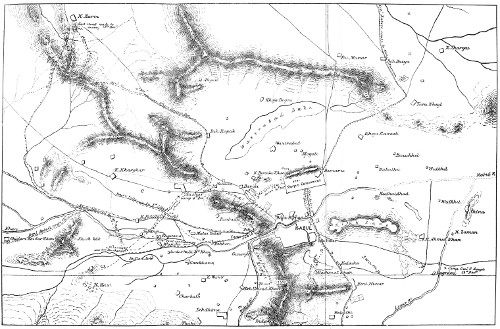
Map to Illustrate the Actions of December 11th to 14th.
11th December.
The strategical move of two columns out of our cantonment
here, to disperse Mahomed Jan’s force, has had a most unexpected
result. The enemy have beaten us at our own game—has outmanœuvred
us—and, instead of Mahomed Jan being a fugitive,
he is calmly occupying the peaks to the south of the Bala Hissar
Ridge, and his standards are flying in sight of Cabul and all the
country round. We have been complaining of want of excitement
here lately, but to-day has given us more than our fill. I
explained in my last letter that Brigadier Macpherson moved out,
on Monday, to Kila Aoshahr, just through the Cabul gorge and at
the eastern end of the Chardeh Valley; while Brigadier Baker,
on the following day, marched to Charasia, and intended cutting
off Mahomed Jan’s retreat, on the Ghazni Road, at Maidan. Yesterday
the force under General Macpherson left Kila Aoshahr at
dawn; four guns of F-A, Royal Horse Artillery, with an escort of
two squadrons of cavalry, drawn from the 9th Lancers and the
14th Bengal Lancers, remaining on the camping-ground, with
orders to check the retreat of the enemy if they turned towards
Cabul. The infantry, with four mountain guns and a squadron
of the 14th Bengal Lancers, under Colonel Ross, took the Kohistan
Road, and finally gained the Surkh Kotal—a ridge running down
from the Pughman Range, and dividing Chardeh from the Koh-Daman,
189the celebrated “fruit country” of Kohistan. The chief
object of General Macpherson was to head back Mahomed Jan,
who was reported to be making for Kohistan, in order to unite his
force with the bands gathered by Mir Butcha at Khoja Serai. The
14th Bengal Lancers were sent forward to reconnoitre on the
Pughman plain to the north of the kotal, and they soon found
themselves in the face of several thousand men near Kila Karez.
The whole country seemed covered with masses of armed tribesmen,
and on every low hill banners were flying. The infantry halted on
the Surkh Kotal while the baggage came up, and preparations were
made for dispersing the Kohistanis, who were plainly on the way
to swell Mahomed Jan’s gathering. As Macpherson’s force formed
up on the kotal, the enemy advanced very confidently, and our
cavalry were obliged to fall back. Two mountain guns were got
into action, and a few shells broke up the most advanced bodies.
A sufficient guard was left over the baggage, and General Macpherson
then attacked with the following infantry: four companies
67th Foot; six companies 5th Ghoorkas; three companies 3rd
Sikhs—two mountain guns moving with them. The enemy broke
and fled in confusion as soon as our rifles began to make good
practice. There was one hill, defended by sungars, at which a few
Ghazis tried to make a stand; but the 67th were not to be denied,
and they raced up it in fine form, driving out its defenders very
smartly. The 5th Ghoorkas took by a rush a hill on the extreme
left, and the 3rd Sikhs, in assailing another hill, were equally successful;
but two fanatics jumped over the sungars and charged
upon the men nearest to them, sword in hand. They wounded two
sepoys, and then rushed back to their comrades. The guns shelled
the Kohistanis as they streamed away up the valley, and the cavalry,
dismounted, also fired at a few hundred yards into them. The
watercourses and enclosures prevented the Lancers charging. The
Kohistanis, who were commanded by Mir Butcha in person, lost
heavily; many bodies were found on the ground by our men, and
many of the dead were seen to be carried off. Our casualties were—one
man 67th, two Ghoorkas, and four of the 3rd Sikhs, all
wounded. Major Fitz-Hugh, commanding the Ghoorkas, received
a slight flesh-wound from a bullet in the right leg. He was not
so badly hurt as to be incapacitated from duty, though, at the
190Lieutenant-General’s request, he has since remained in cantonments.
Having thrashed Mir Butcha, General Macpherson
encamped for the night at Mahomed Surwar Khan’s Kila, close to
Kila Karez, ready to deal with Mahomed Jan on the following day.
The presence of a large force of sepoys and tribesmen at and near
Argandeh, on the Ghazni Road, 14 miles from Sherpur, was known
beyond doubt: and General Macpherson’s aim was to get between
them and the Unai Pass leading to Bamian, so as to drive them
down towards Maidan, where General Baker was waiting with 950
infantry, five troops of the 5th Punjab Cavalry, and four mountain
guns. There was a chance that Mahomed Jan would break
back into the Chardeh Valley, towards Cabul, but it was not
believed that he had with him a sufficient number of men to do
any mischief in that direction. He had, however, double the force
reported (5,000), and was sufficiently confident to take the bold
step of entering the valley. Whether he contemplated an attack
upon Sherpur, knowing there was nothing between him and the
cantonments, except a small party of cavalry and four guns, is not
known; but if he had learnt the weakness of the place, such an
attempt was highly probable. In any case, while General Macpherson
marched from his camp at the fort, where he had passed
the night, and took the path to Argandeh behind a range of hills
running right across the Chardeh Valley from the Surkh Kotal,
the enemy, to the number of at least 10,000, debouched into the
villages on the Cabul side of the range, and waited there the movements
of our troops. They were rewarded for their manœuvre by
the appearance of the Horse Artillery guns and their small escort
of cavalry, making their way to join the infantry at Argandeh.
This movement of our guns and the after-events, which have been
extremely serious, can best be explained by following the action of
the cavalry from the evening of yesterday.
The four Horse Artillery guns, under Major Smith Windham,
were, as I have said, left at Kila Aoshahr with an escort of cavalry.
They were ordered to move this morning along the Argandeh Road
to rejoin the infantry, and they started, with this object in view,
under the command of Colonel Gordon, R.A. Brigadier Massy,
with another squadron of the 9th Lancers, from Sherpur, overtook
them soon after starting, and took command of the whole.
191He had then as escort to the four guns of F-A, 170 troopers of the
9th Lancers (under Lieutenant-Colonel Cleland) and 44 sowars
of the 14th Bengal Lancers (under Captain Neville), or a total
strength of 214 lances. A troop of the 9th Lancers (43 strong),
under Captain Butson, had been sent off by General Massy to
open communication, if possible, with General Macpherson. General
Massy made Kila Kazi on the Ghazni Road his objective point,
that being about 4 miles distant; and he reached this without
incident. Just after it had been passed, however, his advance-guard,
which consisted of a troop of the 9th Lancers under
Captain Gough, reported the enemy in sight on the hills in front.
It soon became apparent that the Afghans had thrown themselves
across the Argandeh Road, but as only 2,000 or 3,000 appeared
in sight, it was thought they were fugitives flying either from
General Macpherson or General Baker. As they began streaming
down from the hills General Massy got his guns into action at
2,900 yards, which range, at Colonel Gordon’s suggestion, was
changed to 2,500, and 2,000 yards, the guns advancing towards
the left to make their fire more effective. After a few shells had
been fired, the enemy showed themselves in full force and advanced
in skirmishing order upon the guns and cavalry. Their line of
advance was fully two miles in extent, and was of good formation.
There were about 4,000 men thus extended in the shape of a
crescent, and in rear of them was an irregular body, numbering
6,000 more. Thus Mahomed Jan’s force was found to be 10,000
strong, instead of 5,000. It was admirably led, and boasted
thirty or forty standards, mostly common red, white, or green
cloth floating at the end of a rude staff 12 or 13 feet long.
Though the shells from the four guns were pitched into the thick
of the enemy, no effect was produced in the way of breaking the
line of advance. It never wavered, but came steadily on; and
as General Massy had no infantry with him, he was obliged to
retire. The guns changed position “right back,” and re-opened
fire at 1,700 yards. Bullets from Snider and Enfield rifles began
dropping among the cavalry and the gunners, but no casualties
of any moment occurred. Thirty of the 9th Lancers dismounted
and opened fire with their Martini carbines, but the enemy were
too numerous to be checked by so small a body of men—a
192regiment of infantry was what was required. While the artillery
was thus in action, Sir F. Roberts and Staff, with Sir Michael
Kennedy and party, joined General Massy, having ridden out from
Sherpur to watch the movements of the brigade. The fire from
the steadily-advancing line of the enemy was well sustained, and
to check their forward movement and cover the retirement of the
guns the cavalry were ordered to charge.
When General Roberts sent instructions to General Massy to
order the Lancers to charge, as the enemy were approaching
dangerously near to the guns, Colonel Cleland, with one squadron
of the 9th Lancers (126 lances), was directly in face of the
Afghan line, with the 44 sowars of the 14th Bengal Lancers in
rear, some distance nearer the guns. The other troops of the
9th (44 lances) under Captain Gough, which had been acting as
the advance-guard, were away on General Massy’s right flank,
watching the Afghans in that direction. When the charge was
sounded Colonel Cleland led his squadron straight at the advancing
masses, the 14th Bengal Lancers following in his wake, but
not close up, as the order to charge had not reached them so
quickly. Captain Gough, with his troop of the 9th, seeing his
Colonel charging, also took his men into action on the enemy’s
left flank. Some 220 men against 10,000 were odds that could
scarcely be expected to turn in our favour; but the Lancers had
to risk a heavy loss in the hope of saving the guns. The three
bodies of men disappeared in a cloud of dust as they headed for
the masses of the enemy, and nothing could be seen for a few
moments of the fight. Then riderless horses came galloping
back, followed by scattered parties of troopers, evidently quite out
of hand. They had been received with a terrific fire, which had
killed many horses and men, and, upon trying to force their way
through the enemy, had been surrounded and their progress
blocked by sheer weight of numbers. Men and horses went
down in the mêlée, and, once down, there was but a faint chance
of being rescued. In one or two instances, however, men were
dragged from under their dead horses, mounted on others, and got
well away out of the ruck.[31] Even among Sir F. Roberts’s party
193watching the fight, bullets fell thickly, killing three or four horses
under their riders and wounding others. When the dust cleared
away, it was seen that the cavalry charge had made no impression
upon the enemy, who were still advancing steadily across the fields,
waving their knives and tulwars, and carrying their banners more
proudly than ever. Mounted men were galloping about from
end to end of their line, directing their movements and keeping
them well together. The fire from their Sniders and Enfields
was deliberate and well-directed; and though any of our English
regiments would with their Martinis have checked them in a few
minutes, the broken ranks of the cavalry could not hope to stand
against them. The 9th Lancers had suffered terribly in the
charge: sixteen of their troopers, with two officers (Lieutenants
Hearsey and Ricardo), had been left on the ground, dead; their
colonel had come out badly wounded by a sword-cut, and a shot
through the side; Lieutenant Stewart Mackenzie had been
disabled by his horse rolling over him; and seven troopers had
received wounds more or less severe. It was Colonel Cleland’s
squadron which was so shattered in this charge. This squadron
having lost its officers, and being broken up by the bad ground,
got out of hand; but Captain Gough’s troop, being more fortunate,
served as a rallying point; while the 14th Bengal Lancers, not
getting well into the enemy, as a nullah checked them, were kept
compactly together. The rally was sounded, and Colonel
Macgregor and other officers of the General’s party collected the
Lancers together, while the guns advanced 400 or 500 yards, and
re-opened fire. The squadron of the 14th Bengal Lancers had
lost but one officer, Lieutenant Forbes (whose body is still
missing), and with Captain Gough’s troop of the 9th were able
still to keep between the guns and the enemy, now only 1,000
yards off. A second charge of these two troops, together with all
the troopers who had been collected, was ordered, but it was made
in a half-hearted way, the country being of extraordinary difficulty
for horses, and the enemy swarming behind every tree and the
banks of the higher water-channels.
As Major Smith-Windham was retiring with his two guns,
which had been advanced after the first charge, he found one of
the other two guns stuck firmly in a watercourse, Lieutenant
194Hardy trying vainly to drag it out with such horses as had got over.
This was found to be beyond the strength of the horses, already
worn out by the severe work of the morning; and as the enemy
were closing around on both sides the gun was spiked and
abandoned. Lieutenant Hardy was killed by a shot through the
head while near this gun. The other three guns had been got
400 or 500 yards further on to the village of Baghwana, but were
stopped by a channel deeper and steeper than any yet crossed.
Guns, men, and horses floundered into this, and the guns at least
would not come out again; they, also, were spiked and left in the
water and mud, and drivers and gunners moved off with the
cavalry, the villagers firing rapidly upon them. The long line of
the enemy came straight on, passed through the village, shrieking
and waving their knives, and put their faces towards the Nanuchi
Kotal, which leads from the Chardeh Valley to the Western gate
of our cantonments. Sir F. Roberts, with a small escort, had
gone across country towards the village of Dehmazung, commanding
the western entrance to the Cabul gorge. He had sent
urgent messages to General Macpherson to hasten down the
valley, and the Brigadier was soon engaged with 2,000 men, left
behind by Mahomed Jan to keep him in play. The cavalry fight
had been watched through telescopes by several officers with
General Macpherson, who had heard the artillery fire. Sending
his baggage under a strong guard of infantry, and a squadron of
the 14th Bengal Lancers, under Colonel Ross, by way of the upper
road nearest Kohistan, General Macpherson marched through a
break in the hills and debouched into the Chardeh Valley. The
appearance of his troops away in their rear seems to have
influenced the movements of the enemy, who turned off from the
road to Sherpur, and, swinging their left flank round, made direct
for Dehmazung, with the evident intention of getting into the
city, and occupying the Bala Hissar Heights above it. General
Roberts, upon seeing the new movement, sent off a message by
his aide-de-camp, Captain Pole-Carew, to Brigadier Hugh Gough,
commanding at Sherpur, ordering 200 men of the 72nd Highlanders
to double out to the gorge.
After the second charge, in which the 9th Lancers lost several
men shot down, Captain Gough’s troop did rear-guard work, dismounting
195and firing, so as to hold the enemy a little in cheek. Only
such Lancers as were wounded, or had their horses disabled, were
sent back to Sherpur, by way of the Nanuchi Kotal, the rest escorting
General Roberts to Dehmazung. Once the broken squadron
of the 9th were got together, they settled down resolutely to their
work of keeping the enemy in play, and their carbines were used
with good effect until Dehmazung was reached. Here they got
cover, and, with the sowars of the 14th, opened a smart fire upon
Mahomed Jan’s force as it streamed up towards Cabul. Alone
and unaided they could not have hoped to stem the rush, and
matters were at a crisis when Colonel Brownlow, with the 200
rifles of the 72nd Highlanders, arrived. The Highlanders were
in the nick of time: Colonel Brownlow doubled out a company to
occupy Dehmazung, the 9th cheering them lustily as they saw the
welcome relief, and soon from the roofs and walls of the village
rapid volleys were being poured into the Afghan ranks. The
enemy streamed down upon the village “like ants on a hill,” as a
Highlander described it, but Colonel Brownlow’s admirable
disposition of his handful of Highlanders soon checked the rush.
The men were told not to throw away a shot; the Martinis soon
blazed out in one persistent line of fire—and such a fire, that even
Ghazis shrank from encountering it. In less than half an hour
the enemy were forced back, and they then split up into two
parts—one going on to the south, to Indikee village, and thence
scaling the Takht-i-Shah Peak and the heights to the south of
the Bala Hissar fortified ridge, the other facing round to the west,
as if to get upon the hills south of Kila Kazi. Their entrance into
Cabul had been frustrated, and all that was left to them was to
raise their standards on the hills they had occupied and flourish
their knives in defiance at distant Sherpur. This they did, as we
could see plainly enough through our binoculars.
In the meantime General Macpherson had fallen upon a large
body of Afghans higher up the valley, and with the 67th Regiment
and the 3rd Sikhs had completely broken their ranks and pursued
them towards Argandeh. General Macpherson did not then know
of the loss of the guns, but in facing round towards Cabul he
came upon the scene of the charge, and was then able to recover
the bodies of Lieutenants Hearsey and Ricardo and of the troopers
196killed in action. His own loss was not heavy, Lieutenant Cook of
the 3rd Sikhs being the only officer wounded. Sir F. Roberts
remained at Dehmazung until Macpherson’s force reached it, about
nightfall; and then, leaving the Brigadier with his men encamped
below the gorge, where Wali Mahomed had a camp with some
mountain guns (he was preparing to start for Turkistan), the
Lieutenant-General returned to Sherpur. He had before received
the news that the guns had been pulled out of the watercourses
into which they had fallen, and were on their way to cantonments.
How they were recovered, well deserves telling.
When Sir F. Roberts trotted across to the Cabul gorge, there
were Lancers, gunners, and drivers, making their way towards
Sherpur, and most of them were out of hand, their officers having
been either put out of action or being missing. At the Nanuchi
Kotal, facing the western end of Sherpur, most of these rallied
about Colonel Macgregor, Captain Dean also having gathered
some stragglers together. When the enemy veered off towards
Dehmazung, Colonel Macgregor saw that the village of Baghwana,
near where the guns were lying, was not guarded by any of
Mahomed Jan’s rear guard, and he thought there might be a
chance of recovering the guns without waiting for General Macpherson’s
advance. With a scratch lot of Lancers and Artillerymen,
he accordingly followed the upper Argandeh Road; and,
beyond stray shots from villagers (who, as on October 8th, blazed
at us whenever we were within range), the party met with no
opposition. The baggage of Macpherson’s brigade was met
making its way to Sherpur; and as the enemy were then well on
their way to Indikee, Colonel Macgregor took thirty men of the
67th, and about the same number of Sikhs and Ghoorkas—sixty
in all—and, extending them in skirmishing older, made for the
abandoned guns. On arriving at the village he placed his men in
an enclosure well adapted for defence against any numbers; and
such artillerymen as were with him set to work to get out the
guns. This was done after a long struggle, and then it was found
that teams sufficient only to give four horses per gun were present.
The rest had galloped into Sherpur with their officer, Major
Smith-Windham. With no artillery officer, but with the Chief of
the Staff, rests the credit of recapturing the guns. Colonel Ross
197was told to bring them safely into camp with the baggage escort
and the scratch gathering of mounted men, and this he did.
Our losses in the day’s action, so far as the R.H.A. and the
cavalry are concerned, are four officers killed, two wounded, and
twenty-three men killed and ten wounded. The officers killed
and wounded were well to the front in the desperate charge their
squadrons made upon the unbroken masses of infantry, and most
of them were hit by the volley which the enemy poured into
them as they got to close quarters. Colonel Cleland, in spite of
his two wounds, was helped into the saddle and rode eight miles
to Sherpur, fainting as he was lifted from his horse into a dhoolie
at the gate. The bodies of those killed were brought in, and, I
am sorry to say, they had been fearfully mutilated. The passions
of our men are likely to be dangerously aroused in future fighting
by the remembrance of these mutilations, which will not bear
description.
In Sherpur, an anxious afternoon was passed. When stragglers
from the 9th Lancers and F-A battery rode in, wounded, mud-splashed,
and many without lances or swords, it was known that
a serious action had taken place, and all troops in the cantonment
were ordered to stand to their arms. Major Smith-Windham,
with half a dozen drivers of F-A battery, was the first officer to
arrive; and when no guns followed him, and he reported them
“spiked and abandoned,” and the enemy advancing towards
Sherpur in overwhelming force, the anxiety of Brigadier Hugh
Gough was greatly increased. No gunner would leave his guns
if there were a chance of recovering them, and they were given up
for lost. The western wall of the cantonments was manned by
150 of the 3rd Sikhs. At its northern end, where there is a gap
between it and the Bemaru hills defended by a shelter trench,
wire entanglements were laid down from the foot of the hill to
the end of the wall. All the gates were occupied by small
detachments of infantry, and the two remaining Horse Artillery
guns were placed upon the Bemaru Heights facing towards the
Nanuchi Kotal leading to Chardeh. If an attack were really
about to be made, it would be sharp work defending the three
miles of walls enclosing the cantonments, as less than 1,000 men
were available for the duty; but the news that Mahomed Jan
198with his 10,000 followers had turned off towards the Cabul gorge
dissipated the anxiety felt; and when, later, the fire of the 72nd
Highlanders was heard at Dehmazung and then died away, everyone
knew Sherpur was safe. It was ticklish work for the time
being; but Brigadier Gough made his arrangements quietly,
and without listening to any absurd suggestions. As a precautionary
measure, a heliogram was sent to Colonel Jenkins,
commanding the Guides, who had reached Luttabund from Sei
Baba in the morning: he was ordered to come in with his cavalry
and infantry, without baggage. At seven o’clock we heard he was
at Butkhak, and as I am writing (at midnight) his corps is marching
in over 700 strong—200 more will arrive to-morrow with the
baggage. Sir F. Roberts, after sending up 200 of the 72nd Highlanders
to reinforce the picquet on the Bala Hissar Heights, rode
into cantonments, within the walls of which all is made snug for
the night. The reinforcement to the picquet was caused by the
belief that Mahomed Jan would attempt to occupy the heights
commanding the Bala Hissar and Cabul, and there is no doubt
this was his intention. Since seven o’clock the picquet has been
assailed on all sides, and even now the circle of fire shows where
the 250 British soldiers are holding their own.
Attempt to storm the Takht-i-Shah Peak—Natural Strength of the Position—Heliograms
exchanged with General Baker—Failure to take the Peak—Casualties—The New
Plan of Attack—The Action of the 13th of December—Storming of the Beni
Hissar Ridge by the 92 Highlanders and the Guides—The Cavalry Charges in the
Plain—Death of Captain Butson—The Position of Affairs at Nightfall—Reinforcements
from Kohistan—The Action of December 14th—Storming of the Asmai
Heights—Retreat of the Safis—Captain Vousden’s Charge—Counter-Attack by the
Enemy from Indikee—Death of Captain Spens, and Retirement from the Cuncal
Hill—Loss of Two Mountain Guns—Withdrawal of all Troops from the Asmai and
Sherderwaza Heights—The State of the Sherpur Defences—Total Casualties.
Sherpur, 12th December, midnight.
I left Mahomed Jan and his followers in possession of the hills
to the south of the Sherderwaza Heights, with a part of General
199Macpherson’s brigade on the latter, ready to attack him. To-day a
party of 560 men, made up in nearly equal proportions from the
67th Foot, 72nd Highlanders, 3rd Sikhs, and 5th Ghoorkas, aided
by two guns of Morgan’s mountain battery, have made that attack,
and have established themselves on a lower hill between the
Sherderwaza Heights and the high conical peak of Takht-i-Shah,
whereon the enemy muster in great force and have sixteen
standards flying. This peak is the highest of the clump of
mountains south of Cabul and lying between the city and Charasia,
and was the point whence Captain Straton tried to heliograph to
the Shutargardan in the early days of our occupation. It is cone-shaped,
looked at from Sherpur, and on its southern side joins a
ridge running southwards above the village of Indikee. The sides
facing Cabul are very steep, and covered with huge boulders
polished by wind and rain, and of a kind to check any storming
party. Perfect cover is afforded to men holding it, and on the
summit is a well-built sungar of great thickness, covering a
natural cavity in the rocks which has been made bomb-proof by
some Afghan engineer, who understood the strength of the point.
Fifty men could lie in perfect security behind the sungar or in the
hole below it, and could choose their own time for firing at an
advancing enemy. Outside the sungar, and a little lower down, is
a cave, wherein another strong body of men could hide themselves
and act in a similar way, while their flank to the left would be
guarded by a broken line of rocks extending down to the kotal,
where the Bala Hissar Ridge meets them. Just between the two
ranges is a low, dome-shaped hill, blocking up the otherwise open
kotal; and round this a footpath winds, leading to the sungar,
but so narrow as only to admit of men going up in Indian file.
The enemy occupied this morning the Takht-i-Shah Peak and the
line of rocks I have mentioned, and had also a few score of men on
the lower hill in the kotal. Away on the south, hidden from our
view, were some 5,000 or 6,000 men, waiting for an attack to
develop, in order to reinforce the peak. At eight o’clock our guns
opened fire from the picquet on the ridge. There were then only
seven standards on the peak, but during the day nine others were
brought up; and the long ridge, stretching downwards to Beni
Hissar, was lined with men. These were, by the contour of the
200ground, safe from our shells, and they quietly watched the guns
all day. From eight o’clock until evening Captain Morgan fired
shell after shell into the sungar and the rocks below. The enemy
were of quite a different order to those we have hitherto had to
deal with. They stood up boldly to their flags, and waved their
rifles and knives in derision at each shot. We could not spare
more infantry for the attack, as we had to protect Sherpur, which,
we learnt, was to be attacked by Kohistanis from over the Paen
Minar Kotal, north of the lake. The city, too, was known to be
in a ferment, and a demonstration might at any time be made
from it against our cantonment. General Baker with his flying
column was still absent, and our object was rather to hold the
main body of Mahomed Jan’s force in check, than try to disperse
them with 560 men. At nine o’clock heliographic communication
was opened with General Baker, then on the Argandeh Kotal.
He reported that his rear-guard had been harassed for the last two
days, and that the hills in all directions were lined with tribesmen.
He was ordered to march without delay to Sherpur, and it was
hoped at first that he would arrive in time to assist General
Macpherson in attacking the enemy’s position. As he had to
march fourteen miles with his rear-guard engaged from time to
time, he did not reach Sherpur until evening, so his troops, footsore
and tired, were not available.
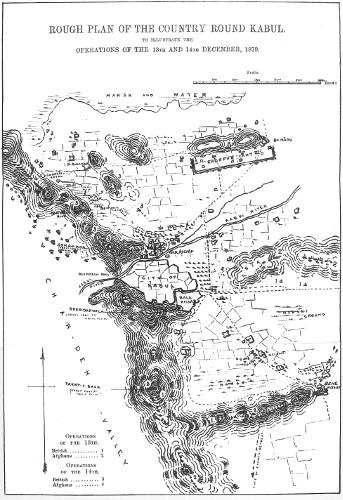
ROUGH PLAN OF THE COUNTRY ROUND KABUL.
TO ILLUSTRATE THE
OPERATIONS OF THE 13th AND 14th DECEMBER, 1879.
After several hours’ shelling of the Takht-i-Shah Peak, the 67th,
the Highlanders, Sikhs, and Ghoorkas made their attack; and, in
spite of the stubbornness with which the Afghans fought, established
themselves on the low hill on the kotal. They tried to
work upwards to the sungar; but the fire of the Afghans was so
true and sustained, that the attempt had to be given up. Our
men also ran short of ammunition, and they contented themselves
finally with holding the position captured, so as to be able to
co-operate on the morrow with any force sent out from Sherpur
to attack by way of Beni Hissar on the enemy’s flank. Our
casualties included Major Cook, V.C., 5th Ghoorkas, shot below
the knee; Lieutenant Fasken, 3rd Sikhs, bullet wound in both
thighs; and Lieutenant Fergusson, 72nd Highlanders, seriously
wounded in the face. The enemy this evening still hold the
Takht-i-Shah Peak in strength, and large reinforcements are said
201to have joined them from Logar, the Ghilzais from that district
being up in arms. It has been decided to-night to send a brigade,
under General Baker, to attack the peak from Beni Hissar village
to-morrow at the same time that Colonel Money, of the 3rd Sikhs,
moves up another force from the hill on the kotal.
13th December, evening.
To-day the Takht-i-Shah Peak has been carried, and a strong
picquet now holds it. The action has been a great success, but
there are still large bodies of the enemy above Indikee; and as
they may try to regain the position, General Macpherson has
abandoned Dehmazung altogether, and posted his brigade on the
Sherderwaza Heights. At eight o’clock this morning General
Baker left cantonments with the following troops:—
G-3, Royal Artillery, four guns;
No. 2 Mountain Battery, four guns;
92nd Highlanders (six companies);
Guides’ Infantry (seven companies);
3rd Sikhs (wing of 300 men);
5th Punjab Cavalry.
General Baker took the road past the Bala Hissar, and, upon
debouching into the plain north of Beni Hissar, found the enemy
posted in force all along the ridge in front, leading down from the
Takht-i-Shah Peak. Beni Hissar was also full of Afghans, and
in the fields about it were detached parties. These, seeing our
force advancing, began to stream towards the ridge, and the
original plan of attack was so far modified that, instead of working
round through Beni Hissar village, the Highlanders and
Guides were sent straight across some marshy ground at the
ridge. The object in view was to cut the enemy’s line in two, and
it was attained most successfully. Our eight guns opened fire at
1,400 yards upon the masses of Afghans on the ridge, and the
shells kept under the musketry fire opened upon our infantry.
The 3rd Sikhs protected General Baker’s left flank, while the
cavalry aided in keeping the scattered parties about Beni Hissar
in check. Nothing could be finer than the advance of the 92nd
202and the Guides; they reached the slope of the hill, and opened
fire upon the enemy, one continued roll of musketry being heard
as they pushed upwards. They gained the crest, and the Afghan
line was severed, about 2,000 being left about Beni Hissar while
the assault was made upon the peak. The rapid fire from our
breech-loaders swept away such of the enemy as stood firm, while
the bayonet made short work of the ghazis who defended the
standards. At some points twenty and thirty bodies were found
lying piled together, shot through and through by Martini and
Snider bullets, showing how well the volleys had told. In a very
short time the majority opposed to the storming party had broken
and fled. A few ghazis fought desperately, but upwards went the
Highlanders in the same gallant style they had shown at Charasia,
and under the same leader, Major White. The Guides, under
Colonel Jenkins, were equally eager, this being their first chance
in the campaign, and they shared with the 92nd the honour of
scattering the defenders of the ridge. One young Highland officer
fell a victim to that uncalculating courage which becomes rashness
when pushed to extremes. Lieutenant Forbes, with only a few
men, scaled the ridge, and got detached from the regiment which
was toiling up as fast as the men with their heavy load of rifles
and ammunition could climb. He was left at last with only
Colour-Sergeant Drummond, an old twenty-one years’ man, and a
band of ghazis turned back and attacked him. The Sergeant was
shot down, and Lieutenant Forbes rushed forward to save his body
from mutilation. After cutting down a ghazi he was overpowered
and killed before the Highlanders could save him. Not a man of
the ghazis who had turned back escaped: they were shot and
bayoneted on the rocks. As the attacking party neared the Takht-i-Shah
Peak the Afghans deserted it; and when a party of the
72nd Highlanders and 5th Ghoorkas from the Bala Hissar side
reached the sungar, they found the flags still flying, but no one
guarding them. The position had been captured in about two
hours, and as the mid-day gun was fired in Sherpur, the heliograph
flashed from the sungar, and the peak was known to be ours.
Some of the enemy ventured too near the Chardeh plain in their
retreat, and a squadron of the 14th Bengal Lancers charged
among them, killing between twenty and thirty.
203While the Highlanders and Guides were storming the ridge, an
attack had been attempted from Beni Hissar upon General
Baker’s left flank, but the 3rd Sikhs drove back the enemy, who
began to move round towards Siah Sung, and eventually collected
in force upon these hills. They were shelled by our guns, and
the 5th Punjab Cavalry were reinforced by two squadrons of the
9th Lancers, a squadron of the 14th Bengal Lancers, and the
Guides’ Cavalry. Wherever the ground was good, our sowars and
Lancers charged and did great execution. The Afghans fought
bravely, forming up to receive the cavalry with a steadiness that
trained infantry would not have surpassed, and reserving their fire
until the horses were close upon them. One brilliant charge by
the 9th Lancers cost that regiment one officer killed and two
wounded, besides the loss of several troopers. Captain Butson
and Captain Chisholme, at the head of their respective squadrons,
swept down upon 500 or 600 men, taking them on the right and
left flank. Captain Butson turned in his saddle as he faced the
enemy, and cried out:—“Now, men, at them for the honour of
the old 9th,” and the next moment he fell dead, shot through the
heart. He was in command of the regiment, the affair of the
11th having sadly thinned the ranks of the officers, and his death
is universally regretted. Captain Chisholme was shot through
the leg, the flash of the rifle burning his clothes, so steadily had
the Afghan in front of him waited before discharging his piece.
Lieutenant Trower was also slightly wounded, while the Sergeant-Major
and three troopers were killed and seven wounded. The
Lancers rode through and through the Afghans opposed to them,
and scattered them all over the plain. The 5th Punjab Cavalry
also made a successful charge, and the Guides twice got well
among the fugitives. Their second charge was upon a body of
Kohistanis, who had crossed the plain east of Bemaru and made
for Siah Sung with the intention of joining Mahomed Jan. They
were shelled from the eastern end of the Bemaru Heights; and,
upon seeing General Baker’s force engaged, halted irresolutely
near Siah Sung. They tried to retrace their steps, but were
suddenly charged down upon by the Guides, who had waited for
them behind the northern slopes of Siah Sung. Sixty are said to
have been killed in this charge alone, the Guides chasing them as
204far as the Logar river, where the swampy ground checked the
cavalry. Altogether the day’s fighting has been a wonderful
success; and though our casualties are eleven killed and forty-three
wounded, the enemy’s loss in killed alone must have been
between 200 and 300. 150 of the 5th Punjab Infantry, sent out to
reinforce General Baker, came upon a large party of Afghans
marching down the Bala Hissar Road. They were at first mistaken
for Highlanders; but when they fired a volley at the officer
who rode up to speak to them, the mistake was soon apparent.
The Punjabees at once extended themselves in skirmishing order
among the willow plantations on each side of the road, and opened
a rapid fire. The Afghans faced about and made for the Bala
Hissar, but a company of the 5th cut off half their number, and
in a hand-to-hand fight killed forty. These men, who are believed
to have been from the city, were really run to earth, and were so
exhausted that they could scarcely use their knives.
One feature of the day’s fighting has been the attitude of the
villagers about Cabul. A straggler from the 92nd Highlanders
was found cut up between Sherpur and the Cabul river; officers
riding alone have been fired at, and pelted with stones; and two
villages on either side of the road to Beni Hissar opened a heavy
fire upon our troops. General Baker halted on his way back to
cantonments to burn these villages as a reward for their treachery.
The lives of the men in one were spared on condition that they
fired the other, the gates of which could not be forced open by
our guns. The defenders were shot as they tried to escape from
the ruins. From the Bala Hissar and near the city shots were
fired, and the flanking parties of the 92nd, in their homeward
march, came upon 200 or 300 men in the willow plantations, who
fled towards the city walls. A convoy of wounded sent from the
Sherderwaza Heights to Sherpur had also a narrow escape, the
bravery of the non-commissioned officer in charge of the escort
alone preventing a catastrophe on a small scale. After General
Baker had captured the Takht-i-Shah Peak, a number of dhoolies,
containing officers and men wounded on the 11th and 12th on
the Sherderwaza Heights, were sent down the hill to Sherpur.
Sergeant Cox, with twenty men of the 72nd, was in charge of the
dhoolies, and among the wounded were Major Cook, V.C., 5th
205Ghoorkas; Lieutenant Fergusson, 72nd Highlanders; and Lieutenant
Fasken, 3rd Sikhs. Upon arriving at the foot of the hill,
the road leading under the southern wall of the Bala Hissar was
followed, and it was soon seen that parties of armed men were
lining the parapets. Sergeant Cox, fearing to draw the fire by
striking across the fields towards Beni Hissar, where General
Baker was shelling some villages, put on a bold face, and marched
on steadily. This had the best effect, as not a shot was fired from
the walls. Ten Highlanders were at the head of the dhoolies, and
ten in rear. Just as the little party got near the Bala Hissar
gate a large body of Afghans sprang out from among the willows
lining either side of the road, and, drawing their knives, came
straight upon the advance-guard. The road from Beni Hissar
joins the road to Sherpur just at this point, and seeing that it
would be impossible to cut through the enemy, or to retreat the
way he had come (as in the latter case the men on the walls
would probably open fire), Sergeant Cox pushed on, ordering his
men to reserve their fire. His object was to get the dhoolies
fairly on the Beni Hissar Road on his right, and then to fall back
until help should come from that quarter. The manœuvre succeeded
admirably. Waiting until he was within twenty yards of
the Afghans, he ordered the ten men with him to fire a volley.
This was too much for the enemy, who broke and took cover in the
trees. The dhoolie-bearers thought all was over, and those carrying
Major Cook dropped their dhoolie in the middle of the road.
They were about to run, when Sergeant Cox threatened to shoot
them down unless they did their duty. They soon recovered
courage, and while rapid volleys from the advance-guard kept the
Afghans in check, all the dhoolies were got safely upon the Beni
Hissar Road, and finally reached General Baker’s force in safety.
Sergeant Cox managed the whole business splendidly, and under
such leadership the men were cool and collected, skirmishing and
retiring without being touched by the scattered fire directed at
them. After waiting an hour, the escort was strengthened by
some cavalry, and the little convoy of wounded reached cantonments
in safety. The position in which Sergeant Cox was placed was a
most dangerous one, as the least hesitation or want of decision
would have been fatal: the Afghans were, indeed, so sure of
206success, that they did not fire at first, but trusted to cutting up
the guard at close quarters with their knives. The three officers,
whose lives were saved by Sergeant Cox’s steadiness, reported the
incident to Colonel Money, who had sent the dhoolies down the hill.
Sergeant Cox was one of the men decorated with the distinguished
service medal on December 8th for gallantry at the Peiwar Kotal.
General Baker’s force is now safely in quarters again. General Macpherson
has sent back to Sherpur the 72nd Highlanders and the
3rd Sikhs, and, with the 67th Foot and the 5th Ghoorkas, holds
the Bala Hissar Heights and the Takht-i-Shah Peak. The enemy
are still in force above Indikee and at Dehmazung, which commands
the Cabul gorge, and the road into the city has been
abandoned. They may try to work round in that direction—that
is, if to-day’s defeat has not disheartened them. This evening a
party of Kohistanis have come over the Surkh Kotal, and are
bivouacking on a hill a mile and a half west of Sherpur. These
are the reinforcements sent by Mir Butcha, who has no doubt
heard of the success of Mahomed Jan on the 11th. The casualties
to-day were eleven killed (two officers) and forty-three wounded.
Of these the 92nd lost one officer and two men killed and nineteen
wounded. The Guides had three killed and eight wounded.
15th December.
Yesterday the severest fighting we have yet gone through took
place on the Asmai Heights above Deh-i-Afghan, and a lower
conical hill adjoining them on the north. The enemy have
been so largely reinforced, that their numbers are estimated at
40,000, and they have shown a recklessness in sacrificing life
which has hitherto been considered quite foreign to the Afghan
character. There must be many ghazis in their ranks from what
we have seen to-day, and these fanatics always show a contempt
for danger which makes them formidable enemies. They sacrifice
their lives, satisfied if, before death, they have killed a Kafir, and
so secured a future reward. Our own losses have been heavy, and
for the first time our men have had to retire before the enemy,
who are wonderfully elated at their success. It is true it was but
an isolated case of a handful of men having to meet 5,000; but
207with the evacuation of the position our men were holding, we
lost two mountain guns, which Mahomed Jan is sure to make the
most of as trophies, if he does not turn them against us. To give
in detail the incidents of yesterday:—Between seven and eight
o’clock in the morning some thousands of men were seen gathering
on the slopes above Deh-i-Afghan, a suburb of Cabul lying northwest
of the city upon a low eminence, which overlooks Timour’s
tomb. The evacuation of Dehmazung had, of course, given free
passage to such of the enemy as wished to pass into Cabul and the
Bala Hissar, and these now poured out by way of Deh-i-Afghan
and manned the heights. The usual standards were carried, and
in a very short time the sky-line was alive with men, until there
must have been 8,000 or 10,000 looking down upon Sherpur and
within range of our guns. The array extended upwards from the
suburbs, along the crest of the Asmai Ridge, down the dip to the
north, and over the conical hill I have mentioned; while, again,
further to the north, was a higher lumpy hill, on which were a
number of Kohistanis, who had bivouacked there the previous
night. General Baker was ordered to clear the hills, and for this
purpose he took out the following troops:—
Four guns G-3, Royal Artillery;
Four guns No. 2 Mountain Battery;
14th Bengal Lancers;
72nd Highlanders (225 men);
92nd Highlanders (45 men under Captain Gordon, who fell
in with the 72nd, as the six companies of the latter were so
weak);
Guides’ Infantry (460 sepoys);
5th Punjab Infantry (470 sepoys).
This gave a total of 1,200 bayonets and eight guns. The cavalry
were employed in the open to keep in check, or cut up, stray
bodies of the enemy. General Baker left cantonments by the
head-quarters’ gate in the western wall, and made straight towards
a mound near Kila Buland, a mile and a half away, facing the
conical hill, on either side of which were roads leading into the
Chardeh Valley beyond. He got his guns into action at once, in
order to clear the way for the infantry attack, and sent his cavalry
208round on his right flank towards the Chardeh Valley to reconnoitre
in that direction. The Guides’ Cavalry were ordered out
to reinforce the 14th Bengal Lancers, and were fired at several
times from walled enclosures just over the Nanuchi Kotal. The
mountain guns drew off to a low ridge on which stood the ruins
of a fort, Kila Buland, and shelled such bodies of men as were
visible in the direction the cavalry had taken. The party told
off to take the heights were the Highlanders, under Colonel
Brownlow, and Guides’ Infantry, the 5th Punjabees being held
in reserve near the guns. The low, conical hill was captured
without much trouble, but there then remained for Colonel Jenkins,
commanding the attack, the difficult task of taking the Asmai
Heights, every foot of the crest bearing an Afghan firing from
behind the excellent cover given by rocks and boulders. Rising
up from the captured conical hill was a steep hillside, with here
and there shelving rocks hiding men from the view of those above,
and up this rugged ground our soldiers went steadily and rapidly,
utilizing every bit of cover, and answering from time to time the
heavy fire they were met with. The guns shelled two strong
sungars which had been built on the northern and southern points
of the crest; and made such practice, that the enemy began to
move downwards towards Cabul. They clustered in masses above
Deh-i-Afghan, where the shells of G-3 could not reach them,
and afforded so tempting a mark, that Sir F. Roberts, who was
watching the attack from the signalling station on the roof of
the officers’ quarters in the western gate, ordered two Horse
Artillery guns out to open fire from under the cantonment walls.
A wing of the 3rd Sikhs and some cavalry went out as escort, and
extended themselves into the fields beyond. The shrapnel fired
from these two guns made the hillside almost untenable; but
still in the sungars on the crest a few determined ghazis resisted
the advance of the Highlanders and Guides. Our men fought up,
however, and the sungar on the northern point was taken with a
rush. The banners waving above it were obstinately defended by
ghazis, who were killed to a man. Colonel Jenkins then worked
his way under a heavy fire along the crest, which has a total length
of a quarter of a mile; and there only remained the southern
sungar, built on the peak of the hill, to be taken. In this sungar,
209which was unusually strong, were forty or fifty men who, by their
fire, checked the advance for some time. Major Stockwell, with a
few Highlanders, passed through a gap in the wall which runs
down the ridge, and galled the Ghazis by a cross fire. Private
Gillon, of the 72nd, climbed up the wall, and, creeping along the
top, pulled out a standard from among the stones of the sungar.
There was an open bit of ground between our front attacking
party and the sungar walls, and this was swept by such a fire that
even the bravest might have hesitated to cross it. Such of us who
were watching the fight saw that the stubborn defence would cost
us some valuable lives; but presently, when the Drummer was
seen on the walls, there was a rush of Highlanders and Guides—one
plucky Highlander, Lance-Corporal Seller, 72nd, leading full
20 yards in front, with a Guide quite close behind him. As the
sungar was neared, most of its defenders cleared out on the opposite
side, but a few Ghazis stood to their post; one fanatic jumping,
knife in hand, on the low stone walls. The bayonet made
short work of such of his companions as had remained. Lance-Corporal
Seller had a tough fight for the last standard on the
sungar. As he got up to the wall he pulled the flag out and, at
the same moment, a Ghazi cut down at his head with a long knife.
Seller parried the blow with the standard, and then the Ghazi
jumped over and closed with him. They rolled over together, and
another Highlander bayoneted the Afghan. Seller was cut over the
arm, and is now in hospital. He certainly deserves the highest
reward for his gallant conduct: the “V.C.” has been given for
much less. The sungar was filled with dead men, fifteen bodies
being counted in a heap as if a shell had burst among them. Our
loss had been heavy, as much hand-to-hand fighting at difficult
points had taken place; many of the Guides were cut and slashed by
the knives and tulwars of the Ghazis; while the ranks of the 72nd
Highlanders were thinned by numerous casualties, mostly of a
dangerous kind. Lieutenant Egerton, who only joined the regiment
a few weeks ago, was shot through the neck on the crest of
the hill. He showed courage that even an old soldier might have
envied, being always well to the front in the attack. Lieutenant
Frederick Battye, of the Guides, was also shot through the neck
at about the same time.
210Colonel Jenkins was now holding the whole crest of the Asmai
Heights; but on the slope towards the city were many thousands
of the enemy. The two guns of F-A Battery shelled them at
1,700 yards, and the mountain guns, with General Macpherson,
were also turned upon them. A wing of the 3rd Sikhs were
extended in skirmishing order across the fields towards Deh-i-Afghan,
and with their Sniders were easily able to reach the men
pouring down into Cabul. Deh-i-Afghan, however, held many of
the enemy; and from the house-tops, walls, and orchards about,
the 3rd Sikhs were fired upon. The watercourse gave our
sepoys good cover, but still there were one or two casualties; and
General Roberts resolved to sack and burn Deh-i-Afghan. The
two guns of F-A began to shell it vigorously, and two more guns
of the same battery were brought out and joined in the work.
Shell after shell was pitched among the houses, and the defenders
of them drew off before such a fire. Some 1,500, supposed to be
Safis from Tagao, went through the city and made for the Cabul
plain so as to reach Deh-i-Sabz, to the north of Butkhak. Some
of them ventured too near the King’s Garden, outside Sherpur,
where the 5th Punjab Cavalry are quartered, and Captain Vousden
charged out upon them and killed thirty. He had only twelve
sowars with him, and of these two were killed and four wounded;
Captain Vousden killed five Afghans with his own hand.[32] The
main body got well away beneath Siah Sung; and although some
Lancers were sent in pursuit, and two Horse Artillery guns went
out under escort of a party of the 92nd Highlanders, the Safis
could not be overtaken. They ran at a sling-trot for miles, just
like wolves in a pack, and had plainly had enough of fighting for
the day. We had thus, apparently, disposed of the body of the
enemy (those who had manned the heights from the city); but
there were many more to take their place, and General Baker,
with his 1,200 bayonets, had yet to learn the full strength that
was against him.
About midday the signallers with General Macpherson heliographed
down that a vast body with many standards were
streaming out from Indikee into the Chardeh Valley, and were
taking a northerly direction, which would bring them under the
211hill occupied by Colonel Jenkins. The movement was well made,
and eventually developed into an attack upon the conical hill
which the Guides and Highlanders first stormed. This hill was
held by thirty-three men of the 72nd Highlanders, a small party
of Guides under a Subadar, the whole being under the command
of Lieutenant-Colonel Clark, 72nd. While the upper hill was
being taken, parties of the enemy’s infantry and cavalry were seen
coming across Chardeh from the direction of Kila Kazi, as if to
take Colonel Jenkins in flank, and the conical hill was strengthened
by Swinley’s Mountain Battery, with an escort of 100 men of
the 5th Punjabees, under command of Lieutenant Wilson, of the
10th Hussars, serving for the day as a volunteer. This gave
Colonel Clark about 200 rifles, with which to hold the hill. The
mountain guns opened fire upon the body of Afghans in the
plain, who broke up and dispersed out of range. In the meantime
the enemy from Indikee—to the number of fully 15,000 or
20,000; they covered the plain for miles—had marched out as if
going to Kila Kazi, or Argandeh. Their array was orderly
enough; and when they had all reached the plain, they suddenly
faced about and came down in the shape of a crescent upon the
heights we were holding. Their right flank had for its object the
scaling of a ridge extending down from the southern sungar on
the Deh-i-Afghan hill; their centre, the assault of the low
conical hill, which was General Baker’s weakest point; and their
left flank swept round upon the lumpy hill to the north of Colonel
Clark’s position, and commanding it. They seemed to our handful
of men to be myriads as they came steadily on; and although
volleys were fired from the conical hill, and the mountain guns
shelled them at short ranges, they never faltered. They were
literally mowed down; but as one Ghazi fell, another sprang to
the front, and their standards were at last placed on a little mound
within 150 yards of our bayonets. Their left flank had gained
the lumpy hill which we had left alone, not having men enough
to occupy it, and a cross fire was opened upon Colonel Clark’s
party. There was a bit of open ground between the mound on
which their standards were placed and the rocks in rear, under
which their main body had clustered in face of our fire; but across
this small space numbers rushed with reckless audacity until,
212behind their advanced standards, several hundred men were
hidden. Colonel Clark thought that at all risks they must be
driven from this mound, as they might make a rush in overwhelming
numbers: and Captain Spens volunteered to make the
attempt. Taking with him five of the 72nd Highlanders and a
few Guides, he made for a bit of rising ground below the mound
and reached it safely. His fire could not dislodge the Ghazis,
who suddenly rushed out upon the little party. Captain Spens
was attacked by four or five men: he cut down one, but in a
second he was overpowered and hacked almost to pieces. There
followed in rear of the Ghazis, who had sprung out, a dense mass
of Afghans, who swarmed up to the thin line of defenders, who
could scarcely hope to stop them. The mountain guns were on
Colonel Clark’s left, and their guard of 5th Punjabees had been,
perhaps too sanguinely, sent forward to repel the attack. Our
men lost heart as they saw four or five thousand men nearly upon
them; and when Captain Hall, with a reinforcement of 150 more
of the 5th Punjab Infantry, got near the crest of the hill, he
found such of its defenders as had not been shot down retiring
in disorder. To rally them was impossible at that point, and
they fell back down the hillside. The fire of the enemy at such
close quarters cost us a score of wounded, and the mules of one
mountain gun being shot, it had to be abandoned where it stood.
A second gun was being carried safely downwards when the mule
carrying it was also knocked over. The handspike in the muzzle
used for lifting it was broken, but the gunners rolled it for some
yards down the hill until the Afghans were close upon them,
when it also had to be left. Two guns were thus lost, but
fortunately there was but little ammunition left behind. At the
foot of the hill our men rallied, and re-opened fire, which checked
the rush of the enemy. The 3rd Sikhs doubled across the
fields from near Deh-i-Afghan and reinforced General Baker,
driving back such Afghans as had ventured down the slope
towards the village where the guns of G-3 were placed. These
guns were withdrawn to a safe distance; but, although the
enemy in half an hour had 10,000 men on and about the
conical hill, they did not venture down to attack. Our cavalry
were ready in the plain to charge down upon them if they gained
213the fields; but they had quite a different intention. As I have
said, their right flank were scaling a spur running down from the
southern sungar to the Chardeh plain, and they hoped to cut off
Colonel Jenkins and his party. This soon became evident, as a
long string of standard bearers began to climb up towards the
northern sungar, following exactly the path taken by our storming
party in the morning. From over the crest of the hill came the
rattle of musketry; and estimating the difficulty of holding the
crest all night, and so weakening the defences of Sherpur, General
Roberts sent word to Colonel Jenkins to evacuate the position.
The enemy has shown such unexpected strength—40,000 men
in all are believed to have been present in Chardeh Valley and in
the hills above Deh-i-Afghan—that it was running considerable risk
to keep our garrison in cantonments short of a man; accordingly
at the same time that Colonel Jenkins was ordered to retire, a message
was sent by heliograph to General Macpherson to hasten back
to Sherpur with all his force. He was to take the road above the
Deh-i-Afghan suburb. General Baker was ordered to hold on to
the village he had occupied since the morning until all the troops
from the heights were within the walls. Meanwhile Colonel
Jenkins had met the attack up the spur from Chardeh. Major
Stockwell, 72nd, was sent down a few score yards with a small
escort, who kept up a hot fire upon the advancing masses. A few
Ghazis, with their standards, got from point to point; but they
were still at a respectable distance when the order to evacuate the
hill was received. Major Stockwell withdrew his men from the
little sungar they had built, and retired leisurely, so as to give the
Afghans no idea that the crest also was to be evacuated. Captain
Gordon, of the 92nd, was shot through the right shoulder while
this movement was being made. Five minutes after our men had
left their sungar a banner was planted upon it, showing how
rapidly the Ghazis rushed up the hill. Major Stockwell’s party
having been safely withdrawn, the retirement down the hill facing
Sherpur was begun. The enemy, who were nearly at the
northern sungar, led by a Ghazi with a green flag, were kept in
check by volleys fired by covering parties thrown out on Colonel
Jenkins’s left flank. There was not the least appearance of undue
haste, the Highlanders forming up quietly to cover the Guides
214scrambling down, and the Guides then doing the same in their
turn for the Highlanders. The hillside was so exposed that our
casualties were rather severe, among the killed being Lieutenant
Gaisford of the 72nd. Not a man was left behind, however, all
the wounded and dead being brought in. All anxiety about
Colonel Jenkins’s force being now at an end, there only remained
General Macpherson’s brigade to come in. Two companies of the
92nd Highlanders were marched out to cover them across the plain,
and to help General Baker’s rear-guard in its final retirement;
but they were not wanted. Presently shots were heard in Deh-i-Afghan,
and then the baggage of the brigade was seen entering
the fields under a strong guard. The 67th Foot, 5th Ghoorkas,
and 3rd Sikhs followed with the mountain battery, and, before long,
entered the head-quarters’ gate. In coming through the Cabul
gorge, General Macpherson had been able to help the Highlanders
and Guides by his fire. He sent two companies of the 67th,
under Colonel Knowles, to hold a knoll half-way up the slope
from Deh-i-Afghan to the southern sungar. Bodies of the enemy
tried to rush down the hill to overtake Colonel Jenkins and even
to harass the brigade under General Macpherson; but the steady
shooting of the 67th could not be faced, and the most adventurous
Ghazis being shot down, the rest withdrew to the crest. Colonel
Knowles handled his men with a coolness that could not have
been excelled. General Baker then retired slowly, his rear-guard,
under Major Pratt, 5th Punjab Infantry, by a brisk fusillade for
about ten minutes, stopping the few Ghazis who came down from
the conical peak. By dusk everyone was in cantonments, and we
could count our casualties. They were unusually heavy for Afghan
fighting, but have given us valuable experience, as we no longer
despise our enemy. That Afghans when in overwhelming numbers
will fight and rush blindly on, regardless of loss of life, has
been fully exemplified, and we shall no longer send flying columns
over the hills and break up our army into three weak parts.
With Generals Baker and Macpherson both out of Sherpur, an
attack upon cantonments might have resulted in a disaster. Now
that our force is once more concentrated, Sherpur may be looked
upon as safe.
When all our troops were once more in quarters, we had to
215think about our defences, though it was highly improbable that
Mahomed Jan would try a night attack. Our men were quite
fagged out with all the hill-climbing they had done to so little
purpose; but the majority of them had to turn out to do picquet
duty, and keep a sharp look-out on the walls. Shelter trenches
were hastily thrown up at our weakest points on the Bemaru
Heights; the gates in the walls were barricaded with gun carriages
belonging to the guns captured on October 8th; and we waited
patiently and a little anxiously, it must be confessed, for a night
alarm. Every regiment was told off to particular points, and a
reserve—made up of a wing of the 67th, a wing of the 72nd, and
the whole of the 92nd—were ready to fall in below the gap in
the Bemaru Hills in the centre of the cantonments. We did
not fear any attempt to scale the walls; but at either end of the
heights which shut us in on the north were open gaps; Shere
Ali’s line of wall, intended to include the Bemaru Hills within the
fortified square, never having been completed. At the eastern end
of Sherpur, the 28th Punjab Infantry have built a line of huts extending
from near the corner bastion towards Bemaru village; and
as the ground beyond it is covered with walled enclosures, towers,
and orchards, excellent cover would be given to an attacking force
which might gather under cover of darkness, and make a rush to
get in. On the 14th, abattis had been laid, the orchards near
giving plenty of wood, and above Bemaru village were strong
picquet posts and trenches which commanded the road leading
from Kohistan. Two guns of G-3 were at this point, but they
were withdrawn, as to remove them in face of a determined
attack would have been nearly impossible, the ground towards
camp being very steep and much broken up. Wire entanglements,
made with telegraph wire and tent-pegs, were laid down, wherever
there was open ground over the walls, and extra vigilance was
shown by sentries. The block-houses on the crest of the Bemaru
Heights were also filled with our men, ready to reinforce any
points assailed. But the night passed quietly, the soldiers being
undisturbed even by stray shots. The enemy were, perhaps, as
tired as ourselves, and were holding high revel in the city and the
Bala Hissar, where no doubt they found many friends to welcome
them. Our garrison at Butkhak, consisting of some fifty rifles,
and the whole of the 12th Bengal Cavalry, arrived safely at Sherpur
216during the night, it being deemed unwise to leave them so far
away from cantonments. As they also had to be supplied with
food from our godowns, and we could not spare a force to escort
convoys across the Cabul plain, it was necessary they should be
brought in. This withdrawal has cut us off from Luttabund.
To-day (the 15th) has been one of almost absolute quiet.
Beyond cavalry parties patrolling outside Sherpur, our men have
not been sent out, although the Afghans crowded out upon the
slopes above Deh-i-Afghan, inviting us to come out and attack
them. There can be no good object attained, however, in again
storming the heights, as we cannot weaken the garrison by telling
off a couple of regiments and a mountain battery to hold the hills
when captured. We had not, either, ammunition to throw away;
there are only about 300 rounds per rifle of Snider and Martini-Henri,
and we are as yet uncertain when reinforcements from
Gundamak, bringing a further supply, will reach us. Luckily the
telegraph remained open until five o’clock this morning, so full
particulars of our condition were sent down the line. General
Charles Gough has been ordered to bring in his brigade as quickly
as possible; and he is now concentrating them at Jugdulluck.
Colonel Hudson, commanding at Luttabund, has been ordered to
hold on with the 300 Pioneers and the 28th Punjab Infantry,
until General Gough reaches him. He will then come on to
Sherpur. With the arrival of the brigade we shall be able, not
merely to hold Sherpur in comfort, but also to send out 2,000 or
3,000 men to attack Mahomed Jan in whatever position he may
take up. With more ammunition for our batteries, we can shell
Deh-i-Afghan, the Bala Hissar, and even Cabul itself if occasion
requires. At present we cannot afford to waste shells; as in the
case of any check to General Gough’s brigade, we should have to
rely upon our own strength until more troops could be sent forward
from Jellalabad, and further down the Khyber line. We
must make our calculations on this basis until we hear of the
brigade from Jugdulluck being at Luttabund or Butkhak, which
they should reach by the 19th or 20th at the latest. Asmatullah
Khan, of Lughman, with his powerful section of Ghilzais, is
reported to be anxious to join Mahomed Jan with 10,000 or
15,000 men, and he may try to intercept the force moving from
Gundamak. As he would leave his villages west of the Darunta
217cliff at the mercy of a flying column from Jellalabad, he may,
perhaps, hesitate before taking such a step. The Safis of Tagao,
who returned to their homes yesterday afternoon, before our
reverse, will soon learn that Cabul is still in the possession of
Mahomed Jan, and they also may try to block the Luttabund Road.
Our losses in yesterday’s action were very severe, and among
our wounded are many dangerous cases. The proportion, usually,
of severe wounds is one-third out of the total wounded, but nearly
every case now in hospital is “severe.” The list of casualties
from the 10th to the 13th and on the 14th is as follows:—
| Casualties from 10th to 13th December. |
| Regiment. |
British. |
Natives. |
Total. |
| |
Officers. |
Men. |
|
|
|
| |
K. |
W. |
K. |
W. |
K. |
W. |
|
| F-A, Royal Horse Artillery |
1 |
— |
— |
1 |
— |
— |
2 |
| No. 2 Mountain Battery |
— |
— |
— |
— |
— |
2 |
2 |
| 9th Lancers |
3 |
4 |
21 |
16 |
— |
— |
44 |
| 5th Punjab Cavalry |
— |
— |
— |
— |
3 |
— |
3 |
| 14th Bengal Lancers |
1 |
— |
— |
— |
7 |
4 |
12 |
| 67th Foot |
— |
— |
— |
2 |
— |
— |
2 |
| 72nd Highlanders |
— |
1 |
— |
5 |
— |
— |
6 |
| 92nd Highlanders |
1 |
— |
2 |
21 |
— |
— |
24 |
| 3rd Sikhs |
— |
2 |
— |
— |
4 |
10 |
16 |
| Corps of Guides |
— |
— |
— |
— |
3[33] |
9 |
12 |
| 5th Punjab Infantry |
— |
— |
— |
— |
1 |
10 |
11 |
| 5th Ghoorkas |
— |
2 |
— |
— |
1 |
10 |
13 |
| Total |
6 |
9 |
23 |
45 |
19 |
45 |
147 |
| |
| Casualties on 14th December. |
| |
K. |
W. |
K. |
W. |
K. |
W. |
|
| No. 2 Mountain Battery |
— |
— |
— |
— |
1 |
6 |
7 |
| 5th Punjab Cavalry |
— |
— |
— |
— |
— |
8 |
8 |
| 14th Bengal Lancers |
— |
— |
— |
— |
— |
5 |
5 |
| 67th Foot |
— |
— |
— |
5 |
— |
— |
5 |
| 72nd Highlanders |
2 |
1 |
15[34] |
16 |
— |
— |
34 |
| 92nd Highlanders |
— |
1 |
— |
3 |
— |
— |
4 |
| 3rd Sikhs |
— |
— |
— |
— |
— |
5 |
5 |
| Guides’ Infantry |
— |
1 |
— |
— |
13 |
27 |
41 |
| 5th Punjab Infantry |
— |
— |
— |
— |
1 |
13 |
14 |
| 5th Ghoorkas |
— |
— |
— |
— |
3 |
2 |
5 |
| Total |
2 |
3 |
15 |
24 |
18 |
66 |
128 |
218The total loss in the five days’ fighting is, therefore, eight
British officers killed and 12 wounded; 38 British soldiers killed
and 69 wounded; 37 Native soldiers killed and 111 wounded; or
a total of 275 casualties, viz., 83 killed and 192 wounded.
The officers killed on the 14th were Captain Spens and Lieutenant
Gaisford, 72nd Highlanders: those wounded were Captain
Gordon, 92nd Highlanders; Lieutenant Egerton, 72nd; and
Lieutenant Frederick Battye, Guides’ Infantry.
The Defences of Sherpur Strengthened—Continued Inactivity of the Enemy—State of
the Walls and Trenches—Mounting of Captured Guns—The Reserve—The State of
Cabul—Attacks upon the Hindu and Kizilbash Quarters—Threat to assemble
100,000 Afghans—Reflections upon Past Events—Neglect of Military Precautions—Non-destruction
of Forts and Villages—Review of the Fighting—City Rumours—Musa
Jan proclaimed Amir—Seizure of Treasure by Mahomed Jan—Demonstration
by the Enemy on December 17th—The Distribution of Commands in Sherpur—Immunity
from Night Attacks—Steadiness of the Troops—The Attack of
December 18th—Heliograms exchanged with Luttabund—The First Fall of Snow at
Cabul.
Sherpur, 15th December, night.
To-day’s respite from fighting has been of the greatest value to
us. The shelter trenches thrown up in the darkness have, in
many instances, been found to be defective, accordingly Colonel
Perkins and the engineers with the force have laid out new lines,
and the northern and eastern defences are now quite strong enough
to assure our safety in those directions. The northern end of the
western wall was partly blown down when the mutineers fired their
magazine the day after Charasia; the breach in it has been closed
with earth and rubbish; and the corner bastion, looking towards
the lake, has been made thoroughly defensible. From this bastion
to the foot of the Bemaru Heights is an open space, about 100
yards across. The trees beyond it, which shaded our cemetery,
have been cut down, and a strong entrenchment thrown across,
with wire entanglements, 20 yards in front. Here, again, Afghan
ammunition waggons have been of great use. They are placed
219sideways, one wheel facing outwards, and the other forming the
inner side, over which the defenders can fire. A deep trench has
been dug along the outer face, and the earth thrown up between
the wheels, so as to give stability to the barrier. This has made
a formidable obstacle, which could not be readily taken when
defended by breech-loaders. From the end abutting on the steep
slope of the heights a trench and parapet run up to the block-house
on the crest. An abattis has been made of the branches
of trees 30 yards in front of this, faced again by wire entanglements,
and two 18-pounders from among the captured guns are
placed on a platform cut in the slope and commanding the ground
in front of the lower barrier of ammunition waggons. The fire
from the block-house and the trench on the hillside would
take in enfilade any force making a front attack. Along the
crest of the Bemaru Heights is a line of earthen breastworks
extending to the break in the hills above the Ghoorka
quarters on the foundations of Shere Ali’s intended palace.
It was in this “gorge,” as it is now called, that our troops in
1841-42 had much severe fighting, their old “Brown Besses”
being unequal to carrying from slope to slope. From the camp,
paths lead up a gentle slope through the gap. The northern side,
facing Kohistan, is much steeper, and the centre is cut up by deep
nullahs formed by the streams which rush down when the snow
melts. Immediately below, at the foot of the hills, cultivation
begins and reaches out half a mile to the open maidan, where
we held our review on the 8th instant. On either side of the
gorge are flanking trenches with abattis, while wire entanglements
have been laid across the paths below. Two block-houses look
down upon the nullahs from either side of the gap; while right
in the mouth is a third, built very strongly, and loop-holed for
musketry. A Gatling gun is placed near this defence, and guns
could also move up in case of attack. The eastern Bemaru hill
is also entrenched, and has a block-house in the centre, and another
at the northern point, which was, at first, very weak. The village
of Bemaru, with strong towers and walls, lies at the bottom of the
hill; and the ground is so rugged and steep, that men could
creep up almost without being seen. Flanking trenches, wire
entanglements, and abattis have here, again, given strength to the
220defences. Bemaru village itself is now occupied by the Guides;
the quarters of the 23rd Pioneers, and the mule and yaboo lines
being just below. There now remains the eastern line of defence;
which, even now, is not completed, and has given us much anxiety.
I have already mentioned that the huts of the 28th Punjab Infantry
have been built between the end of the cantonment wall and
Bemaru; and I may add that every means of rapidly strengthening
the place has been taken. Shelter-trenches and positions for
guns have been made, and the orchards outside have been cut down
wherever they gave shelter. The bit of country outside cantonments
in this direction is very fertile, being irrigated from a wide canal, and
some dozen villages and forts are clustered together on its banks.
The walls bounding the orchards and gardens as well as the near
forts would, if time permitted, be razed to the ground; and until
this is done, there will be a chance of strong bodies of the enemy
annoying us thence. Until we know Mahomed Jan’s tactics, and
whether he really means to attempt an assault, we cannot do more
than strengthen the actual lines of defence, leaving the walls and
towers in the fields to be destroyed hereafter. Regarding the walls
of Sherpur itself, they are in a thorough state of defence; such
openings as had been cut in them for the convenience of soldiers
and followers having been blocked up with arm chests filled with
stones and rubbish. The outer wall is about twenty feet high,
with numerous flanking bastions, and is pierced for musketry at
every six feet. The actual parapet is six feet high, giving perfect
shelter to soldiers manning the walls; and our men, preferring
to fire over the top, have cut resting-places with their bayonets
for their rifles. No bullet can penetrate more than a few inches
into the sun-dried mud, which is really so hard that 9-pounders
could not breach it. The blocks of mud solidify so thoroughly
after a time, that they will turn the edge of a pick, as we have
found in improving our quarters in the long line of barracks. A
dry ditch, twenty feet in width, follows the line of walls, which,
in an early letter, I described as three sides of a parallelogram.
The barracks form the inner line of defence, a low parapet on the
roof overlooking the dry ditch below.
There are four high gateways in the walls; one facing westwards,
known as the “Head-quarters’ Gate,” and three in the
221southern wall facing Cabul. The middle one of these is the
“Commissariat Gate,” and abuts on the road leading through
the old cantonment over the Cabul river to the Bala Hissar. All
the Commissariat godowns are in the barracks and verandah to
right and left of this gate. A line drawn at right angles from these
across the cantonment would strike the gap in the Bemaru hills;
and in anticipation of our having to draw in our defences, the
engineers are preparing an inner line of entrenchments stretching
between these two parts. Our food supply, firewood, and bhoosa,
would be enclosed within it, and our men would be far less harassed.
We should probably continue to hold the north-eastern
Bemaru hill as an outwork; but to do this we should have to
destroy very thoroughly Bemaru village, the huts of the 28th
Punjab Infantry, and the barracks and wall at the eastern part of
Sherpur. There seems but little probability of our having to do
this, as the reinforcements will lighten our work, give an ample
garrison, and also permit of a brigade moving out to meet the
enemy. We are mounting one of the 8-inch howitzers, captured
here, in a bastion of the western wall, whence we can shell Deh-i-Afghan
and the road leading from the Cabul gorge. We have
plenty of loose powder for this howitzer, and any number of
empty shells left behind by the mutineers. Some of Shere Ali’s
mountain guns are also being got ready for use. Our own batteries
are kept free to move from point to point as required, special
stations being told off for them at night. Morgan’s mountain
battery is the artillery reserve: the infantry and cavalry reserve is
made up of the whole of the 92nd Highlanders, a wing of the
67th, a wing of the 72nd, and six squadrons chosen from among
the 9th Lancers, 5th Punjab Cavalry, Guides’ Cavalry, 12th Bengal
Cavalry, and the 14th Bengal Lancers. The remainder of
the troopers and sowars are dismounted, and used as infantry to
man the defences. The reserve, in case of a night attack, is to
form up in the open ground in the middle of cantonments below
the Bemaru gorge. We have thus made all our preparations, and
shall probably pursue a waiting policy, leaving Mahomed Jan to
his occupation of Cabul city and the Bala Hissar until General
Charles Gough arrives. What that occupation is likely to be, we
are already learning: the houses of all known friends of the
222British are being looted and destroyed, and the Hindu and Kizilbash
quarters are also being attacked. Constant firing is heard
from the city, and the Kizilbashes are resisting the attacks to the
best of their ability. Against such numbers, however, they cannot
make a stand, however bravely they may fight. Several of
them have sought refuge with us, and we have also, as our guests,
Sirdar Wali Mahomed Khan, young Ahmed Ali, and their personal
retainers. Daoud Shah has been put under arrest “as a
matter of precaution,” and the Mustaufi is also again in confinement,
as well as other Afghan sirdars, whose honesty is a
doubtful quality. Hazara coolies and city people, employed
hitherto as labourers, masons, and carpenters, have also been
turned out of Sherpur, as they are now only a drag upon us,
and might also be bearers of information to the enemy.
This evening large bodies of men with standards appeared on
the road above Deh-i-Afghan until the slope of the hill was completely
covered. Beyond waving their knives and tulwars, and
shouting defiance, they did nothing to annoy or irritate us.
General Roberts at first ordered some guns out to shell them, but
changed his mind, and declined to waste ammunition upon them.
In the evening they returned to the city, but kept two large signal
fires burning on the heights. They are said to expect reinforcements
from Kohistan, Turkistan, and the Shutargardan district; but we
have no news of these being on the move. They boast of being
able to get 100,000 men together in a week, and have sent to
Ghazni for guns. At present they have not been able to rig up
the two mountain guns they captured, or to use two others taken
in Wali Mahomed’s camp above Dehmazung. If they were to
shell Sherpur they might cause us some loss, as our cavalry are
picqueted in the open.
While I am writing (on the evening of the 15th) we are expecting
a night attack; but we are quite ready for it, every post being
fully manned. The Mohurrum has now begun, and fanaticism is
sure to run high among the Ghazis and followers of Mushk-i-Alam,
but it will scarcely prompt them to attack so strong a
position as we have now made. Orders have been issued that, in
the event of any of the enemy getting within cantonment walls,
they are to be bayoneted. Shooting is forbidden, as in camp our
223bullets would probably be more dangerous to our own troops than
to scattered parties of Afghans. Every man is resting on his
arms ready for an emergency.
16th December.
The second night has passed without any demonstration by
Mahomed Jan against Sherpur; and while the fire-eaters in our
force are longing for an attack, in order that the Afghans may
learn how mud walls and entrenchments can be defended by men
with breech-loaders in their hands, most of us are glad that our
soldiers have had time to rest, and have not been obliged to stand
out all night in the bitter cold. Four blankets per man have been
served out; and, wrapped in these, the soldiers have been able to
keep themselves fairly comfortable, while sleeping in the trenches
and bastions. The sentries are on the alert, and have, of course,
had to endure cold and discomfort; but the great body of men
have rested quietly. To-day also, no attack has been attempted;
and while we are settling down to the new conditions imposed
upon us—for we are now practically in a state of siege—our spirits
are as high as ever. We chafe under the delay which must
necessarily ensue before we can once more disperse the enemy;
but we hope that the troops from Jugdulluck and Gundamak will
soon put us in a position both to hold Sherpur and to have a few
thousand men outside, dealing with the Ghazis. There can be
no doubt we have been lulled during the past two months into
false security. Our only anxiety hitherto has been to find an
enemy to fight; and the opinions I have expressed in former
letters as to the Afghan weakness for running away have been
simply those held by every one here. When we sent our brigades
out to fight, they found no one to face them; and we were unaware
that such a powerful combination as that now against us
was possible. After the dispersion of the remnants of Yakub
Khan’s mutinous army, there was such an appearance of peace,
at least for many months, that the ordinary military precautions
were not taken. Our hands were full with laying in supplies for
the winter and getting the troops into barracks. Sherpur, with
its three sides already fortified, and ample accommodation in its
long lines of rooms, was ready to our hand, and we occupied it
224at once, although the strength of our army was scarcely adequate
to defending it[35] and keeping our communications open. The
original plan of placing two or three regiments in the Bala Hissar
was certainly a good one; but the explosions in the fortress, and
the dread that it might still contain mines unknown to us, deterred
General Roberts from carrying out his first intention.
Further, when Sherpur was occupied, the sense of security then
prevailing led us to spare the forts and villages in its vicinity.
Even the old walls and isolated towers in the fields about were left
untouched. We make war so humanely that, even in a country
like Afghanistan, we are loth to let military exigencies override all
other considerations. That we shall suffer for it now in loss of
life is beyond question; for, at several points about the walls,
cover is given to an attacking party, who can get within 400 or
500 yards of our bastions. On the eastern and southern sides
this is particularly the case. Outside Bemaru, as I have said, are
forts, villages, and orchards; while, between the three gates facing
towards Cabul, the ground is similarly occupied. Fort Mahomed
Sharif, so well known in the dreary days of 1841-42, still stands
intact within 700 yards of the “72nd Gateway,” and about it
are high walls and walled enclosures, which are sure to be occupied
by sharp-shooters. Outside Deh-i-Afghan also are orchards
and gardens, each with its strong open walls, and in the fields are
ruinous walls, with an occasional tower, which we could easily
have destroyed if we had foreseen that an investment was hanging
over us. It is easy to be wise after the event; but there can now
be but one view as to the defects of Sherpur. To defend it, simply,
is now comparatively easy, even with the 6,000 men we have
within its walls; but beyond defence, we can do nothing. It
covers such an enormous area of ground, that when all our picquets
and sentries have been placed, we have no one to spare; and
though we have dismounted nearly the whole of our cavalry, there
are not even 1,000 men available for outside work. If it were
half the size, we should be as comfortable as in an Indian cantonment;
or if we had 10,000 men here, and three or four more
batteries of artillery, we could break up Mahomed Jan’s army
without difficulty. But neither of these conditions exists, and we
225are quietly accepting the humiliation of investment, and witnessing
the looting of Cabul and the Bala Hissar without being able
to strike a blow against the enemy. The suddenness of the whole
business is the most remarkable feature, and we now see to what
imminent danger Sherpur was exposed when Generals Macpherson
and Baker were sent out to force the fighting in Maidan. In the
first week of December native rumours of 40,000 or 50,000 men
gathering together to attack Cabul were freely circulated in the
city, but little attention was paid to them. Later, there was
the plain evidence of our cavalry scouts that 4,000 or 5,000 men
were between Maidan and Argandeh, and to cut them off was the
object of General Macpherson’s march into the Chardeh Valley,
and of the détour made by General Baker from Charasia to
Maidan. General Macpherson, in carrying out his flank march to
get between Mahomed Jan and Bamian, came unexpectedly upon
Mir Butcha and his Kohistanis; and he had first to deal with
them before turning his attention to the Ardal Pultan and their
friends from Wardak and Ghazni. His defeat of Mir Butcha, on
December 10th, was of great value, as preventing the Kohistanis
from joining the other force; but on the 11th there followed the
defeat of our cavalry and the temporary loss of two guns. That
afternoon was really most pregnant with danger to the cantonment.
Two brigades were miles away from the walls, and between
the nearest men of General Macpherson’s brigade and Sherpur
were 10,000 of the enemy. If they had streamed over the
Nanuchi Kotal, near where the action of the 14th was fought, and
had shown the same determination in assaulting our lines as they
had done in resisting the cavalry and guns, we must have lost
Sherpur long before help could have come from the two Brigadiers.
That the enemy streamed off to the Cabul gorge, with the intention
of seizing the Bala Hissar and the city, was the saving of our
cantonments. Two hundred rifles of the 72nd checked them at
Dehmazung, and they contented themselves with occupying the
hills to the south of the Bala Hissar Heights, and waiting for
reinforcements. We kept them in play, on the 12th, with 600
men, who partly captured their position; and by that time
General Baker had reached Sherpur. On the 13th our success
was unqualified; we stormed and occupied the enemy’s position,
226and our cavalry in the Cabul plain cut to pieces such fugitives as
left the hills. That evening we believed we had seen the enemy’s
full strength and had broken it; but after the action on the Asmai
Heights, and the retreat of our troops to cantonments, we were
undeceived. It became apparent that there were between 30,000
and 40,000 men, quite sufficient to keep us within our walls, as
with such numbers many points could be threatened at the same
time. It came to this: that we must he content to let them
occupy Cabul, the Bala Hissar, and whatever other points they
chose, while we watched them carefully from Sherpur, ready to
repel attack, or to clear them out of forts and villages dangerously
near our walls. They have liberty to roam whithersoever they
will; while we are so numerically weak, except for cavalry reconnaissances,
that we must accept the usual conditions of a
beleaguered garrison. We have accepted it, cheerfully enough, I
venture to say; and when we again go out to clear Cabul and the
Bala Hissar, we shall do it with all the more zest after being
penned up in Sherpur by sheer weight of numbers.
To-day there has not been much done beyond hard work at the
entrenchments, at which the men labour heartily, as they know
the importance of having continuous lines of defence. Our curiosity
is fed by rumours from the city, from which we gain a certain
amount of trustworthy news; though our spies, as a rule, are the
most treacherous-looking ruffians we have seen for a long time.
Our intelligence department has such bad tools to work with, that
scarcely any information proves correct; for an Afghan is a greater
adept at fabrication than any other Asiatic. We cannot trust them:
they go and come, and bring strange tales, and fill our minds with
the idea that 40,000 Ghazis mean to fight to the death, so as to
capture Sherpur; and then nothing comes of it. We hear to-day
of scaling-ladders being made, and of an assault to be delivered
simultaneously at seven points; but when or how it will be made
not even the most pronounced liar among the spies ventures to
say. Two or three bankers from the city have been in Sherpur
to-day, and from them we have learnt that Mahomed Jan and his
followers are bursting with pride at finding themselves in possession
of Cabul, and holding the British army in check. There
is so much confidence among them, that, no doubt at the
227instigation of Yakub Khan’s mother, they have proclaimed young
Musa Jan, Yakub’s son, Amir. This is to give a semblance of
order and patriotism to their movements, we suppose; and,
perhaps, their leaders hereafter may be bold enough to proffer
negotiation. They will be the mouthpiece of their new Amir, and
Sir F. Roberts will be nothing more than the representative of
the British, who will be told, as in olden times, that they are
not wanted in the country. Further, they have found that no
Governor of Cabul now exists, General Hills, our nominee, having,
of course, left the kotwali for the safer quarters of Sherpur. The
fanatics have therefore nominated Mushk-i-Alam, the old moollah,
to be Governor, and, with all his ninety years heavy upon him, he
sits dispensing justice and encouraging the moollahs to work upon
the religious feelings of soldiers. Whether he expects long to
enjoy his dignity does not appear; but, apart from his great age,
there is the contingency of Cabul once more falling into our hands.
His jehad has certainly been a wonderful success, and it is long
since so large a number of armed men have been assembled in
and about Cabul. They are likely to experience the same difficulty
we have always felt—supplies. Each villager carries with him
chupaties and dried mulberries sufficient for three or four days’
consumption; but their food-bags now want replenishing. With
her usual energy, Yakub’s mother is said to have given her jewels
and money to the “troops”—if they deserve the name—and they
have now ample funds to carry them on for a short time. The
citizens also have been called upon to show their patriotism. By
beat of tom-tom it has been proclaimed that all surplus grain and
other food must be given up, each family only retaining enough
for its own consumption. The bunniahs and others will be heavy
losers by this enactment; but as death is threatened in case of
disobedience, there is no option but to obey. They will find
Mahomed Jan’s short rule far different from ours, under which
they amassed rupees by thousands, and fleeced the strangers
handsomely. The wholesale looting that has gone on during the
last two days has given the enemy vast stores of treasure; and
one report states that Yahiya Khan’s house, which we only partially
cleared out, has proved a mine of wealth to them. The
usual result has followed: they have begun to quarrel among
228themselves. Every Afghan is not a Ghazi; and to the mind of
the village tribesman, far away from his home, it seems folly to
risk farther fighting, while such plunder has been already obtained.
The Ghazis would at all costs try to storm Sherpur, and repeat
the victory of 1841-2, but their fanaticism has not extended far,
and it will have to rise to fever-heat before it will face an assault.
We have not much to fear in that direction; but still with our
small stock of ammunition, it would be better, perhaps, if it did
not take place. If made at night, our men would probably blaze
away 70 or 100 rounds; and if our reinforcements were checked,
we might seriously feel the want of ammunition.
To-day the sky has been overcast and the hills obscured with
mist, so we have been unable to communicate by heliograph with
Luttabund. We believe the garrison there to be quite safe, as
news of any attack in that quarter would reach us very soon.
Colonel Hudson knows that we are invested, and he will have
taken every precaution to ensure his own safety. There seems no
disturbance among the Tezin Ghilzais as yet, and the Safis of
Tagao have not yet returned to their friends in Cabul. Their
losses must have been heavy on the 13th and 14th. The Kohistanis
who got away from the cavalry on the 13th did not all escape
to their homes. While the fight was going on near Cabul, the
12th Bengal Cavalry at Butkhak were ordered to patrol the plain
between that post and the Logar river. Towards evening they
came across eight men who were at once made prisoners. They
were all armed and well mounted, and, upon being questioned,
said they were friends of Wali Mahomed, on their way to Tezin,
to bring the Ghilzais down to aid the British. This statement
was telegraphed to Sherpur, but Wali Mahomed knew nothing of
the men; and as they had the accoutrements of a Guide sowar on
one horse, and three new Snider rifles, with 400 rounds of ammunition,
they were ordered to be shot. When told they were
to die, they half-admitted that they were not friends of Wali
Mahomed. Their leader was a young Kohistani, who met his
death bravely enough: the second was a petty sirdar, who, in fear
and trembling, begged for his life; and the third was a village
priest, who tried to induce the Mahomedan sowar told off to
execute him to let him go. “You are a Mahomedan,” he said,
229“and I am one of your holy men. You cannot shoot me! Let
me get past the sentry, and I can escape.” The sowar’s answer
was characteristic of our men: “You have been fighting against
the Sircar, and it is your kismut now to be shot. You must fulfil
your kismut.” The moollah saw that his prayers were of no avail,
and as he was walking out, he added half-apologetically:—“I
tried to persuade these others not to fight, but they would come
down to Cabul, and they brought me with them.” This was
admission enough, even if it were not the whole truth. It is the
moollah usually who persuades the tribes to turn out, not the
tribesmen who have to persuade the priest to come with them.
The four other prisoners were servants of the three men named:
as they were all bearing arms they also were shot.
17th December.
To-day the enemy seem to have awakened to a sense of their
responsibility as an investing force. Having made their permanent
(?) political arrangements for the good government of Cabul
and Afghanistan, they have begun to turn their attention to the
stranger within their gates. They fondly imagine that a parade
of their strength may overawe us, and strike terror to our souls:
quite forgetting that it can only be for a short time that we shall
be the attacked, and not the attackers. About ten o’clock this
morning they poured out of the eastern and western gates of
Cabul, with banners flying and tom-toms beating, and drew up in
dense masses upon the Siah Sung Heights on the one side and the
slopes of the Asmai hill above Deh-i-Afghan on the other. Horsemen
were seen galloping about in their midst, and trying to keep
them together in military order; but their efforts were, as a rule,
of no avail, only the men of the Ardal Pultun marching at all
like soldiers. The men in that regiment (Guards) still carry their
Sniders, and dress in a soldierlike manner, their cross-belts and
pouches giving them the appearance of regular sepoys. At eleven
o’clock the Afghans assembled must have numbered fully 20,000,
and it was believed that they meditated an attack on the eastern
and western walls of Sherpur. The alarm was accordingly
sounded in cantonments, all work at the trenches was stopped, the
Reserve formed up at its appointed place below the Bemaru gorge,
230and every man went to his post. It was a bleak December day;
the sun was obscured, a cold wind sweeping down from the Pughman
hills, and heavy clouds louring as if threatening snow. Our
men in the trenches and on the walls were all clad in their over-coats,
and dreary work they found it waiting for an enemy who
never came. The hundreds of scaling-ladders we had heard so
much about were not visible, and the thousands of men who
crowded upon Siah Sung were only valorous enough to wave their
knives and scream out curses which never reached our ears. After
several hours of this unsatisfactory waiting, the order was given
to shell the enemy, most of whom were out of rifle-range. G-3
and two guns of F-A opened upon Siah Sung, and their practice
was excellent. G-3 got the range exactly, and two or three shells
burst right in the thick of the masses upon the ridge. The effect
was instantly seen: “they jist ran like skelpit bairns,” as a
Highlander remarked. The dead and wounded were dragged
away by the heels, and in an hour the heights were clear, except
of such small parties as disdained to run away. A few marksmen
of the 67th, with their Martinis, knocked over one or two of these
at 1,700 yards, and this long range shooting caused the Afghans
to disperse, some going to the Bala Hissar, and others running
down to the villages below Siah Sung. On our eastern wall the
8-inch howitzer, placed in position on one of the bastions, was
fired for the first time, and its huge shells, dropping into and
over Deh-i-Afghan, scattered the crowds there assembled. The
terrific report of the howitzer, and the bursting of its heavy shells,
did much to alarm the enemy, who have hitherto only had
7-pounders and 9-pounders fired against them. There was some
difficulty at first in getting the range and fixing fuses in the
shells, which are of Afghan make; but our gunners soon overcame
this, and the howitzer is now in perfect working order. It
will be very useful in shelling such villages near Deh-i-Afghan as
may be occupied by sharpshooters.
The only attempt to open fire upon the cantonment walls was
made by a small body of the enemy, who took possession of the
small walled garden, where the 5th Punjab Cavalry was quartered
before the investment. This garden lies to the right of the road
leading to the city, and is about 700 yards from the “72nd Gateway.”
231It is all that remains of the old “King’s Garden” of
1839-42. The walls are about ten feet high, and within them
are numerous large trees, up which some of the more daring
Afghans climbed. Their best shots aimed at our men lining the
walls; but although their bullets struck the parapet from time to
time, or dropped far over into the open space where our tents
used to stand, no harm was done. Two mountain guns of
Swinley’s battery were placed in the bastion, fifty yards to the
west of the “72nd Gateway,” and these shelled the garden, while a
few marksmen fired at such Afghans as exposed themselves. In
the afternoon two companies of the 5th Punjab Infantry were
ordered out to clear the garden. Colonel Brownlow, of the 72nd,
who has charge of the wall from the gateway to the south-western
bastion, rode out with them. They doubled across the open,
covered by the fire from the gate and bastions, and got well round
to the westward of the garden. The enemy fired a few shots, and
then rushed out at the opposite side, making for Mahomed Sharif’s
fort on the other side of the road. One was shot and bayoneted;
and on our side a sepoy of the 5th was slightly wounded by a
bullet in the leg. The garden was thoroughly searched, but none
of the enemy could be found, so our men returned to Sherpur,
two companies of the 72nd being ready inside to cover their
retirement if they had been followed up. Beyond one or two
dropping shots, they were allowed to march back unmolested.
While this was going on, the Bala Hissar was seen to be crowded
with armed men, and word was brought in that the moollahs were
haranguing them, and urging them to attack in earnest. Their
exhortations had some effect, as several thousand men took the
road which would have brought them across the Cabul river and
well within range of our rifles; but their courage or fanaticism
was not equal to the demand made upon it, and they eventually
turned off and went into the city. A few are reported to have
gone to some villages outside Bemaru and the eastern wall of
Sherpur; but whether they will remain there all night is doubtful.
There is no organized plan of attack among them; and unless
more determination is shown than that displayed to-day, our
investment is likely to be of a very mild kind. The numerical
strength opposed against us seems also to have decreased, and
232our spies report that many villagers have returned home with
their dead and wounded, taking also with them such loot as they
can carry. The boasted reinforcements to swell their ranks to
100,000 men are not forthcoming; and beyond the annoyance of
being confined within cantonments, we do not suffer much from
Mahomed Jan’s successes. The wells we have sunk since our
water-supply was cut off give us good water; and except the
cavalry, whose lines are in the open, we are all snug under cover
in our barracks, so that stray bullets cannot do us harm. For
the better purposes of defence the cantonment has been divided
into sections, and each of these is in charge of an officer. From
the head-quarters’ gate northwards to the end of the wall, and
thence along the heights to the Bemaru gorge, Major-General
Hills has charge; Brigadier-General Hugh Gough takes from the
gorge and along the line of entrenchments to Bemaru village;
Colonel Jenkins, of the Guides, has the eastern wall, from Bemaru
to the corner bastion looking towards Butkhak; Brigadier-General
Macpherson the southern wall, from that bastion to the 72nd
Gate; Colonel Brownlow from the gate to the corner bastion on
the south-west, facing Deh-i-Afghan; and Colonel Hogg from
that bastion to the head-quarters. Major Hanna is Brigadier-General
Gough’s orderly officer. The Reserve is under Brigadier-General
Baker, and at night all the men belonging to it sleep on
the hillside below Bemaru gorge. During the day the position
of the infantry is as follows:—From the head-quarters’ gate to the
western foot of the heights, the 5th Punjab Infantry; below the
heights to the west of the gorge, the 3rd Sikhs and 5th Ghoorkas;
east of the gorge, the wing of the 23rd Pioneers; in Bemaru
village, the Guides’ Cavalry and Infantry; near the eastern
wall, 100 men of the 28th Punjab Infantry and part of the
67th Foot; in the barracks, on the south, the remainder of the
67th, the 92nd, and the 72nd; and in the western wall the
Sappers and Miners. Dismounted cavalry are also employed at a
few of the bastions and near the gorge. The guns are moved
from point to point as their fire is wanted. To-day parties of
cavalry were out, reconnoitring towards Kohistan, in the direction
of the Surkh Kotal; but beyond seeing a few score men moving
about, they reported nothing unusual. They did not come under
233fire of the enemy. Our cavalry videttes take up a position on
two low hills, a mile beyond the north-western bastion, whence
they can watch the Aliabad and Nanuchi Kotals leading from
Chardeh Valley, and also warn us of the movements of the enemy
along the road at the foot of the Asmai hill from Deh-i-Afghan.
No large bodies of Afghans could move from this direction without
the garrison having timely warning of their approach.
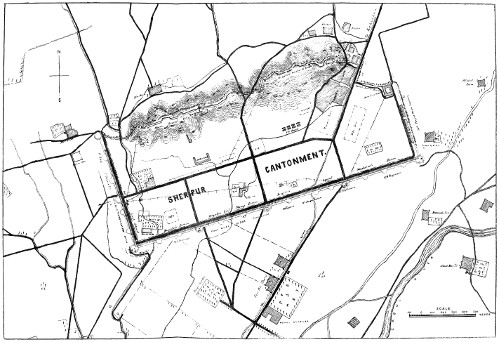
Again to-day we had no heliographic communication with
Luttabund, and the position of General Charles Gough’s brigade
is quite unknown to us. We are calculating that he will be here
by the 20th; but this is a sanguine estimate, as the troops on
the Khyber side are still weak in their transport arrangements.
He may be unable for a few days to concentrate his troops at Jugdulluck
preparatory to starting for Cabul; but the exigency is so
great, that we may reasonably hope great energy will be shown in
pushing on when once a start is made. He is to bring with him
the 9th Foot, the 2nd and 4th Ghoorkas, and a mountain battery;
and if the baggage is limited to the merest necessaries, the march
should be a rapid one. It is a heavy blow to our prestige to be
forced into Sherpur after having ruled Cabul for two months;
and the sooner the present humiliating state of affairs is changed,
the better will it be for our future control of the country. Our
men are equal to bearing the exposure of night work well enough
under the influence of excitement; but when the reaction comes,
there will be a long list of hospital cases, for, even with four
blankets and an overcoat, a soldier cannot but feel the effects of
sleeping out in the open air. To-day has been the coldest we have
yet experienced, and the wind is very trying to the sentries, who
have to stand motionless at their posts, watching for the enemy.
If snow falls, the discomfort will be increased, and the men in
the trenches and bastions will have to bear great hardships.
18th December.
Night attacks, which would cause us much trouble and seriously
harass our troops, do not seem to be advisable in the eyes of
the Afghans. Not even the Ghazis, who showed such courage on
the 14th, can persuade their friends to venture forth at night; and
234as the moon nightly gives more and more light, we feel less anxious
as we “turn in,” fully dressed, at ten o’clock. Not that we
relax our vigilance in the least: there is too much at stake for
this; but that we sleep sounder, now that for three nights we have
been left undisturbed. A sentry occasionally fires a shot; but
no sooner does the report ring out, than an officer visits the post
and personally sees if there are signs of danger. In the Reserve
below the gorge the officers of each regiment watch for an hour
in turn; and thus, in addition to the sentries, there are always
eyes and ears ready to detect anything unusual. Tents have
been pitched for some of the men to sleep in; but the majority
roll themselves up in their blankets and waterproof sheets, and
rest as cheerfully as if within four walls. The officers on duty
on the walls sleep among their men, and are called whenever
suspicion is excited by moving objects outside, so that a night
surprise is impossible. The officers in charge of sections visit
their walls and trenches nightly, to see that all arrangements are
properly carried out; and General Roberts and his Staff sometimes
make the entire round of cantonments. If an enemy were besieging
us in a civilized manner, and pushing forward parallels
and entrenchments, we could not be more vigilant; and it is
satisfactory in the extreme to see the soldierlike bearing of all the
troops engaged in the weary work of keeping watch and ward over
nearly five miles of defences. British and native are fully alive
to the serious duties they have to fulfil; and down even to the
dismounted Lancer, with his carbine ready for use, doing the
unwonted task of sentry-go in the trenches, there is not a man
who has not accepted cheerfully the hardships imposed upon
him.
It was understood that to-day an attack would be made in
earnest. The moollahs had been at their prayers in the early
morning, and had blessed innumerable flimsy standards which
were to be planted on our walls when their victorious followers
had driven us from our defences. There certainly was more
appearance of resolution in the movements of the enemy than has
hitherto been the case. The small party in the villages beyond
the eastern wall had cleared out during the night, and a demonstration
in force was made from the south-western direction. Our
235cavalry videttes on Siah Sung and the hills near the north-west
bastion gave us warning of the approach of several thousand men,
who moved out with their standards from the Jellalabad gate and
Deh-i-Afghan, and took up positions in the gardens and enclosures
which cover the plain to the north of the city. I have said that
good cover for an attacking force still remains in front of the
southern wall and the south-west bastions, and this was made use of
by Mahomed Jan, to push his men well towards Sherpur. The
alarm was sounded in cantonments at eleven o’clock, as on the
previous day, and in a quarter of an hour we were ready for the
attack. A hot fire was begun from behind walls, watercourses,
and towers, upon the soldiers lining the walls of Sherpur, and we
answered it with our guns. Shells were dropped into the gardens
where the enemy were in most force, six guns of G-3 and F-A
being taken out at the north-west corner of the cantonment, and
making good practice at 1,500 and 2,000 yards. Orders were
given for no small-arm ammunition to be wasted, and small volleys
only were fired upon the men fully exposing themselves. A few
Ghazis worked from wall to wall, until within 400 yards of the
corner bastion nearest Deh-i-Afghan, but they could do nothing
beyond planting their standards, for at that distance our marksmen,
with their Martinis, could scarcely fail to hit even so small
an object as a man’s head. Afghans are good skirmishers, and in
the art of taking cover they are almost unequalled; but there was
an open space between their advanced standards and the walls,
which even a Ghazi would not venture to cross. All that we could
see were the flashes from their rifles and jhezails from loopholes
in the enclosures and towers, or from behind trees, ditches, and
stones. Our shells were so effective, that two or three bursting
in a garden were enough to drive its defenders to seek other
protection; and as they passed from wall to wall, they were shot
down by our rifle-fire, which never grew wild or irregular. Eight
picked men out of the 72nd Highlanders firing a volley at a signal
from their officer accounted for six men out of ten who were
trying to reach a small isolated tower only 400 yards from the
south-west bastion; and their comrades near were so disheartened
that they left their standards, and crawled back several hundred
yards. Solitary Ghazis, walking in sheer bravado out of cover,
236were killed at longer ranges, and all heart seemed to die out of
the attacking party, who could make no headway against such a
deadly fire. For the greater part of the day the enemy’s fire
from the villages continued, and bullets came singing over the
walls into cantonments, making it dangerous for any one to venture
beyond the shelter of the barracks. Spent bullets dropped a few
yards over the roofs, and Lieutenant Sunderland, of the 72nd,
was struck on the foot and slightly wounded by one of these. A
bhistee near head-quarters was hit in the chest, and General
Vaughan’s horse was wounded while standing picqueted near the
same spot. Every tree and every yard of wall outside Deh-i-Afghan
and Murad Khana, the northern part of Cabul, seemed to
hide skirmishers; and the rattle of musketry for several hours
told of the continuous fire they were keeping up. Not a man on
Sherpur walls was hit, though narrow escapes were numerous.
General Roberts, with several members of his Staff, was watching
the movements of the enemy from the roof of the head-quarters’
gate when a bullet passed just over the parapet and struck the
wall behind. The heliograph instrument on the same roof was
also hit. The Union Jack was flying just below, and it was
believed that this was taken as a target, as the shooting was so
accurate. A score of Mahomed Jan’s nondescript cavalry galloped
along the road below the Asmai hill, as if to cut off our videttes,
but a few shells checked them; while a small body of infantry,
which tried to work round in the same direction, were kept back
by a few shots from the sowars’ carbines, aided by a cross fire
from twelve picked shots of the 5th Punjab Infantry, snugly
ensconced in the fields, behind a little sungar 600 yards from the
guns. These twelve men—six Afridis and six Dogras—also
prevented any stragglers from firing at the guns; and the coolness
with which they kept their post and fired upon 200 or 300 Afghans
who tried to dislodge them was admirable. In the afternoon the
67th Foot moved out along the fields in front of the southern
walls, and skirmished along the enemy’s right flank, so as to draw
their fire, and make them show their real strength. They were
also to examine the ground, and see if it were possible for cavalry
to work across. They lined such walls as gave cover and drew a
smart fire upon themselves, which they returned rather too freely
237considering that ammunition is so valuable. There was not time
for them to clear the gardens and forts, so at sunset they returned
to their quarters, their withdrawal being the signal for the enemy
to follow their old tactics of creeping forward again to the positions
they had evacuated. The fire from the bastions was again effective
in covering the retirement, and the regiment reached cantonments
without any casualties. The King’s Garden had been
occupied since the morning by two companies of the 5th Punjab
Infantry, Colonel Williams (commanding 5th Punjab Cavalry)
having reported that it was easily defensible by infantry. The
Punjabees were withdrawn at the same time as the 67th retired;
two companies of the 3rd Sikhs, who had gone out to strengthen
the right flank of the 67th, keeping the enemy back while the
garden was evacuated. No sooner had the sepoys withdrawn
than the garden was filled with Afghans, who fired the quarters
of the sowars, and amused themselves by shrieking and howling
about the place, as if they had gained a great success. The 5th
Punjab Cavalry have had all their trouble for nothing: they had
made themselves comfortable for the winter, and had got in bhoosa
and firewood; and this is now either burnt or carried away. In
a village near Mahomed Sharif’s Fort are large stores of forage,
and this, also, will probably be looted.
To-day the sun shone out for a short time, and we were able to
heliograph to Luttabund, although the mist over the hills beyond
Butkhak was very dense. A message was received from Colonel
Hudson, commanding at Luttabund, reporting all well; he had
not been attacked; Gough’s brigade had not been seen, and it
was supposed he was still at Jugdulluck. General Roberts signalled
back, ordering the brigade to advance instantly, even if they had
to leave their tents behind for want of transport; but whether the
signallers at Luttabund could read our message, is not certain, as
no answering flashes came back, heavy clouds obscuring the sun
over the distant kotal. It was signalled twice, so that it might be
understood, and we have but little doubt that it was “read” correctly.
It is now plain that our reinforcements will not be here
by the 20th, and we must wait patiently for another five or six
days.
Snow began to fall at seven o’clock this evening, and it is still
238steadily snowing now (midnight). At ten o’clock I visited the
bastions held by the 72nd Highlanders, and gained some idea of
the work our men are called upon to do. The sentries in their
greatcoats were simply white figures standing rigidly up like
ghosts, the snow-flakes softly covering them from head to foot,
and freezing as they fell. Men on guard in the bastions were
walking briskly to and fro in their limited space to keep themselves
warm, and at their feet were their sleeping comrades,
covered with their waterproof sheets. A cold wind had been blowing
in the early part of the evening, and this had driven the flakes
into every crevice, and had caused several inches of snow to drift
about the feet of the sentries in the parapet. In the ditch below
our horses were tethered, and our syces and followers sleeping,
the snow covering all alike, and whitening the ground as far as
the eye could reach. Inside cantonments was one wide sheet of
snowy brightness, the Bemaru Heights rising up in the background
and looming through the snowflakes like a snowy barrier blocking
us from the outer world. It was bitterly cold on these heights,
over which a cold wind nearly always blows; and we knew that,
hidden from our view, were 2,000 or 3,000 men sleeping at their
posts, with snow about them, every man ready to answer the
first call of his officer, stalking about among the sentries. Picquet
duty under such conditions is a real hardship; but with Balaclava
caps and warm gloves frost-bite is guarded against, and with the
early morning comes hot soup and cocoa, which cheers the men,
and gives them heart to face the cold. By order of the General,
the Commissariat serve out, night and morning, tinned soups and
cocoa to all European soldiers; and it is fortunate that a large
supply of these stimulants—for such, indeed, they are in a climate
like this—reached us a few weeks ago. The small tins are easily
carried by the men, and all that is wanted is a cup of hot water to
give a “drink” with which rum cannot hope to compete. The
sepoys and sowars of the native regiments are not forgotten, additional
comforts being served out to them; and they are cheery as
their English comrades, though the snow is far more trying to
men from a tropical climate.
Our wounded generally are doing well, though one trooper of
the 9th Lancers, who was injured by his horse being killed in a
239charge, has died. Colonel Cleland, the Colonel of the same
regiment, who was wounded in the disastrous affair of the 11th,
is pronounced out of danger; while Lieutenant Egerton, shot
through the neck on the 14th, is walking about again, though still
on the sick list. I am sorry to say that Major Cook, V.C., 5th
Ghoorkas, is dying, mortification having set in from the wound he
received below the knee on the Bala Hissar Heights. His brother,
Lieutenant Cook, of the 3rd Sikhs, who was wounded in Chardeh,
is rapidly recovering.
The Siege of Sherpur continued—General Baker’s Attack upon Kila Mir Akhor—Destruction
of the Fort—Telegraphic and Heliographic Arrangements in Sherpur—News
from Luttabund—Despatch of a Convoy to Colonel Hudson—Movements of
the Enemy at the Butkhak Road—Want of Military Knowledge among the Afghans—Dissensions
in their Ranks—Mahomed Jan offers Terms—Heavy Guns got into
Position in Sherpur—Bombardment of Kila Mahomed Sharif—Failure to dislodge
the Enemy—Arrival of General Charles Gough’s Brigade at Sei Baba—Night March
of the 12th Bengal Cavalry to Luttabund—Occupation of Villages East of Sherpur
by the Enemy—Trustworthy News of a contemplated Attack—The Preparations
to resist an Assault—The Attack of December 23rd—Repulse of the First Attack
on the Eastern Trenches—The Attack renewed—Dispersion of the Enemy—Cavalry
Pursuit—Deaths of Captain Dundas, V.C., and Lieutenant Nugent, R.E.—General
Charles Gough at the Logar Bridge—Return of Casualties.
Sherpur, 19th December.
The enemy during the night occupied two strong forts a few
hundred yards beyond the eastern wall, and were in such numbers
that their fire annoyed us in that direction. Near the 28th N.I.
lines is a high walled enclosure, in which sick and wounded sepoys
are placed; and in front of this again, outside the lines, is a
small fort in which fifty men, of the 67th Foot, under Captain
Smith, had been stationed during the night as an advanced post.
The fort nearest to them in possession of the enemy is known as
Kila Mir Akhor, named after the Afghan Master of the Horse, and
to-day General Baker was ordered to destroy this. He took with
him 400 of the 67th, under Major Kingsley, 400 of the 3rd Sikhs
240under Colonel Money, the 5th Punjab Cavalry, two mountain guns
of Swinley’s Battery, and a party of Sappers and Miners. These
moved out about eight o’clock; but the morning was so misty after
last night’s fall of snow, that nothing could be seen twenty yards
away. A wall of mist shut out the view on every side, and it
was difficult to feel the enemy and to test their strength. Just
as the guns were being got into action, a terrific fire from the two
forts held by the Afghans was opened upon General Baker, and
several men fell wounded. Lieutenant Montenaro, of the Mountain
Battery, was laying a gun when a bullet struck him in the
chest and lodged in the spine, inflicting a mortal wound. General
Baker moved back the 67th in rear of the fort occupied by Captain
Smith, to act as a reserve, and extended the 3rd Sikhs in skirmishing
order through the orchards to open fire upon Kila Mir
Akhor. The guns tried to get round on the left, but found no
position to suit them in the orchards, and it was then reported
that the fort was commanded from the south-eastern bastion. They
were moved into this bastion, and, aided by two guns of F-A,
shelled the place for some time. Covered by this fire, the 67th
advanced to see if the fort were still held, as the fire from it had
slackened. As they were not fired upon, the Sappers, under Lieutenants
Nugent and Murdoch, pushed on with powder bags and
got within the walls, which were surrounded by Major Kingsley
and his men. The towers were mined and blown up, and the
buildings set on fire. The enemy still held the further fort, which
was of great strength, with walls 30 feet high, and beyond some
skirmishers of the 67th checking the fire from its towers, it was
left untouched. The enemy were crowded within it, and were
reinforced by men from the Siah Sung Heights. Our cavalry and
a company of the 67th kept a sharp look-out on General Baker’s
left flank in the Kohistan direction, while the towers and bastions
were being blown up, and Kila Mir Akhor having been destroyed,
the force returned to cantonments. This kind of work is full of
danger, as the Afghans make good shooting from loop-holes and
behind orchard walls; and in this skirmish we had six of the
67th and six of the 3rd Sikhs wounded, besides Lieutenant Montenaro
fatally hit.
There was again to-day constant firing at the walls by detached
241parties of the enemy, and several casualties occurred—horses,
ponies, and camp-followers being hit. Our men do not answer
the fire, except when certain of their aim, as one rifle discharged
from the walls is the signal for twenty answering shots. The
bullets go wide of their mark and drop into cantonments, doing,
as I have said, some damage. A trooper of the 9th Lancers,
while in the open, was badly hit in the chest; and one of the 3rd
Sikhs, while on the Bemaru Heights, was also struck. The bullet
was from a Snider rifle, and must have travelled 1,500 or 1,700
yards. The Ardal Pultun was running short of Snider ammunition,
and the irregulars with them are equally short of lead.
Slugs made of telegraph wire, revolver bullets, and, in some
cases, even cartridges have been picked up within the walls. They
were probably fired from Enfields, smooth-bores, or jhezails. They
would make an ugly wound at short ranges, but they are mostly
spent by the time they reach us.
Though we are cut off entirely from the outer world, our internal
means of communication are perfect. The heliograph works
from the head-quarters’ gateway to the eastern end of Bemaru,
and telegraph offices have been opened about cantonments by Mr.
Luke and Mr. Kirk in charge of the line. There is plenty of wire
left even after so many hundreds yards have been used for entanglements,
and branch lines have been laid from the chief office to the
more distant quarters. General Roberts is thus kept informed of
all that is going on, and much orderly work is saved by these
means. Orders can he transmitted to General Macpherson and
Colonel Jenkins in a few seconds, and troops warned for duty
without the least delay. At night, lamps are used for heliographic
signalling from the gateways and the heights whereon there are
no telegraph offices; and though the light draws fire occasionally,
the signallers have not yet been hit. Such of the cavalry as were
picqueted in the open have been moved nearer to the line of
barracks, so as to be out of fire, and there is now an open maidan
where, a month ago, our tents covered the ground. The ordnance
stores have also been moved to a safer spot than that formerly
occupied, in rear of General Baker’s garden, and the office tents
and post-office near head-quarters have been repitched on safer
ground. There have been so many bullets singing about that
242away from the shelter of the walls there was positive danger in
walking from point to point. On the northern line, the Bemaru
Heights, no shots have been fired, as the enemy cannot get within
range without laying themselves open to being cut off in the plain
beyond by our cavalry.
We have heard from Luttabund to-day that none of the special
messengers, conveying letters and telegrams, has reached there
since the 15th. We are afraid after this to entrust important
letters to the messengers, who may have taken them to the enemy,
or been captured on the road to Luttabund. Beyond keeping a
diary of events, such as I am now writing, nothing can be done;
and it is hardly likely that beyond the mere fact of being invested
and of stray shooting at the walls there will be anything left to
chronicle for a few days.
Major Cook, V.C., as good a soldier as ever served, and a
universal favourite in the force, died this evening. Lieutenant
Montenaro still lives, but paralysis has declared itself, and his
death must be a matter of a few hours. Our loss of officers is
painfully great, and the total casualties of all ranks since December
10th must now be nearly 300. The 9th Lancers have been
the worst sufferers: they have lost three officers killed and four
wounded, and twenty-one men killed and seventeen wounded, or
forty-eight casualties in their ranks. The 5th Punjab Cavalry is
the only regiment whose officers have escaped scot-free during the
five days’ fighting, from the 10th to the 14th.
20th December.
Waiting for the attack has grown so terribly monotonous, that
we daily curse the tactics pursued by Mahomed Jan, who only
sends out 200 or 300 sharp-shooters to blaze away their ammunition
at our sentries. It has become so apparent that no real
assault is likely soon to take place, that we are half-inclined to go
out and deal with the enemy. But, fortunately for them, they
are in Cabul, and street fighting with our small force would be
almost a useless sacrifice of life. We could burn the city down
certainly; but there are political considerations which tie our
hands, as to destroy Cabul means much more than burning so many
243thousand houses. We have still no news of General Gough’s brigade,
although the 20th has come and gone, and now even the most
sanguine among us do not expect the investment to be at an end
till Christmas Day. Our little garrison at Luttabund has had a
small fight of its own, but has come well out of the scrimmage,
having killed fifty of the assailants. Mahomed Jan is afraid to
split up his force, or he would before this have detached 5,000 or
6,000 men to hold Butkhak, and advance thence to carry the
Luttabund Kotal. It is the presence of our troops at Luttabund
and Jugdulluck which has no doubt kept the Tezin Ghilzais in
check; and as Asmatullah Khan seems to be quietly waiting in
the Lughman Valley for further news of Afghan successes, the
march of our reinforcements should be made without a shot being
fired—at least as far as Luttabund. A small convoy of yaboos, in
charge of their Hazara drivers, carrying food to Colonel Hudson,
was sent from Sherpur last night, and reached Luttabund safely.
Another will be sent to night; but as parties of the enemy have
been seen taking the road to Butkhak, it is not unlikely that it
will be intercepted. The Hazaras are very plucky; they go out
willingly for a small reward, and we are now using a few of them
to carry letters and despatches. They pass out of the north-west
corner, make for the border of the lake, and thence work along
the northern edge of the plain between Sherpur and Butkhak,
avoiding the latter place as much as possible. We are anxious as
to the safety of the bridge over the Logar river, halfway to
Butkhak. It is believed at present to be intact; and unless it is
very thoroughly blown up, its strong masonry piers and arches
can be easily repaired. Luckily, we are not fighting an enemy
with many resources. There is no one from Mahomed Jan downwards
who understands, in the first place, how to make an investment
really worthy of the name. To deal with walls such as we
have to defend, the only mode to harass the garrison successfully
is to concentrate an enfilading fire so as to sweep the parapet. We
have not had time to make traverses of sand-bags on the bastions
or walls; and our men would suffer greatly if the bullets, instead
of passing harmlessly over the parapet at right-angles, were
directed so as to rake it from gate to gate. If the enemy threw
up earthworks during the night at some distance from the corner
244bastions, and fired in a line parallel to the ditch, they could not
fail to do some mischief. As it is, not a man on the walls has
yet been wounded, and our answering volleys, when fired, have
always been effective. Four men out in the open were shot down
by one volley from the marksmen at the south-west bastion, the
range being 450 yards. A Martini rifle, resting in a neatly-cut
channel on the parapet, is, in the hands of cool, collected
soldiers, a most deadly weapon at these short ranges; and as no
one is allowed to fire without an officer’s permission, the shooting
is nearly always good. One of the many rumours from the city
was that powder-bags were to be brought to blow in the gates.
In only one case, at head-quarters, has an attempt been made by
us to permanently close the gateways. There is a strong guard
at each, and the open space is usually blockaded with Afghan
ammunition waggons, strong abattis outside being so arranged as to
check a rush. On either side of the waggons, which can be easily
drawn away when troops are sent out, are low walls built up of
flour-bags, from behind which ten or twelve men can command the
entrance if it comes to close fighting. At the head-quarters’ gate
strong doors have been placed on hinges let into the wooden supports
to the mud wall on either side, and gun carriages are closely
jammed against these. Twelve picked men are on duty day and
night on the wall commanding the entrance, and their orders are
to reserve their fire until the enemy with their powder-bags are
within twenty yards of the gateway. A strong wooden platform,
with a parapet of sand-bags, stretches from wall to wall six feet
above the gun-carriages, and this post is entrusted to the care of
the thirty Ghoorkas who came up with Sir Michael Kennedy as
escort. Even if the door were blown in, the ghazis at the head
of a storming party would have to face a heavy fire from above,
which they could not return while clambering over the barricade.
This gateway would probably be the one first assailed, as the
Afghans know quite well that General Roberts and his Staff have
their quarters within it.
Some of our spies state that the men now holding Cabul have
seriously contemplated an assault; but that their ranks are split up
by quarrels as to the right of tribal sections to appoint a new Amir.
Old Mushk-i-Alam still continues to prophesy that a repetition of
245the victory of 1841-42 is sure to come to pass; and, as a first step
towards this, Mahomed Jan has had the coolness to “open negotiations.”
One would be inclined to look upon his self-assurance as
ludicrous, were it not that he has the gratification of seeing us
shut up in Sherpur, as if at his mercy. The propositions offered
are of such a “mixed” order that they seem, at first sight,
scarcely serious. One is that we should at once retire to India,
after having entered into an agreement to send Yakub Khan back
to Cabul in the state befitting an Amir; and we are to leave two
British officers of distinction as hostages for the faithful carrying
out of our contract. Another is made on behalf of the Kohistanis,
who offer to accept Wali Mahomed as Amir, if we will march away
without concerning ourselves further with Afghan matters. The
leaders, who have been bold enough to make these proposals,
think, perhaps, that we are as weak as our unfortunate army
thirty-eight years ago, and that by frightening us into concessions
they will be able to cut us up in detail as we toil back to Peshawar.
As all the advantages of arms, equipment, and ample supplies are
now on our side, we only laugh at the terms so considerately
offered. “We have a lakh of men: they are like dogs eager to
rush on their prey! We cannot much longer control them!” is
said to have been one of the messages sent to shake our faith in
our own strength; but such absurd vapouring is taken at its real
value, and contemptuously passed over. Yet a few days, and we
shall have 6,000 men hammering at the gates of Cabul; and
unless our soldiers belie themselves, there will be a great revenge
taken for the humiliation our army has had to endure. The idea
of creating a new Amir has turned the heads of our foes to an
extent that is absurd when it is remembered that they are merely
in Cabul on sufferance for a few days until our reinforcements
come up. The Kohistanis, who have nominated Wali Mahomed,
are at loggerheads with the Ghilzais from Logar and Wardak, who
wish to put Yakub Khan’s son, young Musa Jan, on the throne.
They are politicians enough to know that Yakub himself will
never he sent back as ruler of Afghanistan, and nothing would
suit them better than to have an infant as Amir, and their own
chiefs as a Council of Regency. Such a government would be on
lines which would give full scope to ambitious men, and the
246country would be plundered for the benefit of the Ghilzais and
their friends. In this wrangling about the Amirship, the more
warlike work, ready at hand, is forgotten, though the more
fanatical have held councils of war and told off leaders to various
sections which are to assault Sherpur at a given signal. There is,
however, but little attention paid by the rank and file to the
commands of their leaders; and though when a ghazi rushes
upon his death, a handful of desperate men will follow him, the
great majority hang back when they see the task before them.
The firing into cantonments to-day was of the usual desultory
kind, and our mountain guns pitched a few shells into such
gardens as contained fairly large bodies of men. Two Highlanders
were wounded while on picquet duty at the line of entrenchment
from the commissariat godowns to the Bemaru gorge.
Kila Mahomed Sharif, so well known during the disastrous winter
of 1841, still stands near the site of our old cantonments between
Sherpur and the Cabul river, overlooking the road from the Bala
Hissar. From this fort, which is only 700 yards from the 72nd
Gateway, men fired at the southern wall all day, while others
could be seen, with rifles slung across their backs, superintending
the carrying away of the bhoosa stored by the 5th Punjab Cavalry
in a village near for winter consumption. Hazara coolies were
made to do this work, and also to dismantle the cavalry quarters
in the “King’s Garden,” which, as before stated, we have
abandoned. This morning three 18-pounders and an 8-inch
howitzer, part of the siege train given to Shere Ali by the Indian
Government, were got into position on the bastions east and west
of the 72nd Gateway, and to-morrow these will open upon Kila
Mahomed Sharif and the villages in rear. We want 40-pounders
at least to batter down the thick walls of the fort; but still the
heavy guns now ready to be fired will probably have a good effect
upon the enemy. Round shot will be used for these 18-pounders,
and bits of iron, bullets, &c., have been sewn up in canvas to
serve as canister if the enemy make any demonstration in force.
There was no difficulty in getting the guns and howitzer up the
bastions, twenty or thirty men at the drag-ropes moving them
easily into position. It is strange that guns which were given to
Shere Ali as a reward for his fidelity to the British should now be
247turned against the Afghans, who have shown themselves unable to
appreciate the value of an alliance with India. Now that the siege
train has returned to our possession we shall, perhaps, be less
confiding in handing over munitions of war to a nation which has
treated us so treacherously.
Beyond throwing out our usual cavalry videttes, we have done
nothing to-day to show the enemy we are on the alert. The
cavalry have been terribly hard worked since the 10th, and horses
and men have suffered in consequence. At one period the saddles
were never taken off the horses of the 5th Punjab Cavalry for
sixty hours, and the other regiments have been nearly in the same
condition. Lieutenant Montenaro died this evening from the
effect of the wound received yesterday. This makes the tenth
officer we have lost in as many days, and there are still eleven
others under treatment for wounds.
21st December.
The three 18-pounders and the howitzer opened fire about ten
o’clock this morning upon Kila Mahomed Sharif, and fired round-shot
and shell at its walls and the village in rear, where the enemy
mustered in strength. The bombardment was so far successful
that the fire from the fort at our walls ceased; but the thick walls
were too strong to be battered down by anything under a 40-pounder;
unless, indeed, our guns had been kept playing upon it for
two or three days. After three or four hours’ incessant firing,
a party of the 5th Punjabees went out, accompanied by Major
Hanna, of the Quartermaster-General’s Department, to examine
the place, and see if the enemy had really withdrawn. It was
soon found that they were only hiding themselves from the shot
and shell; and when the Punjabees got in the open, the Afghans
rushed back to their positions and re-opened fire. They used the
holes made in the walls by the round-shot as loop-holes, and it
must be confessed they were admirably adapted for the purpose.
All day long bullets have been dropping over the walls, and five
soldiers and several camp-followers have been wounded. The
tactics of the enemy are annoying, as they withdraw at the first
sign of our men moving out, and return again as soon as we retire.
Two or three of their marksmen are daily posted to the same
248points, and blaze away steadily at any one incautiously peeping over
the parapet. Our men quietly sit down inside, smoke their pipes,
and laugh at the bullets. A few watch the movements of the
sharp-shooters; and as soon as they show in the open, a volley
from four or five Martinis is fired, generally killing one or two men.
One of the Afghan modes of skirmishing is for a few men to get
in rear of a wall, cut holes through the bottom a few inches above
the ground, dig another grave-like hole in which to lie down flat,
and then to fire their pieces from their loop-hole. The effect is
very singular: the flashes seem to leap out of the ground itself,
and when a score of men are firing, the bottom of the wall bristles
with flame. This manner of firing gives greater steadiness of
aim, and is far safer than resting the rifle on the wall-top, or
thrusting it through a slit cut half-way up. This afternoon the
enemy showed in large numbers in the orchards about Deh-i-Afghan,
and were plainly trying to skirmish round towards the
north-west gap between the walls and the Bemaru Heights.
General Hills commanding at that corner sent out a party of the
5th Punjab Infantry and 3rd Sikhs to occupy some low hills half
a mile from the north-west bastion; and these were enough to
intimidate the enemy, although we never fired a shot from our
rifles. The guns shelled the orchards, and, at dusk, the usual
retirement of the Afghans to the city followed. The Sikhs and
the Punjabees were then withdrawn to their lines, and all made
snug for the night. We have materially lessened the number of
men on the walls and bastions to-day, as the duties are so severe,
but everything is held in readiness to repulse an assault at a few
minutes’ notice. As the Martini ammunition is rather short,
Sniders are served out to the Europeans behind the parapets at
night. We have plenty of Snider cartridges, as a large quantity
was captured in the Bala Hissar.
To-day heliograms were exchanged with Luttabund, and news
was received from General Hugh Gough, who is at Sei Baba with
1,400 men and four mountain guns. He will reach here on
the 24th at the latest, and then we shall be able to turn the
tables on Mahomed Jan and his 30,000 or 40,000 men. Our
second convoy of yaboos to Luttabund was cut off, only four
ponies out of fifty reaching Colonel Hudson safely. The villagers
249en route are believed to have killed the Hazara men in charge.
The 12th Bengal Cavalry start to-night for Butkhak, whence they
will join General Gough’s force. This is the first sign of the
approaching termination of the siege.
The Lieutenant-General commanding has published the following
Divisional Order, expressing regret at the death of Major
Cook, V.C., 5th Ghoorkas:—“It is with deep regret the Lieutenant-General
announces to the Cabul Field Force the death, from
a wound received on the 12th of December, of Major John Cook,
V.C., 5th Ghoorkas. While yet a young officer, Major Cook
served at Umbeyla in 1868, where he distinguished himself; and
in the Black Mountain campaign in 1868. Joining the Kurram
Field Force on its formation, Major Cook was present at the capture
of the Peiwar Kotal: his conduct on that occasion earning
for him the admiration of the whole force, and the Victoria Cross.
In the return in the Monghyr Pass, he again brought himself
prominently to notice by his cool and gallant bearing. In the
capture of the heights at Sang-i-Nawishta, Major Cook again
distinguished himself; and in the attack on the Takht-i-Shah
Peak, on the 12th December, he ended a noble career in a manner
worthy even of his great name for bravery. By Major Cook’s
death Her Majesty has lost the services of an officer who would,
had he been spared, have risen to the highest honours of his
profession, and Sir F. Roberts feels sure the whole Cabul Field
Force will share in the pain his loss has occasioned him.”
22nd December.
We have been left almost undisturbed to-day, and it has been
hard to believe we are really in a state of siege. Scarcely a shot was
fired at the walls until the evening; but our spies bring in news
that Mahomed Jan is reserving his strength for an attack, which
shall be final. He has heard, no doubt, of General Gough’s
approach, and is wise enough to know that his opportunity is fast
slipping away. The advance-guard of our reinforcements is now
at Luttabund; and the fact of the 12th Bengal Cavalry going
out from Sherpur last night must have shown him that we are
once more equal to sending troops down our old line of communication.
250The 12th Bengal Cavalry had a fearful journey outwards.
On passing Kila Mahomed Sharif, on their way to the Cabul
bridge, they were fired upon by a picquet, and, the alarm being
given, the enemy turned out and blocked the way. The cavalry
turned off from the road, and struck the river lower down. The
water was not very deep, but the banks were steep and slippery,
and men and horses fell backwards as they tried to climb up the
further bank. It cost two hours to ford the river, the last squadron
having to dismount in the stream, crawl up the bank, and drag
their horses after them. The sowars were wet through, and two
or three horses were drowned. Once over, the road to Butkhak
was taken, and from every village on the road turned out a few
men, who fired upon the horsemen. They, perhaps, mistook them
for another convoy of yaboos. The dismounted men had to be
left to return to Sherpur, under cover of the darkness. Upon
nearing Butkhak, a patrol was sent out; and as it was then near
daybreak, they could see men moving about the village. The
place was occupied by several hundred Afghans, who opened fire
upon the cavalry. The latter could not stay to fight; and Major
Green, in command, knowing how impossible it was to return to
cantonments, resolved to push on to Luttabund. One sowar was
shot dead and three others wounded; and the enemy followed so
closely that a squadron was dismounted and ordered to skirmish
out with their carbines. This gave time for all stragglers to be
got together again, and in a short time the skirmishers were
recalled and the whole regiment trotted off to Luttabund.
Twelve men were missing, but ten have since reported themselves
at Sherpur. They disguised themselves by altering their
uniform, and then hid away in nullahs until evening, when they
crept out and made a wide détour to the north until they reached
the open plain between the Wazirabad Lake and the Bemaru
Hills. Their horses and accoutrements were lost. The enemy
have occupied the village of Khoja Durwesh, about three miles to
the east of Sherpur, and are reported to be collecting in force in
the forts between Bemaru and this village. They are probably
Kohistanis, who have taken the precaution of securing their line
of retreat in case of defeat.
Sunjub, a trustworthy retainer of Ibrahim Khan, a ressaldar
251of native cavalry in our service, has come in from Cabul and
reported that Mahomed Jan and the other chiefs have at last made
up their minds to assault Sherpur. The fighting men in Cabul
have been told off to various sections of attack, and the signal for
the assault is to be the kindling of a beacon fire of damp gunpowder,
oil, &c., on the Asmai hill. Forty-five scaling-ladders
have been given to 2,000 men stationed in the King’s Garden, and
Kila Mahomed Sharif, and a demonstration with these is to be
made against the southern wall near its western end. This is to
be a false attack. The real assault is to be delivered upon the
Bemaru village and the eastern trenches; but in case of this
assault succeeding, an attempt, in earnest, is to be made to scale
the wall near the 72nd Gateway. We have made our dispositions
accordingly, and the Reserve will assemble below the Bemaru
gorge, at four o’clock to-morrow morning. The Asmai hill will
be watched by many eyes, and when the beacon light is seen we
shall all be ready at our posts. A message has been sent to
General Charles Gough, ordering him to march to Sherpur to-morrow
instead of halting at Butkhak.
23rd December.
After eight days’ investment Mahomed Jan has at last made his
attack upon Sherpur, and has been beaten off with ridiculous
ease, though nearly 20,000 men must have been sent to take part
in the assault. Our casualties have been very small, and but for
an unfortunate accident, by which two engineer officers were killed
by the premature explosion of a mine, the day has been one of
perfect success. The tribal combination may be looked upon as
broken up, for Kohistanis, Logaris, and Wardaks are reported on
their way, in haste, homewards, and our reinforcements are
encamped within five miles of Sherpur. The news brought in last
evening turned out correct to the letter. From four o’clock this
morning nearly all eyes were turned upon the Asmai Peak, and
even before the signal light appeared, sharp firing was heard near
the King’s Garden and the Fort of Mahomed Sharif. Our sentries
on the walls in that direction had been strengthened, but they did
not answer the fire, as it was desirable to get the enemy well
within range by encouraging them in the belief that we were not
252on the alert. Our men fell silently into their places; two mountain
guns had been placed below the block-house on the eastern
end of the Bemaru Heights, the reserves were standing to their
arms, and the officers in charge of the sections of defence were
all at their posts. At half-past five there was seen on the Asmai
Height a little flash of fire, which in a moment grew to a bright
glare, and streamed up into the air until it must have been seen by
all the country round. For a few moments it burned brightly, as
if fed with oil or inflammable matter, and then died away. As it
flashed out, a continuous fire was opened below the bastions on
either side of the 72nd Gateway, the flashes from the rifles and
matchlocks showing that a large body of men had crept up within
200 yards. The bullets whistled harmlessly over the walls and
barracks, our men still remaining quiet; as, in the semi-darkness
and with the mist still hanging over the fields, nothing could be
seen distinctly 100 yards away. We were waiting for the development
of the real attack, and shortly before six o’clock it came.
From beyond Bemaru and the eastern trenches and walls came a
roar of voices so loud and menacing that it seemed as if an army
50,000 strong were charging down upon our thin line of men.
Led by their ghazis, the main body of Afghans hidden in the
villages and orchards on the eastern side of Sherpur, had rushed
out in one dense mob and filled the air with their cry of “Allah-il-Allah!”
The roar surged forward as their line advanced, but it
was answered by such a roll of musketry that it was drowned for
an instant, and then merged into the general din, which told us
that our men with Martinis and Sniders were holding their own
against the attacking force. For ten minutes the roar was
continuous, and then the musketry fire dwindled down to
occasional volleys and scattered shots from the south-eastern
bastion to the Bemaru Heights, where the mountain guns were waiting
for daylight before opening fire. The eastern defences were in
charge of Brigadier-General Hugh Gough at the eastern end of
the heights, and Colonel Jenkins of the Guides from the trenches
on the slopes of the hill to the corner bastion facing Siah Sung.
The troops defending the position were the Guides’ Infantry in the
trenches about Bemaru, 100 men of the 28th P.I. in the native
hospital, and 67th Foot. The latter were reinforced by two
253companies of the 92nd Highlanders from the Reserve. When
the attack was made, it was still so dark and misty that little could
be seen in front of the trenches, and the orders were to reserve
fire until the advancing masses of Afghans could be clearly made
out. Then the men of the 28th were the first to open fire, and they
fired volley after volley at such long ranges that they effectually
scared away even the ghazis from their neighbourhood. That the
fire was not otherwise effective was proved by only one dead body
being found afterwards in front of their lines. General Hugh
Gough from the hillside, hearing such a tremendous fusillade
below, fired star-shells, which burst in the air and showed the
attacking force in the fields and orchards nearly 1,000 yards away.
The Afghans opened fire in turn, but their shooting was wild and
ineffective, though the bullets dropped dangerously about cantonments.
The native hospital seemed the point towards which the
enemy worked, taking it perhaps as a landmark to guide them;
but their right flank was directed towards Bemaru and the trenches
on the slopes of the hill. The Guides joined in the fusillade, and
the attack was broken while yet the advanced ghazis were 500 or
600 yards away. Sniders at that distance told with precision, and
to make headway against them was impossible. The bullets
searched every yard of open ground, and made even the orchards
almost untenable. To the right of the sepoys of the 28th were
the 67th and the 92nd Highlanders, waiting with characteristic
discipline the order to fire. Through the mist at last appeared a
dense mass of men waving swords and knives, shouting their war-cry,
and firing incessantly as they advanced. The order came at
last for our soldiers to open fire, and the Afghans were then so
close that the volleys told with murderous effect. Some of the
ghazis were shot within 80 yards of our rifles, so patiently was
the attack awaited; while thirty bodies were counted afterwards
well within 200 yards’ range. The attack collapsed as suddenly as it
had begun, the Afghans saw what execution men in trenches and
behind parapets can do with breech-loaders in their hands, and
they took cover behind walls and trees, from whence they expended
thousands of cartridges, doing us but little damage. Our ammunition
was too precious to be needlessly wasted, and only when
clusters of men got within range were volleys fired to scatter them.
254As day broke the two mountain guns, with an 18-pounder and two
of F-A Battery in the corner bastion, shelled the villages and
orchards, and it was believed that the ghazis were too disheartened
to try a second assault. About eleven o’clock, however, after five
hours’ skirmishing, they succeeded in getting a few thousand of
their more desperate followers together, and tried again to assault
our lines. They were driven back more quickly than on the first
occasion; and could, indeed, scarcely be said to have advanced
100 yards in their rude formation of attack. Shortly after this
they began to waver and to slacken their fire, and when their
scouts reported, as no doubt was the case, that a new force was
crossing the Logar river, they became a demoralised mob bent
upon seeking safety at the earliest opportunity.
General Charles Gough had left Luttabund in the early morning,
and upon arriving at Butkhak had been able to communicate
by heliograph with General Roberts. The heliograph flashing
away to the east in the Cabul plain must have warned Mahomed
Jan of the near approach of our reinforcements, and the clouds of
dust rising between Butkhak and the Logar river showed him that
troops were moving onwards, and would perhaps take him in rear.
In any case the villages east of Sherpur were, in two or three
hours, nearly empty of men; the plain beyond was covered with
Afghans streaming towards Siah Sung and Cabul. The Kohistani
section, to the number of fully 5,000, went away to the north,
homewards, taking their women, whom they had brought down,
to witness their triumph, with them. It was now our turn to
attack instead of being attacked. The guns shelled the fields
wherever parties of men were within range; two guns of F-A and
an 18-pounder making grand practice at so close a range as 300
yards; and the cavalry were sent out by way of the Bemaru gorge
to cut up the fugitives. First of all went the 5th P.C. with four
guns of G-3, R.A., which shelled the villages near Bemaru. By
one o’clock the enemy were completely broken. The 5th P.C. were
fortunate to get among a detached body on the north side of the
lake. When their first charge was over, thirty Afghans were lying
dead on the plain. The 9th Lancers joined them, and soon our
horsemen were charging over the Siah Sung slopes. The main
body of the enemy had got well away to the city, but all stragglers
255were hunted down in the nullahs in which they took shelter, and
then despatched. Two or three lancers or sowars were told off to
each straggler, and the men, dismounting, used their carbines
when the unlucky Afghan had been hemmed in. Following in the
wake of the 9th Lancers and the 5th Punjab Cavalry came the
Sappers, with every engineer officer in camp, their orders being to
blow up and burn all the villages and forts lately occupied by the
enemy. The cavalry had cleared the fields and open ground of
all Afghans, but in the villages some fanatics remained, and these,
fastening themselves up securely in houses or towers, were blown
up by the mines laid by the engineers. Lieutenant Murdoch had
a very narrow escape. Entering a fortified village he kicked open
the door of a house, and was greeted with a volley from three or
four men inside. He was wounded in the neck, but not dangerously,
and as the Afghans refused to surrender, the blasting charge
was laid near the house, and they were killed when the mine was
fired. A sad accident occurred in another fort. Captain Dundas,
V.C., and Lieutenant Nugent, Royal Engineers, had constructed
three mines which were to destroy the walls and towers; and all
being ready they went back to light the fuses. The sappers were
drawn up outside under their European non-commissioned officer,
and noticed that two of the mines exploded almost instantly. Their
officers were still within the walls, and when the dust and smoke
cleared away, they were still missing. Search was made, and
the bodies of Captain Dundas and Lieutenant Nugent were found
lying under the débris. Both officers were dead. It is conjectured
that the time-fuses, instead of burning slowly, flared up
like a train of powder, and that the mines exploded a few seconds
after the fuses were lighted. We have thus lost two good officers
by an accident which might have been prevented if the equipment
of the Sappers had not been cut down by the parsimony of the
Government. So few fuses were sent up from India when the
force advanced upon Cabul that the engineers had to make others,
and these were of course defective. It was two of these which
were being used when the explosion occurred. While the cavalry
were covering the operations of the Sappers, several thousand men
marched from the Bala Hissar and opened fire upon the 9th
Lancers and the 5th Punjab Cavalry on Siah Sung. Several men
256were hit, and Captain Gambier, of the 5th Punjab Cavalry, was
wounded by a bullet passing through his thigh. The Cavalry
withdrew under the heavy fire directed against them, and for a few
hours the Afghans remained on the heights with banners planted.
They retired to the city at nightfall, and all the villages between
Sherpur and Cabul are now quite deserted.
While the attack was being made on the eastern defences,
three or four thousand men had kept up an incessant fire at the
southern wall, and such a rain of bullets fell about the Commissariat
and 72nd Gates that many of our camp-followers in cantonments
were wounded. Kila Mahomed Sharif and the King’s
Garden were full of Afghans, and two 18-pounders and two
mountain guns shelled them until late in the afternoon, while the
marksmen behind the walls shot down such men as retreated
across the open. Dead bodies were seen lying in the fields,
and two or three scaling-ladders, so heavy that six men would
have been needed to carry them, were scattered about on the
ground less than a thousand yards away. When the Afghans on
the southern side saw our cavalry sweeping over Siah Sung,
they began to retire hastily to the city, and as they crossed the
road 1,000 yards away from our bastions, they were fired at from
the 72nd Gateway, and many were seen to fall even at that
distance. The men who stopped to carry off the dead behaved in
the coolest way, one Afghan returning again and again to drag off
the bodies of his comrades. Earlier in the day four men were
killed by a volley at 600 yards, and two or three who escaped tried
to face the bullets which swept the ground about their dead.
Finding it was certain death to appear in the open, they crawled
behind a wall, and with a long crooked stick dragged their dead
away. Several of the best marksmen of Mahomed Jan, who had
come daily to the same posts and fired persistently at the ramparts,
were shot to-day, our men having at last got the exact
ranges. The waste of ammunition on the part of the enemy
was enormous; they knew perhaps that it was their last chance,
and they fired round after round all day long.
From the ladders found in the fields there can be no doubt
the feint on the southern side of Sherpur would have become a
real attack if the eastern line of defences had been forced; but
257the scaling ladders were only high enough to reach half-way up
the wall, and the assaulting party could never have gained the
parapet. We should have been well satisfied if they had come
on, as their punishment would have been fearfully severe. On
the south-west and west no attack was made: a few hundred
men from Deh-i-Afghan occupied our vidette-hill towards the
lake, and planted a white standard on the crest, but they never
fired a shot, and a few shells in the evening warned them to
retire, which they did about five o’clock. A few standards were
also placed in the fields to the west, but the ghazis with them hid
themselves behind little sungars they had thrown up, and did not
annoy us at all. The northern line of trenches along Bemaru
Heights were never assailed, the steep hillside facing Kohistan being
clear of cover; and though, once, it was expected that the gorge
would be attacked, and guns were ordered up to the trenches
there, the appearance of the 5th P.C. on the maidan below
checked such of the enemy as were working round from the
village north of Bemaru. In fact, after the first unsuccessful
attack, the enemy did not know what to do, and though their
leaders on horseback galloped about and harangued them, they
could never be got together in a cohesive body. Several of the
horsemen were shot, and we are hoping that Mir Butcha, the
Kohistani Chief, is among the number. At any rate, a horseman
who was most energetic was struck by a volley, and immediately
he fell from his horse 200 or 300 men rushed from a village near,
placed him on a charpoy, and went straight away across the
maidan over the Paen Minar Kotal, which is on the southern road
to Kohistan. The man must have been a chief of distinction to
be thus guarded, for his escort never looked back upon Sherpur,
but hurried their chief away as fast as the bearers of the charpoy
could walk.
To-nightTo-night we are resting on our arms, but all is quiet in the
fields about Sherpur, and we look upon the investment as at an
end. The brigade under General Charles Gough is halted tonight
on the Jellalabad Road at the Logar river, and is holding
the bridge, which after all was never destroyed by Mahomed Jan.
Our reinforcements will march in to-morrow, but it is scarcely
likely there will be any more fighting, as spies from the city report
258that the tribesmen are in full retreat. Very glad, indeed, are we
to be once more free after nine days’ close confinement at Sherpur.
As a soldier remarked on the walls when the Lieutenant-General
was making his rounds:—“Well, I should think this is the first
time in his life that General Roberts has been confined to
barracks!” The confinement has harassed men and officers so
much that we dread the re-action: the excitement is over now,
and the exposure night after night in snow and slush must have
broken down the health of many. The worst cases in hospital
even now are men suffering from pneumonia: the wounded are
doing well, though some of the wounds are very severe. Snow
has begun to fall again, and winter has now set in thoroughly.
The casualties to-day, including followers, are thirty-two in
number. General Hugh Gough was knocked over by a Snider
bullet, which must have been nearly spent. It cut through his
poshteen in the right breast, but was caught in the folds of a
woollen vest, and fell at his feet as he shook himself together
again. The returns for to-day are as follows:—
| Casualties on 23rd December. |
| |
British. |
|
| Regiments |
Officers. |
Men. |
Native. |
Total. |
| |
K. |
W. |
K. |
W. |
K. |
W. |
|
| Royal Engineers |
1 |
1 |
— |
— |
— |
— |
2 |
| F-A, Royal Horse Artillery |
— |
— |
— |
1 |
— |
— |
1 |
| G-3, Royal Artillery |
— |
— |
— |
1 |
— |
— |
1 |
| No. 1 Mountain Battery |
— |
— |
— |
— |
— |
1 |
1 |
| No. 2 Mountain Battery |
— |
— |
— |
— |
1 |
— |
1 |
| 9th Lancers |
— |
— |
— |
1 |
— |
— |
1 |
| 5th Punjab Cavalry |
— |
1 |
— |
— |
— |
7 |
8 |
| 67th Foot |
— |
— |
— |
1 |
— |
— |
1 |
| 92nd Highlanders |
— |
— |
1 |
5 |
— |
— |
6 |
| 23rd Pioneers |
— |
— |
— |
— |
1 |
— |
1 |
| Guides’ Infantry |
— |
— |
— |
— |
— |
3 |
3 |
| Sappers and Miners |
1 |
— |
— |
— |
— |
— |
1 |
| 3rd Sikhs |
— |
— |
— |
— |
— |
2 |
2 |
| 5th Punjab Infantry |
— |
— |
— |
— |
— |
2 |
2 |
| 28th Punjab Infantry |
— |
— |
— |
— |
— |
1 |
1 |
| Total |
2 |
2 |
1 |
9 |
2 |
16 |
32 |
Of our followers one was killed and six wounded. The total
259casualties during the siege and on the day of the final attack were
eighteen killed and sixty-eight wounded (including seven followers
killed and twenty-two wounded).
The Re-Occupation of Cabul—Signs of Mahomed Jan’s Occupation—Complete Dispersion
of Mahomed Jan’s Army—General Hill’s Return to the City—Christmas in Sherpur—Universal
Character of the late Jehad—Necessity for reinforcing the Army of
Occupation—General Baker’s Expedition to Baba Kuch Kar—Examination of the
Bala Hissar—Demolition of Forts and Villages about Sherpur—Cabul Revisited—A
New Military Road—The Destruction of Shops by Mahomed Jan’s Force—Despondency
of the Hindus and Kizilbashes—State of the Char Chowk Bazaar—A Picture
of Desolation—The Kotwali—Wali Mahomed’s Losses—Ill-treatment of Women.
24th December.
Our expectations have been fully realized; the enemy which held
us in check since December 14th has disappeared, and our troops
are once more in Cabul, which shows terrible marks of Mahomed
Jan’s occupation. Every house belonging to Sirdars known to
favour the British has been looted, and in the bazaars all the
shops are gutted except those of the Mahomedans. Doors and
windows broken in, walls knocked down, all woodwork destroyed,
floors dug up, and property carried off: these are the signs
of the Reign of Terror lately instituted among the Kizilbashes
and Hindus. The search for treasure was carried out in
a systematic way, and the loot now in possession of Kohistanis,
Ghilzais, and other tribesmen must be worth many lakhs. Two
lakhs of treasure belonging to Hashim Khan alone, are said to
have been seized, while the Hindus complain of being utterly
ruined. We shall have to inquire further into this when things
are once more firmly settled, but at present we have enough to do
in pursuing the enemy, and arresting such local Afghans as joined
their ranks. These men now hide their arms, and appear in all
the beautiful simplicity of peaceful citizens, but the subterfuge is
too easily detected for them to escape punishment. We were
not sure early this morning that Mahomed Jan’s host had
260vanished, although, as the night had passed quietly, there was
every reason to believe the siege was at an end. Our first movement
was to occupy Kila Mahomed Shariff, and Colonel Brownlow
sent out a party of the 72nd Highlanders to the fort at dawn.
They found it quite deserted, and the other forts and villages near
were also without occupants. Two or three wounded men were
lying within the walls, and the bodies of some thirty Afghans
were scattered about near the loop-holes, or in the open where our
bullets had struck them down. This was on the southern face,
near the 72nd and Commissariat gateways, so that the false attack
in this direction must have cost the enemy many lives. Afghans
do not, as a rule, leave their dead behind, and doubtless there
were carried away double the number found. Scaling-ladders
covered with blood were lying in the fields and forts, and heaps of
powder and some hundreds of ball-cartridges were discovered.
Unlimited ammunition must have been served out to each man, and
as an examination shows that all the powder and caps in the Bala
Hissar have been carried off, or destroyed, it is clear that every
tribesman filled his pouch with an ample supply before making
the attack. Those who have got safely away will have powder
enough to last them for two or three years, as many tons were left
by us in the magazine. But for their losses, which are calculated
at 2,000 or 3,000 killed and wounded since December 10th, the
army of Mahomed Jan may consider their sojourn in Cabul
during the Mohurrum a grand success, temporary though it was.
They blockaded the British army, caused it a loss of between 300
and 400, and proclaimed a new Amir, whom they have still with
them. Young Musa Jan has been carried off by Mushk-i-Alam,
who may, if he chooses, establish the new sovereign at Ghazni,
and invite all Afghanistan to rally about him. The old moollah is
reported to have fled with the lad last night, while Mahomed Jan
remained in Cabul until eight o’clock this morning. He then saw
that his army had deserted him, and he followed the example of
Mushk-i-Alam, and took to the hills. Strong parties of cavalry
have been out all day in the Chardeh Valley and round by
Charasia, but beyond a few men on the snow-covered hills no one
was met with. It was difficult work pursuing, as snow was falling
steadily. The 30,000 men have dissolved, and, with their loot,
261are taking mountain roads, where they are safe from pursuit. The
villages contain many men who fought against us, and hereafter
we shall visit them with our flying column. On the 11th, 12th,
and 13th every fortified enclosure our men passed was barred
against them, and the occupants fired at stragglers and turned out
to harass rear-guards. The Mahomedan population of Cabul
joined Mahomed Jan almost to a man, thinking the British rule
was at an end, and now these citizens, whose homes we spared
when we came among them in the flush of success, are hurrying
away in anticipation of the reprisals we shall inflict. The time
has gone by for weak sentimentality: military law alone should
now guide Sir F. Roberts in his dealings with the people, for it
has been proved beyond question that to act humanely is merely
to encourage the Afghans in their belief that we are unequal to
controlling them. Instead of leaving an indelible mark upon
Cabul, we have enriched it by our purchases of winter supplies,
and have poured lakhs of rupees into the purses of the very men
who had nothing to expect but the fate of a conquered race.
The Hindus and Kizilbashes who relied upon us for protection
may well revile us, since we have left them to their fate; while the
Mahomedans who have looted their homes, insulted their women,
and terrorized over them for ten days, are now laughing at our
inability to follow them to their distant villages. The unlucky
Hazaras, who have worked so well for us, were hunted down, beaten,
and reviled wherever they showed their faces in the streets; and
were told jeeringly to call for help upon the British locked up
in Sherpur. Our humiliation is so great that to risk a repetition
of it would be ruinous. We must show that the investment of
Sherpur can never again occur, and to do this 10,000 troops must
hold Cabul, and our line of communication with India be so permanently
established that even 100,000 tribesmen cannot break it.
An immediate declaration of policy should be made: to wait
quietly for “events to develop” may be disastrous. We must
create events, not allow others to turn the current of them in
whichever direction they please. If we are to hold Cabul—and this
is now ten times more imperious even than it was before, for to
retire would be to acknowledge that we have failed in our occupation,
and dare not risk another reverse—we must hold it by our
262bayonets and not by our rupees. Half-measures will only imperil
our safety: to put trust in Afghan cunning and be guided by
Afghan insincerity is only to risk the lives of our soldiers. Those
soldiers have done all that soldiers can do, and they may well look
to their commanders to make success once obtained sure and stable.
We lost less than 100 men in capturing Cabul; we have lost
nearly four times that number in fifteen days’ fighting, after we
had occupied the place for two months. There must be no longer
a state of false security; for it is not improbable that the jehad
will be revived before the winter is over, and the moollahs may
again influence the religious fanaticism of the people against us.
To-day General Hills, our Governor of the City, once more
visited the kotwali, guarded by the 5th P.I., while the sepoys were
busy all day in searching the Mahomedan quarter, and in arresting
such citizens as they could find remaining. One hundred Punjabees
garrison the kotwali for the night, and the Kizilbashes and
Hindus are once more plucking up courage. The Bala Hissar has
been examined, and not an Afghan found in it, and in two or three
days the 9th Foot, and the 2nd and 4th Ghoorkas, which arrived
at Sherpur this morning with General Charles Gough, will be
quartered in the fortress. Butkhak is also to be re-garrisoned with
100 of the 9th and the whole of the 12th B.C., and in a short
time we shall be once more holding a strong line of communication
with Peshawur. Our most urgent want is ammunition. The reinforcements
have only brought about 200 rounds per man, and our
own supply cannot be much more than 250 rounds, taking the
regiments all through.
Among our political prisoners now is Yakub Khan’s mother,
who was chiefly instrumental in raising the jehad. She will be
closely watched for the future, and as she is a woman of great
resource, it may be advisable to deport her to India. The camp
has also received with due hospitality forty or fifty ladies, the wives
and other relatives of Sirdars among us, as guests.
27th December.
After all the excitement of our ten days’ siege it is a great relief
now to pass beyond the walls of Sherpur, even though the roads
263and fields about are ankle-deep in mud and half-melted snow.
Not a shot now disturbs our peaceful quiet, and the only unusual
sound is the dull report of a mine exploding where our engineers
are busy demolishing forts and walls which only four days ago
sheltered our enemy. Our Christmas has been of the sober,
thoughtful kind. We have so lately been released from the painful
constraint of constant vigilance and hard fighting, that our spirits
could not rise very high in the scale of festivity; and our losses
have so sobered us that it would seem almost sacrilegious to
“feast and make merry” with the death of so many comrades still
fresh in our memory and with the hospitals full of wounded men,
sufferers in the actions fought since the 10th. Besides, every one
is worn out with watching, and it will be some time before officers
and men can once more take life placidly, and enjoy heartily such
little pleasures as are forthcoming. Christmas day was one of
rest for all of us, for our cavalry reconnaissances had shown that
the enemy had dispersed far out of our reach; and as the snow
lay six inches deep on the ground, there was little chance of our
troopers overtaking even such small bands as might have followed
the main roads to Logar, Ghazni, or Kohistan. On the 24th the
horses had to be led back by the troopers from Charasia, the snow
having “balled” their feet and made riding dangerous, and there
was nothing to be gained by sending them out again on a similar
errand. We were not all convinced that none of Mahomed Jan’s
followers were lurking about, and strong guards were still held
ready at night, to repel any sudden attack. But the precaution
might have been neglected; for never before has an “army”
30,000 strong melted so rapidly away. The tribesmen must have
travelled quickly during the night of the 23rd after we had beaten
them from our walls, and now the country about for miles seems
deserted of its inhabitants. Such villages as are passed have their
doors barred and bolted, and not even a ghazi turns out to throw
away his life. The snow-covered hills, which now shut us in on all
sides, stand out in pure whiteness and make no sign. They
have seen the scattered thousands who held high revel in Cabul
pass away in hot haste; but the snow has blotted out their footprints,
and the trail is lost. By-and-by we shall take it up anew, and
search out our enemy in his secluded villages and forts, for a force
264is even now toiling over the snow in Kohistan, and will in a few
days be at Mir Butcha’s gates. Logar also may see another
column marching upon its villages, but more distant Wardak and
Ghazni are probably safe until the spring; that is, if Mahomed
Jan and his powerful friend, the moollah Mushk-i-Alam, do not
keep their promise of returning to Cabul at the festival of Nauroz,
March 21st. They have had such an unexpected success, and
have secured such valuable loot, that, in spite of their losses, they
may be tempted again to repeat the experiment of coming boldly
to meet our army, instead of waiting in their homes for an attack.
The fuller we examine into the jehad, the more clear it becomes
that the late combination more nearly approached a general movement
among all sections than any that has yet been attempted.
In the short period during which it existed, nearly every available
fighting man in North-Eastern Afghanistan flocked to the banners
consecrated by Mushk-i-Alam; and if the success of the jehad
had been a little longer-lived—say by the interception of our reinforcements—there
would have been streams of men setting in
for Cabul from Turkistan, Badakshan, and the Shutargardan
district, which would have made Mahomed Jan the leader of that
“lakh of men” of which he boasted. Every chief of importance
among the wide-spread Ghilzais and the more compact Kohistanis
and Safis was up in arms, and the fighting at Jugdulluck showed
that Asmatullah Khan and his Lughmanis were at one with their
friends besieging Sherpur. Even Padshah Khan, whose virtues
short-sighted politicians have extolled, brought a contingent to
Cabul, and fought against us with desperate hatred, although he
had greatly smoothed our path during the first march from Ali
Khel. With Mahomed Jan were also Mir Butcha and several
other Kohistani chiefs—Usman Khan, the Safi leader of Tagao;
Gholam Hyder Khan (Logari), and Aslam Khan, Colonel of
Artillery, both of whom fought at Charasia; and several minor
Ghilzai leaders, who had each brought their following of 500 or
1,000 men. The countenance Mahomed Jan and Mushk-i-Alam
received from Yakub Khan’s mother and wife gave them a status
which they did not fail to use to the best of their advantage; and
while, perhaps, half their followers were freebooters, intent upon
looting Hindus and Kizilbashes, they made it appear in their
265attempt to negotiate with Sir Frederick Roberts that they were
the patriotic leaders of a movement which had for its object not
so much the ejectment of the British army, as the revival of the
Amirship. Singularly enough, the removal of Yakub Khan was
made a pretext for their occupation of Cabul, and this in the face
of their callousness as to his fate when he was a prisoner in our
camp. Yakub’s mother, working through Mushk-i-Alam and his
moollahs, turned the full tide of religious enthusiasm aroused by
the jehad into channels which should serve to place either her
exiled son or her grandson on the throne, and the proclamation of
Musa Jan as Amir was a bold step, which may yet give us much
trouble to nullify. Musa Jan is in the hands of Mushk-i-Alam,
who may renew his jehad. By setting up the child in state at
Ghazni, and formulating decrees and proclamations in his name,
he may give the people a pretext for denying the existence of
British authority further than the few acres commanded by our
guns about Cabul: and taking religion again as a rallying cry, he
may by Nauroz be ready with another 30,000 men to try conclusions
with us again. The late army which besieged us does not
exist, save in scattered units. The feeling which drew it together
is still alive; for fanaticism only slumbers in this country, and has
sometimes so rapid an awakening that it must be constantly watched.
The ten days’ success of Mahomed Jan will be quoted as proving
that, under more favourable conditions, it might be extended indefinitely;
and unless, by our preparations, we show that the
conditions in future, instead of being more favourable, become
steadily less and less attractive to men who may be called upon
to join a new jehad, the British army of occupation may be again
isolated. It is to be hoped that no false measure of economy will
prevent the strength of the force here being so raised that from
3,000 to 4,000 men will always be available for outside work,
after Sherpur or whatever lines we may occupy have been strongly
garrisoned. Our reinforcements number only 1,400 men, and
Luttabund is still left without a garrison; while 100 of the 9th
Foot and the whole of the 12th Bengal Cavalry have been sent to
Butkhak to hold that post. We may seem strong enough now
when we have not an enemy within twenty miles; but so we
seemed equally safe three weeks ago, when we disbelieved in the
266possibility of 30,000 Afghans ever collecting together. If our
experience is to go for nothing we shall revert to the old order of
things, perhaps allowing the other division to garrison Luttabund
and Sei Baba; but if we are to convince the late leaders of the
jehad that a second can only be a ridiculous failure, we shall
have the whole of Generals Charles Gough and Arbuthnot’s
brigades west of Jugdulluck.[36] There may arise some difficulty in
regard to winter supplies; but if the policy, now begun, of requisitioning
the villages belonging to hostile chiefs be carried out
to its full extent, our reinforcements can live comfortably. Besides,
the Kyber transport should at once be so remodelled that
it will not be frittered away for want of due supervision, and then,
surely, supplies can be sent from Peshawur as far as Jugdulluck,
Luttabund, or even Cabul itself. If we have to face the possibility
of a second siege of Sherpur, and of another blow at our prestige
by tribes of Asiatics, we may as well face it with our eyes open
and our powder dry. This same question of powder may involve
us in difficulties yet, for we want ammunition badly; and if
it has to be brought up from Peshawur, it will take three weeks
to reach here. As we are sending flying columns out again, the
troops comprising which may get rid of 100 rounds per man in a
few days, the prospect does not seem so bright of our 250 rounds
each lasting very long. If Mahomed Jan had persistently attacked
our force in the manner he at last did on December 23rd,
we should now be left with about seventy rounds in each man’s
pouch. Fortunately for us, Mahomed Jan is not a military genius.
I have spoken of the flying columns we are sending out. The
first of these left Sherpur this morning, bound for Baba Kuch Kar,
where the villages belonging to Mir Butcha are said to lie. This
is about twenty-four miles away on the Charikar Road, through
the heart of the Koh-Daman, and it is not improbable that our
force may meet with opposition. This is the first time we have
interfered with the Kohistanis since 1841, and they have a belief
in their own powers among their native hills, which may cause
them to fight bravely in defence of their villages. They have an
unlimited supply of ammunition taken from the Bala Hissar,
and this to tribesmen is half the battle. The country is quite
267unknown to us, and, with the snow lying thick on the hills, our
men are sure to suffer great hardships. General Baker’s column
is made up as follows:—
Hazara Mountain Battery (four guns);
Guides’ Cavalry (200 sabres);
67th Foot (500 men);
Guides’ Infantry (400);
2nd Ghoorkas (400);
5th Punjabees (400);
Sappers and Miners (1½ company).
The 2nd Ghoorkas were too weak to muster 400 bayonets for service,
so the 4th Ghoorkas were called upon to make up the number.
The Sappers take with them materials for demolishing forts
and villages; and it is intended to loot the place thoroughly, so
15 per cent. of the transport animals in Sherpur accompany the
column in addition to their own complement of mules and yaboos.
200 rounds of ammunition per man and five days’ rations are
carried for the men. Two survey officers accompany the column,
and three parties of signallers under Captain Straton. The signalling
branch of the service has come, deservedly, to be looked
upon as playing a most important part in every operation undertaken.
The column is strong enough both to punish Mir Butcha
and to collect supplies; but there is a strong opinion in camp that
before any reprisals were begun our communications with Jugdulluck
should have been secured. We have had no news from
Jugdulluck since the 20th, and we are in doubt as to the safety of
our despatches. The news of Mahomed Jan’s flight should cause
the local Ghilzais to settle down peacefully again; and as more
troops move up from Gundamak and Jellalabad, the line will
doubtless be re-opened in ten days. When General Baker returns
from Kohistan, another column is to be sent to the Logar Valley,
and more supplies collected; this time, perhaps, without the expenditure
of two or three lakhs of rupees.
A report has been spread that the Bala Hissar has been
mined, and for the present no garrison will be placed within its
walls. The Engineers are busy examining the fortress, and when
they have decided as to its safety, General Charles Gough’s
268brigade will be moved into it for the winter. Gangs of Hazara
coolies are employed demolishing the walls of villages and forts
about Sherpur, and also in clearing away detached walls in the
fields, the remains of old fortified enclosures. One of the guns
given by us to Wali Mahomed, when it was expected he would go
to Turkistan as Governor, has been brought in; but the two guns
of Swinley’s Battery, lost on the 14th, are still missing.
29th December.
I have visited the city of Cabul, which is now again in our
hands, and have seen the havoc made in its bazaars by the army
of Mahomed Jan and the fanatical followers of Mushk-i-Alam. The
city is considered safe again for visitors, though officers visiting
it have to go in pairs, and carry arms. This is a precaution
against any stray ghazis who may still be in hiding within its
walls. My guard was simply four Sikhs, and with this small
escort I was able to examine the place thoroughly, without molestation.
The Mussulman population still remaining is in a wholesome
state of fear, and as our search-parties go from house to
house seeking men who played us false, there is a tendency
among the citizens to draw off to obscure nooks and corners.
Passing out by the head-quarters’ gate in the western wall, I
followed the muddy footpath across the fields to Deh-i-Afghan,
the walls and ditches about which yet show signs of the late
fighting, in the presence of cartridge-cases thrown away after
being fired by the Afghans. In the gardens about the suburb
the trees are cut and “blazed” where our shells exploded, but
the damage really is very slight. We had not sufficientsufficient ammunition
to waste shells on these enclosures, and two or three doses of
shrapnel or common shell were generally enough to silence the
fire of the enemy in any given orchard. Climbing up the path to
Deh-i-Afghan, which stands on a low rounded hill at the foot of
the Asmai Heights, and on the left bank of the Cabul river, I
came across a few disconsolate-looking Hindus and Kizilbashes
on their way to Sherpur, to relate their woes and file their bill of
damages against “the great British Government,” which had
promised to protect them. Besides these unlucky men were
269strings of Hazara coolies, staggering under their heavy loads of
wood or bhoosa, and to all-seeming as happy as ever in their rags
and wretchedness. All the doors and windows of the houses were
barred and locked, and but few Mussulman faces could be seen.
Here and there were knots of men discussing, with subdued looks,
the late events. The gossipers were profuse in salaams, but
moved off as our little party moved onwards. Deh-i-Afghan
was shelled, on the 14th, by six guns for about an hour, and
during the siege an 8-inch howitzer occasionally pitched a shell
into the crowds which always gathered within and about it. I
therefore expected to see some great damage done to the houses.
But beyond a hole in a wall or roof, or the branches of trees cut
off in the courtyards, there was nothing to show that our shells
had fallen within its walls. Most of the houses are so strongly
made, the walls being four or five feet thick at the base, and
firmly built up of stone and mud cement, that to breach them
would require a 40-pounder, and we have no guns here of this
calibre. The streets of Deh-i-Afghan were so deserted that it was
quite a relief to leave them behind, especially as the whole place
seemed to smell of the shambles—due, perhaps, to the bodies of
men killed in action being buried in shallow graves. At the foot
of the Asmai Heights, where the road turns off to the Cabul gorge,
a company of the 3rd Sikhs was halted, while Captain Nicholson,
R.E., was deciding the direction a new military road should take
from Sherpur to Dehmazung. General Hills, Governor of the
City, with a number of “friendly” Cabulis, explained to them
what houses were to be pulled down, and in a few days we shall
have some 500 or 600 men busy in demolishing the place. As
yet we have not destroyed a house in Cabul, and our merciful
policy has only encouraged its turbulent ruffians to turn and
harass us at the first opportunity. Military considerations alone
should be now allowed to prevail, and any course decided upon
as contributing to the safety of Sherpur should be carried out
unswervingly. We have seen how great was the protection
afforded by Deh-i-Afghan to the enemy, as enabling them to
collect beneath its walls in perfect security, in occupying or in
retiring from the Asmai hill, and this protection should now be
swept away, even if every wall and house between the foot of the
270hill and the Cabul river has to be pulled down. General Macpherson’s
retirement from above the Bala Hissar on the evening of the
14th had to be made by way of Deh-i-Afghan, and his troops were
under fire the whole time in getting from the Cabul gorge to the
fields beyond, where our troops from Sherpur were waiting to
cover their retirement. Our anxiety, so long as a man remained
within the shadow of Deh-i-Afghan, was at the time very great.
From Deh-i-Afghan across a bridge which spans the Cabul
river, and thence by a winding path among high walls and sombre-looking
dwellings, to the Chandaul quarter, is only a few minutes’
walk. The melting snow had made the narrow, ill-paved streets
almost impassable in places, and we had to splash through mud
and slush to make any progress at all. As this end of the city
was entered there were a few more signs of life, and one or two
shops were open, but few wares were displayed. All these shops
belonged to Mahomedans; they had escaped looting, and their
happy owners were now placidly returning to their every-day life,
though, perchance, during the Mohurrum they ruffled it with the
best, and swaggered about, threatening death to all Kafirs.
They know our weakness for sparing a fallen foe, and they trade
upon it systematically. They will take our rupees to-day, and be
all subserviency or sullen independence—not so much the latter now—and
will cut our throats and hack our bodies to pieces to-morrow
as part of the beautiful programme drawn up by a far-seeing Providence.
Passing by these few shops tenanted by Mahomedans, I
soon came to those owned by Hindus, and here the wreck was
great. Like all Eastern bazaars, those of Cabul consist of rows
of little stalls raised three or four feet above the street level. The
rear and side walls are built of mud and sun-dried bricks, while the
front is all open, except where the rude wooden shutters are put
up at nightfall, and the little door securely padlocked. But few
of the shopkeepers live “on the premises;” they have houses in
the back-streets, where their wives and families are secluded; so
that, when the day’s work or trading is over, the bazaars are
deserted, except by wanderers or strangers in search of their
night’s resting-place. These little stalls have been gutted;
nothing is left except the bare walls. Every scrap of woodwork
has been carried away, and the floors have been dug up in search
271of hidden treasure. The walls in several places are broken
down, and their ruins lie across the street; while in one or two
instances the very poles of the roofs have been purloined, and the
snow and mist have wantoned through the nice snug corners
where Bokhara silks, Manchester cottons, or Sheffield cutlery
lay stored away. A description of one stall will serve for all.
Scarcely a Hindu shop has been left untouched, and Defilement
has followed upon Devastation, until the twin-sisters
have made the havoc complete. The wretched shopkeepers
sit among the ruins in helpless misery, and are already
debating whether it would not be better to pack up their
household goods and move for Hindustan rather than wait for a
second irruption of the hungry horde of tribesmen who are now
hurrying away to their homes laden with the loot of Cabul.
These Hindus make the most of their losses unquestionably,
in the hope of obtaining compensation from the British; yet
there can be no doubt they have been robbed of a large amount of
property. The Shore Bazaar is nearly all wrecked, and one
part of the Char Chowk, the large covered-in bazaar of Cabul, has
been cleared out even to the nails in the walls. The practice
of burying articles of value is so common among Cabulis, and
indeed among Asiatics generally, that part of the strong masonry
of which the main walls of the Char Chowk are built up has been
broken down, and huge holes and gaps left to show the earnestness
of the search. Such shops as have been spared in the heart
of the city are still closed, for their owners do not care to
display their goods too soon, as they have to bear the inquisitorial
questions of their less fortunate neighbours. A more
wretched picture of desolation than Cabul presented as I rode
through it cannot be imagined. All the life and turmoil had died
out of it, and the only persons who seemed to take advantage
of the general stagnation were the women, many of whom were
flitting about in their long white robes as if free from all restraint.
The kotwali had been made the temporary head-quarters of
Mahomed Jan, who had garrisoned it with a few hundred resolute
men. Their first act had been to destroy and defile the
room where General Hills sat as Governor of the City; and they
had done this very completely, even the roof and floor being
272torn up. Loop-holes had been knocked into the walls of every
room, both above and below, as if in anticipation of a stand being
made if it came to street-fighting. The kotwali is a high square
building; an open courtyard, with two tiers of rooms round it,
and a parapet above all whence the neighbouring roofs and
streets can he commanded by musketry fire. It is so closely
hemmed in by buildings, however, that it would not be a good
position to defend. The entrance is from the middle of the
Char Chowk Bazaar, and it is the centre round which all Cabul
circulates when any excitement arouses the people. When I
visited it in my ramble through the city I found 100 Sikhs and
Ghoorkas garrisoning it, and ready to turn out at a moment’s
notice if an alarm of “ghazis” were raised. Speaking to
a friendly Cabuli, he assured me that lakhs of property had
been looted; he himself had had five houses cleared out, while
sirdars in our camp had been treated in a similar way. Wali
Mahomed especially had been a sufferer, and the ladies of his
zenana had been subjected to great indignities. Believing that
they had ornaments of value hidden upon their persons, they were
stripped of every stitch of clothing, and turned out in all the
shame of nakedness into the streets. Questioned as to the number
of Mahomed Jan’s followers, the Cabuli said there were fully 30,000
men, and this coincided with estimates given by our spies and
others who have been examined since. Padshah Khan, the man
whom we trusted so implicitly on our march from the Shutargardan,
was among the leaders, and brought a small contingent to
swell the army of fanatics. The systematic way in which the
looting was carried on will appear from the statement that, when
a man defended his house against a small band of marauders,
they retired for the time, and then returned, as a Hindu put it,
“10,000 strong.” It was useless to offer opposition to such
numbers, though I believe many of the Kizilbashes, by professing
to be good Mahomedans, saved their property. There
were not many inoffensive shopkeepers killed, eight or ten at
the highest estimate: but the fear and terror in which they lived
hidden away in cellars and holes made their life during the
Mohurrum scarcely worth the living. I left Cabul, feeling that it
was, indeed, a hapless city. The industrious classes, who had
273been our friends and had rejoiced at our coming, had been despoiled
under our eyes; while those who had cursed us in their hearts,
and longed to drive us out, were once more cowed after a short
triumph, and were calculating how many of their number would
shortly grace the gallows. The Military Commission under the
presidency of Brigadier-General Massy has again been ordered to
assemble. This time, it is to be hoped a few men of importance
may be executed—always provided that we can find them. The
members of the Commission are General Massy, Major Morgan,
(of the 9th Foot), and Major Stewart (of the 5th Punjab
Cavalry).
The remains of Captain Spens were found to-day by Dr. Duke,
about ten yards from the spot where he was cut down. General
Roberts, with a small force, visited Chardeh Valley to-day, to
examine the ground where the cavalry and guns came to grief on
the 11th. One mountain gun of Swinley’s Battery, lost on the
14th, has been found. It was lying in a jheel (a shallow pool) a
few miles up Chardeh Valley, where it had been abandoned by the
enemy in their flight.
The Probabilities of the Revival of the Jehad—Insincerity of Native Chiefs—The Need
of further Reinforcements—The Difficulties of Warfare in Afghanistan—Return of
General Baker from Baba Kuch Kar—Recovery of the Bodies of Lieutenants
Hardie and Forbes—Review of the Jehad—The Attitude of the Tribes on the Line
of Communications—Asmatullah Khan’s Position—Failure to check our Reinforcements—The
Importance of the Luttabund Post—Attack upon Jugdulluck—Repulse
of the Lughmanis—Deportation of Daoud Shah to India—Military Executions.
1st January, 1880.
The New Year has come upon us so suddenly that we have had
no time to cast vain regrets upon worn-out months, which have
witnessed the making of important pages of history, and given us
a new starting-point in our relations with Afghanistan. A month
ago we were dying of weary inactivity, but this feeling was swept
away by the stirring events of the Mohurrum, and we have not
274yet sunk back into our old state of lassitude. Our losses have
been so heavy, that it behoves us to take precautions to prevent a
repetition of the late investment; and we are bestirring ourselves
right heartily to give the ghazi-log a reception worthy of their
impetuous nature, if they keep their promise to return in March.
Musa Jan, Yakub Khan’s son, is now with Mushk-i-Alam (that
unsavoury moollah, whose title means “Scent of the Universe”)
at Bad Mushk, twelve miles from Ghazni; and when the jehad is
revived, all true Afghans will be called upon to rally round their
rightful sovereign. The waverers will be wrought upon by promises
of endless loot; the fanatical by opportunities of future
bliss after they have died as ghazis; and the mass of the tribesmen
by an appeal to their warlike instincts which lead them to
fight for the sake of bloodshed. It was a grave mistake which
left Musa Jan, with the women of Yakub Khan’s household, in
Cabul; for now a status is given to the leaders of the up-rising
which they lacked before. We have Wali Mahomed with us still;
and if we so far modify our policy as to make him Governor of
Cabul and the districts about,—and all things are possible in the
see-saw of politics,—we could make a counter-appeal and declare
Musa Jan to be merely a puppet in the hands of mischief-makers.
Whether this appeal would be disregarded, one cannot say; but
if it were backed by a strong display of force, say 12,000 men
holding Sherpur and every post down to Jellalabad well garrisoned,
it might have some effect. No faith can be put in Afghan promises;
we have learned that by the falling away of Padshah
Khan, if we did not already know it from past experience; and
our safety from constant attack must lie in the completeness of
our own preparations, rather than in contracts made with sirdars
who will only serve us so long as fair weather lasts. Padshah
Khan is said to have remained faithful at least until the 14th of
December. When he learned that the British had been obliged
to withdraw within the walls of Sherpur, and had lost two
mountain guns in the day’s fighting, he may have thought that
a disaster was impending, and so joined Mahomed Jan with as
many Ghilzais as he could collect together. He now affirms
that he was more a spectator than an active participator in the
siege; and that this was so evident to the other chiefs that, after
275assigning him a post in the fore-front of the attack, they withdrew
him from his command at the last moment, so great was their
mistrust of his sincerity.
The Khyber Force will relieve us of all garrison work at Luttabund,
which sets free 800 men and two guns for duty here; so
that with the 1,400 men General Charles Gough brought with
him we shall be over 2,000 stronger. But our losses have been
heavy, and there are now 800 men on the sick list, many of whom
must be sent back to India. The present campaign cannot be
brought to a successful conclusion without a much greater display
of force than we have hitherto made; and I believe every effort is
now being put forth to collect further supplies, so that, if necessary,
15,000 or 20,000 men could be fed during February and
March preparatory to our resuming the offensive in the spring.
The warning of Sir Henry Durand, in his criticism of the old
war, must have recurred to our leaders when contemplating a new
accession of strength to the force now here. He wrote:—“Everything
in the expedition was a matter of the greatest uncertainty,
even to the feeding of the troops; for Afghanistan
merited the character given to Spain by Henry IV. of France:
'Invade with a large force, and you are destroyed by starvation;
invade with a small one, and you are overwhelmed by a hostile
people.'” We have tried the latter alternative, and, after being
shut in by 50,000 Afghans (for such it is now said was the
numerical strength of Mahomed Jan’s following), we have no
wish to repeat the experiment. To avoid it, we must have a large
and handy force ready to cope with the enemy before he can reach
Cabul; and here the starvation difficulty crops up. After paying
fabulously high prices for everything—from a sheep to an onion—we
had laid in stores sufficient for the consumption of our
original division until the spring; but these will not suffice when
they are drawn upon by the troops which have since joined us
(9th Foot, Guides, 2nd and 4th Ghoorkas, Hazara Mountain
Battery, and Sappers), apart from any others that may yet come
up. The Khyber transport is not strong enough for much reliance
to be placed upon it in the matter of bringing up supplies from
Peshawur, and we shall probably have to requisition the country
and force the people to sell their hidden stores at our own prices.
276We cannot starve, and the military exigencies of the position
render it imperative that we should have Sherpur not only
well garrisoned, but a movable force of sufficient strength to disperse
all Cabul gatherings, and regiments stationed along our
line of communication, equal either to punishing chiefs like
Asmatullah, or moving westward to Cabul if a second jehad
brings about another great combination of the people. Our
latest reinforcement, which arrived here on the 24th, under
General Gough, is now garrisoning the Bala Hissar; while the
Guides have been attached to General Macpherson’s Brigade, and
will remain in cantonments. They have done good service since
their arrival, and well deserve to be attached to the army which
captured Cabul single-handed.
General Baker returned yesterday from his excursion to Baba
Kuch Kar, where he destroyed the forts and villages belonging
to Mir Butcha. This place was demolished by Sale on the 8th of
October, 1840. It was considered at that time a stronghold which
would have given an army without a battering-train much trouble;
but now the fortified enclosures were less formidable. They were
not defended, Mir Butcha and his retainers have fled northward
to Charikar when he saw how quickly we were following him after
his retreat from Sherpur on the 3rd December. No opposition
on the road to, or from, Baba Kuch Kar was offered to General
Baker, who was only away five days. The snow-covered roads and
hills were very trying to the soldiers and followers; and it was
conclusively proved that camping out in this weather is likely to
sow the seeds of much sickness among our men. The country
visited was not Kohistan proper, which lies north of Istalif, but
the Koh-Daman (“Skirt of the Hills”). The valleys were found
to be marvellously fertile, the orchards and vineyards on the hill-slopes
stretching away on either side for miles. Cabul is said to
draw most of its delicious fruit from the Koh-Daman, the fertility
of which we had every opportunity of observing. In the spring
the district must be the most beautiful spot in Afghanistan,
the Chardeh Valley sinking into insignificance before it. Great
difficulty would be experienced by an army marching through in
the face of determined opposition. Sunken roads, irrigated tracts,
walled fields, and innumerable watercourses form such a network
277of obstruction, that if the forts and villages, with their acres of
orchards and vineyards, were defended, progress would be
laborious and dangerous in the extreme. For miles there is
admirable cover for skirmishers to harass an army with all its
impedimenta of baggage and followers; and every fort would have
to be stormed, as mountain guns would make no impression on
the mud walls. General Baker not only looted and levelled to
the ground all forts and villages owned by Mir Butcha, but cut
down his vineyards, and set the Ghoorkas to work to “ring” all
the fruit trees. This will he a heavy loss to the villages, which
mainly derive their local influence from the return yielded by their
orchards and vineyards. Baba Kuch Kar is a little over twenty
miles from Sherpur; and from it Istalif could be seen, with its
white walls gleaming out on the hillsides, surrounded by orchards
extending as far as the eye could reach. Istalif is about ten
miles further north, and the country between is all under cultivation.
Arrangements were made with local headmen to bring in
supplies, and large quantities of grain and bhoosa are expected to
reach us from the Koh-Daman.
The quickness with which we resumed the offensive after being
besieged in Sherpur has favourably impressed all the country
about. Such chiefs as were hostile to us now see that they are
not safe from reprisals; and within easy marches of Sherpur
many villages which turned out their fighting men during the
jehad, are now being punished. One village in Chardeh was said
to contain the bodies of Lieutenants Hardie and Forbes, who
fell in the cavalry action on the 11th of December. On our
troops visiting it, the maliks denied that the bodies had been
seen. Two of the headmen were tied up and flogged, but still
refused to speak; but upon a third being seized, he offered to
show the officers’ graves. The bodies were exhumed, and were
found to be unmutilated. The village has been destroyed on
account of the contumacy of the maliks, and also because our
troops were fired upon from its walls when the guns were lost.
Several other missing bodies of Lancers have been found; and
on New Year’s Day an impressive funeral of the bodies of Captain
Spens, Lieutenant Hardie, Lieutenant Forbes, and a non-commissioned
officer took place at the foot of the north-western slope
278of the Bemaru Heights. We have lost twelve officers killed and
fourteen wounded since December 10th, which shows the severity
of the fighting; while of the rank and file and camp-followers,
ninety-eight have been killed and 238 wounded.
4th January.
One feature of the late investment of Sherpur cantonment
which deserves considerable attention is the part played by the
powerful Ghilzai tribes between Cabul and Jellalabad. Their
attitude, from the 14th of December, was the same as that taken
up in the war of 1841-42, and they no doubt looked for a similar
result. It might have been foretold with absolute certainty that
once a British army was besieged at Cabul, the tribesmen on the
route to India would rise to a man and try to block the road along
which reinforcements must pass. The jehad which Mushk-i-Alam
headed had its origin far from the rocky barrier which shuts
in the Cabul plain on the east: its birth was at Ghazni, and its
growth extended on the north to Kohistan, and on the south to
Logar, the two districts which furnished at the outset its principal
strength. The Safis of Tagao were drawn within its influence
by their close neighbourhood to Kohistan; but the Ghilzais of
Tezin and the valleys about, as well as the more distant Lughmanis,
held aloof at first by reason of their position between
the two British forces. If Mahomed Jan had failed in his march
upon Cabul, and had been driven back upon the Ghazni Road, we
should probably have heard little of the hostility of the tribes
westward of Butkhak; the preaching of the moollahs, which had
for weeks before fallen upon the ears of the Ghilzais as the prediction
of a great triumph over the Kaffir army, would have borne
no fruit beyond an occasional raid upon our convoys. The local
clans would have felt that, if a powerful combination, such as that
which had gathered about the Ghazni priest, had failed to drive
back the British army, they themselves were powerless to do so.
But once the vast host of 50,000 men had occupied Cabul and
the Bala Hissar, and had made it impossible for the garrison of
Sherpur to move beyond its defences, the Ghilzais felt that the
appeal to their fanaticism was a safe lead to follow, and they
began to muster in strength. The messengers from Mahomed
279Jan were welcomed, and our evacuation of Butkhak proved that
his promise to surround and cut to pieces the small army which
had captured Cabul was not widely removed from the possible, as
our leaders were concentrating their force to resist an attack. If
we had not needed every man at Sherpur, why should we hurry
away from our first outpost under cover of darkness? This was
the argument which went home to the hearts of the men in the
hills about Khurd Cabul and Tezin; and all the local chiefs, with
one exception, turned out their fighting men, and thought of the
slaughter of our army in the terrible defile of 1842. Padshah
Khan, in his villages nearer the Shutargardan, was carried away
by the same reasoning; and, with customary treachery, he
hastened to Cabul to fight against the men he had pledged
himself to support. His contingent was more needed there than
that of the chiefs along our line of communications, who had a
similar mission to perform to that so successfully carried out
nearly forty years ago—to block all outlets of escape; and in
addition, to drive back our reinforcements to Jellalabad. In the
first flush of success it may have occurred to Mahomed Jan that
he was destined to become a second Akhbar Khan, and that a
siege of Jellalabad would follow the annihilation of the force at
Cabul. To carry out the programme with success, it was needful
that all posts west of Jellalabad should be swept away; and this
work he entrusted to Asmatullah Khan, of Lughman, a chief,
perhaps, more powerful than any other single tribal leader in
North-Eastern Afghanistan. Asmatullah accepted the part
assigned to him, and the Lughmanis were soon actively at work:
the telegraph line west of Gundamak was destroyed, and then, in
full confidence, the troops at Jugdulluck were attacked. But
though it was easy enough in theory to lay down plans on the old
lines, the Lughmanis found that, with superior weapons, our
soldiers were able without difficulty to hold their own against
twentyfold odds. The road might be made unsafe, and all convoys
stopped; but when it came to turning out enemies snugly
entrenched, and armed with breech-loaders, it was a very different
story. While Mahomed Jan fondly imagined that for two or three
months the Ghilzais would hold the Passes, and check the movement
of a relieving force, Asmatullah Khan was not equal to
280keeping back the stream of men which set westwards from Gundamak,
and could not even dispossess the solitary native regiment
which held Jugdulluck when the small brigade under General
Charles Gough had started for Sherpur. The Ghilzais of Tezin
had also found themselves non-plussed by the abandonment of the
old route of the Khurd Cabul, which was no longer followed either
to or from Sherpur. Although Maizullah Khan and every local
chief, with the exception of Mahomed Shah Khan, of Hisarak,
were in arms, their tactics were so faulty that, beyond menacing
Luttabund, they did nothing to harass our reinforcements. The
mere fact of our being able to hold the Luttabund Kotal was so
strong an evidence that the end had not yet come, that they
hesitated to occupy the road between that post and the Jugdulluck
defile, fearing that they might be caught between two fires.
Then was demonstrated the full value of the decision arrived at by
Sir F. Roberts—to hold Luttabund at all hazards until its garrison
could be picked up by the column moving to his relief. The flash
of the heliograph from Sherpur to the kotal where Colonel Hudson,
with less than 1,000 men, was watching for the reinforcements
from our eastern posts, told the tribes that the force in
Sherpur, though beleaguered by an army larger than Cabul had
ever seen, was still linked to its supports, and was by no means
in the straits Mahomed Jan had promised. Sitting on the hills
about Luttabund, the Ghilzais were too faint-hearted to attack in
earnest, and Mahomed Jan was not General enough to detach one-fifth
of his force to sweep away the handful of men forming our
solitary outpost. Forty Sikhs of the 23rd Pioneers were enough
to scatter the bands which gathered about Luttabund; and so
little did the followers of Maizullah Khan prove worthy of the
trust confided to them by Mahomed Jan, that from Jugdulluck to
Butkhak scarcely a shot was fired upon General Charles Gough’s
brigade. Mahomed Jan, holding Cabul and the Bala Hissar in
his grasp, must have felt that his plans were falling to pieces
when the Ghilzais were unequal to breaking up the force passing
through their midst; and once our reinforcements had entered
upon the Cabul plain, those plans ceased to exist. In desperation
the assault upon Sherpur was decided upon, and its failure was
the signal for the collapse of the jehad. Twenty-four hours after
281the signal light blazed upon the summit of the Asmai hill, not
1,000 men of the 50,000 who had held Cabul could be found
within ten miles of the city.
I have tried to explain the course of action taken by the
Ghilzais of Lughman and the Passes, and they have always been
a bugbear when an advance upon Cabul was made from Gundamak.
It has been clearly proved that they lack organization,
and have not the resolute courage to attack entrenched positions
held by even small bodies of our men. Asmatullah Khan,
it is true, made a demonstration against Jugdulluck on the 29th
of December, six days after Mahomed Jan’s flight; but he was
beaten back with a loss, on our side, of one officer (Lieutenant
Wright, 11-9th Battery), and a native gunner killed, and one man
of the 51st Regiment slightly wounded. This was after eight
hours’ fighting, and proves how paltry a force Lughman can send
out. As this was probably Asmatullah Khan’s last attempt before
withdrawing to Lughman again, I will give Colonel Norman’s
(24th Punjab Infantry) account of the affair. Writing on the
evening of the 29th, he said:—“At 10 A.M. to-day a party I
had sent out to reconnoitre on the hills to the south was attacked
in force by Asmatullah Khan. The party held its own until
reinforced; but as the enemy were in great strength, I had to
send out nearly all my men. One hundred and sixty of the 29th
were on the kotal, and holding points on the Pass to cover the
advance of the 45th Sikhs, then marching up to join me. About
noon I received a telegram, saying that three companies of the
51st Foot, 360 men of the 45th Sikhs, and four guns of 11-9th
Battery, were on the way up. I accordingly waited for the arrival
of these troops, to enable me to act more vigorously; but it was
4 P.M. before they arrived, and before this I had driven the enemy
back. The reinforcements, directly they had arrived, took up a position
in prolongation of my right, to enfilade the enemy. Just as
11-9th Battery came into action, I regret to say that Lieutenant
Wright was killed by a rifle bullet. The enemy had completely
retired before sunset. The practice of Anderson’s guns (Hazara
Mountain Battery) was splendid. Asmatullah Khan has most of
the Lughman chiefs with him, and the Governor of Jellalabad
Mahomed Hasan Khan.” Colonel Norman also reported that
282with the force at his command, he could not hope thoroughly to
disperse the Lughmanis, who retired from one range of hills to
another. These are the usual tactics of Afghan guerilla warfare,
the tribesmen returning as soon as the pursuit is over. The
punishment of Asmatullah Khan will be directed from another
quarter. A flying column from Jellalabad will enter his country
and devastate it, dispersing any force he may attempt to keep
together. The news of this proposed expedition has doubtless
hastened his steps back to his own fertile valley. The Ghilzais
south of Jugdulluck will also be visited by a flying column from
Gundamak, which will penetrate as far as Hisarak, and punish
Maizullah Khan and the other chiefs who joined him. Each of
these columns will be made up of 1,500 infantry, four mountain
guns, and a squadron of cavalry, and they are to be kept always
ready to move out at short notice, apart from the regular garrison
of Jellalabad and Gundamak.[37]
Another prisoner of some importance has been deported to
India: Daoud Shah, the ex-Commander-in-Chief of the Amir’s
army, was sent down the line a few days ago. His honesty, which
for a long time many of us believed in, seems to have been tried,
and found wanting. The story that a letter was intercepted, incriminating
him in the rising, is untrue; but that communications
of some kind passed between him and the hostile chiefs is said to
have been pretty conclusively established. The exact relations
between him and Mahomed Jan may never be known; but they
were probably on the basis that, if Daoud Shah would desert the
British, a high command should be his under the new Amir,
Musa Jan. His military experience would also have been invaluable
in directing such an army as that within Cabul, and his
knowledge of our cantonment and its weak points would have
made him a leader whom the tribesmen would have confidently
followed.
The Military Commission has had before it many of the prisoners
taken after December 23rd, and five men condemned to death
were hanged yesterday. Four of these were villagers of Baghwana,
near which place the four Horse Artillery guns were lost on
283December 11th. Captain Guinness, of the 72nd Highlanders,
has taken the place of Major Morgan, 9th foot, on the Commission,
which, it will be remembered, originally consisted at Siah
Sung Camp of General Massy, Major Moriarty, and Captain
Guinness. Very few prisoners are now left for trial.
An Amnesty issued—Influences affecting the People during the Jehad—Invitation to
the Chiefs to visit Sherpur—Leaders exempted from the Amnesty—The Malcontent
Chiefs at Ghazni—Durbar of January 9th—Principal Chiefs present—Padshah
Khan—Address by Sir Frederick Roberts—Loyal Chiefs rewarded—Arrangements
for governing Kohistan—Migration of Hindu Merchants to India—Reasons for the
Movement—Mahomed Jan’s Plans—Proposal to Recall Yakub Khan—Reasons for
such a Course being impossible—Improvement in the Intelligence Department—News
of Abdur Rahman Khan—Additional Fortifications about Cabul and Sherpur.
7th January, 1880.
An amnesty has been issued by General Roberts, dated December
26th, which is so framed that it should convince even the most
sceptical tribesmen that we are anxious to conciliate them rather
by fair dealing than by force of arms. Only five leaders are
exempted from the pardon which is freely offered to all tribes who
will send in their representatives to our cantonments. The losses
which the Kohistanis and other clans suffered by the jehad were so
heavy that the pride of having been able to coop up the British
army within Sherpur, must be mixed with a feeling that the
temporary victory was dearly bought, and that to repeat it would
involve still further loss of life. In the proclamation it is assumed
that the mass of ignorant people were misled by the representation
of certain “seditious men,” and rose in rebellion against us;
and our pardon is granted on the further assumption that this
ignorance was generally shared in by the coalition of tribesmen.
This is a very lenient view to take of what was really an
outburst of religious fanaticism, in which even chiefs who were
friendly to us shared; but it is a stroke of policy which may, for
a time at least, win over to us most of the leaders of the tribes.
284Before carrying fire and sword into their villages, we invite them
to come in and say what it is they really want, and we guarantee
their personal safety, even though they lately stood arrayed against
us. This is not the usual treatment accorded to rebels; but it is
felt, perhaps, that, with our half-hearted declarations of policy
regarding Afghanistan, it would he unwise to punish, with the
severity rebellion merits, the people who have given us so much
trouble. If we had formally annexed the country, we might certainly
punish with death men who rose in arms against our
authority; but all we have done is to declare that, at some
unknown date, we shall “make known our will as to the future
permanent arrangements to be made for the good government of
the people.” Where our arms were felt, there our authority was
known and respected; but in the districts beyond, our power was
only nominal. To refuse to obey it was rebellion only in name,
under such circumstances; and, moreover, the abdication of the
Amir Yakub Khan was looked upon by his late subjects as rather
compulsory than otherwise. The ignorant people, whom we are
now so ready to forgive, argued that, if the abdication was voluntary,
a successor would instantly have been placed on the throne;
whereas time had gone by, and nothing had been done to show
that our military occupation of the capital and the districts between
Cabul and Peshawur was not to be permanent. An appeal to
their loyalty to the Barakzai dynasty, and a further appeal to their
hatred of Kaffirs, were quite enough to call them to arms; and
they believed themselves strong enough either to drive us pell-mell
from Cabul, or to impose terms of their own making. They did
not succeed in either; and if we followed their own savage custom,
we should kill every man we could lay hands upon who had joined
in the attack upon our army. But, instead of these bloodthirsty
reprisals, the tribesmen find pursuing them messengers bearing
offers of pardon if they will merely visit Sherpur and make their
obeisance to the British General. They are not asked to submit
to any conditions; their safety is assured; and all that is required
of them is that they will frankly say what their opinions are upon
the present state of Afghan politics, and what suggestions they
have to make to guide us in dealing with the people. Some of the
tribal chiefs are either in Sherpur, or on their way thither; and
285we shall soon have an opportunity of hearing what their wishes—if
they have any—really are. But, whatever views are put forward,
and whatever points may be yielded by men who are in their
hearts most hostile to us, it will not be enough to take shallow
promises as trustworthy in the future. With all the cunning
astuteness of Afghans, the tribal leaders will come in and will try
to outwit us, as they have always tried before. If we accept their
promises and leave them to be carried out by themselves, they
may be looked upon as a dead letter. Rather would it be better
to listen to all that they have to urge in favour of a new order of
things: Kohistanis, Wardaks, Logaris, Ghilzais of all sections
giving their views freely; and then to dismiss them to their homes,
warning them that they must rest peacefully until the will of the
British Government is made known to them. Let a fixed date be
declared on which that will shall be publicly proclaimed; and
whether the decision is that Afghanistan is to be annexed, to be
split up into provinces, or left to fall to pieces by internal disorder
after our return to India, let it be clearly understood that, so long
as a British General remains at Cabul, his orders are the law that
is alone to be regarded. These orders, also, must be enforced,
when necessary, by our soldiers, and something more must be done
than sending some sirdar, alone and unprotected, into tribal
districts, to carry out our wishes. The only fear is that the
amnesty may be looked upon as a sign of weakness on our part,
meaning that we dread another uprising; but if, along with our
philanthropic forgiveness, we mix the leaven of military preparations
on a large scale, the eyes of the people will be opened to
our real resources and the power we have at hand to crush rebellion.
It must never occur to us again to be shut up in Sherpur
for nine days; such investments are fatal to our prestige, both
here and elsewhere. The memorandum of a Military Secretary in
India, who can seek to reassure the country by the absurd statement
that 2,500 men can garrison a cantonment with over four
miles of walls and trenches to man, must not be allowed to weigh
against the ugly facts we have had to face. With more than 5,000
men available for duty, the work was so terrible and severe, the
constant watch by day and night so trying, that over 800 sick and
wounded are now in our hospitals. With these 5,000 we could
286repulse assaults, but could not move outside to give battle to the
enemy who flaunted their standards on Siah Sung Heights, and
planted others within 250 yards of our bastions. Never was
there a case in which the motto “fore-warned is fore-armed” was
more applicable than now: our warning has been a rude one, and
has cost us many lives; but it has done this service—that it has
shown us how to guard against another such shock. Ten thousand
men in Sherpur and the Bala Hissar can laugh at even 50,000
tribesmen; for, with such a force at our disposal, we could always
spare 3,000 or 4,000 infantry to fight beyond the walls; and our
past experience has shown that we have nothing to fear with
brigades of this strength. It is only when we invite attack by
weakness that hands-ful of our men are overwhelmed by sheer
weight of numbers. If we are to continue in the country, and
operations are to be extended in the spring to Ghazni, Charikar, or
Balkh, not less than 10,000 men should be garrisoned in and about
Cabul by the end of March. Our power now extends just as far
as our rifles can shoot; for we can no more rely upon the fidelity
of Chiefs who come into Sherpur, than Macnaghten could upon
the promises of Akhbar Khan. Every man’s hand would be
against us, if we again were encompassed about in these cantonments.
In the meantime, the proclamation of an amnesty has brought
in most of the Kohistani chiefs (even those of Istalif and Charikar)
and the nearer Lughman maliks. The latter were friendly
enough to us before December 14th; but aver that they were
forced to join Mahomed Jan, who threatened to harry their villages
if they refused to turn out their armed men. The Kohistanis
have seen Mir Butcha’s villages and forts destroyed within a
week from the dispersion of the investing force; and, true to
their old policy, they have come in and are as peaceable as when
first they were entertained on Siah Sung. Padshah Khan has
suddenly grown very anxious to be on good terms with us again,
and his son and uncle are already here. He himself will shortly
put in an appearance, and his explanations will be interesting to
listen to. He forfeited the subsidy promised to him for the aid
he gave us, on our march from Ali Kheyl, by his tribe sharing in
the attack upon the Shutargardan; and he is astute enough to
287know that now he has no claim upon our consideration. When
General Roberts has interviewed the chiefs of the various sections,
he will be able to comprehend, in its true light, the reason of the
late jehad, and what it is that the tribal leaders require. Upon
this he may make his calculations for a future campaign if they
again prefer an appeal to arms to a peaceful understanding. It
must not be forgotten that the five men exempted from the
amnesty are still at large, and are supposed to be planning a
revival of the jehad; and doubtless every chief who now comes in
and accepts the pardon offered to him will make a mental reservation
to be guided by the course of events at Ghazni as well as at
Cabul. The five leaders are Mahomed Jan; Mushk-i-Alam, of
Charkh; Mir Butcha, the Kohistani chief, now said to be at
Charikar; Samander Khan, of Logar; and Tahir Khan, son of
Mahomed Sharif Khan, the sirdar kept as a prisoner at Dehra
Dun. Tahir Khan was for a long time in our camp with his
brother, Hashim Khan, and was generally supposed to be a harmless
youngster. As he was instrumental in carrying off Musa
Jan, and is active in keeping alive the dying jehad at Ghazni, he
has suddenly become a personage important enough to be severely
punished if he is caught. Mahomed Jan is all-powerful among
the Wardak men, the most restless and impetuous clan near
Cabul. He would have been their chief upon the death of his
father, but that he was a General in the Amir’s service, and
could not fulfil both duties. His brother was elected chief, but
has since died, and the Wardaks look upon Mahomed Jan as their
leader. The malcontents at Ghazni have also been joined by the
ex-Governor of Jellalabad. This man, Mahomed Hasan Khan,
finding his friend, Asmatullah Khan, with his Lughmanis, was
coming to grief at Jugdulluck, doubted him, and, following by-paths
through the hills north of Luttabund, reached Deh-i-Sabz in
safety. He thought the Safis too weak to stay with, and passed
thence through the Koh-Daman over the Surkh Kotal until he
gained the Ghazni Road below Argandeh. Once on the southern
road, he was safe; and by this time he is probably aiding Mahomed
Jan to get together a new army.
2889th January.
The policy of conciliation which we have so magnanimously
adopted after the ineffectual attempt of the tribesmen to drive us
from our cantonments has been declared in open Durbar to-day,
to some 200 Sirdars, Chiefs, and maliks. The effect of the
amnesty, issued on December 26th, has been in the main so
successful, that many Kohistanis, Logaris, and Ghilzais have
come into Sherpur and made their peace with Sir F. Roberts—temporarily
it may be, for but little reliance is to be placed upon
the promises of Afghans; but still openly, and with no seeming
reservation. What their course of behaviour may be hereafter, in
case the Ghazni malcontents are able to raise a second jehad of
importance, we cannot tell; but they have been given clearly to
understand that our forbearance does not arise from any fear of
our own strength to crush them, but simply because we desire
rather to live on peacablepeacable terms with the people, than to be continually
harrying them for their misdeeds. It is almost too much
to ask any tribesman to refrain from joining in a movement which
promises him plenty of bloodshed and unlimited loot; but by first
thrashing him and then treating him with generous forgiveness,
we may convince him that it is more to his interest to be on
friendly terms with us than to risk his life and property by setting
our arms at defiance. The Durbar to-day was held chiefly for the
purpose of presenting such of the Kohistani chiefs as had remained
friendly to us with substantial rewards, and of declaring to the
others what our present policy is likely to be. The Logari and
Ghilzai chiefs had also a chance of observing how we reward our
friends, and of being assured that an offer of pardon to such as
have chosen to accept it was not an empty promise, merely to
entice them into Sherpur.
A large tent was pitched near head-quarters, and in this were
assembled the chiefs who were to make their salaam to General
Roberts. They were marshalled in due order by Mahomed Hyat
Khan, Assistant Political Officer, and knelt down in the fashion in
vogue among Orientals when serious business has to be gone
through. A little square was left vacant in the middle of the
tent, and in this stood four of the 72nd Highlanders with fixed
289bayonets, the only sentries among the closely-packed Sirdars and
maliks, many of whom were fighting against our troops but a few
days ago. Sir F. Roberts entered, when all had been duly
arranged, and the kneeling figures rose as with one accord, and
made obeisance with that courteous humility which seems to
convey so much, and yet, in reality, means so little. There was
no parade of any kind in the Durbar: General Roberts was
attended only by an Aide-de-Camp, Captain Carew, and Major
Hastings, Chief Political Officer. His native orderlies were of
course at hand in case of a fanatic appearing. The salaaming
having come to an end, General Roberts seated himself to receive
the Sirdars as they were presented separately by Mahomed Hyat
Khan. Sirdar Wali Mahomed Khan was placed on the General’s
left hand, and from time to time explained the status and characteristics
of the more notable Chiefs. In addition to Wali Mahomed
there were many other members of the Barakzai family present,
the chief of whom were Sirdars Ibrahim Khan (brother of Shere
Ali), Ahmed Ali Jan, Mahomed Hashim Khan, Abdulla Khan,
and Mahomed Yusuf Khan. One by one the Chiefs were presented,
and the formal ceremony of the Durbar proceeded. Many
of the Sirdars, and even some of the tribal chiefs, so far conformed
to English custom as to shake hands with the General.
It was a picturesque scene; the dense mass of kneeling figures,
clad in richly-coloured chogas, or with long-flowing garments
shaped like the old Roman toga. The wild and, in many cases,
handsome faces of the tribal leaders lighted up with interest and
expectation as their fellows stepped out and bowed meekly before
the representative of that British Government they had lately
fought against. One incident was the presentation of Padshah
Khan to General Roberts. As his name was called out, there was
something like a titter all round—for even Afghans have a sense
of humour, and they could not help appreciating the shamefacedness
of this Ghilzai chief, who, after aiding the British to reach
Cabul, had striven to drive them out, and had then accepted the
forgiveness so freely offered. Padshah Khan came forward in his
usual cringing way, and on his sunburnt cheeks just a tinge of colour
mounted, the nearest approach to a blush that he could raise.
Even General Roberts joined in the general smile which spread
290from face to face at the evident discomfort of the Chief; while the
latter, recovering his self-possession, went back to his place smiling
also, as if a great weight had been lifted from his mind. He
must wonder at our generosity, and, perhaps, be doubtful as to
how far it may extend, in the future; but, so far, he is grateful
for our forbearance, as his villages have not shared the fate of those
of Mir Butcha. The Logari and Ghilzai Chiefs having salaamed,
there were presented en masse some thirty-four Jagri and Besud
Hazara Chiefs and maliks. These men have remained true to
their promises; and as their country bounds Ghazni on the west,
and also marches with the Wardak districts, they are likely to be
useful allies. Being of the Shiah sect of Mahomedans, they have
nothing in common with the Afghan Sunis, and we shall be able
to employ them in harassing Mahomed Jan’s army if that leader
collects a force at Ghazni. With a column marching up from
Candahar, and our own army moving down the Ghazni Road from
Cabul, the insurgents would be held in check westwards by the
Hazaras, and their only road for retreat would be eastwards
towards Khost and the Shutargardan districts. Saftar Ali Khan,
head of the Jagri Hazaras, was unable to attend owing to sickness;
but his son, Ahmed Ali Khan, was present to receive the
handsome khilluts bestowed upon his father and himself. The
presentations being over, Sir Frederick Roberts read the following
address to the Kohistanis, which was translated into Persian by
Mahomed Hyat Khan:—
“Sirdars and Maliks,
“I am very glad to see that so many of the Kohistan maliks have taken advantage
of the amnesty published on the 26th of December last, and have come to Cabul
to pay their respects to the British Government, and to express their regrets for having
taken a part in the recent disturbances. I trust that those maliks who are still holding
aloof, will follow the good example that has been set them, and will soon make their
appearance at Cabul. I told you, when you visited me in my camp at Siah Sung, after
the arrival of the British troops at Cabul, that the British Government had nothing but
goodwill towards the people of Afghanistan; that it is their desire to respect your
lives, your property, and your religion, and to molest no one who would live at peace
with them. You have had ample proof of the truth of what I told you. At the instigation
of ill-advised men you came from your homes in Kohistan to attack the British
troops at Sherpur. All that you succeeded in doing was to plunder your own countrymen
who live in the city of Cabul. You did the British troops but little injury, and in
a few days you were beaten off, and had to return to your homes with the loss of several
hundred killed and wounded. You brought this punishment upon yourself, and must
291not blame the British Government. What that Government did was to offer a pardon
to all who would come in—except the malik who, it is believed, was the main cause of
your being led astray. It was necessary he should be punished; but, in doing so, every
care was taken that no one else should suffer injury. The British troops marched
through your country as far as Baba Kuch Kar, treating you all as friends, and paying
liberally for everything in the shape of food and forage you were able, or willing, to
provide. I hope the lesson will not be lost upon you, and that you will not misunderstand
the generosity and forbearance with which you have been treated. It is a great
pleasure to me to find that so many of the more intelligent and well-informed of the
people of Afghanistan took no part in the recent disturbances. First and foremost I
would name Sirdars Wali Mahomed Khan, Ibrahim Khan, Hashim Khan, Abdulla
Khan, Mahomed Yusuf Khan, Mahomed Karim Khan, Shahbaz Khan, Ahmed Ali Jan,
Mahomed Sirwur Khan, Ataullah Khan, Anitoollah Khan,Khan, Habibulla Khan (the Mustaufi),
Malik Hamid Khan, and Khan Mahomed Khan. Then several of your own chiefs
remained with me throughout. General Faiz Mahomed Khan, the son of Naik Aminulla
Khan, of Logar, the family of the Mustaufi Sirdar Habibulla Khan, of Wardak, the
Kizilbashes, and many other influential men in the city of Cabul refrained from joining
the disturbers of peace and order; and I am glad to have this opportunity of thanking
them on the part of the British Government for the good service they thereby performed.
I am now about to give khilluts to those Kohistanis who remained at Sherpur with me;
after which you are at liberty to return to your homes. I am sending back with you to
Kohistan Sirdar Shahbaz Khan, whom you have yourselves asked for as your Governor.
He will settle your disputes, and preserve order in the country. Also that I may be
fully informed by yourselves of all that passes, and of all that you may wish to represent
hereafter, I invite you to select certain of your number who will remain here and
act as a medium of communication between us. They will be treated with consideration,
and will have free access to me. The rest of you may return to your homes, and for your
own sake remember all that has passed.”
Sir Frederick Roberts then presented the khilluts, which consisted
of handsome chogas and a certain number of rupees, to the
Chiefs who had remained with us, or faithfully kept their promises.
Those who had merely come in answer to the amnesty were, of
course, not rewarded. Besides the Sirdars mentioned in the
speech, who were rewarded for their loyalty to the British Government,
there were eleven Kohistani Chiefs, twelve Logaris (including
Faiz Mahomed Khan, of Ali Musjid celebrity), and thirty-four
Jagri and Besud Hazara Khans and maliks. With the distribution
of khilluts the Durbar closed, and the Chiefs were free to depart.
In the meantime, our indecision has re-acted upon a section of
the citizens of Cabul, who dread another occupation by tribesmen.
The Hindu merchants are beginning to move out with their
families and goods, and are taking the road to Peshawur. I have
had many chances of learning their feeling from one of their
292number, an intelligent banker, well versed in local politics. His
explanation of the migration is that the Hindus trusted in the
British, and looked to them for protection—which was promised.
But when the rising took place, the British had enough to do to
hold Sherpur, and consequently they were left at the mercy of the
rabble about Mahomed Jan. They will not risk a second occupation,
being convinced that it will take place, as we have not
really received any considerable reinforcements. “Besides,”
they add, “no man can say what you will do next, whether you
will go back to India, or occupy Cabul for ever. We have waited
for you to say what is to happen, and nothing has come of it
except loss to ourselves and insult to our women. We will still
wait, but this time in Peshawur, where we shall be safe. If the
Sirkar takes over Cabul, then we will return.” And so they are
taking their departure, and Cabul is losing many of its best
citizens; industrious, peace-loving men, whom we cannot easily
replace. It is a comment upon our “waiting-upon-Providence”
policy which is not at all pleasant. Besides, if these Hindus
carry to India the idea that we cannot protect them in Cabul, and
spread this report throughout Hindustan, the effect upon the
minds of our own subjects east of the Indus may be very serious.
Prestige is such a delicate plant in Eastern soil, that it should be
carefully guarded. Our military preparations in and about Cabul—the
building of strong stone towers on the Bala Hissar Heights
and the Asmai Hill, the cutting of military roads to the Cabul
gorge, the re-occupation of the Bala Hissar, the clearing of the
country about Sherpur of forts and walls—do not convey much to
these Hindus. “You want more men if you are to hold Cabul,
and keep out your enemy. What are 10,000 to 50,000? There
must be 20,000 here to guard Sherpur and the city.” They are
men of peace, and their criticism of military matters is weak; but
they shrewdly enough ask if, after sickness and wounds, our fighting
men are more numerous now than two months ago. It may
be a small matter, after all, that these terror-stricken Hindus
turn their faces eastwards; but it should be remembered that, all
through the troublous times of the Durani dynasty, their forefathers,
and they themselves, have remained in Cabul, and they
are only leaving the city now, because they do not believe in the
293power of the British to hold it against another army of 50,000
Afghans.
Our news from Ghazni still shows that there is energy left in
Mahomed Jan, and that he has held his own against the Jagri and
Besud Hazaras, who have tried to drive him from the neighbourhood.
His latest plan to collect a new army is very ingenious. He has
placed Musa Jan solemnly before his followers, and made the
child repeat after him an oath upon the Koran, by which all true
Mahomedans who join in another attack upon Sherpur shall be
exempt from taxation for three years. The bait is a tempting one
to indigent tribesmen; but some of the more wary may refuse the
offer, as they must see how unlikely it is that our army will ever
be expelled by force.
There is not much cantonment news. The force has just experienced
a heavy loss in the death, from pneumonia, of Dr. Porter,
principal medical officer of the division. Dr. Porter was so universal
a favourite, both with his own medical officers and with
every soldier in the Cabul army of occupation, that his loss is a
matter of personal sorrow to all of us. His high professional
ability gave him a prominent place in the first rank of army
surgeons.
17th January.
The malcontents at Ghazni have at last given us an idea of the
terms to which they would be willing to agree: these being
nothing short of the recall of Yakub Khan, and his replacement
on the throne. It is difficult, in the present state of affairs, to
gain accurate news from Ghazni, but from letters which have
been received, it would seem that a secret council of chiefs was
held at that place a few days ago, and it was decided to send Sir
Frederick Roberts a kind of diplomatic message. The purport
of this message was that Mahomed Jan and his adherents would
fight to the end unless the ex-Amir was instantly sent back
from India, and once more given charge of Afghanistan as
supreme ruler. Young Tahir Khan is the originator of this new
scheme, but it is uncertain how far it is shared in by Mushk-i-Alam.
It is pretty certain that the latter was sorely displeased
by his jehad being perverted into a raid upon the city of Cabul;
294and on this point he quarrelled with Mahomed Jan, even before
the investment of Sherpur was at an end. This quarrel was partly
instrumental in causing the rapid dispersion of the tribal gathering;
factions being formed, and discussion running very high.
The more fanatical sided with the moollah; while the disorderly
element supported Mahomed Jan. The letter conveying the
decision of the Ghazni council has duly reached us, and we are
rather amused at the coolness of the proposal. The removal of
Yakub Khan is in the eyes of many people a very inadequate
punishment for his culpable weakness in allowing an Envoy to be
slaughtered, and we should be stultifying ourselves if we were
even seriously to think of “giving him another chance.” If he
were a strong and capable ruler, able to carry out the terms of an
alliance with us; a leader who had been captured in opposing our
armies, and had been deposed after defeat, there might then enter
into our calculations such a possibility as making him Amir once
more. In the old war we so far sacrificed our pride as to send
back Dost Mahomed to Cabul after he had been deported to India;
but Dost Mahomed was a ruler worthy of respect, and a soldier
who could keep his unruly subjects fairly well in hand. One can
almost imagine that a few fanatics are hugging the belief that, as
the Dost was reinstated, so will Yakub Khan be again placed in
power; but such a consummation can never occur. It is doubtful
whether Mushk-i-Alam has accepted the decision of the council.
Our first information was to the effect that the arch-moollah had
gone to Ghazni and harangued a large meeting of the malcontents;
but it has since been reported that he was not present at the consultation.
Mahomed Jan’s movements, too, are difficult to follow.
One day he is said to be among his kinsmen at Wardak; the next
that he is stirring up the Zurmut people east of Ghazni; and
then come all sorts of absurd rumours about his being on the way
to Kohistan to see what Mir Butcha is doing.
Our intelligence department is growing at last to be something
more than a name. Before the events of the 11th and 23rd
December, the only reports that were received as trustworthy were
those given by paid spies and followers of the sirdars—followers
who are, as a rule, of the purest type of ruffianism. One always
looks upon a sirdar as a past-master in the art of deception, who
295would sacrifice the British at any moment if he could do so with
impunity; and the hangers-on of these chiefs are not a whit better
than their masters. The action of the 11th in the Chardeh Valley
proved to demonstration that no trust could be placed in the
reports given by the sirdars: there were found to be 10,000 or
15,000 men within ten miles of Sherpur, whereas we had only
heard of 5,000 being at Argandeh. Now there has been established
a regular system of patrols, and a certain number of
Kizilbash horsemen are stationed at various points on the Argandeh
Kotal, Surkh Kotal, the Kohistan Road northwards over the Paen
Minar Kotal, and about Charasia. They are under the command
of one responsible native leader in Sherpur, who again is directly
controlled by Lieutenant-Colonel Lockhart, the Quartermaster-General
of the division. As these horsemen are paid, not by
results, but for regular service on patrol work, they are likely to
be more trustworthy than the highly-paid spies hitherto employed.
If the system could be a little more extended on the lines I have
before pointed out in previous letters—viz., regular establishment—it
might be a great aid to us in the guerilla warfare we are
engaged in.
Important news has been received that Abdur Rahman Khan
has left Tashkend, and is now probably in Turkistan. If his
residence among the Russians has not thoroughly converted him
to their views, he might be a useful man for us to take up. He is
ambitious, and, if we can trust Mr. Schuyler’s estimate of him,
has some ability which might now be turned to good use. What
his influence would be now in the country after so many years of
absence we cannot tell; but to-day, in mentioning his name to an
old Cabuli, and saying that he was possibly already in Turkistan,
my listener’s face lighted up with pleasure, and he eagerly asked if
he would return to Cabul. There are so many possibilities to be
weighed in calculating the chances of settling affairs here on a
fairly safe basis, that Abdur Rahman’s claims may come to be
considered. Unless, as I have said, he has been Russianised, he
might fall in with our views, and, at least as a provincial governor,
be trusted with authority.
In the meantime we are making preparations to hold Cabul as
well as Sherpur in case of an attempted repetition of the events of
296December 11th to 23rd. General Charles Gough’s brigade in the
Bala Hissar is busy at work, cutting a broad road from the Shah
Shehr Gate (that facing Siah Sung) to the gate overlooking the
city near Chandaul. The broken places in the walls have been
built up, and improvements made by the Engineers, so as to give
shelter to the garrison if an attack were attempted from the city.
The Sherderwaza Heights immediately above the Bala Hissar are
also to be held in future by one battalion (say 500 or 600 men),
stationed in three strong towers, now in course of construction.
The first and strongest of these is on the spur above the Arsenal;
a steep point completely commanding the Upper Bala Hissar
already being crowned with strong walls, the basement of the
tower. The crest of the Sherderwaza Heights already boasts of a
strong wall, part of the Afghan fortifications; and this position is
naturally so strong, the hillside sloping down almost perpendicularly
towards Chardeh Valley, that with the two towers now
being built it could defy assault from any force destitute of artillery.
The ridge running down westwards to the Cabul gorge would also
be held if an enemy menaced the city, and on the Asmai Heights
on the northern side a strong fort is to be built. The military
roads converging upon Dehmazung from Sherpur cantonments
unite in Deh-i-Afghan and pass by the foot of the Asmai Hill,
whence they are to be continued in one broad road until the main
Bamian Road through Chardeh Valley is gained. The towers
above mentioned are to be provisioned and watered, always, for
ten days, and are to contain small-arm ammunition equal to the
requirements of a battalion for that period, calculated on the basis
of serious fighting. A road broad enough for guns will also be
made about Cabul itself from Deh-i-Afghan to the Bala Hissar,
in addition to a circular road about Sherpur cantonments. Another
road is to be cut from Bemaru village to the Siah Sung Heights,
with a bridge spanning the Cabul river; and yet another from the
67th Gateway (near the south-eastern bastion) direct to the Bala
Hissar, this also crossing the river by a new pile bridge. These
two roads will ensure communication between Sherpur and the
fortress without our troops having to pass near the city walls;
and will give us alternative bridges over the Cabul, whereas we
formerly had only one bridge, that on the city road from Sherpur.
297With regard to the cantonment itself, the clear space for 1,000
yards about the walls is already partly made, although the débris
of forts and villages destroyed requires much levelling before it
can be said that all cover has been swept away. The blocks of
solid mud and the loose rubbish could be utilized by skirmishers
advancing to attack, and until this accumulation of ruins has been
thoroughly levelled, our rifle-fire will not have a fair chance. On
the eastern point of the Bemaru Heights a very strong tower is
now being rapidly built, and the hill about it is to be scarped for
ten yards, so that to assault it from outside cantonments would be
impossible. At the north-west corner, below the western end of
Bemaru Heights, the line of trenches with their parapet of gun-carriage
wheels (described in one of my letters written during the
siege) will also be strengthened by a broad and deep wet ditch.
Philanthropic Work in Cabul—Dr. Owen’s Hospital—Prejudices gradually Overcome—The
Attendance of Women—The Hospital Wrecked by Fanatics—The Place Re-established—A
Visit to the Wards—Gratitude of the Patients—Treatment of Men
Wounded in Action—Confidence in the Surgeon’s Skill—Life in Sherpur—Freedom
of Criticism upon Current Events—The Sherpur Club—Amusements of the Garrison—The
First Theatre—The Pleasures of Skating and Sliding—A Snow Fight on
Bemaru Heights—“How they Live in Cabul”—Zenana Life—Prevalence of Intrigues—Shopping—A
Cabul Interior—A Lady’s Dress—Cabuli Children—Character
of the Citizens of Cabul—The Sirdar—Ambition and Sensuality—A Sirdar’s
House—The Rites of Hospitality—The Cabul Trader—His Manner of doing
Business.
22nd January, 1880.
As there seems to be an impression gaining ground, at least in
England, that our army of occupation have adopted the Russian
plan of settling a country—the institution of a Reign of Terror—it
may be worth while to describe fully the means which we have
taken for drawing the people towards us. After the capture of
Cabul in October, it was found that there was a vast amount of
disease and suffering among the poorer inhabitants of the city,
and that native surgery never attempted to cope with these, except
298in the rudest way. With the benevolence which generally characterizes
our commanders in the field, Sir F. Roberts ordered a
charitable dispensary and hospital to be opened in Cabul; and
Dr. Owen, Staff Surgeon, was placed in charge of the institution.
The Kotwal’s house, vacant by reason of the execution of that
official for complicity in the Massacre, was turned into a hospital,
and work was begun at once. The rooms were cleaned and put
in order, wards for men and women arranged, the tottering walls
shaken by earthquakes made safe and sound, and then patients
were invited to attend. On November 21st, Dr. Owen was first
“consulted,” twelve wretched beings, suffering from various ailments,
coming to him for treatment. They were carefully treated,
and although, on account of the scarcity of English drugs in
camp, no elaborate prescriptions could be made up, the best bazaar
medicines were freely given. The news of the Sircar’s latest
eccentricity soon began to spread throughout Cabul, and for several
days the place was visited by little crowds of persons, who were
either sick, or had sick friends who needed treatment. With the
suspicion always at work in Afghan minds, that every act of the
stranger has some obscure tendency to harm them, the citizens
were full of mistrust. They could not appreciate the generosity
of their conquerors, and argued that it was absurd to suppose that
men who had come to destroy Cabul would sink their ideas of
vengeance, and, instead of taking life, would save life and make it
worth living. Gradually their ideas changed; they believed in the
disinterestedness of the English hakeem (who, by the way, was
more than once mistaken for Sir Louis Cavagnari, risen to life
again, Dr. Owen slightly resembling our dead Envoy). The
number of patients increased; but, with customary jealousy, no
women were permitted to seek relief: there might be a plot to
invade the sanctity of the Afghan household. But attentions of
this sort were not thrust upon the citizens, and some women also
were found waiting at the hospital doors. A room was set apart
for them in which they could wait without fear of being molested;
a middle-aged woman, a Cabuli, acted as matron, and re-assured
them, when their fears overcame their desire to be made whole.
By the 11th of December the daily attendance had risen to 118,
of whom fully two-thirds were women, and Dr. Owen’s services
299were sought after by well-to-do citizens, in whose zenanas were
sick wives or favourite concubines pining under mysterious ailments.
Just when attendances were daily growing more numerous, came
the rush of Mahomed Jan’s host upon Cabul. The city was
occupied, and in the stupid madness which prompted the ghazis
to destroy all marks of our occupation, the dispensary was looted
and partly wrecked. Fortunately, the few cases of instruments,
which Dr. Owen had to leave behind, were taken away by one of
the attendants and buried in a neighbouring house. But the
bottles of medicines still on the shelves were broken; chairs,
tables, and partitions smashed to pieces; and even doors and
windows pulled out. This was in the outer courtyard of the late
Kotwal’s house; the rooms grouped about the inner yard were not
much interfered with, as they bore but few signs of the stranger’s
hand. When on Christmas Day, Dr. Owen once more visited the
place, nothing but empty rooms greeted him, and these so filthy,
that they could scarcely be entered. However, those in the outer
courtyard were soon cleaned, and on the following morning
patients were again found waiting at the doors. There were only
eighteen on that particular day; but as peaceful times were more
assured, the list soon grew to its old proportions; and yesterday,
when I visited the hospital, there were 207 patients on the books.
The disease most prevalent in Cabul is ophthalmia, caused by dirt
and exposure; while cataract and other serious affections of the
eye are also only too common. The type is very much the same
as that found in Egypt; and partial, or complete, blindness from
neglect follows almost as a matter of course. Luckily for the
Cabulis, Dr. Owen is a skilled oculist, and already his operations
are bruited about the city as marvels that cannot be easily understood
by the people.
My visit yesterday was made with Dr. Owen a little before noon;
a sharp walk from cantonments, past the ruins of the forts of
Mahomed Sharif and Mahomed Khan and over the Cabul river,
bringing us in a quarter of an hour to the western skirts of the
city, not far from the Bala Hissar. Through a narrow, winding
lane, so filthy and muddy that a Cologne slum could not compare
with it, and then into the Char Chowk Bazaar, just where
it tapers off towards the Peshawur Gate: along this for a few
300yards, and over a doorway on the right, a wooden board catches
the eye, with the words “Charitable Dispensary,” painted upon it,
with the Persian translation below. As we passed through the
doorway into an open courtyard, where thirty or forty wretched
poshteen-clad men were squatting under a rude verandah, a
Ghoorka guard of four men stood to attention on the sunny side
of the yard. The squatting figures rose up and made their salaam
abjectly, as poverty ever does; they were the poorest of the poor—Hazara
coolies, Mahomedan beggars, lepers, the blind, the halt,
the maimed—all whom wretchedness and disease have cast out as
a hideous fringe upon healthful life. Apart from the general
crowd were solitary men, whose appearance showed them to belong
to the shopkeeping class—an influential section in the busy life
of Cabul. Two or three women, veiled from head to foot, resembling
nothing so much as Sisters of Charity, followed us in,
and, with faces carefully covered by their yashmaks, passed quickly
into a closed room, the door of which opening for an instant
showed other white-robed figures grouped together. There are
three rooms on the right of the courtyard—a small one, in which
stores are kept and an attendant lives; a second, which serves as
dispensary, surgery and consulting-room; and a third, the zenana,
the room in which the women wait in quiet seclusion. Around
the inner yard, which is reached by an open passage, are the
wards proper of the hospital, wherein surgical cases, or those
involving nursing and supervision, are treated. The rooms are
warm and comfortable, and the terraced roof is well adapted for
convalescent patients, who can “sun” themselves in comfort,
that process which does so much to restore strength after a weary
illness. A room on the roof is being fitted up for operations, as
it is light and airy, and the operator will not be liable to be disturbed
by the curious crowd which often collects now in the outer
courtyard. Among the in-patients the most noticeable was a man
suffering from severe bullet wound in the leg. He had been shot
by us during the investment of Sherpur, and now, to his surprise,
found himself being treated kindly, and cured of a wound that, if
untended, would have caused his death. He seemed very grateful
for the attention paid to him: to be given comfortable quarters,
food, and a skilful surgeon by the Sircar against whom he had
301fought, was so unexpected, that his mind had not quite grasped
the whole idea. No doubt, in time, he will see that it was done
with no more evil intent than to prove that we bear no malice, and
are only anxious to conciliate the people. Other wounded men
have also been treated, and notice has been sent round to all the
villages about that any one suffering from hurts received in the
fighting will be admitted freely into the hospital, and, when cured,
will he allowed to depart without molestation. Our “Reign of
Terror” must surely be of the mildest when our benevolence
plays so chief a part in our policy.
After seeing the wards in which the patients were lying covered
with blankets, and with their feet thrust towards the middle of
the room, where was placed a wooden frame guarding a pan of live
charcoal, the heat of which is retained by thick, wadded quilts
placed over the frame, we returned to the dispensary where the
“out patients” are dealt with. Place aux dames: the women
were first treated, two native doctors (one a Cabuli educated in the
Punjab) taking their tickets and dispensing medicine, while Dr.
Owen rapidly examined them. There were many eye-cases,
ophthalmia being most frequent, and the eagerness with which
the women pressed forward showed their faith in their newly-found
friend. They were nearly all old, wrinkled, and hideous;
but their veils were as carefully drawn until they were face to face
with the surgeon, as if they had been still youthful and attractive.
Two or three children were also brought. One bright-eyed little
fellow, with a fractured arm, which had been set a few days before,
crying out with pain until it was found that the sling in which the
limb was carried had been carelessly tied by his helpless mother,
who had not understood the instructions given to her. In a few
minutes all was set right again, and the brave little man bore the
pain without a murmur. When the worst cases had been seen,
Dr. Owen went out to visit one or two patients in the city, leaving
the native doctors to deal with such trifling ailments as were
sought to be relieved. Medicines are given gratuitously; and
though patients with diseases of years’ standing expect to be
cured in a few days, everything done to relieve their suffering is
gratefully accepted, and belief in the hakeem’s skill is a cardinal
article of faith among all of them, as only one death has occurred
302since the hospital was opened. Dr. Owen is now freely admitted
even to houses where Afghan exclusiveness is most severe, and
thus imperceptibly an influence is being gained over the minds of
the people which cannot fail to do great good. The jealousy of
Mahomedans where their women are concerned is quite disarmed
when they see how entirely devoted the English surgeon is to his
profession, and how little it affects him whether his patients are
street beggars, in the lowest depths of misery, or ladies of the
zenana, surrounded with every comfort.
I have described one phase of our rule in Cabul, and it will be
seen from it whether our policy, however defective it may be in its
indistinct outlines and indefinite aims, deserves the title of
“Russian.” When wounded ghazis are in our “charitable
hospital,” our vengeance must surely be of the most harmless kind.
We have troubled waters enough in Afghanistan, but we have also
our pool of Siloam.
I give here two articles written a few weeks later, descriptive of
our life in Sherpur, and also of native life in Cabul:—
“How we Live in Sherpur.”
We are a self-contained colony here, and a self-possessed one,
too, for the matter of that, but we are by no means self-satisfied.
Every man among us believes that if his advice had only been
asked, the Afghan difficulty would have been settled months ago,
and we should now be enjoying the delights of furlough in England,
or revelling in the fascinating gaieties of the cold season in the
plains. A Briton without his grumble would be unworthy of his
country, and so we growl and swear against the Powers that be,
and ask why, in the name of all that’s wicked, the wire-pullers in
India and England do not make up their minds to settle the
matter. We are so conscious of our own unrecognized powers as
politicians and diplomats, that we laugh to scorn the idea that
affairs cannot be put on a footing that would satisfy even the
staunchest believers in a scientific frontier. The army in the old
days was merely a machine which, once set in motion by the hand
of a minister, ground out its life for years and years, without anything
303more than an occasional groan when its wheels were not
properly lubricated. But, now, things are changed: every soldier
is not only a fighting machine, but a thinking machine, digesting
rumours and theories with marvellous voracity, and reproducing
patched and piebald opinions of his own, which will intrude
themselves into prominence. There can be in our ranks no “mute,
inglorious” Wellingtons—or Wolseleys (for, in the eyes of many
purblind people, the terms are synonymous); an officer can now
through many channels criticize and smash up the strategy of a campaign,
and calmly sit upon the heads of his seniors while his comrades
applaud most heartily. Even the private soldier in the ranks
knows full well that if he only pulls the long bow sufficiently in a
letter home, some sympathizing party journal will accept his view
of the situation, and upon it draw with no uncertain hand the
outlines of a new policy. If the flood of criticism which is now
surging about Sherpur could only be collected in one stream, and be
poured upon the devoted heads of the clever politicians who hold
our destinies in their hands, these gentlemen would never stand
high and dry again; they would be overwhelmed once and for all.
A shower bath braces the system; a waterspout drowns all upon
whom it falls; and if there were not a feeling that our blundering
along here, without a guiding light to show General and soldier
what to do, were now coming to an end, such a phenomenon as a
waterspout might arise in Sherpur. But I have before sketched
this phase of an existence here: if I said “life,” my own might
be endangered by the indignant army of Philistines, who only
“exist;” and it is useless to revive the cry of “Loot, Love, and
Liberty,” for not one of these blessings is forthcoming.
And yet from day to day we continue our being, and the days
are not so long as at first sight might be supposed. We have one
panacea for all the evils with which we believe ourselves beset: we
make the best of everything. Given the fine, bright weather
which delighted us only a few days ago, and Gymkhana meets,
pony matches, polo and dog-hunting delight our hearts and
strengthen our digestions. Given a snow-fall and a rapid thaw,
when the ground underfoot is merely a quagmire: our rooms and
mess-houses, snug and warm, seem to invite us to a quiet rubber
or an earnest study of books and papers. And then there is our
304Club; it is an accomplished fact, and, what is more, is an
“institution.” It was conceived in the calm which preceded the
stirring events of December 11th to 24th, but its birth came not
until a fortnight ago. It is not of the imposing kind that was
first intended, but still it suffices for all our wants, and is made a
rendezvous by all who care for some other society than the
familiars of their own messes. From Bemaru village, where the
Guides are encamped, and the choice spirits of the Transport
Department hold high revel occasionally on that spot sacred to the
memory of that foolish virgin who died be-maru (without husband)—from
Bemaru to the quarters in the western wall is
nearly two miles; and it was not to be wondered at that friends at
either end of cantonments saw little of each other when there was
no gathering-point. One might pay a visit and, after tramping
through slush and snow, find one’s friend absent. To accept an
invitation to dinner meant braving pitfalls and watercourses in
the darkness, or helplessly wandering about in the darkness
on the return journey, uncertain in what direction one’s home
lay. But now the Club is a recognized centre, about which,
in the evening, when work is over and dinner not yet on
the table, many of us gather. The excuse is a “nip” before
dinner; the reason our sociable instincts. A witty Frenchman
has said:—“Wherever three or four Englishmen are congregated,
voilà un club!” It is so: there is nothing to be ashamed of in
our love of companionship. And our Club has the charm of
novelty, both in situation and design. It is the first established
under the shadow of the Hindu Kush, on historic ground; and
its architecture is a mixture of the nomadic and Public Works
styles. We pitched a large tent: we were nomads; we took
down the canvas side-walls, and built in their place walls of mud
and bricks, pierced with windows and doors, and with chimneys
springing out above the canvas roof. The structure was complete.
From nomads we became clubmen. Could civilization
further go? And here we meet and exchange views upon things in
general and Afghanistan in particular, subaltern and Colonel
shouldering each other in true club style, the mixed crowd being
flavoured generally with a Brigadier or two, while the darlings of
the Staff air their gold-lace in a more congenial atmosphere than
305their stuffy quarters, which are office, dining, and sleeping rooms
all in one. Certainly our Club is a success.
In the shape of indoor amusements, Christy minstrel bands
are springing up, and one theatre has already had a short
season—three nights. The 72nd Highlanders have rigged up in
the ditch near their quarters a number of pals resting against the
stout mud wall, and in this a first-class stage has been built with
act-drop, scenery, footlights, and all complete. On the opening
night the 5th Ghoorkas, old friends of the 72nd, felt that their
patronage was indispensable; and when two little “Ghoorkis”
struggled into the pit and tried to peep over the heads of the
crowd, a dozen eager hands hoisted them shoulder-high, and amid
great applause they were carried to the front and placed in the
first row. Here they smiled their thanks as only Ghoorkas can
smile—from ear to ear—and when the curtain rose, they watched
the performance critically and with unbounded satisfaction.
The severe weather that has declared itself during the last few
days has added new sources of amusement. A week ago the
owners of skates were disgusted with the non-appearance of hard
frost; now skating goes on nearly all day long, and the science of
sliding is also being cultivated. Europeans and natives alike indulge
in a “slide;” and to see half a dozen Guides contentedly
coming croppers on the ice, and rising again with immense satisfaction,
only to sit suddenly down the moment afterwards, would
make Timour himself smile benignantly. Once on the slide,
every man seems but a child of larger growth, and right gleefully
the game is kept up until tired nature gives in, and various points
of our bodies remind the most hardy that bruises are painful when
excitement dies out. With the fall of snow on Monday came a
battle-royal, which will always live in the annals of our occupation.
To tell the story with due solemnity: at noon word was brought
to the 72nd Highlanders that the enemy (the 67th Foot and
92nd Gordon Highlanders) had occupied the strong fort on the
eastern end of the Bemaru Heights. Without delay the regiment
fell in 500 strong, and, reinforced by the 9th Lancers and some
artillerymen, marched with banners flying and drums beating to
the attack. (The banners were those lately captured on the
Takht-i-Shah Peak and the Asmai Heights; the drums were various
306cooking-pots.) On nearing the enemy’s position, the attacking
force was joined by a detachment of the 5th Ghoorkas under their
British officers; skirmishers were thrown out, and the bugle
sounded the assault. The storming party were headed by the
standard-bearers, the cry of “Ghazis to the front!” being
answered by a rush of these reckless men up the hillside. They
were met by such a terrific fire, the air being darkened by
snowballs, that the assault seemed hopeless. But amid the
din the cry of their leader, “Ghazis to the front!” rang out—
“Ho! Ghazis to the front! Ho! Ghazis bear the brunt
Of the battle waged on snowy Bemaru!
Let not the stinging ball your fiery hearts appal,
But hurl the Kafirs down! Allah-hu!”
The despatch says:—
“A desperate resistance was made, but a bugler with the 72nd
succeeded by a ruse in turning the fortunes of the day. He crept
round in the enemy’s rear and sounded the regimental call of
the 92nd, followed by the ‘cease fire’ and ‘retreat;’ the 92nd
fell back and the attacking party carried the position. Many
prisoners were taken and the usual atrocities committed—one
gallant Highlander having three men sitting on his chest at once;
while others, equally gallant, were buried alive in the snow. The
conduct of all concerned fully bore out the estimate previously
formed of the splendid fighting powers of our men, and several
'V.C.s’ are to be awarded. The number of wounded was unusually
great, but all are now doing well. The defeat of the
enemy was so complete that they at once sued for peace, and a
treaty was signed at the Club later in the day by the principal
leaders. In consequence of the ink being frozen, curaçoa and
brandy were substituted.”
It will be seen from the halting sketch here drawn, that with
all our growling discontent at being left in the dark as to the
future, we manage to smooth away the rough edges of our life
which so much gall us, and that our petulance never grows into
sulkiness. That we have to fall back upon rough horse-play
occasionally is not surprising: there is no softening influence to
keep our spirits at an equable temperature. We are a colony of
men—chiefly young men; and Cabul society is so very select that
307we have not yet gained an entrance within its sacred limits. If
we were to make ceremonial calls upon the zenanas, we should
probably be confronted by some buck-Afghan, with a knife in
his hand and an oath in his mouth. Love and war do not go
hand in hand now in Cabul, although they did forty years ago; so
we must sigh in vain for a glimpse of that beauty which the
yashmaks hide so jealously when the Cabul ladies flit by us in the
narrow streets of the city. When a more than usually coquettish
white-clad figure passes, we turn hastily about; but what can
be seen?—
“Nought but the rippling linen wrapping her about.”
And what is she like in the seclusion of the zenana? Ah, that
lies apart from our life in Sherpur; but perhaps I may be able to
partly answer the question. “How we Live in Sherpur,” can
only have as its companion picture—
“How they Live in Cabul.”
It is not an attractive life, that which we have come upon in
Cabul; but it has its lights and shades and a certain robustness
of its own, which is now more than ever apparent. The reaction
after the excitement of the siege of Sherpur was terribly depressing
for a time in the city, as every Mahomedan citizen felt that a
heavy punishment might fall upon him, and in most cases justly.
But these ignorant fanatics did not know that the Government of
England is a limited monarchy tempered by Exeter Hall. Now
they have fully realized that we were in earnest in offering an
amnesty to all who would return peacefully to their homes, and
have renewed their trading with a vigour which shows their
appreciation of our new rupees. As in every Oriental city, the
life led by men and by women runs on very different lines; the
concerns of the bazaar and the affairs of the zenana are as distinct
as day and night; the one is all energy and strife, the other dulness
and monotony. Woman has no place in the creed of Mahomed
beyond the base one of continuing the Mussulman race; she
is an inferior creature, to be shut up and kept from mischief within
the four walls of her master’s harem. If she loves her lord—or
some part of him, as she generally shares his affection and
308bodily presence with other wives or slaves—she dutifully brings
forth a son to continue the race, and then her mission ends. She
is a piece of furniture, a belonging of the zenana; and if nature
has not gifted her with a love of intrigue, she must be content to
vegetate in seclusion until, in the ripeness of years, she drops out
of life. She knows she has nothing to expect beyond the grave;
does not her creed teach her that her lord will lie in the lap of
houris steeped in eternal sensual bliss? Perhaps in her wildest
flights of imagination, she may gain hope from some such mad
idea as that she and her fellows will be blended into one great
mass, from which will spring millions of houris to people the
heavens, and wait with open arms for the souls of the faithful.
May not she, in houri form, fall to the lot of the man she loved
on earth, who despised her as something too trivial for much
consideration? Such a belief may comfort her; let us hope it
does.
But woman in Cabul has fewer restrictions placed upon her
than in other Oriental cities, and the semi-freedom she enjoys has
been the theme upon which travellers in old days delighted to
enlarge. Cabul is declared by them to be the city of intrigue.
This belief arose from the practice of women, closely veiled from
head to foot, being allowed to pass unmolested along the public
streets, unattended and with no restrictions upon their movements.
One enthusiastic writer, speaking no doubt from experience,
asserts that the mind of an Englishman cannot imagine the
extent to which intrigues are carried on in this forward city.
Wife, daughter, or mother, could, according to his account, pass
from the zenana into the narrow thoroughfares about, and with
perfect confidence visit any lover upon whom her eyes had fallen.
Every figure loses its identity in the folds of the white drapery
which completely envelopes a woman from head to heel, and the
yashmak covering the face blots out the features more thoroughly
than a mask. Undoubtedly this freedom of action does exist, in
appearance at least, still; white-robed figures flit about the
bazaars and the by-streets, and no one pays regard thereto; but
they are women of low degree, with no charms to guard, and
probably with but little thought of pleasure in their minds. If
finest linen, a gold embroidered boot, a coquettish mincing step,
309attract the attention of a Kafir, the latter will invariably find that
the lady is attended by some duenna, or more probably by two or
three male domestics, who clear a way for their mistress through
the motley crowd. The Afghans are said to be peculiarly jealous
of their women: witness the proclamation issued to our soldiers
before Kushi was left!—and though love laughs at locksmiths, it
seems incredible that any sirdar or well-to-do citizen should allow
the inmates of his zenana liberty to wander about at will, with
no eye to watch their movements. We are rather at a disadvantage
in Cabul; for a Kafir to explore the penetralia of the gloomy
high-walled houses is next to impossible. We have a Club, it is
true, but it is not on the deliciously free principles of the Orleans;
and if we were to institute five-o’clock tea, and send out cards of
invitation to Madame Shere Ali and Madame Yakub Khan, and
harem, or any other ladies of distinction in Cabul, there would be
no chance of the invitation being accepted. The ladies might
rise to the occasion, but their grim guardians would baulk their
intentions with a vengeance. To make calls of ceremony would
be equally impossible, for there are no grass-widows in Cabul with
whom to enjoy a cosy tête-à-tête. If, by some lucky combination
of the stars, a Kafir were fortunate enough to gain the sacred
ground of the zenana, its simple-minded inmate would probably
lisp out in fluid, but passionless, Persian:
“I do not seek a lover, thou Christian knight so gay;
Because an article like that has never come my way.”
In fact, a stranger in the harem would be a very indefinite article
indeed in Cabul, for it is not every one who can hope for the good
fortune of a McGahan, who, in the Khanate of Khiva, wandered
into a zenana, and was treated with hospitality and caresses by
its inmates.
But it may be as well to be more definite in dealing with the
life of women in Cabul; and I will endeavour to describe, in all
fairness, what I have personally seen. To take the commonest
figures seen in the bazaar: It is not unusual for women to do
their “shopping” in public, though they lack the confidence of
Western ladies, who parade their men-kind on such important
occasions.
310A Cabul lady stops before a stall in the bazaar, puts out a
small fair hand, richly ringed, and touches any article she needs:
generally a piece of Bokhara silk or English linen. The shopkeeper,
sitting cross-legged among his goods, names his price;
the customer quietly pulls the silk, say, towards her, bows her
head, and, raising her yashmak an inch, looks critically upon the
article. The seller stares over her head at the busy life about
him, says not a word till the examination is at an end, and finally,
after a little bartering, sells the silk, or throws it back into its
place. In either case he cannot have any idea of the identity of
the customer, though from her jewellery he may make a shrewd
guess as to the length of her purse. Not every woman’s fingers
are circled by rings, or her yashmak secured with loops of gold.
And so the lady passes on, pausing, perhaps, at other stalls, but
never for long. To loiter before the goods which may charm her
eye seems no part of her business, even when a more than usually
brilliant display of silk or embroidered shoes attracts her. Her
walk is hurried, her time, perhaps, is precious, and she glides
among the crowd quietly, and as if shunning attention, though no
one, unless he be a Kafir, pays the least regard to her presence.
Finally, she turns off into some side-street, and disappears in a
narrow gateway leading, one supposes, to her home. The majority
of such women shrink from any chance contact with a Kafir of any
kind; though such little bits of comedy have been acted as one of
our gallants peering into doors and gateways only to find an unveiled
face turned towards him, and that face generally very plain
and unprepossessing. Such dames are of an uncertain age, and
are not coy in thus rewarding attention or admiration, though
such reward never goes beyond unveiling for an instant.
I had occasion quite lately to visit the house of a merchant in
Cabul, a Mussulman of some little standing, and by a lucky
accident got a glimpse of the home life of such a woman as I
have described shopping in the bazaar. My companion and guide—who
or what he was matters not—led me through tortuous
streets, so filthy, that to tread them was alone a trial, until at a
nail-studded door he stopped and knocked twice or thrice with the
large iron “knocker” on its centre. All was still and silent inside
for a moment, and then a picturesque-looking ruffian, no doubt
311the Afghan serving man of the period, suddenly withdrew a bolt
inside, after examining us through the wicket. We stumbled
along a passage dark enough to make the few holes about more
treacherous than holes ever were before, and then suddenly came a
stream of light and we were in an open courtyard. It was commonplace
enough: there were no “murmuring fountains, orange
trees, or shady nooks,” such as Eastern travellers love to dwell
upon; simply a brown square plot of ground with rooms, two
storeys high, surrounding it on all sides. On the left, facing
the south, were the quarters of the owner; his reception-room and
zenana, side by side; with a narrow doorway, screened by a purdah
(in Western phrase, a portière), leading from one to the
other. The rooms were open to the air on the courtyard side,
elaborately-carved woodwork in the shape of sliding panels being
the only screen from the sun. The interior was comfortable
enough: the floors were covered with carpets, over which was laid
clean white linen; the walls were either of carved wood or plaster,
painted in gay colours. The interior of the zenana I could not
see while in the reception-room, but from it presently appeared a
bedizened youngster, who made friends at once. The sound of
whispers behind the purdah came clearly enough into the room;
and I would not be sure that we were not being examined by
feminine eyes, while our host courteously served tea in beautiful
little bowls that would have delighted a china-maniac. In an
inner room, divided from the reception-room by light wooden pillars,
were carved recesses, in which was a wealth of china: teapots
from Russia, howls from Kashgar and China, and others of a
nondescript kind, covered with richly-coloured designs in yellow,
green, and chocolate, the three colours most in favour among
Cabulis.
Our visit was a short one, but as the master of the house led
the way to the door, I lingered behind, and was rewarded by a
glimpse into the zenana. It differed but little in appearance from
the other room; the carpets were guiltless of any linen-cover, the
walls were more brilliantly painted, cushions and pillows were
scattered about, and the three inmates were on tiptoe of expectation
as we passed. Two faces I saw; one old and wrinkled, the
other young and pleasing. “An old wife and a younger rival”
312was the conclusion I arrived at, and their dress bore out this idea.
The elder wore nothing but pure white; the younger was gorgeous
in green and crimson silk. Just a glance, and it was over: the
child I have mentioned was being caressed by the third wife, whose
back was towards her companions, and another child was lying
asleep among the pillows. But for the presence of the children,
it would have seemed dulness personified, as signs of occupation or
amusement there were none. So much for the bit of quiet home
life in Cabul: how monotonous it must be, none can tell, except,
perhaps, those who have to endure it!
The dress of the Afghan women, especially those whose husbands
have rank or wealth, is extremely picturesque. A short,
tightly-fitting bodice of green, blue, or crimson silk, confines
the bust, but buttons so closely up to the throat, that one can only
guess at the proportions of shoulders and bosom. The bodice is
generally embroidered with gold, and then becomes so stiff and
unyielding, that it is virtually a corset. In this cold weather the
short arms of this sari are continued down to the wrist, and the
vest itself is padded with wool for the sake of warmth. Trousers
à la Turc, baggy and flowing as Fatima’s, and tightly fastened at
the ankles with gold or silver bands, a broad silk kummerbund of
almost endless length about the waist, with the ends so disposed
that they become skirts; dainty white socks and a tiny slipper or
shoe, gold-embroidered—such is the indoor dress of a Cabuli lady;
while covering and hiding all save feet and ankles is the voluminous
white garment drawn over the head and face, and falling
to the heels. These veiled beauties wear jewellery alike about the
forehead, hands, wrists, arms, ankles, and ears; while handsome
gold loops secure the yashmak at the back of the head; the hair
being drawn from the forehead and tied tightly into a knot,
Grecian fashion. The length of a silk kummerbund, which encircles
a lady’s waist, is sometimes astonishing: one I saw must
have been 12 yards long by 18 inches broad, and the end was even
then not forthcoming. The slippers and shoes are of Cabuli
make, and are very pretty. On a pale green ground beautiful
patterns are worked with gold and silver thread and particoloured
silk, until the effect is more like that of a fairy slipper than one for
daily use. When a stout leathern sole is put on with high heels
313rudely bound with iron, the work of art is complete. The stalls
in which these slippers and shoes are made are the gayest in the
whole bazaar. A Cabuli lady’s foot is small, almost to deformity,
and the baggy trousers by contrast make them appear exceedingly
petite.
From the few faces seen, being chiefly those of old or passée
women, it is difficult to judge of the famed beauty which the Cabulis
are said to boast. The children are certainly, as a whole, the
prettiest I have ever seen. Their complexions are red and white,
with a tinge of olive pervading the skin, eyes black and lustrous,
well-shaped features, teeth to make a Western beauty envious,
and bright, intelligent looks, that sadly belie the race to which
they belong. Their mothers must be beautiful, for their fathers
are generally villanous-looking: the men losing all the pleasing
traits which they possessed as boys. The lady I have described
as seen in the zenana for a moment was certainly handsome, and
was far lighter in complexion than a Spaniard; her eyes were
really worthy of the praises sung by Hafiz, but the sensuous lips
were a little too full and pouting. It was just such a face as one
imagines in a harem, and would be in keeping with the langourous
life of a voluptuary, to whom sensuality is a guiding star. Such
faces always lack character, and would soon prove insipid in the
eyes of the West. The Cabuli lady, when journeying, is either
carried in an elaborate wicker-work cage covered with the inevitable
flowing linen, or rides, Amazon-fashion, on a pony behind
her lord. At times she is coquettish enough to throw warm
glances at Kafirs, behind her husband’s back, and is no doubt
delighted at the admiration bestowed upon her daintily-slippered
feet.
What the mission in life is of such women, in such a country
as this, may be summed up in a few words. She must play the
part of a mother, rather than a wife, for her sympathies go all
with the children left to be brought up in the zenana, and not
with their father, whose course lies in different lines in the busy
scheming world outside. That some women of strong character
occasionally share their husband’s ambition, and aid him by
advice and suggestions, is quite true. The mother and wife of
Yakub Khan are both women of exceptional ability, influencing
314and guiding men, and well versed in state intrigues. But the
exceptions are few, and only prove the general rule obtaining in
all Mahomedan countries, that woman is a cypher outside the
four walls of the zenana.
The life of her master is a most difficult subject. To fathom
the motives of an Afghan, or to explain his actions, would be a task
for a Machiavelli, and I must deal with it in such manner as I can.
It has always been held that the distinguishing features of a
Cabuli are turbulence and treachery, and late events have only
confirmed men in this belief. The arrangement of the city into
quarters, each securely shut off from its neighbours by strong walls
and fortified gateways, the part played by the Bala Hissar as a
citadel dominating the tower below, and affording a refuge for the
sovereign during bloody émeutes, proved to travellers in past days
that the life of the populace was far from a peaceful one. Even
now, though the old subdivisions of the city exist but in name,—except
the Kizilbash quarter, which has still the means of cutting
itself off from outside by strong gateways,—it is apparent
that the Amirs never trusted their lives and property to the
tender mercies of their citizen-subjects. When our army arrived
at Cabul, the Bala Hissar was still a fortress capable of resisting
successfully any attack made without artillery, and within its walls
were the palace of the Amir, his harem, and his arsenal. Our
Envoy, too, was lodged in the fortress, as the fanaticism of the
Cabulis might have prompted an attack upon the Residency, if it
had been in the heart of the city, with its bazaars re-echoing to
the prayers of the moollahs and the cries of fakirs. That safety
was not found even in the Bala Hissar, was due rather to the
weakness of Yakub Khan and his contemptuous treatment of
an exasperated soldiery than to any independent action of the
populace. It is true that the city rabble joined in the attack upon
the Embassy, but that was only when military discipline was at an
end, and the men who should have guarded the lives of the
Amir’s guests were in the full cry of mutiny. Again, the building
of Sherpur, with its range of barracks and new fortress upon
Bemaru (planned, but never executed) was due to Shere Ali’s
dread of Cabul and its armed mob. With the Bala Hissar on
one side and Sherpur on the other, he was sanguine enough to
315hope for peace and quietness in his capital; and these he would
no doubt have secured if he had not foolishly quarrelled with the
Indian Government, whose subsidy gave him the wherewithal to
raise and equip a large army and rear the walls of his new
fortress.
Every Afghan is a soldier, and the Cabulis are no exception to
the rule. Their stalls are to them what homesteads are to the
mountain tribes and peasants; and when extortion or taxation
grows in their opinion excessive, they are ready to turn out
armed to the teeth, and by open menace to intimidate their rulers.
A tyrant alone can hope to keep them in due subjection; and,
as a rule, Cabul has been under the influence of tyranny for
many centuries. As a natural result, when turbulence occasionally
subsides, treachery flourishes; and the history of the city is full of
instances of treacherous plots, and successful if bloody intrigues.
Coming as we have done in the guise of an avenging army, we
have greatly modified the normal appearance of things in the
city, our proclamation forbidding the carrying of arms having
destroyed the picturesque ruffianism which used to stalk through
the bazaars armed with gun, shield, and knife, and ready for all
emergencies. Not a weapon now is seen except in an armourer’s
shop, or on the person of some armed retainer of a Sirdar who
has thrown in his lot with the British. It is a change for the
better in our eyes; but when the people see our soldiers passing
along with Martini or Snider slung over the shoulder, they must
long to ruffle it again, and bring out from their hiding-places their
own rifles and matchlocks. But it is not to be yet; though, when
we again leave this “God-governed country” to its own devices,
the good people of Cabul will once more be able to resume their
old habits.
The influential citizens of Cabul are broadly divisible into two
representative classes—the Sirdar and the trader; and in taking
one from each of these sections, I shall be able fairly to sketch
the general life led by the more orderly of the Cabulis. There
are, of course, a mass of men: artizans, street-hawkers, retainers,
and hangers-on generally, who furnish the rabble which has
often made mob-law supreme within the walls; but these may be
left to themselves for a little. The Sirdar has always been
316a prominent figure in Afghan history; he is to all intents a feudal
chief, and answers very much to the Baron who, in the Dark Ages,
had so much to say in the government of Western countries. He
is generally of royal blood, a cousin (some twenty times removed)
of the Amir; but this relationship with the sovereign is not
advantageous if the Sirdar is at all ambitious of power. There
are so many revolutions of the wheel in the Barakzai dynasty,
that the assumption of dignity by a subordinate is always jealously
watched by the Amir, and promptly nipped in the bud just when
it bids fair to become dangerous. Ties of kin are but little
regarded in a country where continually father is arrayed against
son, brother against brother; and where human life is held so
cheaply that scarcely a man reaches middle age without having
blood upon his hands. The Sirdar has either to muzzle his
ambition and wait patiently for a chance of suddenly acquiring
power; or to accept a colourless life of ease, with nothing to
trouble his mind except the caprices of a favourite slave-girl, or
the loss of a valuable horse. It is not surprising, then, that in
Cabul there are Sirdars perfect in dissimulation and adepts in
intrigue; and others mere slaves of their sensuality, to whom the
world means merely pillaus and pillows, cakes and concubines.
Such men are those loved by Cæsar:
... “men that are fat;
Sleek-headed men, and such as sleep o’ nights.”
And the easy-going Sirdar answers so fully to this description,
that it would seem as if the cares of life sat very lightly upon
him. Such men are too characterless to repay observation; and
though we see many of them here, we pass them by contemptuously,
except when a mountain of flesh more than usually formidable
looms upon us in cantonments. They are not men given
to fighting or political intrigue; and such as we have now among
us are anxious only as to their allowances which the “Great
British Government” guarantees to them while they are faithful
to its interests. If they are time-servers, it is simply because
they have no idea beyond the present one of comfort and quietness;
if we were defeated they would probably make their obeisance
to the new rulers, and would settle down calmly to their daily
317enjoyment of the fat of the land in their well-stocked harems.
There were such men among our own hard-headed Barons ages
ago, who watched their more ambitious compeers make and ruin
dynasties, and lived placidly through all the turmoil without even
being partisans.
But the other type of Sirdar is a very different person: he
holds that to be powerful is the salt of life, and his aim from youth
to old age is to seek power in all its forms. He is generally rich
and a lover of show; valuing money for the advantage to which
it can be turned in many ways, and estimating pomp at its real
worth—to impress the ignorant and humiliate the inferior. His
life as now made up is not to outward seeming one of much
importance, but not one of us can hope to penetrate beneath its
surface, and examine the many schemes which pass through his
mind. He lives in one of the large, high-walled houses which
are studded about the city, though he has a “villa” or two in
pleasant Koh-Daman, or one of the near valleys. If one visits
him, the courtesy with which he receives a guest is that of a
polished gentleman, flavoured, perhaps too highly, with the
Eastern affectation of humility. His house is reached through
byways and along covered-in streets, so dark and noisome that one
expects to meet a ghazi at every turn. But all is quiet, and
finally a bit of blue sky is seen overhead, a narrow doorway is
passed through, and the square courtyard of the house gained.
A few horses, saddled and bridled, are standing in a sunny
corner; a dozen picturesque-looking ruffians are lounging about;
the great man is at home. We find him in a long room squatting
on an ottoman with a dozen friends and associates about him, to
whom he has doubtless been expounding some new and brilliant
idea that has occurred to him. He is politely anxious about his
visitor’s health, thanking God that it is well with him, and
inquires if “the General” also is well. His conversation is
guarded, but he makes up for his reticence by his hospitality: it
would be derogatory to his dignity if the rite were not duly
honoured; and in a few minutes trays bearing little cups of
sweetened tea, sweetmeats, nuts and grapes, are being handed
round by two or three of the loungers we passed in the courtyard.
This tea is a mystery to me; it is always ready; it is always good,
318and one can sip cup after cup with an enjoyment that positively
increases with indulgence. The Sirdar’s friends are mostly
notable men: that grey-bearded old gentleman on his right is a
tribal chief of some importance, who has come from his distant
village to see how things move in Cabul after the late jehad; that
dark-visaged man is a Bokhara trader, whose mind holds news of
the White Czar and of the changing fates of the Central Asian
Khanates; while his counterpart is another trader returned from
Hindustan, where he has, perhaps, seen and learnt much that
may shape the Sirdar’s views in future. Behind the Sirdar is a
richly embroidered purdah veiling the entrance to the zenana,
wherein the quiet life of the women slowly moves. Our conversation
is short and purely ornamental, and we take our leave, pleasantly
impressed with the courtesy shown, but pondering over the
depth of Afghan duplicity which is so cunningly hidden. The
Sirdar passes his morning among his friends, and in the afternoon
he will probably visit General Roberts or Major Hastings, the
Chief Political Officer, to learn much, but to impart little. How
far he can be trusted no one knows, not excepting even himself.
If by serving us he can make his position secure, he will
“sell” his nearest friends; if he thinks his interests are safe with
men opposing us, he will thwart our projects with all the skill he
possesses. His life now is not so restless as in old days, as our
army has broken up all settled government, and the prospect is so
hazy, that to dabble too openly in dangerous schemes might land
him in distant Calcutta, to bear Daoud Shah company. Our
Sirdar has lakhs of money hidden away in his house or buried in
some secret spot; but he is cunning enough to swear that he lost
greatly when Mahomed Jan held Cabul, and asks the British
Government to recoup him, as he has always been faithful to its
interests. The new influences at work upon his life are not so
welcome to him, as they are novel and not to be easily understood;
and he would far prefer the old order of things, when he could
pit himself against some rival and gain his ends by crooked ways
that he knows we should not countenance. If his chances just
now of being shot or stabbed are not so great as formerly, he does
not, with his fatalistic ideas, appreciate the change; and at times
he grows sullen, and is discontented with our temporary rule.
319The trader is a very different personage: he has seen men and
cities, and his chief aim is to amass wealth, which he believes to
be the keystone of happiness. His vocation now in Cabul is to
make fabulous profits out of the British army of occupation which
has invaded the sanctity of the city, and cowed its fanatical populace.
In his heart of hearts the trader hates us sincerely; but
he will endure curses from the Commissariat, or hard words from
under-strappers, for the sake of the few lakhs of rupees he hopes
to pocket. He will take contracts for anything, from sheep to
charpoys, and will fleece everyone dealing with him with such
calm self-assurance, that one is inclined to adopt, once for all,
the theory that the Afghans are, indeed, the lost tribes of Israel.
He is a power in the city, for he has money always at his command;
and though he may have suffered grievously from extortion,
he is shrewd enough to know that complaints are useless.
He will visit our friend the Sirdar, and will gain his countenance
and help in some nefarious transaction, perhaps such as “bearing”
the money market, cutting off our sheep supply, or raising the
prices of articles suddenly in demand. He may play the part of
political spy in return for the Sirdar’s help, or become a principal
in some scheme that requires delicate working. The trader has
his house, which also serves as a store-house for his goods, in
some filthy corner of Cabul; and some near relative acts as a
partner, and does the dirty work of retailing his goods from a
narrow stall in the bazaar. Should a big transaction be coming
off, with some merchant from the Khanates, in silks, furs, or
precious stones, the trader has the universal tea-drinking, to
which he invites the stranger, and he spends days in ceaseless
chafering until the prices are duly fixed and the bargain concluded.
In the bazaar itself but little trade on a large scale is
carried on, the travelling merchants storing their goods in one or
other of the large serais, while they let it be known from stall to
stall that they have merchandise on sale. The trader is naturally
of a peaceable disposition, and as his house is usually stored with
rich goods, and his hoards of money are buried beneath the
ground in his courtyard, he dreads an outbreak by the populace,
who may levy contributions upon his effects. But he has within
him the Afghan instinct of sturdy resistance to all assailants.
320With his iron-studded door closed against intruders, with half a
dozen servants armed à la Cabul with gun pistol, and knife, he is
no mean antagonist to deal with. He would scarcely join in a
tumult except when his fanaticism overcame his better judgment,
for there are too many risks to be run when once a populace like
that of Cabul has broken free from all control. The trader in this
respect is considerably removed from the mere stall keeper, who is
always ripe for riot, and is never better pleased than when turning
out fully armed. We have seen a great deal since our occupation
of the trader, and he does not improve upon acquaintance. He
is cringing and subservient when a tight hand is kept upon him,
but beneath his plausibility is a fund of cunning, which carries
him triumphantly through all his knavery. Like the Sirdar, he
is an instrument we are forced to use in this unprofitable country,
but which is to be thrown away without compunction when done
with.
The Afghan Army—The Amir Shere Ali’s Efforts to raise Disciplined Troops—The
founding of Guns—Surferaz’s Failure—A Cabuli Gunsmith sent to Peshawur
Arsenal—A Foundry established in Cabul—The Manufacture of Rifled Guns and
Small Arms—Cabuli Gunpowder and Cartridges—Percussion Caps—Army Clothing
Department—The Number of Guns and Small Arms in Afghanistan—Cost of Shere
Ali’s Army—Weakness of the Organization—Regulars versus Tribesmen—Their
Behaviour in various Actions—The Failure of the Regular Army—Suggestion for
the Creation of a Militia—The Ghazi Element among Irregulars—How a Ghazi is
Made—His Mode of Fighting.
Sherpur, 28th January, 1880.
Afghanistan is a nation of soldiers, every adult being (apart
from any military training he may receive) a ready swordsman
and a fair shot. In our old wars we found but little organization
existing among the followers of the Dost and his son, Mahomed
Akhbar, and the discipline of our troops told in the long run
against the masses they had to face. Afghanistan then produced,
as a writer has said, nothing but stones and men: the stones made
good sungars, which thousands of men were always ready to defend.
But after Shere Ali had assumed the Amirship, a change
321came over the “war department” of the country: that shrewd
sovereign had his eyes opened to the necessity of having something
more than an unlimited supply of men to fight his battles,
and after his visit to India, in 1869, he began to cast about for
means whereby he could arm and equip his troops in civilized
fashion. Fortunately for his project, he was on the best of terms
at that time with the Indian Government, and among the valuable
presents he carried back with him to Cabul were a siege-train
(consisting of four 18-pounders and two 8-inch howitzers), a
mountain battery of six guns, 5,000 Snider rifles, 15,000 Enfields,
and no less than 1,000,000 rounds of ball ammunition. This was
the groundwork upon which he hoped to build up a well-equipped
army, with artillery sufficient to make himself feared by all his
neighbours, and respected both by the English and Russian
Governments, upon his relations with which might ultimately
depend the safety of his kingdom. To a man of less energy than
Shere Ali, the project he took in hand would have seemed so full
of difficulties, that it might have been reasonably abandoned after
a fair trial; but the then Amir was a man of stubborn self-will;
and his mind once made up, nothing could turn him from his
object. The story of his successful struggle to create an army of
all arms on the European pattern can be best told by reference to
a report drawn up on information supplied by various sirdars and
artisans, since our occupation of Cabul. Lieutenant Neville
Chamberlain, Extra Assistant Political Officer, is the compiler of
this valuable report, which gives in detail an account of Shere
Ali’s steady progress in the armament of his kingdom, until he
made the fatal mistake of quarrelling with the British. One
cannot fail to be struck with astonishment at the rapidity with
which guns were made, rifles imitated, and cartridges turned out
by the 100,000 in a country which boasts of but few resources.
Shere Ali could easily enough make regiments of infantry and
cavalry, dress them after the fashion of the men he had seen
paraded in India, and drill them in a few simple movements. If
he were guilty of the solecism of making Highlanders mount on
horseback, there was no great blunder committed; they were his
mounted rifles, and were not likely to come to grief, as every
Afghan is more or less a horseman. But in the question of
322artillery, the Amir had to face a problem which must have cost
him much anxious thought. The old brass cannon which had
been used for many years as wall-pieces in the different fortresses
of Afghanistan, sank into insignificance when compared with the
guns Lord Mayo had given him. The latter were few in number,
and it was all-important they should he multiplied, so that if
three or four armies took the field, each should have its due complement
of guns. There were skilled artisans in Cabul who had
made brass guns; and one of these, named Surferaz, was given
funds by Shere Ali and peremptorily ordered to turn out guns on
the pattern of the siege-train and mountain battery which had
lately arrived from India. The unlucky man tried his best; but,
at the end of a few months, his work was pronounced a failure;
and as he had spent Rs. 12,000 in his experiments, he was summarily
thrown into prison, and all his property confiscated. This
was his reward for obeying the orders of a tyrant. But Shere Ali
was not to be foiled, and rightly attributing the failure to want of
technical knowledge, he sent the uncle of Surferaz, Dost Mahomed,
a skilled gunsmith, to Peshawur, to be instructed in the mysteries
of rifled guns. Dost Mahomed may be allowed to tell his own
story, as it is full of interest. He says:—
“I am a Cabuli by birth and a gunsmith. My father was a
gunsmith before me. After Shere Ali’s return from India, I was
sent to Peshawur with a letter to Colonel Pollock, the Commissioner
there, in which he was asked to allow me to visit the
Arsenal, and see how the rifled guns were made. I remained in
Peshawur for three months, until the permission of Government
arrived. I then visited the Arsenal daily, and saw exactly how
everything was done; and on my departure I was given models of
guns in wood, with complete drawings of the details. I returned
to Cabul, and with these models and some complete models of
rifled breech-loading Armstrongs, which had been given to the
Amir during his visit to India, I began work. I had three
principal assistants: my nephew, Surferaz (who had then been
liberated), Mahomed Ali, and a man named Rashed. Any number
of workmen were at my disposal, as I had only to state the number
I required, and they were impressed from among the city smiths.
Before commencing a gun, a sum of money was given to me,
323which I was not to exceed. The following were the prices in
Cabuli rupees:—
| |
Rs. |
| Field gun |
1,500 |
| Royal Horse Artillery gun |
1,000 |
| Mountain gun |
300 |
| ” ” (laminated steel) |
600 |
“I never either lost or gained much by my contract. The
iron for the guns came principally from India—some through
Shikarpur, some from Peshawur. A small quantity was procured
from Bajour and Zurmut. The core of the gun was first welded
by hand on an iron bar, the required length and diameter. Long
strips of iron having been placed all round the core, they were
well hammered together, and bands of iron placed over all to
keep everything in its place. The gun was then bored out by the
machinery at the water-mills of Deh-i-Afghan. The machinery
for these mills was set up by a Hindustani, named Muah Khan.
He learned his trade from a negro, named Belal, who was taught
by one Ibrahim, a native of Ispahan, who came years ago from
Persia to the service of Sultan Jan, late Governor of Herat.
The gun was then rifled by hand, the breech-block and details
completed, polished by machinery, and handed over to the Arsenal.
The strength of the guns was never proved by heavy charges being
fired out of them, and they were at once taken into use. Out of
all the guns I have made only one has burst. I could turn out
four or five guns a month if necessary. My pay was Rs. 70 a
month, and I occasionally received presents.”
This was not a bad example of what perseverance can accomplish,
for the guns manufactured are said by our gunners to be
very well made, lacking only finish. The Armstrong breech-loaders
would be creditable to an English founder, and we are
now testing many of them to see if they cannot be used for the
defences of Sherpur. A great number of small brass guns for
mountain batteries were also made. The old ordnance was
broken up, and new guns were cast in the Bala Hissar Arsenal,
the boring and polishing being done at the Deh-i-Afghan water-mills.
The alloy in these brass guns contains a larger percentage
of copper than we generally use. The water-mills to
324which reference has been made can still be seen—a huge wheel
with a long wooden shaft in which the boring-tool was fixed.
With such simple means it seems almost impossible that heavy
guns could be bored, but still the work was done, slowly it is true,
but effectually.
The manufacture of small-arms was not such a success.
Kootub-ud-din, a Cabul gunsmith, was placed in charge of the
Bala Hissar Arsenal, and workmen under his direction made
2,000 Sniders and 8,000 Enfields. The Afghans placed but little
faith in their imitation of our rifles; they found that the breech-action
of the Snider would not act, the extractor often failing to
throw out the cartridge-case after firing, while the grooving of
the Enfields was so imperfect, that the barrel quickly got “leaded,”
i.e. the groovesgrooves were filled with lead stripped from the bullet
as it was driven out by the charge. It is worth remarking
that in the Amir’s palace were found several rifles of different
patterns (the French Chassepot among them), and each had its
Cabuli imitation. No doubt various experiments were made
before the Snider was finally adopted.
There was never any lack of gunpowder in Cabul, as the Amir
employed six contractors to turn out the quantities he needed.
Each mill could make two maunds a day, and the total daily out-turn
on an emergency would be nearly 1,000 lbs. These contractors were
also ready to start other smaller mills during war-time, so that
doubtless a ton of powder could have been supplied every day as long
as funds were forthcoming. The composition of the powder was
seventy-five parts of saltpetre, ten of sulphur, and fifteen of charcoal.
Bamian supplied the sulphur, with occasional small quantities from
Hazara and the Derajat. Saltpetre abounds near Cabul, and
excellent charcoal is made from the thousands of small willow-trees
which line every watercourse in Chardeh and the near valleys.
The coarse-grain powder for muzzle-loading guns was paid for at
the rate of Rs. 2 per lb., while that used for breech-loading field-guns
and for rifles was Rs. 3 per lb. The powder, as a rule, is far
inferior to that of European make, as the Afghans do not understand
the final process of glazing, which adds so much to the strength of the
composition. Shot and shell were strictly copied from the patterns
brought from India, but time-fuses were not understood. A bursting
325charge—the secret of which was held by a Herati—was used,
and not until just before the war of 1879 were fuses made in the
Bala Hissar. They are not a success, the delicate nature of the
fuse not being properly appreciated. In the matter of small-arm
cartridges, the Afghan smiths deserve much credit. Sixty of them
were constantly engaged in the Bala Hissar Arsenal making up
cartridges, and their Snider ammunition is excellent. The cases
are made by hand, and are technically known as “solid cold-drawn
brass.” The bases are very strong, and the cases can be refilled
many times. In a country where there is no machinery for
turning out millions of cartridges in a few days this is a great
advantage. Two clever Cabulis, Safi Abdul Latif and Safi Abdul
Hak, invented a machine for making percussion caps, equal to
turning out 5,000 a day. The detonating composition is fairly
good, but spoils if the caps are kept for two or three years. Considering
there were millions of caps still in the unopened boxes
sent from Dum-Dum Arsenal to Shere Ali, native-made caps were
not much needed. Gun carriages and limbers were made on the
English pattern, the guns captured in the disastrous business of
1841-42 serving as models in addition to the siege-train given by
Lord Mayo.
Among Shere Ali’s other improvements in his “War Department”
was the establishment of a Clothing Department, which
had for its object the equipment of his soldiers in proper uniforms.
The tunics, trousers, kilts, gaiters, helmets, &c., are all neatly
made; and as each soldier received a new uniform every two years,
the regular regiments ought to have been smart and well set-up.
That they were not so was chiefly due to the laxity of discipline
and the incompetence of their officers. Pouch-belts and bayonet
frogs on the English pattern were served out, and the cavalry
were all furnished with new swords, slightly curved like those used
by our own sowars. The steel is generally very soft, but the blade
is well-tempered, and takes an edge so keen, that even a slight
blow leaves a deep gash. Shere Ali’s ambition, while thus perfecting
his armament, was to build a fortress of huge dimensions,
and Sherpur was accordingly begun. The subsidy paid yearly by
the Indian Government gave him money to lavish in this direction,
and the cantonments our troops are now occupying were laid
326out on a scale that even to European ideas seems enormous. The
fortress was to have been in the shape of a huge square with
walls 3,000 yards long; and on the Bemaru Heights, in the
middle, a strong citadel was to have risen—“the New Bala Hissar.”
At the foot of the southern slope, below the citadel, a splendid
palace was mapped out, the strong foundations of which even
now show how imposing the building would have been. Shere
Ali’s quarrel with the British put an end to his ambitious schemes,
and Sherpur remains to this day incomplete; while away in the
Hazara Darukht defile, thousands of logs are lying, ready squared,
which the Gajis had got ready for the barracks which will now
never be built.
Lieutenant Chamberlain, in summarizing the result of his interesting
inquiries into Afghan armaments, makes out the following
tabular statement:—
Number of Guns previous to War of 1878-79.
| |
| English Siege Train (Elephant) |
6 |
| Cabuli ” ” ” |
10 |
| ” ” ” (Bullock) |
18 |
| Horsed Guns |
{ |
(Breech-loaders,
(Brass Guns, |
89)
56) |
} |
145 |
| Mountain Guns |
{ |
(Breech-loaders,
(Muzzle-loaders,
(Brass, |
6
48
96) |
} |
150 |
| Various small guns of Position |
50 |
| |
|
|
|
|
—— |
| |
|
|
Total |
379 |
| Deduct Guns captured, 1879-80 |
256 |
| |
|
|
|
|
—— |
| Guns remaining in Country |
123 |
| |
|
|
|
|
—— |
These are believed to be chiefly in Herat and Turkistan.
The number of rifles entered in the Government books as having
been issued to the troops are—
| English Sniders |
|
5,000 |
| ” Enfields |
|
15,000 |
| ” Rifled Carbines |
|
1,200 |
| ” Brunswick Rifles |
|
1,400 |
| ” Tower muskets |
|
1,000 |
| ” Cavalry Pistols |
|
1,045 |
| 327Cabuli Sniders |
|
2,189 |
| ” Enfields |
|
8,212 |
| ” Rifled Carbines |
|
589 |
| Kandahari Enfields |
|
453 |
| Herati Enfields |
|
516 |
| Various kinds for Cavalry (double-barrelled, &c.) |
1,553 |
| Smooth-bores (probably many Tower Muskets) |
1,418 |
| Flint Muskets |
1,300 |
| |
|
———— |
| |
Total |
49,875 |
| |
|
———— |
Of these 742 English Enfields, 560 English Sniders, and 5,427
muskets, Cabuli Sniders and Enfields, flint muskets, &c., have
been given up, leaving 43,146 small-arms in the country.
It is worth noticing that no information could be got as to
whence the English rifled carbines, Brunswick rifles, Tower
muskets, and cavalry pistols were obtained. The “Brown Besses”
were, perhaps, part of those taken in 1841-42. This estimate of
arms, it should be remembered, takes no account of the many
thousands of jhezails, native pistols, &c., in the hands of the
tribesmen. The totals are sufficiently great to prove that the late
Shere Ali had placed Afghanistan on such a military footing, that
he may well have believed he could, with the mountain barriers
between Cabul and India, defy any force the British could spare
to send against him. He was grievously mistaken; his weakness
lying in the want of discipline among his troops, and the incapacity
of their leaders.
The cost of the army which he had raised and equipped was a
serious item in his exchequer accounts, if he ever kept any.
Lieutenant Chamberlain computes it at 19,21,195 Cabuli
rupees, of which Rs. 17,81,238 went for pay to the army,
Rs. 1,20,235 for Arsenal expenses (not including Herat and
Turkistan), and Rs. 19,727 for uniform. Considering that
Major Hastings, Chief Political Officer here, has calculated the
whole revenue of Afghanistan at only Rs. 79,82,390, it will thus
appear that nearly one-fourth of the revenue was lavished in
military (expenditure. The Amir ought reasonably to have expected
his army to have made a better defence of his kingdom against
invasion than the weak struggle at Ali Musjid and the Peiwar
Kotal. After the present campaign, Afghanistan can never hope
328to rise to the position it occupied under Shere Ali. The easy
capture of Cabul and 214 guns is a blow that even a Dost Mahomed
would find it hard to recover from. Having dealt with the armaments
of Afghanistan, there remains the regular army to be considered.
We used to hear a good deal, at first, of the regular army of
Afghanistan, which Shere Ali had called into being and drilled
according to his idea of European tactics. So many “regiments”
with a proportionate number of guns were said to be encamped
about Cabul, while others were hurrying in from outlying provinces
to swell the assembly. Now there had undoubtedly been a
determined effort on Shere Ali’s part to make every male in the
population subject to the conscription, and the carefully prepared
lists we afterwards found proved that the enrolments had been on
a large scale. But there was one fault in the organization which
told against all the Amir’s efforts,—and that was the want of competent
officers to train the thousands of men who were available
for the army. Such officers as were equal to their work were
chiefly pensioners of the Indian native army, but these could
only teach the sowars and infantry their drill, and could scarcely
be expected to manœuvre even a brigade in the field. An intelligent
malik once said to a British officer:—“We can never hope
to fight you with success until we are educated.” “Well, why not
have schools and colleges, such as the Sircar builds in India for
the people?” The answer was one given with a half-contemptuous
indignation:—“Not that kind of education; I mean until
our army is educated, and our officers can do their work as well as
yours.” It was military education the petty chief was craving for,
and he was unquestionably right in his aspirations. Shere Ali
might be able to distribute Enfield and Snider rifles among his
sepoys, fit out batteries with every kind of shot and shell, and
teach his men such rudimentary discipline as would enable them
to march in fairly good order; but he could never get beyond this.
Instead of sending his young nobles to Europe to learn the
mysteries of military science, he distributed commands among
such favourites as were ready to take them with their emoluments;
and occasionally he made a good selection from among men of the
stamp of Daoud Shah, soldiers of fortune, whose courage was
above suspicion, and who could generally keep an army in order.
329Then there was the childish desire ever uppermost in the Amir’s
mind, of clothing his troops in English uniforms, and his “Army
Clothing Department” turned out imitation Highland and Rifle
costumes, or old Pandy uniforms by the hundred. The plan might
have succeeded if less attention had been paid to dress and more
to discipline and musketry. The Afghan does not lack native
courage, and in hill warfare he is unrivalled so long as it takes the
shape of guerilla fighting; but once he is asked to sink his identity
and to become merely a unit in a battalion he loses all self-confidence,
and is apt to think more of getting away than of stubbornly
holding his ground as he would have done with his own friends,
led by his own malik or chief. In fact, the late Afghan campaign
proved beyond doubt that the Afghan “regulars” had reached that
most precarious stage where the men are in a transition state: not
yet trained soldiers, but a mob led by strange officers whom they
scarcely know, and whom they generally dislike because they are
the direct means of imposing the irksomeness of discipline upon
them. A tribesman who has never been enrolled is always comforted
in action by the thought that if the battle ends disastrously
he can make good his escape and probably reach his village in
safety, there to play the part of a peaceful peasant proprietor if
his civilized enemy visits him afterwards. But the Afghan sepoy
is in a very different position: if he is true to his salt he must
remain with his regiment and retire in some kind of order, which
means to his mind that the pursuing cavalry will have a much
better chance of overtaking him. The result of this has been that
on nearly every occasion the most obstinate resistance has been
offered by tribesmen acting as independent bodies, with no
organization, but with a cool courage which made them at times
foemen worthy of our steel. To deal more particularly with the
merits and weaknesses of the regular troops, and to contrast
their work with that of ghazi-led tribesmen, may be of some
interest.
Upon Sir Frederick Roberts’s arrival at Charasia, the Herat and
other regiments which had been in the neighbourhood of Cabul at
the time of the Massacre were induced by Nek Mahomed and
other sirdars to oppose the advance of the British force, and a
strong position was taken up to prevent the Sang-i-Nawishta defile
330being forced. Guns were placed in position, commands distributed,
and an effort made to fight a battle with some approach to
European methods. At the same time regiments were strengthened
by a number of the city people and by tribesmen from the
Chardeh Valley and Koh-Daman. For all practical purposes,
however, the action was fought on the Afghan side by regular
troops, and the poor show they made against General Baker’s
2,000 men, gave evidence of the weakness before suspected. Our
enemy was well armed with Enfield and Snider rifles, had plenty
of ammunition, and was in a position which well-trained troops
could have held against great odds; and yet on their left Major
White, with 100 Highlanders, drove them from their most advanced
position, while on their right the 72nd and 5th Ghoorkas, with a
few companies of the 5th P.I. and the 23rd Pioneers (supported
only by four mountain guns), turned their flank and drove them
in confusion back upon Indikee. Their rifle-fire was well sustained
and very rapid, but badly directed and not under control, and our
men passed safely upwards with the storm of bullets rushing far
above their heads. There was no counter-attack made, although
we had practically no supports to fall back upon, and any rush
would have involved the brigade in a very awkward position. On
the road leading to the Sang-i-Nawishta tangi the enemy had
twenty-six or thirty guns opposed to our single battery (G-3), and
yet our artillery held its own with ease, and succeeded in dismounting
some of their Armstrong breech-loaders. Their leaders
had shown great patience and skill in placing their guns on commanding
points, but the gunners were firing almost at random, as
their training was of a superficial kind. Had the ranges been
marked out, as at Ali Musjid, they would have done better; but
our rapid advance destroyed what little confidence they might have
felt in their own weapons.
Again, on October 8th, they were bold enough to engage in an
artillery duel, and from Asmai answered our guns on the Sherderwaza,
shot for shot. But not a man was wounded by their fire,
although round-shot, shrapnel and common shell were all tried
by their leaders. From this moment the Afghan army ceased to
exist as a real body, yet in the actions which afterwards took
place we had always fiercer fighting and much greater determination
331shown on the part of the adversary. The sepoys and sowars
dispersed to their homes, carrying their arms and ammunition
with them, but sinking their drill and discipline and looking upon
themselves as once more tribesmen, but better armed than in the
days when they had only matchlocks and jhezails as firearms.
The rising in December was not a reorganization of the army,
but a gathering of all the fighting-men from Ghazni to Charikar
in answer to the appeal of the moollahs to their fanaticism. The
short-lived success which followed was due chiefly to the leading
of the ghazis, who knew no more of generalship or discipline
than our own dhoolie-bearers. Occasionally we saw some sort of
marshalling going on in the leading lines, in which the best-armed
men were placed, but this was due more to the desire on the part
of the leaders to make the most of their strength than to any
idea of forming the mob into battalions. Mahomed Jan and
Mushk-i-Alam trusted to numbers and to fanaticism, not to
discipline, to win their battles, and their trust was fully justified.
The losses they suffered were proportionately small. Our artillery
could never be concentrated on a particular regiment or squadron,
but had to be directed upon men in small scattered groups,
or on a line extending for many miles across the country. Again,
when the unsuccessful attack upon Sherpur was made, the retreat
or rather dispersion of the 50,000 men was so rapid, owing to no
regular army being with them, that we were powerless to overtake
the fugitives; they had spread themselves broadcast over the
country, hidden their arms, and had once more begun to play
the part of an innocent peasantry.
The reason for the signal failure of Shere Ali’s system is to be
found, as I have said, chiefly in the want of skilled leaders, more
particularly of regiments; but there is a further explanation, and
one which makes intelligible the comparatively slight losses we
suffered when our troops were greatly outnumbered. In our own
army, even with all the trouble and care devoted to instructing the
men in the principles of musketry, the rifle-fire is deplorably
bad; thousands of rounds are expended with very poor results,
and company officers grow despondent when volley after volley is
fired and no impression is made upon the enemy. If this be the
case with our well-disciplined troops, it may be readily believed
332that Afghan sepoys are far worse. I learned from one of
them in Cabul that although Enfields and Sniders were served
out, each man only received three rounds of ammunition per year
with which to gain a knowledge of his weapon, and that consequently
they knew practically nothing of the capabilities of their
rifles. They felt that at close quarters they might possibly hit
their man, but at longer ranges they could not hope to shoot
well. Their natural steadiness of hand and perfect eyesight, of
course, served them in good stead; but position drill, the manipulation
and sighting of the rifle, were generally a mystery to them.
This was the cause of defeat when opposed to our regiments,
though holding positions, such as the Peiwar and Charasia hills,
which were capable of grand defence. For a time they fired rapidly
and resolutely, but seeing no effect produced, and our skirmishing
line always moving forward, they lost heart and abandoned position
after position, until they had at last to make a hasty retreat.
Again, with the artillery: to each gun issued from the Bala Hissar
Arsenal one cartridge was served out, and when this had been
fired and the gun had stood the test, no further practice was
allowed. Could the gunners hope to attain proficiency under such
conditions? This economy of ammunition was doubtless due to
the difficulties of manufacture and the necessity of husbanding
cartridges; but it was a short-sighted policy, and one which an
Amir at all versed in the art of warfare would never have
adopted.
If the time should ever arrive when Afghanistan becomes a protected
State under the guidance of the Indian Government, and
the people should recognize the advantages to be gained by an
alliance with the British, the best plan would be, not to create a
regular army, but to turn the population into a huge militia. The
peasantry would not object to annual trainings, and if the principle
were adopted of issuing breech-loaders only, instructing the
men in their use and allowing them a fairly large number of rounds
to be fired under the eye of their officers, and not to be retained under
any circumstances, a splendid contingent could be formed. The
men might retain their rifles, but the reserve ammunition should
be stored in such a way that they could not gain access to it. In
time of war they would assemble with rifles in their hands,
333but with empty ammunition pouches; and upon the discretion of
our officers would depend the number of rounds to be served out
to them. The mercenary army we have raised in India owes
its strength to the system of class regiments, and Afghanistan
could be similarly dealt with. No combination between Pathans
and Hazaras would ever take place, and with the latter kept fully
armed and equipped doing garrison duty, the militia could be
called out as a Landwehr when occasion arose. These ideas may
of course seem to some Quixotic, but perhaps before another
generation has passed away they may be realized. If the French
can reconcile Arabs to serve in the Algerian army, there should be
but little difficulty in creating, hereafter, an Afghan militia—always
provided that our influence is supreme in the country,
and the kingdom enjoying the benefits of our administration.
When the irregular levies come to be considered, we are bound
to admit at once that the fanaticism which animates many of their
number often makes them formidable enemies. Their ghazis
make splendid leaders in an attack. The word “ghazi” has
come to mean in Western eyes something very different from its
legitimate signification. It originally meant a conqueror, or great
hero, and in this sense it is used in modern Turkey. Osman
Pasha was dubbed “Ghazi” when his splendid resistance to the
Russians saved for a time the fate of his country; and the title is
one held in the highest respect by Mahomedans. From “conqueror”
the meaning has passed into lower grades, one of the
commonest being “a gallant soldier” (especially combating
infidels); and at last, in the common course of events, it has been
appropriated in the all-comprehensive vocabulary of the English
language with a distinct and localized meaning. To us, now, a
ghazi is simply a man upon whom fanaticism has had so powerful
an effect that all physical fear of death is swamped in his desire to
take the life of a Kafir, and, with his soul purified by the blood of
the unbeliever, to be translated at once to Paradise. A true ghazi
counts no odds too great to face, no danger too menacing to be
braved: the certainty of death only adds to his exaltation; and,
as in the case of other madmen, desperation and insensibility to
consequences add enormously to his muscular powers and endurance.
334To kill such a man is sometimes so difficult a task at
close quarters, that our men have learned to respect their peculiar
mode of fighting, and a rifle-bullet at a fair distance checks the
ghazi’s course before he can close upon his assailants with the
terribly sharp knife he knows so well how to use. If every Afghan
were a ghazi, as I once said during the siege of Sherpur, our
defences would have been carried, and enormous slaughter would
have followed on both sides; but ghazis are few and far between,
though a spurious imitation is not uncommon. This imitation is
often taken for the real article, whereas bhang or some other
stimulant is the motive power, and not desperate fanaticism. The
misuse of the word “ghazi” is strikingly seen in the accounts of
the last war forty years ago. We are told of bands of ghazis,
many thousands strong, harassing the retreating army and cutting
off stragglers; and these ghazis are always spoken of as being
quite out of the control of Akhbar Khan. If they had been true
ghazis they would have made short work of our little army long
before it reached the Khurd Cabul. Their fanaticism would have
carried them into the midst of the soldiers; for what resistance
can be made to madmen who desire death, and have thrown all
thoughts of retreat to the winds? Only a few weeks after the
dispersion of Mahomed Jan’s army from before Sherpur, absurd
alarmist telegrams were circulated in India and England of a
gathering of 20,000 ghazis on the Ghazni Road, only fifty miles
from Cabul, and another disaster was foretold by every croaker,
who found as much comfort in the awful word “ghazi” as did
the old woman in many-syllabled Mesopotamia. If that number
of ghazis had been within fifty miles of us, we might, indeed,
have had our work cut out for us; but not in the whole of
Afghanistan could so many be found. It is not given to every
man to rise to such a pitch of religious exaltation, and fortunate
for an “infidel” army it is not. To see how thousands of ghazis
are always being spoken of, one would imagine they were a powerful
clan, similar to the Ghilzais, Kohistanis, or Afridis. Just as the
shining light of a missionary meeting at home described “zenana
missions” as being missions sent to “Zenana, a district of
Northern India, fruitful and densely-populated, but with its
wretched inhabitants steeped in heathen ignorance,” so do sensation-mongers
335dress out these ghazis as a distinct section of
Pathans, who gather together in their thousands whenever there is
an appeal to arms. To them it would seem as easy to collect
ghazis as to gather grapes—and certainly the two products are
noteworthy enough in this sterile country—but practical acquaintance
with the form fanaticism assumes about Cabul shows only
too clearly that out of a crowd of 50,000 armed fanatics, such as
lately held Cabul, not one in a hundred rises to the supreme rank
of a ghazi. They are not born and bred to the vocation: chance
makes them what they are, and our men know that a stray spark
of enthusiasm may kindle their fanaticism and send them into our
midst. The ghazi in Afghanistan, his true abode, answers to the
assassin in Western countries, where enthusiasm in religious or
political matters arouses him to shoot a priest at the altar, or stab
a king in his palace. How the ghazi, the “conqueror of death,”
as he deserves to be called, rises into being may be told with
sufficient local colouring to make the story more than commonplace.
An infidel army is in occupation of the country, and under the
outward cloak of sudden submission is hidden deep hatred of the
intruders on account of race and religion. In every village and
hamlet the men listen eagerly to the preaching of the moollahs,
who stir up their passions by lying stories of the coming time
when their religion will be insulted and their zenanas violated by
the Kafirs. The appeal is made first to the two objects most
precious in the eyes of an Afghan or of any other Mahomedan—his
faith and his women. When passions have been deeply enough
stirred, the moollah warms to his work. A Koran, wrapped and
rewrapped in silks, and carefully protected from defiling influences,
is drawn from the priest’s breast, and every passage imposing upon
true Mahomedans the duty of destroying all unbelievers is quoted
with vehement eloquence. The moollah is to these ignorant
peasants the link between this world and the next; in him they
place all trust; and as they listen to his fierce harangues, they
are ready to do all that he requires of them. He is vested with
mysterious attributes, rising occasionally to miracle-working; and
with quiet assurance he promises that, if they attack the infidels
“in the proper spirit and in full faith,” bullets shall turn harmlessly
336aside, bayonets shall not pierce them, and their poshteens
thrown over the cannon’s mouth shall check shot and shell. The
priesthood in all ages have traded upon the credulity of the people,
and have abused their power without qualms of conscience to
obtain their ends. Is it any more wonderful that an Afghan
tribesman, shut out from the wonders of the outer world, should
believe the clap-trap of his priest, than that highly-cultured
scholars in the full glare of civilization should accept the dogmas
of Papal Infallibility, or a crowd of devotees watch with awe-stricken
faces the liquefaction, periodically, of the blood of a saint
dead and gone ages ago? Yet such things have been in modern
Europe, and the world has forgotten to smile. The moollah is
merely a clever trickster in his own sphere, though, like many
other priests, he comes often to believe in his own supernatural
powers, and then sinks to the level of his followers. And the
ghazi is the creature of the moollah. The latter’s eloquence is
listened to by some more than usually susceptible villager, whose
enthusiasm is aroused to fever heat by a glowing story of a ghazi,
who went into the infidel camp, cut down two or three Kafirs, and
died the death of a martyr, his soul going straight to the laps of
the houris, and his name living for ever among his kindred.
Shall he not emulate such a glorious example, so that his children
and his children’s children may hand down his name to all
generations as a Ghazi Allah-din—a “Champion of the Faith?”
The moollah’s preaching has had its effect, and a ghazi has been
called into being. If a great jehad is being preached, that man
will always be in the forefront of the battle, and will probably
carry the standard of his clan, blessed by the moollah who has
aroused the tribesmen. The fiery cross, which was sped from end
to end of the Scottish Highlands in the old days, when the call to
arms was made, was no more powerful than is the Koran now,
carried from village to village by the moollah of Afghanistan. But
a few weeks ago the arch-moollah, Mushk-i-Alam, sent out his
message from Charkh, and how well it was responded to we are
living witnesses. With ghazis in their midst to lead the timorous,
and moollahs always at hand to fan their fanaticism, Mahomed Jan’s
rabble did wonders. How the ghazis acquitted themselves our
men well know—many poor fellows to their cost.
337In the action in the Chardeh Valley the standard-bearers
rushed on even when our cavalry charged, and no more reckless
rush was ever made. Many went down, but about them were
others equal in desperation. A trooper of the 9th transfixed a
man with his lance: the ghazi wriggled up like an eel, grasped
the lance with his left hand, and, with one stroke of the knife, cut
through the lancer’s hand and the tough shaft asas it had been of
tinder. This is not romancing: the trooper is still living, but
minus the fingers of his right hand. On the 13th December,
when the 92nd Highlanders stormed the Takht-i-Shah Peak,
isolated bands of ghazis stood to their posts when their comrades
were in full retreat, and were shot and bayoneted in desperate
hand-to-hand encounters. On the 14th the ghazis were so prominent
that Mahomed Jan owed all his success to their daring
leadership up the Asmai Heights, although many a white-clothed
figure went down before that success was gained. In the early
part of the day the last sungar on the Asmai Heights was held by
a score of these fanatics when all else had fled. The banners were
planted on the rude stone walls; and when Colonel Brownlow and
the Highlanders made the final rush, the scene was an exciting one.
What could be finer than the desperate leap out of the sungar by
the ghazi who attacked Lance-Corporal Seller, our first man forward?
Nothing but fanatical madness could have drawn a man
from the temporary shelter of the sungar while there was still a
chance of escape down the hill; the ghazi fulfilled his kismut;
so let us hope all is well with him. Then, when the enemy
streamed out from Indikee into the Chardeh Valley, and came
straight upon the hills held by our troops, their standard-bearers,
chiefly ghazis, were well in front, and the rush upwards was led by
these men, who at times were 100 yards in front of the main body.
When our men were forced back from the conical hill, the ghazis
were the first to crown the rocks; and the splendid way in which
they planted their standards on the Asmai Heights as the Highlanders
and Guides were withdrawn was worthy of all respect.
The steady volleys of Colonel Brownlow’s men kept back the main
body; but yard by yard, as our soldiers fell back, flags were
pushed up from behind protecting rocks, their bearers being at
times within fifty paces of our rifles. With such leaders, even
338cowards must have rushed on, and it must have been a proud
moment for the ghazis when they held the crest of the hill, and
watched our troops slowly filing off into Sherpur.
They played the same prominent part during the siege, but they
were ill-supported, and though a few succeeded once in placing a
flag within 250 yards of the corner bastion looking towards Deh-i-Afghan,
not a man remained, when night fell, to remove their
cherished trophy: our Martinis had proved too fatal at so short
a range. In the final assault on December 23rd the fanatical
leaders were again in the van; and if they had been followed by
the thousands who hung back so irresolutely, then there might have
been a hand-to-hand fight in our trenches. In isolated instances,
a ghazi would be seen within a few score yards of our defences,
only to go down riddled through and through, though one more
desperate than his companions reached the abattis, and had begun
to pull away the intercepting branches, when he also was shot. To
quote more instances of the audacity of the ghazi would be useless.
I have said enough to prove his recklessness, and to show
that, with an army of such men against us, even our splendid
arms and steady discipline might avail nothing. But the true
ghazi is a phenomenon—he at least deserves the scientific and
sonorous title—and even Afghan fanaticism cannot bring forth
many, however great may be the eloquence of the moollahs. Of
the more despicable ghazi—the man who runs amuck in an infidel
camp or waylays a Kafir in the streets of a city—I have nothing to
say. Cabul has been free from such pests, and we do not wish to
hear the cry of “ghazi!” raised. The fanatic generally takes so
much killing that our revolver ammunition would run short were
he to put in an appearance periodically.
339
The Outlook at Cabul in February—Appointment of Mr. Lepel Griffin to be Chief
Political Officer—Abdur Rahman Khan in Badakshan—Nek Mahomed in Turkistan—Probable
Movements of the Two Sirdars—Biography of Abdur Rahman Khan—His
Struggle with Shere Ali—Takes Refuge with the Russians in Turkistan—Sir
Richard Pollock’s Estimate of his Character—His Relations with the Russians—Biography
of Mushk-i-Alam, the Moollah—His Power over the Tribes—Mahomed
Hasan Khan’s Life—His Russian Proclivities—Asmatullah Khan and the Northern
Ghilzais—Daoud Shah’s Career—Serves under Akhbar Khan and Shere Ali—Reasons
for his Deportation to India.
It would be scarcely worth while to reproduce letters which dealt
chiefly with current rumours of Mahomed Jan’s movements, and I
will therefore only give extracts sufficient to make clear the course
of events. Our Governor of Kohistan was never able to get beyond
Baba Kuch Kar, and Mahomed Jan’s agents in Logar,
Wardak, and Maidan were constantly heard of. Writing on
February 1, I said:—
It seems likely that we shall have to visit Ghazni, which is
now the head-quarters of the malcontents, unless some declaration
of policy by the Home Government puts an end to our occupation
of Cabul. General Roberts has asked for the heavy battery
to be sent up from Peshawur, and with three 40-pounders
and two 8-inch howitzers, we could batter the Ghazni fortress
about the ears of its defenders. In Sherpur the guns captured
from the enemy in October are being tried, and a certain number
found serviceable are being put in order. Some garrison artillerymen
from Peshawur are being sent up, and will form our garrison
battery here.
The political dead-lock remains unchanged. Our policy of
“benevolent inactivity” has not altogether pleased some of the
local sirdars, who are nothing, if not place-hunters. They have
seen Wali Mahomed made Governor of Cabul, and no doubt it was
expected that positions of “trust” would be assigned to them. But
they have been disappointed, and, in return, have vented their
anger and disgust by posting four or five seditious placards on the
340walls of the city. The tenor of these was to point out how much
better off the people were under the old Amirs than under General
Roberts, whom they accuse of sinning “through foolishness and
ignorance”—perhaps of their own personal wants. Such abuse
hurts no one, and can have but little effect upon the popular
mind, for there can be no mistake as regards our leniency towards
Cabul itself. The appointment of Mr. Lepel Griffin to be Chief
Political Officer here has been announced by the Government of
India, and has given general satisfaction in cantonments, as the
political work now done by the General will be minimized, and his
hands will be free to deal more fully with matters purely military.
One thing is fervently desired, and that is that Mr. Lepel Griffin
will come with a programme of policy in his pocket, as it is too
aggravating to have a General and his army in the unpleasant
position of a ship at sea without orders: liable to be knocked
about by every gale that blows, and yet without any port to make
for. The best crew in the world would grow discontented under
such circumstances. We have had our buffeting, and have
weathered it, and now we should like fair weather and clear
instructions as to our future destination.
16th February.
It is rather difficult at present to follow the movements of
Abdur Rahman Khan, whose name now is oftener in men’s
mouths than that of any other Afghan chief of importance. As
I predicted, Abdur Rahman seems likely to play a leading part in
Afghanistan, and his reported arrival in Badakshan shows that his
influence may be felt upon local politics at any moment. We
have always had much trouble in getting news of Turkistan
affairs; and though we heard from European telegrams that
Abdur Rahman had been dismissed by the Russians, and had
started to try his fortunes again in Afghanistan, we could not
gain trustworthy reports of his arrival south of the Oxus. Once,
it is true, he was said to be at Balkh; but no confirmation of the
report was forthcoming, and it was soon disbelieved. Now, at
last, we have new accounts of his movements. Merchants in
Cabul have received letters from agents at Balkh, in which it is
distinctly stated that the exiled son of Mir Afzul Khan is in
Badakshan, with 3,000 Turcomans, and is preparing to make
341good his claims to the Amirship. Without jumping to any rash
conclusions, it may be possible to explain clearly enough the train
of circumstances which have brought Abdur Rahman once more
to the front. The death of Shere Ali and the accession of Yakub
Khan might have tempted him to make another effort for the
throne; but without the assistance and countenance of Russia
he could scarcely hope to be successful. To raise an army money
is needed; and though the Russians were considerate enough to
pay the exiled prince a liberal pension, they were too anxious to
keep on good terms with England to subsidize a pretender to the
Amirship just when the Treaty of Gundamak had been signed.
Abdur Rahman may have been convinced, also, that Yakub Khan
would never be strong enough to carry out the treaty, and that
his downfall, either at the hands of his own subjects or of the
British, would leave Cabul open to other competitors. The massacre
of our Envoy, the march of Sir F. Roberts’s force upon
Cabul, and the dispersion of the rebel army, followed each other
so rapidly that the country was paralysed, as far as active resistance
went. The flight of Nek Mahomed (uncle of Abdur Rahman)
to Russian territory was the signal for the collapse of the Afghan
army, and doubtless the fugitive General warned his nephew that,
to attempt any campaign while the British were posing as the
protectors of Yakub Khan and the conquerors of Cabul would be
little short of madness. Besides, if Yakub Khan were to be
reinstated, and his rule made secure by a new British alliance,
rebellion against him would be full of danger. That, in case of
certain contingencies, a plan of action was arranged between
Abdur Rahman and Nek Mahomed would appear certain; and it
is half-suspected that Russian sympathy was freely extended to
them, and a hint given that practical aid would also be afforded
when the plan was ripe for execution. They were waiting upon
Providence; and the first reward for their patience was the deportation
of Yakub Khan to India on December 1st, and the assumption
by the British of the temporary sovereignty of Cabul. The
Amirship thus became vacant; and Abdur Rahman, as the son of
Mir Afzul Khan, eldest son of Dost Mahomed, could fairly lay claim
to the throne. Yakub Khan’s son was a mere child; there was
no one of any great influence in the British camp who could hope
342to be successful as Amir; and who so likely to be welcomed by
the people as Abdur Rahman, a favourite alike with the army and
the tribes? The jehad preached by Mushk-i-Alam, and the temporary
success of Mahomed Jan’s army at Sherpur, must have
more than ever convinced the exiles that their chance had come
and their plan might be put to the test. What that plan was can
only be judged by after-events; but its broad outlines seem to
have been the raising and equipping of a body of Turcoman horse
and the crossing of the Oxus at two points. Abdur Rahman
directed his steps towards Badakshan, where his wife’s kinsmen
are in power; while Nek Mahomed passed into Turkistan by the
Kilif ferry, fifty miles north-west of Balkh. Abdur Rahman’s
force is said to have been 2,000 or 3,000 Turcoman horsemen;
and his treasure-chest, by native report, contained 12 lakhs of
rupees in Bokhara gold tillahs when he crossed the river. Nek
Mahomed’s escort is also made up of Turcomans; and his object
seems to be to gain over Gholam Hyder, Governor of Turkistan,
while Abdur Rahman raises levies in Badakshan. A powerful
combination would thus be formed north of the Hindu Kush; and
by the spring, which brings with it the melting of the snows and
the opening of the Passes about Charikar and Bamian, the pretender
to the throne should have under his orders a well-equipped
and numerous army. Perhaps the most important work to be
done before Abdur Rahman could move out of Badakshan was the
gaining of Gholam Hyder’s co-operation. In a letter written two
months ago I showed that the Governor of Turkistan really held
only the country south of the Oxus between Aebak and Akcha; a
Kirghiz chief having raided into the districts west of Akcha, while
the Khan of Kunduz (120 miles east of Balkh) was supreme in
the hill-country between Aebak and Badakshan. Gholam
Hyder’s power lies mainly in his possession of one or two field
batteries, and in having under his orders several regiments of
cavalry and infantry, many of whom are well-armed with rifles
made on English patterns. From reports which have reached
Cabul it would appear that he was very uneasy when the fact of
Abdur Rahman’s and Nek Mahomed’s presence to east and west
of him became known. He was at first doubtful of their intentions,
and, as a precautionary measure, massed his cavalry and
343guns at Mazar-i-Sharif, one march south-east of Balkh. In the
meantime Abdur Rahman, with the aid of his 12 lakhs (of which
it is shrewdly suspected that at least half was given to him as a
subsidy by the Russians), was making it clear in the eyes of the
Badakshanis that his new expedition was something more than a
visionary attempt to regain Cabul. One of his wives is a daughter
of Jehandar Shah, late Mir of Badakshan, whose son now governs
at Faizabad, the capital of this northern province. So successful
has Abdur Rahman been, that he has not only won over the Badakshanis,
but also the Khan of Kunduz, who has offered him help
in his new venture. Rumour also states that Gholam Hyder has
cast in his lot with the pretender, and that an amicable meeting
between their forces is to take place at Mazar-i-Sharif. Of course
it is possible that affairs have not run so smoothly as represented;
but still native rumour is wonderfully correct as a rule, and the
appearance of Abdur Rahman is a new and most important factor
in the Afghan problem. He has with him Ishak Khan, son of
Sirdar Azim Khan, who was Amir for a short time when Shere
Ali’s fortunes were at their lowest ebb. I have before spoken of
Abdur Rahman’s popularity, and his soldierly qualities are universally
acknowledged. What his future plans may be can only
be conjectured. The timid and characterless sirdars we have now
with us are rather alarmed at his approach, and their uneasiness
is, perhaps, justifiable. Probably, in the spring, he may march
an army from Balkh through Khulm, Aebak, and Saighan to
Bamian, or he may try the more easterly route over the Hindu
Kush to Charikar and Kohistan. What our course of action will
be in such a case I am not prepared to say; but that Abdur
Rahman may yet be Amir of Afghanistan is quite within the
range of possibility. But for the fatal taint of Russian influence
which it is only fair to suppose has affected his character during
his stay in Tashkend, he would make a nominee whom we could
trust, for his ability is beyond question.
The following is a short sketch of his life—a life which has been
stormy even for an Afghan prince. His father was Mahomed
Afzul Khan, eldest son of the Dost Mahomed; but on his mother’s
side he has Populzai blood in his veins. In 1863-64, when the
death of the Dost had rendered the throne vacant, Afzul Khan, as
344eldest son of the deceased Amir, objected to his claims being set
aside in favour of his younger half-brother, Shere Ali, and soon
the country was in a state of civil war. Abdur Rahman was
placed by his father in charge of Takhtipul, in Turkistan, and
showed some genius as a soldier, but was eventually obliged to
confess himself beaten by Shere Ali’s forces. He made a half-hearted
submission, and, being suspected of still intriguing in
favour of his father, was summoned to Cabul. This order he refused
to obey; but, dreading the consequences, fled across the
Oxus into Bokhara, where many other sirdars had taken refuge.
Turkistan was still very unsettled, and Abdur Rahman induced
many of the garrison of Balkh to desert Shere Ali and cross into
Bokhara. The Amir of that Khanate openly espoused his cause,
and aided him in many ways. With a small, but well-equipped,
force he at last recrossed the Oxus and made for Akcha, then in
charge of Faiz Mahomed Khan. The latter, finding himself
unequal to any successful resistance, threw over Shere Ali and
united his garrison with the force from Bokhara. The Governor
of Turkistan, Fateh Mahomed Khan, was not so easily won over,
and resisted the new army. His soldiers, however, proved faithless;
and, leaving them to continue their own course of action, he
fled from Turkistan. Abdur Rahman thus found himself, in a
few weeks, at the head of a fairly powerful army; and, pushing
on to Takhtipul, he resumed his old position as Governor. Turkistan
had thus fallen easily into his hands, and so striking was
his success, that he resolved upon a march to Cabul. His uncle,
Azim Khan, a man of some ability, joined him; and Shere Ali,
still having with him Afzul Khan, a prisoner, was forced to leave his
capital. On the 24th of February Abdur Rahman entered the
city without opposition; but he had still to deal with Shere Ali,
who was collecting an army in the South. In May the two armies
came into collision at Sheikhabad, on the Ghazni Road, and Abdur
Rahman gained a complete victory. His father was released, and
was proclaimed Amir in place of Shere Ali. But Afzul Khan, a
confirmed drunkard, was but a weak and incapable ruler, and his
brother, Azim Khan, practically held all power in his hands.
Abdur Rahman then, full of energy and flushed with success, tried
to counteract his uncle’s schemes; and the quarrel might have
345widened into a serious breach between the two had not the presence
of Shere Ali, with a second army at Candahar, made it
imperative to sink all differences before a common danger. Uncle
and nephew again took the field, and marching southwards through
Ghazni, met and defeated Shere Ali’s army at Khelat-i-Ghilzai.
This was on the 16th of January, 1867. But opposition still had
to be encountered, Faiz Mahomed, half-brother of Shere Ali, having
raised another army in support of the ex-Amir’s cause. Abdur
Rahman was again successful in his military operations, defeating
Faiz Mahomed at Kila Allahdad on the 17th September, 1867.
But, while thus fighting with invariable success for his father, he
had to meet the designs of his uncle, whose ambition was to be
himself Amir. Afzul Khan died in Cabul while his son was
absent with the army; and when Abdur Rahman returned to the
capital, he found his uncle, Azim Khan, in possession of the
throne. The old quarrels broke out afresh, Abdur Rahman
naturally feeling aggrieved that, after all his successes, the Amirship
had slipped through his hands. Again fresh complications
in Turkistan saved an open rupture: Abdur Rahman started for
the northern province and tried to subdue the Usbeg chiefs. In
this he was unsuccessful, the Mir of Maemena, a district between
Balkh and Herat, sturdily resisting all attack, and eventually
forcing Abdur Rahman to fall back upon Takhtipul. The absence
of the young soldier in the north had been Shere Ali’s opportunity.
His forces were successful in Western Afghanistan, and he was
soon de facto Amir. Abdur Rahman’s position in Turkistan then
became untenable; his soldiers, hearing that Shere Ali was once
more in possession of Cabul, lost heart and deserted; and in
January 1869, in conjunction with Azim Khan, he was once more
a fugitive. After Azim Khan had appealed to the Indian Government
for help, and had been refused, the two sirdars sought
refuge in Persia, and afterwards, in the trans-Oxus Khanates.
Azim Khan died in October 1869; and Abdur Rahman, still
entertaining his idea of regaining Cabul, went to Khiva. Here
his intrigues to raise a force with which to conquer Afghan-Turkistan
met with such slight success that he turned his steps
to Bokhara. Living as a refugee in that Khanate was Jehandar
Shah, ex-Mir of Badakshan. This chief had heartily aided Afzul
346Khan in his struggle for the throne, and to cement the alliance
had given his sister in marriage to Azim Khan, and his daughter
to Abdur Rahman. Shere Ali, in August 1869, induced the
Badakshan sirdars to depose Jehandar Shah, who was imprisoned
in his own capital of Faizabad. He persuaded his late subjects
to grant his release, and crossed the Oxus to Kulab, where Abdur
Rahman joined him. Their intrigues to gain possession of
Badakshan were on the basis of raising a force of Turcomans on
the north, while the Mir of Maemena, with an army of Usbegs,
co-operated with them from the west through Balkh and Kunduz.
The want of money was a great obstacle to success, and Abdur
Rahman conceived the idea of supplicating aid from Russia.
While Jehandar Shah went to Chitral, to seek aid from Aman-ul-Mulk,
chief of that country, Abdur Rahman left Bokhara for
Samarcand, and reached Tashkend in May 1870. General Kaufmann
received him hospitably, but was deaf to all his appeals for
troops to aid him in conquering Afghan-Turkistan. A pension of
about £5,000 sterling was assigned to him, but a refusal was
given to his request to visit St. Petersburg and represent his case
to the Czar. When Schuyler saw him he expressed a confident
belief that with £50,000 to raise and equip an army he could once
more make himself supreme in Afghanistan. With this one idea
in his mind he was saving nine tenths of his pension, and hinted
that, under favourable conditions, he might be aided by Russia.
Jehandar Shah, after raising an unsuccessful insurrection in Badakshan
in 1878, joined his son-in-law at Samarcand in 1875, but
has since died.
Of Abdur Rahman’s character I have spoken in a previous
letter; and the following estimate of his ability by Sir Richard
Pollock, late Commissioner of Peshawur, is worth quoting as somewhat
confirming my view. Sir Richard Pollock writes:—“Abdur
Rahman was well thought of as a soldier and commander when in
charge of the army, but showed less talent for administrative
work. He has now lost all his possessions, both at his home and
his place of refuge, and has no resources by which he could collect
a party. Without help as to money or arms, he could do nothing.
If supplied with money by Russia or Bokhara, and promised a
backing, he might attempt to recover his position. Probably,
347such an attempt would be unsuccessful, if made in the Amir’s
(Shere Ali) lifetime. If later, after the Amir’s death, and when
Turkistan had Mir Alam Khan as Governor, or some equally
corrupt, incapable person, the issue might be in Abdur Rahman’s
favour, as far as Turkistan is concerned. On the Amir’s death
such an attempt may be looked upon as likely, unless a good
Governor should previously have taken Mir Alam’s place. Abdur
Rahman’s influence has already declined rapidly, and fortune is
never likely to favour him again to the extent it did when he was
fighting for Azim and Afzul. There was strong sympathy on the
part of the nation for the elder sons, who had been set aside by
the Dost in favour of Shere Ali Khan. Besides, the King of
Bokhara afforded assistance, which he is not likely now or later to
give.” This memorandum was written before the breach between
Shere Ali and the Indian Government; but its remarks are still
applicable. Abdur Rahman seems, without doubt, to have been
supplied with means by the Russians, and he has an “incapable
person” Governor of Turkistan—Gholam Hyder; so that it would
not be unlikely if he possessed himself of the northern province
in a few months. The old sympathy in his favour may once more
be revived, and we could scarcely dispute his authority, unless we
were prepared to begin a campaign viâ Bamian in the spring. If
Abdur Rahman is ambitious enough not only to claim Turkistan,
but Cabul also, we shall either have to meet his forces in the field,
or to offer him the Amirship and our support in the future. Whether
he would prefer England to Russia yet remains to be seen.
What Abdur Rahman’s relations have been with the Russians—and,
perhaps, still are—may be judged from a letter, written in
May 1878, by Shahgassi Sherdil Khan, then Governor of Afghan-Turkistan.
He says:—
“Mirza Salahuddin, whom I deputed towards Samarcand and Tashkend to collect
news from those directions, has returned and made a statement, to the effect that the
Russians intend to induce Abdur Rahman Khan to submit to them a petition, setting
forth that he has been putting up there a long time under the protection of the Russian
Government; that he has often petitioned them to help him in securing the restitution
of his ancestral territory from the Amir of Cabul, but his prayer has not been acceded
to; and that he has now heard that the Russians are preparing to fight against the
British Government; that they have sent envoys to wait upon the Amir to request him
to allow passage through his country to the Russian troops going to India and returning
therefrom, should a necessity arise for such a passage; and that, such being the case,
348he offered his services in case His Highness refuses to grant the request of the Russian
Government to capture Balkh with a small assistance from the Czar, and then subdue
the whole of Afghanistan, which is not a difficult task.”
The conditions are certainly altered now, as Russia is not meditating
any such Quixotic campaign as an advance upon India; but
Abdur Rahman may still be credited with a desire “to capture
Balkh with a small assistance from the Czar, and then subdue
the whole of Afghanistan.” In any settlement we may intend
making, it would be folly to ignore his existence altogether. If
we are not prepared to break up his army and drive him back
over the Oxus, we had better give him frankly a chance of stating
his case. He might by judicious management—say the promise
of a large annual subsidy—prove the best man we could place
in power as successor of the incapable Yakub Khan.
While on the subject of biography, I may as well give a
slight sketch of the lives of some of the men who have recently
played a prominent part in Afghan politics. We have been so shut
off from Afghanistan for many years, that, except in a few confidential
reports furnished to Government by officers on the frontier,
but little has been made known of the character and power of Afghan
sirdars and chiefs. Even the Peshawur Diary, which has received
contributions from men of the stamp of Sir Richard Pollock and Sir
Louis Cavagnari, is a sealed book to all but a few favoured officials;
and as many of the communications to it are of a secret nature,
it would be idle to expect that its contents can ever become
generally known. During our present occupation of Cabul, Major
Hastings, Chief Political Officer, has been able to collect some
data upon which trustworthy biographies have been founded of
the chiefs and others who have been hostile to us. Incidentally,
it has been found that our Afghan friends have some marvellous
pedigrees, one old gentleman claiming direct descent from Adam
himself—an ancestor, perhaps, as respectable—all circumstances
considered—as any he could have fallen back upon. An Afghan
genealogical tree is a fearful instrument of torture to apply to
the minds of our young “politicals,” for the same name occurs over
and over again generation after generation, and the weakness of
the men for taking wives of varied nationality causes obscure
relationships, which are most difficult to follow. It would be
349useless to give genealogies of men who are only of importance as
regards their own acts and personal influence; and in now dealing
with several of the best known names in Afghanistan I shall
merely summarize their pedigrees. The moollah who raised the late
jehad deserves first place, and I will begin with a sketch of his life.
Din Mahomed, known as Muskh-i-Alam (the “Scent of the
World”), belongs to the Sayids of Hindustan, but his father’s name
is unknown. His ancestors were Khwaja Khel, a section of the
Lukhan Khel of the Andar tribe, south of Ghazni. He married
and settled in Afghanistan, first studying under Mahomed Wasil,
Kakar, resident of the village of Kala Ali, in the Shilgarh district,
south-east of Ghazni. In the prosecution of his studies as a
moollah he next went to Lughman, and lived in the house of one
Abdul Hakim, a priest, from whom he gained most of his knowledge.
In his zeal for learning he travelled to Peshawur and
lived with Abdul Malik, Akhundzada. Returning to Afghanistan,
he again read with Abdul Hakim for about two years, when his
master died, leaving two young sons. Din Mahomed remained with
them for a few years, to protect their lives and property, and his
devotion had its reward. A learned and influential man, named
Mahomed Aslam, Sahibazda, a nephew of the deceased moollah,
Abdul Karim, took notice of him, and gave him shelter, at the
same time teaching him all he knew. In course of time Mahomed
Aslam nominated Din Mahomed as his successor. So far his
life had been that of an ordinary moollah, one of great simplicity
and occasional hardship. But we now find him showing signs of
great zeal and energy. A war broke out against the Kafiristanis,
and he joined Haji Taj Mahomed Saib, known as Haji Shahid
(a descendant of one Haji Mahomed Said, of Lahore, who had
settled in the Surkhrud district of Jellalabad). Taj Mahomed
was killed at Pashgarh, and Din Mahomed carried his body on
his own shoulders to the shrine of Abdul Karim, in Lughman.
Thence he carried it in the same fashion to Taj Mahomed’s own
village of Masti Khel, where he buried it. This devotion caused
his name to become well known in Western Afghanistan, and
his fame as a moollah rose accordingly. He returned to his own
part of the country, near Ghazni, and was for years engaged in
teaching others. Nearly all the moulvis of the Cabul and Ghazni
350districts are pupils of his, and his influence over such powerful
tribes as the Ghilzais, Lughmanis, and Mohmunds, has been and
is very great. The late jehad, which was certainly one of the
most successful ever preached in Afghanistan, was due to his
summoning the tribes to arms; and it is worth noticing that,
while Sherpur was being besieged by the tribes in its immediate
locality, the Lughmanis, under Asmatullah Khan, tried to block
the Passes, and the Mohmunds made a diversion on our lower
line of communications. Mushk-i-Alam is now ninety years of
age, and has lately shown signs of approaching death. Ten
years ago he was still hale and strong, and took to himself a
young Mohmund wife, who bore him a son, who is still alive, and
is called Abdur Rahman. This son is actually younger than one
of his grandsons, who is twenty years of age. Mushk-i-Alam
has two sons, Abdul Aziz and Abdul Karim, aged fifty and forty-five
respectively, and these men are most active in carrying out
their father’s orders, the old man himself being unable to rise from
his bed, except when urgent occasion gives him passing strength.
A man of great ability, now at enmity with us, is Mirza
Mahomed Hasan Khan, Dabir-ul-Mulk, late Governor of Jellalabad,
who is acting as Mahomed Jan’s lieutenant in Logar, and
has shown great zeal in his efforts to renew the attack upon
Sherpur. He is one of three grandsons of Haji Aka Ashur,
called Shamilo Turk-i-Rum. Hasan Khan has long been a
prominent figure in the Cabul Court. He first served as an officer
under Sirdar Gholam Hyder Khan, and, upon the latter’s death,
was transferred to the Amir Shere Ali Khan, whom he accompanied
to the Umballa Conference in 1869. The Amir, on
returning to Cabul, appointed him “Dabir-ul-Mulk,” or Secretary
of State, and for several years he was his sovereign’s chief confidant
and counsellor. He was privy to all Shere Ali’s intrigues
with the Russians, and seems to have been a most trusted agent.
Upon the death of Naib Mahomed Aslem, Governor of Turkistan,
who was accidentally killed by the kick of a horse, he was
appointed, conjointly with Eshak Akasi (Shaghassi) Sherdil Khan,
Governor of Turkistan. The Russian Mission soon afterwards
arrived on the banks of the Oxus, and Hasan Khan was deputed to
accompany its members to Cabul. Further, when General Stolietoff
351started on his return journey, Hasan Khan accompanied him, and
journeyed as far as Tashkend. What his instructions were from
Shere Ali may never be known; but it is interesting to learn that,
during the first campaign in November and December, 1878,
Shere Ali had one of his ministers in Russian Turkistan.
Upon the Amir’s arrival in full flight at Mazar-i-Sharif, Hasan
Khan joined him. Shere Ali had then great hope that the
Russians would aid him, and he sent Hasan Khan, Shere Ali
Kandahari, Moollah Shah Mahomed, and Kazi Abdul Kadir to
Tashkend. Their mission was a failure, and they returned to
Turkistan. When news of the Amir’s death reached Tashkend
Yakub Khan recalled Hasan Khan from Balkh, and made him
again Dabir-ul-Mulk. He was afterwards sent to Jellalabad as
Governor, and remained at his post as long as Yakub Khan
was in our camp at Sherpur. Upon the ex-Amir being deported
to India, Hasan Khan fled from Jellalabad, taking with him a
lakh of rupees—revenue which he had collected for his master. He
reached Ghazni in safety, and has since been actively engaged in
recruiting for Mahomed Jan. He is a man of great ability and
keenness, and is said to be ready to take any views which may suit
his purpose. This has been shown of late by his sending in
messengers to learn how he would be treated if he made submission
to the British. There is no doubt that at heart he is
thoroughly Russian, his favourite uniform, when in full dress,
being that of the Russian staff. In any dealings we may have
with him, it will behove us to be on our guard against this side
of his character. He has two brothers; one Ali Ahmed Khan, a
colonel in a cavalry regiment, and the other Mahomed Ibrahim
Khan, once Governor of Hazara. He has seven sons, who are as
yet of no consequence.
A tribal chief, who, on the Jellalabad side and about the Passes
has given us great trouble, is Asmatullah Khan, Ghilzai, of Lughman.
He has far more influence among the Ghilzais than any other
leader, Padshah Khan being a very small person compared with
the Lughman chief. Asmatullah Khan’s family history affords a
striking instance of the feuds which are so common in Afghanistan,
where father fights against son, and brother against brother, as if
ties of blood were of no consequence. Asmatullah Khan’s ancestors
352are of the Mariam Khel, a subdivision of the Jabbar Khel
section of the Ghilzai tribe. They are called Mariam Khel, after
the name of the mother, Mariam corresponding to the scriptural
Miriam, just as Ibrahim answers to Abraham and Ismail to Ishmael.
In the year of the Hejira 1157 (A.D. 1740), when Ahmed Shah
was Amir, Safa Khan, who had succeeded his father, Ashak
Khan, as chief of the Mariam Khel, was dispossessed of his
Khanship owing to heterodoxy in his religious views. His nephew,
Mahomed Ali Khan, succeeded him. But about A.H. 1184,
when Taimur Shah was King, it was found that this man was such
a tyrant that he also had to be thrust out of power. Taimur
Shah was anxious for Safa Khan to resume the Khanship, and he
did so; but, on the day of his resumption of power, Mahomed Ali
Khan murdered him. Taimur Shah seized the assassin and imprisoned
him; but, as it was a blood-feud, would not put him to
death. It was necessary that a near relative of Safa Khan should
kill Mahomed Ali, and this pleasant duty fell upon Ahmad Khan,
son of Safa Khan. He was a mere boy at the time; but, as his
elder brothers were away, he was fortunate enough to be the executioner.
He killed his uncle, Taimur Shah handing the man over
to him, and was greatly respected thereafter as being a youth of
good parts. After Taimur Shah’s death, Ahmad Khan became
very intimate with the Wazir, Futteh Khan, and through his
influence was made Khan of the Ghilzais. He met his death at
Herat, fighting against the Persians. His son, Abdul Aziz Khan,
succeeded him, but being quite a youth, the new Khan entrusted
the control of the tribe to his uncle. Abdul Aziz, who was devoted
to his religion, had born to him during his Khanship six sons.
He was most anxious to make the pilgrimage to Mecca, but was
prevented for many years by the elders of his tribe. Taking the
matter at last into his own hands, he managed to reach the Ahmadzai
and Zurmut country east of Ghazni, and thence escaped
to Arabia. He reached Mecca safely, but on a visit to Medina
was seized with a fatal illness, which put an end to his wanderings.
His eldest son, Niamatullah Khan, became chief of the clan, and
was a very popular ruler. Two of his younger brothers, Abdul
Hamid and Halim Khan, tried to dispossess him of his inheritance,
and some petty fighting followed. The family seem always
353to have been in a rabid state of parricide or fratricide; and in the
month of Ramzan A.H. 1277 Hamid Khan killed Niamatullah
Khan. The second son of Abdul Aziz, the present Asmatullah
Khan, then became head of the Ghilzais, and still remains so.
During the Amir Shere Ali’s reign he was a member of the Council
of State. Asmatullah Khan’s character is thus curtly summed
up:—“He is said to be dull, or slow of understanding, and wanting
in pluck; he owes his influence more to his birth than to his
capacity.” The half-hearted way in which he attacked Jugdulluck
a few weeks ago, and his inability to keep his force together,
prove that he lacks courage and administrative power, and now
that one of our flying columns has marched unopposed through
the Lughman Valley, his dignity in the eyes of his followers must
have greatly diminished.
My last biographical sketch is of General Daoud Shah, late
Commander-in-Chief of the Afghan army, who is now a prisoner
in India. His father, Mahomed Shah, was of the Lakhan Khel,
a branch of the Andar tribe of Sohak Ghilzais (south of Ghazni).
Like Nimrod, he was a great shikari; but not content with the
killing of beasts, he quarrelled with his neighbours most persistently,
and was never happy unless engaged in tribal warfare. He
lived in the village of Mandi Chinar, in the Safi district of Tagao;
and upon the British invasion of 1839 he eagerly took up arms
against the Kafirs. His career was ended in a fight before Charikar,
in which our troops were successful in beating the tribesmen. His
son, Daoud Shah, had his father’s warlike instinct, and as a young
man took service in the army of the Dost. He was Akhbar Khan’s
orderly officer, and gained much experience under that General.
His promotion was very slow, until Shere Ali Khan made him
captain for services rendered at the battle of Kajbaz, in which
Sirdar Mahomed Ali Khan, eldest son of Shere Ali, was killed.
Daoud Shah showed great bravery during the campaign in Khost,
and was raised to the rank of General. He it was who won the
battle of Zana Khan, in which Shere Ali defeated Azim Khan
and Abdur Rahman Khan. His fame as a General was now
bruited all over Afghanistan, and his next campaign added to his
glory, as, in conjunction with Mahomed Alam Khan, he defeated
Abdur Rahman’s forces in Turkistan, and settled the country in
354Shere Ali’s name. Having quarrelled with Mahomed Alam,
he was recalled to Cabul and imprisoned by Shere Ali. The
latter could not afford to alienate so able a General, and Daoud
Shah was soon released, but was given no employment. When
Yakub Khan rebelled against his father, Daoud Shah officiated as
Commander-in-Chief, General Faramurz Khan, commanding the
Amir’s armies in the field, having been killed by Aslam Khan,
son of the Dost. Upon the new settlement of Turkistan, Daoud
Shah accompaniedaccompanied Yakub Khan to Cabul, and reverted again to
the rank of General. Upon Yakub Khan’s second rebellion, an
army was again sent to Herat, in which Daoud Shah was given a
command; but Shere Ali, finding that he had no able General at
Cabul, recalled him and entrusted to him the management of all
army affairs in the capital. When the Amir fled to Turkistan,
after the capture of Ali Musjid and the Peiwar Kotal, Daoud Shah
was left at Cabul with Yakub Khan, and he accompanied the new
Amir to Gundamak. He was at the same time made Commander-in-Chief,
and this office he held until the massacre of our Envoy
and Yakub’s flight to the British camp at Kushi. Of Daoud
Shah’s conduct during the attack upon the Residency nothing
very exact is known. He was said to have tried, with 200
or 300 men, to check the mutineers. He certainly rode into
the crowd with half a dozen attendants; but it was then too late,
and he was pulled off his horse and beaten by the mutinous soldiery.
He probably dared to take no action without the Amir’s orders;
and these, unfortunately, were not forthcoming. Daoud Shah
favourably impressed most of us with whom he came into contact,
his striking figure and open manner being very different from the
cringing obeisance of the Barakzai sirdars. During the siege it
was deemed inadvisable that he should be at liberty in Sherpur;
and he was, accordingly, placed under arrest. After such treatment
it was, of course, imperative that he should be deported to
India, as, if at first inclined to be faithful to the British, his imprisonment
must have turned him against us. He was undoubtedly
the ablest General in the Afghan army, and his popularity among
the soldiers would always have ensured many thousands of men
answering to his call to arms. He is between forty and fifty
years of age, and is still an active, intelligent soldier.
355
Changes in the Northern Afghanistan Force—Completion of the Chain of Forts about
Cabul—Composition of the Force on March 22nd—Arrival of Mr. Lepel Griffin at
Sherpur—Declaration of the Government Policy—Candahar and Herat to be separated
from Cabul—Discontent among the Barakzai Sirdars—The Future of Herat—Advantages
of the Khyber Route—Arguments in favour of the Annexation of
the Jellalabad Valley—The Mustaufi’s Mission to the Ghazni Malcontents—His
Partial Success—Assembly of the Chiefs at Maidan—The Durbar in Sherpur on
April 13th—Speeches by Sir Frederick Roberts and Mr. Lepel Griffin—The Policy
of the Government explained—Annexation deprecated—Approval of the Policy in
Camp—The Exigency of Party Politics in England—Abdur Rahman’s Movements
at Kunduz.
With the near approach of spring there was a recasting of the
commands between Cabul and Peshawur, the following being the
order of the Commander-in-Chief directing the changes:—
1. The Second Division of the Cabul Field Force, hitherto under the command of
Major-General Bright, C.B., will be broken up.
2. The Reserve Division, under Major-General Ross, C.B., will also be broken up,
and absorbed into the Line of Communications.
3. The Force in Cabul, under Lieutenant-General Sir F. Roberts, will be divided
into two divisions. 1st Division under Sir F. Roberts’s immediate command, and the
2nd Division under Major General Ross, C.B.
4. Major-General Bright, C.B., is appointed Inspector-General of the Line of communications,
and will command all troops thereon stationery, in movable columns, or
passing along the line. Major-General Bright will report direct to Army Head-Quarters.
5. The Peshawur District will be temporarily commanded by Brigadier-General
Hankin, 4th Bengal Cavalry, hitherto in command of the Cavalry Brigade Reserve
Division.
6. The line of communications will be divided into three sections:—
1st.—From Jumrood to Busawul inclusive, under Brigadier-General Gib.
2nd.—From Busawul to Sufed Sang, but not inclusive of either, under Brigadier-General
Doran, C.B.
3rd.—From Sufed Sang to Butkhak inclusive, under Brigadier-General Hill.
7. The General Staff for Major-General Bright’s command will consist of:—
Colonel Wemyss, Deputy Adjutant and Quartermaster-General;
Major Thompson, Assistant Adjutant-General;
Major Creagh, Assistant Quartermaster-General;
Lieutenant Maisey, Deputy Assistant Quartermaster-General.
3568. The Divisional Staff under Major-General Ross, C.B., will consist of:—
Major Boyes, Assistant Adjutant-General;
Captain the Honourable C. Dutton, Assistant Quartermaster-General;
and a Deputy Assistant Quartermaster-General, to be detailed by Lieutenant-General
Sir F. Roberts.
9. Colonel Evans, Commanding Royal Artillery on Line of communications, will proceed
with the Staff to Cabul as commanding Royal Artillery, 2nd Division.
Lieutenant-Colonel Purvis, Royal Artillery, taking up the duties of Commanding
Royal Artillery, under Major-General Bright.
Lieutenant-Colonel Limond will proceed to Cabul as Commanding Royal Engineers,
2nd Division, and Major Hill will assume the duties of Commanding Royal Engineer to
Major-General Bright.
10. Brigadier-General Roberts (5th Fusiliers) will proceed to Cabul to command a
brigade in the 2nd Division.
11. Brigadier-General Arbuthnot, C.B., will command the movable columns at
Jellalabad and Sufed Sang.
12. The Force under Sir F. Roberts in Cabul will be styled the Cabul Field Force,
and the Force under Major-General Bright will be styled the Khyber Line Force.
These arrangements were all carried out; and the following
extracts from letters written in March will indicate what was
occurring in and about Cabul:—
Sherpur, March 3rd, 1880.
Brigadier-General Dunham Massy left for Peshawur a few days
ago, where he will meet the Commander-in-Chief, and offer certain
explanations of his course of action on December 11th, which, it
is not too much to say, may modify the harsh step of recalling
him from Cabul. The greatest sympathy is felt for General
Massy in the force here; and the decision to be given on what is
purely a question for military critics will be anxiously looked for.[38]
Brigadier-General Hugh Gough has taken over charge of the
Cavalry Brigade, his duties as Road Commandant being performed
by Lieutenant-Colonel Mark Heathcote.
There is no relaxation of the preparations for defending Sherpur
and Cabul against all-comers. Certainly there is not now a weak
point in the cantonment: the gap at the north-west corner,
defended during the siege by a trench and a parapet made out of
Cabuli gun-wheels, has now been closed by a wall six feet high on
357the inner side of the old barrier; the bastion at the corner, partially
destroyed when the mutinous regiments blew up their
magazine on October 7th, has been put in thorough order; a zigzag
wall, with traverses, is also being built up on the western
slope of the Bemaru hills; and, in addition to the block-house on
the top, a platform has been made for guns, guarded by a semi-circular
wall, which will eventually be joined to the zig-zag running
up the hillside. Looking at these new defences, and also at
the block-houses upon the Asmai and Sherderwaza Heights—to
say nothing of the strong fort upon Siah Sung—one is tempted to
ask, “What will be the fate of all these works when we retire?”
We have made Sherpur practically impregnable now against any
attack unsupported by heavy guns: shall we leave it so, or shall
we order up a few tons of gun-cotton from an Indian arsenal, and
have everything in readiness to blow its walls down when it has
to be abandoned? Perhaps, as we shall inevitably be forced to
annex Cabul in a few years, we may leave the cantonment
intact, though it would be cruelty to expect our men to capture it,
say in 1883, unless it had been well-pounded by a battery of
40-pounders from Siah Sung. But, for all outsiders may know,
there may be a plan lying cut and dry in some secret drawer of
our Chief Engineer’s despatch-box, in which the fate of Sherpur
and its surroundings has been once for all decided. Colonel
Perkins has certainly been indefatigable in creating new defences;
perhaps he may show equal energy in destroying the work of his
own hand when the time comes.[39]
March 21st.
The garrison of Cabul has been largely reinforced, and we have
at last nearly 12,000 troops here. The 45th Sikhs and the 27th
Punjabees, who marched in from Butkhak on Friday, are now
encamped on the Siah Sung Ridge, and are holding the new fort
built thereon. The 45th Sikhs have, for the time being, been
attached to General Macpherson’s Brigade, and the 27th Punjab
Infantry to General Charles Gough’s. The various forts we
have built upon Asmai and Sherderwaza Heights have had their
358garrisons told off to them, and are at present held by half the
number of men assigned to guard them in case of a new outbreak.
Each fort is being stored with seven days’ provisions and water,
and a liberal quantity of ammunition; and the garrisons are
warned against using any of the reserve stores until necessity
arises. The fort on Asmai is practically impregnable; even
our artillery could not hope to make any impression upon it.
The walls are twelve feet thick; and to carry it by assault, if at all
well defended, would be impossible. Our cavalry are also showing
themselves in the country about, to convince the people that we are
on the alert, and also to enable the 3rd Bengal Cavalry and the
Guides to become thoroughly acquainted with the nature of the
ground they may have to act over. Last week all the available
troopers and sowars in cantonment went out into Chardeh and
over the ground where the 9th Lancers and 14th Bengal Lancers
made their gallant charge on December 11th. Our infantry are
also marched out occasionally, to get the men a little into condition,
and they go swinging along over the dusty roads in the same grand
style they have shown since they left Ali Kheyl six months ago.
Drafts for the 9th and 72nd are now on their way up from Peshawur,
and soon we shall have each regiment mustering about 900 banquets.
All the men here are very fit and hardy after the winter,
and are quite ready for another bout of fighting to relieve the monotony,
which is now becoming rather trying. No. 1 Mountain
Battery is to be relieved by the 6-8th, the screw-gun battery which
did such good service in the Zaimukht country with General
Tytler; and the 3rd Punjab Cavalry and 17th Bengal Cavalry are
to come up to make our cavalry brigade complete. The strength
of the Cabul garrison (including the outpost at Butkhak) was
yesterday about 11,500 officers and men. The details of the
force are:—
| BUTKHAK. |
| |
Officers. |
Men. |
| 2-9th Foot |
3 |
101 |
| 5th Punjab Infantry |
1 |
83 |
| 17th Bengal Cavalry |
1 |
133 |
| 359 |
| SHERPUR |
| |
Officers. |
Men. |
| F-A, Royal Horse Artillery |
6 |
162 |
| G-3, Royal Artillery |
6 |
178 |
| No. 1 Mountain Battery |
4 |
138 |
| No. 2 Mountain Battery |
5 |
201 |
| Hazara Mountain Battery |
4 |
151 |
| 9th Lancers |
17 |
287 |
| 3rd Bengal Cavalry |
8 |
372 |
| Guides’ Cavalry |
4 |
275 |
| 2-9th Foot |
15 |
442 |
| 67th Foot |
25 |
721 |
| 72nd Foot |
19 |
691 |
| 92nd Foot |
20 |
681 |
| 23rd Pioneers |
8 |
759 |
| 28th Punjab Infantry |
8 |
651 |
| 3rd Sikhs |
10 |
634 |
| 5th Punjab Infantry |
7 |
476 |
| 5th Ghoorkas |
8 |
636 |
| 2nd Ghoorkas |
7 |
532 |
| 4th Ghoorkas |
7 |
692 |
| 24th Punjab Infantry |
8 |
717 |
| 5th Sikhs |
8 |
670 |
| Guides’ Infantry |
6 |
607 |
The two companies of sappers and miners which belong to this
division, but are now at Luttabund, are about 150 strong. Staff
and departmental officers number 90. The draft for the 9th
Foot is 320 men, and for the 72nd Highlanders about 200.
The artillery musters twelve 9-pounders and fourteen 7-pounders.
I give the details of our strength here, so that, in case of any
further operations, the force at General Roberts’s disposal may be
estimated at its proper value.
On Friday Sir F. Roberts met Mr. Lepel Griffin on the road to
Luttabund, and the General and his new Political Officer rode on
to Sherpur together in the afternoon. Sir F. Roberts ordered a
guard of honour (one company of the 5th Punjab Infantry) to
escort Mr. Lepel Griffin from Siah Sung to the cantonment. This
unusual honour was paid to the Political Officer in order that the
local sirdars might be duly impressed with a sense of his dignity.
The said sirdars turned out in great force, with their usual tag-rag
of followers, and formed a picturesque queue in rear of the
General.
36025th March.
Mr. Lepel Griffin has made known to the Barakzai sirdars here
what is to be the future of Afghanistan; and although many
details of the scheme sanctioned by the Government of India
cannot, of course, yet be settled, the outline is distinct enough.
As to the difficulties to be overcome before the new arrangements
mature, they are incidental to our position as conquerors of Cabul,
and will be dealt with either diplomatically, or by force of arms,
according to the temper of the tribal chiefs and others. As Mr.
Griffin’s short speech to Wali Mahomed Khan, Hashim Khan,
and the other Barakzai sirdars was of an informal kind—though
necessarily carrying weight as an exposition of Government policy—I
am only able to give its general purport, about which
there can he no manner of doubt. It was to the effect that
certain wrong impressions had got abroad concerning Yakub Khan
and his possible return to Cabul. Such return the Government
had decided could under no conditions take place; tribal chiefs
and their followers had believed that if a sufficient turmoil were
kept up, and turbulent demands made persistently for Yakub
Khan’s return, that end might be gained. This was a total mistake.
The ex-Amir would never be allowed to resume the power
he had forfeited, and all disturbances with that object would be
unavailing. It had also been found that during three generations
the Durani sovereigns of Cabul had been unable, or unwilling,
to carry out treaty obligations with India, and it had now
been decided that their power should be curtailed and certain subdivisions
made of Afghanistan. While the British Government
had no desire to annex the country, they were resolved that Candahar
and Herat must henceforth no longer appertain to the
sovereign of Afghanistan. They would be separate and distinct,
and the future ruler of Cabul would have to look upon them as
removed from his jurisdiction.[40] It had also been determined
that the army of occupation should remain in Afghanistan until
a new ruler had been appointed strong enough to accept and carry
out the obligations to be imposed upon him, and such a ruler
would have to be found. He must be strong enough to ensure the
361protection of such Afghans as were the friends of the British, in
order that, when the army withdrew, there might not be a risk of
such men suffering for their fidelity to us. Our friends must
be the friends of any ruler placed in power, and he must be prepared
to protect them.
Such is the distinct enunciation of what is to happen here, and,
as might have been expected, it is not altogether palatable to the
Barakzai sirdars. One and all are glad that Yakub Khan is not
to return; he has never been a favourite with his kinsmen since
Shere Ali’s death, and they would look upon his re-assumption of
power as fatal to all their hopes. But they feel, and it is only
right they should feel, keenly enough, the curtailment of the
power hitherto vested in the hands of the Amir. Hashim Khan,
who has been buoyed up with the idea that his chance of the
Amirship was a very good one—though I must add, in justice to
all our officials, that he has never received even a hint from them
of what might be in store for him—showed considerable sullenness
when he heard upon what terms the next Amir would have to
accept power at our hands. He did not scruple to say openly that
it would be impossible to guarantee the safety of any faction
friendly to the British when our army had marched back to India.
No doubt he holds this view as honestly as an Afghan can be said to
have honesty at all; but he might modify it when he sees that
such a condition will be insisted upon, and no half-hearted promise
accepted. Hashim Khan has further said that, in freeing Candahar
and Herat from their suzerainty to Cabul, we are reducing the
Amir from the status of a king to that of a Nawab. Herat has
always been considered the key of Turkistan and of Southern
Afghanistan, and to surrender it either to Persia or to an independent
ruler would be a severe blow to the Durani dynasty.
Again, Hashim Khan says that to expect a Durani sovereign in
Cabul to hold his own against the turbulent tribes in the immediate
district, when he has been deprived of the great support he
receives from the strong Durani factions about Candahar, is an
impossibility. It is true that the Duranis are most numerous in
Southern Afghanistan, and at first sight the objection seems tenable
enough; but Hashim Khan has forgotten that, by our occupation
of Candahar, any Amir of Cabul will receive our countenance and
362support from that quarter, and this will be as well known to the
turbulent spirits of Kohistan, Logar, and Wardak, as to the
Durani faction itself. Hashim Khan’s sullenness would be of no
importance were it not that he is the only man with a spark of
ability among the Barakzais now with us in Cabul; and as I have
said in previous letters, he has been favourably thought of in our
plans for settling the country on a firm basis. If he will not
accept our terms, he will inevitably be passed over, as far as the
Amirship is concerned, for the work now before us has to be done
so thoroughly that all danger of another fiasco, such as the treaty
of Gundamak proved, must be guarded against.
Taking the broad lines laid down by Mr. Lepel Griffin, a forecast
of what is likely to happen in Afghanistan—putting aside
purely military complications, which I will turn to afterwards—may
fairly be given. That such a forecast must be tinged with
conjecture is, of course, unavoidable; but still, perhaps, a fair
estimate of the situation may be given. Candahar will be retained
in our possession, but Herat will not yet be annexed. Its future
will more probably be that of an independent city, with an important
mission to fulfilfulfil in Central Asian politics. History is full of
instances of cities maintaining their independence, and rising in
course of time to the rank of Great Powers. Witness Venice, once
one of the first maritime Powers in Europe. Herat is self-supporting,
and is situated in so fertile a district that its wealth
of produce is a proverb among Asiatics. Its strength as a military
post is greater than that of any city in Afghanistan; it could be
defended against great odds with almost a certainty of coming out
victorious from the struggle. If we were to declare that it is to be
independent, and to guarantee such independence against all-comers,
its future would be assured. That this may be done is
within the bounds of possibility, and we should give it a Governor
who could be trusted to carry out our wishes. Being our nominee,
and relying upon us for support in time of need, he would jealously
guard against encroachments on his privileges; and would scarcely
dare to risk loss of authority by disobeying any wishes we might
make known to him. To do so would be madness with a British
army at Candahar drawing its reinforcements by railway from
India; and the Heratis themselves finding security and enormously-increased
363trade resulting from their new position of independence,
would probably be on the alert to check intrigues against their
autonomy. So far as regards Southern and Western Afghanistan:
there remain the eastern and northern provinces to be dealt with,
and here conjecture must be indulged in. Cabul will be freed
from the presence of our army when a new Afghan Government
has been created; but that our forces will retire behind Lundi
Kotal is most improbable. By general consent, the Khyber route
seems to be recognized as that most adapted for communication,
hostile or otherwise, with Cabul; the Kurram route is worthless
during several months of the year, and Thull as a base has not a
single advantage. It then remains for consideration whether
Lundi Kotal is sufficiently advanced for our purpose. To enable
our influence to be supreme at Cabul, we must put ourselves in
such a position that our army shall always be within hail of the
city. Lundi Kotal certainly does not give such a position;
Jellalabad is much better, but its climate is so great a drawback
that it also drops out of consideration as an advanced post—such
a post being on the plan of a large fortified camp, holding a
force fully equipped in the matter of ammunition, supplies, and
transport, and ready to move at the shortest notice. Gundamak,
or a position on the hills near, would unquestionably give the site
for the new outpost on the north-west frontier of India, and its
connection with Peshawur might be not by Jellalabad, but by the
valleys along the northern slopes of the Safed Koh, viz., viâviâ
Maizena and Peshbolak. The Lughman route would involve a
strong garrison at Jellalabad, which is to be avoided if possible.
Besides, Lughman cannot compare with the fertile valleys in the
shadow of the Safed Koh, wherein grain, forage, fuel, and water
are abundant. I can speak from personal experience of Maizena
and Peshbolak, having visited them during the last campaign;
and if the pacification of the Shinwaris were once assured, the
route would teem with advantages which cannot be found on the
Jellalabad Road. It would not be a task more difficult to reduce
the Shinwaris to a state of quietude than it was to convince the
Afridis of the uselessness of molesting us in the Khyber. As
there is always a great outcry against annexation, it might be
worth while to abandon Kurram, merely taking a quid pro quo in
364the Jellalabad Valley. That this will absolutely be done, is very
problematical; but it is to be hoped that the Government will be
strong enough to disregard any non-annexation outcry if the preponderance
of opinion, both among our military and political
experts, is in favour of the holding of Gundamak.[41]
6th April.
The Mustaufi, Habibulla Khan, who was sent by General Roberts
some weeks ago to negotiate with the Ghazni malcontents, and
induce them to state what their demands really were, has returned
to Sherpur and reported that he has the majority of the chiefs
now at Maidan, and they are willing to attend a Durbar. Young
Musa Khan has, however, been left at Ghazni with Mushk-i-Alam.
When General Roberts first proposed to Habibulla Khan to go to
Ghazni, and sound the temper of the malcontent leaders, with a view
to arrange some basis upon which the settlement of Afghanistan
could be carried out, the answer was that it would be useless—the
irreconcilables would not listen to him. There the matter ended
for the time being, but some weeks afterwards the Mustaufi voluntarily
visited the General, and said that he was willing to go to his
home in Wardak, whence he could judge if it were possible to
gather the tribal chiefs together for purposes of consultation. He
accordingly set out, and for the past two months we have heard
strange rumours of what was happening in Wardak and Ghazni.
The Mustaufi now reports that, on arriving at his home in Wardak,
he fell ill, and for some time was unable to do anything in the
way of negotiation. Upon recovering, he began to sound the
various Wardak chiefs as to their views, and was careful to point
out the folly of resistance, now that the British had received large
reinforcements and had strengthened Sherpur and the heights
above Cabul. At first, no one would listen to him, so he proceeded
to Ghazni to interview Mahomed Jan, young Tahir Khan (half-brother
of Hashim Khan), and finally Mushk-i-Alam. Here
365also he met with but little success: Mahomed Jan would not adopt
his views, but talked of a new jehad, and the driving of the
British out of the country: the success of the first few weeks of
December was to be repeated on a larger scale, and every tribesman
was to rise from Ghazni to Jellalabad. Against such tall
talk the Mustaufi could only urge that the jehad would come to
as bitter and humiliating an end as the previous one had done on
December 23rd, when the force sent to attack Sherpur had been
beaten off with great loss. Then Mahomed Jan veered round
slightly, and said he would abandon all idea of fighting if Yakub
Khan were reinstated, or Musa Khan created Amir. The former
scheme, he was told, was impossible; the latter might possibly be
considered. The Mustaufi was much hindered in his work by
young Tahir Khan, who had Musa Khan in his keeping. This
young sirdar cordially hates his half-brother, Hashim Khan; and
as he knew Habibulla was working solely in the latter’s interest,
he tried to thwart him in every way. This game of cross-purposes
would have been most interesting to an outsider if all the intricacies
of the intrigues could have been understood; but it must
sorely have tried the temper of the Mustaufi, who had everything
to gain by bringing the malcontents to look at matters from his
point of view. He was, however, more than a match for a drunken
debauchee, such as Mahomed Jan and an inexperienced youth like
Tahir Khan. Turning his attention to Mushk-i-Alam, he used
different arguments to those employed with the military leaders of
the disaffected. He showed to the old moollah that the only way
of getting rid of the infidels (whom he hated just as much as any
reckless fanatic) was by negotiation, and not by resistance: the
former course might put Cabul once more into a position of
importance; the latter only could result in disaster to Afghanistan,
as the British forces were daily growing in strength, and it was
fully intended to capture Ghazni from the Candahar direction, and
punish every tribe showing overt hostility. The moollah was half-convinced,
and was left in such a frame of mind that good results
might be looked for. Then Habibulla Khan turned his attention
to the powerful chiefs of his own tribe, and by means which we
are ignorant of, won them all over to his side. They, perhaps,
scented future rewards and great power in the direction of the
366State when their kinsman should be Finance Minister of a new
Amir, and they announced themselves as prepared to consult with
the British upon the subject of a future Government. The example
of the Wardak chiefs was contagious, and soon the Logar maliks
made common cause with them. Mahomed Jan thus saw himself
being deserted by the tribes upon whom he had mainly relied, and
he at last promised to accompany the Mustaufi to Maidan to take
part in a great tribal Durbar, although he refrained from pledging
himself to any fixed decision. Just about this time the Hazaras
raided upon Nani, south of Ghazni, and the Mustaufi was in fear
that all his arrangements would be upset, as Mahomed Jan started
to repel the raiders. From that point much uncertainty as to what
was really occurring was felt in Sherpur; and as it was known that
Mr. Lepel Griffin’s declaration of the partition of Afghanistan
had been sullenly received even by Hashim Khan, it was not
unnaturally supposed that the Mustaufi would be left in the lurch
by the chiefs who had pledged themselves to follow his instructions.
Yesterday Habibulla Khan rode from Maidan to Sherpur, and
all doubts, so far as regards the chiefs being at Maidan, are set
at rest. He reports that he left there all the headmen of Wardak,
Logar, Ahmadzai Ghilzais, and Zurmut (the district east of
Ghazni towards Khost), together with Mahomed Jan, Mir Butcha,
Kohistani; Mahomed Hasan Khan, ex-Governor of Jellalabad;
Sirdars Tahir Khan, Alim Khan, Surwar Khan, and other notables,
including Generals Aslam Khan, Gholam Jan, and Kurrim Khan,
who fought against us at Charasia.
The news that General Sir Donald Stewart with a large force
left Candahar a week ago for Ghazni has undoubtedly had an
effect upon these men. It is difficult to see what our own policy
will be hereafter, as the change of Government at home may
bring about quite a new departure. All General Roberts and
Mr. Lepel Griffin can do is to endeavour to gain the ear of the
chiefs, and to obtain a knowledge of their wishes in the matter of
a settled Government. The chiefs now at Maidan will be asked
to attend a Durbar, shortly to be held in Sherpur. Mr. A. C.
Lyall, Foreign Secretary, has paid a flying visit to Cabul, and is
now on his way back to India.
36714th April.
The Durbar for the reception of such of the chiefs as chose to
come in has, at last, been held, and the fullest declaration yet
made of the intentions of the Government of India has been
listened to by the Cabul sirdars and the men whom the Mustaufi
has induced to visit Sherpur. It may be as well, once for all, to
state that the chiefs represented only a minority of the tribesmen,
although a paper of requests which they have presented was
signed by nearly all the Wardak, Logar, and Southern Ghilzai
maliks. The Mustaufi’s personal interest in Wardak was sufficiently
strong to bring many of his kinsmen in; but Mahomed
Jan’s brother, who is head of the clan, would not accompany the
rest, considering his signature quite enough for all practical purposes.
Mahomed Jan himself would have come in willingly if a
khillut had been promised and certain honours paid to him as a
successful General; but this we very sensibly declined to do, and
he is now out in the cold. Mahomed Hasan Khan, ex-Governor
of Jellalabad, also declined at the last moment, as he will have
no one but Yakub Khan as Amir; while Mir Butcha and Surwar
Khan, Purwani, are too busy, levying men in Kohistan for Abdur
Rahman’s army, to think of wasting their time at Sherpur. We
had then, really, at the Durbar representatives of the Wardak,
Logar, Zurmut, and Koh-Dahman people, or sections of the
people, and also all the Barakzai sirdars with us in Cabul, as
well as the three Sirdars—Surwar Khan, Tahir Khan, and Alim
Khan—who have been taking care of young Musa Jan, at Ghazni,
in the hope that he might some day be made Amir by the
British.
The Durbar was held in a large tent pitched near the Engineers’
Park in Sherpur. The sirdars and maliks rode into Sherpur
from the city at eleven o’clock, and spent their time until three
o’clock in discussing current events and admiring each other’s
wonderful raiment. They were marshalled in due order in the
Durbar tent before four o’clock, Wali Mahomed, Governor of the
city, being placed on the right of the seats assigned to Sir F.
Roberts and Mr. Lepel Griffin, the Mustaufi and the Nawab Gholam
Hussain being just in rear; while Sirdar Hashim Khan,
368Abdulla Khan, and the other loyal Barakzai princes were given
chairs on the right. The tribal chiefs squatted on the ground just
within the shadow of the tent, while such British officers as
chose to attend were seated on the General’s left. General Ross,
commanding the 2nd Division, and the Brigadiers, with the exception
of General Baker, who is lying ill from an attack of fever,
were among the British officers present. A guard of honour of
100 men of the 72nd Highlanders, with their band, were drawn
up—bayonets fixed, and ball ammunition in their pouches—on
the road leading from the General’s gateway; while small parties
of the 3rd Sikhs and 5th Ghoorkas were stationed in rear of the
tent as an extra precaution. Afghan fanaticism takes, at times,
such determined shape that even in a Durbar a ghazi might declare
himself; and it was therefore only wise to be ready for an
emergency. It would have fared ill with any fanatic who might
have attempted to amuse himself preparatory to entering Paradise,
for the Highlanders, Sikhs, and Ghoorkas are too old
soldiers to care for a knife-cut when their bayonets are ready
for use. Sir Frederick Roberts, with his personal Staff, and Mr.
Lepel Griffin, Chief Political Officer, walked from the head-quarters
to the tent; and as the General entered after the usual
honours from the guard outside, the sirdars and maliks rose to
their feet and made obeisance with true Oriental humility. The
scene was picturesque enough, and yet there was a grim touch of
irony in the surroundings; for, preceding the General, came
eight Highlanders with the inevitable fixed bayonets, who opened
out on either hand in the tent, and stood to attention in the space
between the chiefs and the British officers. Sir Frederick Roberts’s
native orderlies, two long-limbed Sikhs, two wiry Pathans, and a
pair of fierce little Ghoorkas, who are always to be found at the
General’s heels, took up their places behind him, their bayonets
shining out among the gold-laced caps of the Staff and the undress
uniforms of the officers of the garrison whom curiosity
had prompted to be present. After the preliminary shuffling and
gathering up of robes, the Afghan notables followed the General’s
example and quietly sat down, the maliks falling upon their
knees and folding their hands in an attitude of great attention.
There was not much to attract notice either in their faces or
369demeanour: they were merely commonplace men, waiting respectfully
upon the General’s pleasure; but there was presently a stir
among them when the names of Surwar Khan, Tahir Khan, and
Alim Khan were called out. These three sirdars were presented
to the General by Mr. Griffin, and after shaking hands and
making respectful bows they returned to their places. Tahir Khan
is a young man of nineteen or twenty, with a sullen expression of
face, and with none of the dignity of a prince: he might, with a
little trouble, be made to look like a decent Cabuli syce; but even
then he would be a poor figure among his compeers of the stable.
Sir Frederick Roberts did not receive any of the tribal chiefs,
whose position, indeed, would not have warranted such an attention,
but immediately opened the Durbar by a short speech,
greatly to the purpose. He said:—
“Sirdars and Maliks,
“I am very glad to meet you here to-day, especially those who through the good
offices of the Mustaufi have been induced to come into Cabul to make their wishes
known to me. I trust this Durbar is the beginning of the end, and that it will now be
possible for us to enter into such an arrangement with the people of Afghanistan as
will ensure an honourable peace and lasting friendship between them and the British.
Some of you, I understand, hesitated to accompany the Mustaufi, fearing your treatment
and reception by us might not be such as we had promised you, and that some
evil might befall you. You need never have any such fear when your safety has been
assured on the word of a British officer. The British do not say one thing and mean
another. You who have come in have been honourably treated, and after this Durbar
you are all at liberty to depart. I trust, when you leave Cabul, you will carry away
with you a more friendly feeling towards us than some of you hitherto entertained;
and that those of your party who are still holding aloof will be wise enough to follow the
good example you have set them, and will accept our invitation to come into Cabul.
Mr. Lepel Griffin, Chief Political Officer in North and Eastern Afghanistan, with whom
you have already become acquainted, will now, on the part of the Government of India,
answer the request you have made.”
This speech having been translated into Persian, Mr. Lepel
Griffin addressed the chiefs. His speech, delivered in Persian, was
to the following effect:—
“Sirdars, Khans, and Maliks of Cabul,
“It has been my wish, for some time past, to meet you all in Durbar, and to
explain to you collectively and publicly, as I have already done privately, the intentions
of the British Government with regard to the settlement of Afghanistan. This is a
favourable opportunity, when replies have been given to the request of certain chiefs
and maliks in the neighbourhood of Ghazni who have been long hostile, but who have,
370at last, listened to the advice of the Mustaufi whom Sir Frederick Roberts sent to
reassure them, and have deputed many of their number to place their requests respectfully
before the Government. It is to be regretted that the more important of the
leaders have not come in person. When the Government promised them a safe-conduct,
there was no reason for even those who had been most opposed to it, to fear for their
lives, or their liberty. The British Government bears no ill-will to those who have
fought fairly against it, and those of the representatives who have come to Cabul are
free to leave when they wish; during their stay they will be treated as friends and guests.
But those chiefs who have remained behind at Maidan, must not think their signatures
on the paper of requests will be considered as equivalent to their presence; the more so
as we know that the reason why some of them have not come is that they have secretly
abandoned the cause they profess to support, and have made promises to others. When
you return to Maidan, ask Generals Gholam Hyder and Mahomed Jan when they are
going to desert you.
“Maliks of Ghazni, Maidan, and Logar, and Chiefs of the Ghilzai, Wardak, and
other tribes in their neighbourhood,—I have met you more than once in private interview,
and have discussed with you, in a friendly way, your requests; and I now only
wish to say publicly, and for the information of the sirdars and the people of the city
and neighbourhood of Cabul, whom it concerns as closely as it does you, what I have
already said to you. You have first asked that the former friendship of the Government
of the Queen-Empress of Hindustan should be restored, that the Amir Yakub
Khan should be released and reinstated, and that the British Army should retire from
Afghanistan. I reply, I would first remind you that the breach in our mutual friendship
was made by the Amir Shere Ali Khan. The British Government not only always
desired and still desires friendship with Afghanistan, but will not appoint any one as
Amir who does not profess friendship; nor will it allow him to continue Amir unless he
plainly shows himself the friend of the friends of the British Government, and the
enemy of its enemies. For this reason, the Viceroy has decided that Yakub Khan shall
not return to Afghanistan. You know whether he observed the promises he had made
to the British Government; you know he rewarded those who opposed us in the first
campaign; while those who had assisted us he turned out of their lands and appointments.
You have told me privately that if Yakub Khan be not allowed to return, you
are willing to accept as Amir any one whom the British Government may choose to select.
This expression of the wish of a large number of respectable maliks will be at a proper
time laid before His Excellency the Viceroy, together with that of others who may wish
to support the candidature of Wali Mahomed, Hashim Khan, Musa Khan, Ayub Khan,
or any other member of the ruling family who may be approved by a large number of
the people. Government has no intention of annexing Afghanistan, and will occupy no
more of it than may be necessary for the safety of its own frontier. But the province
of Candahar will not remain united to Cabul: it will be placed under the independent
rule of a Barakzai prince. For the administration of those provinces that remain
attached to Cabul, the Government is anxious to appoint an Amir who shall be strong
enough to govern his people and be steadfast in his friendship to the British: and if
only these qualifications be secured, the Government is willing and anxious to recognize
the wish of the Afghan people and of their tribal chiefs, and to nominate an Amir of
their choice. But no decision can be given at present. You who have assembled here
represent but a small part of the people, and it is necessary to ascertain the views and
wishes of many other chiefs and sirdars who are absent from Cabul. But your votes in
favour of Yakub Khan’s immediate family will be remembered and considered, if, until,
371the decision of the Government be given, you absolutely abstain from all hostile action;
otherwise do not expect that the Government will consider him likely to be a friendly
Amir whose friends are its persistent enemies. The armies of the Queen-Empress will
withdraw from Afghanistan, when the Government considers that the proper time has
come. As they did not enter Afghanistan with your permission, so they will not withdraw
at your request. When the country is again peaceful, and when a friendly Amir
has been selected, the Government has no wish to remain in Afghanistan. The army
came to Cabul to inflict punishment for the murder of its Envoy in time of peace, which
some of you have called a regrettable accident, but which the British Government considers
an atrocious crime. It will remain until some satisfactory settlement can be
made.
“You have been told that an army from Candahar is now marching on Ghazni, while
another from Bombay has taken its place at Candahar. A third army is in Kurrum, a
fourth at Cabul, a fifth at Jellalabad, in the Khyber, and at Peshawur. The General
has ordered a strong force to march from Cabul in three days towards Maidan, to co-operate
with the Candahar army. If you are wise, you will do everything to assist this
force, which is not sent against you, nor will it molest you, if only the conduct of the
people is friendly. If, on the contrary, you listen to leaders who only deceive you for
their own advantage, and commit and excite hostility against the Government, punishment
will quickly and certainly follow. The Khugiani tribe three weeks ago attacked
the British Fort near Gundamak, at night; they have since had to pay a fine of
Rs. 10,000 and five of their towers have been blown up. The Hisarak people have
been committing outrages on the road and carrying off men and cattle. A large force
has been sent by the General into Hisarak, and a fine of Rs. 15,000 has been imposed.
“The Government is quite willing to be friends with you and to treat you as its
friends; but it is also resolved to be obeyed, so long as its armies are in the country,
and to punish severely any open opposition. You have a proverb that force and money
are the only powers in Afghanistan. It is for you to choose which you wish. Government
intends to keep the sword for its enemies and the money for its friends; and if
you are wise you will count yourselves as our friends. Those people deceive you who
preach a jehad, and say the English are the enemies of Islam. In India fifty million
Mahomedans enjoy under the government of the Queen greater liberty, happiness, and
security than in any country of the world; and it is the British Government which has
many times, by a great expenditure of men and treasure, guarded and preserved the
empire of the Sultan of Turkey against his enemies. Government is the friend and
protector of Islam, and not its destroyer. As to your own requests for the appointment
of a Mahomedan agent at Cabul, and a grant of assistance in money and material to the
new Amir, I can only say that these requests have been made by you in ignorance, for
they are matters which will be decided, by the Government of India, with the chief
whom they agree to appoint as Amir. It is not fitting for small persons to discuss them.
Of this only be assured, that he whom the Viceroy of India may select will be supported
by the Government in every possible way, so long as he shows friendly intentions
towards it.”
The chiefs listened silently and with the phlegmatic attention
they always show in Durbar, and they clearly understood the
speeches. Mr. Griffin spoke in Persian, and a Pushtu translation
was also read out for the benefit of such as were imperfectly
372acquainted with Persian. Such of the British officers as could
speak neither language were in the dark as to the Political Officer’s
declaration, but camp gossip soon furnished them with a fairly-correct
translation. The firmness of the language and the uncompromising
terms in which the sirdars and chiefs were told of
our intentions has been approved in camp in the fullest way.
Our great hope is that no exigencies of party politics at home will
cause a modification; it would be fatal to our prestige if we had
to withdraw from resolutions now made public. The Cabul chiefs
had already been told what they had to expect; and the Barakzai
sirdars now learned what decision the Government of India had
arrived at—Candahar to be the fief of an independent prince;
an Amir to be elected by the voice of the people, who should be
friendly to the British; and the withdrawal of our army when
such a man had been found—these were the main points. Herat
was not mentioned, and this is the more significant as it was fully
known that the separation of Herat from the Durani kingdom was
a sore point, even with our friends in Cabul. The future of that
district may well be allowed to drop out of sight for the present,
as until it becomes clear who the new Amir is to be, we cannot
possibly undertake to say what shall become of Herat. If he is
a man equal to holding Turkistan and Herat as well as Cabul,
and to be true, at the same time, to his friendship to us, we might
so strengthen his hands that he could defy rebellion and intrigue
and make his government all-powerful from our north-western
frontier to the borders of Persia. The allusion to Turkey was
certainly not a happy one; we may, it is true, have gone to war
several times to maintain that Mahomedan kingdom, but our late
desertion of the Sultan cannot recommend our policy to such
fanatical Mussulmans as the Afghans. Abdur Rahman’s name,
too, was not mentioned; and as he is already knocking at our
gates, it might have been wiser to make some allusions to him.
The result of the Durbar has been satisfactory enough as far
as the Cabul sirdars are concerned, who fully believe that one of
their number will yet be Amir. Sirdars Wali Mahomed Khan and
Hashim Khan have accepted the mediation of the Mustaufi, and
have pledged themselves to act in concert, if either of them is
placed on the throne. They both dread the advent of Abdur
373Rahman and the possible encouragement he may receive from the
British, if he comes as a friend, and they are very anxious to
show that their combined party would be strong enough to keep
the Durani kingdom together. They have, as yet, received no
distinct promises from us, and it is not too much to say that we
are inclined to treat their claims with contempt until we learn
more of Abdur Rahman’s intentions. The tribal chiefs, too, are
not of sufficient importance to justify us in believing that any
arrangement made with them would be of a lasting kind; and
though we have so far respected their feelings as not to send our
force out to Maidan to-day, we still intend to move 4,000 men
under General John Ross to Sheikhabad, on the Ghazni Road,
there to join hands with Sir Donald Stewart. News from Kunduz
is to the effect that Abdur Rahman Khan is collecting men
and raising money, and that his agents have been well received in
Kohistan.
The Force sent to co-operate with Sir Donald Stewart—Strength of General Ross’s
Division—A Force moved out to Charasia—Hasan Khan in Logar—Abdur Rahman
and the Kohistanis—General Ross’s Advance on the Ghazni Road—Communication
opened with Sir Donald Stewart—News of the Action at Ahmed Khel—Action at
Charasia—Colonel Jenkins attacked by Hasan Khan—The Charasia Force strengthened—Description
of the Action—General Macpherson’s Disposition of the Reinforcements—Defeat
and Dispersion of the Logaris under Hasan Khan—Heavy
Losses of the Afghans—The Leaders of the Attack.
The following extracts from letters will explain General Ross’s movement
towards Ghazni to co-operate with Sir Donald Stewart:—
17th April, 1880.
Sufficient time having been given to the chiefs who attended the
late Durbar to return to their homes, the force told off to co-operate
with Sir Donald Stewart’s column advancing from Candahar,
has started for Sheikhabad on the Ghazni Road. It left yesterday
morning under command of Major-General John Ross, and took
the road to Argandeh, halting for the night at Kila Kazi, seven or
374eight miles from the Cabul gorge. Its numerical strength was
nearly 4,000 fighting men of all arms, made up as follows:—
| |
|
|
|
Officers. |
Rank and File. |
| 6-8, Royal Artillery (4 screw-guns) |
4 |
131 |
| Hazara Mountain Battery (6 guns) |
5 |
200 |
| 9th Lancers (1 squadron) |
4 |
100 |
| 3rd Punjab Cavalry (2 squadrons) |
6 |
200 |
| 3rd Bengal Cavalry |
8 |
350 |
9th Foot
4th Ghoorkas
24th Punjab Native Infantry |
{ |
General C.
Gough’s
Brigade |
} |
21
7
8 |
700
660
660 |
| 23rd Pioneers |
8 |
680 |
| 3rd Company Sappers and Miners |
2 |
96 |
| Field Park (Captain Brackenbury) |
1 |
60 |
| Total |
74 |
3,837 |
The officers of the Staff are—General Ross, commanding;
Major Boyes, A.A.G.; Captain Dutton, A.Q.M.G.; and Dr.
Macnalty, Staff Surgeon; Brigadier-General Charles Gough,
C.B., V.C.; Major Gerard, Brigade Major; Major Kinloch and
Major Combe, D.A.Q.M.Gs. Captain Ridgeway is the Political
Officer with the Division.
This force is of sufficient strength to hold its own against any
force that can possibly be gathered together on the Ghazni Road,
but it seems unlikely that it will meet with any serious opposition
in that quarter. Mahomed Jan’s faction has been so split up,
that he will have difficulty in raising large bodies of men in future,
particularly as the eyes of the Kohistanis, Cabulis, Logaris, and
Safis are all turned northwards, Abdur Rahman’s movements
beyond the Hindu Kush being far more discussed than any tribal
warfare towards Ghazni. To-day heliograms from Argandeh are
to the effect that Mahomed Jan has fled to Narkh, the valley
wherein are Bahadur Khan’s villages visited by us in November
last. Two thousand men under Abdul Gaffur, a local moollah of
some importance, are said to have assembled there; but unless
this force is increased tenfold, no opposition worthy of the name
can be shown to General Ross. Mahomed Jan’s parting shot was
a summons to all the Kohistani maliks to raise their followers and
375march to Ghazni to resist the Candahar force—a summons, it is
needless to say, which will not be obeyed, as the Kohistanis are
not foolish enough to place themselves in a position where they
would be cut off from their homes. Mahomed Hasan Khan and
General Karim Khan have gone to Logar to get men together.
The Ghazni faction is on the horns of a dilemma, and the next
few weeks will probably see our troops promenading through
Wardak and Logar, collecting revenue and supplies, without any
show of resistance to our orders. Of course, if Abdur Rahman
makes a demonstration at Charikar, there may be another outburst
of fanaticism; but, so far as we can judge, that adventurer
is not too anxious to cross the Hindu Kush until matters are a
little more advanced. If he can see his way to secure the Amirship
easily without fighting, he will certainly make overtures to
Sir F. Roberts. The rumour that he is running short of funds
is very significant in itself; he cannot keep an army together
unless he has the means wherewith to pay his sepoys, and he
is too shrewd to risk a failure by pushing his force too far south
when our army is within five marches of Charikar. We are more
on the alert now than we have been since the events of December,
and the Kohistanis know this perfectly well, though, perhaps,
they do not know that General Macpherson’s Brigade is to be held
in readiness to move out at an hour’s notice should local disaffection
require such a step.
22nd April.
General Ross has reached Kila Durani, one march from
Sheikhabad, without serious opposition. For the benefit of all
humanitarian critics, I may state that strict orders have been given
under which hostile villages are only to be punished by the destruction
of their towers and fortified places: the houses of the
tribesmen will in all cases be spared. Such grain and stores as we
require will be taken—a very mild way, indeed, of “living upon
the country.” We pay such exorbitant prices for everything we
buy, that the few maunds of corn taken in this way cannot prove
any serious loss to the tribesmen.
In addition to the column co-operating with Sir Donald Stewart,
it has been found advisable to send a small force to Charasia.
376This is made up of two guns F-A, Royal Horse Artillery, a wing of
the 92nd Highlanders, and the whole of the Guides, cavalry and
infantry. The reason for this step was that Mahomed Hasan
Khan was threatening all villagers who were sending in supplies
to Sherpur from Logar, and the roads had become very unsafe for
all kafilas. The case of the Khan of Kushi will show very clearly
the state of Logar at the present moment, and the awkward
position in which maliks friendly to the British are placed.
This old man did all he could to aid our advance when we crossed
the Shutargardan in September, and he has since remained faithful
to his promises made to us. A few days ago he came in to
Sherpur, and asked for advice, his case being that Hasan Khan
had ordered him to send all his fighting men to Baraki Rajan
and to furnish supplies for the levies being raised in Logar. The
Khan would not obey the order, and Hasan Khan then threatened
to destroy his villages and seize all his goods. The threat may
have been an idle one, but still it was enough to intimidate the
malik. He was told to return to his home and to keep Hasan
Khan in play for a few days, when the advance of General Ross
upon Sheikhabad, and General Stewart’s arrival at Ghazni, would
probably cause the dispersion of any bands under Hasan Khan.
In the meantime, to hasten this dispersion, and to keep the roads
from Logar to Cabul open, Colonel Jenkins was ordered to
Charasia, and there he is now encamped waiting for orders. The
effect upon the disorderly spirits in Logar has been most healthy.
They dread an incursion into their valley on both sides, and they
are now anxious to renounce Hasan Khan and all his works.
There are always men to be found in every tribe ripe for adventure
and guerilla warfare, and it seems probable that Hasan Khan still
has several hundred of these about, and intends harassing
picquets and rear-guards whenever opportunity offers. He has
always a road of escape open towards Zurmut or the Shutargardan;
and unless the maliks turn him out of their villages, he will
continue to foment discontent in Logar until the Ghazni and
Sheikhabad Forces have united and swept through the valley to
Kushi. The people are willing and, indeed, anxious to send
supplies to Cabul, as the prices paid by us are abnormally high;
but until the presence of our troops frees the headmen from all
377fear of reprisals by Hasan Khan, the flow of grain and cattle to
Cabul will be sluggish and uncertain.
From the north the news of Abdur Rahman’s movements is still
meagre in the extreme; but the explanation most probably of
this is, that he is waiting for events to be a little more distinctly
shaped in Cabul before he plays his trump card and formally
demands the Amirship. He has sent circulars to all the leading
chiefs in Kohistan and the Cabul province, upon whose goodwill
he thinks he can count; and having thus put his claims forward,
he is content to rest upon his arms and make his position in
Turkistan and about Kunduz secure before venturing over the
Hindu Kush. His intentions towards the British may be looked
upon as unformed so far: they will depend upon the spirit in
which his claims are received. If we decline to have anything to
say to him—which is extremely unlikely, as it is rumoured that a
Mission is to be sent to Kunduz from Sherpur—he will either raise a
new jehad, or will wait until we have left Cabul, and then quietly
swoop down upon any nominee we have placed on the throne,
and try his fortune once more for the Amirship. If, on the contrary,
we make our usual philanthropic offers of friendship, and
invite him to come forward and state his case, leaving it to the
decision of the chiefs and people, he will unquestionably meet us
half-way, and trust to his old popularity gaining him an easy
triumph. His mainstay is Kohistan, whence he looks to receive
arms, money, and men; and, so far as can be judged, the
Kohistanis favour his claims unreservedly. Knowing this, it has
been all the more imperative that we should induce the Kohistani
chiefs to come in and make their wishes known: as, once Abdur
Rahman is secured in the interests of the British, and his claims
allowed by the majority of the tribesmen, our political difficulties
would begin to clear away. An agent, Ressalder Mahomed Afzul
of the 11th Bengal Lancers, was sent by us into Kohistan to
confer with the maliks, and he has been successful in bringing
between seventy and eighty of these men to Cabul. The chief
among these are Jabbar Khan, Gholam Hyder Khan, and Khwaja
Abdul Kadir, and it is no secret that they are friends of Abdur
Rahman. Mr. Lepel Griffin received them in Durbar yesterday,
and took from Gholam Hyder a paper signed not only by the
378maliks present, but by Surwar Khan Parwani, Mir Butcha, and
the remainder of the Kohistani chiefs. Under the seals of all
these men Gholam Hyder was appointed their mouthpiece to confer
with the British, against whom all idea of enmity was disavowed.
Surwar Khan and the other absentees promised also that
if the maliks reported favourably upon their reception at Sherpur,
they also would come in. The Durbar was not of the formal
kind at which the Wardak and Logar chiefs were received, it being
understood that the Kohistanis should hereafter formulate their
requests, and make them known at a later period. The behaviour
of the maliks was all that could be wished; and Gholam
Hyder in a temperate and respectful speech, thanked Mr. Griffin
for the consideration with which he and his friends had been
treated, and earnestly hoped that a satisfactory arrangement would
be come to, and that perfect friendliness would be established. The
chief certainly seemed sincere enough, and his words were received
with marked approval by his brother maliks, who nodded an
affirmative as he quietly stated their desire to aid the British in
creating a stable Government in Cabul. The maliks will remain
in Cabul for several days, and it is probable that in a few days the
other chiefs will come in, and then an answer can be given to their
representations, which are shaped in the form of a request, that
Abdur Rahman’s claims to the Amirship be favourably entertained
by the British.
26th April.
The foraging parties sent out by General Ross were fired at
in the Narkh Valley and on the Bamian Road leading from
Maidan, and in consequence of this the Umur Khel Ghilzais were
punished by a force being sent into the Darra Narkh. They met
with no opposition, and having destroyed one of Bahadur Khan’s
towers, they rejoined the main body.
After the punishment of the Umur Khel, General Ross
marched from Maidan and encamped, on 21st April, at Kila Sher
Mahomed, more commonly called Kila Durani, about two miles to
the south of the Cabul river, which was found to be easily fordable.
There were the remains of what must once have been a
379handsome bridge, but time and neglect had made it a complete
ruin. News were brought in of a combination of all the neighbouring
tribes, and of an intended attack to be made upon three
sides. Mahomed Jan, with a large force of Wardaks, was to
appear from the south; Mahomed Hasan Khan, with the Logaris,
was to try a flank attack from the east; while Bahadur Khan and
Abdul Gaffur were to direct the movements of the Maidanis and the
Umur Khel from the hills to the west. The combination seemed
to be one so likely to take place, that every precaution was taken
by General Ross: the camp was made as compact as possible,
entrenchments were thrown up, and the troops were ready to turn
out at the first alarm. A night attack on the 21st was fully
expected, but no alarm was given, and on the following morning
the force marched onwards to Sar-i-Tope, ten miles. This left
the Maidan villages seventeen miles in rear; and it became daily
more apparent that the tribesmen meditated some kind of attack
along the road. Parties of men crowned the hills on the west,
and fired at long ranges upon the column; but such bullets as fell
near our men were all spent, and but little notice was taken of so
harmless a demonstration. The road ran through a valley two
or three miles broad, with a gradual ascent the whole way. Once
only a party of men ventured down the hill sides, probably to get
within range of the column, but a shell from the Hazara Mountain
Battery dispersed them, and their comrades were not bold
enough to repeat the manœuvre. At 9 A.M. Sar-i-Tope was
reached, the camping ground being at an elevation of about 8,000
feet, and the Sher-i-Dahan Pass, north of Ghazni, could be seen.
Before noon a heliograph flash was noticed on the Sher-i-Dahan
Kotal, and Lieutenant Whistler Smith’s signallers were soon in
communication with the advanced party ofof the Candahar column.
The first message which linked the two forces together was sent
in the name of Sir Donald Stewart, and was as follows:—
“On the 19th the division under my command, while marching from Mushaki,
encountered an armed gathering of Andaris, Tarakis, Suleiman Kheyls and other tribesmen,
who numbered some 15,000 men, horse and foot. Preparation was made to
attack the strong position held by the enemy at Ahmed Khel, twenty-three miles south
of Ghazni, when a body of some 3,000 fanatic swordsmen poured down on our troops,
spreading out beyond either flanks of our line. The fighting lasted one hour, after which
the entire body of the enemy spread broadcast over the country. The protection of the
380baggage prevented pursuit by the cavalry. The division, however, marched forward
nine miles to Naui after the engagement, and the day before yesterday, the 20th, the
advanced cavalry entered Ghazni. Over 1,000 of the enemy’s dead were counted on the
ground, and their loss in killed and wounded is stated to be 2,000. Casualties on our
side: 17 killed and 115 wounded. The following are the wounded:—Lieutenant
Young, 19th Bengal Lancers, dangerously; Captain Corbet, R.H.A., severely; Lieutenant-Colonel
Lawson, 59th Foot, Colonel Yorke, 19th Bengal Lancers, Lieutenant
Watson, 59th Foot, Lieutenant Stewart, 2nd Punjab Cavalry, all slightly. No officers
killed. All wounded are doing well.”
This good news had scarcely reached Sherpur when the cantonment
was thrown into a state of excitement by a sharp fight at
Charasia. The discontented tribesmen in Logar, foreseeing that in
a very short time they would have in their midst a force which they
could not hope to contend against, made a desperate effort to cut up
Colonel Jenkins’s party at Charasia. Since the anxious days of
December, no such excitement has been felt at Sherpur as that of
yesterday morning, when it became known that the Highlanders
and Guides were hotly engaged beyond the Sang-i-Nawishta defile,
and that General Macpherson was ordered to march to their assistance.
The cantonment was all astir, and the secret orders
which had been issued when General Ross moved out were at
once put into execution. The 2nd Brigade, under General Baker,
knew that in the event of General Macpherson’s brigade leaving
Sherpur, they had to take charge of all the posts held by the
92nd Highlanders, 45th Sikhs, and 28th Punjabees; and between
eight and nine o’clock the 72nd Highlanders, 3rd Sikhs, 5th
Ghoorkas, and 5th Punjab Infantry, were all falling in and being
told off to their respective stations. Of the Europeans 100 went
to Fort Siah Sung, 120 to Fort Onslow (the fort on the eastern
end of Bemaru Heights), 100 to the fort on Asmai Heights, and
250 to the Bemaru Gorge as the reserve, where also two guns of
G-3 were placed, commanding the maidan between the gorge and
the Wazirabad Lake. The native regiments also furnished parties
for Asmai, Siah Sung, and the detached forts about it, and manned
the block-houses and defences at the eastern and western ends of
the cantonment. The gate guards were strengthened by small
parties held in reserve, and one might have imagined that Sherpur
was on the eve of a second siege. These precautions were necessary,
as our spies had brought in news of 6,000 or 8,000 Kohistanis
381being in the neighbourhood of Baba Kuch Kar, and Shahbaz
Khan, our Governor of Koh-Daman, had sent in alarming
reports of Mir Butcha’s and Surwar Khan’s intentions. They
were said to intend a sudden attack upon Sherpur; and although
Mir Butcha had written in to say that his intentions were not
hostile, and that he would shortly visit General Roberts to pay
his respects, it was deemed wise to take every precaution, and to
be ready to check the Kohistanis if they crossed the Paen Minar
or other kotals to the north of the cantonment. The picquet of
100 men of the 28th Punjab Infantry were withdrawn from Paen
Minar, and a troop of cavalry sent out to watch the road from
Koh-Dahman. Parties of signallers were stationed on all the commanding
points in our chain of defences, and a sharp look-out
was kept in every direction. From Butkhak and Luttabund
all was reported quiet; while towards Pughman and Argandeh
not a sign of any tribesmen being on the move could be detected.
The interest, therefore, was concentrated upon Charasia, with
which we were in heliographic communication, Colonel Jenkins
signalling up to the fort on the Sherderwaza, and the message
being flashed down to the signallers on the General’s gateway.
The news first sent in was that 2,000 to 8,000 tribesmen had
opened fire upon the camp at daybreak, and that their attack had
since been developed in force. At 9.50 Colonel Jenkins heliographed
that his loss up to that time had been three killed and
seven wounded, that he was holding his own well, but that the
enemy were being reinforced from the Zahidabad direction. By
this time General Macpherson was on the move, and General
Hugh Gough was also getting together a force to act in support.
General Macpherson took with him the wing of the 92nd Highlanders
(278 rifles), still remaining in Sherpur, the whole of the
45th Sikhs (555 rifles), and four guns of Swinley’s mountain
battery. A troop of the 3rd Punjab Cavalry escorting two guns
of the screw battery were also ordered out to join him. The road
to Beni Hissar was the route followed by the Brigadier, and in
passing the Bala Hissar he was joined by 104 men of his old
regiment, the 2nd Ghoorkas. Highlanders, Sikhs, and Ghoorkas,
marched along in splendid style, and, making only one halt, they
debouched upon the open ground beyond the Sang-i-Nawishta
382defile just after the midday gun had been fired. Two companies
of Sikhs were left to hold the defile. General Hugh Gough
followed with four guns of F-A, Royal Horse Artillery, escorted by
a troop of the 9th Lancers, two squadrons of the 17th Bengal
Cavalry, and a wing of the 28th Punjabees. These were halted at
Beni Hissar, ready to move on in support if the resistance made
by the Logaris necessitated such a step. Of the other troops of
the garrison it will be enough to say that the 67th Foot and the
remainder of the 2nd Ghoorkas were holding the Bala Hissar and
Sherderwaza Fort. The heavy battery of 40-pounders was in
position in the Siah Sung Fort.
The force under Colonel Jenkins comprised two guns F-A, a
wing of the 92nd Highlanders (266 bayonets), and the Corps of
Guides (260 sowars and 614 sepoys). As I mentioned in a
previous letter, this party had been detached from Sherpur to
watch the Logar Valley and keep open the road, as Mahomed
Hasan Khan had stopped supplies coming in to Cabul. The
object had been fully gained, and it was intended to move back the
troops to cantonments yesterday. In fact, on Saturday Colonel
Jenkins received instructions from Sir F. Roberts to hold himself
in readiness to move at a minute’s notice, the rumours circulating
about the Kohistanis having given rise to these orders. It was
well known that bands of men had gathered in Logar from the
villages about Hisarak, and on Saturday horsemen were seen
some miles away in the direction of our old camping-ground near
Zahidabad. It was not expected, however, that any attack in
force would be made, but Colonel Jenkins was on the alert, and
before daybreak yesterday morning he had his troops under arms,
a few shots fired about five o’clock warning him that the Logaris
were lurking about. His camp was pitched to the east of the
Charasia villages, and was from 1,000 to 1,300 yards distant from
the hills which shut off the Logar river from the Kushi-Cabul
Road. In his rear was a low hill overlooking a jheel on the east,
while still further to the north was “White’s Hill,” which Major
White and a company of the 92nd Highlanders stormed on
October 6th. These hills command the road leading to the
Sang-i-Nawishta defile, and might serve as rallying points for a
force hard pressed by an enemy advancing by the south. On
383Colonel Jenkins’s right flank were two walled enclosures and the
Charasia orchards; while on his left was a precipitous range of
hills, with three high peaks, distant 1,300 yards from his camp.
To the south was open country, through which the Kushi Road
runs, the said road being flanked by two deep ditches or nullahs,
affording excellent cover for an enemy.
The first shots fired into the camp were from the range of hills
on Colonel Jenkins’s left flank, and as the enemy had breech-loading
rifles, the bullets reached their mark without difficulty.
Upon the first alarm the tents were struck, and the baggage-animals
loaded up ready for a move. With daylight it was seen
that the three-peaked-range was lined with men, who had
their standards planted, and were plainly determined to make an
attack. Their fire increased from dropping shots to a brisk
fusillade, and the baggage-animals were ordered to retire, with
tents, &c., to the foot of the hill I have mentioned as lying in
advance of White’s Hill. As escort, half a company of the 92nd
Highlanders under Captain Napier, and a company of the Guides,
were told off. Captain Napier occupied the hill, building a sungar
for the protection of his men, and the baggage remained in safety
below with a guard. In front of the camping-ground was a karez
(a line of walls connected by an underground tunnel), and the
earth excavated from this furnished the only cover possible for
the infantry, who were extended by Colonel Jenkins in the shape
of a semicircle, so as to hold the enemy on the hills in check, and
also block an advance along the road. Major White was in command
of the Highlanders, and the disposition of the men, it is
almost needless to say, was admirably made. They held the front
of the position. To guard his left flank, Colonel Jenkins extended
three companies of the Guides’ Infantry, and on his right he
placed a troop of cavalry outside the walls of a fort (held by
twenty sepoys), ready to repel any rush that might be made from
Charasia direction. When these dispositions had been completed,
his strength of infantry was practically exhausted; the main body
of Highlanders and Guides were lying along the line of the karez,
and he had only half a company of Guides as his reserve. The
two guns of F-A took up a position about 400 yards in the rear of
the infantry, and the cavalry, again, formed up in rear of the guns.
384The troops were debarred from anything but acting on the defensive,
as their baggage would have had to be sacrificed if an attempt
had been made to storm the hills. Besides, as news of the impending
action had been heliographed to the Sherderwaza Fort
and reinforcements been asked for, the main object was to hold
the tribesmen in check until sufficient troops should arrive to sweep
them from their positions.
The enemy were bold enough at first, and gradually worked
down the slopes of the range to within 800 or 900 yards’ range,
while at the same time the more determined of their number, led
by ghazis, worked along the ditches flanking the Kushi Road, and
planted their standards within 200 yards of our line of skirmishers.
Their numbers were estimated at first at about 2,000, but some
reinforcements began to arrive, and they pushed their skirmishers
into the Charasia orchards, whence a sharp fire was directed upon
the camping ground. The infantry were well protected by the
karez mounds, but the cavalry and guns were exposed to a heavy
cross-fire from the orchards, the hillside, and the ditches in front.
One of the artillery horses having been shot, and several sowars
hit, it was thought well to remove the guns 400 yards nearer the
hill occupied by Captain Napier. This was accordingly done, and
the gunners under Lieutenant Wodehouse found shelter in a
ditch, whence they could train their guns upon the enemy, while
quite out of range themselves. The cavalry could not seek the
same protection, as Colonel Jenkins relied upon them to check any
rush by the ghazis attacking him in front. The sowars and their
officers had therefore to remain under a heavy fire for several hours,
200 or 300 yards in rear of the line of skirmishers, and their
losses were proportionally heavy, both in men and horses. No
more trying position for cavalry can be imagined than waiting
helplessly in the open until their time shall come, and it speaks
well for the sowars that they never flinched, but kept quietly on
the move backwards and forwards until their numbers were sadly
thinned. The severity of the fire can be understood from the
fact that three mounted officers, Major White, Lieutenant Dick
Cunyngham (of the 92nd Highlanders), and Lieutenant Robertson
(of the Commissariat Department), who were between the
infantry and cavalry, had all little casualties to report. Major
385White’s horse was shot through the cheek, a bullet struck Lieutenant
Dick Cunyngham’s saddle, and Lieutenant Robertson had
his coat-sleeve torn and his field-glasses smashed by a bullet.
Colonel Jenkins’s horse was also shot, and the Guides’ cavalry lost
eight horses killed and twenty-four wounded—one-tenth of their
sowars were really put out of action. I have dwelt thus particularly
upon this class of casualties simply to prove the resolute way
in which the tribesmen attacked, and the mischief they can do
with good rifles in their hands. Our skirmishers they could
scarcely touch, and the men were well under shelter, and exposed
themselves as little as possible. The steady courage of the 92nd
Highlanders made light of 2,000 or 3,000 men being in front, and
their picked shots accounted for many of the ghazis, who tried to
advance beyond the shelter of the friendly ditches on their side of the
road. Once or twice it seemed as if a rush were meditated; the
tom-toms were beaten, bugles sounded the advance, and standards
were waved; but this only brought upon the enemy a more rapid
fire from our men, and a few additional shells from our horse-artillery
guns. The movements of the attacking force were directed
with some skill, 200 or 300 horsemen keeping up communication
with the party on the hill and the skirmishers in the orchards;
and it was believed that, when larger reinforcements arrived from
Logar, an attempt would be made to close round in the rear of
Colonel Jenkins, and cut off his retreat. By noon this movement
was beginning to be very apparent, as the orchards about Charasia
were swarming with men; but the opportunity never really
arrived, for General Macpherson with his reinforcements soon put
an end to the whole affair.
General Macpherson, and with him about 1,000 men (of whom
555 were of the 45th Sikhs), and four guns now came up; and
his first movement was to clear the orchards. The two companies
of the 2nd Ghoorkas under Captain Hill turned off the road to
the right, over the irrigated land, and made for the Charasia
orchards, wherein they were soon hotly engaged. The wing of
the 92nd under Colonel Parker marched on a few hundred yards
further along the road and then also turned off to the right, so as
to prolong the Ghoorka line of skirmishers and enfilade the
enemy’s first line. The Sikhs kept straight on, and, as they
386advanced, the 92nd under Major White and the Guides’ infantry
rose from the shelter of the karez, and all three regiments went
up at the hills from which the enemy had annoyed Colonel Jenkins
for nearly seven hours. The whole movement was carried out to
perfection; our force swept onward in the shape of a fan, and
cleared orchards, hills, and open country of every armed man. A
plucky charge was made by the Ghoorkas: General Macpherson
sent word that he wished a hill cleared of the enemy without further
firing, and Captain Hill telling his men what was expected of them,
the brave little fellows fixed bayonets, gave a cheer and carried the
hill.
The Guides’ Cavalry were sent out into the open over the low
Childukhteran Kotal on the Kushi Road, and succeeded in killing
some thirty stragglers. The main body kept to the near ranges
of hills, or sought refuge in nullahs and ravines intersecting
them. The mountain guns got into action, and made good
practice wherever any small groups of fugitives collected, and by
two o’clock the tribesmen were scattered and were making their
way as best they could along the hills out of reach of our cavalry
and artillery. Their loss must have been very heavy, as over 100
bodies were counted on the ground, and they had carried off many
others during the morning. In the ditches where the ghazis had
planted their standards, within 200 yards of our men, more than
twenty bodies were found, lying just as they had fallen. These
were nearly all men shot through the head, showing the good
practice made by our advanced skirmishers. Our expenditure of
Martini and Snider ammunition was over 70,000 rounds, while
the two guns of F-A battery each fired forty-eight rounds. Our
loss in men was severe for such a skirmish; 92nd Highlanders,
one killed, seven wounded (one mortally); F-A, Royal Horse
Artillery, one wounded; Corps of Guides, four killed, twenty-one
wounded; 45th Sikhs, two wounded; total, five killed, thirty-one
wounded. Of the Guides nearly all the casualties were among
the cavalry. When the enemy had been thoroughly cleared off
the ground—the cavalry pursued them four miles—orders were
given for the whole force to return to Sherpur, and the march
back was accomplished without incident, except that the Ghoorkas
made prisoners of twelve or fifteen villagers who had fired upon
387our troops. General Roberts met General Macpherson at Beni
Hissar and rode back with him to cantonments. The Kohistanis
had remained quiet and undemonstrative during the day; but it
was not thought fit to allow the force to remain out at Charasia
for the night, though our retirement after a successful action is
sure to be misconstrued by the Afghans.
To-day it has been ascertained that the enemy’s losses were 400
or 500, of whom at least half were killed. The Chardeh villages
alone are said to contain 200 dead. The leaders were Sirdar
Mahomed Hasan Khan, ex-Governor of Jellalabad; General
Mahomed Karim Khan; Padshah Khan, Ghilzai; Mahomed
Shah Khan, of Kalunga; and minor maliks of Baraki Rajan
and Charkh. The body of men they commanded was 5,000
strong, and included Logaris, men of Chardeh, Safis from Tagao,
Kohistanis, and Ghilzais from Padshah Khan’s villages. It
seems a pity that a faithless scoundrel like Padshah Khan cannot
meet with his deserts. He was forgiven for fighting against us
in December, and now he coolly breaks his word with us again,
and collects his men and attacks our troops as if he had never
received any subsidy from us. Hasan Khan’s followers were
well armed, many with Sniders and Enfields, and a few with
Martini rifles, bullets from the latter being picked up by some of
our officers.
To-day (Monday) all is quiet again, but our picquets are still
stationed on Asmai and the Bemaru Heights.
388
General Ross at Sydabad—Skirmishes with the Enemy—Junction of the Cabul and
Candahar Forces—Sir Donald Stewart assumes Command in Northern Afghanistan—Mr.
Lepel Griffin and the Kohistani Chiefs—A British Mission sent to Abdur
Rahman Khan at Kunduz—Sir Donald Stewart’s March from Candahar to Ghazni—Attitude
of the Tribes en route—The Hazara Contingent—Scarcity of Supplies—The
Battle of Ahmed Khel—General Stewart’s Formation of Attack—Strength of
the Afghan Force—Attack by Ghazis—Defeat and Dispersion of the Enemy—The
Afghan Loss—The March to Nani—Capture of Ghazni—Action of Urzoo—A Second
Victory—Mushk-i-Alam’s Plans.
May 2nd, 1880.
General Ross had to clear the hills about his camp at Sydabad
on two occasions prior to General Sir Donald Stewart’s force
arriving from Ghazni, but there were scarcely any casualties on
our side. It would seem that 1,500 or 2,000 men gathered on
the hills to the west of the camp at Sydabad on the 25th, and
built sungars on several ridges, as if with the intention of holding
their position to the last. To clear these hills a strong body of
our troops, made up from the 9th Foot, 2nd Ghoorkas, and 24th
Punjabees, with some of the mountain guns, were sent out, and
they soon drove the enemy from the ridges. The sungars were
first shelled, and then a rush made up the hills. The Afghans
had a few ghazis among their number, as is usually the case,
and these stood to their post and were shot down; but the main
body fled in confusion. The Ghoorkas killed sixteen men in a
nullah, and altogether forty bodies were counted on the ridges.
Our loss was one Ghoorka killed and two wounded. On the following
day, Monday the 26th, the enemy again showed on the
hills, and again our men had to chase them away, two companies
of the 23rd Pioneers sharing this time in the climbing. Again
the enemy fled in confusion from ridge to ridge, losing ten or
twelve killed. Much to the disgust of our men, the Afghans
would not wait to come under the fire of our Martinis and Sniders
at 200 or 300 yards; the shells from the mountain guns being
389effective in scattering any groups which for a few moments held
together. After this the overt resistance on the part of the
moollah, Abdul Gaffur, was at an end, and Mahomed Jan and
Hasan Khan were no longer heard of. A force visited Lungar,
and destroyed the moollah’s forts, obtaining some small amount of
loot in the shape of books and china. Sir Donald Stewart’s force
left Ghazni on April 25th, having had a second action with the
enemy at Urzoo, seven miles from Ghazni. On the 29th of April
General Ross started for Maidan with his force, which had been
joined by the heavy battery of 40-pounders belonging to the
Candahar column. Sir Donald Stewart, with Colonel Chapman,
Chief of his Staff, accompanied General Ross. Yesterday (May
1st) the force marched to Kila Gholam Hyder, on the Cabul side
of Argandeh. The Candahar column turned off from Sheikhabad
into Logar, where it will probably stay, collecting revenue and
supplies for the next few weeks. As it is over 6,000 strong, it is
not likely to meet with much opposition; and, indeed, it is stated
that the chief Logari maliks have already made their submission.
To-day General Ross marched to Sherpur; the elephant battery
is located in Sherpur, while General Gough’s Brigade is again
encamped on Siah Sung. General Sir Donald Stewart arrived at
about ten o’clock. Sir F. Roberts and Staff and Mr. Lepel Griffin
rode out a few miles to meet him, and he was received at the
head-quarters gate by a guard of honour of the 92nd Highlanders.
A salute of fifteen guns is to be fired in his honour to-morrow
morning. To-day he has taken over the command from Sir F.
Roberts, a divisional order announcing that he commands the
whole of the troops in Northern Afghanistan.
In regard to political matters here, we seem to have come to
the end of our negotiations with tribesmen pure and simple, for
the hundred Kohistani maliks who have been staying in Cabul
were dismissed to their homes on Saturday by Mr. Lepel Griffin.
The text of his speech in Durbar was as follows:—
“Your paper of requests has been carefully considered, and until some decision is
given by the Government it is your duty, and it will be to your advantage, to remain
quiet in your villages. Do not vainly imagine you will obtain anything by clamour and
opposition. You have seen that the people of Ghazni, Logar, Maidan and Wardak have
not been able to withstand for a moment the British arms, and have been punished for
their hostility. The only fruit of their opposition is that they have to pay every penny;
390their revenue would otherwise have been remitted. You will tell those of your leaders
who are not now present that the British Government will not tolerate disturbances, and
collections of armed men in the neighbourhood of Cabul. All now assembled must disperse
at once home. If they do not attend to this advice any misfortune they suffer will
be their own fault. Two Sirdars of position are now being sent by the Government through
Kohistan, and you will ensure their safety. The hostages sent by Mir Butcha as a
guarantee of their security I do not require; the British army is itself to be sufficient
guarantee for the observance of promises made by you. Your professions of friendship
are accredited, and you may rest assured that while the Government will at once punish
any hostile action, its chief desire is to be and remain friends with you.”
Two maliks, Mir Agha Sahibzada and Mir Gholam Hyder,
were especially mentioned as having done good service during
their stay, and three other minor chiefs were singled out as
deserving credit for aiding the British Government in the current
negotiations. The most important feature in the Durbar was the
announcement that the chiefs had guaranteed the safe-conduct of
two Sirdars on Mr. Griffin’s staff through Kohistan. These are
Ibrahim Khan, Khan Bahadur, of the Punjab Police, and Wazirzada
Afzul Khan, Ressaldar of the Bengal Cavalry: and their
mission is to visit Abdur Rahman at Kunduz. What their instructions
are I cannot say; but if the Kohistani chiefs, Surwar
Khan and Mir Butcha, have promised to ensure their personal
safety, it seems probable that we are at last on the eve of direct
negotiation with Abdur Rahman, who has unquestionably won the
goodwill of the Kohistanis. We can punish any breach of faith
easily with the force now in Cabul; and this being known to the
chiefs at Baba Kuch Kar, the dispersion of bands of men such as
are now scattered about Koh-Daman is probably only a question
of a few days.
5th May.
There is, of course, great difficulty in describing an action
from hearsay, and in making at all vivid an account of severe
fighting one has not seen; but it is the privilege of even the
humblest historians to deal with important events almost as confidently
as the coolest eye-witness, and I meekly claim that privilege
in regard to the late action south of Ghazni. There will,
almost of necessity, be errors in the story of the fight, but they
are only such as will arise from causes beyond my own control.
I can only write upon the lines laid down for me by my informants,
and defects of omission are more likely to occur than would
391have been the case if I had been a spectator of the engagement.
This half-apology, if accepted in the spirit in which it is offered,
should absolve me in the eyes of those critics who are most able
to estimate the fairness and accuracy of the story, namely, the
men who fought in the action. They did their work right nobly
and well, and if appreciation of their efforts is lacking, it will be
rather because they are too modest to do justice to themselves than
to any unwillingness on the part of others to concede to them the
honour they so well deserve.
Sir Donald Stewart’s march upon Ghazni was uneventful as far
as Shahjui, the limit of the Candahar province, but from that
point a change took place; it began to be understood that opposition
was likely to occur before Ghazni was reached. At Shahjui
the Taraki country begins, and the moollahs had been so active
in preaching & jehad that several thousand men had collected on
the hills to the east. These were at first Tarakis, ghazis from
Candahar, and contingents from Zamindawar and other neighbouring
districts. They kept well away from the British force,
but marched day by day, parallel to it, along the foot of the high
hills on the right of the valley along which our troops were
making their way. They gathered strength daily, but it was
deemed unwise to attack them, as they would probably have
retired up the hillsides out of reach, and our men would have
been unable to scatter them. Besides, the baggage train of the
column was over six miles in length (the elephant battery with its
bullock-teams yoked to the ammunition waggons stretched away for
a mile or more), and to have detached a brigade to make an
attack upon the enemy would have left the baggage open to
molestation from the right flank. The tribesmen, therefore, were
allowed to march quietly along, our spies keeping Sir Donald
Stewart well informed of all that was happening in their camp.
Their numbers, the names of their chiefs, and their probable
intentions were made known to Major Euan Smith, Political
Officer, and from the first it was certain that they would try issues
with the British before Ghazni was reached. The aspect of the
country, too, showed that war was meant; the valley was fertile
and well cultivated, but every village had been deserted, all supplies
buried, and the women and children carried away to the hills
392for safety. It was as if the people had fled from pestilence; the
moollahs had done their work well, and had so wrought upon the
fears and fanaticism of the ignorant peasants that they had left
their homes to the tender mercies of our soldiery. Perhaps, also,
it was believed that by cutting off supplies the march northwards
might be retarded or checked altogether; but this belief can never
exist again, as our foraging parties unearthed the hidden stores,
and the troops were never really short of food. The leaders of
the tribesmen were Shir Jan (Taraki), and Mahomed Aslam Khan
(Tokhi), and so overawed were the villagers by their threats that
even those who would willingly have traded with our purchasing
agents had to throw in their lot with the more fanatical spirits.
With the British force were several thousand Hazaras, who, as
is usually the case with native allies, were rather a source of
anxiety than any real aid. They marched in wild irregularity on
the flanks of the column, and every deserted village was plundered
by them without compunction. They thus appropriated large
quantities of supplies which would have been welcome to our
army, and it was at times annoying to find they had cleared a
village of grain before our own men could arrive. Their inveterate
hatred of the Afghans had full swing, and they hailed our march
upon Ghazni with savage satisfaction as giving them an opportunity
of wiping off old scores. Now that they find we do not intend
staying in the country their spirits are somewhat damped, as
their future presents nothing more pleasing than a war of
revenge by the southern tribesmen as soon as our armies have
returned to India. The excesses likely to be committed when
that return takes place can only be thought of with pain and
humiliation by us. We may exact what promises we choose from
the new Amir, but he will be helpless to check his unruly subjects,
and we cannot march again to Cabul to save the Hazaras from
their fate. There will be nothing for them but to retire into the
fastnesses of their high table-land between Bamian and Herat,
there to hold their own until the bitterness of the vendetta shall
have died away.
With such allies and with his force well on the alert, Sir
Donald Stewart encamped at Mushaki, two long marches south
of Ghazni, on the 18th of April, the enemy’s camp being a few
393miles away. Our spies visited the camp, and returned with the
news that on the morrow the tribesmen would attempt to drive
back the column, and would probably take up their position on a
low spur running eastwards from the Gul Koh Mountains and
dominating the road. With this warning to guide him, Sir
Donald Stewart formed his order of march, so as to place his
infantry on his left flank, upon which the brunt of the attack
would be likely to fall. It should be remembered that the
column was marching in a valley running almost due north and
south, and that the road from Mushaki was much nearer the hills
on the west (or left flank) than the Shilghur ranges on the east.
The order of march from Mushaki was as follows:—
| 19th Bengal Lancers, 300 sabres. |
 |
Leading brigade under the command of Brigadier-General C. H. Palliser, C.B. |
| A-B, Royal Horse Artillery, six 9-pr. guns. |
| 19th Punjab Native Infantry, 470 Rifles. |
| Field Force Headquarters |
|
1 company 2-60th Rifles, 63 Rifles. |
| 1 company 25th Punjab Native Infantry, 85 rifles. |
| 1 troop 19th Bengal Lancers, 50 sabres. |
| Nos. 4 and 10 Companies Bengal Sappers and Miners, 80 rifles. |
| 59th Foot, 436 rifles. |
 |
Under the command of Brigadier-General R. J. Hughes. |
| 3rd Ghoorka Regiment, 289 Rifles. |
| G-4th, Royal Artillery, six 9-pr. guns. |
| 6-11th, Royal Artillery, |
|
Two 40-prs.
Two 6-3-in. howitzers. |
| 2nd Punjab Cavalry, 349 sabres. |
| Field Hospitals. |
| Ordnance and Engineer Field Parks. |
| Treasure. |
| Commissariat. |
| Baggage. |
| 2-60th Rifles, 443 Rifles. |
|
Under the command of Brigadier-General R. Barter. |
| 15th Sikhs, 570 rifles. |
| 25th Punjab Native Infantry, 380 rifles. |
| 11-11th, Royal Artillery (Mountain Battery) six 7-pr. guns. |
| 1st Punjab Cavalry, 316 sabres. |
The length of the column was about six miles, so that the 19th
Bengal Lancers were close upon Ahmed Khel when the rear-guard
was leaving Mushaki. Upon nearing the spur of the Gul Koh
hills the enemy were seen drawn up in the shape of a huge
parallelogram at right angles to the road and completely barring
the way. The road passes over a low kotal just where the spur
394loses itself in the valley, and it was clear that Shir Jan and
Mahomed Aslam Khan meant to contest the advance at this point.
The village of Ahmed Khel was marked in the maps as lying in
a hollow below the spur, but really no village exists, though the
halting-place at a karez is called Ahmed Khel. The enemy were
three miles away when first sighted, and Sir Donald Stewart made
his disposition to attack by deflecting General Hughes’s brigade
to the left so as to face the Gul-Koh spur. A squadron of the
19th Bengal Lancers was sent out on the extreme left to reconnoitre
the enemy’s position in that direction, while A-B and G-4
batteries were placed on the right, under escort of the 2nd Punjab
Cavalry and the second squadron of the 19th Bengal Lancers.
The heavy battery was halted about a mile in rear on a low hill.
The Lieutenant-General and Staff with the reserve (composed of
the 19th Punjabees, the Sappers, and the General’s escort) were on a
hill in rear commanding a good view of the country. Soon after
seven o’clock orders were sent to General Barter to double
forward half his infantry, and to send on two squadrons of the 1st
Punjab cavalry without delay. At eight o’clock the troops moved
forward in order of battle. The two batteries of artillery with
their cavalry escort were on the extreme right; the 59th Foot
were in the centre of the line, with the 2nd Sikhs on their left
flank, while the 3rd Ghoorkas were in the extreme left with their
ranks deflected a little to the rear. There was a gap of 400 or
500 yards between the artillery and the 59th, and to fill this up
Sir Donald Stewart’s escort of a troop of the 19th Bengal Lancers,
a company of the 60th Rifles, and one company of the 25th
Punjab Native Infantry were told off; but even then the gap could
not altogether be filled. A company of the 19th Punjabees were
moved to the left of A-B battery, thus protecting both batteries
at the same time. Such was the first formation, but it was
afterwards modified, the guns of G-4 being moved to various points
between the infantry regiments, and directing their fire wherever
the numbers of the enemy seemed to threaten persistent attack.
The two squadrons of the 19th Bengal Lancers were also extended
upon the left flank to check any turning movement from that
quarter, and also a guard to two of the guns of G-4, which came
into action in that quarter. The infantry were thus flanked on
395either hand by a battery of artillery, while the cavalry formed the
wings, as it were, of the column ready to strike to right or left, or
to charge on converging lines upon a common enemy in front.
The baggage stretched away in the rear for several miles, and it was
all-important to prevent the head of the column being out-flanked,
as in such a case the line would have been broken, and a stampede
of men and animals have taken place upon General Barter’s
brigade. The enemy, seeing the preparations for attack, moved
down bodily from the crest of the ridge to the lower slopes with
standards waving and tom-toms beating; and a fair amount of
order was preserved among the horsemen and foot soldiers, who
numbered 12,000 or 15,000—the Tarakis, Andaris, Suleiman
Kheyls, and Tokhis having mustered their fighting men in obedience
to the summons of the moollahs sent by Mushk-i-Alam. Our
artillery (A-B and G-4) got into action and began shelling the
slopes preparatory to the infantry attack; but suddenly a commotion
was observed in the most advanced lines of the opposing army,
the moollahs could be seen haranguing the irregular host with
frantic energy, the beating of the tom-toms was redoubled, and
then, as if by magic, a wave of men—ghazis of the most desperate
type—poured down upon the plain and rushed upon
General Stewart’s force. The main body of the Afghan army
remained upon the hill to watch the ghazis in their reckless
onslaught, and to take advantage of any success they might gain.
The fanaticism of the 3,000 or 4,000 men who made this desperate
charge has perhaps never been equalled; they had 500 or
600 yards to cover before they could come to close quarters with
our infantry, and yet they made nothing of the distance. They
advanced, or rather rushed forward, in three lines; many of the
men were on horseback, and nearly all well armed with tulwars,
knives, and pistols. Some carried rifles and matchlocks, while a
few—and these must, indeed, have been resolute fanatics—had
simply pikes made of bayonets, or pieces of sharpened iron
fastened upon long sticks. The ground right and left of our
troops was more open and level than that immediately in front,
and consequently the ghazis’ attack broke with greatest violence
upon our flanks. On our left flank the two squadrons of the 19th
Bengal Lancers were still at the trot moving into position when
396the ghazis rushed among them. Lancers are always at a disadvantage
when infantry have broken their ranks, and the 19th
were no exception to the rule. In an instant they were lost to
sight in the cloud of dust and smoke caused by the fight; and in
the confusion, owing, perhaps, to some misunderstood order, or to
the men losing their heads, a troop charged to the right in rear of
the infantry line and came smashing into the 19th Punjab Native
Infantry, in rear of the Lieutenant-General and his Staff. All
was confusion for a moment; the ammunition mules were
stampeded, and with the riderless horses of the Lancers killed or
wounded in the mêlée, dashed into the head-quarters’ Staff. The
ghazis had continued their onward rush and were engaged in
hand-to-hand fighting with our infantry. Some penetrated to
within twenty yards of the spot upon which the Staff were watching
the action, and so critical was the moment, that Sir Donald
Stewart and every man of his Staff drew their swords and prepared
for self-defence. The impetuosity of the ghazis on the left
carried them right in rear of our infantry, and but for the cool
promptitude of Colonel Lyster, V.C., commanding the 3rd
Ghoorkas, this rush might have had terrible results. Colonel
Lyster formed his men into company squares, and poured volley
after volley into the fanatics as they surged onwards. In the
meantime the attack had also burst all along the line, and in the
hurry and confusion some of our men did not fix bayonets.
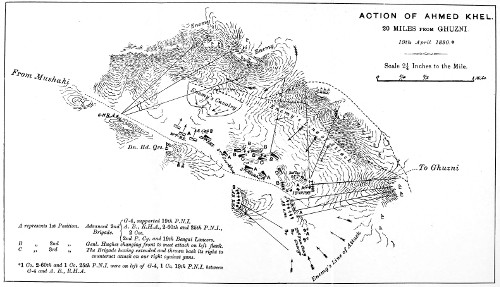
ACTION OF AHMED KHEL
20 MILES from GHUZNI
19th April 1880.[42]
The General’s escort, filling the gap between the Horse Artillery
Battery and the 59th, were driven back, and the 59th were ordered
to throw back their right to check the rush. The order was so
delivered that it was understood to imply the retirement of the
whole regiment, and the movement was carried out. The ghazis
were so close that there was a tendency to collect in groups for
mutual protection—a fatal course when a general rush has to be
checked; but General Hughes, by his example and energy,
checked this in time, and after a few minutes’ excitement,—an
excitement quite pardonable under the circumstances,—our men
settled down and began a steady and continuous fire from their
breech-loaders, which swept away the ghazis and covered the plain
with dead. But there had been persistent hand-to-hand fighting
before this fire began to take effect, for the ghazis fought with a
397bravery never excelled, and sold their lives as dearly as fanatics
can sell them. Yet the three regiments—British, Sikh, and
Ghoorka—to whom they were exposed, held their own, the 2nd
Sikhs, in particular, attracting the General’s notice for their
splendid steadiness in rolling back the attack, and the main body
of Afghans holding aloof, the ghazis could not hope to break our
line. But with what grand disregard for their lives they must
have fought is shown by their charging to within thirty yards of
the muzzles of Major Warter’s guns, and facing case and reversed
shrapnel, which at close quarters mowed them down in scores.
The gunners never flinched, but stood to their pieces manfully,
trusting to the 2nd Punjab Cavalry to clear the enemy away until
the infantry fire should begin to tell. The charges made by
the 2nd Punjab Cavalry were repeated again and again, and were
as brilliant as any made by cavalry during the whole war. This
is the deliberate opinion of the men who witnessed them, and who
owed much to the sowars who kept the right flank safe. The
Horse Artillery guns were retired 150 yards when the first shock
had passed, and at a range of a few hundred yards they continued
to fire shell into the enemy with admirable precision. The guns
of G-4 were in a comparatively safer position among the infantry,
and their fire also was well directed and very effective. In
the gap I have mentioned between A-B battery and the 59th
Foot the General’s escort had a tough hand-to-hand fight with a
body of ghazis who closed with them. Breech-loader and bayonet
told against pistol and tulwar, while the few sowars of the 19th
Bengal Lancers also gave their aid in the mêlée. How desperate
the fighting must have been is shown by the casualties among
the escort alone, which was merely used to give cohesion to the
line. The company of the 60th lost its Colour-Sergeant (Chesham)
and two privates killed and a bugler wounded; the company
of the 25th had two sepoys killed, and the detachment of the
19th Bengal Lancers had seven sowars wounded. The heavy
battery contributed its quota to the engagement as it got into
action on a convenient piece of rising ground in rear of the
infantry, and shelled a hill south of Ahmed Khel spur, on
which large masses of the enemy had congregated, as if meditating
a flank attack upon the baggage line. In the early part of the
398day Sir Donald Stewart, as I have said, had sent back word to
General Barter to hurry up with reinforcements. General Barter
started the 1st Punjab Cavalry at a trot, and followed with the 60th
Rifles. The 1st Cavalry arrived in time to share in the pursuit of
the fugitives, who had been unsuccessful in their attack upon our
right flank, and many were killed before they could reach the
protecting slopes of the Shilghur Hills on the east. The 60th
formed up on the right of the 59th Foot, and the “cease fire”
sounded just as they arrived, the enemy by that time being in full
retreat. The cavalry pursuit had to be checked, as the six miles
of baggage had to be looked after; and with so many regiments
in advance, it was feared that detached bodies of ghazis might
run amuck in the rear. The action had begun at nine o’clock, and
“cease fire” sounded at ten, just an hour’s fighting; but the
casualties were unusually heavy for Afghan warfare. Of the
enemy 1,000 dead were counted on the field, and many bodies
had been carried off: while their wounded must, at the smallest
estimate, have numbered 1,000 or 1,500. The ghazis killed
were all fine, handsome men, well nourished and of splendid
physique, and their fanaticism had given them courage which
veteran soldiers might envy. Among the dead was one woman,
while twelve others were taken prisoners with arms in their hands.
The casualties among our troops were seventeen killed, and 126
wounded; among the latter being six officers whose names have
already been published. Lieutenant Young, of the 19th Bengal
Lancers, had the misfortune to lose control over his horse, and the
animal carried him into the thick of the ghazis, by whom he was
cut down and fearfully wounded. From head to heel he was slashed
until almost past recognition, and when picked up he was believed
to be in a dying state. The surgeons have since given better
reports of him, and his recovery seems assured. Of the wounded
men, four have since died of their wounds, which in nearly every
case were tulwar or knife-cuts received in hand-to-hand encounters.
The 19th Bengal Lancers had fifty-three casualties,
and twenty-four amongst the horses; the total loss of the whole
cavalry brigade was more than 100, and from seventy to eighty
horses.
The Hazaras, seeing the Afghans in full flight, pursued them
399with ardour, and their knowledge of the country gave them an
advantage European troops could not hope to possess. How they
harassed the fugitives only their own kinsmen will ever know,
as pursuers and pursued disappeared into the hills very shortly
after the action came to an end. The prisoners taken after the
fight were dealt with by Major Euan Smith, Political Officer, all
the wounded being treated by our surgeons and taken onwards
towards Ghazni. Two ghazis only had to be shot; they were
fanatics of too exalted minds to accept mercy, and when promised
liberty in return for an undertaking to go quietly to their homes,
they simply cursed all Kafirs, and swore to kill a Feringhi the
instant they should be released. In justice to our men, their
lives had to be taken, as Candahar experience has shown that
such fanatics always keep their word. Our dead were buried
on the field by Mr. Warnford, the Chaplain, as Sir Donald
Stewart had resolved to march on to Nani without delay; and
early in the afternoon the column was again moving northward.
As our men passed along, ghazis who had feigned death rose and
fired at them, and men severely wounded slashed at the legs of
the soldiers; these dying spasms of fanaticism proving that the
ghazis were consistent to the end.
On the evening of the 19th the force encamped at Nani, within
fifteen miles of Ghazni, and on the following day the cavalry
reached the fortress itself without further opposition. The tribesmen
had made their grand effort to save the place, and had failed;
there was nothing for it but to allow the Kafirs to do as they
willed with the city and citadel, since it had fallen into their
hands. The infantry and artillery encamped for the night at
Chel Butcha Gaum (the Village of the Forty Children), a few
miles south of Ghazni. It was noticed at the time that a low
hill, some miles away on the right, was occupied by a large force
of Afghans, who had their standards flying, but did not seem
otherwise bent on hostilities. They were not interfered with
then, as it was deemed advisable to push on to Ghazni, under
the walls of which the Candahar column encamped on the 21st
without further incident. Sir Donald Stewart had orders to make
no long stay in Ghazni, and he intended moving out on the
23rd; but it was reported that the gathering of men seen on
400the 20th and 21st had largely increased, and that they were the
advance-guard of an army of 15,000 or 20,000 which Mushk-i-Alam
had raised in Shilghur and Zurmut. The effect upon the
native mind, if such a force had been left unmolested when our
troops evacuated Ghazni, would have been very damaging to our
prestige, and Sir Donald Stewart resolved to disperse the tribesmen
before moving northward. The peaceful state of Ghazni
itself was an encouragement to this course of action, as he could
freely use the regiments at his disposal without fear of an émeuteémeute
in the city.
As a preparatory measure a wing of the 19th Punjab Infantry
occupied the citadel, and early on the morning of the 23rd a force
under command of Brigadier-General Palliser marched towards
Shalez, six miles south-east of Ghazni, said to be occupied by the
enemy. The troops detailed for the work were:—
| A-B, Royal Horse Artillery. |
 |
|
 |
| 11-11th, Royal Artillery. |
|
|
| 11-11th, Royal Artillery. |
Brigadier-General R. Barter commanding. |
|
| 2-60th Rifles, 525 rifles. |
Under the command of Brigadier-General C. H. Palliser, C.B. |
| 15th Sikhs, 578 rifles. |
|
| 25th Punjab Native Infantry, 458 rifles. |
|
|
|
| 2nd Sikhs, 424 rifles. |
|
|
|
| 1st Punjab Cavalry, 322 sabres. |
|
| 2nd Punjab Cavalry, 325 sabres. |
|
On the previous day a cavalry reconnaissance had been made,
and 2,000 or 3,000 men had been seen about the Urzoo villages
near Shalez. General Palliser, on arriving near the villages, found
them occupied in force by 3,000 or 4,000 men. He immediately got
his guns into action, and shelled the villages, but without any
apparent effect. The enemy remained quietly within the walls,
except their videttes, which were pushed forward more into the
open, while some of their sharp-shooters lined a narrow ditch in
the fields, and began firing at long ranges upon our infantry. The
villages consisted of three walled enclosures, two in close proximity
to each other facing our right, and a third somewhat in rear of,
and removed from, the others. This third village would have
borne the brunt of any attack from our left flank, and it had as
a sort of screen a small garden outside the walls. General
Palliser believed the ground between his troops and the villages
401to be irrigated, and thought that much loss of life would occur if
he sent his infantry to make a direct attack. He silenced such of
the enemy’s sharp-shooters as grew troublesome by telling off
marksmen to keep their fire under, and continued shelling the
villages very vigorously. Still the enemy made no sign either of
attacking or retiring, and a message was at last heliographed to
Sir Donald Stewart, saying the place was too strong to be taken
by the troops then in front of it without sacrificing many lives.
Upon news being received, General Hughes’s Brigade was ordered
under arms, and a half battalion of the 59th foot (253 rifles), and
six companies of the 3rd Ghoorkas (191 rifles), were sent out as a
reinforcement. Still General Palliser did not consider it advisable
to attack, and he withdrew to a ridge 2,500 yards from the villages,
whence he continued to shell the enemy. Upon this Sir Donald
Stewart moved forward with G-4, R.A., 254 rifles of the 59th,
a half battalion of the 19th Punjabees, and the 19th Bengal
Lancers. The heavy battery was left in camp with two companies
of the 59th, two companies of Sappers, and a complement of
guards furnished from each regiment. Sir Donald Stewart
reached Shalez at nine o’clock, and found that General Palliser
had withdrawn his artillery and infantry to a low hill some distance
from the villages, with a view to entice the enemy into the open.
The tribesmen were too cautious to be deceived by this manœuvre,
and preferred bearing bombardment to coming under infantry fire
in the plain. The two batteries had fired the unusual number of
thirty rounds of shell per gun, a total of 360 rounds, but 7-pr.
and 9-pr. shells can do but little damage against walled enclosures
and stout mud walls. When our reinforcements arrived, a sudden
burst of fanatical enthusiasm seized the defenders of the villages,
and it seemed as if the ghazis’ rush at Ahmed Khel was about
to be repeated. At first only their videttes were seen watching
our troops, while an occasional puff of smoke from the ditch
showed the presence of a sharp-shooter; but soon a number of
mounted men were seen galloping about, and then out poured a
mob from the shelter of the walls. They formed themselves rudely
into line, and to the din of their tom-toms began to advance.
This unexpected boldness on their part was met by our batteries
of artillery opening fire at 800 or 900 yards’ range, and the first
402few shells caused many of the more timid to break and retire.
Sir Donald Stewart ordered the infantry to clear the villages
without delay, and General Barter’s Brigade advanced in line
upon the right; while General Hughes, whose brigade had been
joined by the 2nd Sikhs, made a direct attack in front, his left
swinging round so as to take the detached village of Urzoo in
rear. Our troops steadily advanced until within 200 yards of the
enemy, when file-firing commenced. The fusillade was terrible,
and so stunned were the wretched and ill-armed tribesmen, that
they fled in confusion. Some preferred staying crouched in the
ditch to running the gauntlet of the bullets. One can imagine the
incessant “ping” when six regiments armed with breech-loaders
are advancing in one long line, firing as rapidly as men can
load. It was natural that an undisciplined mob should melt
away before such an attack. The men who lay hidden fought
hand to hand with our soldiers as the latter reached them; but
there was really no stubborn resistance, and the cavalry and horse
artillery were let loose to pursue the fugitives as soon as the
villages were surrounded. The total loss on the part of the
enemy was 300 or 400; while our casualties were almost nil—one
private of the 60th and one sowar of the 1st Punjab Cavalry shot
dead. Such of the enemy as came to close quarters with our
men fought bravely enough, one ghazi making a desperate rush at
Lieutenant Legh, of the 60th, who killed him with his sword.
The Tajik villagers of Urzoo stated that there were originally
4,000 footmen and 200 cavalry in the villages when General
Palliser first arrived; but that, when our troops did not attack,
word was sent to all neighbouring villages to turn out their fighting
men, and many Pathans joined their friends just before Sir
Donald Stewart’s arrival. There can be no doubt that Mushk-i-Alam
had worked upon the fanaticism of the local tribesmen, in
the hope of retrieving the defeat of Ahmed Khel. His hopes have
been completely shattered, but as he has young Musa Khan still
with him he may yet give us trouble. General Stewart left Sirdar
Alum Khan in charge of Ghazni when the Candahar force moved
towards Cabul. The defences of Ghazni were not touched, as they
were considered too contemptible to give trouble if a force should
ever find itself beneath the walls of the city.
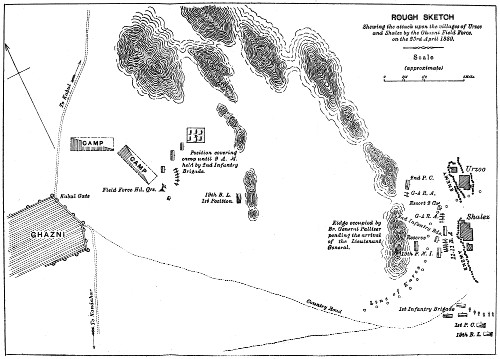
ROUGH SKETCH
Showing the attack upon the villages of Urzoo
and Shalez by the Ghazni Field Force,
on the 23rd April 1880.
403
“The Divine Figure from the North”—Sherpur during May—Turkish Fugitives from
Russian Territory—Cabul in Prosperity—The People enriched at the Expense of
the British Government—The Coining of Cabuli Rupees—The Effect upon the
People—Street Sketches—Life in the Bazaars—The Hindu and Kizilbash Quarters—Rapacity
of the Traders—The Abundance of Fruit—Ice-cream Stalls—An
Instance of Fanaticism—History of the Kizilbashes—Their Turki Descent—Elphinstone’s
Estimate of their Character—Their Strength in Cabul estimated at
6,000 Fighting Men—Their Treatment by the Amirs.
16th May, 1880.
There is such a holy calm in Sherpur that we begin to question
whether all the excitement of the last six months has not been a
nightmare. No bustle or excitement, no sudden alarms, no gathering
of armed men to pour out upon Asmai, Siah Sung, or Charasia; our
cavalry rest quietly in their lines without any expectation of “boot-and-saddle”
sounding; and every sentry in the cantonment whiles
away his time, not in wondering whether the enemy are near, but
in sweet speculation as to when orders will be issued for the march
to India. The majority of us believe that, as regards severe fighting,
we have satisfied the Afghans, although a last flash in the pan may
occur before the final settlement; and there being no amusement
in calculating the chances of the next action, we fall back
upon discussion of possible arrangements with the various
claimants to the Amirship. Abdur Rahman’s name is in every
man’s mouth, and the news of his departure from Kunduz for
Cabul is awaited with almost as much anxiety as the result of the
Derby. The Sirdar is our “divine figure from the north,” at
least just now. But we have to live as comfortably as we can in
the meantime; and though our life in cantonments is necessarily
a colourless one, it has more points than a hot-house existence in
India. First, in the order of comparison, we have an almost perfect
climate; next, we have some little amusements; and lastly,
by reason of our separation from civilization, we have a less
artificial and less blameful life than is possible in the irritating and
bilious furnace “down below.” It does not say much for civilization
404that this should be so; but we have fewer temptations, and,
consequently, fewer faults to atone for. The “grass-widowers” of
Cabul, I undertake to say with most serious earnestness, are on a
far higher level of moral purity than that easy-living, freely-flirting,
and most charming section of Indian society which migrates
yearly to the hills when punkahs are in full swing. We talk less
scandal; we are less covetous of other persons’ property, animate
or inanimate; we do not turn night into day to the music of the
trois temps or “Pinafore;” and we do our duty quietly, albeit with
a little wholesome grumbling. But as news drifts up from the
Khyber line, and we learn how the poor fellows between Gundamak
and Lundi Kotal are grilling in their single-fly tents with manifold
troubles on every hand, we grow placidly thankful that we are in
Cabul, with good thick walls about us, and a foot of mud between
us and the sun. Not everyone could be in hill stations if all the
troops were back in India; and we are less discontented now at
our lot—a wifeless, loverless one though it be—than we were three
months ago. Cabul “grass-widowers” will no doubt be in great
demand when once more they are transplanted into Simla, Mussoorie,
or Naini Tal society, for a war beaten-warrior is far more
esteemed than a carpet knight. Fair ears will tingle with pleasure
when whispered explanations are given of the days spent in unwonted
innocence in Afghanistan—
“Days when we laughed for joy of summer heat,
Nor laughed less loud when snow made white the ground.”
We have pined for “loot, love, and liberty:” the first we may
never get; but every day brings us nearer to the others, and we
well know what our reward will be. Will it not be counted in
our favour that no band will play “The girl I left behind me”
when once more our faces are turned eastwards? It surely should
be, or our grass-widowhood will have been precious time uselessly
squandered. But, frivolity apart, we take our change at Time’s
counter with composure, and are not too anxious concerning our
immediate fate. There are the current duties of a large camp to
be gone through daily: they can never be shirked, but must
always be done systematically and thoroughly. Regiments have
their guards to mount day and night, spring drill and parades to
405attend, recruits to be shaped into good soldiers, embryo signallers
to be trained, transport to be kept in good order. Colonel
Low has worked a wonderful change in our transport, and we
shall soon be able to “march anywhere and do anything.”
General Roberts is away with a division of 5,000 men visiting
Logar, Wardak and Maidan; his troops are in excellent health
and are enjoying the trip amazingly.
We have visitors occasionally, other than officers who have
taken a short leave from a station down the line to pay a visit to
Cabul. A few days ago three Turkish soldiers applied at the
Bala Hissar for food and assistance on their journey to India.
They were sent to Major Hastings, Political Officer, and told a
story full of adventure. They were an old man, his son, and a
wild-looking Turk of the Bashi-Bazouk order. The youngest of
the party was very intelligent, and a handsome specimen of the
Turkish peasantry, while his father was still unbroken in strength
in spite of his misfortunes. The “Bashi-Bazouk,” as we
imagined him to be, though he denied the impeachment, was the
embodiment of rude strength: he still wore the long blue coat
he had donned when called upon to fight the Russians, and across
the breast were a dozen little pockets, each large enough to hold
a cartridge, and showing signs of great wear. A Turcoman fur
cap, with the tanned skin outside and a fringe of fur showing all
round, covered his long, matted hair, and added to the wildness of
his appearance. All the men were travel-stained, and looked
forlorn enough; but their satisfaction at being among the “Inglis”
was without bounds, and they were as cheerful and contented as
if the 10,000 miles between Cabul and Istamboul were only a
league. Their story was that they were natives of the village of
Soghral, ten days’ march from Kars, and that when the Russian
war broke out they joined Haji Ali’s regiment, their captain being
Haji Shuman. The latter was killed in action, and the Russians
took the whole of the Soghral villagers prisoners. Men, women,
and children were marched for eleven days until the railway was
reached in the district of the Caucasus, when the whole party were
transferred to the rail. After four days’ travelling they gained
Moscow, whence their families were sent to St. Petersburg, while
the men were sent eastwards to Dobiska. Here they were kept
406prisoners for two years, being lightly ironed, but having no work
to do. They received about two and a half annas in Russian
money daily, with which they bought food, and upon which they
managed to live. At the end of two years their irons were
removed, and they were told to settle down about Dobiska and
cultivate the land. At the earliest opportunity a number of them
absconded, of whom these three men kept together. For fifteen
days they travelled secretly, doing long distances at night, until
they reached Kazakia, on the outer border of Bokhara. Here
they were safe, as their fellow-Mussulmans willingly gave them
food; but they did not dare to go before the Amir of Bokhara, as
they believed he was on friendly terms with the Russians. They
stayed during the winter at Guzar, as they were told the Passes
towards Cabul were closed; but in the spring they left Bokhara
and made for Mazar-i-Sharif. Here they found Ishak Khan as
Governor: the place was quiet enough, and but few troops were
holding it. Thence they marched to Bamian, their poverty no
doubt saving them from molestation, and at last they reached
Cabul. Their desire was to be sent to Bombay, whence their
Consul could forward them to Constantinople. Major Hastings
gave them Rs. 50 to get a new outfit in the city, and make themselves
clean and comfortable. On Monday they were presented to
Sir Donald Stewart, and were afterwards fêted and photographed:
the native officers of the Guides giving them a great dinner,
while Mr. Burke immortalized them with his camera. The poor
wretches were immensely pleased, and will no doubt carry back to
Turkey good impressions of our kindness to them in distant Cabul.
It has chanced that since December last I have visited the
city of Cabul but twice: once when the snow was still lying
on the ground, and our engineers were busy raising new fortifications
on the Sherderwaza Heights. On this occasion I merely
passed from the Bala Hissar along the skirts of the lowest
quarters of the city, as the Heights had to be scaled; so that,
in wandering through the bazaars a few days ago, the impression
uppermost in my mind was the state of Cabul immediately
after Mahomed Jan’s flight. Then the city was gloomy and terror-stricken:
it had gone hand and heart with the ghazi-log during
the triumphant days of the siege of Sherpur, and it dreaded the
407retribution which hung over it. The alien Kizilbashes and Hindus
were joyful enough at the re-establishment of order: but their
wrecked shops and pillaged houses were sad relics of the fanatical
storm which had passed over Cabul. No man of the Mussulman
population could foretell what the punishment of the city would
be, and the half-deserted bazaars and the still by-streets were
eloquent of the fear which cowed the unruly populace. But
instead of bloody reprisals and harsh repression, it seemed good
in the eyes of our leaders that gentleness and free forgiveness
should be the means used to win over the city; and now Cabul is
more prosperous and peaceful than it has been for many generations.
The rumours of new wars and insidious intrigues of Abdur
Rahman’s approach from the north, and the gathering of the tribes
at Ghazni, pass over the heads of the people like a fitful wind
over a lake, stirring the placid surface, but leaving no lasting
impression. There have been, since the beginning of the year,
long, long days in which the traders and holders of contracts from
the British saw their coffers filling with the rupees which are now
looked upon in India as having “mysteriously disappeared” from
the Punjab treasuries; longer weeks wherein everyone, from Sirdar
Wali Mahomed to the commonest Hazara coolie, found how good
a paymaster the Sircar is when his necessity is urgent; and still
longer months during which lakhs of Indian rupees were melted
down in the city mint to be reissued in the form of Cabul rupees
and spread broadcast over the land. Cabul has prospered, and
waxed proud: its merchants have never been so rich; the common
people have never seen such a steady flow of money through the
bazaars. Even the Hindus, who know something of our wealth,
are astonished; they cannot appreciate the self-denial and honesty
of purpose which guide us in our transactions with a conquered
race. “Your money is without limit,” a Hindu banker said to
me; “but why do you give it all to this faithless people (be-iman
log)? They are your enemies, they hate and revile you; why not
take what you want?” Any other nation making war would
probably requisition the country and forcibly seize supplies; but
with the philanthropy which guides our actions, we pay ten times
the normal value of the things needed for our army, and plume
ourselves proudly as men walking upright before the Lord. To
408enrich dishonest men; to give to our enemies that which they
most need—sterling money; to encourage chicanery and wanton
deceit—this is a poor rôle to play when we come to Cabul as an
avenging army; but, perhaps there are “exigencies” which
plead for all this weakness, and will in the future give a rose-coloured
tinge to our balance-sheets. Can Cabul fail to be prosperous
under such conditions? can its citizens not afford to wear
an insolent air of triumph, and treat such customers as appear
among them with an easy assumption of independence, sorely
aggravating to officer and soldier alike?
I have called this article “Cabul in Prosperity,” and I think
the title is justifiable. We have worked our will in the Bala
Hissar, and have made it a citadel worthy of the name: but in
the city proper we have neither made nor meddled, and the narrow
streets, if cleaner, still retain their distinctive features. Buying
and selling, money-changing and broking, flourish with an energy
that makes no count of changing fortunes or shifting careers.
Sirdar Wali Mahomed’s governorship can only last so long as
British bayonets are at his back; but in the sunshine of our
favour he sets the example of amassing wealth, and all his
followers tread in his footsteps. Sirdar Hashim Khan is on the
eve of departure for Candahar, where Shere Ali Khan has offered
him asylum. His departure troubles the minds of the citizens
but little, as the stream of Indian silver will not be diverted by his
absence. While not understanding our simplicity in dealing, and
while looking upon us as madmen in the matter of finance—for
are we not taunted with “changing our Rani’s head” by ordering
Indian rupees to be melted down and turned into Cabuli coin?—the
Cabulis, with their keen rapacity, seize every opportunity of
enriching themselves. Take the conversion of Indian rupees into
local coin; through our benevolent mode of action we have never
been able to say that our coin shall have a fixed value, and a
“ring” of scoundrels in Cabul have so rigged the market that
in the bazaars at the present time the two rupees are constantly
of equal value. So some clever financier at once jumps to the
conclusion that we may as well pay in Cabuli rupees as in
Indian. Now the quantity of silver in 100 Indian rupees permits
of 127 Cabulis being made therewith, and so we pour our brand
409new coins into the mint (wherein there is no European supervision
of any kind), and for every 100 sent in Sirdar Wali Mahomed
returns us 120! Only a few days ago three lakhs of the treasure
with General Hills’ force was sent to Cabul to be converted
into local rupees. Is the reason for this that the Logar villagers
refuse our rupees? If so, it would surely be the mildest form
of coercion to force them to take payment in whatever silver
coin we chose. The profits on the coining (say five per cent.) go
presumably into Wali Mahomed’s pocket, as Government is too
strait-laced to make profit itself; and yet that Sirdar had the
cool effrontery to refuse to coin Cabuli rupees, when a lakh was
wanted for the Logar force, until he first received Indian rupees
from Sherpur. He was not punished for his insolence; but as we
have still to levy the fine inflicted upon the city for the murder of
our Envoy, he may yet be mulcted, say, in a lakh. Some of us
are curious to know when and how the said fine will be levied;
but, perhaps, we may be looked upon as inquisitive.[43] One thing
is clear: we shall never get our money back in the shape of
Indian rupees, and our only consolation is that if Afghanistan
continues to absorb a few hundred thousand pounds worth of
silver monthly, the rate of exchange between India and England
must improve.
Having explained the irritating causes of the present prosperity
of Cabul, I may now with a clear conscience describe a little more
in detail the appearance of the city itself. In the First Book of
Kings we are told many valuable anecdotes of King Solomon, not
the least interesting of which is the account of the payment made
to Hiram, King of Tyre, who furnished “cedar trees, and fir
trees, and gold” to assist the King of Israel in the adornment and
fortification of Jerusalem. This payment consisted of the gift of
twenty cities in the land of Galilee, cities so worthless that, when
Hiram saw them, he said:—“What cities are these which thou
hast given me, my brother?” And the narrative further states
that “he called them the land of Cabul unto this day.” The
word “Cabul” our annotators explain as signifying “displeasing
or dirty;” and, strangely enough, the latter epithet is extremely
applicable to the modern capital of Afghanistan. The side-streets
410and purlieus, even the walls of many of the houses, are filthy in
the extreme, though our strict sanitary system has made the
bazaars almost as clean as those of an Indian city. Cabul is
not so “displeasing” to the eye when viewed from the neighbouring
heights, for the orchards of Deh-i-Afghan and scattered clumps
of trees in Chandaul make the place look quite picturesque.
But once in the heart of the city, beyond the busy stream of
life which pours along the bazaars and renews itself every hour in
some mysterious way, there is nothing but dulness and gloom in
the dead mud walls of the houses, with their frowning doorways
or dark noisome passages leading to unknown dens behind. In
the bazaars all is life and hustle. Entering the city by a side-road
from Sherpur, one sees the bed of the Cabul river lying waterless
on the left, save for a few stagnant pools, where the dhobies are at
work, or a vendor of atchcha salad is washing a donkey-load of
lettuce preparatory to the day’s business. Over a bridge, on one
side of which are a score of shoemakers’ stalls—there seems to be
one shoemaker to every twenty inhabitants in Cabul—and then
into the narrow Shore Bazaar, I find more shoemakers and leather-sellers,
whose stalls are oddly mixed up with those of fruiterers,
bakers, retailers of ices, and workers in iron and copper.
Men on horseback, swaggering sowars of Wali Mahomed or other
sirdars; Hazara coolies with heavy loads on their broad backs;
idle Cabulis; peasants from the district with blue turbans;
stalwart mountaineers who look upon the street as their own; a
sprinkling of red-coated British soldiers, and sepoys and sowars in
all stages of negligent undress (but with rifles or swords always
ready)—all these elements are mingled in noisy but good-tempered
confusion; while at every ten yards one’s horse has to be pulled
on his haunches, because some young Cabul chief is playing at hide-and-seek
under his legs. Suddenly a string of camels, with loads
of firewood or heavy merchandise, has to be passed—rather a
ticklish business occasionally, as the dead weight of the beasts
and their loads cleave a way for itself, regardless of obstacles. A
few white-clad women glide unobtrusively along, their yashmaks
hiding whatever charms they may possess; blind beggars and
shrill voiced fakirs obtrude their wants upon the stranger; bhistees
clank their metal drinking vessels, or pour out a cool draught
411from the ever-ready mussuk; salad vendors pilot their sedate
donkeys, laden with crisp green food, through the crowd; boys,
with their trays of chupaties, cry out the goodness of their rotee;
a marriage procession, with tom-toms beating and lusty lungs
pouring forth jubilant songs, comes gaily along, a closely covered
structure, somewhat in the shape of a beehive, containing the
bride, whose weight is not felt by the shoulders of her bearers,—this
is the living mosaic which paves the bazaars. There is a
vividness in all the types of life, which is very striking, from the
matted-haired fakir, who does not hesitate to seize a passer-by in
his repulsive grip, so resolute is his demand for alms, to the
careless youngster who leans over his donkey, idly chewing a
young onion, which answers to the straw of Western street-life.
An unveiled woman, wretchedly clad, dirty, and with the features
of a Seven Dials’ hag, takes a handful of the youngster’s salad
from his donkey’s back; he strikes her on the back with his stick,
whereupon she turns round, flings the pilferred stalks in his face,
and abuses him in choicest Cabuli. This unexpected “knocking
of his leek about his pate” so cows the boy that he moves off
hastily, leaving the harridan in possession of the field.
I have by this time wandered into the Char Chowk, or principal
bazaar of the city, and here the crowd is denser, the stalls more
pretentious, the trade brisker. The bazaar is in four lengths,
each roofed over and solidly built of masonry, and the stalls are
nearly all rented by jewellers and dealers in silks and cottons.
On either hand, above the stalls, richly coloured silks, gaudy
chintzes, carpets, and caps of brilliant hues are hung out, making
a brave show; while the traders, seated cross-legged below, are
surrounded by their stock, upon which they seem to keep a careless
eye. I have before spoken of their keenness in trade, and I can
only add that, since the early days of our occupation they have
grown keener and more rapacious, until to buy goods direct from
them is to court being cheated in every way. Still, this does not
prevent officers and men from purchasing Bokhara silks and
various knick-knacks, for all of which absurdly high prices are
given. A good Pathan Sepoy is the best companion to have when
buying any articles at the stalls, and he will bully the shopkeeper
and finally induce him to take about one-fourth of the price first
412asked. As the day wears on trade slackens a little, and here and there
a shopkeeper pores over a Persian book, while his son keeps watch
upon the stock-in-trade. In that silk merchant’s stall, though it
be in the heart of the bazaar, are three grey-bearded men listening
with supreme pleasure to the excited reader, whom, in my own
mind, I believe to be reading the songs of Hafiz; in the next stall
a burly Mussulman lies sleeping on a pile of Manchester cottons;
while near at hand is a pious old villain taking advantage of a lull
to submit his hoary head to the hands of a barber. A shrill cry
as of a child in pain draws one further on; it is nothing serious:
another pious old gentleman is watching his son’s scalp being
treated in the same way by another barber. The boy, some three
or four years old, has never felt the razor’s edge before, and
shrieks at every stroke, while his father threatens him with a huge
stick: the operation is at last over, and the child, still quietly
sobbing, passes his hands carefully over his head as if doubtful of
it still remaining upon his shoulders. Once convinced that his
hair only has gone by the board, he plucks up courage and smiles
apologetically upon his father, who gravely strokes his beard in
approval. The little incident is only one of many which draw
attention, and one might easily elaborate such scenes; but then
the charm of simplicity would be destroyed. From the Char
Chowk Bazaar to Chandaul is but a few yards, and one passes on
the way more fruit-stalls, in which tiers upon tiers of lettuce flank
the luscious heaps of apricots, cherries, peaches, and apples
which are now pouring into Cabul from Koh-Daman and Chardeh.
So much has been written about the Cabul fruit-stalls that it
is necessary to say the abundance of fruit has not at all been
exaggerated; the stone fruits seem just as abundant as the
delicious grapes which we indulged in so freely in the autumn.
The vendors of ices are nearly always side by side with the fruit-sellers;
the huge blocks of snow which adorn their stalls tempting
all sun-dried souls to cool their palates with a little saucer
of icy-cold cream flavoured with a sprinkling of mashed fruit.
The trade is brisk in these ices, although the dust coats the
open trays of cream until it turns a delicate brown. It is not
pleasant for any of us to pause at the stall, as the fanaticism of
these dealers is proverbial. There is a story afloat, that after an
413officer had eaten an “ice,” the dealer took the saucer and dashed
it to the ground as having been defiled by a Kafir. These people
do not love us, however well we treat them. Chandaul Bazaar is
only a repetition of the Char-Chowk on a smaller scale, with more
fruit shops and a few foul-smelling butcher’s stalls, but the
traders are nearly all Hindus and Kizilbashes, who, I must in
justice say, are just as rapacious as the Mahomedans. And so
one wanders back into the main bazaar, where bhistees are
sprinkling the roadway liberally with water, and the afternoon
trade is reviving; past the kotwali, where a few sepoys of the
5th Punjabees are on duty; and thence out by the Peshawur Gate,
near the Bala Hissar. We have seen Cabul in prosperity, its
people insolent enough to check all desire to enter the walls again,
and on the ride back to cantonments we are lost in a dream of
what the future will be of the city which we have twice occupied,
and which has always cost us so dear.
The question of retirement is a serious one to many people in
Cabul and the district. The Hindu traders of the city will, it is
believed, migrate almost to a man, but the Kizilbashes will trust
to their traditional influence in Cabul to pull them through any
difficulty in the future. These two trading classes have amassed
large sums of money during our occupation; and the Hindu,
weak and defenceless, knows too well that a needy Amir would
“borrow” most of his gains in a very high-handed way. The
Kizilbash is more independent; and as, at a pinch, the Shiahs
can turn out 6,000 fighting men, all well-equipped, any Amir
would hesitate to make the “red-heads” his enemies. Major
Hastings has prepared a short account of these aliens, which is
of some interest at the present time, but little having been previously
known of this important section of the Cabul populace.
Elphinstone, it is true, states that they are members of that
colony of Turks which predominates in Persia, and traces its
descent from Kijan. To them was given the place of honour in
Nadir Shah’s conquering army, and when a military colony was
formed in Cabul, their quarter was called “Chandaul,” which, by
interpretation, is “vanguard.” Elphinstone’s opinion of them
was thus expressed:—“The Kizilbashes in Afghanistan partake
of the character of their countrymen in Persia. They are lively,
414ingenious, and even elegant and refined; but false, designing, and
cruel; rapacious, but profuse, voluptuous, and fond of show; at
once insolent and servile, destitute of all moderation in prosperity
and of all pride in adversity; brave at one time and cowardly at
another, but always fond of glory; full of prejudice, but affecting
to be liberal and enlightened; admirable for a mere acquaintance
(if one can bear with their vanity), but dangerous for a close connection.”
They are, according to Major Hastings, still distinct
in many respects from those around them; and being of the Shiah
section of Mahomedans, there is great religious animosity between
them and the Afghans, who are Sunis. They all speak
Persian, but the Kizilbashes of Aoshahr, in the Chardeh Valley
and some of the older men among the Jawansher of Chandaul,
still talk Turki in the privacy of their own families. The portions
of Cabul city occupied by the “red-heads”—so called because of
their distinctive turbans of crimson cloth—are Chandaul, immediately
at the foot of the Sherderwaza Hill and Moradkhani, looking
towards Sherpur. In Chardeh their chief villages are Nanuchi
and Taiba. The total number of families in and about Cabul
is 3,220, but these can furnish only 6,000 fighting men—a small
proportion compared with Afghan families, every male in which
is a fighting unit. In Candahar and Herat there are a large
number of families descended from Nadir Shah’s vanguard, and a
few Kizilbashes are also located in Turkistan. The Jawansher
section, occupying the greater part of Chandaul, is the most
important clan in Cabul, and has at the present moment several
of its members holding commands in the Turkistan army. Appointments
under Government, such as those of secretaries,
accountants, and similar grades, are always largely held by Kizilbashes;
while in years gone by there were several Kizilbash regiments
in the regular army. Hussein Ali Khan, of the Jawansher
section, was once Commander-in-Chief of the Afghan army, and
many others of the clan rose to important commands. The red-capped
regiments were so powerful in Ahmed Shah’s reign that to
prevent civil war in Cabul that monarch sent them to Turkistan,
with orders to conquer Balkh. This they did with very little
trouble, and Ahmed Shah was then possessed with a fear that they
would become independent, and finally prove dangerous
415enemies. At the suggestion of Morad Khan, Populzai, he recalled
them, and assigned to them permanently the portion of Cabul
and Chardeh which they now occupy. Moradkhani was called
after Ahmed Shah’s adviser. In Shah Suja’s and Shah Zuman’s
reigns they were harshly treated, and with their usual independence
they joined Haji Jumal and Paenda Khan, the father
of the Dost Mahomed. When the Dost was in power, he singled
his allies out for many distinctions, the fact of his mother being
a Kizilbash lady having, no doubt, great weight with him. The
clan refer to their treatment by the Amir Shere Ali Khan and
his son, Yakub, in anything but grateful terms. Both Amirs,
it would seem, were rather inclined to tyrannize over the Shiahs.
Major Hastings gives some carefully-prepared genealogical
tables, showing the status and place of residence of the
chief families, and concludes his report by stating that, though
the Kizilbashes still represent a certain amount of strength in
Afghanistan, their power is by no means so great as in former
years.
Deportation of the Mustaufi to India—His Sympathy with the Family of Shere Ali—Progress
of Negotiations with Abdur Rahman—Arrival of the British Mission at
Khanabad—Probable Popularity of the Sirdar’s Cause—Reception of the Mission—The
Amirship formally offered to Abdur Rahman—Return of Ibrahim Khan to
Sherpur—His Report—A Russian Agent in the Khanabad Camp—Treatment of our
Envoys as Prisoners—Photograph of the Sirdar sent to Cabul—His Vacillation and
Intrigues with the Tribes—Flight of Sirdars Hashim Khan and Abdulla Khan—Arrival
of Afzul Khan—His favourable Estimate of Abdur Rahman—Hasan
Khan’s Movements in Logar—Cavalry Action at Padkhao Shana on July 1st—General
Palliser’s Success—Two Hundred Tribesmen Killed—Dispersion of Hasan
Khan’s Force.
The following letters, written in May, June, and July, will explain
the progress of our negotiations with Sirdar Abdur Rahman which
eventually led to his assumption of the Amirship:—
26th May, 1880.
Yet another minister of Yakub Khan’s has been deported to
India. The Mustaufi, Habibulla Khan, has broken down in his
416professions of faithfulness to the British, and on the morning of
May 20th he left Cabul in a dhoolie, under an escort furnished by
the 9th Lancers, which accompanied him as far as Butkhak. Here
two companies of the 67th Foot were in readiness to escort him to
Luttabund. They had been sent out on the previous afternoon,
their sudden march giving rise to rumours of an impending attack
upon our communications, a rumour strengthened by the 9th
Lancers standing to their horses the whole afternoon, as if ready
for a gallop out. What may have been the Mustaufi’s crime I
can only conjecture: officially we are told that “he was summoned
to Sherpur, and after a long investigation was found guilty of conspiring
against the British, and was at once put under arrest.”
Camp gossip runs that letters were intercepted, bearing his sign
manual, inciting the chiefs to rise again, and that these were produced
before Wali Mahomed and other sirdars, who swore to the
genuineness of the signature. The old man when found out took
the matter quite calmly, and when told that he would be sent at
once to India rather welcomed the idea, saying he would go on a
pilgrimage to Mecca and afterwards visit England. The Mustaufi
seems to have recognized the simple fact that we are bent upon
making Abdur Rahman Amir, and this he regards as a breach of
faith, as nothing was said of our intention when he was striving so
hard to bring the Ghazni malcontents to Sherpur. He knew that
he could not hope for power under Abdur Rahman—his partisanship
for Shere Ali’s family was too notorious—and hence in his
extremity he resorted to fresh intrigues to delay or put altogether
out of the question Abdur Rahman’s visit to the British camp.
He has been detected, and as Abdur Rahman’s path must be
cleared of every obstacle, Habibulla Khan has been summarily
sent to India.
Contrary opinions as to the final result of our mission to Abdur
Rahman are still afloat both in our camp and in the Cabul bazaars;
but so far everything that the most sanguine could have hoped for
in the direction of an entente cordiale being established between
the Pretender and the British Government has happily come to
pass. Our Mission has reached its destination in safety, has been
honourably and even effusively received, and we are on the eve of
receiving an answer from the Sirdar himself regarding the proposals
417we have made to him. And yet there is a large party in the
city who still persist in prophesying that Abdur Rahman will never
visit Cabul so long as the British force occupies the city. Their
reasons are disjointed and somewhat irrational, but they are repeated
with such persistent head-shaking and beard-wagging that,
in spite of one’s own better belief, it is difficult at times to avoid
thinking as these birds of ill-omen think. Not that they deny
either the Sirdar’s anxiety or determination to be Amir (this they
admit most unequivocally), but they argue that he is too wise to
ruin himself in the eye of the nation by accepting the Amirship
from the hands of a British General. When they are reminded
that the British are just as determined that the new Amir shall be
simply and solely their nominee, as their work would be incomplete
if they left the throne to be filled by any candidate who might
get a party together, they cry back on their lines of argument, and
insist that Abdur Rahman will be Amir, but by virtue of his own
popularity and prowess, and not as a man accepting a boon from
a conquering army. When it comes to the finer details of ways
and means, the prophets can only take refuge in vague hints and
inane mumblings which would have shamed even the vilest impostor
in the old days, when prophecy had some points to recommend
it to the credulous. Perhaps the explanation is that Abdur Rahman
has not in Cabul itself a faction worthy of the name. His
prestige lies not so much in the sympathy of the citizens as in the
support the hardier tribesmen are willing to give him as a soldier
and a ruler. There is something in his success in Eastern Turkistan
which has drawn the independent and reckless spirits of
Kohistan, Koh-Daman, and Logar to him: it may be the boldness
with which he has declared himself claimant to the throne, or that
his old fame as a successful general still lives in the hearts of the
people. Every man born in Afghanistan is born to a soldier’s life,
not the life of camps and campaigns so much as the constant
struggle of intertribal warfare, or time-honoured family feuds.
Every man’s hand is familiar with the use of jhezail or rifle,
tulwar or knife, and a successful leader is far more honoured and
more faithfully followed than a chief who lives by intrigue and begs
his way to power by lavish bribery. Abdur Rahman ruled in
Cabul, after Dost Mahomed’s death and Shere Ali’s usurpation, by
418mere force of success in arms. He placed his father upon the
throne in defiance of Shere Ali, who was never a match for him
in the field, even though backed by the support of the Indian
Government. Shere Ali won Cabul finally in the absence of his
young rival in Turkistan. In an instant his success was magnified,
he became the successful warrior, and his power was assured.
Abdur Rahman sank out of sight. Later, Yakub Khan blazed
into power, a bold leader of armies, full of vigorous life. How
success bred success in his case until Herat and Turkistan were
practically lost to his father, contemporary history shows; and only
when he sank the soldier in the son, and trusted in his father’s
rotten honour, did his career come to an end. Yakub, free and
holding his own proudly in Herat, was a figure to draw men’s admiration
and support: Yakub, a prisoner in the Bala Hissar, was
a fallen star which could no longer dazzle men’s eyes. So it has
been with Abdur Rahman Khan. In January 1869 he crossed the
Oxus a fugitive, and since that eventful year he has been nothing
but a lay figure in Afghan politics. Now he is once more clearly
outlined before the people, who have been bitterly humiliated by
our armies since the murder of our Envoy in the Bala Hissar.
They may at first have looked to the grandson of the Dost to
avenge their humiliations by force of arms; but the fall of Ghazni
and the appearance of another 7,000 men to swell our numbers in
Cabul and the Logar Valley have dashed their hopes once and for
all. Now they turn their eyes northward, mayhap their feet also,
and await the sign that will free them from the presence of the
Kafir armies. So it is that Abdur Rahman seems to them a hero,
a deliverer; they are lifted beyond the petty intrigues of the
Barakzai sirdars in Cabul, the deep plotting of the Mustaufi, or
the empty bombast of Mahomed Jan. Even Mushk-i-Alam, the
arch-priest of discontent, is silent for a while: there are no new
appeals to their fanaticism, and not 1,000 men are under arms in
districts which have been seething with revolt for months. Logar,
Kohistan, Wardak, are no longer names to conjure with. Mahomed
Jan even has drifted into Kharwar and Zurmut, whose widely-armed
tribes are held in contempt by the better trained forces of
the provinces about Cabul, the male population of which has
been leavened with sepoys carrying firearms equal in part to
419our own. The Northern Ghilzais are for a moment sobered
by the reflection that Afghanistan is likely to be rid of a foreign
army sooner by the advent of the Sirdar now in Khanabad than
by listening to suggestions of renewed outbreaks and ceaseless
harrying of our posts in the Passes. True, factious moolahs, like
Khalil and Fakir, are stirring up disaffection about Jellalabad;
but that district is somewhat removed from the direct effect of the
influences at work about Cabul, and we can afford to disregard
such petty outbreaks, which only give us a better chance of showing
our power to strike in all directions. The little actions which
have lately been fought in Beshud and the Shinwari country will
bear their own fruit; every additional tower destroyed is another
mark of our current supremacy, another warning that our forbearance
has limits—wide though they be. Even the towers
of Padshah Khan—ally, enemy, friend, traitor, alternately—are at
last in ruins, and his crops may yet be reaped by our soldiers. On
the one hand, we proffer honest negotiation leading to a stable
settlement; on the other, we are firm to punish the restless animosity
which seeks to force us out of the country by incessant
annoyance and harassing intrigue.
Perhaps the reasoning which I have mentioned as being in
vogue in Cabul as to the probable failure of any negotiations with
Sirdar Abdur Rahman may be due to the efforts of the Cabul
sirdars, who dread the coming of our nominee more than they
loathe our own domination over the city. Ambition is not a passion
easily foregone, and both Wali Mahomed and Hashim Khan know
that the dreams once indulged in of power and pre-eminence in
Afghanistan are now at an end. The offer of the Amirship has
been formally made to their rival: his claims have thus been
declared pre-eminent, and minor pretenders are cast out into the
utter darkness of neglect and contempt. The sirdars know they
have nothing to expect at the hands of Mahomed Afzul’s son
except contumely or even worse; his years of exile have hung
heavily upon him; and Shere Ali’s family and partisans are in
his black list. Petrovsky, the Russian writer, who saw so much
of the Sirdar and professed to know him very intimately, wrote,
“To get square some day with the English and Shere Ali was
Abdur Rahman’s most cherished thought, his dominant, never-failing
420passion.” No doubt Petrovsky believed the hatred towards
the English was equal to that against Shere Ali; but time and
events have modified the former, particularly as the English are
masters of the situation, while it is probable the feeling of revenge
against Shere Ali’s family is still as lively as ever. It therefore
behoves Hashim Khan, who, by his marriage with Abdulla
Jan’s sister, became one of the family, to exert himself to
prevent the Sirdar becoming Amir; and this he is doing by
intrigues which have, luckily, as yet borne but little fruit. Knowing
his own chance has disappeared, he thinks to make Ayub
Khan a powerful claimant through the latter’s position in Herat.
Hashim, it is believed, has also made attempts to seduce the
Kohistanis from Abdur Rahman’s cause, and how much further
his intrigues may go we cannot at all estimate. Probably he has
sown distrust, by means of agents, in the mind of Abdur Rahman
himself, warning him that the British only wish to get possession
of his person with a view to sending him a prisoner to India.
From whatever cause it may be, the fact is clear that Abdur
Rahman is somewhat distrustful of our overtures, though welcoming
them warmly as becomes a pretender who suddenly finds himself
first in the running for a throne. The news which has
reached Cabul of the progress of our Mission is highly important;
and although official reticence is great, the messengers and others
who have arrived from Khanabad a few days ago have spread pretty
trustworthy reports of what has really occurred. The little party
which left Sherpur on May 3rd passed through Kohistan unmolested,
and after trying a journey through the Sir-i-Lang Pass, in
parts of which the snow was still lying, they found themselves
beyond the Hindu Kush and well on their way to Kunduz. For
a day they were delayed by stress of weather, but afterwards their
journey was unbroken, Ghori being reached, and finally Kunduz,
about the 14th or 15th of May. They had been joined by numbers
of men from Kohistan anxious to pay their respects to the
Sirdar, and they seem never to have been in any danger from
marauding bands which are known to infest the country. Abdur
Rahman sent a troop of cavalry to escort them to Khanabad, and
on their arrival every honour due to the Ambassadors of the
British Government was paid to them. A tent near the Sirdar’s
421own was placed at their service, and they were treated throughout
with great courtesy, though always strictly guarded. Then
began their real work, the usual public and private interviews,
so much in vogue in the East, taking place daily. Finally, in
a great Durbar, the letter from the British was presented to the
Sirdar, and the contents were read out. My information goes so
far in regard to the letter that I am justified in stating its
purport to have been an unfettered offer of the Amirship to Abdur
Rahman Khan. Whether Herat and Candahar were specified as
being detached from the Durani kingdom, I cannot say; but most
probably they were, perhaps with the after-idea of gracefully yielding
Herat to the Amir, and so giving the appearance of concession
on our part. But for official secrecy, this point could be at once
cleared up; but the Government of India are the best judges of
what should be made known on their part, and until they contradict
the belief here that Herat is to be independent, we must go
on believing that the proposal to the Sirdar is that he may become
Amir of Eastern and Northern Afghanistan, Turkistan and
Badakshan, leaving Candahar in our possession, while Herat is
to be “independent,”—though in whose charge is not very clear.
The effect upon Abdur Rahman of Mr. Lepel Griffin’s letter is
described as one of great satisfaction and even joy; he caused
alms to be distributed among the poor, and generally rejoiced at
the new prospect opened out to him. But he is a cautious and
sagacious man, and after eleven years’ waiting is not foolish
enough to mar his chance by unseemly haste. For himself he
declares that the offer is most tempting and highly pleasing; but,
that his power as Amir may be unquestioned, he desires to have
the opinion of all the chiefs of the country who shall share with
him the responsibility of forming a new Government. Thus he
does not hasten to leave Khanabad, to rush to Sherpur, assume
power, and trust to his own personal energy to retain it; he
methodically takes the best course to secure popular election;
and until he has gained the ear of the people, he will not leave
the Kattagan country, where his camp is now pitched. That
distrust, which is so essentially a part of the Afghan character, is
also at work in his mind, as his good fortune seems almost too
sudden and too unqualified not to have hidden beneath it some
422sinister meaning; and until he is convinced of the contrary, and
thoroughly reassured, he is not likely to cross the Hindu Kush.
He is sending his formal answer by one of the members of the
Mission; and upon its arrival we shall, of course, have to take
steps to sweep all distrust from the Sirdar’s mind and convince
him of the honesty of our intentions. This will not be difficult,
and then the negotiations will crystallize into tangible shape, and
we may, at last, see our way to unravel the Afghan tangle which
has so long irritated and perplexed us. The first signs of the
new order of things is that a loan of a lakh of rupees has been
advanced to the Sirdar by the Hindus and ryots of Kohistan, who
are astute enough to see that the British are the real sureties for
repayment, as Abdur Rahman must receive their support if he is
to hold his own, in the future, in Cabul.
4th June.
Sirdar Ibrahim Khan, one of the members of our Mission to
Abdur Rahman Khan, has returned to Cabul, and has proved
the possibility of communicating direct with the Pretender. But
still we seem no nearer a settlement than before the Mission
started; for the Sirdar, acting, perhaps, at the instigation of the
native Russian agent, said to be in his camp, is serenely independent
in his attitude, and has given no promise whatever on any
specific points connected with the Amirship. He seems to be
fully aware of our awkward position in the country, and is not
at all anxious to aid us in extricating ourselves. Our military
supremacy he does not doubt, but the political dead-lock, he
knows, has nonplussed us; and secure in his retreat beyond the
Hindu Kush, he is working rather to make the British, and not
himself, the grateful party in the current negotiations. What
the status of the native representing Russia at Khanabad may be,
I have but limited means of knowing; but if native report is to
be trusted,—and it is all I have to rely upon,—Abdur Rahman is
being guided entirely by this man’s advice. The result is that
any speedy settlement is out of the question, for the crooked ways
of Russian diplomacy are difficult to follow; and what the Sirdar
may be egged on yet to demand, even the greatest diplomat in
Sherpur or Simla cannot conjecture. Ibrahim Khan, it is true,
423brought with him a letter from Abdur Rahman, which was couched
in cordial terms. But beyond cordiality, which costs nothing
among Eastern nations, the letter contains little of value.
The Sirdar, like a precocious child, “wants to know too much.”
There is no spontaneous outburst of gratitude, no eager acceptance
of our offer of the Amirship: but, on the contrary, a cool, self-possessed
tone of inquiry, as if the writer felt himself master of
the situation, and meant to dictate his own terms. This is the
more unfortunate, because there is no longer a strong power to
back our efforts to settle the question with the high hand of conquerors.
The change of front in English politics has reacted
upon us here with tremendous effect, and we are appearing in the
eyes of the people rather as suppliants than dictators to Abdur
Rahman. Perhaps the Sirdar himself is of much the same
opinion, but he may find himself wofully mistaken in a few weeks.
We shall not yield on every point he raises; simply because we
have other cards to play. This he will soon be made to understand;
and he must then choose once for all. He is trying our
patience a good deal now; but there are limits to our forbearance,
and these limits are not far distant.
Cabul has, indeed, proved a white elephant which we cannot
afford to feed. We are so anxious to get rid of the beast at any
price, that we are thrusting it as a gift upon a man who looks
upon it as his lawful property, which we have seriously injured
while holding it tethered in our midst. The independent spirit
shown by the Sirdar, whether real or affected, cannot but have a
bad effect upon the tribal chiefs; and if we allow the negotiations
to “drag” much longer, serious mischief may follow. The
natural restlessness of the Afghans will not permit them to watch
and wait for months; and already there are signs of a turbulent
spirit manifesting itself. A large body of fanatical Safis have
passed from Tagao into Kohistan, and our only means of counteracting
the jehad they are said to be raising has been to dismiss
the Ghilzai and Kohistani deputations hitherto waiting in Cabul.
The maliks have accordingly been sent to their homes, and it is
hoped their efforts to maintain peace will be successful. To send
a division now into Kohistan would be to cause greater distrust in
Turkistan than already exists, and if our negotiations are to come
424to any satisfactory point, this distrust must not be excited. I
have learnt from Sirdar Ibrahim Khan, that while our Mission
was honourably received at Khanabad, Sirdar Abdur Rahman was
so mistrustful, either of his own power, or of his followers’ fanaticism,
that he had practically to treat our representatives as prisoners.
Sirdar Wazirzada Afzul Khan, Ibrahim Khan, and Sher
Mahomed Khan were lodged in a large tent adjoining the Sirdar’s,
as I mentioned in a previous letter, and a strong guard surrounded
both. The members of the Mission were unable to move about
of their own free-will, and they had but little, if any, opportunity
of consulting together. Abdur Rahman can scarcely be
blamed for these precautions, as, in case of insult or violence being
offered to the Sirdars, he would have been held personally responsible
for the breach of hospitality. He does not seem to have had
any very large body of troops with him, the want of money, of
course, hindering him in his efforts to collect the army of Turkistan,
about him. Sirdar Ibrahim Khan describes him as by far the
most civilized, intelligent, and able Afghan he has ever met; and
though the knowledge has been gained in a short intercourseintercourse, it is
valuable as bearing out the opinions of Schuyler, Petrovsky, and
other writers, who saw the man under the unfavourable conditions
of exile and despondency. During his residence in Tashkend
Abdur Rahman has kept himself well informed on general Asiatic
politics; and this knowledge he is now applying, to the best of
his ability, in his negotiations with the British.
Ibrahim Khan saw a number of photographs of the Sirdar on
his tent, and one of these was presented to him on his expressing
a desire to carry back a copy with him. The portrait is by a photographer
of Tashkend, and shows a man of about forty years of
age, broad-shouldered and stoutly built, with a face expressing
rather stolid self-possession than striking intelligence. A huge
black beard covers the lower half of the face, but cannot hide the
thick sensual lips, which contrast greatly with the broad forehead
and stubborn eyes. The Sirdar is in uniform of Western cut, and
wears a curved sword of the kind affected by Afghan nobles. The
face shows no marks of trouble or anxiety, and has not that
harassed look which was so characteristic of Shere Ali and Yakub
Khan. Abdur Rahman is a “well-preserved” man, and, if report
425speaks truly, has still left to him the energy and ambition which
made him so dangerous an enemy of Shere Ali twelve years ago.
Sirdar Ibrahim Khan will return to Khanabad in a few days,
carrying back with him full explanations of our policy; and these
once given, Abdur Rahman will be practically in the position of
having received an ultimatum. The local sirdars persist in saying
that he will never come in; but the last news from the North is
that the Sirdar is establishing posts between Khanabad and
Charikar, thus securing rapid and safe communication with
Kohistan and Cabul. As he has no army worthy of the name,
this step can be scarcely a preparation for a hostile advance, but
looks more as if he were making his own passage to Sherpur
secure when the time comes for his journey to our camp.
2nd July.
One might well apply the words of the Jewish proverb-monger
to Sirdar Abdur Rahman Khan: “The prince that wanteth understanding
is a great oppressor.” The people of Afghanistan are
now oppressed with the burden of a Kafir occupation, because the
prince to whom we have appealed to take the government of the
country off our hands lacks understanding. He is cunning and
cautious to a fault, but he is in close danger of over-reaching
himself. We have so far lowered our pride as to treat with Abdur
Rahman in order to secure peace for Afghanistan, and now we
are in the awkward position of finding our words twisted, their
meaning perverted, and the Pretender posing before the nation as
a patriot of the first water. During the past three months Mr.
Lepel Griffin, acting under the orders of the Government of India,
has been striving to place himself thoroughly en rapport with
the Sirdar, who seemed at last to be quite earnest in his expressed
wish to become and remain on friendly terms with us. There
was, however, such hesitation in all his actions, and so strong a
current of vacillation in his replies, that in sheer self-defence we
had to pin him down to certain definite conditions, which he could
either accept or reject as his inclination dictated. An ultimatum,
really, was sent to him, though we have avoided using the term
under the peculiar circumstances in which we were placed—viz.,
426that of being in possession of a kingdom which our armies
could easily retain, but which we were most anxious to leave at
the earliest moment. In this state document the Indian Government
stated clearly and distinctly that the Sirdar would be
welcomed as Amir of Afghanistan, and could rely upon our future
countenance and support so long as he remained faithful to his
engagements with us, but that Candahar and the Kurram Valley
could not be surrendered to him, as their fate had once for all
been settled. So distinctly was the latter part of the proposed
settlement laid down, that it was added “No discussion is possible
on this subject.” Nothing could have been more simple than
this: Abdur Rahman could by a word become Amir of Afghanistan
less Candahar and Kurram; he had but to say “I accept,”
and the matter was at an end. But his perversity is so great,
that he has chosen to construe our terms into an offer of a united
Afghanistan, such as his grandfather the Dost ruled over, and
with calm assurance to say that he accepts such offer. This
dishonesty of purpose has been pushed to such extremes that he
has sent circulars to all the tribes, proclaiming with more or less
insolent triumph that the British have given him the Amirship
of the whole country, and that he will shortly arrive among them
to take up the reins of power. What sinister motive may have
prompted such a course we cannot imagine, unless it be that the
Sirdar wishes to assume the rôle of a great patriotic leader, to
accuse us of treachery in our negotiations, and thus to unite all
parties in a supreme effort to force us out of the country. It may
be urged with equal consistency that he wishes the people to
believe he is no friend of the British, and that he only accepted
our real terms after holding out for the restitution of territory
acquired by us during the campaign. The effect of his extraordinary
action upon the people has been a very unhealthy one:
they cannot believe, in the face of our protestations, that we have
included Candahar and Kurram in the terms of the settlement,
and, on the other hand, they are in a feverish state of expectancy
as to whether the Pretender will insist upon such districts being
surrendered to him—which would mean a revival of the war—or
whether he will, under protest, take Afghanistan shorn of two of
its provinces. Take Hashim Khan’s case: he was about to leave
427for Candahar, which place, under our protection, would have proved
a safe asylum for him, even if his sworn enemy, Abdur Rahman,
were ruler of Cabul. But no sooner did he see the Pretender’s
circular stating that Candahar was to revert to the new Amir, than
he hastened to prepare for flight, suspecting us of having treacherously
deceived him regarding the southern province. The circular
was received in Cabul fifteen hours before Abdur Rahman’s answer
reached Mr. Lepel Griffin, and Hashim Khan made an effort to see
the Chief Political Officer to gain knowledge, once for all, of the
truth of the Pretender’s assertions. Unluckily, Hashim Khan
could not see Mr. Griffin at once, and refusing to wait, he rode off
to Cabul, and in company with Abdulla Khan fled in the night
to Chakri, in the Ghilzai country beyond Khurd Cabul. The two
Sirdars gave out that they were ghazis, probably to blind the
tribesmen, and we have since heard that Hashim Khan is trying
to gather about him the disbanded sepoys of Yakub Khan’s army.
He has two lakhs and a half of treasure with him, and by offering
regular payment, both to armed and unarmed men, he has
already a little army under his control. As he has so far taken no
action against us, a friendly letter was sent by order of General
Stewart, inviting him to return, and assuring him that the statement
about Candahar was a falsehood. His answer was that he
was no enemy of the British, but that under existing circumstances
he had been “advised” to leave Cabul and watch events
from a safe distance. Abdulla Khan, it is believed, is the
“adviser” referred to; that over-fed Sirdar having, like Jeshurun,
waxed fat and kicked out savagely. He was apparently tired
of playing the part of a nobody in Cabul, and has now incited
Hashim Khan to commit himself to a very foolish course of
action.
Since penning the above strictures upon Sirdar Abdur Rahman,
our envoy, Sirdar Afzul Khan, ressaldar 10th Bengal Lancers, has
arrived after a trying journey from Khanabad. Strangely enough,
he brings letters of most friendly import from Abdur Rahman,
whom he reports to be already on his way southwards. The
Pretender marched with 2,000 men and twelve guns from Khanabad
on the 28th of June, the day on which he had promised to
leave, and on the 29th he was encamped at Chasma, on the
428Ishkamish Road. By this time he is probably at Khinjan, where
no doubt he will wait the arrival of our messenger, who left Sherpur
three days ago. This time, it is hoped, the negotiations will
really end, as Abdur Rahman will learn that his fast-and-loose
mode of dealing has exasperated the British Government, which
will not give him another chance. The arrival of Afzul Khan is
most opportune, as he can explain fully, and without the caution
he had to use in his letters, what the Sirdar’s intentions are,
and why it is that he has dishonestly perverted the meaning of
the terms so generously offered to him. I believe I am right in
stating that both General Stewart and Mr. Lepel Griffin incline
to the opinion that the Sirdar will shortly cross the Hindu Kush
into Kohistan, and will accept the Amirship at our hands. Of
course, his circular came upon us as a great surprise, and it
was impossible to reconcile it with his previous avowals of friendship
and a desire to come to terms, but Afzul Khan has cleared
away some of the mistiness hanging about the affair, and what is
facetiously called in camp “the political horizon” is once more
looking clearer. There are still, however, many conflicting
interests to be reconciled, and the news from Logar shows that
the supports of Yakub’s Khan’s family—whom, to adopt Cavagnari’s
term, I will call “Jacobins”—are actively engaged in stirring
up the tribesmen against the British.
Yesterday (July 1st) the tribesmen grew so bold that they
advanced to within a few miles of General Hills’ force, and gave
our cavalry an opportunity of punishing them, which was not
neglected. The Ghazni Field Force had been ordered to march
to Charasia, and Mahomed Hasan Khan, the stanchest supporter
of Yakub Khan (whose imprisonment in the time of Shere
Ali he shared), took advantage of General Hills’ march to
Charasia to occupy the Logar Valley with a mixed force of
men from Zurmut, Kharwar, Maidan, and Wardak; but the
gatherings dispersed upon the Ghazni Field Force again marching
southwards. Finding General Hills did not move beyond Zerghun
Shahr, Hasan Khan took heart again, and induced 1,000 or
2,000 men to occupy the large village of Padkhao Shana, on the
Kushi side of the Logar, only twelve miles from the British camp.
Here they remained till yesterday morning, when Palliser’s cavalry
429brigade, 550 strong, came down upon them and scattered them in
all directions.
The particulars of the action are as follows:—General Hills
heard on June 30th that the village had been occupied in force,
and he ordered the cavalry brigade to move out at 3.30 A.M.
yesterday. Brigadier-General Palliser’s instructions were to reconnoitre
their position, and if an opportunity occurred, to attack
them in the open. His force was made up of 231 sabres of the
1st Punjab Cavalry, 158 of the 2nd Punjab Cavalry, and 188
lances of the 19th Bengal Lancers. Upon nearing the spur
which runs down from Kushi towards the Logar River, small
parties of the enemy were seen, and the advanced cavalry scouts,
on gaining some rising ground from which Padkhao Shana could
be seen, reported the main body to be in full retreat in the direction
of the Altimour Hills, which separate the Logar district from
Zurmut. Their strength appeared to be about 1,500 footmen
and a few cavalry. General Palliser detached a troop of the
2nd Punjab Cavalry to watch the village, and with 502 sabres and
lance went in pursuit of the enemy. The latter, seeing the
cavalry bearing down upon them, broke into detached knots, and
took advantage of the difficult ground to make good their flight.
The cavalry, however, followed them up very quickly, in spite of
the stony nature of the ground and the difficulties presented by
nullahs and ravines, and the two squadrons of the 1st Punjab
Cavalry and the 19th Lancers in the front line were soon hotly
engaged. The enemy fought with desperation, and tried to reform
their line, but without success. They sheered off to right and
left, and were cut down by the supporting squadrons of the 1st
and 2nd Punjab Cavalry. The pursuit continued for two hours,
until the mouth of the Altimour Pass had been reached. Here
the cavalry were halted. They were then about eight miles from
Padkhao Shana, whither they quickly returned. Two hundred
bodies are said to have been counted on the ground. Our casualties
are now reported as four sowars killed, twenty-three wounded,
and one British officer, Captain Barrow, wounded. The ground
was such as to give many opportunities for severe hand-to-hand
fighting, in which Major Atkinson, 1st Punjab Cavalry, and Captain
Leslie Bishop, 2nd Punjab Cavalry, are specially mentioned
by those present as having displayed determined bravery. There
430were many hairbreadth escapes among the officers and men,
notably in the case of Colonel Yorke, 19th Bengal Lancers, who
received a bullet through his helmet, a second ball grazing his
forehead. His orderly was shot dead at his side. This man,
Jewand Sing, had distinguished himself earlier in the day, when
Captain Barrow was wounded. Captain Barrow, who was acting
as orderly officer to General Palliser, engaged single-handed with
an Afghan malik, who fought with great coolness and bravery.
He was armed with rifle, shield, tulwar, and the usual long knife.
As Captain Barrow rode at him he fired his rifle, wounding the
officer’s horse in the neck. He then betook himself to his sword,
and warded off all blows with his shield. Captain Barrow
received two severe cuts, the first disabling his bridle-hand, and
the second cutting deep into his right fore-arm. Just at this
moment Jewand Sing and Sowar Gholam Khan, of the 1st
Punjab Cavalry, rode up, and the Afghan, who had already been
badly wounded, was killed out of hand. In the ranks of the
enemy was one of the deserters from the Sappers and Miners, who
would not fight, but begged for mercy. He was shot in the
mêlée, and his Snider rifle recovered. Hasan Khan deserted
the tribesmen at the commencement of the action, riding away to
a place of safety as soon as our cavalry appeared. The cavalry
did not reach camp at Zerghun Shahr until half-past six at night,
having been fifteen hours uninterruptedly in the saddle, and
having ridden over forty miles since morning. As they rode into
camp, all the regiments turned out and cheered them heartily.
The results of this brilliant little action cannot fail to be most
beneficial for a time at least, as Logar is once more cleared of
malcontent tribesmen.
It is said that Hashim Khan intended sending a contingent
from Chakri over the Ghilzai Hills, but the prompt action taken
by General Hills stopped this, and Hashim Khan has again
written in to say he is “no enemy of the British.” He may well
be afraid of putting himself at the head of men in the field when
he sees how easily our troops scatter the forces opposed to them.
Our cavalry have never done so well as at Padkhao Shana during
the present campaign; no English cavalry regiment was present,
the honours of the fight resting with the 1st and 2nd Punjab
Cavalry and the 19th Bengal Lancers.
431
Arrival of Abdur Rahman at Tutandarra in Kohistan—Preparations for the Evacuation
of Cabul—A Deputation sent from Cabul to the Sirdar—The Friends and Enemies
of the future Amir—Attitude of the Kohistanis, Ghilzais, and Wardaks—Mahomed
Jan and Mushk-i-Alam’s Acceptance of Abdur Rahman—Durbar at Sherpur on
July 22nd—Formal Acknowledgment of Abdur Rahman as Amir by the British
Government—Mr. Lepel Griffin’s Address to the Chiefs—Sir Donald Stewart’s
Appeal to their Patriotism—Abdur Rahman’s Departure from Charikar—Resignation
of Wali Mahomed, Governor of Cabul—News of the Maiwand Disaster—Probable
Movement of 10,000 Troops to Candahar—Interview between Mr. Lepel
Griffin and the Amir—Discussion of Terms—The Amir’s Demeanour—Second
Interview—A Satisfactory Settlement arrived at.
Early in July Sir Donald Stewart sent a final message to Sirdar
Abdur Rahman Khan, requesting him to come to Cabul to discuss
the terms of a settlement, and on the 15th of July the Sirdar
reached Tutandarra, near Charikar, in Kohistan. His passage
over the Hindu Kush had been a very trying one. On the 9th of
July we had sent a deputation of Cabul gentlemen to Kohistan
to pay their respects to the future Amir. Among these men were
Abdul Kadir, the head Kazi of the city, who was the bearer of a
letter to Abdur from the chief Political Officer; the Ghilzai Chief
of Tezin, and Sirdar Yusuf Khan, Barakzai. The negotiations
seemed to be progressing so well that all preparations were made
for evacuating Cabul by the 16th of August, and large convoys
started daily from the Bala Hissar with stores and surplus ammunition
for India.[44] The following letters describe the close of the
negotiations:—
19th July, 1880.
There now seems every prospect of a satisfactory settlement
being made with Abdur Rahman, who will shortly leave Tutandarra
for Charikar, thence coming to any place which the British
representatives at Cabul may name. He raises no objection to
this; expresses his strong wish to make a firm and friendly
432arrangement with the British, and is more anxious for personal
interviews than even we could be. Since his arrival in Kohistan
the tone of his messages, and his reception of the deputation of
Cabul gentlemen sent to him at Tutandarra, have been more than
cordial; and there can be no reasonable doubt that he has
finally determined to unreservedly accept the English conditions,
and find his strength in an English alliance. This being the
case, it is of some importance to know what the strength and
party of Abdur Rahman in Northern Afghanistan are; and on
this subject we have a good deal to guide us. It may be presumed
that the Government did not blindly pin its faith to Abdur
Rahman before it had ascertained that there was a sufficiently
large party in Afghanistan to ensure some promise of stability if
the Sirdar himself was capable and considerate to his political
opponents. It is understood that Mr. Lepel Griffin came to Cabul
with instructions from the late viceroy (Lord Lytton) to enter
into communication with Abdur Rahman, and ascertain if he were
a chief suited to the Government purposes, and that communications
were accordingly opened with the Sirdar within a few days of
the arrival of the Chief Political Officer in Cabul. These have
been continued without interruption since, until Abdur Rahman
has now felt himself strong enough to respond to the Government
invitation; and unless unforeseen accidents occur within the next
month, it would seem certain that he will be Amir of Cabul.
Some critics have assumed that, as in the first Durbar held after
Mr. Griffin’s arrival at Cabul the only candidates for the Amirship
actually named were Wali Mahomed Khan, Hashim, Musa Jan,
and Ayub Khan, the question of the possibility of Abdur Rahman
had then not been considered by the Government. But a comparison
of dates shows that this must be incorrect, and it is consequently
probable that, looking at the formidable character of the
armed opposition at that time, and the ignorance of the Sirdar’s
character and intentions, his name was expressly excluded, not
because negotiations with him had not commenced, but that
Yakub Khan’s faction—who were then assembling in immense
numbers, and would have become far more formidable but for their
defeat at Ahmed Khel and Charasia—might not be rendered desperate
and be strengthened by the knowledge that the person to
433whom they were most opposed had been selected by Government,
while it was uncertain whether he would, after all, prove suitable.
The delay which had taken place in coming to an understanding
with Abdur Rahman is indeed small when the magnitude of the
interests at stake is considered, and the distance at which the
Sirdar was residing on the other side of the Hindu Kush. It
will have been no more than four months from the arrival of Mr.
Griffin at Cabul, and the opening of negotiations with Abdur
Rahman, before these are virtually completed, and the army can
then be withdrawn as quickly as military exigencies or regard for
the life and health of the troops will permit.
It is very difficult to say what strength Abdur Rahman possesses
in Afghanistan, as it was difficult to know what really constituted
the party of Yakub Khan or Musa Jan. One thing certain is that
a very large number of undecided persons of all tribes will accept
any Amir who may be chosen by the Government, and formally
notified according to the Mahomedan religion. Constant efforts
have been directed by the Political Department at Cabul to break
up all the strong opposition parties; to enlist on the side of the
Government nominee the religious feeling of the country, and
especially the assistance of the great religious leaders (which has
been successfully done); and to break up those great tribes which
are under the control of chiefs of more or less importance, so
that no formidable organized resistance might be offered to the
new Amir. The most important tribe in Afghanistan is undoubtedly
the Ghilzais. The Andaris, one of the most important of
the southern sections of the tribe, are entirely in favour of Abdur
Rahman, as are a great majority of the Tarakis. The northern
Ghilzais are very much under the control of their chiefs, the most
important of whom is Asmatullah Khan, of Hisarak and Lughman.
He, it has just been announced, has addressed Mr. Griffin, and
expressed his entire willingness to accept the Amir chosen by the
English, even if this should be Abdur Rahman. Another important
Ghilzai chief, Khan Mahomed Khan, of Tezin, is with the
deputation sent to Charikar to welcome Abdur Rahman. Padshah
Khan will be opposed to the Sirdar; Maizullah Khan will probably
join him; Faiz Mahomed Khan has openly declared that he will
be in opposition. On the whole, it may be said that about half of
434the important Ghilzai tribe will be in favour of the new Amir.
Others, should his conduct be conciliatory, would be doubtless won
over later. The Kohistanis, who are almost entirely Tajiks, and
between whom and the Afghans there is not much love lost, can
also be counted upon.
There is, however, a strong party in favour of Shere Ali’s
family; but, roughly speaking, two-thirds of Kohistan and Koh-Daman
may be estimated on the side of the Sirdar. It is worth
noting, in spite of the reports to the contrary, that General Mir
Said Khan, of Istalif, and Mir Butcha Khan have not yet visited
Abdur Rahman. They are doubtful of their reception, and with
excellent reason, as they have been illegitimately collecting Government
revenue, which they know any organized Government at
Cabul would compel them to disgorge. The Wardaks, between
Logar and Ghazni, are unfriendly, but may be won over by good
treatment. They will very much follow the example of Mahomed
Jan and Mushk-i-Alam. The latter has for some time past been
working honestly in the interests of peace, and has written that
he, together with all the important chiefs assembled in Maidan,
are ready to accept the choice of the British Government. The
Sirdars of the ruling house are naturally unfriendly, as the adherents
of the party of Azim Khan and Afzul Khan have long been
banished or reduced by Shere Ali to impotence. A good many of
the smaller sirdars belong to this party, and are on Abdur
Rahman’s side; but the men who have money—like Hashim
Khan, Wali Mahomed, Ibrahim Khan, Karim Khan—are, as a
matter of course, in opposition.
The future depends very much on the Sirdar’s own conduct. If
he chooses to take a conciliatory course, he may help his own
against the strong opposition against him. If he becomes as
unpopular in Cabul as he is in Turkistan, by oppressing the people
and exacting money from the traders, he will not last very long.
Already the news of his exactions has caused the wholesale flight
from the city of the Indian merchants of Cabul—two kafilas of
whom have already marched to India with their families; while
trade is almost entirely stopped between Cabul, Turkistan, and
Bokhara. The necessities of the Sirdar’s position, and his almost
absolute want of funds, are, to a certain extent, an excuse for this;
435but unless he desires to alienate the trading classes, which will be
a very great blow to the prosperity of his kingdom, he will have to
entirely change his policy with them.
22nd July.
To-day the first step in the settlement of Afghanistan has been
taken, and a new page turned in the history of our relations with
Cabul. We have formally acknowledged the Sirdar Abdur
Rahman Khan, son of Mir Afzul Khan, eldest son of Dost
Mahomed, as Amir of Cabul, and have promised him our support
so long as he remains friendly to the British Government. Events
have marched so rapidly within the last few days that many of
us can scarcely realize the importance of to-day’s proceedings.
Mahomed Jan and the chiefs assembled in Maidan, sent in a
friendly deputation, and this was a piece of good fortune which we
scarcely anticipated. The old moollah, Mushk-i-Alam, had, it is
true, written to say he would accept the ruler whom we favoured,
but it was not expected that secessions from the Jacobin party
would follow so rapidly. The deputation sent by Mahomed Jan
to Sherpur offered to make unconditional submission to the British
authorities, but this was a proceeding deemed impolitic by Sir
Donald Stewart and Mr. Lepel Griffin. Our object is to strengthen
Abdur Rahman’s hands as much as possible, not to gather a party
about ourselves, and the proffered submission was diverted to the
Sirdar. This gives the latter the appearance of being chosen of
the people rather than forced upon them by our dictation, and our
anxiety is to ally ourselves openly with no party, though we are
quite willing to acknowledge the strongest man. Two sons of
Mushk-i-Alam and seven Wardak chiefs are now at Charikar,
where they will be far more useful than in Sherpur, and the effect
upon the popular mind is proportionately great. If the champion
of Yakub and Musa Khan’s claims considers the chances of a
restoration to power of Shere Ali’s family at an end, it is not likely
the lesser lights will continue in factious opposition. My last
letter explained at length the then strength of Abdur Rahman’s
party, and it will be seen that he is now quite powerful enough,
with his new allies from Maidan, to hold his own in Cabul. His
promise to the traders not to raise forced loans and to repay at
436once the money he has extorted from merchants in Turkistan has
soothed the feelings of the Cabul people, who have hitherto looked
with dismay upon the prospect of his coming to rule over them.
It would have been a fatal piece of folly if, as Amir, he renewed his
tyranny, and there are already signs on the part of the rich citizens
here of readiness to advance him money on the security of future
revenue. Once he has funds wherewith to raise and equip an
army, the Amir elect may reasonably hope to scatter the remnants
of the Jacobin faction and to disperse Ayub Khan’s army if it
turns away from Candahar and reaches Ghazni. Abdur Rahman
will inevitably have to fight some of the malcontents remaining
after our armies have withdrawn over the Shutargardan and beyond
Jugdulluck, and our belief is that he will be strong enough to
crush all other pretenders, though he himself may exhaust his
means in the struggle. He must then turn to the British for
countenance and support, as there is a strong feeling against
Russian interference with the country, and we shall probably
revert to the old policy of a liberal annual subsidy. What conditions
will be imposed if the subsidy is granted only the Home
Government perhaps at present knows; but unless the war is to
be fruitless, they must be somewhat on the lines laid down in the
Gundamak Treaty—the presence of a British Envoy in Cabul
being waived for the present.
The Durbar was held at five o’clock this evening, three large
tents having been pitched in the Cantonment, about 150 yards
from the Head-quarters’ Gate. All the afternoon, sirdars and
persons of lesser note came streaming through the 72nd Gateway,
with their wild-looking retainers on horseback and on foot.
The order against the carrying of arms, so wisely enacted by Sir
Frederick Roberts in October, is still in force; but privileged
persons, such as Sirdar Wali Mahomed Khan and the three
representatives sent by Abdur Rahman from Charikar, were
to-day allowed small escorts of armed men. With carbines,
or Enfield rifles, slung at their back, a sword dangling from their
waist-belt, pistols and knives stuck in their kummerbunds, these
horsemen trotted about full of their own importance, evidently
looking upon the Durbar as held for the special honour of their
masters. The said masters were, as usual, gorgeous in crimson,
437purple, and gold; but I have so often described the greasy Cabul
Sirdar in all his glory that I am loth to trot him out again, even
on such an historic occasion as the present. We missed the handsome
Arab Hashim Khan used to ride, and that mountain of
flesh, Abdulla Khan, awed us no more; the two Sirdars are brooding
over their wrongs in Kharwar or Zurmut, and their hearts
will be full of bitterness when they learn of the success Abdur
Rahman has scored. Wali Mahomed, as Governor of Cabul, was a
person of some importance in his own eyes, though his tenure of
power is now a very weak one, for he will be scarcely rash enough
to court death by remaining at his post when our army files out
of Sherpur. Sirdars and servants were the chief living features
in cantonments, between the Club and the Head-quarters, all the
afternoon, for in his anxiety to secure a “good place” each
petty member of the Barakzai family took time by the forelock,
and hastened to the Durbar tents an hour or two before the hour
fixed for the solemn proceedings. The guard of honour of 100
men, furnished by the 72nd Highlanders, under the command
of Captain Garnett, fell in about half-past four o’clock, and to
the cheery quick-step of “Scotland yet,” marched off to where the
gathering crowd of British officers and Afghan notabilities had
begun to arrange itself. We have not the means wherewith to
arrange a grand spectacle, and nothing could have been more
commonplace than the three tents in which the Durbar was to be
held. Facing Bemaru Heights was the largest of all, towering
above its near neighbour, which again dwarfed the Durbar tent
proper, an old weather-beaten canvas affair, dull red in colour,
once the property of the Amir. The guard of honour formed up
at the entrance to the northernmost tent, the lines of bayonets
shining out in the sunshine, and duly impressing certain weak-kneed
sirdars, who shuffled along to their places in very undignified
fashion. There had been an effort made to give some picturesque
colouring to the interior of the small tent wherein sirdars knelt
on one side while British officers sat comfortably on their own
particular chairs and camp-stools on the other. Persian carpets
covered the dusty floor, shawls were thrown over the chairs of
state reserved for the representatives of the British Government,
while the very shabby tent-poles were swathed in kinkob work.
438The dusky faces of the sirdars showed no more sensibility, after
once the crowd had settled or wriggled itself into something like
order, than would so many masks on lay figures: our policy
is so inscrutable to men like Wali Mahomed that any new declaration
is placidly awaited with almost benevolent indifference.
The rows of turbans, many-coloured and full of strange peculiarities
in shape and folding, covered the shaven scalps of men
whose thoughts turned, doubtless, upon what new phase the affairs
of Afghanistan were about to take. Sirdar Wali Mahomed looked
anxious and dispirited, as must a man whose power is slipping
rapidly away; the stuttering Shahbaz Khan, our whilom Governor
of Kohistan; Ibrahim Khan, who has worked all along heartily in
our cause; Sher Mahomed Khan, a man who has studied Western
politics and knows which of our Generals hails from Ireland,
which from Scotland, and which from England; Yusuf Khan, who
has unreservedly thrown in his lot with Abdur Rahman Khan;
Sarwar Khan, who fought against us in December; all these
princes of the Barakzai dynasty were hiding whatever curiosity
they felt with a kind of listless dignity which deceived no one but
themselves. Three strangers were in the first row of the sirdars:
these were General Katol Khan, Mahomed Amin Khan, and
“the Saiad Sahib,” sent by Abdur Rahman to represent him
at the Durbar. They were rather sorrily arrayed for such an
occasion, their long residence in Tashkend having perhaps made
them indifferent to the beauties of oriental attire, but as the
representatives of the future Amir they had to be treated with
every consideration. Contrasting with the flowing white robes
or richly-coloured coats of the Afghan portion of the assembly were
the quieter uniforms of the officers of the garrison, lighted up
here and there by the gold and glitter of the Staff, always the
“show-men” on occasions of this kind, A few of our friends
from Logar and “down the line” had come in on leave, so that
the force in Northern Afghanistan was well represented. With
military punctuality, Sir Donald Stewart, accompanied by Sir
Frederick Roberts, Mr. Lepel Griffin, and the members of the
Head-quarters’ Staff in Sherpur, reached the Durbar tents; the
usual formalities of presenting arms, &c., were gone through,
and then the three men with whose names the present settlement
439will henceforth be most closely associated took their seats in
solemn Durbar. The representatives of Abdur Rahman were
presented, hand-shakings exchanged in Western fashion, and the
proceedings began.
Sir Donald Stewart, with a soldier’s brevity, said he wished to
explain to the Sirdars, Chiefs, and people assembled, the reason
for holding the Durbar and requesting their presence and that
of the English officers stationed in Cabul. It was that the public
recognition by the Government of England of Sirdar Abdur
Rahman Khan as Amir of Cabul should be made known with as
much honour as possible. Mr. Lepel Griffin would explain more
in detail the views and wishes of the Government on this important
subject. Major Euan Smith, Political Officer with General
Hills’ Division, translated this short preamble into Persian, after
which Mr. Griffin read the following speech in the same language:—
“Sirdars, Chiefs, and Gentlemen,
“It is little more than three months ago that, by command of His Excellency
the Viceroy of India, I explained to you in Durbar the intentions of the British Government
with regard to the future of Afghanistan. I then told you it was not intended
to annex the country; but that the armies of Her Majesty the Queen-Empress would be
withdrawn so soon as the prospect of a settled administration had been assured, and a
chief acknowledged as Amir who should not only be animated by friendly sentiments
towards the English Government, but have the cordial support of his own countrymen.
Since that time General Sir Donald Stewart, General Sir Frederick Roberts, and myself,
have endeavoured to carry into effect the wishes of the Government, and you are summoned
here to-day to hear that our efforts have been successful. The course of events
having placed Sirdar Abdur Rahman Khan in a position which fulfils the wishes and
expectations of the Government, the Viceroy of India and the Government of Her Most
Gracious Majesty the Queen-Empress are pleased to announce that they publicly recognize
Sirdar Abdur Rahman Khan, grandson of the illustrious Amir Dost Mahomed Khan,
as Amir of Cabul.
“It is to the Government a source of satisfaction that the tribes and chiefs have preferred
a distinguished member of the Barakzai family, who is a renowned soldier, wise,
and experienced. His sentiments towards the British Government are most friendly;
and so long as his rule shows that he is animated by these sentiments, he cannot fail to
receive the support of the British Government. He will best show his friendship for the
Government by treating those of his subjects who have done us service as his friends.
“Chiefs and Gentlemen,—In accordance with assurances already conveyed to you,
the armies of the Queen-Empress will shortly withdraw within those frontiers which
were decided by treaty with the ex-Amir, Mahomed Yakub Khan. We trust and firmly
believe that your remembrance of the English will not be unkindly. We have fought
you in the field whenever you opposed us; but your religion has in no way been interfered
with; the honour of your women has been respected, and every one has been
440secure in possession of his property. Whatever has been necessary for the support of
the army has been liberally paid for. Since I came to Cabul, I have been in daily
intercourse with you; but I have never heard an Afghan make a complaint of the conduct
of any soldier, English or Native, belonging to Her Majesty’s army.
“The British Government has always been well-disposed towards Afghanistan. You
all know how it supported and assisted the former rulers of the country. It has no
other wish than your happiness and prosperity; and it is with this object alone that
to-day it recognizes Sirdar Abdur Rahman Khan as Amir of Cabul.”
Mr. Griffin then read the speech in English for the benefit of the
officers of the garrison, and a Pushtu translation was read by Mr.
Cunningham, Mr. Griffin’s Secretary. Not a sign of intelligence,
nor an expression of approbation or dissent, was made in the
assembly. From the Sikh and Ghoorka sentries standing in rear
of the tent to the fringe of tatterdemalion retainers peering in
over the sirdars’ heads, all were quiet as if cogitating upon the
new policy enunciated. Our late envoys to the Sirdar, Afzul Khan
and Ibrahim Khan, standing behind Sir Donald Stewart, stroked
their beards silently and proudly; this was the outcome of their
dangerous journey to Khanabad. Those of us who had marched
with Sir Frederick Roberts over the Shutargardan, and borne the
heat and burden of the day when the cry of “retribution” was
raised after Cavagnari’s death, were delighted that our General’s
name had been linked with those of Sir Donald Stewart and
Mr. Griffin in regard to that work of settlement which the Government
view with such satisfaction. There is a tendency to
forget, in the present political turmoil, the work done last
autumn—work for which no reward has been given; and this is
more ungenerous in the case of a soldier, such as General
Roberts proved himself, than it would be with a diplomat who
can always look with confidence to future chances of distinction.
The Durbar was brought to an end by an earnest appeal on Sir
Donald Stewart’s part to all the Sirdars and Chiefs, who were
asked to sink their private quarrels and unite in supporting the
new Amir. Major Euan Smith rendered this appeal in Persian
so earnestly and with such emphasis that its effect was to stir a
little ripple of animation in the dead sea of faces that had made
no sign hitherto. Sirdar Yusuf Khan promised on his own part
so to act for the good of his country; and with his spontaneous
little outburst the Durbar closed. In a few minutes Generals
441and subalterns jostled each other, Sirdars and servants mingled
in familiarfamiliar groups, the tents were clear, the guard marching off,
and thus our acknowledgment of Sirdar Abdur Rahman Khan
as Amir was publicly made. To-day is the 22nd of July; it was
on the 24th of July last year that Cavagnari made his entry into
Cabul under the auspices of Yakub Khan. Then all seemed
plain-sailing; now the outlook is nearly as placid; but all who
have soldiered over the Indus since November 1878 pray that the
present “satisfactory settlement” may not prove as deceptive and
rotten as that consummated at Gundamak.
The Sirdars present in Durbar were as follow:—
| Wali Mahomed Khan. |
Mahomed Asaf Khan. |
| Yusuf Khan. |
Gholam Khan. |
| Sher Mahomed Khan. |
Mahomed Karim Khan. |
| Nur Mahomed Khan. |
Shahd Mahomed Khan. |
| Mahomed Sarwar Khan, |
Mahomed Ali Jan. |
| Shahbaz Khan. |
Abdul Kaium Khan. |
| Amin-ud-dowla Khan. |
Mahomed Samir Khan. |
27th July.
There has been a lull since the sudden outburst of political
activity shown in the Durbar on the 22nd of July, but there is
nothing to indicate that the wheels of the Indo-Afghan mill which
is grinding out a new Government for Cabul are at all clogged.
The new Amir has just left Charikar, but he has little if any
armed gathering about him, and if he is to take over Sherpur
and the Bala Hissar when we leave he ought to have at least
5,000 men at his back. Our acknowledgment of his claims has of
course given him new prestige in the eyes of many of the chiefs;
and as, at our advice, he is wisely adopting a conciliatory tone
both towards the Cabul citizens and people hitherto devoted to
Shere Ali’s family, there is great hope that his power will steadily
expand. Being a man suspicious and reticent in the extreme, he
does not take us much into his confidence; but his anxiety to
have personal interviews with Sir Donald Stewart and Mr. Lepel
Griffin is not all concealed. It is well known here that there
are many points of detail to be discussed and settled before we
442leave, and such settlement can be far more easily brought about
by personal interviews than by continuous letter-writing. Mr.
Lepel Griffin is about to go out to General Gough’s camp at Kila
Dushman,[45] and it is understood that the Amir will pitch his camp
at Ak Serai, five or six miles further north on the Istalif Road.
It would be unwise for our representative to go out before the
Amir has actually left Charikar, as a loss of dignity would surely
result from any appearance of “waiting upon His Majesty’s
pleasure.” On Friday Mr. Griffin leaves for Kila Dushman, and
upon his report Sir Donald Stewart will time his own visit to
Koh-Daman. Then we shall be able, at last, to take an exact
estimate of the new Amir’s strength, and form some judgment of
his feelings towards the British Government. An exile for so
many years from Afghanistan, he may push his inquisitiveness as
to our intentions to an awkward extent. We are not prepared to
promise too much either in the way of subsidy or moral support,
and before any conditions are made we may have to probe his
relations with his friends at Tashkend pretty deeply. The fate of
Shere Ali should serve as a warning to Abdur Rahman; but
prompted by Kaufmann and others, he may look upon England
under a Liberal Government as a friend and ally of Russia.
But, if I mistake not, he will be given clearly to understand that
while the Courts of St. James’s and St. Petersburg may be on
the best terms with each other, it is not part of the British
policy at least that minor kingdoms such as Afghanistan should
conduct their foreign relations independently. There are too
many interests involved for us to tolerate intrigues by any foreign
power in a country bordering on India; and if in our generosity
we sink our claim to station an English officer at Cabul, we shall
demand that no other European State shall be represented there.
“Perish India!” is not yet the cry of the Radical party in England,
and until that watchword has been accepted by the English
people, our best efforts will be directed to warding off danger from
our Indian possessions. In our late acknowledgment, while advising
the Amir to remain friendly with us, we made no mention of the
conditions under which that friendship could be best maintained.
443That task still remains. Whatever the Indian Government may
have decided, there must be some line laid down to guide the
Amir in his course of action when he has made his power supreme
over all rivals. If he be left to his own devices he may invite all
his friends from Russian Turkistan to visit him in the Bala Hissar,
and India may again be startled by news of the honour done
in Cabul to the representatives of the Czar. The stories told of
two Russian agents being in the camp at Khanabad have never
really been discredited, but it is unlikely the Amir will allow them
publicly to accompany him when he leaves Ak Serai for Zimma
on Saturday. The next few days will see the final details of
the settlement of Cabul discussed and formulated, and when
we turn our backs upon the city next month we shall be content
in our knowledge that we have left the most powerful
prince to succeed us, and that the difficulties he will have to face
are sufficiently great to prevent him meddling with foreign politics
for some time to come.
We have withdrawn our guard of sepoys from the Kotwali in
the city, and Sirdar Wali Mahomed has so little confidence in any
but British bayonets that he has promptly resigned his Governorship
of Cabul. Sirdar Yusuf Khan, who has done much to aid us
in re-establishing a settled Government, has been made Governor,
and holds the city now as the representative of the Amir. As a
consequence of this, the citizens have begun to swagger again in
all their turbulent boastfulness, and our soldiers are warned
against entering the bazaars. Armed men are now constantly
seen, and many of us think it is perhaps a little premature
to repeal the law forbidding the carrying of arms. It is not an
uncommon sight now, even in Sherpur, to meet men on horseback
or on foot with Enfield rifles at their backs, and knives in
their girdles. To-day I saw one of the military police “showing
the door” to three Afghan sepoys. These men had cross-belts,
pouches, and bayonets, but carried their rifles slung over their
shoulders in a very unsoldier-like way. How they had crept into
cantonments no one could find out, but they were quite self-possessed,
and were very observant of all that was going on.
They are probably sepoys, who being sent from Charikar to recruit
men for the Amir’s army, had taken advantage of some Pathan
444being on sentry at one of the gates to walk into Sherpur and criticize
our arrangements.
2nd August.
Interest has been divided, during the past week, between the
startling news from Candahar[46] and the near approach of the new
Amir to Cabul. The Candahar news is serious enough, but we
are still in the dark as to the exact extent of our defeat on the
Girishk Road, and consequently can only speculate vaguely upon
the results of the action. Already a strong division has been
told off to march southwards, if the Government of India
should consider the necessity sufficiently urgent. Sir Frederick
Roberts will have command, and his old troops will be quite equal
to dealing with Ayub Khan, if the latter tries to follow up his
first success. It may be disappointing to regiments just on the
eve of returning to the civilization of the plains to find themselves
marching away to Candahar; but the work has to be done, and
our soldiers sink their feelings, or calculate that “after all it is
only reaching the railway at Sibi instead of Rawal Pindi.” The
plan is to take a division made up of British, Ghoorka, and
Sikh infantry, with a fair allowance of cavalry and two or three
mountain batteries (including the screw-guns), and march steadily
upon Candahar, doing our fighting on the way, but never halting
or going off the route to meet the enemy. Of course the flower
of the force about Cabul having been taken away (say 10,000 men),
it would be imperative that the army left in Sherpur should retire
upon the Khyber line, letting in the new Amir to assume power in
Cabul without further delay. To remain in occupation of Cabul
would be false policy, as not only would the people be irritated at
our presence and tempted to harass our weakened force, but the
Amir would grow unpopular, as he would seem to be allying himself
too intimately with the Kafir intruders. The diversion of
troops to Candahar must not be looked upon as settled, for there
445are many considerations yet to be thought of before such a step
could be taken. The defeat of the brigade at Khusk-i-Nakhud
may have been exaggerated, or Ayub’s success not pushed to its
full extent, in which case the force under General Phayre at
Peshin might suffice to re-establish our power in Southern
Afghanistan. Again, Ayub may not choose to waste his strength
against Candahar itself, but may turn northwards and march
leisurely to Ghazni, gathering strength day by day. In this case,
we certainly should not send a force from Candahar to follow him,
and if we did not occupy Ghazni in strength, the tenure of Abdur
Rahman’s power in Cabul would be very short indeed. All the
Jacobin faction would be united at Ghazni, and the prestige
attaching to Ayub Khan would make him a leader whom the new
Amir might well dread.
But, as in a few days our course of action will probably be made
clear, the Candahar matter can be left where it stands, while local
politics are dealt with. Our representatives have at last met
Abdur Rahman Khan face to face, and although part of their
programme—a public Durbar—has not been carried out, still it
is believed such satisfactory arrangements have been made that
Cabul can be evacuated during the current month. On Friday,
Mr. Lepel Griffin, Chief Political Officer, and his Staff went out
to Brigadier-General Charles Gough’s Camp at Kila Hajee, about
nine miles due north of Sherpur, on the Charikar Road. Mr.
Griffin was to meet the Amir, who had come down from Charikar
to Ak-Serai, and was to smooth away such difficulties as might
crop up prior to the holding of the Durbar on Monday. Sirdar
Yusuf Khan, Governor of Cabul, and Captain Ridgeway, Assistant
Political Officer, made arrangements for the interview, which was
supposed to take place about midway between Kila Hajee and Ak-Serai.
A vineyard near Zimma was first proposed by Yusuf
Khan, but this was objected to, possibly because the temper of
the Amir’s followers was known to be very uncertain, and it is
always well to be on guard against Afghan fanaticism. Finally,
a hill was chosen a little off the road, and on this a large tent,
sent out from Sherpur, was pitched. The hill was five miles from
Kila Hajee, and only two from the Amir’s camp at Ak-Serai, but
of this little account was made. At half-past seven, on Saturday
446morning, a squadron of the 9th Lancers, the 3rd Bengal Cavalry,
and the 3rd Punjab Cavalry,—the whole under the command of
Colonel Mackenzie, of the 3rd Bengal Cavalry,—formed up at
Kila Hajee as escort to Mr. Griffin, who was accompanied by
Major Hastings and his political staff, and a few officers whom
curiosity prompted to turn out. A few Ghoorkas held the Kotal
a mile from camp, but beyond this no display of infantry was
made. The Lancers and the 3rd Bengal Cavalry trotted on ahead,
and the road to Zimma was followed, up hill and down ravine,
until the Durbar tent was sighted on the crest. The country about
was very fertile, vineyards and orchards abounding, while northwards
towards Istalif a mass of vegetation was seen. On arrival
at the Durbar tent a halt was called, the 9th Lancers forming up
near the entrance, while the native cavalry drew off to some distance
below. About 200 yards to the north the Amir’s private tent
had been pitched, and about this some 100 of his retainers were
seen to be gathered. Mr. Griffin sent Captain Ridgeway, Mr.
Cunningham, Rajah Jehandad Khan, and Afzul Khan to escort
the Amir up the hill, and with the remainder of the British
officers, about twenty in number, waited near the Durbar tent.
The Amir met the party of four, as it appeared, at the entrance
of his tent, and after the usual formal salutation, a move was
made up the slope. One of the Amir’s attendants unfurled a large
red umbrella, his white charger with gorgeous trappings was led in
rear; and with a small mob of armed retainers following, his
Highness walked slowly along. Mr. Griffin, as in courtesy bound,
met him halfway, hands were cordially shaken, and then everyone
made for the large square tent which offered grateful shelter
from the sun.
The troopers of the 9th Lancers formed a striking contrast to
the 100 men of the Amir’s body-guard, none of whom were clad
alike, and whose “uniform” deserved its name on one ground—it
was of uniform irregularity. The arms of these men of motley
were equally curious: Martinis, Sniders, Chassepots, Miniés, such
were some of the rifles; while double-barrelled shot-guns, match-locks,
and jhezails were also conspicuous. The guard had been
chosen probably from among men whom the Amir could thoroughly
trust, as he could from his Turkistan regiments easily have taken
447two companies armed with rifles of the same pattern. Within
the tent a semicircle of chairs had been placed at the head of
three long narrow tables, on which were some English sweetmeats
and Cabuli confectionery. The Amir, with whom was Sirdar
Afzul Khan, the Khan of Kulab, and half a dozen personal
attendants, including a favourite slave-boy, went through the
ordeal of receiving all the officers introduced to him with quiet
self-possession and good-humour. Behind him, in the verandah
of the tent, were clustered his wild-looking body-guard, with their
weapons carried in every picturesque style of carelessness; each
man looking upon the ceremonious introductions with more of
contempt than curiosity. The Amir’s demeanour was a surprise
to every one, from Mr. Griffin downwards. From the photograph
brought by Afzul Khan from Khanabad, one was led to expect a
gross, sensual-looking man on the usual stereotyped pattern of
Barakzai Sirdars. The reality was quite different: a man of
middle-age, broadly-built but not obese, with features marked and
worn by care and anxiety, but lighted up by a smile which gave
character and pleasantness to the whole face. His dress was quiet
and unostentatious; a blue coat, half uniform, with gold epaulettes;
a pair of cloth breeches, short riding boots, a handsome
sword and belt, and a cap of Astrakan fur, with the ribbon of an
order (perhaps Turkish) let in deeply in front. So winning
a manner had the Amir that men who came quite prepared
to revile him, went away most favourably impressed. He is
not the “brute” an Afghan Sirdar usually is, and his after-conversation
with our political officers showed him to be familiar with
Western ideas, and to have made good use of the time he has
spent in Tashkend.
After the introductions had been got through, the tent was
cleared of all but those who were to take part in the “discussion.”
I am not sure if the word should be used; but as there is a
great objection to the use of the term “negotiations,” I will let
it stand. With Mr. Griffin remained Major Hastings, Mr. Cunningham,
C.S. (Secretary), and Mr. Christie (the officer in charge
of the Political Intelligence Department); with the Amir, Yusuf
Khan, and a Moonshee, who took notes of what was said. Out of
ear-shot in the tent sat, also, the Khan of Kulab, who dozed
448during the interview in happy unconsciousness of what was going
on. Outside, in the verandahs, the sweetmeats were served round
to all who chose to partake of them, and the Amir’s servants also
handed round cups of tea, which Afghan and Britisher alike sipped
while the three hours of the interview slipped away. The tents
of the Afghan army could be seen amid the vineyards, a couple
of miles away; but no sign of the 5,000 or 6,000 armed men
known to be in rear of the near hill could be detected. Our
cavalry were the chief figures in the landscape, which was as
peaceful as could be wished. The interview with the Amir
lasted from 9 o’clock till noon, and no doubt many state secrets
were aired, and much mutual cross-questioning gone through.
The following may be taken as the purport of the conversation:—The
Amir expressed himself most anxious to do everything to
secure the throne for himself, and to remain on friendly terms
with us; but he confessed his present weakness, and asked what
we were prepared to do for him. Quoting our generous conduct
towards Shere Ali, and the gifts of guns, ammunition, and money
we had made to that monarch, he let it be inferred that he also
should expect the same kind of treatment. What answer he got
I am not prepared to say; but if it were that he would receive
money but no arms, I should not be surprised. He was told
that necessity might arise for marching troops from Cabul to
Candahar, as Ayub Khan had shown unexpected strength in the
south; and in answer to the question whether there would be
objections raised to such a march, he said he should like to consult
the people with him. No doubt the three hours were profitably
filled, and our representative at least learned that the 2,000
Turkistan troops with the Amir were exceedingly suspicious of all
his dealings with the British, and particularly objected to his
visiting General Gough’s camp. They had an idea that treachery
was contemplated, and that Abdur Rahman might be spirited off
to India to keep Yakub Khan company. At noon the Amir
appeared with Mr. Griffin at the door of the tent, the Lancers
saluted, farewells were exchanged, and in a few minutes our
representative and escort were cantering back to Kila Hajee, while
the Amir was thoughtfully returning to his excited followers at
Ak-Serai.
449It was still believed on Saturday that a Durbar at Kila Hajee
could be arranged, and Sir Donald Stewart, Sir Frederick Roberts
and their Staffs rode out to General Gough’s camp. The Guides’
cavalry and four guns of G-3, R.A., with blank cartridges for
saluting purposes, also moved out to Kila Hajee. On Saturday
night the Amir’s troops occupied the Kotal, a mile from our
camp, evidently fearing a surprise, and only withdrew at daylight
on Sunday. General Gough equally mistrusted them, and a company
of each regiment slept fully accoutred in their respective
quarter-guards. A second interview between Mr. Griffin and the
Amir took place yesterday (Sunday) morning, but in view of the
uneasiness among the Turkistani troops, the precaution was
taken of sending four companies of our Infantry to within a mile
of the Durbar tents, and the Kotal in rear was also held in force.
The conversation of the previous day was renewed, and I understand
the Amir said the tribes might object to a force marching
to Candahar, but that if no long halts were made on the way,
there could be no objection on his part. Finally, the Amir asked
that all English and native officials might withdraw, and for an
hour he remained in conversation with Mr. Griffin. As we have
since heard that everything has been satisfactorily settled, it is to
be supposed that the “bargain”—if a rude mercantile term may
be imported into high politics—was closed, and that the Amir
Abdur Rahman Khan has declared his readiness to occupy Cabul,
as we march out in a week or more, and will thereafter abide in
his friendly sentiments towards the British. No Durbar, therefore,
was held this morning, and now our Generals and Politicals
are once more safe within the walls of Sherpur, and we are all
discussing the chances of 10,000 men having to return to India by
way of Candahar and Quetta.
A little incident occurred at Zimma on Sunday, which shows
that the pestilent moollah is always taking occasion to arouse the
people’s passions against us. While the Amir and Mr. Griffin were
closeted together, a ragged-looking man (a fakir) approached the tent
and began shrieking out, whereupon old Nakshband Khan, an ex-Ressaldar
of Native Cavalry, called out to the Amir’s sentries to drive
him off. There was a sentry at each corner of the tent, and one of
these men promptly stoned the moollah, Nakshband explaining,
450with much energetic abuse, that such beasts did all the mischief
in the country. The moollahs have been very quiet of late, but
with Ayub’s success as a text, they may again begin preaching war
to the knife against all Kafirs.
Further Details of the Maiwand Disaster—A Force ordered to march from Cabul to
Candahar—Aid given by the Amir—Farewell Dinner to Sir F. Roberts—Details of
the Force destined for Peshawar—Closing Scenes of the Occupation of Cabul—Interview
between the Amir and Sir Donald Stewart—A Friendly Leave-Taking—The
Evacuation of Sherpur on August 11th—Peaceful March to India—The Arrangements
made with the Amir—Grant of £190,500 and Thirty Guns—The Forts left
intact about Cabul—Weakness of such a Policy.
6th August, 1880.
On the 4th of August orders were received from the Government
of India for a force 10,000 strong under Lieutenant-General Sir
F. Roberts to march from Cabul to the relief of Candahar; but it
was not until last evening that the full meaning of the sinister
news from Candahar was generally recognized in camp. So much
secrecy had been kept regarding the earlier despatches, no doubt
in the hope that later news would show the disaster to have been
exaggerated, that until Colonel St. John’s long telegram giving
details of the losses was issued in the Club, we could not accept
the defeat at Khusk-i-Nakhud as a reality. In a large camp like
this wild rumours obtain ready circulation; they are believed for a
day, or a week, until some new theory is broached and a new turn
given to the current of men’s thoughts. First we believed that
General Burrows’ Brigade had indeed been annihilated; then the
affair sank into a reconnaissance in which two companies of the
66th had been cut up to a man, and two guns lost; and at last,
when it became known that General Roberts was to form a division
to march southward, the belief became general that our army
in Candahar had been roughly handled, and that Ayub Khan’s
success was growing with alarming strides. When Colonel St.
451John’s telegram was read outside the Club-house to an audience of
twenty or thirty officers, we could scarcely realize that 1,200 of our
men had been killed in open fight, and that the remainder of the
ill-fated brigade had made the best of their way back to Candahar
over an almost waterless country. But there was no mistaking
the hard facts set forth; the list of officers killed and wounded;
and the ominous closing paragraph that the British garrison was
preparing for a siege. Our past experience in December had
taught us one salutary lesson; the Afghans respond to the call of
a successful leader with a readiness which defies all ordinary calculations;
and we saw that there might indeed be good cause for
marching even such war-worn regiments as those about Cabul
right down to distant Candahar. Our hearts were light a fortnight
ago at the prospect of an early return to India, for the
campaign has been a trying one, and officers and men have grown
very weary of the endless see-saw in the political world wherein
Mr. Griffin and Abdur Rahman are the chief figures. All hopes
were dashed when the order went forth for a new and arduous
march, with the prospect of guerilla fighting half the way; and it
must be confessed that at first there were hearty curses bestowed
upon the heads of those responsible for the change in the programme.
But when the details of the disaster were made known,
the duty of relieving Candahar was accepted quietly and with a
certain pride, all sense of personal discomfort and danger being
sunk in the feeling that the credit of our army must be vindicated
without useless delay. To form one of a picked force such as
General Roberts has now under his orders is no common fortune,
for certainly not in the whole of India could be a better lot of fighting
men be got together than that now waiting the final order to
march. We are self-conscious of our own strength, and are just a
little impatient that it cannot be put forth at once, while our
enemies are still in the flush of success. To meet 10,000 British,
Sikh, and Ghoorka soldiers—for Sir Frederick Roberts’s force is
made up almost entirely of these races—would try the mettle of a
better armed and disciplined army than the Afghans can ever hope
to put in the field; and if this force cannot do the work marked
out for it, then our military supremacy in the East must indeed
be coming to an end. I do not care to play the part of a trumpeter
452to the Cabul army, but the merits of the regiments now brigaded
are too great to be lightly passed by. The trust which is placed
in the infantry and their breech-loaders appears at once from the
fact that no field artillery is to be taken. General Roberts will
have only three mule batteries (7-pounders), although one of these
is of course the screw-gun battery, which has a reputation for
accuracy and range that cannot be equalled by our 9-pounders.
With these three batteries (in all eighteen guns), we have to meet
Ayub Khan’s thirty or forty guns, and we are going out upon our
errand without any fear of results: our screw-guns can silence
one or two of the batteries which were turned upon our little force
at Khusk-i-Nakhud, and our infantry can deal with the rest.
We shall meet Ayub Khan, presumably, either within sight of
Candahar, or on the Ghazni Road, and then his army of regulars
and ghazis will have a fair opportunity of measuring itself against
a British force worthy of the name. We shall not make the fatal
mistake of scattering our brigades over the country side, each
liable at any moment to be taken in detail and broken up by overwhelming
numbers. Our march has not yet begun, and there are
soothsayers in our midst who foretell a journey to Ghazni only,
and then a backward movement towards the Shutargardan—Candahar
having been relieved in the meantime by General Phayre;
but if it should be our lot to cut ourselves off for three weeks
from the outer world, there need be no anxiety as to our fate; we
are well able to take care of ourselves.
The behaviour of the Amir, since he has learnt that a strong
force will march to Candahar, has been all that could be wished.
He is sage enough to see that Ayub Khan is the only dangerous
rival he now has in Afghanistan, and if we break up the Herat
army, Cabul will be made quite safe. The Amir has also sent
several men of importance to travel a day’s march ahead of our
army, and arrange with the maliks for the provision of supplies.
If these officials of Abdur Rahman really do their work properly,
our Commissariat officers will find their task of feeding 15,000
fighting men and followers greatly lightened. South of Ghazni
we shall have to trust mostly to our own foraging parties, and we
shall doubtless be on half-rations before Khelat-i-Ghilzai is reached.
Sir Donald Stewart on the march to Cabul had at times difficulty
453in collecting supplies, as the villages on the road were deserted,
and if the peasants have not since returned to look after their
crops the country will not furnish much food. However, our own
resources will carry us over half the distance at least, and a few
double marches will make Khelat-i-Ghilzai seem not so far off after
all. Mushk-i-Alam has accepted the new order of things in such
a thorough-going spirit that he now talks of coming in with
Mahomed Jan and accompanying Sir Donald Stewart’s army to
India. Both our late foes are anxious to make a pilgrimage to
Mecca.
Last night the Political Officers gave a farewell dinner in
honour of General Roberts, at which Sir Donald Stewart and the
chief officers of the force were present. In responding to the
toast of his health Sir Frederick Roberts made the following
characteristic speech:—
“Mr. Griffin, Sir Donald Stewart, and Gentlemen,
“I scarcely know how to thank you all for the kind way in which you have
drunk my health, and that of the Column under orders for Candahar. To the very
flattering terms in which Mr. Griffin has spoken of me I should have considerable
difficulty in replying, were it not that I can honestly say that any successes which I may
have attained hitherto have been due entirely to the experienced commanders I have
had with me, the most capable Staff that ever accompanied a General Officer in the
field, and the gallantry and discipline of the troops under me. I do not think there
ever have been, and I doubt if there ever will be, more efficient troops sent from India
than those which General Stewart and I have had the honour to command for the last
two years. With such troops success is a certainty. Without wishing to underrate the
dangers and difficulties of the task before us, I feel quite confident that the efficient
force which Sir Donald Stewart has placed at my disposal will succeed in reaching
Candahar as quickly as possible, and in effectually disposing of any Afghan army that
may be brought against us. As Mr. Griffin has said, we must all deplore the cause which
requires Cabul troops to be now sent to Candahar. A few days ago we were all congratulating
ourselves upon the prospect of a speedy return to India. Some of us had laid in
a store of Nipal pepper for use at home; others, I have heard, had actually named an
early date for leaving Bombay for England. Well, Sir Donald Stewart is willing to
guarantee—and were it not an indecorous thing for an officer so high in rank—would
even bet—that we shall reach India again, viâ Candahar, in November next. Gentlemen,
this is a country of great uncertainties. We have been living in a state of uncertainty
for many months; but, thanks to the political skill of our kind host, affairs have
during the last few weeks, progressed so rapidly and favourably that we have reason to
hope the country may now have comparative rest and quiet, and that some settled form
of government will be established. However, we must not be too sanguine: and I trust
that our fellow-countrymen, who have not had the same opportunity that we have had
of knowing Afghanistan and the Afghans, will not be disappointed if matters do not go
altogether smoothly after the British troops leave Cabul. No Amir has ever yet occupied
454the throne for any time until he has proved himself capable of governing the country,
and it is not likely that Amir Abdur Rahman will be an exception. We all know what
difficulties Mr. Griffin has had to contend with, and we all rejoice at the great success
which has attended his efforts—efforts so ably assisted by the Political Officers now with
him. It now remainsremains for Abdur Rahman to show that he is capable of filling the great
position in which he has been placed. From the commencement of this campaign, the
Political Officers have borne as important, if not as active, work as the soldier. First
and foremost the gallant Cavagnari, known to and mourned by us all, and more than
liked by many of us: with him many brave men fell, and it was to avenge their base
and treacherous murder that this force came to Cabul. It is a great satisfaction to me
to think that at present, at any rate, no officers will be required to remain at Cabul,
and that all the Political Officers I see around me will return to India with the troops.
But I feel quite sure if the decision had been otherwise, officers would have been found
to accept the dangerous post, either officers of the civil service, or amongst those
military politicals who have gained for themselves a reputation on the frontier and
other parts of India.”
The foregoing was the last of my letters from Sherpur, as on
the 8th of August I joined the force destined for Candahar.
Accordingly, I will here briefly summarize the events which
occurred at Cabul after the march upon Candahar had been begun.
The force left in Sherpur and in the fortifications about Cabul
were the 2nd Division under the Command of Major-General
Hills. They were brigaded as follows:—
1st Brigade.—General C. Gough—9th Foot, 28th Punjab Native
Infantry, 45th Sikhs.
2nd Brigade.—General Hughes—59th Foot, 3rd Ghoorkas, 19th
Punjab Native Infantry.
3rd Brigade.—General Daunt—67th Foot, 5th Punjab Infantry,
27th Punjab Native Infantry.
Cavalry Brigade.—General Palliser—1st Punjab Cavalry, 2nd
Punjab Cavalry.
Artillery.—11-11 R.A., and G-4 R.A.
With camp-followers and servants there were about 20,000 men
in the Division. Sir Donald Stewart waited until Sir Frederick
Roberts had entered the Upper Logar Valley and heliographic
communication had ceased before giving the order to evacuate
Sherpur. The troops were all under canvas ready to file out at
a moment’s notice. The following extract from a letter written
by a trustworthy correspondent will give an exact idea of the actual
evacuation:—
455
“Butkhak, 11th August.
“Late in the evening of the 10th instant arrangements were
finally concluded for an interview between His Highness the Amir
Abdur Rahman Khan and the British representatives in Cabul.
Whether a meeting could be arranged was doubtful, I understand,
up to nearly nine o’clock; and if it had not taken place, Sir
Donald Stewart would have had to forego the pleasure of seeing
the Amir whom his efforts have done so much towards placing on
the throne of Cabul. But good fortune favoured Sir Donald.
The camp of the Amir had been moved during the morning of
the 10th to Deh Gopak, a small secluded village about three miles
from, and within easy sight of, the Sherpur cantonments. Prior
to this, the camp had been at Kila Murad Beg, six miles from
Cabul, and on the other side of the first low range of hills beyond
the lake. His Highness did not, however, arrive at Deh Gopak till
eight o’clock in the evening; and here he was agreeably surprised
to find Sirdar Mahomed Afzul Khan waiting for him. This distinguished
gentleman, who, it will be remembered, was the leading
member of the Mission to Turkistan at the beginning of
negotiations with Abdur Rahman, had been fitly selected as the
bearer of the Government presents to the Amir. They consisted
of a handsome grey English horse, a rifle, a pair of pistols and a
gold watch. The Sirdar arrived at Deh Gopak about six o’clock,
and had to wait two hours before the Amir arrived. He was
greatly pleased with the presents; insisted on the Sirdar’s dining
with him; presented him with a Kashmir shawl and a few other
articles of dress; and on dismissing him sent a message to the
effect that he would be glad to meet the British officers at seven
o’clock the following morning. It will thus be seen that the Amir
has got the better of the absurd suspicions which not only made
him backward in dealing with us, but actually led him to throw
away the food near which a stranger had merely passed, from fear
of being poisoned.
“Before the return of Mahomed Afzul Khan, a tent had been
pitched within a couple of hundred yards of the cantonment walls,
in anticipation of the Amir’s consent to come in; so that though
the interview was not decided upon till so late, there was no bustle
456or confusion. Sir Donald Stewart and the Chief Political Officer
had moved under canvas in the centre of the cantonments, and as
all tents and baggage had to be ready to start by 5 A.M.;, there was
a weary period of waiting in the open air, under a sun sufficiently
warm even at six o’clock. At a few minutes before seven the
escort of Guides’ Cavalry rode up; the General mounted, and
followed by a string of some thirty or forty officers approached
the tent, which was in a field about twenty paces from the roadside.
As soon as the British party got outside the Head-quarters’
Gate, the Amir and his followers were seen coming from the opposite
direction. Half a mile in his rear on the side of a hill were
a large number of his troops, both cavalry and infantry; but the
number of followers with His Highness was hardly more than
sixty; and only two of his sepoys were on sentry at the tent itself.
The two parties met exactly in front of the path leading to the
tent. Abdur Rahman had with him Sirdar Yusuf Khan. Sir
Donald Stewart was accompanied by Mr. Lepel Griffin, all the
rest standing at some few yards’ distance. The Chief Political
Officer introduced the Amir to the Lieutenant-General as they
met; and then walked towards the tent, followed by all the
British officers present. There were not more than five chairs.
His Highness occupied the centre seat: on his right were Sir
Donald Stewart and General Hills; on his left Mr. Griffin. The
conversation was conducted in Persian by Mr. Griffin on behalf of
the Lieutenant-General, His Highness having little or no command
of Hindustani. After the usual formalities were concluded
several officers were introduced to the Amir; amongst others were
the three Brigadiers under Major-General Hills; Colonel Lockart
(Chief of the Staff), Dr. Smith (Chief Medical Officer), Colonel
Fryer, Major Morgan, Major Lance, and others. His Highness was
dressed in a drab suit of striped cloth, with his ‘continuations’
tucked into long black boots; a black Astrakan cap, in which a
diamond star glittered, covered his head; his arms consisted of a
revolver only, which he carried in an ordinary waist-belt. Though
still nervous, I thought he was less so than on the former
occasions when I saw him; and all who observed him were greatly
pleased at his appearance. In the course of conversation he said
that his whole heart was full of gratitude to the British, and he
457begged that his best thanks might be conveyed to His Excellency
the Viceroy. The interview was public throughout; no business
was entered into (indeed it is said that all matters of business
were concluded at Mr. Griffin’s last meeting with the Amir); and
we took our leave in less than a quarter of an hour, His Highness
shaking hands with all who cared to wish him good-bye and good-luck.
“The Amir deputed his right-hand man, Sirdar Yusuf Khan,
to accompany the General out of Cabul, himself returning almost
at once to Deh Gopak. The British officials did not return to the
cantonment, but went by the road along the outer wall, out by
Siah Sung, and thence by the main road to Butkhak. As we
rode along we could see the forts on Bemaru already occupied by
small parties of the Amir’s infantry. The Asmai fort had been
occupied the night before as soon as our own picquets left it; the
big fort on Siah Sung was occupied during the day, as were the
Sherderwaza and other forts. The Bala Hissar was taken over
by General Gholam Hyder Khan, with one regiment of infantry
and about a hundred cavalry. Sherpur itself was garrisoned by
the Haz Danari, a celebrated Turkistan cavalry regiment, and
500 khasidars, a force scarcely strong enough to defend any single
corner of the huge cantonment. The Amir on his way back to
his camp at Deh Gopak was preceded by a band of music, and on
his arrival there received a salute of thirty-one guns. Considerable
enthusiasm was evinced among his followers; for, incredible
as it may appear, there were many of them who believed that the
Amir would be made a prisoner by us, even up to the last moment
of the interview. Had anything happened to him, they knew
well what would be their fate with any new-comer who might be
chosen, and they feared any mishap to the man with whom they
had thrown in their lot.
“Up to the present the Amir has not made his entry into
Cabul. His nine years’ residence in Russian territory has in no
way removed or lessened his Oriental superstition; and he left
the choice of an auspicious hour and day to the astrologers, of
whom he has several attached to his court. The chief of these
has named eleven o’clock on Sunday next for the public entry,
and has decreed that no luck can attend the occasion unless His
458Highness wears an emerald ring. One is accordingly being
prepared, and the words ‘Amir Abdur Rahman, 1297,’ are to be
engraved on it. Meantime Sirdar Yusuf Khan is still carrying
on his duties as the Governor of Cabul. He has established
picquets on all the approaches to the city, and the passport system
is again in full swing. All went perfectly well the first day
of our absence, and if His Highness prove wise and conciliatory,
his reign at Cabul may, with the support already given him,
possibly be longer than that of either of the last two Amirs. This
letter, however, purports to be an account of our evacuation of
Cabul, and I must keep to my subject, and not concern myself
with either the present, past, or future politics of Afghanistan.
“The three brigades arrived at Butkhak to-day, after a dusty
march, before noon. The first march has been got over without
a single accident of any description, and too great praise cannot
be bestowed on Sir Donald Stewart, on the Chief Political Officer,
and on the officers and troops themselves for the excellent result
of their exertions. The country is perfectly quiet, though there
are plenty of marauders ready to drop on any unfortunate
straggler. Accompanying us to India are a few of the Cabul Sirdars,
including Wali Mahomed Khan and Tahir Khan. Several Hindu
merchants from the city have also grasped the opportunity of our
march to proceed unmolested to India, as well as two Khokandi
pilgrims travelling to Mecca.”
The march thus begun was carried out without the slightest
opposition on the part of the tribesmen between Cabul and Peshawur;
and it may be said that not a shot was fired after Cabul
had been left. The heat was very trying in the Jellalabad Valley
and the Khyber, but the men bore up bravely, and they had not
this time to fight against cholera. It was believed that Gundamak
or Jellalabad would be held until General Roberts reported that
Candahar had been relieved, but the Indian Government were
anxious to get the troops over the frontier, as the garrisons of
Northern India were very weak. Lundi Kotal, therefore, once
more became our outpost in North-Eastern Afghanistan, and the
regiments composing General Hills’ division were sent to various
459stations in India, except such as were required to hold the Khyber
posts.
Regarding the arrangements with the Amir: he received thirty
guns (chiefly of small calibre), which we left behind us in Sherpur,
and 19½ lakhs of rupees (£190,500). Of this sum ten lakhs
(£100,000) were given as an earnest of British friendship, and 9½
were “restored” as merely belonging to the State. This was the
sum seized in Yahiya Khan’s house in October 1879, upon our
first arrival at Cabul. It was spent in purchasing supplies for the
army, as our treasury was nearly empty at that time. The Prize
Committee had regarded it as prize-money, but this view was not
countenanced by the Government.
A concession was made which I strongly condemned in one
of my former letters; the fortifications we had built about Cabul
were not destroyed. The rather sophistical reason given for this
course of action was that the Amir made many requests to us,
all of which were at first refused with the exception of one respecting
money. One request which he urged with singular
pertinacity was that the forts, &c., we had built might not be destroyed.
Again and again he was told his wish could not be
granted, but he returned to the charge, pleading that his prestige
would be lowered in the eyes of the people if we showed such
open distrust of him at the commencement. The Government
at last yielded to his insistance, and we left the chain of forts
about the city intact: they will give our soldiers, perhaps, some
amusement when we return in three or four years to annex the
country. We refused to make any treaty with Abdur Rahman,
and also to promise him gifts of arms and ammunition in the
future, but with our rupees he should be able to equip an army
pretty rapidly, and to consolidate his power.
PART II — CHAPTER I. — CHAPTER II. — CHAPTER III. — CHAPTER IV. — CHAPTER V. — CONCLUSION.
461
THE MARCH UPON CANDAHAR AND DEFEAT
OF SIRDAR AYUB KHAN.
The following is a bare summary of the facts connected with
General Burrows’ advance upon Girishk, and the defeat of his
brigade at Maiwand. I have gone more into the details of the
defeat in letters written after my arrival at Candahar, my informants
being officers engaged in the action.
At the end of June 1880, reports, which were thought trustworthy,
reached Candahar that Ayub Khan had left Herat early
in the month with all his troops, amounting to eleven regiments
of infantry, thirty-six guns, and a very large number of cavalry,
regular and irregular. He was said to have told the troops that
the English had spent millions of rupees in Candahar, which,
with all other property and the women of the people would be at
their disposal after they had driven out the English. A strong
body of cavalry under the Luinab, formerly Governor of Turkistan,
was supposed to form Ayub’s advance-guard. On July 11th
it was officially reported by the Government that Ayub Khan’s
army had actually reached Farrah, half-way to Candahar, on June
30th. In the meantime the following force under Brigadier-General
Burrows had moved out westwards on the Herat
Road:—
Three hundred sabres, 3rd Bombay Light Cavalry, under Major
Currie, 200 sabres, 3rd Scind Horse, under Colonel Malcolmson,
six guns E-B, Royal Horse Artillery, under Major Blackwood, two
462companies of the 1st Bombay Grenadiers, and forty Sappers;
the whole under the command of Brigadier-General Nuttal, with
Major Hogg as Brigade Major. The infantry were:—six companies
of the 66th Regiment under Colonel Galbraith, remainder
of the 1st Grenadiers under Colonel Anderson, Jacob’s Rifles
under Colonel Mainwaring; the whole under Brigadier-General
Burrows, with Captain McMath as Brigade Major and Captain
T. Harris, Deputy Assistant Quartermaster-General. Surgeon-Major
Edge and Surgeon Earle were in charge of the Field Hospital;
Captain Dobbs had charge of the Commissariat; and
Lieutenants G. S. Jones and E. E. M. Lawford of the Transport.
Major Leach, R.E., V.C., had charge of a Survey party. The
force was accompanied by Colonel St. John, Chief Political Officer,
and the Nawab Hasan Ali Khan. The Wali Shere Ali Khan,
Governor of Candahar, with a battery of six-pounders and a force
of cavalry and infantry, was at Girishk, on the Helmund, collecting
supplies and watching the road to Farrah. General Burrows
reached Khusk-i-Nakhud on July 7th, and Girishk on July 11th.
We found the Helmund River fordable everywhere. On July 15th
Shere Ali’s infantry mutinied. His cavalry had reported Ayub’s
scouts to be within 20 miles, and this fact caused great excitement
among his men. They were encamped at Kadanak, on the
bank of the Helmund, General Burrows’ camp being on the
eastern side. On Shere Ali ordering his force to retire from Camp
Kadanak towards Girishk, the infantry deserted in a body, taking
guns, arms, and ammunition, and went off towards Zamindawar.
A British force crossed the river in pursuit, overtook them at
Shoraki, and completely dispersed them, killing 200, and recovering
guns and baggage. Shere Ali’s cavalry did not share in the
mutiny. On July 16th, General Burrows made a night march to
Khusk-i-Nakhud, some 25 miles nearer Candahar, where he
awaited Ayub’s advance. By the 23rd, the main body of the
Herat army had crossed the Helmund, and encamped at Hyderabad,
above Girishk, and Afghan cavalry were seen pretty frequently
by our reconnoitring parties. On the 27th, General
Burrows marched to Maiwand, to intercept Ayub’s army, and the
same day the disastrous action which resulted in the siege of
Candahar, was fought. The British loss was upwards of 1,000
463fighting men killed, alone. The published despatches have already
given full details of our losses on this occasion, therefore I will not
enumerate. It was to relieve Candahar and scatter Ayub Khan’s
army that General Roberts was ordered to march southwards from
Cabul.
464
Composition of the Cabul-Candahar Force—The Scale of Equipment—Food Supplies—Reasons
for choosing the Logar Route to Ghazni—The March from Beni Hissar
to Zahidabad—Arrival at Zerghun Shahr—Communication cut off with Sir Donald
Stewart—The Transport of the Force—The Success of the March dependent upon
our Baggage Animals—The March through Logar and the Shiniz Valley—Plentiful
Supplies—Arrived at Shashgao—Reconnaissance over the Sher-i-Dahan Kotal—The
State of Ghazni and the District—An Obituary Notice.
Camp near Zahidabad, 9th August, 1880.
Yesterday the force destined to march to Candahar, under the
command of Sir Frederick Roberts, left Sherpur Cantonments,
equipped for rapid marching and sharp fighting. Sir F. Roberts
holds the supreme command; Major-General John Ross commands
the whole of the infantry battalions; Brigadier-General Hugh
Gough the cavalry; and Colonel C. A. Johnson the Artillery.
Colonel Perkins is commanding the Royal Engineers; Colonel
Chapman is Chief of the Staff; Deputy Surgeon-General Hanbury,
Chief Medical Officer; Colonel Low, 13th Royal Bengal Lancers,
Chief Director of Transport; and Major Badcock, Chief Commissariat
Officer. Major Gorham, R.A., is Judge Advocate, and
Captain Straton, 22nd Foot, Superintendent of Signalling. The
Political Staff consists of Major Hastings, Chief Political Officer;
Major Euan Smith, Political Secretary; Major Protheroe, and
Captain Ridgeway. Of these, Major Euan Smith accompanied
Sir Donald Stewart in his march from Candahar, and his knowledge
of the route and the tribes about it will be invaluable. The
following are the troops now brigaded:—
1st Brigade.—General Macpherson, V.C., C.B.—92nd Highlanders,
2nd Ghoorkas, 23rd Pioneers, 24th P.N.I., 6-8 R.A.
(screw-guns).
2nd Brigade.—General Baker, C.B.—72nd Highlanders, 2nd
Sikhs, 3rd Sikhs, 5th Ghoorkas, No. 2 Mountain Battery.
4653rd Brigade.—General Macgregor, V.C., C.B., &c.—60th Rifles,
15th Sikhs, 4th Ghoorkas, 25th P.N.I., 11-9 R.A.
Cavalry Brigade.—General H. Gough, V.C.—9th Lancers,
3rd Bengal Cavalry, 3rd Punjab Cavalry, Central India Horse.
The detailed strength of the force is as follows:—
This gives a total of 9,987 fighting men, or for all practical
purposes say 10,000. There are about 8,000 followers. We have
thus to feed 18,000 men for three or four weeks, while 1,977
chargers, 750 artillery mules, and 7,235 transport animals have
also to be provided for. The Amir sent in 700 baggage animals
(yaboos),—a most acceptable gift,—and has despatched his agents
into Logar to prepare the people for our coming. He has particularly
asked that foraging parties may not be sent out between
Cabul and Ghazni, as he believes that his power over the maliks
is great enough to secure all supplies without trouble. Once well
on the march, we shall be able to test the extent of his power by
the willingness of such unruly clans as the Wardaks to bring in
corn and sheep without coercion of any kind. The Commissariat
466Department are carrying for the British troops tea, sugar, and
rum for thirty days, preserved meat for two days, bread stuffs for
five days, 500 lbs. of army food, 200 gallons of lime-juice, and
all available preserved vegetables are also being carried. Sheep
for ten days are being driven with the force. The scale of baggage
is very low, of necessity. Each British officer is allowed one
mule, on which his tent and his kit have to be packed; but as
arrangements have generally been made to “double up”—i.e. two
officers to sleep in one tent—the allowance is quite enough. The
allowance for each British soldier, as kit and equipage, is 30lbs., and
for each native 20lbs.
Prior to our moving out all was hurry and confusion in Sherpur—not
a confusion resulting from indecision and conflicting orders,
but rather that exciting rush of work which follows sudden orders
to reduce an army’s equipment. If Sir F. Roberts is to reach
Candahar in time to be of any service to the garrison his division
must really be a flying column, able to make forced marches, and
so mobile that the fighting of an action in the morning shall not
necessarily detain the whole line twenty-four hours. In order
that the troops may be in the lightest marching order, their greatcoats
are being carried for them, and the relief thus afforded is
greater than at first sight appears. Six pounds is not in itself
a heavy weight for a soldier to carry, but the rolled greatcoat
presses upon a man’s chest, impedes his breathing, and makes
him hot and uncomfortable on a long march. The 92nd Highlanders
have sold all their greatcoats except a few for men on
picquet duty; the Highlanders are of such physique that they do
not dread the change of temperature which we are sure to
experience when once Ghazni is reached. Our route, it will be
seen, is viâ the Logar Valley, and not by way of Argandeh and
Maidan (the shortest route). The reason of the Logar Road being
chosen is that supplies are plentiful in the villages on the route.
The late sojourn in Logar of General Hills’ force showed the great
capabilities of the valley in the matter of corn and sheep, and
the people are only too anxious to deal with us.
The order of march yesterday morning was:—Cavalry Brigade
under General Hugh Gough to Charasia; 1st and 3rd Brigades
under Generals Macpherson and Macgregor to Beni Hissar; and
4672nd Brigade under General Baker to Indikee by way of the Dehmazung
Gorge. Accordingly the cantonment was full of warlike
pomp and circumstance—chiefly the latter—from 5 o’clock in the
morning. All the troops told off for the Division were under
canvas, with their kit ready at hand, and there remained nothing
but to strike tents, load up baggage animals, and march away to a
merry quick-step. Everything had been carefully prepared, all
the men’s kits weighed and tested to a pound; and with little
confusion, but much soldier-like energy, the line of march was
formed in two columns, and the evacuation of Cabul began. Ten
thousand men of the present garrison moved out, and their comrades,
who filed in from Siah Sung to take their places, will
probably start on the 11th for India. We are going so roundabout
a road that civilization seems a long way off: our friends are within
twenty days of Peshawur, where the untold luxuries of dak-bungalows
and gharries begin. Sir Donald Stewart’s march will, it
is expected, be a very peaceful one, for the chief Ghilzai leaders
are with the Amir, who has been quietly warned to keep them with
him and out of mischief until the troops have got to the east of
Gundamak. What may happen to Sir Frederick Roberts between
Cabul and Candahar no prophet, Kafir or Mahomedan, can venture
to say. There may be a most resolute opposition at Shahjui
or nearer Candahar, or the fanatical enthusiasm of the ghazis
who beat back General Burrows at Khusk-i-Nakhud may have
cooled somewhat, and our army may have only a few scattered
bands to pursue. How far our pursuit will extend, also, cannot
be foreseen. If Ayub shows the white feather, shall we tamely
allow him to retain the 1,200 Snider and Martini rifles, and the
two Horse Artillery guns he has captured? If so, his wisest
course would be to retire upon Herat, raise and drill three or four
regiments, whom he could arm with breech-loaders, and in a
year try his fortune again, avoiding Candahar altogether, but
striking for Cabul by way of Turkistan and Balkh. There are
many questions involved in this march to Candahar, and whispers
of “Herat!” are already being heard in camp. Every step we
move threatens Abdur Rahman’s position in Cabul, so far; but
unless we completely break Ayub’s power our nominal Amir will
have a hard fight for his kingdom hereafter.
468But I have wandered off from our march out. General Baker,
with the 72nd Highlanders, 2nd and 3rd Sikhs, 4th Ghoorkas,
and a Mountain Battery, reached Indikee during the morning,
while the other two Brigades pitched camp in the fields beyond
Beni Hissar. The tail-end of a thunderstorm laid the dust in
the afternoon, and when Sir F. Roberts rode out in the evening to
assume command of his division it was delightfully cool and
fresh. Sir Donald Stewart, General Hills, and some of the Staff
of the new 2nd Division, accompanied General Roberts, and much
had to be said during the short ride. Some of our friends, who
were bound for Peshawur, also came out to camp, and hand-shakings
and cries of “good-bye and good-luck” were all the order
of the evening. There were certain little signs of seriousness in
some cases, which showed our errand was looked upon as spiced
with danger; but in the majority of instances the farewells were
as loud and merry as soldiers’ partings should be.
Sherpur looked the ghost of its former self when we left it in
the evening. The barracks of the south-western end were nearly
all empty; there were no figures visible beyond those of Cabuli
chiffonniers, intent upon looting everything, from old tin cans to
charpoys and newspapers; and, saddest of all, our well-beloved
Club was no more. The walls were still standing in skeleton bareness,
but the large tent which had seen many a genial rubber
played, and heard many a quip and crank—“bar-made jokes” we
call them—over good wholesome liquor, was a prey to the Afghan.
It had been bought for a song, equally with the “fittings” and
spare stores, and was being carried off to the city. How we
have hated our sojourn in Afghanistan of late, when the hot
weather found matters not yet settled, only the record of our
curses, an’ it be kept, can never reveal. The bare, brown hills
of Bemaru and the higher ranges about had grown so wearisome
in our sight that we bore with philosophy the dust-storms which
visited us daily: they hid the hated landscape for a time, and
made us forget everything but the dust in our eyes and the dryness
of our throats. Sherpur is not a “desirable place of residence,”
although it has had its pleasures and fortunes, which I
have faithfully chronicled; and can we be blamed for shaking its
dust from our feet with unholy joy, even though we know that
469many a weary mile lies between Cabul and the Sibi Railway?
Last night General Roberts issued an order to the troops which
stirred our blood a little, for if Candahar and Khelat-i-Ghilzai
have really to be relieved, there may be some pretty work cut out
for us. The order was as follows:—
“It has been decided by the Government of India that a force
shall proceed with all possible despatch from Cabul towards
Khelat-i-Ghilzai and Candahar for the relief of the British
garrison in those places, now threatened by a large Afghan army
under the leadership of Sirdar Mahomed Ayub Khan. Sir
Frederick Roberts feels sure that the troops placed under his
command for this important duty will cheerfully respond to the
call made upon them, notwithstanding the privations and hardships
inseparable from a long march through a hostile country.
The Lieutenant-General wishes to impress on both officers and
men the necessity of preserving the same strict discipline which
has been so successfully and uniformly maintained since the
commencement of the war, and to treat all the people who may be
well disposed towards the British with justice and forbearance.
Sir Frederick Roberts looks confidently forward to the successful
accomplishment of the object of the expedition, convinced as he
is that all ranks are animated with the proud feeling that to
them is entrusted the duty and privilege of relieving their
fellow-soldiers and restoring the prestige of the British army.”
We are not letting the grass grow under our feet, for we have
only mule and pony carriage, and our progress is not delayed by
camels or bullocks persistently casting their loads. To-day we
have marched (that is the 1st and 3rd Brigades, and Divisional
Head-Quarters) about 14 miles, while General Baker, who is
encamped higher up the Logar, must have done 16 or 17. To-morrow
the whole force crosses the river, and then we shall push
on for Ghazni, which we hope to reach in four or five days. This
will, in all likelihood, be the last letter which I can hope to get
through, though runners may try to reach Sir Donald Stewart as
he retires upon Gundamak. The troops are all very fit, and
march splendidly; the mornings are cold and bracing; while
during the day a cool wind prevents the sun from making itself
felt. We shall have a most enjoyable march for the next few
470days so far as climate is concerned, and we hope for the best in
the matter of supplies. To-day they are coming in very fairly.
The moollah, Ahdurrahim, the eldest son of Mushk-i-Alam, who is
accompanying the force, has been created Khan-ul-Alam, or chief
moollah, by the Amir. This appointment has had a good effect,
and Mushk-i-Alam with his party is reported to be proceeding to
join the Amir.[47]
Zerghun Shahr, 10th August.
To-day we look upon as the last we shall be in communication
with Cabul, and consequently with India; but we are not in the least
depressed thereby, as we have our work before us and have made
up our minds to do it thoroughly. The diary of our march should
be of interest, as it is of a kind not often undertaken. We have
cut ourselves off completely from any supports; we are self-supporting
in every sense of the word; and we have as our
objective point a town nominally held by our own troops, but which
may, before our arrival, be surrounded by an army far surpassing
our own in numbers and guns. The effect of the disastrous action
at Khusk-i-Nakhud will have raised the whole country about
Candahar against us, and Afghans never show so bold a front as
when living on the fruits of a victory. If Candahar were held in
force by an unbeaten army of British soldiers, we should have
little to do beyond making the best of our way to the place and
joining hands with the garrison; there would be little danger and
less glory in such an undertaking; but as it is we are a body of
10,000 men, making forced marches and not knowing from day
to day what may be before us. So long as we are north of
Ghazni we shall have no anxiety regarding supplies, but once we
have passed that fortress our very food will have to be sought for
at every halting-place, and the prospect of deserted villages and
crops secretly stored is not a very encouraging one. But it will be
time enough to deal with our difficulties when they occur, and as
we are now in the rich Logar Valley, where corn and forage are
plentiful, I will not speculate further as to what the marches to
Khelat-i-Ghilzai may bring forth. Our chief source of anxiety is
471that the Herat army and its ghazi allies may not give us a fair
chance of what the soldiers call “getting at them.” That would
indeed be a disappointmentdisappointment too grievous to be borne.
The march from Beni Hissar to Zahidabad was as trying as any
we are likely to have between Cabul and Ghazni. The rear-guard
of General Macpherson’s Brigade did not reach camp until after
seven o’clock, having been under arms for fourteen hours, and
the 92nd Highlanders and 23rd Pioneers were so tired and worn
out that many threw themselves down in their tents without energy
enough to take more than a mouthful of food. It was not the
actual distance (16 miles) which told upon them so much as the
long halts in the sun while the baggage was being pushed forward;
while a dust-storm the whole afternoon added greatly to their discomfort.
The sun is stronger than was expected, and the men,
not being yet in thorough marching order, felt its effects rather
severely. The camp was pitched in the open fields near where
we encamped in October last, when our mission was to punish
Cabul. Our force now is nearly as strong again as the old Cabul
Field Force, “the avenging army” as it was termed; but the
brigades are not yet united, the cavalry and General Baker’s
Brigade being a few miles in advance. This is to enable us to
march with greater rapidity. That rapidity naturally depends upon
our transport, the marching power of our men not being a doubtful
factor in our calculations. We are provided with mule and pony
carriage, camels being unsuitable for forced marching, and I am
glad to say we have an unusually strong staff of transport officers,
with Colonel Low at their head, who are equal to all the demands
made upon their knowledge and endurance. Upon the efforts of
this staff much will depend, as if carelessness were once to creep
into the management and care of the animals a dead-lock would
follow. In the first campaign the stupid experiment of trying to
work camels without food was tried, and the result, as Government
found to its cost, was terrible failure. Now, Sir Frederick Roberts
is determined to try what can be done when the animals are given
grain and forage with a liberal hand, and when we have reached
Candahar I will note the result in this case also. The Transport
Staff, to which I, in common with the whole force, look with great
confidence, is as follows:—
472Lieutenant-Colonel Low, Chief Director.
Lieutenant Booth, Staff Officer.
Captain Wynter, 33rd Foot, General Transport Officer.
Lieutenant Fisher, 10th Hussars, Cavalry Brigade.
Lieutenant Wilson, 10th Hussars, 1st Brigade.
Captain Elliot, 3rd Bengal Cavalry, 2nd Brigade.
Captain Macgregor, 44th Native Infantry, 3rd Brigade.
Lieutenant Robertson, 8th Foot, Ordnance Park.
Lieutenant Elverson, 2nd Queen’s, also attached to 3rd Brigade.
But even this staff cannot ensure the service being kept up to its
present state of efficiency unless regimental commanders and
other responsible persons see that orders are strictly carried out.
The Lieutenant-General issued an order at Zahidabad reminding
commanding officers of the necessity for exercising the closest
supervision over the transport animals. In this General Roberts
says:—“The performance of long and continuous marches such
as those which will be undertaken by the force can only be
successfully accomplished if the animals are regularly fed and the
adjustment of loads attended to. Recognizing that the success of
the undertaking in hand must depend upon the rapidity with
which Candahar is reached, the Lieutenant-General relies confidently
on the exertions of all ranks to aid in maintaining the
transport animals in efficient condition.”
To-day the cavalry under General Hugh Gough joined the 2nd
Brigade (72nd Highlanders, 2nd and 3rd Sikhs, 5th Ghoorkas,
and Swinley’s Mountain Battery) on their camping-ground over the
Logar above Zahidabad, and skirted the right bank of the river
past Deh-i-Nao to the ground near Paza and Wazir Kila, from
which villages they drew their supplies. The 1st and 3rd
Brigades, with General Roberts’s and General Ross’s head-quarters,
struck camp at three o’clock, and General Macpherson’s Brigade
moved off first. The only difficulty was at the bridge over the
Logar; but as the stream was fordable, the baggage animals had
no trouble in wading across. General Roberts watched the brigade
cross, and it was pleasant to notice that the men seemed in the
best of spirits, doubling up the bank and hurrying along as if
Candahar were only 10 miles away. One company of the 23rd
Pioneers recognized the General, and raised the Sikh war-cry of
“Guru! Guru! Futteh Guru!” Once the river had been left
behind open ground was reached, and after a march of 14 miles
473camp was pitched a short distance beyond Zerghun Shahr. Here
supplies and forage were obtained in abundance, the villagers being
quite willing to give all that was required. The agents of the
Amir accompanying the force did good work in aiding the
Political Officers in making all smooth for the Commissariat.
Camp Shashgao, 14th August.
We are now within an easy march of Ghazni, and our cavalry
have already reconnoitred over the Sher-i-Dahan Pass without
meeting an enemy. Ayub Khan’s influence does not seem to
extend so far north, while Hashim Khan and his followers have
fled southwards, declaring they have no wish to fight the British,
but will return when we have passed and make preparations for
a struggle with Abdur Rahman. Since my last letter we have
made four marches, the halting-places of General Roberts’s head-quarters
having been Padkhao Barak in Logar, Amir Kila at the
mouth of the Tang-i-Wardak, Takia in the Shiniz Valley, and
Shashgao. There has not been a shot fired, and all our efforts
have been concentrated in keeping our baggage animals up to their
work, and in drawing supplies from the country passed through.
On August 11th, the 1st and 3rd Brigades with head-quarters
turned out at 2.45 A.M., and moved off at four o’clock towards the
Baraki group of villages which cluster about the Logar River,
where it turns to the north. The brigades moved in parallel
columns of route across an open stony plain, and the first 10
miles were made in grand style, there being nothing to impede
the troops. Cultivation was then reached, and as the crops of
Indian-corn, lucerne, &c., were still on the ground, much delay
occurred in getting the baggage along. The water was cut off from
two or three of the deepest canals, and the road improved; but
there was a “nasty bit” just outside Baraki Rajan, where the
bed of a tributary of the Logar had to be crossed. The camping-ground
was on a ridge, with water close at hand, and fields of
half-grown Indian-corn, which were bought up at Rs. 50 a bigah
and used as forage. The 2nd Brigade and the cavalry were
encamped 3 miles away at Baraki Barak, having crossed the river
at Hisarak. The Logar Valley presented a picture of fertility
474perhaps unequalled in Afghanistan. It is well-wooded, and the
irrigation from the river is admirably carried out. On either
hand the cultivation extends for several miles, and the villages
are surrounded by orchards and plantations of willow and other
trees for firewood. The number of the people visible all along the
line of march showed the valley to be thickly populated. To the
south the valley is bounded by the barren Altimour Range, shutting
out Zurmut, while to the north-east are the Shutargardan and the
mass of mountains about it. Our faces were turned westwards
towards the Tang-i-Wardak, the barrier of hills through which that
Pass leads being overtopped by the more distant Pughman Range.
On the 12th the cavalry and General Baker’s Brigade had a long
and trying march from Baraki Barak, past Amir Kila, over the
Samburak Kotal to Sydabad in the Shiniz Valley. This placed
them on the direct Cabul-Ghazni Road, the Shiniz Valley extending
from the Sher-i-Dahan Kotal to Sheikhabad. The Lieutenant-General
watched the Cavalry Brigade pass Amir Kila, and a
gallant show it made. The horses looked in grand condition, the
Central India Horse seeming none the worse for their hurried
march from Jellalabad. The road was so narrow that the baggage
animals had in many places to go in Indian file, and, although the
advance-guard started at four o’clock, only part of the cavalry
baggage reached Sydabad. The remainder was halted for the
night, just above the Amir Kila, near the camp of the 1st and 3rd
Brigades, which had marched only nine miles from Padkhao
Barak. The Samburak Kotal is to the north of the Tang-i-Wardak,
and is comparatively easy; but there was only one road over
it—that made by the Candahar Force in April for the Horse
Artillery and Field guns. A few hundred yards of this road near
the crest were so steep that some of the cavalry ponies cast their
loads; but on the transport officers going up early on the morning
of the 13th, the baggage was found to have been left untouched
by the villagers, and only one pony was lying exhausted on the
road. General Macgregor moved off by way of the Tang-i-Wardak
to Hyder Khel, which had been fixed as the halting-place of the
1st and 3rd Brigades; and then Colonel Low, Director of Transport,
saw to the clearing away of the baggage of General Baker’s
Brigade. Fatigue parties were told off to carry the loads lying
475on the road, to the top of the Kotal, and then the stream of mules
and ponies was set in motion. Working parties also improved
and widened the road, and two “diversions” were made which
allowed of three lines of animals moving upwards at the same
time. By three o’clock in the afternoon the whole of the baggage
was clear of the Kotal; only three animals having had to be abandoned.
This will show in what good condition our transport now
is: not a load was left behind and the regiments with General
Baker had once more the pleasure of seeing their tents and kit.
The men had bivouacked at Sydabad, and the cold air of the early
morning had been too keen to be comfortable. General Roberts
with head-quarters joined the 2nd Brigade which encamped at
Takia, two miles beyond Hyder Khel, the distance from Sydabad
being about 12 miles.
To-day (August 14th) the whole force is concentrated about
Shashgao, within three miles of the Sher-i-Dahan Kotal, the
cavalry and General Baker’s brigade having marched fourteen miles
from Takia, while the troops commanded by Generals Macpherson
and Macgregor have covered between sixteen and seventeen. The
Shiniz Valley is from six to ten miles across, and runs almost due
north and south. High rolling hills rise gradually on either side,
and there is a gentle rise from about 7,000 feet above sea level
at Sydabad to 8,000 feet at Shashgao, where we are now encamped.
There is only a narrow strip of cultivation about the river, and
scarcely any trees after Takia is left. The villages are all strongly
fortified, each consisting of a number of walled enclosures with
flanking buttresses. These miniature forts are usually built in
echelon, and against anything but artillery could make a stout
resistance. The Shiniz is a very small stream at this season of
the year, but there are numerous springs which give an excellent
supply of water. Shashgao is almost surrounded by a barren
stony plain, the cultivation extending but a mile or so from the
village. On this plain the whole of our force is now encamped,
this being the first time the Lieutenant-General has had the four
brigades concentrated. It is a huge encampment, and if Sirdar
Hashim Khan has caught a glimpse of it he may well be pardoned
for hastening away to Zurmut. Supplies have not come in so abundantly
as in Logar, the country being much poorer; but still good
476green forage has been got for the cavalry and transport, and
enough food for the troops. It should be remembered that for the
last three days we have been in the Wardak country, and that the
Wardaks are no great friends of the new Amir, whose agents
therefore we expected to do little for us. But the people have
shown no hostility, and Major Hastings and the Political Officers
have had no difficulty in dealing with the maliks. This is a good
sign, and proves that Hashim Khan has really no party worthy of
the name in this district. To have reached within one march of
Ghazni without a sign of opposition of any kind must convince
even the greatest alarmist that the effect upon the Afghan mind
of Ayub’s victory has been purely local. The whole country about
Candahar may be up in arms, but there is no corresponding movement
among the warlike population between Cabul and Ghazni.
The troops are improving in health daily, and in spite of long
and trying marching there is the best spirit among all ranks.
Men falling out on the march are mounted on spare ponies,
but their lot is not a cheerful one, as they are unmercifully
“chaffed” by their comrades, who go swinging along with many
a cheery allusion to what is to be done at Candahar. The
greatest anxiety is for plenty of wholesome fighting to reward
them for their weary tramp, and nothing would please them
more than to see the Sher-i-Dahan Kotal covered with Afghans
to-morrow morning.
In the midst of our new excitement relative to Candahar a
little incident carries many of us back to the old days of
December, when the Cabul Field Force was fighting against
great odds about Sherpur. To-night in the Field Force orders
appears the following in memoriam:—
“Lieutenant-General Sir F. Roberts is sure that all ranks of
the late Cabul Field Force will share the regret he feels at
the death of Lieutenant-Colonel Cleland, 9th (Queen’s Royal)
Lancers. On the 11th December last, in the Chardeh Valley,
this officer was dangerously wounded whilst gallantly leading his
distinguished regiment against the enemy. From the effects of
that wound Lieutenant-Colonel Cleland died at Murree on the
7th instant, after many months of severe suffering. By the death
of Lieutenant-Colonel Cleland, Sir F. Roberts, in common with a
477large number of officers and soldiers, has lost a valued friend,
whilst Her Majesty’s Army has been deprived of the services of
a most promising and gallant officer. The Lieutenant-General
desires to express the deep sympathy he feels with the officers
and men of the 9th Lancers in the personal loss they have
sustained.”
The Advance through the Sher-i-Dahan Pass—The Tomb of Mahmood at Roza—Arrival
at Ghazni—State of the Citadel—A Miserable-looking City—Condition of the
Camp-Followers—Splendid Marching—Losses by the Road—Cavalry Scouts—The
fieldfield of Ahmed Khel—A Raid on Powindah Traders at Chardeh—News from
Khelat-i-Ghilzai and Candahar—Mukur to Panjak: a Trying March—Sir F.
Roberts and the Troops—The Candahar Province entered at Shahjui—Heliographic
Communication with Khelat-i-Ghilzai—Relief of Colonel Tanner’s Troops—Disastrous
Sortie at Candahar—Ayub Khan Raises the Siege—Cavalry March to Robat—Heliographing
with General Primrose—General H. Gough meets Colonel St. John—“In
Touch” of Ayub Khan—Diary of the March from Cabul.
Ghazni, 15th August, 1880.
Nothing occurred to disturb us last night in our camping-ground
at Shashgao, and we turned out as usual at three o’clock and loaded
up for the day’s march. It was well known yesterday that no
armed gathering was at Ghazni; but in this country no one can
say what a night may bring forth, and orders were accordingly
issued for the advance through the Sher-i-Dahan Pass to be made
as if an enemy were actually at hand. With between 8,000 and
9,000 baggage animals to be guarded, great precautions had to
be taken to make the line of march as compact as possible, and
this object was gained by the following disposition:—
| 1.— |
|
1 Regiment of Cavalry.
1 Company 23rd Pioneers.
2 Guns No. 2 Mountain Battery.
1 Regiment Infantry from 1st Brigade. |
| 2.— |
Remainder of 1st Brigade with 4 guns No. 2 Mountain Battery preceding 6-8 Royal Artillery in order of march. |
| 3.— |
2nd Infantry Brigade. |
| 4.— |
Cavalry Brigade, with the exception of one troop attached to 3rd Brigade. |
| 5.— |
Baggage Column, marshalled by Lieutenant-Colonel Low. |
| 6.— |
Rear-guard, consisting of the whole of 3rd Brigade with a troop of Cavalry. |
Owing to the darkness of the morning and the nature of the road
478it was found necessary to modify this disposition; the 92nd
Highlanders went first, with the Cavalry Brigade following, until
the southern end of the Pass was reached, when a squadron of
cavalry trotted forward to reconnoitre the country towards Ghazni.
The Sher-i-Dahan Pass might, from its name (the lion’s mouth)
be expected to be very formidable, whereas it is one of the easiest
in Afghanistan. The rise from the Shashgao plain to the Kotal is
only 400 feet, and is so gradual that it is scarcely noticeable.
The road is not at all shut in for the first 2 miles, the hills rolling
away on either hand in easy undulations. The Kotal is marked
on our maps as 9,000 feet high, but it was found by aneroid
measurements to be only 8,300. The road is sufficiently broad
to allow of four horsemen riding abreast, and is in very good order.
For about a mile after the Kotal is crossed there is a gradual
descent and the hills close in; but they soon recede, and one
enters upon an open plain, basin-shaped, in which is a line of
karez furnishing water for a few score acres of cultivation. The
road crosses the plain, and goes in nearly a straight line up a
second low Kotal, from the top of which the Ghazni plain is overlooked.
The villages of Kila Hindu and Khodobad are seen on
the left; Roza is directly in front; while in the distance, over a
mass of vegetation, rises the Ghazni citadel, the town itself not
being visible. The Sher-i-Dahan could scarcely be held against
any large force, as it can be turned on either hand, all the hills
being accessible to infantry and mountain guns. There are no
positions such as can be held by a few hundred men, as in the
Khyber, Shutargardan, and Jugdulluck Passes; only sloping sides
of hills, many of which horsemen can ride up. These hills are
as bare and barren as Afghan hills generally are, not a tree being
seen for miles.
It was, therefore, a great relief to enter upon the fertile country
about Ghazni itself. At this season of the year the crops of
Indian-corn and lucerne grass cover the fields with greenness,
while the walled orchards surround the villages with belts of foliage,
promising shade and coolness most grateful to wearied men.
Vineyards also abound, the ground being rich and water plentiful,
and delicious grapes are retailed at prices lower than in Cabul
itself. A donkey load made up of two large baskets, each weighing
47940lbs. or 50lbs., cost us only three rupees when our advanced
guard was at Roza, though prices rose enormously as the day
wore on. The troops passed by a narrow lane through Roza, the
outskirts of which are a mass of vineyards, while the village
itself boasts of several high, well-built houses as well as of the
tomb of Mahmood of Ghazni. A running stream of pure water
pours through the village and crosses the road near the gate, and
about this some hundred men were gathered to watch our army
file past. Some of us turned into Roza, and made our way to
Mahmood’s tomb, to which we were directed with every show of
eagerness. It stands in a walled garden, and there is a rude
building about it which probably serves as a mosque. In the
garden are richly-carved stone gargoyles and images resembling
the Assyrian bull, probably the spoil brought by Mahmood to his
capital when returning from some of his successful expeditions.
The tomb itself is still well preserved, the marble being beautifully
polished and kept clear of even a speck of dirt or dust. In
place of the gates of Somnath, which Nott carried back to India
nearly forty years ago, are richly-carved doors of a wood made to
resemble sandal wood, while hundreds of horseshoes and other
tokens are nailed on the lintel. The tiger-skin mentioned by
Vigne as being the largest he had ever seen, still hangs on the
wall just outside the gate. Bits of rich carving and elaborate
inscriptions can still be traced on the walls of the room built
about the tomb; but there is an air of decay about everything
except the marble slabs of the tomb itself. These are about 8
feet long by 2 in breadth, and are raised some 2 feet above the
cracked stone flooring. The Kufic inscriptions are still very well
preserved. Particoloured banners are stretched across the roof
to prevent dust falling from above, and a janitor sits stolidly at
the entrance to see that the tomb is not desecrated. The remains
of the King who invaded India eleven times rest peacefully enough
in the picturesque village overlooked by the Ghazni citadel, but
glory has departed from the neighbouring city, once the capital
of a most powerful kingdom.
Ghazni is situated at the foot of a long undulating spur which
runs down from the west of the Sher-i-Dahan Pass and gradually
loses itself in the plain. Two minars—high tapering pillars, said
480to have been built ages ago by Mahmood—mark the road leading
from Roza to the Cabul Gate, with which Durand’s name is inseparably
connected; and in the shade of these pillars Sir Frederick
Roberts and his Staff halted, while Major Hastings, Chief Political
Officer, rode to the citadel to bring in Abdul Reschid, who
is nominally acting as Governor of the city in these troublous
times. That worthy presently appeared with a score of mounted
retainers, all more or less ragged and disreputable, and the General
rode on to visit the Bala Hissar and the city itself. From a
military point of view the citadel is badly placed, as a knoll on
the spur of the hill commands the building at a distance of only
800 yards. Artillery on this knoll could make the fortress quite
untenable, while guns could scarcely be worked on the walls in
the face of rifle-fire from breech-loaders. But the walls are by
no means in the state of ruin reported by Sir Donald Stewart’s
force. There are certainly two breaches on the south-western side,
but they could be easily repaired, and the walls are so thick and
high that to send a storming party against them would involve
heavy loss of life, and success would be very problematical if the
garrison were at all resolute in defence. The moat is nearly dry,
but an irrigation channel runs alongside, from which the water
could be diverted. A low wall, 2 feet high, pierced for musketry,
and with small flanking bastions on the escarp 8 or 10 yards
above the moat, is in utter ruin; but of the main walls above, the
parapet only is fallen away, the roadway along the top being still
practicable for men lining it. An engineer officer gave it as his
opinion that the Cabul Bala Hissar was really in very little better
repair, when we entered it last October, than is that of Ghazni now.
The approach to the Cabul Gate is by a road over the moat, but the
gateway itself is hidden from view, as two flanking walls, 38 feet
high and 20 yards in length, stretch out in nearly semicircular
shape. Between these one can only see a few yards in advance,
until a sharp turn shows the gateway right in front. There is
nothing distinctive in its appearance; it is of the pattern common
in all Afghan forts: two high wooden doors opening inwards, of
great thickness and studded with iron bolts. The masonry on
either side and above it is blotched and scarred by time, but is
still fairly substantial. A drinking fountain is on the left, the
481water being carried into the city by a channel from the hill above.
The immediate approach from outside is rather steep, but is broad
enough to admit a regiment marching up in fours. A crowd of
curious citizens blocked the gateway, but they readily gave place
as we rode in. Immediately within the gate is an open space
some 50 yards square, and rising in front on a mound 100 feet
high is the citadel. Two well-worn roads lead up to it at an angle
sufficient to make riding up rather difficult. It was down these
that a swarm of swordsmen rushed and cut up our leading companies
when Nott stormed the place. Two old field-guns, 6-pounders,
were standing on the left, mounted on carriages of very
recent make, while a mud building with barricaded doors was said
to be the “magazine,” and to contain two more guns and some
ammunition. The interior approaches to the walls were in bad
repair; but there were pathways along them, and plenty of materials
in the shape of sun-dried mud and debris to build a new
parapet.
Conducted by Abdul Reschid, who, by the way, is fonder of
strong liquor than a true Mahomedan should be, Sir F. Roberts
and some twenty officers rode up to the citadel, which was found
quite deserted. It is rectangular in shape, and has only one
gateway facing towards Roza, the mound on which it stands falling
down on the other sides almost perpendicularly. The walls
are thirty feet high, and are built of brick and mud, each of the
four corners boasting of embattled towers, which at a distance
seem very imposing. The eastern half overlooking the city has
been built within the last few years, and has some pretension to
architecture, but the western section is just as it stood in 1840-41.
An open courtyard is entered after the narrow gateway has
been passed, and two tiers of rooms look down upon the
blank space below, which shows no signs of being the keep of a
citadel. Abdul Reschid explained that in the old rooms on the
right the English prisoners were confined, while the Governor
always lived in the new quarters commanding the city. Into these
we accordingly went, and from the upper rooms a grand view
was obtained of the surrounding country, thickly dotted over with
villages embowered in orchards and vineyards. One could appreciate
the fertility of the Ghazni province at once, and our hopes of
482plentiful supplies being forthcoming for the troops mounted high.
At our feet lay Ghazni itself, with its encircling walls, and a more
miserable-looking city could scarcely be imagined. The “houses”
are low mud huts, nearly all of one story, and streets there
appeared to be none. The 24th P.N.I. had marched in through
the Cabul Gate directly in our wake, and their band woke the
echoes of the place right cheerily as we listened to Abdul Reschid’s
chatter concerning Hashim Khan and young Mahomed Ali
Jan, who had fled four days before—not in fear, but because they
had no wish to fight the British, their quarrel being with Abdur
Rahman alone. Presently we rode down into the town, and
found it as miserable as it looked from above. There was an
attempt at a covered bazaar, the covering being twigs and branches
of trees to afford shelter from the sun; but the street was so
narrow that we had to go in single file, and in places one could
step from shop to shop across the roadway without effort. I
have called them shops out of courtesy, for Ghazni was once a
great city, but they are really wretched stalls, in which grapes,
fruit, corn, and attar are retailed. A few blacksmiths’ and shoemakers’
shops were alone worthy of the name, and after ten
minutes’ inspection we rode out of Ghazni by a second gate,
some 200 yards distant from the one by which we had entered.
This gate was also in fairly good order, and a storming party
entering by it would get entangled in the narrow streets, all
commanded by the citadel above. Ghazni, while not so ruinous
as it has been painted, is certainly rapidly decaying, and another
generation will probably see it at its lowest ebb.
Our camp was pitched on a large sandy plain almost due east
of the city, and to-morrow we begin our march to Khelat-i-Ghilzai,
which we hope to reach on the 28th or 29th of the month, the
rapidity of our movements depending now upon the capacity of
the country to furnish forage for our cavalry and our transport
animals. The excitement known to exist about Candahar has
not extended northwards yet, and there seems more interest in
Cabul affairs consequent upon the accession of Abdur Rahman
than in the movements of Ayub Khan. Supplies of grain, flour
and forage have been got in abundance to-day, and if we could
only be sure that the crops of Indian-corn have been sown about
483the villages on the route our prospects would be very bright. We
have hitherto got along wonderfully well; our troops are getting
in better marching order daily, and our transport animals having
been well rationed are as fit for heavy and continuous work
as can ever be expected. The disappearance of Hashim Khan
and Mahomed Ali Jan proves that the people have no stomach
for fighting, for if the Sirdars could have raised an army in
this district they would undoubtedly have tried to harry us on
the march. Our force numbers in all over 18,000 men, soldiers
and followers, and our line must straggle a little in spite of all
precautions. The weakest link in our chain is the state of the
dhoolie-bearers and followers, who lack the stamina of the sepoys,
and are left more to their own resources than men under strict
regimental discipline. Dr. Hanbury, Chief Medical Officer, is
doing all he can to keep the kahars in health, and as ghee is not
obtainable he has procured the issue of a small meat ration to all
followers. The quantity will be increased if sheep can be got at
the villages, and under this system break-downs are likely to be
reduced to a minimum. To avoid placing in dhoolies men who are
only foot-sore, Colonel Low is buying up all the donkeys he can
find, and on these such men will be carried until they are again
able to walk. There is really no sickness in the force, except
mild forms of fever and diarrhœa, from which men are detained
in hospital only a few days. No messengers have as yet arrived
from Khelat-i-Ghilzai, but we expect to receive letters in a few
days.
Camp Khelat-i-Ghilzai, 23rd August.
To-day is the fifteenth from Cabul, and the eighth from Ghazni,
and so far Sir F. Roberts’s march has been most successful. We
have come through an enemy’s country without any show of
opposition being made, and the merit of the march is therefore
its unequalled rapidity. From Ghazni we have covered 136
miles in eight days, giving an average of 17 miles per day, continuous
marching; while, taking Beni Hissar as our starting
point, we have done 286 miles in fifteen days, or on an average
15·7 miles per day. For a regiment alone to do this would not
be extraordinary, but for a force numbering 18,000 souls, with
484between 8,000 and 9,000 baggage animals, to cover this distance
without a day’s halt, is a feat in marching which is perhaps unrivalled.
Sir F. Roberts’s march upon Cabul last year proved what
can be done by a determined General in the face of enormous
difficulties, but our present work is a more remarkable achievement;
and even if there should be no second Charasia at the end
both officers and men will have deserved well of their country.
When there is no butcher’s bill there is a tendency to underrate
the importance of military movements; but it is to be hoped
there will be little detraction in regard to the relief of Candahar.
Only those who have shared in the march can form an idea of the
discomfort and hardship involved; and I, as a non-combatant,
with no one but myself to take care of, have had many opportunities
of seeing how splendidly the men have behaved, and how
officers have not spared themselves in carrying out the orders of
the General directing the movement. The regiments forming the
fighting line have, after marching for eight hours, often through
sandy soil or over rough ground, to furnish on arrival at camp
parties for all kinds of duty; one party for wood, another for
bhoosa and green forage, a third for guards, while sentry-go and
picquet duty at night have allowed what is technically known as
only “three nights in bed.” Then the rear-guard work has been
terribly heavy: regiments on this duty reach camp sometimes
as late as nine o’clock, having been under arms since four o’clock
in the early morning. The next day’s march begins at 4 A.M.,
and the men have had to turn out at reveillé (2.45 A.M.), load up
their baggage animals, and fall in as if they had enjoyed a long
night’s rest. The nights have luckily been deliciously cool, and the
early mornings even bitterly cold; but two hours after sunrise the
heat makes itself felt, and from eight o’clock until four the sun
beats down upon the open treeless country with great fierceness.
Marching, one does not feel it so much, but in the trying pauses
when cast loads have to be replaced upon broken-down mules, and
when waiting in camp for the tents to come up, the heat punishes
the men fearfully. Blistered hands and faces were common
enough during the first days of the march, and although these
have come to be little regarded, there remain that bodily exhaustion
and lassitude resulting from long exposure in the sun and a
485short allowance of sleep at night. The extremes of temperature
may be appreciated when I state that the thermometer at 4 A.M.
registers 45° in the open, and at 4 P.M. 105° in a double-fly
tent. For the last two marches we have turned out at 1 A.M. and
marched at 2.30, in order to get the main body into camp early in
the day, and as we have had a bright moon to light up the road,
the marching has been excellent. The rear-guard gets in by about
three o’clock in the afternoon, and the troops have ample time to
prepare their food before “turning in” at half-past seven.
It is well for us that food has been plentiful along the route, for
without liberal rations no men could stand the constant call upon
their powers; and we have been lucky also in getting plenty of
green forage for our animals. The villages which were deserted
when Sir Donald Stewart marched to Cabul, we have found all
fairly well peopled; the villagers had sown their crops of Indian-corn,
which we have been able to purchase for transport requirements.
We expected to find a howling desert, whereas we have
found a strip of cultivation, narrow enough, but still sufficient for
our needs. We could not possibly have maintained our rate of
rapid marching if this had not been so, for continuous work will
break down the best mule ever bred if the animal be not properly
fed. General Hugh Gough’s cavalry brigade has also been kept
up to its efficient state, and the horses look nearly as fit as when
they left Cabul.
I have already alluded to our followers as being the greatest
drag upon us, and the kahars have undoubtedly had a struggle to
keep up. They are such fatalists that they believe it is part of
their kismut to wander off the road into obscure nullahs, there to
fall asleep, and take the risk of being cut up by Afghans. Of late
the troops of cavalry forming the rear-guard have quartered the
country like beaters at a tiger hunt, and the sleeping kahars have
been rudely wakened and brought along. Baggage animals with
sore backs have been utilized for carrying the poor wretches into
camp, a mule gone in the withers being quite equal to bearing a
man astride his back. Wonderful to say, men straggle into camp
long after midnight, unharmed and perfectly self-satisfied. They
have enjoyed their sleep in obscure ravines, and have then resumed
their march as if in a friendly country. Some of them
486tell strange stories of having been stripped by Afghans and then
allowed to escape; but these are Mahomedans who have claimed
fellowship in religion with the tribesmen. Our actual loss in
dead and missing since we left Cabul is, I believe, as follows:—Died—Europeans,
one; sepoys, four; kahars, five; followers,
five; missing—forty-three. Of the men who have died, one
private of the 72nd and one sepoy of the 23rd Pioneers committed
suicide: three sepoys died from obstruction of the bowels caused
by eating unripe Indian-corn, and then drinking large quantities
of water. Of the missing many are known to have been kahars
trying to get to the Khyber line, and Hazara syces who have gone
to their own country. There were 494 soldiers in hospital on the
24th August.
Regarding our transport, we have at work now 2,664 yaboos and
ponies, as against 2,919 when we left Cabul; 4,426 mules as
against 4,509; 934 donkeys as against 929; and 150 camels.
Many of the donkeys and all the camels have been obtained on
the road. Our total transport now consists of 8,174 animals of
all kinds, while the Khelat-i-Ghilzai garrison will furnish 301
camels, 132 mules, ten ponies, and 265 donkeys. The garrison
is made up of two companies of the 66th (141 men), the 2nd
Beluchis (675), squadron 3rd Scind Horse (107 sabres), with two
guns of C-2 R.A. (forty-seven men), two medical officers, one
commissariat officer, and various details, amounting in all to a
total of 1,005 men. They have stored in the fort a large quantity
of tinned meat and soups, attar, corn, and bhoosa, which will
be a most welcome addition to our stores. To-day, also, a wing
of the Beluchis have moved out to Jaldak, our next stage, where
they will collect supplies for the force. We are to halt here to-morrow
to give men and animals a short rest.
Having summarized some of our difficulties and drawn
attention to the merits of the march, considered apart from its
ultimate ending, I will now give in detail the stages marched from
day to day and the actual distances covered. On August 12th we
left Ghazni and marched to Yergatta, just past the battlefield of
Ahmed Khel—20 good miles. The brigades got into motion at
4 A.M., and the cavalry began the work which they have since
performed daily, and which I will now allude to once for all.
487They were spread out all across the valley, and worked
steadily along, examining every yard of ground and feeling for
an enemy who has never yet shown himself. A bright moon
favoured their movements, and when one got a little ahead of the
infantry it was a weird sight to see a chain of phantom-like men
and horses stretching away on either hand, until lost in the early
morning mist. Too high praise cannot be given to General Hugh
Gough and his fine cavalry brigade for the way in which this
covering movement was done. The infantry could march along
in perfect security with the knowledge that some 1,500 troops
were in front and on the flanks, that the “eyes of our army,” as
the Germans have it, were wide open. Sowars, when properly
handled, make excellent Uhlans, as they are all light-weights and
their horses seldom tire. Our more heavily accoutred English
cavalry are of course handicapped at such cross-country work, but
the 9th Lancers are so eager to reach Candahar and capture a few
of Ayub’s guns that they make light of the burning sun and bitter
fatigue; their want of knowledge of the language and habits of
the people is more than compensated by extra vigilance and care in
scouting. The cavalry marches were always several miles longer
than those made by the infantry, by reason of their constant
scouting; while before camp was pitched patrols were sent out five
miles in advance on reconnoitring duty. A troop was detailed daily
to act with our infantry rear-guard, and they were always last in,
as they had to sweep all stray animals and followers before them.
But for this arrangement many lives would have been lost, as the
apathy of a tired kahar or other follower is extraordinary.
This first march out at Ghazni was very trying. After passing
through the walled gardens about the town, and turning to take a
farewell look at the Bala Hissar, most imposing when viewed from
the south, we got into the open country, and before us was the
plain stretching right away to Khelat-i-Ghilzai, with no break in
its continuity. The hills which bound it may send out minor
spurs, and the lower ranges on the east between the Ghazni River
and the high Khonak mountains may seem at times about to close
in upon the road; but there is not a kotal to be crossed, and the
valley is always broad enough to allow of three columns of route.
The characteristics of the country north of Khelat-i-Ghilzai are
488very accurately detailed in official route books: the villages, with
their orchards and patches of cultivation, are numerous enough
for the first few miles. They then grow fewer and fewer, and the
plain becomes a waste covered with the camel-thorn scrub and
intersected by deep ravines running from the foot of the hills on
either side down to the river bed. These are formed by the
streams resulting from the melting snows, and their banks are
so steep that they are at times formidable obstacles to baggage
animals. Streams of water, chiefly from karez sources, cross the
road at right-angles from time to time, and near these are
generally a few fields of Indian-corn, lucerne and melon beds.
In this first march, for example, we crossed a broad river bed
three miles south of Ghazni, and then got upon a sandy plain
which lasted almost as far as Nani, where a number of small
streams furnish water for the crops. Here an hour’s halt was
called (which only served to stiffen the men), and then we moved
towards Ahmed Khel over an arid plain which led to the rolling
hills on which Sir Donald Stewart fought his action. Nothing
could be more desolate than the country of Ahmed Khel and the
battlefield itself, but we got water at Yergatta, and a few fields of
Indian-corn for our worn-out animals. The scarcity of wood all
down the line of march was also a source of constant trouble—at
Yergatta camel-thorn scrub having to be collected and burned.
The order of march from Ghazni was: 2nd and 3rd Brigades
leading, and 1st Brigade (with troop of cavalry) acting as rear-guard.
The leading brigades marched in parallel columns of
route and reached Yergatta about 3 P.M. A terrific dust-storm
was blowing, and the task of getting in the baggage was
unusually hard. The 1st Brigade lost its way in the storm, and
the rear-guard did not arrive in camp until long after dark. Men
and animals were alike exhausted by this long march, the longest
save one made on the route.
Such officers of General Stewart’s force as were with us
explained the positions in the Ahmed Khel action, and our
surprise was indeed great that even ghazis could “rush” infantry
armed with breech-loaders over ground on which there was not a
bit of cover. There were between 400 or 500 graves on the battlefield
showing where the enemy’s dead had been buried: in place
489of headstones there were, in a few cases, the scabbard of a sword
or knife sticking up, transfixing a bloody cap or a pair of old
shoes belonging to the dead ghazi. I am sorry to say the graves
in which our dead were buried had been torn open and dishonoured.
On one of the largest graves had been found a small piece of
paper tied to a stick. On being unrolled an inscription was
seen, stating that the spot was sacred to the memory of the
“martyrs” who had fallen in fight against the English army—the
date given was 1297 A.H. But for the interest attaching to
Ahmed Khel our camp at Yergatta would have seemed doubly
dreary. Fortunately our animals had been fed at the halting-place
at Nani, which somewhat lessened the soldier’s work when
camp was pitched.
On August 17th a comparatively short march of twelve miles
was made to Chardeh by way of Mushaki. The previous day’s
march had sorely tried our transport, but we got in after much
straggling of animals on the road. Sandy stretches also tried
the men’s feet a good deal, numbers of sepoys falling out of the
ranks from foot-soreness. The Chardeh group of villages covers
a wide stretch of country, but many of the walled enclosures
were deserted, and forage was difficult to get. Numbers of
Powindah traders were seen, and there was a little excitement in
the evening, thanks to these men. We were anxious to hire or
purchase a number of camels to aid our transport, and the
Powindahs at one large encampment promised to provide 500 of
their beasts. They afterwards refused to send in even 100, and
Colonel Low, with 300 men drawn from Macpherson’s brigade,
surrounded their camp at dusk. The Powindahs had hidden the
camel-saddles, and they turned the camels loose, while the
women and children rushed among the soldiers, abusing them
heartily and making a terrific din. Some shots were fired at the
Ghoorkas, who returned the fire, but our officers prevented any
serious fight. Lieutenant Gordon, of the 4th Ghoorkas, had a
narrow escape from being hamstrung; as he was passing one of
the tents, a man struck at his leg with a knife, thrusting it
out from below. Gordon’s sword saved him, the knife cutting
through the scabbard to the steel. Eventually 150 camels were
captured and brought into our camp. On this day we received
490our first news from Khelat-i-Ghilzai, a messenger arriving with
a letter from Colonel Tanner, 2nd Beluchis, commanding the
garrison. He set our minds at rest on several points, for the
Powindahs had alarmed us by stating that Candahar had fallen,
and the Khelat-i-Ghilzai garrison were hard pressed. In place of
this we learned that all was well at the latter place, the country
not having risen. A letter from Colonel St. John, dated August 8th,
was also enclosed, its purport being that Candahar was completely
invested, but that the garrison had supplies for two months and
bhoosa for fifteen days; 15,000 Afghans had been turned out of
the city, which was held by our troops. At Chardeh most of the
Hazaras who had marched with us from Cabul left camp for their
own country, which lay beyond the range of hills on our right.
Our cavalry found about a thousand Hazaras with their horses
and cattle in a fort near our camping ground. Their story
was that they had been shut up since April by the Afghans,
who had sworn to kill them for aiding Sir Donald Stewart.
They regarded us as their deliverers, and made a hurried exit
over the hills, glad to escape while our army was holding
Chardeh.
On August 18th we marched 16 miles to Oba Karez, our way
being lighted for a mile by the blazing ruins of the fort lately
occupied by the Hazaras, which the Afghan villagers had fired.
We could see villages dotted about for the first five or six miles,
and running streams gave ample water for the troops; but the
last eight or nine miles was barren plain, with nothing growing
but camel-thorn; not even a stagnant pool to relieve the men’s
thirst. There is no village at Oba Karez, which is merely a
halting-place, where a delicious stream of water from a karez
bursts out at the foot of a mound 150 feet high. A number of
villagers from a distance had brought a few supplies to this mound,
and also donkey-loads of water-melons, which our men fell upon
most ravenously. The want of water told most of all upon the
followers, whose state at times was pitiable. We camped about a
mile beyond the karez, near the stream flowing from it. To-day
we received another letter from Khelat-i-Ghilzai, under date 13th
August. It was from Captain Yate, Political Officer with Colonel
Tanner. Captain Yate wrote:—
491“I send you a copy of Colonel St. John’s letter of 8th August,
received yesterday, our only communication with the outer world
since July 26th. That letter will give you all the information
we possess. I shall be glad if you will kindly send me by the
return messenger a copy of your route to Candahar, to enable
me to make what arrangements I can for supplies along the
road. Everything is quiet about here and down the road, I
believe, as far as Shahr-i-Safa or Khel-i-Akhund, and I hope to
he able to have bhoosa and flour stored ready at the different
stages. The Shahjui district has been very unsettled of late owing
to the continued presence of Mahomed Aslam, the Tokhi Chief,
but he, I fancy, will move off as soon as he hears of the approach
of your force. Directly I know where you are for certain I will
send out Mahomed Sadik, a friendly Tokhi Chief, who will help to
get in supplies for your force.... Yesterday we received letters
from Sir R. Sandeman and Wyllie at Quetta, who were anxious
concerning our safety.”
I quote this letter, as the news that the country was quiet
north of Candahar was very satisfactory to us in camp.
Khelat-i-Ghilzai, 23rd August.
On August 19th our eleventh march from Beni Hissar was made
to Mukur, about 15 miles. When we were at Ghazni we were
warned that a great tribal gathering would bar our road at Mukur;
but the people have not yet forgotten the action of Ahmed Khel,
and not an armed man presents himself at any village we visit.
For the first 6 miles out of Oba Karez, not a drop of water was
found on the camel-thorn desert. Our route took us gradually
nearer to the range of hills on the west, which rise almost perpendicularly
out of the plain. The order of march was changed, the
three brigades advancing abreast with their respective baggage in
rear, and a regiment of cavalry arrayed on either flank. The
country was so flat that our line extended for 2 miles, at times;
and a brave show was thus made of our fighting strength. At
about the seventh mile we were cheered by a line of trees in the
far distance, showing where the Mukur villages were scattered on
the headwaters of the Turnak River. Without any perceptible
492rise or fall we crossed the watershed of the valley, and by noon our
advanced guard of infantry was resting under the shade of the
trees about a village at the foot of a hill 700 feet high, rising
sheer above the springs from which the Turnak takes its rise.
The camping-ground was on a rolling plain in rear of the village,
and was the best on which we had yet encamped. Supplies were
abundant, and we got such luxuries as fowls, eggs, and milk at
reasonable rates. The villagers turned out in great numbers, and
were generally fine, handsome fellows, good-natured, but very
independent. We had to pull down a few of their houses for
firewood; but as the owners were paid handsomely both for the
wood and the “ruins,” they did not lose their good temper, and
we believed in the end that similar terms would have induced them
to pull down the whole village.
August 20th will always be remembered, by those who survive
the operations now being carried out, as a day full of privation,
and calling for much endurance by officers and men. We marched
from Mukur to Panjak, covering 21 miles by the direct road.
Water was so scarce that followers fell exhausted on the roadside,
and we had to send back bhistees with mussuks of water to save
the kahars and others from dying of thirst. The heat was greater
than ever in the day, although in the early morning the air had
been bitterly cold. One company of a native regiment lay down
in an irrigation channel, the water of which was too muddy to
drink. Not a tree gave shade in any direction, and the arid plain
with its scrub-growth seemed to grow red hot. I do not wish to
exaggerate the sufferings of the army; but it should be counted
in our favour hereafter that we are marching day after day
through a half-desolate land, with no supports to fall back upon
in case of disaster, and uncertain of what lay before us; with
nothing but thin tents to shield us from a sun which laughed to
scorn 100° in the shade, and with a water-supply so uncertain
that we never knew in the morning where our camping-ground in
the evening might be. At Panjak itself were good villages belonging
to Aslam Khan, the Tokhi Chief, and we had water and
supplies more than enough for our force; but the struggle to reach
this oasis broke down many a man and beast. The troops were
rewarded by the issue of an extra ration of rum, non-drinkers
493receiving an extra meat ration; and as the heat had been so trying,
it was debated whether, in future, reveillé should not sound at
1 A.M., and the march begin at 2.30 A.M., a bright moon favouring
this arrangement.
We had again news from Khelat-i-Ghilzai, and in the evening
Sir F. Roberts issued the following Divisional Order:—
“The Lieutenant-General has received news from Khelat-i-Ghilzai,
dated the 18th instant. All was well with the garrison,
and the neighbouring country was still quiet. A letter has been
received from Major-General Phayre, C.B., dated Quetta, 12th
August, in which he states that he is marching with a large force
of cavalry, artillery, and infantry, British and native, and expects
to reach Candahar not later than the 2nd of September. Lieutenant-General
Sir F. Roberts takes this opportunity of thanking
the troops under his command for the admirable manner in which
they have executed this march from Cabul hitherto. If the present
rate of marching be continued, Khelat-i-Ghilzai should be
reached not later than the 23rd, and Candahar not later than the
29th. By the latest accounts the Afghan army under Ayub Khan is
still at Candahar. The Lieutenant-General hopes it may remain
there, and that the honour of relieving the British garrison may
fall to the lot of the magnificent troops now with him.”
At Panjak we heard from Mahomed Sadik, who met us in
accordance with previous arrangements, that Ayub Khan had
written to Aslam Khan ordering him to collect supplies, but all
that the Tokhi Chiefs had done was to raid upon a village the
previous day and carry off two maliks and a quantity of grain.
Native report also stated that Ayub’s men were driving three mines
into Candahar, but rocky ground had prevented them from
making much progress.
On August 21st we reached a camping-ground called Garjui, 3
miles short of Tazi, our march being 18 miles. Shahjui, the
northern limit of the Candahar Province, was passed, and here
again some little interest was excited, as we could see the hill on
the right where Sartorius won his V.C., when Sahib Jan was
defeated and killed. The country was very open and water fairly
plentiful. Camp was pitched on the right bank of the Turnak.
Captain Straton, with a small party of signallers, had gone on
494ahead with the cavalry and climbed the Tazi Hill, whence he
expected to communicate by heliograph with Khelat-i-Ghilzai.
Seeing a hill in the distance, which seemed to answer to the description
of the fortress, he directed his light upon it, and within
ten minutes came back an answering flash. In half an hour General
Roberts and Colonel Tanner had exchanged messages, and then
we learned of the disastrous sortie of the 16th and the death of
General Brooke and the other brave fellows who fell with him.
Colonel Tanner informed us that he would send a company of his
regiment to Baba Kazai to encamp there and collect supplies for us.
On August 22nd, reveillé sounded at 1 A.M., and we marched at
2.30, the heat of the few previous days having been so great that
night marching was decided upon. The troops turned out with
alacrity, but in the half-darkness it was hard work to get all the
baggage animals clear of camp, particularly as the face of the
country had quite changed, the road passing over rolling hills
which shut out the view on either hand. All cultivation ceased
except in the bed of the river, which lay in places 200 or 300 feet
below the road. Here and there were fields of Indian-corn which
promised rich crops in the future. After 17 miles we reached
Baba Kazai and found the company of Beluchis awaiting us with
piles of bhoosa and corn ready to our hand. We pitched on the
hillside, within 200 yards of Turnak, and were busy all day exchanging
heliograms with Khelat-i-Ghilzai.
On the following day (August 23rd) the force marched again at
1 A.M., this being our fifteenth march from Beni Hissar. We
covered 17 miles, and were heartily glad to see the fortress of
Khelat-i-Ghilzai rising before us. As our force marched to its
camping-ground to the south of the solitary hill, great crowds of
villagers lined the road and watched with curiosity the appearance
of regiment after regiment. The number of Ghoorkas and Sikhs
astonished them greatly, and they plainly respected the composition
of the army marching to the relief of Candahar. A letter from
Major Adam, Assistant Quartermaster-General with General
Primrose, was handed to General Roberts, and we learned more
details of the Deh-i-Khwaja sortie, and of the position in the city.
The following are the more interesting portions of Major Adams’s
letter, which was dated 17th August:—
495“Ayub’s forces, dislodged by our guns from their camp close
to the Ghoorka lines, have taken to the ground between Mir
Bazaar and the Argandab River, where they are sheltered by the
high range of hills west of this. He had two guns (an Armstrong
and one of our 9-pounders captured at Maiwand) on Picquet Hill.
One was dismounted by our fire yesterday. He has also a
6-pounder in an embrasure near the Head-Quarters’ Garden; one
in Deh-i-Khwaja 900 yards east of the Cabul Gate, and a third in
a garden 1,100 yards from the Shikarpur Gate. The villages all
round the walls are held, as is also a portion of our old cantonment
walls. Some of the regular regiments are cantoned in the
villages, which contain besides very large contingents of outsiders.
Yesterday morning, hoping to get into Deh-i-Khwaja to pull down
the loopholed walls facing the Cabul and Bur Durani Gates, we
made a sortie with 300 cavalry and 900 infantry drawn from the
7th Fusiliers, and 19th and 28th Bombay Native Infantry. The
village was found to be strongly held, and honeycombed with loopholes.
Our infantry managed to pull through, but could not
gain a hold upon the place, though the enemy’s supports got a
good ‘slating’ from our cavalry, and from our infantry and artillery
fire. We had to get back to the walls of the city under heavy
fire from the village walls: and our loss, in officers particularly,
was very heavy.... The enemy must, however, have seen
that we have some fighting power in us, and we heard that the
regular regiments under Ayub would not turn out to reinforce the
village, so that an effect had been produced, and the morale of our
troops here is still good. The misfortune is they have so few
officers to native regiments: wearing helmets makes them a conspicuous
mark, of which the enemy fully avail themselves.
Our supplies are abundant, with the exception of mutton and
bhoosa. Of the latter we have about ten days’ full ration, which
we can make last fifteen, and good luck may produce hidden stores
in the town. We are in daily search, and get nearly 20,000lbs.
per day.... The enemy here, I fancy, begin to think the game is
nearly up, and if they mean to assault, they must do so within a
day or two. We are very secure; the buildings round the walls
have mostly been cleared away, abattis of trees, wire entanglements,
chevaux de frise, traverses, flank defences, blue lights,
496shells, small mines in drains—all have been got ready; and if
they do attack it will be at a great loss of life to them. They
say they have many ladders ready, but as they will require at
least from ten to fifteen men to carry them, and most will
have to be got over 600 yards of open ground, you can imagine
that their chances of success are very small. They ran away
like hares yesterday when our cavalry got them in the open,
and also when our sappers turned round and gave them a volley.
Ayub’s position is well chosen: his right flank cannot be turned,
resting as it does on a high hill that cannot be crossed, and his
left is on the Argandab, while along his front he has a number of
orchards and canals which can only be crossed at a few points.
Artillery fire is required to cover any infantry movement to attack
his centre, and before that can be attempted Picquet Hill must be
taken. You will recognize how thoroughly he has protected himself,
and how powerless we are to attack until strongly reinforced.
We find it most difficult to get news. The whole place is covered
by groups of villages; and the ghazis are spread about in the old
cavalry lines and the cantonments. I only got a view of Ayub’s
camp the other day by going out at dark, getting on a hill before
daybreak, and waiting until daylight. Phillips, supporting with
cavalry, had a narrow escape. Thinking to capture two men on
yaboos I gave chase, but they were too far ahead, and raised an
alarm. Their artillery turned out and opened fire, not at me, but
at Phillips’ squadron. One shell burst under his horse’s nose,
and although Mayne and two orderlies were standing by, the only
damage done was the orderly’s horse shot. Altogether there is no
want of excitement.”
This letter shows the thorough nature of the investment of
Candahar and how helpless the garrison has become in the face of
Ayub’s overwhelming strength.
I have not energy enough to say much about Khelat-i-Ghilzai
itself: the character of the fortress is well known, and with the
thermometer registering 105° in tents, and a hot wind blowing, I
find the task of climbing up to the gates too much. Picture a
hill rising out of a plain some hundreds of feet, with a
strong wall, loopholed and bastioned encircling it near the top,
and above all a huge rock springing out of the middle of the
497enclosed space, and you have Khelat-i-Ghilzai. It boasts a hot and
a cold spring within the walls, and has other natural features
which might interest the geologist. Its barracks will accommodate
a sufficiently large garrison to man the walls, against which no
infantry assault could be successful, but there is a long, flat-topped
hill about 3,000 yards away from which artillery could command
the place and make the garrison very uncomfortable. The
country about is not at all attractive, barren rolling hills stretching
away as far as the eye can reach. We all pity the unlucky fellows
who have had to hold the place for so many months.
Cavalry Head-Quarters, Robat, 27th August.
To-day we have established heliographic communication with
the Candahar Garrison, and we have now in our camp Colonel
St. John, Chief Political Officer, Major Adam, A.Q.M.G., Major
Leech, V.C., R.E., and Captain Anderson, commanding the escort
of Poona Horse. This morning, when the garrison saw the first
flash of Captain Straton’s mirror, they could scarcely believe
that it was the heliograph. We were three days in advance of the
time laid down by the wiseacres for our appearance. To-day is the
19th from Beni Hissar, and although the infantry is one march in
rear, here we are with two regiments of cavalry exchanging notes
with officers of the lately besieged garrison, and coolly camping
within one march of Ayub’s camp on the Argandab. I do not
wish to boast of the work done by troops whose marches I have
shared, and with whom is all my sympathy; but it has been
“grand going,” to use a hunting phrase, and we hope the finish
will be as good, for Ayub has not fled, although he has raised the
siege of the city. Our troops are perhaps a little tired with
their hard work, but a day’s rest will give them new strength,
and this rest they can now take without anxiety, for Candahar is
safe, and there is every sign that the enemy will await our
approach, and defend the strong position they hold with great
determination.
We have of late marched at 2.30 each morning, and consequently
I have seen but little of the country passed through.
My general impression is, that it is wild and bleak, the road
498following the course of the Turnak River, which is not a very large
stream at this time of the year. On August 25th we marched to
Jaldak, sixteen miles. As we were striking camp at Khelat-i-Ghilzai,
some bands of robbers tried to get past our picquets near the
river, the mist rising from the water covering their movements.
They plainly hoped to pick up a few stray mules with their loads,
as there is always great confusion when a large force has to move
off in the darkness, for the moon is now a very poor substitute
for daylight. The thieves, unfortunately for themselves, found
that Ghoorkas are unusually keen-sighted, and the result was that
four Afghans were killed before our rear-guard had left the fortress
in rear. We watched the shooting while our advance-brigade was
waiting for orders to move, and the reports which followed us were
satisfactory. Nothing was lost, although a kahar who straggled
had a narrow escape. He was enjoying a peaceful “smoke” over
the dying embers of his fire on the camping-ground, when a
small party of Afghans came upon him. He cried out vigorously
for help, and the Subadar of the 5th Ghoorkas, with a few of his
men, ran back from the rear-guard. For a moment the Afghans
faced them, but the Subadar cut one man down with his
sword, and another being shot the robbers decamped. This is
the only occasion on which our men have been troubled on
picquet.
Yesterday (August 25th) we reached Tirandez, sixteen miles, a
rather troublesome march, as the road skirted a low range of hills
on the right, and was in places too narrow to admit of the troops
marching in open formation. At Tirandez, the General received
letters from General Primrose and Colonel St. John, in which it
was stated that Ayub Khan had become alarmed at the near
approach of the Cabul Force, and had raised the siege of the city
on the 24th. Sir F. Roberts thereupon resolved to put himself
into direct communication with the garrison as quickly as possible,
and General Hugh Gough was ordered to hold two regiments of
cavalry in readiness to march to Robat, whence heliograms could
be exchanged with Candahar. Robat is thirty-four miles from
Tirandez, and about eighteen from Candahar. The 3rd Punjab
Cavalry and the 3rd Bengal Cavalry, who could muster the most
available sabres, were told off by General Gough, and at 1 A.M.
499they started from camp, their baggage following on the wiry little
ponies which serve as baggage animals. I accompanied the
cavalry, with the permission of the General. Sir F. Roberts, with
Colonel Chapman, Chief of the Staff, Major Hastings, and Major
Euan Smith, intended to ride with the cavalry, in order to meet
Colonel St. John, who, it was thought, might ride out from
Candahar to Robat. When, howeverhowever, we reached Khel-i-Akhund,
where the Beluchis were encamped, word was sent to General
Hugh Gough that Sir F. Roberts was so weak from an attack of
fever that he could not proceed further. The cavalry were ordered
to complete their march, Colonel Chapman alone of the original
party going on with them.
We rode quietly onwards, halting every seven or eight miles to
give our horses a feed in the fields of Indian-corn, and allow the
baggage ponies to close up in the rear. We did not know what
might be in the front of us—had not Ayub some thousands of
Aimak horsemen, who were great at surprises?—and we kept in
as compact a body as possible, while our advance-guard and scouts
on the flanks were on the watch for any signs of the enemy. But
all was quiet, though a few unarmed men were met who were
believed to be returning from Ayub’s army to their homes. They
reported Candahar as no longer besieged, and added that all the
villages about it were quite deserted. This news was confirmed
by a number of men, well mounted and armed with rifles and
swords, who had been sent out by the Wali Shere Ali to meet our
army. At about the twenty-seventh mile we had our last halt at
a running stream, where forage was plentiful, and we then pushed
on over a series of low stony hills until the open desert plain
lying north-east of Candahar was reached. The range of hills on
our left trended away to the south, but on the right we could
follow the line separating us from the Argandab, and could see
distinctly the high-rounded hill (called, I think, the “Brigade
Major”) which juts up on the eastern flank of the Baba Wali
Kotal. “Ayub’s army is behind that; let us hope he will stay
there”—was the substance of our talk for the first few minutes as
we looked down from the last rolling hill above the Robat villages;
and then came inquiries as to the position of Candahar. Some
distance to the left of the “Brigade Major,” and separated from
500it by a break in the range, rose a conical hill at the foot of a
higher ridge. Candahar was said to lie, in our line of vision,
directly beneath this hill. Captain Straton had brought with him
some of his mounted signallers, and at half-past eleven a light
was directed towards Candahar. We could not see the city, even
with our telescopes, as a thick haze hung over the country about it,
and for a quarter of an hour no answer was given. The first
signal station was on a low hillock to the left of the road, but
Captain Straton took another instrument to the slope of a rocky
ridge on the right, whence also he could communicate with the
main body of our troops halted for the day at Khel-i-Akhund.
He had scarcely left the road than Sergeant Anderson, with the
first heliograph, saw a faint flash at Candahar. It was so weak a
glimmer that nothing could be made out, but in a few minutes we
read a message:—“Who are you?” The answer given was
“General Gough and two regiments of cavalry,” and then Captain
Straton’s light was evidently seen by the signallers in Candahar,
who, puzzled by two flashes, asked:—“Where are you?” After
this, our first station was closed, and the signallers with Captain
Straton began sending messages from Colonel Chapman to General
Primrose. We learned that all was well with them in Candahar,
and that Colonel St. John would ride out to Robat in the afternoon.
The two cavalry regiments then moved down to Robat, and
as all their baggage had arrived at half-past twelve, camp was at
once pitched. This forced march of thirty-four miles was in itself
quite a little success, and that the baggage animals should be
only an hour behind the sowars proved that with proper management
there need be no difficulty in moving cavalry long distances,
even when tents and all the belongings of a regiment are brought
on. The heat has been terrific all day, and without tents we
should have suffered much discomfort.
At four o’clock this afternoon, as Colonel St. John had not
arrived, Colonel Chapman started for the camp at Khel-i-Akhund
with a small escort. His day’s ride will be fifty-four miles, but
his untiring energy will carry him through, and it is important
Sir Frederick Roberts should have his Chief of the Staff with him
owing to his own illness. About five o’clock our videttes looking
toward Candahar sent word that a body of cavalry was coming across
501the plain; and the sowars, only too anxious to have a brush with
the enemy, raised a cry that the Afghan horsemen were coming.
We fully believed it to be merely Colonel St. John and his escort,
but the 3rd Bengal Cavalry were ordered to stand to their horses,
and we saddled up to be ready for an emergency. In half an hour
the cloud of dust which the videttes had seen resolved itself at
first into two horsemen, Colonel St. John and Major Leech, V.C.,
R.E., who were soon shaking hands with General Gough and his
Staff. They had ridden ahead of Major Adam and the troop of
Poona Horse under Captain Anderson, which was acting as escort,
and which our own party had hoped was a detachment of Ayub’s
cavalry. We made our guests as comfortable as our limited camp
equipage would permit, and then we listened to long stories of the
disaster at Maiwand, the terrible retreat back to Candahar, the
abandonment of cantonments, and the subsequent investment of
the city, with its leading incident of the sortie of the 16th inst.
So many serious charges could be framed on these stories, that
until I have had full time to examine quietly into the whole
affair I will refrain from mentioning them. The necessity for
the assembling of a court of inquiry as soon as we have re-established
our military supremacy is so great that both the
Indian Government and the military authorities will utterly fail in
their duty, if they do not order such a court to be formed. There
can be no lack of evidence, and the blame should fall on those
primarily responsible for rendering possible such a disaster as we
have now come to retrieve, while the charges against individuals
and regiments should be investigated without fear of consequences.
I hope hereafter to tell the plain story of the action at
Maiwand and the retreat upon Candahar, as also to see what
justification there was for abandoning cantonments before General
Burrows and the Chief Political Officer had arrived. Serious
reflections may have to be cast. If we are successful in crushing
Ayub, there may be a feeling that ugly truths should be slurred
over and everything made pleasant all round, but this would
be a fatal mistake. A repetition of the events of the last
month might seriously imperil our military prestige in the
eyes of Asiatic nations, and re-act dangerously upon our Indian
Empire.
502Candahar, 31st August, Evening.
We are at last “in touch” with the enemy, and while I am
writing a sharp interchange of shots is taking place between our
picquets near the Abasabad village and certain bloodthirsty
Afghans who have been stirred up by a reconnaissance made this
afternoon. Ayub’s guns on the Baba Wali Kotal are also booming
out, and one or two shells have fallen into camp, but have
done no damage. Before describing our position here I may as
well bring to a close the story of Sir Frederick Roberts’s rapid
march to relieve the Candahar garrison.
On August 28th, the main body of the Cabul Force marched
from Khel-i-Akhund to Robat, a distance of twenty miles, all the
sick and footsore being left about ten miles short of Robat, in
charge of Colonel Tanner with the 2nd Beluchis. Our forced
marching was now at an end; Candahar was relieved, and as our
spies reported that Ayub had no intention of running away,
there was no necessity for hurrying under the walls of Candahar
itself. On August 29th we enjoyed a halt while Colonel Tanner
brought in the sick, and on the 30th we quietly changed camp to
Momand, some eleven miles nearer the city. General Roberts’s
forced-marching may therefore be looked upon as ending with
Robat, when the extraordinary distance of 303 miles had been
covered in twenty days. I may be wrong in stating that such a
march of 10,000 fighting men is unprecedented, but there can only
be one opinion as to the energy of the General who could direct
such a movement, and the endurance of the men to carry it out.
From Beni Hissar to Robat our marches (as marked by head-quarters)
were as follows:—
| August |
9th to Zahidabad |
16 |
miles. |
| ” |
10th to Zerghun Shahr |
14 |
” |
| ” |
11th to Padkhao Barak |
18 |
” |
| ” |
12th to Amir Kila |
11 |
” |
| ” |
13th to Takia |
12 |
” |
| ” |
14th to Shashgao |
17 |
” |
| ” |
15th to Ghazni |
13 |
” |
| ” |
16th to Yergatta |
20 |
” |
| ” |
17th to Chardeh |
12 |
” |
| ” |
18th to Oba Karez |
16 |
” |
| ” |
19th to Mukur |
15 |
” |
| 503” |
20th to Panjak |
21 |
” |
| ” |
21st to Garjui |
18 |
” |
| ” |
22nd to Bala Kazai |
17 |
” |
| ” |
23rd to Khelat-i-Ghilzai |
17 |
” |
| ” |
24th Halt. |
|
|
| ” |
25th to Jaldak |
16 |
” |
| ” |
26th to Tirandez |
16 |
” |
| ” |
27th to Khel-i-Akhund |
14 |
” |
| ” |
28th to Robat |
20 |
” |
Thus, as I have said, in twenty days more than 300 miles have
been covered, giving an average (including one day’s halt) of
fifteen miles per day. I will leave it to military critics to decide
as to the merits of such a march. Our hospital returns at Robat
show 68 Europeans, 448 sepoys, and 291 followers, to be under
treatment: a small percentage out of 18,000 men.
The Arrival at Candahar—Meeting of Sir F. Roberts and General Primrose—The Entry
into the City—Loyal Sirdars—Reconnaissance along the Herat Road—Demonstrations
in Force by the Afghans—Steadiness of our Native Troops—The Battle of
Candahar—The Enemy’s Position—Sir Frederick Roberts’sRoberts’s Plan of Attack—Occupation
of Gundigan by Ayub Khan—Strength of the British Force—Storming of
the Village of Mullah Sahibdad by Macpherson’s Brigade—Bombardment of the
Baba Wali Kotal—General Baker’s Movement on the Left Flank—Difficult Nature
of the Ground—Death of Captain Frome and Colonel Brownlow, 72nd Highlanders—A
Charge by Ghazis—The Turning of the Pir Paimal Ridge—Major White’s
Gallantry—Bayonet Charge of the 92nd Highlanders and Capture of Two Guns—Dispersion
of the Afghan Array and Advance upon Mazra—Capture of Ayub’s
Camp and Thirty-three Guns—Description of the Camp—Recovery of Small-Arm
Ammunition—The Death of Captain Straton and Lieutenant Maclaine—The
Cavalry Pursuit—The Casualties in the British Ranks.
Candahar, 31st August, 1880, Evening.
Our entry into Candahar has been made without any great parade,
and with rather a lack of enthusiasm on the part of the garrison
we have relieved. This morning our force left Momand and
marched slowly towards Candahar, where the leading regiments
of Macpherson’s brigade piled arms outside the Shikarpur Gate
504soon after 9 o’clock. Sir Frederick Roberts was still so weak
from fever brought on by exposure to the sun, that he was carried
in a dhoolie to within two or three miles of the city. Here he
managed to mount his horse, and, with General Ross and his Staff,
to ride forward. He was met some distance east of Deh-i-Khwaja
by General Primrose and his brigadiers, with their respective
staffs, Colonel St. John, and other officers of the garrison. There
was much hand-shaking and hasty introduction, and then the
united party rode across the cultivated ground and made for the
southern face of the city. Deh-i-Khwaja was passed with its
doomed houses, and strong enclosures half-hidden by trees,
wherein so many men fell on the 16th, and then we passed fatigue
parties of Bombay sepoys at work clearing out the karez on that
side of the city. Outside the Shikarpur Gate was a crowd of
natives and soldiers, a rude sort of bazaar having been established,
and it was with some difficulty a way was made through the throng.
It was arranged that our troops were to halt outside this Gate and
breakfast quietly, prior to any movements which might afterwards
be decided upon. General Roberts and Staff rode into the city
with the usual cavalry escort, and here a rather ridiculous ceremony
was gone through. We had been much impressed by
sand-bags on the parapet and in the flanking bastions, wire
entanglement and abattis outside the walls, and other signs of the
late stern business on hand, when suddenly, as we rode bravely up
the broad streets towards the citadel, we came across the Wali
Shere Ali “and the rest of the royal family,” as they were irrelevantly
dubbed, drawn up on horseback on the right of the road.
They were clad in most gorgeous attire, so dazzling to the eye
that in the sunshine the effect was overpowering; while their
helmets of velvet, or whatever stuff they might be, were so
bespiked, besilvered, and made generally beautiful, that our poor
khaki headpieces sank into insignificance. Their chargers were
tail-down in the dirty drain skirting the road, but when they were
spurred forward and shook their crests and curvetted in all proud
wilfulness, one quite expected a riding-master to step forward and
cry “Houp-la!” for there never was a better imitation of a circus
pageant on a small scale. General Roberts was politeness itself
to the unlucky Wali, whose only anxiety, I hear, is to retire to
505India on a pension, and the cavalcade went prancing up the street
to Char Soo, where the two main roads of Candahar bisect each
other. Here a turn to the left was taken along a sort of boulevard,
and then the Wali and suite plunged into a narrow by-path
which led to the Nawab’s house. Rooms were placed at General
Roberts’s disposal therein, but I am unable to say if any real
circus does exist within the walls, as no one under the rank of a
first-class aide-de-camp was admitted.
It was not long before the first movement paving the way to an
attack upon Ayub Khan’s position was made. That position may
be roughly described as lying between the Argandab River and
Candahar, from which it is separated by a high range of hills,
through which on the right is a path leading over the Murcha
Kotal (commanded on all sides), while the Baba Wali Kotal gives
direct access in front. This Kotal has now three or four guns
upon it, and our spies report the narrow road over it to have been
destroyed. To the south-west of this Kotal runs the Pir Paimal
Hill, a precipitous ridge protecting Ayoub’s right, but liable to be
turned as it ends abruptly in the plain. As this plain is covered
with orchards and walled enclosures, with scores of deep water-cuts
and channels running in every direction, any turning movement
we may make must have for its first object the clearing of
the ground in front of the south-west face of the ridge. Fortunately
there is on the southern face of Baba Wali Kotal and the
Pir Paimal Ridge an inferior ridge, quite detached from the main
ranges, and with from 1,000 to 2,000 yards of fairly open country
intervening. This ridge has on the east a point known as Picquet
Hill, commanding the cantonments, while the portion to the south-west
is called Karez Hill from certain wells of pure spring-water
near its foot. It was thought our brigades could encamp safely
in rear of these, as they would be protected from shells thrown
from the Baba Wali Kotal, and accordingly General Ross directed
Macpherson’s Brigade, with the screw-guns and two of the C-2
Battery, R.A., to push forward and occupy Picquet and Karez
Hills. The troops moved off from the Shikarpur Gate before
noon, and in an hour Colonel Chapman heliographed to General
Roberts, who was still resting in Candahar:—“Line of advance
secured without opposition.” A few shots were fired, but they
506were at long ranges, and it was found that the village of Gundigan,
in the heart of the orchards and enclosures, had not been occupied
by the enemy, which was a great point in our favour. The other
two brigades of infantry under Generals Baker and Macgregor
were accordingly ordered by General Ross to take up their positions
under Picquet and Karez Hills; and the relative position
of our infantry is now as follows:—In rear of Picquet Hill, and
consequently nearest to cantonments, General Baker’s Brigade;
on his left General Macpherson’s Brigade, sheltered by Karez
Hill; and again to the extreme left, nearest Gundigan and the
Herat Road, General Macgregor’s troops, which are partly in
orchards.
Finding the enemy not in position in front of the Pir Paimal
ridge, Colonel Chapman thought a reconnaissance should be made
to “draw” Ayub’s army more from its shell, and this afternoon
the 3rd Bengal Cavalry, under command of Colonel Mackenzie,
supported by the 15th Sikhs and two mountain guns, moved out
along the Herat Road to some low hills, whence a view of the
basin in rear of Pir Paimal and Baba Wali Kotal could be obtained.
General Hugh Gough and Colonel Chapman accompanied
the reconnoitring party in order to direct its movements. The
cavalry met with no opposition, and made their way for 3 or 4
miles without any difficulty, but presently armed men were seen
running from orchard to orchard and from enclosure to enclosure,
plainly hoping to get between the reconnoitring party and our
main body. Accordingly it was determined to retire, and no
sooner did the Afghans see the sowars get into motion than they
swarmed out from the rear of Pir Paimal and opened a hot
fire with Martinis and Sniders. But our cavalry were well in
hand and retired at a walk, the 15th Sikhs skirmishing out to
protect them. The enemy unmasked five guns about Pir Paimal
and shelled our men with great energy, but this did not hurry
our movements. The cavalry completed its retirement with only
four casualties, and then the 15th Sikhs found they had to bear
an attack from some 5,000 men, who pressed them very closely.
Ayub’s regulars must have been amongst them, as bugle-calls
were sounded, and there was an attempt at regular formation
now and then when charges were made. The Sikhs behaved
507admirably, although crowds of Afghans were at times within 50
yards of them. From the firing it seemed as if Ayoub were about
to risk a general action, the meaning of our reconnaissance being
misunderstood. General Macgregor turned out the 4th Ghoorkas
and some of the Rifles to cover the final retirement of the 15th
Sikhs, and steady volley firing checked the onward movement of
the enemy. The Ghoorkas occupied the village of Chilzina and
the near heights, thus making our left flank secure. It was not,
however, until after six o’clock that the firing lulled, the rattle of
musketry being increased by the gunners on the Baba Wali Kotal
firing over the breaks in Picquet Hill upon the 1st and 2nd
Brigades. The 15th Sikhs have had one man killed and four or
five wounded—a very slight loss indeed, considering the heavy
fire they were exposed to. The reconnaissance has been a great
success, for we have ascertained that Ayub is holding Pir Paimal in
strength, and has at least five guns in position there. To-morrow
we shall direct an attack on his right flank, and once Pir Paimal
is captured, we can take the Baba Wali Kotal in reverse. The
firing from that Kotal has only resulted in frightening a few
mules, most of the shells not bursting. Our picquets are likely
to be kept well awake by the sharp-shooters of Ayub, who are in
the orchards skirting the Herat Road.
Candahar Cantonments, 3rd September.
The reconnaissance made on the afternoon of the 31st of August
had demonstrated that Ayub Khan had with him a large body
of men anxious to meet our force at the earliest opportunity.
The picquets of the 60th Rifles holding Karez Hill were fired
into all night by small parties of the enemy, who took shelter
behind the rocks on the northern slope of the hill, and among
the orchards and enclosures below. From what we have since
heard there can be no doubt that the Afghan army were much
elated with the affair of the previous day, and did not at all understand
that our object had been merely to draw them a little from
their position, so as to feel our way cautiously before delivering a
decisive attack. We have been told that they looked upon our reconnaissance
as an attempt to force the left of their position by way
508of Pir Paimal, and consequently made up their minds that, having
failed in that quarter, we should next turn our attention to the
Baba Wali Kotal. I do not know whether I have already explained
quite clearly the relative positions of our own and Ayub
Khan’s army, and I will therefore once more sketch the ground on
which the action took place.
Taking the city of Candahar itself as a point from which the
bearings may be fixed, there lies to the north-west, at a distance
of between two and three miles, a range of hills which may be
considered an offshoot from the chief range trending away to the
north and forming the eastern boundary of the Argandab Valley.
Due north of the city is a break in the chief range known as the
Murcha Kotal, which leads into the rich Argandab Valley beyond.
The hills to the south-west from this Kotal are a good deal broken
and are generally extremely precipitous. At some pre-historic
period there has been a great convulsion, in which the range has
been shattered and a series of half-isolated ridges and detached
hills formed. Thus, from the Murcha Kotal, in a south-westerly
direction, stretches a high ridge, then a slight dip, then a rounded
hill rising to a height of nearly 1,500 feet (known by the name
of the Brigade Major), with sides naturally scarped, then a rapid
fall and a break in the continuity of the ridge which allows a road
to pass over the range at a moderate incline. The Kotal thus
formed is known as the Baba Wali, and as the crow flies it lies
exactly two miles and a half from the north-west bastion of the
city. To its eastern front are some low rolling hills on which
Ayub Khan usually stationed a cavalry picquet. From the Baba
Wali Kotal the ridge gradually rises again until its highest peaks
are 1,200 feet above the plain: it never loses its precipitous character,
and, looked at from Candahar, appears quite inaccessible
on its southern face. It stretches about a mile, always in a south-westerly
direction from the Kotal, and then ends abruptly in the
plain, there being a sheer fall of several hundred feet at its
western end. It is here that the gap occurs through which the
road from Candahar to Herat passes, and the canals from the
Argandab are conducted which supply water to the city and the
neighbouring villages. Looking from Candahar westwards, one
sees on the right the precipitous ridge known as the Pir Paimal
509Hill, and on the left another high ridge overlooking the ruins of
old Candahar. The intermediate space has in the background a
striking conical hill and various other disrupted masses thrown off
from the higher ridges. The foreground is simply a network
of orchards, gardens, and walled enclosures, between which and
the city walls lie the cantonments built by us forty years ago.
Fortunately there also lies, some 2,000 yards south of the Pir
Paimal Ridge, a detached ridge which would serve as a screen to
any force making a demonstration against the Kotal, or attempting
a turning movement round by way of the Argandab canals.
The eastern part of this subsidiary ridge is known as Picquet
Hill, a picquet being generally posted upon it as a guard to the
cantonments and to watch the Kotal; while the remainder of the
ridge is called Karez Hill, from the springs found a little to the
south of it. Both these hills are within range of field-guns
placed on the Kotal, but troops encamped beneath them on the
southern side are well sheltered. The walled enclosures previously
mentioned cluster very thickly on either side of the Herat
Road, and with the orchards give good cover to the troops encamped
about them. Such an encampment was formed by General
Roberts on the afternoon of the 31st August; the 3rd Brigade
(General Macgregor) being across the Herat Road and in rear of
the westernmost point of Karez Hill; the 1st Brigade (General
Macpherson) coming next on his right below the low line of rocks
connecting the two hills, and the 2nd Brigade (General Baker)
being half a mile in rear of Picquet Hill and close to the western
part of the cantonments. General Roberts had taken up his
head-quarters in Rahim Dil Khan’s house, formerly used as the
habitation of the Royal Engineers. This house was in rear of
the 1st and 2nd Brigades, and the enemy tried to get its range:
but only one blind shell was pitched within the walls of the
garden. A telegraph office was opened in one of the lower rooms,
the wire being laid from the Candahar citadel, to enable direct
communication to be kept up with the city. On the evening of
the 31st the plan of attack was finally decided upon, its main
features being a heavy cannonade and demonstration of infantry
against the Baba Wali Kotal, whilst the 1st and 2nd Brigades
were to force the enemy’s right by way of Pir Paimal, take the
510Kotal in reverse, and then storm Ayub’s “entrenched” camp at
Mazra, two miles or more up the Argandab Valley. The Bombay
brigade of cavalry were to watch the Murcha Kotal, while General
Roberts’s cavalry, under command of General Hugh Gough, were
to cross the Argandab River and cut off the enemy’s retreat westward.
It may be as well, now, to mention that the cavalry could
not get direct to the river as was expected; the village of Gundigan,
which they had found deserted on the previous day, and
through which they had to pass, having been strongly occupied by
the enemy during the night. This village was in the midst of
the orchards lying westwards of Karez Hill, and it showed great
enterprise on the part of Ayub to occupy it after our reconnaissance
had been made.
The brigades told off to make the turning movement round the
Pir Paimal Ridge mustered the following strength (including
officers) at roll-call on the morning of the 1st:—
| 1st Brigade, commanded by General Macpherson. |
| |
| 9-8, Royal Artillery (six screw-guns) |
218 |
officers and men. |
| 92nd Highlanders |
501 |
” ” |
| 2nd Ghoorkas |
411 |
” ” |
| 23rd Pioneers |
600 |
” ” |
| 24th Punjab Infantry |
361 |
” ” |
| |
—— |
|
| Total strength |
2,091 |
|
| |
| 2nd Brigade, commanded by General Baker. |
| |
| No. 2 Mountain Battery (six guns) |
200 |
officers and men. |
| 72nd Highlanders |
561 |
” ” |
| 2nd Sikhs |
495 |
” ” |
| 3rd Sikhs |
441 |
” ” |
| 5th Ghoorkas |
477 |
” ” |
| 2nd Beluchis |
444 |
” ” |
| |
—— |
|
| Total strength |
2,618 |
|
The 3rd Brigade, commanded by General Macgregor, was held
in reserve on its own camping-ground. Its strength was as
follows:—
| 511 |
| 3rd Brigade, commanded by General Macgregor. |
| |
| 11-9, Royal Artillery, Mountain Battery (six guns) |
126 |
officers and men. |
| 2-60th Rifles |
517 |
” ” |
| 4th Ghoorkas |
516 |
” ” |
| 15th Sikhs |
498 |
” ” |
| 25th Punjab Infantry |
526 |
” ” |
| |
——— |
|
| Total strength |
2,183 |
|
From the Candahar garrison the following troops were detailed
by General Primrose, and from this list and that which follows,
the strength of the garrison when relieved can be made out:—
| Corps. |
British. |
Native. |
| |
Officers. |
Men. |
|
| Divisional Staff |
6 |
— |
— |
| Cavalry Brigade Staff |
3 |
— |
— |
| 1st Brigade Staff |
2 |
— |
— |
| 2nd Brigade Staff |
2 |
— |
— |
| E-B, Royal Horse Artillery |
6 |
139 |
— |
| C-2, Royal Artillery |
5 |
135 |
— |
| 5-11, Royal Artillery |
3 |
92 |
— |
| 2-7th Fusiliers |
13 |
376 |
— |
| 66th Regiment |
11 |
229 |
— |
| 1st Grenadiers Native Infantry |
3 |
— |
152 |
| 4th Rifles Native Infantry |
4 |
— |
335 |
| 19th Native Infantry |
6 |
— |
508 |
| 28th Native Infantry |
3 |
— |
400 |
| No. 2 Company Sappers |
1 |
— |
38 |
| Poona Horse |
4 |
— |
125 |
| 3rd Scind Horse |
4 |
— |
410 |
| 3rd Bombay Light Cavalry |
5 |
— |
218 |
| Total |
81 |
971 |
2,186 |
The total strength of this force of Bombay troops amounted to
a little over 3,220, with fourteen guns, viz., four 40-pounders,
four 9-pounder Horse Artillery, and six 9-pounder field-guns.
There were left in garrison in the citadel and guarding the city
the following troops:—
2-7th Fusiliers—two officers, 182 men; 66th Regiment—two
officers, 146 men; 1st Grenadiers—one officer, 152 men; and
30th Native Infantry (Jacob’s Rifles)—three officers and 330
men; or a total of 768 officers and men.
512Our troops breakfasted at eight o’clock, and an hour later they
were ready for the hard day’s work before them. Sir F. Roberts
moved his head-quarters to Karez Hill, Rahim Dil Khan’s house
being allotted for the day to General Primrose and his Staff. Captain
Straton had established heliographic stations at various points,
linking the force together wherever it should move, the three chief
stations being on Karez Hill, the roof of Rahim Dil Khan’s house,
and on a spur commanding the Herat Road above the village of
Chilzina, near old Candahar.
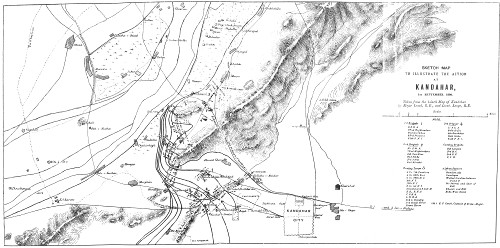
SKETCH MAP
TO ILLUSTRATE THE ACTION
AT
KANDAHAR,
1ST SEPTEMBER 1880.
Taken from the 1-inch Map of Kandahar
by Major Leach R.E., and Lieut. Longe, R.E.
[Notes]
The enemy had been firing intermittently both from the Baba
Wali Kotal and the Gundigan direction from daybreak, and it
looked as if they were full of fight and not inclined to shirk joining
issue with us. Our original plan had to be somewhat modified
owing to Ayub Khan or his generalissimo, the Naib Hafizulla,
having pushed their men round to the southern face of the Pir
Paimal Ridge. Gundigan had been occupied during the night,
and the order that Gough’s cavalry with the four guns of E-B,
R.H.A. (escorted by two companies of the 7th Fusiliers and four
companies of the 28th Bombay Native Infantry), should form up
on the low hill above the village could not be carried out. The
movement was attempted, but it was at once seen that the place must
be cleared by our infantry before cavalry could hope to get past.
The movements of the cavalry on our left, which were to have been
simultaneous with those of the two attacking brigades, were therefore
delayed, General Gough having to take his brigade some
eight miles round before he could strike the Argandab River.
This was one forced modification of our plans, and a second was
that the village of Mullah Sahibdad, on a low mound between
Karez Hill and the Pir Paimal Ridge, had to be taken first by
General Macpherson’s Brigade, as some hundreds of Afghans had
established themselves in it after nightfall the previous day. But
all this was known long before General Roberts moved to Karez
Hill, and preparations were made accordingly. General Ross had
command of the infantry attack, and directed General Macpherson’s
Brigade to move forward through the gap between the Picquet
and Karez Hills, clear the village of Mullah Sahibdad in their left
front, and then pass on under the Pir Paimal Ridge, working their
way between the canals along the lower slopes. General Baker
513was ordered to take his brigade out to the left of Karez Hill,
skirmish through the orchards, clear Gundigan village, and all
the enclosures about it, and join hands with the 1st Brigade in
the final movement round the Pir Paimal Ridge. Macpherson’s
Brigade was to be the brigade of direction, as it was moving on
an inner line, and would probably first reach the Pir Paimal
village on the northern slope of the ridge, to capture which would
ensure the Baba Wali Kotal being taken in reverse. The action
commenced soon after nine o’clock by our demonstration against
that Kotal. In Kalacha-i-Haidar, near our old cavalry lines and
some 2,200 yards from the Baba Wali Kotal, Brigadier-General
Burrows had in position four 40-pounder breech-loading Armstrong
guns, with four companies of the 7th Fusiliers, the 4th
and 19th Bombay Infantry, and some Sappers. Six guns of C-2,
R.A., were also in position at the Childukhteran village, between
Karez and the Picquet Hills. Brigadier-General Daubeny, with
four companies of the 66th Foot and four companies of the 28th
Bombay Infantry, was holding a line between Chilzina on the left
and Picquet Hill on the right; the latter hill being crowned by
two companies of the 1st Grenadiers. Further away on the right
Brigadier-General Nuttall was watching both the Baba Wali and
Murcha Kotals with the 3rd Scind Horse, 3rd Bombay Light
Cavalry, and the head-quarters of the Poona Horse. This made
a good display of force on our right, and at 9.15 A.M. precisely
the 40-pounders began a vigorous cannonade of the Baba Wali
Kotal. The shells seemed to burst with great accuracy, but the
three guns of the enemy in position there answered bravely
enough, the shells showing that two breech-loading Armstrong
9-pounders and one of our own Horse Artillery guns were
mounted in the Pass. There was much stir and excitement
among such of the enemy as could be seen on the hills, but this
was greatly increased when the guns of C-2 began shelling the
village of Mullah Sahibdad. Bullets from Martini and Snider
rifles could be heard singing overhead, as if the Afghan marksmen
tried long shots in the direction of the battery; but the enemy in
the village kept well under cover, and when six guns of the screw
battery also opened upon the houses from just in front of the
Karez Hill, the shelling was so continuous that no one dared show
514himself beyond the walls. Under cover of this fire General Ross
began the infantry movement. General Macpherson moved the
2nd Ghoorkas and 92nd Highlanders out to the right and front of
the village, the 23rd Pioneers (who had furnished an escort to the
screw-guns), and the 24th Punjabees following the leading regiments
as supports. At the same time General Baker got his brigade
into motion and entered the orchards and enclosures which shut
him out from Gundigan.
To follow the movements of General Macpherson’s Brigade first:
the 92nd and 2nd Ghoorkas had orders to “rush” the village
without a halt, and they carried out their orders to perfection.
It was the turn of the Ghoorkas to lead the brigade, and they
were first out into the open, skirmishing rapidly forward under
Colonel Battye and going straight for the southern front of the
village. The 92nd under Colonel Parker worked round to the
right, never pausing and doing but little in the way of returning
the enemy’s fire, which now became very rapid, the Afghans
appearing on the roofs of the houses and lining every available
wall. C-2 and 6-8 batteries renewed their shelling over the heads
of our men, and this had a good moral effect, as the roofs of the
houses were swept by shrapnel. At half-past ten the village had
been carried at the point of the bayonet, the Ghoorkas, having the
shortest distance to cover, entering first from the Karez Hill side,
while the 92nd rushed in from the opposite side. A stubborn
resistance was offered to their advance, the 92nd losing several
men killed and wounded; among the latter being Lieutenants
Menzies and Stewart. Lieutenant-Colonel Battye of the 2nd
Ghoorkas was slightly wounded on the right shoulder, but he
continued to lead his men. The village was full of ghazis, who
sold their lives dearly, many shutting themselves up in underground
chambers and firing upon our men as they passed. Some
200 Afghans were killed in this village alone. Lieutenant
Menzies had a narrow escape. After he had been wounded he was
placed in an empty room, for the sake of shade and comfort, when
a ghazi, hidden in an inner room, rushed out, cut down one of the
guard, and slashed Menzies over the head and back. The fanatic
was killed before he could do any further mischief. C-2 and 6-8
batteries advanced when the village had been taken, and were
515soon again in action, firing at the lower slopes of the ridge and
into such bodies of Afghans as could be seen in the enclosures in
front. So many men remained hidden in the village that Lieutenant-Colonel
Battye remained with some of the Ghoorkas to
clear them out; and two low hills north of the village had also to
be cleared by part of the brigade, as the enemy, scattered about,
occupied them in considerable numbers. But the main advance
could not be delayed for these considerations, and the 92nd and
two companies of the 2nd Ghoorkas (under Major Becher), with
the 23rd Pioneers and 24th Punjab Native Infantry in support,
disregarding a few shells from the Baba Wali Kotal, moved
towards the south-western end of the ridge above them. They
soon became involved in dry water-cuts, orchards, and enclosures,
every yard of which had to be skirmished through, while a smart fire
was poured down upon them from the crest of the ridge where the
enemy mustered in force. General Macpherson told off picked
marksmen to keep down this fire from above, and their steady
shooting checked it to a great extent. Leaving Major White with
the leading companies of the 92nd and Major Becher with his
Ghoorkas to continue their hard fight round the corner of the ridge,
I must turn now to the 2nd Brigade, which had penetrated into
the maze of walls, trees and water-cuts on the left of General
Macpherson’s line of advance.
General Baker, upon moving out to the left of the Karez Hill,
had, in his first line, the 72nd Highlanders, under Colonel Brownlow,
and the 2nd Sikhs, the latter being on the right. In the
next line, in immediate support, were the 5th Ghoorkas (in rear
of the 72nd), No. 2 Mountain Battery, and the 3rd Sikhs (in rear
of the 2nd Sikhs), with the 2nd Beluchis in reserve and escorting
the Field Hospital. I have indicated the work which lay in front
of the brigade, which had to work its way through walled orchards
and gardens, where it was difficult to keep touch, and where at
times the men could only see a few yards on either hand. But
the work was done splendidly, the order of the day being to keep
moving, and when once engaged to go steadily onward until the
ridge should be turned. The right wing of the 72nd Highlanders,
under Major Stockwell, carried orchard after orchard; but one
check occurred where Captain Frome’s company, resting for a
516moment in a dry watercourse, was subjected to a terrible enfilading
fire from a loopholed wall which the 2nd Sikhs were trying to
turn on the right. Captain Frome and several men were shot
down, and just when the fire was hottest Colonel Brownlow came
up. He was on foot, and had just entered the watercourse, and
was ordering a rush forward to be made when he was struck in
the neck by a bullet and mortally wounded. He was dragged a
little under cover, but died in a few minutes. His second in
command, Major Stockwell, hearing of his death, hurried to the
watercourse where Captain Frome’s men were lying under such
shelter as they could get, and forming them up round a protecting
elbow of the channel made a rush at the wall. Once under the
loopholes, the men were safe; and the defenders of the wall
beginning to waver, the Highlanders placed the muzzles of their
rifles through the loopholes from outside and poured a few volleys
into the enclosure, completely demoralizing such of the enemy as
remained. From this isolated struggle, which cost the 72nd so
dear, an idea of the severity of the fighting may be formed. The
right wing of the 72nd and the 2nd Sikhs were forced by the
enemy’s tactics to cover so much ground to the right that they
left Gundigan on their left rear; but the left wing of the Highlanders
under Major Guinness, and the 5th Ghoorkas, under
Captain FitzHugh, cleared it with ease; so shaken were the men
left to defend it by seeing their fellows running from the orchards
beyond. General Baker’s right had cleared the densest part of
the gardens a short distance in advance of the 92nd on the right,
but no sooner did they come a little into the open than the masses
of the enemy in front tried to “rush” them; while three guns
in position at the foot of a high hill, Kharoti Ridge, north of the
Pir Paimal Ridge, opened fire upon them. Some of the ghazis
actually charged into the ranks of the 2nd Sikhs, but could make
no impression. The 72nd, seeing a large body of men preparing
for a rush, fixed bayonets and charged out, completely dispersing
the armed mob in front of them. One ghazi, more resolute than
the rest, was shot by a sergeant at five yards’ distance. Captain
Murray had just given the word to charge, and had leaped out
of a ditch with his men, when he was struck in the shoulder by a
bullet fired from the ridge and severely wounded.
517The 92nd Highlanders and Major Becher’s Ghoorkas were now
in alignment with the right of General Baker’s Brigade, and the
time had come for the final rush round the ridge. The enemy’s
right rested on the northern slope of Pir Paimal Ridge and extended
across a basin (it can scarcely be called a kotal) between that
ridge and the high Kharoti hill to the north already referred to.
Behind the northern hill the large canals and watercourses from
the Argandab River run, the river itself being a few hundred yards
beyond the series of channels. It was in this basin that Ayub’s
army made its final stand. It had no real entrenchments to line,
but a deep water-cut 12 feet broad, with banks 2 or 3 feet high,
and with cultivated fields in front, served as an excellent defence.
The banks had been ingeniously loopholed for rifle-fire. There
were two camps of twenty or thirty tents each in rear of this
channel. The first was well away to General Baker’s left under
the northern hill, and in it were three guns; the second was in the
middle of the basin and had two guns in position. The village
of Pir Paimal was on the slope some distance to the left front of
the second camp and right in the path of Macpherson’s Brigade.
The latter were moving in an inner circle close under the ridge,
while General Baker’s troops had to work well round to the left
so as to close with the guns under the northern hill and block all
escape from the basin in that direction.
The action from this point can best be understood by following
the movements of the 92nd Highlanders and 2nd Ghoorkas.
They rounded the south-western face of the Pir Paimal Ridge,
and succeeded in capturing the village of that name by a series
of “rushes” and by turning the walls on the right. Major White,
with the leading companies of his regiment, then found himself
face to face with some thousands of men, who seemed determined
to make a final stand about their two guns in the basin. The
plan of our attack was for the two brigades to sweep steadily up
the basin in line; but General Macpherson saw that as he had
advanced so far, and there was a tendency among the enemy to
surge forward in overwhelming numbers, there was nothing for it
but to continue his advance. Whenever the 92nd and Ghoorkas
halted and tried volley-firing the enemy ceased to retire, and
began skirmishing back to the places from which they had been
518driven. The 23rd Pioneers had also worked up on the left to aid
the Highlanders, and Major White got his men together for a
charge. The enemy had tried, by turning the water into another
and a dry channel, to check our advance; but this was a complete
mistake. Our men were faint from thirst, and they welcomed the
water as giving new life and strength. Major White rode along
the front of the watercourse in which the Highlanders were lying
under cover and called out to them: “Highlanders, will you
follow me if I give you a lead for those guns?” There was but
one answer—a ringing cheer, and the next moment the men were
rushing across the open ground led by the pipers, playing the
Slogan, while Major White rode serenely on in front drawing
upon himself a terrific fire. The guns were in rear of a watercourse
with high banks, and sheltered by this the Afghans fired
rapidly and well. A small building protected their right, and
some 300 or 400 riflemen lying on the slopes of the Pir Paimal
Hill poured in a heavy cross-fire upon the 92nd. But the Highlanders
were not to be checked, and though upwards of forty men
of the leading companies fell, killed or wounded, they carried the
guns at the point of the bayonet. Major White leaped into the
watercourse some yards ahead of his men, and found that his horse
could not climb up the steep bank. He therefore remained quietly
watching the enemy firing almost into his face, one Afghan
deliberately aiming at his head at a few yards’ distance. This
man and some ghazis were killed where they stood, Major White
getting his horse out of the ditch just as the Highlanders jumped
into the water. The artillerymen had deserted their guns some
time before, and had left both pieces double-shotted. A story,
which is well found if it be not true, is told of a Ghoorka who
had attached himself all day to the Highlanders. He managed to
reach one of the guns first, and leaping up on it he waved his
cap and cried in Hindustani:—“This gun belongs to my regiment—2nd
Ghoorkas! Prince of Wales’s!” Then he thrust his
cap down the muzzle, in order that there might be no dispute
as to future ownership. The brilliant charge of the 92nd, ably
seconded by Major Becher and his two companies of the 2nd
Ghoorkas, with the 23rd Pioneers rushing up in support, was one
of the leading incidents of the day, the rapidity of the whole
519affair being almost as startling to General Roberts and General
Ross as it must have been to the enemy.[48] The mass of men,
said variously to have numbered from 8,000 to 10,000, who had
gathered in the orchards and been driven into the basin and
towards the rear of the Baba Wali Kotal, were hopelessly broken
by the steady wave of men which swept them backward. General
Baker’s brigade harried them whenever they tried to cling to
cover in the lower watercourses, and the 92nd were driven like a
wedge between them and the slopes of the ridge, smashing into
their midst when they tried to rally at the two guns, and utterly
breaking what little cohesion they still possessed. The first stream
of the fugitives poured out from the orchards, and made for the
Argandab in the direction of Kokaran, many of them falling into the
hands of our cavalry; the next stream poured back into Ayub’s
camp, carrying the news of the defeat, and attracting to them
the escort of the guns on the Baba Wali Kotal. The last two shots
fired by these guns were in the direction of Karez Hill; the
first, pitched three hundred yards short of where General Roberts
was sitting on the crest of the ridge, did not burst, while the
second went whizzing overhead far into the gardens beyond. The
screw-guns of 6-8 battery fired a few parting rounds at the fugitives
making for Mazra, and then Macpherson halted his brigade
and formed up his regiments at the foot of the northern slope
of the Pir Paimal Ridge. General Baker had called a halt some
time before, any serious firing directed against his fighting line
having ceased when the orchards had been cleared, and the line
had swung round to make the turning movement round the ridge.
Nearly all the enemy, so far dealt with, had been irregulars, and
the bayonet charge of the 72nd had checked whatever latent
ghazi-ism there might be among them. During the halt the
fighting line of the 2nd Brigade was reformed as follows:—5th
Ghoorkas on the left, 3rd Sikhs in centre, and 2nd Beluchis on
the right. The 72nd and 2nd Sikhs, with Swinley’s Mountain
Battery, were in rear, replenishing their ammunition pouches. In
this new order the 2nd Brigade advanced at about 11·45, and as
they came into the open between the two ridges, a half battalion
520of the 3rd Sikhs, under Colonel Money, moved off to the left to
hold the point of the northern hill overlooking the Argandab
River. The three guns and the twenty or thirty deserted tents in
the advanced camp at the foot of this hill fell into the hands of
Colonel Money, whose later movements I will refer to presently.
The rest of the brigade changed direction to the right, and
marched up the basin, the 72nd taking the place of the 5th
Ghoorkas in the first line. Only stray shots were fired by ghazis,
who had perched themselves on the hills. The action was really
at an end. General Ross had joined the advanced infantry
brigades, and General Roberts was also coming round the ridge
with General Macgregor’s reserve brigade. A spur running down
from the hill on the left flank of the Pir Paimal basin hid Mazra
from view; but as the leading troops of General Baker’s Brigade
passed over this spur, they saw a mile before them Ayub’s chief
camp, with all the tents standing in regular rows. Fugitives
were rushing out of the camp, and 200 or 300 cavalry were
moving off among the trees beyond. The 72nd Highlanders and
2nd Beluchis reached the camp a little before one o’clock, the 3rd
Sikhs (half battalion) close at their heels, while General Macpherson
also moved his brigade leisurely forward in the same direction.
The 72nd advanced a mile beyond Mazra village, and fired
dropping shots at such runaways as were still within range. But
the powers of flight of an Afghan are marvellous, and as no
cavalry were at hand most of the enemy made good their escape.
Colonel Money, with his half battalion of 3rd Sikhs, had found
that beyond the point he was sent to occupy was another hill,
giving a more commanding position. He pushed on with some
150 men to this point, and to his surprise looked straight down
over the village of Baba Wali into Mazra and the enemy’s camp.
At that time it was packed with men, and he sent back word to
General Baker asking for reinforcements, as he could not venture
upon an attack with his handful of Sikhs. It was too late
for any regiments to be re-directed, and Colonel Money had to
watch with much chagrin the flight of the Afghans led by a
large number of cavalry, probably Kizilbashes. However, he
came upon five guns, including a 24-pounder howitzer, placed
on the slopes of the hill near Baba Wali village, so that his
521half battalion held eight pieces in their possession. When
General Roberts and his Staff rode through Mazra in advance of
Macgregor’s Brigade the rout of Ayub’s army was complete, and
nothing remained but the cavalry pursuit. In four hours our
force had scattered the hitherto victorious Afghan army, driving
them from a position they had chosen deliberately, and with a full
knowledge of our strength, and capturing their camp as it stood,
as well as thirty-one guns and two of our own Horse Artillery
9-pounders. No more brilliant ending of the rapid march from
Cabul could have been wished, and the vindication of our military
prestige is now full and complete. Lieutenant Maclaine was found
to have been murdered by his guards, and this incident has embittered
every man’s hatred of the Afghans. That the Afghans
did not anticipate defeat is proved by the appearance of their
camp; not a tent was struck, not a saddle-bag carried away; all
the rude equipage of a half-barbarous army was left at our mercy—the
meat in the cooking pots, the bread half-kneaded in the
earthen vessels, the bazaar with its ghee-pots, dried fruits, flour
and corn—just as it had been deserted when the noise of battle
rolled up from Pir Paimal.
But to describe these matters more in detail: When our troops
found themselves in rear of the Baba Wali Kotal with the
enemy’s deserted camp lying before them, all opposition was at an
end, and our work was to collect the guns which had been abandoned
on our approach, and to examine thethe contents of Ayub’s
tents. I had lingered to discuss the fight with Captain Darvall,
in command of a company of the 92nd Highlanders, guarding
the guns White had captured, so that the 1st and 2nd Brigades
had passed on when I rode up the road to Mazra. General Macgregor
was following with the 3rd Brigade; but by this time we
all knew that the stories furnished by our spies, relating to an
entrenched camp and a defensive position, arranged on the principles
of European engineering, were fables. The 3rd Brigade were
balked of their fight—for the 60th Rifles and the regiments
brigaded with them were to have assisted in the final attack upon
Mazra, if Ayub had taken up a second position. Scattered on the
open stony road and on the hill slopes were bodies of men killed
by our volleys when the Afghan retreat began. There seemed
522few dead men, but the nullahs and watercourses could have
told their own story; for within their sheltering banks were
lying clusters of white-clad peasants who had been foremost in
the ranks all day. If the cowardly regulars in Ayub’s army had
fought side by side with these men, our losses must have been
much heavier; but they left the ghazi-led mob to bear the brunt
of the attack, and took to flight when the Pir Paimal Ridge was
turned. The most desperate spirits seemed to have been killed,
for in the pouches of several men whose rude waistbelts I examined
there was not a single cartridge left. The rifles of such as were
armed with Martinis, Sniders, or Enfields, were taken by our
soldiers as trophies; while matchlocks or jhezails were broken to
pieces and cast away. One man killed was completely equipped in
the uniform of the 66th Regiment, and had with him a Martini rifle
and bayonet. A number of men, trying to preserve some form of
order in their retirement, were clad in khaki, and at a distance
were actually mistaken by one of our own officers for the 23rd
Pioneers. As they got out of range very quickly we could not
secure one of their number as a specimen. Of the 50 or 100
bodies which I myself passed at close quarters, I only saw some
three or four men in what might be called uniform. These had on
dark-coloured jackets, and turbans, surmounted by small yellow
pompons, such as were worn long ago in European armies. There
were also men shot down with stray portions of Indian uniform
upon them, but they were plainly peasants or villagers who had
joined Ayub after his great success. It is said that Maiwand was
won for him by ghazis, or by a mob of rudely-armed ryots led by
those fanatics; and one certainly saw much to confirm the
idea that the strength of an Afghan army lies in its irregulars.
The defenders of the Mullah Sahibdad village, the men who tried
to “rush” the advanced companies of the 72nd in the orchards,
the mass which finally was broken up by the 92nd at the two
guns—all these were white-clothed peasants, each fighting for
his own band, and fighting right well too. They were seen to
kneel down, take deliberate aim at our ranks, and fire without any
sign of hurry: having fired they rose to their feet, retiring at a
walk and re-loading their muzzle-loaders coolly and calmly. It
was these undrilled units in Ayub’s force who gave us most
523trouble, and who were killed as they fell back before our steady
advance.
The bodies of the enemy’s killed ceased almost entirely as soon
as the spur running out from the northern hill above the Baba
Wali village on our left was passed. This spur had sheltered
them from our bullets, and the shrapnel from our 40-pounders
would scarcely reach them beyond it. The road to the Mazra
camp, from this spur, was at first strewn with the accoutrements
which the Afghans had thrown away in their flight.
Thus packets of Martini and Snider cartridges were come upon,
with stray powder-flasks and ball-bags, the flight having become
a rout as our brigades pushed up the Pir Paimal basin.
A few hundred yards nearer the camp were the guns which had
been withdrawn from the basin itself. They had been left by
the artillerymen just as they had come out of action: here and
there a bag of powder lay near the muzzle, as if a gunner more
stanch than his fellows had tried to load his piece for a farewell
shot; while the caissons were full of live shell. The traces lay
stretched out along the road where they had been dropped when
the horses were taken out, and we could imagine the gunners
mounting and riding off before our cavalry pursuit began. We
were delighted to see one of our own Horse Artillery guns standing
on the road none the worse for its captivity, and word was sent
back for a team to remove it to the rear. The other 9-pounder
lost at Maiwand was, as conjectured, in position on the Baba Wali
Kotal. More accoutrements and packets of ammunition were
found scattered near the first line of tents, and once within the
camp we could see how hasty had been the flight, and how little
the enemy had expected a crushing reverse in a few hours. Our
reconnaissance of the 31st seems to have been fatal to them; they
looked upon it as a first success for their own arms, and had
consequently made no preparations for securing an orderly retreat.
Their camp was pitched in a very orderly way, the tents being
arranged in streets with their front looking towards Candahar.
The rows of tents stretched away fully half a mile in rear until
the small village of Mazra was reached. Ayub’s tent, one of
the kind in which we usually hold durbars, and large enough to
have accommodated all the princes of the Barakzai family, was on
the right of the camp near the canal which carries water to Candahar.
524A handsome carpet still covered half the floor, and when
the Beluchis first entered it there were, I believe, many evidences
of recent occupancy. Within a few yards of it was a small tent
with a small enclosure formed by upright canvas walls—the zenana,
in fact, wherein the Cabul ladies with Hashim Khan had lived.
Ayub himself was said to have had only one Kizilbash concubine
with him. In this tent there was a small circle of carpet
round the central pole, the remainder having been cut away,
probably when the order to take to flight was given. Another
tent near Ayub’s had been used as a dispensary, and was full of
native drugs and of the hospital stores lost by General
Burrows. Some of our native doctors were busy in removing
such medicines as were still of value. Poor Maclaine’s tent was
forty or fifty yards away on the bank of the canal. In every one
of the common tents it seemed that some ten or twelve men had
been tenants, and the strength of the regular regiments must have
been very considerable. Rude screens of branches and boughs of
trees had also been raised about the village, no doubt by the host
of irregulars swarming in the camp.
An examination of a few of the tents showed a vast amount of
rubbish, in the shape of clothes, bedding, cooking vessels, horse-gear,
and miscellaneous equipage, with valuable stores of English
ammunition. Dried figs, grapes, melons, flour, were scattered
about, and in saddle-bags and wallets were all kinds of “portable
property” more or less valueless. One bag which I saw ransacked
by a kahar, contained a packet of Persian books, carefully wrapped
in half a dozen covers of cloth; a store of raisins and a bag of
flour; a silk pugree; a change of white clothing; a bridle and
stirrups; a purse with a score of copper-pieces in it; a pistol and
100 Enfield cartridges. The ammunition found in the tents must
have amounted to many thousands of rounds. Each man seemed
to sleep with packets of Martini and Snider cartridges at his side,
while the packets made up for Enfields were in heaps in odd
corners. One large tent, which had evidently served as the
magazine, was filled to the roof with bags of powder and
boxes of our breech-loading cartridges. How many rounds we
lost on July 27th I do not know, but we have retaken large
quantities, while some of our regiments filled up their pouches
while in the camp. Brass helmets, kettle-drums, some of the
525band instruments lost by the 66th, bugles, gold and silver laced
coats, were among our loot, and some boxes of Cabuli rupees were
also found. But important above all were the thirty-one guns and
our two Royal Horse Artillery 9-pounders: the loss of these will
break Ayub’s prestige, for when he returns a fugitive to Herat
the citizens’ first question will be concerning the artillery he took
with him to batter down the walls of Candahar.
I returned to our camp behind Karez Hill by way of the Baba
Wali Kotal, and found Ayub’s guns still in position on the platform
whence they had fired upon us. He himself had viewed
the capture of the village of Mullah Sahibdad from this point.
Here considerable engineering skill had been shown; sloping
roads had been cut, up which the guns could easily be taken, and
a natural line of rocks had been well utilized as a screen for the
pieces placed in position. There were no embrasures or gunpits, but
the guns were placed so that having been fired over a wall of rocks
4 or 5 feet broad they might then be withdrawn a few yards below,
reloaded and run up again to answer our fire. Our 40-pounders
had of course made no impression upon the rock, although the
shells had pitched upon the wall itself. The gunners could rest
in perfect safety when not firing, as a space had been cleared
below the rocks and the hill sloped sharply downwards. The
narrow road over the Kotal was to the right of the guns, with
rocks overhanging it on either side; it had not been interfered
with, the enemy knowing that such a converging fire could be
brought to bear upon it that it could scarcely be forced. There
was a higher position above where the 9-pounders and the two
Armstrongs were posted, and here a 7-pounder mountain gun
was found. There was splendid cover for infantry lining the rocks,
and this had been improved wherever practicable. So strong
indeed had the Kotal been made, and so clear of all obstacles was the
slope below—a natural glacis—that to have attacked in this direction
would have been to court heavy loss, if not a disastrous repulse.
Two sad incidents marred the success of the day: the death
of Captain Straton and the murder of Lieutenant Maclaine, who
had been a prisoner in Ayub’s hands since the eventful 27th of
July. Colonel Brownlow and Captain Frome died gallantly in
action, and though we sorrow for the loss of these brave men,
there is the consolation that they were at the head of their regiments
526and in the fore-front of the battle. But Captain Straton’s
death occurred at a moment when all seemed over, when we had but
to count our losses and collect our spoils. When General Ross
had joined Macpherson’s Brigade, halted in rear of the Pir Paimal
Ridge, the shells from our 40-pounders were still coming over the
Baba Wali Kotal, endangering the safety of any troops pushing
on towards Mazra. It was, of course, all-important to stop this
shelling of the Kotal, now virtually in our hands, and the easiest
way was to send a party of signallers up the hillside to the right
of the Kotal, whence the news of our rapid success could be
flashed down below. Captain Straton with two mounted signallers
was with the brigade, and he was ordered to establish a station
on the ridge above. But as there were a few ghazis lingering
about, two companies of the 24th P.N.I. were told off to skirmish
well in front of him, and clear the ground. Before they
could move off, Captain Straton, a man with no sense of personal
danger, rode slowly up the slope with his two signallers. He
had not gone more than 50 or 60 yards from Generals Ross and
Macpherson when a shot was heard, and Captain Straton fell
from his horse. A dark figure was then seen to rise from a dip
in the ground, fix a bayonet on his rifle and rush forward. The
two signallers, men of the 72nd Highlanders, had dismounted by
this time, and they fired at 40 yards’ distance, bringing the Afghan
down. His bayonet had passed through Captain Straton’s coat,
but had not touched the body. The man was bayonetted as he
tried to rise. It was discovered that he had already been severely
wounded, and could not have hoped to escape; he was not clad in
the orthodox white of a true ghazi, but had on a sort of blue
uniform, which seemed to indicate that he was a regular soldier,
whose fanaticism had prompted him to shoot the first officer who
passed him. The bullet from his rifle had passed through Straton’s
heart. The decease of Captain Straton is a great loss to the force; the
perfect way in which he had controlled the signalling was universally
recognized. He never spared himself when hard work had to be
done, and the soldiers under him shared his enthusiasm. General
Roberts always relied implicitly on him, both on the march and
in action, for he knew that if it were possible for heliographing
to be done Captain Straton would have his men in position and
his instruments at work. The 22nd Regiment have lost as good
527a soldier as ever wore sword, and there is a gap in Sir Frederick
Roberts’s Staff which he will find hard to fill. The second incident
is yet again on different lines, for the murder of Lieutenant
Maclaine is full of horror. As Sir Frederick Roberts rode into
Ayub’s camp word was brought by some native soldiers, belonging
to Jacob’s Rifles and the 1st Grenadiers, who had been prisoners
with Maclaine, that his body was lying near Ayub’s tent. Major
Euan Smith was sent down to test the truth of the story, and
found the sepoys had spoken only too truly. Poor Maclaine, with
his throat cut deeply across, was lying some short distance from
the tent in which he had been confined, about 40 yards from
Ayub’s own tent. The story told by the sepoys is that Ayub fled
at eleven o’clock with the Cabul sirdars, leaving his prisoners in
charge of their guard, with no instructions beyond a verbal order
that they were not to be killed. Some hour or more after this
the guard rushed into the tents where Maclaine and six other
prisoners were kept, and ordered them all out, as they were to be
killed. One sepoy was shot through the head, and Maclaine was
seized by several Afghans, who threw him down and cut his throat.
He was weak and ill from sickness and bad food, and submitted to
his fate without a word. Immediately upon this there was a great
shout that the English were upon the camp, and the guard fled
without touching the five sepoys remaining. The bitterest rage
is felt against Ayub, who might, by confiding the officer to the
Kizilbash cavalry, easily have ensured his safety. For the future
there can be no question of treating with a prince who has thus
followed the worst precedents of Afghan history. He is held
responsible for Maclaine’s assassination just as much as if he had
witnessed it, and our only regret is that the sirdar did not fall
under the sabres of our cavalry in the pursuit. Maclaine’s body
was carried into the Citadel and was buried with military honours
yesterday morning.
The cavalry pursuit resulted in some 400 of the enemy being
killed, while our casualties were trifling, only two officers, Lieutenant
Baker, of the 3rd Punjab Cavalry, and Lieutenant Chamberlain,
of the Central India Horse, being very slightly wounded:
the former got a cut on the hand and the latter had his sword-arm
bruised a little by the point of a tulwar. General Hugh
Gough, with the 9th Lancers, 3rd Punjab Cavalry, 3rd Bengal
528Cavalry, and the Central India Horse, cut off groups of fugitives
who had crossed the Argandab and were making for Khakrez; but
no large masses of men were encountered. The delay in not
being able to cross the Kokaran ford until eleven o’clock, of course
militated against the pursuit being of the harassing kind it
would otherwise have assumed. Once the river had been forded
the cavalry galloped along on three parallel lines, the 9th Lancers
forming the reserve. The 3rd Punjab Cavalry killed over seventy
men in one charge alone. General Nuttall, with the 3rd Scind
Horse and 3rd Bombay Light Cavalry, also pursued during the
afternoon, up the Argandab Valley to the east of the river, killing
100 stragglers.[49]
Our losses so far as they have been ascertained were, on August
31st and September 1st, as follows:—
| |
British. |
Native. |
| |
Officers. |
Rank and File. |
|
| |
K. |
W. |
K. |
W. |
K. |
W. |
| E-B, Royal Horse Artillery |
— |
— |
— |
1 |
— |
— |
| C-2, Royal Artillery |
— |
— |
— |
2 |
— |
— |
| 6-8, Royal Artillery |
— |
— |
— |
1 |
— |
2 |
| Staff |
1 |
— |
— |
— |
— |
— |
| 2-60th Rifles |
— |
— |
— |
2 |
— |
— |
| 72nd Highlanders |
2 |
2 |
7 |
20 |
— |
— |
| 92nd Highlanders |
— |
2 |
14 |
66 |
— |
— |
| 3rd Bengal Cavalry |
— |
1 |
— |
— |
1 |
1 |
| 3rd Punjab Cavalry |
— |
1 |
— |
— |
— |
5 |
| Central India Horse |
— |
1 |
— |
— |
— |
5 |
| 2nd Ghoorkas |
— |
1 |
— |
— |
10 |
19 |
| 23rd Pioneers |
— |
1 |
— |
— |
2 |
12 |
| 24th Punjab Native Infantry |
— |
— |
— |
— |
1 |
10 |
| 2nd Sikhs |
— |
1 |
— |
— |
3 |
23 |
| 3rd Sikhs |
— |
— |
— |
— |
— |
6 |
| 4th Ghoorkas |
— |
1 |
— |
— |
1 |
5 |
| 5th Ghoorkas |
— |
— |
— |
— |
1 |
2 |
| 15th Sikhs |
— |
— |
— |
— |
2 |
4 |
| 25th Punjab Native Infantry |
— |
— |
— |
— |
— |
2 |
| 3rd Scind Horse |
— |
— |
— |
— |
— |
1 |
| 3rd Bombay Cavalry |
— |
— |
— |
— |
1 |
1 |
| 2nd Beluchis |
— |
— |
— |
— |
— |
1 |
| Total |
3 |
11 |
21 |
92 |
22 |
99 |
529This gives a total of killed of all ranks, 46, wounded 202.
Two followers were killed and fifteen wounded; twenty horses and
three mules were killed; twenty-one horses and three mules
wounded.
The list of officers killed and wounded is as follows:—
Lieutenant-Colonel Brownlow, commanding 72nd Highlanders.
Captain Frome, 72nd Highlanders.
Captain Straton, 2-22nd Foot, Superintendent Army Signalling
Captain Murray, 72nd Highlanders.
Lieutenant and Adjutant Munro, 72nd Highlanders.
Lieutenant Menzies, 92nd Highlanders.
Lieutenant Stewart, 92nd Highlanders.
Major Willock, 3rd Bengal Cavalry.
Lieutenant Baker, 3rd Punjab Cavalry.
Lieutenant Chamberlain, Central India Horse.
Lieutenant-Colonel Battye, commanding 2nd Ghoorkas.
Lieutenant-Colonel Rowcroft, commanding 4th Ghoorkas.
Major Slater, 2nd Sikhs.
Lieutenant Chesney, 23rd Pioneers.
The wounds of the last eight officers are not severe.
The death of Colonel Brownlow is a terrible loss to the 72nd
Highlanders, and indeed to the army generally. Brave to a fault,
he was a model of coolness under fire, and always handled his
men with judgment and decision. He was marked for future
distinction, his tried ability in the field raising him far above his
peers. His untimely death will be felt most keenly by his own
officers and men, to whom he had greatly endeared himself.
530
Candahar during the Siege—Improvement of the Defences—Sketch Map showing the
Disposition of the Garrison—The Attitude of the Enemy—Their Plan of Attack—Deb-i-Khwaja
Village occupied in force by the Afghans—The Sortie of August 16th—Determined
Defence of the Village—Retirement of the Troops—Death of General
Brooke—The Sortie falsely called a “Success”—Description of the Afghan
Siege Works—Engineering Skill shown by the Naib Hafizulla Parallels—The
Training of Guns upon the Shikarpur Gate—The Afghan Karez Trenches on the
South—Attempt to form Breaching Batteries—Explanation of the Engineering
Skill shown.
Candahar Cantonments, 9th September, 1880.
Sir Frederick Roberts’s troops were so soon pushed into action
after their arrival at Candahar, that the state of the city on the
31st August and the evidence the enemy had left behind of their
late uncomfortable closeness to the walls, have been partly forgotten
by many of us. When we rode up on the morning of the
31st there was indeed every sign, both within and without the
walls, that an enemy had been at the gate. Candahar rises out
of the plain quite abruptly; its walls, with their tower-like
bastions, obtruding themselves upon one’s notice in rather an unsympathetic
way. They shut out from view everything that lies
within them, except the tomb of Ahmed Shah and the tower of
observation in the citadel. No point of 'vantage enables one to
examine what the walls may hide; not until the gates are passed
does the character of the city disclose itself. It has been
too often described for me to venture to sketch its two broad
roads bisecting each other at right angles near the centre of the
city; its citadel guarded by a deep ditch; its high walls of a
breadth sufficient to make breaching a work of great difficulty even
to heavy artillery, and its narrow gates, guarded each by flanking
towers which stand out on either hand of the doorway as if the
mud-work of the walls had been cut through and folded back
to admit of entrance being given. It will be sufficient to say
that the defences had been strengthened during the siege by
such contrivances as are usually employed to check assaults upon
531walled towns, and that the gaps and breaks in the bastions and
parapet had been filled in with sand-bags, which still remain in
all the rough-and-ready state in which they were hastily piled up.
On August 31st our first view of Candahar was from near Deh-i-Khwaja,
the village against which the sortie of the 16th had been
directed. We did not, however, enter by the Cabul Gate, on the
eastern face, but by the Shikarpur Gate, facing southwards.
It was here that the outer defences had been made strongest,
as the enemy’s attack in force was expected from the group
of villages lying to the south and south-west, some of the walled
vineyards and gardens of which were within 300 yards of
the south-west bastion, and less than a mile from the Shikarpur
Gate itself. The temporary bazaar outside this gate,
established for the benefit of our force marching in from
Momand, was formed amidst the abattis, wire entanglements,
chevaux-de-frise, and broken-down walls which cumbered
the ground and would have impeded the rush of an attacking
force. The bastions and parapet bristled with sand-bags, over
which the sentries on guard looked down, no doubt with hearty
relief as our troops drew up and piled arms preparatory to breakfast.
And yet there was no enthusiasm shown at our approach;
not a band turned out to play us in, not a cheer was raised to
welcome us. Perhaps we had been so near for the last few days
that the novelty of being released from a dangerous situation had
passed away from the minds of the garrison; perhaps—and I am
afraid this is the more likely explanation—the prevailing tone
among General Primrose’s troops was one still of depression and
want of “heart.”[50] The reaction had not set in, and the disastrous
defeat at Maiwand and the sad result of the sortie, were
still remembered with great vividness. There had been undoubted
demoralization existing within the walls during the siege, caused
by that unreasoning dread of an enemy which always arises after
defeat. How far the demoralization spread only commanding
officers could really know; but it was impossible that the remnants
of a beaten brigade could be brought once more into contact
with the main body without producing some ill-effect. Letters
532which reached us after we left Khelat-i-Ghilzai spoke of the
“long faces drawn,” and the depression of which they were the
too visible sign. And yet there were over 4,000 effective soldiers,
British and native, under General Primrose’s orders. One panic-stricken
man may infect a hundred; one panic-stricken regiment
an army; and to judge by the stories told by soldiers of the garrison
to our own men of the Cabul force, there was a tendency to
foster the “ghazi scare,” and to nurse and nurture it until it
grew to formidable proportions. Thus our sowars told of the
terrible Aimak horsemen who feed their horses on raw meat and
charged with such effect that no one could withstand them; that
our cavalry would wither away before the flame and smoke breathed
from their horses’ nostrils. Our sepoys, nearly all Sikhs and
Ghoorkas, were so self-confident that they made no secret of their
desire to meet the much-bepraised ghazi-log: they were warned
that they did not know what the local ghazis’ fighting powers
were, and there was what in Western life would be called “head-shaking”
at our rapid movement towards the Pir Paimal Ridge
on the 31st. We seemed to local wiseacres to be going right into
the jaws of death, whereas our firm belief was that we were
rushing into the arms of victory. Our men were impatient to
wipe out the disgrace which had fallen on our arms.
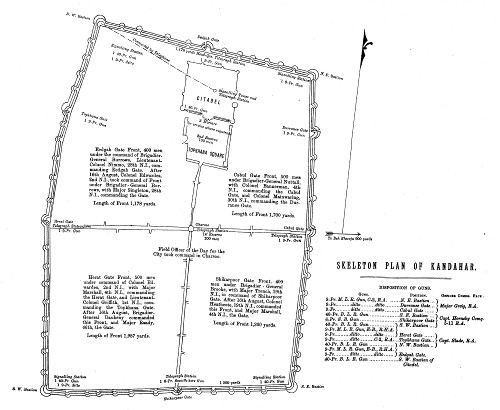
To revert to the appearance of the city when we formally
relieved it: The flanking bastions which stud the wall at regular
intervals are seventy in number. They are really circular towers
with that part of the circumference cut away which looks citywards.
As they were in a wretched state of repair as regarded
their upper layers of sun-dried mud, there was much to be done
in building up a new parapet with sand-bags, and their appearance
is now most uncouth, each tower seeming “top-heavy” and
suffering from an excrescent growth which may yet be in its infancy.
The south-west bastion, overlooking the Shikarpur village
wherein the enemy were always swarming, was strengthened
greatly by these means, embrasures being left through which our
40-pounders could be trained to the east, west, and south. A
fantastic appearance was also given to the main walls of the city by
cutting down the parapet for 18 inches at points equi-distant
from the bastions, and placing upright sand-bags to fill in the gap
533thus made. Ten riflemen were told off to man each of these gaps,
which were 10 feet in length. The necessity for thus improving
the parapet was due to the defective system of loopholing in vogue
among the Afghans. They pierce their walls with narrow slits,
through which it is impossible to see more than a few square yards
of ground below; and at night not an object can be seen from
nine-tenths of the loopholes. The effect of combined breech-loading
fire would be minimized if rifles had thus to be blindly
fired into space; whereas by giving men a chance of seeing over
the wall and grouping the defenders into tens at fixed points, their
fire could be always well-aimed and kept well under control. To
repel, for instance, an attack of 5,000 or 6,000 men led by ghazis
determined to scale the walls or die in the attempt, fire from the
ordinary loopholes would have been thrown away, and only the
cross-fire from the nearest bastions could have told; but once the
defenders could fire at almost any angle, through the ten-feet gaps
I have described, the ground in front of any given point could be
swept by continuous volleys. Inside the city one could not fail
to be struck with the open display of force made at every available
point. There was quite a crowd of European soldiers and Bombay
sepoys filling the Shikarpur Gate as General Roberts and his Staff
entered the city, and nearly every man seemed to have his bayonet
fixed or sword drawn. No doubt Candahar bears an ill-reputation
for ghazi-ism, and there were many discontented spirits within its
walls even after the 18,000 Pathans had been turned out; but the
display of naked weapons certainly struck us poor pilgrims from
quieter Cabul as unusual and alarming. Our own revolvers were
comfortably reposing on our hips, while we found it was the fashion
to carry the pistol in the hand, or a drawn sword, or a hog-spear,
or a bayonet fixed on a long stick à la ghazi. In the Char Soo,
the covered, arched bit of bazaar, where the chief roads cut through
each other, were more men with drawn swords and fixed bayonets.
The guards at the gates, at the entrance to the citadel and elsewhere,
seemed of great strength; but without wishing to be rudely
critical, one could not help feeling that numbers were necessary
where the sepoys were of such poor physique. It is dangerous to
say a word against the Bombay regiments, as a swarm of eager
defenders will start up at once to justify them and to challenge comparison
534with the army of Northern India. But I must humbly
submit that the weedy under-grown sepoys of one or more of the
regiments now in Candahar are no more like soldiers than a stage
army is like those “cull’d and choice-drawn cavaliers” who won
Agincourt. I have not seen a regiment paraded, and I do not
know the distinctive dress of any particular regiment, but there the
men were before my eyes, and they were certainly sorry apologies for
sepoys. The appearance of the citadel was as warlike as that of
the city we had passed through, sand-bags and bags of flour, &c.,
being well to the fore wherever there was a gate to be strengthened
or a wall to be made more imposing. The tower in the citadel
upon which Captain Keyser, of the 7th Fusiliers, had his chief
heliograph station, was topped by a circular wall of bags some
five feet high, and from this point there was a good view of all
the surrounding country. The northern wall, with the Eedgah
Gate, looking towards Mazra, had its complement of the ever-repeating
sand-bags, and in the north-west corner bastion was the
40-pounder which had shelled Picquet Hill and our cantonments,
when Ayub rashly pitched his tents within range.
It is difficult of course, after a lapse of time, to pick up the
threads of a story, especially when that story has for its moral
indecision and disaster; and therefore, in dealing with events
before and during the siege of Candahar, I have to guard against
being led away by the hasty criticism or loose talk of irresponsible
persons. I would rather leave such facts as I have gathered to
speak for themselves than formulate conclusions which must of
necessity be based upon other men’s evidence. Not having seen
with my own eyes movements and actions which had most serious
results, I can only present them as they were pictured to me by
eye-witnesses. To make the story clearer, reasons must be given
for certain positive moves made by those holding authority among
the besieged garrison; the more general question of passive
defence being governed by other conditions, such as the morale
and strength of the force at the Lieutenant-General’s disposal, the
numbers and capacity of the enemy, and their probable intentions.
Ayub Khan’s forces made their appearance about Candahar on
the 7th of August, ten days after the Maiwand defeat, and such
was their confidence at that time that they occupied part of our
535cantonments, and pitched their camp well within range of our
40-pounders. They were soon aware of their error, when shells
began to burst even in the Surteep’s tent, and they withdrew to a
safer distance, and set to work in a less obtrusive but more
systematic way. Against the northern face of the city wall, and,
for the most part, against the western face also, they could do
nothing; there were no villages or enclosures to cover their movements.
To the north the plain is covered with graves, while on
the west there is a clear space at least one mile in breadth between
the cantonments and the Herat Gate. On the south-west were
groups of enclosures with high mud walls, twelve or eighteen
inches thick, guarding the orchards and vineyards of Shikarpur
and Deh Haji villages which lay in rear of them. These gave
cover to their sharp-shooters, good positions for their guns, and
accommodation and food to any large body of men they might
mass within them. The deep water-channels of an open karez
were also available as shelter-trenches and first parallels, if the
Afghans so far understood the art of war; and altogether the
Shikarpur Gate and the south-west corner bastion of the city wall
were likely to be menaced. How admirably the Naib Hafizulla,
who was said to be the guiding spirit of Ayub’s army, recognized
the advantages of an approach from this direction I will explain
presently. There was open country (cultivated fields lying fallow)
facing the portion of the southern wall to the east of the Shikarpur
Gate; but there were many low walls in this direction also. The
eastern face, equally with the Shikarpur Gate and the southwestern
line of defence, might be looked upon as attracting an
attack, or at least a strong demonstration, owing to the nearness
to the Cabul Gate of the large village of Deh-i-Khwaja. The
distance in a direct line from the gate to the village walls was less
than 1,000 yards, and the intermediate space was not, as on the
western face, clear of every obstacle, but was traversed by lands
with low boundary walls and by a water-channel running alongside
the road leading from the city through the village. Deh-i-Khwaja
covers several acres of ground, and as each house has an independent
door, and is connected with its neighbour by stout mud
walls, the place presents no salient point to a storming party
where a position could be seized and made good. In the hands
536of resolute men each house would become a miniature fort to be
taken before the next one could be approached. I suppose this
fact was known to the officers who were responsible for the attack
ultimately made upon the place. In addition to the cover offered
by the low walls between the village and the eastern wall, there
was, a few yards outside the Cabul Gate, a pile of buildings used
as a serai. We could not of course occupy these, and we had not
had time to destroy them. They would have formed the connecting
link, and a very strong one, between Deh-i-Khwaja and any
party told off to assail the Cabul Gate.
The enemy in their over-confidence, or by wrongly estimating
our military power in Afghanistan, intended to reduce the garrison
to weakness by starvation, and then to assault two or more gates,
the irregulars led by ghazis being anxious to carry the city at the
point of the sword. To avoid such a complication as our army
cutting its way out, the villages on the south and Deh-i-Khwaja
on the east were occupied in force, and earthworks thrown up
along the line of karez near the Shikarpur group of villages.
Guns were mounted at several points from which shells were
pitched with fair accuracy into the citadel or burst over particular
bastions. One gun, said to be a 6-pounder, was placed in
Deh-i-Khwaja, an embrasure being formed by cutting through a
mud wall some twelve feet high, and piling up on either side
earth and the débris of a house which these amateur engineers
demolished. This gun did little or no damage when it was fired
at the Cabul Gate, but the rifle fire from the walls of the village
seriously annoyed such working parties as were sent out by the
garrison to destroy the low walls bounding the roads through the
fields. General Primrose at last ordered that no more parties
should go outside the gates, so that the cover existing for an
attacking force was left intact. Day by day it was noticed that
Deh-i-Khwaja was crowded with men, and suspicion became rife
that preparations were being made for forcing the Cabul Gate and
“rushing” the defences on that side by a swarm of irregulars. Now
the word “ghazi” carried dismay into the hearts of many of the
garrison—as it does still no doubt—and it became an open question
whether it was not time to break through the inaction which prevailed,
and force a fight on a small scale outside the walls. It was impossible
537to shell the place effectually, as three of our 40-pounders were in
position on the north-west and southern bastions, and our
9-pounders over the Cabul and Durani Gate could not hope to be
of any great use against thick mud walls and domed houses. The
two mortars of the heavy battery might plump shell into the midst
of the houses, but they would not scare its defenders away. The
original plan of the sortie was, I believe, conceived by Major Hills,
Commanding Royal Engineers, who advised that a party of
cavalry should be sent out in the early morning by the Eedgah
Gate (facing north) and work round in rear of the village of
Khairabad, which should then be “rushed” by some 500 or 600
infantry. Khairabad was within 400 yards of the northern walls
of Deh-i-Khwaja, and the latter village was to have been taken
by an attack in rear, where it was probably undefended. The
6-pounder gun was to be spiked, or brought away if time allowed,
and the loopholed walls fronting the city were to be destroyed.
There was nothing impossible in this plan, and the sortie, if at
all well managed, ought to have proved a success. But certain
modifications were made which spoiled all. On the morning of
the 16th of August, 300 sabres, under command of Brigadier-General
Nuttall, swept round in rear of the village, and, as was
expected, the men in Deh-i-Khwaja began to leave, seeing their
retreat thus cut off. The usual garrison which flocked in every
morning and left at nightfall had not arrived, and they would
probably have known but little of the affair until afterwards, if a
fatal blunder had not been committed before the infantry went
out. This was a cannonade of half an hour’s duration, from the
9-pounders and the two howitzers. General Brooke, commanding
600 men chosen from the 7th Fusiliers, 19th and 28th Native
Infantry, asked that the village might be shelled before his troops
went out. The unusual noise aroused every armed man in the
southern villages, and even those further away on the east; and
they poured out to see what was the meaning of the cannonade.
They soon learnt Deh-i-Khwaja was being attacked, and they
hastened to its assistance. In the meantime our cavalry had a
splendid chance at some 400 or 500 men on ground which could
not have been better for a charge. But General Nuttall considered
the time had not yet come to use his sowars, and he contented
538himself with following the enemy, who were making for broken
ground on the south. Eventually a troop was ordered to charge,
and they did good execution; but the fugitives had then got cover
and opened a smart fire upon the cavalry, who had to draw off a
little, particularly as more men were pressing up from the Shikarpur
villages. In the meantime the half-hour’s cannonade had come to
an end, and the infantry had moved out; such men as still held
the village were on the alert, and our troops were met by a heavy
fire from the long line of loopholed walls. The attacking force
was divided into three parties of about 200 men each, General
Brooke taking the centre party, whose object was to penetrate the
village by the road from the city, while the other parties moved off
to right and left. It was this central party which suffered the
heaviest loss. They rushed along the narrow road with a dry
watercourse of some depth on their left hand, passed the gun and
got into the village. But they were little better off than before;
for every wall was loopholed, every door blockaded. All they could
do was to press forward and watch for an opportunity of seizing
one or more houses in rear, whence they could work back, clearing
the walls and courtyards, so as to allow of the Sappers demolishing
the outer wall facing the Cabul Gate. To attempt street fighting
was hopeless, as our men could see no enemy; only the
muzzles of rifles, many of them breech-loading, looked down
upon them. General Brooke forced his way right through the
place, and as the rear walls were not loopholed his party had a
respite for the time. He then moved along towards the north,
but returned when he could find no point which served to give him
a chance of making his hold good. The party to the left under
Colonel Heathcote did not enter the village but lined the walls in
the fields, keeping up a heavy fire to draw off the defenders’
attention. On the right, Trench of the 19th Bombay Infantry
had got possession of a large walled garden to the south of the
village, whence he drove such of the enemy as made a stand.
The sortie was being watched by General Primrose and the garrison
from the walls; but owing to a thick haze little could be seen of
what was going forward. The continuouscontinuous firing showed the village
had not been captured, and swarms of irregulars could now and
again be distinguished running across the open country as if making
539for Deh-i-Khwaja. General Primrose therefore ordered the troops
engaged to be recalled, and directed the artillery and infantry on
the walls to cover the retirement. The orders were passed on to
General Brooke. The two parties under Colonel Heathcote and
Trench (killed about this time) began to fall back, leaving the
third batch of 200 men, still in the rear of the village, quite unsupported.
The cavalry also made for the Cabul Gate; the rifle
fire from the enemy, who were following them up, costing them
many horses. Our retirement was the signal for the advance of
every Afghan who had been held in check by the cavalry in the
open. The garden Trench’s party had held was occupied by
them, and every wall in the fields in the south-east was lined with
their skirmishers. For General Brooke to withdraw safely under
such conditions was almost impossible. He tried to make his
way back by the road leading through the heart of the village;
but the fire from the loopholes was too terrible, and he turned off
to his left, coming out into the fields just where a few walls gave
cover to his men and enabled them to rally. In the confusion
which prevailed his party were mistaken for “ghazis,” and a
40-pounder began to shell them. Fortunately the shells were
too high, and did no mischief. No supports were sent out to aid
him, though appeals were made to General Primrose to allow
skirmishers to line the low walls outside the Cabul Gate in a
south-easterly direction.[51] General Brooke had supported Lieutenant
Cruickshank, R.E., severely wounded, and had brought
him out of the village. They rested behind a wall while a handful
of men were got together to cover their retreat towards the
walls, still a thousand yards away. But the fire from the loopholes
was too heavy, and as the General tried to cross to the
shelter of another wall he was shot down. A sergeant of the 7th
Fusiliers with him was killed, and two Bombay Sappers wounded,
and then the two officers had to be left to their fate. Their men
were harassed by continuous fire at almost point blank ranges,
and the sortie ended by forty of our dead being left on the ground,
while twice that number of wounded were received within the
walls. The details of the killed and wounded, officers and men,
540are given in the despatches. The total casualties were about
200; and this short story of how the sortie was made and how
little it bore the character of a “success,” which I see it has
always been called by General Primrose, may help you to appreciate
what occurred. There is no charge against the soldiers;
all are said to have fought well and to have shown great steadiness;
but the departure from the original plan was fatal, and no
supports being left for General Brooke’s party to fall back upon,
gave the enemy the chance of cutting our men up in detail.
There are other features of the sortie which I have no doubt men
who were in it can fill up. I have been through Deh-i-Khwaja
and over the ground outside, and I can fully appreciate how
General Brooke failed to make good his hold of the village.
Candahar, 12th September.
I have described the position taken up by Ayub Khan’s forces
on the eastern side of Candahar, and the sortie made on August
16th against the Deh-i-Khwaja village. Major Hills, the Engineer
officer commanding, had warned General Primrose that he would
not be responsible for the safety of the city if Deh-i-Khwaja were
left untouched, so high an estimate was placed upon the capacity
of the enemy. On the 17th the guns directed against the city,
more apparently for the purpose of annoying the garrison than
with any idea then of systematic bombardment, were the
6-pounder in Deh-i-Khwaja, an Armstrong breech-loader, and one
of our Royal Horse Artillery 9-pounders on Picquet Hill, a
6-pounder in an embrasure near the Head-Quarters’ Garden facing
the western wall, and another 6-pounder in a garden to the south-west,
distant 1,100 yards from the Shikarpur Gate, and somewhat
nearer the south-west corner bastion. The guns on Picquet
Hill were answered by a 40-pounder in the north-west bastion,
and their fire was plainly meant to make the citadel as uncomfortable
as possible for the troops crowded within it. One of
these guns was silenced on the 16th, and was believed to have
been dismounted. The 6-pounder near the Head-Quarters’ Garden
was fired at uncertain intervals at the bastions on the western
face, in the hope, apparently, of injuring whatever men might be
541on duty on the wall. It was on the south-west that the greatest
pains were taken by Ayub’s amateur “engineers,” and here the
contour of the ground favoured them immensely. The group of
villages known to the garrison under the general name of Shikarpur
was protected by many walled gardens and vineyards, which
had in their front two deep karez water-channels, then quite dry,
as the canals from the Argandab River and local springs had been
blocked so as to cut off the usual water supply of Candahar. The
karez in vogue in Southern Afghanistan is different to that we
have been accustomed to further north. Instead of an underground
canal, with openings at stated intervals, wherefrom the
earth excavated is thrown up in mounds, there is a deep open
channel cut from six to twelve feet deep, along the banks of which
the earth and mud are thrown up so as to form a formidable
ditch. The stream at the bottom is of no great depth, and courses
along to lower levels very quietly, no rapid fall being allowed. There
are usually minor channels running out from the main karez,
unless the water has to be taken to a level several miles away
from the original spring. The Shikarpur gardens and villages
afforded ample cover for a large body of men, and the karez
channels in front were seized upon as offering ready-made trenches
in which to form batteries and a line of breastworks for riflemen.
The “works” raised by the enemy still stand almost untouched,
and a few days ago I went over them with an engineer officer who
was in Candahar during the siege. From his explanation, and my
own observations, I may be able to give a fair idea of the engineering
skill which some, at least, of Ayub’s officers could boast. That
nothing came of this attempt to raise batteries and breastworks is
due to the rapid advance of the relieving force from Cabul, the
enemy not having time to complete their lines, and being forced
to abandon the siege when it was yet in its infancy. In the sixteen
or seventeen days they were at work they made very creditable
progress; and, left undisturbed, they might have caused the
garrison much trouble and annoyance.
It is believed that the first plan of the Naib Hafizulla, who
controlled the Afghan army, was to raise a number of batteries to
play upon the Shikarpur Gate and that part of the wall lying
between that gate and the south-west bastion; riflemen were
542to be pushed as near the bastion as possible, sheltered by protecting
walls and ditches in the fields; and then an assault was to
be made by the fanatical irregulars led by their ghazis. Scaling
ladders were to be used, and, under cover of a terrific fire directed
upon the defenders of the southern wall, the grand attack was
to be delivered. There would probably have been other attacks
made from the south-east and east, and the ghazis were confident
of success after their victory over General Burrows’s Brigade.
The affair of the 16th warned Hafizulla that it was dangerous to
have guns exposed to a sudden sortie, and in the Shikarpur direction
he took every precaution to guard against an attack from the
garrison being successful. Every enclosure had its walls loop-holed
above and below, to give a double line of fire, and along
every ditch and water-channel clods of earth were piled to form a
low projecting parapet for the men lining them. The ground is
much broken and cut up in every direction, mounds of earth being
scattered at intervals where the cultivators had been compelled
to excavate deeply for the karez. Riding towards the outward belt
of walled vineyards and gardens—many of the latter containing
trees of large growth and thick foliage—we followed the narrow
road leading from the city; and at about 1,000 yards from the
walls we came upon what our engineers would call the trenches.
These were the upper and lower channels of the karez, quite
dry, as I have before mentioned. The channels were connected
by narrow cuttings eight feet deep, in the most approved manner,
in exact imitation of the zig-zag way in which parallels are
pushed forward in civilized warfare. These cuttings were not
very numerous, it is true, but then the works had not been completed.
Instead of the men having to expose themselves by
climbing up and down the deep banks of the karez, openings were
cut leading to the enclosures and villages in rear. One bend of
the karez left the line exposed to flanking fire from the walls of
the city, and to negative this traverses of earth and mud had
been built up at every 20 feet. This portion of the works was
very skilfully done, the parapet in front, as being exposed to shell-fire,
being two or three feet thick. In rear of these “trenches”
were the batteries in their half-completed state. The low mounds
of earth I have spoken of were cut down, and a semicircular
543space, open in rear, cleared away, the earth being banked up so
as to form a substantial parapet facing citywards. Two embrasures
had been cut through in each battery, branches of trees being
used to strengthen them and allow the earthwork to settle down
into solid form. The parapet and its protecting embankment were
of sufficient strength to resist the heaviest shell that could be
thrown from our own guns. On looking through the embrasures
in one battery we found that one gun could be trained upon the
Shikarpur Gate and the other upon the south-west bastion. Every
thing was completed in this battery, and the marks of wheels
showed that a field gun had been in position. A little to the right
was a more pretentious battery, plainly meant for three or four
guns, judging from the size of the space cleared. The ground
was sloped gradually down to the fields in rear of these batteries,
and cover could be given to the horses and drivers belonging to
the guns. The 6-pounder which fired daily upon the walls had a
snug corner to itself in a clump of trees. The embrasure had been
made very ingeniously. A bank of earth, 12 or 15 feet thick at
its base, had been built up, with its right resting on the trunk
of a stout tree with long over-reaching branches. One of these
branches, which stretched out at right angles four feet above the
ground, had the earthwork piled above and below it, so that it
formed a strong support to the embankment. There were two
embrasures, one, as usual, pointing upon the Shikarpur Gate;
and I believe the gun was so hidden by the foliage of the trees
that from the walls it was difficult to detect the embrasures except
by the flash of the gun. Some of our shells had been, however,
well pitched, the trunk of the tree being barked and splintered.
The gunners were quite safe, of course, unless a shell actually
burst in the embrasure itself, which was extremely unlikely.
Standing in rear of the earthwork one could appreciate the
security of the men who had held it, and with what impunity
they could bang away at our bastions. The line of karez
was followed in a westerly direction, and all along its banks we
traced the low parapet formed of clods of earth. The walls of
the enclosure had their rows of loopholes, and when working
parties were sent out from the city three days after the raising of
the siege, they found that good cover existed to within 300 yards
544of the corner bastion. There was always lively rifle-fire going
on whenever any one showed on the parapet of the city wall, but
the Afghans outside had generally the best of the position, as
they were quite hidden from sight. A piece of open ground in
rear of the karez between two enclosures was rather a dangerous
place for them to cross, although 1,000 yards from the walls.
Marksmen with Martinis fired volleys whenever they saw a group
hurrying across, and the bullets generally told. Many of the
walls have been thrown down by our working parties; and in
one garden, full of large trees casting a pleasant shade, is the
Field Hospital of the garrison. Thence we passed towards the
Head-Quarters’ Garden (now occupied by General Phayre and his
Staff), and had a look at the embrasure whence a 6-pounder used
to fire into the city. The gun was placed on the steep bank of
the main karez, and was banked up to its muzzle, which was some
ten feet above the bottom of the water cut. There was broken
ground in front, intersected by irrigation channels, and in rear
some low-walled enclosures in which are now located a number
of our transport animals. Here my interesting journey came to
an end, and I returned to quarters in cantonments, favourably
impressed with the rude evidences of the enemy’s skill. It was at
first believed that a European adventurer was with Ayub Khan,
from the admirable way in which his artillery was handled and
the dispositions made for investing Candahar; but this idea is now
exploded. It is more probable that there were in Herat men who
had seen service in the Turkish army in Asia Minor, or even north
of the Bosphorus, in the late war against Russia. These men
could have picked up some idea of entrenchments and be able to
apply their knowledge under the direction of the Naib, the only
Afghan General who seems to know how to handle his men. Others
there may be who have learned a smattering of the principles of
civilized warfare in Persia or the Russian Khanates; but in any
case there was a decided improvement in their method to that of
the men we fought in and about Cabul.
545
An Account of the Defeat of General Burrows at Maiwand—The Disaffection among the
Wali’s Troops—Intrigues between Local Sirdars and Ayub Khan—The Desertion of
the Wali’s Infantry—General Burrows at Girishk—His Orders—Ayub Khan’s
Line of Advance from Farrah—The Helmund River Fordable at all Points—The
Routes from Girishk to Candahar—Strategical Importance of Girishk—General
Burrows’ Council of War on July 15th—Retirement of the Brigade upon Khusk-i-NakhudRetirement of the Brigade upon Khusk-i-Nakhud—Defective Cavalry Reconnaissances—Ayub Khan’s Advance upon Maiwand—His
Arrival at Sangbur—General Burrows’ Movement from Khusk-i-Nakhud
to intercept the Afghan Army—The Action at Maiwand—Comparative Strength of
the British and Afghan Forces—General Burrows’ First Disposition of Attack—An
Artillery Duel—The effect upon the Brigade of acting on the Defensive—Advance
of the Afghan Irregulars—The Behaviour of Jacob’s Rifles on the Left—Confusion
among the Native Troops—Defeat and Rout of the Brigade—Ineffectual Attempt to
make the Cavalry Charge—The Retreat to Candahar.
Candahar, 13th September.
From such sources as I have been able to draw upon, I have
gained a fairly exact idea of the circumstances attending General
Burrows’ defeat on the 27th of July, and I am now writing what,
perhaps, is the first unofficial account of the Maiwand disaster.
Taking up the story from the mutiny of the Wali’s troops on the
14th of July, it would seem that though General Burrows succeeded
on that occasion in recapturing the 6-pounder smooth-bore
battery, there was not that severe punishment inflicted upon the
mutineers which would have been their just reward. The disaffection
in the Wali Shere Ali’s army was well known in the
British camp, and decisive measures might have been taken for
disarming the 2,000 infantry soldiers before they had fully made
up their minds to desert. But that indecision which was the
ruling power in the Girishk Brigade was all-powerful even in the
early days of July; and there was, perhaps, also the feeling in
the political mind that it was too early to acknowledge how mere
a shadow the Wali’s authority was, and how worthless was his
so-called army. The fact that Nur Mahomed Khan, “the Surteep,”
had been wholly won over to Ayub’s side, must surely
546have been known to the Wali, who was no doubt also tempted to
throw over the British. One of the Candahar regiments, even
before it marched to the Helmund, was greatly disaffected; but as
the Wali had officered his “army” from this particular regiment
there was a disinclination to disband it, as the other regiments
might have given trouble. Thus the Surteep was allowed full scope
to work out his plans, and his subsequent desertion followed in the
natural order of things. His character as a hospitable entertainer of
British officers had won him some goodwill; but there were those
who suspected his loyalty to us, and were doubtful of his relations
with Ayub Khan. For months there must have been secret
correspondence between this man and the Herat leaders, who were
no doubt kept fully informed of all our movements, and furnished
with exact details of our local strength. That such a truly Afghan
intrigue should not have been detected, proves how small was the
sympathy really felt for us in Candahar, and the question arises
was the Wali unacquainted with the plot to seduce his army when
the occasion served? If he were not, he must indeed be an exception
to the general rule, for Afghan sirdars are so well versed in
intrigue that they can usually detect danger when our political
officers believe all is going smoothly and satisfactorily. But on
July 14th the plot came to a head, and General Burrows found
himself left, with a weak brigade, alone on the Helmund. Nominally,
he had been supposed to act in support of the Wali’s army;
but this farce had come to an end, and his position was defined
only too clearly: he had to meet single-handed whatever force
Ayub could muster. Our late “allies” were in the ranks of the
enemy; the Wali’s army had ceased to exist; and the Surteep’s
desertion would probably be followed by the rising of the armed
peasantry of Zamindawar and the surrounding districts, for the
Sirdar’s example could not fail to influence ignorant men. If a
chief of such importance had declared for Ayub, surely, it would
be argued, the British were in great straits. Now comes the
moot point as to what were General Burrows’ orders, and what
expectation he had of being reinforced from Candahar. Regarding
the first, I believe I am perfectly right in stating that he was
ordered to “stop Ayub Khan and disperse his troops if possible.”
On the question of reinforcements I am more doubtful; but I
547state pretty confidently that General Primrose had decided that
Candahar could not spare another regiment to strengthen the
Girishk Brigade, even under the altered conditions reported to
him after the mutiny. General Burrows was not relieved of his
task of “stopping Ayub,” and there must have been an over-weening
confidence in the mind of the General commanding at Candahar
in respect to the fighting power of the regiment with his
absent Brigadier. That there was not the same feeling among
the officers of the brigade itself is now well known, and one paragraph
from the letter of an artillery officer, dated July 19th, and
published soon afterwards, is so true an estimate of the situation
that I cannot refrain from quoting it. He wrote:—
“We are now waiting for Ayub Khan, who is about 30 miles off, with thirty-six
guns and about 6,000 men. It will be a stiff fight if he comes to the scratch, as this is
a perfectly open country, and we are only 1,500 infantry, 500 sabres, and six guns.”
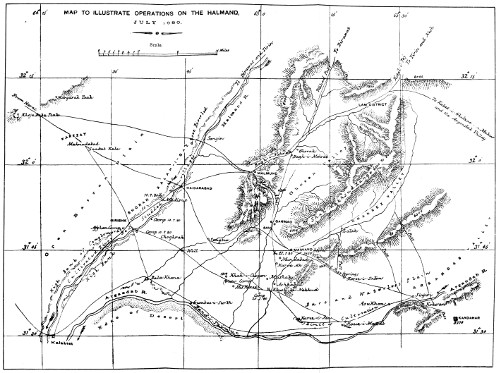
MAP TO ILLUSTRATE OPERATIONS ON THE HALMAND.
JULY 1880
This forecast of a “stiff fight” proved only too true, but instead
of the 6,000 men referred to, our soldiers had to meet a host of
irregulars led by fanatical ghazis.
It devolved upon General Burrows to decide what course would be
most calculated to bar Ayub’s progress, and on July 15th he wisely
called together his commanding officers and held a small council
of war. The day was not wasted in idle discussion, as while
opinions were being exchanged our gunners were horsing and
equipping the captured guns, the teams of which had been used
by the mutineers to aid them in their flight. Many considerations
had to be weighed in council. First, the position of the
enemy the brigade were bound to “stop and disperse if possible.”
Such information as Colonel St. John possessed favoured the
belief that the enemy’s cavalry under the Naib Hafizulla were still
distant 30 miles from the bank of the Helmund, and that the
main body with the guns was several marches in rear of this
advanced party. Ayub’s line of advance was along the main
Herat Road, and he would probably enter the Helmund Valley
near the Khoja Baba Peak, a high point of the range of hills which
run parallel to the course of the river. This peak is 30 miles
in a bee-line from Girishk, and between it and the river is an
open plain, waterless, but otherwise quite easy for a force of all
548arms to cross. There was this plain still between the brigade and
Ayub’s advanced cavalry, so that the two forces were scarcely “in
touch,” more particularly as it was imperatively laid down in
instructions from the Government of India that the Helmund
River was not to be crossed under any circumstances. General
Burrows was to wait for the enemy to appear before him, and his
council of war had to decide at what point so to wait. The Helmund
is usually fordable at only four points: Sangin on the south,
Hyderabad, Girishk and Kalabist (at the junction with the Argandab).
From these fords four roads converge on Candahar: the
northern by way of the Malmund and Maiwand Passes, practicable
for wheeled artillery; the two central passing through Khusk-i-Nakhud,
and the southern route viâ Balakhana and the Bund-i-Taimur.
Of these four routes, that most commonly used, on
account of its directness, water and other supplies, is the road
passing through Khusk-i-Nakhud from Girishk. Hence the value
of Girishk as a strategical point at which to hold in check an
army advancing from the west upon Candahar. But that strategical
value had almost disappeared, as the Helmund, owing to
an exceptionally dry season, was everywhere fordable for men on
foot, thus allowing Ayub to cross it wherever he might choose and
avoid Girishk. Furthermore, when the question of supplies was
entered into, it appeared that the brigade had been quite dependent
upon grain and forage collected by the Wali and stored near the
fort on the eastern bank of the river. What supplies had existed
on the 18th had either been carried off or destroyed by the mutinous
regiments, leaving Girishk practically unable to provide
longer for our troops. The necessity of at once finding supplies
made a move from Girishk unavoidable, and General Burrows and
his officers had determined what direction should be taken. The
opinion of the majority favoured a retirement to Asu Khan,
whence all the roads could be commanded and supports easily
drawn from Candahar. This, of course, took it for granted that
Ayub Khan meant to march direct upon Candahar and not turn
off northwards for Ghazni and Cabul; and the retirement was
advocated also on the ground that the brigade was not strong
enough, unsupported, to meet the enemy in an open fight. There
was a bolder proposal to move northwards to Hyderabad, retaining
549the Helmund as our advanced line, but this found little support.
Finally the middle course of a partial retirement was agreed on, the
brigade to fall back instantly upon Khusk-i-Nakhud. This would
place General Burrows upon the central road to Candahar, and
therefore commanding, to a certain extent, the northern and
southern routes; the force would also be only some 50 miles
from head-quarters, whence it was hoped new orders would be
received, and possibly reinforcements. This was the result of the
little council of war held at Girishk, and it seems to have been
just and reasonable. To have stayed at Girishk was almost
impossible, as supplies were exhausted: to have moved to Hyderabad
would have involved serious risk if Ayub’s army were joined
by the people of the district; while to have fallen so far back as
Asu Khan before a shot had been fired would have seemed excessive
timidity. Khusk-i-Nakhud was an admirable point from
which to watch Ayub’s passage of the Helmund, and thence to
ascertain his strength and probable intentions.
On July 15th a night march was made, and on the morning of
the 16th the brigade encamped on their old ground at Khusk-i-Nakhud.
On the following days the troops moved two miles
nearer to Mis Karez, and took up a position which they occupied
until the morning of the 27th. The stores were placed in a small
walled enclosure, and the baggage laagered up ready for all emergencies.
Spies, furnished by the Wali, were busy during the next
few days in bringing news of Ayub’s movements. Their story
was that the Afghan force was distributed in the dry river-bed
between the Girishk and Hyderabad fords; it made no signs of
moving eastwards, and the opinion began to prevail that Ghazni
and not Candahar was Ayub’s objective. Reconnaissances were
made every day by General Nuttall’s cavalry, but they were not of
the kind to preserve touch with an enemy. Thus a troop or so
visited Garmao, Sangbur, and the Bund-i-Taimar daily, as if for
a constitutional ride, baited their horses, looked around, and
returned. Their movements were so beautifully regular that
every peasant knew at what time to expect them. Ayub’s movements
were never really watched at all, though sufficient cavalry
were with the brigade to have allowed of regular outpost work
being done, instead of a few hours’ visit daily to the same villages.
550It was not until the 21st that Ayub’s cavalry pushed forward from
the Helmund and exchanged shots with our reconnoitring party
at Sangbur. The next day the village was found to be held by
them, and news reached camp that 500 sowars were to seize
Maiwand within twenty-four hours. There were stores of grain
lying in the fields about Maiwand, and fearing they would fall
into Ayub’s hands, General Burrows ordered a squadron of cavalry
to destroy the grain. They had only gone a few miles from
Khusk-i-Nakhud when they were fired upon by a large body of
Afghan cavalry, who were reconnoitring our position with some
boldness. Our cavalry scouts, deceived by the haze, reported that
two regiments of infantry were supporting the hostile cavalry, and
the Horse Artillery and some infantry were sent out from Khusk-i-Nakhud.
It turned out to be a myth; there were no Afghan
infantry, and by this time their cavalry were retiring in perfect
safety. The guns certainly fired a round or two after them, but
our sowars missed their chance of a charge, scared by the report
that infantry were hidden under some low hills. Sangbur contained
no enemy on the 24th, but in the same neighbourhood on
the 25th two of the Scind Horse were killed, the Afghan sowars
being again on the move. So late as the 26th it was believed all
Ayub’s guns were at Hyderabad, and that no movement in the
direction of the Malmund Pass had been made. The Afghan army
was then believed to be about 12,000 strong, counting regulars
alone, while the number of ghazis and irregulars from Zamindawar
was said to be very large. Ayub’s advance could not be
exactly foreshadowed, but from his position at Hyderabad it was
most likely that he would try to reach Maiwand through Sangbur,
as none of his troops were reported to be on the longer route viâ
the Malmund Pass.
The camp at Khusk-i-Nakhud was once more aroused on the
afternoon of the 26th by positive news of a demonstration in the
Maiwand direction, that village having been occupied by 200
irregulars, while Garmao, five miles away, was said to be held in
strength by cavalry. The conclusion arrived at upon this becoming
known was that Ayub meant to occupy Maiwand by a sudden
move without joining battle with our troops, and that not improbably
he would thence try to slip away through the Maiwand Pass
551so as to place himself between the brigade and Candahar.[52] Spies
also led General Burrows and Colonel St. John to believe that the
main body must be still a march in rear of the cavalry at Garmao.[53]
In view of this, it seemed important to seize Maiwand before it
could be occupied in force, more particularly as the brigade had
been for some days drawing its supplies from that village, and
stores of grain still remained in its neighbourhood which would
fall into Ayub’s hands. The distance from Khusk-i-Nakhud to
Maiwand was twelve miles, and a rapid march to the latter place
might anticipate Ayub’s movements and enable the brigade to
clear GarmaoGarmao of the Naib and his advanced cavalry. All this was
of course on the supposition that the main body of the Afghan
army with the thirty odd guns was well in rear of the cavalry—an
unfortunate supposition as it afterwards turned out, but one due
to the wretched information resulting from the cavalry “reconnaissances.”
General Burrows, on the night of the 26th, issued orders for
the whole brigade, baggage and stores included, to march at daybreak
on the following morning. At such short notice the large
quantity of reserve supplies in the walled enclosures could not be
got out in time, and it was not until half-past six that the troops
left Khusk-i-Nakhud. The route taken was along the right
bank of the Khusk-i-Nakhud river-bed, then quite dry. There
was a strip of cultivation near the bank, but beyond, on either
hand, lay arid, stony plains. The brigade halted at eight o’clock
at Mushak, to enable the baggage to close up. This occupied
half an hour, and then the march was continued, the next place
reached being Karezak. Here, for the first time, the unexpected
news was brought by our spies that the whole of Ayub’s force was
on the left front, marching on Maiwand. The cavalry were sent
552out to reconnoitre, and found large bodies of horsemen moving in
the direction indicated; but the haze and mirage prevented our
sowars making any estimate of what force was covered by the
cavalry. This was about 10 o’clock, and yet even with the aid
of telescopes little could be seen of Ayub’s army. Spies reported
that the guns were there; but this news was looked upon by the
General with great mistrust, natives being so given to exaggeration.
General Burrows moved his troops at once rapidly towards
Maiwand, meaning to occupy one of the large walled enclosures
wherein to stow his 3,000 baggage animals and their loads, thus
leaving the brigade freedom of movement in attacking the Afghan
army. It was too late. Before the intervening village of Mundabad
was gained, a large number of white-clothed figures, irregulars
who follow their moollahs' dictation and their ghazis’ lead, were
seen pouring out from Maiwand itself. The enemy’s cavalry
ceased to retire, and along the slopes of the low hills above Garmao
could be distinguished masses of men in some sort of organized
formation. The haze still lay over the country, and it was impossible
to make out in detail the strength of the army thus suddenly
confronting the weak brigade. The ground on which the action
which followed was fought is thus described to me by an officer
present:—“A small stream, rising in the hills immediately north
of Maiwand, formed almost the only drainage line intersecting the
barren waste in our front. It ran successively past the villages of
Mundabad, Karezak, and Mushak, eventually disappearing in a
karez. Between this stream and the dry bed of the Khusk-i-Nakhud
river the ground was level and cultivated, dotted occasionally
with high walled enclosures, but generally open.” General
Burrows had with him, approximately, 1,500 rifles, 550 sabres,
and 12 guns, of which 6 formed the smooth-bore battery, manned
by one officer and 42 men of the 66th Foot. He resolved to force
the fighting; and four guns of the Horse Artillery Battery (E-B)
with the cavalry crossed the dry nullah forming the bed of the
Khusk-i-Nakhud stream, followed by the 66th Foot, 1st Bombay
Grenadiers, and Jacob’s Rifles with the smooth-bore guns. The
baggage crossed in rear under an escort of two companies of infantry,
a squadron of cavalry, and two horse artillery guns. The
nullah having been crossed, the troops advanced about a mile and
553formed up in line in the following order:—66th Foot on extreme
right, guns in the centre, with a wing of Jacob’s Rifles and the
Sappers as escort, Grenadiers on left, a wing of Jacob’s Rifles in
reserve behind the guns. The cavalry were at first on the extreme
left guarding the flank of the Grenadiers.
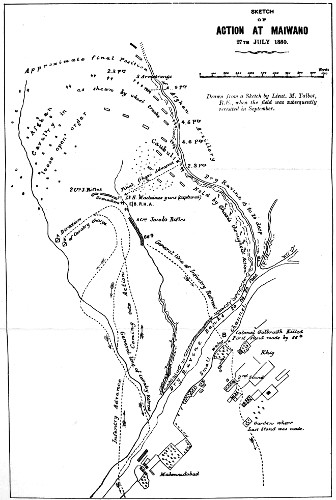
SKETCH
OF
ACTION AT MAIWAND
27th JULY 1880.
Drawn from a Sketch by Lieut. M. Talbot,
R.E. when the field was subsequently
visited in September.
It was not until nearly noon that the action began. Lieutenant
Maclaine with two horse artillery guns and a small cavalry escort
galloped out on the extreme left, and got his guns into action at a
range of 1,800 yards, firing shrapnel at the Afghan cavalry.
General Burrows disapproved of his boldness, and ordered the
guns to retire, an order which Lieutenant Maclaine was very loth
to obey. However, the guns were withdrawn, and by the time
they had resumed their place in the line the enemy’s strength had
begun to be developed. Large numbers of irregulars, led by the
usual ghazis, were seen swarming over the low hills, and they
presently moved down upon the 66th, evidently meaning to turn the
right flank. To check this, General Burrows ordered his right to
be thrown back on the front extended, Ayub’s cavalry being on
the move to the left as if to carry out a flanking movement in that
direction.[54] Accordingly two companies of Jacob’s Rifles were
sent to the extreme left, while the remaining companies of that
regiment and detachment of the Bombay Sappers and Miners
filled up the gap between the 66th on the right, and the guns in
the centre. Two guns were placed in position to support
the 66th on the right, the remaining ten between the
Grenadiers and the main body of Jacob’s Rifles. Every
rifle was thus in the line of attack, it not being possible to
form any reserve worthy of the name for such a small force.
The cavalry (3rd Scind Horse and 3rd Bombay Light Cavalry),
under General Nuttall, formed up in rear of the left centre of the
line, where they remained during the action. Our guns began
shelling the enemy, whose artillery did not reply for quite half
an hour, confirming the idea that Ayub’s guns were far in rear.
By half-past twelve, however, this delusion was cleared away, for
some five batteries opened upon the brigade, and their shells fell
554with fair accuracy. The effect of our own artillery fire could not
be followed, as the haze continued. Under cover of their thirty or
more guns the irregulars advanced to within 600 or 700 yards of
the 66th; but the Martini fire from the latter swept them down
wherever they appeared; and so cowed were they that, planting
their standards, they sought cover in a dry ravine, firing upon our
men without doing much damage. Our infantry were lying down
under such cover as the ground afforded, and two of the smoothbore
guns were sent to the left to shell the Afghan cavalry. Then
came the fatal mistake in the action: instead of following the
usual tactics which our generals have found so successful all
through the war—taking the initiative and attacking with his
infantry—General Burrows entered into an artillery duel, which
lasted for two hours. The brigade had twelve guns (six of which
were inferior smooth-bores, worked by volunteers from the horse
artillery, and infantry men trained during the halt at Khusk-i-Nakhud)
the Afghans had nearly three times that number, and
their gunners were unusually expert. “They soon got our
range,” says an officer present, “and shot and shell came crashing
into us.” Shrapnel, round-shot, and afterwards grape, were
freely used by the enemy; and while our infantry were fairly safe
at first, the horses of the cavalry and the gun-teams suffered
severely. The latter had to be renewed constantly; and it was
evident that in a trial of strength with artillery the brigade was
greatly over-matched. Little did our men know that the Herati
regiments suffered so from their shell-fire that twice they retired,
and were quite ready to have fled at the first direct attack. The
enemy’s artillery fire was so well sustained that casualties soon
began to be reported all along the line. Harris, of the staff, and
Blackwood, commanding E-B Battery, were among the first hit;
but Blackwood, after having his wound dressed (he was hit in the
thigh), returned to his battery—a rare example of true bravery and
endurance. The want of water told heavily upon all our men, and
the slackness resulting therefrom was only too plain—men leaving
the ranks to get water from the nullah in rear or from the water-carriers.
Our three regiments were still out of range of any
musketry fire, except stray shots from irregulars; but the artillery
fire had a demoralizing effect upon the sepoys. Jacob’s Rifles are
555said to have had nearly 100 men who had never fired ball-cartridge,
so that they could not be looked upon at all as trained
soldiers whose fire could be relied upon.
At about two o’clock the smooth-bore guns were reported as
running short of ammunition. Sixty rounds per gun had been
made up since their capture, and with these they went into action.
There were no reserves to fall back upon. Captain Slade had
taken charge of these guns, but returned to his own battery when
they ceased to fire. There was nothing for it but to order the
four six-pounders and the two howitzers forming the battery to retire
and this movement was at once carried out. No sooner did
the enemy notice that half our guns were out of action than they
advanced along their whole line. Their batteries were brought
forward in the boldest manner, and some of their guns actually
came into action, on the right, from behind a depression in the
ground only 800 yards from our infantry. Two or three thousand
cavalry manœuvred on the left flank of the brigade, trying to
get well in rear; while on the right a large number of mounted men
and irregulars on foot, who had made a wide detour, got into the
villages, and were firing upon the baggage escort. The 66th had
still the ghazi-led mob in front of them in check, steady volleys
keeping the ground clear. At this time the casualties all round
must have been considerably over 100, while many horses had
been killed.
At about half-past two the two companies of Jacob’s Rifles on
the extreme left began to waver. Their two officers had been
killed, and their two native officers, who had kept them together
for some time, had also fallen; there were none of the enemy’s
infantry near them, but the artillery fire had demoralized them;
and the last straw which broke the back of their courage was the
retirement of the smooth-bores out of action. They thought
such a move could only mean that all was over, and they broke
their ranks and fell back in utter confusion, breaking into the
ranks of the Grenadiers, who had up to that time been steady.
Their bad example was quickly imitated, and the Grenadiers likewise
gave way. The remaining companies of Jacob’s Rifles
shared the panic, and with a quickness that carried consternation
into the heart of every European officer, all the native infantry
556were surging upon the 66th. The Grenadiers fought bravely
and tried to form square but could only get into a V shape with
the apex towards the enemy: in the mêlée they were cut down
literally “in hundreds.” The Sapper detachment under Lieutenant
Henn, with the guns, stood bravely to their post, but so
small a party could not hope to save the guns without immediate
help. Lieutenant Henn was killed after behaving most gallantly.
The enemy saw their advantage, and a rush of irregulars led by
ghazis was made from the right front. The guns fired canister
into the mass; but it was useless, and Slade limbered up and
retired. Maclaine remained with two guns firing, until the ghazis
were actually at the muzzles, and these two guns had to be left
behind. The 66th were broken by the rush of sepoys upon them.
The confusion was hopeless, many of the sepoys being so cowed
that they allowed the Afghans to pull them backwards from among
their comrades and cut them down. No attempt to use the
bayonet was made by the recruits among Jacob’s Rifles, who
scarcely seemed to know that they carried arms wherewith to defend
themselves. A cavalry charge was ordered; but the men
were out of hand, and though two squadrons rode out, they never
really charged. One of their officers had his horse shot, and the
sowars would not go on, but veered round and came back to add
to the disorganization of the infantry.[55] The 66th and the
Grenadiers rallied twice in walled enclosures and sold their lives
dearly, but they were outnumbered, and could not help to check the
Afghan advance. Colonel Galbraith was killed outside the first
557enclosure, and the 66th lost nine other officers killed. Major
Blackwood, commanding E-B Battery, was also shot down, one of
his subalterns (Lieutenant Osborne) having been killed in the
rush. By three o’clock the brigade had been routed, and the
enemy were in hot pursuit. Fortunately that pursuit lasted only
two or three miles, the enemy returning to Maiwand to loot
General Burrows’ camp.
The following extract from a letter from an officer who was
engaged in the action may well close this sad record:—
“When I realized that we were defeated, and had to retreat
some 50 miles to Candahar, my heart sank within me, and never
shall I forget the agonies of that fearful night march without
water, hundreds of poor wretches lying strewn about the road
calling aloud for a drop of water. It was agonizing, but one was
obliged to steel his heart, as nothing could be done, we all being
in the same box. The order to march on Maiwand from Khusk-i-Nakhud
was only given at 10 P.M., on the 26th July, and the
march commenced at 6.30 A.M. (on the 27th). We had no idea that
Ayub’s army was at Maiwand till we had marched half-way there,
and then we only half believed it: however, after going a few
miles further we sighted the enemy moving towards Maiwand.
Our troops seemed to consider that they would have it all their
own way, and advanced very boldly; but the demoralizing effect
of thirty odd guns and the being outnumbered, obliged them to
retreat, and the retreat became a rout. From prisoners lately
taken we hear that we inflicted a fearful loss on the enemy, and
that if we could only have brought a fresh regiment we could
have won the day. Our heaviest losses were during the retreat,
as all the villagers on the line of route turned against us. I was
among the last to leave the field, and walked half the way, having
given up my pony to a wounded soldier. I was not fired on by
the villagers till within six miles of Candahar, when I, with two
sepoys and the wounded soldier, had to ascend a hill, and take
refuge behind a rock, where we remained a good while, till the
country was cleared by the cavalry under General Brooke, who had
come out from Candahar to meet us. I then continued my
journey, and when arriving at the village near the cantonments
558some 10 European and 15 native soldiers had joined me. The
native soldiers were utterly demoralized,[56] and I could not get
them to obey me. Some 100 or 150 Afghans were congregated
on a little hillock commanding the road to Candahar, and seeing
the hesitation of my party they streamed down the hill, yelling,
and I was obliged to fall back and take up a position on another
hillock. Then the native soldiers came to me and expressed
their opinion that we ought to run for it. However, I abused
them, and made them lie down and point their guns towards the
enemy, who at once retreated to their former position. I felt
perfect confidence in the European portion of my party, and if I
could have felt the same in the native I would not have minded
an attack from 150 half-armed Afghans. When General Brooke
returned with the rear-guard of the Girishk column, he shelled
the hills where the Afghans were collected, and we marched
peaceably into cantonments.”
I have not gone into the details of the movements of the Cabul-Candahar
force after the Battle of Candahar, as there was no
further opposition, and the military programme carried out was
only of local importance. The brigades were marched back
to India as quickly as possible, with the exception of the 9th
Lancers and 6-8 R.A., which were left at Candahar. The following
letter, written in Candahar, will throw some light on the strategy
of the action on September 1st:—
CANDAHAR, 20th September.
There is but one opinion here as to the unsoundness of the
criticisms upon General Roberts’s action of the 1st; it is that the
critics have jumped to conclusions on imperfect reports, having
taken the first meagre telegrams as their guide. By an
incessant study of small-scale maps they gained a superficial
559knowledge of the Argandab Valley, and were fully convinced that
the proper mode of directing the attack would have been to throw
an intercepting force 30 or 40 miles in rear of Mazra, and then
to have attacked Ayub from Candahar—no doubt by way of the
Pir Paimal village. They point their arguments by adding
that our cavalry pursuit was really inoperative, as only 400 of
the fugitives were killed, while the great mass escaped. Admitted
that after we had rolled them back from Pir Paimal the great
majority got off scot-free, this by no means proves that a weak
brigade could have cut off their retreat; for it seems to be forgotten
that not one, but many, roads were open to them, while the
mountainous nature of the country on the higher reaches of the
Argandab was all in favour of trained hill-men such as Afghans
always are. Their cavalry and many thousands of footmen
made straight for the Khakrez Valley, knowing well that once
the range of hills, eight miles west and north-west of the
Argandab, was reached, they were quite safe. There was no
necessity at all for their retirement northwards up the Argandab—or
rather north-eastwards—and it is quite an open question
if any brigade we could have spared would have even seen
many of the fugitives. General Roberts’s first and greatest duty
was to induce Ayub Khan to give him battle, and not to cause
a scare in his camp by premature strategical movements, 30 or
40 miles up the Argandab Valley. It may not be known, also,
that when the infantry was encamped near Shar-i-Safa, one march
from Robat, on August 27th the news from Candahar led us
to believe that Ayub might possibly forsake Mazra and try to
escape in the Ghazni direction by way of the Argandab stream.
General Roberts at once recognized the necessity of barring
any movement in force in this direction, and a column of about
2,000 men was told off to march by way of Bori, and Dala, and
block the road up the Argandab. But when heliographic communication
with Candahar was opened up later in the day, and
Colonel St. John’s reports showed that Ayub was busy strengthening
his position at Mazra, the order given for the column to move
out was at once countermanded. It was known that the Afghan
force was mainly composed of men from Zamindawar, Candahar,
and Herat—the Cabuli element being very small, and the Kizilbashes
560and Kohistanis being already in treaty with Colonel St.
John to desert at short notice. The main body of real fighting
men, therefore, would seek safety in flight, after defeat, not
northwards towards Khelat-i-Ghilzai, but to the west and north-west,
where the hills offered them shelter until they could regain
their homes. This line of flight was really taken; but as our
cavalry brigade under General Hugh Gough could not reach the
Kokaran Ford until Gundigan and the orchards about had been
cleared by General Baker’s Infantry Brigade, Ayub Khan and
his cavalry escort—leaving Mazra, it should be remembered, at
11.30 A.M.—had easily covered the seven or eight miles of ground
between the river and the slopes of the hills bounding the
Khakrez Valley on the south. Besides, the tactics of the fugitives
were such as to neutralize any pursuit or the action of any intercepting
force: hundreds took refuge in the villages, buried their
arms, or hid them securely away, and came out to greet our troops
in the guise of harmless peasants. If these had been slaughtered
in cold blood the cavalry would have returned with the report
that not 300 or 400, but 1,300 or 1,400 of the enemy had been
killed. I do not make this statement on my own unsupported
authority, but on the direct testimony of cavalry officers engaged
in the pursuit. Thus the 9th Lancers gave chase to a large
number of men evidently in full flight. On coming up with
them, the Lancers found these fugitives without arms, and though
there could be no reasonable doubt that they had hidden their
weapons some little time before, Lieutenant Colonel Bushman
ordered his men to spare their lives. The Lancers rode among
them, and if any man had been detected with a knife or pistol he
would probably have paid the forfeit of his life. In other instances
small bands were hunted into villages, and when the
cavalry rode up men appeared holding little children in their arms,
and prayed for mercy. What was to be done to an enemy
resorting to such manœuvres? Our cavalry could not take
prisoners as they had to continue the pursuit: and these units
of the Mazra army were shown that mercy which they refused
to our men retreating from Maiwand!
Again, any intercepting force thrown into the Argandab Valley
could not hope to co-operate with the force attacking from Candahar;
561they would have been a detached corps of observation,
merely watching for Afghans fleeing into their arms. First of all
they must have been sent completely away from our main body
either at Shar-i-Safa or Robat in order to cross the hills by the
only available kotal near Dala (between 30 and 40 miles above the
Baba Wali Kotal); for the Murcha Kotal was held in force by
Ayub. They could not approach to within 20 miles of Mazra, for
a further advance would have been to court an attack by overwhelming
numbers, while General Roberts was marching from
Robat to Candahar. The safety of 2,000 men would have been
endangered, while the only object they could have gained would
have been the interception of a few hundred of Cabulis, who
would probably have taken to the precipitous hills and escaped in
the night. The Argandab Valley narrows greatly, 30 or 40 miles
above Mazra, and cavalry would have been worse than useless
with the intercepting (?) column. It cannot be urged with too
much emphasis, that Ayub Khan’s line of retreat, if his army
were defeated, was in the Khakrez direction, for his men, in their
slack disciplinediscipline, would make for their own villages and not rush
off at a tangent towards Khelat-i-Ghilzai. All Afghan “armies,”
so-called, and Ayub’s was perhaps more worthy of respect than
any we have yet met, have a power of dispersion which is unrivalled.
Organized pursuit against them is almost impossible:
unless every mountain path and torrent bed within 50 miles could
be searched at once.
General Roberts has had more experience in Afghan warfare
than any other of our commanders; and his tactics were based on
sounder principles than those advocated by critics unversed
altogether even in the details of past actions. To say Pir Paimal
could have been carried with fewer troops than those engaged is
to beg the whole question. The action of Ahmed Khel proved
that when fanaticism is at red-heat, 5,000 or 6,000 men may
charge right into our ranks. Would it have been wise to have
dispensed with General Macgregor’s brigade (some 2,000 strong)
as a reserve in case of such another charge down from the Baba
Wali Kotal upon General Macpherson’s right flank? And yet
General Macgregor had about the number of men which would
have been absorbed if the much-talked of “intercepting column”
562had been waiting, 30 or 40 miles up the Argandab Valley,
ignorant of what was happening at Candahar. It may be urged
that there were 4,000 men of the Candahar garrison at General
Roberts’s disposal; but it would have been unwise to ask much of
a garrison still suffering from the shock of the terrible disaster at
Maiwand, and only half-realizing that they were no longer besieged
within the walls of Candahar. That I am not exaggerating
the depression prevailing in the Bombay Division, will be clear
from the fact that General Primrose, on the evening of the 31st
August, personally stopped a string of mules which were leaving
the citadel with bread and barley for the Bengal troops. Our
reconnaissance was returning, and there was certainly heavy rifle-fire
beyond Karez hill, while the enemy’s guns on Baba Wali
Kotal were also adding to the din. Our troops were holding
Picquet Hill, and our camp was within 2,500 yards of the Eedgah
Gate, out of which an officer in the Commissariat Department was
conducting the little convoy. Between that convoy and “danger”
were some 10,000 picked men, nearly all British, Sikhs, and
Ghoorkas; but the “risk” of allowing the bread and grain to be
carried a mile and a half was pronounced “too great” by General
Primrose himself. The Commissariat officer, knowing food was
needed in camp, managed to gain permission to take on the mules
laden with bread, and he saw nothing to disturb him on the road.
The ground between the north-western bastion and the nearest
wall of cantonments (1,200 yards away) is as bare as the Sahara,
and it was not likely the enemy’s cavalry picquet below the Baba
Wali Kotal would have charged out a couple of miles to capture
the mules, even if they had seen them. The story is told not to
detract from General Primrose’s judgment and ability, but to
illustrate the unhealthy feeling and want of tone in the garrison,
in spite of the efforts of brave and resolute men to wipe out the
recollection of Maiwand and Deh-i-Khwaja from the minds of
their fellows.
I have tried to write without undue dogmatism: but I may have
been betrayed into laying too great a stress upon “probabilities,”
viz., that the enemy’s line of retreat would be towards Khakrez
and not up the narrow Argandab Valley, and that Ayub’s irregulars
might have furnished a band of desperate men led by ghazis to
563make a counter-attack from Baba Wali Kotal. I have carefully
avoided any reference to the entrenched camp of Ayub at Mazra,
which our spies assured us existed, and which General Macgregor’s
Brigade, fresh and untouched by fire, were intended to storm if
Generals Macpherson and Baker had been checked in their progress.
I think these probabilities were justified fully so far as
the retreat is concerned, while the knowledge that we had all our
forces concentrated behind Karez and Picquet Hills may have prevented
the masses of men about the Baba Wali Kotal (in the earlier
part of the day) from making a counter-attack. If there is one
part which criticism may fairly seize upon, and which our own
Brigadiers would be the first to acknowledge, it is the want of
cavalry with General Ross when the 72nd and 2nd Sikhs on the
one hand, and the 92nd and 2nd Ghoorkas on the other, rolled
back the enemy at the turning-point of the Pir Paimal spur. The
basin leading towards Mazra and the open ground due west
towards the Argandab was covered with men in full flight, and 500
sabres could have swept into them with terrific effect. It is, I
believe, an axiom that no division shall now go into action without
one regiment of cavalry attached to it, but all through the war we
have brigaded all our cavalry, and on several occasions the want of
500 troops to follow up rapidly an infantry attack has been severely
felt. Witness in particular the first action of Charasia, when
the Afghans fled towards Indikee; and the storming of the ridge
leading up to the Takht-i-Shah Peak when the open ground beyond
Beni Hissar was black with fugitives. General Hugh Gough and
his splendid cavalry brigade of 1,600 sabres and lances did all
that men could do to gain the Kokaran Ford, and cut up such
bodies of men as they could overtake; but if one regiment had
been spared from that brigade to have followed up our infantry
advance there would have been rare work for the troops about Pir
Paimal. The answer, of course, to this is that the network of
orchards and walled enclosures, with intersecting channels, seemed
to shut out cavalry from participating in that part of the action;
there was no one as usual to tell us of the grand open ground
when the ridge was turned.
APPENDIX.
565
The following information is derived from trustworthy sources, and may be of some
interest:—
Table of Heights above mean Sea-level.
| |
Feet. |
| Cabul Plain |
5,840 |
| Luttabund Kotal |
7,400 |
| Kata Sung |
5,000 |
| Jugdulluck Kotal |
5,200 |
| Gundamak |
4,500 |
| Futtehabad |
3,095 |
| Jellalabad |
1,950 |
Table of Marches from Jumrood to Cabul.
The corrected road distances are:—
| |
Miles. |
| Jumrood to Ali Musjid |
8·30 |
| Ali Musjid to Lundi Kotal |
10·50 |
| Lundi Kotal to Dakka |
12·00 |
| Dakka to Basaule |
11·10 |
| Basaule to Barikab |
9·98 |
| Barikab to Jellalabad |
17·76 |
| Jellalabad to Rosabad |
12·88 |
| Rosabad to Sufed Sang |
16·12 |
| Sufed Sang to Pezwan Kotal |
12·75 |
| Pezwan Kotal to Jugdulluck Fort |
10·50 |
| Jugdulluck Fort to Sei Baba |
10·00 |
| Sei Baba to Luttabund |
9·50 |
| Luttabund to Butkhak |
9·50 |
| Butkhak to Bala Hissar |
9·20 |
| |
——— |
| Total |
160·09 |
Transport for the Indian Army.
The transport arrangements have always been the great stumbling-block when war
has been declared in India, and in the hope that something will be done to form a
permanent establishment, I republish the following letter, written in Sherpur on June
15th, 1880:—
56615th June.
Lieutenant-Colonel Low, of the 13th Bengal Lancers, Chief Director of Transport
with the Cabul Force, has suggested a plan for establishing a permanent transport service,
the details of which I will try to explain. He advocates a system—the expense of
which should be moderate in time of peace, and not extravagant in time of war—which
should admit of rapid expansion when war breaks out, and, most important of all, which
should allow of the animals being employed for ordinary purposes of commerce in peace
time, yet always be ready to fall into their places when the State requires them. Colonel
Low takes an army of 36,000 of all arms with fifteen days’ food as the unit to be
treated, this being about the strength of a force which is likely to be mobilized in case
of war breaking out, and he believes that under his system transport for such an army
could be raised, at any time, in a fortnight.
Taking the mule as the only transport animal in the “first line,” he calculates that
70,000 mules (of which number 1,028 would be spare animals) would be required for
the 36,000 men, the estimate being as follows:—
| |
|
Mules. |
| 7,000 |
British Infantry |
15,435 |
| 1,500 |
” Cavalry |
6,036 |
| 2,800 |
Artillery and Engineers |
11,267 |
| 4,000 |
Native Cavalry |
9,900 |
| 21,000 |
” Infantry |
26,334 |
| |
|
—————— |
| |
Total |
68,972 |
| |
Spare animals |
1,028 |
| |
|
—————— |
| |
Grand total |
70,000 |
This calculation is made on the Cabul scale of baggage, and each animal would have to
carry two maunds only; allowance is made for forage and grain also being carried.
The 70,000 mules required would be located in the three Presidencies, in the following
proportion: Bengal, 35,000; Bombay and Madras, 17,500 each. Regarding Northern
India, it is calculated that the N.-W. Provinces would furnish 9,750, Oudh 750 and
Rohilkund 2,000. The Punjab would be responsible for 27,500. The system of maintenance
would be the division of all the country into a certain number of districts; as,
for instance, the N.-W. Provinces into thirteen, and the Punjab into twenty, each of
which would have a fixed number of mules ready for the State when occasion might
arise. Colonel Low’s explanation of the organization he would create is so clear, that I
will give his own words. He says:—“The districts would all have been numbered off
in the transport books, and I will suppose I am visiting the Rawalpindi or No. 20 district.
The first village I enter, might have, perhaps, fifteen mules, nine of which were
over three and under fourteen years old. To the owners of these animals I would say:
‘Government will give you, through me, one rupee per month for each of these animals.
Government does not want them now and may never want them at all. Keep them,
therefore, and use them as you have been accustomed to. All that Government asks is
that you will agree to give the use of the mules in time of war. You must bring them
with their saddles, &c., arranging among yourselves that at least one man shall accompany
every three mules. On Government calling for the mules, you will receive war
rates of pay from that day till the animals are discharged, when they will revert to
peace rates of one rupee per month. This present agreement is to last twelve months,
after which notice of three months on either side may end the bargain: the one proviso
567being that when Government has called for the service of the mules, the notice cannot
be given until the mules are discharged. Meanwhile the mules must be branded with
the district mark ‘R 20;’ and here is Rs. 36, the firstfirst quarter’s payment in advance.’”
Colonel Low states that from his personal knowledge, and from opinions expressed by
native gentlemen, he is convinced the people would eagerly accept such a system, as it is
one which they could easily understand, and is quite in keeping with their customs and
traditions.
Then comes the all-important question of cost. Regarding the permanent establishment,
Colonel Low suggests that a Director, who would have control all over India,
should be appointed with staff pay of Rs. 1,000 per month. His subordinates in Bengal
would be two superintendents (Rs. 500 each), and four assistants (Rs. 150 to 200);
in Bombay and Madras just half this establishment. There would also be a number of
native officers, and non-commissioned officers, and five sowars would be told off to each
district. The staff in Bengal would cost Rs. 9,210 per month (in peace time), in Bombaya
and Madras Rs. 4,030 each, or a total of Rs. 17,270 for establishment. The
premium to owners of Re. 1 per animal would be Rs. 70,000, making a grand total of
Rs. 87,270. When war broke out, the staff would be available for instant service at
their normal pay, while the owner of each animal would receive his Rs. 12 per month,
in all Rs. 8,40,000, or a total expenditure on service of Rs. 8,57,270. To put the
matter in simpler form, Colonel Low remarks:—“If we suppose a period of four years
in which there was war for four months, the cost would be:—
| |
Rs. |
| 44 months’ peace, at Rs. 87,270 per mensem |
37,29,880 |
| 4 months’ war, at Rs. 8,57,270 per mensem |
33,29,080 |
| |
—————— |
| Total |
70,58,960 |
This is, in round numbers, £700,000;” and Colonel Low significantly adds:—“This
can no doubt be compared with transport expenses in the last campaign”—an allusion,
perhaps, to the enormous compensation we had to pay to camel-owners for animals lost
or killed. The second line of transport in a campaign, Colonel Low considers, should be
wheeled carriages, a certain number of carts being always kept ready at stations near
the bases of supply, such as Multan, Rawalpindi, &c. With this scheme, and no doubt
several others before them, it will be strange if the Government does not once for all
make up its mind to an expenditure in peace time upon transport service: it may seem,
for the time being, money wasted, but any one seeing the accounts of the present war
cannot help being convinced that a permanent transport would have saved the country
many lakhs of rupees.
Woodfall and Kinder, Printers, Milford Lane, Strand, London, W.C.
NOTES ON ILLUSTRATION AT p. 512
| 1st Brigade 1 |
3rd Brigade 4 |
| 6 S.R.A. |
11-9 R.A. |
| 92nd Highlanders |
2-60 Rifles |
| 2nd Goorkhas |
4th Goorkhas |
| 23rd Pioneers |
15th Sikhs |
| 24th P.N.I. |
25th P.N.I. |
| |
| 2nd Brigade 2 |
Cavalry Brigade |
| No. 2 M.B. |
9th Lancers |
| 72nd Highlanders |
3rd B.C. |
| 5th Goorkhas |
3rd R.C. |
| 2nd Sikhs |
C.I.H. |
| 3rd Sikhs |
|
| 2nd Biluchi |
|
| |
| Bombay Troop 3 |
Afghan Positions |
| 6 Co. 7th Fusiliers |
Gundimisila |
| 4 Co. 66th Foot |
Gundigan |
| 6 Co. 28th N.I. |
Walled Gardens between G and G |
| 4th N.I. |
Pir Paimal and Spur of Hill |
| 19th N.I. |
Kharoti and Hill |
| 2 Co. 1st N.I. |
|
| Detachment S. and M. |
|
| E.B., R.H.A. |
|
| C-2 R.A. |
|
| 5-11 R.A. |
|
| 3rd I. Cavalry |
|
| 3rd Sinde Horse |
(Sd.) E.P. Leach, Captain & |
| Poona Horse |
Brevet-Major. |
NOTES ON ILLUSTRATION AT p. 532
| Guns. |
|
Position. |
|
Officers Comdg. Face. |
| 9-Pr. M.L.H. Gun C-2, R.A. |
N. E. Bastion |
 |
Major Greig R.A. |
| 9-Pr. ditto ditto |
Durrance Gate |
| 9-Pr. ditto ditto |
Cabul Gate |
| 40-Pr. B.L.R. Gun |
S. E. Bastion |
|
Capt. Hornsby Comg. 5-11 R.A. |
| 6-Pr. S.B. Gun |
Shikapoor Gate |
| 40-Pr. B.L.R. Gun |
|
S. W. Bastion |
| 9-Pr. M.L.R. Gun E-B., R.H.A. |
|
|
|
| 9-Pr. ditto ditto |
Herat Gate |
|
Capt. Slade R.A. |
| 9-Pr. ditto C-2 R.A. |
|
Topkhana Gate |
| 9-40-Pr. B.L.R. Gun |
|
N.W. Bastion |
| 9-Pr. M.L.R. Gun E-B., R.H.A. |
|
|
| 9-Pr. ditto ditto |
Eedgah Gate |
| 40-Pr. B.L.R. Gun |
S. W. Bastion of Citadel. |
Eedgah Gate Front, 400 men
under the command of Brigadier-General
Burrows, Lieutenant-Colonel
Nimmo, 28th N.I., commanding
Eedgah Gate. After
16th August, Colonel Edwardes,
2nd N.I., took command of Front
under Brigadier-General Burrows,
with Major Singleton, 28th
N.I. commanding the Gate.
Length of Front 1,178 yards.
Cabul Gate Front, 500 men
under Brigadier-General Nuttall,
with Colonel Bannerman, 4th
N.I., commanding the Cabul
Gate, and Colonel Mainwaring,
30th N.I., commanding the Durrance
Gate.
Length of Front 1,700 yards.
Herat Gate Front, 500 men
under command of Colonel Edwardes,
2nd N.I., with Major
Marshall, 4th N.I., commanding
the Herat Gate, and Lieutenant-Colonel
Griffith, 1st N.I., commanding
the Topkhana Gate.
After 16th August, Brigadier-General
Daubeny commanded
this Front and Major Ready,
66th, the Gate.
Length of Front 1,987 yards.
Shikarpoor Gate Front, 400
men under Brigadier-General
Brooke, with Major Trench, 19th
N.I., in command of Shikapoor
Gate. After 16th August, Colonel
Heathcote, 19th N.I. commanded
this front, and Major Marshall,
4th N.I., the Gate.
Length of Front 1,300 yards.
The cover image has been prepared specifically for this project, and
is hereby placed in the public domain.
Compound words (e.g., ‘loophole’) may be hyphenated inconsistently. When
the hyphen appears on a line or page break, the hyphen is retained or
removed based on the preponderance of other instances.
Variant spellings of place names or tribal names are retained if there
are more than one instance of each.
The abbreviation ‘lbs.’ appears multiple times with and without a preceding
space, as ‘300 lbs.’ or ‘300lbs’, and is given here as printed.
Errors deemed most likely to be the printer’s have been corrected, and
are noted here. The references are to the page and line in the original.
The following issues should be noted, along with the resolutions.
| 29.32 |
the village of Charasia about eleven o[’]clock |
Inserted. |
| 46.32 |
General Massy ordered his v[e/i]dettes |
Replaced. |
| 59.36 |
against the wooden framewor[d/k] of the pavilion |
Replaced. |
| 77.35 |
the large earthe[r]n jars and dubbers |
Removed. |
| 79.8 |
It was by [no ]mean safe walking |
Added. |
| 90.8 |
to submit to ou[t]side interference |
Inserted. |
| 112.10 |
a guide to some troops marching up the Bala Hissar [B/R]idge |
Replaced. |
| 112.26 |
has sunk very low of [l]ate |
Added. |
| 113.28 |
of w[h]ich 9½ will appear in the accounts |
Inserted. |
| 114.4 |
Arrival of Stores from the Shutargard[e/a]n |
Replaced. |
| 125.7 |
upon the safety of the Shutargard[e/a]n |
Replaced. |
| 152.18 |
and v[a/o]lleys> from the Martinis and Sniders |
Replaced. |
| 156.14 |
and his inter[w/v]iew with Cavagnari |
Replaced. |
| 171.2 |
can scar[c]ely admit of a doubt |
Inserted. |
| 186.35 |
on the Ghazni [B/R]oad. |
Replaced. |
| 257.32 |
To[-]night we are resting on our arms |
Restored. |
| 268.26 |
We had not suffic[i]ent ammunition |
Inserted. |
| 288.16 |
to live on [peacable] terms with the people |
sic |
| 291.13 |
Ataullah Khan, Anitoollah Khan[,] Habibulla Khan (the Mustaufi) |
Added. |
| 324.14 |
the gro[o]ves were filled with lead |
Inserted. |
| 337.7 |
and the tough shaft [as it] had been of tinder |
as if? as though? |
| 354.9 |
Daoud Shah accompa[in/ni]ed Yakub Khan to Cabul |
Inverted. |
| 362.20 |
an important mission to fu[l]fil in Central Asian politics |
Inserted. |
| 363.25 |
vi[a/â] Maizena and Peshbolak |
Replaced. |
| 379.30 |
with the advanced party [a/o]f the Candahar column |
Replaced. |
| 400.9 |
without fear of an [e/é]meute |
Replaced. |
| 424.19 |
has been gained in a short intercou[r]se |
Inserted. |
| 427.11 |
The Battle[ ]field of Ahmed Khel |
Removed. |
| 441.2 |
Sirdars and servants mingled in famil[i]ar groups |
Inserted. |
| 454.5 |
It now rema[i]ns for Abdur Rahman to show |
Inserted. |
| 471.3 |
That would indeed be a disappointme[u/n]t too grievous to be borne. |
Inverted. |
| 499.7 |
When, howev[ev]er, we reached Khel-i-Akhund |
Removed. |
| 503.20 |
Sir Frederick Robert[s]’s Plan of Attack |
Inserted. |
| 521.25 |
and to examine th[o/e] contents of Ayub’s tents |
Replaced. |
| 538.36 |
The contin[u]ous firing showed the village |
Inserted. |
| 545.7 |
Reti[o/r]ement of the Brigade upon Khusk[l]-i-Nakhud |
Replaced
Removed. |
| 551.11 |
to clear G[e/a]rmao of the Naib and his advanced cavalry |
Replaced. |
| 561.18 |
in their slack disc[lip/ipl]ine |
Transposed. |
| 567.3 |
the [fi]rst> quarter’s payment |
Restored. |