Machines and alighting grounds—The cost of
flying—An imaginary tour—The sensations of a passenger—How laws
will be framed to govern flight—Aerial smugglers and spies.
The joys of aerial touring are such that it is
difficult to do them justice. Free from the earth and its obstructions,
free from police traps and dust, and the noise and traffic
of the roads, the aerial tourist wings his way—serenely
and with ease, a panorama spread below and upon either
hand, and with a wine-like freshness in the air. Who
would be chained to a road, winding here and there, when
he might pass high above the earth upon the aerial highway?
The day is already dawning when, housing his aircraft
say at Hendon as a convenient starting-point, the
most modern of travellers will tour regularly by air, using
a plane as he would a motor-car, and throwing himself
with zest into the new amusement that is offered him.
Prejudices of course die hard; there are
still the occasional accidents which are reported in the daily
press; still there is the lurking notion that because a
flying craft passes through the air and not upon the
ground, it can never be safe. But facts must speak, and
are speaking; and daily, and almost hourly, this mountain
of prejudice is being moved. For every mishap that
happens men are now flying many thousands of miles,
and flying not only in safety, but with comfort and
pleasure. Nor do craft any longer collapse while in the
air, nor motors fail constantly; nor does the wind hold
those terrors that it did at first. Touring aircraft that are
both scientific and airworthy may be obtained, and as a
practical means of transit from point to point—speedier and
more pleasant than the motor-car—the aeroplane now finds
frequent use. The pleasure use of planes is encouraged, also, by
their growing comfort. Pilots and passengers sat formerly upon bare,
open seats exposed to the rush of air: but a modern touring
craft has a neatly enclosed body, like that of a motor-car
with padded seats, and screens to protect its occupants
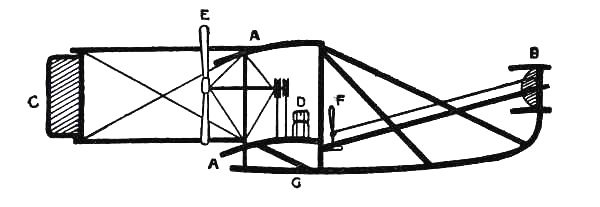
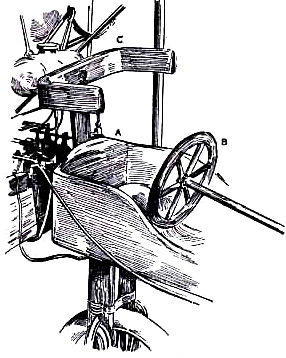
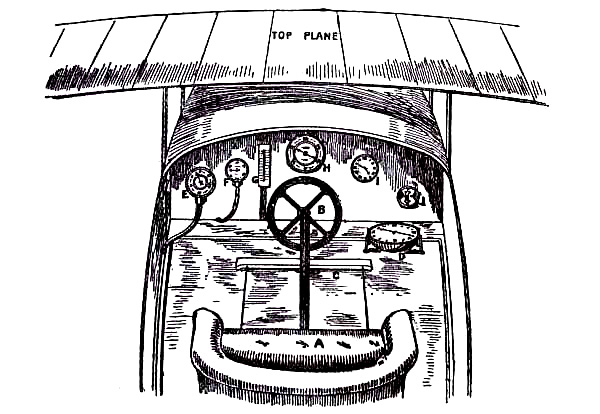
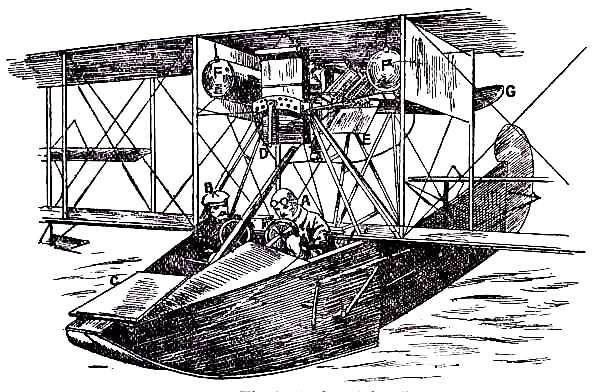
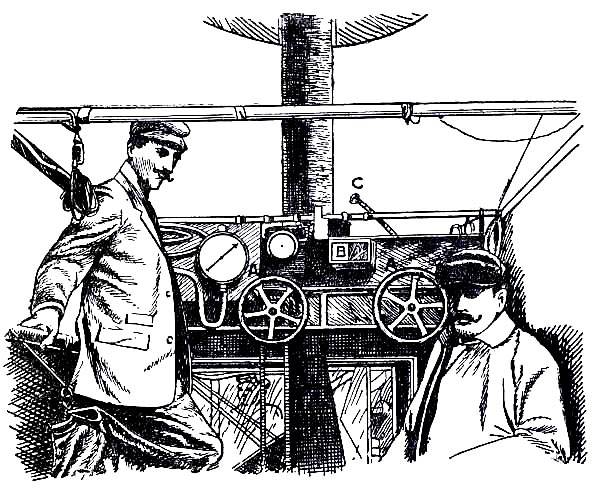
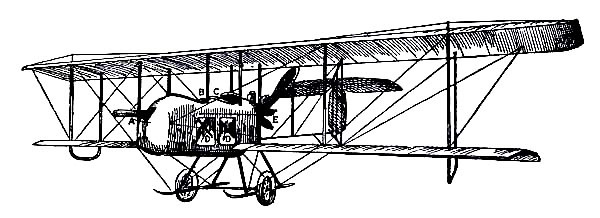
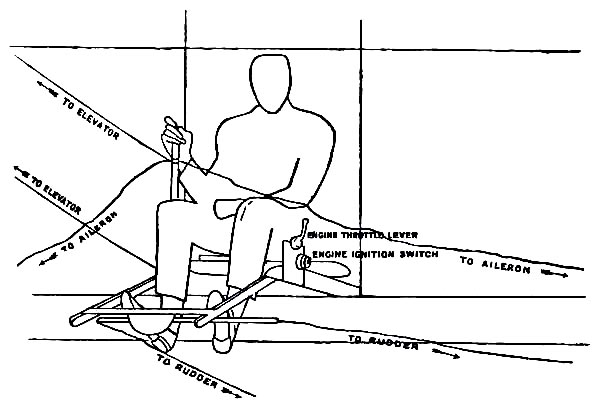
from the rush of wind. How snug it is within the hull
of a latest-type machine may be seen from Fig. 97.
Of course the air tourist, like the motorist, needs some
objective for his day’s journey—some place to which he
may fly and alight, and at which he may house his
machine; and here and there even to-day, at the dozen
or more flying grounds dotted about England, such
facilities may be found; even, for instance, at Lanark, in
far-off Scotland. But France is still greatly ahead of us
in this respect—and Germany too: they have, already, a
very large number of air-stations, and are adding to them
rapidly. All that is needed, to form an alighting spot,
is a suitable stretch of open land with some sheds, a
repair shop, a telephone, and one or two mechanics in
attendance. The establishment of such landing grounds
for the aerial tourist, which would correspond to the
halts of the motorist, will form one of the next great
developments of flying. Like stations on a railway, or
garages upon a main road, will be the landing-points for
aeroplanes; no growth in touring can be expected without them.
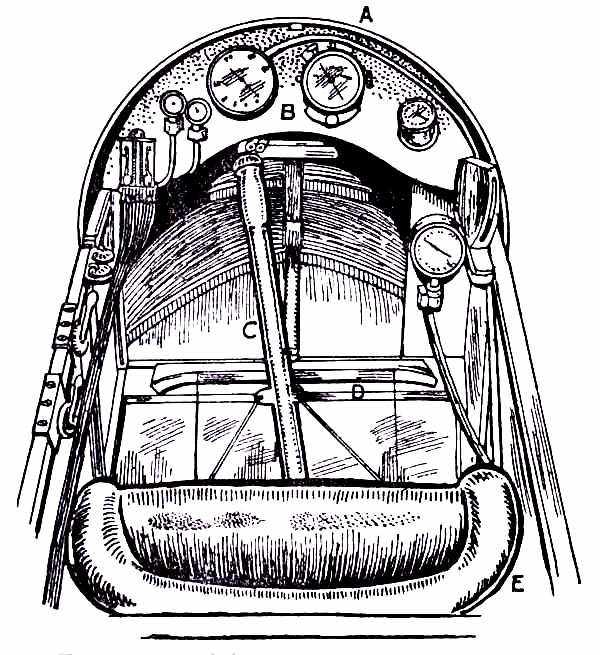
Fig. 97.—Driving-seat of a touring plane.
A. Raised wind-screen; B. Instrument board;
C. Hand lever; D. Rudder bar; E. Pilot’s seat.
It is not so expensive as some might imagine
to tour by air. A man may, for an expenditure of £1200,
buy a two-seated 80-h.p. monoplane, or a biplane
seating three people; and the running expenses, for such
craft as these, should represent a figure of about 5-1/2d.
per mile. Then upon a tour, say, of three months,
covering a distance of 4000 miles, there would be
incidental expenses to reckon with, as follows: £36
for the services of a mechanic; £12 for garaging;
£50 for repairs; and £10 as insurance against any third-party
risks. In the future, of course, when machines are
built in large numbers, and standardised in their output
like cars, the cost of flying will be reduced greatly; but
even to-day, with aerial touring in its infancy, a man
need not be a millionaire to enjoy it. And one must,
when cost is being considered, remember the sheer thrill
that is experienced by the man who flies, and the
invigoration of the air, say, at 3000 feet, which acts as a
pure, splendid tonic for those who have jaded nerves.
There is, too, the wonderful bird’s-eye view which may
be obtained by those in an aeroplane. They see the
land below them, stretching for mile after mile till it is
shrouded in delicate mist; moving away slowly, appearing
far-distant and quite remote, and yet revealed in all its
detail—roads seem like ribbons, railways like tiny
glistening threads, and rivers and lakes shining mirror-like.
The day will soon dawn upon which, secure from
any haunting fear of accident, the tourist will sweep up
in his machine at Hendon, sail smoothly to the sea-coast,
thence to some beauty spot inland, and so on till he has
toured the kingdom.
Already, granted he has a suitable machine,
a man may roam the air pleasantly in England; and it may
prove of interest to picture such a tour—with the airmen
leaving Hendon early, just as the first summer’s mist
has gone, and the sun is mounting to another glorious
day. There are, let us say, three of you in the party;
and you are ready, after a cup of hot and welcome
coffee, to take your seats within the machine—which
stands waiting upon the grass, its planes glinting in
the sun. Mechanics have appeared from the sheds
as your motor-car approached, and the pilot of the
machine, wearing his flying garb, has come forward with
a greeting; and now, while you are finishing your coffee,
the mechanics have filled the fuel tanks and, under the
supervision of the pilot, given a final glance here and there.
“Ready?” the airman questions; then with a smile
he orders: “all aboard!”
You climb up into the hull of the craft, and
find yourselves in neat, armchair seats, which prove extremely
comfortable. Then, after a final word to the mechanics,
the pilot mounts to his place before you—his driving-seat
being in the bow of the machine.
Now he calls an order, and the mechanics walk
behind the machine; then, breaking upon the stillness of the
morning, comes the roar of the motor. You feel the
machine strain suddenly forward; but it is held back;
and for a moment or so there is nothing but the harsh
clamour of the engine. Then, watching the pilot, you
see him turn slightly in his seat and raise an arm; and
at the same instant there is a movement of the craft.
You glance over the side of the hull, and see that the
ground has begun to race away sternwards. The swift,
steady forward impulse continues; there is a rush of
wind past the hull; and then, the transition from earth
to air being so gentle that it is imperceptible, and before
your senses can register an impression, the machine has
glided free of the ground, and is in actual flight. It is
not until your eyes, still turned downward, see that the
aerodrome with its sheds has begun to sink away below,
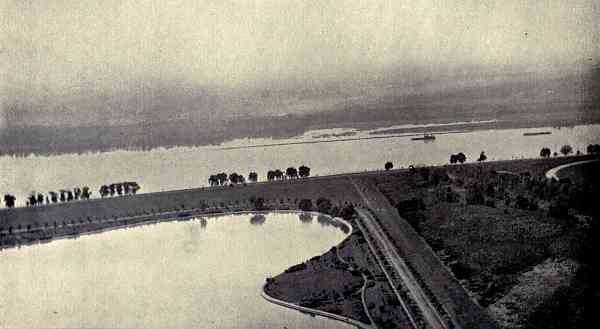
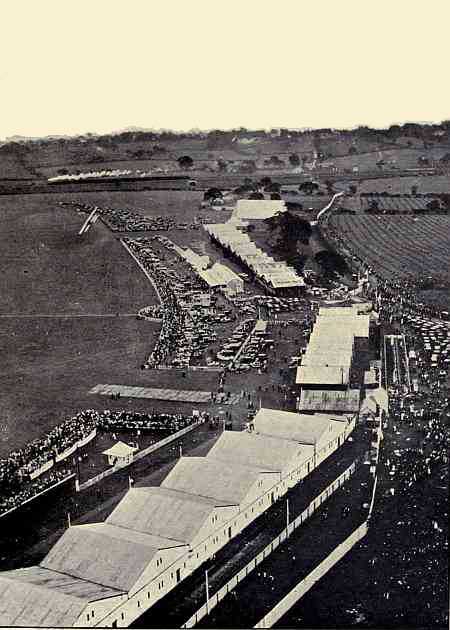
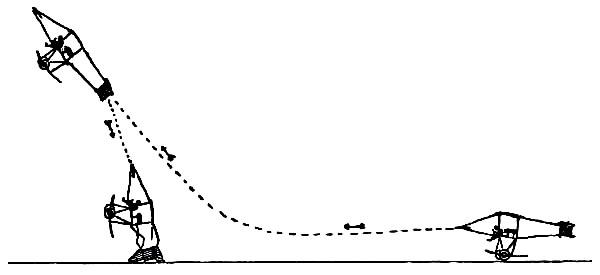
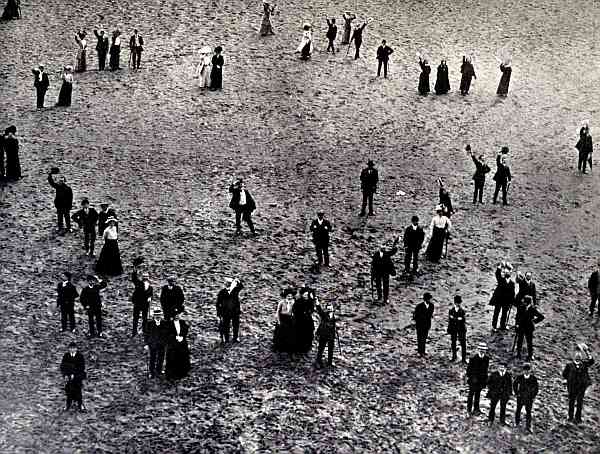
that you realise you are in the air. Plate XV
shows how people who may be waving you farewell, appear when
viewed from an aircraft that is ascending.
Down, as though drawn by some giant,
unseen hand, sinks the surface of the land; and you yourself, save
for the wind which comes whistling past the hull, might be
suspended motionless in the air. Smooth, seemingly
quite effortless, is the progress of the machine; and the
air aloft is—well, such air as, for sheer exhilaration, you
have never breathed before; and, although it has an
early-morning chill, you are shielded by the snug,
covered-in body of your craft. The machine as it thrusts
its way forward, is rising steadily—now 500, now 1000
feet; and as you fix your eyes again upon the pilot, you
see that he is making a turn. He is in fact swinging
his craft so as to steer for Kempton Park, where a tall
chimney forms a landmark for many miles; and the
reason for the manœuvre is this: you are bound, as a
first flight, for the aerodrome by the sea which has been
established at Shoreham; but to fly there straight from
Hendon would mean passing above London, and this
by aerial law is not allowed. For the safety of the
public, indeed, all flights over towns are prohibited, it
being held that there might be danger, for those below,
from the fall or collapse of a machine. So pilots make
detours round areas that are populated; and your steersman,
having no desire to infringe the rules, points his
bow south-west and soon covers the fourteen miles to
Kempton Park. Round the chimney to which he has
been flying you make your turn; then he corrects his
course due south and steers steadily for the sea-coast,
still rising gently; while around and below—like a scene
from fairyland—lies the panorama of the landscape.
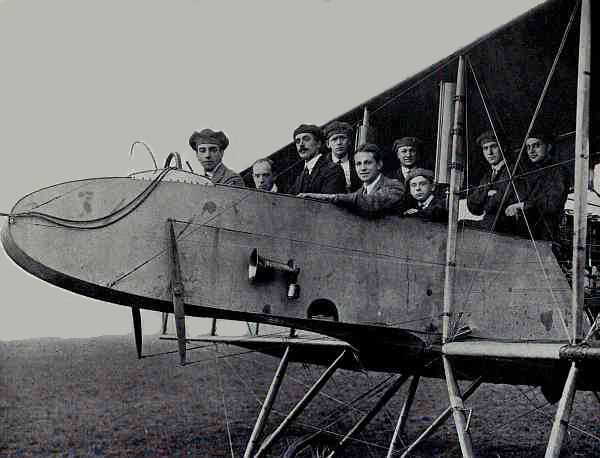
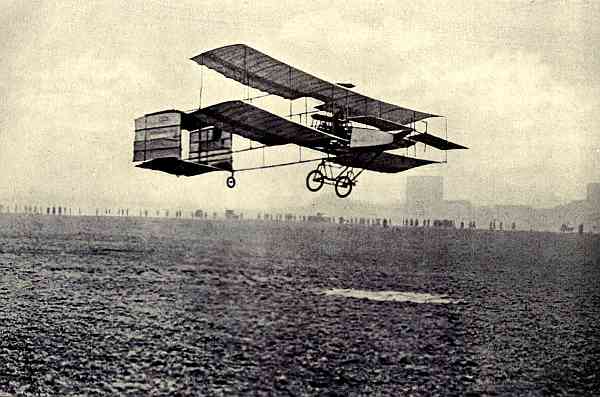
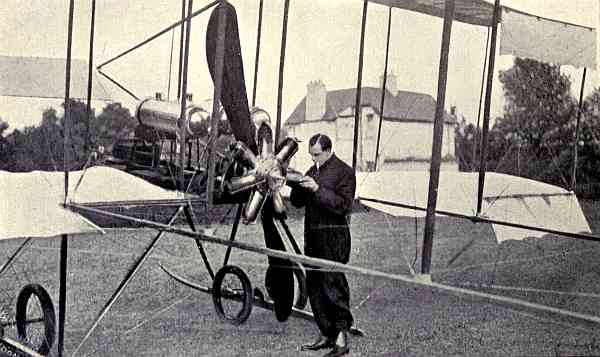
Photo, F.N. Birkett.
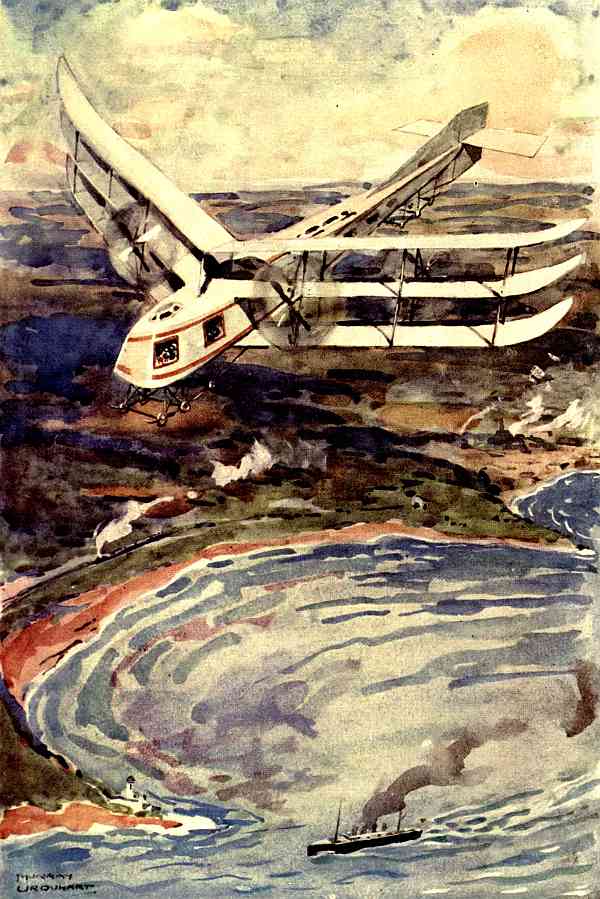
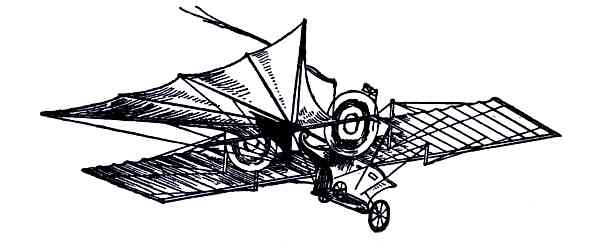
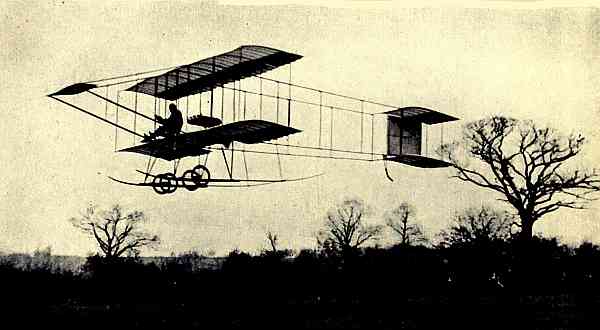
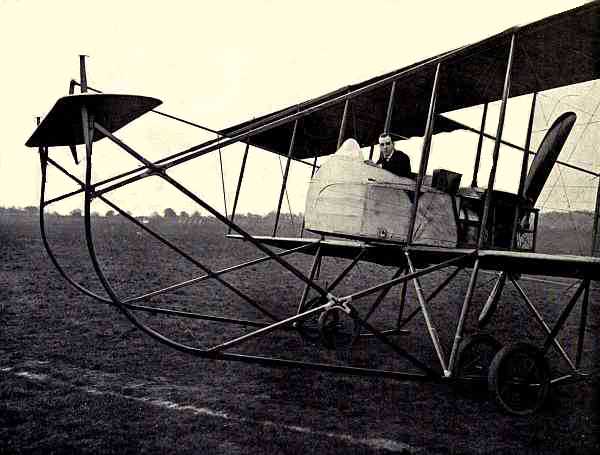
PLATE XVI.—THE GRAHAME-WHITE AEROBUS.
This machine, which is seen above with Mr. Grahame-White at the
steering wheel, holds a world’s record for weight-lifting,
having flown for 19 minutes at Hendon, carrying nine passengers.
The craft has a wing-span of 60 feet, and is driven by a motor
of 100 horse-power.
A flight of 40 miles now lies before you. The
motor throbs rhythmically, the altitude is 3000 feet, and
your craft sways a little sometimes, ever so slightly, as
it encounters a gust of wind. Below lies Surrey, with
its commons, parks, and woods; and the effect of your
height is now peculiar. You have a fixed delusion that
the aeroplane is standing still, and that you are moving
neither forward nor sideways; and yet your speed, as a
matter of fact, is more than 50 miles an hour, and the
sea-coast creeps nearer mile by mile. This illusion, this
strong belief that you are motionless, is due to your
height above the ground. Looking down upon the
earth, from an altitude of several thousand feet, you
have no near object by which you can gauge your speed.
It is the same when one glances from the window of an
express, and catches sight of some distant hill. Even
in a train running at sixty miles an hour, if you watch a
landmark that is remote, it will seem that your pace is
slow; and yet if you note the telegraph poles close
beside the track, you see that they are flying past your
carriage window.
Soon, after peering steadily ahead, your pilot
turns towards you with a call: “Look—the sea!”
Your eyes follow the direction of his outstretched
arm, and there, faint upon the sky-line but quite distinct,
and reflecting the glint of the sun, lie the waters of the
Channel. The land at its brink is only dimly visible at
first: there is a slight sea-mist; but soon, as your craft
speeds closer, the wide sweep of the coast is open to your
view. Westward lies Selsey Bill, at the extremity of a
stretch of shore which juts boldly to the sea; and then
from west to east, as you turn your head, you follow the
line of the coast until Beachy Head, standing clear-cut
and distinct, caps to the eastward this fine-drawn curve.
You call an inquiry, and your pilot points ahead: almost
in the centre of the bay, at a point where a glint of
water, seen a little way inland, reveals the location of
Shoreham Harbour, lies the aerodrome that is your goal.
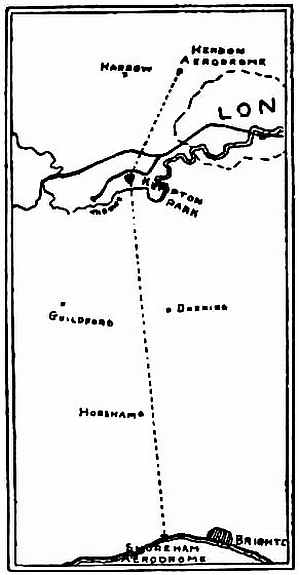
Fig. 98.—Hendon to Shoreham, 55 miles.
Quite soon, still driven smoothly by your motor,
you hover above the alighting point; and then moving over
a little switch upon the dashboard before him, the
airman cuts off his power. The booming drone of the
engine dies away, and at the same moment you feel
the craft tilt forward, and see the aerodrome below, fringed
by the roofs of its sheds. And, in the sudden stillness which
has fallen, you hear the wail of the wind, shrieking past your
struts and planes. Down quite gently glides the craft, and you
see a movement of little figures near some sheds; then you
touch ground without shock, and the machine runs forward
a short distance and halts. This stage of your flight is
shown in Fig. 98.
The pilot glances at a little clock that is fixed
on his dashboard; then stands up to stretch his limbs.
“Just over an hour,” he says. “Not so bad. With
the 14 miles to Kempton Park and then the 41 here—that
makes 55. She’s been doing a steady 50 an hour.”
Now a little group surrounds the machine,
and calls up questions about your flight.
“What sort of a trip, old man?” queries a
brother pilot of the driver of your craft.
“Is the wind steady up above?” asks a young man
in a flying helmet, who is one of the pupils of the flying school.
Answering the eager questioners as best you
can, you clamber down from the hull. Several aeroplanes,
you now observe, are out upon the aerodrome, and here
and there a novice is at work—either “rolling”
his craft to and fro, or attempting a short, straight flight;
and, even though it is still early, visitors may be seen
near the sheds; they have motored out from Brighton
to watch the practice flights.
But your chief concern, you find, is in the
matter of breakfast; the air has given you an appetite that will
not brook delay. A motor-car stands in readiness; so
you take your seats and drive into Brighton, where you
enjoy a leisurely meal. Then comes a drive along the
sea-front in the beauty of the morning sun: and after
this you return to the aerodrome, where the biplane
stands waiting for its second flight. You have decided—wishing
to remain by the sea—that you will fly on
along the coast to Eastbourne, where there is another
aerodrome at which you may alight. So, with a shout
of farewell ringing in your ears, the big machine sweeps
skyward—up swiftly and steadily, circling as she climbs;
and then your pilot turns eastward, and you fly above
the fringe of the sea. Along past Brighton the aircraft
makes her way, and you note the people on the beach—looking
no bigger than ants upon a path—as they stand
in little groups and watch your progress. High above
the piers the biplane flies, and you see the town lying
mapped away inland, with the electric railway skirting
the water’s edge. Then on swiftly, following the line
of the cliffs, a cool sea-breeze beating into your face.
The earth below seems to fade into insignificance; far-distant,
skirting the brink of the cliffs like a thin, white
ribbon, you see a lonely road; and all the time, climbing
higher and higher through the sunshine, your pilot forces
his plane aloft Three thousand feet, four thousand feet—still
you ascend; and soon the needle of the height
recorder stands at 5000 feet. Newhaven is now below,
with its river winding away inland; and a superb view,
which includes water, sea, and land, is spread at your feet.
On you fly, with the machine swaying
a little every now and then, as it encounters such wind eddies as are
formed where sea meets land. With the heat increasing,
these aerial disturbances grow marked, and your pilot
swings more seaward, so as to avoid the influence of the
swirls which rise upward above the cliffs. Beachy Head
is quickly reached, with its lighthouse showing clearly.
Now your pilot turns north-east, and quite soon you are
over Eastbourne, and planing down to reach the flying
ground. This second stage of your tour is shown in
Fig. 99. Again, when you have alighted, there is a
greeting from airmen and their friends; then, while you
examine some aeroplanes in their sheds, and discuss the
pleasures of your trip with those about you, the pilot
of your machine has made an overhaul and is ready
again to take the air.
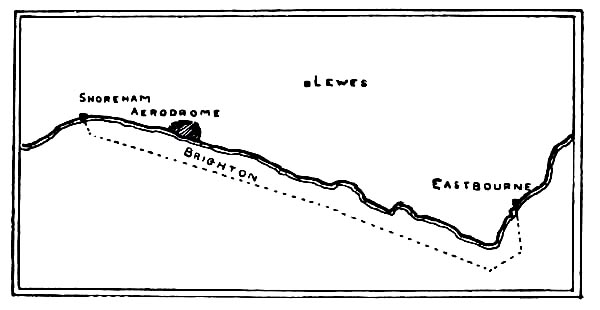
Fig. 99.—Shoreham to Eastbourne, 33 miles.
This time, still hugging the coast, you have
decided to fly to Dover. Here at Whitfield, a mile or two out
of the town, there is an excellent aerodrome, and the
flight from Eastbourne is one of 52 miles. But a point
to be remembered is that Dover, with its fortifications,
which might be spied from the air, has now been declared
out of bounds by aerial law, and no pilot—unless he
obtains a permit—is allowed to fly nearer than within
three miles of its castle. For a British aircraft, however,
when bent upon a pleasure tour, there should be no
difficulty in securing such an exemption as is required;
and we will assume you have been granted
one, and have a right to cross the harbour and pass
the castle on the hill. Rising quickly, therefore, and
with your motor running sweetly, you steer eastward
from the aerodrome, and are soon at Bexhill. This gives
place to Hastings as the coast sweeps below; and then
you see Dungeness, 15 miles ahead, jutting out upon the
sea. This reached, and left behind, and you have Dover
ahead, with not more than 20 miles to fly; and your
pilot, steering a course directly for his goal, takes you
out several miles to sea, so that you observe Romney
and Dymchurch lying away upon your left.
It is now that, turning a moment from his
control-wheel, the airman points south-east across the Channel.
“Look!” he calls; “France!”
Distinctly, indeed, away upon the sky-line, you can
see the outline of the French coast; and as you look, Cape Grisnez,
stretching its arm of land towards England, quite clearly takes the eye.
On, with the engine singing its sleepy
song, the biplane speeds; and when you glance earthward again
it is the Shakespeare Cliff that is passing away below;
then Dover, with its steamboat pier and harbour works,
lies directly beneath your feet. You see the square outline
of the harbour hotel, looking like a doll’s house
from some children’s game; and along a shining ribbon
of rail, with a tiny jet of steam behind it, a little toy
engine is busily shunting a miniature train. A second
or so later, and the noise of the motor has ceased;
then—rushing earthward in a long, swift, perfect glide—you
reach your landing at Whitfield, and another
stage, as seen in Fig. 100, has been accomplished safely.
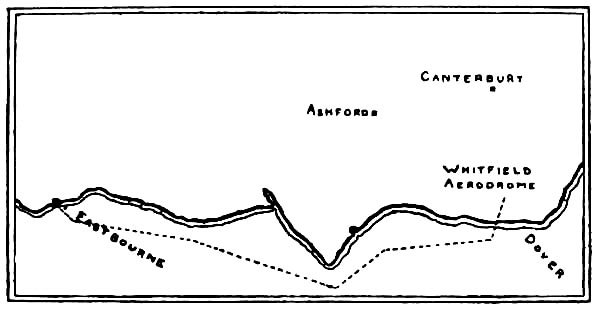
Fig. 100.—Eastbourne to Dover, 54 miles.
At Dover, while resting and taking
a meal, you discuss your next flight; and it is decided to make
for Eastchurch, in the Isle of Sheppey, where there
is a busy and important aerodrome, and the naval airmen
have their school. This, as seen by Fig. 101,
represents a flight of only 27 miles. Away again,
therefore, and flying now inland, you pass Canterbury
and some belts of woodland: then, flying above
the river Swale, you find you are over Sheppey and
with Eastchurch right before you. Here, in the middle
of the sleepy little island, where an active colony of airmen
has been formed, the Royal Aero Club has its
flying ground; and it is here, too, that Messrs. Short
Brothers, after moving from Leysdown, a few miles
away, established an aeroplane factory in which—after
building Wright biplanes under licence from the famous
brothers—they developed those splendid sea-planes
which are used in the naval service.
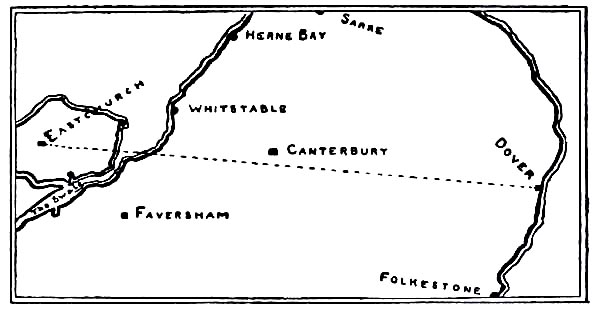
Fig. 101.—Dover to Eastchurch, 27 miles.
From Eastchurch, where there is much
to be seen, many routes may be chosen upon the aerial highway.
One may fly to Brooklands or Uphaven, to Farnborough
or Amesbury or Huntingdon. But you determine probably
that, returning to Hendon for the night, you will
house your aircraft there, and so be ready next day for
some other tour afield. Your course lies to East Tilbury,
a distance of 19 miles; then to Enfield, 25 miles—so as
to avoid passing above London; and thence, an 8-mile
stretch, steering W.S.W., to the landing ground at
Hendon. The route is shown in Fig. 102. It
makes, in all, a flight of slightly more than 50 miles; and as it
necessitates crossing the Thames—a flight out of bounds
according to aerial law—you will need to have obtained
a permit, as was the case with your journey to Dover.
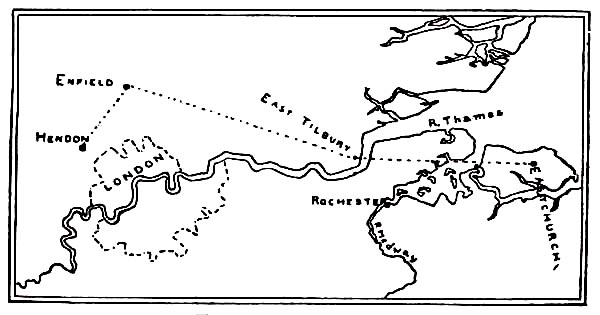
Fig. 102.—Eastchurch to Hendon, 53 miles.
In the cool of the summer’s evening, refreshed
by a cup of tea, you leave Eastchurch behind you and set off
upon your final flight. Your course lies W.N.W., and
soon you pass from the island and have the waters of
the Medway below your feet. Then on again over land,
with the mouth of the Thames upon your right. East
Tilbury is now ahead, and you cross above the Thames,
with Gravesend to the left and a wide, open stretch of
river behind. Then with Essex beneath, and the river
still winding to his left, your pilot steers towards Enfield.
Soon the smoke of London looms in the distance to the
west, and you pass near districts where the houses stand
close-packed. Now Enfield is reached, and the steersman
makes his turn: then, ten minutes or so later, the
song of the engine is stilled; and in the gathering dusk—impressively
and without a sound—you begin your
downward glide. Round in a wide, smooth circle, and
with his planes “banked” steeply, does your pilot wheel.
Then you come finally to rest, and climb a little stiffly
from your seats: the day’s air-tour is done. Visiting
four aerodromes, three of them at the brink of the sea,
you have flown a total distance of just over 200 miles.
On another day, perhaps, you will fly to
Oxford; or tour above the West of England and alight at Filton,
near Bristol; here and there even now, at the grounds
dotted about the country, you will find facilities for landing.
Should there be no aerodrome near, and a descent
becomes inevitable, then your pilot must choose the best
field he can see, and alight in that: it is all part of the
adventure. Sometimes, certainly, a motor will fail in
awkward circumstances—say when a pilot is over wooded
or precipitous country. But with the airman, always, it
is a point of honour that he should see the humorous
side of things; and this gayness of outlook he will,
even under most trying circumstances, strive manfully
to maintain. Flying across country one day with a
passenger, a pilot heard a sound from his motor that
told him some valve or rod had broken; and the next
moment, without further warning, the engine stopped.
The wind at the time was gusty, and the ground below
unsuitable for landing; but the pilot remained unperturbed.
Perceiving beneath him an orchard, which
seemed to offer the least of many evils as an alighting
point, he leaned towards his passenger with a smile.
“I hope,” he said, “you’re fond of apples.”
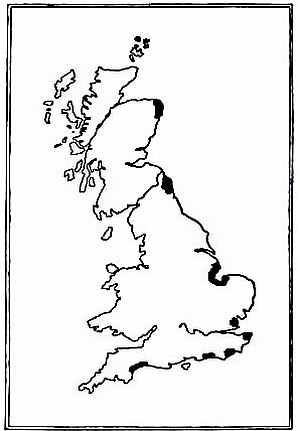
Fig. 103.—
Landing areas for foreign aircraft.
The portions of the map shaded heavily in
black indicate the alighting points.
So far, when he tours the air, a pilot has few restrictions.
He must not fly above certain areas, it is true,
but in the main the sky is free to him, and as yet he
need not register or number the craft he buys, like the
owner of a motor vehicle has to do. The fact is, however,
that laws for the air have been studied, and in
some cases a schedule prepared; but no definite scheme
of rules has, up to the present, been placed upon the
Statute books. The intention is, indeed, to allow the
science to develop with as few limitations as may be
possible. There are so many problems to be solved in
regard to the governing of flight, that they can only be
dealt with as they arise. The air, as an element in
which men may navigate a craft, has aspects which are
unique. Oceans and continents, for example, all have
their limitations: the land ends and the sea begins, and
then the sea in its turn gives place again to land. The
traveller from London, say, to Paris, first passing from
inland to the sea, has to leave the train and embark upon
a boat, only to change again into a train and finish his
journey—as he began—by way of the land. But an
aerial voyager between the two cities finds no restrictions
such as these: the air has only one boundary—the point
at which it touches the surface of the earth; and so he
may rise from London, and fly with equal facility above
land or sea.
Although the air has no limitations, such
as are encountered by land or sea, there has been discussion
between nations as to the rules they should impose to
control the flight of craft. It has been agreed, without
question, that the air-space over the high seas should
be regarded as free, and also above territory that is
unoccupied. The idea of an aerial law which is thought
most reasonable, indeed, is that the sky over the whole
globe should be declared free for traffic, but that each
nation should be allowed to enforce rules to prevent
attack or spying from above, and to check aerial
smuggling. But that flying over a frontier might be
controlled by a corps of aerial police is considered hardly feasible:
it would be almost impossible indeed—had he made up
his mind to do so—to prevent an airman from crossing
above some boundary. Even were there patrol craft
on duty, he could rise high among the clouds and so escape detection.
Such difficulties as these will, sooner or later,
have to be faced; but at present there are in existence only the simplest of
laws, and these have been framed for the safety of the public, and
to protect strategical areas from the attentions of foreign spies.
Flying over towns is—as has been stated—declared a
dangerous practice, and is no longer allowed; while the
officials of our Home Office, after consultation with the
naval and military authorities, have imposed restrictions
upon the entry into this country of foreign craft. A
machine reaching our shores from abroad can only land,
for instance, between the points specified below, and
outlined upon Fig. 103, and then only
after its pilot has given eighteen hours’ notice to the Home Office,
either by letter or telegram, of his intended flight:[3]
| Fraserburgh |
and |
Ythan River. |
| Holy Island |
" |
Newbiggin. |
| Sutton (Lincolnshire) |
" |
Holkham (Norfolk). |
| Stansgate Abbey |
" |
Burnham-on-Crouch. |
| (on the Blackwater) |
|
|
| Margate |
" |
Walmer. |
| Rye |
" |
Eastbourne. |
| Hove |
" |
Bognor. |
| Bridport |
" |
Dawlish. |
It is declared unlawful for an aircraft
entering England from abroad to carry any goods upon which
Customs duty is payable, or the importation of which is
prohibited by law; any photographic apparatus, carrier
pigeons, explosives, or firearms, or any mails. Upon
arrival in one of the landing areas prescribed, the airman
fills up an official report, and obtains a permit
which allows him to continue his flight inland. Before
leaving the country, upon his return abroad, he must
alight in one of the coastal areas. No exemptions are
granted to these rules unless by the authority of the
Home Office, and no foreign naval and military aircraft
are permitted to fly over or land in England unless
upon a Government invitation.
A number of points in the United Kingdom
have been specified over which, for strategical reasons, no
flying is permitted—although such rules do not apply of
course to British naval and military craft. The mouth
of the Thames is closed to aviation; fortifications like
those at Dover are declared out of bounds; also dock-yards
such as that at Portsmouth. The question arises
naturally: how are these rules to be enforced? What
is to prevent an aircraft infringing them? By the Act
of Parliament in which they are set forth, there is a
clause which reads:
“If an aircraft flies or attempts to fly over any area prescribed
under this Act for the purposes of the defence or safety of the
realm ... it shall be lawful for any officer designated for the
purpose by regulations made by the Secretary of State, to cause
such signal as may be prescribed by those regulations to be
given, and, if after such signal has been given the aircraft fails
to respond to the signal ... it shall be lawful for the officer to
fire at or into such aircraft, and to use any and every other
means necessary to compel compliance.”
Guns for use against aircraft have already
been placed around our coasts, and some of these would be
employed no doubt to fire upon a pilot who seemed
deliberately to break the law; but this assumes of
course that he is visible; were he flying very high, or
were clouds to obscure the view, he might defy the
officials who watched below. Just what may happen,
when such laws are required for daily use, time alone
will show; at present, beyond the bringing to our police
courts of certain foreign pilots who have flown above
prohibited areas on their way from France to Hendon,
no data is available; and these offending airmen, pleading
that they had no knowledge of the new laws, have
been treated leniently by magistrates.
The whole question of aerial law must be considered
seriously by the nations; and in view of the
preparation of some general code of rules the International
Aeronautical Federation—which is the central
authority upon aviation, and represents the world’s
Aero Clubs—has held many meetings and drafted
a number of proposals. It is held, to begin with,
that all aircraft must be registered, and that an
international list of machines must be compiled; also
that craft must be marked with letters indicating their
nationality—such as “G.B.” for Great Britain and
“F” for France. By such means, and particularly by use
of an international register, any craft could be identified,
even if flying in a foreign country; and should it escape
observation while in the air by flying high, it would
need ultimately to land, and would then have its
identity revealed. The pilot in charge would have
identification papers, and a certificate showing his
proficiency. The rules for obtaining such a certificate,
in days when men take charge of large passenger
machines, will need to be more exacting than they are
at the present time; and it is argued that, before he is
put in control of such a craft, an airman should pass a
medical examination so as to show he is organically
sound, and fit both in eyesight and nerve to steer a
high-speed, powerful machine.
When a craft is registered, and its pilot has his
certificate, it is considered necessary that—before he has
a right to fly—he should apply for an official form,
which would be known as a permit to travel. This
would contain all necessary details for the identification
of himself and his machine, and would allow him to fly
anywhere within his own country: but it would not be
available for an aerial tour abroad. He would be
required, before starting upon a foreign flight, to give up
this home permit, and obtain in place of it a special
Customs’ bulletin. This would specify the nationality
of the machine, give particulars of its registration, and
provide details as to its passengers, goods, and
baggage; also the date and place of its departure from
England, with the destination to which it was bound.
On landing abroad, the airman would hand to the
authorities his bulletin, and receive in exchange a
document showing that the Customs’ officers had
examined his machine and that he had paid what duty
might be claimed on any goods he carried; then, once
he had this new document, he would be free to fly in
the country visited.
It is in regard to the Customs that the
greatest problem must be faced. Rules may be made, alighting
points insisted upon, but how are aerial smugglers to be
caught? It has been suggested that there should be a
Customs’ police, provided with fast-flying machines; also
that if a machine failed to descend when it ought, they
should go in chase of it. But in days when, without
once alighting, a flight of twenty-four hours will be easily
accomplished, such officers might find themselves upon a
wearisome pursuit; besides the probability that, either
during the night or in a fog, they would be given the
slip. Rendering easier aerial smuggling is the fact that,
to discharge a small cargo of contraband over a given
spot, the pilot need not alight. Fixing the package to
a parachute, he could cast it free from his machine and
continue swiftly upon his way—the parachute being
secured with its burden by the confederates who were
below. So difficult, in regard to aircraft, is this question
of applying the Customs, that it has been argued air-borne
traffic should—to save endless trouble and great
expense—be allowed to go duty free.
A matter which is easier, and for which
straightforward ruling may be framed, concerns the navigation
of craft upon the airway. At present, with comparatively
few machines, there is no great need for any code of
rules: one pilot, should he sight another, can easily
steer clear. But as the air becomes peopled, and
there are streams of traffic between landing grounds, it
will be very necessary to have a scheme of rules—rules,
say, for meeting and passing, and for flying by day or
night. What is suggested is that, with some modifications,
the laws of the sea should be adapted to the air.
Craft approaching each other should, it is held, bear
away to the right, and never pass nearer than 300
metres (328 yards). When flying at night, a system of
lights is recommended: white showing ahead, green to
starboard, red to port, and another white light astern.
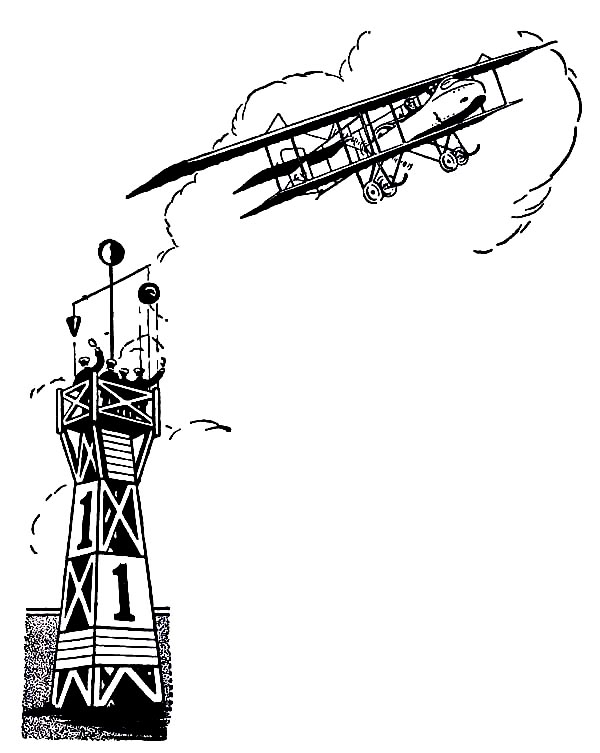
Just before alighting when travelling by day, it is
suggested that a pilot should show a red triangular flag;
or, at night-time, wave a white light. When flying in
daylight, and finding himself in distress, it is advised
that a pilot should show a red triangular flag, and at the
same time suspend from his machine two black balls,
hung one above another; or, in the same circumstances
at night-time, wave a white lamp and extinguish his side
lights. The reason, in such a case, for extinguishing
the side lights would be so as to show to other pilots
only one lamp—the white one. This single white
light will be the night signal of an ordinary balloon, and
it will be the rule for all power-driven craft to make way
for it, and an aeroplane or an airship, say when its
machinery has broken down, being in the same position
as a free balloon, will wave this white-light signal so as
to warn other pilots to keep clear.
By degrees, as air-traffic grows, new laws
and regulations will need to be applied. But at present,
save for restrictions such as have been cited, an aerial
tourist wings unfettered flight. The motorist has a
speed limit of 20 miles; but the airman, 3000 feet aloft,
has none; and, save for certain areas out of bounds,
the sky is free wherever he may fly. Presently, however,
the law must have its say, and air transit will be
regulated as is the traffic of the land or sea. Already,
in fact, our Home Office, after consulting experts, has its
scheme of rules on paper; but these will not be enforced
till the need comes.