On the evening of the last day of August, a
sort of reunion and farewell dinner took place
in Mr. Cook’s bungalow. Two guests were particularly
jovial. One of these, Sink Weston, had,
as they say in the far north, “cast up” from
Abaja with his gang the day before leaving the
dry upper Montezuma choked with logs waiting
for the winter rains. Another was old Dan
Doolin just in with food supplies and gasoline
from Dolores. The others were Roy Osborne
and the host, Manager Cook.
Roy was to leave in the morning with Weston
and Doolin on his homeward trip. That afternoon,
he had made final settlement with the
company.
“I’m sorry to be payin’ you this,” said Mr.
Cook, as he wrote out a check for over seven
hundred dollars, “because it means you’re goin’
to leave us. But, aside from that, it’s the best
earned money I ever saw go out of this office.”
“And I’m sorry, too,” answered Roy. “I’m
sorry to think I’ve got to give up the Parowan,
the mountains and the deserts. I’ve come to
love ’em all. And I’m sorry to think I’m
goin’ to leave the bungalow and you,” he added,
holding out his hand to Mr. Cook. “I’ve seen
some hard things out here, but among the worst
of ’em, I’ve always found at least one man
who stood for the fair and square, even if he
didn’t talk about it.”
The boy and the man shook hands.
Mr. Cook was an abstainer as to intoxicants,
but he always saw that his convivial guests were
supplied with liquid refreshments. Both Doolin
and Weston celebrated the occasion by reaching
the talkative stage.
“I’m proud o’ the kid, Colonel,” announced
Sink, at last. “An’ you got to give me credit
fur bringin’ him to you. That right, Dan?”
“We shore did,” answered the grizzled teamster
enthusiastically. “An’ I’m sorry to be
takin’ him out. I reckon the boys out in the desert’ll
be sorry to see him go. They tell me,”
the old man continued, “’at he’s got a reg’lar
mail route an’ took letters and papers leastways
onct a week to them mis’able prospectors.”
“He did, and more,” replied Mr. Cook.
“He’s changed the whole plan of doin’ things
down here. In a year we’ll know more about
this forsaken country than we’d have known in
ten without what he’s taught us.”
“Right,” interrupted Weston. “An’ I
brung him in. Don’t fergit that. He ain’t disappointed
no one but me—”
Mr. Cook and Roy looked up.
“I kind o’ counted on him gettin’ to Parowan
an’ findin’ out somepin about my old High
Mucky-Muck o’ the Lost Injuns.”
Mr. Cook laughed and Roy colored a little.
“Sink,” exclaimed the boy hastily, “the fact
that I never had a chance to get to Parowan
is one of the reasons I hate to leave this country.
For a long time, I thought I’d get over
there. But when the Aeroplane Express got
down to a regular schedule, it seemed as if every
hour was taken up with something. I just couldn’t
work it in. And I’d liked to have gone for
my mother’s sake.”
“Oh, I accept yer apology,” muttered Weston
good naturedly.
“But don’t git the idee I’ve give up. I got
the location o’ that sink hole comin’ to me yit.”
Mr. Cook laughed and laid his hand on Weston’s
arm.
“Sink,” he said, “if you keep on you’ll get
to believin’ that story some day.”
Old Doolin looked at Roy and made a desperate
effort to wink his heavy eyelid. As he did
so, Weston pulled himself up in his chair, hit
the table with his clenched fist until the dishes
and glasses rattled, and exclaimed, in a thick
voice:
“Ye’ll acknowledge thet thar’s one feller
’at kem out hyar an’ showed you all a few things
ye didn’t know. Why? ’Cause he was a sight
smarter ’an some wise ones I could name—”
“Or touch,” laughed Mr. Cook.
“An’ bein’ smart enough he knows a fack
when he hears it. Mr. Osborne,” went on the
old plainsman, leaning toward Roy, “wuz they
a sink hole, an’ a white priest, an’ lost Injuns,
an’ treasure to fill a freighter, or wuz they
not?”
Roy flushed again, looked at Mr. Cook in an
embarrassed way, and then said:
“I’ve felt there were. But, well, I know
one thing. There isn’t any doubt that there
was a white man, and he was likely enough a
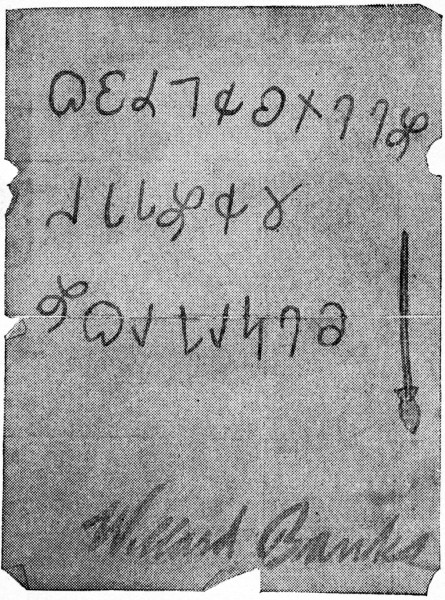
priest. His name was certainly Willard Banks,
and I know this man was my great uncle, a Mormon
elder.”
“Thar you air,” shouted Weston, defiantly
hanging the table again. “Did I dream that?
Answer, whar did I git the paper?”
Mr. Cook seemed amused. He had many
times heard the wild tale of Weston’s fabled
sink hole, but the Parowan end of the story, the
knowledge that here old man Banks had lived,
was unknown to him until the day Roy named
the aeroplane. Weston’s positive manner
aroused his interest anew in the story.
“I never saw your cipher or hieroglyphics,
Sink,” he answered, ignoring Weston’s question.
“I’d like to have a look at it.”
Helping himself to another drink, Weston
slowly produced his old wallet, and, with much
ceremony, finally laid the faded and much-worn
brown paper upon the table. Mr. Cook took
a long look at it, and then carried it to a wall
light that he might better examine the dim
characters. Plainly he made nothing of it. Roy
stepped to his side and pointed out the dim
name at the bottom—“Willard Banks.”
“I had a great uncle of that name out here
in Utah. He lived in Parowan. They drove
him out of the Mormon Church for some reason.
But he was an elder in it once.”
Mr. Cook shook his head, and was, apparently,
about to hand the sheet back to its owner
when he stopped, straightened up, made another
close survey of it and then said:
“Sink, let me have your mysterious paper to-night.
I’d like to look it over.”
“I ain’t objectin’ to yer lookin’ it over,”
answered Weston, “so long as ye keep yer hands
on it. But, Colonel Cook, I wouldn’t part with
that dockymint fur the best oil well yur agoin’
to find in Utah.”
Old Doolin’s head was nodding.
“Well,” suggested the manager, in a low
tone to Weston, “just to be sure it ain’t mislaid,
if you’re thinkin’ of escortin’ Dan to his
bunk now, come back in an hour and I’ll return
it to you.”
This was as good as a command to Weston.
A few minutes later, arousing the well-dined
teamster, the two men disappeared in the direction
of the “Crater.” The uncouth freighter
dispensed with the formalities of a good
night to his host, but, as he followed his friend
out into the sandy street, he did not fail to
mutter:
“The kid’s shore all right. An’ we brung
him, didn’t we, Sink?”
Plainly enough, the tale of the Sink Hole was
not on Old Dan’s mind.
“What is it?” exclaimed Roy, impetuously,
as the two men disappeared. He knew that Mr.
Cook had an idea. Without answering at once,
his host walked to the bookcase, and returned
with the little Mormon Bible that had been
taken from the hand of murdered “Utah” Banning.
“You’ve found something,” added Roy, almost
catching his breath.
“This was the first Mormon Bible I ever
saw,” said Mr. Cook, pushing the supper
things aside, and bringing a lamp to the dining
table. “Several times in your absence, I’ve
amused myself looking it over. A very curious
religion,” he added, as he drew up a chair and
motioned Roy to do the same. “You saw the
notes on the back flyleaf didn’t you?” he asked,
turning to Roy.
The boy flushed with chagrin. He had not.
Nor had he looked at the book since his first
cursory examination of it.
Hanging over Mr. Cook’s shoulder, he
watched the manager turn to the back of the
book and finally expose a yellow edged page.
In ink that had turned to a faint brown, the boy
read, at the top of the page, these words:
“Deseret Alphabet.”
Beneath it, in a fine, close hand, were two
columns of characters. Manifestly, it was the
Mormon phonetic alphabet. After each odd
character, the sound was indicated with a syllable
in English.
“That’s it,” shouted Roy, almost snatching
the book from Mr. Cook’s hand. “Those are
the letters on Mr. Weston’s paper. Here, see,”
he added nervously catching up the paper and
confirming his theory. “They’re the same.
We found it. Sink’s found his treasure.”
“One moment,” interrupted the less exuberant
Mr. Cook. “Let’s see what we can make
of it.”
“We’ve got to make something,” insisted
the boy, impulsively. “It has to work out. The
man who wrote on Mr. Weston’s paper was my
great uncle. He helped to make this alphabet.
I know that. That’s what the Banks’ history
says.”
“Then I reckon we’ve got it,” answered Mr.
Cook. He began to read off the characters with
their equivalents in English.
“Come on,” broke in Roy, “let’s see what
we can find. Here, what’s this?”
He pointed to a letter like a capital “O” with
a little ridge in the bottom. It was easily found.
“‘K,’” answered Mr. Cook. “Put it down.”
Chuckling and enthusiastic, the boy ran to
Mr. Cook’s desk for a piece of paper. With this
before them, the boy and his hardly less interested
elder, began to work out the mystery.
Both the flyleaf characters and Mr. Weston’s
scrap were dim with age, but, by finally applying
a reading glass to the Bible key, the first
line of characters was turned into this—two of
the Mormon letters standing in English for
sounds instead of letters:
“KAIPUROWITTS”
“That’s easy,” announced Mr. Cook, when
the interpretation was complete. “Should have
been ‘Kaiparowits’. But it’s close enough.
There’s a peak o’ that name at the north end
of the Kaiparowits Plateau.”
“Where’s that?” exclaimed Roy.
“The plateau’s northwest of where the San
Juan hits the Colorado.”
“That’s it,” almost shouted the excited boy.
“That’s where Weston got out of the canyon.”
Mr. Cook was already busy on the next line.
It resulted in this word:
“ELLSURTH”
“Another mountain?” asked Roy.
“Probably means Ellsworth. There is such
a peak east of Pine Alcove River. Hi. Clark
worked up that way this summer.”
“But they are a long ways apart,” exclaimed
the boy. “How far?”
Mr. Cook consulted the large wall map.
“Nearly a hundred miles.”
The boy’s face fell.
“Anyway,” he said, “these mountains have
something to do with each other and the Sink
Hole. Looks as if it might be between ’em,
don’t it?”
“Let’s spell the other word,” suggested his
companion. When this had been done, the letters
read:
“SKALAENTE”
Mr. Cook eyed it a long time and then shook
his head. Finally, he went to the map again,
but apparently with no better success.
“Looks like Swedish,” suggested Roy.
Mr. Cook returned to the table, held the sheet
at all angles before him and then suddenly
broke out into a laugh.
“Escalante!” he exclaimed. “Mustn’t forget
the characters are phonetic. That’s the
Escalante River—first one south of Horse
Creek. I guess that’s it.”
Roy had hurried to the map. With his pencil
he drew a line under Mr. Cook’s direction,
from Ellsworth mountain to Kaiparowits.
Where it crossed the river, he made a cross.
Then, his hand trembling, he wrote at the intersection,
“Sink Hole of the Lost Indians.”
“What do you think of Sink’s story now?”
he broke out, boy fashion.
“All he has to do,” answered Mr. Cook, relieving
his excitement by lighting a cigar, “is
to find something there. What he tells about,
he saw fifteen years ago. A good many people
have been prowling about there in fifteen
years.”
“Anyway,” exclaimed Roy, “he can have another
look at the place.”
“But,” said Mr. Cook, after a pause, “I
never saw a sink hole on or near a flowing
river.”
Roy’s jaw fell. He was looking at Weston’s
paper. Suddenly his face lit up. Then he
pointed to the arrow.
“That’s pointin’ south,” he exclaimed.
“Now, we got it. Where a line between the
two mountains crosses the Escalante, turn
south until you come to the Sink Hole.”
“Not bad,” said Mr. Cook. “Very probable.
That’s the trail I’d take.”
The excited boy wanted to rush out on a
search for Weston, but Mr. Cook stopped him.
“Leave that to me,” he said, after he and
Roy had retired to the cool porch. “When
Weston comes, say nothing. Let me do the
talking.”
They had not long to wait. In a short time,
the veteran guide was with them. As Mr. Cook
handed Weston his precious paper and proffered
him a cigar, he said:
“Sink, that looks mighty interesting. Why
don’t you find the Treasure Cave?”
“Humph,” grunted Weston, as he lit his
cigar. “Why don’t I? Read this fur me an’ I
will.”
“What’ll you give to have it read?”
“I’ll give you my livery stable, an’ my house—yes,
sir,” he added with a grim smile, “I’ll
even throw in my real ’state office.”
“Would you give half of anything you might
find in your underground safety deposit vault?”
Weston looked up, without any trace of liquor
now, and said:
“To the man ’at’ll take me to that pint, I’ll
give ever’ other dish and bowl we git. I reckon
that’d be fair.”
“Well,” went on Mr. Cook, “here’s the man
that can do it,” pointing to Roy. “He knows
where your cave is. Is it an even divide?”
Weston sprang up with a shout. At the same
time, Roy stepped to Mr. Cook’s side in protest.
The only answer he got was:
“I’ve got to pay you for what you said when
you gave me the ring, Kid. This is my contract.”
Weston’s shout had died to a note of alarm.
“You ain’t kiddin’ me, Colonel? I’m sober.”
“Be sure you are in the same condition to-morrow
morning at seven o’clock, Sink,” exclaimed
Mr. Cook. “Roy’s put off his return
a day or so. He’s goin’ to give you a little
ride in the Parowan. And remember our bargain.”