A Condensed History of the Lawsuit Against the Cologne Police!
The police of Germany are very strict in matters of false billing
or misrepresenting exhibitions to the public, and the case of the
well-known Dr. Slade, also a well-known American "thaumaturgic"
performer, as also an equally familiar "magnetic" woman, and several
others who have clashed with the German police will probably also call
in mind the latest case of the flower medium, Mrs. Rothe, who was
sentenced to two years in prison and 500 marks fine.
What for? Well, she deceived the public in telling them that she could
obtain communications from the spirit world.
This the police claim was obtaining money under false pretense, and
there you are.
The Cologne police claimed that Houdini was also traveling about
misrepresenting, and that all he did was "swindle." The chief one was
Schutzmann Werner Graff, who openly published a false story in the
Rheinische Zeitung, which put Houdini in a very bad light, and, as a
man of honor, Houdini could not overlook the insult.
He claimed that he had been slandered, and asked an apology, also a
retraction of the false stories, which all the press of Germany had
copied; but was simply laughed at for his trouble.
Engaging the best lawyer of Cologne, Herr Rechtsantwalt Dr. Schreiber,
Louisenstrasse 17, this able lawyer defended Houdini in all three
instances.
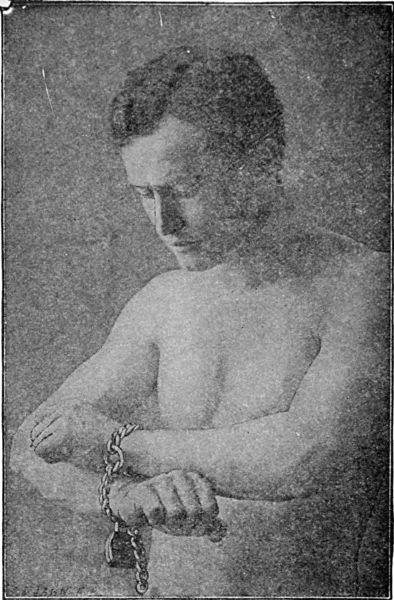
Houdini, as Chained and Handcuffed Before the Judges in
the First Trial of His Action Against the Royal Police of Cologne.
The first trial occurred in Cologne, Feb. 19, 1902; in this trial
Houdini charged the Schutzman Werner Graff for publicly slandering him,
whereupon, as answer, Herr Graff told the judge and jury that he was
willing to prove that Houdini was misrepresenting, that he could chain
Houdini so that he could not release himself. Houdini permitted himself
to be chained by Herr Transport Police Lott, and to show how easy it
was he wilfully showed to the judge and jury how he opened the chain
and lock.
After a four days' trial, Houdini won the lawsuit, and the Cologne
police were fined, and were to publicly apologize to Houdini, "In the
Name of the Kaiser."
Instead of so doing, they took it to the higher court, "Strafkammer."
At this trial they had specially manufactured a lock, which was made by
Master Mechanic Kroch, a lock that when once locked nothing would open
it; even the key could not open the lock.
The police asked that Houdini should show his ability by opening this
lock after it had once been locked.
The following is a free translation of what the press had to say at the
second trial.
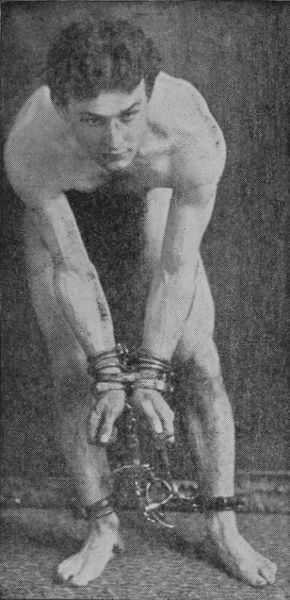
Houdini as Handcuffed and Manacled by the San Francisco
Police, July, 1899.
In the highest court (Strafkammer zu Köln Yuli 26, 1902) Police Officer
Werner Graff was found guilty of slandering Harry Houdini, heavily
fined, he must pay all costs, and insert an advertisement in all of the
Cologne newspapers, proclaiming his punishment, at the same time, "IN
THE NAME OF THE KING," openly apologize to Houdini for insulting him.
This open apology is the severest punishment that can be given to a
royal official, and as the lawsuit has been running over a year, the
costs will run into the thousands of marks.
The case was first tried in the Schöffengericht Köln, Feb. 19, 1902,
and Werner Graff was found guilty, but he took it to the highest court,
and again Houdini won.
The Cologne police claimed that all Houdini advertised to do was
misrepresentation (this was the cause of the lawsuit); for the trial
they had a special lock made that, after it was once locked, no key
would open it.
This lock they challenged Houdini to open, to prove that he was not
misrepresenting.
Houdini accepts the challenge, walks into the room selected by the
jury where he could work unhindered. In four minutes, with a quiet
smile, reenters the court room, and hands the judges the prepared lock
opened.
Among the thirty police officials that testified against Houdini were
some of the highest officials of Cologne, but Houdini won; in fact, he
was "one" too many for them.
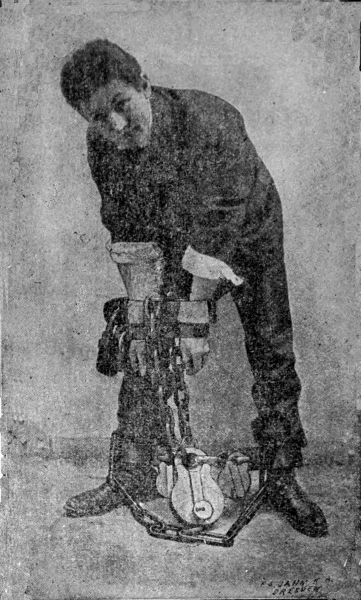
Houdini as Handcuffed and Manacled by the Dresden
(Germany) Police, September, 1900.
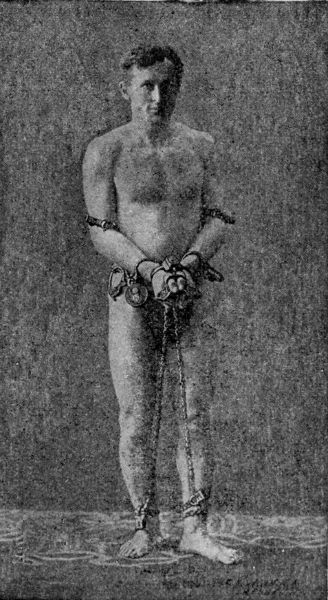
Houdini as Handcuffed, Elbow-ironed, and Thumbscrewed by
the Berlin Police, October, 1900.
It being a disgrace for Schutzman Werner Graff to have this punishment
on him, with the assistance of the police, he took it to the highest
court in Germany, "Oberlandesgericht," and there the learned judges
again gave Houdini the verdict from which there is no appeal.
Below is a free translation of the apology as printed in the German
papers:
IN THE NAME OF THE KING
BE it known that the artiste, known as HARRY HOUDINI, of America, New
York City, against the Cologne Police Schutzman Werner Graff, for
slandering (insulting).
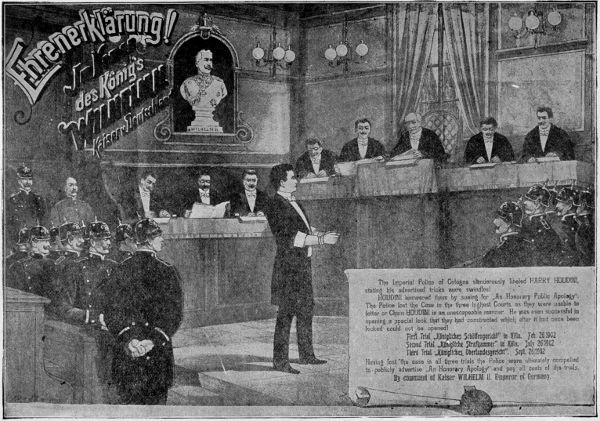
The Demonstration Before the German Judiciary.
[Text in illustration: The Imperial Police of Cologne slanderously
libeled HARRY HOUDINI, stating his advertised tricks were swindles!
HOUDINI answered them by sueing for "An Honorary Public Apology". The
Police lost the Case in the three highest Courts, as they were unable
to fetter or Chain HOUDINI in an unescapeable manner. He was even
successful in opening a special lock that they had constructed which
after it had once been locked could not be opened!
- First Trial "Königliches Schöffengericht" in Köln. Feb. 26 1902
- Second Trial "Königliche Strafkammer" in Köln. July 26 1902
- Third Trial "Königliches Oberlandesgericht". Sept. 26, 1902
Having lost the case in all three trials the Police were ultimately
compelled to publicly advertise "An Honorary Apology" and pay all costs
of the trials.
By command of Kaiser WILHELM II. Emperor of Germany.]
The Royal Schöffengericht, the third "Ferienstrafkammer," found Werner
Graff guilty of slandering Houdini, and the Oberlandesgericht Court
also find that the Royal Schöffengericht was justified in finding Graff
guilty of the charges. Werner Graff is guilty of "Openly Slandering"
Houdini, for being the chief instigator of the article which he caused
to be inserted in the Rheinische Zeitung July 25, 1901, number of
edition 170, and the head-lines which read "Houdini, the world-famous
Handcuff Releaser." Being found guilty of the above charge, Werner
Graff is fined 30 marks in money, and should he fail to pay the sum
fine, he will serve a day in prison for every 5 marks; and is also
fined to pay all costs of the three trials.
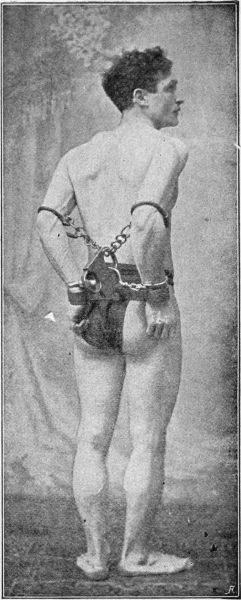
Houdini, as Handcuffed by the Vienna Police, March,
1902.
Houdini has the right to publish the verdict one time in the Cologne
newspapers at the cost of Schutzman Werner Graff.
For the rightful writing of this verdict, we sign as responsibilities,
Coln, Oct. 24, 1902. Stock Sekretar.
Gerichtsschreiber des Kgl. Amtsgericht Abtlg VI.—9.
Signed for Houdini,
Rechtsanwalt Dr. Schreiber Köln.
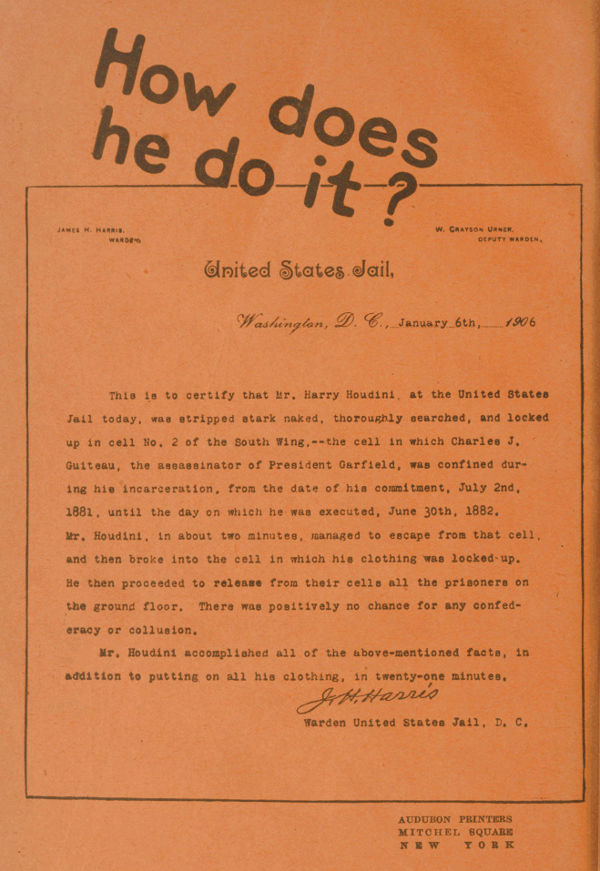
It will be of interest to note that Houdini has escaped out of prisons
and cells in the following cities:
New York, W. 125th Street Police Station, W. 68th Street Police
Station, and W. 37th Street; Brooklyn, N. Y.; Newark, N. J.; Salem,
Mass.; Lowell, Mass.; Rochester, N. Y.; Baltimore; Washington (3
different places); Detroit, Mich.; Philadelphia, Pa.; Providence,
R. I.; Kansas City; Buffalo, N. Y.; and Chicago, Ill.; Amsterdam,
Hague; Dordrecht, Holland; Moscow, Russia; Halifax; Bradford;
Leicester; Burnley; Leeds; Newcastle-upon-Tyne; Sheffield; Liverpool;
South Shields; Salford; Huddersfield; Manchester; St. Helens;
Stockton-on-Tees; Eastbourne; Newport, Mon.
Space prohibits the publication of all certificates from the various
chiefs of police, but a few are selected, which follow:
Chief Constable's Office,
Sheffield, Jan. 19, 1904.
This is to certify that Mr. Harry Houdini was this day
stripped stark naked and locked in the cell which once
contained Charles Peace. The cell was searched and
triple-locked, but Mr. Houdini released himself and
redressed in five minutes, having also opened the iron gate
of the corridor.
Charles J. Scott, Commander (R.N.)
Chief Constable, Sheffield.
Witness to the foregoing feat,
George H. Barker, Deputy Chief Constable.
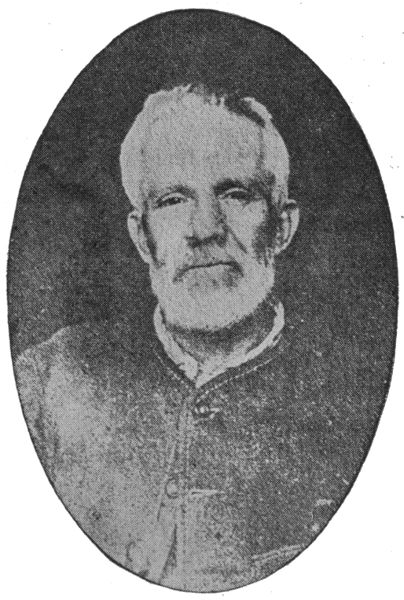
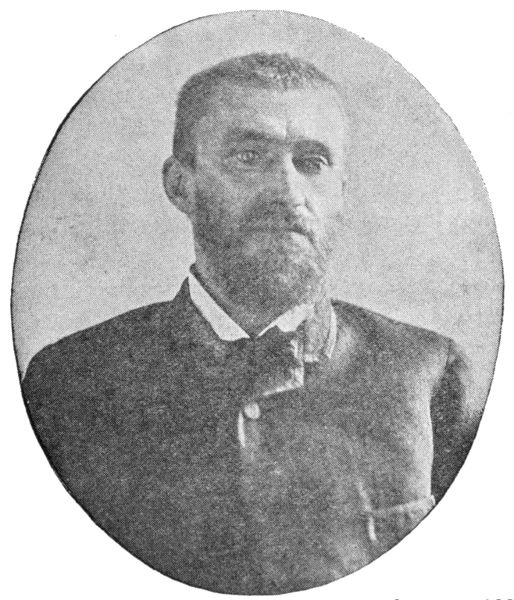
An exceedingly rare photograph of Charles Peace,
shrewdest, most dangerous and notorious criminal in the annals of Crime
in Great Britain. Peace broke jail a number of times but failed to
escape from this cell in Sheffield. He was hanged at the Armley jail.
Houdini escaped from this cell, as Chief Constable Scott's certificate
on page 12 shows.
May 10, 1903.
Harry Houdini was made to disrobe, and in a nude condition
was locked into the Moscow transportation cell or carette,
and in less than 20 minutes he had managed to make his
escape. The searching Houdini had to submit to in the hands
of the secret Russian police was the severest he has ever
had to undergo. Never in the history of the Russian police
has any one been able to escape out of this or any other
transportation carette. This feat was accomplished in the
presence of Chief of the Secret Police Cos, Lebadeff.
Houdini was booked for one month in Moscow, but after this feat he was
prolonged for four months, and proved the greatest sensation that ever
visited Russia.
From the German police Houdini possesses certificates from the cities
of Berlin, Dresden, Dusseldorf, Essen Ruhr, Barmen, Bremen, Dortmund,
Leipzig, Frankfort A/M, Hanover, etc.; but the following is the
principal one:
Royal Police Presidium,
Berlin, Sept. 20, 1900.
Harry Houdini, the American, was handcuffed and leg-ironed
with the irons used here, in the presence of a large number
of the highest police officials of Germany. Houdini managed
to free himself from everything, by mysteriously opening
the locks, in a manner which is unexplainable to us. The
cuffs were uninjured.
(Signed) Von Hullessem, Royal Police Director, Berlin.
Von Windheim, The Royal Police President, Berlin.
Von Windheim was the highest police official in all Germany. The
Kaiser's signature was the only name that stood higher in Germany.
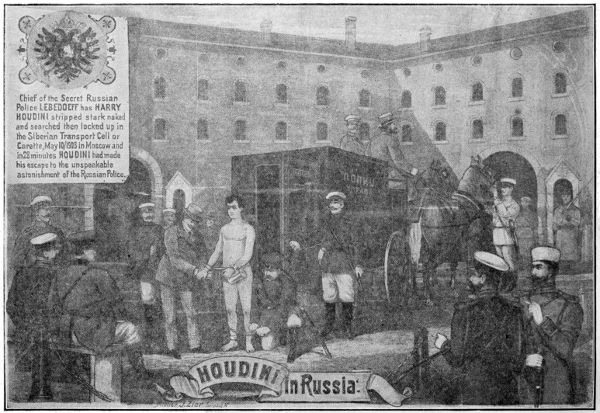
The Preparation for Incarceration in the Siberian
Transport Carette.
[Text in illustration: Chief of the Secret Russian Police LEBEDOEFF
has HARRY HOUDINI stripped stark naked and searched then locked up in
the Siberian Transport Cell or Carette, May 10/1903 in Moscow and in 28
minutes HOUDINI had made his escape to the unspeakable astonishment of
the Russian Police.]
The Daily Illustrated Mirror, March 18th, 1904.