Our family felt that they could remain in the grounds forever
and never be done seeing; but the time was drawing near when
they must return home. Uncle decided that this Saturday must
be their last day at the Fair. Surely they had seen enough, even
if there was so much more not yet seen. They had seen notable
people all the way from the Infanta of Spain to Faraway
Moses, of Egypt. But they were all the same to Uncle. He
had heard all kinds of music, from the Spanish band to the
Samoan tom-tom. "Some of the music," he said, "was so
peaceful like, but the rest was not half so nice as the growin' pigs
rubbin' against splinters in the sty back of the barnyard." He
had surely been all over, and there was nothing more of a startling
nature to see. He had watched them check babies at the children's
building as if they were poodles or handbags, and he had
been over to the Irish village and seen the people kissing the
"Blarney Stone." On a card tacked near by he read:
|
This is the stone that whoever kisses
He never misses to
Grow eloquent.
A clever spouter
He'll turn out an orator
In Parliament.
|
Uncle had no ambition that way, and so he let the rest do all the
kissing.
He had completed his sight-seeing in the city by taking a
Turkish bath, and he considered himself now ready to "pull up
stakes" and return to the farm.
"I've made hay in July, and punched it back into the loft,"
said Uncle; "I've harvested in August, and drunk out of the
branch; I've cut hoop-poles in the swamp, and done lots of other
hot things, but fer real sultuy weather nothing is ekal to the Turkey
bath. Some feller told me it was the healthiest bath a feller
could take when there was no creek around. You see, I looked
at the Chicago river and decided it wasn't altogether a proper
place fer a swim; then I went over to the lake whar they were a
paddling around, but somehow the water didn't warm up even a
little bit in the afternoons, and then I thought I might just as well
pay a dollar and take a Turkey bath.
"Well, it do beat anything in the wash line I ever see. I went
into the barber shop where the sign was and paid a woman a dollar,
and she took my silver ticker and chain and all my spare
change, and my pocket book, and put 'em all into a box and locked
it and then fastened the key around my wrist. Well, I wondered
if I was a going down there whar they had to protect me
that way from getting robbed.
"I went down stairs where I stopped to see a feller a doing
some thing to a feller's feet. I seed he was a cutting the nails,
and then I thought how awful lazy these city people do get, that
they can't even cut their own toe nails.
"A feller came up and put me in a little room and told me to
strip off and foller him. Well, sir, that feller he just stuck me
into a room that was hot enough to fry eggs and bake Johnny
cakes. I dassent breathe hard for fear of burning my nose off.
He set me into a lean back chair and decently covered me over
with a sheet. I've biled sap, an' I've rolled logs; I've scraped
hogs over the kettle and made soap, but this beat anything I ever
see fer hot weather. If I hadn't seen other respectable folks
goin' in there I'd a knowed I was a gittin' basted for my sins in
the bad world. I couldn't set there, so I tried to walk around,
but I seen my feet was liable to get roasted, and the air was hotter
at the top, so I set down again.
"Well, sir, I sot there till I got hotter'n biled corn, and then I
hollered worse nor the Johnnies at Kenesaw mountain.
"Then a feller stuck his head in at the door and told me to
come out there, and when I did a colored feller shoved me on to
a bench and began to slap the daylights out o' me with both
hands, and then another feller he turned the hose on me, and
then I cut loose.
"Well, sir, you ought to a seed me. I'm gittin' old, but
'nough is 'nough, and I kin be painters an' wild cats when I want
to. I was in a pecooliar place without a stitch on me, but I jest
run the slapper into the bake oven, and I made the buggy washer
jump into the fish pond or swimmin' hole what they aimed to
chuck me into next; and then a feller came out and took me
into another room, where he rubbed me down kind a horse like,
and I got my clothes on and went up to the woman and got my
things give back; and I told her I was awful glad to see daylight
again. She laffed, an' I didn't say no more, but I done lots of
thinkin'."
They were sitting on a rustic bench, just across the southwest
bridge on Wooded Island, when Uncle's talking was brought to a
stop by a great noise in the direction of the "Plaisance." Just
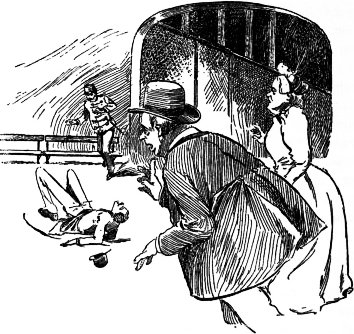
then two Turks came trotting by with a sedan chair in which was
seated a nervous-looking woman who seemed anxious to reach
the place from which the medley of noises seem to be issuing.
She nervously grasped the sides of the chair and looked at the
bent form of the toiling Ottoman in front. Over the bridge they
went, the carriers executing a double shuffle diagonally down the
steep descent. The passenger opened her mouth and gave a
scream that made the Turk in front stumble as he bent his head
to see what was wrong. Then she screamed harder, frightening a
flock of sea-gulls off the island and bringing a Columbian guard
on a run from the north entrance of the Horticultural building to
see what was the matter. Then she insisted on getting out, and
she was so glad, that she gave the Turk a dollar, and left before
he could give her any change.
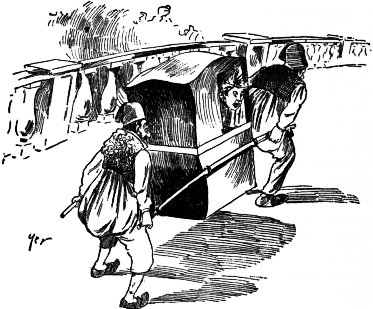 "SHE GAVE A SCREAM THAT SCARED SOME GULLS OFF OF THE ISLAND."
The noise over towards the "Plaisance" continued, and Johnny
cried out, "The parade, the Midway Plaisance parade! Come
on, the whole earth is parading!"
The front of the procession just then appeared in view, and the
family went to the top of the bridge where they could review the
strangest procession that ever walked on the western world. Processions
may come, and processions may go, but there never was
one like that which was then winding through the broad streets of
Jackson Park.
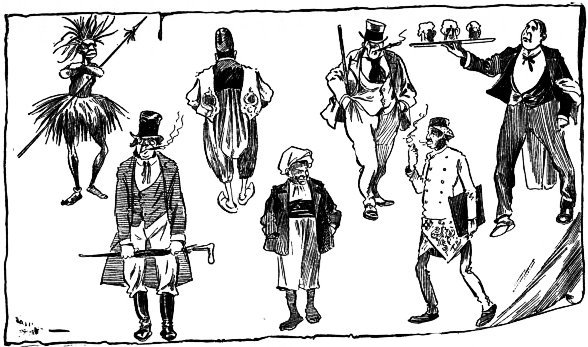
The column was over a mile long, and made up of men and
women afoot; camels, gaily decked horsemen, wild Bedouins
from Arabia's desert's; carriages, rolling chairs, reindeer and
dog sledges. From the fur garments of the Laplanders leading
the column, to the sea-grass, thoroughly ventilated costumes of
the Samoans, was presented a contrast that marked the display
all along the line. It seemed as if there had been a revival of
the Babel scene from the Pentateuch. It seemed that the confusion
of tongues had just come to pass and people had not yet
become accustomed to talk anything but Sanscrit or Chinese.
There was a gathering of assorted freaks not surpassed since
Noah came out of the ark, and an assortment of people never
seen before. When Mr. Moody preaches to the Midway Plaisance,
surely the scripture will be fulfilled as to preaching the gospel
to all the nations of the earth.
Then the bedlam of strange cries were heard again. These
peculiar sounds came from the Dahomey warriors and amazons,
black as night and stupid as pigs. In thin cloth and hair garments
that concealed just a little of their bodies, the blacks romped as
they sang and beat upon long cartridge shaped drums.
The noisiest part of the parade began with the Algerian village.
Drums resounded, clarinets screeched, castanets clattered, and
the shrill cries of the dancing girls rose above all the tumult.
The girls rode in rolling chairs, and while they were not busy
rivaling the banshee of Ireland, they laughed and flirted to their
hearts' content.
The Chinese was the most gorgeous contingent in the column.
Costumed in rare and brilliant silks, ablaze with gold and silver,
the Chinese actors and actresses made a brilliant appearance.
But it was the dragon that wriggled behind them that caught the
crowd. It was 125 feet long, and its mouth was big enough to
swallow a man without tearing his clothes on its fangs. When
it passed the beer tunnel in the "Plaisance," its glaring eyes
turned toward a man whose best friends have been to Dwight.
The man shuddered and drew a long and nervous breath.
"Take me away from here, Bill," the man said to his companion.
"I never thought I could get in this kind of a fix. I'm
a quitter right now."
From a distance it looked like a monster sea serpent on a
spree. It was really a dragon, at least that's what the Chinese
call it; but it was in fact the finest exhibit ever beheld of what a
diseased imagination can do for a victim of strong drink. It
could easily claim the prize as being the most terrifying object
on earth.
The people from the "Street of Cairo," afoot and mounted on
camels and donkeys, headed their part of the procession with
the Turkish flag, and swift-footed runners guarded the banner,
while men in rusty, antique chain-armor were near to defend.
A horde of fakirs and jugglers of all colors, from jet-black Soudanese
to fair-faced Greeks, pressed close at their heels, stripped
to the waists, with bare feet, and cutting up all sorts of tricks.
Swordsmen, garbed in long robes, twirling naked blades and
shields as they hopped about one another in imitation of combat;
more donkey boys; Nubians bearing carved Egyptian images,
one of which was of the sacred bull done in gold; bayaderes and
nautch dancers, not very good looking, but with fine white arms
and well-turned ankles and gorgeous in oriental robes and colors—all
flocked after the fakirs.
Then came the Persians, the women playing upon hurdy-gurdies
and singing a plaintive air more suggestive of melody than
any other native music in the line. The lion banner of the Shah
was carried proudly, and this detachment closed with a score of
Persian gladiators, naked to the waist. They seemed to be
superbly executed pieces of bronze set in motion.
The "Beauty Show" was in the parade. Blarney Castle had
several lads and lasses present, led by the pipes and a jig-dancer
as agile as an antelope and as tireless as an electric fan, for he
jigged all the way the procession marched. Then the Samoans
came along. Stalwart men are they, yellow-skinned and muscular,
and in their airy sea-grass garments, knee short and chest
high, they presented a splendid physical appearance, while the
women were pleasant-faced and fairly pretty. The men danced
a war dance while marching along, and their fierce wielding of
their clubs had greater influence in putting back the fast encroaching
crowds than did the oft repeated command of the
Columbian guard to stand back.
The South Sea Islanders, with nothing much more than
feathers and grasses about their bodies and on their heads, sang
a wild but tuneful melody as they brandished war clubs and
danced about, their well-greased bodies gleaming in the sun.
Three pretty Hula-Hula girls in the party sang all the time.
Their dress was very fantastic; short, full skirts of brilliant-colored
grasses fell to their bare brown knees. Flowers and
grasses were twined in their hair. A short, tight-fitting robe of
grasses and feathers fell over their shoulders and ended at their
waists.
The young women who illustrate all the various types of beauty
to be seen anywhere on earth, from Hong Kong to State street,
made up the line. They were in carriages, and attracted much
attention.
The odd procession traversed the Fair grounds to the east end of
the Electricity building, and then returned to their respective shows.
It was now getting late in the afternoon and Uncle said, "Now,
let us be taking our last looks."
"Papers, Mister? All about the Sunday Fair."
Uncle bought a paper and read the headlines:
"GATES REMAIN OPEN"
"Courts' Final Decision in Favor of Sunday Fair
Judges are Unanimous—Overrule Judgment
of United States Circuit Court"
"Court Room and Halls Crowded with People
Eager to Hear the Decision"
"The Chief Justice brushes away the Cobwebs of
sophistry and religious paternalism by which the
Sabbatarian sects sought to close the Gates
against the Millions"
"I didn't see no millions when I was here Sunday, did you,
Sarah? And the grounds looked lots like a big grave yard, with
some people sad like, a wandering through."
The sweat began to come on Uncle's face. His big bandanna
was brought into play. "So they've opened it. Well, I don't
know, I don't know. It kind of worries me somehow, as if they
oughtn't a done it. But I don't understand all the law and the
gospel. I surely didn't do no wrong when I thought seeing the
Fair on Sunday was right, if it do disturb me like, just now. I
thought our Savior meant seeing the Fair on Sunday when he said
'It is lawful to do well on the Sabbath day.' But when I see
the beer tunnel full of people, and the furrin theayters a runnin',
it didn't look lawful, and I wisht I was back to our old church a
sittin' in the corner. Anyhow, I hope I didn't do any of it."
Uncle walked on slowly in a very sad and meditative mood.
Aunt looked as if there was something that had overthrown all
her high sentiment on her first Sunday of seeing the entrancing
visions of the great Exposition. There were religious realities
touching her soul now, and she walked on rapidly with Fanny,
leaving Uncle behind. Johnny was flipping pebbles at some
ducks in the lagoon and Uncle had stopped to look in at one of
the doors of Liberal Arts hall. While he was standing there
two dapper young men came walking hastily by. One caught
sight of Uncle and quickly uttered a low whistle. His companion
stopped short as the first one said: "Der's de old duffer; let's
work him."
"Naw, we can't do it. He'll remember me mistake in change
an' de blasted trainboy biz."
"'I'll bet you a fiver he don't! You're trigged out altogether
new, an' your gran'mother wouldn't know ye."
"Nothin' like tryin', so here goes," and the speaker walked on
a few steps and half concealed himself behind a column, close
enough to hear all that was said.
"Well, how do you do, Deacon Jones? I am awfully surprised.
It's like two needles meeting in a haystack for us to
meet here. Isn't it now! It's a long time since I saw you back
in old Barnville, Sage county, Indiana; but I remembered you
the minute I clapped my eyes on you. I suspect you'd like to
hear from some of your old neighbors."
The speaker was still holding Uncle's hand, and Uncle was
looking at him in a bewildered manner, as if searching intensely
in the picture gallery of memory's old time faces.
"I see you can't place me, but I guess it's 'cause I was only
a chunk of a lad, but I see you often in the 'amen corner' of
the Barnville Baptist church. You see my father was killed in
one of the battles before Atlanta, and mother and me, when I was
a boy, didn't have much to live on, only our pension. So I had
to work hard, and didn't git around much for to be seen by anybody.
I was converted and joined the church just about the time
you moved away. Then I went into Mr. Monroe's store and got
to be chief clerk, and then when the bank was opened at Barnville
I was made cashier, and in three or four years I was called
to be cashier in the First National here, so you see I have been
more successful than most of the poor boys about Barnville whose
fathers never came back from defending their country."
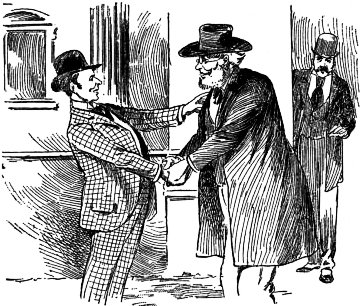 "I SEE YOU CAN'T PLACE ME."
"Ah, my boy," said Uncle, "my heart always warms up for
my comrades' children. I believe I recollect you now. Wasn't
you the boy what swum out into the crick at high water, when the
bridge went down while preacher Barker's wife was crossing with
her baby to bring him back from Bethel, and towed 'em safe to
shore?"
"Yes, sir. I'm the lad."
"Widow Brown's son George?"
"Yes, sir, George Brown, from Barnville, is what I am."
"Well, well, my boy, I knowed I recollected you. My memory's
bad enough, but I haint forgot ye and yer brave deed. Well,
I'm glad your succeeding so well, and I hope you haint forgot
your redemption before the Cross."
"No, Deacon, I haven't, and I trust I am doing the Lord's
will, as I ought, though I know sometimes I fall short. I take
part more than most of the young people in our church, but I
trust I will still be moved to do more and more for our holy
cause."
"There, there! It's proud I am to see in this great wicked city
one of Barnville's boys so true to the teachings of our Lord and
Master that he learnt in our old home church."
Here the young man coughed lightly, as if the emotion of
religious memories was swelling up in his throat and almost
choking his utterance.
"But I guess everybody has forgot me at Barnville. It's mor'n
twelve years now."
"Not at all, Deacon. Every time I go back there to the old
church I hear somebody speak of Deacon Jones."
"Do tell——!"
At this moment a young man came up hurriedly and tapped
"George" on the shoulder. "George" turned at once, and said:
"How do you do, Henry? Henry, this is my old friend, Deacon
Jones, from the home of my boyhood. Mr. Jones, Mr. Wilson.
I am proud, Deacon, to have you meet my friend here, who is
one of the Exposition directors and manager of one of the most
important departments on the grounds."
"I would be very glad to talk longer with you and your friend
Mr. Brown, but I was just hunting for Johnson, the paymaster. Iv'e
got to have two hundred dollars inside of ten minutes or there will
be the biggest howl among employees you ever saw."
"Oh, you needn't hunt any longer for Johnson, Mr. Wilson,
here's my check for the sum and you can cash it at once at the
World's Fair bank," and Mr. Brown, who was none other than
Arthur Blair, the confidence man and bogus detective, drew out
a First National bank check book.
"But that's exactly the trouble. It is now past banking hours,
and for some reason Johnson has not come around."
A troubled look came over Mr. Blair's face in his anxiety to
help out his friend. Turning to Uncle he said: "Perhaps the
Deacon can help my friend out and then cash my check here on
the grounds in the morning."
Uncle looked uneasy for a moment, and then said: "Of
course I can accommodate you," and he pulled out a roll of bills
and laid aside $200, which left him with only thirty dollars.
Mr. Blair had the check made out and was just extending it to
Uncle when Johnny came up, a curious spectator of the scene
before him. A second glance at the gentleman talking to his
grandfather and he began to jump up and down and whirl around
yelling at the top of his voice: "Perlice! fire! murder! robbers!
pickpockets! confidence men! thieves! thugs! highwaymen!
bandits! outlaws! catch 'em! hang 'em! crucify 'em!
here, here, everybody! surround 'em! close in on 'em! let no
guilty man escape!"
The two confidence men were for once too astonished to act
quickly, but one recovered himself soon enough to make a snatch
for the roll of bills in Uncle's hand. Two or three corners of
bills were torn away, but Uncle held the money. In an instant a
dozen men were crowding around, and among them two or three
officers.
"Catch that old thief!" yelled Blair, "he's got my money."
"Catch him!" cried Wilson, appearing to try to get at him,
"he's got our money."
Uncle was standing in blank stupefaction holding the bills in his
hands and staring at the gathering crowd.
An officer caught him by the arm and said: "Old man, where
did you get that money?"
Uncle found his tongue at last, and said: "Mister, I got that
from Bill Shaw for some of the finest Jerseys you ever seed."
"Here, officer, are our cards and the charge. We'll appear
in the morning at the station."
Johnny had been overwhelmed by the crowd, but by this time
he had edged his way in, and when he saw his grandfather in the
tolls of the law he yelled shrill enough to startle the whole crowd.
"Grandfather's done nothing, let him alone. Here's the thieving
hypocrits." But the two young men had disappeared among
the people, and Uncle was being taken away in such a crowd
that John could get no view whatever of the situation, so he ran
howling and sputtering round and round the fast increasing crowd
like a child gone insane. Presently the uselessness of his action
made him think of Mother and Fanny. At once he darted off to
the spot where he had seen them last, and in his wildness to find
them ran past them two or three times, till Fanny saw him and in
amazement cried, "Johnny! John! What on earth is the matter
with you, Johnny?"
Johnny darted over to them and yelled out: "He's tuk up!
The cops has got him! grandfather's tuck up, and he's done
nothing, and them bloody bandits got away again. Oh! Oh!
Oh!" and Johnny danced around, incapable of telling Fanny or
his grandma anything further.
But they learned enough to know that for some reason Uncle
had been arrested and was no doubt now in the guard house.
Aunt was overwhelmed with consternation, but Fanny ran over to
a guard standing near by and inquired: "If anyone is arrested on
the grounds where do they take them?"
"Over there to the guard house, Miss. There they go with
some old chap now."
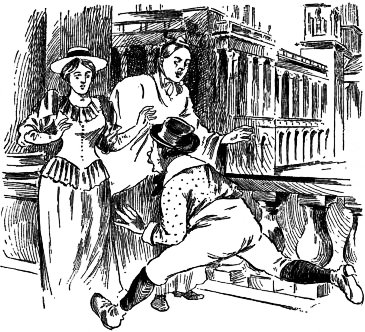 "HE'S TUCK UP, HE'S TUCK UP! THE COPS GOT HIM!"
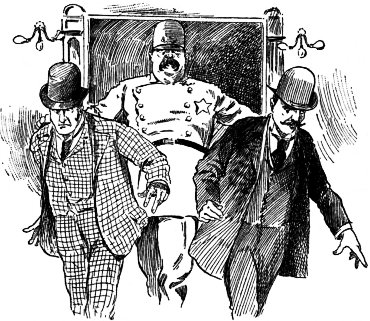
Fanny looked and could scarcely repress a scream as she saw
Uncle seated in the patrol wagon between two policemen. She
ran back to Aunt and Johnny and told him to run as fast as he
could to see where the wagon went, and they would follow in the
same direction. Johnny was off like a shot as he saw the wagon
rapidly disappearing over the way.
Out of breath they were coming up to the station door when
they met Johnny, hat off, and almost speechless with excitement.
"They've took Grandpa's money and everything, and locked
him up. They asked him if he had any friends, and he said he
had no friends here but us. Nobody listens to me, come quick,"
and he started them off on a run for the station. Arriving there,
the officers in charge told them he could do nothing for them unless
they could find some responsible persons to secure his appearance
for the preliminary hearing of the next day. They
were taken around where Uncle was, and a more woe-begone
appearing farmer never was seen.
"Ah, children, this is Chicago!"
"Grandpa, I'm going to find Mr. Warner. I believe he is a
good man, and will help us, as he told you he would. Johnny
and I will start at once to find him. I don't know what else to do."
"But, child," said Aunt, "it's already five o'clock, and the
people will all be gone home from the store."
"No difference, Grandma; you stay right here, for we're going."
She took the card from Uncle that Mr. Warner had given
him and left the building with Johnny walking resolutely by her
side.
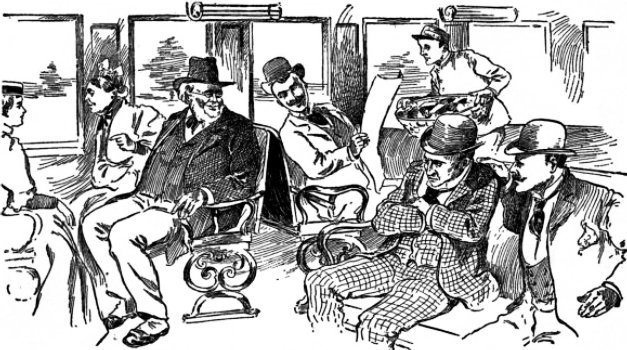 "Apples, pears, bananas, sweet oranges."