With the tears blinding his eyes, with shaking
hands, speechless with the happy thoughts surging
in his brain, Ulysses knelt and kissed the
dear, dear shores of his own country.
The same rocky coasts, the same great mountain
in the centre of the island raising its head into
the clouds, everywhere eternally the same, and how
beloved! was it not all mist and dreams—the long
past? How he heard the Sirens sing, seen the
swaying arms of the foul Scylla, and dwelt in love
and slumber with Calypso?
And by his side once more stood the goddess,
serene and beautiful in her benevolent but awful
calm. From her lips he had heard that here, even
here in his own land, in the fields of his inheritance,
one more supreme effort awaited him.
He had learnt how his palace was full of riotous
princes, who wooed his wife, the Queen Penelope.
He knew how his son, the goodly Prince Telemachus,
was least in his own house, and how wild
revel and wantonness ate up his substance. The
81]
queen in peril! Penelope all but given up to the
desires of lust and greed. All his great heart
burnt with anger and hate against the suitors, and
yet, with a strange dual emotion, beat high with
pride for his dear and stainless lady, who still
mourned for her husband, and longed against
hope for his return.
He kissed the kindly home-ground, and at that
sacred contact a sense of strength and power came
to him, a god-like power, that in all his long toils
and wanderings he had never known before.
He became conscious that Athene was speaking
to him. “And remember ever, my Ulysses, that
now thou hast need of all thy wit and cunning.
In all the chances of thy life before never hadst
thou need to walk as warily as now. For mere
strength and valour unallied to wisdom and cunning
will avail one nothing against the hundred.
But at the hour of need I will be once more with
thee if thou doest well and wisely. Courage!
son of Laertes! ’tis but a little while till the
end. Let not thy love and hate master thee until
the appointed hour. And now, that thou mayest
walk in thy palace and groves unknown for who
thou art, I give thee a disguise. And so farewell
until the hour of triumph.”
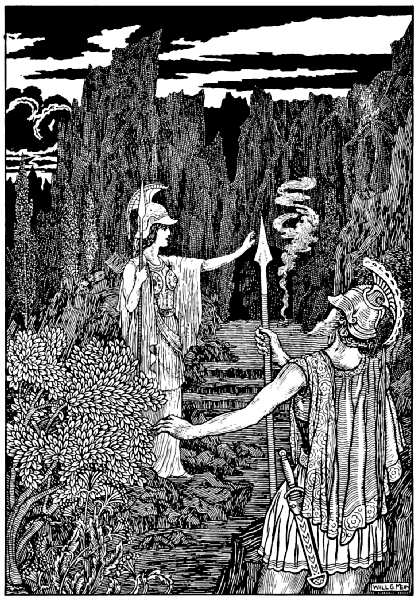
She stretched out her spear over the kneeling
king. The firm flesh dried and wrinkled upon
his arms and legs. His hair shrivelled up into
grey sparseness and his eyes dimmed. He wore
a tattered cloak, a thing of shreds and patches,
and an old beggar’s staff of ilex was in his hand.
82]
But beneath this seeming age and weakness
was hidden the true hero as strong and cunning
as before.
The goddess turned into light and was no more,
and with slow, tottering footsteps Ulysses took
a lonely way among the well-remembered paths
of his native hills.
After an hour’s travelling he came out on a
smooth pasture land, with a little homestead
nestling among a clump of trees. His heart
beat eagerly within him, for if perchance after
these long years farmer Eumæus still lived,
here he might gain news of his palace and
perhaps a friend.
Eumæus was once the steward of the estates
and a very faithful servant of his master. Ulysses
approached the house. In front was a large courtyard,
made by a fence of oak and hawthorn
boughs, and within were twelve great pens for
swine.
And in the porch sat old Eumæus himself
making himself a pair of sandals, hardly changed
in a single feature, though perhaps his eyes were
not so bright as in the old times.
Hearing footsteps, the four fierce dogs which
herded the swine rushed out of the yard and leapt
angrily at the newcomer. He might have fared
badly, for the great beasts were lean and evil-tempered,
had not the swineherd ran out to his
help and drew them off with curses.
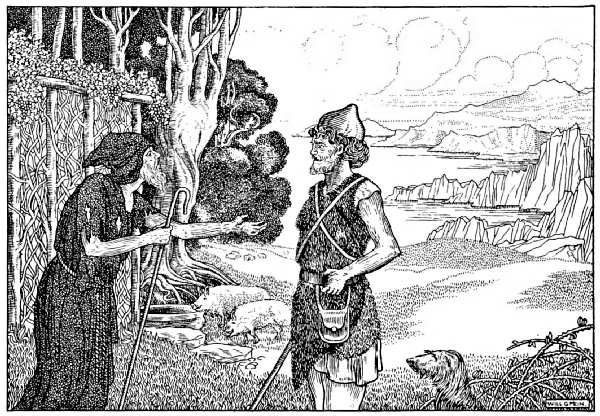
“NAY, IF YOU LOVE ME,” HE SAID, “NONE OF THAT, MY FRIEND.”
He turned to Ulysses. “Thank the gods, old
fellow,” he cried, “that I was near by. A little
83]
more and you would have been torn to pieces,
and then you would be in an evil plight but I a
worse! Dead would you be and past caring, but
I should be disgraced. Heaven knows, I have
enough trouble to bear. Here’s my lawful master
gone in foreign parts these long years—dead as
like as not—and I sit here feeding swine for them
that are but little better themselves. But come
in, come in, old shrew. There’s a bite of food
for you within, which you need I make no doubt,
and then you can tell me your story, for I am a
lonely man now and like a crack of talk as well
as most.”
The garrulous old fellow pushed him in with
busy geniality and sat him down on the goatskin,
which was his bed. Then he fetched what meat
and wine he could furnish, and they sat down to
a frugal meal.
“What, then, about this lord of yours?” said
Ulysses. “I myself have wandered far these
last years. Perhaps I may have met with him,
and can give you news.”
The swineherd chuckled.
“Nay, if you love me,” he said, “none of that,
my friend. Why, every dirty old man as comes
along this way has some such tale to tell. And
then my poor lady up in the palace—the gods
save her!—she takes them in and gives them a new
cloak or what not, and believes all they say until
the next one comes along. No! my dear lord
is dead and never shall I look upon the like of him
again. By Zeus! but he was a man if you like!”
84]
“Well, my host, we shall see in the future,” said
Ulysses, in so significant a tone that the swineherd
was startled for a moment.
The wind had arisen and it was a black stormy
night so they went to rest early, and Eumæus
slept soundly till dawn. But all through the
silent hours the brain of Ulysses worked like a
shuttle in a loom.
At breakfast-time, while the swineherd was
preparing the meal, the dogs began to bark loudly
outside, but in a welcome manner, saluting one
whom they knew.
Footsteps were heard crossing the yard, and a
tall young man with the first down of manhood on
his lip stood in the doorway.
Eumæus dropped the bowls in which he had
been mixing the wine with a sudden clatter and
ran towards the stranger.
“My young lord,” he cried, “oh, my young lord,
the sight of you is a welcome one to weary eyes.
Come within my poor place. This is but a poor
old man who shelters with me for a day or two.
Don’t mind him, my lord.”
It was Telemachus the son of Ulysses.
The king rose humbly and offered his seat to
his son.
“Keep your place, old man,” said the prince.
“The swineherd will find me another. And
who may you be, and what do you in Ithaca?”
Then Ulysses told him a long story. He said
that he was a Cretan, and had fought at Troy and
was now destitute and a wanderer.
85]
“Could you not take him to the palace, my
lord?” said Eumæus. “Perhaps he might find
some work there.”
“I will clothe him, and arm him with a sword,
and give him a little to help him on his way,” said
Telemachus, “and that most gladly. But I
cannot take him to the palace. The suitors would
ill-use him because of his age, perhaps they would
kill him for sport. I cannot restrain them; I am
young; and what is one against so many? Moreover,
so great is the hate they bear towards me,
they would surely slay any guest of mine.”
Then Ulysses rose from his seat and bowed.
“Lord,” he said, “if I may dare to speak and you
will hear, I say foul wrong is wrought against
you in your palace, and my blood rages when I
think of it.”
“Old fellow, you are right enough,” said the boy,
sadly. “Oh, for my dead sire! to sweep these
dogs from Ithaca!”
“Yes, the king!” said Eumæus, with a deep
sigh.
Suddenly Ulysses saw the tall figure of Athene
was standing by his side.
The other two were looking towards him, but
could see nothing of her presence. The goddess
looked at him with kindly eyes and touched him
with her spear.
Telemachus and Eumæus crouched trembling
and speechless against the furthest side of the hut.
The bronze came back to the face of the king,
his hair fell from his head in all its old luxuriance,
86]
his figure filled out, and he stood before them in
his full stature and all the glory of his manhood.
Eumæus fell upon his knees and covered his
eyes with his hand.
“A god! a god!” he cried, “a god has come
to us! Hail, oh Immortal One, guest of my
poor homestead!”
Telemachus knelt also. “Oh, Divine stranger,
a boon! Tell me of my dear father, if indeed
he lives and knows of the peril of his house.
And will he ever come back to sit in his own
chair and rule?”
Then Ulysses stepped to his son and caught
him in his arms and kissed him.
“Telemachus! Telemachus!” he said, “no god
am I, but your own dear father come home at
last, and I am come with doom and death for
the insolent ones about my board!”
And when they had all three mingled their
happy tears, Telemachus said, “Father, I know
how great a warrior you are, and all the world
rings with the wisdom and valour of your deeds.
But we two can never fight against so many.
In all, the princes number a hundred and a score
of men; and they are all trained fighting men,
the best from Ithaca and all the neighbouring
islands. We must have other aid.”
“Comfort yourself, son,” said Ulysses. “Aid
we have, and the mightiest of all. Athene herself
watches over my fortunes and will come in
the hour of need. She has brought me hither
and given me this disguise, and in all the coming
87]
contest her voice will help and her arm be for
us. Should we need more aid than that?”
“Truly, my father,” said the boy, “we are well
favoured, and my heart leaps within me at what
is to come.”
As he finished speaking, once more the manhood
of Ulysses left him and only a poor old
beggar man stood before the swineherd and the
prince.
“Now will we go to the palace,” said Ulysses.
“I shall seem but a poor old beggar man, and
however the princes may ill-use me I shall do
nothing till the time has come and we are ready,
and I charge you, my son, and my good friend
Eumæus, that you do nothing to protect me
however I am treated. You may check them
by words if you can, but no more. And not
even the queen herself must know that the
king has come home again.
“And now let us go. The judge is set, the
doom begun; none shall stay it!”
And the three went out from the hut over
the mountain paths towards the palace.
The revel was at its height in the courtyard
of the palace. Stone seats ran round the wall
which enclosed the buildings. Over a low colonnade
the orchard trees drooped into the court,
and a huge vine trailed its weight of fruit over
the marble.
The hot afternoon sun sent a vivid colour
over everything. Beyond the palace the blue
88]
mountains towered into a sky of deeper blue.
Purple shadows from the buildings lay upon the
white marble, and the long light glittered on a
great table piled with golden cups and bowls,
holding the débris of the feast.
A wild uproar and shouting filled the air.
The court was filled with whirling figures of
men and girls half drunk with wine and excitement
as they moved in the figures of a lascivious
dance.
All the household girls were there with the
suitors joining in the feast, and peals of laughter
shivered through the sunny air.
Telemachus sat on a seat apart watching the
revel with keen eyes. There was a repressed excitement
in his face and an eager regard. One of
the girls noticed it as she strolled past. She was
a slight, fair wanton creature with a mocking
smile.
“How, Lord Telemachus?” she said, laughing
lightly, “are you not going to join us in the fun?
You make a sorry host indeed! Is not this your
palace, and do you leave us without your countenance.
Oh, shame upon you for a laggard youth
when wine and kisses wait you.”
She made an impudent grimace at him and
flitted past. But a short time back he would have
raged at this impudent salutation from a pretty
slave girl who drew a confident strength from the
protection of his enemies. But now he hardly
heard her, but leant forward again in the attitude
of one who watches and waits.
89]
Outside the palace gate, on the hot white road,
two old men were approaching. One was the
swineherd Eumæus and the other a wandering
beggar man.
Just by the threshold of the courtyard an old
lean dog, very grey and feeble, lay upon a heap of
dung in the sunlight. The mailed horse-flies
hovered round him in swarms, but he seemed too
weak to drive them away. As the beggar
approached he threw his muzzle up into the air
with a quick movement. His sightless eyes turned
towards the advancing footsteps. With a great
effort he scrambled to his feet. The lean tail
wagged in tremulous joy, the scarred ears were
pricked in welcome.
He stumbled to the feet of Ulysses. When he
touched him the old dog lay down in the dust and
with a long sigh he died.
And this was the first welcome the king had
to his palace, and as he went in through the gates
his eyes were wet with tears.
When Telemachus saw the steward he beckoned
him to the table and sat beside him while he ate.
But Ulysses crouched down by the threshold.
Telemachus gave bread and meat to the swineherd.
“Go, Eumæus,” he said aloud, “give these broken
meats to that poor old beggar man by the gate,
and tell him from me that if he lacks he should be
bold and go to the princes and ask them for alms.
By Zeus! he will never grow fat if he crouches by
the door there!”
90]
Ulysses took the food with a low bow and
packed it away in his wallet.
He rose up grasping his staff, and went tottering
among the suitors. His lean arms and
furrowed, wrinkled face were so piteous, his
whining appeal full of such misery, that many of
the princes tossed him something.
At the head of the table a tall and splendid
young man was sitting. He was richly dressed in
a showy, ostentatious manner. His florid, handsome
face wore a perpetual and evil sneer. His
grey eyes were ill-tempered and quarrelsome.
“By the gods, my friends,” he cried, with a sneer,
“how tender-hearted and compassionate you are
grown! With what lavishness do you bestow the
wealth of Ulysses, or rather of the queen, upon this
old scarecrow. Such old beasts are no use in this
world. Get you gone, you old dog!”
With that he hurled a three-legged stool at
Ulysses. The stool struck him a heavy blow on
his side.
For a moment the black turmoil in the hero’s
heart was almost irrepressible. But with an
enormous effort of will he overcame it. He stood
quite still, with his head sunk upon his breast in
humility.
Now came the girls from out of the house
carrying great jars of fresh wine, and copper
bowls of water for the mixing, which they put upon
the table.
Here was better sport than an old beggar and his
woes, and Ulysses moved aside and was forgotten.
91]
But one of the girls touched him on the shoulder.
“Wanderer,” said she, “the Queen Penelope has
seen how Antinous used you from her room
within the hall, and she sends me to summon you
to her, for she would speak to you.”
Then, with beating heart and footsteps which
trembled with no simulated age, the king followed
the girl over the threshold of his own palace.
As he was walking towards the chamber of the
queen an old woman came towards them, a very
old woman with a lined brown face and little,
brilliant twinkling eyes.
“Poor old man,” she said, “it is a shame that
they should use your grey hairs so, and abuse
the hospitality which is the sacred right of
strangers. My lady Penelope sends me to you,
and bids me wash your feet in this bowl of water,
so that we may purge our house of the stain the
prince without has cast upon it. Sit on this
stool and I will lave ye.”
So the old nurse Euryclea bathed the feet of
her master whom she had dandled in her arms as
a child. Suddenly Ulysses made as though he
would draw away his foot. He remembered that
on his leg he bore a strange-shaped scar made by
a savage boar when he was a boy, and he feared
the wise old woman would know him by that
mark.
But as she passed her hand along his ankle
she touched the mark and turned his foot towards
the light and saw it. She dropped his foot quickly,
and the basin was overturned and the water ran
92]
away over the marble floor. She looked up into
the king’s face and knew him for all his
disguise.
In a fierce, hurried whisper he bade her be silent
for her life and his and the queen’s safety. As she
vowed, trembling, by Zeus and the gods, to do his
bidding, a trumpet snarled suddenly outside on
the steps of the palace.
The riot without died into silence.
The clear cold voice of a herald began to speak.
Thus says the Queen Penelope: “To-morrow
will I make an end of all. In the forenoon I will
choose from among the princes whom I will wed.
Too long have ye rioted within the palace and
eaten up the substance of myself and my son. I
am aweary. And since there is no other way,
to-morrow I will choose. Ye shall take the great
bow of the King Ulysses from its cover. And he
who can shoot an arrow through twelve axes in a
row—even as Ulysses was wont to do—him will I
wed.”
“Nurse!” whispered Ulysses, “the king will
be here before any can bend that bow. Now go
into the queen and tell her that the old man is
sick and begs leave to wait upon her another time.
And comfort her with an omen that you have seen,
but tell her nothing. And now farewell. There is
much to do ere dawn.”
There was a silence of consternation in the great
banqueting hall of the palace.
Penelope from her seat upon the raised steps
93]
beneath the richly-decorated wall at the end
smiled faintly to herself.
The twelve axes stood in a row, driven into
sockets in the pavement. The suitors stood in
two long rows on either side.
Antinous, the strongest of them all, held a great
polished bow. His face blazed with anger and was
red with shame.
All eyes were centred on him. No one saw old
Eumæus steal out into the porch and silently lower
the heavy bars of the door and lash them tight
with cords.
“Ah!” cried Antinous, “I know now why
neither any of you nor I myself can bend this
bow. It is not the great strength of Ulysses, for I
am stronger than he ever was. This is Apollo’s
festival, the Archer-God, and it is useless to strive
to bend this bow to-day. Let us sacrifice to
Helios to-day, and then to-morrow come again
to the trial.”
Then the old beggar man came forward.
“My lords,” he said, “I pray you give me the bow,
since you have done your trial for to-day. I was
once strong in my youth. Let me have this
honour.”
Antinous scowled at him, and stepped toward
him to strike such insolence, but the clear voice of
Penelope called sharply down the lane of men,—
“Who insults even the meanest in my palace?
Have more regard, sir, for I am still queen here.
Give the old man the bow since that is his whim.”
Antinous was cowed, but still murmured, when
94]
Telemachus stepped quickly up to him. The boy
seemed taller, his eyes shone with a cold, fierce
light they had never seen in them before. His
voice rang with a new authority.
“Be silent, sir!” he said in a keen, threatening
voice. “The bow is mine, and mine alone, to give
or refuse as I decide. Mother, the trial is over for
to-day. Go with your maidens into your own
chamber. I will see to this old man, and I am
master here and will be so.”
With a frightened pride and wonder the queen
withdrew.
The suitors began to whisper to each other,
wondering what this might mean. Their confidence
seemed to be slipping away from them.
Each and all felt uneasy. There was some strange
influence in the air which sapped their courage and
silenced the loud insolent words which were ever
on their lips.
The shadow of death was creeping into the
hall.
The great marble room suddenly grew cold.
The old beggar came up to the splendid Antinous
and took the bow from his unresisting hand.
As he plucked the string the gods spake at last.
A crash of thunder pealed among them. There
was a moment’s silence, and then the bow-string
rang beneath the hero’s touch as clear as the note
of a swallow.
And in a strange light, which glowed out from
the walls and great pillars of bronze, the princes
saw no beggar, but a noble form with bronzed face
95]
and flashing eyes, and they knew the king had
come home again.
Ulysses motioned to his son, and Telemachus
drew his sword and with a great shout rushed up
the hall after his father.
They turned and stood on the steps.
An arrow sang like a flying wasp, and Antinous
lay dying on the floor.
Then the princes rushed to the walls where
their armour and swords were wont to hang, but
all the pegs were bare.
Only above the steps where Ulysses stood were
three spears and three shields, and as they gazed
in cold fear Eumæus leapt upon the steps and the
three girded on the armour.
Again the great bow sang, and Amphinomus
lay dead.
Then Telemachus with a great shout drove his
spear through the fat Ctessipus, and he fell gurgling
his life away.
But one of the suitors, Melanthius, climbed up
a pillar through one of the lanterns of the hall and
clambered over the roofs to the armoury unseen
by Ulysses.
And while the deadly arrows sped with bitter
mocking words towards the cowering throng, he
gathered a great sheaf of spears and flung them
down among his comrades.
They seized upon the spears with a fierce cry of
joy, and Ulysses’ heart failed him where he stood
for there were still many living.
They began to run up the hall towards the steps.
96]
Then at last Athene saw that her time had
come, and she lifted her terrible war shield which
brings death to the sons of men.
And the flight of spears all went far wide of
the mark, and some fell with a rattle upon the
floor.
With one cry of triumph the king leapt like
light among the crowd. Hither and there flashed
the three swords like swooping vultures, and
Athene took all power from the princes, and one
by one they screamed and met their doom.
And soon the din of battle died away, and save
for a faint moaning the hall was silent.
And the princes, the pride of the islands, lay
fallen in dust and blood, heaped one on the other,
like a great catch of fishes turned out from a
fisherman’s nets upon the shore.
Eumæus went to the door of the hall and cut
the lashings, and raised the bars so that the sunlight
came slanting in great beams. The dust
danced in the light rays like a powder of tiny
lives.
Then Ulysses called the servants and bade
them carry the bodies away. And he ordered
Euryclea to wash the blood-stained floors, and
to bring sulphur and torches that the place might
be purified.
And that night great beacons flared on the hills,
and far out to sea the fishermen saw them and
said, “Surely the king has come home again.”
And while the music rang though the lighted
palace and the people passed before the gates
97]
shouting for joy, old Euryclea spread the
marriage bed of the king by the light of flaming
torches.
And when all was prepared, the old nurse went
to Ulysses and Penelope and led them to the
door of the marriage chamber, as she had led
them twenty years before.
Then the music ceased in the palace halls and
silence fell over all the house.
98]


 Clarkson’s Lillie Powder
  LONDON, W.C.