By H. J. Crumpton
The Adventures of Dr. H. J. Crumpton
of Piedmont, California, in his efforts to
reach the Gold Fields in 1849
Recollections of the family life; Arrival in
Alabama; Moves to town; Changes vocation;
Becomes a printer; The Mexican War; Starts
on his wanderings; The gold excitement;
Starts for the Far West; New acquaintances;
Another start West; Strikes out all alone; A
plunge in the overflow; Falls in with the military;
Strikes hands with old friends; Food
scarce; Confronted by Indians; Alone again;
Reaches California; Loses his oxen; In God's
country at last; Gets a job; Takes sail;
Hears sad tidings; No pay for services; At
Oro City; In the mines; At rough-and-ready;
Starts back home; In a wreck; On the Panama;
In New Orleans; Finds his brother; Detained
in Mobile; Business complications;
Back to the mines; Returns to Alabama;
Opinion about slavery.
Part One
MY DEAR Brother Wash:
You asked me to prepare
some notes on the wanderings
of an Alabama Boy.
To do this from memory after such a
lapse of time will be somewhat inaccurate
and prosy, I fear.
Our parents were married about 1816.
Mother was Miss Matilda Smith Bryan
and father Henry T. Crumpton. Both
sprang from honorable, well-to-do people
from revolutionary sires, who were
soldiers of distinction under General
Francis Marion. Our maternal grandfather
was Rev. Richard Bryan, a Methodist
preacher. Our parents started
married life in Walterboro, Colleton
District, S. C., where were born to them
Mary, Richard Alexander, Maranda
Ann, Henry Thomas, Hezekiah John,
(myself, born Sept. 18, 1828), and William
Zachariah; the balance of the ten
children, afterwards born in Alabama
were James Henderson, Martha Matilda,
Jane Eliza, and Washington Bryan,
yourself, the baby. All have now passed
into the life beyond except you and me.
In Walterboro our father developed
into something of a plunger in the financial
world; made several successful
deals, later formed a partnership—the
other fellow furnishing experience, our
progenitor the "dough." They invested
in the purchase and driving of cattle
to supply the Charleston beef market.
They succeeded well, always re-investing
original capital and profit in another
and bigger lot, finally meeting a
calamity by the drowning of the whole
herd in attempting to cross a swollen
stream, Broad River, perhaps at its
mouth and perhaps from not knowing
of the ebb and flow of the tide, though
living within forty miles of the coast.
With a feeling of disgust, following this
financial collapse, our father sought new
environment, and by the aid of kins folk
loaded up family and household belongings
in 1832 and struck out through the
wilderness for Alabama, across Georgia
through the Chickasaw and Choctaw nations,
before the removal of those and
other friendly tribes was completed to
the territory now forming part of the
State of Oklahoma.
After a dreary trip, we safely landed
at the delightful home of grandmother
Bryan near "Fort Rascal," now Pleasant
Hill, Dallas Co. We afterwards
moved to old Cahaba, where our father
succeeded well in business. The arrival
of a steamboat was quite an event, occurring
maybe once a month; everybody
turned out. They had a crude way of
loading cotton. A bale was carelessly
turned loose and rolled over our brother
Henry, who sustained injuries from
which he died. This was such a shock
for poor mother, it was determined best
to have a change of scenes. Our family
removed from old Cahaba to Farmersville,
a little hamlet in Lowndes
county. One thing about our stay there
is vividly remembered. A dear, good old
soul, named Ingram, was my school
teacher in the log-cabin school house.
He didn't know much and didn't try to
fool anybody; but he was a great stickler
for what he called "etiket"—was
bent on teaching his children good manners.
Just about all of Friday was devoted
to this stunt. It was quite a relief,
after we got rid of our bashfulness.
The previous four days, twelve hours
each, with our prosy studies, put us in
good shape for a change on Friday.
The dear old fellow managed to work
in more or less change of program from
time to time; but one inflexible feature
was to send one of the girls out of one
of the side doors, then detail some boy
to go out the other, to escort her back
and introduce her to each one of the
whole school, an ordeal to which every
boy and girl had to be subjected. Some
regarded this as a hardship, but to this
degenerate son of Adam 'twas always
a roaring farce and as good as a circus!
Our family about this time came into
possession of quite an inheritance,
which was added to the proceeds from
sale of the effects at Cahaba, and invested
in a fine body of land, about the
junction of Grindstone and Bear Creeks,
in Wilcox county. Our charming new
home was built on high ground on Dogwood
Level, a little way from the farm,
where we had a spring of fine water
and plenty of good air. By this time
three of us boys were big enough
to work and strong, willing workers
we were. With no experience
and not always guided in our
farming, we got along better than
neighbors to the manner born, and were
learning and doing fairly well. It was
perhaps the mistake of a lifetime to
accept an offer to sell the whole outfit,
at figures far in advance of cost or
apparent present value, to people who
knew a good thing when they saw it—the
Maxwells—a noble acquisition to
that then border settlement.
We moved to the county seat, Barbersville,
now Camden, and went into the
hotel business. We furnished a good
table, clean house, clean beds, was popular
and crowded from the start—lots
of old family friends from far and near,
called for entertaining whom it would
have been an outrage on Southern hospitality
to tender, or accept compensation.
In this way all profits were
"chawed up"—a mighty poor way to
run a hotel. But we older boys were
pretty good hustlers, earned enough to
help along, tiding over and in the education
of the younger children.
My first stunt in that direction was
starting an express and stage line. Carried
passengers and freight between our
town and Bridgeport, nearest landing
on the Alabama River. My outfit was
a one-horse affair with a highly prized
annex—an undersized black cur, "Beaver,"—worthless
in the estimation of
everyone, other than his affectionate
owner.
About this time, two enterprising
young men from New England started
a general store at the landing. On a
return trip from the East to buy goods,
one of them brought with him a large
Newfoundland dog—the first one in
those parts, which he "sicked" onto
Beaver. Owing to the difference in size,
results were quick and one-sided. Seeing
me crying in affectionate, helpless
distress, the fellow had the heartless bad
taste to exultingly ask: "What do you
think of that, young man?" My response
between sobs was: "You, a big
man, made a big dog lick a little boy's
little dog. By and by, I will be as big
as you and will then do to you what has
been done today to my Beaver." Years
afterwards, when, perhaps, as the first
successful Californian to return, the people
of dear old Camden tendered me
quite an ovation, he of the dog fight,
among them, was loud in expressing
welcome and personal admiration, which
made it deucedly bad taste in me to allude
to the old thing, by saying: "If now
the attempt was made to execute the
promised retaliation, it would show a
malicious, revengeful spirit, without in
any way changing what occurred in the
long ago, so please consider the incident
closed," and so it was with a snap.
Maybe the dog fight prompted a
change of vocation to that of mail carrier,
on horse back or mule back, the
route extending from Cahaba down the
river by Cambridge[A] to Prairie
Bluff, across the river and up by
old Canton, to Camden, Bells Landing,
Claiborne, thence to Stockton,
in Baldwin county, and serving intervening
post offices. It required six days
to make a round trip with the seventh
day off, Thursday, either at Stockton or
the other end. At Stockton, as a government
attaché one had the privilege
to go on the mail boat to Mobile and
return after a stay of five hours—quite
a treat for a country boy.
Whereas, a day off at the other end involved
an extra ride of ten miles to Selma
and return, because the contractor
lived there, and thus saved the keep of
boy and horse in Cahaba.
With an ambition to do faithful and
efficient service, reckless risks were
some times taken. I once got into Flat
Creek, when the old worn-out mule was
unable to stem the stiff current. We
were carried down stream toward the
river not far away. A friendly overhanging
grape-vine gave me a stopping
place and not far below the mule lodged
in a submerged tree-top. My lusty yells
brought the good Samaritan. When
about to swim out to rescue me, he was
disgusted when told to first save the
mule and mail. This he did in good
shape; meantime, I did my own swimming.
The water was emptied out of
the mail bag, the bag thrown across the
saddle, the mule mounted, and away we
went for a bridge several miles up the
stream. Maybe it was not the same
old mule which about a year afterwards
laid down and died suddenly, some eight
miles from our terminal point, Cahaba.
Slinging saddle, bridle, and mail bag
over my shoulder, the balance of the
trip was made on foot and the mail delivered
on time. When next pay day
came around, the old contractor placed
his own value on the mule and took same
out of my wages. My job was thrown
up immediately and suit commenced for
the amount due, but tiring of the law's
delay, the case was allowed to lapse,
and the wretch allowed the comfort of
having beaten a boy out of hard earned
wages. Doubtless he has long since
passed to the beyond. He was outwardly
a devout and sanctimonious man; if
one were sure he is now enjoying a
state of heavenly bliss, it would more
than justify a belief in universal salvation.
My next work was an apprentice in
a printing office—a fine school for a
boy with an ambition to learn. Those
capable of judging soon began to credit
me with quick, accurate work. 'Twas
a misfortune perhaps, and entailed following
hardships to have an early ambition
for something beyond—commenced
"reading medicine"—generally
in hours stolen from sleep or out-door
exercise and sunshine.
When the war with Mexico commenced,
brothers William and Richard
went as volunteers, the latter on a very
short enlistment, and afterwards wrote
he had declined further service in the
ranks, having secured employment more
lucrative in the quartermaster's employment.
Although not exactly fair thus
to leave the old folks alone with a number
of younger children, I left for Memphis,
Tenn., soon after the other boys
went to Mexico and matriculated as a
student in a medical college.
I paid my way by working between
times in a printing office. There I remained
for two years and made fine
progress. I was still under age, and
on some account I concluded there would
be but little honor in attaining a degree
from that school, so I determined
for a time to suspend further efforts
in that direction. I was growing up
thin and cadaverous looking, longing
for out-door life, so I left Memphis with
a view of joining brother Richard on the
Rio Grande frontier. Upon my arrival
at New Orleans, May 1848, peace was
declared with Mexico. Concluding that
our brothers and all other American
troops would come home soon, I returned
to our home in Camden. William
came before a great while, but Richard
wrote he had joined a Major Graham's
party soon to leave the Rio Grande
frontier to take possession of this
recently acquired territory, California,
as a part of the rich spoils of war. Upon
learning this, my purpose was at once
declared to join him as soon as possible,
though having next to nothing financially
to go on. This was before the
finding of gold there had been announced
to us. A man, Kilpatrick by
name, from Clark county, had been
quite sick in Camden, under treatment
of Dr. Bryant. More as a nurse than a
half-baked doctor, he had been cared for
by me also, for which there was quite a
sum due. Announcing to him my purpose,
and asking payment for amount
due, he, like others, was shocked at so
desperate an undertaking, but said my
claim would be paid as soon as he could
obtain money from home. This emergency
was soon bridged over by his giving
me a check on his folks for the
amount.
So I packed my belongings into a pair
of old saddle-bags, which was sent down
the river to Mobile. I collected every
cent due me in Camden and struck out
across country for Kilpatrick's home in
Clark county on foot. In those days it
was rare to see a decent appearing white
chap thus traveling. White folks looked
askance and suspicious, and the darkies
wondered. It was a comfort to hear a
darky say to her companions: "Yander
boy haint no po' white trash." She
didn't know how scantily filled was my
purse.
The Kilpatricks treated me like a
prince, paid me liberally for services
to afflicted relative, urged me to stay
with them longer, and bade me Godspeed
in my desperate undertaking.
Resuming my tramp, it was not far to
the Tombigbee, where a steamboat
picked me up and in due time landed me
in Mobile, where my first care was to
hunt up my old saddle-bags. I forgot
to pay the consignee, who perhaps
thought me a rich planter's son, whose
cotton crop he hoped to handle later on.
By this time the great gold discoveries
were known the world over. At New
Orleans I saw a circular sent out from
Fort Smith, Ark., "Ho, for California
Gold Mines!" It went on to say that an
expedition was fitting out at that point,
soon to start overland. After some mistakes
enroute, I reached Ft. Smith, perhaps
in Oct. 1848, to be informed that
the expedition was only in its incipiency,
not to leave there until the following
spring, which was just as well for me,
as most of my scanty funds had been
used up. I was fortunate indeed in
finding work. I was never idle a day, so
that within six months, I accumulated
quite a little sum. I suppose I had the
appearance of being an undersized country
boy; but everybody soon saw a quick
willingness to do diligently any task
given me. 'Twas soon my good fortune
to fall in with John F. Wheeler, an old
Georgian, who had married a Cherokee—an
intelligent, educated woman. They
had a number of children, mostly girls,
all well behaved. He owned the Fort
Smith Herald, put me to work, took me
into his family, a delightful, cheerful
home. When spring opened, mostly
through him, terms were made for my
transportation with dear old Charley
Hudspeth, who showed the affection of
a father for his son.
We left Fort Smith April 12th, 1849,
traveled westerly up the Canadian river
through the territory of the Choctaws
and other of those friendly tribes, who
had been moved from Georgia, Alabama
and other Southern States. Thence our
route of travel was westerly up that
river through the present territory of
Oklahoma, up onto broad open plains to
Sante Fe, Albuquerque, thence down the
Rio Grande to near El Paso, thence to
Tucson, to the Pimo villages, down the
Gila to the Colorado, where Fort Yuma
now is, thence across the Great American
Desert, and so through arable California
to Los Angeles, to San Pedro,
thence by Barque Hector, by sea, to San
Francisco.
Some little distance from Ft. Smith,
our route of travel was mostly through
low valley lands with a number of
rather large streams, with considerable
rain, hence our progress was rather
slow. After going about 150 miles, my
leg became seriously injured from a
horse floundering in the mud. This injury
in such surroundings grew rapidly
more serious. Two reputable medical
men in the train gave me kind treatment
and rather gloomy prognostications,
hinting at the possibilities of amputation.
Though they knew no more
than this half-baked doctor, everything
tended to make me despondent.
Just then a young man, whose wealthy
father lived in Ft. Smith, and who knew
of the friendship of old John Wheeler
and family for me, said: "Young fellow,
you are in a bad fix. You had
better return and let those Wheeler girls
and their mother take care of you and
you'll soon be as good as new—don't
say you can't stand the trip—you can
ride horse-back. There is one of my
best horses, saddle, bridle and lariat;
take them and deliver them to my father
at Ft. Smith." Others thought well of
this scheme, which rekindled a tender
feeling for one of the half-breed Cherokee
girls and made me feel homesick.
So it did not take much persuasion to
start me on the back out trip, dear old
Charlie Hudspeth having refunded all
I had paid him.
Soon afterwards I was taken in for
the night by a Choctaw family. Though
full blooded Indians, they were intelligent,
well-to-do people, who treated me
with royal hospitality. I made myself
solid with them by saying my people
knew their's well and were always on
friendly terms with them before removal
from Southern States. When they
were told of my having lived with the
Wheeler family, though the latter were
Cherokees, they made me feel very much
at home. There was a continuous rain
and they prevailed on me to remain until
its subsidence—which was not for
several days—and had the effect to overflow
a large stream nearby. Remembering
some of my bad luck in high water
when a mail carrier, I determined not
to take any chances now—happy indeed
in having so good a stopping place.
Cleanliness and rest worked wonders in
my injured leg within the few days
thus waterbound.
There came along a pack train bound
for California and camped on the opposite
side of the stream. Tired waiting
the subsidence of the flood they
hired the Indians to help them across.
The Indians constructed a rude raft,
on which the trappings and cargoes of
the mules and their owners were placed
and drawn with ropes across. The Indians,
almost naked, were in the water
steering the mules across—doing the
job in splendid way.
This pack train turned out to be a
part of a large wagon train, several days
in advance of them, whom, from the description,
I knew were traveling near
my old party. When it came to paying
the Indians for their arduous ferry job,
the packers did not have ready money
enough and, like so many others when
dealing with Indians, did not know the
importance of being civil. The Indians
were very indignant and did not believe
that they were short of the ready.
Things began to look serious.
My own physical condition was
changing so rapidly for the better, my
old enthusiasm for the westward trip
only required a little to change my
course in that direction; so, to relieve
these fellows of their dilemma, I offered
to advance the balance due the Indians
and go along with them until we overtook
their wagon train, when the
amount due me should be refunded.
This was readily agreed to and the
Indians' claim amicably adjusted. The
family with whom I had been stopping
would accept no compensation for their
kindness to me, so I bade them an affectionate
adieu and departed.
In due time, traveling with the packers,
we overtook their wagon train; the
amount due me was promptly repaid.
My own old party was reported several
days ahead. We were then beyond low,
swampy land, onto broad, open plains
on the border of the Kiowas, Comanches,
and other warlike tribes of Indians.
We were at a point where most
of the teams had crossed from the
South to the North side of the Canadian
river.
I chose to follow the track of the
lesser number, who continued up on the
southerly side of that great stream. I
passed a number of detached small parties,
but soon found myself beyond all
in sight, and alone on broad, treeless
plains, with now and then a clump of
willows or a lone cotton tree, showing
where the river was. Thus passed two
anxious days. During the afternoon of
the third day, several shallow ponds of
water were crossed, some a quarter of
a mile in extent, but only a few inches
deep.
A little after dark, I found quite a
beaten track, showing a large number
of wagons had recently passed; felt
somewhat relieved, hoping soon to fall
in with some one.
Perhaps about nine o'clock, I came to
a body of water, which I mistook for
another shallow pond, such as had been
previously encountered, but in a little
time I was in swimming water, in a
strong, rapid current. The horse, as
badly panic stricken as the rider, could
not, or would not swim and was soon
rolling down the current like a barrel.
For some time I could not detach my
feet from the little yankee stirrups.
When released, I swam until able to
stand a moment with head above water.
The horse was out in the current and
neighed pitifully for help. Swimming
out to him and catching the bridle, we
successfully landed on the same side we
started in. Although it was a cool evening,
instead of having my only coat on,
it hung carelessly on the horn of the
saddle, and my Alabama saddle bags
and a pair of blankets were thrown
loosely across the saddle with some provisions.
All these floated down the river.
With the lariat, which had fortunately
been saved, the horse was picketed
on the leeside of a bunch of willows.
Covered with the wet saddle blanket, he
fared fairly well in the luxuriant grass.
To save myself from freezing, I cut with
my big jack-knife a lot of willow twigs,
and piled them in a heap. Wiggling
myself into the center of this, I found
a perfect shield from the raw wind and
never had a more comfortable, sound
sleep all night.
I was disgusted with myself in the
morning to discover this was the crossing
place of the Canadian river of the
emigrants who had been traveling up
the North side and that when striking
their road the night before, 'twas my
fate to take the wrong end and was
on the back track to Fort Smith, when
entering the river.
I resumed a westerly course next
morning. After traveling all day, badly
scared by plenty of signs of hostile Indians,
was overjoyed to see friendly
camp-fires ahead, which proved to be
a military escort which accompanied us
to Santa Fe. They treated me hospitably,
after hearing my tale of woe. Up
to the time I got into the river, although
I had some provisions, I had no relish
for them, owing, I suppose, to my fear
of Indians, and the uncertainty about
the route of travel. I was well prepared
now to fill up with the ample lay-out
presented by my military entertainers.
The incident was mentioned in their report
to the Government of Captain Mercey's
Santa Fe expedition from Fort
Smith Spring of 1849.
I rejoined my old party the next afternoon;
was received with surprise and
great enthusiasm. The horse and outfit
was returned to his owner and dear
old Charlie Hudspeth treated me as a
returned lost son, sound and well every
way, and fully reinstated me as one of
the party. I was a general chore boy,
looking up camping sites, starting fires,
procuring wood and water, driving
team, or looking out for stock; most of
the time traveled on foot. While a mail
carrier, I had learned to ride and stay
on most any kind of a "critter." So
while enroute, I rode everything placed
in my charge, steer, cow, mule or bronco,
thus I had many a lift when tired of
tramping.
We passed through safely the many
warlike tribes before reaching New
Mexico. By the time we reached Santa
Fe, we realized it would take a much
longer time to make the trip clear across
than at first anticipated and that provisions
would be short.
We were disappointed, too, in not being
able to replenish by purchase from
the Mexicans—only in stinted quantities.
We were disappointed also in
seeing but few buffaloes, from which
source we had expected to get all the
additional meat we might require. At
that time there were still millions roaming
the plains. Their habit was to start
from Canada at the approach of winter,
feeding Southward, wintering in Northern
Texas, Mexico and Indian Territory,
starting Northward, as spring approached,
back to their Northern feeding
grounds.
In traveling down the Great Rio
Grande Valley, a very rich country
from Albuquerque to near El
Paso, we were some times able
to buy beans. Further on we
found an abundance of muskeet—a
wild locust which bore a sort of bean,
fine food for man or beast. But we had
to live on restricted rations for a long
time. It was an unwritten law that
women and children should eat all they
wanted. Being a stunted, undersized
boy, just taking on new growth, consequently
requiring more than a fully developed
man, it was a particular hardship
not to be let in as a juvenile with
the women. All of us soured. We grew
crabbed and cross, forgetting what the
Good Book says: "A soft answer turneth
away wrath." There were bickerings
and quarrels and bloodshed.
Presuming on our escape from Indian
depredations, we began to grow careless.
After leaving the Rio Grande Valley, we
camped one night without water,—disappointed
in not reaching the Rio Mimbles.
Next morning we started early
without breakfast. Nearly every one
on horse-back shoved out ahead. Soon
there was a line of timber in sight,
where we felt sure there was water.
Having a small band of cattle under
my charge, one of them was mounted,
and the band crowded ahead. In a little
while I was some distance ahead of
the train of wagons when, as if springing
out of the ground, three Apache Indians,
splendidly mounted, confronted
me.
My feelings might have found utterance
as follows: "Well, boy, there is
one chance in a thousand for you to
get out of this alive—that one chance
consists in concealing from them that
you are scared nearly to death." Having
picked up considerable Spanish during
the short contact with the Mexicans,
which the border tribes all speak fluently,
they were invited to go into camp
with me, that we had some nice presents
for them, naming such things as were
thought most acceptable to them. In
the meantime I had dismounted from
my steed and advanced to the one supposed
to be the leader and offered to
shake hands with him. After a little
conversation with his fellows, he seized
my hand, not so as to give me pain, but
with a grip it would have been useless
to pull away from had he willed it otherwise.
Being right over me on his horse,
he looked at me so piercingly that the
effect was transmitted to the region of
the stomach, where there was a death-like
chilliness. My weight being less,
perhaps, than 100 pounds, my uppermost
thought was, how easy for him to
lift me across his saddle and, with his
comrades, fly away to the mountains
and have a war dance while burning
me at the stake. All this while he was
telling how good he thought me.
To my surprise the invitation was accepted,
and we took up the line of march
for camp, one of the yellow devils in
the rear and one on each side of the
little band of cattle and the badly scared
boy who kept jabbering away, afraid to
stop lest his knees would give way.
They acted on my suggestion to go out
and get some horses and mules and
bring them in, as we wanted some and
would give good prices.
Being left alone by them, I was glad
to pile down on the side of the road and
wait for the wagon train and go to camp
with them. No matter what their original
purpose, these Indians never returned
to our camp. Another and bigger
band had just returned into the
same mountain and doubtless were joined
by my entertainers with a drove of
stock stolen from the Mexicans; but a
band of our troops followed and recovered
the stock after a sharp fight. These
border tribes had for all time gone on
such forays according to their own
sweet will and got away with the spoils
before the poor Mexicans got ready to
hit back. Through our late acquisition
of territory, these Mexicans received
protection from our troops. This the
Indians resented, regarding the border
settlements as their special preserves,
the engagement referred to being the
commencement of an interminable war.
Our party escaped without trouble, but
those behind us and poor Mexicans by
the score were destroyed before the almost
annihilation of all these border
tribes.
After considerable privation, we finally
reached California by crossing the
Colorado river, where Fort Yuma now
is, into the Great American Desert,
where we found things more tolerable
than anticipated. A large area of the
so-called desert is far below the sea-level
and there had been a vast inflow of
fresh water the past season from the
great Colorado river. A rank growth
of green grass and other vegetation
awaited our coming and deep pools furnished
an abundance of pure, cool water.
We at last reached settlements where
we could replenish our stores and where
there was plenty of game.
Soon after reaching the first settlement,
a loose yoke of oxen was lost
through my carelessness and I stopped
behind to hunt them. I found them after
looking thirty-six hours, just at dark
the second night, and started with them,
on foot, to overtake my party. I had
nothing to eat during the time, traveled
all night, and next morning at eight
o'clock met two of my comrades starting
back to hunt me. They had killed a fine,
fat deer, and had a four quart bucket
full of stewed venison with dumplings
made of unbolted flour, a repast fit to
set before a king. That layout was set
before me and the void from a forty-eight
hours' fast was soon filled. The
boys stared at the almost empty pail,
being told 'twas the first eaten since
we parted two days before.
One was justified in feeling, under the
circumstances, that at last he had found
"God's Country."
We now leisurely moved along and
reached Los Angeles in due time, where
our party broke up. Some sold off their
stock; others drove on, or packed
through to the southern gold fields;
others took shipping for San Francisco.
Having nothing to go farther on, it was
necessary for me to find work. My employer
was old Abel Stearnes, an old
settler, a Scotchman, who had married
into a noble Castilian family. He was
well-to-do, a merchant. When asked
what I could do, I replied: "O, anything."
"Which means you are trained
to nothing!" was his reply. I said:
"Not exactly, I am a doctor." With a
grunt he mumbled out "You are a h——
of a looking doctor!"
Agreeing with him on that proposition,
I replied: "Well, I don't expect to
doctor you, but surely you can use me
some way to your benefit and to mine."
After thus tantalizing me and taking my
measure, he called a peon, whom I found
to be an easy boss, and I was placed
beside himself digging and shoveling,
took his gait, which was much more
easy than the Southern darkey. Later
on the old man came out and said:
"Come in now, we are going to have
dinner." This first invitation for a
square meal within six months was embarrassing.
In my thread-bare, unkempt
condition, I felt myself unfit to
dine with an elegant family. The old
Don took in the situation and walked
away, to reappear after perhaps an
hour, renewing his invitation, as I supposed,
to dine with the servants; but
there was a retinue of them to wait on
me, no one else at the table. 'Twas a
magnificent spread, fit to set before royalty.
Knowing very little about liquor
of any sort, I did not understand the
Don, when he said in setting a well-filled
decanter before me: "Here is
some fine old dry Sherry; help yourself,
it won't hurt you." To verify his last
assertion, he poured out a goblet full
and tossed it down, smacked his lips,
then poured out another for me, which
was disposed of as per his request, to
discover that there was nothing dry
about the transaction except the half-starved
immigrant. The servants were
amazed, and in a quiet way, had fun
among themselves to see the amount of
provender absorbed, washed down by
the dry liquid condiment. The wit of
their party, a bright Indian girl, said
in Spanish: "He is little and long with
big room inside." They had their own
fun, assuming my ignorance of the
language, as they spoke in Spanish.
This was the commencement of a pleasant
stay with the family, as one of them.
After a good clean-up and fresh raiment
obtained, I did not shovel and pick
with the peon any more. I was placed
apparently on waiting orders at fair
wages while apparently the old Don
sized me up. Later on he was taken
aback when he found that my purpose
was to reach San Francisco as soon as
possible. I hoped by being there to be
sooner placed in communication with
Brother Richard. He then told me he
had purposed placing me in his large
mercantile establishment, believing the
young immigrant to be a trustworthy
and competent employe, he wanted me
to abandon all thought of San Francisco
and the mines, by remaining with
him, as more likely to trace our Brother
from that point. When told that it was
too late, that passage for San Francisco
had already been secured on the Barque
Hector, then at San Pedro, some twenty
miles from Los Angeles, he paid me liberally
for my services, gave me a fine
pair of Mexican blankets and provisions
for the trip.
Before declaring my plans and purposes
to Don Abel, I had met in Los
Angeles the owner of the barque, who
offered to take me up to San Francisco
on credit for part or all of the passage
money. At the port of San Pedro, there
were so many wanting to go that it was
beyond the legal limit. All had to sign
papers securing the owner against prosecution
for violating the law. The owner
turned out to be Capt. Alex Bell,
brother to Col. Minter's wife, then living
on Mush Creek, near Pleasant Hill,
in Alabama.
In signing my name, he asked: "Are
you one of the Alabama Crumptons?"
"Yes," was the reply. "Was Dick your
brother?" "Yes." "He's dead, poor fellow;
died with cholera at Camargo
when about to start with Major Graham's
party for the Coast." Seeing my
distress and shock from such intelligence,
he said: "Be of good cheer, my
dear boy; Dick was a noble friend to
me, I'll be a brother to you." Of course
this was comforting. Bell, besides cleaning
up quite a lot of money by his passengers,
had bought a lot of produce on
speculation, jerked beef, dried grapes
and corn in the ear. Upon arrival in
San Francisco and discharging the passengers,
he bought two corn shellers,
the only such machines on the coast, and
put me to work with others shelling the
corn. We did good work and were fed
well, an important item for us who had
been so long on short rations.
The crew of the ship cleared out for
the mines. A ship at anchor in port requires
considerable work and attention
to keep everything in shipshape, work
landmen knew nothing about, but we
consented to do as best we knew. It
wasn't long, however, before the officers
of the ship got overbearing and abusive.
"D—n your eyes! Avast there!" etc.
We struck and went ashore.
There was quite a sum due me beyond
payment of my passage money.
This Bell refused to pay, except on condition
that there was a return to the
ship and the job finished. Refusing to
do this, the balance was lost, although
he promised to be a brother by proxy.
Others sued and got their money. Three
others and myself found a job burning
charcoal and chopping cord wood from
the scrub oaks on the adjacent hills. I
remarked to my comrades that I knew
nothing about such work. They said it
was all right and they would give me
a full show and do most of the hard
work. It was a standoff, by my cooking
and doing other camp duties and marketing
our products. Thus we earned
enough to get an outfit for the mines.
We went on a little sloop to Sacramento
and from there up the river to
where a man had laid out what he called
Oro City. He hired us to clear out snags
and sawyers, so as to make Bear river
navigable down to its mouth into the
Feather river, perhaps two miles below.
He offered us $12.00 a day without keep,
or $8.00 a day and keep, and a place
to sleep in our blankets. To make a
dead sure thing we accepted the $8.00
per day and keep. The old man had
a nice family, a good, motherly wife and
two grown daughters, who made it
pleasant for us. We got along and gave
satisfaction. We noticed, however, frequent
half and sometimes whole days
off when we were idle. Notwithstanding
such loss of time, we did not complain
at first, but grew restive and determined
to resume our tramp to the
mines. When coming to a settlement
we fell far short of getting what we
thought justly due. For Sunday we
were charged $4.00 for a day's board
and the same for each day laid off during
the week and $2.00 for each half
day that the old fellow failed to furnish
work.
After accepting these harsh terms,
the wise guy of our party vouchsafed
the following: "Well, old Rooster, although
masquerading as an honest old
Missouri farmer, in thus tricking us
boys, had we stayed much longer, we'd
have been in your debt. In this transaction
you have out-yanked the shrewdest
Yankee we have thus far met."
We struck the mines at the mouth of
Deer creek, where it empties in the Yuba
river, and worked along the banks,
finally settling in a comfortable camp
where the splendid little mountain city,
Nevada, has since grown up. We were
lucky in soon having good returns for
our work, beyond what the Oro City
man had promised us, and so continued
until the spring of 1850. Then we secured
a promising layout on the upper
South Yuba river, perhaps thirty miles
away, and commenced active operations
to turn the river as soon as the snow
water subsided. Results were not satisfactory,
blowing into the Yuba Dam all
our previous earnings. I returned to
Sacramento, lured thither by a $200.00
per month job offered me on my way up
to the mines.
But the immigration of 1850 was arriving,
and Sacramento was full of idle
men, glad to work on any terms offered,
so my traps were shouldered for a
start back for the mines, where a new
location was made.
Met with good success during the following
winter, in the spring of 1851
another change was made, to Auburn,
then called Woods' Dry Diggings. Here
I staid with good success until the fall
of 1853. I determined to visit the old
folks at home and to finish my medical
studies at New Orleans. Accompanying
me was my dear old mining partner,
Tom Dixon, of Marengo county.
We started from our California home,
Auburn, so as to have several days in
San Francisco before the sailing of the
Panama steamer.
He found a Dr. A. S. Wright, who
advertised himself as "Banker and Assayer,"
who offered Dix a bigger price
than anyone else would give for his gold
dust, provided he would take draft on
New Orleans, payable in sixty days after
sight. Besides the $3,000.00 thus
disposed of, he had quite a little reserve,
which he persisted in "toting" on his
person—a source of worry and nervous
anxiety, contributing to the general
breakdown that followed.
We left San Francisco in the crack
steamship Winfield Scott with an opposition
steamer racing us from the start
via Nicaragua. At midnight, the second
day out, our ship struck a rock and
sank. There was a calm sea and plenty
of time to save all hands and land them
on an adjacent island, Aracapa, with
a limited amount of provisions, which
were doled out stintedly twice a day.
There was rarely enough given out to
go around. Out of 500 souls, perhaps
as many as twenty-five would get nothing.
Tom was nearly always one of them.
My little allowance was always shared
with him. When reproved for not rushing
in with me to secure his share, he
replied: "O, Kiah, I don't like to
crowd." When assured he would have
to go hungry, as I wouldn't divide any
longer, he got a move on him and got
there with the foremost. There was no
water on the island, but the tanks of
fresh water on the steamer remained intact
and were brought on shore in boats.
One day, when assisting in this work
and undertaking to help myself to a
drink, the cup was knocked from my
lips by one of the crew, who said: "Let
that water alone until I tell you to drink,
you ——." After the fellow was
pretty badly used up, the cup was refilled
and drank with gusto, with no further
molestation. One usually makes
friends when showing pluck to resent
such an outrage, and this fellow slunk
like a whipped cur. When the affray
was over, Dick was hard by gritting his
teeth, with fists doubled up, just ready
for war.
After a ten days stay, we sailed pleasantly
to Panama. We had hard experiences
in crossing the Isthmus. The
railroad had been completed but a few
miles at its eastern terminus. As a large
number of our comrades had determined
to cross on foot, instead of paying a
fabulous price for mule hire, we determined
to be of the number. Much of
my stuff was thrown away to make my
pack as light as possible, but Dick was
in love with all he had, which he wanted
to take home as souvenirs, besides the
gold dust strapped to his person. With
his heavy load, he soon began to lag;
first one article and then another was
transferred from his shoulders to mine.
He was almost heart broken when we
were forced to lighten cargo from time
to time, abandoning different things on
the march, in order to keep up with
our comrades. Upon my releasing him
from his incubus of gold dust, he stepped
rather spryly for a time. I kept
him in front and pushed him along,
bullied and scared him by fear of robbers,
who we heard of attacking, robbing
and some times killing others.
Poor fellow, he was used up and collapsed
upon reaching the steamer. He
was abed most of the time until we
reached New Orleans.
Upon presentation of his $3,000.00
check, not on a bank, but on a respectable
mercantile house, we were told that
they knew nothing of the San Francisco
Banker and Assayer. As the check
was not due for sixty days, they explained
the funds might be received with
which to pay it.
We passed over to Mobile after Dick
rested a few days, where, fortunately,
we found an old friend of his. It was
a great relief to me, as poor Dick
had been a burden. Besides the
terrible ordeal of other vicissitudes
through which we had just passed,
was the worry of the probable loss of
his $3,000.00 cheap-john check. He was
in a state of mental as well as physical
collapse. As soon as able to travel, his
friends kindly escorted Dixon to his
home, up the Tombigbee to Demopolis.
I found brother William in Mobile,
where he had a fine position in business
and stood well socially.
A returned successful Californian
was something of a show, a rather annoying
feature of my stay in Mobile,
which prompted an early exit for Camden
and out to Pine Apple where our
people lived. After a nice visit, finding
the old folks up in pretty good
shape, I started for New Orleans, with
a view of resuming my medical studies.
Upon my arrival at Mobile, I found
poor brother William down with pneumonia.
Although under the care of two of
the most eminent doctors of that city,
my trip to New Orleans was abandoned
to remain with him as nurse. After a
long siege they gave him up as beyond
recovery. This being known, brought
what was intended as a farewell greeting
from a host of old friends who comforted
him on his being resigned and
prepared for the change. Although having
little hope myself, I tried to dispel
from his mind the idea that a fatal ending
was inevitable, and partially succeeded.
Although they abandoned the
case, the doctors were asked to give him
a little champagne. They flippantly responded:
"Give him all he wants." Two
quart bottles were obtained and the poor
fellow smacked his lips after having a
small wine glass full. This I kept up
every hour. The effect was marvelous.
He was so revived that I felt justified in
leaving him to take a little rest and
sleep, after stupidly repeating the Doctor's
words: "give him all he wants," to
those left in charge. They had seen
the cautious small doses given and at
intervals of an hour. After more than
an hour's refreshing slumber, I found
the poor fellow in great distress, retching
and vomiting, hovering near life's
end. After being snatched from the
jaws of death by the judicious use of
an agent, he was almost gone by the injudicious
overdosing with the same.
Though no more than an inexperienced,
half-baked doctor, no other was
called and no more chances taken of his
being killed through kindness, not to
say innate stupidity. After this episode,
the invalid progressed rapidly to full recovery
and we went to Camden within
a month; there he was soon fully restored.
He abandoned a fine position
and prospects in Mobile and remained
in Wilcox and in the fall was elected to
office by the largest majority ever given
in the county. In this position, he
was exposed a good deal to vicissitudes
of weather and in time had another attack
of pneumonia, which took him off—a
noble, true man.
Business complications of my old
friend Dixon demanded
and he prevailed on me to return and
act as his agent. The poor fellow turned
the collection of his $3,000.00 protested
check over to me, as business
agent, whose knowledge of business was
almost as limited as his own. I was fortunate,
however, in seeking assistance in
proper quarters. The check, having
been presented when due, but not paid,
went to protest. Upon calling at the
New Orleans house on my way to California
they predicted Wright would not
be found on my arrival.
Added to the wear and tear of nursing
brother William and other, perhaps,
unnecessary exposures, after two weeks
stay on the Isthmus, I was attacked with
Panama fever before the steamer reached
Acapulco; but in cooler weather, by
the time we had reached San Francisco,
I was in fairly good shape. Upon
my arrival, I was fortunate enough to
be placed in contact with two of the
biggest banking houses in town, who,
after some fun with me, as the victim
of the agent, gave me all the aid possible
in recovering the money. Old Wright
was badly scared and humiliated at the
exposure, which came sooner than he
anticipated. He fillibustered, quibbled,
said he had forwarded the money and
knew it had been paid at the other end
of the line, but he was outgeneraled on
every turn and finally refunded every
dollar, which, less a small sum for incidentals,
was sent to Dixon in a check
on a Mobile bank. Within a short time,
Wright and the old bankers who helped
hold him up, all went to the wall.
After getting the Dixon matter settled,
I left San Francisco for my old
haunts in the mines at Auburn. Not
a great while afterwards, heard from a
dear old mining partner, who some time
previous left for the north, when I left
Rough-and-Ready for Auburn. He
wrote me he had a valuable discovery
at what is now Yreka, near the Oregon
line, requesting me to join and share
with him all there was in it. Usually
rather reserved about exposing my
plans for the future, my intended prospects
to join Tom Ward got to be known
among others, by an enterprising thief,
who went through my effects one night
and stole most of my ready means on
the eve of my departure. With plenty
of help, he was captured and my money
recovered. The necessary law's delay
to appear against him knocked out my
contemplated trip. The fellow was
finally tried, convicted, and served a
term in the penitentiary. While waiting
for this, I bought into the old
Rough-and-Ready mine at Forest Hill,
first one share, one-eighth interest—had
but little to do with it, but, as others
got discouraged, secured additional interests,
struggled hard, lived stintedly,
and when at last the mine began to
yield fair returns, owned five-eighths interest.
I closed out in five years with
more money than sense, and
purposing to first finish my studies in
medicine, then to buy a plantation and
the darkies thereon. My original purpose
was to enter Tulane University,
New Orleans, but the Medical Department
of the State University in Mobile
was chosen. Scores of people knew me
and I was soon a social lion, a bad predicament
for a student anxious to cram
and learn all possible in a given time.
At the end of the term I felt too green
to submit to an examination, which
made it necessary to attend another
term to secure the degree. This I did
at another Institution, and later an honored
professional standing was attained.
Following close on the term in Mobile,
the spring and part of the summer
were spent in Wilcox and Dallas, visiting
among relatives and old friends of
our family. Perhaps it was to our
cousin, Ulma Crumpton, my views on
the negro question were expressed about
thus: "Well, my purpose in leaving
California was to finally settle down
on a plantation with the ownership of as
many darkies as my means would buy,
but after being away from the institution
so long and seeing the harrassing
cares and annoyances connected with
managing and providing for the creatures,
my sympathies are with those of
you who are responsible to God and man
for their humane treatment. The darkey
has the best of it. I would not
swap places with you. I wouldn't accept
as a gift the best plantation and
darkies thereon and be forced to continue
as such owner."
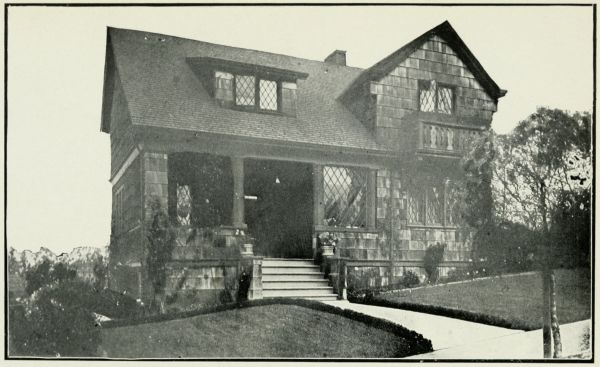
HOME OF DR. H. J. CRUMPTON, PIEDMONT, CALIFORNIA