These little stories, which are intended both
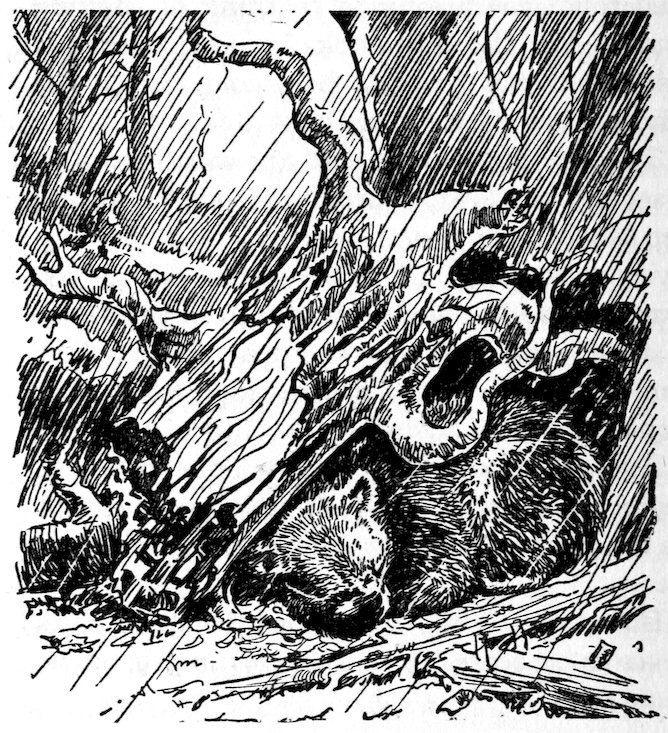
for children and their elders, are really true
to natural science.
Disguised in fiction form, the reader gets a
taste of biology, botany, zoology, and meteorology.
Such a taste may or may not lead the child
to further study along those lines, but it will
certainly give him a heightened appreciation
of out-door life. Incidentally, he will have
accumulated in the easiest possible way a
great many facts that he will retain all his life.
The tales should also create a kindlier attitude
toward our friends in fur and feathers,
as well as instilling some of the stern virtues
of the wilderness.
That these tales may be suitable for bedtime
reading, no animal hero is ever killed.
The big words are explained, and the adventure
of each chapter harks back to the preceding
in a way to refresh the memory of the
reader who only takes time for a chapter an
evening.
On the other hand, my readers have thus
far included a large proportion of quite grown-up
little boys.
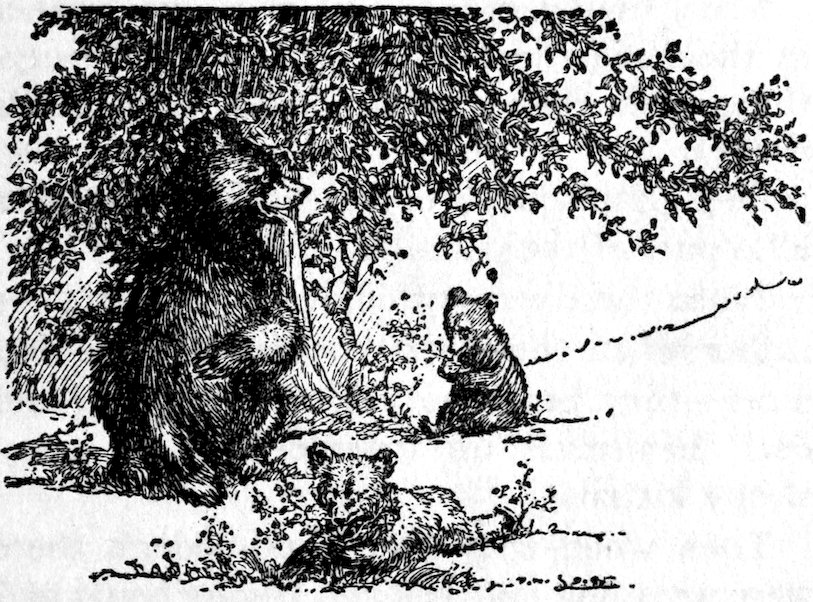
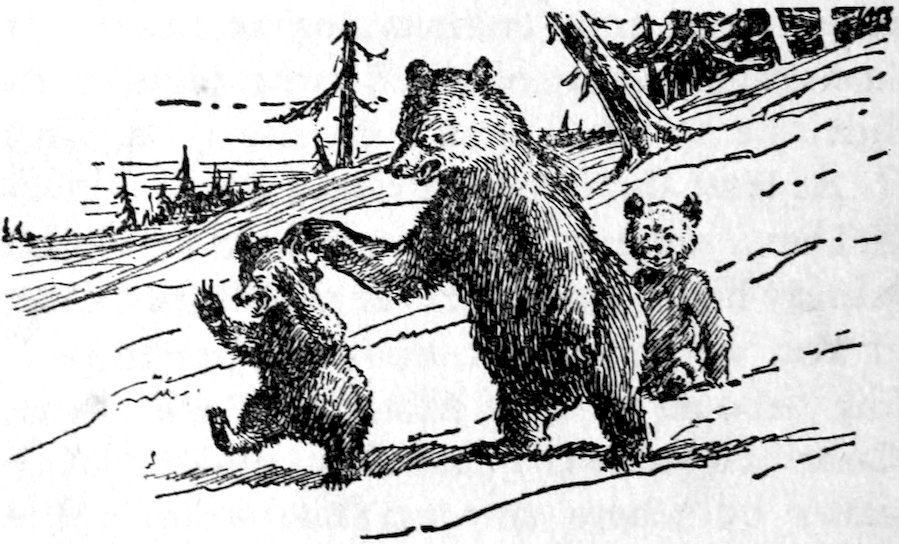
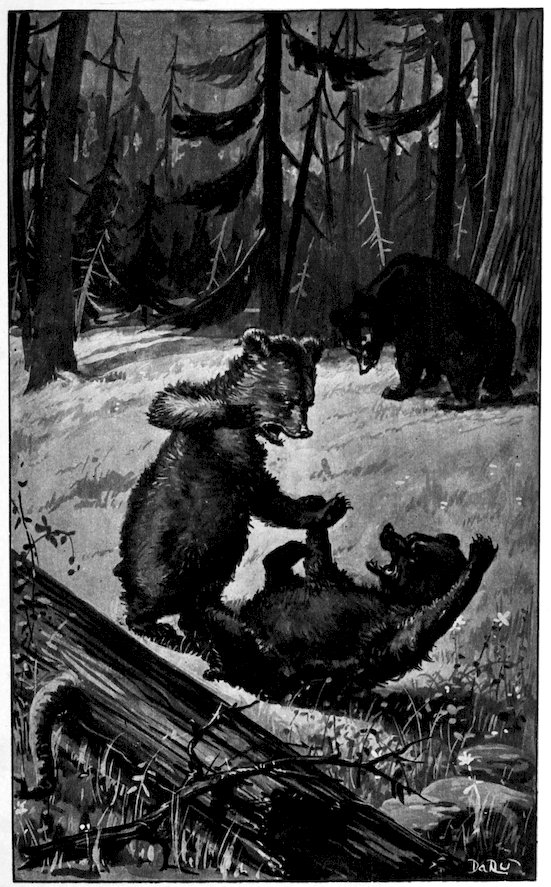
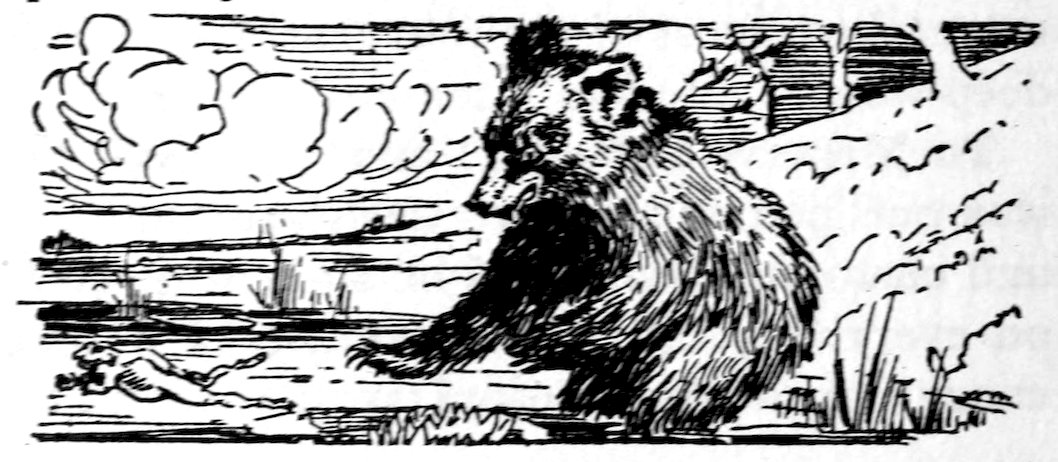
Mother Black Bear had named them Woof
and Twinkly Eyes.—And you never in all
your life met two such rollicking black balls
of mischief as those two cubs!
Small wonder that Mother Black Bear
needed such long black claws, long white
teeth, and such a terrifying growl, with two
such treasures to protect.
Why, she wouldn’t even let Father Black
Bear come near them when they were so
young, for fear some time they would plague
him too far and make him lose his temper!
As the warm days of July ripened the blueberries
along the slopes she used to lead the
cubs down Mt. Olaf into the lowlands on
berrying expeditions. And my! How they
did enjoy these trips! How they stuffed
2themselves on the luscious fruit, snatching
up great pawfuls of it, leaves and all, till
their fuzzy sides rounded out like puff balls!
Then, too, there were often the most
delicious sour-tasting ants under the logs
and boulders that Mother Black Bear turned
over for them! Life was one feast, what with
the abundant food provided by Mother Black
Bear herself and that found everywhere in the
woods about them! Those cubs hadn’t a
complaint to make!
True, they climbed right over one another
in their eagerness to get the best of everything,
and they growled little baby growls
in imitation of their mother and squealed
little piggish squeals of delight. But that was
all a part of the game.
When there was nothing to eat in sight—or
rather when they were too full to hold any
more—they began to yawn and stretch and
curl themselves up together like so many
sleepy kittens.
Then when they had slept enough there
were wrestling matches and boxing bouts and
playing pranks on mother,—pulling her ears
3and clambering over her till she was forced
to box their ears.
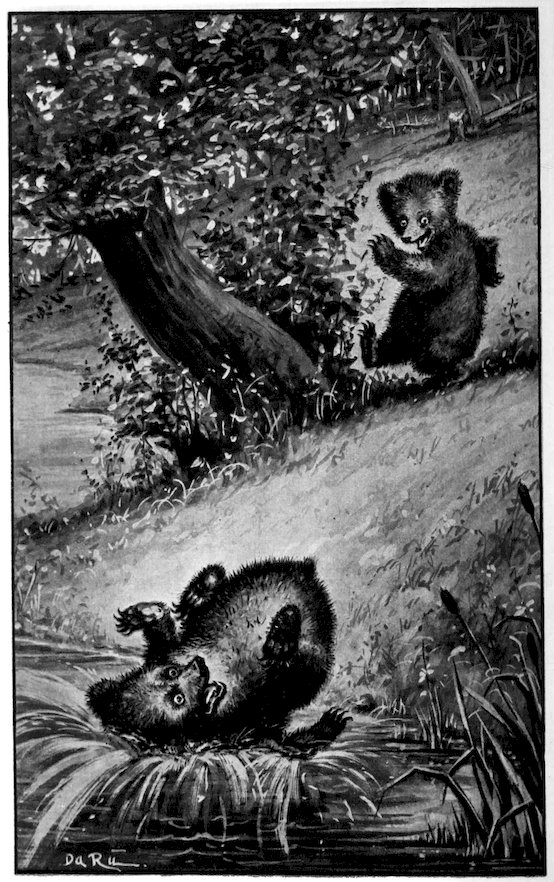
One lazy afternoon Twinkly was just nodding
off to sleep, all curled up in a little fuzzy
ball, when Woof came up from behind and
gave him a shove. Now, as it happened,
Twinkly had been lying at the top of a steep
incline that led down to Lone Lake, and he
went down that incline like a rubber ball,
before ever Mother Black Bear could stop
him. Bump—slide—splash!—and he plunged
beneath the surface of the icy lake.
II MOTHER BLACK BEAR TO THE RESCUE
4
It is so wonderfully snug and comfy to be
drowsing off on a warm afternoon, all curled
up in a fuzzy little ball. So, at least, thought
Twinkly Eyes, Mother Black Bear’s littlest
cub.
But what an awful contrast to find oneself
rolling down the bank like a rubber ball, till
one came, bump, slide, splash, to the icy
water!
And then to go down, down, down, gasping
for breath and so horribly frightened that one
thought the end had come!
It was certainly a terrible experience for the
five-months-old cub, when his brother Woof
gave him that mischievous shove!
Mother Black Bear was really frightened.
Not that she was afraid of Lone Lake—not a
good swimmer like Mother Black Bear; and
not that she feared being unable to rescue
5the little fellow. But Mothers are always
frightened when anything happens to their
babies. Mother Black Bear was no exception.
She was just like any other mother in believing
that her babies were the brightest
and the handsomest and the most wonderful
little creatures that anyone ever had.
So she didn’t even stop to think when she
saw Twinkly’s little body rolling down the
bank with its legs still wound around its nose.
She just slid!—Afterwards there was a long
trench where she had slid down that bank
on her haunches!
She reached the water the very moment
he did, and it wasn’t two seconds before she
had plunged into the blue depths and grabbed
the struggling youngster by the nape of his
neck.
Dragging him straight back up the bank,
she spread him out in the sunshine and began
licking him dry, while he whimpered and
coaxed for sympathy.
“This teaches you a lesson, young man,”
she told him, when she had made sure he
wasn’t hurt and wasn’t going to catch cold.
“Never sleep on the edge of a bank. And
6Woof, don’t you ever again shove anyone over
the bank like that,—not unless it’s someone
you never want to see again,” and she gave
Woof a good cuff on the ear to help him
remember.
“But I’m glad, in one way, that this had to
happen. Because it shows that you must
learn to swim at once. Life is uncertain at
best, in the woods, and you never can tell
when you may need to know.”
“Ow! the water is too cold!” squealed
Twinkly Eyes, backing away into the brush.
“We’ll go where it isn’t,” said Mother
Black Bear firmly. “But we’re going this
very afternoon. Come along!”
III A STERN LESSON
7
“Oo! I don’t want to learn to swim!”
squealed Twinkly Eyes.
“Why don’t you?” asked Mother Black
Bear, though she had quite made up her mind
to give the cubs a lesson that very afternoon.
When Mother Black Bear had made up
her mind to a thing, that was all there was to
be said about it, so far as the cubs were
considered.
Her word was law. Still, that did not
prevent them from complaining at times. It
is a certain amount of relief to complain, even
when one knows it won’t do any good, isn’t
it? At least the two cubs found it so.
“The water’s so-o-o-o cold,” wailed
Twinkly Eyes, whose wet fur made him shiver.
“You won’t be cold, once you get to paddling
about,” said Mother Black Bear.
“Come on, quick! There’s a shallow place
farther on where the sun has warmed the
water.”
8She led the way through the bushes, Woof
trotting obediently at her heels. Twinkly
tried to run away, but he didn’t get very far.
Mother Black Bear quickly found his hiding
place.
“Come!” she insisted away down deep in
her throat, with that rumbly sound that the
cubs knew meant business.
Since the accident she felt it was not safe
to let another day go by without making sure
that they could at least keep from drowning.
“Come here!” she growled to Twinkly in
no uncertain tone. That small imp simply
didn’t dare disobey!
Woods babies generally are that way, and
it is a lucky thing for them, let me tell you, or
no telling what would happen to them!
Puffing and panting as they tumbled after
her, the fat cubs soon found their mother
seated on her haunches beside a quiet pool,
where the sun danced through the leaves till the
water seemed all mottled. Tall ferns grew all
about them and every now and again a frightened
frog would say, “K’dunk!” and go
splashing to the bottom of the pond.
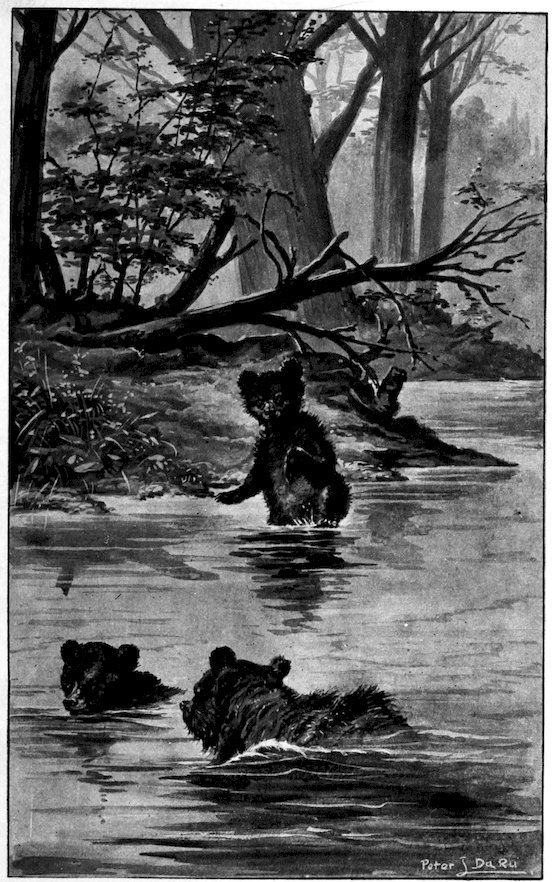
9“Now, then, just follow me,” said Mother
Black Bear, when they had stared at the
water for a moment. She waded off till she
stood shoulder deep.
Twinkly braced himself firmly with all four
feet and cocked one ear at the depths before
him. His unexpected plunge when Woof had
rolled him off the bank had shaken his faith in
water, even for drinking purposes.
“Come!” commanded Mother Black Bear,
and he knew he would have to wade in or get
a good boxing. He whimpered, wondering
which would be worse. He was a most unhappy
little bear cub, for one so roly-poly!
Woof on the other hand, had waded in
after his mother, and now—much to his own
surprise—found his fat sides floating with just
a stroke or two of his broad forepaws.
“Twinkly Eyes, are you coming?” called
Mother Black Bear, wading back to where he
stood.
“I don’t want to know how to swim,” wept
the little black rascal, backing away still farther.
The next instant Mother Black Bear seized
him by the scruff of the neck and dropped him
straight into the pool!
IV BUT HE LEARNS IT
10
He had been badly frightened, had Twinkly
Eyes, the littlest bear cub, when Woof shoved
him into the lake.
But underneath it all he had had a comfortable
feeling that Mother Black Bear
would somehow come to the rescue. There
had never been a time, in all the five months
of his existence, when she had not solved his
troubles for him.
But now! To have Mother herself drop
him in! It was too much! There was no hope
anywhere. No one to rescue him! No way
ever to get out again unless he found a way
himself!
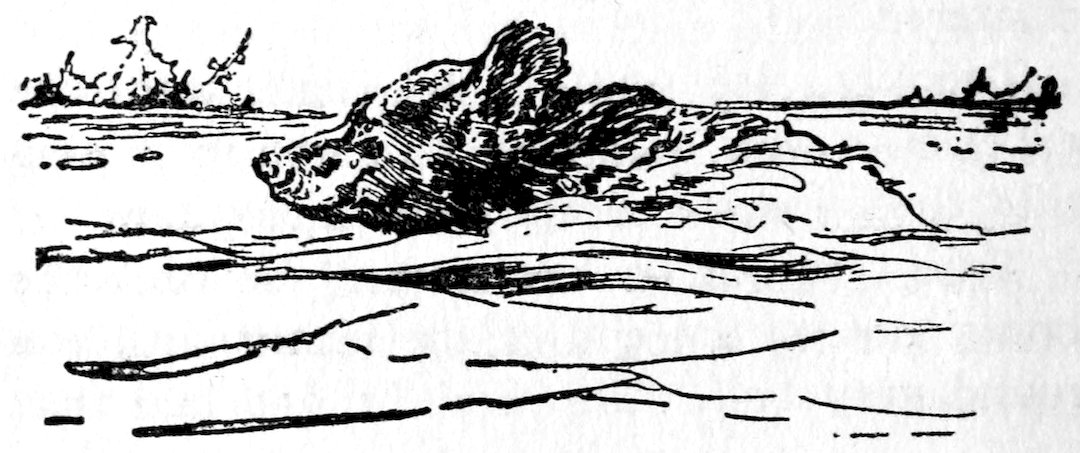
As this fact dawned on him he struck out
with his broad fore paws, his nose turned to
shore. So vigorous were his efforts that the
first thing his untrained little body did was
to go down, down, down to the very bottom
of the pond.
11But he held his breath, because he remembered
the time before, when he had swallowed
so much water.
Somehow, he scarcely knew just how it
happened, he found himself coming up again,
safely enough.
“Wuhr! Splurf!” he gasped.
“Good work,” encouraged Mother Black
Bear. “You see, you couldn’t drown if you
wanted to!”
But already Twinkly Eyes had gone under
water again, and this time he made the
mistake of losing his nerve and trying to
squeal for help. Of course that filled his nose
with water, and that frightened him still more,
till the first thing he knew, he was flapping
about on the bottom of the pond with the
most awful feeling he had ever known. His
eyes he kept tight closed to keep the water
out and not knowing where he had landed
made it all the worse.
As an actual fact he hadn’t been under a
minute before Mother Black Bear had pulled
him out again. But to the five months cub,
it seemed an hour. “Help, Help!” he gasped,
the minute his nose came above water.
12His mother, seeing how terrified he had
become, towed him gently to the bank and
left him there to shake himself dry in the sun
while she finished with his brother Woof.
This fat fellow had been enjoying Twinkly’s
struggles as he paddled slowly about the pond,
and his little black eyes danced with laughter.
But Twinkly had not given it up. That
laughter was more than he could stand. “I’ll
get you for that,” he growled in his high-pitched
little voice, running around the bank
to the point nearest his brother. With one
mighty leap he landed fairly on top of Woof.
And Woof? Why, he simply took one deep
breath and went under, and Twinkly went
under with him. But this time he was too
mad to be afraid. He forgot even to shut his
eyes. Being able to see how near the bottom
of the pond really was did more than you can
imagine to give him confidence in himself.
The next thing Mother Black Bear knew,
both cubs were swimming with all the zest of
small boys.
But her pleasure was short lived. For rattling
through the underbrush at that very
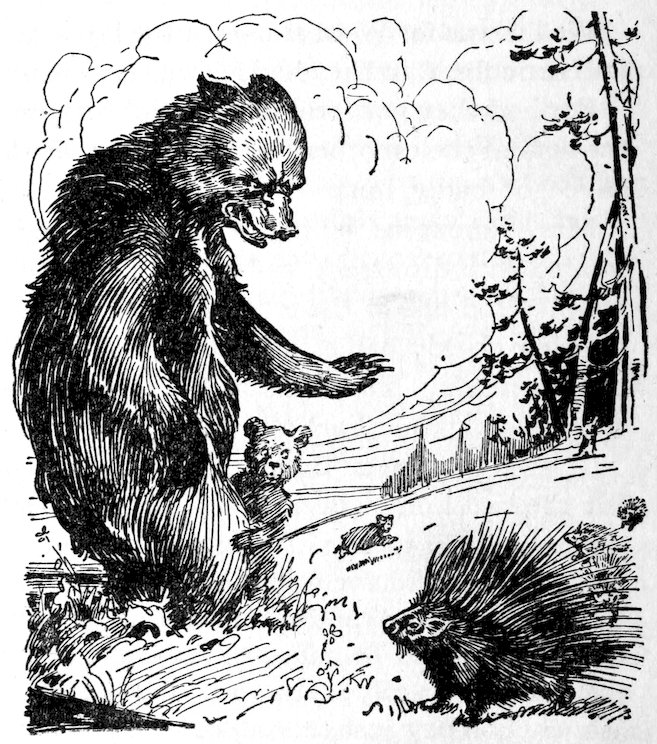
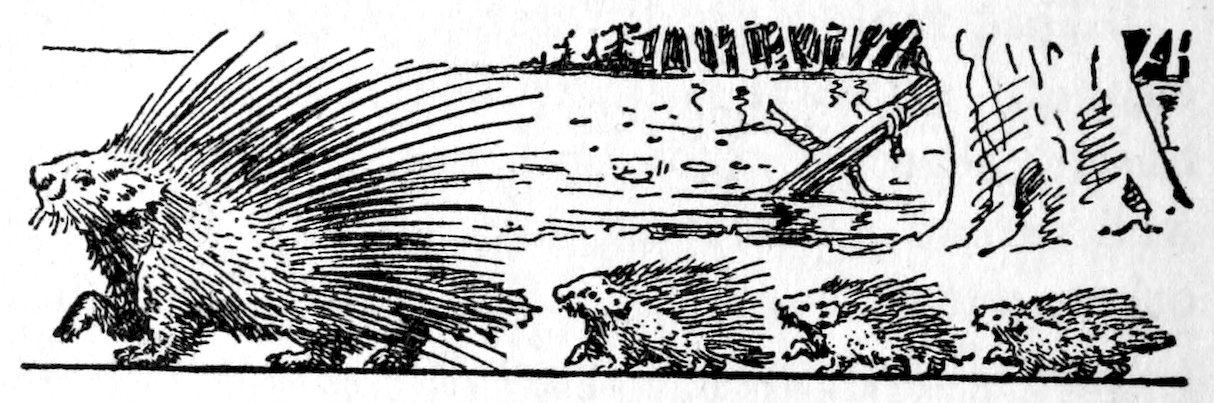
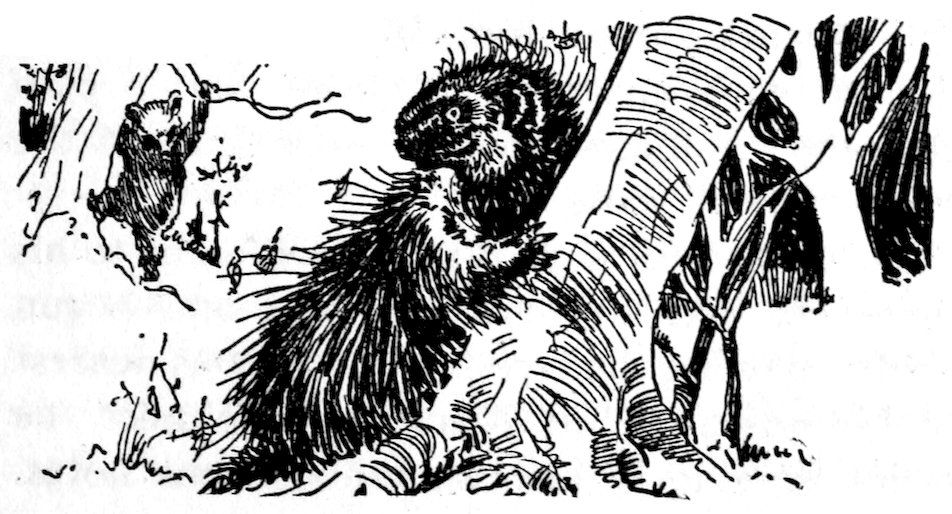
moment came Mrs. Porcupine with three
prickly babies, headed straight for their pond!
V MRS. PORCUPINE SHOWS FIGHT
13
Yes, sir, Mother Black Bear’s pleasure was
short lived. For no sooner had the cubs
started off side by side across the pond than
there was a curious rattling sound behind
her, like the rattling of dry twigs.
She turned her head like a flash. It was
Mrs. Porcupine, her quills rattling together
as she walked. She was headed straight for
the little pond, and Mother Black Bear knew
there was going to be trouble.
Not that she would have cared, had she
been alone. She would have given it up willingly
enough. In fact, had she been alone,
she would have preferred a larger pond for
her swim.
But Mother Black Bear was not alone.
She had fat little Woof and Twinkly Eyes to
look out for. And it certainly was too bad,
now that they were really making headway
14with their swimming lesson, to have to give
up their pond. Twinkly had at last forgotten
to be afraid, but if they had to give up the
pond to Mrs. Porcupine, he might lose his
nerve again, and all her work would have gone
for nothing.
Yet learn to swim he must, before ever
another accident befell him. Of this Mother
Black Bear felt very certain.
She, therefore, eyed Mrs. Porcupine a bit
anxiously; the more so when she spied the
three little porcupines creeping along behind
her.
Of all the folk that live in the Deep Woods,
there is probably none more absolutely fearless
than Mrs. Porcupine, and for a very good
reason. She knows that nothing can so much
as touch her without getting badly hurt on
her barbed quills.
Where everyone else darts along the forest
trails alert to catch the slightest sight or sound
or smell that might mean an enemy, she strolls
along with the utmost calm. She knows that
no one can touch even her babies without
getting hurt. For they are just as full of quills
15as she is, and their little quills are even
sharper.
But if she fears no attack, neither will she
harm other animals unless attacked. It is
only when they come too near that she strikes
at them with her barbed tail.
This afternoon she was headed for the self-same
little pond that Mother Black Bear had
selected, and for the self-same reason, as we
shall see. When she saw Mother Black Bear
and the two cubs, she didn’t stop for even an
instant. She came right on to the edge of the
pond as if there were no one already occupying
it. She looked straight past Mother Black
Bear as if she hadn’t been there at all, and
grunted to her babies to climb on her back.
Mother Black Bear gave a growl. “We
got here first,” said she, crossly. But Mrs.
Porcupine pretended not to hear. She just
went on into the water with her babies on her
back—she had flattened down her quills for
them—and from all the concern she showed,
you would have thought she didn’t know the
bears were there. That was her way of showing
fight. She hadn’t a doubt in the world
that they would give their places to her.
16“Come—quick!” Mother Black Bear called
to her cubs, losing her nerve as the quilly
creature allowed herself to float over on the
side the cubs were on. “Quick, I tell you!—Scramble!”
VI DRIVEN FROM THEIR POND
17
Well it was for Woof and Twinkly Eyes, the
fat bear cubs, that they had learned obedience.
For had they not scrambled out of the pond
the instant their mother bade them they would
have got badly hurt.
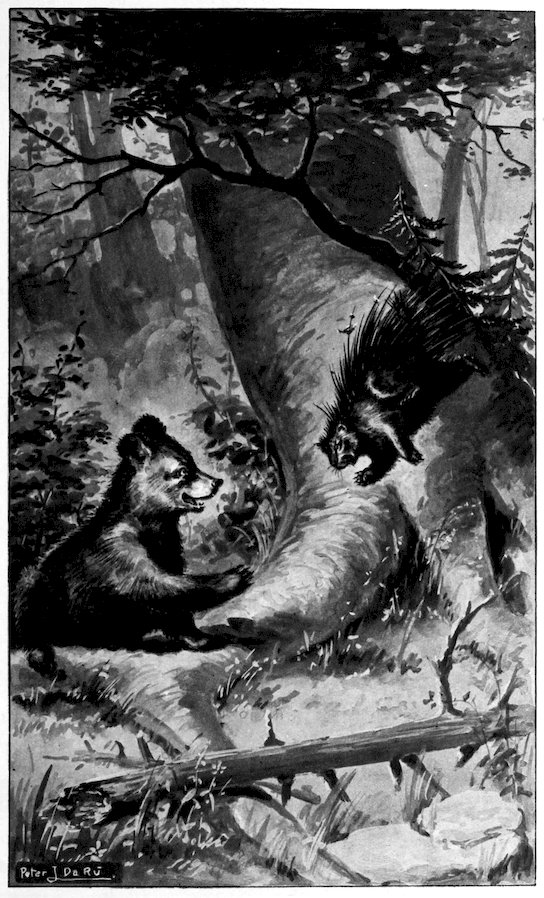
Mrs. Porcupine is not a neighbor to be
treated with disrespect, as Mother Black Bear
knew. Had one of the cubs gone an inch too
near her prickly babies, their little tails would
have gone slap, slap right in the faces of the
cubs, leaving their barbed quills behind them.
That is why, even though Mrs. Black Bear
felt she had first right to the swimming pool,
she gave it up to Mrs. Porcupine the minute
that lady entered the water.
The bear cubs didn’t in the least understand
why they should be asked to scramble out of
the pond so hastily; but they didn’t stop to
ask why. They just scrambled!
18Once safely on the bank, Mother Black
Bear hurried them to the shelter of the tall
ferns and bracken. Here she posted them
side by side where they could see the pond.
“Just watch,” she whispered, “and see—what
you will see!”
The pair settled themselves on their awkward
little haunches, eyes dancing with
excitement. They did love a mystery!
Now Mrs. Porcupine is covered thick with
quills, and these are as sharp as needles. When
she meets an enemy she can make them stand
out all over her back till she looks like a giant
pincushion. But she can also flatten them
down as smooth as a bale of hay.
Just on the edge of the pond, she flattened
them all so nicely that the three baby porcupines
were able to clamber aboard and sail
out into the pond on her back.
“Gee! that must be fun,” thought Woof.
“I’ll bet they fall off,” thought Twinkly
Eyes.
Mother Black Bear, who knew just what
was going to happen, thought to herself, “I
might have tried that myself if only I had
thought in time!”
19“Unk wunk, unk wunk, unk wunk!”
sang Mrs. Porcupine, pulling up the water
lily pads and munching the juicy roots.
“Unk wunk, unk wunk,” mimicked the
little porcupines, nibbling at the bits she took
in her mouth to see what they were like.
Lower and lower swam Mrs. Porcupine,
till the babies had to climb higher on her back
to keep from getting wet. Mother Black
Bear’s eyes fairly twinkled at what was about
to happen.
Lower still sank the living raft, till it was
half under. The babies didn’t mind, once the
surprise of getting wet was over. But the
raft was sinking lower still. Now Mrs. Porcupine
just had her nose out.
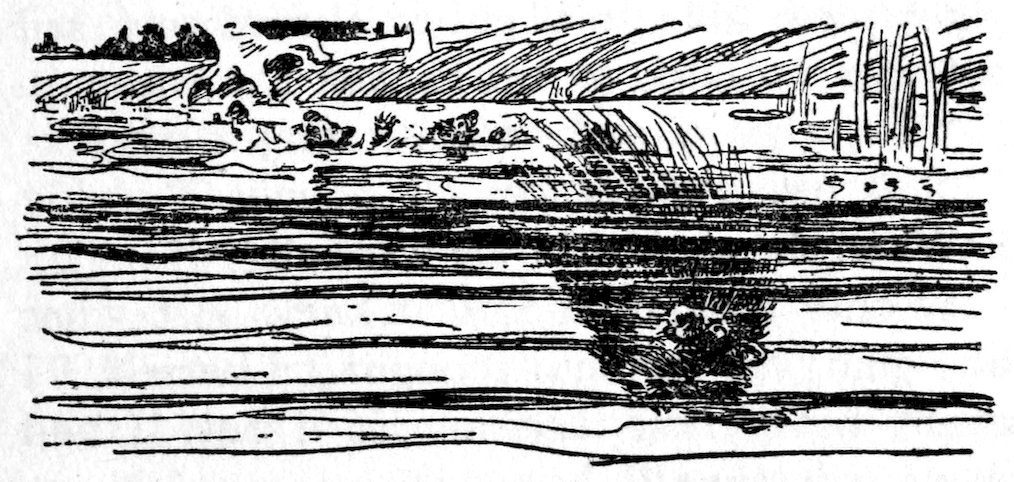
Then—suddenly—she dived clear under!
VII SINK OR SWIM
20
“Ooh! They’ll drown!” squealed Twinkly
Eyes, as Mrs. Porcupine went under water
with her babies on her back.
But they didn’t!
It had come so gradually, for one thing,
that they weren’t the least bit frightened.
Mrs. Porcupine has simply flattened her quills
down smooth and taken them on her back
while she swam out for lily pads. They had
nibbled the pads and thought they were having
the finest kind of ride.
As Mrs. Porcupine went deeper into the
water and the babies got their feet wet, they
scarcely noticed, so warm was the water in
the little pond and so sure were they that
Mother was right there.
When she sank till they were all half under,
they only thought it fun. They had no idea
of what was going to happen before they
reached dry land again. Had they known
what was going to happen, they would have
21been dreadfully frightened. In fact, they
wouldn’t have ventured out at all, even on
their mother’s back.
It is often that way with people. If they
knew just what was going to happen next, they
would lose their nerve entirely. Yet generally
when it does happen, it isn’t nearly so bad as
they feared. Sometimes it isn’t bad at all.
If the baby porcupines had had any idea
that their mother was going to dive clear
under water with them, they never in this
world would have ventured one foot from
shore. But that was one of the things Mrs.
Porcupine kept to herself. She was very good
at keeping things to herself, was Mrs. Porcupine,
and it saved her a lot of trouble.
At any rate, from being in the warm pond
water with their feet safely planted on
Mother’s back, the babies suddenly found
themselves in the water with nothing under
their feet but water, and Mother coming up
away on the other side of the pond.
The two cubs, watching from the bracken,
smiled from ear to ear, their little black eyes
dancing with enjoyment.
22“Come!” said Mrs. Porcupine, swimming
about just out of reach. And the three baby
porcupines simply had to strike out for themselves.
To their own very great surprise they found
that their hollow quills floated them beautifully.
In fact, it is easier for a porcupine to
swim than it is for almost any other animal.
“What do you think of that?” Mother
Black Bear asked her cubs.
“Pretty slick,” said Woof.
“Gee, I wish you’d taught me that way,”
said Twinkly Eyes.
“I’m going to teach you something else
now,” said Mother Black Bear, “Come!”
and she started up a water maple that grew
hard by.
“Oo—ee! I can’t climb,” Twinkly was
just beginning, when he heard a curious rustling
in the grass behind him. Turning his
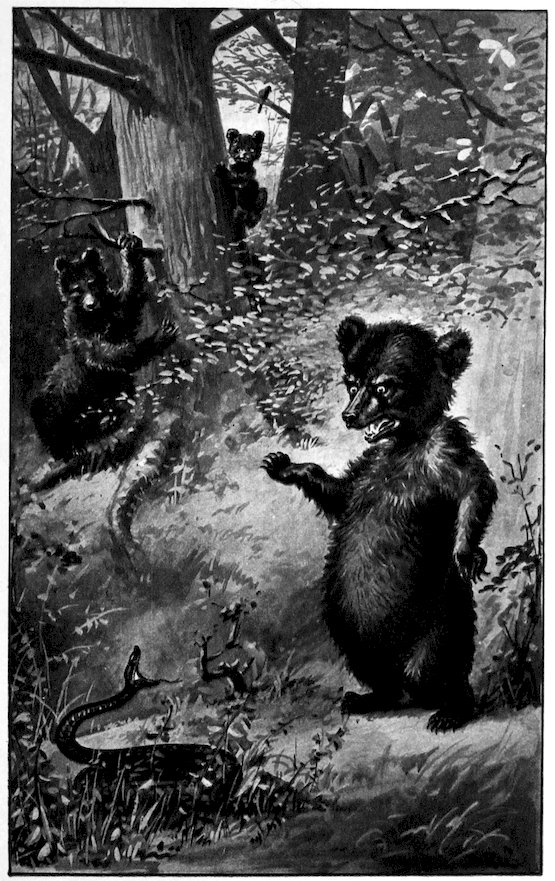
head he spied Writho, the Black Snake, making
straight toward him!
“He found himself staring straight at Writho the black snake.”
Now Twinkly Eyes had been perfectly
certain a moment before that he could never
climb that tree after his mother.
The next instant there had been a queer
little rustling in the tall grass, and he found
himself staring straight at Writho the Black
Snake.
He had never seen a black snake before,
but he would have known just from the smell
of him that he was some one to avoid.
“Climb! Climb!” rumbled Mother Black
Bear from the water maple. Had he needed
warning, her anxious tone would have been
enough.
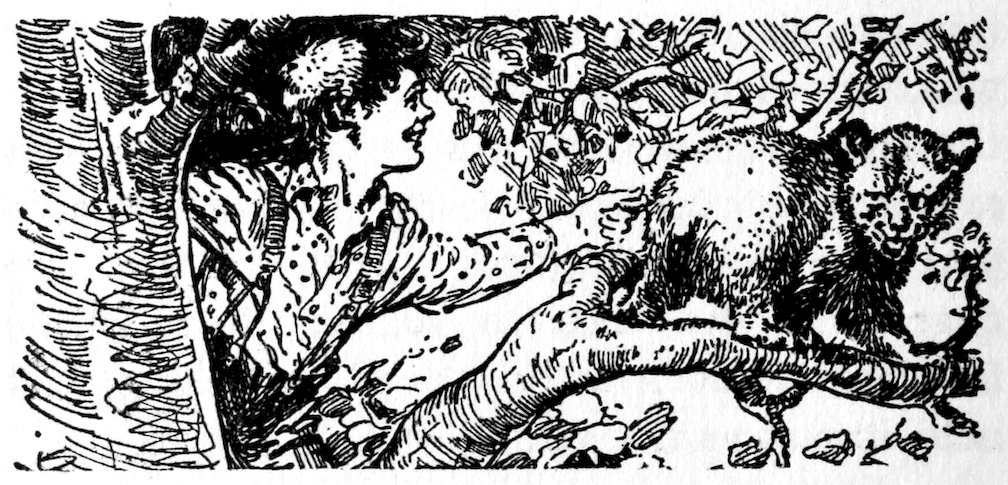
And Twinkly Eyes climbed—my, how he
scrambled up that tree! He didn’t once stop
to wonder if he might fall off. He just drove
his sharp little claws into the bark and up he
went, faster than he would ever have dreamed
possible!
24Mother Black Bear smiled to herself. She
had learned something from watching Mrs.
Porcupine dive from under the little porcupines.
She had learned that if a youngster is
given his choice of sinking or swimming he
will find a way to swim. Of course, she could
have leaped to the rescue the instant Writho
became dangerous. She wouldn’t have let
him hurt her cub! But when she saw him
wriggling through the grass she knew that
Twinkly Eyes would need no coaxing to take
to the tree. In that she was not mistaken.
Meantime, where was Woof? He had
climbed the tree on the other side of the trunk,
quite without urging, and he now came out
on a limb some distance from the ground.
“Good boy!” said Mother Black Bear, patting
him fondly.
This was too much for Twinkly Eyes. Had
not Woof caused all of his troubles that afternoon
by rolling him into the water? Then,
too, he felt that he was a good boy himself for
having scrambled up the tree so readily. To
have his brother get all the praise!
Fat little Woof was just licking up a delicious
big black ant when Twinkly crept up
25behind him. The next instant he received a
blow in the ribs that fairly knocked the breath
out of him.
The wrestling match that followed sent
both cubs spinning from their branch. But
so fat they were, and so roly-poly, that they
minded their fall about as much as they
would have a box on the ear. They just rolled
over and over and over in each other’s arms
all over the ferns and bracken, still punching
and biffing one another.
In fact, they rolled about so fast that the
first thing they knew they had come down
on something cold and slippery that writhed
out from under them with an angry hiss.
Woof, ever the quicker of the two, was back
up his tree in a twinkling, but poor Twinkly
Eyes was for the second time staring straight
into the angry eyes of Writho. And the snake
was between him and the tree!
IX “WHOOF! WHOOF!”
26
“Trouble again!” thought Twinkly Eyes,
as he found himself staring into the angry face
of Writho, the Black Snake.
“You rolled right on me,” scolded Writho.
“Haven’t you any consideration for other
people at all?”
“I’m sorry,” pleaded the cub, “I had no
idea—”
“You want to look where you’re going,”
scolded Writho. “I could bite you for what
you did!”
“Oh, please don’t,” squealed Twinkly Eyes,
retreating toward the pond, as Writho wriggled
closer. Then he remembered Mrs. Porcupine
and her family, whom he could hear
grunting “unk wunk” as they nibbled lily
pads. It would never do to back up too close to
those prickly creatures. Neither would it do
to turn his back on Writho, whose red forked
tongue hissed at him from between two of the
sharpest looking fangs he had ever seen.
27“Truly, I didn’t mean to step on you, Mr.
Writho,” said the little bear, and his voice
sounded very sorry and very much afraid.
But he kept backing around nearer and
nearer his tree, until it was right behind him.
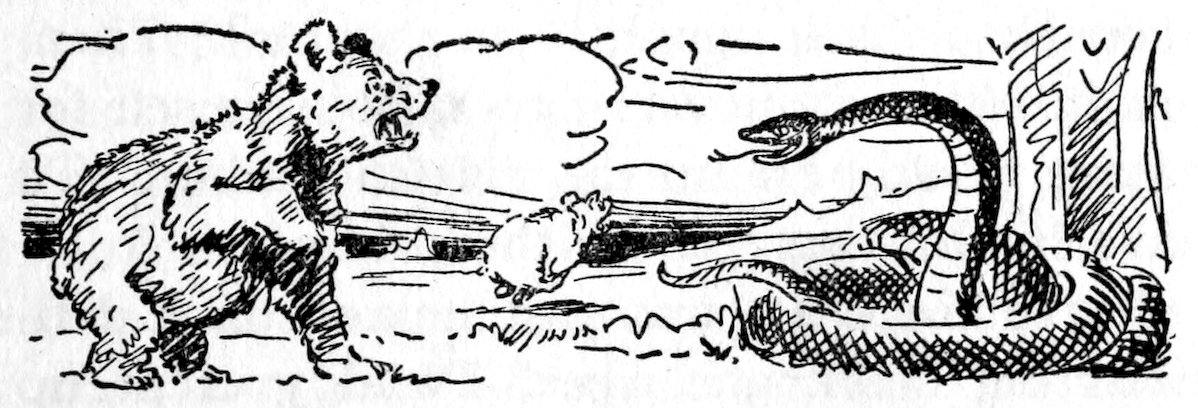
“Whoof, whoof!” he suddenly roared at
the snake, stamping a fore foot loudly.
Writho was so amazed that he stood stone
still, and in that instant the cub had raced up
his tree in safety.
“Why didn’t you think of that before?”
laughed Mother Bear. “Writho is an awful
bluffer. He didn’t really mean to bite at all.
The trouble was, it hurt his pride to be stepped
on.”
“So was I a bluffer,” confessed Twinkly
Eyes.
“No, you weren’t, my son. You could have
killed him with one blow on the back of his
neck, had he really tried to bite you.”
“Wish I’d known,” sighed the cub. “I
certainly had a bad scare.”
“Now climb up here in the sun and dry
your fur,” said Mother Black Bear, “while
I talk to you. As a rule I don’t advise bluffing.
I don’t advise making any threat you cannot
28back up with tooth or claw. Because once
people find you out, they will have no more
respect for you.
“But with a coward and a bluffer like
Writho it often works. Most snakes are
cowards. All they want is to be left in peace.
They’ll only attack a big animal like you when
you step on them and make them mad. They
hiss and stick out their tongues at us just for a
bluff.
“I’ve never seen Writho attack any animal
larger than a hare or a chipmunk in all my life.
“But you’ll do well to keep clear out of the
way of Mrs. Porcupine and the whole porcupine
family, big and little,” and she peered
back into the pond, where the three prickly
babies were just following their mother out
of the pond.
“Hello, there! I do believe they are making
for our tree!”
X THE BETTER PART OF VALOR
29
Mother Black Bear sighed as she saw Mrs.
Porcupine making for her maple tree.
“If she wants it, I suppose she will have to
have it,” she told the cubs. “Wisdom is the
better part of valor.”
“What is wisdom?” asked Woof, the larger
of the fat cubs.
“Wisdom,” said Mother Black Bear, “in
this case is giving up our tree rather than
having a fight with Mrs. Porcupine about it.”
“But we got here first,” shrilled Twinkly
Eyes, the smaller cub. “She has no right to
it.”
“That makes no difference with Mrs. Porcupine,”
growled Mother Black Bear. “She
has no sense of right and wrong. She is too
well armed with those awful quills to value
other people’s rights. She just about has
things all her own way in the Deep Woods,
30because few of us care to fight with her. It’s
lucky that all she wants is her own stubborn
way. She is a ve-ge-tarian, you know. She
eats no meat.
“Just why she should decide on our maple
tree—of all the trees she has to choose between—is
more than I can see. Though, of
course, it IS easy for the little ones to climb.”
“Will they have to climb up there in the sun
and dry off, too?” asked Twinkly Eyes.
“Where else would they get any sun?”
asked Woof, gazing up at the forest roof. In
this part of the woods the trees all grew so high
and so close together that their upper
branches interlaced, so that one only got a
patch of the sky here and there.
Woof, peering through the green gloom,
could see Mrs. Porcupine and the three little
Porcupines slowly making toward their maple.
“Don’t let her have it,” he begged Mother
Black Bear, who loved nothing better than to
see a scrap. “You could lick her, Mother!”
“Well, no, I shouldn’t like to try it, not
with you youngsters along,” she answered,
swinging her long head from side to side
uneasily, as she prepared to lead the way
31to the ground. “Your father might, but I
shouldn’t like to try it.”
“Why, the old ‘Unk Wunk!’”
“First she chased us out of our pond, now
out of our tree,” complained Twinkly Eyes.
“Can’t we bluff her off, the way I did Writho,
the black snake?”
“I should say not,” said Mother Black
Bear in alarm. “Nothing on this earth could
frighten Mrs. Porcupine. Come along here,”
and she reached up and gave each cub a spank
that sent them hurrying to the ground. It
was not a moment too soon, for as they landed
on one side of the trunk the Porcupine family
started up the other, though for all the sign
they made, Mother Black Bear and the cubs
didn’t even exist.
But the latter’s peace of mind was short-lived.
“We are certainly going to have a thunder-storm,”
exclaimed Mother Black Bear, as she
sniffed the air.
“Are you scared, Mother?” asked Twinkly
Eyes.
“Well, that all depends on how fast you
cubs can beat it out of these woods!”
XI A TIP ON THUNDER-STORMS
32
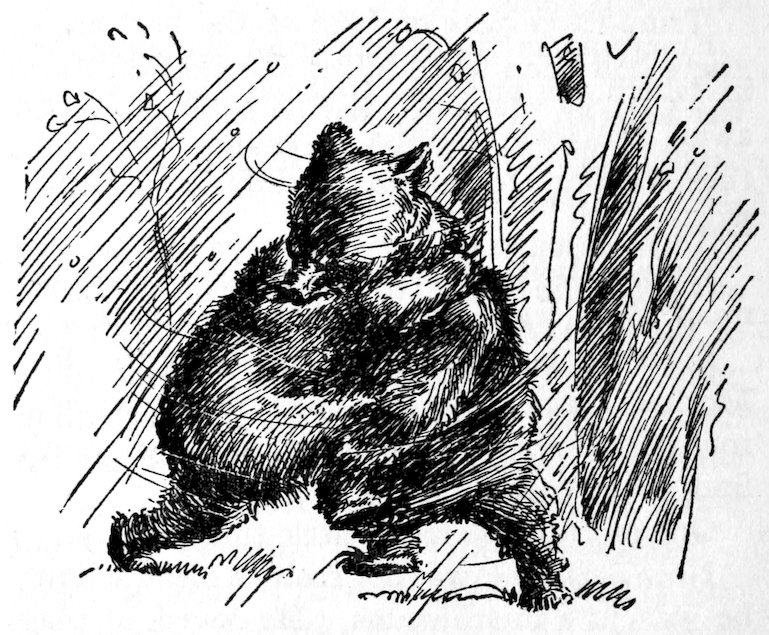
“No sir-ee! I certainly don’t like the looks
of things,” said Mother Black Bear, hurrying
the cubs through the green gloom of the forest
aisles.
“Mrs. Porcupine is welcome to our maple
tree! There’s going to be a thunder-storm, and
it’s going to be a big one,” and she pointed
her nose skyward to sniff.
Out over the lake the black clouds were
banking up over the sky at a great rate. The
cubs crowded close to her sides, as the rolling
and rumbling of clouds banging together
came to their ears.
The air was full of the peculiar fresh odor
you always notice before a shower.
“Are you scared, mother?” Twinkly Eyes
kept asking.
Mother Black Bear glanced about, this way
and that.
33On every side, as far as she could see, there
were just five or six kinds of trees, oaks,
poplars, willows, maples, elms and ash trees,
all growing to nearly the same height. Here
and there was a blackened trunk standing
gaunt and naked where the lightning had
struck. For these trees, as every woodsman
knows, are the very ones most likely to be
struck.
“I don’t like to get caught in these woods,”
insisted Mother Black Bear, starting off at a
brisk pace along the southern border of the
lake. It was all the cubs could do to follow,
paddling along on their chubby legs with
panting breath and red tongues lolling from
their little black muzzles.
“I can’t keep up,” whispered Twinkly Eyes
who brought up the rear.
“Lightning waits for no one,” rumbled
Mother Black Bear, refusing to slow down
even a mite. A nearer crash of thunder, as
the first big raindrops began to fall, sent her
forward on the run.
“Where are we going?” asked Woof, who
rather enjoyed the excitement.
34“We’re going to find the kind of trees
lightning doesn’t strike,” Mother Black Bear
flung behind her without stopping.
“Beech, birch, chestnut, basswood!” She
broke into a run.
“Oh, mother—those white birches over
behind Pollywog pond,” gasped Woof, trying
his best to keep up with her through the pelting
rain.
“Just where we are headed,” rumbled
Mother Black Bear. “If only—we can reach
them—in time!”
A blinding flash of lightning darted down
the trunk of a huge old oak to the left. This
time the thunder seemed to come at the same
instant.
Mother Black Bear looked back over her
shoulder. Woof was close behind,—but where
was Twinkly Eyes?
She turned instantly to find out.
XII A WILD MOTHER’S LOVE
35
At the instant of the lightning flash that
came so near, Mother Black Bear had been
racing for dear life to get to the safe shelter of
the birch grove.
She knew that lightning is not so apt to
strike in a birch grove as in the giant oaks
where the storm had found them.
But then the cubs had both been close at
her heels. The instant she missed Twinkly
Eyes she turned back to find him. He lay
flat on the ground, his heels in the air, just
where he had tumbled when the big crash
came. He was so frightened that he could
scarce regain his feet. His legs trembled till
he could go no further.
Mother Black Bear tried her best to carry
him in her mouth, but he was so fat and roly-poly
and wiggled so at every clap of thunder
that she had to give it up.
36Woof, who was close at her heels every
minute, was all for climbing the tallest tree
they could find, but Mother Black Bear
selected a comparatively open patch with
no tree higher than its neighbors; and there
she crouched beside the cubs, covering them
with her own body when the big drops turned
to hailstones.
“It’s bad to be caught among the oaks in a
thunder storm,” she told the cubs as they
waited. “It’s bad to be caught under any
tall tree. Better far, when a storm comes up,
abandon your tree and wait out in the open
where there is nothing to attract the lightning.
“There are only two things in all the Deep
Woods that a bear ought really to be afraid of,
and one of those is lightning—for there’s no
fighting back,” said Mother Black Bear.
“What is the other thing you are afraid of,
Mother?” asked Woof, “Mrs. Porcupine?”
“No, I’m not afraid of Mrs. Porcupine, if
I did think best to let her have our tree. I
just believe in keeping out of her way, that’s
all.”
“Then what is the other thing you are
afraid of?” asked Twinkly Eyes, whose
37trembling had ceased as the storm passed
around to the south.
“Men with guns,” said Mother Black Bear
im-press-ive-ly. (When you say a thing im-press-ive-ly,
you try to impress it on other
people’s minds, so they will never forget.)
“You can’t fight men with guns. That is
once when a bear just simply has to run
away.”
“That would suit Twinkly Eyes, all right,”
laughed Woof, poking his brother in the ribs.
“Eh, there?”
The smaller cub gave a growl. “Just
because I didn’t want to learn to swim!—I’ll
teach you to be afraid yourself, one of these
days! You see if I don’t!” he growled in his
baby throat, as he thought of how Woof had
pushed him into the lake.
XIII TWINKLY EYES GETS EVEN
38
He’d get even, somehow, Twinkly told himself,
seizing his brother’s nose; and as the fat
cubs clinched the storm was forgotten.
Mother Black Bear gave them each a cuff,
then stalked away, leaving them unprotected
in the pelting hail.
Such clawing and biting and squealing as
followed you never did see!
The clouds rolled away toward Mount
Olaf and the hail changed to rain, and the
rain suddenly gave way to a red glow in the
West where the sun goes to bed. But the
cubs fought on.
Mother Black Bear stood and watched,
feeling that they were gaining a training in
the use of their muscles that would stand
them in good stead later on. She would interfere
only if she saw that one of them was really
getting hurt.
“Such clawing and biting and squealing—you never did see!”
39Now just behind the circle of brushwood in
which they had sought safety from the thunder
storm there was an old root that sloped
straight down a 15-foot incline.
To this Twinkly was trying his best to
shove his brother, and though he was somewhat
lighter than Woof, weighing a bare six
pounds to Woof’s six and a half, he was also
quicker on his feet, and he did finally succeed
in backing the other up to the incline.
True, there was no lake at the bottom, as
there had been when Woof shoved him down
the bank in his sleep, but at least the teaser
should find out what it felt like to be sent
rolling in a helpless ball.
With a sudden wrench he sprang free, just
as he had the larger cub humped up at the top
of the slide, defending his head with all four
paws. The result was that fat Woof rolled
like a rubber ball straight down the incline,
whirling around and around till he came up,
plunk, against the trunk of a tree.
But to Twinkly Eyes’ surprise Woof not
only picked himself up with a laugh of enjoyment,
but he raced back up the slope to try
40it again, ducking his tiny head and doubling
up into a ball for the purpose.
Again and again he tobogganed down that
slope, Twinkly staring after him wide-eyed.
So that was the way he had thought to get
even!
He was so surprised that he stood clear up
on his hind legs, staring. Then he tried it
himself!
XIV A DIFFERENT TWINKLY EYES
41
Summer passed, with its lessons. And
thanks to Mother Black Bear, there wasn’t
an animal his size in all the Deep Woods that
Twinkly Eyes was afraid of, when at last the
long sleep came.
Emerging in the spring from the snug den
in which he and his brother had drowsed
away the long months, snuggled close into
their mother’s furs, he was a different Twinkly
Eyes.
He was both older and wiser,—and oh, so
much thinner! His voice had deepened, too.
Soon he began hunting by himself. For
Mother Black Bear now had two new little
roly-poly cubs. And sometimes he didn’t
find much to eat.
One morning he met Tattle-tale the Jay.
Now Tattletale was not really a mean fellow:
he was just mischievous. He loved to play
42pranks. His tattling was for the most part
a warning to the smaller forest folk of the
approach of their enemies, Cooper the Hawk
and Bobby Lynx, and Mother Black Bear.
When any of these were out for game, he
would fly from one tree-top to another just ahead
of them, screaming his warning at the top
of his lungs, till there wasn’t a hare or a wood
mouse anywhere that did not have a chance to
run to hiding.
Now, though, he was so furious with the
Red Squirrels for smashing two of Mrs. Jay’s
pretty eggs that he made up his mind to get
even. It never once entered his head that he
was the first offender. For if he hadn’t begun
the quarrel by robbing Shadow Tail, of his
poor little hoard of seeds, Mother Red Squirrel
would never have harmed the eggs.
If he had thought, he might have called it
square, instead of making a bad matter worse.
But Tattletale didn’t stop to think. All he
could see was his own grievance. Besides,
Mrs. Jay felt so bad about the eggs that he
had to promise her something that would
soothe her ruffled feelings.
43The very next morning, just as the first
pink rays of the rising sun began glinting off
the dew-wet leaves in the open places, he was
flitting about after grasshoppers when he
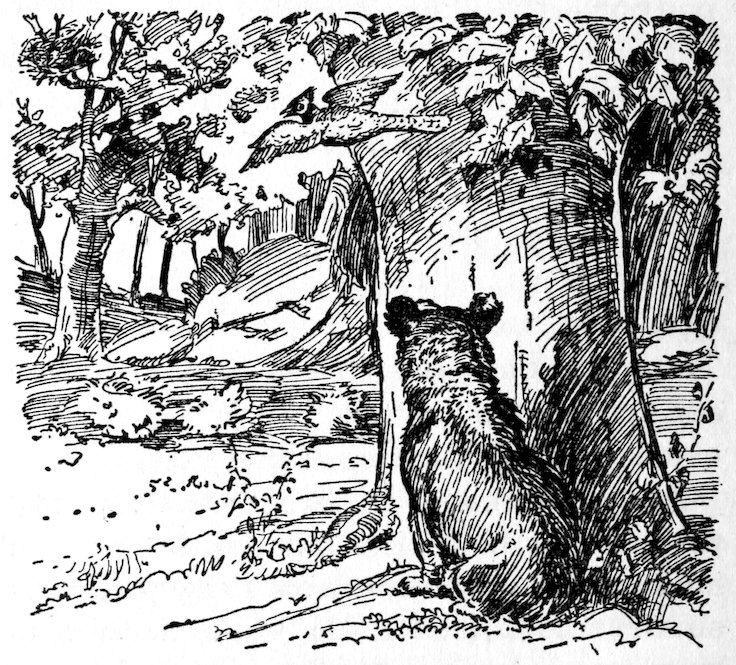
spied Twinkly Eyes, the little Black Bear,
slouching along the little trail to Pollywog
Pond.
“Good morning, Mr. Bear,” he chirped.
“Good morning,” rumbled the yearling
cub, peering and blinking into the treetops
at the flash of blue wings. Twinkly’s eyes are
very poor, though his ears are so sharp and
his nose sharper. He could hear the squeak
of a wood mouse a long way off, and he could
tell just by sniffing whether or not he would
find those delicious sour-tasting ants underneath
a fallen log.
“How do you find the hunting these days?”
asked Tattletale politely.
“Oh, nothing extra—nothing extra at all,”
grumbled Twinkly Eyes. “Haven’t had
much of anything but roots and frogs so far
this spring. Blueberries aren’t ripe yet, there
won’t be any nuts till fall, to say nothing of
green corn. And a bear of my size can’t make
much of a living off of grubs and mice, of
44course. I do wish I could find a bee tree!”
“I don’t suppose, now,” ventured the Jay,
“that you’d be interested in a nest of young
squirrels?”
“Try me—just try me once!” chuckled
the little bear.
“All right; see that old oak?” directed
Tattletale, flying on ahead.
XV THERE’S MANY A SLIP
45
Fortunately for most of us, there is many
a slip ’twixt the cup and the lip, which only
means that many a plan is laid that doesn’t
pan out just as it was expected to.
It was so in the case of Twinkly Eyes, the
little Black Bear. It was lucky for him and it
was lucky for Shadow Tail, the Red Squirrel,
and it was lucky for Tattletale, the Jay. For
if Tattletale had really been the means
of leading the little Bear to Mother Red
Squirrel’s nest, she’d never have forgiven
Tattletale, but surely would have gone back
and broken the rest of the eggs on which he
had left Mrs. Jay sitting so patiently.
And if Twinkly Eyes had really caught
the squirrel babies, as he wanted to, he’d
have made such an enemy of every squirrel in
all the woods around that he’d never have
known peace again. For they’d have followed
through the treetops, everywhere he went,
46scolding him and warning the mice and frogs
and snakes to beware of his coming.
But there was one thing Tattletale the Jay
had not stopped to consider when he led
Twinkly Eyes to the tree in which Mother
Red Squirrel had located. He didn’t stop to
realize that the squirrel babies were far too
clever to be caught napping.
No sooner did Shadow Tail and his brothers
hear Twinkly’s great claws scrambling up the
tree trunk than they promptly leaped into
another tree, and the bear had his climb for
his trouble.
Sliding down the trunk like a bag of meal,
he tried the next tree, on the Jay’s advice,
but with the same success. The little squirrels
raced from branch to branch around him,
hurling taunts and laughter at him, till he
really began to be angry. But it was Mr. Jay
he was angry with!
“See here,” he grumbled, “I do believe
you have just been playing a prank on me!”
“Oh, no, I assure you,” began Tattletale,
flying down beside the bear.
But Twinkly Eyes would have none of it.
He suddenly remembered how often the Jay
47had warned his quarry away from him by flying
just overhead and shrieking, “Look out,
look out! A bear!”
With this memory bitter upon him, he
made a sudden slap at Tattletale with his
great barbed paw. But the bird was too quick
for him. He was back in the tree tops before
the little Bear knew what had happened.
“All right,” said Tattletale, “if you feel
that way about it! You can’t do me any
harm,” and he was off with a flash of his blue
wings.
For a while Twinkly wandered on, hungrily
listening for the squeak of a shrew mouse.
Then suddenly he pricked up his ears. It
was—it certainly was the buzzing of a honey
bee! It came from a little wild rose bush.
Now a honey bee meant but one thing to
Twinkly Eyes—a bee tree, and a bee tree
meant honey. He would follow the sound
when the bee flew home, and then—Um!
His mouth fairly watered.
XVI THE BEE TREE
48
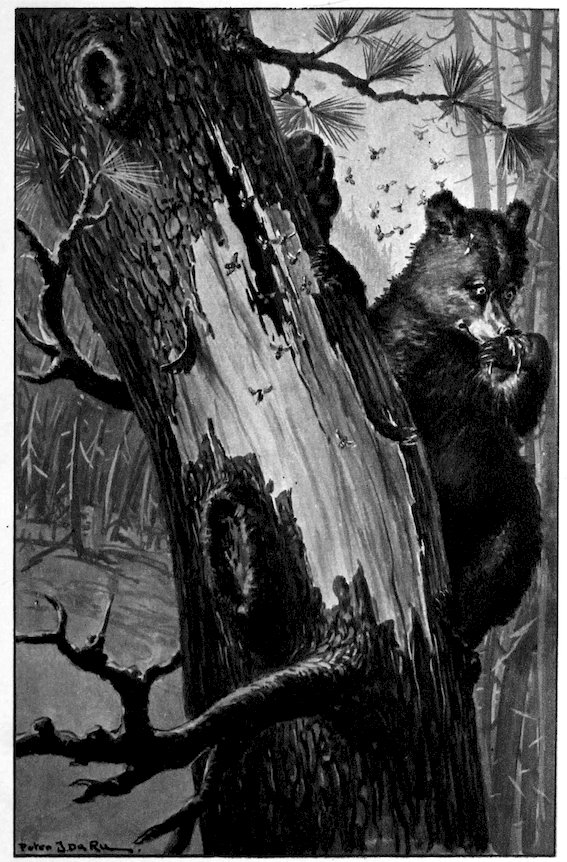
As Twinkly Eyes, the little Black Bear,
heard that buzzing from the wild rose bushes,
he forgot his troubles with the Jay.
Indeed, he fairly danced for joy. For
had he not been waiting greedily all spring
for the sound of a honey bee?
Now he would find the bee tree, and feast
on honey to his heart’s content! For of all
the good things in the great green woods—mice
and berries and grubs, and fish and frogs,
and sour-tasting little red ants, to say nothing
of juicy roots, and the nuts of autumn—he
loved nothing half so well as honey.
He had had a taste just once, but he had
never forgotten!
While wrestling with his brother one day
the spring before, when they were three
months cubs, their mother had suddenly called
them to follow and trailing straight after a bee
her sharp ears had discovered, she led them
49to a hollow tree where the yellow comb lay
in great fragrant chunks.
Twinkly Eyes licked his chops at the
memory. Then Mother Black Bear had
shown them how to hide their noses and shut
their eyes when the bees came too near these
unprotected places. Otherwise the angry
insects could try as hard as they would, and
they could not reach through the glossy fur.
Twinkly Eyes had escaped without a sting
and he had decided in his infant mind that
Mother was altogether too cautious for any
use.
This year Mother Black Bear had a new
set of cubs to teach and train, and Twinkly
and his brother were living in bachelor
quarters.
A moment Twinkly watched, and then the
bee had all the honey she could carry. Buzzing
happily, she started back through the
woods toward an open glade on the other side
of Pollywog Pond.
Twinkly followed, his sharp ears guiding
him where his little near-sighted eyes could
not, till his eager sniffings brought to his
50nostrils the first faint fragrance of the bee
tree.
Now other bees began to join the first one,
till there was quite a little swarm headed for
a hollow pine—a great, gaunt tree that had
been hollowed out by lightning and now
stood, scarred and blackened, on the top of a
hillock.
“It’s a pretty good world, after all,”
Twinkly Eyes decided, as he ambled up the
slope.
XVII TWINKLY EYES AND TROUBLE
51
“Yes, sir, it’s a pretty good world after
all,” mused Twinkly Eyes, the little Black
Bear, as he neared the bee tree.
Certainly everything about him promised
a blissful day.
Warblers sung happily from every treetop,
swallowtail butterflies danced above the wild
rose bushes, and puffy white clouds shadowed
the blue of the sky. There was just enough
breeze to feel good as it ruffled his glossy fur.
Then too, blueberries were nearly ripe, and
the fragrance of wild grape vines promised
delights to come.
But best of all was that heavy hum of a
thousand bees carrying their golden honey
into the hollow pine tree.
It was a tall old pine that had once been
struck by lightning. One side was scored and
blackened; near the top was a small dark
52hole, into which the returning bees poured
steadily, while others poured steadily out
again.
And oh! The wonderful odor that came
from that hole! How it made his mouth
water! There was nothing whatever to indicate
that trouble might be near.
Now Twinkly Eyes had been in his mother’s
charge the first time he had climbed a bee
tree, and thanks to her warnings he had
escaped unstung. It seemed to him now, as
he thought of that wonderful day, that his
mother had been altogether more cautious
than there was any need of being.
But, no sooner had his claws begun to rattle
upon the trunk of the hollow pine than the
buzzing grew louder, and it seemed to Twinkly
Eyes that there was a new note in it, quite
different from the contented hum he had
heard before. In fact, he began to wonder if
there might be trouble after all. Still, he was
not one to give up at this point! The sweet
comb would be worth a lot of trouble! He
scrambled faster, till one paw clutched the
edge of the hole.
53Instantly the bees had settled thick upon
his coat, trying their best to ram their red-hot
stings into his glossy fur, but it was too
thick for them, and Twinkly minded not at
all.
Suddenly a red-hot needle struck him on
the lip.
“Hoof—woof!” he protested, licking the
burnt place. It hurt dreadfully.
Another needle pricked him, this time on
the tip of his protruding tongue. This time
Twinkly slapped so angrily that he flattened
the bee, but it didn’t help his tongue, and his
lip began to swell.
But there was no time to think about that.
As he reached for a better hold, his paw tore
a strip of the rotten bark away, and he had
to shut his eyes and cover his nose with his
paw while the angry swarm darted about his
head in a buzzing fury.
XVIII TWINKLY SHOWS HIS METTLE
54
No, indeed, Twinkly Eyes was not the Bear
to give up just when he had one paw in the
honey!
For the same paw that covered his nose
from the angry insects, as he clung to the old
pine, also brought to his tongue the most
wonderful flavor he had ever known.
All the smarting and burning in tongue
and lip could not spoil that flavor. He must
have more of it, and that at once! For what
had he watched and waited these long weeks
if not for this very chance? Was he to be
driven from the feast by a little brown insect
with a barb in the end of its tail?
No indeed! No mere honey bee could make
him turn back now.
Struggling still nearer that dark round hole
from which the fragrance issued he drew a
long breath and plunged in.
“My how his little black eyes danced with the delight of it!”
55Another needle point, red hot, stung him,
this time on the lid of his right eye; and if the
sting on his lip had tortured him, this was
something far, far worse. He whimpered
unhappily, and rubbed the sore place gently
against his upraised foreleg.
My! how those bees did buzz and threaten
him! But they couldn’t reach him through
his fur, so long as he kept his face protected.
He clung to his hole just the same, and by and
by he dug his free paw deep into the honeycomb
within and brought a great luscious
chunk to his mouth.
Now that their little store was really disappearing,
despite all they could do the bees at
once began setting to work to rescue some of
their treasure. Still there were enough left
on guard to give Twinkly cause for watchfulness.
He grabbed another mouthful, and gulped
it down, with the bees that still clung to it.
My, how his little black eyes danced with the
delight of it!
If only that eyelid would not smart so
dreadfully! It was swelling, too, and he
could hardly see out of that eye at all.
56His tongue was swollen, too, on the tip
end where the bee had stung him, till it began
to feel so big he feared he wouldn’t be able to
close his jaws in another minute.
But he would not give up! Not Twinkly
Eyes! Not till every last smell of that honey
was gone! Now that he had risked it thus
far, he reasoned, he might as well have something
to sweeten his pain.
The little Black Bear was nothing if not
persistent, and persistence is a virtue that
stands one in good stead in the wilderness.
Then suddenly a most surprising thing
happened.
XIX DOWN BUT NOT DOWNED
57
A great many things can happen to a bear
cub that he doesn’t expect to happen.
It was so with Twinkly Eyes. No sooner
had he made up his mind to enjoy his feast in
the bee tree in spite of his stings when—zipp!
Off came a great long strip of the rotten
bark! And while it disclosed even more of the
yellow comb, it also happened to be the very
strip of bark to which the little bear was
clinging with his left forepaw.
Now his right paw was deep in the honey
at the time, and a bear cannot cling in the top
of a pine tree with his hind legs alone. The
result was that there was a wild scrambling,
then the sound of claws rattling noisily over
the bark that they could not get a grip in,
and finally the snapping of a hazel bush that
stood just beneath.
58Twinkly Eyes had come down like a bag of
meal!
He gave one big grunt, then a series of
whimpers. For even if you are a yearling cub
and your bones are padded with great heavy
muscles and thick fur, it isn’t the most comfortable
thing in the world to fall crashing
out of the top of a bee tree.
Fortunately for Twinkly Eyes, he had
hugged the trunk just enough, as he descended,
to break the fall. Then, too, he
landed on the hazel bush, which sprang under
him in a way still further to soften his landing.
But even at that, things whirled about him
for a few minutes there.
Then he arose, a bit groaningly, it is true—what
with his swollen eyelid and his burning
lip and tongue. And what do you suppose he
did next?
Most anyone would have felt that he had
had enough adventure to last him for some
time. But not so Twinkly Eyes! That was
not the kind of mettle he was made of!
Though his little near-sighted eyes could
not see the crack that now reached for nearly
his own length down the hollow trunk, his
59keen brown nose told him that the scent of
honey was even stronger than before. And,
though his black sides already stuck out, his
mouth still watered for more.
He sniffed longingly, then tried to soothe
his swelling eyelid with his paw. He certainly
felt bunged up, to say nothing of the jolting
he had just received. He couldn’t see out of
his right eye at all now, and there was a lump
the size of a walnut on his lip.
But, oh, the delicious fragrance! The
honey he had waited a year to find! In
his long winter’s sleep he had dreamed of it
more than once, and licked his paws in vain.
Throughout the lean spring, as he grubbed for
roots, he had listened in vain for the very
buzzing that now filled the air all about him.
It was too much! He would try again!
XX TWINKLY APPLIES FIRST AID
60
There was no resisting that odor of wild
honey dripping from the comb—not to one
who loved wild honey like Twinkly Eyes, the
little Black Bear!
He must have more! His eye swollen shut,
his tongue stinging like fury with the hot
flame of the bee’s sting, he pulled himself
together and started up the tree again.
The bees were working like mad to carry
away at least a part of their store before he
should devour it; but they were not too busy
to try once more to drive him off. A fourth
bee gave up his life to thrust his barbed and
poisonous sting into his nose. But Twinkly
Eyes only became the more stubborn in his
desire to clean out the tree.
Bracing himself in the crotch of a branch
just beneath the opening, he thrust one paw
in deeply and brought it back dripping with
61yellow liquid and dotted with black bees.
Bees and all went into his eager mouth, and he
crunched joyously handful after handful.
Once a bee tried to come too near, and with
one sticky sweep of his honeyed paw he
imprisoned the insect, whose wings stuck so
fast he could only buzz helplessly, traveling
back and forth from the place where the bees
wanted the honey to the place where Twinkly
Eyes wanted to have it.
Thus, in time, the treasure of the pine tree
disappeared,—and my, you should have seen
how that little bear’s sides stuck out! It was
a lucky thing for him that the honey was all
gone, I tell you!
And what a sight he presented, as he slid
down the trunk and ambled off to Pollywog
Pond! His face by this time was smeared
with honey from ear to ear. Flying leaves
and little chips of bark clung to it as if they
had been pasted there. Add to that his
swollen eyelid, which by now had raised a
great black welt, and his nose and his mouth
all lumpy from the poisonous stings, and one
would certainly have said he had been in a
fight.
62But he felt so perfectly blissful with his
sides rounded out with honey the way they
were that he wasn’t the least bit sorry. Not
Twinkly Eyes! He would have done the
same thing over again the next day had he
had the chance.
He knew just what to do with his wounds,
and he did it. Searching along the banks
until he found some particularly sticky clay,
he plastered it freely all over his tortured face
until he looked, if possible, worse than before.
But he felt a whole lot better, let me tell
you. The wet clay soon began to draw the
poison, and besides, bears get over things like
that quicker than human beings would. So
by the time he had had a nice long snooze and
a drink and a stretch, and the round yellow
moon began to rise from behind the firs,
Twinkly Eyes was ready for almost anything.
XXI MAMMY COTTONTAIL’S SECRET
63
Now Twinkly Eyes had a lively bump of
curiosity on that furry black head of his. He
was much interested in other people’s affairs.
And he used to lie hidden by the hour, just
to find out what other wood-folk were up to.
But of all the dwellers in that wilderness,
none interested him so much as the Cottontail
family. That is, none except his old enemy
the porcupine!
One day, lying under a clump of high-bush
blue-berry bushes, in the early spring sunshine,
he learned a secret.
“We have a secret at our house! Truly,
truly, truly,” sang Betty Bluebird, sitting on
a fencepost with her red blouse turned to the
warming glow of the early morning sunshine.
“We have too, we have too, we have too!”
trilled Robin Red-breast, running along the
roadway with a weather eye for worms.
64And down in the marsh behind the barn,
Conqueree, the Red Winged Blackbird, was
shrilling at the Crows like a little soldier in
red epaulettes: “Clear out! Or I’ll put you
out! I’m Conqueree! Conqueree! Conqueree!”
“You cawn’t, cawn’t, cawn’t!” the crows
retorted, trying to drown out his threats
with a hoarse chorus of denial, as they swirled
around and around him, keeping just barely
out of reach of his swift beak. “We have
secrets we won’t tell! Such secrets!—Round,
gray green secrets, four to a nest, hidden
away up in the tops of the tallest pine trees!
And you cawn’t, cawn’t, cawn’t guess what
they are!—you cawn’t.”
“Trust a crow to tell all he knows!” chuckled
Daddy and Mammy Cottontail, crouched on
guard before a small round hole scooped out
of the turf and lined with bits of fur from
Mammy Cottontail’s breast. “We could tell
a pretty cunning secret ourselves, only we
have better sense than to shout our affairs to
the four winds,” and their slim ears waggled
wisely.
65Sure enough, packed snugly back under a
blanket of dried grass, six of the softest,
roundest little wriggly-nosed babies that ever
made a bunny feel like kicking his heels in the
moonlight slept with their long ears folded
close along their backs and their long hind legs
doubled up under their fuzzy brown bodies.
“Do you suppose they’ve all got the same
kind of secrets?” whispered Mammy Cottontail
delightedly.
“Nothing to compare with ours,” sniffed
Daddy, then stopped suddenly, as the little
Bear snapped a twig in his effort to creep
nearer.
XXII ONE OF TWINKLY’S NEIGHBORS
66
Twinkly Eyes had roamed to quite another
part of the woods when the twilight stillness
was pierced by a sudden screech from up on
Mount Olaf.
Mammy Cottontail’s timid heart quailed
within her. Mother Red Squirrel could scarce
be blamed for all but dropping from her limb;
and even Father Red Fox looked anxious at
the thought of the red-brown pups in the
rocky den on the hill-top.
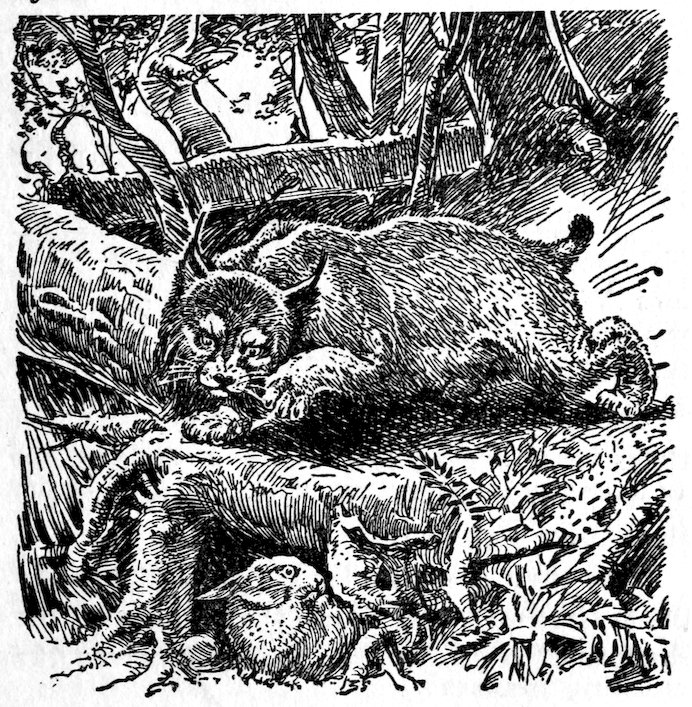
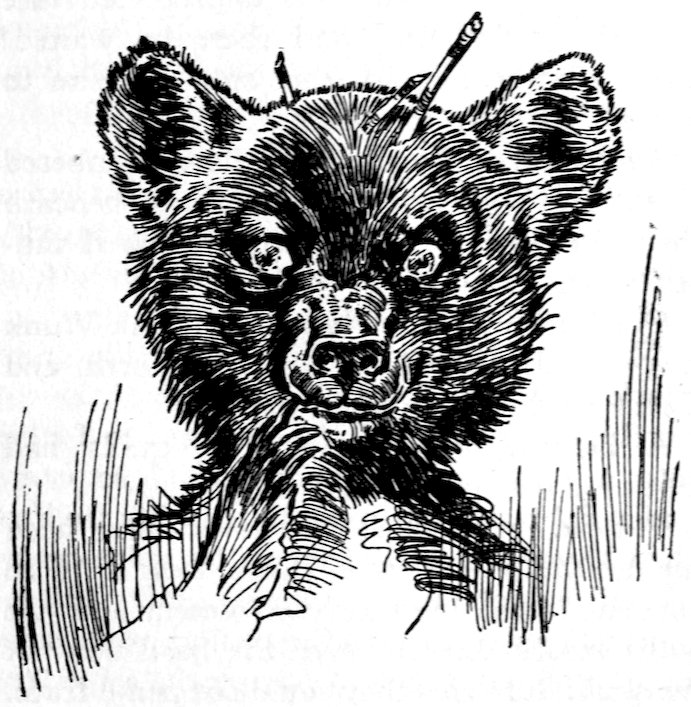
Far down at the Valley Farm, “Lynx!”
whispered the Boy, wide-eyed, “Hope he
isn’t coming down to make trouble for our
wood folks. He’s mighty fond of baby bunnies.”
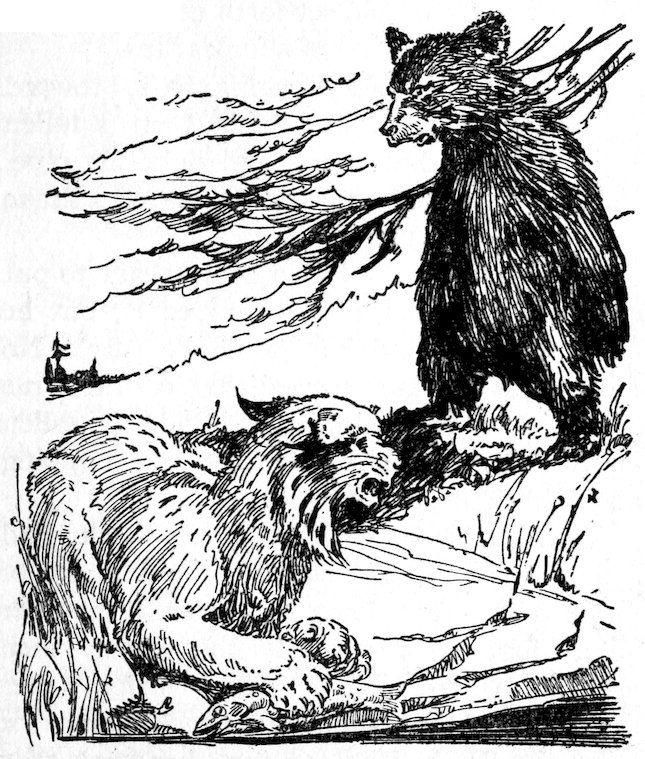
Away up almost at the top of Mount Olaf
a great cat, three times as heavy as barnyard
Tamas, was creeping, creeping, creeping along
67through the underbrush, on great furry feet
that made no sound.
His broad ears bore little tufts at their tips,
his jowls were squared off with the most
ferocious-looking whiskers, and his thick tail
was no more than a stub.
“Children,” quavered Mammy Cottontail,
“That was a lynx! Now, I want to tell you
something, and I want you to listen with all
your ears, because it is very, very serious!
“Old man Lynx and his family live up on
that mountain top, and while they don’t
come down this far once in a coon’s age, we’ve
got to be prepared! Because it would be a
terrible thing if they did! Terrible for us, and
terrible for everyone we know!
“I’ll tell you why he screeched that way!
It was to scare timid folks like us, so that we’d
jump and betray our whereabouts. Yes’m,
that’s exactly what he screeched for! To
make us jump!
“Because, you see, when Mother Nature invented
little brown bunnies and grouse hens
and muskrats and all the rest of us forest folk,
she knew exactly what she was about. And she
gave us our brown coats so that we’d match
the ground, and couldn’t be seen by the big
68prowling creatures that are always trying to
have rabbit and grouse for dinner. And just
so long as we keep as still as field mice, we
stand a fighting chance of not being seen.
“But Old Man Lynx knows this as well as
we do. He knows that when he goes hunting
o’nights, none but the foolish will be stirring
a hair’s breadth from their own warm beds.
And if there are no foolish ones that he can
sneak up on, with his great padded paws that
tip-toe so silently through the underbrush, he
screams in the hope that it will startle some
of us so dreadfully that we will forget to keep
still, and jump.”
“It’s enough to make any one jump out of
his skin,” said Daddy.
“But that’s exactly what the Old Man
figures on. And if you can’t control your
nerves any better than to jump when he
screeches, he can see exactly where you are!
If he’s anywhere near, that is! Well, you
children had better go to sleep now. But just
you remember this: Lie still when you hear
him scream, and ten to one he’ll never know
where you are.”
“Yes, Mammy,” whispered six timid little
voices.
XXIII INTRODUCING BOBBY LYNX
69
It was not often that Old Man Lynx gave
voice to the pangs of hunger. For he knew
that for every grouse or hare or baby fox he
startled into betraying its whereabouts, he
scared a dozen so far away that it made hunting
harder next time.
But tonight he was teaching some one else
the trick.
At the very time that Father Red Fox was
viewing his own red-brown pups with such
mingled pride and amusement, and Mother
Douglas was driving Father Douglas out of
the old oak tree, lest he should step on one of
the squirrel babies, and Mammy and Daddy
Cottontail were taking turn and turn about
guarding the six brown bunnies on the edge
of the cornfield, Madam Lynx—away up on
the top of Mt. Olaf—was just as proud as any
70one of two great, scraggly kittens, as heavy-pawed
and bob-tailed and fierce-looking as
anything that could be imagined.
At first even these ferocious creatures were
as blind and helpless and appealing as any
tame kittens could have been, though without
their grace. And as soon as they learned the
use of their legs, they rolled and tumbled, and
growled and spat, and boxed one another
about, fully as mischievously as had Fluff, the
maltese kitten at the farm, when she and her
little brothers lived in the basket behind the
kitchen stove.
But Old Man Lynx was kept mighty busy,
let me tell you, as soon as they were weaned
and could eat meat; for the two youngsters
were such ravenous creatures and they grew
so fast, and the mountain air was so stimulating,
that it just seemed as if he couldn’t bring
in enough to keep his share of the larder
filled.
So it was by way of teaching young Bob
Kitten and his brother how to hunt that old
Man Lynx had screamed in such a blood-curdling
manner.
71Decidedly Wriggly Nose and Shadow Tail,
and even fat young Frisky Fox, were going to
have a very much harder time of it making
their way in the world, now that there was a
new young lynx on the top of Mount Olaf.
Twinkly Eyes was later to share a couple
of interesting adventures with young Bobby
Lynx.
XXIV A BUNNY BALL
72
Mammy Cottontail, the little brown hare,
had been living in the Old Apple Orchard for
several weeks now and the bunnies were half-grown.
One moonlight night toward the end of
June—the self-same night that Twinkly Eyes
had found the bee tree, Mammy said:
“Children, we are going on a frolic tonight.
So come along, Flap Ears and Furtive Feet,
and Wriggly Nose and Paddy Paws, and
Fuzzy Wuzz and Hippity Skip! Daddy’s
there waiting for us now!”
Through the moonlight woods she led
them in one long line along a little briar-grown
rabbit path, the youngsters kicking
their heels high in their excitement.
Now they crept under a patch of huckleberry
bushes, and now they hugged the
shadow of a grapevine. Straight across the
73blueberry burn, they galloped,—under the
fruit-laden bushes, then across a corner of
wild meadow where the daisies gleamed high
above their heads, and all about them was the
aroma of sweet fern.
Their path ran zig-zag, this way and that,
here circling back upon itself, there darting
off at right angles, till anyone trying to follow
it would have had an interesting time, to say
the least.
But after various turnings and twistings
through the woods, and doublings around the
rocky hilltop behind Pollywog Pond, they
found themselves away back on the border
of a little glade, an opening in the trees where
the grass was short and fine like that in a
fairy ring. And the moon streamed down,
making it all as light as day.
Here on every side were outposts, and the
mere crunching of a dead leaf by any creature
larger than a rabbit would be the signal for
the warning tap-tap of the long hind feet of
those on guard.
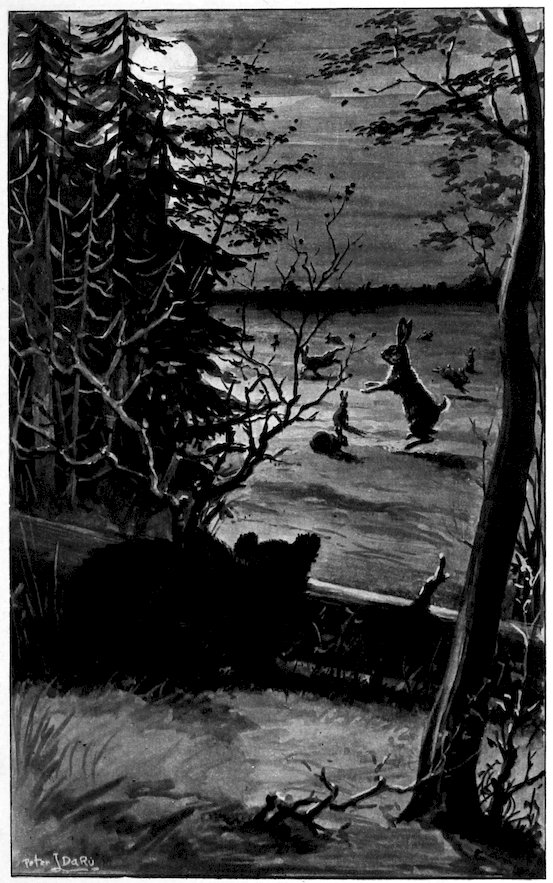
Within the circle of the moonlit glade a
dozen hares were already assembled, and more
were coming in from every side.
74Mammy Cottontail drew up in the shadow
of a tree trunk, that the youngsters might
get their courage up before joining those in the
open. Soon there were half a hundred bunnies,
young and old, together, scampering
about and having a glorious good time. They
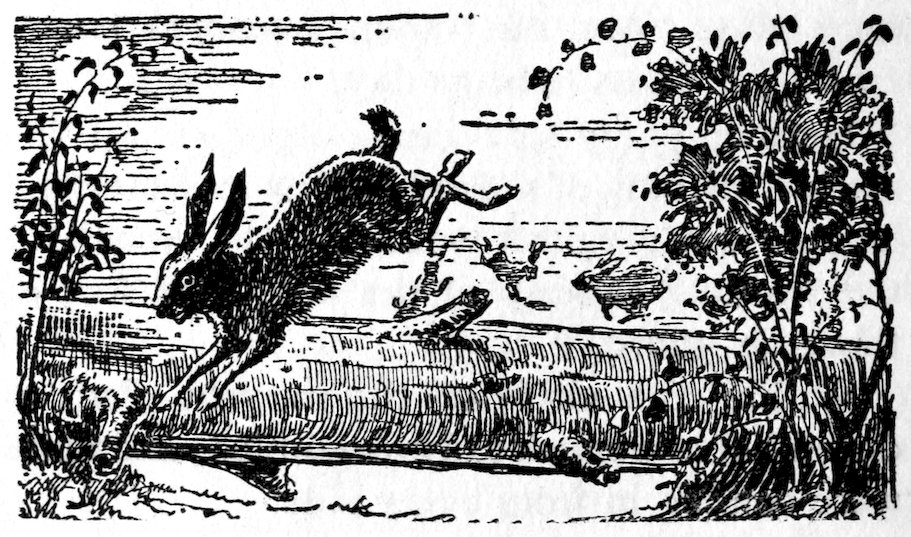
pranced and they danced and they raced one
another. They leapt back and forth across
a log and they leap-frogged over one another,
kicking their heels to the moon. There was
never a sound to break the stillness save the
chirping of crickets away back in the meadow
they had left.
Then, so suddenly that Mammy’s heart
gave an extra beat, there came the warning
thump! thump! thump! just behind them!
XXV TWINKLY EYES ATTENDS THE FROLIC
75
Now Twinkly Eyes, the little Black Bear,
had no idea when he awoke of all that was
going on so near him.
But ambling down to Pollywog Pond for a
drink after his feast of honey, the sound of his
crunching over a dead twig was enough to
warn the sharp ears that ringed about the
rabbit frolic; and from first one outpost and
then another came the thump, thump, thump,
of a half hundred padded feet on the forest
floor.
In an instant every one of the bunnies
which a moment before had been capering
madly in the moonlight had sought cover.
Mammy Cottontail and her little brood,
watching from the shadow of their tree trunk,
were already hidden, hearts beating bumpety-bump
in their anxiety.
76For perhaps ten minutes they listened,
their hearts sounding like trip hammers in the
breathing stillness of the forest night, in which
no creature larger than an insect moved, save
the silent-winged bats and owls.
At least, that was what the listening bunnies
thought! But Twinkly Eyes, the sly one!—had
heard the thump, thump of the outposts;
and he knew just what it meant. Although
his little sides were already rounded from his
feast of honey, a bear is always hungry. And
Twinkly Eyes decided to attend the frolic.
If Mammy Cottontail, anxious little mother
that she was, had known all that was being
plotted in the head of the little Bear, she would
have started her brood for home on the fastest
gallop.
But Twinkly Eyes, for all his weight, had
paws padded so softly that he can, when he
wants to, steal through the underbrush without
a sound to warn his quarry of his coming.
Yes, sir, that little rascal can slip through
the woods as still as a mouse, and you could
sit straining your ears but you would never
hear so much as the crunching of a leaf beneath
77his foot. When he really wants to,
he can move like a shadow.
Now he had decided to attend the frolic,
but not to join in the play! Mammy Cottontail,
never dreaming of the sleek black form
that crept so silently to the edge of the clearing,
led her six out among the merry-makers.
Soon Wriggly Nose and Paddy Paws, and Flap
Ears and Furtive Feet, and Fuzzy Wuzz and
Hippity Skip were leaping and dancing as
gaily as the best of them.
The full moon, shining down on the little
glade, showed their furry forms so plainly
that even Twinkly with his near-sighted little
eyes, could see them kick their heels in air.
Crouched in the shadow of the very log
where a little while before Mammy and her
six had hidden, he watched and waited.
XXVI A JOKE ON THE LITTLE BLACK BEAR
78
Twinkly Eyes had his mind all made up,
as he hid there in the shadow of the tree trunk,
to add a rabbit to his feast of honey.
He therefore crouched with his great steel
paw ready to give the one crushing blow that
would be necessary the moment the first brown
bunny was so foolish as to pass within his
reach.
He watched gleefully as he saw their sleek
brown forms dancing so care-free in the moonlight.
“Hippity skip and away we go!” their
soft feet seemed to sing, as they galloped back
and forth across a fallen log.
Saucy fellows, he told himself, as they
flapped their long brown ears or leaped high
in the air.
Oddly enough, so silently had the little
Bear approached that not one of the outposts
79was aware of his presence. The wind was
blowing directly toward him, so that they
did not even get his scent.
Only Mammy Cottontail, prancing gaily
around to the right, thought for just an instant
that she had caught an alien odor.
Leaping high in the moonlight, she struck her
long hind feet three times upon the ground,
to see if she could startle whatever it was into
betraying its whereabouts.
At her danger signal, every bunny in the
glade stopped stone still to stare and listen;
but Twinkly Eyes was not to be thus betrayed.
He was too big to be startled by her stamping,
and too wise to come out into the open, where
every rabbit, once warned, could easily outrun
him.
Not he! Twinkly Eyes just bided his time,
huddled down as still as any frightened field
mouse. He sat so long in one position that his
legs got cramped and he began to feel distinctly
drowsy. Why on earth didn’t one of those
fat bunnies come just a wee bit closer? How
weird they looked, now chasing one another,
now pausing to nibble a few grasses, but
always well within the open glade where the
80moon would have shown them the first
instant an intruder thrust a paw within the
charm-ed circle.
After a while, though, the wind died down,
and with the bear scent that now suddenly
came to the merrymakers, there was a series
of frightened squeaks, and in less time than
the twinkle of a moonbeam, every last bunny
of them had darted under the ferns or into
the deep shadows, and the little glade was as
empty as if they had never been there.
Then Wriggly Nose, more daring than the
others, crept very, very silently toward that
dreadful odor. He peered amazed at what he
saw.
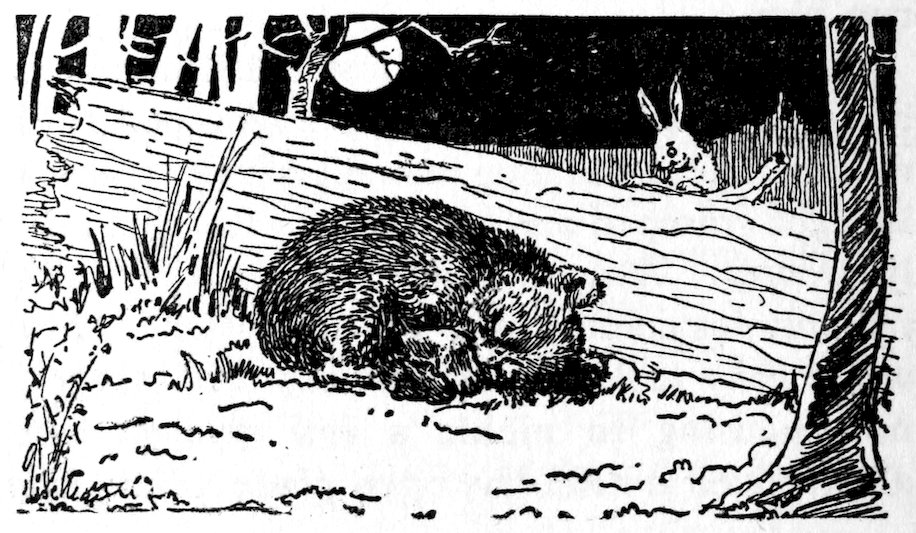
Twinkly Eyes had fallen fast asleep.
XXVII SCHOOL FOR BUNNIES
81
Yes, sir, there was Twinkly Eyes, the
little Black Bear, fast asleep!
How Wriggly Nose and Paddy Paws and
the rest did wiggle their long brown ears at
the sight!
“So he had been spying on our frolic!”
whispered Flap Ears with a giggle.
“Yes, he thought he’d have hare for supper.
Why do you suppose he didn’t catch one of
us, when he came so near?” asked Wriggly
Nose, his eyes a-twinkle.
“Huh, he knew we could run the faster,”
and Paddy Paws threw his chest out.
“He was waiting to knock you down the
instant you came near enough,” said Mammy
Cottontail, suddenly appearing in the midst
of her little brood. “Don’t go too near! He
might wake up at any minute!”
82“Aw, come on,” urged Flap Ears to the
younger bunnies. “I’ll bet you can’t jump
as high as I can,” and he vaulted fully five
feet into the air.
“Bravo,” said Mammy Cottontail. “That
is as good as I could do myself!”
“I can leap farther,” boasted Wriggly Nose,
and shooting like a coiled spring from the
ground, he landed a good ten feet away.
“They’ll soon be able to take care of themselves,”
chuckled Daddy Cottontail, hopping
over beside Mammy at this moment. “We
must have more of these drills.”
“Yes,” whispered Mammy, “but don’t let
’em know it’s a part of their schooling. Let ’em
think it’s only play, or they won’t take any
pleasure in it.”
“Right!” agreed Daddy Cottontail. “The
great secret of training the young is to make
it play for them. Now when I was a
youngster—”
He stopped to prick up his ears.
“What is it?” whispered Mammy, with
an anxious eye on the little bunnies, who were
now playing leap-frog with the hares from the
other side of Pollywog Pond.
83“Didn’t you get a sniff of something, just
then, when the wind changed?” asked Daddy.
“I could have sworn—there! A fox! A fox!”
he signaled with that tap—tap—tap of his
long hind legs that sounded so much like
drumming on a hollow log.
Instantly every bunny in the glade had
dashed to cover, and gone scuttling for home
along the crookedest little rabbit road it
could find.
For a Fox has sharper eyes than a bear,
a keener nose and better ears, and on top
of everything else, he can run as fast as the
fastest hare that ever grew. At least, a large
fox could, and even young Frisky Fox had
grown into a foe worth keeping at a distance.
For the taint on the wind was that of
Frisky Fox, out on a little spree of his own.
XXVIII A BOY AND A BEAR
84
Human ears are never so sharp as those
of the wood folk who have to live by their wits.
So when the Boy from the Valley Farm heard
nothing, and saw nothing, he concluded there
was nothing there.
But Twinkly Eyes, the little Black Bear,
was following him none the less, half fearful
and half curious to see what this two-legged
creature might be up to in his woods.
It was a pleasant afternoon, with just
enough of a haze to subdue the sunlight. The
rain had left the earth fresh and green in the
open patches, and the air was sweet with the
perfume of Steeple Bush and Joe Pye Weed
and pink Sweet Clover. From away down
by the meadow back of the Farm came the
tinkle of a cowbell, the only sound to break
the stillness, save the faint lapping of the
river against a boulder.
85The Boy stopped beside a pool half-shadowed
by an overhanging log. His sharp
eyes could just make out a big fat trout that
lay headed up-stream, lazily fanning the water
with his fins, to keep himself in position.
Now Twinkly Eyes, who had concealed
himself in a clump of bushes a little downstream,
began to see the meaning of the long
black pole with the line dangling from the end
of it.
First the Boy took a tin can from his pocket,
a can with holes punched in the top. Selecting
a fat white angle worm, of a sort that the
little Black Bear well knew grew in the wet
places, he fastened it on his hook and dangled
it before the trout. But to no avail! That
canny fellow knew perfectly that no such
worms of soft fat whiteness were ever found
in his stream. The kind of worms he sometimes
found when there was a cave-in from
the bank were strong, slim black ones.—He
refused even to nibble.
The Boy next tried a cricket, then a grasshopper,
and finally a fat white grub—but
with the same result. Then, quite by chance,
he chose a black worm.
86But before he cast it, he saw a shining green
turtle about as big around as a good-sized
crab-apple floating about, just a little upstream.
And carefully laying his pole along
the bank, he made a grab for the fellow.
That roiled the water, and although he didn’t
get the turtle, it was one of the luckiest things
he could have done. For when he cast his
worm into the pool again, the water was so
muddy that the old trout thought, of course,
the bank had caved in above there, and he
made for that black bank-worm as if he had
fasted for a week.
A tweak at the line, and the boy was so
excited that he swung his fish fully two rods
through the air, landing him in the very bush
behind which Twinkly Eyes was hiding!
The little Black Bear gave a start of surprise,
and for just one instant his head was
exposed to the boy’s startled gaze.
XXIX THE TABLES ARE TURNED
87
The Boy from the Valley Farm held his
head high with pride.
For had he not—on the self-same day—landed
a big fat trout and seen a bear cub!
That would certainly be something to tell
at home, even for a backwoods boy! His
mouth watered as he thought of the way his
mother would broil his fish.
But alas, for the best laid plans of mice
and men! When he found the place where
he had landed his catch, there was no fish
there. Could it be that he had only dreamed
he caught it? But no, here was its tail on the
trampled ground. Someone had stolen it.
But who? That was the question!
Why, of course, the little Black Bear whom
he had startled out of the underbrush!
“The rascal!” exclaimed the Boy, half
amused, half crest-fallen. Well, I only hope
he needed it more than I did.
88“Now I suppose they will never believe me
at home when I tell of my big catch.” He
started whistling ruefully, as he set about
mending his broken horsehair line, which had
got badly tangled in the bushes.
Then his eye fell on something that made
him pause, wide-eyed. Being a backwoods
boy, he was almost as keen at reading the
signs about him as were the wood folk themselves—that
is, so far as he was able! Of
course his nose and ears were very much less
sharp than theirs, but he had even better
eyes than most of them.
Here was evidence his eyes could not deny,
though he reached out and felt of it to be sure.
One fin of his stolen trout lay caught in the
very top of a hazel bush.
“Now, how on earth did that get there?”
he asked himself. People who are much alone
are very apt to talk to themselves. “If that
cub ate the fish down here, where the ground
is trampled, how did he come to drop the fin
in a bush higher than his head?”
Then a bright idea popped into his mind.
“Why, of course, it must have dropped from
above. A sly fellow like that wouldn’t have
89stopped to eat his fish down here. He’s
carried it up in the top of some tree where he
could feast in peace. I’ll bet it was this very
tree I’m standing under—for how else could
the fin have fallen on top of the bush?” He
raised his eyes to peer into the green shadows
of the tree-top.
There, sure enough—so high that the Boy’s
sharp eyes could barely make him out against
the tree trunk, sat Twinkly Eyes astride a
limb, and between his clever forepaws he
held what must have been the last of the
trout.
“Oh, you rascal!” shouted the boy, in
delight. “I’ll get you for that!”
XXX A CLIMBING MATCH
90
“You Scalawag!” the Boy kept laughing,
as he stared at Twinkly Eyes, the little Black
Bear, in the top of the beech tree.
“So it was you who stole my fish?”
But Twinkly Eyes said never a word. He
just sat still, like a bump on a log, in the hope
that the Boy might yet be deceived into
thinking him only a blackened limb.
But the Boy from the Valley Farm was not
to be deceived. He, and his father before him,
had lived all their lives in the north woods
where footprints are very clear—and the little
Bear’s footprints led straight to the tree.
Moreover, he had long been wishing he
might catch a cub for a pet. Therefore, he
started to climb the tree.
Twinkly Eyes, who did not know the kindness
of the Boy’s intentions—and who certainly
91would not have wanted to be caught if he
had—decided it was time to show fight.
“Whoof! Whoof!” he growled, slapping his
heavy paws on the tree trunk.
“You can’t scare me!” laughed the Boy.
“You’re nothing but a yearling cub. And I’m
the best wrestler at the Cross-roads School!”
And on he came regardless.
Now here was where ignorance was bliss.
For while it was true that cubs have been
caught and tamed, the Boy from the Valley
Farm had much to learn about how it is done.
And there was one thing he did not know.
He did not know that if it came to a wrestling
match with Twinkly Eyes, the Boy would
be the one to get very much the worst of it all.
The cub was so small and cunning, so like an
over-grown Newfoundland puppy, that the
Boy would not have believed, had you told
him, what a scrapper he could be.
Grown bears the Boy feared, but this little
fellow didn’t look the least bit dangerous as
he clung to his tree-top. And the Boy was
only fourteen. That is to say, he held the
firm belief that he could lick his weight in
wildcats—to say nothing of bear cubs.
92It was well for the Boy from the Valley
Farm that Twinkly Eyes had no mind to let
him try it.
Yes, sir, it was lucky for that Boy!
As it was, no sooner had he scrambled painfully
half way up the trunk than Twinkly
Eyes climbed to the very topmost branch;
and as the Boy still came after him, he crept
so near the tip that it swayed beneath his
weight. Here he felt sure the Boy could not
follow, and his courage returning with a
bound, he turned to “Whoof!” at his pursuer.
“Ho! ho!” laughed the Boy from the Valley
Farm. “I can shake you off, you rascal, if
that’s your game.” For you see his natural
kindness was forgotten in the thrill of the
chase, and he was bound and determined now
to have that bear.
XXXI THE BEAR GETS THE BEST OF IT
93
Twinkly Eyes, the little Black Bear, had
crept to the end of the drooping limb with an
air of—
“Now catch me if you can!”
“You funny little rascal,” laughed the Boy
from the Valley Farm, as he hitched himself
astride the other end of the limb.
“I’m going to wait right here till you get
tired of it. So you might as well make up
your mind to getting caught. You won’t
mind in the least, though, once you find out
what it’s like to be tame. I’ll bring you all
the fish you can eat. Sweet corn, too! And
every time you learn to do a trick I’ll give
you a lump of maple sugar. How’ll you like
that, sir?” And the Boy fished a lump of his
favorite sweet from his overalls pocket and
held it out to the cub.
94But he received no response from the other
end of the limb.
Indeed, had the cub really understood what
the Boy was saying, the result would have
been no different. For freedom means more
to a wilderness creature than life itself. Better
a dinner of bark and his freedom than a
banquet of honey served at the end of a rope,
Twinkly Eyes could have told him.
Then an idea came to him. He began
shaking the limb to which clung the cub. He
shook and shook, till he was tired—but the
harder he swung the limb, the tighter clung
the little Black Bear to the swaying tip.
The lump of maple sugar dropped from the
Boy’s busy fingers. The cub gazed after it
with a hungry sniff, then—as easily as a bag
of meal—he dropped to the ground, grabbed
the sugar, and made off with it between his
jaws.
The Boy stared in surprise, then let himself
slide down the trunk. But fast as he came,
the little bear was faster, and all he found for
his afternoon’s adventure were the boy-like
tracks of the padded feet, with their doglike
95claws, as they galloped away down the
wet river bank.
“Well, I declare!” said the Boy. “If you
haven’t got the best of me again, you clever
rascal!”
But he didn’t give up the chase. Not for an
instant. The cowbell found him deaf, and for
once the supper hour was forgotten. For now
he wanted nothing on earth so much as to
catch that cub.
Following the broad footprints till they
turned off among the thick pine needles, he
fell to his knees to study the ground for signs
of the little bear’s trail.
XXXII THE LITTLE BEARS GO FISHING
96
Twinkly Eyes, the little Black Bear, galloped
across the pine needles as noiselessly as a
shadow.
His drop from the tree-top had taken only
a second, while the Boy had used up fully half
a minute sliding down the trunk. So that, by
the time the Boy began looking for footprints,
the bear was away up stream in the top of another
tree, peacefully licking up the ants from
the bark.
Meantime the Boy from the Valley Farm
was running into a danger of which he little
dreamed.
Being a backwoods boy, he knew that a
mother bear with cubs is a person to avoid.
But he did not know that Mother Black Bear
had brought her two new cubs to the very
97stream along which he was searching for footprints.
True, they were on the other side of the
river. And the wind was blowing in quite
the wrong direction, so that Mother Black
Bear’s nose could not warn her of his approach.
Thus, if he kept on the way he was headed, he
was due to stumble upon the little family
very soon, and give both them and himself an
unpleasant surprise.
For Mother Black Bear was mighty touchy
where her cubs were concerned. She was in a
mood these days for clawing anyone who so
much as looked at them, so precious were the
two fat babies to her.
The last red glow of the setting sun was
glinting off the river between the shadows
of the trees. And Mother Black Bear was
catching fish. The two fat, roly-poly cubs,
Twinkly’s baby sisters, sat on the bank and
watched gravely, while their mother waded in
up to her neck, paddling so carefully downstream
that she scarcely made a ripple in the
mirror that it made. A trout might well have
taken her for a log floating gently with the
current.
98Her arms she held well down to her sides
with claws spread. Suddenly she felt a smooth
form glide against her side! With one swift
clutch of her curved iron claws she had her
fish, and was flinging it ashore to the babies.
The next fish she carried ashore in her jaws
for her own supper. Then back she led the
cubs up-stream to where the riffles glittered
in the sunset red. Here, standing perfectly
still in the shallow water, she waited till a
trout came by, when with one sharp blow on
the head she finished his career.
Meantime, where was the Boy from the
Valley Farm?
Deciding at length that it was getting too
dark to see foot-prints, he became aware that
the cow-bell was again tinkling and remembered
with a guilty pang that his father was
probably waiting for the cows that minute.
XXXIII TWINKLY AGAIN MEETS THE PORCUPINE
99
Twinkly Eyes, the little Black Bear, cocked
first one ear and then another.
There was certainly a buzzing somewhere
that sounded mighty like the sound that
honey bees made. The memory of his feast
at the bee tree made him lick his chops in
delight.
He followed the sound to the tree around
which it centered, clambered up the trunk, and
was soon following the particular limb on the
end of which most of the “bees” were
clustered.
Twinkly, after all, had had but one
experience with bees, and it is not surprising
that these insects should have fooled him.
True, he had not expected to find the
honey out at the end of the branch inside a
round gray ball. The time he had had that
100feast, the honey had been in a great mass of
comb inside the hollow trunk.
But then, one never could tell. His ears
told him that there were bees, and he always
trusted more to his ears than his eyes.
But then, he trusted more to his nose than
either of them,—at least generally.
At any other time he would have listened
to the warning of his nose. This time he
wondered why he could not smell the honey
as he had before. But perhaps he didn’t
want to be warned. He hoped so dreadfully
that there was honey that he tried to persuade
himself it was there, even if he couldn’t
smell it.
So on he went, straight to the end of the
swaying limb! Then he sat down to think it
over.
It was certainly very peculiar, that huge
gray ball into which the “bees” were pouring.
For while a few tried to sting the intruder and
only got as far as his fur, so quiet had been his
approach that most of them were going inside
as if he had not been there. There is no animal
in all the Deep Woods that can move as noiselessly
as a little Black Bear when he wants to.
101Finally, when every “bee” had gone into
the gray ball through a little round hole, he
cautiously put out one paw and tried to reach
after them. But it was too small for him;
he only succeeded in closing it so the “bees”
couldn’t get out. An angry buzz answered
this move on his part.
Unk Wunk, the yearling porcupine, who
had been watching from the tree across the
way, gave a grunt of amusement.
“Those aren’t bees,” he jeered. “Those
are wasps. So you won’t find any honey.
I’d hate to be in your place when you take
your paw off that hole!”
“Hello, there,” grinned Twinkly Eyes.
“I’m not afraid!”
He really thought Unk Wunk was trying
to drive him away from his find in order to
enjoy it himself. He didn’t believe for an
instant that it was really a nest full of angry
wasps he had imprisoned.
XXXIV A GOOD SPORT
102
“No, sir, I’m not afraid,” said Twinkly Eyes,
the Little Black Bear.
He suspicioned that Unk Wunk the porcupine
had been trying to drive him away from
his find, as he had from Lone Lake, in order
to enjoy it himself. For Twinkly Eyes really
believed that he was in a bee tree.
What else could these buzzing insects be, he
asked? And where bees were, there was
honey. His mouth watered at the thought.
The only peculiar thing about it was that
the bees should have gone into this huge gray
ball that hung from the end of the limb.
Twinkly held his paw over the opening, keeping
his “bees” prisoners, while he thought it
over.
If it should prove to be wasps—whatever
THEY were—how Unk Wunk would jeer at
him! He wished the little porcupine would
103go away instead of sitting there watching with
that spiteful gleam in his little black eyes.
But Unk Wunk had no intention of going
away. While he did not care to go to
the trouble of taking the impudent scamp
down a peg, he told himself he would just
as soon the wasps did it for him. So he
settled himself comfortably on his limb to
watch what would happen when Twinkly took
his paw off the hole in the wasp’s nest.
“I suppose that pin-cushiony fellow is just
aching to see me get hurt,” Twinkly told
himself. “But I shan’t let him know, if I do.
“So far as I can figure it out, there are about
six chances to half a dozen that this is wild
honey, and I’m going to take one of the six
on it!”
With an extra screw to his courage and a
great show of enjoyment for Unk Wunk’s
benefit, the little Black Bear tore open the
wasps’ nest.
Out poured the angry insects by the
hundreds!
But Twinkly took his medicine without
a yelp to betray to Unk Wunk that he minded.
XXXV BOBBY LYNX LEARNS A LESSON
104
Now Bob Kitten, Madam Lynx’s young
hopeful, was due to have an experience that
he would not forget in a hurry.
Never yet had he so much as crossed the
trail of any creature he could not get the best
of with tooth and nail, if he did not paralyze
it with his terrifying howl. He therefore
assumed that there was no one anywhere
that he need fear.
But one night when the moon rose round
and yellow from behind the firs, Bob Kitten
heard that curious gnawing again, and this
time it came from right above his head, in a
birch tree. Not only that, but he got a whiff
of the most tantalizing scent! It simply made
his mouth water!
He peered into the tree-top, his round eyes
gleaming through the shadow in which he
105stood. There was a dark ball swaying far
out on a slender bough, and it did not look the
least bit for-mid-able.
Bob let out his blood-curdling yowl, hoping
that the thing might be so scared it would
drop right down at his feet, and save him the
trouble of climbing; but the dark ball never
moved a muscle. It simply hung there gnawing
the bark as if it hadn’t a care in the world.
This angered Bob, and he was up in that
birch tree, and out on the swaying branch,
without even stopping to think. One blow
of his heavy paw, and the creature would be
felled to earth!
But still the round ball did not even glance
up from its gnawing. The impudence of it,
thought Bob! Didn’t the creature even know
enough to be afraid? He crept nearer. Now
he could see the rather mild-looking face and
the fat, hairy body ending in a stubby, pointed
tail. Its hair was certainly coarse looking,
gleaming lighter on the ends in the moonlight.
He had never seen fur like that before.
Suddenly there was rattle as of so many dry
twigs clacking together, and the round ball
suddenly fluffed itself out to twice its size,
106confronting Bob with every quill erect. For
it was a young porcupine Bob had trapped in
this awkward position, and he simply tucked
his face down between his paws till he was all
bristles, and waited.
And Twinkly Eyes, the yearling cub, also
waited, in the shelter of a neighboring ironwood
tree. For this was Unk Wunk, his old
enemy of the swimming hole.
This would have been an excellent time for
Bob to have revised his plan of action. But
ignorance was bliss,—and with a yell of defiance,
he struck out at his adversary.
The next instant he gave voice to a howl
of pain, for his sensitive paw struck a handful
of quills,—and it was exactly like slapping at
the points of so many needles. Nay, worse, as
Bob was to find,—for each punishing quill was
barbed at the end.
Bob’s reaction came with the swiftness of
unreasoning instinct. With one lunge he was
down on the branch below, and traveling
earthward as fast as three sets of powerful
claws would let him.
Bob certainly felt as if he had been shot, as
he scuttled back to earth with paw smarting
107from the slap he had given the little brown
ball in the tree-top. And for days to come, he
was to nurse a foot that was so sore he went
on three legs, and picked out the soft spots.
He needed no further teaching to keep his
distance, when he saw a harmless black ball
gnawing a supper of birch bark, or lying all
humped up like a mammoth chestnut burr.
No, decidedly, Unk Wunk had nothing further
to fear from Bob.
It was from quite another quarter that he
had to be on guard.
XXXVI TWINKLY WATCHES AGAIN
108
The little Black Bear was non-plussed.
Surely it would be rash to try to punish Unk
Wunk. But young Frisky Fox was like many
another youngster. He wanted to find out
for himself. Therefore, one night when
Mother Red Fox had taken the pups all out
for a hunt, Frisky had caught a whiff of that
tan-ta-liz-ing smell that had made Bob’s
mouth water.
“Hurry! There’s our supper now!” he had
yipped joyously.
“Sh!—Do you want to scare everything
within earshot?” Mother Red Fox had
whispered, as she nipped his ear. “Besides,
that’s nothing we can eat at this time of
year.”
“Why not?” insisted Frisky, though under
his breath, for his mother was still within
109nipping distance. “It smells perfectly great!”
“It tastes great, too! But we can’t catch
porcupines at this time of year, I tell you;
it takes deep snow to catch them.”
This satisfied him for the moment. But
as they came nearer and nearer to the tempting
odor, he sniffed and sniffed till he could
hardly stand it. Then suddenly he saw where
it came from, just a little dark lump on the
ground—that’s all it was! It didn’t look in
the least like a creature that could run away.
“Why, I could catch that fellow myself,
just as easily as not!” he told himself. “I
wonder why on earth mother thought I
couldn’t? I’d just like to show her, anyway!”
And he felt strongly tempted to slip on ahead
and try it.
He did, in fact, tiptoe along behind a fallen
log, till he came to a little clump of bushes
right beside the porcupine. And there he
stood watching and listening, and wondering
for all he was worth why he couldn’t leap
right on the creature and set his teeth in his
throat. And the little Bear watched too!
But Unk Wunk was also listening, and no
sooner had he detected the faint snap of a tiny
110twig down the hillside than he tucked his head
under his paws and doubled up under his
prickles, and there wasn’t so much as an inch
of him that anyone could get at.
Frisky stared and stared at the strange
creature. Here was that delicious-smelling
supper right at his very feet, but—could
Mother Red Fox have been right after all?
XXXVII FOXY COUNSEL
111
“He who fights and runs away
Lives to fight another day.”
But young Frisky Fox didn’t even fight.
He just ran away!
Yes, sir, there was something about that
prickly ball, about the way the quills rattled
as he curled up tighter, that sounded ominous.
It was just this habit of looking the situation
over before he leaped that was to make
Frisky so much wiser than some of his neighbors.
“Always Leave Porcupines Strictly
Alone,” his mother scolded, as he went trotting
back after her, crestfallen and shamefaced.
“At the first touch, that fellow would have
snapped his tail in your face, and you’d have
got a handful of quills in your mouth or some
112place where it would have been a mighty
serious matter.
“Yes, sir-ee! It would have been a mighty
serious matter!
“You couldn’t have rubbed them out, for
every move you made would only have driven
them deeper, what with their barbed tips,
till you’d be lucky if they didn’t finish you
once and for all.”
“My!” gasped the Red Fox pup.
“Next time,” Mother Red Fox continued,
rather rubbing it in, “you’d do well to take
your mother’s word for a thing.
“There, now!—Listen to that!”
Frisky pricked up his ears. From back up
the slope of Mount Olaf, where he had
come so near making a fatal mistake, there
sounded a rattling as of dry twigs. It was Unk
Wunk shaking his quills.
“Unk Wunk! Unk Wunk! Unk Wunk!”
he was muttering over and over to himself.
“I just guess people had better leave me alone,
if they know what’s good for them!”
And through the moonlit woods, still in
their April nakedness, the Fox family could
plainly see a dark, round form slowly and
113deliberately climbing into a birch tree, where
it resumed its gnawing.
“Whew! He’s not afraid of anything!
Guess I’ll keep away from his part of the
woods!” breathed Frisky Fox a bit unsteadily.
For he could not help imagining how it would
be to have his face full of quills. “But who’d
ever think to look at him he could be so
dangerous?”
“He’s dangerous only when you attack
him,” explained Mother Red Fox, seating
herself with the youngsters in a half circle
before her.
“He wouldn’t touch you if you didn’t come
too near. He never goes out of his way an
inch to make trouble. He’s far too fat and
lazy. He just simply goes his way in peace
unless someone tries to molest him.
“Even then he just waits, all curled up like
a burr, knowing there isn’t the least bit of
danger so far as he himself is concerned.
That is, except when there is deep snow on
the ground, and a fellow can sneak up underneath
him, and grab where there are no quills.
“Otherwise he knows there isn’t a creature
in all these woods but would get the worst of
it—with the exception, possibly, of Twinkly
Eyes, the bear.”
XXXVIII A JOLLY WORLD
114
Now there wasn’t a creature in all the Deep
Woods that wouldn’t have had the worst
of it in an encounter with Unk Wunk, the
porcupine—unless possibly Twinkly Eyes.
And even Twinkly would be hurt as badly
as anyone, were he to get a handful of
quills slapped into his face with Unk Wunk’s
punishing tail. But Twinkly Eyes had a way
of managing an encounter that was all his own.
In the first place, he had always found the
world such a jolly place to live in that his
little black eyes twinkled at whatever they
looked at. It was such fun to climb trees and
see what was going on round about him, as he
nibbled buds or shook down beech nuts.
He never had one bit of trouble getting
down, because when he was ready he just let
go and slid, landing like a rubber ball.
That was the way he took life generally!
115Then there were other delightful things
to do. For one thing, there was fishing in
Pollywog Pond. It was full of frogs at this
time of year, while as for fish!—Um! There
was nothing to beat them. Not even the
delicious sour ants that he sometimes found
beneath loose bark.
The Deep Woods were simply full of enticing
things to do, and Twinkly Eyes had the
happiest kind of time all day long. Nor was
he all appetite. There was much that interested
him that had nothing whatever to do
with getting a square meal. In fact, he had
a lively bump of curiosity, had Twinkly Eyes.
But while curiosity is a great thing to have,
if you want to learn what is going on around
you, it is also rather dangerous at times, as we
shall see. On this particular evening, no
sooner had the great red sun began to disappear
behind the fir trees than Twinkly sauntered
forth to take the air and see what the
prospects were for supper. Sleeping nearly
all day as he did, up there in his den on Mount
Olaf, he seldom came out much before dusk,
and it was even later that Twinkly suddenly
stopped in his tracks to sniff.
116There was certainly a tantalizing odor in
the air,—for those that have noses as sharp
as have the Forest Folk.
What could it be?
He climbed a log and sniffed again. It
seemed to come from the top of that old beech
tree! He stood on his hind legs and peered
through the budding branches.
Then suddenly he heard a low, monotonous
grunting. “Unk, Wunk! Unk Wunk!” that
came from a dark hump as round and fat and
care-free as if winter had never been,—for the
porcupine does not sleep in winter, but climbs
the trees as the snow mounts higher, and eats
his fill of their bark.
Peering far up into the beech tree, Twinkly
Eyes could see a surly-looking fellow that
rattled his quills as he moved, with a sound
like dry twigs crackling one against another.
The fellow was the same who had laughed
when the little Bear got into the wasps’ nest.
He was the same young porcupine, what is
more, who had driven Twinkly Eyes from
the Lone Lake swimming hole the summer
before, when Unk Wunk had had his mother
to help him!
XXXIX WHO WILL BE SORRIEST
117
“Never trouble trouble
Till trouble troubles you.”
At least that is a mighty good plan where
porcupines are concerned.
And Twinkly Eyes knew that as well as he
knew how to climb. But that odor was so
terribly inviting, and Twinkly had such a
score to settle that he could hardly resist
poking his nose in where he knew he had no
business.
Sometimes young folks will do that way.
They just can’t help it; and they always
come out of the experience wiser than they
were before,—provided, of course, that they
come out of it at all.
“He’s certainly fat enough, if it IS the
spring of the year!” thought Twinkly Eyes,
hungrily, as he watched Unk Wunk away
up in the beech tree, chiseling off the rough
outer bark to nibble the juicy inner layer.
“He can make a meal off of anything.”
118“I wonder—” and Twinkly’s eyes began to
dance more mischievously than ever, “I just
wonder, now, if I could shake that saucy
fellow off! It certainly would be a peck of fun
to see him come tumbling down like a chestnut
burr right on his own quills!”
And the little Black Bear fairly rolled off
the log in his excitement. Picking himself
up as softly as he could and tiptoeing over
till he stood just beneath the gnawing one,
huddled up there in the moonlight with a
glint on the tip of every quill, Twinkly Eyes
began, oh, ever so cautiously, to climb the
beech tree.
He would climb just as high as he possibly
could without getting in reach of Unk Wunk’s
terrible barbed tail, and then he would shake
the tree, and perhaps the prickly one would
lose his hold and go pelting to the ground—like
a great chestnut burr!
Now, as always when one’s nerves are at a
tension, Twinkly Eyes was conscious of all
the little sounds and odors about him. It
certainly was a jolly world to be taking such
a risk in. From away down the mountainside
in Pollywog Pond, his sharp ears could
119just make out the croak-croak, croak-croak
of the frogs as they called to one another or
gossiped back and forth through the April
night. And from farther still—from the
Valley Farm, perhaps, came the faint fragrance
of wood smoke where the pasture lot
had been burned over a bit recklessly.
“Unk Wunk, Unk Wunk!” said the dark
form above him, but without really being
aware of any one but himself. So confident
was the little porcupine that no one in all that
wilderness could harm him, no matter how
they tried, that he didn’t even take the
trouble to look beneath him.
Twinkly Eyes drew a long breath and began
to shake the tree. Unk Wunk went on gnawing,
quite as if it had been no more than a
passing breeze that had swayed him. Twinkly
drew another breath and shook the harder,
then dodged back to the opposite side of the
trunk from Unk Wunk, prepared to watch
the fall.
But still nothing happened. The self-confident
one simply kept on clinging with
his long nails that had held him safe through
many a wind-storm, even, sometimes, when
their owner slept.
120Suddenly he turned his head. His narrow
little eyes looked Twinkly over coolly, even
indifferently. There was a bit of tender-looking
bark just below him, and he began
slowly descending.
Twinkly’s heart beat faster. What should
he do?
XL TWINKLY EYES PLAYS SAFE
121
Twinkly Eyes was certainly put to it to
know what to do.
He had planned simply to shake the beech
tree till Unk Wunk should fall off. Then one
of two things would happen. Either he would
crack like a chestnut burr, and supper would
be an easy matter, or else it would be a fight
on level ground, where Twinkly knew a trick
or two.
But to have Unk Wunk turning on him in
this fashion! It was not at all the situation
that he had counted on. For Unk Wunk
wouldn’t for an instant stop going wherever
he wanted to go. Certainly not for a little
black bear whose face he could slap with a
tailful of barbed quills if said bear got too
fresh.
Up to this moment Twinkly Eyes had
never dreamed that a porcupine would actually
turn on any one that hadn’t even touched
him yet.
122As an actual fact, the prickly one had no
intention of striking Twinkly Eyes. He had
simply been un-a-ware of his presence up to
that very moment, and unless the little Bear
made a hostile move, he certainly wouldn’t
be the first one to attack.
Should Twinkly make a sudden move in
his direction, though, he’d turn his back like
lightning and slap, slap his armored tail,
driving whatever might be in its way full
of quills. One slap would be more than
enough.
However that may be, Twinkly made a
sudden resolution, and it didn’t take him as
long to carry it out as it does to read about it.
He just let go and came down! Yes, sir,
Twinkly just let go and slid! No careful
searching for a foot hold, not even hand-over-hand
work—nothing but ker-biff! And
the little Black Bear had bounced down on
his own fat self like a rubber ball, and out
from under that beech tree, as fast as if
Unk Wunk were going to try to drop
on him—Yes, sir, he was somewhere else
before you could have said Jack Robinson!
123Something deep inside him had suddenly
decided there was more fun in playing safe.
Twinkly always came down that way, falling
perfectly limp, like a fat butter ball, and
it never hurt him any more than it would to
roll off a log.
And it wasn’t till he was half way down the
mountain-side that he remembered he was
hungry.
“Hoo-wuff!” he sighed as he slowed down
for breath, once more catching the croak-croak
from Pollywog Pond. “That was a most
amazing fellow! I’m not surprised that
people keep their distance. I’d rather starve
than try that again, anyway,—at least I think
I would.
“I wonder, though—how I wonder what
he would do if I were to find him some day
just plodding along the ground, and I were
to flip a clod of earth at him? I really am
curious to see what would happen, the old
slow-poke! By ginger, I’ve half a mind to
try it!”
XLI TWINKLY EYES GETS A GREAT SURPRISE
124
Twinkly Eyes was certainly as full of
curiosity as a pond is of frogs. And though he
went on and caught himself a nice dinner in
Pollywog Pond, he wondered all the way why
Unk Wunk was such a curious fellow, and
what he would do if he were provoked.
The idea of his going on gnawing as if
nothing had happened, with Twinkly shaking
the tree for all he was worth! And then to
stare down at his tormentor with that cold
in-dif-fer-ence! It was too much for Twinkly
Eyes.
No sooner had he filled his tummy comfortably
full than his courage all came back
to him, and he determined to go back and get
a rise out of that old grizzly grouch.
These things he turned over and over in his
curious mind, as he padded noiselessly back
along the furtive trail, his eyes twinkling at a
little plan that began forming in the back of
125his head. It would be worth trying, just to
see what would happen.
Suddenly swish, thump, thumpety-thumpety-bump,
came something straight
down the side of a ledge!
Twinkly’s first thought was that it must
be a man, for certainly no Forest Folk would
make such an out-ra-geous racket. Even a
bear could pad along through the underbrush
without more than cracking a twig, while as
for foxes and rabbits and owls, and even
lynxes, if they made that much noise just
once, they’d deserve to have all their enemies
come on the run!
No, assuredly, it must be some creature
that had no place in the wilderness; and as
it was coming altogether too near his line of
march, he decided to climb the nearest tree
and wait till he saw what the excitement was
all about.
Bang, bump, thump, came the sounds
again. Then something struck a clump of
high-bush blueberry bushes in a way that
crushed them flat, and a great ragged ball
of dry oak leaves emerged, with a sound of
126scraping and crackling that was quite unlike
anything Twinkly Eyes had ever heard before.
It went on a little farther, then brought
up against a boulder. Eyes fairly popping
with curiosity, Twinkly slid down his tree-trunk,
bounding off into a covert of low
bushes, from which he might peer at the
astounding mass at the foot of the boulder.
After a time it began unrolling, and gradually
out of the turmoil appeared none other
than Unk Wunk, the porcupine, who proceeded
to stretch his legs and yawn, quite as
if nothing had happened.
“If that is his usual method of traveling,”
thought Twinkly Eyes, “I’d rather not meet
him, that’s sure. Wonder who was after him
that time. I’ll bet he never intended to do
all that rolling. Or is that just one of his
queer ways?”
XLII TWINKLY EYES PLOTS MISCHIEF
127
“A rolling stone gathers no moss.”
But Unk Wunk was just the opposite.
In his roll down hill he had gathered several
pecks of moss and leaves on the points of his
quills.
Porcupines always do go by contraries.
And Twinkly Eyes, the Bear, was no
sooner convinced that that great jagged mass
of dry leaves was his foe of the swimming hole
experience than his little black eyes began
twinkling more merrily than ever. For here
was opportunity knocking at his very door.
Now Twinkly Eyes was different to this
extent from most of the folk that lived in the
deep woods. He had a sense of humor.
To Mammy Cottontail and her brood, life
was one perpetual effort to escape the jaws
and claws and beaks and bills of the enemies
on every side. The mere matter of finding
enough to eat had its dangers.
128While young Frisky Fox occasionally smiled
at his own cleverness, it took the fat little
bear to find amusement in everything that
happened. In the first place, he was thus
far afraid of nothing under all the wide blue
sky. He was so much stronger and better-armed
than almost any other creature in the
wilderness!
True, he wasn’t as well armed as Bobby
Lynx, but then, Bobby had no desire to dine
off of any one that could fight like Twinkly
Eyes. So, being unafraid, Twinkly could
enjoy life. And being happily able to eat
almost anything that came his way with relish,
he had time to spare for play.
Just now, as he approached that bristling
ball of oak leaves that had come so near to
rolling square upon him, his little black eyes
danced with mischief. Twinkly had a plan
whereby he meant to have some fun at the
prickly one’s expense!
He waited till Unk Wunk, indifferent to his
presence, had stretched his legs and begun
lazily gnawing the tree trunk that was nearest
to his nose. “Unk Wunk, Unk Wunk!” he
began to sing in his two monotonous notes.
129“Here I am again, right side up with care,
and I don’t care the flip of my tail who sees
me, nor what they try to do with me. Because
I’m dead sure they’ll get the worst of it
every time.”
“Woo-huff!” snorted Twinkly Eyes, sitting
up on his haunches. “Sure and I’m going to
find that out for myself! I’ll bet I know a
trick that will take you down a peg, you old
grouch, you! I saw my mother do it once
last year, and I’ve never had so much fun
since.”
With this, to which the porcupine paid not
the slightest attention, Twinkly arose and
began padding cautiously forward. For a few
minutes he stood directly over the gnawer,
but Unk Wunk accorded him not even the
glance of an eye.
XLIII TWINKLY TEASES UNK WUNK
130
Little did Unk Wunk dream of the trick
that was being plotted against him, as he sat
there lazily gnawing at the root of the handiest
tree.
To be sure he knew that Twinkly Eyes was
there. He was not that stupid. Only he felt
so thoroughly entrenched beneath his quills
that he never even dreamed that the little
Black Bear would dare to attack him.
Indeed, if worst came to worst, could he
not remove himself with the same speed with
which he had just rolled down hill? That
had been pure accident. Curling up at the
approach of some prowler of the night,—he
had not troubled to find out who,—he had
suddenly lost his balance, and gone hurtling
down the slope in the manner that had so
startled Twinkly Eyes. It just made one
more trick in his bag! For his bones were
131fatly padded, and he simply found himself
in another place as good as the one he had
left.
So once more he began creaking contentedly
in his nasal voice his never ending chorus
“Unk Wunk, Unk Wunk, Unk Wunk!”
Life certainly looked good from the porcupine
standpoint, now that the trees were full
of sap, and the great round yellow moon
shown softly through the budding branches,
lighting up every cranny of the forest floor.
The hylas in the marsh below chirped as
musically as distant sleigh bells, reminding
one that grass was lush and green, and there
would be no more cold and snow,—nothing but
one grand feast, more months than he could
look ahead.
Beyond that, all he had to do was to keep
quills out, and none could interfere with his
pleasure.
But underneath, on the side where there
were no quills,—as Twinkly Eyes suspected,—the
little porcupine was as soft and vul-ner-able
as any of the forest folk,—and it was this very
fact that Twinkly meant to make the most
of.
132He therefore opened his offensive by flipping
a clod of earth at the armored one. That
had no visible effect, so he flipped a second.
The third one struck the porcupine square on
his unprotected nose, and Unk Wunk gave a
grunt of annoyance, and started to transfer his
person to a more distant tree.
Swift as thought, the little Bear thrust
a cautious paw clear beneath one of the
quilled sides, and with one blow hurled Unk
Wunk against the tree trunk.
If Twinkly Eyes had thought for a moment
that the matter was ended, he had reckoned
without his host.
He might well have called it off with Unk
Wunk’s prob-able amaze-ment. But the little
porcupine, though somewhat bruised, was
still so set in his self-esteem that he could not
imagine its happening a second time. And,
feeling the need of an im-me-di-ate stim-u-lant,
he once more uncurled from the ball he had
doubled himself into in mid-air, and resumed
his gnawing.
Imagine Twinkly Eyes’ astonishment, as
he turned, his shoulder all but dislocated from
the force of the thrust, to find the enemy still
in-dif-fer-ent to his presence!
Hot-headed now with the thrill of battle,
he padded across to Unk Wunk, who happened
quite by chance to be nearly en-trenched between
his tree and a hollow log. Then, being
nothing but a yearling cub, he quite forgot
134the caution with which he had once seen
Mother Black Bear manage the ma-nœuv-re.
Whereupon he flipped his clod again, hoping
to drive the porcupine from behind his log,
and with a neat success, for the clod landed
plop on the pacifist’s nose again!
With a squeak of righteous indignation,
the quilled one thrust his unprotected face
into the hollow log, and there he waited!
Even now he felt no fear, only a desire to
punish, to fight for peace.
And Twinkly Eyes—rash fellow—lumbered
closer, and once more thrust his paw beneath
the porcupine. But this time he allowed himself
to come too close.
Quick as lightning, slap, slap! Unk Wunk
snapped his barbed tail back and forth, and
Twinkly gave a howl of pain.
A handful of the torturing quills had
im-paled the tormentor’s scalp!
But for one chance this would have been
the finish of the little Black Bear. It so
happened that his head was down, and the
quills struck directly over the hard bone of
the skull. Into this they could not pen-e-trate.
He was simply a bear with a mighty sore
135head. It was sore for long afterward, though
with his good blood and the life of the open,
it did finally heal, leaving him just a little scarred
and more than a little chastened.
Henceforth Unk Wunk would be given a
wide berth by one more of his neighbors.
XLV BOBBY LYNX GOES FISHING
136
Now Twinkly’s neighbor Bobby was a
sadder but a wiser young lynx kitten before
ever Whoo Lee the owl had finished with him.
For Bobby had climbed to the nest in the pine
tree, rash fellow!
It but put the finishing touches on his lesson
when the bark to which he was clinging with
his one free paw gave way beneath his weight
and sent him tumbling.
Not that Bobby minded, after the first
shock of falling. Like all members of the cat
family, large and small, he managed to double
into a somersault in mid-air and so came
down right side up, more hurt in his feelings
than anywhere else. Indeed, he twice broke
his fall by catching at passing limbs, and he
need not have come to the ground at all, save
that he preferred not to occupy the same tree
as Whoo Lee.
137In fact, no sooner had Bobby reached all
fours in safety than he went slinking off
through the shadows, as fast as ever his heavy
feet could carry him.
After a time he sat down to wash his face
and lick the places where the owl had clawed
him. Then he realized that he was very, very
thirsty, and hungry to boot, and he made his
way to Pollywog Pond.
Here, unfortunately, he found Mother Red
Fox and Frisky Fox and the other four Fox
youngsters just finishing a lesson in catching
frogs, and he was in no mood for meeting any
one of that family.
So on and on he crept, through the ravine
and on down to Rapid River. Here his
mother had once brought him to teach him
to catch trout, and here, after drinking deep
of the chill waters, he crouched along a boulder
to await the dawn.
At the first faint flush of pink along the sky,
the first lightening of the shadows of the forest,
and the first wee notes of awakening warblers,
Bobby stretched one paw out over the water’s
edge, claws set for a sudden swoop,—and waited
silently.
138For so long that Bobby all but went to
sleep, his half-shut eyes could see no gleam
of speckled scales in the silver water,—not, at
least, within the reach of the waiting paw,—though
that paw hung over the rim of one of
the deepest pools, where trout were likeliest.
The fish had to come pretty near the surface
for him to strike successfully.
Then suddenly his mouth began to water,
for a great fat beauty was swimming straight
towards him. Bob’s eyes gleamed hungrily,
his whiskers twitched with nervousness, and
the green muscles tensed along his ready
forearm.
Then a quick dart of his barbed paw, a
flash of silver, and Bob had squared himself
with a growl to as juicy a breakfast as anyone
could ask.
Great ravenous bites he took, growling as
he crunched, to warn all comers that a
hungry lynx is not the person from whom it
would be wise to try to steal.
The next instant there was a resounding
splash in the stream behind him, and Bob in
his surprise jumped full three feet in the air,
landing on a limb of the nearest tree.
XLVI A NEW ACQUAINTANCE
139
It is always annoying to be disturbed in the
midst of one’s breakfast,—the more so if one
has just had a painful scrimmage with a great
barred owl whose nest one was trying to rob.
It is therefore not surprising that Bobby
Lynx looked murderously about him from
the limb to which he had leaped at the sound
of the splash.
It must have been a large animal, he
reasoned, to make so much noise; and Bob
was after all but a kitten, whose life had thus
far been one long adventure from the day he
had had it out with Unk Wunk, the porcupine,
to his recent falling out with the angry owl.
Someone, he felt sure, meant to rob him
of his trout, and, unfortunately, in his surprise
he had left it on the boulder beside the River.
The trouble with Bob, and, indeed, the
entire Lynx family, was that, although they
are so strong and their claws and teeth so
140sharp, their eyes are little good to them. In
the woods, where nearly every creature is
colored like the tree trunks, they cannot see
anything unless it moves.
Otherwise it would be too easy for a lynx
to make his kill, and the grouse and the hares
and the toads and the meadow mice would
have no chance at all in the game of life.
Not only were Bobby’s eyes not good, but
his nose wasn’t half as keen as the noses of
most wood-folks. He would walk right past a
grouse hen without getting a smell of her.
That is why Bobby was always so alarmed
when a sudden sound came from behind. He
never knew what it might be until he saw the
creature move.
This time he had not long to wait. A
glossy form came ambling by, and Twinkly
Eyes, the little Black Bear, sat down on his
haunches not ten feet away, to devour his
catch. For he, too, had been fishing, and the
splash that had startled Bobby was the sound
of his great paw slapping through the water
at his trout.
Bobby watched craftily from under a
canopy of leaves, his gray-brown body flattened
141along the limb. Then convinced that
Twinkly Eyes had no design on his person,
he began to wonder if the intruder would try
to make off with his fish.
But the little Bear knew the law of the
wilderness as well as any one. He knew that
to steal another’s catch would mean a fight
if the owner caught him. Though he could
not see the hidden claimant of the half-eaten
trout, his nose was keen enough to tell that
another’s scent clung to the rock on which
it lay, and he had no mind for calling that
other’s wrath upon his head.
He was just slouching past, pretending he
did not see it, in order to fish farther up the
stream, when there was a snarl and a splutter,
as Bobby leaped, spitting and clawing back
to his fish.
Twinkly stared at the strange creature,
his little black eyes showing red lights, as he
squared himself for the scrap that he feared
would follow.
What had he done, anyway, to call forth
such an exhibition of bad temper, he asked
crossly with a growl deep down in his throat.
Then, too, Twinkly Eyes had never seen
a lynx before, and the unknown is always to
be distrusted.
XLVII THE HIRED MAN DROPS A MATCH
142
What Twinkly Eyes, the little Black Bear,
could not know as he stared at Bobby Lynx
crouched beside his fish was that Bobby was
quite as much afraid as he was.
In fact, if the truth were known, Bobby
Lynx was more afraid of Twinkly Eyes than
Twinkly was of Bobby.
But, of course, it never does to show one’s
fear. So the two only glared at each other,
green eyes staring into black, the bear cub
poised on his hind legs ready for a wrestling
match, the lynx kitten ready to spring should
the other make a hostile move.
Then Twinkly Eyes began backing away,
ever so gradually, while Bobby watched
through half closed lids, a growl deep down in
his throat and his bob tail lashing from side
to side.
“What is the use?” Twinkly had asked
himself. “I don’t want his old fish, and I
143don’t want to fight. This isn’t my idea of
going fishing at all! Though, of course, if no
one had been there to claim that trout, I
certainly shouldn’t have let it go to waste.”
Then suddenly both youngsters turned to
sniff, as a new odor stole through the forest
on the breath of the wind,—an odor so acrid
and alarming that their fear of each other was
forgotten in the face of a common peril.
With the smell came a soft gray cloud
floating through the aisles of trees from Pollywog
Pond.
Here the timber was chiefly hardwood,
though an occasional birch reached white arms
up against the green, and a tangle of high-bush
blueberries and wild blackberry vines
grew densely to as high as Twinkly Eyes could
see from on tiptoe.
It had been a dry spring in the region
around Mount Olaf. For weeks there had
been no rain, and though Rapid River still
ran broad and full from the thaw, the hot
sun had drunk up every drop of moisture it
could draw from the forest floor of dead leaves
and fallen branches.
144On the very night that the Red Fox family
had gone frogging at Pollywog Pond, and
Unk Wunk the Porcupine had amused himself
by rolling down hill, and Bobby Lynx had
met Twinkly Eyes on a fishing trip, the Hired
Man at the Farm had set forth an hour before
cock-crow to set a line of skunk traps.
Following the Old Logging Road toward
Pollywog Pond, he had paused on a fallen
log to tie his shoe-string and light his pipe,
and as he rose he had given his match a shake
and thrown it away.
Now of course the Hired Man meant to put
his match out before he dropped it, but he
didn’t look behind him to make sure. No
sooner was his back turned than a thin flame
sprung up in the dead leaves beside the fallen
log, and soon a healthy bon-fire was snapping
and curling around the log.
A white birch, with its paper bark, had
caught a spark and started a red snake of
flame that crept along the ground with the
wind, first back towards the Farm, then
around to the River. And before ever
the Hired Man could race back home for
help, the fire had gained such headway that
145the whole area between the pond and the
river was ablaze and the underbrush going
like kindling.
It was the smoke of this red ruin that had
so terrified both bear and lynx that they forgot
their feud.
XLVIII THE FOREST AFLAME
146
It takes a common peril to make people
forget their hard feelings toward one another.
Bobby Lynx was quite as willing as Twinkly
Eyes to overlook the little matter of the fish,
once they had sniffed the acrid smoke that
now came creeping between the aisles of trees.
It was not big as forest fires go, and the
trees were mostly hardwood, which go slowly.
But the fire lay between Bobby and home.
It was to the Lynx kitten a peril new to his
experience.
His first thought was concealment, and he
leaped into a tall pine and clambered to the
topmost branches that would hold him.
Twinkly Eyes, mere curiosity once the first
shock of his alarm was past, went shambling
through the underbrush to see whence came
that pungent cloud.
What Bobby saw from his outlook was a
wall of fire. This advanced rapidly on the
freshening wind. It devoured the underbrush
147that covered the forest floor, and it all but
outsped the creatures he dimly saw were fleeing
before it.
Here leaping flames climbed to the very
tree-tops on the arms of the paper birches, and
even the hard pines gave up their deadwood
and smaller branches.
Long arms of scarlet raced through the
open patches, devouring the dead pine needles
and dry oak leaves. Their snapping and
crackling widened Bobby’s eyes with terror
as he flattened himself along his limb.
Soon, as Twinkly Eyes discovered before
he had gone very far, the thickening smoke
cloud was becoming uncomfortably hot. Its
breath stung his nostrils and closed his eyes,
and he gasped and stumbled, and finally
turned back in one mad dash of terror.
Bobby turned to peer longingly across the
river, which here stretched wider than he
dared to swim.
He feared the water almost more than these
unknown creatures of fire and smoke that
seemed to be circling in on him now from
every other side.
He crept stealthily down his pine tree on
148the side opposite the flames, and on to another
that all but overhung the water, and there he
lay, green eyes dilating nervously as he peered
down at the scene around him.
Twinkly Eyes dashed first up-stream, then
down, in his anxiety to get back to his den on
Mount Olaf. For added to all his other
troubles it was by now broad daylight, and
he wanted to hide himself away and sleep till
the shelter of the dark came round again. But
there was no way out, and he took his stand
at the edge of the water, eying the swift
current, loath to venture the long swim to the
other shore unless compelled to.
XLIX IN THE FACE OF A COMMON PERIL
149
As the morning wore on, the wind grew
stronger, blowing the leaping flames straight
toward the river bank, where Bob and Twinkly
Eyes huddled side by side in terror.
It was not a big fire, but it swept through
the dry underbrush of the hardwood grove
from Pollywog Pond to the plowed fields at
the Valley Farm, and from the Old Logging
road to the river.
Had the trees not been of hardwood, a fire
might have started that would have eaten its
way over miles of woodland. As it was,
everyone at the farm turned out with wet
gunny sacks to beat back every flame that
leaped across the road as it wound from the
pond on around at right angles to the river.
It should at least be kept within those natural
boundaries.
But to the Forest Folk whose homes were
in the burned area, the fire seemed the most
150terrible thing that had ever happened to
them. To those who crouched, waiting, on
the bank of the river, the approaching flames
and the long swim across the current to the
opposite bank seemed equally impossible to
face. Bobby Lynx, coughing and blinking in
the acrid smoke, as he clung to the limb of his
pine tree, felt, catlike, that it would scarce
be worse to stay where he was than to plunge
into the water.
Twinkly Eyes, sitting like a black stump
beneath, stared with amazement as a band
of hares, cousins of Mammy Cottontail, came
galloping madly before the racing flames.
They were gasping for breath, their round eyes
bulging in terror and their hearts beating like
trip-hammers in their furry chests.
One scatter-brained brown bunny so far lost
his wits as to circle around and go dashing
straight back into the advancing fire, while
another sought shelter fairly between Twinkly’s
black feet. But the little Bear was far too
interested in the crackle of the flames to
notice.
Almost on the heels of the hares loped Red
Fox and his family, whom a sudden shift of
151the wind had cut off from safety. But they
likewise gave the hares no more than a passing
glance, but sat down opposite them at the
river’s brink to watch, and cough, and blink
their smoke-stung eyes.
Next came Mother Red Squirrel and others
of her kin, leaping from branch to branch
above the smoking ground till they had taken
up their places directly above the stream’s
edge.
Here, too, came Betty Bluebird and
Conqueree the Blackbird, and Mother Grouse
Hen, hurrying her fledglings along as best she
could. Jim Crow and his black brothers,
frightened from their nest in the top of the
Pine, had gone soaring high above the smoke
line, and so off to a point from which they
could watch in safety.
There were other creatures, too, who sought
haven along the River Bank. There was
Writho the Black Snake, and Timothy Field
Mouse, and Fleet Foot, the Spotted Fawn who
had strayed too far from her mother. The
little deer huddled with the hares as far from
Twinkly Eyes and Red Fox as they could
crowd, without actually leaping off the bank.
152The Red Squirrel family hid out of sight
of both Bobby Lynx and Red Fox, and
Timothy Field Mouse and his deadliest
enemy, the Black Snake, both tried to hide in
the same hole under the very nose of Red Fox,
without any one of the three having a thought
beyond their common peril.
L WHILE THERE IS LIFE THERE IS HOPE
153
Yes, Sir, “while there is life there is hope!”
But things certainly looked bad for Bobby
Lynx and Twinkly Eyes and Red Fox and his
family as the flames licked nearer and nearer
through the circling trees.
The heat fairly seared their eyeballs, the
smoke set them gasping every time the wind
turned their way, and the huge sparks that
now began to drop on their fur added pain to
their terror.
Yet there was no way out, save the River
which here ran wide and deep.
But if the larger animals were terror-stricken,
imagine the feelings of Mother Red
Squirrel’s family, and the brown bunnies, and
Fleet Foot the Fawn, and Writho the Black
Snake, and Timothy Field Mouse! For would
they not escape the red flames and the cutting
smoke but to furnish luncheon for their
enemies, at whose very feet they crouched?
154Of a sudden, as a blazing brand fell hissing
beside Red Fox, he took a good grip on his
resolution and plunged into the stream, and
yelped to his family to follow. It was, after
all, the only thing to do, as he had known for
some time. His hesitation had lain in the
fact of the puppies’ inexperience in the water.
But after all, the youngsters of the wilderness
could nearly always swim, once they were
forced to it. And there was Mother Red Fox
and himself to help the pups along, should
they become too tired to make the entire
distance.
Young Frisky Fox splashed in like any
healthy puppy, his fat legs paddling so energetically
that he had little difficulty in keeping
up with his father. There did come a moment,
however, when he felt as if he would have to
rest or sink, and with one of these sudden
bright ideas that make the foxes the cleverest
creatures in all the wilderness, he grabbed the
tip of his father’s plumy tail in his teeth and
clung. The wiry fellow, from whom Frisky
had inherited both strength and cunning, cut
across the current and towed him to the shallow
waters of the opposite bank.
155Seeing Frisky, Mother Red Fox gave a
sharp command to the youngest pup, while
she towed him the same way. Then both
parents swam back to aid the remaining
youngsters, one by a timely word of encouragement,
another by holding to his ear, and the
third as they had aided the first two.
Seeing the Fox family making so valiantly
for safety, Twinkly Eyes flung himself into
their wake, and began gasping and snorting
in his fight with the current. Bobby Lynx,
half blinded by the smoke, peered vaguely
at the sounds beneath his tree, then, with the
courage of desperation, leaped far out into the
unknown element.
But so ill do the great cats take to water
that his head went under, and he felt that now
surely it must be all up with him. Then,
suddenly, he clutched at the little Bear’s
haunches and was half towed to shore.—Thus
ended their quarrel!
LI THE BOY FROM THE VALLEY FARM
156
Landed on the other shore, Twinkly hid
in a tree-top to see what else he might see.
Now it often looks darkest just before
daylight.
That was the way in this case. The little
group of refugees on the shore were all but
ready to leap into the river, preferring death
by drowning, as the flames swept nearer
through the underbrush, snapping and crackling
and spitting red sparks.
The wind had veered upstream, driving
the smoke with it, but the heat was fast
becoming unbearable.
The brown bunnies, huddling close together
in their terror, were not built to swim
at all. Fleet Foot, the spotted fawn, was yet
too young for the water, having indeed
acquired the art of walking but a few days
before. While Mother Grouse Hen could
157have flown across, her chicks could not, and
she of course would not leave them.
All these stared with wide, hopeless eyes
as the flames ate their way toward them.
Their throats were parched and their hearts
beat visibly.
Mother Douglas Squirrel and her family
were perched on the very tipmost branch of
the tree nearest the water, and there they
raged and scolded. Shadow Tail measured
the distance to the nearest tree of the opposite
shore, half tempted to try the leap at the risk
of landing in mid-stream, but Mother Douglas
was too wise to attempt it, for any squirrel
with half an eye could have seen it was
impossible.
Then, suddenly, up the stream came creaking
a broad, flat-bottomed row-boat, and at
its oar locks sat the Boy from the Valley Farm
and his sister,—the Little Girl on one side of
the broad seat, he on the other.
The two children being too small to aid
the men with the fire-fighting, back along the
Old Logging Road, had ventured up here on
their own account, to see if any sparks had
leaped across the river to the dry timber on
158the other side. Once they had seen a flying
brand which the Boy had gone ashore to
quench with mud from the river’s bank.
Now they rounded the bend just in time
to see Twinkly Eyes, the little Black Bear,
and his passenger, Bobby Lynx, climb up the
farther bank and dart off to hiding.
“Oh, see!” cried the Girl, pityingly, as she
saw the group on the river bank.
“Let’s get ’em!” proposed the Boy.
“Let’s!” agreed the Girl, and the pair
rowed swiftly up the doomed right bank and
began grabbing the trembling hares by their
long brown ears, dropping them into the
bottom of the boat.
Once the leaders were aboard, some sign
seemed to go the rounds, and the rest of the
bunnies did not wait for assistance, but went
scuttling over the side of the boat so fast that
the children could scarce find a place to put
their feet.
At that instant a flaming branch fell hissing
almost into the boat.
“Pull out, quick!” gasped the Boy, swinging
the boat around.
159“Oh, but the Fawn!” wailed the Girl. “We
can’t leave the Fawn!”
“We’ve got to!” commanded the boy,
sternly, “or that whole tree will be down on
us!”
LII TWINKLY’S FELLOW REFUGEES
160
The Boy’s judgment told him it was not
safe for them to linger a moment longer so
near the racing flames. Any moment the
wind might shift and blind them with its
yellow smoke cloud, and it was hard enough
at best for the children to handle the heavy
row-boat.
But there stood Fleet Foot, her broad ears
turned inquiringly at the newcomers, whom
she was too young to fear, her great velvet eyes
round with terror and her pink nose twitching
nervously.
She was tinier than a three weeks’ calf,
and nothing could have been lovelier than her
white-spotted red-brown coat shading into
light tan on throat and chest.
The Boy dropped his oar again and stepped
ashore, while his sister held the boat, with
its cargo of brown bunnies, in position, by
161reaching out and clinging to an overhanging
bush.
In all her three weeks of life the Fawn had
never laid eyes on human kind, nor, indeed,
on any creature larger than herself save her
mother, the Doe. She therefore raised trusting
eyes to the Boy, licking his palm as he
rubbed her nose, and she made no protest
when he lifted her bodily into the boat, shoving
the hares aside till he had found a place
for her at the Little Girl’s feet.
Just at that moment they caught sight of
the Squirrels. Mother Red Squirrel and
Shadow Tail and his brothers clung to a
branch almost above their heads, and their
cries grew shrill as a creeping flame began
ascending the very tree they were on.
“Oh, please see if you can’t get them!”
begged the Girl, calling and coaxing to make
them come down. The Boy tried, too, but
in vain. Poor Mother Red Squirrel didn’t
understand, and she feared the children quite
as much as she feared the flames.
In vain, too, the Boy pursued the Grouse
chicks, while the sparks began showering all
around them.
162“Pull out, quick!” he cried. The Girl’s
eyes filled as she thought of Shadow Tail, the
squirrel baby she had once held in her hand.
Mother Grouse Hen had clucked her chicks
beneath her wings and now crouched despairingly
on the wet mud of the jutting bank. She
would protect them with her own body till
the last possible moment.
“I have it!” exclaimed the Boy, bending to
one strong oar while his sister took the other.
“Let’s get across quick, and then I’ll show
you!”
LIII A WAY FOR THE SQUIRREL FAMILY
163
For the space of four minutes the children
bent to their oars, while the breath of the
flames on the shore behind them scorched
their cheeks and parched their nostrils, and
the fire ate its way through the brush to the
very water’s edge.
The bunnies fairly stood on top of one
another till they filled the rowboat with brown
billows of soft fur. And Fleet Foot, the little
spotted Fawn, crouched with soft eyes
fastened appealingly on the children’s faces.
In all the wilderness there is no creature so
innocent and so helpless and so altogether
lovely as a spotted fawn. So at least the
children thought.
“Poor, poor bunnies!” sighed the Girl, as
one was all but crowded over the edge of the
boat.
“Aw, they’ll be all right once they’re on
the other side,” said the Boy. “Get in there,
164you!” and he shoved the hare back from the
edge with his foot. His voice was just gruff
enough to hide the pity in it.
But once drawn up on the opposite bank,
he paused not even to help lift the bunnies
out, but grabbed the belt axe that a backwoods
boy always carries, and went hacking
away at a slender sapling just opposite the
tree the squirrels were on.
He made quick work of it, I can tell you,
for there wasn’t a moment to lose. Notching
it first on the side toward the river, he took
care that it fell so that its slender top reached
into the far-hanging branch on which the
little family had taken its last stand.
As the sapling landed, Mother Red Squirrel’s
black eyes snapped with a sudden hope.
I can assure you she needed no second invitation
to use the bridge thus mir-a-cu-lous-ly
thrown across to her. With a glad bark to
the youngsters to follow, she raced down the
sapling across the stream, Shadow Tail at her
heels. They didn’t even stop to draw breath
till they had scrambled up a pine tree set
well back from the sight and the smell of the
fire across the stream.
165The Boy’s eyes shone. “It didn’t take them
long to make up their minds,” he chuckled.
“Now, get out of here,” and he lifted the
last of the bunnies out of the boat, to go
bounding off into the depths of the green
woods beyond,—far too fast for either Bob
or Twinkly, I can assure you.
For the truce of their common peril was
over, and the hares well knew if they didn’t
get into hiding before Bobby Lynx got sight
of them, he’d celebrate his escape on one of
his fellow-refugees.
Back on the wet mud of the bank they
had left, Mother Grouse Hen seemed in a
fair way to pull through after all, for the fire
had stopped at the River’s brink, and there
was now but one great vista of charred and
smoking tree trunks for as far as the eye
could reach.
LIV WHAT HAPPENED TO FLEET FOOT
166
“What worries me,” said the Boy, with an
amused glance after the fleeing hares, “is
what we are going to do with the Fawn. She’s
far too young to look out for herself,” nodding
toward the green depths into which bear and
lynx had disappeared.—Twinkly wondered too.
“She is certainly too young to get along
without her mother,” agreed the Girl, as the
children from the Valley Farm studied the
last of the refugees, who gazed into her face
with her great trusting eyes.
“The trouble is,” said the Boy, “she
probably has a mother somewhere, and then
she’s a wild thing. She’d never be really
happy with the cows. I suppose the doe just
managed to save the other fawn. Aren’t
there always two?”
“You think her mother got away then?”
asked the Girl.
167“Well I don’t know,” returned the Boy,
gazing searchingly across the River through
the charred tree trunks. Here the ground
still smoked yellowly as the fire ate into the
damp leaves of the nether layer of the forest
floor. Red embers glowed where the flames
had raged through the underbrush.
Now, as it happened, the Doe was searching
despairingly that very moment for her
Fawn. She had made her escape in good
season with the larger fawn, but Fleet Foot
she had missed from her side when it was too
late to return, and a wall of flame had risen
between her and her little one.
The lost Fawn had raced, with the other
Wood Folk, on before the flames to the River’s
brink, where the children had found her.
Meantime her mother had circled clear
around the fire with her remaining little one,
trotting up-stream until she came to a narrow
part where her fawn could cross, peering and
searching everywhere for Fleet Foot.
Now suddenly the children heard a dainty
stamp and a shrill whistled “H-e-e-e-yew,
he-u!” And over a copse of hazel bushes
peered a red-brown doe, who instantly turned
168and leaped out of sight, tail raised like a little
white flag behind to show the fawn which way
to follow.
And “He-w!” said Fleet Foot, with a tiny
stamp, and followed.
And Twinkly Eyes, the bear cub, took it all
in, from the hiding of his tree-top.
LV TWINKLY EYES GOES HOUSE-HUNTING
169
Betty Bluebird, like most of the other feathered
folk, was beginning to think of starting
south. For the wild ducks honking overhead
told her it was going to be a cold winter and
advised her to start without delay.
Twinkly Eyes also heard the warning. And
it set him restlessly searching about for a snug
den in which to pass the winter. For Twinkly
Eyes was going to hi-ber-nate. With the
first snow-fall he would cuddle up in the depth
of some cave and pull the dead leaves after
him, and tuck himself in bed for a sleep that
would last until spring.
Every day now he rose with the dawn to
begin his search. And every night he kept
up till black darkness made it im-pos-sible to
see.
But with all his searching, Twinkly Eyes
never once ceased to eat everything good he
came to.
170No, indeed, Twinkly Eyes was not the bear
to stop eating just because he was busy
house-hunting.
Not a bit of it! In fact, if anything he ate
more. Though he cut himself down to one
meal, that one meal lasted from the moment
he awoke in the morning to the moment he
dropped to sleep in the chill of the autumn
night.
One effect of so much eating was, of course,
to make him as fat as a ball of butter. Another
was to make his fur as thick and warm and
glossy as the finest sleeping bag that ever
was invented.
But search as he would, Twinkly Eyes
could not find just the right place in which to
den up for the winter. Of course, the first
place he had visited was the den where he had
been born. But his mother was there with
this year’s cubs, and she had made it quite
plain that there would not be room for him
too.
Then he thought of the pine woods on the
slope of Mount Olaf, on the side toward the
Valley Farm. And one chill October morning,
when a fine drizzle reminded him that up
171north here winter was not far away, he decided
to explore these woods.
The dried pine needles lay like a velvet
carpet over the forest floor, and everywhere
was the fragrance of wet pine. Through the
thick gloom he could make out countless
mushrooms growing at his feet, and each one
he had sniffed, eating such as he knew would
not poison him.
For his mother had taught him as a cub
to know mushrooms.
The ground here slanted up a rocky
knoll, and here and there were boulders, and
here and there a fallen tree trunk.
But nowhere could Twinkly find a cave.
And besides, he smelled lynx tracks everywhere,
and it would never do to go to sleep
for the winter in a place where Old Man
Lynx could find him.
No, decidedly, the pine woods would not
do.—Where, then, should he search?
Cutting down through a mixed wood that
led to a tiny lake, Twinkly soon found himself
neck-high in blueberry shrub. Only now the
berries were all gone. He had been here many
times before, only never with a den in mind.
172So now he went over the ground again and
through the brush around the lake, and back
up the slippery hillside.
Suddenly a strange, sweet odor smote
his nostrils. He was approaching an old
deserted shack, with roof tumbling in and
door hanging on one hinge. It had once been
a sugar camp, had Twinkly Eyes but known.
And the knowledge would have hastened his
clumsy foot-steps. For that new smell was the
fragrance of maple sugar, the one thing in the
world that bears consider even better than
honey.
There was no thought of danger as Twinkly
Eyes approached the shack. Though had he
not been too sleepy to reason it out, he might
have known that anything so delicious as
maple sugar would never be left like that.
Not if the bees could get at it! And then how
was it that his mother had never taken a
chance on anything so tempting?
LVI AT THE SUGAR CAMP
173
Twinkly sniffed and sniffed.
From the tumble-down shack on the
mountain-side came the most wonderful odor!
It fairly made his mouth water.
But still his natural cunning bade him
sniff all about the place before he ventured
within. Though there were hobnailed footprints
everywhere, the man-scent had long
since disappeared.
That twisting thunder-storm last July was
doubtless to blame for the charred and
crumbling appearance of the side the door
was on. There was nothing to keep him from
walking straight inside.
There were a number of iron kettles in the
shack, and into each of these Twinkly sniffed
with interest. But they were clean and
empty. Where, then, did that sugary odor
come from? Ah, over in one corner, where
it had fallen, lay a wooden cask. This,
Twinkly’s wriggling nose told him, was the
174place. Inside this cask was the delicious
something that made his mouth water so.
Successive wettings, as rain and wind had
pummeled through the side of the shack,
had wet the contents till they were oozing
liquidly through the cracks.
Twinkly Eyes put out his tongue and licked
the sides, then set joyously to work with his
curved claws to tear an opening into the
thing.
So suddenly that it struck him square in the
face, the half of one stave came off. Then
he broke off another, and after that a third.
The keg had not been full, and the part he had
torn an opening into was the empty part.
But Twinkly didn’t care. He simply thrust
his head in and licked, and licked, and licked
at the sugary cake.
He could just reach it with the red tip of
that greedy tongue. There was nothing he
could reach with his jaws. And presently
he began to twist and wiggle in the effort to
get more.
By dint of much shoving he finally got his
head clear inside the cask. Then he was
happy. My, how that bear enjoyed the
175next half-hour! By stretching his neck
farther and farther through the narrow opening
he could just scrape the delicious contents
with his teeth.
His jaws dripped with the combined delights
of an-tic-i-pa-tion and real-i-za-tion. That the
feast would continue till the last crumb was
gone he had no doubt whatever. Not
Twinkly Eyes!
By and by, however, stretch as he might,
he could thrust his head no farther, and he
could reach no more. Then what a time there
was, as the little Bear tried to pull himself
out of the barrel.
And as he jerked and banged about in
growing alarm, his heels sent everything in
the cabin spinning about his shanks.
When finally his head came free quite
suddenly, he sat down with such violence that
he went sliding across the floor with the huge
iron kettle over-turned on top of him. And,
of course, being unable to see what it was that
had imprisoned him, he struck out still more
viciously.
LVII A FEAST AND A FAST
176
Twinkly Eyes was a most un-com-fort-able
bear.
True, he had freed his head from the sugar
cask. But in his blind fury at the thing that
held his head imprisoned he had thrashed
about till all the furniture in the camp had
been sent spinning about his heels. Then at
last the huge iron kettle had landed squarely
on top of him!
He finally backed out of the thing and
hastened from the cabin, sitting up on his
haunches to nurse his bruised head. All the
same, this maple sugar was mighty good stuff!
Was he going to leave it? Not Twinkly Eyes!
Not the little Black Bear who had once robbed
the bee tree in spite of the worst its owners
could do with their stings! He would go
straight back there, give that kettle a good,
vigorous cuff for its impudence, and then
knock the sugar cask to bits.
177So they thought they could frighten him
away, did they? Cautiously he tiptoed back
into the shack. This time he felt sure he had
caught the keg at a dis-ad-van-tage, for with
one powerful blow of his great, furry fist, he sent
it whirling into the corner. Then grappling
it with his long steel claws, he wrenched at the
syrup-soaked wood.
For once it did not grab at his head. For
he had torn such a hole in the side that there
was room and to spare. Next moment the
fat cub had settled himself at that giant lump
of maple sugar with the cask held tight between
his black knees.
If Twinkly Eyes had been a small boy,
he wouldn’t have wanted anything more to eat
for a week. And it is more than likely that
he would hate the smell of maple sugar for the
rest of his life.
But bears are not built that way. And
Twinkly Eyes, with that same greed with
which he had gobbled the honey comb, now
put that maple sugar inside till there wasn’t
so much as a crumb of it left.
After that he slept awhile with his little
black tummy rounded out till he could hardly
178move. For that is what makes a bear feel
happiest, when he is eating his last meal for
five months.
Next day he once more started on his
lumbering tramp over the slopes of Mount
Olaf to find his winter’s resting place.
Winter would set in early this year, the
wild ducks had shouted as they honked their
way southward that fall.
And already the last leaves were falling in
yellow swirls that crackled under-foot. In the
pine forest it was still. But everywhere else
the winds swept around the mountain in a
way to chill through even Twinkly Eyes’
thick coat.
Then one morning he awoke to find a world
of white! And still he had found no cave to
shelter him.
LVIII THE FIRST SNOW
179
Yes, sir, Twinkly Eyes awoke to find it
snowing!
A more surprised young bear you never
saw in all your life, for as yet he had found
no cave in which to pass his winter’s sleep.
And the winds that tore around Mount
Olaf made goose-flesh underneath his furs.
He stared about him dazedly. Great soft
flakes as big as feathers were falling, falling,
falling through the naked tree-tops. He had
never heard the world so still. And off across
the valley the air looked thick and gray like a
blanket.
And indeed, it was a blanket—was this
whirling white stuff that kept covering over
the dead leaves that carpeted the forest floor.
It filled in all the niches, and shut out all the
wind.
It was a blanket for next year’s flowers,
and for little young trees and shrubs too
tender yet to meet the winter’s cold.
180It was a blanket for the field mice and
the white-footed wood mice, in their homes
under-ground or inside old hollow stumps.
It would be a sheltering blanket for Fatty
Chuck in his cave under the barn-yard fence,
down at the Valley Farm. For it would sift
down into his entrance hole and over the
earth above until frost could not reach him
curled up in a ball there sound asleep.
But all this did not help Twinkly Eyes,
staring at the falling flakes while he longed
with his whole soul for sleep. If in all his
rambles over the mountainside he had not
found even a crevice in the rocks in which
he might den up for the winter, was it likely
that further search would reveal one? He
yawned, for he was oh, so dreadfully sleepy!
He longed to curl up right where he was—but
he knew if he did, he’d never wake. He’d
just freeze solid, and that would be the end
of him!
His last meal of dried bark and pine
needles,—the meal that was to keep his
stomach from feeling empty until spring, just
because it wouldn’t digest,—sat heavy within
181him now, and he longed to begin his hi-ber-na-tion.
Animals that hibernate, you know, sleep
away the cold months when food is hard to
find. And when they wake up in the spring,
they look very different from the fat creatures
they were in the fall. They are then as thin
as they were plump before.
But of course, with the season of plenty,
they soon make up all they have lost. Meantime,
they have kept safe and warm all
through the bitter winter. For they first
close up the entrance to their dens with leaves
and mosses, and then curl up into warm furry
balls, with their toes and their noses inside.
Then the snow falls so deep that it keeps the
high winds from finding their way to the
sleepers, and there is nothing to disturb
their dreams.
Fatty Chuck hibernates, too. But Fatty
had gone into winter quarters long before, and
was now snoozing away as snug and comfy
as anything you can imagine.
If only the winter had been as easy a
problem for Twinkly Eyes! What was he to
do?
LIX TWINKLY EYES GOES TO BED
182
What should he do, asked Twinkly Eyes
as he stared about at the falling snow-flakes?
He had been driven from the den in which
he had slept away his first winter in the
Great North Woods, because his mother’s
littlest cubs now took up all the room.
His father had a cave, too, somewhere, he
supposed. But Twinkly Eyes would not
have dared to enter that, much less to lie himself
down to sleep beside that great, growling
monster. Like most cubs, Twinkly was
wholesomely afraid of his father.
As he stood swaying sleepily, winking the
snow-flakes from his heavy eyelids, Twinkly
Eyes had a sudden bright idea. He would
simply curl up under a stump!
There was an old overturned pine stump
not far away, and to its roots had clung such
a mass of earth that he could easily cuddle
beneath it. In fact, the dried leaves with
183which he would have made his bed, had he
found a cave to stow them in, were already
drifted high there. And all he had to do was
to crawl in and wait for the snow to cover his
shelter completely over.
That was it! The snow would drift over
leaves and stump and all, shutting out the
winds and the frost, and hiding him while he
slept.
An hour later, any one passing that way
would have seen a huge round ball of black fur
just showing beneath a blanket of leaves
under the stump. And by nightfall they would
have found nothing but a deep white bank
with a root sticking out at the top.
Just enough air would filter through the
snow to keep his lungs supplied, and that was
all he needed now for a long time to come.
Twinkly Eyes, cuddled up snug in his
strange feather bed, gave one last blissful
sigh, and was off into a dreamland where
honey filled every hollow tree trunk and blueberries
grew everywhere as thick as grass.