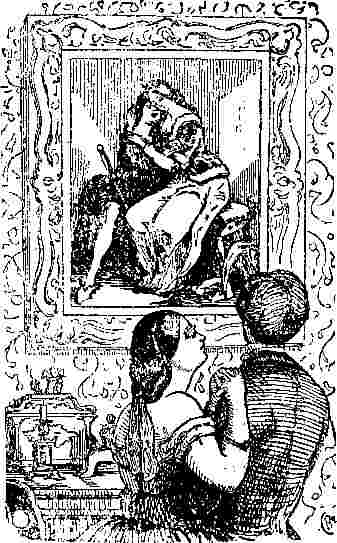
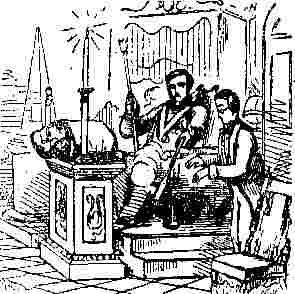
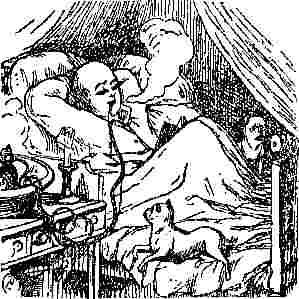
WITH NUMEROUS ILLUSTRATIONS,
DESIGNED AND DRAWN ON THE WOOD BY THE AUTHOR.
| "A COLLEGE JOKE TO CURE THE DUMPS." |
| SWIFT. |
LONDON: NATHANIEL COOKE,
(LATE INGRAM, COOKE, AND CO.)
MILFORD HOUSE, STRAND.
LONDON:
PRINTED BY ROBSON, LEVEY, AND FRANKLYN,
Great New Street and Fetter Lane
Forward to Part II
Forward to Part III
CHAPTER
IF you will refer to the unpublished volume of Burke's Landed
Gentry, and turn to letter G, article "GREEN," you will see
that the Verdant Greens are a family of some respectability and of
considerable antiquity. We meet with them as early as 1096,
flocking to the Crusades among the followers of Peter the Hermit,
when one of their number, Greene surnamed the Witless, mortgaged
his lands in order to supply his poorer companions with the sinews
of war. The family estate, however, appears to have been redeemed
and greatly increased by his great-grandson, Hugo de Greene, but
was again jeoparded in the year 1456, when Basil Greene, being
commissioned by Henry the Sixth to enrich his sovereign by
discovering the philosopher's stone, squandered the greater part of
his fortune in unavailing experiments; while his son, who was also
infected with the spirit of the age, was blown up in his laboratory
when just on the point of discovering the elixir of life. It seems
to have been about this time that the Greenes became connected by
marriage with the equally old family of the Verdants; and, in the
year 1510, we find a Verdant Greene as justice of the peace for the
county of Warwick, presiding at the trial of three decrepid old
women, who, being found guilty of transforming themselves into
cats, and in that shape attending the nightly assemblies of evil
spirits, were very properly pronounced by him to be witches, and
were burnt with all due solemnity.
In tracing the records of the family, we do not find that any of
its members attained to great eminence in the state, either in the
counsels of the senate or the active services of the field; or that
they amassed any unusual amount of wealth or landed property. But
we may perhaps ascribe these circumstances to the fact of finding
the Greens, generation after generation, made the dupes of more
astute minds, and when the hour of danger came, left to manage
their own affairs in the best way they could, - a way that commonly
ended in their mismanagement and total confusion. Indeed, the
idiosyncrasy of the family appears to have been so well known, that
we continually meet with them performing the character of catspaw
to some monkey who had seen and understood much more of the world
than they had, - putting their hands to the fire, and only finding
out their mistake when they had burned their fingers.
In this way the family of the Verdant Greens never got beyond a
certain point either in wealth or station, but were always the same
unsuspicious, credulous, respectable, easy-going people in one
century as another, with the same boundless confidence in their
fellow-creatures, and the same readiness to oblige society by
putting their names to little bills, merely for form's and
friendship's sake. The Vavasour Verdant Green, with the slashed
velvet doublet and point-lace fall, who (having a well-stocked
purse) was among the favoured courtiers of the Merry Monarch, and
who allowed that monarch in his merriness to borrow his purse, with
the simple I.O.U. of "Odd's fish! you shall take mine to-morrow!"
and who never (of course) saw the sun rise on the day of repayment,
was but the prototype of the Verdant Greens in the full-bottomed
wigs, and buckles and shorts of George I.'s day, who were nearly
beggared by the bursting of the Mississippi Scheme and South-Sea
Bubble; and these, in their turn, were duly represented by their
successors. And thus the family character was handed down with the
family nose, until they both re-appeared (according to the
veracious chronicle of Burke, to which we have referred), in
"VERDANT GREEN, of the Manor Green, Co. Warwick, Gent.,
who married Mary, only surviving child of Samuel Sappey, Esq., of
Sapcot Hall, Co. Salop; by whom he has issue, one son, and three
daughters: Mary,-VERDANT,-Helen,-Fanny."
Mr. Burke is unfeeling enough to give the dates when this bunch
of Greens first made their appearance in the world; but these dates
we withhold, from a delicate regard to personal feelings, which
will be duly appreciated by those who have felt the sacredness of
their domestic hearth to be tampered with by the obtrusive
impertinences of a census-paper.
It is sufficient for our purpose to say, that our hero, Mr.
Verdant Green, junior, was born much in the same way as other folk.
And although pronounced by Mrs. Toosypegs his nurse, when yet in
the first crimson blush of his existence, to be "a perfect progidy,
mum, which I ought to be able to pronounce, 'avin nuss'd a many
parties through their trouble, and being aweer of what is doo to a
Hinfant," - yet we are not aware that his debut on the stage
of life, although thus applauded by such a clacqueur as the
indiscriminating Toosypegs, was announced to the world at large by
any other means than the notices in the county papers, and the
six-shilling advertisement in the Times.
"Progidy" though he was, even as a baby, yet Mr. Verdant Green's
nativity seems to have been chronicled merely in this everyday
manner, and does not appear to have been accompanied by any of
those more monstrous phenomena, which in earlier ages attended the
production of a genuine prodigy. We are not aware that Mrs.
Green's favourite Alderney spoke on that occasion, or conducted
itself otherwise than as unaccustomed to public speaking as usual.
Neither can we verify the assertion of the intelligent Mr. Mole the
gardener, that the plaster Apollo in the Long Walk was observed to
be bathed in a profuse perspiration, either from its feeling
compelled to keep up the good old classical custom, or because the
weather was damp. Neither are we bold enough to entertain an
opinion that the chickens in the poultry-yard refused their
customary food; or that the horses in the stable shook with
trembling fear; or that any thing, or any body, saving and
excepting Mrs. Toosypegs, betrayed any consciousness that a real
and genuine prodigy had been given to the world.
However, during the first two years of his life, which were
passed chiefly in drinking, crying, and sleeping, Mr. Verdant Green
met with as much attention, and received as fair a share of
approbation, as usually falls to the lot of the most favoured of
infants. Then Mrs. Toosypegs again took up her position in the
house, and his reign was over. Faithful to her mission, she
pronounced the new baby to be the "progidy," and she was
believed. But thus it is all through life; the new baby displaces
the old; the second love supplants the first; we find fresh friends
to shut out the memories of former ones; and in nearly everything
we discover that there is a Number 2 which can put out of joint the
nose of Number 1.
Once more the shadow of Mrs. Toosypegs fell upon the walls of
Manor Green; and then, her mission being accomplished, she passed
away for ever; and our hero was left to be the sole son and heir,
and the prop and pride of the house of Green.
And if it be true that the external forms of nature exert a
hidden but powerful sway over the dawning perceptions of the mind,
and shape its thoughts to harmony with the things around, then most
certainly ought Mr. Verdant Green to have been born a poet; for he
grew up amid those scenes whose immortality is, that they inspired
the soul of Shakespeare with his deathless fancies!
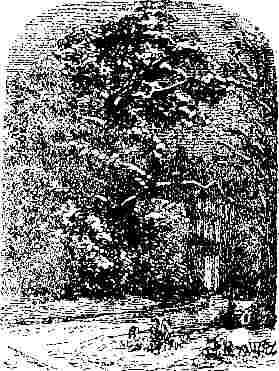
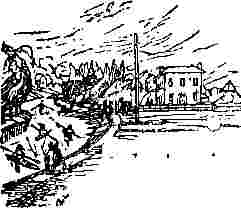
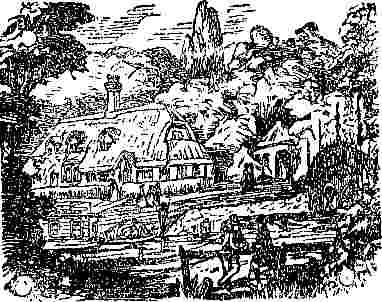
The Manor Green was situated in one of the loveliest spots in
all Warwickshire; a county so rich in all that constitutes the
picturesqueness of a true English landscape. Looking from the
drawing-room windows of the house, you saw in the near foreground
the pretty French garden, with its fantastic parti-coloured beds,
and its broad gravelled walks and terrace; proudly promenading
which, or perched on the stone balustrade, might be seen perchance
a peacock flaunting his beauties in the sun. Then came the
carefully kept gardens, bounded on the one side by the Long Walk
and a grove of shrubs and oaks; and on the other side by a double
avenue of stately elms, that led, through velvet turf of brightest
green, down past a little rustic lodge, to a gently sloping valley,
where were white walls and rose-clustered gables of cottages
peeping out from the embosoming trees, that betrayed the village
beauties they seemed loth to hide. Then came the grey church-tower,
dark with shrouding ivy; then another clump of stately elms,
tenanted by cawing rooks; then a yellow stretch of bright
meadow-land, dappled over with browsing kine knee-deep in grass and
flowers; then a deep pool that mirrored all, and shone like silver;
then more trees with floating shade, and homesteads rich in
wheat-stacks; then a willowy brook that sparkled on merrily to an
old mill-wheel, whose slippery stairs it lazily got down, and sank
to quiet rest in the stream below; then came, crowding in rich
profusion, wide-spreading woods and antlered oaks; and golden gorse
and purple heather; and sunny orchards, with their dark-green waves
that in Spring foamed white with blossoms; and then gently swelling
hills that rose to close the scene and frame the picture.
Such was the view from the Manor Green. And full of inspiration
as such a scene was, yet Mr. Verdant Green never accomplished (as
far as poetical inspiration was concerned) more than an "Address to
the Moon," which he could just as well have written in any other
part of the country, and which, commencing with the noble
aspiration,
| "O moon, that shinest in the heaven so blue, |
| I only wish that I could shine like you!" |
and terminating with one of those fine touches of nature which
rise superior to the trammels of ordinary versification,
| "But I to bed must be going soon, |
| So I will not address thee more, O moon!" |
will no doubt go down to posterity in the Album of his sister
Mary.
For the first fourteen years of his life, the education of Mr.
Verdant Green was conducted wholly under the shadow of his paternal
roof, upon principles fondly imagined to be the soundest and purest
for the formation of his character. Mrs. Green, who was as good and
motherly a soul as ever lived, was yet (as we have shewn) one of
the Sappeys of Sapcot, a family that were not renowned either for
common sense or worldly wisdom, and her notions of a boy's
education were of that kind laid down by her favourite poet,
Cowper, in his "Tirocinium" that we are
| "Well-tutor'd only while we share |
| A mother's lectures and a nurse's care;" |
and in her horror of all other kind of instruction (not that she
admitted Mrs. Toosypegs to her counsels), she fondly kept Master
Verdant at her own apron-strings. The task of teaching his young
idea how to shoot was committed chiefly to his sisters' governess,
and he regularly took his place with them in the school-room. These
daily exercises and mental drillings were subject to the inspection
of their maiden-aunt, Miss Virginia Verdant, a first cousin of Mr.
Green's, who had come to visit at the Manor during Master Verdant's
infancy, and had remained there ever since; and this generalship
was crowned with such success, that her nephew grew up the girlish
companion of his sisters, with no knowledge of boyish sports, and
no desire for them.
The motherly and spinsterial views regarding his education were
favoured by the fact that he had no playmates of his own sex and
age; and since his father was an only child, and his mother's
brothers had died in their infancy, there were no cousins to
initiate him into the mysteries of boyish games and feelings. Mr.
Green was a man who only cared to live a quiet, easy-going life,
and would have troubled himself but little about his neighbours, if
he had had any; but the Manor Green lay in an agricultural
district, and, saving the Rectory, there was no other large house
for miles around. The rector's wife, Mrs. Larkyns, had died shortly
after the birth of her first child, a son, who was being educated
at a public school; and this was enough, in Mrs. Green's eyes, to
make a too intimate acquaintance between her boy and Master Larkyns
a thing by no means to be desired. With her favourite poet she
would say,
"For public schools, 'tis public folly feeds;"
and, regarding them as the very hotbeds of all that is wrong,
she would turn a deaf, though polite, ear to the rector whenever he
said, "Why don't you let your Verdant go with my Charley? Charley
is three years older than Verdant, and would take him under his
wing." Mrs. Green would as soon think of putting one of her
chickens under the wing of a hawk, as intrusting the innocent
Verdant to the care of the scape-grace Charley; so she still
persisted in her own system of education, despite all that the
rector could advise to the contrary.
As for Master Verdant, he was only too glad at his mother's
decision, for he partook of all her alarm about public schools,
though from a different cause. It was not very often that he
visited at the Rectory during Master Charley's holidays; but when
he did, that young gentleman favoured him with such accounts of the
peculiar knack the second master possessed of finding out all your
tenderest places when he "licked a feller" for a false quantity,
that, "by Jove! you couldn't sit down for a fortnight without
squeaking;" and of the jolly mills they used to have with the town
cads, who would lie in wait for you, and half kill you if they
caught you alone; and of the fun it was to make a junior form fag
for you, and do all your dirty work; - that Master Verdant's hair
would almost stand on end at such horrors, and he would gasp for
very dread lest such should ever be his dreadful doom.
And then Master Charley would take a malicious pleasure in
consoling him, by saying, "Of course, you know, you'll only have to
fag for the first two or three years; then - if you get into the
fourth form - you'll be able to have a fag for yourself. And it's
awful fun, I can tell you, to see the way some of the fags get
riled at cricket! You get a feller to give you a few balls, just
for practice, and you hit the ball into another feller's ground;
and then you tell your fag to go and pick it up. So he goes to do
it, when the other feller sings out, 'Don't touch that ball, or
I'll lick you!' So you tell the fag to come to you, and you say,
'Why don't you do as I tell you?' And he says, 'Please, sir!' and
then the little beggar blubbers. So you say to him, 'None of that,
sir! Touch your toes!' We always make 'em wear straps on purpose.
And then his trousers go tight and beautiful, and you take out your
strap and warm him! And then he goes to get the ball, and the other
feller sings out, 'I told you to let that ball alone! Come here,
sir! Touch your toes!' So he warms him too; and then we go on all
jolly. It's awful fun, I can tell you!"
Master Verdant would think it awful indeed; and, by his own
fireside, would recount the deeds of horror to his trembling mother
and sisters, whose imagination shuddered at the scenes from which
they hoped their darling would be preserved.
Perhaps Master Charley had his own reasons for making matters
worse than they really were; but, as long as the information he
derived concerning public schools was of this description, so long
did Master Verdant Green feel thankful at being kept away from
them. He had a secret dread, too, of his friend's superior age and
knowledge; and in his presence felt a bashful awe that made him
glad to get back from the Rectory to his own sisters; while Master
Charley, on the other hand, entertained a lad's contempt for one
that could not fire off a gun, or drive a cricket-ball, or jump a
ditch without falling into it. So the Rectory and the Manor Green
lads saw but very little of each other; and, while the one went
through his public-school course, the other was brought up at the
women's apron-string.
But though thus put under petticoat government, Mr. Verdant
Green was not altogether freed from those tyrants of youth - the
dead languages. His aunt Virginia was as learned a Blue as her
esteemed ancestress in the court of Elizabeth, the very Virgin
Queen of Blues; and under her guidance Master Verdant was dragged
with painful diligence through the first steps of the road that was
to take him to Parnassus. It was a great sight to see her sitting
stiff and straight; - with her wonderfully undeceptive "false
front" of (somebody else's) black hair, graced on either side by
four sausage-looking curls - as, with spectacles on nose and
dictionary in hand, she instructed her nephew in those ingenuous
arts which should soften his manners, and not permit him to be
brutal. And, when they together entered upon the romantic page of
Virgil (which was the extent of her classical reading), nothing
would delight her more than to declaim their sonorous
Arma-virumque-cano lines, where the intrinsic qualities of the
verse surpassed the quantities that she gave to them.
Fain would Miss Virginia have made Virgil the end and aim of an
educational existence, and so have kept her pupil entirely under
her own care; but, alas! she knew nothing further; she had no
acquaintance with Greek, and she had never flirted with Euclid; and
the rector persuaded Mr. Green that these were indispensable to a
boy's education. So, when Mr. Verdant Green was (in stable
language) "rising" sixteen, he went thrice a week to the Rectory,
where Mr. Larkyns bestowed upon him a couple of hours, and taught
him to conjugate {tupto}, and get over
the Pons Asinorum. Mr. Larkyns found his pupil not a
particularly brilliant scholar, but he was a plodding one; and
though he learned slowly, yet the little he did learn was learned
well.
Thus the Rectory and the home studies went hand and hand, and
continued so, with but little interruption, for more than two
years; and Mr. Verdant Green had for some time assumed the toga
virilis of stick-up collars and swallow-tail coats, that so
effectually cut us off from the age of innocence; and the small
family festival that annually celebrated his birthday had just been
held for the eighteenth time, when
"A change came o'er the spirit of his
dream."
Back to Contents
ONE day when the family at the Manor Green had assembled for
luncheon, the rector was announced. He came in and joined them,
saying,with his usual friendly bonhomie, "A very well-timed
visit, I think! Your bell rang out its summons as I came up the
avenue. Mrs. Green, I've gone through the formality of looking over
the accounts of your clothing-club, and, as usual, I find them
correctness itself; and here is my subscription for the next year.
Miss Green, I hope that you have not forgotten the lesson in logic
that Tommy Jones gave you yesterday afternoon?"
"Oh, what was that?" cried her two sisters; who took it in turns
with her to go for a short time in every day to the village-school
which their father and the rector had established: "Pray tell us,
Mr. Larkyns! Mary has said nothing about it."
"Then," replied the rector, "I am tongue-tied, until I have my
fair friend's permission to reveal how the teacher was taught."
Mary shook her sunny ringlets, and laughingly gave him the
required permission.
"You must know, then," said Mr. Larkyns, "that Miss Mary was
giving one of those delightful object-lessons, wherein she blends
so much instructive-"
"I'll trouble you for the butter, Mr. Larkyns," interrupted
Mary, rather maliciously.
The rector was grey-headed, and a privileged friend. "My dear,"
he said, "I was just giving it you. However, the object-lesson was
going on; the subject being Quadrupeds, which Miss Mary very
properly explained to be 'things with four legs.' Presently, she
said to her class, 'Tell me the names of some quadrupeds?' when
Tommy Jones, thrusting out his hand with the full conviction that
he was making an important suggestion, exclaimed, 'Chairs and
tables!' That was turning the tables upon Miss Mary with a
vengeance!"
During luncheon the conversation glided into a favourite theme
with Mrs. Green and Miss Virginia, - Verdant's studies: when Mr.
Larkyns, after some good-natured praise of his diligence, said, "By
the way, Green, he's now quite old enough, and prepared enough for
matriculation: and I suppose you are thinking of it."
Mr. Green was thinking of no such thing. He had never been at
college himself, and had never heard of his father having been
there; and having the old-fashioned,
what-was-good-enough-for-my-father-is-good-enough-for-me sort of
feeling, it had never occurred to him that his son should be
brought up otherwise than he himself had been. The setting-out of
Charles Larkyns for college, two years before, had suggested no
other thought to Mr. Green's mind, than that a university was the
natural sequence of a public school; and since Verdant had not been
through the career of the one, he deemed him to be exempt from the
other.
The motherly ears of Mrs. Green had been caught by the word
"matriculation," a phrase quite unknown to her; and she said, "If
it's vaccination that you mean, Mr. Larkyns, my dear Verdant was
done only last year, when we thought the small-pox was about; so I
think he's quite safe."
Mr. Larkyns' politeness was sorely tried to restrain himself
from giving vent to his feelings in a loud burst of laughter; but
Mary gallantly came to his relief by saying, "Matriculation means,
being entered at a university. Don't you remember, dearest mamma,
when Mr. Charles Larkyns went up to Oxford to be matriculated last
January two years?"
"Ah, yes! I do now. But I wish I had your memory, my dear."
And Mary blushed, and flattered herself that she succeeded in
looking as though Mr. Charles Larkyns and his movements were
objects of perfect indifference to her.
So, after luncheon, Mr. Green and the rector paced up and down
the long-walk, and talked the matter over. The burden of Mr.
Green's discourse was this: "You see, sir, I don't intend my boy to
go into the Church, like yours; but, when anything happens to me,
he'll come into the estate, and have to settle down as the squire
of the parish. So I don't exactly see what would be the use of
sending him to a university, where, I dare say, he'd spend a good
deal of money, - not that I should grudge that, though; - and
perhaps not be quite such a good lad as he's always been to me,
sir. And, by George! (I beg your pardon,) I think his mother would
break her heart to lose him; and I don't know what we should do
without him, as he's never been away from us a day, and his sisters
would miss him. And he's not a lad, like your Charley, that could
fight his way in the world, and I don't think he'd be altogether
happy. And as he's not got to depend upon his talents for his bread
and cheese, the knowledge he's got at home, and from you, sir,
seems to me quite enough to carry him through life. So, altogether,
I think Verdant will do very well as he is, and perhaps we'd better
say no more about the matriculation."
But the rector would say more; and he expressed his mind
thus: "It is not so much from what Verdant would learn in Latin and
Greek, and such things as make up a part of the education, that I
advise your sending him to a university; but more from what he
would gain by mixing with a large body of young men of his own age,
who represent the best classes of a mixed society, and who may
justly be taken as fair samples of its feelings and talents. It is
formation of character that I regard as one of the greatest of the
many great ends of a university system; and if for this reason
alone, I should advise you to send your future country squire to
college. Where else will he be able to meet with so great a number
of those of his own class, with whom he will have to mix in the
after changes of life, and for whose feelings and tone a
college-course will give him the proper key-note? Where else can he
learn so quickly in three years, what other men will perhaps be
striving for through life, without attaining, - that self-reliance
which will enable him to mix at ease in any society, and to feel
the equal of its members? And, besides all this, - and each of
these points in the education of a young man is, to my mind, a
strong one, - where else could he be more completely 'under tutors
and governors,' and more thoroughly under surveillance, than
in a place where college-laws are no respecters of persons, and
seek to keep the wild blood of youth within its due bounds? There
is something in the very atmosphere of a university that seems to
engender refined thoughts and noble feelings; and lamentable indeed
must be the state of any young man who can pass through the three
years of his college residence, and bring away no higher aims, no
worthier purposes, no better thoughts, from all the holy
associations which have been crowded around him. Such advantages as
these are not to be regarded with indifference; and though they
come in secondary ways, and possess the mind almost imperceptibly,
yet they are of primary importance in the formation of character,
and may mould it into the more perfect man. And as long as I had
the power, I would no more think of depriving a child of mine of
such good means towards a good end, than I would of keeping him
from any thing else that was likely to improve his mind or affect
his heart."
Mr. Larkyns put matters in a new light; and Mr. Green began to
think that a university career might be looked at from more than
one point of view. But as old prejudices are not so easily
overthrown as the lath-and-plaster erections of mere newly-formed
opinion, Mr. Green was not yet won over by Mr. Larkyns' arguments.
"There was my father," he said, "who was one of the worthiest and
kindest men living; and I believe he never went to college, nor did
he think it necessary that I should go; and I trust I'm no worse a
man than my father."
"Ah! Green," replied the rector; "the old argument! But you must
not judge the present age by the past; nor measure out to
your son the same degree of education that your father might
think sufficient for you. When you and I were boys, Green,
these things were thought of very differently to what they are in
the present day; and when your father gave you a respectable
education at a classical school, he did all that he thought was
requisite to form you into a country gentleman, and fit you for
that station in life you were destined to fill. But consider what a
progressive age it is that we live in; and you will see that the
standard of education has been considerably raised since the days
when you and I did the 'propria quae maribus' together; and that
when he comes to mix in society, more will be demanded of the son
than was expected from the father. And besides this, think in how
many ways it will benefit Verdant to send him to college. By mixing
more in the world, and being called upon to act and think for
himself, he will gradually gain that experience, without which a
man cannot arm himself to meet the difficulties that beset all of
us, more or less, in the battle of life. He is just of an age, when
some change from the narrowed circle of home is necessary. God
forbid that I should ever speak in any but the highest terms of the
moral good it must do every young man to live under his mother's
watchful eye, and be ever in the company of pure-minded sisters.
Indeed I feel this more perhaps than many other parents would,
because my lad, from his earliest years, has been deprived of such
tender training, and cut off from such sweet society. But yet, with
all this high regard for such home influences, I put it to you, if
there will not grow up in the boy's mind, when he begins to draw
near to man's estate, a very weariness of all this, from its very
sameness; a surfeiting, as it were, of all these delicacies, and a
longing for something to break the monotony of what will gradually
become to him a humdrum horse-in-the-mill kind of country life? And
it is just at this critical time that college life steps in to his
aid. With his new life a new light bursts upon his mind; he finds
that he is not the little household-god he had fancied himself to
be; his word is no longer the law of the Medes and Persians, as it
was at home; he meets with none of those little flatteries from
partial relatives, or fawning servants, that were growing into a
part of his existence; but he has to bear contradiction and
reproof, to find himself only an equal with others, when he can
gain that equality by his own deserts; and, in short, he daily
progresses in that knowledge of himself, which, from the
gnothiseauton days down to our own, has been found to be
about the most useful of all knowledge; for it gives a man
stability of character, and braces up his mental energies to a
healthy enjoyment of the business of life. And so, Green, I would
advise you, above all things, to let Verdant go to college."
Much more did the rector say, not only on this occasion, but on
others; and the more frequently he returned to the charge, the less
resistance were his arguments met with; and the result was, that
Mr. Green was fully persuaded that a university was the proper
sphere for his son to move in. But it was not without many a pang
and much secret misgiving that Mrs. Green would consent to suffer
her beloved Verdant to run the risk of those dreadful
contaminations which she imagined would inevitably accompany every
college career. Indeed, she thought it an act of the greatest
heroism (or, if you object to the word, heroineism) to be won over
to say "yes" to the proposal; and it was not until Miss Virginia
had recited to her the deeds of all the mothers of Greece and Rome
who had suffered for their children's sake, that Mrs. Green would
consent to sacrifice her maternal feelings at the sacred altar of
duty.
When the point had been duly settled, that Mr. Verdant Green was
to receive a university education, the next question to be decided
was, to which of the three Universities should he go? To Oxford,
Cambridge, or Durham? But this was a matter which was soon
determined upon. Mr. Green at once put Durham aside, on account of
its infancy, and its wanting the prestige that attaches to
the names of the two great Universities. Cambridge was treated
quite as summarily, because Mr. Green had conceived the notion that
nothing but mathematics were ever thought or talked of there; and
as he himself had always had an abhorrence of them from his youth
up, when he was hebdomadally flogged for not getting-up his weekly
propositions, he thought that his son should be spared some of the
personal disagreeables that he himself had encountered; for Mr.
Green remembered to have heard that the great Newton was horsed
during the time that he was a Cambridge undergraduate, and he had a
hazy idea that the same indignities were still practised there.
But the circumstance that chiefly decided Mr. Green to choose
Oxford as the arena for Verdant's performances was, that he would
have a companion, and, as he hoped, a mentor, in the rector's son,
Mr. Charles Larkyns, who would not only be able to cheer him on his
first entrance, but also would introduce him to select and quiet
friends, put him in the way of lectures, and initiate him into all
the mysteries of the place; all which the rector professed his son
would be glad to do, and would be delighted to see his old friend
and playfellow within the classic walls of Alma Mater.
Oxford having been selected for the university, the next point
to be decided was the college.
"You cannot," said the rector, "find a much better college than
Brazenface, where my lad is. It always stands well in the
class-list, and keeps a good name with its tutors. There are a nice
gentlemanly set of men there; and I am proud to say, that my lad
would be able to introduce Verdant to some of the best. This will
of course be much to his advantage. And besides this, I am on very
intimate terms with Dr. Portman, the master of the college; and, if
they should not happen to be very full, no doubt I could get
Verdant admitted at once. This too will be of advantage to him; for
I can tell you that there are secrets in all these matters, and
that at many colleges that I could name, unless you knew the
principal, or had some introduction or other potent spell to work
with, your son's name would have to remain on the books two or
three years before he could be entered; and this, at Verdant's age,
would be a serious objection. At one or two of the colleges indeed
this is almost necessary, under any circumstances, on account of
the great number of applicants; but at Brazenface there is not this
over-crowding; and I have no doubt, if I write to Dr. Portman, but
what I can get rooms for Verdant without much loss of time."
"Brazenface be it then!" said Mr. Green, "and I am sure that
Verdant will enter there with very many advantages; and the sooner
the better, so that he may be the longer with Mr. Charles. But when
must his - his what-d'ye-call-it, come off?"
"His matriculation?" replied the rector. "Why although it is not
usual for men to commence residence at the time of their
matriculation, still it is sometimes done. And as my lad will, if
all goes on well, be leaving Oxford next year, perhaps it would be
better, on that account, that Verdant should enter upon his
residence as soon as he has matriculated."
Mr. Green thought so too; and Verdant, upon being appealed to,
had no objection to this course, or, indeed, to any other that was
decided to be necessary for him; though it must be confessed, that
he secretly shared somewhat of his mother's feelings as he looked
forward into the blank and uncertain prospect of his college life.
Like a good and dutiful son, however, his father's wishes were law;
and he no more thought of opposing them, than he did of discovering
the north pole, or paying off the national debt.
So all this being duly settled, and Mrs. Green being entirely
won over to the proceeding, the rector at once wrote to Dr.
Portman, and in due time received a reply to the effect, that they
were very full at Brazenface, but that luckily there was one set of
rooms which would be vacant at the commencement of the Easter term;
at which time he should be very glad to see the gentleman his
friend spoke of.
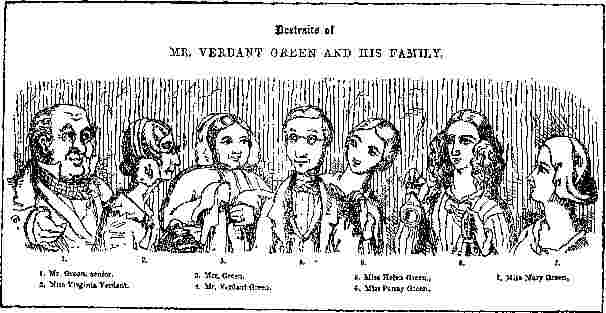
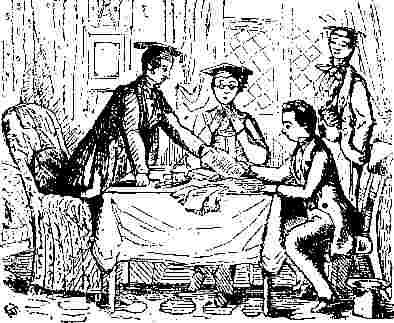
Portraits of MR. VERDANT GREEN AND HIS
FAMILY.
1. Mr. Green, senior., 2. Miss Virginia Verdant., 3. Mrs.
Green., 4. Mr. Verdant Green., 5. Miss Helen Green., 6. Miss Fanny
Green., 7. Miss Mary Green.
Back to Contents
THE time till Easter passed very quickly, for much had to be
done in it. Verdant read up most desperately for his matriculation,
associating that initiatory examination with the most dismal
visions of plucking, and other college tortures.
His mother was laying in for him a new stock of linen,
sufficient in quantity to provide him for years of emigration;
while his father was busying himself about the plate that it was
requisite to take, buying it bran-new, and of the most solid
silver, and having it splendidly engraved with the family crest,
and the motto "Semper virens."
Infatuated Mr. Green! If you could have foreseen that those
spoons and forks would have soon passed, - by a mysterious system
of loss which undergraduate powers can never fathom, - into the
property of Mr. Robert Filcher, the excellent, though occasionally
erratic, scout of your beloved son, and from thence have melted,
not "into thin air," but into a residuum whose mass might be
expressed by the equivalent of coins of a thin and golden
description, - if you could but have foreseen this, then,
infatuated but affectionate parent, you would have been content to
have let your son and heir represent the ancestral wealth by mere
electro-plate, albata, or any sham that would equally well have
served his purpose!
As for Miss Virginia Verdant, and the other woman portion of the
Green community, they fully occupied their time until the day of
separation came, by elaborating articles of feminine workmanship,
as souvenirs, by which dear Verdant might, in the land of
the strangers, recall visions of home. These were presented to him
with all due state on the morning of the day previous to that on
which he was to leave the home of his ancestors.
All the articles were useful as well as ornamental. There was a
purse from Helen, which, besides being a triumph of art in the way
of bead decoration, was also, it must be allowed, a very useful
present, unless one happened to carry one's riches in a
porte-monnaie. There was a pair of braces from Mary, worked
with an ecclesiastical pattern of a severe character - very
appropriate for academical wear, and extremely effective for all
occasions when the coat had to be taken off in public. And there
was a watch-pocket from Fanny, to hang over Verdant's night-capped
head, and serve as a depository for the golden mechanical turnip
that had been handed down in the family, as a watch, for the last
three generations. And there was a pair of woollen comforters knit
by Miss Virginia's own fair hands; and there were other woollen
articles of domestic use, which were contributed by Mrs. Green for
her son's personal comfort. To these, Miss Virginia thoughtfully
added an infallible recipe for the toothache, - an infliction to
which she was a martyr, and for the general relief of which in
others, she constituted herself a species of toothache missionary;
for, as she said, "You might, my dear Verdant, be seized with that
painful disease, and not have me by your side to cure it": which it
was very probable he would not, if college rules were strictly
carried out at Brazenface.
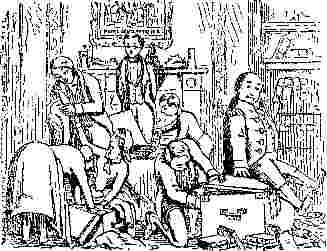
All these articles were presented to Mr. Verdant Green with many
speeches and great ceremony; while Mr. Green stood by, and smiled
benignantly upon the scene, and his son beamed through his glasses
(which his defective sight obliged him constantly to wear) with the
most serene aspect.
It was altogether a great day of preparation, and one which it
was well for the constitution of the household did not happen very
often; for the house was reduced to that summerset condition
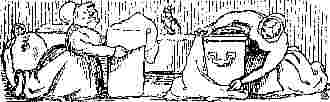
usually known in domestic parlance as "upside down." Mr. Verdant
Green personally superintended the packing of his goods; a
performance which was only effected by the united strength of the
establishment. Butler, Footman, Coachman, Lady's-maid, Housemaid,
and Buttons were all pressed into the service; and the coachman,
being a man of some weight, was found to be of great use in
effecting a junction of the locks and hasps of over-filled
book-boxes. It was astonishing to see all the amount of literature
that Mr. Verdant Green was about to convey to the seat of learning:
there was enough to stock a small Bodleian. As the owner stood,
with his hands behind him, placidly surveying the scene of
preparation, a meditative spectator might have possibly compared
him to the hero of the engraving "Moses going to the fair," that
was then hanging just over his head; for no one could have set out
for the great Oxford booth of this Vanity Fair with more simplicity
and trusting confidence than Mr. Verdant Green.
When the trunks had at last been packed, they were then, by the
thoughtful suggestion of Miss Virginia, provided each with a canvas
covering, after the manner of the luggage of females, and labelled
with large direction-cards filled with the most ample particulars
concerning their owner and his destination.
It had been decided that Mr. Verdant Green, instead of reaching
Oxford by rail, should make his entree behind the four
horses that drew the Birmingham and Oxford coach; - one of the few
four-horse coaches that still ran for any distance [1]; and which, as the more pleasant means of
conveyance, was generally patronized by Mr. Charles Larkyns in
preference to the rail; for the coach passed within three miles of
the Manor Green, whereas the nearest railway was at a much greater
distance, and could not be so conveniently reached. Mr. Green had
determined upon accompanying Verdant to Oxford, that he might have
the satisfaction of seeing him safely landed there, and might also
himself form an acquaintance with a city of which he had heard so
much, and which would be doubly interesting to him now that his son
was enrolled a member of its University. Their seats had been
secured a fortnight previous; for the rector had told Mr. Green
that so many men went up by the coach, that unless he made an early
application, he would altogether fail in obtaining places; so a
letter had been dispatched to "the Swan" coach-office at
Birmingham, from which place the coach started, and two outside
seats had been put at Mr. Green's disposal.
---
[1] This well-known coach ceased to run between Birmingham and
Oxford in the last week of August 1852, on the opening of the
Birmingham and Oxford Railway.
-=-
The day at length arrived, when Mr. Verdant Green for the first
time in his life (on any important occasion) was to leave the
paternal roof; and it must be confessed that it was a proceeding
which caused him some anxiety, and that he was not sorry when the
carriage was at the door to bear him away, before (shall it be
confessed?) his tears had got the mastery over him.
As it was, by the judicious help of his sisters, he passed the
Rubicon in courageous style, and went through the form of breakfast
with the greatest hilarity, although with several narrow escapes of
suffocation from choking. The thought that he was going to be an
Oxford MAN fortunately assisted him in the preservation of that
tranquil dignity and careless ease which he considered to be the
necessary adjuncts of the manly character, more especially as
developed in that peculiar biped he was about to be transformed
into; and Mr. Verdant Green was enabled to say "Good-by" with a
firm voice and undimmed spectacles.
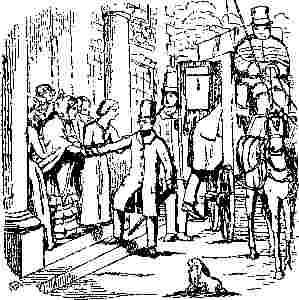
All crowded to the door to have a last shake of the hand; the
maid-servants peeped from the upper windows; and Miss Virginia
sobbed out a blessing, which was rendered of a striking and
original character by being mixed up with instructions never to
forget what she had taught him in his Latin grammar, and always to
be careful to guard against the toothache. And amid the good-byes
and write-oftens that usually accompany a departure, the carriage
rolled down the avenue to the lodge, where was Mr. Mole the
gardener, and also Mrs. Mole, and, moreover, the Mole
olive-branches, all gathered at the open gate to say farewell to
the young master. And just as they were about to mount the hill
leading out of the village, who should be there but the rector
lying in wait for them and ready to walk up the hill by their side,
and say a few kindly words at parting. Well might Mr. Verdant Green
begin to regard himself as the topic of the village, and think that
going to Oxford was really an affair of some importance.
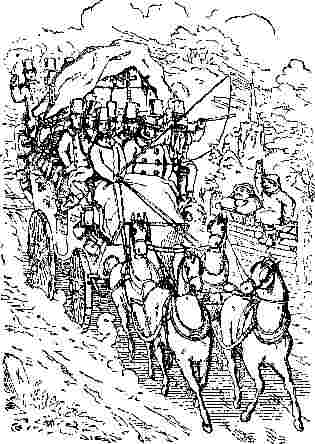
They were in good time for the coach; and the ringing notes of
the guard's bugle made them aware of its approach some time before
they saw it rattling merrily along in its cloud of dust. What a
sight it was when it did come near! The cloud that had enveloped it
was discovered to be not dust only, but smoke from the cigars,
meerschaums, and short clay pipes of a full complement of gentlemen
passengers, scarcely one of whom seemed to have passed his
twentieth year. No bonnet betokening a female traveller could be
seen either inside or out; and that lady was indeed lucky who
escaped being an inside passenger on the following day. Nothing but
a lapse of time, or the complete re-lining of the coach, could
purify it from the attacks of the four gentlemen who were now doing
their best to convert it into a divan; and the consumption of
tobacco on that day between Birmingham and Oxford must have
materially benefited the revenue. The passengers were not limited
to the two-legged ones, there were four-footed ones also. Sporting
dogs, fancy dogs, ugly dogs, rat-killing dogs, short-haired dogs,
long-haired dogs, dogs like muffs, dogs like mops, dogs of all
colours and of all breeds and sizes, appeared thrusting out their
black noses from all parts of the coach. Portmanteaus were piled
upon the roof; gun-boxes peeped out suspiciously here and there;
bundles of sticks, canes, foils, fishing-rods, and whips, appeared
strapped together in every direction; while all round about the
coach,
"Like a swarth Indian with his belt of beads,"
hat-boxes dangled in leathery profusion. The Oxford coach on an
occasion like this was a sight to be remembered.
A "Wo-ho-ho, my beauties!" brought the smoking wheelers upon
their haunches; and Jehu, saluting with his elbow and whip finger,
called out in the husky voice peculiar to a dram-drinker, "Are you
the two houtside gents for Hoxfut?" To which Mr. Green replied in
the affirmative; and while the luggage (the canvas-covered,
ladylike look of which was such a contrast to that of the other
passengers) was being quickly transferred to the coach-top, he and
Verdant ascended to the places reserved for them behind the
coachman. Mr. Green saw at a glance that all the passengers were
Oxford men, dressed in every variety of Oxford fashion, and
exhibiting a pleasing diversity of Oxford manners. Their private
remarks on the two new-comers were, like stage "asides," perfectly
audible.
"Decided case of governor!" said one.
"Undoubted ditto of freshman!" observed another.
"Looks ferociously mild in his gig-lamps!" remarked a third,
alluding to Mr. Verdant Green's spectacles.
"And jolly green all over!" wound up a fourth.
Mr. Green, hearing his name (as he thought) mentioned, turned to
the small young gentleman who had spoken, and politely said, "Yes,
my name is Green; but you have the advantage of me, sir."
"Oh! have I?" replied the young gentleman in the most affable
manner, and not in the least disconcerted; "my name's Bouncer: I
remember seeing you when I was a babby. How's the old woman?" And
without waiting to hear Mr. Green loftily reply, "Mrs. Green - my
WIFE, sir - is quite well - and I do NOT remember to have seen you,
or ever heard your name, sir!" - little Mr. Bouncer made some most
unearthly noises on a post-horn as tall as himself, which he had
brought for the delectation of himself and his friends, and the
alarm of every village they passed through.
"Never mind the dog, sir," said the gentleman who sat between
Mr. Bouncer and Mr. Green; "he won't hurt you. It's only his play;
he always takes notice of strangers."
"But he is tearing my trousers," expostulated Mr. Green, who was
by no means partial to the "play" of a thoroughbred terrier.
"Ah! he's an uncommon sensible dog," observed his master; "he's
always on the look-out for rats everywhere. It's the Wellington
boots that does it; he's accustomed to have a rat put into a boot,
and he worries it out how he can. I daresay he thinks you've got
one in yours."
"But I've got nothing of the sort, sir; I must request you to
keep your dog --" A violent fit of coughing, caused by a
well-directed volley of smoke from his neighbour's lips, put a stop
to Mr. Green's expostulations.
"I hope my weed is no annoyance?" said the gentleman; "if it is,
I will throw it away."
To which piece of politeness Mr. Green could, of course, only
reply, between fits of coughing, "Not in the least I - assure you,
- I am very fond - of tobacco - in the open air."
"Then I daresay you'll do as we are doing, and smoke a weed
yourself," said the gentleman, as he offered Mr. Green a plethoric
cigar-case. But Mr. Green's expression of approbation regarding
tobacco was simply theoretical; so he treated his neighbour's offer
as magazine editors do the MSS. of unknown contributors - it was
"declined with thanks."
Mr. Verdant Green had already had to make a similar reply to a
like proposal on the part of his left-hand neighbour, who was now
expressing violent admiration for our hero's top-coat.
"Ain't that a good style of coat, Charley?" he observed to his
neighbour. "I wish I'd seen it before I got this over-coat! There's
something sensible about a real, unadulterated top-coat; and
there's a style in the way in which they've let down the skirts,
and put on the velvet collar and cuffs regardless of expense, that
really quite goes to one's heart. Now I daresay the man that built
that," he said, more particularly addressing the owner of the coat,
"condescends to live in a village, and waste his sweetness on the
desert air, while a noble field might be found for his talent in a
University town. That coat will make quite a sensation in Oxford.
Won't it, Charley?"
And when Charley, quoting a popular actor (totally unknown to
our hero), said, "I believe you, my bo-oy!" Mr. Verdant Green began
to feel quite proud of the abilities of their village tailor, and
thought what two delightful companions he had met with. The rest of
the journey further cemented (as he thought) their friendship; so
that he was fairly astonished, when on meeting them the next day,
they stared him full in the face, and passed on without taking any
more notice of him. But freshmen cannot learn the mysteries of
college etiquette in a day.
However, we are anticipating. They had not yet got to Oxford,
though, from the pace at which they were going, it appeared as if
they would soon reach there; for the coachman had given up his seat
and the reins to the box-passenger, who appeared to be as used to
the business as the coachman himself; and he was now driving them,
not only in a most scientific manner, but also at a great pace. Mr.
Green was not particularly pleased with the change in the
four-wheeled government; but when they went down the hill at a
quick trot, the heavy luggage making the coach rock to and fro with
the speed, his fears increased painfully. They culminated, as the
trot increased into a canter, and then broke into a gallop as they
swept along the level road at the bottom of the hill, and rattled
up the rise of another. As the horses walked over the brow of the
hill, with smoking flanks and jingling harness, Mr. Green recovered
sufficient breath to expostulate with the coachman for suffering -
"a mere lad," he was about to say but fortunately checked himself
in time, - for suffering any one else than the regular driver to
have the charge of the coach.
"You never fret yourself about that, sir," replied the man; "I
knows my bis'ness, as well as my dooties to self and purprietors,
and I'd never go for to give up the ribbins to any party but wot
had shewed hisself fitted to 'andle 'em. And I think I may say this
for the genelman as has got 'em now, that he's fit to be fust vip
to the Queen herself; and I'm proud to call him my poople. Why,
sir, - if his honour here will pardon me for makin' so free, - this
'ere gent is Four-in-hand Fosbrooke, of which you must have
heerd on."
Mr. Green replied that he had not had that pleasure.
"Ah! a pleasure you may call it, sir, with parfect
truth," replied the coachman; "but, lor bless me, sir, weer
can you have lived?"
The "poople" who had listened to this, highly amused, slightly
turned his head, and said to Mr. Green, "Pray don't feel any alarm,
sir; I believe you are quite safe under my guidance. This is not
the first time by many that I have driven this coach - not to
mention others; and you may conclude that I should not have gained
the sobriquet to which my worthy friend has alluded without
having some pretensions to a knowledge of the art of
driving."
Mr. Green murmured his apologies for his mistrust, - expressed
perfect faith in Mr. Fosbrooke's skill - and then lapsed into
silent meditation on the various arts and sciences in which the
gentlemen of the University of Oxford seemed to be most proficient,
and pictured to himself what would be his feelings if he ever came
to see Verdant driving a coach! There certainly did not appear to
be much probability of such an event; but can any pater
familias say what even the most carefully brought up young
Hopeful will do when he has arrived at years of indiscretion?
Altogether, Mr. Green did not particularly enjoy the journey.
Besides the dogs and cigars, which to him were equal nuisances,
little Mr. Bouncer was perpetually producing unpleasant post-horn
effects, - which he called "sounding his octaves," - and destroying
the effect of the airs on the guard's key-bugle, by joining in them
at improper times and with discordant measures. Mr. Green, too,
could not but perceive that the majority of the conversation that
was addressed to himself and his son (though more particularly to
the latter), although couched in politest form, was yet of a
tendency calculated to "draw them out" for the amusement of their
fellow-passengers. He also observed that the young gentlemen
severally exhibited great capacity for the beer of Bass and the
porter of Guinness, and were not averse even to liquids of a more
spirituous description. Moreover, Mr. Green remarked that the
ministering Hebes were invariably addressed by their Christian
names, and were familiarly conversed with as old acquaintances;
most of them receiving direct offers of marriage or the option of
putting up the banns on any Sunday in the middle of the week; while
the inquiries after their grandmothers and the various members of
their family circles were both numerous and gratifying. In all
these verbal encounters little Mr. Bouncer particularly
distinguished himself.
Woodstock was reached: "Four-in-hand Fosbrooke" gave up the
reins to the professional Jehu; and at last the towers, spires, and
domes of Oxford appeared in sight. The first view of the City of
Colleges is always one that will be long remembered. Even the
railway traveller, who enters by the least imposing approach, and
can scarcely see that he is in Oxford before he has reached Folly
Bridge, must yet regard the city with mingled feelings of delight
and surprise as he looks across the Christ Church meadows and rolls
past the Tom Tower. But he who approaches Oxford from the Henley
Road, and looks upon that unsurpassed prospect from Magdalen
Bridge, - or he who enters the city, as Mr. Green did, from the
Woodstock Road, and rolls down the shady avenue of St. Giles',
between St. John's College and the Taylor Buildings, and past the
graceful Martyrs' Memorial, will receive impressions such as
probably no other city in the world could convey.
As the coach clattered down the Corn-market, and turned the
corner by Carfax into High Street, Mr. Bouncer, having been
compelled in deference to University scruples to lay aside his
post-horn, was consoling himself by chanting the following words,
selected probably in compliment to Mr. Verdant Green.
| "To Oxford, a Freshman so modest, |
| I enter'd one morning in March; |
| And the figure I cut was the oddest, |
| All spectacles, choker, and starch. |
|
Whack fol lol, lol iddity, &c.
|
| From the top of 'the Royal Defiance,' |
| Jack Adams, who coaches so well, |
| Set me down in these regions of science, |
| In front of the Mitre Hotel. |
|
Whack fol lol, lol iddity, &c.
|
| 'Sure never man's prospects were brighter,' |
| I said, as I jumped from my perch; |
| 'So quickly arrived at the Mitre, |
| Oh, I'm sure, to get on in the Church!" |
|
Whack fol lol, lol iddity, &c."
|
|
By the time Mr. Bouncer finished these words, the coach
appropriately drew up at the "Mitre," and the passengers tumbled
off amid a knot of gownsmen collected on the pavement to receive
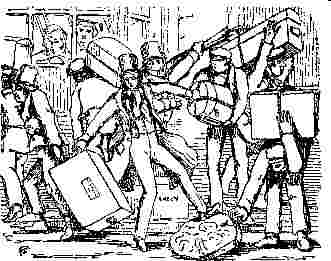
them. But no sooner were Mr. Green and our hero set down, than they
were attacked by a horde of the aborigines of Oxford, who, knowing
by vulture-like sagacity the aspect of a freshman and his governor,
swooped down upon them in the guise of impromptu porters, and made
an indiscriminate attack upon the luggage. It was only by the
display of the greatest presence of mind that Mr. Verdant Green
recovered his effects, and prevented his canvas-covered boxes from
being carried off in the wheel-barrows that were trundling off in
all directions to the various colleges.
But at last all were safely secured. And soon, when a snug
dinner had been discussed in a quiet room, and a bottle of the
famous (though I have heard some call it "in-famous") Oxford port
had been produced, Mr. Green, under its kindly influence, opened
his heart to his son, and gave him much advice as to his
forthcoming University career; being, of course, well calculated to
do this from his intimate acquaintance with the subject.
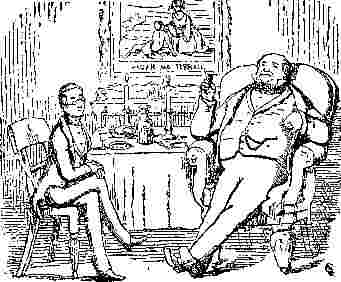
Whether it was the extra glass of port, or whether it was the
nature of his father's discourse, or whether it was the novelty of
his situation, or whether it was all these circumstances combined,
yet certain it was that Mr. Verdant Green's first night in Oxford
was distinguished by a series, or rather confusion, of most
remarkable dreams, in which bishops, archbishops, and hobgoblins
elbowed one another for precedence; a beneficent female crowned him
with laurel, while Fame lustily proclaimed the honours he had
received, and unrolled the class-list in which his name had first
rank.
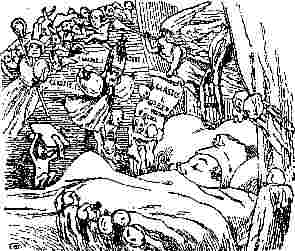
Sweet land of visions, that will with such ease confer even a
treble first upon the weary sleeper, why must he awake from
thy gentle thraldom, to find the class-list a stern reality, and
Graduateship too often but an empty dream!
Back to Contents
MR. VERDANT GREEN arose in the morning more or less refreshed;
and after breakfast proceeded with his father to Brazenface College
to call upon the Master; the porter directed them where to go, and
they sent up their cards. Dr. Portman was at home, and they were
soon introduced to his presence.
Instead of the stern, imposing-looking personage that Mr.
Verdant Green had expected to see in the ruler among dons, and the
terror of offending undergraduates, the master of Brazenface was a
mild-looking old gentleman, with an inoffensive amiability of
expression and a shy, retiring manner that seemed to intimate that
he was more alarmed at the strangers than they had need to be at
him. Dr. Portman seemed to be quite a part of his college, for he
had passed the greatest portion of his life there. He had graduated
there, he had taken Scholarships there, he had even gained a
prize-poem there; he had been elected a Fellow there, he had become
a Tutor there, he had been Proctor and College Dean there; there,
during the long vacation, he had written his celebrated
"Disquisition on the Greek Particles," afterwards published in
eight octavo volumes; and finally, there he had been elected Master
of his college, in which office, honoured and respected, he
appeared likely to end his days. He was unmarried; perhaps he had
never found time to think of a wife; perhaps he had never had the
courage to propose for one; perhaps he had met with early crosses
and disappointments, and had shrined in his heart a fair image that
should never be displaced. Who knows? for dons are mortals, and
have been undergraduates once.
The little hair he had was of a silvery white, although his
eye-brows retained their black hue; and to judge from the fine
fresh-coloured features and the dark eyes that were now nervously
twinkling upon Mr. Green, Dr. Portman must, in his more youthful
days, have had an ample share of good looks. He was dressed in an
old-fashioned reverend suit of black, with knee-breeches and
gaiters, and a massive watch-seal dangling from under his
waistcoat, and was deep in the study of his favourite particles. He
received our hero and his father both nervously and graciously, and
bade them be seated.
"I shall al-ways," he said, in monosyllabic tones, as though he
were reading out of a child's primer, - "I shall al-ways be glad to
see any of the young friends of my old col-lege friend Lar-kyns;
and I do re-joice to be a-ble to serve you, Mis-ter Green; and I
hope your son, Mis-ter, Mis-ter Vir---Vir-gin-ius,--"
"Verdant, Dr. Portman," interrupted Mr. Green, suggestively,
"Verdant."
"Oh! true, true, true! and I do hope that he will be a ve-ry
good young man, and try to do hon-our to his col-lege."
"I trust he will, indeed, sir," replied Mr. Green; "it is the
great wish of my heart. And I am sure that you will find my son
both quiet and orderly in his conduct, regular in his duties, and
always in bed by ten o'clock."
"Well, I hope so too, Mis-ter Green," said Dr. Portman,
monosyllabically; "but all the young gen-tle-men do pro-mise to be
regu-lar and or-der-ly when they first come up, but a
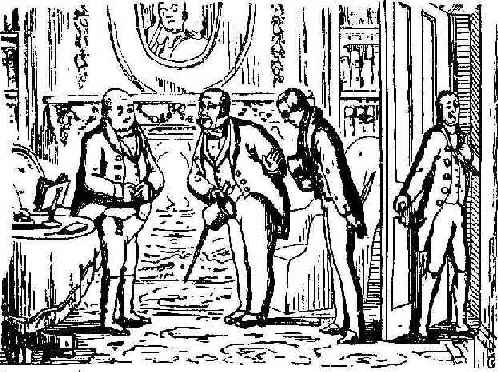
term makes a great dif-fer-ence. But I dare say my young friend
Mis-ter Vir-gin-ius,---"
"Verdant," smilingly suggested Mr. Green.
"I beg your par-don," apologized Dr. Portman; "but I dare say
that he will do as you say, for in-deed my friend Lar-kyns speaks
well of him."
"I am delighted - proud!" murmured Mr. Green, while Verdant felt
himself blushing up to his spectacles.
"We are ve-ry full," Dr. Portman went on to say, "but as I do
ex-pect great things from Mis-ter Vir-gin --- Verdant, Verdant, I
have put some rooms at his ser-vice; and if you would like to see
them, my ser-vant shall shew you the way." The servant was
accordingly summoned, and received orders to that effect; while the
Master told Verdant that he must, at two o'clock, present himself
to Mr. Slowcoach, his tutor, who would examine him for his
matriculation.
"I am sor-ry, Mis-ter Green," said Dr. Portman, "that my
en-gage-ments will pre-vent me from ask-ing you and Mis-ter Virg---
Ver-dant, to dine with me to-day; but I do hope that the next time
you come to Ox-ford I shall be more for-tu-nate."
Old John, the Common-room man, who had heard this speech made to
hundreds of "governors" through many generations of freshmen, could
not repress a few pantomimic asides, that
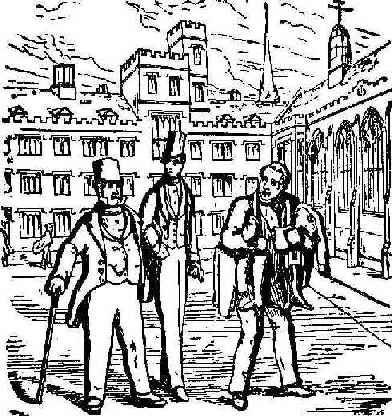
were suggestive of anything but full credence in his master's
words. But Mr. Green was delighted with Dr. Portman's affability,
and perceiving that the interview was at an end, made his
conge, and left the Master of Brazenface to his Greek
particles.
They had just got outside, when the servant said, "Oh, there is
the scout! Your scout, sir!" at which our hero blushed from
the consciousness of his new dignity; and, by way of appearing at
his ease, inquired the scout's name.
"Robert Filcher, sir," replied the servant; "but the gentlemen
always call 'em by their Christian names." And beckoning the scout
to him, he bade him shew the gentlemen to the rooms kept for Mr.
Verdant Green; and then took himself back to the Master.
Mr. Robert Filcher might perhaps have been forty years of age,
perhaps fifty; there was cunning enough in his face to fill even a
century of wily years; and there was a depth of expression in his
look, as he asked our hero if he was Mr. Verdant Green, that
proclaimed his custom of reading a freshman at a glance. Mr.
Filcher was laden with coats and boots that had just been brushed
and blacked for their respective masters; and he was bearing a jug
of Buttery ale (they are renowned for their ale at Brazenface) to
the gentleman who owned the pair of "tops" that were now flashing
in the sun as they dangled from the scout's hand.
"Please to follow me, gentlemen," he said; "it's only just
across the quad. Third floor, No. 4 staircase, fust quad; that's
about the mark, I think, sir."
Mr. Verdant Green glanced curiously round the Quadrangle, with
its picturesque irregularity of outline, its towers and turrets and
battlements, its grey time-eaten walls, its rows of mullioned
heavy-headed windows, and the quiet cloistered air that spoke of
study and reflection; and perceiving on one side a row of large
windows, with great buttresses between, and a species of steeple on
the high-pitched roof, he made bold (just to try the effect) to
address Mr. Filcher by the name assigned to him at an early period
of his life by his godfathers and godmothers, and inquired if that
building was the chapel.
"No, sir," replied Robert, "that there's the 'All, sir,
that is - where you dines, sir, leastways when you ain't
'AEger,' or elseweer. That at the top is the lantern, sir,
that is; called so because it never has no candle in it. The
chapel's the hopposite side, sir. -Please not to walk on the grass,
sir; there's a fine agen it, unless you're a Master. This way if
you please, gentlemen!" Thus the scout beguiled them, as he
led them to an open doorway with a large 4
painted over it; inside was a door on either hand, while a coal-bin
displayed its black face from under a staircase that rose
immediately before them. Up this they went, following the scout
(who had vanished for a moment with the boots and beer), and when
they had passed the first floor they found the ascent by no means
easy to the body, or pleasant to the sight. The once white-washed
walls were coated with the uncleansed dust of the three past terms;
and where the plaster had not been chipped off by flying
porter-bottles, or the heels of Wellington boots, its surface had
afforded an irresistible temptation to those imaginative
undergraduates who displayed their artistic genius in candle-smoke
cartoons of the heads of the University, and other popular and
unpopular characters. All Mr. Green's caution, as he crept up the
dark, twisting staircase, could not prevent him from crushing his
hat against the low, cobwebbed ceiling, and he gave vent to a very
strong but quiet anathema, which glided quietly and audibly into
the remark, "Confounded awkward staircase, I think!"
"Just what Mr. Bouncer says," replied the scout, "although he
don't reach so high as you, sir; but he do say, sir, when he
comes home pleasant at night from some wine-party, that it
is the aukardest staircase as was ever put before a
gentleman's
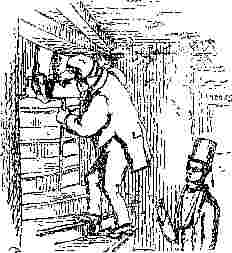
legs. And he did go so far, sir, as to ask the Master, if
it wouldn't be better to have a staircase as would go up of
hisself, and take the gentlemen up with it, like one as they has at
some public show in London - the Call-and-see-em, I think he
said."
"The Colosseum, probably," suggested Mr. Green. "And what did
Dr. Portman say to that, pray?"
"Why he said, sir, - leastways so Mr. Bouncer reported, - that
it worn't by no means a bad idea, and that p'raps Mr. Bouncer'd
find it done in six months' time, when he come back again from the
country. For you see, sir, Mr. Bouncer had made hisself so
pleasant, that he'd been and got the porter out o' bed, and corked
his face dreadful; and then, sir, he'd been and got a Hinn-board
from somewhere out of the town, and hung it on the Master's private
door; so that when they went to early chapel in the morning, they
read as how the Master was 'licensed to sell beer by retail,' and
'to be drunk on the premises'. So when the Master came to know who
it was as did it, which in course the porter told him, he said as
how Mr. Bouncer had better go down into the country for a year, for
change of hair, and to visit his friends."
"Very kind indeed of Dr. Portman," said our hero, who missed the
moral of the story, and took the rustication for a kind forgiveness
of injuries.
"Just what Mr. Bouncer said, sir," replied the scout, "he said
it were pertickler kind and thoughtful. This is his room,
sir, he come up on'y yesterday." And he pointed to a door, above
which was painted in white letters on a black ground,
"BOUNCER."
"Why," said Mr. Green to his son, "now I think of it, Bouncer
was the name of that short young gentleman who came with us on the
coach yesterday, and made himself so - so unpleasant with a tin
horn."
"That's the gent, sir," observed the scout; "that's Mr. Bouncer,
agoing the complete unicorn, as he calls it. I dare say you'll find
him a pleasant neighbour, sir. Your rooms is next to his."
With some doubts of these prospective pleasures, the Mr. Greens,
pere et fils, entered through a double door painted over the
outside, with the name of "SMALLS"; to which Mr. Filcher directed
our hero's attention by saying, "You can have that name took out,
sir, and your own name painted in. Mr. Smalls has just moved
hisself to the other quad, and that's why the rooms is vacant,
sir."
Mr. Filcher then went on to point out the properties and
capabilities of the rooms, and also their mechanical
contrivances.
"This is the hoak, this 'ere outer door is, sir, which the
gentlemen sports, that is to say, shuts, sir, when they're a
readin'. Not as Mr. Smalls ever hinterfered with his constitootion
by too much 'ard study, sir; he only sported his hoak when people
used to get troublesome about their little bills. Here's a place
for coals, sir, though Mr. Smalls, he kept his bull-terrier there,
which was agin the regulations, as you know, sir." (Verdant
nodded his head, as though he were perfectly aware of the fact.)
"This ere's your bed-room, sir. Very small, did you say, sir? Oh,
no, sir; not by no means! We thinks that in college reether
a biggish bed-room, sir. Mr. Smalls thought so, sir, and he's in
his second year, he is." (Mr. Filcher thoroughly understood
the science of "flooring" a freshman.)
"This is my room, sir, this is, for keepin' your cups and
saucers, and wine-glasses and tumblers, and them sort o' things,
and washin' 'em up when you wants 'em. If you likes to keep your
wine and sperrits here, sir - Mr. Smalls always did - you'll find
it a nice cool place, sir: or else here's this 'ere winder-seat;
you see, sir, it opens with a lid, 'andy for the purpose."
"If you act upon that suggestion, Verdant," remarked Mr. Green
aside to his son, "I trust that a lock will be added."
There was not a superfluity of furniture in the room; and Mr.
Smalls having conveyed away the luxurious part of it, that which
was left had more of the useful than the ornamental character; but
as Mr. Verdant Green was no Sybarite, this
point was but of little consequence.
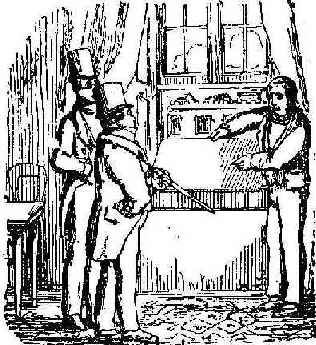
The window looked with a sunny aspect down upon the quad, and
over the opposite buildings were seen the spires of churches, the
dome of the Radcliffe, and the gables, pinnacles, and turrets of
other colleges. This was pleasant enough: pleasanter than the stale
odours of the Virginian weed that rose from the faded green
window-curtains, and from the old Kidderminster carpet that had
been charred and burnt into holes with the fag-ends of cigars.
"Well, Verdant," said Mr. Green, when they had completed their
inspection, "the rooms are not so very bad, and I think you may be
able to make yourself comfortable in them. But I wish they were not
so high up. I don't see how you can escape if a fire was to break
out, and I am afraid collegians must be very careless on these
points. Indeed, your mother made me promise that I would speak to
Dr. Portman about it, and ask him to please to allow your tutor, or
somebody, to see that your fire was safely raked out at night; and
I had intended to have done so, but somehow it quite escaped me.
How your mother and all at home would like to see you in your own
college room!" And the thoughts of father and son flew back to the
Manor Green and its occupants, who were doubtless at the same time
thinking of them.
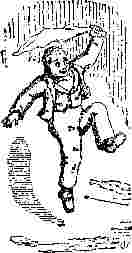
Mr. Filcher then explained the system of thirds, by which the
furniture of the room was to be paid for; and, having accompanied
his future master and Mr. Green downstairs,
the latter accomplishing the descent not
without difficulty and contusions, and having pointed out the way
to Mr. Slowcoach's rooms, Mr. Robert Filcher relieved his feelings
by indulging in a ballet of action, or pas d'extase; in
which poetry of motion he declared his joy at the last valuable
addition to Brazenface, and his own perquisites.
Mr. Slowcoach was within, and would see Mr. Verdant Green. So
that young gentleman, trembling with agitation, and feeling as
though he would have given pounds for the staircase to have been as
high as that of Babel, followed the servant upstairs, and left his
father, in almost as great a state of nervousness, pacing the quad
below. But it was not the formidable affair, nor was Mr. Slowcoach
the formidable man, that Mr. Verdant Green had anticipated; and by
the time that he had turned a piece of Spectator into Latin,
our hero had somewhat recovered his usual equanimity of mind and
serenity of expression: and the construing of half a dozen lines of
Livy and Homer, and the answering of a few questions, was a mere
form; for Mr. Slowcoach's long practice enabled him to see in a
very few minutes if the freshman before him (however nervous he
might be) had the usual average of abilities, and was up to the
business of lectures. So Mr. Verdant Green was soon dismissed, and
returned to his father radiant and happy.
Back to Contents
AS they went out at the gate, they inquired of the porter for
Mr. Charles Larkyns, but they found that he had not yet returned
from the friend's house where he had been during the vacation;
whereupon Mr. Green said that they would
go and look at the Oxford lions, so that he might be able to answer
any of the questions that should be put to him on his return.
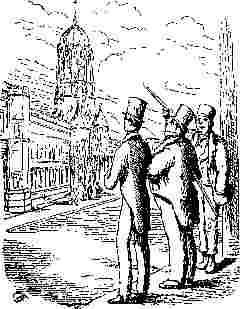
They soon found a guide, one of those wonderful people to which
show-places give birth, and of whom Oxford can boast a very goodly
average; and under this gentleman's guidance Mr. Verdant Green made
his first acquaintance with the fair outside of his Alma Mater.
The short, thick stick of the guide served to direct attention
to the various objects he enumerated in his rapid career: "This
here's Christ Church College," he said, as he trotted them down St
Aldate's, "built by Card'nal Hoolsy four underd feet long and the
famous Tom Tower as tolls wun underd and wun hevery night that
being the number of stoodents on the foundation;" and thus the
guide went on, perfectly independent of the artificial trammels of
punctuation, and not particular whether his hearers understood him
or not: that was not his business. And as it was that
gentleman's boast that he "could do the alls, collidges, and
principal hedifices in a nour and a naff," it could not be expected
but that Mr. Green should take back to Warwickshire otherwise than
a slightly confused impression of Oxford.
When he unrolled that rich panorama before his "mind's eye," all
its component parts were strangely out of place. The rich spire of
St. Mary's claimed acquaintance with her
poorer sister at the cathedral.
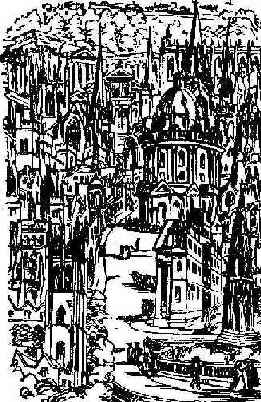
The cupola of the Tom Tower got into close quarters with the
huge dome of the Radcliffe, that shrugged up its great round
shoulders at the intrusion of the cross-bred Graeco-Gothic tower of
All Saints. The theatre had walked up to St. Giles's to see how the
Taylor Buildings agreed with the University galleries; while the
Martyrs' Memorial had stepped down to Magdalen Bridge, in time to
see the college taking a walk in the Botanic Gardens. The Schools
and the Bodleian had set their back against the stately portico of
the Clarendon Press; while the antiquated Ashmolean had given place
to the more modern Townhall. The time-honoured, black-looking front
of University College had changed into the cold cleanliness of the
"classic" facade of Queen's. The two towers of All Souls' -
whose several stages seem to be pulled out of each other like the
parts of a telescope, - had, somehow, removed themselves from the
rest of the building, which had gone, nevertheless, on a tour to
Broad Street; behind which, as every one knows, are the Broad Walk
and the Christ Church meadows. Merton Chapel had got into
New quarters; and Wadham had gone to Worcester for change of
air. Lincoln had migrated from near Exeter to Pembroke; and
Brasenose had its nose quite put out of joint by St. John's. In
short, if the maps of Oxford are to be trusted, there had been a
general pousset movement among its public buildings.
But if such a shrewd and practised observer as Sir Walter Scott,
after a week's hard and systematic sight-seeing, could only say of
Oxford, "The time has been much too short to convey to me separate
and distinct ideas of all the variety of wonders that I saw: my
memory only at present furnishes a grand but indistinct picture of
towers, and chapels, and oriels, and vaulted halls, and libraries,
and paintings;" - if Sir Walter Scott could say this after a week's
work, it is not to be wondered at that Mr. Green, after so brief
and rapid a survey of the city at the heels of an unintelligent
guide, should feel himself slightly confused when, on his return to
the Manor Green, he attempted to give a slight description of the
wonderful sights of Oxford.
There was one lion of Oxford, however, whose
individuality of expression was too striking either to be forgotten
or confused with the many other lions around. Although (as in
Byron's Dream)
|
"A mass of many images
|
| Crowded like waves upon" |
Mr. Green, yet clear and distinct through all there ran
"The stream-like windings of that glorious street,"
[2]
to which one of the first critics of the age [3] has given this high testimony of praise: "The
High Street of Oxford has not its equal in the whole world."
Mr. Green could not, of course, leave Oxford until he had seen
his beloved son in that elegant cap and preposterous gown which
constitute the present academical dress of the Oxford
undergraduate; and to assume which, with a legal right to the same,
matriculation is first necessary. As that amusing and instructive
book, the University Statutes, says in its own delightful
and unrivalled canine Latin, "Statutum est, quod nemo pro
Studente, seu Scholari, habeatur, nec ullis Universitatis
privilegiis, aut beneficiis" (the cap and gown, of course,
being among these), "gaudeat, nisi qui in aliquod Collegium vel
Aulam admissus fuerit, et intra quindenam post talem admissionem in
matriculam Universitatis fuerit relatus." So our hero put on
the required white tie, and then went forth to complete his proper
costume.
---
[2] Wordsworth, Miscellaneous Sonnets.
[3] Dr. Waagen, Art and Artists in England.
-=-
There were so many persons purporting to be "Academical
robe-makers," that Mr. Green was some little time in deciding who
should be the tradesman favoured with the order for his son's
adornment. At last he fixed upon a shop, the window of which
contained a more imposing display than its neighbours of gowns,
hoods, surplices, and robes of all shapes and colours, from the
black velvet-sleeved proctor's to the blushing gorgeousness of the
scarlet robe and crimson silk sleeves of the D.C.L.
"I wish you," said Mr. Green, advancing towards a smirking
individual, who was in his shirt-sleeves and slippers, but in all
other respects was attired with great magnificence, - "I wish you
to measure this gentleman for his academical robes, and also to
allow him the use of some to be matriculated in."
"Certainly, sir," said the robe-maker, who stood bowing and
smirking before them, - as Hood expressively says,
| "Washing his hands with invisible soap, |
| In imperceptible water;"- |
"certainly, sir, if you wish it: but it will scarcely be
necessary, sir; as our custom is so extensive, that we keep a large
ready-made stock constantly on hand."
"Oh, that will do just as well," said Mr. Green; "better,
indeed. Let us see some."
"What description of robe would be required?" said the smirking
gentleman, again making use of the invisible soap; "a
scholar's?"
"A scholar's!" repeated Mr. Green, very much wondering at the
question, and imagining that all students must of necessity be also
scholars; "yes, a scholar's, of course."
A scholar's gown was accordingly produced: and its deep, wide
sleeves, and ample length and breadth, were soon displayed to some
advantage on Mr. Verdant Green's tall figure. Reflected in a large
mirror, its charms were seen in their full perfection; and when the
delighted Mr. Green exclaimed, "Why, Verdant, I never saw you look
so well as you do now!" our hero was inclined to think that his
father's words were the words of truth, and that a scholar's gown
was indeed becoming. The tout ensemble was complete when the
cap had been added to the gown; more especially as Verdant put it
on in such a manner that the polite robe-maker was obliged to say,
"The hother way, if you please, sir. Immaterial perhaps, but
generally preferred. In fact, the shallow part is always the
forehead, - at least, in Oxford, sir."
While Mr. Green was paying for the cap and gown (N.B. the money
of governors is never refused), the robe-maker smirked, and said,
"Hexcuse the question; but may I hask, sir, if this is the
gentleman that has just gained the Scotland Scholarship?"
"No," replied Mr. Green. "My son has just gained his
matriculation, and, I believe, very creditably; but nothing more,
as we only came here yesterday."
"Then I think, sir," said the robe-maker, with redoubled smirks
- "I think, sir, there is a leetle mistake here. The gentleman will
be hinfringing the University statues, if he wears a scholar's gown
and hasn't got a scholarship; and these robes'll be of no use to
the gentleman, yet awhile at least. It
will be an undergraduate's gown that he requires, sir."
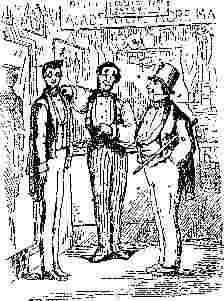
It was fortunate for our hero that the mistake was discovered so
soon, and could be rectified without any of those unpleasant
consequences of iconoclasm to which the robe-maker's infringement
of the "statues" seemed to point; but as that gentleman put the
scholar's gown on one side, and brought out a commoner's, he might
have been heard to mutter, "I don't know which is the freshest, -
the freshman or his guv'nor."
When Mr. Verdant Green once more looked in the glass, and saw
hanging straight from his shoulders a yard of blueish-black stuff,
garnished with a little lappet, and two streamers whose upper parts
were gathered into double plaits, he regretted that he was not
indeed a scholar, if it were only for the privilege of wearing so
elegant a gown. However, his father smiled approvingly, the
robe-maker smirked judiciously; so he came to the gratifying
conclusion that the commoner's gown was by no means ugly, and would
be thought a great deal of at the Manor Green when he took it home
at the end of the term.
Leaving his hat with the robe-maker, who, with many more smirks
and imaginary washings of the hands, hoped to be favoured with the
gentleman's patronage on future occasions, and begged further to
trouble him with a card of his establishment, - our hero proceeded
with his father along the High Street, and turned round by St.
Mary's, and so up Cat Street to the Schools, where they made their
way to the classic "Pig-market," [4]
to await the arrival of the Vice-Chancellor.
When he came, our freshman and two other white-tied
fellow-freshmen were summoned to the great man's presence; and
there, in the ante-chamber of the Convocation House, [5] the edifying and imposing spectacle of
Matriculation was enacted. In the first place, Mr. Verdant Green
took divers oaths, and sincerely promised and swore that he would
be faithful and bear true allegiance to her Majesty Queen Victoria.
He also professed (very much to his own astonishment) that he did
"from his heart abhor, detest, and abjure, as impious and
heretical, that damnable doctrine and position, that princes
excommunicated or deprived by the pope, or any authority of the see
of Rome, may be deposed or murdered by their subjects, or any other
whatsoever." And, having almost lost his breath at this novel
"position," Mr. Verdant Green could only gasp his declaration,
"that no foreign prince, person, prelate, state, or potentate,
hath, or ought to have, any jurisdiction, power, superiority,
pre-eminence, or authority, ecclesiastical or spiritual, within
this realm." When he had sufficiently recovered his presence of
mind, Mr. Verdant Green inserted his name in the University books
as "Generosi filius natu maximus"; and then signed his name to the
Thirty-nine Articles, - though he did not endanger his
matriculation, as Theodore Hook did, by professing his readiness to
sign forty if they wished it! Then the Vice-Chancellor concluded
the performance by presenting to the three freshmen (in the most
liberal manner) three brown-looking volumes, with these words:
"Scitote vos in Matriculam Universitatis hodie relatos esse, sub
hac conditione, nempe ut omnia Statuta hoc libro comprehensa pro
virili observetis." And the ceremony was at an end, and Mr. Verdant
Green was a matriculated member of the University of Oxford. He was
far too nervous, - from the weakening effect of the popes, and the
excommunicate princes, and their murderous subjects, - to be able
to translate and understand what the Vice-Chancellor had said to
him, but he thought his present to be particularly kind; and he
found it a copy of the University Statutes, which he determined
forthwith to read and obey.
---
[4] The reason why such a name has
been given to the Schools' quadrangle may be found in the following
extract from Ingram's Memorials: "The schools built by Abbot
Hokenorton being inadequate to the increasing wants of the
University, they applied to the Abbot of Reading for stone to
rebuild them; and in the year 1532 it appears that considerable
sums of money were expended on them; but they went to decay in the
latter part of the reign of Henry VIII, and during the whole reign
of Edward VI. The change of religion having occasioned a suspension
of the usual exercises and scholastic acts in the University, in
the year 1540 only two of these schools were used by determiners,
and within two years after none at all. The whole area between
these schools and the divinity school was subsequently converted
into a garden and pig-market; and the schools themselves,
being completely abandoned by the masters and scholars, were used
by glovers and laundresses."
[5] "In apodyterio domui congregationis."
-=-
Though if he had known that he had sworn to observe statutes
which required him, among other things, to wear garments only of a
black or "subfusk" hue; to abstain from that absurd and proud
custom of walking in public in boots, and the ridiculous one
of wearing the hair long; [6] -
statutes, moreover, which demanded of him to refrain from all
taverns, wine-shops, and houses in which they sold wine or any
other drink, and the herb called nicotiana or "tobacco"; not to
hunt wild beasts with dogs or snares or nets; not to carry
cross-bows or other "bombarding" weapons, or keep hawks for
fowling; not to frequent theatres or the strifes of gladiators; and
only to carry a bow and arrows for the sake of honest recreation;
[7] - if Mr. Verdant Green had known
that he had covenanted to do this, he would, perhaps, have felt
some scruples in taking the oaths of matriculation. But this by the
way.
---
[6] See the Oxford Statutes, tit. xiv, "De vestitu et habitu
scholastico."
[7] See the Oxford Statutes, tit. xv, "De moribus
conformandis."
-=-
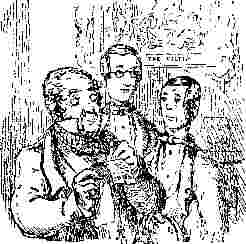
Now that Mr. Green had seen all that he wished to see, nothing
remained for him but to discharge his hotel bill. It was
accordingly called for, and produced by the waiter, whose face - by
a visitation of that complaint against which vaccination is usually
considered a safeguard - had been reduced to a state resembling the
interior half of a sliced muffin. To judge from the expression of
Mr. Green's features as he regarded the document that had been put
into his hand, it is probable that he had not been much accustomed
to Oxford hotels; for he ran over the several items of the bill
with a look in which surprise contended with indignation for the
mastery, while the muffin-faced waiter handled his plated salver,
and looked fixedly at nothing.
Mr. Green, however, refraining from observations, paid the bill;
and, muffling himself in greatcoat and travelling-cap, he prepared
himself to take a comfortable journey back to Warwickshire, inside
the Birmingham and Oxford coach. It was not loaded in the same way
that it had been when he came up by it, and his fellow-passengers
were of a very different description; and it must be confessed
that, in the absence of Mr. Bouncer's tin horn, the attacks of
intrusive terriers, and the involuntary fumigation of himself with
tobacco (although its presence was still perceptible within the
coach), Mr. Green found his journey from Oxford much more
agreeable than it had been to that place. He took an
affectionate farewell of his son, somewhat after the manner of the
"heavy fathers" of the stage; and then the coach bore him away from
the last lingering look of our hero, who felt any thing but heroic
at being left for the first time in his
life to shift for himself.
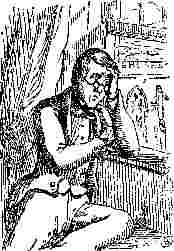
His luggage had been sent up to Brazenface, so thither he turned
his steps, and with some little difficulty found his room. Mr.
Filcher had partly unpacked his master's things, and had left
everything uncomfortable and in "the most admired disorder"; and
Mr. Verdant Green sat himself down upon the "practicable"
window-seat, and resigned himself to his thoughts. If they had not
already flown to the Manor Green, they would soon have been carried
there; for a German band, just outside the college-gates, began to
play "Home, sweet home," with that truth and delicacy of expression
which the wandering minstrels of Germany seem to acquire
intuitively. The sweet melancholy of the simple air, as it came
subdued by distance into softer tones, would have powerfully
affected most people who had just been torn from the bosom of their
homes, to fight, all inexperienced, the battle of life; but it had
such an effect on Mr. Verdant Green, that - but it little matters
saying what he did; many people will give way to feelings in
private that they would stifle in company; and if Mr. Filcher on
his return found his master wiping his spectacles, why that was
only a simple proceeding which all glasses frequently require.
To divert his thoughts, and to impress upon himself and others
the fact that he was an Oxford MAN, our freshman set out for a
stroll; and as the unaccustomed feeling of the gown
about his shoulders made him feel somewhat
embarrassed as to the carriage of his arms, he stepped into a shop
on the way and purchased a light cane, which he considered would
greatly add to the effect of the cap and gown.
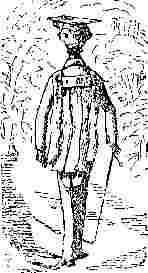
Armed with this weapon, he proceeded to disport himself in the
Christ Church meadows, and promenaded up and down the Broad
Walk.
The beautiful meadows lay green and bright in the sun; the
arching trees threw a softened light, and made a chequered pavement
of the great Broad Walk; "witch-elms did counter-change the
floor" of the gravel-walks that wound with the windings of the
Cherwell; the drooping willows were mirrored in its stream; through
openings in the trees there were glimpses of grey, old
college-buildings; then came the walk along the banks, the Isis
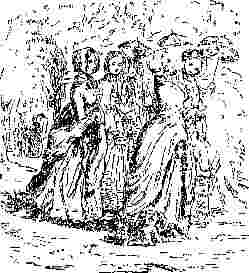
shining like molten silver, and fringed around with barges and
boats; then another stretch of green meadows; then a cloud of
steam
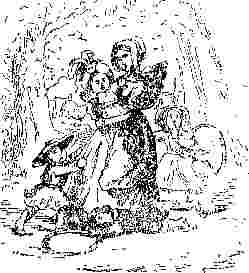
from the railway-station; and a background of gently-rising
hills. It was a cheerful scene, and the variety of figures gave
life and animation to the whole.
Young ladies and unprotected females were found in abundance,
dressed in all the engaging variety of light spring dresses; and,
as may be supposed, our hero attracted a great deal of their
attention, and afforded them no small amusement. But the unusual
and terrific appearance of a spectacled
gownsman with a cane produced the greatest alarm among the
juveniles, who imagined our freshman to be a new description
of beadle or Bogy, summoned up by the
exigencies of the times to preserve a rigorous discipline among the
young people; and, regarding his cane as the symbol of his stern
sway, they harassed their nursemaids by unceasingly charging at
their petticoats for protection.
Altogether, Mr. Verdant Green made quite a sensation.
Back to Contents
OUR hero dressed himself with great care, that he might make his
first appearance in Hall with proper eclat - and, having
made his way towards the lantern-surmounted building, he walked up
the steps and under the groined archway with a crowd of hungry
undergraduates who were hurrying in to dinner. The clatter of
plates would have alone been sufficient to guide his steps; and,
passing through one of the doors in the elaborately carved screen
that shut off the passage and the buttery, he found himself within
the hall of Brazenface. It was of noble size, lighted by lofty
windows, and carried up to a great height by an open roof, dark
(save where it opened to the lantern) with great oak beams, and
rich with carved pendants and gilded bosses. The ample fire-places
displayed the capaciousness of those collegiate mouths of "the
wind-pipes of hospitality," and gave an idea of the dimensions of
the kitchen ranges. In the centre of the hall was a huge
plate-warmer, elaborately worked in brass with the college arms.
Founders and benefactors were seen, or suggested, on all sides;
their arms gleamed from the windows in all the glories of stained
glass; and their faces peered out from the massive gilt frames on
the walls, as though their shadows loved to linger about the spot
that had been benefited by their substance. At the further end of
the hall a deep bay-window threw its painted light upon a dais,
along which stretched the table for the Dons; Masters and Bachelors
occupied side-tables; and the other tables were filled up by the
undergraduates; every one, from the Don downwards, being in his
gown.
Our hero was considerably impressed with the (to him) singular
character of the scene; and from the "Benedictus benedicat"
grace-before-meat to the "Benedicto benedicamur" after-meat, he
gazed curiously around him in silent wonderment. So much indeed was
he wrapped up in the novelty of the scene, that he ran a great risk
of losing his dinner. The scouts fled about in all directions with
plates, and glasses, and pewter dishes, and massive silver mugs
that had gone round the tables for the last two centuries, and
still no one waited upon Mr. Verdant Green. He twice ventured to
timidly say, "Waiter!" but as no one answered to his call, and as
he was too bashful and occupied with his own thoughts to make
another attempt, it is probable that he would have risen from
dinner as unsatisfied as when he sat down, had not his right-hand
companion (having partly relieved his own wants) perceived his
neighbour to be a freshman, and kindly said to him, "I think you'd
better begin your dinner, because we don't stay here long.
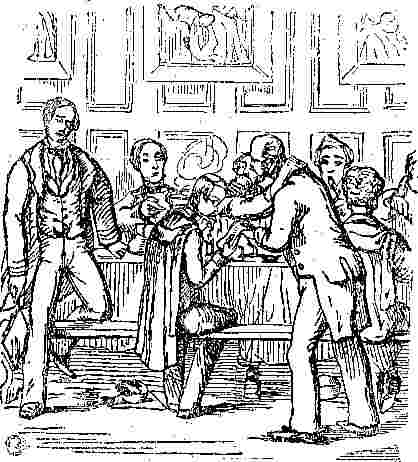
What is your scout's name?" And when he had been told it, he
turned to Mr. Filcher and asked him, "What the doose he meant by
not waiting on his master?" which, with the addition of a few
gratuitous threats, had the effect of bringing that gentleman to
his master's side, and reducing Mr. Verdant Green to a state of
mind in which gratitude to his companion and a desire to beg his
scout's pardon were confusedly blended. Not seeing any dishes upon
the table to select from, he referred to the list, and fell back on
the standard roast beef.
"I am sure I am very much obliged to you," said Verdant, turning
to his friendly neighbour. "My rooms are next to yours, and I had
the pleasure of being driven by you on the coach the other
day."
"Oh!" said Mr. Fosbrooke, for it was he; "ah, I remember you
now! I suppose the old bird was your governor. He seemed to
think it any thing but a pleasure, being driven by Four-in-hand
Fosbrooke."
"Why, pap - my father - is rather nervous on a coach," replied
Verdant: "he was bringing me to college for the first time."
"Then you are the man that has just come into Smalls' old rooms?
Oh, I see. Don't you ever drink with your dinner? If you don't
holler for your rascal, he'll never half wait upon you. Always
bully them well at first, and then they learn manners."
So, by way of commencing the bullying system without loss of
time, our hero called out very fiercely "Robert!" and then, as Mr.
Filcher glided to his side, he timidly dropped his tone into a mild
"Glass of water, if you please, Robert."
He felt rather relieved when dinner was over, and retired at
once to his own rooms; where, making a rather quiet and sudden
entrance, he found them tenanted by an old woman, who wore a huge
bonnet tilted on the top of her head, and was busily and dubiously
engaged at one of his open boxes. "Ahem!" he coughed, at which note
of warning the old lady jumped round very quickly, and said, -
dabbing curtseys where there were stops, like the beats of a
conductor's baton, - "Law bless me, sir. It's beggin' your
parding that I am. Not seein' you a comin' in. Bein' 'ard of
hearin' from a hinfant. And havin' my back turned. I was just a
puttin' your things to rights, sir. If you please, sir, I'm Mrs.
Tester. Your bed-maker, sir."
"Oh, thank you," said our freshman, with the shadow of a
suspicion that Mrs. Tester was doing something more than merely
"putting to rights" the pots of jam and marmalade, and the packages
of tea and coffee, which his doting mother had thoughtfully placed
in his box as a provision against immediate distress. "Thank
you."
"I've done my rooms, sir," dabbed Mrs. Tester. "Which if thought
agreeable, I'd stay and put these things in their places. Which it
certainly is Robert's place. But I never minds putting myself out.
As I always perpetually am minded. So long as I can obleege the
gentlemen."
So, as our hero was of a yielding disposition, and could, under
skilful hands, easily be moulded into any form, he allowed Mrs.
Tester to remain, and conclude the unpacking and putting away of
his goods, in which operations she displayed great generalship.
"You've a deal of tea and coffee, sir," she said, keeping time
by curtseys. "Which it's a great blessin' to have a mother. And not
to be left dissolute like some gentlemen. And tea and coffee is
what I mostly lives on. And mortial dear it is to poor folks. And a
package the likes of this, sir, were a blessin' I should never even
dream on."
"Well, then," said Verdant, in a most benevolent mood, "you can
take one of the packages for your trouble."
Upon this, Mrs. Tester appeared to be greatly overcome. "Which I
once had a son myself," she said. "And as fine a young man as you
are, sir. With a strawberry mark in the small of his back. And
beautiful red whiskers, sir; with a tendency to drink. Which it
were his rewing, and took him to be enlisted for a sojer. When he
went across the seas to the West Injies. And was took with the
yaller fever, and buried there. Which the remembrance, sir, brings
on my spazzums. To which I'm an hafflicted martyr, sir. And can
only be heased with three spots of brandy on a lump of sugar. Which
your good mother, sir, has put a bottle of brandy. Along with the
jam and the clean linen, sir. As though a purpose for my complaint.
Ugh! oh!"
And Mrs. Tester forthwith began pressing and thumping her sides
in such a terrific manner, and appeared to be undergoing such
internal agony, that Mr. Verdant Green not only gave her brandy
there and then, for her immediate relief - "which it heases the
spazzums deerectly, bless you," observed Mrs. Tester,
parenthetically; but also told her where she could find the bottle,
in case she should again be attacked when in his rooms; attacks
which, it is needless to say, were repeated at every subsequent
visit. Mrs. Tester then finished putting away the tea and coffee,
and entered into further particulars about her late son; though
what connection there was between him and the packages of tea, our
hero could not perceive. Nevertheless he was much interested with
her narrative, and thought Mrs. Tester a very affectionate,
motherly sort of woman; more especially, when (Robert having placed
his tea-things on the table) she showed him how to make the tea; an
apparently simple feat that the freshman found himself perfectly
unable to accomplish. And then Mrs. Tester made a final dab, and
her exit, and our hero sat over his tea as long as he could,
because it gave an idea of cheerfulness; and then, after directing
Robert to be sure not to forget to call him in time for morning
chapel, he retired to bed.
The bed was very hard, and so small, that, had it not been for
the wall, our hero's legs would have been visible (literally) at
the foot; but despite these novelties, he sank into a sound rest,
which at length passed into the following dream. He thought that he
was back again at dinner at the Manor Green, but that the room was
curiously like the hall of Brazenface, and that Mrs. Tester and Dr.
Portman were on either side of him, with Mr. Fosbrooke and Robert
talking to his sisters; and that he was reaching his hand to help
Mrs. Tester to a packet of tea, which her son had sent them from
the West Indies, when he threw over a wax-light, and set every
thing on fire; and that the parish engine came up; and that there
was a great noise, and a loud hammering; and, "Eh? yes! oh! the
half-hour is it? Oh, yes! thank you!" And Mr. Verdant Green sprang
out of bed much relieved in mind to find
that the alarm of fire was nothing more than his scout knocking
vigorously at his door, and that it was chapel-time.
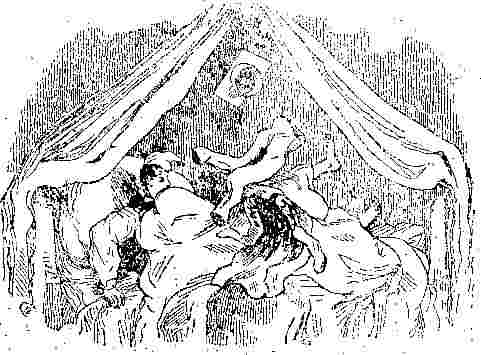
"Want any warm water, sir?" asked Mr. Filcher, putting his head
in at the door.
"No, thank you," replied our hero; "I - I -"
"Shave with cold. Ah! I see, sir. It's much 'ealthier, and makes
the 'air grow. But any thing as you does want, sir, you've
only to call."
"If there is any thing that I want, Robert," said Verdant, "I
will ring."
"Bless you, sir," observed Mr. Filcher, "there ain't no bells
never in colleges! They'd be rung off their wires in no time. Mr.
Bouncer, sir, he uses a trumpet like they does on board ship. By
the same token, that's it, sir!" And Mr. Filcher vanished, just in
time to prevent little Mr. Bouncer from finishing a furious solo,
from an entirely new version of Robert le Diable, which he
was giving with novel effects through the medium of a
speaking-trumpet.
Verdant found his bed-room inconveniently small; so contracted,
indeed, in its dimensions, that his toilette was not completed
without his elbows having first suffered severe abrasions. His
mechanical turnip shewed him that he had no time to lose, and the
furious ringing of a bell, whose noise was echoed by the bells of
other colleges, made him dress with a rapidity quite unusual, and
hurry down stairs and across quad. to the chapel steps, up which a
throng of students were hastening. Nearly all betrayed symptoms of
having been aroused from their sleep without having had any spare
time for an elaborate toilette, and many,
indeed, were completing it, by thrusting themselves into surplices
and gowns as they hurried up the steps.
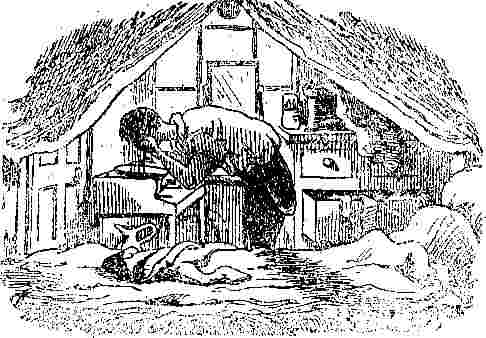
Mr. Fosbrooke was one of these; and when he saw Verdant close to
him, he benevolently recognized him, and said, "Let me put you up
to a wrinkle. When they ring you up sharp for chapel, don't you
lose any time about your absolutions, - washing, you know; but just
jump into a pair of bags and Wellingtons; clap a top-coat on you,
and button it up to the chin, and there you are, ready dressed in
the twinkling of a bed-post."
Before Mr. Verdant Green could at all comprehend why a person
should jump into two bags, instead of dressing himself in the
normal manner, they went through the ante-chapel, or "Court of the
Gentiles," as Mr. Fosbrooke termed it, and entered the choir of the
chapel through a screen elaborately decorated in the Jacobean
style, with pillars and arches, and festoons of fruit and flowers,
and bells and pomegranates. On either side of the door were two
men, who quickly glanced at each one who passed, and as quickly
pricked a mark against his name on the chapel lists. As the
freshman went by, they made a careful study of his person, and took
mental daguerreotypes of his features. Seeing no beadle, or
pew-opener (or, for the matter of that, any pews), or any one to
direct him to a place, Mr. Verdant Green quietly took a seat in the
first place that he found empty, which happened to be the stall on
the right hand of the door.
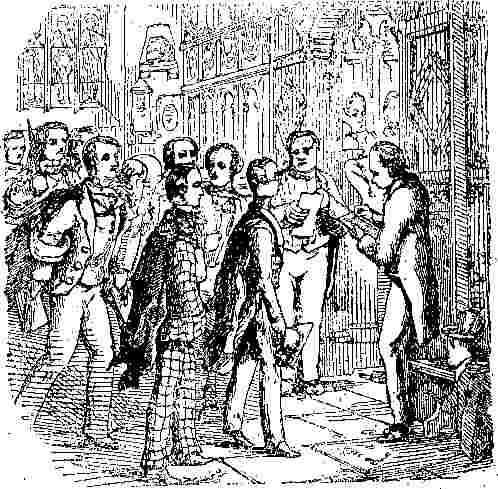
Unconscious of the trespass he was committing, he at once put
his cap to his face and knelt down; but he had no sooner risen from
his knees, than he found an imposing-looking Don, as large as life
and quite as natural, who was staring at him with the greatest
astonishment, and motioning him to immediately "come out of that!"
This our hero did with the greatest speed and confusion, and sank
breathless on the end of the nearest bench; when, just as in his
agitation, he had again said his prayer, the service fortunately
commenced, and somewhat relieved him of his embarrassment.
Although he had the glories of Magdalen, Merton, and New College
chapels fresh in his mind, yet Verdant was considerably impressed
with the solemn beauties of his own college chapel. He admired its
harmonious proportions, and the elaborate carving of its decorated
tracery. He noted every thing: the great eagle that seemed to be
spreading its wings for an upward flight, - the pavement of black
and white marble, - the dark canopied stalls, rich with the later
work of Grinling Gibbons, - the elegant tracery of the windows; and
he lost himself in a solemn reverie as he
looked up at the saintly forms through which the rays of the
morning sun streamed in rainbow tints.
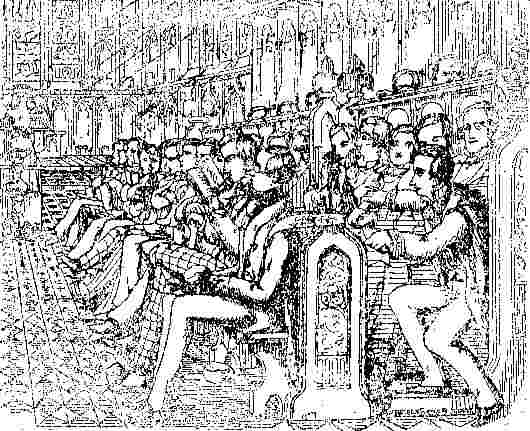
But the lesson had just begun; and the man on Verdant's right
appeared to be attentively following it. Our freshman, however,
could not help seeing the book, and, much to his astonishment, he
found it to be a Livy, out of which his neighbour was getting up
his morning's lecture. He was still more astonished, when the
lesson had come to an end, by being suddenly pulled back when he
attempted to rise, and finding the streamers of his gown had been
put to a use never intended for them, by being tied round the
finial of the stall behind him, - the silly work of a boyish
gentleman, who, in his desire to play off a practical joke on a
freshman, forgot the sacredness of the place where college rules
compelled him to shew himself on morning parade.
Chapel over, our hero hurried back to his rooms, and there, to
his great joy, found a budget of letters from home; and surely the
little items of intelligence that made up the news of the Manor
Green had never seemed to possess such interest as now! The reading
and re-reading of these occupied him during the whole of
breakfast-time; and Mr. Filcher found him still engaged in perusing
them when he came to clear away the things.
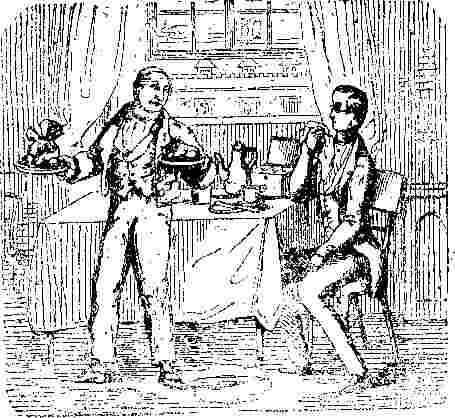
Then it was that Verdant discovered the extended meaning that
the word "perquisites" possesses in the eyes of
a scout, for, to a remark that he had
made, Robert replied in a tone of surprise, "Put away these bits o'
things as is left, sir!" and then added, with an air of mild
correction, "you see, sir, you's fresh to the place, and don't know
that gentlemen never likes that sort o' thing done here,
sir; but you gets your commons, sir, fresh and fresh every morning
and evening, which must be much more agreeable to the 'ealth than a
heating of stale bread and such like. No, sir!" continued Mr.
Filcher, with a manner that was truly parental, "no sir! you trust
to me, sir, and I'll take care of your things, I will." And from
the way that he carried off the eatables, it seemed probable that
he would make good his words. But our freshman felt considerable
awe of his scout, and murmuring broken accents, that sounded like
"ignorance - customs - University," he endeavoured, by a liberal
use of his pocket-handkerchief, to appear as if he were not
blushing.
As Mr. Slowcoach had told him that he would not have to begin
lectures until the following day, and as the Greek play fixed for
the lecture was one with which he had been made well acquainted by
Mr. Larkyns, Verdant began to consider what he could do with
himself, when the thought of Mr. Larkyns suggested the idea that
his son Charles had probably by this time returned to college. He
determined therefore at once to go in
search of him; and looking out a letter which the rector had
commissioned him to deliver to his son, he inquired of Robert, if
he was aware whether Mr. Charles Larkyns had come back from his
holidays.
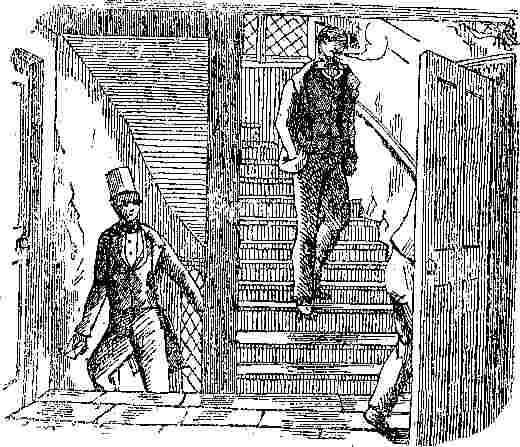
"'Ollidays, sir?," said Mr. Filcher. "Oh! I see, sir! Vacation,
you mean, sir. Young gentlemen as is men, sir, likes to call
their 'ollidays by a different name to boys', sir. Yes, sir, Mr.
Charles Larkyns, he come up last arternoon, sir; but he and Mr.
Smalls, the gent as he's been down with this vacation, the same as
had these rooms, sir, they didn't come to 'All, sir, but went and
had their dinners comfortable at the Star, sir; and very pleasant
they made theirselves; and Thomas, their scout, sir, has had quite
a horder for sober-water this morning, sir."
With somewhat of a feeling of wonder how one scout contrived to
know so much of the proceedings of gentlemen who were waited on by
another scout, and wholly ignorant of his allusion to his
fellow-servant's dealings in soda-water, Mr. Verdant Green inquired
where he could find Mr. Larkyns, and as the rooms were but just on
the other side of the quad., he put on his hat, and made his way to
them. The scout was just going into the room, so our hero gave a
tap at the door and followed him.
Back to Contents
MR. VERDANT GREEN found himself in a room that had a pleasant
look-out over the gardens of Brazenface, from which a noble
chestnut tree brought its pyramids of bloom close up to the very
windows. The walls of the room were decorated with engravings in
gilt frames, their variety of subject denoting the catholic taste
of their proprietor. "The start for the Derby," and other coloured
hunting prints, shewed his taste for the field and horseflesh;
Landseer's "Distinguished Member of the Humane Society," "Dignity
and Impudence," and others, displayed his fondness for dog-flesh;
while Byron beauties, "Amy Robsart," and some extremely au
naturel pets of the ballet, proclaimed his passion for the fair
sex in general. Over the fire-place was a mirror (for Mr. Charles
Larkyns was not averse to the reflection of his good-looking
features, and was rather glad than otherwise of "an excuse for the
glass,") its frame stuck full of tradesmen's cards and (unpaid)
bills, invites, "bits of pasteboard" pencilled with a mystic
"wine," and other odds and ends: - no private letters though! Mr.
Larkyns was too wary to leave his "family secrets" for the
delectation of his scout. Over the mirror was displayed a fox's
mask, gazing vacantly from between two brushes; leaving the
spectator to imagine that Mr. Charles Larkyns was a second Nimrod,
and had in some way or other been intimately concerned in the
capture of these trophies of the chase. This supposition of the
imaginative spectator would be strengthened by the appearance of a
list of hunting appointments (of the past season) pinned up over a
list of lectures, and not quite in character with the tabular views
of prophecies, kings of Israel and Judah, and the Thirty-nine
Articles, which did duty elsewhere on the walls, where they were
presumed to be studied in spare minutes - which were remarkably
spare indeed.
The sporting character of the proprietor of the rooms was
further suggested by the huge pair of antlers over the door,
bearing on their tines a collection of sticks, whips, and spurs;
while, to prove that Mr. Larkyns was not wholly taken up by the
charms of the chase, fishing-rods, tandem-whips, cricket-bats, and
Joe Mantons, were piled up in odd corners; and single-sticks,
boxing-gloves, and foils, gracefully arranged upon the walls,
shewed that he occasionally devoted himself to athletic pursuits.
An ingenious wire-rack for pipes and meerschaums, and the presence
of one or two suspicious-looking boxes, labelled "collorados,"
"regalia," "lukotilla," and with other unknown words, seemed to
intimate that, if Mr. Larkyns was no smoker himself, he at least
kept a bountiful supply of "smoke" for his friends; but the
perfumed cloud that was proceeding from his lips as Verdant entered
the room, dispelled all doubts on the subject.
He was much changed in appearance during the somewhat long
interval since Verdant had last seen him, and his handsome features
had assumed a more manly, though perhaps a more rakish look. He was
lolling on a couch in the neglige attire of dressing-gown
and slippers, with his pink striped shirt comfortably open at the
neck. Lounging in an easy chair opposite to him was a gentleman
clad in tartan-plaid, whose face might only be partially discerned
through the glass bottom of a pewter, out of which he was draining
the last draught. Between them was a table covered with the
ordinary appointments for a breakfast, and the extra-ordinary ones
of beer-cup and soda-water. Two Skye terriers, hearing a strange
footstep, immediately barked out a challenge of "Who goes there?"
and made Mr. Larkyns aware that an intruder was at hand.
Slightly turning his head, he dimly saw through the smoke a
spectacled figure taking off his hat, and holding out an envelope,
and without looking further, he said, "It's no use coming here,
young man, and stealing a march in this way! I don't owe you
any thing; and if I did, it is not convenient to pay it. I told
Spavin not to send me any more of his confounded reminders; so go
back and tell him that he'll find it all right in the long-run, and
that I'm really going to read this term, and shall stump the
examiners at last. And now, my friend, you'd better make yourself
scarce and vanish! You know where the door lies!"
Our hero was so confounded at this unusual manner of receiving a
friend, that he was some little time before he could gasp out,
"Why, Charles Larkyns - don't you remember me? Verdant Green!"
Mr. Larkyns, astonished in his turn, jumped up directly, and
came to him with outstretched hands. "'Pon my word, old fellow," he
said, "I really beg you ten thousand pardons for not recognizing
you; but you are so altered - allow me to add, improved, - since I
last saw you; you were not a bashaw of two tails, then, you know;
and, really, wearing your beaver up, like Hamlet's uncle, I
altogether took you for a dun. For I am a victim of a very
remarkable monomania.
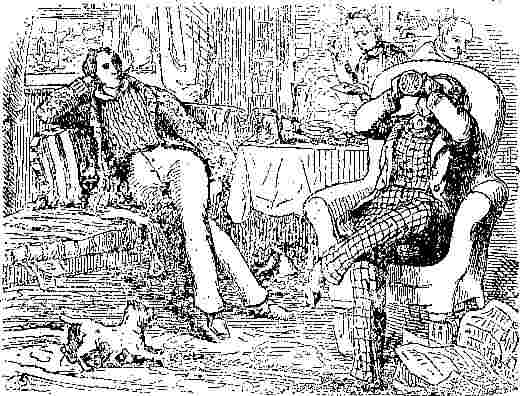
There are in this place wretched beings calling themselves
tradesmen, who labour under the impression that I owe them what
they facetiously term little bills; and though I have frequently
assured their messengers, who are kind
enough to come here to inquire for Mr. Larkyns, that that
unfortunate gentleman has been obliged to hide himself from
persecution in a convent abroad, yet the wretches still hammer at
my oak, and disturb my peace of mind. But bring yourself to an
anchor, old fellow! This man is Smalls; a capital fellow, whose
chief merit consists in his devotion to literature; indeed, he
reads so hard that he is called a fast man. Smalls! let me
introduce my friend Verdant Green, a freshman, - ahem! - and the
proprietor, I believe, of your old rooms."
Our hero made a profound bow to Mr. Smalls, who returned it with
great gravity, and said he "had great pleasure in forming the
acquaintance of a freshman like Mr. Verdant Green;" which was
doubtless quite true; and he then evinced his devotion to
literature by continuing the perusal of one of those vivid and
refined accounts of "a rattling set-to between Nobby Buffer and
Hammer Sykes," for which Tintinnabulum's Life is so justly
famous.
"I heard from my governor," said Mr. Larkyns, "that you were
coming up; and in the course of the morning I should have come and
looked you up; but the - the fatigues of travelling yesterday,"
continued Mr. Larkyns, as a lively recollection of the preceding
evening's symposium stole over his mind, "made me rather later than
usual this morning. Have you done any thing in this way?"
Verdant replied that he had breakfasted, although he had not
done any thing in the way of cigars, because he never smoked.
"Never smoked! Is it possible!" exclaimed Mr. Smalls, violently
interrupting himself in the perusal of Tintinnabulum's Life,
while some private signals were rapidly telegraphed between him and
Mr. Larkyns; "ah! you'll soon get the better of that weakness! Now,
as you're a freshman, you'll perhaps allow me to give you a little
advice. The Germans, you know, would never be the deep readers that
they are, unless they smoked; and I should advise you to go to the
Vice-Chancellor as soon as possible, and ask him for an order for
some weeds. He'd be delighted to think you are beginning to set to
work so soon!" To which our hero replied, that he was much obliged
to Mr. Smalls for his kind advice, and if such were the customs of
the place, he should do his best to fulfil them.
"Perhaps you'll be surprised at our simple repast, Verdant,"
said Mr. Larkyns; "but it's our misfortune. It all comes of hard
reading and late hours: the midnight oil, you know, must be
supplied, and will be paid for; the nervous system gets
strained to excess, and you have to call in the doctor. Well, what
does he do? Why, he prescribes a regular course of tonics; and I
flatter myself that I am a very docile patient, and take my bitter
beer regularly, and without complaining." In proof of which Mr.
Charles Larkyns took a long pull at the pewter.
"But you know, Larkyns," observed Mr. Smalls, "that was nothing
to my case, when I got laid up with elephantiasis on the biceps of
the lungs, and had a fur coat in my stomach!"
"Dear me!" said Verdant sympathizingly; "and was that also
through too much study?"
"Why, of course!" replied Mr. Smalls; "it couldn't have been
anything else - from the symptoms, you know! But then the sweets of
learning surpass the bitters. Talk of the pleasures of the dead
languages, indeed! why, how many jolly nights have you and I,
Larkyns, passed 'down among the dead men!' "
Charles Larkyns had just been looking over the letter which
Verdant had brought him, and said, "The governor writes that you'd
like me to put you up to the ways of the place, because they are
fresh to you, and you are fresh (ahem! very!) to them. Now, I am
going to wine with Smalls to-night, to meet a few nice, quiet,
hard-working men (eh, Smalls?), and I daresay Smalls will do the
civil, and ask you also."
"Certainly!" said Mr. Smalls, who saw a prospect of amusement,
"delighted, I assure you! I hope to see you - after
Hall, you know, - but I hope you don't
object to a very quiet party?"
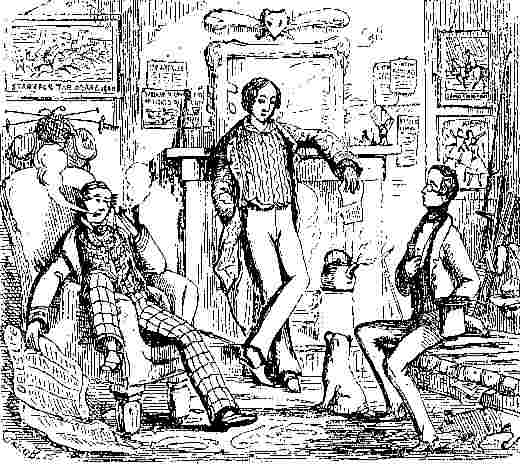
"Oh, dear no!" replied Verdant; "I much prefer a quiet party;
indeed, I have always been used to quiet parties; and I shall be
very glad to come."
"Well, that's settled then," said Charles Larkyns; "and, in the
mean time, Verdant, let us take a prowl about the old place, and
I'll put you up to a thing or two, and shew you some of the
freshman's sights. But you must go and get your cap and gown, old
fellow, and then by that time I'll be ready for you."
Whether there are really any sights in Oxford that are more
especially devoted, or adapted, to its freshmen, we will not
undertake to affirm; but if there are, they could not have had a
better expositor than Mr. Charles Larkyns, or a more credible
visitor than Mr. Verdant Green.
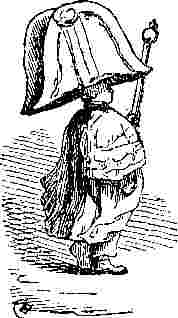
His credibility was rather strongly put to the test as they
turned into the High Street, when his companion directed his
attention to an individual on the opposite side of the street, with
a voluminous gown, and enormous cocked hat profusely adorned with
gold lace. "I suppose you know who that is, Verdant? No! Why,
that's the Bishop of Oxford! Ah, I see, he's a very
different-looking man to what you had expected; but then these
university robes so change the appearance. That is his official
dress, as the Visitor of the Ashmolean!"
Mr. Verdant Green having "swallowed" this, his friend was
thereby enabled, not only to use up old "sells," but also to draw
largely on his invention for new ones. Just then, there came along
the street, walking in a sort of young procession, - the
Vice-Chancellor, with his Esquire and Yeoman-bedels. The silver
maces, carried by these latter gentlemen, made them by far the most
showy part of the procession, and accordingly Mr. Larkyns seized
the favourable opportunity to point out the foremost bedel, and
say, "You see that man with the poker and loose cap? Well, that's
the Vice-Chancellor."
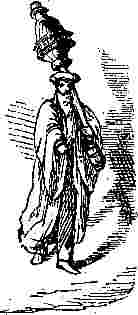
"But what does he walk in procession for?" inquired our
freshman.
"Ah, poor man!" said Mr. Larkyns, "he's obliged to do it."
'Uneasy lies the head that wears a crown,' you know; and he can
never go anywhere, or do anything, without carrying that poker, and
having the other minor pokers to follow him. They never leave him,
not even at night. Two of the pokers stand on each side his bed,
and relieve each other every two hours. So, I need hardly say, that
he is obliged to be a bachelor."
"It must be a very wearisome office," remarked our freshman, who
fully believed all that was told to him.
"Wearisome, indeed; and that's the reason why they are obliged
to change the Vice-Chancellors so often. It would kill most people,
only they are always selected for their strength, - and height," he
added, as a brilliant idea just struck
him.
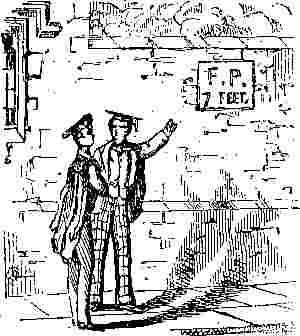
They had turned down Magpie Lane, and so by Oriel College, where
one of the fire-plug notices had caught Mr. Larkyns' eye. "You see
that," he said; "well, that's one of the plates they put up to
record the Vice's height. F.P. 7 feet, you see: the initials of his
name, - Frederick Plumptre!"
"He scarcely seemed so tall as that," said our hero, "though
certainly a tall man. But the gown makes a difference, I
suppose."
"His height was a very lucky thing for him, however," continued
Mr. Larkyns; "I dare say when you have heard that it was only those
who stood high in the University that were elected to rule it, you
little thought of the true meaning of the term?"
"I certainly never did," said the freshman, innocently; "but I
knew that the customs of Oxford must of course be very different
from those of other places."
"Yes, you'll soon find that out," replied Mr. Larkyns,
meaningly. "But here we are at Merton, whose Merton ale is as
celebrated as Burton ale. You see the man giving in the letters
to the porter?
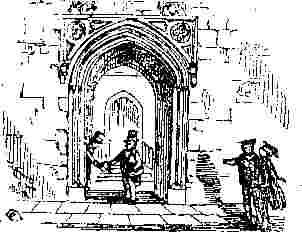
Well, he's one of their principal men. Each college does its own
postal department; and at Merton there are fourteen postmasters,
[8] for they get no end of letters
there."
"Oh, yes!" said our hero, "I remember Mr. Larkyns, - your
father, the rector, I mean, - telling us that the son of one of his
old friends had been a postmaster of Merton; but I fancied that he
had said it had something to do with a scholarship."
"Ah, you see, it's a long while since the governor was here, and
his memory fails him," remarked Mr. Charles Larkyns, very
unfilially. "Let us turn down the Merton fields, and round into St.
Aldate's. We may perhaps be in time to see the Vice come down to
Christ Church."
---
[8] Exhibitioners of Merton College are called "postmasters."
-=-
"What does he go there for?" asked Mr. Verdant Green.
"To wind up the great clock, and put big Tom in order. Tom is
the bell that you hear at nine each night; the Vice has to see that
he is in proper condition, and, as you have seen, goes out with his
pokers for that purpose."
On their way, Charles Larkyns pointed out, close to Folly
Bridge, a house profusely decorated with figures and indescribable
ornaments, which he informed our freshman was Blackfriars' Hall,
where all the men who had been once plucked
were obliged to migrate to; and that Folly
Bridge received its name from its propinquity to the Hall.
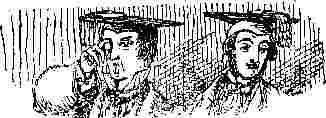
They were too late to see the Vice-Chancellor wind up the clock
of Christ Church; but as they passed by the college, they met two
gownsmen who recognized Mr. Larkyns by a slight nod. "Those are two
Christ Church men," he said, "and noblemen. The one with the
Skye-terrier's coat and eye-glass is the Earl of Whitechapel, the
Duke of Minories' son. I dare say you know the other man. No! Why,
he is Lord Thomas Peeper, eldest son of the Lord Godiva who hunts
our county. I knew him in the field."
"But why do they wear gold tassels to their caps?"
inquired the freshman.
"Ah," said the ingenious Mr. Larkyns, shaking his head; "I had
rather you'd not have asked me that question, because that's the
disgraceful part of the business. But these lords, you see, they
will live at a faster pace than us commoners, who can't
stand a champagne breakfast above once a term or so. Why, those
gold tassels are the badges of drunkenness!" [9]
"Of drunkenness! dear me!"
---
[9] As "Tufts" and "Tuft-hunters" have become "household words," it
is perhaps needless to tell any one that the gold tassel is the
distinguishing mark of a nobleman.
-=-
"Yes, it's very sad, isn't it?" pursued Mr. Larkyns; "and I
wonder that Peeper in particular should give way to such things.
But you see how they brazen it out, and walk about as coolly as
though nothing had happened. It's just the same sort of
punishment," continued Mr. Larkyns, whose inventive powers
increased with the demand that the freshman's gullibility imposed
upon them, - "it is just the same sort of thing that they do with
the Greenwich pensioners. When they have been trangressing
the laws of sobriety, you know, they are made marked men by having
to wear a yellow coat as a punishment; and our dons borrowed the
idea, and made yellow tassels the badges of intoxication. But for
the credit of the University, I'm glad to say that you'll not find
many men so disgraced."
They now turned down the New Road, and came to a strongly
castellated building, which Mr. Larkyns pointed out (and truly) as
Oxford Castle or the Gaol; and he added (untruly), "if you hear
Botany-Bay College [10] spoken of,
this is the place that's meant. It's a delicate way of referring to
the temporary sojourn that any undergrad has been forced to make
there, to say that he belongs to Botany-Bay College."
---
[10] A name given to Worcester College, from its being the most
distant college.
-=-
They now turned back, up Queen Street and High Street, when, as
they were passing All Saints, Mr. Larkyns pointed out a pale,
intellectual looking man who passed them, and said, "That man is
Cram, the patent safety. He's the first coach in Oxford."
"A coach!" said our freshman, in some wonder.
"Oh, I forgot you didn't know college-slang. I suppose a royal
mail is the only gentleman coach that you know of. Why, in
Oxford, a coach means a private tutor, you must know; and those who
can't afford a coach, get a cab, - alias a crib, -
alias a translation. You see, Verdant, you are gradually
being initiated into Oxford mysteries."
"I am, indeed," said our hero, to whom a new world was
opening.
They had now turned round by the west end of St. Mary's, and
were passing Brasenose; and Mr. Larkyns drew Verdant's attention to
the brazen nose that is such a conspicuous object
over the entrance-gate.
"That," said he, "was modelled from a cast of the Principal
feature of the first Head of the college; and so the college was
named Brazen-nose. [11] The nose was
formerly used as a place of punishment for any misbehaving
Brazennosian, who had to sit upon it for two hours, and was not
countenanced until he had done so. These punishments were so
frequent that they gradually wore down the nose to its present
small dimensions."
---
[11] Although we have a great respect for Mr. Larkyns, yet we
strongly suspect that he is intentionally deceiving his friend. He
has, however, the benefit of a doubt, as the authorities differ on
the origin and meaning of the word Brasenose, as may be seen by the
following notices, to the last two of which the editor of Notes
and Queries has directed our attention:
"This curious appellation, which, whatever was the origin of it,
has been perpetuated by the symbol of a brazen nose here and at
Stamford, occurs with the modern orthography, but in one undivided
word, so early as 1278, in an inquisition now printed in The
Hundred Rolls, though quoted by Wood from the manuscript
record." -Ingram's Memorials of Oxford.
"There is a spot in the centre of the city where Alfred is said to
have lived, and which may be called the native place or river-head
of three separate societies still existing, University, Oriel, and
Brasenose. Brasenose claims his palace, Oriel his church, and
University his school or academy. Of these, Brasenose College is
still called in its formal style ' the King's Hall,' which is the
name by which Alfred himself, in his laws, calls his palace; and it
has its present singular name from a corruption of
brasinium, or brasin-huse, as having been originally
located in that part of the royal mansion which was devoted to the
then important accommodation of a brew house." -From a Review of
Ingram's Memorials in the British Critic, vol. xxiv, p.
139.
"Brasen Nose Hall, as the Oxford antiquary has shewn, may be traced
as far back as the time of Henry III., about the middle of the
thirteenth century; and early in the succeeding reign, 6th Edward
I., 1278, it was known by the name of Brasen Nose Hall, which
peculiar name was undoubtedly owing, as the same author observes,
to the circumstance of a nose of brass affixed to the gate. It is
presumed, however, that this conspicuous appendage of the portal
was not formed of the mixed metal which the word now denotes, but
the genuine produce of the mine; as is the nose, or rather face, of
a lion or leopard still remaining at Stamford, which also gave name
to the edifice it adorned. And hence, when Henry VIII. debased the
coin by an alloy of copper, it was a common remark or
proverb, that 'Testons were gone to Oxford, to study in
Brasen Nose.' " -Churton's Life of Bishop Smyth, p.
227.
-=-
"This round building," continued Mr. Larkyns, pointing to the
Radcliffe, "is the Vice-Chancellor's house. He has to go each night
up to that balcony on the top, and look round to see if all's safe.
Those heads," he said, as they passed the Ashmolean, "are supposed
to be the twelve Caesars; only there happen, I believe, to be
thirteen of them. I think that they are the busts of the original
Heads of Houses."
Mr. Larkyns' inventive powers having been now somewhat
exhausted, he proposed that they should go back to Brazenface and
have some lunch. This they did; after which Mr. Verdant Green wrote
to his mother a long account of his friend's kindness, and the
trouble he had taken to explain the most interesting sights that
could be seen by a Freshman.
"Are you writing to your governor, Verdant?" asked the friend,
who had made his way to our hero's rooms, and was now perfuming
them with a little tobacco-smoke.
"No; I am writing to my mama - mother, I mean!"
"Oh! to the missis!" was the reply; "that's just the same. Well,
had you not better take the opportunity to ask them to send you a
proper certificate that you have been vaccinated, and had the
measles favourably?"
"But what is that for?" inquired our Freshman, always anxious to
learn. "Your father sent up the certificate of my baptism, and I
thought that was the only one wanted."
"Oh," said Mr. Charles Larkyns, "they give you no end of trouble
at these places; and they require the vaccination certificate
before you go in for your responsions, - the Little-go, you know.
You need not mention my name in your letter as having told you
this. It will be quite enough to say that you understand such a
thing is required."
Verdant accordingly penned the request; and Charles Larkyns
smoked on, and thought his friend the very beau-ideal of a
Freshman. "By the way, Verdant," he said, desirous not to lose any
opportunity, "you are going to wine with Smalls this evening; and,
- excuse me mentioning it, - but I suppose you would go properly
dressed, - white tie, kids, and that sort of thing, eh? Well! ta,
ta, till then. 'We meet again at Philippi!' "
Acting upon the hint thus given, our hero, when Hall was over
made himself uncommonly spruce in a new white tie, and spotless
kids; and as he was dressing, drew a mental picture of the party to
which he was going. It was to be composed of quiet, steady men, who
were such hard readers as to be called "fast men." He should
therefore hear some delightful and rational conversation on the
literature of ancient Greece and Rome, the present standard of
scholarship in the University, speculations on the forthcoming
prize-poems, comparisons between various expectant class-men, and
delightful topics of a kindred nature; and
the evening would be passed in a grave and sedate manner; and after
a couple of glasses of wine had been leisurely sipped, they should
have a very enjoyable tea, and would separate for an early rest,
mutually gratified and improved.
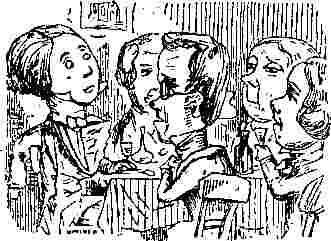
This was the nature of Mr. Verdant Green's speculations; but
whether they were realized or no, may be judged by transferring the
scene a few hours later to Mr. Smalls' room.
Back to Contents
MR. SMALLS' room was filled with smoke and noise. Supper had
been cleared away; the glasses were now sparkling on the board, and
the wine was ruby bright. The table, moreover, was supplied with
spirituous liquors and mixtures of all descriptions, together with
many varieties of "cup," - a cup which not only cheers, but
occasionally inebriates; and this miscellany of liquids was now
being drunk on the premises by some score and a half of gentlemen,
who were sitting round the table, and standing or lounging about in
various parts of the room. Heading the table, sat the host, loosely
attired in a neat dressing gown of crimson and blue, in an attitude
which allowed him to swing his legs easily, if not gracefully, over
the arm of his chair, and to converse cheerfully with Charles
Larkyns, who was leaning over the chair-back. Visible to the naked
eye, on Mr. Smalls' left hand, appeared the white tie and full
evening dress which decorated the person of Mr. Verdant Green.
A great consumption of tobacco was going on, not only through
the medium of cigars, but also of meerschaums, short "dhudheens" of
envied colour, and the genuine yard of clay; and Verdant, while he
was scarcely aware of what he was doing, found himself, to his
great amazement, with a real cigar in his mouth, which he was
industriously sucking, and with great difficulty keeping alight.
Our hero felt that the unexpected exigencies of the case demanded
from him some sacrifice; while he consoled himself by the
reflection, that, on the homoeopathic principle of "likes cure
likes," a cigar was the best preventive against any ill effects
arising from the combination of the thirty gentlemen who were
generating smoke with all the ardour of lime-kilns or young
volcanoes, and filling Mr. Smalls' small room with an atmosphere
that was of the smoke, smoky. Smoke produces thirst; and the cup,
punch, egg-flip, sherry-cobblers, and other liquids, which had been
so liberally provided, were being consumed by the members of the
party as though it had been their drink from childhood; while the
conversation was of a kind very different to what our hero had
anticipated, being for the most part vapid and unmeaning, and (must
it be confessed?) occasionally too highly flavoured with
improprieties for it to be faithfully recorded in these pages of
most perfect propriety.
The literature of ancient Greece and Rome was not even referred
to; and when Verdant, who, from the unusual combination of the
smoke and liquids, was beginning to feel extremely amiable and
talkative, - made a reflective observation (addressed to the
company generally) which sounded like the words "Nunc vino pellite
curas, Cras ingens," [12] - he was
immediately interrupted by the voice of Mr. Bouncer, crying out,
"Who's that talking shop about engines? Holloa, Gig-lamps!" - Mr.
Bouncer, it must be observed, had facetiously adopted the
sobriquet which had been bestowed on
Verdant and his spectacles on their first
appearance outside the Oxford coach, - "Holloa, Gig-lamps, is that
you ill-treating the dead languages? I'm ashamed of you! a
venerable party like you ought to be above such things. There!
don't blush, old feller, but give us a song! It's the punishment
for talking shop, you know."
---
[12] Horace, car. i od. vii
-=-
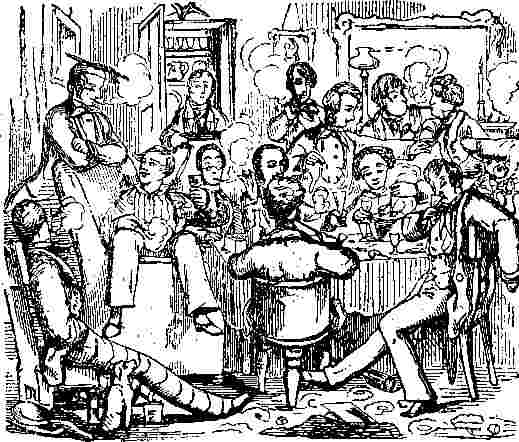
There was an immediate hammering of tables and jingling of
glasses, accompanied with loud cries of "Mr. Green for a song! Mr.
Green! Mr. Gig-lamps' song!" cries which nearly brought our hero to
the verge of idiotcy.
Charles Larkyns saw this, and came to the rescue. "Gentlemen,"
he said, addressing the company, "I know that my friend Verdant
can sing, and that, like a good bird, he will sing.
But while he is mentally looking over his numerous stock of songs,
and selecting one for our amusement, I beg to fill up our valuable
time, by asking you to fill up a bumper to the health of our
esteemed host Smalls (vociferous cheers) - a man whose
private worth is only to be equalled by the purity of his
milk-punch and the excellence of his weeds (hear hear).
Bumpers, gentlemen, and no heel-taps! and though I am sorry to
interfere with Mr. Fosbrooke's private enjoyments, yet I must beg
to suggest to him that he has been so much engaged in drowning his
personal cares in the bowl over which he is so skilfully presiding,
that my glass has been allowed to sparkle on the board empty and
useless." And as Charles Larkyns held out his glass towards Mr.
Fosbrooke and the punch-bowl, he trolled out, in a rich, manly
voice, old Cowley's anacreontic:
| "Fill up the bowl then, fill it high! |
| Fill all the glasses there! For why |
| Should every creature drink but I? |
| Why, man of morals, tell me why?" |
By the time that the "man of morals" had ladled out for the
company, and that Mr. Smalls' health had been drunk and responded
to amid uproarious applause, Charles Larkyns' friendly diversion in
our hero's favour had succeeded, and Mr. Verdant Green had regained
his confidence, and had decided upon one of those vocal efforts
which, in the bosom of his own family, and to the pianoforte
accompaniment of his sisters, was accustomed to meet with great
applause. And when he had hastily tossed off another glass of
milk-punch (merely to clear his throat), he felt bold enough to
answer the spirit-rappings which were again demanding "Mr. Green's
song!" It was given much in the following manner:
Mr. Verdant Green (in low plaintive tones, and fresh alarm at
hearing the sounds of his own voice). "I dreamt that I dwe-elt
in mar-arble halls, with" -
Mr. Bouncer (interrupting). "Spit it out, Gig-lamps! Dis
child can't hear whether it's Maudlin Hall you're singing about, or
what."
Omnes. "Order! or-der! Shut up, Bouncer!"
Charles Larkyns (encouragingly). "Try back, Verdant:
never mind."
Mr. Verdant Green (tries back, with increased confusion of
ideas, resulting principally from the milk-punch and tobacco).
"I dreamt that I dwe-elt in mar-arble halls, with vassals and serfs
at my si-hi-hide; and - and - I beg your pardon, gentlemen, I
really forget - oh, I know! - and I also dre-eamt, which ple-eased
me most - no, that's not it" -
Mr. Bouncer (who does not particularly care for the words of
a song, but only appreciates the chorus) - "That'll do, old
feller! We ain't pertickler,- (rushes with great deliberation
and noise to the chorus) "That you lo-oved me sti-ill the
sa-ha-hame - chorus, gentlemen!"
Omnes (in various keys and time). "That you lo-oved me
sti-ill the same."
Mr. Bouncer (to Mr. Green, alluding remotely to the
opera). "Now my Bohemian gal, can't you come out to-night? Spit
us out a yard or two more, Gig-lamps."
Mr. Verdant Green (who has again taken the opportunity to
clear his throat). "I dreamt that I dwe-elt in mar-arble- no! I
beg pardon! sang that (desperately) - that sui-uitors
sou-ught my hand, that knights on their (hic) ben-ended
kne-e-ee - had (hic) riches too gre-eat to" - (Mr.
Verdant Green smiles benignantly upon the company) - "Don't
rec'lect anymo."
Mr. Bouncer (who is not to be defrauded of the chorus).
"Chorus, gentlemen! - That you'll lo-ove me sti-ill the
sa-a-hame!"
Omnes (ad libitum). "That you'll lo-ove me sti-ill the
same!"
Though our hero had ceased to sing, he was still continuing to
clear his throat by the aid of the milk-punch, and was again
industriously sucking his cigar, which he had not yet succeeded in
getting half through, although he had re-lighted it about twenty
times. All this was observed by the watchful eyes of Mr. Bouncer,
who, whispering to his neighbour, and bestowing a distributive wink
on the company generally, rose and made the following remarks:-
"Mr. Smalls, and gents all: I don't often get on my pins to
trouble you with a neat and appropriate speech; but on an occasion
like the present, when we are honoured with the presence of a party
who has just delighted us with what I may call a flood of harmony
(hear, hear), - and has pitched it so uncommon strong in the
vocal line, as to considerably take the shine out of the
woodpecker-tapping, that we've read of in the pages of history
(hear, hear: "Go it again, Bouncer!"), - when, gentlemen, I
see before me this old original Little Wobbler, - need I say that I
allude to Mr. Verdant Green? - (vociferous cheers)- I feel
it a sort of, what you call a privilege, d'ye see, to stand on my
pins, and propose that respected party's jolly good health
(renewed cheers). Mr. Verdant Green, gentlemen, has but
lately come among us, and is, in point of fact, what you call a
freshman; but, gentlemen, we've already seen enough of him to feel
aware that - that Brazenface has gained an acquisition, which -
which - (cries of "Tally-ho! Yoicks! Hark forrud!") Exactly
so, gentlemen: so, as I see you are all anxious to do honour to our
freshman, I beg, without further preface, to give you the health of
Mr. Verdant Green! With all the honours. Chorus, gents!
| "For he's a jolly good fellow! |
| For he's a jolly good fellow!! |
| For he's a jolly good f-e-e-ell-ow!!! |
|
Which nobody can deny!"
|
This chorus was taken up and prolonged in the most indefinite
manner; little Mr. Bouncer fairly revelling in it, and only
regretting that he had not his post-horn with him to further
contribute to the harmony of the evening. It seemed to be a great
art in the singers of the chorus to dwell as long as possible on
the third repetition of the word "fellow," and in the most defiant
manner to pounce down on the bold affirmation by which it is
followed; and then to lyrically proclaim that, not only was it a
way they had in the Varsity to drive dull care away, but that the
same practice was also pursued in the army and navy for the
attainment of a similar end.
When the chorus had been sung over three or four times, and Mr.
Verdant Green's name had been proclaimed with equal noise, that
gentleman rose (with great difficulty), to return thanks. He was
understood to speak as follows:
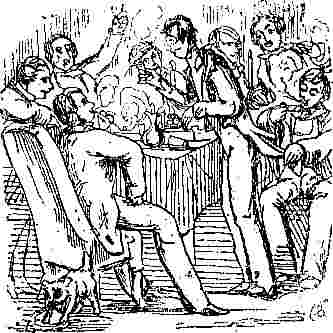
"Genelum anladies (cheers), - I meangenelum. ("That's
about the ticket, old feller!" from Mr. Bouncer.) Customd syam
plic speakn, I - I - (hear, hear) - feel bliged drinkmyel.
I'm fresman, genelum, and prowtitle (loud cheers). Myfren
Misserboucer, fallowme callm myfren! ("In course, Gig-lamps, you
do me proud, old feller.") Myfren Misserboucer seszime fresman
- prow title, sureyou (hear, hear). Genelmun, werall
jolgoodfles, anwe wogohotillmorrin! ("We won't, we won't! not a
bit of it!") Gelmul, I'm fresmal, an namesgreel, gelmul
(cheers). Fanyul dousmewor, herescardinpocklltellm! Misser
Verdalgreel, Braseface, Oxul fresmal, anprowtitle! (Great
cheering and rattling of glasses, during which Mr. Verdant Green's
coat-tails are made the receptacles for empty bottles, lobsters'
claws, and other miscellaneous articles.) Misserboucer said was
fresmal. If Misserboucer wantsultme ("No, no!"),
herescardinpock'lltellm namesverdalgreel, Braseface! Not
shameofitgelmul! prowtitle! (Great applause.) I doewaltilsul
Misserboucer! thenwhysee sultme? thaswaw Iwaltknow! (Loud
cheers, and roars of laughter, in which Mr. Verdant Green suddenly
joins to the best of his ability.) I'm anoxful fresmal, gelmul,
'fmyfrel Misserboucer loumecallimso. (Cheers and laughter, in
which Mr. Verdant Green feebly joins.) Anweerall jolgoodfles,
anwe wogohotilmorril, an I'm fresmal, gelmul, anfanyul dowsmewor -
an I - doefeel quiwell!"
This was the termination of Mr. Verdant Green's speech, for
after making a few unintelligible sounds, his knees suddenly gave
way, and with a benevolent smile he disappeared beneath the
table.
Half an hour afterwards two gentlemen might have been seen,
bearing with staggering steps across the moonlit quad the
huddled form of a third gentleman, who was
clothed in full evening dress, and appeared incapable of taking
care of himself. The two first gentlemen set down their burden
under an open doorway, painted over with a large
4; and then, by pulling and pushing, assisted it
to guide its steps up a narrow and intricate staircase, until they
had gained the third floor, and stood before a door, over which the
moonlight revealed, in newly-painted white letters, the name of
"MR. VERDANT GREEN."
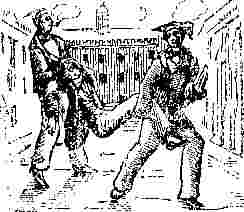
"Well, old feller," said the first gentleman, "how do you feel
now, after 'Sich a getting up stairs'?"
"Feel much berrer now," said their late burden; "feel
quite-comfurble! Shallgotobed!"
"Well, Gig-lamps," said the first speaker, "and By-by won't be
at all a bad move for you. D'ye think you can unrig yourself and
get between the sheets, eh, my beauty?"
"Its allri, allri!" was the reply; "limycandle!"
"No, no," said the second gentleman, as he pulled up the
window-blind, and let in the moonlight; "here's quite as much light
as you want. It's almost morning."
"Sotis," said the gentleman in the evening costume:
"anlittlebirds beginsingsoon! Ilike littlebirds sing!
jollittlebirds!" The speaker had suddenly fallen upon his bed, and
was lying thereon at full length, with his feet on the pillow.
"He'll be best left in this way," said the second speaker, as he
removed the pillow to the proper place, and raised the prostrate
gentleman's head; "I'll take off his choker and make him easy about
the neck, and then we'll shut him up, and leave him. Why the
beggar's asleep already!" And so the two gentlemen went away, and
left him safe and sleeping.
It is conjectured, however, that he must have got up shortly
after this, and finding himself with his clothes on, must have
considered that a lighted candle was indispensably necessary to
undress by; for when Mrs. Tester came at her usual early hour to
light the fires and prepare the sitting-rooms, she discovered him
lying on the carpet embracing the coal-skuttle,
with a candle by his side. The good woman
raised him, and did not leave him until she had, in the most
motherly manner, safely tucked him up in bed.
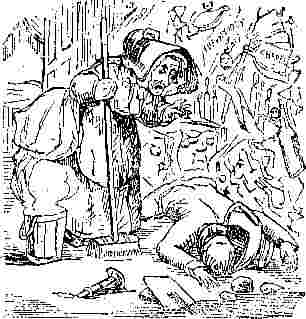
Clink, clank! clink, clank! tingle, tangle! tingle, tangle! Are
demons smiting ringing hammers into Mr. Verdant Green's brain, or
is the dreadful bell summoning him to rise for morning chapel?
Mr. Filcher puts an end to the doubt by putting his head in at
the bedroom door, and saying, "Time for chapel, sir! Chapel,"
thought Mr. Filcher; "here is a chap ill, indeed! - Bain't you
well, sir? Restless you look!"
Oh, the shame and agony that Mr. Verdant Green felt! The desire
to bury his head under the clothes, away from Robert's and everyone
else's sight; the fever that throbbed his brain and parched his
lips, and made him long to drink up Ocean; the eyes that felt like
burning lead; the powerless hands that trembled like a weak old
man's; the voice that came in faltering tones that jarred the brain
at every word! How he despised himself; how he loathed the very
idea of wine; how he resolved never, never to transgress so again!
But perhaps Mr. Verdant Green was not the only Oxford freshman who
has made this resolution.
"Bain't you well, sir?" repeated Mr. Filcher, with a passing
thought that freshmen were sadly degenerating, and could not manage
their three bottles as they did when he was first a scout: "bain't
you well, sir?"
"Not very well, Robert, thank you. I - my head aches, and I'm
afraid I shall not be able to get up for chapel. Will the Master be
very angry?"
"Well, he might be, you see, sir," replied Mr. Filcher,
who never lost an opportunity of making anything out of his
master's infirmities; "but if you'll leave it to me, sir, I'll make
it all right for you, I will. Of course you'd like to take
out an aeger, sir; and I can bring you your Commons just the
same. Will that do, sir?"
"Oh, thank you; yes, any thing. You will find five shillings in
my waistcoat-pocket, Robert; please to take it; but I can't
eat."
"Thank'ee, sir," said the scout, as he abstracted the five
shillings; "but you'd better have a bit of somethin', sir; - a cup
of strong tea, or somethin'. Mr. Smalls, sir, when he were
pleasant, he always had beer, sir; but p'raps you ain't been used
to bein' pleasant, sir, and slops might suit you better, sir."
"Oh, any thing, any thing!" groaned our poor, unheroic hero, as
he turned his face to the wall, and endeavoured to recollect in
what way he had been "pleasant" the night before. But, alas! the
wells of his memory had, for the time, been poisoned, and nothing
clear or pure could be drawn therefrom. So he got up and looked at
himself in the glass, and scarcely recognized the tangled-haired,
sallow-faced wretch, whose bloodshot eyes gazed heavily at him from
the mirror. So he nervously drained the water-bottle, and buried
himself once more among the tossed and tumbled bed-clothes.
The tea really did him some good, and enabled him to recover
sufficient nerve to go feebly through the operation of dressing;
though it was lucky that nature had not yet brought Mr. Verdant
Green to the necessity of shaving, for the handling of a razor
might have been attended with suicidal results, and have brought
these veracious memoirs and their hero to an untimely end.
He had just sat down to a second edition of tea, and was reading
a letter that the post had brought him from his sister Mary, in
which she said, "I dare say by this time you have found Mr. Charles
Larkyns a very delightful companion, and I am sure a
very valuable one; as, from what the rector says, he appears
to be so steady, and has such nice quiet companions:"
- our hero had read as far as this, when a great noise just without
his door, caused the letter to drop from his trembling hands; and,
between loud fanfares from a post-horn, and heavy thumps
upon the oak, a voice was heard, demanding "Entrance in the
Proctor's name."
Mr. Verdant Green had for the first time "sported his oak."
Under any circumstances it would have been a mere form, since his
bashful politeness would have induced him to open it to any comer;
but, at the dreaded name of the Proctor, he sprang from his chair,
and while impositions, rustications, and expulsions rushed
tumultuously through his disordered brain, he nervously undid the
springlock, and admitted - not the Proctor, but the "steady" Mr.
Charles Larkyns and his "nice quiet companion," little Mr. Bouncer,
who testified his joy at the success of their coup d'etat,
by blowing on his horn loud blasts that might have been borne by
Fontarabian echoes, and which rang through poor Verdant's head with
indescribable jarrings.
"Well, Verdant," said Charles Larkyns, "how do you find yourself
this morning? You look rather shaky."
"He ain't a very lively picter, is he?" remarked little Mr.
Bouncer, with the air of a connoisseur; "peakyish you feel, don't
you, now, with a touch of the mulligrubs in your collywobbles? Ah,
I know what it is, my boy."
It was more than our hero did; and he could only reply that he
did not feel very well. "I - I had a glass of claret after some
lobster-salad, and I think it disagreed with me."
"Not a doubt of it, Verdant," said Charles Larkyns very gravely;
"it would have precisely the same effect that the salmon always has
at a public dinner, - bring on great hilarity, succeeded by a
pleasing delirium, and concluding in a horizontal position, and a
demand for soda-water."
"I hope," said our hero, rather faintly, "that I did not conduct
myself in an unbecoming manner last night; for I am sorry to say
that I do not remember all that occurred."
"I should think not, Gig-lamps, You were as drunk as a besom,"
said little Mr. Bouncer, with a side wink to Mr. Larkyns, to
prepare that gentleman for what was to follow. "Why, you got on
pretty well till old Slowcoach came in, and then you certainly did
go it, and no mistake!"
"Mr. Slowcoach!" groaned the freshman. "Good gracious! is it
possible that he saw me? I don't remember it."
"And it would be lucky for you if he didn't," replied Mr,
Bouncer. "Why his rooms, you know, are in the same angle of the
quad as Smalls'; so, when you came to shy the empty bottles out of
Smalls' window at his window -"
"Shy empty bottles! Oh!" gasped the freshman.
"Why, of course, you see, he couldn't stand that sort of game -
it wasn't to be expected; so he puts his head out of the bedroom
window - and then, don't you remember crying out, as you pointed to
the tassel of his night-cap sticking up straight on end, 'Tally-ho!
Unearth'd at last! Look at his brush!' Don't you remember that,
Gig-lamps?"
"Oh, oh, no!" groaned Mr. Bouncer's victim: "I can't remember, -
oh, what could have induced me!"
"By Jove, you must have been screwed! Then I daresay you
don't remember wanting to have a polka with him, when he came up to
Smalls' rooms?"
"A polka! Oh dear! Oh no! Oh!"
"Or asking him if his mother knew he was out, - and what he'd
take for his cap without the tassel; and telling him that he was
the joy of your heart, - and that you should never be happy unless
he'd smile as he was wont to smile, and would love you then as now,
- and saying all sorts of bosh? What, not remember it! 'Oh, what a
noble mind is here o'erthrown!' as some cove says in Shakespeare.
But how screwed you must have been, Gig-lamps!"
"And do you think," inquired our hero, after a short but
sufficiently painful reflection, - "do you think that Mr. Slowcoach
will - oh! - expel me?"
"Why, it's rather a shave for it," replied his tormentor; "but
the best thing you can do is to write an apology at once: pitch it
pretty strong in the pathetic line, - say it's your first offence,
and that you'll never be a naughty boy again, and all that sort of
thing. You just do that, Gig-lamps, and I'll see that the note goes
to - the proper place."
"Oh, thank you!" said the freshman; and while, with equal
difficulty from agitation both of mind and body, he composed and
penned the note, Mr. Bouncer ordered up some buttery
beer, and Charles Larkyns prepared some
soda-water with a dash of brandy, which he gave Verdant to drink,
and which considerably refreshed that gentleman.
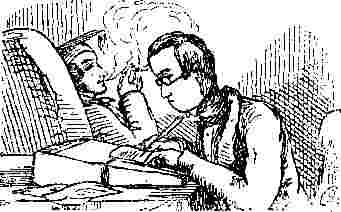
"And I should advise you," he said, "to go out for a
constitutional; for walking-time's come, although you have but just
done your breakfast. A blow up Headington Hill will do you good,
and set you on your legs again."
So Verdant, after delivering up his note to Mr. Bouncer, took
his friend's advice, and set out for his constitutional in his cap
and gown, feeling afraid to move without them, lest he should
thereby trespass some law. This, of course, gained him some
attention after he had crossed Magdalen Bridge; and he might have
almost been taken for the original of that impossible gownsman who
appears in Turner's well-known "View of Oxford, from Ferry
Hincksey," as wandering-
"Remote, unfriended, solitary, slow," -
in a corn-field, in the company of an umbrella!
Among the many pedestrians and equestrians that he encountered,
our freshman espied a short and very stout gentleman, whose
shovel-hat, short apron, and general decanical costume, proclaimed
him to be a don of some importance.
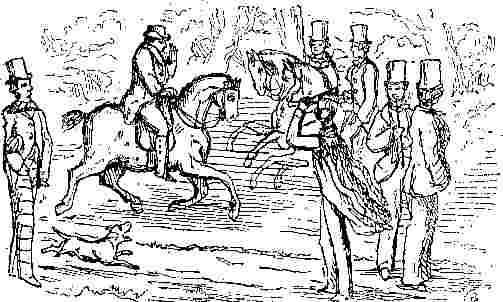
He was riding a pad-nag, who ambled placidly along, without so
much as hinting at an outbreak into a canter; a performance that,
as it seemed, might have been attended with disastrous consequences
to his rider. Our hero noticed, that the trio of undergraduates who
were walking before him, while they passed others, who were
evidently dons, without the slightest notice (being in mufti), yet
not only raised their hats to the stout gentleman, but also
separated for that purpose, and performed the salute at intervals
of about ten yards. And he further remarked, that while the stout
gentleman appeared to be exceedingly gratified at the notice he
received, yet that he had also very great difficulty in returning
the rapid salutations; and only accomplished them and retained his
seat by catching at the pommel of his saddle, or the mane of his
steed, - a proceeding which the pad-nag seemed perfectly used
to.
Mr. Verdant Green returned home from his walk, feeling all the
better for the fresh air and change of scene; but he still looked,
as his neighbour, Mr. Bouncer, kindly informed him, "uncommon
seedy, and doosid fishy about the eyes;" and it was some days even
before he had quite recovered from the novel excitement of Mr.
Smalls' "quiet party."
Back to Contents
OUR freshman, like all other freshmen, now began to think
seriously of work, and plunged desperately into all the lectures
that it was possible for him to attend, beginning every course with
a zealousness that shewed him to be filled with the idea that such
a plan was eminently necessary for the attainment of his degree; in
all this in every respect deserving the Humane Society's medal for
his brave plunge into the depths of the Pierian spring, to fish up
the beauties that had been immersed therein by the poets of old.
When we say that our freshman, like other freshmen, "began" this
course, we use the verb advisedly; for, like many other freshmen
who start with a burst in learning's race, he soon got winded, and
fell back among the ruck. But the course of lectures, like the
course of true love, will not always run smooth, even to those who
undertake it with the same courage as Mr. Verdant Green.
The dryness of the daily routine of lectures, which varied about
as much as the steak-and-chop, chop-and-steak dinners of ancient
taverns, was occasionally relieved by episodes, which, though not
witty in themselves, were yet the cause of wit in others; for it
takes but little to cause amusement in a lecture-room, where a bad
construe; or the imaginative excuses of late-comers; or the
confusion of some young gentleman who has to turn over the leaf of
his Greek play and finds it uncut; or the pounding of the same
gentleman in the middle of the first chorus; or his offensive
extrication therefrom through the medium of some Cumberland
barbarian; or the officiousness of the same barbarian to pursue the
lecture when every one else has, with singular unanimity, "read no
further;" - all these circumstances, although perhaps dull enough
in themselves, are nevertheless productive of some mirth in a
lecture-room.
But if there were often late-comers to the lectures, there were
occasionally early-goers from them. Had Mr. Four-in-hand Fosbrooke
an engagement to ride his horse Tearaway in the amateur
steeple-chase, and was he constrained, by circumstances over which
(as he protested) he had no control, to put in a regular appearance
at Mr. Slowcoach's lectures, what was it necessary for him to do
more than to come to lecture in a long greatcoat, put his
handkerchief to his face as though his nose were bleeding, look
appealingly at Mr. Slowcoach, and, as he made his exit, pull aside
the long greatcoat, and display to his admiring colleagues the
snowy cords and tops that would soon be pressing against
Tearaway's sides, that gallant animal being then in waiting,
with its trusty groom, in the alley at the back of Brazenface?
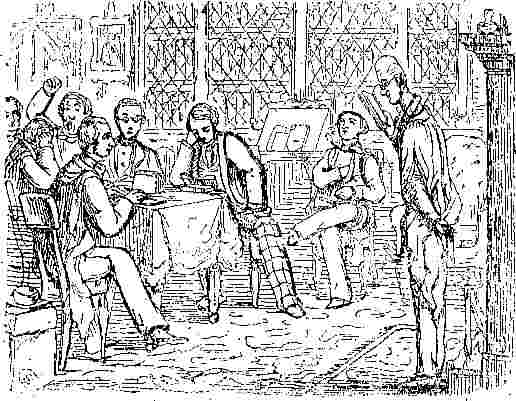
And if little Mr. Bouncer, for astute
reasons of his own, wished Mr. Slowcoach to believe that he (Mr.
B.) was particularly struck with his (Mr. S.'s) remarks on the
force of {kata} in composition, what
was to prevent Mr. Bouncer from feigning to make a note of these
remarks by the aid of a cigar instead of an ordinary pencil?
But besides the regular lectures of Mr. Slowcoach, our hero had
also the privilege of attending those of the Rev. Richard Harmony.
Much learning, though it had not made Mr. Harmony mad, had, at
least in conjunction with his natural tendencies, contributed to
make him extremely eccentric; while to much perusal of Greek and
Hebrew MSS., he probably owed his defective vision. These
infirmities, instead of being regarded with sympathy, as wounds
received by Mr. Harmony in the classical engagements in the various
fields of literature, were, to Mr. Verdant Green's surprise, much
imposed upon; for it was a favourite pastime with the gentlemen who
attended Mr. Harmony's lectures, to gradually raise up the
lecture-table by a concerted action, and when Mr. Harmony's book
had nearly reached to the level of his nose, to then suddenly drop
the table to its original level; upon which Mr. Harmony, to the
immense gratification of all concerned, would rub his eyes, wipe
his glasses, and murmur, "Dear me! dear me! how my head swims this
morning!" And then he would perhaps ring
for his servant, and order his usual remedy, an orange, at which he
would suck abstractedly, nor discover any difference in the flavour
even when a lemon was surreptitiously substituted.
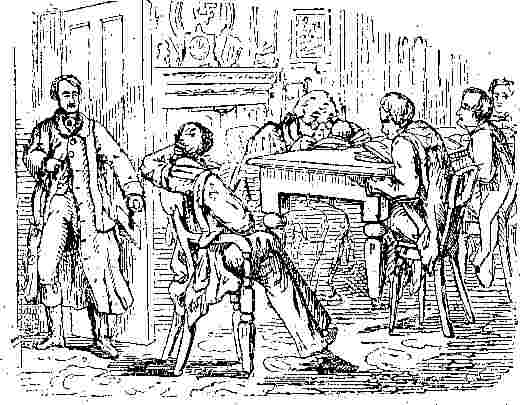
And thus he would go on through the lecture, sucking his orange
(or lemon), explaining and expounding in the most skilful and lucid
manner, and yet, as far as the "table-movement" was concerned, as
unsuspecting and as witless as a little child.
Mr. Verdant Green not only (at first) attended lectures with
exemplary diligence and regularity, but he also duly went to
morning and evening chapel; nor, when Sundays came, did he neglect
to turn his feet towards St. Mary's to hear the University sermons.
Their effect was as striking to him as it probably is to most
persons who have only been accustomed to the usual services of
country churches. First, there was the peculiar character of the
congregation: down below, the vice-chancellor in his throne,
overlooking the other dons in their stalls (being "a complete
realization of stalled Oxon!" as Charles Larkyns whispered to our
hero), who were relieved in colour by their crimson or scarlet
hoods; and then, "upstairs," in the north and the great west
galleries, the black mass of
undergraduates; while a few ladies' bonnets and heads of male
visitors peeped from the pews in the aisles, or looked out from the
curtains of the organ-gallery, where, "by the kind permission of
Dr. Elvey," they were accommodated with seats, and watched with
wonder, while
| "The wild wizard's fingers, |
| With magical skill, |
| Made music that lingers |
| In memory still." |
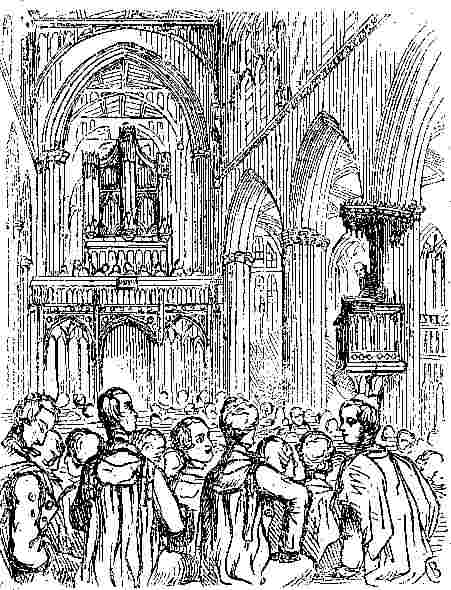
Then there was the bidding-prayer, in which Mr. Verdant Green
was somewhat astonished to hear the long list of founders and
benefactors, "such as were, Philip Pluckton, Bishop of Iffley; King
Edward the Seventh; Stephen de Henley, Earl of Bagley, and Maud his
wife; Nuneham Courtney, knight," with a long et-cetera; though, as
the preacher happened to be a Brazenface man, our hero found that
he was "most chiefly bound to praise Clement Abingdon, Bishop of
Jericho, and founder of the college of Brazenface; Richard Glover,
Duke of Woodstock; Giles Peckwater, Abbot of Beney; and Binsey
Green, Doctor of Music; - benefactors of the same."
Then there was the sermon itself; the abstrusely learned and
classical character of which, at first, also astonished him, after
having been so long used to the plain and highly practical advice
which the rector, Mr. Larkyns, knew how to convey so well and so
simply to his rustic hearers. But as soon as he had reflected on
the very different characters of the two congregations, Mr. Verdant
Green at once recognized the appropriateness of each class of
sermons to its peculiar hearers; yet he could not altogether drive
away the thought, how the generality of those who had on previous
Sundays been his fellow-worshippers would open their blue Saxon
eyes, and ransack their rustic brains, as to "what could ha'
come to rector," if he were to indulge in Greek and Latin
quotations, - somewhat after the following style. "And
though this interpretation may in these days be disputed, yet we
shall find that it was once very generally received. For the
learned St. Chrysostom is very clear on this point, where he says,
'Arma virumque cano, rusticus expectat, sub tegmine fagi'; of which
the words of Irenaeus are a confirmation - {otototoio, papaperax, poluphloisboio
thalassaes}." Our hero, indeed, could not but help wondering
what the fairer portion of the congregation made of these parts of
the sermons, to whom, probably, the sentences just quoted would
have sounded as full of meaning as those they really heard.
"Hallo, Gig-lamps!" said the cheery voice of little Mr. Bouncer,
as he looked one morning into Verdant's rooms, followed by his two
bull-terriers; "why don't you sport something in the dog line?
Something in the bloodhound or tarrier way. Ain't you fond o'
dogs?"
"Oh, very!" replied our hero. "I once had a very nice one, - a
King Charles."
"Oh!" observed Mr. Bouncer, "one of them beggars that you have
to feed with spring chickens, and get up with curling tongs. Ah!
they're all very well in their way, and do for women and
carriage-exercise; but give me this sort of thing!" and Mr.
Bouncer patted one of his villainous looking pets, who wagged his
corkscrew tail in reply. "Now, these are beauties, and no mistake!
What you call useful and ornamental; ain't you, Buzzy? The beggars
are brothers; so I call them Huz and Buz:- Huz his first-born, you
know, and Buz his brother."
"I should like a dog," said Verdant; "but where could I keep
one?"
"Oh, anywhere!" replied Mr. Bouncer confidently. "I keep these
beggars in the little shop for coal, just outside the door. It
ain't the law, I know; but what's the odds as long as they're
happy? They think it no end of a lark. I once had a
Newfunland, and tried him there; but the obstinate brute
considered it too small for him, and barked himself in such an
unnatural manner, that at last he'd got no wool on the top of his
head, - just the place where the wool ought to grow, you know; so I
swopped the beggar to a Skimmery [13]
man for a regular slap-up set of pets of the ballet, framed and
glazed, petticoats and all, mind you. But about your dog,
Gig-lamps: -that cupboard there would be just the ticket; you could
put him under the wine-bottles, and then there'd be wine above and
whine below. Videsne puer? D'ye twig, young 'un? But if
you're squeamish about that, there are heaps of places in the town
where you could keep a beast."
---
[13] Oxford slang for "St. Mary's Hall."
-=-
So, when our hero had been persuaded that the possession of an
animal of the terrier species was absolutely necessary to a
University man's existence, he had not to look about long without
having the void filled up. Money will in most places procure any
thing, from a grant of arms to a pair of wooden legs; so it is not
surprising if, in Oxford, such an every-day commodity as a dog can
be obtained through the medium of "filthy lucre;" for there was a
well-known dog-fancier and proprietor, whose surname was that of
the rich substantive just mentioned, to which had been prefixed the
"filthy" adjective, probably for the sake of euphony. As usual,
Filthy Lucre was clumping with his lame leg up and down the
pavement just in front of the Brazenface gate, accompanied by his
last "new and extensive assortment" of terriers of every variety,
which he now pulled up for the inspection of Mr. Verdant Green.
"Is it a long-aird dawg, or a smooth 'un, as you'd most fancy?"
inquired Mr. Lucre. "Har, sir!" he continued, in a flattering tone,
as he saw our hero's eye dwelling on a Skye terrier; "I see you're
a gent as does know a good style of dawg, when you see 'un!
It ain't often as you see a Skye sich as that, sir! Look at his
colour, sir, and the way he looks out of his 'air! He answers to
the name of Mop, sir, in consekvence of the length of his
'air; and he's cheap as dirt, sir, at four-ten! It's a throwin' of
him away at the price; and I shouldn't do it, but I've got more
dawgs than I've room for; so I'm obligated to make a sacrifice.
Four-ten, sir! 'Ad the distemper, and everythink, and a reg'lar
good 'un for the varmin."
His merits also being testified to by Mr. Larkyns and Mr.
Bouncer (who was considered a high authority in canine
matters), and Verdant also liking the
quaint appearance of the dog, Mop eventually became his
property, for "four-ten" minus five shillings, but
plus a pint of buttery beer, which Mr. Lucre always
pronounced to be customary "in all dealins whatsumever atween
gentlemen." Verdant was highly gratified at possessing a real
University dog, and he patted Mop, and said, "Poo dog! poo
Mop! poo fellow then!" and thought what a pet his sisters would
make of him when he took him back home with him for the holi - the
Vacation!
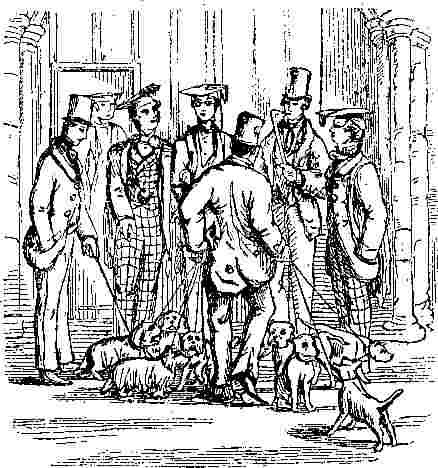
Mop was for following Mr. Lucre, who had clumped away up
the street; and his new master had some difficulty in keeping him
at his heels. By Mr. Bouncer's advice, he at once took him over the
river to the field opposite the Christ Church meadows, in order to
test his rat-killing powers. How this could be done out in the open
country, our hero was at a loss to know; but he discreetly held his
tongue, for he was gradually becoming aware that a freshman in
Oxford must live to learn, and that, as with most men,
experientia docet.
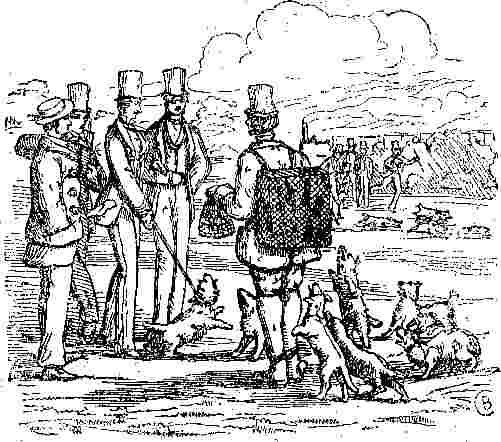
They had just been punted over the river, and Mop had
been restored to terra firma, when Mr. Bouncer's remark of
"There's the cove that'll do the trick for you!" directed Verdant's
attention to an individual, who, from his
general appearance, might have been first cousin to "Filthy Lucre,"
only that his live stock was of a different description. Slung from
his shoulders was a large but shallow wire cage, in which were
about a dozen doomed rats, whose futile endeavours to make their
escape by running up the sides of their prison were regarded with
the most intense earnestness by a group of terriers, who gave way
to various phases of excitement. In his hand he carried a small
circular cage, containing two or three rats for immediate use. On
the receipt of sixpence, one of these was liberated; and a few
yards start being (sportsmanlike) allowed, the speculator's terrier
was then let loose, joined gratuitously, after a short interval, by
a perfect pack in full cry, with a human chorus of "Hoo rat! Too
loo! loo dog!" The rat turned, twisted, doubled, became confused,
was overtaken, and, with one grip and a shake, was dead; while the
excited pack returned to watch and jump at the wire cages until
another doomed prisoner was tossed forth to them. Gentlemen on
their way for a walk were thus enabled to wile away a few minutes
at the noble sport, and indulge themselves and their dogs with a
little healthy excitement; while the boating costume of other
gentlemen shewed that they had for a while left aquatic pursuits,
and had strolled up from the river to indulge in "the sports of the
fancy."
Although his new master invested several sixpences on
Mop's behalf, yet that ungrateful animal, being of a passive
temperament of mind as regarded rats, and a slow movement of body,
in consequence of his long hair impeding his progress, rather
disgraced himself by allowing the sport to be taken from his very
teeth. But he still further disgraced himself, when he had been
taken back to Brazenface, by howling all through the night in the
cupboard where he had been placed, thereby setting on Mr. Bouncer's
two bull-terriers, Huz and Buz, to echo the sounds with redoubled
fury from their coal-hole quarters; thus causing loss of sleep and
a great outlay of Saxon expletives to all the dwellers on the
staircase. It was in vain that our hero got out of bed and opened
the cupboard-door, and said, "Poo Mop! good dog, then!" it was in
vain that Mr. Bouncer shied boots at the coal-hole, and threatened
Huz and Buz with loss of life; it was in vain that the tenant of
the attic, Mr. Sloe, who was a reading-man, and sat up half the
night, working for his degree, - it was in vain that he opened his
door, and mildly declared (over the banisters), that it was
impossible to get up Aristotle while such a noise was being made;
it was in vain that Mr. Four-in-hand Fosbrooke, whose rooms were on
the other side of Verdant's, came and administered to Mop
severe punishment with a tandem-whip (it was a favourite boast with
Mr. Fosbrooke, that he could flick a fly from his leader's ear); it
was in vain to coax Mop with chicken-bones: he would neither
be bribed nor frightened, and after a deceitful lull of a few
minutes, just when every one was getting to sleep again, his
melancholy howl would be raised with renewed vigour, and Huz and
Buz would join for sympathy.
"I tell you what, Gig-lamps," said Mr. Bouncer the next morning;
"this game'll never do. Bark's a very good thing to take in its
proper way, when you're in want of it, and get it with port wine;
but when you get it by itself and in too large doses, it ain't
pleasant, you know. Huz and Buz are quiet enough, as long as
they're let alone; and I should advise you to keep Mop down
at Spavin's stables, or somewhere. But first, just let me give the
brute the hiding he deserves."
Poor Mop underwent his punishment like a martyr; and in
the course of the day an arrangement was made with Mr. Spavin for
Mop's board and lodging at his stables. But when Verdant
called there the next day, for the purpose of taking him for a
walk, there was no Mop to be found; taking advantage of the
carelessness of one of Mr. Spavin's men, he had bolted through the
open door, and made his escape. Mr. Bouncer, at a subsequent
period, declared that he met Mop in the company of a
well-known Regent-street fancier; but, however that may be,
Mop was lost to Mr. Verdant Green.
Back to Contents
THE state of Mr. Verdant Green's outward man had long offended
Mr. Charles Larkyns' more civilized taste; and he one day took
occasion delicately to hint to his friend, that it would conduce
more to his appearance as an Oxford undergraduate, if he forswore
the primitive garments that his country-tailor had condemned him to
wear, and adapted the "build" of his dress to the peculiar
requirements of university fashion.
Acting upon this friendly hint, our freshman at once betook
himself to the shop where he had bought his cap and gown, and found
its proprietor making use of the invisible soap and washing his
hands in the imperceptible water, as though he had not left that
act of imaginary cleanliness since Verdant and his father had last
seen him.
"Oh, certainly, sir; an abundant variety," was his reply to
Verdant's question, if he could show him any patterns that were
fashionable in Oxford. "The greatest stock hout of London, I should
say, sir, decidedly. This is a nice unpretending gentlemanly thing,
sir, that we make up a good deal!" and he spread a shaggy substance
before the freshman's eyes.
"What do you make it up for?" inquired our hero, who thought it
more nearly resembled the hide of his lamented Mop than any
other substance.
"Oh, morning garments, sir! Reading and walking-coats, for
erudition and the promenade, sir! Looks well with vest of the same
material, sprinkled down with coral currant buttons! We've some
sweet things in vests, sir; and some neat, quiet trouserings, that
I'm sure would give satisfaction." And the tailor and robe-maker,
between washings with the invisible soap, so visibly "soaped" our
hero in what is understood to be the shop-sense of the word, and so
surrounded him with a perfect irradiation of aggressive patterns of
oriental gorgeousness, that Mr. Verdant Green
became bewildered, and finally made choice
of one of the unpretending gentlemanly Mop-like coats, and
"vest and trouserings," of a neat, quiet, plaid-pattern, in red and
green, which, he was informed, were all the rage.
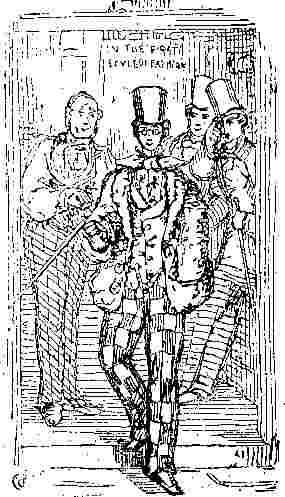
When these had been sent home to him, together with a neck-tie
of Oxford-blue from Randall's, and an immaculate guinea
Lincoln-and-Bennett, our hero was delighted with the general effect
of the costume; and after calling in at the tailor's to express his
approbation, he at once sallied forth to "do the High," and display
his new purchases. A drawn silk bonnet of pale lavender, from which
floated some bewitching ringlets, quickly attracted our hero's
attention; and the sight of an arch, French-looking face, which (to
his short-sighted imagination) smiled upon him as the young lady
rustled by, immediately plunged him into the depths of first-love.
Without the slightest encouragement being given him, he stalked
this little deer to her lair, and, after some difficulty,
discovered the enchantress to be Mademoiselle Mouslin de Laine, one
of the presiding goddesses of a fancy hosiery warehouse. There, for
the next fortnight, - until which immense period his ardent passion
had not subsided, - our hero was daily to be seen purchasing
articles for which he had no earthly use, but fully recompensed for
his outlay by the artless (ill-natured people said, artful) smiles,
and engaging, piquant conversation of mademoiselle. Our hero, when
reminded of this at a subsequent period, protested that he had thus
acted merely to improve his French, and only conversed with
mademoiselle for educational purposes. But we have our doubts.
Credat Judaeus!
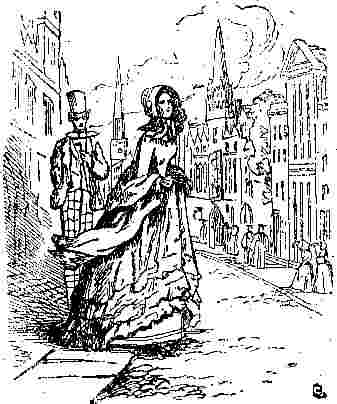
About this time also our hero laid the nest-eggs for a very
promising brood of bills, by acquiring an expensive habit of
strolling in to shops, and purchasing "an extensive assortment of
articles of every description," for no
other consideration than that he should not be called upon to pay
for them until he had taken his degree. He also decorated the walls
of his rooms with choice specimens of engravings: for the turning
over of portfolios at Ryman's, and Wyatt's, usually leads to the
eventual turning over of a considerable amount of cash; and our
hero had not yet become acquainted with the cheaper
circulating-system of pictures, which gives you a fresh set every
term, and passes on your old ones to some other subscriber. But, in
the meantime, it is very delightful, when you admire any thing, to
be able to say, "Send that to my room!" and to be obsequiously
obeyed, "no questions asked," and no payment demanded; and as for
the future, why - as Mr. Larkyns observed, as they strolled down
the High - "I suppose the bills will come in some day or
other, but the governor will see to them; and though he may grumble
and pull a long face, yet he'll only be too glad you've got your
degree, and, in the fulness of his heart, he will open his
cheque-book. I daresay old Horace gives very good advice when he
says, 'carpe diem'; but when he adds, 'quam minimum credula
postero,' [14] about 'not giving the
least credit to the succeeding day,' it is clear that he never
looked forward to the Oxford tradesmen and the credit-system. Do
you ever read Wordsworth, Verdant?" continued Mr. Larkyns, as they
stopped at the corner of Oriel Street, to look in at a spacious
range of shop-windows, that were crowded with a costly and
glittering profusion of papier mache articles, statuettes,
bronzes, glass, and every kind of "fancy goods" that could be
classed as "art-workmanship."
---
[14] Car. i. od. xi.
-=-
"Why, I've not read much of Wordsworth myself," replied our
hero; "but I've heard my sister Mary read a great deal of his
poetry."
"Shews her taste," said Charles Larkyns. "Well, this shop - you
see the name - is Spiers'; and Wordsworth, in his sonnet to Oxford,
has immortalized him. Don't you remember the lines?-
| 'O ye Spiers of Oxford! your presence overpowers |
| The soberness of reason!' [15] |
---
[15] We suspect that Mr. Larkyns is again intentionally deceiving
his freshman friend; for on looking into our Wordsworth (Misc.
Son. iii. 2) we find that the poet does not refer to the
establishment of Messrs. Spiers and Son, and that the lines, truly
quoted, are,
| "O ye spires of Oxford! domes and
towers! |
| Gardens and groves! Your presence,"
&c. |
We blush for Mr. Larkyns!
-=-
It was very queer that Wordsworth should ascribe to Messrs.
Spiers all the intoxication of the place; but then he was a
Cambridge man, and prejudiced. Nice shop,
though, isn't it? Particularly useful, and no less ornamental. It's
one of the greatest lounges of the place. Let us go in and have a
look at what Mrs. Caudle calls the articles of bigotry and
virtue."
Mr. Verdant Green was soon deeply engaged in an inspection of
those papier-mache "remembrances of Oxford" for which the
Messrs. Spiers are so justly famed; but after turning over tables,
trays, screens, desks, albums, portfolios, and other things, - all
of which displayed views of Oxford from every variety of aspect,
and were executed with such truth and perception of the higher
qualities of art, that they formed in themselves quite a small but
gratuitous Academy exhibition, - our hero became so confused among
the bewildering allurements around him, as to feel quite an
embarras de richesses, and to be in a state of mind in which
he was nearly giving Mr. Spiers the most extensive (and expensive)
order which probably that gentleman had ever received from an
undergraduate. Fortunately for his purse, his attention was
somewhat distracted by perceiving that Mr. Slowcoach was at his
elbow, looking over ink-stands and reading-lamps, and also by
Charles Larkyns calling upon him to decide whether he should have
the cigar-case he had purchased emblazoned with the heraldic device
of the Larkyns, or illuminated with the Euripidean motto,-
{To bakchikon doraema labe, se gar
philo.}
When this point had been decided, Mr. Larkyns proposed to
Verdant that he should astonish and delight his governor by having
the Green arms emblazoned on a fire-screen, and taking it home with
him as a gift. "Or else," he said, "order one with the garden-view
of Brazenface, and then they'll have more satisfaction in looking
at that than at one of those offensive cockatoos, in an arabesque
landscape, under a bronze sky, which usually sprawls over every
thing that is papier mache. But you won't see that sort of
thing here; so you can't well go wrong, whatever you buy." Finally,
Mr. Verdant Green (N.B. Mr. Green, senior, would have eventually to
pay the bill) ordered a fire-screen to be prepared with the
family-arms, as a present for his father; a ditto, with the view of
his college, for his mother; a writing-case, with the High Street
view, for his aunt; a netting-box, card-case, and a model of the
Martyrs' Memorial, for his three sisters; and having thus
bountifully remembered his family-circle, he treated himself with a
modest paper-knife, and was treated in return by Mr. Spiers with a
perfect bijou of art, in the shape of "a memorial for
visitors to Oxford," in which the chief glories of that city were
set forth in gold and colours, in the most attractive form, and
which our hero immediately posted off to the Manor Green.
"And now, Verdant," said Mr. Larkyns, "you may just as well get
a hack, and come for a ride with me. You've kept up your riding, of
course."
"Oh, yes - a little!" faltered our hero.
Now, the reader may perhaps remember, that in an early part of
our veracious chronicle we hinted that Mr. Verdant Green's
equestrian performances were but of a humble character. They were,
in fact, limited to an occasional ride with his sisters when they
required a cavalier; but on these occasions, the old cob, which
Verdant called his own, was warranted not to kick, or plunge, or
start, or do anything derogatory to its age and infirmities. So
that Charles Larkyns' proposition caused him some little nervous
agitation; nevertheless, as he was ashamed to confess his fears,
he, in a moment of weakness, consented to accompany his friend.
"We'll go to Symonds'," said Mr. Larkyns; "I keep my hack there;
and you can depend upon having a good one."
So they made their way to Holywell Street, and turned under a
gateway, and up a paved yard, to the stables. The upper part of the
yard was littered down with straw, and covered in by a light, open
roof; and in the stables there was accommodation for a hundred
horses. At the back of the stables, and separated from the Wadham
Gardens by a narrow lane, was a paddock; and here they found Mr.
Fosbrooke, and one or two of his friends, inspecting the leaping
abilities of a fine hunter, which one of the stable-boys was taking
backwards and forwards over the hurdles and fences erected for that
purpose.
The horses were soon ready, and Verdant summoned up enough
courage to say, with the Count in Mazeppa, "Bring forth the
steed!" And when the steed was brought, in all the exuberance of
(literally) animal spirits, he felt that he was about to be another
Mazeppa, and perform feats on the back of a wild horse; and he
could not help saying to the ostler, "He looks rather -vicious, I'm
afraid!"
"Wicious, sir," replied the groom; "bless you, sir! she's as
sweet-tempered as any young ooman you ever paid your intentions to.
The mare's as quiet a mare as was ever crossed; this 'ere's ony her
play at comin' fresh out of the stable!"
Verdant, however, had a presentiment that the play would soon
become earnest; but he seated himself in the saddle (after a short
delirious dance on one toe), and in a state of extreme agitation,
not to say perspiration, proceeded at a walk, by Mr. Larkyns' side,
up Holywell Street. Here the mare, who doubtless soon understood
what sort of rider she had got on her back, began to be more
demonstrative of the "fresh"ness of her animal spirits. Broad
Street was scarcely broad enough to contain the series of
tableaux vivants and heraldic attitudes that she assumed.
"Don't pull the curb-rein so!" shouted Charles Larkyns; but Verdant
was in far too dreadful a state of mind to understand what he said,
or even to know which was the curb-rein; and after
convulsively clutching at the mane and the pommel, in his
endeavours to keep his seat, he first "lost his head," and then his
seat, and ignominiously gliding over the mare's tail, found that
his lodging was on the cold ground. Relieved of her burden, the
mare quietly trotted back to her stables; while Verdant, finding
himself unhurt, got up, replaced his hat and spectacles, and
registered a mental vow never to mount an Oxford hack again.
"Never mind, old fellow!" said Charles Larkyns,
consolingly; "these little accidents
will occur, you know, even with the best regulated
riders!
There were not more than a dozen ladies saw you, though
you certainly made very creditable exertions to ride over one or
two of them. Well! if you say you won't go back to Symonds', and
get another hack, I must go on solus; but I shall see you at the
Bump-supper to-night! I got old Blades to ask you to it. I'm going
now in search of an appetite, and I should advise you to take a
turn round the Parks and do the same. Au
reservoir!"
So our hero, after he had compensated the livery-stable keeper,
followed his friend's advice, and strolled round the neatly-kept
potato-gardens denominated "the Parks," looking in vain for the
deer that have never been there, and finding them represented only
by nursery-maids and - others.
Mr. Blades, familiarly known as "old Blades" and "Billy," was a
gentleman who was fashioned somewhat after the model of the torso
of Hercules; and, as Stroke of the Brazenface boat, was held in
high estimation, not only by the men of his own college, but also
by the boating men of the University at large. His University
existence seemed to be engaged in one long struggle, the end and
aim of which was to place the Brazenface boat in that envied
position known in aquatic anatomy as "the head of the river;" and
in this struggle all Mr. Blades' energies of mind and body, -
though particularly of body, - were engaged. Not a freshman was
allowed to enter Brazenface, but immediately Mr. Blades' eye was
upon him; and if the expansion of the upper part of his coat and
waistcoat denoted that his muscular development of chest and arms
was of a kind that might be serviceable to the great object
aforesaid - the placing of the Brazenface boat at the head of the
river, - then Mr. Blades came and made flattering proposals to the
new-comer to assist in the great work. But he was also
indefatigable, as secretary to his college club, in seeking out all
freshmen, even if their thews and sinews were not muscular models,
and inducing them to aid the glorious cause by becoming members of
the club.
A Bump-supper - that is, O ye uninitiated! a supper to
commemorate the fact of the boat of one college
having, in the annual races, bumped, or
touched the boat of another college immediately in its front,
thereby gaining a place towards the head of the river, - a
Bump-supper was a famous opportunity for discovering both the
rowing and paying capabilities of freshmen, who, in the enthusiasm
of the moment, would put down their two or three guineas, and at
once propose their names to be enrolled as members at the next
meeting of the club.
And thus it was with Mr. Verdant Green, who, before the evening
was over, found that he had not only given in his name ("proposed
by Charles Larkyns, Esq., seconded by Henry Bouncer, Esq."), but
that a desire was burning within his breast to distinguish himself
in aquatic pursuits. Scarcely any thing else was talked of during
the whole evening but the prospective chances of Brazenface bumping
Balliol and Brasenose, and thereby getting to the head of the
river. It was also mysteriously whispered, that Worcester and
Christ Church were doing well, and might prove formidable; and that
Exeter, Lincoln, and Wadham were very shady, and not doing the
things that were expected of them. Great excitement too was caused
by the announcement, that the Balliol stroke had knocked up, or
knocked down, or done some thing which Mr. Verdant Green concluded
he ought not to have done; and that the Brasenose bow had been seen
with a cigar in his mouth, and also eating pastry in Hall, - things
shocking in themselves, and quite contrary to all training
principles. Then there were anticipations of Henley; and criticisms
on the new eight out-rigger that Searle
was laying down for the University crew; and comparisons between
somebody's stroke and somebody else's spurt; and a good deal of
reference to Clasper and Coombes, and Newall and Pococke, who might
have been heathen deities for all that our hero knew, and from the
manner in which they were mentioned.
The aquatic desires that were now burning in Mr. Verdant Green's
breast could only be put out by the water; so to the river he next
day went, and, by Charles Larkyns' advice, made his first essay in
a "tub" from Hall's. Being a complete novice with the oars, our
hero had no sooner pulled off his coat and given a pull, than he
succeeded in catching a tremendous "crab," the effect of which was
to throw him backwards, and almost to upset the boat. Fortunately,
however, "tubs" recover their equilibrium almost as easily as
tombolas, and "the Sylph" did not belie its character; so the
freshman again assumed a proper position, and was shoved off with a
boat-hook. At first he made some hopeless splashes in the stream,
the only effect of which was to make the boat turn with a circular
movement towards Folly Bridge; but Charles Larkyns at once came to
the rescue with the simple but energetic compendium of boating
instruction, "Put your oar in deep, and bring it out with a
jerk!"
Bearing this in mind, our hero's efforts met with well-merited
success; and he soon passed that mansion which, instead of cellars,
appears to have an ingenious system of small rivers to thoroughly
irrigate its foundations. One by one, too, he passed those
house-boats which are more like the Noah's
arks of toy-shops than anything else, and sometimes contain quite
as original a mixture of animal specimens.
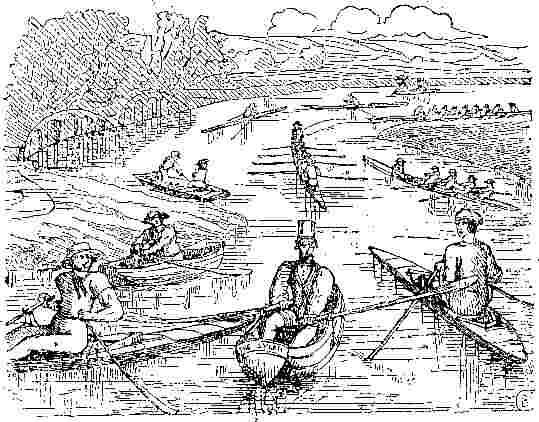
Warming with his exertions, Mr. Verdant Green passed the
University barge in great style, just as the eight was preparing to
start; and though he was not able to "feather his oars with skill
and dexterity," like the jolly young waterman in the song, yet his
sleight-of-hand performances with them proved not only a source of
great satisfaction to the crews on the river, but also to the
promenaders on the shore.
He had left the Christ Church meadows far behind, and was
beginning to feel slightly exhausted by his unwonted exertions,
when he reached that bewildering part of the river termed "the
Gut." So confusing were the intestine commotions of this gut, that,
after passing a chequered existence as an aquatic shuttlecock, and
being assailed with a slang-dictionary-full of opprobrious
epithets, Mr. Verdant Green caught another tremendous crab, and
before he could recover himself, the "tub" received a shock, and,
with a loud cry of "Boat ahead!" ringing in his ears, the
University Eight passed over the place where he and "the Sylph" had
so lately disported themselves.
With the wind nearly knocked out of his body by the blade of the
bow-oar striking him on the chest as he rose to the surface, our
unfortunate hero was immediately dragged from the water, in a
condition like that of the child in The Stranger (the only
joke, by the way, in that most dreary play) "not dead, but very
wet!" and forthwith placed in safety in his deliverer's boat.
"Hallo, Gig-lamps! who the doose had thought of seeing you here,
devouring Isis in this expensive way!" said a voice very coolly.
And our hero found that he had been rescued by little Mr. Bouncer,
who had been tacking up the river in company with Huz and Buz and
his meerschaum. "You have been and gone and done it now,
young man!" continued the vivacious little gentleman, as he
surveyed our hero's draggled and forlorn condition. "If you'd only
a comb and a glass in your hand, you'd look distressingly like a
cross-breed with a mermaid! You ain't subject to the whatdyecallems
- the rheumatics, are you? Because, if so, I could put you on shore
at a tidy little shop where you can get a glass of
brandy-and-water, and have your clothes dried; and then mamma won't
scold."
"Indeed," chattered our hero, "I shall be very glad indeed; for
I feel - rather cold. But what am I to do with my boat?"
"Oh, the Lively Polly, or whatever her name is, will find her
way back safe enough. There are plenty of boatmen on the river
who'll see to her and take her back to her owner; and if you got
her from Hall's, I daresay she'll dream that she's dreamt in marble
halls, like you did, Gig-lamps, that night at Smalls', when you got
wet in rather a more lively style than you've done to-day. Now I'll
tack you up to that little shop I told you of."
So there our hero was put on shore, and Mr. Bouncer made fast
his boat and accompanied him; and did not leave him until he had
seen him between the blankets, drinking a glass of hot
brandy-and-water, the while his clothes were smoking before the
fire.
This little adventure (for a time at least) checked Mr. Verdant
Green's aspirations to distinguish himself on the river; and he
therefore renounced the sweets of the Isis, and contented himself
by practising with a punt on the Cherwell. There, after repeatedly
overbalancing himself in the most suicidal manner, he at length
peacefully settled down into the lounging blissfulness of a
"Cherwell water-lily;" and on the hot days, among those gentlemen
who had moored their punts underneath the overhanging boughs of the
willows and limes, and beneath their cool
shade were lying, in dolce far niente fashion, with their
legs up and a weed in their mouth, reading the last new novel, or
some less immaculate work, - among these gentlemen might haply have
been discerned the form and spectacles of Mr. Verdant Green.
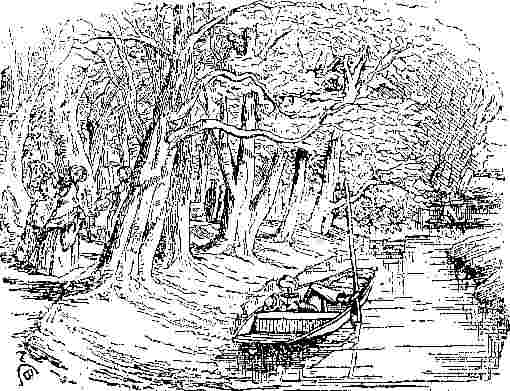
Back to Contents
ARCHERY was all the fashion at Brazenface. They had as fine a
lawn for it as the Trinity men had; and all day long there was
somebody to be seen making holes in the targets, and endeavouring
to realize the pose of the Apollo Belvidere; - rather a
difficult thing to do, when you come to wear plaid trousers and
shaggy coats. As Mr. Verdant Green felt desirous not only to uphold
all the institutions of the University, but also to make himself
acquainted with the sports and pastimes of the place, he forthwith
joined the Archery and Cricket Clubs. He at once inspected the
manufactures of Muir and Buchanan; and after selecting from their
stores a fancy-wood bow, with arrows, belt, quiver, guard, tips,
tassels, and grease-pot, he felt himself to be duly prepared to
represent the Toxophilite character. But the sustaining it was a
more difficult thing than he had conceived; for although he thought
that it would be next to impossible to miss a shot
when the target was so large, and the
arrow went so easily from the bow, yet our hero soon discovered
that even in the first steps of archery there was something to be
learnt, and that the mere stringing of his bow was a performance
attended with considerable difficulty.
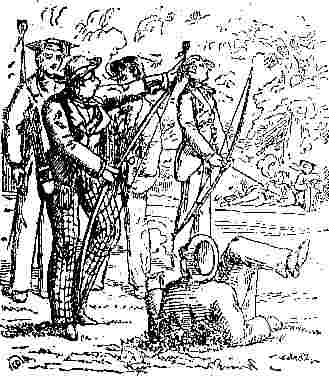
It was always slipping from his instep, or twisting the wrong
way, or threatening to snap in sunder, or refusing to allow his
fingers to slip the knot, or doing something that was dreadfully
uncomfortable, and productive of
perspiration; and two or three times he was reduced to the abject
necessity of asking his friends to string his bow for him.
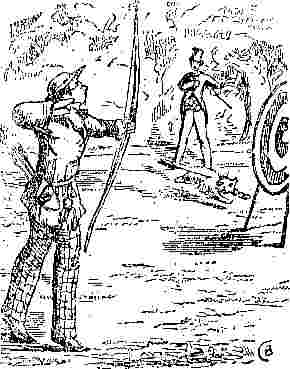
But when he had mastered this slight difficulty, he found that
the arrows (to use Mr. Bouncer's phrase) "wobbled," and had a
predilection for going anywhere but into the target,
notwithstanding its size; and unfortunately one went into the body
of the Honourable Mr. Stormer's favourite Skye terrier, though,
thanks to its shaggy coat and the bluntness of the arrow, it did
not do a great amount of mischief; nevertheless, the vials of Mr.
Stormer's wrath were outpoured upon Mr. Verdant Green's head; and
such epea pteroenta followed the
winged arrow, that our hero became alarmed, and for the time
forswore archery practice.
As he had fully equipped himself for archery, so also Mr.
Verdant Green, (on the authority of Mr. Bouncer) got himself up for
cricket regardless of expense; and he made his first appearance in
the field in a straw hat with blue ribbon, and "flannels," and
spiked shoes of perfect propriety.
As Mr. Bouncer had told him that, in cricket, attitude was every
thing, Verdant, as soon as he went in
for his innings, took up what he considered to be a very good
position at the wicket. Little Mr. Bouncer, who was bowling,
delivered the ball with a swiftness that seemed rather astonishing
in such a small gentleman. The first ball was "wide;" nevertheless,
Verdant (after it had passed) struck at it, raising his bat high in
the air, and bringing it straight down to the ground as though it
were an executioner's axe. The second ball was nearer to the mark;
but it came in with such swiftness, that, as Mr. Verdant Green was
quite new to round bowling, it was rather too quick for him, and
hit him severely on the -, well, never mind, - on the trousers.
"Hallo, Gig-lamps!" shouted the delighted Mr. Bouncer, "nothing
like backing up; but it's no use assuming a stern appearance;
you'll get your hand in soon, old feller!"
But Verdant found that before he could get his hand in, the ball
was got into his wicket; and that while he was preparing for the
strike, the ball shot by; and, as Mr. Stumps, the wicket-keeper,
kindly informed him, "there was a row in his timber-yard." Thus
Verdant's score was always on the lucus a non lucendo
principle of derivation, for not even to a quarter of a score did
it ever reach; and he felt that he should never rival a Mynn or be
a Parr with any one of the "All England" players.
Besides these out-of-door sports, our hero also devoted a good
deal of his time to acquiring in-door games, being quickly
initiated into the mysteries of billiards, and plunging headlong
into pool. It was in the billiard-room that Verdant first formed
his acquaintance with Mr. Fluke of Christ Church, well known to be
the best player in the University, and who, if report spoke truly,
always made his five hundred a year by his skill in the game. Mr.
Fluke kindly put our hero "into the way to become a player ;" and
Verdant soon found the apprenticeship was attended with rather
heavy fees.
At the wine-parties also that he attended he became rather a
greater adept at cards than he had formerly been. "Van John" was
the favourite game; and he was not long in discovering that
[s]taking shillings and half-crowns, instead of counters and
"fish," and going odds on the colours, and losing five pounds
before he was aware of it, was a very different thing to playing
vingt-et-un at home with his sisters for "love" - (though
perhaps cards afford the only way in which young ladies at
twenty-one will play for love).
In returning to Brazenface late from these parties, our hero was
sometimes frightfully alarmed by suddenly finding himself face to
face with a dreadful apparition, to which, by constant familiarity,
he gradually became accustomed, and learned to look upon as the
proctor with his marshal and bulldogs.
At first, too, he was on such occasions greatly alarmed
at finding the gates of Brazenface closed,
obliging him thereby to "knock-in;" and not only did he apologize
to the porter for troubling him to open the wicket, but he also
volunteered elaborate explanations of the reasons that had kept him
out after time, - explanations that were not received in the spirit
with which they were tendered. When our freshman became aware of
the mysteries of a gate-bill, he felt more at his ease.
Mr. Verdant Green learned many things during his freshman's
term, and, among others, he discovered that the quiet retirement of
college-rooms, of which he had heard so much, was in many cases an
unsubstantial idea, founded on imagination, and built up by
fancy.
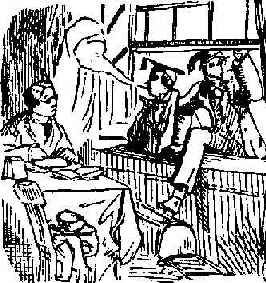
One day that he had been writing a letter in Mr. Smalls' rooms,
which were on the ground-floor, Verdant congratulated himself that
his own rooms were on the third floor, and were thus removed from
the possibility of his friends, when he had sported his oak, being
able to get through his window to "chaff" him; but he soon
discovered that rooms upstairs had also objectionable points in
their private character, and were not altogether such eligible
apartments as he had at first anticipated. First, there was the
getting up and down the dislocated staircase, a feat which at night
was sometimes attended with difficulty.
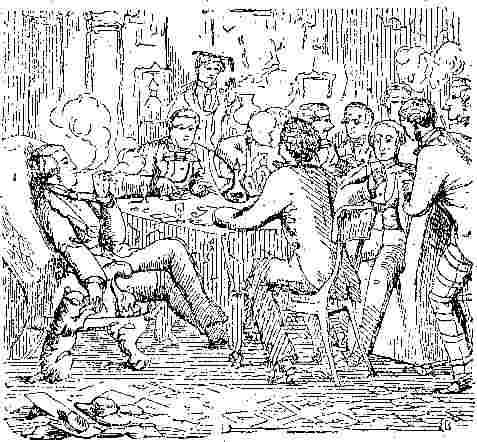
Then, when he had accomplished this
feat, there was no way of escaping from the noise of his
neighbours. Mr. Sloe, the reading-man in the garret above, was one
of those abominable nuisances, a peripatetic student, who "got
up"
every subject by pacing up and down his limited apartment, and,
like the sentry, "walked his dreary round" at unseasonable hours of
the night, at which time could be plainly heard the wretched
chuckle, and crackings of knuckles (Mr. Sloe's way of expressing
intense delight), with which he welcomed some miserable joke of
Aristophanes, painfully elaborated by the help of
Liddell-and-Scott; or the disgustingly sonorous way in which he
declaimed his Greek choruses. This was bad enough at night; but in
the day-time there was a still greater nuisance. The rooms
immediately beneath Verdant's were possessed by a gentleman whose
musical powers were of an unusually limited description, but who,
unfortunately for his neighbours, possessed the idea that the
cornet-a-piston was a beautiful instrument for pic-nics, races,
boating-parties, and other long-vacation
amusements, and sedulously practised "In my cottage near a wood,"
"Away with melancholy," and other airs of a lively character, in a
doleful and distracted way, that would have fully justified his
immediate homicide, or, at any rate, the confiscation of his
offending instrument.
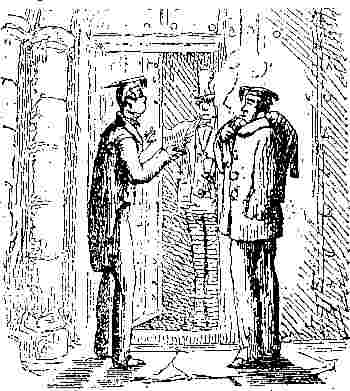
Then, on the one side of Verdant's room, was Mr. Bouncer,
sounding his octaves, and "going the complete unicorn;" and his
bull-terriers, Huz and Buz, all and each of whom were of a restless
and loud temperament; while, on the other side, were Mr.
Four-in-hand Fosbrooke's rooms, in which fencing, boxing,
single-stick, and other violent sports, were gone through, with a
great expenditure of "Sa-ha! sa-ha!" and stampings. Verdant was
sometimes induced to go in, and never could sufficiently admire the
way in which men could be rapped with single-sticks without crying
out or flinching; for it made him almost
sore even to look at them. Mr. Blades, the stroke, was a frequent
visitor there, and developed his muscles in the most satisfactory
manner.
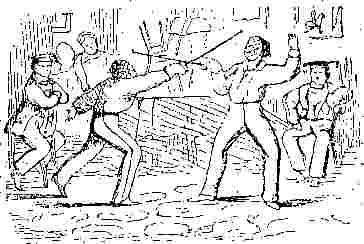
After many refusals, our hero was at length persuaded to put on
the gloves, and have a friendly bout with Mr. Blades. The result
was as might have been anticipated; and Mr. Smalls doubtless gave a
very correct resume of the proceeding (for, as we have
before said, he was thoroughly conversant with the sporting slang
of Tintinnabulum's Life), when he told Verdant, that his
claret had been repeatedly tapped, his bread-basket walked into,
his day-lights darkened, his ivories rattled, his nozzle barked,
his whisker-bed napped heavily, his kissing-trap countered, his
ribs roasted, his nut spanked, and his whole person put in
chancery, stung, bruised, fibbed, propped, fiddled,
slogged, and otherwise ill-treated. So
it is hardly to be wondered at if Mr. Verdant Green from
thenceforth gave up boxing, as a senseless and ungentlemanly
amusement.
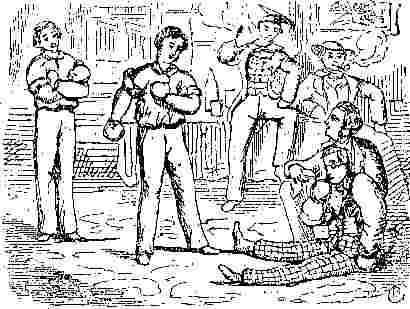
But while these pleasures(?) of the body were being attended to,
the recreation of the mind was not forgotten. Mr. Larkyns had
proposed Verdant's name at the Union; and, to that gentleman's
great satisfaction, he was not black-balled. He daily, therefore,
frequented the reading-room, and made a point of looking through
all the magazines and newspapers; while he felt quite a pride in
sitting in luxurious state upstairs, writing his letters to the
home department on the very best note-paper, and sealing them
extensively with "the Oxford Union" seal; though he could not at
first be persuaded that trusting his letters to a wire closet was
at all a safe system of postage.
He also attended the Debates, which were then held in the
long room behind Wyatt's; and he was
particularly charmed with the manner in which vital questions, that
(as he learned from the newspapers) had proved stumbling-blocks to
the greatest statesmen of the land, were rapidly solved by the
embryo statesmen of the Oxford Union. It was quite a sight, in that
long picture-room, to see the rows of light iron seats densely
crowded with young men - some of whom would perhaps rise to be
Cannings, or Peels, or Gladstones - and to hear how one beardless
gentleman would call another beardless gentleman his "honourable
friend," and appeal "to the sense of the House," and address
himself to "Mr. Speaker;" and how they would all juggle the same
tricks of rhetoric as their fathers were doing in certain other
debates in a certain other House. And it was curious, too, to mark
the points of resemblance between the two Houses; and how the
smaller one had, on its smaller scale, its Hume, and its Lord John,
and its "Dizzy;" and how they went through the same traditional
forms, and preserved the same time-honoured ideas, and debated in
the fullest houses, with the greatest spirit and the greatest
length, on such points as, "What course
is it advisable for this country to take in regard to the
government of its Indian possessions, and the imprisonment of Mr.
Jones by the Rajah of Humbugpoopoonah?"
Indeed, Mr. Verdant Green was so excited by this interesting
debate, that on the third night of its adjournment he rose to
address the House; but being "no orator as Brutus is," his few
broken words were received with laughter, and the honourable
gentleman was coughed down.
Our hero had, as an Oxford freshman, to go through that cheerful
form called "sitting in the schools," - a form which consisted in
the following ceremony. Through a door in the right-hand corner of
the Schools Quadrangle, - (Oh, that door! does it not bring a pang
into your heart only to think of it? to remember the day when you
went in there as pale as the little pair of bands in which you were
dressed for your sacrifice; and came out all in a glow and a chill
when your examination was over; and posted your bosom-friend there
to receive from Purdue the little slip of paper, and bring you the
thrilling intelligence that you had passed; or to come
empty-handed, and say that you had been plucked!
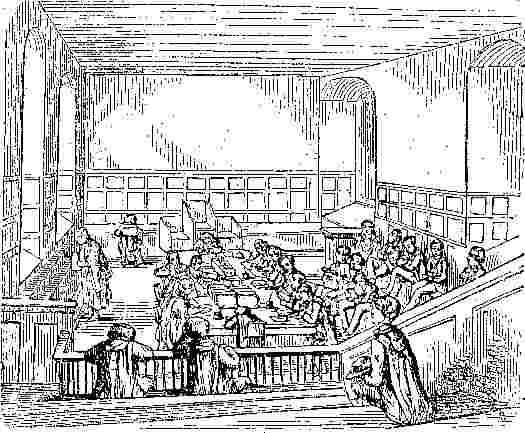
Oh that door! well might be inscribed
there the line which, on Dante's authority, is assigned to the door
of another place, -
"ALL HOPE ABANDON, YE WHO ENTER HERE!")
- entering through this door in company with several other
unfortunates, our hero passed between two galleries through a
passage, by which, if the place had been a circus, the horses would
have entered, and found himself in a tolerably large room lighted
on either side by windows, and panelled half-way up the walls. Down
the centre of this room ran a large green-baize-covered table, on
the one side of which were some eight or ten miserable beings who
were then undergoing examination, and were supplied with pens, ink,
blotting-pad, and large sheets of thin "scribble-paper," on which
they were struggling to impress their ideas; or else had a book set
before them, out of which they were construing, or being racked
with questions that touched now on one subject and now on another,
like a bee among flowers. The large table was liberally supplied
with all the apparatus and instruments of torture; and on the other
side of it sat the three examiners, as dreadful and
formidable as the terrible three of
Venice.
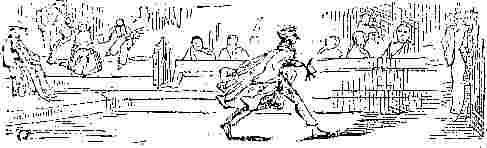
At the upper end of the room was a chair of state for the
Vice-Chancellor, whenever he deigned to personally superintend the
torture; to the right and left of which accommodation was provided
for other victims.
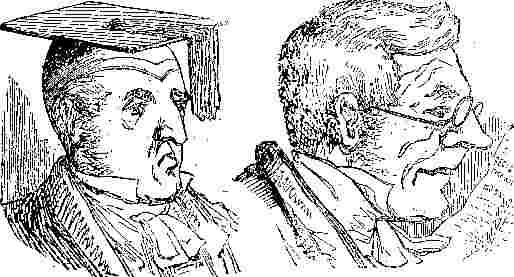
On the right hand of the room was a small open
gallery of two seats (like those seen in
infant schools); and here, from 10 in the morning till 4 in the
afternoon, with only the interval of a quarter of an hour for
luncheon, Mr. Verdant Green was compelled to sit and watch the
proceedings, his perseverance being attested to by a certificate
which he received as a reward for his meritorious conduct. If this
"sitting in the schools" [16] was
established as an in terrorem form for the spectators, it
undoubtedly generally had the desired effect; and what with the
misery of sitting through a whole day on a hard bench with nothing
to do, and the agony of seeing your fellow-creatures plucked, and
having visions of the same prospective fate for yourself, the day
on which the sitting takes place was usually regarded as one of
those which, "if 'twere done, 'twere well it should be done
quickly."
---
[16] This form has been abolished (1853) under the new
regulations.
-=-
As an appropriate sequel to this proceeding, Mr. Verdant Green
attended the interesting ceremony of conferring degrees; where he
discovered that the apparently insane promenade of the proctor gave
rise to the name bestowed on (what Mr. Larkyns called) the equally
insane custom of "plucking." [17]
There too our hero saw the Vice-Chancellor in all his glory; and so
agreeable were the proceedings, that altogether he had a great deal
of Bliss. [18]
---
[17] When the degrees are
conferred, the name of each person is read out before he is
presented to the Vice-Chancellor. The proctor then walks once up
and down the room, so that any person who objects to the degree
being granted may signify the same by pulling or "plucking" the
proctor's robes. This has been occasionally done by tradesmen in
order to obtain payment of their "little bills;" but such a
proceeding is very rare, and the proctor's promenade is usually
undisturbed.
[18] The Rev. Philip Bliss, D.C.L., after holding the onerous post
of Registrar of the University for many years, and discharging its
duties in a way that called forth the unanimous thanks of the
University, resigned office in 1853.
-=-
Back to Contents
"BEFORE I go home," said Mr. Verdant Green, as he expelled a
volume of smoke from his lips, - for he had overcome his first
weakness, and now "took his weed" regularly, - "before I go home, I
must see what I owe in the place; for my
father said he did not like for me to run in debt, but wished me to
settle my bills terminally."
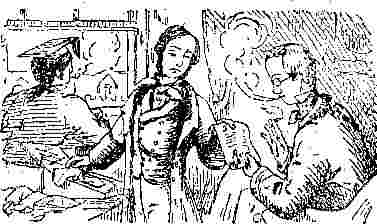
"What, you're afraid of having what we call bill-ious fever, I
suppose, eh?" laughed Charles Larkyns. "All exploded ideas, my dear
fellow. They do very well in their way, but they don't answer;
don't pay, in fact; and the shopkeepers don't like it either. By
the way, I can shew you a great curiosity; - the autograph of an
Oxford tradesman, very rare! I think of presenting it to the
Ashmolean." And Mr. Larkyns opened his writing-desk, and took
therefrom an Oxford pastrycook's bill, on which appeared the magic
word, "Received."
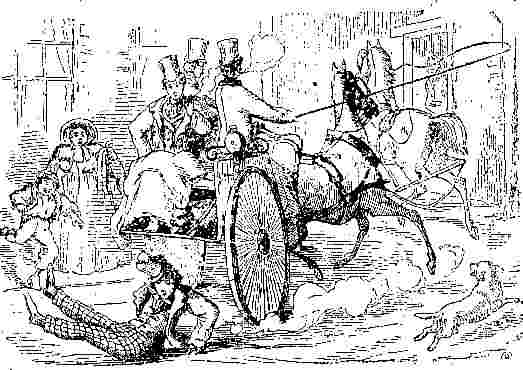
"Now, there is one thing," continued Mr. Larkyns, "which you
really must do before you go down, and that is to see Blenheim. And
the best thing that you can do is to join Fosbrooke and Bouncer and
me, in a trap to Woodstock to-morrow. We'll go in good time, and
make a day of it."
Verdant readily agreed to make one of the party; and the next
morning, after a breakfast in Charles Larkyns' rooms, they made
their way to a side street leading out of Beaumont Street, where
the dog-cart was in waiting. As it was drawn by two horses, placed
in tandem fashion, Mr. Fosbrooke had an opportunity of displaying
his Jehu powers; which he did to great advantage, not allowing his
leader to run his nose into the cart, and being enabled to turn
sharp corners without chipping the bricks, or running the wheel up
the bank.
They reached Woodstock after a very pleasant ride, and clattered
up its one long street to the principal hotel; but Mr. Fosbrooke
whipped into the yard to the left so rapidly, that our hero, who
was not much used to the back seat of a dog-cart, flew off by some
means at a tangent to the right, and was consequently degraded in
the eyes of the inhabitants.
After ordering for dinner every thing that the house was enabled
to supply, they made their way in the first place (as it could only
be seen between 11 and 1) to Blenheim; the princely splendours of
which were not only costly in themselves, but, as our hero soon
found, costly also to the sight-seer. The doors in the suite
of apartments were all opposite to each other, so that, as a
crimson cord was passed from one to the other, the spectator was
kept entirely to the one side of the room, and merely a glance
could be obtained of the Raffaelle, the glorious Rubens's,
[19] the Vandycks, and the almost
equally fine Sir Joshuas. But even the glance they had was but a
passing one, as the servant trotted them through the rooms with the
rapidity of locomotion and explanation of a Westminster Abbey
verger; and he made a fierce attack on Verdant, who had lagged
behind, and was short-sightedly peering at the celebrated "Charles
the First" of Vandyck, as though he had lingered in order to
surreptitiously appropriate some of the tables, couches, and other
trifling articles that ornamented the rooms. In this way they went
at railroad pace through the suite of rooms and the library,
- where the chief thing pointed out appeared to be a grease-mark on
the floor made by somebody at somebody else's wedding-breakfast, -
and to the chapel, where they admired the ingenuity of the sparrows
and other birds that built about Rysbrach's monumental mountain of
marble to the memory of the Duke and Duchess of Marlborough; - and
then to the so-called "Titian room" (shade of mighty Titian,
forgive the insult!) where they saw the Loves of the Gods
represented in the most unloveable manner,[20] and where a flunkey lounged lazily at the
door, and, in spite of Mr. Bouncer's expostulatory "chaff,"
demanded half-a-crown for the sight.
---
[19] Dr Waagen says that the Rubens collection at Blenheim is only
surpassed by the royal galleries of Munich, Vienna, Madrid, and
Paris.
[20] The ladies alone would repel one by their gaunt ugliness,
their flesh being apparently composed of the article on which the
pictures are painted, leather. The only picture not by "Titian" in
this room is a Rubens, - "the Rape of Proserpine" - to see which is
well worth the half-crown charged for the sight of the
others.
-=-
Indeed, the sight-seeing at Blenheim seemed to be a system of
half-crowns. The first servant would take them a little way, and
then say, "I don't go any further, sir; half-a-crown!" and hand
them over to servant number two, who, after a short interval, would
pass them on (half-a-crown!) to the servant who shewed the chapel
(half-a-crown!), who would forward them on to the "Titian" Gallery
(half-a-crown!), who would hand them over to the flower-garden
(half-a-crown!), who would entrust them to the rose-garden
(half-a-crown!), who would give them up to another, who shewed
parts of the Park, and the rest of it. Somewhat in this manner an
Oxford party sees Blenheim (the present of the nation); and Mr.
Verdant Green found it the most expensive show-place he had ever
seen.
Some of the Park, however, was free (though they were two or
three times ordered to "get off the grass"); and they rambled about
among the noble trees, and admired the fine views of the Hall, and
smoked their weeds, and became very pathetic at Rosamond's Spring.
They then came back into Woodstock, which they found to be like all
Oxford towns, only rather duller perhaps,
the principal signs of life being some fowls lazily pecking about
in the grass-grown street, and two cats sporting without fear of
interruption from a dog, who was too much overcome by the
ennui of the place to interfere with them.
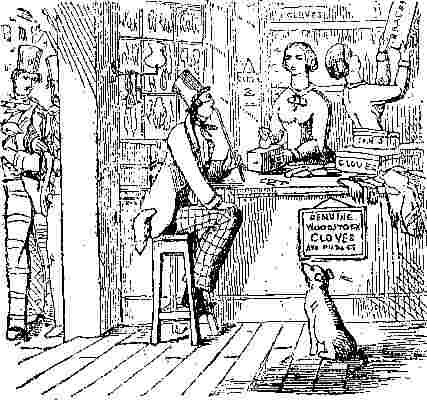
Mr. Bouncer then led the way to an inn, where the bar was
presided over by a young lady, "on whom," he said, "he was
desperately sweet," and with whom he conversed in the most affable
and brotherly manner, and for whom also he had brought, as an
appropriate present, a Book of Comic Songs; "for," said the little
gentleman, "hang it! she's a girl of what you call mind, you
know! and she's heard of the opera, and begun the piano, - though
she don't get much time, you see, for it in the bar, - and she
sings regular slap-up, and no mistake!"
So they left this young lady drawing bitter beer for Mr.
Bouncer, and otherwise attending to her adorer's wants, and
endeavoured to have a game of billiards on a wooden table that had
no cushions, with curious cues that had no leathers. Slightly
failing in this difficult game, they strolled about till
dinner-time, when Mr. Verdant Green became mysteriously lost for
some time, and was eventually found by Charles Larkyns and Mr.
Fosbrooke in a glover's shop, where he was sitting on a high stool,
and basking in the sunshiny smiles of two "neat little glovers."
Our hero at first feigned to be simply making purchases of
Woodstock gloves and purses, as souvenirs of his visit, and
presents for his sisters; but in the course of the evening, being
greatly "chaffed" on the subject, he began to exercise his
imagination, and talk of the "great fun" he had had; - though what
particular fun there may be in smiling amiably across a counter at
a feminine shopkeeper who is selling you gloves, it is hard to say:
perhaps Dr. Sterne could help us to an answer.
They spent altogether a very lively day; and after a rather
protracted sitting over their wine, they returned to Oxford with
great hilarity, Mr. Bouncer's post-horn coming out with great
effect in the stillness of the moonlight night. Unfortunately their
mirth was somewhat checked when they had got as far as Peyman's
Gate; for the proctor, with mistaken kindness, had taken the
trouble to meet them there, lest they should escape him by entering
Oxford by any devious way; and the marshal and the bull-dogs were
at the leader's head just as Mr. Fosbrooke was triumphantly guiding
them through the turnpike. Verdant gave up his name and that of his
college with a thrill of terror, and nearly fell off the drag from
fright, when he was told to call upon the proctor the next
morning.
"Keep your pecker up, old feller!" said Mr. Bouncer, in an
encouraging tone, as they drove into Oxford, "and don't be down in
the mouth about a dirty trick like this. He won't hurt you much,
Gig-lamps! Gate and chapel you; or give you some old Greek party to
write out; or send you down to your mammy for a twelve-month; or
some little trifle of that sort. I only wish the beggar would come
up our staircase! if Huz, and Buz his brother, didn't do their duty
by him, it would be doosid odd. Now, don't you go and get bad
dreams, Gig-lamps! because it don't pay; and you'll soon get used
to these sort of things; and what's the odds, as long as you're
happy? I like to take things coolly, I do."
To judge from Mr. Bouncer's serenity, and the far-from-nervous
manner in which he "sounded his octaves," he at least
appeared to be thoroughly used to "that sort of thing," and
doubtless slept as tranquilly as though nothing wrong had occurred.
But it was far different with our hero, who passed a sleepless
night of terror as to his probable fate on the morrow.
And when the morrow came, and he found himself in the dreaded
presence of the constituted authority, armed with all the power of
the law, he was so overcome, that he fell on his knees and made an
abject spectacle of himself, imploring that he might not be
expelled, and bring down his father's grey hairs in the usually
quoted manner. To his immense relief, however, he was treated in a
more lenient way; and as the term had nearly expired, his
punishment could not be of long duration; and as for the
impositions, why, as Mr. Bouncer said, "Ain't there coves to
barberise 'em [21] for you,
Gig-lamps?"
---
[21] Impositions are often performed by deputy.
-=-
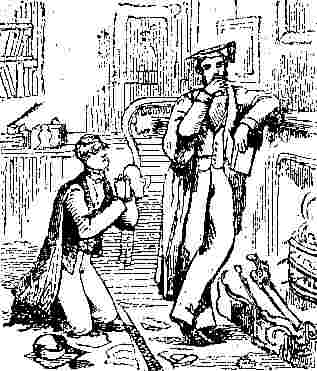
Thus our freshman gained experience daily; so that by
the end of the term, he found that short
as the time had been, it had been long enough for him to learn what
Oxford life was like, and that there was in it a great deal to be
copied, as well as some things to be shunned. The freshness he had
so freely shown on entering Oxford had gradually yielded as the
term went on; and, when he had run halloing the Brazenface boat all
the way up from Iffley, and had seen Mr. Blades realize his most
sanguine dreams as to "the head of the river;" and when, from the
gallery of the theatre, he had taken part in the licensed
saturnalia of the Commemoration, and had cheered for the ladies in
pink and blue, and even given "one more" for the very proctor who
had so lately interfered with his liberties; and when he had gone
to a farewell pass-party (which Charles Larkyns did not
give), and had assisted in the other festivities that usually mark
the end of the academical year, - Mr. Verdant Green found himself
to be possessed of a considerable acquisition of knowledge of a
most miscellaneous character; and on the authority, and in the
figurative eastern language of Mr. Bouncer, "he was sharpened up no
end, by being well rubbed against university bricks. So, good by,
old feller!" said the little gentleman, with a kind remembrance of
imaginary individuals, "and give my love to Sairey and the little
uns." And Mr. Bouncer "went the complete unicorn," for the last
time in that term, by extemporising a farewell solo to Verdant,
which was of such an agonizing character of execution, that Huz,
and Buz his brother, lifted up their noses and howled.
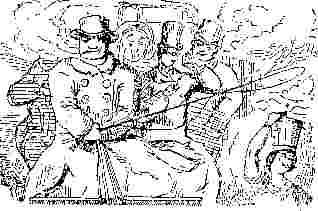
"Which they're the very moral of Christyuns, sir!" observed Mrs.
Tester, who was dabbing her curtseys in thankfulness for the large
amount with which our hero had "tipped" her. "And has ears for
moosic, sir. With grateful thanks to you, sir, for the same. And
it's obleeged I feel in my art. Which it reelly were like what my
own son would do, sir. As was found in drink for his rewing. And
were took to the West Injies for a sojer. Which he were - ugh! oh,
oh!
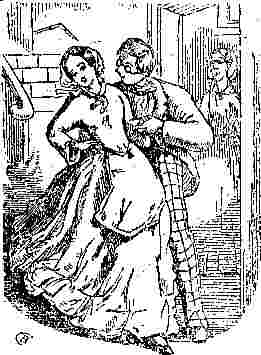
Which you be'old me a hafflicted martyr to these spazzums, sir.
And how I am to get through them doorin'
the veecation. Without a havin' 'em eased by a-goin' to your
cupboard, sir. For just three spots o' brandy on a lump o' sugar,
sir. Is a summut as I'm afeered to think on. Oh! ugh!" Upon which
Mrs. Tester's grief and spasms so completely overcame her, that our
hero presented her with an extra half-sovereign, wherewith to
purchase the medicine that was so peculiarly adapted to her
complaint. Mr. Robert Filcher was also "tipped" in the same liberal
manner; and our hero completed his first term's residence in
Brazenface by establishing himself as a decided favourite.
Among those who seemed disposed to join in this opinion was the
Jehu of the Warwickshire coach, who expressed his conviction to our
delighted hero, that "he wos a young gent as had much himproved
hisself since he tooled him up to the 'Varsity with his guvnor." To
fully deserve which high opinion, Mr. Verdant Green tipped for the
box-seat, smoked more than was good for
him, and besides finding the coachman in weeds, drank with him at
every "change" on the road.
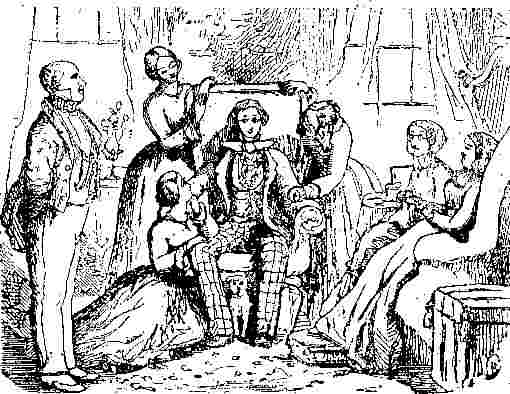
The carriage met him at the appointed place, and his luggage (no
longer encased in canvas, after the manner of females) was soon
transferred to it; and away went our hero to the Manor Green, where
he was received with the greatest demonstrations of delight.
Restored to the bosom of his family, our hero was converted into a
kind of domestic idol; while it was proposed by Miss Mary Green,
seconded by Miss Fanny, and carried by unanimous acclamation, that
Mr. Verdant Green's University career had greatly enhanced his
attractions.
The opinion of the drawing-room was echoed from the
servants'-hall, the ladies' maid in particular being heard freely
to declare, that "Oxford College had made quite a man of Master
Verdant!"
As the little circumstance on which she probably grounded her
encomium had fallen under the notice of Miss Virginia Verdant, it
may have accounted for that most correct-minded lady being more
reserved in expressing her opinion of her nephew's improvement than
were the rest of the family; but she nevertheless thought a great
deal on the subject.
"Well, Verdant!" said Mr. Green, after hearing divers anecdotes
of his son's college-life, carefully prepared for home-consumption;
"now tell us what you've learnt in Oxford."
"Why," replied our hero, as he reflected on his freshman's
career, "I have learnt to think for myself, and not to believe
every thing that I hear; and I think I could fight my way in the
world; and I can chaff a cad -"
"Chaff a cad! oh!" groaned Miss Virginia to herself, thinking it
was something extremely dreadful.
"And I have learnt to row - at least, not quite; but I can smoke
a weed - a cigar, you know. I've learnt that."
"Oh, Verdant, you naughty boy!" said Mrs. Green, with maternal
fondness. "I was sadly afraid that Charles Larkyns would teach you
all his wicked school habits!"
"Why, mama," said Mary, who was sitting on a footstool at her
brother's knee, and spoke up in defence of his college friend;
"why, mama, all gentlemen smoke; and of course Mr. Charles Larkyns
and Verdant must do as others do. But I dare say, Verdant, he
taught you more useful things than that, did he not?"
"Oh, yes," replied Verdant; "he taught me to grill a devil."
"Grill a devil!" groaned Miss Virginia. "Infatuated young
man!"
"And to make shandy-gaff and sherry-cobbler, and brew bishop and
egg-flip: oh, it's capital! I'll teach you how to make
it; and we'll have some to-night!"
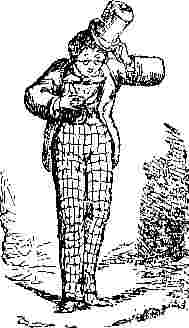
And thus the young gentleman astonished his family with the
extent of his learning, and proved how a youth of ordinary natural
attainments may acquire other knowledge in his University career
than what simply pertains to classical literature.
And so much experience had our hero gained during his freshman's
term, that when the pleasures of the Long Vacation were at an end,
and he had returned to Brazenface, with his firm and fast friend
Charles Larkyns, he felt himself entitled to assume a patronizing
air to the freshmen who then entered, and even sought to impose
upon their credulity in ways which his own personal experience
suggested.
It was clear that Mr. Verdant Green had made his farewell bow as
an Oxford Freshman.
Back to Contents
Forward to Part II
Forward to Part III
==========
(Part II of III)
Back to Part I
Forward to Part III