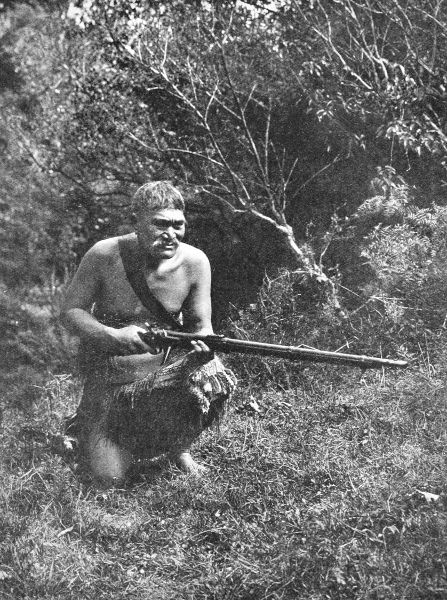
A BATTLE IN THE FOREST; AND THE DEATH
OF VON TEMPSKY
The second fight at Te Ngutu-o-te-Manu—Titokowaru's
prophecy—Tutangé and his sacred war-mat—Bent's narrow
escape—Government forces defeated—How von Tempsky fell—A
terrible retreat—Colonial soldiers' gallant rear-guard fight.
Early one warm spring afternoon in 1868, when
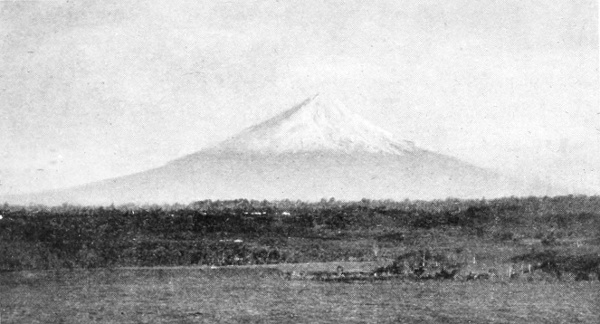
the vast forest lay steeped in calm and Taranaki's
sentry-peak rose like a great ivory tent out of the
soft blue haze that bathed its spreading base, the
sharp, cracking sound of rifle-shots broke the quiet
of the wilderness.
The shots came from the mountain side of "The
Beak-of-the-Bird," the opposite one to that by
which the white troops had advanced the previous
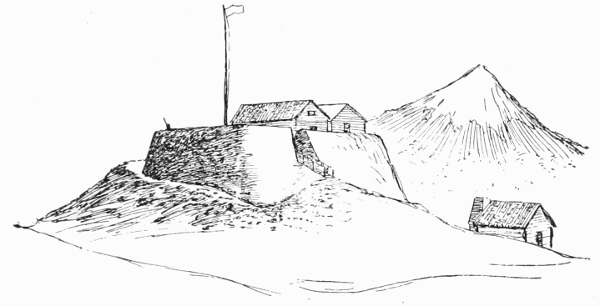
month. Te Ngutu-o-te-Manu was being taken in
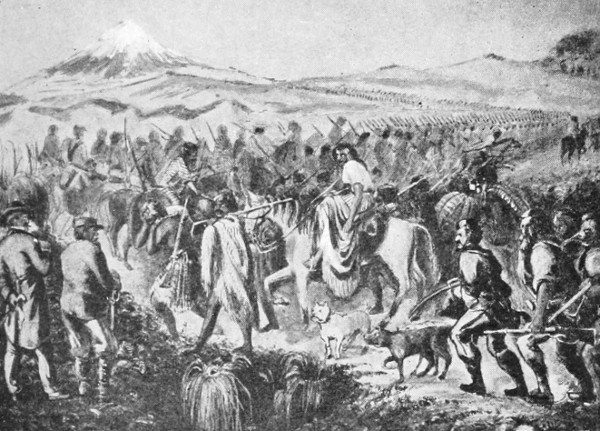
the rear this time. Colonel McDonnell had set out
from the Waihi Redoubt before daylight in the
morning, with a force of about two hundred and sixty
whites, composed of three divisions of Armed Constabulary
(many of them ex-Forest Rangers), the
newly joined Wellington Rifles and Rangers, and
a few veteran volunteers, besides about a hundred
Kupapas, the friendly Maoris from the Whanganui
and Ngati-Apa tribes under Kepa te Rangihiwinui.
Fording the swift Wai-ngongoro River (the "Waters-of-Snoring"),
the Colonel's force, guided by the
woman Takiora, marched through the native village
of Mawhitiwhiti, which was found deserted, then
turned into the dense forest, searching for the Hauhau
stronghold, which was now reported to be at
Te Rua-ruru ("The Owl's Nest"), situated somewhere
in the rear of Te Ngutu-o-te-Manu. A disastrous
search, for it ended under the palisades of the
"Bird's-Beak," the savage beak that closed savagely
on many a gallant pakeha before the sun went down
in the western sea that day.
McDonnell had hoped by his early start to take
the Hauhaus by surprise. But wary old Titokowaru
was seldom caught napping.
On the previous night—as the old warrior Tutangé
Waionui tells me—Titokowaru gathered all his men
in the big house (wharé-kura), which had now been
rebuilt. Then, when the Hauhau prayers and
chants were over, the chief arose and cried:
"E Koro ma, kia tupato! He po kino te po, he ra
kino te ra!" ("O friends, be on your guard!
This is an evil night—a night of danger, and the
morrow will be a day of danger!")
This oracular warning seemed to the superstitious
people to be a message from the gods, of whom Titokowaru
was the living medium. That night was a
night of preparation for battle. Armed men slipped
out along the trail in front of the stockade, and lay
in wait for the expected enemy.
Long the grim old chief sat on his sacred mat that
night in the wharé-kura, his enchanted tongue-pointed
taiaha lying in front of him. Karakia after
karakia he recited in a low monotone, incantations
and charms, ancient pagan and latter-day Hauhau
karakia, for success in the conflict that he felt was to
envelop his pa on the morrow in a ring of smoke and
blood.
In his own little thatched wharé that day sat
Kimble Bent, the pakeha-Maori. He, too, was busy,
squatting there on an old flax whariki mat. By his
side were a keg of gunpowder and a bag of bullets,
and in front of him a pile of old pakeha newspapers
and leaves torn from looted books. He was making
cartridges for the Hauhaus. Round a wooden
cartridge-filler he deftly rolled a scrap of paper,
forming a cylinder, which he tied securely with
thread or with fine strips of flax; then, withdrawing
the filler, he poured in the gunpowder. The cartridges
loaded, he slipped them into the cartouche-boxes
and holders, a number of which had been
brought to the wharé by the men of the Tekau-ma-rua;
when the boxes were full, the remainder of
the ammunition he stored carefully in a large flax
basket. Most of the receptacles for the ammunition—hamanu
the Maoris called them—were primitive
affairs smacking of the bush. In size and shape
they resembled the ordinary military leather cartouche-boxes,
but they were simply blocks of light
wood, generally pukatea timber, slightly curved in
shape so as to sit well on the body when strapped,
and neatly bored with from ten to eighteen holes,
each of which held a cartridge. A flap of leather
or skin—in the earlier days it was often a piece of
tattooed human skin—covered the cartridges; and
straps of leather or of dressed and ornamented flax
were attached to the hamanu, which were buckled
or tied round the waist or over the shoulders. A
well-equipped fighting-man usually wore two hamanu,
by belts over the shoulders; and at his girdle
he carried his pouches for bullets and percussion-caps.
Such was the lone white man's occupation in the
forest stockade that day before the looming battle.
Next morning, after the first meal of the day had
been set before the warriors by their women and
had been quickly eaten, the war-chief came out of
his house, taiaha in hand, and walked out on to the
village square in front of the sacred praying-house.
"Friends," he cried, as he stood there on the
marae, "I salute you! You have eaten and are
content; for the proverb says, 'When the stomach
is filled, then man is happy and satisfied' ('Ka ki te
puku, ka ora te tangata'). Now, rise up and grasp
your weapons, for I wish to see you dance the haka
and the tutu-waewae of war."
When the men were assembled on the parade
ground, in their dancing costume of a scanty waist-mat,
Titokowaru cried in a loud voice and prophesied,
saying:
"Kaore e tu te ra, kaore e titaha te ra, ka tupono
tatou kia to tatou whanaunga"—of which the meaning
is, "The sun will not have reached its zenith, the sun
will not have declined, before we have joined issue
with our relatives"—the white soldiers.
"Then," says Tutangé, "we danced our haka with
the fire of coming battle in our hearts, and we hardened
our nerves for the fight. For we knew that
Titoko was a true and powerful prophet (poropiti
whai-mana, tino kaha), and we believed that that
day would see blood shed again around Te Ngutu-o-te-Manu."
Tutangé Waionui, who was now to distinguish
himself as a daring young warrior, was but a boy.
He was not more than fifteen or sixteen years old,
but was a strong, athletic youngster, full of fire and
courage, and as agile as a monkey. He was of the
momo rangatira, or "blue blood" of Taranaki, tracing
a direct descent through a line of high chiefs and
priests from Turi, the great sailor who navigated his
long mat-winged canoe Aotea to the black iron-sand
beach of Taranaki from the far-distant Hawaiki, the
beautiful palm-fringed island of Rangiatea (Raiatea,
as its people call it now) in the Society Group. His
father, the old warrior, Maruera Whakarewataua,
had carefully schooled him in the business of arms,
the handling of the spear-tongued taiaha, most
beautiful of Maori weapons, the quick and fatal use
of the tomahawk, both the terrible long-handled
one and the short hatchet, or patiti, as well as the
musket and shot-gun and rifle of the pakeha. So
here, now, was young Tutangé on his first war-path.
That morning, when the very air seemed full of
rumours of battle and death, Tutangé was girded
with the sacred war-mat, the maro-taua.
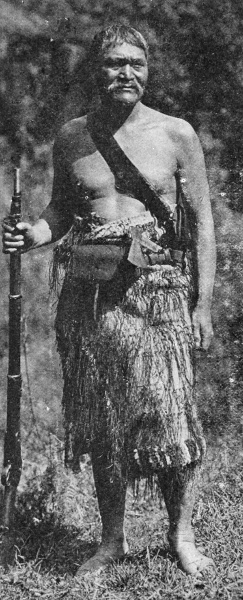
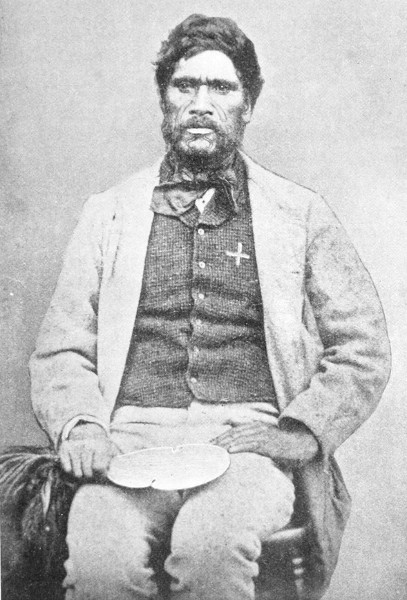
TUTANGÉ WAIONUI, A HAUHAU WARRIOR.
This photo, taken in 1908, shows Tutangé—who
was one of Titokowaru's best fighting men—stripped
and armed for the war-path as he
was in 1868.
"My father's sister," says he, "called me to her,
together with certain other young men who were of
rangatira rank, and who had not yet fought the white
man. She was a chieftainess, by name Tāngamoko;
she was of ariki birth in the Ngati-Ruanui tribe,
and being possessed of mana-tapu and of a knowledge
of charms and incantations, she was as a
priestess amongst the people. She called us to her,
and told us that she was about to make us tamariki
tapu, that is, sacred children, for the coming battle.
She girded us each with a fine waist-garment, the
korowai, made of soft dressed and closely woven
white flax, with short black thrums, or cords, hanging
down it. These flax vestures, falling from our
waists to our knees, she had made herself. They
were the garments of war; she had karakia'd over
them and charmed them so that the bullets of the
enemy should not touch them, and so that we, their
wearers, might conquer in the fight. And very
proud and confident tamariki tapu we were now,
parading the pa in our bullet-proof korowai, and
dancing our weapons in the air as we leaped with
our elders in the haka and roared out the great
chorus of the war-song beginning, 'Kia kutia—au—au!'
and that other one which our fathers had
chanted when first they set up the Maori Land
League, 'E kore Taranaki e makere atu!'
('Taranaki will not be cast away from us!')
"One of the songs which we chanted as we wildly
danced was this:
"'Whakarongo ai au
Ki te koroki manu
Whakaorooro ana i te ngahere.
I na-wa e!'
('I'm listening for the voices,
The singing of the birds,
Sounding, echoing in the forest!')
The 'singing of the birds' was a figure of speech for
the voices of the soldiers on the march.
"That maro-taua was all the clothing I wore in
the fight. Round my brows I bound a handkerchief,
which held in place my tiparé rangatira, my chief-like
war-feathers. My weapons were a double-barrelled
gun (tupara), and a short-handled tomahawk,
which I carried stuck in my belt. Round
me I had strapped a cartridge-holder. E tama!
Now I was ready for my first battle."
Meanwhile, what of the pakeha-Maori in this nest
of Hauhaus?
That morning, after he had supplied the men with
ammunition, he sat on the marae watching the war-dances.
The morning went, but there was no sign
from the outlying Hauhau piquets. Most of the
women and children had been sent away into the
bush at the rear of the pa in charge of the old chief
Te Waka-tākere-nui, in anticipation of the predicted
attack. The pakeha-Maori was also a non-combatant,
but he remained in the pa with Titokowaru
until the firing began. There were not more than
sixty fighting-men in Te Ngutu-o-te-Manu, but nearly
all of these were tried and experienced warriors,
and even those who, like young Tutangé, were still
to be blooded, were more than a match for the
average white soldier in bush-warfare.
It was well on in the afternoon before the first
shots were heard. The Maoris had expected attack
from the seaward or Waihi side, but to their surprise
the sound of the firing came from inland, indicating
that the troops had worked round to the rear of
"The Beak-of-the-Bird." The Maori advance-guard
of Colonel McDonnell's column had encountered
the Hauhaus in the bush and fired into
them.
When the first sharp rifle-cracks echoed through
the forest, Titokowaru went up to his pakeha, with
a flax kit in his hand.
"Friend," said the stern old captain, "take this
kété of mine in your charge. It contains some of my
tapu treasures; take great care of it, for I may not
see you again; I may fall with my tribe. Take it
and leave the pa, and join Te Waka-tākere-nui if
you can find his camp in the forest."
The white man took the carefully strapped kit
and hurried out of the stockade. Te Waka's camp,
he knew, was somewhere away in the rear; the firing
was in that direction, and he was in danger of falling
into the enemy's hands. However, he struck out
into the bush from the rear fence, expecting to steal
through the thick timber on the flank of the troops,
who, he guessed, were advancing by the track which
led in from the east.
He managed to elude his fellow-countrymen as
it happened, but it was "touch-and-go" with him.
Scarcely had he run out from the stockade and
entered the hollow, through which a little creek
wound through the bush at the rear of the pa, than
the advance-guard of the white column also reached
the creek, and crossed it to attack the pa. A heavy
fire was at this moment opened on the troops by the
Hauhaus, and bullets flew thick around the pakeha-Maori.
Two or three of the Armed Constabulary came
almost upon him just as he mounted the farther
bank of the creek, near where a little burial-ground
clearing broke the continuity of the thick undergrowth;
it was here that the Hauhaus had interred
those of their number killed in the previous attack
on the pa.
The Colonial soldiers must have mistaken Bent
for a Maori, for they immediately fired at him but
missed, and next moment he ducked into the jungle,
and on all-fours scrambled down into the creek bed,
where he followed down the little stream as hard as
he could go.
There was small wonder the A.C.'s took Bent for
a Maori, for it would have been difficult in the half-light
of that bush, at the distance of a few yards,
to have detected much resemblance to a white man
in the dark, shaggy-headed, bare-footed fellow with
an old and dirty blanket strapped around his waist,
a ragged jacket about his shoulders, and a red handkerchief
tied round his head.
Scrambling along, stooping low to avoid being
hit, the pakeha-Maori went down the creek until he
came to a large hollow mahoé-tree standing by the
side of the watercourse. He squeezed into the hollow
trunk of the tree, and there he remained for a few
minutes listening to the cracking of the rifles and
the loud reports of the Hauhau smooth-bores and
the yells of the combatants. Soon the firing came
nearer, and bullets began to zip through the leaves
and come plunk into the mahoé, in whose hollow
heart the white man hid.
"The bullets are finding me out," said Bent to
himself. "I'm in a fix still; anyhow, here goes,"
and he cautiously crept out from his place of concealment
and took to the jungle-fringed creek again.
Following down the creek, crawling, scrambling,
running, he presently began to feel his head more
secure on his shoulders, for the sound of the firing
grew fainter. He left the creek, and, striking
through the bush, found a familiar track which
led him to the little nook in the forest where old
Te Waka and the anxious women and terrified
children were camped. There he remained that
night.
From Te Waka's people he heard the account of
the morning's work. The Government Maori forces,
Kepa's men, came upon the camp of refugees and
killed two children; one of these, a boy of about
nine years of age, was the son of the Hauhau warrior,
Kātené Tu-Whakaruru. The other child, a little
girl, they most cruelly slew by throwing her up into
the air and spitting her on a bayonet as she fell.
Another child, a little boy, was captured, but was
saved by a Whanganui Maori, who carried him out
of the forest on his back. He was a son of Te
Karere-o-Mahuru ("The Messenger of Spring").
This boy became a protégé of Sir William Fox, who
had him educated, and he is to-day a well-known
and gifted representative Taranaki man; his name
is Pokiha (Fox) O-Mahuru. When the camp was
surprised a woman ran away into the forest in
terror; as she was never again heard of, it is
believed that the soldiers shot her.
For the rest of the story of that battle in the bush,
from the Maori side, my chief authorities are Tutangé
Waionui, who gave me his narrative in 1908, and
Whakawhiria, of Taranaki. Of the disaster from
the European side there are numerous accounts, no
two of which agree. The truth is, it was a lamentably
bungled affair, redeemed by numerous acts of
personal heroism, and particularly by the gallant
rear-guard action fought by a portion of the column
under the brave young Captain Roberts during the
terrible retreat which followed the repulse of the
troops.
The Government force outnumbered the Hauhaus
in the pa by more than five to one. Of this, however,
McDonnell and his officers and men were
ignorant, otherwise there might have been a very
different story to tell. In the obscurity of the
dense bush, where the savage forest-men were in
their familiar haunts, everything was strange and
terrible to the recruits, and the imagination magnified
the numbers of the foe, who poured bullets from
their well-masked fastnesses.
Yet many of the whites were old and seasoned
bushmen, who had served in the Forest Rangers
and other corps; they had carried their carbines
on many a dangerous forest trail, and fought the
Hauhaus again and again, and they were led by
officers of ability, coolness, and bravery. Under
McDonnell there was, for one, that soldier of fortune,
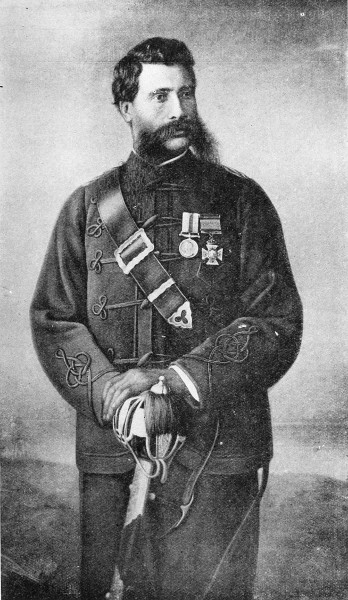
Major Gustavus von Tempsky, most picturesque of
guerilla fighters, the central figure in many stories
of daring and adventure, the adored of his bush-whackers
and the terror of the Maoris.
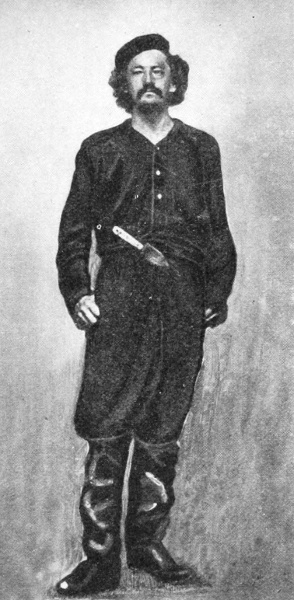
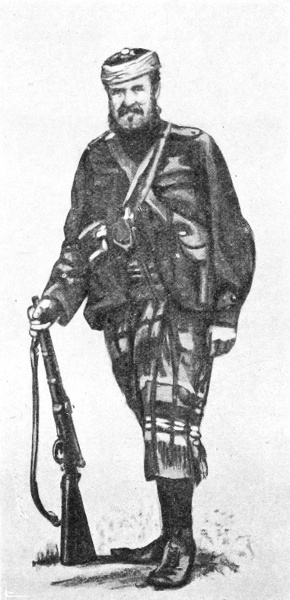
MAJOR VON TEMPSKY
(From a photo, 1865.)
"Wawahi-waka," the Waikato Maoris called him—"The
Splitter-of-Canoes"—because of his exploits
in war. "Manu-rau"—"Hundred Birds"—was
the name by which he was known amongst the
Taranaki Hauhaus. The name had been given him
because of his activity in rushing from place to
place, fighting here and fighting there, as swiftly
as the forest-birds that flitted from tree to tree.
Every Maori knew of "Manu-rau," and many of
those in arms had been chased by him at one time
or another during the three years of war since he
led his Forest Rangers to the assault at Otapawa
stockade.
Von Tempsky was of aristocratic Polish blood.
He had begun soldiering life as a Prussian chasseur,
had served under the unfortunate Emperor Maximilian
in Mexico, and fought in several little wars
in Central America; had been a gold-digger on the
great tented fields of Victoria and the Hauraki;
he was a clever artist in water-colours and a good
miniature painter, and he had written a book of
travels in Mexico, "Mitla," illustrated with his own
sketches. In the Waikato War he and Captain
William Jackson had led their Forest Rangers in
several sharp skirmishes, and in Taranaki he was
in the thick of the bush-fighting, and had tramped
with his veterans through the forest in General
Chute's great march from Ketemarae northwards
to Mataitawa and New Plymouth, round the back
of the Mountain.
[7]
He was a good shot, a finished swordsman, and
could throw a bowie-knife with deadly accuracy.
It was in Mexico that he learned the use of the
knife, and he never tired of impressing on his men
its advantages in bush fighting.
Swarthy of visage, with long, black, curling hair,
upon which a forage cap was cocked at a defiant
angle, his grey flannel shirt carelessly open at the
neck, his trousers tucked into long boots that came
nearly up to his knees, a bowie-knife in a sheath
and a revolver at his belt, a naked sword, long and
curved, in his hand—this was von Tempsky on the
war-path, a picturesquely brigand-like figure, upon
whom the soldiers' eyes rested with wonder and a
good deal of admiration.
Of that disastrous attack on "The Beak-of-the-Bird"
stockade many accounts have been given,
but the many discrepancies in detail that an examination
of each account reveals are hardly to be wondered
at, considering the confusion and misunderstandings
that arose and that largely wrought the
defeat of Colonel McDonnell's column. The dense
and roadless forest, with its intricacies of undergrowth
and interlacings of supplejack, and the
inequalities of the ground made it difficult for the
Colonial soldiers to keep in touch with each other,
and the extraordinary activity and mobility of their
savage assailants, who were perfectly at home in
their jungly woods, more than compensated for
the difference in numbers. The forest trees were the
Hauhau redoubts. Amongst these trees, their naked
brown skins nearly blending in colour with the
trunks, they were almost invisible, and in most
cases only the puffs of smoke, or brown arms moving
up and down using the ramrods, indicated their
lurking places. They darted from one cover to
another with the quickness of monkeys, and though
their weapons were mostly muzzle-loading smooth-bores,
they managed to fire and reload with astonishing
celerity. Too many of McDonnell's force were
newly joined, raw young fellows, who now for the
first time met the Maori warrior in the bush, and
the hidden foe, with their merciless fire and their
terrible yells of hate and defiance, struck terror to
many a recruit's heart.
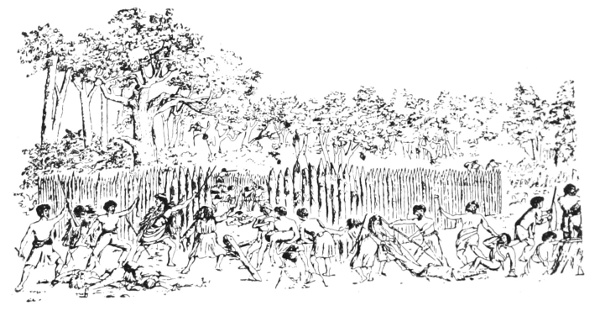
Some of the large rata and pukatea trees growing
close to the stockade were hollow, and in several
of these the Maoris had cut loopholes, which they
used for musketry fire. Some of the trees, too, spat
leaden death. Brown figures flitted like forest-demons
from cover to cover. At these and at the
naked arms and shaggy heads that showed themselves
for a moment the coolest and best shots of
the Constabulary sent their bullets, and every now
and then a Hauhau came crashing to the ground;
but for every Maori that was hit five white men
fell.
The forest rang with the sharp cracking of the
rifles and the bang-banging of the heavily charged
muzzle-loaders, and within the stockade the women
that remained encouraged their warriors with shrill
yells.
"Kill them! Eat them!" they screamed, as
they waved their shawls and mats. "Fight on,
fight on! Let not one escape!"
White men dropped quickly, wounded or shot
dead. McDonnell evidently over-estimated the
strength of the enemy, for he concluded that it
would be impossible to rush the pa or to hold it if
it was successfully rushed, for the enemy were now
all round him. Had he only known the real state
of affairs, that there were barely sixty armed Hauhaus,
of whom only about twenty remained within
the stockade, the story of Te Ngutu-o-te-Manu would
have been far less saddening, at any rate to the
pakeha.
McDonnell, considering the position too strong
to be carried by assault, determined to strike out
to the left through the forest and retire. Von
Tempsky and Major Hunter pleaded with him to
let them charge the stockade, but the Colonel would
not consent, and presently ordered the retreat.
Moving off, he sent a message to von Tempsky
telling him to collect his men and form a rear-guard.
He sent the wounded on with Major Hunter and
Captain Newland, and followed with about eighty
men, cutting a way through the undergrowth.
Von Tempsky remained, angry and disgusted at
being refused permission to storm the pa, but too
good a soldier to disobey orders. With him were
most of the men of his two Armed Constabulary
Divisions, No. 2 and No. 5, with Sub-Inspectors
(Captains) Brown and J. M. Roberts, a few Patea
Rifle Volunteers under Captain Palmer, the Wellington
Rangers under Lieutenants Hastings and
Hunter, and about twenty-five Taranaki Volunteers
under Lieutenant Rowan.
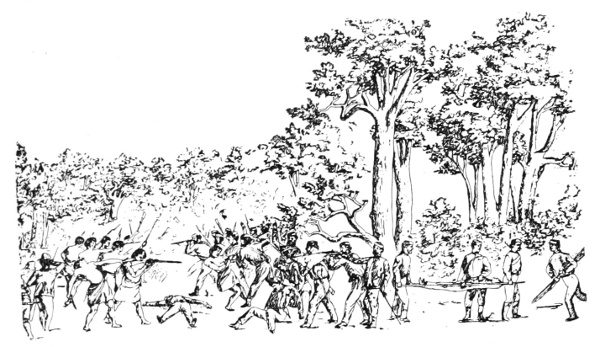
Sword in hand, von Tempsky moved restlessly to
and fro, regardless of the bullets that hummed about
him. He ordered those nearest him to take cover
but himself remained erect, angrily cutting at the
undergrowth with his sword. And there he was
when a Hauhau bullet found him.
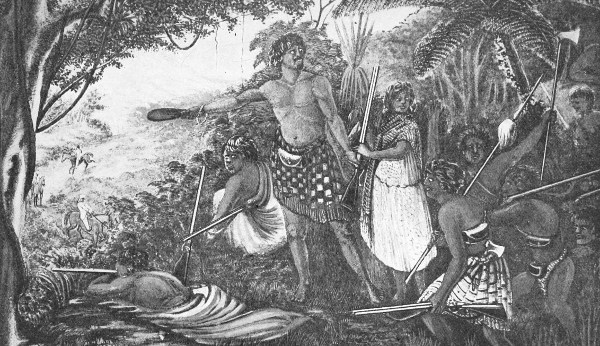
Now I will let the Maoris tell their story of how
von Tempsky and his comrades fell. Tutangé
Waionui says:
"When the attack on our pa began, two or three
of us, including Hotu and Tihirua, climbed up on
an old partly hollow rata-tree that grew in a slanting
position near the centre of the stockade, in order
to see whether it would be a good place from which
to fire at the pakehas. A little way up it forked
into two large branches, and it was from this fork
that we intended to fire. However, we found that
it did not suit us, as we could not see anything of
the soldiers who were hidden in the thick bush outside
the stockade, so we rushed out into the forest,
seeking our enemy.
"There were two large rata-trees outside the
stockade, but the statement made that von Tempsky
was shot from a rata is incorrect. I have seen a
picture which purports to show him being shot down
by a Maori perched in a tree. This is altogether
contrary to fact, as I will explain to you.
"When we rushed out to the rear of the pa the
soldiers were rapidly approaching the stockade.
We crouched down amongst the undergrowth, close
to the little creek, and directed our shots at the
thicket which grew between the pa and the creek.
Some of the soldiers, crossing the creek, were in this
part of the bush, and soon I saw Manu-rau (von
Tempsky). Heavy firing was going on all this time,
and many white men had fallen. Presently many
of the soldiers withdrew, carrying their wounded,
but Manu-rau remained with his men, his drawn
sword in his hand—the long curved sword which
had already become famous amongst the Maoris.
He came out into clear view of us, within a very
short distance of where we were crouching—I should
say less than half a chain. I fired with the others.
One of our bullets struck him—I have always believed
it was mine. One of his fellow-soldiers, who
was close by, ran to pick him up, and he too fell,
shot by one of my companions. Others ran out to
rescue the fallen pakehas, and they were shot down
by us and by the other Maoris, until soon there were
nine white men lying dead or wounded around
Manu-rau.
"When the Government forces had fallen back
before a kokiri, a charge, led by Kātené Tu-Whakaruru,
the Hauhau leader and scout, I ran out to
where Manu-rau was lying dying on the ground.
He seemed to be still living when I reached him.
I snatched out my tomahawk from my girdle and
dealt him a cut with it on the temple, to make sure
of him, and killed him instantly. Then I took from
him his uniform cap, his revolver and sword, and a
lever watch which he had in his pocket.
"The sword, revolver, watch, and cap which I
took from the soldier-chief's body I carried into the
pa and laid before our war-chief Titokowaru. That
was one of the rules observed by Titokowaru's war-parties;
the spoils of war must be taken to the chief
for division. I was given the revolver, and used
it afterwards in the war.
"That is the story of how von Tempsky was
killed. I hope you will, when the opportunity
comes, tell the pakehas that the picture which represents
Manu-rau as being shot by a Maori who
was perched up in a rata-tree is not correct. You
pakehas will not regard my action in tomahawking
Manu-rau as a kohuru, a murder? Well, then, as
you say, it was in the course of war, and it was quite
tika and correct. I was but a very young man then,
just a boy, and it was my first battle."
By the side of this I will put Whakawhiria's
account. Whakawhiria lives at the big native
village of Parihaka, the old-time town of the prophets
Te Whiti and Tohu. His narrative was given in
May, 1909, to the Rev. T. G. Hammond, of Opunake,
Wesleyan missionary to the Taranaki Maoris, who
has sent it on to me to supplement the other versions
of the fight. Whakawhiria's story is generally
accepted as authentic by the Taranaki Maoris;
most of the survivors of the fight agree that it was
his father Te Rangi-hina-kau, as he says, who shot
von Tempsky.
Whakawhiria was a young man of eighteen or so
at the time of this engagement, but though so young
he was already a veteran on the war-path. He had
seen the smoke of battle in 1860, at Waireka, when
the Taranaki settlers, for the first time met the
Maori on the field of war.
His estimate of the strength of the garrison in
Te Ngutu-o-te-Manu is even lower than Tutangé's,
for he says there were not more than forty-five
fighting men in the pa when it was attacked.
Te Rangi-hina-kau, Whakawhiria, and a party of
others sallied out from the stockade and met their
enemy skirmishing in the bush. In the rear of the
pa ran a little stream, the Mangotahi. On the
banks of the creek the eight Hauhaus took cover,
Whakawhiria and his nearest companions crouching
under a karaka-tree, and it was from that point that
they shot von Tempsky and his men. The eight
warriors were Te Rangi-hina-kau, Whakawhiria,
Ika-wharau, Tutangé Waionui, Te Whau, Heheu,
Umu-umu and Wairau. They fired at von Tempsky
at very close range, not more than twenty paces,
just across the little creek.
"It was Te Rangi-hina-kau who shot von
Tempsky," said Whakawhiria. "He dropped on
one knee, and, taking careful aim, fired and shot
von Tempsky. He shot him through the head,
and afterwards cut out his heart as an offering to
the Maori war-gods." (Kimble Bent's and
Tutangé's versions given me contradict this.)
"Young Tutangé," continued Whakawhiria, "acted
a very brave part, but it was not he who actually
shot the major. Tutangé obtained von Tempsky's
watch as his share of the loot, and Whakawhiria
got his gun and pistol."
During the engagement Titokowaru remained in
the pa, shouting to his men, urging them to continue
firing, and yelling such battle-cries as "Whakawhiria!
Whakawhiria!" ("Twist them round
and round!" or "Encircle them!") It was from
this circumstance that the warrior Whakawhiria
assumed his present name.
[8]
On von Tempsky's fall, Captain J. M. Roberts,
a cool and gallant young Constabulary officer,
ordered his bugler to sound the "Halt" and the
"Officers' Call," and tried to form the rear-guard
into some order. Collecting as many of the wounded
as he could, he began his retreat through that
terrible death-haunted forest.
All through the fighting Titokowaru remained
within the stockade, directing the defence and
reciting incantations and chanting sacred waiatas
to his gods for success in the fight. With him was
the priestess Tangamoko, the woman who had that
morning garbed the young warrior Tutangé with the
sacred war-mat.
When von Tempsky fell and the retreat of the
survivors began, Titokowaru ordered a kokiri, or
charge, in pursuit, which, as Tutangé has mentioned,
was led by the warrior Kātené Tu-Whakaruru.
Those of the Hauhaus who were in or near the stockade
gathered under Kātené and danced in their
ferocious joy a dance of victory, and this is the
ngeri (war-song) they shouted all together as they
leaped in that terrifying tutu-waewae:
"Kia kutia—
Au—au!
Kia wherahia—
Au—au!
A kia rere atu
Te Kawana ki tawhiti,
Titiro mai ai!
Ae—ae—au!"
("Squeeze close—
Au—au! (imitating the bark of a dog)
Spread out—
Au—au!
See the Government soldiers flee away,
And turn and fearfully gaze at me.
Yes, yes—au!")
The puffy clouds of smoke now drew away from
the pa, as the Hauhaus followed their defeated foes
into the dark forest. With appalling yells they
rushed at their white enemies, tomahawking those
who had fallen to make sure of them, as Tutangé had
done with von Tempsky.
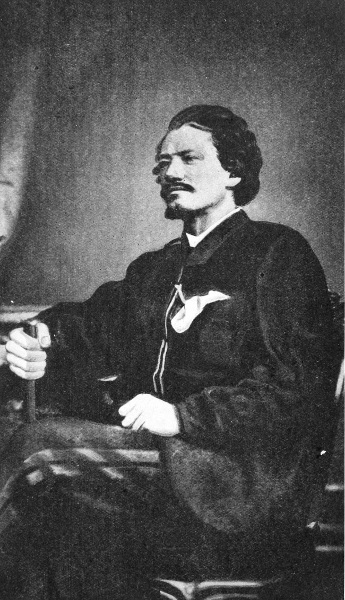
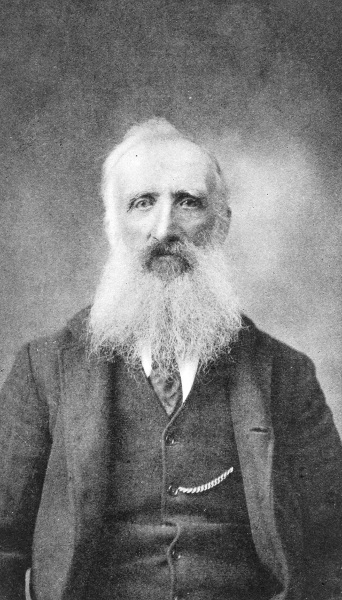
MAJOR VON TEMPSKY.
"Ka horo! Ka horo!" they yelled. "They
are beaten!" And thrusting their bloody tomahawks
into their belts they recharged their guns,
and, leaping from tree to tree, fired heavily and
incessantly at the gallant little rear-guard who were
struggling through the tangled bush, caps gone,
uniforms torn, nearly every man either wounded
or blood-stained from his comrades' wounds.
The sun had just set. The ghostly tree-shadows
lengthened, and it was already dark in the deeper
thicknesses of the bush.
Just after the retreat commenced one of Captain
Roberts' steadiest men, Corporal Russell, dropped
his carbine and fell; a big-calibre bullet had
smashed his thigh-bone.
"Shoot me, boys—shoot me!" he begged his
comrades. "Don't leave me to be tomahawked."
He knew as well as they did that his smashed
leg meant death. The rear-guard was already
encumbered with wounded and could carry no more.
"No, we can't shoot you, old man," said a big,
tall volunteer sergeant, who was a tower of strength
to Roberts' little band, shooting with deadly aim
from his post in the rear of the retreat. "Take
this," and he shoved into the wounded man's hand
a loaded revolver.
Then the sergeant (James Livingston) picked up
the corporal's empty carbine, and swinging it by
the barrel, hot with much firing, smashed it against
a tree-butt. "Old Tito'll never use that gun,
anyhow," he said.
Bursting from the trees, the brown, nearly naked
savages came yelling at the rear-guard. Hastily
slipping fresh cartridges into their carbines, the
gigantic volunteer and his comrades sent a volley
at the enemy. It was taking utu for the corporal
in anticipation. Then they sorrowfully turned and
went on into the dusky forest, leaving their comrade
stretched there on the mossy ground, gazing stern-mouthed,
unflinchingly down the way of death.
Out from the ferns and supplejack leaped the
foremost of the Hauhaus, a tattooed, blanket-girded
man, with wild eyes rolling in blood-madness. His
double-barrelled gun he had shifted from his right
hand to his left, and he drew his shining tomahawk
from his flax belt.
With an ear-ripping cry and the bound of a tiger
he came on, hatchet in air.
The corporal stiffened his back, levelled his revolver,
and fired.
The Maori fell, and lay with his face touching the
soldier's boot.
A yell of "Patua! Patua!" came from the
trees, and more bare figures with crossed cartridge-belts
came rushing on, war-axe in hand.
Gripping his revolver hard, his trigger-finger
steady, the corporal fired again, and another of his
foes fell.
Now they stood off and shot the brave corporal
dead, and so, after all, he died like a soldier and not
under the frightful tomahawk.
McDonnell's column, the stronger one, was in the
meantime fighting its way out through the forest to
the Wai-ngongoro, hard beset by the Hauhaus, who
had by this time been reinforced by others from the
nearest villages. The Maoris followed closely in the
rear and kept up a heavy fire, to which McDonnell and
his officers and men could only return occasionally;
their ammunition was getting very short. With
McDonnell marched a French Roman Catholic priest,
Father Jean Baptiste Rolland, the padre of the
forces, who had been described only a few weeks
before, in a letter written by von Tempsky, as "a
man without fear." Whenever a soldier fell, whether
he was Catholic or Protestant, the kind-faced father
was by his side in a moment, tending his wounds, and,
if dying, soothing his last moments with a prayer.
He took his turn, too, at carrying the wounded.
Three holes, drilled by Hauhau bullets, ornamented
the padre's old wide-brimmed soft felt hat when
he reached the Waihi camp that night.
It was just dark when the snoring Wai-ngongoro
was reached, and the bridgeless river, running high
and swiftly, was forded with some difficulty under
fire. At ten o'clock at night the redoubt was reached,
and here it was found that a mixed party of fugitives
from the battle-field, numbering about eighty
Europeans besides the Kupapas, had already
arrived, and had reported all the officers, McDonnell
included, killed or wounded and left on the field.
And how fared Captain Roberts' little rear-guard
of sixty men?
Extending his force in skirmishing order, the
young officer pushed on as well as he could, carrying
his wounded—one in every six. When darkness
came on he halted, for it was hopeless to try to
force a way through the jungle-matted woods in
the blackness of the night. It was a cold frosty
night, and the wounded were in agonies of pain,
which their distressed comrades were helpless to
relieve. There on the damp and freezing ground
they crouched till the moon rose at two o'clock in the
morning. Now, guided by five brave fellows of the
Maori contingent, Whanganui and Ngati-Apa men,
who stood by Roberts and his wounded to the last,
the rear-guard recommenced the retreat. Struggling
wearily on through the tangling kareao and the
densely growing shrubs, stumbling over logs and
splashing through little watercourses, they emerged
at last thankfully on to the open country, and soon,
bearing their wounded and dying comrades across
the dark flooded Wai-ngongoro, were greeted by
the joyful cheers of their comrades, European and
Maori, under Kepa te Rangihiwinui, who had set out
from the Waihi Redoubt to their rescue when
daylight broke.
Only then was the full story of the repulse pieced
together—a story of a fight that in point of numbers
was only a skirmish, as battles go, but that was the
most serious set-back the white man had yet suffered
at the hands of the brown warriors of the Taranaki
bush. Of the twenty-four whites killed five were
officers, men who could badly be spared in that
frontier warfare. The wounded numbered twenty-six,
whose rescue from the tomahawks of the Hauhau
was carried out in a way truly heroic.