CURIOSITY is natural to the soul of man, and interesting objects have
a powerful influence on our affections. Let these influencing powers
actuate, by the permission or disposal of Providence, from selfish or
social views, yet in time the mysterious will of Heaven is unfolded,
and we behold our conduct, from whatsoever motives excited, operating
to answer the important designs of Heaven. Thus we behold Kentucky,
lately a howling wilderness, the habitation of savages and wild
beasts, become a fruitful field; this region, so favorably
distinguished by nature, now become the habitation of civilization,
at a period unparalleled in history, in the midst of a raging war, and
under all the disadvantages of emigration to a country so remote from
the inhabited parts of the continent. Here, where the hand of violence
shed the blood of the innocent; where the horrid yells of savages and
the groans of the distressed sounded in our ears, we now hear the
praises and adorations of our Creator; where wretched wigwams stood,
the miserable abodes of savages, we behold the foundations of cities
laid, that, in all probability, will equal the glory of the greatest
upon earth. And we view Kentucky, situated on the fertile banks of the
great Ohio, rising from obscurity to shine with splendor equal to any
other of the stars of the American hemisphere.
The settling of this region well deserves a place in history. Most of
the memorable events I have myself been exercised in; and, for the
satisfaction of the public, will briefly relate the circumstances of
my adventures, and scenes of life, from my first movement to this
country until this day.
It was on the first of May, in the year 1769, that I resigned my
domestic happiness for a time, and left my family and peaceable
habitation on the Yadkin river, in North Carolina, to wander through
the wilderness of America, in quest of the country of Kentucky, in
company with John Finley, John Stewart, Joseph Holden, James Monay,
and William Cool. We proceeded successfully, and after a long and
fatiguing journey through a mountainous wilderness, in a westward
direction, on the 7th day of June following we found ourselves on Red
river, where John Finley had formerly been trading with the Indians,
and, from the top of an eminence, saw with pleasure the beautiful
level of Kentucky. Here let me observe that for some time we had
experienced the most uncomfortable weather, as a prelibation of our
future sufferings. At this place we encamped, and made a shelter to
defend us from the inclement season, and began to hunt and reconnoitre
the country. We found everywhere abundance of wild beasts of all
sorts, through this vast forest. The buffalo were more frequent than I
have seen cattle in the settlements, browsing on the leaves of the
cane, or cropping the herbage on those extensive plains, fearless,
because ignorant, of the violence of man. Sometimes we saw hundreds in
a drove, and the numbers about the salt springs were amazing. In this
forest, the habitation of beasts of every kind natural to America, we
practised hunting with great success until the 22d day of December
following.
This day John Stewart and I had a pleasing ramble, but fortune changed
the scene in the close of it. We had passed through a great forest,
on which stood myriads of trees, some gay with blossoms, and others
rich with fruits. Nature was here a series of wonders, and a fund of
delight. Here she displayed her ingenuity and industry in a variety of
flowers and fruits, beautifully colored, elegantly shaped, and
charmingly flavored; and we were diverted with innumerable animals
presenting themselves perpetually to our view. In the decline of the
day, near Kentucky river, as we ascended the brow of a small hill, a
number of Indians rushed out of a thick canebrake upon us, and made us
prisoners. The time of our sorrow was now arrived, and the scene fully
opened. The Indians plundered us of what we had, and kept us in
confinement seven days, treating us with common savage usage. During
this time we discovered no uneasiness or desire to escape, which made
them less suspicious of us; but in the dead of night, as we lay in a
thick canebrake by a large fire, when sleep had locked up their
senses, my situation not disposing me for rest, I touched my
companion, and gently awoke him. We improved this favorable
opportunity, and departed, leaving them to take their rest, and
speedily directed our course toward our old camp, but found it
plundered, and the company dispersed and gone home. About this time my
brother, Squire Boone, with another adventurer, who came to explore
the country shortly after us, was wandering through the forest,
determined to find me if possible, and accidentally found our camp.
Notwithstanding the unfortunate circumstances of our company, and our
dangerous situation, as surrounded with hostile savages, our meeting
so fortunately in the wilderness made us reciprocally sensible of the
utmost satisfaction. So much does friendship triumph over misfortune,
that sorrows and sufferings vanish at the meeting not only of real
friends, but of the most distant acquaintances, and substitute
happiness in their room.
Soon after this, my companion in captivity, John Stewart, was killed
by the savages, and the man that came with my brother returned home by
himself. We were then in a dangerous, helpless situation, exposed
daily to perils and death among savages and wild beasts—not a white
man in the country but ourselves.
Thus situated, many hundred miles from our families in the howling
wilderness, I believe few would have equally enjoyed the happiness we
experienced. I often observed to my brother, "You see now how little
nature requires, to be satisfied. Felicity, the companion of content,
is rather found in our own breasts than in the enjoyment of external
things; and I firmly believe it requires but a little philosophy to
make a man happy in whatsoever state he is. This consists in a full
resignation to the will of Providence; and a resigned soul finds
pleasure in a path strewed with briers and thorns."
We continued not in a state of indolence, but hunted every day, and
prepared a little cottage to defend us from the winter storms. We
remained there undisturbed during the winter; and on the 1st day of
May, 1770, my brother returned home to the settlement by himself, for
a new recruit of horses and ammunition, leaving me by myself, without
bread, salt, or sugar, without company of my fellow-creatures, or even
a horse or dog. I confess I never before was under greater necessity
of exercising philosophy and fortitude. A few days I passed
uncomfortably. The idea of a beloved wife and family, and their
anxiety upon the account of my absence and exposed situation, made
sensible impressions on my heart. A thousand dreadful apprehensions
presented themselves to my view, and had undoubtedly disposed me to
melancholy, if further indulged.
One day I undertook a tour through the country, and the diversity and
beauties of nature I met with in this charming season, expelled every
gloomy and vexatious thought. Just at the close of day the gentle
gales retired, and left the place to the disposal of a profound calm.
Not a breeze shook the most tremulous leaf. I had gained the summit of
a commanding ridge, and, looking round with astonishing delight,
beheld the ample plains, the beauteous tracts below. On the other
hand, I surveyed the famous river Ohio that rolled in silent dignity,
marking the western boundary of Kentucky with inconceivable grandeur.
At a vast distance I beheld the mountains lift their venerable brows,
and penetrate the clouds. All things were still. I kindled a fire near
a fountain of sweet water, and feasted on the loin of a buck, which a
few hours before I had killed. The sullen shades of night soon
overspread the whole hemisphere, and the earth seemed to gasp after
the hovering moisture. My roving excursion this day had fatigued my
body, and diverted my imagination. I laid me down to sleep, and I
awoke not until the sun had chased away the night. I continued this
tour, and in a few days explored a considerable part of the country,
each day equally pleased as the first. I returned again to my old
camp, which was not disturbed in my absence. I did not confine my
lodging to it, but often reposed in thick canebrakes, to avoid the
savages, who, I believe, often visited my camp, but, fortunately for
me, in my absence. In this situation I was constantly exposed to
danger and death. How unhappy such a situation for a man tormented
with fear, which is vain if no danger comes, and if it does, only
augments the pain! It was my happiness to be destitute of this
afflicting passion, with which I had the greatest reason to be
affected. The prowling wolves diverted my nocturnal hours with
perpetual howlings; and the various species of animals in this vast
forest, in the daytime, were continually in my view.
Thus I was surrounded by plenty in the midst of want. I was happy in
the midst of dangers and inconveniences. In such a diversity, it was
impossible I should be disposed to melancholy. No populous city, with
all the varieties of commerce and stately structures, could afford so
much pleasure to my mind as the beauties of nature I found here.
Thus, through an uninterrupted scene of sylvan pleasures, I spent the
time until the 27th day of July following, when my brother, to my
great felicity, met me, according to appointment, at our old camp.
Shortly after, we left this place, not thinking it safe to stay there
longer, and proceeded to Cumberland river, reconnoitring that part of
the country until March, 1771, and giving names to the different
waters.
Soon after, I returned home to my family, with a determination to
bring them as soon as possible to live in Kentucky, which I esteemed a
second paradise, at the risk of my life and fortune.
I returned safe to my old habitation, and found my family in happy
circumstances. I sold my farm on the Yadkin, and what goods we could
not carry with us; and on the 25th day of September,
1773, bade a farewell to our friends, and proceeded on our journey to
Kentucky, in company with five families more, and forty men that
joined us in Powel's Valley, which is one hundred and fifty miles from
the now settled parts of Kentucky. This promising beginning was soon
overcast with a cloud of adversity; for, upon the 10th day of October,
the rear of our company was attacked by a number of Indians, who
killed six, and wounded one man. Of these, my eldest son was one that
fell in the action. Though we defended ourselves, and repulsed the
enemy, yet this unhappy affair scattered out cattle, brought us into
extreme difficulty, and so discouraged the whole company, that we
retreated forty miles, to the settlement on Clinch river. We had
passed over two mountains, viz., Powel's and Walden's, and were
approaching Cumberland mountain when this adverse fortune overtook us.
These mountains are in the wilderness, as we pass from the old
settlements in Virginia to Kentucky, are ranged in a southwest and
northeast direction, are of a great length and breadth, and not far
distant from each other. Over these, nature hath formed passes that
are less difficult than might be expected, from a view of such huge
piles. The aspect of these cliffs is so wild and horrid, that it is
impossible to behold them without terror. The spectator is apt to
imagine that nature had formerly suffered
some violent convulsion, and that these are the dismembered
remains of the dreadful shock: the ruins, not of Persepolis or
Palmyra, but of the world!
I remained with my family on Clinch until the 6th of June, 1774, when
I and one Michael Stoner were solicited by Governor Dunmore of
Virginia to go to the falls of the Ohio, to conduct into the
settlement a number of surveyors that had been sent thither by him
some months before; this country having about this time drawn the
attention of many adventurers. We immediately complied with the
Governor's request, and conducted in the surveyors—completing a tour
of eight hundred miles, through many difficulties, in sixty-two days.
Soon after I returned home, I was ordered to take the command of three
garrisons during the campaign which Governor Dunmore carried on
against the Shawanese Indians; after the conclusion of which, the
militia was discharged from each garrison, and I, being relieved from
my post, was solicited by a number of North Carolina gentlemen, that
were about purchasing the lands lying on the south side of Kentucky
river, from the Cherokee Indians, to attend their treaty at Wataga in
March, 1775, to negotiate with them, and mention the boundaries of the
purchase. This I accepted; and, at the request of the same gentlemen,
undertook to mark out a road in the best passage from the settlement
through the wilderness to Kentucky, with such assistance as I thought
necessary to employ for such an important undertaking.
I soon began this work, having collected a number of enterprising men,
well armed. We proceeded with all possible expedition until we came
within fifteen miles of where Boonesborough now stands, and where we
were fired upon by a party of Indians that killed two, and wounded two
of our number; yet, although surprised and taken at a disadvantage, we
stood our ground. This was on the 20th of March, 1775. Three days
after, we were fired upon again, and had two men killed, and three
wounded. Afterward we proceeded on to Kentucky river without
opposition; and on the 1st day of April began to erect the fort of
Boonesborough at a salt lick, about sixty yards from the river, on the
south side.
On the fourth day, the Indians killed one of our men. We were busily
employed in building this fort until the 14th day of June following,
without any further opposition from the Indians; and having finished
the works, I returned to my family, on Clinch.
In a short time I proceeded to remove my family from Clinch to this
garrison, where we arrived safe, without any other difficulties than
such as are common to this passage; my wife and daughter being the
first white women that ever stood on the banks of Kentucky river.
On the 24th day of December following, we had one man killed, and one
wounded, by the Indians, who seemed determined to persecute us for
erecting this fortification.
On the 14th day of July, 1776, two of Colonel Calaway's daughters, and
one of mine, were taken prisoners near the fort. I immediately pursued
the Indians with only eight men, and on the 16th overtook them, killed
two of the party, and recovered the girls. The same day on which this
attempt was made, the Indians divided themselves into different
parties, and attacked several forts, which were shortly before this
time erected, doing a great deal of mischief. This was extremely
distressing to the new settlers. The innocent husbandman was shot
down, while busy in cultivating the soil for his family's supply. Most
of the cattle around the stations were destroyed. They continued their
hostilities in this manner until the 15th of April, 1777, when they
attacked Boonesborough with a party of above one hundred in number,
killed one man, and wounded four. Their loss in this attack was not
certainly known to us.
On the 4th day of July following, a party of about two hundred Indians
attacked Boonesborough,
killed one man, and wounded two. They
besieged us forty-eight hours, during which time seven of them were
killed, and, at last, finding themselves not likely to prevail, they
raised the siege, and departed.
The Indians had disposed their warriors in different parties at this
time, and attacked the different garrisons, to prevent their assisting
each other, and did much injury to the distressed inhabitants.
On the 19th day of this month, Colonel Logan's fort was besieged by a
party of about two hundred Indians. During this dreadful siege they
did a great deal of mischief, distressed the garrison, in which were
only fifteen men, killed two, and wounded one. The enemy's loss was
uncertain, from the common practice which the Indians have of carrying
off their dead in time of battle. Colonel Harrod's fort was then
defended by only sixty-five men, and Boonesborough by twenty-two,
there being no more forts or white men in the country, except at the
Falls, a considerable distance from these: and all, taken
collectively, were but a handful to the numerous warriors that were
everywhere dispersed through the country, intent upon doing all the
mischief that savage barbarity could invent. Thus we passed through a
scene of sufferings that exceeds description.
On the 25th of this month, a reinforcement of
forty-five men arrived
from North Carolina, and about the 20th of August following, Colonel
Bowman arrived with one hundred men from Virginia. Now we began to
strengthen; and hence, for the space of six weeks, we had skirmishes
with Indians, in one quarter or other, almost every day.
The savages now learned the superiority of the Long Knife, as they
call the Virginians, by experience; being outgeneralled in almost
every battle. Our affairs began to wear a new aspect, and the enemy,
not daring to venture on open war, practised secret mischief at times.
On the 1st day of January, 1778, I went with a party of thirty men to
the Blue Licks, on Licking river, to make salt for the different
garrisons in the country.
On the 7th day of February, as I was hunting to procure meat for the
company, I met with a party of one hundred and two Indians, and two
Frenchmen, on their march against Boonesborough, that place being
particularly the object of the enemy.
They pursued, and took me; and brought me on the 8th day to the Licks,
where twenty-seven of my party were, three of them having previously
returned home with the salt. I, knowing it was impossible for them to
escape, capitulated with the enemy, and, at a distance, in their
view,
gave notice to my men of their situation, with orders not to
resist, but surrender themselves captives.
The generous usage the Indians had promised before in my capitulation,
was afterward fully complied with, and we proceeded with them as
prisoners to Old Chilicothe, the principal Indian town on Little
Miami, where we arrived, after an uncomfortable journey in very severe
weather, on the 18th day of February, and received as good treatment
as prisoners could expect from savages. On the 10th day of March
following, I and ten of my men were conducted by forty Indians to
Detroit, where we arrived the 30th day, and were treated by Governor
Hamilton, the British commander at that post, with great humanity.
During our travels, the Indians entertained me well, and their
affection for me was so great, that they utterly refused to leave me
there with the others, although the Governor offered them one hundred
pounds sterling for me, on purpose to give me a parole to go home.
Several English gentlemen there, being sensible of my adverse fortune,
and touched with human sympathy, generously offered a friendly supply
for my wants, which I refused, with many thanks for their
kindness—adding, that I never expected it would be in my power to
recompense such unmerited generosity.
The Indians left my men in captivity with the British at Detroit, and
on the 10th day of April brought me toward Old Chilicothe, where we
arrived on the 25th day of the same month. This was a long and
fatiguing march, through an exceeding fertile country, remarkable for
fine springs and streams of water. At Chilicothe I spent my time as
comfortably as I could expect; was adopted, according to their custom,
into a family, where I became a son, and had a great share in the
affection of my new parents, brothers, sisters, and friends. I was
exceedingly familiar and friendly with them, always appearing as
cheerful and satisfied as possible, and they put great confidence in
me. I often went a hunting with them, and frequently gained their
applause for my activity at our shooting-matches. I was careful not to
exceed many of them in shooting; for no people are more envious than
they in this sport. I could observe, in their countenances and
gestures, the greatest expressions of joy when they exceeded me; and,
when the reverse happened, of envy. The Shawanese king took great
notice of me, and treated me with profound respect and entire
friendship, often intrusting me to hunt at my liberty. I frequently
returned with the spoils of the woods, and as often presented some of
what I had taken to him, expressive of duty to my sovereign. My food
and lodging were in common with them; not so good, indeed, as I could
desire, but necessity made everything acceptable.
I now began to meditate an escape, and carefully avoided their
suspicions, continuing with them at Old Chilicothe until the 1st day
of June following, and then was taken by them to the salt springs on
Scioto, and kept there making salt ten days. During this time I hunted
some for them, and found the land, for a great extent about this
river, to exceed the soil of Kentucky, if possible, and remarkably
well watered.
When I returned to Chilicothe, alarmed to see four hundred and fifty
Indians, of their choicest warriors, painted and armed in a fearful
manner, ready to march against Boonesborough, I determined to escape
the first opportunity.
On the 16th, before sunrise, I departed in the most secret manner, and
arrived at Boonesborough on the 20th, after a journey of one hundred
and sixty miles, during which I had but one meal.
I found our fortress in a bad state of defence; but we proceeded
immediately to repair our flanks, strengthen our gates and posterns,
and form double bastions, which we completed in ten days. In this time
we daily expected the arrival of the Indian army; and at length, one
of my fellow-prisoners, escaping from them, arrived, informing us that
the enemy had, on account of my departure,
postponed their expedition
three weeks. The Indians had spies out viewing our movements, and were
greatly alarmed with our increase in number and fortifications. The
grand councils of the nations were held frequently, and with more
deliberation than usual. They evidently saw the approaching hour when
the Long Knife would dispossess them of their desirable habitations;
and, anxiously concerned for futurity, determined utterly to extirpate
the whites out of Kentucky. We were not intimidated by their
movements, but frequently gave them proofs of our courage.
About the first of August, I made an incursion into the Indian country
with a party of nineteen men, in order to surprise a small town up
Scioto, called Paint Creek Town. We advanced within four miles
thereof, where we met a party of thirty Indians on their march against
Boonesborough, intending to join the others from Chilicothe. A smart
fight ensued between us for some time; at length the savages gave way
and fled. We had no loss on our side; the enemy had one killed, and
two wounded. We took from them three horses, and all their baggage;
and being informed, by two of our number that went to their town, that
the Indians had entirely evacuated it, we proceeded no further, and
returned with all possible expedition to assist our garrison against
the other party. We passed by them on the sixth day,
and on the seventh we arrived safe at Boonesborough.
On the 8th, the Indian army arrived, being four hundred and forty-four
in number, commanded by Captain Duquesne, eleven other Frenchmen, and
some of their own chiefs, and marched up within view of our fort, with
British and French colors flying; and having sent a summons to me, in
his Britannic Majesty's name, to surrender the fort, I requested two
days' consideration, which was granted.
It was now a critical period with us. We were a small number in the
garrison—a powerful army before our walls, whose appearance
proclaimed inevitable death, fearfully painted, and marking their
footsteps with desolation. Death was preferable to captivity; and if
taken by storm, we must inevitably be devoted to destruction. In this
situation we concluded to maintain our garrison, if possible. We
immediately proceeded to collect what we could of our horses and other
cattle, and bring them through the posterns into the fort; and in the
evening of the 9th, I returned answer that we were determined to
defend our fort while a man was living. "Now," said I to their
commander, who stood attentively hearing my sentiments, "we laugh at
your formidable preparations; but thank you for giving us notice and
time to provide for our defence. Your efforts will not prevail; for
our gates shall for ever deny you admittance." Whether this answer
affected their courage or not I can not tell; but, contrary to our
expectations, they formed a scheme to deceive us, declaring it was
their orders, from Governor Hamilton, to take us captives, and not to
destroy us; but if nine of us would come out, and treat with them,
they would immediately withdraw their forces from our walls, and
return home peaceably. This sounded grateful in our ears; and we
agreed to the proposal.
We held the treaty within sixty yards of the garrison, on purpose to
divert them from a breach of honor, as we could not avoid suspicions
of the savages. In this situation the articles were formally agreed
to, and signed; and the Indians told us it was customary with them on
such occasions for two Indians to shake hands with every white man in
the treaty, as an evidence of entire friendship. We agreed to this
also, but were soon convinced their policy was to take us prisoners.
They immediately grappled us; but, although surrounded by hundreds of
savages, we extricated ourselves from them, and escaped all safe into
the garrison, except one that was wounded, through a heavy fire from
their army. They immediately attacked us on every side, and a constant
heavy fire ensued between us, day and night, for the space of nine days.
In this time the enemy began to undermine our fort, which was situated
sixty yards from Kentucky river. They began at the water-mark, and
proceeded in the bank some distance, which we understood, by their
making the water muddy with the clay; and we immediately proceeded to
disappoint their design, by cutting a trench across their subterranean
passage. The enemy, discovering our counter-mine, by the clay we threw
out of the fort, desisted from that stratagem: and experience now fully
convincing them that neither their power nor policy could effect their
purpose, on the 20th day of August they raised the siege and departed.
During this siege, which threatened death in every form, we had two
men killed, and four wounded, besides a number of cattle. We killed of
the enemy thirty-seven, and wounded a great number. After they were
gone, we picked up one hundred and twenty-five pounds weight of
bullets, besides what stuck in the logs of our fort, which certainly
is a great proof of their industry. Soon after this, I went into the
settlement, and nothing worthy of a place in this account passed in my
affairs for some time.
During my absence from Kentucky, Colonel Bowman carried on an
expedition against the Shawanese, at Old Chilicothe, with one hundred
and sixty men, in July, 1779. Here they arrived undiscovered, and a
battle ensued, which lasted until ten o'clock, A.M., when Colonel
Bowman, finding he could not succeed at this time, retreated about
thirty miles. The Indians, in the mean time, collecting all their
forces, pursued and overtook him, when a smart fight continued near
two hours, not to the advantage of Colonel Bowman's party.
Colonel Harrod proposed to mount a number of horse, and furiously to
rush upon the savages, who at this time fought with remarkable fury.
This desperate step had a happy effect, broke their line of battle,
and the savages fled on all sides. In these two battles we had nine
killed, and one wounded. The enemy's loss uncertain, only two scalps
being taken.
On the 22d day of June, 1780, a large party of Indians and Canadians,
about six hundred in number, commanded by Colonel Bird, attacked
Riddle's and Martin's stations, at the forks of Licking river, with
six pieces of artillery. They carried this expedition so secretly,
that the unwary inhabitants did not discover them until they fired
upon the forts; and, not being prepared to oppose them, were obliged
to surrender themselves miserable captives to barbarous savages, who
immediately after tomahawked one man and two women, and loaded all the
others with heavy baggage, forcing them along toward their towns, able
or unable to march. Such as were weak and faint by the way, they
tomahawked. The tender women and helpless children fell victims to
their cruelty. This, and the savage treatment they received afterward,
is shocking to humanity, and too barbarous to relate.
The hostile disposition of the savages and their allies caused General
Clarke, the commandant at the Falls of the Ohio, immediately to begin
an expedition with his own regiment, and the armed force of the
country, against Pecaway, the principal town of the Shawanese, on a
branch of Great Miami, which he finished with great success, took
seventeen scalps, and burnt the town to ashes, with the loss of
seventeen men.
About this time I returned to Kentucky with my family; and here, to
avoid an inquiry into my conduct, the reader being before informed of
my bringing my family to Kentucky, I am under the necessity of
informing him that, during my captivity with the Indians, my wife, who
despaired of ever seeing me again—expecting the Indians had put a
period to my life, oppressed with the distresses of the country, and
bereaved of me, her only happiness—had, before I returned,
transported my family and goods, on horses, through the wilderness,
amid a multitude of dangers, to her father's house in North Carolina.
Shortly after the troubles at Boonesborough, I went to them, and
lived peaceably there until this time. The history of my going home,
and returning with my family, forms a series of difficulties, an
account of which would swell a volume; and, being foreign to my
purpose, I shall purposely omit them.
I settled my family in Boonesborough once more; and shortly after, on
the 6th day of October, 1780, I went in company with my brother to the
Blue Licks; and, on our return home, we were fired upon by a party of
Indians. They shot him, and pursued me, by the scent of their dog,
three miles; but I killed the dog, and escaped. The winter soon came
on, and was very severe, which confined the Indians to their wigwams.
The severity of this winter caused great difficulties in Kentucky. The
enemy had destroyed most of the corn the summer before. This necessary
article was scarce and dear, and the inhabitants lived chiefly on the
flesh of buffalo. The circumstances of many were very lamentable:
however, being a hardy race of people, and accustomed to difficulties
and necessities, they were wonderfully supported through all their
sufferings, until the ensuing autumn, when we received abundance from
the fertile soil.
Toward spring we were frequently harassed by Indians; and in May,
1782, a party assaulted Ashton's station, killed one man, and took a
negro prisoner. Captain Ashton, with twenty-five men, pursued and
overtook the savages, and a smart fight ensued, which lasted two
hours; but they, being superior in number, obliged Captain Ashton's
party to retreat, with the loss of eight killed, and four mortally
wounded; their brave commander himself being numbered among the dead.
The Indians continued their hostilities; and, about the 10th of August
following, two boys were taken from Major Hoy's station. This party
was pursued by Captain Holder and seventeen men, who were also
defeated, with the loss of four men killed, and one wounded. Our
affairs became more and more alarming. Several stations which had
lately been erected in the country were continually infested with
savages, stealing their horses and killing the men at every
opportunity. In a field, near Lexington, an Indian shot a man, and
running to scalp him, was himself shot from the fort, and fell dead
upon his enemy.
Every day we experienced recent mischiefs. The barbarous savage
nations of Shawanese, Cherokees, Wyandots, Tawas, Delawares, and
several others near Detroit, united in a war against us, and assembled
their choicest warriors at Old Chilicothe, to go on the expedition, in
order to destroy us, and entirely depopulate the country. Their savage
minds were inflamed to mischief by two abandoned men, Captains M‘Kee
and Girty. These led them to execute every diabolical scheme, and on
the 15th day of August, commanded a party of Indians and Canadians, of
about five hundred in number, against Bryant's station, five miles
from Lexington. Without demanding a surrender, they furiously
assaulted the garrison, which was happily prepared to oppose them;
and, after they had expended much ammunition in vain, and killed the
cattle round the fort, not being likely to make themselves masters of
this place, they raised the siege, and departed in the morning of the
third day after they came, with the loss of about thirty killed, and
the number of wounded uncertain. Of the garrison, four were killed,
and three wounded.
On the 18th day, Colonel Todd, Colonel Trigg, Major Harland, and
myself, speedily collected one hundred and seventy-six men, well
armed, and pursued the savages. They had marched beyond the Blue
Licks, to a remarkable bend of the main fork of Licking river, about
forty-three miles from Lexington, where we overtook them on the 19th
day. The savages observing us, gave way; and we, being ignorant of
their numbers, passed the river. When the enemy saw our proceedings,
having greatly the advantage of us in situation, they formed the line
of battle, from one bend of Licking to the other, about a mile from
the Blue Licks. An exceeding fierce battle immediately began, for
about fifteen minutes, when we, being overpowered by numbers, were
obliged to retreat, with the loss of sixty-seven men, seven of whom
were taken prisoners. The brave and much-lamented Colonels Todd and
Trigg, Major Harland, and my second son, were among the dead. We were
informed that the Indians, numbering their dead, found they had four
killed more than we; and therefore four of the prisoners they had
taken were, by general consent, ordered to be killed in a most
barbarous manner by the young warriors, in order to train them up to
cruelty; and then they proceeded to their towns.
On our retreat we were met by Colonel Logan, hastening to join us,
with a number of well-armed men. This powerful assistance we
unfortunately wanted in the battle; for, notwithstanding the enemy's
superiority of numbers, they acknowledged, that, if they had received
one more fire from us, they should undoubtedly have given way. So
valiantly did our small party fight, that, to the memory of those who
unfortunately fell in the battle, enough of honor can not be paid. Had
Colonel Logan and his party been with us, it is highly probable we
should have given the savages a total defeat.
I can not reflect upon this dreadful scene, but sorrow fills my
heart. A zeal for the defence of their country led these heroes to the
scene of action, though with a few men to attack a powerful army of
experienced warriors. When we gave way, they pursued us with the
utmost eagerness, and in every quarter spread destruction. The river
was difficult to cross, and many were killed in the flight—some just
entering the river, some in the water, others after crossing, in
ascending the cliffs. Some escaped on horseback, a few on foot; and,
being dispersed everywhere in a few hours, brought the melancholy news
of this unfortunate battle to Lexington. Many widows were now made.
The reader may guess what sorrow filled the hearts of the inhabitants,
exceeding anything that I am able to describe. Being reinforced, we
returned to bury the dead, and found their bodies strewed everywhere,
cut and mangled in a dreadful manner. This mournful scene exhibited a
horror almost unparalleled: some torn and eaten by wild beasts; those
in the river eaten by fishes; all in such a putrefied condition, that
no one could be distinguished from another.
As soon as General Clarke, then at the Falls of the Ohio—who was
ever our ready friend, and merits the love and gratitude of all his
countrymen—understood the circumstances of this unfortunate action,
he ordered an expedition, with all possible haste, to pursue the
savages, which was so expeditiously effected, that we overtook them
within two miles of their towns: and probably might have obtained a
great victory, had not two of their number met us about two hundred
poles before we came up. These returned quick as lightning to their
camp, with the alarming news of a mighty army in view. The savages
fled in the utmost disorder, evacuated their towns, and reluctantly
left their territory to our mercy. We immediately took possession of
Old Chilicothe without opposition, being deserted by its inhabitants.
We continued our pursuit through five towns on the Miami rivers,
Old Chilicothe, Pecaway, New Chilicothe, Will's Towns, and
Chilicothe—burnt them all to ashes, entirely destroyed their corn,
and other fruits, and everywhere spread a scene of desolation in the
country. In this expedition we took seven prisoners and five scalps,
with the loss of only four men, two of whom were accidentally killed
by our own army.
This campaign in some measure damped the spirits of the Indians, and
made them sensible of our superiority. Their connexions were
dissolved, their armies scattered, and a future invasion put entirely
out of their power; yet they continued to practise mischief secretly
upon the inhabitants, in the exposed parts of the country.
In October following, a party made an excursion into that district
called the Crab Orchard; and one of them, being advanced some distance
before the others, boldly entered the house of a poor defenceless
family, in which was only a negro man, a woman, and her children,
terrified with the apprehensions of immediate death. The savage,
perceiving their defenceless situation, without offering violence to
the family, attempted to capture the negro, who happily proved an
overmatch for him, threw him on the ground, and, in the struggle, the
mother of the children drew an axe from a corner of the cottage, and
cut his head off, while her little daughter shut the door. The savages
instantly appeared, and applied their tomahawks to the door. An old
rusty gun-barrel, without a lock, lay in a corner, which the mother
put through a small crevice, and the savages, perceiving it, fled. In
the mean time, the alarm spread through the neighborhood; the armed
men collected immediately, and pursued the ravagers into the
wilderness. Thus Providence, by the means of this negro, saved the
whole of the poor family from destruction. From that time until the
happy return of peace between the United States and Great Britain, the
Indians did us no mischief. Finding the great king beyond the water
disappointed in his expectations, and conscious of the importance of
the Long Knife, and their own wretchedness, some of the nations
immediately desired peace; to which, at present [1784], they seem
universally disposed, and are sending ambassadors to General Clarke,
at the Falls of the Ohio, with the minutes of their councils.
To conclude, I can now say that I have verified the saying of an old
Indian who signed Colonel Henderson's deed. Taking me by the hand, at
the delivery thereof—"Brother," said he, "we have given you a fine
land, but I believe you will have much trouble in settling it." My
footsteps have often been marked with blood, and therefore I can truly
subscribe to its original name. Two darling sons and a brother have I
lost by savage hands, which have also taken from me forty valuable
horses, and abundance of cattle. Many dark and sleepless nights have I
been a companion for owls, separated from the cheerful society of men,
scorched by the summer's sun, and pinched by the winter's cold—an
instrument ordained to settle the wilderness. But now the scene is
changed: peace crowns the sylvan shade.
What thanks, what ardent and ceaseless thanks are due to that
all-superintending Providence which has turned a cruel war into peace,
brought order out of confusion, made the fierce savages placid, and
turned away their hostile weapons from our country! May the same
Almighty Goodness banish the accursed monster, war, from all lands,
with her hated associates, rapine and insatiable ambition! Let peace,
descending from her native heaven, bid her olives spring amid the
joyful nations; and plenty, in league with commerce, scatter blessings
from her copious hand!
This account of my adventures will inform the reader of the most
remarkable events of this country. I now live in peace and safety,
enjoying the sweets of liberty, and the bounties of Providence, with
my once fellow-sufferers, in this delightful country, which I have
seen purchased with a vast expense of blood and treasure: delighting
in the prospect of its being, in a short time, one of the most opulent
and powerful states on the continent of North America; which, with the
love and gratitude of my countrymen, I esteem a sufficient reward for
all my toil and dangers.
DANIEL BOONE.
Fayette County,
Kentucky.
Transcriber's Note: In the contents list for Chapter II, 'Daniel Doone is
rejoiced' was changed to 'Daniel Boone'. 'Boon' in the frontispiece
illustration caption has however been retained.
Variations in use of hyphens have
been standardised within the text.
Less usual spelling of words such as
rackoon and periogues have been left as they appear in the original book.
The spelling of Colonel Calloway/Calaway has been left as it appears in
the original.
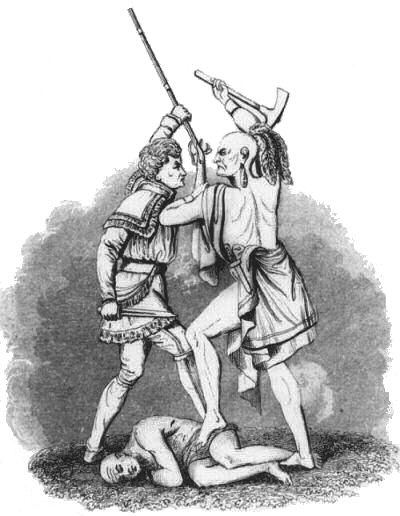 DANIEL BOON. From the Basso Relievo in the
Rotunda of the Capitol at Washington
DANIEL BOON. From the Basso Relievo in the
Rotunda of the Capitol at Washington